Maharashtra Board Class 12 Physics Important Questions Chapter 1 Rotational Dynamics

Balbharti Maharashtra State Board 12th Physics Important Questions Chapter 1 Rotational Dynamics Important Questions and Answers.

Maharashtra State Board 12th Physics Important Questions Chapter 1 Rotational Dynamics

Question 1.
What is circular motion?
Answer:
The motion of a particle along a complete circle or a part of it is called circular motion.

Question 2.
What is a radius vector in circular motion?
Answer:
For a particle performing circular motion, its position vector with respect to the centre of the circle is called the radius vector.
[Note : The radius vector has a constant magnitude, equal to the radius of the circle. However, its direction changes as the position of the particle changes along the circumference.]

Question 3.
What is the difference between rotation and revolution?
Answer:
There is no physical difference between them. It is just a question of usage. Circular motion of a body about an axis passing through the body is called rotation. Circular motion of a body around an axis outside the body is called revolution.

Question 4.
State the characteristics of circular motion.
Answer:

  1. It is an accelerated motion : As the direction of velocity changes at every instant, it is an accelerated motion.
  2. It is a periodic motion : During the motion, the particle repeats its path along the same trajectory. Thus, the motion is periodic.

Question 5.
Explain angular displacement in circular motion.
Answer:
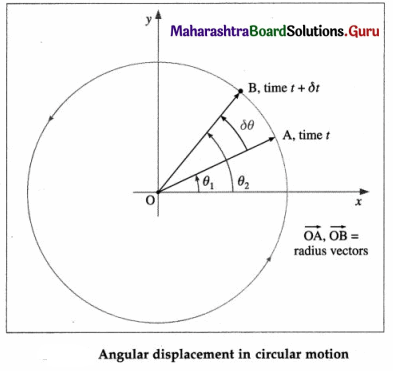
The change in the angular position of a particle performing circular motion with respect to a reference line in the plane of motion of the particle and passing through the centre of the circle is called the angular displacement.
Maharashtra Board Class 12 Physics Important Questions Chapter 1 Rotational Dynamics 1
As the particle moves in its circular path, its angular position changes, say from θ1 at time t to θ2 at a short time δt later. In the interval δt, the position vector \(\vec{r}\) sweeps out an angle δθ = θ2 – θ1. δθ is the magnitude of the change in the angular position of the particle.

Infinitesimal angular displacement \(\overrightarrow{\delta \theta}\) in an infinitesimal time interval δt → 0, is given a direction perpendicular to the plane of revolution by the right hand thumb rule.

Question 6.
Explain angular velocity. State the right hand thumb rule for the direction of angular velocity.
Answer:
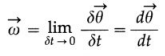
Angular velocity : The time rate of angular displacement of a particle performing circular motion is called the angular velocity.

  1. If the particle has an angular displacement \(\delta \vec{\theta}\) in a short time interval δt, its angular velocity
    Maharashtra Board Class 12 Physics Important Questions Chapter 1 Rotational Dynamics 2
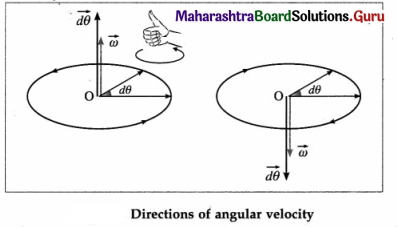
  2. \(\vec{\omega}\) is a vector along the axis of rotation, in the direction of \(d \vec{\theta}\), given by the right hand thumb rule.

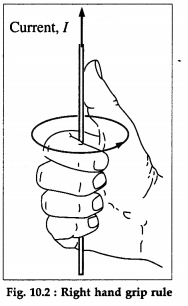
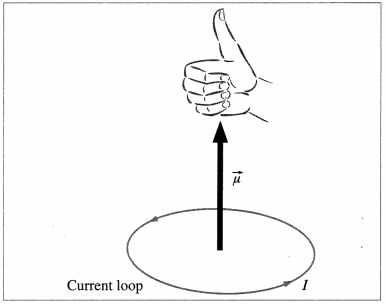
Right hand thumb rule : If the fingers of the right hand are curled in the sense of revolution of the particle, then the outstretched thumb gives the direction of the angular displacement.
Maharashtra Board Class 12 Physics Important Questions Chapter 1 Rotational Dynamics 3
[Note : Angular speed, ω = |\(\vec{\omega}\)| = \(\frac{d \theta}{d t}\) is also called angular frequency. ]

Question 7.
Explain the linear velocity of a particle performing circular motion.
OR
Derive the relation between the linear velocity and the angular velocity of a particle performing circular motion.
Answer:
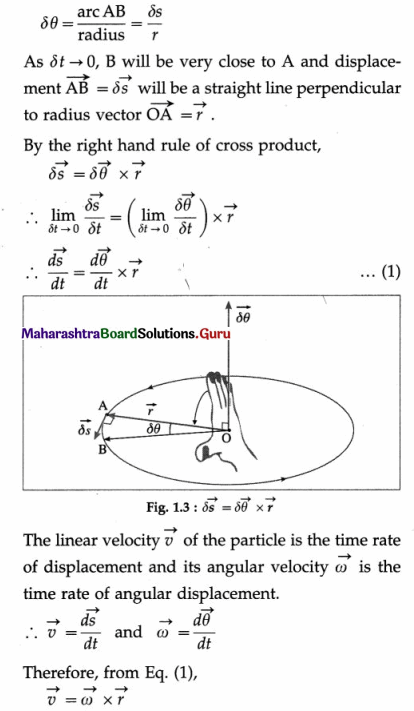
Consider a particle performing circular motion in an anticlockwise sense, along a circle of radius r. In a very small time interval δt, the particle moves from point A to point B through a distance δs and its angular position changes by δθ.
Maharashtra Board Class 12 Physics Important Questions Chapter 1 Rotational Dynamics 4
Since Maharashtra Board Class 12 Physics Important Questions Chapter 1 Rotational Dynamics 5 is tangential, the instantaneous linear velocity \(\vec{v}\) of a particle performing circular motion is along the tangent to the path, in the sense of motion of the particle.

\(\vec{v}\), \(\vec{\omega}\) and \(\vec{r}\) are mutually perpendicular, so that in magnitude, v = ωr.

Question 8.
State the relation between the linear velocity and the angular velocity of a particle in circular motion.
Answer:
Linear velocity, \(\vec{v}\) = \(\vec{\omega}\) × \(\vec{r}\) where ω is the angular velocity and r is the radius vector.

At every instant, \(\vec{v}\), \(\vec{\omega}\) and \(\vec{r}\) are mutually perpendicular, so that in magnitude v = ωr.

Question 9.
Define uniform circular motion (UCM).
Answer:
A particle is said to perform uniform circular motion if it moves in a circle or a circular arc at constant linear speed or constant angular velocity.

Question 10.
A stone tied to a string is rotated in a horizontal circle (nearly). If the string suddenly breaks, in which direction will the stone fly off ?
Answer:
In a circular motion, the instantaneous velocity \(\vec{v}\) is always tangential, in the sense of the motion. Hence, an inertial observer will see the stone fly off tangentially, in the direction of \(\vec{v}\) at the instant the string breaks.

Question 11.
What is the angular speed of a particle moving in a circle of radius r centimetres with a constant speed of v cm/s ?
Answer:
Angular speed, ω = \(\frac{v \mathrm{~cm} / \mathrm{s}}{r \mathrm{~cm}}\) = \(\frac{v}{r}\) rad/s.

Question 12.
Define the period and frequency of revolution of a particle performing uniform circular motion (UCM) and state expressions for them. Also state their SI units.
Answer:
(1) Period of revolution : The time taken by a particle performing UCM to complete one revolution is called the period of revolution or the period (T) of UCM.
T = \(\frac{2 \pi r}{v}\) = \(\frac{2 \pi}{\omega}\)
where v and ω are the linear and angular speeds, respectively.
SI unit: the second (s)
Dimensions : [M°L°T1].

(2) Frequency of revolution : The number of revolutions per unit time made by a particle in UCM is called the frequency of revolution (f).

The particle completes 1 revolution in periodic time T. Therefore, it completes 1/T revolutions per unit time.
∴ Frequency f = \(\frac{1}{T}\) = \(\frac{v}{2 \pi r}\) = \(\frac{\omega}{2 \pi}\)
SI unit : the hertz (Hz), 1 Hz = 1 s-1
Dimensions : [M°L°T-1]

Question 13.
If the angular speed of a particle in UCM is 20π rad/s, what is the period of UCM of the particle?
Answer:
The period of UCM of the particle,
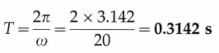
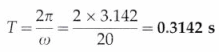
T = \(\frac{2 \pi}{\omega}\) = \(\frac{2 \pi}{20 \pi}\) = 0.1 s

Question 14.
Why is UCM called a periodic motion?
Answer:
In a uniform motion, a particle covers equal distances in equal intervals of time. Any motion which repeats itself in equal intervals of time is called a periodic motion. In a uniform circular motion (UCM), the particle takes the same time to complete each revolution, a distance equal to the circumference of the circle. Therefore, it is a periodic motion.

Question 15.
Give one example of uniform circular motion.
Answer:

  1. Circular motion of every particle of the blades of a fan or the dryer drum of a washing machine when the fan or the drum is rotating with a constant angular speed.
  2. Motion of the hands of a clock.
  3. Motion of an Earth-satellite in a circular orbit.

Question 16.
What can you say about the angular speed of an hour hand as compared to that of the Earth’s rotation about its axis ?
Answer:
The periods of rotation of an hour hand and the Earth are Th = 12 h and TE = 24 h, respectively, so that their angular speeds are ωh = \(\frac{2 \pi}{12}\) rad/h and ωE = \(\frac{2 \pi}{24}\) rad/h.
∴ ωh = 2ωE

Question 17.
Explain the acceleration of a particle in UCM. State an expression for the acceleration.
Answer:
A particle in uniform circular motion (UCM) moves in a circle or circular arc at constant linear speed v. The instantaneous linear velocity \(\vec{v}\) of the particle is along the tangent to the path in the sense of motion of the particle. Since \(\vec{v}\) changes in direction, without change in its magnitude, there must be an acceleration that must be

  1. perpendicular to \(\vec{v}\)
  2. constant in magnitude
  3. at every instant directed radially inward, i.e., towards the centre of the circular path.

Such a radially inward acceleration is called a centripetal acceleration.
∴ \(\vec{a}\) = \(\frac{d \vec{v}}{d t}\) = \(\overrightarrow{a_{\mathrm{r}}}\)

If \(\vec{\omega}\) is the constant angular velocity of the particle and r is the radius of the circle,
\(\overrightarrow{a_{\mathrm{r}}}\) = –\(\omega^{2} \vec{r}\)
where ω = |\(\vec{\omega}\)| and the minus sign shows that the direction of \(\vec{a}_{\mathrm{r}}\) is at every instant opposite to that of the radius vector \(\vec{r}\). In magnitude,
ar = ω2r = \(\frac{v^{2}}{r}\) = ωv

[Note : The word centripetal comes from Latin for ‘centre-seeking’.]

Question 18.
Draw a diagram showing the linear velocity, angular velocity and radial acceleration of a particle performing circular motion with radius r.
Answer:
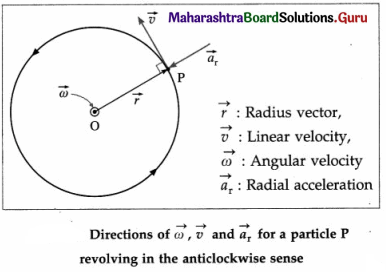
Maharashtra Board Class 12 Physics Important Questions Chapter 1 Rotational Dynamics 6

Question 19.
If a particle in UCM has linear speed 2 m/s and angular speed 5 rad/s, what is the magnitude of the centripetal acceleration of the particle ?
Answer:
The magnitude of the centripetal acceleration of the particle is ar = ωv = (5)(2) = 10 m/s2

Question 20.
State any two quantities that are uniform in UCM.
Answer:
Linear speed and angular speed. (Also, kinetic energy, angular speed and angular momentum.)

Question 21.
State any two quantities that are nonuniform in UCM.
Answer:
Velocity and acceleration are nonuniform in UCM.
(Also, centripetal force.)

Question 22.
What is a nonuniform circular motion?
Answer:
Consider a particle moving in a plane along a circular path of constant radius. If the particle is speeding up or slowing down, its angular speed ω and linear speed v both change with time. Then, the particle is said to be in a non uniform circular motion.

Question 23.
Explain angular acceleration.
Answer:
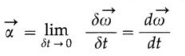
Angular acceleration : The time rate of change of angular velocity of a particle performing circular motion is called the angular acceleration.

(i) If \(\delta \vec{\omega}\) is the change in angular Velocity in a short time interval St, the angular acceleration
Maharashtra Board Class 12 Physics Important Questions Chapter 1 Rotational Dynamics 7

(ii) The direction of \(\vec{\alpha}\) is the same as that of \(d \vec{\omega}\). We consider the case where a change in \(\vec{\omega}\) arises due to a change in its magnitude only. If the particle is speeding up, i.e., ω is increasing with time, then \(\vec{\alpha}\) is in the direction of \(\vec{\omega}\). If the particle is slowing down, i.e., ω is decreasing with time, then \(\vec{\alpha}\) is directed opposite to \(\vec{\omega}\).
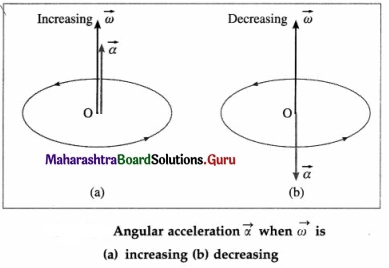
Maharashtra Board Class 12 Physics Important Questions Chapter 1 Rotational Dynamics 8

(iii) If the angular speed changes from ω1 to ω2 in time f, the magnitude (α) of the average angular acceleration is
α = \(\frac{\omega_{2}-\omega_{1}}{t}\)

Question 24.
Explain the tangential acceleration of a particle in non uniform circular motion.
Answer:
Tangential acceleration : For a particle performing circular motion, the linear acceleration tangential to the path that produces a change in the linear speed of the particle is called the tangential acceleration.
Explanation :
(i) If a particle performing circular motion is speeding up or slowing down, its angular speed co and linear speed v both change with time.
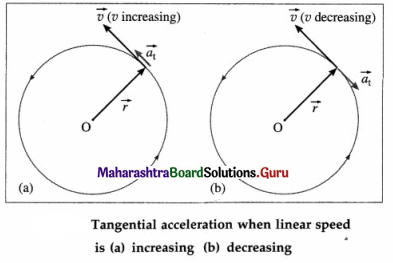
Maharashtra Board Class 12 Physics Important Questions Chapter 1 Rotational Dynamics 9
The linear acceleration that produces a change only in the linear speed must be along \(\vec{v}\). Hence, it is called the tangential acceleration, \(\overrightarrow{a_{\mathrm{t}}}\). In magnitude, at = dv/dt

(ii) If the linear speed v of the particle is increasing, \(\overrightarrow{a_{\mathrm{t}}}\) is in the direction of \(\vec{v}\). If v is decreasing, \(\overrightarrow{a_{\mathrm{t}}}\) is directed opposite to \(\vec{v}\).

Question 25.
Obtain the relation between the magnitudes of the linear (tangential) acceleration and angular acceleration in non uniform circular motion.
Answer:
Consider a particle moving along a circular path of constant radius r. If the particle is speeding up or slowing down, its motion is nonuniform, and its angular speed ω and linear speed v both change with time. At any instant, v, ω and r are related by v = ωr
The angular acceleration of the particle is
α = \(\frac{d \omega}{d t}\)

The tangential acceleration \(\overrightarrow{a_{\mathrm{t}}}\) is the linear acceleration that produces a change in the linear speed of the particle and is tangent to the circle. In magnitude,
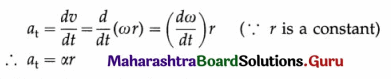
Maharashtra Board Class 12 Physics Important Questions Chapter 1 Rotational Dynamics 10
This is the required relation.

Question 26.
Obtain an expression for the acceleration of a particle performing circular motion. Explain its two components.
OR
For a particle performing uniform circular motion, \(\vec{v}\) = \(\vec{\omega}\) × \(\vec{r}\). Obtain an expression for the linear acceleration of a particle performing non-uniform circular motion.
OR
In circular motion, assuming \(\vec{v}\) = \(\vec{\omega}\) × \(\vec{r}\), obtain an expression for the resultant acceleration of a particle in terms of tangential and radial components.
Answer:
Consider a particle moving along a circular path of constant radius r. If its motion is nonuniform, then its angular speed ω and linear speed v both change with time.
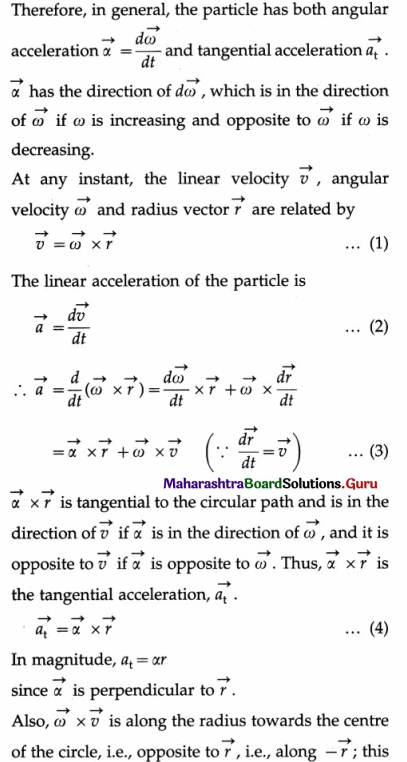
Maharashtra Board Class 12 Physics Important Questions Chapter 1 Rotational Dynamics 11
acceleration is called the radial or centripetal acceleration \(\overrightarrow{a_{\mathrm{r}}}\).
\(\overrightarrow{a_{\mathrm{r}}}\) = \(\vec{\omega}\) × \(\vec{v}\) … (5)
In magnitude, ar = ωv
since \(\vec{\omega}\) is perpendicular to \(\vec{v}\).
∴ \(\vec{a}\) = \(\overrightarrow{a_{\mathrm{t}}}\) + \(\overrightarrow{a_{\mathrm{r}}}\) …. (6)
This is the required expression.

Question 27.
What is the angle between linear acceleration and angular acceleration of a particle in nonuniform circular motion ?
Answer:
In a nonu niform circular motion, the angular acceleration is an axial vector, perpendicular to the plane of the motion. The linear acceleration is in the plane of the motion. Hence, the angle between them is 90°.

Question 28.
What are the differences between a nonuniform circular motion and a uniform circular motion? (Two points of distinction) Give examples.
Answer:
(i) Nonuniform circular motion :

  1. The angular and tangential accelerations are non-zero, so that linear and angular speeds both change with time.
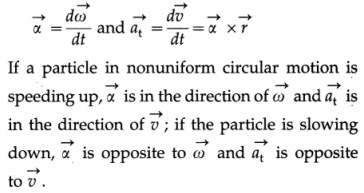
    Maharashtra Board Class 12 Physics Important Questions Chapter 1 Rotational Dynamics 12
  2. The net linear acceleration, being the resultant of the radial and tangential accelerations, is not radial, \(\vec{a}\) = \(\overrightarrow{a_{\mathrm{c}}}\) + \(\overrightarrow{a_{t}}\),
  3. The magnitudes of the centripetal acceleration and the centripetal force are not constant.
  4. Example : Motion of the tip of a fan blade when the fan is speeding up or slowing down.

(ii) Uniform circular motion :

  1. The angular and tangential accelerations are zero, so that linear speed and angular velocity are constant.
  2. The net linear acceleration is radially inward, i.e., centripetal.
  3. The magnitudes of the centripetal acceleration and the centripetal force are also constant.
  4. Example : Motion of the tips of the hands of a mechanical clock.

Question 29.
Write the kinematical equations for circular motion in analogy with linear motion.
Answer:
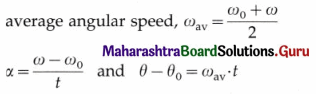
For circular motion of a particle with constant angular acceleration α,
Maharashtra Board Class 12 Physics Important Questions Chapter 1 Rotational Dynamics 13
where ω0 and ω are the initial and final angular speeds, t is the time, ωav the average angular speed and θo and θ the initial and final angular positions of the particle.

Then, the angular kinematical equations for the circular motion are (in analogy with linear kinematical equations for constant linear acceleration)
ω = ω0 + αt
θ – θ0 = ω0t + \(\frac{1}{2} \alpha t^{2}\)
ω2 = \(\omega_{0}^{2}\) + 2α (θ – θ0)

Question 30.
Solve the following :

Question 1.
Certain stars are believed to be rotating at about 1 rot/s. If such a star has a diameter of 40 km, what is the linear speed of a point on the equator of the star?
Solution :
Data : d = 40 km, /= 1 rot/s
∴ r = \(\frac{d}{2}\) = \(\frac{40 \mathrm{~km}}{2}\) = 20 km = 2 × 10⁴ m
Linear speed, v = ωr = (2πf)r
= (2 × 3.142 × 1)(2 × 10⁴)
= 6.284 × 2 × 104
= 1.257 × 10⁵ m/s (or 125.6 km/s)

Question 2.
A body of mass 100 grams is tied to one end of a string and revolved along a circular path in the horizontal plane. The radius of the circle is 50 cm. If the body revolves with a constant angular speed of 20 rad/s, find the

  1. period of revolution
  2. linear speed
  3. centripetal acceleration of the body.

Solution :
Data : m = 100 g = 0.1 kg, r = 50 cm = 0.5 m, ω = 20 rad/s

  1. The period of revolution of the body,
    Maharashtra Board Class 12 Physics Important Questions Chapter 1 Rotational Dynamics 14
  2. Linear speed, v = ωr = 20 × 0.5 = 10 m/s
  3. Centripetal acceleration,
    ac = w2r = (20)2 × 0.5 = 200 m/s2

Question 3.
Calculate the angular speed of the Earth due to its spin (rotational motion).
Solution :
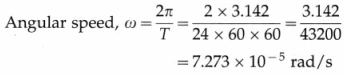
Data : T = 24 hours = 24 × 60 × 60 s
Maharashtra Board Class 12 Physics Important Questions Chapter 1 Rotational Dynamics 15
The angular speed of the Earth due to its spin (rotational motion) is 7.273 × 10⁻⁵ rad/s.

Question 4.
Find the angular speed of rotation of the Earth so that bodies on the equator would feel no weight. [Radius of the Earth = 6400 km, g = 9.8 m/s2]
Solution :
Data : Radius of the Earth = r = 6400 km = 6.4 × 10⁶ m, g = 9.8 m/s2

As the Earth rotates, the bodies on the equator revolve in circles of radius r.

Question 31.
Write the kinematical equations for circular motion in analogy with linear motion.
Answer:
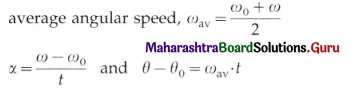
For circular motion of a particle with constant angular acceleration α,
Maharashtra Board Class 12 Physics Important Questions Chapter 1 Rotational Dynamics 16
where ω0 and ω are the initial and final angular speeds, t is the time, ωav the average angular speed and 0o and 0 the initial and final angular positions of the particle.

Then, the angular kinematical equations for the circular motion are (in analogy with linear kinematical equations for constant linear acceleration)
ω = ω0 + αt
θ – θo = ω0t + \(\frac{1}{2} \alpha t^{2}\)
ω2 = \(\omega_{0}^{2}\) + 2α (θ – θo)

Question 32.
Solve the following :

Question 1.
Certain stars are believed to be rotating at about 1 rot/s. If such a star has a diameter of 40 km, what is the linear speed of a point on the equator of the star?
Solution :
Data : d = 40 km, f= 1 rot/s
∴ r = \(\frac{d}{2}\) = \(\frac{40 \mathrm{~km}}{2}\) = 20 km = 2 × 10⁴ m
Linear speed, v = ωr = (2πf)r
= (2 × 3.142 × 1)(2 × 10⁴)
= 6.284 × 2 × 104
= 1.257 × 10⁵ m/s (or 125.6 km/s)

Question 2.
A body of mass 100 grams is tied to one end of a string and revolved along a circular path in the horizontal plane. The radius of the circle is 50 cm. If the body revolves with a constant angular speed of 20 rad/s, find the

  1. period of revolution
  2. linear speed
  3. centripetal acceleration of the body.

Solution :
Data : m = 100 g = 0.1 kg, r = 50 cm = 0.5 m, ω = 20 rad/s

  1. The period of revolution of the body,
    Maharashtra Board Class 12 Physics Important Questions Chapter 1 Rotational Dynamics 17
  2. Linear speed, v = ωr = 20 × 0.5 = 10 m/s
  3. Centripetal acceleration,
    ac = ω2 = (20)2 × 0.5 = 200 m/s2

Question 3.
Calculate the angular speed of the Earth due to its spin (rotational motion).
Solution :
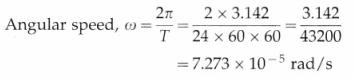
Data : T = 24 hours = 24 × 60 × 60 s
Maharashtra Board Class 12 Physics Important Questions Chapter 1 Rotational Dynamics 18
The angular speed of the Earth due to its spin (rotational motion) is 7.273 × 10⁻⁵ rad/s.

Question 4.
Find the angular speed of rotation of the Earth so that bodies on the equator would feel no weight. (Radius of the Earth = 6400 km, g = 9.8 m/s2]
Solution :
Data : Radius of the Earth = r = 6400 km
= 6.4 × 10⁶ m, g = 9.8 m/s2
As the Earth rotates, the bodies on the equator revolve in circles of radius r.
These bodies would not feel any weight if their centripetal acceleration (ωr) is equal to the acceleration due to gravity (g).
∴ ω2r = g
The angular speed of the Earth’s rotation,

Maharashtra Board Class 12 Physics Important Questions Chapter 1 Rotational Dynamics 19

Question 5.
To simulate the acceleration of large rockets, astronauts are seated in a chamber and revolved in a circle of radius 9.8 m. What angular speed is required to generate a centripetal acceleration 8 times the acceleration due to gravity? [g = 9.8 m/s2]
Solution :
Data : r = 9.8 m, g = 9.8 m/s2, a = 8g
Centripetal acceleration = ω2r
∴ ω2r = 8g
∴ 9.8 ω2 = 8(9.8)
∴ ω2 = 8
The required angular speed, ω = \(\sqrt{8}\) = 2\(\sqrt{2}\) = 2.828 rad/s

Question 6.
The angular position of a rotating object is given by θ(t) = (1.55t2 – 7.75 t + 2.87) rad, where t is measured in second.
(i) When is the object momentarily at rest ?
(ii) What is the magnitude of its angular acceleration at that time ?
Solution :
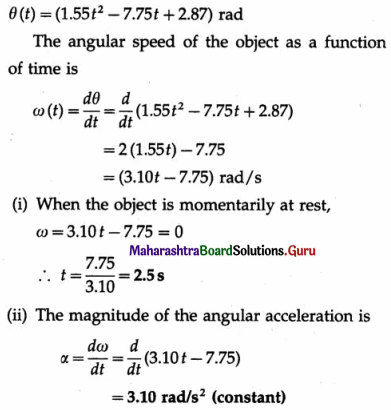
Maharashtra Board Class 12 Physics Important Questions Chapter 1 Rotational Dynamics 20

Question 7.
A motor part at a distance of 1.5 m from the motor’s axis of rotation has a constant angular acceleration of 0.25 rad/s2. Find the magnitude of its linear acceleration at the instant when its angular speed is 0.5 rad/s.
Solution :
Data : r = 1.5 m, α = 0.25 rad/s2, ω = 0.5 rad/s2 ar = ω2r = (0.5)2(1.5) = 0.25 × 1.5 = 0.375 m/s2 at = αr = 0.25 × 1.5 = 0.375 m/s2
The linear acceleration,
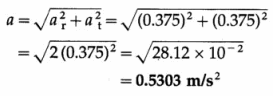
Maharashtra Board Class 12 Physics Important Questions Chapter 1 Rotational Dynamics 21

Question 8.
A coin is placed on a stationary disc at a distance of 1 m from the disc’s centre. At time t = 0 s, the disc begins to rotate with a constant angular acceleration of 2 rad/s2 around a fixed vertical axis through its centre and perpendicular to its plane.
Find the magnitude of the linear acceleration of the coin at t = 1.5 s. Assume the coin does not slip.
Solution :
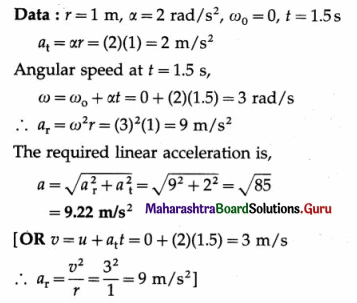
Maharashtra Board Class 12 Physics Important Questions Chapter 1 Rotational Dynamics 22

Question 9.
A railway locomotive enters a stretch of track, which is in the form of a circular arc of radius 280 m, at 10 m/s and with its speed increasing uniformly. Ten seconds into the stretch its speed is 14m/s and at 18s its speed is 19 m/s. Find
(i) the magnitude of the locomotive’s linear acceleration when its speed is 14 m/s
(ii) the direction of this acceleration at that point with respect to the locomotive’s radial acceleration
(iii) the angular acceleration of the locomotive.
Answer:
Data : r = 280 m, v1 = 10 m/s at t1 = 0, v2 = 14 m/s at t2 = 10 s, v3 = 19 m/s at t3 = 18 s
(i) At t = t2, the radial acceleration is
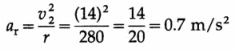
Maharashtra Board Class 12 Physics Important Questions Chapter 1 Rotational Dynamics 23
Since the tangential acceleration is constant, it may be found from the data for any two times.
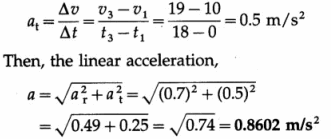
Maharashtra Board Class 12 Physics Important Questions Chapter 1 Rotational Dynamics 24

(ii) If θ is the angle between the resultant linear acceleration and the radial acceleration,
tan θ = \(\frac{a_{\mathrm{t}}}{a_{\mathrm{r}}}\) = \(\frac{0.5}{0.7}\) = 0.7142
∴ θ = tan-1 0.7142 = 35°32′

(iii) at = αr
The angular acceleration,
α = \(\frac{a_{\mathrm{t}}}{r}\) = \(\frac{0.5}{280}\)
= 1.785 × 10⁻³ rad/s2
= 1.785 mrad/s2

Question 10.
The frequency of revolution of a particle performing circular motion changes from 60 rpm to 180 rpm in 20 seconds. Calculate the angular acceleration of the particle.
Solution :
Data : f1 =60 rpm = \(\frac{60}{60}\) rev/s = 1 rev/s, f2 = 180 rpm = \(\frac{180}{60}\) rev/s = 3 rev/s, t = 20 s
The angular acceleration in SI units,
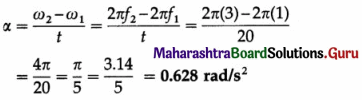
Maharashtra Board Class 12 Physics Important Questions Chapter 1 Rotational Dynamics 25
OR
Using non SI units, the angular frequencies are ω1 = 60 rpm = 1 rps and ω2 = 180 rpm = 3 rps. Maharashtra Board Class 12 Physics Important Questions Chapter 1 Rotational Dynamics 26

Question 11.
The frequency of rotation of a spinning top is 10 Hz. If it is brought to rest in 6.28 s, find the angular acceleration of a particle on its surface.
Solution:
Data: f1 = 10Hz, f2 = 0 Hz, t = 6.28s
The angular acceleration,
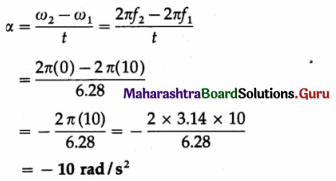
Maharashtra Board Class 12 Physics Important Questions Chapter 1 Rotational Dynamics 27

Question 12.
A wheel of diameter 40 cm starts from rest and attains a speed of 240 rpm in 4 minutes. Calculate its angular displacement in this time interval.
Solution:
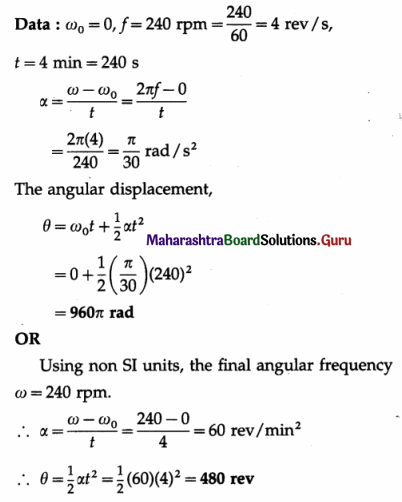
Maharashtra Board Class 12 Physics Important Questions Chapter 1 Rotational Dynamics 28

Question 13.
A flywheel slows down uniformly from 1200 rpm to 600 rpm in 5 s. Find the number of revolutions made by the wheel in 5 s.
Solution :
Data : ω0 = 1200 rpm, ω = 600 rpm, f = 5 s
Since the flywheel slows down uniformly, its angular acceleration is constant. Then, its average angular speed,
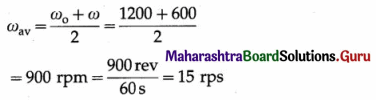
Maharashtra Board Class 12 Physics Important Questions Chapter 1 Rotational Dynamics 29
Its angular displacement in time t,
θ = ωav.t = 15 × 5 = 75 revolutions

Question 33.
Define and explain centripetal force.
Answer:
Definition : In the uniform circular motion of a particle, the centripetal force is the force on the particle which at every instant points radially towards the centre of the circle and produces the centripetal acceleration to move the particle in its circular path.

Explanation : A uniform circular motion is an accelerated motion, with a radially inward (i.e., centripetal) acceleration –\(\frac{v^{2}}{r} \hat{\mathrm{r}}\) or \(-\frac{v^{2}}{r} \hat{\mathrm{r}}\), where \(\vec{r}\) is the radius vector and \(\hat{\mathbf{r}}\) is a unit vector in the direction of \(\vec{r}\). Hence, a net real force must act on the particle to produce this acceleration. This force, which at every instant must point radially towards the centre of the circle, is called the centripetal force. If m is the mass of the particle, the centripetal force is
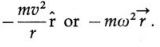
Maharashtra Board Class 12 Physics Important Questions Chapter 1 Rotational Dynamics 30

Notes :

  1. As viewed from an inertial frame of reference, the centripetal force is necessary and sufficient for the particle to perform UCM. At any instant, if the centripetal force suddenly vanishes, the particle would fly off in the direction of its linear velocity at that instant.
  2. In case the angular or linear speed changes with time, as in nonuniform circular motion, the force is not purely centripetal but has a tangential component which accounts for the tangential acceleration.

Question 34.
Give any two examples of centripetal force.
Answer:
Examples of centripetal force :

  1. For an Earth-satellite in a circular orbit, the centripetal force is the gravitational force exerted by the Earth on the satellite.
  2. In the Bohr atom, the centripetal force on an electron in circular orbit around the nucleus is the attractive Coulomb force of the nucleus.
  3. When an object tied at the end of a string is revolved in a horizontal circle, the centripetal force is the tension in the string.
  4. When a car takes a turn in a circular arc on a horizontal road with constant speed, the force of static friction between the car tyres and road surfaces is the centripetal force.

Note : The tension in a string or the force of friction is electromagnetic in origin.

Question 35.
Define and explain centrifugal force.
Answer:
Definition : In the reference frame of a particle performing circular motion, centrifugal force is defined as a fictitious, radially outward force on the particle and is equal in magnitude to the particle’s mass times the centripetal acceleration of the reference frame, as measured from an inertial frame of reference.

Explanation : A uniform circular motion is an accelerated motion, with a centripetal acceleration of magnitude v2/r or ω2r. A frame of reference attached to the particle also has this acceleration and, therefore, is an accelerated or noninertial reference frame. The changing direction of the linear velocity appears in this reference frame as a tendency to move radially outward. This is explained by assuming a fictitious centrifugal, i.e., radially outward, force acting on the particle. Since the particle is stationary in its reference frame, the magnitude of the centrifugal force is mv2/r or mω2r, the same as that of the centripetal force on the particle.

Note : The word ‘centrifugal’ comes from the Latin for ‘fleeing from the centre’. The word has the same root fuge from the Latin ‘to flee’ as does refugee.

Question 36.
Give any two examples of centrifugal force.
Answer:
Examples of centrifugal force :

  1. A person in a merry-go-round experiences a radially outward force.
  2. Passengers of a car taking a turn on a level road experience a force radially away from the centre of the circular road.
  3. A coin on a rotating turntable flies off for some high enough angular speed of the turntable.
  4. As the Earth rotates about its axis, the centrifugal force on its particles is directed away from the axis. The force increases as one goes from the poles towards the equator. This leads to the bulging of the Earth at the equator.

Question 37.
Explain why centrifugal force is called a pseudo force.
Answer:
A force which arises from gravitational, electromagnetic or nuclear interaction between matter is called a real force. The centrifugal force does not arise due to any of these interactions. Therefore, it is not a real force.

The centrifugal force in the noninertial frame of reference of a particle in circular motion is the effect of the acceleration of the frame of reference. Therefore, it is called a pseudo or fictitious force.

Question 38.
Distinguish between centripetal force and centrifugal force. State any two points of distinction.
Answer:

Centripetal forceCentrifugal force
1. Centripetal force is the force required to provide centri­petal acceleration to a par­ticle to move it in a circular path.1. The centrifugal tendency of the particle, in its acceler­ated, i.e., non-inertial, frame of reference, is explained by assuming a centrifugal force acting on it.
2. At every instant, it is directed radially towards the centre of the circular path.2. At every instant, it is directed radially away from the centre of the circular path.
3. It is a real force arising from gravitational or electromag­netic interaction between matter.3. It is a pseudo force since it is the effect of the acceleration of the reference frame of the revolving particle.

Question 39.
Solve the following :

Question 1.
An object of mass 0.5 kg is tied to a string and revolved in a horizontal circle of radius 1 m. If the breaking tension of the string is 50 N, what is the maximum speed the object can have?
Solution :
Data : m = 0.5 kg, r = 1 m, F = 50 N
The maximum centripetal force that can be applied is equal to the breaking tension.
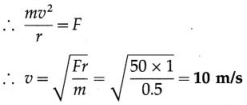
Maharashtra Board Class 12 Physics Important Questions Chapter 1 Rotational Dynamics 31
This is the maximum speed the object can have.

Question 2.
A certain string 500 cm long breaks under a tension of 45 kg wt. An object of mass 100 g is attached to this string and whirled in a horizontal circle. Find the maximum number of revolutions that the object can make per second without breaking the string, [g = 9.8 m/s2]
Solution :
Data : m = 100 g = 0.1 kg, r = 500 cm = 5 m, g = 9.8 m/s2, F = 45 kg wt = 45 × 9.8 N
The breaking tension is equal to the maximum centripetal force that can be applied.
∴ F = mω2r ,
But ω = 2πf, where/is the corresponding frequency of revolution.
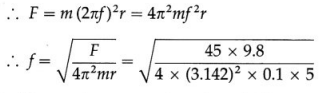
Maharashtra Board Class 12 Physics Important Questions Chapter 1 Rotational Dynamics 32
The maximum number of revolutions per second, f = 4.726 Hz

Question 3.
A disc of radius 15 cm rotates with a speed of 33\(\frac{1}{3}\) rpm. Two coins are placed on it at 4 cm and 14 cm from its centre. If the coefficient of friction between the coins and the disc is 0.15, which of the two coins will revolve with the disc ?
Solution :
Data : r = 15 cm = 0.15 m,
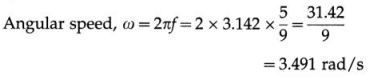
f = 33\(\frac{1}{3}\) rpm = \(\frac{100}{3 \times 60}\)rev/s = \(\frac{5}{9}\) Hz, µs = 0.15, r1 = 4 cm = 0.04 m, r2 = 14 cm = 0.14 m
Maharashtra Board Class 12 Physics Important Questions Chapter 1 Rotational Dynamics 33

To revolve with the disc without slipping, the necessary centripetal force must be less than or equal to the limiting force of static friction.

Limiting force of static friction, fs = µs N = µs (mg) where m is the mass of the coin and N = mg is the normal force on the coin.
∴ mω2r ≤ µs(mg) or ω2r ≤ µsg
µsg = 0.15 × 9.8 = 1.47 m/s2
For the first coin, r1 = 0.04 m.
∴ ω2r1 = (3.491)2 × 0.04 = 12.19 × 0.04 = 0.4876 m/s2
Since, ω2r1 < µsg, this coin will revolve with the disc. For the second coin, r2 = 0.14 m.
∴ ω2r2 = (3.491)2 × 0.14 = 12.19 × 0.14 = 1.707 m/s2
Since, ω2r2 > µsg, this coin will not revolve with the disc.
Thus, only the coin placed at 4 cm from the centre will revolve with the disc.

Question 40.
Derive an expression for the maximum safe speed for a vehicle on a horizontal circular road without skidding off. State its significance.
Answer:
Consider a car of mass m taking a turn of radius r along a level road. If µs is the coefficient of static friction between the car tyres and the road surface, the limiting force of friction is fs = µsN = µsmg where N = mg is the normal reaction. The forces on the car, as seen from an inertial frame of reference are shown in below figure.
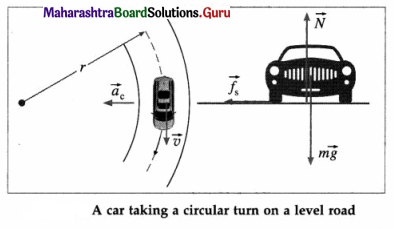
Maharashtra Board Class 12 Physics Important Questions Chapter 1 Rotational Dynamics 34
Then, the maximum safe speed vmax with which the car can take the turn without skidding off is set by maximum centripetal force = limiting force of static friction
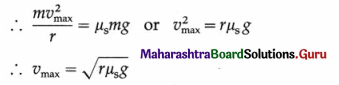
Maharashtra Board Class 12 Physics Important Questions Chapter 1 Rotational Dynamics 35
This is the required expression.
Significance : The above expression shows that the maximum safe speed depends critically upon friction which changes with circumstances, e.g., the nature of the surfaces and presence of oil or water on the road. If the friction is not sufficient to provide the necessary centripetal force, the vehicle is likely to skid off the road.

[Note : At a circular bend on a level railway track, the centrifugal tendency of the railway carriages causes the flange of the outer wheels to brush against the outer rail and exert an outward thrust on the rail. Then, the reaction of the outer rail on the wheel flange provides the necessary centripetal force.]

Question 41.
Derive an expression for the maximum safe speed for a vehicle on a circular horizontal road without toppling/overturning/rollover.
Answer:
Consider a car of mass m taking a turn of radius r along a level road. As seen from an inertial frame of reference, the forces acting on the car are :

  1. the lateral limiting force of static friction \(\overrightarrow{f_{\mathrm{s}}}\) on the wheels-acting along the axis of the wheels and towards the centre of the circular path which provides the necessary centripetal force.
  2. the weight \(m \vec{g}\) acting vertically downwards at the centre of gravity (C.G.)
  3. the normal reaction \(\vec{N}\) of the road on the wheels, acting vertically upwards effectively at the C.G. Since maximum centripetal force = limiting force of static friction,

    Maharashtra Board Class 12 Physics Important Questions Chapter 1 Rotational Dynamics 36

In a simplified rigid-body vehicle model, we consider only two parameters-the height h of the C.G. above the ground and the average distance b between the left and right wheels called the track width.
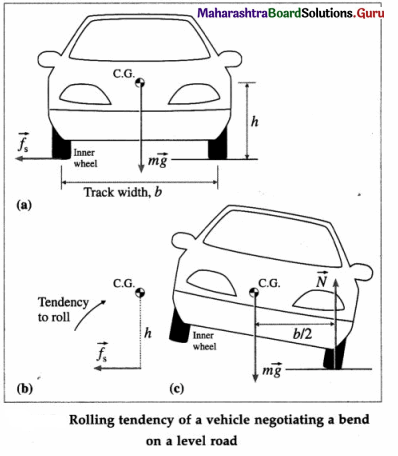
Maharashtra Board Class 12 Physics Important Questions Chapter 1 Rotational Dynamics 37
The friction force \(\overrightarrow{f_{\mathrm{s}}}\) on the wheels produces a torque T, that tends to overturn/rollover the car about the outer wheel. Rotation about the front-to-back axis is called roll

Maharashtra Board Class 12 Physics Important Questions Chapter 1 Rotational Dynamics 38
When the inner wheel just gets lifted above the ground, the normal reaction \(\vec{N}\) of the road acts on the outer wheels but the weight continues to act at the C.G. Then, the couple formed by the normal reaction and the weight produces a opposite torque \(\tau_{\mathrm{r}}\) which tends to restore the car back on all four wheels
\(\tau_{\mathrm{r}}\) = mg.\(\frac{b}{2}\) … (3)

The car does not topple as long as the restoring torque \(\tau_{\mathrm{r}}\) counterbalances the toppling torque \(\tau_{\mathrm{t}}\). Thus, to avoid the risk of rollover, the maximum speed that the car can have is given by

Maharashtra Board Class 12 Physics Important Questions Chapter 1 Rotational Dynamics 39

Thus, vehicle tends to roll when the radial acceleration reaches a point where inner wheels of the four-wheeler are lifted off of the ground and the vehicle is rotated outward. A rollover occurs when the gravitational force \(m \vec{g}\) passes through the pivot point of the outer wheels, i.e., the C.G. is above the line of contact of the outer wheels. Equation (3) shows that this maximum speed is high for a car with larger track width and lower centre of gravity.

Question 42.
A carnival event known as a “well of death” consists of a large vertical cylinder inside which usually a stunt motorcyclist rides in horizontal circles. Show that the minimum speed necessary to keep the rider from falling is given by v = \(\sqrt{r g / \mu_{s}}\), in usual notations.
Answer:
The forces exerted on the rider are

  1. the normal force \(\vec{N}\) exerted by the wall, directed radially inward, is the centripetal force,
  2. the upward frictional force \(\overrightarrow{f_{\mathrm{s}}}\) exerted by the wall, since the motorcycle has a tendency to slide down,
  3. the downward gravitational force \(m \vec{g}\).
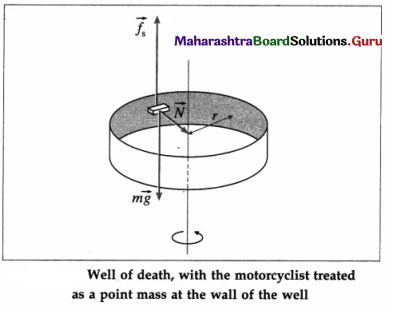
Maharashtra Board Class 12 Physics Important Questions Chapter 1 Rotational Dynamics 40
Maharashtra Board Class 12 Physics Important Questions Chapter 1 Rotational Dynamics 41
which is the required expression.

Question 43.
A road at a bend should be banked for an optimum or most safe speed v0. Derive an expression for the required angle of banking.
OR
Obtain an expression for the optimum or most safe speed with which a vehicle can be driven along a curved banked road. Hence show that the angle of banking is independent of the mass of a vehicle.
Answer:
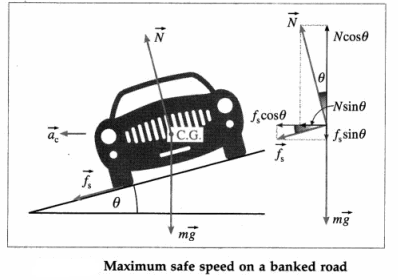
Consider a car taking a left turn along a road of radius r banked at an angle θ for a designed optimum or most safe speed v0. Let m be the mass of the car. In general, the forces acting on the car are
(a) its weight \(m \vec{g}\), acting vertically down
(b) the normal reaction of the road \(\vec{N}\), perpendicular to the road surface
(c) the frictional force \(\overrightarrow{f_{s}}\) along the inclined surface of the road.

At the optimum speed, frictional force is not relied upon to contribute to the necessary lateral centripetal force. Thus, ignoring \(\overrightarrow{f_{\mathrm{s}}}\), resolve \(\vec{N}\) into two perpendicular components : N cos θ vertically up and N sin θ horizontally towards the centre of the circular path. Since there is no acceleration in the vertical direction, N cos θ balances mg and N sin θ provides the necessary centripetal force.
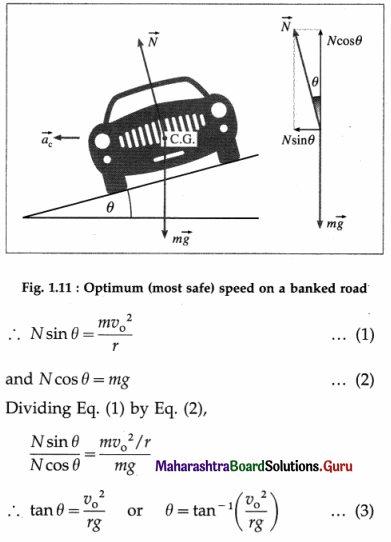
Maharashtra Board Class 12 Physics Important Questions Chapter 1 Rotational Dynamics 42
Equation (3) gives the expression for the required angle of banking. From EQ. (3), we can see that θ depends upon v0, r and g. The angle of banking is independent of the mass of a vehicle negotiating the curve. Also, for a given r and θ, the recommended optimum speed is
v0 = \(\sqrt{r g \tan \theta}\) … (4)

Question 44.
State any two factors on which the most safe speed of a car in motion along a banked road depends.
Answer:
The angle of banking of the road and the radius of the curved path.

Question 45.
A curved horizontal road must be banked at an angle θ’ for an optimum speed v. What will happen to a vehicle moving with a speed v along this road if the road is banked at an angle θ such that
(i) θ < θ’
(ii) θ > θ’?
Answer:
(i) For θ < θ’, the horizontal component of the normal reaction would be less than the optimum value and will not be able to provide the necessary centripetal force. Then, the vehicle will tend to skid outward, up the inclined road surface.

(ii) For θ > θ’, the horizontal component of the normal reaction would be more than the necessary centripetal force. Then, the vehicle will tend to skid down the banked road.

Question 46.
A banked circular road is designed for traffic moving at an optimum or most safe speed v0. Obtain an expression for
(a) the minimum safe speed
(b) the maximum safe speed with which a vehicle can negotiate the curve without skidding.
Answer:
Consider a car taking a left turn along a road of radius r banked at an angle θ for a designed optimum speed v. Let m be the mass of the car. In general, the forces acting on the car are
(a) its weight \(m \vec{g}\), acting vertically down
(b) the normal reaction of the road \(\vec{N}\), perpendicular to the road surface
(c) the frictional force \(\overrightarrow{f_{\mathrm{s}}}\) along the inclined surface of the road.
If µs is the coefficient of static friction between the tyres and road, fs = µsN.

(a) For minimum safe speed : If the car is driven at a speed less than the optimum speed v0, it may tend to slide down the inclined surface of the road so that \(\overrightarrow{f_{\mathrm{s}}}\) is up the incline.

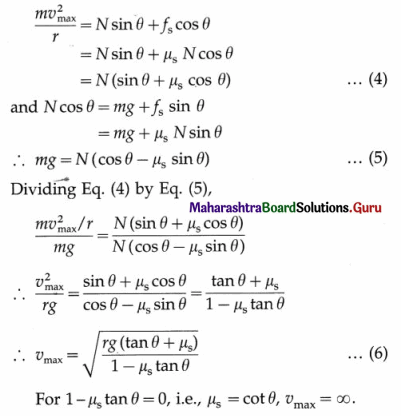
Resolve \(\vec{N}\) and \(\overrightarrow{f_{\mathrm{s}}}\) into two perpendicular components : Ncos θ and fs sin θ vertically up; N sin θ horizontally towards centre of the circular path. So long as the car takes the turn without skidding off, the horizontal components N sin θ and fs cos θ together provide the necessary centripetal force, and N cos θ balances the sum mg + fs sin θ. If vmax is the maximum safe speed without skidding,
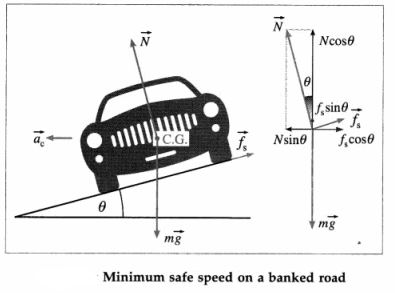
Maharashtra Board Class 12 Physics Important Questions Chapter 1 Rotational Dynamics 350
Maharashtra Board Class 12 Physics Important Questions Chapter 1 Rotational Dynamics 351

(b) For maximum safe speed : If the car is driven fast enough, at a speed greater than the optimum speed v, it may skid off up the incline so that \(\overrightarrow{f_{\mathrm{s}}}\) is down the incline.
Maharashtra Board Class 12 Physics Important Questions Chapter 1 Rotational Dynamics 356
Resolve \(\vec{N}\) and \(\overrightarrow{f_{\mathrm{s}}}\) into two perpendicular components : N cos θ vertically up and f<sub>s</sub> sin θ vertically down; N sin θ and f<sub>s</sub> cos θ horizontally towards the centre of the circular path. So long as the car takes the turn without skidding off, the horizontal components N sin θ and f cos θ together provide the necessary centripetal force, and N cos θ balances the sum mg + f sin θ. If v is the maximum safe
speed without skidding,
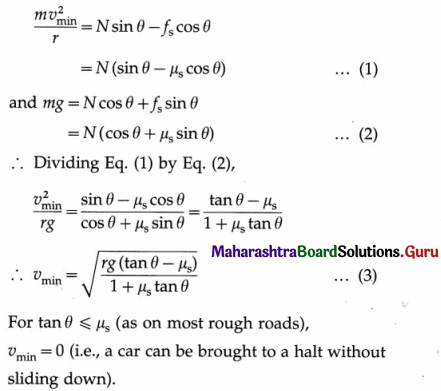
Maharashtra Board Class 12 Physics Important Questions Chapter 1 Rotational Dynamics 43

Ignoring few special cases, the maximum value of µs = 1. Thus, for θ ≥ 45°, vmax = ∞, i.e., on a heavily banked road a car is unlikely to skid up the incline and the minimun limit is more important.

Question 47.
Solve the following :

Question 1.
Find the maximum speed with which a car can be safely driven along a curve of radius 100 m, if the coefficient of friction between its tyres and the road is 0.2 [g = 9.8 m/s2].
Solution :
Data : r = 100 m, µs = 0.2, g = 9.8 m/s2
The maximum speed, v = \(\sqrt{r \mu_{s} g}\)
= \(\sqrt{100 \times 0.2 \times 9.8}\) = 14 m/s

Question 2.
A flat curve on a highway has a radius of curvature 400 m. A car goes around the curve at a speed of 32 m/s. What is the minimum value of the coefficient of friction that will prevent the car from sliding?
Solution:
Data : r = 400 m, v = 32 m/s, g = 10 m/s2
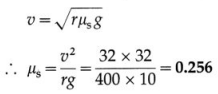
Maharashtra Board Class 12 Physics Important Questions Chapter 1 Rotational Dynamics 44

Question 3.
A car can be driven on a flat circular road of radius r at a maximum speed v without skidding. The same car is now driven on another flat circular road of radius 2r on which the coefficient of friction between its tyres and the road is the same as on the first road. What is the maximum speed of the car on the second road such that it does not skid?
Solution:
Data: v1 = v, r1 = r, r2 = 2r
On a flat circular road, the maximum safe speed is
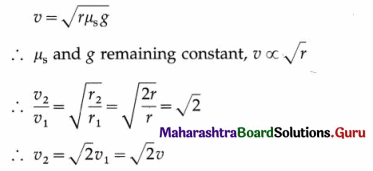
Maharashtra Board Class 12 Physics Important Questions Chapter 1 Rotational Dynamics 45

Question 4.
On a dry day, the maximum safe speed at which a car can be driven on a curved horizontal road without skidding is 7 m/s. When the road is wet, the frictional force between the tyres and road reduces by 25%. How fast can the car safely take the turn on the wet road ?
Solution:
Let subscripts 1 and 2 denote the values of a quantity under dry and wet conditions, respectively.
Data : v1 = 7 m/s, f2 = f1, – 0.25f1 = 0.75f1

On a dry horizontal curved road, the frictional force between the tyres and road is f1 = µ1mg, where m is the mass of the car and g is the gravitational acceleration.

The maximum safe speed for taking a turn of radius r on a dry horizontal curved road is
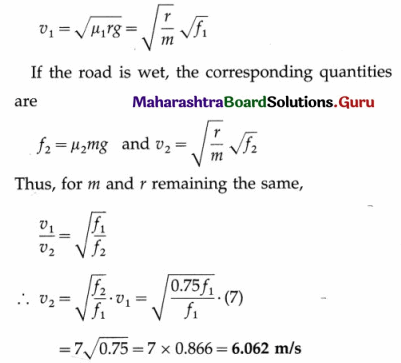
Maharashtra Board Class 12 Physics Important Questions Chapter 1 Rotational Dynamics 46

Question 5.
A coin kept at a distance of 5 cm from the centre of a turntable of radius 1.5 m just begins to slip when the turntable rotates at a speed of 90 rpm. Calculate the coefficient of static friction between the coin and the turntable. [g = π2 m/s2]
Solution:
Data: r = 5 cm = 0.05 m, f = 90 rpm = \(\frac{90}{60}\) rps = 1.5 rps, g = π2 m/s2

The centripetal force for the circular motion of the coin is provided by the friction between the coin and the turntable. The coin is just about to slip off the turntable when the limiting force of friction is equal to the centripetal force.
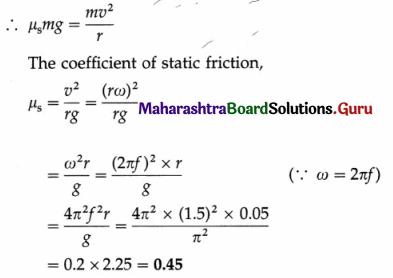
Maharashtra Board Class 12 Physics Important Questions Chapter 1 Rotational Dynamics 47

Question 6.
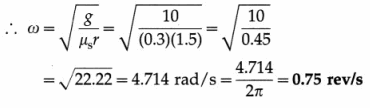
A thin cylindrical shell of inner radius 1.5 m rotates horizontally, about a vertical axis, at an angular speed ω. A wooden block rests against the inner surface and rotates with it. If the coefficient of static friction between block and surface is 0.3, how fast must the shell be rotating if the block is not to slip and fall ?
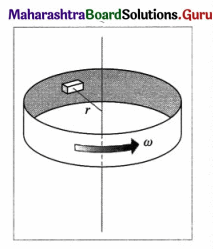
Maharashtra Board Class 12 Physics Important Questions Chapter 1 Rotational Dynamics 48
Solution :
Data : r = 1.5 m, µs = 0.3
The normal force \(\vec{N}\) of the shell on the block is the centripetal force which holds the block in place. \(\vec{N}\) determines the friction on the block, which in turn keeps it from sliding downward. If the block is not to slip, the friction force \(\overrightarrow{f_{\mathrm{s}}}\) must balance the weight \(m \vec{g}\) of the block.
∴ N = mω2r and fs = μsN = mg
∴ μs2r) = mg
Maharashtra Board Class 12 Physics Important Questions Chapter 1 Rotational Dynamics 49
This gives the required angular speed.

Question 7.
A motorcyclist rounds a curve of radius 25 m at 36 km/h. The combined mass of the motorcycle and the man is 150 kg.

  1. What is the centripetal force exerted on the motorcyclist ?
  2. What is the upward force exerted on the motorcyclist?

Solution :
Data : r = 25m, v = 36 km/h = 36 × \(\frac{5}{18}\)m/s = 10 m/s, m = 150 kg, g = 10 m/s2

  1. Centripetal force, F = \(\frac{m v^{2}}{r}\) = \(\frac{150 \times(10)^{2}}{25}\) = 600 N
  2. Upward force = normal reaction of the road surface = mg = 150 × 10 = 1500 N

Question 8.
A motorcyclist is describing a circle of radius 25 m at a speed of 5 m/s. Find his inclination with the vertical. What is the value of the coefficient of friction between the tyres and ground ?
Solution :
Data : v = 5 m/s, r = 25 m, g = 10 m/s2
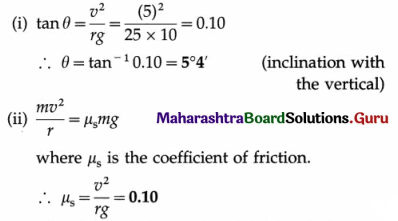
Maharashtra Board Class 12 Physics Important Questions Chapter 1 Rotational Dynamics 50

Question 9.
A motor van weighing 4400 kg (i.e., a motor van of mass 4400 kg) rounds a level curve of radius 200 m on an unbanked road at 60 km/h. What should be the minimum value of the coefficient of friction to prevent skidding ? At what angle should the road be banked for this velocity?
Solution :
Data : m = 4400 kg, r = 200 m,
v = 60 km/h = 60 × \(\frac{5}{18}\)m/s = \(\frac{50}{3}\) m/s, g = 10 m/s2
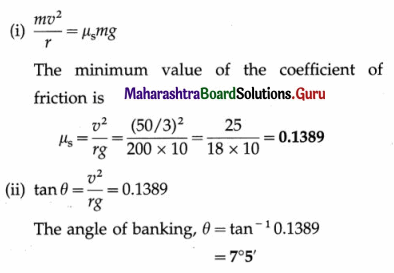
Maharashtra Board Class 12 Physics Important Questions Chapter 1 Rotational Dynamics 51
[Note : In part (ii), v is to be taken as the optimum speed.]

Question 10.
An amusement park ride (known variously as the Rotor, the Turkish Twist and the Gravitron) consists of a large vertical cylinder that is spun about it axis fast enough such that the riders remain pinned against its inner wall. The floor drops away once the cylinder has attained its full rotational speed. The radius of the cylinder is R and the coefficient of static friction between a rider and the wall is μs.
(i) Show that the minimum angular speed necessary to keep a rider from falling is given by ω = \(\sqrt{g / \mu_{s} R} \text {. }\).
(ii) Obtain a numerical value for the frequency of rotation of the cylinder in rotations per minute if R =4 m and
µs = 0.4.
Solution:
Data: R = 4 m, µs = 0.4, g = 10 m/s2
The forces exerted on the rider, when the floor
drops away, are

  1. the normal force \(\vec{N}\) exerted by the wall, directed radially inward, is the centripetal force
  2. the upward frictional force \(\overrightarrow{f_{\mathrm{s}}}\) exerted by the wall
  3. the downward gravitational force mg .

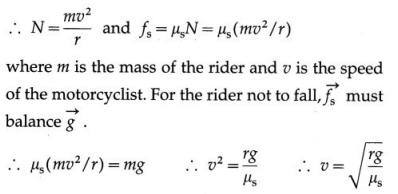
∴ N = mω2R and fs = µsN = µs (mω2R) where m is the mass of the rider and ω is the angular speed of the Rotor cylinder. For the rider not to fall, \(\overrightarrow{f_{\mathrm{s}}}\) must balances \(m \vec{g}\).
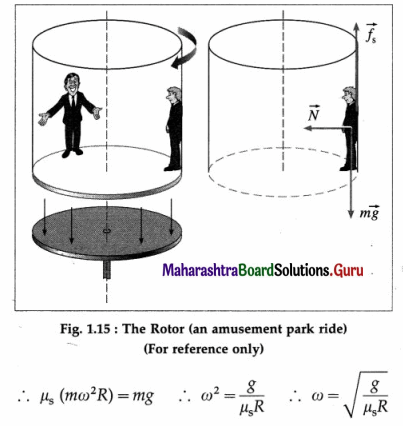
Maharashtra Board Class 12 Physics Important Questions Chapter 1 Rotational Dynamics 52
This is the minimum angular speed necessary. Since ω = 2πf, the corresponding frequency of rotation of the cylinder is
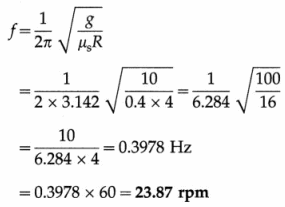
Maharashtra Board Class 12 Physics Important Questions Chapter 1 Rotational Dynamics 53

Question 11.
The two rails of a broad-gauge railway track are 1.68 m apart. At a circular curve of radius 1.6 km, the outer rail is raised relative to the inner rail by 8.4 cm. Find the angle of banking of the track and the optimum speed of a train rounding the curve.
Solution :
Data : l = 1.68 m = 168 cm, r = 1.6 km = 1600 m, h = 8.4 cm, g = 10 m/s2
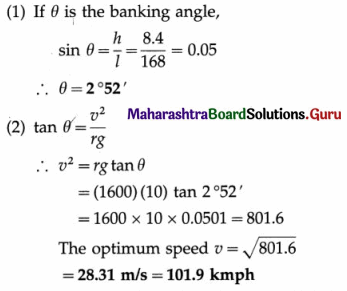
Maharashtra Board Class 12 Physics Important Questions Chapter 1 Rotational Dynamics 54

Question 12.
A metre gauge train is moving at 72 kmph along a curved railway track of radius of curvature 500 m. Find the elevation of the outer rail above the inner rail so that there is no side thrust on the outer rail.
Solution :
Data : r = 500 m, v = 72 kmph = 72 × \(\frac{5}{18}\) m/s = 20 m/s, g = 10 m/s2, l = 1 m
tan θ = \(\frac{v^{2}}{r g}\)
= \(\frac{(20)^{2}}{500 \times 10}\) = 0.08
The required angle of banking,
θ = tan-1 (0.08) = 4°4′
The elevation of the outer rail relative to the inner rail,
h = l sin θ
= (1)(sin 4°4′) = 0.0709 m = 7.09 cm

Question 13.
A circular race course track has a radius of 500 m and is banked at 10°. The coefficient of static friction between the tyres of a vehicle and the road surface is 0.25. Compute
(i) the maximum speed to avoid slipping
(ii) the optimum speed to avoid wear and tear of the tyres.
Solution :
Data : r = 500 m, θ = 10°, µs = 0.25, g = 9.8 m/s2, tan 10° = 0.1763

(i) On the banked track, the maximum speed of the vehicle without slipping (skidding) is
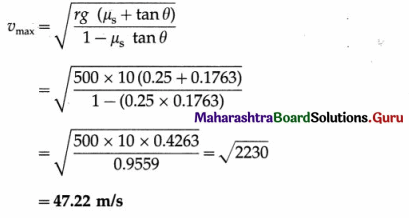
Maharashtra Board Class 12 Physics Important Questions Chapter 1 Rotational Dynamics 55

(ii) The optimum speed of the vehicle on the track is
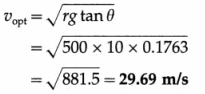
Maharashtra Board Class 12 Physics Important Questions Chapter 1 Rotational Dynamics 56

Question 48.
Define a conical pendulum.
Answer:
A conical pendulum is a small bob suspended from a string and set in UCM in a horizontal plane with the centre of its circular path below the point of suspension such that the string makes a constant angle θ with the vertical.
OR
A conical pendulum is a simple pendulum whose bob revolves in a horizontal circle with constant speed such that the string describes the surface of an imaginary right circular cone.

Question 49.
Derive an expression for the angular speed of the bob of a conical pendulum.
OR
Derive an expression for the frequency of revolution of the bob of a corical pendulum.
Answer:
Consider a conical pendulum of string length L with its bob of mass m performing UCM along a circular path of radius r.
At every instant of its motion, the bob is acted upon by its weight \(m \vec{g}\) and the tension \(\vec{F}\) in the string. If the constant angular speed of the bob is ω, the necessary horizontal centripetal force is Fc = mω2r

Fc is the resultant of the tension in the string and the weight. Resolve \(\vec{F}\) into components F cos θ vertically opposite to the weight of the bob and F sin θ horizontal. F cos θ balances the weight. F sin θ is the necessary centripetal force.
∴ F sin θ = mω2r … (1)
and F cos θ = mg … (2)
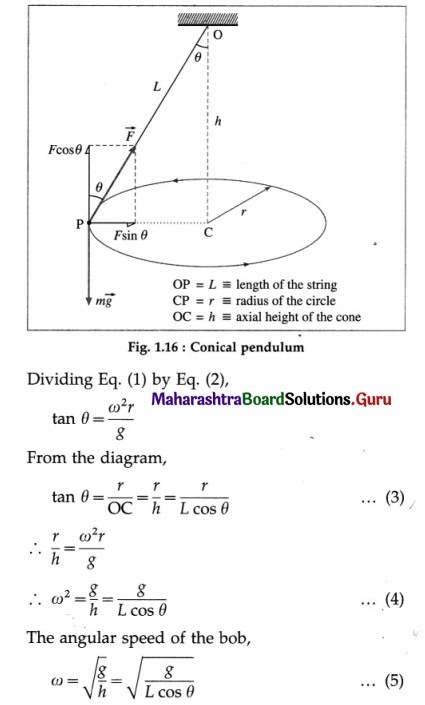
Maharashtra Board Class 12 Physics Important Questions Chapter 1 Rotational Dynamics 57
is the required expression for ω.
[Note : From Eq. (4), cos θ = g/ω2L. Therefore, as ω increases, cos θ decreases and θ increases.
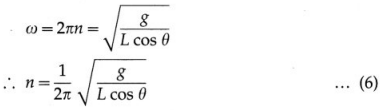
If n is the frequency of revolution of the bob,
Maharashtra Board Class 12 Physics Important Questions Chapter 1 Rotational Dynamics 58
is the required expression for the frequency.

Question 50.
What will happen to the angular speed of a conical pendulum if its length is increased from 0.5 m to 2 m, keeping other conditions the same?
Answer:
The angular speed of the conical pendulum will become half the original angular speed.

Question 51.
Write an expression for the time period of a conical pendulum. State how the period depends on the various factors.
Answer:
If T is the time period of a conical pendulum of string length L which makes a constant angle θ with the vertical,
T = 2π\(\sqrt{\frac{L \cos \theta}{g}}\)
is the required expression
(Note: L cos θ = OC = h, where h is the axial height of the cone.
∴ T = 2π\(\sqrt{\frac{h}{g}}\)

where g is the acceleration due to gravity at the place.

From the above expression, we can see that

  1. T ∝ \(\sqrt{L}\)
  2. T ∝ \(\sqrt{\cos \theta}\) if θ increases, cos θ and T decrease
  3. T ∝ \(\frac{1}{\sqrt{g}}/latex]
  4. The period is independent of the mass of the bob.

Question 52.
Solve the following :

Question 1.
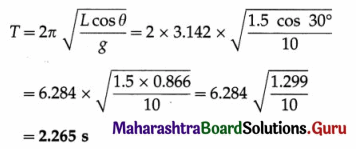
A stone of mass 2 kg is whirled in a horizontal circle attached at the end of a 1.5 m long string. If the string makes an angle of 30° with the vertical, compute its period.
Solution :
Data : L = 1.5 m, θ = 30°, g = 10 m/s2
The period of the conical pendulum,
Maharashtra Board Class 12 Physics Important Questions Chapter 1 Rotational Dynamics 59

Question 2.
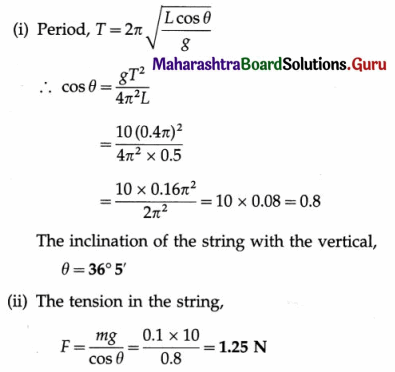
A string of length 0.5 m carries a bob of mass 0. 1 kg at its end. If this is to be used as a conical pendulum of period 0.4πs, calculate the angle of inclination of the string with the vertical and the tension in the string.
Solution :
Data : L = 0.5m, m = 0.1 kg, T = 0.4πs, g = 10 m/s2
Maharashtra Board Class 12 Physics Important Questions Chapter 1 Rotational Dynamics 60

Question 3.
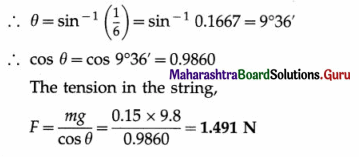
In a conical pendulum, a string of length 120 cm is fixed at a rigid support and carries a bob of mass 150 g at its free end. If the bob is revolved in a horizontal circle of radius 0.2m around a vertical axis, calculate the tension in the string. [g = 9.8 m/s2]
Solution:
Data : L = 120 cm = 1.2 m, m = 150 g = 0.15 kg,
r = 0.2 m, g = 9.8 m/s2
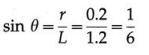
Maharashtra Board Class 12 Physics Important Questions Chapter 1 Rotational Dynamics 71

Question 4.
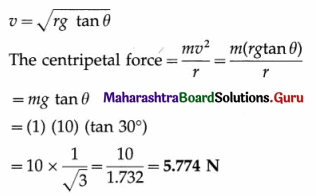
A stone of mass 1 kg, attached at the end of a 1 m long string, is whirled in a horizontal circle. If the string makes an angle of 30° with the vertical, calculate the centripetal force acting on the stone.
Solution :
Data : m = 1 kg, L = 1 m, θ = 30°, g = 10 m/s2
Maharashtra Board Class 12 Physics Important Questions Chapter 1 Rotational Dynamics 72
Maharashtra Board Class 12 Physics Important Questions Chapter 1 Rotational Dynamics 73

Question 53.
What is vertical circular motion? Comment on its two types.
Answer:
A body revolving in a vertical circle in the gravitational field of the Earth is said to perform vertical circular motion.

A vertical circular motion controlled only by gravity is a nonuniform circular motion because the linear speed of the body does not remain constant although the motion can be periodic.

In a controlled vertical circular motion, such as that a body attached to a rod, the linear speed of the body can be constant (including zero) so that such a motion can be uniform and periodic.

Question 54.
A body, tied to a string, performs circular motion in a vertical plane such that the tension in the string is zero at the highest point. What is the linear speed of the body at the

  1. lowest position
  2. highest position ?

Answer:

  1. [latex]\sqrt{5 r g}\)
  2. \(\sqrt{r g}\) in the usual notation.

Question 55.
A body, tied to a string, performs circular motion in a vertical plane such that the tension in the string is zero at the highest point. What is the angular speed of the body at the

  1. highest position
  2. lowest position ?

Answer:

  1. \(\sqrt{g / r}\)
  2. \(\sqrt{5 g / r}\) in the usual notation.

Question 56.
In a vertical circular motion controlled by gravity, derive an expression for the speed at an arbitrary position. Hence, show that the speed decreases while going up and increases while coming down.
OR
In a nonuniform vertical circular motion, derive expressions for the speed and tension/normal force at an arbitrary position.
OR
Show that a vertical circular motion controlled by gravity is a non uniform circular motion.
Answer:
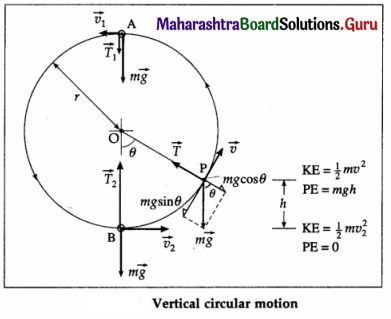
Consider a small body of mass m tied to a string and revolved in a vertical circle of radius r. At every instant of its motion, the body is acted upon by its weight \(m \vec{g}\) and the tension \(\vec{T}\) in the string. At any instant, when the body is at the position P, let the string make an angle θ with the vertical, \(m \vec{g}\) is resolved into components, mg cos θ (radial) and mg sin θ (tangential).

At point P shown, the net force on the body towards the centre, T-mg cos θ, is the necessary centripetal force on the body. If v is its speed at P,
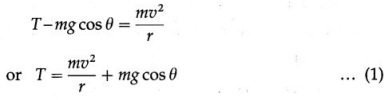
Maharashtra Board Class 12 Physics Important Questions Chapter 1 Rotational Dynamics 74
Maharashtra Board Class 12 Physics Important Questions Chapter 1 Rotational Dynamics 75
Let v2 be the speed of the body at the lowest point B, which is the reference level for zero potential energy. Then, the body has only kinetic energy
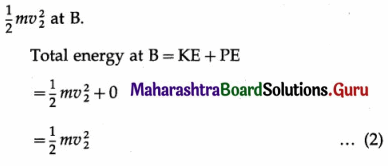
Maharashtra Board Class 12 Physics Important Questions Chapter 1 Rotational Dynamics 76
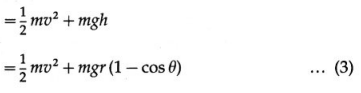
As the body goes from B to P, it rises through a height h = r – r cos θ = r(1 – cos θ).
Total energy at P = KE + PE
Maharashtra Board Class 12 Physics Important Questions Chapter 1 Rotational Dynamics 77
Assuming that the total energy of the body is conserved, total energy at any point = total energy at the bottom.
Then, from Eqs. (2) and (3),

Maharashtra Board Class 12 Physics Important Questions Chapter 1 Rotational Dynamics 78
From the above expression, it can be seen that the linear speed v changes with θ. Thus, as θ increases, (while going up) cos θ decreases, 1 – cos θ increases, and v decreases. While coming down, θ decreases and v increases. Hence, a vertical circular motion controlled by gravity is a nonuniform circular motion.

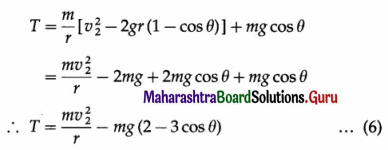
Substituting for v2 from Eq. (4) in Eq. (1),
Maharashtra Board Class 12 Physics Important Questions Chapter 1 Rotational Dynamics 79
Equation (6) is the expression for the tension in the string at any instant in terms of the speed at the lowest point.

Question 57.
A body at the end of a rod is revolved in a non-uniform vertical circular motion. Show that
(i) it must have a minimum speed 2\(\sqrt{g r}\) at the bottom
(ii) the difference in tensions in the rod at the highest and lowest positions is 6 mg.
Answer:
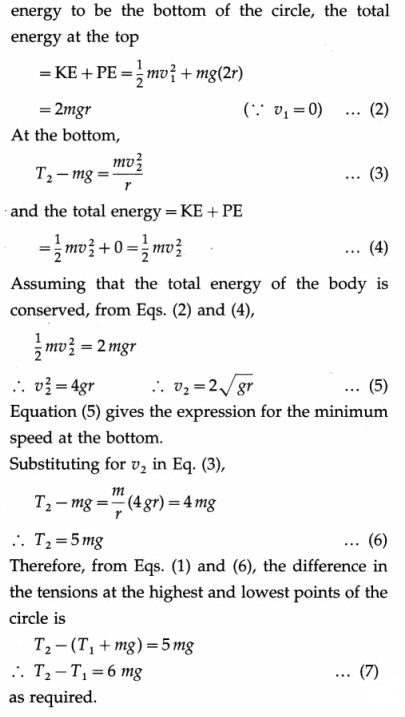
Consider a body of mass m attached to a rod and revolved in a vertical circle of radius r at a place where the acceleration due to gravity is g. We shall assume that the rod is not rigid so that the tension in the rod changes. As the rod is rotated in a nonuniform circular motion, the tension in the rod changes from a minimum value T1 when the body is at the highest point to a maximum value T2 when the body is at the bottom of the circle. At every instant, the body is acted upon by two forces, namely/its weight \(m \vec{g}\) and the tension \(\vec{T}\) in the string.
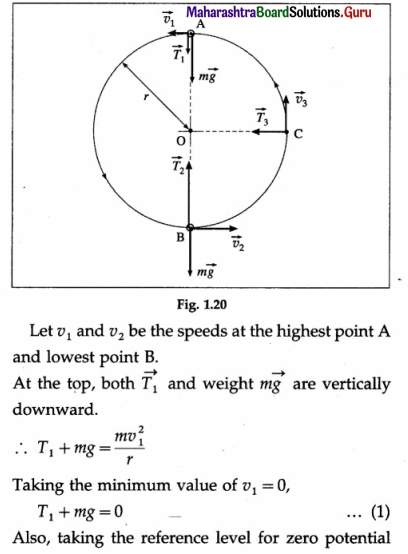
Maharashtra Board Class 12 Physics Important Questions Chapter 1 Rotational Dynamics 81
Maharashtra Board Class 12 Physics Important Questions Chapter 1 Rotational Dynamics 82

Question 58.
You may have seen in a circus a motorcyclist driving in vertical loops inside a hollow globe (sphere of death). Explain clearly why the motor-cyclist does not fall down when at the highest point of the chamber.
Answer:
A motorcyclist driving in vertical loops inside a hollow globe performs vertical circular motion. Suppose the mass of the motorcycle and motorcyclist is m and the radius of the chamber is r. At every instant of the motion, the motorcyclist is acted upon by the weight \(m \vec{g}\) and the normal reaction \(\vec{N}\).

At the highest point, let v1 be the speed and \(\vec{N}_{1}\) the normal reaction. Here, both \(\vec{N}_{1}\) and \(m \vec{g}\) are parallel, vertically downward. Hence, the net force on the motorcyclist towards the centre O is N1 + mg. If this force is able to provide the necessary centripetal force at the highest point, the motorcycle does not lose contact with the globe and fall down.

The minimum value of this force is found from the limiting case when N, just becomes zero and the weight alone provides the necessary centripetal force :
\(\frac{m v_{1}^{2}}{r}\) = mg
This requires that the motorcycle has a minimum speed at the highest point given by \(v_{1}^{2}\) = gr or v1 = \(\sqrt{g r}\)

[Note : The ‘globe of death’ is a circus stunt in which stunt drivers ride motorcycles inside a mesh globe. Starting from small horizontal circles, they eventually perform revolutions along vertical circles. The linear speed is more for larger circles but angular speed is more for smaller circles as in conical pendulum.]

Question 59.
A car crosses over a bridge which is in the form of a convex arc with a uniform speed,
(i) State the expression for the normal reaction on the car.
OR
How does the normal reaction on the car vary with speed?
(ii) Hence show that the maximum speed with which the car can cross the bridge without losing contact with the road is equal to \(\sqrt{r g}\).
Answer:
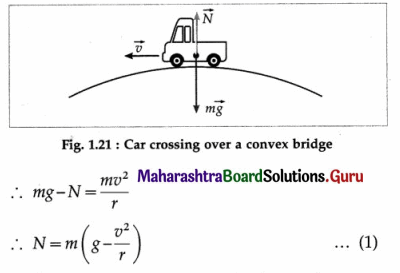
Suppose a car of mass m, travelling with a uniform speed v, crosses over a bridge which is in the form of a convex arc of radius r.
(i) The forces acting on it at the highest point are as shown in below figure. Their resultant mg-N provides the centripetal force.
Maharashtra Board Class 12 Physics Important Questions Chapter 1 Rotational Dynamics 83
is the required expression. It shows that as v increases, N decreases.

(ii) Equation (1) shows that for g – \(\frac{v^{2}}{r}\) = 0, i.e., for centripetal acceleration equalling the gravitational acceleration, N = 0. That is, for \(\frac{v^{2}}{r}\) = g or v = \(\sqrt{r g}\), the
car just loses contact with the road. Therefore, this is the maximum speed with which a car can cross the bridge, irrespective of its mass.

[Data : Take g = 10 m/s2 unless specified otherwise]

Question 60.
Solve the following :

Question 1.
An object of mass 1 kg tied to one end of a string of length 9 m is whirled in a vertical circle. What is the minimum speed required at the lowest position to complete the circle ? [g = 9.8 m/s2]
Solution :
Data : m = 1 kg, r = 9 m, g = 9.8 m/s2
The minimum speed of the object at the lowest position is
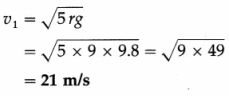
Maharashtra Board Class 12 Physics Important Questions Chapter 1 Rotational Dynamics 84

Question 2.
A stone of mass 5 kg, tied at one end of a rope of length 0.8 m, is whirled in a vertical circle. Find the minimum velocity at the highest point and at the midway point, [g = 9.8 m/s2]
Solution:
Data : m = 5 kg, r = l = 0.8 m, g = 9.8 m/s2

  1. The minimum velocity of the stone at the highest point in its path,
    v = \(\sqrt{r g}\) = \(\sqrt{0.8 \times 9.8}\) = 2.8 m/s
  2. The minimum velocity of the stone at the midway point in its path,
    v = \(\sqrt{3 r g}\) = \(\sqrt{3 \times 0.8 \times 9.8}\) = 4.85 m/s

Question 3.
A small body of mass 0.3 kg oscillates in a vertical plane with the help of a string 0.5 m long with a constant speed of 2 m/s. It makes an angle of 60° with the vertical. Calculate the tension in the string.
Solution :
Data : m = 0.3 kg, r = 0.5 m, v = 2 m/s, θ = 60°, g = 10 m/s2
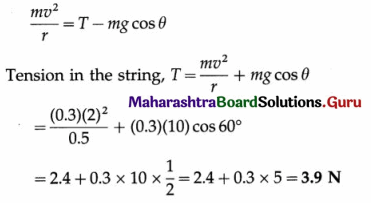
Maharashtra Board Class 12 Physics Important Questions Chapter 1 Rotational Dynamics 85

Question 4.
A bucket of water is whirled in a vertical circle at an arm’s length. Find the minimum speed at the top so that no water spills out. Also find the corresponding angular speed. [Assume r = 0.75 m]
Solution :
Data : r = 0.75 m, g = 10 m/s2
At the highest point the minimum speed required is v = \(\sqrt{r g}\) = \(\sqrt{0.75 \times 10}\) = 2.738 m/s
The corresponding angular speed is 2.738
ω = \(\frac{v}{r}\) = \(\frac{2.738}{0.75}\) = 3.651 rad/s

Question 5.
A pendulum, with a bob of mass m and string length l, is held in the horizontal position and then released into a vertical circle. Show that at the lowest position the velocity of the bob is \(\sqrt{2 g l}\) and the tension in the string is 3 mg.
Solution :
Taking the reference level for zero potential energy to be the bottom of the vertical circle, the initial potential energy of the bob at the horizontal position = mgh = mgl.

Hence, at the bottom where the speed of the bob is v, it has only kinetic energy = \(\frac{1}{2}\)mv2.
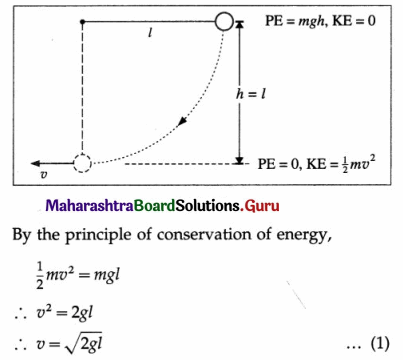
Maharashtra Board Class 12 Physics Important Questions Chapter 1 Rotational Dynamics 86
This gives the required velocity at the lowest position.
Also, at the bottom, the tension (T) and the centripetal acceleration are upward while the force of gravity is downward.
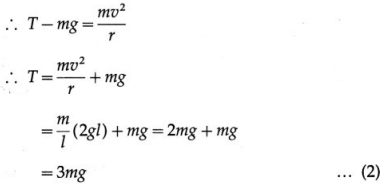
Maharashtra Board Class 12 Physics Important Questions Chapter 1 Rotational Dynamics 87
Equations (1) and (2) give the required expressions for the velocity and tension at the lowest position.

Question 6.
A stone of mass 100 g attached to a string of length 50 cm is whirled in a vertical circle by giving it a velocity of 7 m/s at the lowest point. Find the velocity at the highest point.
Solution :
Data : m = 0.1 kg, r = l = 0.5 m, v2 = 7 m/s, g = 10 m/s2
The total energy at the bottom, Ebot
= KE + PE = \(\frac{1}{2} m v_{2}^{2}\) + 0 = \(\frac{1}{2}\)(0.1) (7)2 = 2.45 J
The total energy at the top, Etop = KE + PE = \(\frac{1}{2} m v_{1}^{2}\) + mg (2r)
= \(\frac{1}{2}\)(0.1)\(v_{1}^{2}\) + (0.1) (10) (2 × 0.5)
= 0.05\(v_{1}^{2}\) + 1
By the principle of conservation of energy,
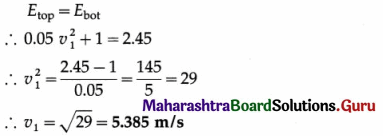
Maharashtra Board Class 12 Physics Important Questions Chapter 1 Rotational Dynamics 88

Question 7.
A pilot of mass 50 kg in a jet aircraft executes a “loop-the-loop” manoeuvre at a constant speed of 250 m/s. If the radius of the vertical circle is 5 km, compute the force exerted by the seat on the pilot at
(i) the top of the loop
(ii) the bottom of the loop.
Solution :
Data: m = 50 kg, v = 250m/s, r = 5 km = 5 × 10³ m, g = 10 m/s2
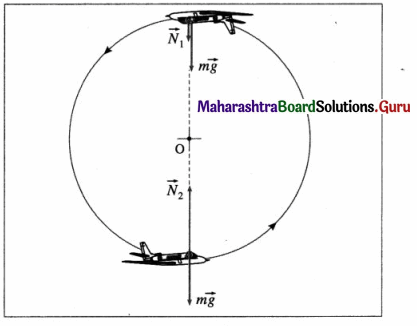
Maharashtra Board Class 12 Physics Important Questions Chapter 1 Rotational Dynamics 89

(i) At the top of the loop : The forces on the pilot are the gravitational force \(m \vec{g}\) and the normal force \(\vec{N}_{1}\), exerted by the seat, both acting downward. So the net force downward that causes the centripetal acceleration has a magnitude
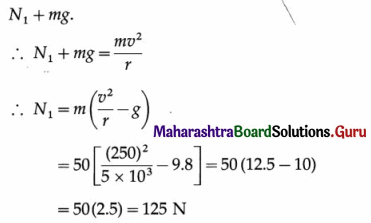
Maharashtra Board Class 12 Physics Important Questions Chapter 1 Rotational Dynamics 90

(ii) At the bottom of the loop : The forces on the pilot are the downward gravitational force \(m \vec{g}\) and the upward normal force \(\vec{N}_{2}\) exerted by the seat. So the net upward force that causes the centripetal acceleration has a magnitude N2 – mg.
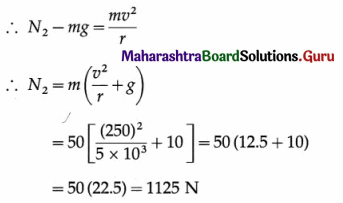
Maharashtra Board Class 12 Physics Important Questions Chapter 1 Rotational Dynamics 91
The forces exerted by the seat on the pilot at the top and bottom of the loop are 125 N and 1125 N, respectively.

Question 8.
A ball released from a height h along an incline, slides along a circular track of radius R (at the end of the incline) without falling vertically downwards. Show that hmin = \(\frac{5}{2}\) R.
Solution:
To just loop-the-loop, the ball must have a speed v2 = \(\sqrt{5 R g}\) at the bottom of the circular track.

If hmin is the minimum height above the bottom of the circular track from which the ball must be released, by the principle of conservation of energy, we have,
mghmin = \(\frac{1}{2} m v_{2}^{2}\) = \(\frac{1}{2} m(5 R g)\)
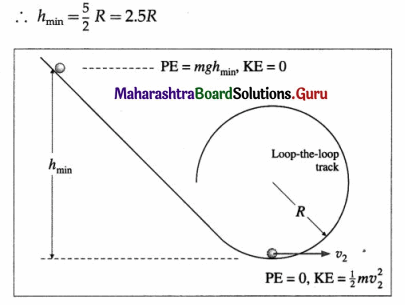
Maharashtra Board Class 12 Physics Important Questions Chapter 1 Rotational Dynamics 92

Note : 1f the ball rolls all along the track without slipping, its total energy at the top of the circular track should take into account the rotational kinetic energy of the ball.
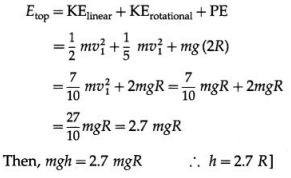
Maharashtra Board Class 12 Physics Important Questions Chapter 1 Rotational Dynamics 93

Question 9.
A block of mass 1 kg is released from P on a frictionless track which ends with a vertical quarter circular turn.
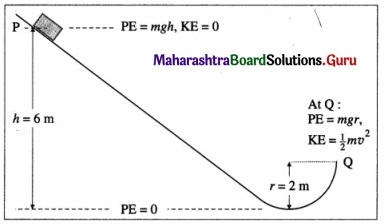
Maharashtra Board Class 12 Physics Important Questions Chapter 1 Rotational Dynamics 94
What are the magnitudes of the radial acceleration and total acceleration of the block when it arrives at Q ?
Solution :
Data : m = 1 kg, h = 6 m, r = 2 m, g = 10 m/s2
Let v be the speed of the block at Question Then, the total energy of the block at Q is
E = KE + PE = \(\frac{1}{2} m v^{2}\) + mgr
By the principle of conservation of energy,
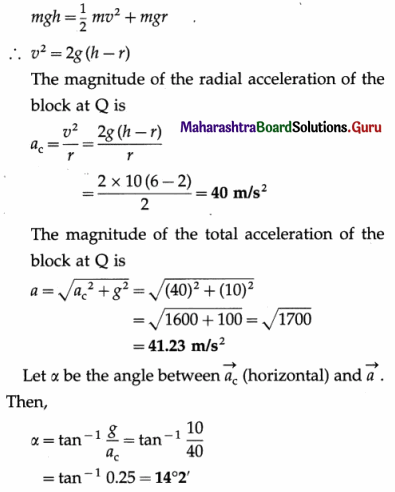
Maharashtra Board Class 12 Physics Important Questions Chapter 1 Rotational Dynamics 95
The radial acceleration has a magnitude 40 m/s2. The total acceleration has a magnitude 41.23 m/s2 and makes an angle of 14°2′ with the radial acceleration.

Question 10.
A loop-the-loop cart runs down an incline into a vertical circular track of radius 3 m and then describes a complete circle. Find the minimum height above the top of the circular track from which the cart must be released.
Solution :
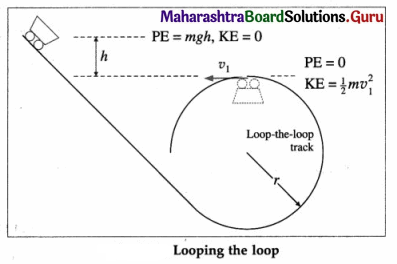
Maharashtra Board Class 12 Physics Important Questions Chapter 1 Rotational Dynamics 96
Data : r = 3 m
To just loop-the-loop, the cart must have a speed V1 = \(\sqrt{r g}\) at the top of the loop.

If h is the minimum height above the top of the loop from which the cart must be released, by the principle of conservation of energy, we have, mgh = \(\frac{1}{2} m v_{1}^{2}\) = \(\frac{1}{2} m g r\)
∴ h = \(\frac{r}{2}\) = \(\frac{3}{2}\) = 1.5 m

Question 11.
A motorcyclist rides in vertical circles in a hollow sphere of radius 5 m. Find the required minimum speed and minimum angular speed, so that he does not lose contact with the sphere at the highest point. [g = 9.8 m/s2]
Solution :
Data : r = 5 m, g = 9.8 m/s2
Let v and ω be respectively the required minimum speed and angular speed at the highest point.
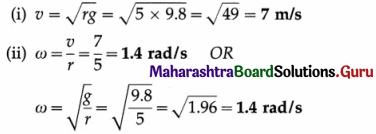
Maharashtra Board Class 12 Physics Important Questions Chapter 1 Rotational Dynamics 97

Question 12.
The vertical section of a road over a bridge in the direction of its length is in the form of an arc of a circle of radius 4.4 m. Find the maximum speed with which a vehicle can cross the bridge without losing contact with the road at the highest point, if the centre of gravity of the vehicle is 0.5 m from the ground.
Solution :
Data: While travelling along the bridge, the vehicle moves along a vertical circle of radius r = 4.4 + 0.5 = 4.9 m, g = 10 m/s2.
If m is the mass and v is the maximum speed of the vehicle, then at the highest point,
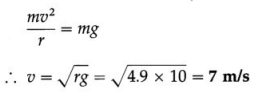
Maharashtra Board Class 12 Physics Important Questions Chapter 1 Rotational Dynamics 98

Question 13.
A small body tied to a string is revolved in a vertical circle of radius r such that its speed at the top of the circle is \(\sqrt{2 g r}\). Find
(i) the angular position of the string when the tension in the string is numerically equal to 5 times the weight of the body.
(ii) the KE of the body at this position
(iii) the minimum and maximum KEs of the body.
[Take m = 0.1 kg, r = 1.2 m, g = 10 m/s2]
Solution :
Data : vtop = \(\sqrt{2 g r}\), T = 5 mg, m = 0.1 kg, r = 1.2 m, g = 10 m/s2

Let the angular position of the string, θ = 0° when the body is at the bottom of the circle.

We assume total energy to be conserved and take the reference level for zero potential energy to be the bottom of the circle.

Total energy at the top, E
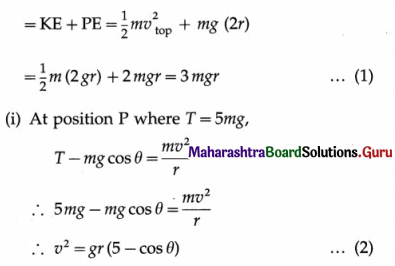
Maharashtra Board Class 12 Physics Important Questions Chapter 1 Rotational Dynamics 99
At P, the vertical displacement of the body from the bottom is r(1 – cos θ). Its total energy there is also E.
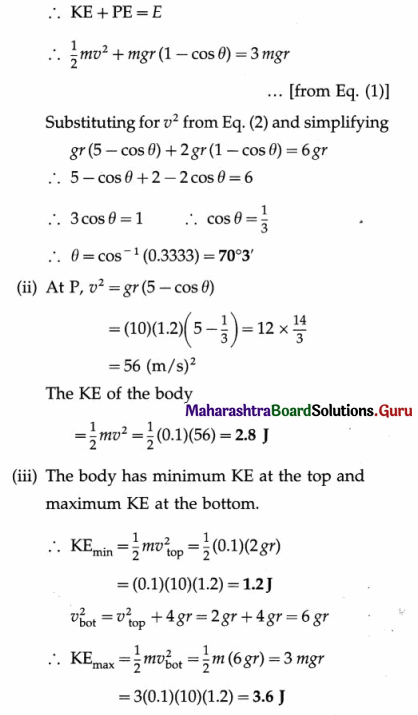
Maharashtra Board Class 12 Physics Important Questions Chapter 1 Rotational Dynamics 100

Question 14.
An object of mass 0.5 kg attached to a rod of length 0.5 m is whirled in a vertical circle at a constant angular speed. If the maximum tension in the rod is 5 kg wt, calculate the linear speed of the object and the maximum number of revolutions it can complete in a minute.
Solution :
Data : m = 0.5 kg, r = l = 0.5 m, g = 10 m/s2,
T2 = 5 kg wt = 5 × 10 N

As the rod is rotated in a vertical circle at a constant angular speed, the linear speed of the object at the end of the rod is constant, say v. However, the tension in the rod changes from a minimum value T1 when the object is at the highest point to a maximum value T2 when the object is at the bottom of the circle.

At the bottom of the circle, the tension and acceleration are upward while the force of gravity is downward.
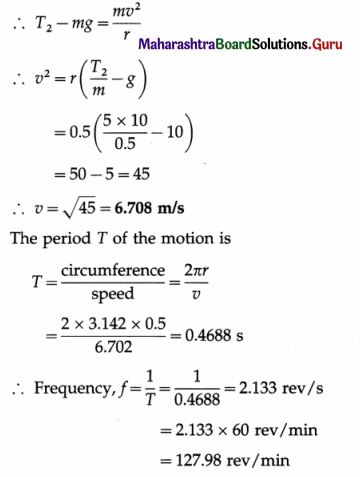
Maharashtra Board Class 12 Physics Important Questions Chapter 1 Rotational Dynamics 101
∴ The maximum number of revolutions the object can complete in a minute is 127.98.

Question 15.
A small body of mass m = 0.1 kg at the end of a cord 1 m long swings in a vertical circle. Its speed is 2 mIs when the cord makes an angle θ = 30° with the vertical. Find the tension in the cord.
Solution:
Data: m = 0.1 kg, r = 1 m, y = 2 m/s, θ = 30°,
g = 9.8 m/s2
When the cord makes an angle θ with the vertical, the centripetal force on the body is
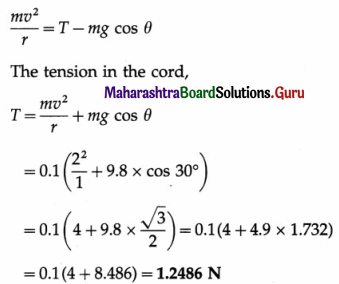
Maharashtra Board Class 12 Physics Important Questions Chapter 1 Rotational Dynamics 102

Question 16.
A bucket of water is tied to one end of a rope 8 m long and rotated about the other end in a vertical circle. Find the number of revolutions per minute such that water does not spill.
Solution:
[Important note : The circular motion of the bucket in a vertical plane under gravity is not a uniform circular motion. Assuming the critical case of the motion such that the bucket has the minimum speed at the highest point required for the water to stay put in the bucket, we can find the minimum frequency of revolution. ]
Data :r = 8m, g = 9.8 m/s2, π = 3.142
Assuming the bucket has a minimum speed v = \(\sqrt{r g}\) at the highest point, the corresponding angular speed is
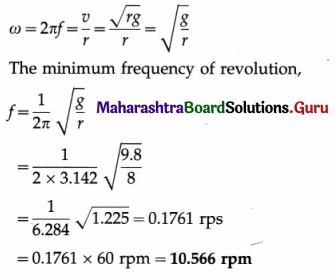
Maharashtra Board Class 12 Physics Important Questions Chapter 1 Rotational Dynamics 103

Question 61.
Derive an expression for the kinetic energy of a body rotating with constant angular velocity.
Answer:
Consider a rigid body rotating with a constant angular velocity \(\vec{\omega}\) about an axis passing through the point O and perpendicular to the plane of the figure. Suppose that the body is made up of N particles of masses m1, m2, …, mN situated at perpendicular distances r1, r2, , rN, respectively, from the axis of rotation as shown in below figure.

As the body rotates, all the particles perform uniform circular motion with the same angular velocity \(\vec{\omega}\). However, they have different linear speeds depending upon their distances from the axis of rotation.

The linear speed of the particle with mass ml is v1 = r1ω. Therefore, its kinetic energy is
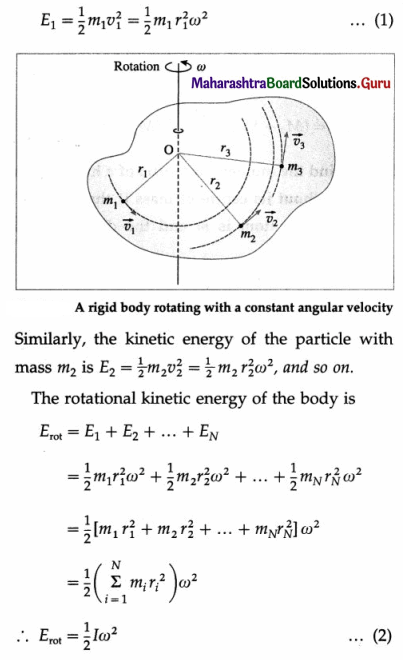
Maharashtra Board Class 12 Physics Important Questions Chapter 1 Rotational Dynamics 1040
where I = \(\sum_{i=1}^{N} m_{i} r_{i}^{2}\) is the moment of inertia of the body about the axis of rotation.
Equation (2) gives the required expression.

Question 62.
Define moment of inertia. State the factors which it depends on. Obtain its dimensions and state its SI unit.
OR
Define moment of inertia. State its dimensions and SI units.
Answer:
(1) Moment of inertia : The moment of inertia of a body about a given axis of rotation is defined as the sum of the products of the masses of the particles of the body and the squares of their respective distances from the axis of rotation.

If the body is made up of N discrete particles of masses m1, m2, …,mN situated at respective distances r1, r2, …, rN from the axis of rotation, the moment of inertia of the body is
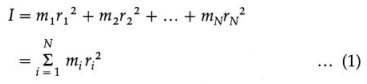
Maharashtra Board Class 12 Physics Important Questions Chapter 1 Rotational Dynamics 105
For a rigid body, having a continuous and uniform distribution of mass, the moment of inertia is
I = \(\int r^{2} d m\) …(2)
where dm is the mass of an infinitesimal element, situated at distance r from the axis of rotation.

(2) The moment of inertia of a rigid body depends on

  1. the mass and shape of the body
  2. orientation and position of the rotation axis
  3. distribution of the mass about the rotation axis.

(3) Dimensions :
[Moment of inertia] = [mass] [distance]2
= [M] [L2] = [M1L2T0]

(4) SI unit : The kilogram-metre2 (kg.m2).

Question 63.
Explain the physical significance of moment of inertia.
Answer:
(1) The physical significance of moment of inertia can be understood by comparing the formulae in the following table.

Linear motionRotational motion
1. Momentum = mass × velocity1. Angular momentum = moment of inertia × angular velocity
2. Force = mass × acceleration2. Torque = moment of inertia × angular acceleration
3. Kinetic energy = \(\frac{1}{2} M v^{2}\)3. Kinetic energy = \(\frac{1}{2} I \omega^{2}\)

(2) Force produces acceleration, while torque produces angular acceleration. Force and torque are analogous quantities. Also, momentum and angular momentum are analogous quantities.
(3) By comparing the above formulae, we find that moment of inertia plays the same role in rotational motion as that played by mass in linear motion. The moment of inertia of a body is its rotational inertia, that which opposes any tendency to change its angular velocity. In the absence of a net torque, the body continues to rotate with a uniform angular velocity.

Question 64.
Three point masses M1, M2 and M3 are located at the vertices of an equilateral triangle of side a. What is the moment of inertia of the system about an axis along the altitude of the triangle passing through M1 ?
Answer:
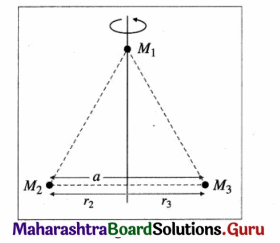
Maharashtra Board Class 12 Physics Important Questions Chapter 1 Rotational Dynamics 106
The moment of inertia of the system about the altitude passing through M1 is
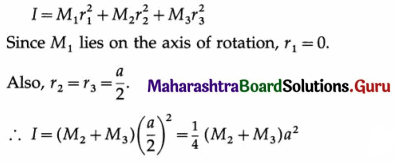
Maharashtra Board Class 12 Physics Important Questions Chapter 1 Rotational Dynamics 107

Question 65.
Find the moment of inertia of a hydrogen molecule about its centre of mass if the mass of each hydrogen atom is m and the distance between them is R.
Answer:
We assume the rotation axis to be a transverse axis through the centre of mass of the linear molecule H2. Then, each of the hydrogen atom is a distance \(\frac{1}{2}\)R from the CM. Therefore, the MI of the molecule about this axis,
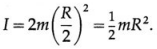
Maharashtra Board Class 12 Physics Important Questions Chapter 1 Rotational Dynamics 108

Notes :

  1. For a H2 molecule, mH = 1.674 × 10⁻²⁷ kg and bond length = 7.774 × 10⁻¹¹ m, so that I = 5.065 × 10-48 kg.m2.
  2. As atoms are treated as particles, we do not consider rotation about the line passing through the atoms.

Question 66.
Solve the following :

Question 1.
Four particles of masses 0.2 kg, 0.3 kg, 0.4 kg and 0.5 kg respectively are kept at comers A, B, C and D of a square ABCD of side 1 m. Find the moment of inertia of the system about an axis passing through point A and perpendicular to the plane of the square.
Solution :
Data : m1 = 0.2 kg, m2 = 0.3 kg, m3 = 0.4 kg, m4 = 0.5 kg
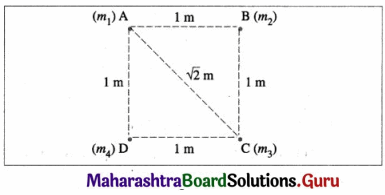
Maharashtra Board Class 12 Physics Important Questions Chapter 1 Rotational Dynamics 109

The axis of rotation passes through point A and is perpendicular to the plane of the square. Hence the distance (r1) of mass ml from the axis is r1 =0, that of mass m2 is r2 = AB = 1 m, that of mass m3 is r3 = \(\sqrt{2}\)AC m and that of mass m4 is r4 = AD = 1 m.
The moment of inertia,
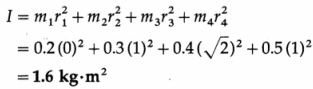
Maharashtra Board Class 12 Physics Important Questions Chapter 1 Rotational Dynamics 110

Question 2.
The moment of inertia of the Earth about its axis of rotation is 9.83 × 10 kg.m2 and its angular speed is 7.27 × 10⁻⁵ rad/s. Calculate its
(i) kinetic energy of rotation
(ii) radius of gyration. [ Mass of the Earth = 6 × 1024 kg]
Solution :
Data : I = 9.83 × 1037 kg.m2, ω = 7.27 × 10⁻⁵ rad/s, M = 6 × 1024 kg

(i) The kinetic energy of rotation of the Earth,
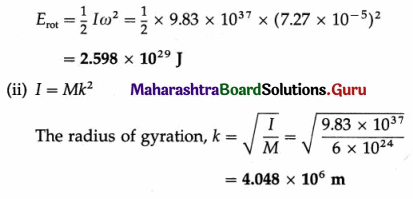
Maharashtra Board Class 12 Physics Important Questions Chapter 1 Rotational Dynamics 111

Question 67.
State an expression for the moment of inertia of a thin ring about its transverse symmetry axis.
Answer:
A thin uniform ring (or hoop) has all its mass uniformly distributed along the circumference of a circle. It is taken to be a two-dimensional body. It is also assumed that the radial thickness of the ring is so small as to be completely negligible in comparison to its radius.

Consider a thin ring (or hoop) of radius R and mass M. The axis of rotation through its centre C is perpendicular to its plane. C is also its centre of mass (CM).
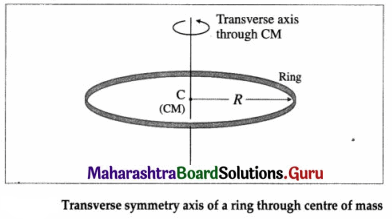
Maharashtra Board Class 12 Physics Important Questions Chapter 1 Rotational Dynamics 112
The MI of the ring about the transverse symmetry axis is
ICM = MR2

Question 68.
Derive an expression for the moment of inertia of a thin uniform disc about its transverse symmetry axis.
Answer:
A thin uniform disc has all its mass homogeneously distributed over its circular surface area. It is taken to be a two-dimensional body, i.e., its axial thickness is small as to be completely negligible in comparison to its radius. Consider a thin disc of radius R and mass M. Its mass per unit area is

Maharashtra Board Class 12 Physics Important Questions Chapter 1 Rotational Dynamics 113
The axis of rotation is the transverse symmetry axis, through its centre of mass (CM) and perpendicular to its plane. For rotation about this axis, we consider the disc to consist of a large number of thin concentric rings, having the same rotation axis as the transverse symmetry axis of the disc. One such elemental ring at a distance r from the rotation axis shown in below figure, has mass dm and radial width dr.
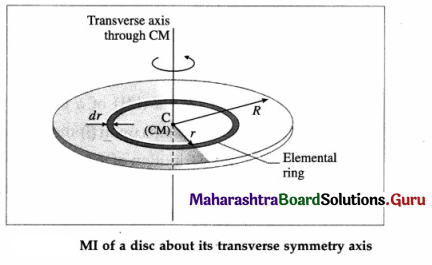
Maharashtra Board Class 12 Physics Important Questions Chapter 1 Rotational Dynamics 114
Since the disc is uniform, the area and mass of this elemental ring are
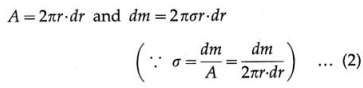
Maharashtra Board Class 12 Physics Important Questions Chapter 1 Rotational Dynamics 115
and its moment of inertia (MI) about the given axis is dm.r2.
Therefore, the MI of the disc is
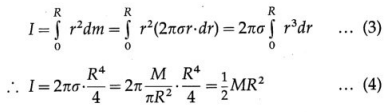
Maharashtra Board Class 12 Physics Important Questions Chapter 1 Rotational Dynamics 116
This gives the required expression.

Question 69.
Is radius of gyration of a rigid body a constant quantity?
Answer:
Radius of gyration of a rigid body depends on the distribution of mass of the body about a rotation axis and, therefore, changes with the choice of the rotation axis. Hence, unlike the mass of the body which is constant, radius of gyration and moment of inertia of the body are not constant.

Question 70.
State an expression for the radius of gyration of
(i) a thin ring
(ii) a thin disc, about respective transverse symmetry axis.
OR
Show that for rotation about respective transverse symmetry axis, the radius of gyration of a thin disc is less than that of a thin ring.
Answer:
(i) The MI of the ring about the transverse symmetry axis is
ICM = MR2 … (1)
Radius of gyration : The radius of gyration of the ring about the transverse symmetry axis is
K = \(\sqrt{I_{\mathrm{CM}} / M}\) = \(\sqrt{R^{2}}\) = R …… (2)

(ii) The MI of the disc about the transverse symmetry axis is
ICM = \(\frac{1}{2}\)MR<2 … (3)
Radius of gyration : The radius of gyration of the disc for the given rotation axis is
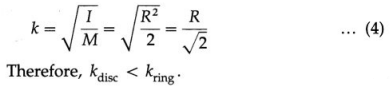
Maharashtra Board Class 12 Physics Important Questions Chapter 1 Rotational Dynamics 117

Question 71.
State and prove the theorem of parallel axis.
Answer:
Theorem of parallel axis : The moment of inertia of a body about an axis is equal to the sum of

  1. its moment of inertia about a parallel axis through its centre of mass and
  2. the product of the mass of the body and the square of the distance between the two axes.

Proof : Let ICM be the moment of inertia (MI) of a body of mass M about an axis through its centre of mass C, and I be its MI about a parallel axis through any point O. Let h be the distance between the two axes.

Consider an infinitesimal mass element dm of the body at a point P. It is at a perpendicular distance CP from the rotation axis through C and a perpendicular distance OP from the parallel axis through O. The MI of the element about the axis through C is CP2dm. Therefore, the MI of the body about the axis through the CM is ICM = \(\int \mathrm{CP}^{2} d m\). Similarly, the MI of the body about the parallel axis through O is I = \(\int \mathrm{OP}^{2} d m\).
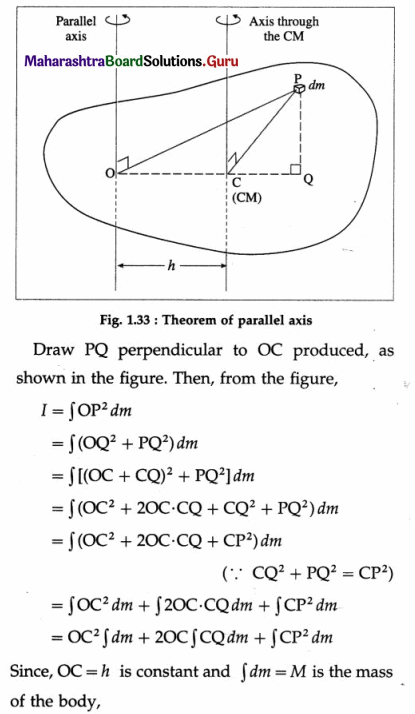
Maharashtra Board Class 12 Physics Important Questions Chapter 1 Rotational Dynamics 118
∴ I = ICM + Mh2
This proves the theorem of parallel axis.

Question 72.
State and prove the theorem of perpendicular axes about moment of inertia.
Answer:
Theorem of perpendicular axes : The moment of inertia of a plane lamina about an axis perpendicular to its plane is equal to the sum of its moments of inertia about two mutually perpendicular axes in its plane and through the point of intersection of the perpendicular axis and the lamina.
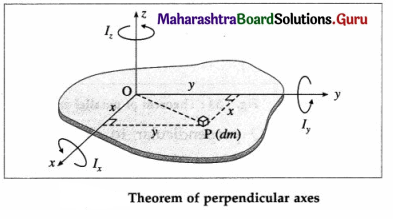
Maharashtra Board Class 12 Physics Important Questions Chapter 1 Rotational Dynamics 119
Proof : Let Ox and Oy be two perpendicular axes in the plane of the lamina and Oz, an axis perpendicular to its plane. Consider an infinitesimal mass element dm of the lamina at the point P(Y, y). MI of the lamina about the z-axis, Iz = \(\int \mathrm{OP}^{2} d m\)

The element is at perpendicular distance y and x from the x- and y- axes respectively. Hence, the moments of inertia of the lamina about the x- and y-axes are, respectively,
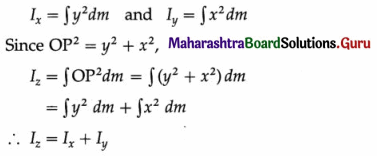
Maharashtra Board Class 12 Physics Important Questions Chapter 1 Rotational Dynamics 120
This proves the theorem of perpendicular axes.

Question 73.
About which axis of rotation is the radius of gyration of a body the least ?
Answer:
The radius of gyration of a body is the least about an axis through the centre of mass (CM) of the body.

From the parallel axis theorem, we know that a given body has the smallest possible moment of inertia about an axis through its CM. The radius of gyration of a body about a given axis is directly proportional to the square root of its moment of inertia about that axis. Hence, the conclusion.
{OR I = ICM + Mh2. ∴ Mk2 = \([/latexM k_{\mathrm{CM}}^{2}] + Mh2.
∴ k2 = [latex]k_{\mathrm{CM}}^{2}\) + h2, which shows that k is minimum, equal to kCM when h = 0.}

Question 74.
State an expression for the moment of inertia of a thin uniform rod about an axis through its centre and perpendicular to its length. Hence deduce the expression for its moment of inertia about an axis through its one end and perpendicular to its length.
OR
State an expression for the moment of inertia of a thin uniform rod about its transverse symmetry axis. Hence, deduce the expression for its moment of inertia about a parallel axis through one end. Also deduce the expressions for the corresponding radii of gyration.
Answer:
(1) MI about a transverse axis through centre : Consider a thin uniform rod AB of mass M and length L, rotating about a transverse axis through its centre C. C is also its centre of mass (CM).
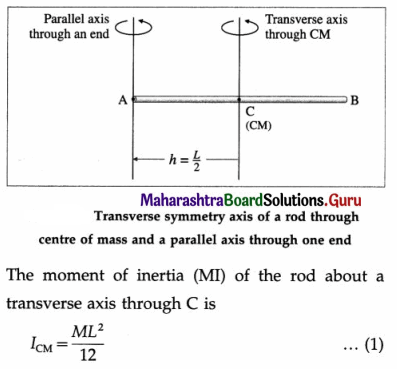
Maharashtra Board Class 12 Physics Important Questions Chapter 1 Rotational Dynamics 300

(2) MI about a transverse axis through one end : Let I be its MI about a transverse axis through its end A. By the theorem of parallel axis,
I = ICM + Mh2 … (2)
In this case,
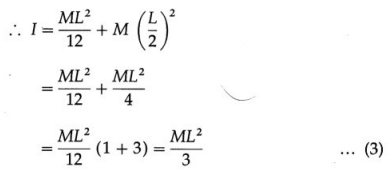
Maharashtra Board Class 12 Physics Important Questions Chapter 1 Rotational Dynamics 301
(3) Radii of gyration : The radius of gyration of the rod about its transverse symmetry axis is

Maharashtra Board Class 12 Physics Important Questions Chapter 1 Rotational Dynamics 302
The radius of gyration of the rod about the transverse axis through an end is

Maharashtra Board Class 12 Physics Important Questions Chapter 1 Rotational Dynamics 303

Question 75.
State the expression for the MI of a thin spherical shell (i.e., a thin-walled hollow sphere) about its diameter. Hence obtain the expression for its MI about a tangent.
Answer:
Consider a uniform, thin-walled hollow sphere radius R and mass M. An axis along its diameter is an axis of spherical symmetry through its centre of mass. The MI of the thin spherical shell about its diameter is
ICM = \(\frac{2}{3}\)MR2

Let I be its MI about a tangent parallel to the diameter. Here, h = R = distance between the two axes. Then, according to the theorem of parallel axis,
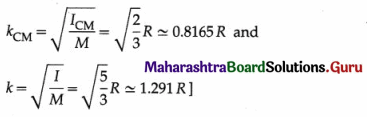
Maharashtra Board Class 12 Physics Important Questions Chapter 1 Rotational Dynamics 121

Question 76.
Calculate the moment of inertia by direct integration of a thin uniform rod of mass M and length L about an axis perpendicular to the rod and passing through the ród at L/3, as shown below.
Check your answer with the parallel-axis theorem.

Maharashtra Board Class 12 Physics Important Questions Chapter 1 Rotational Dynamics 122
Answer:
Method of direct integration : Consider a thin uniform rod of mass M and length L. The axis of rotation is perpendicular to the rod and passing through the rod at L/3. We consider the origin of coordinates to be at this point and the x-axis to be along the rod,

Since the mass density is constant, the linear mass density is
λ = M/L
An element of the rod has mass dm and length dl = dx.
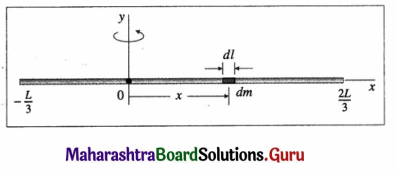
Maharashtra Board Class 12 Physics Important Questions Chapter 1 Rotational Dynamics 123
If the distance of each mass element from the axis is given by the variable x, the moment of inertia of an element about the axis of rotation is dI = x2dm
Since the rod extends from x= – L/3 to x = 2L/3, the MI of the rod about the axis is
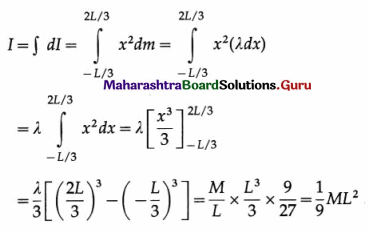
Maharashtra Board Class 12 Physics Important Questions Chapter 1 Rotational Dynamics 124
Method of parallel-axis : The MI of the thin rod about a transverse axis through its CM is
ICM = \(\frac{1}{12} M L^{2}\)
The given axis of rotation is at a distance h = \(\frac{L}{2}\) – \(\frac{L}{3}\) = \(\frac{L}{6}\) from the transverse symmetry axis.
Therefore, the MI of the rod about the given axis is

Maharashtra Board Class 12 Physics Important Questions Chapter 1 Rotational Dynamics 125
the same as arrived at by direct integration method.

Question 77.
State an expression for the moment of inertia of a thin ring about its transverse symmetry axis. Hence deduce the expression for its moment of inertia about a tangential axis perpendicular to its plane. Also deduce the expressions for the corresponding radius of gyration.
Answer:
(1) MI about the transverse symmetry axis : Consider a thin ring (or hoop) of radius R and mass M. The axis of rotation through its centre C is perpendicular to its plane. C is also its centre of mass (CM). It is assumed that the radial thickness of the ring is so small as to be completely negligible in comparison to radius R.
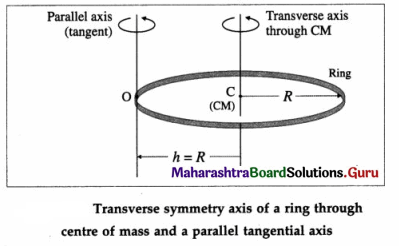
Maharashtra Board Class 12 Physics Important Questions Chapter 1 Rotational Dynamics 126
The MI of the ring about the transverse symmetry axis is
ICM = MR2 …(1)
Radius of gyration : The radius of gyration of the ring about the transverse symmetry axis is
k = \(\sqrt{I_{\mathrm{CM}} / M}\) = \(\sqrt{R^{2}}\) = R …(2)

(2) MI about a tangent perpendicular to its plane : Let I be its MI about a parallel axis, tangent to the ring. Here, h = R = distance between the two axes.
By the theorem of parallel axis,
I = ICM + Mh2 … (3)
= MR2 + MR2 = 2MR2 …(4)
Radius of gyration : The radius of gyration of the ring about a transverse tangent is
k = \(\sqrt{I / M}\) = \(\sqrt{2 R^{2}}\) = \(\sqrt{2} R\) …(5)

Question 78.
Assuming the expression for the moment of inertia of a ring about its transverse symmetry axis, obtain the expression for its moment of inertia about
(1) a diameter
(2) a tangential axis in its plane. Also deduce the expressions for the corresponding radii of gyration.
Answer:
Let M be the mass of a thin ring of radius R. Let /CM be the moment of inertia (MI) of the ring about its transverse symmetry axis. Then,
ICM = MR … (1)

(1) MI about a diameter : Let x- and y-axes be along two perpendicular diameters of the ring as shown in below figure. Let Ix, Iy and Iz be the moments of inertia of the ring about the x, y and z axes, respectively.
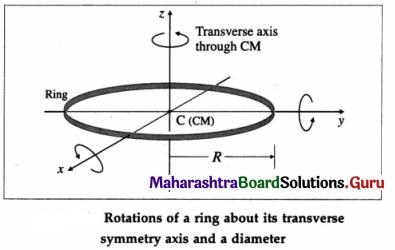
Maharashtra Board Class 12 Physics Important Questions Chapter 1 Rotational Dynamics 127
Both Ix and Iy represent the moment of inertia of the ring about its diameter and, by symmetry, the MI of the ring about any diameter is the same.
∴ Ix = Iy ….. (2)
Also, Iz being the MI of the ring about its transverse symmetry axis,
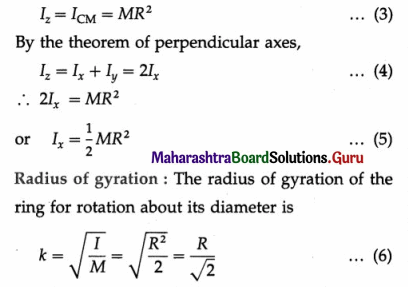
Maharashtra Board Class 12 Physics Important Questions Chapter 1 Rotational Dynamics 128

(2) MI about a tangent in its plane: Let I be its MI about an axis in plane of the ring, i.e., parallel to a diameter, and tangent to it. Here, h = R and
ICM = Ix = \(\frac{1}{2}\)MR2.
By the theorem of parallel axis,
= \(\frac{1}{2} M R^{2}\) + MR2 = \(\frac{3}{2} M R^{2}\) … (7)
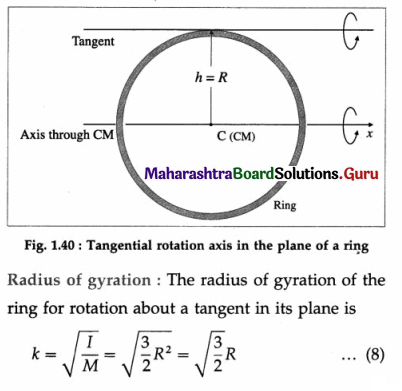
Maharashtra Board Class 12 Physics Important Questions Chapter 1 Rotational Dynamics 129

Question 79.
State an expression for the MI of a thin uniform disc about a transverse axis through its centre. Hence, derive an expression for the MI of the disc about its tangent perpendicular to the plane. Deduce the expressions for the corresponding radii of gyration.
Answer:
(1) MI about the transverse symmetry axis : Consider a thin uniform disc of radius R and mass M. The axis of rotation through its centre C is perpendicular to its plane. C is also its centre of mass (CM).
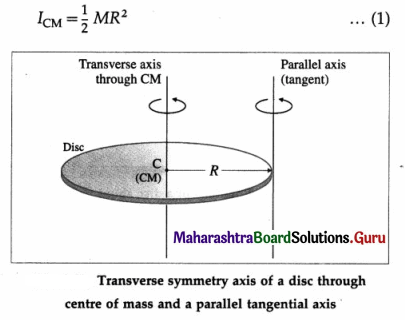
Maharashtra Board Class 12 Physics Important Questions Chapter 1 Rotational Dynamics 130

Radius of gyration : The radius of gyration of the disc for the given rotation axis is

Maharashtra Board Class 12 Physics Important Questions Chapter 1 Rotational Dynamics 131

(2) MI about a tangent perpendicular to its plane : Let I be the MI of the disc about a tangent perpendicular to its plane.

According to the theorem of parallel axis,
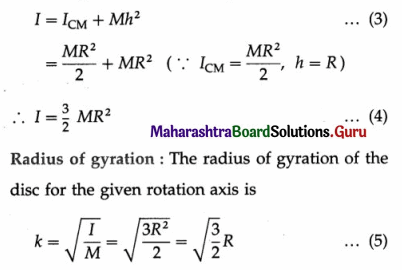
Maharashtra Board Class 12 Physics Important Questions Chapter 1 Rotational Dynamics 132

Question 80.
Assuming the expression for the moment of inertia of a thin uniform disc about a transverse axis through its centre, obtain an expression for its moment of inertia about any diameter. Hence, write the expression for the corresponding radius of gyration.
Answer:
Consider a thin uniform disc of mass M and radius R in the xy plane, as shown in below figure. Let Ix, Iy and Iz be the moments of inertia of the disc about the x, y and z axes respectively. But, Ix = Iy, since each
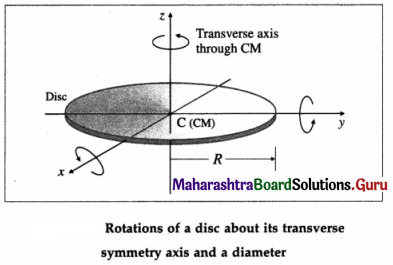
Maharashtra Board Class 12 Physics Important Questions Chapter 1 Rotational Dynamics 133
represents the moment of inertia (MI) of the disc about its diameter and, by symmetry, the MI of the disc about any diameter is the same.
As Iz is the MI of the disc about the z-axis through its centre and perpendicular to its plane,
Iz = \(\frac{1}{2}\)MR2 … (1)

According to the theorem of perpendicular axes,
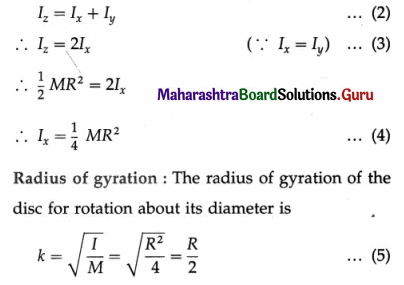
Maharashtra Board Class 12 Physics Important Questions Chapter 1 Rotational Dynamics 134

Question 81.
Given the moment of inertia of a thin uniform disc about its diameter to be \(\frac{1}{4}\)MR2, where M and R are respectively the mass and radius of the disc, find its moment of inertia about an axis normal to the disc and passing through a point on its edge.
Answer:
Consider a thin uniform disc of mass M and radius R in the xy plane. Let Ix, ly and Iz be the moments of inertia of the disc about the x, y and z axes respectively.
Now, Ix = Iy
since each represents the moment of inertia (MI) of the disc about its diameter and, by symmetry, the MI of the disc about any diameter is the same.
∴ Ix = Iy = \(\frac{1}{4}\)MR2 (Given)
According to the theorem of perpendicular axes,
Iz = Ix + Iy = 2(\(\frac{1}{4}\)MR2) = \(\frac{1}{2}\)MR2
Let I be the MI of the disc about a tangent normal to the disc and passing through a point on its edge (i.e., a tangent perpendicular to its plane). According to the theorem of parallel axis,
I = ICM + Mh2
Here, ICM = Iz = \(\frac{1}{2}\)MR2 and h = R.
∴ I = \(\frac{1}{2}\)MR2 + MR2 = \(\frac{3}{2}\)MR2
which is the required expression.

Question 82.
Assuming the expression for the moment of inertia of a thin uniform disc about its diameter, show that the moment of inertia of the disc about a tangent in its plane is \(\frac{5}{4}\)MR2. Write the expression for the corresponding radius of gyration.
Answer:
Let M be the mass and R be the radius of a thin uniform disc. Let ICM be the moment of inertia (MI) of the disc about a diameter. Then,
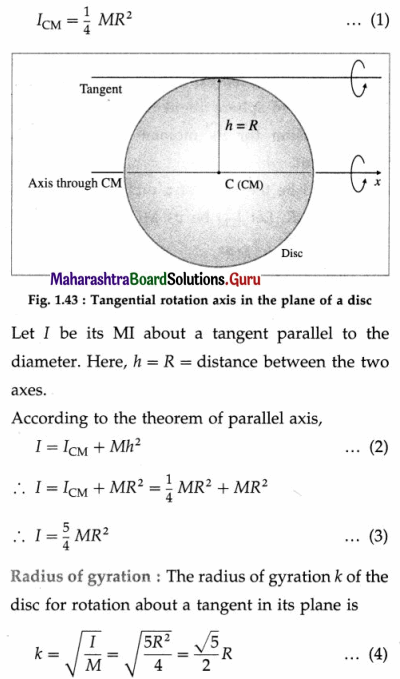
Maharashtra Board Class 12 Physics Important Questions Chapter 1 Rotational Dynamics 135

Question 83.
State the expressions for the moment of inertia of a solid cylinder of uniform cross section about
(1) an axis through its centre and perpendicular to its length
(2) its own axis of symmetry.
OR
State the expressions for the MI of a solid cylinder about
(1) a transverse symmetry axis
(2) its cylindrical symmetry axis. Also deduce the expressions for the corresponding radii of gyration.
Answer:
Consider a solid cylinder of uniform density, length L, radius R and total mass M.
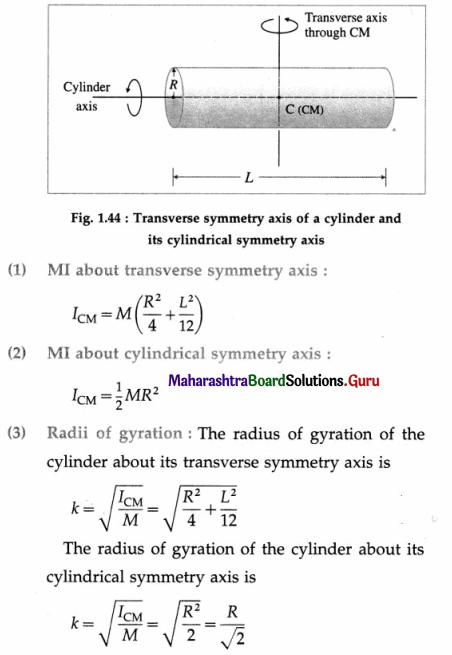
Maharashtra Board Class 12 Physics Important Questions Chapter 1 Rotational Dynamics 136
Notes :

  1. For R « L, a solid cylinder can be approximated as a thin rod, and the expression for the MI about its transverse symmetry axis reduces to the corresponding expression for a thin rod, viz., ML2/12.
  2. The MI of a solid cylinder about its cylindrical symmetry axis is the same as that of a disc about its transverse symmetry axis and having the same mass and radius.

Question 84.
Assuming the expression for the moment of inertia of a uniform solid cylinder about a transverse symmetry axis, obtain the expression for its moment of inertia about a transverse axis through its one end.
Answer:
Let M be the mass, L the length and R the radius of a uniform solid cylinder. Let ICM be the moment of inertia (MI) of the cylinder about a transverse symmetry axis. Then,
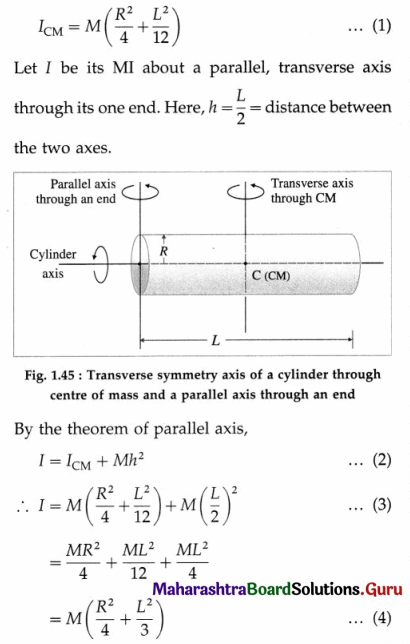
Maharashtra Board Class 12 Physics Important Questions Chapter 1 Rotational Dynamics 137

Question 85.
State an expression for the moment of inertia of a solid sphere about its diameter. Write the expression for the corresponding radius of gyration.
Answer:
Consider a solid sphere of uniform density, radius R and mass M. An axis along its diameter is an axis of spherical symmetry through its centre of mass.
Maharashtra Board Class 12 Physics Important Questions Chapter 1 Rotational Dynamics 138
The MI of the solid sphere about its diameter is
ICM = \(\frac{2}{5}\)MR2
The corresponding radius of gyration is
Maharashtra Board Class 12 Physics Important Questions Chapter 1 Rotational Dynamics 139

Question 86.
A uniform solid sphere of mass 15 kg has radius 0.1 m. What is its moment of inertia about a diameter?
Answer:
Moment of inertia of the sphere about a diameter
= \(\frac{2}{5}\)MR2 = \(\frac{2}{5}\) × 15 × (0.1)2 = 6 × 10⁻² kg.m2

Question 87.
Assuming the expression for the MI of a uniform solid sphere about its diameter, obtain the expression for its moment of inertia about a tangent.
Answer:
Let M be the mass of a uniform solid sphere of radius R. Let ICM be its MI about any diameter.
Maharashtra Board Class 12 Physics Important Questions Chapter 1 Rotational Dynamics 140

Let I be its MI about a parallel axis, tangent to the sphere. Here, h = R = distance between the two axis.
By the theorem of parallel axis, I = ICM + Mh2
= \(\frac{2}{5}\)MR2 + MR2 = \(\frac{7}{5}\)MR2

Question 88.
The moment of inertia of a uniform solid sphere about a diameter is 2 kg m2. What is its moment of inertia about a tangent ?
Answer:
Moment of inertia of a solid sphere about its 2
diameter, ICM = \(\frac{2}{5}\)MR2.
Maharashtra Board Class 12 Physics Important Questions Chapter 1 Rotational Dynamics 141

Question 89.
The radius of gyration of a uniform solid sphere of radius R is \(\sqrt{\frac{2}{5}}\)R for rotation about its diameter. Show that its radius of gyration for rotation about a tangential axis of rotation is \(\sqrt{\frac{7}{5}}\)R.
Answer:
Let the mass of the uniform solid sphere of radius R be M. Let ICM and kd be its MI about any diameter and the corresponding radius of gyration, respectively. Then,

Maharashtra Board Class 12 Physics Important Questions Chapter 1 Rotational Dynamics 142
Let I and kt be its MI about a parallel tangential axis and the corresponding radius of gyration, respectively. Here, h = R = distance between the two axis.
∴ I = \(M k_{\mathrm{t}}^{2}\)
By the theorem of parallel axis,
I = ICM + Mh2
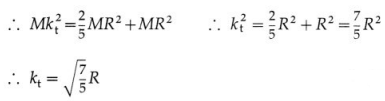
Maharashtra Board Class 12 Physics Important Questions Chapter 1 Rotational Dynamics 143

Question 90.
State the expression for the MI of a thin spherical shell (i.e., a thin-walled hollow sphere) about its diameter. Hence obtain the expression for its MI about a tangent.
Answer:
Consider a uniform, thin-walled hollow sphere radius R and mass M. An axis along its diameter is an axis of spherical symmetry through its centre of mass. The MI of the thin spherical shell about its diameter is
ICM = \(\frac{2}{3} M R^{2}\)

Let I be its MI about a tangent parallel to the diameter. Here, h = R = distance between the two axes. Then, according to the theorem of parallel axis,
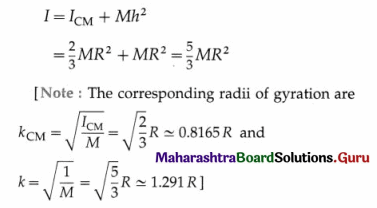
Maharashtra Board Class 12 Physics Important Questions Chapter 1 Rotational Dynamics 144

Question 91.
Find the ratio of the radius of gyration of a solid sphere about its diameter to the radius of gyration of a hollow sphere about its tangent, given that both the spheres have the same radius.
Answer:
The radius of gyration of a body about a given axis, k = \(\sqrt{I / M}\), where M and I are respectively the mass of the body and its moment of inertia (MI) about the axis.

For a solid sphere rotating about its diameter,
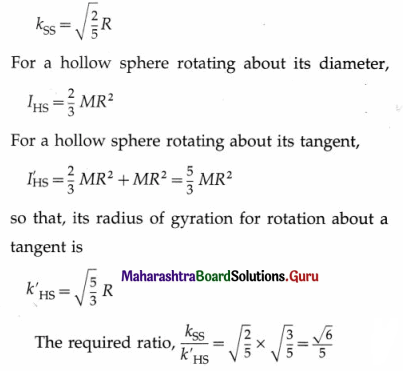
Maharashtra Board Class 12 Physics Important Questions Chapter 1 Rotational Dynamics 145

Question 92.
Calculate the moment of inertia by direct integration of a thin uniform rectangular plate of mass M, length l and breadth b about an axis passing through its centre and parallel to its breadth.
Answer:
Consider a thin uniform rectangular plate of mass M, length l and breadth b. The axis of rotation passes through its centre and is parallel to its breadth. We consider the origin of coordinates to be at the centre of the plate and orient the axes as shown in below figure. Since the plate is thin, we can take the mass as distributed entirely in the xy-plane. Then, the surface mass density is constant and equal to
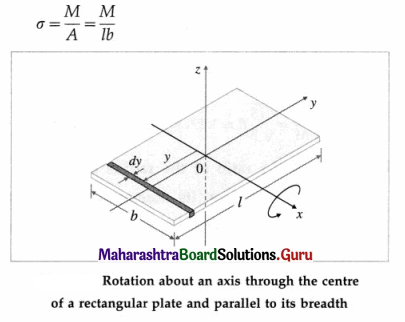
Maharashtra Board Class 12 Physics Important Questions Chapter 1 Rotational Dynamics 146

A rectangular element of the plate, shown shaded, has mass dm, length b and breadth dy.
∴ dm = σdA = σ(b dy)

If the distance of each element from the rotation axis is given by the variable y, the moment of inertia of :
an element about the axis of rotation is
dIx = y2dm
Since the rod extends from y = -1/2 to y = 1/2, the MI of the thin plate about the axis is
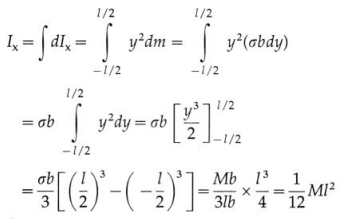
Maharashtra Board Class 12 Physics Important Questions Chapter 1 Rotational Dynamics 147

Notes:

(1) The MI of a thin rectangular plate about an axis passing through its centre and parallel to its length (i.e., about the y-axis) is Iy = \(\frac{1}{12}\)Mb2. Then, by the theorem of perpendicular axes, the MI of a thin plate about its transverse symmetry axis (i.e., about the z-axis) is Iz = Ix + Iy = \(\frac{1}{12} M\left(l^{2}+b^{2}\right)\)

(2) Suppose, for a rectangular bar of sides l, b and w, we take the origin of coordinates at the centre of mass of the bar and the x, y and z axes parallel to the respective sides. Then, Ix = \(\frac{1}{12}\)M(b2 + w2), Iy = \(\frac{1}{12}\)M(w2 + l2) and Iz = \(\frac{1}{2} M\left(l^{2}+b^{2}\right)\)

Question 93.
State the MI of a thin rectangular plate-of mass M, length l and breadth b- about an axis passing through its centre and parallel to its length. Hence find its MI about a parallel axis along one edge.
Answer:
Consider a thin rectangular plate of mass M, length l and breadth b. The MI of the plate about an axis passing through its centre and parallel to its edge of length l is
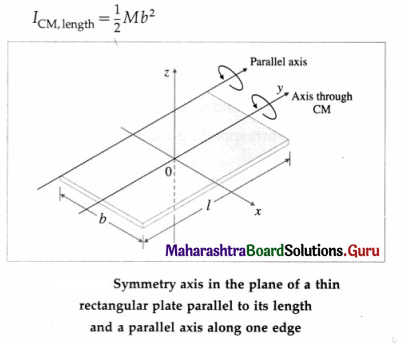
Maharashtra Board Class 12 Physics Important Questions Chapter 1 Rotational Dynamics 148
For a parallel axis along its one edge, h = \(\frac{1}{2} b\).
Therefore, by the theorem of parallel axis, the MI about this axis is
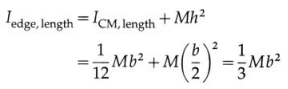
Maharashtra Board Class 12 Physics Important Questions Chapter 1 Rotational Dynamics 149

Question 94.
State the MI of a thin rectangular plate-of mass M, length l and breadth b about its transverse axis passing through its centre. Hence find its MI about a parallel axis through the midpoint of edge of length b.
Answer:
Consider a thin rectangular plate of mass M, length l and breadth b. The MI of the plate about its transverse axis passing through its centre is
ICM = M(l2 + b2)
For a parallel axis through the midpoint of its breadth, h = \(\frac{1}{2} l\). Therefore, by the theorem of parallel axis, the MI about this axis is
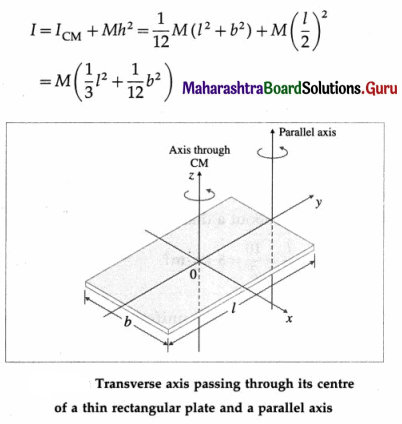
Maharashtra Board Class 12 Physics Important Questions Chapter 1 Rotational Dynamics 150

Question 95.
A uniform solid right circular cone of base radius R has mass M. Prove that the moment of inertia of the cone about its central symmetry axis is \(\frac{3}{10} M R^{2}\).
Answer:
Consider a uniform solid right circular cone of mass M, base radius R and height h. The axis of rotation passes through its centre and the vertex, Its constant mass density is
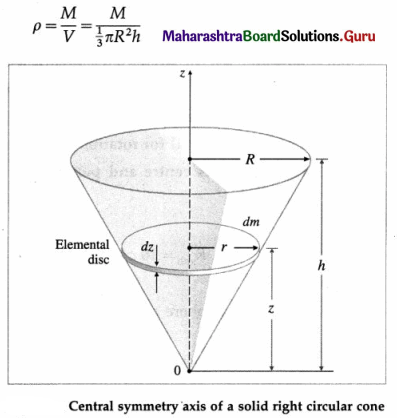
Maharashtra Board Class 12 Physics Important Questions Chapter 1 Rotational Dynamics 151
We consider an elemental disc of mass dm, radius r and thickness dz. If the distance of each mass element from the axis is given by the variable z,
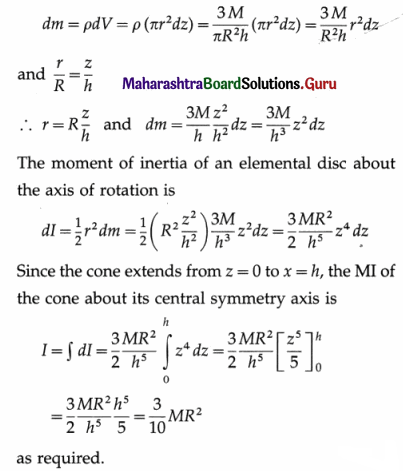
Maharashtra Board Class 12 Physics Important Questions Chapter 1 Rotational Dynamics 152

Question 96.
Solve the following :

Question 1.
Calculate the moment of inertia of a ring of mass 500 g and radius 0.5 m about an axis of rotation passing through
(i) its diameter
(ii) a tangent perpendicular to its plane.
Solution :
Data : M = 500 g 0.5 kg, R = 0.5 m

(i) The moment of inertia of the ring about its
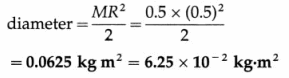
Maharashtra Board Class 12 Physics Important Questions Chapter 1 Rotational Dynamics 153

(ii) The moment of inertia of the ring about a tangent perpendicular to its plane
= 2MR2 = 2 × 0.5 × (0.5)2 = 0.25 kg.m2

Question 2.
A thin uniform rod 1 m long has mass 1 kg. Find its moment of inertia and radius of gyration for rotation about a transverse axis through a point midway between its centre and one end.
Solution :
Data : M = 1 kg, L = 1 m
Let ICM and I be the moments of inertia of the rod about a transverse axis through its centre, and a parallel axis midway between its centre and one end.
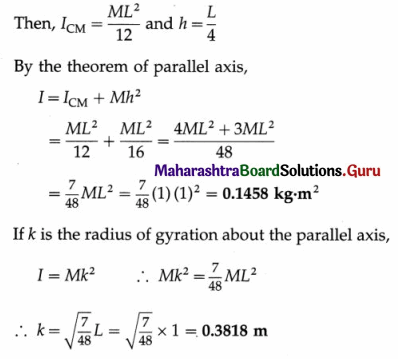
Maharashtra Board Class 12 Physics Important Questions Chapter 1 Rotational Dynamics 154

Question 3.
The moment of inertia of a disc about an axis through its centre and perpendicular to its plane is 10 kg.m2. Find its MI about a diameter.
Solution :
Data : Iz = 10 kg.m2
If the disc lies in the xy plane with its centre at the origin then, according to the theorem of perpendicular axes,
Ix + Iy = Iz
Since, Ix = Iy, 2Ix = Iz
∴ Its MI about a diameter,
Ix = \(\frac{I_{z}}{2}\) = \(\frac{10}{2}\) = 5 kg.m2

Question 4.
A solid cylinder of uniform density and radius 2 cm has a mass of 50 g. If its length is 12 cm, calculate its moment of inertia about an axis passing through its centre and perpendicular to its length.
Solution :
Data : M = 50 g, R = 2 cm, L = 12 cm
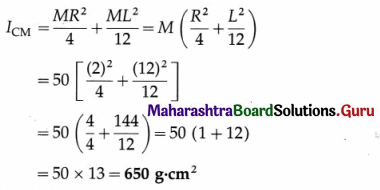
Maharashtra Board Class 12 Physics Important Questions Chapter 1 Rotational Dynamics 155

Question 5.
A compound object is formed of a thin rod and a disc attached at the end of the rod. The rod is 0.5 m long and has mass 2 kg. The disc has mass of 1 kg and its radius is 20 cm. Find the moment of inertia of the compound object about an axis passing through the free end of the rod and perpendicular to its length.
Solution :
Data : L = 0.5 m, R = 0.2 m, Mrod = 2 kg, Mdisk = 1 kg About a transverse axis through CM,
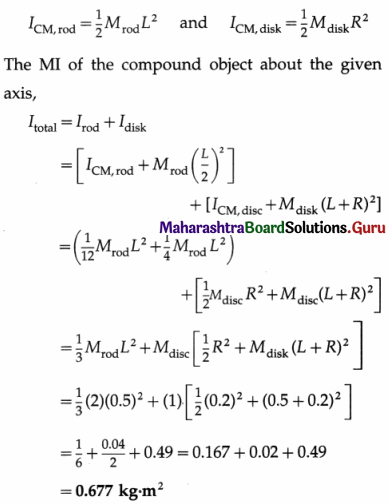
Maharashtra Board Class 12 Physics Important Questions Chapter 1 Rotational Dynamics 156

Question 6.
The radius of gyration of a body about an axis at 6 cm from its centre of mass is 10 cm. Find its radius of gyration about a parallel axis through its centre of mass.
Solution :
Let O be a point at 6 cm from the centre of mass of the body.
Let I = MI about an axis through O,
k = radius of gyration about the axis through O,
ICM = MI about a parallel axis through the centre of mass of the body,
kCM = radius of gyration about a parallel axis through the centre of mass,
M = mass of the body,
h = distance between the two axes.
Data : h = 6 cm, k = 10 cm
By the theorem of parallel axis,
I = ICM + Mh2
Also, I = Mk2 and ICM = \(M k_{\mathrm{CM}}^{2}\)
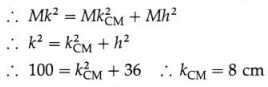
Maharashtra Board Class 12 Physics Important Questions Chapter 1 Rotational Dynamics 157
The radius of gyration about a parallel axis through its centre of mass is 8 cm.

Question 7.
The radius of gyration of a disc about its transverse symmetry axis is 2 cm. Determine its radius of gyration about a diameter.
Solution :
Data : kCM = 2 cm
Let M and R be the mass and radius of the disc. Let ICM and kCM be the MI and radius of gyration of the disc about its transverse symmetry axis. Let I and k be the MI and radius of gyration of the disc about its diameter. Then
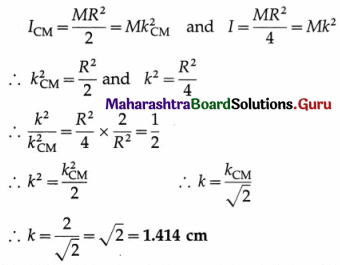
Maharashtra Board Class 12 Physics Important Questions Chapter 1 Rotational Dynamics 158

Question 8.
Calculate the MI and rotational kinetic energy of a thin uniform rod of mass 10 g and length 60 cm when it rotates about a transverse axis through its centre at 90 rpm.
Solution :
Data : M = 10 g = 10-2 kg, L = 60 cm = 0.6 m,
f = 90 rpm = 90/60 Hz = 1.5 Hz
The MI of the rod about a transverse axis through its centre is

Maharashtra Board Class 12 Physics Important Questions Chapter 1 Rotational Dynamics 159
Angular speed, ω = 2πf = 2 × 3.142 × 1.5 = 9.426 rad/s
Rotational KE = \(\frac{1}{2}\)Iω2 = \(\frac{1}{2}\left(3 \times 10^{-4}\right)(9.426)^{2}\)
= 0.01333 J

Question 9.
A thin rod of uniform cross section is made up of two sections made of wood and steel. The wooden section has length 50 cm and mass 0.6 kg. The steel section has length 30 cm and mass 3 kg. Find the moment of inertia of the rod about a transverse axis passing through the junction of the two sections.
Solution:
Data : L1 =0.5m, M1 =0.6 kg, L2 = 0.3m,
The moment of inertia of a thin rod about a transverse axis through its end is \(\frac{M L^{2}}{3}\).
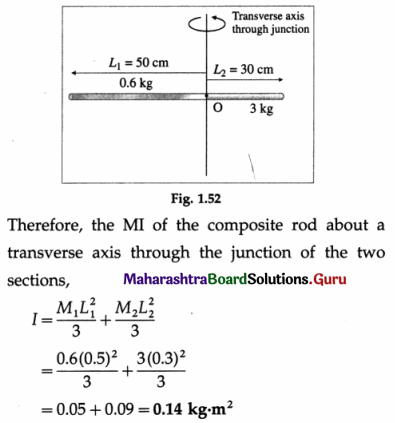
Maharashtra Board Class 12 Physics Important Questions Chapter 1 Rotational Dynamics 160

Question 10.
The mass and the radius of the Moon are, respectively, about \(\frac{1}{81}\) time and about \(\frac{1}{3.7}\) time those of the Earth. Given that the rotational period of the Moon is 27.3 days, compare the rotational kinetic energy of the Earth with that of the Moon.
Solution :
Data : MM = \(\frac{1}{81}\)ME, RM = \(\frac{1}{3.7}\)RE, TM = 27.3 days, TE = 1 day

Let IE and IM be the moments of inertia of the Earth and the Moon about their respective axes of rotation, and ωE and ωM be their respective rotational angular speeds. Assuming the Earth and the Moon to be solid spheres of uniform densities,
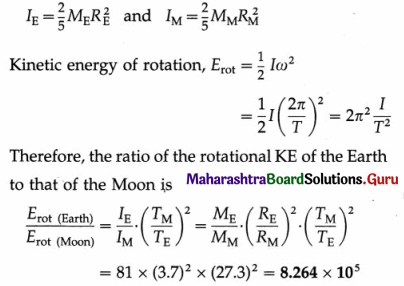
Maharashtra Board Class 12 Physics Important Questions Chapter 1 Rotational Dynamics 161

Question 11.
A solid sphere of radius R, rotating with an angular velocity ω about its diameter, suddenly stops rotating and 75% of its KE is converted into heat. If c is the specific heat capacity of the material in SI units, show that the temperature of 3R2CO2
the sphere rises by \(\frac{3 R^{2} \omega^{2}}{20 c}\).
Answer:
The MI of a solid sphere about its diameters, I = \(\frac{2}{5}\)MR2
where M is its mass.
The rotational KE of the sphere,
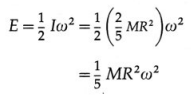
Maharashtra Board Class 12 Physics Important Questions Chapter 1 Rotational Dynamics 162
If ∆θ is the rise in temperature,
Maharashtra Board Class 12 Physics Important Questions Chapter 1 Rotational Dynamics 163

Question 97.
Define the angular momentum of a particle.
Answer:
Definition : The angular momentum of a particle is defined as the moment of the linear momentum of the particle. If a particle of mass m has linear momentum \(\vec{p}(=m \vec{v})\)), then the angular momentum of this particle with respect to a point O is a vector quantity defined as \(\vec{l}=\vec{r} \times \vec{p}=m(\vec{r} \times \vec{v})\)), where \(\vec{r}\) is the position vector of the particle with respect to O.

It is the angular analogue of linear momentum.
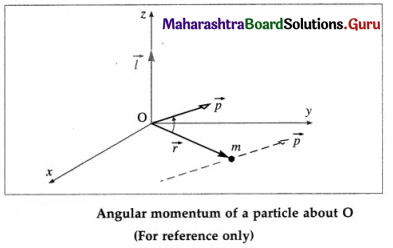
Maharashtra Board Class 12 Physics Important Questions Chapter 1 Rotational Dynamics 164

[Note : As the particle moves relative to O in the direction of its momentum \(\vec{p}(=m \vec{v})\), position vector \(\vec{r}\) rotates around O. However, to have angular momentum about O, the particle does not itself have to rotate around O.]

Question 98.
State the dimensions and SI unit of angular momentum.
Answer:

  1. Dimensions : [Angular momentum] = [M1L2T-1]
  2. SI unit: The kilogram.metre2/second (kg.m2/s).

Question 99.
Express the kinetic energy of a rotating body in terms of its angular momentum.
Answer:
The kinetic energy of a body of moment of inertia I and rotating with a constant angular velocity ω is
E = \(\frac{1}{2} I \omega^{2}\)
The angular momentum of the body, L = Iω.
∴E = \(\frac{1}{2}(I \omega) \omega=\frac{1}{2} L \omega\)
This is the required relation.

Question 100.
Why do grinding wheels have large mass and moderate diameter?
Answer:
A grinding wheel, used for abrasive machining operations (e.g., sharpening), is typically in the form of a heavy disc of moderate diameter. A grinding machine needs to have a high frequency of revolution but the machining operations exert braking torques on its wheel.

Angular momentum is directly proportional to mass. Hence, heavier the wheel, the greater is its angular momentum and lesser is the decelerating effect of the braking torques. Also, angular acceleration is inversely proportional to the moment of inertia. Since the wheel is made heavy, its diameter is kept moderate so that a large angular acceleration and high angular velocity can be achieved with a motor of given power.

Question 101.
Solve the following :

Question 1.
The angular momentum of a body changes by 80 kg.m2/s when its angular velocity changes from 20 rad/s to 40 rad/s. Find the change in its kinetic energy of rotation.
Solution :
Data : ω1 = 20 rad/s, ω2 = 40 rad/s
If I is the MI of the body, its initial angular momentum is Iω1, and final angular momentum is Iω2.
Change in angular momentum
= Iω2 – Iω12 – ω1)
∴ 80 = I(40 – 20)
∴ I = 4 kg.m2
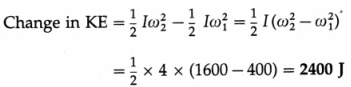
Maharashtra Board Class 12 Physics Important Questions Chapter 1 Rotational Dynamics 165

Question 2.
A wheel of moment of inertia 1 kg.m2 is rotating at a speed of 40 rad/s. Due to the friction on the axis, the wheel comes to rest in 10 minutes. Calculate the angular momentum of the wheel, two minutes before it comes to rest.
Solution :
Data : I = 1 kg.m2, ω1 = 40 rad/s, ω2 = 0 at
t = 10 minutes = 60 × 10 s = 600 s,
t’ = 8 minutes = 60 × 8 s = 480 s
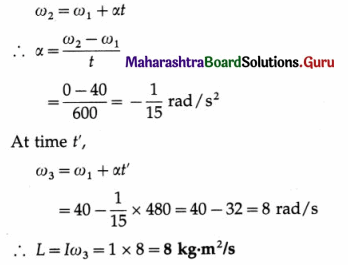
Maharashtra Board Class 12 Physics Important Questions Chapter 1 Rotational Dynamics 166
This is the required angular momentum of the wheel.

Question 3.
A flywheel rotating about an axis through its centre and perpendicular to its plane loses 100 J of energy on slowing down from 60 rpm to 30 rpm. Find its moment of inertia about the given axis and the change in its angular momentum.
Solution :
Data : f1 = 60 rpm = 60/60 rot/s = 1 rot/s, f2 = 30 rpm = 30/60 rot/s = \(\frac{1}{2}\) rot/s, ∆E = – 100 J
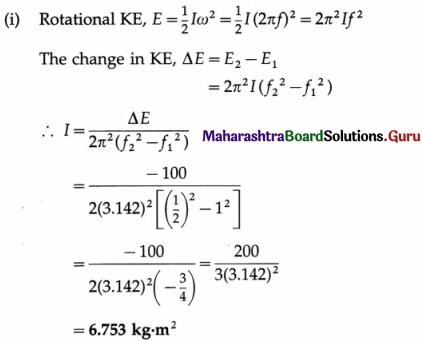
Maharashtra Board Class 12 Physics Important Questions Chapter 1 Rotational Dynamics 167
This gives the MI of the flywheel about the given axis.

(ii) Angular momentum, L = Iω = I(2πf) 2πIf
The change in angular momentum, ∆L
= L2 – L1 = 2πI(f2 – f1)
= 2 × 3.142 × 6.753\(\left(\frac{1}{2}-1\right)\)
= -3.142 × 6.753= -21.22 kg.m2/s

Question 102.
A torque of 4 N-m acting on a body of mass 1 kg produces an angular acceleration of 2 rad/s2. What is the moment of inertia of the body?
Answer:
The moment of inertia of the body.
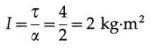
Maharashtra Board Class 12 Physics Important Questions Chapter 1 Rotational Dynamics 168

Question 103.
Two identical rings are to be rotated about different axes of rotation as shown by applying torques so as to produce the same angular acceleration in both. How is it possible ?
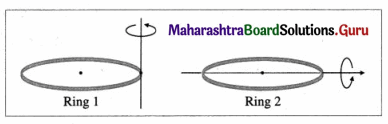
Maharashtra Board Class 12 Physics Important Questions Chapter 1 Rotational Dynamics 169
Answer:
The MI of ring 1 about a transverse tangent is I1 = 2MR2
The MI of ring 2 about its diameter is
I2 = \(\frac{1}{2}\)MR2
Since, torque T = \(\tau=I \alpha\), to produce the same angular acceleration in both,
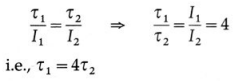
Maharashtra Board Class 12 Physics Important Questions Chapter 1 Rotational Dynamics 170
∴ It will be possible to produce the same angular acceleration in both the rings only if \(\tau_{1}=4 \tau_{2}\).

Question 104.
Two wheels have the same mass. First wheel is in the form of a solid disc of radius R while the second is a disc with inner radius r and outer radius R. Both are rotating with same angular velocity ω0 about transverse axes through their centres. If the first wheel comes to rest in time t1 while the second comes to rest in time t2, are t1 and t2 different? Why?
Answer:
The moments of inertia of the two wheels about transverse axes through their centres are
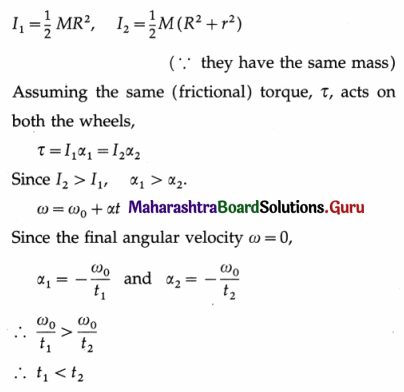
Maharashtra Board Class 12 Physics Important Questions Chapter 1 Rotational Dynamics 171

Question 105.
Solve the following :

Question 1.
A torque of magnitude 400 N-m, acting on a body of mass 40 kg, produces an angular acceleration of 20 rad/s2. Calculate the moment of inertia and radius of gyration of the body.
Solution :
Data : T = 400 N.m, M = 40 kg, α = 20 rad/s2
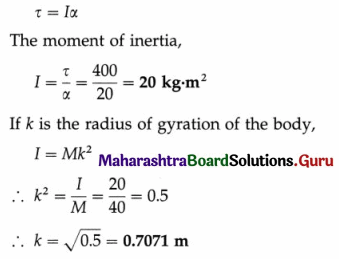
Maharashtra Board Class 12 Physics Important Questions Chapter 1 Rotational Dynamics 172

Question 2.
A body starts rotating from rest. Due to a couple of 20 N.m, it completes 60 revolutions in one minute. Find the moment of inertia of the body.
Solution :
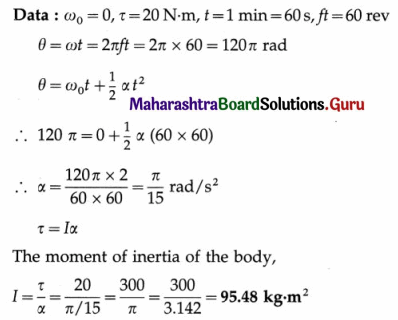
Maharashtra Board Class 12 Physics Important Questions Chapter 1 Rotational Dynamics 173

Question 3.
A wheel of moment of inertia 2 kg-m2 rotates at 50 rpm about its transverse axis. Find the torque that can stop the wheel in one minute.
Solution :
Data : I = 2 kg.m2, f0 = 50 rpm = \(\frac{50}{60}\) = \(\frac{5}{6}\) rev/s, t = 60 s
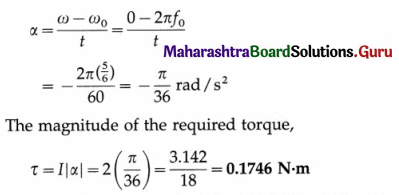
Maharashtra Board Class 12 Physics Important Questions Chapter 1 Rotational Dynamics 174

Question 4.
A circular disc of moment of inertia 10 kg.m2 is rotated about its transverse symmetry axis at a constant frequency of 60 rpm by an electric motor of power 31.42 watts. When the motor is switched off, how many rotations does it complete before coming to rest?
Solution :
Data : I = 10 kg.m2, P = 31.42 watts,
f = 60 rpm = 60/60 Hz = 1 Hz
In rotational motion,
power = torque × angular velocity
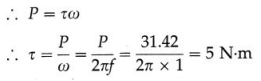
Maharashtra Board Class 12 Physics Important Questions Chapter 1 Rotational Dynamics 175
This torque provided by the motor overcomes the torque of the frictional forces and maintains a constant frequency of rotation.

When the motor is switched off, the disc slows down due to the retarding torque of the frictional forces.
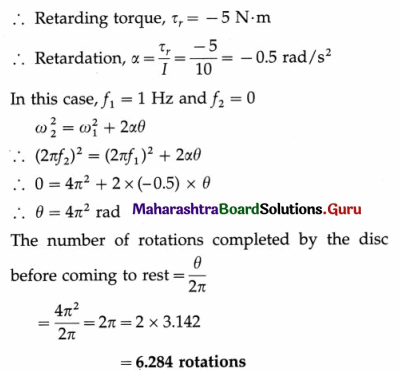
Maharashtra Board Class 12 Physics Important Questions Chapter 1 Rotational Dynamics 176

Question 5.
A flywheel of mass 4 kg and radius 10 cm, rotating with a uniform angular velocity of 5 rad/s, is subjected to a torque of 0.01 N.m for 10 seconds.
If the torque increases the speed of rotation, find
(i) the final angular velocity of the flywheel
(ii) the change in its angular velocity
(iii) the change in its angular momentum
(iv) the change in its kinetic energy.
Solution :
Data : M = 4 kg, R = 10 cm = 0.1 m, ω1 = 5 rad/s, \(\tau\) = 0.01 N.m, t = 10 s
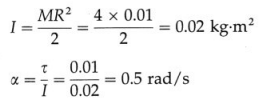
Maharashtra Board Class 12 Physics Important Questions Chapter 1 Rotational Dynamics 177

(i) The final angular velocity of the flywheel,
ω2 = ω1 + αt
= 5 + 0.5 × 10 = 10 rad/s

(ii) The change in its angular velocity
= ω2 – ω1 = 5 rad/s

(iii) The change in its angular momentum
= Iω2 – Iω1 = I (ω2 – ω1)
= 0.02 × 5 = 0.1 kg.m2/s

(iv) The change in its kinetic energy
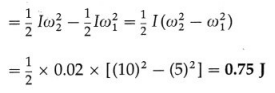
Maharashtra Board Class 12 Physics Important Questions Chapter 1 Rotational Dynamics 178

Question 6.
A torque of 20 N.m sets a stationary circular disc into rotation about a transverse axis through its centre and acts for 2π seconds. If the disc has a mass 10 kg and radius 0.2 m, what is its frequency of rotation after 2π seconds ?
Solution :
Data : \(\tau\) = 20 N.m, t = 2π s, M = 10 kg, R = 0.1 m Let f1 and f2 be the initial and final frequencies of rotation of the disc, and ω1 and ω2 be its initial and final angular speeds. Since the disc was initially stationary, f1 = ω1, = 0 and ω2 = 2πf2.
The MI of the disc about the given axis is
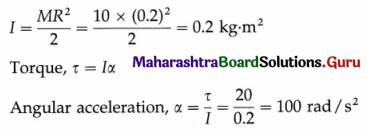
Maharashtra Board Class 12 Physics Important Questions Chapter 1 Rotational Dynamics 179
Now, ω2 = ω1 + αt = 0 + α t
∴ 2πf2 = αt
∴ f2 = \(\frac{\alpha t}{2 \pi}\) = \(\frac{100(2 \pi)}{2 \pi}\) = 100 Hz

Question 7.
A rope is wound around a hollow cylinder of mass 3 kg and radius 40 cm. If the rope is pulled downwards with a force of 30 N, find
(i) the angular acceleration of the cylinder
(ii) the linear acceleration of the rope.
Solution :
Data : M = 3 kg, R = 0.4 m, F = 30 N
(i) The MI of a hollow cylinder about its cylinder axis, I = MR2
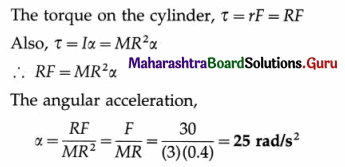
Maharashtra Board Class 12 Physics Important Questions Chapter 1 Rotational Dynamics 180

(ii) The linear acceleration of the rope = the tangential acceleration at = αR = 25 × 0.4 = 10 m/s2

Question 106.
State and prove the principle (or law) of conservation of angular momentum.
Answer:
Principle (or law) of conservation of angular momentum : The angular momentum of a body is conserved if the resultant external torque on the body is zero.
Proof : Consider a moving particle of mass m whose position vector with respect to the origin at any instant is \(\vec{r}\).
Then, at this instant, the linear velocity of this particle is \(\vec{v}=\frac{\overrightarrow{d r}}{d t}\), its linear momentum is \(\vec{p}=m \vec{v}\) and its angular momentum about an axis through the origin is \(\vec{l}=\vec{r} \times \vec{p}\).

Suppose its angular momentum \(\vec{l}\) changes with time due to a torque \(\vec{\tau}\) exerted on the particle.
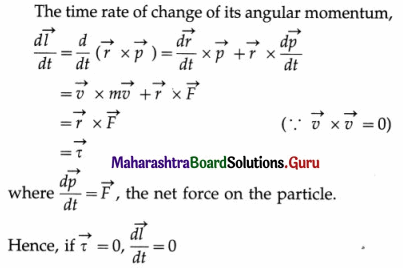
Maharashtra Board Class 12 Physics Important Questions Chapter 1 Rotational Dynamics 181
∴ \(\vec{l}\) = constant, i.e., \(\vec{l}\) is conserved. This proves the principle (or law) of conservation of angular momentum.

Alternate Proof : Consider a rigid body rotating with angular acceleration \(\vec{\alpha}\) about the axis of rotation. If I is the moment of inertia of the body about the axis of rotation, \(\vec{\omega}\) the angular velocity of the body at time t and \(\vec{L}\) the corresponding angular momentum of the body, then
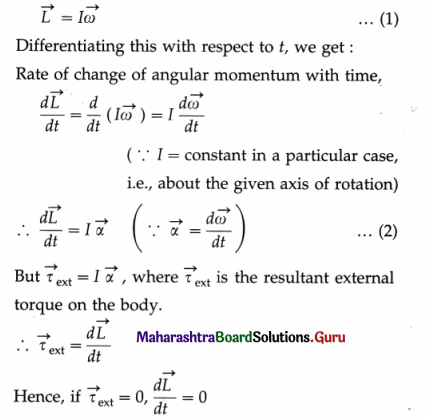
Maharashtra Board Class 12 Physics Important Questions Chapter 1 Rotational Dynamics 182
∴ \(\vec{L}\) = constant, i.e., \(\vec{L}\) is conserved. This proves the principle (or law) of conservation of angular momentum.

Question 107.
What happens when a ballet dancer stretches her arms while taking turns?
Answer:
When a ballet dancer stretches her arms while pirouetting, her moment of inertia increases, and consequently her angular speed decreases to conserve angular momentum.

Question 108.
If the Earth suddenly shrinks so as to reduce its volume, mass remaining unchanged, what will be the effect on the duration of the day?
Answer:
If the Earth suddenly shrinks, mass remaining constant, the moment of inertia of the Earth will decrease, and consequently the angular velocity of rotation ω about its axis will increase. Since period \(T \propto \frac{1}{\omega}\), the duration of the day T will decrease.

Question 109.
Two discs of moments of inertia I1 and I2 about their transverse symmetry axes, respectively rotating with angular velocities to ω1 and ω2, are brought into contact with their rotation axes coincident. Find the angular velocity of the composite disc.
Answer:
We assume that the initial angular momenta (\(\vec{L}_{1}\) and \(\vec{L}_{2}\)) of the discs are either in the same direction or in opposite directions. Then,
the total initial angular momentum = \(\vec{L}_{1}+\vec{L}_{2}=I_{1} \overrightarrow{\omega_{1}}+I_{2} \overrightarrow{\omega_{2}}\)

After they are coupled, the total moment of inertia, i.e., the moment of inertia of the composite disc is I = I1 + I2 and the common angular velocity is \(\vec{\omega}\). Assuming conservation of angular momentum,
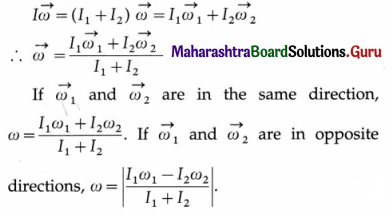
Maharashtra Board Class 12 Physics Important Questions Chapter 1 Rotational Dynamics 183

Question 110.
A boy standing at the centre of a turntable with his arms outstretched is set into rotation with angular speed ω rev/min. When the boy folds his arms back, his moment of inertia reduces to \(\frac{2}{5}\)th its initial value. Find the ratio of his final kinetic energy of rotation to his initial kinetic energy.
Answer:
Data : I2 = \(\frac{2}{5}\)I1
L = Iω
Assuming the angular momentum \(\vec{L}\) is conserved, in magnitude,
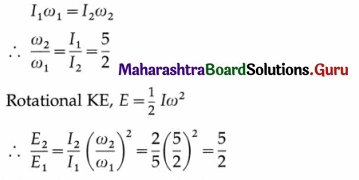
Maharashtra Board Class 12 Physics Important Questions Chapter 1 Rotational Dynamics 184
This gives the required ratio.

Question 111.
Name the quantity that is conserved when

  1. \(\vec{F}_{\text {external }}\) is zero
  2. \(\vec{\tau}_{\text {external }}\) is zero.

Answer:

  1. Total linear momentum is conserved when \(\vec{F}_{\text {external }}\) is Zer0
  2. Angular momentum is conserved when \(\vec{\tau}_{\text {external }}\) is zero.

Question 112.
What is the rotational analogue of the equation \(\vec{F}_{\text {external }}\) = \(\frac{d \vec{p}}{d t}\)?
Answer:
\(\vec{F}_{\text {external }}\) = \(\frac{d \vec{L}}{d t}\)

Question 113.
Fly wheels used in automobiles and steam engines producing rotational motion have discs with a large moment of inertia. Explain why?
Answer:
A flywheel is used as

(i) a mechanical energy storage, the energy being stored in the form of rotational kinetic energy

(ii) a direction and speed stabilizer. A flywheel rotor is typically in the form
of a disc. Rotational kinetic energy, \(E_{\mathrm{rot}}=\frac{1}{2} I \omega^{2}\), where I is the moment of inertia and ω is the angular speed. That is, Erot ∝ I. Therefore, higher the moment of inertia, the higher is the rotational kinetic energy that can be stored or recovered.

Also, angular momentum, \(\vec{L}=I \vec{\omega}\), i.e., \(|\vec{L}| \propto I\). A torque aligned with the symmetry axis of a flywheel can change its angular velocity and thereby its angular momentum. A flywheel with a large angular momentum will require a greater torque to change its angular velocity. Thus, a flywheel can be used to stabilize direction and magnitude of its angular velocity by undesired torques.

Question 114.
Solve the following :

Question 1.
A uniform horizontal disc is freely rotating about a vertical axis passing through its centre at the rate of 180 rpm. A blob of wax of mass 1.9 g falls on it and sticks to it at 25 cm from the axis. If the frequency of rotation is reduced by 60 rpm, calculate the moment of inertia of the disc.
Solution :
Data : f1 = 180 rpm = 180/60 rot/s = 3 rot/s, f2 = (180 – 60) rpm = 120/60 rot/s = 2 rot/s, m = 1.9 g = 1.9 × 10⁻³ kg, r = 25 cm = 0.25 m
Let I1 be the MI of the disc. Let I2 be the MI of the disc and the blob.
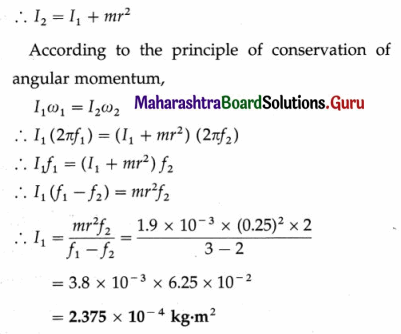
Maharashtra Board Class 12 Physics Important Questions Chapter 1 Rotational Dynamics 185

Question 2.
A horizontal disc is rotating about a transverse axis through its centre at 100 rpm. A 20 gram blob of wax falls on the disc and sticks to it at 5 cm from its axis. The moment of inertia of the disc about its axis passing through its centre is 2 × 10⁻⁴ kg.m2. Calculate the new frequency of rotation of the disc.
Solution :
Data : f1 = 100 rpm, m = 20 g = 20 × 10-3 kg, r = 5 cm = 5 × 10⁻² m, I1 = Idisc = 2 × 10⁻⁴ kg.m2
The MI of the disc and blob of wax is
I2 = I1 + mr2
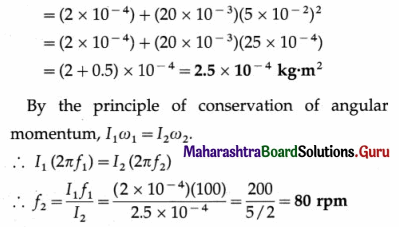
Maharashtra Board Class 12 Physics Important Questions Chapter 1 Rotational Dynamics 186
This is the new frequency of rotation.

Question 3.
A ballet dancer spins about a vertical axis at 2.5 π rad/s with his arms outstretched. With the arms folded, the MI about the same axis of rotation changes by 25%. Calculate the new speed of rotation in rpm.
Solution:
Let I1, ω1, and f1, be the moment of inertia, angular velocity and frequency of rotation of the ballet dancer with arms outstretched, and I2, ω2 and f2 be the corresponding quantities with arms folded.
Data : ω1 = 2.5 π rad /s
Since moment of inertia with arms folded is less than that with arms outstretched,
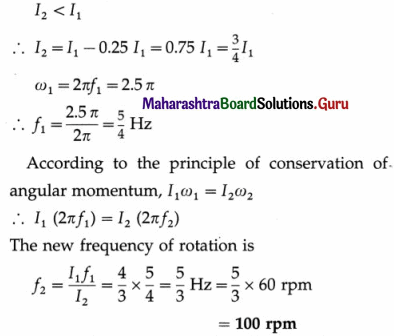
Maharashtra Board Class 12 Physics Important Questions Chapter 1 Rotational Dynamics 187

Question 4.
Two wheels, each of moment of inertia 4 kg.m2, rotate side by side at the rate of 120 rpm and 240 rpm in opposite directions. If both the wheels are coupled by a weightless shaft so that they now rotate with a common angular speed, find this new rate of rotation.
Solution :
Data : I = 4 kg.m2, f1 = 120 rpm, f2 240 rpm
Initially, the angular velocities of the two wheels \(\overrightarrow{\omega_{1}}\), and \(\overrightarrow{\omega_{2}}\)) and, therefore, their angular momenta (\(\vec{L}_{1}\) and \(\vec{L}_{2}\)) are in opposite directions.

The magnitude of the total initial angular momentum
= – L1 + L2 = -Iω1 + Iω2 (∵ I1 = I2 = I)
= 2πl(f2 – f1) … (1)

After coupling onto the same shaft, the total moment of inertia is 21. Let ω = 2πf be the common angular speed.

The magnitude of the total final angular momentum = 2I.ω = 4πl.f … (2)

From Eqs. (1) and (2), by the principle of conservation of angular momentum,
4πf = 2πl(f2 – f1)
∴ f = \(\frac{f_{2}-f_{1}}{2}\) = \(\frac{240-120}{2}\) = 60 rpm
This gives their new rate of rotation.

Question 5.
A homogeneous (uniform) rod XY of length L and mass M is pivoted at the centre C such that it can rotate freely in a vertical plane. Initially, the rod is horizontal. A blob of wax of the same mass M as that of the rod falls vertically with speed V and sticks to the rod midway between points C and Y. As a result, the rod rotates with angular speed ω. What will be the angular speed in terms of V and L?
Solution :
The initial angular momentum of the rod is zero.
The initial angular momentum of the falling blob of wax about the point C is (in magnitude)
= mass × speed × perpendicular distance between its direction of motion and point C
= MV.\(\frac{L}{4}\)
The total initial angular momentum of the rod and blob of wax = \(\frac{M V L}{4}\) … (1)
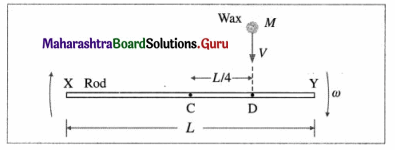
Maharashtra Board Class 12 Physics Important Questions Chapter 1 Rotational Dynamics 188

After the blob of wax sticks to the rod, and the system rotates with an angular speed ω about the horizontal axis through point C perpendicular to the plane of the figure, the total final angular momentum of the system about this axis
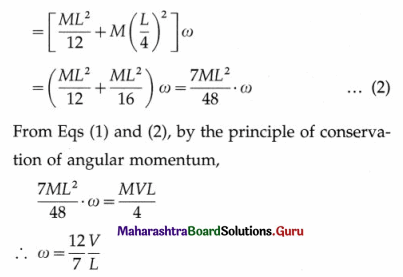
Maharashtra Board Class 12 Physics Important Questions Chapter 1 Rotational Dynamics 189
This gives the required angular speed.

Question 6.
A satellite moves around the Earth in an elliptical orbit such that at perigee (closest approach) it is two Earth radii above the Earth’s surface. At apogee (farthest position), it travels with one-fourth the speed it has at perigee. In terms of the Earth’s radius R, what is the maximum distance of the satellite from the Earth’s surface ?
Solution:
Let rp and ra be the distances of the satellite from the centre of the Earth at perigee and apogee, respectively. Let vp and va be its linear (tangential) velocities at perigee and apogee.
Data : rp = 2R + R = 3R, va = \(\frac{1}{4}\)vp

Let Lp and La be the angular momenta of the satellite about the Earth’s centre. Because the gravitational force (\(\vec{F}\)) on the satellite due to the Earth is always radially towards the centre of the Earth, its direction is opposite to that of the position vector (\(\vec{r}\)) of the satellite relative to the centre of the Earth, so that the torque \(\vec{\tau}=\vec{r} \times \vec{F}=0\). Hence, the angular momentum of the satellite about the Earth’s centre is constant in time.
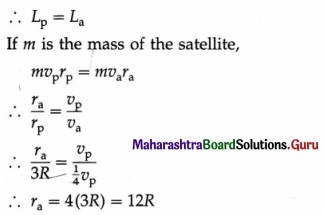
Maharashtra Board Class 12 Physics Important Questions Chapter 1 Rotational Dynamics 190
At apogee, the distance of the satellite from the Earth’s surface is 12R – R = 11R.

Question 7.
A torque of 100 N.m is applied to a body capable of rotating about a given axis. If the body starts from rest and acquires kinetic energy of 10000 J in 10 seconds, find
(i) its moment of inertia about the given axis
(ii) its angular momentum at the end of 10 seconds.
Solution :
Data : \(\tau\) = 100 N.m, ωi = 0, Ei = 0, Ef = 104J, t = 10 s
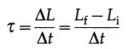
Maharashtra Board Class 12 Physics Important Questions Chapter 1 Rotational Dynamics 191
Since the body starts from rest, its initial angular momentum, Li = 0.
The final angular momentum,
Lf = τ∆t = (100)(10) = 103 kg.m2/s
The final rotational kinetic energy, Ef = \(\frac{1}{2} L_{\mathrm{f}} \omega_{\mathrm{f}}\)
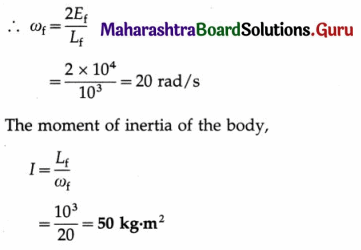
Maharashtra Board Class 12 Physics Important Questions Chapter 1 Rotational Dynamics 192

Question 8.
Two identical metal beads, each of mass M but negligible width, can slide along a thin smooth uniform horizontal rod of mass M and length L. The rod is capable of rotating about a vertical axis passing through its centre. Initially, the beads are almost touching the axis of rotation and the rod is rotating at speed of 14 rad/s. Find the angular speed of the system when the beads have moved up to the ends of the rod. (Assume that no external torque acts on the system.)
Solution :
Data : ω1 = 14 rad/s
The MI of the rod about a transverse axis through its CM,
Irod = \(\frac{M L^{2}}{12}\)
Since the beads are almost particle-like, and initially touching the rotation axis, their MI about the vertical axis is taken to be zero.
When the beads move upto the ends of the rod, r = L/2, their MI about the vertical axis is
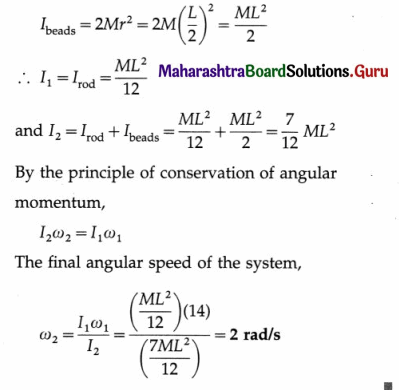
Maharashtra Board Class 12 Physics Important Questions Chapter 1 Rotational Dynamics 193

Question 115.
Discuss how pure rolling (i.e., rolling without slipping) on a plane surface is a combined translational and rotational motion.
Answer:
Rolling motion (without slipping) is an important case of combined translation and rotation. Consider a circularly symmetric rigid body, like a wheel or a disc, rolling on a plane surface with friction along a straight path.
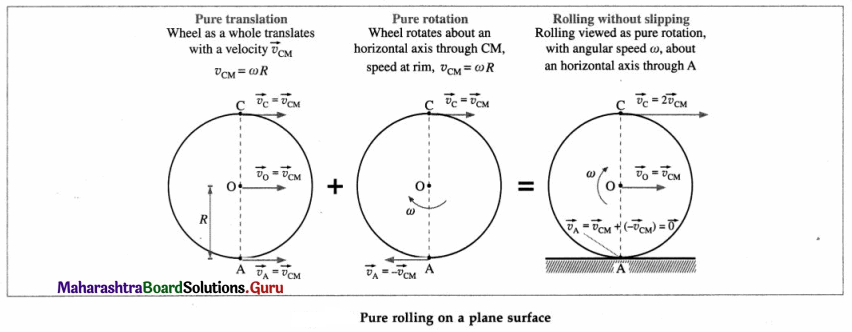
Maharashtra Board Class 12 Physics Important Questions Chapter 1 Rotational Dynamics 194

The centre of mass of the wheel is at its geometric centre O. For purely translational motion (the wheel sliding smoothly along the surface without rotating at all), every point on the wheel has the same linear velocity \(\vec{v}_{\mathrm{CM}}\) = \(\vec{v}_{\mathrm{O}}\) as the centre O. For purely rotational motion (as if the horizontal rotation axis through O were stationary), every point on the wheel rotates about the axis with angular velocity \(\vec{\omega}\); in this case, every point on the rim has the same linear speed ωR.

We view the combined motion in the inertial frame of reference in which the surface is at rest. In this frame, since there is no slipping, the point of contact of the wheel with the surface is instantaneously stationary, vA = 0, so that the wheel is turning about an instantaneous axis through the point of contact A. The instantaneous linear speed of point C (at the top) is VC = ω(2R) – faster than any other point of the wheel.

Question 116.
Deduce an expression for the kinetic energy of a body rolling on a plane surface without slipping.
OR
Obtain an expression for the total kinetic energy of a rolling body in the form \(\frac{1}{2} M v^{2}\left[1+\frac{k^{2}}{R^{2}}\right]\)
OR
Derive an expression for the kinetic energy when a rigid body is rolling on a horizontal surface without slipping. Hence, find the kinetic energy of a solid sphere.
Answer:
Consider a symmetric rigid body, like a sphere or a wheel or a disc, rolling on a plane surface with friction along a straight path. Its centre of mass (CM) moves in a straight line and, if the frictional force on the body is large enough, the body rolls without slipping. Thus, the rolling motion of the body can be treated as translation of the CM and rotation about an axis through the CM. Hence, the kinetic energy of a rolling body is
E = Etran + Erot ….. (1)
where Etran and Erot are the kinetic energies associated with translation of the CM and rotation about an axis through the CM, respectively.

Let M and R be the mass and radius of the body. Let ω, k and I be the angular speed, radius of gyration and moment of inertia for rotation about an axis through its centre, and v be the translational speed of the centre of mass.
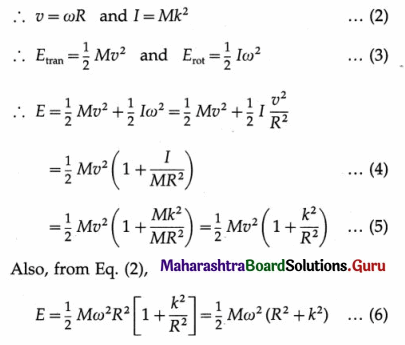
Maharashtra Board Class 12 Physics Important Questions Chapter 1 Rotational Dynamics 195
Equation (4) or (5) or (6) gives the required expression.
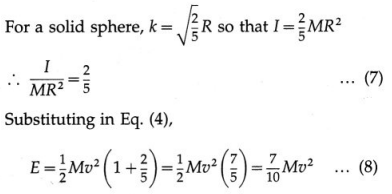
Maharashtra Board Class 12 Physics Important Questions Chapter 1 Rotational Dynamics 196

Question 117.
A uniform solid sphere of mass 10 kg rolls on a horizontal surface. If its linear speed is 2 m/s, what is its total kinetic energy?
Answer:
Total kinetic energy of the sphere
= \(\frac{7}{10}\)Mv2 = \(\frac{7}{10}\) × 10 × (2)2 = 28 J

Question 118.
A disc of mass 4 kg rolls on a horizontal surface. If its linear speed is 3 m/s, what is its total kinetic energy?
Answer:
Total kinetic energy of the disc
= \(\frac{3}{4}\)Mv2 = \(\frac{3}{4}\) × 4 × (3)2 = 27 J

Question 119.
Assuming the expression for the kinetic energy of a body rolling on a plane surface without slipping, deduce the expression for the total kinetic energy of rolling motion for
(i) a ring
(ii) a disk
(iii) a hollow sphere. Also, find the ratio of rotational kinetic energy to total kinetic energy for each body.
Answer:
For a body of mass M and radius of gyration k, rolling on a plane surface without slipping with speed v, its total KE and rotational KE are respectively
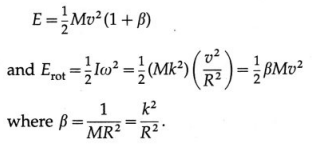
Maharashtra Board Class 12 Physics Important Questions Chapter 1 Rotational Dynamics 197
Maharashtra Board Class 12 Physics Important Questions Chapter 1 Rotational Dynamics 198

[Note : The moment of inertia of all the round bodies above can be expressed as I = βMR2, where β is a pure number less than or equal to 1. β is equal to 1 for a ring or a thin-walled hollow cylinder, \(\frac{1}{2}\) for a disc or solid cylinder, \(\frac{2}{3}\) for a hollow sphere and \(\frac{2}{5}\) for a solid sphere.
All uniform rings or hollow cylinders of the same mass and moving with the same speed have the same total kinetic energy, even if their radii are different. All discs or solid cylinders of the same mass and moving with the same speed have the same total kinetic energy; all solid spheres of the same mass and moving with the same speed have the same total kinetic energy. Also, for the same mass and speed, bodies with small c have less total kinetic energy.

Question 120.
State the expression for the speed of a circularly symmetric body rolling without slipping down an inclined plane. Hence deduce the expressions for the speed of
(i) a ring
(ii) a solid cylinder
(iii) a hollow sphere
(iv) a solid sphere, having the same radii.
Answer:
Consider a circularly symmetric body, of mass M and radius of gyration k, starting from rest on an inclined plane and rolling down without slipping. Its speed after rolling down through a height h is
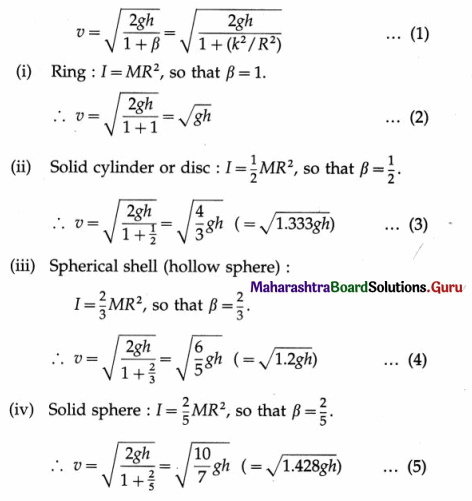
Maharashtra Board Class 12 Physics Important Questions Chapter 1 Rotational Dynamics 199

[Note : If the inclined plane is ‘smooth’, i.e., there is no friction, the bodies will slide along the plane without any rotation. They will then have only translational kinetic energy, undergo equal acceleration and all three would arrive at the bottom at the same time with the same speed.]

Question 121.
State with reason if the statement is true or false : A wheel moving down a perfectly frictionless inclined plane will undergo slipping (not rolling) motion.
Answer:
The statement is true.
Explanation : Rolling on a surface (horizontal or inclined) without slipping may be viewed as pure rotation about an horizontal axis through the point of contact, when viewed in the inertial frame of reference in which the surface is at rest. The point of contact of the wheel with the surface will be instantaneously at rest, resulting in a rolling motion, provided the wheel is able to ‘grip’ the surface, i.e., friction is necessary. With little or no friction, the wheel will slip at the point of contact. On an inclined plane, this will result in pure translation along the plane. On a horizontal surface, the wheel will simply rotate about its axis through the centre without translation.

Question 122.
A ring and a disc roll down an inclined plane through the same height. Compare their speeds at the bottom of the plane.
Answer:

Maharashtra Board Class 12 Physics Important Questions Chapter 1 Rotational Dynamics 200

Question 123.
State the expression for the acceleration of a circularly symmetric rigid body rolling without slipping down an inclined plane. Hence, deduce the acceleration of
(i) a ring
(ii) a solid cylinder
(iii) a hollow cylinder
(iv) a solid sphere, rolling without slipping down an inclined plane.
Answer:
A circularly symmetric rigid body, of radius R and radius of gyration k, on rolling down an inclined plane of inclination θ has an acceleration

Maharashtra Board Class 12 Physics Important Questions Chapter 1 Rotational Dynamics 201
Maharashtra Board Class 12 Physics Important Questions Chapter 1 Rotational Dynamics 202

Question 124.
A spherical shell rolls down a plane inclined at 30° to the horizontal. What is its acceleration ?
Answer:
The acceleration of the spherical shell,
a = \(\frac{3}{5} g \sin \theta\) = 0.6g sin 30° = 0.6g × \(\frac{1}{2}\) = 0.3g m

Question 125.
A spherical shell and a uniform solid sphere roll down the same inclined plane. Compare their accelerations.
Answer:
The ratio of the accelerations, in the usual notation,
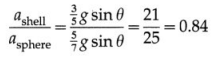
Maharashtra Board Class 12 Physics Important Questions Chapter 1 Rotational Dynamics 203

Question 126.
A solid sphere, starting from rest, rolls down two different inclined planes from the same height but with different angles of inclination θ1 > θ2. On which plane will the sphere take longer time to roll down?
Answer:
Let L1 and L2 be the distances rolled down by the sphere along the corresponding inclines from the same height h.
∴ L1 sin θ1 = L2 sin θ2 = h
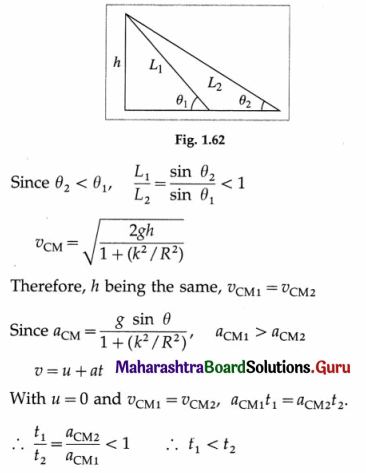
Maharashtra Board Class 12 Physics Important Questions Chapter 1 Rotational Dynamics 204
The sphere will take longer time to roll down from the same height on the plane with smaller inclination.

Question 127.
Two circular discs A and B, having the same mass, have four identical small circular discs placed on them, as shown in the diagram. They are simultaneously released from rest at the top of an inclined plane. If the discs roll down without slipping, which disc will reach the bottom first?
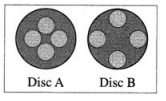
Maharashtra Board Class 12 Physics Important Questions Chapter 1 Rotational Dynamics 205
Answer:
The disc A has the smaller discs closer to the centre than disc B. Hence, the moment of inertia of disc A (IA) is less than that of disc B (IB).

[Suppose the larger discs have radius R, the smaller discs have mass m and radius r, and the centre of each smaller disc on disc A is at a distance x from the centre. Then, x = \(\sqrt{2} r\)r and, it can be shown that, IB – IA = 4m[R2 – (x – r)2] > 0.]

Each composite disc is equivalent to a disc of the same radius R and mass M’ = M + 4m, where m is the mass of each smaller disc, but of different thicknesses.

Suppose, starting from rest, the composite discs roll down the same distance L along a plane inclined at an angle θ, their respective accelerations will be
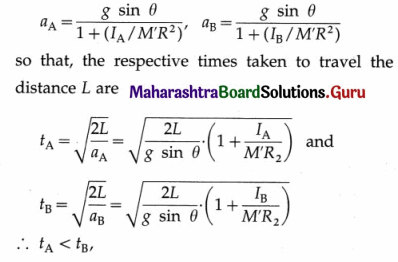
Maharashtra Board Class 12 Physics Important Questions Chapter 1 Rotational Dynamics 206
i.e., the disc A will reach the bottom first.

Question 128.
Solve the following :

Question 1.
A lawn roller of mass 80 kg, radius 0.3 m and moment of inertia 3.6 kg.m2, is drawn along a level surface at a constant speed of 1.8 m/s. Find
(i) the translational kinetic energy
(ii) the rotational kinetic energy
(iii) the total kinetic energy of the roller.
Answer:
Data : M = 80 kg, R = 0.3 m, I = 3.6 kg.m2, v = 1.8 m/s
(i) The translational kinetic energy of the centre of mass of the roller,
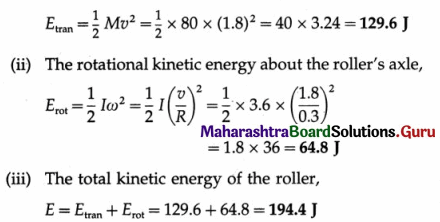
Maharashtra Board Class 12 Physics Important Questions Chapter 1 Rotational Dynamics 207

Question 2.
A solid sphere of mass 1 kg rolls on a table with linear speed 2 m/s, find its total kinetic energy.
Solution :
Data : M = 1 kg, v = 2 m/s
The total kinetic energy of a rolling body,
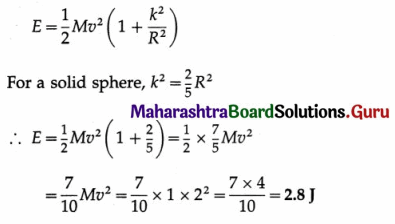
Maharashtra Board Class 12 Physics Important Questions Chapter 1 Rotational Dynamics 208

Question 3.
A ring and a disc having the same mass roll on a horizontal surface without slipping with the same linear velocity. If the total KE of the ring is 8 J, what is the total KE of the disc?
Solution :
Data : Mring = Mdisc = M, vring = vdisc = v, Ering = 8J
The total kinetic energies of rolling without slipping on a horizontal surface,
Ering = Mv2 and Edisc = \(\frac{3}{4} M v^{2}\)
since they have the same mass and linear velocity.
∴ Edisc = \(\frac{3}{4}\)Ering = \(\frac{3}{4}\) × 8 = 6J

Question 4.
A solid cylinder, of mass 2 kg and radius 0.1 m, rolls down an inclined plane of height 3 m. Calculate its rotational energy when it reaches the foot of the plane.
Solution :
Data : M = 2 kg, R = 0.1 m, h = 3 m, g = 10 m/s2
Maharashtra Board Class 12 Physics Important Questions Chapter 1 Rotational Dynamics 209

Question 5.
A solid sphere rolls up a plane inclined at 45° to the horizontal. If the speed of its centre of mass at the bottom of the plane is 5 m/s, find how far the sphere travels up the plane.
Solution :
Data : v = 5 m/s, θ = 45°, g = 9.8 m/s2
The total energy of the sphere at the bottom of the plane is
E = \(\frac{7}{10} M v^{2}\)
where M is the mass of the sphere.
In rolling up the incline through a vertical height h, it travels a distance L along the plane. Then,
Maharashtra Board Class 12 Physics Important Questions Chapter 1 Rotational Dynamics 210
The sphere travels 2.526 m up the plane.

Question 129.
Choose the correct option:

Question 1.
The bulging of the Earth at the equator and flattening at the poles is due to
(A) centripetal force
(B) centrifugal force
(C) gravitational force
(D) electrostatic force.
Answer:
(B) centrifugal force

Question 2.
A body of mass 0.4 kg is revolved in a horizontal circle of radius 5 m. If it performs 120 rpm, the centripetal force acting on it is
(A) 4π2 N
(B) 8π2 N
(C) 16π2 N
(D) 32π2 N.
Answer:
(D) 32π2 N.

Question 3.
Two particles with their masses in the ratio 2 : 3 perform uniform circular motion with orbital radii in the ratio 3 : 2. If the centripetal force acting on them is the same, the ratio of their speeds is
(A) 4 : 9
(B) 1 : 1
(C) 3 : 2
(D) 9 : 4.
Answer:
(C) 3 : 2

Question 4.
When a motorcyclist takes a circular turn on a level race track, the centripetal force is
(A) the resultant of the normal reaction and frictional force
(B) the horizontal component of the normal reaction
(C) the frictional force between the tyres and road
(D) the vertical component of the normal reaction.
Answer:
(C) the frictional force between the tyres and road

Question 5.
The maximum speed with which a car can be driven safely along a curved road of radius 17.32 m and banked at 30° with the horizontal is [g = 10 m/s2]
(A) 5 m/s
(B) 10 m/s
(C) 15 m/s
(D) 20 m/s.
Answer:
(B) 10 m/s

Question 6.
A track for a certain motor sport event is in the form of a circle and banked at an angle 6. For a car driven in a circle of radius r along the track at the optimum speed, the periodic time is
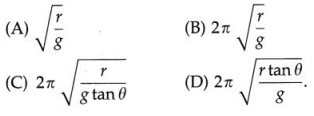
Maharashtra Board Class 12 Physics Important Questions Chapter 1 Rotational Dynamics 211
Answer:
(C) \(2 \pi \sqrt{\frac{r}{g \tan \theta}}\)

Question 7.
The period of a conical pendulum in terms of its length (l), semivertical angle (θ) and acceleration due to gravity (g), is
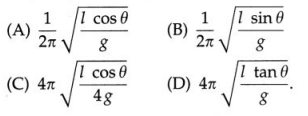
Maharashtra Board Class 12 Physics Important Questions Chapter 1 Rotational Dynamics 212
Answer:
(C) \(4 \pi \sqrt{\frac{l \cos \theta}{4 g}}\)

Question 8.
A conical pendulum of string length L and bob of mass m performs UCM along a circular path of radius r. The tension in the string is
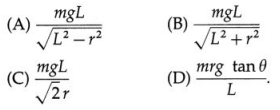
Maharashtra Board Class 12 Physics Important Questions Chapter 1 Rotational Dynamics 213
Answer:
(A) \(\frac{m g L}{\sqrt{L^{2}-r^{2}}}\)

Question 9.
The centripetal acceleration of the bob of a conical pendulum is

Maharashtra Board Class 12 Physics Important Questions Chapter 1 Rotational Dynamics 214
Answer:
(D) \(\frac{r g}{L \cos \theta}\)

Question 10.
A small object tied at the end of a string is to be whirled in a vertical circle of radius r. If its speed at the lowest point is \(2 \sqrt{g r}\), then
(A) the string will be slack at the lowest point
(B) it will not reach the midway point
(C) its speed at the highest point will be \(\sqrt{g r}\)
(D) it will just reach the highest point with zero speed.
Answer:
(D) it will just reach the highest point with zero speed.

Question 11.
A small bob of mass m is tied to a string and revolved in a vertical circle of radius r. If its speed at the highest point is \(\sqrt{3 r g}\), the tension in the string at the lowest point is
(A) 5 mg
(B) 6 mg
(C) 7 mg
(D) 8 mg.
Answer:
(D) 8 mg.

Question 12.
A small object, tied at the end of a string of length r, is launched into a vertical circle with a speed \(2 \sqrt{g r}\) at the lowest point. Its speed when the string is horizontal is
(A) > \(3 \sqrt{g r}\)
(B) = \(3 \sqrt{g r}\)
(C) = \(2 \sqrt{g r}\)
(D) 0.
Answer:
(C) = \(2 \sqrt{g r}\)

Question 13.
Two bodies with moments of inertia I1 and I2 (I1 > I2) rotate with the same angular momentum. If E1 and E2 are their rotational kinetic energies, then
(A) E2 > E1
(B) E2 = E1
(C) E2 < E1
(D) E2 ≤ E1
Answer:
(A) E2 > E1

Question 14.
The radius of gyration k for a rigid body about a given rotation axis is given by
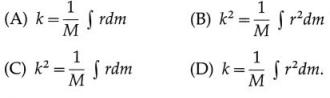
Maharashtra Board Class 12 Physics Important Questions Chapter 1 Rotational Dynamics 215
Answer:
(B) \(k^{2}=\frac{1}{M} \int r^{2} d m\)

Question 15.
Three point masses m, 2m and 3m are located at the three vertices of an equilateral triangle of side l. The moment of inertia of the system of particles about an axis perpendicular to their plane and equidistant from the vertices is
(A) 2ml2
(B) 3ml2
(C) \(2 \sqrt{3}\) ml2
(D) 6ml2
Answer:
(A) 2ml2

Question 16.
The moment of inertia of a thin uniform rod of mass M and length L, about an axis passing through a point midway between the centre and one end, and perpendicular to its length, is
(A) \(\frac{48}{7}\)ML2
(B) \(\frac{7}{48}\)ML2
(C) \(\frac{1}{48}\)ML2
(D) \(\frac{1}{16}\)ML2
Answer:
(B) \(\frac{7}{48}\)ML2

Question 17.
A thin uniform rod of mass M and length L has a small block of mass M attached at one end. The moment of inertia of the system about an axis through its CM and perpendicular to the length of the rod is
(A) \(\frac{13}{12}\) ML2
(B) \(\frac{1}{3}\) ML2
(C) \(\frac{5}{24}\) ML2
(D) \(\frac{7}{48}\) ML2
Answer:
(C) \(\frac{5}{24}\) ML2

Question 18.
A thin wire of length L and uniform linear mass density λ is bent into a circular ring. The MI of the ring about a tangential axis in its plane is

Maharashtra Board Class 12 Physics Important Questions Chapter 1 Rotational Dynamics 216
Answer:
(C) \(\frac{3 \lambda L^{3}}{8 \pi^{2}}\)

Question 19.
When a planet in its orbit changes its distance from the Sun, which of the following remains constant ?
(A) The moment of inertia of the planet about the Sun
(B) The gravitational force exerted by the Sun on the planet
(C) The planet’s speed
(D) The planet’s angular momentum about the Sun
Answer:
(D) The planet’s angular momentum about the Sun

Question 20.
If L is the angular momentum and I is the moment of inertia of a rotating body, then \(\frac{L^{2}}{2 I}\) represents its
(A) rotational PE
(B) total energy
(C) rotational KE
(D) translational KE.
Answer:
(C) rotational KE

Question 21.
A thin uniform rod of mass 3 kg and length 2 m rotates about an axis through its CM and perpendicular to its length. An external torque changes its frequency by 15 Hz in 10 s. The magnitude of the torque is
(A) 3.14 N.m
(B) 6.28 N.m
(C) 9.42 N.m
(D) 12.56 N.m.
Answer:
(C) 9.42 N.m

Question 22.
The flywheel of a motor has mass 300 kg and radius of gyration 1.5 m. The motor develops a constant torque of 2000 N.m and the flywheel starts from rest. The work done by the motor during the first 4 revolutions is
(A) 2 kJ
(B) 8 kJ
(C) 8n kJ
(D) 16π kJ.
Answer:
(D) 16π kJ.

Question 23.
Two uniform solid spheres, of the same mass but radii in the ratio R1 : R2 = 1 : 2, roll without slipping on a plane surface with the same total kinetic energy. The ratio ω1 : ω2 of their angular speed is
(A) 2 : 1
(B) \(\sqrt{2}\) : 1
(C) 1 : 1
(D) 1 : 2.
Answer:
(A) 2 : 1

Question 24.
A circularly symmetric body of radius R and radius of gyration k rolls without slipping along a flat surface. Then, the fraction of its total energy associated with rotation is [c = k2/R2]
(A) c
(B) \(\frac{c}{1+c}\)
(C) \(\frac{1}{c}\)
(D) \(\frac{1}{1+c}\)
Answer:
(B) \(\frac{c}{1+c}\)

Maharashtra Board Class 12 Physics Important Questions Chapter 2 Mechanical Properties of Fluids

Balbharti Maharashtra State Board 12th Physics Important Questions Chapter 2 Mechanical Properties of Fluids Important Questions and Answers.

Maharashtra State Board 12th Physics Important Questions Chapter 2 Mechanical Properties of Fluids

Question 1.
What is a fluid? Give two examples.
Answer:
A fluid is a substance that can flow. A fluid has shear modulus O and yield to shear. Under a shear stress and a pressure gradient, a fluid begins to flow. Liquids, gases and plasmas are collectively called fluids.

Examples : All gases, all liquids, molten glass and lava, honey, etc.

Question 2.
What is an ideal fluid?
OR
State the characteristics of an ideal fluid.
Answer:
An ideal fluid is one that has the following properties:

  1. It is incompressible, i.e., its density has a constant value throughout the fluid.
  2. Its flow is irrotational, i.e., the flow is steady or laminar. In an irrotational flow, the fluid doesn’t rotate like in a whirlpool arid the velocity of the moving fluid at a specific point doesn’t change over time. (Many fluids change from laminar to turbulent flow as the speed of the fluid increases above some specific value. This can dramatically change the properties of the fluid.)
  3. Its flow is nonviscous or inviscid, i.e., internal friction or viscosity is zero so that no energy lost due the motion of the fluid.

Maharashtra Board Class 12 Physics Important Questions Chapter 2 Mechanical Properties of Fluids

Question 3.
How does a fluid differ from a solid ?
Answer:
In response to a shear as well as normal force, a solid deforms and develops a restoring force. Within the elastic limit, both types of deformation is reversible. A solid changes its shape under a shear. A normal force causes a change in its length or volume. If the elastic limit is exceeded, the solid gets an irreversible deformation called a permanent set.

A fluid, on the other hand, can only be subjected to normal compressive stress, called pressure. A fluid does not have a definite shape, so that under a shear it begins to flow, Real fluids, with non-zero viscosity, display a weak resistance to shear.

Question 4.
State the properties of a fluid.
Answer:
Properties of a fluid :

  1. They do not resist deformation and get permanently deformed.
  2. They are capable of flowing.
  3. They take the shape of the container.

Question 5.
Define pressure. State its SI and CGS units and dimensions.
Answer:
Definition : The pressure at a point in a fluid in hydrostatic equilibrium is defined as the normal force per unit area exerted by the fluid on a surface of infinitesimal area containing the point.
Thus, the pressure, p = \(\lim _{\Delta A \rightarrow 0} \frac{F}{\Delta A}\)
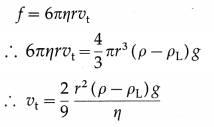
where F is the magnitude of the normal force on a surface of area ∆A. The pressure is defined to be a scalar quantity.

SI unit: the pascal (Pa), 1 Pa = 1 N∙m-2
CGS unit: the dyne per square centimetre (dyn/cm2)
Dimensions : [p] = [F][A-1] = [MLT-2, L-2]
= [ML-1 T-2]

Maharashtra Board Class 12 Physics Important Questions Chapter 2 Mechanical Properties of Fluids

Question 6.
State two non-SI units of pressure.
Answer:
Two non-SI units, which are either of historical interest, or are still used in specific fields are the bar and the torr.
1 bar = 0.1 MPa = 100 kPa = 1000 hPa = 105Pa
1 torr = (101325/760) Pa = 133.32 Pa
[Note : Their use in modern scientific and technical work is strongly discouraged.]

Question 7.
If a force of 200 N is applied perpendicular to a surface of area 10 cm2, what is the corresponding pressure ?
Answer:
Pressure, p = \(\frac{F}{A}=\frac{200 \mathrm{~N}}{10 \times 10^{-6} \mathrm{~m}^{2}}\) = 2 × 10⁷ N/m2
Question 8.
Explain why the forces acting on any surface within a fluid in hydrostatic equilibrium must be normal to the surface.
Answer:
In a fluid, the molecules are in a state of random motion and the intermolecular cohesive forces are weak. If a fluid is subjected to a tangential force (shear) anywhere within it, the layers of the fluid slide over one another, i.e., the fluid begins to flow. Thus, a fluid cannot sustain a tangential force. So, in
Maharashtra Board Class 12 Physics Important Questions Chapter 2 Mechanical Properties of Fluids 1
turn, a fluid at rest cannot exert a tangential force on any surface with which it is in contact. It can exert only a force normal to the surface. Hence, if a fluid is in hydrostatic equilibrium (i.e., at rest), the force acting on any surface within the fluid must be normal to the surface.

Question 9.
Would you rather have someone wearing studs step on your foot or have someone wearing tennis shoes step on your foot ?
Answer:
A person would exert the same downward force regardless of whether he or she was wearing studs or tennis shoes. However, if the person were wearing studs, the force would be applied over a much smaller area, so the pressure would be greater (and so would be more painful).

Question 10.
Would you rather have an elephant stand on your foot directly or have an elephant balance on a thumbtack on top of your foot?
Answer:
The downward force of the elephant’s weight would be applied over a much smaller area if it were balancing on a thumbtack, so the pressure would be greater.

Question 11.
Derive an expression for pressure exerted by a liquid column.
Answer:
At a point at depth h below the surface of a liquid of uniform density ρ, the pressure due to the liquid is due to the weight per unit area of a liquid column of height h above that point.
Maharashtra Board Class 12 Physics Important Questions Chapter 2 Mechanical Properties of Fluids 2
In above figure to find the pressure due to the liquid at point P, consider the cylindrical liquid column, of cross section A and height h, above that point.

The weight of this liquid column = volume × density × acceleration due to gravity
= (Ah)(ρ)(g)
∴ Pressure due to the liquid at depth h
= \(\frac{\text { weight of the liquid column }}{\text { cross sectional area }}\)
= \(\frac{A h \rho g}{A}\) = hpg
If the free surface of the liquid is open to the atmosphere, the pressure on the surface is the atmosphere pressure p0. Then, the absolute pressure within the liquid at a depth h is p = p0 + hρg

Maharashtra Board Class 12 Physics Important Questions Chapter 2 Mechanical Properties of Fluids

Question 12.
State the characteristics of pressure due to a liquid at rest at a point within it.
Answer:
Characteristics of pressure due to a liquid at rest at a point within it:

  1. Within a liquid of constant density, the pressure is directly proportional to the depth.
  2. At the same depth within liquids of different densities, the pressure is directly proportional to the density of the liquid.
  3. Within a liquid of constant density, the pressure at a given depth is directly proportional to the acceleration due to gravity.
  4. The pressure at a point within a given liquid is the same in all directions.
  5. The pressure at all points at the same horizontal level within a given liquid is the same.

Question 13.
How much force is exerted on one side of an 8.50 cm by 11.0 cm sheet of paper by the atmosphere? How can the paper withstand such a force ?
Answer:
Pressure p = F/A. Therefore, the force on one side is F = ρ ∙ A = (1.013 × 10⁵ Pa) (8.50 × 11.0 × 10-4 m2) = 947.2 N.
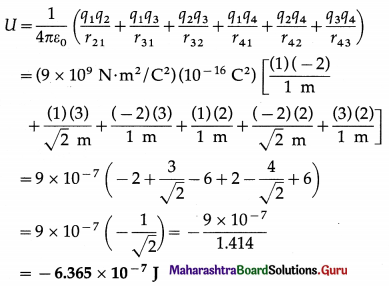
The pressure at a point within a fluid being the same in all directions, the same force acts on the other side of the paper. Thus, the net force on the paper is zero.

Question 14.
What is the pressure exerted by a water column of height 1 m?[ρ = 103 kg/m3, g = 9.8 m/s2]
Answer:
Pressure exerted by the water column = hρg
= 1 m(103 kg/m3) × (9.8 m/s2)
= 9.8 × 10³Pa

Question 15.
Would you rather breathe through a 2 m long tube to the surface in 1.5 m of water in the ocean or breathe at the beach near the ocean?
Answer:
The pressure on one’s lungs would be much greater under water than standing on the beach because the force exerted by the water on the lungs ‘ is greater than the force exerted by the air. Because the pressure of the water on the lungs is so much greater than the outward pressure of the air inside, it would be difficult to take a breath under 1.5 m of water than on the beach.

Question 16.
What is atmospheric pressure ? Define standard atmospheric pressure.
Answer:
The Earth’s surface is covered with a layer of atmosphere, with more than 99% of the atmosphere lying within 31 km of the surface. The weight of the atmosphere exerts a downward thrust on any surface lying within it. This gives rise to atmospheric pressure. The atmospheric pressure at any height above the Earth’s surface is the weight of a column of air of unit cross section from that altitude to the top of the atmosphere.

Definition : Standard atmospheric pressure, or one atmosphere of pressure, is defined as the pressure equivalent of a column of mercury that is exactly 0.7600 m in height at 0 °C.

We can calculate this equivalent pressure in SI unit by using the density of mercury
ρ = 13.6 × 10³ kg/m3 and g = 9.80 m/s2.
1 atm = (0.76 m) . (13.6 × 10³ kg/m3) . (9.80 m/s2)
= 1.013 × 10⁵ Pa = 101.3 kPa
[Note : 1000 mbar = 100 kPa. Therefore, 1 atm = 1013 mbar.]

Maharashtra Board Class 12 Physics Important Questions Chapter 2 Mechanical Properties of Fluids

Question 17.
Explain gauge pressure and absolute pressure within a liquid open to the atmosphere.
OR
Explain the effect of gravity on fluid pressure.
Answer:
Consider a cylindrical fluid column of uniform density ρ, area of cross section A and height h,
Maharashtra Board Class 12 Physics Important Questions Chapter 2 Mechanical Properties of Fluids 3
The mass of the fluid within the column is
m = density × volume
= ρAh

If p1 and p2 are the pressures at the top and bottom faces of the column, the forces on the top and bottom faces are respectively.
F1 = p1A + mg (downward)
and F2 = p2A (upward)
If the column is in equilibrium,
F2 = F1
∴ p2A = p1A + mg = p1A + ρAhg
∴ P2 ~ P1 = ρhg
If p1 = p0 = atmospheric pressure, the gauge pressure
P2 – P0 = ρhg

In the absence of gravity, p2 = p0 But since atmospheric pressure is equal to the weight per unit area of the entire air column above, even p0 will be zero in the absence of gravity.

Question 18.
Define gauge pressure.
When is gauge pressure (i) positive (ii) negative ?
Give two examples where gauge pressure is more relevant.
Answer:
Definition : Gauge pressure is the pressure exerted by a fluid relative to the local atmospheric pressure.

Gauge pressure, pg = p – p0

where p is the absolute pressure and p0 is the local atmospheric pressure.

When the pressure inside a closed container or tank is greater than atmospheric pressure, the pressure reading on a pressure gauge is positive. The pressure inside a ‘vacuum chamber’-a rigid chamber from which some of the air is pumped out-is less than the atmospheric pressure, so a pressure gauge on the chamber designed to measure negative pressure reads a negative value.

At a depth within a liquid of density ρ, the gauge pressure is pg = p – p0 = hpg

Examples : Tyre pressure gauge, blood pressure gauge, pressure gauge on an oxygen or scuba tank.

Question 19.
Define absolute pressure.
Answer:
Definition : The absolute pressure, or total press-ure, is measured relative to absolute zero on the pressure scale-which is a perfect vacuum-and is the sum of gauge pressure and atmospheric press-ure. It is the same as the thermodynamic pressure.

Absolute pressure accounts for the atmospheric pressure, which in effect adds to the pressure in any fluid which is not enclosed in a rigid container i.e., the fluid is open to the atmosphere.
p = p0 + Pg
where p0 and pg are respectively atmospheric pressure and the gauge pressure.

Absolute pressure can be never negative.

Question 20.
If your tyre gauge reads 2.31 atm (234.4 kPa), what is the absolute pressure ?
Answer:
The absolute pressure, p = p0 + pg = 1 atm + 2.31 atm = 3.31 atm (≅ 335 kPa).

Maharashtra Board Class 12 Physics Important Questions Chapter 2 Mechanical Properties of Fluids

Question 21.
State and explain the hydrostatic paradox. OR Explain hydrostatic paradox.
Answer:
Hydrostatic paradox : The normal force exerted by a liquid at rest on the bottom of the containing vessel is independent of the amount of liquid or the shape of the container, but depends only on the area of the base and its depth from the liquid surface.

Consider several vessels of the same base area as shown in figure (a). A liquid is poured into them to the same level, so that the pressure is the same at the bottom of each vessel. Then it must follow that the normal force on the base of each vessel is also the same. However, when placed on a scale balance they are found to have different weights. Herein lies the paradox.
Maharashtra Board Class 12 Physics Important Questions Chapter 2 Mechanical Properties of Fluids 4
Explanation : Since a liquid always exerts a normal force on a wall of the container, in turn, the wall exerts an equal and opposite reaction on the liquid. In the case of tube A, this reaction is everywhere horizontal; so that the normal force at the base of A is only due to the weight of the liquid column above.

The reaction of the slanted wall of vessel C has a – vertical component, as shown in figure (b), which supports the weight of the liquid above the slanted side. Hence, the normal force at the base of C is only due to the weight of the vertical liquid column above the base, shown by dashed lines. Since the vessels A and C are filled to the same height and have the same base area, the pressures at the bases of the two vessels are also same. However, the volume of the liquid being clearly different, they have different weights.

In the case of vessel B, the downward vertical component of the reaction of the wall provides an extra normal force at the base, as shown in figure (c).

Question 22.
Can pressure in a fluid be increased by pushing directly on the fluid ? Give an example.
Answer:
Yes, but it is much easier if the fluid is enclosed.

Examples : (1) The heart increases the blood pressure by pushing on the blood in an enclosed ventricle.
(2) Hydraulic brakes, lifts and cranes operate by pushing on oil in an enclosed system.

Question 23.
State Pascal’s law.
Answer:
Pascal’s law : A change in the pressure applied to an enclosed fluid at rest is transmitted un-diminished to every point of the fluid and to the walls of the container, provided the effect of gravity can be ignored.

[Note : The law does not say that ‘the pressure is the same at all points of a fluid’ – rightly so, since the pressure in a fluid near Earth varies with height. Rather, the law applies to the change in pressure. According to Pascal’s law, if the pressure on an enclosed static fluid is changed by a certain amount, the pressure at all points within the fluid changes by the same amount.

The above law is due to Blaise Pascal (1623 – 62), French mathematician and physicist.]

Question 24.
Describe an experimental proof of Pascal’s law.
Answer:
Consider a spherical vessel having four cylindrical tubes A, B, C and D each fitted with air-tight
Maharashtra Board Class 12 Physics Important Questions Chapter 2 Mechanical Properties of Fluids 5
frictionless pistons of areas of cross section A, A/2, 2A and 3A, respectively, as shown in above figure. The vessel is filled with an incompressible liquid such that there is no air between the liquid and the pistons.

If the piston A is pushed with a force F, the pressure on the piston and the liquid in the vessel is pA = F/A. It is seen that the other three pistons are pushed outwards. To keep these pistons at their respective original positions, forces of F/2, IF and 3F, respectively are required to be applied on pistons B, C and D respectively to hold them. Then, the pressures on the respective pistons are
pB = \(\frac{F / 2}{A / 2}\) = F/A, pC = 2F/2A = F/A, and
pD = 3F/3A = F/A
∴ pA = pB = pC = pD = F/A

This indicates that the pressure applied is trans-mitted equally to all parts of liquid. This proves Pascal law.

Maharashtra Board Class 12 Physics Important Questions Chapter 2 Mechanical Properties of Fluids

Question 25.
Explain the principle of multiplication of thrust.
Answer:
Principle of multiplication of thrust by transmission of fluid pressure : The normal force exerted by a fluid on any surface in contact with it is called the thrust. Consider two hydraulically connected cylinders, one of cross section a and the other A, as in figure. If a force Fa is exerted on the smaller piston, pressure p = \(\frac{F_{\mathrm{a}}}{a}\) is produced and transmitted undiminished throughout the liquid. Then, the thrust FA on the larger piston is
FA = pA = \(\frac{A}{a}\) Fa
If A = na, FA = nFa, i.e., the thrust on the larger piston is multiplied n times. This is known as the principle of multiplication of thrust by transmission of fluid pressure.

Question 26.
State any two applications of Pascal’s law.
Briefly explain their working.
Ans.
Applications of Pascal’s law :

  1. Hydraulic car lift and hydraulic press
  2. Hydraulic brakes.

All the above applications work on the principle of multiplication of thrust by transmission of fluid pressure.

(1) Working of a hydraulic lift : Two hydraulically connected cylinders, one of cross section a and the other A, are such that A is many times larger than a : A = na. If a force Fa is exerted on the smaller piston, a pressure p = \(\frac{F_{\mathrm{a}}}{a}\) is produced and transmitted undiminished throughout the liquid. Then, the thrust FA on the larger piston
FA = pA = \(\frac{A}{a}\) Fa = nFa
is n times greater than that on the smaller piston. A platform attached to the larger piston can lift a car (as in a hydraulic car lift), or press bales of cotton or paper against a fixed rigid frame (as in Brahma’s.)
Maharashtra Board Class 12 Physics Important Questions Chapter 2 Mechanical Properties of Fluids 6

(2) Working of hydraulic brakes in a car: Brakes which are operated by means of hydraulic pressure are called hydraulic brakes. An automobile hydraulic brake system, shown schematically in below figure, has fluid-filled master and slave cylinders connected by pipes. When the brake pedal is pushed, it depresses the piston of the pedal or master cylinder through a lever. The change in pressure in the master cylinder is transmitted to the four wheel or slave cylinders. Since the brake fluid is incompressible, the pistons of the slave cylinders are pushed out, pressing braking pads onto the braking discs on the wheels. Note that we can add as many wheel cylinders as we wish.

The master cylinder has a much smaller area of cross section Am compared to the combined area As
Maharashtra Board Class 12 Physics Important Questions Chapter 2 Mechanical Properties of Fluids 7
of the slave cylinders. Hence, with a small force Fm on the master cylinder, a force Fs = \(\frac{A_{\mathrm{s}}}{A_{\mathrm{m}}}\) Fm which is greater than Fm is applied on each slave cylinder. Consequently, the master piston has to travel sev-eral inches to move the slave pistons the fraction of an inch it takes to apply the brakes. But the arrangement allows great force to be exerted at the brake pads.

[Note : (1) Pascal’s law laid the foundation for hydraulics, the use of a liquid under pressure to transfer force or motion, or to increase an applied force. It is one of the most important branches in modern engineering. (2) A hydraulic system, as an example of a simple machine, can increase force but cannot do more work than is done on it. Work being force times the distance moved, the piston in a wheel cylinder moves through a smaller distance than that in the pedal cylinder. Power brakes in modern automobiles have a motorized pump that does most of the work in the system.]

Question 27.
Why are liquids used in hydraulic systems but not gases?
Answer:
Liquids are used in a hydraulic system because liquids are incompressible and transmit a change in pressure undiminished to all parts of the system. On the other hand, on increasing the pressure, a gas will be compressed into a smaller volume due to which there will be no transmission of force or motion.

Question 28.
State one advantage of hydraulic brakes in an automobile.
Answer:
Advantages of

  1. By Pascal’s law, equal braking effort is applied to all the wheels.
  2. It is easily possible to increase or decrease the applied force-during the design stage-by changing the size of piston and cylinder relative to other.

Question 29.
What is a barometer? Explain the use of a simple mercury barometer to measure atmospheric pressure.
Answer:
A barometer is an instrument to measure atmospheric pressure. The mercury barometer was in-vented by Evangelista Torricelli (1609-47). Italian physicist and mathematician.
Maharashtra Board Class 12 Physics Important Questions Chapter 2 Mechanical Properties of Fluids 8
A strong glass tube, about one metre long and closed at one end, is filled with mercury. With a finger over the open end, the tube is inverted and the open end is immersed into a bowl of mercury. When the finger is removed, the mercury level in the tube drops. The mercury column in the tube stands at a height h for which the pressure at point A inside the tube due to the weight of the mercury column is equal to the atmospheric pressure p0 outside (at point B).

The space at the closed end of the tube, after the mercury level drops, is nearly a vacuum, known as the Torricellian vacuum, so the pressure there can be taken as zero. It, therefore, follows that p0 = pgh Where p is the density of mercury and h is the height of the mercury column.

Maharashtra Board Class 12 Physics Important Questions Chapter 2 Mechanical Properties of Fluids

Question 30.
What is an open tube manometer? Briefly describe its function with a neat diagram.
Answer:
An open tube manometer is a device to measure the pressure of a gas in a vessel. It consists of a U-shaped tube containing a liquid (say, mercury) of density p, as shown in below figure.

One end of the tube is connected to the vessel while the other end is open to the atmosphere. The pressure p at point A is the (unknown) pressure of the gas in the vessel. The pressure on the mercury column in the open tube is the atmospheric pressure p0.
Maharashtra Board Class 12 Physics Important Questions Chapter 2 Mechanical Properties of Fluids 9
A point B, at the same horizontal level as A, is at a depth h from the surface of mercury in the open tube. Therefore, the pressure at B is p0 + ρgh.

The pressures at points A and B at the same liquid level being the same, equating the unknown pressure p (at A) to the pressure at B.
p = p0 + ρgh
The pressure p is called the absolute pressure, and the difference in pressure p – p0 is called the gauge pressure.

Question 31.
An open tube manometer is connected to (i) a vacuum-packed candy jar, with the atmospheric pressure in the open tube supporting a column of fluid of height h (ii) a gas tank, with the absolute pressure in the tank supporting a column of fluid of height h. Is the absolute pressure in the jar and the gas tank greater than or less than the atmospheric pressure ? By how much ?
Answer:
In the first case, pabs is less than the atmospheric pressure, whereas in the second case, pabs is greater than the atmospheric pressure. In both cases, pabs differs from the atmospheric pressure by the gauge pressure hρg, where ρ is the density of the fluid in the manometer.
Maharashtra Board Class 12 Physics Important Questions Chapter 2 Mechanical Properties of Fluids 10

32. Solve the following

Question 1.
For diver’s safety, a 10 m platform diving pool should be 5 m deep. However, with an excellent dive, a diver usually reaches a maximum depth of 2.5 m.
(i) Calculate the pressure due to the weight of the water at the depth of 2.5 m.
(ii) Calculate the depth below the surface of water at which the pressure due to the weight of the water equals 1.0 atm. [Density of water = 103 kg/m3, 1 atm = 101.3 kPa]
Solution:
Data : h = 250 m, ρ = 1000 kg/m3, g = 9.8 m/s2, 1 atm = 101.3 kPa
(i) ρ = hpg = (250)(1000)(9.8) = 2.45 mPa
= \(\frac{2.45 \times 10^{6}}{1.013 \times 10^{5}}\) = 24.18 atm
This gives the pressure at a depth of 250 m.

(ii) h = \(\frac{p}{\rho g}=\frac{1.013 \times 10^{5}}{10^{3} \times 9.8}\) = 10.34 m
This gives the required depth.

Question 2.
Suppose a dam is 250 m wide and the water is 40 m deep at the dam. What is
(i) the average pressure on the dam
(ii) the force exerted against the dam due to the water?
Solution :
Data : Width, L = 250 m, depth H = 40 m, ρ = 1000 kg/m3, g = 9.8 m/s2
Since pressure increases linearly with depth, the average pressure pav due to the weight of the water is the pressure at the average depth h of 20 m. The force exerted on the dam by the water is the average pressure times the area of contact, F = pav A = pav LH.
(i) p av = hρg = (20)(1000)(9.8) = 1.96 × 10⁵Pa
(ii) F = pavA = pavLH = (1.96 × 10⁵)(250)(40)
= 1.96 × 10⁵ N

Maharashtra Board Class 12 Physics Important Questions Chapter 2 Mechanical Properties of Fluids

Question 3.
A car lift at a service station has a piston of diameter 30 cm. The lift and piston weigh 800 kg wt. What pressure (in excess of the atmospheric pressure) must be exerted on the piston to raise a car weighing 1700 kg wt at a constant speed? [g = 9.8 m/s2]
Solution:
Data : Piston diameter, D = 30 cm = 0.3 m. mass of lift and piston, m = 800 kg, mass of car, M = 1700 kg
Cross-sectional area of the piston.
A = \(\frac{\pi D^{2}}{4}=\frac{3.142(0.3 \mathrm{~m})^{2}}{4}\) = 7.07 × 10⁻² m 2
Total weight of the car and lift,
W = (m + M)g
= (800 kg + 1700 kg) (9.8 m/s2)
= 2.45 × 10⁴ N
Therefore, the pressure on the piston
p = \(\frac{F}{A}=\frac{W}{A}=\frac{2.45 \times 10^{4} \mathrm{~N}}{7.07 \times 10^{-2} \mathrm{~m}^{2}}\)
= 3.465 × 10⁵ Pa
A pressure of 3.465 × 10⁵ Pa must be exerted on the piston.

Question 4.
The diameters of two pistons in a hydraulic press are 5 cm and 25 cm respectively. A force of 20 N is applied to the smaller piston. Find the force exerted on the larger piston.
Solution:
Data : D1 = 5 cm, D2 = 25 cm, F1 = 20 N
By Pascal’s law,
Maharashtra Board Class 12 Physics Important Questions Chapter 2 Mechanical Properties of Fluids 11

Question 5.
In a hydraulic lift, the input piston has surface area 20 cm2. The output piston has surface area 1000 cm2. If a force of 50 N is applied to the input piston, it raises the output piston by 2 m. Calculate the weight of the support on the output piston and the work done by it.
Solution:
Data : A1 = 20 cm2 = 2 × 10⁻³ m2,
A2 = 1000 cm2 = 10-1 m2, F1 = 50 N, s2 = 2m
(i) By Pascal’s law,
Maharashtra Board Class 12 Physics Important Questions Chapter 2 Mechanical Properties of Fluids 12
This gives the weight of the support on the output piston.

(ii) The work done by the force transmitted to the output piston is
F2S2 = (2500 N) (2 m)
= 5000 J

Question 6.
A driver pushes the brake pedal of a car exerting a force of 100 N that is increased by the simple lever to a force of 500 N on the pedal (master) cylinder. The hydraulic system transmits this force to the four wheel (slave) cylinders. If the pedal cylinder has a diameter of 0.5 cm and each wheel cylinder has a diameter of 2.5 cm, calculate the magnitude of the force Fs on each of the wheel cylinder.
Solution:
Data : Fm = 500 N, Dm = 1 cm, Ds = 2.5 cm
\(\frac{F_{\mathrm{s}}}{A_{\mathrm{s}}}=\frac{F_{\mathrm{m}}}{A_{\mathrm{m}}}\)
∴ The magnitude of the force on each of the wheel cylinders,
Fs = \(\frac{A_{\mathrm{s}}}{A_{\mathrm{m}}}\) Fm = (\(\frac{D_{\mathrm{s}}}{D_{\mathrm{m}}}\))2 Fm = (\(\frac{2.5}{0.5}\))2 (500)
= 25 × 500 = 12.5 kN

Question 7.
Mercury manometers are often used to measure arterial blood pressure. The typical blood pressure of a young adult raises the mercury to a height of 120 mm at systolic and 80 mm at diastolic. Express these values in pascal and bar. [Density of mercury = 13600 kg/m3, 1 mbar = 100 Pa]
Solution:
Data : pmax = psyst = 120 mm of Hg, pmin = pdias = 80 mm of Hg, ρ = 13600 kg/m3, g = 9.8 m/s2, 1 mbar = 100 Pa
p = hρg
∴ psyst = (0.120)(1.36 × 10⁴)(9.8)
= 1.6 × 10⁴ Pa = 16 kPa
= 1600 mbar = 1.5 bar

and Pdias = (0.08)(1.36 × 10⁴)(9.8)
= 1.066 × 10⁴ Pa = 10.66 kPa
= 1066 mbar = 1.066 bar

Maharashtra Board Class 12 Physics Important Questions Chapter 2 Mechanical Properties of Fluids

Question 33.
Describe the phenomenon of surface tension, giving four examples.
Answer:
Surface tension is a unique property of liquids that arises because the net intermolecular force of attraction on the liquid molecules at or near a liquid surface differs from that on molecules deep in the interior of the liquid. This results in the tendency of the free surface of a liquid to minimize its surface area and behave somewhat like a stressed elastic membrane.

Surface tension is important in understanding the peculiar behaviour of the free surface of a liquid in many cases as illustrated below :

  1. Small quantities of liquids assume the form of spherical droplets, as in mist, or a mercury droplet on a flat surface. This is because the stressed surface ‘skin’ tends to contract and mould the liquid into a shape that has minimum surface area for its volume, i.e., into a sphere.
  2. Surface tension is responsible for the spherical shape of freely-falling raindrops and the behaviour of bubbles and soap films.
  3. The bristles of a paint brush cling together when it is drawn out of water or paint.
  4. A steel needle or a razor blade can, with care, be supported on a still surface of water which is much less dense than the metal from which these objects are made of.
  5. Many insects like ants, mosquitoes, water striders, etc., can walk on the surface of water.

Question 34.
Define (1) cohesive force (2) adhesive force.
Give one example in each case.
Answer:
(1) Cohesive force : The intermolecular force of attraction between two molecules of the same material is called the cohesive force.
Example : The force of attraction between two water molecules.

(2) Adhesive force : The intermolecular force of attraction between two molecules of different materials is called the adhesive force.
Example : The force of attraction between a water molecule and a molecule of the solid surface which is in contact with water.

Question 35.
Define (1) range of molecular attraction or molecular range (2) sphere of influence.
Answer:
1) Range of molecular attraction or molecular range : Range of molecular aftraction or molecular range is defined as the maximum distance between two molecules up to which the intermolecular force of attraction is appreciable.

[Note : The intermolecular force is a short range force, LeV, it is effective over a very short range-about 10-9 m. Beyond this distance, the force is negligible. The inter molecular force does not obey inverse square law.]

2) Sphere of influence : The sphere of influence of a molecule is defined as an imaginary sphere with the molecule as the centre and radius equal to the range of molecular attraction.

[Note : All molecules lying within the sphere of influence of a molecule are attracted by (as well as attract) the molecule at the centre. For molecules which lie outside this sphere, the intermolecular force due to the molecule at the centre is negligible.]

Question 36.
What is meant by a surface film?
Answer:
The layer of the liquid surface of thickness equal to the range of molecular attraction is called a surface film.

Question 37.
What is meant by free surface of a liquid ?
Answer:
The surface of a liquid open to the atmosphere is called the free surface of the liquid.

Maharashtra Board Class 12 Physics Important Questions Chapter 2 Mechanical Properties of Fluids

Question 38.
Explain the phenomenon of surface tension on the basis of molecular theory.
Answer:
The phenomenon of surface tension arises due to the cohesive forces between the molecules of a liquid. The net cohesive force on the liquid molecules within the surface film differs from that on molecules deep in the interior of the liquid.

Consider three molecules of a liquid : A molecule A well inside the liquid, and molecules B and C lying within the surface film, shown in figure. The figure also shows their spheres of influence of radius R.
Maharashtra Board Class 12 Physics Important Questions Chapter 2 Mechanical Properties of Fluids 13
(1) The sphere of influence of molecule A is entirely inside the liquid and the molecule is surrounded by its nearest neighbours on all sides. Hence, molecule A is equally attracted from all sides, so that the resultant cohesive force acting on it is zero. Hence, it is free to move anywhere within the liquid.

(2) For molecule B, a part of its sphere of influence is outside the liquid surface. This part contains air molecules whose number is negligible compared to the number of molecules in an equal volume of the liquid. Therefore, molecule B experiences a net cohesive force downward.

(3) For molecule C, the upper half of its sphere of influence is outside the liquid surface. Therefore, the resultant cohesive force on molecule C in the
downward direction is maximum.

(4) Thus, all molecules lying within a surface film of thickness equal to R experience a net cohesive force directed into the liquid.

(5) The surface area is proportional to the number of molecules on the surface. To increase the surface area, molecules must be brought to the surface from within the liquid. For this, work must be done against the cohesive forces. This work is stored in the liquid surface in the form of potential energy. With a tendency to have minimum potential energy, the liquid tries to reduce the number of molecules on the surface so as to have minimum surface area. This is why the surface of a liquid behaves like a stressed elastic membrane.

Question 39.
Define surface tension.
State its formula and CGS and SI units.
Answer:
The surface tension of a liquid is defined as the tangential force per unit length, acting at right angles on either side of an imaginary line on the free surface of the liquid.

If F is the force on one side of a line of length Z, drawn on the free surface of a liquid, the surface tension (T) of the liquid is
Maharashtra Board Class 12 Physics Important Questions Chapter 2 Mechanical Properties of Fluids 14
The CGS unit of surface tension : The dyne per centimetre (dyn/cm) or, equivalently, the erg per square centimetre (erg/cm2).

The SI unit of surface tension : The newton per metre (N/m) or, equivalently, the joule per square metre (J/m2).

Question 40.
Obtain the dimensions of surface tension.
Answer:
Surface tension is a force per unit length.
Maharashtra Board Class 12 Physics Important Questions Chapter 2 Mechanical Properties of Fluids 15

Question 41.
Define and explain surface energy of a liquid.
OR
Define surface energy.
OR
State its dimensions and SI unit.
OR
Why do molecules of a liquid in the surface film possess extra energy?
Answer:
Surface energy : The surface energy is defined as the extra (or increased) potential energy possessed by the molecules in a liquid surface with an isothermal increase in the surface area of the liquid.

A liquid exerts a resultant cohesive force on every molecule of its surface, trying to pull it into the liquid. To increase the surface area, it is necessary to bring more molecules from inside the liquid to the liquid surface. For this, external work must be done against the net cohesive forces on the molecules. This work is stored in the liquid surface in the form of potential energy.

This extra potential energy that the molecules in the liquid surface have is called the surface energy. Thus, the molecules of a liquid in the surface film possess extra energy.
Dimensions : [surface energy] = [ML2T-2]
SI unit: the joule (J).

Question 42.
Why is the surface tension of paints and lubricating oils kept low?
Answer:
For better wettability (surface coverage), the surface tension and angle of contact of paints and lubricating oils must be low.

Maharashtra Board Class 12 Physics Important Questions Chapter 2 Mechanical Properties of Fluids

Question 43.
Derive the relation between the surface tension and surface energy of a liquid.
OR
Derive the relation between surface tension and surface energy per unit area.
OR
Show that the surface tension of a liquid is numerically equal to the surface energy per unit area.
Answer:
Suppose a soap film is isothermally stretched over the area enclosed by a U-shaped frame ABCD and a w cross-piece PQ that can slide smoothly along the frame, as shown in the figure. Let T be the surface tension of the soap solution and l, the length of wire PQ in contact with the soap film.
Maharashtra Board Class 12 Physics Important Questions Chapter 2 Mechanical Properties of Fluids 16
The film has two surfaces, both of which are in contact with the wire. The film tends to contract by exerting a force on wire PQ. As each surface exerts a force Tl, the net force on the wire is 2Tl.

Suppose that wire PQ is pulled outward very slowly through a distance dx to the position P’Q’ by an external force of magnitude 2T l. The work done by the external force against the force due to the film is
W = applied force × displacement
∴ W = Fdx = ITldx (∵ F = 2Tl)
This work is stored in the unit surface area in the form of potential energy. This potential energy is called the surface energy.

Due to the displacement dx, the surface area of the film increases. As the film has two surfaces, the increase in its surface area is
A = 2ldx
Thus, the work done per unit surface area is
\(\frac{W}{A}=\frac{2 T l d x}{2 l d x}\) = T
Thus, the surface energy per unit area of a liquid is equal to its surface tension.

Question 44.
Two soap bubbles of the same soap solution have diameters in the ratio 1 : 2. What is the ratio of work done to blow these bubbles ?
Answer:
Work done oc surface area.
∴ W1/W2 = (r1/r2)2 = (\(\frac{1}{2}\))2 = \(\frac{1}{4}\)
∴ W1 : W1 = 1 : 4.

Question 45.
If the surface tension of a liquid is 70 dyn/cm, what is the total energy of the free surface of the liquid drop of radius 0.1 cm ?
Answer:
E = 4πr2T = 4 × \(\frac{22}{7}\) × (0.1)2 × 70
= 88 × 10-2 × 10 = 8.8 ergs

Question 46.
The total energy of the free surface of a liquid drop of radius 1 mm is 10 ergs. What is the total energy of a liquid drop (of the same liquid) of radius 2 mm ?
Answer:
E = 4πr2T ∴ \(\frac{E_{2}}{E_{1}}=\left(\frac{r_{2}}{r_{1}}\right)^{2}=\left(\frac{2}{1}\right)^{2}\) = 4
∴ E2 = 4E1 = 4 × 10 = 40 ergs is the required

47. Solve the following

Question 1.
Calculate the work done in blowing a soap bubble of radius 4 cm. The surface tension of the soap solution is 25 × 10-3 N/m.
Solution:
Data : r = 4 cm = 4 × 10⁻² m, T = 25 × 10-3 N/m
Initial surface area of soap bubble = 0
Final surface area of soap bubble = 2 × 4πr2
Increase in surface area = 2 × 4πr2 The work done
= surface tension x increase in surface area
= T × 2 × 4πr2
= 25 × 10-3 × 2 × 4 × 3.142 × (4 × 10-2)2
= 1.005 × 10⁻³ J

Maharashtra Board Class 12 Physics Important Questions Chapter 2 Mechanical Properties of Fluids

Question 2.
Two soap bubbles have radii in the ratio 4 : 3. What is the ratio of work done to blow these bubbles?
Solution:
Data : \(\frac{r_{1}}{r_{2}}=\frac{4}{3}\)
Work done, W = 2TdA
∴ W1 = 2T(4πr12), W2 = 2T(4πr22)
∴\(\frac{W_{1}}{W_{2}}=\frac{2 T\left(4 \pi r_{1}^{2}\right)}{2 T\left(4 \pi r_{2}^{2}\right)}=\left(\frac{r_{1}}{r_{2}}\right)^{2}\)
= (\(\frac{4}{3}\))2 = \(\frac{16}{9}\)

Question 3.
Calculate the work done in increasing the radius of a soap bubble in air from 1 cm to 2 cm. The surface tension of the soap solution is 30 dyn/cm.
Solution:
Data : r1 = 1 cm, r2 = 2 cm, T = 30 dyn/cm
Initial surface area = 2 × 4πr12
Final surface area = 2 × 4πr22
∴ Increase in surface area
= 2 × 4πr22 – 2 × 4πr12 = 8π(r22 – r12)
∴ The work done
= surface tension × increase in surface area
= T × 8π(r22 – r12)
= 30 × 8 × 3.142 × [(2)2 – (1)2]
= 2262 ergs

Question 4.
A mercury drop of radius 0.5 cm falls from a height on a glass plate and breaks into one million droplets, all of the same size. Find the height from which the drop fell. [Density of mercury = 13600 kg/m3, surface tension of mercury = 0.465 N/m]
Solution:
Data : R = 0.5 cm = 0.5 × 10⁻² m, n = 106, ρ = 13600 kg m3, T = 0.465 N/m, g = 9.8 m/s2
\(\frac{4}{3}\) πR3 = n × \(\frac{4}{3}\) πr3
as the volume of the mercury remains the same.
∴ r = \(\frac{R}{\sqrt[3]{n}}=\frac{0.5 \times 10^{-2}}{\sqrt[3]{10^{6}}}\) = 0.5 × 10⁻⁴ m
This gives the radius of a droplet.
By energy conservation, if h is the height from which the drop of mass m falls,
Maharashtra Board Class 12 Physics Important Questions Chapter 2 Mechanical Properties of Fluids 17
This gives the required height.

Question 5.
Eight droplets of mercury, each of radius 1 mm, coalesce to form a single drop. Find the change in the surface energy. [Surface tension of mercury = 0.472 J/m2]
Solution:
Data : r = 1 mm = 1 × 10⁻³ m, T = 0.472 J/m2
Let R be the radius of the single drop formed due to the coalescence of 8 droplets of mercury.
Volume of 8 droplets = volume of the single drop as the volume of the liquid remains constant.
∴ 8 × \(\frac{4}{3}\) πr3 = \(\frac{4}{3}\) πR3
∴ 8r3 = R3
∴ 2r = R
Surface area of 8 droplets = 8 × 4πr2
Surface area of single drop = 4πR2
∴ Decrease in surface area = 8 × 4πr2 – 4πR2
= 4π(8r2 – R2)
= 4π[8r2 – (2r)2]
= 4π × 4r2
∴ The energy released
= surface tension × decrease in surface area
= T × 4π × 4r2
= 0.472 × 4 × 3.142 × 4 × (1 × 10-3)2
= 2.373 × 10⁻⁵ J

Question 6.
The total energy of the free surface of a liquid drop is 2 × 10⁻⁴ π times the surface tension of the liquid. What is the diameter of the drop ? (Assume all terms in SI unit.)
Solution:
Data : 4πr2T = 2 × 10⁻⁴ πT (numerically)
∴ 2r2 = 10-4
∴ r = \(\frac{10^{-2}}{\sqrt{2}}=\frac{10^{-2}}{1 \cdot 414}\)
= 0.7072 × 10⁻² m
∴ d = 2r = 2 × 0.7072 × 10-2
= 1.4144 × 10⁻² m
This gives the diameter of the liquid drop.

Maharashtra Board Class 12 Physics Important Questions Chapter 2 Mechanical Properties of Fluids

Question 48.
Define angle of contact.
Answer:
The angle of contact for a liquid-solid pair (a liquid in contact with a solid) is defined as the angle between the surface of the solid and the tangent drawn to the free surface of the liquid at the extreme edge of the liquid, as measured through the liquid.

Question 49.
Draw neat diagrams to show the angle of contact in the case of a liquid which
(i) completely wets
(ii) partially wets
(iii) does not wet the solid. State the characteristics of the angle of contact in each case, giving one example of each.
Answer:
Characteristics :
(1) For a liquid, which completely wets the solid, the angle of contact is zero.
For example, pure water completely wets clean glass. Therefore, the angle of contact at the water glass interface is zero [from figure (a)].
Maharashtra Board Class 12 Physics Important Questions Chapter 2 Mechanical Properties of Fluids 18
(2) For a liquid which partially wets the solid, the angle of contact is an acute angle. For example, kerosine partially wets glass, so that the angle of contact is an acute angle at the kerosine glass interface [from figure (b)].
(3) For a liquid which does not wet the solid, the angle of contact is an obtuse angle. For example, mercury does not wet glass at all, so that the angle of contact is an obtuse angle at the mercury-glass interface [from figure (c)].
(4) The angle of contact for a given liquid solid pair is constant at a given temperature, provided the liquid is pure and the surface of the solid is clean.

Question 50.
State any two characteristics of angle of contact.
Answer:
Characteristics of angle of contact:

  1. It depends upon the nature of the liquid and solid in contact, and is constant for a given liquid-solid pair, other factors remaining unchanged.
  2. It depends upon the medium (gas) above the free surface of the liquid.
  3. It is independent of the inclination of the solid to the liquid surface.
  4. It changes with surface tension and, hence, with the temperature and purity of the liquid.

Question 51.
Explain why the free surface of some liquids in contact with a solid is not horizontal.
OR
Explain the formation of concave and covex surface of a liquid on the basis of molecular theory.
Answer:
For a molecule in the liquid surface which is in contact with a solid, the forces on it are largely the solid-liquid adhesive force \(\vec{F}_{\mathrm{A}}=\overrightarrow{P A}\) and the liquid- liquid cohesive force \(\vec{F}_{\mathrm{C}}=\overrightarrow{P C} \vec{F}_{A}\) is normal to the solid surface and \(\vec{F}_{\mathrm{C}}\) is at 45° with the horizontal, from figure (a). The free surface of a liquid at rest is always perpendicular to the resultant \(\vec{F}_{\mathrm{R}}=\overrightarrow{P R}\) of these forces.
Maharashtra Board Class 12 Physics Important Questions Chapter 2 Mechanical Properties of Fluids 19
If FC = \(\sqrt{2} F_{\mathrm{A}}, \vec{F}_{\mathrm{R}}\) is along the solid surface, the contact angle is 90° and the liquid surface is horizontal at the edge where it meets the solid, as in figure (a). In general this is not so, and the liquid surface is not horizontal at the edge.

For a liquid which completely wets the solid (e.g., pure water in contact with clean glass), FC << FA. For a liquid which partially wets the solid (e.g., kerosine . or impure water in contact with glass), FC < \(\sqrt{2} F_{\mathrm{A}}\). If FC << FA or if FC < \(\sqrt{2} F_{\mathrm{A}}\), the contact angle is correspondingly zero or acute and the liquid surface curves up and acquires a concave shape until the tangent PT is tangent to \(\vec{F}_{\mathrm{R}}\) fron figure (b).

If FC > \(\sqrt{2} F_{\mathrm{A}}\), the contact angle is obtuse and the liquid surface curves down and acquires a convex shape until the tangent PT is tangent to \(\vec{F}_{\mathrm{R}}\), from figure (c).

Question 52.
State the conditions for concavity and convexity of a liquid surface where it is in contact with a solid.
Answer:
For a molecule in the liquid surface which is in contact with a solid, the forces on it are largely
(i) the solid-liquid adhesive force \(\vec{F}_{\mathrm{A}}\) normal and into the solid surface and
(ii) the liquid-liquid cohesive force \(\vec{F}_{\mathrm{C}}\) at nearly 45° with the horizontal.

If FC << FA or if FC < \(\sqrt {2}\)FA , the contact angle is correspondingly zero or acute and the liquid sur-face is concave with the solid.

If FC > \(\sqrt {2}\)FA, the contact angle is obtuse and the liquid surface curves down, i.e., convex, with the Solid.

Maharashtra Board Class 12 Physics Important Questions Chapter 2 Mechanical Properties of Fluids

Question 53.
Draw neat labelled diagrams to show angle of contact between (a) pure water and clean glass . (b) mercury and clean glass.
Answer:
Maharashtra Board Class 12 Physics Important Questions Chapter 2 Mechanical Properties of Fluids 20

Question 54.
Explain the shape of a liquid drop on a solid surface in terms of interfacial tensions.
OR
Account for the angle of contact in terms of interfacial tensions.
OR
Draw diagram showing force due to surface tension at the liquid-solid, air-solid, air-liquid interface, in case of (i) a drop of mercury on a plane solid surface and (ii) a drop of water on a plane solid surface. Discuss the variation of angle of contact.
Answer:
A liquid surface, in general, is curved where it meets a solid. The angle between the solid surface and the tangent to the liquid surface at the extreme edge of the liquid, as measured through the liquid, is called the angle of contact.
Maharashtra Board Class 12 Physics Important Questions Chapter 2 Mechanical Properties of Fluids 21
Above figure shows the interfacial tensions that act in equilibrium at the common point of the liquid, solid and gas (air + vapour).
T1 = the liquid-solid interfacial tension
T2 = the solid-gas interfacial tension
T3 = the liquid-gas interfacial tension
θ = the angle of contact for the liquid-solid pair is the angle between T1 and T3
The equilibrium force equation (along the solid surface) is
T3 Cos θ + T1 – T2 = 0
∴ cos θ = \(\frac{T_{2}-T_{1}}{T_{3}}\) …………… (1)

Case (1) : If T2 > T1, cos θ is positive and contact angle θ < 900, so that the liquid wets the surface.
Case (2) : If T2 < T1, cos θ is negative and θ is obtuse, so that the liquid is non-wetting.
Case (3): If T2 – T1 T3, cos θ = 1 and θ ≅ 0°.
Case (4) : If T2 – T1 ≅ T3, cos θ will be greater than 1 which is impossible, so that there will be no equilibrium and the liquid will spread over the solid surface.

Question 55.
State the expression for the angle of contact in terms of interfacial tensions?
Answer:
cos θ = \(\frac{T_{2}-T_{1}}{T_{3}}\), where θ is the angle of contact for a liquid-solid pair, T1 is the liquid-solid interfacial tension, T2 is the solid-gas (air + vapour) inter-facial tension and T3 is the liquid-gas interfacial tension.

Question 56.
In terms of interfacial tension, when is the angle of contact acute ?
Answer:
The angle of contact is acute when the solid-gas (air + vapour) interfacial tension is greater than the liquid-solid interfacial tension.

Question 57.
In terms of interfacial tensions, when is the angle of contact obtuse ?
Answer:
The angle of contact is obtuse when the solid-gas (air + vapour) interfacial tension is less than the liquid-solid interfacial tension.

Question 58.
State the factors affecting a liquid-solid angle of contact.
Answer:
Factors affecting a liquid-solid angle of contact:

  1. the nature of the liquid and the solid in contact,
  2. impurities in the liquid,
  3. temperature of the liquid.

Question 59.
Explain the effect of impurity on the angle of contact (or surface tension of a liquid).
Answer:
Effect of impurity :
(i) The angle of contact or the surface tension of a liquid increases with dissolved impurities like common salt. For dissolved impurities, the angle of contact (or surface tension) increases linearly with the concentration of the dissolved materials.

(ii) It decreases with sparingly soluble substances like phenol or alcohol. A detergent is a surfactant whose molecules have hydrophobic and hydrophilic ends; the hydrophobic ends decrease the surface tension of water. With reduced surface tension, the water can penetrate deep into the fibres of a cloth and remove stubborn stains.

(iii) It decreases with insoluble surface impurities like oil, grease or dust. For example, mercury surface contaminated with dust does not form perfect spherical droplets till the dust is removed.

Maharashtra Board Class 12 Physics Important Questions Chapter 2 Mechanical Properties of Fluids

Question 60.
Explain the effect of temperature on the angle of contact (or surface tension of a liquid).
Answer:
Effect of temperature : The surface tension of a liquid decreases with increasing temperature of the liquid. For small temperature differences, the decrease in surface tension is nearly directly proportional to the temperature rise.

If T and T0 are the surface tensions of a liquid at temperatures θ and 0 °C, respectively, then T = T0(1 – αθ) where α is a constant for a given liquid. The surface tension of a liquid becomes zero at its critical temperature. The surface tension increases with increasing temperature only in case of molten copper and molten cadmium.

Question 61.
Why cold wash is recommended for new cotton fabrics while hot wash for removing stains?
Answer:
Cold wash is recommended for new/coloured cotton fabrics. Cold water, due to its higher surface tension, does not penetrate deep into the fibres and thus does not fade the colours. Hot water, because of its lower surface tension, can penetrate deep into fabric fibres and remove tough stains.

Question 62.
Explain in brief the pressure difference across a curved liquid surface.
Answer:
Every molecule lying within the surface film of a static liquid is pulled tangentially by forces due to surface tension. The direction of their resultant, \(\vec{F}_{\mathrm{T}}\), on a molecule depends upon the shape of that liquid surface and decides the cohesion pressure at a point just below the liquid surface.

Consider two molecules, A and B, respectively just above and below the free surface of a liquid. So, the level difference between them is negligibly small and the atmospheric pressure on both is the same, p0, Let \(\vec{F}_{\mathrm{atm}}\) be the downward force on A and B due to the atmospheric pressure.
Maharashtra Board Class 12 Physics Important Questions Chapter 2 Mechanical Properties of Fluids 22
If the free surface of a liquid is horizontal, the resultant force \(\vec{F}_{\mathrm{T}}\) on molecule B is zero, from figure (a). Then, the cohesion pressure is negligible and the net force on A and B is \(\vec{F}_{\mathrm{atm}}\). The pressure difference on the two sides of the liquid surface is zero.

If the free surface of a liquid is concave, the resultant force \(\vec{F}_{\mathrm{T}}\) on molecule B is outwards (away from the liquid), from figure (b), opposite to \(\vec{F}_{\mathrm{atm}}\). Then, the net force on B is less than \(\vec{F}_{\mathrm{atm}}\) and the cohesion pressure is decreased. The pressure above the concave liquid surface is greater than that just below the liquid surface.

If the free surface of a liquid is convex, the resultant force \(\vec{F}_{\mathrm{T}}\) on molecule B acts inwards (into the liquid), from figure (c), in the direction of \(\vec{F}_{\mathrm{atm}}\). Then, the net force on B is greater than \(\vec{F}_{\mathrm{atm}}\) and the cohesion pressure is increased. The pressure below the convex liquid surface is greater than that just above the liquid surface.

Question 63.
Derive an expression for the excess pressure inside a soap bubble.
OR
Derive Laplace’s law for spherical membrane of a bubble due to surface tension.
Answer:
Consider a small, spherical, thin-filmed soap bubble with a radius R. Let the pressure outside the drop be Po and that inside be p. A soap bubble in air is like a spherical shell and has two gas-liquid interfaces. Hence, the surface area of the bubble is
A = 8πR2 ………. (1)
Hence, with a hypothetical increase in radius by an infinitesimal amount dR, the differential increase in surface area and surface energy would be
dA = 16πR ∙ dR and
dW = T ∙ dA = 16πTRdR ………….. (2)
We assume that dR is so small that the pressure inside remains the same, equal to p. All parts of the surface of the bubble experiences an outward force per unit area equal to p – po. Therefore, the work done by this outward pressure-developed force against the surface tension force during the increase in radius dR is
dW = (excess pressure × surface area) ∙ dR
= (p – po) × 4πR2 ∙ dR ………. (3)
From Eqs. (2) and (3),
(p – po) × 4πR2 ∙ dR = 16πTRdR
∴ p – po = \(\frac{4 T}{R}\) …………… (4)
which is the required expression.

[Note : The excess pressure inside a drop or bubble is inversely proportional to its radius : the smaller the bubble radius, the greater the pressure difference across its wall.]

Question 64.
What is the excess of pressure inside a soap bubble of radius 3 cm if the surface tension of the soap solution is 30 dyn/cm ?
Answer:
Excess of pressure, p – po = \(\frac{4 T}{R}=\frac{4 \times 30}{3}\)
= 40 dyn/cm2

Question 65.
Two soap bubbles of the same soap solution have radii 3 cm and 1.5 cm. If the excess pressure inside the bigger bubble is 40 dyn/cm2, what is the excess pressure inside the smaller bubble ?
Answer:
Excess pressure ∝ T/R. In this case, the surface tension is the same in the two cases. Hence, the excess pressure inside the smaller bubble will be 80 dyn/cm2.

Maharashtra Board Class 12 Physics Important Questions Chapter 2 Mechanical Properties of Fluids

Question 66.
Explain : In the absence of gravity or other external forces, a liquid drop assumes a spherical shape.
Answer:
A spherical shape has the minimum surface area-to-volume ratio of all geometric forms. If any . external force distorts the sphere, molecules must be brought from the interior to the surface in order to provide for the increased surface area. This process requires work to be done in order to raise the potential energy of a molecule. The change in free surface energy is equal to the net work done to alter the surface area of the liquid.

However, spontaneous processes are associated with a decrease in free energy. Hence, in the absence of external forces, a liquid drop will spontaneously assume a spherical shape in order to minimize its exposed surface area and thereby its free surface energy.

[ Note : The spontaneous coalescence of two similar liquid droplets into one large drop when brought into contact is a dramatic demonstration of the decrease in free surface energy brought about by the decrease in total surface area by the formation of a single larger drop.]

Question 67.
A small air bubble of radius r in water is at a depth h below the water surface. If p0 is the atmospheric pressure, ρ is the density of water and T is the surface tension of water, what is the pressure inside the bubble?
Answer:
The absolute pressure within the liquid at a depth h is p = p0 + ρgh.
Since the excess pressure inside a bubble is \(\frac{2 T}{R}\), the pressure inside the bubble is
Pin = p + \(\frac{2 T}{R}\) = p0 + ρgh + \(\frac{2 T}{R}\)

68. Solve the following

Question 1.
What is the excess pressure (in atm) inside a soap bubble with a radius of 1.5 cm and surface tension of 3 × 10⁻² N/m? [1 atm = 101.3 kPa]
Solution:
Data : R = 1.5 × 10⁻² m, T = 3 × 10⁻² N/m,
1 atm = 1.013 × 10⁵ Pa
The excess pressure inside a soap bubble is
p – p0 = \(\frac{4 T}{R}\)
= \(\frac{4 \times 3 \times 10^{-2}}{1.5 \times 10^{-2}}\) = 8Pa
= \(\frac{8}{1.013 \times 10^{5}}\) atm = 7.897 × 10⁻⁵ atm

Question 2.
A raindrop of diameter 4 mm is about to fall on the ground. Calculate the pressure inside the rain drop. [Surface tension of water T = 0.072 N/m, atmospheric pressure = 1.013 × 10⁵ N/m2)
Solution:
Data : D = 4 × 10⁻³ m, T = 0.072N/m,
p0 = 1013 × 105 N/m2
R = \(\frac{D}{2}\) = 2 × 10⁻³ m
The excess pressure inside the raindrop is
p – p0 = \(\frac{2 I}{R}=\frac{2(0.072)}{2 \times 10^{-3}}\) = 72 N/m2
∴ p = 101300 + 72 = 101372 N/m2

Question 3.
What should be the diameter of a soap bubble such that the excess pressure inside it is 51.2 Pa? [Surface tension of soap solution = 3.2 × 10⁻² N/m]
Solution:
Data : p – p0 = 51.2 Pa, T = 3.2 × 10⁻² N/m
Forasoapbubb1e, p – p0 = \(\frac{4T}{R}\)
∴ The radius of the soap bubble should be
R = \(\frac{4 T}{p-p_{0}}=\frac{4 \times 3.2 \times 10^{-2}}{51.2}\) = 2.5 × 10⁻³ m = 2.5 mm
∴ the diameter of the soap bubble should be 2 × 2.5 = 5 mm.

Maharashtra Board Class 12 Physics Important Questions Chapter 2 Mechanical Properties of Fluids

Question 4.
The lower end of a capillary tube of diameter 1 mm is dipped 10 cm below the water surface in a beaker. What pressure is required to blow a hemispherical air bubble at the lower end of the tube? Present your answer rounded off to 4 significant figures. [Surface tension = 0.072 N/m, density = 103 kg/m3, atmospheric pressure = 101.3 kPa, g = 9.8 m/s2]
Solution:
Data : r = 0.5 mm = 5 × 10⁻⁴ m, d = 10 cm = 0.1 m,
T = 0.072 N/m, p = 103 kg/m3, g = 9.8 m/s2,
P = 1 atm = 1.013 × 10⁵ Pa
The pressure outside the bubble at the depth d is
p0 = P + dρg
= 1.013 × 10⁵ +0.1 × 103 × 9.8
= (1.013 + 0.0098) × 105 = 1.0228 × 10⁵ Pa
Since a bubble within water has only one, gas-liquid interface, the excess pressure inside the bubble is
p – p0 = \(\frac{2 T}{r}=\frac{2 \times 0.072}{5 \times 10^{-4}}\) = 0.0288 × 10⁴ Pa
= 0.00288 × 10⁵ Pa
∴ P = (1.0228 + 0.00288) × 105 = 1.02568 × 10⁵ Pa
The pressure inside the air bubble is 1.026 × 10⁵ Pa (or 102.6 kPa), rounded off to four significant figures.

Question 5.
There is an air bubble of radius 1.0 mm in a liquid of surface tension 0.072 N/m and density 103 kg/m3. The bubble is at a depth of 10 cm below the free surface of the liquid. By what amount is the pressure inside the bubble greater than the’ atmospheric pressure?
Solution:
Data : R = 10-3 m, T = 0.072 N/m, ρ = 103 kg/m3, h = 0.1 m
Let the atmospheric pressure be p0. Then, the absolute pressure within the liquid at a depth h is
p = p0 + ρgh
Hence, the pressure inside the bubble is
pin = p0 + \(\frac{2 T}{R}\) = p0 + ρgh + \(\frac{2 T}{R}\)
The excess pressure inside the bubble over the atmospheric pressure is
pin – p0 = ρgh + \(\frac{2 T}{R}\)
= (103) (9.8) (0.1) + \(\frac{2(0.072)}{10^{-3}}\)
= 980 + 144 = 1124 Pa

Question 6.
Two soap bubbles A and B, of radii 2 cm and 4 cm, respectively, are in a closed chamber where air pressure is maintained at 8 N/m 2. If nA and nB are the number of moles of air in bubbles A and B, respectively, then find the ratio nB : nA. [Surface tension of soap solution = 0.04 N/m. Ignore the effect of gravity.]
Solution:
Data : RA = 0.02 m, RB = 0.04 m, p0 = 8 N/m2, T = 0.04 N/m
Maharashtra Board Class 12 Physics Important Questions Chapter 2 Mechanical Properties of Fluids 23
This is the required ratio.

Question 69.
What is capillary? What is capillarity or capillary action?
Answer:
(1) A tube of narrow bore (i.e. very small diameter) is called a capillary tube. The word capillary is derived from the Latin capillus meaning hair, capillaris in Latin means ‘like a hair’.

(2) If a capillary tube is just partially immersed in a wetting liquid the liquid rises in the capillary tube. This is called capillary rise.

If a capillary tube is just partially immersed in a non-wetting liquid, the liquid falls in the capillary tube. This is called capillary depression.

The rise of a wetting liquid and fall of a non-wetting liquid in a capillary tube is called capillarity.

Question 70.
State any four applications of capillarity.
Answer:
Applications of capillarity:

  1. A blotting paper or a cotton cloth absorbs water; ink by capillary action.
  2. Oil rises up the wick of an oil lamp and sap rises up xylem tissues of a tree by capillarity.
  3. Ground water rises to the open surface through the capillaries formed in the soil. In summer, the farmers plough their fields to break these capillaries and prevent excessive evaporation.
  4. Water rises up the crevices in rocks by capillary action. Expansion and contraction of this water due to daily and seasonal temperature variations cause the rocks to crumble.

[Note: The rise of sap is due to the combined action of capilarity and transpiration. The transpiration pull, is considered to be the major driving force for water transport throughout a plant.]

Question 71.
Two capillary tubes have radii in the ratio 1: 2. If they are dipped in the same liquid, what will be the ratio of capillary rise in the two tubes ?
Answer:
T = \(\frac{h r \rho g}{2 \cos \theta}\)
In this case, hr = constant
∴ h1 : h2 = r2 : r1 = 2 : 1.

Question 72.
The radii of two columns of a U-tube are r1 and r2. When a liquid of density ρ and angle of contact θ = 0° is filled in it, the level difference of the liquid in the two columns is h. Find the surface tension of the liquid.
Answer:
Capillary rise, h = \(\frac{2 T \cos \theta}{r \rho g}\), where θ is the angle of contact.
Assuming the two columns of the U-tube to be sufficiently thin,
Maharashtra Board Class 12 Physics Important Questions Chapter 2 Mechanical Properties of Fluids 24

Maharashtra Board Class 12 Physics Important Questions Chapter 2 Mechanical Properties of Fluids

73. Solve the following

Question 1.
A liquid of density 900 kg/m3 rises to a height of 9 mm in a capillary tube of 2.4 mm diameter. If the angle of contact is 25°, find the surface tension of the liquid.
Solution:
Data : ρ = 900 kg/m3, h = 9 mm = 9 × 10⁻³ m,
θ = 25°, g = 9.8 m/s2
r = \(\frac{1}{2}\) × diameter = \(\frac{2.4}{2}\) = 1.2 mm = 1.2 × 10⁻³ m
cos θ = cos 25° = 0.9063
The surface tension of the liquid,
T = \(\frac{r h \rho g}{2 \cos \theta}\)
= \(\frac{1.2 \times 10^{-3} \times 9 \times 10^{-3} \times 900 \times 9.8}{2 \times 0.9063}\)
= 5.257 × 10⁻² N/m

Question 2.
A capilary tube of uniform bore is dipped vertically in water which rises by 7 cm in the tube. Find the radius of the capillary tube if the surface tension of water is 70 dyn/cm. [g = 980 cm/s2]
Solution:
Data : h = 7 cm, T = 70 dyn/cm, g = 980 cm/s2, ρ = 1 g/cm3 and θ = 0° (for water)
∴ cos θ = 1 .
Surface tension, T = \(\frac{r h \rho g}{2 \cos \theta}\)
∴ The radius of the capillary tube,
r = \(\frac{2 T \cos \theta}{h \rho g}\)
= \(\frac{2 \times 70 \times 1}{7 \times 1 \times 980}\) = 0.02041 cm

Question 3.
A liquid rises to a height of 9 cm in a glass capillary tube of radius 0.02 cm. What will be the height of the liquid column in a glass capillary tube of radius 0.03 cm ?
Solution:
Data : h1 = 9 cm, r1 = 0.02 cm, r2 = 0.03 cm
For the first capillary, T = \(\frac{r_{1} h_{1} \rho g}{2 \cos \theta}\)
For the second capillary, T = \(\frac{r_{2} h_{2} \rho g}{2 \cos \theta}\)
∴ \(\frac{r_{1} h_{1} \rho g}{2 \cos \theta}=\frac{r_{2} h_{2} \rho g}{2 \cos \theta}\)
∴ r1h1 = r2h2
The height of the liquid column in the second capillary,
h2 = \(\frac{r_{1} h_{1}}{r_{2}}=\frac{0.02 \times 9}{0.03}\) = 6 cm

Maharashtra Board Class 12 Physics Important Questions Chapter 2 Mechanical Properties of Fluids

Question 4.
Water rises to a height of 5 cm in a certain capillary tube. In the same capillary tube, mercury is depressed by 2.02 cm. Compare the surface tensions of water and mercury.
[Density of water = 1000 kg/m3, density of mercury = 13600 kg/m3, angle of contact for water = 0°, angle of contact for mercury = 148°]
Solution:
Let Tw, θw, hw and ρw be the surface
tension, angle of contact, capillary rise and density of water respectively. Let Tm, θm, hm and ρm be the corresponding quantities for mercury. The radius (r) of the capillary is the same in both cases.

Data : hw = 5 cm = 5 × 10⁻² m, θw = 0°, ρw = 1000 kg/m3, hm = -2.02 cm
= -2.02 × 10⁻² m,
ρm = 13600 kg/m3, θm= 148°
[Note : hm is taken to be negative because for mercury there is capillary depression.]
cos θw = cos 0° = 1
cos θm = cos 148° = – cos 32° = -0.8480
Maharashtra Board Class 12 Physics Important Questions Chapter 2 Mechanical Properties of Fluids 25

Question 5.
When a glass capillary tube of radius 0.4 mm is dipped into mercury, the level of mercury inside the capillary stands 1.50 cm lower than that outside. Calculate the surface tension of mercury. [Angle of contact of mercury with glass = 148 °, density of mercury = 13600 kg/m3]
Solution:
Data : r = 0.4 mm = 4 × 10⁻⁴ m, h = -1.50 cm = – 1.50 × 10⁻² m,
ρ = 13.6 × 10³ kg/m3, g = 9.8 m/s2, θ = 148°
cos θ = cos 148° = – cos 32 ° = – 0.8480
The surface tension of mercury is
T = \(\frac{r h \rho g}{2 \cos \theta}\)
= \(\frac{\left(4 \times 10^{-4}\right)\left(-1.50 \times 10^{-2}\right)\left(13.6 \times 10^{3}\right)(9.8)}{2(-0.8480)}\)
= 0.4715 N/m

Question 6.
The tube of a mercury barometer is 1 cm in diameter. What correction due to capillarity is to be applied to the barometric reading if the surface tension of mercury is 435.5 dyn/cm and the angle of contact of mercury with glass is 140° ? [Density of mercury = 13600 kg/m3]
Solution:
Data : d = 1 cm, T = 435.5 dyn/cm, θ = 140°, ρ = 13660 kg/m3 = 13.66 g/cm3,
g = 9.8 m/s2 = 980 cm/s2
Maharashtra Board Class 12 Physics Important Questions Chapter 2 Mechanical Properties of Fluids 26
∴ The correction due to capillarity = -0.1001 cm

Question 7.
Calculate the density of paraffin oil, if within a glass capillary of diameter 0.25 mm dipped in paraffin oil of surface tension 0.0245 N/m, the oil rises to a height of 4 cm. [Angle of contact of paraffin oil with glass = 28°, acceleration due to gravity = 9.8 m/s2]
Solution :
Data : d = 0.25 mm, T = 0.0245 N/m, h = 4 cm = 4 × 10⁻² m, θ = 28°, g = 9.8 m/s2
Maharashtra Board Class 12 Physics Important Questions Chapter 2 Mechanical Properties of Fluids 27
This gives the density of paraffan oil.

Question 8.
A capillary tube of radius r can support a liquid column of weight 6.284 × 10⁻⁴ N. Calculate the radius of the capillary if the surface tension of the liquid is 4 × 10⁻² N/m.
Solution:
Data : mg = 6.284 × 10⁻⁴ N, T = 4 × 10⁻² N/m
Net upward force = weight of liquid column
∴ 2πrT cos θ = mg
Assuming the angle of contact, θ = 0° (∵ data not given), the radius of the capillary is
r = \(\frac{m g}{2 \pi T}=\frac{6.284 \times 10^{-4}}{2(3.142)\left(4 \times 10^{-2}\right)}\) = 2.5 × 10⁻³ m

Question 9.
Two vertical glass plates are held parallel 0.5 mm apart, dipped in water. If the surface tension of water is 70 dyn/cm , calculate the height to which water rises between the two plates.
Solution:
Data : x = 0.5 mm = 5 × 10⁻⁴ m, T = 0.07 N/m, ρ(water) = 103 kg/m3
Maharashtra Board Class 12 Physics Important Questions Chapter 2 Mechanical Properties of Fluids 28
Let the width of each glass plate be b and the height to which the water rises between the plates be h.

Then, the upward force on the water between the plates due to surface tension = 2Tb cos θ

where θ is the angle of contact of water with glass. The weight of the water between the plates = mg = (bxhρ) = g

where x is the separation between the plates and p is the density of water.
Equating, (bxhρ)g = 2Tb cosθ
∴ The height to which water rises between the two plates,
h = \(\frac{2 T \cos \theta}{x \rho g}=\frac{2\left(7 \times 10^{-2}\right)(1)}{\left(5 \times 10^{-4}\right)\left(10^{3}\right)(9.8)}=\frac{0.2}{7}\)
= 0.02857 m = 2.857 cm

Maharashtra Board Class 12 Physics Important Questions Chapter 2 Mechanical Properties of Fluids

Question 10.
A glass capillary of radius 0.4 mm is inclined at 60° with the vertical in water. Find the length of water column in the capillary tube. [Surface tension of water = 7 × 10⁻² N/m]
Solution:
Data : r = 4 × 10⁻⁴ m, Φ = 60°, T = 7 × 10⁻² N/m
Let h be the capillary rise when the capillary tube is immersed vertically in water. Let l be the length of the water column in the capillary tube above that of the outside level.
Maharashtra Board Class 12 Physics Important Questions Chapter 2 Mechanical Properties of Fluids 29

Question 74.
What is hydrodynamics?
Answer:
Hydrodynamics is the branch of physics that deals with fluid dynamics, i.e., the study of fluids in motion. Since the most basic fluid motion is highly complex, we consider only ideal fluids-non-viscous and incompressible, i.e., fluids whose internal friction is negligible and density is constant throughout.

Question 75
What is meant by a steady flow ?
Answer:
When a liquid flows slowly over a surface or through a pipe such that its velocity or pressure at any point within the fluid is constant, it is said to be in steady flow.

Question 76.
Explain a streamline and streamline flow.
Answer:
Streamline : Consider point A, from figure, within a fluid. The velocity \(\vec{v}\) at A does not change with time. Hence, every particle passes point A with the same speed and in the same direction. The same is true about the other points such as B and C. A curve which is tangent or parallel to the velocity of the fluid particles at every point will be the path of every particle arriving at A. It is called a streamline. A fluid particle cannot cross a streamline but only flow along it.
Maharashtra Board Class 12 Physics Important Questions Chapter 2 Mechanical Properties of Fluids 30
Streamline flow : When a liquid flows slowly over a surface or through a pipe with a velocity less than a certain critical velocity, the motion of its molecules is orderly. All molecules passing a given point proceed with the same velocity. This kind of fluid motion is called streamline or steady flow.
Maharashtra Board Class 12 Physics Important Questions Chapter 2 Mechanical Properties of Fluids 31

Question 77.
Explain a flow tube.
Answer:
A bundle of adjacent streamlines form a tube of flow or flow tube through which the fluid is flowing. In a flow tube, where the streamlines are close together the velocity is high, and where they are widely separated, the fluid is moving slowly. No fluid can cross the boundary of a tube of flow.
Maharashtra Board Class 12 Physics Important Questions Chapter 2 Mechanical Properties of Fluids 32

Question 78.
Explain turbulent flow.
Answer:
Turbulent flow or turbulence is a non-steady fluid flow in which streamlines and flowtubes change continuously. It has two main causes. First, any obstruction or sharp edge, such as in a tap, creates
Maharashtra Board Class 12 Physics Important Questions Chapter 2 Mechanical Properties of Fluids 33
turbulence by imparting velocities perpendicular to the flow. Second, if the speed with which a fluid moves relative to a solid body is increased beyond a certain critical velocity the flow becomes unstable or one of extreme disorder. In both cases, the fluid particles still move in general towards the main direction as before. But now all sorts of secondary motions cause them to cross and recross the main direction continuously. The orderly streamlines break up into eddies or vertices and the result is turbulence. In a turbulent flow, regions of fluid move in irregular, colliding paths, resulting in mixing and swirling.

Maharashtra Board Class 12 Physics Important Questions Chapter 2 Mechanical Properties of Fluids

Question 79.
Distinguish between streamline flow and turbulent flow.
Answer:

Streamline flowTurbulent flow
1. The steady flow of a fluid, with velocity less than certain critical velocity is called streamline or laminar flow.1. A non-steady irregular fluid flow in which stream­lines and flowtubes change continuously with a veloc­ity greater than certain critical velocity.
2. In a streamline flow, the velocity of a fluid at a given point is always constant.2. In a turbulent flow, the vel­ocity of a fluid at any point does not remain constant.
3. Streamlines do not change and never intersect.3. Streamlines and flowtubes change continuously.
4. over a surface, and is in the form of coaxial cylinders through a pipe.4. Fluid particles still move in general towards the main direction as before. But now all sorts of secondary motions cause eddies or vortices.

Question 80.
Explain the Reynolds number.
OR
What is Reynolds number?
Answer:
Osborne Reynolds found that if the free-stream velocity of a fluid increases when it moves relative to a solid body, a point is reached where the steady flow becomes turbulent. From experiments, he found that the transition from steady to turbulent flow depends on the value of the quantity \(\frac{v_{0} d}{\eta / \rho}\), where v0 is the free-stream velocity, d is some characteristic dimension of the system, ρ the density of the fluid and η its coefficient of viscosity. For a sphere in a fluid stream, d is its diameter; for water in a pipe, d is the pipe diameter.

This dimensionless number, defined as
Re = \(\frac{v_{0} d \rho}{\eta}\) is called the Reynolds number.
In a system of particular geometry, transition from a steady to turbulent flow is given by a certain value of the Reynolds number called the critical Reynolds number. The free-stream velocity for this critical Reynolds number is called the critical velocity, vcritical = \(\frac{n R_{\mathrm{e}}}{\rho d}\). For a given system geometry, the free stream velocity beyond which a streamline flow becomes turbulent is called critical velocity.

Steady flow takes place for Re up to about 1000. For 1000 < Re < 2000, there is a transition region in which the flow is extremely sensitive to all sorts of small disturbances. For Re > 2000, the flow is completely turbulent.

[Notes : (1) See Q. 95 for “free-stream velocity”. (2) The dimensionless number is named after Osborne Reynolds (1842-1912), British physicist.]

Question 81.
Explain the term viscosity.
Answer:
Suppose a constant tangential force is applied to the surface of a liquid. Under this shearing force, the liquid begins to flow. The motion of a thin layer of the liquid at the surface, relative to a layer below, is opposed by fluid friction. Because of this internal fluid friction, horizontal layers of the liquid flow with varying velocities.

This also happens in a gas. When a solid surface is moved through a gas, a thin layer of the gas moves with the surface. But its motion relative to a layer away is opposed by fluid friction.

The resistance to relative motion between the adjacent layers of a fluid is known as viscosity.

It is a property of the fluid. The resistive force in fluid motion is called the viscous drag.

Question 82.
When a-liquid contained in a bucket is stirred and left alone, it comes to rest after some time. Why?
Answer:
This happens due to the internal friction (viscosity) and friction with the walls and bottom of the bucket.

Question 83.
What do you mean by viscous drag?
Answer:
When a fluid flows past a solid surface, or when a solid body moves through a fluid, there is always a force of fluid friction opposing the motion. This force of fluid friction is called the drag force or viscous drag.

Question 84.
What causes viscous drag in fluids?
Answer:
In liquids, the viscous drag is due to short range molecular cohesive forces while in gases it is due to collisions between fast moving molecules. For laminar flow in both liquids and gases, the viscous drag is proportional to the relative velocity between the layers, provided the relative velocity is small. For turbulent flow, the viscous drag increases rapidly and is proportional to some higher power of the relative velocity.

Question 85.
Define and explain velocity gradient in a steady flow.
Answer:
Definition : In a steady flow of a fluid past a solid surface, the rate at which the velocity changes with distance within a limiting distance from the surface is called the velocity gradient.

When a fluid flows past a surface with a low velocity, within a limiting distance from the surface, its velocity varies with the distance from the surface, from below figure. The layer in contact with the surface is at rest relative to the surface. Starting outwards from the surface, the next layer has an extremely small velocity; each successive layer has a slightly higher velocity than its inner neighbour, as shown. Finally, a layer is reached which has approximately the full, or free-stream, velocity v0 of the fluid. The situation is reversed if a body is moving in a stationary fluid : the fluid velocity reduces as the distance of a layer from the body increases. Thus, the velocity in each layer increases with its distance from the surface.
Maharashtra Board Class 12 Physics Important Questions Chapter 2 Mechanical Properties of Fluids 34
Consider the layer of thickness dy at y from the solid surface. Let v and v + dv be the velocities of the fluid at the base and upper edge of this layer. The change in velocity across the layer is dv. Therefore, the rate at which the velocity changes dv between the layers is \(\frac{d v}{d y}\). This is called the velocity gradient.

Question 86.
State and explain Newton’s law of viscosity.
Answer:
Newton’s law of viscosity: In a steady flow of a fluid past a solid surface, a velocity profile is set up such that the viscous drag per unit area on a layer is directly proportional to the velocity gradient.

When a fluid flows past a solid surface in a streamline flow or when a solid body moves through a fluid, the force of fluid friction opposing the motion is called the viscous drag. The magnitude of the viscous drag of a fluid is given by Newton’s law of viscosity.

If \(\frac{d v}{d y} \) is the velocity gradient, the viscous drag per unit area on a layer,
\(\frac{F}{A} \propto \frac{d v}{d y}\)
∴ \(\frac{F}{A}=\eta \frac{d v}{d y}\)
where the constant of proportionality, y, is called the coefficient of viscosity of the fluid.

Maharashtra Board Class 12 Physics Important Questions Chapter 2 Mechanical Properties of Fluids

Question 87.
Define coefficient of viscosity.
Answer:
Coefficient of viscosity : The coefficient of viscosity of a fluid is defined as the viscous drag per unit area acting on a fluid layer per unit velocity gradient established in a steady flow.

Question 88.
Find the dimensions of the coefficient of viscosity. State its SI and CGS units.
Answer:
By Newton’s law of viscosity,
\(\frac{F}{A}=\eta \frac{d v}{d y}\)
where \(\frac{F}{A}\) is the viscous drag per unit area, \(\frac{d v}{d y}\) is the velocity gradient and y is the coefficient of viscosity of the fluid. Rewriting the above equation as
η = \(\frac{(F / A)}{(d v / d y)}\)
[η] = \(\frac{\left[F A^{-1}\right]}{[d v / d y]}\) = [ML-1T-2][T1] = [ML-1T-1]
SI unit: the pascal ∙ second (abbreviated Pa ∙ s), 1 Pa ∙ s = 1 N ∙ m-2 ∙ s

CGS unit: dyne ∙ cm-2 ∙ s, called the poise [symbol P, named after Jean Louis Marie Poiseuille (1799-1869), French physician].

[Note : The most commonly used submultiples are the millipascal-second (mPa ∙ s) and the centipoise (cP). 1 mPa ∙ s = 1 cP.]

Question 89.
Define the SI and CGS units of coefficient of viscosity.
Answer:
The SI unit of coefficient of viscosity is the pascal- second.

Definition : If a tangential force per unit area of one newton per square metre is required to maintain a difference in velocity of one metre per second between two parallel layers of a fluid in streamline flow separated by one metre, the coefficient of viscosity of the fluid is one pascal-second.

The CGS unit of coefficient of viscosity is the poise.

Definition : If a tangential force per unit area of one dyne per square centimetre is required to maintain a difference in velocity of one centimetre per second between two parallel layers of a fluid in streamline flow separated by one centimetre, the coefficient of viscosity of the fluid is one poise.

Question 90.
Find the conversion factor between the SI and CGS units of coefficient of viscosity using dimensional analysis.
Answer:
The dimensions of the coefficient of viscosity η are
[η] = [ML-1T-1]
The SI and CGS units of coefficient of viscosity are the pascal-second and poise, respectively.
1 Pa ∙ s = 1 N ∙ m-2 ∙ s = 1 kg-m-1 ∙ s-1
1 P = 1 dyn ∙ cm-2 ∙ s = l g-cm-1 ∙ s-1
Let 1 Pa ∙ s = xP
∴ 1[M1L1-1T1-1] = x[M2L2-1T2-1]
where subscripts 1 and 2 pertain to SI and CGS units.
Maharashtra Board Class 12 Physics Important Questions Chapter 2 Mechanical Properties of Fluids 35

Question 91.
State Stokes’ law. Derive Stokes’ law using dimensional analysis.
Answer:
Stokes’ law : If a fluid flows past a sphere or a sphere moves through a fluid, for small enough
∴ Viscous force = gravitational force-buoyant force
= mg – mLg
where m = mass of the sphere = \(\frac{4}{3} \pi r^{3} \rho\) and mL</sub. = mass of the liquid displaced = \(\frac{4}{3} \pi r^{3} \rho_{\mathrm{L}}\).

At its terminal speed vt, the magnitude of the viscous force by Stokes’ law is
Maharashtra Board Class 12 Physics Important Questions Chapter 2 Mechanical Properties of Fluids 2.3

[Note : Theoretically, v → vt as time t → ∞. In practice, if η is appreciable, then v tends to vt in a very small time interval.]

[Data: g = 9.8 m/s2]

92. Solve the following

Question 1.
The relative velocity between two layers of a fluid, separately by 0.1 mm, is 2 cm/s. Calculate the velocity gradient.
Solution :
Data : dy = 0.1 mm = 10-2 cm, dv = 2 cm/s
The velocity gradient, \(\frac{d v}{d y}=\frac{2 \mathrm{~cm} / \mathrm{s}}{10^{-2} \mathrm{~cm}}\) = 200 s-1

Question 2.
Calculate the force required to move a flat glass plate of area of 10 cm2 with a uniform velocity of 1 cm/s over the surface of a liquid 2 mm thick, if the coefficient of viscosity of the liquid is 2 Pa.s.
Solution :
Data : η = 2 Pa.s; A = 10 cm2 = 10-3 m2;
dv = 1 cm/s = 0.01 m/s; dy = 2 mm = 2 × 10⁻³ m
According to Newton’s formula,
viscous force f = \(\eta A \frac{d v}{d y}\)
= \(\frac{(2 \mathrm{~Pa} \cdot \mathrm{s})\left(10^{-3} \mathrm{~m}^{2}\right)(0.01 \mathrm{~m} / \mathrm{s})}{2 \times 10^{-3} \mathrm{~m}}\)
= 0.01 N

This force retards the motion of the glass plate. Therefore, in order to keep the plate moving with a uniform velocity, an equal force must be exerted on the plate in the forward direction.

The required force to move the glass plate is 0.01 N

Maharashtra Board Class 12 Physics Important Questions Chapter 2 Mechanical Properties of Fluids

Question 3.
A metal plate of length 10 cm and breadth 5 cm is in contact with a layer of oil 1 mm thick. The horizontal force required to move it with a velocity of 4 cm/s along the surface of the oil is 0.32 N. Find the coefficient of viscosity of the oil. Also express it in poise.
Solution:
Maharashtra Board Class 12 Physics Important Questions Chapter 2 Mechanical Properties of Fluids 3.1

Question 4.
A spherical liquid drop of diameter 2 × 10⁻⁴ m is falling with a constant velocity through air, under gravity. If the density of the liquid is 500 kg/m3 and the coefficient of viscosity of air is 2 × 10⁻⁵ Pa.s, determine the terminal velocity of the drop and the viscous force acting on it. Ignore the density of air.
Solution :
Data : r = 1 × 10⁻⁴ m, ρ = 500 kg/m3, ρair \(\ll \rho\) η = 2 × 10⁻⁵ Pa.s

(i) The terminal velocity,
Maharashtra Board Class 12 Physics Important Questions Chapter 2 Mechanical Properties of Fluids 4.1

Question 5.
If the speed at which water flows through a long cylindrical pipe of radius 8 mm is 10 cm/s, find the Reynolds number. [Density of water = 1 g/cm3, coefficient of viscosity of water = 0.01 poise]
Solution :
Data : v0 = 10 cm/s, ρ = 1 g/cm3, r = 8 mm
∴ d = 2r = 16 mm = 1.6 cm, η = 0.01 poise
Maharashtra Board Class 12 Physics Important Questions Chapter 2 Mechanical Properties of Fluids 4.2

Question 93.
Define volume flow rate or volume flux. Explain how it is related to the velocity of fluid.
OR
What is the difference between flow rate and fluid velocity ? How are they related ?
Answer:
Definition : The volume of fluid passing by a given location per unit time through an area is called the volume flow rate, or simply flow rate, Q.Q = dV/dt
Maharashtra Board Class 12 Physics Important Questions Chapter 2 Mechanical Properties of Fluids 4.3
Consider an ideal fluid flowing with velocity v through a uniform flow tube of cross section A. If, as shown in Fig. 2.34, the shaded cylinder of fluid of length x and volume V flows past point P in time t,
Maharashtra Board Class 12 Physics Important Questions Chapter 2 Mechanical Properties of Fluids 4.4
which is the required relation.

Maharashtra Board Class 12 Physics Important Questions Chapter 2 Mechanical Properties of Fluids

Question 94.
State the SI unit for volume flow rate.
Answer:
The SI unit for volume flow rate is the cubic metre per second (m3/s).

[Note : Another common unit accepted in SI is the litre per minute (L/min). 1 L = 10-3 m3 = 103 cm3. An old non-SI unit from FPS system still used is the cubic feet per second (symbol, cusec).]

Question 95.
Define mass flow rate or mass flux. Explain how it is related to the velocity of fluid.
Answer:
Definition : The mass of fluid passing by a given point per unit time through an area is called the mass flow rate, dmldt.
Maharashtra Board Class 12 Physics Important Questions Chapter 2 Mechanical Properties of Fluids 4.3

Consider an ideal fluid of density ρ flowing with velocity v through a uniform flow tube of cross section A. If, as shown in Fig. 2.34, the shaded cylinder of fluid of length x and volume V flows past point P in time t,
Maharashtra Board Class 12 Physics Important Questions Chapter 2 Mechanical Properties of Fluids 4.4
which is the required relation.

Question 96.
Explain the continuity condition for a flow tube. Show that the flow speed is inversely proportional to the cross-sectional area of a flow tube.
Answer:
Consider a fluid in steady or streamline flow. The velocity of the fluid within a flow tube, while everywhere parallel to the tube, may change its magnitude. Suppose the velocity is \(\overrightarrow{v_{1}}\) at point P and \(\overrightarrow{v_{2}}\) at point Q. If A1 and A2 are the cross-sectional areas of the tube and ρ1 and ρ2 are the densities of the fluid at these two points, the mass of the fluid passing per unit time across A1 is A1ρ1v1 and that passing across A2 is A2ρ2v2. Since no fluid can enter or leave through the boundary of the tube, the conservation of mass requires
A1ρ1v1 = A2ρ2v2 …………. (1)
Maharashtra Board Class 12 Physics Important Questions Chapter 2 Mechanical Properties of Fluids 36
Equation (1) is called the equation of continuity of flow. It holds true for a compressible fluid, (like all gases) for which the density of the fluid may differ from point to point in a tube of flow. For an incompressible fluid (like all liquids), ρ1 = ρ2 and Eq. (1) takes the simpler form
A1v1 = A2v2 ………… (2)
∴ \(\frac{v_{1}}{v_{2}}=\frac{A_{2}}{A_{1}}\) …………… (3)
that is, the flow speed is inversely proportional to the cross-sectional area of a flow tube. Where the area is large, the speed of flow is small, and vice versa.

Equations (2) is the equation of continuity for an incompressible fluid for which density is constant throughout.

Question 97.
Explain why flow speed is greatest where streamlines are closest together.
Answer:
By the equation of continuity, the flow speed is inversely proportional to the area of cross section of a flow tube. Where the area of cross section is small, i. e., streamlines are close, the flow speed is large and vice versa.

Question 98.
You can squirt water a considerably greater distance by placing your thumb over the end of a garden hose. Explain.
Answer:
Placing one’s thumb over the end of a garden hose constricts the open end. By the continuity condition, the speed of water increases as it passes through the constriction. Hence, water squirts out and reaches a longer distance.

99. Solve the following

Question 1.
A liquid is flowing through a horizontal pipe of varying cross section. At a certain point, where the diameter of the pipe is 5 cm, the flow velocity is 0.25 m/s. What is the flow velocity where the diameter is 1 cm ?
Solution:
Data : d1 = 5 cm, v1 = 0.25 m/s, d2 = 1 cm According to the equation of continuity of flow,
A1ρ1v1 = A2ρ2v2
where A1 and ρ1 are the cross-sectional area and density of the liquid where the flow velocity is v1; A2 and ρ2 are the corresponding quantities where the flow velocity is v2.
Assuming the liquid is incompressible,
Maharashtra Board Class 12 Physics Important Questions Chapter 2 Mechanical Properties of Fluids 37

Question 100.
State Bernoulli’s principle.
Answer:
Where the velocity of an ideal fluid in streamline flow is high, the pressure is low, and where the velocity of a fluid is low, the pressure is high. OR At every point in the streamline flow of an ideal (i.e., nonviscous and incompressible) fluid, the sum of the pressure energy, kinetic energy and potential energy of a given mass of the fluid is constant at every point.

[Note : The above principle is equivalent to a statement of the law of conservation of mechanical energy as applied to fluid mechanics. It was published in 1738 by Daniel Bernoulli (1700 – 82), Swiss mathematician.]

Maharashtra Board Class 12 Physics Important Questions Chapter 2 Mechanical Properties of Fluids

Question 101.
Explain Bernoulli’s equation of fluid flow.
Answer:
Consider an ideal fluid incompressible and nonviscous of density ρ flowing along a flow tube of varying cross section. The system under consideration is the flow tube between points 1 and 2, and the Earth (below figure). From the continuity equation it follows that pressure and speed must be different in regions of different cross section. If the height also changes, there is an additional pressure difference.

The fluid enters the system at point 1 through a. surface of cross section A1 at speed v1. The point 1 lies at a height h1, with respect to an arbitrary reference level y = 0, and the local pressure there is p1. The fluid leaves the system at point 2 where the corresponding quantities are A2, v2, h2 and p2.
Maharashtra Board Class 12 Physics Important Questions Chapter 2 Mechanical Properties of Fluids 38
Consider a small fluid element, of volume ∆V and mass ∆m = ρ∆V, that enters at point 1 and leaves at point 2 during small time interval ∆t. In the absence of internal fluid friction, it can be shown that the work done on the fluid element by the surrounding fluid is
∆W= (p1 – p2)∆V
This is sometimes called the pressure energy. During At, the changes in the kinetic energy and potential energy are
∆KE = \(\frac{1}{2}\) ∆m (V22 – V12) = \(\frac{1}{2}\) ρ∆V(v22 – v12)
∆PE = ∆mg(h2 – h1) = ρ∆Vg(h2 – h1)
Since ∆W is the work done by a non-conservative force,
∆W = ∆KE + ∆PE
∴ (p1 – p2)∆V = \(\frac{1}{2}\) ρ∆V(v222 – v12) + ρ∆Vg(h2 – h1) ……….. (1)
∴ p1 – p2 = \(\frac{1}{2}\) ρ(v22 – v12) + ρg(h2 – h1)
∴ p1 + \(\frac{1}{2}\) ρv12 + ρgh1 = p2 + \(\frac{1}{2}\) ρv22 + ρgh2
or p + \(\frac{1}{2}\) ρv2 + ρgh = constant …………. (2)
This is known as Bernoulli’s equation.

[Notes : Equation (1) can be rewitten as
p1∆V + \(\frac{1}{2}\)ρ∆Vv12 + ρ∆Vgh1
p2∆V + \(\frac{1}{2}\) ρ∆v22 + ρ∆Vgh2
or p∆V + \(\frac{1}{2}\)ρ∆v2 + ρ∆Vgy = constant ………. (3)
i.e., pressure energy + KE + PE = constant
Dividing Eq. (3) by ∆m = ρ∆V,
\(\frac{p}{\rho}\) + \(\frac{1}{2}\) v2 + gy constant

i.e., pressure energy per unit mass + KE per unit mass + PE per unit mass = constant, which is Bernoulli’s principle. Note that in writing

∆W = ∆KE + ∆PE, we have assumed principle of conservation of energy.

Dimensionally, pressure is energy per unit volume. Both terms on the right side of Eq. (2) also have the same dimensions. Hence, the term (p1 – p2) is often referred to as pressure energy per unit volume or pressure head. The first term on the right, \(\frac{1}{2}\) p (v22 – v12) head and the second term, pg(h2 – h1), is called the potential head.]

Question 102.
State the limitations of Bernoulli’s principle.
Answer:
Limitations: Bernoulli’s principle and his equation for fluid flow is valid only for
(1) an ideal fluid, i.e., one that is incompressible and nonviscous, so that the density remains constant throughout a flow tube and there is no viscous drag which results in energy dissipation or loss,
(2) streamline flow.

Question 103.
State the applications of Bernoulli’s principle.
Answer:
Applications :

  1. Venturi meter : It is a horizontal constricted tube that is used to measure flow speed in a gas.
  2. Atomizer : It is a hydraulic device used for spraying insecticide, paint, air perfume, etc.
  3. Aerofoil : The aerofoil shape of the wings of an aircraft produces aerodynamic lift.
  4. Bunsen’s burner : Bernoulli effect is used to admit air into the burner to produce an oxidising flame.

Maharashtra Board Class 12 Physics Important Questions Chapter 2 Mechanical Properties of Fluids

Question 104.
State the law of efflux. Derive an expression for the speed of efflux for a tank discharging through an opening at a depth h below the liquid surface. Hence or otherwise show that the speed of efflux for an open tank is \(\sqrt{2 g h}\).
Answer:
Law of efflux (Torricelli’s theorem) : The speed of efflux for an open tank through an orifice at a depth h below the liquid surface is equal to the speed acquired by a body falling freely through a vertical distance h.

Consider a tank with cross-sectional area A1 holding a static liquid of density ρ. The tank discharges through an opening (of cross-sectional area A2) in the side wall at a depth h below the surface of the liquid. The flow speed at which the liquid leaves the tank is called the speed of efflux.
Maharashtra Board Class 12 Physics Important Questions Chapter 2 Mechanical Properties of Fluids 39
The pressure at point 2 it is the atmospheric pressure p0. Let the pressure of the air above the liquid at point 1 be ρ. We assume that the tank is large in cross section compared to the opening (A1 >> A2), so that the upper surface of the liquid will drop very slowly. That is, we may regard the liquid surface to be approximately at rest v1 ≈ 0). Bernoulli’s equation, in usual notation, states
p1 + \(\frac{1}{2}\) ρv12 + ρgy1 = p2 + \(\frac{1}{2}\) ρv22 + ρgy2
Substituting p1 = p, p2 = p0, v1 ≈ 0 and (y1 – y2) = h,
v22 = 2 \(\frac{p-p_{0}}{\rho}\) + 2gh
If the tank is open to the atmosphere, then p = p0,
v2 = \(\sqrt{2 g h}\).
which is the law of efflux.

[Note : For an open tank, the speed of the liquid, v2, leaving a hole a distance h below the surface is equal to that acquired by an object falling freely through a vertical distance h.]

Question 105.
What is a Venturi tube? Explain the working of a Venturi tube.
OR
What is a Venturi meter? Briefly explain its use to determine the flow rate in a pipe.
Answer:
A Venturi meter is a horizontal constricted tube that is used to measure the flow speed through a pipeline. The constricted part of the tube is called the throat. Although a Venturi meter can be used for a gas, they are most commonly used for liquids. As the fluid passes through the throat, the higher speed results in lower pressure at point 2 than at point 1. This pressure difference is measured from the difference in height h of the liquid levels in the U-tube manometer containing a liquid of density ρm (from below figure). The following treatment is limited to an incompressible fluid.
Maharashtra Board Class 12 Physics Important Questions Chapter 2 Mechanical Properties of Fluids 40
Let A1 and A2 be the cross-sectional areas at points 1 and 2, respectively. Let v1 and v2 be the corresponding flow speeds, p is the density of the fluid in the pipeline. By the equation of continuity,
v1A1 = v2A2 …………. (1)
Since the meter is assumed to be horizontal, from Bernoulli’s equation we get,
p1 = \(\frac{1}{2}\) ρv12 = p2 + \(\frac{1}{2}\) ρv22
∴ p1 = \(\frac{1}{2}\) ρv12 = p2 + \(\frac{1}{2}\) ρv12 \(\left(\frac{A_{1}}{A_{2}}\right)^{2}\) [from Eq. (1)]
∴ p1 – p1 = \(\frac{1}{2}\) ρv12 [\(\left(\frac{A_{1}}{A_{2}}\right)^{2}\) – 1] …………. (2)
The pressure difference is equal to pm gh, where h is the differences in liquid levels in the manometer. Then,
Maharashtra Board Class 12 Physics Important Questions Chapter 2 Mechanical Properties of Fluids 41
Equation (3) gives the flow speed of an incom-pressible fluid in the pipeline. The flow rates of practical interest are the mass and volume flow ‘ rates through the meter.
Volume flow rate = A1v1
and mass flow rate = density x volume flow rate = ρA1v1
[Note ; When a Venturi meter is used in a liquid pipeline, the pressure difference is measured from the difference in height h of the levels of the same liquid in the two vertical tubes, as shown in below figure. Then, the pressure difference is equal to ρgh.
Maharashtra Board Class 12 Physics Important Questions Chapter 2 Mechanical Properties of Fluids 42
The flow meter is named after Giovanni Battista Venturi (1746-1822), Italian physicist.]

Question 106.
Explain aerodynamic lift on the wings of an aeroplane.
OR
Explain why the upper surface of the wings of an aeroplane is made convex and the lower surface concave.
Answer:
An aeroplane wing has a special characteristic aerodynamic shape called an aerofoil. An aerofoil is convex on the top and slightly concave on the bottom. Its leading edge is well rounded while the trailing edge is sharp. As an aeroplane moves through air, the aerofoil shape makes the air moving over the top and along the bottom of a wing in a certain way.
Maharashtra Board Class 12 Physics Important Questions Chapter 2 Mechanical Properties of Fluids 43
If the air over the top surface travels faster than the air below the wing, this decreases the air pressure above the wing. The air flowing below the wing moves almost in a straight line, so its speed and air pressure remain the same. The air under the wings therefore pushes upward more than the air on top of the wings pushes downward, thus producing an upward force \(\vec{F}\). It is the pressure difference that generates this force. The component of \(\vec{F}\) perpendicular to the direction of motion is called the aerodynamic lift or, simply, the lift. The component parallel to the direction of flight is the drag. The lift is the force that allows an aeroplane to get off the ground and stay in the air. For an aeroplane to stay in level flight, the lift is equal in magnitude and opposite in direction to the force of gravity.

[Note: For an airborne aeroplane to get to the ground, the direction of \(\vec{F}\) must be reversed. Then, the upper surface should be more concave than the lower surface such that air above the wing travels slower than the air below it, decreasing the air pressure below the wing. This is achieved by small flaps, called ailerons, attached at the trailing end of each wing.]

Maharashtra Board Class 12 Physics Important Questions Chapter 2 Mechanical Properties of Fluids

Question 107.
Explain the working of an atomizer.
OR
A perfume bottle or atomizer sprays a fluid that is in the bottle. How does the fluid rise up in the vertical tube in the bottle?
Answer:
An atomizer is a device which entraps or entrains liquid droplets in a flowing gas. Its working is based on Bernoulli’s principle. A squeeze bulb or a pump is used to create a jet of air over an open tube dipped into a liquid. By Bernoulli’s principle, the high-velocity air stream creates low pressure at the open end of the tube. This causes the liquid to rise in the tube. The liquid is then dispersed into a fine spray of droplets. This type of system is used in a perfume bottle, a paint sprayer, insect and perfume sprays and an automobile carburetor.

[Notes : A Bunsen burner uses an adjustable gas nozzle to entrain air into the gas stream for proper combustion. Aspirators, used as suction pumps, in dental and surgical situations (for draining body fluids) or for draining a flooded basement, is another similar applica-tion. Some chimney pipes have a T-shape, with a cross-piece on top that helps draw up gases whenever there is even a slight breeze.]
Maharashtra Board Class 12 Physics Important Questions Chapter 2 Mechanical Properties of Fluids 44

Question 108.
Roofs are sometimes blown off vertically during a tropical cyclone, and houses sometimes explode outward when hit by a tornado. Use Bernoulli’s principle to explain these phenomena.
Answer:
A cyclonic high wind blowing over a roof creates a low pressure above it, in accordance with Bernoulli’s principle. The pressure below the roof is equal to the atmospheric pressure which is now greater than the pressure above the roof. This pressure difference causes an aerodynamic lift that lifts the roof up. Once the roof is lifted up, it blows off in the direction of the wind.

Wind speeds in a tornado may be much higher and thus create much greater pressure differences. Sometimes, wooden houses hit by a tornado explode.

Question 109.
Describe what happens : (1) Hold the short edge of a paper strip (2″ × 6″) up to your lips-the strip slanting downward over your finger-and blow over the top of the strip. (2) Hold two strips of paper up to your lips, separated by your fingers and blow between the strips.
Answer:
(1) The air stream over the top surface travels faster than the air stream below the paper strip. This decreases the air pressure above the strip relative o that below. This produces an aerodynamic lift in accordance with Bernoulli’s principle and the paper strip will lift up.

(2) Air passing between the paper strips flows in a narrower channel and, in accordance with Be rnoulli’s principle, must increase its speed, causing the pressure between them to drop. This will pinch the two strips together.

110. Solve the following

Question 1.
Water is flowing through a horizontal pipe of varying cross section. At a certain point where the velocity is 0.12 m/s, the pressure of water is 0.010 m of mercury. What is the pressure at a point where the velocity is 0.24 m/s?
Solution:
Data : v1 = 0.12 m/s, p1 = 0.010 m of Hg, v2 = 0.24 m/s, y1 = y2 (horizontal pipe), ρHg = 13600 kg/m2, ρw = 1000 kg/m3, g = 9.8 m/s2
p1 = 0.010 m of Hg .
= (0.010 m) ρHgg
= (0.010 m) (13600 kg/m3) (9.8 m/s2)
= 1332.8 Pa ≅ 1333 Pa
According to Bernoulli’s principle,
Maharashtra Board Class 12 Physics Important Questions Chapter 2 Mechanical Properties of Fluids 45
This gives the pressure of the water in the pipe where the flow velocity is 0.24 m / s.

Question 2.
A building receives its water supply through an undergound pipe 2 cm in diameter at an absolute pressure of 4 × 10⁵ Pa and flow velocity 4 m/s. The pipe leading to higher floors is 1.5 cm in diameter. Find the flow velocity and pressure at the floor inlet 10 m above.
Solution:
Data : d1 = 3 cm, p1 = 4 × 10⁵ Pa, v1 = 4 m/s,
d2 = 2 cm, h2 – h1 = 10 m
By continuity equation, the flow velocity at the higher floor inlet
Maharashtra Board Class 12 Physics Important Questions Chapter 2 Mechanical Properties of Fluids 46

Maharashtra Board Class 12 Physics Important Questions Chapter 2 Mechanical Properties of Fluids

Question 3.
Calculate the total energy per unit mass possessed by water at a point where the pressure is 0.1 × 10⁵ N/m2, the velocity is 0.02 m/s and the height of the water level from the ground is 10 cm. Density of water = 1000 kg/m3.
Solution:
Data : p = 0.1 × 10⁵ N/m2 = 104 Pa, v = 0.02 m/s, y = 10 cm = 0.1 m, ρ = 1000 kg/m3, g = 9.8 m/s2
The total energy per unit mass of water
= \(\frac{p}{\rho}\) + \(\frac{1}{2}\)v2 + gy
= \(\frac{10^{4} \mathrm{~Pa}}{10^{3} \mathrm{~kg} / \mathrm{m}^{3}}\) + \(\frac{1}{2}\) (2 × 10⁻² m/s)2 + (9.8 m/ s2) (0.1 m)
= 10 + 0.0002 + 0.98 = 10.9802 J/kg

Question 4.
A horizontal wind with a speed of 11 m/s blows past a tall building which has large windowpanes of plate glass of dimensions 4 m × 1.5 m. The air inside the building is at atmospheric pressure. What is the total force exerted by the wind on a window pane ? [Density of air = 1.3 kg/m3]
Solution:
Data : v1 (inside) = 0 m/s, v2 (outside) = 11 m/s, ρ = 1.3 kg/m3, p1 = p0 = atmospheric pressure,
A = 4m × 1.5 m = 6m
Let p2 be the air pressure outside a window. At the same height, Bernoulli’s equation gives
∴ p1 + \(\frac{1}{2}\) ρv12 = p2 + \(\frac{1}{2}\)ρv22
∴ p0 + 0 = p2 + \(\frac{1}{2}\) ρv22
∴ The difference in pressure across a windowpane is
p0 – p2 = \(\frac{1}{2}\) ρv22
Since the right hand side is positive,
p0 > p2 and p0 – p2 is directed outward.
∴ The total force on a window pane is
F = (p0 – p2)A = \(\frac{1}{2}\) ρv22 A
= \(\frac{1}{2}\) (1.3 kg/m3) (11 m/s)2 (6 m2)
= 3.9 × 121 = 471.9 N (outward)

Question 5.
A water tank has a hole at a distance x from the free surface of water in the tank. If the radius of the hole is 2 mm and the velocity of efflux is 11 m/s, find x.
Solution:
Data: r = 2 mm, v = 11 m/s, g = 9.8 m/s2
By Torricelli’s law of efflux, the velocity of efflux,
v = \(\sqrt{2 g x}\)
∴ x = \(\frac{v^{2}}{2 g}=\frac{(11 \mathrm{~m} / \mathrm{s})^{2}}{2\left(9.8 \mathrm{~m} / \mathrm{s}^{2}\right)}\)
= \(\frac{121}{19.6}\) = 6.173 m

Multiple Choice Questions

Question 1.
Consider the following statements:
I. A fluid in hydrostatic equilibrium exerts only normal force on any surface within the fluid.
II. A fluid can resist a tangential force. Of these,
(A) only (I) is correct
(B) only (II) is correct
(C) both are correct
(D) both are false.
Answer:
(A) only (I) is correct

Question 2.
Which of the following is correct ?
(A) The free surface of a liquid at rest is horizontal.
(B) The pressure at a point within a liquid at rest is the same in all directions.
(C) The pressure at all points within a liquid at rest is the same.
(D) Both (A) and (B).
Answer:
(D) Both (A) and (B).

Question 3.
The surface of a liquid (of uniform density p) in a container is open to the atmosphere. The atmospheric pressure is ρ0. The pressure ρgh, at a depth h below the surface of the liquid, is called the
(A) absolute pressure
(B) normal pressure
(C) gauge pressure
(D) none of these.
Answer:
(C) gauge pressure

Question 4.
Three vessels having the same base area are filled with water to the same height, as shown. The force exerted by water on the base is
Maharashtra Board Class 12 Physics Important Questions Chapter 2 Mechanical Properties of Fluids 1.1
(A) largest for vessel P
(B) largest for vessel Q
(C) largest for vessel R
(D) the same in all three.
Answer:
(D) the same in all three.

Question 5.
Rain drops or liquid drops are spherical in shape, especially when small, because
(A) cohesive force between the molecules of water have spheres of influence
(B) for a given volume, a spherical drop has the least surface energy
(C) for a given volume, a spherical drop has the maximum surface energy
(D) the pressure inside a drop is many times the atmospheric pressure outside.
Answer:
(B) for a given volume, a spherical drop has the least surface energy

Question 6.
The surface tension acts
(A) perpendicular to the surface and vertically up-wards
(B) perpendicular to the surface and vertically into the liquid
(C) tangential to the surface
(D) only at the liquid-solid interface.
Answer:
(C) tangential to the surface

Question 7.
A thin ring of diameter 8 cm is pulled out of water (surface tension 0.07 N/m). The force required to break free the ring from water is
(A) 0.0088 N
(B) 0.0176 N
(C) 0.0352 N
(D) 3.52 N.
Answer:
(C) 0.0352 N

Question 8.
A matchstick 5 cm long floats on water. The water film has a surface tension of 70 dyn/cm. A little comphor put on one side of stick reduces the surface tension there to 50 dyn/cm. The net force on the matchstick is
(A) 4 dynes
(B) 20 dynes
(C) 100 dynes
(D) 600 dynes.
Answer:
(C) 100 dynes

Question 9.
A big drop of radius R is formed from 1000 droplets of water. The radius of a droplet will be
(A) 10 R
(B) \(\frac{R}{10}\)
(C) \(\frac{R}{100}\)
(D) \(\frac{R}{1000}\)
Answer:
(B) \(\frac{R}{10}\)

Question 10.
The work done in breaking a spherical drop of a liquid (surface tension T) of radius R into 8 equal drops is
(A) πR2T
(B) 2πR2T
(C) 3πR2T
(D) 4πR2T.
Answer:
(D) 4πR2T.

Question 11.
If for a liquid in a vessel, the force of cohesion is more than the force of adhesion,
(A) the liquid does not wet the solid
(B) the liquid wets the solid
(C) the surface of the liquid is plane
(D) the angle of contact is zero.
Answer:
(A) the liquid does not wet the solid

Question 12.
If a liquid does not wet a solid surface, its angle of contact with the solid surface is
(A) zero
(B) acute
(C) 90°
(D) obtuse.
Answer:
(D) obtuse.

Question 13.
The pressure within a bubble is higher than that outside by an amount proportional
(A) directly to both the surface tension and the bubble size
(B) directly to the surface tension and inversely to the bubble size
(C) directly to the bubble size and inversely to the surface tension
(D) inversely to both the surface tension and the bubble size.
Answer:
(B) directly to the surface tension and inversely to the bubble size

Question 14.
The pressure difference across the surface of a spherical water drop of radius 1 mm and surface tension 0.07 N/m is
(A) 28 Pa
(B) 35 Pa
(C) 140 Pa
(D) 280 Pa.
Answer:
(C) 140 Pa

Question 15.
An air bubble just inside a soap solution and a soap bubble blown using the same solution have their radii in the ratio 3 : 2. The ratio of the excess pressure inside them is
(A) 1 : 12
(B) 1 : 6
(C) 1 : 3
(D) 1 : 2.
Answer:
(C) 1 : 3

Question 16.
A liquid rises to a height of 5 cm in a glass capillary tube of radius 0.02 cm. The height to which the liquid would rise in a glass capillary tube of radius 0.04 cm is
(A) 2.5 cm
(B) 5 cm
(C) 7.5 cm
(D) 10 cm.
Answer:
(A) 2.5 cm

Question 17.
In a gravity free space, the liquid in a capillary tube will rise to
(A) the same height as that on the Earth
(B) a lesser height than on the Earth
(C) slightly more height than that on the Earth
(D) the top and overflow.
Answer:
(D) the top and overflow.

Question 18.
In which of the following substances, does the surface tension increase with an increase in tempera¬ture?
(A) Copper
(B) Molten copper
(C) Iron
(D) Molten iron
Answer:
(B) Molten copper

Question 19.
A fluid flows in steady flow through a pipe. The pipe has a circular cross section, but its radius varies along its length. The mass of the fluid passing per second at the entrance point (radius R) of the pipe is Q1 while that at the exit point (radius R/2) is Q2. Then, Q2 is equal to
(A) \(\frac{1}{4}\) Q1
(B) Q1
(C) 2Q1
(D) 4Q1.
Answer:
(B) Q1

Question 20.
The dimensions of coefficient of viscosity are
(A) [ML-1T-2]
(B) [M-1LT-2]
(C) [MLT-2]
(D) [ML-1T-1].
Answer:
(D) [ML-1T-1].

Question 21.
The unit of coefficient of viscosity is
(A) the pascal-second
(B) the pascal
(C) the poise-second
(D) both (A) and (C).
Answer:
(A) the pascal-second

Question 22.
A fluid flows past a sphere in streamline flow. The viscous force on the sphere is directly proportional to
(A) the radius of the sphere
(B) the speed of the flow
(C) the coefficient of viscosity of the fluid
(D) all of these.
Answer:
(D) all of these.

Question 23.
Water flows in a streamlined flow through the pipe shown in the following figure. The pressure
Maharashtra Board Class 12 Physics Important Questions Chapter 2 Mechanical Properties of Fluids 1.2
(A) is greater at A than at B
(B) at A equals that at B
(C) is less at A than at B
(D) at A is unrelated to that at B.
Answer:
(A) is greater at A than at B

Question 24.
Two steel marbles (of radii R and \(\frac{R}{3}\)) are released in a highly viscous liquid. The ratio of the terminal velocity of the larger marble to that of the smaller is
(A) 9
(B) 3
(C) 1
(D) \(\frac{1}{9}\)
Answer:
(A) 9

Question 25.
A large tank, filled with a liquid, is open to the atmosphere. If the tank discharges through a small hole at its bottom, the speed of efflux does NOT depend on
(A) cross-sectional area of the hole
(B) depth of the hole from the liquid surface
(C) acceleration due to gravity
(D) all of these.
Answer:
(A) cross-sectional area of the hole

Maharashtra Board Class 12 Physics Important Questions Chapter 8 Electrostatics

Balbharti Maharashtra State Board 12th Physics Important Questions Chapter 8 Electrostatics Important Questions and Answers.

Maharashtra State Board 12th Physics Important Questions Chapter 8 Electrostatics

Question 1.
State Gauss’s law in electrostatics.
Answer:
Gauss’s law : The net flux through a closed surface in free space is related to the net charge qenci that is enclosed by that surface and is given by
Φ = \(\oint \vec{E} \cdot \overrightarrow{d \mathrm{~s}}=\frac{q_{\mathrm{encl}}}{\varepsilon_{0}}\)
where e0 is the permittivity of free space and the electric flux \(\vec{E} \cdot \overrightarrow{d \mathrm{~s}}\) is integrated over the entire area of the surface.

[Note: The SI unit of electric flux is the newton metre squared per coulomb (N∙m2/C) or, equivalently, the voltmetre (V\vec{E} \cdot \overrightarrow{d \mathrm{~s}}m).]

Question 2.
A Gaussian surface in the form of a cube is centred on a point charge Q. What is the flux through one face of the cube?
Answer:
Since the point charge is at the centre of the cube, the electric flux through each face is the same. Therefore, the electric flux through one face is \(\frac{1}{6}\)th of the electric flux originating from or terminating at the point charge.

If ε is the permittivity of the medium, the electric flux through one face = \(\frac{Q}{6 \varepsilon}\).

Maharashtra Board Class 12 Physics Important Questions Chapter 8 Electrostatics

Question 3.
An arbitrary surface encloses a dipole. What is the electric flux through this surface?
Answer:
Since the net charge enclosed by the surface is zero, the net electric flux through the surface is also zero. . v

Question 4.
Obtain an expression for the electric field intensity at a point outside a charged conducting spherical shell.
Hence, obtain an expression for the electric intensity (i) on the surface of (i.e., just outside) the spherical conductor (ii) inside the spherical conductor.
Answer:
Consider an isolated charged hollow spherical conductor A, of radius R and surface charge density σ, placed in a medium of permittivity ε. Consider a . point P outside the conductor at a distance r from its centre. To find the electric field intensity at P, we choose a spherical Gaussian surface S of radius r through P and concentric with conductor A. A small element of this surface containing P has an area dS.
Maharashtra Board Class 12 Physics Important Questions Chapter 8 Electrostatics 1
The charge Q is uniformly distributed over the outer surface of the spherical conductor. Then, by symmetry, the electric field intensity at every point on surface S is normal to the surface and has the same magnitude E. If charge Q is positive, \(\vec{E}\) at every point on S is radially outward.
The angle θ between \(\vec{E}\) and \(d \vec{S}\) being zero for every surface element, the electric flux through every element is
dΦ = \(\vec{E} \cdot d \vec{S}\) = E dS
Therefore, the flux through the Gaussian surface S is
Maharashtra Board Class 12 Physics Important Questions Chapter 8 Electrostatics 2
where ε0 is the permittivity of free space and k = \(\frac{\varepsilon}{\varepsilon_{0}}\) is the relative permittivity (dielectric constant) of the surrounding medium.
∴ E = \(\frac{\sigma\left(4 \pi R^{2}\right)}{4 \pi \varepsilon r^{2}}=\frac{\sigma R^{2}}{\varepsilon r^{2}}\) …………… (6)
Equations (5) and (6) give the magnitude of the electric field intensity at a point P outside a hollow spherical conductor. If the net charge Q enclosed by the Gaussian surface is positive, \(\vec{E}\) is radially outward; if Q is negative, \(\vec{E}\) is radially inward. Equation (5) shows that for a point outside a hollow spherical conductor carrying a charge Q, the conductor behaves like a point charge Q at its centre.

Case (1) : At a point just outside the sphere, r ≅ R.
∴ E = \(\frac{\sigma}{\varepsilon}=\frac{\sigma}{k \varepsilon_{0}}\)

Case (2) : Since electric charge resides on the outer surface of a hollow conductor, the charge inside the hollow spherical conductor is zero. Then, Einside = 0.

[Notes : (1) The surface of a charged conductor is an equipotential surface so that the electric field just outside it must be normal to the surface of the conductor. For a spherical charged conductor, it follows that the field is radial, and because the net charge is, by symmetry, uniformly distributed over its outer surface, the field is spherically symmetric, the same as for a point charge.
(2) The electric field intensity is zero at all points inside a hollow charged conductor of arbitrary shape because under electrostatic condition the net charge of the charged conductor resides on its surface. This is also true for a hollow charged spherical conductor, if there is no charge in the cavity (e.g., on a conductor inside the cavity but insulated from the outer shell).]

Maharashtra Board Class 12 Physics Important Questions Chapter 8 Electrostatics

Question 5.
Does the electric flux due to a point charge enclosed by a spherical Gaussian surface get affected when its radius is increased?
Answer:
No. Electric flux, or the number of electric field lines, passing through the Gaussian surface is independent of the size of the Gaussian surface and depends on the number of field lines originating from or terminating at the point charge, which in turn depends on the magnitude of the point charge and the permittivity of the medium.

Question 6.
Obtain an expression for the electric field intensity at a point outside an infinitely long charged cylindrical conductor.
Answer:
Consider an isolated cylindrical conductor A, of radius R and carrying a charge per unit length λ. We assume the conductor to be infinitely long. Consider a point P outside the conductor at a distance r from its axis. To find the electric field intensity at P, we choose a cylindrical Gaussian surface S of radius r through P and coaxial with the conductor A. As λ is the charge per unit length of conductor A, the net charge enclosed by the Gaussian cylinder of length l is
Q = λl ………….. (1)
A small element on the curved part of the Gaussian surface and containing P has an area dS.
Maharashtra Board Class 12 Physics Important Questions Chapter 8 Electrostatics 3
Charge is uniformly distributed over the outer surface of the cylindrical conductor. Then, by symmetry, the electric field intensity at any point outside the conductor is perpendicular to the cylinder axis. Hence, the component of the electric field intensity perpendicular to the plane circular faces of the Gaussian surface is zero. Therefore, the electric flux through these flat faces is zero.

By symmetry, the electric field intensity \(\vec{E}\) at every point on the curved face of surface S is normal to the surface and has the same magnitude \(\vec{E}\). If the charge on conductor A is positive, E is directed along the outward drawn normal \(d \vec{S}\).

The angle θ between \(\vec{E}\) and \(d \vec{S}\) being zero for every surface element, the electric flux through every element is
dΦ = \(\vec{E} \cdot d \vec{S}\) = E dS
Therefore, the flux through the curved face of the Gaussian surface S is
Φ = \(\oint\) E dS = E \(\oint\) dS ……….. (2)
\(\oint\) dS = area of the curved surface = 2πrl, where l is the length of the cylinder as shown in the figure.
∴ Φ = E × 2πrl ………….. (3)
Then, by Gauss’s theorem,
Φ = \(\frac{Q}{\varepsilon}\) = E × 2πrl ……………. (4)
∴ E = \(\frac{\lambda l}{\varepsilon(2 \pi r l)}=\frac{\lambda}{2 \pi \varepsilon r}=\frac{\lambda}{2 \pi k \varepsilon_{0} r}\) ……………… (5)
where ε0 is the permittivity of free space and k = \(\frac{\varepsilon}{\varepsilon_{0}}\) is the relative permittivity (dielectric constant) of the surrounding medium.

This gives the magnitude of the electric field intensity in terms of the linear charge density λ. For positive λ, \(\vec{E}\) is outward, while for negative λ, \(\vec{E}\) is inward.

[Notes : (1) If σ is the surface charge density (charge per unit area), σ = \(\frac{\lambda l}{2 \pi R l}=\frac{\lambda}{2 \pi R}\) ∴ λ = 2πRσ
∴ E = \(\frac{2 \pi R \sigma}{2 \pi \varepsilon_{0} k r}=\frac{R \sigma}{\varepsilon_{0} k r}\) (2) If the charge on the conductor is negative, \(\vec{E}\) is inward.]

Question 7.
An infinitely long positively charged straight wire has a linear charge density λ. An electron is revolving around the wire as its centre with a constant speed in a circular plane perpendicular to the wire. Deduce the expression for its kinetic energy.
Answer:
Let r be the radius of the uniform circular motion of the electron. The electric field intensity \(\vec{E}\) at every point on the circular path is radially outward and has the same magnitude E = \(\frac{\lambda}{2 \pi \varepsilon r}\) .

∴ The centripetal force on the electron,
Fc = \(\frac{m_{\mathrm{e}} v^{2}}{r}\) = eE = \(\frac{e \lambda}{2 \pi \varepsilon r}\)
where me and v are the mass and linear speed of the electron.
∴ mev2 = \(\frac{e \lambda}{2 \pi \varepsilon}\)
∴ The kinetic energy of the electron,
\(\frac{1}{2}\) mev2 = \(\frac{e \lambda}{4 \pi \varepsilon}\)

Maharashtra Board Class 12 Physics Important Questions Chapter 8 Electrostatics

Question 8.
Obtain an expression for the electric field intensity at a point outside a uniformly charged thin infinite plane sheet.
Answer:
Consider a thin, flat, infinite, positively charged conducting sheet, with a uniform surface charge density σ. let the permittivity of the surrounding medium be ε. The charge density has a planar symmetry, i.e., it appears the same from all points on a plane parallel to the sheet. Then, by symmetry, the electric field intensity \(\vec{E}\) (1) is perpendicular to the sheet (in this case, outwards) at all points outside the sheet, and (2) has the same magnitude E at any given distance on either side of the sheet.

To find E at a point P outside the sheet, imagine a Gaussian surface in the form of a small closed cylinder. Its axis is perpendicular to the sheet, with the point P on one end face, shown in below figure. The cylinder encloses a small area dS of the sheet. So, the charge enclosed by the cylinder = σdS …………. (1)
The flux through one end = EdS
∴ The flux through the Gaussian surface,
Φ = 2EdS …………… (2)
By Gauss’s theorem,
εΦ = net charge enclosed
∴ ε(2EdS) = σdS …………. (3)
∴ E = \(\frac{\sigma}{2 \varepsilon}=\frac{\sigma}{2 k \varepsilon_{0}}\) …………. (4)
where ε0 is the permittivity of free space and k = \(\frac{\varepsilon}{\varepsilon_{0}}\) is the relative permittivity (dielectric constant) of the surrounding medium.
Maharashtra Board Class 12 Physics Important Questions Chapter 8 Electrostatics 4
Equation (4) shows that the magnitude of the electric field intensity outside the charged sheet is uniform and independent of the distance from the sheet.

[Notes : (1) The electric field lines are straight, parallel to each other, and perpendicular to the sheet. (2) If the sheet is negatively charged, \(\vec{E}\) on either side of the sheet is directed towards the sheet.]

9. Solve the following

Question 1.
Two metal spheres, of radii 2 cm and 1 cm with respective charge densities 5 mC/m2 and -2 mC/m2, are inside a hypothetical closed surface in vacuum. What is the net electric flux through the surface ?
Solution:
Data : σ1 = 5 × 10⁻⁶ C / m2,
σ2 = -2 × 10⁻⁶ C/m2, r1 = 2 × 10⁻² m, r2 = 2 × 10⁻² m
ε0 = 8.85 × 10⁻¹² F/m
Surface charge density, σ = \(\frac{Q}{A}=\frac{Q}{4 \pi r^{2}}\)
∴ The charges on the metal spheres are
Q1 = σ1 (4πr12) and Q2 = σ2(4πr22)
∴ Net charge enclosed, Q = Q1 + Q2 = 4π(σ1r12 + σ2r22) = Q1 + Q2
= 4π[(5 × 10⁻⁶)(2 × 10⁻²)2 +(- 2 × 10⁻⁶)(10-2)2]
= 4π[(5 × 10⁻⁶)(4 × 10⁻⁴) + (- 2 × 10⁻⁶)(10-4)]
= 4π(10-10)(20 – 2) = 72π × 10-10 C
∴ By Gauss’s theorem, the net flux through the surface
= \(\frac{Q}{\varepsilon_{0}}=\frac{72 \times 3.142 \times 10^{-10}}{8.85 \times 10^{-12}}\) = 2.556 × 10³ V∙m or N∙m2/C

Question 2.
A hollow metal ball 10 cm in diameter is given a charge of 1 × 10⁻² C. What is the magnitude of the electric field intensity at a point 20 cm from the centre of the ball ?
Solution:
Data : D = 10 cm, R = \(\frac{D}{2}\) = 5 cm, q = 1 × 10⁻² C,
r = 20cm = 0.2 m, ε0 = 8.85 × 10⁻¹²
Electric field intensity,
Maharashtra Board Class 12 Physics Important Questions Chapter 8 Electrostatics 5

Question 3.
The electric field intensity at a point 1 m from the centre of a charged sphere of radius 25 cm in air is 104 N/C. Find the surface charge density of the sphere.
Solution:
Data : r = 1 m,R = 0.25 m, E = 104 N/C, ε0 = 8.85 × 10⁻¹² F/m
E = \(\frac{\sigma R^{2}}{\varepsilon r^{2}}\)
As the sphere is situated in air, ε ≅ ε0.
∴ The surface charge density,
σ = ε0E(\(\frac{r}{R}\))2
= (8.85 × 10⁻¹²)(104)(\(\frac{1}{0.25}\))2
= 1.416 × 10⁻¹⁰ C/m2

Maharashtra Board Class 12 Physics Important Questions Chapter 8 Electrostatics

Question 4.
A long cylindrical conductor of radius 2 cm carries a charge of 5 μC/m and is kept in a medium of dielectric constant 10. Find the electric field intensity at a point 1 m from the axis of the cylinder.
[\(\frac{1}{4 \pi \varepsilon_{0}}\) = 9 × 10⁹ \(\frac{\mathbf{N} \cdot \mathbf{m}^{2}}{\mathrm{C}^{2}}\)]
Solution :
Data : R = 2 cm, λ = 5 × 10⁻⁶ C/m, k = 10,
r = 1 m, \(\frac{1}{4 \pi \varepsilon_{0}}\) = 9 × 10⁹ N∙m2/C2
Electric field intensity,
Maharashtra Board Class 12 Physics Important Questions Chapter 8 Electrostatics 6

Question 5.
The electric field intensity at a point on the surface of a long, charged cylinder in air is 100 V/m. Find the surface charge density on the cylinder.
Solution:
Data: E = 100 V/m, ε0 = 8.85 × 10⁻¹² C2/N∙m2,
k = 1 (for air)
Let σ be the surface charge density on the cylinder.
E = \(\frac{\sigma}{\varepsilon_{0} k}\) :. σ = Eε0k
= 100 × 8.85 × 10-2 × 1
= 8.85 × 10⁻¹⁰ C/m2

Question 10.
Obtain an expression for the electric potential energy of a system of two isolated point charges.
Answer:
Consider a test charge q0 in the electric field \(\vec{E}\) of a source charge + Q. The electric force acting on the test charge, q0\(\vec{E}\), is a conservative force. When the test charge is moved in the field at constant velocity by some external agent, the work done by the field on the charge is equal to the negative of the work done by the external agent causing the displacement. Suppose an external agent moves the test charge without acceleration from a point B, at a distance r1 from + Q, up to a point A, at a distance r, shown in below figure.
Maharashtra Board Class 12 Physics Important Questions Chapter 8 Electrostatics 7
Since the electric field surrounding a point charge is not uniform, the electrostatic force on q0 increases as it approaches Q. Consequently, the external agent has to exert on q0 a force of increasing magnitude and, for equal displacements, do increasing amount of work. Because the force exerted varies along the path, we imagine the total displacement to be made up of a large number of infinitesimal displacements \(d \vec{x}\). The distance dx is so small that, at an average distance x from Q, the electrostatic force \(\vec{F}\) on q0 has a constant magnitude
F = \(\frac{1}{4 \pi \varepsilon_{0}} \frac{Q q_{0}}{x^{2}}\)
over the distance dx. The force \(\vec{F}_{\mathrm{ext}}\) by the external agent is equal and opposite to \(\vec{F}\) at every instant : \(\vec{F}_{\text {ext }}=-\vec{F}\)
Therefore, the infinitesimal work dW done by the external agent for the displacement \(\overrightarrow{d x}\) is
Maharashtra Board Class 12 Physics Important Questions Chapter 8 Electrostatics 8
The total work done by the external agent in moving the test charge from A up to B is the line intergral of dW between the limits x = r1 and x = r.
Maharashtra Board Class 12 Physics Important Questions Chapter 8 Electrostatics 9
where ∆U = UA – UB is the change in the potential energy of the test charge in moving it from the point B to the point A. Choosing the potential energy of q0 to be zero when it is infinitely far away from Q, i.e., r1 = ∞, its potential energy at a distance r from Q is
U(r) = \(\frac{1}{4 \pi \varepsilon_{0}} \frac{Q q_{0}}{r}\)
Thus, the potential energy of a system of two point charges q1 and q2, a distance r apart is
U(r) = \(\frac{1}{4 \pi \varepsilon_{0}} \frac{q_{1} q_{2}}{r}\)
[Note Taking U(∞) = 0 is often a convenient reference level in electrostatics, but in circuit analysis other reference levels are often more convenient.]

Question 11.
Explain the concept of electric potential difference and electric potential.
Answer:
A charge in an electric field possesses electric potential energy just as a particle in a gravitational field possesses gravitational potential energy. Consider a test charge q0 in an electric field, moved very slowly by an external agent from point B where its electric potential energy is UB to a point A where its electric potential energy is UA.

The change in the potential energy, UA – UB is defined as the work WB → A that must be done by an external agent to move the test charge from B to A against the electric force, keeping the charge always in equilibrium, i.-e., without accelerating the charge so as not to give it any kinetic energy.

WB → A = ∆U = UA – UB
The potential difference ∆V = VAB = VA – VB between two points A and B in electric field is
∆V = \(\frac{W_{\mathrm{B} \rightarrow \mathrm{A}}}{q_{0}}=\frac{\Delta U}{q_{0}}\)

Definition : The electric potential difference between two points in an electric field is defined as the work done per unit charge by an external agent against the electric force in moving an infinitesimal positive charge from one point to the other without acceleration.

We choose the potential energy UB and potential VB to be zero when the initial point B is infinitely far from the source charges which produce the field. Then, the work done per unit test charge by an external agent in bringing a test charge from infinity to a point is the electric potential at that point.
The electric potential at a distance r from a source charge,
V(r) = \(\frac{W_{\infty \rightarrow r}}{q_{0}}=\frac{U(r)}{q_{0}}\)
Definition : The electric potential V at a point in an electric field is defined as the work per unit charge that must be done by an external agent against the electric force to move without acceleration a sufficiently small positive test charge from infinity to the point of interest.

[Note : It is more correct to speak about potential difference ∆V between two points than just the potential V at a given point because the latter implies a choice of .zero reference potential. The choice is one of convenience and we may choose the zero reference potential for a point at infinity or at some other location convenient for the problem as is done for gravitational potential.]

Maharashtra Board Class 12 Physics Important Questions Chapter 8 Electrostatics

Question 12.
State the SI unit and one non-SI unit of potential energy.
Answer:
SI unit of energy : the joule (J)
Non-SI unit of energy : the electronvolt (eV).

In electrostatics, one joule is the change in electric potential energy when a charge of one coulomb is moved through a potential difference of 1 volt. Therefore, 1J = 1C × 1V, so that 1V = 1J/C.

Question 13.
State the dimensions and SI unit of electric potential difference.
Answer:
Dimensions : [V] = \(\frac{[W]}{\left[q_{0}\right]}=\frac{\left[\mathrm{ML}^{2} \mathrm{~T}^{-2}\right]}{[\mathrm{TI}]}\)
= [ML2T-3I-1]
SI unit : the volt (V) = the joule per coulomb (J/C).

Question 14.
If the work done in bringing a charge of 10-18 C from infinity to point P is 2 × 10-17 J, what is the electric potential at P?
Answer:
V = \(\frac{W}{q_{0}}=\frac{2 \times 10^{-17} \mathrm{~J}}{10^{-18} \mathrm{C}}\)
= 20 volts is the electric potential at P.

Question 15.
Explain and define the electronvolt.
OR
What is electronvolt?
Answer:
When an electric charge moves under the influence of an electric field, the work done by the field on the charge increases the kinetic energy of the charge as the electric force is a conservative force. Since the elementary charge e is widely encountered in atomic and nuclear physics, a convenient non-SI unit of energy used is the electronvolt.

Definition ; An electronvolt (symbol, eV) is the increase in the kinetic energy of a particle with a charge equal in magnitude to the elementary charge e when the particle is accelerated through a potential difference of one volt.
∆(KE) = qAV
where q is the charge and ∆V is the potential difference.
∴ 1 eV = e(1V)
= (1.602 × 10⁻¹⁹ C) (1 J/C)
= 1.602 × 10⁻¹⁹ J

[Notes : (1) SI prefixes are commonly used with the unit. Therefore, 1 keV = 103 eV = 1.602 × 10⁻¹⁶ J, 1 MeV = 106 eV = 1.602 × 10⁻¹³ J, etc. (2) In practice, it is not unusual to use the electronvolt as an energy unit in nonelectrical situations. For example, an air molecule at room temperature has a kinetic energy of about \(\frac{1}{40}\) eV, the electron mass is 511 keV / c02, and the proton mass is 938 MeV/c02, where c0 is the speed of light in free space.]

Maharashtra Board Class 12 Physics Important Questions Chapter 8 Electrostatics

Question 16.
Obtain the relation between the magnitude of electric field intensity and electric potential.
Answer:
Consider a test charge q0 as it moves from point A to point B in an electric field. The electric force on q0 at any point along the path is
\(\vec{F}=q_{0} \vec{E}\)
where \(\vec{E}\) is the field at that point.
Maharashtra Board Class 12 Physics Important Questions Chapter 8 Electrostatics 10
The incremental work dW done by the field as q0 undergoes a displacement \(\overrightarrow{d l}\) along the path is
dW = \(\vec{F} \cdot \overrightarrow{d l}\)
= q0 \(\vec{E} \cdot \overrightarrow{d l}\) = q0 E dl
In the process, the charge q0 is moved from a higher potential to a lower potential, thereby losing potential energy. Therefore, the change in potential energy
dU = -dW = -q0 Edl
By definition, the change in electric potential is dv
Maharashtra Board Class 12 Physics Important Questions Chapter 8 Electrostatics 11

The quantity \(\frac{d V}{d l}\) is the rate at which the electric potential changes with distance and is called the electric potential gradient. The above equation thus shows that the magnitude of the electric field intensity at a point is equal to the negative of the potential gradient at that point.

[Note : (1) The negative sign shows that if we move in the direction of the electric field, the potential decreases. In the opposite direction, it increases. (2) If we draw equipotentials [see Unit 8.5] so that adjacent surfaces have equal potential differences, then in regions where the magnitude of \(\vec{E}\) is large, the equipotential surfaces are close together because the field does a relatively large amount of work on a test charge in a relatively small displacement. Conversely, in regions where the field s weaker, the equipotential surfaces are farther apart. (3) Potential gradient is an another name for electric field. (4) From the relation E = – dV/dx, we get another very common SI unit of electric field intensity, namely, the volt per metre (V/m).]

Question 17.
Define electric potential gradient.
Ans
Definition The rate of change of electric potential with distance in a specified direction is called the electric potential gradient in that direction.

Question 18.
Obtain an expression for the electric potential at a point due to an isolated point charge.
Answer:
Consider a point A at a distance r from a static point charge ± Q, as shown in below figure. To determine the electric potential at the point A (due to Q), imagine a test charge q0 being moved from infinity
up to the point A without acceleration. Because the electric field of a point charge is not uniform, the force exerted by Q on q0 increases as it approaches Q. We imagine the total displacement to be made up of a large number of infinitesimal displacements. \(\overrightarrow{d x}\). The distance dx is so small that, at an average distance x from Q, the electrostatic force \(\vec{F}\) on q0 has a constant magnitude
F = \(\frac{1}{4 \pi \varepsilon_{0}} \frac{Q q_{0}}{x^{2}}\)
over the distance dx. The force Fext by the external agent is equal and opposite to \(\vec{F}\) at every instant : \(\vec{F}_{\mathrm{ext}}=-\vec{F}\)

Therefore, the infinitesimal work dW done by the external agent for the displacement \(\overrightarrow{d x}\) is
Maharashtra Board Class 12 Physics Important Questions Chapter 8 Electrostatics 12
The total work done by the external agent in moving the test charge from infinity up to the point P (from x = ∞ to x = r) is the integral of dW between the limits x = ∞ and x = r.
W = \(\int_{x=\infty}^{x=r} d W=\int_{\infty}^{r}\left(-\frac{1}{4 \pi \varepsilon_{0}} \frac{Q q_{0}}{x^{2}}\right) d x\)
Maharashtra Board Class 12 Physics Important Questions Chapter 8 Electrostatics 13
where ∆U = UA – UB is the change in the potential energy of the test charge in moving it from to the point A. Choosing the potential energy of q0 to be zero when it is infinitely far away from Q, its potential energy at a distance r from Q is
UA = \(\frac{1}{4 \pi \varepsilon_{0}} \frac{Q q_{0}}{r}\)
Therefore, the electric potential at a distance r from Q is
V = \(\frac{U_{\mathrm{A}}}{q_{0}}=\frac{1}{4 \pi \varepsilon_{0}} \frac{Q}{r}\)
The above equation also gives the electric potential either outside or on the external surface of a spherically symmetric charge distribution,

[Notes: (I) A positive charge produces a positive electric potential. A negative charge produces a negative electric potential. (2) A negative electric potential means a positive charge would be attracted from a larger distance, since the potential is lower (more negative) than at larger distances. Conversely, a negative charge would be repelled, as expected. (3) Only differences between potentials at two points are physically significant. Potential at a point is ambiguous unless we specify which is the reference point. (4) Electric potential, like electric field intensity, is independent of the magnitude of the test charge that we use to define it.]

Question 19.
What is the electric potential at 10 Å from a point charge 10-18 C in vacuum?
[\(\frac{1}{4 \pi \varepsilon_{0}}\) = 9 × 10⁹ N∙m2/C2]
Answer:
V = \(\frac{1}{4 \pi \varepsilon_{0}} \cdot \frac{Q}{r}\)
= \(\frac{9 \times 10^{9} \mathrm{~N} \cdot \mathrm{m}^{2} / \mathrm{C}^{2} \times 10^{-18} \mathrm{C}}{10 \times 10^{-10} \mathrm{~m}}\)
= 9 volts is the required electric potential.

Maharashtra Board Class 12 Physics Important Questions Chapter 8 Electrostatics

Question 20.
Obtain an expression for the electric potential at a point due to several point charges.
Answer:
Consider a point P at distances r1, r2, r3, …, rN from point charges q1, q2, q3, ………, qN, respectively. The electric potentials of P due to the individual charges are
V1 = \(\frac{1}{4 \pi \varepsilon_{0}} \frac{q_{1}}{r_{1}}\) , V2 = \(\frac{1}{4 \pi \varepsilon_{0}} \frac{q_{2}}{r_{2}}\) …………. , VN = \(\frac{1}{4 \pi \varepsilon_{0}} \frac{q_{N}}{r_{N}}\)
Since potential is a scalar quantity, the potential of P due to all the charges is the algebraic sum of the potentials due to the individual charges.
∴ V = V1 + V1 + ………. + VN
= \(\frac{1}{4 \pi \varepsilon_{0}}\left(\frac{q_{1}}{r_{1}}+\frac{q_{2}}{r_{2}}+\ldots+\frac{q_{N}}{r_{N}}\right)\)
= \(\frac{1}{4 \pi \varepsilon_{0}} \sum_{i=1}^{N} \frac{q_{i}}{r_{i}}\)
[Note : Electric potential is a scalar quantity. To calculate the resultant potential due to two or more point charges, the potentials due to individual charges are added as simple scalars along with its sign, determined by the sign of the q that produces V.]

Question 21.
Derive an expression for the electric potential at a point due to a short electric dipole. Hence, write the expression for the electric potential at a point
(i) on the dipole axis (ii) on the dipole equator.
OR
Derive an expression for the electric potential at a point due to an electric dipole.
Answer:
Consider an electric dipole AB of dipole length 21 and point charges + q and – q. Its electric dipole moment \(\vec{p}\) has magnitude p = 2ql. Let P be a point at a distance r from O, the centre of the dipole, in a direction θ with the dipole axis, as shown in below figure. Let AP = r1 and BP = r2.
Maharashtra Board Class 12 Physics Important Questions Chapter 8 Electrostatics 14
The electric potential at P due to the charge +q is
V1 = +\(+\frac{1}{4 \pi \varepsilon_{0}} \frac{q}{r_{1}}\) …………….. (1)
and that due to the charge -q is
V2 = \(-\frac{1}{4 \pi \varepsilon_{0}} \frac{q}{r_{2}}\) …………….. (2)
Method 1
Maharashtra Board Class 12 Physics Important Questions Chapter 8 Electrostatics 15
In the figure, PA1 = PA = r1 and PB1 = PB = r2.
For short dipole (2l << r), ∠OA1A ≅ ∠OB1B ≅ 90°.
Hence, in the right angled ∆s OA1A and OB1B,
OA1 = OB1 = l cos θ
∴ r2 – r1 = PA1 – PB1 = A1B1 = 2l cos θ
Also, r1r2 = PA1 × PB2 = (PO + OA1)(PO – OB1)
= (r + l cos θ)(r – l cos θ)
= l2 – l2 cos2 θ
= r2 (∵ l << r) …………… (4)

Method 2:
From △PAA1, by cosine rule,
Maharashtra Board Class 12 Physics Important Questions Chapter 8 Electrostatics 16
Maharashtra Board Class 12 Physics Important Questions Chapter 8 Electrostatics 17
This is the required expression.

Particular cases :
(i) At a point on the dipole axis, θ = 0° (nearer to the charge + q) or 180° (nearer to the charge – q).
∴ cos θ = ±1
∴ Vaxis = \(\pm \frac{1}{4 \pi \varepsilon_{0}} \cdot \frac{p}{r^{2}}\)

(ii) At a point on the dipole equator, θ = 90° or 270°.
∴ Cos θ = 0 ∴ Vequator = 0

[Note : Since Vequator = 0, the equatorial plane of a dipole is an equipotential plane of electric potential equal to zero. No work is required to move a charge anywhere in the equatorial plane.]

Question 22.
What is the electric potential at a point on the axis of a short electric dipole of moment 27 Cm if the point is at 0.5 m from the centre of the dipole and is located in vacuum? [\(\frac{1}{4 \pi \varepsilon_{0}}\) = 9 × 10⁹ N∙m2/C2]
Answer:
V = \(\pm \frac{1}{4 \pi \varepsilon_{0}} \cdot \frac{p}{r^{2}}\)
= \(\pm \frac{\left(9 \times 10^{9} \mathrm{~N} \cdot \mathrm{m}^{2} / \mathrm{C}^{2}\right)\left(10^{-27} \mathrm{C} \cdot \mathrm{m}\right)}{(0.5 \mathrm{~m})^{2}}\)
= ±3.6 × 10⁻¹⁷ V
is the required electric potential.

Question 23.
Distinguish between electric field intensity and electric potential.
Answer:

Electric field intensityElectric potential
1. Electric field intensity is a vector quantity associated with an electric field.1. Electric potential is a scalar quantity associated with an electric field.
2. It is the electric force per unit positive charge placed at a point in an electric field.2. It is the work per unit charge which must be done by an external agent against the electric force to bring an infinitesimal posi­tive charge from infinity to a given point in an electric field, without acceleration.
3. Its SI unit is the newton per coulomb or the volt per metre.3. Its SI unit is the volt.

Maharashtra Board Class 12 Physics Important Questions Chapter 8 Electrostatics

Question 24.
Distinguish between the volt and the electron volt.
Answer:

VoltElectronvolt
1. The volt is the SI unit of electric potential (or poten-tial difference).1. The electronvolt is a non- SI unit of energy.
2. If one joule per coulomb of work is done by an external agent against the electric force in moving an infini-tesimal charge from one point to another keeping the charge in equilibrium, the potential difference between the two points is called one volt.2. It is the increase in the kinetic energy of a particle carrying a charge equal to the elementary charge e when it is accelerated through a potential differ¬ence of one volt.
3. 1 V = 1 J/C.3. 1 eV = 1.602 × 10⁻¹⁹ J.

25. Solve the following

[Data : [\(\frac{1}{4 \pi \varepsilon_{0}}\) = 9 × 10⁹ N∙m2/C2]
Question 1.
A helium nucleus carries a charge of + 2e, where e is the elementary charge. Find the electric potential at 10-10 m from the helium nucleus.
[e = 1.6 × 10⁻¹⁹ C]
Solution:
Data : If q is the charge on helium nucleus,
q = +2e = 2 × 1.6 × 10-19 C,r = 10-10m,
1/4πε0 = 9 × 10⁹ N∙m2/C2
The electric potential,
V = \(\frac{1}{4 \pi \varepsilon_{0}} \frac{q}{r}\)
= \(\frac{2\left(9 \times 10^{9} \mathrm{~N} \cdot \mathrm{m}^{2} / \mathrm{C}^{2}\right)\left(1.6 \times 10^{-19} \mathrm{C}\right)}{10^{-10} \mathrm{~m}}\)
= 28.8V

Question 2.
Determine the electric potential at the midpoint of the line joining two charges 2 × 10⁻⁶ C and -1 × 10⁻⁶ C placed in vacuum 10cm apart.
Solution:
Data: q1 = 2 × 10⁻⁶ C, q2 = -1 × 10⁻⁶ C,
r = \(\frac{10 \mathrm{~cm}}{2}\) = 5cm = 0.05m,
1/4πε0 = 9 × 10⁹ N∙m2/C2
The electric potential at a distance r from a charge q is
V = \(\frac{q}{4 \pi \varepsilon_{0} r}\)
Since potential is a scalar quantity, the total electric potential at the midpoint is
V = V1 + V2 = \(\frac{1}{4 \pi \varepsilon_{0}}\) (q1 + q2)
= \(\frac{\left(9 \times 10^{9} \mathrm{~N} \cdot \mathrm{m}^{2} / \mathrm{C}^{2}\right)}{0.05 \mathrm{~m}}\) (2 – 1) × 10-6 C
= 1.8 × 10⁵ V

Question 3.
The electric field and electric potential at a certain point due to a point charge in vacuum are 9000 V/m and 18000 V, respectively. Find the distance of the point from the charge and the magnitude of the charge.
Solution:
Data: E = 9000 V/m, V = 18000 V,
1/4πε0 = 9 × 10⁹ N∙m2/C2
E = \(\frac{q}{4 \pi \varepsilon_{0} r^{2}}\), V = \(\frac{q}{4 \pi \varepsilon_{0} r}\)
\(\frac{V}{E}\) = r
∴ The distance, r = \(\frac{18000 \mathrm{~V}}{9000 \mathrm{~V} / \mathrm{m}}\) = 2 m
∴ The magnitude of the charge is
Maharashtra Board Class 12 Physics Important Questions Chapter 8 Electrostatics 18

Question 4.
What is the electric potential at the centre of a square of side 1 m if point charges 1 × 10⁻⁸ C, -2 × 10⁻⁸ C, 3 × 10⁻⁸ C and 2 × 10⁻⁸ C are placed at the corners of the square?
Solution:
Data: q1 = 1 × 10⁻⁸ C, q2 = -2 × 10⁻⁸ C, q3 = 3 × 10⁻⁸ C, q4 = 2 × 10⁻⁸ C,
1/4πε0 = 9 × 10⁹ N∙m2/C2
The distance of the point of intersection O of the diagonals, from each charge is \(\sqrt {2}\) / 2 = 1/\(\sqrt {2}\) m.
∴ r = 1/\(\sqrt {2}\) m
Maharashtra Board Class 12 Physics Important Questions Chapter 8 Electrostatics 19
The potential at a distance r from a charge q is
V = \(\frac{1}{4 \pi \varepsilon_{0}} \frac{q}{r}\)
As potential is a scalar quantity, the total electric potential at O is
V = V1 + V2 + V3 + V4
= \(\frac{1}{4 \pi \varepsilon_{0} r}\) (q1 + Vq2 + q3 + q4)
= \(\frac{\left(9 \times 10^{9} \mathrm{~N} \cdot \mathrm{m}^{2} / \mathrm{C}^{2}\right)}{(1 / \sqrt{2} \mathrm{~m})}\) [(1 – 2 + 3 + 2) × 10-8 C]
= 360\(\sqrt {2}\) = 509.2 V

Question 5.
The electric potential due to a dipolar molecule of electric dipole moment 6 × 10-30 A∙m2 at a point along the axis of the dipole is 1 V. Find the distance of the point from the centre of the dipole.
Solution:
Data : p = 6 × 10-30 A∙m2, V = 1 V,
θ = 0° (axial point), 1/4πε0 = 9 × 10⁹ N∙m2/C2
Electric potential,
Maharashtra Board Class 12 Physics Important Questions Chapter 8 Electrostatics 20

Maharashtra Board Class 12 Physics Important Questions Chapter 8 Electrostatics

Question 6.
Two charged particles, carrying – 2 pC each, are held in place 10 cm apart. A point B is at distance of 18 cm from both.
(a) Calculate the electric potential at point B.
(b) A third charged particle, of mass 10-15 kg and carrying charge – 1 pC, is released from rest at point B. What is its speed when it is far from the two fixed charged particles?
Solution:
Data : q1 = q2 = q = – 2 × 10-12 C,
r1 = r2 = r = 18 cm = 0.18m,. q3 = – 1 × 10-12 C,
m3 = 10-15 kg
The electric potential at B,
VB = V1 + V2 = 2(\(\frac{1}{4 \pi \varepsilon_{0}} \frac{q}{r}\))
= 2(9 × 10⁹)(\(\frac{-2 \times 10^{-12}}{0.18}\)) = – 0.2 V

(b) By definition, the potential energy of an electric charge at infinity, i.e., far away from other charges, is U = 0. To find the speed of the third charged particle at infinity, we use the principle of conservation of energy.
KB + UB = K + U
where the KE of the particle at B, KB = 0, since it is released from rest. The PE,
UB = q3VB = (-1 × 10-12)(- 0.2) = 2 × 10-13 J

∴ The KE of the particle at infinity,
k = \(\frac{1}{2}\) mv2 = UB = 2 × 10-13 J
∴ v = \(\sqrt{\frac{2 K_{\infty}}{m}}=\sqrt{\frac{2\left(2 \times 10^{-13}\right)}{10^{-15}}}\) = 20 m/s
This gives the required speed.

[Note: The PE of the third charge at Bis +2 × 10-13 J, while at inifinity it is zero. All of the initial electrical PE is converted to KE because of the positive work done on it by the repulsive field due to the other two charges. The negatively charged third particle gains kinetic energy when it moves from a lower-potential point to a higher- potential point, in this case from VB = – 0.2 V to V = 0. Also note that the net force on the third negatively charged particle decreases as it moves away from point B. Its acceleration is not constant, so kinematical equations cannot be used to find its final speed. Hence, we have used the principle of conservation of energy.]

Question 7.
A proton is released from rest in vacuum in a uniform electric field of intensity 100 V/m. What is its speed after it has travelled a distance of 1 m ? [mp = 1.67 × 10⁻²⁷ kg, 1 eV = 1.6 × 10⁻¹⁹J]
Solution :
Data : u = 0 m/s, E = 100 V/m, l = 1 m, mp = 1.67 × 10⁻²⁷ kg, 1 eV = 1.6 × 10⁻¹⁹ C
In a uniform electric field \(\vec{E}\), the potential difference between two points a distance l apart (along \(\vec{E}\)) is
∆V = El = (100 V/m) (1 m) = 100 V
The change in the kinetic energy of the proton is
∆KE = eA V = e (100 V) = 100 eV
= 100 × 1.6 × 10-19
= 1.6 × 10⁻¹⁷ J
Since the proton starts from rest, the initial kinetic, energy is zero. Therefore, the change in kinetic energy equals the final kinetic energy \(\frac{1}{2}\) mpv2.
∴ \(\frac{1}{2}\) mpv2 = 1.6 × 10⁻¹⁷ J
∴ v2 = \(\frac{2\left(1.6 \times 10^{-17} \mathrm{~J}\right)}{1.67 \times 10^{-27} \mathrm{~kg}}\)
= 1.916 × 10¹⁰ (m/s)2
∴ v = 1.384 × 10⁵ m/s
The speed of the proton after it has travelled a distance of 1 m is 1.384 × 10⁵ m/s.

Question 8.
A particle carrying 5 electrons starts from rest and is accelerated through a potential difference of 8900 V. Calculate the KE acquired by it in MeV. [Charge on electron = 1.6 × 10⁻¹⁹ C]
Solution :
Data : q = 5e, u = 0, V = 8900 V, e = 1.6 × 10⁻¹⁹ C
q = 5(1.6 × 10⁻¹⁹ C) = 8 × 10-19 C
Initial KE = KEi = \(\frac{1}{2}\) mu2 = 0
∴ ∆KE = KEf – KEi = KEf
∆KE = qV
∴ The final KE, KEf = qV
= (8 × 10-19 C) (8900 V)
= 7.12 × 10⁻¹⁵ J
= \(\frac{7.12 \times 10^{-15}}{1.6 \times 10^{-19}} \mathrm{eV}\)
= 4.45 × 10⁴ eV
= (4.45 × 10-2) × 106 eV
= 4.45 × 10⁻² MeV

Question 9.
A proton is accelerated from rest through a potential difference of 500 volts. Find its final momentum. [mp = 1.67 × 10⁻²⁷ kg, e = 1.6 × 10⁻¹⁹ C]
Solution:
Data : mp = 1.67 × 10⁻²⁷ kg, e = 1.6 × 10⁻¹⁹ C, u = 0, V = 500 V
Initial KE, KE; = \(\frac{1}{2}\) mpu2 = 0
∴ ∆KE = KEf – KEi = KEf
∆KE = qV
∴ KEf = qV KEf = \(\frac{1}{2}\) mpv2 = \(\frac{p_{\mathrm{f}}^{2}}{2 m_{\mathrm{p}}}\)
where pf = mpv ≡ the magnitude of the final momentum of the proton.
∴ Pf2 = 2 mpqV
∴ Pf = \(\sqrt{2 m_{\mathrm{p}} q V}\)
= \(\sqrt{2\left(1.67 \times 10^{-27} \mathrm{~kg}\right)\left(1.6 \times 10^{-19} \mathrm{C}\right)(500 \mathrm{~V})}\)
= 5.169 × 10⁻²² kg∙m/s
The momentum is directed along the applied electric field.

Maharashtra Board Class 12 Physics Important Questions Chapter 8 Electrostatics

Question 10.
A proton and an α-particle are accelerated from rest through the same potential difference. Compare their final speeds. Charge on an α-particle = 2 × charge on a proton, mass of an α-particle = 4 × mass of a proton.
Solution:
Lution: Let q1 = charge on an α-partic1e, q2 = charge on a proton, m1 = mass of an α-particle, m2 = mass of a proton, v1 = final speed of the α-particle, v2 = final speed of the proton
Maharashtra Board Class 12 Physics Important Questions Chapter 8 Electrostatics 21

Question 26.
What do you mean by an equipotential surface? What is the shape of equipotential surfaces for the special case of (i) a uniform field (ii) a single point charge?
Answer:
An equipotential surface, in a region where an electric field is present, is a three-dimensional surface on which the electric potential is the same at every point.

Electric field lines and equipotential surfaces are always mutually perpendicular. In a diagram, only a few representative equipotentials are shown, usually with equal potential differences between adjacent surfaces. Also, equipotential surfaces for different potentials do not touch or intersect since a point cannot be at two electric potentials simultaneously.

For the special case of a uniform field, in which the field lines are equally-spaced parallel lines, the equipotentials are parallel planes perpendicular to the field lines, from figure (a).

For equal potential differences between adjacent planes, these equipotentials are equally spaced. For the special case of a single point charge, for which the field lines are radial, the equipotentials are concentric spheres centred on the point charge, from figure (b).

For a given point charge q.
V = \(\frac{C}{r}\)
where C = \(\frac{q}{4 \pi \varepsilon_{0}}\) is a constant. Since \(\frac{1}{r}\) is not a linear function of r, equipotentials with equal potential differences between adjacent surfaces are not evenly spaced in radius.
Maharashtra Board Class 12 Physics Important Questions Chapter 8 Electrostatics 22

Question 27.
Electric field lines and equipotential surfaces are always mutually perpendicular. Explain.
Answer:
If a test charge q0 is moved on an equipotential surface of potential V, the electric potential energy U = q0V remains constant. Because U does not change as q0 is moved, the work done by the electric field on q0 must be zero. If \(\vec{E}\) is the electric field on the surface,
Maharashtra Board Class 12 Physics Important Questions Chapter 8 Electrostatics 23
Hence, the electric force q0\(\vec{E}\) is always perpendicular to the displacement of a charge moving on an equilateral surface. Thus, electric field lines and equipotential surfaces are always mutually perpendicular.

Note that if \(\vec{E}\) is not perpendicular to a equipotential surface everywhere, it would have a component E|| along the surface, so that for a displacement dx between two points on the surface, the work done dW = E||dx ≠ 0. This would imply a potential difference between the two points which contradicts the definition of a equipotential surface.

Question 28.
Draw a diagram showing the equipotential surfaces and electric field lines in the plane of (i) an electric dipole (ii) a system of two equal positive charges.
Answer:
Maharashtra Board Class 12 Physics Important Questions Chapter 8 Electrostatics 24
Maharashtra Board Class 12 Physics Important Questions Chapter 8 Electrostatics 25
[Note: At each crossing of an equipotential and a field line, the two are perpendicular.]

Question 29.
What can you say about the direction of the electric field on the surface (just outside) of a charged conductor in an electrostatic situation?
Answer:
When all charges on a conductor are at rest, the tangential component of the electric field \(\vec{E}\) is zero at every point on the surface (just outside) of a conductor; otherwise, charges would move around on the surface. If follows that, in an electrostatic situation, the electric field just outside a conductor must be perpendicular to the surface at every point and a conducting surface is always an equipotential surface.

Maharashtra Board Class 12 Physics Important Questions Chapter 8 Electrostatics

Question 30.
What are the electric potentials outside and inside a charged spherical conductor in electro static equilibrium?
Answer:
Consider a spherical conductor of radius R and static charge q. By Gauss’s law, the electric field due to the charged conducting sphere is
\(\vec{E}=\frac{1}{4 \pi \varepsilon_{0}} \frac{q}{r^{2}} \hat{r}\) (r ≥ R)
= 0 (r < R)
because for r < R, charge enclosed by a Gaussian surface inside the sphere is zero but in the region r ≥ R, outside, the charged sphere is identical to a point charge at the centre of the sphere.

Consequently, since V(r) = \(-\int \vec{E} \cdot \overrightarrow{d r}\), the electric potential outside the sphere must be the same as that of an isolated point charge q located a r = 0.
∴ V(r) = \(\frac{1}{4 \pi \varepsilon_{0}} \frac{q}{r}\) (r ≥ R)

Thus, a conducting sphere in electrostatic equilibrium is a spherical equipotential surface at potential V(R) and in the region r ≥ R, the equipotentials are concentric spheres.

Inside the sphere, r < R, E = 0, so V(r) is constant in this region. Since V(R) = q/4πε0R,
Maharashtra Board Class 12 Physics Important Questions Chapter 8 Electrostatics 26

Question 31.
Draw diagrams showing the equipotential sur faces and electric field lines (a) within a charged parallel-plate capacitor (a pair of parallel metal plates with charges of equal magnitude and opposite sign)
OR
(b) if one of the plates of the capacitor is replaced by a charged spherical conductor.
Answer:
(a) A pair of charged parallel metal plates sets up a uniform electric field between the plates, away from its edges, as shown by their even spacing. The field is perpendicular to the plates, in the direction from the positive plate toward the negative plate. Conductors are equipotential surfaces, so the negative plate is an equipotential surface with potential taken as zero and the positive plate is an equipotential surface with potential = V. The equipotential surfaces between the plates are parallel to the plates. Electric field lines and equipotential surfaces are perpendicular to each other. Also, because the electric field is uniform between the plates, equipotential surfaces representing equal potential differences are equally spaced.
Maharashtra Board Class 12 Physics Important Questions Chapter 8 Electrostatics 27

Question 32.
What are the advantages of using electrostatic potential?
Answer:
The electrostatic potential at each point in space in the vicinity of the source charges represents a scalar field.

The advantages of electrostatic potential field associated with a given distribution of charges are as follows:

  • If we know the potential difference between any two points, we can easily obtain the change in potential energy and the work done when a charge placed in the field moves between these two points.
  • Electric field is a vector field. Electrostatic potential being a scalar field, the potential at any point due to several charges is simply the algebraic sum of the potentials due to the individual charges.
  • The construction of equipotential surfaces helps to visualize the electric field pattern.
  • It is possible to calculate the electric field \(\vec{E}\) from the scalar potential field function V (by differentiating V with respect to the space coordinates.)

Question 33.
Derive an expression for the potential energy of a system of two point charges.
Answer:
The electric potential energy of a system of point charges at rest in free space is defined as the work done by an external agent against the electric force in assembling the charges by bringing them from infinity to their locations in the configuration, always keeping the charges in equilibrium.

Consider assembling a system of two point charges q1 and q2 at points A and B, respectively, in a region free of external electric field. Let \(\vec{r}_{1}\) and \(\vec{r}_{2}\) be the position vectors of A and B, respectively,, with respect to an arbitrary reference frame.
Maharashtra Board Class 12 Physics Important Questions Chapter 8 Electrostatics 28
In the absence of charge q2, since there is no external electric field in the region, no work is done in bringing the first charge q1 from infinity to A, so W1 = 0. Subsequently, due to q1 the potential at B is
VB = \(\frac{1}{4 \pi \varepsilon_{0}} \frac{q_{1}}{r_{21}}\)
where r21 = \(\left|\vec{r}_{21}\right|, \vec{r}_{21}=\vec{r}_{2}-\vec{r}_{1}\) being the position vector of B with respect to A. Consequently, the work done by an external agent in bringing q2 from infinity to B in the electric field of q1 is
W2 = VB ∙ q2 = \(\frac{1}{4 \pi \varepsilon_{0}} \frac{q_{1} q_{2}}{r_{21}}\)
Hence, the total work done is
W = W1 + W2 = 0 + \(\frac{1}{4 \pi \varepsilon_{0}} \frac{q_{1} q_{2}}{r_{21}}\)
= \(\frac{1}{4 \pi \varepsilon_{0}} \frac{q_{1} q_{2}}{r_{21}}\)
Since the charges were always kept in equilibrium, the change in the potential energy Uf – Ui equals W.

Since the charges were brought from infinity where their potential energy is assumed to be zero, Ui = 0. Therefore, the potential energy of the system of two point charges is
U = Uf = \(\frac{1}{4 \pi \varepsilon_{0}} \frac{q_{1} q_{2}}{r_{21}}\)

Question 34.
A system consisting of a charged spherical shell and an electron has negative electric potential energy U = -15 × 10-20 J, with U(∞) = 0.
(a) What is the sign of the charge on the shell?
(b) If the electron is replaced by a proton, what would be the electric potential energy of the new system?
Answer:
A charged spherical conductor is equivalent to a point charge at its centre. For U(∞) = 0, the potential energy of two point charges q1 and q2 a distance r21 apart is
U = \(\frac{1}{4 \pi \varepsilon_{0}} \frac{q_{1} q_{2}}{r_{21}}\)
Since the FE of the charged shell and electron system is negative, the shell must be positively charged, electron being negatively charged.

If the electron is replaced by a proton, the PE of the new system would be positive equal to U’ = ±15 × 10-20 J.

Maharashtra Board Class 12 Physics Important Questions Chapter 8 Electrostatics

Question 35.
Obtain an expression for the potential energy of a configuration of N point charges.
Answer:
Consider assembling a configuration of N point charges q1, q2, q3, …………., q at points A, B, C, D, …, respectively, in a region free of external electric field. Let \(\overrightarrow{r_{1}}, \overrightarrow{r_{2}}, \overrightarrow{r_{3}}, \ldots, \overrightarrow{r_{N}}\) be the position vectors of the points A, B, C, D, … etc., respectively, with respect to an arbitrary reference frame.
Maharashtra Board Class 12 Physics Important Questions Chapter 8 Electrostatics 29
No work is done in bringing the first charge q1 from infinity to point A, so W1 = 0. Subsequently, the potential at B is
VB = \(\frac{1}{4 \pi \varepsilon_{0}} \frac{q_{1}}{r_{21}}\)
where r21 = \(\left|\vec{r}_{21}\right|, \vec{r}_{21}=\vec{r}_{2}-\vec{r}_{1}\) being the position vector of B with respect to A. Consequently, the work done by an external agent in bringing q2 from infinity, to B in the electric field of q1 is
W2 = VB . q2
= \(\frac{1}{4 \pi \varepsilon_{0}} \frac{q_{1} q_{2}}{r_{21}}\)
Subsequently, the potential at C is
VC = V1 + V2
where V1 and V2 are the potentials due to q1 and q2.
Maharashtra Board Class 12 Physics Important Questions Chapter 8 Electrostatics 30
Consequently, the work done by the external agent in bringing the third charge q3 from infinity to C in the electric fields of q1 and q2 is
W3 = VC . q3
= \(\frac{1}{4 \pi \varepsilon_{0}}\left(\frac{q_{1} q_{3}}{r_{31}}+\frac{q_{2} q_{3}}{r_{32}}\right)\)
Now, the potential at D is
VD = V1 + V2 + V3
= \(\frac{1}{4 \pi \varepsilon_{0}}\left(\frac{q_{1}}{r_{41}}+\frac{q_{2}}{r_{42}}+\frac{q_{3}}{r_{43}}\right)\)
Maharashtra Board Class 12 Physics Important Questions Chapter 8 Electrostatics 31
Since the charges were brought from infinity where the potential energy is assumed to be zero, Ui = 0. Therefore, the potential energy of the con figuration of N point charges is
Maharashtra Board Class 12 Physics Important Questions Chapter 8 Electrostatics 32

Question 36.
What is the potential energy of a point charge in an external electric field?
Answer:
Consider a charge q placed in an external electric field at a point whose position vector with respect to an arbitrary reference frame is \(\vec{r}\). If V(\(\vec{r}\)) is the potential of the point, with respect to an arbitrary reference zero at infinity, then the potential energy of the charge q at the point is
U(\(\vec{r}\)) = qV(\(\vec{r}\))
where it is assumed that q is sufficiently small and does not significantly distort the electric field and the potential at the point.

Question 37.
Derive an expression for the potential energy of a system of two point charges in an external field.
Answer:
Consider assembling a system of two point charges q1 and q2 at points A and B, respectively, in a region of external electric field. Let \(\vec{r}_{1}\) and \(\vec{r}_{2}\) be the position vectors of A and B, respectively, with respect to an arbitrary reference frame. \(\vec{r}_{21}=\overrightarrow{r_{2}}-\overrightarrow{r_{1}}\) is the position vector of B with respect to A. Let V1 and V2 be the electric potentials of A and B due to the external field.

The work done in bringing the charge q1,from infinity to A against the electric force of the external field is
W1 = q1 V1
Subsequently, the electric potential at B is
VB = V2 + V’due t0 q1
= V2 + \(\frac{1}{4 \pi \varepsilon_{0}} \frac{q_{1}}{r_{21}}\)
Maharashtra Board Class 12 Physics Important Questions Chapter 8 Electrostatics 33
Consequently, the work done in bringing the second charge q2 from infinity to B is
W2 = q2VB
= q2V2 + \(\frac{1}{4 \pi \varepsilon_{0}} \frac{q_{1} q_{2}}{r_{21}}\)
Hence, the total work done by an external agent in assembling the two point charges in a region of external electric field is
W = W1 + W2
= q1V1 + q2V2 + \(\frac{1}{4 \pi \varepsilon_{0}} \frac{q_{1} q_{2}}{r_{21}}\)
Since the charges were always kept in equilibrium, the change in the potential energy of the system Uf – Ui = W. Also, since the charges were brought from infinity where their potential energy is assumed to be zero, Ui = 0. Therefore, the potential energy of the system of two charges in an external field is
U = Uf = q1V1 + q2V2 + \(\frac{1}{4 \pi \varepsilon_{0}} \frac{q_{1} q_{2}}{r_{21}}\)

Maharashtra Board Class 12 Physics Important Questions Chapter 8 Electrostatics

Question 38
Derive an expression for the electric potential energy of an electric dipole in a uniform electric field.
OR
Derive an expression for the total work done in rotating an electric dipole through an angle θ in a uniform electric field.
Answer:
Consider an electric dipole of dipole moment \(\vec{p}\) placed in a uniform electric field \(\vec{E}\) making an
angle Φ with \(\vec{E}\). The torque \(\vec{\tau}=\vec{p} \times \vec{E}\) tends to rotate the dipole and align it with \(\vec{E}\).

Suppose an external torque \(\vec{\tau}_{\text {ext }}\), equal in magnitude and opposite in direction to \(\vec{\tau}\), is applied to rotate the dipole through an infinitesimal angular displacement dΦ, always keeping the dipole in equilibrium.
Maharashtra Board Class 12 Physics Important Questions Chapter 8 Electrostatics 34
The work done by this torque is
dW = τext
= p E sin Φ dΦ
In a finite angular displacement from θ0 to θ, the total work done on the dipole by the external agent is
Maharashtra Board Class 12 Physics Important Questions Chapter 8 Electrostatics 35
If the dipole was initially parallel to \(\vec{E}\), θ0 = 0 and cos θ0 = 1.
∴ W = pE (1 – cos θ) …………. (2)
If the dipole was initially parallel to \(\vec{E}\), its potential energy U0 = – pE is minimum (more negative). If we arbitrarily assign U0 = 0 to the minimum of potential energy, the potential energy for the system for an inclination θ is
Uθ = – pEcos θ = – \(\vec{p} \cdot \vec{E}\)
This is the required expression.

39. Solve the following

Question 1.
Consider a point charge q = 1.5 × 10⁻⁸ C. What is the radius of an equipotential surface having a potential of 30V?
Solution:
Data: q = 1.5 × 10⁻⁸ C,
1/4πε0 = 9 × 10⁹ N∙m2/C2, V = 30 V
An equipotential surface surrounding an isolated point charge is a sphere centred on the charge. Let r be the radius of such an equipotential for which V = 30 V.
Maharashtra Board Class 12 Physics Important Questions Chapter 8 Electrostatics 36

Question 2.
Two charged spherical conductors, of radii R1 and R2 and surface charge densities σ1 and σ2, are connected by a thin conducting wire. Except for this connecting wire, the spheres are sufficiently separated to be considered as isolated. Show that σ1R1 = σ2R2.
Solution:
The electrical potential at the surface of an isolated, charged conducting sphere of radius R is
Maharashtra Board Class 12 Physics Important Questions Chapter 8 Electrostatics 37
Since the spherical conductors are connected by a conducting wire, the system must be equipotential, i.e.,
V1 = V2.
∴ \(\frac{\sigma_{1} R_{1}}{\varepsilon_{0}}=\frac{\sigma_{2} R_{2}}{\varepsilon_{0}}\)
∴ σ1R1 = σ2R2 as required

[Note : Although the above connected system is different from a typical conductor with a variable radius of curvature, the above relation qualitatively indicates how charge density varies over the surface of a conductor of arbitrary shape. The equation indicates that σ and E are small where the radius of curvature is large. Conversely, σ and E are higher at locations with a small radius of curvature. A practical application of this phenomenon is the lightning rod.]

Maharashtra Board Class 12 Physics Important Questions Chapter 8 Electrostatics

Question 3.
Two equipotential surfaces A and B in a uniform electric field, with VA = 50 V and VB = 30 V, are 10 cm apart. Two point charges, q1 = 3 nC and q2 = 5 nC, are placed on A and B, respectively.
(i) What is the magnitude of the electric field?
(ii) 1f the line joining the two charges is parallel to the field, what is the total work done in assembling the two charges?
Solution:
Data: VA = 50 V, VB = 30 V, l = 10 cm = 0.1 m,
q1 = 3 nC = 3 × 10⁻⁹ C, q2 = 5 nC = 5 × 10⁻⁹ C,
1/4πε0 = 9 × 10⁹ N∙m2/C2
Maharashtra Board Class 12 Physics Important Questions Chapter 8 Electrostatics 38
Since the line joining the two charges is parallel to the fle1d,\(\overrightarrow{r_{21}}\) = l = 0.1 m.

The work done by an external agent in assembling the two charges by bringing them from infinity is
W = q1VA + q2VB + \(\frac{1}{4 \pi \varepsilon_{0}} \frac{q_{1} q_{2}}{r_{21}}\)
=(3 × 10⁻⁹ C)(50 V) + (5 × 10⁻⁹ C)(30 V) + (9 × 10⁹ N∙m2/C2) \(\frac{\left(3 \times 10^{-9} \mathrm{C}\right)\left(5 \times 10^{-9} \mathrm{C}\right)}{0.1 \mathrm{~m}}\)
= 1.5 × 10⁻⁷ + 1.5 × 10⁻⁷ + 13.5 × 10-7
= 16.5 × 10-7 = 1.65 × 10⁻⁶ J (= 1.65 μJ)

Question 4.
An electron is circulating around the nucleus of an H-atom in a circular orbit of radius 5.3 × 10⁻¹¹ m Calculate the electric potential energy of the atom in eV.
Solution:
Data: e = 1.6 × 10⁻¹⁹ C, r = 5.3 × 10⁻¹¹ m,
1/4πε0 = 9 × 10⁹ N∙m2/C2
The charge of the single proton in the nucleus of a hydrogen atom, q1 = + e = 1.6 × 10⁻¹⁹ C
The charge on the electron,
q2 = -e = -1.6 × 10⁻¹⁹ C
The potential energy of an H-atom,
Maharashtra Board Class 12 Physics Important Questions Chapter 8 Electrostatics 39

Question 5.
A proton is to be suspended in vacuum between two parallel plates separated by 1 mm. Find (i) the electric field required (ii) the potential difference between the plates corresponding to the desired field. [mp = 1.67 × 10⁻²⁷ kg]
Solution:
The gravitational force on the proton should be balanced by the force due to the electric field. So, the electric field must be directed up; the upper plate should be at negative potential and the lower plate at positive potential, as shown in below figure.
Maharashtra Board Class 12 Physics Important Questions Chapter 8 Electrostatics 40
For uniform field,
E = \(\frac{V}{d}\), where V = potential difference between the plates and d = distance between the plates.
The potential difference,
V = Ed = (1.023 × 10⁻⁷ V/m)(10-3 m)
= 1.023 × 10⁻¹⁰ V

Maharashtra Board Class 12 Physics Important Questions Chapter 8 Electrostatics

Question 6.
Two point charges, q1 = – 1 μC and q2 = +1 μC, are located in vacuum on the x-axis at x = 0 and x = a, respectively. (i) Find the potential energy of the system. (ii) If a third point charge q3 = + 1 μC is brought from infinity to x = 2a, find the total potential energy of the system of the three charges. (iii) What work has been done by an external agent to bring in the third charge? Take a = 10 cm.
Solution:
Data:q1 = – 1 μC = – 1 × 10⁻⁶ C, q2 = q3 = 1 μC
= 1 × 10⁻⁶ C, r21 = a = 0.1 m, r31 = 2a = 0.2 m,
r32 = a = 0.1 m, 1/4πε0 = 9 × 10⁹ N∙m2/C2
Maharashtra Board Class 12 Physics Important Questions Chapter 8 Electrostatics 41
(ii) The total potential energy of the system of three charges,
Maharashtra Board Class 12 Physics Important Questions Chapter 8 Electrostatics 42

(iii) Additional work done in bringing the third charge
= U3 – U2
= (- 4.5 + 9) × 10-2 J
= 4.5 × 10⁻² J

Question 7.
What is the electric potential energy of the following charge configuration?Take q1 = +1 × 10⁻⁸ C, q2 = – 2 × 10⁻⁸ C, q3 = +3 × 10⁻⁸ C, q4 = 2 × 10⁻⁸ C and a = 1 m. Assume the charges to be in vacuum.
Maharashtra Board Class 12 Physics Important Questions Chapter 8 Electrostatics 43
Solution:
Data : q1 = +1 × 10⁻⁸ C, q2 = – 2 × 10⁻⁸ C, q3 = +3 × 10⁻⁸ C, q4 = 2 × 10⁻⁸ C
a = 1 m, 1/4πε0 = 9 × 10⁹ N∙m2/C2
r21 = r41 = r32 = r43 = 1 m, r31 = r42 = \(\sqrt {2}\) m
The electric potential energy of the given configuration of our charges is
Maharashtra Board Class 12 Physics Important Questions Chapter 8 Electrostatics 44

Question 8.
An electric dipole has two point charges of 1.6 × 10⁻¹⁹ C and -1.6 × 10⁻¹⁹ C separated by 2 A. ¡f the dipole is placed in a uniform electric field of 10 N/C, making an angle of 300 with the dipole moment, find (i) the magnitude of the torque acting on the dipole due to the field (ii) the potential energy of the dipole.
Solution:
Data: q = 1.6 × 10⁻¹⁹ C, 2l = 2Å = 2 × 10⁻¹⁰ m,
E = 10 N/C, θ = 30°
Electric dipole moment,
p = 2ql = q (2l) = (1.6 × 10⁻¹⁹ C)(2 × 10⁻¹⁰ m)
= 3.2 × 10⁻²⁹ A∙m2
(j) The magnitude of the torque,
τ = pE sin θ
= (3.2 × 10⁻²⁹ Am2)(10 N/C) sin 30°
= 3.2 × 10-28 × 0.5
= 1.6 × 10⁻²⁸ N∙m

(ii) The potential energy,
U = -pE cosθ
= -(3.2 × 10⁻²⁹ A∙m2)(10 N/C) cos30°
= -3.2 × 10-28 × 0.866
= -2.771 × 10⁻²⁸ J

Maharashtra Board Class 12 Physics Important Questions Chapter 8 Electrostatics

Question 9.
A water molecule is made up of two hydrogen atoms and one oxygen atom, with a total of 10 electrons and 10 protons. The molecule is modelled as a dipole with an effective separation d = 3.9 × 10⁻¹² m between its positive and negative particles. What is the electric potential energy stored in the dipole? What does the sign of your answer mean?
Solution :
Maharashtra Board Class 12 Physics Important Questions Chapter 8 Electrostatics 45
The minus sign means that in bringing the particles together horn infinity, energy is transferred from the system to the surrounding and it would take positive work by an external agent to separate the charged particles of the dipole.

Question 10.
An electric dipole consists of two unlike charges of magnitude 2 × 10⁻⁶ C separated by 4 cm. The dipole is placed in an external field of 105 N/C. Find the work done by an external agent to turn the dipole through 180°.
Solution:
Data: q = 2 × 10⁻⁶, 2l = 4cm = 4 × 10⁻² m.
E = 105 N/C, θ = 180° + θ0
Let us assume the dipole is initially aligned parallel to the field, i.e., θ0 = 0.
Then, θ = 180°.
The work done by an external agent,
W = pE(1 – cos θ)
= q (2l) E(1 – cos 180°)
= (2 × 10⁻⁶ C)(4 × 10⁻² m)(105 N/C) [1 – (-1)]
= 16 × 10-3 J

Question 11.
An electric dipole has opposite charges of magnitude 2 × 10-15 C separated by 0.2 mm. It is placed in a uniform electric field of 103 N/C. (i) Find the magnitude of the dipole moment. (ii) What is the torque on the dipole when the dipole moment is at 60° with respect to the field?
Solution:
Data : q = 2 × 10-15 C, 2l = 0.2 mm = 2 × 10⁻⁴ m,
E = 103 N/C, θ = 60°
(i) The magnitude of the dipole moment is
V = q (2l)
= (2 × 10-15 C) (2 × 10⁻⁴ m)
= 4 × 10-19 C∙m

(ii) The torque on the dipole is
τ = pE sin θ
= (4 × 10-19 C∙m) (103 N/C) sin 60°
= 4 × 10-16 × 0.866 = 3.46 × 10⁻¹⁶ N∙m

Question 40.
What constitutes an electric shock?
Answer:
Living organisms are electrical conductors. Electric shock is the result of the passage of electric current through our body. During electric shock we experience an extreme stimulation of nerves and muscles. It needs a minimum of 1 mA of electric current to pass through our body for us to experience a shock.

Maharashtra Board Class 12 Physics Important Questions Chapter 8 Electrostatics

Question 41.
Birds perched on electrical transmission wires do not suffer electric shock, but if a person touches both the wires at once receives a tremendous shock. Why?
Answer:
The danger of electric shock arises not from mere contact with a live wire but rather from simultaneous contact with a live wire and another body or wire at a different potential so that our body provides a conducting path between the two and a current passes through our body.

Touching a single wire by the birds does not result in a current through their bodies because then the electric circuit is not complete. But if a person touches two wires at different potentials at once, or if a bare-footed person touches the live wire only, the electric circuit is complete and the person receives an electric shock. In the latter case, the current from the wire passes to the Earth through the body.

[Notes : (1) We must not touch any electric appliance. when bare-footed or with wet hands. When a bare-footed person touches a short-circuited electric appliance, the current from such an appliance goes to the Earth through his body, thus completing the circuit. When our skin is dry, the electrical resistance of our body is about 50 kΩ, a wet skin lowers the resistance to 10 kΩ. It needs a minimum of 1 mA of electric current to pass through our body for us to experience a shock. Thus, when dry, it needs at least 50 V potential difference to get a shock, but only 10 V is enough when wet. (2) The Earth often serves as a charge reservoir known as a ground. A ground can accept or provide electrons freely, and it is so large that the addition or subtraction of electrons has a negligible effect on it. So, the ground remains essentially neutral at all times. When something is connected to the ground by a conductor, we say that it is earthed or grounded.]

Question 42.
State the properties of conductors in electrostatic conditions.
Answer:
Properties of a charged conductor in electrostatic conditions :

  1. Net electric field inside the conductor is zero.
  2. Net electric field just outside the conductor is normal to its surface at every point.
  3. Electric potential inside the conductor is constant and equal to that on its surface.
  4. Excess charges reside only on the surface of the conductor but, for a conductor of arbitrary shape, the surface charge density at a point is inversely proportional to the local curvature of the surface.

Question 43.
Explain electrostatic shielding. What is a Faraday cage ?
Answer:
When an isolated conductor, uncharged or charged, is placed in an external electric field, as in figure, all points of the conductor come to the same potential. The free conduction electrons in the conductor distribute themselves on the surface, leaving a net positive charge on some regions of the surface and a net negative charge on other regions.

This charge distribution causes an additional electric field at interior points such that the total field at every point inside is zero.

The charge distribution on the conductor is such that the net electric field at all points on the surface to be perpendicular to the surface, thereby altering the shapes of the field lines near the conductor.
Maharashtra Board Class 12 Physics Important Questions Chapter 8 Electrostatics 46
The use of a conducting box to protect sensitive instruments from stray electric fields, or the use of a conducting wire cage to protect a person near a high-voltage installation or from lightning strike, is called electrostatic shielding. The hollow conductor or the conducting wire cage that shields its interior from external electric fields is called a Faraday cage or Faraday shield. A Faraday cage, made from a contiguous metal sheet or from a fine metal mesh, is used to shield its content or occupant from static and nonstatic electric fields.

Question 44.
Aran and Careena were driving in the countryside in a car when they get caught in a thunderstorm. Arun is worried that if lightning hits the car, the petrol tank may explode. Careena thinks they should wait out the storm in the car. Is Careena right ?
Answer:
In circumstances where there is danger of lightning strikes, it is wise to enclose oneself in a cavity inside a conducting shell, where the electric field is guaranteed to be zero. A car with a metal body is an almost ideal Faraday cage. When a car is struck by lightning, the charge flows on the outside surface of the car to the ground but the electric field inside remains zero. This leaves the passengers inside unharmed. Also, the petrol is in a metal tank which also acts like a Faraday cage. So, Careena is right.

Maharashtra Board Class 12 Physics Important Questions Chapter 8 Electrostatics

Question 45.
Explain the electrical behaviour of conductors and insulators on the basis of free and bound charges inside the materials.
Answer:
In a material, the inner shell electrons are tightly bound to their respective nuclei and together they have fixed lattice positions. They are called bound charges.

In metals, the outermost valence electrons are loosely bound to their respective nucleus and, due to the regular atomic arrangement in a lattice, are set free to move inside the metal. They are called free charges or free electrons. Under an applied electric field, the free electrons drift in a direction opposite to the electric field and constitute an electric current in the metal. In electrolytes, electrical dissociation of ionic molecules results in both positive and negative free charges, and electric conduction is due to both types of free charges. Under electrostatic conditions, excess charges reside only on the surface of a conductor.

In insulators, all inner shell and outer shell electrons are tightly bound to their respective nuclei so that even at room temperature the number of free charges is several orders lower than that in a metallic conductor. Hence, they are poor conductors of electricity and heat. In the absence of free conduction electrons, excess charges transferred to an insulator remain localized. An insulator can have non-zero surface charge density as well as volume charge density.

Question 46.
You can charge a glass or rubber rod by holding one end of the rod and rubbing the other end with a silk cloth. But you cannot charge a copper rod in the same way. Explain.
Answer:
Glass and rubber are insulators. An excess charge (positive or negative) building up on some part of an insulator remains localized. So, a glass or rubber rod can be held at one end while the far end is being rubbed with silk. The far end of the rod acquires a surplus of electrons but those electrons never flow into the ground through the hand.

A copper rod is an example of a conductor which has free conduction electrons. On holding one end of the copper rod and rubbing the other end with silk, electrons are transferred from the silk to the copper rod, and those excess electrons are free to flow. Because like charges repel, the electrons move away from one another, travel through the rod to the ground through the hand. As a result, the copper rod remains neutral despite the rod being rubbed with silk.

Question 47.
What do you mean by a polar molecule and a nonpolar molecule ? Give two examples of each.
Answer:
A polar molecule is an asymmetric molecule with a permanent electric dipole moment that arises from the finite separation of the centres of the net positive charge and the net negative charge in the molecule, even in the absence of an external electric field.
Dipole moments of polar molecules are of the order of 10-30 C∙m.
Maharashtra Board Class 12 Physics Important Questions Chapter 8 Electrostatics 47
Examples : Gaseous hydrogen halides (HF, HCl, etc.); NH3, NO2, N2O, water molecules; all hetero- nuclear diatomic molecules (with any covalent bond between two different atoms).

A nonpolar molecule is one which does not have a permanent electric dipole moment because in the absence of an external electric field, the centres of the net positive charge and the net negative charge in the molecule coincide. Thus, it is a symmetric molecule.

Examples : H2, CO2, N2, O2, methane, polyethylene, polystyrene.

[Note : The asymmetric charge distribution in a polar molecule arises from differences in electronegativity and other features of bonding. A heteronuclear polyatomic molecule may be nonpolar if the vector sum of the bond dipole moments is zero, as in CO2, CH4, CCl4, etc. The absence or presence of a dipole moment in a polyatomic molecule can be a revealing clue to the structure of the molecule. For example, BF3 with a planar trigonal sym-metric structure is nonpolar, while PF3 with a trigonal pyramidal structure is polar. Of the two isomers of dichloroethylene, cis is polar while trans is nonpolar.]

Maharashtra Board Class 12 Physics Important Questions Chapter 8 Electrostatics

Question 48.
What is the bond angle and bond dipole moment of a water molecule?
Answer:
In a water molecule, the bond angle between the two O-H bonds is 104.5° and the dipole moment (known as the bond dipole moment) is about 6.17 × 10⁻³⁰ C∙m

[Note: The SI unit of dipole moment, the coulomb-metre is too large at molecular level. Hence, bond dipole moments are commonly expressed in the CGS unit, the debye (D); 1 D = 3.335 × 10⁻³⁰ C m. So, the bond dipole moment of a water molecule is 1.85 D while that of HF, NH3 and HCl are 1.82 D, 1.47 D and 1.08 D, respectively.]

Question 49.
What is a dielectric? State its two types. Give two examples in each case.
Answer:
A dielectric is an electrical insulator i.e., a nonconducting material, that can be polarised by an applied electric field which slightly displaces the positive and negative charges of each molecule. A dielectric can sustain a high electric field up to a certain limit. An ideal dielectric has no free charges.

Important commercial dielectrics are of two types, polar and nonpolar.

Examples :
Polar dielectrics : Silicones, halogenated hydrocarbons.

Nonpolar dielectrics : (1) Solid : Ceramics, glasses, plastics (polyethylene, polystyrene, etc.) mica, paper. (2) Liquid : Mineral oils.

Question 50.
With the help of neat diagrams, explain how a nonpolar dielectric material is polarised in an external electric field.
OR
Explain the behaviour of nonpolar dielectric material in an external electric field.
Answer:
In the absence of an external electric field, the molecules of a nonpolar dielectric have no inherent electric dipole moments. An applied electric field slightly separates the centres of negative and positive charges. Then, a nonpolar molecule acquires an induced dipole moment in the direction of the applied field, as shown in figure. The induced dipole moments of all the molecules add up giving the dielectric a net induced electric dipole moment • in the presence of the applied field.
Maharashtra Board Class 12 Physics Important Questions Chapter 8 Electrostatics 48

Question 51.
With the help of neat diagrams, explain how a polar dielectric material acquires a dipole moment in an external electric field.
OR
Explain the behaviour of polar dielectric material in an external electric field.
Answer:
In the absence of an external electric field, the permanent electric dipole moments of the molecules of a polar dielectric orient in random directions due to thermal agitation such that their vector sum is zero, from figure (a).

An applied electric field does slightly increase the separation between the centres of negative and positive charges. But, a much larger effect is the tendency of the dipole moments to align with the field, although thermal agitation prevents complete alignment, as shown in from figure (b). Due to the partial alignment of the dipole moments, a polar dielectric also acquires a net induced electric dipole moment in the direction of the applied field. The extent of polarisation depends on the relative values of the two opposing tendencies : (1) the tendency of the applied field to align the dipoles
(2) thermal agitation that tends to randomize.
Maharashtra Board Class 12 Physics Important Questions Chapter 8 Electrostatics 49

Question 52.
What is a linear isotropic dielectric? Give one example.
Answer:
A linear isotropic dielectric is one which when placed in a uniform electric field acquires an induced electric dipole moment in the direction of the field and proportional to the applied electric field intensity.
Examples : Mica, glass.

Maharashtra Board Class 12 Physics Important Questions Chapter 8 Electrostatics

Question 53.
Define electric polarization in dielectrics.
Answer:
Definition The electric polarization at every point within a dielectric is defined as the electric dipole moment per unit volume. It has the direction of the external electric field.

Question 54.
What is electric susceptibility ?
Ans. In a linearly isotropic dielectric placed in a uniform electric field, the electric polarization \(\vec{P}\) is directly proportional to the electric field intensity \(\vec{E}\) inside the dielectric.
∴ \(\vec{P}\) = χeε0\(\vec{E}\)
where the proportionality constant χe, a positive quantity, is called the electric susceptibility of the dielectric.
[Note : χe is dimensionless. SI units of P and E are C/m2 and N/C.]

Question 55.
Explain the reduction of electric field inside a polarized dielectric.
OR
Explain the behaviour of a dielectric slab which is subjected to an external electric field.
Answer:
Consider a rectangular slab of a linear isotropic dielectric placed in a uniform external electric field.

In case of a nonpolar dielectric, the applied field slightly separates the centres of negative and positive charge in a molecule inducing an electric dipole moment in the direction of the field. In most cases, this separation is a very small fraction of a molecular diameter. In case of a polar dielectric, the permanent dipole moments of its molecules are partially aligned with the field. In either case, the dielectric is said to become polarized.

In a uniformly polarized dielectric, the charges of adjacent interior dipoles add to zero. But due to the unbalanced positive ends of dipoles at one face of the slab, bound positive charge appears on that exterior surface. Similarly, bound negative charge appears on the opposite exterior surface of the slab. These bound surface charges are called polarization charges. There is, however, no excess charge in any volume element within the slab and the slab as a whole remains electrically neutral.

The external electric field \(\overrightarrow{E_{0}}\) polarizes the dielectric, with a net polarization \(\vec{P}\) parallel to \(\overrightarrow{E_{0}}\). Within the dielectric, the induced field \(\vec{E}_{\mathrm{p}}=-\vec{P} / \varepsilon_{0}\) due to the polarization charges is opposite to the applied field, from figure.
\(\vec{E}=\vec{E}_{0}+\vec{E}_{\mathrm{p}}=\vec{E}_{0}-\vec{P} / \varepsilon_{0}\)
i.e., E = E0 – Ep in magnitude.
Assuming the dielectric to be isotropic and linear,
\(\vec{P}\) = χeε0 \(\vec{E}\)
where χe is the electric susceptibility of the dielectric.
∴ \(\overrightarrow{E_{0}}\) = (1 + χe)\(\vec{E}\) = k\(\vec{E}\)
where k = 1 + χe is the dielectric constant. This implies E = E0/k, thus less than E0. Thus, the effect of a dielectric material is always to decrease the electric field below the applied electric field.
Maharashtra Board Class 12 Physics Important Questions Chapter 8 Electrostatics 50
[Note : The charges + Q and – Q on the plates of a capacitor are said to be free charges because they can move when the potential difference between the plates is changed.]

Question 56.
How does the electric field inside a dielectric decrease when it is placed in an external electric field?
Answer:
Suppose a rectangular slab of dielectric is placed in an electric field \(\overrightarrow{E_{0}}\), with two of its parallel sides perpendicular to the field. The dielectric becomes polarized. Polarization charges appear on the external surfaces of these two parallel sides such that within the dielectric the field due to the polarization charges is opposite to \(\overrightarrow{E_{0}}\). Thus, the magnitude of the net electric field \(\vec{E}\) within the dielectric is less than \(\left|\overrightarrow{E_{0}}\right| \cdot E=\frac{E_{0}}{k}\), where k is the relative permittivity (dielectric constant) of the dielectric.

Maharashtra Board Class 12 Physics Important Questions Chapter 8 Electrostatics

Question 57.
Is vacuum the best dielectric, meaning is its dielectric strength infinite ?
Answer:
In principle, an absence of particles mean no breakdown. However, practical vacuum still has large number of particles of residual gases. In practice, only pressures lower than 10-2 mbar can be considered to provide a real dielectric insulation. In such vacuum, free electrical charges under a sufficiently high force can produce ionization and breakdown of its insulation properties. Thus, the dielectric strength of vacuum is only about 20 kV/mm, better than air but lower than most solid dielectrics.

Question 58.
What is a capacitor ?
Explain capacitance of a capacitor.
Answer:
A capacitor is a device used to store electrical charge and electrical energy. It consists of at least two electrical conductors, called as capacitor plates, separated by a distance. The space between the plates may simply be air or, usually, filled with a dielectric.

Consider a capacitor having two conducting plates close to, but not touching, one another shown in figure. Imagine that each plate is neutral, so the potential difference between the plates is zero. If a small positive charge q is transferred from one plate
Maharashtra Board Class 12 Physics Important Questions Chapter 8 Electrostatics 51
to the other, the second plate acquires a charge + q while that on the first plate is — q and a small potential difference appears between the plates. As the amount of charge on each plate increases, so does the potential difference between the plates. The potential difference AV between the plates is directly proportional to the magnitude of charge Q on each plate : Q ∝ ∆V.
∴ Q = C∆V
The constant of proportionality C is called the capacitance. The capacitance depends only on the geometry of the plates and the type of dielectric between the plates.

When the terminals of a battery are connected to the plates of an initially uncharged capacitor, the battery potential V moves a small amount of charge of magnitude Q from the plate at the higher potential to the other plate. The capacitor remains neutral overall, but with charges + Q and – Q on opposite plates. The capacitance C is then the ratio of the maximum charge Q that can be stored in the capacitor to the applied voltage V across its plates or, in other words, capacitance is the largest amount of charge per unit potential difference that can be stored on the device.

[Note : A capacitor is represented in circuit diagrams by the symbol, Maharashtra Board Class 12 Physics Important Questions Chapter 8 Electrostatics 52]

Question 59.
The graph shows the potential difference ∆V between the plates of a capacitor versus the charge Q on its plates. Use the graph to find (1) the capacitance of the capacitor (2) the magnitude of the excess charge on its plates.
Maharashtra Board Class 12 Physics Important Questions Chapter 8 Electrostatics 53
Solution:
C = \(\frac{Q}{\Delta V}=\frac{1}{\text { slope }}=\frac{1.5 \mathrm{nC}}{30 \mathrm{~V}}\) = 0.05 nF = 50 pF
From the graph, for Q = 0.5 nC, ∆V = 10 V.

Question 60.
Define the capacitance of a capacitor. State and define the SI unit of capacitance.
Answer:
(1) Definition : The capacitance (capacity) of a capacitor is defined as the ratio of the charge on either conductor to the potential difference between the two conductors forming the capacitor.

(2) The SI unit of capacitance is the farad.
Definition : The capacitance of a capacitor is said to be one farad if a charge of one coulomb is required to increase the potential difference between the two conductors forming the capacitor by one volt.
1 farad = 1 coulomb/volt; 1 F = 1 C/V
[Note : Capacitors in common electronic circuits are in microfarad (10-6 F), nanofarad (10-9 F) or picofarad (10-12 F).]

Maharashtra Board Class 12 Physics Important Questions Chapter 8 Electrostatics

Question 61.
State and explain the principle of a capacitor.
Answer:
Principle of a capacitor : Any conductor can be used to store charges, however, its capacity can be increased by keeping a grounded conductor near it.

Consider a metal plate A whose potential is raised to V by depositing a charge + Q on it, so that its capacity is C = Q/V. Now, if an uncharged metal plate B is brought close to plate A, then negative bound charge – Q will be induced on the surface of B near A and positive free charge + Q on the other side of B, from figure (a).

If plate B is grounded, i.e., connected to the Earth, the free charge on it will escape to the Earth, from figure (b). The bound charge (- Q) thus remaining on B will lower the potential of A, as if superimposing a potential – V1 on the potential V of plate A. The resultant potential of A will become V – V1 and its capacity will be Q/(V – V1).
Maharashtra Board Class 12 Physics Important Questions Chapter 8 Electrostatics 54
C’ = \(\frac{Q}{V-V_{1}}\)
Keeping plate B very close to A, V – V1 can be made very small, so that the capacity of the combination can become very much greater than the capacity of conductor A alone. C’ >> C

Question 62.
What are the different types of capacitors? Describe in brief.
Answer:
The three main types of capacitors depending on their shape are (1) parallel-plate capacitor (2) spherical capacitor (3) cylindrical capacitor.
(1) Parallel-plate capacitor: It consists of two parallel metal plates, separated by a small gap [from figure (a)] of air or filled with a dielectric. The charge to be stored is given to one plate (A) while the other plate (B) is earthed.
Maharashtra Board Class 12 Physics Important Questions Chapter 8 Electrostatics 55
(2) Spherical capacitor: It consists of two concentric spherical conductors, separated by a small gap of air or filled with a dielectric [from figure (b)]. The charge to be stored is given to the inner sphere (A), while the outer sphere (B) is earthed.

(3) Cylindrical capacitor : It consists of two coaxial, cylindrical conductors separated by a small gap of air or filled with a dielectric [from figure (c)]. The charge to be stored is given to the inner cylinder (A), while the outer cylinder (B) is earthed.

Depending on the dielectric used, the capacitors of different types are (1) mica capacitor (2) air capacitor (3) paper capacitor (4) electrolytic capacitor, etc.

Question 63.
Derive an expression for the effective or equivalent capacitance (capacity) of a combination of a number of capacitors connected in series.
OR
Derive an expression for the effective capacitance of three capacitors connected in series.
Answer:
In the series arrangement of capacitors, the capacitors are connected end to end and a cell is connected across the combination of the capacitors as shown in figure.
Maharashtra Board Class 12 Physics Important Questions Chapter 8 Electrostatics 56
Let C1, C2, C3 be the capacitances of the three capacitors connected in series and Q, the charge on each capacitor. Let V1, V2, V3 be the potential differences across the capacitors.

Now, charge = capacitance x potential difference
∴ Q = C1V1 = C2V2 = C3V3
∴ V1 = \(\frac{Q}{C_{1}}\), V2 = \(\frac{Q}{C_{2}}\) and V3 = \(\frac{Q}{C_{3}}\)
If Vis the potential difference across the combination and C is the equivalent or effective capacitance of the combination, we have,
C = \(\frac{Q}{V}\) ∴ V = \(\frac{Q}{V}\)
Maharashtra Board Class 12 Physics Important Questions Chapter 8 Electrostatics 57
In general, if n capacitors of capacitances C1, C2, C3, …, C, are connected in series, the equivalent capacitance (C) of the combination is given by
\(\frac{1}{C}=\frac{1}{C_{1}}+\frac{1}{C_{2}}+\frac{1}{C_{3}}+\ldots+\frac{1}{C_{n}}\)

Maharashtra Board Class 12 Physics Important Questions Chapter 8 Electrostatics

Question 64.
Derive an expression for the effective or equivalent capacitance (capacity) of a combination of a
number of capacitors connected in parallel.
OR
Derive an expression for the effective or equivalent capacitance of three capacitors connected in parallel.
Answer:
In the parallel arrangement of capacitors, the capacitors are connected between two common points and a cell is connected across the combination of the capacitors as shown in below figure. Thus, the potential difference (V ) across each capacitor is the same, Let C1, C2, C3 be the capacitances of the three capacitors connected in parallel and C, the equivalent or effective capacitance of the combination. The charge Q supplied by the cell is distributed as Q1, Q2 and Q3 on the capacitors.
Maharashtra Board Class 12 Physics Important Questions Chapter 8 Electrostatics 58
∴ Q1 = C1V, Q2 = C2V, Q3 = C3V and Q = CV
Since, Q = Q1 + Q2 + Q3
CV = C1V + C2V + C3V
∴ C = C1 + C2 + C3
In general, if n capacitors are connected in parallel,
C = C1 + C2 + ……. + Cn .

65. Solve the following

Question 1.
Three capacitors have capacities 2 µF, 4 µF and 8 µF. Find the equivalent capacity when they are connected in (a) series (b) parallel.
Solution:
Data : C1 = 2 µF, C2 = 4 µF, C3 = 8 µF
(a) Series arrangement:
\(\frac{1}{C_{s}}=\frac{1}{C_{1}}+\frac{1}{C_{2}}+\frac{1}{C_{3}}=\frac{1}{2}+\frac{1}{4}+\frac{1}{8}=\frac{7}{8}\)
The equivalent capacity,
∴ Cs = \(\frac{8}{7}\) = 1.143 µF

(b) Parallel arrangement:
The equivalent capacity is
Cp = C1 + C2 + C3 = 2 + 4 + 8 = 14 µF

Question 2.
The equivalent capacitance of two capacitors is 6 µF when they are connected in series and 25 µF when they are connected in parallel. Find the capacitance of each capacitor.
Solution:
Data : Cs = 6 µF, Cp = 25 µF
Let C1 and C2 be the capacitances of the two capacitors respectively.
In parallel combination,
Cp = C1 + C2 = 25
In series combination,
\(\frac{1}{C_{s}}=\frac{1}{C_{1}}+\frac{1}{C_{2}}=\frac{C_{1}+C_{2}}{C_{1} C_{2}}\)
∴ Cs = \(\frac{C_{1} C_{2}}{C_{1}+C_{2}}\)
∴ 6 = \(\frac{C_{1} C_{2}}{25}\)
∴ C1C2 = 150
∴ C1(25 – C1) = 150
∴ 25C1 – C12 = 150
∴ C12 – 25C1 + 150 = 0
∴ (C1 – 15) (C1 – 10) = 0
∴ C1 = 15 µF or 10 µF
∴ C2 = 25 – C1 = 10 µF or 15 µF
∴ The capacitances of the capacitors are 15 µF and 10 µF.

Question 3.
With four capacitors of the same capacity, when three of them are connected in parallel and the remaining one in connected in series with this combination, the resultant capacity is 3.75 µF. Find the capacity of each capacitor.
Solution:
Data : Ceff = 3.75 µF
Let the capacity of each of the four capacitors be C. The equivalent capacity of three of them in parallel is
Cp = C + C + C = 3C
The equivalent capacity of the series combination of Cp and the fourth capacitor is
Ceff = \(\frac{C_{\mathrm{p}} C}{C_{\mathrm{P}}+C}=\frac{(3 C) C}{3 C+C}=\frac{3}{4} C\)
∴ By the data, \(\frac{3}{4}\) C = 3.75 µF
∴ C = \(\frac{4}{3}\) × 3.75 = 5 µF
∴ The capacity of each capacitor = 5 µF.

Maharashtra Board Class 12 Physics Important Questions Chapter 8 Electrostatics

Question 4.
Two capacitors of capacities C1 and C2 are joined in series and this combination is joined in parallel with a capacitor of capacity C3. Show that the capacity of the system is C = \(\frac{C_{1}\left(C_{2}+C_{3}\right)+C_{2}
Solution:
The equivalent capacitance of the series combination of C1 and C2 is
Cs = [latex]\frac{C_{1} C_{2}}{C_{1}+C_{2}}\)
The equivalent capacitance of the parallel combination of Cs and C3 is
Maharashtra Board Class 12 Physics Important Questions Chapter 8 Electrostatics 59

Question 5.
Capacitors of capacities 5 µF and 10 µF are connected in parallel in a circuit with a cell of emf 2 V. What should be the capacity of the capacitor to be connected in series with the parallel combination of the capacitors to get 1 µC charge on the combination?
Solution:
Data : C1 = 5 µF, C2 = 10 µF, V = 2 V, Q = 1 µC
The effective capacity of the parallel combination of C1 and C2 is
Cp = C1 + C2 = 5 + 10 = 15 µF

Let C be the capacity of the capacitor to be connected in series with Cp to get the charge of 1 coulomb on the combination. The equivalent capacity (Cs) of the series combination is given by
Maharashtra Board Class 12 Physics Important Questions Chapter 8 Electrostatics 60

Question 6.
Three capacitors of capacities 8 µF, 8 µF and 4 µF are connected in series and a potential difference of 120 V is maintained across the combination. Calculate the charge on the capacitor of capacity 4 µF. Also calculate the potential difference across it.
Solution:
Data : C1 = 8 µF, C2 = 8 µF, C3 = 4 µF, V = 120 V
Let Cs = equivalent capacity of the series combination of the capacitors
∴ \(\frac{1}{C_{s}}=\frac{1}{C_{1}}+\frac{1}{C_{2}}+\frac{1}{C_{3}}=\frac{1}{8}+\frac{1}{8}+\frac{1}{4}\)
= \(\frac{1+1+2}{8}=\frac{4}{8}=\frac{1}{2}\)
∴ Cs = 2 µF = 2 × 10⁻⁶ F
In series combination, the charge on each capacitor is the same. It is given by Q = CsV
∴ Q = 2 × 10-6 × 120
= 2.4 × 10⁻⁴ coulomb
V3 = \(\frac{Q}{C_{3}}=\frac{2.4 \times 10^{-4}}{4 \times 10^{-6}}=\frac{240}{4}\) = 60 V (∵ C3 = 4 µF = 4 × 10⁻⁶ F)
The charge on the 4 µF capacitor is 2.4 × 10⁻⁴ C and the potential difference across it is 60 V.

Question 7.
A 100 V battery is connected across the combination of capacitors of capacities 4 µF and 8 µF in parallel and then in series. Calculate the charge on each capacitor in parallel and in series combination.
Solution:
Data : V = 100 V, C1 = 4 × 10⁻⁶ F, C2 = 8 × 10⁻⁶ F
(i) Parallel combination :
Q1 = C1V = (4 × 10⁻⁶)(100) = 4 × 10⁻⁴ C
Q2 = C2V = (8 × 10⁻⁶)(100) = 8 × 10⁻⁴ C

(ii) Series combination :
Maharashtra Board Class 12 Physics Important Questions Chapter 8 Electrostatics 61

Question 8.
Three capacitors are connected as shown in the figure below.
Maharashtra Board Class 12 Physics Important Questions Chapter 8 Electrostatics 62
Calculate the effective capacitance between A and B.
Solution:
Data : C1 = 2 µF, C2 = 3 µF, C3 = 4 µF
The resultant capacitance Cs of C1 and C2 in series is given by
\(\frac{1}{C_{s}}=\frac{1}{C_{1}}+\frac{1}{C_{2}}=\frac{1}{2}+\frac{1}{3}=\frac{5}{6}\)
∴ Cs = \(\frac{6}{5}\) = 1.2 µF
The effective capacitance between A and B is due to the parallel combination of Cs and C3.
Cp = Cs + C3 = 1.2 + 4 = 5.2 µF

Maharashtra Board Class 12 Physics Important Questions Chapter 8 Electrostatics

Question 9.
Four capacitors are of the same capacitance.
(a) If three of them are connected in parallel and the remaining one is connected in series with this combination, the resultant capacitance is 3.75 µF. Find the capacitance of each capacitor.
(b) When three of them are connected in series and the remaining one is connected in parallel with this combination, find the resultant capacitance of the combination.
Solution:
(a) Let C be the capacitance of each capacitor.
Maharashtra Board Class 12 Physics Important Questions Chapter 8 Electrostatics 63
Between points A and B, three capacitors, each of capacitance C, are connected in parallel from figure. Their effective capacitance (Cp) is given by
Cp = C + C + C = 3C
When a capacitor of capacitance C is connected in series with Cp, their resultant capacitance (Cs) is given by
\(\frac{1}{C_{s}}=\frac{1}{C_{p}}+\frac{1}{C}=\frac{1}{3 C}+\frac{1}{C}=\frac{4}{3 C}\)
∴ Cs = \(\frac{3 C}{4}\)
Given : Cs = 3.75 µF
∴ \(\frac{3 C}{4}\) = 3.75
∴ C = \(\frac{4 \times 3.75}{3}=\frac{15}{3}\) = 5 µF

(b) The arrangement is shown in below figure.
Maharashtra Board Class 12 Physics Important Questions Chapter 8 Electrostatics 64
The effective capacitance (Cs) of the series combination of three capacitors, each of capacitance C, is given by
\(\frac{1}{C_{s}}=\frac{1}{C}+\frac{1}{C}+\frac{1}{C}=\frac{3}{C}\)
∴ Cs = \(\frac{C}{3}\)
When another capacitor of capacitance C is connected in parallel with the combination, the result ant capacitance is
Cp = Cs + C = \(\frac{C}{3}\) + c
= \(\frac{4 C}{3}=\frac{4 \times 5}{3}=\frac{20}{3}\)
= 6.667 µF

Question 10.
In below figure, C1 = 10 µF, C2 = 30 µF, C3 = 20 µF, C4 = 40 µF. Find the capacitance between the points A and B when (i) the key K is closed (ii) the key K is open.
Maharashtra Board Class 12 Physics Important Questions Chapter 8 Electrostatics 65
Solution:
(i) Key K closed :
The parallel combination of C1, and C3 is in series with the parallel combination of C2 and C4. Let
C5 = C1 || C3 and C6 = C2 || C4.
∴ C5 = C1 + C3 = 10 + 20 = 30 µF
and C6 = C2 + C4 = 30 + 40 = 70 µF
The capacitance between A and B is the equivalent capacitance of C5 and C6 in series, i.e.,
CAB = \(\frac{C_{5} C_{6}}{C_{5}+C_{6}}=\frac{30 \times 70}{30+70}=\frac{2100}{100}\) = 21 µF

(ii) Key K open :
The series combination of C1 and C2 is in parallel with the series combination of C3 and C4. Let C7 and C8 be the equivalent capacitances of the respective series combinations.
Maharashtra Board Class 12 Physics Important Questions Chapter 8 Electrostatics 66
The capacitance between A and B is the equivalent capacitance of C7 and C8 in parallel, i.e.,
CAB = C7 + C8 = \(\frac{15}{2}+\frac{40}{3}=\frac{45+80}{6}\)
= \(\frac{125}{6}\) = 20.83 µF

Question 11.
A network of four capacitors, 5 µF each, are connected to a 240 V supply. Determine the equivalent capacitance of the network and the charge on each capacitor.
Maharashtra Board Class 12 Physics Important Questions Chapter 8 Electrostatics 67
Solution:
Data : C1 = C2 = C3 = C4 = 5 µF, V = 240 V
Maharashtra Board Class 12 Physics Important Questions Chapter 8 Electrostatics 68
The equivalent capacitance C5 of the series combination is given by
\(\frac{1}{\mathrm{C}_{5}}=\frac{1}{\mathrm{C}_{1}}+\frac{1}{\mathrm{C}_{2}}+\frac{1}{\mathrm{C}_{3}}=\frac{1}{5}+\frac{1}{5}+\frac{1}{5}=\frac{3}{5}\)
∴ C5 = \(\frac{5}{3}\) µF
The equivalent capacitance of the parallel combination of C5 with C4 is
C = C5 + C4 = \(\frac{5}{3}\) + 5 = \(\frac{20}{3}\) µF = 6.667 µF
The potential difference across each of the three capacitors in series = \(\frac{V}{3}=\frac{240}{3}\) = 80 V
and the charge on each of them is the same.
∴ Q1 = Q2 = Q3 = C1 × \(\frac{V}{3}\) = (5 × 10⁻⁶)(80)
= 4 × 10⁻⁴ C
The charge on the capacitor C4 is
Q4 = C4V = (5 × 10⁻⁶)(240) = 1.2 × 10⁻³ C

Maharashtra Board Class 12 Physics Important Questions Chapter 8 Electrostatics

Question 12.
Six capacitors of capacities 5 µF, 5 µF, 5 µF, 5 µF, 10 µF, and X µF are connected as shown in the network given below :
Maharashtra Board Class 12 Physics Important Questions Chapter 8 Electrostatics 69
Find (a) the value of X if the network is balanced (b) the resultant capacitance between A and C.
Solution:
(a) The effective capacitance of the series combination in the arm DC is \(\frac{10 X}{10+X}\) µF
Using the balancing condition for the network,
Maharashtra Board Class 12 Physics Important Questions Chapter 8 Electrostatics 70

(b) As the network is balanced, no charge flows through the arm BD.
Effective capacitance 5×5 25
CABC = \(\frac{5 \times 5}{5+5}=\frac{25}{10}\)= 2.5 µF (series combination)
Similarly,
CADC =\(\frac{5 \times 5}{5+5}=\frac{25}{10}\) = 2.5 µF (series combination)
Effective (resultant) capacitance between A and C .
= CABC + CADC (parallel combination)
= 2.5 + 2.5 = 5 µF

Question 66.
Derive an expression for the capacitance of a parallel-plate air/vacuum capacitor.
Answer:
Consider a parallel-plate capacitor, consisting of two parallel plates A and B separated by a distance d as shown in below figure. Let A be the area of each plate. Plate B is connected to the Earth. Suppose that the capacitor is connected to the terminals of a battery of potential difference V. The battery transfers a charge + Q to the insulated plate A. A charge – Q is induced on the near surface of the grounded plate B while the + Q charge on the far side of B flows to the ground.
Maharashtra Board Class 12 Physics Important Questions Chapter 8 Electrostatics 71
1f the area A is very large and the distance between the plates is very small, the electric field in the region between the plates is almost uniform, except near the edges. The magnitude of the electric field E at a point between the plates and the potential difference V between the plates are related by E = V/d. Outside the capacitors, the electric fields due to the two charged plates cancel out:
\(\frac{\sigma}{2 \varepsilon_{0}}-\frac{\sigma}{2 \varepsilon_{0}}\) = 0.
But, E = \(\frac{\sigma}{\varepsilon_{0}}\), where σ is the surface charge density on the plates.
∴ \(\frac{\sigma}{\varepsilon_{0}}=\frac{V}{d}\) …………. (1)
Now, = \(\frac{Q}{A}\) ∴ E = \(\frac{Q}{\varepsilon_{0} A}=\frac{V}{d}\) …………… (2)
The capacity (capacitance) of a capacitor is, by definition, C = \(\frac{Q}{V}\)
∴ C = \(\frac{\varepsilon_{0} A}{d}\) …………… (3)
This gives the capacitance of a parallel-plate capacitor without a dielectric, i.e., an air or vacuum capacitor.

Question 67.
What is the electric field intensity in the region between the plates of a parallel-plate capacitor if the separation between the plates is 1 mm and the potential difference across the plates is 2V?
Answer:
E = \(\frac{V}{d}=\frac{2}{1 \times 10^{-3}}\) = 2000 N/C is the required electric field intensity.

Question 68.
The capacitance of a parallel-plate air capacitor is 12 µF. If the separation between its plates is doubled, what will be the new capacitance?
Answer:
\(\frac{C_{2}}{C_{1}}=\frac{d_{1}}{d_{2}}\)
∴ C2 = \(\frac{d_{1}}{d_{2}}\) × C1 = \(\frac{1}{2}\) × 12 = 6pF
is the new capacitance.

Maharashtra Board Class 12 Physics Important Questions Chapter 8 Electrostatics

Question 69.
Explain the effect of a dielectric on the capacitance of a isolated charged parallel-plate capacitor.
Hence, show that if a dielectric of relative permit-tivity (dielectric constant) k completely fills the space between the plates, the capacitance increases by a factor k.
Answer:
Consider a parallel-plate capacitor without a dielectric, of plate area A, plate separation d and capacitance C0, charged to a potential difference V0 and then isolated.
Suppose the charges on its conducting plates are + Q and – Q, from figure (a). The surface density of free charge is
Maharashtra Board Class 12 Physics Important Questions Chapter 8 Electrostatics 72
If A is very large and d is very small, the electric field in the region between the plates is almost uniform, except near the edges. The magnitude of the electric field intensity is
E0 = \(\frac{V_{0}}{d}=\frac{\sigma}{\varepsilon_{0}}=\frac{Q}{\varepsilon_{0} A}\)
Without the dielectric, the capacitance of the parallel plate capacitor is, by definition, C0 = \(\frac{Q}{V_{0}}=\frac{\varepsilon_{0} A}{d}\) ……………. (3)

Now, suppose a dielectric slab of permittivity e and thickness t (t < d) is introduced in the space between, and parallel to, the charged plates, from figure (b). A polarisation charge – Qp appears on the exterior surface of the dielectric nearer to the positive plate while a polarisation charge + Qp appears on its opposite face. Since the capacitor was isolated after charging, the free charge Q on the plates is the same as earlier. Within the dielectric, the induced field \(\vec{E}_{\mathrm{p}}\) due to the polarisation charges is opposite to the applied field. The net electric field within the dielectric \(\vec{E}\) is less than the applied field. In magnitude,
E = E0 – Ep …………. (4)
By definition, the relative permittivity (dielectric constant) of the dielectric, k = \(\frac{\varepsilon}{\varepsilon_{0}}=\frac{E_{0}}{E}\) ………. (5)

Between the plates, the field within the dielectric of thickness t is E = E0/k, and that in the region (d – t) is E0. Therefore, the new potential difference between the plates is
Maharashtra Board Class 12 Physics Important Questions Chapter 8 Electrostatics 73
Equations (7) and (8) give the capacitance of a capacitor with a dielectric.

Special case: If the dielectric completely fills the space between the plates, t = d. Therefore, from Eq. (7),
C = C0 \(\frac{d}{\left(d-d+\frac{d}{k}\right)}\) = C0 \(\frac{d}{d / k}\) = kC0
Thus, the capacitance increases by the factor of k.

[Notes : (1) It‘is useful to check the other limits :
(i) As the thickness of the dielectric approaches zero, i.e., t → 0, we have C → ε0A/ d = C0, as expected for no dielectric.
(ii) If k = 1, we again have C = ε0A/d = C0, as expected for air or vacuum, capacitor where the dielectric is absent.
(2) The equation, V = \(\frac{V_{0}}{d}\) ( d – t + \(\frac{t}{k}\)), shows that V too is less than V0 for the same charge Q.
(3) Note that the configuration is equivalent to two capacitors of plate separations (d -1) and t connected in series, as shown in below figure. For capacitors connected in series, the equivalent capacitance is given by
Maharashtra Board Class 12 Physics Important Questions Chapter 8 Electrostatics 74
Thus, if the dielectric slab is replaced by a conducting slab of the same thickness f, the right-hand plates in above figure will be shorted and the equivalent capacitance C = C1 = \(\frac{\varepsilon_{0} A}{d-t}=\frac{d}{d-t}\) C0. Therefore, C > C0.

(4) If a battery supplying a potential difference V0 remains connected as a dielectric is inserted filling the space, the charge on the plates is increased by a factor k, the p.d. across the capacitor remaining constant Q = kQ0/ where Q0 is the charge on the plates without the dielectric. The capacitance becomes
C = \(\frac{Q}{V_{0}}=\frac{k Q_{0}}{V_{0}}\) = kC0
which is the same as in Eq. (9) where the charge remained constant, but now the charge has increased.]

Question 70.
State the expression for the capacitance of a parallel-plate capacitor filled with a dielectric. Explain how its capacitance can be increased.
Answer:
The capacitance of a parallel-plate capacitor filled with a dielectric is C = \(\frac{A k \varepsilon_{0}}{d}\)

where A is the area of each plate, k is the relative permittivity (dielectric constant) of the medium between the plates, ε0 is the permittivity of free space and d is the uniform plate separation.

The capacitance of a parallel-plate capacitor can be increased by

  1. increasing the area of each plate
  2. decreasing the distance between the two plates
  3. filling the space between the two plates by a medium of greater relative permittivity.

Question 71.
What are the functions of a dielectric in a capacitor?
Answer:
A dielectric material between the plates of a capacitor

  1. increases the capacitance of the capacitor
  2. provides mechanical support to the plates
  3. increases the maximum operating voltage, i.e., the maximum voltage to which the capacitor may be charged without breakdown of the insulating property of the medium between the plates.

Question 72.
A parallel-plate capacitor consists of n dielectric slabs of end-face areas A1, A2, ………, An and respective relative permittivities (dielectric constants) k1, k2, ….., kn, in the space between the plates as shown in below figure. Find the equivalent capacitance of this arrangement. Hence, show that if the areas are equal, the capacitance is C = \(\frac{\varepsilon_{0} A}{n d} \sum_{j} k_{j}\).
Maharashtra Board Class 12 Physics Important Questions Chapter 8 Electrostatics 75
Answer:
Consider a parallel-plate capacitor without a dielectric, of plate area A, plate separation d and capacitance C0, charged to a potential difference V0 and then isolated. Without a dielectric, the capacitance of the parallel-plate capacitor is, by definition
C0 = \(\frac{Q}{V_{0}}=\frac{\varepsilon_{0} A}{d}\) …………… (1)
Now, suppose n dielectric slabs of end-face areas
A1, A1, …, A3 and respective relative permittivities
(dielectric constants) k1, k2, ………, kn fills the space between the plates as shown in above figure. The charge on the plates remaining the same, the reduced potential difference (V) between the plates is the same across each dielectric slab. Therefore, the capacitor is equivalent to a parallel combination of n capacitors of the same plate separation d but different plate areas and dielectric constants, as shown in below figure.
Maharashtra Board Class 12 Physics Important Questions Chapter 8 Electrostatics 76
Then, C1 = k10A1/d, C2 = k2e0A2/d, … and so on.
Therefore, their equivalent capacitance is
C = C1 + C2 + ………… + Cn
= \(\frac{\varepsilon_{0}}{d}\)(k1A1 + k2A2 + …….. + knAn) ………… (2)
If the dielectric slabs have equal thickness such that their end-face areas are equal, i.e., A1 = A2 = …….. = An = A/n.
C = \(\frac{\varepsilon_{0} A}{n d}\)(k1 + k2 + ………… + kn) = \(\frac{\varepsilon_{0} A}{n d}\) Σj K\(\frac{\varepsilon_{0} A}{n d}\)

Maharashtra Board Class 12 Physics Important Questions Chapter 8 Electrostatics

Question 73.
A dielectric of relative permittivity (dielectric constant) k completely fills the space between the plates of a parallel-plate capacitor with a surface charge density σ. Show that the induced density of surface charge on the dielectric is σp = σ (1 – \(\frac{1}{k}\))
Answer:
Consider a parallel-plate capacitor without a dielectric, of plate area A, plate separation d and capacitance C0, charged to a potential difference V and then isolated.

Suppose the charges on its conducting plates are +Q and -Q, from figure (a). The surface density of free charge is
σ = \(\frac{Q}{A}\) …………. (1)
Maharashtra Board Class 12 Physics Important Questions Chapter 8 Electrostatics 77
When no dielectric is present, the electric field \(\overrightarrow{E_{0}}\) in the region between the plates can be found by applying Gauss’s law to the Gaussian surface :
Maharashtra Board Class 12 Physics Important Questions Chapter 8 Electrostatics 78
When a dielectric is inserted as in figure (b), there is an induced charge – Q, on the surface, and . the net charge enclosed by the Gaussian surface is Q – Qp. Then, by Gauss’s law,
Maharashtra Board Class 12 Physics Important Questions Chapter 8 Electrostatics 79
The effect of the dielectric is to weaken the original field E0 by a factor k.
Writing E = \(\frac{E_{0}}{k}\),
Maharashtra Board Class 12 Physics Important Questions Chapter 8 Electrostatics 80

Question 74.
The capacitance of a parallel-plate air capacitor is 2 pF. If the air is replaced by a medium of dielectric constant 10. What will be its capacitance?
Answer:
\(\frac{C_{2}}{C_{1}}=\frac{k_{2}}{k_{1}}\)
C2 = \(\frac{k_{2}}{k_{1}}\) × C1 = \(\frac{10}{1}\) × 2 = 20 pF
is the required capacitance.

Question 75.
Explain the concept of displacement current.
Answer:
Consider an uncharged parallel-plate capacitor with capacitance C connected to a resistor R and a battery of voltage V, below figure. For a parallel-plate capacitor, of plate area A, separation d and filled with a dielectric of permittivity ¡, its capacitance is C = εA/d.
Maharashtra Board Class 12 Physics Important Questions Chapter 8 Electrostatics 81
When the key is closed, charge begins to flow into the capacitor via the resistor. The initial voltage across the capacitor is zero and the current in the circuit now is called the charging current. As the capacitor charges up, the potential difference across its plates slowly increases. During the charging, the charge on the capacitor grows as Q(t) = Q(1 – e -t/T).

While a capacitor is being charged, there is no current through the capacitor but the electric field between the plates, and the electric flux through a Gaussian surface enclosing one of the plates, increases as the charge on its plates increases. The instantaneous charge on the capacitor is
Q(t) = (εA)E(f) [ε = kε0]
∴ \(\frac{d}{d t}\) Q(t) = (εA)\(\frac{d}{d t}\)E(t) = ε\(\frac{d}{d t}\)Φe(t)
where Φe(t) = AE(t) is the electric flux through the surface. The rate of change of charge, \(\frac{d}{d t}\) Q(t), has the
dimension of current and is the conduction current ic. The fictitious current arising from the changing electric flux is called the displacement current:
id = ε\(\frac{d}{d t}\)Φe(t)
That is, we imagine the changing flux through the dielectric is somehow equivalent to the conduction current in the circuit. This lets us generalize Kirchhoff’s junction rule : considering the top plate of the capacitor in the figure, when we include the displacement current, we see that the conduction current coming in from top and an equal displacement current coming out of the bottom. With this generalized meaning of the term “current”, we speak of current going through the capacitor.

Maxwell introduced the concept of displacement current to generalize Ampere’s law in his formulation of electromagnetic theory that led to the discovery of electromagnetic waves.

[Notes : (1) The lowercase i is used to denote instantaneous value of current. (2) The actual time taken for the charge on the capacitor to reach 63% of its maximum possible voltage is known as one time constant (T = RC). For all practical purposes, a capacitor is considered to be fully charged to Q after a time t = 5T. (3) In the pheno-menon of electromagnetic induction (Chapter 12), we see that a changing magnetic field gives rise to an induced electric field. Remarkably, it turns out that a changing electric field gives rise to a magnetic field – an example of the symmetry in nature. These two effects together explain the existence of all types of electromagnetic waves.]

Maharashtra Board Class 12 Physics Important Questions Chapter 8 Electrostatics

Question 76.
Show that the energy of a charged capacitor is \(\frac{1}{2}\) CV2. Also, express this in other forms.
OR
Derive an expression for the energy stored in a charged capacitor. Express it in different forms.
Answer:
To charge a capacitor, an external agent has to do work against the electrostatic forces due to the charges already present on the plates of the capacitor.

Let C be the capacitance of the capacitor. Let Q and V be the final charge and the potential difference respectively when the capacitor is charged. Let q be the charge on the capacitor at some stage during the charging and v, the corresponding potential difference between the plates. The work done by an external agent in bringing additional small charge dq from infinity and depositing it on the capacitor is
dW = potential difference × charge = v dq
But C = \(\frac{q}{v}\) ∴ v = \(\frac{q}{C}\)
∴ dW = \(\frac{q}{C}\) dq
The total work done in charging the capacitor is
W = \(\int d W=\int_{0}^{Q} \frac{q d q}{C}=\frac{1}{C}\left[\frac{q^{2}}{2}\right]_{0}^{Q}=\frac{1}{2} \frac{Q^{2}}{C}\)
Now, Q = CV
W = \(\frac{1}{2}\)CV2 = \(\frac{1}{2}\)(CV)V = \(\frac{1}{2}\) QV
This work is stored in the form of potential energy, in the electric field in the medium between the plates of the capacitor.
∴ Energy of a charged capacitor
= \(\frac{1}{2} \frac{Q^{2}}{C}=\frac{1}{2} C V^{2}=\frac{1}{2} Q V\)

Question 77.
How does the energy stored in a charged capacitor change if the plates of the capacitor are moved farther apart
(i) after the battery is disconnected
(ii) the battery remaining connected?
Answer:
(i) If the plates of a charged capacitor are moved farther apart after the battery is disconnected, the energy stored increases by the amount of work done by the external agent in pulling the plates apart against the force of attraction between the opposite charges on the plates.

(ii) With the battery still connected, increasing the separation between the plates decreases the energy stored in the charged capacitor.

[Notes : (1) The charge on the capacitor does not change after the battery is disconnected. Because the electric field of a large plate is independent of the distance from the plate, the electric field \(\vec{E}\) between the plates also remains the same. Therefore, since E = V/d, the p.d. between the plates (V) changes in the same proportion as d. Since the energy stored,
U = \(\frac{1}{2} C V^{2}=\frac{1}{2}\left(\frac{A \varepsilon}{d}\right)(E d)^{2}=\frac{1}{2}(A \varepsilon D) E^{2}\)
U also changes in the same proportion as d. The addi-tional energy is transferred to the system from the work done by the external agent.

(2) With the battery still connected, the p.d. between the plates remains the same. Since the energy stored,
U = \(\frac{1}{2} C V^{2}=\frac{1}{2}\left(\frac{A \varepsilon}{d}\right) V^{2}\), U is inversely proportional to d. With decrease in capacitance, the charge on the plates decreases.]

Question 78.
When a capacitor is charged by a battery, is the energy stored in the capacitor the same as the energy supplied by the battery? Why?
Answer:
Yes. To charge a capacitor, an external agent (the battery) has to do work against the electrostatic force due to the charges already present on the plates of the capacitor. This work done is stored in the form of potential energy in the electric field in the medium between the plates of the capacitor.

Question 79.
If the charge on a capacitor is 2 µC and the potential difference across the conductors forming the capacitor is 100 V, what is the electrostatic energy stored in the capacitor?
Answer:
U = \(\frac{1}{2}\)QV = \(\frac{1}{2}\) × 2 × 10-6 C × 100V = 10-4 J
is the required energy.

Question 80.
The capacitance of a charged capacitor is C and the energy stored in it is U. What is the value of the charge on the capacitor ?
Answer:
Let Q be the charge on the capacitor. Then, the energy stored in it is
U = \(\frac{1}{2} \frac{Q^{2}}{C}\)
∴ Q = \(\sqrt{2 U C}\)

Maharashtra Board Class 12 Physics Important Questions Chapter 8 Electrostatics

Question 81.
Which combination of four identical capacitors has the maximum capacitance? Which combination of these capacitors will store minimum energy when a constant p.d. is applied across it ?
Answer:
The maximum capacitance of four identical capacitors, each of capacitance C, is obtained for their parallel combination : Cp = 4C.

Their series combination has the minimum capacitance. The charge stored in their parallel combination is four times that in their series combination. For the same constant p.d. V, the energy stored in the parallel combination is \(\frac{1}{2}\) (4Q)V and that in the series combination is \(\frac{1}{2}\) QV. Thus, the series combination will store minimum energy.

82. Solve the following

Data : ε0 = 8.85 × 10⁻¹² F/m]
Question 1.
A 3 mm gap between the square metal plates of area 0.25 m2 that form a parallel plate capacitor is partly filled, as in figure (b), by a dielectric slab of the same shape and area, of thickness 2 mm and relative permittivity 2.5. Ignoring edge effects, calculate : .
(i) the capacitance when the dielectric slab covers the full area of the plates
(ii) the capacitance when the dielectric slab is partly withdrawn a distance x(x = 0.2 m) in a direction parallel to an edge of the plates.
Solution:
Data : d = 3mm = 3 × 10⁻³ m, A = l2 = 0.25m2, t = 2mm = 2 × 10⁻³ m, k = 2.5, x = 0.3m, ε0 = 8.85 × 10⁻¹² F/m
Maharashtra Board Class 12 Physics Important Questions Chapter 8 Electrostatics 82

(ii) From below figure, the system is equivalent to a parallel combination of two capacitors : C, is air-filled with plate area A1 = lx and C2 has dielectric with plate area A2 = l (l – x).
Maharashtra Board Class 12 Physics Important Questions Chapter 8 Electrostatics 83
since l2 = 0.25 m2, Z = 0.5 m
Maharashtra Board Class 12 Physics Important Questions Chapter 8 Electrostatics 84

Question 2.
A parallel-plate air capacitor has an area 2 × 10⁻⁴ m2 and the separation between the two plates is 1 mm. Find its capacitance.
Solution:
Data : A = 2 × 10⁻⁴ m2, d = 1 mm = 10-3 m,
ε0 = 8.85 × 10⁻¹² C2/N.m2, k = 1 (for air)
The capacitance,
C = \(\frac{A k \varepsilon_{0}}{d}=\frac{\left(2 \times 10^{-4}\right)(1)\left(8.85 \times 10^{-12}\right)}{10^{-3}}\)
= 1.77 × 10⁻¹² F = 1.77 pF

Question 3.
A parallel-plate air capacitor has circular plates, each of diameter 20 cm, separated by a distance of 2 mm. The potential difference between the plates is maintained at 360 volts. Calculate its capacitance and charge. What is the intensity of the electric field between the plates of the capacitor? [k = 1]
Solution:
Data : The diameter of each plate is 20 cm. Hence, its radius is r = 10 cm = 0.1 m, d = 2 mm = 2 × 10⁻³ m, V = 360 V, k = 1, ε0 = 8.85 × 10⁻¹² F/m
(i) Capacitance :
Maharashtra Board Class 12 Physics Important Questions Chapter 8 Electrostatics 85

Question 4.
A parallel-plate air capacitor has rectangular plates, each of area 20 cm2 separated by a distance of 2 mm. The potential difference between the plates is 500 volts. Calculate (i) its capacitance (ii) the charge on each plate (iii) the electric field intensity between the two plates.
Solution:
Data : A = 20 cm2 = 20 × 10-4 m2 = 2 × 10⁻³ m2, k = 1, V = 500V, d = 2 mm = 2 × 10⁻³ m, ε0 = 8.85 × 10⁻¹² F/m
(i) Capacitance :
C = \(\frac{A \varepsilon_{0} k}{d}=\frac{\left(2 \times 10^{-3}\right)\left(8.85 \times 10^{-12}\right)(1)}{2 \times 10^{-3}}\)
= 8.85 × 10⁻¹² F ( = 8.85 pF)

(ii) Charge :
Q = CV = (8.85 × 10⁻¹²)(500)
= 4.425 × 10⁻⁹ C (= 4.425 nC)

(iii) Intensity of the electric field :
E = \(\frac{V}{d}=\frac{500}{2 \times 10^{-3}}\) = 2.5 × 10⁵ V/m

Maharashtra Board Class 12 Physics Important Questions Chapter 8 Electrostatics

Question 5.
A parallel-plate air capacitor has rectangular plates each of length 20 cm and breadth 10 cm. The separation between the plates is 1 mm.
(a) Calculate the potential difference between the plates if 1 µC charge is given to the capacitor.
(b) With the same charge of 1 µC, if the separation between the plates is doubled, what is the new potential difference?
(c) Calculate the electric field between the plates.
Solution:
Data : Q = 1 nC = 10-9 C, l = 20 cm, b = 10 cm, d = 1 mm = 10-3 m, ε0 = 8.85 × 10⁻¹² F/m, k = 1 (air)
Area of the plates, A = lb = 20 × 10 = 200 cm2 = 0.02 m2
(a) The capacitance of the capacitor,
Maharashtra Board Class 12 Physics Important Questions Chapter 8 Electrostatics 86
V2 = V1 × \(\frac{d_{2}}{d_{1}}\) = 5.65 × 2 = 11.3 V (∵\(\frac{d_{2}}{d_{1}}\) = 2, by the data )

(c) The electric field between the plates,
E = \(\frac{V}{d}=\frac{5.65}{10^{-3}}\) = 5650 N/C

Question 6.
A parallel-plate air capacitor has a capacity (capacitance) of 20 µF. What will be its new capacity if
(i) the distance between the plates is doubled
(ii) a marble slab of dielectric constant 8 is introduced filling the entire space between the two plates?
Solution:
Data : C1 = 20 µF, d2 = 2d1, k1 = 1 (air), k2 = 8 (marble)
C = \(\frac{A k \varepsilon_{0}}{d}\)
(i) With air as the dielectric,
Maharashtra Board Class 12 Physics Important Questions Chapter 8 Electrostatics 87
This gives the new capacity (capacitance) on doubling the plate separation.

(ii) With the plate separation d = d1,
Maharashtra Board Class 12 Physics Important Questions Chapter 8 Electrostatics 88
This gives the new capacity (capacitance) with marble as the dielectric.

Question 7.
A parallel-plate air capacitor of plate separation 2 mm and capacitance 1 µF is charged to 200 V. A dielectric of relative permittivity 50 is now inserted so as to fill the space between the plates.
(i) Find the new value of capacitance.
(ii) Find the polarisation charge on one of the boundaries of the dielectric.
(iii) Find the magnitude of the polarisation of the dielectric.
(iv) What is the magnitude of the electric field inside the dielectric?
Solution:
Data : C0 = 10-6 F, d = 2 × 10⁻³ m, k = 50, V = 200 V, ε0 = 8.85 × 10⁻¹² F/m
(i) The new value of the capacitance is
C = kC0 = 50 × 10-6 F (or 50µF)
Maharashtra Board Class 12 Physics Important Questions Chapter 8 Electrostatics 89

Maharashtra Board Class 12 Physics Important Questions Chapter 8 Electrostatics

Question 8.
A parallel-plate capacitor consists of two identical metal plates. Two dielectric slabs having dielectric constants (relative permittivities) k1 and k2 are introduced in the space between the plates as shown in figures. Show that the capacity (capacitance) of the capacitor in figure (a) is given by C’ = \(\frac{A \varepsilon_{0}\left(k_{1}+k_{2}\right)}{2 d}\) and that in figure (a) is given by C” = \(\frac{2 A \varepsilon_{0}}{d} \cdot \frac{k_{1} k_{2}}{k_{1}+k_{2}}\)
Solution:
(i) The capacitor in figure(a) is equivalent to a parallel combination of two capacitors of plate separation d and plate area A/2, with C1 filled with dielectric of relative permittivity k1 and C2 filled with dielectric of relative permittivity k2, as shown in figure (b).
Maharashtra Board Class 12 Physics Important Questions Chapter 8 Electrostatics 90
The equivalent capacitance of their parallel combination is
C’ = C1 + C2 = \(\frac{A \varepsilon_{0} k_{1}}{2 d}+\frac{A \varepsilon_{0} k_{2}}{2 d}=\frac{A \varepsilon_{0}\left(k_{1}+k_{2}\right)}{2 d}\) ……………. (1)

(ii) Suppose the capacitor in figure (a) is charged by connecting it to a battery. Let the potential of the positive plate a be Va, the potential of the negative plate c be Vc, and the potential midway between the plates at the interface b of the dielectrics be Vb.
Maharashtra Board Class 12 Physics Important Questions Chapter 8 Electrostatics 91
The electric field in the absence of any dielectric is
E0 = \(\frac{Q}{\varepsilon_{0} A}\)
The electric field in the first dielectric, E1 = \(\frac{E_{0}}{k_{1}}\)
Maharashtra Board Class 12 Physics Important Questions Chapter 8 Electrostatics 92
Equations (1) and (2) give the required expressions.

INote : The capacitor in figure (a) is equivalent to a series combination of two capacitors of plate separation d/2 and plate area A, with C3 filled with dielectric of relative permittivity k1 and C4 filled with dielectric of relative permittivity k2, as shown in below figure.]
Maharashtra Board Class 12 Physics Important Questions Chapter 8 Electrostatics 93

Question 9.
The energy stored in a charged capacitor of capa city 25 µF is 4J. Find the charge on its plate.
Solution:
Data: C = 25 pF = 25 × 10-12 F, U = 4 J
U = \(\frac{1}{2} \frac{Q^{2}}{C}\)
∴ The charge, Q = \(\sqrt{2 U C}\)
= \(\sqrt{2 \times 4 \times 25 \times 10^{-12}}\)
= 1.414 × 10⁻⁵ C (= 14.14 µC)

Question 10.
The electrostatic energy of 3.5 × 10⁻⁴ J is stored in a capacitor at 700 V. What is the charge on the capacitor?
Solution:
Data: U = 3.5 × 10⁻⁴ J, V = 700V
U = \(\frac{1}{2}\) QV
∴ Q = \(\frac{2 U}{V}=\frac{2 \times 3.5 \times 10^{-4}}{700}\) = 10-6 C
This is the charge on the capacitor.

Question 11.
Two capacitors, each of capacity 5 µF, and a battery of emf 180 V are given to you. Which combination gives the maximum energy? What is its value? Also find the charge on each capacitor of that combination.
Solution:
Data : C1 = C2 = 5 µF = 5 × 10⁻⁶ F, V = 180 V
(i) The effective capacity (Cp) of their parallel combination is
Cp = C1 + C1
= 5 × 10⁻⁶ F + 5 × 10⁻⁶ F
= 10 × 10-6F

Series combination :
Maharashtra Board Class 12 Physics Important Questions Chapter 8 Electrostatics 94

(ii) The energy of a charged capacitor is U = \(\frac{1}{2}\) CV2
For a given value of V, the combination of maximum capacity will give maximum energy.
As Cp > Cs, the parallel combination gives maximum energy.

(iii) The value of maximum energy is
Umax = \(\frac{1}{2}\) CpV2 = \(\frac{1}{2}\) × 10 × 10-6 × (180)2
= 0.162 J

(iv) If Q1 and Q2 are the charges on C1 and C2,
Q1 = C1V= 5 × 10-6 × 180 = 9 × 10⁻⁴ C
Q2 = C2V = 5 × 10-6 × 180 = 9 × 10⁻⁴C

Question 83.
What is the Van de Graaff generator?
Answer:
The Van de Graaff generator is a high-voltage electrostatic generator that is used to produce very high potential differences of several million volts. It was constructed by US physicist Robert Van de Graaff in 1931. The high potential difference produced by the Van de Graaff generator is used to produce high-energy ion beams in a linear accelerator inside.

Maharashtra Board Class 12 Physics Important Questions Chapter 8 Electrostatics

Question 84.
State the principle of working of the Van de Graaff generator. Describe its construction with a neat labelled diagram.
Answer:
Principle of working : The Van de Graaff generator works on the principles of corona or point discharge, that the charge on hollow conductor resides entirely on its outer surface and that the charge supplied to an insulated conductor increases its potential.

Construction : A hollow spherical conductor C is supported and insulated from the ground by a tower of ceramic insulators. A long, vertical, endless belt made of special insulating paper or fabric (rubberised silk) is continuously
Maharashtra Board Class 12 Physics Important Questions Chapter 8 Electrostatics 95
driven by an electric motor from the ground up to the inside of the conductor. Near the ground, the belt passes close to a spraycomb A which is connected to a high-voltage source. The spraycomb consists of a set of sharp needle points. Another spraycomb collector B is connected inside conductor C at the top. The entire apparatus is usually enclosed in a pressurized vessel containing a gas such as nitrogen or Freon.

Housed inside the assembly is an evacuated tube through which positively charged particles may be accelerated from a source at the same potential as the conductor C to a target at the ground potential.

Question 85.
Describe the working and uses of the Van de Graaff generator with a neat labelled diagram.
Answer:
Working : A high-voltage source, consisting of a high-voltage transformer rectifier circuit, is used to apply a potential difference of several thousand volts (about 50 kV to 100 kV) between spraycomb A and the ground. As a result of the high potential to spraycomb A, a continuous electric discharge takes place between comb A and the nonconducting belt that sprays electric charges onto the belt by corona or point discharge.

The moving belt carries this charge upward and transfers it to the hollow conductor. Collector comb B y inside the hollow conductor removes the charge from the belt by point discharge. Then, the charge flows to the outer surface of the hollow conductor where it accumulates as the process continues. The potential difference between the conductor and the Earth cumulatively increases until the energy density of the electric field builds up to such a high value that the insulating property of the surrounding gas breaks down and a corona discharge takes place through the surrounding gas between the conductor and the ground. If C is the capacitance of – the system and |Q| is the magnitude of the charge transferred from the ground to the conductor, the potential difference V between them is given by V = |Q|/C.

If the hollow conductor is well insulated from the Earth, the accumulated charge |Q| can be large enough and V can build up to several million volts. Since V is limited by the breakdown voltage of the surrounding medium, the entire apparatus is usually enclosed in a pressurized vessel containing a gas such as nitrogen or Freon. This raises the breakdown voltage considerably.

Positively charged particles may be accelerated in the evacuated tube from a source at the same potential as the dome conductor toward a target at the ground potential.

Uses : Machines equipped with positive ion sources and arranged for positive ion acceleration are widely used for research in nuclear structure and nuclear reactions, and for production of radioisotopes. Machines equipped with electron sources are used for X-ray therapy, industrial radiography, food and drug sterilization as well as research.

[Note : in a Van de Graaff single-stage accelerator, an ion source is located inside the high-voltage terminal (the dome conductor). Since the electric field inside a charged conductor is zero, the source must be at the same potential as the terminal. The ions are accelerated to the target (at the ground potential) by repulsion. Early quan-titative data on nuclear properties and processes came from Van de Graaff positive ion accelerators, which had a positive ion (proton, deuteron, alpha particle) source and the high voltage terminal raised to a high positive potential.

Van de Graaff electron accelerators had also been very successful as sources for X-rays for radiotherapy and industrial radiography. For an electrostatic electron accel-erator, the terminal is charged to a high negative potential and a thermionic cathode replaces the ion source. Accel-erated electrons impinging on watercooled gold targets provided for the first time high energy X-rays (~2 MeV) for cancer therapy. A number of such X-ray generators were developed by Prof. J. G. Trump and R.J. Van de Graaff which were installed in hospitals and industries. These instruments were about 3 ft in diameter and 6 ft long, and could be swung into any position to direct the X-ray beam.]

Multiple Choice Questions

Question 1.
Electric Intensity due to a charged sphere at a point outside the sphere dectea.ses with
(A) an increase in the charge on the sphere
(B) an increase in the dielectric constant
(C) a decrease m the distance from the centre of the sphere
(D) a decrease in the square of the distance from the centre of the sphere.
Answer:
(B) an increase in the dielectric constant

Question 2.
A charged spherical conductor in a medium of permittivity e basa surface charge density σ. At an outside point, a distance r from the centre of the conductor, the electric field intensity is
Maharashtra Board Class 12 Physics Important Questions Chapter 8 Electrostatics 96
Answer:
(A) \(\frac{\sigma}{\varepsilon}\)

Question 3.
The electric field intensity in free space at a distance r outside a charged conducting sphere of radius R, in terms of its surface charge density e is
Maharashtra Board Class 12 Physics Important Questions Chapter 8 Electrostatics 97
Answer:
(A) \(\frac{\sigma}{\varepsilon_{0}}\left(\frac{R}{r}\right)^{2}\)

Question 4.
If the radius of a sphere is doubled without chianging the charge on it then the electric flux originating from the sphere is
(A) double
(B) half
(C) the same
(D) zero.
Answer:
(C) the same

Question 5.
The intensity of electric field at a point clone but outside a charged conducting cylinder is proportional to
[r is the distance of the point from the axis of the cylinder]
(A) \(\frac{1}{r}\)
(B) \(\frac{1}{r^{2}}\)
(C) \(\frac{1}{r^{3}}\)
(D) r.
Answer:
(A) \(\frac{1}{r}\)

Maharashtra Board Class 12 Physics Important Questions Chapter 8 Electrostatics

Question 6.
In the diagram, \(\vec{E}\) is a uniform electric field. Point B is to the west of point A while point C is to the east and point D is to the south. Which of the following is correct?
Maharashtra Board Class 12 Physics Important Questions Chapter 8 Electrostatics 98
(A)VB > VA > VC
(B) VB < VA < VC
(C) VB = VC
(D) VD = VA
Answer:
(C) VB = VC

Question 7.
The figure shows three capacitors C1, C2 and C3. The dashed lines are equipotential surfaces within each capacitor. In which of the capacitors is the pd. between the two equipotentials ∆V = 50V?
Maharashtra Board Class 12 Physics Important Questions Chapter 8 Electrostatics 99
(A) Only in C1
(B) Only in C1 and C2
(C) Only in C3
(D) In all three capacitors
Answer:
(D) In all three capacitors

Question 8.
The potential energy of a dipole iii a uniform electric held \(\vec{E}\) is minimum when the dipole moment is
(A) transverse to \(\vec{E}\)
(B) parallel to \(\vec{E}\)
(C) antiparallel to \(\vec{E}\)
(D) either parallel or antiparallel to \(\vec{E}\).
Answer:
(B) parallel to \(\vec{E}\)

Question 9.
Which of the following molecules is nonpoLar?
(A) N2O
(B) H2O
(C) HCl
(D) CO2
Answer:
(D) CO2

Question 10.
A paralel-plate capacitor is charged by connecting it to a battery. The battery is then disconnected and the distance between the plates is doubled. This doubles
(A) the electric field at each point
(B) the charge density on each conductor
(C) the potential difference between the conductors
(D) the stored energy.
Answer:
(D) the stored energy.

Maharashtra Board Class 12 Physics Important Questions Chapter 8 Electrostatics

Question 11.
A dielectric of relative permittivity k completely fills the space between the plates of a parallel.plate capacitor. When the surface charge density on the plates is σ, the polarization of the dielectric is
(A) σ (k – \(\frac{1}{k}\))
(B) \(\frac{\sigma}{k}\)
(C) σ (1 – \(\frac{1}{k}\))
(D) σ (k – 1)
Answer:
(C) σ (1 – \(\frac{1}{k}\))

Question 12.
If at a certain stage during the charging of a capacitor of capacitance C. the charge and potential difference are q and e, the work dW required to transfer an additional amount of charge dq is
(A) vdq
(B) \(\frac{d q}{v}\)
(C) \(\frac{v d q}{C}\)
(D) \(\frac{q^{2}}{2 C}\)
Answer:
(A) vdq

Question 13.
The energy density in the region between the plates of a charged parallel-plate air capacitor is given by the expression
(A) \(\frac{1}{2}\)ε0E2
(B) \(\frac{1}{2}\)ε0E
(C) \(\frac{E^{2}}{2 \varepsilon_{0}}\)
(D) \(\frac{\sigma^{2}}{\varepsilon_{0}}\)
Answer:
(A) \(\frac{1}{2}\)ε0E2

Question 14.
A 5 μF capacitor is charged to a p.d. of 10 V. If it is further charged, so that its p.d. increases to 20 V, the electric energy stored in it increases by
(A) 450 μJ
(B) 500 μJ
(C) 750 μJ
(D) 900 μJ
Answer:
(C) 750 μJ

Question 15.
A 5 pF capacitor is connected in series with a 10 μF capacitor and the combination is connected across a 9 V battery. The potential differences across the capacitors are in the ratio
(A) 4 : 1
(B) 3 : 1
(C) 2 : 1
(D) 1 : 1
Answer:
(C) 2 : 1

Question 16.
A 2 μF capacitor, charged to a p.d. of 200 V, is connected across an uncharged capacitor. If the common p.d. is 20 V, the capacitance of the second capacitor is
(A) 18 μF
(B) 20 μF
(C) 36 μF
(D) 40 μF
Answer:
(A) 18 μF

Maharashtra Board Class 12 Physics Important Questions Chapter 8 Electrostatics

Question 17.
Three capacitors of capacitances 2 μF, 3 μF and 6 μF are connected in series. The equivalent capacitance of the combination is
(A) 0.5 μF
(B) 1 μF
(C) 1.1 μF
(D) 11 μF
Answer:
(B) 1 μF

Question 18.
Two capacitors each of capacitance 4 μF are connected in series, and a third capacitor of capacitance 4 μF is connected in parallel with the combination. Then, the equivalent capacitance of the arrangement is
(A) 12 μF
(B) 8 μF
(C) 6 μF
(D) 2.65 μF
Answer:
(C) 6 μF

Question 19.
A parallel-plate air capacitor of a plate area A and plate separation d has capacitance C0. A dielectric of thickness d, width A/2 and relative permittivity k, is inserted between the plates as shown. The capacitance of the capacitor is
Maharashtra Board Class 12 Physics Important Questions Chapter 8 Electrostatics 100
(A) 2(k + 1) C0
(B) (k + 1 )C0
(C) kC0
(D) \(\frac{k+1}{2}\) C0
Answer:
(D) \(\frac{k+1}{2}\) C0

Question 20.
The resultant capacitance between the points A and B in the figure below is
Maharashtra Board Class 12 Physics Important Questions Chapter 8 Electrostatics 101
(A) 1 μF
(B) 1.5 μF
(C) 2 μF
(D) 3 μF.
Answer:
(A) 1 μF

Question 21.
Two parallel plates, separated by a distance d, are kept at potential difference V volt. A charge q of mass m enters between the parallel plates with some velocity. The acceleration of the charged particle will be
(A) \(\frac{q V}{d m}\)
(B) \(\frac{d m}{q V}\)
(C) \(\frac{q m}{d V}\)
(D)\(\frac{d V}{q m}\)
Answer:
(A) \(\frac{q V}{d m}\)

Maharashtra Board Class 12 Physics Important Questions Chapter 8 Electrostatics

Question 22.
The capacitance of an isolated spherical conductor of radius R in vacuum is
(A) not defined
(B) zero
(C) 4πε0R
(D) infinite.
Answer:
(C) 4πε0R

Question 23.
Three parallel plates, each of area A, form a capacitor. The separation between the first and second plates is d1 and that between the second and third is d2. The gaps are completely filled with dielectrics of dielectric constant k1 and k2, respectively. The capacitance of this capacitor is
Maharashtra Board Class 12 Physics Important Questions Chapter 8 Electrostatics 102
Answer:
(D) \(\frac{\varepsilon_{0} A k_{1} k_{2}}{k_{2} d_{1}+k_{1} d_{2}}\)

Question 24.
A parallel-plate capacitor, of plate area A and plate separation d, is filled with dielectrics of dielectric constants k1, k2 and k3, as shown
Maharashtra Board Class 12 Physics Important Questions Chapter 8 Electrostatics 103
Answer:
(C) \(\frac{\varepsilon_{0} A}{d}\left(\frac{k_{1}}{2}+\frac{k_{2} k_{3}}{k_{2}+k_{3}}\right)\)

Question 25.
With three 6 μF capacitors, which of the capacitance values are available to you ?
(A) 2 μF and 18 μF
(B) 2 μF, 9 μF, 12 μF and 18 μF
(C) 2 μF, 9 μF and 18 μF
(D) 2 μF, 6 μF, 9 μF, 12 μF and 18 μF
Answer:
(D) 2 μF, 6 μF, 9 μF, 12 μF and 18 μF

Question 26.
A capacitor of plate separation 0.02 mm is completely filled with a dielectric material of strength 20 kV/mm. The maximum voltage rating of the capacitor is
(A) 100 V
(B) 200 V
(C) 400 V
(D) 800 V
Answer:
(C) 400 V

Maharashtra Board Class 12 Physics Important Questions Chapter 8 Electrostatics

Question 27.
Three capacitors C1, C2 and C3 are connected to a battery of p.d. V as shown. Which of the following are the correct relations for the charges on the capacitors and the p.d.s across them ?
Maharashtra Board Class 12 Physics Important Questions Chapter 8 Electrostatics 104
(A) Q1 = Q1 = Q3 andV1 = V2 = V3 = V
(B) Q1 = Q2 + Q3 and V = V1 + V2 + V3
(C) Q1 = Q2 + Q3 and V= V1 + V2
(D) Q2 – Q3 and V2 = V3
Answer:
(C) Q1 = Q2 + Q3 and V= V1 + V2

Question 28.
A copper plate of thickness b is inserted between the plates of a parallel-plate capacitor of plate separation d. If b = d/3, the capacitances before and after the insertion of the plate are in the ratio
Maharashtra Board Class 12 Physics Important Questions Chapter 8 Electrostatics 105
(A) 2 : 3
(B) 3 : 2
(C) 1 : \(\sqrt {3}\)
(D) \(\sqrt {3}\) : 1.
Answer:
(A) 2 : 3

Question 29.
The energy stored in a charged capacitor is U. The capacitor is isolated and connected across the terminals of an identical uncharged capacitor. The energy stored in each capacitor is
(A) U
(B) 3U/4
(C) U/2
(D) U/4
Answer:
(D) U/4

Question 30.
An uncharged parallel-plate capacitor filled with a material of dielectric constant k is connected to a parallel-plate air capacitor of identical geometry charged to a potential V. At equilibrium, common potential difference across them is V’. The dielectric constant k is equal to V’-V
Maharashtra Board Class 12 Physics Important Questions Chapter 8 Electrostatics 106
Answer:
Maharashtra Board Class 12 Physics Important Questions Chapter 8 Electrostatics 107

Question 31.
Two parallel capacitors of capacitances C and 2C are connected in parallel and charged to a potential V. The battery is then disconnected and the space between the plates of the first capacitor is filled with a material of dielectric constant k. The potential difference across the capacitors is
(A) \(\frac{3 V}{k}\)
(B) \(\frac{3 V}{k+2}\)
(C) \(\frac{3 V}{3k+2}\)
(D) \(\frac{4 V}{2k+3}\)
Answer:
Maharashtra Board Class 12 Physics Important Questions Chapter 8 Electrostatics 108

Maharashtra Board 11th OCM Important Questions Chapter 1 Introduction of Commerce and Business

Balbharti Maharashtra State Board 11th OCM Important Questions Chapter 1 Introduction of Commerce and Business Important Questions and Answers.

Maharashtra State Board 11th Commerce OCM Important Questions Chapter 1 Introduction of Commerce and Business

Select the correct option and rewrite the sentence

Question 1.
The difficulty of finance is solved by ……………….
(a) advertising
(b) transport
(c) banks
Answer:
(c) banks

Question 2.
A retailer does not come into direct contact with a …………….
(a) manufacturer
(b) consumer
(c) wholesaler
Answer:
(a) manufacturer

Question 3.
Returns in employment is called …………….
(a) fees
(b) salary
(c) profit
Answer:
(b) salary

Maharashtra Board 11th OCM Important Questions Chapter 1 Introduction of Commerce and Business

Question 4.
Fishing is …………… type of primary industry.
(a) agricultural
(b) extractive
(c) genetic
Answer:
(b) extractive

Question 5.
Mercantile agents are the middlemen who help …………….
(a) trade
(b) industry
(c) employees
Answer:
(a) trade

Question 6.
Business includes …………. and ……………
(a) production
(b) distribution
(c) consumption
Answer:
(a) production

Question 7.
…………….. means buying and selling within the countrv.
(a) Home Trade
(b) Foreign Trade
Answer:
(a) Home Trade

Question 8.
Publicitv creates …………….
(a) value
(b) utility
(c) demand
Answer:
(c) demand

Question 9.
The problem of risk is overcome by ……………
(a)transport
(b) warehousing
(c) insurance
Answer:
(c) insurance

Question 10.
A courier agent is a ………………
(a) professional
(b) businessman
(c) employee
Answer:
(c) employee

Question 11.
The activity that removes difficulty of risk is ………………
(a) insurance
(b) transport
(c) advertising
Answer:
(a) insurance

Question 12.
Building of dams is an activity done under ……………… industry.
(a) primary
(b) secondary
(c) tertiary
Answer:
(b) secondary

Question 13.
Re-export is similar to …………….
(a) import
(b) export
(c) entrepot
Answer:
(c) entrepot

Question 14.
When goods and services are purchased from another country it is called as ………………. trade.
(a) export
(b) import
(c) entrepot
Answer:
(b) import

Match the pairs

Question 1.

Group AGroup B
(a) Non-economic activity(1) Salary
(b) Business(2) Gardening
(c) Insurance(3) Carrying goods
(d) Retail Trade(4) Export
(e) Secondary Industry(5) Trade on small scale
(6) Poultry
(7) Profit
(8) Textile industry
(9) Risk coverage
(10) Trade on large scale

Answer:

Group AGroup B
(a) Non-economic activity(2) Gardening
(b) Business(7) Profit
(c) Insurance(9) Risk coverage
(d) Retail Trade(5) Trade on small scale
(e) Secondary Industry(8) Textile industry

Maharashtra Board 11th OCM Important Questions Chapter 1 Introduction of Commerce and Business

Question 2.

Group AGroup B
(a) Industry(1) Home trade
(b) Warehousing(2) Remove difficulties of trade
(c) Import Trade(3) Link between producer and retailer
(d) Wholesaler(4) Supply
(e) Auxiliaries to Trade(5) Creates time utility
(6) Demand
(7) Creates place utility
(8) External trade

Answer:

Group AGroup B
(a) Industry(4) Supply
(b) Warehousing(5) Creates time utility
(c) Import Trade(8) External trade
(d) Wholesaler(3) Link between producer and retailer
(e) Auxiliaries to Trade(2) Remove difficulties of trade

Question 3.

Group AGroup B
(a) Banking(1) Home Trade
(b) Trade(2) Problem of distance
(c) Industry(3) Difficulty of place
(d) Insurance(4) Risks in business
(e) Transport(5) Production of goods
(6) Buying and Selling of goods
(7) Finance
(8) Marketing
(9) Export trade
(10) Import trade

Answer:

Group AGroup B
(a) Banking(7) Finance
(b) Trade(6) Buying and Selling of goods
(c) Industry(5) Production of goods
(d) Insurance(4) Risks in business
(e) Transport(3) Difficulty of place

Question 4.

Group AGroup B
(a) Morning Walk(1) Social objective
(b) Genetic Industry(2) Foreign Trade
(c) Import Trade(3) Warehousing
(d) Employment Generation(4) Horticulture
(e) Business Risk(5) Non-economic activity
(6) Economic objective
(7) Internal trade
(8) Mining
(9) Insurance
(10) Banking

Answer:

Group AGroup B
(a) Morning Walk(5) Non-economic activity
(b) Genetic Industry(4) Horticulture
(c) Import Trade(2) Foreign Trade
(d) Employment Generation(1) Social objective
(e) Business Risk(9) Insurance

Give one word, phrase or term

Question 1.
An activity that creates form utility
Answer:
Industry

Question 2.
The industry that depends upon primary industry for production.
Answer:
Secondary industry

Question 3.
Part of business that is concerned with the distribution of goods.
Answer:
Commerce

Question 4.
Specialised intermediaries in trade who bring together the buyers and sellers.
Answer:
Mercantile Agents

Maharashtra Board 11th OCM Important Questions Chapter 1 Introduction of Commerce and Business

Question 5.
Monetary returns of a professional.
Answer:
Fees

Question 6.
The industry that depends upon nature.
Answer:
Primary Industry

Question 7.
Trade in which goods are sold to other country.
Answer:
Export

Question 8.
An aid to trade which solves the problem of finance.
Answer:
Banking

Question 9.
An activity which is performed for money consideration.
Answer:
Business

Question 10.
Name the industry which is concerned with reproduction of plants and animals.
Answer:
Genetic

Question 11.
Agencies which help in the smooth conduct of business.
Answer:
Auxiliaries to Trade

Question 12.
Trade transactions between two countries.
Answer:
Foreign Trade

Question 13.
An activity motivated by profit.
Answer:
Business

Question 14.
The type of trade in which goods are sold in large quantities.
Answer:
Wholesale trade

Question 15.
Trade within the country.
Answer:
Internal trade

Question 16.
An occupation in which services are rendered for money.
Answer:
Profession

Question 17.
Human activities conducted for earning money.
Answer:
Business

Question 18.
A type of trade that sells the goods directly to ultimate consumers.
Answer:
Retail Trade

Question 19.
Trade that takes place between the traders of two different countries.
Answer:
External trade

Question 20.
An aspect of business which is concerned with the production of goods.
Answer:
Industry.

State True or False

Question 1.
Advertising is not useful for trade.
Answer:
False

Question 2.
Entrepot trade is a combination of home trade and foreign trade.
Answer:
False

Question 3.
Playing game is a non-economic activity.
Answer:
True

Question 4.
Wholesale trade is a trade done on small scale.
Answer:
False

Maharashtra Board 11th OCM Important Questions Chapter 1 Introduction of Commerce and Business

Question 5.
Business is done with social objectives also.
Answer:
True

Question 6.
Human wants are limited.
Answer:
False

Question 7.
Business includes industry and commerce.
Answer:
True

Question 8.
Commerce is concerned with production of goods.
Answer:
False

Question 9.
Industry is concerned with the supply side of goods.
Answer:
True

Question 10.
Transport creates time utility.
Answer:
False

Question 11.
Business and Commerce have same meaning.
Answer:
False

Question 12.
Industry represents demand side while commerce represents supply side.
Answer:
False

Question 13.
Intermediaries are unavoidable in modern distribution system.
Answer:
True

Question 14.
The scope of commerce is wider than business.
Answer:
False

Question 15.
Industrial developments creates employment opportunities.
Answer:
True

Question 16.
The aim of business is to make profit only.
Answer:
False

Question 17.
The object of business is to earn profit.
Answer:
True

Question 18.
Trade means buying and selling of goods.
Answer:
True

Question 19.
The scope of commerce is limited.
Answer:
False

Question 20.
Profession and Business is one and the same thing.
Answer:
False

Question 21.
Warehousing creates time utility only.
Answer:
False

Question 22.
Transport has place utility.
Answer:
True

Question 23.
Coal mining is a manufacturing industry.
Answer:
False

Question 24.
Commerce is a branch of business.
Answer:
True

Question 25.
Business is a branch of economics.
Answer:
True

Question 26.
Commerce depends more on men than machinery.
Answer:
True

Question 27.
Wholesaler is in direct contact with ultimate consumers.
Answer:
False

Question 28.
Commerce is a wider term than business.
Answer:
False

Question 29.
Risk is inevitable in business activities.
Answer:
True

Question 30.
Tertiary industry depends upon primary and secondary industry.
Answer:
True

Question 31.
Internal traders handle import and export.
Answer:
False

Maharashtra Board 11th OCM Important Questions Chapter 1 Introduction of Commerce and Business

Question 32.
Business can be expanded with the help of mercantile agent.
Answer:
True

Question 33.
Industrial activities take place after commerce finishes its role.
Answer:
False

Question 34.
Changing fashions is one of the important cause of business risk.
Answer:
True

Question 35.
Available resources should be used to its maximum.
Answer:
True

Find the odd one

Question 1.
Mining, Fishery, Plant nursery, Sugar factory.
Answer:
Sugar factory

Question 2.
Buying, Selling, Reselling, Professional services.
Answer:
Professional services

Question 3.
Wholesaler, Doctor, Retailer, Mercantile agent.
Answer:
Doctor

Question 4.
Business, Profession, Trekking, Employment.
Answer:
Trekking

Question 5.
T.V, Print, Radio, Postal services.
Answer:
Postal services

Question 6.
Cell phones, Rail, Water, Air.
Answer:
Cell phones

Complete the sentences

Question 1.
………………… auxiliary takes care of risks in business.
Answer:
Insurance

Question 2.
Fixed income is received in ………………..
Answer:
employment

Question 3.
Specific education and registration is required for a ………………..
Answer:
professional

Question 4.
Commerce = ……………… + auxiliaries to trade.
Answer:
trade

Question 5.
Economic activities are divided into business, ……………….. and employment.
Answer:
profession.

Select the correct option

Question 1.
(Profit motive, Monetary Exchange, Non-economic activity, Barter Exchange, Economic activity)

Group AGroup B
(i) Cooking by mother—————
(ii) Worker working in a factory—————
(iii) ————-Spine of business
(iv) ————-Buying note book for cash
(v) Wheat exchanged for rice—————

Answer:

Group AGroup B
(i) Cooking by motherNon-economic activity
(ii) Worker working in a factoryEconomic activity
(iii) Profit motiveSpine of business
(iv) Buying note book for cashMonetary exchange
(v) Barter exchangeWheat exchanged for rice.

Maharashtra Board 11th OCM Important Questions Chapter 1 Introduction of Commerce and Business

Question 2.
(Consumer goods, Capital goods, Profession, Social objective, Employment.)

Group AGroup B
(i) ————–Tea, Milk, Pencil, etc.
(ii) Doctor, Lawyer, CA.—————-
(iii) ————-Employer – employer relationship
(iv) Machinery, Plant, Furniture—————–
(v) Avoid unfair trade practices————

Answer:

Group AGroup B
(i) Tea, Milk, Pencil, etcTea, Milk, Pencil, etc.
(ii) Doctor, Lawyer, CA.Profession
(iii) EmploymentEmployer – employer relationship
(iv) Machinery, Plant, FurnitureCapital goods
(v) Avoid unfair trade practicesSocial objectives.

Answer in one sentence

Question 1.
What is the reward for business?
Answer:
Reward for business is profit.

Question 2.
What is the reward for employment?
Answer:
Reward for employment is salary or wages.

Question 3.
What is home trade?
Answer:
When buying and selling of goods and services take place with the geographical boundaries of a country, it is called as home trade or internal trade.

Question 4.
What is foreign trade?
Answer:
When buying and selling of goods and services takes place between different countries, it is called as foreign trade.

Question 5.
What is profession?
Answer:
Profession is that part of an economic activity under which a person uses his knowledge and special skill to give service by charging certain fees.

Question 6.
What is the reward for profession?
Answer:
The reward for profession is called fees.

Question 7.
Who acts as an intermediate in trade ?
Answer:
Mercantile agent acts as an intermediate in trade.

Correct the underlined word and rewrite the following sentences

Question 1.
Warehousing creates place utility.
Answer:
Warehousing creates time utility.

Question 2.
Auxiliaries to trade means buying and selling of goods.
Answer:
Trade means buying and selling of goods.

Question 3.
Advertising acts as the intermediaries in trade.
Answer:
Mercantile agent acts as the intermediaries in trade.

Question 4.
Retail trade is a trade conducted on large scale.
Answer:
Wholesale trade is a trade conducted on large scale.

Maharashtra Board 11th OCM Important Questions Chapter 1 Introduction of Commerce and Business

Question 5.
Secondary industry depends upon tertiary industry for production.
Answer:
Secondary industry depends upon primary industry for production.

Question 6.
Transport covers the risks in the business.
Answer:
Insurance covers the risks in the business.

Question 7.
Formal education is required for a businessman.
Answer:
Formal education is required for a professional.

Question 8.
Tertiary industry is a manufacturing industry.
Answer:
Tertiary industry is a service industry.

Explain the following terms/concepts

Question 1.
Industry.
Answer:

  1. Industry relates to economic activities which are associated with the conversion of resources into goods. E.g. Processing of goods, mining, breeding and rearing of animals.
  2. Industry creates form utility.

Question 2.
Genetic Industry.
Answer:
Industry engaged in reproduction and multiplication of plants and animals is called as genetic industry. E.g. Mangoes provided by primary industry are used for making mango pulp.

Question 3.
Construction industry.
Answer:
Industry engaged in construction of buildings, dams, bridges, roads, etc. is called constructions industry. It creates immovable wealth for a nation.

Question 4.
Tertiary industry.
Answer:
Industry providing supportive services to primary and secondary industries is called tertiary industry. E.g transport, banking, hotel industry, tourism industry, entertainment industry, etc.

Question 5.
Commerce.
Answer:

  1. It is that part of business which is related to distribution of goods and services produced by industry.
  2. It involves all activities which maintain free flow of goods. It bridges the gap between producers and consumers.

Study the following case/situation and express your opinion.

1. Mr. Utsav is a lawyer. He practice at Mumbai High Court, Mrs. Kruti has disputes with her employer, M/s Shah & Co. for which she approach Mr. Utsav, who advice her to file a petition at Mumbai High Court for which she paid fees of? 10,000 to Mr. Utsav.

Question 1.
Who is Mr. Utsav?
Answer:
Mr. Utsav – a person providing service of lawyer. He is a lawyer by profession.

Question 2.
Who is Client?
Answer:
Mrs. Kruti is a client.

Question 3.
Who is accused?
Answer:
Mr. Shah & Co. is an accused in above case.

2. Globally Local Event company run by Mr. Sneh, conducts a wedding event for Mr. Suresh Jha at Dubai and charged him professional fees Rs 5,00,000/-.

Question 1.
What kind of business the company is doing?
Answer:
Globally Local Event Company is doing a profession of Wedding planner i.e. event organizer.

Question 2.
What is return to professions?
Answer:
The return to profession is called a fees.

Question 3.
Who is client?
Answer:
Mr. Suresh Jha is a client of the company.

Maharashtra Board 11th OCM Important Questions Chapter 1 Introduction of Commerce and Business

3. Neeta Tours conducting tours and travels abroad, Doshi and family booked their tour to America and paid Rs 10,000/- for total tour.

Question 1.
What kind of business done by Neeta Tours?
Answer:
Neeta Tour is doing a business of Tourism – a tour organizer.

Question 2.
What currency is used?
Answer:
Currency used in the above case is Dollar.

Question 3.
Who is Travelers?
Answer:
Neeta Tours.

4. Mr. Bhardwaj an Indian businessman purchased goods from Mr. Chen Tsiany of Rs 1,20,000/ A and sold the same goods to Mr. Thomsan in Britain for Rs 1,50,000/-.

Question 1.
Who is Mr. Bhardwaj?
Answer:
Indian exporter and importer.

Question 2.
What kind of Trade is done by Mr. Bhardwaj?
Answer:
Entrepot Trade.

Question 3.
Who is Mr. Thomsan?
Answer:
Importer

Distinguish between the following

Question 1.
Commerce and Trade.
Answer:

CommerceTrade
(1) MeaningCommerce is a part of business which looks after the distribution of goods and services.Trade is buying and selling of goods and services.
(2) ScopeCommerce includes trade and auxiliaries to trade.Trade includes home trade and foreign trade.
(3) SizeCommerce is wider than trade as it includes trade plus auxiliaries to trade.Trade is narrower than commerce.
(4) Part ofCommerce is a part of business.Trade is a part of commerce.
(5) CoverageCommerce covers wider activities as it includes buying and selling as well as support services which help trade.Trade is confined only to buying and selling. Thus it is more near to buyers.

Maharashtra Board 11th OCM Important Questions Chapter 1 Introduction of Commerce and Business

Question 2.
Trade and Auxiliaries to Trade
Answer:

TradeAuxiliaries to Trade
(1) MeaningIt is buying and selling of goods.These are the agencies or services which facilitate trade.
(2) ObjectiveTo earn profit.To remove difficulties in trade.
(3) ScopeTrade covers home trade and foreign trade.It covers banking, insurance, transport, warehousing, etc.
(4) PartiesBasically two parties are involved i.e. buyer and seller.Number of institutions are involved.
(5) ImportanceIt is an important part of commerce.They play subsidiary role in commerce.


Maharashtra Board Class 12 Physics Important Questions Chapter 9 Current Electricity

Balbharti Maharashtra State Board 12th Physics Important Questions Chapter 9 Current Electricity Important Questions and Answers.

Maharashtra State Board 12th Physics Important Questions Chapter 9 Current Electricity

Question 1.
Define the following terms:

  1. Electrical circuit
  2. Junction
  3. Loop
  4. Branch
  5. Electrical network.

Answer:

  1. Electrical circuit: An electrical circuit, in general, consists of a number of electrical components such as an electrical cell, a plug key (or a switch), a resistor, a current meter (a milliammeter or an ammeter), a voltmeter, etc., connected together to form a conducting path.
  2. Junction: A point in an electrical circuit where two or more conductors are joined together is called a junction.
  3. Loop: A closed conducting path in an electrical network is called a loop or mesh.
  4. Branch: A branch is any part of an electrical network that lies between two junctions.
  5. Electrical network: An electrical network consists of a number of electrical components connected together to form a system of inter-related circuits.

Question 2.
State Kirchhoff’s first law or current law or junction law.
Answer:
The algebraic sum of the currents at a junction is zero in an electrical network, i.e. \(\sum_{i=1}^{n}\) Ii = 0, where Ii is
the current in the ith conductor at a junction having n conductors.

Maharashtra Board Class 12 Physics Important Questions Chapter 9 Current Electricity

Question 3.
What is the sign convention used for Kirchhoff’s first law? Explain with an example.
Answer:
A current arriving at a junction is considered positive while a current leaving a junction is considered negative.
Maharashtra Board Class 12 Physics Important Questions Chapter 9 Current Electricity 1
Consider a junction in a circuit where six current carrying conductors meet. Currents I1, I3 and I5 are considered positive as they arrive at the junction.
Currents I2, I4 and I6 are considered negative as they leave the junction.

Using Kirchhoff’s current law, \(\sum_{i=1}^{6}\) Ii = 0, we get,
I1 – I2 + I3 – I4 + I5 – I6 = 0
∴ I1 + I3 + I5 = I2 + I4 + I6
Thus the total current flowing towards the junction is equal to the total current flowing away from the junction.

[Note : As the current is the time rate of flow of charge, it follows that the net charge entering the junction in a given time equals the net charge leaving the junction in the same time. Thus, this law (current law/junction law) is based on the conservation of charge. ]
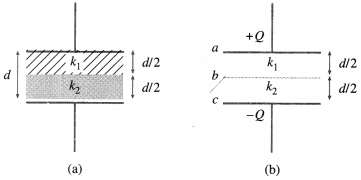
Question 4.
State Kirchhoff’s second law or voltage law or loop law.
Ans. The algebraic sum of the potential differences (products of current and resistance) and the electromotive forces (emf’s) in a closed loop is zero. Σ IR + Σ E = 0

Question 5.
What is the sign convention used for Kirchhoff’s second law ? Explain with an example.
Answer:
(1) While tracing a loop, if we traverse a resistor along the direction of conventional current, the potential difference across the resistor is considered negative. If we traverse the resistor opposite to the direction of conventional current, the potential difference across the resistor is considered positive.

(2) While tracing a loop within the source, if we travel from the negative terminal of the source (cell) to the positive terminal of the source (cell), the emf of the source (cell) is considered positive.

On the contrary, if we travel from the positive terminal of the source (cell) to the negative terminal of the source (cell), the emf of the source (cell) is considered negative.
Maharashtra Board Class 12 Physics Important Questions Chapter 9 Current Electricity 2
Consider the electrical network shown in above figure.
Tracing loop ABFGA in the clockwise direction, we get,
– I1R1 – I3R5 – I1R3 + E1 = 0
∴ E1 = I1R1 + I3R5 + I1R3
Tracing loop BFDCB in the anticlockwise direction, we get,
– I3R5 – I2R4 + E2 – I2R2 = 0
∴ E2 = I2R2 + I3R5 + I2R4

[Notes : (1) We may as well consider loop ABCDFGA and write the corresponding equation. (2) As the emf of a cell is the energy provided by the cell per unit charge in circulating the charge and the potential difference across a resistance is the work done per unit charge, it follows that this law (voltage law /loop law) is based on the conservation of energy.]
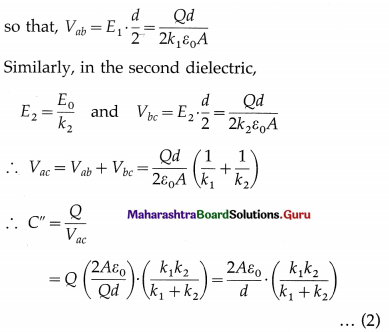
Maharashtra Board Class 12 Physics Important Questions Chapter 9 Current Electricity

Question 6.
What is the basis of Kirchhoff’s current law and voltage law?
Answer:
Kirchhoff’s current law is consistent with the conservation of electric charge while the voltage law is consistent with the law of conservation of energy.

7. Solve the following

Question 1.
Determine the current flowing through the galvanometer shown in the figure below.
Maharashtra Board Class 12 Physics Important Questions Chapter 9 Current Electricity 3
Solution:
Maharashtra Board Class 12 Physics Important Questions Chapter 9 Current Electricity 4
To find Ig we apply Kirchhoff’s voltage law.
Loop ABDA :
– 5I1 – 10Ig + 15I2 = 0
∴ – 5I1 + 15I2 = 10Ig
∴ -I1 + 3I2 = 2Ig ………….. (1)
Loop BCDB :
-10(I1 – Ig) + 20 (I2 + Ig) + 10Ig = 0
∴ – 10I1 + 10Ig + 20I2 + 20Ig + 10Ig = 0
∴ I1 – 2I2 = 4Ig …………. (2)
Adding Eqs. (1) and (2), we get, I2 = 6 Ig …………. (3)
Substituting for Z2 from Eq. (3) in Eq. (2).
∴ I1 = 12Ig + 4Ig = 16Ig
Now, I1 + I2 = 2 A by the data.
∴ 16Ig + 6Ig = 2A
∴ 22Ig = 2A
∴ Ig = \(\frac{2}{22}\) A = \(\frac{1}{11}\) A from B to D
This is the current flowing through the galvanometer.

Question 8.
State the factors on which the resistance Of a material depends.
Answer:
The resistance of a material depends upon tem-perature, strain, humidity, etc.

[Note : Depending upon the factors stated above, resistance may vary from near zero to thousands of megaohm.]

Question 9.
What are the applications of Wheatstone’s metre bridge?
Answer:

  1. Wheatstone’s metre bridge is used for measuring the values of very low resistance precisely.
  2. It can also be used to measure the quantities such as strain galvanometer, resistance, capacitance of a capacitor, inductance of an inductor, impedence of a combination of a resistor, capacitor and inductor and the internal resistance of a cell.

Question 10.
What is the balance point in Kelvin’s method to measure the resistance of a galvanometer?
Answer:
Kelvin’s method of determination of the galvanometer resistance is an equal deflection method. The balance point in Kelvin’s method is a point on the wire for which the bridge network is balanced and the galvanometer shows no change in deflection.

Maharashtra Board Class 12 Physics Important Questions Chapter 9 Current Electricity

Question 11.
Why is Kelvin’s method to measure the resistance of a galvanometer called an equal deflection method?
Answer:
In Kelvin’s method of determination of the galvanometer resistance using a Wheatstone metre bridge, the galvanometer is connected in one gap of the bridge and a variable known resistance is connected in the other gap. The junction of the two gaps (say, B) is connected directly to a pencil jockey.

The jockey is tapped along the wire to locate the equipotential balance point D when the galvanometer shows no change in deflection.

Since the galvanometer shows the same deflection on making or breaking the contact between the jockey and the wire, the method is an equal deflection method.

12. Solve the following :

Question 1.
Four resistances 5 Ω, 10 Ω, 15 Ω and X (unknown) are connected in the cyclic order so as to form a Wheatstone network. Determine X if the network is balanced.
Solution:
Data : P = 5 Ω, Q = 10 Ω, R = 15 Ω
Maharashtra Board Class 12 Physics Important Questions Chapter 9 Current Electricity 5
Since the network is balanced,
\(\frac{P}{Q}=\frac{X}{R}\)
∴ \(\frac{5}{10}=\frac{X}{15}\)
∴ X = 15 × \(\frac{5}{10}\) = 7.5 Ω

Question 2.
Resistances P = 10 Ω, Q = 15 Ω, S = 50 Ω and R = 25 Ω are connected in order in the arms AB, BC, CD and DA respectively of a Wheatstone network ABCD. A cell is connected between A and C. What resistance has to be connected in parallel to S to balance the network?
Solution:
Data : P = 10 Ω, Q = 15 Ω, S = 50 Ω and R = 25 Ω
Let x = resistance to be connected in parallel to S to balance the network. The resistance of the parallel combination of S and x is \(\frac{S x}{S+x}\) .
For the balanced network,
Maharashtra Board Class 12 Physics Important Questions Chapter 9 Current Electricity 6

Question 3.
Four resistances 4 Ω, 8 Ω, X and 6 Ω are connected in the cyclic order so as to form Wheatstone’s network. If the network is balanced, find X.
Solution:
Data : P = 4Ω, Q = 8 Ω, R = X and S = 6 Ω
Since the network is balanced,
∴ \(\frac{P}{Q}=\frac{S}{R}\)
∴ X = 6\(\frac{8}{4}\) = 12 Ω

Maharashtra Board Class 12 Physics Important Questions Chapter 9 Current Electricity

Question 4.
Four resistances 4 Ω, 4 Ω, 4 Ω and 12 Ω form a Wheatstone network. Find the resistance which connected across the 12 Ω resistance will balance the network.
Solution:
The resistance in each of the three arms of the network is 4 Ω. Hence, to balance the network, the resistance in the fourth arm must also be 4 Ω.

Hence, the resistance (R) to be connected across. i.e., in parallel to, the 12 Ω resistance should be such that their equivalent resistance is 4Ω.
Maharashtra Board Class 12 Physics Important Questions Chapter 9 Current Electricity 7

Question 5.
Four resistances 80 Ω, 40 Ω, 10 Ω and 15 Ω are connected to form Wheatstone’s network ABCD as shown in the following figure.
Maharashtra Board Class 12 Physics Important Questions Chapter 9 Current Electricity 8
What resistance must be connected in the branch containing 10 Ω to balance the network?
Solution:
Data : P = 80 Ω, Q = 40 Ω, 10 Ω and R = 15 Ω are connected as shown in above figure.
When the network is balanced,
\(\frac{P}{Q}=\frac{S}{R}\)
∴ \(\frac{80}{40}=\frac{S}{15}\)
∴ S = 15 × 2 = 30 Ω
Let X be the resistance to be connected in series with 10 Ω, so as to obtain 30 Ω.
∴ X + 10 = 30
∴ X = 20 Ω

Question 6.
An unknown resistance is placed in the left gap and resistance of 50 ohms is placed in the right gap of a meter bridge. The null point is obtained at 40 cm from the left end. Determine the unknown resistance.
Solution:
Data : R =50 C in the right gap, lX =40 cm
\(\)
Now, lR = 100 – lX = 100 – 40 = 60 cm
∴ \(\frac{X}{50}=\frac{40}{60}\)
∴ X = 50 × \(\frac{2}{3}\) = \(\frac{100}{3}\) = 33.33 Ω
This is the unknown resistance.

Question 7.
Two resistances X and Y in the two gaps of a metre bridge give a null point dividing the wire in the ratio 2 : 3. If each resistance is increased by 30 Ω, the new null point divides the wire in the ratio 5 : 6, calculate each resistance.
Solution:
From the data, we have in the first case,
\(\frac{X}{Y}=\frac{l_{X}}{l_{Y}}=\frac{2}{3}\)
∴ 3X = 2Y ……….. (1)
and in the second case, \(\frac{X+30}{Y+30}=\frac{l_{X+30}}{l_{Y+30}}=\frac{5}{6}\)
∴ 6X + 180 = 5Y + 150
∴ 6X – 5Y = -30
∴ 6X = 5Y – 30
∴ 2(3X) = 5Y – 30 …………. (2)
Substituting the value of 3X from Eq. (1) in Eq. (2),
we get,
2(2Y) = 5Y – 30
∴ Y = 30 Ω
∴ X = \(\frac{2}{3}\)Y = 20 Ω

Maharashtra Board Class 12 Physics Important Questions Chapter 9 Current Electricity

Question 8.
In a metre bridge experiment, with a resistance R1 in the left gap and a resistance X in the right gap, the null point is obtained at 40 cm from the left end of the wire. With a resistance R2 in the left gap and the same resistance X in the right gap, the null point is obtained at 50 cm from the left end of the wire. Where will be the null point if R1 and R2 are connected first in series and then in parallel in the left gap, the right gap still containing X?
Solution:
From the data in the example, we have:
When R1 is connected in the left gap and X in the right gap, lR1 = 40 cm, and with R2 in the left gap, lR2 50 cm.
∴ In the first case,
lX = 100 – lR1 = 100 – 40 = 60cm
Maharashtra Board Class 12 Physics Important Questions Chapter 9 Current Electricity 9

(i) When R1 and R2 are connected in series, the effective resistance is
RS = R1 + R2 = \(\frac{2 X}{3}\) + X = \(\frac{5 X}{3}\)
Let the corresponding null point be at a distance l1 from the left end of the wire.
Maharashtra Board Class 12 Physics Important Questions Chapter 9 Current Electricity 10

(ii) When R1 and R1 are connected in parallel, the effective resistance is
RP = \(\frac{R_{1} R_{2}}{R_{1}+R_{2}}=\frac{\frac{2 X}{3} \times X}{\frac{2 X}{3}+X}=\frac{2 X}{5}\)
Let the corresponding null point be at a distance l2 Erom the left end of the wire.
Maharashtra Board Class 12 Physics Important Questions Chapter 9 Current Electricity 11
With the same resistance X in the right gap, the null points will be at 62.5 cm and 28.6 cm from the left end of the wire for the series and parallel combinations respectively of R1 and R2 in the left gap.

Question 9.
A uniform wire is cut into two pieces such that one piece is twice as long as the other. The two pieces are connected in parallel in the left gap of a metre bridge. When a resistance of 20 Ω is connected in the right gap, the null point is obtained at 60 cm from the right end of the bridge wire. Find the resistance of the wire before it was cut into two pieces.
Solution:
Let Rw be the resistance of the wire before it was cut into two pieces. Let L1, L2 and X1, X2 be the lengths and resistance of the two pieces.
Maharashtra Board Class 12 Physics Important Questions Chapter 9 Current Electricity 12
∴ The original resistance of the wire is
Rw = X1 + X2 = 40 + 20 = 60 Ω

Question 10.
Two resistances, 20 Ω and 30 Ω, are connected across the two gaps of a metre bridge as shown in the following figure.
Maharashtra Board Class 12 Physics Important Questions Chapter 9 Current Electricity 13
The bridge wire has diameter 0.5 mm and resistance 2 Ω. The emf of the cell is 2 V. Assume that the internal resistance of the cell is zero. Calculate (I) the resistivity (specific resistance) of the material of the bridge wire (ii) the current provided by the cell when the bridge is balanced.
Solution:
Data: R1 = 20 Ω, R2 = 30 Ω. Ig = 0, R (wire) = 2 Ω,
r (wire) = 0.25 mm = 2.5 x iO m (as the diameter of the wire is 0.5mm), l = 1 m, E = 2V
Maharashtra Board Class 12 Physics Important Questions Chapter 9 Current Electricity 14

Maharashtra Board Class 12 Physics Important Questions Chapter 9 Current Electricity

Question 11.
Two diametrically opposite points of a metal ring are connected to two tenninals of the left gap of a metre bridge. A resistance of 11 Ω is connected in the right gap. If the null point is obtained at 45 cm from the left end, find the resistance of the metal ring.
Solution:
Data: R = 11 Ω, LX = 45 cm
∴ LR = 100 – LX = 100 – 45 = 55cm
Let \(\frac{X}{2}\) be the resistance of each half of the metal ring. Therefore the resistance in the left gap is the effective resistance of the parallel combination of \(\frac{X}{2}\) and \(\frac{X}{2}\)
Maharashtra Board Class 12 Physics Important Questions Chapter 9 Current Electricity 15
The resistance of the metal ring is 36 Ω

Question 12.
In a metre bridge experiment, the resistances R and X are connected in the left and right gap, respectively, and the null point is obtained at 33.7 cm from the left end. When a resistance of 12 Ω is connected in parallel to X, the null point is obtained at 51.9 cm from the left end. Calculate R and X.
Solution:
(1) In the first case,
lR = 33.7 cm, lX = 100 – 33.7 = 66.3 cm
∴ \(\frac{X}{R}=\frac{l_{X}}{l_{R}}=\frac{66.3}{33.7}\) …………….. (1)

(2) In the second case,
lR = 51.9 cm, lX = 100 – 51.9 = 48.1 cm
X’ = X || 12 Ω = \(\frac{12 X}{12+X}\)
∴ \(\frac{X^{\prime}}{R}=\frac{48.1}{51.9}\) ……………. (2)
Dividing Eq. (1) by Eq. (2), we get,
Maharashtra Board Class 12 Physics Important Questions Chapter 9 Current Electricity 16
Then, from Eq. (1),
R = 13.48 × \(\frac{33.7}{66.3}\) = 6.852 Ω

Question 13.
What is the SI unit of potential gradient?
Answer:
The SI unit of potential gradient is the \(\frac{\text { volt }}{\text { metre }}\left(\frac{\mathrm{V}}{\mathrm{m}}\right)\).

Question 14.
Explain how two cells are connected so as to
(i) assist each other
(ii) oppose each other. Write the formulae for the corresponding effective emf.
Answer:
Consider two cells connected so that the positive terminal of the first cell is connected to the negative terminal of the second cell as shown in figure (a). The emf’s of the two cells are added up and the effective emf of the combination of the two cells is E1 + E2. This method of connecting two cells is called the sum method. Here, the cells assist each other.

Consider two cells connected so that their negative terminals are connected together or their positive terminals are connected together as shown in figure (b).

In this case their emf’s oppose each other and the effective emf of the combination of the two cells is E1 – E2(E1 > E2 assumed). This method of connecting two cells is called the difference method.
Maharashtra Board Class 12 Physics Important Questions Chapter 9 Current Electricity 17

Question 15.
What is the internal resistance of the cell ?
Answer:
The internal resistance of a cell is the resistance offered by the electrolyte and electrodes in the cell.

Maharashtra Board Class 12 Physics Important Questions Chapter 9 Current Electricity

Question 16.
Explain how a potentiometer is used as a voltage divider.
Answer:
A potentiometer can be used as a voltage divider to continuously change the output voltage of a voltage supply. As shown in the below figure, potential difference V is set up between points A and B of a potentiometer wire. One end of a device is connected to positive point A and the other other end is connected to a slider that can move along wire AB. The voltage V divides in proportion of lengths l1 and l2 as shown in figure.
Maharashtra Board Class 12 Physics Important Questions Chapter 9 Current Electricity 18
By using the slider we can change the output voltage from 0 to V.

Question 17.
State the precautions which must be taken in using a potentiometer.
Answer:
Precautions to be taken in using a potentiometer:

  1. The potential difference across the potentiometer wire must be greater than the emf or potential difference to be balanced. Hence, in comparing emfs, the driver emf E > E1, E2 (direct method) or E > E1 + E2 (combination method).
  2. The positive terminal of the cell with emf E1 and that with emf E2, or their combination, must be connected to the higher potential terminal of the potentiometer.
  3. The potentiometer wire must be of uniform cross section and homogeneous.
  4. The potentiometer wire should be long and have a high resistivity and low temperature coefficient of resistance.

Question 18.
State the advantages of a potentiometer over a voltmeter.
Answer:
Advantages of a potentiometer over a voltmeter :
(1) The cell, whose emf is being measured, draws no current from the circuit at the null point. Thus, the potentiometer measures the open-circuit potential difference across its terminals, or the emf E. A voltmeter will measure the terminal potential difference, V, of the cell in a closed circuit. This is because the resistance of a voltmeter is high but not infinite and hence the voltmeter is not ideal.

(2) By setting up a suitably small potential gradient along a long potentiometer wire, any small voltage can be measured. Increasing the length of the wire effectively decreases the potential gradient, and increases both the precision and accuracy of measurement.

(3) The adjustment of a potentiometer is a ‘null’ method which does not, in any way, depend on the calibration of the galvanometer. The galvanometer is used only to detect the current, not to measure it. The accuracy of a voltmeter is limited by its calibration.

(4) Since a potentiometer can measure both the emf and terminal potential difference of a cell, the internal resistance of the cell can be found.

19. Solve the following

Question 1.
In a potentiometer circuit. E = 2 V, r = 2 Ω, Rwire = 10 Ω, Rext = 1988 Ω and L = 4 m (in the usual notation). What is the potential gradient along the wire ?
Solution:
Maharashtra Board Class 12 Physics Important Questions Chapter 9 Current Electricity 19
The potential gradient along the wire is 2.5 × 10⁻³ V/m

Question 2.
A potentiometer wire has length 2 m and resistance 10 Ω. It is connected in series with a resistance 990 Ω and a cell of emf 2 V. Calculate the potential gradient along the wire.
Solution:
Data : L 10 m, R = 10 Ω, Rext = 990 Ω, E =2 V
The current in the circuit is
I = \(\frac{E}{R+R_{\text {ext }}}=\frac{2}{10+990}=\frac{2}{1000}\) = 2 × 10⁻³ A
The potential difference across the wire is
V = IR = 2 × 10-3 × 10 = 2 × 10⁻² V
∴ The potential gradient along the wire
= \(\frac{V}{L}=\frac{2 \times 10^{-2}}{2}\) = 10-2 V/m

Maharashtra Board Class 12 Physics Important Questions Chapter 9 Current Electricity

Question 3.
A potentiometer wire 4 m long has a resistance of 4 Ω. What resistance must be connected in series with the wire and a cell of emf 2 V having internal resistance of 2 Ω to get a potential drop of 10-3 V/cm along the wire?
Solution:
Data: L = 4 m, R = 4 Ω, E = 2 V, r = 2 Ω
The required potential drop per unit length of the wire is
10-4 V/cm = \(\frac{10^{-3} \mathrm{~V}}{10^{-2} \mathrm{~m}}\) = 0.1 V/m
Let RS be the series resistance for which the desired potential drop is obtained.
The current in the circuit is
Maharashtra Board Class 12 Physics Important Questions Chapter 9 Current Electricity 20

Question 4.
A potentiometer wire of length 5 m is connected to a battery. For a certain cell having negligible internal resistance, the null point is obtained at 250 cm. If the length of the potentiometer wire is increased by 1 m, where will be the new position of the null point?
Solution:
Data : L1 = 5m, L2 = 6m, l1 = 250 cm
E = (\(\frac{V}{L}\))l
where V/L is the potential gradient and l is the balancing length.
∴ E1= (\(\frac{V}{L_{1}}\))l1 = (\(\frac{V}{L_{2}}\))2
l2 = (\(\frac{L_{2}}{L_{1}}\)) × l1 = \(\frac{6}{5}\) × 250 = 300 cm

Question 5.
A potentiometer wire, of length 4 m and resistance 8 Ω, is connected in series with a battery of emf 2 V and negligible internal resistance. If the emf of the cell balances against a length of 217 cm of the potentiometer wire, find the emf of the cell. When the cell is shunted by a resistance of 15 Ω, the balancing length is reduced by 17 cm. Find the internal resistance of the cell.
Solution:
Data: L = 4 m, R = 8 Ω, E = 2V, r = 0,
R(shunt) = 15 Ω, l = 217 cm = 2.17 m,
l1 = 217 – 17 = 200 cm = 2 m
Maharashtra Board Class 12 Physics Important Questions Chapter 9 Current Electricity 21

Maharashtra Board Class 12 Physics Important Questions Chapter 9 Current Electricity

Question 6.
Two cells of emf’s E1 and E2 (E1 > E2) are connected in a potentiometer circuit so as to assist each other. The null point is obtained at 8.125 m from the high potential end of the potentiometer wire. When the cell with emf E2 is connected so as to oppose the emf E1, the null point is obtained at 1.25 m from the same end. Compare the emf’s of the two cells.
Solution:
Data : l1 = 8.125 m (cells assisting), l2 = 1.25 m (cells opposing)
E1 + E2 = Kl1 and E1 – E2 = Kl2
where K is the potential gradient.
Maharashtra Board Class 12 Physics Important Questions Chapter 9 Current Electricity 22

Question 7.
A cell balances against a length of 200 cm on a potentiometer wire when it is shunted by a resistance of 8 Ω. The balancing length reduces by 40 cm when it is shunted by a resistance of 4 Ω. Calculate the balancing length when the cell is in an open circuit. Also calculate the internal resistance of the cell.
Solution:
Data : Part I : R = 8 Ω, l2 = 200 cm;
Part II : R = 4 Ω, l2 = 160 cm
Maharashtra Board Class 12 Physics Important Questions Chapter 9 Current Electricity 23
This is the balancing length when the cell is in open circuit. The internal resistance of the cell,
Maharashtra Board Class 12 Physics Important Questions Chapter 9 Current Electricity 24

Question 8.
When a resistance of 12 Ω is connected across a cell, its terminal potential difference is balanced by 120 cm of a potentiometer wire. When a resistance of 18 Ω is connected across the same cell, the balancing length is 150 cm. Find the balancing length when the cell is in open circuit. Also calculate the internal resistance of the cell.
Solution:
Data : Part I : R = 12 Ω, l2 = 120 cm;
Part II : R = 18 Ω, l2 = 150 cm
Maharashtra Board Class 12 Physics Important Questions Chapter 9 Current Electricity 25
∴ \(\frac{l_{1}-120}{10}=\frac{6\left(l_{1}-150\right)}{50}\)
∴ 5 (l1 – 120) = 6(l1 -150)
∴ 5l1 – 600 = 6l1 – 900
∴ l1 = 300 cm
This is the balancing length when the cell is in open circuit.
∴ r = \(12\left(\frac{l_{1}-120}{120}\right)=\frac{300-120}{10}=\frac{180}{10}\) = 18 Ω
This is the internal resistance of the cell a unit

Maharashtra Board Class 12 Physics Important Questions Chapter 9 Current Electricity

Question 20.
What is a galvanometer?
Answer:
A galvanometer is a device used to detect weak electric currents in a circuit. The current may be of the order of a few microamperes, or even a few nanoamperes.

Question 21.
State the principle of working of a moving coil galvanometer.
Answer:
A current-carrying coil suspended in a magnetic field experiences a torque which rotates the plane of the coil and tends to maximize the magnetic flux through the coil. The torque due to the spring or the suspension fibre to which the coil is attached tends to restore the coil to its initial position. In equilibrium, the coil comes to rest and its deflection is proportional to the current through the coil.

Question 22.
Explain the basic construction of a galvanometer.
Answer:
A galvanometer consists of a coil of a large number of turns of fine insulated copper wire wound on a rectangular nonconducting, nonmagnetic frame. The coil is pivoted (or suspended) between cylindrically concave pole pieces of a horseshoe strong permanent magnet. The coil swings freely around a cylindrical soft iron core fitted between the pole pieces. The deflection of the coil can be read with a pointer attached to it. The position of the pointer on the scale provided depends on the current passing through the galvanometer (or the potential difference across it). A galvanometer can be used as an ammeter or a voltmeter with a suitable modification.
Maharashtra Board Class 12 Physics Important Questions Chapter 9 Current Electricity 26
[Note : A table galvanometer has a resistance of about 50 Ω and can carry a current up to about 1 mA.]

Question 23.
What are the modifications necessary to convert a moving-coil galvanometer (MCG) into an ammeter?
Answer:
To convert a moving-coil galvanometer (MCG) into an ammeter, the following modifications are necessary :

  1. The effective current capacity of the MCG must be increased to a desired higher value.
  2. A galvanometer when connected in series with a resistance, should not decrease the current through the resistance. Hence, the effective resistance of the galvanometer must be decreased by connecting an appropriate low resistance across it. An ideal ammeter should have zero resistance.
  3. It must be protected from the damages which are likely to occur due to the passage of an excess electric current.

Question 24.
State the function of the shunt in modifying a galvonometer to an ammeter.
Answer:
Functions of the shunt:

  1. It lowers the effective resistance of the ammeter
  2. It is used to divert to a large part of total current by providing an alternate path and thus it protects the instrument from damage.
  3. With a shunt of proper value, a galvanometer can be modified into an ammeter of practically any desired range.

Maharashtra Board Class 12 Physics Important Questions Chapter 9 Current Electricity

Question 25.
Explain how a moving-coil galvanometer is converted into an ammeter. Derive the necessary formula.
Answer:
A moving-coil galvanometer is converted into an ammeter by reducing its effective resistance by connecting a low resistance S across the coil. Such a parallel low resistance is called a shunt since it shunts a part of the current around the coil, shown in below figure. That makes it possible to increase the range of currents over which the meter is useful.
Maharashtra Board Class 12 Physics Important Questions Chapter 9 Current Electricity 27
Let I be the maximum current to be measured and Ig the current for which the galvanometer of resistance G shows a full-scale deflection. Then, the shunt resistance S should be such that the remaining current I – Ig = Is is shunted through it.

In the parallel combination, the potential difference across the galvanometer = the potential difference across the shunt
∴ Ig G = Is S
= (I – Ig)S
∴ S = (\(\frac{I_{\mathrm{g}}}{I-I_{\mathrm{g}}}\)) C
This is the required resistance of the shunt. The scale of the galvanometer is then calibrated so as to read the current in ampere or its submultiples (mA. µA) directly.

[Notes :
(1) Thick bars of manganin are used for shunts because manganin has a very small temperature coefficient of resistivity.
(2) The fraction of the current passing through the galvanometer and shunt are, respectively,
\(\frac{I_{g}}{I}=\frac{S}{S+G}\) and \(\frac{I_{g}}{I}=\frac{G}{S+G}\)
(3) On the right hand side of Eq. (1), dividing both the numerator and denominator by Ig, we get,
S = \(\frac{1}{\left(I / I_{\mathrm{g}}\right)-1}\) ∙ G = \(\frac{G}{p-1}\)
where p = I/Ig is the range-multiplying factor, i.e., the current range of the galvanometer can be increased by a factor p by connecting a shunt whose resistance is smaller than the galvanometer resistance by a factor p – 1.
∴ p = \(\frac{G+S}{S}\)
If RA is the resistance of the ammeter,
RA = \(\frac{G S}{G+S}=\frac{G}{p}\)]

Question 26.
How do you calculate the shunt required to increase the range p times?
Answer:
The value of shunt resistance required to convert a galvanometer into an ammeter is given by,
S = (\(\frac{I_{\mathrm{g}}}{I-I_{\mathrm{g}}}\)) G
If the current I is p times the current Ig, then I = pIg. Using this in the above expression, we get,
S = \(\frac{G I_{\mathrm{g}}}{p I_{\mathrm{g}}-I_{\mathrm{g}}}\) OR S = \(\frac{G}{p-1}\)
This is the required shunt resistance to increase the range p times.

Maharashtra Board Class 12 Physics Important Questions Chapter 9 Current Electricity

Question 27.
What is the current flowing through the shunt resistance?
Answer:
Maharashtra Board Class 12 Physics Important Questions Chapter 9 Current Electricity 28
If IS is the current through the shunt resistance, then the remaining current (I – IS) will flow through the galvanometer.

Now, the potential difference across the galvanometer = the potential difference across the shunt
∴ G(I – IS) = S IS
∴ GI – GIS = S IS
∴ SIS + GIS = G I
∴ IS = (\(\frac{G}{S+G}\))I
This is the current flowing through the shunt resistance.

Question 28.
What are the modifications required to convert a moving-coil galvanometer into a voltmeter?
Answer:
The modifications required to convert a moving- coil galvanometer into a voltmeter are as follows :

  1. The effective resistance of the galvanometer should be very high. This is because a voltmeter requires a very small current to deflect its pointer. If a larger current than this flows through the voltmeter, the voltmeter is said to load the circuit and it will record a much smaller voltage drop.
  2. The voltage measuring capacity (range) should be increased to a desired value.
  3. It must be protected from damages which are likely to occur due to an excess applied potential difference.

Question 29.
Explain how a moving-coil galvanometer is converted into a voltmeter. Derive the necessary formula.
Answer:
A moving-coil galvanometer is converted into a voltmeter by increasing its effective resistance by connecting a high resistance Rs in series with the galvanometer, shown in figure. The series resistance is also useful for changing the range of any given voltmeter.
Maharashtra Board Class 12 Physics Important Questions Chapter 9 Current Electricity 29
Let G be the resistance of the galvanometer coil and Ig the current required for a full-scale deflection.

Let V be the maximum potential difference to be measured. The value of the series resistance RS should be such that when the potential difference applied across the instrument is V, the current through the galvanometer is Ig.

In the series combination, the potential difference V gets divided across the galvanometer (resistance, G) and the resistance RS :
V = IgG + IgRS = Ig(G + RS)
∴ RS = \(\frac{V}{I_{\mathrm{g}}}\) – G
This is the required value of the series resistance. The scale of the galvanometer is then calibrated so as to read the potential difference in volt or its submultiples, e.g., mV, directly.

[Notes :
(1) A series multiplier is made of manganin wire because manganin has a very small temperature coefficient of resistivity.
(2) The maximum potential difference Vg that can be dropped across the galvanometer is Vg = Ig G. Therefore, the above expression for the series resistance may be rewritten as
Rs = \(\frac{V G}{I_{\mathrm{g}} G}\) – G
= \(\frac{V G}{V_{\mathrm{g}}}\) – G = G(p – 1)
where p = V/Vg is the range-multiplying factor, i.e., the voltage range of the galvanometer can be increased by a factor of p by connecting a series resistance which is (p – 1) times the galvanometer resistance.
∴ p = \(\frac{V}{V_{g}}=\frac{\left(R_{\mathrm{S}}+G\right) I_{\mathrm{g}}}{G I_{\mathrm{g}}}=\frac{R_{\mathrm{S}}+G}{G}\)
Since the resistance of the voltmeter is Rv = RS + G,
p = \(\frac{R_{\mathrm{V}}}{G}\)
∴Rv = Gp]

Maharashtra Board Class 12 Physics Important Questions Chapter 9 Current Electricity

Question 30.
State the functions of the series resistance in modifying a galvanometer into a voltmeter.
Answer:
Functions of the series, resistance:

  1. It increases the effective resistance of the voltmeter.
  2. It drops off a larger fraction of the measured potential difference thus protecting the sensitive meter movement of the basic galvanometer.
  3. With resistance of proper value, a galvanometer can be modified to a voltmeter of desired range. .

Question 31.
Distinguish between an ammeter and a voltmeter
Answer:

Ammeter

Voltmeter

1. It measures current.1. It measures potential difference.
2. It is connected in series with a resistance.2. It is connected in parallel to a resistance.
3. An ammeter should have very low resistance (ideally zero).3. A voltmeter should have very high resistance (ideally infinite).
4. Its range can be increased by decreasing the value of shunt resistance.4. Its range can be increased by increasing the value of series resistance.
5. The resistance of an ammeter is RA =5. The resistance of a voltmeter is Rv = G + Rs = Gp.

32. Solve the following

Question 1.
Calculate the value of the shunt which when connected across a galvanometer of resistance 38 Ω will allow 1/20th of the current to pass through the galvanometer.
Solution:
Data : G = 38 Ω, Ig / I = \(\frac{1}{20}\)
Maharashtra Board Class 12 Physics Important Questions Chapter 9 Current Electricity 30
∴ S + 38 = 20 S
∴ 19 S = 38
∴ S = 2 Ω
This is the required value of the shunt.

Question 2.
A galvanometer is shunted by 1/r of its resistance. Find the fraction of the total current passing through the galvanometer.
Solution:
Let G be the resistance of the galvanometer, I the total current and Ig the current through the galvanometer when it is shunted. The resistance of the shunt is
Maharashtra Board Class 12 Physics Important Questions Chapter 9 Current Electricity 31
The fraction \(\frac{1}{1+r}\) of the total current passes through the galvanometer.
[Note : The fraction of the current through the shunt = \(\frac{I_{\mathrm{S}}}{I}=1-\frac{I_{\mathrm{g}}}{I}=\frac{r}{1+r}\)]

Question 3.
A resistance of 3 Ω is connected in parallel to a galvanometer of resistance 297 Ω. Find the fraction of the current passing through the galvanometer.
Solution:
Data : G = 297 Ω, S = 3 Ω
Ig = \(\frac{S}{S+G}\) ∙ I
∴ \(\frac{I_{\mathrm{g}}}{I}=\frac{S}{S+G}=\frac{3}{3+297}=\frac{3}{300}\) = 0.01
This is the fraction of the current through the galvanometer.

[Note: The fraction of the current through the shunt
= \(\frac{I_{\mathrm{S}}}{I}\) = 1 – 0.01 = 0.99]

Maharashtra Board Class 12 Physics Important Questions Chapter 9 Current Electricity

Question 4.
The combined resistance of a galvanometer of resistance 1000Ωand its shunt is 25 Ω. Calculate the value of the shunt.
Solution:
Data: G = 1000 Ω, RA =25 Ω
Maharashtra Board Class 12 Physics Important Questions Chapter 9 Current Electricity 32
This is the value of the shunt.

Question 5.
A galvanometer with a coil of resistance 40 Ω gives a full scale deflection for a current of 5 mA. How will you convert it into an ammeter of range 0 – 5 A?
Solution:
Data: G = 40 Ω, Ig = 5 mA = 5 × 10⁻³ A, I = 5 A
To convert a galvanometer into an ammeter, a shunt (i.e., low resistance in parallel) should be connected with the galvanometer coil. The required shunt resistance,
S = (\(\frac{I_{\mathrm{g}}}{I-I_{\mathrm{g}}}\)) G = (\(\frac{5 \times 10^{-3}}{5-5 \times 10^{-3}}\)) × 40
= \(\frac{200}{4995}\) = 0.04 Ω

Question 6.
A galvanometer has a resistance of 16 Ω and gives a full scale deflection when a current of 20 mA is passed through it. The only shunt resistance available is 0.04 Ω which is not sufficient to convert the galvanometer to an ammeter to measure up to 10 A. What resistance should be connected in series with the coil of the galvanometer so that the range of the ammeter is 10 A ?
Solution:
Data: G =16 Ω, Ig = 20 mA = 0.02 A,
S = 0.04 Ω, I = 10 A
Let X be the resistance to be connected in series with the coil of the galvanometer.
The fraction of the current through the galvanometer is \(\frac{I_{\mathrm{g}}}{I}\).
Maharashtra Board Class 12 Physics Important Questions Chapter 9 Current Electricity 33
\(\frac{I_{\mathrm{g}}}{I}=\frac{S}{(G+X)+S}\)
∴ (G + X) + S = \(\frac{I}{I_{\mathrm{g}}}\) × S = \(\frac{10}{0.02}\) × 0.04 = 20
∴ X = 20 – (16 + 0.04) = 3.96 Ω
Alternate method:
Let G’ = G + X = 16 + X
The range multiplying factor,
p = \(\frac{I}{I_{\mathrm{g}}}=\frac{10}{0.02}\) = 500
Then, S = \(\frac{G^{\prime}}{p-1}\)
∴ G’= 16 + X = S(p – 1)
= 0.04(500 – 1) = 19.96 Ω
∴ X = 19.96 – 16 = 3.96 Ω

Question 7.
A galvanometer of resistance 100 C gives a full scale deflection for a current of 2 mA. How will you use it to measure (i) current up to 2 A (ii) voltage up to 10 V?
Solution:
Data : G = 100 Ω, Ig = 2 mA = 2 × 10⁻³ A, I = 2 A, V = 10 V
Maharashtra Board Class 12 Physics Important Questions Chapter 9 Current Electricity 34
A resistance of 0.1001 Ωshould be connected in parallel to the coil of the galvanometer to measure current up to 2 A.

(ii) Rs = \(\frac{V}{I_{\mathrm{g}}}\) – G
= \(\frac{10}{2 \times 10^{-3}}\) – 100 = 5000 – 100 = 4900 Ω
A resistance of 4900 Ω should be connected in series with the coil of the galvanometer to measure voltage up to 10 V.

Maharashtra Board Class 12 Physics Important Questions Chapter 9 Current Electricity

Question 8.
Calculate the value of resistance needed to convert a moving-coil galvanometer of 60 Ω which gives a full scale deflection for a current of 50 mA into (i) an ammeter of range 0 – 5 A (ii) a voltmeter of range 0 – 50 V.
Solution:
Data : G = 60 Ω, Ig = 50 mA = 5 × 10⁻² A, I = 5 A, V = 50 V
Maharashtra Board Class 12 Physics Important Questions Chapter 9 Current Electricity 35
A resistance of 0.6061 Ω should be connected in parallel to the coil of the galvanometer to measure current up to 5 A.

(ii) Rs = \(\frac{V}{I_{\mathrm{g}}}\) – G
= \(\frac{50}{5 \times 10^{-2}}\) – 60
= 1000 – 60 = 940 Ω
A resistance of 940 Ω should be connected in series with the coil of the galvanometer to measure voltage up to 50 V.

Question 9.
A voltmeter of resistance 500 Ω can measure a maximum voltage of 5 V. How can it be made to measure a maximum voltage of 100 V? Solution:
Data : G = 500 Ω, Vg = 5 V, V = 100 V
To increase the range of the voltmeter by a factor p = \(\frac{V}{V_{\mathrm{g}}}\), a resistance R should be connected in series with it.
Rs = G(p – 1) = 500(\(\frac{100}{5}\) – 1) = 9500 Ω

Question 10.
A moving-coil galvanometer of resistance 200 ohms gives a full scale deflection of 100 divisions for a current of 50 milliamperes. How will you convert it into an ammeter to read 2 amperes for 20 divisions?
Solution:
Data : G = 200 Ω, Ig = 50 mA = 50 × 10-3 A
The total number of scale divisions is 100. The ammeter has to read 20 divisions for a current of 2 A. Hence, for 100 divisions, the current must be I = 10 A.

To convert the galvanometer into an ammeter, a shunt must be connected in parallel to the galvanometer coil. The required shunt resistance,
Maharashtra Board Class 12 Physics Important Questions Chapter 9 Current Electricity 36

Question 11.
A galvanometer of resistance 50 Ω has a current sensitivity of 5 div/mA. The instrument has 25 divisions. How will you convert it into a voltmeter of range 0 – 50 V ?
Solution:
Data : G = 50 Ω, V = 50 V
For a current of 1 mA, the galvanometer shows a deflection of 5 divisions. Hence, for a full scale deflection (i.e. deflection of 25 divisions), the current passing through the galvanometer should be 5 mA.

∴ Ig = 5mA = 5 × 10⁻³ A

To convert the galvanometer into a voltmeter, a high resistance must be connected in series with the galvanometer coil. This series multiplier,
Rs = \(\frac{V}{I_{\mathrm{g}}}\) – G = \(\frac{50}{5 \times 10^{-3}}\) – 50
= 9950 Ω

Multiple Choice Questions

Question 1.
For a Wheatstone network shown in the following figure, Ig = 0 when .
Maharashtra Board Class 12 Physics Important Questions Chapter 9 Current Electricity 37
(A) E = 0
(B)VB = VD
(C) VB > VD
(D) VB < VD
Answer:
(B)VB = VD

Question 2.
A potentiometer wire is 100 cm long and a constant potential difference is maintained across it. Two cells are connected in series, first to support one another and then in opposite direction. The balance points are obtained at 50 cm and 10 cm from the positive end of the wire in the two cases. The ratio of emfs is
(A) 5 : 4
(B) 3 : 4
(C) 3 : 2
(D) 5 : 1
Answer:
(C) 3 : 2

Question 3.
When the current in a potentiometer wire decreases, the potential gradient
(A) decreases
(B) increases
(C) remains the same provided the resistance and the length of the wire remain the same
(D) remains the same, irrespective of the resistance . of the wire and its length.
Answer:
(A) decreases

Maharashtra Board Class 12 Physics Important Questions Chapter 9 Current Electricity

Question 4.
In the circuit given below the current through the 6 Ω resistor will be
Maharashtra Board Class 12 Physics Important Questions Chapter 9 Current Electricity 38
Answer:
(B) \(\frac{2}{3}\) A

Question 5.
The accuracy of a potentiometer wire can be increased by
(A) increasing its length
(B) decreasing its length
(C) using a cell of higher emf
(D) using a cell of lower emf.
Answer:
(A) increasing its length

Question 6.
A cell of emf 1.1 V and internal resistance r is connected across an external resistor of resistance R = 10 r. The potential difference across the resistor is
(A) 0.1 V
(B) 0.9 V
(C) 1.0 V
(D) 1.1 V.
Answer:
(C) 1.0 V

Question 7.
When a metal conductor connected in the left gap of a metre bridge is heated, the null point
(A) will shift towards right
(B) will shift towards left
(C) will remain unchanged
(D) will shift towards right or left depending upon the resistivity of the metal.
Answer:
(A) will shift towards right

Question 8.
In using a Wheatstone’s bridge to accurately measure an unknown resistance, a calibrated known variable resistor is varied until
(A) the change in the galvanometer reading is zero
(B) a change in the value of the variable resistor produces no change in the galvanometer reading
(C) the potential difference across the unknown resistance is zero
(D) the potential difference across the galvanometer is zero.
Answer:
(D) the potential difference across the galvanometer is zero.

Maharashtra Board Class 12 Physics Important Questions Chapter 9 Current Electricity

Question 9.
In a Wheatstone network, the resistances in cyclic order are P = 10 Ω, Q = 5 Ω, S = 4 Ω and R = 4 Ω. Then, for the bridge to balance,
(A) 5 Ω should be connected in parallel to Q = 5 Ω
(B) 10 Ω should be connected in series with Q = 5 Ω
(C) 5 Ω should be connected in series with P = 10 Ω
(D) 10 Ω should be connected in parallel to P = 10 Ω
Answer:
(D) 10 Ω should be connected in parallel to P = 10 Ω

Question 10.
Two resistors, R1 and R, are connected in the left gap and the right gap of a metre bridge, and the balancing length is obtained at 20 cm from the left. On inter-changing the resistors in the two gaps, the balancing length shifts by
(A) 20 cm
(B) 40 cm
(C) 60 cm
(D) 80 cm.
Answer:
(C) 60 cm

Question 11.
An instrument which can measure terminal potential difference as well as electromotive force (emf) is
(A) Wheatstone’s metre bridge
(B) a voltmeter
(C) a potentiometer
(D) a galvanometer
Answer:
(C) a potentiometer

Question 12.
A 10 m long wire of resistance 2012 is connected in series with a resistance of 10 Ω and a battery of emf 3 V and negligible internal resistance. The potential gradient, in µV / mm, along the wire is
(A) 2
(B) 20
(C) 200
(D) 2000
Answer:
(C) 200

Question 13.
A 10 m long potentiometer wire has a resistance of 20 Ω. If it is connected in series with a resistance of 55 Ω and a cell of emf 4 V and internal resistance 5 Ω, the potential gradient along the wire is
(A) 0.1 V/m
(B) 0.08 V/m
(C) 0.01 V/m
(D) none of these.
Answer:
(A) 0.1 V/m

Question 14.
A potential gradient of 6 × 10⁻³ V/ mm is set up on a potentiometer wire which has a resistance of 2 Ω/m. Two emfs 2.5 V and 1.3 V, once assisting and then opposing each other, are balanced on the wire. The balancing lengths in the two cases are in the ratio
(A) 19 : 2
(B) 19 : 6
(C) 25 : 13
(D) 2:1.
Answer:
(B) 19 : 6

Maharashtra Board Class 12 Physics Important Questions Chapter 9 Current Electricity

Question 15.
A potentiometer wire, having a resistance of 5 Ω and length 10 m, is connected in series a cell of emf 5 V and an external resistance of 495 Ω. A potential difference of 1.5 mV will balance against a length of
(A) 3 cm
(B) 30 cm
(C) 3 m
(D) none of these.
Answer:
(B) 30 cm

Question 16.
A load resistance R is connected across a cell of emf E and internal resistance r. If the closed-circuit p.d. across the terminals of the cell is V, the internal resistance of the cell is
(A) (E – V) R
(B) (V – E)R
(C) \(\frac{E-V}{V} R\)
(D) \(\frac{E-V}{V}\)
Answer:
(C) \(\frac{E-V}{V} R\)

Question 17.
The open-circuit potential difference across the terminals of a cell balances on 150 cm of a potentiometer wire. When the cell is shunted by a 4.9 Ω resistor, the balancing length reduces to 147 cm. The internal resistance of the cell is
(A) 0.01 Ω
(B) 0.05 Ω
(C) 0.1 Ω
(D) 1 Ω
Answer:
(C) 0.1 Ω

Question 18.
To convert a galvanometer into an ammeter
(A) a high resistance is connected in parallel to the galvanometer
(B) a high resistance is connected in series with the galvanometer
(C) a low resistance is connected in parallel to the galvanometer
(D) a low resistance value is connected in series with the galvanometer.
Answer:
(C) a low resistance is connected in parallel to the galvanometer

Question 19.
To convert a galvanometer into a voltmeter
(A) a high resistance is connected in parallel to the galvanometer
(B) a high resistance is connected in series with the galvanometer
(C) a low resistance is connected in parallel to the galvonometer
(D) a low resistance is connected in series with the galvonometer.
Answer:
(B) a high resistance is connected in series with the galvanometer

Question 20.
An ideal ammeter has
(A) a moderate resistance
(B) a high resistance
(C) an infinite resistance
(D) zero resistance
Answer:
(D) zero resistance

Question 21.
An ideal voltmeter has
(A) a low resistance
(B) a high resistance
(C) an infinite resistance
(D) zero resistance
Answer:
(C) an infinite resistance

Maharashtra Board Class 12 Physics Important Questions Chapter 9 Current Electricity

Question 22.
The fraction of the total current passing through the galvanometer is
Maharashtra Board Class 12 Physics Important Questions Chapter 9 Current Electricity 39
Answer:
(A) \(\frac{S}{S+G}\)

Maharashtra Board OCM 11th Commerce Solutions Chapter 3 Small Scale Industry and Business

Balbharti Maharashtra State Board Organisation of Commerce and Management 11th Textbook Solutions Chapter 3 Small Scale Industry and Business Textbook Exercise Questions and Answers.

Maharashtra State Board 11th Organisation of Commerce and Management Solutions Chapter 3 Small Scale Industry and Business

1. (A) Select the Correct option and rewrite the sentence

Question 1.
The problem of ……………….. is becoming more serious in India.
(a) employment
(b) unemployment
(c) pollution
Answer:
(b) unemployment

Question 2.
India is ………………… abundant country.
(a) labour
(b) money
(c) material
Answer:
(a) labour

Question 3.
…………….. cost of power acquisition, frequent power cuts, irregular supply of power affect the productivity of SSI.
(a) Higher
(b) Lower
(c) Average
Answer:
(a) Higher

Maharashtra Board OCM 11th Commerce Solutions Chapter 3 Small Scale Industry and Business

Question 4.
Before setting up business, it is essential to study prevailing ………………. environment.
(a) business
(b) natural
(c) political
Answer:
(a) business

Question 5.
Small Scale Business are ………………… intensive.
(a) money
(b) power
(c) labour
Answer:
(c) labour

Question 6.
Occurring obscured idea in mind of entrepreneur is ……………….. stage of establishing business.
(a) first
(b) second
(c) third
Answer:
(a) first

Question 7.
Small scale industries contribute nearly ……………….. to the industrial exports of the country.
(a) 40%
(b) 60%
(c) 20%
Answer:
(a) 40%

1. (B) Match the pairs

Group AGroup B
(a) Micro Manufacturing Sector(1) Handloom
(b) Traditional Small Scale business(2) Unskilled
(c) Registration(3) Does not exceed Rs. 25 lakhs
(d) Labour(4) 40% of exports of India
(e) Bicycle Parts(5) Does not exceed Rs. 1 lakhs
(6) DIC
(7) Marketing Problem
(8) Modern Small Scale business
(9) Project Appraisal
(10) Cost-efficiency

Answer:

Group AGroup B
(a) Micro Manufacturing Sector(3) Does not exceed Rs. 25 lakhs
(b) Traditional Small Scale business(1) Handloom
(c) Registration(6) DIC
(d) Labour(2) Unskilled
(e) Bicycle Parts(8) Modern Small Scale business

1. (C) Give one word/phrase/term

Question 1.
A sector which is back bone of rural India.
Answer:
Small Scale Sector

Question 2.
An industry using power with less than 50 employees.
Answer:
Small Scale Industry

1. (D) State True or False

Question 1.
Small Scale industries should be developed in order to maintain, economic balance in a country.
Answer:
True

Question 2.
Majority Small Scale Industry uses advanced technology.
Answer:
False

Maharashtra Board OCM 11th Commerce Solutions Chapter 3 Small Scale Industry and Business

Question 3.
Small business easily get access to low interest rates.
Answer:
False

Question 4.
Small business cannot survive in the competition.
Answer:
True

1. (E) Find the odd one

Question 1.
Coir, Handicraft, Spare Parts, Hand-loom
Answer:
Spare Parts

Question 2.
Bicycle Parts, Sericulture, Electronic Appliances, Sewing Machine
Answer:
Sericulture

1. (F) Complete the sentences

Question 1.
…………….. industries plays an important role in developing countries.
Answer:
Small Scale

Question 2.
SSI is …………….. largest industry which creates huge employment opportunities.
Answer:
second

Question 3.
SSI enjoys the advantage of ……………… cost of the produce.
Answer:
low

Question 4.
SSI are ……………… intensive.
Answer:
labour

Question 5.
SSI requires ………………….. capital as compared to large scale industries.
Answer:
less

Question 6.
SSI produces consumer goods as well as …………………. components.
Answer:
industrial

1. (G) Select the correct option

(Small Manufacturing Sector, Micro Manufacturing Sector, Micro Services Sector, Medium Manufacturing Sector, Small Services Sector)

Group AGroup B
(1) More than Rs 25 lakhs but does not exceed Rs 5 Crores—————-
(2) —————-Does not exceed Rs 25 lakhs
(3) More than Rs 5 crores but does not exceed Rs 10 crores—————
(4) —————-Does not exceed Rs 10 lakhs
(5) More than Rs 10 lakhs but does not exceed Rs 2 crores—————-

Answer:

Group AGroup B
(1) More than Rs 25 lakhs but does not exceed Rs 5 CroresSmall Manufacturing sector
(2) Micro Manufacturing sectorDoes not exceed Rs 25 lakhs
(3) More than Rs 5 crores but does not exceed Rs 10 croresMedium Manufacturing sector
(4) Micro Services SectorDoes not exceed Rs 10 lakhs
(5) More than Rs 10 lakhs but does not exceed Rs 2 croresSmall Services Sector

1. (H) Answer in one sentences

Question 1.
What is SSI?
Answer:
Traditionally the industries in India which are organised on a Small Scale and produces goods with the help of machines, labour and power are considered as Small Scale Industries.

Maharashtra Board OCM 11th Commerce Solutions Chapter 3 Small Scale Industry and Business

Question 2.
State the example of Traditional Small Scale Industry.
Answer:
Hand-loom, Handicraft, Coir, Sericulture, Khadi and Village Industries are the examples of Traditional Small Scale Industries.

Question 3.
Give examples of Modern Small Scale Industry.
Answer:
Bicycle Parts, Sewing Machines, Blades, Razors, Electric Appliances, Spare Parts are examples of Modern Small Scale Industries.

1. (I) Correct the underlined word and rewrite the following sentences.

Question 1.
The problem of employment has been becoming more serious in India.
Answer:
The problem of unemployment has been becoming more serious in India.

Question 2.
India is material abundant country.
Answer:
India is labour abundant country.

Question 3.
Small scale Industry uses advanced technology.
Answer:
Small scale Industry uses outdated technology.

Question 4.
SSI begin with large amount of capital.
Answer:
SSI begin with small amount of capital.

Question 5.
Business proposal is the first step in setting up of a small scale business.
Answer:
Decision of Business area is the first step in setting up of a small scale business.

1. (J) Arrange in proper order.

(a) Selection of a place
(b) Selection of a product
(c) Business proposal
(d) Selection of technology
Answer:
(a) Selection of a product
(b) Selection of a place
(c) Selection of technology
(d) Business proposal

2. Explain the following terms/concepts.

Question 1.
Small Scale Industry.
Answer:
Any Industrial Unit is regarded as Small Scale Industry, if the following condition is satisfied.
“Investment in fixed assets like plant and equipment either held on ownership terms or on lease or hire purchase should not be more than Rupees one crore. However, the unit in no way can be owned or controlled or auxiliary for any other industrial unit.”

Maharashtra Board OCM 11th Commerce Solutions Chapter 3 Small Scale Industry and Business

Question 2.
Service Sector.
Answer:
According to MSMED on the basis of investment Micro Service Sector ‘does not exceed Rs 10 lakhs’, Small Service Sector, ‘more than 10 lakhs but does not exceed 2 crores’ and Medium Service Sector ‘more than Rs 2 crores but does not exceed Rs 5 crores’.

Question 3.
Micro Small Scale Business.
Answer:
Micro small scale business is classified as Manufacturing sector and Services Sector. According to MSMED, Micro Manufacturing sector does not exceed Rs 25 lakhs and Micro Services sector does not exceed Rs 10 lakhs.

Question 4.
Traditional Industrial Sector.
Answer:
Small Scale Industries are further classified as Traditional Small Scale Industries and Modern Small Scale Industries. Handloom, Handicraft, Coir, Sericulture, Khadi and Village Industries are the examples of traditional SSI Industries.

Question 5.
Modern Industrial Sector.
Answer:
Small Scale Industries are further classified as Traditional Small Scale Industries and Modern Small Scale Industries. Bicycle Parts, Sewing Machines, Blades, Razors, Electric Appliances, Spare Parts are the examples of Modern Small Scale Industries.

3. Study the following case/situation and express your opinion.

1. Mr. Ram wants to start Small Scale business of manufacturing parts of bicycle or machinery.

Question 1.
Identify the first step or stage of setting up his Small Scale business.
Answer:
Ram has to first decide whether the setup will be corporation, proprietorship or partnership. He has to identify his strength and weaknesses which can help him to decide what type of business would be most suitable. He has to study the amount of capital requirement needed to start his business. Once he gets the idea of total capital requirement he can decide what type of business to start.

Question 2.
State the different ways of raising the capital for his business.
Answer:
If Ram decides to start as proprietorship than he has to raise all the capital by himself. He can get it from his own savings or borrow money form bank, financial institutions. He can also study the different government schemes and raise capital through those schemes.

If Ram decides to start partnership firm than he will have to find a person who is ready to invest in his partnership firm as well as he has knowledge about manufacturing parts of bicycle. They can raise capital by investing their savings, borrowing through financial institutions and friends. They can also take help from various government schemes and institutions set-up to help SSI.

If Ram decides to start corporation i.e. Pvt. Ltd. Company than he can raise capital by issuing equity shares privately. He has to sell the shares to his friends and relatives. He can also study of various government schemes and raise capital through those schemes. Ram can also borrow money from bank, financial institutes, etc. He can also accept deposits from public in the further stage of his business.

Maharashtra Board OCM 11th Commerce Solutions Chapter 3 Small Scale Industry and Business

Question 3.
‘Marketing is a necessary step of running a business.’ Comment on it.
Answer:
Goods are ultimately manufactured for consumers. There is competition among many manufacturers and traders to sale goods in the market.
Without selling the goods, manufacturer cannot earn profit. Profit is main motto of business.

To sale goods in market, advertising and publicity is required. To make your brand image in market, advertising with quality of goods is required. Branded goods are easily sold in the market. Marketing can be done through many ways like TV, Radio, Bill Boards, Internet, Websites, Salesman, etc.
Thus, marketing is a necessary step of running a business.

4. Answer in brief.

Question 1.
State any four points of importance of Small Scale Industry/Business.
Answer:
Importance of Small Scale Industry:
Job Opportunities
Regional Balance
Maximum use of Natural Resources
Reduces Migration

1. Job Opportunities : SSI is second largest industry which creates huge employment opportunities, because it can be operated with minimum amount of capital. SSI can be run with basic and potential skills. This is a boost for a labour surplus country like India.

2. Regional Balance : In India, all regions are not developed due to lack of industrialization. SSI can be setup with minimum amount of capital. Small industries manufactures product using simple technologies, local available resources, material and labour. Thus, they contribute significantly to the balanced development of the country.

3. Maximum use of Natural Resources : Small scale industries are labour intensive. They utilize available natural resources and raw materials from local areas. Such use of local natural resources minimizes the cost of production which result into reasonable price of goods.

4. Reduces Migration : Small Scale industries can create a large number of employment in rural area. SSI is also a best example of self-employment. Therefore, migration of people from rural to urban can be reduced or minimized.

Question 2.
Write any four advantages of Small Scale Industry.
Answer:
Advantages of Small Scale Industries:
1. Large Employment
2. Less Capital Requirement
3. Contribution to Export
4. Opportunities for Entrepreneurship

1. Large Employment: Small Scale Industries has huge potential to create employment opportunities. They are labour intensive and use more labour than other factors of production. Their gestation period is also low and can provide employment opportunities to large number of people.

2. Less Capital Requirement : SSI requires less capital as compared to large scale industries. SSI can be started by small entrepreneurs with limited capital resources.

3. Contribution to Export : Nearly 40% of the industrial exports are contributed by SSI. Product such as hosiery, knitwear, gems and jewellery, handicraft, coir products, woolen garments, processed food, chemical and allied products and a large number of engineering goods contribute substantially to India’s exports. Products produced by SSI are used in the manufacturing of products by large scale industries which are exported. It contributes directly and indirectly to exports and helps to earn valuable foreign exchange.

4. Opportunities for Entrepreneurship : Small Scale Industries provide opportunities for entrepreneurs with limited capital as it requires less capital and lower investment in technology and machines as compared to large scale enterprises. Therefore, small entrepreneurs can start small scale industries easily.

Question 3.
State any four challenges before Small Scale Industries.
Answer:
Challenges before Small scale industries:

  1. Inadequate Finance
  2. Problem of Raw Material
  3. Labour Problem
  4. Marketing Problem

1. Inadequate Finance : SSI generally begins with a small amount of capital. Many of the units in the small sector raise funds from capital market. These units frequently suffer from lack of adequate working capital.

2. Problem of Raw Material : Another major problem of Small Scale Industries is inadequate supply of raw materials. Due to that SSI have to compromise on the quantity and quality of raw material, or pay more, price for good quality of raw material.

3. Labour Problem : Small industries generally appoint unskilled and semi skilled worker on daily wages, This creates the problem of low labour productivity, higher absenteeism and poor job commitment. The wages are low due to financial limitations. This leads to labour dissatisfaction and increase the problem of labour turnover. Improper shifts and lack of job security makes employment in small industries unattractive and the talented work force does not opt for such job.

4. Marketing Problem : Marketing is a weaker part of small industries. SSI have to depend excessively on middlemen who at times exploit them by paying low prices and delayed payments. Further, direct marketing may not be feasible for small business firms as they lack the necessary infrastructure.

5. Justify the following statements.

Question 1.
Generally Small Scale Industries are sick.
Answer:

  1. There are many problems faced by Small Scale Industries. These problems may be internal problems or external problems.
  2. Internal Problems are like unskilled labour or untrained labour, lack of managerial skills and marketing skills, lack of modernisation, etc.
  3. External problems like shortage of working capital, inadequate loans, delayed payments, shortage of raw material, etc.
  4. According to RBI a sick unit is that which has incurred a cash loss for one year, is likely to continue it for current year as well as following year.
  5. Thus, mainly due to financial problem, industrial units are unable to sustain themselves and are called as sick units.

Maharashtra Board OCM 11th Commerce Solutions Chapter 3 Small Scale Industry and Business

Question 2.
Small Scale Industry require less amount of capital.
Answer:

  1. The production of Small Scale Industries is less.
  2. General unskilled labours are employed.
  3. As production is less raw material requirement is also less.
  4. In a place like India, where capital formation is low, small business is suitable.
  5. Due to small in size, such form of business can easily adapt to changing atmosphere. This promotes flexibility. It can easily change their working style without much loss as compared to large businesses.
  6. Thus, SSI requires less amount of capital.

Question 3.
Small Scale Industries have problems.
Answer:
Small scale industries have to face many problems:

  1. Lack of Adequate Finance : Due to small scale of production and sale, Banks and Financial Institutions are afraid to give loans.
  2. Problem of Raw material : Due to inadequate finance they cannot purchase raw material at a time. Thus, the cost of raw material increases.
  3. Labour Problem : Due to inadequate finance, they cannot employ skilled labour which affects the production.
  4. Marketing Problem: The goods manufactured if not marketed properly can be risky as it will affect the sales,
  5. Problem of Transport: Transportation cost increases the cost of the product which hampers the sale as large scale industries cost may be less.
  6. Sickness : Due to financial problem industrial units are unable to sustain themselves and finally turn to sick units.
  7. Thus, Small Scale Industries have problems

6. Attempt the following.

Question 1.
Explain the meaning of Small Scale Industries.
Answer:
Small Scale Industries are those industries where fixed assets i.e. plant and machinery which is owned or hired or taken on lease basis, does not exceed more than one crore.

MSMED has classified Small Scale Industries into Manufacturing sector and Services sector, and further into three categories of business i.e. Micro business, Small business and Medium business.
Subsequently over a period of time, a new definition was introduced by MSMED Act, 2006 (Micro Small and Medium Enterprises Development) is as follows
(A) Manufacturing Enterprises:

  1. A micro enterprise, where the investment in plant and machinery is less than Rs 25 lakh.
  2. A small enterprise, where the investment is more than Rs 25 lakh but less than Rs 5 crore.
  3. A medium enterprise, where the investment in plant and machinery is more than Rs 5 crore but less than Rs 10 crore.

(B) Service Enterprises:

  1. A micro enterprise, where the investment in equipment is less than Rs 10 lakh.
  2. A small enterprise, where the investment in equipment is more than Rs 10 lakh but less than Rs 2 crores.
  3. A mediuiri enterprise where the investment in equipment is more than Rs 2 crore but less than Rs 5 crores.
  4. An industrial unit can be categorised as small business if it fulfills the above capital investment criteria.

Question 2.
State importance of small business.
Answer:
Following are the importance of Small Business:
(i) Supply of Raw Materials to Large Industries : Finished goods of Small Scale Industries is raw material – for large scale industries. E.g., head lights supplied to automobile industries. Small Scale Industries supply raw materials to large scale industries and they get easy market available to their product.

(ii) Balanced Development between Rural and Urban Areas : With the help of locally available raw materials and labour, more and more Small Scale Business can be started in rural areas. This helps to reduced regional imbalance between urban and rural areas.

(iii) Opportunities to Young Generation : Young generations by using their creative skills make product unique in the market. Small scale business gives an opportunity to youngster to show their creativity and abilities to prove themselves and achieve success in development.

(iv) Large Employment : India is second largest populated country after China, which faced problem of unskilled and semi skilled labour. Small Scale Industries operate with more labour and less capital, which can accommodate more man power to solve employment problem.

(v) Utilisation of Domestic Resources : Small farmers can start their own unit of small industry by using locally available raw materials. He can get self employment and involve his family members too.

Question 3.
Explain in brief the impact of capital, on Small Scale industries.
Answer:
Major problem faced by small scale industries is insufficient capital, which creates following difficulties with them.
(i) Borrowings of Capital from Landlords and Money Lenders : Nationalised and Co-operative banks are not ready to finance Small Scale Industries without security. Thus, they are forced to borrow from money lenders, where they have to pay very high rate of interest.

(ii) Storage of Raw material: Small Scale Industries are agro based. Raw material is available seasonally. To stock goods they required huge finance. Due to lack of finance, they run industry only in seasons.

(iii) Lack of Skilled Labour : Only unskilled and semi skilled labourer are available. Small Scale Industries cannot afford labour cost of skilled labourer which affect quality and quantity of production and profitability.

(iv) Outdated technology : Due to insufficient capital, production methods used by SSI are old, which results in poor quality and quantity of output.

(v) Weaker Marketing Skill : In todays world marketing plays an important role. Rural area is facing marketing problem due to lack of facilities and knowledge and they are exploited by middlemen too.

Maharashtra Board OCM 11th Commerce Solutions Chapter 3 Small Scale Industry and Business

Question 4.
State the problem faced by Small Scale industries.
OR
Explain in detail the challenges faced by Small Scale Industries.
Answer:
Problems faced by Small Scale Industries:
(i) Outdated Technology : Traditional methods of productions are used due to lack of finance and knowledge about latest technology. This results in poor quality of production with low output.

(ii) Problems of Infrastructure: Problems of infrastructure faced by small business are power cuts, improper transport facility, problem like congestions, bottlenecks, strikes, rise in freight charges, inadequate space, bad repair of premises, unsuitable location, high rent, etc. These problems definitely affects smooth working of small business.

(iii) Underutilization of Capacity : Small Scale Industries cannot utilize optimum resources and capacity due to lack of marketing skills, lack of demand, etc. This lead to increase the cost of product and wastage of resources.

(iv) Lack of Capital: Nationalised and Co-operative banks are not ready to provide finance without securities. Owners of Small Scale Industries don’t have any option other than borrowings funds from landlords and money lenders where they have to pay very high rate of interest.

(v) Problem of Skilled Labourers : Mostly unskilled and semi skilled labourers are available to Small Scale Industries as they cannot afford the wages to highly skilled labourer. This affect quality and quantity of output which result in less price for sales.

Question 5.
Explain the role of Small Scale Industries in employment generation.
Answer:
Small Scale Industries play very important role in generation of employment as follows:

  1. Small Scale Industries are Labour Intensive : There is shortage of capital with small scale industries. They are labour intensive. They use more man power than machines, they creates more opportunities for rural employment.
  2. Employment to Unskilled and Semiskilled Labourer : Small Scale Industries are using old and traditional method of production where they need unskilled and semi-skilled labourer.
  3. Employment of Rural Land Less Labourer : Small Scale Industries are set-up in rural areas. They provide employment to local labourers. They have potential to create opportunities to large scale employment to mass population in villages.
  4. Decrease in Migration of Labourers : Migration means movement of labourers from village to city in search of job. Due to increase in small scale industries in village areas migration of labour is reduced. Labourers are getting good employment at their own villages.

7. Answer the following

Question 1.
Explain the challenges before Small business.
Answer:
Small scale business are playing very important role in development of developing countries. They faced following challenges / difficulties:
(i) Problems of Marketing : Small business organizations depend excessively on middlemen who many times exploit them by paying low price and delayed payment. Further direct marketing may not be possible for them as they lack necessary infrastructure. Major marketing problem are lack of advertising, non-branding of products, poor quality, transportation problem, local difficulties, competition, etc.

(ii) Infrastructural Problem : Problems of infrastructure faced by small business are power cuts, improper transport facility, problem like traffic congestions, bottlenecks, strikes, rise in freight charges, inadequate space, bad repair of premises, unsuitable location, high rent, etc. These problems definitely affects smooth working of small business.

(iii) Credit and Finance : Lack of finance is the major problem faced by small business. Artisans or Craftsmen running cottage industry take credits from mahajans or traders who charge large amount of interest from them. For small scale industries, institutional source of finance (e.g. banks) is also available, but the funds allocated to this sector are inadequate.

(iv) Delayed Payment: They face problem of delayed payment by large firms and Government departments.

(v) Sickness Problem: According to RBI a sick unit is that which has incurred a cash loss for one year, is likely to continue it for current year as well as following years and unit has an imbalance in financial structure. Sickness is generally seen in small business industries like cotton, jute, sugar, textile, etc. Internal causes of sickness are lack of skill labour, faulty planning, problem of recovery, etc. External causes of sickness are shortage of capital, inadequate loans, shortage of raw material, etc. However, rehabilitation of sick unit is a costly affair.

(vi) Personal Problems : Personal problems like spending long hours to work and less time with family and the rewards have not been favourable.

(vii) Shortage of Raw Material : Shortage of raw material often take place due to reasons like natural calamities, transport problem, industrial strikes, poor quality of raw material, exploitation done by traders, etc. Traders or agents who supply raw material often exploit the owner by charging higher prices. They also insist on buying finished products at lower rate. Thus, small business owners are subject to double exploitation.

(viii) Outdated Technology : Use of low-grade technical know-how and skills have resulted in low productivity in small business industries. Many units in small business make use of primitive methods of production, this leads to increase in cost of production, whereas productivity is low. Small units often do not care about the changing tastes and fashions of customers.

(ix) Underutilization of Capacity : Small business units cannot utilize optimum resources and capacity due to lack of marketing skills, lack of demand, they work below full capacity, etc. This lead to increase the cost and wastage of resources.

(x) Labour Problem : It includes highly demanding employees, absenteeism, lack of skilled workers and transportation of workers, strikes, high wage rates, inefficiency, etc.

Maharashtra Board OCM 11th Commerce Solutions Chapter 3 Small Scale Industry and Business

Question 2.
Write down the benefits or advantages of small business.
Answer:
Small scale business plays very important role in the economic development of the country.
The following are the benefits or advantages of small business:
(i) Cost Savings : Small scale business used micro production method which results into quality product at low cost of production. Production cost of small business is much more less compared to large scale industries due to low cost of operation.

(ii) Adaptability : Small scale business can change themselves as per the market requirement. They can change product, line of product as per market changes, like fashions, new product, demand, etc.

(iii) Limited Capital : As small business is labour intensive they requires very small amount of capital for plant and equipments.

(iv) Low Gestation Period : To start a new business requires very short period as compared to large scale industries. Small scale business can start production of good in very short period of time and can increase the scale of production.

Labour Intensive : Small business units use less machines and more labours. Absorption of local labour helps to solve problem of absolute poverty and control inequality of income.

(vi) Opportunities to Rural Youth : New generation youth has smart creativity. With available technology and raw materials, rural youth can start their own business unit. Small business unit plays very important role in developing countries.

(vii) Upliftment of Economy : Majority of small scale business used traditional method of productions. Rural craftsman and artisans do have their own talents and skills which they have learnt from their forefathers. Such products are very much demanded in market which results in high income.

(viii) Decentralised Economy : Small scale business prevents concentration of economic power in the few hands. Income is divided equally among large number of people.

(ix) Export Earning : Small business contributes remarkable to country’s export. 40% of India’s exports are contributed by small business like textiles, handicraft, handloom, embroidery, etc.

(x) Regional Balance : There is wide gap between urban and rural India. Small scale business helps to reduce gap between developed and underdeveloped or developing areas.

Question 3.
Explain the process of establishment of Small Scale Industries.
Answer:
In todays world, youth are more attracted towards business opportunities rather than employment.
To start a small scale industries following stages to be followed:
(i) Idea to Setup a Business : This is a first step to start a small scale industry. The prospective entrepreneur with his own capacity decide the sized and type of business like sole proprietorship, partnership or corporation.

(ii) Analysis of Business Surrounding : It is necessary to understand different business surrounding and policies before starting any business. They are competitors, legal, economical, industrial, technological, etc.

(iii) Choice of Product : Entrepreneurs has to decide his sector of production i.e. Manufacturing or Service sector. After doing market survey and understanding advantages and disadvantages one should decide line of product or services.

(iv) Location for Business : Entrepreneur has to select location to start business. It plays very important role in success of business while selecting location many factors are to be taken into consideration like availability of labour, raw materials, power supply, transportation, etc.

(v) Technology Selection : An entrepreneur has to select available and suitable technology for his business. He should select technology he is familiar to use.

(vi) Project Appraisal : It means the study and assessment of a project. One should study the project very carefully from the point of view regards to economy, finance, marketing and profitability.

(vii) Capital Requirement : The entrepreneur has to plan for capital requirement and sources available for capital. It can be self finance, loan from relatives or banks.

(viii) Incorporation / Registration : It is compulsory for every small scale industry to registered with the respective Government Authorities. A printed application form is available with District Industries Centre (DIC). Entrepreneur has to duly filled the information with his signature in the form and submit to DIC.

(ix) Implementation of Resources : After registration of business entrepreneur has to start with production process:

  • Financial Resources : The entrepreneur has to collect finance and make necessary arrangement for capital.
  • Factor Set up : The entrepreneurs has to allocate space for various operations, purchase of machinery and tools and installation of it.
  • Electric power and water supply : The entrepreneur has to calculate total electric power requirement in KW (Kilowatt) and get connection from the authority and supply for water connection.
  • Appointment of staff : Small scale industries are labour, intensive. One has to appoint unskilled and semi-skilled staff as per requirement to start production.

(x) Manufacturing and Selling of Product : After assembling all financial and physical resources goods are manufactured and send to market for sale. Advertising and publicity plays very important role in marketing and selling of product.

(xi) Customer’s Feedback : Customer satisfaction is very important in business. Regular feedback from customers is helping to make qualitative changes in product.

Question 4.
Explain the importance of small business.
Answer:
Following are the importance of Small Business:
(i) Supply of Raw Materials to Large Industries : Finished goods of Small Scale Industries is raw material – for large scale industries. E.g., head lights supplied to automobile industries. Small Scale Industries supply raw materials to large scale industries and they get easy market available to their product.

(ii) Balanced Development between Rural and Urban Areas : With the help of locally available raw materials and labour, more and more Small Scale Business can be started in rural areas. This helps to reduced regional imbalance between urban and rural areas.

(iii) Opportunities to Young Generation : Young generations by using their creative skills make product unique in the market. Small scale business gives an opportunity to youngster to show their creativity and abilities to prove themselves and achieve success in development.

(iv) Large Employment : India is second largest populated country after China, which faced problem of unskilled and semi skilled labour. Small Scale Industries operate with more labour and less capital, which can accommodate more man power to solve employment problem.

(v) Utilisation of Domestic Resources : Small farmers can start their own unit of small industry by using locally available raw materials. He can get self employment and involve his family members too.

Question 5.
It is clear that the absence of capital and raw material is the main reason for the short term sickness. Explain it.
Answer:
Industrial sickness means the industry which has financial losses over period of time. Short term sickness is a temporary phenomenon.
Followings are the main capital and raw material reasons for short term sickness:
Financial / Capital:
(i) Non availability of Finance from Banks : Nationalised and Co-operative banks are not ready to finance SSI as there is less possibility of recovery of loans. Banks demand securities against loans, which is difficult to arrange for the small businessman.

(ii) Loans from Money lenders : As bank finance is difficult to raise, small businessman borrow capital from money lenders who charged very high rate of interest.

(iii) Shortage of Working Capital : Majority of small scale industries are depend on local source of raw material which is seasonal. They have to buy large quantity of raw materials to be used through out the years which needs large finance.

(iv) Unawareness of various Government Schemes : Due to lack of awareness among the owners of SSI about various Government Scheme for capital marketing, subsidies, etc. suffer capital problems.

Maharashtra Board OCM 11th Commerce Solutions Chapter 3 Small Scale Industry and Business

Raw Material:
(i) Local source of raw material : Majority of small scale industries are depends on local supply of raw materials. Local suppliers of raw materials make artificial scarcity for supply of raw materials which make increase in product cost for the businessman.

(ii) Seasonal supply of raw materials : Small scale industries are using local supply of raw materials. The supply of raw material is seasonal. They don’t have huge capital to stock large quantity of raw materials due to this they have to stop production of goods after season ends and face problem of short term sickness.

(iii) Shortage of raw material : There may be short supply of raw materials due to natural calamities, transport strike, etc. affect the running of small scale industries.

(iv) Poor quality of raw material : There is no grading or standardizing of raw materials supply to small scale industry. This affect product quality and quantity.

Maharashtra Board Class 12 Physics Important Questions Chapter 10 Magnetic Fields due to Electric Current

Balbharti Maharashtra State Board 12th Physics Important Questions Chapter 10 Magnetic Fields due to Electric Current Important Questions and Answers.

Maharashtra State Board 12th Physics Important Questions Chapter 10 Magnetic Fields due to Electric Current

Question 1.
What is the magnetic effect of electric current?
Answer:
An electric current produces a magnetic field around it. This phenomenon is known as the magnetic effect of electric current. It was discovered by Hans Christian Oersted.

It was Ampere who first speculated that all magnetic effects are attributable to electric charges in motion (electric current). It takes a moving electric charge to produce a magnetic field, and it takes another moving electric charge to “feel” a magnetic field.

[Note : Hans Christian Oersted (1777-1851), Danish physicist, discovered electromagnetism in 1820. The oersted, the CGS unit of magnetic field strength, is named after him.]

Question 2.
Describe the magnetic field near a current in a long, straight wire. State the expression for the magnetic induction near a straight infinitely long current-carrying wire.
Answer:
Suppose a point P is at a distance a from a straight, infinitely long, wire carrying a current I, as shown in figure.
Maharashtra Board Class 12 Physics Important Questions Chapter 10 Magnetic Fields due to Electric Current 1
It can be shown that the magnitude of the total magnetic induction at P is given by the expression
B = \(\left(\frac{\mu_{0}}{4 \pi}\right) \frac{2 I}{a}\)
That is, the magnitude B is inversely proportional to the distance from the wire. Because of the axial symmetry about the straight wire, the magnetic induction has the same magnitude B at all points on a circle in a transverse plane and centred on the conductor; the direction of \(\vec{B}\) is everywhere tangential to such a circle. Thus, the magnetic field lines around the current in the straight wire is a family of circles centred on the wire. The magnitude of the field B depends only on the current and the perpendicular distance a of the point from the wire.

Maharashtra Board Class 12 Physics Important Questions Chapter 10 Magnetic Fields due to Electric Current

Question 3.
Explain the use of right hand grip rule to give the direction of magnetic field in the vicinity of a straight current-carrying conductor.
OR
State the right hand rule for the direction of the magnetic field due to a straight current-carrying wire.
Answer:
Right hand [grip] rule : If a straight current-carrying wire is grasped by the right hand, so that the extended thumb points in the direction of the current, the direction of the magnetic induction is the same as the direction of the fingers which are curled around the wire.
Maharashtra Board Class 12 Physics Important Questions Chapter 10 Magnetic Fields due to Electric Current 2

Question 4.
State the factors which the magnetic force on a charge depends upon. Hence state the expression for the Lorentz force on a charge due to an electric field as well as a magnetic field.
Hence discuss the magnetic force on a charged particle which is
(i) moving parallel to the magnetic field
(ii) stationary.
Answer:
A charge q moving with a velocity \(\vec{v}\) through a magnetic field of induction \(\vec{B}\) experiences a magnetic force perpendicular both to \(\vec{B}\) and \(\vec{v}\) . Experimental observations show that the magnitude of the force is proportional to the magnitude of \(\vec{B}\), the speed of the particle, the charge q and the sine of the angle θ between \(\vec{v}\) and \(\vec{B}\). That is, the magnetic force, Fm = qvB sin θ
∴ Fm = q(\(\vec{v}\) × \(\vec{B}\))
Therefore, at every instant \(\vec{F}_{\mathrm{m}}\) acts in a direction perpendicular to the plane of \(\vec{v}\) and \(\vec{B}\).
Maharashtra Board Class 12 Physics Important Questions Chapter 10 Magnetic Fields due to Electric Current 3
If the moving charge is negative, the direction of the force \(\vec{F}_{\mathrm{m}}\) acting on it is opposite to that given by the right-handed screw rule for the cross-product \(\vec{v}\) × \(\vec{B}\).

If the charged particle moves through a region of space where both electric and magnetic fields are present, both fields exert forces on the particle.

The force due to the electric field \(\vec{E}\) is \(\vec{F}_{\mathrm{e}}=q \vec{E}\).

The total force on a moving charge in electric and magnetic fields is called the Lorentz force :
\(\vec{F}=\vec{F}_{\mathrm{e}}+\vec{F}_{\mathrm{m}}=q(\vec{E}+\vec{v} \times \vec{B})\)
Special cases :
(i) \(\vec{v}\) is parallel or antiparallel to \(\vec{B}\): In this case, Fm = qvB sin 0° = 0. That is, the magnetic force on the charge is zero.
(ii) The charge is stationary (v = 0) : In this case, even if q ≠ 0 and B ≠ 0, Fm = q(0)B sin θ = 0. That is, the magnetic force on a stationary charge is zero.

Question 5.
Explain why the magnetic force on a charged particle cannot change the linear speed and the kinetic energy of the particle.
OR
One implication of the Lorentz force law is that magnetic force does no work. Justify.
Answer:
The magnetic force on a particle carrying a charge q and moving with a velocity \(\vec{v}\) in a magnetic field of induction \(\vec{B}\) is \(\vec{F}_{\mathrm{m}}=q \vec{v} \times \vec{B}\). At every instant, \(\vec{F}_{\mathrm{m}}\) is perpendicular to the linear velocity \(\vec{v}\), and \(\vec{B}\). Therefore, a non-zero magnetic force may change the direction of the velocity and the dot product
Maharashtra Board Class 12 Physics Important Questions Chapter 10 Magnetic Fields due to Electric Current 4
But \(\vec{F}_{\mathrm{m}} \cdot \vec{v}\) is the power, i.e., the time rate of doing work. Hence, the work done by the magnetic force in every short displacement of the particle is zero. The work done by a force produces a change in kinetic energy. Zero work means no change in kinetic energy. Thus, although the magnetic force changes the direction of the velocity \(\vec{v}\), it cannot change the linear speed and the kinetic energy of the particle.

Maharashtra Board Class 12 Physics Important Questions Chapter 10 Magnetic Fields due to Electric Current

Question 6.
Define the SI unit of magnetic induction from Lorentz force.
Answer:
The SI unit of magnetic induction is the tesla.
We can define the unit from the velocity-dependent part of the Lorentz force that acts on a charge in motion parallel to a magnetic field.

Definition : The magnitude of magnetic induction is said to be 1 tesla when a charge of 1 coulomb experiences a force of 1 N when it moves at 1 m/s in a magnetic field in a direction perpendicular to the direction of the field.

1 tesla (T) = 1 N’s/Gm = 1 N/A-m.
[Notes : (1) Since the ampere and not the coulomb is the fundamental unit, the tesla is defined from the expression for the force on a current-carrying conductor in a magnetic field when placed perpendicular to the direction of the field (see Unit 10.5, Q. 29): The magnitude of magnetic induction is said to be 1 tesla when a conductor of length 1 metre and carrying a current of 1 ampere experiences a force oflN when it is placed with its length perpendicular to the direction of the magnetic field. (2) The unit is named after Nikola Tesla (1870 -1943), Croatia-born US electrical engineer, inventor of the AC induction motor.]

Question 7.
Name a non-SI unit of magnetic induction. State its relation to the SI unit of magnetic induction.
Answer:
A CGS unit of magnetic induction of historical interest is the gauss, symbol G. However, since the magnetic flux and the magnetic flux density (magnetic induction, B) are defined by similar equations in the CGS system and the SI, this non-SI unit is accepted for use with SI.

1 G = 10-4 T

[Note : The unit gauss is named after Karl Friedrich Gauss (1777 -1855), German mathematician, who strongly promoted in 1832 the use of the French decimal or metric system, with the metre and the kilogram and the astronomical second, as a coherent system of units for physical sciences. Gauss was the first to make absolute measurements of the Earth’s magnetic field in terms of a decimal system based on the three mechanical units millimetre, gram and second for, respectively, the quantities length, mass and time.]

Question 8.
Explain cyclotron motion and cyclotron formula.
Answer:
Suppose a particle of mass m and charge q enters a region of uniform magnetic field of induction \(\vec{B}\). In below figure, \(\vec{B}\) points into the page. The magnetic force \(\vec{F}_{\mathrm{m}}\) on the particle is always perpendicular to the velocity of the particle, \(\vec{v}\). Assuming the charged particle started moving in a plane perpendicular to \(\vec{B}\), its motion in the magnetic field is a uniform circular motion, with the magnetic force providing the centripetal acceleration.
Maharashtra Board Class 12 Physics Important Questions Chapter 10 Magnetic Fields due to Electric Current 5
where p = mv is the linear momentum of the particle. Equation (1) is known as the cyclotron formula because it describes the motion of a particle in a cyclotron-the first of the modern particle accelerators.

Question 9.
Explain the condition under which a charged particle will travel through a uniform magnetic field in a helical path.
OR
Describe the general motion of charged particle in a uniform magnetic field.
Answer:
Suppose a particle of mass m and charge q starts in a region of uniform magnetic field of induction \(\vec{B}\) with a velocity \(\vec{v}\) which has a non-zero component v|| in the direction of \(\vec{B}\), From below figure. The magnetic force \(\vec{F}_{\mathrm{m}}\) on the particle is always perpendicular to \(\vec{v}\) and provides a centripetal acceleration such that
Maharashtra Board Class 12 Physics Important Questions Chapter 10 Magnetic Fields due to Electric Current 6
The parallel component of the motion \(\vec{v}_{\|}\) is unaffected by the magnetic field, so that the motion of the particle is a composite motion: an UCM with speed v -the speed perpendicular to \(\vec{B}\) and a translation with a constant speed v||. Therefore, the particle moves in a helix. Thus, the perpendicular component v determines the radius of the helix while the parallel component v|| determines the pitch x of the helix, i.e., the distance between adjacent turns. x = v||/ T.

[Notes : (1) At non-relativistic speeds (v much less than the speed of light), the period T is independent of the speed of the particle. For all particles with the same charge-to-mass ratio (q/ m), faster particles move in larger circles than the slower ones, but all take the same time T to complete one revolution. (2) Looking in the direction of \(\vec{B}\), a positive charge always revolves anticlockwise, and a negative charge always clockwise.]

Maharashtra Board Class 12 Physics Important Questions Chapter 10 Magnetic Fields due to Electric Current

Question 10.
State under what conditions will a charged particle moving through a uniform magnetic field travel in
(i) a straight line
(ii) a circular path
(iii) a helical path.
Ans.
(i) A charged particle travels undeviated through a magnetic field \(\vec{B}\), if its velocity \(\vec{v}\) is parallel or antiparallel to \(\vec{B}\). In this case, the magnetic force on the charge is zero.
(ii) A charged particle travels in a circular path within a magnetic field \(\vec{B}\), if its velocity \(\vec{v}\) is perpendicular to \(\vec{B}\).
(iii) A charged particle travels in a helical path through a magnetic field \(\vec{B}\), if its velocity \(\vec{v}\) is inclined at an angle θ to \(\vec{B}\), 0 < θ < 90°. In this case, the component of \(\vec{v}\) parallel to \(\vec{B}\) is unaffected by the magnetic field. The radius and pitch of the helix are determined respectively by the perpendicular and parallel components of \(\vec{v}\).

Question 11.
A particle of charge q enters a region of uniform magnetic field \(\vec{B}\) (pointing into the page). The field deflects the particle a distance d above the original line of flight, as shown in below figure. Is the charge positive or negative ? Find the momentum of the particle in terms of a, d, B and q.
Maharashtra Board Class 12 Physics Important Questions Chapter 10 Magnetic Fields due to Electric Current 7
Answer:
Since \(\vec{v} \times \vec{B}\) points upward, and that is also the direction of the magnetic force \(\vec{F}_{\mathrm{m}}\), q must be positive.
Using the Pythagorean theorem to find R in terms of a and d,
Maharashtra Board Class 12 Physics Important Questions Chapter 10 Magnetic Fields due to Electric Current 8
[Note: A similar solved question in the textbook, Example 10.2, is wrong. The acceleration qvB/m is the centripetal acceleration whose magnitude remains constant but direction changes continuously. Hence, it cannot be used in a kinematical equation to calculate s. The final expression for p arrived at in the textbook is therefore not correct.]

Question 12.
An ion of mass re and charge q is accelerated from rest through a potential difference V and enters a region of uniform magnetic field of induction B. Within the region, the ion moves in a semidrcle and strikes a photographic plate which lies along the diameter of the semicircle at a distance D from the point of entry. Show that the mass of the ion is given by m = \(k \frac{q D^{2} B^{2}}{V}\)
Answer:
Consider positive ions of charge q and mass m accelerated from rest to a speed r’ by an accelerating potential V. Then, the kinetic energy of the ions is
Maharashtra Board Class 12 Physics Important Questions Chapter 10 Magnetic Fields due to Electric Current 9
On entering a region of uniform magnetic field of induction B (see above figure for reference), the Ions travel in a semicircular path in a plane normal to the field with a radius
R = \(\frac{m v}{q B}\)
∴ m2v2 = q2B2R2 ………….. (2)
From Eq. (1) m2v2 = 2qVm ………….. (3)
Equating the right hand sides of Eqs. (2) and (3),
2qVm = q2B2R2
∴ m = \(\frac{q B^{2} R^{2}}{2 V}\)
Since R = \(\frac{D}{2}\),
m = \(\frac{q B^{2} D^{2}}{8 V}\) = k\(\frac{q B^{2} D^{2}}{V}\)
where k = \(\frac{1}{8}\), Equation (4) Is the required expression.

[Note : This is especially the working of a mass spectrometer which Is used to measure the mass of an ion. A mass spectrometer is so sensitive it is used to measure isotopic masses. If the isotopes of an element carry the same charge, they acquire the same energy when accelerator through the same pd. But within the magnetic field, they travel in different semicircles depending on their masses and strike a detector or photographic plate at different D.]

Question 13.
A particle of charge q and momentum p enters a region of uniform magnetic field B travelling at right angles to the field, and is deflected through a right angle as shown. Obtain an expression for the length of the particle’s path In terms of q, p and B.
Maharashtra Board Class 12 Physics Important Questions Chapter 10 Magnetic Fields due to Electric Current 10
Answer:
A particle of charge q and momentum p enters a region of uniform magnetic field B travelling at right angles to the field. Within the field, the particle travels in a circular path of radius
R = \(\frac{p}{q B}\) ………. (1)
From the diagram, the length s of the particle’s path in the field is one quarter of the circumference,
∴ s = \(\frac{2 \pi R}{4}=\frac{\pi}{2} \frac{p}{q B}\) ………….. (2)
This is the required expression.

Maharashtra Board Class 12 Physics Important Questions Chapter 10 Magnetic Fields due to Electric Current

Question 14.
What is a cyclotron? State its principle of working.
Answer:
A cyclotron is a cyclic magnetic resonance accelerator in which an alternating potential difference of a few kV is used to accelerate light positive ions such as protons, deuterons, α-particles, etc., but not electrons, to very high energies of the order of a few MeV. It was developed by E. O. Lawrence and M. S. Livingston in 1932.

Principle: The cyclotron employs the principle of synchronous acceleration to accelerate charged particles which describe a spiral path at right angles to a constant magnetic field and make multiple passes through the same alternating p.d., whose frequency is the same as the frequency of revolution of the particles. .

Question 15.
Describe the construction of the cyclotron with a neat labelled diagram.
Answer:
Construction of the cyclotron: Two hollow D-shaped chambers that are open at their straight edges form the electrodes. They are called the dees. The dees are separated by a small gap, as shown in below figure, and a high-frequency (106 Hz to 107 Hz) alternating p.d. (of the order of 104 V to 105 V) is applied between them. The whole system is placed in an evacuated chamber between the poles of a large and strong electromagnet (B ≡ ≅ 1 T to 2T).

The ions to be accelerated are produced in an ion source; a hydrogen tube gives protons, heavy hydrogen or deuterium gives deuterons while helium gives x-particles, etc. The positive ions are injected near the centre and are accelerated each time they
Maharashtra Board Class 12 Physics Important Questions Chapter 10 Magnetic Fields due to Electric Current 11
cross the gap between the does. At the edge of one of the does, an electrostatic deflector deflects the spiralling particles out of the system to strike a target.

Question 16.
Explain the working of the cyclotron with a neat labelled diagram.
Answer:
The dees of the cyclotron are separated by a small gap and a high-frequency alternating p.d. is applied between them. Light positive ions are injected into the system near the centre.

Suppose a positive ion of charge q and mass m is injected when D1 is positive and D2 is negative. The positive ion will accelerate towards D2. Inside the dees there is no electric field. Hence, inside D2 it has a constant speed v. The magnetic force of magnitude qvB makes it move in a semicircular path through D2. The radius r of its orbit is given by equating the centripetal force to the magnetic force.

Let t be the time spent by the ion to describe the semicircular path.

If t is also half the period of oscillation T of the alternating p.d., the ion will be in resonance with the electric field in the gap. That is, the ion will emerge from D2 at the instant D1 becomes negative and will be accelerated towards D1. As the ion gains speed in the gap, its path in D1 has greater radius. This process repeats after every half cycle of the alternating p.d. and the ion is accelerated each time it crosses the gap between the dees.

The radius of the path of the charged particles increases proportionately with their speed, the period of revolution remains constant.

After a large number of revolutions, the ion reaches the edge of the system where a negatively charged electrostatic deflector plate deflects it out of the system towards the target.

Maharashtra Board Class 12 Physics Important Questions Chapter 10 Magnetic Fields due to Electric Current

Question 17.
State the functions of the electric and magnetic fields in a cyclotron.
Answer:
The function of the electric field in the gap between the dees of a cyclotron is to accelerate the positively charged particles while that of the magnetic field in the dees is to deflect the particles in semicircular paths so that they return to the gap in a fixed time interval to reuse the alternating electric field.

Question 18.
Show that for a given positive ion species in a cyclotron,
(i) the radius of their circular path inside a dee is directly proportional to their speed
(ii) the time spent in a dee (or the cyclotron frequency or the magnetic resonance frequency) is independent of the radius of their path and speed
(iii) the maximum ion energy obtainableis directly proportional to the square of the magnetic induction.
Answer:
Consider positive ions of charge q and mass m injected in a cyclotron. In the electric-field-free region inside a dee, the ions are acted upon only by the uniform magnetic field. Hence, inside a dee the ions travel in a semicircular path with a constant speed y, in a plane normal to the field. If B is the induction of the magnetic field, the magnetic force of magnitude qvB provides the centripetal force.
∴\(\frac{m v^{2}}{r}\) = qvB
∴ r = \(\frac{m v}{q B}\) …………. (1)
Thus, for given q, m and B,
r ∝ v
If t be the time spent in a dee by the ion to describe a semicircular path of radius r,
t = \(\frac{\pi r}{v}=\frac{\pi}{v} \times \frac{m v}{q B}\)
∴ t = \(\frac{\pi m}{q B}\) …………. (2)
Thus, t is independent of r and y, i.e., it takes the ions exactly the same time t to travel the semicircular paths inside the dees irrespective of the radius of the path and the speed of the ions so long a the mass in is constant. This is the critical characteristic of operation of the cyclotron.

The periodic time of an ion in its circular path is
T = 2t = \(\frac{2 \pi m}{q B}\) ………….. (3)

The frequency of revolution,
f = \(\frac{1}{T}=\frac{q B}{2 \pi m}\) …………. (4)
is called the cyclotron frequency or the magnetic resonance frequency. The frequency is independent of r and y for a given ion species and remains constant so long as the mass m is constant.

If R is the maximum radius of the path, the same as the radius of the dee, just before the ions are deflected out of the accelerator,
Vmax = \(\frac{q B R}{m}\) …………. (5)
so that KEmax = \(\frac{q^{2} B^{2} R^{2}}{2 m}\) (in joule)
= \(\frac{q^{2} B^{2} R^{2}}{2 e m}\) (in eV) …………… (6)
Thus, for a given ion species and dees of given radius,
KEmax ∝ B2

Question 19.
What is meant by cyclotron frequency?
Answer:
The cyclotron frequency, or the magnetic resonance frequency, is the frequency of revolution of a charged particle of charge per unit mass \(\frac{q}{m}\) in a magnetic field of induction B inside a cyclotron. The cyclotron frequency, f = \(\frac{q B}{2 \pi m}\). The frequency of the alternating voltage applied to the dees of the cyclotron should be equal to the cyclotron frequency.

Question 20.
What is resonance condition in a cyclotron ?
OR
What should be the frequency of the alternating voltage applied between the dees of a cyclotron?
Answer:
The frequency of the alternating voltage between the dees of a cyclotron should be equal to the cyclotron frequency so that a positive ion exiting a dee always sees an accelerating potential difference to the other dee. This equality of the frequencies is called the resonance condition.

Maharashtra Board Class 12 Physics Important Questions Chapter 10 Magnetic Fields due to Electric Current

Question 21.
State any two limitations of a cyclotron.
Answer:
Limitations of a cyclotron :

  1. It cannot be used to accelerate electrons. Because electrons have a very small mass, they quickly achieve relativistic speeds, i.e., speeds at which their mass increases significantly with increase in speed. Then they cannot remain synchronous with the alternating electric field between the dees.
  2. For higher energies, with a given magnetic field strength, the exit radius and thus the dees must be large. It is difficult to produce a uniform magnetic field over a large area.
  3. Even protons, deuterons, a-particles, etc., cannot be accelerated to very high energy, say of the order of 500 MeV, using a cyclotron with a fixed cyclotron frequency.
  4. No particle accelerator can accelerate uncharged particles, such as neutrons.

Question 22.
Does the time spent by a charged particle inside a dee of a cyclotron depend upon its speed and the radius of its path ? Why ?
Answer:
The time spent by a charged particle to describe a semicircular path of radius r inside a dee of a cyclotron is independent of the radius of the path and the speed v so long as the mass m of the particle is constant. This is true for any charged particle of mass m and carrying a charge q, and is the critical characteristic of operation of the cyclotron.
r = \(\frac{m v}{q B}\)
So that the time spent in a dee,
t = \(\frac{\pi r}{v}=\frac{\pi}{v} \times \frac{m v}{q B}=\frac{\pi m}{q B}\)
which is independent of r and v.

Question 23.
The frequency of revolution of the charged particles in a cyclotron does not depend upon their speed. Why?
Answer:
The time t spent by a charged particle, of mass m and carrying a charge q, inside a dee of a cyclotron is independent of the radius of the path and the speed of the particle so long as m is constant. Then, the periodic time of the charged particle in its nearly circular path is T = 2t, and the frequency of revolution,
f = \(\frac{1}{T}=\frac{1}{2 t}=\frac{q B}{2 \pi m}\)
are also independent of the radius and the speed.

Question 24.
What are the factors on which the cyclotron frequency depends?
Answer:
The cyclotron frequency depends upon

  1. the magnetic induction and
  2. the specific charge (the ratio charge/mass) of the charged particles.

Maharashtra Board Class 12 Physics Important Questions Chapter 10 Magnetic Fields due to Electric Current

Question 25.
What are the factors on which the maximum kinetic energy acquired by a charged particle in the cyclotron depends?
Answer:
The maximum kinetic energy acquired by a charged particle in the cyclotron depends upon

  1. the magnetic induction
  2. the specific charge (the ratio charge/mass) of the charged particles and
  3. the radius of the dees.

Question 26.
In a certain cyclotron, the cyclotron frequency for acceleration of protons is 108 Hz. What will be its value if the magnetic induction is doubled ?
Answer:
As the cyclotron frequency is directly proportional to the magnetic induction, the new frequency will be 2 × 10⁸ Hz. .

27. Solve the following :

Question 1.
An alpha particle (carrying a positive charge q = 3.2 × 10⁻¹⁹ C) enters a region of uniform magnetic field of induction \(\vec{B}=(0.5 \hat{\mathrm{i}}+\hat{\mathrm{j}}-\hat{\mathrm{k}})\) T with a velocity \(\vec{v}=(4 \hat{\mathrm{i}}+4 \hat{\mathrm{j}}+\hat{\mathrm{k}})\) × 102 m/s. What is the force \(\vec{F}\) on the alpha particle?
Solution:
Maharashtra Board Class 12 Physics Important Questions Chapter 10 Magnetic Fields due to Electric Current 12

Question 2.
The magnetic field and electric field in a region in space are \(\vec{B}=B \hat{\mathrm{i}}\) and \(\vec{E}=E \hat{\mathrm{i}}\). A particle of charge q moves into the region with velocity \(\vec{v}=v \hat{\mathrm{j}}\). Find the magnitude and direction of the Lorentz force on the charged particle if q = 1 C,B = 1 T,E = 3 V/m and v = 4 m/s,
Solution:
Data : q = 1 C, B = 1 T, E = 3 V/m, v = 4 m/s
The Lorentz force on the charged particle is
Maharashtra Board Class 12 Physics Important Questions Chapter 10 Magnetic Fields due to Electric Current 13
Maharashtra Board Class 12 Physics Important Questions Chapter 10 Magnetic Fields due to Electric Current 14

Maharashtra Board Class 12 Physics Important Questions Chapter 10 Magnetic Fields due to Electric Current

Question 3.
An electron is accelerated from rest through 86 V and then enters a region of uniform magnetic induction of magnitude 1.5 T. What is the maximum value of the magnetic force the electron can experience?
[me = 9.11 × 10⁻³¹ kg, e = 1.6 × 10⁻¹⁹ C]
Solution:
Data : V= 86 V, B = 1.5 T, me = 9.11 × 10⁻³¹ kg, e = 1.6 × 10⁻¹⁹ C
Since the electron is accelerated from rest, the kinetic energy acquired by it is
Maharashtra Board Class 12 Physics Important Questions Chapter 10 Magnetic Fields due to Electric Current 15
The maximum value of the magnetic force on the electron is
Fm = evB
= (1.6 × 10⁻¹⁹ C) (5.496 × 10⁶ m/s) (1.5 T)
= 1.319 × 10⁻¹² N or 1.319 pN

Question 4.
A cosmic ray proton enters the Earth’s magnetic field in a direction perpendicular to the field. If the speed of the proton is 2 × 10⁷ m/s and B = 1.6 × 10⁻⁶ T, find the force exerted on the proton by the magnetic field. [Charge on a proton, e = 1.6 × 10⁻¹⁹ C]
Solution :
Data : v = 2 × 10⁷ m/s, B = 1.6 × 10⁻⁶ T, e = 1.6 × 10⁻¹⁹ C
The magnetic force on the proton is
Fm = evB (∵ \(\vec{v} \perp \vec{B}\))
= (1.6 × 10⁻¹⁹ C)(2 × 10⁷ m/s)(1.6 × 10-6 T)
= 5.12 × 10⁻¹⁸ N

[Note : The Earth’s magnetic field traps the charged particles in doughnut-shaped regions outside the atmosphere. These regions are called Van Allen radiation belts. Near the poles, charged particles from these belts enter the atmosphere and produce the awesome shimmering curtains of light called the aurora borealis (northern ! lights) and aurora australis (southern lights).]

Question 5.
A charged particle moves with velocity 3 × 10⁶ m/s at right angles to a uniform magnetic field of induction 0.005 T. Find the magnitude of the charge if the particle experiences a force of 2 × 10⁻² N.
Solution:
Data : v = 3 × 10⁶ m/s, B = 5 × 10⁻³ T,
Fm = 2 × 10⁻² N
Fm = qvB (∵ \(\vec{v} \perp \vec{B}\))
∴ The charge on the particle,
Maharashtra Board Class 12 Physics Important Questions Chapter 10 Magnetic Fields due to Electric Current 16

Question 6.
An electron in a TV picture tube moves horizontally with a speed 2 × 10⁷ m/s. It is deflected upward by a horizontal magnetic field of induction 10-3 T. Find the magnitude of the force acting on the electron due to the action of the magnetic field.
Solution:
Data : e = 1.6 × 10⁻¹⁹ C, v = 2 × 10⁷ m/s,
B = 10-3 T
The magnitude of the magnetic force,
Fm = evB (∵ \(\vec{v} \perp \vec{B}\))
= (1.6 × 10⁻¹⁹ C)(2 × 10⁷ m/s) (10-3 T)
= 3.2 × 10⁻¹⁵ N = 3.2 fN

Maharashtra Board Class 12 Physics Important Questions Chapter 10 Magnetic Fields due to Electric Current

Question 7.
The first practical cyclotron developed by Lawrence and Livingston in 1932 had dees of radius 12 cm and produced protons of about 1 MeV energy.
Calculate (i) the applied magnetic induction
(ii) the frequency of the accelerating electric field.
[mp = 1.67 × 10⁻²⁷ kg, q = 1.6 × 10⁻¹⁹ C
Solution:
Data: R = 0.12 m, mp = 1.67 × 10⁻²⁷ kg,
q = 1.6 × 10⁻¹⁹ C,
KEmax = 1 MeV =(1 × 10⁶)(1.6 × 10⁻¹⁹)
= 1.6 × 10⁻¹³ J
Maharashtra Board Class 12 Physics Important Questions Chapter 10 Magnetic Fields due to Electric Current 17

Question 8.
In a cyclotron, for the same B and R, show that the maximum kinetic energy of α-particles is twice that of deuterons.
Solution:
Data: Let Eα and Ed denote the maximum kinetic energies of α-particIes (He++ ions) and deuterons
(D+ ions). For an α-partic1e,
q = +2e and m ≅ 4mp and for a deuteron,
q = +e and m ≅ 2mp
where e is the elementary charge and mp is the proton mass.
In a cyclotron, the maximum kinetic energy of the ions obtainable with dec radius R and magnetic field induction B is
Maharashtra Board Class 12 Physics Important Questions Chapter 10 Magnetic Fields due to Electric Current 18

Question 28.
Derive an expression for the magnetic force experienced by a straight current-carrying conductor placed in a uniform magnetic field.
Discuss the cases when the force is maximum and minimum.
State the expressions for the force experienced by a current-carrying
(i) conductor of arbitrary shape
(ii) closed circuit (conducting loop).
Answer:
Consider a straight current-carrying conductor placed in a region of uniform magnetic field of induction \(\vec{B}\) pointing out of the page, as shown in below figure by the evenly placed dots. Let the length of the conductor inside the field be l and the current in it be I.

In metallic conductors, electrons are the charge carriers. The direction of conventional current is, however, taken to be that of flow of positive charge which is opposite to the electron current.
Maharashtra Board Class 12 Physics Important Questions Chapter 10 Magnetic Fields due to Electric Current 19
Let dq be the positive charge passing through an element of the conductor of length dl in time dt.
\(\overrightarrow{d l}\) has the same direction as that of the current.
Then, I = \(\overrightarrow{d l}\)/dt ………….. (1)
and drift velocity,\(\overrightarrow{v_{\mathrm{d}}}\) = \(\overrightarrow{d l}\)/dt ……….. (2)
The magnetic force on the charge dq is
Maharashtra Board Class 12 Physics Important Questions Chapter 10 Magnetic Fields due to Electric Current 20
The charge dq is constrained to remain within the conductor. Hence, the conductor itself experiences this force. The force on the entire part of the conductor within the region of the magnetic field is
Maharashtra Board Class 12 Physics Important Questions Chapter 10 Magnetic Fields due to Electric Current 21
Case 1 : When the conductor is parallel to the magnetic field, \(\vec{l}\) is parallel or antiparallel to \(\vec{B}\) according as the current is in the direction of \(\vec{B}\) or opposite to it; then θ = 0° or θ = 180°, so that sin θ = 0. Hence, in either of these two cases, F = 0.

Case 2 : The maximum value of the force is Fmax = IlB, when sin θ = 1, that is, when the conductor lies at right angles to \(\vec{B}\) (θ = 90°).
(i) For a current-carrying wire of arbitrary shape in a uniform field,
\(\vec{F}=\int \vec{f}_{\mathrm{m}}=I\left(\int \overrightarrow{d l}\right) \times \vec{B}\) …………. (5)
(ii) For a current-carrying conducting loop (closed circuit) in a uniform field,
\(\vec{F}=\int \vec{f}_{\mathrm{m}}=I(\oint \overrightarrow{d l} \times \vec{B})\) ………….. (6)
But for a closed loop of arbitrary shape, the integral is zero.
∴ \(\vec{F}\) = 0
[Notes : (1) While the direction of \(\vec{F}\) can be found from the cross product of \(\vec{l}\) and \(\vec{B}\), there is a handy rule due to Sir John Ambrose Fleming (1849-1945), British physicist and electrical engineer.

Fleming’s left hand rule : If the forefinger and the middle finger of the left hand are stretched out to point in the directions of the magnetic field and the current, respectively, then the outstretched thumb indicates the direction of the magnetic force on the current-carrying straight conductor, from below figure.]
Maharashtra Board Class 12 Physics Important Questions Chapter 10 Magnetic Fields due to Electric Current 22
(2) Equation (3) is usually used to define the unit of magnetic field induction, the tesla. See the note to Q. 6. (3) B cannot be taken out of the integral in Eq. (6).]

Question 29.
A straight conductor of length 0.5 m and carrying a current of 2 A is placed in a magnetic field of induction 2 Wb/m2 at right angles to the length of the conductor. What is the magnetic force on the conductor?
Answer:
F = IlB
= (2A) (0.5m) (2 Wb/m2)
= 2 N is the force on the conductor.

Maharashtra Board Class 12 Physics Important Questions Chapter 10 Magnetic Fields due to Electric Current

Question 30.
A rectangular loop of wire hanging vertically with one end in a uniform magnetic field \(\vec{B}\), supports a small block of mass m. \(\vec{B}\) points into the page in the shaded region of below figure. For what current I in the loop would the magnetic force exactly balance the downward gravitational force?
Maharashtra Board Class 12 Physics Important Questions Chapter 10 Magnetic Fields due to Electric Current 23
Answer:
The magnetic force on the horizontal segment of the loop inside the field must be upward to balance the downward gravitational force. With \(\vec{B}\) pointing into the page, the current in that segment must be toward the right so that \(\vec{F}=\vec{L} \times \vec{B}\) on that segment points upward. That is, the current in the loop must be clockwise.
Taking L = a, F = IaB
∴ IaB = mg
∴ I = \(\frac{m g}{a B}\)
is the required expression for the current.

Question 31.
Explain with a neat labelled diagram how the magnetic forces on a current loop produce rotary motion as in an electric motor.
Answer:
Consider a current-carrying rectangular loop ABCD, within a uniform magnetic field \frac{m g}{a B}, from below figure. Lead wires and commutator are not shown for simplicity. The coil is free to rotate about a fixed axis. Suppose the sides AB and CD are perpendicular to the field direction.
Maharashtra Board Class 12 Physics Important Questions Chapter 10 Magnetic Fields due to Electric Current 24
The magnetic force on each segment act at the centre of mass of that segment. The direction of the force on each segment can be found using the right hand rule for the cross product or from Fleming’s left hand rule.

The magnetic forces on the short sides AD and CB are, in general, equal in magnitude, opposite in direction and have the same line of action along the rotation axis. Hence, these forces cancel out and does not produce any torque. The magnetic forces on the long sides AB and CD are also equal in magnitude and opposite in direction but their lines of action are different. Hence, these forces constitute a couple and tend to rotate the coil about the central axis.

A commutator (not shown) reverses the direction of the current through the loop every half-revolution so that the torque always acts in the same direction.

Question 32.
Derive an expression for the net torque on a rectangular current-carrying loop placed in a uniform magnetic field with its rotation axis
perpendicular to the field.
Answer:
Consider a rectangular loop ABCD of length l, breadth b and carrying a current I, placed in a uniform magnetic field of induction \(\vec{B}\) with its rotation axis perpendicular to \(\vec{B}\), from figure (a). To define the orientation of the loop in the magnetic field, we use a normal vector \(\hat{n}\) that is perpendicular to the plane of the loop. The direction of \(\hat{n}\) is given by a right hand rule: If the fingers of right hand are curled in the direction of current in the loop, the outstretched thumb is the direction of \(\hat{n}\). Suppose the normal vector \(\hat{n}\) of the loop makes an arbitrary angle with \(\vec{B}\), as shown in figure (b).
Maharashtra Board Class 12 Physics Important Questions Chapter 10 Magnetic Fields due to Electric Current 25
In the side view, Fig. 10.15 (b), the sides CD, DA, AB and BC have been labelled as 1, 2, 3 and 4, respectively. In this view, the current in side 1 (CD) is out of the page as shown by a ⊙ while that in side 3 (AB) is into the page shown by a ⊗.

For side 2 (AD) and side 4 (BC), the length of the conductor \(|\vec{L}|\) = b and the angle between \(\vec{L}\) and \(\vec{B}\) is (90° – θ). Hence, the forces on sides 2 and 4 are equal in magnitude :

F2 = F4 = IbB sin(90° – θ) = IbB cosθ

However, \(\vec{F}_{2}\) is directed out of the page while \(\vec{F}_{4}\) is into, and because their common line of action is through the centre of the loop, their net torque is zero. For side 1 (CD) and side 3 (AB), \(|\vec{L}|\) = I and \(\vec{L}\) is perpendicular to \(\vec{B}\). Hence, the forces \(\vec{F}_{1}\), and F\(\vec{F}_{3}\) have the same magnitude : F1 = F3 = IlB

But their lines of action being different, they constitute a couple.

Moment arm of the couple = b sin θ
∴ Torque exerted by the couple = force of the couple x moment arm of couple
∴ τ = (IlB)(b sin θ)
in the clockwise sense in figure (b). The torque tends to rotate the loop so as to align its normal vector h with the direction of the magnetic field.
∴ τ = I(lb)B sin θ = MB sinθ
where A = lb is the area of the loop. For a rectangular coil of N turns in place of a single-turn loop,
τ = NIAB sin θ
This is the required expression for the net torque. The torque has maximum magnitude for θ = 90°, that is when \(\hat{n}\) is perpendicular to \(\vec{B}\) or, in other words, the plane of the coil is parallel to the field.
τmax = NIAB

Maharashtra Board Class 12 Physics Important Questions Chapter 10 Magnetic Fields due to Electric Current

Question 33.
Describe the construction of a suspended-type moving-coil galvanometer with a neat labelled diagram.
Answer:
A permanent fixed-magnet, suspended-type moving-coil galvanometer is shown in below figure. It consists of a coil of a large number of turns of fine insulated copper wire wound on a rectangular, nonconducting, non-magnetic frame. The coil is suspended between the cylindrically concave pole pieces of a horseshoe permanent magnet by a fine phosphor-bronze wire F from an adjustable screw- head. The other terminal of the coil is connected to a loosely-wound wire helix H. The coil swings freely around a cylindrical soft-iron core CS fitted between the pole pieces.
Maharashtra Board Class 12 Physics Important Questions Chapter 10 Magnetic Fields due to Electric Current 26
The suspension F and the helix H serve as the two current leads to the coil. The suspension fibre also provides the restoring torque when the coil is rotated from its normal position. The cylindrically concave pole pieces together with the soft-iron core make the magnetic field radial in the annular region in which the vertical sides of the coil move. The soft-iron core also concentrates the magnetic field (i.e., increases the magnetic induction) in the annular region.

The angle of deflection is observed with a beam of light reflected from a small mirror M fixed to the suspension fibre. The reflected beam is observed on a ground-glass scale arranged about a metre from the instrument, the light beam serving as a weightless pointer.

[Note : The diagram given in the textbook (Fig. 10.13) has serious errors, notably, the missing suspension fibre by which the coil is hung. The metal fibre (made of phosphor bronze), which bears the weight of the coil, is also the current lead to the coil and provides the restoring torque. The Tower suspension shown in the textbook is actually a loose wire which merely provides an exit lead to the current but does not exert any torque on the coil.]

Question 34.
State the principle of working of a moving- coil galvanometer (suspended-coil type).
Answer:
Principle : A current-carrying coil suspended in a magnetic field experiences a torque which rotates the plane of the coil and tends to maximize the magnetic flux through the coil.

The deflection of the coil in a moving-coil gal-vanometer is linearly related to the current through it and, therefore, can be used to measure current in terms of the deflection.

Question. 35.
With the help of neat diagrams, describe the working of a moving-coil galvanometer.
Answer:
Consider a rectangular coil-of length Z, breadth b and N turns – carrying a current I suspended in a uniform magnetic field of induction \(\vec{B}\).

The magnetic forces on the horizontal sides of the coil have the same line of action and do not exert any torque. The magnetic forces on the vertical sides constitute a couple and exert a deflecting torque. If the plane of the coil is parallel to \(\vec{B}\), the magnitude of the deflecting torque is maximum equal to
τd = NIAB …………… (1)
where A = lb is the area of each turn of the coil. This torque rotates the coil.

In a moving-coil galvanometer, the coil swings in a radial magnetic field produced by the combination of the cylindrically concave pole pieces and the soft-iron core. Hence, the plane of the coil is always parallel to the field lines, as shown in Fig. 10.18. Therefore, the deflecting torque is constant and maximum as given by Eq. (1).

The rotation of the coil twists the suspension fibre which exerts a restoring torque on the coil. The restoring torque is proportional to the angle of twist θ.
τr = Cθ …………… (2)
where C is the torque constant, i.e., torque per unit angle of twist. C depends on the dimensions and the elasticity of the suspension fibre.

The coil eventually comes to rest in the position where the restoring torque equals the deflecting torque in magnitude. Therefore, in the equilibrium position,
τr = τd
Maharashtra Board Class 12 Physics Important Questions Chapter 10 Magnetic Fields due to Electric Current 27
since N, A, B and C are constant. Thus, the deflection of the coil is directly proportional to the current in it.

Maharashtra Board Class 12 Physics Important Questions Chapter 10 Magnetic Fields due to Electric Current

Question 36.
A coil suspended freely in a radial magnetic field rotates through 30° when a current of 30 /(A is passed through it. Through what angle will it rotate if the current is doubled and the magnetic induction is halved?
Answer:
The angle of rotation, θ ∝ IB (in the usual notation)
As I2B2 = (2I1)\(\left(\frac{B_{1}}{2}\right)\) = I1B1, the angle of rotation will be the same, i.e., 30°.

Question 37.
What is the advantage of a radial magnetic field in a moving-coil galvanometer and how is it produced?
Answer:

  1. Advantage of radial magnetic field in a moving- coil galvanometer:
    • As the coil rotates, its plane is always parallel to the field. That way, the deflecting torque is always a maximum depending only on the current in the coil, but not on the position of the coil.
    • The restoring torque is proportional to the deflection so that a radial field makes the deflection proportional to the current. The instrument then has a linear scale, i.e., the divisions of the scale are evenly spaced. This makes it particularly straight forward to calibrate and to read.
  2. Producing radial magnetic field :
    • The pole pieces of the permanent magnet are made cylindrically concave, concentric with the axis of the coil.
    • A soft iron cylinder is centred between the pole pieces so that it forms a narrow cylindrical gap in which the sides of the coil can move. Together, they produce a radial magnetic, field; that is, the magnetic lines of force in the gap are along radii to the central axis.

Question 38.
What will happen if the magnetic field in a moving-coil galvanometer is not radial?
Answer:
Suppose the magnetic field is uniform but not radial. Then, when the coil comes to rest after rotation through an angle θ, NIAB cos θ = Cθ (in usual notations).
∴ I ∝ \(\frac{\theta}{\cos \theta}\)
as N, A, B and C are constants in a particular case. Thus, the current is not directly proportional to the deflection. Hence, we cannot have a linear scale for measurement.

Question 39.
Explain the use of a soft iron core in a moving- coil galvanometer.
Answer:
In a moving-coil galvanometer, the pole pieces of the permanent magnet are made cylindrically concave, coaxial with the coil. A soft iron core is fixed centrally between the pole pieces so that it partly fills the space inside the coil and forms a narrow cylindrical gap in which the sides of the coil can move.
(1) The soft iron core, together with the concave pole pieces produces a radially uniform magnetic field, i.e., the magnetic lines of force in the gap are along radii to the central axis. This makes the deflection of the coil proportional to the current in it. The instrument then has a linear scale which is particularly straightforward to calibrate and to read.

(2) The permeability of iron being more than that of air, the magnetic lines of force pass through the soft iron core. By making the cylindrical gap as narrow as possible then increases the magnetic induction in the gap. This increases the deflecting torque on the coil and the sensitivity of the instrument.

Maharashtra Board Class 12 Physics Important Questions Chapter 10 Magnetic Fields due to Electric Current

Question 40.
Why does not the Earth’s magnetic field affect the working of a moving-coil galvanometer?
Answer:
The coil of a moving-coil galvanometer rotates in the magnetic field of a permanent magnet. The magnetic induction of the permanent magnet is many orders of magnitude (typically 104 times) stronger than that of the Earth. Hence, the Earth’s magnetic field does not affect the working of the galvanometer.

Question 41.
Explain the magnetic dipole moment of a current loop. State its magnitude and direction.
Answer:
The responses of a current-carrying coil to an external magnetic field is identical to that of a magnetic dipole (or a bar magnet). Like a magnetic dipole, a current-carrying coil placed in a magnetic field \(\vec{B}\) experiences a torque. In that sense, the coil is said to be a magnetic dipole. To account for a torque τ on the coil due to the magnetic field, we assign a magnetic dipole moment \(\vec{\mu}\) to the coil, such that
\(\vec{\tau}=\vec{\mu} \times \vec{B}=N I \vec{A} \times \vec{B}\)

where \(\vec{\mu}=N I \vec{A}\). Here, N is the number of turns in the coil, I is the current through the coil and A is the area enclosed by each turn of the coil. The direction of \(\vec{\mu}\) is that of the area vector \(\vec{A}\), given by a right hand rule shown in below figure. If the fingers of right hand are curled in the direction of current in the loop, the outstretched thumb is the direction of \(\vec{A}\) and \(\vec{\mu}\). In magnitude, μ = NIA.
The torque tends to align \(\vec{\mu}\) along \(\vec{B}\).
Maharashtra Board Class 12 Physics Important Questions Chapter 10 Magnetic Fields due to Electric Current 28

Question 42.
State if the following statement is true : “The magnetic dipole moment of a current-carrying coil of given geometry is constant.” Justify your answer.
Answer:
The given statement is false.
Consider a coil of N turns, each of area A. If the current through the coil is I, the magnetic dipole moment of the coil is, in magnitude, μ = NIA. That is, μ ∝ I, for given N and A. Thus, for a coil of given geometry, its magnetic dipole moment varies with the current through it.

Question 43.
In analogy with an electric dipole, state an expression for the magnetic potential energy of an magnetic dipole in a uniform magnetic field. Discuss the orientations of the dipole moment for the maximum and minimum of potential energy.
Answer:
Consider an electric dipole of dipole moment \(\vec{p}\) placed in a uniform electric field \(\vec{p}\) making an angle Φ with \(\vec{p}\). The torque \(\vec{\tau}=\vec{p} \times \vec{E}\) tends to rotate the dipole and align it with \(\vec{E}\).

If the dipole was initially parallel to \(\vec{E}\), its potential energy is minimum. We arbitrarily assign U0 = 0 to the minimum potential energy for this position. Then, at a position where \(\vec{p}\) makes an angle θ with \(\vec{E}\), the potential energy of the dipole is
Uθ = -pE cos θ = –\(\vec{p} \cdot \vec{E}\).
A current-carrying coil placed in a magnetic field \(\vec{B}\) experiences a torque,
\(\vec{\tau}=\vec{\mu} \times \vec{B}\) …………. (1)
where \(\vec{\mu}\) is the magnetic dipole moment of the coil. In analogy with an electric dipole, the potential energy of a magnetic dipole is
Uθ = – μB cos θ = – \(\vec{\mu} \cdot \vec{B}\) ……….. (2)
Uθ is also known as orientation energy.
A magnetic dipole has its lowest energy ( = – μB cos 0 = – μB) when its dipole moment is lined up with the magnetic field, and has its highest energy ( = – μBcos 180° = + μB) when is directed opposite the field.
Maharashtra Board Class 12 Physics Important Questions Chapter 10 Magnetic Fields due to Electric Current 29

44. Solve the following :
Question 1.
A straight current-carrying conductor 30 cm long carries a current of 5 A. It is placed in a uniform magnetic field of induction 0.2 T, with its length making an angle of 60° with the direction of the field. Find the force acting on the conductor.
Solution:
Data : l = 30 cm = 0.3 m, I = 5 A, B = 0.2 T, θ = 60°
The magnitude of the force on the conductor,
F = I\(|\vec{l} \times \vec{B}|\) = IlB sin θ
= (5 A) (0.3 m) (0.2 T) sin 60°
= 0.3 × 0.866 = 0.2598 N
The direction of the force is given by the cross product rule.

Maharashtra Board Class 12 Physics Important Questions Chapter 10 Magnetic Fields due to Electric Current

Question 2.
A conductor of length 25 cm is placed (i) parallel (ii) perpendicular (iii) inclined at an angle 30°, to a uniform magnetic field of induction 2 T. If 1 C of charge passes through it in 5 s, calculate the force experienced by the conductor in each case.
Solution:
Data : l = 25 cm = 0.25 m, θ1 = 0°, θ2 = 90°, θ3 = 30°, B = 2 T, q = 1 C, f = 5 s
The current in the conductor,
I = \(\frac{q}{t}=\frac{1 \mathrm{C}}{5 \mathrm{~s}}\) = 0.2 A
The magnitude of the force on the conductor,
F = I\(|\vec{l} \times \vec{B}|\) = IlB sin θ
(i) θ1 =0° A ∴ sin θ1 = 0 ∴ F = 0 N
(ii) θ2 = 9O° ∴ sin θ2 = 1
∴ F = IlB = (0.2 A)(0.25 m)(2 T)
= 0.1 N
(iii) θ3 = 30° ∴ sin θ3 = 0.5
∴ F = IlB sin θ3 = (0.1 N) (0.5) = 0.05 N
The direction of \(\vec{F}\) in each case is given by the cross product rule.

Question 3.
A horizontal straight wire is in a uniform magnetic field which is horizontal and at right angles to the length of the wire. The part of the wire that lies in the field has a length 2 m and mass 1 gram. If the magnetic induction is 1 mT, find the current that should be passed through the wire to balance it.
Solution:
Data : l = 2 m, m = 1 g = 10-3 kg, g = 9.8 m/s2,
B = 1 mT = 10-3 T
To balance the wire, the upward magnetic force must be equal in magnitude to the downward force due to gravity.
Maharashtra Board Class 12 Physics Important Questions Chapter 10 Magnetic Fields due to Electric Current 30

Question 4.
A circular loop of radius 10 cm is carrying a current of 0.1 A. Calculate its magnetic moment.
Solution:
Data : R = 10 cm = 0.1m, N = 1, I = 0.1 A
The magnetic moment,
μ = NIA = NI(πR2)
= (1) (0.1 A) (3.142) (0.1 m)2
= 3.142 × 10⁻³ A∙m2

Question 5.
An electron in an atom revolves around the nucleus in an orbit of radius 0.53 Å. If the frequency of revolution of an electron is 9 × 10⁹ MHz, calculate the equivalent magnetic moment. [e = 1.6 × 10⁻¹⁹ C]
Solution : .
Data : r = 0.53 Å = 0.53 × 10⁻¹⁰ m,
f = 9 × 10⁹ MHz = 9 × 10¹⁵ Hz, e = 1.6 × 10⁻¹⁹ C
Magnetic moment, M0 = IA = efπr2
= 1.6 × 10-19 × 9 × 1015 × 3.142 × (0.53 × 10-10)2
= 14.4 × 3.142 × (0.53)2 × 10-19 × 1015 × 10-20
= 1.272 × 10⁻²³ A∙m2

Maharashtra Board Class 12 Physics Important Questions Chapter 10 Magnetic Fields due to Electric Current

Question 6.
A rectangular coil of 10 turns, each of area 0.05 m2, is suspended freely in a uniform magnetic field of induction 0.01 T. A current of 30 /(A is passed through it.
Maharashtra Board Class 12 Physics Important Questions Chapter 10 Magnetic Fields due to Electric Current 31
(i) What is the magnetic moment of the coil?
(ii) What is the maximum torque experienced by the coil?
(iii) What is the minimum torque experienced by the coil?
SoLution:
Data: N = 10, A = 0.05 m2, B = 0.01 T, I = 30 μA = 3 × 10⁻⁵ A
(i) The magnetic moment,
μ = NIA = 10(3 × 10⁻⁵ A)(0.05 m2)
=1.5 × 10⁻⁵ A∙m2 = 15 μA∙m2

(ii) The maximum torque experienced by the coil (when its plane is parallel to \(\vec{B}\)) is
τmax = MB
= (1.5 × 10⁻⁵ A∙m2)(0.01 T)
= 1.5 × 10⁻⁷ N∙m

(iii) The minimum torque experienced by the coil (when its plane is perpendicular to \(\vec{B}\)) is
τmin = 0

Question 7.
A coil has 300 turns, each of area 0.05 m2. (i) Find the current through the coil for which the magnetic moment of the coil will be 4.5 A-m2. (ii) It is placed in a uniform magnetic field of induction 0.2 T with its magnetic moment making an angle of 30° with \(\vec{B}\). Calculate the magnitude of the torque experienced by the coil. (3 marks)
Solution:
Data : N = 300, A = 0.05 m2, M = 4.5 A ∙ m2, B = 0.2 T, θ = 30°
(i) M = NIA
∴ The current in the coil,
I = \(\frac{M}{N A}=\frac{4.5}{300 \times 0.05}\) = 0.3 A

(ii) The magnitude of the torque,
τ = MB sin θ = 4.5 × 0.2 × sin 30°
= 0.9 × \(\frac{1}{2}\) = 0.45 N∙m

Question 8.
A rectangular coil of 10 turns, each of area 0.05 m2, is suspended freely in a radial magnetic field of 0.01 Wb/m2. If the torsional constant of the suspension fibre is 5 × 10⁻⁹ N∙m per degree, find the angle through which the coil rotates when a current of 30 μA is passed through it.
Solution:
Data : A = 0.05 m2, B = 0.01 Wb/m2, N = 10, C = 5 × 10⁻⁹ N∙m per degree,
I = 30 μA = 30 × 10-6 A,
I = \(\left(\frac{C}{N A B}\right) \theta\)
∴ The deflection of the coil,
θ = \(\frac{N I A B}{C}=\frac{10 \times 30 \times 10^{-6} \times 0.05 \times 0.01}{5 \times 10^{-9}}\) = 30°

Question 9.
A moving-coil galvanometer has coil of area 10 cm2 and 100 turns. It is suspended by a fibre of torque constant 10-8 N∙m/degree in a radial magnetic field of induction 0.05 Wb/m2. Find the angle through which the coil will be deflected when a current of 16 μA passes through it.
Solution:
Data ; A = 10-3 m2, N = 100, C = 10-8 N∙m/degree, B = 0.05 Wb/m2, 7 = 1.6 × 10⁻⁵ A
I = \(\left(\frac{C}{N A B}\right) \theta\)
∴ The deflection of the coil,
θ = \(\frac{N I A B}{C}=\frac{(100)\left(1.6 \times 10^{-5}\right)\left(10^{-3}\right)(0.05)}{10^{-8}}\) = 8

Question 10.
A bar magnet of moment 7.5 A∙m2 experiences a torque of magnitude 1.5 × 10⁻⁴ N∙m when placed inclined at 30° in a uniform magnetic field. Find the magnitude of the magnetic induction of the field.
Solution:
Data : μ = 7.5 A∙m2, τ = 1.5 × 10⁻⁴ N∙m, θ = 30° T = μB sin θ
∴ The magnitude of the magnetic induction,
Maharashtra Board Class 12 Physics Important Questions Chapter 10 Magnetic Fields due to Electric Current 32

Maharashtra Board Class 12 Physics Important Questions Chapter 10 Magnetic Fields due to Electric Current

Question 11.
A circular coil, having 200 turns each of area 2.5 × 10⁻⁴ m2, carries a current of 200 μA. Initially, the coil is at rest in a magnetic field of induction 0.8 T, with its magnetic dipole moment aligned with the field. Find the work an external agent has to do to rotate the coil through (i) 90° from its initial position (ii) further 90°.
Solution:
Data : N = 200, A = 2.5 × 10⁻⁴ m2, B = 0.8T,
I = 200 μA = 2 × 10⁻⁴ A, θ = 90°
W = ∆U =Uθ – U0
(i) The work done to rotate through 90°,
W = U90° – U = – μB cos 90° – (- μB cos 0°)
= 0 + μB = (NIA)B (∵ μ = NIA)
= (200)(2 × 10⁻⁴)(2.5 × 10⁻⁴)(0.8)
= 8 × 10⁻⁶ J = 8 μJ

(ii) The work done to rotate further through 90°, so that the dipole moment is antiparallel to the field,
W = U80° – U90° = – μB cos 180° – (- μB cos 90°)
= μB + 0 = (NIA)B = 8 μJ

Question 12.
A magnetic dipole of moment 0.025 J/T is free to rotate in a uniform magnetic field of induction 50 mT. When released from rest in the magnetic field, the dipole rotates to align with the field. At the instant the dipole moment is parallel to the field, its kinetic energy is 625 μJ. What was the initial angle between the dipole moment and the magnetic field?
Solution:
Data: μ = 0.025J/T, B = 50mT = 5 × 10⁻² T,
∆K = 625 pJ = 6.25 × 10⁻⁴ J
Change in potential energy,
∆U =Uθ – U0 = – μB cos 0° – (- μ8 cos θ)
= – μB(1 – cos θ)
By the principle of conservation of energy,
∆K + ∆U = 0
∴ ∆K = – ∆U = μB(1 – cos θ)
∴ (2.5 × 10⁻²)(5 × 10⁻²)(1 – cos θ) = 6.25 × 10⁻⁴
∴ (1 – cos θ) = 0.5 ∴ cos θ = 0.5
The initial angle between the dipole moment and the magnetic field,
θ = 60° .

Question 45.
State the Bio-Savart law (Laplace law) for the magnetic induction produced by a current el-ement. Express it in vector form.
Answer:
Consider a very short segment of length dl of a wire carrying a current I. The product I\(\overrightarrow{d l}\) is called a current element; the direction of the vector \(\overrightarrow{d l}\) is along the wire in the direction of the current.

Biot-Savart law (Laplace law) : The magnitude of the incremental magnetic induction \(\overrightarrow{d B}\) produced by a current element I\(\overrightarrow{d l}\) at a distance r from it is directly proportional to the magnitude Idl of the current element, the sine of the angle between the current element I \(\overrightarrow{d l}\) and the unit vector \(\hat{r}\) directed from the current element toward the point in question, and inversely proportional to the square of the distance of the point from the current element; the magnetic induction is directed perpendicular to both I \(\overrightarrow{d l}\) and \(\hat{r}\) as per the cross product rule.
Maharashtra Board Class 12 Physics Important Questions Chapter 10 Magnetic Fields due to Electric Current 33
of free space. Equations (1) and (2) are called Biot-Savart law.

The incremental magnetic induction \(\overrightarrow{d B}\) is given by the right-handed screw rule of vector crossproduct I\(\overrightarrow{d l} \times \hat{\mathbf{r}}\). In below figure, the current element I \(\overrightarrow{d l}\) and \(\hat{r}\) are in the plane of the page, so that \(\overrightarrow{d B}\) points out of the page at point P shown by ⊙; at the point Q, \(\overrightarrow{d B}\) points into the page shown by ⊗.
Maharashtra Board Class 12 Physics Important Questions Chapter 10 Magnetic Fields due to Electric Current 34
The magnetic induction \(\vec{B}\) at the point due to the entire wire is, by the principle of superposition, the vector sum of the contributions \(\overrightarrow{d B}\) from all the current elements making up the wire.
From Eq. (2),
\(\vec{B}=\int \overrightarrow{d B}=\frac{\mu_{0}}{4 \pi} \int \frac{I \vec{d} \times \hat{\mathrm{r}}}{r^{2}}\)
[Notes : (1) The above law is based on experiments by Jean Baptiste Biot (1774-1862) and Felix Savart (1791-1841), French physicists. From their observations Laplace deduced the law mathematically. (2) The Biot- Savart law plays a similar role in magnetostatics as Coulomb’s law does in electrostatics.]

Maharashtra Board Class 12 Physics Important Questions Chapter 10 Magnetic Fields due to Electric Current

Question 46.
Using Biot-Savart’s law, obtain the expression for the magnetic induction near a straight infinite ly long current-carrying wire.
Answer:
Suppose a point P is at a distance a from a straight, infinitely long, wire carrying a current I, as shown in below figure. The incremental magnetic induction \(d \vec{B}\) at the point P due to a current element, \(I \overrightarrow{d l}\) is
Maharashtra Board Class 12 Physics Important Questions Chapter 10 Magnetic Fields due to Electric Current 35
At the point P, \(d \vec{B}\) is directed perpendicular to the plane of the figure and into of the page as given by the right hand rule for the direction of \(\overrightarrow{d l} \times \hat{\mathbf{r}}\).

At point P, \(d \vec{B}\) has this same direction for all the current elements into which the wire can be divided. Thus, we can find the magnitude of the magnetic field produced at P by the current elements in the lower half of the infinitely long wire by integrating dB in Eq. (2), from 0 to ∞.
Maharashtra Board Class 12 Physics Important Questions Chapter 10 Magnetic Fields due to Electric Current 36
Now consider a current element in the upper half of the wire, one that is as far above P as I\(\overrightarrow{d l}\) is below P. By symmetry, the magnetic field produced at P by this current element has the same magnitude and direction as that from I \overrightarrow{d l} in above figure. Thus, the magnetic field produced by the upper half of the wire is exactly the same as that produced by the lower half. Hence, the magnitude of the total magnetic field at P is
Maharashtra Board Class 12 Physics Important Questions Chapter 10 Magnetic Fields due to Electric Current 37
That is, the magnitude B is inversely proportional to the distance from the wire. Because of the axial symmetry about the straight wire, the magnetic induction has the same magnitude B at all points on a circle in a transverse plane and centred on the conductor; the direction of \(\vec{B}\) is everywhere tangential to such a circle. Thus, the magnetic field lines around the current in the straight wire is a family of circles centred on the wire.

[Notes : (1) The magnetic field at P due to either only the lower half or the upper half of the infinite wire in figure is half the value in Eq. (5); that is, for a semi-infinite wire,
Maharashtra Board Class 12 Physics Important Questions Chapter 10 Magnetic Fields due to Electric Current 38

Question 47.
Show that currents in two long, straight, parallel wires exert forces on each other. Derive the expression for the force.
OR
Derive an expression for the force per unit length between two infinitely long parallel conductors carrying current and hence define the ampere.
Answer:
When two currents pass in adjacent parallel straight conductors, we may think of each of the currents as being situated in the magnetic field caused by the other current. This results in a force on each conductor.
Maharashtra Board Class 12 Physics Important Questions Chapter 10 Magnetic Fields due to Electric Current 39
Consider two infinitely long, straight, parallel wires, each of length ¡ a distance s apart in vacuum, as shown in figure (a). The magnetic field around the wire 1, carrying a current I1 has an induction of magnitude
B1 = \(\left(\frac{\mu_{0}}{4 \pi}\right) \frac{2 I_{1}}{s}\)
Wire 2, with a current I2 in the same direction as I1, is situated in this field. The direction of the field
with induction \(\overrightarrow{B_{1}}\) at the position of wire 2, given by the right hand Igripi rule, is perpendicular to the plane of the two conductors, as shown. Hence, the force \(\overrightarrow{F_{2}}\) on wire 2 has a magnitude
F2 = I2lB1 = \(\left(\frac{\mu_{0}}{4 \pi}\right) \frac{2 I_{1} I_{2} l}{s}\) ……………… (1)
and is, by Fleming’s left hand rule, towards wire 1. Similarly, the magnetic induction \(\overrightarrow{B_{2}}\) at the position of wire 1 has a magnitude
B2 = \(\left(\frac{\mu_{0}}{4 \pi}\right) \frac{2 I_{2}}{s}\)
and is also directed perpendicular to the plane of the wires. Hence, the force on wire 1 has a magnitude
F1 = I1lB2 = \(\left(\frac{\mu_{0}}{4 \pi}\right) \frac{2 I_{1} I_{2} l}{s}\) ……………… (2)
directed towards wire 2. Thus, the two currents attract each other. \(\vec{F}_{1}=-\vec{F}_{2} \), i.e., they are equal in magnitude and opposite in direction.

Ampere found that the wires attracted each other when the currents in them were in the same direction [from figure (a )], and repelled each other when they were in the opposite directions [from figure (b)].

From the Eq. (2), the force per unit length acting on each wire is
\(\frac{F}{l}=\left(\frac{\mu_{0}}{4 \pi}\right) \frac{2 I_{1} I_{2}}{s}\)
Using SI units, μ0/4π = 10-7 N / A2 and, if I1 = I2 = 1 A and s = 1 m, then
\(\frac{F}{l}\) = 2 × 10⁻⁷ N / m
In SI, this equation is the defining relation for the ampere.

Definition: The ampere is that constant current which if maintained in two infinitely long straight parallel wires, and placed one metre apart in vacuum, would cause each conductor to experience a force per unit length of 2 × 10⁻⁷ newton per metre. [Note : 1 Wb/A∙m = 1 T∙m/A = l N/A2.]

Question 48.
Two very long and straight parallel conductors separated by 0.5 m in vacuum carry currents 2 A and 3 A respectively. What is the force per unit length of a conductor? [\(\frac{\mu_{0}}{4 \pi}\) = 10-7 Wb/A∙m]
Answer:
The force per unit length on each conductor,
Maharashtra Board Class 12 Physics Important Questions Chapter 10 Magnetic Fields due to Electric Current 40

Maharashtra Board Class 12 Physics Important Questions Chapter 10 Magnetic Fields due to Electric Current

Question 49.
Obtain an expression for the magnetic induction produced by a current in a wire in the shape of a circular arc at its centre of curvature. Hence obtain an expression for the magnetic induction at the centre of a circular coil carrying a current.
Answer:
Consider a wire in the shape of a circular arc of radius of curvature R and carrying a current I. The unit vector \(\hat{\mathrm{r}}\) from each current element I\(\overrightarrow{d l}\) towards
Maharashtra Board Class 12 Physics Important Questions Chapter 10 Magnetic Fields due to Electric Current 41
the centre of the loop is perpendicular to I\(\overrightarrow{d l}\), i.e., the angle θ between them is 90°. The direction of the incremental magnetic induction \(\overrightarrow{d B}\) due to each current element is in the same direction, viz., perpendicular to the plane of the loop, and out of the plane of the figure for the sense of the current shown in above figure.

Since every current element is equidistant from the centre of curvature C, the magnetic field at C due to each current element in the arc by Biot-Savart’s law is
Maharashtra Board Class 12 Physics Important Questions Chapter 10 Magnetic Fields due to Electric Current 42
If the arc subtends an angle 0 at its centre of curvature C, the total field at C due to all the elements on the arc is
Maharashtra Board Class 12 Physics Important Questions Chapter 10 Magnetic Fields due to Electric Current 43
where Φ is in radian.
The magnitude of the total induction \(\vec{B}\) at the centre of a circular coil is, from Eq. (3),
Maharashtra Board Class 12 Physics Important Questions Chapter 10 Magnetic Fields due to Electric Current 44
If a circular coil has N turns, each of radius r and carries a current I, the magnetic induction at its centre has a magnitude
B = \(\frac{\mu_{0} N I}{2 R}\) …………… (6)

Question 50.
Derive an expression for the magnetic induction at a point on the axis of a circular coil carrying a current.
OR
A circular coil of N turns, each of radius R, carries a current I. Derive the expression for the magnitude of the magnetic induction on the axis of the coil at a distance z. Hence obtain the expression for the magnitude of the magnetic induction for z » R.
Answer:
Consider a circular, conducting loop of radius R in the xy-plane, whose centre is at the origin. For any point P on the z-axis (which is also the axis of the loop), the current element I \(\overrightarrow{d l}\) is perpendicular to the unit vector \(\hat{\mathbf{r}}\) directed from the current element to point P. The incremental magnetic induction, \(\overrightarrow{d B}\), due to a current element at Q lies in the plane QOP, in the direction of I \(\overrightarrow{d l} \times \vec{r}\), as shown in below figure. In magnitude,
Maharashtra Board Class 12 Physics Important Questions Chapter 10 Magnetic Fields due to Electric Current 45
Each element of the loop has its diametrically opposed companion I \(\overrightarrow{d l}\) on the other side of the loop, both of equal segment length dl. Point P is equidistant from the two elements, that is, r = r’. Therefore, the two contributions \(\overrightarrow{d B}\) and \(\overrightarrow{d B}^{\prime}\) have equal magnitudes, and their vertical components, dB cos α and dB’cos α, are oppositely directed. Thus, they will add to zero when all the \(\overrightarrow{d B}\) contributions are summed, and there can be no vertical component of the resultant induction \(\vec{B}\). However, the horizontal components are of like direction and will sum to a definite value and hence \(\vec{B}\) will have only a horizontal z-component. For the magnitude of \(\vec{B}\), we need to add only the z-components of the \(\overrightarrow{d B}\) vectors :
Maharashtra Board Class 12 Physics Important Questions Chapter 10 Magnetic Fields due to Electric Current 46
For values of z that are much larger than the radius R, we may ignore the value of R in the denominator above and write
B = \(\left(\frac{\mu_{0}}{4 \pi}\right) \frac{2 I A}{z^{3}}\) (for z >> R) …………… (2)
For a circular coil of N turns Eqs. (1) and (2) are, respectively,
B = \(\left(\frac{\mu_{0}}{4 \pi}\right) \frac{2 N I A}{\left(R^{2}+z^{2}\right)^{\frac{3}{2}}}\) and B = \(\left(\frac{\mu_{0}}{4 \pi}\right) \frac{2 N I A}{z^{3}}\)

Maharashtra Board Class 12 Physics Important Questions Chapter 10 Magnetic Fields due to Electric Current

Question 51.
How is the magnetic field of a small current loop identical to that of a short magnetic dipole? Explain.
OR
Explain the equivalence of the fields of a current-carrying circular coil and a magnetic dipole.
Answer:
An electric current in a circular loop establishes a magnetic field similar in every respect to the field of a magnetic dipole (or a bar magnet).

Consider a circular conducting ioop of radius R, axis along the x-axis and carrying a current I. The area of the loop is A = πR2and \(\vec{A}\) has the direction given by right hand rule. The axial magnetic induction of the current loop at a distance x from its centre is
\(\vec{B}=\left(\frac{\mu_{0}}{4 \pi}\right) \frac{2 I \vec{A}}{\left(R^{2}+x^{2}\right)^{3 / 2}}=\left(\frac{\mu_{0}}{4 \pi}\right) \frac{2 \vec{\mu}}{\left(R^{2}+x^{2}\right)^{3 / 2}}\)
where \(\vec{M}=I \vec{A}\) is the magnetic moment of the current loop and μ0 is the permeability of free space. For x >> R, ignoring R2 in comparison with X2,
\(\vec{B}=\left(\frac{\mu_{0}}{4 \pi}\right) \frac{2 \vec{\mu}}{x^{3}}\)
This equation also gives the magnetic induction on the axis of a short magnetic dipole (or a bar magnet) of magnetic moment \(\vec{\mu}\).

For a magnetic dipole, the dipole moment is directed from the south pole of the dipole to its north pole. For a current loop, the magnetic dipole moment has the direction of the axial field of the current loop as given by the right-hand rule.
Maharashtra Board Class 12 Physics Important Questions Chapter 10 Magnetic Fields due to Electric Current 47
When an observer looking at a current carrying circular loop finds the direction of the current anticlockwise, the face of the loop towards the observer acts as the north pole. When an observer looking at a current-carrying circular loop finds the direction of the current clockwise, the face of the loop towards the observer acts as the south pole. This rule is known as the clock rule.
Maharashtra Board Class 12 Physics Important Questions Chapter 10 Magnetic Fields due to Electric Current 48

Question 52.
State the expressions for the axial fields of an electric dipole and a small current-loop.
Answer:
The axial far field of an electric dipole of electric dipole moment \(\vec{p}\) at an axial point r is
\(\vec{E}=\frac{1}{4 \pi \varepsilon_{0}} \frac{2 \vec{p}}{r^{3}}\)
The axial magnetic field far from a small current-loop is
\(\vec{B}=\frac{\mu_{0}}{4 \pi} \frac{2 \vec{\mu}}{r^{3}}\)
where \(\vec{\mu}=I \vec{A}\) is the magnetic dipole moment of the loop, I is the current in the loop and \(\vec{A}\) is the area vector given by the right-hand rule. The axial field of an electric dipole, \(\vec{E}\) is in the direction of the dipole moment \(\vec{p}\). On the axis of a current loop, the magnetic field \(\vec{B}\) is in the direction of the dipole moment \(\vec{\mu}\).

53. Solve the following
Question 1.
(1) Two long parallel current-carrying conductors are 0.4 m apart in air and carry currents 5 A and 10A. Calculate the force per metre on each conductor, if the currents are in the same direction and in the opposite direction.
Solution:
Data: s = 0.4 m, I1 = 5A, I2 = 10A
μ0/4π = 10-7 N/A2
The force per unit length acting on each conductor is
\(\frac{F}{l}=\left(\frac{\mu_{0}}{4 \pi}\right) \frac{2 I_{1} I_{2}}{s}\)
= (10-7 N/A2) \(\frac{2(5 \mathrm{~A})(10 \mathrm{~A})}{0.4 \mathrm{~m}}\)
= 2.5 × 10⁻⁵ N/m (= 25 μN/m)
This force is attractive if the currents are in the same direction and repulsive if the currents are in the opposite directions.

Question 2.
Two wires 12 m long and 10 cm apart carry the same current. Find the current through each wire if the force per unit length on each wire is 0.001 N/m.
Solution:
Data : l = 12 m, s = 10 cm = 0.1 m,
I1 = I2 = I, \(\frac{F}{l}\) = 0.001 N/m
Maharashtra Board Class 12 Physics Important Questions Chapter 10 Magnetic Fields due to Electric Current 49
The current through each wire is 10\(\sqrt {5}\) A.

Maharashtra Board Class 12 Physics Important Questions Chapter 10 Magnetic Fields due to Electric Current

Question 3.
The wire shown below carries a current of 2 A. The curved segment is a quadrant of radius 10 cm while the straight segments are along radii. Find the magnitude and direction of the magnetic induction at the centre O of the quadrant by the entire wire.
Maharashtra Board Class 12 Physics Important Questions Chapter 10 Magnetic Fields due to Electric Current 50
Solution:
Data : I = 2 A, R = 10 cm = 10-1 m
The point O lies along the straight segments AB and CD. Hence, the magnetic induction \(\vec{B}\) produced by each of them is zero.

Since θ = 90°, the magnitude of the magnetic induction due to the current in quadrant BC is \(\frac{1}{4}\)th of that produced at the centre of a loop.
Maharashtra Board Class 12 Physics Important Questions Chapter 10 Magnetic Fields due to Electric Current 51

Question 4.
A flat coil of 70 turns has a diameter of 20 cm and carries a current of 5 A. Find the magnitude of the magnetic induction at (a) the centre of the coil (b) a point on the axis 20 cm from the centre of the coil.
Solution:
Data : N = 70, R = 10 cm = 0.1 m, I = 5 A, z = 0.2 m, μ0 = 4π × 10-7 T∙m/A
(a) At the centre of the coil:
The magnitude of the magnetic induction,
Maharashtra Board Class 12 Physics Important Questions Chapter 10 Magnetic Fields due to Electric Current 52

Question 5.
(12) A current of 10 A passes through a coil having 5 turns and produces a magnetic field of magnitude 0.5 × 10⁻⁴ T at the centre of the coil. Calculate the diameter of the coil.
Solution:
Data: I = 10A, N = 5, B = 5 × 10⁻⁵ T,
μ0/4π = 10-7 T∙m/A
B = \(\frac{\mu_{0} N I}{2 R}\)
∴ The diameter of the coil,
2R = \(\frac{\mu_{0} N I}{B}=\frac{\left(4 \pi \times 10^{-7} \mathrm{~T} \cdot \mathrm{m} / \mathrm{A}\right)(5)(10 \mathrm{~A})}{5 \times 10^{-5} \mathrm{~T}}\)
= 4 × 3.142 × 10-1 = 1.257 m

Question 6.
Calculate the magnitude of the magnetic induction due to a circular coil of 400 turns and radius 0.05 m, carrying a current of 5 A, at a point on the axis of the coil at a distance 0.1 m.
Solution:
Data : N = 400, R = 0.05 m = 5 × 10⁻² m,
I = 5 A, z = 0.1 m, μ0/4π = 10-7 T∙m/A
The magnitude of the magnetic induction,
Maharashtra Board Class 12 Physics Important Questions Chapter 10 Magnetic Fields due to Electric Current 53
Maharashtra Board Class 12 Physics Important Questions Chapter 10 Magnetic Fields due to Electric Current 54

Question 7.
A circular coil of wire has 100 turns. The radius of the coil is 50 cm. It is desired to have a magnetic induction of 80 μT at the centre of the coil. What should be the current through the coil ?
Solution:
Data: N = 100, R = 50 cm = 0.5 m,
B = 80 μT = 8 × 10⁻⁵ T, μ0/4π = 10-7 T∙m/A
Maharashtra Board Class 12 Physics Important Questions Chapter 10 Magnetic Fields due to Electric Current 55

Maharashtra Board Class 12 Physics Important Questions Chapter 10 Magnetic Fields due to Electric Current

Question 54.
State and explain Ampere’s circuital law.
OR
State Ampere’s circuital law.
Answer:
Ampere’s circuital law : In free space, the line integral of magnetic induction around a closed path in a magnetic field is equal to p0 times the net steady current enclosed by the path.
In mathematical form,
\(\oint \vec{B} \cdot \overrightarrow{d l}\) = μ0I …………. (1)
where \(\vec{B}\) is the magnetic induction at any point on the path in vacuum, \(\overrightarrow{d l}\) is the length element of the path, I is the net steady current enclosed and p0 is the permeability of free space.

Explanation : Below figure shows two wires carrying currents I1 and I2 in vacuum. The magnetic induction \(\vec{B}\) at any point is the net effect of these currents.

To find the magnitude B of the magnetic induction :
(i) We construct an imaginary closed curve around the conductors, called an Amperian loop, and imagine it divided into small elements of length dl. The direction of \(\overrightarrow{d l}\) is the direction along which the loop is traced.
Maharashtra Board Class 12 Physics Important Questions Chapter 10 Magnetic Fields due to Electric Current 56
(ii) We assign signs to the currents using the right hand rule : If the fingers of the right hand are curled in the direction in which the loop is traced, then a current in the direction of the outstretched thumb is taken to be positive while a current in the opposite direction is taken to be negative.

For each length element of the Amperian loop, \(\vec{B} \cdot \overrightarrow{d l}\) gives the product of the length dl of the element and the component of \(\vec{B}\) parallel to \(\overrightarrow{d l}\). If θ is the angle between \(\overrightarrow{d l}\) and \(\vec{B}\),
\(\vec{B} \cdot \overrightarrow{d l}\) = (B cos θ) dl
Then, the line integral,
\(\oint \vec{B} \cdot \overrightarrow{d l}=\oint\) Bcosθ dl ……………(2)
For the case shown in figure, the net current I through the surface bounded by the loop is
I = I2 – I1
∴ \(\oint\) Bcosθ dl = μ0 I
= μ0(I2 – I1) ……………. (3)
Equation (3) can be solved only when B is uniform and hence can be taken out of the integral.

[Note : Ampere’s law in magnetostatics plays the part of Gauss’s law of electrostatics. In particular, for currents with appropriate symmetry, Ampere’s law in integral form offers an efficient way of calculating the magnetic field. Like Gauss’s law, Ampere’s law is always true (for steady currents), but it is useful only when the symmetry of the problem enables B to be taken out of the integral \(\oint \vec{B} \cdot \overrightarrow{d l}\). The current configurations that can be handled by Ampere’s law are infinite straight conductor, infinite plane, infinite solenoid and toroid.]

Question 55.
Using Ampere’s law, obtain an expression for the magnetic induction near a current-carrying straight, infinitely long wire.
Answer:
Consider a point P at a distance a from a straight, infinitely long wire carrying a current I in free space, from figure (a). Because of the axial symmetry about the straight wire, the magnetic induction has the same magnitude B at all points on a circle in a transverse plane and centred on the wire. We, therefore, choose an Amperian loop a circle of radius a centred on the wire with its plane perpendicular to the wire, as shown in from figure (b).
Maharashtra Board Class 12 Physics Important Questions Chapter 10 Magnetic Fields due to Electric Current 57
since cos θ = 1 and B has the same value around the path. \(\oint\) dl gives the circumference of the circular loop.

In the figure, the Amperian loop is traced in the anticlockwise sense, so that the current I is taken as positive in accordance with the right hand rule.
By Ampere’s law,
Maharashtra Board Class 12 Physics Important Questions Chapter 10 Magnetic Fields due to Electric Current 58
This is the required expression.

Maharashtra Board Class 12 Physics Important Questions Chapter 10 Magnetic Fields due to Electric Current

Question 56.
What is a solenoid? With a neat labelled diagram, describe the magnetic field produced by a current-carrying solenoid.
Answer:
A solenoid is a long wire wound in the form of a helix. An ideal solenoid is tightly wound and infinitely long, i.e., its turns are closely spaced and the solenoid is very long compared to its crosssectional radius.

Each turn of a solenoid acts approximately as a circular loop. Suppose the solenoid carries a steady current I. The net magnetic field due to the current in the solenoid is the vector sum of the fields due to the current in all the turns. In the case of a tightly- wound solenoid of finite length, Fig. 10.39, the magnetic field lines are approximately parallel only near the centre of the solenoid, indicating a nearly uniform field there. However, close to the ends, the field lines diverge from one end and converge at the other end. This field distribution is similar to that of a bar magnet. Thus, one end of the solenoid behaves like the north pole of a magnet and the opposite end behaves like the south pole. The field outside is very weak near the midpoint.
Maharashtra Board Class 12 Physics Important Questions Chapter 10 Magnetic Fields due to Electric Current 59
For an ideal solenoid, the magnetic field inside is reasonably uniform over the cross section and parallel to the axis throughout the volume enclosed by the solenoid. The field outside is negligible in this case.

Question 57.
Using Ampere’s law, derive an expression for the magnetic induction inside an ideal solenoid carrying a steady current.
Answer:
An ideal solenoid is tightly wound and infinitely long. Let n be the number of turns of wire per unit length and I be the steady current in the solenoid.

For an ideal solenoid, the magnetic induction \(\vec{B}\) inside is reasonably uniform over the cross section and parallel to the axis throughout the volume enclosed by the solenoid; \(\vec{B}\) outside is negligible.

As an Amperian loop, we choose a rectangular path PQRS of length l parallel to the solenoid axis, from below figure. The width of the rectangle is taken to be sufficiently large so that the side RS is far from the solenoid where \(\vec{B}\) = 0. The line integral of the magnetic induction around the Amperian loop in the sense PQRSP is
Maharashtra Board Class 12 Physics Important Questions Chapter 10 Magnetic Fields due to Electric Current 60
Maharashtra Board Class 12 Physics Important Questions Chapter 10 Magnetic Fields due to Electric Current 61
Thus, from Eqs. (1), (2), (3) and (4),
\(\oint \vec{B} \cdot \overrightarrow{d l}\) = Bl ……….. (5)
The total current enclosed by the Amperian loop is
Iencl = current through each turn × number of turns enclosed by the loop
= I × nl = nlI ……… (6)
By Ampere’s law,
\(\oint \vec{B} \cdot \overrightarrow{d l}\) = μ0Iencl (in vacuum)
Therefore, from Eq.s (5) and (6),
Bl = μ0 nlI
∴ B = μ0nI …………. (7)
This is the required expression.

[Notes : (1) The field inside an ideal solenoid is uniform-it doesn’t depend on the distance from the axis. In this sense, the solenoid is to magnetostatics what the parallel-plate capacitor is to electrostatics; a simple device for producing strong uniform fields. (2) At an axial point at the end of a long solenoid, B = \(\frac{1}{2}\) μ0nI]

Question 58.
What is the magnetic field (i) outside (ii) inside a long air-cored current-carrying solenoid ?
Answer:
For an ideal solenoid, the magnetic field induction outside is negligible, nearly zero. Inside the solenoid, the field lines are parallel to the axis of the solenoid and the magnitude of the magnetic induction, B = μ0nI, where μ0 is the permeability of free space, n is the number of turns of wire per unit length and I is the steady current in the solenoid.

Question 59.
What is a toroid? With a neat diagram, describe the magnetic field produced by a toroid carrying a steady current.
Answer:
A toroid is a toroidal solenoid. An ideal toroid consists of a long conducting wire wound tightly around a torus, a doughnut-shaped ring, made of a nonconducting material.
Maharashtra Board Class 12 Physics Important Questions Chapter 10 Magnetic Fields due to Electric Current 62
In an ideal toroid carrying a steady current, the magnetic field in the interior of the toroid is tangential to any circle concentric with the axis of the toroid and has the same value on this circle (the dashed line in above figure). Also, the magnitude of the magnetic induction external to the toroid is negligible.

Maharashtra Board Class 12 Physics Important Questions Chapter 10 Magnetic Fields due to Electric Current

Question 60.
Using Ampere’s law, derive an expression for the magnetic induction inside an ideal toroid carrying a steady current.
Answer:
An ideal toroid consists of a long conducting wire wound tightly around a torus made of a non-conducting material. When a steady current is passed through it, the magnetic induction \(\vec{B}\) in the interior of the toroid is tangent to any circle concentric with y the axis of the toroid and has the same value on this circle.

Suppose the toroid has N turns of wire and I is the current in its coil. As our Amperian loop, we choose a circle of radius r concentric with the axis of the toroid, as shown in figure. Since \(\vec{B}\) has the same value on this circle and is tangential to it, we go around this path in the direction of \(\vec{B}\) so that \(\vec{B}\) and \(\overrightarrow{d l}\) are parallel. Then, the line integral of the magnetic induction around the Amperian loop is
Maharashtra Board Class 12 Physics Important Questions Chapter 10 Magnetic Fields due to Electric Current 63
The net current enclosed by the Amperean loop is
Iencl = current through each turn × number of turns enclosed by the loop
= I × N = NI …………….. (2)
By Ampere’s law,
\(\oint \vec{B} \cdot \overrightarrow{d l}\) = μ0 Iencl (in free space)
Therefore, from Eqs. (1) and (2),
B (2πr) = μ0NI
∴ B = \(\frac{\mu_{0}}{2 \pi} \frac{N I}{r}\) …………… (3)
This is the required expression.

61. Solve the following

Question 1.
Four long parallel wires are arranged at the four comers of a square ABCD of side 20 cm. Each wire carries a current of 5 A. Currents in the conductors 1 and 2, at comers A and B, are out of the page while those in the conductors 3 and 4, at comers C and D, are into the page. What is the magnitude of the magnetic induction at the centre of the square?
Solution:
Data : 2l = 20 cm = 0.2 m, I = 5 A
If each side of the square array is 2l, then from geometry, the centre of the square O is a distance \(\sqrt {2}\)l from each corner. Since each wire carries the same current, B1 = B2 = B3 = B4. Using the right hand [grip] rule, the directions of the magnetic inductions due to conductors 1 and 3 are along OB, while those due to conductors 2 and 4 are along OC, as shown.
Maharashtra Board Class 12 Physics Important Questions Chapter 10 Magnetic Fields due to Electric Current 64
This is also the magnitude of the magnetic induc-tion along OC, B2 + B4.

Their components parallel to AD (or BC) are oppositely directed and cancel out. Therefore, the total induction at the centre of the square has a magnitude equal to the sum of the components parallel to AB (or DC).
Maharashtra Board Class 12 Physics Important Questions Chapter 10 Magnetic Fields due to Electric Current 65
The magnitude of the magnetic induction at the centre of the square is 2 × 10⁻⁵ T.

Question 2.
Two long straight parallel wires in vacuum are 4 m apart and carry currents of 2 A and 6 A in the same direction. Find the neutral point, i.e., the point at which the resultant magnetic induction is zero.
Solution:
Data: I1 =2 A, I2 = 6 A, a =4 m
The currents through the wires are in the same direction. Therefore, the two magnetic inductions \(\overrightarrow{B_{1}}\) and \(\overrightarrow{B_{2}}\) will have opposite directions at any point between the two wires. Hence, the point must lie between the two wires. For the resultant magnetic induction to be zero, we must have B1 = B2. Let the corresponding point (the neutral point) be at a distance a1 from the first wire and a2 from the second wire.
Maharashtra Board Class 12 Physics Important Questions Chapter 10 Magnetic Fields due to Electric Current 66
The neutral point lies at a distance of 1 m from the wire carrying a current of 2 A.

Question 3.
A solenoid 1.5 m long and 4 cm in diameter has – 10 turns/cm. A current of 5 A is passing through it. Calculate the magnetic induction (i) inside (ii) at one end on the axis of the solenoid.
Solution:
Data : L = 1.5 m, r = 2 cm, n = 10 turns/cm = 103 turns/metre, I = 5 A, μ0 = 4π × 10-7 T∙m/A
Since the diameter is very small compared to its length, we approximate the solenoid to be long, i.e., an ideal solenoid.

(i) At an axial point well inside a long solenoid,
B = μ0nI
= (4π × 10-7 )(103)(5) = 2 × 3.142 × 10-3
= 6.284 × 10⁻³ T

(ii) At an axial point at the end of a long solenoid,
B = \(\frac{1}{2}\) μ0nI
= \(\frac{1}{2}\) (6.284 × 10⁻³) = 3.142 × 10⁻³ T

Maharashtra Board Class 12 Physics Important Questions Chapter 10 Magnetic Fields due to Electric Current

Question 4.
A toroidally wound coil has an inner radius of 15 cm, an outer radius of 20 cm and is wound with 1500 turns of wire. What is the magnitude of the magnetic induction at the centre of the coil when the current in the winding is 10 A ?
Solution:
Data : Central radius, r = \(\frac{1}{2}\) (15 + 20) = 17.5 cm
= 0.175 m, N = 1500, I = 10 A, \(\frac{\mu_{0}}{4 \pi}\) = 10-7 T∙m/A
The magnetic induction,
B = \(\frac{\mu_{0} N I}{2 \pi r}=\frac{\mu_{0}}{4 \pi} \frac{2 N I}{r}=10^{-7} \times \frac{2 \times 1500 \times 10}{0.175}\)
= 1.714 × 10⁻² T

Multiple Choice Questions

Question 1.
A doubly ionized helium nucleus (charge = 3.2 × 10⁻¹⁹ C) enters a region of uniform magnetic field with a velocity (103 m/s)\(\hat{\mathbf{i}}\). The magnetic induction in the region is 20 mT directed towards the positive x-axis. The force on the ion is
(A) (6.4 × 10⁻¹⁸ N) \(\hat{\mathrm{j}}\)
(B) (6.4 × 10⁻¹⁸ N) \(\hat{\mathrm{k}}\)
(C) zero
(D) none of these.
Answer:
(C) zero

Question 2.
In a cyclotron, charged particles are accelerated by
(A) the electrostatic deflector plate
(B) the electric field in the dees
(C) the magnetic field in the dees
(D) the p.d. across the gap between the dees.
Answer:
(D) the p.d. across the gap between the dees.

Question 3.
Cyclotron cannot accelerate
(A) protons
(B) neutrons
(C) α-particles
(D) deuterons.
Answer:
(B) neutrons

Question 4.
If R is the radius of the dees and B the magnitude of the magnetic field induction in which positive charges (q) of mass m escape from the cyclotron, then their maximum speed vmax is
(A) \(\frac{q R}{B m}\)
(B) \(\frac{q m}{B R}\)
(C) \(\frac{q B R}{m}\)
(D) \(\frac{m}{q B R}\)
Answer:
(C) \(\frac{q B R}{m}\)

Question 5.
A charged particle moving with a velocity \(\vec{v}\) enters a region of uniform magnetic field \(\vec{B}\). If the velocity has a component parallel to \(\vec{B}\), which of the following quantities is independent of \(\overrightarrow{\mid v} \mid\)?
(A) Period T of its circular motion
(B) Pitch p of its helical path
(C) Radius r of its helical path
(D) Both p and T
Answer:
(A) Period T of its circular motion

Maharashtra Board Class 12 Physics Important Questions Chapter 10 Magnetic Fields due to Electric Current

Question 6.
A charged particle moving with a velocity \(\vec{v}\) enters a region of uniform magnetic field \(\vec{B}\) such that the pitch of the resulting helical motion is equal to the radius of the helix. The angle between \(\vec{v}\) and \(\vec{B}\) is
(A) tan-1
(B) sin-1
(C) tan-1 \(\frac{1}{2 \pi}\left(\frac{q B}{m}\right)^{2}\)
(D) tan-1 2π\(2 \pi\left(\frac{q B}{m}\right)^{2}\).
Answer:
(A) tan-1

Question 7.
The following four cases show a positive charge moving into a magnetic field \(\vec{B}\) with velocity \(\vec{v}\). In which of the cases are the forces opposite in direction?
Maharashtra Board Class 12 Physics Important Questions Chapter 10 Magnetic Fields due to Electric Current 67
(A) (iii) and (iv)
(B) (i) and (ii)
(C) (i) and (iii)
(D) (ii) and (iv)
Answer:
(B) (i) and (ii)

Question 8.
A charged particle enters a uniform magnetic field initially travelling perpendicular to the field lines and is bent in a circular arc of radius R. If the particle had the same charge but double the mass and were travelling twice as fast, the radius of its circular arc would be
(A) 2R
(B) 4R
(C) R
(D) \(\frac{1}{4}\)R.
Answer:
(B) 4R

Question 9.
A straight wire along the y-axis carries a current of 4 A. The wire is placed in a uniform magnetic field (0.02 T) \((\hat{\mathrm{i}}+\hat{\mathrm{j}})\). If the current in the wire is directed towards the negative y-axis, the force per unit length on the wire is
(A) zero
(B) – (0.08 N/m) \(\hat{\mathrm{k}}\)
(C) (0.08 N/m) \((\hat{\mathrm{i}}-\hat{\mathrm{j}})\)
(D) (0.08 N/m) \(\hat{\mathrm{k}}\)
Answer:
(D) (0.08 N/m) \(\hat{\mathrm{k}}\)

Question 10.
A 30-turn coil of diameter 2 cm carries a current of 10 mA. When it is placed in a uniform magnetic field of 0.05 T, the magnitude of the maximum torque that could be exerted on the coil by the magnetic field is
(A) 1.88 × 10⁻⁵ N∙m
(B) 4.7 × 10⁻⁶ N∙m
(C) 4.7 × 10⁻⁷ N∙m
(D) 1.88 × 10⁻⁸ N∙m.
Answer:
(B) 4.7 × 10⁻⁶ N∙m

Question 11.
A circular loop of area \(\sqrt{2}\) cm2 and carrying a current of 10 μA is placed in a magnetic field \(\vec{B}\) with its plane parallel to \(\vec{B}\) (B = 15 mT). When the loop has rotated through an angle of 45°, the magnitude of the torque exerted on this loop is
(A) zero
(B) 15 × 10-12 N∙m
(C) 15 × 10-8 N∙m
(D) 15 × 10-2 N∙m
Answer:
(B) 15 × 10-12 N∙m

Maharashtra Board Class 12 Physics Important Questions Chapter 10 Magnetic Fields due to Electric Current

Question 12.
A current loop of magnetic dipole moment 0.1 A-m2 is oriented with the plane of the loop perpendicular to a uniform 1.50 T magnetic field, as shown. The torque that the magnetic field exerts on the current loop is
Maharashtra Board Class 12 Physics Important Questions Chapter 10 Magnetic Fields due to Electric Current 68
(A) 0.15 N∙m
(B) 0.075 N∙m
(C) -0.075 N∙m
(D) -0.15 N∙m.
Answer:
(B) 0.075 N∙m

Question 13.
A rectangular coil of dipole moment fi, free to rotate, is placed in a uniform magnetic field B with its plane parallel to the magnetic lines of force. Then, the coil will
(A) rotate to maximize the magnetic flux through its plane
(B) rotate to minimize the magnetic flux through its plane
(C) not experience any torque
(D) experience a constant torque equal to μB.
Answer:
(C) not experience any torque

Question 14.
When a current is passed through a suspended moving-coil galvanometer, the deflection of the coil is arrested by
(A) the elastic torsion of the suspension fibre
(B) the elastic winding of the helical spring
(C) the friction at the point of suspension
(D) the changing magnetic flux through the coil.
Answer:
(A) the elastic torsion of the suspension fibre

Question 15.
When a current is passed through a suspended moving-coil galvanometer, the deflection of the coil is 9. Then, in the usual notation, the expression \(\frac{\mu B}{\theta}\) is
(A) the torsion constant of the helical spring
(B) the magnetic dipole moment of the current-carrying coil
(C) the current through the coil
(D) the torsion constant of the suspension fibre.
Answer:
(D) the torsion constant of the suspension fibre.

Question 16.
The magnetic potential energy of a coil of dipole moment \(\vec{\mu}\) and area vector \(\vec{A}\) placed in a magnetic \(\vec{B}\) is maximum for which of the following cases ?
Maharashtra Board Class 12 Physics Important Questions Chapter 10 Magnetic Fields due to Electric Current 69
Answer:
(C) \(\vec{B} \uparrow \downarrow \vec{A}\)

Question 17.
Two points, A and B, are at distances rA and rB from a long, straight, current-carrying conductor. If rB = 2 rA, the magnitudes of the magnetic inductions at the two points are related by
(A )BA = BB
(B) BA = 2BB
(C) BA = 4BB
(D) BB = 2BA
Answer:
(B) BA = 2BB

Maharashtra Board Class 12 Physics Important Questions Chapter 10 Magnetic Fields due to Electric Current

Question 18.
Two long, straight, parallel wires are 5 cm apart and carry currents I1 and I2 in the same direction. If 2I1 = 3I2, then at a point P, 2 cm from wire 2,
Maharashtra Board Class 12 Physics Important Questions Chapter 10 Magnetic Fields due to Electric Current 70
Answer:
(B) \(\overrightarrow{B_{1}}=-\overrightarrow{B_{2}}\)

Question 19.
A wire of length L is first formed into a loop of one turn and then as a loop of two turns. The same current I is passed through the wire in the two cases. The ratio of the magnitude of the magnetic field induction at the centre of the single-turn loop to that at the centre of the double-turn loop is
(A) 4
(B) 2
(C) \(\frac{1}{2}\)
(D) \(\frac{1}{4}\)
Answer:
(D) \(\frac{1}{4}\)

Question 20.
Two circular coils 1 and 2 have both their radii and number of turns in the ratio 1 : 2. If the currents in them are in the ratio 2: 1, the magnitudes of the magnetic inductions at the centres of the coils are in the ratio
(A) 1 : 1
(B) 2 : 1
(C) 1 : 2
(D) 1 : 8.
Answer:
(B) 2 : 1

Question 21.
Three straight, parallel wires are coplanar and perpendicular to the plane of the page. The currents I1 and I3 are directed out of the page. If the wire 3 experiences no force due to the currents I1 and I2, then the current in the wire 2 is
Maharashtra Board Class 12 Physics Important Questions Chapter 10 Magnetic Fields due to Electric Current 71
(A) I2 = 2I1 and directed into the page
(B) I2 = 0.5I1 and directed into the page
(C) I2 = 2I1 and directed out of the page
(D) I2 = 0.5I1 and directed out of the page.
Answer:
(B) I2 = 0.5I1 and directed into the page

Question 22.
Two diametrically opposite points of a uniform metal ring (radius, R) are connected to the terminals of a battery. If the current drawn from the battery is I, the magnetic induction at the centre of the ring has a magnitude
(A) \(\frac{\mu_{0} I}{R}\)
(B) \(\frac{\mu_{0} I}{2R}\)
(C) \(\frac{\mu_{0} I}{4R}\)
(D) zero
Answer:
(D) zero

Question 23.
Two circular coaxial coils, each of N turns and radius R, are separated by a distance R. They carry equal currents I in the same direction. If the magnetic induction at P, on the common axis and midway between the coils, due to the left hand coil is B, then the total induction at P is
Maharashtra Board Class 12 Physics Important Questions Chapter 10 Magnetic Fields due to Electric Current 72
(A) 2B
(B) B
(C) \(\frac{1}{2}\) B
(D) zero.
Answer:
(A) 2B

Question 24.
A toroid with a circular cross section has a current I in its windings. The total number of windings is N. The total current through an Amperian loop of radius r equal to the mean radius of the toroid is
(A) zero
(B) I
(C) NI
(D) \(\frac{N I}{2 \pi r}\)
Answer:
(C) NI

Maharashtra Board Class 12 Physics Important Questions Chapter 10 Magnetic Fields due to Electric Current

Question 25.
A very long solenoid has 8400 windings and a length of 7 m. If the field inside is 2ir x iO T, the current in the windings is about
0/4π = 10-7 T∙m/A]
(A) 0.42 A
(B) 0.83 A
(C) 4.2 A
(D) 8.3 A.
Answer:
(C) 4.2 A

Maharashtra Board Class 12 Physics Important Questions Chapter 3 Kinetic Theory of Gases and Radiation

Balbharti Maharashtra State Board 12th Physics Important Questions Chapter 3 Kinetic Theory of Gases and Radiation Important Questions and Answers.

Maharashtra State Board 12th Physics Important Questions Chapter 3 Kinetic Theory of Gases and Radiation

Question 1.
What is an ideal or perfect gas ? Explain.
Answer:
An ideal or perfect gas is a gas which obeys the gas laws (Boyle’s law, Charles’ law and Gay-Lussac’s law) at all pressures and temperatures. An ideal gas cannot be liquefied by application of pressure or lowering the temperature.

A molecule of an ideal gas is an ideal particle having only mass and velocity. Its structure and size are ignored. Also, intermolecular forces are zero except during collisions.

Question 2.
Derive the ideal gas equation, PV = nRT.
OR
Derive the equation of state for an ideal gas
Answer:
Let P1, V1 and T1 be the pressure, volume and absolute temperature (thermodynamic temperature) of n moles of a gas (assumed to be ideal).
Suppose the gas is heated at constant pressure (P1) so that its temperature becomes T and volume becomes V2. Then by Charles’ law,\(\frac{V_{2}}{V_{1}}\) = \(\frac{T}{T_{1}}\).
∴ T = \(\frac{V_{2}}{V_{1}}\)T1 … (1)
Now, suppose that the gas is heated at constant volume (V2) so that its temperature becomes T2 and pressure becomes P2. Then by Gay—Lussac’s law,
\(\frac{P_{2}}{P_{1}}\) = \(\frac{T_{2}}{T}\)
∴ T = \(\frac{P_{1}}{P_{2}}\)T2 … (2)
From equations (1) and (2), we get,
\(\frac{V_{2}}{V_{1}}\)T1 = \(\frac{P_{1}}{P_{2}}\)T2
∴ \(\frac{P_{2} V_{2}}{T_{2}}\) = \(\frac{P_{1} V_{1}}{T_{1}}\)
When pressure and temperature are constant, V ∝ n. Hence, in general, we can write \(\frac{P V}{T}\) = nR, where R is a proportionality constant, called the universal gas constant.
Thus, PV = nRT for an ideal gas. This is the equation of state for an ideal gas.

[ Note : By Boyle’s law, for a fixed mass of gas at constant temperature, PV = constant. Writing PV ∝ nT, we get PV = nRT.]

Maharashtra Board Class 12 Physics Important Questions Chapter 3 Kinetic Theory of Gases and Radiation

Question 3.
Express the ideal gas equation in terms of
(i) the Avogadro number
(ii) The Boltzmann constant.
Answer:
In the usual notation, PV = nRT;
(i) Now, the number of moles, n = \(\frac{N}{N_{\mathrm{A}}}\), where N is the number of molecules corresponding to n moles of the gas and NA is the Avogadro number.
∴ PV = \(\frac{N}{N_{\mathrm{A}}}\)RT

(ii) PV = \(\frac{N}{N_{\mathrm{A}}}\)RT = N(\(\frac{R}{N_{\mathrm{A}}}\))T
= NkBT, where kB = \(\frac{R}{N_{\mathrm{A}}}\) is the Boltzmann constant.

Question 4.
Express the ideal gas equation in terms of the density of the gas.
Answer:
In the usual notation, PV = nRT. Now, the number of moles n = \(\frac{M}{M_{0}}\), where M is the mass of the gas M0 corresponding to n moles and M0 is the molar mass of the gas.
Maharashtra Board Class 12 Physics Important Questions Chapter 3 Kinetic Theory of Gases and Radiation 1
is the density of the gas.

Notes :

(1) Charles’ law : At a constant pressure, the volume of a fixed mass of gas is directly proportional to its absolute temperature (thermodynamic temperature).
If V is the volume of n moles of an ideal gas at a pressure P and T denotes its absolute temperature, P and n remaining constant,
V ∝ T or \(\frac{V}{T}\) = constant

The law was deduced experimentally in 1787 by Jacques Alexandre Cesar Charles (1746 -1823), French physicist.

From Charles’ law, V = KT, where K is a constant which depends on the mass and pressure. If M and ρ are the mass and mass per unit volume of a gas, V = M/ρ.
Maharashtra Board Class 12 Physics Important Questions Chapter 3 Kinetic Theory of Gases and Radiation 2
Charles’ law was properly established only after the publication in 1802 of more accurate experimental results by Joseph Gay-Lussac (1778-1850), French chemist. Hence, the law is also known as Gay-Lussac’s law.

(2) The Boltzmann constant is the ratio of the molar gas constant (R) to the Avogadro constant (Avogadro number) (NA). Its symbol is kB or k.
kB = 1.380 648 8(13) × 10-23 JK-1

It is a fundamental physical constant relating the average energy of a molecule (at the microscopic level) with temperature (a state variable, at the macroscopic level). It can be called the gas constant per molecule. It is named after Ludwig Eduard Boltzmann (1844-1906), Austrian physicist.

Question 5.
State the basic assumptions of the kinetic theory of gases.
Answer:
The basic assumptions of the kinetic theory of an ideal gas :

  1. A gas of a pure material consists of an extremely large number of identical molecules.
  2. A gas molecule behaves as an ideal particle, i.e., it has mass but its structure and size can be ignored as compared with the intermolecular separation in a dilute gas and the dimensions of the container.
  3. The molecules are in constant random motion with various velocities and obey Newton’s laws of motion.
  4. Intermolecular forces can be ignored on the average so that the only forces between the molecules and the walls of the container are contact forces during collisions. It follows that between successive collisions, a gas molecule travels in a straight line with constant speed.
  5. The collisions are perfectly elastic conserving total momentum and kinetic energy, and the duration of a collision is very small compared to the time interval between successive collisions.

Notes :

(1) The walls of the container holding the gas are assumed to be rigid and infinitely massive so that they do not move. (2) Assumption (2) allows us to ignore intermolecular collisions because if they are truly point like (i.e., of negligible extent) they cannot make contact with each other. Therefore, the only collisions we consider are those with the walls of the container. If these collisions are perfectly elastic [by assumption (5)], they only change the direction of the velocity of a gas molecule and a gas molecule possesses only kinetic energy by assumption
(4). The kinetic theory of gases was developed by Daniel Bernoulli (1700 – 82), Swiss mathematician, Rudolf Clausius (1822 – 88), German theoretical physicist, James Clerk Maxwell (1831-79), British physicist, Ludwig Eduard Boltzmann, Josiah Willard Gibbs (1839-1903), US physical chemist.]

Question 6.
Distinguish between an ideal gas and a real gas.
Answer:

Ideal GasReal Gas
1. Molecules of an ideal gas behave as ideal particles, i.e., they are like geometrical points without size and structure.1. Molecules of a real gas have finite size and structure.
2. Molecules of an ideal gas have only translational motion.2. Polyatomic molecules have in general, translational, vibrational and rotational motion.
3. There are no intermolecular forces in this case.3. Intermolecular forces are non-zero in this case.
4. An ideal gas cannot be liquefied.4. A real gas can be liquefied and also solidified in many cases, by application of pressure and reducing temperature.
5. There are no intermolecular collisions in this case.5. There are intermolecular collisions in this case, and under normal conditions the collision frequency is very high.
6. In the absence of intermolecular forces, the internal energy of the gas is only kinetic.6. Due to the intermolecular forces, the internal energy of the gas is (potential energy + kinetic energy.)

Question 7.
The pressure exerted by a certain mass of enclosed gas at 300 K is 5 × 10⁴ Pa. What will be the pressure exerted by the gas at 600 K if the volume of the gas is kept constant ?
Answer:
Here, P ∝ T ∴\(\frac{P_{2}}{P_{1}}\) = \(\frac{T_{2}}{T_{1}}\) = \(\frac{600}{300}\) = 2
∴ P2 = 2P1 = 2 × 5 × 104 Pa = 105 Pa is the required pressure.

Question 8.
Solve the following :

Question 1.
16 g of oxygen occupy 0.025 m3 at 27 °C. Find the pressure exerted by it.
[Molar mass of oxygen = 32 g/mol, universal gas constant R = 8.3 J/mol.K]
Solution :
Data : M = 16 g, M0 = 32 g/mol, V = 0.025 m3,
T = 27 °C = (273 + 27) K = 300 K,R = 8.3 J/mol.K
PV = nRT, where number of moles, n = \(\frac{M}{M_{0}}\)
∴ The pressure exerted by the gas,
Maharashtra Board Class 12 Physics Important Questions Chapter 3 Kinetic Theory of Gases and Radiation 3
[Note : 1 Pa = 1 N/m2]

Question 2.
Two tanks of equal volume contain equal masses of oxygen and nitrogen at 127 °C. Find the ratio of
(i) the number of molecules of the gases
(ii) the pressure exerted by the gases in the two tanks. [Molar mass of oxygen = 32 g/mol, molar mass of nitrogen = 28 g/mol]
Solution :
Data : M0 = MN (equal masses of the two gases), equal volumes and the same temperature,
M01 (Oxygen) = 32 g/ mol,
M02(nitrogen) = 28 g/mol
Let N1 and N2 be the number of molecules of oxygen and nitrogen, n1 and n2 the respective number of moles, and NA the Avogadro number.
Maharashtra Board Class 12 Physics Important Questions Chapter 3 Kinetic Theory of Gases and Radiation 4
This is the ratio of the number of oxygen-molecules to that of nitrogen.

(ii) Using the ideal gas equation, PV = nRT,
P1 = n1\(\frac{R T}{V}\) and P2 = n2\(\frac{R T}{V}\) … (3)
since the gases occupy the same volume V and are at the same temperature T.
Maharashtra Board Class 12 Physics Important Questions Chapter 3 Kinetic Theory of Gases and Radiation 5
This is the corresponding pressure ratio.

Maharashtra Board Class 12 Physics Important Questions Chapter 3 Kinetic Theory of Gases and Radiation

Question 3.
A room is to be prepared for a birthday party filled with helium balloons. Some balloons are filled to occupy 0.240 m3 when the pressure inside them is 0.038 atm and the constant temperature of the room is 70 °F. With what pressure should the larger balloons be filled with helium so that they occupy 0.400 m3 ?
Solution :
Data : V1 = 0.240 m3, P1 = 0.038 atm, temperature = 70 °F, V2 = 0.400 m3
At constant temperature, by Boyle’s law,
P2V2 = P1V1
∴ Hence, the pressure of helium inside the larger balloons,
∴ P2 = \(\frac{P_{1} V_{1}}{V_{2}}\) = \(\frac{(0.038)(0.240)}{0.400}\)
= 0.038 × 0.6 = 0.0228 atm

Question 4.
Determine the pressure exerted by 4 grams of hydrogen occupying a volume of 16 litres at 10 °C. (R = 8.314 J/mol.K, molar mass of hydrogen = 2 g/mol)
Solution :
Data : Mass of hydrogen = 4 grams,
V = 16 litres = 16 × 10-3 m3,
T = 273 + 10 = 283 K, M0 = 2 g/mol,
R = 8.314 J/mol.K
Number of moles (n) = \(\frac{\text { mass }}{M_{0}}\) = \(\frac{4}{2}\) = 2
PV = nRT ∴ P = \(\frac{n R T}{V}\) = \(\frac{2 \times 8.314 \times 283}{16 \times 10^{-3}}\)
P = 2.941 × 10⁵ N/m2
This is the pressure exerted by the gas.

Question 5.
Find the number of molecules per m3 of a gas at STP.
[Given : 1 atmosphere = 1.013 × 10⁵ N/m2 NA = 6.022 × 10²³ per mole, R = 8.314 J/mol.K]
Solution :
Data : P = 1.013 × 10⁵ N/m2,
NA = 6.022 × 10²³ per mole,
R = 8.314 J/mol.K, T = 273 K
Number of molecules per m3,
Maharashtra Board Class 12 Physics Important Questions Chapter 3 Kinetic Theory of Gases and Radiation 6
= 2.688 × 1025 molecules/m3
[ Note : STP means Standard temperature (0°C) and pressure (1 atmosphere).]

Question 6.
Explain the concept of free path of a gas molecule. Define free path and mean free path. State the expression for mean free path.
Answer:
Molecules of a real gas’ are not point like particles. For simplicity, molecules are assumed to be spherical. Because of their finite size, two molecules collide with each other when they come within a molecular diameter of each other, strictly speaking, within the sphere of influence of each molecule.
The molecular collisions, though perfectly elastic, result in significant changes in the speeds and
Maharashtra Board Class 12 Physics Important Questions Chapter 3 Kinetic Theory of Gases and Radiation 7
directions of motion of the molecules. Hence, every molecule follows a zigzag path, with abrupt changes in its speed and direction of motion at short and random time intervals. This is called Brownian motion.

Free path : The straight line path of a molecule, i.e., the distance covered by it between successive collisions, is called a free path.

Mean free path : The average distance travelled by a gas molecule between successive collisions, the average being taken over a large number of free paths (or collisions) is called the mean free path.

Maxwell, on the basis of the law of distribution of molecular speeds, obtained the formula for the mean free path (λ) as λ = \(\frac{1}{\sqrt{2} \pi d^{2}(N / V)}\), where N is the number of molecules in volume V of the gas and d is the diameter of a molecule.

[Note : Brownian motion is named after Robert Brown (1773-1858), British botanist, who, in 1827, observed under the microscope the random movement of pollen grains suspended in water. ]
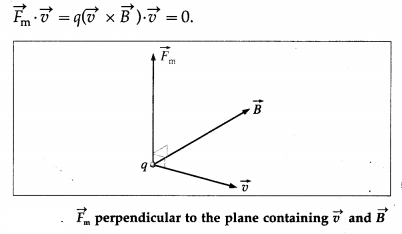
Question 7.
Express the mean free path of a gas molecule in terms of pressure and temperature.
Answer:
In the usual notation, the mean free path of a gas molecule,
Maharashtra Board Class 12 Physics Important Questions Chapter 3 Kinetic Theory of Gases and Radiation 8

Question 8.
Express the mean free path of a gas molecule in terms of the density of the gas
Answer:
In the usual notation, the mean free path of a gas molecule,
λ = \(\frac{1}{\sqrt{2} \pi d^{2}(N / V)}\)
Density, ρ, of the gas = \(\frac{\text { mass }}{\text { volume }}\)
= \(\frac{m N}{V}\), where m is the molecular mass.
∴ \(\frac{N}{V}\) = \(\frac{\rho}{m}\)
∴ λ = \(\frac{m}{\sqrt{2} \pi d^{2} \rho}\)

Question 9.
State the factors on which the mean free path of a gas molecule depends.
Answer:
The mean free path of a gas molecule depends upon the number of molecules per unit volume of the gas and molecular diameter.

Question 10.
What happens to the mean free path of a gas molecule if there is

  1. increase in temperature at constant pressure
  2. increase in pressure at constant temperature?

Answer:

  1. The mean free path increases,
  2. The mean free path decreases.

Question 9.
Solve the following :

Question 1.
Calculate the mean free path of a gas molecule if the molecular diameter is 5A and the number of molecules per unit volume of the gas is 2 × 1024 per m3. Compare it with molecular diameter.
Solution :
Data : d = 5Å = 5 × 10⁻¹⁰m, \(\frac{N}{V}\) = 2 × 1024 per m3
Maharashtra Board Class 12 Physics Important Questions Chapter 3 Kinetic Theory of Gases and Radiation 9
[Note : 1Å = 10-10m, 1 nm = 10-9 m = 10 Å]
Question 2.
If the mean free path of a gas molecule under certain conditions is 5000Å and the molecular speed is 500 mIs, find
(i) the time interval between successive collisions
(ii) the collision frequency (number of collisions per unit time) of a gas molecule.
Solution :
Data : λ = 5000 Å = 5000 × 10-10 m
= 5 × 10⁻⁷ m, v = 500 m/s
(i) speed (v) = \(\frac{\text { distance }(\lambda)}{\text { time }(T)}\)
∴ The time interval between successive collisions of a gas molecule, T = \(\frac{\lambda}{v}\)
= \(\frac{5 \times 10^{-7} \mathrm{~m}}{500 \mathrm{~m} / \mathrm{s}}\) = 10-9 s

(ii) The collision frequency (number of collisions per unit time) of a gas molecule,
f = \(\frac{1}{T}\) = \(\frac{1}{10^{-9} \mathrm{~s}}\) = 109 collisions per second

Question 3.
Calculate the mean free path of a gas molecule with diameter 4 Å if the pressure of the gas is 1.013 × 10⁵ N/m2 and the temperature is 27° C. (The Boltzmann constant, kB = 1.38 × 10⁻²³ J/K)
Solution :
Data : d = 4 Å = 4 × 10⁻¹⁰m, P = 1.013 × 10⁵ N/m2, T = (273 + 27) K = 300 KB = 1.38 × 10⁻²³ J/K
The mean free path of a gas molecule,
Maharashtra Board Class 12 Physics Important Questions Chapter 3 Kinetic Theory of Gases and Radiation 10

Question 4.
Find the mean free path of a gas molecule if the diameter of a molecule is 4 A, the mass of a molecule is 5.316 × 10⁻²⁶ kg and density of the gas is 1.429 kg/m3.
Solution :
Data : d = 4 Å = 4 × 10⁻¹⁰ m, m = 5.316 × 10⁻²⁶ kg, ρ = 1.429 kg/m3
The mean free path of a gas molecule,
Maharashtra Board Class 12 Physics Important Questions Chapter 3 Kinetic Theory of Gases and Radiation 11

Question 5.
The mean free path of a gas molecule is 60 nm when the density of the gas is 1.2 kg/m3. What will be the mean free path if the density is reduced to 0.8 kg/m3 ?
Solution :
Data : λ1 = 60 nm, ρ1 = 1.2 kg/m3, ρ2 = 0.8 kg/m3
λ = \(\frac{m}{\sqrt{2} \pi d^{2} \rho}\)
∴ \(\frac{\lambda_{2}}{\lambda_{1}}\) = \(\frac{\rho_{1}}{\rho_{2}}\) as m and d are not changed.
∴ λ2 = \(\lambda_{1} \frac{\rho_{1}}{\rho_{2}}\) = 60\(\left(\frac{1.2}{0.8}\right)\) nm = 90 nm
This is the required quantity.

Question 10.
What is the origin of pressure exerted by a gas on the walls of a container?
Answer:
The pressure exerted by a gas on the walls of a container results from the momentum transfer during the collisions of the gas molecules with the walls. The normal force on a wall by all the molecules, per unit wall area, is the gas pressure on the wall.

Question 11.
Define
(1) the mean (or average) speed
(2) the mean square speed
(3) the root-mean-square speed of gas molecules. State the expressions for the same.
Answer:
(1) Mean (or average) speed of molecules of a gas : The mean speed of gas molecules is defined as the arithmetic mean of the speeds of all molecules of the gas at a given temperature.

(2) Mean square speed of molecules of a gas : The mean square speed of gas molecules is defined as the arithmetic mean of the squares of the speeds of all molecules of the gas at a given temperature.

(3) Root-mean-square speed of molecules of a gas : The root-mean-square (rms) speed of gas molecules is defined as the square root of the arithmetic mean of the squares of the speeds of all molecules of the gas at a given temperature.

If there are N molecules in an enclosed pure gas and v1, v2, v3, …, vN are the speeds of different molecules,

  1. the mean speed, \(\bar{v}\) = \(\frac{v_{1}+v_{2}+\ldots+v_{N}}{N}\)
  2. the mean square speed,
    \(\overline{v^{2}}\) = \(\frac{v_{1}^{2}+v_{2}^{2}+\ldots+v_{N}^{2}}{N}\)
  3. the rms speed, vrms = \(\sqrt{\overline{v^{2}}}\)

[Note : The mean square velocity is numerically equal to the mean square speed. Similarly, the rms velocity is numerically equal to the rms speed. But in random motion, the mean velocity would be statistically zero, but the mean speed cannot be zero. ]

Question 12.
On the basis of the kinetic theory of gases, derive an expression for the pressure exerted by the gas.
Answer:
The pressure exerted by a gas on the walls of a container results from the momentum transfer during the collisions of the gas molecules with the walls. The normal force on the wall by all the molecules, per unit wall area, is the gas pressure on the wall.
Maharashtra Board Class 12 Physics Important Questions Chapter 3 Kinetic Theory of Gases and Radiation 12
Consider a very dilute gas at a steady-state temperature enclosed in a cubical container of side L. The coordinate axes are aligned with the edges of this cube, as shown in above figure. Suppose that there are N molecules in the container, each of mass m. Consider a molecule moving with velocity \(\).
\(\overrightarrow{v_{1}}\) = \(v_{1 x} \hat{\mathbf{i}}\) + \(v_{1 y} \hat{\mathrm{j}}\) + \(v_{1 z} \hat{\mathbf{k}}\) …. (1)

where v, v1x and v1z are the velocity components along the x-, y- and z-axes, respectively, so that
\(v_{1}^{2}\) = \(v_{1 x}^{2}\) + \(v_{1 y}^{2}\) + \(v_{1 z}^{2}\)
The change in momentum of the molecule on collision with the right wall
= final momentum – initial momentum
= (-m|v1x|) – m|v1x| = -2m|v1x|
Assuming the collision to be elastic, the change in momentum of the right wall due to this collision is 2m|v1x|.
Maharashtra Board Class 12 Physics Important Questions Chapter 3 Kinetic Theory of Gases and Radiation 13
Since the distance between the right and left walls is L, the time between successive collisions with the right wall is,
∆t = \(\frac{2 L}{\left|v_{1 x}\right|}\)
Therefore, the frequency with which the molecule collides with the right wall is \(\frac{\left|v_{1 x}\right|}{2 L}\).

∴ Rate of change of momentum of the right wall = (change in momentum in one collision)
(frequency of collision)
= (2m|v1x|).\(\frac{\left|v_{1 x}\right|}{2 L}\) = \(\frac{m v_{1 x}^{2}}{L}\) …. (2)
By Newton’s second law of motion, this is the force f1x exerted by the molecule on the right wall.
Thus, the net force on the right wall by all the N molecules is
Fx = f1x + f2x + … + fNx
Maharashtra Board Class 12 Physics Important Questions Chapter 3 Kinetic Theory of Gases and Radiation 14
The pressure Px exerted by all the molecules on a wall perpendicular to the x-axis is
Maharashtra Board Class 12 Physics Important Questions Chapter 3 Kinetic Theory of Gases and Radiation 17
where V = L3 is the volume of the container.
Maharashtra Board Class 12 Physics Important Questions Chapter 3 Kinetic Theory of Gases and Radiation 18
As pressure is the same in all directions,
Maharashtra Board Class 12 Physics Important Questions Chapter 3 Kinetic Theory of Gases and Radiation 19
By definition, the mean square speed of the gas molecules is
Maharashtra Board Class 12 Physics Important Questions Chapter 3 Kinetic Theory of Gases and Radiation 20
where vrms is the root-mean-square speed of molecules of the gas at a given temperature. Equation (12) gives the pressure exerted by an ideal gas in terms of its density and the root-mean-square speed of its molecules.

Maharashtra Board Class 12 Physics Important Questions Chapter 3 Kinetic Theory of Gases and Radiation

Question 13.
Assuming the expression for the pressure P exerted by an ideal gas, prove that the kinetic energy per unit volume of the gas is \(\frac{3}{2}\)P.
Answer:
According to the kinetic theory of gases, the pressure P exerted by the gas is
P = \(\frac{1}{3} \rho v_{r m s}^{2}\) = \(\frac{1}{3} \frac{M}{V} v_{\mathrm{rms}}^{2}\)
where vrms is the rms speed (root-mean-square speed) of the gas molecules; M, V and ρ are the mass, volume and density of the gas, respectively.
Maharashtra Board Class 12 Physics Important Questions Chapter 3 Kinetic Theory of Gases and Radiation 21
Thus, the kinetic energy per unit volume of an ideal gas is \(\frac{3}{2}\)P.

Question 14.
What is the kinetic energy per unit volume of a gas if the gas pressure is 105 N/m2?
Answer:
Kinetic energy per unit volume of a gas
= \(\frac{3}{2}\)P = \(\frac{3}{2}\) × 105 = 1.5 × 10⁵ J/m3.

Question 15.
Assuming the expression for the pressure exerted by an ideal gas, prove that (1) the kinetic energy per mole of the gas = \(\frac{3}{2}\)RT (2) the rms speed of a gas molecule, urms = \(\sqrt{3 R T / M_{0}}\).
OR
Assuming the expression for the pressure exerted by an ideal gas, show that the rms speed of a gas molecule is directly proportional to the square root of its absolute temperature.
OR
Show that the rms velocity of gas molecules is directly proportional to the square root of its absolute temperature.
Answer:
According to the kinetic theory of gases, the pressure P exerted by a gas is
ρ = \(\frac{1}{3} \rho v_{\mathrm{rms}}^{2}\) = \(\frac{1}{3} \frac{M}{V} v_{\mathrm{rms}}^{2}\)
∴ PV = \(\frac{1}{3} m v_{\mathrm{rms}}^{2}\)
where vrms is the rms speed (root-mean-square speed) of the gas molecules; M, V and ρ are the mass,
volume and density of the gas, respectively. If there are n moles of the gas and M0 is the molar mass,
M = nM0, so that PV = \(\frac{1}{3} n M_{0} v_{\mathrm{rms}}^{2}\) … (1)
The equation of state of an ideal gas is
PV = nRT … (2)
where T is the absolute temperature of the gas and R is the molar gas constant.
From Eqs. (1) and (2), we get,
Maharashtra Board Class 12 Physics Important Questions Chapter 3 Kinetic Theory of Gases and Radiation 15
where the term on the left-hand side is the kinetic energy of one mole of the gas.
∴ Kinetic energy per mole of the gas = \(\frac{3}{2}\)RT… (5)
From Eq. (3),
Maharashtra Board Class 12 Physics Important Questions Chapter 3 Kinetic Theory of Gases and Radiation 16
In Eq. (6), R and M0 are constant so that vrms ∝ \(\sqrt{T}\). Thus, the rms speed of a gas molecule is directly proportional to the square root of the absolute temperature of the gas.

Question 16.
The rms speed of oxygen molecules at a certain temperature is 400 m/s. What is the rms speed of nitrogen molecules at the same temperature ?
[M01 (oxygen) = 32 × 10-3 kg/mol,
M02 (nitrogen) = 28 × 10-3 kg/mol]
Answer:
Maharashtra Board Class 12 Physics Important Questions Chapter 3 Kinetic Theory of Gases and Radiation 22

Question 17.
The kinetic energy per unit mass of a certain gas at 300 K is 1.3 × 10⁵ J/kg. What will be the kinetic energy per unit mass of the gas at 600 K ?
Answer:
KE per unit mass of a gas (KE/M) ∝ T
Maharashtra Board Class 12 Physics Important Questions Chapter 3 Kinetic Theory of Gases and Radiation 23
This is the required quantity.

Question 18.
Prove that the kinetic energy per molecule of an ideal gas is \(\frac{3}{2}\)KBT.
Give the interpretation of temperature according to the kinetic theory of gases.
Answer:
Consider n moles of an ideal gas in a container of volume V. If m is the mass of a gas molecule and vrms is the root-mean-square speed of the gas molecules then, by the kinetic theory, the pressure exerted by the gas is
Maharashtra Board Class 12 Physics Important Questions Chapter 3 Kinetic Theory of Gases and Radiation 24
Therefore, the kinetic energy per molecule of an ideal gas is directly proportional to its absolute temperature.

This equation is the relation between the kinetic per molecule of a gas and the absolute temperature which is the macroscopic parameter of the gas. The absolute temperature of a gas is a measure of the kinetic energy per molecule of the gas. This result is called the kinetic intepretation of temperature, i.e., the interpretation of temperature according to the kinetic theory of gases.

Question 19.
The rms speed of molecules of a certain gas at 300 K is 400 m/s. What will be the rms speed if the gas is heated to 600 K?
Answer:
Maharashtra Board Class 12 Physics Important Questions Chapter 3 Kinetic Theory of Gases and Radiation 25
gives the required rms speed.

Question 20.
State Boyle’s law. Deduce it on the basis of the kinetic theory of an ideal gas.
OR
Deduce Boyle’s law using the expression for pressure exerted by an ideal gas.
Answer:
Boyle’s law : At a constant temperature, the pressure exerted by a fixed mass of gas is inversely proportional to its volume. If P and V denote the pressure and volume of a fixed mass of gas, then, PV = constant at a constant temperature, for a fixed mass of gas.
According to the kinetic theory of gases, the pressure exerted by the gas is
P = \(\frac{1}{3} \frac{N m v_{\mathrm{rms}}^{2}}{V}\)
where N is the number of molecules of the gas, m is the mass of a single molecule, vrms is the rms speed of the molecules and V is the volume occupied by the gas.
∴ PV = (\(\frac{1}{2}\)mv2rms) × \(\frac{2}{3}\) N
= (KE of a gas molecule) \(\frac{2}{3}\) N … (1)

For a fixed mass of gas, N is constant. Further, intermolecular forces are ignored so that the corresponding potential energy of the gas molecules may be assumed to be zero. Therefore, \(\frac{1}{2} m v_{\mathrm{rms}}^{2}\) is the total energy of a gas molecule and N\(\left(\frac{1}{2} m v_{\mathrm{rms}}^{2}\right)\) is the total energy of the gas molecules, which is proportional to the absolute temperature of the gas. Then, the right-hand side of EQ. (1) will be constant if its temperature is constant. Hence, it follows that PV = constant for a fixed mass of gas at constant temperature, which is Boyle’s law.

Question 21.
Solve the following :

Question 1.
The speeds of five molecules are 200 m/s, 300 m/s, 400 m/s, 500 m/s and 600 m/s respectively. Find
(i) the mean speed
(ii) the mean square speed
(iii) the root mean square speed of the molecules.
Solution :
Data : v1 = 200 m/s, v2 = 300 m/s, v3 = 400 m/s,. v5 = 500 m/s, v6 = 600 m/s
(i) Mean speed,
Maharashtra Board Class 12 Physics Important Questions Chapter 3 Kinetic Theory of Gases and Radiation 26
Maharashtra Board Class 12 Physics Important Questions Chapter 3 Kinetic Theory of Gases and Radiation 27

Question 2.
Find the number of molecules in 1 cm3 of oxygen at a pressure of 105 N/m2 if the rms speed of oxygen molecules is 426 m/s. What is the temperature of the gas? (Mass of an oxygen molecule = 5.28 × 10⁻²⁶ kg, kB = 1.38 × 10⁻²³ J/K)
Solution :
Data : m = 5.28 × 10⁻²⁶ kg, vrms = 426 m/s,
V = 1 cm3 = 10-6 m3, P = 105 Pa, kB = 1.38 × 10⁻²³ J/K
Maharashtra Board Class 12 Physics Important Questions Chapter 3 Kinetic Theory of Gases and Radiation 28
This is the number of molecules in 1 cm3 of oxygen under given conditions.

(ii) PV = nRT
Maharashtra Board Class 12 Physics Important Questions Chapter 3 Kinetic Theory of Gases and Radiation 29
This is the required temperature.

Question 3.
A cylinder filled with hydrogen at 400 K exerts a pressure of 3 atmospheres. If hydrogen is replaced by an equal mass of helium at the same temperature, find the
(i) relative number of molecules of hydrogen and helium occupying the cylinder
(ii) pressure exerted by helium. (Molar mass of hydrogen = 2 g/mol, molar mass of helium = 4 g/mol)
Solution:
Let the subscript 1 refer to hydrogen and the subscript 2 to helium.
From the data in the example,
T = 400 K, P1 = 3 atmospheres, molar mass of hydrogen, M1 = 2 g/mol
Molar mass of helium, M2 = 4 g/mol
∴ \(\frac{M_{2}}{M_{1}}\) = \(\frac{4}{2}\) = 2

(i) Since both the gases have the same mass, N1m1 = N2m2, where is the mass of a molecule of hydrogen and m2 is the mass of a molecule of helium.
Maharashtra Board Class 12 Physics Important Questions Chapter 3 Kinetic Theory of Gases and Radiation 30
∴ P2 = \(\frac{2}{3}\) × \(\frac{N_{2}}{V}\) × \(\left(\frac{1}{2} m_{2} v_{2 \mathrm{rms}}^{2}\right)\)
As the temperature is the same in both the cases, the average kinetic energy of gas molecules will be the same in both the cases.
Maharashtra Board Class 12 Physics Important Questions Chapter 3 Kinetic Theory of Gases and Radiation 31
Pressure exerted by helium,
P2 = 1.5 atmospheres

Maharashtra Board Class 12 Physics Important Questions Chapter 3 Kinetic Theory of Gases and Radiation

Question 4.
Calculate the rms speed of oxygen molecules at 127 °C. (Density of oxygen at STP = 1.429 kg/m3 and one atmosphere = 1.013 × 10⁵ N/m2)
Solution:
By the data, ρ = 1.429 kg/m3,
P = 1.013 × 10⁵N/m2
Maharashtra Board Class 12 Physics Important Questions Chapter 3 Kinetic Theory of Gases and Radiation 32
The root mean square speed of oxygen molecules at 127° C = 558.1 m/s.

Question 5.
At what temperature will helium molecules have the same rms speed as that of hydrogen molecules at STP ? (Molar mass of hydrogen = 2 g/mol, molar mass of helium = 4 g/mol)
Solution :
Data : M01 (hydrogen) = 2 g/mol
M02 (helium) = 4 g/mol, T1 (hydrogen) = 273 K,
vrms (hydrogen) = v2rms (helium)
Maharashtra Board Class 12 Physics Important Questions Chapter 3 Kinetic Theory of Gases and Radiation 33
The temperature of helium = 546 K = 273 °C

Question 6.
Compute the temperature at which the rms speed of nitrogen molecules is 831 m/s. [Universal gas constant, R = 8310 J/kmol K, molar mass of nitrogen = 28 kg/kmol]
Solution :
Data : vrms = 831 m/s, R = 8310 J/kmol.K,
M0 = 28 kg/kmol
Maharashtra Board Class 12 Physics Important Questions Chapter 3 Kinetic Theory of Gases and Radiation 34
This is the required temperature.

Question 7.
If the rms speed of oxygen molecules at STP is 460 m/s, determine the rms speed of hydrogen molecules at STP. [Molar mass of oxygen = 32 g/mol, molar mass of hydrogen = 2 g/mol]
Solution :
Data : vrms (oxygen) = 460 m/s, same temperature, M01 (oxygen) = 32 × 10-3 kg/mol,
M02 (hydrogen) = 2 × 10⁻³ kg/mol
Maharashtra Board Class 12 Physics Important Questions Chapter 3 Kinetic Theory of Gases and Radiation 35
This is the rms speed of hydrogen molecules at STP.

Question 8.
Calculate the rms speed of helium atoms at 27 °C. [Density of helium at STP = 0.1785 kg/m3, one atmosphere = 1.013 × 10⁵ Pa]
Solution :
Data : ρ = 0.1785 kg/m3, P = 1.013 × 10⁵ Pa,
T0 = 273 K, T = (273 + 27) = 300 K
The rms speed of helium atoms at STP,
Maharashtra Board Class 12 Physics Important Questions Chapter 3 Kinetic Theory of Gases and Radiation 36

Question 9.
Determine the pressure of oxygen at 0°C if the density of oxygen at STP = 1.44 kg/m3 and the rms speed of the molecules at STP = 456.4 m/s.
Solution :
Data : ρ = 1.44 kg/m3, vrms = 456.4 m/s
The pressure of oxygen,
P = \(\frac{1}{3} \rho v_{\mathrm{rms}}^{2}\)
= \(\frac{1}{2}\)(1.44)(456.4)2 = 9.98 × 10⁴ Pa

Question 10.
Calculate the rms speed of hydrogen molecules at 373.2K. [Molar mass of hydrogen, M0 = 2 × 10⁻³ kg/mol, R = 8.314 J/mol.K]
Solution :
Data : T = 373.2 K, M0 = 2 × 10⁻³ kg/mol,
R = 8.314 J/mol.K
The rms speed of hydrogen molecules,
Maharashtra Board Class 12 Physics Important Questions Chapter 3 Kinetic Theory of Gases and Radiation 37
= 2157 m/s = 2.157 km/s

Question 11.
Find the rms speed of hydrogen molecules if its pressure is 105 Pa and density is 0.09 kg/m3.
Solution :
Data : ρ = 0.09 kg/m3, P = 105 Pa
The rms speed of hydrogen molecules,
Maharashtra Board Class 12 Physics Important Questions Chapter 3 Kinetic Theory of Gases and Radiation 38

Question 12.
The temperature of matter in interstellar space has an average value of about 3 K. Find the rms speed of a proton in the space. [mp = 1.673 × 10⁻²⁷ kg, kB = 1.38 × 10⁻²³ J/K]
Solution :
Data : T = 3 K, mp = 1.673 × 10⁻²⁷ kg, kB = 1.38 × 10⁻²³ J/K
The rms speed of a proton in interstellar space,
Maharashtra Board Class 12 Physics Important Questions Chapter 3 Kinetic Theory of Gases and Radiation 39

Question 13.
Find the temperature at which
(i) the rms speed
(ii) the average kinetic energy of the molecules of an ideal gas are double their respective values at STP.
Solution:
Data : T0 = 273 K, v = 2v0 (rms speeds),
KE = 2KE0 (average kinetic energies)
(i) vrms ∝ \(\sqrt{\mathrm{T}}\) for a given gas.
∴\(\frac{v}{v_{\mathrm{o}}}\) = \(\sqrt{\frac{T}{T_{0}}}\)
∴\(\sqrt{\frac{T}{T_{0}}}\) = 2
∴ Temperature, T = 4T0 = 4 × 273 = 1092 K

(ii) Average Kinetic Energy ∝ T
∴ \(\frac{\mathrm{KE}}{\mathrm{KE}_{0}}\) = \(\frac{T}{T_{0}}\)
∴ Temperature, T = 2T0 = 2 × 273 = 546 K

Question 14.
At what temperature is the rms speed of an argon atom equal to that of a helium atom at – 20 °C ? [Atomic mass of Ar = 39.9 amu, atomic mass of He = 4.0 amu]
Solution :
Data : T1 = -20 °C = 273 – 20 = 253 K,
M01 (He) = 4 amu, M02 (Ar) = 39.9 amu
Maharashtra Board Class 12 Physics Important Questions Chapter 3 Kinetic Theory of Gases and Radiation 40
∴ T2 = \(\frac{M_{02}}{M_{01}}\) T1 = \(\frac{39.9}{4} \times 253\)
= 2523 K
This is the required temperature.

Question 15.
Calculate the kinetic energy
(i) per mole
(ii) per unit mass
(iii) per molecule of nitrogen at STP. [Molar mass of nitrogen = 28 × 10-3 kg/mol, R = 8.314 J/mol.K, kB = 1.38 × 10⁻²³ J/K]
Solution :
Data : T = 273 K, M0 = 28 × 10-3 kg/mol,
R = 8.314 J/mol.K, kB = 1.38 × 10⁻²³ J/K
(i) The KE per mole = \(\frac{3}{2}\)RT
= \(\frac{3}{2}\)(8.314)(273) = 3.404 × 10³ J/mol

(ii) The KE per unit mass = \(\frac{3}{2} \frac{R T}{M_{0}}\)
= \(\frac{3}{2} \cdot \frac{(8.314)(273)}{28 \times 10^{-3}}\) = 1.216 × 10⁵ J/kg

(iii) The KE per molecule
Maharashtra Board Class 12 Physics Important Questions Chapter 3 Kinetic Theory of Gases and Radiation 41

Question 16.
Calculate the average molecular kinetic energy
(i) per kilomole
(ii) per kilogram of oxygen at 27 °C. [R = 8310 J/kmol.K, Avogadro’s number = 6.02 × 1026 molecules/kmol]
Solution :
Data : T = 273 + 27 = 300 K, M0 = 32 kg / kmol,
R = 8310 J/kmol.K
(i) The average molecular kinetic energy per kilomole of oxygen
= \(\frac{3}{2}\) RT = \(\frac{3}{2}\) (8310) (300)
= 4155 × 900 = 3739 × 1000
= 3.739 × 10⁶ J/kmol

(ii) The average molecular kinetic energy per unit mass of oxygen
Maharashtra Board Class 12 Physics Important Questions Chapter 3 Kinetic Theory of Gases and Radiation 42

Question 17.
Calculate the kinetic energy of 10 grams of argon molecules at 127 °C. [Universal gas constant R = 8310 J/kmol.K, atomic weight of argon = 40]
Solution:
Data : M = 10 g = 10 × 10-3 kg, T = 273 + 127 = 400 K,R = 8310 J/kmol.K, M0 = 40 kg/kmol Kinetic energy per unit mass
Maharashtra Board Class 12 Physics Important Questions Chapter 3 Kinetic Theory of Gases and Radiation 43
= 15 × 8310 = 1.247 × 10⁵ J/kg
∴ The kinetic energy of 1 × 10⁻³ kg of argon at 127°C = 1.247 × 105 × 10 × 10-3
= 1247 J

Question 18.
Calculate the kinetic energy of 2 kg of nitrogen at 300 K. [Molar mass of nitrogen = 28 × 10-3 kg/mol, R = 8.314 J/mol.K]
Solution :
Data : Mass of nitrogen, M = 2 kg, T = 300 K,
M0 = 28 × 10-3 kg/mol, R = 8.314 J/mol.K
Kinetic energy per kg = \(\frac{3}{2} \frac{R T}{M_{0}}\)
∴ The kinetic energy of 2 kg of nitrogen
Maharashtra Board Class 12 Physics Important Questions Chapter 3 Kinetic Theory of Gases and Radiation 44

Question 19.
The kinetic energy of 1 kg of oxygen at 300 K is 1.169 × 10⁵ J. Find the kinetic energy of 4 kg of oxygen at 400 K.
Solution :
Data : Masses of oxygen, M1 = 1 kg and M2 = 4 kg, T1 = 300 K, T2 = 400 K, kinetic energy,
K1 = 1.169 × 10⁵ J
Kinetic energy of a given mass (M) of a gas,
Maharashtra Board Class 12 Physics Important Questions Chapter 3 Kinetic Theory of Gases and Radiation 45
This is the kinetic energy of 4 kg of oxygen at 400 K.

Question 20.
The kinetic energy per unit mass of nitrogen at 300 K is 2.5 × 10⁶J/kg. Find the kinetic energy of 4 kg of oxygen at 600 K. [Molar mass of nitrogen = 28 kg/kmol, molar mass of oxygen = 32 kg/kmol]
Solution:
Data : T1 = 300 K, K1 = 2.5 × 10⁶ J/kg,
M1 (nitrogen) = 1 kg, M2(oxygen) = 4 kg,
M01 (nitrogen) = 28 kg/kmol, T2 = 600 K,
M02(oxygen) = 32 kg/kmol
Kinetic energy of a given mass M of a gas,
Maharashtra Board Class 12 Physics Important Questions Chapter 3 Kinetic Theory of Gases and Radiation 46
This is the required quantity.

Question 21.
The pressure of a gas in a 0.1 litre container is 200 kPa and the KE per molecule is 6 × 10-21J. Find the number of gas molecules in the container. How many moles are in the container? [Avogadro number = 6.022 × 10²³ mol-1]
Solution:
Data : V = 0.1 litre = 10-4 m3, P = 200 kPa
= 2 × 10⁵ Pa, KE per molecule = 6 × 10-21 J,
NA = 6.022 × 10²³ mol-1
The KE per molecule of a gas = \(\frac{3}{2}\)kBT
Maharashtra Board Class 12 Physics Important Questions Chapter 3 Kinetic Theory of Gases and Radiation 47

Question 22.
At what temperature will the average kinetic energy of a gas be exactly half of its value at NTP ?
Solution :
Data : KE2/KE1 = 1/2, T1 = 273K
Average molecular kinetic energy per mole of the gas = \(\frac{3}{2}\)RT
Maharashtra Board Class 12 Physics Important Questions Chapter 3 Kinetic Theory of Gases and Radiation 48
This is the required temperature.

Maharashtra Board Class 12 Physics Important Questions Chapter 3 Kinetic Theory of Gases and Radiation

Question 23.
Find the kinetic energy per unit volume of nitrogen at a pressure of 76 cm of mercury. Hence, find the kinetic energy of 10 cm3 of the gas under the same condition. Take ρ (mercury) = 13.6 g/cm3 and g = 9.8 m/s2.
Solution :
Data :h = 76 cm = 0.76 m, ρ = 13.6 g/cm3 = 13.6 × 10³ kg/m3, g = 9.8 m/s2,
V = 10 cm3 = 10 × 10-6 cm3

(i) The kinetic energy per unit volume of nitrogen
Maharashtra Board Class 12 Physics Important Questions Chapter 3 Kinetic Theory of Gases and Radiation 49
(ii) The kinetic energy of 10 cm3 of the gas = \(\frac{3}{2}\) PV= (1.519 × 10⁵) (10 × 10-6)
= 1.519 J

Question 22.
What is meant by degrees of freedom ? Explain the degrees of freedom for
(i) an atom
(ii) a diatomic molecule.
Answer:
The concept of degrees of freedom as used in the kinetic theory specifies the number of independent ways in which an atom or molecule can take up energy. It depends only on the possibilities of motion of the atom or molecule.

Gas molecules of all types have x-, y- and z-components of velocity that are entirely independent of one another. Thus, they have three ways to move in translation, i.e., three degrees of translational freedom.

An atom (or a monatomic molecule, i.e., a molecule containing a single atom, e.g., He) treated as a point mass, has no rotational motion. Hence, it has only three degrees of translational freedom.

A diatomic molecule, in addition to translation, can rotate about axes perpendicular to the line connecting the atoms, as shown in below figure, but not about that line itself. Therefore, it has only two degrees of rotational freedom.
Maharashtra Board Class 12 Physics Important Questions Chapter 3 Kinetic Theory of Gases and Radiation 50

Further, the two atoms may oscillate alternately toward and away from one another along the line joining them, as if connected by a spring. As a, i harmonic oscillator can have potential energy as well as kinetic energy, a diatomic molecule is regarded to have two degrees of vibrational freedom. Thus, at high enough temperatures, a diatomic molecule has seven degrees of freedom : three of translation, and two each of rotation and vibration.

Notes :

(1) That a monatomic gas molecule does not have rotational energy, and that a diatomic molecule does not have a third rotational degree of freedom corresponding to rotation about the line joining the atoms, are explained by quantum theory.

(2) Also according to quantum theory, rotational and oscillatory motions begin at certain higher temperatures. For a molecule of a diatomic gas (like hydrogen), only translation is possible at very low temperatures (below about 100 K). As the temperature increases, rotational motion can begin; so that, at room temperature, a diatomic molecule has only five degrees of freedom-behaving like a pair of atoms rigidly connected like a dumbbell. Oscillatory motion can begin only at quite high temperatures substantially above room temperature (usually of the order of thousands of kelvin).

Question 23.
Derive Mayer’s relation between the molar specific heat of a gas at constant pressure and that at constant volume.
OR
Using the first law of thermodynamics, show that for an ideal gas, the difference between the molar specific heat capacities at constant pressure and at constant volume is equal to the molar gas constant R.
Answer:
Consider a cylinder of volume V containing n moles of an ideal gas at pressure P, fitted with a piston of area A. Suppose, the gas is heated at constant pressure which raises its temperature by dT. The gas exerts a total force F = PA on the piston which moves outward a small distance dx.
Maharashtra Board Class 12 Physics Important Questions Chapter 3 Kinetic Theory of Gases and Radiation 51
dW = Fdx = PAdx = PdV … (1)
where Adx = dV is the increase in volume of the gas during the expansion. dW is the work done by the gas on the surroundings as a result of the expansion. If the heat supplied to the gas is dQP and the increase in its internal energy is dE then, by the first law of thermodynamics,
dQP = dE + dW=dE + PdV
If CP is the molar specific heat capacity of the gas at constant pressure, dQP = nCP dT.
∴ nCPdT = dE + PdV …(2)

On the other hand, if the gas was heated at constant volume (instead of at constant pressure) from the initial state such that its temperature increases by the same amount dT, then dW=0. Since the internal energy of an ideal gas depends only on the temperature, the increase in internal would again be dE. If dQv was the heat supplied to the gas in this case, by the first law of thermodynamics and the definition of molar specific heat capacity at constant volume (CV),
Maharashtra Board Class 12 Physics Important Questions Chapter 3 Kinetic Theory of Gases and Radiation 52
This is Mayer’s relation between CP and CV.

Here, heat and work are expressed in the same units. If heat is expressed in calorie or kilo calorie and work is expressed in erg or joule, the above relation becomes
CP – CV = \(\frac{R}{J}\) …. (7)
Where J is the mechanical equivalent of heat.

Question 24.
Express Mayer’s relation in terms of the principal specific heats, SP and SV.
Answer:
Mayer’s relation : CP – CV = R. Let M0 = molar mass of the gas, SP = specific heat of the gas at constant pressure and SV = specific heat of the gas at constant volume.

Now, CP = M0SP and CV = M0SV
∴ M0Sp – M0SV = R
∴ SP – SV = \(\frac{R}{M_{0}}\) when heat and work are expressed
in the same units. If heat is expressed in calorie or kilo calorie and work is expressed in erg or joule, we
get,
Sp – Sv = \(\frac{R}{M_{0} J}\), where J is the mechanical equivalent of heat.
Maharashtra Board Class 12 Physics Important Questions Chapter 3 Kinetic Theory of Gases and Radiation 53

Question 25.
Explain : Each translational and rotational degree of freedom contributes only one quadratic term to the energy but one vibrational mode contributes two quadratic terms.
Answer:
With three translational degrees of freedom, the average translational energy per molecule of a gas is
Maharashtra Board Class 12 Physics Important Questions Chapter 3 Kinetic Theory of Gases and Radiation 54
where m is the mass of the molecule and vx, vy and vz are the x-, y- and z-components of the molecular velocity.

A diatomic molecule has two rotational degrees of freedom. If ω1 and ω2 are the angular speeds about the two axes and I1 and I2 are the corresponding moments of inertia, the rotational energy of a diatomic molecule,
Maharashtra Board Class 12 Physics Important Questions Chapter 3 Kinetic Theory of Gases and Radiation 55
A diatomic molecule is regarded to have two degrees of vibrational freedom for the vibrational mode in which the two atoms vibrate relative to, and without affecting, the centre of mass of the molecule. Comparing this system with a vibrating body of mass m connected to a spring of force constant k, the vibrational energy has two terms corresponding to the kinetic and potential energies :
Maharashtra Board Class 12 Physics Important Questions Chapter 3 Kinetic Theory of Gases and Radiation 56
where x is the displacement from the mean position.

From Eqs. (1), (2) and (3), each translational and rotational degree of freedom contributes only one quadratic term to the average energy of a gas molecule while one vibrational mode contributes two quadratic terms.

[ Note : For a gas at an absolute temperature T, the
Maharashtra Board Class 12 Physics Important Questions Chapter 3 Kinetic Theory of Gases and Radiation 57

Question 26.
Explain the degrees of freedom a polyatomic molecule can have. Hence write the expressions for
(i) the energy per molecule
(ii) the energy per mole
(iii) CV
(iv) CP
(v) the adiabatic constant, for a polyatomic gas.
Answer:
A polyatomic molecule has three degrees of translational freedom like any particle. Each molecule can also rotate about its centre of mass with an angular velocity components along each of the three axes. Therefore, each molecule has three degrees of rotational freedom. Additionally, if the molecule is soft at high enough temperatures, it can vibrate easily with many different frequencies, say, f, because there are many interatomic bonds. Hence, it has 2f degrees of vibrational freedom. Then, according to the law of equipartition of energy, for each degree of freedom of translation and rotation,
the molecule has the average energy \(\frac{1}{2}\)kBT, but for each frequency of vibration the average energy is kBT, since each vibration involves potential energy and kinetic energy. kB is the Boltzmann constant and T is the thermodynamic temperature.
(i) The energy per molecule
Maharashtra Board Class 12 Physics Important Questions Chapter 3 Kinetic Theory of Gases and Radiation 58
[Note : As /increases, y decreases.]

Question 27.
The top of a cloud of smoke holds together for hours. Why?
Answer:
According to the law of equipartition of energy, the smoke particles have the same average kinetic energy of random motion as the air molecules. But smoke particles have a much larger mass than air molecules and therefore move slowly, i.e., the average speed of diffusion of smoke particles is small. Hence, in the absence of significant turbulence in the atmosphere, a smoke cloud is relatively stable.

Maharashtra Board Class 12 Physics Important Questions Chapter 3 Kinetic Theory of Gases and Radiation

Question 28.
Solve the following :

Question 1.
Find the kinetic energy per molecule of a monatomic gas at 300 K.
Solution :
Data : T = 300 K, kB = 1.38 × 10⁻²³ J/K
The kinetic energy per molecule of the gas
= \(\frac{3}{2}\)kBT
= \(\frac{3}{2}\) (1.38 × 10⁻²³) (300) J/molecule
= (4.5) (1.38 × 10⁻²¹) J/molecule
= 6.21 × 10⁻²¹ J/molecule
[Note : Here, the number of degrees of freedom is 3.]

Question 2.
Find the kinetic energy of two moles of a mon-atomic gas at 400 K.
Solution :
Data : n = 2, T = 400 K, R = 8.314 J/mol.K
The kinetic energy of two moles of the gas
= \(\frac{3}{2}\)nRT = \(\frac{3}{2}\)(2) (8.314) (400) J
= (12) (8.314 × 10²) J
= 9.977 × 10³ J.

Question 3.
Find the kinetic energy of 10 kg of a monatomic gas at 500 K if the molar mass of the gas is 4 × 10⁻³ kg/mol.
Solution :
Data : M = 10 kg, M0 = 4 × 10⁻³ kg/mol, T = 500 K, R = 8.314 J/mol.K.
The kinetic energy of 10 kg of the gas
Maharashtra Board Class 12 Physics Important Questions Chapter 3 Kinetic Theory of Gases and Radiation 59

Question 4.
Find the kinetic energy per molecule of a diatomic gas at 300 K.
Solution :
Data : T = 300 K, kB = 1.38 × 10⁻²³ J/K
The kinetic energy per molecule of the gas
= \(\frac{5}{2}\) kBT = \(\frac{5}{2}\)(1.38 × 10⁻²³) (300) J/molecule
= (7.5) (1.38 × 10⁻²³) J/molecule
= 1.035 × 10⁻²² J/molecule.
[Note : Here, the number of degrees of freedom is 5.]

Question 5.
Find the kinetic energy of four moles of a diatomic gas at 400 K.
Solution :
Data : n = 4, T = 400 K, R = 8.314 J/mol.K
The kinetic energy of four moles of the gas
= \(\frac{5}{2}\)nRT = \(\left(\frac{5}{2}\right)\) (8.314) (400) J
= (40)(8.314 × 10²) J
= 3.326 × 10⁴ J

Question 6.
Find the kinetic energy of 56 kg of a diatomic gas at 500 K if the molar mass of the gas is 28 × 10-3 kg/mol.
Solution :
Data : M = 56 kg, M0 = 28 × 10-3 kg/mol, T = 500 K, R = 8.314 J/mol.K
The kinetic energy of 56 kg of the gas
Maharashtra Board Class 12 Physics Important Questions Chapter 3 Kinetic Theory of Gases and Radiation 60
= 25(8.314 × 10⁵)
= 2.079 × 10⁷ J

Question 7.
When two kilocalories of heat are supplied to a system, the internal energy of the system increases by 5030 J and the work done by the gas against the external pressure is 3350 J. Calculate J, the mechanical equivalent of heat.
Solution :
Data : From the data in the example,
dQ = 2 kcal, dE = 5030 J, dW = 3350 J.
dQ = \(\frac{d E+d W}{J}\), where J = mechanical equivalent of heat
Maharashtra Board Class 12 Physics Important Questions Chapter 3 Kinetic Theory of Gases and Radiation 61

Question 8.
Find the increase in the internal energy of a gas of mass 10 grams when it is heated from 300 K to 305 K.
Given : SV = 0.16 kcal/kg.K, J = 4186 J/kcal
Solution :
Data : M = 10 grams = 10 × 10-3 kg,
SV = 0.16 kcal/kg.K, J = 4186 J/kcal
Rise in the temperature of the gas,
∆T = 305 – 300 = 5K
∆E = J SV M∆T = (4186)(0.16)(10 × 10-3) × (5) J
= 33.49 J
The increase in the internal energy of the gas, ∆E = 33.49 J

Question 9.
The molar specific heat of helium at constant volume is 12.5 J/mol.K. Find its molar specific heat at constant pressure. Take R = 8.31 J/mol.K.
Solution :
Data : CV = 12.5 J/mol.K, R = 8.31 J/mol.K
The molar specific heat of helium at constant press-ure,
CP = CV + R = (12.5 + 8.31) J/mol.K
= 20.81 J/mol.K.

Question 10.
Find the principal specific heats of helium and hence the universal gas constant. Given : CP = 20.81 J/mol.K, CV = 12.5 J/mol.K. M0 (He) = 4 × 10⁻³ kg/mol.
Solution :
Data : CP = 20.81 J/mol.K, CV = 12.5 J/mol.K,
M0 = 4 × 10⁻³ kg/mol.
(i) The specific heat of helium at constant pressure,
Maharashtra Board Class 12 Physics Important Questions Chapter 3 Kinetic Theory of Gases and Radiation 62
[Note : R = CP – CV = (20.81 – 12.5) J/mol.K = 8.31 J/mol.K. The difference between the two values of R is due to the approximation involved in calculation.]

Question 11.
The molar specific heat of nitrogen at constant volume is 4.952 cal/mol.K and that at constant pressure is 6.933 cal/mol.K. Find the mechanical equivalent of heat. Take R = 8.31 J/mol.K.
Solution :
Data : CV = 4.952 cal/mol.K, CP = 6.933 cal/mol.K, R = 8.31 J/mol.K
Maharashtra Board Class 12 Physics Important Questions Chapter 3 Kinetic Theory of Gases and Radiation 63

Question 29.
Name and define the modes of heat transfer.
Answer:
The three modes of heat transfer are conduction, convection and radiation.

  1. Conduction is the mode of heat transfer within a body or between two bodies in contact, from a region of high temperature to a region of lower temperature without the migration of the particles of the medium.
  2. Convection is the mode of heat transfer from one part of a fluid to another by the migration of the particles of the fluid.
  3. Radiation is the mode of heat transfer by electromagnetic waves / quanta.

Question 30.
What is thermal radiation or heat radiation? State its characteristic properties.
Answer:
Radiation is the mode of heat transfer or in general, energy transfer by electromagnetic waves / quanta. Thermal radiation or heat radiation is the radiation produced by thermal agitation of the particles of a body, and its spectrum, i.e., frequency distribution or wavelength distribution, is continuous from the far infrared to the extreme ultraviolet region depending on the temperature of the body.

Properties :

  1. Thermal radiations are electromagnetic waves/ quanta extending from the far infrared to the extreme ultraviolet region. In this spectrum, the infrared waves (wavelengths ranging from about 700 nm to about 1 mm) are sensed as heat.
  2. They have the same speed in free space as that of light, nearly 3 × 10⁸ m/s, which makes radiation the most rapid mode of heat transfer.
  3. They exhibit all the optical phenomena of light, viz., reflection, absorption, refraction, interference, diffraction and polarization.
  4. Radiation incident on a body is, in general, partly reflected, partly, absorbed and partly transmitted.
  5. Thermal radiation obeys the inverse-square law of intensity, i.e., the intensity at a point is inversely proportional to the square of its distance from a point source of radiation.

Question 31.
Define the coefficients of absorption, reflection and transmission. Obtain the relation between them.
Answer:

  1. The coefficient of absorption or absorptive power or absorptivity of a body is the ratio of the quantity of radiant energy absorbed by the body to the quantity of radiant energy incident on the body in the same time.
  2. The coefficient of reflection or reflectance or reflective power of the surface of a body is the ratio of the quantity of radiant energy reflected by the surface to the quantity of radiant energy incident on the surface in the same time.
  3. The coefficient of transmission or transmittance or transmissive power of a body is the ratio of the quantity of radiant energy transmitted by the body to the quantity of radiant energy incident on the body in the same time.

Let Q be the quantity of radiant energy incident on a body and Qa, Qr and Qt be the quantities of radiant energy absorbed, reflected and transmitted by the body respectively, in the same time. Since the total energy is conserved, we have,
Maharashtra Board Class 12 Physics Important Questions Chapter 3 Kinetic Theory of Gases and Radiation 64
Hence, a + r + t = 1
This is the required relation.

[Note : The coefficients of absorption, reflection and transmission are, respectively, the measures of the ability of the body or material to absorb, reflect or transmit radiation.

They are dimensionless quantities and have no units. They depend on the material and physical conditions of the body as well as on the frequency of the incident radiation.]

Question 32.
If for a certain body, under certain conditions, the coefficient of absorption is 0.2 and the coefficient of reflection is 0.5, what will be the coefficient of transmission ?
Answer:
In the usual notation, a + r +1 = 1
Hence, the coefficient of transmission of the body = 1 – (a + r) = 1 – (0.2 + 0.5) = 1 – 0.7 = 0.3.

Question 33.
Give four exmaples of

  1. athermanous substance
  2. diathermanous substances.

Answer:

  1. Water, wood, iron, copper, moist air, benzene are athermanous substances.
  2. Quartz, sodium chloride, hydrogen, oxygen, dry air, carbon tetrachloride are diathermanous substances.

Maharashtra Board Class 12 Physics Important Questions Chapter 3 Kinetic Theory of Gases and Radiation

Question 34.
A substance may be athermanous or diathermanous for certain wavelength ranges while good absorber for other wavelength ranges. Explain.
Answer:
For interaction of light with matter, it is necessary to consider the atomic nature of matter. Interaction of an atom with light depends on the frequency or equivalently on the photon energy.

An atom absorbs light if the photon’s energy equals one of the excitation energies of the atom. In the dense atomic neighbourhood of ordinary gases at pressures above 100 Pa, solids and liquids, the discrete atomic energy states widen into bands. Thus, bulk matter, depending on its nature, possesses absorption bands in specific regions within the electromagnetic frequency spectrum.

Radiant energy of other frequencies is elastically scattered so that the material is transparent at these frequencies.

[Note : Colourless, transparent materials have their absorption bands outside the visible region of the spectrum, which is why they are, in fact, colourless and transparent. Glasses have absorption bands in the ultraviolet region (~ 100 nm-200 nm), where they become opaque. At even longer wavelengths of radiowaves glass is again transparent. In comparison, a stained glass has absorption band in the visible region where it absorbs out a particular range of frequencies, transmitting the complementary colour. Semiconductors, such as ZnSe, CdTe, GaAs and Ge, which are opaque in the visible region of the spectrum are highly transparent in the infrared region (2 µm to 30 µm).]

Question 35.
In Fery’s blackbody, the hole is the blackbody but not the inner coated or outer sphere alone. Explain.
Answer:
Any space which is almost wholly closed – e.g., an empty closed tin can with a tiny hole punched-approximates to a blackbody. The hole is a good absorber and looks black because any light which enters through it is almost completely absorbed after multiple reflections inside. This absorption is quickened in Fery’s blackbody by the inner coat of lampblack. Thus, the hole acts as a perfect absorber.

Also, the relative intensities of radiation at different wavelengths is determined only by the temperature of the blackbody, not by the nature of its surfaces. This is so because the radiation coming out from a small part of the inner surface is made up of

  1. the radiation emitted by that area
  2. the radiation from other parts reflected at that area. Since the hole in Fery’s blackbody is very small, the radiations from the inner surface are well mixed up by reflection before they can escape. Hence, when Fery’s blackbody is placed in a high-temperature bath of fused salts, the hole serves as the source of blackbody radiation.

The outer surface of Fery’s blackbody is made highly reflective and lampblack too has a small coefficient of reflection. Hence, neither of them alone is a blackbody.

Question 36.
What is
(i) a cavity radiator
(ii) cavity radiation?
Answer:
(i) A cavity radiator is a block of material with internal cavity. The inner and outer surfaces of the block are connected by a small hole. Most of the radiant energy entering the block through the hole cannot escape from the hole. The block, therefore, acts almost like a blackbody.

(ii) When the cavity radiator is heated to high temperature, radiation coming out from the hole resembles blackbody radiation. It is called cavity radiation. It depends only on the temperature of the radiator and not on the shape and size of the cavity as well as the material of the walls of the cavity.

Question 37.
‘If r = 1, then it is a white body’. Is this true ? Explain.
Answer:
No.
Since a + r + t = l,a = 0 and t = 0 for r = 1. Therefore, by Kirchhoff’s law, e = a = 0 which is impossible as every body at temperature above 0 K does emit radiant energy, and T = 0 K is impossible.

A blackbody being a full radiator, when heated to high enough temperature it would emit thermal radiation at all the wavelengths and thus appear white. A perfect reflector (r = 1), on the other hand, is a poor emitter and thus would not necessarily appear white when heated.

Question 38.
State and explain Prevost’s theory of exchange of heat.
Answer:
In 1792, Pierre Prevost put forward a theory of exchange of heat. According to this theory, all bodies at all temperatures above the absolute zero temperature (0 K) radiate thermal energy to the surroundings and at the same time receive radiant energy from the surroundings. Thus, there is continuous exchange of radiant energy between a body and its surroundings.

The quantity of radiant energy (thermal energy) emitted by a body per unit time depends upon the nature of the emitting surface, the area of the surface and the temperature of the surface. The quantity of radiant energy absorbed by a body per unit time depends upon the nature of the absorbing surface, the area of the surface and the time rate at which the radiant energy is incident on the body.

If the time rate of emission of thermal energy is greater than the time rate of absorption of thermal energy, the temperature of the body falls. If the emission rate is less than the absorption rate, the temperature of the body increases. If the emission rate equals the absorption rate, the temperature of the body remains constant.

[Note : A body appears red if its temperature is around 800 °C, and white hot if its temperature is around 3000 °C]

Question 39.
Define
(1) emissive power or radiant power
(2) coefficient of emission of a body
Answer:
(1) Emissive power or radiant power of a body (symbol, R) : The emissive power or radiant power of a body at a given temperature is defined as the quantity of radiant energy emitted by the body per unit time per unit surface area of the body at that temperature.

(2) Coefficient of emission (or emissivity) of a body (symbol, e) : The coefficient of emission (or emissivity) of a body is defined as the ratio of the emissive power of the body (R) to the emissive power of a perfect blackbody (Rb) at the same temperature as that of the body.
e = \(\frac{R}{R_{\mathrm{b}}}\)

[Note : The SI unit and dimensions of emissive power are the watt per square metre (W/m2 Or Js-1m-2) and [M1L°T-3]. The coefficient of emission is a dimensionless and unitless quantity. For a perfect blackbody, e = 1 and for a perfect reflector, e = 0.]

Question 40.
If the emissive power of a certain body at a certain temperature is 2000 W/m2 and the emissive power of a perfect blackbody at the same temperature is 10000 W/m2, what is the coefficient of emission of the body?
Answer:
The coefficient of emission of the body,
e = \(\frac{R}{R_{\mathrm{b}}}\) = \(\frac{2000}{1000}\) = 0.2

Question 41.
State the characteristics of blackbody radiation spectrum.
Answer:
Characteristics of blackbody radiation spectrum :

  1. The emissive power Rλ for every wavelength λ increases with increasing temperature.
  2. Each curve has a characteristic form with a maximum for Rλ at a certain wavelength λm.
  3. λm depends on the absolute temperature of the body and, with increasing temperature, shifts towards shorter wavelengths, i.e., towards the ultraviolet end of the spectrum.
  4. λmT = a constant.
  5. The area under each curve gives the total radiant power per unit area of a blackbody at that temperature and is proportional to T4, (Stefan-Boltzmann law).

Notes :

  1. Experimental work on the distribution of energy in blackbody radiation, was carried out by German physicists Otto Lummer (1860-1925), Wilhelm Wien (1864-1928) and Ernst Pringsheim (1859-1917).
  2. Explanation of the radiation spectrum, given by Wien on the basis of thermodynamics could account only for the short wavelength region. The formula obtained by Rayleigh and Jeans, on the basis of the equipartition of energy could account only for long wavelength region. Planck’s empirical formula, put forward in 1900, could account for the entire spectrum.

Question 42.
State the significance of Wien’s displacement law.
Answer:
Significance :

  1. It can be used to estimate the surface temperature of stars.
  2. It explains the common observation of the change of colour of a solid on heating-from dull red (longer wavelengths) to yellow (smaller wavelengths) to white (all wavelengths in the visible region).

Question 43.
Explain the Stefan-Boltzmann law.
Answer:
The power per unit area radiated from the surface of a blackbody at an absolute temperature T is its emissive power or radiant power Rb at that temperature. According to the Stefan-Boltzmann law,
Rb ∝ T4 ∴ Rb = σT4
where the constant a is called Stefan’s constant.

If A is the surface area of the body, its radiant power, i.e., energy radiated per unit time, is AσT4.

[Note : This law was deduced by Josef Stefan (1835-93), Austrian physicist, from the experimental results obtained by John Tyndall (1820-93), British physicist. The theoretical derivation of this law is due to Boltzmann in 1884. Hence, the law is known as the Stefan- Boltzmann law.
Maharashtra Board Class 12 Physics Important Questions Chapter 3 Kinetic Theory of Gases and Radiation 65

Maharashtra Board Class 12 Physics Important Questions Chapter 3 Kinetic Theory of Gases and Radiation

Question 44.
What is the emissive power of a perfect black-body at 1000 K? (σ = 5.67 × 10⁻⁸ W/m2.K4)
Answer:
Rb = σT4 = 5.67 × 10-8 × (103)4
= 5.67 × 10⁴\(\frac{\mathrm{W}}{\mathrm{m}^{2}}\) is the required emissive power.

Question 45.
In the above case (Question 43), if the body is not a perfect blackbody and e = 0.1, what will be the emissive power?
Answer:
R = eRh = 0.1 × 5.67 × 104 = 5.67 × 10³\(\frac{\mathrm{W}}{\mathrm{m}^{2}}\)

Question 46.
Derive an expression for the net rate of loss of heat per unit area by a perfect blackbody in a cooler surroundings.
Answer:
Consider a perfect blackbody at absolute temperature T. We assume its surroundings also to act as a perfect blackbody at absolute temperature T0, where T0 < T.

The power per unit area radiated from the surface of a blackbody at temperature T is its emissive power Rb at that temperature. According to the Stefan-Boltzmann law,
Rb = σT4
where σ is the Stefan constant.
At the same time, the body absorbs radiant energy from the surroundings. The radiant energy absorbed per unit time per unit area by the black-body is \(\sigma T_{0}^{4}\).

Therefore, the net rate of loss of radiant energy per unit area by the blackbody is σ(T4 – \(T_{0}^{4}\)).

[Note : If the body at temperature T has emissivity e < 1, (i.e., it is not a perfect blackbody) the net rate of loss of radiant energy per unit area is eσ(T4 – \(T_{0}^{4}\)).]

Question 47.
Compare the rates of radiation of energy by a metal sphere at 600 K and 300 K.
Answer:
Maharashtra Board Class 12 Physics Important Questions Chapter 3 Kinetic Theory of Gases and Radiation 66

Question 48.
Solve the following :

Question 1.
Radiant energy is incident on a body at the rate of 2000 joules per minute. If the reflection coefficient of the body is 0.1 and its transmission coefficient is 0.2, find the radiant energy
(i) absorbed
(ii) reflected
(iii) transmitted by the body in 2 minutes.
Solution :
Data : r = 0.1, t = 0.2
a + r + t = 1
∴ a = 1 – r – f = 1 – 0.1 – 0.2 = 0.7
Radiant energy incident per minute on the body is 2000 J. Hence, in 2 minutes, the radiant energy (Q) incident on the body is 4000 J. Let Qa, Qr and Qt be the quantities of radiant energy absorbed, reflected and transmitted in 2 minutes by the body, respectively.
Maharashtra Board Class 12 Physics Important Questions Chapter 3 Kinetic Theory of Gases and Radiation 67

Question 2.
Heat is incident at the rate of 10 watts on a completely opaque body having emissivity 0.8. Find the quantity of radiant heat reflected by it in 1 minute.
Answer:
Data : e = 0.8, time =1 min =60 s, \(\frac{d Q}{d t}\)= 10 W
For a completely opaque body, t =0.
Also, a = e = 0.8
a + r + t = 1
∴ 0.8 + r + 0 = 1
∴ r = 1 – 0.8 = 0.2
Total radiant heat incident on the body in 1 minute
Q = \(\left(\frac{d Q}{d t}\right)\) × time = 10 × 60 = 600J
∴ The quantity of radiant heat reflected by the body in 1 minute is
Qr = rQ = 0.2 × 600 = 120J

Question 3.
A metal cube of side 2 cm emits 672 J of heat in 100 s at a certain temperature. Calculate its emissive power (radiant power) at that temperature.
Solution :
Data : L = 2 cm = 2 × 10⁻² m, Q = 672 J, t = 100 s
The surface area of the cube is
A = 6L2 = 6(2 × 10⁻²)2 = 24 × 10-4 m2
The energy radiated by the cube is Q = RAt
where R ≡ emissive power (radiant power).
Maharashtra Board Class 12 Physics Important Questions Chapter 3 Kinetic Theory of Gases and Radiation 68

Question 4.
The energy of 6000 J is radiated in 5 minutes by a body of surface area 100 cm2. Find the emissive power (radiant power) of the body.
Solution :
Data : Q = 6000 J, t = 5 minutes = 5 × 60 s = 300 s,
A = 10 cm2 = 10 × 10-4 m2 = 10-3 m2
Maharashtra Board Class 12 Physics Important Questions Chapter 3 Kinetic Theory of Gases and Radiation 69
Emissive power (radiant power), R = \(\frac{Q}{A t}\)
= \(\frac{6000}{10^{-3} \times 300}\)
= 2000 J/m2.s 2000 W/m2

Question 5.
An ordinary body A and a perfect blackbody B are maintained at the same temperature. If the radiant power of A is 2 × 10⁴ W/m2 and that of B is 5 × 10⁴ W/m2, what is the coefficient of emission (emissivity) of A ?
Solution :
Data : R = 2 × 10⁴ W/m2, Rb = 5 × 10⁴ W/m2
The coefficient of emission (emissivity) of A,
e = \(\frac{R}{R_{\mathrm{b}}}\) = \(\frac{2 \times 10^{4} \mathrm{~W} / \mathrm{m}^{2}}{5 \times 10^{4} \mathrm{~W} / \mathrm{m}^{2}}\) = 0.4

Question 6.
A body of surface area 100 cm2 radiates energy 3000 J in 10 minutes at a certain constant temperature. The radiant power of a perfect blackbody maintained at the same temperature is 2500 W/m2. Find the the radiant power and emissivity of the body.
Solution:
Data : A = 100 cm2 = 100 × 10-4m2 = 10-2m2, t = 10 minutes = 10 × 60 s = 600 s, Q = 3000 J.
Rb = 2500 W/m2.

(i) The radiant power of the body,
R = \(\frac{Q}{A t}\) = \(\frac{3000 \mathrm{~J}}{\left(10^{-2} \mathrm{~m}^{2}\right)(600 \mathrm{~s})}\)
= 5 × 10² W/m2

(ii) The emissivity of the body,
e = \(\frac{R}{R_{\mathrm{b}}}\) = \(\frac{500 \mathrm{~W} / \mathrm{m}^{2}}{2500 \mathrm{~W} / \mathrm{m}^{2}}\) = 0.2

Question 7.
For a certain body, the coefficient of absorption (absorptive power, absorptivity) is 0.4. The body is maintained at a constant temperature. The radiant power of a perfect blackbody maintained at the same temperature is 5 × 10⁴ W/m2. Find the radiant power of the body at that temperature.
Solution:
Data: a = 0.4, Rb = 5 × 10⁴ W/m2
As the emissivity, e = a,
we have, e = 0.4
∴ R = eRb = (0.4) (5 × 10⁴ W/m2)
= 2 × 10⁴ W/m2
This is the required quantity.

Question 8.
Calculate the wavelength in angstrom at which the emissive power is maximum for a blackbody heated to 3727 °C.
[Wien’s constant, b = 2.898 × 10⁻³ m.K]
Solution :
Data : T = 3727 °C = 3727 + 273 = 4000 K,
b = 2.898 × 10⁻³ m.K
Maharashtra Board Class 12 Physics Important Questions Chapter 3 Kinetic Theory of Gases and Radiation 69

Question 9.
The maximum radiant power of the Sun is at wavelength 500 nm. The Wien displacement law constant is 2.898 × 10⁻³ m.K. Estimate the temperature of the surface of the Sun. Assume the Sun to be a blackbody radiator.
Solution :
Data : λm = 500 nm = 5 × 10⁷ m, b = 2.898 × 10⁻³ m.K
By Wien’s displacement law,
λmT = b
∴ The estimated surface temperature of the Sun,
Maharashtra Board Class 12 Physics Important Questions Chapter 3 Kinetic Theory of Gases and Radiation 70

Maharashtra Board Class 12 Physics Important Questions Chapter 3 Kinetic Theory of Gases and Radiation

Question 10.
What is the peak wavelength of the radiation emitted by a blackbody at 35 °C ? [Wien’s displace-ment law constant, b = 2.898 × 10⁻³ m.K]
Solution :
Data : t = 35 °C, b = 2.898 × 10⁻³ m.K
The absolute temperature of the blackbody,
T = t + 273 = 35 + 273 = 308 K
By Wien’s displacement law, λmT = b
∴ The peak wavelength,
Maharashtra Board Class 12 Physics Important Questions Chapter 3 Kinetic Theory of Gases and Radiation 71

Question 11.
Calculate the emissive power of a perfect black-body at 127°C.
Solution:
Data: T = 127°C = (127 + 273) K = 400 K,
= 5.67 × 10⁻⁸ W/m2.K4
Emissive power, Rb = σT4
= 5.67 × 10-8 × (400)4
= 1.452 × 10³ W/m2

Question 12.
What is the temperature at which a blackbody radiates heat at the rate of 1 kilowatt per square metre?
Solution :
Data : Rb = 1 kW/m2 = 1000 W/m2,
σ = 5.67 × 10⁻⁸ W/m2K4
Rb = σT4
∴ Temperature, T = \(\left(\frac{R_{\mathrm{b}}}{\sigma}\right)^{1 / 4}\)
Maharashtra Board Class 12 Physics Important Questions Chapter 3 Kinetic Theory of Gases and Radiation 72

Question 13.
A perfect blackbody, maintained at 27 °C, radiates energy at the rate of 551.1 W. Find the surface area of the body.
Solution :
Data : dQ/dt = 551.1 W,
T = 27 °C = (27 + 273) K = 300 K,
σ = 5.67 × 10⁻⁸ W/m2.K4
Let A be the surface area of the body. Energy radiated per unit time,
Maharashtra Board Class 12 Physics Important Questions Chapter 3 Kinetic Theory of Gases and Radiation 73

Question 14.
Calculate the energy radiated in two minutes by a perfect black sphere of radius 2 cm, maintained at 427 °C.
Solution :
Data : T = 427 °C = (427 + 273) K = 700 K, r = 2 cm = 0.02 m, σ = 5.67 × 10⁻⁸ W/m2.K4, t = 2 minutes = 120 seconds
∴ A = 4πr2 = 4 × 3.142 × (0.02)2 = 5.027 × 10⁻³ m2
Energy radiated in time t = AσT4t
∴ Energy radiated in 120 seconds
= 5.027 × 10-3 × 5.67 × 10-8 × (700)4 × 120 J
= 8.212 × 10³ J

Question 15.
The temperature of the filament of a 100 watt electric lamp is 2727 °C. Calculate its emissivity if the length of the filament is 8 cm and its radius is 0.5 mm.
Solution :
Maharashtra Board Class 12 Physics Important Questions Chapter 3 Kinetic Theory of Gases and Radiation 74

Question 16.
A 60 watt electric bulb loses its energy entirely by radiation from the surface of its filament. If the surface area of the filament is 4 cm2 and its coefficient of emission is 0.4, calculate the temperature of the filament.
Solution :
Maharashtra Board Class 12 Physics Important Questions Chapter 3 Kinetic Theory of Gases and Radiation 75

Question 17.
Energy is emitted from a hole in an electric furnace at the rate of 20 watts when the furnace is at 227 °C. Find the area of the hole.
Solution :
Data : T = 227 °C = (227 + 273) K = 500 K,
P = 20 W, σ = 5.67 × 10⁻⁸ W/m2.K4
Let A be the area at the hole. Then,
P = AσT4
Maharashtra Board Class 12 Physics Important Questions Chapter 3 Kinetic Theory of Gases and Radiation 76

Question 18.
A body of surface area 10 cm2 and temperature 727 °C emits 300 J of energy per minute. Find its emissivity.
Solution :
Data : A = 10 cm2 = 10 × 10-4m2 = 10-3m2,
T = 273 + 727 = 1000 K, Q = 300 J,
Maharashtra Board Class 12 Physics Important Questions Chapter 3 Kinetic Theory of Gases and Radiation 77

Question 19.
A pinhole is made in a hollow sphere of radius 5 cm whose inner wall is at 727 °C. Find the power radiated per unit area. [Stefan’s constant, a = 5.7 × 10⁻⁸J/m2.s.K4, emissivity (e) = 0.2]
Solution :
Data : r = 5 × 10⁻²m, T = 727 + 273 = 1000 K, e = 0.2,
σ = 5.7 × 10⁻² J/m2.s.K4
The power radiated per unit area, i.e., emissive power,
R = eσT4
= (0.2) (5.7 × 10⁻⁸) (103)4
= 1.14 × 10-8 × 1012 = 1.14 × 10⁴ W/m2

Maharashtra Board Class 12 Physics Important Questions Chapter 3 Kinetic Theory of Gases and Radiation

Question 20.
A body of surface area 400 cm2 and absorption coefficient 0.5 radiates energy 1.5 kcal in 2 minutes when the temperature of the body is kept constant. Find the temperature of the body. (Given : J = 4186 J/kcal, σ = 5.67 × 10⁻⁸ J/s.m.K4)
Solution :
Data : A = 400 cm2 = 400 × 10-4 4 m2
= 4 × 10⁻² m2, absorption coefficient, a = 0.8
But a = e ∴ e = 0.8, J = 4186 J/kcal
Q = 1.5 kcal = 1.5 × 4186 J = 6279 J,
t = 2 minutes = 120 s, σ = 5.67 × 10⁻⁸ J/s.m. K4
Energy radiated, Q = σ AeT4t
∴ 6279 = (5.67 × 10-8) × (4 × 10-2) × 0.8 × T4 × 120
∴ T4 = \(\frac{6279 \times 10^{8}}{21.77}\) = 288.4 × 10⁸
∴ T = 4.121 × 10² K
This is the temperature of the body.

Question 21.
The filament of an evacuated light bulb has length 10 cm, diameter 0.2 mm and emissivity 0.2. Calculate the power it radiates at 2000 K. (a = 5.67 × 10⁻⁸ W/m2.K4)
Solution :
Data : 1 = 10 cm = 0.1 m, d = 0.2 mm
∴ r = 0.1 mm = 0.1 × 10⁻³ m, e = 0.2,
T = 2000 K, σ = 5.67 × 10⁻³ W/m2.K4
Surface area of the filament, A = 2πrl
Maharashtra Board Class 12 Physics Important Questions Chapter 3 Kinetic Theory of Gases and Radiation 78
This is the required quantity.

Question 22.
A body of surface area 10 cm2 and temperature 727 °C emits 300 J of energy per minute. Find its emissivity.
Solution :
Data : A = 10 cm2 = 10 × 10-4 m2 = 10-3 m2,
T = 273 + 727 = 1000 K, Q = 300 J,
t = 1 minute = 60 s, σ = 5.67 × 10⁻⁸ J/m2.s.K4
Q = σAeT4t
Maharashtra Board Class 12 Physics Important Questions Chapter 3 Kinetic Theory of Gases and Radiation 79

Question 23.
A metal cube of each side of length 1 m loses all its energy at the rate of 3000 watts. If the emissivity of the material of the cube is 0.4, estimate its temperature.
Solution :
Data : L = 1 m, e = 0.4, \(\frac{d Q}{d t}\) = 3000 W, dt
a = 5.67 × 10⁻⁸ W/m2.K4
Surface area of the cube, A = 6L2 = 6 m2
Maharashtra Board Class 12 Physics Important Questions Chapter 3 Kinetic Theory of Gases and Radiation 80

Question 24.
Assuming the Stefan-Boltzmann law, compare the rate of radiation from a metal ball at 727 °C with its rate of radiation at 527 °C. Also compare its rate of loss of heat at the two temperatures, if the temperature of the surroundings is 27 °C. Solution :
Data : T0 = 273 + 27 = 300 K,
T1 = 273 + 727 = 1000 K, T2 = 273 + 527 = 800 K
(i) Rate of radiation (radiant power),
P = σAeT4
If P1 and P2 are the radiant powers at the temperatures T1 and T2, respectively,
Maharashtra Board Class 12 Physics Important Questions Chapter 3 Kinetic Theory of Gases and Radiation 81

Question 25.
A black body at 1000°c radiates 14.89 watt per square centimetre of its surface. The surfaceof a certain star radiates 10 kW per square centimetre. Assuming that the star’s surface behaves as a perfect blackbody, estimate its temperature.
Solution:
Data: T1 = 273 + 1000 = 1273K,
R1 = 14.89 watt/cm2 = 14.89 × 10⁴ watt/m2,
R2 = 10 kW/cm2 = 107 watt/cm2
Emissive power of a blackbody, R = σT4
Maharashtra Board Class 12 Physics Important Questions Chapter 3 Kinetic Theory of Gases and Radiation 82
∴ This is the temperature of the star’s surface.

Question 26.
A blackbody with initial temperature of 300 °C is allowed to cool inside an evacuated enclosure surrounded by melting ice at the rate of 0.35 °C/second. If the mass, specific heat and surface area of the body are 32 grams, 0.10 cal/g °C and 8 cm2 respectively, calculate Stefan’s constant. (Take J = 4200 j/kcal.)
Solution :
Data : T = 273 + 300 = 573 K, T0 = 273 K,
\(\frac{d Q}{d t}\) = 0.35 °C/s = 0.35 K/s, at
M = 32 g = 32 × 10-3 kg, A = 8 cm2 = 8 × 10⁻⁴ m2 C = 0.10 cal/g.°C = 0.10 kcal/kg.K = 420 j/kg.K
since J = 4200 J/kcal
Maharashtra Board Class 12 Physics Important Questions Chapter 3 Kinetic Theory of Gases and Radiation 83

Question 27.
A blackbody at 327 °C, when suspended in a black enclosure at 27 °C, loses heat at a certain rate. Find the temperature of the body at which its rate of loss of heat by radiation will be half of the above rate. Assume that the other conditions remain unchanged.
Solution :
Data : T1 = 273 + 327 = 600 K, T0 = 273 + 27 = 300 K,
Maharashtra Board Class 12 Physics Important Questions Chapter 3 Kinetic Theory of Gases and Radiation 84

Question 49.
Choose the correct option.

Question 1.
The rms speed of a gas molecule is directly proportional to
(A) its absolute temperature
(B) the square root of its absolute temperature
(C) the square of its absolute temperature
(D) its molar mass.
Answer:
(B) the square root of its absolute temperature

Question 2.
Temperature remaining constant, if you double the number of molecules in a box, the pressure will
(A) remain unchanged
(B) double
(C) become one-half
(D) quadruple.
Answer:
(B) double

Question 3.
The pressure P of an ideal gas having volume V is \(\frac{2 E}{3 V}\). Then E is
(A) translational kinetic energy
(B) rotational kinetic energy
(C) vibrational kinetic energy
(D) potential energy.
Answer:
(A) translational kinetic energy

Question 4.
According to the kinetic theory of gases, at a given temperature, molecules of all gases have the same
(A) rms speed
(B) momentum
(C) energy
(D) most probable speed.
Answer:
(C) energy

Maharashtra Board Class 12 Physics Important Questions Chapter 3 Kinetic Theory of Gases and Radiation

Question 5.
The kinetic energy per molecule of a gas at temperature T is
(A) \(\frac{3}{2} R T\)
(B) \(\frac{3}{2} k_{\mathrm{B}} T\)
(C) \(\frac{2}{3} R T\)
(D) \(\frac{3}{2} \frac{R T}{M_{0}}\)
Answer:
(B) \(\frac{3}{2} k_{\mathrm{B}} T\)

Question 6.
When the temperature of an enclosed gas is increased by 2 °C, its pressure increases by 0.5%. The initial temperature of the gas was
(A) 250 K
(B) 275 K
(C) 300 K
(D) 400 K.
Answer:
(D) 400 K.

Question 6.
For a given gas at 800 K, the rms speed of the ‘ molecules is
(A) four times the rms speed at 200 K
(B) half the rms speed at 200 K
(C) twice the rms speed at 200 K
(D) twice the rms speed at 400 K.
Answer:
(C) twice the rms speed at 200 K

Question 7.
If the absolute temperature of a gas becomes three times the initial absolute temperature, the rms speed of the gas molecules
(A) becomes \(\frac{1}{3}\) times the initial rms speed
(B) becomes \(\frac{1}{\sqrt{3}}\) times the initial rms speed
(C) becomes \(\sqrt{3}\) times the initial rms speed
(D) becomes 3 times the initial rms speed.
Answer:
(C) becomes \(\sqrt{3}\) times the initial rms speed

Question 8.
An ideal gas occupies 2 m3 at a pressure of 2 atm. Taking 1 atm = 105 Pa, the energy density of the gas is
(A) 3 × 10⁵ J/m3
(B) 1.5 × 10⁵ J/m3
(C) 300 J/m3
(D) 150 J/m3.
Answer:
(A) 3 × 10⁵ J/m3

Question 9.
An ideal gas is confined to a cylinder with a movable piston. As it is heated to twice its initial absolute temperature, the gas is allowed to expand freely against the atmospheric pressure. The average thermal energy of the molecules
(A) quadruples
(B) doubles
(C) increases by a factor of \(\sqrt{2}\)
(D) remains unchanged.
Answer:
(B) doubles

Question 10.
Equal volumes of hydrogen and oxygen (relative molar masses 2 and 32, respectively) in separate containers are equimolar and exert equal pressure. The rms speeds of hydrogen and oxygen molecules are in the ratio
(A) 1 : 32
(B) 1 : 16
(C) 1 : 4
(D) 4 : 1.
Answer:
(D) 4 : 1.

Question 11.
At what temperature will the rms velocity of a gas molecule be double its value at NTP ?
A) 273 °C
(B) 546 °C
(C) 819 °C
(D) 1092 °C.
Answer:
(C) 819 °C

Question 12.
The rms speed of the molecules of a gas is 200 m/s at 27 °C and 1 atmosphere pressure. The rms speed at 127 °C and double the pressure is
Maharashtra Board Class 12 Physics Important Questions Chapter 3 Kinetic Theory of Gases and Radiation 85
Answer:
(C) \(\frac{400}{\sqrt{3}}\) m/s

Question 13.
The temperature at which helium molecules have the same rms speed as hydrogen molecules at STP is
[MoH = MoHe = 4g/mol]
A) 1092 K
(B) 546 K
(C) 300 K
(D) 273 K.
Answer:
(B) 546 K

Question 14.
The number of degrees of freedom for a rigid diatomic molecule is
(A) 3
(B) 5
(C) 6
(D) 7
Answer:
(B) 5

Question 15.
For polyatomic molecules having / vibrational modes, the ratio of two specific heats is
Maharashtra Board Class 12 Physics Important Questions Chapter 3 Kinetic Theory of Gases and Radiation 86
Answer:
(C) \(\frac{4+f}{3+f}\)

Question 16.
A nonlinear triatomic molecule has …… degree(s) of freedom of rotational motion.
(A) 0
(B) 1
(C) 2
(D) 3
Answer:
(D) 3

Question 17.
The wavelength range of thermal radiation is
(A) from 4000 Å to 7000 Å
(B) from 7700 Å to 4 × 10⁶ Å
(C) from 106 Å to 108 Å
(D) from 4 × 10-12 Å to 4 × 10⁸ Å.
Answer:
(B) from 7700 Å to 4 × 10⁶ Å

Question 18.
The coefficient of reflection of a perfectly opaque body is 0.16. Its coefficient of emission is
(A) 0.94
(B) 0.84
(C) 0.74
(D) 0.64.
Answer:
(B) 0.84

Question 19.
Which of the following materials is diathermanous ?
(A) Wax
(B) Glass
(C) Quartz
(D) Porcelain
Answer:
(C) Quartz

Question 20.
Which of the following substances is opaque to radiant energy?
(A) Carbon tetrachloride
(B) Sodium chloride
(C) Benzene
(D) Potassium bromide
Answer:
(C) Benzene

Question 21.
The substance which allows heat radiations to pass through it is
(A) iron
(B) water vapour
(C) wood
(D) dry air.
Answer:
(D) dry air.

Question 22.
A perfect blackbody is the one that
(A) absorbs all incident radiation
(B) reflects all incident radiation
(C) transmits all incident radiation
(D) both reflects and transmits incident radiation.
Answer:
(A) absorbs all incident radiation

Question 23.
The conical projection in Fery’s blackbody is
(A) used to support the spheres
(B) used to transmit incident radiation to outer sphere
(C) used to prevent reflected radiation to escape outside
(D) used for all of the above purposes.
Answer:
(C) used to prevent reflected radiation to escape outside

Question 24.
The emissive power of a body is
(A) the energy emitted by the body in a given time
(B) the radiant energy emitted by the body per unit area of the body
(C) the radiant energy emitted by the body per unit time
(D) the radiant energy emitted by the body per unit time per unit area of the body.
Answer:
(D) the radiant energy emitted by the body per unit time per unit area of the body.

Question 25.
The dimensions of emissive power are
(A) [M1L-2T-3]
(B) [M1L2T-3]
(C) [M1L0T-3]
(D) [M1L0-2]
Answer:
(C) [M1L0T-3]

Question 26.
The emissive power per wavelength interval Rλ of a blackbody at an absolute temperature T1 is maximum at λ1 = 1.1 µm. At an absolute temperature T2, its Rλ is maximum at λ2 = 0.55 µm. Then, \(\frac{T_{1}}{T_{2}}\) is equal to
(A) \(\frac{1}{2}\)
(B) 1
(C) 2
(D) 4.
Answer:
(A) \(\frac{1}{2}\)

Question 27.
The temperature of the photosphere of the Sun is about 6000 K. Wien’s displacement law constant is 2.898 × 10⁻³ m.K. The photosphere has maximum emissive power at wavelength
(A) 483 nm
(B) 496.7 nm
(C) 4830 nm
(D) 4967 nm.
Answer:
(A) 483 nm

Question 28.
A sphere and a cube made of the same metal have equal volumes, identical surface characteristics and are at the same temperature. If they are allowed to cool in identical surroundings, the ratio of their rates of loss of heat will be
(A) \(\frac{4 \pi}{3}\) : 1
(B) 1 : 1
(C) \(\left(\frac{\pi}{6}\right)^{\frac{2}{3}}\) : 1
(D) \(\left(\frac{\pi}{6}\right)^{\frac{1}{3}}\) : 1
Answer:
(D) \(\left(\frac{\pi}{6}\right)^{\frac{1}{3}}\) : 1

Question 29.
If the absolute temperature of a blackbody is increased by a factor 3, the energy radiated by it per unit time per unit area will increase by a factor of
(A) 9
(B) 27
(C) 81
(D) 243.
Answer:
(C) 81

Maharashtra Board Class 12 Physics Important Questions Chapter 3 Kinetic Theory of Gases and Radiation

Question 30.
Two spheres P and Q, having radii 8 cm and 2 cm, and of the same surface characteristics are maintained at 127 °C and 527 °C, respectively. The ratio of the radiant powers of P to Q is
(A) 0.0039
(B) 0.0156
(C) 1
(D) 2.
Answer:
(C) 1

Question 31.
Two copper spheres of radii 6 cm and 12 cm, respectively, are suspended in an evacuated enclosure. Each of them is at a temperature of 15 °C above the surroundings. The ratio of their rate of loss of heat is
(A) 2 : 1
(B) 1 : 4
(C) 1 : 8
(D) 8 : 1.
Answer:
(B) 1 : 4

Question 32.
The peak of the radiation spectrum of a blackbody occurs at 2 µn. Taking Wien’s displacement law constant as 2.9 × 10⁻³ m.K, the approximate temperature of the blackbody is
(A) 15 K
(B) 150 K
(C) 750 K
(D) 1500 K.
Answer:
(D) 1500 K.

Question 33.
The light from the Sun is found to have a maximum intensity near the wavelength of 470 nm. Assuming the surface of the Sun as a blackbody, the temperature of the Sun is [Wien’s constant b = 2.898 × 10⁻³ m.K]
(A) 5800 K
(B) 6050 K
(C) 6166 K
(D) 6500 K.
Answer:
(C) 6166 K

Question 34.
The amount of energy radiated per unit time by a body does not depend upon the
(A) nature of its surface
(B) area of its surface
(C) mass of the body
(D) temperature difference of the surface and surroundings.
Answer:
(C) mass of the body

Question 35.
Two gases exert pressure in the ratio 3 : 2 and their densities are in the ratio 2 : 3. Then the ratio of their rms speeds is
(A) 2 : 3
(B) 3 : 2
(C) 2 : 1
(D) 1 : 2.
Answer:
(B) 3 : 2

Question 36.
Find the wavelength at which a blackbody radiates maximum energy, if its temperature is 427 °C.
[Wien’s constant b = 2.898 × 10⁻³ m.K]
(A) 0.0414 × 10⁻⁶ m
(B) 4.14 × 10⁻⁶ m
(C) 41.4 × 10⁻⁶ m
(D) 414 × 10-6 m
Answer:
(B) 4.14 × 10⁻⁶ m

Question 37.
If the total kinetic energy per unit volume of gas enclosed in a container is E, the pressure exerted by the gas is
(A) E
(B) \(\frac{3}{2}\)E
(C) \(\sqrt{3}\)E
(D) \(\frac{2}{3}\)E.
Answer:
(D) \(\frac{2}{3}\)E.

Maharashtra Board OCM 11th Commerce Solutions Chapter 2 Trade

Balbharti Maharashtra State Board Organisation of Commerce and Management 11th Textbook Solutions Chapter 2 Trade Textbook Exercise Questions and Answers.

Maharashtra State Board 11th Organisation of Commerce and Management Solutions Chapter 2 Trade

1. (A) Select the correct option and rewrite the sentence

Question 1.
……………. is the link between producer and retailer.
(a) Consumer
(b) Wholesaler
(c) Manufacturer
Answer:
(b) Wholesaler

Question 2.
Price charged by retailers is generally ………………..
(a) higher
(b) lower
(c) fixed
Answer:
(a) higher

Question 3.
A wholesaler invest ……………… capital in the business.
(a) small
(b) large
(c) less
Answer:
(b) large

Question 4.
Retailer is the …………….. link in the chain of distribution.
(a) first
(b) last
(c) second
Answer:
(b) last

Maharashtra Board OCM 11th Commerce Solutions Chapter 2 Trade

Question 5.
Retailers supply information to the …………………. through wholesalers.
(a) manufacturer
(b) government
(c) consumers
Answer:
(a) manufacturer

Question 6.
Major items ……………… are chemicals, crude oil and petroleum products, edible oils, electronic goods, gold and silver, pearl and precious stone.
(a) exported by India
(b) not exported by India
(c) imported by India
Answer:
(c) imported by India

Question 7.
For customs clearance the ……………… is prepared by the exporter.
(a) carting order
(b) letter of credit
(c) shipping bill
Answer:
(c) shipping bill

Question 8.
……………… carry goods on their head in basket or containers.
(a) Hawkers
(b) Peddlers
(c) Cheap Jacks
Answer:
(b) Peddlers

Question 9.
………………… open their shops on market days i.e. on fixed days.
(a) Street Traders
(b) Market Traders
(c) Peddlers
Answer:
(b) Market Traders

Question 10.
……………… retailers deal in particular goods.
(a) General Stores
(b) Specialty Shop
(c) Second Hand Good Shops
Answer:
(b) Specialty Shop

Question 11.
………………… is known as self – service store.
(a) Departmental Store
(b) Super Market
(c) Multiple Store
Answer:
(b) Super Market

1. (B) Match the pairs

Question 1.

Group AGroup B
(a) Departmental store(1) Carry goods on heads
(b) Market traders(2) Uniform price
(c) General shops(3) Business on market day
(d) One price shop(4) Most common shop
(e) Peddlers(5) Huge capital
(6) Distribution through branches
(7) Carry goods on carts
(8) Sale used articles
(9) Specialized goods
(10) Authorized dealers

Answer:

Group AGroup B
(a) Departmental store(5) Huge capital
(b) Market traders(3) Business on market day
(c) General shops(4) Most common shop
(d) One price shop(2) Uniform price
(e) Peddlers(1) Carry goods on heads

Question 2.

Group AGroup B
(a) Import trade(1) First step in import
(b) Registration(2) Goods not for own country
(c) Entrepot trade(3) Buying goods from other country
(d) Letter of Credit(4) No restrictions
(e) Large Turnover(5) Selling goods to other country
(6) Credit worthiness of importer
(7) Recovery of dues
(8) Wholesaler
(9) Retailer
(10) Credit worthiness of exporter

Answer:

Group AGroup B
(a) Import trade(3) Buying goods from other country
(b) Registration(1) First step in import
(c) Entrepot trade(2) Goods not for own country
(d) Letter of Credit(7) Recovery of dues
(e) Large Turnover(8) Wholesaler

1. (C) Give one word/phrase/term

Question 1.
A person who move daily from place to place to sell goods.
Answer:
Itinerant retailer

Question 2.
The middleman between wholesaler and customer.
Answer:
Retailer

Question 3.
A retail shop which operates through branches.
Answer:
Chain stores

Maharashtra Board OCM 11th Commerce Solutions Chapter 2 Trade

Question 4.
A shop where all goods are available at same price.
Answer:
One price shop

Question 5.
A retailer who display his goods on the load.
Answer:
Street traders

Question 6.
An order placed by an importer for the supply of certain goods.
Answer:
Indent

1. (D) State True or False

Question 1.
Wholesaler keeps large stock of goods.
Answer:
True

Question 2.
Wholesaler deals in small quantity.
Answer:
False

Question 3.
A retailer has no direct contact with consumers.
Answer:
False

Question 4.
Super market shops offer home delivery facilities to customer.
Answer:
False

Question 5.
Departmental store located out of the city.
Answer:
False

Question 6.
Customers cannot bargain in one price shop.
Answer:
True.

Question 7.
Letter of Credit is required for obtaining export license.
Answer:
True

Question 8.
Buying goods from other country is known as export trade.
Answer:
False

Question 9.
Maintaining high quality is necessary to sustain in export business.
Answer:
True

1. (E) Find the odd one.

Question 1.
Itinerant Retailers
General Stores, Hawkers, Cheap Jacks, Peddlers.
Answer:
General Stores

Question 2.
Large Scale Retailers
Departmental Stores, Chain Stores, Market Trader, One Price Shop.
Answer:
Market Trader

Question 3.
Small Scale Retailers
Specialty Shops, Second hand Goods Shops, Malls, Authorised Dealers.
Answer:
Malls

1. (F) Complete the sentences.

Question 1.
The original form of trade was ……………
Answer:
barter

Question 2.
Trade establishes a link between producers and …………….
Answer:
consumers

Question 3.
The wholesaler provides valuable services to manufacturers and ……………….
Answer:
retailers

Question 4.
The wholesaler purchases a large quantity of goods from the ………………..
Answer:
manufacturers

Question 5.
The wholesaler bears the risk of ……………… and market fluctuations.
Answer:
price

Question 6.
The wholesaler provides financial support to retailers by way of ………………. facility.
Answer:
credit

Question 7.
The retailer is the connecting link between the wholesaler and …………………..
Answer:
consumers

Question 8.
……………… is a large retail organization which mainly sells wide range of food and grocery items on the basis of ‘Self-service’.
Answer:
Super market

Question 9.
……………….. are retail stores owned by a single organization
Answer:
Chain store

Question 10.
The shop where the price of all products or goods are same is known as ……………..
Answer:
One price shop

Question 11.
A modern shopping mall is an ………………. term.
Answer:
American

Question 12.
The Letter of Credit is the safest method of payment in ………………. trade.
Answer:
foreign

1. (G) Select the correct option

Question 1.
Wholesaler deals in (small / large) quantity.
Answer:
Large

Question 2.
Departmental stores are located (in / out of) the city.
Answer:
in

Question 3.
Customer cannot bargain in (General stores / One Price shop).
Answer:
One price shop

Question 4.
Retailer operates in (global / local) market.
Answer:
local

Maharashtra Board OCM 11th Commerce Solutions Chapter 2 Trade

Question 5.
Departmental store is a (large / small) scale retail shop.
Answer:
large

Question 6.
Supermarket shop requires (limited / large) capital.
Answer:
large

Question 7.
Chain stores are retail store owned by (many / single) organization.
Answer:
single

Question 8.
The shop where the price of all the product or goods are (different / same) is known as one price shop.
Answer:
same

1. (H) Answer in one sentence

Question 1.
What do you mean by internal trade?
Answer:
Trade carried on within the geographical boundaries of a country is called internal trade or domestic trade.

Question 2.
Who is known as hawkers?
Answer:
A trader who carries the goods on the back of animals or wheel cart for the purpose of selling is called an hawker.

Question 3.
What is the meaning of Peddlers?
Answer:
Mobile retailer who carry goods on their head or back and move from one place to another for selling are called Peddlers.

Question 4.
What do you mean by fixed shop retailers?
Answer:
Fixed shop retailers are those retailers who have a fixed place for their business.

Question 5.
What do you mean by small scale fixed retailers?
Answer:
Small scale fixed retailers are those who conduct their business operations on a small scale with variety of goods at a fixed place.

Question 6.
What do you mean by large scale fixed retailer?
Answer:
Large scale fixed retailers operate on large scale business at a fixed place.

Question 7.
What is departmental store?
Answer:
A departmental store is a large scale retail organisation situated in a central place in the city. It is divided into a number of small retail shops known as departments, selling different goods under one roof. .

Question 8.
What is meant by supermarket shop?
Answer:
It is a large scale retail organization which sells a wide variety of goods to customers on the basis of self service.

Question 9.
What do you mean by chain store?
Answer:
Chain store is a retail shop owned and controlled by a single organization located in different parts of the city, with a particular kind of goods.

Question 10.
What is one price shop?
Answer:
One price shops are shops where all articles are sold at one standard and fixed price.

Question 11.
What is a mall?
Answer:
A mall is a large enclosed shopping complex comprising of various stores business cinema theaters and restaurants.

1. (I) Correct the underlined word and rewrite the following sentences

Question 1.
When the trade activities are conduct between two or more countries, it is called as internal trade.
Answer:
When the trade activities are conduct between two or more countries, it is called as external trade.

Maharashtra Board OCM 11th Commerce Solutions Chapter 2 Trade

Question 2.
Export trade refers to the purchase of goods and services from foreign country.
Answer:
Import trade refers to the purchase of goods and services from foreign country.

Question 3.
The price charged in departmental stores is comparatively less.
Answer:
The price charged in departmental stores is comparatively high.

Question 4.
Wholesaler requires less capital.
Answer:
Retailer requires less capital.

Question 5.
Tariff rates of various countries affect the internal trade.
Answer:
Tariff rates of various countries affect the external trade.

1. (J) Arrange in proper order

Question 1.
Retailer, Consumer, Producer, Wholesaler.
Answer:
Producer, Wholesaler, Retailer, Consumer.

Question 2.
International Market, Local Market, National Market, State Market.
Answer:
Local Market, State Market, National Market, International Market.

Question 3.
Import Stage, Pre-import Stage, Post-import Stage, Preliminary Stage.
Answer:
Preliminary Stage, Pre-import Stage, Import Stage, Post-import Stage.

2. Explain the following terms /concepts.

Question 1.
Wholesale Trade.
Answer:

  1. When goods are purchased in large quantity from the manufacturers or producers for the purpose of resale to retailers, then it is called as wholesale trade.
  2. The person doing wholesale business is called wholesaler.
  3. Wholesaler acts as a link between manufacturer and retailer.

Question 2.
Retail Trade.
Answer:

  1. When goods are sold in smaller quantities to the final consumers, then it is called as retail trade.
  2. The person doing retail trade is called as retailer.

Question 3.
Foreign Trade.
Answer:

  1. Trade carried on between two or more foreign countries is called foreign trade.
  2. Foreign trade depends as political relations between two countries.
  3. Procedure of foreign trade is complex, difficult and lengthy.
  4. It consists of import trade and export trade.

Question 4.
Letter of Credit.
Answer:

  1. A letter of credit is a guarantee issued by the importers bank that it will honour the payment upto certain amount of export bills to the bank of the exporter.
  2. It is generally demanded by the exporter country.
  3. It gives assurance to exporter country about its payment of goods exported.

Question 5.
One price shop.
Answer:

  1. One price shop are shops where all the articles are sold at one standard and fixed price.
  2. Such shops sells variety of goods of daily use.
  3. Goods at such shops are sold at lower prices.
  4. E.g. of goods sold at such shops are – watches, shampoos, household articles, crockery, etc.

Question 6.
Departmental Store.
Answer:

  1. Departmental store is a large scale retail shop having different departments and sections for different type of goods in the same building.
  2. It sells large variety of goods under one roof.
    E.g. Shopper stop.

Question 7.
General store.
Answer:

  1. General store is a retail shop which deals in a wide variety of goods located in a residential locality.
  2. Such store sells goods of daily needs like food grains, soaps, stationery, medicines, oils, biscuits, etc.
  3. They provide home delivery to their customers.
  4. They buy goods from the wholesalers or directly from the manufacturers.

Question 8.
Mall.
Answer:

  1. A mall is a large enclosed shopping complex having various stores, restaurant, cinema hail and other business.
  2. E.g. Phoenix Mall, Inorbit Mall, etc.
  3. It is an American term in which one or move building from a complex.

3. Study the following case/situation and express your opinion.

1. Sonupant purchases his grocery material every month from nearest Nandulal grocery shop and he purchase wheat, rice and pulses in bulk for whole year from Gorhe and Son’s Market yard.

Question 1.
Who is wholesaler?
Answer:
Gorhe and Son’s Market yard.

Question 2.
Who is retailer?
Answer:
Nandulal grocery shop is the retailer.

Maharashtra Board OCM 11th Commerce Solutions Chapter 2 Trade

Question 3.
Any one difference between wholesaler and retailer?
Answer:
Goods are sold to retailer for the purpose of sale by wholesaler.
Goods are sold to customer for consumption by the retailer.

2. Anurag is selling goods to Japan. Kavita is buying goods from USA where as Ganesh is buying raw material from South Africa and after processing it sells finished goods to Malaysia.

Question 1.
Who is exporter?
Answer:
Anurag is the exporter.

Question 2.
Who is importer?
Answer:
Kavita is an importer.

Question 3.
What is Entrepot Trade?
Answer:
Enterpot trade is re-exporting of the goods to another country, with or without processing or re-packaging, e.g. Ganesh buying raw materials from South Africa and processing it and selling it to Malaysia.

4. Distinguish between the following

Question 1.
Wholesaler and Retailer.
Answer:

WholesalerRetailer
(1) MeaningA person who conducts the wholesale trade is called as wholesaler.A person who conducts retail trade is called as retailer.
(2) Capital/FinanceWholesaler needs large amount of capitalRetailer needs small amount of capital.
(3) LinkIt is a link between manufacturer and retailer.It is a link between wholesaler and customers.
(4) LocationIt is located in central market of the city.It is located in various local markets in the city.
(5) Profit marginWholesaler works on less profit margin.Retailer works on more profit margin.
(6) Sales of goodsGoods are sold to retailer for the purpose of resale.Goods are sold to final customers for their consumption.
(7) Credit FacilityWholesaler offers credit facility to retailers.Retailer offers credit facility only to his regular customers.
(8) PricesIt sales goods at lower prices to retailers.It sales goods at higher prices to customers.
(9) SpecialisationThey are specialised in one or few line of goods.They are specialised in variety of goods.
(10) WarehousingRequires warehousing facilities as the stock of goods are on large scale.He does not require separate warehousing due to small scale purchasing.
(11) Home DeliveryWholesaler offers delivery of goods to retailers at their shops.Retailer offers home delivery of goods to regular customers.

Question 2.
Itinerant Retailers and Non-Itinerant Retailers (Fixed shop retailers).
Answer:

Itinerant RetailersNon-Itinerant Retailers/ Fixed Shop Retailers
(1) MeaningItinerant retailers are those retailers who do not have a fixed places for their business.Fixed shop retailers are those retailers who have a fixed place for their business.
(2) CapitalIt requires limited capital.It requires higher capital investment.
(3) Stock of GoodsThey keep limited stock of goods.They keep large stock of goods.
(4) Quality of GoodsThey sell low quality goods.They sell quality goods.
(5) Variety of GoodsThey do not offer variety of goods to customers.They offer variety of goods to customers.
(6) PricesPrices of goods is lower due to absence of fixed cost.Prices of goods is higher than itinerant retailers.
(7) Credit FacilityCredit facility is not given to customers.Credit facility is given only to regular customers.
(8) Choice of GoodsCustomers have no scope for choice of goods.Customers have more scope for choice of goods.
(9) Door to Door ServiceThey offer door to door service to their customers.They do not offer door to door services to their customers.
(10) After Sales ServiceThey do not provide after sales service to customers.They provide after sales service to customers.
(11) Types of GoodsIt deals in goods of daily need and more perishable nature.It deals in all types of goods as per the needs of the customers.

Question 3.
General Stores and Specialty Stores.
Answer:

General StoresSpeciality Stores
(1) MeaningIt is a shop which deals in wide variety of goods.It is a shop which deals in specialised products of goods.
(2) LocationIt is located in the residential areas of the city.It is located in busy shopping centers of the city.
(3) PricesPrices of goods are generally low.Prices of goods are generally high.
(4) SalesGoods are sold on cash basis as well as on credit basis.Goods are sold on cash basis only.
(5) Variety of ProductsCustomers have limited choice of goods.Customers have maximum choice in one line of goods.
(6) Types of GoodsGoods sold as per customers day to day need.Specialised goods are sold to customers.
(7) AdvertisementDo not spend much expenses on advertisement.Spend more expenses on advertisement due to specialisation.

Question 4.
Departmental Stores and Chain Stores.
Answer:

Departmental StoresChain Stores
(1) MeaningIt is a large scale retail store having different departments and sections for different type of goods under a same roof.It is a retail shop owned and controlled by a single organization located in different parts of the city.
(2) Variety of GoodsIt deals with large variety of goods.It deals with goods of a particular manufacturer only.
(3) LocationIt is located at central place of city.It is located in the residential area of the city.
(4) Capitalit requires large amount of capital.It requires less amount of capital than Departmental store.
(5) Choice of GoodsIt deals in the variety of goods and offers wide choice to customers.It deals in particular product of goods and offer the wide choice to customers.
(6) Home DeliveryIt provides home delivery to customers.It do not provide home delivery to customers.
(7) OperationOperations of departmental store are rigid in nature.Operation of Chain Stores are flexible in nature.
(8) MottoMotto of departmental store is to attract customers.Motto of Chain Store is to approach the customers.
(9) PriceIt generally charges high price.It charges comparatively less price.
(10) Cost of operatingCost of operating departmental store is high.Cost of operating chain store is low.

Maharashtra Board OCM 11th Commerce Solutions Chapter 2 Trade

Question 5.
Import Trade and Export Trade
Answer:

Import TradeExport Trade
(1) MeaningIt refers to buying of goods and services from foreign country.It refers to sale of goods and services to foreign country.
(2) Person InvolvedThe person doing import trade is called importer.The person doing export trade is called exporter.
(3) ExampleIndia buying bananas from Sri Lanka.India selling mangoes to Sri Lanka.
(4) Effect as CurrencyIt reduces foreign currency.It increase foreign currency.
(5) StagesIt includes following stages:

(a) Preliminary stage

(b) Pre-shipment stage

(c) Shipment stage

(d) Post-shipment stage

It includes following stage:

(a) Preliminary stage

(b) Pre-import stage

(c) Import stage

(d) Post-import stage.

5. Answer in brief.

Question 1.
State any four feature of one price shop.
Answer:
Features of One Price Shop:

  1. Location: One price shops are located in busy centers of the city such as busy trade centers, near railway stations, bus stops and other crowded places.
  2. Variety of Goods: In one price shop, the customers are given wide scope to make selection of goods of their choice. However, the price is uniform but quality of the goods may be different.
  3. Cash Sales : In this shop goods are sold on cash basis only. No credit facility is given to the customers. So there is no risk of bad debts.
  4. Low Priced Articles: In one price shop, the goods are sold to customers for domestic use at lower prices e.g. stationery, cutlery, toys, plastic goods, etc.
  5. Uniform Prices : All the articles of goods are sold in one price shop at the same price. The customers have no scope for bargain in this shop.
  6. Business Policy: In one price shop, the policy of buying and selling of goods of all the shops are the same one.

Question 2.
State any four features of wholesalers to manufacturers.
Answer:
Services of Wholesalers to Manufacturers:

  1. Provide Finance : Wholesaler provides advance to the manufacturers so they can do bulk production. Manufacturer can maintain continuous flow of production.
  2. Collecting Order and Distribution of Goods : Wholesaler collects small orders of goods from the retailers then he collects the goods from manufacturer and distributes it to retailers.
  3. Goods Sale on Large Scale : Wholesaler sells goods to the retailers on large scale on behalf of manufacturers.
  4. Economy in Production : Large scale of production is made possible because production of goods is done continuously by the manufacturer.
  5. Market Information : Wholesaler provides latest information of market condition to manufacturer. On the basis of this information manufacturer changes his production policies and regulates production activities.
  6. Storage : The wholesaler provides storage facilities for the manufacturers product of goods. This helps them to fill up the time gap between production and consumption of goods.

Question 3.
Write any four services of retailers to consumers.
Answer:
1. Variety of Goods : Retailer keep different brands of goods which helps the customer to choose.

2. After Sales Services : After sales services are given for a particular period, which is known as guarantee period for costly and durable goods such as refrigerators, TV. etc. Such services create confidence in minds of consumers for further purchases.

3. Regular Supply of Goods : Retailer stocks the goods sufficiently which are required by the customers and customers purchases the goods whenever needed.

4. Credit Facilities : Retailers provides credit facility to customer which helps him to grow up sales and also it is convenient for the customers to purchase goods.

5. Home Delivery : Retailer provides home delivery service to the customers which helps him to maintains permanent relationship with the customers.

Question 4.
State any two types of small scale fixed shop retailer.
Answer:
Types of Small Scale Shop Retailers:
(i) General Store Retailer : These shops are found in residential areas and offers shopping convenience to the customers. They deal in wide variety of goods so there is scope for choice. They deal in almost all household articles and goods of daily use. They provide credit facilities and have personal relation with their customers. They have fixed place of business so the customers have faith and confidence in dealing with them.

(ii) Second Hand Goods Dealers : As the name indicates these shops deal in used or old goods and articles. They buy goods from individual and not from manufacturers or wholesalers. They repair or overhaul the items. They display them in their shops. Generally people from poor communities prefer to buy from these shops.

Question 5.
Explain preliminary stage of import procedure.
Answer:
Ist Stage : Preliminary Stage:
(1) Registration : In order to carry out import, the importer has to get himself registered with the authorities given below:

  • Director General Foreign Trade (DGFT) in order to get an Import-Export Certificate Number.
  • The Income Tax department to obtain Permanent Account Number.
  • To carry out GST formalities.

(2) Negotiation or Trade enquiry : The importer must collect information from overseas suppliers regarding the goods he wants to import of a product. It contains details like-

  • Price
  • Delivery schedule,
  • Credit period and
  • Terms and conditions of sale, payment and delivery.

Question 6.
Explain post-shipment stage of export procedure.
Answer:
Post-shipment Stage:

  1. Shipment Advice : On the dispatch of the goods, the exporter sends shipment advice to the importer. Along with it, he also sends the packaging list, commercial invoice and non-negotiable copy of loading.
  2. Presentation of Documents : The necessary documents are presented to the bank for negotiation and realisation of export proceeds.
  3. Realisation of Export incentive : Various incentive like duty drawbacks, refunds of GST if paid, etc. is given to the exporter by the concerned authorities.
  4. Follow up : Exporter has to follow up and find out the buyers reaction on the goods he receives. This concludes the export procedure.

6. Justify the following statements

Question 1.
Wholesaler sells goods in large quantities.
Answer:

  1. Wholesaler buys goods in large quantities from the manufacturer and sells it to the retailers according to their orders.
  2. Thus, wholesaler sells goods in large quantities.

Question 2.
Wholesaler maintains price stability.
Answer:

  1. A wholesaler is both a buyer and a seller.
  2. He is in a position to maintain price stability by balancing supply and demand factors.
  3. By suppling regular goods to the retailer, he solves the risk of shortage and price fluctuation is reduced. Thus, wholesaler maintains price stability.

Maharashtra Board OCM 11th Commerce Solutions Chapter 2 Trade

Question 3.
Retailer provide home delivery of goods to customers.
Answer:

  1. Retailer is a person who buys goods on smaller quantities.
  2. Retailer provides home delivery of goods to customer at nominal cost or free of cost.
  3. This helps them to improve relations with the customers and maintain permanent relations with the customers.
  4. Thus, retailer provide home delivery of goods to customers.

Question 4.
Wholesaler performs various marketing functions.
Answer:

  1. The wholesaler carries various marketing functions like warehousing, advertisings, sales promotion, etc. on behalf of the manufacturers.
  2. They also perform various marketing functions like assembling, warehousing, transporting, grading, packing, advertising and financing.
  3. These functions help the retailers and a manufacturers as they can concentrate on the production and selling activities.
  4. Thus, wholesaler performs various marketing functions.

Question 5.
Authorized dealer do not have other product of other manufacturers.
Answer:

  1. An authorized dealer only deals with one line of products from one manufacturers.
  2. They do not have products of other manufacturers.
  3. They promote the goods by providing window display, advertising and also having attractive schemes for selling the goods.
  4. Thus, authorized dealer do not have other product of other manufacturers.

Question 6.
General stores are generally situated near residential areas.
Answer:

  1. General stores are found in residential areas and offer shopping convenience to the customers.
  2. They deal in wide variety of goods.
  3. They deal with day to day useful goods.
  4. Thus, general stores are generally situated near residential areas.

Question 7.
Departmental store has centralized management system.
Answer:

  1. Departmental stores are generally established by joint stock companies.
  2. Various departments which look like specialized shops are controlled and managed by single management.
  3. The management of departmental store is centralized.
  4. All departmental store is centralized.
  5. All departments are independent but they are centrally owned managed are controlled.
  6. Thus, departmental store has centralized management system.

Question 8.
Packing plays an important role in selling product in the supermarket.
Answer:

  1. Packing plays an important role in selling products in the supermarket.
  2. Goods are duly packed by giving details of quantity, quality, weight, price, contents, date of manufacturing and date of expiry.
  3. This is helpful in handling the goods and also makes the goods more attractive and durable.
  4. Thus, packing plays an important role in selling product in the supermarket.

Question 9.
Chain store sell a limited range of goods.
Answer:

  1. Each branch of a chain store deals in the same commodity or in the same line of products.
  2. This enables the store to give better guidelines to the customers.
  3. Thus, chain store sell a limited range of goods.

Question 10.
There is no scope for bargaining in one price shop.
Answer:

  1. The goods are priced at one price which is fixed.
  2. There is a fixed and uniform price. ,
  3. The price are fixed in advance, so there is no scope for bargaining.
  4. Thus, there is no scope for bargaining in one price shop.

7. Answer the following

Question 1.
What are the main features of Wholesaler?
Answer:
(A) Meaning:

  1. Wholesalers are those who engage themselves in wholesale trade.
  2. It is concerned with the buying of goods in large quantities from producers and reselling the same in small quantities to the retailers.
  3. Wholesaler is a connecting link between producers on one hand and retailers on the other.

(B) Definitions:
Philip Kotler “wholese,lling includes all activities involved in selling goods or services to those who buy for resale or for business use.

(C) Features of Wholesaler:

  1. The wholesaler generally deals in one or few items of goods.
  2. Wholesaler requires a large amount of capital to be invested in the business.
  3. Wholesaler buys goods from the manufacturer in large scale.
  4. Wholesaler sells the goods to retailers as per their requirement.
  5. Wholesaler has direct contact with manufacturer.
  6. Wholesaler is located in the same area for convenience of the retailer.
  7. Wholesaler acts as a real risk bearer in the process of distribution,
  8. Wholesaler performs various marketing functions.

Question 2.
Explain the services of retailers to wholesalers.
Answer:
Services of Retailers to Wholesalers:

  1. Create demand: Retailers attracts consumers attention towards new products and arrivals in the market through personal salesmanship.
  2. Helps to Distribute : Retailer helps distributing perishable goods which are having short life. He also performs assembling, grading and packing function.
  3. Marketing: Retailers sometimes carry marketing function for the wholesalers i.e. handling transportation, solving shortage problems, advertise goods, etc.
  4. Financing: Wholesaler collects order from customers and take advances from them. Then places order to manufacturer. Retailer collects sales proceeds from customers and passes it to the wholesaler and finally it reaches the manufacturer.
  5. Attracts Consumers : Retailer makes an advertising of goods by displaying in the showroom and thus promote sales. This activity directly helps the wholesaler to sell the product.
  6. Provides Information: Retailer provides information to the wholesaler regarding market and demand of goods by the customers, likes and dislikes of customers, etc.
  7. Connecting Link : Retailer purchases goods from wholesaler and sells it to the customer and thus act as a middleman.
  8. Increase Sales : Retailers help the wholesaler to increase his sales by buying goods from him regularly and at short intervals.

Maharashtra Board OCM 11th Commerce Solutions Chapter 2 Trade

Question 3.
Explain small scale fixed shop retailers.
Answer:
Small Scale Fixed Shop Retailers:
Small scale fixed retailers usually run their business operations on a small scale and deal in limited fine of goods. Such shops are run by their owners with the help of assistants. These shops are situated in residential areas.

Types of Small Scale Shop Retailers:
(i) General Stores : These shops are found in residential areas and offers shopping convenience to the customers. They deal in wide variety of goods so there is scope for choice. They deal in almost all household articles and goods of daily use. They provide credit facilities and have personal relation with their customers. They have fixed place of business so the customers have faith and confidence in dealing with them.

(ii) Second Hand Goods Shops : As the name indicates these shops deal in used or old goods and articles. They buy goods from individual and not from manufacturers or wholesalers. They repair or overhaul the items. They display them in their shops. Generally people from poor communities prefer to buy from these shops.

(iii) Authorised Dealers : These retailers have an authorized dealership of a particular manufacturer’s goods. They sell of consumers requirement goods like T.V. sets, mobile phones, washing machine, etc.

(iv) Speciality Shops : These retailers deal in particular line of goods. They keep a wide variety of items within the same line of products. They offer goods at reasonable prices. They are popular in cities and towns. They provide wide choice to customers. Normally they carry on business on cash basis.

Question 4.
Explain the services of wholesalers.
Answer:
Wholesaler provides services to:
(A) Manufacturers and (B) Retailers
(A) Services of Wholesalers to Manufacturers:

  1. Finance Assistance : Wholesaler provides advance to the manufacturers, so they can do bulk production. Thus, manufacturer can maintain continuous flow of production.
  2. Collecting Order and Distribution of Goods : Wholesaler collects small orders of goods from the retailers then he collects the goods from manufacturer and distributes it to retailers.
  3. Large Purchase : Wholesaler purchases goods on large scale from the manufacturers and sells it to the retailers on behalf of the manufacturers.
  4. Transportation: Wholesaler sometimes carry the transportation function of manufacturer by himself. So cost and time of manufacturer is saved.
  5. Risk Bearing: He takes a risk of buying goods in big quantity and storing them. This may sometimes lead him to loss.
  6. Provide Market Information : Wholesaler provides latest information of market condition to manufacturer. On the basis of this information manufacturer changes his production policies and regulates production activities.
  7. Marketing Function: Wholesaler carries many marketing functions like warehousing, advertising, sales promotion, etc. on behalf of manufacturer.
  8. Storage : The wholesaler provides storage facilities for the products manufacture by the producers. This helps them to fill up the time gap between production and consumption of goods.

(B) Services of Wholesaler to Retailers:

  1. Financial Support: Wholesaler provides credit facility, discount facility and financial assistance to their retailers.
  2. Market Information : Wholesaler provides market information to retailers as he has link with various manufacturers. This information is very useful to retailers for purchase of goods.
  3. Risk Bearing : Retailer holds limited stock of goods and avoids the risk of spoilage of goods. Retailer get protected from increase or decrease of prices of goods and fluctuation of demand.
  4. Stock of Goods : Wholesaler stores the stock of goods for retailers, then retailer supply these goods to customers as per their demands.
  5. Warehousing and Transport: Wholesaler provides the facility of storing of goods as well as transport facility to retailers. They also do home delivery of goods to retailers.
  6. Regular Supply : Wholesaler assures regular supply of goods to the retailers. Risk of shortage of goods and price fluctuation is reduced.
  7. Sales Promotion : Wholesaler provides promotional facility to the retailer. He advertises on behalf of retailers and this helps the retailers to increase the sales.

Question 5.
Explain the different services of retailers.
Answer:
Retailers provides services to:
(A) Customers and
(B) Wholesaler

(A) Services of Retailers to Customers:
1. Variety of Goods : Retailer keep different brands of goods which helps the customer to choose.

2. After Sales Services : After sales services are given for a particular period, which is known as guarantee period for costly and durable goods such as refrigerators, TV. etc. Such services create confidence in minds of consumers for further purchases.

3. Regular Supply of Goods : Retailer stocks the goods sufficiently which are required by the customers and customers purchases the goods whenever needed.

4. Credit Facilities : Retailers provides credit facility to customer which helps him to grow up sales and also it is convenient for the customers to purchase goods.

5. Home Delivery : Retailer provides home delivery service to the customers which helps him to maintains permanent relationship with the customers.

6. Information : Retailer is a link between manufacturer and consumer. He provides valuable information from the customers to the manufacturer so that he can modify the product as per the likes and dislikes of the customers. Corpplaints regarding defects in goods, improper functioning of the product, constant break down, etc. are passed on to the manufacturers.

7. Local Convenience : Retailers are generally located near residential areas. Hence, customers can buy the goods whenever they require.

8. Improves Standard of Living : Retailers help customers to increase their standard of living by making available all the latest types of goods produced.

9. Sale of Perishable Goods : Perishable goods like milk, meat, fish, vegetables, etc. require quick distribution. Hence, retailer provides this facility as per customers requirement.

(B) Services of Retailers to Wholesaler:

  1. Create demand: Retailers attracts consumers attention towards new products and arrivals in the market through personal salesmanship.
  2. Helps to Distribute : Retailer helps distributing perishable goods which are having short life. He also performs assembling, grading and packing function.
  3. Marketing: Retailers sometimes carry marketing function for the wholesalers i.e. handling transportation, solving shortage problems, advertise goods, etc.
  4. Financing: Wholesaler collects order from customers and take advances from them. Then places order to manufacturer. Retailer collects sales proceeds from customers and passes it to the wholesaler and finally it reaches the manufacturer.
  5. Attracts Consumers : Retailer makes an advertising of goods by displaying in the showroom and thus promote sales. This activity directly helps the wholesaler to sell the product.

Question 6.
Define import trade. Explain its procedure in detail.
Answer:
Import trade refers to buying of goods and services from another country or countries i.e. a foreign country. The procedure of import trade varies from one country to another country depending upon the policy implemented in that country. Import of goods and services is controlled by the government in most of the countries. India follows the following import procedure, which is divided into four stages.

[A] Ist Stage : Preliminary Stage :
(1) Registration : In order to carry out import, the importer has to get himself registered with the authorities given below:

  • Director General Foreign Trade (DGFT) in order to get an Import-Export Certificate Number.
  • The Income Tax department to obtain Permanent Account Number.
  • To carry out GST formalities.

(2) Negotiation or Trade enquiry : The importer must collect information from overseas suppliers regarding the goods he wants to import of a product. It contains details like-

  • Price
  • Delivery schedule,
  • Credit period and
  • Terms and conditions of sale, payment and delivery.

[B] IInd Stage : Pre-import Stage :
(i) Import License / Quota Certificate : The Export Import (EXIM) Policy of our country indicates which goods need license for import and which can be imported freely. For goods that require a license, the importer should get a quota certificate and acquire the license. At the time of importing goods, the IEC number is to be mentioned.

(ii) Foreign Exchange Clearance : The exporter has to be paid in foreign exchange by the importer as he resides in a foreign country. For this the Indian currency has to be exchanged for foreign currency. This is done by Exchange Control Department of the Reserve Bank of India (RBI). The importer has to get the foreign exchange sanctioned. For this he applies in a prescribed form to a bank authorised by RBI. After scrutiny of the documents, the necessary foreign exchange is sanctioned.

(iii) Placing an Order : Once the foreign exchange clearance is obtained from RBI the importer places an import order with the exporter for supply of goods. This order contains information on all aspects relating to the goods to be imported. These include quality, quantity, size, grade, price, packing and shipping, ports of shipment, insurance, delivery schedule and modes of payment. This order is called as indent.

(iv) Letter of Credit : If the exporter agrees to a letter of credit, then the importer obtains it from his bank and forwards it to the exporter. It minimises the risk of non-payment for the exporter. At the same time, the importer should arrange for sufficient funds to be paid on delivery of the goods.

(v) Clearing and Forwarding Agent : The importer then appoints C & F agent to look after the various customs formalities and documentation work with respect to import of goods.

(vi) Shipment Advice: Once the goods are loaded on the vessel, the exporter sends a shipment advice to the importer. This document contains details about the goods, invoice number, bill of lading and name of the vessel, the port of export and date of sailing of the vessel. This will help the importer for custom clearance and unloading of goods.

[C] IIIrd Stage : Import Stage:
(1) Receipt of Document : The importer receives the documents sent by the exporter through his bank. They are as follows Bill of Lading, Certificate of Origin, Certificate of Inspection, Packing List, Commercial Invoice, etc.

(ii) Bill of Entry : The clearing and forwarding agents, then prepare a bill of entry. This bill is presented to the dock superintendent for release of goods. The bill of entry has details like number of packages, quality of good and price of goods.

(iii) Delivery Order : For taking delivery of the goods a delivery order is needed. This is obtained from the shipping company by the C & F agent. Once this is received the freight charges are paid and goods are allowed to be unloaded from the ship.

(iv) Customer Clearance : The importer has to present the Bill of Lading, Bill of Entry and Packing List to the customer authority who will certify it and give customs clearance.

[D] IVth stage : Posts Import Stage:
Various duties have to paid in order to take the goods out of port are:

  1. Port Trust Dues : The clearing and forwarding agent has to make the payment of port trust dues.
  2. Customer Duty : Also paid by the clearing and forwarding agent to the custom authorities.
  3. Insurance Premium : Under the FOB (Free of Board) impact, the importer has to make the payment of Insurance Premium.
  4. Payment of Freight: The shipping contract will lay down the amount of freight to be paid and it has to be paid by the importer for getting clearance of goods.
  5. Exporters Payment: The exporter draws a Bill of Exchange on the importer according to the terms and conditions of the contract.
  6. Follow Up : It is the duty of the importer to take a follow up of the goods. If there are any discrepancies in the order or goods it has to be intimated to the exporter. Thus, the procedure of importing goods comes to an end.

Maharashtra Board OCM 11th Commerce Solutions Chapter 2 Trade

Question 7.
What is export trade? Explain its procedure in detail.
Answer:
Trade between two countries is called International Trade. It can be import or export trade. Export trade refers to selling of goods and services to other country or foreign countries.

Export procedure is as follows:
There are four stages which help in simplify the export procedure.
[A] Preliminary Stage : This is the first stage which includes the following steps.
(1) Registration : The exporter gets himself registered with various authorities in order to conduct export trade like-

  • Director General of Foreign Trade in order to obtain Import Export Certificate Number.
  • Income Tax Authority to obtain Permanent Account Number.
  • Export Promotion Council (EPC) and GST authority.

(2) Appointment of Agent: The exporters are supposed to appoint an agent in the foreign country who will look after the order or book order for the exporter.

[B] Pre-shipment Stage:

  1. Receipt of Order : When the exporter receives an order he has to check the details of the order. He also check the restriction of import in the importer’s country.
  2. Letter of Credit: The exporter has to obtain a letter of credit from the importer, which is used to clear the foreign exchanges and other restrictions.
  3. Pre-shipment Finance : The exporter has to meet his working capital needs and for that he has to obtain the pre-shipment finance from his bankers.
  4. Production of goods : If the exporter is a manufacturer, then he has to produce the goods according to the order placed by the importer, otherwise he has get the necessary goods arranged from his suppliers.
  5. Packaging : Packaging plays a very important role in export business. Goods have to be packed as per the requirement of the importer and it should protect the goods in transit, preserve the quality of goods and carry out promotion of goods.
  6. ECGC Cover (Export Credit and Guarantee Corporation) : In order to protect the goods and cover the credit risks, the exporter must obtain an cover of ECGC. The ECGC covers the risk upto 90%, if the importer fails to make the payment.
  7. GST formalities (Goods and Service Tax): All formalities regarding GST must be complied with by the exporter.
  8. Marine Insurance : For exporting the goods, it is mandatory for the exporter to take a marine insurance policy for the goods exported. This insurance is under CIF (Cost,Insurance and freight) contract.
  9. Clearing and Forwarding Agents (C & F agents): The exporter has to appoint a clearing and forwarding agent to carry out the necessary formalities of customs. They are also called custom house agents.

[C] Shipment Stage:
(i) Processing of Document: The exporter prepares the shipping bill and gets all the documents processed at the customs house as required for the export of good.

(ii) Examination of Goods : The clearing and forwarding agents obtain1 a document called ‘carting order’ from the Port Trust Authorities, which allows the exporter to take the goods inside the dock area.

(iii) Loading of Goods : On examination of the goods, the ‘Customs Examiner’ issues order called ‘Let Export’ order. This is given to the clearing and forwarding agent by the ‘Customers Preventative Officer’ (CPO). The goods are then loaded on the ship and the captain of the ship issue a receipt called the ‘Mates Receipt’. Then the C & F agent obtain the Bill of Lading.

[D] Post-shipment Stage:

  1. Shipment Advice : On the dispatch of the goods, the exporter sends shipment advice to the importer. Along with it, he also sends the packaging list, commercial invoice and non-negotiable copy of loading.
  2. Presentation of Documents : The necessary documents are presented to the bank for negotiation and realisation of export proceeds.
  3. Realisation of Export incentive : Various incentive like duty drawbacks, refunds of GST if paid, etc. is given to the exporter by the concerned authorities.
  4. Follow up : Exporter has to follow up and find out the buyers reaction on the goods he receives. This concludes the export procedure.

Maharashtra Board OCM 11th Commerce Solutions Chapter 1 Introduction of Commerce and Business

Balbharti Maharashtra State Board Organisation of Commerce and Management 11th Textbook Solutions Chapter 1 Introduction of Commerce and Business Textbook Exercise Questions and Answers.

Maharashtra State Board 11th Organisation of Commerce and Management Solutions Chapter 1 Introduction of Commerce and Business

1. (A) Select the correct option and rewrite the sentence

Question 1.
A Lawyer is ……………..
(a) a professional person
(b) a businessman
(c) an employee
Answer:
(a) a professional person

Question 2.
Raw material is converted into finished product by…………….. industry.
(a) genetic
(b) extractive
(c) manufacturing
Answer:
(c) manufacturing

Question 3.
Actual buying and selling of goods is known as ………………..
(a) profession
(b) trade
(c) industry
Answer:
(b) trade

Maharashtra Board OCM 11th Commerce Solutions Chapter 1 Introduction of Commerce and Business

Question 4.
National level code of conduct is prepared for ……………….
(a) professionals
(b) businessmen
(c) employees
Answer:
(a) professionals

Question 5.
Construction of dams is an activity done under ……………….. industry.
(a) primary
(b) secondary
(c) tertiary
Answer:
(b) secondary

Question 6.
The problem of distance is solved by ………………..
(a)bank
(b) transport
(c) warehousing
Answer:
(b) transport

Question 7.
Commerce is a branch of ………………
(a) business
(b) industry
(c) trade
Answer:
(a) business

Question 8.
Return in business is called ………………
(a) fees
(b) salary
(c) profit
Answer:
(c) profit

Question 9.
A business unit depends upon ………………… for selling its output.
(a) industry
(b) society
(c) employees
Answer:
(b) society

Question 10.
Warehousing creates ……………… utility of goods.
(a) place
(b) time
(c) form
Answer:
(b) time

1. (B) Match the pairs

Question 1.

Group AGroup B
(a) Helping disabled person(1) Social objective
(b) Genetic industry(2) Foreign trade
(c) Local Currency(3) Sericulture
(d) Solve social problems(4) Non-economic activity
(e) Employment(5) Internal trade
(6) Mining
(7) Profit
(8) Economic activity
(9) Business
(10) Home trade

Answer:

Group AGroup B
(a) Helping disabled person(4) Non-economic activity
(b) Genetic industry(3) Sericulture
(c) Local Currency(5) Internal trade
(d) Solve social problems(1) Social objective
(e) Employment(8) Economic activity

1. (C) Give one word, phrase or term

Question 1.
A regular activity concerned with production and distribution of goods and services for profits.
Answer:
Business activity

Question 2.
Human activities that are conducted for earning money.
Answer:
Economic activities

Question 3.
Buying and selling of goods against money or money’s worth.
Answer:
Trade

Question 4.
Activities that remove all the difficulties in trade.
Answer:
Auxiliaries to trade

Maharashtra Board OCM 11th Commerce Solutions Chapter 1 Introduction of Commerce and Business

Question 5.
The type of industries that creates immovable wealth.
Answer:
Construction industry

Question 6.
Name the business activity which is concerned with production of goods and services.
Answer:
Industry

Question 7.
Name the business activity which is concerned with distribution of goods and services.
Answer:
Commerce

Question 8.
The activity which provides mobility to men and material.
Answer:
Transport

Question 9.
An aid to trade which creates time utility.
Answer:
Warehousing

Question 10.
An occupation by which a person agrees to provide expert services for fees.
Answer:
Profession

1. (D) State True or False

Question 1.
Business is an economic activity.
Answer:
True

Question 2.
Every profession is practiced for earning money.
Answer:
True

Question 3.
Primary industries are concerned with nature.
Answer:
True

Question 4.
Trade includes commerce.
Answer:
False

Question 5.
Warehousing removes difficulty of time.
Answer:
True

Question 6.
Trade includes buying and selling of goods and services.
Answer:
True

Question 7.
Profit leads to increase in overall efficiency of the organisation.
Answer:
True

Question 8.
Plant nursery is an example of extractive industry.
Answer:
False

Question 9.
Industry creates form utility.
Answer:
True

Question 10.
Retailer is the link between manufacturer and wholesaler.
Answer:
False

1. (E) Find the odd one

Question 1.
Agriculture industry, Extractive industry, Genetic industry, Manufacturing industry.
Answer:
Manufacturing industry

Question 2.
Import trade, Export trade, Wholesale trade, Entrepot trade.
Answer:
Wholesale trade

Maharashtra Board OCM 11th Commerce Solutions Chapter 1 Introduction of Commerce and Business

Question 3.
Banking, Insurance, Transport, Manufacturing.
Answer:
Manufacturing

Question 4.
Tea, Milk, Coffee, Machinery.
Answer:
Machinery

1. (F) Complete the sentences

Question 1.
Economic activities are those activities which are conducted to ………………
Answer:
earn money

Question 2.
……………… Includes marketing of goods and services.
Answer:
commerce

Question 3.
Business is an ……………….. activity.
Answer:
economic

Question 4.
The basic purpose to is to ………………… earn profit.
Answer:
business

Question 5.
Professional charges …………………… in exchange of expert services.
Answer:
fees

Question 6.
……………… is the person who offers the work.
Answer:
employer

Question 7.
………………. is considered as a reward for assuming several business risks.
Answer:
profit

Question 8.
Industry creates ………………… utility.
Answer:
form

Question 9.
In ………………. trade, goods, are purchased and sold in bulk.
Answer:
wholesale

Question 10.
……………….. is the link between wholesaler arid customer.
Answer:
Retailer

1. (G) Select the correct option

Question 1.
(Export trade, Foreign trade, Wholesaler, Import Trade, Economic objective of business)

Group AGroup B
(i) Trade between different countries—————
(ii) Purchase of goods and services from another country————–
(iii) ————–Selling of goods and services to foreign customer
(iv) ————–Link between producer and retailer
(v) Spending money on Research and Development for development of business——————–

Answer:

Group AGroup B
(i) Trade between different countriesForeign Trade
(ii) Purchase of goods and services from another countryImport Trade
(iii) Export TradeSelling of goods and services to foreign customer
(iv) WholesalerLink between producer and retailer
(v) Spending money on Research and Development for development of businessEconomic objective of business.

1. (H) Answer in one sentence

Question 1.
What is an economic activity?
Answer:
Activity done for earning money is an economic activity.

Question 2.
What is a non-economic activity?
Answer:
Activities are done to satisfy human wants other than monetary demands.

Question 3.
What do you mean by wholesale trade?
Answer:
Trade conducted on large scale is wholesale trade.

Question 4.
What is the meaning of retail trade?
Answer:
Trade conducted on small scale is retail trade.

Maharashtra Board OCM 11th Commerce Solutions Chapter 1 Introduction of Commerce and Business

Question 5.
What do you mean by import trade?
Answer:
When the goods or services are bought from other countries, to home country it is called import trade.

Question 6.
What do you mean by export trade?
Answer:
When the goods or services are sold to other countries, form home country it is called export trade.

Question 7.
What is an entrepot trade?
Answer:
Goods brought in the country from one country and sold to some other country, it is called entrepot trade.

Question 8.
What is meant by auxiliaries to trade?
Answer:
Auxiliaries to trade are the services which help the smooth conduct of trade.

Question 9.
What is trade?
Answer:
Buying and selling of goods and services is called trade.

Question 10.
What do you mean by commerce?
Answer:
Commerce is a part of business activity which is concerned with the distribution of goods and services.

Question 11.
What is primary industry?
Answer:
Industry which depends upon nature for production is called primary industry.

Question 12.
What is secondary industry?
Answer:
Industry which depends upon primary industry for production is called secondary industry.

Question 13.
What do you mean by genetic industry?
Answer:
Genetic industry means the industry engaged in reproduction and multiplication of plants.

1. (I) Correct the underlined word and rewrite the following sentences

Question 1.
Profession can be transferred to other person.
Answer:
Profession cannot be transferred to other person.

Question 2.
Capital is required for employment.
Answer:
Capital is required for business.

Maharashtra Board OCM 11th Commerce Solutions Chapter 1 Introduction of Commerce and Business

Question 3.
Industry creates place utility.
Answer:
Transport creates place utility.

Question 4.
Commerce represents supply side of market.
Answer:
Industry represents supply side of market.

Question 5.
The basic purpose of business is to provide services.
Answer:
The basic purpose of business is to make profit.

Question 6.
Business is non-economic activity.
Answer:
Business is an economic activity.

Question 7.
Barter exchange is an exchange with money.
Answer:
Barter exchange is an exchange with goods.

2. Explain the following terms/concepts

Question 1.
Business.
Answer:

  1. Business is one of the economic activities.
  2. Business is done to earn profit.
  3. It is done by individuals or organisations.
  4. Business includes all those activities done for production, processing and distribution of goods.
  5. Business has a risk involved.

Question 2.
Profession.
Answer:

  1. Profession is a part of economic activity.
  2. A person who practices profession is called a professional.
  3. A professional has to acquire particular knowledge under formal education system.
  4. He practices and obtain skill in his profession. E.g. Doctors, Lawyers, Chartered Accountants, Architects etc.
  5. A professional gets fees for his services.

Question 3.
Employment.
Answer:

  1. Employment is an economic activity.
  2. A person works for others to earn his livelihood.
  3. A person who works is called an employee and a person who offers work is an employer.
  4. Employee gets remuneration after certain period which is called salary or wages.

Question 4.
Home Trade.
Answer:

  1. Trade means buying and selling of goods and services.
  2. Trade conducted within the boundaries of the country i.e. buying and selling of goods and services within the country is called home trade or internal trade.
  3. Home trade is divided into two parts; Wholesale trade and retail trade.

Question 5.
Foreign Trade.
Answer:

  1. Buying and selling of goods and services is called trade.
  2. Trade can be conducted within the country or with other countries.
  3. Trade conducted with other countries is called foreign or external trade.
  4. Foreign trade is divided into three parts; they are import, export and entrepot trade.

Question 6.
Economic Activity.
Answer:

  1. Human beings are engaged in various activities throughout the day.
  2. Some activities are done to earn money or livelihood.
  3. These activities are called economic activities.
  4. Economic activities are of three types; they are business, employment and profession.
  5. Because of the economic activities a person can earn for himself and his family.
  6. These activities are required for the survival of a human being.

Question 7.
Non-economic Activity.
Answer:
(i) Human activities are divided into two types – economic and non-economic activities.

(ii) Non-economic activities are those which are conducted by a person to satisfy his non monetary requirements. They include personal, social, cultural, religious activities, etc. E.g. singing, playing games, gardening etc.

3. Study the following case/situation and express your opinion.

1. Jaysukh oil mills produce refined oil. The entire production is purchased by Rupesh Oil Depot, who in turn sells it to various retailers. Mrs. Prachi purchased 2kg oil from Balaji Groceries.

Question 1.
Wholesaler
Answer:
Wholesaler – Rupesh Oil Depot

Question 2.
Retailer
Answer:
Retailer – Balaji Groceries

Question 3.
Consumer
Answer:
Consumer – Mrs. Prachi

2. Mr. Pranav is a tin manufacturer in India. Mr. Jack of England sells goods to M/s Frank Corporation in North America and Mr. Williams of USA buys various goods from Brazil.

Question 1.
Who is the importer?
Answer:
Importer – M/s Frank Corporation in North America, Mr. Williams in USA

Maharashtra Board OCM 11th Commerce Solutions Chapter 1 Introduction of Commerce and Business

Question 2.
Who is the manufacturer?
Answer:
Manufacturer – Mr. Pranav

Question 3.
Who is the exporter?
Answer:
Exporter – Mr. Jack

4. Distinguish between the following

Question 1.
Industry and Commerce.
Answer:

IndustryCommerce
(1) MeaningIndustry is engaged in the production of goods and services.Commerce looks after the distribution of goods and services.
(2) LocationIndustries are located in the industrial belts which are usually away from residential areas.Infact there is no particular location of commerce. It gives its services at any location.
(3) UtilityIndustries create form utility.Commerce creates place, time and possession utility.
(4) ResourcesIndustries require mainly machinery, materials and man power for productionCommerce mainly works with the help of man power.
(5) CapitalIndustries require huge capital. It mainly depends upon the size of industry.Activities of commerce comparatively require less capital.
(6) InterdependenceIndustries depend on commerce for the supply of raw materials and carrying finished goods to markets.Commerce cannot function unless supported by the goods provided by the industries.
(7) Conducted byManufacturersTraders or mercantile agents
(8) ClassificationIndustries are divided into Primary, secondary and tertiary types.Commerce is divided into Trade and auxiliaries to trade.
(9) Market ForceIndustries represent supply side of the market.Commerce represents demand side of markets.
(10) StatusIt has primary importance.It has secondary importance.

Question 2.
Business and Commerce.
Answer:

BusinessCommerce
(1) MeaningIt is an economic activity engaged in production and distribution of goods and services.Commerce takes care of distribution of goods and services.
(2) ConceptBusiness is a wider term than business.Commerce is a narrower term than business.
(3) Part ofBusiness is a part of economic activity.Commerce is a part of business.
(4) SkillIndustries require more of technical, managerial and marketing skills.Commerce mainly require managerial and marketing skills.
(5) ClassificationBusiness is classified into two parts industry and commerce.Commerce is divided into two parts trade and auxiliaries to trade.
(6) CapitalIt requires large capital.It requires limited capital.
(7) InvestmentHeavy investment is required.Less investment is required.

Question 3.
Business and Profession.
Answer:

BusinessProfession
(1) MeaningIt is an economic activity where goods and services are produced and distributed.Profession is also an economic activity under which a person uses his knowledge and provide expect services.
(2) NatureA person invests his capital and starts business. He may or may not have proper skill or knowledge.A professional has to take formal training before starting his profession.
(3) Special educationBusiness does not require special formal education though it is advisable.Professional is required to take formal education to practice a profession.
(4) ReturnsA businessman gets profit.A professional gets fees from clients.
(5) RegistrationA businessman need not register with a particular body or association.A professional has to register under the respective body or association eg. A Lawyer has to register himself with the Bar Council of India before carrying out his profession.
(6) Capital requirementMore capital is required to run a business. Capital is brought by a businessman.Comparatively less capital is required to carry out a profession. The required capital is brought by a professional.
(7) Code of conductThere is no specific code of conduct for the businessmen. They are the owners so they may form the code of conduct for their organisation.There is specific code of conduct for a professional. This code is decided by the respective association.
(8) ExamplesManufacturer of textiles, retailer, courier service provider, etc.Doctor, Lawyer, Architect, Chartered Accountant, etc.

Question 4.
Employment and Profession.
Answer:

EmploymentProfession
(1) MeaningBusiness is an economic activity, conducted to earn remuneration.Profession is also an economic activity under which a person uses his knowledge and provide services.
(2) NatureA person works for other person or organisation to get his livelihood.A professional has to take formal training before starting his profession.
(3) Special educationIt depends on the nature of employment. Some type of employment requires a specific type of education. Whereas in some cases any education is acceptable.Professional is required to take formal education to practice a profession.
(4) ReturnsAn employee gets remuneration in the form of wages or salary.A professional gets fees from clients.
(5) RegistrationAn employee does not require registering himself with specific associations.A professional has to register under the respective body or association eg. A Lawyer has to register himself with the Bar Council of India before carrying out his profession.
(6) Capital requirementEmployee need not invest money in the business. He does not require capital.Comparatively less capital is required to carry out a profession. The required capital is brought by a professional.
(7) Code of conductEmployee has to follow the rules and regulations of his organisation.There is specific code of conduct for a professional. This code is decided by the respective association.
(8) DecisionmakingEmployee has no right to take decisions in the organisations unless he is asked.Professional can take his own decisions as he is the owner.
(9) TenureEvery employment has a specific tenure. It means the maximum period for which an employee can remain in the employment is fixed. The employee has to retire after that period.Professional can work throughout his life also.

5. Answer in brief

Question 1.
State any four features of profession.
Answer:
Profession is a part of economic activity. A professional acquires formal knowledge to practice profession. Following are the features of profession:
(i) Qualification : A particular qualification is required to practice a profession. A professional needs to acquire knowledge through formal education. Unless he gets a formal knowledge and training, he cannot practice profession, e.g. A Doctor cannot prescribe medicines without having a degree in medicine.

(ii) R eturns: A professional charges fees for the services rendered to the clients, The fees charged by a professional depends on different factors like his knowledge, experience, skill etc. His income is not fixed.

(iii) Capital : Professional requires capital to set up or run his practice. The amount of capital depends upon the nature of practice a professional wants to do.

(iv) Work Nature : A professional who is expert in a particular field, provides services in his field of expertise, eg. an architect will provide his services in the field of building houses.

Beside the above features, there are other features like-

  1. Aim
  2. Registration and Membership
  3. N on transferability

Question 2.
State any two types of industries.
Answer:
Industries is a part of business. They look after the production of goods and services. Industries creates form utility. There are various types of industries. They can be broadly divided into three categories.
(i) Primary Industry :
These are the industries which depend on nature for their production. They include agriculture, mining, fishing, wood cutting etc. Primary industries are further divided into three types; agriculture industry, extractive industry and genetic industry.

(ii) Secondary Industry :
These are the industries which depend upon primary industries for their production. They mainly categorized as manufacturing industries and construction industries. Secondary industries use the raw materials of primary industries and convert them into finished products which is then sold in the market.

Maharashtra Board OCM 11th Commerce Solutions Chapter 1 Introduction of Commerce and Business

Question 3.
Give two types of Foreign Trade.
Answer:
Trade with other countries is called foreign trade. Foreign trade is of three types.

  1. Import trade : When the goods or services are purchased from other countries it is called import trade,
  2. Export trade : When the goods are sold to other countries, it is called export trade.
  3. Entrepot trade : It is also called re-exporting. In this case goods are first brought from one country and again resale to other country, e.g. A buyer from India imports goods from France and exports them to Australia.

Question 4.
State any four auxiliaries to trade.
Answer:
Auxiliaries to trade are all those services which help in the smooth conduct of trade. There are different types of services which help trade. They are explained below.
(i) Warehousing: Warehousing helps to store the goods safely. There is a gap between the time of production and the time of consumption. Warehousing fills up this gap by conveniently storing the goods till they are demanded in the market. Warehousing, thus, creates time utility. Care is taken that the goods do not get damaged in the warehouse.

(ii) Advertising : Advertising is an important tool in the hands of a businessman to communicate to potential buyers. In today’s world producer/seller is situated at one place and consumers are spread over wider area. Through advertisement, producer or seller can contact the consumers. There are different mediums of advertisement, e.g. T.V., Radio, Hoardings, Print etc.

(iii) Insurance : Business is exposed to many risks. A businessman has to be careful about the risks. Some risks can be avoided, some can be minimized and some can be transferred. Insurance is an auxiliary which helps the businessman to handle the risk. Businessman can transfer some of the risks to insurance company. Insurance company, by accepting premium from the businessman, assures him to pay compensation in case of loss.

(iv) Transport: Transport is an important auxiliary to trade. Transport carries raw materials and people to place of production and brings finished goods to markets. Thus transport creates place utility. Transport can be conducted by different modes e.g. rail, road, water or air.

Beside the above features, there are other features like-

  1. Banking
  2. Mercantile Agents
  3. Communication

Question 5.
State any four features of employment.
Answer:
Employment is an economic activity. A person works for others to earn his livelihood.
Following are the features of employment:
(i) Aim : The main aim of person accepting employment is to earn money.

(ii) Qualification : Qualifications are required depending upon the nature of employment. Some types of work require educational qualifications, some require some specific skill, some require both. But qualifications are necessary for employment.

(iii) Monetary returns : The person who accepts employments and work for the employer gets remuneration after specific intervals. Remuneration can be wages or salary. Usually wages are paid daily or weekly and salaries are paid monthly.

(iv) Capital: Capital is not required for the person who is in employment.

Question 6.
Write any four objectives of business.
Answer:
Business is done with some objectives. These can be divided as (a) Economic objectives and (b) Social objectives. Following are the Economic Objectives:

  1. Earning Profit: Business is done with the main objective of earning profit. Profit is always a motivating factor for a businessman.
  2. Searching New Customers : To maximize profit a business organisation has to search new customers. It is required to expand the business. It is also important to retain the old customers.
  3. Best possible use of Resources : Making best use of available resources is the objective of business. This ensures avoiding of wastage and saving valuable money. This ultimately leads to increase in profit.
  4. Innovation : One of the important objectives of business is to make innovations for the development of business. Therefore research and development becomes an important part of the working of any business organisation.

Question 7.
State any four features of business.
Answer:
Business is an economic activity which is done to earn profit.
Following are the features of business:
(i) An economic activity : Business is an economic activity. Because it is done to earn profit for livelihood.

(ii) Two parties : Business is mainly concerned with the production and distribution of goods and services. It means business transactions involve exchange and in any exchange two parties are involved. Thus business involves two parties.

(iii) Profit motive: Every business is done with a motive of making profit. Therefore all the activities of business revolve around profit. A businessman is not satisfied with the profit he gets, but he tries to maximize the profit either by increasing the production or by reducing the cost. He tries to find out new customers and new markets.

(iv) Production of Goods and Services : Business includes the production of goods and services. Raw materials are used and the finished goods are produced.

Question 8.
State any two types of primary industry.
Answer:
Primary industries are those industries which depend on nature for production. Primary industries are of three types which are given below.

  1. Agriculture industry: Agriculture includes cultivation of land. It is an important primary sector industry.
  2. Extractive industry : Extractive industry draws out the produce from natural resources like land, river or sea etc. The products extracted are usually in raw form they are converted into finished products and sold in the market.
  3. Genetic industry : Genetic industries are engaged in the reproduction and multiplication of plants and animals e.g. poultry, plant nursery, etc.

6. Justify the following statements.

Question 1.
Retailer is in direct contact with ultimate consumers.
Answer:

  1. Retailer in a trader operating in the chain of distribution.
  2. He deals with the ultimate consumer.
  3. Retailer is the last link in the chain of distribution.
  4. Goods flow from the producer to consumer in the following way:
    Producer → Wholesaler → Retailer → Consumer
  5. Thus, retailer comes into direct contact with the ultimate consumer.

Maharashtra Board OCM 11th Commerce Solutions Chapter 1 Introduction of Commerce and Business

Question 2.
Commerce is a wider term than trade.
Answer:

  1. Commerce is a part of business. Business is divided into two parts; industry and commerce,
  2. Commerce is concerned with the distribution of goods.
  3. Commerce is divided into two parts. One is trade and the other is auxiliaries to trade.
  4. Trade is concerned with buying and selling of goods and services.
  5. Trade is’a part of commerce.
  6. Along with trade, commerce also includes auxiliaries or services to trade.
  7. These services help in the smooth running of trade.
    Thus, it clearly indicates that commerce is a wider term than trade.

Question 3.
Risk is inevitable in business activities.
Answer:

  1. Every business is exposed to various risks. A businessman cannot avoid risks in the business.
  2. These risks include goods remaining unsold due to changes in fashions, risks of losses due to fire or theft, damage to goods during transportation or warehousing, risks of bad debts, etc.
  3. A businessman has to be prepared to handle these risks.
  4. These risks cannot be totally eliminated. But they can be minimized or transferred to insurance company.
  5. A businessman must be ready for the risks as they are inevitable.
  6. Thus, risk is inevitable in business activities.

Question 4.
Combination of import-export trade is entrepot trade.
Answer:

  1. Import, export and entrepot trade are the parts of foreign trade.
  2. When the goods are purchased from other countries it is called import trade.
  3. When the goods are sold to other countries it is called export trade.
  4. A combination of import and export trade is called entrepot trade.
  5. In case of entrepot trade goods are first purchased from one country i.e. imported and then sold to or exported to other country.
  6. E.g. Indian trader purchased some computers from Japan and sold them to Sri Lanka will be included in entrepot trade.
  7. Thus, entrepot trade is a combination of import and export trade.

Question 5.
Transport creates place utility.
Answer:

  1. Transport is one of the important auxiliaries to trade.
  2. Transport brings raw materials and people to the place of production and carries finished products to markets.
  3. There are different modes of transport through it carries goods and people from one place to another. They are rail, road, water and air.
  4. If goods are produced at one place, it may not have demand at that place only.
  5. Transport carries them to other place where they are demanded and create place utility.
  6. Thus, we can say that transport creates place utility.

Question 6.
Industrial activities take place before commerce starts its role.
Answer:

  1. Industry and commerce are the two parts of business.
  2. Both the parts are complimentary to each other.
  3. One cannot function without other.
  4. Industries look after the production of goods and services and commerce takes care of the distribution of the goods produced.
  5. Obviously production of goods comes first and it is followed by distribution or selling of goods.
  6. Thus, industrial activities take place before commerce starts its role.

Question 7.
Available resources should be used to its maximum.
Answer:

  1. Resources are always scarce. The demand for resources is more and the availability of resources is less.
  2. Similarly, resources belong to the society but the businesses use them for production and provide the finished products to the society.
  3. So it is necessary to use the resources carefully.
  4. Wastage of resources should be avoided.
  5. Wherever possible, recycling and reusing the resources should be considered by the businesses.
  6. Thus, whatever resources available should be used to its maximum.

Question 8.
Wholesalers is a link between retailer and manufacturer.
Answer:

  1. Wholesaler and retailer are the important intermediaries in trade.
  2. They help to bring the goods from the manufacturer to ultimate consumer.
  3. Wholesaler is a trader who deals in large quantities i.e. the wholesaler purchases the goods in bulk from the manufacturer and sells it to retailer in small quantities.
  4. Both the wholesalers and retailers are the part of chain of distribution, which is shown below.
    Producer → Wholesaler → Retailer → Consumer
  5. Thus, it is true that wholesaler is the link between the manufacturer and retailer.

Question 9.
Business is a part of economic activities.
Answer:

  1. Economic activities are those activities which are done with the intention of making money.
  2. A person has to earn money for his livelihood.
  3. However all economic activities are not same. They can be conducted mainly in three different ways.
    (a) Employment (b) Profession and (c) Business.
  4. Business is conducted to earn profit.
  5. businessman invests his own capital, takes decisions and carries out business activities.
  6. He also takes risk for carrying business activities.
  7. Thus, a businessman is responsible for the business activities. The profit earned is enjoyed by the businessman. So business is a part of economic activity.

Question 10.
Changing fashions is one of the important causes of business risk.
Answer:

  1. Business is exposed to various kinds of risk.
  2. The risks can be due to the loss of goods by fire or theft, bad debts, changes in government policies, goods remaining unsold etc.
  3. Goods remaining unsold due to changes in fashion, is also an important type of risk in the business.
  4. Due to this risk businessman can suffer loss.
  5. However this risk is there in case of some goods only e.g. clothes, footwear, jewellery, accessories, sun glasses etc.
  6. This risk is not there in case of food grains or vegetables as they are essentials and their demand remains somewhat constant.
  7. Thus, changes in fashion is an important risk in the business.

7. Answer the following questions

Question 1.
What do you mean by commerce ?
Answer:
Commerce involves distribution of goods and services. Commerce is a part of business. Business is divided into two parts. They are (i) industry and (ii) commerce. Industries are concerned with the distribution of goods and commerce does the distribution of those goods in the market. Commerce helps in bringing the goods from the manufacturer to consumer by making uninterrupted flow of goods. Commerce includes main two activities – (i) Trade and (ii) Auxiliaries to trade.
(i) Trade means buying and selling of goods and services. Any buying and selling is included in trade. It can be industrial goods, consumer goods or buying and selling of services, etc.

(ii) Auxiliaries of trade are all those supportive services which help in the smooth conduct of trade. They include transport, banking, insurance, advertising, etc.

Question 2.
What is the meaning of export trade?
Answer:
Trade is divided into two parts, (i) Home trade and (ii) Foreign trade. Home trade is a trade conducted within the country where as foreign trade is trade with other countries. When the goods are purchased from and sold to other countries it is included in foreign trade.

Foreign trade is divided into three parts, (i) Import trade, (ii) Export trade and (iii) Entrepot trade. In case of export trade goods are sold to other countries e.g. A garment trader from India selling his garments to England will be included in export trade. Export trade plays an important role in the economy of any country, It helps a country to get valuable foreign exchange for the country, It also helps to enhance the reputation of the country in the foreign market.

Maharashtra Board OCM 11th Commerce Solutions Chapter 1 Introduction of Commerce and Business

Question 3.
State the role of auxiliaries to trade in trading activities.
Answer:
Role of auxiliaries to trade:

  1. Auxiliaries to trade are all the services which help trade.
  2. Trade means buying and selling of goods. However buying and selling is not possible unless it is supported by different services which will make the trade easy.
  3. There are different auxiliaries or services which support buying and selling. They are : transport, warehousing, banking, insurance, advertising, etc.
  4. These services help the trader as well as the buyers. They remove the hindrances in the process of distribution and ensure smooth flow of goods from the manufacturer to consumer.
  5. In modern world, the manufacturers and’ consumers stay away from each other. It becomes very difficult for the manufacturer to contact the buyers and sell goods directly to them.
  6. In this regard auxiliaries to trade help in establishing a link between the manufacturer or seller to consumer.

Question 4.
What are the different types of secondary industries?
Answer:
Secondary industries are those which depend upon primary industry for production. Secondary industries take raw materials from primary industries and carry out their production.
Secondary industries are of two types:
(i) Manufacturing industry : These industries are engaged in the manufacturing of various types of goods. They may be consumer goods or industrial goods. These industries convert raw materials into finished products. They make use of men, material and money for production. The examples of these industries include chemical industry, electronics industry, textile industry, paper industry.

(ii) Construction industry : These types of secondary industries are engaged in the construction activities such as dams, bridges, buildings, roads, tunnels etc. In case of other industries the goods are produced at one place but sold at different places. However in case of construction industry the construction takes place at one place only. Thus this industry creates immovable property.

Question 5.
State the types of human activities.
Answer:
There are various activities conducted by a person in a day. These activities can be divided into two parts.
Human Activities:
Economic activities
Non-economic activities

1. Economic activities : These activities are conducted to earn money. A human being requires money for livelihood. Economic activities are divided into three types.

  • Business
  • Profession
  • Employment

Business is done to earn profit. Profession is done by acquiring special knowledge to provide services to people. A professional gets fees for the services rendered. Whereas when a person works for other person or” organisation to earn wage or salary, is called employment.

2. Non-economic activities : Non-economic activities are conducted by the person to satisfy their needs other than financial needs. These activities include cultural, social, religious, sports, health related etc.

Question 6.
Describe the scope of internal trade.
Answer:
Internal trade is a part of trade. It includes buying and selling of goods within the country. Internal trade is further divided into two parts.
(i) Wholesale Trade : Wholesale trade is a trade conducted on large scale. A wholesaler purchases goods in bulk from the manufacturer and sells them to the retailers. Wholesaler forms a large network through which he helps to distribute goods at distant places. Wholesaler is an expert trader in his field. He acts as a link between the manufacturer and the retailer.

(ii) Retail Trade : Retail trade is a trade conducted on small scale. He purchases goods from the wholesalers and sells them to the consumers in required quantities. Retailer comes into direct contact with the consumers. A retailer caters to the needs of consumers by providing them various goods in whatever quantities they want.

Question 7.
How does banking and insurance help trading?
Answer:
Commerce includes trade and auxiliaries to trade. Trade means buying and selling of goods and services. But buying and selling is not possible unless it is supported by the auxiliaries of trade. Thus auxiliaries to trade are the services which help trade. Banking and insurance are two important auxiliaries to trade.
(i) Banking : Banking services help traders in many ways. Branches of banks are spread over wider areas. Traders can open an account in bank and take the advantage of various banking services. Banks offer loans, overdrafts, transfer of money, letter of credit, foreign exchange facilities to the traders.

(ii) Insurance : There are various kinds of risks in the business. A businessman can transfer some risks on the insurance company. Goods can be destroyed by fire, theft or damaged in transportation. The businessman can transfer these risks on the insurance company. He has to pay premium to the insurance company and make a contract with the insurance company. In case of loss, insurance company pays compensation to the trader.

(iii) Thus, the risks cannot be avoided completely but can be minimized by taking insurance policy.

8. Answer the following in details.

Question 1.
Give comparative analysis of business, profession and employment.
Answer:
Business, profession and employment are the part of economic activities. These activities are conducted to earn money. However the nature of all the three activities is different. A comparative analysis of all the three activities is given below:
Maharashtra Board OCM 11th Commerce Solutions Chapter 1 Introduction of Commerce and Business 1

Question 2.
Define business. Explain its features.
Answer:
Business is a part of economic activities. Business is done to earn profit. It is done by an individual or a group of individuals. Business can be defined in many ways by thinkers. Some of them are given below:
Prof. Haney : “ Business activities are all those activities which are directed towards the production and processing of wealth”.
Prof. Pride, Huges and Kapoor: “The organised efforts of individuals to produce and sell for a profit, the goods and services that satisfy society’s needs”.

The term business also refers to the organised efforts and activities of individuals to produce and sell goods and services for profit.

Following are the features of business:
1. Continuity in Dealings : Continuity is most important in case of any business. Business requires regularity. Business activity should be carried on for a Longer time. A transaction carried on only for one time or few times cannot be called as a business activity, e.g. Sale of own old motor car cannot be considered as a business activity.

2. Uncertain Returns : The returns in any business are not fixed. They are uncertain and fluctuating. The profit of business is not fixed or guaranteed.

3. Risk Element: Business is exposed to many risks. These risks arise out of some unforeseen circumstances or wrong decisions or misjudgements of the businessman. A businessman cannot avoid the risks but he can minimize the risks by taking proper steps. Some risks can be transferred to insurance company.

4. Satisfaction : Customer is an integral part of any business activity. Without a customer there cannot be buying or selling. Businesses need customers to fulfil their monetary objective and therefore customer satisfaction is the most important part of any business activity. Modern thinking on business gives top most priority to customer satisfaction. If the customers are satisfied, there will be more sale and profit to the business.

5. Two Parties : Business includes production and distribution. Every business transaction involves exchange. For carrying out any exchange two parties are required. These two parties are the seller and the buyer. There is an oral or written agreement between the buyer and the seller to buy or sell the goods or services.

6. Economic Activity : Business is an economic activity. The intention of carrying out any business is to earn money. Business is not conducted for satisfying sentimental needs of a person. Business activity is purely monetary.

7. Profit Motive : Business is basically conducted to earn profit. Every businessman tries to get maximum profit out of the business. Profit is required for the businessman to earn the livelihood and also for the survival of the business. It is also required for the expansion of business. Thus profit plays a vital role in business.

8. Production of Goods and Services :: Business has two aspects. One is production of goods and services and distribution of them. Goods are produced by the industries. Providing of services also form an important part of business activities.

9. Exchange of Goods and Services : Goods and services are exchanged for money or money’s worth. It is a business activity as there is a seller and a buyer and they exchange goods or services for a value. In modern days almost all the transactions are carried out with money as a medium of exchange. In case of very few transactions, goods are exchanged for goods.

10. Dealings in Goods and Services : In case of business, goods or services are bought and sold. There cannot be business without the exchange of goods or services. Goods can be consumer goods or industrial goods. Services are of different types like banking, insurance etc. Services are also exchanged for a value.

Maharashtra Board OCM 11th Commerce Solutions Chapter 1 Introduction of Commerce and Business

Question 3.
Describe various objectives of a business.
Answer:
Business is an economic activity which includes production and distribution of goods and services. Business is done to get profit. Even though business is done with the intention of making profit, that is not the only objective of the business. There are other objectives of business.
The objectives of business are explained below:

A. Economic Objectives:
(i) Searching of New Customers : Business needs expansion. So that it can earn more profit. Therefore searching new customers or new markets becomes an important economic objective of business.

(ii) Earning Profit: Making profit always becomes the main economic objective of any business.

(iii) Best possible Use of Resources : It is the responsibility of any businessman to make proper use of available resources. It is because resources are limited and the demand for resources is more. When a businessman uses resources carefully and economically, he can save his money. It will ultimately result in the increase of profit.

(iv) Innovation : Business needs change according to current situation. New products, new processes should be found out to remain in the competition in the market. Then only a business can survive and continue making profit. Therefore making innovations is one of the economic objectives of the business.

(B) Social Objectives:
Following are the social objectives:
(i) Contributing to the Welfare of the Society : Social objectives incliude the working for the betterment of the society in general. It is the responsibility of the business to work for the welfare of the society by carrying out social welfare programmes.

(ii) Avoiding Unfair Trade Practices : Unfair trade practices are those practices which are not advisable in business. They include black marketing, hoarding, adulteration, wrong representation, false advertisements etc. Unfair trade practices make adverse effect on the business. Therefore one of the important social objective of business is to keep itself away from such practices.

(iii) Supplying Quality Products : It is the social objective of business, to provide quality products to the customers. Customer is the important part of any business. Without customers, a business cannot function. Therefore it is the responsibility of the business to provide safe, non ad ulterated, durable products to the customers.

(iv) Help to Solve Social Problems : In modern world many social problems are occurring in the society. Business is a part of the society and therefore one of the social objectives of business is to help solving the social problems.

(v) Employment Generation : A business can provide employment to many people. It becomes the social objective of the business to generate more and more employment. This will help to reduce the problem of poverty and unemployment.

(vi) Welfare of Employees : Employees is an integral part of any organisation. Business cannot function without the employees. It is therefore the responsibility of the businessman to provide better working conditions to employees. Better working conditions help to improve the productivity of the employees.

Question 4.
Explain the importance of profit in business.
Answer:
Business is such activity which involves earning profit. Any business organisation, whether small or large, production unit or service industry; works for getting maximum profit. Profit plays a very important role in business.
The role of profit is explained below:
(i) Growth and Expansion : Profit acts as an internal source of raising funds. Business can keep aside excess profit and use it for its own expansion or diversification purpose. Expansion results into more profit, which can be used for other purposes.

(ii) Research and Development : When a business gets good profits it can spend money on research and development. Research and development helps to find out the processes that help to reduce the cost of production and provide better quality products. This helps to increase the production ultimately resulting in increase in profit.

(iii) Returns to lnvestors: The owner of business needs returns on the money he has invested in the business. These returns are in the form of profit. If there are good profits, the businessman gets fair returns on his investment.

(iv) Means of Livelihood : A biusiness is mainly carried on for getting the livelihood. A result of business is profit. Thus the main role of profit is to help the businessman earn his living.

(v) Increasing Efficiency : Profit acts as a motivating factor. A businessman who is working hard for the business and gets substantial profits gets a motivation to work hard. Profit thus helps in increasing the efficiency. Similarly an employer can give good remuneration to the employees when there is good profit. This helps to increase the efficiency of the employee also.

(vi) Reward for Risks : Every business is exposed to various types of risks. A businessman has to consider these risks. As a businessman takes risks and performs business activities, buyers get the necessary commodities. The result of these business activities is profit. Profit in this case acts a reward for the risk taken by the businessman.

Maharashtra Board OCM 11th Commerce Solutions Chapter 1 Introduction of Commerce and Business

(vii) Survival: The most important role of profit is to help the business to carry on the activities continuously. Survival of business depends upon the continuous supply of finance. Profit enables business to continue with the uninterrupted supply of funds.

Thus profit plays a vital retie in the business. Profit is an inevitable part in every business. It helps a businessman to earn his livelihood, carry on research and development activities and most importantly survival of the business.