Maharashtra Board Class 11 Economics Important Questions Chapter 10 Economic Planning in India

Balbharti Maharashtra State Board Class 11 Economics Important Questions Chapter 10 Economic Planning in India Important Questions and Answers.

Maharashtra State Board 11th Economics Important Questions Chapter 10 Economic Planning in India

1A. Choose the correct option and rewrite the sentence.

Question 1.
Statements related to definitions of Economic Planning:
(a) A time-bound programme.
(b) Non-continuous process.
(c) Conscious and deliberate choice of economic priorities.
(d) Making of major decisions.
Options:
(1) a, b, c, and d
(2) b, c, and d
(3) a, c and d
(4) None of these
Answer:
(3) a, c and d

Question 2.
Features of Economic planning:
(a) Continuous process
(b) Mobilisation of resources
(c) Does not require co-ordination
(d) Flexible in approach
Options:
(1) a and b
(2) c, d and a
(3) b, c, and d
(4) a, b and d
Answer:
(4) a, b and d

Maharashtra Board Class 11 Economics Important Questions Chapter 10 Economic Planning in India

Question 3.
Targets of 12th Five-year plan:
(a) To focus only on agricultural growth.
(b) To reduce the head-count ratio of poverty by 10%.
(c) To increase investment in infrastructure.
(d) To increase green cover by 1 million hectares.
Options:
(1) b, c, and d
(2) a, c and d
(3) c and d
(4) a and d
Answer:
(2) a, c and d

Question 4.
Functions not related to NITI Aayog.
(a) Knowledge and Innovation Hub.
(b) Centralised planning.
(c) Decentralised planning.
(d) Country’s best friend at the center.
Options:
(1) a
(2) a and c
(3) b and d
(4) d and c
Answer:
b and d.

1B. Complete the correlation:

Question 1.
1st Five year plan : Development of agriculture : : 12th Five year plan : ___________
Answer:
Faster sustainable growth

Question 2.
1997 – 2002 : 9th Five year plan : : 2012 – 2017 : ___________
Answer:
12th Five year plan

Maharashtra Board Class 11 Economics Important Questions Chapter 10 Economic Planning in India

Question 3
Economic growth : To achieve GDP growth rate at 8% : : Health : ___________
Answer:
To reduce fertility rate to 2.1%

Question 4.
Prime Minister : Chairperson : : Members of Union Council of Minister : ___________
Answer:
Ex-Officio Members

Question 5.
Features of Economic Planning : : ___________ Target of 12th Five year plan : Economic growth.
Answer:
Mobilisation of Resources

Question 6. ___________ 1966 1969 : : Rolling Plans : 1978 – 1980.
Answer:
Annual Plans.

1C. Suggest the economic terms for the given statements:

Question 1.
It is a new framework for five years plan.
Answer:
NITI Aayog

Question 2.
Lecture series organized by NITI Aayog.
Answer:
Transforming India

Question 3.
A pillar of NITI Aayog.
Answer:
Doubling of Farmer’s Income

Maharashtra Board Class 11 Economics Important Questions Chapter 10 Economic Planning in India

Question 4.
A body comprising Chief Ministers of all States and Governors of Union Territories.
Answer:
Governing Council

Question 5.
A team of experts and specialists in NITI Aayog.
Answer:
Special Invitees

Question 6.
A function of NITI Aayog.
Answer:
State’s Best Friend at the center

1D. Arrange in proper order:

Question 1.
Objectives of the five-year plan in order of preference.
(a) Removal of Poverty
(b) Development of Agriculture
(c) To give dynamism to the economy
(d) Development of heavy industries
Answer:
b, d, a, c

Question 2.
The organizational framework of NITI Aayog.
(a) Ex-officio Members
(b) Chairperson
(c) Chief Executive Officer
(d) Vice-Chairperson
Answer:
b, d, a, c

1E. Find the odd word out:

Question 1.
NITI Aayog –
(a) Chairperson
(b) Ex-officio Members
(c) Vice-Chairperson
(d) Vice-Chancellor
Answer:
(d) Vice-Chancellor

Maharashtra Board Class 11 Economics Important Questions Chapter 10 Economic Planning in India

Question 2.
The importance given under 12th five years plan to increase –
(a) GDP
(b) banking services
(c) infant mortality
(d) employment
Answer:
(c) infant mortality

Question 3.
Structure of NITI Aayog –
(a) National Development Council
(b) Governing Council
(c) Regional Council
Answer:
(a) National Development Council.

1F. Complete the following statements:

Question 1.
Full time organizational framework of the NITI Aayog consists of ___________
Answer:
Vice-Chairperson and Chief Executive Officer

Question 2.
The vice-chairman of NITI Aayog is appointed by ___________
Answer:
Prime Minister

Question 3.
NITI Aayog was established on ___________
Answer:
1st January 2015

Question 4.
Special Invitees in the Structure of NITI Aayog are nominated by ___________
Answer:
The Prime Minister

Question 5.
Since, 2015, planning commission was replaced by ___________
Answer:
NITI Aayog

Maharashtra Board Class 11 Economics Important Questions Chapter 10 Economic Planning in India

Question 6.
The resources needed for planning are mobilised through ___________
Answer:
taxation, domestic savings, deficit financing, etc

Question 7.
In India, planning is generally for a period of ___________
Answer:
five years

Question 8.
The period 1990 – 1992 was considered as ___________
Answer:
Plan Holiday

Question 9.
A body formed to address specific issues is called as ___________
Answer:
Regional Council

1G. Choose the wrong pair:

Question 1.

Group – ‘A’Group-‘B’
1. Development of Agriculture(a) 1st five-year plan
2. Growth with stability(b) 4th five-year plan
3. Improvement in quality of life(c) 12th five-year plan

Answer:
Wrong Pair: Improvement in quality of life – 12th five-year plan.

Question 2.

Group – ‘A’Group – ‘B’
1. Planning Commission(a) 1950
2. NITI Aayog(b) 2011
3. 1st five-year plan(c) 1951

Answer:
Wrong Pair: NITI Aayog – 2011.

1H. Choose the correct pair:

Question 1.

Group – ‘A’Group – ‘B’
1. NITI Aayog(a) Chairman of NITI Aayog
2. All Chief Ministers of State(b) Plan Holiday
3. Prime Minister of India(c) Governing Council
4. 1990-92(d) Think Tank

Options:
(1) 1 – a, 2 – c, 3 – d, 4 – b
(2) 1 – d, 2 – c, 3 – a, 4 – b
(3) 1 – b, 2 – c, 3 – d, 4 – a
(4) 1 – c, 2 – d, 3 – a, 4 – b
Answer:
Correct pair: (2) 1 – d, 2 – c, 3 – a, 4 – b

Maharashtra Board Class 11 Economics Important Questions Chapter 10 Economic Planning in India

2. Identify and explain the concepts from the given illustrations:

Question 1.
Vedant gets his student scholarship directly in his a/c linked with Aadhar.
Answer:
Service Delivery.
It is the important target of the 12th five-year plan. The main aim behind this policy is to prevent corruption.

Question 2.
To solve the problems of the housing society, members form a committee that discusses and solves the issues of the members.
Answer:
Think-Tank.
It is important to function of NITI Aayog to solve the problems of our country.
Think-Tank is a group of experts who are discussing and solve various problems of India.

3. Assertion and Reasoning – Choose the correct answer from the following:

Question 1.
Assertion (A) – NITI Aayog takes note of the dynamic change in the Indian economy.
Reasoning (R) – Considering the economic, social, and technological differences in underdeveloped districts, the body plans to implement various programmes and bring about economic changes.
(i) (A) is true but (R) is False.
(ii) (A) is false, but (R) is True.
(iii) Both (A) and (R) are true and (R) is the correct explanation of (A).
(iv) Both (A) and (R) are true, but (R) is not the correct explanation of (A).
Answer:
(iv) Both (A) and (R) are true and (R) is not the correct explanation of (A).

Maharashtra Board Class 11 Economics Important Questions Chapter 10 Economic Planning in India

Question 2.
Assertion (A) – In 1950 the government-appointed planning commission.
Reasoning (R) – After independence, India was facing the problem of poverty, unemployment, inequality, low national income, etc.
(i) (A) is true but (R) is False.
(ii) (A) is false, but (R) is True.
(iii) Both (A) and (R) are true and (R) is the correct explanation of (A).
(iv) Both (A) and (R) are true, but (R) is not the correct explanation of (A).
Answer:
(iii) Both (A) and (R) are true and (R) is the correct explanation of (A).

Question 3.
Assertion (A) – In 1950, India adopted economic planning to accelerate the rate of GDP, employment, export, etc.
Reasoning (R) – In India, the duration of economic planning is 7 years.
(i) (A) is true but (R) is False.
(ii) (A) is false, but (R) is True.
(iii) Both (A) and (R) are true and (R) is the correct explanation of (A).
(iv) Both (A) and (R) are true, but (R) is not the correct explanation of (A).
Answer:
(i) (A) is true but (R) is False.

Question 4.
Assertion (A) – The NITI Aayog has been created a group of experts as a Think Tank.
Reasoning (R) – Think Tank will work on various problems and find out solutions to them.
(i) (A) is true but (R) is False.
(ii) (A) is false, but (R) is True.
(iii) Both (A) and (R) are true and (R) is the correct explanation of (A).
(iv) Both (A) and (R) are true, but (R) is not the correct explanation of (A).
Answer:
(iii) Both (A) and (R) are true and (R) is the correct explanation of (A).

Question 5.
Assertion (A) – 12th five-year plan encouraged the development of agriculture, education, etc.
Reasoning (R) – Secondary education for all by 2017.
(i) (A) is true but (R) is False.
(ii) (A) is false, but (R) is True.
(iii) Both (A) and (R) are true and (R) is the correct explanation of (A).
(iv) Both (A) and (R) are true, but (R) is not the correct explanation of (A).
Answer:
(iii) Both (A) and (R) are true and (R) is the correct explanation of (A).

Maharashtra Board Class 11 Economics Important Questions Chapter 10 Economic Planning in India

Question 6.
Assertion (A) – In 2015, the planning commission was replaced by NITI Aayog.
Reasoning (R) – To construct a strong state that will help to build a dynamic and strong nation,
(i) (A) is true but (R) is False.
(ii) (A) is false, but (R) is True.
(iii) Both (A) and (R) are true and (R) is the correct explanation of (A).
(iv) Both (A) and (R) are true, but (R) is not the correct explanation of (A).
Answer:
(iii) Both (A) and (R) are true and (R) is the correct explanation of (A).

4. Distinguish between:

Question 1.
Planned Economy and Unplanned Economy.
Answer:

Planned EconomyUnplanned Economy
(i) In a planned economy all economic decisions are taken by the central planning authority.(i) In an unplanned economy all economic decisions are taken by market forces of demand and supply.
(ii) Indian economy adopted economic planning in 1950.(ii) American economy is an unplanned economy.
(iii) Goals/objectives are predetermined.(iii) Objectives/goals are not predetermined.
(iv) Resources are used deliberately so there is no possibility of wastage of resources.(iv) There is a possibility of wastage of resources.

Question 2.
Objectives of 10th Plan and Objectives of 11th Plan.
Answer:

Objectives of 10th PlanObjectives of 11th Plan
(i) The main objective of the 10th Plan was ‘transforming India into the fastest-growing economy of the world.’(i) The main objective of the 11th plan was towards ‘rapid and more inclusive growth of Indian economy.
(ii) It proposed economic growth at the rate of 8% p.a.(ii) It proposed economic growth at the rate of 9% p.a.
(iii) Another important aim was to improve software services, IT services, etc.(iii) Another important aim was to reduce the disparity between rural and urban areas, improving the quality of life of people, etc.

5. Answer the following:

Question 1.
What are the targets of the 12th five-year plan for infrastructure?
Answer:
Targets for infrastructure are:

  • To connect all villages of a country with all-weather roads.
  • To increase rural television and telephone density to 70%.
  • To increase infrastructure investment to 9% of G.D.P.
  • To upgrade national and state highways to a minimum two-lane standard.
  • To achieve real GDP growth rate at 8%, agriculture growth rate at 4%, and manufacturing and industrial growth rate at 10%.
  • To reduce the headcount ratio of poverty by 10%.
  • To create 50 million (5 crores) new work opportunities in the non-farm sector.
  • To increase average years of schooling to 7 years.
  • To eliminate gender and social gap in school enrollment.
  • To reduce the total fertility rate to 2.1%.

Maharashtra Board Class 11 Economics Important Questions Chapter 10 Economic Planning in India

Question 2.
What is Economic Planning? Give objectives of last three five-year plan.
Answer:
Economic Planning:

  • Economic planning is a time-bound programme to achieve certain objectives by allocating available resources.
  • In the 10th five-year plan main objective was a reduction of poverty.
  • In the 11th five-year plan main objective was faster and more inclusive growth.
  • In the 12th five-year plan main objective was faster, sustainable, and more inclusive growth.

Question 3.
State the pillars of NITI Aayog.
Answer:
The pillars of NITI Aayog are as follows:

  • Vision Document of India
  • Appraisal Document of 12th five-year Plan.
  • Transforming India: Lecture series organized by NITI Aayog.
  • Doubling of Farmers’ Income
  • Outcome Budget and Output-Outcome Framework.
  • Global Entrepreneurship Summit 2017
  • Launching of Programme to transform identified aspirational districts.

Question 4.
Write a note on the ‘Think Tank’ function of NITI Aayog.
Answer:

  • ‘Think-Tank’ is a group of experts who come together, to form an organisation.
  • They study the various problems of an economy and try to bring solutions to solve those problems.
  • It is counted under a premier policy of the Government of India.
  • Its main objective is to find a shared vision of national development with the active participation of the states.
  • It provides guidance to foster ‘co-operative federalism’ in the states.

6. State with reasons whether you agree or disagree with the following statements:

Question 1.
No progress has been made in India in 50 years of economic planning.
Answer:
No, I do not agree with the statement.
Starting from, First Five Year Plan in 1951 to over 50 years, India has made progress in almost all spheres and is moving towards globalization in the following ways:

  • There has been an expansion of industrial capacity.
  • Creation of infrastructure.
  • Progress in science and technology.
  • Promotion of exports.
  • Improvement in human quality.
  • Earning foreign exchange, etc.
  • Thus, we cannot say that India has made no progress since 50 years of its economic planning.

Maharashtra Board Class 11 Economics Important Questions Chapter 10 Economic Planning in India

Question 2.
Planning can break the vicious circle of poverty.
Answer:
Yes, I do agree with the statement.

  • In a developing country, poverty becomes both, the cause and effect of poverty.
  • In poor or developing countries people earn less, save less, productive investment is low and so their earnings are low.
  • This is called the vicious circle of poverty.
  • Through economic planning, this vicious circle of poverty can be broken.
  • The government through planning raises the rate of investment.
  • This leads to a rise in profit, a rise in incomes and savings, and then again more investment.
  • Hence, Planning can break the vicious circle of poverty.

Question 3.
The tenth Five Year Plan was completely successful.
Answer:
No, I do not agree with the statement.

  • Even though the Tenth Five Year Plan could achieve certain targets like increase in growth rate, savings, investment, FDI,
  • exports, etc. it has certain failures also. They are:
  • Agricultural production could increase only by 25% as against the target of 4%.
  • Due to the use of capital-intensive technology in production unemployment increased.
  • Regional imbalances and poverty between states could not be curbed down.
  • The private sector was given more importance.

Question 4.
The basic objective of economic planning in India is to bring about economic development.
Answer:
Yes, I do agree with the statement.

  • When India got independence, it was caught in the vicious circle of poverty.
  • There were many macroeconomic problems like food scarcity, illiteracy, mass communicable diseases, high mortality rate, etc.
  • So economists felt that economic planning would be an ideal way to solve these problems and to achieve rapid economic development in India.

7. Answer in detail:

Question 1.
What is Economic Planning? Explain the targets of the 12th five-year plan.
Answer:
Economic planning is a time-bound programme to achieve certain objectives by allocating available resources under the control of a central planning authority.

Prof. H. D. Dickinson defines economic planning as – “Economic planning is the making of major economic decisions such as what and how much is to be produced how, when and where it is to be produced, to whom it is to be allocated, by the conscious decision of the determinate authority, on the basis of a comprehensive survey of the economy as a whole.”

Maharashtra Board Class 11 Economics Important Questions Chapter 10 Economic Planning in India

12th Five Year Plan (2012-2017):
This plan emphasizes ‘Sustainable Growth’. This plan focused on the development of the manufacturing sector, agriculture, education, health, and social welfare, etc.
(i) Economic Growth:

  • It aims at an average GDP growth rate of 8%.
  • It seeks to achieve 4% growth in the agriculture sector.
  • Every state’s average growth rate must increase as compared to the 11th plan.

(ii) Poverty and Employment:

  • It aims at reducing the head-count ratio of poverty by 10%.
  • Generating 50 million employment opportunities in the non-farm sector and providing skill certification.

(iii) Education:

  • Eliminating gender and social gap in education.
  • Secondary education for all by 2017.
  • Access to higher education with reference to skill development.

(iv) Health:

  • Reducing rate of infant mortality.
  • Reduce total fertility rate to 2.1%
  • National Family Health Survey (NFHS – 4) was conducted in 2014-2015. In NFHS-4, reduce malnutrition among the children (0-3 years) was the target.

(v) Infrastructure:

  • Increase infrastructure investment to 9% of GDP.
  • Achieving universal road connectivity and access to power for all villages.
  • To increase electricity by adding 80,000 MW and 55,000 MW of renewable energy capacity.
  • Connecting all villages with all-weather roads and upgrading national and state highways to a minimum two-lane standard.
  • Modified and accelerated irrigation benefit programme.

(vi) Service Delivery:

  • Provision of banking services for 90% of households in India.
  • Major welfare benefits and subsidies through Aadhar card.

(vii) Environment:

  • Increasing green cover by 1 million hectares every year.

Maharashtra Board Class 11 Economics Important Questions Chapter 10 Economic Planning in India

8. Read the following passage and answer the questions given below:

Passage – 1
The Finance Minister of the Central Government presents the Union Budget before the Parliament during the month of February every year. The budget, also referred to as the annual financial statement reflects the estimated receipts and expenditure of the government for a particular financial year that begins on the 1st of April and ends on 31 sc March. Changes in the tax structure are suggested in the budget. Besides this, provisions are also made for allocating expenditure on defense, education, research, and development, etc. The date for presenting the budget has been shifted to the 1st of February every year. This enables the generation of funds well in advance prior to the commencement of the financial year.

Question 1.
What is the duration of the budget?
Answer:
The budget is for one year starting from 1st April to 31st March.

Passage – 2
Access to clean cooking fuel is a huge problem in India. Especially in villages wood is used for cooking purposes. Due to this, women’s experiences headache, breathing issues, eyes and lung problems and sometimes even burnt their sarees or some part of their body. 5 lakh women lose their lives every year because of smoke emitted by the ‘Chula’. After independence, this problem was recognized, but it was difficult to eliminate at the micro/village level. The state government is a very important part of NITI Aayog. They are implementing national policies at the village, district, and state levels.

In Uttar Pradesh. Ballia district was selected by the various experts for clean cooking fuel. It was a huge scheme in terms of the scale of implementation. Dineshwar Giri (Village Pradhan), Ashutosh Jindal (IAS), Dharmendra Pradhan (Minister of state for petroleum and Natural Gas, Government of India), S.T. Sathiavageeswaran (Executive director information system in HPLL), C. S. Chakrabarty (Chief General Manager (IOCL)) have given their huge contribution to make this Yojna a grand success. This Yojna was worked from the bottom level.

Cylinder providers were also supposed to fillup form for the LPG receivers on the ‘Collect App’ which work perfectly in offline scenario and it is in many languages. More than 2 crores gas connection have been made in time less than 11 months. Out of 80 million (8 crores) women targeted,72 million have received the benefits and 10,000 new LPG centers were established and 80 billion was the scheme funding. Data was collected and analyzed with 100% accuracy which resulted in success to a great extent. After receiving LPG connections, the women realized their life could also be happy and easy.

Maharashtra Board Class 11 Economics Important Questions Chapter 10 Economic Planning in India

Question 1.
Which Yojana is being highlighted in the above case study?
Answer:
Pradhan Mantri Ujjala Yojana(PMUY).

Question 2.
Why was the Pradhan Mantri Ujjala Yojana (PMUY) successful?
Answer:
In NITI Aayog, policies are implemented from center to state and state to center.
It is implemented at the micro-level or village level by involving all the experts and ministers related to the problem. Data were collected from villages and analyzed with 100% accuracy which resulted in success to a great extent.

Question 3.
How did the Ujjala Yojana succeed in Ballia District?
Answer:
Out of 80 million women targeted, 72 million have received the benefit and 10,000 new LPG centers were established and 80 billion was the scheme funding, within the 4 years.

Question 4.
From which state of India in the above case study.
Answer:
Uttar Pradesh.

Question 5.
What problems did the women face due to the absence of LPG connection?
Answer:
Women were facing many health issues like headaches, eyes and lung issues, breathing problems, burnt their sarees or body part, etc.

Question 6.
What did the women feel after receiving the LPG connection?
Answer:
After receiving an LPG connection, the women realized that their life could also be happy and easy.

Maharashtra Board Class 11 Economics Important Questions Chapter 10 Economic Planning in India

Question 7.
Write the name of experts involved in this Yojana.
Answer:
Ashutosh Jindal (IAS), Dharmendra Pradhan (Minister of State for Petroleum and Natural Gas), S.T Sathiavageeswaran (Executive Director, HPCL), C.S. Chakrabarty [Chief General Manager (IOCL)].

Passage – 3
The planning commission of India introduced decentralized planning in the country for the first time during the 7th five-year plan. From the 1st five-year plan, India adopted centralized planning with little variation. In 2014, NITI, Aayog was introduced in which decentralized planning was playing a very important role. Decentralized planning means, where the decision-making in the planning process has been reversed from top to bottom type to a system of the bottom to top type. The decentralized planning is at the grassroots level or planning from below.

In India, the planning process has many tiers as the center, state, district, subdivision, block, and village. In decentralized planning, emphasis has been given to the introduction of district planning, sub-divisional planning and block-level planning, and village-level planning. In India, Governmental activities till 2014 are being performed from central to states and then to local that is to the district level (panchayat amenities) and village level (Gram Panchayat). But the major problem of centralized planning was the lack of optimum utilization of resources. Thus, India adopted decentralized planning by replacing Planning Commission in January 2015.

Question 1.
Which planning was adopted in India since 1st five-year plan?
Answer:
India adopted centralized planning since 1st five-year plan.

Question 2.
What is decentralized planning?
Answer:
In decentralized planning, the decision-making process has been reversed from top to bottom type to a system of the bottom to top.

Question 3.
Give the names of various tiers of the planning commission.
Answer:
It has many tiers like center, state, district, subdivision, block, and village.

Maharashtra Board Class 11 Economics Important Questions Chapter 10 Economic Planning in India

Question 4.
Match the following.

Group ‘A’Group ‘B’
(i) District level(a) Gram Panchayat
(ii) Taluka level(b) Zilla Parishad
(iii) Village level(c) Panchyat Samities

Answer:
(1) – b, (2) – c, (3) – a.

Question 5.
What is the major problem in centralized planning?
Answer:
In centralized planning, resources are not being optimally utilized. There is a wastage of resources at a high level.

Question 6.
When did India adopt decentralized planning?
Answer:
India adopted decentralized planning in the year 2015.

9. Observe the following chart and answer the following:
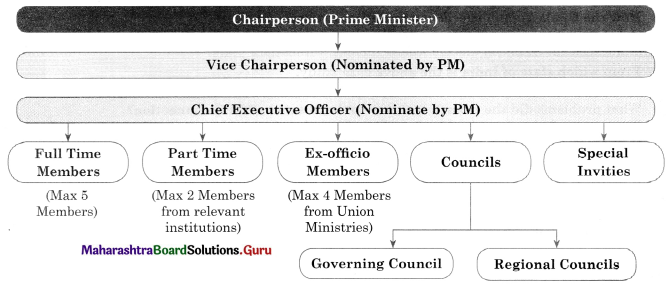
Maharashtra Board Class 11 Economics Important Questions Chapter 10 Economic Planning in India 9

Question 1.
Who is the chairman of NITI Aayog?
Answer:
Prime Minister.

Question 2.
Who nominates the Vice-chairman and CEO of NITI Aayog.
Answer:
Prime Minister.

Question 3.
What is the part of Councils?
Answer:
Governing Council and Regional Council are the part of councils.

Maharashtra Board Class 11 Economics Important Questions Chapter 10 Economic Planning in India

Question 4.
Which ministers are selected as Ex-officio members?
Answer:
Union ministers are selected as Ex-officio members.

Question 5.
How many full-time and part-time members are required?
Answer:
Full times – 5 members and part-time – 2 members.
Maharashtra Board Class 11 Economics Solutions Chapter 10 Economic Planning in India

Balbharti Maharashtra State Board Class 11 Economics Solutions Chapter 10 Economic Planning in India Textbook Exercise Questions and Answers.

Maharashtra State Board Class 11 Economics Solutions Chapter 10 Economic Planning in India

1. Choose the correct option:

Questions 1.
Statements that are true about the Planning Commission:
(a) Planning Commission was established in 1950.
(b) The Prime Minister is the Ex-Officio Chairman of the Planning Commission.
(c) Economic planning is a time-bound program.
(d) Economic planning is based on predetermined objectives.
Options:
(1) a and b
(2) a, b, c, and d
(3) a and c
(4) None of these
Answer:
(1) a and b

Maharashtra Board Class 11 Economics Solutions Chapter 10 Economic Planning in India

Question 2.
Statements that are incorrect regarding India’s five-year plans:
(a) The main objective of the first five-year plan was the development of agriculture.
(b) Social welfare and poverty eradication were the prime objectives of the seventh five-year plan.
(c) By the second five-year plan, focus increased on faster, inclusive growth.
(d) Development of both agriculture and industry were the main objectives of the third five-year plan.
Options:
(1) a
(2) a, b and d
(3) c
(4) b and d
Answer:
(3) c

Question 3.

Group – ‘A’Group – ‘B’
1. Economic planning(a) Selection by Prime Minister
2. Twelfth Five Year Plan(b) Think Tank group of Indian Government
3. NITI Aayog(c) Fast and sustainable growth
4. NITI Aayog Vice-Chairperson(d) Time-bound programme

Options:
(1) 1 – c, 2 – a, 3 – d, 4 – b
(2) 1 – d, 2 – b, 3 – a, 4 – c
(3) 1 – d, 2 – c, 3 – b, 4 – a
(4) 1 – b, 2 – d, 3 – c, 4 – a
Answer:
Correct pair: (3) 1 – d, 2 – c, 3 – b, 4 – a

Question 4.
Choose the correct statement:
Statement 1 – NITI Aayog takes note of the dynamic change in the Indian economy.
Statement 2 – Considering the economic, social, and technological differences in underdeveloped districts, the body plans to implement various programmes and bring about economic changes.
Options:
(a) statement 1 is correct
(b) statement 2 is correct
(c) statement 2 is the result of statement 1
(d) there is no relation between statement 1 and statement 2.
Answer:
(c) statement 2 is the result of statement 1

2. Give economic terms:

Question 1.
The conscious and deliberate choice of economic priorities by some public authority.
Answer:
National Agenda

Maharashtra Board Class 11 Economics Solutions Chapter 10 Economic Planning in India

Question 2.
A group of people called forth by the government to discuss various problems and also try to find solutions to them.
Answer:
Think Tank

3. Identify and explain the concepts from the given illustrations:

Question 1.
Sayali’s mother maintains a book of accounts for household purposes and plans the expenditure accordingly.
Answer:
Planning.
It is a time-bound programme. The objectives should fulfill by using available resources within the time limit.

Question 2.
Ramabai gets a subsidy on domestic LPG directly transferred to her bank a/c.
Answer:
Service Delivery.
It is the important target of the 12th five-year plan. The main aim behind this policy is to prevent corruption.

Question 3.
To solve classroom-related issues, the teacher forms a group of students. This group discusses the problems and finds solutions to them.
Answer:
Think-Tank

  • It is important to function of NITI Aayog to solve the problems of our country.
  • Think-Tank is a group of experts who are discussing and solve various problems of India.

4. Answer the following:

Question 1.
Explain the features of economic planning.
Answer:
Economic planning is a time-bound programme to achieve certain objectives by allocating available resources under the control of a central planning authority.

Prof. H. D. Dickinson defines economic planning as – “Economic planning is the making of major economic decisions such as what and how much is to be produced how, when and where it is to be produced, to whom it is to be allocated, by the conscious decision of the determinate authority, on the basis of a comprehensive survey of the economy as a whole.”

On the basis of the above definition, its main characteristics are:

  • Central Planning Authority (CPA): There is a central planning authority that formulates the plans. In India, this authority is known as Planning Commission.
  • Survey: There is a complete survey of the economy regarding the availability and use of natural and human resources.
  • Objectives: It lays down certain objectives which are realistic and flexible.
  • Priorities: Priorities are fixed according to the importance of each sector for its development.
  • Mobilization of resources: Resources are mobilised through various sources like taxation, deficit financing, savings, etc.
  • Plan period: Each plan is for a specific period, usually five years.
  • Evaluation: From time to time, an assessment of the plan objectives is done to make changes if necessary.
  • Continuous process: Economic planning is a continuous process which aims at the economic development of a country.
  • Co-ordination: In India, economic planning is implemented by the Centre and State Governments together.
  • Flexibility: There is flexibility in India’s economic planning so it’s possible to make changes as per the need.

Maharashtra Board Class 11 Economics Solutions Chapter 10 Economic Planning in India

Question 2.
Explain the targets of the 12th Five Year plan.
Answer:
Targets for infrastructure are:

  • To connect all villages of a country with all-weather roads.
  • To increase rural television and telephone density to 70%.
  • To increase infrastructure investment to 9% of G.D.P.
  • To upgrade national and state highways to a minimum two-lane standard.
  • To achieve real GDP growth rate at 8%, agriculture growth rate at 4%, and manufacturing and industrial growth rate at 10 %.
  • To reduce the headcount ratio of poverty by 10%.
  • To create 50 million (5 crores) new work opportunities in the non-farm sector.
  • To increase average years of schooling to 7 years.
  • To eliminate gender and social gap in school enrollment.
  • To reduce the total fertility rate to 2.1%.

Question 3.
Explain the structure of NITI Aayog.
Answer:
The structure of NITI Aayog includes Governing Council, Regional Councils, Special Invitees, and Organisational Framework. The organizational framework includes Chairperson, Vice-Chairperson, Ex-officio members, CEO, and Secretariat.

Question 4.
Explain the functions of NITI Aayog.
Answer:
Functions of NITI Aayog:

  • To evolve a shared vision of national development, priority sector, and strategies with the active involvement of states in the light of national objectives.
  • To act as ‘Best Friend at the Centre’.
  • To formulate plans at the village level and aggregate higher levels of government.
  • To provide feedback for constant innovative improvements.
  • To provide advice and encourage partnership with national and international Think-Tank.
  • To create a knowledge, innovation, and entrepreneurial support system.
  • To offer a platform for the resolution of inter-sectoral and inter-departmental issues.
  • To maintain a state-of-the-art resource center for research on good governance.
  • To focus on technology up-gradation and capacity building.
  • To foster Cooperative federalism, with the active involvement of states.

Question 5.
Distinguish between Planning Commission and NITI Aayog.
Answer:

NITI AayogPlanning Commission
(i) It serves as an advisory Think Tank.(i) It served as the extra-constitutional body.
(ii) It draws membership from wider expertise.(ii) It had limited expertise.
(iii) It serves in the spirit of cooperative federalism as states are equal partners.(iii) States participated as spectators in the annual plan meetings.
(iv) Secretaries to be known as CEO appointed by Prime Minister.(iv) Secretaries were appointed through the usual process.
(v) It focuses upon the Bottom-up approach.(v) It followed a Top-down approach.
(vi) It does not process mandate to impose policies.(vi) It imposed policies on states and tied allocation of funds with projects it approved.
(vii) It does not have powers to allocate funds, which are vested in the finance minister.(vii) It had powers to allocate funds to ministers and state government.
(viii) It was established on 1st January 2015.(viii) It was established on 15th March 1950.

5. State with reasons whether you agree or disagree with the following statements:

Question 1.
State governments have a more significant role to play under NITI Aayog.
Answer:
Yes, I do agree with the statement.

  • Under the planning commission, there was a one-way flow of policy i.e. from, Central Government to State Government.
  • In NITI Aayog, the flow of policy is from Central Government to State Government and State Government to Central Government between ministers.
  • In the policy-making of the Central Government, State Government will work closely with the center.
  • Governing Council of NITI Aayog consists of all Chief Ministers of the States.
  • Thus, State Government has a more significant role to play under NITI Aayog.

Maharashtra Board Class 11 Economics Solutions Chapter 10 Economic Planning in India

Question 2.
Functions of the Planning Commission have been transferred to NITI Aayog.
Answer:
Yes, I do agree with the statement.

  • The planning commission enjoyed the powers to allocate funds to ministry and state government.
  • NITI Aayog/Think Tank is an advisory body that performs the function of allocation of funds.
  • On 31st January 2015, Planning Commission was replaced by NITI Aayog for making policies and to implement them.
  • NITI Aayog aimed at expanding the role of the states, making the role of the state stronger in collaboration with the center.

Question 3.
The objective of the 12th five-year plan was to achieve faster, sustainable and inclusive growth.
Answer:
Yes, I do agree with the statement.

  • 12th five-year plan aims at a GDP growth rate of 8%.
  • It seeks to achieve 4% growth in the agriculture sector.
  • If aimed to generate 50 million work opportunities in the non-farm sector and providing skill certification.
  • Connecting all the villages of the country with all-weather roads.
  • Increasing green cover by 1 million hectares every year.
  • These objectives will help the country to achieve faster, sustainable and inclusive growth.

6. Read the following passage and answer the questions given below:

The Finance Minister of the Central Government presents the Union Budget before the Parliament during the month of February every year. The budget, also referred to as the annual financial statement reflects the estimated receipts and expenditure of the government for a particular financial year that begins on the 1st of April and ends on 31 sc March. Changes in the tax structure are suggested in the budget. Besides this, provisions are also made for allocating expenditure on defense, education, research, and development, etc. The date for presenting the budget has been shifted to the 1st of February every year. This enables the generation of funds well in advance prior to the commencement of the financial year.

Question 1.
Where is the Union Budget usually presented?
Answer:
Union Budget is presented in the Parliament.

Question 2.
What all aspects are considered while preparing the budget?
Answer:
Changes in the tax structure, provisions for allocating expenditure on defense, education, research, and development.

Maharashtra Board Class 11 Economics Solutions Chapter 10 Economic Planning in India

Question 3.
Why is the date for presenting the budget shifted to the 1st of February?
Answer:
The date for presenting the budget is shifted to the 1st of February because it enables the generation of funds well in advance prior to the commencement of the financial year.

Question 4.
Explain the term ‘budget’.
Answer:
A budget is the annual financial statement that shows estimated receipts and expenditures of the government for a year.

11th Economics Digest Chapter 10 Economic Planning in India Intext Questions and Answers

Collect information on: (Textbook Page No. 64)

  1. Bombay Plan
  2. People’s Plan
  3. Gandhian Plan

Answer:

  1. Bombay Plan: It is the name given to a World War II era. It is a set of proposals for the development of the post-independence economy of India.
  2. Peoples Plan: It is to provide satisfaction to the immediate basic needs of India within a period of ten years.
  3. Gandhian Plan: Espousing with the spirit of Gandhian economic thinking, Shriman Narayan Agarwal formulated this plan in 1944. This plan laid more emphasis on agriculture.

Find out: (Textbook PageNo. 65 )

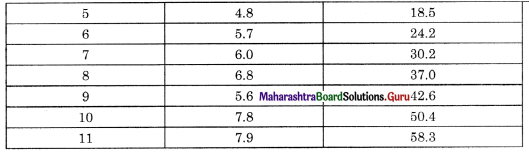
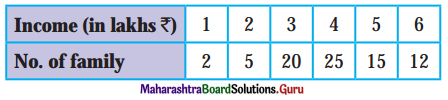
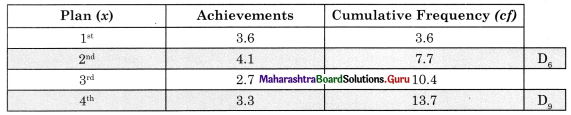
Calculate D6 and D9 from the above table using ‘achievements’ as the numerical data.
Maharashtra Board Class 11 Economics Solutions Chapter 10 Economic Planning in India Intext Page 65 Q1
Answer:
Maharashtra Board Class 11 Economics Solutions Chapter 10 Economic Planning in India Intext Page 65 Q1.1 Maharashtra Board Class 11 Economics Solutions Chapter 10 Economic Planning in India Intext Page 65 Q1.2

(i) Sixth Decile:
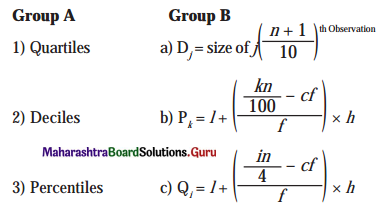
D6 = size of 6 \(\left(\frac{n+1}{10}\right)^{t h}\) Observation
= size of 6 \(\left(\frac{11+1}{10}\right)^{t h}\) Observation
= size of 6 \(\left(\frac{12}{10}\right)^{t h}\) Observation
= size of 6 (1.2)th Observation
= size of (7.2)th Observation
size of 7.2 th 0bservation lies in of 7.7
∴ D6 = 2

Maharashtra Board Class 11 Economics Solutions Chapter 10 Economic Planning in India

(ii) Ninth Decile:
D9 = size of 9 \(\left(\frac{n+1}{10}\right)^{t h}\) Observation
= size of 9 \(\left(\frac{11+1}{10}\right)^{t h}\) Observation
= size of 9 \(\left(\frac{12}{10}\right)^{t h}\) Observation
= size of 9 (1.2)th Observation
= size of 10.8th Observation
size of 10.8 th 0bservation lies in of 13.7.
∴ D9 = 4

Find out: (Textbook Page No. 66)

Information of various levels of National Family Health Survey (NFHS).
Answer:

  • NFHS – 1: The first NFHS was conducted in 1992-93. The survey collected extensive information on population, health, and nutrition, with an emphasis on women and children.
  • NFHS – 2: The second NFHS was conducted in 1998-99 in all states (26) of India. It was on the quality of health and family planning services, domestic violence, reproductive health, anemia, etc.
  • NFHS – 3: The third NFHS was conducted in 2005-06, in 29 states of India. UNICEF, USAID, DFID, USA, providing funds and technical help for NFHS-3.
  • NFHS – 4: The fourth NFHS was conducted in 2014-2015. USA was a major financial supporter for NFHS-4. It was conducted in 29 states and 6 union territories and focused on 640 districts in the country.

Do you know? (Textbook Page No. 66)

Think-tank: Think-tank is a group of experts who are gathered together by an organization, especially by a Government in order to consider various problems, try and work out ways to solve them.
Answer:

  • ‘Think-Tank’ is a group of experts who come together, to form an organization.
  • They study the various problems of an economy and try to bring solutions to solve those problems.
  • It is counted under the premier policy of the Government of India.
  • Its main objective is to find a shared vision of national development with the active participation of the states.
  • It provides guidance to foster ‘cooperative federalism in the states.

Maharashtra Board Class 11 Economics Solutions Chapter 10 Economic Planning in India

Find out: (Textbook Page No. 67)

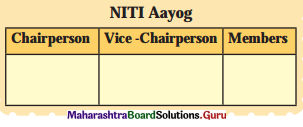
The present structure of NITI Aayog and list out the names of members in the respective columns.
Maharashtra Board Class 11 Economics Solutions Chapter 10 Economic Planning in India Intext Page 67 Q1

Answer:

ChairpersonVice-ChairpersonMembers
Prime MinisterRajiv KumarEx-Officio Members, Special Invitees, Full-time Members


Maharashtra Board Class 11 Economics Important Questions Chapter 9 Economic Policy of India Since 1991

Balbharti Maharashtra State Board Class 11 Economics Important Questions Chapter 9 Economic Policy of India Since 1991 Important Questions and Answers.

Maharashtra State Board 11th Economics Important Questions Chapter 9 Economic Policy of India Since 1991

1A. Complete the following statements by choosing the correct alternative:

Question 1.
The investment limit of small scale industries has been increasing up to __________ crores.
(a) 10
(b) 5
(c) 1
(d) 3
Answer:
(b) 5

Question 2.
The financial sectors became more competitive due to entry of __________ banks.
(a) public and private
(b) public and foreign
(c) private and foreign
(d) private and co-operative
Answer:
(c) private and foreign

Maharashtra Board Class 11 Economics Important Questions Chapter 9 Economic Policy of India Since 1991

Question 3.
The Government of India announced the NEP on __________
(a) 24th July 1991
(b) 24th Oct 1991
(c) 24th June 1991
(d) 20th June 1950
Answer:
(a) 24th July 1991

Question 4.
__________ is considered to be the father of NEP.
(a) Dr. Manmohan Singh
(b) Rajiv Gandhi
(c) Narsimha Rao
(d) Arun Jetly
Answer:
(a) Dr. Manmohan Singh

Question 5.
Licensing was made __________ under NEP.
(a) compulsory
(b) strict
(c) privatised
(d) liberal
Answer:
(d) liberal

Question 6.
Under NEP unemployment has __________ due to close down of some industries.
(a) declined
(b) increased
(c) stagnant
(d) no change
Answer:
(b) increased

Maharashtra Board Class 11 Economics Important Questions Chapter 9 Economic Policy of India Since 1991

Question 7.
__________ is included in Navratna status.
(a) ONGC
(b) HAL
(c) MTNL
(d) Railways
Answer:
(a) ONGC

1B. Complete the correlation:

Question 1.
Regulate the foreign exchange : FEMA : : Regulate security market : __________
Answer:
SEBI

Question 2.
Disinvestment : ITDC hotel : : Collaboration : __________
Answer:
Maruti-Suzuki

Question 3.
Abolition of MRTP Act : Liberalization : : Convertibility of rupee : __________
Answer:
Globalisation

Question 4.
Airport Authority of India (AAI) : Miniratna : : Hindustan Petroleum Corporation Ltd (HPCL) : __________
Answer:
Navratnas

Maharashtra Board Class 11 Economics Important Questions Chapter 9 Economic Policy of India Since 1991

Question 5.
Indian Oil Corporation : Navratnas : : Central Public Sector Enterprises : __________
Answer:
Maharatna Companies

Question 6.
SEZ : Trade Liberalisation : : IRDA Act : __________
Answer:
Reforms in Insurance Sector

Question 7.
Abolition of Government License : __________ : : Selling of shares of sick public sector : Disinvestment
Answer:
Delicensing

1C. Suggest the economic terms for given statements:

Question 1.
The transfer of ownership from the public sector to the private sector.
Answer:
Privatisation

Question 2.
Abolishment of the permission of Government for new industrial production etc.
Answer:
Delicensing

Question 3.
Selling public sector units to the private sector.
Answer:
Disinvestment

Maharashtra Board Class 11 Economics Important Questions Chapter 9 Economic Policy of India Since 1991

Question 4.
Interaction of the Indian economy with the rest of the world.
Answer:
Globalisation

Question 5.
To take the benefit of advanced technology the companies of two countries work together.
Answer:
Foreign Collaboration

Question 6.
Policy providing incentives to exporters.
Answer:
EXIM Policy

Question 7.
Companies are given full financial and managerial autonomy.
Answer:
Navratnas

Question 8.
Zone to encourage agricultural exports.
Answer:
Agro Export Zones

Maharashtra Board Class 11 Economics Important Questions Chapter 9 Economic Policy of India Since 1991

Question 9.
Act under which firms get the freedom to take investment decisions.
Answer:
MRTP Act

Question 10.
A board was set up to make decisions regarding sick units.
Answer:
Board of Industrial and Financial Reconstruction (BIFR)

Question 11.
Industry requiring compulsory licensing.
Answer:
Cigarettes

1D. Arrange in proper order:

Question 1.
(a) FERA was replaced by FEMA
(b) Shortage of foreign exchange
(c) Introduction of NEP
(d) Delicensing
Options:
(i) a, c, d, b
(ii) b, c, d, a
(iii) d, b, a, c
(iv) c, a, d, b
Answer:
(ii) b, c, d, a

Question 2.
(a) Poor performance of PSUs
(b) LPG policy
(c) Public sector was playing a dominant role
(d) Role of the private sector increased
Options:
(i) a, c, d, b
(ii) b, c, d, a
(iii) c, a, b, d
(iv) d, b, a, c
Answer:
(iii) c, a, b, d

Maharashtra Board Class 11 Economics Important Questions Chapter 9 Economic Policy of India Since 1991

Question 3.
(a) Demand for software engineers increased in developed countries
(b) Role of the private sector increased
(c) Help to earn foreign exchange
(d) Revolution in IT sector
Options:
(i) b, d, a, c
(ii) a, c, d, b
(iii) c, a, b, d
(iv) d, a, c, b
Answer:
(i) b, d, a, c

1E. Find the odd word out:

Question 1.
Indian companies into foreign collaboration- Maruti – Suzuki, Hero – Honda, Mahindra & Mahindra, Tata – Timken
Answer:
Mahindra & Mahindra

Question 2.
Encouragement to exports – EXIM, SEZ, AEZ, FERA
Answer:
FERA

Question 3.
Units in which disinvestment take place – Maruti, ONGC, ITDC, VSNL
Answer:
ONGC.

1F. Complete the following statements:

Question 1.
Before new economic policy, interest rate was determined by __________
Answer:
RBI

Maharashtra Board Class 11 Economics Important Questions Chapter 9 Economic Policy of India Since 1991

Question 2.
The NEP gave dominant position to the __________
Answer:
private sector

Question 3.
At present 100 percent FDI is allowed in __________
Answer:
electricity generation projects

Question 4.
A country may not attain self sufficiency in food production because of __________
Answer:
globalization

Question 5.
An adverse effect of NEP on farmers is __________
Answer:
indebtedness and poverty of poor farmer

Question 6.
The main objective of NEP, 1991 is to plunge India into __________
Answer:
arena of globalisation

Question 7.
Rapid industrial growth took place after abolition of __________
Answer:
MRTP Act

Maharashtra Board Class 11 Economics Important Questions Chapter 9 Economic Policy of India Since 1991

Question 8.
Two industries reserved for public sector are __________
Answer:
railways and atomic energy

Question 9.
National Renewal Board took the responsibility of providing __________
Answer:
compensation to retrenched workers

Question 10.
Public Sector Units (PSU’s) have been categorised into __________
Answer:
Miniratnas and Maharatnas.

1G. Choose the wrong pair:

Question 1.

Group – ‘A’Group – ‘B’
(i) SEZExport promotion
(ii) IRDARegulate insurance activities
(iii) FDIPromote imports

Answer:
Wrong Pair: FDI – Promote imports

Question 2.

Group – ‘A’Group – ‘B’
(i) GlobalizationBorderless economy
(ii) DisinvestmentLess investment
(iii) PrivatizationTransferring ownership of PSUs.

Answer:
Wrong Pair: Disinvestment – Less investment

Question 3.

Group – ‘A’Group – ‘B’
(i) FDIForeign Direct Investment
(ii) FEMAFund Exchange Management Act
(iii) IRDAInsurance Regulatory Development Authority

Answer:
Wrong Pair: FEMA – Fund Exchange Management Act.

1H. Match the correct pairs:

Question 1.

Group – ‘A’Group – ‘B’
1. BHEL(a) Freedom for investment
2. Compulsory licensing(b) Agriculture
3. Abolition of MRTP(c) Navratnas
4. Primary sector(d) Mixed economy
5. India(e) Alcohol, Tobacco

Answer:
Correct Pairs: (1) – (c), (2) – (e), (3) – (a), (4) – (b), (5) – (d).

Maharashtra Board Class 11 Economics Important Questions Chapter 9 Economic Policy of India Since 1991

Question 2.

Group – ‘A’Group – ‘B’
1. Liberalization(a) 1991
2. NEP(b) Profit motive
3. Public sector(c) Removing restrictions
4. Private sector(d) Service sector
5. Tertiary sector(e) Welfare motive

Answer:
Correct Pairs: (1) – (c), (2) – (a), (3) – (e), (4) – (b), (5) – (d).

2. Identify and explain the concepts from the given illustrations:

Question 1.
It is the regulator of the securities market in India.
Answer:
Securities and Exchange Board of India (SEBI).
SEBI was established on 12th April 1992. SEBI has the power to approve bye-laws of Securities Exchanges, inspect the books of account of financial intermediaries, registration of brokers and sub-brokers.

Question 2.
Abolition of government license to carry any business or industrial activity.
Answer:
Delicensing.
Except for 18 specified industries of strategic importance, all industries required a license. Later on, only 4 industries required compulsory licensing. They are – Electronic Aerospace and defense equipment, Industrial Explosives, Hazardous chemicals, Drugs and Pharmaceuticals, and Cigarettes.

3. Assertion and Reasoning questions:

Question 1.
Assertion (A): The creation of NRB is an important measure of privatization.
Reasoning (R): To solve the problem of unemployment and poverty among the workers of closed public sector units.
(a) (A) is TRUE but (R) is FALSE
(b) (A) is FALSE but (R) is TRUE
(c) (A) and (R) both are TRUE and (R) is the correct explanation of (A)
(d) (A) and (R) both are TRUE but (R) is not the correct explanation of (A)
Answer:
(c) (A) and (R) both are TRUE and (R) is the correct explanation of (A)

Maharashtra Board Class 11 Economics Important Questions Chapter 9 Economic Policy of India Since 1991

Question 2.
Assertion (A): In India FDI has very limited scope since 1991.
Reasoning (R): Foreign capital is allowed in the Indian economy without any restrictions.
(a) (A) is TRUE but (R) is FALSE
(b) (A) is FALSE but (R) is TRUE
(c) (A) and (R) both are TRUE and (R) is the correct explanation of (A)
(d) (A) and (R) both are TRUE but (R) is not the correct explanation of (A)
Answer:
(b) (A) is FALSE but (R) is TRUE

Question 3.
Assertion (A): In post NEP imports of the country has increased.
Reasoning (R): It helps to solve the problem of inflation.
(a) (A) is TRUE but (R) is FALSE
(b) (A) is FALSE but (R) is TRUE
(c) (A) and (R) both are TRUE and (R) is the correct explanation of (A)
(d) (A) and (R) both are TRUE but (R) is not the correct explanation of (A)
Answer:
(c) (A) and (R) both are TRUE and (R) is the correct explanation of (A)

4. Distinguish between:

Question 1.
Privatisation and Globalisation.
Answer:

PrivatisationGlobalisation
1. Privatisation refers to including private ownership in publicly owned enterprises.1. Globalisation refers to the process of development of the world into a single integrated economic unit.
2. It leads to the transfer of ownership, management, and control to the private sector.2. It involves the removal of quotas, tariffs, etc. to facilitate greater mobility of factors and goods.
3. It takes place within the country.3. It takes place all over the world.
4. By privatisation the country is benefited.4. By globalisation the whole world is benefited.
5. It helps the country’s economy to grow.5. It helps the world as a whole to grow.

Question 2.
Liberalisation and Privatisation.
Answer:

LiberalisationPrivatisation
1. Economic reforms which liberalize the economy from government control are called liberalisation.1. Privatisation refers to including private ownership in publicly owned enterprises.
2. It leads to the opening of the economy to international competition.2. It leads to the transfer of ownership, management, and control to the private sector.
3. It gives the opportunity for technology improvement which benefits producers and consumers.3. It encourages monopoly power and may lead to the exploitation of consumers and workers.
4. It ignores the welfare aspect in the whole world.4. It ignores the welfare aspect within the country.

Question 3.
Agriculture and Industry.
Answer:

AgricultureIndustry
1. Any productive activity which is carried on by using land and another free gift of nature is considered as agriculture.1. Any productive activity in which processing on manufacturing takes place is called as ‘Industry’.
2. It is our primary sector.2. It is considered as our secondary sector.
3. It is also known as an unorganised sector.3. It is also known as an organised sector.
4. Even the unskilled labourers also gain employment opportunity here.4. Only skilled people will gain employment opportunities here.
5. As a result of NEP, yield per acre could increase (or) productive capacity increased when we started using HYV seeds.5. As a result of NEP, India could not only export traditional goods but also machinery, chemicals, computers, etc.
6. The negative impact of NEP (globalisation) in this sector leads to poverty, unemployment, indebtedness, etc. among the rural poor.6. The negative impact of NEP on this sector leads to the concentration of economic and political power in few hands.

Maharashtra Board Class 11 Economics Important Questions Chapter 9 Economic Policy of India Since 1991

Question 4.
Private Sector and Public Sector.
Answer:

Private SectorPublic Sector
1. Private sector is that sector where industries are owned and managed by private individuals or businessmen.1. Public sector is that sector where industries are owned, managed, and operated by the government.
2. E.g. Most of the small-scale industries and cottage industries are owned by the private sector.2. E.g. Bharat Petroleum Ltd., Indian railways, etc. are owned by the public sector.
3. Its main aim is to earn profit.3. Its main aim is to promote social welfare.
4. Quick decisions can be taken and managerial efficiency is high.4. There is a delay in decision making and efficiency is lower.
5. Exploitation of workers is more and inequality increases.5. Exploitation of workers is less and inequality reduces.

5. Answer the following:

Question 1.
Explain any two positive effects or achievements of NEP.
Answer:

  • Improvement in educational standards: Standards of educational institutions are improving. Our students are getting opportunities to study abroad.
  • Diversification of cropping: Due to globalization, the farmers have shifted from practicing traditional cropping to non-traditional cropping patterns.

Question 2.
What is globalization? How does it help to increase foreign capital?
Answer:
Globalization means the interaction of the domestic economy with the rest of the world with regard to foreign investment, trade, production, and financial matters. The government has opened the economy to foreign investments. Foreign capital is allowed in India without any restrictions. This flow of foreign capital encouraged high-priority industries to boost their production.

Question 3.
What are the objectives of NEP 1991?
Answer:

  • To make the Indian economy market-oriented by introducing it in the arena of globalization. To bring down the rate of inflation.
  • To move towards a higher economic growth rate.
  • To build sufficient foreign exchange reserve.
  • To achieve economic stabilization.
  • To promote international trade by removing restrictions.
  • To increase the participation of private players in all sectors of the economy.
  • To reduce the reserved numbers of sectors for the government.
  • To reduce the gap between import and export (BOP).

Maharashtra Board Class 11 Economics Important Questions Chapter 9 Economic Policy of India Since 1991

Question 4.
What is Privatization?
Answer:
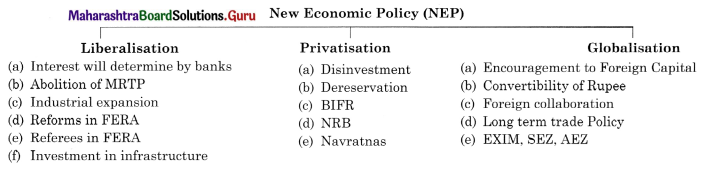
Privatisation means allowing the private sector to set up industries that were previously reserved for the public sector. Privatisation is the process of transferring ownership of Public Sector Units (PSUs) to the private sector. Privatisation led to disinvestment, dereservation, the establishment of BIFR and NRB, etc.

Question 5.
What are the negative effects of NEP 1991 on farmers?
Answer:
Due to a lack of capital, poor farmers were unable to grow exportable crops. They were forced to sell their land or take extreme steps. Thus, they faced the problem of indebtedness and poverty.

Question 6.
Explain any 4 features of Economic Policy, 1991.
Answer:
Features of Economic Policy, 1991:

  • Delicensing: The new industrial policy abolished all industrial licensing, except 18 specified industries related to security and strategic concerns and social reasons.
  • Abolition of MRTP Act: No prior approval of the MRTP commission is now required for setting up industrial units by the large business houses.
  • Encouragement to Small Scale Industries (SSI): The investment limit of the SSI has been increased up to 5 crores which will help to upgrade their machinery.
  • Encouraging Foreign Investment: Many industrial units were open to foreign investment under the 1991 policy. The limit was raised to 51% and 100% in some industries and 100% in mining, pollution control equipment, electricity generation projects, ports, etc.

Question 7.
State the measures taken for Liberalisation.
Answer:
Measures were taken for Liberalisation:

  • Banks are free to determine the rate of interest. Earlier it was determined by RBI.
  • The industries are free to expand and produce. The producers are now free to produce anything on the basis of demand in the market.
  • Companies falling under MRTP Act are given a concession. Firms are free to make decisions regarding investment.
  • FEMA (Foreign Exchange Management Act) was introduced in place of FERA.
  • Domestic and foreign investment is allowed in infrastructure to improve its quality.
  • SEBI was formed to secure the interest of the investors.

Maharashtra Board Class 11 Economics Important Questions Chapter 9 Economic Policy of India Since 1991

6. State with reasons whether you agree or disagree with the following statements:

Question 1.
Agriculture and industry are interdependent or complementary.
Answer:
Yes, I do agree with the statement.

  • In a country like India, there are many agro-based industries like sugar, textile, oil, etc.
  • These industries depend on agriculture for their raw materials.
  • Hence, agriculture supports industries.
  • Industries also support agriculture in the sense that new methods of agriculture require more use of pump sets, fertilizers, pesticides, agricultural implements, etc.
  • All these are produced and supplied by the industrial sector.
  • With the help of these inputs, farmers produce more output.
  • Hence, the statement agriculture and industry are interdependent is a true statement.

Question 2.
There are no benefits of globalisation.
OR
There is no impact of globalisation on the Indian economy.
Answer:
No, I do not agree with the statement.
Globalisation for any country is important and the benefits are as follows:

  • Globalisation helps developing countries to improve overall economic management and make their economies efficient.
  • An increase in competition reduces the cost and improves the quality of products.
  • More varieties are made available to consumers and at lower prices.
  • Countries can get access to foreign investment and keep interest rates low.
  • Political stability is established.

Question 3.
The NEP has not achieved anything in India.
Answer:
No, I do not agree with the statement.

  • NEP brought a revolution in the IT sector which helps to earn foreign exchange.
  • It strengthened the financial sector by raising the competition among the banks.
  • The standard of educational institutions is improving.
  • It helps to improve the conditions of the BOP.
  • It helped to increase the exports of our country.
  • It also helped farmers by diversifying their cropping pattern i.e. from traditional products to non-traditional products.

7. Answer in detail:

Question 1.
Explain the measures taken for Privatisation.
Answer:
Privatisation means allowing the private sector to set up industries that were previously reserved for the public sector. Privatisation is the process of transferring ownership of Pubilc Sector Units (PSUs) to the private sector.

Measures were taken for Privatisation:

  • Dereservation Policy: The number of industries reserved for the public sector has been gradually reduced to only two and all other industries are deserved i.e. opened up for the private sector.
  • Establishment of BIFR: Board of Industrial and Financial Reconstruction (BIFR) has been set up to make the decisions about sick public sector units i.e. whether to close or revive them.
  • Creation of NRB: National Revival Board (NRB) has been set up to take care of unemployed workers of the sick units.
  • Status of Navratna: On the basis of strategic importance, nine public sector enterprises were selected and given the status of ‘Navratnas’ i.e. they were given the full managerial and financial freedom to make them global giants. Some are ONGC, BHEL, HPCL, SAIL, etc.
  • Disinvestment: This was an important step undertaken to reform public sector. The Government started selling PSUs to the private sector, those are running at a loss. e.g. Maruti Udyog Ltd. VSNL, etc.

Maharashtra Board Class 11 Economics Important Questions Chapter 9 Economic Policy of India Since 1991

Question 2.
What is Liberalisation? Explain the measures taken for liberalisation.
Answer:
Liberalisation means ‘economic freedom’ or ‘freedom for economic decisions’. All economic units are free to take decisions for self-interest e.g. consumer, producer, owner of a factor of production, etc.

Measures were taken for Liberalisation:

  • The flexibility of Interest rate: Banks are free to determine the rate of interest. Earlier it was determined by RBI.
  • Freedom for expansion of industries: The industries are free to expand and produce. The producers are now free to produce anything on the basis of demand in the market.
  • Abolition of Monopolies and Restrictive Trade Practices: Companies falling under MRTP Act are given concession. Firms are free to make decisions regarding investment.
  • Reforms in FERA: FEMA (Foreign Exchange Management Act) was introduced in place of FERA. It will encourage international trade.
  • Investments in infrastructure: Domestic and foreign investment is allowed in infrastructure to improve its quality.
  • Encouragement to foreign technology: The use of foreign technologies allowed in high-priority industries resulting in cost cuts.
  • SEBI: SEBI was formed to secure the interest of the investors and to regulate the securities market.

Question 3.
Write about major achievements of the NEP of 1991.
Answer:
Major Achievements:

  • Revolution in the IT sector: The contribution of the IT sector to national income has considerably increased. The demand for software engineers has increased in the developed countries.
  • Improved financial facilities: The financial sector has become more competitive due to the entry of private and foreign banks.
  • Improvement in educational standards: Standards of educational institutions are improving and our students are getting more opportunities to study abroad.
  • Increase in exports: Due to rising in export, the conditions of our adverse balance of payment is improving.
  • Diversification of cropping: Due to globalization, the farmers have shifted from practicing traditional cropping to non-traditional cropping patterns.
  • Solves the problem of scarcity: Due to liberal imports, the economy can overcome the scarcity of goods and raw materials.

Question 4.
Critically evaluate the NEP of 1991.
Answer:
Though NEP, 1991 brought many achievements to the economy, it has also brought failures in many areas:
Failures of Economic Policy, 1991:

  • Lack of self-sufficiency: Globalisation led to the diversion of production to export-oriented products which were demanded globally. This failed to achieve self-sufficiency in the home country.
  • Adverse effect on the domestic market: Imported goods were cheaper and were flooded in the Indian market due to liberal import policy. Thus, domestic markets were adversely affected due to globalisation and liberalisation.
  • Affected poor farmers: Poor farmers were not able to produce goods as per the export standards due to a lack of capital. So, the benefits of globalisation and liberalisation reached rich farmers only. This led to the selling of lands by small farmers for their survival.
  • Unhealthy competition: Indian companies could not match the competition with multinational companies and as a result, many Indian Companies had to declare themselves as ‘sick units’ or had to close down the industry-leading to unemployment and poverty in the society.
  • Neglects welfare aspect: Privatisation led to an increase in prices of products and services, as private firms are profit-oriented and not welfare-oriented. They are more interested in their profits rather than the welfare of society. Thus, the economic policy of 1991 failed to achieve the welfare of the masses.
  • Unemployment: Closing down of companies due to unhealthy competition by multinational companies, led to unemployment in the economy. An increase in the unemployment level in the country led to poverty and inequality.

Maharashtra Board Class 11 Economics Important Questions Chapter 9 Economic Policy of India Since 1991

Question 5.
How globalization will help to increase foreign exchange reserves?
Answer:
Globalisation refers to a borderless economy having a free flow of goods and services, capital, labour, technology, etc.
In other words, it means integrating the economy of a country with the world economy.

Globalisation has helped the economy to increase foreign exchange reserve in the following ways:

  • Encouragement to Foreign Capital: Due to globalisation, foreign investors were allowed to invest in Indian companies. Thus, foreign capital started flowing into various sectors of the economy. This led to an increase in the earnings of foreign currency.
  • Convertibility of Rupee: Due to globalisation and new economic policy, Rupee was made fully convertible ‘ into all current account transactions. This made foreign transactions easy and hence, the foreign currency started flowing into our economy.
  • Foreign Collaboration: Due to liberalization and globalisation, any trade was possible throughout the world. Indian companies made foreign collaboration to increase their business. This led to the flow of foreign exchange currency in India. E.g. Maruti-Suzuki, Hero Honda, etc.
  • Encouragement to Export: Due to the introduction of the Exim Policy, various incentives were allowed to exporters which made exporters do business on a larger scale. This increased India’s export and foreign exchange currency reserves. Thus to conclude, globalisation has overall encouraged to increase the foreign exchange reserves.

8. Read the following passage and answer the questions given below:

In the Second Five Year Plan (1956), the public sector played a major role by setting up basic and heavy industries for the economic and industrial development of India. In India, most of the Public Sector Units (PSUs) were working inefficiently. So, many PSUs were running in loss. PSUs never have competitive nature. PSUs know that whenever they will go into loss, they will be bailed out by the government. This attitude kills that competitiveness and cost-effective working nature of the unit which is necessary to earn profit.

In 1991, the Government decided to transfer ownership to the private sector which is more efficient in management, allocation of resources, better services to its customers, etc. Also, it helps to develop the local capital market and source of revenue to the government. Videsh Sanchar Nigam Limited (VSNL) was established in 1986 by the Government of India to bring internet to our country. In 2002, the Government of India decided to disinvest its shareholdings. TATA group acquired a 45% stake in VSNL. On 13th February 2008, VSNL was completely acquired by TATA Group and renamed TATA Communications.

At present, TATA Communications connects its customers in global offices at speed of up to 10 Gbits. It delivers voice, video, and data connectivity through subsea cable networks in 200 countries and territories. In 2018, annual income is 5575.96 crores and net profit (after deducting taxes) is 266.63 crores.

Question 1.
In which five-year plan emphasis is given to developing the public sector?
Answer:
In the second five-year plan, emphasis was given to develop the public sector.

Question 2.
Identify the reasons for the poor performance of PSUs.
Answer:
PSUs were working inefficiently, lack of competitive nature, dependence on bailed out by the government, lack in cost-effective working nature, etc. led to poor performance of PSUs.

Maharashtra Board Class 11 Economics Important Questions Chapter 9 Economic Policy of India Since 1991

Question 3.
Find out the economic concepts from this case study.
Answer:
Privatisation and Disinvestment.

Question 4.
Explain the benefits of privatisation.
Answer:
Under privatisation, ownership is transferred from the public sector to the private sector because the private sector is more efficient in resource allocation, management and provides better services to the customers. Privatization can be an important source of revenue to the government and help to develop local capital markets.

Question 5.
Explain the growth of VSNL after privatisation.
Answer:
In 2008, privatisation of VSNL took place. VSNL was completely acquired by the TATA group and renamed TATA Communication. At present TATA Communication is providing internet services globally. Its cable network is in 200 countries and territories. The annual income is 5575.96 crores and the net profit is 266.63 crores in 2018.

Maharashtra Board Class 12 English Yuvakbharati Solutions Chapter 2.2 Indian Weavers

Balbharti Yuvakbharati English 12th Digest Chapter 2.2 Indian Weavers Notes, Textbook Exercise Important Questions and Answers.

Maharashtra State Board Class 12 English Yuvakbharati Solutions Chapter 2.2 Indian Weavers

12th English Digest Chapter 2.2 Indian Weavers Textbook Questions and Answers

Question 1.
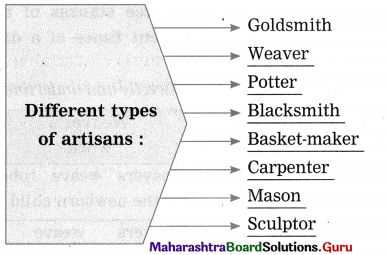
Artisans are also called craftsmen. They are creators of diverse goods and use their hands to create unique, functional and also decorative items using traditional techniques. Now complete the web given below:
Maharashtra Board Class 12 English Yuvakbharati Solutions Chapter 2.2 Indian Weavers 1
Answer:
Maharashtra Board Class 12 English Yuvakbharati Solutions Chapter 2.2 Indian Weavers 2

Maharashtra Board Class 12 English Yuvakbharati Solutions Chapter 2.2 Indian Weavers

Question 2.
Discuss with your partner the seasons/ occasions when we need:
Answer:
(a) Woollen clothes – in winter
(b) Casual clothes – when at home
(c) Rich silk clothes – festivals, weddings
(d) Colourful, comfortable clothes – travel, socializing

Question 3.
Let’s play a game. The teacher will ask the students some questions. Students will understand that there are some exceptions to the general rules. Let’s start:
Answer:
(a) One who weaves is a – weaver
(b) One who plays a game is a – sportsman
(c) One who sings is a – singer
(d) One who dances is a – dancer
(e) One who teaches is a – teacher
(f) One who cooks is a – cook/chef

Question 4.
We have often seen the picture of Gandhiji spinning on his charkha. Discuss the reasons behind this.
(a) To give rural people an opportunity to earn their livelihood.
(b) To give the message to wear hand-spun clothes.
(c) To convey the message of simple living.
(d) To be self-reliant.

Question 5.
Name some tools used by the weavers.
(a) Loom
(b) Shuttle
(c) Bobbin
(d) Scissors

Question 6.
Name some types of yarns used by the weavers.
(a) Linen
(b) Cotton
(c) Jute
(d) Flax
(e) Silk

Maharashtra Board Class 12 English Yuvakbharati Solutions Chapter 2.2 Indian Weavers

(A1)

Question 1.
Discuss with your partner the following vocations:
(a) Weaving:
[Points:
India has rich heritage of weaving.

  • Handloom weaving the second most widespread occupation next to agriculture.
  • Each region of India has its typical yarn, style and fabric.
  • India is tropical – people like to wear cotton
  • Silks from different regions of India are prized by women worldwide.]

(b) Tailoring:
[Points:

  • A tailor can make someone a star with style and fitting.
  • Can have own machines, and stitch clothes according to client’s needs.
  • Could be under a designer creating high fashion garments.
  • Could be under a fashion-house label, working at computerized machines.
  • hey create the trending fashions world- wide.]

(c) Knitting:
[Points:

  • Knitting is weaving with two needles with woollen yarn.
  • Many women are skilled.
  • Women in cold regions do knitting to make warm clothes for the family.
  • Knitting is done on machines too.]

(d) Embroidering:
[Points:

  • Embroidery needs skilful fingers and patience.
  • From hankies to wall-hangings are laboriously made with silk threads and tiny needles.
  • Many other beautiful things like tablecloths, dress-collars, sari-edges, bedcovers and cushion sleeves.
  • Machine embroidery also is done.]

(A2)

Question (i)
Discuss the various products made by the weavers in the poem.
Answer:
The poet asks the weavers what they are weaving at daybreak. It is a brightly coloured cloth and she asks the reason. The weavers reply that the robes, in the gay colour of the wild kingfisher, are for a newborn.

The poet next asks the weavers at dusk, for what they are weaving that bright cloth. The purple and green shaded fabric is for a queen’s wedding veil, reply the weavers. The poet asks what they are making in the chill night in the moonlight. The weavers are weaving a cloth as white as a feather, as a cloud. They say they are weaving a shroud for a dead man’s funeral.

Maharashtra Board Class 12 English Yuvakbharati Solutions Chapter 2.2 Indian Weavers

Question (ii)
The words in the three stanzas of the poem mention different times of a day. Complete the table.
Answer:

Time of the dayWords/ phrasesWeaver’s work
Early morningbreak of dayWeavers weave robes for the newborn child
Late in the eveningfall of nightWeavers weave a wedding veil for a queen
NightMoonlight chillWeavers weave a shroud for a dead man’s funeral

Question (iii)
The poem reveals three phases of life. Fill in the blanks with feelings and colours appropriate to the phase of life.
Answer:

Newborn/ ChildhoodYouth/ AdulthoodOld age/ Death
ColourBluePeacock colours of purple-greenWhite as a feather or cloud
FeelingHopes and expectationsExpectations, responsibilities, romance, energyFrailness, peace, wisdom

Question (iv)
Complete the sentence:
The weavers weave in the chill moonlight ……………….. .
Answer:
The weavers weave in the chill moonlight a cloth as white as a feather, as a cloud, a shroud, for a dead man’s funeral.

Question (v)
Pick out two words used to describe the weavers in the last stanza. Also state their importance.
Answer:
‘Solemn’ and ‘still’ are the two words used in the last stanza to describe the weavers. The words describe the occasion for which the craftsmen are working. A shroud is being woven for a funeral. The workers’ mood is also serious and unsmiling because of the occasion.

Maharashtra Board Class 12 English Yuvakbharati Solutions Chapter 2.2 Indian Weavers

Question (vi)
Express your views about the present conditions of weavers.
Answer:
Weaving has existed for thousands of years in India. It was second only to agriculture. The weaves and fabrics from various regions were known around the world. From the Bengal muslin, to Kashmiri, Banarasi and Kancheevaram silks the cloth from India was renowned for the quality and fineness, the designs and richness.

Industrialization then brought problems for them. Power-looms are faster and manufacture large quantities in short time, Fashion-houses buy fabric from the weavers, put their labels and sell off the cloth at a very high price compared to the price paid to the craftsmen.

The craftsmen remain unknown, their craft under-valued and their life is in poverty. Ancient skills are lost and some take loans to somehow struggle. When debts are too much they commit suicide. Master weavers send away sons to cities to take up jobs.

They do not want the sons to struggle. Parents will not give girls in marriage to weavers. They lack facilities like lighting and water supply. Though the government has given subsidies for weavers most of it is lost to bribes and the weavers receive negligible sums.

Question (vii)
Describe in your own words the steps or measures that can be taken to solve the problems of the weavers.
Answer:
Weavers are unorganized. Buyers offer very low prices and if one weaver refuses, they go to another weaver. So the prices are at lowest. The government allocates crores for Handloom Promotion Council, but the weavers get nothing. Weavers’ organization can help the situation.

The weavers are forced to sell their creations to designers at low rates. No one helps to update weavers of the latest fashions trends. Also their creations are not commercially advertised. Handloom industry is eco-friendly in every way. It should be promoted by the Government, designers and supported by the public.

Subsidies for buying yarns and dyes should be given to the craftsmen. Clean water and proper lighting facilities are needed for the craftsmen. Some designers and activists for the weaver communities have begun working for the upliftment of the community and marketing the product.

The buyer can buy directly from the weavers and cut out corrupt middlemen. Exhibitions for selling wares to the public will bring the craftsmen and buyer closer. We can hope that soon the craftsmen of handloom will regain the lost glory which they deserve.

Question (viii)
Express your own views and opinions from the weavers point of view and complete the following table:
Answer:

StanzaActivityViews/Opinion
First stanzaRobes for a new- born childThe weavers feel happy because they are enthusiastic to weave the bright blue robes for the newborn.
Second stanzaA purple- green veil for the wedding of a queenThe weavers are joyous to dress the royalty on the happiest and most important day of her life
Third stanzaShroud for the funeral of a dead manThe weavers are solemn and quiet as the cycle has closed for a person and it is true for everyone.

Maharashtra Board Class 12 English Yuvakbharati Solutions Chapter 2.2 Indian Weavers

(A3)

Question (i)
Pick out the rhyming words from the poem.
Answer:
1st stanza: day – gaywild – child
2nd stanza: night – bright; green – queen
3rd stanza: still – chill; cloud – shroud

Question (ii)
Give antonyms and synonyms of the following and make sentences –
Answer:

WordAntonym/ SynonymSentence
NewAntonym: old

Synonym: fresh

Everyone must grow old.

We begin every morning with fresh life.

BrightAntonym: dull

Synonym: shining

One feels dull without a shower after leaving bed.

Children look at shining things with bright and curious eyes.

DeadAntonym: alive

Synonym: lifeless

The last time we met, he brought the room alive with laughter and cheer.

The children were malnourished and their eyes were lifeless.

StillAntonym: lively

Synonym: unmoving

The crowd was lively and cheering the players.

The lake was covered with oil and lay dirty and unmoving.

WildAntonym: civilized

Synonym: untamed

After many years of instruction they finally changed him into a civilized city-dweller.

Though we think of elephants as gentle giants, untamed ones are dangerous.

FallAntonym: rise

Synonym: drop

The rise of the new star of Indian tennis is stunning.

When prices rise suddenly, everyone hopes it will drop soon.

ChildAntonym: adult

Synonym: young one

An adult has a fully developed immune system till about 60 years of age.

Young ones are innocent till they start imitating grown-ups.

Question (iii)
Make a word register for clothes/attire/ dress:
Answer:
garments, togs, outfit, wardrobe, raiment, apparel, get-up, gear.

Maharashtra Board Class 12 English Yuvakbharati Solutions Chapter 2.2 Indian Weavers

(A4)

Question (i)
Complete the following table:
Answer:

Figures of speechLine
Simile3rd – Blue as the wing of halcyon wild.
7th – like the plumes of peacock, purple and green
11th – white as a feather and white as a cloud
Imagery1st – break of day, gay, blue (beginning of life)
4th – newborn child
5th – fall of night, green-purple royal (marriage and family)
8th – marriage-veil 9th – solemn and still,
(Moonlight in the night, chillness of death, gloom, end)
Colourless, cold white.
Metaphor1st – break of day – day is born, a newborn child (day) for 1st stage of life

5th – fall of night – twilight, the romantic half-light, beginning of wedded bliss, for 2nd stage of life 8th – marriage-veils 10th – chill indicating death, moon indicating night and darkness. For the last stage of life.

AlliterationEach line of the poem has the ‘w’ in the words ‘we’, ‘weave’, ‘why’ ‘weaver’, wild’, ‘wing’, ‘what’, ‘white’. The words ‘we’, ‘weaver’, ‘weave’, ‘why’ occur in each stanza multiple times adding to the musical quality of the poem.

Question (ii)
The rhyme scheme in the first stanza is ‘aabb’. Find rhyme schemes in the second and third stanzas:
Answer:
The rhyme scheme in the second stanza is – aabb.
The rhyme scheme for the third stanza is – aabb.

(A5)

Question (i)
The poet has asked a question at the beginning of every stanza. Explain the effect it creates on the reader.
Answer:
Each stanza of the poem begins with a question to the weaver. The first is at dawn as the poet asks why they are working so early. The second question asks why they make the bright coloured garment at dusk. The third stanza begins asking them why they are working so late, in the cold darkness.

In the question the reader knows about the time of day, the colour of the cloth. The reply gives information about the purpose of the new cloth and why that colour is chosen. The poem is like a conversation between the poet and craftsmen. It conveys the metaphor using time of day and stage of life, the colour and cloth suited for that stage. The mood of the weavers matches the time and purpose of their work. The poem thus flows easily.

Maharashtra Board Class 12 English Yuvakbharati Solutions Chapter 2.2 Indian Weavers

Question (ii)
Write an appreciation of the poem with the help of following points:

  • About the poem/poet and the title
  • The theme
  • Poetic style
  • The language/poetic devices used in the poem
  • Special features
  • Message, values, morals in the poem
  • Your opinion about the poem

Answer:
The poet Sarojini Naidu’s poem ‘Indian Weavers’ tells about the work of India’s famous handloom craftsmen. The three stanzas mark the three stages of life itself. The weavers reply to questions about why they are weaving that particular piece of cloth, of a certain colour at that time of day.

The theme is cycle of life. The weavers use colours associated with birth, marriage and death through weaving cloths for a newborn, a queen- bride and a dead man. Three stanzas of four line each in the form of questions & answers. The conversational tone gives a flow like life, one stage moving into the next.

The poem is a metaphor for the cycle of life: new life-dawn, marriage-dusk, and death-night. Simile compares the woven garments to objects in colours apt for that stage of life. The sound of ‘w’ occurs a total of 20 times, at least once in all lines except one. This alliteration gives a musical quality.

The poem is dedicated to the talented weavers and the fabrics of India which were world famous. It shows the hard work of craftsmen and how we use their products in every occasion of our life. This poem is a beautiful way of the poet to salute the weavers of India. I find that the weavers are not only skillful but also talented. They combine colours and create patterns that are eye-catching. They know which colours are apt for occasions. The poet brings out their talent as well their hard-working nature.

Question (iii)
Compose four lines on ‘Importance of clothes’.
Answer:
The attire indicates the man he is
His coat brings him confidence and protects too
The colour indicates her mood and occasion The weaver makes the christening, wedding and celebration.

Question (iv)
Write an appeal to use handloom products in our daily life.
Answer:
An Appeal

THREADS -The Handloom Research And Development Society, Maharashtra is proud to present to you the wonderful creations of THREADS for the first-time.
The weaves come directly from the craftsmen to you, the customer.
The range of products includes Pure silk Silk-cotton Cotton Linen Jute
Come and see, appreciate the skills and support the craftsmen who practice our ancient art.
There are wedding saris and Punjabi suits in pure silk, casual wear in all the materials, bed linen, towels, door mats, carpets, hand towels, handkerchiefs, scarves to suit every budget.
Come support our artisans and appreciate the fine quality of our finest Indian weaves!!
Come. Support us. You will Love our Indian fabrics. We need your support.

Contact: Incharge Mrs. Das.
99123 xxxx Email: MrsDas@xxx.

Maharashtra Board Class 12 English Yuvakbharati Solutions Chapter 2.2 Indian Weavers

Question (v)
Visit a handloom factory near your locality and write a report of it.
Answer:
Weavers Of Dreams
– by Team A, SYJC -Com. 25/02/2020. The SYJC students of the S.K.Nayak Junior College went on an educational tour to Moinbad village to take a tour of the handloom factory there.

The students viewed many of the processes involved in the weaving of a saree. The students were taken on a guided tour by a local who is a family member of one of the weaver – households of the village. In the first stage the bundles of white yarn were strung on iron frames. The frames held by two men were dipped into hot iron vats of boiling dye.

The yarn is dipped several times, thoroughly drenched for the colour to coat the yarn evenly. After several minutes the men transfer each bundle on to short thick wooden rods. They twist the sticks to wring the bundle dry. A third man takes the hot bundle on another stick and lays the bundles to dry.

The next stage the students saw was coloured yarn stretched on frames several metres long. This was outside in the open. The guide told us it was for a sari. It was a blue yarn in the middle with purple yarn on both sides lengthwise, for borders. Each yarn is stretched, the number of threads for each colour counted.

There were long buildings which are the workshops. Here are frames, looms and the weavers seated before each loom. Each weaver was working on a saree. The guide told us that one saree averagely takes four to seven days. If the design is complicated and in different colours it takes longer.

The finished products are folded and packaged for the market. The tour ended with the students speaking to the weavers at the looms and craftsmen dyeing the yarns. The craftsmen spoke to the visitors giving interesting details about the popular colour combinations. They told us about auspicious colours for special occasions. The artisans also spoke about a different place where traditional nine-yard long are woven. Those are mostly for weddings. The students took photographs of the various processes and the artisans happily posed for them.

Question (vi)
A handicraft exhibition is being organized in your college. You are given the task to compere the inaugural function. Write the script for compering.
Answer:
1. Introduction: A very Good evening and warm welcome to all. This is for a very special kind of occasion we have gathered here this morning. We want to bring the spotlight on that section of our nation’s citizenry who are carrying thousands of years of our heritage on their shoulders! No in their skilful fingers!! Yes our very talented craftsmen. We have our craftsmen with their various talents to showcase their beautiful creations.

We have the weavers of the rich Paithani silks, the Warli painters, the makers of the famous Kolhapur Leather – Footwear, the intricate Bidri brassware, the Dhurrie Weavers, Banjara Embroidery…. all these from Maharashtra. We have men and women with magic in their hands from other states too. Craftsmen have come from distant Meghalaya and Nagaland, from neighbouring Gujarat. We have the makers of the amazing Kashmiri embroidery to the wooden toymakers from Andhra. And so any more.

2. Welcome speech: Our Respected Principal, Sri. Harsh Nayak, our beloved teachers, staff and all my friends join me in welcoming the Honourable Chief Guest, the textile Minister, Shrimati Mandakini Gadge, to this exciting and colourful programme. A very warm welcome to you Madam! It is a great pleasure and an honour to have you here. And a warm welcome to all the parents and all guests.

3. Inaugural Ceremony – Lighting of the Lamp: I request our Chief Guest Shrimati Mandakini Gadge and our Principal to kindly come to the dais. We request you to light the ceremonial lamp, in the traditional Indian way, to declare the exhibition open.

4. Prayer song: And now kindly take your seats for a short programme before we go around viewing the exhibition. Music is such a positive influence. So starting on a note of gratitude we have the prayer song by the stars of our music-club, Nandini, Sonia, Bhaskar, Jay and Kavita. Manjeet is accompanying them on the violin.

5. Welcome Programme: Thank you for that lovely song to begin the programme my friends. Now for a unique performance! We have a Fashion-show!! It is unique because the students of our college and our participating craftsmen-guests worked together for the last few days. This is a first! A big round of applause for our models on the catwalk!

6. Concluding Remarks: Thank you for your encouragement! Wasn’t that wonderful? You may have noticed for yourself, but let me clarify. The stylish saris, salwar suits, elegant kurtas, those shawls, the stunning neck-pieces, the baskets on the ladies’ arms, the wooden screens in the backdrop, the lampshades on the stage, the carpet on the catwalk… and all the decor you can see on the stage are all creations of the masters who are displaying their creations in the exhibition! You now have an idea of what is in store for dressing stylishly, or doing up your home elegantly. That was only starters! The main course is still waiting for you. And there is dessert as well…!!

1. I now request our Chief Guest Shrimati Gadge to address the audience.
2. Thank you, for those words of praise and appreciation of the craftsmen Madam. They richly deserve them.
3. This is the first time a college is hosting such an exhibition. We welcome you all to go around and view the stunning collection of handicraft products. There are master workers who will show you how some of their handicraft is created. They will happily demonstrate their ancient skills. You can watch how the lovely designs we wear are made at the loom.

There are demos to show the yarn being dyed and informative presentations showing the stages in the process. The beadwork artists can help guests to select stones and make them into elegant neck-pieces. There are stalls selling numerous stunning products. Apparel, Decor pieces for your homes, gifts for the festival season.

I invite our Honourable Chief Guest to formally declare the exhibition open and take a leisurely round of the displays.
4. Thank you all for making this festival of crafts a resounding success.

Maharashtra Board Class 12 English Yuvakbharati Solutions Chapter 2.2 Indian Weavers

(A6)

Question 1.
Go to your college library and collect and read the poems written by Sarojini Naidu.

Question 2.
Find various career opportunities in Small Scale Industries like Handloom, Art and Craft, Block Printing, etc.

Question 3.
Find out information about the Mahavastra of Maharashtra – Paithani

Yuvakbharati English 12th Digest Chapter 2.2 Indian Weavers Additional Important Questions and Answers

Read the poem and complete the activities given below:

Global Understanding:

Question 1.
The weavers reply to the poet’s questions in each stanza. What is the common factor? What do you understand from that?
1st stanza: ‘Blue as the wing of a halcyon wild’
2nd stanza: ‘Like the plumes of a peacock, purple and green,’
3rd stanza: ‘White as a feather ..’
Answer:
We find reference to a bird in all the three comparisons. In all of them the weavers refer to the colour of the birds’ feathers. We could take it not only refers to the brightness but also to the lightness of the cloth. The fabric is as soft and light as feathers for the tender newborn, or for the transparent veil of the queen. The pure white shroud for the dead is soft too.

Maharashtra Board Class 11 Economics Solutions Chapter 9 Economic Policy of India Since 1991

Balbharti Maharashtra State Board Class 11 Economics Solutions Chapter 9 Economic Policy of India Since 1991 Textbook Exercise Questions and Answers.

Maharashtra State Board Class 11 Economics Solutions Chapter 9 Economic Policy of India Since 1991

1. Complete the following statements by choosing the correct alternative:

Question 1.
After Independence, India had adopted ____________
(a) Socialism
(b) Capitalism
(c) Mixed Economy
(d) Communism
Answer:
(c) Mixed economy

Question 2.
The new economic policy approved foreign technology in ____________
(a) Cottage industries
(b) Small scale industries
(c) Micro enterprises
(d) High priority industries
Answer:
(d) High priority industries

Maharashtra Board Class 11 Economics Solutions Chapter 9 Economic Policy of India Since 1991

Question 3.
At present, the number of industries reserved for public sector has been reduced to ____________
(a) 3
(b) 5
(c) 7
(d) 2
Answer:
(d) 2

2. Assertion and Reasoning questions:

Question 1.
Assertion (A): Delicensing of industries was an important step taken under liberalization.
Reasoning (R): Unwanted controls and restrictions led to economic stagnation prior to 1991.
(a) (A) is TRUE but (R) is FALSE
(b) (A) is FALSE but (R) is TRUE
(c) (A) and (R) both are TRUE and (R) is the correct explanation of (A)
(d) (A) and (R) both are TRUE but (R) is not the correct explanation of (A)
Answer:
(c) (A) and (R) both are TRUE and (R) is the correct explanation of (A)

Question 2.
Assertion (A): In 1990-91, India faced an acute shortage of foreign exchange reserves.
Reasoning (R): Import quotas and tariffs led to an increase in imports.
(a) (A) is TRUE but (R) is FALSE
(b) (A) is FALSE but (R) is TRUE
(c) (A) and (R) both are TRUE and (R) is the correct explanation of (A)
(d) (A) and (R) both are TRUE but (R) is not the correct explanation of (A)
Answer:
(a) (A) is TRUE but (R) is FALSE

Question 3.
Assertion (A): Post liberalization, the sale of domestic goods has increased.
Reasoning (R): The demand for imported goods had increased due to liberal policy.
(a) (A) is TRUE but (R) is FALSE
(b) (A) is FALSE but (R) is TRUE
(c) (A) and (R) both are TRUE and (R) is the correct explanation of (A)
(d) (A) and (R) both are TRUE but (R) is not the correct explanation of (A)
Answer:
(b) (A) is FALSE but (R) is TRUE

Maharashtra Board Class 11 Economics Solutions Chapter 9 Economic Policy of India Since 1991

Question 4.
Assertion (A): Due to Globalisation, a country cannot achieve self-sufficiency in food production.
Reasoning (R): Globalisation has created a revolution in the IT sector.
(a) (A) is TRUE but (R) is FALSE
(b) (A) is FALSE but (R) is TRUE
(c) (A) and (R) both are TRUE and (R) is the correct explanation of (A)
(d) (A) and (R) both are TRUE but (R) is not the correct explanation of (A)
Answer:
(d) (A) and (R) both are TRUE but (R) is not the correct explanation of (A)

3. Find the odd word out:

Question 1.
New Economic Policy – Liberalization, Privatization, Demonetization, Globalisation
Answer:
Demonetization

Question 2.
Industries requiring compulsory licensing – defense equipment, agro-based industries, cigarettes, industrial explosives
Answer:
agro-based industries

Question 3.
Navratna status companies – SPCL, IOC, ONGC, HPCL
Answer:
SPCL

Question 4.
Liberalization dealt with the following – MRTP, FERA, SEBI, NTPC
Answer:
NTPC

4. Identify and explain the concepts from the given illustrations:

Question 1.
Vehicles manufactured by various automobile companies are now available in India.
Answer:
Globalization.
Globalization means the interaction of the domestic economy with the rest of the world with regard to foreign investment, trade, production, and financial matters.

Maharashtra Board Class 11 Economics Solutions Chapter 9 Economic Policy of India Since 1991

Question 2.
Government equity in some public sector enterprises is sold to the private sector.
Answer:
Disinvestment.
A disinvestment is an act of selling shares of sick public sector units to the private sector.
Eg. Disinvestment of Maruti, ITDC hotels, VSNL, etc.

Question 3.
Foreign investments are encouraged on a large scale in the industrial sector of India.
Answer:
Foreign Direct Investment (FDI).
FDI was approved under the Industrial Policy of 1991, to encourage investment in high-priority industries which require high investment and technology.

5. State with reasons whether you agree or disagree with the following statements:

Question 1.
Liberalization has permitted the use of foreign technology.
Answer:

  • Yes, I do agree with the statement.
  • Liberalization has encouraged foreign technology.
  • Foreign technology is allowed in high-priority industries.
  • Foreign technology helps to reduce the cost and make the industries competitive.

Question 2.
The government has given private enterprises free access to the public sector.
Answer:
Yes, I do agree with the statement.

  • 17 industries were reserved for the public sector under the Industrial Policy of 1956.
  • But in NEP – 1991, the number of public sector industries reduced from 17 to 2.
  • Railway transport and atomic energy are reserved for the public sector.
  • The involvement of the private sector in economic activities has increased after NEP.

Maharashtra Board Class 11 Economics Solutions Chapter 9 Economic Policy of India Since 1991

Question 3.
Government has a monopoly in the insurance sector.
Answer:
No, I do not agree with the statement.

  • The insurance sector was a monopoly of the Government till 1991.
  • In 1991IRDA (Insurance Regulatory and Development Authority Act) was introduced.
  • The IRDA has given licenses to many private companies to start insurance businesses in India.
  • Due to the entry of private companies, the monopoly of government has come to an end.

Question 4.
The creation of the National Renewal Board (NRB) was done to remove poverty.
Answer:
Yes, I do agree with the statement.

  • Under the public sector, some units were closed due to loss.
  • The workers of these units had to face the problem of unemployment and poverty.
  • To solve this problem, the government has been formed. National Renewal Board (NRB).
  • NRB provides compensation to retrenched workers which help to reduce poverty in the country.

Question 5.
Indian Oil Corporation is one of the public sector units among ‘Navratnas’.
Answer:
Yes, I do agree with the statement.

  • Navratnas are the Public Sector Units (PSUs).
  • In 1997-98, Nine PSUs were selected for Navratna status.
  • These PSUs were selected on the basis of their performance.
  • These Navratnas were given full financial and managerial autonomy.

6. Answer in detail:

Question 1.
Explain the features of the New Economic Policy of 1991.
Answer:
The process of the new economic policy started in 1985 and got momentum in 1991.

Features of Economic Policy, 1991:

  • Delicensing: The new industrial policy abolished all industrial licensing, except 18 specified industries related to security and strategic concerns and social reasons.
  • Abolition of MRTP Act: No prior approval of the MRTP commission is now required for setting up industrial units by the large business houses.
  • Encouragement to Small Scale Industries (SSI): The investment limit of the SSI has been increased up to 5 crores which will help to upgrade their machinery.
  • Encouraging Foreign Investment: Many industrial units were open to foreign investment under the 1991 policy. The limit was raised to 51% and 100% in some industries and 100% in mining, pollution control equipment, electricity generation projects, ports, etc.
  • Reducing the role of the Public Sector: The number of industries reserved for the public sector was reduced from 17 to 2, it includes railways and atomic energy.
  • Trade Liberalisation: Relaxation is given to importers by abolishing import licensing controls. The permission for external credit and set up of Special Economic Zones (SEZ) to promote export. To promote agricultural export Agro Export Zones (AEZ) were introduced.
  • Reforms in Insurance Sectors: The Insurance Regulatory and Development Authority Act (IRDA) has given licenses to many private companies to start insurance businesses which ended the monopoly of government e.g. Max Life, Bajaj, Allianz, Aegon, etc.
  • Reforms in Financial Sector: The NEP has allowed private banks and foreign banks to do hanking business in the financial sector.

Maharashtra Board Class 11 Economics Solutions Chapter 9 Economic Policy of India Since 1991

Question 2.
Explain the measures undertaken for Globalisation.
Answer:
Globalization means the interaction of the domestic economy with the rest of the world with regard to foreign investment, trade, production, and financial matters.

Measures were taken for Globalisation:

  • Removal of quantitative restrictions: To make the Indian economy attractive to foreign investors, the government has reduced custom duties and tariffs imposed on imports and exports.
  • Encouragement to foreign capital: To India, foreign investment has wider scope since 1991. Foreign capital is allowed in India without any restrictions.
  • Convertibility of Rupee: It means Indian currency can be converted into the currency of other countries.
  • Foreign collaboration: To take the benefit of advanced technology, Indian companies are allowed to enter into foreign collaboration e.g. Maruti-Suzuki, Hero-Honda, etc.
  • Long-term trade policy: The trade policy was introduced for a longer duration to promote foreign trade.
  • Encouragement to export: Many incentives have been given to industries through EXIM policy. SEZ and AEZ are created to encourage export.

7. Read the following passage carefully and answer the questions:

The Indian ice cream industry is one of the fastest-growing segments of the dairy and food processing sector. India has a low per capita consumption of ice cream of 400 ml whereas in the USA it is 22,000 ml and in China, it is 3000ml.

The per capita consumption of ice cream is low in India because it is a country filled with traditional sweets of more than 100 varieties. In developed countries, people have either pastries or ice-creams for dessert. In the era of globalization, the mindset of the people is fast changing. This is because multi-national companies have set up a number of ice-cream parlors, with a lot more varieties and flavours that attract the younger lot. Besides this, there are better delivery systems.

The ice-cream sector has great potential for growth in the country due to improvement in the cold chain infrastructure, increasing disposable income, and changing the lifestyle of the people. However, it is taxed higher with 18 percent GST while other dairy products in the same basket such as butter and cheese are taxed at 12 percent.

The ice-cream industry has generated revenue of more than $1.5 billion in 2016-17. With the employment of 15 lakh people directly or indirectly, it is also considered one of the largest employers of the dairy and food processing industry.

Question 1.
Identify the reason for the low per capita consumption of ice cream in India.
Answer:
In India, traditional sweets are available, which are having more than 100 varieties.

Maharashtra Board Class 11 Economics Solutions Chapter 9 Economic Policy of India Since 1991

Question 2.
Explain the impact of globalisation on the Indian ice-cream industry.
Answer:
Due to globalisation, multinational companies have set up a number of ice-cream parlours with a lot of varieties and flavours. It helps to attract the younger generation of today.

Question 3.
Find out the factors that could lead to the growth of the ice-cream industry in India.
Answer:
In India Ice-cream industry has wider scope because there is an improvement in cold chain infrastructure, increase in disposable income, and changing lifestyle of the people.

Question 4.
Express your views about the implications of higher GST on the ice-cream industry in India.
Answer:
The ice-cream sector is indirectly dependent on the primary sector. If the demand for ice cream increased then the income of cattle owners will grow. 18% GST on ice cream is high because ice cream is made from milk which is good for health as compared to tobacco, pan masala. Same GST (18%) is imposed on tobacco and pan masala but it is injurious to health and finally, the burden of GST will transfer to customers.

11th Economics Digest Chapter 9 Economic Policy of India Since 1991 Intext Questions and Answers

Find out: (Textbook Page No. 58)

Names of five Private Banks and Foreign Banks.
Answer:

  • Private Banks – ICICI Bank, Axis Bank, Kotak Mahindra Bank, Yes Bank, HDFC Bank.
  • Foreign Banks – Standard Chartered Bank, DBS Bank, Doha Bank, Bank of America, Royal Bank of Scotland.

Find out: (Textbook Page No. 60)

Names of companies coming under Maharatna and Miniratna status.
Answer:
Maharatna

  • Coal India Ltd.
  • Gas Authority of India (GAIL)
  • Indian Oil Corporation Ltd (IOCL)
  • Mahanagar Telephone Nigam Ltd. (MTNL)

Maharashtra Board Class 11 Economics Solutions Chapter 9 Economic Policy of India Since 1991

Miniratna

  • Airports Authority of India
  • Bharat Earth Movers Ltd.
  • Bharat Dynamics Ltd.
  • Mazagon Dock Ltd.
  • State Trading Corporation of India

Stimulate your memory: (Textbook Page No. 61)

What is Corporate Social Responsibility (CSR)? How does it help society?
Answer:

  • CSR means whatever a company does to give back to the community in which it has a presence.
  • It is the company’s effort to improve society and the environment in some way.
  • It helps society by providing education, healthcare, disaster relief measures, economic empowerment, planting trees, maintaining parks, etc.
  • E.g. Mahindra & Mahindra constructed 4340 toilets in 104 districts of India, especially for girls in Government schools in 2013-14.

Activity-Based Questions

Observe the chart and answer the following question.

Maharashtra Board Class 11 Economics Solutions Chapter 9 Economic Policy of India Since 1991 Activity Based Questions

Question 1.
What is globalisation?
Answer:
Globalisation is a process of integrating the domestic economy with the rest of the world with regard to foreign investment, trade, production, and financial matters.

Maharashtra Board Class 11 Economics Solutions Chapter 9 Economic Policy of India Since 1991

Question 2.
Explain the concept of disinvestment.
Answer:
Disinvestment is a process of selling shares of sick Public Sector Units (PSUs) to the private sector, so as to increase the production activities of that units and to achieve efficiency in the allocation of resources, improvement in management, etc.
E.g. Disinvestment of Maruti, ITDC hotels. IPCL. VSNL, etc.

Question 3.
Write the full form of FERA, SEZ, AEZ.
Answer:

  • FERA – Foreign Exchange Regulation Act
  • SEZ – Special Economic Zones
  • AEZ – Agro Export Zones

Question 4.
Why NRB is created?
Answer:
National Renewal Board was created to look after the retrenched workers who become unemployed due to the closure of loss-making Public Sector Units (PSUs). Through this Board, the government took the responsibility of providing compensations to the retrenched workers and also to take care of those seeking voluntary retirement

Maharashtra Board Class 11 Economics Solutions Chapter 9 Economic Policy of India Since 1991

Question 5.
By what was FERA replaced and why?
Answer:
FERA was replaced by FEMA to encourage international trade and to bring flexibility in the laws relating to foreign exchange.

Maharashtra Board Class 11 Economics Important Questions Chapter 3 Partition Values

Balbharti Maharashtra State Board Class 11 Economics Important Questions Chapter 3 Partition Values Important Questions and Answers.

Maharashtra State Board 11th Economics Important Questions Chapter 3 Partition Values

1A. Complete the correlation:

Question 1.
Quartiles : 4 parts : : 10 parts : __________
Answer:
Deciles

Question 2.
10 parts : Deciles : : Percentiles : __________
Answer:
100 parts

Maharashtra Board Class 11 Economics Important Questions Chapter 3 Partition Values

Question 3.
Individual Data : __________ : : Discrete Data : \(\bar{x}=\frac{\sum f_{i} x_{i}}{n}\)
Answer:
\(\bar{x}=\frac{\sum x}{n}\)

Question 4.
Q2 : Q50 : : D5 : __________
Answer:
Median

1B. Suggest the economic terms for the given statements:

Question 1.
The value that divides the data into hundred equal parts.
Answer:
Percentiles

Question 2.
Values that divide the data into the required number of equal parts.
Answer:
Partition values or Fractiles

Question 3.
Value of the middlemost observation in the data.
Answer:
Median

Question 4.
Extreme value on the lower side and higher side in magnitude.
Answer:
Outliers

Maharashtra Board Class 11 Economics Important Questions Chapter 3 Partition Values

Question 5.
Q2 = D5 = P60
Answer:
Median

Question 6.
Partition value used in the measurement of test scores, health indicators, etc.
Answer:
Percentiles

Question 7.
Partition value is used to assess the performance of portfolio investment.
Answer:
Declies

1C. Arrange in proper order:

Question 1.
Steps to find Q1 and Q3 for continuous frequency distribution.
(a) Determine the quartile class
(b) Arrange the data in ascending or descending order.
(c) Find out cumulative frequency (cf)
(d) Write respective frequencies of the class
Options:
(1) a, b, c, d
(2) b, d, c, a
(3) b, c, d, a
(4) c, d, b, a
Answer:
(1) b, d, c, a

1D. Find the odd word out:

Question 1.
Percentile, Mercantile, Decile, Quartile
Answer:
Mercantile

Question 2.
Mean, Mode, Meridian, Median
Answer:
Meridian

Maharashtra Board Class 11 Economics Important Questions Chapter 3 Partition Values

Question 3.
P.C.Mahalanobis, Statistics Day, Fractile Graphical Analysis, Demand Analysis.
Answer:
Demand Analysis

Question 4.
Percentile, Health indicator, Quartile, Household income.
Answer:
Quartile

1F. Complete the following statement.

Question 1.
There are __________ deciles.
Answer:
nine

Question 2.
There are __________ percentiles.
Answer:
ninety-nine

Question 3.
There are __________ quartiles.
Answer:
three

Question 4.
50th percentile is equal to __________ deciles.
Answer:
fifth

Maharashtra Board Class 11 Economics Important Questions Chapter 3 Partition Values

Question 5.
25th percentile is equal to __________ quartile.
Answer:
first

Question 6.
Percentiles divide the series in __________ equal parts.
Answer:
hundred

Question 7.
Value that divides the data into 10 equal parts is called __________
Answer:
deciles

Question 8.
50th percentile is equal to __________
Answer:
5th decile

Question 9.
The value of the first quartile is __________
Answer:
\(\left(\frac{n+1}{4}\right)^{\text {th }}\) observation

Question 10.
The value of the 3rd quartile is __________
Answer:
\(3\left(\frac{n+1}{4}\right)^{\text {th } \text { Observation }}\)

Question 11.
Value that divides the whole set of observation into four equal parts is called __________
Answer:
Quartile

Maharashtra Board Class 11 Economics Important Questions Chapter 3 Partition Values

Question 12.
29th June is celebrated as __________
Answer:
Statistics Day

Question 13.
Value which divide the data into required number of equal parts are called __________
Answer:
partition values

Question 14.
Fractile graphical analysis, a statistical method was devised by __________
Answer:
Prof. P. C. Mahalanobis.

2. Distinguish between:

Question 1.
Quartiles and Deciles.
Answer:

QuartilesDeciles
(i) Quartiles are the values that divide the series into four equal parts.(i) Deciles are the values that divide the series into ten equal parts.
(ii) These are the 3 values that divide the distribution into 4 parts, each representing one-quarter of the score.(ii) These are the 9 values that divide the distribution into 10 parts.
(iii) It is denoted by: Q1, Q2, and Q3(iii) It is denoted by D1, D2, D3, …………. D9
(iv) 2nd Quartile is the median.(iv) 5th Decile is the median.

Question 2.
Deciles and Percentiles.
Answer:

DecilesPercentiles
(i) Deciles are the values that divide the series into 10 equal parts.(i) Percentiles are the values that divide the series into 100 equal parts.
(ii) These are the 9 values that divide the distribution into 10 parts.(ii) These are the 99 values that divide the distribution into 100 parts.
(iii) It is denoted by D1, D2, D3, ……. D9(iii) It is denoted by P1, P2, P3, ……… P99
(iv) 5th Decile is median.(iv) 50th percentile is median.

3. Solve the following:

Type – I: Problems Based on Quartiles

Question 1.
Find Q1, Q2 and Q3 from the following data:
65, 82, 68, 67, 84, 83, 66, 69, 81, 70, 85
Answer:
Q1 = 67, Q2 = 70, Q3 = 83

Maharashtra Board Class 11 Economics Important Questions Chapter 3 Partition Values

Question 2.
Find Q1 and Q3 from the following data:
3, 5, 6, 7, 8, 9, 10, 11, 12, 13, 15
Answer:
Q1 = 6, Q3 = 12

Question 3.
Find first and third Quartiles from the following data:
Maharashtra Board Class 11 Economics Important Questions Chapter 3 Partition Values Type I Q3
Answer:
Q1 = 34, Q3 = 40

Question 4.
Find Q1, Q2, and Q3?
Maharashtra Board Class 11 Economics Important Questions Chapter 3 Partition Values Type I Q4
Answer:
Q1 = 450, Q2 = 550, Q3 = 650

Question 5.
Find Q1 and Q3 from the following data:
Maharashtra Board Class 11 Economics Important Questions Chapter 3 Partition Values Type I Q5
Answer:
Q1 = 250, Q3 = 450

Question 6.
Find Q4 and Q3 from the following data:
Maharashtra Board Class 11 Economics Important Questions Chapter 3 Partition Values Type I Q6
Answer:
Q4 = 20.33 , Q3 = 35.25

Maharashtra Board Class 11 Economics Important Questions Chapter 3 Partition Values

Question 7.
Find Q1, Q2, and Q3:
Maharashtra Board Class 11 Economics Important Questions Chapter 3 Partition Values Type I Q7
Answer:
Q1 = 17.22, Q2 = 27.41, Q3 = 39

Type – II: Problems Based on Decile

Question 1.
Find D4 and D8 from the following data:
20, 26, 24, 32, 22, 28, 30, 36, 34
Answer:
D4 = 26, D8 = 34

Question 2.
Find D1, D4, and D8 for the following data:
61, 62, 63, 64, 65, 66, 67, 68, 69, 70, 71, 72, 73, 74, 75, 76, 77, 78, 79.
Answer:
D1 = 62, D4 = 68, D8 = 76

Question 3.
Find D2 and D4 from the following data:
Maharashtra Board Class 11 Economics Important Questions Chapter 3 Partition Values Type II Q3
Answer:
D2 = 20, D4 = 40

Question 4.
Find D5 and D9:
Maharashtra Board Class 11 Economics Important Questions Chapter 3 Partition Values Type II Q4
Answer:
D5 = 4, D9 = 5

Maharashtra Board Class 11 Economics Important Questions Chapter 3 Partition Values

Question 5.
Find D5 for the following distribution.
Maharashtra Board Class 11 Economics Important Questions Chapter 3 Partition Values Type II Q5
Answer:
D5 = 40.33

Question 6.
Find D4 and D6 from the following data:
Maharashtra Board Class 11 Economics Important Questions Chapter 3 Partition Values Type II Q6
Answer:
D4 = 30, D6 = 43

Type – III: Problems Based on Percentiles

Question 1.
Find Percentiles:
Calculate 50th Percentile from the following data:
20, 25, 30, 35, 40, 45, 50, 55, 60
Answer:
P50 = 40

Question 2.
Calculate P21 and P97 for:
Maharashtra Board Class 11 Economics Important Questions Chapter 3 Partition Values Type III Q2
Answer:
P21 = 3, P97 = 8

Maharashtra Board Class 11 Economics Important Questions Chapter 3 Partition Values

Question 3.
Find P90 from the following data:
Maharashtra Board Class 11 Economics Important Questions Chapter 3 Partition Values Type III Q3
Answer:
P90 = 40

Question 4.
Calculate P60 and P80 from the following data:
Maharashtra Board Class 11 Economics Important Questions Chapter 3 Partition Values Type III Q4
Answer:
P60 = 40, P80 = 48.33

Type – IV: Comprehensive Problems

Question 1.
Find Q1, D5 and P45 for the following data:
Maharashtra Board Class 11 Economics Important Questions Chapter 3 Partition Values Type IV Q1
Answer:
Q1 = 1862.64, D5 = 2666.67, P45 = 2500

4. State with reasons whether you agree or disagree with the following statements

Question 1.
Q2 divides the series into equal parts.
Answer:
Yes, I agree with the statement.

  • Quartiles are the values of data that divide the series or data into four equal parts.
  • Each represents one-quarter of the data when arranged in ascending and descending order.
  • These 3 values are called Q1, Q2, and Q3.
  • Q2 is nothing but the median or the middlemost value.
  • Hence, Q2 divides the series into two equal parts.

Maharashtra Board Class 11 Economics Important Questions Chapter 3 Partition Values

Question 2.
The 25th percentile is equal to the first quartile.
Answer:
Yes, I agree with the statement.

  • Percentile is the value that divides the series into 100 equal parts, while quartile divides the series into 4 equal parts.
  • Therefore, the first quartile is equal to the 25th percentile.

Question 3.
There is no difference between quartiles, deciles, and percentiles.
Answer:
No, I do not agree with the statement.

  • Quartiles are the values that divide the series into 4 equal parts, whereas deciles are the values that divide the series into 10 equal parts, while percentiles divide the series into 100 equal parts.
  • Quartiles consist of 3 values, while deciles are of 9 values and percentiles are of 99 values.
  • Hence, though quartiles, deciles, and percentiles are interrelated, they differ from each other.

Maharashtra Board Class 11 Economics Solutions Chapter 3 Partition Values

Balbharti Maharashtra State Board Class 11 Economics Solutions Chapter 3 Partition Values Textbook Exercise Questions and Answers.

Maharashtra State Board Class 11 Economics Solutions Chapter 3 Partition Values

1. Choose the correct option:

Question 1.
Statements that do not apply to Quartiles.
(a) First arrange the values in ascending or descending order.
(b) Observation can be divided into 4 parts.
(c) They are represented as Q1, Q2, and Q3
(d) Q2 is also known as the median.
Options:
(1) a
(2) b and c
(3) a, b and c
(4) None of these
Answer:
(4) None of these

Question 2.
D7 from the given data.
Data – 4, 5, 6, 7, 8, 9, 10, 11, 12
Options:
(1) 7
(2) 9
(3) 10
(4) 12
Answer:
(1) 7

Maharashtra Board Class 11 Economics Solutions Chapter 3 Partition Values

Question 3.
Statements related to partition values that are correct.
(a) Exact divisions of percentiles into 100 parts gives 99 points
(b) Deciles have total of 9 parts
(c) Quartiles are shown by Q1, Q2, and Q3
(d) Symbolically, Percentiles and Deciles are shown by P and D
Options:
(1) a and c
(2) a and b
(3) a, b and c
(4) a, c and d
Answer:
(4) a, c and d

2. Identify the correct pairs from the given options:

Maharashtra Board Class 11 Economics Solutions Chapter 3 Partition Values 3
Options:
(1) 1-b, 2-c, 3-a
(2) 1-c, 2-a, 3-b
(3) 1-c, 2-b, 3-a
(4) 1-a, 2-b, 3-c
Answer:
Correct Pair: (2) 1-c, 2-a, 3-b

3. Give economic terms:

Question 1.
Procedure for dividing the data into equal parts.
Answer:
Partitioning

Question 2.
The value that divides the series into ten equal parts.
Answer:
Deciles

Question 3.
The value that divides the whole set of observations into four equal parts.
Answer:
Quartiles

4. Solve the following:

Question 1.
Calculate Q1, D4, and P26 for the following data.
18, 24, 45, 29, 4, 7, 28, 49, 16, 26, 25, 12, 10, 9, 8
Answer:
Q1 = 9, D4 = 13.6, P26 = 9.16

Maharashtra Board Class 11 Economics Solutions Chapter 3 Partition Values

Question 2.
Calculate Q3, D5, and P35 for the given data.
Maharashtra Board Class 11 Economics Solutions Chapter 3 Partition Values 4 Q2
Answer:
Q3 = ₹ 5 Lakhs, D5 = ₹ 4 Lakhs, P35 = ₹ 4 Lakhs

Question 3.
Find out P50 for the following data:
Maharashtra Board Class 11 Economics Solutions Chapter 3 Partition Values 4 Q3
Answer:
P50 = ₹ 68 Wages

Question 4.
Calculate Q3 for the following data:
Maharashtra Board Class 11 Economics Solutions Chapter 3 Partition Values 4 Q4
Answer:
Q3 = ₹ 56.09 Lakhs

Question 5.
Calculate D7 for the following data.
Maharashtra Board Class 11 Economics Solutions Chapter 3 Partition Values 4 Q5
Answer:
D7 = ₹ 52.1875

Question 6.
Calculate P15 for the following data.
Maharashtra Board Class 11 Economics Solutions Chapter 3 Partition Values 4 Q6
Answer:
P15 = ₹ 20 lakhs

Maharashtra Board Class 11 Economics Solutions Chapter 3 Partition Values

5. State with reasons whether you agree or disagree with the following statements:

Question 1.
Partition values have application only in theory but not in practice.
OR
Partition values are not useful in economics.
Answer:
No, I do not agree with the statement.

  • Partition values like quartiles are useful to economists to know the final information related to income, sales, stock data, etc.
  • Also, deciles and percentiles help economists to measure in the detail the poverty line, inequality of income, household, wealth, etc.
  • Hence, partition values are useful in Economics.

Question 2.
Average can misinterpret the representative value.
Answer:
Yes, I agree with the statement.

  • Average is not based on all observations because it is a positional average and their values are affected by sampling fluctuations.
  • Averages give more importance to larger values and less to smaller values.
  • Thus, such data can misinterpret the representative value.

Maharashtra Board Class 11 Economics Solutions Chapter 3 Partition Values

Question 3.
Median is also known as the second quartile.
Answer:
Yes, I agree with the statement.

  • Median is the middlemost value in the arranged data.
  • It is the value that divides the series into two equal parts, so that the number of items above it, is equal to the number of items below it.
  • It is not affected by extreme values.
  • Median = n/2 and Q2 = 2 (n/4) i.e n/2.
  • Therefore, the Median is equal to the second quartile.

6. Answer the following questions on the basis of the given table:

Maharashtra Board Class 11 Economics Solutions Chapter 3 Partition Values 6

Question 1.
Write the formula of Q1 and Q3.
Answer:
Q1 = size of \(\left(\frac{n+1}{4}\right)^{\text {th }}\) Observation
Q3 = size of 3 \(\left(\frac{n+1}{4}\right)^{\text {th }}\) Observation

Question 2.
Find out the cumulative frequency of the last value in the above data.
Answer:
Cumulative frequency = 38.

Question 3.
Find out the value of ‘n’ in the above data.
Answer:
n = 38

Question 4.
Find out the median of the above data?
Answer:
Median = 30.

11th Economics Digest Chapter 3 Partition Values Intext Questions and Answers

Do you know? (Text Book Page No. 14)

Statistics Day: Prof. Prasanta Chandra Mahalanobis, an Indian Statistician was instrumental in formulating India’s strategy for industrialization in the Second Five Year Plan (1956-61) which later came to be known as Mahalanobis Model.

Mahalanobis devised a measure of comparison between two data sets that are known as the Mahalanobis distance. He also devised a statistical method called ‘fractile graphical analysis’ which could be used to compare the socio-economic conditions of different groups of people. In recognition of the notable contributions made by P. C. Mahalanobis in the field of economic planning and statistical development, the Government of India has designated the 29th of June every year, coinciding with his birth anniversary as ‘Statistics Day’, in the category of Special day to be celebrated at the national level.

Maharashtra Board Class 11 Economics Solutions Chapter 3 Partition Values

Question 1.
Who formulated India’s strategy for industrialization?
Answer:
Prof. Prasanta Chandra Mahalanobis, an Indian Statistician formulated India’s strategy for industrialization.

Question 2.
What is the Mahalanobis distance?
Answer:
A measure of comparison between two data sets is called Mahalanobis distance.

Question 3.
What is fractile graphical analysis?
Answer:
Fractile graphical analysis is a statistical method that can be used to compare the socio-economic; conditions of different groups of people. This method was devised by Prof. P.C. Mahalanobis.

Question 4.
When and why is ‘Statistics Day’ celebrate?
Answer:
Statistics Day is celebrated on 29th June every year in recognition of the notable contributions made by Prof. P.C. Mahalanobis in the field of economic planning and statistical development.

Maharashtra Board Class 11 Economics Solutions Chapter 3 Partition Values

Question 5.
What is the Mahalanobis model?
Answer:
Mahalanobis model is India’s strategy for industrialization in the second five-year plan (1956-61), which was formulated by Prof. P.C. Mahalanobis.

Maharashtra Board Class 11 Economics Important Questions Chapter 5 Rural Development in India

Balbharti Maharashtra State Board Class 11 Economics Important Questions Chapter 5 Rural Development in India Important Questions and Answers.

Maharashtra State Board 11th Economics Important Questions Chapter 5 Rural Development in India

1A. Choose the correct option and rewrite the sentence:

Question 1.
Short term loans not exceeding two years are taken ___________
(a) to buy tractor
(b) to make improvements on land
(c) for meeting expenses on religious or social ceremonies
(d) for digging up of canals
Answer:
(c) for meeting expenses on religious or social ceremonies

Question 2.
Non-institutional sources of agricultural credit are related to ___________
(a) the loan provided by landlords, money-lenders, traders, etc.
(b) NABARD, which is an apex institution in rural credit structure.
(c) Rural Co-operative credit institutions.
(d) Commercial banks establish branches to provide credit.
Answer:
(a) the loan provided by landlords, money-lenders, traders, etc.

Maharashtra Board Class 11 Economics Important Questions Chapter 5 Rural Development in India

Question 3.
The service sector termed as ‘tertiary sector’ ___________
(a) has been subdivided into agriculture and allied activities.
(b) includes transport, restaurants, tourism, etc.
(c) is concerned with the processing of raw materials.
(d) consists of the plantation, forestry, fisheries, dairy, etc.
Answer:
(b) includes transport, restaurants, tourism, etc.

Question 4.
Rural development leads to an increase in rural incomes and standard of living.
(a) It is related to only agricultural development.
(b) Indian economy is predominantly an urban economy.
(c) Credit has to be used for personal consumption only.
(d) This helps in the eradication of poverty.
Answer:
(d) This helps in the eradication of poverty.

Question 5.
Agricultural policies have been reviewed from time to time.
(a) so as there are adequate savings to finance farming.
(b) as India’s economic growth depends upon agricultural development only.
(c) so as to provide adequate and timely finance to the rural sector.
(d) so as to restrict money lenders from charging a high rates of interest.
Answer:
(c) so as to provide adequate and timely finance to the rural sector.

1B. Complete the correlation:

Question 1.
Industrial Sector : Cottage Industries : : Service Sector : ___________
Answer:
Transport

Question 2.
___________ : Allied Activities : : Industrial Sector : Rural Industries.
Answer:
Agricultural Sector

Question 3.
Purchase of Tractor : ___________ : : Loans for Marriages : Unproductive Loans.
Answer:
Productive Loan

Maharashtra Board Class 11 Economics Important Questions Chapter 5 Rural Development in India

Question 4.
Institutional Sources : Regional Rural Banks : : ___________ : Money Lenders.
Answer:
Non-institutional Sources

Question 5.
Short term Credit Co-operatives : State Co-operative Banks : : Long term Credit Co-operatives : ___________
Answer:
State Co-operative Agriculture and Rural Development Banks.

1C. Suggest the economic terms for the given statements:

Question 1.
The strategy is designed to improve the economic and social life of a specific group of people.
Answer:
Rural Development

Question 2.
Division of Agricultural sector.
Answer:
tertiary sector

Question 3.
An industrial activity concerned with the processing of raw materials.
Answer:
final consumers

Question 4.
Sector concerned with services to business and the final consumer.
Answer:
traders, professionals and technicians

Question 5.
Loan not exceeding two years.
Answer:
economic growth

Question 6.
Loan up to a period of five years.
Answer:
purchase of fertilizers and HYV seeds

Maharashtra Board Class 11 Economics Important Questions Chapter 5 Rural Development in India

Question 7.
Loan for a period of more than five years.
Answer:
buying cattle or agricultural equipment

Question 8.
Justified loan related to agricultural production.
Answer:
Productive loan

Question 9.
A loan used for personal consumption.
Answer:
Unproductive loan

Question 10.
A banking institution to provide finance for agriculture and rural development.
Answer:
Government of India

1D. Find the odd word out.

Question 1.
Agricultural Sector – Plantation, Forestry, Fisheries, Restaurant
Answer:
Restaurant

Question 2.
Service Sector – Computer Service, Horticulture, Tourism, Restaurant
Answer:
Horticulture

Question 3.
Terms related to Rural Development in India – Public health, Literacy, Suppression of women power, Land reforms.
Answer:
Suppression of women’s power.

1E. Complete the following statements:

Question 1.
A strategy designed to improve the economic and social life of a specific group of people is called ___________
Answer:
Rural Development

Maharashtra Board Class 11 Economics Important Questions Chapter 5 Rural Development in India

Question 2.
The service sector is also termed as ___________
Answer:
Agriculture and Allied activities

Question 3.
The service sector involves services to business as well as ___________
Answer:
Industrial sector

Question 4.
The service sector is further classified into ___________
Answer:
Service sector

Question 5.
Appropriate strategies for rural development will lead to ___________
Answer:
Short term credit

Question 6.
Short term credit is required for ___________
Answer:
Medium-term credit

Question 7.
Medium-term credit is taken for ___________
Answer:
Long term credit

Question 8.
Purchase of tractor, land, seeds, etc are the examples of ___________
Answer:
Productive loan

Maharashtra Board Class 11 Economics Important Questions Chapter 5 Rural Development in India

Question 9.
Loan taken for expenditure on marriage or religious ceremony is called as ___________
Answer:
Unproductive loan

Question 10.
NABARD today is fully owned by ___________
Answer:
NABARD

1F. Choose the wrong pair:

Question 1.

Strategies for Rural DevelopmentEffect
1. Public health and Sanitation(a) Improvement in the quality of life
2. Empowerment of women(b) Reduce gender disparity
3. Enforcement of law and order(c) Eradication of poverty

Answer:
Wrong Pair: Enforcement of law and order – Eradication of poverty

Question 2.

Plans for Rural DevelopmentRelated Factors
1. Land reforms(a) Protection of tenancy rights
2. Infrastructure development(b) HYV seeds
3. Availability of credit(c) Financial institutions

Answer:
Wrong Pair: Infrastructure development – HYV seeds

Question 3.

Institutional Sources of Agricultural CreditProvision of Finance
1. NABARD(a) For Agricultural and Rural Development
2. Long-term credit Co-operatives(b) Operate at Village and State level
3. RRB’s(c) Cater to the needs of urban poor

Answer:
Wrong Pair: RRB’s – Cater to the needs of urban poor

Question 4.

AbbreviationsFull Forms
1. PACS(a) Primary Agricultural Credit Society
2. DCCB(b) Development Central Co-operative Banks
3. SCB(c) State Co-operative Banks

Answer:
Wrong Pair: DCCB – Development Central Co-operative Banks

2. Identify and explain the concepts from the given illustrations:

Question 1.
Govind bought a bullock by taking a loan for a period of 5 years.
Answer:
Medium Term Loan.
The medium-term loan is taken for a period of 5 years and it is generally taken to buy cattle or agricultural equipment or digging up of canals.

Maharashtra Board Class 11 Economics Important Questions Chapter 5 Rural Development in India

Question 2.
Surekha established a handloom industry to cater to the needs of the rural poor in the village.
Answer:
Cottage Industry.
The cottage industry is a manufacturing activity carried in the house of an individual. It is a small-scale industry with a minimum amount of investment, making job opportunities for the rural people in the village.

Question 3.
Gulabrao took money from a landlord for the marriage of his son.
Answer:
Unproductive Loan.
The unproductive loan is taken for personal consumption purposes. It is not related to productive activities like loans taken for marriages or to perform religious ceremonies.

Question 4.
There was a considerable socio-economic change in ‘Jamdul’ village after the generation of electricity.
Answer:
Infrastructure Development.
Infrastructure development is a result of rural development programmes. It leads to further progress of an economy.

Question 5.
Nand Kumar started a cyber cafe near the bus stand to provide computer services.
Answer:
Service Sector.
The service sector involves the provision of services to businesses as well as services to final consumers like accounting
services, mechanical services, plumbing services, computer services, etc.

3. Assertion and Reasoning questions:

Question 1.
Assertion (A): Money lending has been a widely prevalent profession in villages.
Reasoning (R): Commercial Banks provide rural credit by establishing their branches in rural areas. Options:
(i) (A) is true, but (R) is False.
(ii) (A) is false, but (R) is True.
(iii) Both (A) and (R) are true and (R) is the correct explanation of (A).
(iv) Both (A) and (R) are true, but (R) is not the correct explanation of (A).
Answer:
(iv) Both (A) and (R) are true, but (R) is not the correct explanation of (A).

Question 2.
Assertion (A): Protection of Tenancy rights leads to a reduction in rural inequality.
Reasoning (R): Rural development ensures effective implementation of land reforms.
Options:
(i) (A) is true, but (R) is False.
(ii) (A) is false, but (R) is True.
(iii) Both (A) and (R) are true and (R) is the correct explanation of (A).
(iv) Both (A) and (R) are true, but (R) is not the correct explanation of (A).
Answer:
(iii) Both (A) and (R) are true and (R) is the correct explanation of (A).

Maharashtra Board Class 11 Economics Important Questions Chapter 5 Rural Development in India

Question 3.
Assertion (A): Short-term loans are not exceeding two years.
Reasoning (R): They are generally required for digging up canals.
Options:
(i) (A) is true, but (R) is False.
(ii) (A) is false, but (R) is True.
(iii) Both (A) and (R) are true and (R) is the correct explanation of (A).
(iv) Both (A) and (R) are true, but (R) is not the correct explanation of (A).
Answer:
(iv) Both (A) and (R) are true but (R) is not the correct explanation of (A).

Question 4.
Assertion (A): Literacy is a powerful instrument of socio-economic change.
Reasoning (R): Unproductive credit is economically justified.
Options:
(i) (A) is true, but (R) is False.
(ii) (A) is false, but (R) is True.
(iii) Both (A) and (R) are true and (R) is the correct explanation of (A).
(iv) Both (A) and (R) are true, but (R) is not the correct explanation of (A).
Answer:
(i) (A) is true but (R) is False.

4. Distinguish between:

Question 1.
Short Term Credit and Medium Term Credit.
Answer:

Short Term CreditMedium-Term Credit
(i) It refers to a loan not exceeding 2 years.(i) It refers to a loan for a period of up to 5 years.
(ii) It is taken to fulfill short-term requirements like the purchase of fertilizers, buying of HYV seeds, for meeting expenses of religious or social ceremonies, etc.(ii) It is taken to make improvements on the land, buying cattle, or agricultural equipment, digging of canals, etc.

Question 2.
Medium-Term Credit and Long Term Credit.
Answer:

Medium-Term CreditLong Term Credit
(i) It refers to a loan for a period of up to 5 years.(i) It is taken for a period of more than 5 years.
(ii) It is taken to make improvements on the land, buying cattle, or agricultural equipment, digging of canals, etc.(ii) It is generally taken to buy tractors, making permanent improvements on the land, etc.

Question 3
Short Term Credit and Long Term Credit.
Answer:

Short Term CreditLong Term Credit
(i) It refers to a loan not exceeding 2 years.(i) It is taken for a period of more than 5 years.
(ii) It is taken to fulfill short-term requirements like the purchase of fertilizers, buying of HYV seeds, for meeting expenses of religious or social ceremonies, etc.(ii) It is generally taken to buy tractors, making permanent improvements on the land, etc.

Question 4.
Productive Loan and Unproductive Loan.
Answer:

Productive LoanUnproductive Loan
(i) Loan which is taken for agricultural production purposes is called a productive loan.(i) Loan which is taken for unproductive purposes is called an unproductive loan.
(ii) Eg. purchase of tractor, land or seeds or agricultural equipment, etc.(ii) Eg. expenditure on marriages or religious ceremonies.
(iii) It is an investment. It increases farmers’ income in the future.(iii) It is an expenditure. It increases the debt burden of the farmers.

Question 5.
Non-institutional Sources of Agricultural Credit and Institutional Sources of Agricultural Credit.
Answer:

Non-institutional Sources of Agricultural CreditInstitutional Sources of Agricultural Credit
(i) It includes money lenders, traders, landlords, commission agents, friends, and relatives, etc.(i) It includes commercial banks, Regional Rural Banks (RRBs), Rural Co-operative Credit Institutions, etc.
(ii) It is easy to obtain loans from non-institutional sources. The procedure is very simple and less time-consuming.(ii) There are many formalities to obtain loans from institutional sources. The procedure is complicated and time-consuming.
(iii) In this case, a very high (exorbitant) rate of interest is charged.(iii) In this case, the rate of interest is low.
(iv) There is no restriction on the use of loans taken from non-institutional sources.(iv) The loan provided by institutional sources is restricted to use for productive activities only.

5. Answer the following questions:

Question 1.
Explain Rural occupational structure.
Answer:
Rural development is necessary to improve the economic and social life of the rural people.
The rural occupational structure can be classified as follows:

  • Agricultural sector
  • Industrial sector
  • Service sector

(a) Agricultural sector: The rural population in India is mainly engaged in the agricultural sector. It is sub-divided as agriculture and allied activities. Agriculture consists of small marginal and large farmers. Allied activities include plantation, poultry farming, fisheries, forestry, dairy, horticulture, mining, etc.

(b) Industrial sector: It includes economic activities related to the processing of raw materials and the manufacture of goods. Occupations related to construction work, electricity, banking, insurance, trade, finance, education, etc., also fall under the Industrial sector. It is further classified as a small-scale industry, cottage industry, and rural industry.

Maharashtra Board Class 11 Economics Important Questions Chapter 5 Rural Development in India

(c) Service sector: It is also called the tertiary sector. It includes services like accounting services, mechanic or plumbing services, banking and insurance, computer service, etc. It is further classified into traders, transport operators, professionals, and technical.

Question 2.
Write a short note on NABARD.
Answer:
NABARD:

  • NABARD is the Apex banking institution. National Bank for Agricultural and Rural Development was established on 12th July 1982, with a paid-up capital of ₹ 100 crores. 50% contribution was paid by the government and 50% by RBI.
  • NABARD plays an energetic role in strengthening and re-organizing the credit structure in the country.
  • NABARD provides credit to agriculture, small-scale industries, cottage and village industries, handicrafts, and other allied activities.
  • The money required by the primary agricultural credit societies is provided by NABARD. It reduces regional imbalances.
  • Today, NABARD is fully owned by the Government of India. NABARD is connected to district and state co-operative banks and RRB’s (Regional Rural Banks) for rural development.

Question 3.
Explain the term Micro Finance Institutions (MFIs).
Answer:
Micro Finance Institutions (MFIs):

  • They offer rural credit on concessional interest rates.
  • The beneficiaries of this scheme are the marginal farmers, landless labourers, artisans, and craftsmen in the rural areas.
  • However, small farmers are unable to access rural credit.
  • It is due to its inflexible procedure and high transaction cost.
  • Thus, NGOs (Non- government Organisations) help the rural poor.

Question 4.
Explain Rural Co-operative Credit Institutions.
Answer:
Agricultural credit is an important prerequisite for agricultural growth.
Classification of Rural Co-operative Credit Institutions are as follows:

Maharashtra Board Class 11 Economics Important Questions Chapter 5 Rural Development in India 5 Q4

The rural co-operative credit institutions are divided into short-term credit co-operatives and long-term credit co-operatives.

(i) Short-term credit Co-operatives provide short-term rural credit. They are based on a three-tier structure.
Primary Agricultural Credit Societies operate at the village level, DCCB at the district level, and SCB at the state level.

(ii) Long-term credit Co-operatives meet the long-term requirements of the farmers. They are organized at two levels. Primary Co-operative Agriculture and Rural Development Banks operate at the village level as an independent unit. State Co-operative Agriculture and Rural Development Banks operate at the state level through their branches in different villages. They provide credit to the rural and agricultural sectors for their development.

Maharashtra Board Class 11 Economics Important Questions Chapter 5 Rural Development in India

Question 5.
Explain Non-institutional Sources of Credit.
Answer:
Non-Institutional Sources of Credit:
Non-institutional sources of credit play a prominent role in supplying rural credit.
The important sources of non-institutional credit are as follows:
(i) Moneylenders: It is easy to obtain loans from money lenders as the lenders and borrowers are known to each other. Easy access, simple procedure, and no restriction on the use of land attract farmers towards this loan. However, money lenders mortgage the land and charge high rates of interest on credit. It may result in the indebtedness of farmers.

(ii) Other Private Sources: It includes traders, landlords, commission agents, relatives, and friends, etc. At present, the share of non-institutional finance is declining.

Question 6.
Explain the classification of agricultural credit on the basis of the time period.
Answer:
On the basis of tenure (time period), agricultural credit is classified as follows:

  • Short Term credit
  • Medium Term credit
  • Long Term credit

(i) Short Term Credit: It is required for consumption and to carry out farming and other activities. It is for a period not exceeding 2 years. It is taken to meet expenses on purchasing fertilizer, fodder, HYV seeds as well as to meet religious expenses or expenses of social ceremonies. These loans are normally repaid after the harvest period.

(ii) Medium Term Credit: The period for these loans is up to 5 years. It is mainly needed to purchase cattle, equipment, to make improvements on the land, to dig up canals, etc.

(iii) Long Term Credit: When farmers borrow a loan for a period of more than 5 years, it is called a long-term loan. It is mainly used to buy additional land, irrigation, making permanent improvements on the land, etc.

Question 7.
Explain the classification of agricultural credit on the basis of purpose.
Answer:
Agricultural credit is an important prerequisite for agricultural growth.
On the basis of purpose there are two types of agricultural credit which is as follows:

  • Productive loan
  • Unproductive loan.

(i) Productive loans: Productive loans are those which are related to agricultural equipment. Productive loans help to increase farmers’ income in the future.

Maharashtra Board Class 11 Economics Important Questions Chapter 5 Rural Development in India

(ii) Unproductive loans: Unproductive loans are used for personal consumption.
e.g. loans are taken for religious and social celebrations, birth and death ceremonies, expenditure on marriages, etc.
Unproductive loans increase the debt burden of the farmers.

6. State with reasons whether you agree or disagree with the following statements:

Question 1.
Unproductive loans are economically justified.
Answer:
No, I do not agree with the statement.

  • Productive loans are economically justified as they are used for production purposes.
  • Unproductive loans are used for personal consumption and are not related to productive activity.
  • Eg. loans for expenditure on marriages or religious ceremonies.
  • Thus, unproductive loans are not economically justified.

Question 2.
RRBs are set up as rural-oriented commercial banks with a low-cost profile of co-operatives.
Answer:
Yes, I do agree with the statement.

  • RRBs cater to the needs of the rural poor.
  • RRBs work with the professional decision and modern outlook of commercial banks.
  • They are specialized banks established under RRB Act, 1976.
  • Thus, we can say RRBs are rural-oriented commercial banks.

Question 3.
The interest charged by the money lenders is usually very low.
Answer:
No, I do not agree with the statement.

  • Moneylenders are the private lenders of credit.
  • They fall under the non-institutional sources of agricultural credit.
  • They provide loans to farmers against land or other assets as collateral security.
  • Thus, they charge a high rate of interest and mortgage the property of the cultivators.

Maharashtra Board Class 11 Economics Important Questions Chapter 5 Rural Development in India

Question 4.
Long Term Credit is for a period of up to 5 years.
Answer:
No, I do not agree with the statement.

  • Long Term loans are generally taken by the farmers to buy farming equipment, tractor, additional land, to make permanent improvements on the land, or to pay old debts, etc.
  • It is generally bigger in amount, hence, it is taken for a longer period of time for more than 5 years.
  • A longer period makes repayment easier for the borrowers.
  • Thus, it is taken for more than 5 years period.

7. Answer in detail:

Question 1.
Write the significance of Rural Development in India.
Answer:
The significance of Rural Development in India are as follows:

  • Public Health and Sanitation: Rural development helps to improve sanitation and hygiene. It improves the quality of life.
  • Literacy Rate: Rural development helps to increase the literacy rate. It helps to make provisions for educational facilities.
  • Empowerment of Women: Rural development helps to reduce gender disparity. It also encourages women’s participation in community development programs.
  • Enforcement of Law and Order: Rural development helps to safeguard the rights of the rural people.
  • Land Reforms: Rural development results in effective implementation of land reforms like regulation
    of rent, protection of tenancy rights, etc. It reduces rural inequality.
  • Infrastructural Development: Infrastructure refers to all those services and facilities which are necessary for economic growth. Rural development leads to infrastructural development, e.g. power generation, transportation, irrigation, banking, etc.
  • Availability of Credit: Rural development also leads to an increase in financial institutions like credit societies, RRB’s, Cooperative banks, etc. The provision of credit helps the farmers to improve their standard of living.
  • Eradication of Poverty: Due to rural development, there is an increase in rural incomes. It results in the eradication of poverty. In short, rural development is necessary for the overall development of the rural sector and to improve the quality of life.

Question 2.
Explain in detail the types of Agricultural Credit.
Answer:
Maharashtra Board Class 11 Economics Important Questions Chapter 5 Rural Development in India 7 Q2

On the basis of tenure (time period), agricultural credit is classified as follows:

  • Short Term credit
  • Medium Term credit
  • Long Term credit

(i) Short Term Credit: It is required for consumption and to carry out farming and other activities. It is for a period not exceeding 2 years. It is taken to meet expenses on purchasing fertilizer, fodder, HYV seeds as well as to meet religious expenses or expenses of social ceremonies. These loans are normally repaid after the harvest period.

(ii) Medium Term Credit: The period for these loans is up to 5 years. It is mainly needed to purchase cattle, equipment, to make improvements on the land, to dig up canals, etc.

(iii) Long Term Credit: When farmers borrow a loan for a period of more than 5 years, it is called a long-term loan. It is mainly used to buy additional land, irrigation, making permanent improvements on the land, etc.

Maharashtra Board Class 11 Economics Important Questions Chapter 5 Rural Development in India

Agricultural credit is an important prerequisite for agricultural growth.
On the basis of purpose there are two types of agricultural credit which is as follows:

  • Productive loan
  • Unproductive loan.

(i) Productive loans: Productive loans are those which are related to agricultural equipment. Productive loans help to increase farmers’ income in the future.

(ii) Unproductive loans: Unproductive loans are used for personal consumption.
e.g. loans taken for religious and social celebrations, birth and death ceremonies, expenditure on marriages, etc.
Unproductive loans increase the debt burden of the farmers.

Question 3.
Explain the institutional sources of Agricultural Credit in India.
Answer:
The main aim of institutional sources of agricultural credit is to provide timely and adequate credit to farmers for increasing their agricultural productions.

Institutional sources of agricultural credit in India are as follows:
(i) National Bank for Agriculture and Rural Development (NABARD): It is at the top of banking institutions providing finance for agriculture and rural development, promotion of agriculture, small-scale industries, cottage, and village industries, handicrafts, etc. NABARD today is totally owned by the Government of India.

(ii) Rural Co-operative Credit Institutions:
It is divided into:

  • Short-term credit co-operatives: This co-operative works through its three-tier structure i.e. PACS, DCCB, and SCB.
  • Long-term credit co-operatives: These co-operatives look after the long-term credit requirements of the farmers.

It works through two banks i.e. Primary Co-operative Agriculture and Rural Development Banks and State Co-operative Agriculture and Rural Development Banks.

Primary Co-operative Agriculture and Rural Development Banks work at the village level as an independent unit while State Co-operative Agriculture and Rural Development Banks work at the State level through its branches in villages.

(iii) Commercial Banks (CBs): They provide rural credit by opening their branches in rural areas.

(iv) Regional Rural Banks (RRBs): Such banks are established under RRB Act, 1976. They are rural-oriented with a low-cost profile of co-operatives. They work with professional discipline and the modern outlook of Commercial banks.

Maharashtra Board Class 11 Economics Important Questions Chapter 5 Rural Development in India

(v) Micro Finance Institutions (MFIs): These are the institutions providing financial services to poor people or new businesses that cannot use traditional banking services. Such institutions are generally run by NGOs.

8. Read the following passage carefully and answer the questions given below:

Agriculture is the backbone of the Indian economy to bring about an increase in agricultural production, various programmes have been introduced through economic planning; like the expansion of irrigation facilities, infrastructural development, improving health & nutrition of the rural masses, increasing rural employment, etc.

Traditional agriculture relies heavily on indigenous inputs. Such as the use of organic manures, seeds, simple ploughs, bullocks & primitive agricultural tools.

Modern Technology in agriculture consists of Chemical fertilizers, pesticides, improved varieties of seeds including hybrid seeds, extensive irrigation, use of electricity, agricultural machinery, etc.

Modern technology has increased agricultural mechanization. As a result, industries supplying modern farm inputs have grown at a rapid rate. It has increased the demand for agricultural credit. It has improved productivity. So farmers have become market-oriented.

But, the effects of modern technology prevail only in certain selected areas & the rest of the country is not yet suitable for modern technology. Therefore, low-cost technology has to be introduced for overall rural development.

Question 1.
Highlight the programmes introduced to increase agricultural production.
Answer:
Through economic planning, various programmes have been introduced like the expansion of irrigation facilities, infrastructural development, improving the health and nutrition of the rural masses, increasing rural employment, etc.

Maharashtra Board Class 11 Economics Important Questions Chapter 5 Rural Development in India

Question 2.
What is the difference between traditional and modern technology?
Answer:
Traditional agriculture mainly depends upon indigenous inputs such as the use of organic manures, seeds, simple plough – bullocks, and primitive agricultural tools.

Modern technology in agriculture consists of chemical fertilizers, pesticides, improved varieties of seeds, including hybrid seeds, extensive irrigation, use of electric power, agricultural machinery, etc.

Question 3.
Why did farmers become market-oriented?
Answer:
Modern technology has increased agricultural mechanization. As a result, industries supplying modern farm inputs have grown at a rapid rate. It has increased the demand for agricultural credit. It has improved productivity. Hence, farmers became market-oriented.

Question 4.
Why is it necessary to introduce low-cost technology?
Answer:
The effects of modern technology prevail only in certain selected areas and the rest of the country is not yet suitable for modern technology. Therefore, low-cost technology has to be introduced for overall rural development.

Maharashtra Board Class 11 Economics Solutions Chapter 5 Rural Development in India

Balbharti Maharashtra State Board Class 11 Economics Solutions Chapter 5 Rural Development in India Textbook Exercise Questions and Answers.

Maharashtra State Board Class 11 Economics Solutions Chapter 5 Rural Development in India

1. Complete the following Statements:

Question 1.
Rural credit system assumes importance because _____________
(a) it leads to an increase in rural income.
(b) savings are inadequate to finance farming and other economic activities.
(c) it leads to the overall development of the rural areas.
(d) it leads to a reduction in rural inequality.
Answer:
(b) savings are inadequate to finance farming and other economic activities.

Question 2.
Productive loans are economically justified because _____________
(a) they are related to agricultural production
(b) they are used for personal consumption
(c) they help in the eradication of poverty
(d) they improve the quality of life of the people
Answer:
(a) they are related to agricultural production

Maharashtra Board Class 11 Economics Solutions Chapter 5 Rural Development in India

Question 3.
Small farmers are unable to access rural credit provided by banks due to _____________
(a) presence of money lenders
(b) no branches in rural areas
(c) high transaction costs
(d) preference is given to large farmers
Answer:
(c) high transaction costs

Question 4.
The rights of socially disadvantaged groups can be safeguarded through _____________
(a) empowerment of women
(b) proper enforcement of law and order
(c) infrastructural development
(d) improvement in quality of life
Answer:
(b) proper enforcement of law and order

Question 5.
The quality of life of the rural people can be improved by _____________
(a) providing safe drinking water, health, and hygiene facilities
(b) effective implementation of land reforms
(c) providing subsidized credit facilities
(d) reducing rural inequality
Answer:
(a) providing safe drinking water, health, and hygiene facilities

2. Choose the wrong pair:

Question (i).

A. Agricultural CreditB. Requirement
1. Short-term(a) Purchase of fertilizers
2. Medium-term(b) To meet expenditure on marriages
3. Long-term(c) To buy a tractor

Answer:
Wrong Pair: Medium-term – To meet expenditure on marriages

Question (ii).

A. Rural Occupational StructureB. Activity
1. Agricultural sector(a) Banking and Insurance
2. Industrial sector(b) Processing of raw materials
3. Service sector(c) Computer-related service

Answer:
Wrong Pair: Agricultural sector – Banking and Insurance

3. Assertion and Reasoning questions:

Question 1.
Assertion (A): Indian economy is predominantly rural economy
Reasoning (R): As per the 2011 census, the country’s rural population is almost 83.25 crore (68.8% of the total population)
Options:
(i) (A) is true but (R) is False
(ii) (A) is false but (R) is True
(iii) Both (A) and (R) are true and (R) is the correct explanation of (A)
(iv) Both (A) and (R) are true but (R) is not the correct explanation of (A)
Answer:
(iii) Both (A) and (R) are true and (R) is the correct explanation of A.

Maharashtra Board Class 11 Economics Solutions Chapter 5 Rural Development in India

Question 2.
Assertion (A): Literacy is a powerful instrument of socio-economic change.
Reasoning (R): Empowerment of women helps to reduce gender disparity.
Options:
(i) (A) is true, but (R) is False
(ii) (A) is false, but (R) is True
(iii) Both (A) and (R) are true and (R) is the correct explanation of (A)
(iv) Both (A) and (R) are true but (R) is not the correct explanation of (A)
Answer:
(iv) Both (A) and (R) are true but (R) is not the correct explanation of (A)

Question 3.
Assertion (A): Agricultural credit is mostly for unproductive purposes.
Reasoning (R): Agricultural credit is an important prerequisite for agricultural growth.
Options:
(i) (A) is true, but (R) is False
(ii) (A) is false, but (R) is True
(iii) Both (A) and (R) are true but (R) is the correct explanation of (A)
(iv) Both (A) and (R) are true but (R) is not the correct explanation of (A)
Answer:
(ii) (A) is false, but (R) is True

Question 4.
Assertion (A): Non-institutional finance forms an important part of rural credit.
Reasoning (R): Small farmers are unable to access bank credit because of borrowers’ unfriendly products. Options:
(i) (A) is true, but (R) is False
(ii) (A) is false, but (R) is True
(iii) Both (A) and (R) are true and (R) is the correct explanation of A
(iv) Both (A) and (R) are true, but (R) is not the correct explanation of A
Answer:
(iv) Both (A) and (R) are true, but (R) is not the correct explanation of (A)

4. Identify and explain the concepts from the given illustrations:

Question 1.
Kusumatai knowingly set up her business enterprise in the rural area so that people living there could be gainfully employed.
Answer:
Rural Development.
Rural development is a strategy designed to improve the economic and social life of a specific group of people i.e rural poor. It involves extending the benefits of development to the poor staying in rural areas.

Maharashtra Board Class 11 Economics Solutions Chapter 5 Rural Development in India

Question 2.
Raoji purchased a new tractor for his farm by taking a loan.
Answer:
Long Term Loan.
A long-term loan is taken for a period of more than 5 years. It is generally taken for buying tractors, making permanent improvements on the land, etc.

Question 3.
Subsidized credit is provided by banks to small farmers for the purchase of High Yielding Variety (HYV) seeds.
Answer:
Short Term Loan.
A short-term loan is taken for a period not exceeding two years. It is taken to meet short-term requirements like buying fertilizers, buying HYV seeds, etc.

Question 4.
Damaji borrows a loan from a credit society established in the village this season rather than taking it from a moneylender.
Answer:
Institutional Source of Credit.
It includes commercial banks, Regional Rural Banks (RRB’s), Rural Co-operative Credit Institutions, etc.
They provide loans to farmers for agricultural productive activities at a lower rate of interest.

Question 5.
Ramraoji takes a loan from the bank for a period of ten years subject to terms and conditions for the purpose of irrigated farming.
Answer:
Long Term Loan.
A long-term loan is taken for a period of more than 5 years and is generally taken to buy a tractor or making permanent improvements on the land.

5. Read the following passage carefully and answer the questions given below:

Rural development is one of the thrust areas of administration. As Mahatma Gandhi rightly said, “India lives in villages and the development of the nation cannot be achieved without the development of the villages”. The need of the hour is the convergence of all development interventions, at the grass-root level which can be possible through effective governance at the village level. The movement towards decentralization of the National and State governments through the Panchayati Raj system needs to be strengthened through lessons learned from the ‘successful stories of Model villages’ around India. Though India is progressing in the right direction in reducing education inequalities and increasing literacy levels, there is still a lot that needs to be done. An understanding of social issues is important for effective planning and policy development. Self-governance ensures that Indian citizens, even the previously marginalized, can participate in decision-making.

Maharashtra Board Class 11 Economics Solutions Chapter 5 Rural Development in India

Questions 1.
Explain in short Mahatma Gandhi’s views on rural development.
Answer:
According to Mahatma Gandhi, “India lives in villages and the development of the nation cannot be achieved without the development of the villages.”
It means rural development is necessary for the development of the nation.

Question 2.
Highlight the role of the government in achieving rural development.
Answer:
The role of the government in achieving rural development is very important. It needs the convergence of all development interventions at the grass-root level which can be possible through effective governance at the village level.

Question 3.
What measures have been suggested to achieve rural development?
Answer:
Following measures are suggested to achieve rural development:

  • The movement towards decentralization of the national & state governments through the Panchayat Raj system needs to be strengthened.
  • An understanding of social issues is important for effective planning and policy development.
  • Self-governance, which ensures that Indian citizens even previously marginalized, can participate in decision-making.

Maharashtra Board Class 11 Economics Solutions Chapter 5 Rural Development in India

Question 4.
Express your idea of a ‘Model Village’.
Answer:
India is a country of villages.
My idea of a model village is as follows:

  • There should be a good system of sanitation and the provision of safe drinking water.
  • There must be good educational facilities so as to improve the literacy rate.
  • There must be gender equality and women must be empowered & encouraged to participate in Community Development Programme.
  • There should be proper enforcement of law & order
  • There should be the development of infrastructure.
  • A village should have financial institutions to provide credit at a reasonable rate of interest.
  • A model village must have all possible provisions for all-around rural development.

11th Economics Digest Chapter 5 Rural Development in India Intext Questions and Answers

Find out: (Textbook Page No. 34)

Information about the latest achievements of NABARD.
Answer:
NABARD plays a pivotal role in reducing regional inequality and help small farmers, marginal farmers, and weaker sections of society.

Achievements:
(i) Refinance – short term loans:
In the year 2017-18, NABARD sanctioned short-term credit limits of ₹ 55,000 crores for seasonal agricultural operations to financial institutions.

(ii) Refinance – long term loans:
In the year 2017-18, refinance of ₹ 65,240 crores has been provided to financial institutions to carry forward a wide gamut of activities comprising of farm and non-farm activities.

(iii) Rural Infrastructure development fund:
NABARD disbursed ₹ 24,993 crores in RIDF which has now contributed substantially to the rural infrastructure funding.

(iv) Pradhan Mantri Awaas Yojana – Grameen (PMAY-G):
NABARD released ₹ 7,329.43 crores in 2017-18 to the National Rural Infrastructure Development Agency (NRIDA). Financial assistance was further provided by PMAY-G that planned to provide houses with basic amenities to houseless households by 2022.

(iv) Food Processing Fund:
To promote the food processing industry the Government of India instituted a special fund in NABARD in the year 2014-15. However, as of 31st March 2018, 11 Mega Food Park Projects, one integrated Food Park Project and three Food Processing Units have been sanctioned.

Maharashtra Board Class 11 Economics Solutions Chapter 5 Rural Development in India

(v) Watershed Development:
Watershed Development programmes in 27 states have been sanctioned as of 31st March 2018.

(vi) Tribal Development:
712 projects have been sanctioned covering ₹ 5.21 lakh tribal families. ₹ 2,121 crores have been provided for their development.

Maharashtra Board Class 11 Economics Important Questions Chapter 4 The Economy of Maharashtra

Balbharti Maharashtra State Board Class 11 Economics Important Questions Chapter 4 The Economy of Maharashtra Important Questions and Answers.

Maharashtra State Board 11th Economics Important Questions Chapter 4 The Economy of Maharashtra

1A. Choose the correct option:

Question 1.
Revenue Divisions of Maharashtra
(a) Mumbai, Pune, Nasik, Palghar.
(b) Mumbai, Pune, Nasik, Aurangabad.
(c) Mumbai, Nasik, Amravati, Nagpur.
(d) Mumbai, Amravati, Nagpur, Nanded.
Options:
(1) a and d
(2) b and c
(3) a, b and d
(4) c, d, and b
Answer:
(2) b and c

Question 2.
Feature of Maharashtra Economy
(a) 2nd largest state in the country
(b) Most urbanized State.
(c) Unskilled manpower
(d) Most favoured destination for tourism
Options:
(1) c and d
(2) b, c, d
(3) a, b and d
(4) a, c and d
Answer:
(3) a, b and d

Maharashtra Board Class 11 Economics Important Questions Chapter 4 The Economy of Maharashtra

Question 3.
Problems in the economic development of Maharashtra
(a) Agricultural indebtedness.
(b) Abundant capital and marketing facilities.
(c) Abundant infrastructure facilities
(d) Regional imbalance
Options:
(1) a and d
(2) a, b and c
(3) b, c, and d
(4) a and c
Answer:
(1) a and d

Question 4.
Feature of industry in Maharashtra.
(a) Not potential to absorb excess labour
(b) Industrially advanced state.
(c) First choice of domestic and foreign investors
(d) Generates higher income and higher productivity.
Options:
(1) a and b
(2) b and c
(3) a, b, c
(4) b, c, and d
Answer:
(4) b, c, and d

Question 5.
Measures by Government for industrial development
(a) Creation of specialized Economic zone
(b) Implementation of MSICDP
(c) Discouraging Single Window Cell
(d) Introduction of MAITRI
Options:
(1) b and c
(2) a, b and c
(3) b, c, and d
(4) a, b and d
Answer:
(4) a, b and d

Maharashtra Board Class 11 Economics Important Questions Chapter 4 The Economy of Maharashtra

Question 6.
Service Sector
(a) Provides service to the agricultural sector and farmers.
(b) Largest employment generating sector
(c) Consists of insurance, retail banking, education, etc.
(d) Provides service to the business sector and final consumers.
Options:
(1) b, c, and d
(2) a, c and d
(3) a and d
(4) c and d
Answer:
(1) b, c, and d

1B. Complete the correlation:

Question 1.
Sarva Shiksha Abhiyan : Free and compulsory education : : Sakshar Bharat Abhiyan : ___________
Answer:
Each one Teach one or Adult literacy

Question 2.
Kolhapur : Regional films : : Mumbai : ___________
Answer:
Bollywood

Question 3.
NRHM : Health determinants : : NUHM : ___________
Answer:
Sanitation and hygiene

Question 4.
Primary Tier : Primary Health Centres and Community Health Centres : : Secondary Tier : ___________
Answer:
sub-district hospitals and district hospital

Question 5.
Agricultural Sector : Agricultural Indebtedness : : Industrial Sector : ___________
Answer:
Regional Imbalance

Question 6.
Economic infrastructure : Communication : : ___________ : Education.
Answer:
Social Infrastructure

Maharashtra Board Class 11 Economics Important Questions Chapter 4 The Economy of Maharashtra

Question 7.
___________ : Sarva Shiksha Abhiyan : : Higher Education : Rashtriya Uctchatar Shiksha Abhiyan.
Answer:
Primary Education

Question 8.
‘Each one Teach one’ : ___________ : : Free of cost S.T. Bus service : Girls Education.
Answer:
Adult literacy

Question 9.
Tribal Education : Residential Ashram Schools : Inclusive Education : ___________
Answer:
Differently Abled Children

Question 10.
Primary Tier : Community Health Centres : : ___________ : Super Speciality Hospital.
Answer:
Tertiary Tier

1C. Suggest the economic terms for the given statements:

Question 1.
The backbone of the socio-economic development of any country.
Answer:
Education

Question 2.
Free and compulsory education to 6-14 years children.
Answer:
Right to Education (RTE)

Question 3.
MTDC has launched the scheme to bring different experiment projects like village tourism, safari, etc.
Answer:
Mahabhraman

Question 4.
Second largest populated state in the country.
Answer:
Maharashtra

Maharashtra Board Class 11 Economics Important Questions Chapter 4 The Economy of Maharashtra

Question 5.
Largest employment generating sector.
Answer:
Service Sector

Question 6.
Industrially advanced state.
Answer:
Maharashtra

Question 7.
Number of Districts in Maharashtra.
Answer:
Thirty-Six (36)

Question 8.
An industry that focuses on customer satisfaction.
Answer:
Hospitality

Question 9.
A district was well known for regional films.
Answer:
Kolhapur

Question 10.
City popularly is known as “Bollywood”.
Answer:
Mumbai

Question 11.
The first state in the country to receive RUSA grant of ₹ 20 crores.
Answer:
Maharashtra.

1D. Arrange in proper order:

Question 1.
Highest Populated States
(a) Maharashtra
(b) West Bengal
(c) Uttar Pradesh
(d) Bihar
Options:
(1) a, c, d, b
(2) c, a, d, b
(3) d, c, b, a
(4) c, b, d, a
Answer:
(1) c, a, d, b

Maharashtra Board Class 11 Economics Important Questions Chapter 4 The Economy of Maharashtra

Question 2.
Largest Geographical Area
(a) Uttar Pradesh
(b) Madhya Pradesh
(c) Rajasthan
(d) Maharashtra
Options:
(1) a, b, d, c
(2) c, a, d, b
(3) d, c, b, a
(4) c, b, d, a
Answer:
(2) c, b, d, a

Question 3.
Levels of Education
(a) Primary
(b) Higher Secondary
(c) Secondary
(d) Higher Education
Options:
(1) a, d, b, c
(2) b, d, c, a
(3) a, c, b, d
(4) c, d, b, a
Answer:
(3) a, c, b, d

Question 4.
Sector of Economy
(a) Quaternary
(b) Tertiary
(c) Secondary
(d) Primary
Options:
(1) d, c, b, a
(2) a, b, d, c
(3) b, a, c, d
(4) d, b, a, c
Answer:
(4) d, c, b, a

1E. Find the odd word out:

Question 1.
Use of chemical fertilizers, Soil degradation, Inadequate irrigation facilities, Textiles.
Answer:
Textile

Question 2.
Textile, Automobile, Pharmaceutical, Climatic changes.
Answer:
Climatic changes

Question 3.
Unskilled labour, Tourism, Lack of infrastructure, Outdated technology.
Answer:
Tourism

Maharashtra Board Class 11 Economics Important Questions Chapter 4 The Economy of Maharashtra

Question 4.
Energy, Transport, Communication, Agriculture.
Answer:
Agriculture

1F. Complete the following statements:

Question 1.
Maharashtra state has been divided into ___________ districts.
Answer:
36

Question 2.
Maharashtra is the ___________ largest populated state in the country.
Answer:
Second

Question 3.
The population of Maharashtra was ___________ crores during 2011.
Answer:
11.24

Question 4.
Maharashtra is the ___________ largest state in the country in terms of geographical area.
Answer:
third

Question 5.
Geographical area of Maharashtra is about ___________ lac sq.km.
Answer:
3.08

Question 6.
According to 2011 census the sex ratio of Maharashtra was ___________ females per 1000 males.
Answer:
929

Question 7.
According to 2011 census literacy rate of Maharashtra was ___________
Answer:
82.3%

Question 8.
The share of agriculture and allied activities of Maharashtra during 2001-02 was ___________
Answer:
15.3%

Maharashtra Board Class 11 Economics Important Questions Chapter 4 The Economy of Maharashtra

Question 9.
The share of agriculture and allied activities of Maharashtra during 2016-17 was ___________
Answer:
12.2%

Question 10.
Maximum use of chemical and pesticides leads to ___________
Answer:
soil degradation

Question 11.
The share of Industries of Maharashtra is about ___________
Answer:
18%

Question 12.
In Economy, service sector is the largest ___________ generating sector.
Answer:
employment

Question 13.
The basic requirement for economic development is ___________
Answer:
Infrastructure

Question 14.
The backbone of socio-economic development of any country is ___________
Answer:
education

Question 15.
During 2016-17 the expenditure on primary education of the Maharashtra government’s was ___________ crores.
Answer:
₹ 19,486

Question 16.
Number of aided Ashram school in the Maharashtra state is ___________
Answer:
556

Maharashtra Board Class 11 Economics Important Questions Chapter 4 The Economy of Maharashtra

1G. Choose the wrong pair:

Question 1.

Group ‘A’Group ‘B’
1. Share of agriculture(a) 12.2%
2. Share of service sector(b) 10%
3. Share of industry(c) 18%

Answer:
Wrong Pair: Share of the service sector – 10%

Question 2.

Group ‘A’Group ‘B’
1. Aided Ashram School(a) 556
2. Primary health centers(b) 1814
3. Community health centers(c) 370

Answer:
Wrong Pair: Community health centers – 370

Question 3.

Group ‘A’Group ‘B’
1. Hotel Industry(a) Hospitality service
2. Secondary sector(b) Harvesting
3. Primary sector(c) Agriculture

Answer:
Wrong Pair: Secondary Sector – Harvesting

Maharashtra Board Class 11 Economics Important Questions Chapter 4 The Economy of Maharashtra

Question 4.

Group ‘A’Group ‘B’
1. Primary health center(a) 1814
2. Community health centers(b) 360
3. Districts of Maharashtra(c) 63

Answer:
Wrong Pair: Districts of Maharashtra – 63

1H. Choose the correct pair:

Question 1.

Group ‘A’Group ‘B’
1. Maharashtra(a) Problems of Agriculture
2. Impact of climate changes(b) Agricultural Growth
3. Ashram school(c) 36 districts
4. SEZ(d) Industrial Growth

Answer:
Correct Pair: (4) SEZ – Industrial Growth

Question 2.

Group ‘A’Group ‘B’
1. Economic infrastructure(a) Education
2. Service Sector(b) Largest Employment Generator
3. Aided Ashram School(c) Sanitation and hygiene
4. NUHM(d) 556

Answer:
Correct Pair: (2) Service Sector – Largest Employment Generator

2. Identify and explain the concepts from the given illustrations:

Question 1.
In tribal areas, for their progress, many schools have started.
Answer:
Tribal Education.
Ashram School, an initiative by Government of Maharashtra, provide food, uniform, educational material and other concessions to the tribal student for encouraging higher studies. There are 556 aided Ashram Schools in the state.

Question 2.
Hotel industries give better service to their customers.
Answer:
Hospitality.
Hospitality is all about the art of entertaining or receiving guests. It means friendly and generous receptions and entertainment of guests, visitors, or strangers. Hospitality is a broader industry than other industries and has grown rapidly in Maharashtra due to the development of the tourism business in Maharashtra.

Maharashtra Board Class 11 Economics Important Questions Chapter 4 The Economy of Maharashtra

Question 3.
In the process of economic development, Transport plays an important role.
Answer:
Service Sector.
The service sector supports both the primary and secondary sectors but involves important services like banking, transport, hotel, energy, etc. It is the largest employment generating and fastest-growing sector of the economy.

3. Assertion and Reasoning – Choose the correct answer from the following:

Question 1.
Assertion (A) – Agricultural productivity is affected by climatic changes.
Reasoning (R) – To increase agricultural activity, the development of irrigation facilities is necessary.
(i) (A) is true but (R) is False.
(ii) (A) is false, but (R) is True.
(iii) Both (A) and (R) are true and (R) is the correct explanation of (A).
(iv) Both (A) and (R) are True, but (R) is not the correct explanation of (A).
Answer:
(iii) Both (A) and (R) are true and (R) is the correct explanation of (A).

Question 2.
Assertion (A) – Education is the backbone of social-economic development.
Reasoning (R) – There are 4 levels of education like primary, secondary, higher secondary, and higher education.
(i) (A) is true but (R) is False.
(ii) (A) is false, but (R) is True.
(iii) Both (A) and (R) are True and (R) is the correct explanation of (A).
(iv) Both (A) and (R) are True, but (R) is not the correct explanation of (A).
Answer:
(iii) Both (A) and (R) are True and (R) is the correct explanation of (A).

Maharashtra Board Class 11 Economics Important Questions Chapter 4 The Economy of Maharashtra

4. State with reasons whether you agree or disagree with the following statements:

Question 1.
There are some important features of the economy of Maharashtra.
Answer:
Yes, I do agree with the statement.

  • Maharashtra is the second largest populated state in India.
  • It is the third-largest state in terms of geographical area.
  • It is the most urbanized state.
  • The literacy rate was 82.3% for Maharashtra as per the 2011 census.
  • As per the 2011 census, the sex ratio was 929 females per 1000 males.
  • As per the Economic survey 2016-2017, the state had the highest growth of GSDP (Gross State Domestic Product)
  • The state of Maharashtra has abundant natural resources, skilled man power, developed infrastructure, and is technological advancement.
  • It is the most favoured destination for investment and Tourism.

Question 2.
The agricultural sector has no problems.
Answer:
No, I do not agree with the statement.
The agricultural sector is the backbone of the Indian Economy as well as Maharashtra state. But still, this sector is facing many problems such as:

  • Decrease in the average size of land.
  • Maximum use of chemical fertilizers and pesticides.
  • Lack of capital.
  • Agricultural indebtedness.
  • Fewer irrigation facilities.
  • Lack of marketing.
  • Climatic changes.
  • Adverse crop pattern.
  • Increase in the number of small and marginal farmers.

5. Read the following passage and answer the questions given below:

Maharashtra Water Resources Regulatory Authority (MWRRA) is a Government of Maharashtra initiative founded in August 2005 and one of the key people is Mr. K.P. Bakshi as chairman. Administrative and legal reforms constitute broadly what is known as the Water Sector Reform. The institute is responsible for the regulation, allocation, management, and utilization of limited water resources in the state. The MWRRA was authorized to control and set water tariffs. All water regulation projects are abode to have clearance from MWRRA. This project could be from irrigation, industrial users, and urban and rural domestic consumers.

Question 1.
What is the government of Maharashtra’s initiative on water resources?
Answer:
Maharashtra Water Resources Regulatory Authority (MWRRA) is an initiative taken by the government of Maharashtra.

Question 2.
What is the function of MWRRA?
Answer:
The main function of MWRRA is as follows:
It is responsible for the regulation, allocation, management, and utilization of limited water resources in the state of Maharashtra.

Maharashtra Board Class 11 Economics Important Questions Chapter 4 The Economy of Maharashtra

Question 3.
In which year MWRRA is formed and who is the key person?
Answer:
MWRRA is formed in August 2005 and the name of the key person is Mr. K.P. Bakshi who is the chairman.

Question 4.
Do you think MWRRA is authorized to set water tariffs? Kindly explain.
Answer:
Yes, MWRRA is authorized to control and set water tariffs. All water regulation projects are abode to have clearance from MWRRA. This project could be from irrigation, industrial users, and urban and rural domestic consumers.