Maharashtra Board Class 11 Economics Important Questions Chapter 8 Poverty in India

Balbharti Maharashtra State Board Class 11 Economics Important Questions Chapter 8 Poverty in India Important Questions and Answers.

Maharashtra State Board 11th Economics Important Questions Chapter 8 Poverty in India

1A. Choose the correct option:

Question 1.
____________ poverty refers to lack of minimum subsistence. [Absolute/Relative/General]
Answer:
Absolute

Question 2.
____________ poverty is a universal phenomenon. [Relative/Absolute/Rural]
Answer:
Relative

Maharashtra Board Class 11 Economics Important Questions Chapter 8 Poverty in India

Question 3.
Poverty is ____________ phenomenon. [a social/an economical/a political]
Answer:
a social

Question 4.
According to planning commission, an individual in urban area requires ____________ calories per day. [2000/2100/2400]
Answer:
2100

Question 5.
____________ poverty refers to Absence of minimum subsistence. [Relative/Absolute/General]
Answer:
Absolute

Question 6.
____________ poverty cannot be removed completely. [Absolute/Relative/Urban]
Answer:
Relative

Question 7.
An average Indian requires ____________ calories from his/her daily consumption of food. [2250/2550/2200]
Answer:
2250

Question 8.
When a person is unable to consume 2100 calories per day, he/she is considered to be ____________ poor. [urban/ ural/relative]
Answer:
urban

Question 9.
____________ poverty is mostly found among agricultural and landless labourers or marginal farmers. [Urban/Rural/Relative]
Answer:
Rural

Maharashtra Board Class 11 Economics Important Questions Chapter 8 Poverty in India

Question 10.
Poverty line is an ____________ line. [imaginary/straight/visible]
Answer:
imaginary

Question 11.
According to World Bank, India’s ____________ population lived below poverty line. [21.2%/5%/20%]
Answer:
21.2%

1B. Complete the correlation:

Question 1.
National Health Mission : Health : : Sarva Shiksha Abhiyan : ____________
Answer:
Education

Question 2.
Antyodaya Anna Yojana : Food Security : : Jan Dhan Yojana : ____________
Answer:
Financial inclusion

Question 3.
NUT Aayog : Poverty Line : : Anti Poverty Programme : ____________
Answer:
Garibi Hatao

Question 4.
Pradhan Mantri Awaas Yojana : Housing : : Swachch Bharat Mission : ____________
Answer:
Sanitation

Question 5.
Material dimension : No access to safe drinking water : : ____________ : social discrimination
Answer:
Non-material dimensions

Question 6.
Rural Area : ____________ : : Urban Area : 2100 calories
Answer:
2400 calories

Maharashtra Board Class 11 Economics Important Questions Chapter 8 Poverty in India

Question 7.
Low agricultural productivity : ____________ : : Slow individual growth : Urban Poverty
Answer:
Rural Poverty

Question 8.
Effects of poverty : ____________ : : Causes of poverty : Inflation
Answer:
Anti social activities.

1C. Suggest the economic terms for the given statement:

Question 1.
An imaginary line that divides the poor and non-poor.
Answer:
Poverty Line

Question 2.
The cycle of low income, low saving, low investment, low production, less employment.
Answer:
The vicious circle of poverty

Question 3.
Poverty where we can find unemployed people, slums, unhygienic conditions, crime, thefts, etc.
Answer:
Urban poverty

Question 4.
Noted Indian economist and recipient of Bharat Ratna.
Answer:
Prof Amartya Sen

Question 5.
Anti-poverty programme during British Period.
Answer:
‘Garibi Hatao’

Maharashtra Board Class 11 Economics Important Questions Chapter 8 Poverty in India

Question 6.
Deprivation of basic needs to people living in villages.
Answer:
Rural Poverty

Question 7.
The spillover effect of migration among rural poor.
Answer:
Urban Poverty

Question 8.
The situation in which there is a continuous rise in the price of essential commodities.
Answer:
Inflation

1D. Arrange in proper order:

Question 1.
Capital formation, Saving, Income, Investment, Production.
Answer:
Income, Saving, Investment, Capital formation, Production.

Question 2.
Middle income. Low income, Upper Middle income, High income.
Answer:
High income, Upper middle income, Middle income, Low Income.

Question 3.
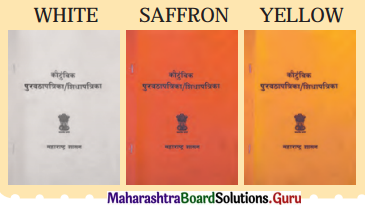
Saffron Ration Cards, White Ration Cards, Yellow Ration Cards.
Answer:
White Ration Cards, Saffron Ration Cards, Yellow Ration Cards.

1E. Find the odd word out:

Question 1.
Food items – Fish, Salt, Beverages, Durable Goods.
Answer:
Durable Goods

Maharashtra Board Class 11 Economics Important Questions Chapter 8 Poverty in India

Question 2.
Low poverty ratio – Himachal Pradesh, Jammu and Kashmir, Punjab, Tamil Nadu.
Answer:
Himachal Pradesh

Question 3.
Cause of poverty – Inflation, Population explosion, Unemployment, Industrialization.
Answer:
Industrialization

Question 4.
Effects of poverty – Low national income, Anti social activities, Population explosion, Low standard of living.
Answer:
Population explosion

Question 5.
Non-food items – Durable goods, Footwear, Fuel and Light, Salt and Sugar.
Answer:
Salt and Sugar

Question 6.
Economic effects of poverty – Low national income, Anti socio activities, Law standard of living, Malnutrition and starvation.
Answer:
Anti socio activities

1F. Complete the following statements:

Question 1.
The Employment Guarantee Scheme was launched in the state of ____________
Answer:
Maharashtra in 1972

Question 2.
An individual in the Urban area requires ____________
Answer:
2100 calories per day

Question 3.
Antyodaya Anna Yojana was launched in ____________
Answer:
December 2000

Maharashtra Board Class 11 Economics Important Questions Chapter 8 Poverty in India

Question 4.
Comparison between standard of living is known as ____________
Answer:
Relative Poverty

Question 5.
Poverty line is an ____________
Answer:
imaginary line

Question 6.
Poverty line is based on ____________
Answer:
household consumption expenditure

Question 7.
Wide inequalities have been observed in the ____________
Answer:
distribution of income

Question 8.
Inflation refers to a continuous rise ____________
Answer:
in the price

Question 9.
‘Vicious Circle of Poverty’ concept is given by ____________
Answer:
Prof. Ragnar Nurkse

Maharashtra Board Class 11 Economics Important Questions Chapter 8 Poverty in India

Question 10.
Minimum Wages Act was passed in 1948, to ____________
Answer:
provide fair wages

1G. Choose the wrong pair:

Question 1.

Group ‘A’Group ‘B’
(i) SGSYSelf-employment
(ii) SBMSanitation
(iii) JDYLiteracy
(iv) PAYHousing

Answer:
Wrong pair: JDY – Literacy

Question 2.

Group ‘A’Group ‘B’
(i) Rural Poverty2400 Calories
(ii) Urban Poverty2100 Calories
(iii) Average Calories4500 Calories
(iv) Absolute PoorMinimum Subsistence

Answer:
Wrong pair: Average Calories – 4500 Calories

Question 3.

Group ‘A’Group B’
(i) Absolute PoorLack of Nutrition
(ii) Relative PoorComparison
(iii) Rural PoorMarginal Farmer
(iv) Urban PoorIndustrialization

Answer:
Wrong pair: Urban Poor – Industrialization

Question 4.

Group ‘A’Group ‘B’
(i) Anti Poverty ProgrammeGaribi Hatao
(ii) Poverty LineImaginary Line
(iii) Vicious CirclePoverty
(iv) Cause of PovertyEqual Distribution of Income

Answer:
Wrong pair: Cause of Poverty – Equal Distribution of Income

Question 5.

Group ‘A’Group ‘B’
(i) Absolute PovertyIndia
(ii) Relative PovertyThe U.S.A.
(iii) Urban PovertyMore in India
(iv) Rural PovertyMore in the U.S.A.

Answer:
Wrong pair: Rural Poverty – More in the U.S.A

1H. Choose the correct pairs:

Question 1.

Group ‘A’Group ‘B’
1. Absolute poverty(a) Unorganised labour
2. Relative poverty(b) Small farmer
3. Rural poor(c) Health Insurance
4. Urban poor(d) The U.S.A.
5. Slums(e) India
(f) Unhygienic conditions

Answer:
(1) – e, (2) – d, (3) – b, (4) – a, (5) – f

Maharashtra Board Class 11 Economics Important Questions Chapter 8 Poverty in India

Question 2.

Group ‘A’Group ‘B’
1. Village artisans(a) 2100 calories
2. Poverty line(b) Universal
3. Urban poverty(c) Urban poor
4. Rural poverty(d) Rural poor
5. Relative poverty(e) 2400 calories
(f) Imaginary line

Answer:
(1) – d, (2) – f, (3) – a, (4) – e, (5) – b.

Question 3.

Group ‘A’Group ‘B’
1. Control of population(a) Comparison between income group
2. Absolute poverty(b) Garibi Hatao
3. Relative poverty(c) Poverty line
4. Anti-poverty programme(d) Population
5. NITI Aayog(e) Family Planning programme
(f) Absence of minimum subsistence

Answer:
(1) – e, (2) – f, (3) – a, (4) – b, (5) – c.

2. Assertion and Reasoning questions:

Question 1.
Assertion (A): Urban poverty is more harmful than rural poverty.
Reasoning (R): The poor in the urban areas live in unhygienic conditions which are hazardous to their health,
(i) (A) is true, but (R) is False.
(ii) (A) is false, but (R) is True.
(iii) Both (A) and (R) are true and (R) is the correct explanation of (A).
(iv) Both (A) and (R) are true, but (R) is not the correct explanation of (A).
Answer:
(iii) Both (A) and (R) are true and (R) is the correct explanation of (A).

Question 2.
Assertion (A): The poverty line differs from country to country.
Reasoning (R): A person described as poor in the USA will not be placed below the poverty line category in India.
(i) (A) is true, but (R) is False.
(ii) (A) is false, but (R) is True.
(iii) Both (A) and (R) are true and (R) is the correct explanation of (A).
(iv) Both (A) and (R) are true, but (R) is not the correct explanation of (A).
Answer:
(iii) Both (A) and (R) are true and (R) is the correct explanation of (A).

3. Distinguish between:

Question 1.
Urban Poverty and Rural Poverty.
Answer:

Urban PovertyRural Poverty
(i) Poverty found in urban areas is known as Urban poverty.(i) Poverty found in rural areas is known as Rural poverty.
(ii) A person who is unable to consume more than 2100 calories experiences Urban poverty.(ii) A person who is unable to consume more than 2400 calories experiences poverty.
(iii) It is mostly found among the village artisans, the landless agricultural labourers, the small and marginal farmers.(iii) It is mostly found among the rural migrate in the urban area, who lives in slums, lack infrastructure, illiteracy, unemployed people, etc.
(iv) It can be eradicated by agricultural growth and development, anti-poverty programmes like ‘garibi hatao’ etc.(iv) It can be eradicated by industrialization, affordable housing, etc.

Question 2.
Absolute Poverty and Relative Poverty.
Answer:

Absolute PovertyRelative Poverty
(i) Absolute poverty is a situation where an individual is not able to consume minimum calories intake.(i) Relative poverty is a situation where there is a comparison of income or living standard of different income groups.
(ii) Absolute poverty can be eradicated with the help of effective anti-poverty programmes.(ii) Relative poverty can not be eradicated completely.
(iii) It exists in developing and underdeveloped countries like India, etc.(iii) It is a universal phenomenon and is found in all countries of the world.
(iv) Absolute poverty indicates the minimum subsistence level of a section of society.(iv) Relative poverty indicates the existence of income inequalities between different income groups.

4. Answer the following:

Question 1.
What are the economic effects of poverty?
Answer:
Economic effects of poverty:

  • Low national income: As a substantial number of people are poor, their income, saving, and investment are inadequate. This results in low capital formation.
  • Adverse effect on production: Since the capital for modernization is not available, the farmers continue with the outdated methods. Similarly, the industry does not have funds for modernization.
  • Misallocation of resources: To help the poor, the government spends a huge amount on welfare activities. This restricts the allocation of resources for productive activities.
  • Low standard of living: Due to low per capita income and low per capita consumption, people are forced to live in slums. This is reflected in the low standard of living.
  • Malnutrition and starvation: Poor people can not afford a balanced diet due to low income. They do not get the minimum calories from their diet.

Maharashtra Board Class 11 Economics Important Questions Chapter 8 Poverty in India

Question 2.
What are the causes of rural poverty?
Answer:
Causes of rural poverty:

  • Population explosion: Due to the rapid growth of population and lesser growth in employment, poverty is increasing.
  • Slow economic growth: Agricultural and industrial growth is happening at a slower pace, thus contributing to poverty.
  • Unemployment: Unemployment is a major cause of poverty because of which poor people are not able to get jobs as well as income.
  • Economic inequalities: A larger percentage of national income is in a few rich people’s hands, who exploit poor people, which in turn causes poverty.
  • Inflation: Increase in the price of commodities without rising in income put more pressure on poor people.
  • Regional imbalance: Some states in India are having lesser economic growth as compared to other states.
  • The vicious circle of poverty: Due to low consumption, low saving, low production, low employment, and low income, the vicious circle of poverty has trapped India.

Question 3.
Explain the concepts of poverty.
Answer:
Concepts of Poverty: There are two major concepts of poverty in India, which include absolute poverty and relative poverty.

  • Absolute Poverty: Absolute Poverty can be measured in terms of calorie intake on daily basis. As per the standard set by the planning commission, in case a person is not able to take a calorie intake of 2400 calories in a rural area and 2100 calories in an urban area then the person is called absolute poor. It is found in developing and under-developing countries. It can be eradicated with proper planning of the government.
  • Relative Poverty: Relative poverty is a universal phenomenon and is found in all countries. It can be measured through comparison of standard of living of different sections of people in terms of different income, wealth, consumption, etc. It cannot be completely eradicated from any country.

Question 4.
Write notes on types of poverty.
Answer:
Types of Poverty:

(i) Rural Poverty: Poverty prevailing in rural areas is called rural poverty. A person who consumes less than 2400 calories per day is said to be a rural poor. This poverty is mostly found among poor farmers, artisans, landless laborers, etc. It can be removed by agricultural growth and anti-poverty programmes.

(ii) Urban Poverty: Poverty prevailing in urban areas is called urban poverty. A person who consumes less than 2100 calories per day is said to be an urban poor. This poverty is more found among people who live in slums with unhygienic conditions or are employed in low-paid jobs. It can be removed by using labor-intensive techniques, growth of employment programs, etc.

(iii) Absolute Poverty: Absolute poverty is a condition in which even the basic needs of a person are not satisfied. A person who is unable to consume 2100 calories per day in urban areas or 2400 per day in rural areas, is said to be absolutely poor. It is found in poor and developing countries of the world like India, Bangladesh, Pakistan, etc.

(iv) Relative Poverty: Relative poverty is based on the comparison of the lower-income groups with the higher-income groups. It is judged on the basis of per capita income and per capita consumption expenditure of people in a country. It is a universal phenomenon and is found in all countries.

5. State with reasons whether you agree or disagree with the following statement:

Question 1.
Absolute poverty can be eradicated.
Answer:
Yes, I agree with the statement.

  • Absolute poverty can be eradicated.
  • Developed countries have eradicated absolute poverty.
  • It is only in developing countries that absolute poverty is seen.
  • In these countries problems like overpopulation, slow economic development, illiteracy, agricultural and industrial backwardness, defective land system, unemployment, inequalities when solved, the problem of absolute poverty will also be solved.
  • In this manner, the problem of absolute poverty can be eradicated.

Maharashtra Board Class 11 Economics Important Questions Chapter 8 Poverty in India

Question 2.
Poverty is not responsible for the degradation of the environment.
Answer:
No, I do not agree with the statement.

  • Poverty is a part of the society or population which is not able to meet even its basic necessities.
  • Poor people do not have sufficient income.
  • They don’t possess money for proper food, clothing, shelter, health, and education.
  • They live in unhygienic conditions.
  • Thus, to satisfy their basic requirement, they cause harm to the quality of the environment.

Question 3.
Controlling population growth can reduce poverty in India.
Answer:
Yes, I agree with the statement.

  • Poverty is a social phenomenon.
  • Population explosion leads to poverty in India.
  • In order to remove poverty, it is necessary to create awareness about the importance of family planning to the people.
  • The government needs to formulate appropriate population policies to keep in check for population growth in the country.
  • If the population is controlled, there will be enough scope for employment for all in the country.
  • Full employment will lead to growth in per capita income, which in turn will lead to an increase in the standard of living of the people.
  • Thus, controlling population growth can reduce poverty in India.

6. Answer in detail:

Question 1.
Explain the causes of poverty in India.
Answer:
The causes of poverty are as follows:

  • Population explosion: Due to the increase in population, poverty is growing rapidly.
  • Slow economic growth: There is slow industrial and agricultural growth due to which the economy is growing slowly.
  • Unemployment and underemployment: Unemployment is the major factor of increased poverty.
  • Economic inequalities: There are inequalities in the distribution of income, assets, consumption expenditure, which in fact have increased poverty.
  • Inaccessibility to infrastructural facility: Due to lack of sufficient income, purchasing power is less. This leads to the inaccessibility of infrastructure such as energy, transport, communication, etc.
  • Inflation: Inflation is the major cause of poverty where prices are increased on basic food and commodity.
  • Regional imbalance: Economic development of some of the states in India is happening at a lower growth rate thus creating poverty.
  • The vicious circle of poverty: Vicious circle of poverty can be explained, where all the factors are interrelated with each other like low national income, low per capita income, low saving, low capital formation, low production, less employment resulting in poverty.
  • Other factors: Gender discrimination, corruption, natural disasters, caste, religion are some of the other factors which lead to poverty.
Maharashtra Board Class 11 Economics Solutions Chapter 6 Population in India

Balbharti Maharashtra State Board Class 11 Economics Solutions Chapter 6 Population in India Textbook Exercise Questions and Answers.

Maharashtra State Board Class 11 Economics Solutions Chapter 6 Population in India

1. Choose the correct option:

Question 1.
Stages of the theory of demographic transition.
(a) High birth rate and high death rate
(b) High birth rate and low death rate
(c) Low birth rate and low death rate
(d) Economic development
Options:
(1) a and b
(2) a and c
(3) a, b and c
(4) a, b, c, and d
Answer:
(3) a, b and c

Question 2.
Incorrect reasons for the population explosion in India
(a) Illiteracy
(b) Universalization of Marriage
(c) Joint family system
(d) Upliftment in lifestyle
Options:
(1) a and b
(2) c and d
(3) a, b and c
(4) d
Answer:
(4) d

Maharashtra Board Class 11 Economics Solutions Chapter 6 Population in India

Question 3.
Remedies undertook to check population explosion
(a) To provide employment
(b) To improve women’s quality of life
(c) National Population Policy
(d) Disaster management
Options:
(1) d
(2) a and c
(3) c and d
(4) a, b and c
Answer:
(4) a, b and c

Question 4.
Choose the correct pair:

Group ‘A’Group ‘B’
1. Year of Great Divide(a) Stable population till 2045
2. A. J. Coale and E. M. Hoover(b) 1921
3. Social Reforms(c) Demographic Transition
4. National Population Policy, 2000(d) Spread of education

Options:
(1) 1-d, 2-c, 3-a, 4-b
(2) 1-b, 2-c, 3-d, 4-a
(3) 1-b, 2-a, 3-c, 4-d
(4) 1-c, 2-d, 3-a, 4-b
Answer:
(2) 1-b, 2-c, 3-d, 4-a

2. Give economic terms:

Question 1.
An increase in population is faster than economic growth and development.
Answer:
Population explosion

Question 2.
Difference between birth rate and death rate.
Answer:
Survival rate

Question 3.
The balance between natural resources and population growth.
Answer:
Optimum population

Question 4.
Programme introduced to reduce the birth rate in 1952.
Answer:
Family Planning Programme

Maharashtra Board Class 11 Economics Solutions Chapter 6 Population in India

3. Identify and explain the concepts from the given illustrations:

Question 1.
There were 40 births per 1000 in-country ‘A’ during a year.
Answer:
Birth Rate.
Birth rate means the number of births occurring per thousand of the living population during a year. It is also called the fertility rate.

Question 2.
In Mumbai city, public transport service is largely affected due to the growing population.
Answer:
High Density of Population.
The number of people living per square kilometer is known as the density of population.
In India, it is 382 people per square kilometer as per the 2011 Census which is very high.

Question 3.
In-country ‘B’ there are 15 deaths taking place per 1000 during a year.
Answer:
Death Rate.
Death rate means the number of deaths occurring per thousand of the living population during a year.
It is also called the mortality rate.

Question 4.
For a certain period of time, China had adopted the policy of ‘One child per family.
Answer:
Population policy.
China’s ‘One Child Policy’ was part of a birth planning program designed to control the size of its population.

4. Answer the following:

Question 1.
Explain the causes of the high birth rate.
Answer:
The causes of the high birth rate are as follows:
(i) Illiteracy:
A large proportion of the population in India is illiterate which means they are bound to be traditional, superstitious, ignorant, and irrational. So they have more children.

(ii) Universalization of Marriage:
In India, Marriage is considered a religious and social obligation. In spite of the spread of education, the attitude of people towards marriage remains unchanged.

(iii) Age of Marriage:
In India the average age for marriage is low. Hence, the childbearing period is long which is responsible for the high birth rate.

(iv) Preference for the male child:
Many parents don’t accept family planning till they have a son or desired number of sons. This is known as son meta-preference.

Maharashtra Board Class 11 Economics Solutions Chapter 6 Population in India

Question 2.
Explain the causes of a low death rate.
Answer:
The causes of the low death rate are as follows:
(i) Improvement in medical and health facilities:
Due to advanced medical and health facilities epidemics like the plague, cholera, malaria, smallpox, measles, TB, etc. have been controlled or eradicated. The invention of sulpha drugs, penicillin, antibiotics has helped to reduce the death rate among people. The number of hospitals, doctors, and nurses also have increased. This has reduced the death rate.

(ii) Decline in Maternal Mortality Rate:
There is a fall in the death rate among women after delivery because of the easy availability of doctors, nurses, medicines, and transport facilities.

(iii) Fall in infant mortality rate:
Due to an improvement in medical facilities and public health measures infant mortality has declined.

(iv) Increase in literacy:
The spread of education especially among women has helped them to take better care of their children. This has reduced the death rate.

Question 3.
Explain the role of human resources in economic development.
Answer:
Role of human resource in economic development:

  • Economic growth is only a means and human development is the end i.e. the objective of economic growth and development is to improve human conditions and enlarge people’s choices.
  • Human development increases political stability by reducing civil disturbances in society.
  • Human development leads to an increase in human productivity i.e., investment in nutrition, health, and education results in higher productivity.
  • Human development helps to control population growth, through increasing literacy specially in women.
  • Human resource development contributes to improvement in life expectancy and literacy rate. This further improves the quality of life.
  • Human resource development helps to bring about research and development. It motivates research in various educational institutions.

5. State with reasons whether you agree or disagree with the following statements:

Question 1.
India is experiencing Population Explosion.
Answer:
Yes, I do agree with the statement.

  • India is going through a population explosion because in the post-independence period, the death rate has been falling rapidly and the birth rate is falling slowly and still remains very high. So, the survival rate is high.
  • India is the second-largest country in the world.
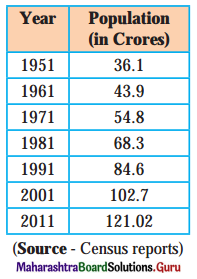
  • Between 1951 to 1971 population increased from 36.1 crores to 54.8 i.e. the population has increased more than 3 times in 2011 to 121.02 crores during these three decades. The annual population growth rate was more than 2%.
  • That is why India is experiencing a population explosion.

Maharashtra Board Class 11 Economics Solutions Chapter 6 Population in India

Question 2.
The death rate is falling rapidly in India.
Answer:
Yes, I do agree with the statement.

  • There has been improvement in medical and health facilities, the decline in maternal mortality rate, fall in infant mortality rate, increase in literacy rate, etc.
  • Through public health measures, a better quality of food is available.
  • The government has taken several steps to control natural calamities.
  • This helps to mitigate all types of disasters thereby reducing the loss of lives.
  • Hence, the death rate in India is falling rapidly.

Question 3.
Optimum population contributes to the economic development of a country.
Answer:
Yes, I do agree with the statement.

  • Optimum population means there is a balance between population growth and the availability of natural resources.
  • If the population grows faster then there will be a shortage of food supply, low employment opportunities, etc., and pressure will be there on the economic growth of the country.
  • It will create social and economic imbalances in the economy.
  • Whereas optimum population will lead to balance in social and economic growth resulting in faster growth of the country.
  • Thus, an optimum population contributes to the economic development of a country.

Question 4.
Human resources play an important role in economic development.
Answer:
Yes, I do agree with the statement.

  • The United Nations Development Programme (UNDP) has introduced the concept of ‘Human Development’ in 1990.
  • Human resource development occurs through the provision of educational facilities, increase in literacy rate, especially among women tends to reduce birth rate and infant mortality rate. This contributes to population control.
  • HRD contributes to improvement in life expectancy and literacy rate. This further improves the quality of life.
  • Human development leads to an increase in human productivity, i.e. investment in nutrition, health, and education which results in higher productivity.
  • Hence, human resources play an important role in economic development.

Question 5.
The birth rate is declining due to changes in the standard of living.
Answer:
Yes, I do agree with the statement.

  • According to the 2011 Census, the birth rate in India is 20.9 which is low as compared to the 2001 Census.
  • There are certain factors responsible for the declining birth rate.
    • Awareness about health facilities.
    • Joint Family System is now shaped into a nuclear family system.
    • The cost of education is increased per child.
    • Under the family planning programme, contraceptive pills are available.
  • Due to all these reasons, the birth rate is declining in India.

Maharashtra Board Class 11 Economics Solutions Chapter 6 Population in India

6. Solve the following:

Question 1.
Find out Q3 from the given data.
Maharashtra Board Class 11 Economics Solutions Chapter 6 Population in India 6
Answer:
Arranging the data in ascending order:
36.1, 43.9, 54.8, 68.3, 84.6, 102.7, 121.02
Here, n = 7
Q3 = \(\frac{3(n+1)^{\text {th }}}{4}\) observation
Q3 = \(\frac{3(7+1)^{\mathrm{th}}}{4}\) observation
Q3 = 6th observation
Q3 = 102.7

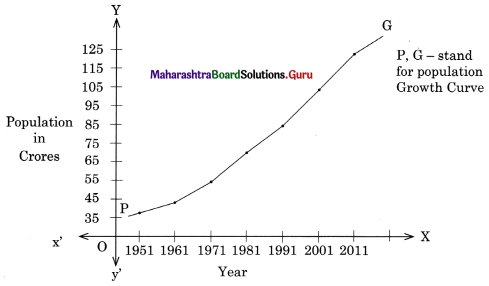
Question 2.
Draw a population growth curve from the given data.
Maharashtra Board Class 11 Economics Solutions Chapter 6 Population in India 6
Answer:
Maharashtra Board Class 11 Economics Solutions Chapter 6 Population in India 6.1

11th Economics Digest Chapter 6 Population in India Intext Questions and Answers

Try this: (Textbook Page No. 38)

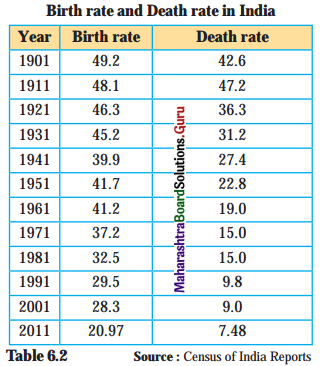
Based on the given table 6.2, explain how demographic transition theory is applicable to India.
Maharashtra Board Class 11 Economics Solutions Chapter 6 Population in India Page 38.1

Answer:
Both birth rate and death rate falling from 1901 to till 2011 due to that India is facing high growth of population explosion. Hence we can say India is experiencing the second stage of demographic transition.

Can you tell: (Textbook Page No. 38)

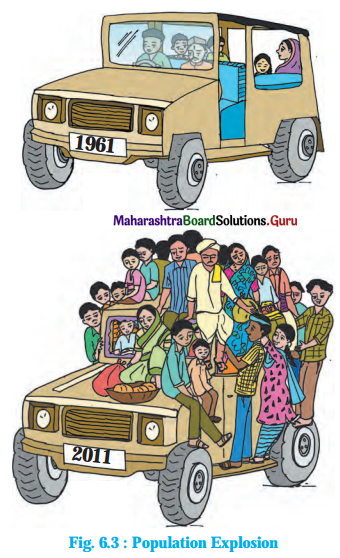
Observe Fig. 6.3 and draw inferences from it.
Maharashtra Board Class 11 Economics Solutions Chapter 6 Population in India Page 38

Answer:
Inferences drawn from the figure are as follows:

  • In 1961 Birth rate and the Death rate was high as compared to the year 2011. Hence, there was less population in the year 1961.
  • As the year passes by, the death rate is declining and the birth rate is inclining due to proper medication facilities, improvement in education facilities, etc.
  • This all led to a population explosion in India. The year 2011 is a case of overpopulation.

Find out: (Textbook Page No. 39)

Legal age of marriage for males and females in different countries?
Answer:

CountriesMaleFemale
1. India2118
2. U.S.A1816-17
3. Afghanistan1816
4. Argentina1818
5. Australia1818
6. Bangladesh2118
7. Bhutan1818
8. China2220
9. Cuba1816
10. Egypt2121
11. Germany1818
12. Indonesia1916
13. Japan2020
14. Kuwait1715
15. Singapore2121
16. Thailand1717

Note: Students may further refer to the internet for more information on the legal age of marriage.

Maharashtra Board Class 11 Economics Solutions Chapter 6 Population in India

Do you know: (Textbook Page No. 41)

Question 1.
What do you mean by Population Education?
Answer:
According to UNESCO – “Population Education is an educational programme which provides for a study of population situation of the family, the community, nation, and world with the purpose of developing in the students rational and responsible attitude and behaviour towards the situation”.

Question 2.
When does demographic dividend occur?
Answer:
Demographic dividend occurs when the proportion of working people to the total population is high.

Maharashtra Board Class 12 English Yuvakbharati Solutions Chapter 2.1 Song of the Open Road

Balbharti Yuvakbharati English 12th Digest Chapter 2.1 Song of the Open Road Notes, Textbook Exercise Important Questions and Answers.

Maharashtra State Board Class 12 English Yuvakbharati Solutions Chapter 2.1 Song of the Open Road

12th English Digest Chapter 2.1 Song of the Open Road Textbook Questions and Answers

Question 1.
Choose the mode of travel that you would like the most, for a journey.
(a) Airways
(b) Waterways
(c) Railways
(d) Roadways.
Give reasons for your preference.
Answer:
(a) Airways:

  • Time-saving even if costly
  • Affordable nowadays due to economy airlines
  • Useful to go all over the world if one can afford
  • Qan enjoy birds’- eye view of different places

(b) Waterways:

  • Enjoyable way to travel
  • Commuting on waterways is not common all over India.
  • In Kerala people use boats on canals and creeks for daily commute
  • Long-distance travel by cruise-ship would offer new experiences on the oceans
  • Can experience peace of mind and relaxation on long journey by waterway

(c) Railways:

  • safe, quick and cheap way to travel long distances
  • convenient for overnight journeys – no extra cost for night stay and rest
  • comfortable for individuals, families, large groups
  • view of the passing landscape and communities living along the route
  • opportunity to meet people and even make new friends
  • work, family trips, pilgrimage, touring – all kinds ofjourneys are possible and affordable.

(d) Roadways:

  • can travel through remote areas
  • travel by own vehicle gives more freedom.
  • can enjoy the natural beauty -greenery, mountains, water-bodies
  • see various geographical features, flora, and styles of clothing, food and even language.

Maharashtra Board Class 12 English Yuvakbharati Solutions Chapter 2.1 Song of the Open Road

Question 2.
Discuss with your partner, the preparations you would like to make for the journey chosen.
Answer:
(a) A journey by road will need a (virtual) map for the route to take. Road trips are unpredictable. Except for highways we do not know where food, water and facilities like restrooms or pharmacy may be available. One has to carry food, drinks and emergency medicines for unexpected situations. Umbrella or other rainwear, flashlight, spare tyre, tool box and jack are a must. Also when travelling by one’s own vehicle we must have the vehicle serviced and in perfect shape for long distance travel.

(b) All documents related to the vehicle – driver’s licence, registration- papers and insurance papers must be updated and ready to be shown. All journeys require the traveller to wear suitable comfortable clothes. So one would have to wear and pack clothes and accessories accordingly. One also has to foresee what weather conditions maybe along the journey and carry suitable items for that.

(c) Since all of us own mobile phones and our family will want to know about our well-being, one must remember to carry the phone charger and even a power- bank if possible. One must carry a list of emergency contact numbers on paper, in case one’s phone is lost or does not work.

(d) If one decides to travel alone one must be in touch with their loved ones daily, at least once at a particular time. If one has company then the travellers should also discuss the budget, schedule, how to tackle emergencies.and also what to do in unexpected situations.

Question 3.
Discuss the ways in which you would overcome the problems/hindrances/ difficulties you face during the journey.
Answer:
(a) In case of a problem or difficulty, I would go to the nearest place where I can try and resolve the problem.
(b) I would inform my family about the problem.
(c) I would take any steps needed to see that the problem does not become worse.
(d) I would ensure that I am safe till the problem is resolved and I can continue the journey/return home.

Question 4.
During every journey we have to observe certain rules. Discuss your ideas of the journey without any restrictions.
Answer:
(a) I would go with my friends since we work well as a team even though we have I varied interests and skills. We are like-minded about most things. We will share the costs and all of us drive well.
(b) My friends and I love to have fun but none of us is ever unruly. We do, always will, respect the law and are particular about others’ safety and our own.
(c) We will be. sure to never speed or drive rashly. None of us smokes nor consumes forbidden substances like alcohol.
(d) We will ensure that each gets some rest. We will also make sure we keep a log book to record our road trip for memories as well as a guide for later trips, so we can avoid the mistakes and fill in loopholes.

(A1)

Question (i)
Pick out the lines showing that the poet is prepared to enjoy every moment of his journey.
Answer:

  • ‘Afoot and light-hearted I take to the open road,..’
  • ‘Healthy, free, the world before me.’
  • ‘The long brown path before me leading wherever I choose.’
  • ‘Henceforth I ask not good-fortune, I myself am good-fortune,’
  • ‘Strong and content I travel the open road.’
  • ‘The earth, that is sufficient,’

Maharashtra Board Class 12 English Yuvakbharati Solutions Chapter 2.1 Song of the Open Road

Question (ii)
By ‘old delicious burdens’ the poet means
(a) the luggage
(b) the food he carries
(c) sweet memories of the past
Answer:
(c) sweet memories of the past

Question (iii)
The poet is a person who is free from all inhibitions. Discuss how the concept is expressed in the poem.
Answer:
The poet is about to embark on a trip. He j does not consider anything can restrict him, even his own hesitation or doubts. He says he is prepared -‘afoot ’and ‘light-hearted’, He is physically fit and mentally without any dilemma. He is all set to follow the road to his dream/destination. ‘Healthy and free’ He does not (want to) depend on good luck or fortune to be kind to him. He has his life, his destiny, in his own hands and is. confident that is enough. ‘I ask not good-fortune, I myself am good-fortune’.

He is no longer going to delay his journey with complaints, criticising that everything is not perfect. What is there is enough for him. ‘I whimper no more, postpone no more, need nothing,’ ‘The earth, that is sufficient’. His determination is strong and he has decided to progress on his path in life. ‘Strong and content I travel the open road.’

(A2)

Question (i)
Following are the activities of the poet related to his journey on the road. Divide them into two parts as ‘activities the poet will practise’ and ‘activities he will not practise’.
1. Walking along the road though he does not know where it reaches
2. Complaining about the discomforts during the journey
3. Postponing the journey
4. Praying for good fortune
5. Carrying the fond memories of the good people
6. Creating contacts with famous and influential people
7. Striving to achieve high and bright success
8. Reflecting and developing his own ‘self Activities he will practise’.
Answer:
Activities he will practise:
1. Walking along the road though he does not know where it reaches
5. Carrying the fond memories of good people
7. Striving to achieve high and bright success
8. Reflecting and developing his own ‘self Activities he will not practise

Activities he will not practise:
2. Complaining about discomforts during the journey
3. Postponing the journey
4. Praying for good fortune
6. Creating contacts with famous and influential people

Maharashtra Board Class 12 English Yuvakbharati Solutions Chapter 2.1 Song of the Open Road

(ii) Write down the traits the poet exhibits through the following lines.

Question (a)
Henceforth, I ask for no good fortune –
Answer:
I myself am good fortune – Self-confidence

Question (b)
Henceforth I whimper no more, postpone no more, need nothing –
Answer:
Positive and self-reliant

Question (c)
I do not want the constellations any nearer –
Answer:
self-assured and independent

Question (d)
I swear it is impossible for me to get rid of them –
Answer:
clear-thinking and knowing his mind

Question (e)
I am filled with them – I will fill them in return –
Answer:
aware and honest about himself

Question (iii)
‘Healthy, free, the world before me.’ Express your views regarding the above line.
Answer:
The poet is about to set out on life’s journey. He is of healthy body and mind. He feels strong enough to meet challenges he may have to face on the way. His attitude seems positive, hopeful and determined – he says ‘the world before me’ – showing this.

Hence we can say he is ready to make use of every opportunity the world can provide and he will not delay or complain, postpone or criticize, blaming others. He can make any dream come true.

(A3)

Question 1.
The poet has used many describing words like ‘healthy’ in the poem. Make a list and classify them as
(a) For the world: ……………
(b) For himself: ………………
(c) For the road: ………………
Answer:
(a) For the world: sufficient
(b) For himself: light-hearted, healthy, free, good-fortune, strong, content,
(c) For the road: open, long brown path

Maharashtra Board Class 12 English Yuvakbharati Solutions Chapter 2.1 Song of the Open Road

(A4)

Question (i)
The road in the poem does not mean only the road to travel. The poet wants to suggest the road of life. Explain the metaphor with the help of the poem.
Answer:
In a journey we may go on, we plan on the mode of travel, and hope to have an enjoyable trip. We want to admire the scenes passing by. We may meet new people. Sometimes we may come across some difficulties, yet we complete the trip and return home to our normal routine.

For a trip, we make travel plans decide the destination and so on. But life itself is a long journey. In our life we have family and friends. We don’t know what will happen in future. We remember pleasant as well as sad situations of the past. We work hard, find success, face failure, and attain glory and defeat. So life goes on.

In both, a trip or in life, the attitude is important in how we make the journey. One must go ahead with a positive and flexible mind-set. Unexpected situations will come up. We may have pleasant as well as unpleasant situations. But if we have self-belief, any difficulty can be faced. One must just be strong.

The poem also tells we have memories. We are held back by attachments. But we can carry the beautiful past as happy memories, We should always go forward in the journey of life.

Question (ii)
There are certain words that are repeated in the poem. For example, ‘no more’ (Line 7) Find out other similar expressions. Explain the I effect they have created in the poem.
Answer:
There are several words that are repeated.
1. ‘open road’ – lines 1 and 7. Indicates the path in life is open wide for the poet/ person to make any choice he wants. The opportunities are unlimited.
2. ‘before me’ – the poet is looking at the road ahead, his future life, his outlook for the upcoming journey (of life).
3. ‘Henceforth I’ – lines 4 and 5. The poet conveys ‘from that point onwards’ he has decided to do or not do certain things.
4. ‘good-fortune’ – he believes good fortune or destiny is not external. It is within one’s power, in one’s own hands.
5. ‘I know’ – lines 11 and 12. This shows his full awareness.
6. I carry’ – lines 12, and twice in 13, I indicate the weight of the burdens though they may be delicious.
7. ‘they are’ – line 10 emphasizes that entity (constellations or people with power) belongs where it is.

Maharashtra Board Class 12 English Yuvakbharati Solutions Chapter 2.1 Song of the Open Road

Question (iii)
The use of personal pronoun ‘I’ is evident and prominent in this poem. Give reasons.
Answer:
The repetition of the pronoun ‘I’ occurs fifteen times in as many lines of the poem. This shows us how fully in charge the poet is of his life, his destiny, his actions, his decisions and the consequences.
The repeated use of T shows that he is confident of himself and is able to take his life forward independent of other’s support. He is going to stop complaining, criticizing.
He will approach the future on his own strengths. Ready to use the opportunities that he comes across, the poet is quite sure he does not need either luck or influential friends to help his attempts. He seems assured of his own capabilities.

(A5)

Question (i)
With the help of the following points, write a poetic appreciation of the poem ‘Song of the Open Road’.

  • the poem
  • title
  • theme
  • style
  • poetic devices
  • message
  • your opinion.

Answer:
‘The Song of the Open Road’ by American poet, Walt Whitman is about optimism, energy j and confidence. The world offers opportunities to anyone who wants to use them.

Walt Whitman’s works were a powerful influence on other writers. The poet himself struggled as a child of twelve. He dropped out of school to take up some job to help the family income. He worked as lawyer’s assistant, printer’s assistant, as a teacher and journalist. He helped look after the wounded in the American Civil War.

Question (ii)
Write four to six lines of Free Verse on the topic ‘The road that leads to my college’. Express that it is the road to knowledge and bright future. You may begin like this: Evlery day I tread with the bag of books
Answer:
‘The Road That Leads to My College’ Every day I tread with the bag of books And a hopeful step, Into the space of light and hope, Lean look for myself. I go to become more ready For tomorrow and the day after. Every day, every way I Grow and grow thankful and wise, strongly hopeful.

Question (iii)
Write a blog on the following topic.
(a) Man is Free by Birth.
Answer:
Man is Free by Birth

The statement is true in every sense of the word ‘free’. If someone does not have physical freedom, it is visible. But the freedom of the mind, thoughts, emotions, the spirit, the soul, is also vital for one to fully find satisfaction in life.

I remember an advertisement to bring up boys to be sensitive. Usually boys are discouraged from showing tears. It is thought tears of fear, anxiety, pain, loss are signs of weakness when a boy cries. There should be no external signs of these emotions and parents compare the boy to a girl. They make fun of their sons to stop him crying. In this way they take away the child’s freedom to express emotions. They take away his sensitivity!

Taking away of freedom is often done by adults to their children. The parents give guidance for the future but parents impose their own expectations on the kids and take away their freedom to choose a life-goal. The child’s natural liking or strength is not considered. The herd mentality makes parents force their children to follow a field which other students are doing. They earn lots of money. But they don’t notice their child does not like or is not good at it. So the child grows up leaving his passion.

Adults teach children that out of respect and good manners they must not question them. Children will grow up seeing injustice being done. They will notice bad things happening. But their desire to question is silent. They keep quiet and accept even bad things as normal.

I could go on. But let us ensure that freedom is alive and well. Let us allow everyone to be themselves, to follow their heart, to speak out when necessary, to fulfil their dreams. But we must ensure that this freedom never injures another or interferes with other people’s freedom.

The poem says ‘open’ road. It is about freedom. The poet wants to go out from restrictions and comforts. The poet wants to be self-reliant. He is confident. The poem is in free verse. There are many poetic devices but no metre or rhyme, We immediately notice repetition. There is also Transferred epithet.

The poem is a dramatic monologue. The poem inspires us to explore the world using our abilities. Comfort, complaints, criticisms and fate are not excuses for one’s inaction.

Maharashtra Board Class 12 English Yuvakbharati Solutions Chapter 2.1 Song of the Open Road

Question (iv)
Expand the ideas suggested in the following lines:
(a) All roads lead to Rome.
Answer:
The road system in the Roman Empire was built in a way that a person could take a road from anywhere and he would reach Rome. This means that every matter can be approached differently. Everyone has their own way to approach a matter. It could be doing some work or solving a problem. Each person has their way of doing things.

It means that we should agree not to be narrow minded. We should appreciate the other person’s way of doing things also. We should not expect everyone to think exactly the same way as we do. We should allow individuals to follow their method. Sometimes some work is given. That person will complete the work in his way. When giving the task the method of doing it need not be forced. Even if it is completely new then the person may do it himself. If he is not able to do it he can ask for help.

When there is a problem many people may be trying to find a solution. We can discuss ideas. Many ideas may be put forward. There can be so many ideas that are useful for solving the problem. One may be quicker. Another may be cheaper. One may need more people. So all ideas can be pooled to finally solve the problem.

Even the head of the country has a team of ministers. The leader discusses and consults with the team for running the country. All of them play a role for successful running of the government. This is true of teamwork and cooperation. We can all work for the same goal. The work may be so big that many are required to work together. It is not necessary for everyone to do exactly the same thing. But all work together in different methods so that we reach the desired goal.

Question (b)
A man without liberty is a body without a soul.
Answer:
We think ‘liberty’ means only physical freedom. But even if a person is not physically free, his mind is working freely. Actually the freedom to think, speak and act to fulfil our wishes and goals is more important.

A free man really means a free-thinking man. We have heard of men speaking out against powerful people. They were jailed. But even in jail they wrote books. They expressed their views. We know of many such famous personalities like Gandhiji, Jawaharlal Nehru and Nelson Mandela.

Many of our Indian freedom fighters were executed for their ideas. But they did not keep quiet. They spoke out and inspired Indians to rise up against the colonial rulers. Their minds were free though they were physically in prison.

Liberty is freedom to anything for oneself without hurting other people’s liberty. We should not use freedom to do just anything we desire. That is not correct. Hence we must be aware of what is happening and speak against wrongs. When there is life, there is mind. When we have an intelligent mind, we should think.

‘Life, liberty, and thought – three persons in one substance, eternal, never-ending, and unceasing.’ Khalil Gibran.

Maharashtra Board Class 12 English Yuvakbharati Solutions Chapter 2.1 Song of the Open Road

(A6)

Question (i)
Take help from the sources available on the internet and make a list of proverbs and quotations about ‘road.’ [an example …]
Answer:
The road to success is not a path you find but a trail you blaze.
https : //www.bemytravelmuse.com/best- road-trip-quotes/
https : //www.goodreads.com/quotes/tag/ road-trip

Question (ii)
Read the poem ‘The Road Not Taken’ by Robert Frost.

Yuvakbharati English 12th Digest Chapter 2.1 Song of the Open Road Additional Important Questions and Answers

Read the poem and complete the activities given below:

Global Understanding:

Question 1.
Describe the mood of the speaker in the poem. Choose from the options given. There may be more than one possible option:
1. hopeful
2. thoughtful
3. serious
4. cheerful
5. regretful
6. upbeat
7. contemplative
8. buoyant
Answer:
1. hopeful
4. cheerful
6. upbeat
8. buoyant

Maharashtra Board Class 12 English Yuvakbharati Solutions Chapter 2.1 Song of the Open Road

Inference/Interpretation/Analysis:

Question 1.
Pick out the lines from the poem which indicate the past behaviour of the poet, which he now chooses to discontinue and discard. What do the thoughts indicate regarding the poet’s intentions for the future?
Answer:
The lines which the poet writes indicating his change in mind-set are:
1. ‘Henceforth I ask not good-fortune, I myself am good-fortune,
2. Henceforth I whimper no more, postpone no more, need nothing,
3. Done with indoor complaints, libraries, querulous criticisms,’
The poet realizes he has been discontented, complaining, blaming and criticizing others, as an excuse for his inaction. He had not taken charge of his own actions or his life.

Now he has a clear view of what he will do in the future, a different attitude to life. He has taken charge of both now. He is ready to leave behind all negativity and move ahead with hope and self-confidence.

Personal Response:

Question 1.
The poet says ‘strong and content’, ‘The earth, that is sufficient’. Describe your thoughts about yourself if you were starting out on life’s journey. Would ‘the earth be sufficient’ for you to being ‘strong and content’?
Answer:
I agree with the poet. The fact that I am reading and understanding the poem indicates I have a high-school education. People with much fewer advantages have accomplished great things. I can use the resources I have to become a good human, a useful citizen and find my way to go forward in life. Success and satisfaction does not mean making lots of money or becoming famous. If I can help fellow humans and give back to the country that has given me so much, I will be content.

Poetic Devices:

Paradox is a poetic device, which is defined as ‘a (logical) statement’ contradicting itself. It can i also be said to be a sentence that is opposed to the 1 common sense but yet can be true.

Question 1.
Pick out a line from the poem that is an example of paradox.
Answer:
‘Still here I carry my old delicious burdens’ is the line that is having a paradox ‘delicious’ and ‘burden’. Something delicious is pleasant, whereas ‘burden ’ reminds us of something difficult and unpleasant. But the poet wants to convey that his sweet memories are difficult to leave behind. They pull us back from going away. But still he will go, but he will carry his precious memories and still carry on his life’s journey.

Maharashtra Board Class 12 English Yuvakbharati Solutions Chapter 2.1 Song of the Open Road

Question 2.
Pick out the line where transferred epithet is used by the poet.
Answer:
‘Done with indoor complaints, libraries, querulous complaints.’
The phrase ‘indoor complaints’ describes the speaker who earlier had been enclosed indoors and complaining. Now he is ‘done’ -will no longer do that. Another phrase ‘querulous criticisms’ speaks of an irritated person constantly criticizing. The poet has decided he will no longer indulge in that also.

Maharashtra Board Class 11 Economics Solutions Chapter 8 Poverty in India

Balbharti Maharashtra State Board Class 11 Economics Solutions Chapter 8 Poverty in India Textbook Exercise Questions and Answers.

Maharashtra State Board Class 11 Economics Solutions Chapter 8 Poverty in India

1. Assertion and Reasoning questions:

Question 1.
Assertion (A): Poverty level declines with a rise in agricultural output.
Reasoning (R): Agricultural incomes have declined due to wide fluctuations in climatic conditions.
(i) (A) is true, but (R) is False.
(ii) (A) is false, but (R) is True.
(iii) Both (A) and (R) are true and (R) is the correct explanation of (A).
(iv) Both (A) and (R) are true, but (R) is not the correct explanation of (A).
Answer:
(iv) Both (A) and (R) are true, but (R) is not the correct explanation of (A).

Question 2.
Assertion (A): Urban poverty is attributed mainly to spillover effects of migration among the rural poor.
Reasoning (R): Poor rural infrastructure, lack of alternative jobs results in forced migration.
(i) (A) is true, but (R) is False.
(ii) (A) is false, but (R) is True.
(iii) Both (A) and (R) are true and (R) is the correct explanation of (A).
(iv) Both (A) and (R) are true, but (R) is not the correct explanation of (A).
Answer:
(iii) Both (A) and (R) are true and (R) is the correct explanation of (A).

Maharashtra Board Class 11 Economics Solutions Chapter 8 Poverty in India

Question 3.
Assertion (A): Relative poverty is found in all the countries of the world.
Reasoning (R): Differences in the levels of income is the only criteria for judging relative poverty,
(i) (A) is true, but (R) is False.
(ii) (A) is false, but (R) is True.
(iii) Both (A) and (R) are true and (R) is the correct explanation of (A).
(iv) Both (A) and (R) are true, but (R) is not the correct explanation of (A).
Answer:
(i) (A) is true, but (R) is False.

Question 4.
Assertion (A): Poverty is not just a lack of money but also a lack of capabilities.
Reasoning (R): Lack of freedom to satisfy hunger, lack of health care facilities, denial of political freedom leads to poverty.
(i) (A) is true, but (R) is False.
(ii) (A) is false, but (R) is True.
(iii) Both (A) and (R) are true and (R) is the correct explanation of (A).
(iv) Both (A) and (R) are true, but (R) is not the correct explanation of (A).
Answer:
(iii) Both (A) and (R) are true and (R) is the correct explanation of (A).

Question 5.
Assertion (A): Food security, credit facilities guarantee social protection to the poor.
Reasoning (R): Leakages in the administrative system perpetuate poverty.
(i) (A) is true, but (R) is False.
(ii) (A) is false, but (R) is True.
(iii) Both (A) and (R) are true and (R) is the correct explanation of (A).
(iv) Both (A) and (R) are true, but (R) is not the correct explanation of (A).
Answer:
(iv) Both (A) and (R) are true, but (R) is not the correct explanation of (A)

2. Find the odd word out:

Question 1.
Colours of Ration card – White, Green, Saffron, Yellow
Answer:
Green

Maharashtra Board Class 11 Economics Solutions Chapter 8 Poverty in India

Question 2.
High Poverty ratio – Chhatisgarh, Jharkhand, Bihar, Kerala
Answer:
Kerala

Question 3.
Calories – 2400, 1800, 2100, 2250
Answer:
1800

3. Give economic terms:

Question 1.
Denial of opportunities to certain sections of the people in the society.
Answer:
Social exclusion

Question 2.
Concept of poverty that covers material and non-material dimensions.
Answer:
Multidimensional poverty

Question 3.
Poverty is judged on the basis of relative standards of livings of the people.
Answer:
Relative poverty

Maharashtra Board Class 11 Economics Solutions Chapter 8 Poverty in India

Question 4.
Poverty can be completely eradicated.
Answer:
Absolute poverty

Question 5.
Threshold expenditure is needed to satisfy basic human needs at socially acceptable levels.
Answer:
Task Force on Eliminating Poverty

4. Identify and explain the concepts from the given illustration:

Question 1.
Baban’s daughter had to be hospitalized due to weakness caused by undernourishment or lack of minimum calorie requirement in the intake of food.
Answer:
Absolute poverty.
The absence of minimum income to satisfy the desired level of the calorie intake of food is called absolute poverty. Absolute poverty is generally found in developing countries like India. The situation of undernourishment can be overcome by taking the minimum required calorie food intake as per the standard set by the planning commission.

Question 2.
Dhanajirao is a wealthy landlord, but his annual income is relatively less in comparison to entrepreneur Raobahadur.
Answer:
Relative poverty.
Relative poverty can be judged by comparing the standards of living of different sections of the people. Relative poverty is found in all the countries of the world. It cannot be completely eradicated.

Question 3.
Urmi’s family live in a situation whereby they are not able to fulfill even the basic needs of life such as food, clothing, and shelter.
Answer:
Absolute poverty.
This is the case of absolute poverty where people have less income in which they cannot buy basic needs for living. Such poverty is generally found in developing countries like India. It can be eradicated by applying effective measures by the Government.

Maharashtra Board Class 11 Economics Solutions Chapter 8 Poverty in India

Question 4.
Sanjay’s family receives food grains on the basis of yellow ration cards through the public distribution system.
Answer:
Absolute poverty.
In absolute poverty, people are very poor and have very little income. Ration card is one of the measures to eradicate poverty by giving food-grains through ration shop at a subsidized rate.

Question 5.
In certain parts of the state, starvation-related death has been observed whereas in certain areas gross wastage of food has been reported.
Answer:
Relative poverty.
This is an example of differences between two different sections of people in terms of consumption and level of income. Such differences create relative poverty. It is found in all the countries of the world. It cannot be eradicated completely.

5. State with reasons whether you agree or disagree with the following statement:

Question 1.
Population control is the only measure to eradicate poverty.
Answer:
No, I do not agree with the statement.
Policy measures undertaken for the eradication of poverty are as follows:

  • Agriculture: Providing minimum support prices for selected crops and providing cheaper credit facilities to farmers are the measures taken to ensure stable agricultural income to farmers.
  • Rural works: New employment is created for labours of rural areas by way of construction of roads, irrigation projects, etc.
  • Rural industrialization: To increase the income of people living in rural areas, employment is created by promoting small-scale and cottage industries.
  • Minimum wages: In 1948, the Minimum Wages Act was passed to provide fair wages to laborers and workers of industrial and agricultural areas.

Besides these, there are many other causes like:

  • Public distribution system
  • Nationalization of banks
  • Progressive tax measures
  • Free Education
  • Affordable housing
  • Health Facilities
  • Skill development and self-employment.

Maharashtra Board Class 11 Economics Solutions Chapter 8 Poverty in India

Question 2.
Relative poverty is universal by nature.
OR
Relative poverty is found in all countries.
OR
Relative poverty is found in the richest of the rich countries.
Answer:
Yes, I agree with the statement.

  • Differences in income earned by people in relative poverty.
  • If one person earns less than the other, he is said to be poorer than the other.
  • So, this difference in the earnings of people will be found in all the countries of the world.
  • This is found because of differences in talents, education, abilities, skills, etc. of different people, and this cannot be removed from any country.
  • So, relative poverty is a universal phenomenon.

Question 3.
Regional imbalance is the only cause of poverty.
Answer:
No, I do not agree with the statement.
The causes of poverty besides regional imbalance are as follows:

  • Population explosion: Due to the increase in population, poverty is growing rapidly.
  • Slow economic growth: There is slow industrial and agricultural growth due to which the economy is growing slowly.
  • Unemployment and Underemployment: Unemployment is the major factor of increased poverty.
  • Economic inequalities: There are inequalities in the distribution of income, assets, consumption expenditure, which in fact have increased poverty.

Besides these, there are many other causes like:

  • Inaccessibility to infrastructural facility
  • Inflation in the country
  • The vicious circle of poverty
  • Other factors – like gender discrimination, corruption, natural disasters, etc.

Maharashtra Board Class 11 Economics Solutions Chapter 8 Poverty in India

6. Answer in detail:

Question 1.
Assess the various measures undertaken to eradicate poverty.
Answer:
Policy measures undertaken for the eradication of poverty are as follows:

  • Control of population: There are various population policies and family welfare programmes introduced to control the growth of the population.
  • Agriculture: Providing minimum support prices for selected crops and providing cheaper credit facilities to farmers are the measures taken to ensure stable agricultural income to farmers.
  • Rural works: New employment is created for labours of the rural areas by way of construction of roads, irrigation projects, etc.
  • Rural industrialization: To increase the income of people living in rural areas, employment is created by promoting small-scale and cottage industries.
  • Minimum wages: In 1948, the Minimum Wages Act was passed to provide fair wages to labourers and workers of industrial and agricultural areas.
  • Public distribution system: Under the public distribution system food grains are made available to poor people at highly subsidized rates through ration shops.
  • Nationalization of banks: Nationalization of banks was undertaken to provide loans to poor people at lower interest rates.
  • Progressive tax measures: Progressive income tax system has been introduced to reduce inequalities in the distribution of income.
  • Education: Primary education is made free as well as education for girls is provided at no cost to increase the enrollment ratio.
  • Affordable housing: Affordable housing facilities are provided to the rural and urban poor through the Slum Rehabilitation programme.
  • Health Facilities: Government hospitals, primary health centers have been established to provide medical facilities to poor people.
  • Skill development and self-employment: Skill-based training is provided for skill development which inspires people towards self-employment.

11th Economics Digest Chapter 8 Poverty in India Intext Questions and Answers

Can you tell: (Textbook Page No. 51)

Express your opinion on the following:

Questions 1.
There is a thick line of rural-urban economic divide in India.
Answer:
Yes, there is a thick line of rural-urban economic divide in India because of around 65% population lives in a rural area but do not have proper road access for vehicles, lack of health facilities, lack of employment opportunities, lack of technology, a rural economy based on subsistence strategies, the population is spread thinly, due to slow economic growth people migrating from rural to the urban area, etc.

In an urban economy around 35% population lives with good road access, many health facilities, employment opportunities, advanced technology, the thick density of population, high economic growth rate, etc.

Question 2.
There is an equitable distribution of income and wealth in the country.
Answer:
No, there is an unequal distribution of income and wealth in the country, that’s why India has adopted a progressive taxation policy. The government formulated many welfare policies to raise the income of poor income groups.

Maharashtra Board Class 11 Economics Solutions Chapter 8 Poverty in India

Question 3.
All the citizens have equal access to education, health, energy, and drinking water.
Answer:
No, there is unequal access to education, healthy drinking water.
In urban areas, people can afford all the amenities. There are many educational institutions 24 hours availability of electricity, many health centers with modern equipment and technology, clean drinking water, etc.

Question 4.
There is no hunger, starvation, or malnutrition in the country.
Answer:
No, I don’t agree with the statement.
In India a large number of people especially women and children are not able to get food.
14.8% (195.9 million people are undernourished, 51.4% of women age between 15 to 49 years) are anemic, 38.4% of the children aged under five are too short for their age, 21% children have weight too low for their height and there is high child mortality rate prevailing in India.

Question 5.
There is a lack of sanitation facilities in the country.
Answer:
Yes, I agree with the statement.
In rural areas, most of the people (300 to 522 million) still practice open defecation.
In addition to considerable Indian homes having no toilets, access to water supply and drainage facilities is also another serious problem.

Question 6.
The poverty ratio is uniform across all the states.
Answer:
In India poverty is different from state to state.
In India first ten poorest states or high poverty ratio is in Chhatisgarh (93%), Jharkhand (36.96%), Manipur (36.89%), Arunachal Pradesh (34.67%), Bihar (33.74%), Odisha (32.59%), Assam (31.98%), Madhya Pradesh (31.65%), Uttar Pradesh (29.43%), Karnataka (20.91%) and poverty ratio is lowest in Maharashtra, Gujarat, Kerala, Tamil Nadu, etc.

Note: The above data is according to the 2016 report.

Find out: (Textbook Page No. 51)

Prepare a list of 5 countries in the world having absolute poverty with reference to the latest World Bank Report.
Answer:
All the developing countries will face absolute poverty for e.g. India, China, Pakistan, Nepal, Bhutan, etc.

Maharashtra Board Class 11 Economics Solutions Chapter 8 Poverty in India

Can you tell: (Textbook Page No. 52)

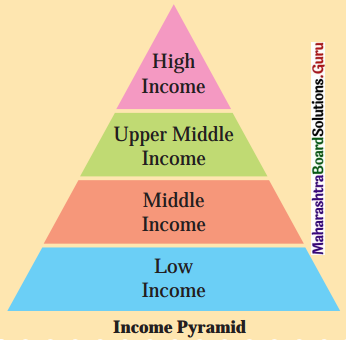
Place the following individuals as per their income into the High-income group, Upper Middle-income group, Middle-income group, Low-income group.

  1. Contract labourer
  2. Salesman in a shop
  3. CEO of a Multinational Company
  4. Executive in a Company

Maharashtra Board Class 11 Economics Solutions Chapter 8 Poverty in India Page 52 Q1
Answer:

Income groupsIndividuals
(i) High IncomeCEO of a Multinational Company
(ii) Upper Middle IncomeExecutive in a company
(iii) Middle IncomeSalesman in a shop
(iv) Low IncomeContract labour

Find out: (Textbook Pg. No. 52)

Information about the informal sector and list a few activities related to it as per your observation.
Answer:
Informal Sector:
The informal sector is called as ‘unorganized sector’. It consists of unlicensed establishments that do not pay taxes to the government and does not obey the law prescribed by the law.

Activities of the informal sector are not counted in the country’s GNP as they are not disclosed by the owners of such organizations.

Examples:

  • Selling things from home or offices or garage, etc.
  • Paying a person for removing grass or snow from your garden or doorsteps.
  • Paying labourer for removing the upgrowth of trees outside the building wall.
  • Paying your office boy for the watering plant in your absence.
  • Black marketing, hoarding, smuggling, etc.
  • Paying under the table for getting some work done.
  • Farmers, beggars, daily wage earners, etc.

Try this: (Textbook Page No. 52)

Question 1.
Given the number of members in your family prepare a list of food items and non-food items purchased monthly.
Answer:

Food ItemsNon Food Items
(a) Cereals(a) Petrol or fuel
(b) Pulses(b) Medicines
(c) Milk and Milk products(c) Entertainment
(d) Vegetables(d) Footwears
(e) Fruits(e) Clothing
(f) Spices(f) Bedding
(g) Meat/Mutton(g) Electric material
(h) Edible oil(h) Electronic Gadgets
(i) Sweet Dish(i) Scooter
(j) Processed food(j) Toiletries

Question 2.
Calculate the total monthly consumption expenditure of your family’s consumption basket as per the current prevailing prices.
Answer:
Note: Students should do this activity by themselves with the help of their family head.

Maharashtra Board Class 11 Economics Solutions Chapter 8 Poverty in India

Question 3.
What is the per capita monthly expenditure?
Answer:
Per capita income is the average income per head of population in one year.
Per capita monthly expenditure of an individual family can be calculated by using the following formula.
Per Capita monthly expenditure = \(\frac{\text { Total Income of a family }}{\text { No. of members in a family }}\)
Note: Students can do further calculations with the help of their family head.

Find out: (Textbook Page No. 53)

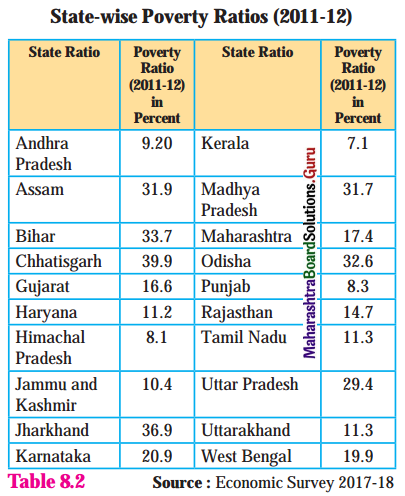
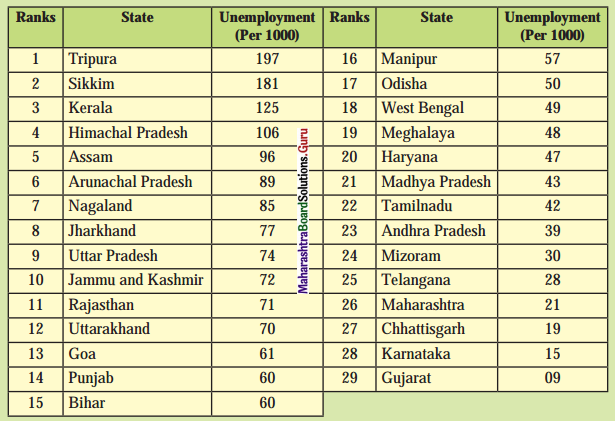
From the above data on poverty ratios, find out Q3 and P10 and name the states as per the derived partition values.
Maharashtra Board Class 11 Economics Solutions Chapter 8 Poverty in India Page 53 Q1
Answer:
Arranging the data in ascending order;
7.1, 8.1, 8.3, 9.2, 10.4, 11.2, 11.3, 11.3, 14.7, 16.6, 17.4, 19.9, 20.9, 29.4, 31.7, 31.9, 32.6, 33.7, 36.9, 39.9
Here, n = 20
Q3 = 3 \(\left(\frac{n+1}{4}\right)^{\text {th }}\) observation
= 3 \(\left(\frac{20+1}{4}\right)^{\text {th }}\)
= 3(5.25)th observation
= 15.75th observation + 0.75 (16th observation – 15th observation)
= 31.7 + 0.75 (31.9 – 31.7)
= 31.7 + 0.75(0.2)
= 31.7 + 0.15
∴ Q3 = 31.85

P10 = \(10\left(\frac{n+1}{100}\right)^{t h}\) observation
= \(10\left(\frac{20+1}{100}\right)^{t h}\) observation
= 2.1th observation
= 2nd observation + 0.1(3rd observation – 2nd observation)
= 8.1 + 0.1 (8.3 – 8.1)
= 8.1+ 0.1 (0.2)
= 8.1 + 0.02
∴ P10 = 8.12
Q3 lies between 31.7 and 31.9 (i.e.) Madhya Pradesh and Assam
P10 lies between 8.1 and 8.3 (i.e.) Himachal Pradesh and Uttarakhand.

Maharashtra Board Class 11 Economics Solutions Chapter 8 Poverty in India

You should know: (Textbook Page No. 54)

What are the effects of Poverty?
Answer:
Economic effects of poverty:

  • Low national income: As a substantial number of people are poor, their income, saving, and investment are inadequate. This results in low capital formation.
  • Adverse effect on production: Since the capital for modernization is not available, the farmers continue with the outdated methods. Similarly, the industry does not have funds for modernization.
  • Misallocation of resources: To help the poor, the government spends a huge amount on welfare activities. This restricts the allocation of resources for productive activities.
  • Low standard of living: Due to low per capita income and low per capita consumption, people are forced to live in slums. This is reflected in the low standard of living.
  • Malnutrition and starvation: Poor people can not afford a balanced diet due to low income. They do not get the minimum calories from their diet.

You should know: (Textbook Page No. 54)

The UN Sustainable Development Goals (SDGs) were adopted by the international community in September 2015 to comprehensively cover social, economic, and environmental dimensions. The SDGs constitute a universal agreement to end poverty in all its forms and dimensions. There are 17 SDGs that have 169 targets to be achieved by 2030. India played an important role in shaping SDGs.
Maharashtra Board Class 11 Economics Solutions Chapter 8 Poverty in India Page 54 Q2
India is one of the signatories of the United Nations Sustainable Development Goals, is committed to the eradication of poverty by 2030 (SDGl).

Read the above passage and answer the following questions:

Question 1.
What do SDGs stand for?
Answer:
SDGs stands for Sustainable Development Goals.

Question 2.
What are the objectives of SDGs?
Answer:
SDGs were adopted by the international community to cover social economic and environmental dimensions. It makes an attempt to end poverty throughout the world.

Question 3.
What is India’s goal to eradicate poverty in relation to SDG?
Answer:
India’s goal is to eradicate poverty from the country by the year 2030.

Maharashtra Board Class 11 Economics Solutions Chapter 8 Poverty in India

Question 4.
How many SDGs are prevailing at present?
Answer:
There are 17 SDGs prevailing having 169 targets that are to be achieved by 2030.

Try this: (Textbook Page No. 55)

To ensure food security, the Government of Maharashtra has introduced Tri Colour Family Ration Card. Find out the income criteria of each ration card on the basis of information provided by the Food, Civil Supplies, and Consumer Protection Dept., GoM.
Maharashtra Board Class 11 Economics Solutions Chapter 8 Poverty in India Page 55 Q1
Answer:

Type of Ration CardIncome Criteria
WhiteRs. 1,00,000 and above
SaffronRs. 15,000 to Rs. 1,00,000
YellowPeople Below the poverty line

Try this: (Textbook Page No. 55)

Correlate the following Poverty Alleviation Programmes with the given points:

Food security, wage employment, self-employment, education, health, sanitation, financial inclusion, housing.

Answer:

  • Employment Guarantee Scheme (EGS): Wage employment
  • Swarnajayanti Gram Swarozgaar Yojana (SGSY): Self-employment
  • Jan Dhan Yojana (JDY): Financial inclusion
  • Swachch Bharat Mission (SBM): Sanitation
  • Sarva Shiksha Abhiyaan (SSA): Education
  • Antyodaya Anna Yojana (AAY): Food security
  • Mahatma Gandhi National Rural Employment Guarantee Scheme (MGNREGS): Wage employment
  • Pradhan Mantri Awaas Yojana (PMAY): Housing
  • National Health Mission (NHM): Health

Maharashtra Board Class 11 Economics Important Questions Chapter 7 Unemployment in India

Balbharti Maharashtra State Board Class 11 Economics Important Questions Chapter 7 Unemployment in India Important Questions and Answers.

Maharashtra State Board 11th Economics Important Questions Chapter 7 Unemployment in India

1A. Choose the correct option:

Question 1.
Disguisedly unemployed labour has ___________ marginal productivity.
(a) zero
(b) one
(c) minimum
(d) maximum
Answer:
(a) zero

Question 2.
Introduction of computer causes ___________ unemployment.
(a) technological
(b) structural
(c) frictional
Answer:
(a) technological

Maharashtra Board Class 11 Economics Important Questions Chapter 7 Unemployment in India

Question 3.
Defective education system causes ___________ unemployment.
(a) educated
(b) technological
(c) frictional
(d) rural
Answer:
(a) educated

Question 4.
Unemployment during the off season is called ___________ unemployment.
(a) urban
(b) seasonal
(c) disguised
(d) involuntary
Answer:
(b) seasonal

Question 5.
Unemployment during recession is called ___________ unemployment.
(a) cyclical
(b) frictional
(c) structural
(d) voluntary
Answer:
(a) cyclical

Question 6.
Unemployment due to power cut is called ___________ unemployment.
(a) frictional
(b) cyclical
(c) seasonal
Answer:
(a) frictional

Question 7.
Educated unemployment is ___________ unemployment.
(a) open
(b) hidden
(c) cyclical
Answer:
(a) open

Maharashtra Board Class 11 Economics Important Questions Chapter 7 Unemployment in India

Question 8.
Employment Guarantee scheme was first introduced in ___________
(a) Maharashtra
(b) Karnataka
(c) Kerala
(d) Orissa
Answer:
(a) Maharashtra

Question 9.
Employment Guarantee Scheme was started in the year ___________
(a) 1972
(b) 1969
(c) 1970
Answer:
(a) 1972

Question 10.
Post graduate working as a peon is called ___________
(a) underemployment
(b) unemployment
(c) structural unemployment
Answer:
(a) underemployment

1B. Complete the correlation:

Question 1.
Disguised Unemployment : Rural Unemployment : : Frictional Unemployment : ___________
Answer:
Urban unemployment

Question 2.
Offseason : Seasonal Unemployment : : Excessive pressure on land : ___________
Answer:
Disguised unemployment

Question 3.
Involuntary Unemployment : People are willing to work : : ___________ : Person capacity to work is under utilised
Answer:
Underemployment

Question 4.
Technological Unemployment : Introduction of robotic technology : : ___________ : Breakdown of Machinery
Answer:
Frictional unemployment

Maharashtra Board Class 11 Economics Important Questions Chapter 7 Unemployment in India

Question 5.
Horse carts had been replaced by auto rickshaws : Structural unemployment : : Period of depression : ___________
Answer:
Cyclical unemployment

Question 6.
Employment Guarantee Scheme : 28th March 1972 : : Swarnjayanti Gram Swarozgar Yojana : ___________
Answer:
April 1999

Question 7.
Training about 2 lakh rural youth every year : Training rural youth for self-employment : : Wage Employment Scheme : ___________
Answer:
Jawahar Rozgar Yojana

Question 8.
MGNREGS : at least 100 days of guaranteed wage employment : : TRYSEM : ___________
Answer:
Training about 2 lakh rural youth every year.

1C. Suggest the economic terms for the given statements:

Question 1.
A situation where people are willing to work but unable to get a job.
Answer:
Unemployment

Question 2.
A person working less than fourteen hours per week.
Answer:
Unemployed

Question 3.
A person working 15-28 hours a week.
Answer:
Underemployed

Maharashtra Board Class 11 Economics Important Questions Chapter 7 Unemployment in India

Question 4.
A person working 8 hours per day.
Answer:
Employed

Question 5.
Type of self unemployment.
Answer:
Voluntary unemployment

Question 6.
The situation in which all available resources are used inefficiently manner.
Answer:
Full employment

Question 7.
Unemployment is found in villages.
Answer:
Rural unemployment

Question 8.
Unemployed during the slack season.
Answer:
Seasonal unemployment

Question 9.
Unemployment was found among graduates and postgraduates.
Answer:
Educated unemployment

Question 10.
Unemployment is created due to breakdown of machinery, power failure, etc.
Answer:
Frictional unemployment

1D. Find the odd word out:

Question 1.
Concept of unemployment – Involuntary unemployment, Voluntary unemployment, Underemployment, Frictional unemployment.
Answer:
Frictional unemployment

Maharashtra Board Class 11 Economics Important Questions Chapter 7 Unemployment in India

Question 2.
State with a low rate of unemployment – Goa, Punjab, Gujarat, Bihar.
Answer:
Gujarat

Question 3.
Economic effects of Unemployment – Social tension and unrest, Loss of human dignity, Waste of human resources, Helplessness.
Answer:
Waste of human resources.

1E. Complete the following statements:

Question 1.
Structural unemployment arise due to ___________
Answer:
a drastic change in the economic structure of a country

Question 2.
Unemployment due to cyclical fluctuations in level of business activity is called as ___________
Answer:
Cyclical unemployment

Question 3.
Scheme introduced to provide productive employment to rural population is ___________
Answer:
Employment Guarantee Scheme

Question 4.
Excessive pressure on land leads to ___________
Answer:
disguised unemployment

Maharashtra Board Class 11 Economics Important Questions Chapter 7 Unemployment in India

Question 5.
Unemployment found in towns and cities are called as ___________
Answer:
urban unemployment

Question 6.
Technological unemployment arises because of ___________
Answer:
changes in technology

Question 7.
Frictional unemployment is caused due to breakdown of ___________
Answer:
machinery, power failure, strikes, etc.

Question 8.
Hypothetical situation where all available resources are used efficiently is termed as ___________
Answer:
Full employment

Question 9.
A person is considered unemployed if he works for ___________
Answer:
less than 14 hours per week

Question 10.
Disguised Unemployment is also known as ___________
Answer:
invisible unemployment

Maharashtra Board Class 11 Economics Important Questions Chapter 7 Unemployment in India

1F. Choose the wrong pair:

Question 1.

Types of UnemploymentReasons
1. Seasonal unemployment(a) Due to slack season
2. Disguised unemployment(b) Due to more people working than actual
3. Educated unemployment(c) Due to imbalance between job opportunities and the number of educated youth
4. Industrial unemployment(d) Due to fast industrial growth

Answer:
Wrong Pair : (4) Industrial unemployment – Due to fast industrial growth.

Question 2.

SchemesAims/Objectives
1. Employment Guarantee Scheme(a) to provide productive employment to the rural population.
2. Swarna Jayanti Shahari Rozgar Yojana(b) to provide gainful employment to rural unemployed and underemployed.
3. TRYSEM(c) to train 2 lakh rural youth every year.
4. Startup India Initiative(d) to impart strength and inspiration to the talented young generation.

Answer:
Wrong Pair: (2) Swarna Jayanti Shahari Rozgar Yojana – to provide gainful employment to rural unemployed and underemployed.

1G. Choose the correct pair:

Question 1.

Group – ‘A’Group – ‘B’
1. Seasonal unemployment(a) Computers
2. Disguised unemployment(b) Breakdown of machinery
3. Structural unemployment(c) Zero marginal productivity
4. Frictional unemployment(d) Depression
5. Cyclical unemployment(e) Slack season
6. Technological unemployment(f) Infrastructural changes
7. EGS(g) Maharashtra

Answer:
Correct Pair: (1) – (e), (2) – (c), (3) – (f), (4) – (b), (5) – (d), (6) – (a), (7) – (g).

2. Distinguish Between:

Question 1.
Unemployment and Underemployment.
Answer:

UnemploymentUnderemployment
(i) It refers to a situation in which people are willing to work at the prevailing wage rate but do not get jobs.(i) It is a situation in which employed people are contributing to production, less than their capacity.
(ii) It is a situation when the supply of labour force is more than its demand.(ii) It is a situation where workers work below his ability as he is unable to find a suitable job.
(iii) Unemployed are those who do not have any work.(iii) Underemployed work for less than 28 hours a week or CA working as a clerk.
(iv) In this situation, there is wastage of working capacity and a complete waste of manpower.(iv) In this situation there is underutilization of working capacity.

Question 2.
Disguised Unemployment and Seasonal Unemployment.
Answer:

Disguised UnemploymentSeasonal Unemployment
(i) It is a situation where people appear to work but do not contribute anything to production.(i) It is a situation in which people remain unemployed during the off-season.
(ii) It is found throughout the year.(ii) It is found only in some months of the year.
(iii) It is usually found in the agricultural sector due to too much pressure of population on land.(iii) It is found in the agricultural sector as well as in agro-based industries like sugar mills, rice mills, etc.
(iv) Marginal productivity of a worker is zero.(iv) Marginal productivity of a worker is not zero.
(v) It is classified on the basis of productivity.(v) It is classified on the basis of seasons.
(vi) It can be reduced by way of production control, rural industrialization, labour mobility, etc.(vi) It can be reduced by providing better irrigational facilities, encouraging cottage industries, creating alternative job opportunities, etc.

Question 3.
Frictional Unemployment and Structural Unemployment.
Answer:

Frictional UnemploymentStructural Unemployment
(i) It takes place when due to the frictions in the industry, some workers are removed from jobs.(i) It takes place due to the structural changes in the economic organizations.
(ii) It is the result of a shortage of raw materials, strikes, power failure, etc.(ii) It is the result of a change in the production process, shifting the industry from one region to another, technological changes, etc.
(iii) It is temporary unemployment.(iii) It may be long-term unemployment.
(iv) It is seen in all countries.(iv) It is normally seen in underdeveloped countries.
(v) It can be removed by improvement in the supply of inputs, good labor-employer relations, etc.(v) It can be removed by way of long-term planning, creation of alternative jobs, etc.

Question 4.
Technological Unemployment and Cyclical Unemployment.
Answer:

Technological UnemploymentCyclical Unemployment
(i) It refers to unemployment due to the introduction of new techniques of production.(i) It refers to unemployment due to a lack of effective demand for goods and services in the market.
(ii) It may be temporary or long-term in nature.(ii) It is temporary in nature.
(iii) It is caused due to the introduction of new labour-saving techniques, lack of proper training, etc.(iii) It is caused by fluctuations in business and trade cycles, a fall in effective demand, etc.
(iv) It is found more in developing countries.(iv) It is found more in the developed countries.
(v) It can be removed by making alternative job arrangements, providing technical training, encouraging self-employment, etc.(v) It can be removed by encouraging consumption, export activities, etc.

Maharashtra Board Class 11 Economics Important Questions Chapter 7 Unemployment in India

Question 5.
Rural Unemployment and Urban Unemployment.
Answer:

Rural UnemploymentUrban Unemployment
(i) Unemployment prevailing in the village is called rural unemployment.(i) Unemployment prevailing in the cities and towns is called urban unemployment.
(ii) It is of two types:

  • seasonal unemployment
  • disguised unemployment.
(ii) It is also of two types:

  • industrial unemployment
  • educated unemployment.
(iii) Causes of rural unemployment are more pressure on land, rising population, seasonal nature of agriculture, etc.(iii) Causes of urban unemployment are slow economic growth, lopsided development, immobility of labour, the spread of education, etc.
(iv) This problem is not so intense in India.(iv) This problem is more intense in India.

Question 6.
Voluntary Unemployment and Involuntary Unemployment.
Answer:

Voluntary UnemploymentInvoluntary Unemployment
(i) Voluntary unemployment arises when people are fit to work but not willing to work.(i) Involuntary unemployment arises when people who are able and willing to work at the existing wage rate, do not find employment.
(ii) The idle rich belong to this category.(ii) It is generally found among educated and skilled workers.
(iii) It is not considered a serious problem.(iii) It gives rise to serious economic and social problems.
(iv) The Government cannot solve the problem of voluntarily unemployed people.(iv) The Government can solve the problem of such people.

3. Answer the following:

Question 1.
Explain the concepts of unemployment.
Answer:
Unemployment is a situation in which a person between the age group of 15 to 59 years, who is willing and able to work at the prevailing wage but not getting any job. Hence it is a situation of scarcity of jobs, where the supply of labour is more than its demand.
Concepts of Unemployment:

  • Involuntary unemployment: It refers to a situation when people are able and willing to work but there is no work for them due to excess of labour force in relation to demand labour it is also known as visible or open unemployment. Such unemployment is found in both rural and urban areas.
  • Voluntary unemployment: This is not really unemployment, it is “idleness”. It is a type of unemployment where a person is fit to work but not willing to work. E.g. Rich people not willing to work or beggars who are not ready to work or educated people waiting for white-collared jobs.
  • Underemployment: It is a situation where a person’s capacity to work is not fully utilized with respect to time, energy, or education. E.g: a CA working as a clerk, or a person who is ready to work full time gets a part-time job.
  • Full employment: It is a situation where all the available resources in an economy are used to their optimum level.

Maharashtra Board Class 11 Economics Important Questions Chapter 7 Unemployment in India

Question 2.
What are the types of Rural unemployment?
Answer:
The unemployment situation found in village and rural areas is called rural unemployment. The main two types of rural unemployment are:
(i) Seasonal unemployment: In India, agriculture depends on the monsoon, therefore only one crop can be grown during a year. The rural agricultural labourers work mostly for 4 to 5 months during rains and rest of the year they are idle. Hence unemployment during the off-season is known as seasonal unemployment. Seasonal unemployment is also found in tourism, marriage bands, sugar factories, ice factory, fisheries, etc.

(ii) Disguised unemployment: It is also known as invisible unemployment. It is a situation where more people are working when less is required. E.g. on a piece of land when 6 workers work, the output produced is 20 quintals. If 2 workers are removed, then also the output produced is 20 quintals. This means 2 workers are not adding anything to the production. Hence these surplus workers are said to be disguisedly unemployed or in economic terms, the marginal productivity of these disguisedly unemployed labours is zero.

Question 3.
What are the types of Urban unemployment?
Answer:
Unemployment found in towns and cities is known as urban unemployment.
The two types of urban unemployment are:
(i) Educated unemployment: With the spread of education, the number of educated persons has increased. But when these educated persons do not find jobs, there is said to be educated unemployment. This type of unemployment is found among matriculates, undergraduates, graduates, and postgraduates. The casual approach to education; imbalance between job opportunities and the number of educated youth, Preference for white-collar jobs, lack of employable skills, lack of awareness about available educational opportunities are the main reasons for unemployment among educated youth in India.

(ii) Industrial unemployment: It refers to unemployment in the industrial sector. The unemployed workers may be skilled or unskilled. This is generally in a form of open unemployment. Slow industrial growth, the rapid growth of population, lack of training facilities, low adaptability to modern technology, inconvenient location of industries, low mobility of labour, etc. are the main reason for industrial unemployment. Industrial unemployment can be further classified into-

  • Technological unemployment
  • Frictional unemployment
  • Cyclical unemployment
  • Structural unemployment.

Maharashtra Board Class 11 Economics Important Questions Chapter 7 Unemployment in India

Question 4.
State any 4 Causes of Unemployment.
Answer:
Causes of Unemployment:

  • The slow rate of economic development: Slow rate of economic development has resulted in the inability of the economy to give employment to the additional labour force. Therefore, unemployment is increasing.
  • Excessive use of machinery: Industries are undergoing modernization and using more machines and less labour. This reduces employment opportunities. Also, in the agricultural sector, producers are increasingly substituting capital for labour.
  • Migration of rural population: Agriculture being seasonal, in the off-season, there are no alternative jobs available. So they migrate to urban areas and the number of unemployed increases in urban areas.
  • Expectation towards employment: Educated people have high expectations about the salary and they want ‘white-collar jobs which are not enough. They prefer to remain unemployed rather than accepting a lower salary. This also causes unemployment.

Question 5.
State the economic effects of unemployment.
Answer:
Economic effects of unemployment:

  • Waste of human resources: Human resources are wasted due to unemployment in the country. These resources could have been used in the production activity of the economy.
  • Difficult to implement welfare schemes: Due to corruption and malpractices, it is difficult to implement various welfare schemes introduced by the government from time to time.
  • Poverty and Income inequality: Lack of employment leads to poverty and income inequality in the economy.
  • Growth of informal sector: Due to unemployment, poverty increases in the economy which will attract the growth of informal sectors like smuggling, drug peddling, black marketing, etc.
  • High dependency ratio: When unemployment increases in an economy, it will lead to an increase in dependency ratio.
  • The unemployed group will become the burden on the employed group.

Question 6.
State the Social Effects of Unemployment.
Answer:
Social effects of unemployment:

  • Social tensions: Due to unemployment, social tensions and unrest in the economy go on increasing.
  • Loss of human dignity: Unemployment especially among the educated, creates an inferiority complex and leads to low dignity and self-esteem.
  • Helplessness: Sometimes unemployed youth become so helpless that they try to run away from reality and some may commit suicide. Therefore, unemployment is socially undesirable.

Maharashtra Board Class 11 Economics Important Questions Chapter 7 Unemployment in India

Question 7.
State any 4 specific measures taken by the Government to generate employment in the country.
Answer:
Specific measures to generate employment are as follows:

  • Jawahar Rozgar Yojana (JRY): It was announced by the Government on 1st April 1989 to general employment in 120 backward districts specifically rural areas of India. This program was later on renamed as Jawahar Gram Samrudhi Yojana (JGSY).
  • Mahatma Gandhi National Rural Employment Guarantee Scheme (MGNREGS): This scheme aims at providing at least 100 days of guaranteed wage employment in a year to at least one member of every rural household.
  • Deen Dayal Upadhyaya Grameen Kaushalya Yojana, 2014: It is a placement linked skill training programme run under the Ministry of Rural Development.
    • The main aim of this scheme is to reduce poverty and provide gainful and sustainable employment.
    • This scheme focused on rural youth from poor families under the age group of 15 – 35 years.
  • Startup India Initiative: It was introduced to impart more strength and inspiration to the talented young generation of India to do something new for India and humanity.

4. State with reasons whether you agree or disagree with the following statements:

Question 1.
Problems of unemployment in India and America are the same.
OR
Problems of unemployment in developed and developing countries are the same.
Answer:
No, I do not agree with the statement.

  • Problems of unemployment in India and America are not the same.
  • India is a developing country whereas America is a developed one.
  • India being an agricultural economy, in rural areas there is a problem of disguised and seasonal unemployment and in urban areas, there is underemployment, frictional, structural, and educated unemployment.
  • All this is because of overpopulation.
  • But America is a technically advanced country and being thinly populated, the problem of unemployment is not so very serious.
  • More often cyclical unemployment is found there which is because of a lack of effective demand.
  • Hence, the statement that the problems of unemployment in India and America are the same is not correct.

Maharashtra Board Class 11 Economics Important Questions Chapter 7 Unemployment in India

Question 2.
The high growth of the population is the only cause of rural unemployment.
Answer:
No, I do not agree with the statement.

  • The high growth of the population is one of the causes of rural unemployment.
  • Other causes are:
    • Seasonal nature of agriculture.
    • Lack of mobility.
    • Declining of handicrafts.
    • Under the development of villages.
    • Joint family system.
    • Law of inheritance.
    • Illiteracy among the people.

Hence, the high growth of the population is not the only cause of rural unemployment.

Question 3.
Disguised unemployment is a part of urban unemployment.
Answer:
No, I do not agree with the statement.

  • Disguised unemployment is a special feature of rural areas.
  • It exists when more workers are employed in a sector than what is actually required.
  • They seem to be working but their contribution to the work is zero.
  • This is found more in rural areas because of the high growth of the population and the lack of alternative job opportunities.
  • In urban areas, we find educated unemployment or there may be frictional, structural, cyclical, or technological unemployment.
  • Hence, disguised unemployment is a part of rural unemployment.

Question 4.
Educated unemployment is due to a defective education system.
Answer:
Yes, I agree with the statement.

  • The Indian education system is defective.
  • It stresses more on general education rather than job-oriented education.
  • Educated people do not fit in any type of job unless they do some professional courses.
  • Hence, a defective education system is one of the main causes of unemployment among educated people.

Maharashtra Board Class 11 Economics Important Questions Chapter 7 Unemployment in India

Question 5.
Frictional unemployment is temporary in nature.
Answer:
Yes, I agree with the statement.

  • Frictional unemployment arises when there are problems like a breakdown of machinery, shortage of raw materials, power failure, etc. and some workers are removed from their jobs.
  • All these are temporary problems and can be solved in a short period.
  • Such problems do not cause a serious problem.
  • Hence, it is right to say that frictional employment is temporary in nature.

Question 6.
Underemployment is found both in rural and urban areas.
Answer:
Yes, I agree with the statement.

  • Underemployment arises when employed persons contribute less than their capacity.
  • In rural areas, on the farms, labourers work for 2-3 hours a day and since alternative jobs are not available, they remain idle for the rest of the day.
  • In urban areas, because of the shortage of employment, when qualified persons do not get jobs as per their qualifications, they accept either low-paid or part-time jobs.
  • Hence, in both rural and urban areas underemployment is found, although it is more in rural areas.

5. Observe the following charts and answer the questions given below:

Question 1.
Maharashtra Board Class 11 Economics Solutions Chapter 7 Unemployment in India 4

Question i.
Workers were sitting idle in a factory due to power failure for 3 hours.
Answer:
Frictional unemployment.

Question ii.
Ram had no work, due to the end of the Kharif crop season.
Answer:
Seasonal unemployment.

Maharashtra Board Class 11 Economics Important Questions Chapter 7 Unemployment in India

Question iii.
Due to the introduction of taxis and auto-rickshaws, Bhimaji’s horse-cart was not demanded by travellers.
Answer:
Structural unemployment.

Question 2.
Maharashtra Board Class 11 Economics Important Questions Chapter 7 Unemployment in India 5 Q2

Question i.
If Prakash is ready to work at the prevailing wage rate in the market, but he is unable to find the work, then what type of unemployment is it? Write the reason.
Answer:
Involuntary Unemployment.
It is due to the excess labour force with respect to demand for labour.

Question ii.
Vishal is an educated youth XYZ company is offering him a job, but he doesn’t want to work. What kind of unemployment is it? Write the reason.
Answer:
Voluntary Unemployment.
It is a kind of self unemployment. Here, the person is fit and eligible to work, but wants to remain unemployed.

Question iii.
Ajay has passed his degree college by first class and he is working as a factory assembly like a worker. Write the reason.
Answer:
Underemployment.
Mr. Ajay could have worked much better as per his qualification, but due to the non-availability of job opportunities, he is working as a factory assembly.

Maharashtra Board Class 11 Economics Important Questions Chapter 7 Unemployment in India

Question iv.
Write the meaning of full employment.
Answer:
Full employment is a situation in which all the available resources of the country are being used at their optimum and in the most efficient manner.

Maharashtra Board Class 11 Economics Solutions Chapter 7 Unemployment in India

Balbharti Maharashtra State Board Class 11 Economics Solutions Chapter 7 Unemployment in India Textbook Exercise Questions and Answers.

Maharashtra State Board Class 11 Economics Solutions Chapter 7 Unemployment in India

1. Find the odd word out:

Question 1.
Urban unemployment – Educated unemployment, Industrial unemployment, Disguised unemployment, Technological unemployment.
Answer:
Disguised unemployment

Question 2.
States with high rates of unemployment – Goa, Punjab, Maharashtra, Tripura.
Answer:
Maharashtra

Maharashtra Board Class 11 Economics Solutions Chapter 7 Unemployment in India

Question 3.
Employment Guarantee Scheme 1972, Jawahar Rozgar Yojana 1989, Swarnajayanti Gram Swarozgar Yojana 1999, Development of Tourism.
Answer:
Development of tourism

2. Identify and explain the concepts from the given illustrations:

Question 1.
Hussain Shaikh employed seven workers less than the usual number of workers on his farm, in spite of this, output remained the same.
Answer:
Disguised unemployment.
Disguised unemployment is a situation in which more people are doing work than actually required. Thus, even after employing fewer workers than the usual number, the output of Hussain Shaikh remained the same.

Question 2.
The use of new technology in the printing industry has led to unemployment among several workers.
Answer:
Technological unemployment.
Technological unemployment arises due to changes in technology. Modern technology is capital intensive requiring less labour. Thus, the use of new technology displaces few workers from their jobs.

Question 3.
Satish has completed his post-graduation and is desperately expecting a job.
Answer:
Educated unemployment.
Educated unemployment is due to an imbalance between job opportunities and the number of educated youth, preference for white-collar jobs, lack of available skills, etc. Due to the above imbalances, Satish could not get a job easily.

Maharashtra Board Class 11 Economics Solutions Chapter 7 Unemployment in India

Question 4.
In certain agricultural areas of Maharashtra, only Kharif crops are grown, therefore, employment is available till the month of October.
Answer:
Seasonal unemployment.
Seasonal unemployment is due to slack season or off-season. Kharif crops have a particular season. Thus, for the rest of the period, farmers remain unemployed leading to seasonal unemployment. Such kind of unemployment is also found in the case of tourism, marriage bands, sugar factories, etc.

3. Complete the correlation:

Question 1.
Seasonal unemployment : Tourist guides : : __________ : Graduates
Answer:
Educated unemployment

Question 2.
__________ : Disguised unemployment : : Urban unemployment : Industrial unemployment
Answer:
Rural unemployment

Question 3.
Frictional unemployment : Shortage of raw materials : : __________ : Fluctuations in business activity
Answer:
Cyclical unemployment

Maharashtra Board Class 11 Economics Solutions Chapter 7 Unemployment in India

Question 4.
MGNREGS : Guaranteed wage employment : : TRYSEM : __________
Answer:
self-employed

Question 5.
__________ : Waste of resources : : Social effect : Loss of human dignity
Answer:
Economic effect

4. Observe the following charts and answer the questions.

Maharashtra Board Class 11 Economics Solutions Chapter 7 Unemployment in India 4

Question 1.
Production does not increase if an additional worker is employed and production does not decrease if a worker is reduced from the work. Mention the type of unemployment.
Answer:
Disguised unemployment

Question 2.
A worker is thrown out of a job because of computerization. Name this type of unemployment?
Answer:
Technological unemployment

Question 3.
Sharad was forced to return back to India from the USA due to depression in the IT sector.
Answer:
Cyclical unemployment

Maharashtra Board Class 11 Economics Solutions Chapter 7 Unemployment in India

Question 4.
In spite of being a graduate, Vasant is sitting idle at home.
Answer:
Educated unemployment

Question 5.
Give examples of structural unemployment.
Answer:
Examples: horse cart replaced by auto-rickshaw; computerized typing replaced manual typists; small traders replaced by malls and online shopping.

5. Find out Q1 and Q3 using unemployment rates as numerical data:
Maharashtra Board Class 11 Economics Solutions Chapter 7 Unemployment in India 5
Answer:
Maharashtra Board Class 11 Economics Solutions Chapter 7 Unemployment in India 5.1

Maharashtra Board Class 11 Economics Solutions Chapter 7 Unemployment in India 5.2

6. Answer the following in detail:

Question 1.
Explain the types of Industrial unemployment in India.
Answer:
Types of Industrial unemployment:
(i) Technological unemployment:
Due to the introduction of new machines or new technology, when some workers are removed from their jobs due to lack of proper training. E.g. computerization, the introduction of robotic technology, etc.

(ii) Frictional unemployment:
When due to the breakdown of machines, shortage of raw materials, strikes, power failure, etc. some workers are removed from the jobs, there is said to be frictional unemployment. This is temporary in nature.

(iii) Cyclical unemployment:
During an economic recession, there is a slowdown of economic activities due to a fall in overall demand. Therefore, factory owners remove some workers from their jobs to cut down the cost such unemployment caused due to depression (trade cycle) is called cyclical unemployment.

Maharashtra Board Class 11 Economics Solutions Chapter 7 Unemployment in India

(iv) Structural unemployment:
It takes place due to structural changes in the economy i.e when due to change in the complete business set up, some workers are removed from their jobs, there is said to be structural unemployment. E.g. introduction of power looms instead of handlooms. It is long-term in nature.

Question 2.
Explain the causes of unemployment in India.
Answer:
Causes of Unemployment:
(i) Jobless growth:
Since independence, the rate of economic growth is less than the growth rate of the population. This leads to widespread unemployment in India.

(ii) Increase in labour force:
Due to the increase in medical facilities since independence, there is a considerable fall in the death rate without a corresponding fall in the birth rate. This led to an increase in the labour force which in turn led to unemployment in India.

(iii) Excessive use of machinery:
Industries as well as agricultural producers are undergoing modernization and have started using more machines and less labour. This means the Indian economy is moving towards capital intensive technique leaving behind labour intensive technique, which led to large scale unemployment.

(iv) Lack of skill development programmes:
Though educational institutions are increasing, no proper training is given to youngsters to work. Development of vocational skill courses is comparatively less in number in India. Hence, there is a lack of skilled manpower required by the industry in India.

(v) Expectations towards employment:
Educated people have high expectations about the salary and they want ‘white-collar jobs’ which are not available in plenty. They prefer to remain unemployed rather than accepting a lower salary. This also causes unemployment.

Maharashtra Board Class 11 Economics Solutions Chapter 7 Unemployment in India

(vi) Seasonal nature of agriculture:
Due to the seasonal nature of agriculture in India, labourers are employed only for a few months a year and for the rest of the year, they remain jobless. This leads to seasonal unemployment in the country.

(vii) Migration of rural population:
Agriculture being seasonal, there are no alternative jobs available in the off-season or slack season. So the labour migrates to urban areas leading to urban unemployment in the country.

Question 3.
Explain the measures taken by the government to reduce unemployment.
Answer:
The measures taken by the government of India to reduce unemployment are as follows:
General measures to reduce unemployment:

  • Development of agricultural sector
  • Provision for an alternative occupation
  • Development of infrastructure
  • Reforms in the educational system
  • Development of tourism
  • Use of labor-intensive techniques
  • Development of information technology and communication
  • Provision for vocational training and skill development facilities
  • Rural industrialization
  • Motivation for self-employment.

Specific measures are undertaken by the government to generate employment opportunities:
Employment Guarantee Scheme (EGS): This Scheme was introduced on 28th March 1972. This scheme was introduced by Maharashtra Government in 1972-73. Under this scheme, work is provided to the registered job-seekers in rural areas within 15 days from the date of registration. This scheme was for unskilled manual labors above 18 years.

Swarnjayanti Gram Swarozgar Yojana (SGSY): This scheme was launched in April 1999 after restructuring the Integrated Rural Developmental Programmer (IRDP) and allied schemes. It’s the only self-employment scheme for the rural poor in India.

Maharashtra Board Class 11 Economics Solutions Chapter 7 Unemployment in India

Swarna Jayanti Shahari Rozgar Yojana (SJSRY): This scheme was launched in December 1997, It provides gainful employment to the urban unemployed and underemployed. It includes self-employment, women self-employment programme, skill training for employment programme, for this scheme Central Government shares 75% of the cost and State Government shares 25% of the cost.

Pradhan Mantri Rozgar Yojana (PMRY): This scheme is being implemented since 1993 to create and provide sustainable self-employment opportunities to more than one million educated unemployed youth.

Training Rural Youth for Self-employment (TRYSEM): It was initiated in 1979 with the objective of tackling the unemployment problem among rural youth. It aimed at training about 2 lakh rural youth every year to enable them to become self-employed.

Besides the above measures, there are many other specific measures undertaken by the government. They can be named as:

  • Jawahar Rozgar Yojana (JRY)
  • Mahatma Gandhi National Rural Employment Guarantee Scheme (MGNREGS)
  • Deen Dayal Upadhyaya Grameen Kaushalya Yojana 2014
  • National Policy for Skill Development and Entrepreneurship – 2015
  • Startup India Initiative
  • Pradhan Mantri Kaushal Vikas Yojana – (2016-20)

Maharashtra Board Class 11 Economics Solutions Chapter 7 Unemployment in India

11th Economics Digest Chapter 7 Unemployment in India Intext Questions and Answers

Do you know? (Textbook Page No. 46)

State-wise unemployment rates in India (2015-16)
Maharashtra Board Class 11 Economics Solutions Chapter 7 Unemployment in India Intext Q1
Answer:

RanksStateNo. of peopleCumulative Frequency (Less than)
1.Tripura197197
2.Sikkim181378
3.Kerala125503
4.Himachal Pradesh106609
5.Assam96705
6.Arunachal Pradesh89794
7.Nagaland85879
8.Jharkhand77956
9.Uttar Pradesh741030
10.Jammu and Kashmir721102
11.Rajasthan711173
12Uttarakhand701243
13.Goa611304
14.Punjab601364
15.Bihar601424
16.Manipur571481
17.Odisha501531
18.West Bengal491580
19.Meghalaya481628
20.Haryana471675
21.Madhya Pradesh431718
22.Tamilnadu421760
23.Andhra Pradesh391799
24.Mizoram301829
25.Telangana281857
26.Maharashtra211878
27.Chhattisgarh191897
28.Karnataka151912
29.Gujarat091921
n = 1921

Here, n = 1921
for Q2 = \(2\left(\frac{n+1}{4}\right)^{t h}\) observation
= \(2\left(\frac{1921+1}{4}\right)^{\text {th }}\) observation
= 2(480.5)
= 961st observation, 961st observation lies in cf 1030.
∴ Q2 = 9
Hence, Rank 9 is represented by Uttar Pradesh.

Maharashtra Board Class 11 Economics Important Questions Chapter 6 Population in India

Balbharti Maharashtra State Board Class 11 Economics Important Questions Chapter 6 Population in India Important Questions and Answers.

Maharashtra State Board 11th Economics Important Questions Chapter 6 Population in India

1A. Choose the correct option:

Question 1.
Effects of population explosion
(a) Decreased pressure on agriculture
(b) Increased pressure on land
(c) Inflation
(d) Low national income
Options:
(1) a, b, c
(2) b, c, d
(3) a, b, d
(4) a, c
Answer:
(2) b, c, d

Question 2.
Social measures to check population explosion
(a) Spread of education
(b) improving the status of women
(c) raising the minimum age of marriage
(d) expansion of the industrial sector
Options:
(1) a, b, c
(2) b, c, d
(3) b, d
(4) c, d
Answer:
(1) a, b, c

Maharashtra Board Class 11 Economics Important Questions Chapter 6 Population in India

Question 3.
Economic measures to check population explosion
(a) expansion of the industrial sector
(b) removal of poverty
(c) improving the status of women
(d) Disaster management
Options:
(1) a, b
(2) a, b, c
(3) b, c, d
(4) a, b, d
Answer:
(4) a, b, d

Question 4.
Population Policy of India
(a) Family planning programme
(b) Mid-day meal programme
(c) Family welfare programme
(d) National population policy
Options:
(1) a, d
(2) b, c
(3) a, c, d
(4) a, b, c
Answer:
(3) a, c, d

Question 5.
Features of National Population Policy, 2000
(a) Delay marriage age of girls
(b) Free and compulsory education up to age of 20
(c) Achieve a stable population by 2050
(d) Prevention and control of the communicable disease.
Options:
(1) a, b, c
(2) b. c, d
(3) a, d
(4) b, d
Answer:
(3) a, c, d

1B. Complete the correlation:

Question 1.
1st Transition stage : Low growth of population : : 2nd Transition stage : ____________
Answer:
High growth of population

Question 2.
____________ : Cause of high birth rate : : Use of Nutritious food : Cause of low death rate.
Answer:
Illiteracy

Maharashtra Board Class 11 Economics Important Questions Chapter 6 Population in India

Question 3.
Family Planning Programme : 1979 : : National Population Policy : ____________
Answer:
2000

Question 4.
Economic measure to check population : Removal of poverty : : ____________ : Social measure to check population.
Answer:
Improving the status of women

Question 5.
Theory of Population Growth : ____________ : : Theory of Demographic Transition : Coale and Hoover.
Answer:
Thomas Robert Malthus

1C. Give economic terms:

Question 1.
Natural resources exceed population growth.
Answer:
Underpopulation

Question 2.
Population growth exceeds the availability of natural resources.
Answer:
Overpopulation

Question 3.
Programme introduced (renamed) to reduce the birth rate in 1979.
Answer:
Family Welfare Programme

Question 4.
The policy was introduced to reduce the birth rate in 2000.
Answer:
National Population Policy

Question 5.
The proportion of working people to the total population is high.
Answer:
Demographic dividend

Maharashtra Board Class 11 Economics Important Questions Chapter 6 Population in India

Question 6.
Preference for male children.
Answer:
Son meta – preference.

1D. Arrange in proper order:

Question 1.
Growth of population in India
(a) Year of Great Divide
(b) Population explosion
(c) Marginal decline in population
(d) Increase in population
Options:
(1) a, b, c, d
(2) a, c, b, d
(3) c, a, d, b
(4) b, a, c, d
Answer:
(3) c, a, d, b

Question 2.
Stages of Demographic Transition
(a) Decline in birth rate and death rate
(b) Low growth of population
(c) Rapid fall in death rate
Options:
(1) a, b, c
(2) b, c, a
(3) c, a, b
Answer:
(2) b, c, a

Question 3.
Population Policy in India
(a) Family welfare programme
(b) National population policy
(c) Family planning programme
Options:
(1) a, b, c
(2) b, c, a
(3) c, a, b
Answer:
(3) c, a, b

1E. Find the odd word out:

Question 1.
Concepts related to population growth
Birth rate, Death rate, Survival rate, Interest rate.
Answer:
Interest rate

Maharashtra Board Class 11 Economics Important Questions Chapter 6 Population in India

Question 2.
Causes of high birth rate
Illiteracy, Preference, for male child, Expansion of industrial sector, Joint family system.
Answer:
Expansion of industrial sector

1F. Complete the following statements:

Question 1.
Population statistics are compiled and published by the ____________
Answer:
Office of the Registrar General and Census Commissioner of India

Question 2.
On 11th July, 1987, world population crossed ____________
Answer:
500 crores

Question 3.
World Population day is observed every year on ____________
Answer:
11th July

Question 4.
The Census Commissioner of India designated the year 1921 as the ____________
Answer:
‘Year of Great Divide’

Question 5.
Birth rate is also called as ____________
Answer:
fertility rate

Question 6.
Death rate is also called as ____________
Answer:
mortality rate

Maharashtra Board Class 11 Economics Important Questions Chapter 6 Population in India

Question 7.
Survival rate = ____________
Answer:
Birth rate – Death rate

Question 8.
Difference between birth rate and death rate is know as ____________
Answer:
survival rate

Question 9.
The number of death per 1000 of the living population during a year is called ____________
Answer:
death rate

Question 10.
Theory of demographic transition is given by ____________
Answer:
A. J. Coale and E. M. Hoover

Question 11.
The situation where the growth of population is faster than the growth of the economy is called ____________
Answer:
population explosion

Question 12.
In India marriage is considered as ____________
Answer:
social and religious obligations

Question 13.
To continue having children in hope of son is known as ____________
Answer:
son meta – preference

Question 14.
Under the situation of optimum population, there is a balance between ____________
Answer:
population growth and natural resources

Maharashtra Board Class 11 Economics Important Questions Chapter 6 Population in India

Question 15.
Demographic dividend occurs when the proportion of ____________
Answer:
working people to total population is high.

1G. Choose the wrong pair:

Question 1.

Group ‘A’Group ‘B’
(i) Malthusian Theory(a) Thomas Robert Malthus
(ii) Kautilya(b) Samajshashtra
(iii) World Population Day(c) 11th July
(iv) 1921(d) Year of Great Divide

Answer:
Wrong Pair: Kautilya – Samajshashtra

Question 2.

Group ‘A’Group ‘B’
(i) Population Policy(a) Family Welfare Programme
(ii) Effects of population explosion(b) Increased pressure on land
(iii) Overpopulation(c) Population growth < Natural Resources
(iv) Theory of Demographic Transition(d) Coale and Hoover

Answer:
Wrong Pair: Overpopulation – Population growth < Natural Resources

1H. Choose the correct pair:

Question 1.

Group ‘A’Group ‘B’
(1) Census(a) Survival rate
(2) High birth rate(b) Population per sq. km.
(3) Density of population(c) Universal marriage
(4) Difference between birth rate and death rate(d) Method of computing population

Options:
(1) 1-d, 2-c, 3-b, 4-a
(2) 1-b, 2-c, 3-d, 4-a
(3) 1-b, 2-a, 3-c, 4-d
(4) 1-c, 2-d, 3-a, 4-b
Answer:
(1) 1-d, 2-c, 3-b, 4-a

Question 2.

Group ‘A’Group ‘B’
(1) 1921(a) 121.02 crores
(2) 2011 Census(b) The year of great divide
(3) Family Planning(c) Mortality rate
(4) Death rate(d) Planned parenthood

Options:
(1) 1-d, 2-c, 3-a, 4-b
(2) 1-b, 2-c, 3-d, 4-a
(3) 1-b, 2-a, 3-d, 4-c
(4) 1-c, 2-d, 3-a, 4-b
Answer:
(3) 1-b, 2-a, 3-d, 4-c

Question 3.

Group ‘A’Group ‘B’
(1) Family Welfare Programme(a) 2000
(2) National Population Policy(b) 1952
(3) Infant Mortality Rate in 2011(c) 1979
(4) Family Planning Programme(d) 47 per 1000

Options:
(1) 1-d, 2-c, 3-a, 4-b
(2) 1-b, 2-c, 3-d, 4-a
(3) 1-b, 2-a, 3-c, 4-d
(4) 1-c, 2-a, 3-d, 4-b
Answer:
(4) 1-c, 2-a, 3-d, 4-b

Maharashtra Board Class 11 Economics Important Questions Chapter 6 Population in India

2. Distinguish between:

Question 1.
Birth Rate and Death Rate.
Answer:

Birth RateDeath Rate
(i) Birth rate refers to a number of births per 1000 of living population per year.(i) Death rate refers to a number of deaths per 1000 of living population per year.
(ii) Since 1921, the birth rate is falling gradually.(ii) Since 1921, the death rate is falling rapidly.
(iii) A high birth rate is caused by early marriage, lack of family planning, illiteracy, etc.(iii) A high death rate is caused by lack of medical facilities, poverty, malnutrition, etc.
(iv) Birth rate can be controlled by late marriages, family planning, etc.(iv) Death rate can be controlled by better medical facilities, social welfare programmes, etc.
(v) According to the 2011 census, the birth rate in India is 20.97.(v) According to the 2011 census, the death rate in India is 7.48.

3. Answer the following:

Question 1.
What economic measures do you suggest to check population growth?
Answer:
To control the size of the population, economic measures can ensure a permanent solution.
These measures are:

  • Expansion of industrial sector to shift the disguisedly unemployed people in rural areas to industries.
  • Creation of employment opportunities in rural areas by starting labor-intensive industries.
  • Equitable distribution of national income and removal of poverty, as the size of the family, is linked with poverty.

Question 2.
What social measures do you suggest to check population growth?
Answer:
The population problem is also a social problem and is related to illiteracy, superstitions, orthodoxy, pitiable condition of women, etc.
The following social measures must be undertaken:

  • Education: Improvement in education changes the attitude of people towards family, marriage, and the number of children. Mostly educated people delay their marriage and prefer to have small families.
  • Improvement in the conditions of women: Discrimination against women in social and economic life should be removed by the government.
  • Raising the age of marriage: The marriage age of boys and girls should be raised and offenders should be punished by law.

Maharashtra Board Class 11 Economics Important Questions Chapter 6 Population in India

Question 3.
Explain about Population Policy of India.
Answer:
Population policy was implemented through the following programmes:

  • Family Planning Programme: Family planning refers to planned parenthood. It means limiting the size of the family by choice and not by chance. The family planning programme was introduced by the Government of India in 1952.
  • Family Welfare Programme: ‘Family Planning Programme’ was renamed as ‘Family Welfare Programme’ in 1979. It tried to implement family planning services with maternal, child health, and nutrition.
  • National Population Policy, 2000: It was introduced in 2000 to control population and improve its quality by giving free and compulsory education up to the age of 14 years, reduce infant and maternal mortality rate, universal immunization of children, delayed marriage for girls, etc.

Question 4.
Explain the Theory of Demographic Transition.
Answer:
The theory of demographic transition (birth rate and death rate related changes) given by Coale and Hoover explains that every country passes through three stages of demographic transition. It explains the changes taking place from high to low birth and death rates.

  • First Stage: During the first stage, the country is at a low level of economic development. Agriculture is said to be the main occupation, people are illiterate and are ruled by old customs and beliefs. Hence in this stage, the country experiences a high birth rate and high death rate, and the actual growth of the population is low.
  • Second Stage: Due to the improvement in economic development, the death rate starts falling rapidly, but the birth rate remains almost stable. This leads to widening the difference between the two, resulting in a very fast rise in the growth of population. Developing countries including India experiences this stage.
  • Third Stage: As economic development continues, the structure of the economy changes, people shift from rural to urban areas, literacy rate improves, and in this stage, both birth rate and death rate fall, and there is low but stable population growth. Developed countries experience this stage.

Question 5.
Explain the concepts related to population growth.
Answer:
The concepts related to population growth are birth rate, death rate, and survival rate.

  • Birth rate: The number of births occurring per 1000 of the living population during a year is called as Birth rate. It is also called as “fertility rate”.
  • Death rate: The number of deaths occurring per 1000 of the living population during a year is called the Death rate. It is also called as “mortality rate”.
  • Survival rate: Survival rate shows the actual rate of population growth. It is calculated by deducting the Death rate from the Birth rate i.e. Survival rate = Birth rate – Death rate.

4. State with reasons whether you agree or disagree with the following statements:

Question 1.
The year 1921 is known as the “Year of Great Divide”.
Answer:
Yes, I do agree with the statement.

  • Before 1921, both the birth rate and death rate were high. In fact, in 1921, the death rate was little more than the birth rate because in India 8 million people died in Bengal due to the epidemic – plague.
  • But after 1921, although both birth rate and death rate started declining, the birth rate declined slowly while the death rate started declining rapidly due to medical facilities, control over natural calamities, etc.
  • Hence, in the context of population growth, the year 1921 is a dividing line having negative growth of population. Therefore, the Census Commission of India has called this year the ‘Year of Great Divide”.

Maharashtra Board Class 11 Economics Important Questions Chapter 6 Population in India

Question 2.
The family planning programme has been very successful in India.
Answer:
No, I do not agree with the statement.

  • People in India hesitate to follow family planning because of illiteracy, ignorance, and superstitions.
  • Also, poverty among the people does not allow them to buy birth control devices.
  • Some religion does not believe in family planning.
  • So, although this programme is successful among the educated people, it is not so successful among the poor.

Question 3.
India is in the second stage of demographic transition.
Answer:
Yes, I do agree with the statement.

  • In the second stage of demographic transition, the country experiences a high birth rate and a declining death rate.
  • India is experiencing the same where the birth rate is as high as 20.97 and the death rate as 7.48 in 2011 is declining so India is still in the developing stage.
  • So, India is in the second stage of demographic transition.

Question 4.
India is not going through a population explosion.
Answer:
No, I do not agree with the statement.

  • India is going through a population explosion because, in the post-independence period, the death rate has been falling rapidly while the birth rate is falling slowly. So survival rate is high.
  • India’s population is growing at an alarming rate.
  • India is the second most populated country in the world.
  • In 1951, India’s population was 36.1 crores which have increased more than 3 times in 2011 to 121.02 crores. That is why the post-1951 period is described as a period of population explosion.

Question 5.
The birth rate in India is controlled.
Answer:
No, I do not agree with the statement.

  • According to the 2011 census birth rate in India is 20.9 which is very high as compared to other developed countries,
  • Main factors responsible for such a high birth rate are :
    • Because of poverty, children at a very young age start helping their parents in earning. Hence, more children are welcomed.
    • Religious and social attitudes in India are such that large families are preferred.
    • Illiteracy, ignorance, and the non-availability of birth control devices are also responsible for the high birth rate in India.
    • There is a lack of awareness of the need for family planning.
  • Thus, the birth rate in India is not controlled but is very high.

Maharashtra Board Class 11 Economics Important Questions Chapter 6 Population in India

5. Answer in detail:

Question 1.
Explain the measure to check population explosion.
Answer:
Population explosion is one of the big obstacles to development, thus attempts have to be made to control it. Measures to control population explosion can be classified into the following three groups:

  • Economic Measures
  • Social Measures
  • Population Policy of India.

(i) Economic Measures:

  • Expansion of industrial sector to shift the disguisedly unemployed people in rural areas to industries.
  • Creation of employment opportunities in rural areas by starting labor intensive industries.
  • Equitable distribution of national income and removal of poverty, as the size of family, is linked with poverty.

(ii) Social Measures: Population problem is also a social problem and related to illiteracy, superstitions, orthodoxy, pitiable condition of women, etc.
The following social measures must be undertaken.

  • (a) Education: Improvement in education changes the attitude of people towards family, marriage, and the number of children. Mostly educated people delay their marriage and prefer to have small families.
  • (b) Improvement in the conditions of women: Discrimination against women in social and economic life should be removed by the government.
  • (c) Raising the age of marriage: The marriage age of boys and girls should be raised and offenders should be punished by law.

(iii) Population Policy of India:

  • Family Planning Programme: Family planning refers to planned parenthood. It means limiting the size of the family by choice and not by chance. The family planning programme was introduced by the Government of India in 1952.
  • Family Welfare Programme: This programme tries to integrate various families. This programme deals with maternal, child health, and nutrition issues of the society.
  • National Population Policy, 2000: It was introduced to control population and to improve the quality of population, through various measures like free education, reducing infant mortality and maternal mortality rate, etc.

Maharashtra Board Class 11 Political Science Solutions Chapter 1 The State

Balbharti Maharashtra State Board Class 11 Political Science Solutions Chapter 1 The State Textbook Exercise Questions and Answers.

Maharashtra State Board Class 11 Political Science Solutions Chapter 1 The State

1A. Choose the appropriate alternative and complete the following statements.

Question 1.
The term Nation is derived from the Latin word ___________ (Nasci, Natio, Natalis, Nauto)
Answer:
Nasci

Maharashtra Board Class 11 Political Science Solutions Chapter 1 The State

Question 2.
The origin of Liberal Nationalism is in the ___________ Revolution. (American, Russian, French, British)
Answer:
French

1B. Identify the incorrect pair in every set, correct it and rewrite.

Question 1.
(a) Aristotle – German Thinker
(b) Jean Bodin – French Thinker
(c) Woodrow Wilson – American Thinker
(d) Harold Laski – British Thinker
Answer:
(a) Aristotle – Greek Thinker

1C. State the appropriate concept for the given statements.

Question 1.
The force which holds the people to a sense of political loyalty to the country –
Answer:
Nationalism

Question 2.
The area of the State within which it has the authority to govern –
Answer:
Jurisdiction

Maharashtra Board Class 11 Political Science Solutions Chapter 1 The State

2. State whether the following statements are true or false with reasons.

Question 1.
Progressive Nationalism can create differences amongst people.
Answer:
This statement is False.

  • Progressive nationalism is integral nationalism that can help people of a society to unite and to promote development towards the objective of national integration.
  • Aggressive nationalism is destructive and can create differences amongst people.

Question 2.
Sovereignty means State has the freedom to take its own decision.
Answer:
This statement is True.

  • Sovereignty refers to the supreme power of the state internally as well as externally.
  • The State is free from external control and also legally sovereign with its own independent constitution.

Question 3.
Palestine is a State.
Answer:
This statement is False.

  • The state has four essential elements i.e. population, territory, government, and sovereignty. Palestine does not have a sovereign government. Its territory is under Israeli jurisdiction.
  • Hence, Palestine is a nation, not a State although more than 100 members of the UNO have given recognition to Palestine as a State.

Maharashtra Board Class 11 Political Science Solutions Chapter 1 The State

Question 4.
Expansionist Nationalism is a type of Aggressive Nationalism.
Answer:
This statement is True.

  • In the expansionist form of nationalism, countries become aggressive, imperialist, and colonialist, and create empires for national glory.
  • This has been noticed in Nazi Germany Fascist Italy.

3. Express your opinion of the following.

Question 1.
India is a State.
Answer:
I agree with the above statement.
In Political Science, the term ‘State’ is used to describe a sovereign country. Anti-colonial nationalism led to the freedom struggle in India and subsequent independence from British Rule in 1947.

Any state has the following elements:

  • Sovereignty: India achieved the status of a Sovereign Republic on 26th January 1950 when its constitution came into effect.
  • Government: As a British colony, there was a government but it was not a sovereign government However, after political independence, a Sovereign, Parliamentary, Federal government was constituted in India.
  • Territory: India is defined by its geographical boundaries. Its jurisdiction extends all over its compact territory, now comprising of 29 states and 7 union territories.
  • Population: India has a vast population, exhibiting great diversity in terms of ethnicity/race, region and language, culture, religion, and so on. Thus, we can conclude that India is a nation-state.

4. Answer the following questions.

Question 1.
What are the features of a Nation?
Answer:
The word ‘nation’ is derived from the Latin word ‘Nasci’ meaning ‘to be born’. Thus, the literal meaning of a nation is a people having a common race/ethnicity or cultural linkages. Earnest Barker defines a nation as a body of men, inhabiting a definite territory, who normally are drawn from different races but possess a common stock of thoughts and feelings acquired and transmitted during the course of common history.

A nation refers to a large group of people, united in common bonds of geography, race, history, religion, language, sharing common objectives.

Features of a Nation:

  • Population: A nation must have a population that has a sense of ethnic, historical, and cultural oneness.
  • Feeling of community: The emotional dimension of a nation is a perception held by the population of psychological oneness i.e., they are a community.
  • Desire to be politically separate: A feeling of unity and of being a nation is a product of the urge for ‘self-determination’. This can lead to a demand for self-governance. This signifies that people who feel united should have the right to decide the type of government that they prefer.

Maharashtra Board Class 11 Political Science Solutions Chapter 1 The State

Question 2.
What is Nationalism? Explain its types.
Answer:
Nationalism is a force that binds the people to a sense of integrity and loyalty to their country. It is a spirit of oneness or common consciousness that binds a community together. Nationalism is a sense of political identity and emotional attachment to one’s ‘homeland’.

The forms of Nationalism from a political perspective are:

  • Liberal Nationalism: Its origins are in the ideals of the French Revolution. President Woodrow Wilson linked the concept of a nation to the right to self-determination and sovereignty.
  • Conservative Nationalism: It views a nation as a closely linked society with great importance to patriotism and the concept of ‘motherland’.
  • Expansionist Nationalism: It is aggressive nationalism, which leads to imperialism, conquest, and colonialism. It has been seen in European imperialism by countries like England, Italy, Spain, France, etc.
  • Anticolonial Nationalism: It refers to liberation struggles for independence from colonial rule, e.g., Indonesian freedom struggle from Dutch colonial rule.

5. Answer the following question in detail with reference to the given points.

Question 1.
Explain the following elements of the State.
(a) Sovereignty
(b) Government
(c) Population
(d) Territory
Answer:
(a) Sovereignty: It signifies the supreme power of the State internally as well as externally. It means an independent nation with its own constitution.

(b) Government: This refers to the agency through which the will of the state is expressed. Modern governments have three organs viz. legislature, executive, and judiciary. Government must be independent. Institutions of the State are ‘public’ institutions and have the legitimacy to act on behalf of the State. These institutions are responsible for making and implementing laws to promote the general welfare of the people. There are various kinds of government based on their creation or style of function for e.g., democracy or dictatorship, republic or monarchy, presidential or parliamentary system, etc.

(c) Population: A State is an association of human beings. The progress of a State depends on the quality of the population. Some states viz. China, India, etc., have a large population while some States have a small population viz. Monaco, Belgium, etc. The population may be homogeneous e.g., Israel or diverse e.g. erstwhile USSR comprised of many nationalities like Russians, Ukrainians, Latvians, etc. Thus a ‘State’ may comprise of many ‘nations’.

Maharashtra Board Class 11 Political Science Solutions Chapter 1 The State

(d) Territory: A State is recognized by its territory. This includes the land area within its boundaries, the airspace above the area, and surrounding territorial waters (up to 12 nautical miles). The area within which the State has the authority to govern is called its jurisdiction. Some states have a small territory e.g., Sri Lanka, Bhutan, Maldives, etc., while other States e.g., Brazil, Russia, India, and Australia have a large territory. Most States have compact territory e.g., India, while some states which exist as islands have scattered territory e.g., Indonesia.

Activity (Text Book Page No.8)

Identify the States with the smallest territory and largest territory on the world map.
Answer:
States having the largest territory: Russia, Canada, USA, China, Brazil, Australia, India, Argentina, Kazakhstan, Algeria, etc.
States with the smallest territory: Vatican City, Monaco, Nauru, San Marino, Maldives, Singapore, Mauritius, Fiji, etc.

Maharashtra State Board Class 11 Political Science Important Questions and Answers

Maharashtra State Board HSC 11th Political Science Important Questions and Answers

Maharashtra Board 11th HSC Important Questions

Maharashtra State Board Class 11 Political Science Solutions Digest

Maharashtra State Board 11th Std Political Science Textbook Solutions Digest

Maharashtra State Board Class 11 Textbook Solutions