Maharashtra Board Class 12 English Yuvakbharati Solutions Chapter 2.3 The Inchcape Rock

Balbharti Yuvakbharati English 12th Digest Chapter 2.3 The Inchcape Rock Notes, Textbook Exercise Important Questions and Answers.

Maharashtra State Board Class 12 English Yuvakbharati Solutions Chapter 2.3 The Inchcape Rock

12th English Digest Chapter 2.3 The Inchcape Rock Textbook Questions and Answers

Question 1.
Prepare a word register related to marine life:
Answer:
sailors; ship; tides; winds; seabed; anchor; captain; submarine; international-waters; port; harbour; shipyard; patrol; trawler; sail; port; starboard; deep-sea.

Maharashtra Board Class 12 English Yuvakbharati Solutions Chapter 2.3 The Inchcape Rock

Question 2.
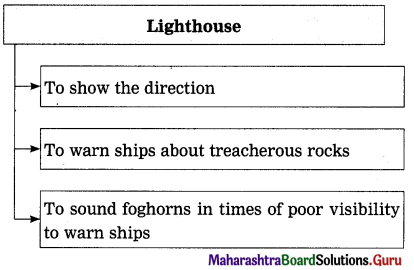
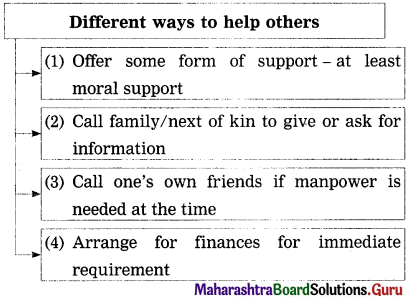
The functions of a lighthouse are:
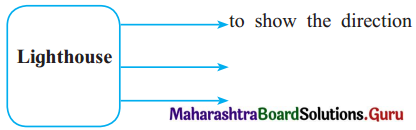
Maharashtra Board Class 12 English Yuvakbharati Solutions Chapter 2.3 The Inchcape Rock 1
Answer:
Maharashtra Board Class 12 English Yuvakbharati Solutions Chapter 2.3 The Inchcape Rock 2

Question 3.
Discuss in pairs the various famous rocks in the world and mention the places where they are.
Answer:

Famous RockPlace
Balancing Rock (Krishna’s butter-ball)

250 tons – balanced on a slope attempts to move it for safety remains v unsuccessful The Trimurti Cave-dedicated to trinity Brahma, Vishnu and Shiva

Protected by ASI and UNESCO

Mahabalipuram
Ayer’s Rock

Called Uluru by Australian Aboriginal has carvings- paintings.
Composed of sandstone The rock changes colour according to position of Sun; most striking at sunset, coloured a fiery orange-red

Central Australia
Giant’s Causeway – Most of the columns hexagonal, – some four/ five/ seven/ eight sided made up of some 40,000 interlocking basalt columns one of the great natural wonders – World Heritage SiteNorthern Ireland
Sigiriya rock plateau, formed from magma of an extinct volcano, 200 metres high; UNESCO Heritage Site

Ancient hydraulic system – canals, locks, lakes, dams, bridges, fountains, surface/underground water pumps.

In rainy season, water begins to circulate in Sigiriya. Fountains built in Fifth century – oldest in the world.

Sri Lanka

Question 4.
Narrate in the class a story about someone who destroyed or spoilt someone else’s good work.
(Points: A bright Student-Punctual, cheerful, intelligent-Helpful to classmates, explains and lends notes-Tutored junior class students- Jealous group tears up notes before exams-Is able to study with the friends whom he/she helped-The jealous group is outwitted)

Maharashtra Board Class 12 English Yuvakbharati Solutions Chapter 2.3 The Inchcape Rock

Question 5.
Discuss the following expressions in pairs/groups. Take the help of your teacher.
(a) As you sow so shall you reap.
(b) Crime gets its own punishment
(c) What goes around comes around
(d) Tit for tat
(e) Evil digs a pit for others but falls into the same.
Answer:
All the above are idioms and proverbs. They all convey the same meaning. They all mean that when a person acts with a certain intention, the results will be the same as the action. If the intentions are good the person will benefit from rewards. If the intentions are evil he will be punished.

(A1)

Question 1.
Narrate in groups the scene described in the beginning of the poem.
Points:
A clear calm day at sea
The sea was quiet – the ship is still
The wind is not blowing – the sails unmoving
The waves do not move the Bell
All these point fin first 3 stanzas] to a quiet sea and
calm weather one morning in spring.

(A2)

Question (i)
Complete the following statement:
The Abbot of Aberbrothok placed a bell on the Inchcape Rock because
Answer:
The Abbot of Aberbrothok placed a bell on the Inchcape Rock because there were dangerous rocks near the coast which would wreck ships.

Maharashtra Board Class 12 English Yuvakbharati Solutions Chapter 2.3 The Inchcape Rock

Question (ii)
Given below are the events that give the theme of the poem in a jumbled form. Arrange in a proper sequence as per their occurrence.
(a) The waves were so small that they did not move enough to ring the bell at the Inchcape Rock.
(b) The Abbot of Aberbrothok had placed the bell on a buoy on the rock.
(c) There was a thick haze spread over the atmosphere.
(d) Ralph bent over from the boat.
(e) Sir Ralph cursed himself in despair and in his frustration tore his hair.
Answer:
(b) The Abbot of Aberbrothok had placed the bell on a buoy on the rock.
(a) The waves were so small that they did not move enough to ring the bell at the Inchcape Rock.
(d) Ralph bent over from the boat.
(c) There was a thick haze spread over the atmosphere.
(e) Sir Ralph cursed himself in despair and in his frustration tore his hair.

Question (iii)
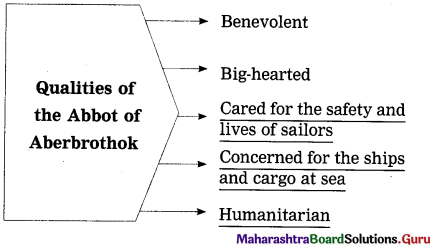
Describe the qualities of the Abbot of Aberbrothok in your own words.
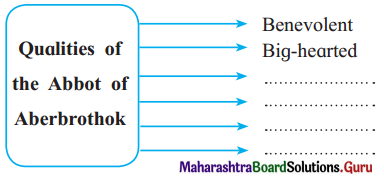
Maharashtra Board Class 12 English Yuvakbharati Solutions Chapter 2.3 The Inchcape Rock 3
Answer:
Maharashtra Board Class 12 English Yuvakbharati Solutions Chapter 2.3 The Inchcape Rock 4

Question (iv)
‘Jealousy’ is the most incurable defect, Justify.
Answer:
When someone is in a better position of money or success or fame, there are people who feel that they should destroy that. This is jealousy. We can see people who have more, and we can also work hard to reach that position. But when someone wants to destroy that person who has reached the better position that is wickedness. The jealous person is not willing to work for that state. They will not accept a lesser place also. So a jealous mind-set slowly becomes completely evil.

Maharashtra Board Class 12 English Yuvakbharati Solutions Chapter 2.3 The Inchcape Rock

Question (v)
‘But the Rover’s mirth was wickedness’. Explain this line in your own words with the help of the extract.
Answer:
The season of spring made everyone feel happy and light-hearted. The Rover was whistling and singing. But this joyful mood made him reckless. He wanted to trouble the Abbot. The Abbot had put a Bell there as a warning about the Inchcape Rock. Ralph rashly decided to undo his good work. The Rover was jealous of the Abbot who was blessed by grateful sailors. He wanted to trouble the Abbot of Aberbrothok.

(A3)

Question 1.
Some words in the poem are related to different parts of a ship or a mariner’s life. Given below are the meanings of those terms. Identify the word.
Answer:
(a) Helps in steering the ship-wheel
(b) The lowest part of the ship – keel
(c) Floating object that shows direction- buoy
(d) Another name for a ship-vessel
(e) Sinking – gurgling

(A4)

Question 1.
Select the appropriate figure of speech from the box given below and complete the table.
Answer:

ExampleFOSExplanation
No stir in the air, no stir in the seaRepetitionEmphasizes the quiet stillness
On a buoy in the storm it floated and swungAlliterationThe sound of the vowel ‘o’ is repeated
The ship was as still as she could bePersonificationThe ship is spoken of as ‘she’ as if a human being

(A5)

Question (i)
Write the appreciation of this poem based on the points given below :

  • About the poem/poet and the title
  • The theme
  • Poetic style
  • The language/poetic devices used in the poem
  • Special features
  • Message, Values, Morals in the poem
  • Your opinion about the poem

Answer:
The Poem “The Inchcape Rock’ is about a real stretch of treacherous rocks near the Scottish coast. I Robert Southey wrote prose and other poems too. But this poem is well-liked. The title gives the clue that the rock is a part of an interesting story.

The theme is about an Abbot and a pirate. The Abbot is concerned for his fellow humans and helps to save sailors. He put the Inchcape Bell on a buoy to warn ships day and night of the terrible Inchcape Rock, during storms. [According to records, warning bell was placed.]

But the Rover in a fit of madness, on a spring day, cut the bell just to trouble the Abbot. Many months later, when the pirate was sailing towards Scotland, the weather was different. As the frightened sailors were caught in the dark stormy sea the pirate realised he had not troubled the Abbot but brought ruin for himself and his sailors.

The poem is a ballad. The story is told in stanzas of four lines, with aabb rhyme. The story is told in easy language. The poet uses many Old English words like ‘blest’, ‘Quoth’, and ‘canst’. The poet begins with spring, a metaphor for the pleasant mood, with a calm sea, still air and the ship in quiet waters. Repetition emphasizes the gladness in the heart.

The mood changes from mischief to wickedness. When the mist blocks the sun, metaphor makes the story gloomy, suspenseful. The nightfall is the metaphor for the dark situation for the ship, its sailors. They finally meet a violent end. There is alliteration which adds to the beauty of the poem.

The poem is a didactic one with a clear message – “When we try to trouble others, trouble first comes to the doer.” The story has a moral and is useful even in these times.

Maharashtra Board Class 12 English Yuvakbharati Solutions Chapter 2.3 The Inchcape Rock

Question (ii)
Compose 4 to 6 lines on ‘Sea’ :
Answer:
Sea
I meet the sky far away, brothers of the same colour.
I mirror his white woolly sheep and birds.
I pull and push; deep down or sometimes upwards
In my cool-world, small and big creatures, softly slither.

(A6)

Question (i)
Expand the ideas on your own on the following topics:
(a) Pride goes before a fall.
(b) Time and tide wait for none.
(c) Man proposes, God disposes.
(d) Look before you leap.

Question (a)
Pride goes before a fall.
Answer:
There is a saying in Sanskrit that translates as “Knowledge brings humility.” The opposite would be that only an ignorant person would be proud or arrogant. A person becomes overconfident about himself or what he has. He starts thinking lowly of others. Only a harsh experience makes him see his stupidity.

There is a story about the God of riches who was drunk on his wealth. He invited all the other gods to a grand feast so that his wealth would be seen by them. He also invited Shiva and Parvati. They gently told him they would not be able to come, They said their son Ganesha would come instead. The host welcomed his guests.

Ganesha also arrived. The guests seated in a dazzling hall ate their fill of the lavish food. They praised the food, the hospitality and took leave impressed by the grandeur of everything there. But Ganesha was still being served. The host was stunned to see the servants running frantically to serve at the little boy’s speed of eating. The cooks were preparing more food. The puzzled King saw to it that Ganesha was served what he wanted.

Then word came from the kitchen that supplies were needed. Soon the supplies in adjacent villages were empty. Ganesha in anger chased the King till he ran to Shiva’s abode. Ganesha complained he was not fed. The King realized his foolishness trying jto impress the Lord and Mother with his riches. He went humbled, not able to feed one child.

Hence how much ever one possesses one must not think lowly of others. The right kind of knowledge makes a person more and more humble. Like the tree full of fruits bends lower and lower.

Question (ii)
The poem begins with:
‘Without either sign or sound of their shock, The waves flowed over the Inchcape Rock.’
It ends with:
On the basis of these lines explain the change in mood of the poem.
Answer:
At the beginning of the poem the season is spring, the weather is mild and the sea-waters are calm. The waves pour softly over the Inchcape Bell. The Heavy Bell on a buoy would ring due to strong waves only in stormy weather.

When the Rover cut the Bell it was spring season. The mood was happy, light-hearted. He was up to mischief in a rash, jolly mood on a lovely spring day. He wanted to only trouble the Abbot.

After undoing the Abbot’s good work the Rover went away on his criminal voyages. But when he was returning the sea was stormy. Wild winds threw the ship off course. The mood is of confusion and fear because a thick fog covered them from the sun. The mood is of suspense, the sailors are lost.

By nightfall they did not still know where they were. They are really and metaphorically in the dark. They could hear the waves crashing yet they did not know which land was near. There is fear. There was no wild wind but the rough sea was pulling their ship along. They desperately wanted some clue to help them to know their location. The ship shattered onto the rocks as the Rover yelled and cursed. The dramatic end is violent and filled with despair.

Maharashtra Board Class 12 English Yuvakbharati Solutions Chapter 2.3 The Inchcape Rock

(A7)

Question (i)
Read the tree diagrams and information given on pages 109-110 of the textbook and find out more information about opportunities in ‘on and off the shore’ the Indian Navy.
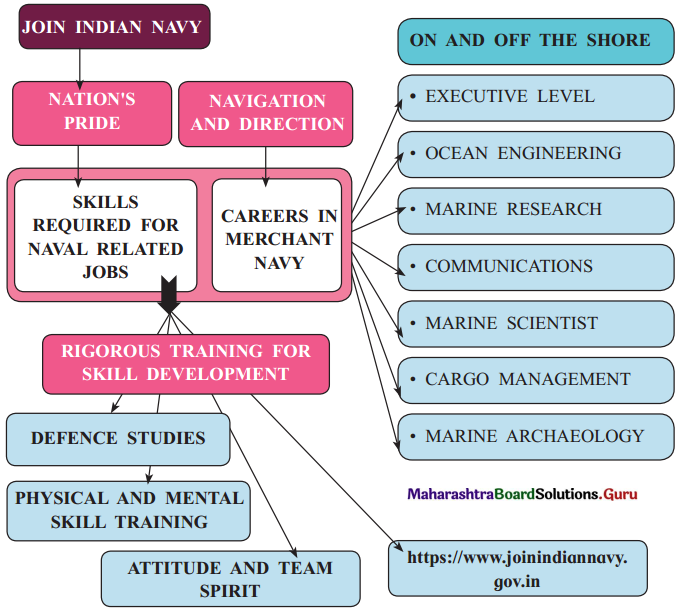
Maharashtra Board Class 12 English Yuvakbharati Solutions Chapter 2.3 The Inchcape Rock 5

Question (ii)
Required qualifications and various fields/opportunities for women to join in the Navy.
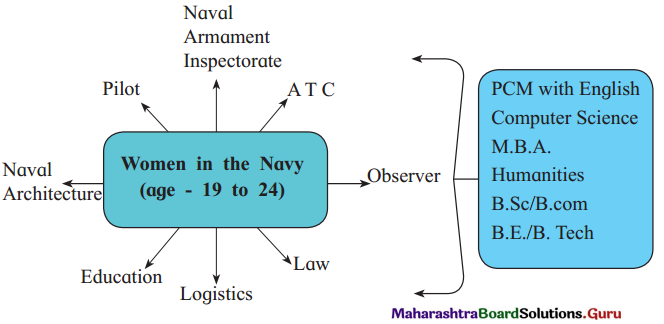
Maharashtra Board Class 12 English Yuvakbharati Solutions Chapter 2.3 The Inchcape Rock 6

Maharashtra Board Class 12 English Yuvakbharati Solutions Chapter 2.3 The Inchcape Rock

Question (iii)
Colleges that provide education in oceanography-
National Institute of Oceanography, Goa
National Institute of Oceanography, Mumbai
MBA (Logistic Shipping Management), IIKM Business School, Calicut, Kerala
Indira Gandhi College of Distance Education IGCDE, Tamil Nadu

Yuvakbharati English 12th Digest Chapter 2.3 The Inchcape Rock Additional Important Questions and Answers

Read the extract and complete the activities given below:

Global Understanding:

Question 1.
Give reasons for the sailors’ appreciation of the Abbot.
Answer:
There were some dangerous rocks near the Scottish coast. The Abbot of Aberbrothok had placed a buoy and fixed a bell on it, near those rocks. If the sea was rough sailors could spot the buoy. Even in the darkness the rough seas made the bell ring. So by day or night the Abbot’s bell saved the sailors and their ships from the rocks, and they blessed him.

Question 2.
Complete the following:
‘Wheel’d round’ here implies
Answer:
Wheel’d around here implies a flock of birds flying round in circles, which looks like a wheel.

Question 3.
Describe the state of mind of Ralph.
Answer:
Ralph the Rover also felt the effects of the season of spring. He felt very cheerful; he whistled and sang as he walked about on the deck. He was in an extremely happy state of mind but his joy was evil in intentions.

Maharashtra Board Class 12 English Yuvakbharati Solutions Chapter 2.3 The Inchcape Rock

Question 4.
Complete the following:
Answer:
The pirate asked his men to row him over to the Inchcape Bell. He then bent over and cut the Bell from the buoy. He did so that the sailors of the next ship would no longer bless the Abbot for placing the warning Bell.

Question 5.
Choose the words and phrases that could describe Sir Ralph the Rover.
(a) Criminal
(b) Jealous
(c) Arrogant
(d) Vicious
(e) Spiteful
Answer:
All of the above

Question 6.
Choose the correct option:
On spotting the bell, Rover cut the bell from the buoy. This was an act of:
(a) Hatred
(b) Anger
(c) Jealousy
(d) Frustration
Answer:
(c) Jealousy

Question 7.
‘O Christ! It is the Inchcape Rock’ – Give reasons for Ralph’s Exclaimation.
Answer:
The Rover’s ship had struck the terrible rocks feared by sailors. Some time ago he himself had cut off the Bell put there by the blessed Abbot. Now his own ship had hit the Inchcape Rock and was going to sink with all his riches. He too was sure about to die.

Question 8.
Complete the following statements:
Answer:
1. The result of the thick haze that covered the sky was that the sailors had no way of knowing in which direction they were sailing.
2. The Rover in frustration pulled his hair and cursed himself because he himself had cut the Bell which would have rang and the sound would have helped them to save themselves from those killer-rocks.

Maharashtra Board Class 12 English Yuvakbharati Solutions Chapter 2.3 The Inchcape Rock

Inference/Interpretation/Analysis:

Question 1.
The pirate is given the title ‘Sir’ though he was a feared criminal. He is called a ‘rover’. Give reasons for the same.
Answer:
Though he was a feared criminal Ralph was the captain of his ship. The crew may have addressed him ‘Sir’ which explains it attached to his name. A rover is a person, animal, or thing that roves, or wanders, Ralph the pirate roamed around on the seas looking for ships to attack and loot. Maybe that is why he was called Ralph the Rover.

Question 2.
The poet gives hints to the reader in the second stanza of the extract. Find the significant line from the extract and give reason for your answer.
Answer:
The second stanza of this extract tells about what the pirate did after removing the Bell. He roamed the seas and carried on his evil activities, killing and looting.

The last line is the hint of what is to happen later. ‘He steers his course for Scotland’s shore.’ The rover set the course ‘for Scotland’s shores’. This is significant because the treacherous Inchcape Rock was on the Scottish shores. So we get an idea that something may happen there.

Question 3.
Read the following lines and say what the situation was:
‘For me thinks we should be near the shore’. ‘Now where we are I cannot tell,’
Answer:
The sailors could hear the waves crashing on the shore. But they had been blown about by wild winds all day and so did not where they had reached. They did not know which land or shore was near. The situation was that danger was near.

Question 4.
Explain the danger implied in the two lines:
‘They hear no sound, the swell is strong; Though the wind hath fallen they drift along,’
Answer:
There was no sound except the breakers crashing on a nearby shore. There was no wind. But the sea was rough and the strong sea pulled the helpless ship along. The sailors were confused and could not make out which was the safe direction.

Maharashtra Board Class 12 English Yuvakbharati Solutions Chapter 2.3 The Inchcape Rock

Personal Response:

Question 1.
Write an account of something which you did out of concern for others.
Answer:
In our colony there is a young couple living with twin toddlers and elderly parents. The young man is a doctor and his working hours are sometimes unpredictable.

My family is aware of this and we help in small ways. I help the elderly lady to take a walk on the street and my brother helps the gentleman. I also help the young mother to mind the small children if she has to go out shopping. I sometimes run errands for them too.

Question 2.
Give your opinion on the following line and explain its significance.
‘Quoth Sir Ralph, ‘The next who comes to the Rock
Won’t bless the Abbot of Aberbrothok.’
Answer:
The Pirate says these words after he cut the Bell placed by the Abbot. The Abbot had placed it for saving others. This act had brought fame for the Abbot and also the blessings of the many sailors that were saved. But the pirate was jealous of the fame. He cut the Bell thinking to harm the Abbot. When someone is concerned about others they are not looking for fame. But a selfish person is blinded by jealousy. They behave foolishly and cause trouble only for themselves.

Question 3.
‘Now where we are I cannot tell,
But I wish I could hear the Inchcape Bell’ From these lines describe the thoughts of
(a) ……… the sailors in the Rover’s ship.
(b) ……. the Rover’s.
Answer:
(a) The sailors must have been terrified. They may have been feeling angry with their Captain for his senseless act of cutting off the Inchcape Bell. It would be useful now to save them.
(b) The captain of the pirates must have been going mad with fear of the possible crash and sure death of everyone on board. He did not know where his ship was located. He was wondering if they were going to Crash on the Inchcape Rock. He had ensured his own destruction and death by cutting the Bell.

Maharashtra Board Class 12 English Yuvakbharati Solutions Chapter 2.3 The Inchcape Rock

Poetic Devices:

Question 1.
Pick out the examples of imagery from the extract, state what kind it is and explain.
Answer:
Example of Visual imagery from the extract:
1. ‘The ship was as still as she could be’.
2. ‘Her keel was steady in the ocean’. Both the lines depict how the ship was on the sea, almost unmoving.
3. ‘The waves flow’d over the Inchcape Rock;
So little they rose, so little they fell,
They did not move the Inchcape Bell.’
These lines in the second stanza describe the very mild sea and the small waves.

Examples of Sound imagery from the extract:

1. And over the waves its warning rung. The line describes the loud warning sounded by the Inchcape Bell in a storm,
2. ‘And there was joyance in their sound.’ These lines show an air of joy in that scene. Even the birds seemed to be flying round and round – like a wheel – ‘wheel’d round’, ‘joyance in their sound’.

Question 2.
Pick out the examples of imagery from the extract, state what kind it is and explain.
Answer:
The lines with Visual imagery:
1. The Sun in heaven was shining gay,
The Sun shone bright and made the morning cheerful.
2. The sea birds screamed as they wheel’d round,
The birds seemed to be flying round and round in joy, like a wheel.

Examples of Sound imagery from the extract:
1. And over the waves its warning rung. The line describes the loud warning sounded by the Inchcape Bell in a storm.
2. ‘The sea-birds scream’d as they wheel’d round
And there was joyance in their sound.’
These lines show an air of joy in that scene. Even the birds seemed to be happy as their calls seemed like they were screaming in joy, ‘joyance in their sound’.

Question 3.
‘Gurgling sound’. Find the figure of speech.
Answer:
This is onomatopoeia. The pronunciation of the word resembles the meaning – the sound of an object sinking and bubbles rising and bursting.

Maharashtra Board Class 12 English Yuvakbharati Solutions Chapter 2.3 The Inchcape Rock

Question 4.
Pick out an example of imagery from the extract.
Answer:
‘So thick a haze o’erspreads the sky,
They cannot see the Sun on high.’
The reader is able to imagine the fog so dense that the sun is blocked out. This is visual imagery.

Poetic Creativity:

Question 1.
Compose 2-4 lines using “A Song in the Air” as the theme. You could begin with…
‘The leaves rustle gently….’
Answer:
‘The leaves rustle gently and flowers nod. The droplets gather into a bigger drop The birds shake their plumes, bright-eyed. A song is in the air, the new day, a pretty bride.’

Question 2.
Compose 2-4 lines with one of the following as the theme : anger/ hatred/jealousy
Answer:
The Enemy Inside

I don’t know where he hides everyday He flashes in my eyes, in some words I say
To elders, family, friends. I am surprised
By my own words, my actions, only later I cried.

Question 3.
Compose 2-4 lines with one of the following as the theme:
Answer:
I Regret

I think of the harsh remark
The careless action I threw
I vow not to repeat anymore
As I begin this day new.

Maharashtra Board Class 12 English Yuvakbharati Solutions Chapter 2.3 The Inchcape Rock

Writing Skills:

Question (a)
Time and tide wait for none Points:
There is a time for doing each thing

  • Postponing action is laziness
  • If the time for the action is lost the opportunity is lost for ever.
  • Only regret remains.

Question (b)
Man proposes, God disposes

Points:

  • It is in one’s power to plan a way of doing things
  • It is a smart thing to prepare in advance
  • In spite of planning we may not be able to carry on with the plan due to circumstances
  • We must accept the unexpected circumstances and yet go ahead by some other method
  • We must be flexible and find an alternative way
  • It is smart to always have a Plan B ready

Question (c)
Look before you leap Points:

  • Before we act one must think of the results
  • only a fool will act without thinking of the future consequences of the present action
  • if we think the results are going to harm someone, one must not do that
  • It is also a good thing to take the advice of experienced or elders when making important decisions.

Maharashtra Board Class 11 Political Science Important Questions Chapter 4 Constitutional Government

Balbharti Maharashtra State Board Class 11 Political Science Important Questions Chapter 4 Constitutional Government Important Questions and Answers.

Maharashtra State Board 11th Political Science Important Questions Chapter 4 Constitutional Government

1A. Choose the correct alternative and complete the following statements.

Question 1.
Constitution of the ____________ was made by the Constitutional Convention. (USA, UK, India, France)
Answer:
USA

Question 2.
The Magna Carta has it’s origin in ____________ (USA, England, France, Cuba)
Answer:
England

Maharashtra Board Class 11 Political Science Important Questions Chapter 4 Constitutional Government

Question 3.
Till, recently the doctrine of absolute Parliamentary Sovereignty existed in ____________ (USA, Mexico, Argentina, UK)
Answer:
UK

Question 4.
____________ is an example of a ‘Holding Together’ federation. (USA, India, UK, Portugal)
Answer:
UK

Question 5.
____________ is an example of a ‘Coming Together’ federation. (USA, India, UK, Portugal)
Answer:
USA

Question 6.
Protection of rights is entrusted to the ____________ (Legislature, Executive, Civil Services, Judiciary)
Answer:
Judiciary

Question 7.
A ____________ system functions on ‘Separation of Powers’ theory. (dictatorship, parliamentary, presidential, federation)
Answer:
Presidential

1B. Identify the incorrect pair in every set, correct it and rewrite.

Question 1.
(a) England – Republic
(b) USA – Federation
(c) Portugal – Unitary System
Answer:
(a) England – Constitutional Monarchy

Maharashtra Board Class 11 Political Science Important Questions Chapter 4 Constitutional Government

Question 2.
(a) Union List – Defence
(b) State List – Atomic Energy
(c) Concurrent List – Education
Answer:
(b) Union list – Atomic energy or State list – Public health and sanitation

Question 3.
(a) Senate – USA
(b) Rajya Sabha – India
(c) House of Lords – Brazil
Answer:
(c) Houses of Lords – England

1C. State the appropriate concept for the given statement.

Question 1.
The idea that there should be limitations on powers of the government.
Answer:
Constitutionalism

Question 2.
First ten amendments to the American constitution.
Answer:
Bill of Rights

Question 3.
Type of government in which Head of State assumes his/her position on a hereditary basis.
Answer:
Monarchy

Question 4.
Process of bringing out changes in some provisions of the constitution.
Answer:
Amendment

Maharashtra Board Class 11 Political Science Important Questions Chapter 4 Constitutional Government

Question 5.
The manner in which those who hold power are expected to behave.
Answer:
Constitutional Morality

Question 6.
Executive in a parliamentary system in whose name all powers are exercised.
Answer:
Nominal Executive

1D. Answer in one sentence.

Question 1.
What is the modern view of constitutionalism?
Answer:
The modern view of constitutionalism is the idea of restricting the powers of the government as a whole.

Question 2.
Explain the doctrine of Parliamentary Sovereignty.
Answer:
The doctrine of Parliamentary Sovereignty means that the Parliament which represents the citizens has the power to make laws with no restrictions on it’s jurisdiction.

Maharashtra Board Class 11 Political Science Important Questions Chapter 4 Constitutional Government

Question 3.
What was the ruling in the Kesavananda Bharati case?
Answer:
The ruling in the Kesavananda Bharati case was that ‘the basic structure of the constitution could not be altered by any amendments carried out by the legislature.

Question 4.
What is Constitutional Morality?
Constitutional Morality refers to the values which are the foundation of the constitution and the manner in which those in political power are expected to behave.

Question 5.
In a Parliamentary system who constitutes the real executive?
Answer:
The Prime Minister and the Council of Ministers i.e., the Ministry constitute the real executive in a Parliamentary System.

Question 6.
Name the two kinds of executive in a parliamentary system of government.
Answer:
The two kinds of executive in a parliamentary system of Government are nominal executive and real executive.

Question 7.
Name the two houses of legislature in the following:

  1. Indian
  2. England
  3. USA

Answer:

  1. India – Lok Sabha, Rajya Sabha
  2. England – House of Commons, House of Lords
  3. USA – Senate, House of Representatives

Maharashtra Board Class 11 Political Science Important Questions Chapter 4 Constitutional Government

Question 8.
What is the ‘veto power’ of US President The US President has the right to reject a law passed by the legislature. This is the ‘veto power’.

Question 9.
What is the unitary system of Government?
Answer:
Countries with small territory usually have a single government at the centre which is called unitary government.

Question 10.
What is the significance of the Seventh Schedule?
Answer:
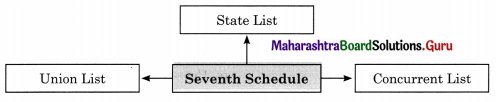
The Seventh Schedule consists of the Union, State and the Concurrent lists on the basis of which government powers are distributed in India.

1E. Find the odd word out in the given set.

Question 1.
USA, UK, India, Australia.
Answer:
UK (not a federation)

Question 2.
USA, Brazil, Argentina, Japan.
Answer:
Japan (not a presidential system)

Question 3.
USA, Canada, Australia, India.
Answer:
India (not a ‘coming together’ federation)

2A. State whether the following statements are true or false with reasons.

Question 1.
Indian Constitution is enacted.
Answer:
This statement is True.

  • The Indian Constitution was framed by the Constituent Assembly of India which functioned from December 1946 till November 1949.
  • It is a product of detailed discussions, debates and deliberations. The constitution came into force on 26th January 1950.

Maharashtra Board Class 11 Political Science Important Questions Chapter 4 Constitutional Government

Question 2.
Today the doctrine of Parliamentary Sovereignty no longer exists in it’s absolute form in the United Kingdom.
Answer:
This statement is True.

  • According to the doctrine of Parliamentary Sovereignty, the Parliament has the authority to make any law and the only control mechanism is a vigilant public opinion.
  • Today, the United Kingdom is a member of various international organizations and signatory to many international agreements which guarantee individual rights and restrict parliamentary powers.

Question 3.
In a parliamentary system, the Head of State is powerful.
Answer:
This statement is False.

  • A parliamentary system makes a distinction between the Head of State and Head of government. The Head of State is the nominal executive. While the Prime Minister and his/her council are the head of government.
  • All decisions and administration is conducted in the name of the nominal executive (President) by the real executive (Prime Minister and his/her Council of Ministers.)

2B. Complete the concept maps.

Question 1.
Maharashtra Board Class 11 Political Science Important Questions Chapter 4 Constitutional Government 2B Q1
Answer:
Maharashtra Board Class 11 Political Science Important Questions Chapter 4 Constitutional Government 2B Q1.1

Question 2.
Maharashtra Board Class 11 Political Science Important Questions Chapter 4 Constitutional Government 2B Q2
Answer:
Maharashtra Board Class 11 Political Science Important Questions Chapter 4 Constitutional Government 2B Q2.1

Maharashtra Board Class 11 Political Science Important Questions Chapter 4 Constitutional Government

Question 3.
Maharashtra Board Class 11 Political Science Important Questions Chapter 4 Constitutional Government 2B Q3
Answer:
Maharashtra Board Class 11 Political Science Important Questions Chapter 4 Constitutional Government 2B Q3.1

3. Express your opinion of the following.

Question 1.
The Presidential System may lead to a deadlock in government functioning.
Answer:
The President is both Head of State and Head of government. He/she is directly elected by the people for a fixed tenure for e.g., US President is elected for a 4 year tenure. There is only one executive. The legislature (Congress in the USA) is also directly elected by the citizens.

There exists a separation of legislative and executive powers as well as a system of ‘checks and balances’ for e.g., Legislature can impeach the President, while the President can exercise the ‘Veto Power’ to reject any law passed by the Legislature.

Thus, there can be an impasse in government functioning for e.g., since President Trump assumed office- there have been many cases of a standoff between the office of the President and the US Congress, especially the Democrats. In 2019, the Congress voted to overturn President Trump’s emergency declaration to build a border wall with Mexico. In turn, the President ‘vetoed’ this vote.

4. Answer the following questions.

Question 1.
Explain the nature of Indian Federation.
Answer:
In India, at the time of independence, there were Princely States and areas under British administration. The States were created after independence on the basis of language i.e., linguistic reorganisation of States. The Union Government created the States. The journey of Indian Federalism has been mixed. After independence, the States had been granted additional powers. However, later economic and technological changes had led to the enhancement of the powers of the Central government.

Maharashtra Board Class 11 Political Science Important Questions Chapter 4 Constitutional Government

The Indian Federation differs greatly from the US federation. India has been described as ‘quasi-federation’ or a ‘federation with an unitary spirit’ as the division of powers favors the central government for e.g., it has full control over the Union list and Residuary subjects and it’s laws have precedence over state legislations even in case of the subjects in Concurrent list.

Question 2.
Explain the components of a Constitution.
Answer:
The constitution is the highest law of the country. It reflects the objectives of the state and the rights and aspiration of its citizens. It establishes the rule of law and sets limits on government authority. A constitution is a living document that indicates the way in which a country is governed. The primary function of the constitution is to lay out the basic structure of the government according to which the people are to be governed.

A constitution has three distinct but interrelated components.

  • Set of Rules – A constitution is a set of rules that describes the structure, powers and functions of the three organs of government to ensure that each organ functions without its jurisdiction. It lays down the limitations on what the government can do or cannot do.
  • Set of Rights – A constitution lists the rights of the citizens, means for protection of this rights and the duties of citizens. It also lists the means of protecting the rights e.g., in India, the judiciary is entrusted with protecting the rights. The rights guaranteed by the constitution are not unlimited i.e. they are subject to reasonable limitations.
  • Set of Objectives and Values – A constitution enumerates the values and objectives that it seeks to fulfill. For e.g., Indian Constitution seeks to ensure the values of justice, liberty and equality.

Question 3.
Explain Parliamentary system.
Answer:
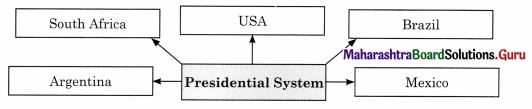
The two main types of democratic governments are Parliamentary System (as seen in the United Kingdom, India, Canada, Australia, Japan, etc.) and Presidential System (which exists in the United State of America, Argentina, Mexico, Brazil, etc.). This distinction is mainly based on the nature of Legislature-Executive relationship.

Parliamentary System – It makes a distinction between Head of State (President of India) and Head of Government (Prime Minister and his Council of Ministers).

The main features of the parliamentary system are:

  • There is a fusion of legislature and executives powers. The executive i.e., the ministry is drawn from the legislature and is subordinate to it. Ministers are also members of Parliament.
  • There are two executives i.e., nominal (President of India or Monarch in England) and real (ministry). All powers are exercised by the real executive although it is conducted in the name of the nominal executive.
  • It is a responsible government- The Prime Minister and the Council of Ministers stay in power only as long as they have the required majority in the Parliament. In case, the Ministry loses majority support, the Prime Minister along with his Council of Ministers has to resign.
  • It may exist either as Republics or as Constitutional Monarchies depending on the nature of the nominal executive. In a Republic, the nominal executive is elected while in a Monarchy, he/she assumes position on the basis of heredity.
  • Most Parliamentary systems have a Bicameral Parliament for e.g., in England, Parliament consists of House of Commons (lower house-directly elected)] and House of Lords (Upper house hereditary basis)

Maharashtra Board Class 11 Political Science Important Questions Chapter 4 Constitutional Government

Question 4.
Explain Presidential system.
Answer:
The main features of Presidential system are:

  • The President who is directly elected by the citizens for a fixed tenure is both, Head of State and Head of Government.
  • Thus, there is only one executive.
  • The Legislature is also directly elected. Members of the executive are not permitted to belong to the legislature.
  • There exists a separation of legislative and executive powers as well as a system of checks and balances for e.g.
  • The legislature can impeach the President while the President, can exercise the ‘Veto Power’ to reject any law passed by the
  • Legislature.
  • The President can continue in office irrespective of whether or not he/she enjoys majority support in the Legislature.

Question 5.
What are the two processes of forming a Federation?
Answer:
Federation may be performed by two processes-

  • Small political units ‘come together to establish a single, large political unit for e.g., thirteen colonies came together to fight for independence from British rule and the US federation came into being. This is called centripetal process.
  • States are created by the union government for e.g., in India, States were reorganized on the basis of language and other regional aspirations. This is the centrifugal process.

Question 6.
Explain Unitary System of Government.
Answer:
Countries that are small in size prefer to have a single, central, government. This is called the Unitary System. It is seen in Cuba, France, Bolivia, Israel, Portugal, Sri Lanka, etc, Some hitherto unitary systems change to a quasi-unitary form, through establishment of provinces and distribution of political power to somewhat autonomous units, for e.g., UK has an unitary system. However, it’s regions i.e. Scotland, Wales, Northern Ireland have their own assemblies with some degree of autonomy. These are known as ‘Holding Together’ federations.

Question 7.
Write about the Seventh Schedule of Indian Constitution.
Answer:
The Seventh Schedule of the constitution contains three lists i.e., the Union List, the State List and the Concurrent List. Each list contains subjects over which the Central Government, The State Governments (as far as their respective states are concerned), or both the governments can take decisions and make laws respectively. In cases where both the Central and State governments have made laws about subjects falling in the Concurrent List, then the decision of the former prevails. Furthermore, the State Governments can also ask the Central Government to make laws on subjects included in the State List, if such a need arises.

Maharashtra Board Class 11 Political Science Important Questions Chapter 4 Constitutional Government

Question 8.
Explain Basic Structure Doctrine.
Answer:
The Supreme Court of India, in the celebrated Keshavananda Bharati (1973) laid down the restrictions on the power of the Government to amend the Constitution. It ruled that the Constitution of India possessed a basic structure which could not be altered in any manner, and that other than this there were no restrictions on the power of parliament to amend the Constitution. This is known as Basic Structure Doctrine.

5. Answer the following in detail with reference to the given points.

Question 1.
Explain Federation.
(i) What is a federation?
(ii) Features of a federation.
(iii) Processes of forming a federation.
(iv) Quasi-federal nature of Indian Federation.
Answer:
(i) A federation refers to a political structure in which there are two sets of governments i.e. one for the whole country and governments in each of the federal units (called Provinces or States). There is a distribution of powers between the Federal government (also known as Union or Central Government) and the State Governments. Federal governments are preferred in countries having large size and heterogeneous population.

(ii) The main features of a federation are

  • Dual set of governments i.e., Union government and State governments.
  • Division of power between the two sets of governments for e.g., in India, jurisdiction is distributed between the Union (Centre) and States on the basis of Union, State and Concurrent list (as stated in Seventh Schedule of the Constitution)
  • A written constitution to enable a clear distribution of government powers.
  • Independent judiciary to resolve center-state or state-state disputes.

(iii) Federation may be performed by two processes

  • Small political units ‘come together to establish a single unit for e. g., thirteen colonies came together to fight for independence from British rule and the US federation came into being. This is called centripetal process.
  • States are created by the union government for e.g., in India, states were reorganized on the basis of language and other regional aspirations. This is the centrifugal process.

Maharashtra Board Class 11 Political Science Important Questions Chapter 4 Constitutional Government

(iv) India has been described as ‘quasi-federation’ or a ‘federation with an unitary spirit’ as the division of powers favors the central government for e.g. it has full control over the Union list as well as over residuary subjects. It’s laws have precedence even in case of the subjects in Concurrent list.

Maharashtra Board Class 11 Political Science Solutions Chapter 4 Constitutional Government

Balbharti Maharashtra State Board Class 11 Political Science Solutions Chapter 4 Constitutional Government Textbook Exercise Questions and Answers.

Maharashtra State Board Class 11 Political Science Solutions Chapter 4 Constitutional Government

1A. Choose the correct alternative and complete the following statements.

Question 1.
Unwritten Constitution exists in _____________ (United Kingdom, India .South Africa, United States)
Answer:
United Kingdom

Question 2.
In a parliamentary system there is a _____________ of legislative and executive powers. (separation, coordination, merger, centralisation)
Answer:
merger

Maharashtra Board Class 11 Political Science Solutions Chapter 4 Constitutional Government

Question 3.
The ten amendments to the American Constitution are collectively referred to as _____________ (Bills of Rights, Magna Carta, Basic Structure Doctrine, Fundamental Rights)
Answer:
Bill of Rights

1B. Identify the incorrect pair in every set, correct it and rewrite.

Question 1.
(a) Magna Carta – England
(b) Veto – United Kingdom
(c) Kesavananda Bharati Case – Basic structure doctrine
Answer:
(b) Veto – USA

1C. Find the odd word out in the given set.

Question 1.
England, Scotland, Wales, Republic of Ireland.
Answer:
The Republic of Ireland (not part of UK)

Question 2.
India, Australia, Canada, Argentina.
Answer:
Argentina (not a parliamentary system)

2. State whether the following statements are true or false with reasons.

Question 1.
Indian Federation can be described as a ‘quasi-federation’.
Answer:
This statement is True.

  • The Indian Constitution provides for dual set of governments i.e Union State governments. There is a distribution of powers on the basis of three lists viz. Union list, State list, and Concurrent list.
  • However, India has a federal structure with a powerful central government. The constitution framers felt that a strong Union government was needed to ensure the balanced development of the country.

Maharashtra Board Class 11 Political Science Solutions Chapter 4 Constitutional Government

Question 2.
The parliamentary system exists in the United States.
Answer:
This statement is False.

  • In a Parliamentary system, there is a merger of legislative and executive functioning. There are two executives, i.e., real and normal executives. This is noticed in India, United Kingdom, etc.
  • the United States follows the Presidential system based on separation of government powers. Here, there is only one executive i.e., President who is directly elected by citizens.

3. Explain the co-relation between the following.

Question 1.
Legislature and Executive in a parliamentary system.
Answer:
In a parliamentary system, there is a fusion of legislative and executive functions. The real executive i.e. the Prime Minister and Council of Ministers is drawn from the Legislature. There are no separate elections for the post of Prime Minister and other Ministers. The Prime Minister and the Ministers play a dual role i.e., they are part of both Legislature and Executive. Thus, they also attend Parliamentary sessions.

The leader of the party or group which commands a majority in the legislature is invited by the nominal executive (President) to form the government and assume the post of Prime Minister. The Ministry stays in power only as long as it enjoys majority support in Parliament. The lower house of the Parliament in England (House of Commons) and in India (Lok Sabha) can pass a vote of no-confidence against the Ministry which means that the Prime Minister and his/her Council of Ministers must resign. This is due to parliamentary sovereignty. Thus, the executive is subordinate to and responsible to the Parliament (legislature).

Maharashtra Board Class 11 Political Science Solutions Chapter 4 Constitutional Government

Question 2.
President and Legislature in a presidential system.
Answer:
In a Presidential system, there is a separation of government powers and a system of checks and balances. The President i.e., head of the executive is directly elected by the citizens for a fixed tenure. He/she enjoys powers granted to the office by the constitution and must conduct his/her administration in accordance with laws passed by the legislature. Members of the executive are prohibited from being members of the legislature.

The legislature is also popularly elected. Its powers are not absolute since the President can exercise ‘Veto Power’ to reject a law passed by the legislature. Similarly, the legislature can also impeach the President if it is proved that the constitution has been violated by him/her. The President continues in office irrespective of whether he/she enjoys majority support in the legislature. However such lack of support may lead to a breakdown or impasse in government functioning.

4. Answer the following questions.

Question 1.
Explain constitutionalism and constitutional morality.
Answer:
Constitutionalism refers to the idea that there should be limitations on the powers of the government which may be specified in the constitution or may arise due to historical developments. The Magna Carta (Great Charter) (1215) and Bill of Rights (1689) in England were attempts to restrict the powers of the Monarchs. As the concept of separation of legislative, executive, judicial powers became popular, so also, the idea of restricting powers of the government as a whole emerged. The origins of constitutionalism can be traced to the Social Contract Theory propounded by John Locke. He believed that people should have the right to change the government if it committed any wrongdoings.

The first ten amendments to the American Constitution (collectively called the Bill of Rights) imposed restrictions on the government. The Indian Constitution also restricts government jurisdiction so that it doesn’t violate Fundamental Rights.
Any constitution is subject to amendments. Thus, it is possible that certain governments may use their amendment powers to remove restrictions, on their policies and actions.

Maharashtra Board Class 11 Political Science Solutions Chapter 4 Constitutional Government

In any democracy, Constitutionalism refers to restrictions on the power of the government and adherence to the spirit of the constitution. It refers to the values which form its foundations and the manner in which those who hold power are expected to behave. This can be described by the term ‘Constitutional Monarchy’.

5. Answer the following in detail with reference to the given points.

Question 1.
Explain Constitution and its three distinct interrelated components.
(i) What is a Constitution?
(ii) set of rules
(iii) set of rights
(iv) set of objectives and values
Answer:
(i) The constitution is the highest law of the country. It reflects the objectives of the state and the rights and aspirations of its citizens. It establishes the rule of law and sets limits on government authority. A constitution is a living document that indicates the way in which a country is governed. The primary function of the constitution is to lay out the basic structure of the government according to which the people are to be governed. A constitution has three distinct but interrelated components.

(ii) Set of Rules – A constitution is a set of rules that describes the structure, powers, and functions of the three organs of government to ensure that each organ functions without its jurisdiction. It lays down the limitations on what the government can do or cannot do.

(iii) Set of Rights – A constitution lists the rights of the citizens, means for the protection of these rights, and the duties of citizens. It also lists the means of protecting the rights e.g., in India, the judiciary is entrusted with protecting the rights. The rights guaranteed by the constitution are not unlimited i.e. they are subject to reasonable limitations.

Maharashtra Board Class 11 Political Science Solutions Chapter 4 Constitutional Government

(iv) Set of Objectives and Values – A constitution enumerates the values and objectives that it seeks to fulfill. For e.g., the Indian Constitution seeks to ensure the values of justice, liberty, and equality.

11th Political Science Digest Chapter 4 Constitutional Government Intext Questions and Answers

Find out! (Text Book Page No. 30)

How many times has the Indian Constitution been amended? What was the latest amendment?
Answer:
Amendments refer to changes in certain provisions of the constitution. In India, Article 368 deals with the amendment procedure. Till March 2019, the Indian Constitution has been amended 103 times. The 101st amendment (July 2017) introduced GST, the 102nd amendment gave constitutional status to National Commission for Backward Classes, and the 103rd amendment provided for a maximum of 10% reservation for economically weaker sections (EWS) by amending Articles 15,16. (Right to Equality)

Find out! (Text Book Page No.32)

Make a list of all Prime Ministers of India with their tenure.
Answer:

  1. Jawaharlal Nehru (August 1947 – May 1964)
  2. Gulzarilal Nanda – Acting Prime Minister (27 May 1964 – 9 June 1964, 11 January 1966 – 24 January 1966)
  3. Lai Bahadur Shastri (June 1964 – January 1966)
  4. Indira Gandhi (January 1966 – March 1977, January 1980 – October 1984)
  5. Morarji Desai (March 1977 – July 1979)
  6. Charan Singh (July 1979 – January 1980)
  7. Rajiv Gandhi (October 1984 – December 1989)
  8. V. P. Singh (December 1989 – November 1990)
  9. Chandra Shekar (November 1990 – June 1991)
  10. P. V. Narsimha Rao (June 1991 – May 1996)
  11. A. B. Vajpayee (May 1996 – June 1996, March 1998 – May 2004)
  12. H. D. Deve Gowda (June 1996 – April 1997)
  13. I. K. Gujral (April 1997 – March 1998)
  14. Dr. Manmohan Singh (May 2004 – May 2014)
  15. Narendra Modi (May 2014 – till date)

Maharashtra Board Class 11 Political Science Solutions Chapter 4 Constitutional Government

Find out! (Text Book Page No. 34)

Name any four American Presidents who belonged to the Republican Party and for who belonged to the Democratic Party
Answer:

  • Republican Party – Abraham Lincoln, Richard Nixon, Ronald Reagan, George H. W. Bush, George W. Bush.
  • Democratic Party – F. D. Roosevelt, J. F. Kennedy, Bill Clinton, Barack Obama, Donald Trump.

Do this. (Text Book Page No. 35)

Look at the following subjects (Seventh Schedule of the Indian Constitution):

  • Law and Order
  • Atomic Energy
  • Banking
  • Agriculture
  • Police
  • Electricity
  • Education
  • Railways
  • Public health
  • Foreign affairs
  • Forests.

Find out which of these subjects is in Union, state, or concurrent list.
Answer:

Union ListState ListConcurrent List
Atomic EnergyPoliceEducation
Foreign AffairsAgricultureElectricity
BankingLaw and orderForest
RailwaysPublic Health

Maharashtra Board Class 11 Political Science Solutions Chapter 4 Constitutional Government

Activity (Text Book Page No. 36)

What are the rights mentioned in the Bill of Rights of the American Constitution?
Answer:
The Bill of Rights refers to the first ten amendments of the US constitution. Some of the rights include.

  • First Amendment prohibits the making of any law impeding the free exercise of religion or restricting the freedom of speech or of the press or to assemble peacefully.
  • The Second Amendment protects the individual right to keep arms.
  • The Fifth Amendment protects against double jeopardy and self-incrimination.
  • The sixth amendment establishes a number of rights of the defendant in a criminal trial such as speedy, public trial by an impartial jury, the assistance of counsel, etc.
  • The Tenth amendment reinforces the principles of separation of powers and of federalism.

Maharashtra Board Class 12 English Yuvakbharati Solutions Chapter 2.4 Have you Earned Your Tomorrow

Balbharti Yuvakbharati English 12th Digest Chapter 2.4 Have you Earned Your Tomorrow Notes, Textbook Exercise Important Questions and Answers.

Maharashtra State Board Class 12 English Yuvakbharati Solutions Chapter 2.4 Have you Earned Your Tomorrow

12th English Digest Chapter 2.4 Have you Earned Your Tomorrow Textbook Questions and Answers

Question 1.
Complete the following web
Maharashtra Board Class 12 English Yuvakbharati Solutions Chapter 2.4 Have you Earned Your Tomorrow 1
Answer:
Maharashtra Board Class 12 English Yuvakbharati Solutions Chapter 2.4 Have you Earned Your Tomorrow 2

Question 2.
Discuss with your paitner about the different idioms/proverbs related to word ‘tomorrow’.
Answer:
(a) Never put off until tomorrow what you can do today.
(b) Tomorrow’s battle is won during today’s practice. (Japanese Proverb)
(c) Today must not borrow from tomorrow. [German Proverb]
(d) Yesterday, today and tomorrow – these are the three days of man.. [Chinese Proverb]

Maharashtra Board Class 12 English Yuvakbharati Solutions Chapter 2.4 Have you Earned Your Tomorrow

Question 3.
When you make your future plans you think of:
Answer:

  1. Career
  2. Higher studies
  3. Retirement-plans/Financial security
  4. Family life
  5. Goal in life to be accomplished

Question 4.
‘Plan your tomorrow’ by completing the table given below.
Answer:

ExaminationCollege FunctionFunction at your home
Complete studying portionPreparing the list of dutiesCleaning the house
Clarify doubtsDelegate jobsArrangements for sending invites, preparation and service of food
RevisionConfirm date/ time with resource peopleSeating arrangements and other conveniences for guests

(A1)

Question 1.
Discuss with your friend how she/he spent the whole day that was beneficial for others.
Points:
(a) visited retirement home/time spent with elderly residents
(b) spent time conversing about their children/ grandchildren/ looking at photos,
(c) taught some of them how to use the internet to communicate/learned some traditional recipes
(d) promised to visit often regularly

Maharashtra Board Class 12 English Yuvakbharati Solutions Chapter 2.4 Have you Earned Your Tomorrow

(A2)

Question (i)
……..’was it well or sorely spent’? Explain the meaning and give illustrations.
Answer:
The poet asks the reader again and again if he/she spent each day well or wasted it -‘sorely spent’. We all are busy with our own lives, acting for our own benefit. The poet inspires us to be mindful and must be of use to the world around us. The poet prompts us to speak kindly and unselfishly help, at least one fellow human everyday. The message is implied throughout the poem.

He asks if you have made one person happy, some stranger who had lost all hope, to find some hope again. So he will speak well of you. Is someone grateful to you at the end of (each) the day?

Question (ii)
‘As you close your eyes in slumber do you think that God would say,
You have earned one more tomorrow by the work you did today?’
Elaborate the idea expressed in these lines.
Answer:
The poet indirectly means that each day we exist we must make our living useful. We are not sure if we shall wake in the morning. We pray we do. But for God to grant us one more day -tomorrow – we have to justify our existence today. Did we put today to use? Did we help at least one fellow-human? Did we extend the help without expecting any returns?

Did at least one person feel grateful for your act of help? If nothing, we can make the effort to speak a kind word to a stranger we may pass by in our daily hurry. So one has live mindfully, unselfishly and look for ways to be of help to someone in need. That is the minimum expected by God. Or to have lived as a human would be futile.

Question (iii)
The poet suggests that one should do good to others. Complete the table by giving examples of doing good to following people.
Answer:

Family membersFriendsNeighbours
Help with household chores/run errandsBe ready to help in unexpected situations.Be mindful not to intrude or cause disturbance.
Take care if someone is sick.Share resources whenever possible.Be cooperative when we all have to work together for the common good.

Maharashtra Board Class 12 English Yuvakbharati Solutions Chapter 2.4 Have you Earned Your Tomorrow

(A3)

Question (i)
Pick out the describing words from the poem and add a noun of your own.
Answer:

(Toiling) time(Toiling) time
(Happier) anybody(Kindly) word
(Cheerful) greeting(Churlish) howdy
(Grateful) someone(Rejoicing) heart
(Fading) hopes(Slipping) days

Question (ii)
Match the words given in column A with their meaning in column B:

AB
1. Cheerful(a) With the feeling of disappointment
2. Selfish(b) lack of satisfaction
3. Sorely(c) happy
4. Discontent(d) concerned with one’s own pleasure

Answer:

  1. Cheerful – happy
  2. Selfish – concerned with one’s own pleasure
  3. Sorely – with the feeling of disappointment
  4. Discontent – lack of satisfaction

Question (iii)
There are a few examples of homonyms in the poem. For example ‘spoke’. List homonyms from the poem and give their meanings.
Answer:
Passed:

  1. (of a candidate) be successful in (an examination, test, or course).
  2. went past/left behind Deed:
  3. an action that is performed intentionally or consciously.
  4. a legal document that is signed and delivered, especially one regarding the ownership of property or legal rights.

Waste:
1. use or expend carelessly, extravagantly, or to no purpose.
(of a person or a part of the body) become progressively weaker and more emaciated.
2. (of a material, substance, or by-product) eliminated or discarded as no longer useful or required after the completion of a process.

Maharashtra Board Class 12 English Yuvakbharati Solutions Chapter 2.4 Have you Earned Your Tomorrow

Question (iv)
Find out expressions/phrases which denote, ‘going away’ from each stanza.
Answer:

  1. Stanza 1: “is almost over”
  2. Stanza 1: “passed his way”
  3. Stanza 1: “is almost over”
  4. Stanza 2: “vanish in the throng”
  5. Stanza 2: “rushed along”
  6. Stanza 3: “were fading now”

(A4)

Question (i)
The poet has used different poetic devices like Alliteration and Interrrogation in the poem. Identify them and pick out the lines.
Answer:

Poetic DeviceLines
1. Alliteration‘Were you selfish pure and simple as you rushed along the way’
‘As you close your eyes in slumber do you think that God would say’,
(The sounds ‘s’ & ‘sh’ are repeated in both lines.)
2. InterrogationThe first, the second and the fourth lines of stanzas 1, 2 and 4 are all questions – Interrogation.
The second and fourth lines in the stanza 3 are questions.

Question (ii)
The rhyme scheme of the first stanza is ‘aabb’. Find the rhyme scheme of other stanzas.
Answer:
The rhyme scheme of all the stanzas is ‘aabb’.

(A5)

Question (i)
Write the appreciation of this poem based on the points given below :

  • About the poem/ poet and the title
  • The theme
  • Poetic style
  • The language/poetic devices used in the poem
  • Special features
  • Message, Values, Morals in the poem
  • Your opinion about the poem

Answer:
The poet, Edgar Guest’s “Have you Earned your Tomorrow”, is a thought provoking composition. The title itself pushes our mind to wonder if today we have done something useful.

It Urges the reader to be thoughtful in everyday life about the people around them. The poet puts forward questions. Each question forces us to ask ourselves if we are kind, unselfish, patient and thoughtful. In our everyday rush, to live our life only for our own benefit, we forget to consider the people nearby who may be less fortunate.

There is interrogation in eleven lines of the sixteen-line poem. The language is simple. There is alliteration and rhyme. The poem has four stanzas of four lines each. The first stanza has four lines, each having fourteen syllables. The second, third and fourth stanzas also with four lines, have fifteen syllables each.

The clear message of the poem is one’s life is meaningful only if it is useful for humanity at large. The poet says one’s conscience has to know that your existence is justified. Or one cannot feel he has the right to ask for one more day of life. It is an uplifting poem. We can take the message and begin implementing it in our life immediately and every day.

Maharashtra Board Class 12 English Yuvakbharati Solutions Chapter 2.4 Have you Earned Your Tomorrow

Question (ii)
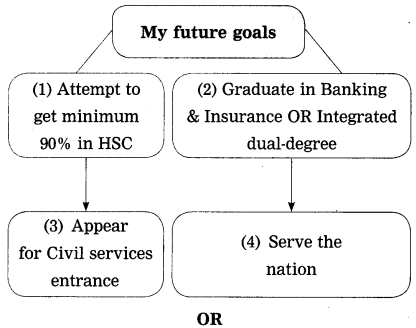
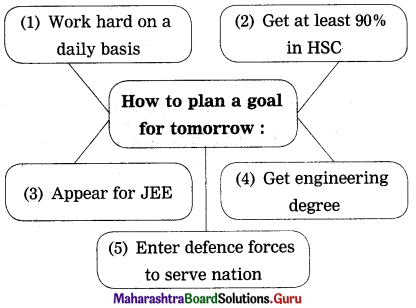
Prepare a mind map on ‘How to plan a goal for tomorrow’ or ‘My future goal’. Take the help of points given in ‘Writing Skills Section’ for preparing a mind map.
Answer:
Maharashtra Board Class 12 English Yuvakbharati Solutions Chapter 2.4 Have you Earned Your Tomorrow 3
Maharashtra Board Class 12 English Yuvakbharati Solutions Chapter 2.4 Have you Earned Your Tomorrow 4

Question (iii)
Write a set of 8 to 10 interview questions to be asked to a social worker. Take the help of the following points:

  • Childhood
  • Education
  • Service
  • Difficulties
  • Future plans
  • Achievements
  • Message

Answer:

  1. Good evening Rima ma’am. I would like to know a bit about your life. Could we begin with a walk down memory lane to your childhood?
  2. What was your hobby/past-time in your childhood?
  3. Which is the best memory during your school/high school/college years? Which phase did you enjoy the most?
  4. You have moved to different cities due to your father’s job. Which is the city/town which you loved living in the most?
  5. How did you get into social service? Who was your role model or inspiration?
  6. What were the challenges and difficulties that caused any setback in your life?
  7. What plans do you have for the future? Would you mind sharing a little of those with your fans?
  8. There are many achievements you have seen. Which is the most important according to you?
  9. What is the message you want to give to those in this noble field? What would be your tip especially for youngsters?

Maharashtra Board Class 12 English Yuvakbharati Solutions Chapter 2.4 Have you Earned Your Tomorrow

Question (iv)
Compose 4-6 lines on your own on ‘Good deeds’.
Answer:
‘Good deeds’
The tree gives shade and fruits it does not eat
The river flows cool and sweet of water it doesn’t drink.
When a stranger sad or in need you may meet
Be sure you lift him up, not let him into despair sink.

(A6)

Question (i)
Find out different career opportunities in the field of social work.

Question (ii)
Collect information of the NGOs working for the underprivileged section of the society.

Yuvakbharati English 12th Digest Chapter 2.4 Have you Earned Your Tomorrow Additional Important Questions and Answers

Read the poem and complete the activities given below:

Personal Response:

Question 1.
Describe the various ways you use to greet your elder.
Answer:
Whenever we meet our elders we greet them with great respect and love. Through the length and breadth of our country touching the feet of elders is the tradition. We also fold our palms in the very Indian greeting of ‘Namaste’. This comes from the word ‘Namaskaar’. In south India touching people is not a normal custom. Younger people prostrate full length before elders such as parents, uncles-aunts, gurus and even older siblings. In north India the younger bend before the elders and ladies cover their head with the shawl or sari edge. Age is a very significant factor. The greeting is always a gesture of respect and the elders respond affectionately by showering blessings.

Maharashtra Board Class 12 English Yuvakbharati Solutions Chapter 2.4 Have you Earned Your Tomorrow

Poetic Devices:

Question 1.
Identify an example of synecdoche from the poem.
Answer:
‘Is a single heart rejoicing over what you did or said;’
The word ‘heart’, 3rd line of the 3rd stanza is an example of synecdoche.
The word heart – a part – refers to a whole or the person who is rejoicing.

Maharashtra Board Class 11 Political Science Important Questions Chapter 3 Equality and Justice

Balbharti Maharashtra State Board Class 11 Political Science Important Questions Chapter 3 Equality and Justice Important Questions and Answers.

Maharashtra State Board 11th Political Science Important Questions Chapter 3 Equality and Justice

1A. Choose the correct alternative and complete the following statements.

Question 1.
___________ equality is reflected in Universal Adult Franchise. (Social, Political, Natural, Economic)
Answer:
Political

Question 2.
In ancient Indian society, justice was associated with ___________ (Moksha, Artha, Dharma, Yodha)
Answer:
Dharma

Maharashtra Board Class 11 Political Science Important Questions Chapter 3 Equality and Justice

Question 3.
According to ___________, the state is an instrument of oppression of workers. (Karl Marx, Robert Nozick, Dr. Ambedkar, Plato)
Answer:
Karl Marx

1B. Identify the incorrect pair in every set and correct it.

Question 1.
(a) Aristotle – The Politics
(b) Thomas Hobbes – Leviathan
(c) Plato – The Republic
(d) Karl Marx – A Theory of Justice
Answer:
(d) Karl Marx – Communist Manifesto or John Rawls – A Theory of Justice

Question 2.
(a) Aristotle – Natural equality
(b) Karl Marx – Classless society
(c) Tarabai Shinde – Emancipation from caste system
(d) Laski – Justice as truth and morality
Answer:
(d) Plato – Justice as truth and morality

1C. State the appropriate concept for the given statement.

Question 1.
Application of the abstract concept of justice through the implementation of the law.
Answer:
Legal justice

Maharashtra Board Class 11 Political Science Important Questions Chapter 3 Equality and Justice

Question 2.
Law treats all citizens equally.
Answer:
Equality before the law

Question 3.
Section of society that owns means of production.
Answer:
‘Haves’

1D. Answer in one sentence.

Question 1.
Who propounded the idea of a classless society?
Answer:
Karl Marx propounded the idea of a ‘classless society.

Question 2.
Name two Indian reformers who focused on gender inequality.
Answer:
Mahatma Phule, Mahatma Gandhi focused on gender inequality.

Question 3.
What was Tocqueville’s idea of equality?
Answer:
Tocqueville’s idea of equality developed in the process of abolition of the feudal system and the establishment of democracy.

Question 4.
What is the significance of Article 17?
Answer:
Article 17 deals with the abolition of Untouchability.

Maharashtra Board Class 11 Political Science Important Questions Chapter 3 Equality and Justice

Question 5.
What is John Rawls’s view of Justice?
Answer:
John Rawls’s view of justice relates to Distributive Justice and the principle of fairness.

1E. Complete the following sentence using appropriate reason.

Question 2.
Equality is fundamentally a leveling process because
(a) it is an attempt to create conditions where everyone has an equal opportunity to progress.
(b) it refers to the absence of special privileges to or discrimination against any person or group.
(c) it is one of the pillars of democracy.
Answer:
(b) it refers to the absence of special privileges to or discrimination against any person or group.

Question 2.
Karl Marx advocated a socialist system because
(a) it will ensure an equitable distribution of resources.
(b) it advocated procedural justice.
(c) it would lead to capitalism.
Answer:
(a) it will ensure an equitable distribution of resources.

1F. Find the odd word in the given set.

Question 1.
Hobbes, Locke, Rousseau, Marx.
Answer:
Marx (all others wrote about state of nature)

Question 2.
Socrates, Plato, Aristotle, Rawls.
Answer:
Rawls (all others were ancient Greek thinkers)

Maharashtra Board Class 11 Political Science Important Questions Chapter 3 Equality and Justice

Question 3.
Justice Ranade, Dr. Ambedkar, Dr. Amartya Sen, Gandhiji.
Answer:
Dr. Amartya Sen (differing view of equality)

Question 4.
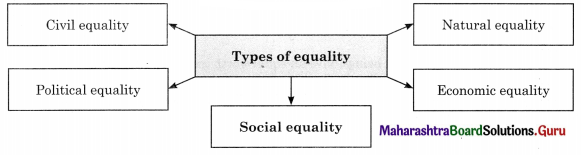
Political equality, Civil equality, Economic equality, Social equality.
Answer:
Political Equality (available only to citizens)

2A. State whether the following statements are true or false with reasons.

Question 1.
Karl Marx propounded the idea of a classless society.
Answer:
This statement is True.

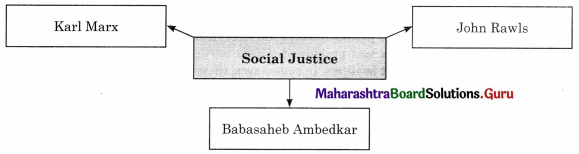
  • Karl Marx rejected the liberal view of equality and instead propounded the concept of Socialism. He felt that the State, which is in the hands of the capitalist class (Haves) is an instrument of exploitation of workers.
  • A Socialist system will ensure the dignity of workers an equitable distribution of resources and eliminate class distinctions, leading to a classless society.

Question 2.
Absolute equality is neither possible nor desirable.
Answer:
This statement is True.

  • Equality implies a society where any person is not denied opportunities or facilities merely on criteria such as gender, race, etc. It means the absence of discrimination or special privileges.
  • Equality does not mean uniformity Natural inequality is a fact. Absolute equality is not desirable as it will destroy individuality.

Maharashtra Board Class 11 Political Science Important Questions Chapter 3 Equality and Justice

Question 3.
Social justice is essentially reformative and distributive.
Answer:
This statement is True.

  • The concept of social justice implies equal social opportunities for every individual to progress to the fullest possible extent. Social justice is reformative i.e., it aims at a revision of the social order and involves the eradication of existing social evils.
  • Social justice is also distributive i.e., available resources should be equitably distributed to ensure social welfare.

Question 4.
Considering the special needs of certain sections of society conflicts with the principle of equality.
Answer:
This statement is False.

  • Equality means the absence of discrimination or special privileges to some as well as the presence of adequate opportunities for every individual.
  • Consideration of the special needs of some disadvantaged sections of society like women, the disabled, senior citizens, Dalits, tribals, etc. is a democratic necessity and in fact, helps to promote social equality.

2B. Complete the concept maps.

Question 1.
Maharashtra Board Class 11 Political Science Important Questions Chapter 3 Equality and Justice 2B Q1
Answer:
Maharashtra Board Class 11 Political Science Important Questions Chapter 3 Equality and Justice 2B Q1.1

Question 2.
Maharashtra Board Class 11 Political Science Important Questions Chapter 3 Equality and Justice 2B Q2
Answer:
Maharashtra Board Class 11 Political Science Important Questions Chapter 3 Equality and Justice 2B Q2.1

Maharashtra Board Class 11 Political Science Important Questions Chapter 3 Equality and Justice

Question 3.
Maharashtra Board Class 11 Political Science Important Questions Chapter 3 Equality and Justice 2B Q3
Answer:
Maharashtra Board Class 11 Political Science Important Questions Chapter 3 Equality and Justice 2B Q3.1

3. Answer the following.

Question 1.
Explain the facets of equality.
Answer:
The facets of equality are:

  • Absence of special privileges to or of discriminations against anyone in the matter of socio-economic and political rights. No person or group should have special conditions that are denied to a large majority.
  • For e.g., in the caste hierarchy, the lower castes were discriminated against while upper castes flourished, as they had special status and privileges.
  • Equality before the law and equal protection of the law – The law is equally applicable to everyone irrespective of economic or social status, race, creed, etc.
  • Equality of opportunity – To enhance one’s potential and to develop one’s personality irrespective of considerations like ethnicity, gender, community, etc., deprived sections must have provisions for education, employment, and social well-being to enable fair competition with others.
  • Absolute equality is neither possible nor desirable as equality in no way implies uniformity.

Question 2.
Explain Karl Marx’s view of equality and justice.
Answer:
Karl Marx rejected the liberal idea of equality and propounded the socialist idea of equality. According to him, equality can be achieved through the creation of a classless society. Marx gave importance to the emancipation of workers from exploitation and stressed equal distribution of means of production. According to him, equality thus achieved would be different from the liberal ideas of equality.

Maharashtra Board Class 11 Political Science Important Questions Chapter 3 Equality and Justice

Karl Marx considered the State as an instrument of exploitation of workers. This instrument was in the hands of the capitalist class. Since laws are made by the State, it is natural that they protect the interests of the capitalists. Marx maintained that the transformation of the capitalist system into a socialist system will ensure an equitable distribution of resources. The socialist system gives a priority to the right to equality of the ‘have-nots’ rather than the right of property of the ‘haves’. Thus, according to Marx, implementing socialist agenda is considered to be justice, and that the judiciary should be committed to Socialism.

Question 3.
Explain John Rawl’s concept of justice.
Answer:
John Rawls was an advocate of Social Justice, who advocated the concept of Distributive Justice. Rawl’s theory of social justice focuses on the just desire of individuals in society. In his book, ‘A Theory of Justice’, Rawls argues that the concept of freedom and equality are not mutually exclusive. He concludes that for justice to be truly just, everyone must be accorded the same rights under the law.

Rawls has put forth two principles of social justice:

  • Fundamental rights and duties must be uniformly acceptable. A system can be just only when those at the bottom of the system are able to benefit from it.
  • There must be equality of opportunity for all the public offices that are available. This is Rawls’s concept of fairness.

Question 4.
Explain the three indicators of equality.
Answer:
The concept of equality is a central idea of political philosophy. There are three indicators of this concept-

  • Welfare equality: Fulfillment of needs of an individual is more important than what is readily available for him.
  • Equality of resources: It means equitable distribution of the available resources.
  • Equality of capabilities: The usage of resources by people is more important than merely the availability of those resources.

4. Answer the following in detail with reference to the given points.

Question 1.
Explain equality.
(i) Meaning of Equality
(ii) Facets of Equality
(iii) Importance of Equality
Answer:
(i) Meaning: Equality is an important ideal in society. Equality does not mean uniformity. It signifies that all human beings have equal worth, irrespective of their ethnicity, religion, caste, etc. Today, equality is looked at as a political goal as well as the basis of Liberty and Justice. It has a moral and collective dimension as it includes empathy and tolerance.

Natural inequalities are a reality since humans are not equal in physical or intellectual aspects. The struggle for equality is to do away with the restrictions and burdens of man-made inequalities that are created on the basis of religion, caste, race, status, wealth, etc. Equality is the attempt to create conditions where every individual is given equal opportunity to develop and progress.

Maharashtra Board Class 11 Political Science Important Questions Chapter 3 Equality and Justice

(ii) The facets of equality are:

  • Absence of special privileges to or of discriminations against anyone in the matter of socio-economic and political rights. No person/group should have special conditions that are denied to a large majority. For e.g., In the caste hierarchy, the lower castes were discriminated against while upper castes flourished.
  • Equality before the law and equal protection of the law – The law is equally applicable to everyone irrespective of economic or social status, race, creed, etc.
  • Equality of opportunity – To enhance one’s potential and to develop one’s personality irrespective of considerations like ethnicity, gender, community, etc. Deprived sections must have provisions for education, employment, and social wellbeing to enable fair competition with others.
  • Absolute equality is neither possible nor desirable as equality in no way implies uniformity.

(iii) Importance of Equality:

  • Equality is necessary to uphold the dignity of the individual.
  • It is necessary to create a just society.
  • It is necessary to promote mutual respect among members of society.
  • It helps to bring about the fraternity.
  • Liberty and equality are the cornerstones of a democracy.

Question 2.
Explain the types of equality.
(i) Natural Equality
(ii) Social Equality
(iii) Civil Equality
(iv) Political Equality
(v) Economic Equality
Answer:
(i) Natural Equality considers that all human beings are equal though they differ in inabilities. Every person should get an equal opportunity to develop his/her potential. Early Greek thinkers like Plato and Aristotle did not believe in natural equality. However, thinkers like Hobbes, Locke, and Rousseau explained natural equality in the ‘State of Nature’.

(ii) Social Equality refers to the absence of unreasonable social barriers or discrimination such as those based on race, religion, caste, gender, status, etc. No person must be viewed as superior or inferior merely on the basis of birth, ethnicity, or social position. However, social inequality is prevalent all over the world even today. Legislations, education, and economic progress can help to reduce social inequality for e.g., in India Article 17 of the constitution deals with the abolition of untouchability.

(iii) Civil Equality means that civil rights are equally available to all individuals. There is equality before the law and equal protection of the law. However, special laws made for the protection or upliftment of weaker sections of society such as tribals, backward classes, women, etc., do not violate the principle of equality.

(iv) Political Equality is possible only in a democracy. It refers to the right of citizens to participate in the affairs of the state. It is based on the principle of political participation and Universal Adult Franchise.

Maharashtra Board Class 11 Political Science Important Questions Chapter 3 Equality and Justice

(v) Economic Equality – When wealth is concentrated in the hands of a few (economic inequality), then political power and social ranking are also monopolized by them, resulting in exploitation of the underprivileged sections of society.
Economic equality does not imply equal distribution of wealth or equal income irrespective of the nature of work.

Economic equality implies the following:

  • Reduction in wide disparities of wealth.
  • Prevention of concentration of wealth and income in the hands of a few persons.
  • Absence of any kind of economic exploitation, denial, or subjugation.
  • Availability of essential goods and services i.e. minimum needs must be satisfied first.
  • Reasonable economic opportunities for individuals to develop themselves and to progress.
  • Adequate scope for work and for decent wages.

Question 3.
Explain Justice.
(i) Meaning of Justice
(ii) Types of Justice
Answer:
(i) Meaning: Justice implies righteousness which is used as a basis for judging values and conduct. It is an ancient concept. Greek philosopher, Socrates considered justice as a political virtue. Plato identified justice with truth and morality while Aristotle expressed that justice can be achieved in a society only when there is equality and balance. In ancient India, justice was associated with the concept of ‘Dharma’. The term justice refers to ‘a state of affairs in which every individual has exactly those burdens and benefits which are due to him.

(ii) Types of Justice:

  • Natural Justice – This concept is linked to the very existence of human beings and was advocated by ancient Greek and Roman philosophers. Humans can intrinsically and universally understand concepts of right and wrong. Hence there is no need for man-made law.
  • Legal Justice – John Austina considered law as a means to eliminate injustice and to establish a just society. Justice is a precondition to law.
  • Social Justice – The concept of social justice implies equal social opportunities for every individual to progress to the fullest possible extent. Social justice is reformative i.e., it aims at a revision of the social order. It involves the eradication of existing social evils.Socialjusticeisalsohisfridufioei.e., available resources should be equitably distributed to ensure social welfare. It is not just related to individuals or groups, but to society at large. Social justice is dynamic i.e. it modifies according to changing needs and situations.

Maharashtra Board Class 11 Political Science Important Questions Chapter 3 Equality and Justice

The two approaches of social justice are

  • Procedural justice advocated by Nozick i.e., everyone should be treated equally before the law and proper legal procedures must be followed.
  • Social justice was propagated by Marx, Rawls, and Dr. Ambedkar.

Maharashtra Board Class 11 Political Science Solutions Chapter 3 Equality and Justice

Balbharti Maharashtra State Board Class 11 Political Science Solutions Chapter 3 Equality and Justice Textbook Exercise Questions and Answers.

Maharashtra State Board Class 11 Political Science Solutions Chapter 3 Equality and Justice

1A. Choose the correct alternative and complete the following statements.

Question 1.
The base of political equality is __________ (democracy, dictatorship, military rule, monarchy)
Answer:
democracy

Maharashtra Board Class 11 Political Science Solutions Chapter 3 Equality and Justice

Question 2.
John Rawls was an advocate of __________ justice. (distributive, political, economic, gender-based)
Answer:
distributive

1B. State the appropriate concept for the given statement.

Question 1.
The principle of equality states that each one should get an opportunity for the development of their individual personality.
Answer:
Equality of opportunity

Question 2.
Type of equality which says that every citizen has an equal right to participate in affairs of the State.
Answer:
Political equality

Question 3.
Absence of economic exploitation.
Answer:
Economic equality

1C. Complete the following sentence using appropriate reason.

Question 1.
In India, laws were made regarding the abolition of untouchability. Because
(a) untouchability is a political concept
(b) untouchability is a legal concept
(c) social inequality can be controlled by State legislation
Answer:
(c) social inequality can be controlled by State legislation

Maharashtra Board Class 11 Political Science Solutions Chapter 3 Equality and Justice

2. Complete the concept map/maps.

Question 1.
Maharashtra Board Class 11 Political Science Solutions Chapter 3 Equality and Justice 2 Q1
Answer:
Maharashtra Board Class 11 Political Science Solutions Chapter 3 Equality and Justice 2 Q1.1

3. State whether the following statements are true or false with reasons.

Question 1.
Democracy denies equality.
Answer:
This statement is False.

  • A democratic government is based on the pillars of liberty, equality, justice, and fraternity.
  • Equality signifies equality of opportunity, political participation, and equal protection of the law which can be ensured only in a democracy.

Question 2.
Equality is a political goal.
Answer:
This statement is True.

  • Equality signifies that all human beings have an equal worth irrespective of their race, religion, caste, etc. It, however, does not mean uniformity.
  • In modern times, equality includes aspects like tolerance and empathy i.e., a moral and collective dimension. It is also the basis of liberty and justice and is thus considered a political goal.

Maharashtra Board Class 11 Political Science Solutions Chapter 3 Equality and Justice

Question 3.
Social democracy is the foundation of political democracy.
Answer:
This statement is True.

  • Social democracy means that there is equality i.e., no distinction among individuals merely on basis of ethnicity, creed, gender, etc. It ensures the dignity of the individual.
  • Political democracy is expressed in political rights such as the right to vote, to criticize the government, etc. In the absence of social democratic political democracy will be less worthwhile.

4. Explain the co-relation between the following.

Question 1.
Equality and justice.
Answer:
Equality refers to equal rights and opportunities for all persons irrespective of their race, creed, gender, etc. It means no person or group will be discriminated against socially, economically, or politically. Similarly, no person or group will have special privileges that are denied to the vast majority in society.

Justice refers to that state of affairs in which every individual gets exactly those burdens and benefits that are due to him. It refers to the absence of socio-economic, political, and legal injustices.

In the absence of equality, there will be a denial of justice and the progress of society will be hindered. Justice aims at the reconciliation of individual rights and larger social interests.

Question 2.
Legal Justice and Social Justice
Answer:
Legal justice is the application of the abstract concept of justice through the implementation of the law. Justice is a precondition to the law as, without it, the law may become an instrument of tyranny and suppression. Austin considers law as a means to suppress injustice as well as to establish justice. Legal justice signifies an independent and impartial judiciary that observes specific rules for judicial proceedings. Any accused should be charged keeping in mind his/her human rights.

Social justice is both reformative and distributive. It aims at a revision of the social order by doing away with socio-economic evils for e.g. to eradicate untouchability, there is Article 17 of the constitution as well as laws passed by Parliament.

Procedural justice demands equality before the law as well as correct interpretation and application of the law. Social justice is also reformative i.e., equitable distribution of goods and services so that underprivileged sections can get an adequate share in this distribution.

5. Express your opinion of the following.

Question 1.
Casteism is a barrier to social equality.
Answer:
The caste system is one of the basic features of Indian society. It implies divisions in society based merely on one’s birth into a particular section of society. There was a caste hierarchy in which the upper castes enjoyed privileges that were denied to the lower castes. Even, within the four main Chaturvaranas, hierarchies began to develop.

Maharashtra Board Class 11 Political Science Solutions Chapter 3 Equality and Justice

Casteism began to become a social evil, as it resulted in untouchability as well as the exploitation and segregation of lower castes. They were denied equal opportunities to have socio-economic and political rights. Casteism did not permit upward mobility in the caste hierarchy due to marriage or achievement. The intermingling of castes was prohibited. Lower castes were often discriminated against in educational, political, and employment facilities. In some cases, they were denied access to public places like water bodies, hospitals, etc.

Social equality means that there has to be no favouring of or discrimination against any person/group on irrelevant aspects like caste and creed. It means that the dignity and intrinsic worth of every person must be recognized. Thus, the rigid hierarchies and discrimination perpetuated by casteism hinder social equality.

6. Answer the following.

Question 1.
Explain the Indian concept of Justice.
Answer:
There exist different kinds of inequalities in India, such as those created through the caste system, through the patriarchal system, etc. Dr. Babasaheb Ambedkar argued that justice would be achieved when the structure and values associated with these systems undergo a change. He also related the concept of justice to the concept of the distribution of resources. The Constitution of India ensures justice through both, procedural justice and social justice. This can be achieved through the educational and economic development of the backward classes.

Maharashtra Board Class 11 Political Science Solutions Chapter 3 Equality and Justice

Justice is implemented through the following policies:

  • The policy of reservation.
  • Granting of scholarships, grants, loans, health services, etc. for weaker sections of the society.
  • Eradication of unjust social and economic practices which exploit the backward classes.

Maharashtra Board Class 11 Political Science Important Questions Chapter 2 Liberty and Rights

Balbharti Maharashtra State Board Class 11 Political Science Important Questions Chapter 2 Liberty and Rights Important Questions and Answers.

Maharashtra State Board 11th Political Science Important Questions Chapter 2 Liberty and Rights

1A. Choose the correct alternative and complete the following statements.

Question 1.
The word ‘liberty’ is derived from the Latin word _________ (libre, liber, libel, little)
Answer:
liber

Question 2.
_________ viewed liberty from a collective perspective. (Rousseau, Hobbes, Bentham, Mill)
Answer:
Rousseau

Maharashtra Board Class 11 Political Science Important Questions Chapter 2 Liberty and Rights

Question 3.
_________ rights are granted by the state and are codified in law. (Natural, Moral, Legal, National)
Answer:
Legal

Question 4.
Part _________ of the Indian Constitution deals with fundamental rights. (I, II, III, IV)
Answer:
III

Question 5.
Right to _________ was introduced as fundamental right in 2002. (Education, Information, Property, Privacy)
Answer:
Education

Question 6.
Right to _________ was removed as a fundamental right in 1978. (Education, Information, Property, Privacy)
Answer:
Property

1B. Identify the incorrect pair in every set, correct and rewrite.

Question 1.
(a) Herbert Marcuse – German-American Philosopher
(b) John Locke – American Philosopher
(c) Thomas Hobbes – English Philosopher
(d) Friedrich Hayek – Anglo-Austrian Philosopher
Answer:
(b) John Locke – English philosopher

Question 2.
(a) Isaiah Berlin – Two concepts of liberty
(b) John Stuart Mill – On liberty
(c) Herbert Marcuse – One Dimensional man
(d) Jean-Jacques Rousseau – Eros and Civilization
Answer:
(d) Jean – Jacques Rousseau – The Social Contract or Herbert Marcuse – Eros and civilisation.

Maharashtra Board Class 11 Political Science Important Questions Chapter 2 Liberty and Rights

Question 3.
(a) Jeremy Bentham – The greatest happiness of the greatest numbers
(b) Jean-Jacques Rousseau – The General Will
(c) Isaiah Berlin – I am a slave to no man
(d) Mahatma Gandhi – Promoted western education and culture
Answer:
(d) Mahatma Gandhi – Freedom from western cultural domination.

1C. State the appropriate concept for the given statement.

Question 1.
A political ideology whose central theme is based on individualism.
Answer:
Liberalism

Question 2.
Type of liberalism based on the concept of “minimum government”.
Answer:
Classical liberalism

Question 3.
Type of liberalism which advocates a free-market economy.
Answer:
Neoliberalism

Question 4.
Type of liberalism which propounds role of Welfare State.
Answer:
Modern liberalism

Question 5.
The aspect of liberty is expressed by Berlin’s statement “I am my own master”.
Answer:
Positive liberty

Maharashtra Board Class 11 Political Science Important Questions Chapter 2 Liberty and Rights

Question 6.
Universal Rights are based on human nature.
Answer:
Natural rights

1D. Answer in one sentence only.

Question 1.
What is national liberty?
Answer:
Freedom from foreign rule i.e., political independence means national liberty.

Question 2.
What does Locke’s concept of liberty focus on?
Answer:
Locke’s concept of liberty focuses on the absence of unreasonable restraints and the freedom of choice.

Question 3.
Who is considered as the ‘Father of the French Revolution?
Answer:
Jean-Jacques Rousseau is considered the ‘Father of the French Revolution.

Question 4.
Which English philosophers considered liberty as a natural right?
Answer:
English philosophers such as John Locke and Thomas Hobbes considered liberty as a natural right.

Question 5.
What were Isaiah Berlin’s two concepts of liberty?
Answer:
Isaiah Berlin’s two concepts of liberty include positive liberty and negative liberty.

Maharashtra Board Class 11 Political Science Important Questions Chapter 2 Liberty and Rights

Question 6.
What was Jeremy Bentham’s principle of liberty?
Answer:
Jeremy Bentham’s principle of liberty was ‘the greatest happiness of the greatest numbers.

Question 7.
What forms of liberalism contributed to the concept of negative liberty?
Answer:
Classical and Neoclassical liberalism is contributed to the concept of negative liberty.

Question 8.
Why does Marcuse support state interference in an individual’s life?
Answer:
Marcuse advocates collective control to be essential in community life as a principle of positive liberty and hence supports state interference in the individual’s life.

Question 9.
What is the literal meaning of ‘Swaraj’.
Answer:
‘Swa’ (self) and ‘Raj’ (rule) hence Swaraj implies ‘self-rule’ or self-governance.

Question 10.
What are natural rights?
Answer:
Natural rights are rights that are part are of human nature and reason.

Question 11.
When was the Universal Declaration of Human Rights made?
Answer:
The Universal Declaration of Human Rights was made On 10th December 1948.

1E. Complete the following sentence by using appropriate reason.

Question 1.
John Locke does not advocate unrestrained freedom as –
(a) Liberty means the absence of restraint and freedom of choice
(b) personal interests should be kept aside for social interest.
(c) liberty is a hurdle-less situation.
Answer:
(a) Liberty means the absence of restraint and freedom of choice

Maharashtra Board Class 11 Political Science Important Questions Chapter 2 Liberty and Rights

Question 2.
According to Gandhiji, the concept of ‘Swaraj’ was liberty as –
(a) It implied freedom from colonial rule.
(b) It implied social reformation
(c) It gives importance to self-governance and humanitarian values.
Answer:
(c) It gives importance to self-governance and humanitarian values.

1F. Find the odd word in the given set.

Question 1.
Fredrick Hayek, Robert Nozick, Jean-Jacques Rousseau, J. S. Mill
Answer:
Jean-Jacques Rousseau (positive liberty)

Question 2.
Right to Life, Right to Vote, Right to Contest Elections, Right to Criticize the Government.
Answer:
Right to Life (civil right)

Question 3.
Right to Equality, Right to Property, Right to Education, Right against exploitation.
Answer:
Right to Property (not a fundamental right)

2A. State whether the following statements are true or false with reasons.

Question 1.
Right to Property is a Fundamental Right in India.
Answer:
This statement is False.

  • The Right to Property was a fundamental right. However, in 1978, by the 44th Amendment Act, this right was removed as a fundamental right.
  • At present, the Right to property is a Statutory Right (Article – 300A).

Maharashtra Board Class 11 Political Science Important Questions Chapter 2 Liberty and Rights

Question 2.
Liberty and Rights are inseparable.
Answer:
This statement is True.

  • Rights help to strengthen liberty. Liberty itself consists of various civil, political, and economic rights.
  • Thus, rights and liberty are two sides of the same coin.

Question 3.
National liberty is the foundation of all liberties.
Answer:
This statement is True.

  • National liberty refers to freedom from foreign rule.
  • True liberty can be enjoyed by individuals only when they exist in an independent, democratic state.

Question 4.
Human Rights are universal.
Answer:
This statement is True.

  • Human Rights refer to the rights that people are entitled to simply because they are human beings.
  • An individual can achieve his/her full potential only when one is free to make the best use of available opportunities.
  • Human Rights are based on the principle of dignity and the inherent worth of an individual.

2B. Complete the concept maps.

Question 1.
Maharashtra Board Class 11 Political Science Important Questions Chapter 2 Liberty and Rights 2B Q1
Answer:
Maharashtra Board Class 11 Political Science Important Questions Chapter 2 Liberty and Rights 2B Q1.1

Question 2.
Maharashtra Board Class 11 Political Science Important Questions Chapter 2 Liberty and Rights 2B Q2
Answer:
Maharashtra Board Class 11 Political Science Important Questions Chapter 2 Liberty and Rights 2B Q2.1

3. Answer the following questions.

Question 1.
Enumerate the fundamental rights in the Indian constitution.
Answer:
Part III (Articles 12 – 35) of the Indian Constitution spells out the Fundamental Rights of Indian citizens. The Constitution guarantees six fundamental rights which are

  • Right to Equality
  • Right to Freedom
  • Right against Exploitation
  • Right to Freedom of Religion
  • Cultural and Educational Rights and
  • Right to Constitutional Remedies.

Maharashtra Board Class 11 Political Science Important Questions Chapter 2 Liberty and Rights

Question 2.
Explain Rousseau’s concept of liberty.
Answer:
Rousseau looked at liberty from a collective perspective. According to him, an individual should keep personal interests aside for social interests. His concept of liberty frees the individual from a class-based system and inequality. According to him, inequality is an obstacle to the attainment of liberty. He maintains that liberty frees an individual from the hurdles created by the rise of civil and political society.

He describes two hurdles on liberty:

  • One which prohibits an individual to think about public interest
  • One is created due to inequality in society.

Rousseau did not consider liberty as a natural right as advocated by Hobbes and Locke. He believed that society comes together to protect the life and interest of the individual. Therefore, he gave more importance to emancipation from social inequality. He also stressed the freedom of choice and availability of favorable conditions in the concept of liberty. He believed that obedience to moral laws will enhance liberty. According to Rousseau, the state is a sovereign power that represents the ‘General Will’. Hence he supports the idea of state control over the individual.

Question 3.
Explain the Indian Concept of Liberty.
Answer:
Traditionally, in India liberty is a spiritual idea signifying ‘salvation or emancipation from the cycle of birth and rebirth’. However, in modern times, liberty is understood as liberation from social constraints.
In British India, the concept of liberty was accepted as

  • Laws were made by the British for the protection of individual rights e.g., the law for the abolition of Sati.
  • Views of great reformers like Mahatma Phule, Dr. Ambedkar. They believed liberty means freedom from caste inequality as well as from social constraints i.e., the liberation of lower castes from the domination of the upper castes.
  • Mahatma Gandhi accepted the concept of Swaraj as liberty. This was a comprehensive concept that included freedom from British rule and western cultural domination. It gives more importance to self-governance, self-discipline, and human values.

Question 4.
List the human rights enumerated in the U.D.H.R.
Answer:
U.D.H.R. was made on 10th December 1948. It consists of 30 articles that elaborate on civil, political, social, and economic rights. The U.D.H.R. expresses a strong belief in the principles of liberty, equality, justice, and fraternity. It is an attempt to eliminate forms of injustice and discrimination so that everyone is entitled to live with dignity and respect.

Maharashtra Board Class 11 Political Science Important Questions Chapter 2 Liberty and Rights

U.D.H.R. includes

  • Civil rights such as the right to life, right to liberty, right to freedom of thought and expression right to religious freedom, etc.
  • Political rights such as the right to franchise, to political participation, to criticize the government, etc.
  • Social rights such as the right against any form of denial, injustice, exploitation, torture, etc. It also includes the right to health, education leisure, etc.
  • Economic rights such as the right to work, right to a livelihood, right to just and humane work conditions, etc.

4. Answer the following in detail with reference to the given points.

Question 1.
Elaborate the concept of Rights –
(i) Civil Rights
(ii) Political Rights
Answer:
(i) Civil Rights: These rights are personal rights of the individual according to reasonable limits laid down by the law. This includes universally recognized rights like the right to

  • Freedom of thought and expression.
  • Freedom of religion, conscience, and worship
  • Freedom of movement, association, and assembly
  • Freedom from fear and want.

(ii) Political Rights: These rights are available only to citizens in a democracy. They include

  • right to vote
  • right to stand for elections
  • right to hold public office
  • right to hold public views and to criticize the government.

Maharashtra Board Class 11 Political Science Important Questions Chapter 2 Liberty and Rights

Activity

Find out various Supreme Court cases that have focused on the rights and liberty of Indian citizens.
Answer:

  • Supreme Court declares the Right to Privacy as a fundamental right that is intrinsic to life and liberty. This was declared in the K.S. Puttaswamy vs Union of India by a bench of judges headed by the then Chief Justice J. S. Khehar.
  • Supreme Court in September 2018 decriminalized gay sex (Section 377). This was a vestige of British colonial rule.
  • Supreme Court set aside ‘instant talaq’ (talaq-e-bidat) on the basis that it violated constitutional provisions. This was on a petition by Shayara Bano (2016).

Maharashtra Board Class 11 Political Science Solutions Chapter 2 Liberty and Rights

Balbharti Maharashtra State Board Class 11 Political Science Solutions Chapter 2 Liberty and Rights Textbook Exercise Questions and Answers.

Maharashtra State Board Class 11 Political Science Solutions Chapter 2 Liberty and Rights

1A. Choose the correct alternative and complete the following statements.

Question 1.
The book, ‘On Liberty’ was written by ___________ (Robert Nozick, Thomas Hobbes, J. S. Mill, Isaiah Berlin)
Answer:
J. S. Mill

Maharashtra Board Class 11 Political Science Solutions Chapter 2 Liberty and Rights

Question 2.
The concept of Swaraj was spelled out by ___________ (Mahatma Gandhi, Mahatma Phule, Dr. Ambedkar, Dr. Rajendra Prasad)
Answer:
Mahatma Gandhi

1B. Complete the following sentence by using appropriate reason.

Question 1.
According to Jeremy Bentham, the State should not bring any obstruction, in liberty because –
(a) State does not give liberty.
(b) the individual knows how to protect his own interests.
(c) liberty is a hurdle-less situation.
Answer:
(b) the individual knows how to protect his own interests.

1C. State the appropriate concept for the given statement.

Question 1.
Fundamental right introduced in Constitution of India by 86th Amendment.
Answer:
Right to education

Question 2.
Rights-based on the conscience of the individual and the community.
Answer:
Moral rights

2. Complete the concept map.

Question 1.
Maharashtra Board Class 11 Political Science Solutions Chapter 2 Liberty and Rights 2 Q1
Answer:
Maharashtra Board Class 11 Political Science Solutions Chapter 2 Liberty and Rights 2 Q1.1

3. State whether the following statements are true or false with reasons.

Question 1.
Legal rights are not universal.
Answer:
This statement is True.

  • Legal rights include political and civil rights which are granted by the State to the people. Legal rights are codified in law.
  • Different countries grant different rights to their people. Hence, unlike natural rights, legal rights are not universal.

Maharashtra Board Class 11 Political Science Solutions Chapter 2 Liberty and Rights

4. Explain the co-relation between the following.

Question 1.
Concept of Liberty by Thomas Hobbes and John Locke (Positive liberty and Negative liberty).
Answer:
Positive liberty and Negative liberty are two aspects of liberty that have their origin in liberalism. Negative liberty emerged from classical and neoclassical liberalism and finds expression in the views of thinkers like Jeremy Bentham, John Stuart Mill, Robert Nozick, Friedrich Hayek, and Isaiah Berlin.

Negative liberty opposes all restraints on liberty i.e., the State should not interfere in the social, economic life of the individual. It opposes any coercion, interference, or force on part of the State. The base negative aspect of liberty is the freedom of thought. Bentham argues that every person knows how to protect their own interest and hence no obstruction should be brought by the State.

John Stuart Mill suggests that negative liberty should be rejected only if it adversely impacts society. Hayek described liberty as a hurdle-less situation while Nozick suggested that the individual should be free from social, economic, and State restrictions. Berlin explains that negative liberty is opposition to restraints on the choice of alternatives.

The positive aspect of liberty as advocated by Jean-Jacques Rousseau and Herbert Marcuse emerged from modern liberalism. It states that liberty affects equality and justice. The law guides the individual towards the enrichment of their personality. Rousseau advocated the idea of State control over the individual since the State is a sovereign power that represents the ‘General Will’. Similarly, Marcuse advocates State interference and collective control as essential in community life.
We can conclude in the two statements of Isaiah Berlin.

  • The negative aspect of liberty – ‘I am a slave to no man’.
  • The positive aspect of liberty – ‘I am my own master’.

Question 2.
Natural rights and Legal rights.
Answer:
According to Harold Laski, ‘Rights are those conditions of social life without which no man can seek, in general, to be himself at his best.

Rights may be classified as natural rights, moral rights or legal (civil-political) rights.
Natural Rights e.g., the right to life, are parts of human nature and reason. They are not dependent on the laws of any government or the customs of any culture. They are universal and inalienable. They are considered beyond the authority of any government or international body to dismiss. The idea of human rights is closely related to that of natural rights. In the United States Declaration of Independence, natural rights mentioned are ‘Life, Liberty, and pursuit of Happiness. Our natural rights as human beings include being treated justly regardless of race, religion, gender, region, etc.

Maharashtra Board Class 11 Political Science Solutions Chapter 2 Liberty and Rights

John Locke and Thomas Hobbes strongly advocated natural rights. Natural rights are important because without them we would have no claim to freedom. Legal rights refer to rights according to law. These rights are granted by the State to the people and exist differently in different countries. They are justiciable and codified in law. Such rights are neither universal nor inalienable. Legal rights include civil rights and political rights.

5. Answer the following questions.

Question 1.
Explain Mahatma Gandhi’s idea of liberty
Answer:
Mahatma Gandhi accepted the concept of Swaraj as liberty. He spelled this out in his work, ‘Hind Swaraj’. The term Swaraj implies a combination of two ideas: Self (Swa) and Rule (Raj). Thus Swaraj means Self-Rule. Gandhiji’s concept of Swaraj was comprehensive. He did not accept Swaraj only as freedom from British rule but also as freedom from western cultural domination. Swaraj would mean freedom from the trampling of humanitarian values. This concept gives more importance to self-governance, self-discipline, and human values.

Question 2.
Discuss the concept of Human Rights.
Answer:
Human Rights are those rights that we are entitled to simply because we are human beings. Henry Thoreau first described natural rights as human rights. These are basic rights of people anywhere in the world to be free from exploitation, injustice, and want, to lead a dignified existence, and to develop to the fullest extent. The U.N.O adopted the Universal Declaration of Human Rights (U.D.H.R) on 10th December 1948. These rights are dynamic i.e., they develop with changing times. U.D.H.R expresses belief in the liberty and equality of human beings and promotes the culture of peace and cooperation.

Human rights can be classified as

  • Civil and Political rights – These are liberty-oriented rights like the right to freedom of thought, right to vote, etc
  • Social, Cultural, and Economic rights – These include the right to social justice, the right to work, etc.
  • Developmental rights – These are linked to the concept of fraternity e.g., the right to a healthy environment, right to information.

Maharashtra Board Class 11 Political Science Solutions Chapter 2 Liberty and Rights

The implementation of human rights requires favorable political, socio-economic conditions in the state. In the absence of such, these rights may be violated or denied as happens in the case of women, children, displaced persons, minorities, etc.

Question 3.
Explain Isaiah Berlin’s concept of Liberty.
Answer:
Isaiah Berlin in his famous essay, ‘Two Concepts of Liberty’, discussed Negative and Positive Liberty. He believed that liberty is unrestrained. According to Isaiah Berlin, freedom of action is negative liberty. As per this principle, the opportunity to act is important while the action itself is secondary.

According to him, the impact of the action is not considered important and hence it is not measured. Therefore, this principle does not give importance to quality. For example, this concept does not make a qualitative difference between choosing one’s education, profession, or suffer deprivation. He would rather give importance to give an opportunity to do these actions than the outcome of the action itself.

Isaiah Berlin has mentioned the following features of negative liberty.

  • Individuals should have complete freedom of choice. He should not have restraints on the choice of alternatives. Opposition to such restraints is a feature of negative liberty.
  • Negative Liberty is based on Neoliberalism.

6. Answer the following in detail with reference to the given points.

Question 1.
Elaborate the concept of Rights –
(a) Meaning and Classification of Rights
(b) Legal Rights
(c) Human Rights
Answer:
(i) Meaning and Classification of Rights: Rights are those social conditions that are necessary for the development of our personality. Laski defines rights as ‘those conditions of social life without which no man can seek, in general, to be himself at his best.

Maharashtra Board Class 11 Political Science Solutions Chapter 2 Liberty and Rights 6 Q1

  • Natural Rights – These rights are universal in character e.g. the right to life and liberty.
  • Moral Rights – These rights are based on the conscience of the person and the community e.g. respect for elders.
  • Legal Rights – These rights are granted by the state and are codified in law. These rights are not universal. Legal rights may be:
    • Civil rights: related to the person and property of the individual’s right to liberty, equality, property.
    • Political rights: are available only to citizens in a democratic State and aim to encourage active political participation e.g. the right to vote, to contest elections.

Maharashtra Board Class 11 Political Science Solutions Chapter 2 Liberty and Rights

(ii) Legal Rights: These rights refer to rights according to law. These rights are granted by the State to the people and exist differently in different countries. They are justiciable and codified in law. Such rights are neither universal nor inalienable. Legal rights include civil rights and political rights.

(iii) Human Rights: These rights are those rights that we are entitled to simply because we are human beings. Henry Thoreau first described natural rights as human rights. These are basic rights of people anywhere in the world to be free from exploitation, injustice, and want, to lead a dignified existence, and to develop to the fullest extent. The UNO adopted the Universal Declaration of Human Rights on 10th December 1948. These rights are dynamic i.e. they develop with changing times. UDHR expresses belief in the liberty and equality of human beings and promotes a culture of peace and cooperation.

Human rights can be classified as

  • Civil and Political rights – These are liberty-oriented rights like the right to freedom of thought, right to vote, etc.
  • Social, Cultural, and Economic rights – These include the right to social justice, the right to work, etc.
  • Developmental rights – These are linked to the concept of fraternity e.g. right to a healthy environment, right to information.

The implementation of human rights requires favorable political, socio-economic conditions. In the absence of such, these rights may be violated or denied as in the case of women, children, displaced persons, minorities, etc.

Maharashtra Board Class 11 Political Science Solutions Chapter 2 Liberty and Rights

Activity 1 (Text Book Page No. 17)

Make a list of Civil Rights in India.
Answer:
Civil rights in India include

  • Right to life
  • Right to personal freedom
  • Right to Family life
  • Right to freedom of religion
  • Right to freedom of thought and expression including freedom of the press
  • Right to freedom of movement association and assembly
  • Right to Education
  • Right to freedom of occupation and vocation
  • Right to freedom from arbitrary arrest
  • Right to justice.

Activity 2 (Text Book Page No. 15)

Discuss and make a note of examples of human rights violations.
Answer:
Human rights violations are noticed in many countries of the world.

  • Violation of rights of women: In many countries exhibiting a patriarchal mindset, women are considered as having an inferior status. They become victims of social evils like dowry, female foeticide, F.G.M., and of crimes like sexual assaults, domestic violence, etc.
  • Violation of rights of children: The world over and especially in poorer countries or in areas of conflict, violation of child rights occurs by physical neglect, abandonment, abuse, sexual crimes, child labour, etc.
  • Violation of rights of underprivileged sections: Such persons face exploitation, deprivation, discrimination, and poverty. This section includes tribals, handicapped persons, ethnic/religious/linguistic minorities.
  • Violation of rights of displaced persons: Displacement of persons may be due to hostile government, civil war, and conflicts, natural disasters, developmental projects, etc. Such persons are often unwanted everywhere e.g., Syrian refugees.

Maharashtra Board Class 11 Political Science Important Questions Chapter 1 The State

Balbharti Maharashtra State Board Class 11 Political Science Important Questions Chapter 1 The State Important Questions and Answers.

Maharashtra State Board 11th Political Science Important Questions Chapter 1 The State

1A. Choose the appropriate alternative and complete the following statements.

Questions 1.
___________ is the agency of the state through which its will is formulated, expressed, and realized. (Jurisdiction, Government, Sovereignty, Legitimacy)
Answer:
Government

Question 2.
The principle of ‘self-determination of nations’ was advocated by ___________ (Woodrow Wilson, Pandit Nehru, Aristotle, Jean Bodin)
Answer:
Woodrow Wilson

Maharashtra Board Class 11 Political Science Important Questions Chapter 1 The State

Question 3.
___________ type of nationalism is reflected in liberation struggles. (Aggressive, Regressive, Progressive, Expansionist)
Answer:
Progressive

1B. Identify the incorrect pair in every set, correct it and rewrite.

Question 1.
(a) Liberal Nationalism – French Revolution
(b) Expansionist Nationalism – British Imperialism
(c) Anticolonial Nationalism – Indian Freedom Struggle
(d) Conservative Nationalism – Anti-Apartheid Struggle
Answer:
(d) Conservative Nationalism – Israeli Nationalism.

1C. State the appropriate concept for the given statements.

Question 1.
A politically organized society within a definite territory.
Answer:
State

Question 2.
A spirit of a common consciousness that binds a community together.
Answer:
Nationalism

Question 3.
The right of a section of people having unity to decide what type of government they prefer.
Answer:
Self-determination

Maharashtra Board Class 11 Political Science Important Questions Chapter 1 The State

Question 4.
Type of nationalism that promotes imperialism and colonialism.
Answer:
Expansionist Nationalism

Question 5.
A people organized for law within a definite territory.
Answer:
State

Question 6.
Authority of the government to take decisions in the public interest.
Answer:
Legitimacy

1D. Answer in one sentence only.

Question 1.
Name the four elements of a State.
Answer:
The four elements of a State are population, territory, government, and sovereignty.

Question 2.
Name the three organs of a government.
Answer:
The three organs of a government are Legislature, Executive, and Judiciary.

Maharashtra Board Class 11 Political Science Important Questions Chapter 1 The State

Question 3.
When does a ‘nation’ become a state?
Answer:
A ‘nation’ becomes a state when it has a specific territory, population, sovereignty, and an independent government.

Question 4.
What does the territory of a state include?
Answer:
Territory includes land area, the airspace over it, and the territorial waters along the coastline.

Question 5.
Name some nationalities that were part of the Soviet Union.
Answer:
Russian, Ukrainian, Latvian, and Estonian.

Question 6.
Write some factors that promote nationalism.
Answer:
Some factors that promote nationalism are common race, religion, language, etc.

Question 7.
What is the main premise of liberal nationalism?
Answer:
The main premise of liberal nationalism is that every nation has the right to freedom and self-determination.

Maharashtra Board Class 11 Political Science Important Questions Chapter 1 The State

Question 8.
What does ‘nationalism’ refer to?
Answer:
Nationalism is a force that holds the people to a sense of political loyalty to the country.

1E. Complete the following sentences by using the appropriate reasons.

Question 1.
In political terms, Maharashtra cannot be called a State because
(a) it lacks a stable government.
(b) it is under the control of the Union Government.
(c) it is a State within Indian territory but not a Sovereign unit.
Answer:
(c) it is a State within Indian territory but not a Sovereign unit.

Question 2.
After the First World War, liberal nationalism was noticed in many countries because
(a) the collapse of many empires led to demand for self-determination.
(b) these countries became colonial.
(c) these nations did not want another World War to happen.
Answer:
(a) the collapse of many empires led to a demand for self-determination.

1F. Find the odd word in the given set.

Question 1.
Executive, Legislature, Judiciary, Nation-State.
Answer:
Nation-State (not an organ of government)

Question 2.
Palestine, Sri Lanka, Canada, Israel.
Answer:
Palestine (not a State)

Maharashtra Board Class 11 Political Science Important Questions Chapter 1 The State

Question 3.
Population, Territory, Community, Sovereignty.
Answer:
Community (not an element of State)

2A. State whether the following statements are true or false with reasons.

Question 1.
Powers of the government are delegated.
Answer:
This statement is True.

  • The government is the agency through which the will of the State is formulated and expressed.
  • Thus the government is an element of the state and only has powers given to it by the state.

Question 2.
India is a member of the SAARC. Hence, it is not sovereign.
Answer:
This statement is False.

  • India has voluntarily accepted membership of the SAARC – a regional organization.
  • This membership in no way encroaches on any aspect of India’s sovereignty.

Question 3.
Nomadic tribes cannot be called a state.
Answer:
This statement is True.

  • The four elements of a State are population, territory, government, and sovereignty.
  • Nomadic tribes do not possess a fixed geographical area (territory) so they cannot be called a State.

Maharashtra Board Class 11 Political Science Important Questions Chapter 1 The State

Question 4.
India becomes a state in 1950.
Answer:
This statement is True.

  • India becomes politically independent in 1947 but become a sovereign state only on 26th January 1950.
  • This was when the Constitution came into force and India declared itself as the Sovereign Democratic Republic.

2B. Complete the concept maps.

Question 1.
Maharashtra Board Class 11 Political Science Important Questions Chapter 1 The State 2B Q1
Answer:
Maharashtra Board Class 11 Political Science Important Questions Chapter 1 The State 2B Q1.1

Question 2.
Maharashtra Board Class 11 Political Science Important Questions Chapter 1 The State 2B Q2
Answer:
Maharashtra Board Class 11 Political Science Important Questions Chapter 1 The State 2B Q2.1

3A. Explain the correlation between the following.

Question 1.
State – Government.
Answer:
The terms State and Government are often used interchangeably. However, they are different concepts. The state is a political organization. Government is an agency of the State through which the will of the State is formulated, expressed, and realized.

Maharashtra Board Class 11 Political Science Important Questions Chapter 1 The State

Government is the main wing of the state. Its main nature is administrative. Law and order, welfare, etc. are some of the main functions of the State. These functions are performed through the government organs such as the Executive, Legislature, and Judiciary.

Powers of the government are delegated. The state is a universal, permanent institution while the Government exists in different forms for a specific period. All persons within its territory are members of the State while the number of members in the government is limited.

3B. Express your opinion of the following.

Question 1.
Nationalism is a potent force that can either unite or destroy.
Answer:
I agree with this statement.

Nationalism refers to a spirit of psychological oneness or common consciousness that binds a community together. It is an expression of emotionality.

There are many factors that promote nationalism such as culture and language, common race, religion, geographical area, history, and political aspirations. Many times, these very factors may also lead to problems among the people and hence be destructive. Indian nationalism united the people in their struggle for liberation from British colonialism. However, religious diversity and the ‘Two Nation Theory’ put forth by the Muslim League led to the partition and creation of India and West and East Pakistan in 1947.

Although religion was a unifying factor in the national spirit of Pakistan, it wasn’t enough to sustain national integration. East and West Pakistan were separated by the landmass of India and because of linguistic, cultural, and historical differences, the common consciousness dimmed. East Pakistan demanded political independence and in 1971, the State of Bangladesh was formed. Progressive nationalism can help national integration and development while aggressive nationalism is destructive in nature.

4. Answer the following questions.

Question 1.
What are the features of a Nation?
Answer:
The word ‘nation’ is derived from the Latin word ‘Nasci’ meaning ‘to be born’. Thus, the literal meaning of a nation is a people having a common race /ethnicity or cultural linkages. Earnest Barker defines a nation as a body of men, inhabiting a definite territory, who normally are drawn from different races but possess a common stock of thoughts and feelings acquired and transmitted during the course of common history.

Maharashtra Board Class 11 Political Science Important Questions Chapter 1 The State

A nation refers to a large group of people, united in common bonds of geography, race, history, religion, language, sharing common objectives.

Features of a Nation:

  • Population: A nation must have a population that has a sense of ethnic, historical, and cultural oneness.
  • Feeling of community: The emotional dimension of a nation is a perception held by the population of psychological oneness i.e., they are a community.
  • Desire to be politically separate: A feeling of unity and of being a nation is a product of the urge for ‘self-determination’. This can lead to a demand for self-governance. This signifies that people who feel united should have the right to decide the type of government that they prefer.

Question 2.
What is Nationalism? Explain its types.
Answer:
Nationalism is a force that binds the people to a sense of integrity and loyalty to their country. It is a spirit of oneness or common consciousness that binds a community together. Nationalism is a sense of political identity and emotional attachment to one’s ‘homeland’.
The forms of Nationalism from a political perspective are:

  • Liberal Nationalism: Its origins are in the ideals of the French Revolution. President Woodrow Wilson linked the concept of a nation to the right to self-determination and sovereignty.
  • Conservative Nationalism: It views a nation as a closely linked society with great importance to patriotism and the concept of ‘motherland’.
  • Expansionist Nationalism: It is aggressive nationalism, which leads to imperialism, conquest, and colonialism. It has been seen in European imperialism by countries like England, Italy, Spain, France, etc.
  • Anticolonial Nationalism: It refers to liberation struggles for independence from colonial rule, e.g., Indonesian freedom struggle from Dutch colonial rule.

5. Answer the following question in detail with reference to the given points.

Question 1.
Explain the following elements of the State.
(i) Sovereignty
(iii) Government
(iii) Population
(iv) Territory
Answer:
(i) Sovereignty: It signifies the supreme power of the State internally as well as externally. It means an independent nation with its own constitution.

(ii) Government: This refers to the agency through which the will of the state is expressed. Modern governments have three organs viz. legislature, executive, and judiciary. Government must be independent. Institutions of the State are ‘public’ institutions and have the legitimacy to act on behalf of the State. These institutions are responsible for making and implementing laws to promote the general welfare of the people. There are various kinds of government based on their creation or style of function for e.g., democracy or dictatorship, republic or monarchy, presidential or parliamentary system, etc.

Maharashtra Board Class 11 Political Science Important Questions Chapter 1 The State

(iii) Population: A State is an association of human beings. The progress of a State depends on the quality of the population. Some states viz. China, India, etc., have a large population while some States have a small population viz. Monaco, Belgium, etc. The population may be homogeneous e.g., Israel, or diverse e.g. erstwhile USSR comprised of many nationalities like Russians, Ukrainians, Latvians, etc. Thus a ‘State’ may comprise of many ‘nations’.

(iv) Territory: A State is recognized by its territory. This includes the land area within its boundaries, the airspace above the area, and surrounding territorial waters (up to 12 nautical miles). The area within which the State has the authority to govern is called its jurisdiction. Some states have a small territory e.g., Sri Lanka, Bhutan, Maldives, etc., while other States e.g., Brazil, Russia, India, and Australia have a large territory. Most States have compact territory e.g., India, while some states which exist as islands have scattered territory e.g., Indonesia.

6. Answer the following questions.

Question 1.
How does nationalism discourage imperialism?
Answer:
Nationalism discourages imperialism and colonialism. The resistance to any form of external occupation is one of the features of nationalism. National liberation struggles or freedom struggles across the world are a product of nationalism. It thus encourages self-determination e.g., India’s struggle for freedom from European colonialism.

Question 2.
Explain ‘legitimacy of government’.
Answer:
All citizens are members of the State. Decisions are taken in the public interest by the government of the State. This authority of the State to make decisions is called legitimacy. The State has the legitimacy to take decisions in the interest of the people.

Question 3.
Explain the ‘jurisdiction’ of a State.
Answer:
The area of the State within which it has the authority to govern is called its jurisdiction. Thus, Jurisdiction is the legal power that the State has to take decisions.
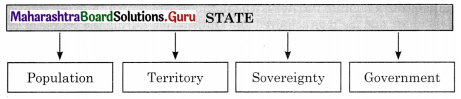
Question 4.
Describe the ‘territory’ of a State.
Answer:
The territory is an essential element of a State. It includes

  • The actual land within the national boundaries.
  • The territorial waters along the coastline. This is up to 12 nautical miles (22.2 km or 13.8 miles) along the coastline.
  • The air space above its territory (there is no international law on the height of this air space.)

Maharashtra Board Class 11 Political Science Important Questions Chapter 1 The State

Question 5.
What is a multinational state?
Answer:
States may comprise of many ‘nationalities’ living together. For example, the Soviet Union had people of many nationalities like Russians, Lithuanians, Latvians, Estonians, Ukrainians, etc. Similarly, the United Kingdom consists of England, Scotland, Wales, and Northern Ireland.

Question 6.
Do state and nation convey the same meaning?
Answer:
The terms ‘state’ and ‘nation’ appear to have the same meaning and are often used interchangeably, However, technically there is a difference. A nation has a sense of ‘oneness’ that is psychological and is born out of commonness of ethnicity and race, culture and history, religion, language, etc. The State is a politically organized society within a definite territory. It is used to describe a sovereign country having an independent government in a specific territory.

Question 7.
Write about President Wilson’s Fourteen Point speech.
Answer:
The Fourteen Point put forward by President Woodrow Wilson of the USA was a statement of principles for peace outlined in a speech on January 8, 1918. It aids an outline for stable, long-lasting peace in Europe, the Americas, and the rest of the world, following the First World War. It also visioned ‘self-determination of nations.
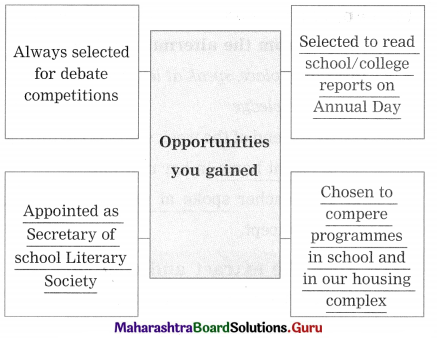
7. Distinguish between.

Question 1.
State and Government
Answer:

StateGovernment
(i) State is an abstract concept.(i) Government is a concrete reality.
(ii) State is more extensive than a government. It includes all public institutions and all members of the society as citizens.(ii) Government is a part of the State.
(iii) A State is permanent in nature.(iii) A Government exists for a specific time period.
(iv) The State is an impersonal authority. It is politically neutral.(iv) The government has an ideological agenda. It wants to implement policies to achieve that agenda.
(v) The State is a sovereign entity.(v) The source of the authority of the Government is the State.

Maharashtra Board Class 11 Political Science Important Questions Chapter 1 The State

Question 2.
State and Nation
Answer:

StateNation
(i) A State is a community of persons who occupy a definite territory, have an organized government, and are independent of external control.(i) A Nation is a group of people who are united in common ties of culture, history, religion, language, etc.
(ii) A State is known by a fixed, permanent territory.(ii) A Nation does not need a territory and can be spread across many States.
(iii) State is a political-legal entity. It is a formal and objective condition in law.(iii) A Nation is a historical-cultural entity. It is a subjective, psychological condition of the spirit.
(iv) The State has coercive power and functions through its laws.(iv) A Nation has no coercive power but functions through its common ties and psychological spirit.


Maharashtra Board Class 12 English Yuvakbharati Solutions Chapter 1.8 Voyaging Towards Excellence

Balbharti Yuvakbharati English 12th Digest Chapter 1.8 Voyaging Towards Excellence Notes, Textbook Exercise Important Questions and Answers.

Maharashtra State Board Class 12 English Yuvakbharati Solutions Chapter 1.8 Voyaging Towards Excellence

12th English Digest Chapter 1.8 Voyaging Towards Excellence Textbook Questions and Answers

Question 1.
There are different ways to travel from one place to another for different purposes. Discuss with your partner and match the words given in table A with their meanings in table B:
Maharashtra Board Class 12 English Yuvakbharati Solutions Chapter 1.8 Voyaging Towards Excellence 1
Answer:
(a) Cruise – a journey on a boat or ship to a number of places
(b) Expedition – a journey, especially by a group of people, for a specific purpose
(c) Camp – a place usually away from urban areas where tents are erected for shelter
(d) Trip – a brief pleasure outdoor visit
(e) Excursion – a short journey to a place with a particular purpose
(f) Picnic – a short visit to an outdoor place where people celebrate, enjoy and eat meals
(g) Voyage – a long journey on a ship

Maharashtra Board Class 12 English Yuvakbharati Solutions Chapter 1.8 Voyaging Towards Excellence

Question 2.
Discuss the following with your partner and complete the web.
Maharashtra Board Class 12 English Yuvakbharati Solutions Chapter 1.8 Voyaging Towards Excellence 2
Answer:
Maharashtra Board Class 12 English Yuvakbharati Solutions Chapter 1.8 Voyaging Towards Excellence 3

(A1)

Question (i)
Upbringing plays a very important role in shaping one’s life.
Answer:
The teacher will form two groups in the class. One group will speak in favour of the above topic while the other will speak against it. Debate brings out different perspectives, it does not mean one is right and other is wrong. You can take help of the following points and have a debate on it:
Maharashtra Board Class 12 English Yuvakbharati Solutions Chapter 1.8 Voyaging Towards Excellence 4

Maharashtra Board Class 12 English Yuvakbharati Solutions Chapter 1.8 Voyaging Towards Excellence

(A2)

Question (i)
Make a list of great Indian and foreign personalities who had a great impact on Achyut Godbole during his childhood.
Answer:

PoetsVinda Karandikar, Mangesh Padgaonkar, Vasant Bapat, Keshavsut
WritersCharles Dickens, Thomas Hardy, Mardhekar
MusiciansMozart, Pt. Kumar Gandharv, Pt. Bhimsen Joshi, Pt. Jasraj
DramatistsShakespeare
PaintersVan Gogh, Michaelangelo

Question (ii)
Find the different techniques used by the writer to learn Science and Mathematics.
Answer:
The different techniques used by the writer to learn Science and Mathematics are:
(a) The writer used to appreciate the inherent beauty of these subjects.
(b) He found Newton’s law of motion beautiful and the Pythagorean Theorem elegant.
(c) The writer loved solving problems of Mathematics of the 9th standard when he was in the 7th.
(d) He used to love solving problems and used to enjoy finding out the most elegant method of solving them, even though I they were not a part of the curriculum.

Question (iii)
The writer faced numerous problems while communicating in English because-
Answer:
(a) He had his entire education in Marathi.
(b) His vocabulary was very weak, and pronunciation was terrible.
(c) His construction of sentences was very awkward.

Question (iv)
The writer was completely stumped because his:
Answer:
(a) vocabulary was very weak
(b) spoken English was quite pathetic
(c) pronunciation was terrible
(d) construction of sentences was very awkward

Question (v)
Due to the writer’s pathetic English speaking style, he:
Answer:
(a) felt quite lonely and terrified, in Mumbai in general, and IIT in particular.
(b) developed an inferiority complex
(c) felt depressed and diffident.
(d) wanted to run away from IIT and even Mumbai.

Question (vi)
Complete the following. The writer wanted to achieve mastery in English because-
Answer:
(a) he wanted to speak excellent, elegant and fluent English
(b) he would be able to achieve excellence and excel in anything he tried to do
(c) he need not have to feel afraid of anybody and start feeling at home in his hostel.

Maharashtra Board Class 12 English Yuvakbharati Solutions Chapter 1.8 Voyaging Towards Excellence

Question (vii)
Make a list of different steps that the writer undertook to improve his English speaking skills.
Answer:
To improve his English the writer:
(a) decided to also think in English before speaking in English.
(b) started reading English newspapers and English novels.
(c) studied etymology and phonetics and studied the roots of the words and how to pronounce them.
(d) used to stand in front of the mirror and practice speaking, realising his mistakes and correcting them himself all the time and improvising and improving day by day.

Question (viii)
Describe the writer’s achievements after achieving mastery over the English language.
Answer:
After achieving mastery over the English language:

  1. His fear for English disappeared.
  2. He started feeling quite confident about speaking in English at length with anybody.
  3. He started feeling at home in his hostel.
  4. He could give presentations with ease.
  5. He negotiated and signed many contracts worldwide and ran large global software companies.
  6. He headed software companies having thousands of software engineers worldwide.

Question (a)
Complete the table comparing the two different phases of the life of the writer- as an MD or Chief Executive Officer and an activist of Sarvodaya movement.
Answer:

MD or Chief Executive OfficerActivist of Sarvodaya Movement
Head of the company for 23 yearsParticipated in a peaceful satyagraha
Travelled all over the globe about 150 times for businessJoined a social movement for tribals

Question (ix)
Complete the web highlighting the various opportunities you gained due to your good English speaking skills.
Maharashtra Board Class 12 English Yuvakbharati Solutions Chapter 1.8 Voyaging Towards Excellence 5
Answer:
Maharashtra Board Class 12 English Yuvakbharati Solutions Chapter 1.8 Voyaging Towards Excellence 6

Question (a)
Describe a situation or incident when you felt embarrassed for your lack of knowledge of a particular subject or incompetence in speaking English fluently.
Answer:
This happened after my Std X exams. I live in Latur, and I was visiting my cousins in Mumbai for the first time. In order to entertain me, they took me to a musical nite. Unfortunately, it was music show based on English songs, and I had no knowledge of it or interest in it. I love to listen to Hindi and Marathi songs only. They soon realized my lack of interest, and were sorry for their mistake. I was embarrassed about my complete lack of knowledge about English music.

Maharashtra Board Class 12 English Yuvakbharati Solutions Chapter 1.8 Voyaging Towards Excellence

(A3)

Question (i)
Fill in the blanks selecting the correct phrase from the alternatives given.
(feel out of place, speak at length, feel at home, sea of knowledge)
(a) By the end of the week she was beginning ………………… in her new job.
(b) When he lost his mother he was completely ……………… .
(c) Travelling can help to ………………….. .
(d) After my retirement I started ……………… as a social worker.
(e) Having faith in God ……………………. in difficult situations.
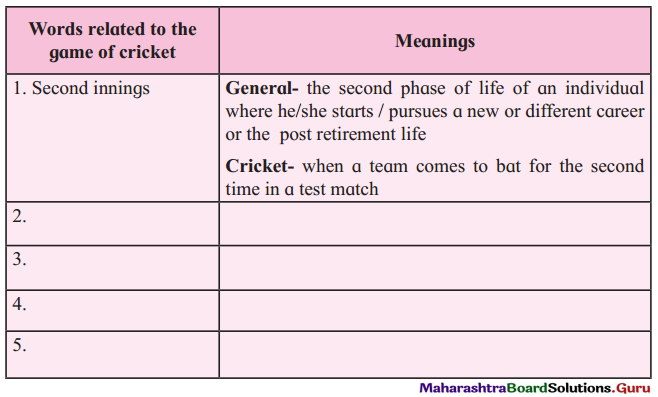
(f) To succeed in any competitive examination, one requires a sea of knowledge.
(g) The simple village girl ……………………. in a formal party.
(h) The work done by Sindhutai Sapkal …………………. of millions
(i) The teacher …………………….. explaining the concept.
(j) The speaker was ……………………… by the intelligent questions asked by the audience.
Answer:
(a) By the end of the week she was beginning to feel at home in her new job.
(b) When he lost his mother he was completely broken.
(c) Travelling can help to broaden one’s horizon.
(d) After my retirement I started my second innings as a social worker.
(e) Having faith in God keeps one going in difficult situations.
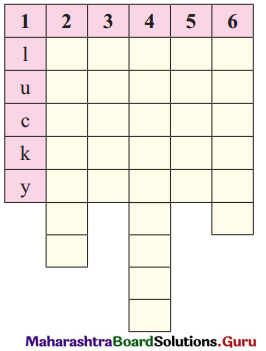
(f) To succeed in any competitive examination, one requires a sea of knowledge.
(g) The simple village girl felt out of place in a formal party.
(h) The work done by Sindhutai Sapkal touched the hearts of millions
(i) The teacher spoke at length explaining the concept.
(j) The speaker was completely stumped by the intelligent questions asked by the audience.

Question (ii)
Find out a word related to the game of cricket. List two meanings for it.
Maharashtra Board Class 12 English Yuvakbharati Solutions Chapter 1.8 Voyaging Towards Excellence 7

Answer:
Second innings:
1. general meaning: the second phase of life of an individual where he/she starts/ pursues a new or different career or the post retirement life.
2. related to cricket: when a team comes to bat for the second time in a test match

Maharashtra Board Class 12 English Yuvakbharati Solutions Chapter 1.8 Voyaging Towards Excellence

Question (iii)
Go through the text to find the antonyms of the words given in the grid and fill in the boxes. One is done for you.
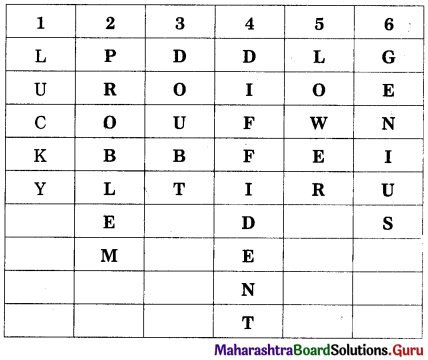
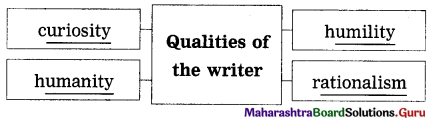
Maharashtra Board Class 12 English Yuvakbharati Solutions Chapter 1.8 Voyaging Towards Excellence 8
Answer:
Maharashtra Board Class 12 English Yuvakbharati Solutions Chapter 1.8 Voyaging Towards Excellence 9

(A4)

Question (i)
Write whether the underlined verbs in the following sentences are Main verbs or Primary auxiliary verbs:
(a) I had a very simple upbringing. ………………
(b) I was immensely impressed. ………………..
(c) I had learnt from my childhood that money did not mean everything in life. …………………
(d) He was a convent educated guy. ……………….
(e) They did all the work in time. …………………..
(f) I had to achieve a lot in life. …………………….
Answer:
(a) Main verb
(b) Main verb
(c) Auxiliary verb
(d) Main verb
(e) Main verb
(f) Main verb

Question (a)
Fill in the blanks with appropriate modals according to the situations given in the following sentences:
Answer:

  1. Take an umbrella. It might rain later.
  2. People must not walk on the grass.
  3. Could I ask you a question?
  4. The signal has turned red. You ought to wait.
  5. I was a sportsperson in my school days. I can play badminton.
  6. I am going to the library. I will find my friend there.

Question (b)
Find from the extract, the sentences that show past habit.
Answer:
1. Poets like Vinda Karandikar, Mangesh Padgaonkar and Vasant Bapat used to visit our home.
2. They used to talk about Keshavsut…

Maharashtra Board Class 12 English Yuvakbharati Solutions Chapter 1.8 Voyaging Towards Excellence

(iii) Do as directed and rewrite the sentence:

Question (a)
I did not fully understand their discussions but I was immensely impressed. (Remove ‘but’.)
Answer:
Though I did not fully understand their discussions, I was immensely impressed.

Question (b)
I had decided that I would do nothing of this sort. (Remove ‘that’.)
Answer:
I had decided to do nothing of this sort.

Question (c)
My fear had vanished and I started feeling at home in my hostel. (Use ‘when’.)
Answer:
When my fear had vanished, I started feeling at home in my hostel.

Question (d)
It was only my self-esteem which stopped me. (Remove ‘which’.)
Answer:
Only my self-esteem stopped me.

Question (e)
I plunged into all these branches of knowledge. It was a period of renaissance.
(Join with ‘which’.)
Answer:
I plunged into all these branches of knowledge, which was a period of renaissance.

Question (f)
When I look back, there are a number of lessons that I cherish. (Remove ‘When’.)
Answer:
On looking back, I find that there are a number of lessons that I cherish.

Question (g)
There are hundreds who tell me that they understood the theory of relativity. (Remove ‘who’.)
Answer:
Hundreds tell me that they understood the theory of relativity.

(A5)

Question 1.
Go through the sample of the flyer given on page 91 of the textbook and prepare flyers on the topics given below.
Topics :
1. Yoga Class / Summer Hobby Class
2. Tree Plantation Drive
3. Cleanliness Drive
4. Help us to end Child Labour
5. Let’s get rid of the monsters – tobacco and alcohol

Use the following points:

  • Details
  • Special Features
  • Why to choose us/Need of drive/Purpose of the mission
  • Anything special
  • Add your own points

Answer:
1. Yoga classes:
Divine Yoga Classes
First Floor, Vijai Towers, Opposite Railway Station, AAahim (West)
We have classes for all : from age 5 to 75 Men and women, girls and boys.

DetailsSpecial FeaturesWhy Us?
1. Classes 7 days a week

2. From 5 a.m. to 11 p.m.

3. Separate classes for males and females

4. Special personal training available

5. Experienced teachers

6. Certificates at the end of course

For more details look up: Website-www. divyoga.in

1. Lectures on health every week from experts

2. Breathing techniques to relieve stress

3. Special lectures on healthy cooking

4. Groups made according to particular problems, if any

1. We give a patient ear to all our students

2. We arrange for special outside guidance if necessary

3. We arrange regular camps and excursions

4. Special discounts for couples/family

Email: divyoga@ xmail.com/ 986656xxxx

Maharashtra Board Class 12 English Yuvakbharati Solutions Chapter 1.8 Voyaging Towards Excellence

(A6)

Question 1.
Achyut Godbole has written many bestsellers that are famous far and wide. Read at least two books of your choice, make a summary of those books and submit.
(Students may attempt this on their own.)

Yuvakbharati English 12th Digest Chapter 1.8 Voyaging Towards Excellence Additional Important Questions and Answers

Read the extract and complete the activities given below:

Global Understanding:

Question 1.
Write if the following sentences are True or False. Rewrite the false sentences correctly:
1. The writer did not like Mathematics and Science.
2. The writer studied Mathematics and Science only for scoring maximum marks in exams.
3. The writer’s skill at solving problems helped him in his IIT entrance exam.
4. The writer scored 100% marks in Mathematics in every examination he appeared for.
Answer:
True sentence:
3. The writer’s skill at solving problems helped him in his IIT entrance exam.

False sentences:
1. The writer did not like Mathematics and Science.
2. The writer studied Mathematics and Science only for scoring maximum marks in exams.
4. The writer scored 100% marks in Mathematics in every examination he appeared for.

Corrected sentences:
1. The writer loved Mathematics and Science.
2. The writer studied Mathematics and Science not only for scoring maximum marks in exams, but also because he appreciated their inherent beauty.
4. The writer scored 100% marks in Mathematics in almost all the examinations he appeared for.

Maharashtra Board Class 12 English Yuvakbharati Solutions Chapter 1.8 Voyaging Towards Excellence

Question 2.
The writer’s joy was shortlived. Give reasons.
Answer:
In Solapur, where the writer spent his childhood, he had not seen any building which was more than three – storeyed. Mumbai however was full of skyscrapers, which made the writer uncomfortable. At IIT, most of the students and professors used to converse in English whereas the writer’s English was very poor, with a weak vocabulary, terrible pronunciation and very awkward construction of sentences.

Due to all this, he felt quite lonely and terrified in Mumbai in general and IIT in particular. He developed an inferiority complex and wanted to run away from IIT and even Mumbai. Thus, his joy at getting into IIT was shortlived.

Question 3.
Name the following from the extract:
Answer:

  1. Management gurus : Alvin Toffler, Peter Drucker, C. K. Prahlad, Tom Peters
  2. The founder of Infosys: Narayan Murthy
  3. Two universities: Harvard, MIT (Massachusetts Institute of Technology)
  4. A great technologist-Vincent Serf

Question 4.
Pick out the false sentences and rewrite them correctly:
1. The writer was more intelligent and well- j read than his friends.
2. The writer’s group was interested in many things.
3. The writer wanted to top the GRE and migrate to the U.S.
4. The writer possessed many books on various topics.
Answer:
False sentences:
1. The writer was more intelligent and well- read than his friends.
3. The writer wanted to top the GRE and migrate to the U.S.

Corrected sentences:
1. The writer’s friends were more intelligent and well-read than the writer.
3. The thought of topping the GRE and migrating to the U.S. never even touched the writer’s mind.

Maharashtra Board Class 12 English Yuvakbharati Solutions Chapter 1.8 Voyaging Towards Excellence

Question 5.
Complete the web: (the first letter of each quality has been given)
Answer:
Maharashtra Board Class 12 English Yuvakbharati Solutions Chapter 1.8 Voyaging Towards Excellence 10

Question 6.
Complete the web stating the principles of good management:
Answer:
Maharashtra Board Class 12 English Yuvakbharati Solutions Chapter 1.8 Voyaging Towards Excellence 11

Question 7.
What was the writer’s first love?
Answer:
to read and write on various subjects concerning human life and existence.

Question 8.
How many books has the writer written in Marathi?
Answer:
about 34 books

Question 9.
What was the name of the writer’s autobiography?
Answer:
Musafir.

Maharashtra Board Class 12 English Yuvakbharati Solutions Chapter 1.8 Voyaging Towards Excellence

Question 10.
Name any two values that the writer cherishes.
Answer:
humility, humanity

Complex Factual:

Question 1.
Give the writer’s opinion about:
arts, music and literature.
Answer:
The writer says that the arts are equally, if not more, important in our lives than science and technology. He also feels that arts, music and literature enrich our lives and put meaning into our existence. He loved music.

Question 2.
money.
Answer:
The writer feels that money is necessary, but does not mean everything in life.

Question 3.
List the achievements of the writer in Mathematics.
Answer:
1. The writer loved solving problems of Mathematics of the 9th standard when he was in the 7th.
2. The writer scored 100% marks in Mathematics in almost all the examinations that he appeared for, from the 1st standard until IIT, barring only a few times. He also stood 1st in the University in all subjects put together.

Question 4.
Describe the ‘very important’ thing that happened to the writer.
Answer:
When the writer was in his third year at IIT, he came in contact with about 15-20 extremely brilliant students/researchers/ professors from IIT, TIFR and BARC. They included top-ranking students from IIT, visiting professors in American Universities, very renowned mathematicians of the world and so on. This friendship had a lasting impression on his life. He came to know what real brilliance meant, and where he stood with regard to it.

Question 5.
Describe curiosity and humanity.
Answer:
Curiosity is important. It is only because of the human curiosity that we have been able to make such a great progress in science and technology, and social sciences. Humanity means concern for our fellow human beings; it means caring for and helping others whenever and wherever possible. This is important if we wish to live in a world that is happy and contented.

Maharashtra Board Class 12 English Yuvakbharati Solutions Chapter 1.8 Voyaging Towards Excellence

Question 6.
List the things that the writer said he learnt while running large companies.
Answer:
While running large companies the writer learnt:

  1. The importance of teamwork
  2. The necessity of leading from the front and setting a good example for the staff.
  3. The need to treat subordinates and colleagues as friends.

Question 1.
Match the subjects in Column A with the title of the books in Column B:

AB
1. Management(a) Manat
2. Painting(b) Nadvedh
3. Western music(c) Zapoorza
4. Psychology(d) Ganiti
5. Mathematics(e) Limelight
6. Science(f) Canvas
7. Indian music(g) Arthat
8. Western films(i) Boardroom
9. English Literature(j) Kimayagar
10. Economics(k) Symphony

Answer:

  1. Management – Boardroom
  2. Painting – Canvas
  3. Western music – Symphony
  4. Psychology – Manat
  5. Mathematics – Ganiti
  6. Science – Kimayagar
  7. Indian music – Nadvedh
  8. Western films – Limelight
  9. English Literature – Zapoorza
  10. Economics – Arthat

Inference/Interpretation/Analysis:

Question 1.
‘Nevertheless, culturally I had a rich childhood’. Explain the statement with reference to the extract.
Answer:
The writer says that he had a very simple upbringing in a lower middle-class family which did not have even basic amenities like a fan, refrigerator, etc. Even so, it was rich culturally because various poets, writers and musicians used to visit their home and there would be hours of discussions about music, literature, paintings, sculptures, etc. Famous writers, painters and musicians were discussed and this made the writer love the arts. He states that arts, music and literature enrich our lives and put meaning into our existence.

Question 2.
Complete the following:
The writer developed a problem-solving attitude because …………….
Answer:
The writer developed a problem-solving attitude because ……………..
1. He did not study subjects only for scoring maximum marks in the examinations.
He used to study these subjects or any subject for that matter for its inherent beauty.
2. He used to love solving problems andused to enjoy finding out the most elegant method of solving them.
3. He used to get involved in solving them.

Maharashtra Board Class 12 English Yuvakbharati Solutions Chapter 1.8 Voyaging Towards Excellence

Question 3.
Complete the following:
The writer was benefitted by the discussions with great people as it…
Answer:

  1. made a lasting impact on his life
  2. made him realize what real brilliance meant
  3. broadened his horizons, and his aims and worldview became global
  4. taught him a lesson in humility, hard work and a passion for excellence.

Question 4.
Explain why the author say that passing the ‘examination of life’ is more important than passing the college examination.
Answer:
The writer wished to understand the world and how it works. He also wished to serve India and her people. To do this, he would have to read and understand different branches of knowledge, to develop values like humility, humanity and rationalism. This was the ‘examination of life’ for him. This was far more important to him than just passing the IIT examination.

Question 5.
Mention a few ways in which the author touch the hearts of the people.
Answer:
The author’s books have brought about very good changes in the lives of thousands of readers. Hundreds have come out of depression and more than a dozen have given up thoughts of committing suicide and decided to start all afresh. There are hundreds who say that they understood the theory of relativity or Big Bang after reading his book on Science ‘Kimayagar’.

His book ‘Boardroom’ on Management has created at least 20 successful entrepreneurs. Then there are hundreds who can understand Economic Times or NDTV Profit after reading his book on economics ‘Arthat’.

Many have turned to Mathematics after reading his book ‘GanitV. The same is true about his books on Indian Music (Nadvedh), English Literature (Zapoorza), Painting (Canvas), Western Films (Limelight) and Western Music (Symphony) or books such as ‘Genius’ series, ‘Rakta’ or ‘Vitamins’ or ‘Anartha’. It is these reactions of thousands of readers that made him feel that has touched the hearts of thousands of people.

Question 6.
Describe the second innings of the writer in your own words.
Answer:
After working for software companies for many years, the writer wanted to return to his first love, i.e. reading and writing on various subjects concerning human life and existence. Therefore, he gave up two lucrative offers to become a writer. This is how his second innings as a writer in Marathi began. After this, he wrote about 34 books in Marathi. Most of them became bestsellers with tens of thousands of copies sold for each. These books brought about very good changes in the lives of thousands of readers.

Hundreds came out of depression and more than a dozen gave up thoughts of committing suicide and decided to start all afresh. Thousands more have been helped in the fields of science, economics, music, mathematics, etc. by the writer’s books. It is these reactions of thousands of readers and the feeling that he is touching their hearts that has kept him going.

Personal Response:

Question 1.
Describe what a ‘rich childhood’ mean to you.
Answer:
I think that a rich childhood is one where you get a lot of love and security at home. It could also be culturally rich, where you get to read or know music/books/theatre, etc. Basically, a rich childhood is one which has plenty of love, fun and friends. Money is secondary.

Maharashtra Board Class 12 English Yuvakbharati Solutions Chapter 1.8 Voyaging Towards Excellence

Question 2.
We should study any subject. Do you agree? Give your reasons.
Answer:
Every subject has its own inherent beauty and uses. We should study a subject because of its beauty. While Science and Technology are important to make our daily lives easy, arts, music and literature enrich our lives and put meaning into our existence. Every subject helps in some way in the progress of mankind.

Question 3.
Do you think that speaking English fluently and confidently is important? Discuss.
Answer:
Yes, it is. English is an international language, which the people of most countries understand. If we wish to go abroad, or have international exposure, we should know English in this competitive world. Even in India, knowledge of good English gives us a sense of confidence. It helps us to get jobs. It also helps us to get access to information from all parts of the world.

Question 4.
Name some of the top universities in the world.
Answer:
Some of the top universities in the world are: Harvard University, Stanford University, Massachusetts Institute of Technology, Oxford University, Cambridge University, Cornell University. Princeton University, etc.

Question 5.
Do you feel that arts, music and literature enrich our lives. Discuss.
Answer:
Art is all around us; it surrounds us. It provides us with a deeper understanding of our own emotions and those of others. It makes us more sensitive, softer and gentler. It enriches the quality of life and improves our physical and mental health. It connects us to others. Literature gives us an insight into the world of others, both in the present and the past.

Question 6.
Do you think that team work is important today? Explain with an example.
Answer:
Yes, today team work is very important in every sphere, whether it is in games or at work. Every individual has different talents and these separate talents come together when one is in a team. For example, in cricket, one person may be a good bowler, another a good batsman, a third a good fielder, etc. When all these people come together and play the game as a team, it leads to success. In an office too, only when we work in a team and contribute our respective talents can we complete projects.

Question 7.
Do you think passion is more important than wealth?
Answer:
Passion is certainly more important than wealth. Wealth can give the luxuries of life, but it cannot give mental peace and satisfaction. This can only be gained by having an interest in what we do, or in simple words, by loving our jobs. Hence, when one chooses a career, it is more important to choose one which we love rather than one which pays more.

Maharashtra Board Class 12 English Yuvakbharati Solutions Chapter 1.8 Voyaging Towards Excellence

Language Study:

Question 1.
Find from the extract, the sentences that show past habit.
Answer:
1. I used to study these subjects or any subject for that matter for its inherent beauty.
2. I used to get involved in solving them.
3. I used to love problem-solving and used to enjoy finding out the most elegant method of solving them.

Question 2.
These problems were not a part of the curriculum, but I enjoyed the whole process. (Rewrite using ‘though’.)
Answer:
Though these problems were not a part of the curriculum, I enjoyed the whole process.

Question 3.
This exam is completely based on your problem-solving ability and the ability to think not only logically but quickly and rapidly. (Pick out the adverbs of manner.)
Answer:
completely, logically, quickly, rapidly

Question 4.
Find from the text, the sentence that show past habit:
Answer:
Most of the students and professors used to converse in English.

Question 5.
Find from the extract, a sentence that shows past habit.
Answer:
I used to stand in front of the mirror and practise speaking.

Question 6.
I wanted to speak excellent, elegant and fluent English. (Rewrite using ‘that’.)
Answer:
I wanted to speak English that was excellent, elegant and fluent.

Question 7.
My fear had vanished and I started feeling at home in my hostel.
(Pick out the verbs and state the tense.)
Answer:
had vanished – past perfect tense; started – simple past tense

Maharashtra Board Class 12 English Yuvakbharati Solutions Chapter 1.8 Voyaging Towards Excellence

Question 8.
Find from the extract,the sentences that show past habit.
Answer:
1. Until that time I used to consider myself somewhat intelligent.
2. I used to visit MIT during lunch time to meet my friends.
3. I used to visit both of these Universities.
4. If you walked for an hour from there, you could reach Harvard Square near Harvard University. (Pick out the clauses and state their type.)
Answer:
you could reach Harvard Square near Harvard University-Main clause
If you walked for an hour from there- Subordinate adverb clause of condition

Question 9.
All the discussions with these greats broadened my horizon.
(Rewrite beginning ‘My horizon…………’)
Answer:
My horizon was broadened by all the discussions with these greats.

Question 10.
Find from the text, a sentence that show past habit.
Answer:
We used to discuss about relativity, Big Bang, aesthetics, literature, philosophy, economics and many other subjects every day until late into the nights.

Question 11.
I learnt these values during my IIT days.
(Rewrite beginning ‘These values’.)
Answer:
These values were learnt by me during my IIT days.

Question 12.
It is very difficult to become a master or an expert in all these subjects. (Rewrite using ‘not’.)
Answer:
It is not at all easy to become a master or an expert in all these subjects.

Question 13.
I made a few mistakes, but learnt a lot about motivation. (Rewrite as a complex sentence.)
Answer:
Though I made a few mistakes, I learnt a lot about motivation.

Maharashtra Board Class 12 English Yuvakbharati Solutions Chapter 1.8 Voyaging Towards Excellence

Question 14.
I learnt a lot of things when I was running these large companies.
(Pick out the subordinate clause and state its type.)
Answer:
when I was running these large companies – Subordinate adverb clause of time.

Question 15.
You need to lead from the front.
(Add a question tag.)
Answer:
You need to lead from the front, don’t you?

Question 16.
I had also written 4 books with 500-700 pages each on Information Technology published by Tata McGraw-Hill. (Pick out the predicate.)
Answer:
predicate-had also written 4 books with 500-700 pages each on Information Technology published by Tata McGraw-Hill.

Vocabulary:

Question 1.
From the extract, prepare a word register of at least 6 words for:
‘Household appliances and objects’:
Answer:
fan, refrigerator, geyser, dining table, gas stove, air conditioner.

Question 2.
Match the columns:

AB
1. dining(a) days
2. gas(b) conditioner
3. school(c) table
4. air(d) stove
5. rich(e) music
6. Indian(f) childhood

Answer:

AB
1. dining(c) table
2. gas(d) stove
3. school(a) days
4. air(b) conditioner
5. rich(f) childhood
6. Indian(e) music

Maharashtra Board Class 12 English Yuvakbharati Solutions Chapter 1.8 Voyaging Towards Excellence

Question 3.
Choose the correct noun forms from those given in brackets:

  1. elegant (elegance/elegantly)
  2. solve (solving/solution)
  3. develop (developmental/development)
  4. logically (logical/logic)
  5. appear (appearance/apparently)
  6. including (inclusive/inclusion)

Answer:

  1. elegant – elegance
  2. solve – solution
  3. develop – development
  4. logically – logic
  5. appear – appearance
  6. including – inclusion

Question 4.
Write the verb forms of the following:

  1. maximum
  2. examination
  3. challenging
  4. beauty
  5. quickly
  6. admission

Answer:

  1. maximum – maximise
  2. examination – examine
  3. challenging – challenge
  4. beauty – beautify
  5. quickly – quicken
  6. admission – admit

Question 5.
Find out a word related to the game of cricket. List two meanings for it.
Answer:
Scoring:
1. general meaning: getting something
2. related to cricket: gaining runs

Question 6.
Guess the meaning of:

  1. inferiority complex
  2. sophisticated
  3. arrogant

Answer:

  1. inferiority complex – a feeling that you are not as good, as intelligent, as attractive, etc. as other people
  2. sophisticated – smart and polished
  3. arrogant – unpleasantly proud

Question 7.
Find out a word related to the game of cricket. List two meanings for it.
Answer:
Stumped: (Note: The word is not in the lesson but in the question on page 86)
1. general meaning : to be unable to answer a question or solve a problem because it is too difficult
2. related to cricket: being stumped is a method of dismissing a batsman.

Maharashtra Board Class 12 English Yuvakbharati Solutions Chapter 1.8 Voyaging Towards Excellence

Question 8.
Guess the meaning:
1. negotiate
2. at ease
Answer:
1. negotiate – to have formal discussions with someone in order to reach an agreement with them
2. at ease – comfortable.

Question 9.
Find the full forms of:

  1. IIT
  2. TFIR
  3. BARC
  4. TCP
  5. IP

Answer:

  1. IIT: Indian Institute of Technology
  2. TIFR: Tata Institute of Fundamental Research
  3. BARC: Bhabha Atomic Research Centre
  4. TCP: Transmission Control Protocol
  5. IP: Internet Protocol

Question 10.
Find the meaning of: anything under the sun
Answer:
anything under the sun-anything at all.

Question 11.
Find the full form of: GRE
Answer:
GRE – Graduate Record Examination

Question 12.
Match the following:

AB
1. Sociology(a) the scientific study of material remains of past human life and activities.
2. Economics(b) the study of the development, structure, and functioning of human society.
3. Psychology(c) the branch of knowledge concerned with the production, consumption, and transfer of wealth.
4. Archaelogy(d) the scientific study of the human mind and its functions.

Answer:

  1. Sociology – the study of the development, structure, and functioning of human society.
  2. Economics – the branch of knowledge concerned with the production, consumption, and transfer of wealth.
  3. Psychology – the scientific study of the human mind and its functions.
  4. Archaelogy – the scientific study of material remains of past human life and activities.

Maharashtra Board Class 12 English Yuvakbharati Solutions Chapter 1.8 Voyaging Towards Excellence

Question 13.
From the extract find four words that form their antonyms by adding a prefix:
Answer:

  1. important × unimportant
  2. successful × unsuccessful
  3. possible × impossible
  4. written × unwritten

Question 14.
Write the past participles of:

  1. learn
  2. write
  3. change
  4. make

Answer:

  1. learn – learnt
  2. write – written
  3. change – changed
  4. make – made

Question 15.
Find out a word related to the game of cricket. List two meanings for it.
Answer:
target setting:
1. general meaning: deciding something that one hopes or intends to accomplish
2. related to cricket: deciding the number of runs to be achieved.

Question 16.
Give the adjective forms of the following:

  1. humanity
  2. rationality
  3. humility
  4. equality
  5. curiosity
  6. knowledge

Answer:

  1. humanity – humane
  2. rationality – rational
  3. humility – humble
  4. equality – equal
  5. curiosity – curious
  6. knowledge – knowledgeable

Maharashtra Board Class 12 English Yuvakbharati Solutions Chapter 1.8 Voyaging Towards Excellence

Non-Textual Grammar:

Do as directed:

Question 1.
To their astonishment they found a hissing snake stopping their way. (Rewrite using the verb form of the underlined word.)
Answer:
They were astonished to find a hissing snake stopping their way.

Question 2.
The minister spotted his cheerful face in the crowd and called out to him. (Rewrite using the present participle form of the verb ‘to spot’.)
Answer:
The minister, spotting his cheerful face in the crowd, called out to him./Spotting his cheerful face in the crowd, the minister called out to him.

Question 3.
He is a great king.
(Rewrite as an exclamatory sentence.)
Answer:
What a great king he is

Spot the error in the following sentences and rewrite them correctly:

Question 1.
Even though the laptop is expensive, but I wish to buy it for my mother.
Answer:
Even though the laptop is expensive, I wish to buy it for my mother.

Maharashtra Board Class 12 English Yuvakbharati Solutions Chapter 1.8 Voyaging Towards Excellence

Question 2.
The story should not exceed more than 800 words.
Answer:
The story should not exceed 800 words.