Maharashtra Board Class 11 Political Science Solutions Chapter 9 The World Since 1945 – I

Balbharti Maharashtra State Board Class 11 Political Science Solutions Chapter 9 The World Since 1945 – I Textbook Exercise Questions and Answers.

Maharashtra State Board Class 11 Political Science Solutions Chapter 9 The World Since 1945 – I

1A. Choose the correct alternative and complete the following statements.

Question 1.
In 1949, China became a communist country under the leadership of ___________ (Khrushchev, Mao Zedong, Joseph Stalin, Ho Chi Minh)
Answer:
Mao Zedong

Maharashtra Board Class 11 Political Science Solutions Chapter 9 The World Since 1945 - I

Question 2.
The principle of peaceful co-existence was put forth by ___________ (Eisenhower, Joseph Stalin, Khrushchev, Jawaharlal Nehru)
Answer:
Khrushchev

1B. State the appropriate concept for the given statement.

Question 1.
Period of the dominance of European powers.
Answer:
Eurocentric

Question 2.
The conflict between America and the Soviet Union.
Answer:
Cold War

1C. Find the odd word in the given set.

Question 1.
Hungary, Romania, Bulgaria, France.
Answer:
France (not from the soviet bloc)

Question 2.
Italy, Poland, Spain, Greece.
Answer:
Poland (Not from the capitalist bloc nations)

Maharashtra Board Class 11 Political Science Solutions Chapter 9 The World Since 1945 - I

2A. Complete the concept maps.

Question 1.
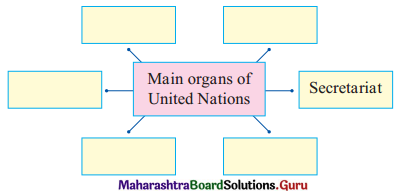
Maharashtra Board Class 11 Political Science Solutions Chapter 9 The World Since 1945 - I 2A Q1
Answer:
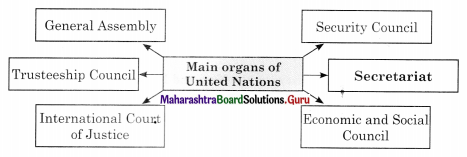
Maharashtra Board Class 11 Political Science Solutions Chapter 9 The World Since 1945 - I 2A Q1.1

2B. Observe the given map and answer the following questions.

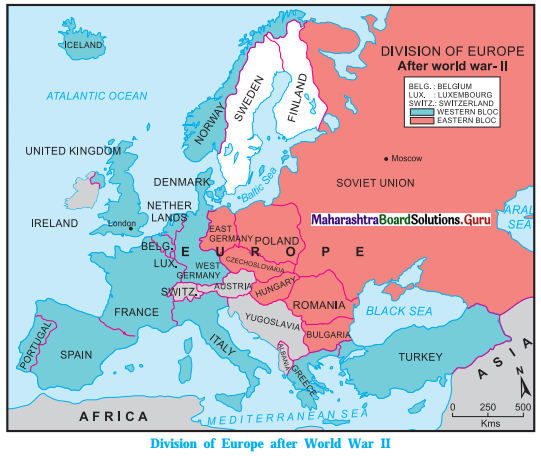
See a map of the Division of Europe after World War II.
Maharashtra Board Class 11 Political Science Solutions Chapter 9 The World Since 1945 - I 2B Q1

Question i.
Name two East European countries under influence of the Soviet Union.
Answer:
Poland, Hungary, Czechoslovakia, Bulgaria, Romania.

Question 2.
Name two West European countries under the influence of the United States.
Answer:
France, Spain, Italy, Belgium, England.

3. State whether the following statements are true or false with reasons.

Question 1.
After the Bolshevik Revolution, Soviet Russia became a capitalist nation.
Answer:
This statement is False.

  • After the 1917 Bolshevik Revolution. Vladimir Lenin established Socialism based on Marxist doctrine in Russia.
  • Thus, Russia became the first communist nation in the world. The USA is an example of a capitalist nation.

Maharashtra Board Class 11 Political Science Solutions Chapter 9 The World Since 1945 - I

Question 2.
The Bandung Conference brought Cold War in Asia.
Answer:
This statement is False.

  • In 1955, the Bandung conference had 24 participating countries and sought to broad base the concept of regionalism to Asia and Africa.
  • The Bandung conference tried to bring cooperation and stability to the regions.

4. Answer the following.

Question 1.
Explain the term regionalism.
Answer:
Regional organisations are created by countries from a particular geographic region. They form groups to promote their national interest in a cooperative manner. They try to establish their independent identity. This process of regional level cooperation is also called regionalism.

While geographic linkages are important, sometimes some functional issues become the basis of regional cooperation. These can be in areas like transport and communication, energy, health, etc.

The process of regionalism usually begins with a political dialogue amongst the participants. Such a dialogue may lead to the creation of an organisation. Organisations like the European Union (EU), Association of South-East Asian Nations (ASEAN), or South Asian Association for Regional Cooperation (SAARC) are examples of such regional groupings.

Question 2.
Discuss the role of the United Nations (UNO).
Answer:
The UNO was established in 1945. Its main functions include to
(i) Maintain International Peace and Security: The United Nations came into being with one main purpose i.e., the maintenance of international peace and security. The UN does this by working to prevent conflict, helping parties in conflict to make peace, peacekeeping activities, and creating the conditions to allow peace to hold and flourish.

(ii) Protect Human Rights: The promotion and protection of human rights is a key purpose and guiding principle of the UN. On 10th December 1948, the Universal Declaration of Human Rights was adopted.

Maharashtra Board Class 11 Political Science Solutions Chapter 9 The World Since 1945 - I

(iii) Deliver Humanitarian Aid: One of the purposes of the United Nations is “to achieve international cooperation in solving international problems of an economic, social, cultural or humanitarian character.” The international community relies on the UN to coordinate humanitarian relief operations in times of natural and man-made disasters.

(iv) Promote Sustainable Development: The global understanding of development has changed over the years. The UN seeks to promote sustainable development, that is, a development that promotes prosperity and economic opportunity, greater social well-being, and protection of the environment.

(v) Uphold International Law: The development of and respect for international law has been a key part of the work of the UNO. This work is carried out in many ways – by courts, tribunals, multilateral treaties, and by the Security Council and ICJ.

5. Answer the following in detail with reference to the given points.

Question 1.
Elaborate on the dimensions of the Cold War.
(a) political
(b) ideological
(c) economic
(d) security
Answer:
The hostile relations between the USA and its’ allies and the USSR and its allies along with ideological conflict between them is called the ‘Cold War’ or Bipolarity. Its dimensions are
(a) Political dimension: was the aspect of the struggle for political influence over the areas under the control of the two countries. Areas under Soviet influence included East Germany, Poland, Czechoslovakia, Hungary, Romania, Bulgaria, and Albania. Areas under the United States’ influence included Netherlands, Denmark, Belgium, West Germany, France, Italy, Spain, Greece, and United Kingdom. Finland was forced to opt for neutrality to ensure that both the United States and the Soviet Union did not clash in the region.

(b) Ideological dimension: Eastern Europe adopted Socialist ideology under the influence of the Soviet Union and followed a Socialist form of government. Western Europe adopted capitalist ideology under the leadership of the United States. These countries had democratic governments.

Maharashtra Board Class 11 Political Science Solutions Chapter 9 The World Since 1945 - I

(c) Economic dimension: East European countries with socialist governments followed the socialist economic system. This meant that the government or the public sector would play a dominant role in the economic system. West European countries that followed the democratic system of government had a capitalist form of economy. Here the private sector played a dominant role in the economic system.

(d) Security dimension: Military alliances were created in Europe to protect these countries. The North Atlantic Treaty Organisation (NATO) was created in 1949 as a military alliance to defend West European countries and the United States from the threat of invasion from the Soviet Union and East Europe. Warsaw Pact was created in 1955 to defend East European countries and the Soviet Union from the threat from Western Europe and the United States.

Maharashtra Board Class 12 English Yuvakbharati Solutions Chapter 2.6 Money

Balbharti Yuvakbharati English 12th Digest Chapter 2.6 Money Notes, Textbook Exercise Important Questions and Answers.

Maharashtra State Board Class 12 English Yuvakbharati Solutions Chapter 2.6 Money

12th English Digest Chapter 2.6 Money Textbook Questions and Answers

Question 1.
Discuss in the class about ‘Importance of money.’
Points :
(a) Money is used as capital in business.
(b) It is used by traders to Jill up stocks
(c) It is used by the common man for buying essentials/necessities.
(d) Everyone uses money for paying transport fare/ food-bill/wages and so on.

Maharashtra Board Class 12 English Yuvakbharati Solutions Chapter 2.6 Money

Question 2.
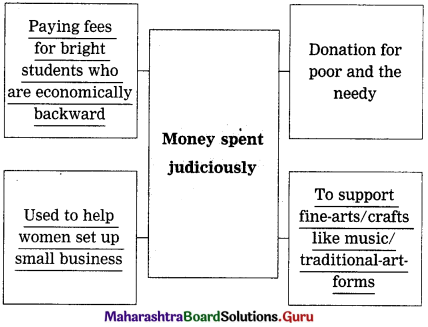
Complete the web:
Maharashtra Board Class 12 English Yuvakbharati Solutions Chapter 2.6 Money 1
Answer:
Maharashtra Board Class 12 English Yuvakbharati Solutions Chapter 2.6 Money 2

Question 3.
Make a list of the good qualities of your friend.
Answer:
(a) Calm and good tempered at all times
(b) Helpful and concerned about anyone in trouble
(c) Quick to intervene/calm down any situation that could become unpleasant
(d) Very simple and down to earth in spite of coming from an extremely wealthy background

Question 4.
Share your views on ‘Money is the root of all evils’.
Answer:
Points:

  1. Money is a resource.
  2. Resources should be available/ used in times of need
  3. Money is accumulated by few people/others in need are deprived/some people are not paid fully/workers are paid less for their time and energy
  4. Employer gets profit/ imbalance of resources
  5. Imbalance in wealth causes discontent among disadvantaged sections of society.
  6. Crime increases
  7. Haves are targeted by have-nots
  8. Normal life becomes unstable
  9. Accumulation of money causes this upset in society
  10. So important resource becomes reason for evil

Maharashtra Board Class 12 English Yuvakbharati Solutions Chapter 2.6 Money

Question 5.
Do you lend money to your friend? Give reasons:
Answer:

YesNo
1. He/She comes from an economically disadvantaged background1. I know that he/she gets enough money to spend
2. He/She is a very bright student, hopes to study well and find employment2. He/She wastes time at movies and malls
3. He/She will fall sick if she does not have good nourishment3. He/She has no intention of returning borrowed money
4. His/Her mother is the only bread winner. His/Her father very sick4. He/She comes to college only to meet friends and socialize

(A1)

Question (i)
‘Money does not mean everything in life’. Justify the statement by giving examples. Take help of the following points:
(a) Money cannot give you eternal happiness.
(b) Art, music and literature can give you unending happiness.
(c) Money is short-lived.
(d) Money cannot purchase happiness and contentment.
Answer:
Happiness is in the mind. If a person is satisfied with what is on hand then he is happy. Rich clothes, gold, expensive food, servants may all be available. But the owner of these may still be sad and lonely.

Some are happy to make music another may create art or write. They may not have material possessions. But in their hearts they are happy to do what they love.

Money is only a medium to purchase our needs. One cannot give money and buy a bag of joy. Joy is in the heart. Money can be stolen. But joy cannot be stolen. One can earn money but not happiness. No amount of money will satisfy greed or buy happiness.

Question (ii)
Debate on the following topic in groups : Money is the solution for everything For: We need money for – Food-Clothes-Medicines- Education- Travel
Against: One cannot eat money itself/one must have food. We should not buy more than essential clothes/ no need to buy often-Good hygiene and food-habits will ensure health-Government schools are available- Travel is not needed for survival.

Maharashtra Board Class 12 English Yuvakbharati Solutions Chapter 2.6 Money

(A2)

(i) State whether the following statements are True or False. 

Question (a)
The poet knew no joy till he was rich.
Answer:
False. The poet had no joy as long as he was rich. He was happy when he was poor.

Question (b)
The poet felt that he should talk about his poverty.
Answer:
False. He could not talk about his money.

Maharashtra Board Class 12 English Yuvakbharati Solutions Chapter 2.6 Money

Question (c)
When the poet had money, he had many true friends.
Answer:
False. When the poet had money, all his friends were false ones.

Question (d)
When poet became poor he had very few real friends.
Answer:
True.

(ii) Write reasons for the following statements.

Question (a)
Friends came knocking all day at the poet’s door.
Answer:
When the poet was rich he had many callers. They claimed they were friends. They were being friendly because he had money. They were not true friends. Such people are called ‘fair-weather friends’.

Question (b)
Poor men’s wives hum like bees.
Answer:
Poor men have no worries. They do not have to safeguard their wealth from liars and cheats. They don’t have false friends who actually love his money and not him. When a man is satisfied with what he has he is happy. He is not chasing wealth and or pretending. The wives are busy and do not have the time to wish for fancy things or gossip. So a happy man has a happy busy wife.

Maharashtra Board Class 12 English Yuvakbharati Solutions Chapter 2.6 Money

Question (iii)
Money makes the world go round. Explain it in the light of the poet’s experience.
Answer:
Money makes the world go round is a popular saying. It means money is the most important thing in the world. But in ‘Money’, the poet does not accept this view. He had money but he could not say that he possessed it. There were many insincere men who said they were friends.

Contentment is the main thing for being happy, not worldly possessions. Lack of money is a problem. We need it for things like health or education. When all needs are taken care of, then excess money is not necessary. Money is needed in life but it is not the only important thing in life.

The poet repeats that money brought many false men to be near him. But in poverty only a few true friends were with him.

Question (iv)
Poor men need not go up so much as rich men should come down. Express your views regarding this statement.
Answer:
Poor men need not go up as rich men should come down. This statement is perfectly true. The poor will survive. Living a simple, real life, and working hard. They are happy with necessities which may not be expensive. They are content and that brings happiness. They do not have to worry about safeguarding the excess.

But the rich may not know how to live simply, just with basic necessities. They may have servants to do basic chores. They travel in style and sometimes for no reason. They spend unnecessarily. So the poor need not go up as much as the rich need to come down is true.

Maharashtra Board Class 12 English Yuvakbharati Solutions Chapter 2.6 Money

(A3)

Question (i)
Find out meanings of the phrases given below and use them in your own sentences:
Answer:
(a) Be in the money –
Meaning: to suddenly have a lot of money.
Sentence: It looks he is in the money, by the way he is giving everyone costly gifts.
(b) Win lots of money –
Meaning: get money in a lottery/ gambling/ get money through luck, not work.
Sentence: He bought a lottery ticket every week hoping to win lots of money.
(c) For my money –
Meaning: in exchange for. Worth the amount.
Sentence: The old man asked. ‘Is this all I’m getting for my money?’
(d) Money for old rope –
Meaning: money that is easily earned or gotten
Sentence: She got two thousand just for answering questions in the interview! Money for old rope!
(e) Put one’s money where one’s mouth is Meaning: to take appropriate action to support what one has said.
Sentence: The Municipal Commissioner promised he would put the money where his mouth is and immediately release funds for the school facilities as promised.

Question (ii)
Complete the crossword with the help of the clues from the poem :
Maharashtra Board Class 12 English Yuvakbharati Solutions Chapter 2.6 Money 3
Across:
1. A brass musical instrument – TRUMPET
2. A low steady continuous sound – HUM
3. False – UNTRUE
4. Say Something – SPEAK
Down :
5. Not imaginary – REAL
6. Ponder – THINK
7. Stinging insects – BEES
8. In large number – MANY
9. Strike a surface noisily – KNOCK

Maharashtra Board Class 12 English Yuvakbharati Solutions Chapter 2.6 Money

(A4)

Question (i)
Complete the following table:
Answer:

Figure of speechLine from the poemExplanation
1. Inversion‘felt I like a child’”think I’

Much have I thought of life

The order of words – ‘I felt like a child’, ‘I think’ – is reversed for effect.

‘I have thought much of life’ is reversed to give effect.

2. Simile‘Like a child.

‘wives do hum like bees about their work’.

The poet compares himself with a child

The wives of poor men are as busy as bees in their work.

3. Repetition‘When I had money, money, O! [line 1 and 17]The line is repeated and the word money. The word is the theme and it is repeated to emphasize he was very rich.
4. Onomatopoeia‘do hum like bees’The word ‘hum’ imitates the humming of bees.
5. Antithesis‘many a false man as a friend’

‘many friends proved all untrue’ ‘poor ones laugh – rich ones frown’

‘poor men need not go up-the rich men should come down’

The quality of friends is supposed to be sincere and loyal.

But they are described as opposite – false and untrue.

The poor smile and the rich frown. This is opposite of what we expect.

The rich must know simplicity says the poet, the opposite of what we say that the poor must come up in life.

Question (ii)
Identify the rhyme scheme of all the stanzas of the poem.
Answer:
The rhyme scheme of the stanzas 1 to 4 is abcb.
The rhyme scheme of the 5th stanza is abab.

Question (iii)
Compose a short poem on ‘Friendship’.
Answer:
‘Friendship’
We knew playtime in the park
Study time in school.
We helped one another
Struggling for each difficult mark.
We grew up, and though we fought
We will meet years later
We fondly thought.

Maharashtra Board Class 12 English Yuvakbharati Solutions Chapter 2.6 Money

(A5)

Question 1.
Write an appreciation of the poem considering the following points:

  • About the poem/poet/title
  • Theme
  • Poetic devices, language, style
  • Special features-tone and type
  • Values, message
  • Your opinion about the poem

Answer:
William H. Davies – a Welsh poet and writer – in his poem ‘Money’ speaks of both times – when he had money and when he did not. Davies tramped through the United Kingdom and the United States.

So he actually led a poor simple life of a wanderer. He actually experienced the difference in the life of a rich man and a poor one. The theme of the poem is the effect of money on the behaviour of people. False friends are plenty when a man has money. The poet compares himself to a child with a trumpet. He is not allowed to blow it for there has been a death.

He uses simile again when the poor man’s wife is described as humming about busily like a bee. The poet also has seen that the lack of money does not mean lack of happiness. The poor man is able to laugh while a rich man frowns; he feels the rich must become poor to taste the simple joys of life – the use of antithesis helps to stress this point.

The poem has five stanzas of four lines each, The seven or eight syllable lines are short but rich ; in poetic devices. The rhyme scheme lends rhythm. Repetition of the word ‘money’ stresses the way man gives money too much importance when it actually takes away our happiness.

The message is that money does not bring happiness. The poor are cheerful while the rich are worried. The poem is very useful to remind us the value of money. It is a necessity. It is not the only thing to chase.

Maharashtra Board Class 12 English Yuvakbharati Solutions Chapter 2.6 Money

(A6)

Question (i)
Visit a library and read a few poems written by William H. Davies.

Question (ii)
There are many career opportunities related to finance and planning.

Question (iii)
Try to get information about the following careers by surfing the internet.
(a) Finance Management
(b) Banking and Finance
(c) Actuaries
(d) Economics
(e) Share Market
(f) Accountancy
(g) Company Secretary

Question (iv)
Economics is a very important subject in which you can pursue vour career. Browse the websites of these institutions and get information for various courses in Economics.
(a) Delhi School of Economics
(b) Indian Statistical Institute
(c) Gokhale Institute of Politics and Economics, Pune
(d) Madras School of Economics

Maharashtra Board Class 12 English Yuvakbharati Solutions Chapter 2.6 Money

Yuvakbharati English 12th Digest Chapter 2.6 Money Additional Important Questions and Answers

Interpretation/Inference/Analysis:

Question 1.
Complete the reasons:
Poor ones laugh because ………………
Answer:
Poor ones laugh because – poor people live a simple life. If the basic needs are fulfilled the poor man is happy. He has nothing to worry about or fear. When a man has wealth he has to safeguard it. The poor man is worry-free like health or education. When all needs are taken care of, then excess money is not necessary. Money is needed in life but it is not the only important thing in life. The poet repeats that money brought many false men to be near him. But in poverty, only a few true friends were with him.

Maharashtra Board Class 11 Political Science Important Questions Chapter 8 Development Administration

Balbharti Maharashtra State Board Class 11 Political Science Important Questions Chapter 8 Development Administration Important Questions and Answers.

Maharashtra State Board 11th Political Science Important Questions Chapter 8 Development Administration

1A. Choose the appropriate alternative and complete the following statements.

Question 1.
Panchayati Raj institutions were given constitutional status in 1992 by the ____________ Amendment Act. (42nd, 73rd, 74th, 91st)
Answer:
73rd

Question 2.
To establish a socialist pattern of economy, ____________ year plans were introduced. (3, 5, 7, 10)
Answer:
5

Maharashtra Board Class 11 Political Science Important Questions Chapter 8 Development Administration

Question 3.
To increase agricultural production, the ____________ revolution was introduced in 1966-67. (Rural, White, Green, Swachh Bharat)
Answer:
Green

Question 4.
MGNREGA aims to guarantee ‘the right to ____________’. (nutrition, education, irrigation, work)
Answer:
work

1B. State the appropriate concept for the given statement.

Question 1.
It has replaced the Planning Commission since 2015.
Answer:
NITI Aayog

Question 2.
A modern approach to Public Administration.
Answer:
Development Administration

Maharashtra Board Class 11 Political Science Important Questions Chapter 8 Development Administration

1C. Answer in one sentence.

Question 1.
What does ‘red tape’ refer to?
Answer:
In government administration, when official rules and procedures create unnecessary delays in the work, it is called ‘red tape.

Question 2.
What does the ‘holistic perspective’ of development include?
Answer:
A holistic perspective of development includes a focus on social change, economic growth, cultural progress and political development.

Question 3.
Name two Parliamentary Committees.
Answer:
Public Accounts Committee, Estimates Committee.

Question 4.
Name 4 tribunals in the field of Indian administration.
Answer:
Income Tax Appellate Tribunal, Central Administrative Tribunal (CAT), National Green Tribunal (NGT), Securities Appellate Tribunal (SAT).

Question 5.
What was the focus of the Community Development Programme (1952)?
Answer:
The focus of CDP (1952) was to promote development in rural and remote areas.

Question 6.
What is the significance of the 74th Amendment Act (1952).
Answer:
The 74th Amendment Act gave constitutional status to the municipalities so that they function effectively as units of local government in urban areas.

Maharashtra Board Class 11 Political Science Important Questions Chapter 8 Development Administration

Question 7.
Name 4 areas that five-year plans focused on.
Answer:
Agriculture, Industrialization, Self-reliance, Infrastructure.

Question 8.
What was the objective of the Twenty Point Programme?
Answer:
The objective of the Twenty Point Programme was poverty eradication and raising of the standard of living, of the people.

Question 9.
Write 2 development programmes to deal with unemployment.
Answer:

  • Jawahar Rozgar Yojna (JRY – 1989)
  • Mahatma Gandhi Nation Rural Employment Guarantee Act (MGNREGA – 2005)

Question 10.
What is the role of YASHADA?
Answer:
The role of YASHADA is as an Administrative Training Institute and a State Institute of Rural Development.

1D. Expand the abbreviations.

Question 1.
NITI Aayog
Answer:
NITI Aayog – National Institution for Transforming India.

Question 2.
IRDP
Answer:
IRDP – Integrated Rural Development Programme.

Question 3.
MGNREGA
Answer:
MGNREGA – Mahatma Gandhi National Rural Employment Guarantee Act.

Question 4.
UIDAI
Answer:
UIDAI – The Unique Identification Authority of India.

Maharashtra Board Class 11 Political Science Important Questions Chapter 8 Development Administration

Question 5.
JNNURM
Answer:
JNNURM – Jawaharlal Nehru National Urban Renewal Mission.

2A. State whether the following statements are true or false with reasons.

Question 1.
Citizen participation is significant in development administration.
Answer:
This statement is True.

  • Development is a process of social and economic change, it is important that people participate actively in it.
  • This necessitates peoples’ participation in the process of planning, implementation, and eventual evaluation.

Question 2.
Land reforms were a major development goal in India after independence.
Answer:
This statement is True.

  • When India became independent (zamindars). the ownership of agricultural land was mainly concentrated in the hands of a few landowners.
  • To solve this issue land reforms were initiated and the land was freed up to be given to the actual tillers of the land e.g., the Zamindari system was abolished.

Question 3.
NITI Aayog replaced the Planning Commission in 2015.
Answer:
This statement is True.

  • In the 1990s India adopted the New Economic Policy that focused on economic liberalisation. In this new setup, there was a need to change the approach to planning.
  • In 2015 the Planning Commission was replaced by the NITI Aayog. India moved away from centralized planning to decentralized planning. The NITI Aayog proposes grassroots planning.

Maharashtra Board Class 11 Political Science Important Questions Chapter 8 Development Administration

2B. Complete the concept maps.

Question 1.
Maharashtra Board Class 11 Political Science Important Questions Chapter 8 Development Administration 2B Q1
Answer:
Maharashtra Board Class 11 Political Science Important Questions Chapter 8 Development Administration 2B Q1.1

Question 2.
Maharashtra Board Class 11 Political Science Important Questions Chapter 8 Development Administration 2B Q2
Answer:
Maharashtra Board Class 11 Political Science Important Questions Chapter 8 Development Administration 2B Q2.1

4. Answer the following.

Question 1.
Explain how development administration evolved.
Answer:
After the Second World War, several Asian and African nations became independent. They did not want a government that merely carried out routine administration like law and order, external security, revenue, etc. These countries had heterogeneous societies, struggling economies and faced serious challenges like hunger, poverty, and socio-economic inequality. They needed to be planned and properly executed government action which would be holistic i.e., focusing on social change, political development, and economic growth.

The government had to become the instrument of development by taking up tasks like centralized economic planning, promotion of industrial growth, provision of social services, and encouraging people’s participation. The concept of the ‘Welfare State’ which had dominated the early part of the 20th century grows stronger. The state was expected to play a key role in the promotion of the economic and social well-being of its citizens. This led to the idea of the Development Administration.

Maharashtra Board Class 11 Political Science Important Questions Chapter 8 Development Administration

Question 2.
Explain the features of development administration.
Answer:
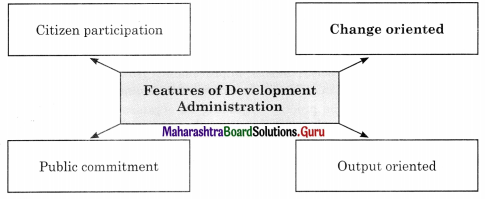
Development Administration is the modern approach to public administration. Its features are-
(i) Change-oriented: Development administration seeks to re-orient towards development goals in the socio-economic and political sphere through transformation, innovation, and growth. In India after Independence, the two biggest challenges before the government were food scarcity and poverty, and economic backwardness. Hence, the focus was on agriculture as well as on industrial and infrastructural development.

(ii) Output-oriented: Development administration seeks to achieve certain outcomes on the basis of clear, quantitative norms of performance. This focus on targets motivates, the administration to produce the desired results, for e.g., pegging a target of 8 – 10% growth rate for the economy is a reasonable goal to be achieved.

(iii) Citizen participation: It is necessary that people actively participate in the development processes of planning, implementation and evaluation e.g., the 73rd and 74th amendments are a landmark in the evolution of grassroots democratic institutions both in rural and urban areas in India.

(iv) Public commitment: The process of development is filled with challenges and barriers. Hence, the civil servants (bureaucracy) need to have a strong sense of involvement, commitment, and concern to achieve the development objectives.

Question 3.
What were the goals of development in India post-1947?
Answer:
Post-independent India was struggling to rise from the ill effects of colonial exploitation i.e., from poverty and underdevelopment. The objectives of development in India were hence directed towards resolving these issues.

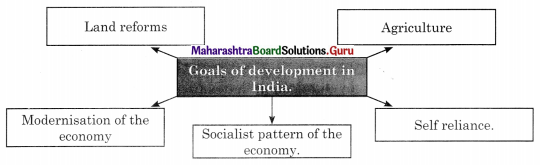
The goals of development include:
(i) Modernisation of the economy: The focus was on industrialization, which would increase employment facilities as well national income.

(ii) Land Reforms: aimed to free up land which was concentrated in the hands of a few rich landholders (zamindars).

(iii) Agriculture: The focus was to reduce rural poverty by developing agriculture. The use of machines, better fertilizers and pesticides, high yielding seeds, and irrigation would help to increase agricultural production i.e., through the Green Revolution.

(iv) Self-reliance: Although foreign aid was accepted by India for its industrial and infrastructural development, it did not want to be dependent on foreign capital for long.

Maharashtra Board Class 11 Political Science Important Questions Chapter 8 Development Administration

(v) Socialist pattern of the economy: India decided to adopt the socialist pattern of the economy towards creating a Welfare State and reducing inequalities of wealth and income. The Planning Commission was created and 5-year plans were implemented.

Maharashtra Board Class 11 Political Science Solutions Chapter 8 Development Administration

Balbharti Maharashtra State Board Class 11 Political Science Solutions Chapter 8 Development Administration Textbook Exercise Questions and Answers.

Maharashtra State Board Class 11 Political Science Solutions Chapter 8 Development Administration

1. State the appropriate concept for the given statement.

Question 1.
State that promotes the economic and social well-being of its citizens.
Answer:
Welfare State

Maharashtra Board Class 11 Political Science Solutions Chapter 8 Development Administration

Question 2.
Unnecessary delays in administrative work are called.
Answer:
Red Tape

2. Complete the concept maps.

Question 1.
Maharashtra Board Class 11 Political Science Solutions Chapter 8 Development Administration 2 Q1
Answer:
Maharashtra Board Class 11 Political Science Solutions Chapter 8 Development Administration 2 Q1.1

3. State whether the following statements are true or false with reasons.

Question 1.
Change and growth-oriented approaches are called Development Administration.
Answer:
This statement is True.

  • Development is a complex term that means improvement, growth, or progress. When public administration studies ‘government in action for development’ it becomes development administration.
  • According to Edward Weidner, “The process of guiding an organization towards the achievement of progressive political, economic and social objectives that are authoritatively determined in one manner or the other” is development administration.

Question 2.
In post-independent India, the government deliberately invested in the public sector.
Answer:
This statement is True.

  • Post-independence India was reeling from the effects of colonial exploitation in the form of poverty and underemployment.
  • It needed to modernize the economy towards self-reliance. To establish a welfare state and bring about a socialist pattern of the economy, more emphasis was given to the public sector.

Maharashtra Board Class 11 Political Science Solutions Chapter 8 Development Administration

Question 3.
The 73rd amendment act gave constitutional status to municipalities.
Answer:
This statement is False.

  • 73rd Amendment Act (1992) gave constitutional status to Panchayati Raj institutions and is considered a landmark in grassroots democracy in India.
  • 74th Amendment Act (1992) gave constitutional status to municipalities (urban areas).

4. Explain the co-relation between the following.

Question 1.
Planning Commission and NITI Aayog (Traditional public administration and development administration).
Answer:
Development is a complex term that means improvement, growth, or progress. When public administration studies ‘government in action for development’ it becomes development administration. According to Edward Weidner,” development administration is “the process of guiding an organisation toward the achievement of progressive political, economic and social objectives that are authoritatively determined in one manner or the other”.

An approach to have innovative planning towards growth is called development administration. The need for this was felt due to limitations in the traditional approach to public administration, which covered areas such as

  • Organization of the government machinery
  • management of different tasks like leadership, planning, etc
  • personnel administration i.e., recruitment, training of personnel
  • financial administration e.g., budget, audit, etc
  • administrative law e.g., tribunals for dispute resolution.

The new approach to public administration and public policy focuses on socio-economic development, political modernization, and adaptation of new technologies in administration.

Development administration has two important aspects viz.

  • Administration of development – setting development goals and achieving them through the medium of administration.
  • Development of administration – the existing system has to be improved so as the achieve the goals.

5. Answer the following.

Question 1.
Discuss any 4 areas of study in traditional public administration.
Answer:
The main areas of study in traditional public administration include:

  • Organization of government machinery.
  • Management of different tasks like leadership, planning, etc.
  • Personnel administration i.e., recruitment, training of personnel.
  • Financial administration e.g., budget, audit, etc.
  • Administrative law e.g., tribunals for dispute resolution.

Maharashtra Board Class 11 Political Science Solutions Chapter 8 Development Administration

Question 2.
Write in brief about NITI Aayog.
Answer:
NITI Aayog (National Institution for Transforming India). After Independence, the Planning Commission was the apex planning body. India adopted Five Year Plans which identified short-term and long-term goals of development in areas such as agriculture, irrigation, industrialization, infrastructure, social security, etc. In 1991, the New Economic Policy focused on economic liberalization.

The Planning Commission has now been replaced by the NITI Aayog (established on 1st January 2015). The Prime Minister is the ex-officio chairman of NITI Aayog. Since India has moved from centralized planning to decentralized planning, this body proposes grassroots level planning from village and district levels to be harmonized with state-level planning and finally with national planning.

NITI Aayog has Governing Council comprising the Chief Ministers of all 29 states and of Delhi and Puducherry and Lt. Governors of Union Territories. As of 2019 Vice-Chairman is Rajiv Kumar and CEO is Amitabh Kant.

6. Express your opinion of the following.

Question 1.
Citizen participation is necessary in development administration.
Answer:
According to Edward Weidner, development administration is “The process of guiding an organisation toward the achievement of progressive political, economic and social objectives that are authoritatively determined in one manner or the other”.

An approach to have innovative planning towards growth is called Development Administration. The need for this was felt due to limitations in the traditional approach to public administration.

The new approach to public administration and public policy focuses on socio-economic development, political modernization, and adaptation of new technologies in administration.

Maharashtra Board Class 11 Political Science Solutions Chapter 8 Development Administration

Development Administration has two important aspects viz.

  • Administration of development – setting development goals and achieving them through the medium of administration.
  • Development of administration – the existing system has to be improved so as the achieve the goals.
  • Citizen participation – Development being a process of social and economic change, it is important that people participate actively in it.

If the process of development is cut off from the grassroots then it eventually fails to materialize the objectives it has set. This necessitates peoples’ participation in the process of planning, implementation, and eventual evaluation.

In a diverse society like India people’s participation is necessary. In India, the needs, requirements, and choices of people may vary vastly according to region. The Indian government had introduced a Community Development Programme in 1952 followed by National Extension Service in 1953. The focus was to promote development in the rural and remote areas. The experience of these programmes helped the government to focus on rural India. The purpose of the participation of the rural and urban citizens was sought through the 73rd and 74th Constitutional Amendment Acts.

Maharashtra Board Class 11 Political Science Important Questions Chapter 7 Public Administration

Balbharti Maharashtra State Board Class 11 Political Science Important Questions Chapter 7 Public Administration Important Questions and Answers.

Maharashtra State Board 11th Political Science Important Questions Chapter 7 Public Administration

1A. Choose the correct alternative and complete the following statements.

Question 1.
Civil Service/Bureaucracy refers to the _____________ executive. (political, temporary, statutory, permanent)
Answer:
permanent

Question 2.
_____________ is also called ‘government in action’. (Federalism, Public Administration, Centralization, Dyarchy)
Answer:
Public Administration

Maharashtra Board Class 11 Political Science Important Questions Chapter 7 Public Administration

Question 3.
In a narrow perspective, focus is only the _____________ branch of the government. (legislature, judiciary, executive, collector)
Answer:
executive

Question 4.
_____________ is the premier policy ‘Think Tank’ of Government of India at present. (Planning Commission, NITI Aayog, Election Commission, Comptroller, and Auditor-General)
Answer:
NITI Aayog

Question 5.
India’s central recruiting agency for All-India Services is the _____________ (UPSC, NITI Aayog, HRD Ministry, Finance Ministry)
Answer:
UPSC

Question 6.
Public Administration as academic discipline originated in _____________ (Germany, USA, UK, France)
Answer:
USA

Question 7.
Arthashastra influenced administration during the reign of _____________ (Vikram Aditya, Chandragupta Maurya, Aristotle, Emperor Akbar)
Answer:
Chandragupta Maurya

Question 8.
Gram Panchayats are headed by a _____________ (Sarpanch, Minister, Tehsildar, Gram Sevak)
Answer:
Sarpanch

1B. Identify the incorrect pair in every set, correct it and rewrite.

Question 1.
(a) Rural areas – Gram Panchayat
(b) Urban areas – Municipal Corporations
(c) Military areas – Town Area Samitis
Answer:
Military areas – Cantonment Boards

Maharashtra Board Class 11 Political Science Important Questions Chapter 7 Public Administration

Question 2.
(a) Cameralism – George Zincke
(b) Modern Public Administration – Woodrow Wilson.
(c) Adnyapatra – Emperor Akbar
Answer:
Adnyapatra – Chhatrapati Shivaji Maharaj

1C. State the appropriate concept for the given statements.

Question 1.
Science of management as applied to affairs of the state.
Answer:
Public Administration

Question 2.
The step-in administration involves preparing a blueprint.
Answer:
Planning

Question 3.
A new approach to understanding complex government activities.
Answer:
Public Policy

1D. Answer in one sentence.

Question 1.
What is the function of the Union Public Service Commission (UPSC)?
Answer:
Union Public Service Commission (UPSC) is India’s central recruitment agency which is responsible for conducting examinations and recruitment for All India Services and Group A, B of Central Services.

Question 2.
What approach has the NITI Aayog adopted?
Answer:
It has adopted a bottom-up approach where planning begins at the grassroots (local) level and then reaches to the top level.

Question 3.
Why is Coordination important in administration?
Answer:
Coordination helps in eliminating any overlapping of work and prevents conflict of responsibility.

Maharashtra Board Class 11 Political Science Important Questions Chapter 7 Public Administration

Question 4.
Write four specialized functions of the government.
Answer:
Providing education, ensuring public health, promoting agriculture, providing social security are some specialized functions of the government.

Question 5.
Which Public Policy aims to electrify rural India?
Answer:
Rajiv Gandhi Grameen Vidyutikaran Yojana aims to electrify rural India.

Question 6.
Write some important administrative acts given by the British.
Answer:
Indian Councils Act (1909), Government of India Act (1919) Government of India Act (1935), Local Self Government Act.

Question 7.
What is meant by political neutrality?
Answer:
All civil servants owe allegiance only to the constitution and not to any political party. This is political neutrality.

1E. Complete the following sentences by using the appropriate reasons.

Question 1.
Reporting is important in public administration because
(a) it ensures accountability and responsibility within the administration.
(b) it ensures proper recruitment and training.
(c) it prevents jurisdictional conflict.
Answer:
(a) it ensures accountability and responsibility within the administration.

Maharashtra Board Class 11 Political Science Important Questions Chapter 7 Public Administration

Question 2.
NITI Aayog is called the ‘Think Tank’ of the government because
(a) it carries out specialized government functions.
(b) it designs strategic and long-term programmes for the Government of India.
(c) It recruits civil servants for administration.
Answer:
(b) it designs strategic and long-term programmes for the Government of India.

1F. Find the odd word in the given set.

Question 1.
Mayor, Sarpanch, Tehsildar, Gram Sevak.
Answer:
Mayor (from urban administration)

Question 2.
Staffing, Directing, Budgeting, CSR.
Answer:
CSR (not included in POSCORB)

2A. State whether the following statements are true or false with reasons.

Question 1.
Civil Servants must follow the principle of political neutrality.
Answer:
This statement is True.

  • Civil Service (Bureaucracy) is called the permanent or non-political executive which carries out the implementation of government policy.
  • Personnel owes allegiance to the constitution and not to the party in power or to any other party. This is called political neutrality.

Question 2.
NITI Aayog is identified as the ‘Think Tank’ of the government of India.
Answer:
This statement is True.

  • The National Institution for Transforming India (NITI Aayog) was established on 1st January 2015 to provide directional and policy inputs to the government.
  • NITI Aayog designs strategic and long-term policies and programmes as well as provides relevant technical advice to both the Union as well as State governments.

Maharashtra Board Class 11 Political Science Important Questions Chapter 7 Public Administration

Question 3.
Coordination is an important step in public administration.
Answer:
This statement is True.

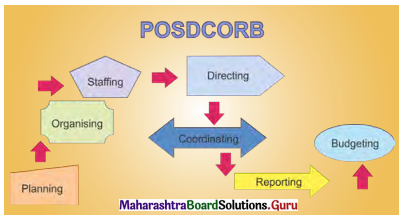
  • Gullick and Urwick explained the scope of public administration by the acronym POSDCORB. i.e., planning organization staffing, directing, coordinating, reporting and budgeting.
  • Co-ordination involves an interrelation of the different branches and sections of administration to eliminate overlapping and duplication of work.

Question 4.
Corporate Social Responsibility (CSR) has great significance today.
Answer:
This statement is True.

  • The broad perspective of public administration views it as a cooperative group effort, engaged in collaborations with private groups in providing basic services to the community
  • CSR means that companies try to integrate social and environmental concerns into their operations as a way to contribute to society. These activities include activities like disaster relief, limiting pollution, social awareness, and educational programmes.

2B. Complete the concept maps.

Question 1.
Maharashtra Board Class 11 Political Science Important Questions Chapter 7 Public Administration 2B Q1
Answer:
Maharashtra Board Class 11 Political Science Important Questions Chapter 7 Public Administration 2B Q1.1

Maharashtra Board Class 11 Political Science Important Questions Chapter 7 Public Administration

Question 2.
Maharashtra Board Class 11 Political Science Important Questions Chapter 7 Public Administration 2B Q2
Answer:
Maharashtra Board Class 11 Political Science Important Questions Chapter 7 Public Administration 2B Q2.1

3. Answer the following.

Question 1.
Explain the meaning of Public Administration.
Answer:
Public Administration is a subdiscipline of Political Science. It focuses on ‘government in action’ i.e., implementation of government decisions, policies, and programmes in fields of social security and welfare, law and order, transport and communication, health and sanitation, etc.

The executive branch of government consists of the Political Executive (council of ministers) and Permanent /Non-political Executive or Bureaucracy.

Public Administration as a subject studies the activity and process of the government.
According to Waldo, ‘Public Administration is the art and science of management as applied to the affairs of the state’.

Public Administration broadly includes the following:

  • Activities of all three branches of government, especially that of the executive branch.
  • Non-political public bureaucracy operating in a political system.
  • Management of public affairs and policy execution.
  • Concerned with public welfare and hence provides service and regulatory functions to the people to attain a good life.

Maharashtra Board Class 11 Political Science Important Questions Chapter 7 Public Administration

Question 2.
How did the discipline of Public Administration evolve?
Answer:
Since ancient times, various thinkers have contributed to administrative thought and practice e.g., Kautilya’s ‘Arthashastra’ (a text on administration and political economy), Aristotle’s ‘Politics’ (in ancient Greece), and Machiavelli’s ‘The Prince’ (in Medieval Italy).

In the 18th century, Cameralism in Germany and Austria was concerned with the systematic management of governmental affairs. It stressed descriptive studies of the structure and procedures of public administration as well as the professional training of public officials. George Zincke was the most distinguished scholar of this group.

Public administration as a separate subject of study originated in the USA mainly due to factors like-

  • Large scale organisations that arose due to industrialization
  • Scientific Management Movement by Taylor.
  • The emergence of a welfare state where the government had to perform a variety of functions.

Woodrow Wilson’s celebrated essay ‘The Study of Administration’ (1887) laid the foundation for the systematic, separate study of public administration. He is regarded as ‘The Father of Public Administration’. He advocated politics administration dichotomy i.e., separation of administration from politics, according to him politics is concerned with policy-making while the administration is concerned with the implementation of policy decisions, Wilson emphasized the need to increase government efficiency.

Today, the subject matter of public administration has expanded to include areas like comparative studies, public policy, new public management, and good governance.

Question 3.
Explain Corporate Social Responsibility.
Answer:
Companies try to integrate social and environmental concerns into their business operations. Corporate Social Responsibility (CSR) is not charity but a way to improve society. CSR activities include work like limiting pollution, disaster relief, clean water, and educational programmes in developing countries, etc.

4. Observe the given image and write in brief about it.

Maharashtra Board Class 11 Political Science Important Questions Chapter 7 Public Administration 2B Q4
Answer:
In a narrow sense, it focuses on those aspects of administration that are related to only the executive branch of the government. This view was given by Gullick and Urwick in their famous acronym POSDCORB.

P-Planning: The first step in administration is planning where a broad outline or a blueprint is prepared. This happens at all three levels: National, State, and Local, For instance, the NITI Aayog has adopted a bottom-up approach where planning begins at the grassroots level and then reaches the top.

Maharashtra Board Class 11 Political Science Important Questions Chapter 7 Public Administration

O-Organisation: The planned objectives and goals are achieved by establishing the formal structure of authority through which the work is arranged, defined, and coordinated. For example, All India Services, Central, State, and Local Services.

S-Staffing: Human resources are the backbone of any administrative system. The personnel who actively engage in the process of administration are to be recruited and trained. It is also important to maintain favorable working conditions for them. For example, recruitment through UPSC.

D-Directing: Administration is a continuous activity. Therefore making decisions and embodying them in specific and general orders and instructions is also necessary.

CO-Co-ordination: Administration is a complex and interrelated process hence different parts of organisation such as branches, divisions, sections need to be coordinated. This helps in the elimination of overlapping work and prevents conflict.

R-Reporting: Information related to the ongoing or completed task and its reporting to higher authorities is a key aspect of administration. This ensures accountability and responsibility within the administration.

B-Budgeting: Finance is a key aspect of any activity. Therefore accounting, fiscal planning, and its control are maintained through budgeting.

Maharashtra Board Class 11 Political Science Solutions Chapter 7 Public Administration

Balbharti Maharashtra State Board Class 11 Political Science Solutions Chapter 7 Public Administration Textbook Exercise Questions and Answers.

Maharashtra State Board Class 11 Political Science Solutions Chapter 7 Public Administration

1A. Choose the correct alternative and complete the following statements.

Question 1.
The backbone of any administrative system is _____________ (material resource, human resource, natural resource, geographic resource)
Answer:
human resource

Maharashtra Board Class 11 Political Science Solutions Chapter 7 Public Administration

Question 2.
Gullick and _____________ put forth the acronym POSDCORB. (Woodrow Wilson, Herbert Simon, Urwick, Dwight Waldo)
Answer:
Urwick

1B. Identify the incorrect pair in every set, correct it and rewrite.

Question 1.
(a) Kautilya – Arthashastra
(b) Aristotle – The Politics
(c) Machiavelli – Republic
Answer:
Machiavelli – The Prince or Plato – Republic

1C. State the appropriate concept for the given statements.

Question 1.
The systematic management of governmental affairs in 18th century Germany and Austria.
Answer:
Cameralism

Question 2.
Efforts of companies to integrate social and environmental concerns.
Answer:
Corporate Social Responsibility

2. State whether the following statements are true or false with reasons.

Question 1.
The first step in administration is staffing.
Answer:
This statement is False.

  • According to Gullick and Urwick, public administration should focus on aspects related to the executive branch of government.
  • It is explained by the acronym POSDCORB. Thus, the first step in administration is Planning, followed by Organisation and then Staffing.

Maharashtra Board Class 11 Political Science Solutions Chapter 7 Public Administration

Question 2.
Public Administration as an academic discipline was born in India.
Answer:
This statement is False.

  • Public Administration as an academic discipline originated in the USA and Woodrow Wilson was the first person to emphasize the need to study it.
  • However, Kautilya’s ‘Arthashastra’ was a text on administration and political economy in ancient India.

3. Explain the co-relation between the following.

Question 1.
Narrow and Broad perspective of Public Administration (Private administration and Public administration).
Answer:
Private administration is concerned with achieving the goals of private business organizations. The similarities between private and public administration are that both aim to serve the people, have similar types of hierarchy and management systems, and rely on common skills, techniques, and procedures.

The differences between private and public administration relate to aspects like scope, motive, responsibility, weakness, and financial control. Private administration is business-like with a narrower scope, wealth creation as the motive, responsibility to the owners, fewer chances of red-tapism, and internal financial control.

Public administration is bureaucratic with a very wide scope and motive as public service, responsibility to the ministers, intrinsic weakness of red-tapism, and external financial controls.

Question 2.
National Administration and State Administration (Rural administration and Urban administration).
Answer:
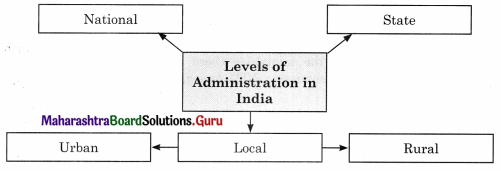
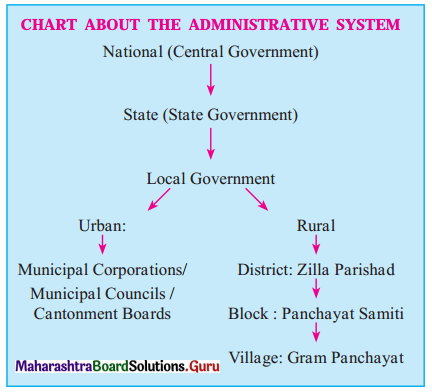
At the local level, the administration is either urban or rural. Urban administration includes political and administrative dimensions. For cities, there are Municipal Corporations (with a population of 3 lakhs and more) headed by the Mayor, Municipal Councils (Nagar Palika), City Councils (Nagar Panchayats), and Cantonment Boards. There is also a Municipal Commissioner who performs administrative functions and a Collector who looks after revenue, law, and order, land records, etc.

Maharashtra Board Class 11 Political Science Solutions Chapter 7 Public Administration

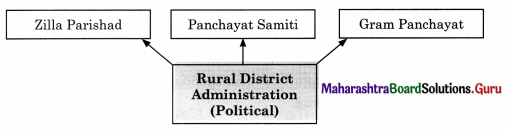
Rural administration includes three tiers i.e., Zilla Parishad, Panchayat Samiti, and Gram Panchayat. Developmental administration includes Chief Executive Officer, Block Development Officer, and Gram Sevak. There is also the Collector and Tehsildar.

4. Answer the following.

Question 1.
Explain the functioning of the administration.
Answer:
Maharashtra Board Class 11 Political Science Solutions Chapter 7 Public Administration 4 Q1

(i) At the national level, the work of the Central Government is conducted by various ministries (departments). For example, there are ministries of Agriculture, Health, Home, Defence, etc. Each ministry (or department) is headed by a Minister. Below the Minister is the bureaucracy or the administrative machinery. Besides the ministries, there are such institutions as the Election Commission, Union Public Service Commission. NITI Aayog, etc. These also require administrators or a bureaucracy.

(ii) At the State level also, there are various ministries and commissions that do the work of the government. The ministries of the State are also headed by a Minister and staffed by the bureaucracy.

(iii) At the local level, the administration is of two types: urban and rural administration. At the district level_ the highest administrative officer is the collector. In large cities, the Municipal Commissioner is in charge of the Municipality or Municipal Corporation. In rural areas, at the level of the Tehsil, the Tehsildar looks after the administration.

(iv) There is a close link between political leadership and administrative machinery. At the national, state levels and local levels, the political leaders are closely linked to the administrative machinery.

(v) The recruitment for all administrative posts at all levels is done through competitive examinations conducted by the government. At the central government level, the UPSC and Staff Selection Commission are the bodies that conduct these examinations.

Maharashtra Board Class 11 Political Science Solutions Chapter 7 Public Administration

Question 2.
Explain the steps in public policymaking.
Answer:
Public Policy refers to the new approach to understanding aspects of government activities for public welfare ‘ that is beyond simple administrative activities for e.g., Ayushman Bharat which aims to provide universal access to good quality health care in India.

Public policy can be understood in three steps.

  • Policy Choice: Elected representatives, bureaucrats, and others decide the on which concerns of citizens to deal with, various options available about how to deal with it, and the formulation of a programme are then decided for e.g., anti-malaria programme (its objectives and implementation).
  • Policy Output: Actual implementation of the policy takes place and policy output is determined
  • Policy Impact (evaluation stage): This involves assessment of the objectives to determine policy impact and any improvements if required.

5. Answer the following in detail with reference to the given points.

Question 1.
Define public administration and explain its scope with reference to the following points.
(a) narrow perspective
(b) wider perspective
Answer:
Public Administration is a sub-discipline of Political Science. It focuses on ‘government in action’ i.e., implementation of government decisions, policies, and programmes in fields of social security and welfare, law and order, transport and communication, health and sanitation, etc.

The executive branch of government consists of the Political Executive (council of ministers) and Permanent/ Non-political Executive or Bureaucracy. Public Administration as a subject studies the activity and process of the government. According to Waldo, ‘Public Administration is the art and science of management as applied to the affairs of the state’.

Public Administration broadly includes the following:

  • Activities of all three branches of government, especially that of the executive branch.
  • Non-political public bureaucracy operating in a political system.
  • Management of public affairs and policy execution.
  • Concerned with public welfare and hence provides service and regulatory functions to the people to attain a good life.

Maharashtra Board Class 11 Political Science Solutions Chapter 7 Public Administration

Scope of public Administration.
Public Administration can be studied as two categories.
(a) Narrow perspective – It focuses on aspects related only to the executive branch of government. Gullick and Urwick sum this view in the acronym POSDCORB to denote Planning, Organisation, Staffing, Directing, Coordinating, Reporting, Budgeting.

Maharashtra Board Class 11 Political Science Solutions Chapter 7 Public Administration 5 Q1

  • Planning – working out in broad outline/ blueprint of what is to be done and methods to be adopted for it. e.g., NITI Aayog has adopted the approach of grassroots – national level.
  • Organising – establishing the formal structure of authority through which work is delegated, defined, and coordinated e.g. All India services.
  • Staffing – recruitment, training, and working conditions of personal e.g., in India this is through UPSC.
  • Directing – making decisions and issuing instructions and orders as the administration is a continuous activity.
  • Coordinating – interrelating the work of various selections and parts of the organization. eliminate overlapping of work or conflict over responsibility
  • Reporting – reporting to superiors/higher authorities any information about ongoing/completed tasks. This ensures responsibility and accountability.
  • Budgeting – refers to fiscal planning, control, and accounting.

(b) Broad perspective – This differs from the narrow, managerial view of public administration. It includes activities of all three branches of the government, their interrelationships. Specialized government functions such as defense, finance, health care, etc. as well as collaborations with private groups e.g., NGO’s in providing services to the community. This view is concerned with techniques of administration (POSDCORB) as well as with substantive matters of administration.

According to Woodrow Wilson, ‘Administration is the most obvious part of the government- it is a government inaction, the most visible, operative side of the government.’

Maharashtra Board Class 11 Political Science Solutions Chapter 7 Public Administration

Activity (Text Book Page No.63)

Question 1.
Look at the latest Annual Report of the Ministry of Home, Government of India. Make a list of the main activities of the ministry.
Answer:
The main activities of the Ministry of Home, GOI include the maintenance of internal security and domestic policy.
The departments included under this Ministry are-

  • Intelligence Bureau (IB)
  • Central Reserve Police Force (CRPF)
  • Border Security Force (BSF)
  • Central Industrial Security Force (CISF)
  • Indo-Tibetan Border Police (ITBP)
  • National Security Guards (NSG)
  • National Investigation Agency (NIA)
  • Sashastra Seema Bal (SSB).

Maharashtra Board Class 11 Political Science Important Questions Chapter 6 Role of the Judiciary

Balbharti Maharashtra State Board Class 11 Political Science Important Questions Chapter 6 Role of the Judiciary Important Questions and Answers.

Maharashtra State Board 11th Political Science Important Questions Chapter 6 Role of the Judiciary

1A. Choose the correct alternative and complete the following statements.

Question 1.
In India, the ___________ court is at the apex of the judicial system. (Supreme, High, District, Cooperative)
Answer:
Supreme

Question 2.
___________ jurisdiction of the supreme court is also it’s exclusive jurisdiction. (Original, Appellate, Advisory, Writ)
Answer:
Original

Maharashtra Board Class 11 Political Science Important Questions Chapter 6 Role of the Judiciary

Question 3.
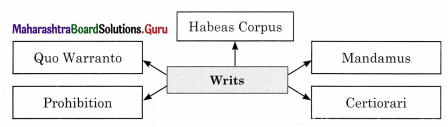
___________ refers to a writ whereby, the court can ask if the holder of any public office, is holding the post lawfully. (Habeas Corpus, Mandamus. Prohibition, Quo Warranto)
Answer:
Quo Warranto

1B. Identify the incorrect pair in every set, correct it and rewrite.

Question 1.
(a) Kesavananda Bharati Case – Basic Structure of Constitution
(b) Marbury vs Madison Case – France
(c) Certiorari – Writ
Answer:
(b) Marbury vs Madison Case – USA

1C. State the appropriate concept for the given statement.

Question 1.
Authority of the court to adjudicate only in the specified areas.
Answer:
Jurisdiction

Question 2.
Taking of decisions about disputes by the judiciary.
Answer:
Adjudication

Question 3.
Special kinds of orders are issued by the judiciary for the protection of fundamental rights.
Answer:
Writs

Question 4.
Order by the court to any government authority to perform its function.
Answer:
Mandamus

Maharashtra Board Class 11 Political Science Important Questions Chapter 6 Role of the Judiciary

Question 5.
Power of the court to declare a law as unconstitutional and hence as invalid.
Answer:
Judicial Review

1D. Answer in one sentence only.

Question 1.
What is the primary function of the judiciary?
Answer:
The primary function of the judiciary is adjudication i.e., giving decisions about cases according to the law.

Question 2.
On what grounds can a judge of the US Federal Court be impeached?
Answer:
On grounds of violation of constitutional provisions or exceeding the powers assigned to the judiciary, a judge of the US Federal Court be impeached.

Question 3.
What is the territorial jurisdiction of the High Court?
Answer:
The territorial jurisdiction of the High Court is all subordinate courts and quasi-judicial bodies within the State’s territory.

Question 4.
What is the Supreme Court Collegium composed of?
Answer:
The Supreme Court Collegium is composed of the Chief Justice of India and four senior-most judges of the Supreme Court.

Question 5.
Who appoints the judges of the Supreme Court?
Answer:
The President appoints the judges of the Supreme Court.

Maharashtra Board Class 11 Political Science Important Questions Chapter 6 Role of the Judiciary

Question 6.
Name 2 tribunals in Maharashtra.
Answer:
The Maharashtra Administrative Tribunal and the Maharashtra Revenue Tribunal.

Question 7.
What does the jurisdiction of the court refer to?
Answer:
Each court can adjudicate or hear cases pertaining only to a specified range of areas which is known as the jurisdiction of that court.

Question 8.
Who can hear cases disputes regarding the election of the President and Vice President of India?
Answer:
Supreme Court can hear cases disputes regarding the election of the President and Vice President of India.

Question 9.
What is the Supreme Court ruling about ‘Right to Life’.
Answer:
Supreme Court has ruled that the ‘Right to Life’ guaranteed by the Constitution does not merely mean the right to exist but also the right to live in a pollution-free environment.

Question 10.
What are ‘writs’?
Answer:
The Constitution empowers the Supreme Court and the High Courts to issue writs or special kinds of orders for the protection of the fundamental rights as well as the legal rights of individuals.

1E. Complete the following sentences by using appropriate reason.

Question 1.
It is necessary to ensure that the judiciary is independent because
(a) it can adjudicate in a free, impartial manner.
(b) the judges will not become corrupt.
(c) the judges will not be liable for impeachment.
Answer:
(a) it can adjudicate in a free, impartial manner.

Maharashtra Board Class 11 Political Science Important Questions Chapter 6 Role of the Judiciary

Question 2.
The High Court has Appellate Jurisdiction because
(a) it is the exclusive jurisdiction of the High Court.
(b) it can hear appeals regarding decisions of the District Courts.
(c) it is at the apex of the country’s judicial system.
Answer:
(b) it can hear appeals regarding decisions of the District Courts.

Question 3.
The higher judiciary is called ‘protector of fundamental rights because
(a) they can make laws to protect these rights.
(b) they have the power of Judicial Review.
(c) they can issue writs for protection of these rights.
Answer:
(c) they can issue writs for protection of these rights.

Question 4.
The original jurisdiction of the Supreme court is also it’s “exclusive” jurisdiction because
(a) only the Supreme Court can deal with certain cases.
(b) only the Supreme Court can issue writs.
(c) only the Supreme Court can hear appeals in cases of the lower courts.
Answer:
(a) only the Supreme Court can deal with certain cases.

1F. Find the odd word in the given set.

Question 1.
Supreme Court, High Court, District Court, National Green Tribunal.
Answer:
National Green Tribunal (it is Quasi-Judicial)

Maharashtra Board Class 11 Political Science Important Questions Chapter 6 Role of the Judiciary

Question 2.
Mandamus, Impeachment, Certiorari, Prohibition.
Answer:
Impeachment (It is not a writ)

2A. State whether the following statements are true or false with reasons.

Question 1.
It is essential to maintain the independence of the judiciary.
Answer:
This statement is True.

  • Independence of Judiciary means independence in the administration of Justice.
  • Judges must be able to perform their functions impartially without fear or favour and pressure from the executive, legislature, or any other group.

Question 2.
Judges are given attractive salaries and facilities.
Answer:
This statement is True.

  • This will ensure that competent candidates are recruited to the post of judges.
  • It will also ensure that the judges do not indulge in corrupt practices. Thus, the independence of the judiciary will be maintained.

Question 3.
Judges of the Supreme Court in India can be easily impeached.
Answer:
This statement is False.

  • Judges of the Supreme Court in India can be removed on grounds of misbehavior or incapacity.
  • However, the procedure of impeachment is long and complicated. This ensures the independence of the judiciary in India.

Question 4.
The Supreme Court is the Apex Court.
Answer:
This statement is True.

  • India has a single, integrated judiciary with the Supreme Court as the apex court. There is a single hierarchy of courts i.e., Supreme Court, High Courts, and Subordinate Courts.
  • All courts and tribunals in the country are under the control and supervision of the Supreme Court.

Maharashtra Board Class 11 Political Science Important Questions Chapter 6 Role of the Judiciary

Question 5.
The government’s role in the appointment of judges of the supreme court and the high court has been minimized.
Answer:
This statement is True.

  • The Constitution lays down the procedure for the appointment of the judges of the Supreme Court and the High Courts. They are formally appointed by the President.
  • There is a Collegium comprising of the Chief Justice of India and four senior-most judges who recommend names of Judges to the President.

Question 6.
Tribunals are known as “quasi-judicial bodies”.
Answer:
This statement is True.

  • In addition to the courts, there are tribunals established by both the Central Government as well as the State Governments to deal with disputes of a specialized nature e.g., the Armed Forces Tribunal, the Income Tax Tribunal, Maharashtra Administrative Tribunal, etc.
  • The functioning of these tribunals is governed by separate laws. Hence, they are called quasi-federal.

2B. Complete the concept maps.

Question 1.
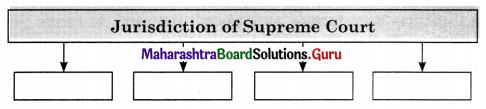
Maharashtra Board Class 11 Political Science Important Questions Chapter 6 Role of the Judiciary 2B Q1
Answer:
Maharashtra Board Class 11 Political Science Important Questions Chapter 6 Role of the Judiciary 2B Q1.1

3. Explain the co-relation between the following.

Question 1.
Supreme Court and High Court.
Answer:
India has a single integrated judicial system, with the Supreme Court at the apex and followed by the High Courts in the States. The Supreme Court controls all courts and tribunals in the territory of India. The High Court controls and supervises the functioning of the subordinate courts e.g., District Courts, in its territorial jurisdiction. The High Courts have Appellate jurisdiction, regarding decisions of the lower courts while Supreme Court can hear appeals in civil, criminal, and constitutional cases against decisions of the High Courts.

Supreme Court has original Jurisdiction such as in disputes about the election of the President or Vice¬President which are it’s exclusive jurisdiction. Both, Supreme Court and High Court have Writ Jurisdiction i.e., they can issue directives or writs such as Habeas Corpus in case of violation of a person’s fundamental rights. In case of appointment of judges of High Courts, the President also consults the Chief Justice of the Supreme Court.

Maharashtra Board Class 11 Political Science Important Questions Chapter 6 Role of the Judiciary

4. Answer the following questions.

Question 1.
Explain the jurisdiction of tribunals in India.
Answer:
In addition to the courts, there are tribunals established by both the Central Government as well as the State Governments to deal with disputes of a specialized nature e.g., the Armed Forces Tribunal, the Income Tax Appellate Tribunal, and the National Green Tribunal.

The examples of the tribunals established by the State Government in Maharashtra are the Maharashtra Administrative Tribunal and the Maharashtra Revenue Tribunal. These bodies are known as quasi-judicial bodies, and their functioning is governed by separate laws. They consist of retired judges, as well as individuals who are experts in the fields which fall within the jurisdiction of the relevant tribunal. For instance, the Armed Forces Tribunal also has retired officers from the armed forces as expert members. All the tribunals in India, like all the courts, are ultimately subordinate to the Supreme Court of India.

Question 2.
What is the original jurisdiction of the Supreme Court?
Answer:
Cases regarding certain matters can be heard for the first time only in certain courts. These matters constitute the Original Jurisdiction of that court. For instance, the Supreme Court of India has Original Jurisdiction in any case between two State Governments, and between the Government of India and any State Government, as well as any disputes about the election of the President and the Vice-President of India. Only the Supreme Court of India in the country can hear the above-mentioned cases. Thus, here its Original Jurisdiction of the Supreme Court is also its Exclusive Jurisdiction.

Question 3.
Explain the writs under Article 32.
Answer:
A writ is a directive issued by the Supreme court or High courts.
Writs under the Constitution of India under Article 32.

  • Habeas Corpus – A court can order any officer of the Government or any private person to produce before itself any individuals to examine whether they have been legally detained or not.
  • Mandamus – A court can order any officer or any department of the Government to perform its duties.
  • Prohibition – A court can order a court lower than itself in the judicial structure not to hear a particular case on the grounds that the case does not fall within the jurisdiction of the latter.
  • Quo Warranto – The court can ask whether the holder of any public office or post is holding it in accordance with the law or not.
  • Certiorari – A higher court can order a court lower than itself in the judicial structure to send all the relevant documents pertaining to a case to itself.

Maharashtra Board Class 11 Political Science Important Questions Chapter 6 Role of the Judiciary

Question 4.
State some important cases under Public Interest Litigation in India.
Answer:
Public Interest Litigation (PIL) is litigation that can be filed in any court of law by any person for the protection of ‘public interest’. It has achieved importance in the Indian legal system and is a landmark of judicial activism. It developed through the decisions of Justice V.R. Krishna Iyer, Justice C. J. Chandrachud, and Justice P. N. Bhagawati. Some significant cases include

  • Katara (human rights activist) vs Union of India case that changed the way that public authorities handled medico-legal cases such as in case of road accidents.
  • Vishaka’s judgment provided guidelines with regard to women’s rights and especially sexual harassment (prevention of and dealing with cases of sexual harassment). This judgment came after the Bhanwari Devi rape case and subsequent PIL filed by Naina Kapur, a lawyer.
  • H. Khatoon vs State of Bihar (1979) – This case drew the attention of the court to the pathetic condition of undertrials in Bihar. This tried to ensure speedy trials.
  • Mehta vs Union of India (1988) with regard to pollution of the Ganga basin covering 8 States in India.

Question 5.
Write about the Kesavananda Bharati Case (1973).
Answer:
The validity of the Constitution (24th Amendment) Act 1971 was challenged in the case of Kesavananda Bharati vs. the State of Kerala (also known as the Fundamental Rights Case). This Amendment gave the power to the Parliament to amend the fundamental rights of the citizens. The Supreme Court had to decide whether Parliament had the power to abrogate the basic elements and fundamental provisions of the Constitution of India. The Supreme Court held that the Constitution (24th Amendment) Act 1971 is valid and that Parliament has the power to amend all the provisions of the Constitution, including fundamental rights, but could not amend the basic structure of the Constitution.

5. Answer the following in detail with reference to the given points.

Question 1.
Explain the jurisdiction of the Supreme Court.

  1. Original Jurisdiction
  2. Appellate Jurisdiction
  3. Writ Jurisdiction
  4. Advisory Jurisdiction
  5. Judicial Review

Answer:
The Supreme court is at the apex of the Indian judicial system.
1. Original Jurisdiction: The Supreme Court has original jurisdiction to the exclusion of any other court in any dispute:

  • between the Government of India and one or more States or
  • between the Government of India and any State(s) on one side and any other State(s) on the other side.
  • between two or more States. Disputes regarding the election of the President and Vice President are the exclusive jurisdiction of the court.

Maharashtra Board Class 11 Political Science Important Questions Chapter 6 Role of the Judiciary

2. Appellate Jurisdiction: The Supreme Court is the highest court of appeal in the territory of India. Appellate jurisdiction can be considered as follows:

  • Appeals in Constitutional cases: This means that an appeal shall lie to the Supreme Court from any decree or judgment of a High Court if the High Court certifies that the case involves a substantial question of law as to the interpretation of the Constitution.
  • Appeals in Civil cases: an appeal against any judgment or decree of a High Court in a civil case may be filed in the Supreme Court, provided the High Court certifies that the case involves a substantial question of interpretation of the law.
  • Appeals in Criminal cases: against High Court order if the High Court has:
    • on appeal reversed an order of acquittal of an accused and sentenced him to death,
    • withdrawn for trial before itself a case from a Subordinate Court and in such a trial convicted the accused and sentenced him to death or
    • if the High Court certifies that the case is a fit one for an appeal to the Supreme Court.

3. Writ Jurisdiction:
Under Article 32, the Supreme Court has original jurisdiction to entertain a writ petition from a party that complains of the violation of a fundamental right. However, this is not exclusive as the party may also approach the High Court in this case.
The Supreme Court protects the Fundamental Rights of the citizens through various types of writs, like

  • Habeas Corpus
  • Mandamus
  • Prohibition
  • Quo Warranto
  • Certiorari.

(a) Habeas Corpus (to have the body): It is a direction of the Court to the detaining authority to produce the detained person before the court for enquiring into the grounds of detention.

(b) Mandamus (we order): This is in the nature of command of a Court (Supreme or High Court) to a person or body to perform some public legal duty which he has refused to perform.

(c) Prohibition: This writ is issued to special tribunals, commissions, and magistrates who are vested with judicial powers, prohibiting them from exceeding their jurisdiction.

(d) Quo Warranto (by what authority?): This writ is issued against a person who claims or usurps a public office to inquire by what authority he has done so.

(e) Certiorari: This writ is issued to a lower court directing it to transfer the records and case for trial to a higher court to prevent an abuse/usurpation of jurisdiction.

4. Advisory Jurisdiction:
The President has the right to seek the legal advice of the Supreme Court on any matter of public importance which involves a question of law or any dispute arising out of any treaty or agreement executed before the commencement of the Constitution. The Supreme Court is bound to give its opinion on any matter referred to it by the President. However, the opinion of the Court is not binding on the President.

Maharashtra Board Class 11 Political Science Important Questions Chapter 6 Role of the Judiciary

5. Judicial Review:
Judicial Review consists of the competence of the Supreme Court and High Courts to pronounce a law passed by the Parliament or State Legislature or any executive action as ultra vires to the Constitution (i.e., unconstitutional) and hence null and void if in the opinion of the court the law of action is contrary to the provisions or spirit of the Constitution.

Maharashtra Board Class 11 Political Science Solutions Chapter 6 Role of the Judiciary

Balbharti Maharashtra State Board Class 11 Political Science Solutions Chapter 6 Role of the Judiciary Textbook Exercise Questions and Answers.

Maharashtra State Board Class 11 Political Science Solutions Chapter 6 Role of the Judiciary

1A. Choose the correct alternative and complete the following statements.

Question 1.
___________ is the first country to create independent judiciary. (India, United States, United Kingdom, Soviet Union)
Answer:
United States

Maharashtra Board Class 11 Political Science Solutions Chapter 6 Role of the Judiciary

Question 2.
The primary function of the judiciary is ___________ (making laws, executing laws, adjudication, make appointments)
Answer:
adjudication

1B. Identify the incorrect pair in every set, correct it and rewrite.

Question 1.
(a) Written Consitution – India
(b) Judicial Review – United Kingdom
(c) Independent Judiciary – United States
Answer:
(b) Judicial Review – USA

1C. State the appropriate concept for the given statement.

Question 1.
Petition regarding important public concerns.
Answer:
Public Interest Litigation (PIL)

Question 2.
The process of removal of judges.
Answer:
Impeachment

Maharashtra Board Class 11 Political Science Solutions Chapter 6 Role of the Judiciary

Question 3.
Cases can be heard for the first time only in certain courts.
Answer:
Original Jurisdiction

2. Complete the concept map.

Question 1.
Maharashtra Board Class 11 Political Science Solutions Chapter 6 Role of the Judiciary 2 Q1
Answer:
Maharashtra Board Class 11 Political Science Solutions Chapter 6 Role of the Judiciary 2 Q1.1

3. State whether the following statements are true or false with reasons.

Question 1.
There is no need to approve the appointment of judges by the Senate in the United States.
Answer:
This statement is False.

  • The Judges of the Supreme Court of America and the courts subordinate to it are appointed by the President of the USA.
  • These appointments can be confirmed only after the Senate gives its approval.

Maharashtra Board Class 11 Political Science Solutions Chapter 6 Role of the Judiciary

Question 2.
In India judiciary is independent.
Answer:
This statement is True.

  • Provisions for judicial independence are provided in the Indian Constitution.
  • This includes provisions related to appointment, tenure, salary, and allowances, removal from office, etc., of judges so that the judiciary acts in a free and fair manner.

4. Explain the co-relation between the following.

Question 1.
Judiciary and Executive.
Answer:
The judiciary and executive are both organs of the government. The main function of the executive is the implementation of laws and policies while the functions of the judiciary include interpretation of law and adjudication. In India, judges are appointed by the President (nominal executive). Traditionally, these appointments were made after consulting with the existing government (ministry). However, to maintain judicial independence, the collegium of judges recommends names for appointment to the President.

There are many instances where the executive is a party to a dispute either as the plaintiff or as the defendant. Given the power of the Government, any legal dispute between it and one or more citizens is usually unequal. There is a possibility that the Government would use its powers to secure a favourable decision. This is where the independence of the Judiciary becomes important. An independent judiciary ensures that all those who appear before it is treated on an equal plane, and thus makes sure that decisions are in accordance with the law.

Question 2.
Supreme Court and High Court.
Answer:
India has a single integrated judicial system, with the Supreme Court at the apex and followed by the High Courts in the States. The Supreme Court controls all courts and tribunals in the territory of India. The High Court controls and supervises the functioning of the subordinate courts e.g., District Courts, in its territorial jurisdiction. The High Courts have Appellate jurisdiction, regarding decisions of the lower courts while Supreme Court can hear appeals in civil, criminal, and constitutional cases against decisions of the High Courts.

Maharashtra Board Class 11 Political Science Solutions Chapter 6 Role of the Judiciary

Supreme Court has original Jurisdiction such as in disputes about the election of the President or Vice¬President which are its exclusive jurisdiction. Both, Supreme Court and High Court have Writ Jurisdiction i.e., they can issue directives or writs such as Habeas Corpus in case of violation of a person’s fundamental rights. In case of appointment of judges of High Courts, the President also consults the Chief Justice of the Supreme Court.

5. Express your opinion of the following.

Question 1.
Judiciary must have a leading role in the appointment of judges.
Answer:
One of the main ways to secure judicial independence relates to the appointment of the judges. A judiciary that works under government favour, fear, or pressure i.e., a ‘committed judiciary’ can never give impartial, fair decisions especially when the government is a party in any dispute. The judges of the Supreme Court and High Courts are appointed by the President of India who is expected to be politically neutral.

However, according to the 42nd Amendment Act, the President acts on the aid and advice of the Union Ministry, Hence, executive interference in judicial appointments is a real possibility. Since the 1990s, the Supreme Court ruled that the Judiciary must play a leading role in its judicial appointments.

The Supreme Court set up a Collegium consisting of the Chief Justice of India and the four senior-most judges of the court which would recommend names to the President for appointment to the Supreme Court and the High Courts. The Government’s role in this process has now been minimized.

Question 2.
Judicial activism is significant today.
Answer:
Judiciary in India has started taking a wider view of its functions. For instance, the courts have allowed individuals to file petitions on matters of important public concern. Such cases are known as Public Interest Litigation (PILs). There have been instances where the courts of their own accord, without anyone complaining or filing a petition, have taken note of matters of public concern (Suo moto). This wider view taken by the Judiciary of its functions has been termed as ‘Judicial Activism’.

Maharashtra Board Class 11 Political Science Solutions Chapter 6 Role of the Judiciary

In recent years, Judicial Activism has led to the courts examining the legality of the decision of the executive over a wide variety of issues including the ones referred to above. Moreover, in many instances, they have also either issued orders on what should be done over many issues or have directed the executive to take action about the same in a specified time period.

There has been much debate over Judicial Activism. Some feel that the judiciary was compelled to intervene because the executive was not discharging its functions properly, while others believe that the courts are exceeding their powers by looking into matters which fall within the jurisdiction of the executive or legislative.

6. Answer the following in detail with reference to the given points.

Question 1.
Explain the process of Judicial Review?
(a) Meaning
(b) Need
(c) When and where it started
(d) Indian context
Answer:
(a) Meaning: Judicial Review means the power of the Judiciary to examine if any law passed by the legislature or any executive policy or action is consistent with the Constitution or not, and if it is not then to declare it as unconstitutional and hence null and void.

(b) Need: It becomes necessary to have an institution that would examine whether the laws are consistent with the Constitution or not. That institution should also have the power to declare any law found inconsistent with the Constitution to be invalid and therefore not to be implemented. This would prevent the Legislature from making laws that violate the Constitution. In democracies with written Constitutions, this power is vested in the Judiciary. The Judiciary is not involved in any way in the law-making process. It is an independent body. Hence it has been assigned this power.

Maharashtra Board Class 11 Political Science Solutions Chapter 6 Role of the Judiciary

(c) When and where it started: The origins of the power of Judicial Review can be traced to a decision of the Supreme Court of the United States of America given in 1803 in a case known as the Marbury vs Madison case. This was for the first time that the American Supreme Court declared a law passed by the United States Congress to be invalid on the grounds that it was inconsistent with the Constitution of the United States. However, it must be noted that the American Constitution does not have an explicit provision that gives the Judiciary the power of Judicial Review. It is an implied power. To date, the American Supreme Court’s power of Judicial Review has been unchallenged. This is so because it is accepted that such a power is necessary to retain the supremacy of the Constitution.
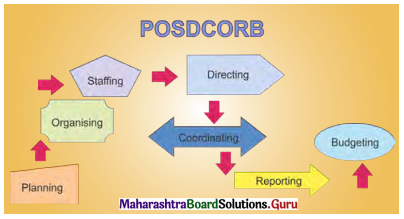
(d) Indian Context: The Constitution of India does not explicitly provide the judiciary with the power of Judicial Review. However, like in the United States, these powers are implied. The Supreme Court of India has on many occasions declared laws passed by the Legislature as being inconsistent with the Constitution and therefore unconstitutional. In the Indian context, the real issue has been whether the amendments to the Constitution can be held unconstitutional. The issue was settled by the Supreme Court in the Kesavananda Bharati case (1973). In its judgment, the Court stated that the Constitution of India had a ‘Basic Structure’. The Constitutional Amendments passed by the Parliament have to be consistent with this ‘Basic Structure’, and if they are found to be not, then the Supreme Court would declare them unconstitutional. The power to declare any Amendments as unconstitutional rests only with the Supreme Court.

Activity (Text Book Page No. 52)

Make a list of examples of Judicial Activism in India.
Answer:
Judicial Activism refers to the active role of the judiciary in upholding the rights of citizens and preserving constitutional provisions and the legal system of the country. The judiciary takes an active part wherever the legislature of executive fails to perform its duty, especially to dispense social justice.
Some areas of judicial activism include:

  • Reforming the BCCI even though it is a private body.
  • The Supreme Court insisting on a collegium of judges to suggest names for elevation as judges to the High/Supreme courts.
  • Protection of the ecosystem and environmental jurisprudence.
  • In regard to the Bhopal Gas Tragedy (1984).
  • Conduct NEET exam all over the country.
  • The right to privacy is a part of a fundamental right.
  • Improving conditions of undertrials.

Maharashtra Board Class 11 Political Science Important Questions Chapter 5 Concept of Representation

Balbharti Maharashtra State Board Class 11 Political Science Important Questions Chapter 5 Concept of Representation Important Questions and Answers.

Maharashtra State Board 11th Political Science Important Questions Chapter 5 Concept of Representation

1A. Choose the correct alternative and complete the following statements.

Question 1.
Today, in most countries, the form of government is ___________ democracy. (direct, indirect, concurrent, national)
Answer:
indirect

Question 2.
After the Civil War (1640’s) UK become a ___________ (Republic, Constitutional Monarchy, Absolute Monarchy, Federation)
Answer:
Constitutional Monarchy

Maharashtra Board Class 11 Political Science Important Questions Chapter 5 Concept of Representation

Question 3.
The first general elections was held in the year ___________ in India. (1947-48, 1950, 1951-52, 1935)
Answer:
1951-52

Question 4.
In the plurality method, ___________ constituency is required. (single member, multi member, transferable, non-official)
Answer:
single member

Question 5.
___________ System is used in India for presidential elections. (List, FPTP, Majority, Single Transferable vote)
Answer:
Majority

Question 6.
In India ___________ classifies parties as ‘State’ or ‘National’ and allots symbols to them. (President, Parliament, Election Commission, Judiciary)
Answer:
Election Commission

1B. Identify the incorrect pair in every set, correct it and rewrite.

Question 1.
BMS – Trade Union.
ABVP – Peasant’s Union.
FICCI – Business Group
BKU – Agricultural Unions
Answer:
ABVP – Student Union

Maharashtra Board Class 11 Political Science Important Questions Chapter 5 Concept of Representation

Question 2.
Government of India Act – 1935
Queen’s Proclamation – 1858
French Revolution – 776
Morley – Minto Reforms – 1909
Answer:
French Revolution – 1789

1C. State the appropriate concept for the given statements.

Question 1.
The idea in the middle ages in Europe was that the king was God’s representative on earth.
Answer:
Divine Rights of Kings

Question 2.
Distinct geographical areas from which representatives are elected.
Answer:
Constituencies

Question 3.
The electoral system in which the candidate who secures the maximum number of votes is declared as elected.
Answer:
Plurality System

Maharashtra Board Class 11 Political Science Important Questions Chapter 5 Concept of Representation

Question 4.
Views, objectives of a political party taken together.
Answer:
Ideology

Question 5.
All Indian parties have at least 11 seats in the Lok Sabha from at least three states.
Answer:
National Party

1D. Answer in one sentence.

Question 1.
What is a single-member constituency?
Answer:
A single-member constituency is one from which only a single member can be declared elected.

Question 2.
What is a multi-member constituency?
Answer:
A constituency from which several members can be elected is called a multi-member constituency.

Question 3.
What is the First Part of the Post System?
Answer:
It is a system wherein the candidate with the maximum number of votes is declared elected.

Maharashtra Board Class 11 Political Science Important Questions Chapter 5 Concept of Representation

Question 4.
What is Single Transferable Vote System?
Answer:
It is a type of Proportional Representation where voters rank candidates in order of preference.

Question 5.
What is meant by the ideology of a political party?
Answer:
The reflection of the overall views, objectives, and policies of a political party is called its ideology.

Question 6.
Name some state parties in Maharashtra.
Answer:
Shiv Sena, Maharashtra Navnirman Sena, Vanchit Bahujan Aghadi, Rashtriya Samaj Paksha.

1E. Complete the following sentence using the appropriate reason.

Question 1.
Representative democracy is referred to as responsible Government because
(a) representatives are ultimately responsible to the people.
(b) people are responsible for electing the government.
(c) direct democracy is not possible today.
Answer:
(a) representatives are ultimately responsible to the people.

Question 2.
In many European countries, a struggle between the representative assemblies and monarchs arose because
(a) monarchs believed in the Divine Rights of Kings.
(b) it was a period of national awakening.
(c) representative assemblies started insisting on a share in the decision-making process.
Answer:
(c) representative assemblies started insisting on a share in the decision-making process.

Maharashtra Board Class 11 Political Science Important Questions Chapter 5 Concept of Representation

Question 3.
Elections to the Lok Sabha is called the ‘First Past the Post’ method because
(a) it is a single-member constituency.
(b) candidates are ranked in order of preference.
(c) the candidate who gets a maximum number of votes is declared as elected.
Answer:
(c) the candidate who gets a maximum number of votes is declared as elected.

1F. Find the odd word in the given set.

Question 1.
Indian National Congress, Bharatiya Janata Party, Shiv Sena, Communist Party of India (Marxist).
Answer:
Shiv Sena (it is a regional party)

Question 2.
Nationalist Congress Party, All India Anna Dravida Munnetra Kazhagam, Telugu Desam Party, Akali Dal.
Answer:
Nationalist Congress Party (it is a national party)

Question 3.
National Students Union of India, Hind Mazdoor Sangh, Akhil Bharatiya Vidyarthi Parishad, Student Federation of India.
Answer:
Hind Mazdoor Sangh (it is a labour pressure group)

2A. State whether the following statements are true or false with reasons.

Question 1.
Today, most countries have an indirect or representative democracy.
Answer:
This statement is True.

  • Today, most countries have large territories and populations. Hence, direct democracy is not possible. The form of democracy today is indirect democracy or representative democracy.
  • People elect representatives from among themselves to govern the country for e.g., in India, members of Parliament (MP’s), Members of State Legislative Assemblies/Councils (MLA’s, MLC’s), of corporations, etc. are all our representatives.

Maharashtra Board Class 11 Political Science Important Questions Chapter 5 Concept of Representation

Question 2.
First Past the Post system is followed for Lok Sabha elections.
Answer:
This statement is True.

  • Lok Sabha (general) elections are held all over the country.
  • The candidate who gets the maximum number of votes is declared as elected from that constituency. He / She does not need a majority of votes.

Question 3.
Proportional Representation has limited scope.
Answer:
This statement is True.

  • In Proportional Representation the number of candidates of a political party to be elected depends on the proportion of votes that it receives.
  • It is a lengthy process and needs a multi-member constituency. Hence it is unsuitable for large-scale elections such as elections to the Lok Sabha.

Question 4.
Political parties are important channels for political representation.
Answer:
This statement is True.

  • Political parties serve as the primary channels of political representation. In democracies, parties seek to obtain power through elections. Members of various parties contest elections as candidates of their respective parties.
  • During the election, the parties present before the voters a programme based on their ideology and promise them that this programme would be implemented if elected to power. Thus, the aspirations and wishes of the voters are represented in the decision-making process through the channel or the medium of a given political party.

Question 5.
Telugu Desam (TDP) is a national party.
Answer:
This statement is False.

  • A national party must have a political presence in at least four states.
  • TDP is significant only in Andhra Pradesh and to some extent in Telangana.

Maharashtra Board Class 11 Political Science Important Questions Chapter 5 Concept of Representation

Question 6.
The Communist Party of India (CPI) can be described as the first political party in the country.
Answer:
This statement is False.

  • CPI was formed in 1925 by people who were influenced by the Bolshevik Revolution in Russia (1917) and the communist ideology.
  • In 1885, the Indian National Congress was formed as a united front against British Rule. It is considered the first political party in India.

2B. Complete the concept maps.

Question 1.
Maharashtra Board Class 11 Political Science Important Questions Chapter 5 Concept of Representation 2B Q1

Answer:
Maharashtra Board Class 11 Political Science Important Questions Chapter 5 Concept of Representation 2B Q1.1

3. Explain the correlation between the following.

Question 1.
Political Parties and Pressure Groups.
Answer:
Political parties are the most important channels for political representation. They are organized groups comprising of persons who hold similar views on a variety of issues or have similar objectives. They seek to obtain political power, generally, through the process of elections. The views of a party taken together are called the party’s ideology. At election times, political parties issue ‘Manifestos’ i.e., what policies/programmes they would implement if voted to power. Every party puts up its candidates who contest election.

Interest and Pressure groups are informal channels that seek to represent the people. A pressure group is an interest group that is organized to influence public opinion and government policy towards the fulfillment of its objectives and without active participation in the electoral process. This includes interest groups in the fields of business such as the Federation of Indian Chambers of Commerce and Industry (FICCI), for labour e.g., Indian National Trade Union Congress (INTUC), Bharatiya Kamgar Sena (BKS), for peasants such as Shetkari Sanghatana, for students such as Akhil Bharatiya Vidyarthi Parishad (ABVP), National Students Union of India (NSUI). In the USA, pressure groups are also called Lobby Groups.

Maharashtra Board Class 11 Political Science Important Questions Chapter 5 Concept of Representation

Many pressure groups today are closely affiliated with political parties e.g., ABVP is the student wing of BJP and BKS is the Shiv Sena’s Trade Union. Both the pressure group and the political party will then support each other in times of elections and decision-making in aspects like finance, manpower, and publicity.

4. Answer the following questions.

Question 1.
Explain the Divine Rights Theory.
Answer:
The Divine Rights of Kings Theory was propagated in Europe by Kings like James I (England). It explained that the Monarchs were God’s representatives on earth to whom, the people had to render habitual obedience. The King was infallible and unquestionable as he derived his power from God. Disobedience to the King was akin to sinning against God. This theory was used to strengthen the Absolute Monarchy in Europe.

Question 2.
Explain Representative Assemblies in Europe.
Answer:
Representative Democracy has its origins in medieval Europe. Till that time, Absolute Monarchies existed in most countries. The Divine Rights of Kings Theory was in application. As time went by, monarchs in many countries like England started having Representative Assemblies that represented the population. Soon, these assemblies asked for a share in the decision-making process of the country leading to conflicts between the monarchs and the Assemblies for e.g. French Revolution. Most conflicts ended with reduced/power to the monarchs. The Representative assemblies, now become Political Representatives as they dealt with all government activities.

Question 3.
What are the three methods of representation?
Answer:
The three methods of representation are

  • Electoral Method: Persons are directly or indirectly elected by the citizens to govern them as members of representative assemblies e.g., General elections to Lok Sabha and Legislative Assemblies.
  • Non-electoral Method: Representatives occupy their position through nomination or appointment for e.g., the President of India appoints 12 members to the Rajya Sabha.
  • Non-official Method: Civil society represents the people through various pressure groups like trade unions, student groups, etc.

Maharashtra Board Class 11 Political Science Important Questions Chapter 5 Concept of Representation

Question 4.
Explain the Proportional System of Representation.
Answer:
Proportional Representation is generally used in multi-member constituencies. In this system, the number of candidates of a given political party to be elected depends upon the proportion of votes that it receives. For instance, if a political party receives 40% of the votes in a five-member constituency, then two of its candidates will be elected from that constituency. This system is not used in India. There is a sub-type of the proportional system which is known as the Single-Transferable Vote (STV) system. Here the voters have to rank the candidates in order of preferences. This system is used in elections to the Rajya Sabha and to the State Legislative Councils in India.

Question 5.
What is a National Party?
Answer:
Political parties can be classified as National or State parties. The Election commission has decided that a political party shall be eligible to be recognized as a National party if-

  • It secures at least six percent (6%) of the valid votes polled in any four or more states, at a general election to the
  • House of the People or, to the State Legislative Assembly; and
  • In addition, it wins at least four seats in the House of the People from any State or state.

OR

  • It wins at least two percent (2%) seats in the House of the People (i.e., 11 seats in the existing House having 543 members), and these members are elected from at least three different States.
  • In India, some National Parties include I.N.C., B.J.P., G.P.M., N.C.P., etc.

Question 6.
Name six regional (state) parties.
Answer:

  • Telugu Desam Party (TDP) – Andhra Pradesh,
  • Telangana Rashtriya Samiti – Telangana,
  • Dravida Munnetra Kazhagam (DMK) and All India Dravida Munnetra Kazhagam (AIADMK) – Tamil Nadu,
  • National Conference – Jammu & Kashmir
  • Assam Gana Parishad (AGP) – Assam.
  • Shiv Sena – Maharashtra.

Question 7.
Name 4 trade unions and the political parties they are affiliated to.
Answer:

Trade UnionsPolitical Parties affiliated to
Indian National Trade Union Congress (INTUC)Indian National Congress
All India Trade Union Congress (AITU)Communist Party of India
Bharatiya Kamgar Sena (BKS)Shiv Sena
The Bharatiya Mazdoor Sangh (BMS)Bharatiya Janata Party (B.J.P)
Centre for Indian Trade Unions (CITU)Communist Party of India (Marxist) (CPM)

Question 8.
How do pressure groups differ from social movements?
Answer:
Pressure groups are different from social movements. The pressure groups usually have a more formalized structure. This is why sometimes interest groups are described as representing ‘organized interest’. Social movements usually do not have a formal structure or organisation. They take up a cause and pursue it. (Example: Chipko Movement)

Maharashtra Board Class 11 Political Science Important Questions Chapter 5 Concept of Representation

Question 9.
Write two examples of NGOs in India in the following field.

  1. Child Welfare
  2. Animal Welfare
  3. Aged Persons
  4. Disabled Persons
  5. Environment
  6. Women’s Welfare

Answer:

  1. Child welfare – Child Rights and You (CRY), Akansha
  2. Animal Welfare – PETA, People for Animals (PFA)
  3. Aged Persons – Help Age, Dignity Foundation.
  4. (iv) Disabled Persons – National Association for the Blind (NAB), GCCI, ADAPT.
  5. Environment – BNHS, BEAG.
  6. Women’s Welfare – SEWA, SNEHA, WIT

5. Observe the given image and writes in brief about it.
Maharashtra Board Class 11 Political Science Important Questions Chapter 5 Concept of Representation 5
Answer:
This is a heart-warming and motivating photograph.
We can observe the following about it.

  • In India, women have participated in the election process since 1950 when they were given voting rights.
  • It shows political awareness and participation of women, dressed in traditional attire, braving the hot sun standing in the queue to vote.
  • They are proudly holding up their identity proof which shows how motivated and proud they are to have the political right to vote.

Maharashtra Board Class 11 Political Science Solutions Chapter 5 Concept of Representation

Balbharti Maharashtra State Board Class 11 Political Science Solutions Chapter 5 Concept of Representation Textbook Exercise Questions and Answers.

Maharashtra State Board Class 11 Political Science Solutions Chapter 5 Concept of Representation

1A. Choose the correct alternative and complete the following statements.

Question 1.
Ancient Greece had ___________ (dictatorship, direct democracy, indirect democracy, monarchy)
Answer:
Direct democracy

Maharashtra Board Class 11 Political Science Solutions Chapter 5 Concept of Representation

Question 2.
The oldest representative assembly in the world is ___________ (House of Commons, House of Lords, Senate, House of Representative)
Answer:
House of Commons

1B. State the appropriate concept for the given statements.

Question 1.
The political system is where people elect representatives to govern themselves.
Answer:
Representative Democracy

1C. Find the odd word in the given set.

Question 1.
The Indian National Trade Union Congress, All India Kisan Sabha, National Students Union of India, Indian National Congress
Answer:
Indian National Congress (it is a political party)

2. Complete the concept maps.

Question 1.
Maharashtra Board Class 11 Political Science Solutions Chapter 5 Concept of Representation 2 Q1
Answer:
Maharashtra Board Class 11 Political Science Solutions Chapter 5 Concept of Representation 2 Q1.1

3. Explain the correlation between the following.

Question 1.
Governmental and Non-Governmental Organizations.
Answer:
Governmental organizations are public organizations that have a formalized structure. They are formed by election or nomination. They have legal status in terms of their jurisdiction. They are more concerned with political and administrative aspects.

Maharashtra Board Class 11 Political Science Solutions Chapter 5 Concept of Representation

However, such organizations due to their structure and scope may not be able to satisfy the concerns of different sections of the population or to represent various interests and causes. This leads to people who are devoted to the cause coming together as non-profit groups and further their cause. NGO’s work in the field of political and environmental awareness, the welfare of the elderly/women/children/disabled, etc., for e.g., Green Peace (environment), Help Age (senior citizens), CRY (children), AGNI (Political awareness), PFA (animals).

4. Express your opinion of the following.

Question 1.
Pressure groups are different from political parties.
Answer:
I agree with the statement.

  • The political parties are part of the governmental system. They seek to influence government policy from the inside. A pressure group tries to influence the government from the outside. They do not stand for elections or aim to become members of the legislature/ government.
  • Political parties have a broad agenda. They seek to represent the people for political, social, economic, cultural, and other concerns. Pressure groups usually have a narrow focus. They focus on specific issues or agitations for a specific cause e.g., the environment.

5. Answer the following in detail with reference to the given points.

Question 1.
What is meant by representation? Explain the various methods of representation?
(a) Meaning
(b) Electoral
(c) Non-electoral
(d) Non-official
Answer:
(a) Meaning: The concept of representation is important in any democracy.
Today, most countries have large territories and populations. Hence, direct democracy is not possible. The form of democracy today is indirect democracy or representative democracy. People elect representatives among themselves to govern the country for e.g., in India, Members of Parliament (MP’s), Members of State Legislative Assemblies/ Councils (MLA’s, MLC’s), of corporations, etc., are all our representatives.

(b) Electoral Method: Persons are directly or indirectly elected by the citizens to govern them as members of representative assemblies e.g., General elections to Lok Sabha, Assembly elections.

(c) Non-electoral Method: Representatives occupy their position through nomination or appointment for e.g., President of India appoints 12 Members to the Rajya Sabha.

(d) Non-official Method: Civil society represents the people through various pressure groups like trade unions, student groups, peasant organizations.

Maharashtra Board Class 11 Political Science Solutions Chapter 5 Concept of Representation

6. Suggest ways by which you can encourage people to vote in elections.
Answer:

  • NGO’s such as AGNI have special programmes designed to encourage people to exercise their franchise.
  • Street plays, flash mobs at railway stations, talks in colleges about the importance of voting.
  • Voter enrollment drives to encourage youngsters to vote.
  • Advertisements, especially involving celebrities as ‘ambassadors’ for the franchise.
  • In some countries of the world, the franchise is compulsory.

Activity (Text Book Page No. 44)

Question 1.
Write the history of anyone national political party in India.
Answer:
Indian National Congress
Indian National Congress was founded on 28th December 1885 due to the efforts of A.O. Hume, to act as a platform for civil and political dialogue among educated Indians. The first session, held in Bombay with 72 delegates in attendance, elected W.C. Banerjee as its first President. Members were mainly from the Bombay and Madras Presidencies such as Dadabhai Naoroji, Dinshaw Wacha, Pherozshah Mehta, and others. During its early phase, the Congress was led by the Moderates.

The party first split at the Surat session (1907) into two groups i.e., Moderates and Extremists (led by Bal Gangadhar Tilak). The party began to endorse the policy of “Swaraj” (Self-rule) and “Swadeshi” (of our own country), After the death of Lokmanya Tilak, the leadership of the Congress passed into the hands of Mahatma Gandhi. His philosophy was based on the ideals of Satyagraha and Ahimsa. Various movements were organized by Gandhiji such as Non-Cooperation Movement (1920’s), Civil Disobedience (1930’s), and Quit India Movement (1942).

Maharashtra Board Class 11 Political Science Solutions Chapter 5 Concept of Representation

The INC has dominated most of India’s political landscape since Independence. The period 1947-1967 is described as the One-Party Dominant System (OPDS) of the INC. However, Congress dominance has declined. In the UPA government (2004 – 2014) the INC was one of the major parties. At present, it is the main opposition party (2019).