Maharashtra Board Class 11 History Solutions Chapter 1 First Farmers

Balbharti Maharashtra State Board Class 11 History Solutions Chapter 1 First Farmers Textbook Exercise Questions and Answers.

Maharashtra State Board Class 11 History Solutions Chapter 1 First Farmers

1A. Choose the correct alternative and write the complete sentences.

Question 1.
“Yellow River” is the English translation of the Chinese name ____________
(a) Kemet
(b) Mother
(c) Sorrow
(d) Huang He
Answer:
(d) Huang He

Question 2.
The Australian archaeologist ____________ coined the term ‘Neolithic Revolution’.
(a) Gorden Willey
(b) Gordon Childe
(c) Herodotus
(d) Collingwood
Answer:
(b) Gordon Childe

Maharashtra Board Class 11 History Solutions Chapter 1 First Farmers

Question 3.
The neolithic people at Gilgal had systematically planted ____________ trees.
(a) guava
(b) sapodilla
(c) fig
(d) Indian blackberry
Answer:
(c) fig

Question 4.
____________ in the Shirur taluka of Pune district is an important site of the village of Chalcolithic farmers in Maharashtra.
(a) Saradwadi
(b) Ranjangaon
(c) Pabal
(d) Inamgaon
Answer:
(d) Inamgaon

1B. Find the incorrect pair from set ‘B’ and write the correct ones.

Question 1.

Set ‘A’Set ‘B’
(1) The valley of Tigris and EuphratesMesopotamia
(2) The valley of NileIran
(3) The valley of Huang HeChina
(4) The valley of Sindhu (Indus) and SaraswatiIndian Subcontinent

Answer:
(2) The valley of Nile – Egypt

2. Complete the concept maps.

Question 1.
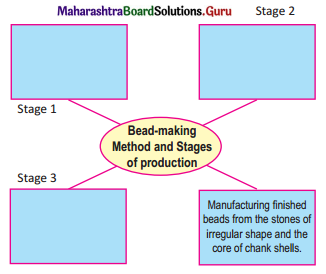
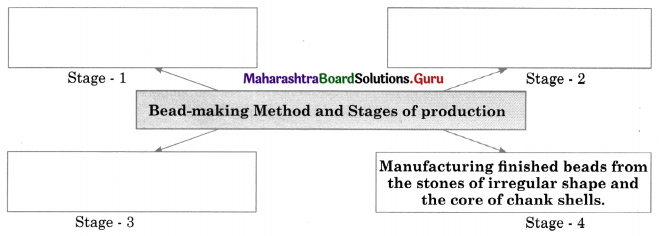
Maharashtra Board Class 11 History Solutions Chapter 1 First Farmers 2 Q1
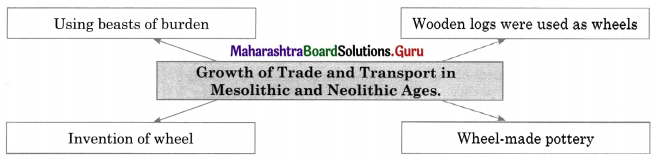
Answer:
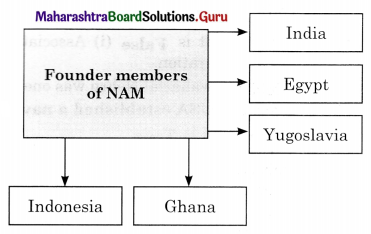
Maharashtra Board Class 11 History Solutions Chapter 1 First Farmers 2 Q1.1

3. Explain the following statements with reasons.

Question 1.
The camps of Mesolithic people developed into the first settled villages of neolithic people in Mesopotamia.
Answer:

  • Mesopotamia is between the two rivers, Tigris and Euphrates.
  • The Mesolithic people began to settle in the region (Mesopotamia) for a longer time, due to the availability of ample water.
  • As both the rivers flooded annually, fertile soil was deposited on their banks.
  • Ample water and fertile soil resulted in camps of Mesolithic people, who developed into the first settled neolithic villages, which grew wheat and barley.

Maharashtra Board Class 11 History Solutions Chapter 1 First Farmers

Question 2.
‘’Huang He’ river is considered to be the mother of the Chinese culture.
Answer:

  • The yellow silt brought by the ‘’Huang He’ river, earns her the name of “Yellow River” in English.
  • The other names ‘River’ and ‘Mother’, indicate her extraordinary place in the Chinese culture.
  • The name ‘River’ indicates her importance as a river.
  • The Chinese culture evolved here, with wheat, foxtail millet, and rice being grown by neolithic farmers in the villages.

Question 3.
In the latter half of the neolithic age, Pottery-making had become an art that required special skills.
Answer:

  • The neolithic pottery, in the beginning, was in monochrome, i.e., single colour with a burnished surface. Pots were polished by rubbing with a wooden or stone tool.
  • Some pots had carved designs, using techniques of stamping and applique work.
  • Gradually Neolithic people began to decorate their pots with painted designs.
  • Thus, in the latter half of the Neolithic age, pottery making had become an art that required special skills.

4. State your opinion.

Question 1.
There were radical changes in the way of human life during the neolithic age.
Answer:

  • In the neolithic age, people lived settled lives with permanently occupied dwellings.
  • The common storage places of food grains indicated that transactions related to food production were centrally controlled.
  • Hierarchical social and family structure and concept of inheritance have their roots in Neolithic times.
  • Pottery making along with polished stone tools is an essential characteristic of neolithic culture.
  • Beads of various types of siliceous stones and chank shells were made, indicating craft specialization and various classes of skilled artisans.

Question 2.
The Neolithic people invented the wheel and the technology they had developed so far, underwent a revolution.
Answer:

  • Neolithic people produced wheel-made pottery.
  • Wheel technology made it possible to produce pottery on a large scale.
  • The invention of the wheel made it possible to obtain raw material from distant places in lesser time.
  • It became easier to send the finished goods to distant markets, where it was in more demand.
  • It helped to develop trade and commerce and transport on a greater scale.

Maharashtra Board Class 11 History Solutions Chapter 1 First Farmers

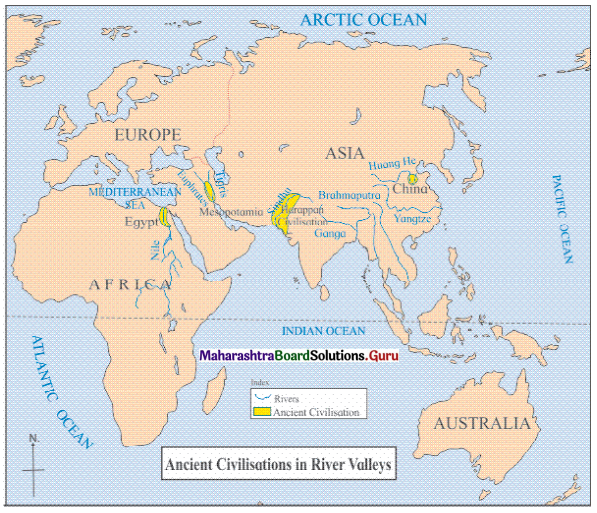
5. Observe the map on page 2 of your textbook and answer the following questions based on it.
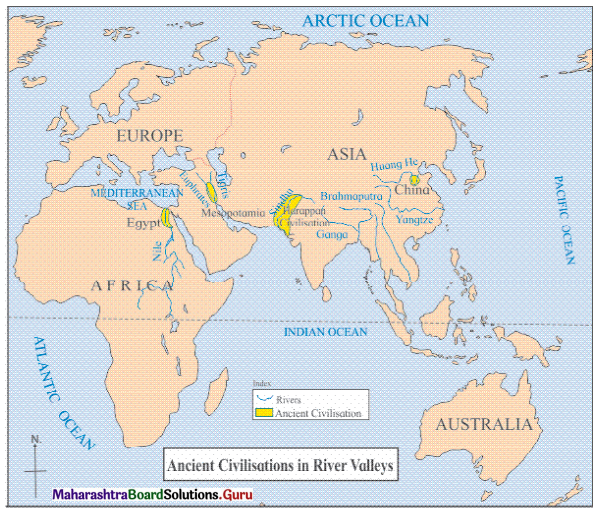
Maharashtra Board Class 11 History Solutions Chapter 1 First Farmers 5

Question 1.
What is the name of the sea on the African continent?
Answer:
The name of the sea on the African continent is the Mediterranean Sea.

Question 2.
In which continent did Harappan civilization originate?
Answer:
The Harappan civilization originated in the Continent of Asia.

Question 3.
What is the name of the ocean in the south of India?
Answer:
The Indian Ocean is the name of the ocean in the south of India.

6. Write short notes.

Question 1.
Neolithic ‘Jericho’
Answer:

  • The Palestinian city of Jericho, on the banks of the River Jordan, is the first neolithic permanent settle’ in 9000 B.C.E.
  • It started getting organized into a well-knit society by about 8000 B.C.E.
  • The village had a protective wall around it, with a watchtower, giving evidence of an organized society.
  • It is proved that cultivation began in Jericho, as discovered at Gilgal a site near Jericho.
  • Laboratory analysis has proved that neolithic people had systematically planted fig cuttings,
  • This stands to be the first attempt at planned cultivation.

Maharashtra Board Class 11 History Solutions Chapter 1 First Farmers

Question 2.
‘Holocene’ epoch
Answer:

  • The last glacial period in the history of our planet came to an end about 12000-11000 years ago.
  • This was the beginning of a new epoch, known as ‘Holocene’.
  • With the beginning of the Holocene, glaciers began to melt, increasing the volume of water in rivers and oceans.
  • As a result, the availability of animals and vegetation for food increased.
  • The period witnessed the extinction of gigantic mammoth.
  • A variety of fishes, small animals like goats, sheep, deer were available for food.

7. Answer the following questions in detail.

Question 1.
Write in detail about the ‘first farmers’ and the beginning of agriculture in India.
Answer:

  • Archaeological sites of Neolithic villages, which have been discovered prove that there were well-settled villages in the Indian subcontinent, as early, as 8000 B.C.E.
  • Historian scholars generally agree that the Harappan cities evolved from these early villages.
  • Barley was the main crop grown by the farmers in these villages, where wheat was grown on a smaller scale.
  • The farmers in these villages were the ‘first farmers’ of the Indian Sub-continent. They lived in mud houses and domesticated cattle and goat-sheep.
  • The transition from hunter-gatherer’s life to the beginning of cultivation spans through 10000¬8700 B.C.E.
  • The beginning of cultivation is also the beginning of the Neolithic age. The period also marked the domestication of animals along with cultivation.
  • While wheat and flaxseeds were grown, barley was the main crop in this period.
  • Modified composite tools like fishing harpoons, spears, and arrows were made. Blades known as microliths and tools like sickle and scythe were used for harvesting cereals and fruits.

Question 2.
What knowledge was essential for the Neolithic people to make pottery?
Answer:

  • The neolithic pottery, in the beginning, was in monochrome (single colour) with a burnished i.e., polished by running with a wooden or stone tool, surface. Some pots had carved designs.
  • The techniques of stamping and applique work i.e., pasting wet clay ribbons and making patterns on them were also used.
  • Painted designs on pots in the latter half of the neolithic age, made pottery art that required special skills.
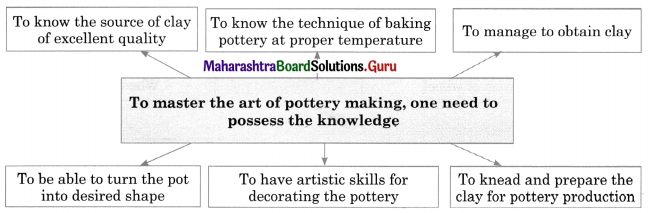
  • To master the art of pottery-making one needs to possess knowledge of the following things:
    • To know the source of clay of excellent quality.
    • To manage to obtain clay.
    • To knead and prepare the clay for pottery production.
    • To be able to turn the pot to the desired shape.
    • To have artistic skills for decorating the pottery.
    • To know the technique of making pottery at proper temperatures, approximately 850° – 900° Celsius.
  • Pottery helps us to know the cultural history, the material richness of the place, where it was found.
  • With the help of pottery, we can also know about the contacts of the residents of the place with other cultures.

Maharashtra Board Class 11 History Solutions Chapter 1 First Farmers

Question 3.
Write about the trade and transport in the Neolithic age.
Answer:

  • In the latter half of the Neolithic age, people had started using beasts of burden for transporting goods.
  • Tools like axes, scrapers, and chisels enabled neolithic people to cut trees and work on wood.
  • Probably the round-shaped pieces of wooden logs were used as wheels, as they could easily gain momentum.
  • The neolithic people invented the wheel and the technology they had developed so far underwent a revolution.
  • The Neolithic people began to produce wheel-made pottery. The wheel technology made it possible to obtain the raw material from distant places in much lesser time.
  • It became easier to send the finished goods to distant markets where it was more in demand.
  • It helped to develop trade and transport on a greater scale.

Question 4.
Write about the beginning of urbanization in the Neolithic age.
Answer:

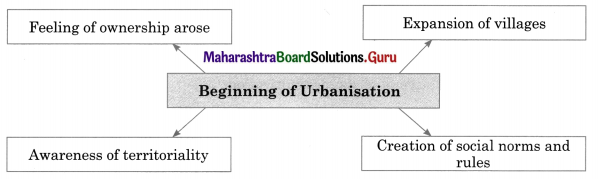
  • After settling down at one place for a long time, a feeling of ownership arose among neolithic people.
  • This feeling was focused on their individual dwellings and the piece of land cultivated by them.
  • With social organization and administration, the villages expanded.
  • Along with it, awareness of collective landholdings and the village boundaries became prominent.
  • It was thus felt that the village community had a natural right over the immediate territory around the village periphery.
  • This kind of awareness of natural rights over a particular region is known as ‘territoriality’.
  • Rules and norms were created to manage the collective resources, water sources, crafts dependent on it, trade and community life, etc. Consequently, rituals and their details gained importance.
  • The need of managing and keeping records of trade, rituals, writing, systems, and administrative machinery developed.
  • It gave rise to administrative centers. Such administrative centers attract a large population that includes officials, people from various occupations.
  • As a result, the periphery of the original settlement kept expanding and cities came into being.
  • Thus, began the process of urbanization in the Neolithic age.

Activity (Textbook Page No. 9)

Write in detail about any of the ancient civilizations.
Answer:
Among the ten oldest civilizations in the world, Mesopotamian, Indus Valley, Egyptian and Chinese are well known.
1. The Mesopotamian Civilization:
Mesopotamia is the Greek name of the region between two rivers, Tigris and Euphrates. Meso means the ’middle one’ and Potamos means ’river’. The region between the two rivers is ’Mesopotamia’.

  • Name of the Civilization: Mesopotamian civilization
  • Period: 3500BC-500BC
  • Original Location: Northeast by the Zagros mountains, Southeast by the Arabian Plateau
  • Current Location: Iraq, Syria, and Turkey
  • Meaning: Land between rivers (ancient Greek)
  • Major Highlights:
    • The first civilization in the world.
    • People developed the idea of agriculture and started domesticating animals for both food and farming.

Maharashtra Board Class 11 History Solutions Chapter 1 First Farmers

2. The Indus Valley Civilization:

  • Name of the Civilization: Indus Valley civilization
  • Period: 3300 BC-1900 BC
  • Original Location: Around the basin of the Indus river
  • Current Location: Northeast Afghanistan to Pakistan and northwest India
  • Major Highlights:
    • One of the oldest civilizations in the world.
    • One of the three earliest civilizations along with Ancient Mesopotamia and Egypt.
    • Most widespread covering an area of 1.25million kilometers. Also known as Harappan and Mohenjo-Daro civilization named after the excavation sites where the remains were originally found.
    • A sophisticated and technologically advanced urban culture. This culture was rich in arts and crafts.

3. The Ancient Egyptian Civilization:

  • Name of the Civilization: Egyptian civilization
  • Period: 3150 BC-30 BC
  • Original Location: Banks of the Nile
  • Current Location: Egypt
  • Major Highlights:
    • Construction of Pyramids
    • One of the oldest and culturally rich civilizations and a majestic civilization on the banks of the River Nile is known for its Pharaohs, Pyramids, and the Sphinx.

Maharashtra Board Class 11 History Solutions Chapter 1 First Farmers

4. The Chinese Civilization:

  • Name of the Civilization: The Chinese civilization
  • Period:1600 BC -1046 BC
  • Original Location: Yellow River and Yangtze region
  • Current Location: Country of China
  • Major Highlights:
  • Agriculture in the Neolithic villages of China began around 7000 B.C.E.
  • Wheat, foxtail millet, and rice were grown by farmers in these villages.
  • The invention of paper and silk.
Maharashtra Board Class 12 English Yuvakbharati Solutions Chapter 2.7 She Walks in Beauty

Balbharti Yuvakbharati English 12th Digest Chapter 2.7 She Walks in Beauty Notes, Textbook Exercise Important Questions and Answers.

Maharashtra State Board Class 12 English Yuvakbharati Solutions Chapter 2.7 She Walks in Beauty

12th English Digest Chapter 2.7 She Walks in Beauty Textbook Questions and Answers

Question 1.
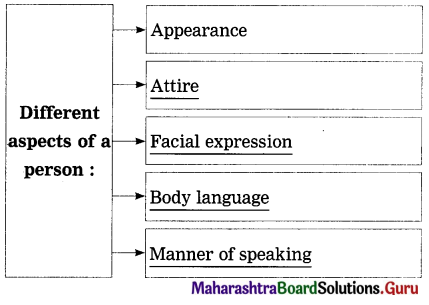
While judging any person you would consider certain aspects. Complete the diagram after carefully thinking what aspects you would consider:
Maharashtra Board Class 12 English Yuvakbharati Solutions Chapter 2.7 She Walks in Beauty 1
Answer:
Maharashtra Board Class 12 English Yuvakbharati Solutions Chapter 2.7 She Walks in Beauty 2

Maharashtra Board Class 12 English Yuvakbharati Solutions Chapter 2.7 She Walks in Beauty

Question 2.
Make a list of proverbs and quotations related to ‘Beauty’.
Answer:
(a) Beauty is in the eye of the beholder.
(b) Beauty is only skin deep.
(c) Beauty is as beauty does.
(d) There is beauty in simplicity.
(e) Beauty is not in the face, it is a light in the heart.

Question 3.
Discuss your impressions about someone’s personality, and say what you like the most and why-
Answer:
The personality that captures the attention of all who meet her is Ms Murti.

  1. Simplicity and warmth: She is a brilliant engineer, extremely wealthy yet is simple, and so cheerful and warm in her interaction with anyone she meets.
  2. Humbleness: In spite her achievements, wealth and position she never mentions them, rather praises the efforts and achievements of others
  3. Elegance: She is graceful and elegant and yet is never dressed expensively.
  4. Motivational: She addresses young people and students in a way that is always encouraging and uplifting.
  5. Generous: She is generous in giving those who are disadvantaged. She donates for the emancipation of women for making them economically independent.

(A1)

Question (i)
‘Beauty lies in the eyes of the beholder’ – you have probably heard this saying. Discuss in your class how far the statement is true.
Points:

  • Outward appearance gives only an idea
  • There may sometimes be an exception to the rule ‘first impression is the best
  • The external look may be completely different if one looks deeper
  • Henry Ford [founder of Ford Automobiles] dressed in the same old suit and said, ‘people who know me know who I am. People who don’t know me don’t matter, A very wealthy person may choose to appear very ordinary.

Question (ii)
Discuss with your partner about the most inspirational person you have come across. Also explain the reasons behind your opinion.
Points:

  • Attended a lecture by A.P.J. Abdul Kalam, before he became President
  • His views stayed in my mind
  • He stressed on dreaming for high aims
  • He stressed on the importance of hard work
  • He came from very humble background
  • He worked his way to achieve great things
  • I also want to achieve something and I have a lot of support which Dr. Abdul Kalam may not have had.

Maharashtra Board Class 12 English Yuvakbharati Solutions Chapter 2.7 She Walks in Beauty

(A2)

Question (i)
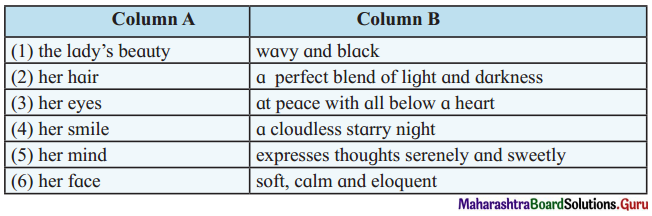
Match column A with column B:
Maharashtra Board Class 12 English Yuvakbharati Solutions Chapter 2.7 She Walks in Beauty 3
Answer:

  1. The lady’s beauty – a cloudless starry night
  2. Her hair – wavy and black
  3. Her eyes – a perfect blend of light and darkness
  4. Her smile – soft, calm and eloquent
  5. Her mind – at peace with all below a heart
  6. Her face – expresses thoughts serenely and sweetly

Question (ii)
Complete the reasons:
The lady in the poem has a winning smile and a glowing skin. According to the poet she is blessed with these things. Explain why.
Answer:
The lady in the poem has a winning smile and a glowing skin. According to the poet she is blessed with these things because in the last stanza the poet says that lovely cheek, the calm brow, the delicate colouring, the glowing skin all are a result of her life spent without sin. She has a peaceful mind and an innocent heart. These come together to make her face glow with an inner beauty.

Maharashtra Board Class 12 English Yuvakbharati Solutions Chapter 2.7 She Walks in Beauty

Question (iii)
The poet brings a perfect balance of outer beauty and inner beauty. Write a few lines from the poem on how the poet brings this balance in his description.
Answer:
One of the themes in the poem is harmony or balance. The poet does not directly call her beautiful, but she ‘walks in beauty’. The overall beauty is compared to a combination of cloudless (clear) climate and starry skies. He says the best of dark and light meet in her eyes and features, to be seen in the soft, dim light. The effect would not be so wonderful if it was even one shade darker or brighter. That balance of the light is important.

The poet says that her calm brow, sweet smile, the lovely colour of her skin, is the result of a peaceful mind, a loving heart and a pure life. Inner beauty is reflected in this ‘nameless grace’ – indescribable beauty.

Question (iv)
‘Beauty is skin deep.’ Do you agree with the statement? Or do you feel that beauty comes from within? Explain your views in a few sentences.
Answer:
I agree with the statement. Beauty is not about perfect features, clear skin, shining hair or smart clothes. Beauty is about the person’s heart. The helpful nature, a mind without guilt, a cheerful attitude, kind way of speaking will all be reflected in the person’s outward appearance.

The eyes are windows to a person’s soul, they say. If a person has wicked thoughts and bad intentions it shows in the eyes. The expression on the face will reflect the nasty mind. Harsh words will show their unkind nature. So beautiful features and perfect skin are not real indicators of beauty.

(A3)

Question (i)
Find out from the poem the words which are used to describe the lady.
Answer:

  1. Raven tresses
  2. Serene and sweet expression
  3. Pure thoughts
  4. Dearheart
  5. Calm brow
  6. Smiling face
  7. Gowing skin
  8. Innocent heart
  9. Peaceful mind

Question (ii)
Find out the instances of contractions from the poem.
Answer:
The contractions in the poem are – ‘that’s’ – that is ‘o’er’ – over

Maharashtra Board Class 12 English Yuvakbharati Solutions Chapter 2.7 She Walks in Beauty

(A4)

Question (i)
The poet creates imagery of light and darkness to bring out the beauty of the lady. Find out the lines with such imageries and complete the table:
Answer:

Lines with imageryReason for using
1. And all that’s best of dark and brightTo express the beauty of the eyes
2. Thus mellowed to that tender light – heaven to gaudy day deniesTo convey the dim soft light of evening not the harsh brightness of the day
3. One shade the more, one ray the lessTo stress the perfect balance between darkness of night and the glare of day

Question (ii)
Find out from the poem examples of:
(a) Simile
(b) Metaphor
(c) Alliteration
(d) Personification
(e) Antithesis.
Answer:

Figure of speechExample(Explanation)
1. Similelike the night of cloudless climes and starry skies(Her beauty Is directly compared to the cloudless starry skies.)
2. Metaphorin every raven tress(Her hair-tress – is shiny and jet black like a raven’s colour.)
3. AlliterationCloudless climes and starry skies(The ‘c’ sound and ‘s’ occur in adjacent words for poetic effect.)
4. Personificationeloquent, The smiles that win(The beautiful woman does the act of smiling, which wins hearts.)
5. Antithesis1. best of dark and bright

2. One shade the more, one ray the less

(Words of opposite meanings are used for poetic effect.)

Maharashtra Board Class 12 English Yuvakbharati Solutions Chapter 2.7 She Walks in Beauty

(A5)

Question (i)
Write an appreciation of the poem considering the following points :

  • About the poem / poet / title
  • Theme
  • Poetic devices, language, style
  • Special features – tone and type
  • Values, message
  • Your opinion about the poem

Answer:
Lord Byron’s poem opens with the same words that form the title: “She walks in beauty.” These four simple words quickly create an atmosphere of admiration and mystery. It is a short eighteen line poem having three sestets (six lines) in praise of an unnamed woman. The poet uses several poetic devices to express how deeply he is impressed.

There are several themes. One is of course beauty. Each feature of the woman – her eyes, her black (raven) tresses, her soft cheek, her calm brow and the lovely colour of skin is praised. The poet speaks of harmony. He speaks of the perfect blend of day and night, of light and dark. He speaks of the ‘mellowed’ or tender light which makes the beauty so rare, delicate and astonishing.

The other theme is the inner beauty which is what brings the outer beauty. He mentions ‘heaven’ [line 6] which may point to a divine side to the beauty. If a person is sinless their mind is pure and calm. There is no evil so the innocence inside causes the outer beauty which is indescribable – ‘nameless grace [line 8]

The poet uses simile [line 1] ‘like the night..’, alliteration – ‘cloudless climes’, ‘starry skies’. There is rhyme ababab in all the sestets. He uses metaphor -raven tress [line 9], and personification – ‘smiles that win’ [line 15]. There are many examples of antithesis through which the poet stresses on balance.

There is harmony of light – ‘dark and bright’, ‘tender light -gaudy day’, ‘one shade more, one ray less’. These are to emphasize that the beauty is not only physical and external, but actually because there is inner beauty. The mind is calm, the heart is innocent and this causes the outer beauty which is seen by him.

The poem is lyrical, has a steady rhythm and the language is rich with poetic devices. Though the poet does not name the woman, or give any details of her age, his admiration is felt in the tone. The message is about the importance of inner beauty, which is almost a divine thing that will make external beauty possible.

I feel the poem makes us realize that one should look deeper than just outward appearance. One should appreciate beauty in its entirety.

Question (ii)
Compose a poem of at least 4-6 lines on ‘Beauty of Nature’.
Answer:
Beauty of Nature

I look up at the majestic peaks I peer into the sapphire deeps I gaze at the endless shades of green My eyes drink the silver threads between.
In this life God I’m quite sure we can see Why? He’s everywhere in Nature’s beauty!

Maharashtra Board Class 12 English Yuvakbharati Solutions Chapter 2.7 She Walks in Beauty

Question (iii)
Write at least one paragraph and expand the inherent idea of the saying ‘A Thing of Beauty is a Joy Forever’.
Answer:
A Thing of Beauty is a Joy Forever

We all love beauty. We are instantly attracted toward anything beautiful. Even children are drawn toward something pretty. We admire its qualities like lovely colour or soft texture. We admire something beautiful created by someone, like a painting or sculpture. We exclaim on the realistic appearance and the artist’s skill. We appreciate beauty in nature. Gorgeous flowers, majestic mountains, the green of hills and the charming waterfalls. We enjoy the sweetness of fruits.

To create something beautiful requires patience, effort and care. When all these come together the result is beautiful. We appreciate it whether it is in nature or is man-made. Our ears keenly listen to birds calling in the morning, melodious music, the rush of waves and the splashing of rain. Thus all our senses are attracted and we feel good when we see, hear or taste something. It brings us happiness.

Thus a thing of beauty is a joy forever.

Maharashtra Board Class 12 English Yuvakbharati Solutions Chapter 2.7 She Walks in Beauty

(A6)

Question (i)
Browse the internet and find out different types of poems on ‘Beauty’.

Question (ii)
Byron’s name is often taken along with his two contemporaries – Shelley and Keats. Go to your school/college library and read some poems written by P. B. Shelley and John Keats to get a better idea about the Romantic Poets.

Yuvakbharati English 12th Digest Chapter 2.7 She Walks in Beauty Additional Important Questions and Answers

Read the poem and complete the given activities:

Global Understanding:

Question 1.
Complete the following:
The colour of the lady’s hair is
Answer:
The colour of the lady’s hair is shiny black (like a raven’s).

Maharashtra Board Class 12 English Yuvakbharati Solutions Chapter 2.7 She Walks in Beauty

Interpretation/Inference/Analysis:

Question 1.
Complete the following:
Answer:
The phrase ‘dwelling – place’ refers to her mind. The poet says that her face sweetly expresses her thoughts and says that the dwelling place of those thoughts (expressed by the face) is very dear. The dwelling place of thoughts is the mind.

Maharashtra Board Class 11 Political Science Important Questions Chapter 10 The World Since 1945 – II

Balbharti Maharashtra State Board Class 11 Political Science Important Questions Chapter 10 The World Since 1945 – II Important Questions and Answers.

Maharashtra State Board 11th Political Science Important Questions Chapter 10 The World Since 1945 – II

1A. Choose the correct alternative and complete the following statements.

Question 1.
The first NAM summit was held at ____________ (Bangkok, Camp David, Bandung, Belgrade)
Answer:
Belgrade

Question 2.
During the Cold War, western capitalist economies, aligned to the USA were called as ____________ countries. (First World, Second World, Third World, Non-Aligned)
Answer:
First World

Question 3.
The beginning of detente was 1972, summit meeting at ____________ (New York, Camp David, Moscow, China)
Answer:
Moscow

Question 4.
In 1978, the conference at Camp David was to reduce tensions between ____________ (USA – USSR, USA – China, Arab World – Israel, India – Pakistan)
Answer:
Arab World – Israel

Maharashtra Board Class 11 Political Science Important Questions Chapter 10 The World Since 1945 - II

Question 5.
The SAARC was established in ____________ (1967, 1985, 1992, 1989)
Answer:
1985

Question 6.
Iran withdrew from the ____________ military alliance in 1979. (CENTO, SEATO, NATO, NAM)
Answer:
CENTO

Question 7.
In 1991, Commonwealth of Independent States was created after the disintegration of the ____________ (USA, USSR, Germany, CENTO)
Answer:
USSR

Question 8.
____________ tried to reform the system in the USSR. (Khruschev, Breznev, Yeltsin, Gorbachev)
Answer:
Gorbachev

1B. Identify the incorrect pair in every set, correct it and rewrite.

Question 1.
(a) Soviet Union – Brezhnev
(b) Egypt – Nasser
(c) Czechoslovakia – Tito
Answer:
(c) Yugoslavia – Tito

Question 2.
(a) SAARC – Maldives
(b) BRICS – Brazil
(c) NAM – USA
Answer:
(c) Capitalist bloc – USA

Maharashtra Board Class 11 Political Science Important Questions Chapter 10 The World Since 1945 - II

1C. State the appropriate concept for the given statement.

Question 1.
Reduction of tensions and conflicts.
Answer:
Detente

Question 2.
Principle of active participation in world affairs peacefully and without joining any military alliances.
Answer:
Non-alignment

Question 3.
The collective name for developing countries.
Answer:
Third World countries

Question 4.
Agreement signed in 1978 at Camp David.
Answer:
‘Framework for Peace for Middle East

Question 5.
Special agreements regarding economic relationships are made by a group of nations.
Answer:
Trade Bloc

Question 6.
The term used to indicate “openness” i.e., freedom of expression.
Answer:
Glasnost

1D. Answer in one sentence.

Question 1.
Which was the first direct confrontation between the USA and USSR during the Cold War?
Answer:
The first direct confrontation between the USA and USSR during the Cold War was the Cuban Missile Crisis.

Maharashtra Board Class 11 Political Science Important Questions Chapter 10 The World Since 1945 - II

Question 2.
Which nations were referred to as Second World during the Cold War?
Answer:
Eastern Socialist economies aligned with the Soviet Union were referred to as ‘Second World’ during the Cold War.

Question 3.
When and where was the first NAM summit held?
Answer:
The first NAM summit was held in 1961 at Belgrade (Yugoslavia).

Question 4.
Which was the joint (US – USSR) Space flight in 1975?
Answer:
The Apollo- Soyuz space flight, was the joint (US – USSR) space fight in 1975.

Question 5.
Who signed the agreement at Camp David in 1978?
Answer:
Egyptian President Anwar el Sadat and Israeli Prime Minister Menachem Begin in the presence of US President Jimmy Carter signed the agreement at Camp David in 1978.

Question 6.
What are the common types of trade barriers?
Answer:
Tariffs and quotas are the common types of trade barriers.

Question 7.
Where is the SAARC Secretariat?
Answer:
The SAARC Secretariat is at Kathmandu (Nepal).

Question 8.
What do trade agreements generally focus on?
Answer:
Trade agreements generally focus on relaxation or even the elimination of trade barriers.

Maharashtra Board Class 11 Political Science Important Questions Chapter 10 The World Since 1945 - II

Question 9.
Who initiated the Islamic Revolution in Iran (1979)?
Answer:
Ayatollah Khomeini initiated the Islamic Revolution in Iran(1979).

Question 10.
What is described as New Cold War?
Answer:
The detente between the USA and USSR gradually ended in 1979 and this period is described as New Cold War.

Question 11.
Name the two policies advocated by Gorbachev.
Answer:
Glasnost and Perestroika are the two policies advocated by Gorbachev.

Question 12.
Name the countries where East European revolutions took place in 1989-1990?
Answer:
Poland, Bulgaria, Romania, Czechoslovakia, Hungary had revolutions in the period 1989-1990.

Question 13.
What caused the Cold War to come to an end?
Answer:
The disintegration of the USSR in 1991 caused the Cold War to come to an end.

Question 14.
Name the countries created due to the splitting up of Yugoslavia.
Answer:
Bosnia, Croatia, Herzegovina, Montenegro, Serbia were created due to the splitting up of Yugoslavia.

Question 15.
Name the two countries formed due to the splitting of Czechoslovakia.
Answer:
Slovakia and the Czech Republic were the two countries formed due to the splitting up of Czechoslovakia.

Maharashtra Board Class 11 Political Science Important Questions Chapter 10 The World Since 1945 - II

1E. Complete the sentences by selecting the appropriate reason.

Question 1.
The non-Aligned Movement was established in 1961 because
(a) some countries like India, Egypt, etc. wanted to form their own power bloc.
(b) it was a regional organization of newly independent nations.
(c) it consisted of countries that did not want to align to any power bloc or join any military alliance.
Answer:
(c) it consisted of countries that did not want to align to any power bloc or join any military alliance.

Question 2.
The Cuban Missile Crisis laid the foundations of detente as it
(a) led to an escalation of cold war tensions.
(b) led to an immediate pileup of nuclear missiles.
(c) brought in a realization of possible nuclear confrontation and the need to reduce tensions.
Answer:
(c) brought in a realization of possible nuclear confrontation and the need to reduce tensions.

1F. Find the odd word in the given set.

Question 1.
Nkrumah, Sukarno, Nasser, Nixon.
Answer:
Nixon (not a NAM leader)

Question 2.
Vietnam, Korea, Sri Lanka, Cuba.
Answer:
Sri Lanka (not affected by Cold War)

Question 3.
Mao Zedong, Khrushchev, Gorbachev, Brezhnev.
Answer:
Mao Zedong (Chinese leader)

Maharashtra Board Class 11 Political Science Important Questions Chapter 10 The World Since 1945 - II

Question 4.
ASEAN, NAFTA, SAARC, EU.
Answer:
NAFTA (trade agreement not an organization)

1G. Expand the abbreviations.

Question 1.

  1. SAARC
  2. ASEAN
  3. OPEC
  4. NIEO
  5. NAFTA
  6. OAS
  7. WTO

Answer:

  1. SAARC – South Asian Association for Regional Cooperation.
  2. ASEAN – Association of South-East Asian Nations
  3. OPEC – Organisation of the Petroleum Exporting Countries
  4. NIEO – New International Economic Order
  5. NAFTA – North American Free Trade Agreement.
  6. OAS – Organisation of American States.
  7. WTO – World Trade Organisation.

1H. Arrange in a chronological order citing the appropriate dates per event.

Question 1.

  1. Cuban Missile Crisis
  2. Arab-Israel War
  3. Apollo-Soyuz Space Flight
  4. Founding of SAARC
  5. Founding of NAM
  6. Founding of ASEAN
  7. Soviet Invasion of Afghanistan
  8. Disintegration of USSR
  9. Formation of EU
  10. Formation of WTO

Answer:

  1. Founding of NAM – 1961
  2. Cuban Missile Crisis – 1962
  3. Founding of ASEAN – 1967
  4. Arab – Israel War – 1973
  5. Apollo-Soyuz Space Flight – 1975
  6. Soviet invasion of Afghanistan – 1979
  7. Founding of SAARC – 1985
  8. The disintegration of USSR – 1991
  9. Formation of EU – 1992
  10. Formation of WTO – 1995

Maharashtra Board Class 11 Political Science Important Questions Chapter 10 The World Since 1945 - II

2A. State whether the following statements are true or false with reasons.

Question 1.
In 1962, the USA established a naval blockade around Cuba.
Answer:
This statement is True.

  • In 1962, Nikita Khrushchev of the USSR decided to make Cuba into a Russian base by placing nuclear missiles there.
  • This would be a direct threat and so the USA retaliated with a naval blockade of Cuba.

Question 2.
The Non-Aligned Movement had great significance.
Answer:
This statement is True.

  • After the Second World War, the two superpowers i.e., the USA and USSR, had begun the Cold War which led to many military alliances being created.
  • Many Third World countries, which had recently gained freedom from colonial rule, did not want to ally with any power bloc. So in 1961, the NAM was formally established at Belgrade by heads of India, Yugoslavia, Egypt, Ghana, Indonesia, etc.

Question 3.
Non-Alignment means the country is internationally passive.
Answer:
This statement is False.

  • Nonalignment means that a member country should not be a member of any military alliance in the context of the Cold War.
  • It does not mean passivity or neutrality in international politics but means that members actively participate in world affairs to promote security, peace, and development.

Question 4.
The Moscow Summit led to an escalation of the Cold War.
Answer:
This statement is False.

  • In 1972, President Nixon (USA) and General Secretary of the Communist Party of Soviet Union. Brezhnev met at Moscow.
  • The summit signaled the beginning of the era of detente i.e. USA and USSR tried to reduce tensions of the Cold War

Maharashtra Board Class 11 Political Science Important Questions Chapter 10 The World Since 1945 - II

Question 5.
Mikhail Gorbachev as president of the USSR changed the course of world politics.
Answer:
This statement is True.

  • Gorbachev introduced the policies of ‘Perestroika’ (reconstruction of the Soviet political and economic system) and ‘Glasnost’ (openness).
  • During his tenure, there were popular uprisings against Communist regimes in East European countries like Poland, Bulgaria, Czechoslovakia, etc.
  • The USSR ceased to exist and in its place, 15 new countries (CIS) were created (1991).

Question 6.
Post-1991 can be called ‘the Era of Multi polarity’.
Answer:
This statement is True.

  • After the collapse of the USSR, the USA remained the only superpower due to its military, technological and economic might.
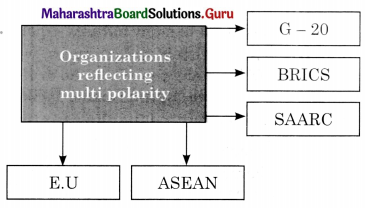
  • However, many regional or economic organizations such as OPEC, European Union, G-8, G-20, SAARC, ASEAN, African Union, BRICS, etc. also play a vital role in world politics and international relations.

2B. Complete the concept maps.

Question 1.
Maharashtra Board Class 11 Political Science Important Questions Chapter 10 The World Since 1945 - II 2B Q1
Answer:
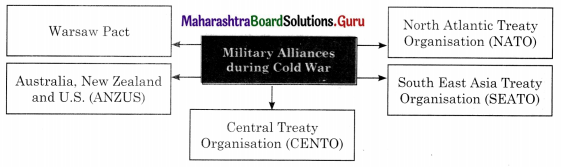
Maharashtra Board Class 11 Political Science Important Questions Chapter 10 The World Since 1945 - II 2B Q1.1

Maharashtra Board Class 11 Political Science Important Questions Chapter 10 The World Since 1945 - II

Question 2.
Maharashtra Board Class 11 Political Science Important Questions Chapter 10 The World Since 1945 - II 2B Q2
Answer:
Maharashtra Board Class 11 Political Science Important Questions Chapter 10 The World Since 1945 - II 2B Q2.1

2C. Observe the given map and answer the following questions.

Question 1.
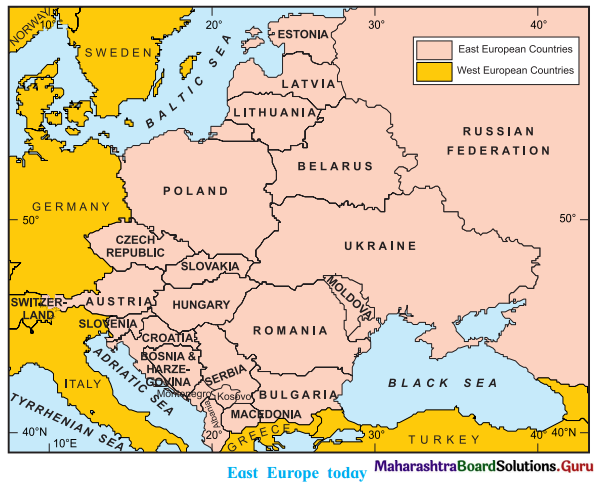
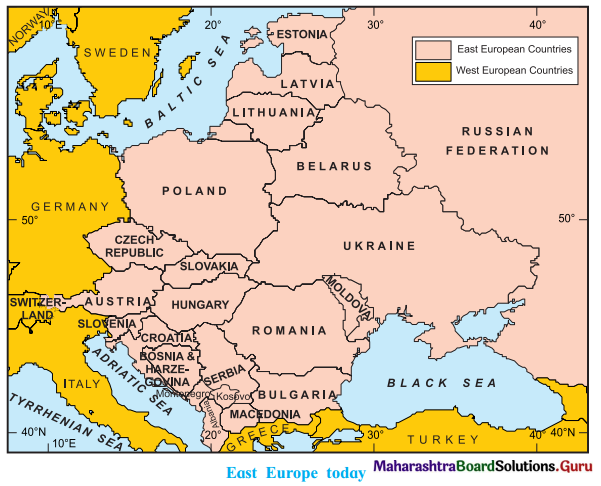
Map of East Europe today.
Maharashtra Board Class 11 Political Science Important Questions Chapter 10 The World Since 1945 - II 2C Q1

Question i.
Name some countries bordering the Adriatic sea.
Answer:
Italy, Croatia, Albania, Greece, Slovenia.

Maharashtra Board Class 11 Political Science Important Questions Chapter 10 The World Since 1945 - II

Question ii.
Write the neighbouring countries of Poland.
Answer:
Czech Republic, Ukraine, Germany, Belarus.

3. Answer the following.

Question 1.
Write about the US naval blockade in 1962.
Answer:
A naval blockade is prohibiting ships from entering the port of a country. This is done by using the Navy, The United States Navy established a blockade around the island to prevent any offensive weapons from entering Cuba. This was done in retaliation to the USSR using Cuba as a strategic missile base.

Question 2.
Write about the Cuban Missile Crisis.
Answer:
In spite of attempts to create goodwill between the two power blocs (such as at Camp David Summit), tensions continued to escalate. In 1962, the first direct confrontation of the Cold War took place. This was the Cuban Missile Crisis. Cuba is a small nation off the coast of the USA. It had the support of the USSR. Due to its’ strategic location, then Soviet Premier, Khrushchev, decided to convert Cuba into a Soviet base by placing nuclear missiles there. This was a serious, direct threat to the USA which retaliated with a naval blockade of Cuba. There was a real possibility of a nuclear war. But, both superpowers realized the need to prevent such a situation and USSR withdrew its missiles from Cuba.

Question 3.
Explain Non-Alignment.
Answer:
A group of Third World countries (i.e., from Asia, Africa, South America), most of whom had recently gained sovereignty from colonial rule, refused to join any Cold War alliances. This laid the foundation for the Non- Aligned Movement. Which was formally established at the Belgrade Conference (1961) with 25 member nations. Some of the founding members were Marshall Tito (Yugoslavia) Jawaharlal Nehru, (India), Gamal Nasser (Egypt), Nkrumah (Ghana), Sukarno (Indonesia).

The concept of Non-alignment is based on two main principles:

  • independent understanding of world affairs
  • peace approach.

Thus it does not mean political passivity or neutrality. In fact, the idea was active participation in world affairs to promote peace and development.

The purposes of NAM were

  • not to ally with any power bloc
  • opposition to any military alliance
  • freedom to take independent policy decisions with regard to international affairs.

Maharashtra Board Class 11 Political Science Important Questions Chapter 10 The World Since 1945 - II

Question 4.
What were the consequences of the collapse of the USSR?
Answer:
The consequences of the collapse of the USSR included-
The Commonwealth of Independent States came (CIS) into existence and finally, new countries were formed such as Ukraine, Belarus, Georgia, Armenia, etc.
Other changes due to the disintegration of the Soviet Union included:

  • reunification of Germany in 1990.
  • splitting Yugoslavia into Serbia, Bosnia, Croatia, Slovenia, etc.
  • splitting of Czechoslovakia into the Czech Republic and Slovakia.

The disintegration of the USSR signified the end of the Cold War and the USA emerged as the only superpower (unipolarity).

Question 5.
Write about the policies of Gorbachev.
Answer:
There were significant changes in Soviet policy under Mikhail Gorbachev (President of USSR). He introduced the policies of Glasnost (openness i.e., transparency in governance and freedom of expression) and Perestroika (reconstruction of the political and economic system).

His new foreign policy included:

  • withdrawal of Soviet troops from Afghanistan
  • stopping of the arms race with the US and focused on arms control
  • opening a dialogue with China.

Gorbachev also tried to reform domestic politics. Control of the Communist Party ended and people were given the right to criticize the government. On 25th December 1991, Gorbachev resigned and the next day the USSR as a country ceased to exist. This led to the Commonwealth of Independent States is established.

Question 6.
Write about the objectives of SAARC.
Answer:
South Asian Association for Regional Cooperation (SAARC) was established in 1985.
The objectives of SAARC are

  • to promote the welfare of the people of South Asia and to improve their quality of life.
  • to accelerate economic growth, social progress, and cultural development in the region.
  • to contribute to mutual trust, understanding, and appreciation of one another’s problems.
  • to promote active collaboration and mutual assistance in the economic, social, cultural, technical, and scientific fields and to strengthen cooperation with other developing countries.

Maharashtra Board Class 11 Political Science Important Questions Chapter 10 The World Since 1945 - II

Question 7.
Write about CIS (1991)
Answer:
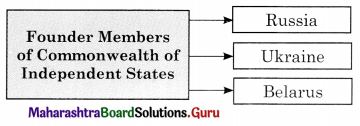
Commonwealth of Independent state (CIS) was created after the disintegration of the Soviet Union in 1991. The members were the former states of the USSR. The founder members were Russia, Ukraine, and Belarus. Subsequent members were Armenia, Azerbaijan, Georgia, Kazakhstan, Kyrgyzstan, Moldova, Tajikistan, Turkmenistan, and Uzbekistan.

Common affairs were conducted on a multilateral, interstate basis. It provided a framework for military, foreign policy, and economic cooperation between members.

Question 8.
Make a list of countries that were created after the disintegration of the Soviet Union.
Answer:
After the disintegration of the Soviet Union (1991) many countries like Russia, Ukraine, Belarus, Armenia, Azerbaijan, Estonia, Georgia, Kazakhstan, Kyrgyzstan, Latvia, Lithuania, Moldova, Tajikistan, Turkmenistan, and Uzbekistan were created.

Question 9.
List the Non-Aligned Summits that have occurred since 1961.
Answer:

Summit yearPlace
1st – 1961Belgrade (Yugoslavia)
2nd – 1964Cairo
3rd – 1970Lusaka (Zambia)
4th – 1973Algiers (Algeria)
5th – 1976Colombo (Sri Lanka)
6th – 1979Havana (Cuba)
7th – 1983New Delhi (India)
8th – 1986Harare (Zimbabwe)
9th – 1989Belgrade (Yugoslavia)
10th – 1992Jakarta (Indonesia)
11th – 1995Cartagena (Colombia)
12th – 1998Durban (S. Africa)
13th – 2003Kuala Lampur (Malaysia)
14th – 2006Havana (Cuba)
15th – 2009Egypt
16th – 2012Tehran (Iran)
17th – 2016Porlamar (Venezuela)
18th – 2019Baku (Azerbaijan)


Maharashtra Board Class 11 Political Science Solutions Chapter 10 The World Since 1945 – II

Balbharti Maharashtra State Board Class 11 Political Science Solutions Chapter 10 The World Since 1945 – II Textbook Exercise Questions and Answers.

Maharashtra State Board Class 11 Political Science Solutions Chapter 10 The World Since 1945 – II

1A. Choose the correct alternative and complete the following statements.

Question 1.
The __________ Missile Crisis took place in 1962. (American, Cuban, Russian, Chinese)
Answer:
Cuban

Maharashtra Board Class 11 Political Science Solutions Chapter 10 The World Since 1945 - II

Question 2.
In 1978, the United States held a conference at __________ to resolve the Arab-Israel dispute. (Camp David, Helsinki, Paris, Geneva)
Answer:
Camp David

1B. Identify the incorrect pair in every set, correct it and rewrite.

Question 1.
(a) Iran – Ayatollah Khomeini
(b) Afghanistan – Babrak Karmal
(c) Soviet Union – Richard Nixon
Answer:
(c) USA – Richard Nixon

1C. State the appropriate concept for the given statement.

Question 1.
Prohibiting ships from entering the port of a country.
Answer:
Naval Blockade

Maharashtra Board Class 11 Political Science Solutions Chapter 10 The World Since 1945 - II

Question 2.
Reconstruction of the political and economic system was established in the Soviet Union.
Answer:
Perestroika

2A. Complete the concept map.

Question 1.
Maharashtra Board Class 11 Political Science Solutions Chapter 10 The World Since 1945 - II 2A Q1
Answer:
Maharashtra Board Class 11 Political Science Solutions Chapter 10 The World Since 1945 - II 2A Q1.1

2B. Observe the given map and answer the following questions.

Question 1.
Map of East Europe today.
Maharashtra Board Class 11 Political Science Solutions Chapter 10 The World Since 1945 - II 2B Q1

Question i.
Name any 4 countries formed after the disintegration of the Soviet Union.
Answer:
Russia, Ukraine, Belarus, Armenia, Georgia Latvia, Estonia, Moldova, Lithuania, Azerbaijan.

Maharashtra Board Class 11 Political Science Solutions Chapter 10 The World Since 1945 - II

Question ii.
Name two neighbouring countries of Hungary.
Answer:
Austria, Croatia, Serbia, Romania, Slovakia.

3. State whether the following statements are true or false with reasons.

Question 1.
Non-aligned countries put forth the demand for NAFTA.
Answer:
This statement is False.

  • North American Free Trade Agreement (NAFTA) was set up as a ‘trade bloc’ in January 1994.
  • It was signed between the USA, Canada, and Mexico to encourage free trade between the three North American Nations (trilateral trade bloc).

Question 2.
Pandit Jawaharlal Nehru was the founder of ASEAN.
Answer:
This statement is False.

  • Association of South-East Asian Nations was established in 1967 by the Bangkok declaration.
  • Pandit Jawaharlal Nehru was one of the founders of the Non-Aligned Movement in 1961 at Belgrade.

4. Explain the co-relation between the following.

Question 1.
Cold War and Non-aligned movement.
Answer:
The Cold War began after the end of the Second World War in 1945. It refers to a period of intense ideological hostility, build-up of armaments, the establishment of military alliances e.g., NATO, WARSAW Pact, etc., and even proxy wars such as in Korea and Vietnam. There were many efforts from 1945 – 1991 on the part of both superpowers to bring about detente i.e., reduction of hostilities and tensions e.g., Moscow Summit (1972). However, for most of this period, the world was divided into the Capitalist bloc (led by the USA and including England, France, etc.) and Communist bloc (led by USSR and including East European nations).

There were a number of newly independent countries as well as some other Third World countries who did not want to join the military alliances of any power bloc. Through the initiative of Jawaharlal Nehru (India) and Marshall Tito (Yugoslavia), the NAM was formally established in 1961 at Belgrade. Other member countries included Ghana, Egypt, Sri Lanka. Indonesia, etc. Non-alignment is based on two main principles:

  • independent understanding of world affairs
  • peace approach.

It does not mean political neutrality or passivity but active participation in world affairs without joining any power bloc or military alliance.

Maharashtra Board Class 11 Political Science Solutions Chapter 10 The World Since 1945 - II

5. Answer the following.

Question 1.
Explain the term – New Cold War.
Answer:
Two events that occurred in 1979 change the course of detente.

  • Islamic Revolution in Iran under leader Ayatollah Khomeini overthrew the rule of M.R. Shah Pahlavi. The new government withdrew from the CENTO alliance.
  • The Soviet Union invaded Afghanistan in 1979 and installed Babrak Karmal as the President. The insurgent groups in Afghanistan (mujahideen) fought against this government (1979 – 1989). The new Cold War refers to the end of the period of detente and return of tensions between the USA and the USSR.

Question 2.
What is a trade bloc?
Answer:
A trade bloc is created when a group of nations makes special agreements regarding their economic relationships with each other. The agreements generally focus on the relaxation or even elimination of trade barriers. The most common types of trade barriers are tariffs (taxes on imports) and quotas (limits on the quantities of various imports).

6. Express your opinion on the following.

Question 1.
India played an important role in the Cold War.
Answer:
India was a non-aligned member during the cold war. It means India was neither on the side of the USA nor the Soviet Union. This was for official purposes, which enabled us to avoid giving away our land or resources to the Soviets or Americans (which they could use as a military base and eventually also make India their vassal). Having said that, unofficially India fully supported the Soviet Union.

Soviet Union protected India from the onslaught of the USA, during the India Pakistan war of 1971. The indo-soviet pact during 1971 was spearheaded by PM Indira Gandhi. Further, India cooperated and collaborated greatly with the Soviet Union in the fields of defense, manufacturing industries, medicine, nuclear energy, science among others, however, India was never a direct party to the cold war standoff between the USA and the Soviet Union.

7. Answer the following in detail with reference to the given points.

Question 1.
Elaborate on the period of Detente.
(a) Meaning
(b) Initiatives are taken by superpowers to reduce tensions
Answer:
(a) Meaning of detente: Detente refers to efforts to bring about a reduction in tensions between the USA and the USSR. This was an attempt by the two ‘superpowers’ themselves. The Cuban Missile Crises brought in a realization of a possible nuclear confrontation and the need to deescalate the tensions.

Maharashtra Board Class 11 Political Science Solutions Chapter 10 The World Since 1945 - II

(b) Initiatives taken by the superpowers to reduce tensions: After the Cuban Missile Crisis, both the USA and USSR made several efforts at reducing bilateral tensions (detente).
This included:

  • a hotline was set up between the main leaders of the two nations
  • the signing of agreements such as NNPT, LTBT to reduce nuclear weapons
  • 1972, Moscow Summit between President Nixon (USA) and Brezhnev (USSR).

Other initiatives were-

  • Conference at Paris (1973) to bring the Vietnam crisis to an end.
  • Helsinki conference on security in Europe (1975) was attended by 35 nations including the USA and USSR. It aimed to reduce the tensions between eastern and western European countries.
  • The first joint US-Soviet space flight was the Apollo-Soyuz Test Project (1975)
  • The USA held a conference at Camp David in 1978 to resolve the long-pending Arab-Israel dispute. The ‘Framework for Peace in the Middle East was signed between President Carter (USA) President Sadat (Egypt) and Prime Minister Begin (Israel).

Find out! (Text Book Page No. 86)

Can you find out some of the summit meetings that have taken place between leaders of India and Pakistan in recent years? Who were the leaders who participated and when and where did the meetings take place?
Answer:

  • The Delhi Pact (Liaquat-Nehru Pact) was signed on 8th April 1950 as a bilateral treaty between India and Pakistan. It was signed in New Delhi by the then Indian, Prime Minister Jawaharlal Nehru and Pakistan, Prime Minister Liaquat Ali Khan.
  • Tashkent Declaration (10th January 1966) was a peace agreement after the 1965 Indo-Pakistan war signed between Mohammed Ayub Khan (President of Pakistan) and Lai Bahadur Shastri (Prime Minister of India) in Tashkent.
  • Shimla Agreement was signed on 2nd September 1972 after the 1971 Indo-Pakistan war. Signatories were Indian Prime Minister Mrs. Indira Gandhi and Pakistan Prime Minister Zulfikar Ali Bhutto.
  • The non-Nuclear Aggression Agreement was signed on 21st December 1988 in is Islamabad by Rajiv Gandhi (Prime Minister of India) and Benazir Bhutto (Prime Minister of Pakistan).
  • Lahore Agreement – Signed on 21st February 1999. Signatories were Shri. Atal Bihari Vajpayee (India) and Nawaz Sharif (Pakistan).
  • Agra Agreement (2001). The Negotiators were Shri. Vajpayee and Pervez Musharaf (Pakistan) but negotiators broke down.

Maharashtra Board Class 11 Political Science Solutions Chapter 10 The World Since 1945 - II

Activity (Text Book Page No. 92)

Make a list of all summit meetings of SAARC.
Answer:

Summit yearPlace
1st – 1985Dhaka (Bangladesh)
2nd – 1986Bangalore (India)
3rd – 1987Kathmandu (Nepal)
4th – 1988Islamabad (Pakistan)
5th – 1990Male (Maldives)
6th – 1991Colombo (Sri Lanka)
7th – 1993Dhaka (Bangladesh)
8th – 1995New Delhi (India)
9th – 1997Male (Maldives)
10th – 1998Colombo (Sri Lanka)
11th – 2002Kathmandu (Nepal)
12th – 2004Islamabad (Pakistan)
13th – 2005Dhaka (Bangladesh)
14th – 2007New Delhi (India)
15th – 2008Colombo (Sri Lanka)
16th – 2010Thimphu (Bhutan)
17th – 2011Addu City (Maldives)
18th – 2014Kathmandu (Nepal)
19th – 2016Islamabad (Pakistan) (event canceled)


Maharashtra Board Class 11 History Solutions Chapter 3 Chalcolithic Villages in India

Balbharti Maharashtra State Board Class 11 History Solutions Chapter 3 Chalcolithic Villages in India Textbook Exercise Questions and Answers.

Maharashtra State Board Class 11 History Solutions Chapter 3 Chalcolithic Villages in India

1A. Choose the correct alternative and write the complete sentences.

Question 1.
On one of the cemetery H pots, dead humans are seen carried by ____________ in their stomach.
(a) deer
(b) peacock
(c) fish
(d) bull
Answer:
(b) peacock

Maharashtra Board Class 11 History Solutions Chapter 3 Chalcolithic Villages in India

Question 2.
The archaeological evidence shows that Balathal was a center of mass production of ____________
(a) stone pots
(b) copper pots
(c) earthen pots
(d) glassware
Answer:
(c) earthen pots

Question 3.
Permanent villages of farmers were first established in Maharashtra by ____________ people.
(a) Savalda
(b) Malwa
(c) Harappa
(d) Kayatha
Answer:
(b) Malwa

1B. Find the incorrect pair from set ‘B’ and write the correct ones.

Question 1.

Set ‘A’Set ‘A’
1. Savalda CultureDaimadabad
2. Malwa CultureNavadatoli
3. Ahar CultureSonpur
4. Jorwe CultureInamgaon

Answer:
3. Ahar Culture – Balathal

2A. Explain the statements with reasons.

Question 1.
Harappan people had to migrate.
Answer:

  • When the Mature (urban) Harappan civilisation collapsed completely, the people of Late Harappan cultures who had settled on the ruins of Mature Harappan cities had to migrate elsewhere.
  • The urban Harappans and the Late Harappans dispersed. Wherever these people reached, new rural cultures came into being.
  • Thus, as the Harappan civilisation collapsed, Harappan people had to migrate.

Maharashtra Board Class 11 History Solutions Chapter 3 Chalcolithic Villages in India

Question 2.
People of ‘Malwa’ culture were the first farmers of Maharashtra.
Answer:

  • The people of Malwa culture reached Maharashtra around 1600 B.C.E. Permanent villages of farmers were first established in Maharashtra by the Malwa people.
  • After arriving in Maharashtra, they came into contact with the neolithic people in Karnataka.
  • It resulted in a few changes in the pot-making technology of Malwa people as far as shapes of the pots and designs are concerned.
  • Thus, they were considered the first farmers of Maharashtra as they were the first to establish in Maharashtra.

3. State your opinion.

Question 1.
It seems that the Harappan people had gone as far as Bihar.
Answer:

  • Chalcolithic sites have been discovered in Bihar, Bengal, Odisha, and Madhya Pradesh.
  • The excavations at sites like Chirand, Sonpur, etc. yielded earthen pots of black-and-red ware.
  • The shapes of these pots are similar to those of Harappan culture.
  • Thus, it seems that the Harappan people had gone as far as Bihar, and the local cultures were influenced by them.

4. Write short notes.

Question 1.
Banas Culture
Answer:

  • The chalcolithic culture in India generally belongs to, the Post-Harappan period.
  • However, the ‘Ahar’ or ‘Banas’ culture in the Mewad region of Rajasthan was contemporary to the Harappan civilisation.
  • Balathal and Gilund are important sites of Ahar culture.
  • It was first discovered at Ahar near Udaipur, so it was named as ‘Ahar’ culture.
  • Ahar is a tributary of the river Banas, so it is also known as ‘Banas culture’.

Question 2.
Malwa Culture
Answer:

  • The name ‘Malwa’ tells us that this culture originated and spread first in the Malwa region.
  • It flourished in Madhya Pradesh during 1800 B.C.E. – 1200 B.C.E. Navadatoli, situated on the bank of Narmada is an important site of Malwa culture.
  • The people of Malwa culture reached Maharashtra around 1600 B.C.E.
  • Permanent villages of farmers were first established in Maharashtra by the Malwa people. They were the first farmers of Maharashtra.

Maharashtra Board Class 11 History Solutions Chapter 3 Chalcolithic Villages in India

Question 3.
Kayatha Culture
Answer:

  • Kayatha is a chalcolithic site situated on the banks of the river known as Chhoti Kali Sindh at a distance of 25 km from Ujjain in Madhya Pradesh.
  • Kayatha culture was contemporary to the Harappan civilisation.
  • The Kayatha people followed agriculture and animal husbandry.
  • They mainly used handmade pots and microliths.

5. Write about the chalcolithic cultures in Gujarat with the help of the given points.

Question 1.
(a) Period
(b) Means of livelihood
(c) Geographical spread
(d) Evidence of cultural contact with other people.
Answer:
(a) Period: The chalcolithic settlements in Gujarat coincide with the following phases of the Harappan culture:

  • Early Harappan phase (3950-2600 B.C.E.)
  • Mature (urban) phase (2600-1900 B.C.E.)
  • Post-Harappan phase (1900-900 B.C.E.)

(b) Means of livelihood: There are ample sources of semi-precious stones in Gujarat. Making beads of these stones was a big industry during Harappan times. The Neolithic settlements in Gujarat played a major role in procuring these stones. People residing in the neolithic settlements of Gujarat were mainly pastoral, that is people whose primary occupation was animal husbandry. Thus, making beads, animal husbandry, pottery making were some of the means of livelihood.

(c) Geographical spread: There are regional variations in the characteristics of the chalcolithic cultures of Gujarat. The chalcolithic pottery of Kutch – Saurashtra and Northern Gujarat are distinct from each other. The chalcolithic villages in Kutch-Saurashtra were abandoned by 1900 B.C.E.

(d) Evidence of cultural contact with other people: In the post-Harappan period there were two chalcolithic cultures in Gujarat. The culture in south Gujarat was known as ‘Prabhas’ culture and the one in northeastern Gujarat was known as ‘Rangpur’ culture. These cultures existed till 1800-1200 B.C.E.

Maharashtra Board Class 11 History Solutions Chapter 3 Chalcolithic Villages in India

Activity

With the help of the Internet, reference books, field trips, newspaper articles, etc. obtain pictures of excavated artifacts and architectural remains and arrange an exhibition under the guidance of your teachers.
Answer:
To be done by students.

Maharashtra Board Class 11 History Important Questions Chapter 2 First Cities of India

Balbharti Maharashtra State Board Class 11 History Important Questions Chapter 2 First Cities of India Important Questions and Answers.

Maharashtra State Board 11th History Important Questions Chapter 2 First Cities of India

1A. Choose the correct alternative and write the complete sentences.

Question 1.
The __________ empire was founded in 2334 B.C.E. by Emperor Sargon I.
(a) Egyptian
(b) Akkadian
(c) Meluhhan
(d) Mesopotamian
Answer:
(b) Akkadian

Question 2.
__________ is the largest Harappan site among all the sites from India and Pakistan.
(a) Lothal
(b) Dholavira
(c) Gulf of Kutch
(d) Rakhigarhi
Answer:
(d) Rakhigarhi

Maharashtra Board Class 11 History Important Questions Chapter 2 First Cities of India

Question 3.
__________ was a small city compared to Harappa and Mohenjodaro.
(a) Kalibangan
(b) Lothal
(c) Dholavira
(d) Chahanudaro
Answer:
(a) Kalibangan

Question 4.
Lothal was excavated by __________
(a) J. P. Joshi
(b) S. R. Rao
(c) R. D. Banerjee
(d) Madho Swarup
Answer:
(b) S. R. Rao

Question 5.
__________ is described as Purandara.
(a) Agni
(b) Varuna
(c) Indra
(d) Vayu
Answer:
(c) Indra

1B. Find the incorrect pair from set B and write the correct ones.

Question 1.

Set ‘A’Set ‘B’
(a) KalibanganBikaner
(b) MohenjodaroLothal
(c) DholaviraGujarat
(d) RakhigarhiHaryana

Answer:
(b) Mohenjodaro – Pakistan

Question 2.

Set ‘A’Set ‘B’
(a) Vedic Aryans arrived in India1500 B.C.E
(b) Discovery of Harappa1931
(c) Discovery of Mohenjodaro1922
(d) Total Area covered1500000

Answer:
(b) Discovery of Harappa – 1921

Maharashtra Board Class 11 History Important Questions Chapter 2 First Cities of India

Question 3.

Set ‘A’Set ‘B’
(a) Pre-Harappan CulturesCultures of the period preceding the Harappan civilisation
(b) Early Harappan periodLate Harappan phase
(c) Mature (Urban) Harappan periodThe fully developed phase of Harappan civilisation
(d) Late Harappan periodThe period after the decline of the mature (Urban) phase

Answer:
(b) Early Harappan period – Early (beginning) Harappan phase

1C. Find the odd one out.

Question 1.
History of Harappan cities:
(a) Early Harappan
(b) Mature Harappan
(c) Vedic Period
(d) Late Harappan
Answer:
(c) Vedic Period

Question 2.
An archaeologist who excavated Harappan culture:
(a) Sir Alexander Cunningham
(b) Charles Masson
(c) R.K. Banerjee
(d) Sir John Marshall
Answer:
(b) Charles Masson

Question 3.
Harappan Period Sea trade route.
(a) Dilmun
(b) Makan
(c) Meluhha
(d) Lothal
Answer:
(d) Lothal

Maharashtra Board Class 11 History Important Questions Chapter 2 First Cities of India

Question 4.
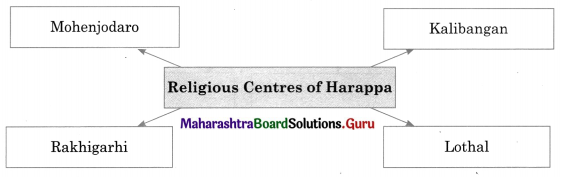
Religious centers of Harappa:
(a) Mohenjodaro
(b) Lotha
(c) Dholavira
(d) Kalibangan
Answer:
(c) Dholavira

2A. Write the names of historical places, persons, and events.

Question 1.
The city is situated on the banks of the river Ravi in Punjab, Pakistan.
Answer:
Harappa

Question 2.
British traveler who visited and wrote about archaeological remains at Harappa.
Answer:
Charles Masson

Question 3.
First Director-General of the Archaeological Survey of India.
Answer:
Sir Alexander Cunningham

Question 4.
Discovery of Harappa.
Answer:
1921

Question 5.
Excavations at Mohenjodaro.
Answer:
Rakhaldas Banerjee

Question 6.
Remains of Harappan dock in Gujarat.
Answer:
Lothal

Question 7.
Harappan settlement of Shortugai.
Answer:
Badakshan, Afghanistan

Question 8.
Mesopotamian temples.
Answer:
Ziggurats

Maharashtra Board Class 11 History Important Questions Chapter 2 First Cities of India

2B. Choose the correct reason and complete the sentence.

Question 1.
The ancient civilisations of Mesopotamia and Harappa had cultural ties with each other because of __________
(a) fortifications
(b) the similarity between seals and artifacts
(c) public monuments were found
(d) impressive town planning
Answer:
(b) the similarity between seals and artifacts

Question 2.
The evidence of the first excavations at Harappa had indicated __________
(a) the first settlement of the Early Harappan period was established around 3300 B.C.E
(b) the city of Harappa was divided into two parts – the ‘Citadel’ and the ‘Lower Town’.
(c) internal changes begin to appear in Harappan cities.
(d) the decline of Harappan civilisation.
Answer:
(b) the city of Harappa was divided into two parts – the ‘Citadel’ and the ‘Lower Town’

Question 3.
The first settlement of the Early Harappan period was established __________
(a) around 2500 B.C.E
(b) around 2500 – 2800 B.C.E
(c) around 2600 B.C.E
(d) around 3300 B.C.E
Answer:
(d) around 3300 B.C.E

2C. Write the correct chronological order.

Question 1.
(a) Vedic Aryans
(b) Late Harappan period
(c) Mature Harappan period
(d) Early Harappan period
Answer:
(a) Early Harappan period
(b) Mature Harappan period
(c) Late Harappan period
(d) Vedic Aryans

Maharashtra Board Class 11 History Important Questions Chapter 2 First Cities of India

Question 2.
(a) Mature (Urban) Harappan period
(b) Early Harappan period
(c) Post Harappan cultures
(d) Late Harappan period
Answer:
(a) Early Harappan period
(b) Mature (Urban) Harappan period
(c) Late Harappan period
(d) Post Harappan cultures

Question 3.
(a) Discovery of Harappa
(b) Excavation of Dholavira
(c) Excavation of Lothal
(d) Discovery of Mohenjodaro
Answer:
(a) Discovery of Harappa (1921)
(b) Discovery of Mohenjodaro (1922)
(c) Excavation of Lothal (1995 – 1960)
(d) Excavation of Dholavira (1990)
[Note: Years in a bracket are only given for understanding]

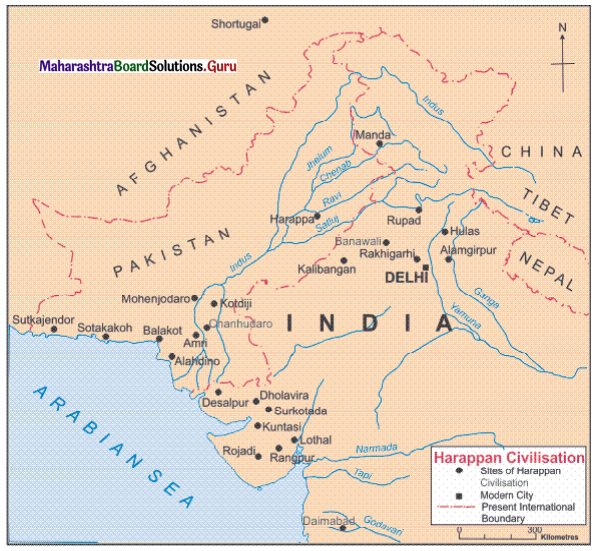
3. Observe the map on page 13 of your textbook and answer the following questions based on it.

Maharashtra Board Class 11 History Important Questions Chapter 2 First Cities of India 3

Question 1.
Point out some of the Harappan sites in India.
Answer:
Some of the Harappan sites in India are Kalibangan, Dholavira, Surkotda, Lothal, Rangpur.

Question 2.
Point out the Harappan sites in modern-day Pakistan.
Answer:
Harappan sites in modern day Pakistan are Mohenjodaro, Harappa, Chahnudaro, Balakot.

Question 3.
Point out the only Harappan site in Afghanistan.
Answer:
The only Harappan site in Afghanistan is Shortugai.

Maharashtra Board Class 11 History Important Questions Chapter 2 First Cities of India

Question 4.
Point out the modern city of India.
Answer:
The modern city of India – Delhi.

Question 5.
Near which river Daimabad is located?
Answer:
Daimabad is located near Godavari River.

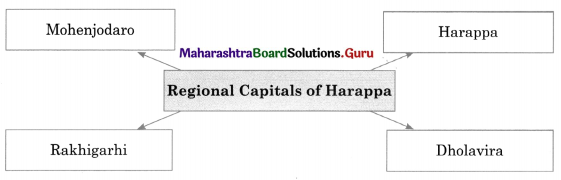
4. Complete the concept maps.

Question 1.
Maharashtra Board Class 11 History Important Questions Chapter 2 First Cities of India 4 Q1
Answer:
Maharashtra Board Class 11 History Important Questions Chapter 2 First Cities of India 4 Q1.1

Question 2.
Maharashtra Board Class 11 History Important Questions Chapter 2 First Cities of India 4 Q2
Answer:
Maharashtra Board Class 11 History Important Questions Chapter 2 First Cities of India 4 Q2.1

Question 3.
Maharashtra Board Class 11 History Important Questions Chapter 2 First Cities of India 4 Q3
Answer:
Maharashtra Board Class 11 History Important Questions Chapter 2 First Cities of India 4 Q3.1

Maharashtra Board Class 11 History Important Questions Chapter 2 First Cities of India

Question 4.
Maharashtra Board Class 11 History Important Questions Chapter 2 First Cities of India 4 Q4
Answer:
Maharashtra Board Class 11 History Important Questions Chapter 2 First Cities of India 4 Q4.1

5. Write short notes.

Question 1.
Lothal
Answer:

  • Lothal was excavated from 1955 to 1960 under the supervision of S.R. Rao.
  • It is situated near the Gulf of Kutch in Gujarat, 80 km away from Ahmedabad.
  • It is known for the remains of the Harappan dock.
  • The ‘Citadel’ and the ‘Lower Town’ at Lothal are surrounded by a single fortification wall.
  • Lothal was established on the banks of the river Bhogao.
  • The presence of platforms built for stalls, a warehouse, and the dock confirm that Lothal was an important port and trading center. Lothal is an example of the engineering excellence of ancient people.

Question 2.
Lapis Lazuli Stone
Answer:

  • Lapis Lazuli a semi-precious stone was found in the region of Badakshan province of Afghanistan, ‘Shortugai’.
  • This region is rich with mines of lapis lazuli.
  • There was a great demand for this stone in Mesopotamia.
  • The Mesopotamian epics describe Goddess Inanna’s palace, the walls of which were embedded with this stone.
  • This Stone was a very important commodity in the Harappan trade with Mesopotamia.

Question 3.
Ziggurats
Answer:

  • Mesopotamian temples are known as ‘ziggurats’.
  • The administrative system of the Mesopotamian Cities revolved around the administration of these temples.
  • The high priest of the temple used to be the ruler of the city.
  • The social life, cultural events, Power and hierarchy of officials, etc were organized in accordance with the rituals and festivals of the presiding deity of the temple.

Question 4.
Rakhigarhi
Answer:

  • The Hissar district of Haryana has situated the site of Rakhigarhi, a Harappan city.
  • It is at a distance of 150 kilometers from Delhi.
  • It is located on the banks of Chautang (ancient Drishdvati river).
  • Rakhigarhi is the largest Harappan site, among all the sites from India and Pakistan.
  • Its total area was more than 350 Hectares. The excavations at Rakhigarhi started in 1963.
  • It continued in 1997-2000. Later, Dr. Vasant Shinde of the Deccan College, Pune also conducted excavations at the site.

Maharashtra Board Class 11 History Important Questions Chapter 2 First Cities of India

Question 5.
Harappan Sites
Answer:

  • Many sites of the Early Harappan and Mature Harappan (Urban) phases have been found in the basin of the river Ghaggar.
  • The latest research based on the evidence from sites like Kunal, Bhirrana, Farman, Girwad, and Mitathal, etc. indicates a possibility of the rise of the Mature Harappan more than 5000 years ago.
  • The Harappan sites of Mohenjodaro, Harappa, Ganweriwala in Pakistan, and Rakhigarhi and Dholavira in India have been declared as World Heritage sites.

6. State your opinion.

Question 1.
The river known as ‘Ghaggar Hakra’ flows only during the monsoon.
Answer:

  • River Gjaggar Hakra originates in the Siwalik Hills in Himachal Pradesh and flows to Rajasthan through Punjab and Haryana.
  • From there it enters the Desert of Cholistan in Pakistan. Ultimately it enters the Rann of Kutch.
  • It is known as Ghaggar in India and as Hakra in Pakistan. Its bed remains dry through the year except during the monsoon.
  • Thus, a river known as ‘Ghaggar Hakra’ flows only during the monsoon.

7. Answer the following questions in detail.

Question 1.
Explain the interrelationship between cities and villages in the Harappan Civilisation.
Answer:

  • The Harappan people depended on natural resources and villages in the vicinity in order to meet the needs of the urban way of life and urban administration.
  • The raw material needed for industrial production included clay, various siliceous and semi¬precious stones, metals, etc.
  • The interrelationship between Harappan cities and villages was dependent on the mechanism of making available things like food grains and raw materials.
  • There was a network of small towns, small and big villages and campsites of semi-nomadic people which functioned to cater to the needs of major urban centers of the Harappan civilization.
  • The best example of it is the Harappan Settlement of Shortugai.

Question 2.
Write in detail on Mesopotamian temples, ‘Ziggurats’.
Answer:

  • Mesopotamia is known for its grand temples.
  • The administrative system of Mesopotamian cities revolved around the administration of these temples.
  • Mesopotamian temples are known as ‘ziggurats’.
  • The high priest of the temple used to be the ruler of the city.
  • The social life, cultural events, power and hierarchy of officials, etc were organized in accordance with the ritual and festival of the presiding deity of the temple.
  • The notion of a ‘priest king’ of the Harappan civilisation was formulated by presuming its close similarity with the Mesopotamian culture.

Maharashtra Board Class 11 History Important Questions Chapter 2 First Cities of India

Question 3.
Reasons for the decline of cities.
Answer:
The reasons for the decline of cities are as follows:

  • It is known that the Harappan civilisation began to decline around 2000 – 1900 B.C.E.
  • People had to regret elsewhere with the beginning of the later Harappan Period.
  • The Harappan trade with Mesopotamia was on the decline in the late Harappan Period because the Mesopotamia economy had weakened.
  • A deteriorating environment was the main reason for the decline of Mesopotamia.
  • Similarly, climatic changes and deteriorating environment were the main reason for the decline of the Harappan civilisation too.
  • The late Harappan people were forced to migrate became of natural calamities.
  • New villages were settled by the Nature Harappan and Late Harappan people wherever they went.
  • The Harappan civilization deteriorated as the cumulative effect of various factors such as a decline in trade, climatic changes, weakening of two economies.

8. Answer the following questions with the help of given points.

Question 1.
Write about some cities of Harappa with the help of the following points:
(a) Harappa
(b) Mohenjodaro
(c) Kalibangan
(d) Lothal
(e) Dholavira
(f) Rakhigarhi
Answer:
(a) Harappa:

  • Harappa is situated on the banks of the river Ravi (District Sahiwal in Punjab, Pakistan).
  • The ancient site of Harappa had spread on 150 Hectares.
  • The first excavation at Harappa began in 1921. The first settlement of the Early Harappan Period was established around 3300 B.C.E.
  • It evolved to the Mature Harappan (urban) phase around 2600 B.C.E. It reached its peak during 2450-1900 B.C.E.

Maharashtra Board Class 11 History Important Questions Chapter 2 First Cities of India

(b) Mohenjodaro:

  • Mohenjodaro was built on the banks of the river Sindhu (Indus) in Pakistan (District Larkana, Sindh).
  • Area-wise, Mohenjodaro is the biggest city, among those discovered in Pakistan so far.
  • It was thought that the city was divided into two fortified sections, namely the ‘Citadel’ and the ‘Lower Town’.
  • The excavations at Mohenjodaro by Rakhaldas Banerjee began in 1921-22.
  • In 1923- 24 to gather more information about Mohenjodaro Madho Sarup Vats, Kashinath Narayan Dikshit, Ernest Mackay, and others conducted further excavations under Sir John Marshall’s direction.
  • He was the Director-General of the Archaeological Survey of India at that time.
  • During these excavations, various artifacts, houses, and public monuments were unearthed.

(b) Kalibangan:

  • The site of Kalibangan is 205 kilometers away from Bikaner. It is located in the Hanumangarh district of Rajasthan.
  • It was one of the important urban centers of the Harappan civilisation, situated on the banks of the river Ghaggar.
  • L. P. Tessitore, an Italian linguist had visited Kalibangan during his study tour of the region. It was conducted under the direction of Brijabasi Lai, the then Director-General of the Archaeological Survey of India, and Balkrishna Thapar.
  • At Kalibangan two settlements, one of the Mature Harappan period and the other of the Early Harappan period, were found. Kalibangan was a small city compared to Harappa and Mohenjodaro.

(c) Lothal:

  • Lothal was established on the bank of the river Bhogao.
  • The center of the Harappan civilisation at Lothal was situated near the Gulf of Kutch, in Gujarat, 80 kilometers away from Ahmedabad.
  • It is known for the remains of Harappan dock.
  • Lothal was excavated from 1955 to 1960 under the supervision of S.R. Rao. The ‘Citadel’ and the ‘Lower Town’ at Lothal do not have separate fortification walls.
  • Rather, they are surrounded by a single fortification wall.

(d) Dholavira:

  • Dholavira was discovered by J.P. Joshi, the Director-General of Archaeological Survey of India. The site is in ‘Khadirbet’ in Gujarat (Dist. Kutch).
  • Excavations at the site were started by R.S. Bisht in 1990.
  • Among the excavated Harappan sites, extent wise Dholavira is the fifth-largest city.
  • An Early Harappan settlement was discovered at Dholavira.
  • There was a protective wall built around it by using mud bricks (unbaked bricks) and dressed stones. It was surrounded by an outer fortification wall.
  • The settlement within the outer fortification was divided into four sections.
    • Citadel
    • The adjacent section reserved for high officials
    • Lower Town – These three sections had walls, which separated them from each other.
    • The fourth section inside the outer fortification did not have any additional separating walls.

Maharashtra Board Class 11 History Important Questions Chapter 2 First Cities of India

(e) Rakhigarhi:

  • The Hissar district of Haryana has situated at the site of Rakhigarhi, a Harappan city.
  • It is at a distance of 150 kilometers from Delhi.
  • It is located on the banks of Chautang (ancient Drishdvati river).
  • Rakhigarhi is the largest Harappan site, among all the sites from India and Pakistan.
  • Its total area was more than 350 Hectares.
  • The excavations at Rakhigarhi started in 1963. It continued in 1997-2000.
  • Later, Dr. Vasant Shinde of the Deccan College, Pune also conducted excavations at the site.

Maharashtra Board Class 11 History Solutions Chapter 2 First Cities of India

Balbharti Maharashtra State Board Class 11 History Solutions Chapter 2 First Cities of India Textbook Exercise Questions and Answers.

Maharashtra State Board Class 11 History Solutions Chapter 2 First Cities of India

1. Choose the correct alternative and write the complete sentences.

Question 1.
In the early phase of agriculture, making __________ pots and farming were the jobs of women.
(a) copper
(b) bronze
(c) earthen
(d) stone
Answer:
(c) earthen

Question 2.
Lothal is known for its ancient __________
(a) agriculture
(b) dock
(c) textiles
(d) tools
Answer:
(b) dock

Maharashtra Board Class 11 History Solutions Chapter 2 First Cities of India

Question 3.
A general impression prevailed that the Harappan seals had some connection with the __________ civilisation.
(a) Chinese
(b) Greek
(c) Mesopotamian
(d) Egyptian
Answer:
(c) Mesopotamian

Question 4.
The bodies (mummies) of dead royalties in Egypt were wrapped in __________ coloured cloth.
(a) white
(b) black
(c) red
(d) blue
Answer:
(d) blue

2A. Choose the correct reason and complete the sentence.

Question 1.
The major reason for the decline of the Mesopotamian civilisation was __________
(a) foreign invasion
(b) deteriorating environment
(c) loss in trade
(d) migration
Answer:
(b) deteriorating environment

2B. Find the incorrect pair from set ‘B’ and write the correct ones.

Question 1.

Set ‘A’Set ‘B’
(a) DilmunBahrain
(b) MakanOman-Iran-Baluchistan Coastal region
(c) ShortugaiMesopotamia
(d) MeluhhaRegion of Harappa civilisation

Answer:
(c) Shortugai – Badakshan province of Afghanistan

3. Explain the statements with reasons.

Question 1.
The remains found in cities like Harappa, Mohenjodaro, Kalibangan, Lothal, Dholavira, Rakhigarhi, etc. are evidence of the past glory of this civilization.
Answer:

  • A well-developed and rich civilisation flourished in the Indian subcontinent in the period from 3500-3000 B.C.E.
  • This period is characterised by systematic town planning, with houses of baked brick, granaries, excellent drainage systems, public baths, and impressive public movements.
  • Good administrative control over the distribution of water and other resources.
  • Remains also prove a good social organisation, a proper social hierarchy based on the position of power.
  • Flourishing internal and distant trade, mass production of goods, and craft specialisation developed writing system of script on Harappan seals give evidence of the past glory of the civilisation.

Maharashtra Board Class 11 History Solutions Chapter 2 First Cities of India

Question 2.
Lapis lazuli had a very important place in the Harappan trade.
Answer:

  • A network of small towns, big and small villages, and campsites of semi-nomadic people functioned to cater to the needs of major urban centres of the Harappan civilisation.
  • The Harappan settlement of ‘Shortugai’ in the Badakshan province of Afghanistan, is rich with mines of lapis lazuli, a semi-precious stone in Mesopotamia.
  • The Mesopotamian epics describe Goddess Inanna’s palace, the walls of which were embedded with this stone, lapis lazuli.
  • This stone was a very important commodity in the Harappan trade with Mesopotamia.

Question 3.
Harappan civilisation declined.
Answer:

  • Sir Mortimer Wheeler in his study has concluded that the Harappan civilisation was destroyed by Indra, who destroyed the fortified cities.
  • Vedic Aryans destroyed the Harappan cities under the leadership of Indra.
  • The civilisation also declined due to the cumulative effects of factors such as the decline in trade, climatic changes, and the weakening of the economy.

4. State your opinion.

Question 1.
The Harappan cities and villages in the vicinity were interdependent.
Answer:

  • The interrelationship between Harappan cities and villages was dependent on the mechanism of making available food grains and raw materials.
  • A network of small towns, big and small villages, and campsites of semi-nomadic people, functioned to cater to the needs of major urban centres of Harappan civilisation.
  • The city people were dependent on natural sources and villages in their vicinity, to meet the needs of urban lifestyle and urban administration.

Question 2.
The Harappan cities seem to have a well-organised administrative system.
Answer:

  • The Harappan cities had a well organised administrative system to manage industrial production, import-export, the interrelationship between cities managing trading operations and villages around them.
  • The town planning, standardization of bricks, weights, seals, shapes, and ornamentation of various objects, confirm the presence of an efficient administrative system.
  • Cities like Harappa and Mohenjodaro were perhaps regional capitals.
  • Lothal and Kalibangan were important religious centres.
  • However, the nature of Harappan polity, whether it was a single state or a federation of small states, is not yet known.

Maharashtra Board Class 11 History Solutions Chapter 2 First Cities of India

5. Answer the following questions with the help of given points.

Question 1.
Write about the characteristics of Harappan cities with the help of the given points:
(a) Town planning
(b) Social organisation
(c) Administration
(d) Economy
Answer:
(a) Town planning:

  • The town planning of Harappan cities was very systematic.
  • Houses were of baked bricks, which included bathrooms, toilets, wells.
  • Granaries existed, with impressive public monuments.
  • The excellent drainage systems, public baths, and independent fortification walls are highlights.
  • The grid pattern was used, where streets crossed each other in right angles, and the resulted blocks were used for building houses.
  • The English bond masonry method was used with two headers and two stretchers to build a wall, which was especially useful for earthquake-prone areas.

(b) Social organisation:

  • Social hierarchy was based on the position of power.
  • Classes of skilled artisans and individuals were based on craft specialisation.
  • Belief systems existed, with evidence of burials indicating rituals after death.
  • Artifacts and architecture also indicate belief systems.

(c) Administration:

  • Administrative control existed over the distribution of water and other resources.
  • The size of bricks indicates the use of standardisation and ratio.
  • Weights, set style of shapes and painted designs of pottery, majestic and non-residential buildings for public administrative offices are also seen.

(d) Economy:

  • Harappan civilisation practiced mass production of goods for trade purposes.
  • The concentration of factories and residences of artisans in a particular area of the city indicates the purpose of convenience of production, flourishing internal and distant trade, and administrative control over trade transactions.
  • Well-shaped, beautiful earthen pots, statues, metal objects of gold, silver, copper, and bronze were made.
  • Various types of beads were prepared, indicating a sound economy.

Maharashtra Board Class 11 History Solutions Chapter 2 First Cities of India

Activity

Collect information and illustrations with the help of the internet about the town planning of the Harappan cities and Chandigarh. Compare them.
Answer:
The town planning of the Harappan Cities:

  • The Harappans were the first to build planned cities with a scientific drainage system.
  • Their cities were built on a uniform plan.
  • The people of Indus valley lived a highly civilized and developed life.
  • This highly developed and scientific plan can be seen in the following areas.

Streets:

  • The streets were straight and cut each other at right angles
  • They were 13 to 34 feet wide and were well lined.
  • The streets and roads divided the city into rectangular blocks.
  • Lamp posts were provided at regular intervals.
  • Dust bins were also provided on the streets which proves the presence of a good municipal administration.

Drainage System:

  • The city was provided with an excellent closed drainage system.
  • Each house had its own drainage and soak pit which was connected to the public drainage.
  • Brick-laid channels were found through every street.
  • The drains were covered and had manholes at regular intervals for cleaning and clearing.
  • Large brick culverts were constructed on the outskirts of the city to carry excess water.
  • The Indus valley civilization had a perfect underground drainage system.

The Great Bath:

  • The most striking feature of Mohenjo Daro is the Great Bath.
  • It consists of a large quadrangle. In the center, there is a large swimming pool approx. 39 ft long, 23 ft wide, and 8 ft deep.
  • This swimming pool had rooms and galleries on all four sides.
  • It had a flight of steps at either end and a well in one of the adjoining rooms. The water was discharged by a huge drain.
  • The Great Bath had 8ft thick outer walls.

Maharashtra Board Class 11 History Solutions Chapter 2 First Cities of India

Granaries:

  • The largest building in Mohenjo Daro is the granary which is 45.71 m long and 15.23 m wide.
  • Granaries have also been found in Harappa and the southern parts of Kalibangan.
  • These granaries were used to store grains which were probably collected as revenue or storehouses to be used in emergencies.

Buildings:

  • People of the Indus valley civilization built houses and other buildings on the side streets.
  • Built terraced houses of burnt bricks.
  • Every house had two or more rooms, there were also more than one-storied houses.

The town planning of Chandigarh City:

  • Chandigarh, the capital of the northern Indian states of Punjab and Haryana was designed by the Swiss-French modernist architect, Le Corbusier.
  • Buildings include the Capitol Complex with its High Court, Secretariat, and Legislative Assembly.

Maharashtra Board Class 11 History Important Questions Chapter 1 First Farmers

Balbharti Maharashtra State Board Class 11 History Important Questions Chapter 1 First Farmers Important Questions and Answers.

Maharashtra State Board 11th History Important Questions Chapter 1 First Farmers

1A. Choose the correct alternative and write the complete sentences.

Question 1.
____________ made the first stone tools.
(a) Homo erectus
(b) Home sapiens
(c) Homo habilis
(d) Homo phones
Answer:
(c) Homo habilis

Question 2.
Microliths were found in ____________ age.
(a) Neolithic
(b) Chalcolithic
(c) Mesolithic
(d) Palaeolithic
Answer:
(c) Mesolithic

Maharashtra Board Class 11 History Important Questions Chapter 1 First Farmers

Question 3.
Pasting wet clay ribbons and making patterns on them is known as ____________ work.
(a) application
(b) applique
(c) apply
(d) amalgamation
Answer:
(b) applique

Question 4.
In ____________ mesolithic man existed during 10000-4000 B.C.E.
(a) Uttar Pradesh
(b) Maharashtra
(c) Bihar
(d) Northeast India
Answer:
(b) Maharashtra

Question 5.
A ____________ site was found at Lahuradeva in Sant Kabirnagar district of Uttar Pradesh.
(a) Palaeolithic
(b) Mesolithic
(c) Neolithic
(d) Chalcolithic
Answer:
(c) Neolithic

1B. Find the incorrect pair from set ‘B’ and write the correct ones.

Question 1.

Set ‘A’Set ‘B’
(a) EgyptMisra
(b) ChinaSorrow
(c) MesopotamiaFirst One
(d) SindhuIndus

Answer:
(c) Mesopotamia – Middle One

Question 2.

Set ‘A’Set ‘B’
(a) First Neolithic villages6000 B.C.E
(b) Agriculture in Neolithic villages in China7000 B.C.E
(c) Existence of Mesolithic man3000 B.C.E
(d) Neolithic settlements in Bihar2000 B.C.E

Answer:
(c) Existence of Mesolithic man – 10000-4000

Maharashtra Board Class 11 History Important Questions Chapter 1 First Farmers

Question 3.

Set ‘A’Set ‘B’
(a) Original name of EgyptKemet
(b) Arabic name of EgyptMisra
(c) Greek name of EgyptEgyptus
(d) English translation of Huang HeHwat-ka-Pta

Answer:
(d) English translation of Huang He – Yellow River

1C. Find the odd one out.

Question 1.
Countries with ancient civilizations:
(a) Egypt
(b) China
(c) India
(d) England
Answer:
(d) England

Question 2.
Mesolithic tools:
(a) Fluted Core
(b) Screwdriver
(c) Blades
(d) Arrowheads
Answer:
(b) Screwdriver

Question 3.
Archaeological sites:
(a) Gilgal
(b) Inamgaon
(c) Aurangabad
(d) Lahuradeva
Answer:
(c) Aurangabad

Maharashtra Board Class 11 History Important Questions Chapter 1 First Farmers

Question 4.
Egypt originally known as:
(a) Kemet
(b) Huang He
(c) Hwat-ka-Pta
(d) Egyptus
Answer:
(a) Kemet

2A. Write the names of historical places, persons, and events.

Question 1.
Species who made the first stone tools.
Answer:
Homo Habilis

Question 2.
Palaeolithic Campsite near the Sea of Galilee.
Answer:
Ohalo

Question 3.
The region between the Tigris and Euphrates.
Answer:
Mesopotamia

Question 4.
The valley of the Nile.
Answer:
Egypt

Question 5.
The original name of Egypt.
Answer:
Kemet

Maharashtra Board Class 11 History Important Questions Chapter 1 First Farmers

Question 6.
The Arabic name of Egypt.
Answer:
Misra

Question 7.
The valley of the Huang He.
Answer:
China

Question 8.
The English translation of the Huang He.
Answer:
Yellow River

Question 9.
Palestinian city on the banks of the river Jordan.
Answer:
Jericho

Question 10.
Mesolithic culture of Japan
Answer:
Jomon

2B. Choose the correct reason and complete the sentence.

Question 1.
Huang He earned the name ‘Sorrow’ or ‘River of Tears’ ____________
(a) of the yellow silt
(b) Mother of Chinese culture
(c) the torrential floods caused great loss to life and assets.
(d) it flows from the Himalayas
Answer:
(c) the torrential floods caused great loss to life and assets.

Question 2.
Egypt got the name ‘Kemet’ ____________
(a) of the black soil that was deposited by the Nile floods
(b) it means Temple of God
(c) it was the beginning of agriculture
(d) because of the decipherment of the Rosetta stone
Answer:
(a) of the black soil that was deposited by the Nile floods.

Maharashtra Board Class 11 History Important Questions Chapter 1 First Farmers

Question 3.
The site of Mehrgarh is of great importance among ____________
(a) Neolithic villages in Indian Subcontinents established by farmers
(b) Mesolithic man that existed during 10000 – 4000 B.C.E.
(c) The farmers that cultivate the barley and wheat
(d) Chalcolithic people of Maharashtra
Answer:
(a) Neolithic villages in Indian Subcontinents established by farmers.

Question 4.
The first neolithic villages in Egypt came into ____________
(a) about 5000 B.C.E
(b) about 6000 B.C.E
(c) about 7000 B.C.E
(d) about 8000 B.C.E
Answer:
(b) about 6000 B.C.E

2C. Write correct chronological order.

Question 1.
(a) Making of microliths
(b) Beginning of the Neolithic age
(c) Beginning of the ‘Holocene’ epoch
(d) Beginning of agriculture and domestication of animals
Answer:
(a) Beginning of the ‘Holocene’ epoch.
(b) Making of microliths
(c) Beginning of the Neolithic age
(d) Beginning of agriculture and domestication of animals

Maharashtra Board Class 11 History Important Questions Chapter 1 First Farmers

Question 2.
(a) Increase in water bodies
(b) Availability of animals and vegetation for food increased
(c) Beginning of Holocene glaciers
(d) Glaciers began to melt
Answer:
(a) Beginning of Holocene glaciers
(b) Glaciers began to melt
(c) Increase in water bodies
(d) Availability of animals and vegetation for food increased

Question 3.
(a) Neolithic settlements in Jammu and Kashmir
(b) Neolithic settlements in Uttar Pradesh
(c) Neolithic settlements in Bihar
(d) Neolithic settlements in Northeast India
Answer:
(a) Neolithic settlements in Bihar
(b) Neolithic settlements in Jammu and Kashmir
(c) Neolithic settlements in Northeast India
(d) Neolithic settlements in Uttar Pradesh

Question 4.
Stages of Bead Making:
(a) To know the sources of siliceous stones and chank shells
(b) To manufacture finished beads from the stones of irregular shape and the core of chank shells
(c) To transport the raw material to the manufacturing site
(d) To obtain the raw material
Answer:
(a) To know the sources of siliceous stones and chank shells
(b) To obtain the raw material
(c) To transport the raw material to the manufacturing site
(d) To manufacture finished beads from the stones of irregular shape and the core of chank shells

Maharashtra Board Class 11 History Important Questions Chapter 1 First Farmers

3. Observe the map on page 2 of your textbook and answer the following questions based on it.

Maharashtra Board Class 11 History Important Questions Chapter 1 First Farmers 3

Question 1.
Name the different continents seen on the map.
Answer:
Asia, Africa, Europe, and Australia are the continents seen on the map.

Question 2.
Name the ocean in the north of Asia.
Answer:
The Arctic Ocean is in the north of Asia.

4. Complete the concept maps.

Question 1.
Maharashtra Board Class 11 History Important Questions Chapter 1 First Farmers 4 Q1
Answer:
Maharashtra Board Class 11 History Important Questions Chapter 1 First Farmers 4 Q1.1

Question 2.
Maharashtra Board Class 11 History Important Questions Chapter 1 First Farmers 4 Q2
Answer:
Maharashtra Board Class 11 History Important Questions Chapter 1 First Farmers 4 Q2.1

Maharashtra Board Class 11 History Important Questions Chapter 1 First Farmers

Question 3.
Maharashtra Board Class 11 History Important Questions Chapter 1 First Farmers 4 Q3
Answer:
Maharashtra Board Class 11 History Important Questions Chapter 1 First Farmers 4 Q3.1

5. Write short notes.

Question 1.
Paleolithic camp ‘Ohalo’
Answer:

  • ‘Ohalo’ is a Palaeolithic campsite near the Sea of Galilee.
  • At Ohalo the evidence of barley, other cereals, and seeds of fruits have been found, along with traces of human occupation.
  • Various weeds, in the form of seeds, have been found with cultivated crops.
  • Cereals found at Ohalo were remains of cultivated crops and not of the wild variety.
  • Grinding stones found from Ohalo, reveal that cereals were first ground (grinding) and then cooked.

6. Explain the statements with reasons.

Question 1.
Ancient pottery throws light on various aspects of ancient cultures.
Answer:

  • In all stages of pottery-making, we can understand the class of skilled potters, who were equipped with essential knowledge of pottery making.
  • Ancient pottery throws light on various aspects of ancient cultures.
  • We get to know about the cultural history, the material richness of the place, from where it was found.
  • We can also know the contacts of the residents of a place with other cultures.

7. State your opinion.

Question 1.
The process of urbanisation began in the Neolithic age.
Answer:

  • Settling down at one place for a long time, a feeling of ownership arose among the neolithic people.
  • Gradually villages expanded, creating awareness of collective land holdings, making village boundaries prominent.
  • Awareness of the natural right over a particular region, known as ‘territoriality’ arose.
  • Rules and social norms were created to manage the collective resources, water resources, crafts, dependent on it, trade, and community life, resulting in rituals gaining importance.
  • Administrative centers rose to manage and keep records of trade, rituals, and writing systems.
  • With the increase in population, officials, and occupations, the periphery of the original settlement kept expanding, cities came into existence and the process of urbanisation began in the Neolithic age.

Maharashtra Board Class 11 History Important Questions Chapter 1 First Farmers

8. Answer the following questions with the help of given points.

Question 1.
Write a short note on River Valley civilisations.
(a) The valley of Euphrates and Tigris – Mesopotamia.
(b) The valley of Nile – Egypt
(c) The valley of Huang He – China
(d) The valleys of Sindhu (Indus) and Saraswati – India
Answer:
The progress in the techniques of systematic cultivation resulted in the rise of the most ancient river valley civilisations of the Neolithic age. The river valley civilisations grew in four regions of the world. Those regions were Mesopotamia, Egypt, the Indian Subcontinent, and China.

(a) The valley of Euphrates and Tigris – Mesopotamia: Mesopotamia is the Greek name of the region between the two rivers, Tigris and Euphrates. Mesos means the ‘middle one’. Potamos means ‘river’. The region between the two rivers is ‘Mesopotamia’. The Mesolithic people began to stay in this region for longer times because of the availability of ample water. Ancient Mesopotamia included modern Iraq, Syria as well as the western regions of Iran and south-eastern regions of Turkey. The camps of Mesolithic people developed into the first settled neolithic villages. These .first villages are dated to 10000 years B.C.E.

(b) The valley of Nile – Egypt: Napoleon Bonaparte had taken along many scholars from various fields during his invasion of Egypt in 1798. They studied the ancient remains in Egypt and published it. These studies received momentum because of the decipherment of the Rosetta inscriptions. The first neolithic villages in Egypt came into being at about 6000 B.C.E. The beginning of agriculture in Egypt coincides with the same time.

(c) The valley of Huang He – China: The valley of Huang He River is considered to be the v region of origin of the Chinese culture. The Chinese culture evolved here. Agriculture in the neolithic villages of China began at about 7000 B.C.E. Wheat, foxtail millet, and rice was grown by the farmers in these villages.

(d) The valleys of Sindhu (Indus) and Saraswati – Indian subcontinent: The region of the valleys of Sindhu and Saraswati is now divided between India and Pakistan. The archaeological excavations at Harappa on the banks of Ravi in Punjab and Mohenjo Daro on the banks of Sindhu in Sindh indicate the existence of a fully developed civilisation in the Indian subcontinent which was dated to circa 3000 B.C.E. It proves that there were well-settled villages in the Indian subcontinent as early as 8000 B.C.E. There is a general consensus among the scholars that the Harappan cities evolved from these early villages.

Maharashtra Board Class 11 History Important Questions Chapter 1 First Farmers

Question 2.
Explain the concept with the help of the following points:
(a) Origin of Egypt
(b) Yellow River
(c) Fluted core technique
Answer:
(a) Origin of Egypt: Egypt was originally known as ‘Kemet’. Egypt got this name because of ‘ the black soil that was deposited by the Nile floods. Later Egypt came to be known as ‘Hewat-ka- Pta’. It means the temple of God. The Greeks changed it to ‘Egyptus’. In the course of time, it was changed to ‘Egypt’. The Arabic name of Egypt is ‘Misra’.

(b) Yellow River: Yellow River’ is the English translation of the Chinese name ‘Huang He’. The yellow silt brought by her has earned her this name. ‘River’ and ‘Mother’ are her other names. These names indicate her extraordinary place in Chinese culture. The name ‘River’ indicates that she is considered to be the only river of importance. The fact that she is considered to be the mother of the Chinese culture is obvious in the name, ‘Mother’.

(c) Fluted core technique: The blades used for Mesolithic tools were removed from Siliceous stones by the technique known as ‘Fluted Core Technique’. These blades are as tiny as our fingernails. So they are called ‘Microliths’. The Mesolithic people used wooden arrows fixed with microlithic arrowheads.

Question 3.
Explain some Neolithic Sites in India.
Answer:
Some important Neolithic sites in India are as follows:
(a) The northwest region of the Indian continent: Phase I (7000- 6000 B.C.E.) No evidence of pottery (earthen pots). Phase II (6000-4000 B.C.E.) Beginning of pottery making, e.g. Mehrgarh.

(b) Jammu and Kashmir: In Jammu and Kashmir, around 2500 B.C.E. neolithic settlements were established at the sites of Burzhom and Gufkral.

(c) Uttar Pradesh: In Uttar Pradesh, around 6000 B.C.E. neolithic settlements were established at the sites of Chopani Mando, Koldihwa, and Mahagara.

(d) Bihar: In Bihar, around 2000 B.C.E. Neolithic settlements were established. It includes the sites like Chirand, Senuwar, etc.

Maharashtra Board Class 11 History Important Questions Chapter 1 First Farmers

(e) Northeast India: The evidence of neolithic settlement was first discovered at the site of Daojali Hading in Assam. The village was established around 2700 B.C.E. The neolithic tools found here show more affinity to neolithic tools found in China.

(f) South India: The neolithic settlements in Karnataka, Andhra Pradesh, and Tamil Nadu first came into being around 4th – 3rd century B.C.E. Karnatak sites – Sangankallu, Maski, Brahmagiri, Tekkalkota, Piklihal, Hallur, etc. Andhra Pradesh site – Nagarjunikonda. Tamilnadu – Payyampalli.

Maharashtra Board Class 12 English Yuvakbharati Solutions Chapter 2.5 Father Returning Home

Balbharti Yuvakbharati English 12th Digest Chapter 2.5 Father Returning Home Notes, Textbook Exercise Important Questions and Answers.

Maharashtra State Board Class 12 English Yuvakbharati Solutions Chapter 2.5 Father Returning Home

12th English Digest Chapter 2.5 Father Returning Home Textbook Questions and Answers

Question 1.
Discuss with your partner the difficulties that you face while commuting to and from the college by public transport.
Answer:
(a) crowded buses, trains
(b) are difficult to board in peak-hours
(c) have to miss a couple of trains/buses to board safely
(d) on such days miss an important lecture

Maharashtra Board Class 12 English Yuvakbharati Solutions Chapter 2.5 Father Returning Home

Question 2.
The similar problems are faced by the other commuters on the way to their workplace. Imagine their plight and suggest three solutions.
Maharashtra Board Class 12 English Yuvakbharati Solutions Chapter 2.5 Father Returning Home 1
Answer:
Maharashtra Board Class 12 English Yuvakbharati Solutions Chapter 2.5 Father Returning Home 2

Question 3.
Complete the following table:
Answer:

AB
The way our elders take care of usThe way you can take care of elders in your family.
1. Love and protect us.

2. Support, educate and guide us through childhood and youth until we are independent.

3. Provide us with pocket-money and gifts we ask for.

1. Help them in daily chores.

2. Help with errands to the bank, stores or other requirements.

3. Ensure good health with exercise/ social- engagement/doctor- visits/ meditation.

Maharashtra Board Class 12 English Yuvakbharati Solutions Chapter 2.5 Father Returning Home

Question 4.
Write your duties towards the following:
Maharashtra Board Class 12 English Yuvakbharati Solutions Chapter 2.5 Father Returning Home 3
Answer:
Maharashtra Board Class 12 English Yuvakbharati Solutions Chapter 2.5 Father Returning Home 4

(A1)

Question (i)
Discuss with your friend the difficulties focused by the father in the poem.

Maharashtra Board Class 12 English Yuvakbharati Solutions Chapter 2.5 Father Returning Home

Question (ii)
Discuss and write the character sketch of the father with the help of the given points.
(His pathetic condition, the treatment he receives at home, his solitude, the way he tries to overcome it)
Answer:
The father is on the late train. This shows he is hard-working. He does not spend any money on himself as his appearance is shown as shabby. He is uncaring about his appearance probably because he is lonely and heart-broken.

He is silent on the train-trip home. He does not speak to co-passengers. Perhaps the sadness in his heart prevents him from even small-talk. He has no travel-mates. He is silent through the trip, and gets off without waving goodbye to any passenger.
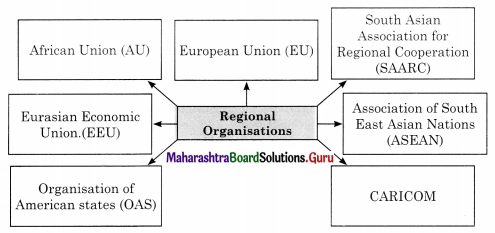
His family is cold, distant and uncaring. He is not greeted on arrival. He is given cold food which is not nourishing. He is left to eat the meal alone just reading his book. At the end of the work-day he reads a book, eats by himself, listens to the radio and dreams of the future all alone. Thus the father is a lonely old man, neglected by his own family in spite of working hard for them and heart-sick of his existence.

(A2)

Question (i)
Given below are the ideas conveyed through the poem. Match the pairs and draw out the hidden meaning from those expressions:
Maharashtra Board Class 12 English Yuvakbharati Solutions Chapter 2.5 Father Returning Home 5
Maharashtra Board Class 12 English Yuvakbharati Solutions Chapter 2.5 Father Returning Home 6
Answer:
1. The father hurries home crossing railway line – Father is so eager to meet family members that he doesn’t even bother about his safety.
2. Suburban area, visible through the train, is passed unnoticed – Because there is hardly anything enchanting/interesting in the monotonous routine journey to look out of the window
3. He is just as a small word, dropping from a sentence. – He has so little value in the society where his presence or absence might hardly make any difference
4. He doesn’t get a place in a crowded train. – Uncomfortable journey

Maharashtra Board Class 12 English Yuvakbharati Solutions Chapter 2.5 Father Returning Home

(ii) Find the lines to prove the following facts from the extract:

Question (a)
Father is deprived of good food.
Answer:
‘Home again, I see him drinking weak tea Eating a stale chapati’

Question (b)
Children did not have a healthy relation with the father
Answer:
His sullen children have often refused to share
Jokes and secrets with him.

Question (iii)
The poet deals with the theme of man’s estrangement from a man-made world. Analyze it with the help of the extract.
Answer:
The father reaches home. He has a lonely poor meal, served without care. The stale cold food also indicates the coldness in relationships in the family. The weak tea is a metaphor for the fragile family bond. There is no bonding. Home is only a shelter for him and he is only a provider for them. The father is lonely among his own family as well. So the father is alone in the crowd of strangers and also among his own family.

Question (iv)
The father contemplates his past and peeps into his future. Give reasons.
Answer:
The father silently ponders on his past. There is no communication with his family members. He would have sat with family members together to recall happy memories and enjoy them again. Reliving the past would have been one way for the family to bond. But the father thinks of the past alone. Future plans could be also discussed with family members. A lot of discussions could have happened about money, savings, career, a wedding and so on.

Advice, suggestions are given, arguments and disagreements happen, and even anger sometimes. But the father has nothing like this happening in his presence. There is only a sullen silence. He remembers his past and thinks of possible grandchildren. No one shares his dreams. He spends the past, present and future alone and in silence.

Maharashtra Board Class 12 English Yuvakbharati Solutions Chapter 2.5 Father Returning Home

(A3)

Question 1.
Complete the following using suitable describing words as they appear in the poem with the help of the words given in the brackets:
(weak, dim, muddy, soggy, stale)
Answer:
(a) Father’s attire – soggy
(b) Father’s tea – weak
(c) Father’s footwear – muddy
(d) Father’s food – stale
(e) Father’s eyesight – dim

(A4)

Question (i)
Identify and write the lines from the extract which expresses the following figures of speech:
Answer:

Figures of speechLines
1. Simile‘Like a word dropped from a long sentence’

The father getting off the train is compared to a word dropped unnoticed as many others words are there.

2. Alliteration1. ‘My father travels on the late evening train’ [1] The sound ‘t’ is repeated.

2. ’Suburbs slide past his unseeing eyes’ [3] the sound ‘s’ is repeated.

Question (ii)
I see him drinking weak tea, eating a stale chapati.
Here ‘stale chapati’ stands for stale food/ non-nourishing food or diet, where the part symbolizes the whole, i.e. food. Guess the name of the figure of speech.
Answer:
The figure of speech is ‘synecdoche’.

Maharashtra Board Class 12 English Yuvakbharati Solutions Chapter 2.5 Father Returning Home

(A5)

Question (i)
Write a counterview on the following topic:
“Every day is a mother’s/ father’s day.”
(a) If you love them, you don’t need to wait for such days.
(b) Celebrating days is just a formality.
(c) Celebrations of the days condition your expression of emotions.
(d) It is a kind of a pretext to neglect your everyday responsibilities.
Answer:
We love and respect our parents. We must be sure to be loving and respectful in our everyday behaviour and actions. They work, laugh, sacrifice – all only for their children -US! When we behave respectfully and lovingly with elders, the cards or a special day in the year are just a formality.

Our feelings for our parents are unconditional. We don’t say ‘if they do something, only then will we do something in return, while interacting with elders in the family. We cannot be loving, caring, obedient and helpful only on a Father’s/Mother’s Day. We have to be all these towards our parents and elders EVERY DAY.

So ‘Every day is Mother’s/Father’s Day!’

Question (ii)
Write an appreciation of the poem considering the following points :

  • About the poem/poet/title
  • Theme
  • Poetic devices, language, style
  • Special features – tone and type
  • Values, message
  • Your opinion about the poem

Answer:
The poem ‘Father Returning Home’, by Dilip Chitre – a bilingual poet – is about a lonely old man’s coming home from a long day at work. The poet describes his silent and lonely journey home in the crowded Mumbai local train. It is a metaphor for the father’s isolated life even though he is among people.

The poet speaks of the ‘unseeing’ eyes on the scenery flashing past the train. The same thing the man sees daily when commuting has nothing new, just like his uninteresting life. The setting is dusk in monsoon. The man’s dress and appearance are also metaphorical.

His soggy clothes and mud stained raincoat symbolize his shabby appearance and also his sad life. The man carries a bag full of books. He is well-read maybe. Thus when the man gets off the train the poet compares it to a word falling from a sentence. He goes unnoticed as an unimportant word dropped from a long sentence – a simile. The ‘long sentence’ – imagery – makes us imagine the long train and the passenger is one word that is getting down.

The platform he crosses is grey, colour imagery for gloominess or dirty surroundings. The poet uses informal language and an easy style. The poet describes him ‘hurries’ along the platform and again ‘hurries’ on to his home. This repeated word shows his eagerness to reach his shelter and I get dry. The words create an imagery of a shabby, pitiable but scholarly man.

The second part of the poem is about the man in his home. The meal he eats shows the poor quality as well as the careless way it is served. He ‘ reads a book while he eats. That is a clear imagery for his loneliness at home also. The family offers no company after his long day and tiring commute.

In the toilet he is pondering on how he has been shut out of the world although he is in the crowd. He is a stranger among his family in his own home. His children don’t speak to him and won’t share any part of their life. They are not interested in his life also. He goes to sleep thinking of the past and future, listening to harsh sounds on the radio.

The message is how the elderly are used by their own children but neglected when they need care. The poem is about a man who may be misunderstood. He is lonely even in the middle of crowds. It teaches how we should not behave to j persons who are in the autumn of their life. I feel sorry for such people who have worked hard in their life but the younger relatives discard them once their use is over.

Maharashtra Board Class 12 English Yuvakbharati Solutions Chapter 2.5 Father Returning Home

Question (iii)
Compose a short poem in about 4-6 lines on your father.
Answer:
My Father

He is unselfish, caring,
Honest and hard-working
Simple, strict and well-read
Upright, always respected
By family and every friend.
He tried to excel till the end.

Question (iv)
Write a character sketch of any one of your family member.
Answer:
My Mother
If anyone cannot believe angels walk on the earth they should come and meet my mother. My mother is the most affectionate and gentle human I have ever met. She has never spoken a harsh word to anyone as far as I recall. She is so very concerned for the comfort of every other person that she neglects herself.

She looks after her father-in-law who is in his eighties. He is a great scholar and gets many visitors. She attends cheerfully to them all apart from looking after us. My father, my sister and I help out with as much of the household chores as we can.

But the main load of running the home falls on her. She takes care of that responsibility so cheerfully as if it is very light. She is loving and jovial with our friends when my sister and I invite them home, She advises us not to overspend but always has a tasty meal when friends and relatives gather for a festival meal.

My father does not make any important decisions in my mother’s absence. She discusses everything till they arrive at the most suitable decision. Our grandfather will not eat anything which my mother has not made. After my grandmother passed, he relies on ‘Saru’ my mother, for his diet meals, medicine, his reference books, walking stick, shawl and everything to be in their place.

My mother is our world.

(A6)

Question (i)
Dilip Chitre has translated Sant Tukaram’s ‘Abhangas’ (devotional poems) for which he received Sahitya Akadeini Award. Browse the internet to collect more information about it.

Maharashtra Board Class 12 English Yuvakbharati Solutions Chapter 2.5 Father Returning Home

Question (ii)
List various occupations related to services which can be rendered to senior citizens.
(a) To counsel patients of Alzheimers’ disease.
(b) (Students may attempt this on their own.)
(c) (Students may attempt this on their own.)

Yuvakbharati English 12th Digest Chapter 2.5 Father Returning Home Additional Important Questions and Answers

Read the extract and complete the given activities:

Global Understanding:

Question 1.
List the difficulties faced by the father in the extract.
Answer:

  1. The father is returning late in the day.
  2. He has to stand the entire trip home.
  3. He is in wet clothes for a long time till he can reach home.
  4. His sight is weak with age.
  5. His cheap footwear is muddy and maybe inconvenient in the monsoon.

Question 2.
Find the lines to prove the following facts from the poem.
Father does not bother to buy anything new for himself and makes do with old, worn out possessions.
Answer:
‘His bag stuffed with books is falling apart’ (line 6)

Maharashtra Board Class 12 English Yuvakbharati Solutions Chapter 2.5 Father Returning Home

Question 3.
Choose the correct option and give reasons for it:
Refusal of the children to share jokes and secrets indicates:
(a) They are angry
(b) Generation gap
(c) Lack of concern
Answer:
All three could be reasons.
The children are angry that the father is unable to earn more, provide better life for them.
The father is old and the youngsters cannot relate to him. They are selfish and don’t care for the man who is doing his best.
The children have no care, love or respect for the father. It might not be a close-knit family. So there is no concern for the hard-working breadwinner.

Question 4.
List the difficulties faced by the father in the extract.
Answer:

  1. The father is not greeted on his arrival home at the end of the day; is not served any nourishing food – has weak tea and stale chapati.
  2. The family does not interact with him. His book is his company.
  3. His children are bad tempered sharing no details of their life or asking about his day.
  4. He must be going to work like this, also returns silently, to a silent home to his unfriendly family for whom he works.
  5. He is unnoticed, uncared for, unappreciated, almost like an outsider in his own home and family.

Inference/Interpretation/Analysis:

Question 1.
The poet deals with the theme of man’s estrangement from a man-made world. Analyze it with the help of the extract.
Answer:
There are two scenarios in the poem. The first part is about the father’s time spent time outside, and the second part describes his time in his home. The first line says he is travelling on the evening train. The Mumbai local trains are famously crowded. But among the crowds he does not speak to a fellow passenger. He stands silently through the commute till he gets down. He doesn’t take leave of any friend and no one waves to him. Among the crowds he is alone.

Question 2.
Given below are the ideas conveyed through the poem. Match the pairs and draw out the hidden meaning from those expressions:
Answer:

ExpressionsMeaning
1. The father hurries home crossing railway line(a) Uncomfortable journey
2. Suburban area, visible through the train, is passed unnoticed.(b) Has least value in the society where his presence or absence might hardly make any difference
3. He is just as a small word, dropping from a sentence.(c) Because there is hardly anything enchanting/ interesting in the monotonous routine journey to look out of the window
(4) He doesn’t get a place in a crowded train.(d) Father is so eager to meet family members that he doesn’t even bother about his safety.

Answer:
1. Children avoid expressing themselves – Hostility of children
2. Father was deprived of refreshing hot beverages or nourishing diet – His basic daily requirements were also not catered to.
3. The father was destined to listen only to the crackling sounds on media – The father could not even have some entertainment by himself on the radio.
4. His sordid present is devoid of any hope – He could only indulge in imagination about his past and future.
5. The father’s endless commuting distance him from his children – Father is not less than any tribal wanderer, a modern nomad.

Maharashtra Board Class 12 English Yuvakbharati Solutions Chapter 2.5 Father Returning Home

Personal Response:

Question 1.
Write a note on ‘the hard work faced by parents for the family’.
Answer:
Our parents love us from the moment we are born. They watch us grow up and give us everything they can. They try to fulfil our wishes to the maximum extent possible. They work hard. The father works outside the home and the mother in the home. They spend their time, energy and resources on the children.

The children should realize that their parents do so much for them. We must not take their sacrifice for granted. We can never repay them. We must at least try and give them comfort and joy. It is our first duty to obey and love our parents and look after them when they grow old and unable to take care of themselves.

Question 2.
Describe the nature of the family members, from the father’s behaviour in the extract.
Answer:
The family members seems selfish and uncaring. The father drinks weak tea and eats stale food on his return. It is possible to serve fresh food, to the bread-winner returning home even if it is the most simple or poorest of food. If he has a wife then she does not seem to care much about his wellbeing.

The poet clearly states that the children have refused to share any lighter moments or conversation with their father. Probably the mother’s behaviour has made the children also treat him this way. If it is poverty they are facing then the family seems selfish in demanding he work for them but not even offering their company or kindness in return.

Poetic Devices:

Question 1.
Find out the examples of transferred epithet from the extract.
Answer:
‘Suburbs slide past his unseeing eyes. The ‘unseeing’ is transferred to eyes. The eyes are seeing but his mind is not registering any sight. So the quality of ‘not seeing’ is given to the eyes.

Maharashtra Board Class 12 English Yuvakbharati Solutions Chapter 2.5 Father Returning Home

Poetic Creativity:

Question 1.
Compose a few lines on ‘Distance’.
Answer:
Distance
I travel for an hour to work, and an hour back.
This is the exact distance of the track
Between myself and the people whom
I go to in a place called home.

Maharashtra Board Class 11 Political Science Important Questions Chapter 9 The World Since 1945 – I

Balbharti Maharashtra State Board Class 11 Political Science Important Questions Chapter 9 The World Since 1945 – I Important Questions and Answers.

Maharashtra State Board 11th Political Science Important Questions Chapter 9 The World Since 1945 – I

1A. Choose the correct alternative and complete the following statements.

Question 1.
After the Second World War, East Germany came under the control of ____________ (Soviet Union, USA, West Germany, England)
Answer:
Soviet Union

Question 2.
After World War I, ____________ was created to maintain peace and security. (European Union, League of Nations, UNO, SAARC)
Answer:
League of Nations

Maharashtra Board Class 11 Political Science Important Questions Chapter 9 The World Since 1945 - I

Question 3.
The ____________ is the Chief Administrative Officer of the UN. (Trusteeship Council, President, Security Council, Secretary-General)
Answer:
Secretary-General

Question 4.
The UN Security Council has ____________ permanent members. (5, 10, 15, 193)
Answer:
5

Question 5.
The seat of the International Court of Justice is in ____________ (New York, Geneva, Paris, The Hague)
Answer:
The Hague

Question 6.
____________ coined the name United Nations. (Woodrow Wilson, Pandit Nehru, Franklin Roosevelt, Josef Stalin)
Answer:
Franklin Roosevelt

Question 7.
The UN Charter was signed in 1945 by representatives of ____________ countries. (24, 50, 101, 172)
Answer:
50

Question 8.
____________ used the term ‘iron curtain’ to refer to the division of Europe into the West and the East. (Woodrow Wilson, Franklin Roosevelt, Richard Nixon, Nikita Khrushchev)
Answer:
Woodrow Wilson

Maharashtra Board Class 11 Political Science Important Questions Chapter 9 The World Since 1945 - I

Question 9.
The Asian nation ____________ had a war from 1950-1953. (Japan, China, Korea, Vietnam)
Answer:
Korea

Question 10.
In 1959, heads of USA and USSR met at ____________ to seek serious dialogue. (New York, Moscow, Berlin, Camp David)
Answer:
Camp David

1B. Identify the incorrect pair in every set and correct it.

Question 1.
(a) Mao Zedong – Korea
(b) Nikita Khrushchev – Soviet Union
(c) President Eisenhower – USA
(d) Woodrow Wilson – England
Answer:
(a) Mao Zedong – China

Question 2.
(a) France – Capitalist Bloc
(b) Bulgaria – Communist Bloc
(c) Turkey – NATO
(d) Thailand – SEATO
Answer:
(c) Turkey – CENTO

1C. State the appropriate concept for the given statement.

Question 1.
The policy suggested by Khrushchev that the US capital system and Soviet system would have to co-exist.
Answer:
Peaceful Co-existence

Maharashtra Board Class 11 Political Science Important Questions Chapter 9 The World Since 1945 - I

Question 2.
Process of regional cooperation.
Answer:
Regionalism

Question 3.
Meetings of heads of states or governments to discuss pertinent issues.
Answer:
Summit Meetings

1D. Answer in one sentence.

Question 1.
Which organization was created after World War I to maintain peace and order in the world?
Answer:
The League of Nations was created after World War I to maintain peace and order in the world.

Question 2.
Which countries emerged as superpowers after the Second World War?
Answer:
USA and USSR emerged as superpowers after the Second World War.

Question 3.
What is the main purpose of the UNO?
Answer:
The main purpose of the UNO is the maintenance of international peace and security.

Question 4.
Name some countries under Soviet influence post-1945.
Answer:
Some countries under Soviet influence post-1945 were East Germany, Poland, Hungary, Bulgaria Romania, Albania, and Czechoslovakia.

Maharashtra Board Class 11 Political Science Important Questions Chapter 9 The World Since 1945 - I

Question 5.
Name some countries under US influence post-1945.
Answer:
Some countries under US influence were England, France, Spain, Belgium Netherlands, Greece, and West Germany.

Question 6.
Which Asian nation adopted communism in 1949?
Answer:
China, under Mao Zedong, adopted communism in 1949.

Question 7.
Which communist nations signed a pact in 1950?
Answer:
USSR and China signed a pact in 1950.

Question 8.
In 1959, which world leaders met at Camp David?
Answer:
In 1959, President Dwight Eisenhower of the United States and Prime Minister Nikita Khrushchev of the Soviet Union met at Camp David in the United States.

Question 9.
What is sustainable development?
Answer:
Sustainable development refers to development that promotes the protection of the environment and social well-being along with economic progress.

1E. Complete the sentences by choosing the appropriate reason.

Question 1.
SAARC is considered a regional organisation because
(a) it aims to establish regional cooperation in South Asia.
(b) it is a narrow scope organisation that leads to hostility in the region.
(c) it is in opposition to world peace and stability
Answer:
(a) it aims to establish regional cooperation in South Asia.

Maharashtra Board Class 11 Political Science Important Questions Chapter 9 The World Since 1945 - I

Question 2.
Camp David Summit was a turning point in the history of the Cold War
(a) it was an open expression of Cold War hostility
(b) it led to the formation of NATO and other military alliances
(c) it was the first serious attempt at seeking a dialogue between the Cold War rivals.
Answer:
(c) it was the first serious attempt at seeking a dialogue between the Cold War rivals.

1F. Find the odd word in the given set.

Question 1.
USA, China, Russia, India.
Answer:
India (it is the only NAM nation)

Question 2.
NATO, ASEAN, CENTO, SEATO.
Answer:
ASEAN (not a Cold War military alliance)

Question 3.
ASEAN, NATO, SAARC, E.U.
Answer:
NATO (a military alliance)

2A. State whether the following statements are true or false with reasons.

Question 1.
The League of Nations failed in achieving its purpose.
Answer:
This statement is True.

  • The League of Nations was created in 1920 after the First World War as an international organisation to establish peace and order in the world.
  • However, the League failed to stop aggression by the Nazi and Fascist parties or to eliminate conflicts in Europe eventually leading to the Second World War.

Maharashtra Board Class 11 Political Science Important Questions Chapter 9 The World Since 1945 - I

Question 2.
After the Second World War, the world ceased to be ‘Eurocentric’.
Answer:
This statement is True.

  • The world had been described as ‘Eurocentric’ because of the dominant position enjoyed by major European powers like England, Francs, etc, in the 19th and early 20th centuries.
  • Most of these powers such as France, Italy, Germany, England were devastated during the Second World war leading to the USA and USSR becoming superpowers in the world. Thus there were bipolarity post-1945.

Question 3.
The UNO was established in 1945.
Answer:
This statement is True.

  • The League of Nations which was established after the First World War failed to secure world peace and stability.
  • After the Second World War, the UN was established in 1945 to maintain world security and peace, protect human rights, and promote sustainable development.

Question 4.
The Trusteeship Council is the most significant organ of the UNO.
Answer:
This statement is False.

  • The Trusteeship Council was set up to provide international supervision for 11 Trust Territories to prepare these towards self-government.
  • The Security Council is considered the most significant organ of the UNO. It suspended operations on 1st November 1994, as all the Trust Territories had attained independence.

Question 5.
The hostile relations between the USA and USSR were called the Cold War.
Answer:
This statement is True.

  • USA and USSR became superpowers after the Second World War (1945). There were ideological and economic differences between the USA and USSR and also a struggle for political influence in Europe.
  • The hostile relations led to the East-West division of Europe, setting up of military alliances and armaments build-up but stopped short of a war actual war. This is referred to as the cold war.

Maharashtra Board Class 11 Political Science Important Questions Chapter 9 The World Since 1945 - I

Question 6.
The Korean War was actually a proxy of the Cold War.
Answer:
This statement is True.

  • The Korean War (1950-1953) began when North Korea backed by Communist China and the USSR attacked South Korea.
  • South Korea was helped by the US and its allies. Thus, the Korean War seemed to be an actual manifestation of the Cold War.

2B. Complete the concept maps.

Question 1.
Maharashtra Board Class 11 Political Science Important Questions Chapter 9 The World Since 1945 - I 2B Q1
Answer:
Maharashtra Board Class 11 Political Science Important Questions Chapter 9 The World Since 1945 - I 2B Q1.1

Question 2.
Maharashtra Board Class 11 Political Science Important Questions Chapter 9 The World Since 1945 - I 2B Q2
Answer:
Maharashtra Board Class 11 Political Science Important Questions Chapter 9 The World Since 1945 - I 2B Q2.1

3. Answer the following.

Question 1.
Write about the Berlin Wall (Division of Berlin).
Answer:
When the Second World War ended, the Soviets had control over East Germany while the USA, UK, and France had control over West Germany. This was the division of Germany. The city of Berlin, which was the capital of Germany was also divided between East and West Berlin. East Berlin was under Soviet influence while West Berlin was under American, British and French control. The city of Berlin was inside the territory of East Germany. Thus, West Berlin was surrounded by East Germany on all sides.

Maharashtra Board Class 11 Political Science Important Questions Chapter 9 The World Since 1945 - I

Question 2.
What was referred to as the “Iron Curtain”?
Answer:
The former British Prime Minister, Winston Churchill, during his visit to the United States in 1946, gave a speech at the Westminster College in Fulton where he described the situation in Europe as “From Stettin in the Baltic to Trieste in the Adriatic, an iron curtain has descended across the continent.”. This speech was the first clear expression of the division of Europe between the West and the East, between the capitalist and communist ideology.

Question 3.
Write about the Bandung Conference.
Answer:
The Bandung Conference (1955) was the first Afro-Asian conference that sought to broad base the concept of regionalism to include the countries of Africa. The conference had 24 participating countries besides the sponsoring countries, namely Burma (now, Myanmar), Ceylon (now, Sri Lanka), India, Indonesia, and Pakistan.
The main purposes of the conference were

  • To promote goodwill and cooperation
  • To consider social, economic, and cultural problems and problems of special interest to Asian and African people.
  • To view the position of Asia and Africa in the world today and the contribution they can make to world peace.

The Bandung Conference was a historic event. It tried to spread the concept of regionalism to Asia and Africa.

Question 4.
Write about NATO.
Answer:
The North Atlantic Treaty Organisation (NATO) is an inter-government military alliance of 29 countries from North America and Europe. It was established in April 1949. The members include its 12 original members and others who joined later. The founding countries were the USA, UK, Belgium, Canada, France, Denmark, Norway, Iceland, Italy, Portugal, Netherlands, and Luxembourg other NATO members are Greece, Turkey, West Germany, Spain, Poland Hungary, Czech Republic, Bulgaria, Estonia, Latvia, Lithuania, Slovakia, Slovenia, Romania, Albania. The last nation to join NATO in 2017 was Montenegro.

Question 5.
Write about military alliances formed by the U.S (1945 – 55).
Answer:
The US-led capitalist bloc included alliances such as NATO (North Atlantic Treaty Organisation) formed in 1949 with 12 founding countries like USA, UK, Canada, France, etc., and later joined by Greece, Turkey, West Germany, Spain, Poland Hungary, Czech Republic, Bulgaria, Estonia, Latvia, Lithuania, Slovakia, Slovenia, Romania, Albania. Montenegro.

  • ANZUS: (1952) comprising of Australia, New Zealand, and the USA.
  • southeast Asia Treaty Organisation (SEATO): (1954) which included Thailand, Philippines, Australia, New Zealand, France, UK, US.
  • Central Treaty Organisation (CENTO): (1955) which included Turkey, Iraq (Iraq withdrew in 1958), Iran (Iran withdrew in 1979), and Pakistan.

Maharashtra Board Class 11 Political Science Important Questions Chapter 9 The World Since 1945 - I

Question 6.
Write about the UN Security Council. (UNSC).
Answer:
The UN Security Council has the primary responsibility for the maintenance of international peace and security. It has 15 Members (5 permanent and 10 non-permanent members).

The permanent members include the USA, UK, Russia, France, and China. They have ‘veto’ power. Non-permanent members are elected for two-year terms by the General Assembly. Some of these members are Belgium, South Africa, Indonesia, and Germany. India has been a non-permanent member of the UNSC.

4. Answer the following in detail with reference to the given points.

Question 1.
Elaborate on the UNO.
(i) Establishment and Total membership of the UNO.
(ii) Main organs of the UNO.
(iii) Permanent members of the Security Council.
(iv) Secretary-General of the UN.
Answer:
(i) Establishment and Total membership of the UNO: The UNO was established on 24th October 1945. The UN declaration was signed in San Francisco by 50 member states. At present, it has 193 members.

(ii) Main organs of the UNO: The main organs of the UNO are General Assembly, Security Council, Economic and Social Council, Trusteeship Council (suspended operations in 1994), International Court of Justice, and Secretariat.

(iii) Permanent members of the Security Council: There are 5 permanent members of the Security council i.e., the USA, the UK, Russia, France, and China.

(iv) Secretary-General of the UN: The Secretariat comprises the Secretary-General and UN staff members, who carry out the day-to-day work of the UN. The Secretary-General is the Chief Administrative Officer of the UNO. He is appointed by the General Assembly on the recommendation of the Security Council for a five-year term.

Maharashtra Board Class 11 Political Science Important Questions Chapter 9 The World Since 1945 - I

The present Secretary-General is Antonio-Guterres. The first Secretary-General was Trygve Lie (1946-1952) Other Secretary-General were Dag Hammarskjold, U Thant, Kurt Waldheim, Javier Perez, Boutros Boutros-Ghali, Kofi Annan, Ban-ki-Moon.