Maharashtra Board Class 8 Science Solutions Chapter 18 Ecosystems

Balbharti Maharashtra State Board Class 8 Science Solutions Chapter 18 Ecosystems Notes, Textbook Exercise Important Questions and Answers.

Maharashtra State Board Class 8 Science Solutions Chapter 18 Ecosystems

Class 8 Science Chapter 18 Ecosystems Textbook Questions and Answers

1. Complete the following by using the correct option:

Question a.
Air, water, minerals, soil are ………….. factors of an ecosystem. (physical, organic, inorganic)
Answer:
Air, water, minerals, soil are physical factors of an ecosystem.

Question b.
River, ponds, ocean are …………. ecosystems, (land, aquatic, synthetic)
Answer:
River, ponds, ocean are aquatic ecosystems.

Maharashtra Board Class 8 Science Solutions Chapter 18 Ecosystems

Question c.
Man is ………….. in an ecosystem. (producer, consumer, decomposer)
Answer:
Man is consumer in an ecosystem.

2. Match the following:

Question a.

ProducerEcosystem
1. Cactusa. Forest
2. Aquatic plantsb. Creek
3. Mangrovesc. Aquatic
4. Pined. Desert

Answer:

ProducerEcosystem
1. Cactusd. Desert
2. Aquatic plantsc. Aquatic
3. Mangrovesb. Creek
4. Pine a. Forest

Maharashtra Board Class 8 Science Solutions Chapter 18 Ecosystems

3. Give my information:

Question a.
Ecosystem.
Answer:
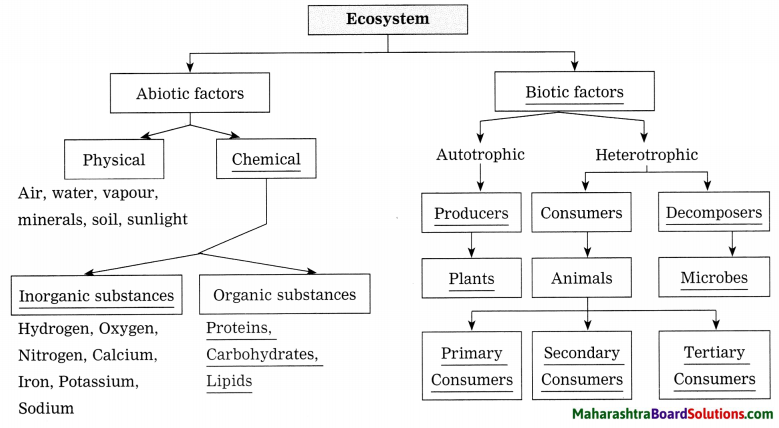
Ecosystem is the structure formed by the interrelationships between the living organisms and non-living components in their surrounding habitats. Living organisms are also called biotic factors while the non-living components are called abiotic factors. The abiotic and biotic factors have a reciprocal relationship with each other. The ecosystem has plants as producers, animals as consumers and microbes as decomposers.

The decomposers return the substances back to the nature by process of decomposition in which the organic complex molecules are reduced to their inorganic constituents. Thus the dead remains of plants and animals are once again recycled back to the nature in any healthy ecosystem.

Question b.
Biome.
Answer:
Biomes are a larger collection of small ecosystems which are similar in their structure. In a particular biome there are same climatic, abiotic factors and similar living organisms. Biomes are of two main types, land biomes and aquatic biomes. The land biomes exist only on land. Land biomes are of following subtypes based on the abiotic factors. E.g. Grasslands, evergreen forests, deserts, Tundra ecosystem, ecosystems in Taiga, tropical rainforests, etc. Aquatic biomes include freshwater ecosystem, marine ecosystem and brackish water ecosystem found in the creeks.

Maharashtra Board Class 8 Science Solutions Chapter 18 Ecosystems

Question c.
Food web.
Answer:
The complex feeding relationships form a food web. In nature in any ecosystem, the food chains are not straight and linear. But these are quite complex. A prey is consumed by a predator but this predator can itself be a prey to some other predator. E.g. Frog is a predator for variety of insects but frog is preyed upon by snake and the snake can be eaten by a bird. The same bird can also feed on insects or frog. The interrelationships between different biotic components of any ecosystem thus form the complicated food web.

4. Give scientific reasons: 

Question a.
Plants in an ecosystem are called producers.
Answer:
are cut down causing deforestation. The wild animals lose their habitat. Many of them become extinct. There is great loss of flora and fauna due to construction of large dams. There is undue pressure on the land surface caused due to stored water column. This may cause earthquakes. The human settlements are removed as their houses and farms are immersed under water. In all the above ways large dams destroy the ecosystems.

Question b.
Large dams destroy ecosystems.
Answer:
When a large dam is constructed, the original landscape is changed. The trees are cut down causing deforestation. The wild animals lose their habitat. Many of them become extinct. There is great loss of flora and fauna due to construction of large dams. There is undue pressure on the land surface caused due to stored water column. This may cause earthquakes. The human settlements are removed as their houses and farms are immersed under water. In all the above ways large dams destroy the ecosystems.

Question c.
Rhinos were restored in Dudhwa forest.
Answer:
Long ago in last century, Dudhwa forest was the natural habitat of the one-horned Rhino. However, due to hunting and poaching, the Rhino became almost extinct. In order to restore it back the breeding in captivity was attempted and the young ones were released in the natural habitat. Saving the precious wildlife is important and hence these efforts were done.

Maharashtra Board Class 8 Science Solutions Chapter 18 Ecosystems

5. Answer the following:

Question a.
What are the effects of increased population (of human beings) on ecosystems?
Answer:

  1. Human population growth rate is very big as compared to other animals.
  2. Moreover, they are apex consumers in an ecosystem. Just like any other organisms, ecosystems provide all the basic needs to humans, too.
  3. However, man demands much more due to excessive population. The natural resources are utilized on the large scale only by man.
  4. Changing lifestyles, consumerism, degradation of nature and pollution are certain aspects which are created only by human beings.
  5. All these cause increased stress on the ecosystems. Large human population also produces large-scale solid wastes.

Question b.
How is urbanization responsible for destruction of ecosystems?
Answer:
When people do not get sufficient food and other amenities, they migrate to the cities. The cities provide employment for many people due to industries, factories and other facilities. Every day many people migrate to cities. This causes urbanization. Due to increased population in cities, there is more need for housing. This results in loss of agricultural lands, marshlands, wetlands, forests and grasslands, etc.

The natural ecosystems are lost in an attempt to have developmental work. Human interference causes changes in the ecosystems. When land usage is changed many naturally occurring species of plants and animals are exterminated. Animal- human conflicts are very common in newly established urban areas which are near the natural forests.

Maharashtra Board Class 8 Science Solutions Chapter 18 Ecosystems

Question c.
What are the reasons for war?
Answer:
There are difference of opinions and competition over land, water, mineral resources, etc. among neighbouring countries. Moreover, there can be economic and political causes which lead to war among different countries. Many times the l religions and ethnicity are also caused for dispute. Due to international conflicts, the peace is disturbed and it results in war.

Question d.
Explain the interactions among the factors of an ecosystem.
Answer:

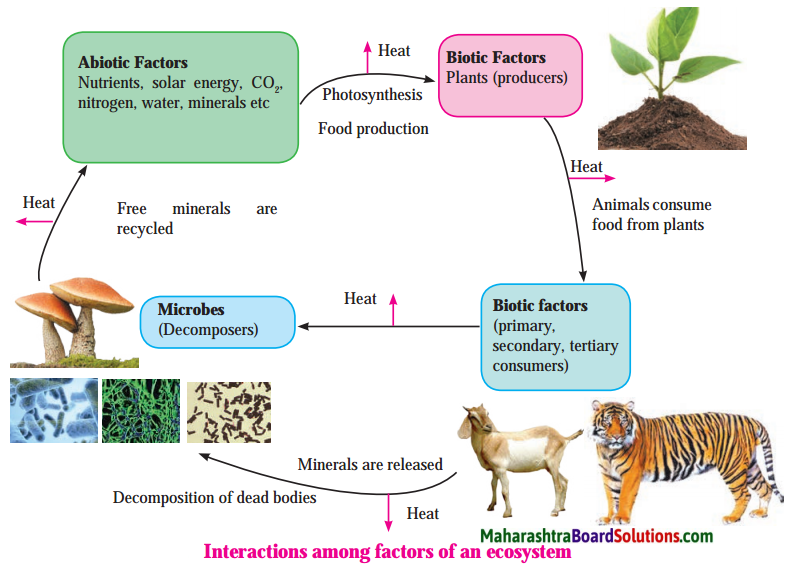
  1. The abiotic factors such as air, water, soil, sunlight, temperature, humidity, etc. affect the biotic factors, i.e. the surviving plants, animals and microbes in the ecosystem.
  2. The type of abiotic factors in an ecosystem determine the survival of biotic factors. The population of these biotic factors is also dependent on the quality of abiotic factors.
  3. The proportion of abiotic factors in an ecosystem fluctuates as biotic factors use up or release particular abiotic factors.
  4. Every biotic factor also interacts with its necessary abiotic factors as well as other biotic factors around it.

Question e.
Differentiate between evergreen forests and grasslands.
Answer:

Evergreen forestsGrasslands
1. About seven percent of the Earth’s surface is occupied by evergreen forests.1. About 30 percent of the Earth’s surface is covered by grasslands.
2.  More than half of the earth’s terrestrial plants and animals are seen in evergreen forests.2. Grazing animals are seen in grasslands.
3. Tropical evergreen forests are dense, multi-layered.3. Grasslands consist of tall grass. There are wild grasses and there may be some trees.
4. These forests are found in the areas receiving more than 200 cm annual rainfall i.e. very heavy rainfall.4. There is an average of 20 – 35 inches of rainfall a year in grasslands.
5. Tropical regions show evergreen forests.5. Several parts of the world have grasslands.

Maharashtra Board Class 8 Science Solutions Chapter 18 Ecosystems

6. Describe the following pictures:

Question a.
Describe the following pictures
Maharashtra Board Class 8 Science Solutions Chapter 18 Ecosystems 1
Answer:
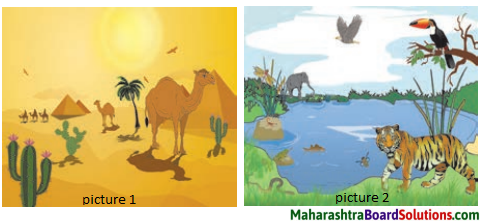
The picture no. 1 is showing desert ecosystem, while the picture no. 2 is showing a forest ecosystem where a wetland (a lake) is also shown. In desert ecosystem, the producers are green cactus and a palm tree. Since in desert there are scanty rains, the vegetation is very less. The soil is sandy soil. The consumers of the desert are also limited.

In the above picture camel is shown which is a primary consumer in the desert ecosystem. Camel is very well adapted for desert life. There is also the scarcity of water in desert and hence cactus shows xerophytic (suitable to survive in desert) adaptations.

In second picture, the forest ecosystem is shown because we can see elephant and tiger in the picture. Also, giant hornbill is sitting on the tree. This forest must be tropical evergreen forest. The rainfall is heavy in such areas and hence different types of wetlands can be seen in forests. Wetlands support variety of life. A separate aquatic ecosystem does exist here which is closely interconnected with the terrestrial ecosystems through food chains and food web.

The birds utilize the fish as their prey. The wild animals come to wetlands to quench their thirst. In this picture the plants, grass, etc. are producers, small fishes in the lake are primary consumers. They will be eaten by larger fishes which are secondary consumer in the aquatic ecosystem. The elephant is herbivorous animal and hence it is primary consumer. Snake is the secondary consumer while the birds of prey (eagle that is flying) and tiger are tertiary consumers.

Maharashtra Board Class 8 Science Solutions Chapter 18 Ecosystems

Can you recall?

Question 1.
Which factors do you find in your surroundings?
Answer:
In our surroundings there are abiotic and biotic factors. The biotic factors are animals and plants in the surroundings. The invisible bacteria and fungi also have important role in the ecosystem as decomposers. Important abiotic factors are air, water, land, sunlight, etc.

Question 2.
Are these factors directly or indirectly related to you?
Answer:
We are directly or indirectly connected to every single factor in the surrounding in which we reside. For the requirement of food, we are dependent on plants and animals. For our survival we continuously need oxygen, water and other minerals, etc.

Classify:

Question 1.
Classify the following into living and non-living factors. Sunlight, Sunflower, Elephant, Lotus, Algae, Stone, Grass, Water, Ant, Soil, Cat, Fern, Air, Lion.
Answer:

Living FactorsNon-living Factors
Sunflower, Elephant, Lotus, Algae, Grass, Ant, Cat, Fern, Air, Lion.Sunlight, Stone, Water, Soil, Air.

Can you tell?

Question 1.
What is the role of microbes in above interaction?
Answer:
Microbes play the role of decomposers in the above interactions.

Maharashtra Board Class 8 Science Solutions Chapter 18 Ecosystems

Question 2.
How do producers obtain abiotic factors?
Answer:
Producers obtain solar energy from sunlight. The other nutrients are obtained from soil, water and air.

Question 3.
From where do the consumers get their food?
Answer:
Consumers get their food from producers and other consumers.

Project:

Question 1.
Visit an ecosystem nearby, List the biotic and abiotic factors in it. Show with pictures or sketches, how they are dependant on each other.

Question 2.
With the help of internet find out the loss of ecosystems due to wars or atomic explosions. Describe in your words.

Class 8 Science Chapter 18 Ecosystems Important Questions and Answers

Complete the following by using the correct option:

Question 1.
Biotic community is another name for ………. (ecology, ecosystem, population)
Answer:
Biotic community is another name Biotic for ecosystem.

Maharashtra Board Class 8 Science Solutions Chapter 18 Ecosystems

Question 2.
Microbes in an ecosystem are ………… (producers, consumers, decomposers)
Answer:
Microbes in an ecosystem are decomposers.

Question 3.
Many types of ecosystems are found in ………… (oceans, deserts, biosphere)
Answer:
Many types of ecosystems are found in biosphere.

Question 4.
………….. is a type of grassland ecosystem. (Taiga, Tundra, Desert)
Answer:
Taiga is a type of grassland ecosystem.

Question 5.
Gir forest in Gujarat is the only habitat/shelter for the spectacular ………….. (Asiatic lion, Royal Bengal tiger, One-horned rhino)
Answer:
Gir forest in Gujarat is the only habitat shelter for the spectacular Asiatic lion.

Correct the following statements by changing one or two words:

Question 1.
Primary, secondary, tertiary consumers are the abiotic factors of the ecosystem.
Answer:
Primary, secondary, tertiary consumers are the biotic factors of the ecosystem.

Question 2.
Most of the ecosystems are simple.
Answer:
Most of the ecosystems are complex.

Maharashtra Board Class 8 Science Solutions Chapter 18 Ecosystems

Question 3.
The word ecosystem was brought in the use by Ray Claffam.
Answer:
The word ecosystem was brought in the use by A.G. Tansle.

Question 4.
Specific ecosystem developed in a vast area is called a biosphere.
Answer:
Specific ecosystem developed in a vast area is called a biomes.

Question 5.
Longer summer and limited rain develop very tall plants in the grassland ecosystem.
Answer:
Longer summer and limited rain develop dwarf plants in the grassland ecosystem.

Question 6.
29 % of the earth surface is covered by water and only 71 % has land on it.
Answer:
71 % of the earth surface is covered by water and only 29 % has land on it.

Maharashtra Board Class 8 Science Solutions Chapter 18 Ecosystems

Question 7.
Dams increase the water current in lower area.
Answer:
Dams lessen the water current in lower area.

Match the following:

Question 1.

Column ‘A’Column ‘B’
1. The Great Himalayan National Parka. Asiatic lion
2. Kazirangab. Tigers
3. Bharatpurc. Aquatic birds
4. Ranthambored. One-horned Rhino
5. Gir foreste. White panther

Answer:

Column ‘A’Column ‘B’
1. The Great Himalayan National Parke. White panther
2. Kazirangad. One-horned Rhino
3. Bharatpurc. Aquatic birds
4. Ranthamboreb. Tigers
5. Gir foresta. Asiatic lion

Find the odd one out:

Question 1.
Typha, Pistia, Eichhornia, Dipterocarpus
Answer:
Dipterocarpus. (All others are aquatic plants.)

Question 2.
Teak, Parthenium, Pine, Sandalwood
Answer:
Parthenium. (All others are forest trees.)

Maharashtra Board Class 8 Science Solutions Chapter 18 Ecosystems

Question 3.
Giraffe, Zebra, Cheetah, Elephant
Answer:
Cheetah.. (All others are surviving grassland animals, Cheetah is a forest animal that is extinct from Asia.)

Question 4.
Hyena, Cow, Deer, Rabbit
Answer:
Hyena. (All others are primary consumers, Hyena is tertiary consumer.)

Question 5.
Fusarium, Leptocorsia, Aspergillus, Polycarpus
Answer:
Leptocorsia. (All others are decomposers, Leptocorsia is primary consumer.)

Taking into consideration the relationship in the first pair, complete the second pair :

Question 1.
Plants : Producers : : ……… : Consumers
Answer:
Animals

Question 2.
Secondary consumers : Jackals : : Tertiary consumer : ………..
Answer:
Kite/Lion/Hyena

Question 3.
Goat, sheep : Grassland ecosystem : : Tigers : …………..
Answer:
Forest ecosystem

Maharashtra Board Class 8 Science Solutions Chapter 18 Ecosystems

Question 4.
Desert : Land biome : : Creek : …………….
Answer:
Aquatic biome

Question 5.
Limited rain : Grassland ecosystem : : ……….. : Tropical rainforests
Answer:
Excessive rain.

Answer in one sentence:

Question 1.
What is an ecosystem?
Answer:
The structure which is formed due to interactions between abiotic and biotic factors is called an ecosystem.

Question 2.
What is an ecological niche?
Answer:
The position of any living organism with reference to other living organisms and the role played by that organism is called ecological niche.

Maharashtra Board Class 8 Science Solutions Chapter 18 Ecosystems

Question 3.
How are types of ecosystems formed?
Answer:
Types of ecosystems are formed according to size, place, climate, types of plants and animals that survive in that ecosystem.

Question 4.
Give examples of land biomes.
Answer:
Grasslands, evergreen forests, deserts, Tundra or polar ecosystem, ecosystems in Taiga, tropical rainforests, etc. are land biomes.

Question 5.
What are the reasons for tourism among the people?
Answer:
Tourism is mainly because people like to visit scenic places, undertake nature watch, wish to visit to sacred places and for entertainment purpose.

Maharashtra Board Class 8 Science Solutions Chapter 18 Ecosystems

Question 6.
Why we should protect natural ecosystems?
Answer:
Natural ecosystems must be protected as they maintain balance in the biosphere.

Give my information Write short notes:

Question 1.
Dudhwa forest.
Answer:
Dudhwa forest is in Uttar Pradesh. About a century back, Dudhwa forest was the habitat for one-horned Rhino. However, due to hunting and poaching in 20th century, this animal became endangered. Thus to restore their populations, on 1st April 1984 rhino were introduced there again. Rhinos can were bred in captivity followed by releasing them back into natural ecosystem.

For this purpose at first the land was selected. This was 27 square km grassland and forest with continuous water supply through natural resources. Two observatories were established for making these efforts successful. Now Dudhwa is known for one¬horned Rhino population.

Maharashtra Board Class 8 Science Solutions Chapter 18 Ecosystems

Question 2.
Aquatic ecosystems.
Answer:
Earth’s 71 % of surface is covered over by aquatic ecosystems. They are of three main types, viz. fresh water ecosystem, marine ecosystem and brackish water ecosystem. Rivers, lakes and ponds and streams are some of the fresh water ecosystem. Fresh water contains less salt and hence it is potable. Marine water has more salinity, i.e. its salt content is high. Brackish water ecosystem is present in the creeks. Here the saline and fresh water mix together. Hence salinity here is lesser than that of the marine water.

Give scientific reasons:

Question 1.
Microbes are called decomposers.
Answer:
Decomposition is the process in which the organic compounds are broken down to their inorganic constituents. The organic substances such as carbohydrates, proteins and lipids which are locked in the dead remains of plants and animals are converted into hydrogen, oxygen, calcium, iron, sodium, potassium, etc. by microbes. Therefore, microbes are called decomposers.

Use your brain power:

Question 1.
Which biotic factors get affected due to a dam?
Answer:
The biotic factors include plants, animals and humans. Lot of vegetation is submerged from the place where dam is constructed. The forests are wiped out. Large scale deforestation takes place in the proposed dam area. Wildlife is destroyed completely. The resident animals whose habitat are there either migrate away or are killed due to lack of their food and shelter. Many instances of animal-human conflicts arise when the wild animals drift to the neighbouring human settlements.

If human settlements are shifted, people are displaced. They lose their houses and agricultural land. Though compensation is given to them, there is great change for the people. Water current in lower area of the dam is reduced due to construction of dam-walls. Therefore, the original lotic (running 5 water) ecosystems that were present are destroyed after the construction of dam.

Maharashtra Board Class 8 Science Solutions Chapter 18 Ecosystems

Question 2.
What will be the effects on biotic factors in the running water of river?
Answer:
The aquatic flora (plants) and fauna (animals) are well adapted to their habitats. The running water ecosystems are known as lotic ecosystems. The non-moving waters on the contrary create lentic ecosystems. Lotic ecosystems provide special adaptations to the plants and animals living therein. Plants are mostly in the form of freely floating algae and phytoplankton. Animals are well adapted for swimming in the currents of water. The fishes especially show a stream-lined body, fins for swimming, and gills to take up dissolved oxygen in the water. The other animals are also well adapted to the currents of water.

Think about it:

Question 1.
Can we call a tree an independent ecosystem?
Answer:
The huge tree can be an independent ecosystem. On one such tree there may be different habitats. Variety of insects thrive on huge tree by making their habitats in cracks and crevices on the tree. Many birds visit the tree to feed on such insects. There are many bird species that live in the hollow of the tree. Garden lizards, chameleons, snakes are the different reptiles seen associated with the tree ecosystem.

Squirrels, rabbits, bats are the mammals which take shelter in and around the trees, also inhabit a tree variety of fungi, lichens, mosses and epiphytic plants like orchids survive on the huge trees. Many food chains and complicated food webs are formed with the support of the tree. Thus one can say that a tree is an independent ecosystem.

Maharashtra Board Class 8 Science Solutions Chapter 18 Ecosystems

Question 2.
Today Divija visited a hill. Honey: bees were hovering on flowers. One of them stung Divijia’s hand. Divija was hurt due to that sting and said with anger that all the honey-bees from the whole world must get destroyed. Afterwards, she thought what will happen if all honey-bees are destroyed? We will get honey, nothing more. What would be your explanation to Divija?
Answer:
Honey bees provide us with honey and bee-wax. Both of these are commercial products. But more than that the role played by honey bees in the pollination of flowers is very important. Due to their nectar collecting behaviour, they bring about pollination of the flowers.

Presence of honey bees is thus very essential for the agriculture and horticulture. Without honey bees, the growth of fruits and grains will not be possible, if pollination and subsequent fertilization does not take place in nature. This will create famine-like conditions. Therefore, honey bees’ position in the nature is very important.

Chart based questions:

Question 1.
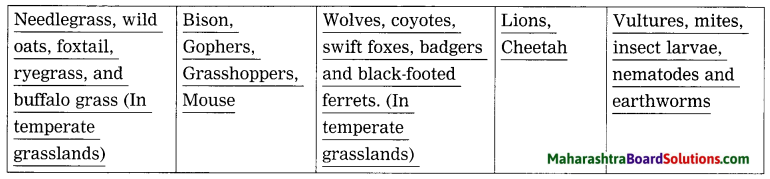
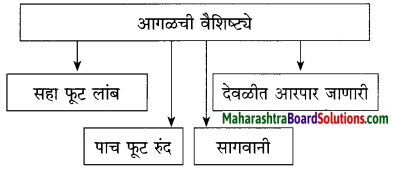
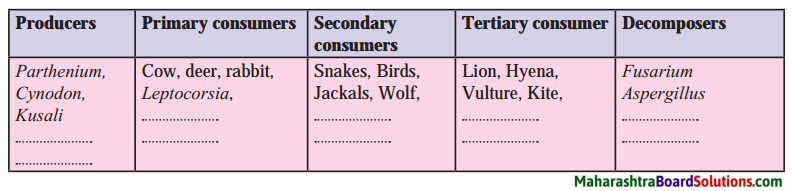
Complete the following chart in context to a grassland.
Maharashtra Board Class 8 Science Solutions Chapter 18 Ecosystems 2
Answer:
Maharashtra Board Class 8 Science Solutions Chapter 18 Ecosystems 3

Maharashtra Board Class 8 Science Solutions Chapter 18 Ecosystems

Question 2.
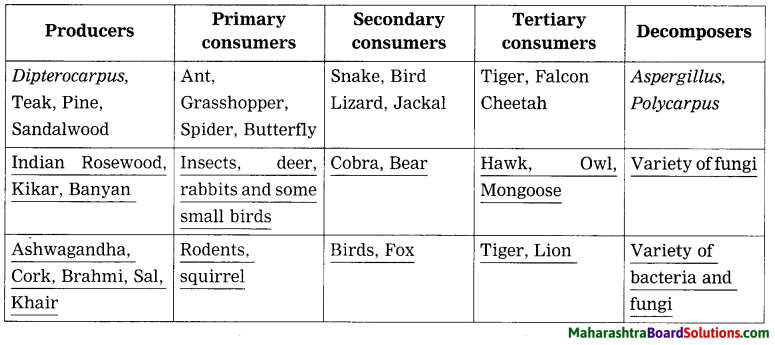
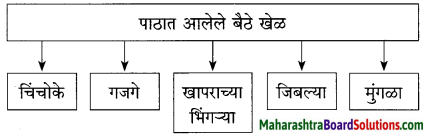
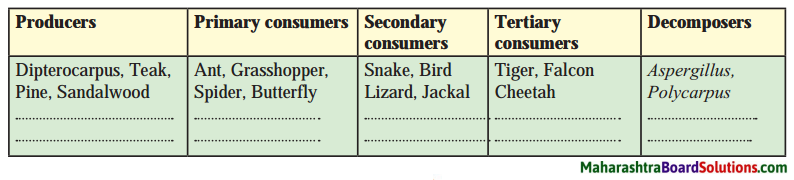
Write the information about various components of forest.
Maharashtra Board Class 8 Science Solutions Chapter 18 Ecosystems 4
Answer:
Maharashtra Board Class 8 Science Solutions Chapter 18 Ecosystems 5

Maharashtra Board Class 8 Science Solutions Chapter 18 Ecosystems

Question 3.
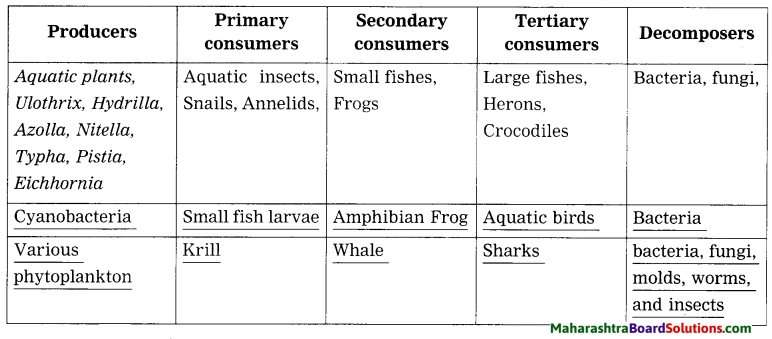
Observe such ecosystems around you and complete the following chart.
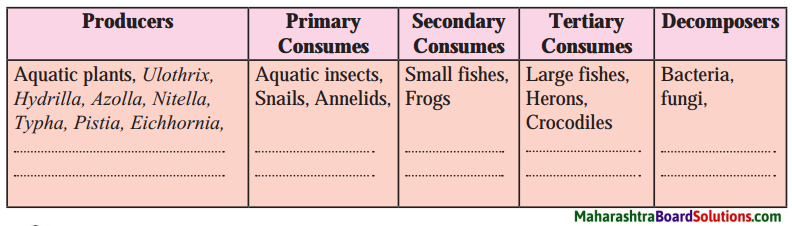
Maharashtra Board Class 8 Science Solutions Chapter 18 Ecosystems 6
Answer:
Maharashtra Board Class 8 Science Solutions Chapter 18 Ecosystems 7

Maharashtra Board Class 8 Science Solutions Chapter 18 Ecosystems

Question 4.
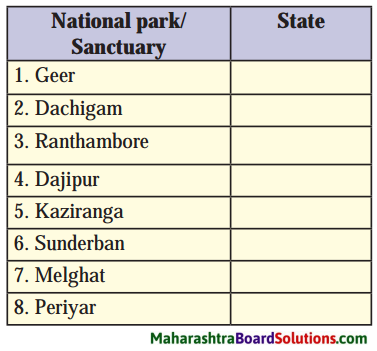
Complete the table.
Maharashtra Board Class 8 Science Solutions Chapter 18 Ecosystems 8
Answer:

National Park/SanctuaryState
1. GirGujarat
2. DachigamJammu-Kashmir
3. RanthamboreRajasthan
4. DajipurMaharashtra
5. KazirangaAssam
6. SunderbansBengal
7. MelghatMaharashtra
8. PeriyarKerala

Maharashtra Board Class 8 Science Solutions Chapter 18 Ecosystems

Question 5.
Complete the following chart:
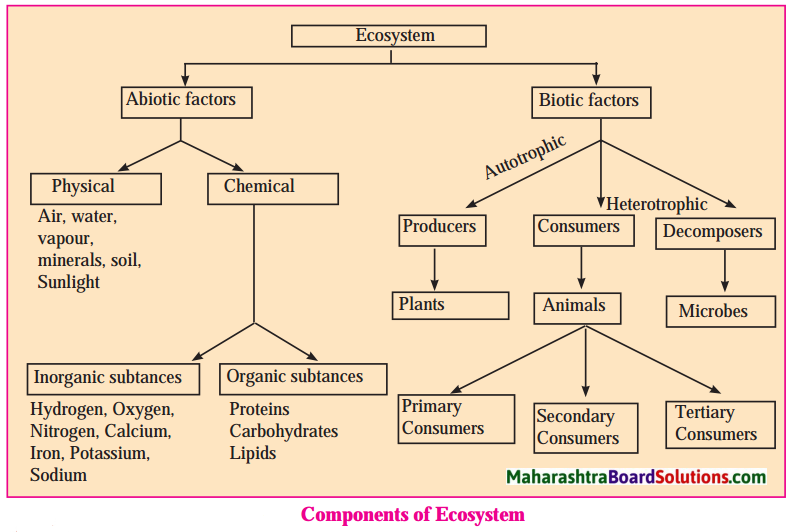
Maharashtra Board Class 8 Science Solutions Chapter 18 Ecosystems 9
Answer:
Maharashtra Board Class 8 Science Solutions Chapter 18 Ecosystems 10

Maharashtra Board Class 8 Science Solutions Chapter 18 Ecosystems

Diagram based questions:

Question 1.
Correct the following diagram:
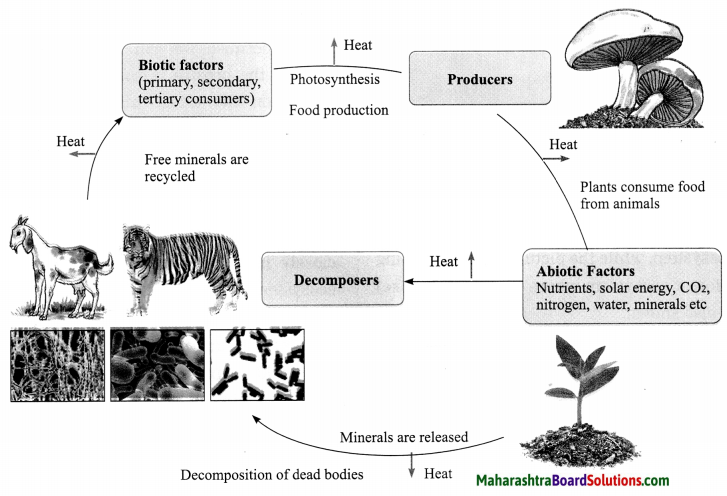
Maharashtra Board Class 8 Science Solutions Chapter 18 Ecosystems 12
Answer:
Maharashtra Board Class 8 Science Solutions Chapter 18 Ecosystems 11

MCQs based on experiment:

Question 1.
Which one out of the following is not biotic factor?
(a) Humidity
(b) Rabbit
(c) Snake
(d) Bacteria
Answer:
(a) Humidity

Maharashtra Board Class 8 Science Solutions Chapter 18 Ecosystems

Question 2.
Which climatic factor is causing migration of the birds in certain regions of the earth?
(a) Humidity and rainfall
(b) Ambient temperature
(c) Amount of carbon dioxide
(d) Amount of plant matter
Answer:
(b) Ambient temperature

Question 3.
Which abiotic factor mainly distinguishes marine water from the fresh water?
(a) Temperature
(b) Dissolved oxygen:
(c) Salinity
(d) Surface tension
Answer:
(c) Salinity

Question 4.
Why is creek water different from the river water?
(a) Creek water is more polluted than the river water.
(b) Creek water is less salty than the river water.
(c) Creek water is more saline than the river water.
(d) Creek water is less turbulent than the river water.
Answer:
(b) Creek water is less salty than the river water.

Maharashtra Board Class 8 Science Solutions Chapter 18 Ecosystems

Question 5.
Which land biome shows presence of cacti plants more?
(a) Polar regions
(b) Grasslands
(c) Rainforest
(d) Desert
Answer:
(d) Desert

Projects:

Collect information

Question 1.
What are the possible threats to grasslands?
Answer:
Man tries to use grasslands for agricultural purpose. This transformation causes loss of natural ecosystem. Many animals from grasslands are killed by hunting and poaching. Though now Wildlife Act has protected these animals, many wildlife species are already extinct. There are chances of forest fires which is the greatest threat to grasslands. The global warming may also cause grasslands to become a desert.

Question 2.
Why did Asian Cheetah become extinct in last century?
Answer:
When British ruled India, Asian Cheetah was hunted to a great extent. The kings and British rulers did rampant hunting. The forest lands were also reduced due to encroachment by humans to build their settlements. Dams were constructed. Mega highways, bridges and roads caused loss of habitat for Asian Cheetah. Cheetah needs large thickly forested territory. This was lost due to all man-made activities. All these reasons made Asian Cheetah extinct in last century.

Maharashtra Board Class 8 Science Solutions Chapter 18 Ecosystems

Question 3.
Observe Asian Cheetah on internet. Describe it.
Answer:
Cheetah is the fastest running feline animal on the earth. Though from Asian regions it is said to be extinct, in African grasslands, its occurrence is still there. But it is endangered animal. By 2016, the global cheetah population is estimated at approximately 7,100 individuals in the wild. Several African countries have taken steps to improve cheetah conservation measures.

Cheetah has a slender body, deep chest, spotted coat. Its head is small rounded and on the face there is black tear-like streaks. It has long thin legs and a long spotted tail. Cheetah in India were tamed during Moghul period for assisting in hunting. Stories about such episodes are commonly told. However, the last Cheetah in India was spotted in Bastar, M.P. in 1948.
Maharashtra Board Class 7 Geography Solutions Chapter 7 Soils

Balbharti Maharashtra State Board Class 7 Geography Solutions Chapter 7 Soils Notes, Textbook Exercise Important Questions and Answers.

Maharashtra State Board Class 7 Geography Solutions Chapter 7 Soils

Class 7 Geography Chapter 7 Soils Textbook Questions and Answers

1. Complete the following table.

Factor/ProcessRole in the formation of soil
(1) Parent rock…………….
(2) Regional climate……………
(3) Organic material…………..
(4) Micro­organisms……………..

Answer:

Factor/ProcessRole in the formation of soil
(1) Parent rockThe rock gets weathered depending on the hardness of the rock and the climate of the region. It turns into powdery material which further turns into soil.
(2) Regional climateWhen the rock is exposed to a different climates, the same type of rock gives rise to different types of soil.
(3) Organic materialThe organic material gets mixed into weathered powdery material and turn it into soil.
(4) Micro­organismsMicroorganisms help in decomposing the dead remains of organic materials and get mixed into the soil to form humus.

Maharashtra Board Class 7 Geography Solutions Chapter 7 Soils

2. Why do the following occur?

Question 1.
To the west of Sahyadris, laterite soils are formed from the basalt rock.
Answer:

  • Laterite soils are formed in regions of heavy rainfall.
  • The climate of western Sahyadris is hot & humid.
  • This leads to leaching of basalt rocks due to which there is formation of laterite soils.

Question 2.
Humus content in the soil increases.
Answer:

  • Microorganisms and certain other organism help in decomposing the dead remains of organic materials.
  • The biotic material thus produced is called humus.
  • If organic manures, vermicompost compost are used regularly, the humus content in the soil increases.

Question 3.
Soil formation process is faster in the equatorial climate.
Answer:

  • In the region of high rainfall and higher temperature the process of soil formation is faster.
  • Equatorial climatic region have high temperature and receive high rainfall.
  • Thus soil formation process is faster in the equatorial region.

Question 4.
The salinity of the soil increases.
Answer:

  • Due to excessive irrigation, the salts from the soil are drawn upwards.
  • This increases the salinity of the soil.

Question 5.
Rice is the staple diet of the people from Konkan.
Answer:

  • Hot & humid climate, heavy rainfall & fertile alluvial soil are favourable for rice cultivation.
  • This soil has good water holding capacity. Since these conditions are found in the konkan region, rice is grown on a large scale here.
  • So rice is the staple diet of the people from Konkan.

Maharashtra Board Class 7 Geography Solutions Chapter 7 Soils

3. Give information on:

Question 1.
Measures of soil conservation
Answer:
The following are the measures of soil conservation:

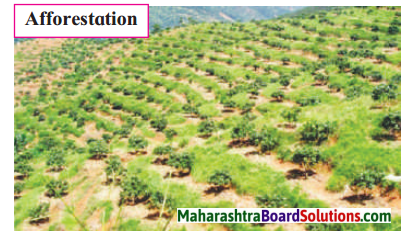
(i) Afforestation / Planting trees: Planting trees can control the velocity of wind. This helps reducing erosion by wind. The plant roots hold the soil and also reduces the erosion of soil.

Maharashtra Board Class 7 Geography Solutions Chapter 7 Soils 1

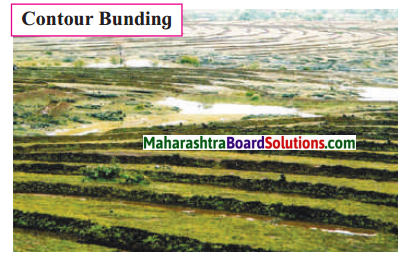
(ii) Continuous contour trenches: Construction of continuous contour trenches at different height checks the velocity of water running along the slopes & hence reduces soil erosion. The water arrested in these trenches percolates into the ground.

Maharashtra Board Class 7 Geography Solutions Chapter 7 Soils 2

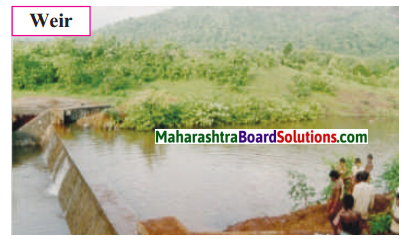
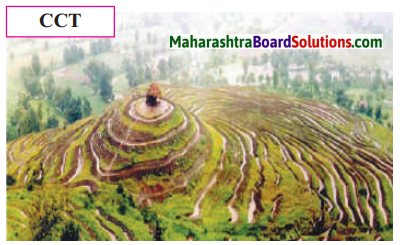
(iii) Implementation of watershed Development program: The Government of Maharashtra has implemented the watershed development programme under which constructing embankment along slopes in rural areas, introducing CCTs along steep slopes etc. are undertaken. This led to the success of the scheme ‘Arrest water, let it percolate’. This has resulted in raising the ground water levels & reducing the erosion of soil.

Maharashtra Board Class 7 Geography Solutions Chapter 7 Soils 3

(iv) Implementation of Jalayukt Shivar: Under the scheme of Jalayukt Shivar, works like construction of farm bunds, arresting waters of small streams, connecting the streams etc. are being carried out on a large scale.

Maharashtra Board Class 7 Geography Solutions Chapter 7 Soils 4

Question 2.
Organic Manures.
Answer:
(i) Organic manures in farming, helps to maintain the pH balance.
(ii) It also increases the proportion of humus, and retain the fertility of soil.

Maharashtra Board Class 7 Geography Solutions Chapter 7 Soils

Question 3.
Place where you will get the information about the suitability of a soil for a particular crop.
Answer:
(i) The information about the suitability of a soil can be obtained from Department of Agriculture of Government of Maharashtra, Natural Resource conservation services, soil testing laboratories in various states and at many agricultural universities.

(ii) The type of soil, soil fertility, pH status of the soil, etc. are determined in soil testing.

(iii) Based on the testing, an analysis of the soil is done & information about the suitability of a soil for a particular crop is provided.

Question 4.
Importance of soils for plant growth.
Answer:
(i) Soil is important for plant as it hold roots that provide support for plants and stores nutrient for the growth of plants.
(ii) Fertile soils favour plant growth.

4. Complete the following table with reference to soil.

ActionEffectResult (W.R.T. fertility)
Construction of embankments.
Wind speed decreased.
Farm land is kept fallow for some period.Helps to maintain the pH balance and increase the proportion of humus.Increases the fertility of soil.
Regular use of organic manures, vermicompost and compost.
Check the velocity of water running along the slopes.
Litter is burnt in the farm.
Decomposed vegetal litters, roots of plants and remains of animals.
Salt content in the soil increases.
Leads to the lowering of humus content in the soil.

Answer:

ActionEffectResult (W.R.T. fertility)
Construction of embankments.Protects soil from being washed away.Protects fertility of soil.
Planting trees.Wind speed decreased.Protects fertility of soil
Farm land is kept fallow for some period.Helps to maintain the pH balance and increase the proportion of humus.Increases the fertility of soil.
Regular use of organic manures, vermicompost[1] and compost.Humus content increased.Increases the fertility of soil.
Trenches are dug across a slope.Check the velocity of water running along the slopes.Protects fertility of soil
Litter is burnt in the farm.Decreases the amount of organic material in soil.Decreases the fertility of soil.
Decomposed vegetal litters, roots of plants and remains of animals.Proves favourable for micro organism.Increases the fertility of soil.
Excessive IrrigationSalt content in the soil increases.Decreases the fertility of soil
Chemical fertilizers used excessively.Leads to the lowering of humus content in the soil.Decreases the fertility of soil

Activity:

  1. Visit a soil testing centre/laboratory and note the work that is carried out in the centre.
  2. Prepare compost at home or in your housing society.
  3. Visit a place where ‘Arrest water, let it percolate’ is being implemented. Collect information about it and make a note of it.

Maharashtra Board Class 7 Geography Solutions Chapter 7 Soils

Class 7 Geography Chapter 7 Soils InText Questions and Answers

Think about it:

Question 1.
Rohit and Prateeksha noted that their field had yielded a bumper crop. But they also noted that a part of their field had a stunted growth of plants. What investigation will you suggest to them?
Answer:
I would suggest that they should check whether organic manures, are used evenly on all the parts of the field. Also, they should check whether that part of the field is getting adequate supply of water or not.

Question 2.
Why do equatorial regions have fertile soils?
Answer:
The sun rays are perpendicular in equatorial
regions so the climate is very hot and humid. This region also receives very heavy rainfall. As the process of soil formation is faster in these regions, equatorial regions have fertile soil. Also vegetal litter roots of plants, remains of animals, etc.; get decomposed adding to soil fertility.

Question 3.
Why is the vegetation sparse in deserts?
Answer:
A desert is a barren area of land where a little precipitation occurs and consequently living conditions for plant and animal life are very hostile. It is an area where the soils are not fertile & hence vegetation is scanty.

Try this:

  • Take three flower pots of the same size.
  • Keep one pot empty. Fill the second pot. With water after closing the hole at the bottom and fill the third pot with soil.
  • Put a few seeds in all of them. (You may use aserio, peas, gram, fenugreek, wheat, green gram, coriander seeds, etc.)
  • Keep all the three pots in the sun. and water the empty pot and the soil-filled pot for 4-5 days. Observe and answer the following.

Question 1.
What happened to the seeds put in the empty pot and pot filled with water?
Answer:
Seeds in the empty pot and the pot filled with water did not germinate and did not show any sign of growth.

Question 2.
What happened to the seeds put in the pot (c) filled with soil?
Answer:
Seeds germinated and we could see some small twigs branching out.

Question 3.
What do you learn from this?
Answer:
We learn that plants need sunlight, water and soil to grow.

Class 7 Geography Chapter 7 Soils Additional Important Questions and Answers

Fill in the blanks:

Question 1.
_____ rock in a region is an important factor in soil. (Parent, Basalt, Granite)
Answer:
Parent

Question 2.
The process of weathering depends on the _____ of the region. (climate, weather, soil)
Answer:
climate

Question 3.
The _____ rock of the Deccan Plateau in Maharashtra turns into black soil after weathering. (granite, basalt, parent)
Answer:
basalt

Question 4.
______ soils along the river beds give higher yields. (Infertile, Fertile, Coarse)
Answer:
Fertile

Question 5.
The _____ material comes from the decomposition of the remains of the plants and animals in that region. (biotic1, abiotic, pH)
Answer:
biotic1

Question 6.
______ is a complete ecosystem.(Soil, Humus, weathered rocks)
Answer:
Soil

Maharashtra Board Class 7 Geography Solutions Chapter 7 Soils

Question 7.
Food crops like jowar and bajra are produced in the _____ soils of Maharashtra Plateau. (regur, coarse, laterite)
Answer:
regur

Question 8.
The local agriculture produce determines the _______ diet of the people. (staple, supplementary, secondary)
Answer:
staple

Question 9.
The proportion of humus is negligible in _____ soil. (coarse, black, laterite)
Answer:
coarse

Question 10.
Planting trees can also control the _____ of the wind. (velocity, direction, temperature)
Answer:
velocity

Question 11.
Rocks like granite or gneiss in South India give rise to ____ soil. (black, red, regur)
Answer:
red

Question 12.
In the humid climate of western Sahyadris the leaching of basalt rocks leads to formation of ___ soil. (black, lateritic, red)
Answer:
lateritic

Question 13.
The excessive spraying of chemicals and use of chemical fertilizers lead to ______; (soil degradation soil fertility, soil powder)
Answer:
soil degradation

Complete the following sentences:

Question 1.
The biotic material comes from _____.
Answer:
the decomposition of the remains of the plants and animals in that region

Question 2
Microorganisms ajnd certain other organisms help decompose the dead remains of ______.
Answer:
organic materials

Question 3.
Production of compost needs sufficient period of time and ______.
Answer:
elements like organic waste, water, heat, etc.

Question 4.
In the region of high rainfall and higher temperatures, _____.
Answer:
the process of soil formation is faster

Question 5.
In regions of low temperatures and low rainfall the _____.
Answer:
soil formation takes more time

Question 6.
High use of chemical fertilizers, insecticides _____.
Answer:
leads to the degradation of soils

Maharashtra Board Class 7 Geography Solutions Chapter 7 Soils

Question 7.
In the areas where the soil is not fertile, _______.
Answer:
egetation is scanty

Question 8.
When man realized that sowing of seeds in the soil leads to the growth of plants and yields crops, ______.
Answer:
he started using soil as a resource

Question 9.
Excessive irrigation draws the salts from the soil upwards and ______.
Answer:
makes the soil saline and then unproductive

Question 10.
Keeping the farmland fallow for some period and cultivating different crops alternatively is important ________.
Answer:
to help retain the fertility of soils.

Give one word for the following:

Question 1.
Soil formed due to weathering of basalt rock.
Answer:
Black soil

Question 2
Soil formed due to the leaching of the basalt rock.
Answer:
Lateritic soil

Question 3.
Biotic material mixed into the soils.
Answer:
Humus

Question 4.
The excessive spraying of chemicals and use of chemical fertilizers.
Answer:
Soil degradation

Question 5.
The govt, scheme, work like construction of farm bunds, arresting waters of small streams, etc.
Answer:
Jalayukt Shivar.

Who am I?

Question 1.
I am a very important rock factor in soil formation.
Answer:
Parent rock

Question 2
I form due to weathering of basalt rock. Jowar and Bajra mostly grow on this soil.
Answer:
Regur soil / Black soil

Maharashtra Board Class 7 Geography Solutions Chapter 7 Soils

Question 3.
I am found in the hilltops of the western part of the Deccan plateau.
Answer:
Coarse soil

Question 4.
I am black in colour and have less organic components.
Answer:
Regur or Black soil

Question 5.
I am orange in colour and mostly found in the coastal belt of Konkan.
Laterite soil

Question 6.
I am found at the mouth of the river in the western coastal strip.
Answer:
Alluvial soil of the coastal strip

Question 7.
I am mainly found in areas of extreme rainfall but not very useful for agriculture.
Answer:
Yellow brown soil

Question 8.
I am a method of soil conservation which controls the velocity of wind.
Answer:
Afforestation / planting trees

Match the columns:

Question 1.

Column IColumn II
(1) Coarse soil(a) Alluvium deposition
(2) Regur soil(b) Eastern part of Bhandara
(3) Laterite soil(c) Ajanta, Balaghat, Mahaden hills
(4) Alluvial soil(d) Coastal belt of konkan
(5) Yellow-brown soil(e) Weathering of basalt rock

Answer:
1 – c
2 – e
3 – d
4 – a
5 – b

Answer the following questions in short:

Question 1.
What do you mean by ‘Soil’?
Answer:
(i) The uppermost layer of the earth’s crust is called ‘Soil’.
(ii) It contains the organic as well as mineral matter necessary for the growth of plants.

Maharashtra Board Class 7 Geography Solutions Chapter 7 Soils

Question 2
What are the factors necessary for the soil formation?
Answer:
Soil is formed by:

  • Weathering of the parent rock material.
  • Climatic conditions of the region.
  • The decomposition of plant remains.
  • Animal manures and dead animals.
  • Very long period of time.

Question 3.
What is leaching ?
Answer:
(i) Leaching is a process is which the salts & other soluble material are washed out of the rock through percolation of water.
(ii) This process is dominant in the areas of high rainfall & humid climate.

Question 4.
What is Humus?
Answer:
(i) The decaying of organic material such as dead leaves, stems, root of the plant, vegetal litters, decomposed remains of animals get mixed into the soil.
(ii) This results in the formation of “Humus” thus retaining the fertility of soil.
(iii) If the proportion of humus in the soil is greater, the soil becomes fertile.

Question 5.
What leads to the degradation of soils?
Answer:
(i) For getting higher production, different types of chemical fertilizers, insecticides are used profusely.
(ii) This leads to the degradation of soils.

Question 6.
What led to record agricultural production?
Ans,
(i) To get richer harvests man made efforts to increase the fertility of soils.
(ii) In the process, use of different fertilizers became a practice which led to record agricultural production.

Question 7.
What is soil erosion?
Answer:
(i) When a layer of soil (top layer of soil) get removed due to wind or water it is called soil erosion.
(ii) Running water, climate and diversity in physiography are the reasons of soil erosion.

Question 8.
What helps to maintain the pH balance of the soil?
Answer:
(i) Organic manures, vermicompost, compost are used regularly.
(ii) It helps in maintaining the pH balance and retaining the fertility of the soil.

Maharashtra Board Class 7 Geography Solutions Chapter 7 Soils

Why do the following occur:

Question 1.
Rice is the staple diet of the people from Konkan.
Answer:
(i) Hot & humid climate, heavy rainfall & fertile alluvial soil are favourable for rice cultivation.
(ii) This soil has good water holding capacity. Since these conditions are found in the konkan region, rice is grown on a large scale here.
(iii) So rice is the staple diet of the people from Konkan.

Question 2.
Soil Erosion.
(i) A layer of soil gets removed due to wind or water.
(ii) Running water, climate and diversity in physiography are the reasons of soil erosion.

Question 3.
Soil degradation.
Answer:
(i) To obtain a higher agricultural yield, chemical fertilizers, insecticides, weedicides, etc. are used.
(ii) The excessive spraying of chemicals and use of chemical fertilizers leads to soil degradation.

Give geographical reasons:

Question 1.
Planting trees is necessary to conserve the soil.
Answer:
(i) A layer of soil gets removed due to wind or water which leads to soil erosion.
(ii) Planting trees controls the velocity of the wind, thus reducing the erosion of soil by wind.
(iii) The roots of the plants hold the soil which also prevents soil erosion.

Question 2
Continuous contour trenches are constructed along the slopes.
Answer:
(i) Construction of continuous contour trenches (CCTs) at different heights checks the velocity of water running along the slopes.
(ii) This reduces soil erosion.

Question 3.
It is advisable to use organic manures, vermicompost and compost regularly.
Answer:
(i) Use of organic manures, vermicompost, compost helps maintain the pH balance.
(ii) It also increases the proportion of humus thus retaining the fertility of soil.
(iii) Hence, it is advisable to use organic manures, vermicompost & compost regularly.

Question 4.
There emerged competition among the people to discover fertile lands and settle there.
Answer:
(i) Man started producing greater amount of food crops for the growing population.
(ii) He realized that crop production and prosperity in agriculture depends on the fertility of soil and the optimum availability of water.
Hence, there emerged competition among the people to discover fertile lands & settle there.

Question 5.
There was a rise of Indus civilization.
Answer:
(i) When man realized that the fertile soils along the river beds give higher yields.
(ii) He settled in the valleys and started living there in groups.
(iii) This led to the rise of Indus civilization.

Question 6.
Countries like Saudi Arabia, Qatar, Oman, etc., fulfil their requirements by importing food from other countries.
Answer:
(i) In countries like Saudi Arabia, Qatar, Oman etc. the soils are not arable so there is need to fulfil their food requirement.
(ii) Hence, countries like Saudi Arabia, Qatar, Oman import food from other countries.

Maharashtra Board Class 7 Geography Solutions Chapter 7 Soils

Question 7.
Lets find the names of the soils we have learnt and which regions they are found?
Answer:

SoilsAnswersRegions
(1) RUGERRegur(a) Western part of Deccan Plateau and eastern part of Vidarbha.
(2) LUILALVAAlluvial(b) Panvel, Uran Coast, Dharamtar creek.
(3) OARCSECoarse(c) Ajanta, Balaghat and Mahadeo hills.
(4) AEILTRITELaterite(d) Coastal belt of Konkan, West of Sahyadris and East of Vidarbha.

Make Friends with maps!
Observe the map given below and answer the following questions:
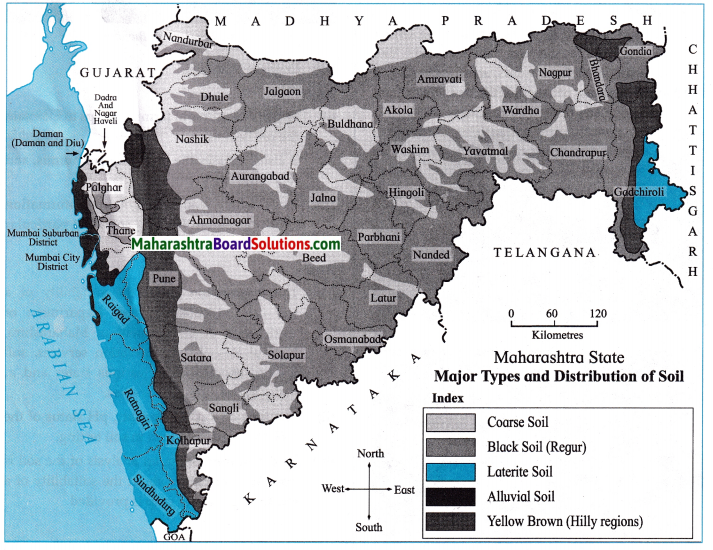
Maharashtra Board Class 7 Geography Solutions Chapter 7 Soils 5
Question 1.
Which soil occupies most of the areas in Maharashtra?
Answer:
Black (Regur) soil occupies most of the areas in Maharashtra.

Question 2
In which areas are laterite soils found?
Answer:
Laterite soil is found in Raigad, Ratnagiri,Sindhudurg and some parts of Gadchiroli and Nashik.

Question 3.
Which soil is found in parts of the Sahyadri ranges?
Answer:
Yellow Brown soil is found in parts of the Sahyadri ranges.

Question 4.
In which region is alluvial soil found?
Answer:
Alluvial soil is found in Mumbai Suburban District, Mumbai city district some parts of Thane & Palghar district.

Question 5.
Which soil is found in the river valleys of Maharashtra?
Answer:
Fertile Alluvial Soil is found in the river valleys of Maharashtra.

Maharashtra Board Class 6 History Solutions Chapter 11 Ancient India and the World

Balbharti Maharashtra State Board Class 6 History Solutions Chapter 11 Ancient India and the World Notes, Textbook Exercise Important Questions and Answers.

Maharashtra Board Class 6 History Solutions Chapter 11 Ancient India and the World

Class 6 History Chapter 11 Ancient India and the World Textbook Questions and Answers

1. Name the following:

Question 1.
Places where articles made in Rome were found.
Answer:
Kolhapur and Arikamedu in Tamil Nadu.

Question 2.
A new style of art emerged during the Kushana period in India.
Answer:
Gandhara style of art.

Question 3.
The language of the books Mahavansa and Deepvansa.
Answer:
Pali language.

Question 4.
A country to which Buddhism had spread in the ancient period.
Answer:
Sri Lanka.

2. Think and expand/elaborate:

Question 1.
Indian culture had an impact on southeast Asia.
Answer:

  • Indian culture had a deep impact on the art and cultural life of southeast Asia.
  • Dance-dramas based on stories from Ramayana and Mahabharata are popular in Indonesia even today.
  • In later years, temples of Lord Shiva and Vishnu were also built there.

Question 2.
The spread of Buddhism in China became easier.
Answer:

  • In the first century CE, the Ming emperor of China invited the Buddhist bhikkhus Dharmarakshaka and Kashyapmatanga to China.
  • The Bhikkhus translated many Indian Buddhist texts into Chinese language.
  • This made the spread of Buddhism in China easier.

3. What would you do if you are encouraged in your favourite hobby ?
Answer:
If someone encouraged me, it will make me very happy and boost my self-confidence. Thus I will further expand my horizon by gaining more knowledge and enhancing my hobby.

4. Describe a picture:

A picture of the Gandhara style sculpture on a stupa in Hadda, Afghanistan is given in this chapter. Observe it and write about it.

5. Find out more about:

Question 1.
The Gandhara style of art.
Answer:
Under the influence of the Greek art of sculpture, a new form of art emerged in India during the Kushana period. It is called Gandhara school of art. In the Gandhara, art school images of Gautam Buddha were mainly carved in Gandhara.

Question 2.
The Silk Route.
Answer:
Chinese silk was in great demand in India. Merchants in ancient India supplied Chinese silk to western countries. The land route by which the silk trade was carried on was called the silk route. Some ancient places in India were connected to this route. The Chinese Buddhist Bhikkhus also came to India through this silk route.

6. Mark the countries of Southeast Asia mentioned in the chapter on an outline map.

Activity:

Obtain information about a form of art of your choice and present it in your class.

Class 6 History Chapter 11 Ancient India and the World Additional Important Questions and Answers

Complete the sentence by choosing the correct option:

Question 1.
People of the Harappan civilisation had developed trade relations with the countries of the ______.
(a) north
(b) west
(c) south
Answer:
(b) west

Question 2.
________ had spread to Afghanistan and to many countries of Central Asia.
(a) Zoroastrianism
(b) Jainism
(c) Buddhism
Answer:
(c) Buddhism

Question 3.
The writings of the Greek historians introduced India to the ______ world.
(a) western
(b) eastern
(c) central
Answer:
(a) western

Question 4.
Under the influence of the Greek art of sculpture, a new form of art emerged in India during the ____ period.
(a) Gupta
(b) Kushana
(c) Vakataka
Answer:
(b) Kushana

Question 5.
In the Gandhara art school images of _______ were mainly carved.
(a) Gautam Buddha
(b) Vardhaman Mahavir
(c) Guru Nanak
Answer:
(a) Gautam Buddha

Question 6.
The early coins that were minted in India were also like _________ coins.
(a) Sri lanka
(b) Chinese
(c) Greek
Answer:
(c) Greek

Question 7.
The excavations at Arikamedu in Tamil Nadu have also brought to light many articles made in ______.
(a) Afghanistan
(b) Rome
(c) China
Answer:
(b) Rome

Question 8.
______was an important port in Egypt.
(a) Funan
(b) Kolhapur
(c) Alexandria
Answer:
(c) Alexandria

Question 9.
Beside Indian goods, the _______ also conveyed Indian philosophy and science to Europe.
(a) Chinese
(b) Arabs
(c) Greeks
Answer:
(b) Arabs

Question 10.
The concept of ‘__________ ‘ is one of India’s major contributions to the world.
(a) zero
(b) one
(c) mathematics
Answer:
(a) zero

Question 11.
Sanghamitra carried a branch of the _________ tree to Sri Lanka.
(a) Banyan
(b) Bodhi
(c) Pipal
Answer:
(b) Bodhi

Question 12.
There was a great demand in India for Sri Lankan _________ and other precious stones.
(a) diamonds
(b) rubies
(c) pearls
Answer:
(c) pearls

Question 13.
The wall paintings in Sigiriya caves bear a resemblance to the paintings in the _______ caves.
(a) Ellora
(b) Ajanta
(c) Nashik
Answer:
(b) Ajanta

Question 14.
Right from the ancient times, India and __________ had established trade and cultural relations.
(a) China
(b) Maharashtra
(c) Rome
Answer:
(a) China

Question 15.
Emperor Harshavardhan had even sent an ambassador to the _______ court.
(a) Greek
(c) Roman
(c) Chinese
Answer:
(c) Chinese

Question 16.
Chinese _______ was known as .’Chinanshuka’ and was in great demand in India.
(a) pearls
(b) diamond
(c) silk
Answer:
(c) silk

Question 17.
Merchants in ancient India supplied Chinese silk to _______ countries.
(a) eastern
(b) western
(c) northern
Answer:
(b) western

Question 18.
The land route by which the silk trade was carried on, was called the ________.
(a) Silk Route
(b) Trade Route
(c) Horse Route
Answer:
(a) Silk Route

Question 19.
The Chinese Buddhist bhikkhus Fa-hien and Yuan Chwang also came to ______ through this silk route.
(a) Nepal
(b) Rome
(c) India
Answer:
(c) India

Question 20.
The bhikkhus translated many Buddhist texts into the _____ language.
(a) Chinese
(b) Japanese
(c) Prakrit
Answer:
(a) Chinese

Question 21.
People of Funan knew ______ language.
(a) Marathi
(b) Chinese
(c) Sanskrit
Answer:
(c) Sanskrit

Question 22.
Indian culture had a deep impact on the art and cultural life of ________ Asia.
(a) Southeast
(b) Southwest
(c) Northeast
Answer:
(a) Southeast

Question 23.
Dance-dramas based on stories from the two Indian epics are popular in ______ even today.
(a) China
(b) Indonesia
(c) Japan
Answer:
(b) Indonesia

Question 24.
In the later years, ______ of Lord Shiva and Vishnu were also built.
(a) caves
(b) muttas
(c) temples
Answer:
(c) temples

Answer in one sentence:

Question 1.
What has India exchanged with the outside world?
Answer:
Having developed trade relations, India began economic and cultural exchange with the outside world.

Question 2.
Who introduced India to the western world?
Answer:
The writings of the Greek historians introduced India to the western world.

Question 3.
Besides Indian goods, what did the Arabs convey to Europe?
Answer:
Besides Indian goods, the Arabs also conveyed Indian philosophy and science to Europe.

Question 4.
Who were sent to Sri Lanka to spread Buddhism?
Answer:
King Ashoka sent his son Mahendra and daughter Sanghamitra to Sri Lanka to spread Buddhism.

Question 5.
Who introduced the Bodhi tree to Sri Lanka?
Answer:
Sanghamitra carried a branch of the Bodhi tree to Sri Lanka.

Question 6.
What is similar between the caves at Ajanta and Sigiriya?
Answer:
The wall paintings at Sigiriya bear resemblance to the paintings in the Ajanta caves.

Question 7.
What provides information about the dose relations between India and Sri Lanka?
Answer:
The Sri Lankan Buddhist works ‘Dipavamsa’ and ‘Mahavamsa’ provide information about the close relations between India and Sri Lanka.

Question 8.
Who sent an ambassador to the Chinese court?
Answer:
Emperor Harshavardhan sent an ambassador to the Chinese court.

Question 9.
What gave an impetus to the spread of Buddhism in China?
Answer:
The Bhikkhus translated many Indian Buddhist texts into Chinese Language. This gave an impetus to spread of Buddhism in China.

Question 10.
In the later years, which temples were built in South-Asian countries?
Answer:
the later years, temples of Lord Shiva and Vishnu were built in south-asian countries.

Elaborate:

Question 1.
Alexandria was an important port in Egypt?
Answer:
The Arab merchants carried Indian goods up to Alexandria. From there, they were sent to the countries in Europe. Besides Indian goods, the Arabs also conveyed Indian philosophy and science to Europe. The concept of ‘zero’ is one of India’s major contribution’ to the world . It was the Arabs who introduced this Indian concept to Europe.

Maharashtra Board Class 7 Geography Solutions Chapter 11 Contour Maps and Landforms

Balbharti Maharashtra State Board Class 7 Geography Solutions Chapter 11 Contour Maps and Landforms Notes, Textbook Exercise Important Questions and Answers.

Maharashtra State Board Class 7 Geography Solutions Chapter 11 Contour Maps and Landforms

Class 7 Geography Chapter 11 Contour Maps and Landforms Textbook Questions and Answers

1. Answer the following questions:

Question 1.
How can the distribution of the height and landform in a region be shown?
Answer:
(i) While studying different landforms on the surface of the earth, one has to consider various facets of landforms like altitude, relief, slope, direction of slope and the drainage.
(ii) For this maps prepared using mathematical survey methods are used.
(iii) These maps help us to understand the above characteristics of the landforms.

Question 2.
To whom are contour maps useful?
Answer:
(i) Contour maps are useful to mountaineers, trekkers, soldiers, defence officers.
(ii) The nature of the ground and its shape can be estimated .
(iii) Defence officers use contour maps for strategic planning.
(iv) It is possible to identify suitable site for any project from the contour map of the region.

Question 3.
What do you understand by observing contour lines?
Answer:
(i) Contour lines are isolines of height.
(ii) These are drawn by joining the places of equal altitude.
(iii) These help in identification of land forms and their altitude from sea level.
(iv) These lines also help us to understand the nature and direction of the slope.

Maharashtra Board Class 7 Geography Solutions Chapter 11 Contour Maps and Landforms

Question 4.
How will a contour map be useful to a fanner?
Answer:
(i) It is helpful selecting the type of farming to be practiced plantation farming in hilly regions, intensive farming in low lying region.
(ii) In order to reduce the erosion of soil, trenches are dug out in the direction perpendicular to the slope of the land.
(iii) Trees are planted along such trenches. When the farmer digs out such trenches, he will be careful in maintaining the level.

2. Fill the blanks with appropriate words:

Question 1.
If the contour lines are closer to each other, the slope is ______.
Answer:
steep

Question 2.
The contour lines on the map represent ______.
Answer:
places of same altitude

Question 3.
The slope can be understood from the distance between the ______.
Answer:
contour lines

Maharashtra Board Class 7 Geography Solutions Chapter 11 Contour Maps and Landforms

Question 4.
If the distance between two contour lines is more then the ______ is gentle.
Answer:
slope

3. Identify the landforms in the following map:

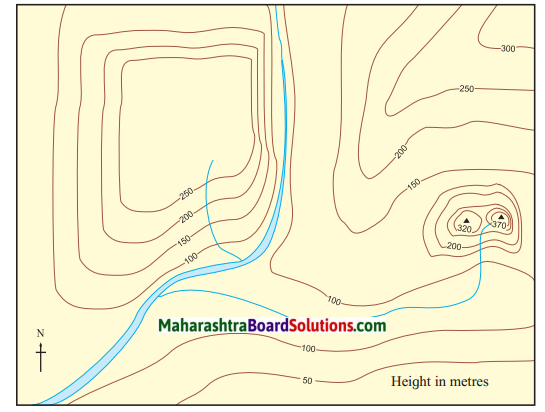
Maharashtra Board Class 7 Geography Solutions Chapter 11 Contour Maps and Landforms 1

Class 7 Geography Chapter 11 Contour Maps and Landforms InText Questions and Answers

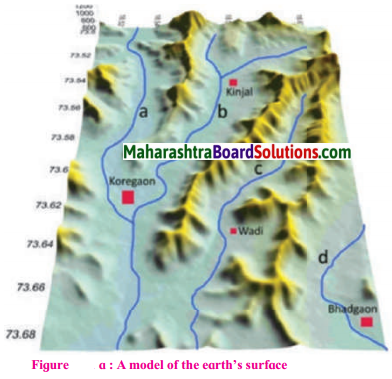
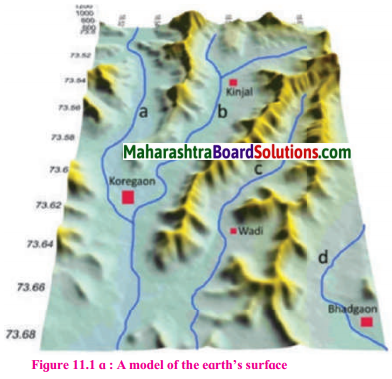
A model of the relief in an area is shown in fig. Observe it carefully and answer the following questions:
Maharashtra Board Class 7 Geography Solutions Chapter 11 Contour Maps and Landforms 6
Question 1.
Which landforms do you seen in the model?
Answer:
Mountains & river valleys are seen in the model.

Maharashtra Board Class 7 Geography Solutions Chapter 11 Contour Maps and Landforms

Question 2.
Which colours have been used on them?
Answer:
Yellow & blue colours have been used in the model.

Model of the Earth’s surface:
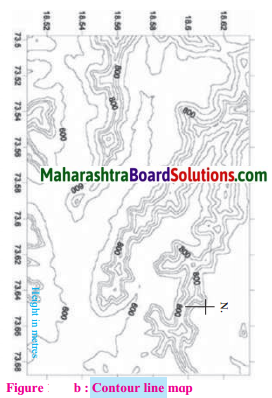
Maharashtra Board Class 7 Geography Solutions Chapter 11 Contour Maps and Landforms 2
Maharashtra Board Class 7 Geography Solutions Chapter 11 Contour Maps and Landforms 7

Question 1.
What all you seen in the map?
Answer:
We can see many contour lines on the map showing a hilly region. We can see the altitude of the hill ranges as well as its slope.

Question 2.
What is the general direction of the ranges shown in the map?
Answer:
The general direction of the ranges shown in the map is east-west

Question 3.
Towards which direction is the flat land located in the map?
Answer:
The flat land is located towards the east.

Question 4.
What are the maximum and minimum values of the lines in the map?
Answer:
The maximum value of the lines in the map is 800 & minimum value is 600.

Question 5.
What do these values indicate?
Answer:
These lines indicate the altitude of the region from the sea level.

Question 6.
Do you find any similarities in the map and the model in fig. (a)? What are those?
Answer:
The model in figure (a) & the contour line map in figure (b) are of the same region. The values of latitudes & longitudes are same on both the maps.

Maharashtra Board Class 7 Geography Solutions Chapter 11 Contour Maps and Landforms

Question 7.
Which figure give us more information and what is that information?
Answer:
Fig. (b) Contour line map gives more information. It gives us information about the altitude of the landforms slope of the land forms with latitudes & longitudes

Question 8.
Is there any similarity between this map and the sketch map of the potato hill?
Answer:
Yes, similar to the sketch map of the potato hill,
the contour line map too is a 3D figure (Model of earth’s surface) which has been converted into a 2D map. The Contour line map is depicting contour line intervals.

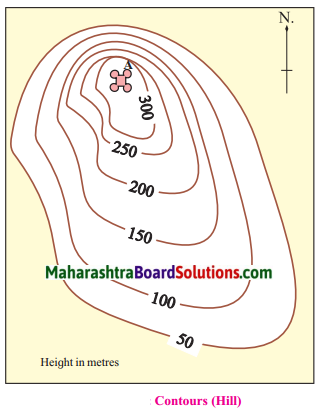
Consider you have gone for mountaineering. You have to conquer a peak on the hill “A”. A map of this hill is given below. Studying the contour lines in the map, find the side from which you will reach the peak safely and easily. Mark your path on the map with a pencil.
Maharashtra Board Class 7 Geography Solutions Chapter 11 Contour Maps and Landforms 9
Answer:
I will climb from eastwards to reach the peak safely as the slope eastwards is gentle and not steep. Lesser distance between the contour lines, indicates steep slope. The distance between the lines is greater eastwards, which shows the slope is more gentle on that side.

Class 7 Geography Chapter 11 Contour Maps and Landforms Additional Important Questions and Answers

Fill in the blanks:

Question 1.
Contour lines join places with the same on a map.
Answer:
altitude

Question 2.
Generally, contour lines do not _______ each other.
Answer:
cross.

Maharashtra Board Class 7 Geography Solutions Chapter 11 Contour Maps and Landforms

Answer the following questions:

Question 1.
How are contour maps helpful to us?
Answer:
(i) Contour maps help us to understand various facets of landforms, like altitude, relief, slope, direction of slope and the drainage.
(ii) These maps are of immense use to mountaineers, trekkers, soldiers, defence officers, etc.
(iii) These maps prove to be of great use in planning of a region.

Question 2.
Contour lines generally do not cross each other. Give reason.
Answer:
(i) Contour lines join places with the same altitude on a map.
(ii) Therefore they generally do not cross each other.

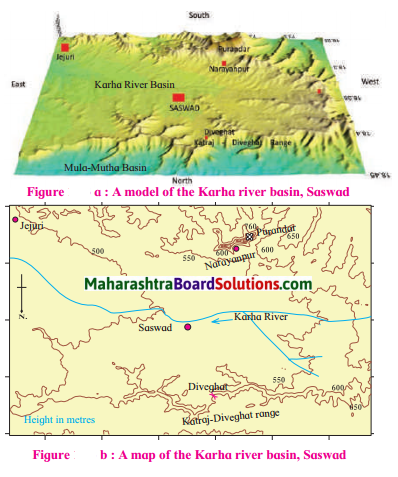
Observe the model and the map given below and answer the following questions:
Maharashtra Board Class 7 Geography Solutions Chapter 11 Contour Maps and Landforms 8
A 3D model is given in fig. (a) The northern part of the model shows the basin of the rivers Mula-Mutha. To its south is the Katraj. Diveghat range extending from the west to the east. Beyond that some portion of Karha basin is seen.

Question 1.
In which direction does fort Purandar lie?
Answer:
Fort Purandar lies in the south direction.

Question 2.
What is the direction of flow of the river Karha?
Answer:
River Karha flows from west to east.

Maharashtra Board Class 7 Geography Solutions Chapter 11 Contour Maps and Landforms

Question 3.
In which parts are the hill ranges not observed?
Answer:
The hill ranges are not observed in the eastern parts.

Question 4.
Which part of the model is not seen in the map? Why?
Answer:
The Karha river & the direction of its flow, the contour height and the slope of the land are part of map & not seen in the model.

Question 5.
In which direction does the altitude of Katraj- Diveghat range decrease?
Answer:
The altitude of katraj-Diveghat range decreases from west to east.

Question 6.
In which direction are higher hill ranges located?
Answer:
Higher hill ranges are located in the southern direction.

Use your brain!

When one sees a landform on a contour map, what is the observer’s position with respect to landform? For example, a hill is shown with the help of contours on a map. From where do you think you are looking at it?
Answer:
Aerial view. From somewhere above, may be from an aeroplane or helicopter.

Maharashtra Board Class 8 Science Solutions Chapter 15 Sound

Balbharti Maharashtra State Board Class 8 Science Solutions Chapter 15 Sound Notes, Textbook Exercise Important Questions and Answers.

Maharashtra State Board Class 8 Science Solutions Chapter 15 Sound

Class 8 Science Chapter 15 Sound Textbook Questions and Answers

1. Fill in the blank with appropriate word:

Question a.
The region in a sound wave, with higher pressure and density is called ………….. and that with low pressure and density is called ……….. .
Answer:
The region in a sound wave, with higher pressure and density is called compression and that with low pressure and density is called rarefaction.

Maharashtra Board Class 8 Science Solutions Chapter 15 Sound

Question b.
Medium is …………… for generation of sound.
Answer:
Medium is needed (or necessary) for generation of sound.

Question c.
The total number of compressions and rarefactions produced per second in a sound wave is 1000. The frequency of the sound wave is ………… .
Answer:
The total number of compressions and rarefactions produced per second in a sound wave is 1000. The frequency of the sound wave is 500 Hz.
[Note: Total number: 100. ∴ 500 compressions and 500 rarefactions are produced per second.]

Question d.
Different sound notes have different ………………. .
Answer:
Different sound notes have different frequencies.

Maharashtra Board Class 8 Science Solutions Chapter 15 Sound

Question e.
In a loudspeaker, …………… energy is converted into ………….. energy.
Answer:
In a loudspeaker, mechanical energy is converted into sound energy.

2. Give scientific reasons:

Question a.
It is essential to change the tension in the vocal cords, as we produce different sound notes from our larynx.
Answer:
Different sound notes correspond to different frequencies. The frequency of sound depends on the tension in the vocal cords. Hence, it is essential to change the tension in the vocal cords, as we produce different sound notes our larynx.

Question b.
Astronauts on the moon cannot hear each other directly.
Answer:
Two astronauts on the moon talking to each other directly, will be unable to listen to each other, even if they are very close to each other. The moon does not have atmosphere. Since there is no medium which is necessary for generation and propagation of sound, between the astronauts, direct sound propagation between them is not possible. Therefore, the astronauts use some technology like the one used in our cell-phones to communicate with each other. The waves used in cell-phone do not need any medium for propagation.

Question c.
As the sound wave propagates from one place to the other in air, the air itself is not required to move from one place to the other.
Answer:
Propagation of sound through air occurs due to energy transfer by vibrating air molecules in one region to those in the adjacent region away from the source. The molecules simply vibrate about their mean positions. Hence, the air itself is not required to move from one place to the other.

Maharashtra Board Class 8 Science Solutions Chapter 15 Sound

3. How are different sound notes generated in musical instruments like guitar, which uses strings for sound generation, and flute, which uses blown air for sound generation?

Question a.
How are different sound notes generated in musical instruments like guitar, which uses strings for sound generation, and flute, which uses blown air for sound generation?
Answer:
1. Guitar: It is a string based, flat- backed instrument. It has usually six strings, the strings are plucked or strummed with the fingers or a small piece of plastic, wood, etc. It has a flat sounding board with a circular sound hole in the centre. Also it has a fretted fingerboard. Its frequency range is more than three octaves. The frequency of vibration of the string is changed by changing the tension in the string or changing the vibrating length of the string. As the tension is increased, the frequency increases. As the vibrating length is increased, the frequency decreases. This is how different sound notes are generated.
[Note: The acoustic guitar has hollow body and six or twelve strings while the electric guitar usually has solid body and six strings. The electric bass guitar has four strings.]

2. Flute: It is a wind instrument where air is blown against the edge or rim of the blowing hole. The frequency of the sound produced depends upon the length of the vibrating air column in the tube. The greater the length of the vibrating air column, the less is the frequency of the sound produced. This is how different sound notes are produced. The flute has six or seven or eight holes to generate sounds of different frequencies. Different notes can be generated also by changing the way of air-blowing.

Maharashtra Board Class 8 Science Solutions Chapter 15 Sound

4. How is sound produced in the human larynx and a loudspeaker?

Question a.
How is sound produced in the human larynx and a loudspeaker?
Answer:
1. Sound production in the human larynx:
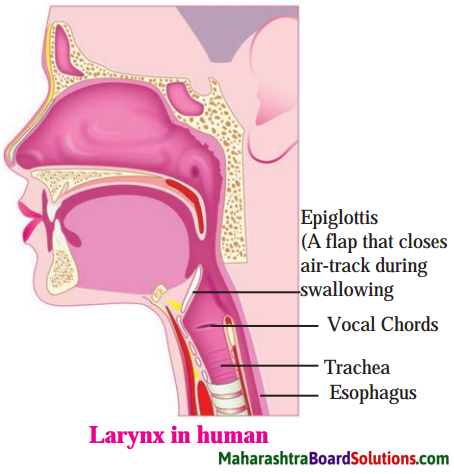
In the humans, sound is produced in the voice box called the larynx. It is located at the upper end of the windpipe. Two vocal cords (chords) are stretched across it with a narrow slit between them for the passage of air (Fig. 15.5). When the lungs force air through the slit, the cords start vibrating.

The frequency of the sound produced depends upon the length and thickness of the cords, and the tension in the chords. The frequency increases with the increase in tension and the more the length or the thickness of the cord, the less is the frequency. Muscles attached to the cords can make the cords tight (more tension) or loose (less tension).
Maharashtra Board Class 8 Science Solutions Chapter 15 Sound 1
2. Sound produced in a loudspeaker:
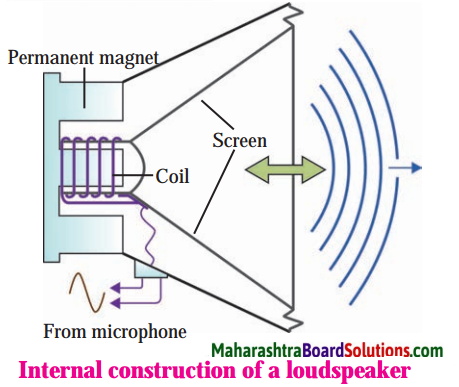
Figure shows the internal construction of a loudspeaker. Here, a coil is wound around a permanent magnet. The conical screen of the loudspeaker is attached to the coil.
Maharashtra Board Class 8 Science Solutions Chapter 15 Sound 2
When a current is passed through the coil, a magnetic field is produced. Its interaction with the permanent magnet results in the back and forth motion of the coil. The frequency and the amplitude of the motion of the coil depends on the variation in the current through the coil.

As the coil moves, the conical screen also moves back and forth. The vibrations of the screen produce sound waves in air. Very loud sound can be produced by changing the current.
[Note: If you gently touch the vibrating screen, you can feel the vibrations.]

Maharashtra Board Class 8 Science Solutions Chapter 15 Sound

5. Explain the experiment, with0 a neat diagram, to prove the following:
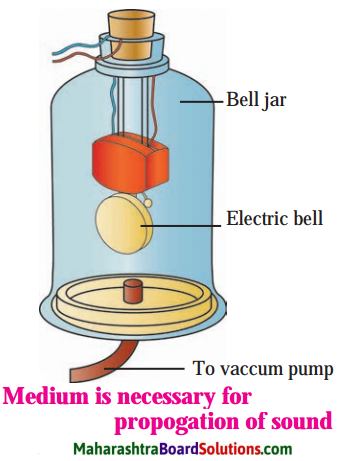
‘Sound needs a material medium for propagation.’

Question a.
Explain the experiment, with0 a neat diagram, to prove the following:
‘Sound needs a material medium for propagation.’
Answer:
Maharashtra Board Class 8 Science Solutions Chapter 15 Sound 3
Figure shows part of the set up used in this experiment. What is not shown is the electric circuit in which the electric bell is connected. A vacuum tight bell jar contains an electric bell connected to a power supply through the lid of the jar. The jar is placed on a smooth horizontal surface such as that of glass.

Initially the vacuum pump is off and the jar contains air. The circuit containing the bell is completed using the key or the switch so that the bell starts ringing. This can be heard outside the jar.

Then the vacuum pump is switched on so that it starts removing the air from the jar. We find that the level of ringing sound heard goes on decreasing as the quantity of air in the jar becomes less and less.

When the pump is operated for a sufficiently long time interval, the quantity of air in the jar becomes so less that the level of ringing sound becomes very low; sound is hardly audible. But we can see the striker in the bell hitting the gong. By extrapolation, we conclude that sound generation and propagation needs a medium.

Maharashtra Board Class 8 Science Solutions Chapter 15 Sound

6. Match the following:

Question a.
Maharashtra Board Class 8 Science Solutions Chapter 15 Sound 4
Answer:

Column IColumn II
Human larynxVibrations in vocal cords
LoudspeakerVibrations of screen
JaltarangVibrations in air column
Tuning forkVibrations of metal arms
SitarVibrations in strings

Can you recall?

Question a.
How is sound produced?
Answer:
Sound is produced by the vibrations of an object such as a stretched membrane or a string under tension.

Maharashtra Board Class 8 Science Solutions Chapter 15 Sound

Project:

Question 1.
Take two plastic glasses and tie a thread between them to make a toy phone. Does the voice of your friend reach you through the thread? Take metal wire instead of the thread and also change the length of the thread wire and repeat the activity. Discuss with your friends and teacher about your conclusions.

Question 2.
Take a plastic or tin can or a plastic glass. Remove its bottom. Stretch a piece of rubber balloon across one end and fix it with a rubber band. Put a few grains of say ragi or bajra on the stretched rubber. Now ask your friend to shout ‘Hoorrey ……… Hoorrey ………… ‘ from the open end of the glass. Observe the dancing of the grains up and down. Discuss the reason behind this.

Class 8 Science Chapter 15 Sound Important Questions and Answers

Select the correct option and write the completed statements:

Question 1.
Sound waves cannot travel through a ………… .
(a) solid
(b) liquid
(c) gas
(d) vacuum
Answer:
Sound waves cannot travel through a vacuum.

Question 2.
If the frequency of a sound wave is 512 Hz, the number of rarefactions produced per second is ……………… .
(a) 256
(b) 512
(c) 1024
(d) 128
Answer:
If the frequency of a sound wave is 512 Hz, the number of rarefactions produced per second is 512.

Maharashtra Board Class 8 Science Solutions Chapter 15 Sound

Question 3.
In the experiment to show that a medium is necessary for propagation of sound, as the quantity of air inside the bell jar decreases, the level of ringing sound heard outside ……………… .
(a) increases
(b) decreases
(c) fluctuates randomly
(d) changes at regular intervals
Answer:
In the experiment to show that a medium is necessary for propagation of , sound, as the quantity of air inside the bell jar decreases, the level of ringing sound heard outside decreases.

Find the odd one out and give the reason:

Question 1.
Sound waves, Waves on the surface of water, Waves on a stretched string, Light waves
Answer:
Light waves. Light waves can travel in a vacuum. Other waves need a medium for propagation.

Question 2.
Sitar, Violin, Guitar, Flute.
Answer:
Flute. It is not a string based instrument. Others are string based instruments.

State whether the following statements are True or False. (If a statement is false, correct it and rewrite it.)

Question 1.
If the vibrating length of a stretched string is kept constant and the tension in the string is increased, the frequency of the sound produced increases.
Answer:
True.

Maharashtra Board Class 8 Science Solutions Chapter 15 Sound

Question 2.
In Jaltarang, the frequency of sound produced is independent of the height of the air column inside the glass cup.
Answer:
False. (In Jaltarang, the frequency of sound produced depends on the height of the air column inside the glass cup; the more the height of the air column, the less is the frequency of the sound produced.)

Answer the following questions in one sentence each:

Question 1.
What is sound?
Answer:
Sound is a form of energy which produces sensation of hearing in our ears.

Question 2.
What is vibration?
Answer:
Vibration is a rapid, to and from periodic motion of an object about its mean position.

Question 3.
What is compression?
Answer:
As a sound wave travels through air, the region in which air is at high pressure and high density is called compression.

Question 4.
What is rarefaction?
Answer:
As a sound wave travels through air, the region in which air is at low pressure and low density is called rarefaction.

Maharashtra Board Class 8 Science Solutions Chapter 15 Sound

Question 5.
What is the relation between the frequency of vibration and the vibrating length (or height) of the air column?
Answer:
The greater the vibrating length (or height) of the air column, the less is the frequency of vibration of the column.

Question 6.
For a particular string (given material and radius), what are the factors on which its frequency of vibration depends?
Answer:
For a particular string (given material and radius), the frequency of vibration of the string depends upon its vibrating length and the tension in the string.
[Note: in the above case, frequency is proportional to the square root of the tension and inversely proportional to the length.]

Question 7.
Name an instrument in which a stretched skin is used to produce musical sound.
Answer:
Tabla.

Maharashtra Board Class 8 Science Solutions Chapter 15 Sound

Answer the following questions:

Question 1.
Explain the production and propagation of sound in air.
Answer:
Let us consider production of sound by using a tuning fork. A tuning fork is made of a metal. It has a stem and two prongs (Fig). Figure (a) shows the state of air in the absence of propagation sound through it. Equally spaced vertical lines show that the average distance between the air molecules is the same everywhere. It means average pressure and average density in the regions A, B and C are the same.
Maharashtra Board Class 8 Science Solutions Chapter 15 Sound 5

Maharashtra Board Class 8 Science Solutions Chapter 15 Sound 6

Suppose the tuning fork is held vertical, its stem is fixed in a stand (not shown in the figure) and its prongs are struck lightly using a light hammer with a piece of rubber at the top. The prongs then start vibrating.
Figure (b) shows what happens when the prongs move away from each other. The air outside the prongs is compressed (layers in the region A). The pressure and density increase in this region.

Figure (c) shows what happens when the prongs move close to each other. The air molecules near the prongs move away from each other resulting in lower pressure and lower density.

This region is called rarefaction. Meanwhile, the compression produced earlier moves forward, i.e., away from the prongs because the air molecules in this region transfer their energy to the air molecules in the region B producing a compression there. The periodic formation of compression and rarefaction results in propagation of sound waves away from the prongs.

Eventually, these sound waves reach our ears, the ear-drum vibrates, and we get a sense of hearing a sound as the specific signals reach the brain.

Maharashtra Board Class 8 Science Solutions Chapter 15 Sound

Use your brain power:

Question a.
If sound waves are generated in air, what moves away from the source? Is it the air itself or the state of compression and rarefaction created in the air?
Answer:
If sound waves are generated in air, the state of compression and rarefaction created in the air moves away from the source.
[Note: The air does not move away from the source because air is elastic and the force due to the tuning fork varies periodically with time.]

Question 2.
Explain the term frequency of a sound wave.
Answer:
Sound travels in the form of waves. A wave consists of cycles of alternate compression and rarefaction. The number of cycles produced in the air (or any other medium) per second is called the frequency of the sound wave. It is expressed in hertz (Hz). 1 hertz = 1 cycle per second or 1 vibration per second or 1 oscillation per second.

Maharashtra Board Class 8 Science Solutions Chapter 15 Sound 7

[Note: The SI unit of frequency, the hertz, is named in honour of Heinrich Hertz (1857-94), German physicist.]

Maharashtra Board Class 8 Science Solutions Chapter 15 Sound

Question 3.
State the factors on which the frequency of a tuning fork depends.
Answer:
The frequency of a tuning fork depends on the dimensions of the prongs, i.e., length and thickness, and the material used for making the fork.

Try this:

Question a.
Take 6 – 7 glass cups. Arrange them in a line and fill them with water with gradually increasing water level from one end to other. Take a pencil and strike the cups sequentially. The sound generated by each cup will be different. Why is it so?
Use of ICT:
Download videos of Jaltarang from youtube and send them to your friends by email.

Maharashtra Board Class 8 Science Solutions Chapter 15 Sound 8

Answer:
When a cup is struck, waves are set up in the air column above the water level in the cup. The frequency of the generated wave depends on the height of the air column inside the glass cup. Since the water level in each glass is different, the height of the air column in each glass is also different. Therefore, the frequency of sound generated by each glass cup will also be different. So, the sound generated is different.

Question b.
An ‘app’ for measurement of sound frequency may be available on cellphones. With the help of your teacher, use the app to measure the frequency of the sound generated from each glass cup. Do you observe any relation between the frequency of generated sound and the height of the air column in the glass cup?
Answer:
Yes. The greater the height of the air column in the glass cup, the less is the frequency of the sound produced.

Question c.
This is your simple ‘Jaltarang’! Can this experiment be performed with stainless steel pots of different size?
Answer:
Do it. See what happens as the stainless steel pot itself starts vibrating producing a sound. Also see how this sound is damped by water.

Maharashtra Board Class 8 Science Solutions Chapter 15 Sound

Do you know?

Question a.
What are the frequencies of musical notes ‘sa’, ’re’, ‘ga’, ‘ma’, ‘pa’, ‘dha’, ‘ni’ in the ‘madhya saptak’?
Answer:
Maharashtra Board Class 8 Science Solutions Chapter 15 Sound 9

[Note: The diatonic scale:
Maharashtra Board Class 8 Science Solutions Chapter 15 Sound 10.1
Maharashtra Board Class 8 Science Solutions Chapter 15 Sound 11.1
Such a simple fraction is pleasing to the ear and is called a musical interval. Frequency ratios 2 : 1, 3 : 2, 4 : 3 are examples of musical interval.

Observe and discuss:

Question 1.
Identify the instruments and discuss sound production in them. [Students should see these musical instruments.]
Maharashtra Board Class 8 Science Solutions Chapter 15 Sound 12
Answer:
Maharashtra Board Class 8 Science Solutions Chapter 15 Sound 13

  1. Sitar
  2. Shehnai
  3. Flute
  4. Tabla
  5. Santoor
  6. Bugle
  7. Mandoline or Mandolin
  8. Saxophone.

Question i.
Sitar, Santoor and Mandoline or mandoline (String instruments):
Answer:
Vibrating strings produce the sound. The greater the tension in the string, the higher is the frequency of the sound. The greater the vibrating length and the diameter of the string, the lower is the frequency of the sound.

Question ii.
Flute, Saxophone and Shehnai (Wind instruments):
Answer:
Vibrating air column produces the sound. The greater the length of the column, the lower is the frequency of the sound.

Maharashtra Board Class 8 Science Solutions Chapter 15 Sound

Question iii.
Tabla (Percussion instrument):
Answer:
Vibrating skin produces the sound. The greater the tension in the skin, the higher is the frequency of the sound. The greater the thickness of the skin, the lower is the frequency of the sound.

Try this:
‘Apps’ for generation of different sound notes (sound note generator app) may be available on cellphones. With the help of your teacher, using such an app, generate sound notes listed in the table.

Maharashtra Board Class 8 Science Solutions Chapter 15 Sound 9

Vocal cords are 20 cm in length in male, about 15 cm in female and even smaller in children. Therefore the voice of male, female and children are different.
[Note: Vocal cords are 20 mm in length in male, about 15 mm in female and even smaller in children. Reference NCERT textbook Std. VIII, published in 2017.]

Question 1.
Produce a sound ‘bho … bho …’ just like a dog-barking and ‘meow … meow…’ just like a mewing cat. Carefully notice the tension on the vocal cords, when you produce these sounds. Do you feel that the tension on the vocal cords changes when you produce these two different sounds?
Answer:
Yes.

Maharashtra Board Class 8 Science Solutions Chapter 15 Sound

Question 2.
An ‘app’ may be available on cell-phones to measure the loudness of sound in decibel. With the help of your teacher, use the app to measure the sound level of a sound from a loudspeaker at some public place. Measure the sound level at different distances from the loudspeaker. Do you observe some relation between the distance from the loudspeaker and the sound level?
Answer:
Yes. As the distance increases, the sound level decreases.

Always remember:

We should take care that others are not disturbed when we study sound and its production. Sound pollution is a major cause affecting the environment and social health. Hence we should find ways to avoid sound pollution.

Maharashtra Board Class 10 Marathi Kumarbharti Solutions Chapter 3 आजी : कुटुंबाचं आगळ

Balbharti Maharashtra State Board Class 10 Marathi Solutions Kumarbharti Chapter 3 आजी : कुटुंबाचं आगळ Notes, Textbook Exercise Important Questions and Answers.

Maharashtra State Board Class 10 Marathi Kumarbharti Chapter 3 आजी : कुटुंबाचं आगळ

Marathi Kumarbharti Std 10 Digest Chapter 3 आजी : कुटुंबाचं आगळ Textbook Questions and Answers

प्रश्न. पुढील उतारा वाचा आणि दिलेल्या सूचनांनुसार कृती करा :

कृती १ : (आकलन)

प्रश्न 1.
विधाने पूर्ण करा :
(i) स्वत:च्या कपाळावरचे गोंदण दिसू नये, म्हणून आजी —————
उत्तर :
स्वत:च्या कपाळावरचे गोंदण दिसू नये, म्हणून आजी कपाळावर बुक्का लावत असे.

(ii) वर्ष-दीड वर्षाने जन्मणाऱ्या वासरांमध्ये एकाआड एक खोंड नक्की असे, म्हणून —————–
उत्तर :
वर्ष-दीड वर्षाने जन्मणाऱ्या वासरांमध्ये एकाआड एक खोंड नक्की असे, म्हणून दावणीला कायम कपिलीचे बैल असत.

(iii) सुनांनी चहा करून पिऊ नये, म्हणून —————-
उत्तर :
सुनांनी चहा करून पिऊ नये, म्हणून ढाळजेतून सोप्यात येऊन आजी सक्त पहारा करायची.

Maharashtra Board Class 10 Marathi Solutions Chapter 3 आजी : कुटुंबाचं आगळ

प्रश्न 2.
पुढील मुद्द्यांच्या आधारे आजीचे शब्दचित्र रेखाटा :

(i) आजीचे दिसणे : ——————–
उत्तर :
आजीचे दिसणे : आजीला साडेपाच फूट उंची लाभली होती. तिचा वर्ण गोरा होता. उन्हापावसामुळे तिची त्वचा काळपटली होती. आजीच्या वयाची माणसे कमरेत वाकतात. त्यामुळे चालताना काठी घ्यावी लागते. पण आजी अजूनही ताठ कण्याने चालत होती. अजूनही तिचे सगळे दात शाबूत होते. डोक्यावरचे सगळे केस पिकले होते.

(ii) आजीची शिस्त : ——————–
उत्तर :
आजीची शिस्त : आजीची शिस्त कडक होती. सगळ्यांना सगळी कामे करता आली पाहिजेत, असा तिचा कटाक्ष होता. तिने कामांची वाटणी केली होती. ती कामे आजी सर्व सुनांना आलटूनपालटून करायला लावी. दुपारच्या कामांचेही तिने नियोजन केलेले असे. सुनांनी मुलांच्या बाबतीत आपपरभाव करू नये म्हणून मुलांना खाऊपिऊ घालताना आजीचा सक्त पहारा असे. गल्लीतल्या बायका दुपारी गप्पागोष्टींना येत असत. त्या वेळी ती बायकांनी सांगितलेल्या गोष्टींची शहानिशा करीत असे.

(iii) आजीचे सौंदर्य : —————-
उत्तर :
आजीचे सौंदर्य : आजीचे वय आता सत्तर वर्षांचे होते. उन्हापावसामुळे आजीची त्वचा रापली होती. पण तिचा मूळ गोरा वर्ण लपत नव्हता. तिचे दात मोत्यांसारखे चमकत होते. विशाल कान व धारदार नाक यांनी आजीच्या सौंदर्यात भर पडत होती. चेहऱ्यावर सुरकुत्या पडल्या तरी तिच्या सौंदर्यात उणेपणा आला नव्हता.

(iv) आजीचे राहणीमान : ————-
उत्तर :
आजीचे राहणीमान : त्या काळात इरकली लुगडे उच्च राहणीमानाचे लक्षण होते. हिरव्या व लाल रंगांची नऊवारी इरकली लुगडी व अंगात चोळी हा तिचा पेहराव असे. कपाळावरचं गोंदण दिसू नये म्हणून त्यावर ती बुक्का लावी. ती नेहमी नाली ठोकलेल्या जुन्या वळणाच्या वहाणा वापरत असे.

प्रश्न 3.
चूक की बरोबर सांगा :
(i) राहिलेली अर्धी चरवी घरात आली, की म्हातारी ढाळजंतनं सोप्यात. अवतरायची.
उत्तर :
बरोबर

(ii) आजीच्या डोक्यावरील सर्व केस पांढरे होते……………….
उत्तर :
बरोबर

(iii) सुनांच्या कामाबाबत आजी फारशी काटेकोर नसायची.
उत्तर :
चूक.

कृती २ : (आकलन)

प्रश्न 1.
विधाने पूर्ण करा :
(i) मुलांनी भरपूर खावे-प्यावे व त्यांची आबाळ होऊ नये, म्हणून —————-
उत्तर :
मुलांनी भरपूर खावे-प्यावे व त्यांची आबाळ होऊ नये, म्हणून आजी त्यांना धपाटे घालून घालून खायला घाली.

(ii) प्रत्येक सुनेला प्रत्येक काम आलेच पाहिजे, असा आजीचा आग्रह होता, म्हणून ती ——–
उत्तर :
प्रत्येक सुनेला प्रत्येक काम आलेच पाहिजे, असा आजीचा, आग्रह होता, म्हणून ती रोटेशनप्रमाणे काम बदलत जाई.

(iii) मुलांना दूध प्यायला देण्याबाबत सुना आपपरभाव करतील, अशी भीती आजीला वाटे, म्हणून ————–
उत्तर :
मुलांना दूध प्यायला देण्याबाबतं सुना आपपरभाव करतील, अशी भीती आजीला वाटे, म्हणून ती मुलांना गोठ्यातच दूध प्यायला लावी.

Maharashtra Board Class 10 Marathi Solutions Chapter 3 आजी : कुटुंबाचं आगळ

प्रश्न 2.
पुढीलपैकी चुकीची वाक्ये दुरुस्त करून बरोबर वाक्ये व दुरुस्त केलेली वाक्ये पुन्हा लिहा :
(i) दुपारची कामे आटोपून आजी ढाळजेत यायची.
उत्तर :
दुपारच्या कामांचे नियोजन करून आजी ढाळजेत यायची.

(ii) गाईने पान्हा सोडला की वासराला सोडायचे.
उत्तर :
गाईने पान्हा सोडला की वासराला धरून ठेवायचे.

(iii) आजीच्या घरी एक गावरान गाय होती.
उत्तर :
आमच्या घरी एक गावरान गाय होती.

कृती ३ : (व्याकरण)

प्रश्न 1.
पुढील वाक्यांतील वाक्प्रचार शोधून अधोरेखित करा :
(i) आजीच्या छत्रछायेखाली आमचे सर्व कुटुंब गुण्यागोविंदाने नांदत होते.
उत्तर :
आजीच्या छत्रछायेखाली आमचे सर्व कुटुंब गुण्यागोविंदाने नांदत होते.

(ii) सत्तरीनंतरही आजीच्या हातात काठी आली नव्हती.
उत्तर :
सत्तरीनंतरही आजीच्या हातात काठी आली नव्हती.

प्रश्न 2.
पुढील अधोरेखित शब्दांच्या जाती ओळखा आणि त्यांचे उपप्रकार लिहा :
(i) चार घरच्या चार सुना नांदायला आल्या.
उत्तर :
चार : विशेषण. संख्यावाचक विशेषण.
सुना : नाम. सामान्य नाम.
आल्या : क्रियापद. अकर्मक क्रियापद.

(ii) प्रत्येकीला काम आलंच पाहिजे.
उत्तर :
काम : नाम. भाववाचक नाम.

(iii) आजीला एकाही सुनेचा भरवसा नव्हता.
उत्तर :
ही : शब्दयोगी अव्यय.
भरवसा : नाम. भाववाचक नाम.

(iv) आमच्या घरी एक गावरान गाय होती.
उत्तर :
एक : विशेषण. संख्यावाचक विशेषण.
गावरान : विशेषण. गुणवाचक विशेषण.
गाय : नाम. सामान्य नाम.

कृती ४ : (स्वमत / अभिव्यक्ती)

प्रश्न 1.
तुम्हांला आठवत असलेला किंवा तुमच्या आईबाबांनी सांगितलेला तुमच्या लहानपणचा एखादा प्रसंग लिहा.
उत्तर :
मी लहान होतो तेव्हा सकाळी उठलो की, दात घासून, तोंड धुऊन मी तडक रानातल्या आमच्या वाड्याकडे धावत सुटायचो. कोकणात गुरांच्या गोठ्याला वाडा म्हणतात. तेथे माझे आजोबा माझी वाटच बघत असत. दरदिवशी ते माझ्यासाठी एक तांब्याएवढे मडके भरून दूध गरम करून ठेवत. मी गेलो की, घटाघटा ते दूध पीत असे. त्यानंतर त्या मडक्याला चिकटलेली साय खरवडून खाणे हा माझा मोठा आनंदाचा भाग असे. माझ्या या अखंडित दिनक्रमामुळे कोणत्या गाई-म्हशीचे दूध कोणत्या चवीचे आहे, हे मी सहज ओळखू शकतो. दुधाला एक स्वत:चे माधुर्य असते. दूध पिताना लोक दुधात साखर का घालतात, हे मला अजून कळलेले नाही.

Maharashtra Board Class 10 Marathi Solutions Chapter 3 आजी : कुटुंबाचं आगळ

Marathi Kumarbharti Class 10 Textbook Solutions Chapter 3 आजी : कुटुंबाचं आगळ Additional Important Questions and Answers

प्रश्न. पुढील उतारा वाचा आणि दिलेल्या सूचनांनुसार कृती करा :

कृती १ : (आकलन)

प्रश्न 1.
एका शब्दात उत्तर लिहा : (मार्च १९)
Maharashtra Board Class 10 Marathi Solutions Chapter 3 आजी कुटुंबाचं आगळ 1
उत्तर :
Maharashtra Board Class 10 Marathi Solutions Chapter 3 आजी कुटुंबाचं आगळ 2

प्रश्न 2.
आकृती पूर्ण करा :
(i)
Maharashtra Board Class 10 Marathi Solutions Chapter 3 आजी कुटुंबाचं आगळ 3
उत्तर :
Maharashtra Board Class 10 Marathi Solutions Chapter 3 आजी कुटुंबाचं आगळ 4

(ii)
Maharashtra Board Class 10 Marathi Solutions Chapter 3 आजी कुटुंबाचं आगळ 5
उत्तर :
Maharashtra Board Class 10 Marathi Solutions Chapter 3 आजी कुटुंबाचं आगळ 6

(iii)
Maharashtra Board Class 10 Marathi Solutions Chapter 3 आजी कुटुंबाचं आगळ 7
उत्तर :
Maharashtra Board Class 10 Marathi Solutions Chapter 3 आजी कुटुंबाचं आगळ 8

(iv)
Maharashtra Board Class 10 Marathi Solutions Chapter 3 आजी कुटुंबाचं आगळ 9
उत्तर :
Maharashtra Board Class 10 Marathi Solutions Chapter 3 आजी कुटुंबाचं आगळ 10

कृती २ : (आकलन)

प्रश्न 1.
दुपारच्या वेळी रूढ खेळांखेरीज मुले ज्या गमतीजमती करीत, त्या लिहा.
उत्तर :

  • वडाच्या पारंब्यांना लटकत, लोंबत राहायचे आणि पारंब्यांच्या टोकाला फुटलेली पिवळी पालवी खात बसायचे.
  • देवळातली घंटा वाजवाजवून झोपलेल्यांची झोपमोड करायची.
  • विहिरीत मनसोक्त पोहायचे.
  • शिवणापानी खेळायचे.
  • हातपाय पोटाशी आवळून घेऊन शरीराचे मुटके करून विहिरीत धडादिशी उड्या घ्यायची.
  • ओल्या अंगाने मातीत लोळायचे आणि पुन्हा पाण्यात इंबायचे आणि शेवटी थकून भागून घरी जायचे.

[टीप : परीक्षेत कोणतीही दोन किंवा चार नावे लिहायला सांगितली जाऊ शकतात.]

Maharashtra Board Class 10 Marathi Solutions Chapter 3 आजी : कुटुंबाचं आगळ

प्रश्न 2.
बालपणी लाभलेल्या रानमेव्यांची नावे सांगा. (कोणतीही चार नावे लिहा.)
उत्तर :

  • गाभोळ्या चिंचा, मिठाचे खडे व कच्च्या कैऱ्या, बोरे, चिंचेची कोवळी पाने.
  • उंबर, ढाळे, भाजलेली कणसे, हुरडा.
  • कच्ची वांगी, गवार, टोमॅटो, शहाळे.
  • कलिंगड, शिंगाडे (चिबूड), करडीची भाजी, ज्वारीचे कणीस.
  • कवठ, तुरी-मटकीच्या शेंगा, उकडलेल्या शेंगा, कुळथाचे पिठले.

प्रश्न 3.
आकृत्या पूर्ण करा :
(i)
Maharashtra Board Class 10 Marathi Solutions Chapter 3 आजी कुटुंबाचं आगळ 11
उत्तर :
Maharashtra Board Class 10 Marathi Solutions Chapter 3 आजी कुटुंबाचं आगळ 12

(ii)
Maharashtra Board Class 10 Marathi Solutions Chapter 3 आजी कुटुंबाचं आगळ 13
उत्तर :
Maharashtra Board Class 10 Marathi Solutions Chapter 3 आजी कुटुंबाचं आगळ 14

(iii)
Maharashtra Board Class 10 Marathi Solutions Chapter 3 आजी कुटुंबाचं आगळ 15
उत्तर :
Maharashtra Board Class 10 Marathi Solutions Chapter 3 आजी कुटुंबाचं आगळ 16

प्रश्न 4.
पुढील घटना उताऱ्याच्या आधारे क्रमाने लिहा : (मार्च ‘१९)
(i) म्हातारीची ढाळज सुटायची
(ii) वाडा शांत व्हायचा
(iii) कडुसं पडायच्या आधी मैफिल मोडायची
(iv) माणसं ढाळजंत बसायची
उत्तर :
(iii) कडुसं पडायच्या आधी मैफिल मोडायची
(i) म्हातारीची ढाळज सुटायची
(iv) माणसं ढाळजंत बसायची
(ii) वाडा शांत व्हायचा

कृती ३ : (व्याकरण)

प्रश्न 1.
सहसंबंध लक्षात घेऊन उत्तरे लिहा :
Maharashtra Board Class 10 Marathi Solutions Chapter 3 आजी कुटुंबाचं आगळ 17
उत्तर :
Maharashtra Board Class 10 Marathi Solutions Chapter 3 आजी कुटुंबाचं आगळ 18

प्रश्न 2.
पुढील बोलीभाषेतील शब्दांना प्रचलित प्रमाण मराठी भाषेतील शब्द शोधून लिहा :
Maharashtra Board Class 10 Marathi Solutions Chapter 3 आजी कुटुंबाचं आगळ 19
उत्तर :
Maharashtra Board Class 10 Marathi Solutions Chapter 3 आजी कुटुंबाचं आगळ 20

Maharashtra Board Class 10 Marathi Solutions Chapter 3 आजी : कुटुंबाचं आगळ

प्रश्न 3.
तक्ता पूर्ण करा :
Maharashtra Board Class 10 Marathi Solutions Chapter 3 आजी कुटुंबाचं आगळ 21
उत्तर :
Maharashtra Board Class 10 Marathi Solutions Chapter 3 आजी कुटुंबाचं आगळ 22

प्रश्न 4.
पुढील वाक्यांतील अधोरेखित शब्दाचे लिंग बदलून वाक्य पुन्हा लिहा :
आजी त्याची संपादक होती. (सराव कृतिपत्रिका-१)
उत्तर :
आजोबा त्याचे संपादक होते.

कृती ४ : (स्वमत / अभिव्यक्ती)

प्रश्न 1.
‘आमची ढाळज म्हणजे गावाचं वर्तमानपत्र होतं,’ या वाक्याचा तुम्हांला कळलेला अर्थ लिहा.
उत्तर :
‘आगळ’ या कादंबरीच्या नायकाची आजी ही त्याच्या घराची सत्ताधीश होती. घरात तिचा वचक होता. घराबाहेरही तिच्या शब्दाला मान होता. दुपारपर्यंतच्या सर्व कामांचे नियोजन करून आजी ढाळजेत यायची. गल्लीतल्या बायकाही जमा व्हायच्या. निवडटिपण करता करता गप्पाटप्पा व्हायच्या. अनेक बातम्या, गुपिते उघड व्हायची. सगळ्याजणी बातम्यांवर चर्चा करीत. त्यातून बातम्यांची शहानिशा व्हायची.

वर्तमानपत्राचे वार्ताहर गावांतून बातम्या आणतात. संपादक या बातम्यांची शहानिशा करतात. मगच त्या बातम्या वर्तमानपत्रात छापल्या जातात. आजीच्या घराची ढाळज वर्तमानपत्रासारखीच होती. तिथे आलेल्या बातम्यांची शहानिशा झाल्यावरच बायका त्या बातम्या गावभर सांगायला मोकळ्या होत.

प्रश्न 2.
तुलना करा / साम्य लिहा :
आगळ : वाड्याचे संरक्षक कवच
आजी : कुटुंबाचे संरक्षक कवच किंवा
‘आजी म्हणजे घराचा आधार’ हे विधान सोदाहरण पटवून दया. (मार्च ‘१९)
उत्तर :
आगळ म्हणजे उंची-रुंदीला नऊ इंच आणि लांबीला सहा फूट असा भक्कम सागवानी वासा. एकदा आगळ लावली की चोऱ्यामाऱ्या होणे किंवा दरोडा पडणे शक्यच नसे. त्यामुळेच ही आगळ म्हणजे वाड्याला संरक्षणाचे एक भरभक्कम कवच लाभले होते.

प्रस्तुत उताऱ्यात आजीची भूमिकाही अगदी याच प्रकारची आहे. आजीमुळे कुटुंबात सुव्यवस्था नांदत होती. सुना आपापसात हेवेदावे करू शकत नव्हत्या. आपली कामे दुसरीवर ढकलू शकत नव्हत्या. सर्व कामे प्रत्येकीला करावी लागत. या वातावरणामुळे कोणावर अन्याय होत नव्हता. कोणालाही तक्रार करायला वावच राहत नसे. आजीमुळे प्रत्येकीला किंवा प्रत्येकाला भरभक्कम संरक्षण मिळाले होते. हे संरक्षण आगळेइतकेच भक्कम होते.

प्रश्न 3.
आगळ लावण्याची/टाकण्याची पद्धत समजावून सांगा.
उत्तर :
आगळ म्हणजे एक सागवानी अवजड वासा होता. त्याच्या एका टोकाला वाघाचा मुखवटा बसवला होता. वाघाच्या जबड्यात एक भक्कम कडी बसवलेली होती. त्या कडीला धरून आगळ ओढायची किंवा ढकलायची असते. दरवाज्याच्या दोन बाजूंना आगळ अडकवण्यासाठी भिंतींत दोन कोनाडे केलेले असतात. त्यांपैकी एक कोनाडा आगळ पूर्ण सामावली जाईल इतका खोल असतो. कडीला धरून आगळ कोनाड्यात पूर्ण ढकलली की दरवाजा उघडता येतो.

रात्रीच्या वेळी, दरवाजा बंद करून कोनाड्यात ढकलून ठेवलेली आगळ कडीला धरून ओढून बाहेर काढली जाते आणि ते टोक दुसऱ्या भिंतीच्या कोनाड्यात अडकवले जाते. अशा त-हेने आगळ बसवली की दरवाजा कोणीही उघडू शकत नाही.

Maharashtra Board Class 10 Marathi Solutions Chapter 3 आजी : कुटुंबाचं आगळ

प्रश्न 4.
दुपारच्या वेळी मुलांकडून केल्या जाणाऱ्या कल्पक कृती सांगा.
उत्तर :
कधी कधी बैठ्या खेळांऐवजी मुले वेगवेगळ्या कल्पक कृती करीत असत. एखादया वेळी सरपणातली लाकडे काढून विटीदांडू किंवा भोवरे तयार करीत बसत. भिंगऱ्या तयार करण्यासाठी घेतलेला लाकडाचा तुकडा दगडावर घासून घासून त्याला गोल आकार देण्याचा मुले प्रयत्न करीत. हे मोठे कष्टाचे काम असे. चुलीची काजळी लागून लागून काळ्या कुळकुळीत बनलेल्या खापऱ्या पाटीवर घासून घासून पाठीला काळा कुळकुळीत रंग आणण्याचा प्रयत्न करीत बसत.

बैलगाड्या बनवण्यासाठी ज्वारीची ताटे वापरीत. लाल माती आणून बैल बनवत बसत. गोल आकाराचे गोटे जमवून ते सर्व बाजूंनी दगडावर घासून घासून त्याने छान गोल आकार दयायचा प्रयत्न करीत बसत. अशा अनेक कल्पक कृती करण्यात मुले दंग होत.

प्रश्न 5.
पाठात चित्रित झालेल्या एकत्र कुटुंबपद्धतीबाबतचे तुमचे विचार स्पष्ट करा.
उत्तर :
या पाठात ग्रामीण भागातील मागील पिढीचे चित्रण आले आहे. त्या काळातील हे एक एकत्र कुटुंब होते. आजी ही कुटुंबप्रमुख होती. कुटुंबाच्या सर्व बाबींवर, सर्व व्यक्तींवर आजीचीच सत्ता चालत असे. कोणी कोणकोणती कामे कधी व कशी करावीत, हे आजी ठरवत असे.

या पद्धतीमुळे कुटुंबातील सर्व व्यवहारांना एकसूत्रीपणा येतो आणि कामे सुरळीतपणे पार पडतात; याचा कुटुंबालाच फायदा होतो, हे खरे आहे. पण या पद्धतीमध्ये कोणालाही स्वातंत्र्य राहत नाही. सुनांना साधा चहासुद्धा करून पिण्याची मोकळीक नव्हती. म्हणजे कोणालाही जरासुद्धा हौसमौज करण्याची परवानगी नव्हती. याचाच अर्थ कुटुंबातल्या सदस्यांना जीवनातील लहानसहान आनंदसुद्धा घेता येत नव्हते. त्यातही स्त्रियांना तर पूर्ण पारतंत्र्यातच राहावे लागे. ही चांगली स्थिती अजिबात नाही. आधुनिक काळात म्हणूनच एकत्र कुटुंबपद्धत टिकली नाही.

प्रश्न 6.
पाठाच्या शीर्षकाची समर्पकता थोडक्यात स्पष्ट करा.
उत्तर :
ग्रामीण भागात पूर्वी घराभोवती एक भलीमोठी, मजबूत भिंत बांधली जाई. भिंतीत एक मजबूत दार असे. त्याला कड्याकोयंडे असतच; शिवाय एक भलीभक्कम आगळ बसवलेली असे. एकदा ही आगळ लावली की घर पूर्णपणे बंद होत असे. घरातील कोणीही बाहेर जाऊ शकत नसे किंवा कोणीही बाहेरून आत येऊ शकत नसे. घरावर कोणाचाही हल्ला होणे शक्य नसे. यामुळे घर पूर्णपणे सुरक्षित होई. म्हणून ग्रामीण जीवनात या आगळीला एक महत्त्वपूर्ण स्थान लाभले होते.

पाठाच्या शीर्षकावरून असे दिसते की, त्या कुटुंबातील आजी ही त्या कुटुंबाची एक प्रकारे आगळच होती. तिच्या दराऱ्यामुळे कुटुंबाचे सर्व व्यवहार सुरळीत चालत असत. कुटुंबाला आपोआपच पूर्ण संरक्षण लाभायचे. घराची आगळ लावल्यावर आपल्या माणसांना बाहेर जाता येत नसे. म्हणजेच त्यांच्यावर बंधने येत. त्याचप्रमाणे आजीच्या नियंत्रणामुळे कुटुंबातील व्यक्तींवर बंधने येत. या बंधनांचा एक चांगला फायदा होई. कुटुंबातील कोणीही गैरवर्तन करू शकत नसे. त्यामुळे कुटुंबाचे व्यवहार कोलमडून पडत नसत. कुटुंबाला अंतर्गत व बाह्य असे दोन्ही अंगांनी संरक्षण मिळे. म्हणून ‘आजी : कुटुंबाचं आगळ’ हे शीर्षक अत्यंत समर्पक आहे.

प्रश्न 7.
आजच्या काळात एकत्र कुटुंब पद्धतीची आवश्यकता वाटते का? तुमचे मत सोदाहरण लिहा. (सराव कृतिपत्रिका-१)
उत्तर :
एकत्र कुटुंब पद्धतीचे काही फायदे आहेत; तसे काही तोटेही आहेत. तोटे काढून टाकले, तर एकत्र कुटुंब पद्धत आजच्या काळात खूप उपयोगी होऊ शकते. एकत्र कुटुंब पद्धतीत व्यक्तीला स्वत:चा वैयक्तिक विकास करून घेण्याची संधी खूप कमी प्रमाणात मिळते. व्यक्ती कुटुंबाशी बांधली जाते. कुटुंबाच्या अडीअडचणी, कुटुंबाची कामे, जबाबदाऱ्या यांच्यात ती गुरफटली जाते. कुटुंब एका व्यक्तीच्या नियंत्रणात राहते.

एकत्र कुटुंब पद्धतीमुळे कुटुंबात सर्व वयोगटातील माणसे असतात. वयस्क माणसांची कार्यक्षमता खुप कमी झालेली असते. त्यांना स्वत:च्या गरज भागवणे जिकिरीचे बनते. त्या वयात त्यांना इतरांच्या मदतीची खूप गरज असते. त्यांना एकत्र कुटुंब पद्धतीमध्ये आधार मिळतो. त्याचप्रमाणे लहान मुलांनाही एकत्र कुटुंब पद्धतीत खूप आधार मिळतो. आजच्या काळात आई-बाबा दोघेही नोकरी करतात. त्यामुळे घरी मुलांची काळजी घेणारे कोणीही नसते. मुलांची आबाळ होते. त्यांचे खाणेपिणे, त्यांचा अभ्यास वगैरे बाबींकडे लक्ष देणारे कोणी नसते. अशा स्थितीत घरी आजी-आजोबा असतील, तर ते मुलांकडे लक्ष देऊ शकतात. आजीआजोबांना समाधानही मिळते. पगारी माणसे घरातल्या माणसांप्रमाणे काळजी घेऊ शकत नाहीत. म्हणून आजच्या काळात एकत्र कुटुंब पद्धतीचा फायदा होऊ शकतो.

व्याकरण व भाषाभ्यास

कृतिपत्रिकेतील प्रश्न ४ (अ) आणि (आ) यांसाठी…

अ. व्याकरण घटकांवर आधारित कृती : .

१. समास :

प्रश्न 1.
पुढील विग्रहांवरून सामासिक शब्द ओळखा :
Maharashtra Board Class 10 Marathi Solutions Chapter 3 आजी कुटुंबाचं आगळ 23
उत्तर :
Maharashtra Board Class 10 Marathi Solutions Chapter 3 आजी कुटुंबाचं आगळ 24
Maharashtra Board Class 10 Marathi Solutions Chapter 3 आजी कुटुंबाचं आगळ 25

प्रश्न 2.
तक्ता पूर्ण करा : (मार्च ‘१९)
Maharashtra Board Class 10 Marathi Solutions Chapter 3 आजी कुटुंबाचं आगळ 26
उत्तर :
Maharashtra Board Class 10 Marathi Solutions Chapter 3 आजी कुटुंबाचं आगळ 27

Maharashtra Board Class 10 Marathi Solutions Chapter 3 आजी : कुटुंबाचं आगळ

२. अलंकार :

प्रश्न 1.
पुढील उदाहरण वाचून तक्ता पूर्ण करा :
देवाहुनही महान आहे माझी आई
Maharashtra Board Class 10 Marathi Solutions Chapter 3 आजी कुटुंबाचं आगळ 28
उत्तर :
Maharashtra Board Class 10 Marathi Solutions Chapter 3 आजी कुटुंबाचं आगळ 29

३. शब्दसिद्धी :

प्रश्न 1.
‘बे’ हा उपसर्ग लागून तयार होणारे चार शब्द लिहा.
उत्तर :

  • बेबंद
  • बेजबाबदार
  • बेहिशेब
  • बेबनाव.

प्रश्न 2.
पुढील शब्दांना ‘अनीय’ हा प्रत्यय लावून शब्द तयार करा :
(i) श्रवण – ……………
उत्तर :
श्रवणीय

(ii) वाचन – ………….
उत्तर :
वाचनीय.

प्रश्न 4.
दोन अभ्यस्त शब्द लिहा.
उत्तर :

  • लालेलाल
  • गारेगार.

४. सामान्यरूप :

प्रश्न 1.
पुढील तक्ता पूर्ण करा :
Maharashtra Board Class 10 Marathi Solutions Chapter 3 आजी कुटुंबाचं आगळ 30
उत्तर :
Maharashtra Board Class 10 Marathi Solutions Chapter 3 आजी कुटुंबाचं आगळ 31

५. वाक्प्रचार :

(१) कंसातील वाक्प्रचारांचा त्या खालील वाक्यांत योग्य ठिकाणी वापर करून वाक्ये पुन्हा लिहा :
(शाबूत असणे, कानोसा घेणे, कडुसं पडणे, शहानिशा होणे, गुण्यागोविंदाने नांदणे)
प्रश्न 1.
शाळेतून घरी आलो की बाबा नेहमी अभ्यासाची चौकशी करायचे.
उत्तर :
शाळेतून घरी आलो की बाबा नेहमी अभ्यासाची शहानिशा करायचे.

प्रश्न 2.
मावळतीला सूर्य गेला नि अंधार पडला.
उत्तर :
मावळतीला सूर्य गेला नि कडुसं पडले.

प्रश्न 3.
घरातील दोन्ही जावा अगदी खेळीमेळीने राहत.
उत्तर :
घरातील दोन्ही जावा अगदी गुण्यागोविंदाने नांदत होत्या.

प्रश्न 4.
पाऊस पडणार आहे की नाही, याचा आमचा मोती कान टवकारून अंदाज घेतो.
उत्तर :
पाऊस पडणार आहे की नाही, याचा आमचा मोती कान टवकारून कानोसा घेतो.

Maharashtra Board Class 10 Marathi Solutions Chapter 3 आजी : कुटुंबाचं आगळ

(२) पुढील वाक्यांतील वाक्प्रचार शोधून अधोरेखित करा :

प्रश्न 1.
सहलीच्या वेळी शिस्तभंग होऊ नये याकडे शिक्षकांचा कटाक्ष असतो.
उत्तर :
सहलीच्या वेळी शिस्तभंग होऊ नये याकडे शिक्षकांचा कटाक्ष असतो.

प्रश्न 2.
दोन व्यक्तींतील संवादाचा तिसऱ्या व्यक्तीने कानोसा घेणे अयोग्यच.
उत्तर :
दोन व्यक्तींतील संवादाचा तिसऱ्या व्यक्तीने कानोसा घेणे अयोग्यच.

प्रश्न 3.
कारण नसताना हुकमत गाजवणाऱ्या व्यक्ती इतरांच्या नजरेतून उतरतात.
उत्तर :
कारण नसताना हुकमत गाजवणाऱ्या व्यक्ती इतरांच्या नजरेतून उतरतात.

Maharashtra Board Class 10 Marathi Solutions Chapter 3 आजी : कुटुंबाचं आगळ

आ. (भाषिक घटकांवर आधारित कृतीः

१. शब्दसंपत्ती :

प्रश्न 1.
विरुद्धार्थी शब्दांच्या योग्य जोड्या जुळवा :
Maharashtra Board Class 10 Marathi Solutions Chapter 3 आजी कुटुंबाचं आगळ 32
उत्तरे :
(i) आळस × उत्साह
(ii) आदर × अनादर
(iii) आस्था × अनास्था
(iv) आपुलकी × दुरावा

आजी : कुटुंबाचं आगळ Summary in Marathi

पाठाचा आशय या कथानकातील आजी खमकी आहे. तिच्या देहाची ठेवण, तिचे दिसणे, तिचा पेहराव इत्यादी बाबींमध्ये तिचा खमकेपणा दिसून येतो.

‘आगळ ‘मधील नायकाच्या घरी एक गाय होती. ती वरवर्षी व्यायची. त्यामुळे घरामध्ये दुधाची खूप रेलचेल होती. मुलांना भरपूर दुध प्यायला मिळे. आजीला चार सुना होत्या. आजीचा दरारा असल्यामुळे मुलांना खायलाप्यायला देताना सुना आपपरभाव करू शकत नव्हत्या. कामचुकारपणा करू शकत नव्हत्या. आपली कामे दुसरीवर टाकू शकत नव्हत्या. सर्व कामे प्रत्येकीला करावी लागत. या वातावरणामुळे कोणावर अन्याय होत नव्हता. कोणालाही तक्रार करायला वावच नसे. आजीमुळे प्रत्येकीला किंवा प्रत्येकाला भरभक्कम संरक्षण मिळाले होते. हे संरक्षण आगळइतकेच भक्कम होते.

दुपारच्या वेळी मुलांचे बैठे खेळ किंवा क्वचितप्रसंगी मैदानी खेळ खेळले जात. अशा प्रकारे मुलांचे बालपण तर निसर्गामध्ये सहजगत्या घडत होते. या सगळ्याला आजीच्या मायेच्या सावलीचा आधार होता.

दुपारपर्यंतची कामे आटोपल्यावर थोडीशी विश्रांती घेऊन आजी ढाळजेत येऊन बसायची. गल्लीतल्या बायका जमायच्या. निवडटिपण असली कामे करता करता गप्पा होत. गावभरच्या बातम्या कळत. आजीच्या समोरच बातम्यांची शहानिशा होई. ही ढाळज म्हणजे एक प्रकारे गावाचे वर्तमानपत्रच होती. रात्री आठ वाजता वाड्याचा दरवाजा बंद होई आणि आगळ बसवली जाई. आगळ बसवली की संरक्षणाची हमी मिळे.

आजी : कुटुंबाचं आगळ शब्दार्थ

  • रापणे – त्वचेवर काळपटलेली छटा येणे.
  • गोंदण – विशिष्ट प्रकारच्या सुईने त्वचेवर टोचून टोचून नक्षी काढणे.
  • गावरान – गावठी. वेत – वासराला जन्म देणे.
  • धार काढणे – गाई-म्हशीचे दूध काढणे.
  • चरवी – दूध काढण्याचे भांडे.
  • धारोष्ण – उष्णपणा निवला नाही असे ताजे दूध.
  • सरपण – इंधन (विशेषतः लाकडांचे).
  • ढाळज – मोठा वाडा वगैरेंसारख्या घराच्या मुख्य दरवाजाजवळची आतल्या बाजूची
  • जागा, पडवी, वाकळ – गोधडी.
  • शहानिशा – खातरजमा,
  • कडुसं – काळोख होण्याची वेळ,
  • आगळ – अडसर (येथे अर्थ-भक्कम आधार.).
  • देवळी – भिंतीतला कोनाडा.
  • चिंचोके – चिंचेच्या बिया.
  • गजगे – सागरगोटे,
  • जिबल्या – अर्धा कापलेला जोड्यांचा तळ.
  • मुटके – हातपाय पोटाशी आवळून घेऊन आजूबाजूला खूप पाणी उडेल अशा रितीने पाण्यात मारलेली उडी.

आजी : कुटुंबाचं आगळ वाक्प्रचार व त्यांचे अर्थ

  • हुकूमत गाजवणे : अधिकार गाजवणे.
  • हातात काठी येणे : म्हातारपण येणे; तोल सांभाळता न येणे.
  • गुण्यागोविंदाने नांदणे : समंजसपणे व आनंदाने राहणे.
  • धार काढणे : गायी-म्हशीचे दूध काढणे.
  • कटाक्ष असणे : खास लक्ष देणे.
  • धान्य निवडणे : धान्यातले गोटे इत्यादी वेचून बाहेर काढणे.
  • हुक्की येणे : लहर येणे.

Maharashtra Board Class 6 History Solutions Chapter 3 The Harappan Civilization

Balbharti Maharashtra State Board Class 6 History Solutions Chapter 3 The Harappan Civilization Notes, Textbook Exercise Important Questions and Answers.

Maharashtra Board Class 6 History Solutions Chapter 3 The Harappan Civilization

Class 6 History Chapter 3 The Harappan Civilization Textbook Questions and Answers

1. Answer in one sentence:

Question 1.
How did the civilization get the name Harappa?
Answer:
Archaeological excavation first began in 1921 CE at Harappa in Punjab on the banks of river Ravi. That is how this civilization came to be known as Harappan civilization.

Question 2.
What patterns are seen on the Harappan pots?
Answer:
There are red terra cotta pots with patterns and designs in black colour. The patterns includes fishscales, interlocking circles, pipal leaves, etc.

Maharashtra Board Class 6 History Solutions Chapter 3 The Harappan Civilization

Question 3.
What cloth did the Harappan traders supply to Egypt?
Answer:
The Harappan traders supplied muslin cloth to Egypt

2. What will you do when you visit an ancient site to obtain more information about it, to conserve it, etc ?

3. Draw a picture of the Great Bath at Mohen-jo-daro.
Answer:
Maharashtra Board Class 6 History Solutions Chapter 3 The Harappan Civilization 1

  • A spacious bath has been discovered at Mohen-jo-daro.
  • The tank in the Great Bath was nearly 2.5 metres deep, 12 metres long and 7 metres wide.
  • It was lined with baked bricks to prevent seepage of water.
  • There were steps leading down to the tank.
  • There was also a provision for draining, cleaning and re-filling the tank at regular intervals.

4. In the following chart, fill in the details regarding human life during the Harappan period.

Major cropsClothesOrnaments

Answer:

Major cropsClothesOrnaments
Wheat,Knee length cloth worn by both men and women. Cloth that makes an upper garment.Gold
BarleyA cloak with a beautiful trefoil, pattern draped across the shoulder.Copper
RagiPrecious
Cottonstone, Shells

Maharashtra Board Class 6 History Solutions Chapter 3 The Harappan Civilization

5. Answer in one word and frame similar questions. Write their answers:

Question 1.
What stone was used to make the Harappan seals?
Answer:
Steatite

6. On an outline map of the world, show the other civilizations that existed in other parts of the world during the Harappan period.

Activity:

  • Prepare an outline map of your school and show the various places like a library, playground, computer room, etc. on the map.
  • Prepare a detailed note on the grain storage system used in your family and your locality.

Class 6 History Chapter 3 The Harappan Civilization InText Questions and Answers

Can you tell?

Question 1.
Describe the structure of houses in your locality.
Answer:
In my locality (Mumbai) we have building structures and tall skyscrapers. In contrast, we do have hutmen locality with small houses in rows and sometimes chawls that are built upto one storey.(Answers may vary)

Question 2.
Do they have flat roofs or tiled sloping roofs?
Answer:
Houses or buildings in my locality have flat roofs and provisions are made for draining away the rain water. Some of the hutments do have tiled sloping roofs.

Question 3.
What problems regarding health and hygiene will arise if the drains are not covered?
Answer:
If the drains are not covered they will become infested or breeding grounds to mosquitoes, flies, insects, etc. This will directly affect the health of the people living in that vicinity. People will become victim to terrible illnesses, death rate may rise, children and senior citizens will be mostly affected as they have weaker immunity.

Question 4.
Visit a swimming tank in your locality. Observe how the water in the tank is changed. Compare a modem swimming tank to the Harappan Bath.
Answer:
When I went to a nearby swimming pool, I observed that there is a continuous flow of water and excess water filtering system where the water is cleaned. This clean water is then recycled again to be used in the pool. Every week the entire pool water is pumped out. The moss edges and walls of the pool are scrubbled clean with disinfectants.

Fresh water is then added to the pool, with right amount of chlorine tablets. We then have a pool with sparkling water. The Harappahs too, were hygienic as they too had provisions made for draining, cleaning and re-filling the Great Bath.

Maharashtra Board Class 6 History Solutions Chapter 3 The Harappan Civilization

Class 6 History Chapter 3 The Harappan Civilization Additional Important Questions and Answers

Complete the sentence by choosing the correct option:

Question 1.
Archaeological excavation first began in 1921 CE at Harappa in the Punjab on the banks of river _______.
(a) Tapi
(b) Satluj
(c) Ravi
Answer:
Ravi

Question 2.
Excavations were also carried out at ______ a place about 650 km to the south of Harappa in the Indus valley.
(a) Mohen-jo-daro
(b) Dholavira
(c) Lothal
Answer:
Mohen-jo-daro

Question 3.
There was a striking _______ between the remains of structures and artefacts found at the two places.
(a) beauty
(b) sparks
(c) resemblance
Answer:
resemblance

Question 4.
The houses and other structures in the Harappan civilization were mainly built with ______ bricks.
(a) cooked
(b) baked
(c) fried
Answer:
baked

Question 5.
The houses had rooms built around a ________ courtyard.
(a) lateral
(b) central
(c) forward
Answer:
central

Question 6.
The _______ had covered drains built with bricks.
(a) streets
(b) compounds
(c) schools
Answer:
streets

Question 7.
The streets were ______ and laid out in a grid pattern.
(a) narrow
(b) zig-zag
(c) broad
Answer:
broad

Question 8.
The seals of the Harappan civilization were mainly square-shaped and made from a stone called ______.
(a) steatite
(b) granite
(c) marble
Answer:
steatite

Maharashtra Board Class 6 History Solutions Chapter 3 The Harappan Civilization

Question 9.
These seals bear pictures of imaginary animals like the ________.
(a) phoenix
(b) unicorn
(c) fairies
Answer:
unicorn

Question 10.
_________ pots of various types and shapes have been found at the excavation sites of Harappan civilization.
(a) Metal
(b) Stone
(c) Earthen
Answer:
Earthen

Question 11.
The Harappan people ______ their dead.
(a) buried
(b) cremated
(c) incinerated
Answer:
buried

Question 12.
The tank in the Great Bath was nearly ________ metres deep.
(a) 12
(b)2.5
(c)7
Answer:
2.5

Question 13.
Great bath was lined with __________ bricks to prevent seepage of water.
(a) unbaked
(b) baked
(c) bunds
Answer:
baked

Question 14.
The Harappan people practised _______.
(a) singing
(c) dancing
(c) agriculture
Answer:
agriculture

Question 15.
The dress of both Harappan men and women consisted of knee length cloth and an _________ garment.
(a) upper
(b) head
(c) shawl
Answer:
upper

Question 16.
Women wore _________ right up to their upper arm.
(a) shawls
(b) flowers
(c) bangles
Answer:
bangles

Question 17.
The Harappan people carried on _________ within India as well as with countries outside.
(a) friendship
(b) trade
(c) enemity
Answer:
trade

Question 18.
The Indus valley was known for its high quality ______.
(a) cotton
(b) crops
(c) pots
Answer:
cotton

Maharashtra Board Class 6 History Solutions Chapter 3 The Harappan Civilization

Question 19.
_______ was carried on both by land routes and sea routes.
(a) Agriculture
(b) Trade
(c) Industry
Answer:
Trade

Question 20.
A huge ________ has been discoverd at Lothal.
(a) dockyard
(b) fishery
(c) industry
Answer:
dockyard

Question 21.
People migrated to other places leading to the decline of ______.
(a) population
(b) trade
(c) cities
Answer:
cities

Match The following:

Question 1.

Column AColumn B
(1) Harappan civilization(a) Built with baked bricks
(2) Houses(b) Had separate fortification
(3) Streets(c) Banks of river ravi
(4) Mohen-jo-daro(d) Had covered drains
(5) Towns(e) South of Harappa

Answer:
1 – c
2 – a
3 – d
4 – e
5 – b

Question 2.

Column AColumn B
(1) Seals(a) An imaginary animal carved on seals
(2) Unicorn(b) High quality cotton
(3) The Great bath(c) Made of stone called steatite
(4) The Indus Valley(d) Had provision for draining, cleaning and refilling the tank

Answer:
1 – c
2 – a
3 – d
4 – b

Answer in one sentence:

Question 1.
Where was the excavation of Mohen-jo-daro carried out?
Answer:
The excavation of Mohen-jo-daro was carried out about 650 km to the south of Harappa in the Indus valley.

Question 2.
With what were the houses and other structures in Harappan civilization built?
Answer:
The houses and other structures in Harappan civilization were built with baked bricks.

Question 3.
What were the Harappan seals made from?
Answer:
The Harappan seals were made from a stone called steatite.

Question 4.
What were the seals used for?
Answer:
The seals were used as stamps.

Question 5.
Which pictures were depicted on seals?
Answer:
Pictures of animals like bulls, buffaloes, oxen, elephants, rhinos, tigers, unicorn, etc., were depicted on seals.

Question 6.
What occupation did the Harappan practise?
Answer:
The Harappans practised agriculture.

Maharashtra Board Class 6 History Solutions Chapter 3 The Harappan Civilization

Question 7.
What crops did the Harappans grow?
Answer:
The Harappans grew crops like wheat, barley, ragi, peas, sesame and lentils (masoor).

Question 8.
How did the people in Harappa dress?
Answer:
The dress of both men and women in Harappa consisted of knee length cloth and an upper garment.

Question 9.
What were their ornaments made up of?
Answer:
Their ornaments were made up of gold, copper, precious stones as also shells, cowries, seeds, etc.

Question 10.
What is the Indus valley known for?
Answer:
The Indus valley was known for its high quality cotton.

Question 11.
To which countries was the cotton exported?
Answer:
The cotton was exported to regions like west Asia, southern Europe and Egypt.

Question 12.
Where was the Harappan dockyard discovered?
Answer:
A huge dockyard was discovered at Lothal.

Question 13.
What was the reasons for the decline of the Harappan civilization?
Answer:
Frequent floods, invasions by foreign tribes, decline in trade were some of the reasons for the decline of Harappan civilization.

Question 14.
Why did the people migrate to other places?
Answer:
Some regions became arid due to weakening of monsoon, drying up of river basins, earthquakes, changes in sea-level, etc. This led the people to migrate to other places.

Answer the following questions in short:

Question 1.
Which similar characteristics are seen in all the places of Harappan civilization?
Answer:
Similar characteristics that are seen in all the places of Harappan civilization are town planning, roads, construction of houses, drainage system, seals, pots, toys and burial customs.

Question 2.
Describe the houses built in Harappa.
Answer:

  • The houses in Harappa had rooms built around a central courtyard.
  • The houses had wells, bathrooms and toilets.

Question 3.
Explain why the drainage system excelled in Harappa.
Answer:

  • The Harappans had an excellent drainage system in which baked earthen conduits were used.
  • The streets had covered drains built with bricks.
  • All these shows great concern regarding public health.

Maharashtra Board Class 6 History Solutions Chapter 3 The Harappan Civilization

Question 4.
Describe the streets in Harappan town planning.
Answer:

  • The streets in Harappan towns were broad and laid out in a grid pattern.
  • The streets had covered drains on either sides.

Question 5.
What ritual did the people in Harappa follow for their burial?
Answer:

  • The Harappan buried their dead.
  • They used to bury earthern pots along with the dead during their burial.

Question 6.
Describe the Great Bath of Mohen-jo-daro.
Answer:

  • A spacious bath has been discovered at Mohen-jo-daro.
  • The tank in the Great Bath was nearly 2.5 metres deep, 12 metres long and 7 metres wide.
  • It was lined with baked bricks to prevent seepage of water.
  • There were steps leading down to the tank.
  • There was also a provision for draining, cleaning and re-filling the tank at regular intervals.

Question 7.
Describe the statue found at a Harappan site.
Answer:

  • A statue found at Harappan site presents an excellent specimen of their art.
  • It shows the man’s facial features very clearly.
  • A clock with a beautiful trefoil pattern is draped across his shoulder.

Question 8.
Comparison between today’s modem town planning with that of the Harappan periods.
Answer:
Harappan houses were built in rectangular blocks and had excellent roads and drainage system.
In comparison, the older cities in India do not have the Harappan style of town planning. There are places in these older cities where hutmen live in congested areas with open drainages. But today, changes are being made.

Maharashtra Board Class 6 History Solutions Chapter 3 The Harappan Civilization

Open drainages are being replaced by underground drainage system. Rain water is diverted to avoid floods and hutmen’s areas are getting transformed into tall high-rise buildings. Cities now in India are getting transformed with broad roads, well interstate connecting highways, bridges, railway, metro, airports, etc.

Maharashtra Board Class 7 Science Solutions Chapter 3 Properties of Natural Resources

Balbharti Maharashtra State Board Class 7 Science Solutions Chapter 3 Properties of Natural Resources Notes, Textbook Exercise Important Questions and Answers.

Maharashtra State Board Class 7 Science Solutions Chapter 3 Properties of Natural Resources

Class 7 Science Chapter 3 Properties of Natural Resources Textbook Questions and Answers

Fill in the blanks with the appropriate term.

Question 1.
The capacity of air to hold moisture depends upon the …………… of the air.
Answer:
temperature

Question 2.
Water does not have a …………… but has definite ………… and ………. .
Answer:
shape, volume, mass

Maharashtra Board Class 7 Science Solutions Chapter 3 Properties of Natural Resources

Question 3.
While freezing, the ………….. of water is lowered.
Answer:
density

Question 4.
…………….. soil has pH 7.
Answer:
neutral

2. Why is the said that –

Question a.
Air is a homogeneous mixture of various gases.
Answer:

  1. Air is made of oxygen, nitrogen, carbondioxide, water vapour and dust particles.
  2. All these are in different proportions. Therefore air is a mixture.

Maharashtra Board Class 7 Science Solutions Chapter 3 Properties of Natural Resources

Question b.
Water is a universal solvent.
Answer:

  1. Water dissolves more substances than any other liquid. It dissolves solids, other liquids and even gases in it. Therefore, it is called as Universal solvent.
  2. Water is used as a solvent in factories, laboratories, foodstuffs and in various types of biological processes occurring in the body such as digestion, excretion, etc.

Question c.
There is no alternative to water for cleaning purposes.
Answer:
Water is a universal solvent. It dissolves more substances than any other liquid so there is no alternative to water for cleaning purposes.

3. What will happen if……

Question a.
The amount of water vapour in the air increases.
Answer:
We feel the dampness or the humidity.

Maharashtra Board Class 7 Science Solutions Chapter 3 Properties of Natural Resources

Question b.
Only one crop is grown repeatedly in the soil.
Answer:
The fertility of the soil decreases.

4. With whom should I pair up? 

Question a.

Column ‘A’Column ‘B’
1. Aira. Excretion
2. Waterb. Scattering of light
3. Soilc. Plasticity

Answer:

Column ‘A’Column ‘B’
1. Airb. Scattering of light
2. Watera. Excretion
3. Soilc. Plasticity

Maharashtra Board Class 7 Science Solutions Chapter 3 Properties of Natural Resources

5. State whether the following statements are true or false.

Question a.
Sandy soil has low capacity for holding water.
Answer:
True

Question b.
Sea water is a bad conductor of electricity.
Answer:
False. Sea water is a good conductor of electricity

Question c.
The substance in which a solute dissolves is called a solvent.
Answer:
True

Maharashtra Board Class 7 Science Solutions Chapter 3 Properties of Natural Resources

Question d.
The pressure exerted by air is called atmospheric pressure.
Answer:
True

6. Explain the picture in your own words. 

Question a.
Explain the picture in your own words.
Maharashtra Board Class 7 Science Solutions Chapter 3 Properties of Natural Resources 1
Answer:

  • Diagram (a): Water is filled in the crack.
  • Diagram (b): Water in the crack turns to ice due to decrease in temperature. When it turns to ice the volume increases and it expands. Due to expansion, the size of crack widens more than in diagram (a).

Maharashtra Board Class 7 Science Solutions Chapter 3 Properties of Natural Resources

 7. Write answers to the following questions in your own words. 

Question a.
How is light scattered by the air?
Answer:
Air is a mixture of very fine particles of some gases, dust, smoke and moisture. When rays of light fall on these minute particles, the particles spread the light in all the directions. This natural phenomenon is called scattering of light.

Question b
Explain the various properties of water.
Answer:
Various properties of water are as follows:

  1. It is a fluid substance because it can flow.
  2. It does not have its own shape, it takes the shape of a container in which it is kept.
  3. It has a definite volume.
  4. It is a transparent liquid and it has no colour.
  5. It is tasteless and odourless.
  6. It is a universal solvent.

Question c.
Why is the density of seawater is more than that of rainwater?
Answer:
Seawater has many minerals dissolved in it as compared to rainwater. So due to more dissolved salts, density of seawater is more than that of rainwater.

Maharashtra Board Class 7 Science Solutions Chapter 3 Properties of Natural Resources

Question d.
What is the importance of good soil structure?
Answer:
The fertility of soil depends upon soil structure. So importance of good soil structure is as follows: (a) Roots get sufficient supply of oxygen, (b) Water drainage is good therefore the roots of plants grow well.

Question e.
What are the various uses of soil?
Answer:
The uses of soil are as follows:
Plant conservation: To help plants grow. Water conservation: Soil holds water. As a result, by means of bunds and lakes, we can get water for use throughout the year.
Plasticity: (a) Soil can be given any required shape. This property of soil is called plasticity, (b) Because of its plasticity, we can use it to make articles of a variety of shapes, (c) These articles can be baked to make them hard, (d) Water storage earthen pots, earthen lamps, idols, bricks etc. are articles made from soil.

Maharashtra Board Class 7 Science Solutions Chapter 3 Properties of Natural Resources

Question f.
What is the need and importance of soil testing from the point of view of farmers?
Answer:

  1. The properties of the various ingredients of soil can be determined by soil testing.
  2. During soil testing, the soil is examined for colour, texture and the proportion of organic matter in it.
  3. Soil is tested to find out if there is a deficiency of any ingredients and to decide what measures should be taken to remove the deficiency. These information would enable the farmers to maintain the fertility of the soil.

Question g.
What is the importance of air in transmission of sound?
Answer:

  1. Air is useful as a medium for the transmission of sound. Density of the air changes with temperature.
  2. If the density of air increases, we can hear the sound more loud and clear.

Question h.
Why should a glass bottle completely filled with water never be kept in a freezer?
Answer:

  1. Due to anomalous behaviour of water, when you cool water below 4°C, the volume of the water increases.
  2. Therefore when the glass bottle completely filled with water is kept in a freezer, water expands on cooling and its volume increases so glass bottle breaks.
  3. To avoid this, completely filled bottle is never kept in a freezer.

Maharashtra Board Class 7 Science Solutions Chapter 3 Properties of Natural Resources

Project:

Question a.
Visit a soil testing laboratory. Learn the process of soil testing and share it with others.

Class 7 Science Chapter 3 Properties of Natural Resources Important Questions and Answers

Fill in the blanks with the appropriate term.

Question 1.
Air is a …………… of gases.
Answer:
mixture

Question 2.
Atmospheric pressure is the …………… in all the directions.
Answer:
same

Question 3.
…………… is used to measure atmospheric pressure.
Answer:
Barometer

Maharashtra Board Class 7 Science Solutions Chapter 3 Properties of Natural Resources

Question 4.
As we go higher the sea level and the atmospheric pressure …………… .
Answer:
decreases

Question 5.
Pressure of air …………… when its velocity …………… .
Answer:
increases, decreases

Question 6.
…………… an effect of the difference in air pressure.
Answer:
Wind

Question 7.
The level of …………… in the air is determined by its capacity to hold water vapour.
Answer:
humidity

Question 8.
When the temperature of air is low, its capacity to hold the vapour is …………… .
Answer:
less

Maharashtra Board Class 7 Science Solutions Chapter 3 Properties of Natural Resources

Question 9.
Air is useful as a …………… for the transmission of sound.
Answer:
medium

Question 10.
Water is a …………… substance.
Answer:
fluid

Question 11.
Ice is …………… than water.
Answer:
lighter

Question 12.
Density of ice is …………… than that of water.
Answer:
less

Question 13.
The space occupied by a substance is its …………… .
Answer:
volume

Maharashtra Board Class 7 Science Solutions Chapter 3 Properties of Natural Resources

Question 14.
The storage of matter in a substance is its …………… .
Answer:
mass

Question 15.
The density of water is maximum at …………… °C.
Answer:
4°C

Question 16.
The substance in which the solute dissolves is called …………… .
Answer:
solvent

Question 17.
The particles of sandy soil are made of the mineral called …………… .
Answer:
silicon dioxide (quartz)

Question 18.
…………… soil has a highest water holding capacity.
Answer:
clay

Maharashtra Board Class 7 Science Solutions Chapter 3 Properties of Natural Resources

Question 19.
…………… soil is red in colour.
Answer:
Terracotta

Question 20.
…………… soil is used in cosmetics.
Answer:
Multani

Question 21.
…………… is celebrated as World Soil Day.
Answer:
5th December

Question 22.
The excess of water vapour during the night or dawn is transformed into ………….. .
Answer:
dew

Maharashtra Board Class 7 Science Solutions Chapter 3 Properties of Natural Resources

Question 23.
Under ordinary conditions atmospheric pressure at sea level is …………… Newtons per square mater.
Answer:
101400

Question 24.
Swedish Scientist …………… put forth the important principle that the pressure of air decreases when its velocity increases.
Answer:
Daniel Bernoulli

Question 25.
When rays of light fall on fine particles of air, the particles spread light in all the directions, this is called …………… of light.
Answer:
Scattering

Question 26.
…………… soil is easy to plough but less fertile.
Answer:
Sandy

Say whether true or false, correct and rewrite the false statements.

Question 1.
Terracotta soil is white in colour.
Answer:
False. Terracotta soil is red in colour

Question 2.
The fertility of soil depends upon soil structure.
Answer:
True

Maharashtra Board Class 7 Science Solutions Chapter 3 Properties of Natural Resources

Question 3.
Multani soil is used to make statues and idols.
Answer:
False. Shadu soil is used to make statues and idols

Question 4.
Clay soil has the maximum proportion of small particles.
Answer:
True

Question 5.
Silt soil is not as ploughable as sandy soil.
Answer:
True

Question 6.
The colour of soil near land surface is darker than the colour of the lower layers.
Answer:
True

Question 7.
Kerosene is a universal solvent.
Answer:
False. Water is an universal solvent

Question 8.
The density of substance is the inter-relation between the volume and mass of a substance.
Answer:
True

Question 9.
Water is lighter than ice.
Answer:
False. Ice is lighter than water

Maharashtra Board Class 7 Science Solutions Chapter 3 Properties of Natural Resources

Question 10.
Rotation of crops decreases the fertility of the soil.
Answer:
False. Rotation of crop increases the fertility of the soil.

Match the columns:

Question 1.

Column ‘A’Column ‘B’
1. Concept of pHa. pH higher than 7.5
2. Acidic Soilb. pH 6.5 – 7.5
3. Neutral Soilc. pH less than 6.5
4. Alkaline Soild. Sorensen

Answer:

Column ‘A’Column ‘B’
1. Concept of pHd. Sorensen
2. Acidic Soilc. pH less than 6.5
3. Neutral Soilb. pH 6.5 – 7.5
4. Alkaline Soila. pH higher than 7.5

Write short answers.

Question 1.
What is atmospheric pressure?
Answer:
The molecules of the gases in the air are in constant motion. When these molecules strike a body, they create pressure on that body. This pressure of air is called atmospheric pressure.

Maharashtra Board Class 7 Science Solutions Chapter 3 Properties of Natural Resources

Question 2.
What is Bernoulli’s principle?
Answer:
Bernoulli’s principle is that the pressure of air ‘ decreases when its velocity increases while the pressure of air increases when its velocity decreases.

Give scientific reasons.

Question 1.
When the piston of a syringe is released, it is immediately pushed in.
Answer:

  1. On pulling the piston of a syringe with the inlet hole of the syringe closed, more space becomes available to the air in the syringe, and it becomes rarified.
  2. As a result, the pressure of the air in the syringe is lowered.
  3. Comparatively the pressure of the outside air is very high. So when the pulled out piston is A released, it is immediately pushed in.

Question 2.
Water droplets are seen on the outer surface of a glass having ice cubes in it.
Answer:

  1. Due to the ice cubes in the glass, the air surrounding the glass cools down.
  2. As the water vapour in this air cools down, it condenses and gets transformed into water.
  3. It is this water that collects on the outer surface of the glass.

Question 3.
Early morning dew drops are found on the grass.
Answer:

  1. During the dawn (early morning) when the temperature of air is low, its capacity to hold the vapour is less.
  2. At such times, the excess vapour is transformed into water droplets and we call them as dew drops.

Maharashtra Board Class 7 Science Solutions Chapter 3 Properties of Natural Resources

Question 4.
During the afternoon we feel that the air is dry.
Answer:

  1. In the afternoon, when the temperature of the air is high, the capacity of the air to hold the moisture also increases.
  2. Then, compared to its full capacity to hold water the proportion of moisture in the air is less and we feel that the air is dry.

Question 5.
Earth’s surface remains warm and suitable for the living world on the earth.
Answer:

  1. The earth receives energy from the sun. This energy is reflected by the earth in the form of heat.
  2. The constituents of air surrounding the earth, such as water vapour, carbon dioxide, absorb a part of this heat and give it to the other constituents of air.
  3. So the Earth’s surface remains warm and suitable for the living world on the earth.

Question 6.
We can hear the whistle of a distant train clearly early in the morning in winter.
Answer:

  1. The density of air changes due to change in its temperature.
  2. In winter, temperature is low so the density of the air is more. So we can hear the whistle of a distant train clearly early in the morning in winter.

Question 7.
Ice floats on water.
Answer:

  1. When water freezes means it transforms into the soild state therefore its volume increases.
  2. When volume increases its density decreases
  3. Therefore, density of ice is less than the water, so ice floats on water.

Maharashtra Board Class 7 Science Solutions Chapter 3 Properties of Natural Resources

Question 8.
In cold countries aquatic animals remain alive even after the rivers or lakes freeze in water.
Answer:
1. Due to anomalous behaviour of water, in cold countries when water gets cool and turn to ice, its volume increases, so its density decreases
2. Due to less density ice floats on water.
3.  (a) Ice is a bad conductor of heat and electricity, (b) It doesn’t allow outside heat to go from the ice to water so water temperature below the ice doesn’t change, (c) It remains as water so aquatic animals remain alive even after the rivers or lakes freeze in winter.

Question 9.
It is easier to swim in the sea than in a well or a lake.
Answer:

  1. Sea water is saline. It contains salt whereas it is not so in well or a lake water.
  2. Due to salts dissolved in sea water, density of sea water is more, so the swijnmer will not sink.
  3. Hence, it is easier to swim in the sea than in a well or a lake.

Question 10.
Sandy soil is less fertile.
Answer:

  1. Sandy soil is made up of large particles and these particles of sandy soil are made of the mineral called silicon dioxide.
  2. These particles do not dissolve in water therefore soil has very little capacity to supply nutrients, so sandy soil is less fertile.

Maharashtra Board Class 7 Science Solutions Chapter 3 Properties of Natural Resources

Question 11.
China clay is used for making crockery.
Answer:
China clay is used for making crockery because on heating, this clay acquires a glaze and hardness. It can be moulded into any shape and being a bad conductor of heat, it is easy to handle.

Answer the following:

Question 1.
Write the properties of air.
Answer:

  1. Air is a mixture of gases.
  2. Air has mass and volume.
  3. It spreads in all directions.
  4. It exerts pressure.
  5. It is colourless.

Question 2.
Name the tests for finding out the characteristic of soil. Describe any one method of it.
Answer:
There are two tests for finding out the characteristics of soil: (1) pH (2) electrical conductivity tests.
1. pH tests: The Danish scientist Sorensen put forth the concept of pH, based on the concentration of hydrogen ions. To determine the pH of soil, a mixture of water and soil in the proportion of 1 : 2 is taken and tested using several indicators.
Accordingly, soil may be found to be one of the following types.

  • Acidic soil – pH less than 6.5
  • Neutral soil – pH 6.5 – 7.5
  • Alkaline soil – pH higher than 7.5

2. By Electrical conductivity tests we come to know how many nutrients are present in the soil.

Maharashtra Board Class 7 Science Solutions Chapter 3 Properties of Natural Resources

Question 3.
Write the causes of diminished soil fertility.
Answer:
Following are the causes of diminished soil fertility.

  1. Soil pH less than 6 or higher than 8.
  2. Low proportion of organic matter.
  3. No proper drainage of water.
  4. Repeated cultivation of the same crop.
  5. Continuous use of saline water.
  6. Excessive use of chemical fertilizers and pesticides.

Question 4.
Which crops reduce the fertility of soil and Which crops increase the fertility of soil?
Answer:
Wheat reduces the fertility of soil and leguminous crops like peanut, moong, moth bean, pea, lentil, Bengal gram, soyabean increase the fertility of soil.

Question 5.
Name and explain some useful types of soil.
Answer:
Following are some useful types of soil.

  1. China clay (Kaolin): (a) It is white in colour, (b) It is used to make crockery, bathroom tiles, tanks, laboratory apparatus, masks, jars etc.
  2. Shadu soil: (a) It is whitish in colour, (b) It is used for making statues and idols.
  3. Terracotta soil: (a) This soil is red in colour, (b) Decorative articles and pots used for growing plants are made from this soil.
  4. Multani soil: This soil is used in cosmetics.

Maharashtra Board Class 7 Science Solutions Chapter 3 Properties of Natural Resources

Question 6.
Explain the types of soil on the basis of its texture.
Answer:
There are 3 types of soil on the basis of its texture.
1. Sandy soil: (a) Large particles are high in sandy soil, (b) Water drains rapidly through sandy soil, (c) It is easy to plough this soil, (d) It is less fertile because the particles of sandy soil are made of the mineral called silicon dioxide (quartz), (e) These particles do not dissolve in water and therefore the soil has very little capacity to supply dissolved nutrients.

2. Silt soil: (a) The particles of silt soil are of medium size, (b) Silt soil is not as ploughable as sandy soil but is much more ploughable than clay soil, (c) This soil contains a large proportion of organic materials, (d) Its capacity to supply nutrients is much greater, (e) Silt soil is also called sedimentary soil.

3. Clay soil: (a) The proportion of small particles is maximum, (b) The particles of clay soil feel smooth to touch, (c) Clay soil has a high water holding capacity.

Explain the given picture in your own words.

Question 1.
Maharashtra Board Class 7 Science Solutions Chapter 3 Properties of Natural Resources 3
Answer:
1. The potato will sink in water as potato’s density is more than water.
2. This is the effect of density. The potato will float in salt solution as the density of salt solution is more than potato. The density of the water becomes greater due to the dissolved salt. That is why it is easier to swim in sea than in a well or a lake.

Can you tell?

Answer the following questions.

Question 1.
What change takes place in a balloon on filling air in it?
Answer:
On filling air in balloon, the shape of the balloon changes. Its size increases due to expansion.

Maharashtra Board Class 7 Science Solutions Chapter 3 Properties of Natural Resources

Question 2.
Why is it easier to swim in the sea than in a well or a lake?
Answer:

  1. Sea water is salty due to minerals in it. Whereas it is absent in well or a lake water.
  2. Due to presence of salts, density of seawater is more than well or lake water, so it is easier to swim in the sea than in a well or lake.

Use your brain power!

Answer the following questions.

Question 1.
What is the effect of increased temperature on the pressure of air?
Answer:
Condition for closed environment:

  1. When the temperature increases, the pressure of air also increases.
  2. For example, as the air warms up, the molecules in the air become more active.
  3. They use up more individual space even though there is same number of molecules. T1 s causes an increase in the air pressure.

Question 2.
Dip an uncorked inverted empty bottle in a slanting position into the water in a wide container. What do you observe?
Maharashtra Board Class 7 Science Solutions Chapter 3 Properties of Natural Resources 2
Answer:

  1. When an uncorked inverted empty bottle is kept slanting in the water container bubbling sound will be heard.
  2. Air bubbles come out from the empty bottle and water enters the bottle.
  3. Empty bottle is actually not empty but it is occupied by air.
  4. When this air comes out, its place is taken by water. This shows that air occupies space.

Maharashtra Board Class 7 Science Solutions Chapter 3 Properties of Natural Resources

Question 3.
In cold countries how do aquatic animals remain alive even after the rivers or lakes freeze in winter.
Answer:

  1. Due to anomalous behaviour of water, in cold countries, water changes to ice.
  2. Due to this change, its volume increases and density decreases. So ice floats on water.
  3. Ice is a bad conductor of heat so it doesn’t allow heat to go inside so the water below ice remains as it is. So aquatic animals remain alive even after the rivers or lakes freeze in winter.

Question 4.
Why is it difficult to plough clay soil?
Answer:
It is difficult to plough clay soil because in clay soil the proportion of small particles is maximum. The particles of clay soil feel smooth to touch and has high water holding capacity, making it very difficult to penetrate through it.

Question 5.
Why is it easy to plough sandy soil?
Answer:

  1. Sandy soil has large sized particles. It has weak structure due to less organic matter and large spaces between them.
  2. The water also drains quickly through it making it dry and allows the plough to penetrate through it.

Question 6.
What is the water holding capacity of silt soil?
Answer:
Silt occurs as a deposit in riverbeds. The size of silt particles is between those of sand and clay. This soil also has humus in it which makes it the best soil to hold the right amount of water.

Maharashtra Board Class 7 Science Solutions Chapter 3 Properties of Natural Resources

Question 7.
Which soil is suitable for cultivation? Why?
Answer:
The silt soil is suitable for cultivation.

  1. The particles of silt soil is of medium size.
  2. Silt soil is much more ploughable than clayey soil.
  3. It contains large proportions of organic material.
  4. This helps the soil in retention of water for a proper amount of time and makes it suitable for crops to grow.

Maharashtra Board Class 8 Science Solutions Chapter 14 Measurement and Effects of Heat

Balbharti Maharashtra State Board Class 8 Science Solutions Chapter 14 Measurement and Effects of Heat Notes, Textbook Exercise Important Questions and Answers.

Maharashtra State Board Class 8 Science Solutions Chapter 14 Measurement and Effects of Heat

Class 8 Science Chapter 14 Measurement and Effects of Heat Textbook Questions and Answers

1. A. Whom should I pair with?

Question a.

Group ‘A’Group ‘B’
1. Temperature of a healthy human bodya. 296 K
2. Boiling point of waterb. 98.6 °F
3. Room temperaturec. 0°C
4. Freezing point of waterd. 212 °F

Answer:

Group ‘A’Group ‘B’
1. Temperature of a healthy human bodyb. 98.6 °F
2. Boiling point of waterd. 212 °F
3. Room temperaturea. 296 K
4. Freezing point of waterc. 0°C

Maharashtra Board Class 8 Science Solutions Chapter 14 Measurement and Effects of Heat

B. Who is telling the truth?

Question a.
The temperature of a substance is measured in joule.
Answer:
False. (The temperature of a substance is measured in °C or °F or K.)

Question b.
Heat flows from an object at higher temperature to an object at lower temperature.
Answer:
True.

Question c.
The joule is the unit of heat.
Answer:
True.

Question d.
Objects contract on heating.
Answer:
False. (In general, objects expand on heating. There are some exceptions to this, you will learn about them in Standard X.)

Maharashtra Board Class 8 Science Solutions Chapter 14 Measurement and Effects of Heat

Question e.
Atoms of a solid are free.
Answer:
False. (Atoms of a solid are bound to each other due to the forces acting between them.)

Question f.
The average kinetic energy of atoms in a hot object is less than the average kinetic energy of atoms in a cold object.
Answer:
False. (The average kinetic energy of atoms in a hot object is more than the average kinetic energy of atoms in a cold object.)

C. You will find if you search.

Question a.
A thermometer is used to measure ……………. .
Answer:
A thermometer is used to measure temperature.

Question b.
The apparatus used to measure heat is called a ………… .
Answer:
The apparatus used to measure heat is called a calorimeter.

Maharashtra Board Class 8 Science Solutions Chapter 14 Measurement and Effects of Heat

Question c.
Temperature is the measure of the …………. kinetic energy of the atoms in a substance.
Answer:
Temperature is the measure of the average kinetic energy of the atoms in a substance.

Question d.
The heat contained in a substance is the measure of the ………….. kinetic energy of the atoms in the substance.
Answer:
The heat contained in a substance is the measure of the total kinetic energy of the atoms in the substance.

2. Nishigandha kept a vessel containing all the ingredients for making tea in a solar cooker. Shivani kept a similar vessel on a stove. Whose tea will be ready first and why?

Question a.
Nishigandha kept a vessel containing all the ingredients for making tea in a solar cooker. Shivani kept a similar vessel on a stove. Whose tea will be ready first and why?
Answer:
Shivani’s tea will be ready first.
Reason: In a given time, the amount of heat received by the vessel on a stove is far greater than that received by the vessel kept in a solar cooker.

Maharashtra Board Class 8 Science Solutions Chapter 14 Measurement and Effects of Heat

3. Write brief answers.

Question a.
Describe a clinical thermometer. How does it differ from the thermometer used in a laboratory?
Answer:
A clinical thermometer has a narrow stem and a long bulb filled with mercury (or alcohol). There is a small constriction in the stem above the bulb. When the bulb of the thermometer is held in the armpit or the mouth of a patient, the mercury (or alcohol) in the bulb rises in the stem.

When it is taken out of the patient’s body, the small constriction does not allow the mercury (or alcohol) from the stem to retreat into the bulb. Thus, this arrangement enables us to read the temperature of the patient’s body at ease after the removal of the thermometer from his body.

The clinical thermometer is graduated from 35 °C to 42 °C (or from 95 °F to 108 °F). At 37 °C (98.6 °F), there is a red arrow mark which indicates the temperature of a healthy person.
Maharashtra Board Class 8 Science Solutions Chapter 14 Measurement and Effects of Heat 1
The thermometer used in a laboratory has wider range and does not have constriction like a clinical thermometer.

Question b.
What is the difference between heat and temperature?
Answer:
Heat is related to the total kinetic energy of the atoms in a substance while temperature is related to the average kinetic energy of the atoms in the substance. Heat flows from a body at higher temperature to a body at lower temperature. Thus, temperature is a quantity that determines the direction of flow of heat. It is a quantitative measure of the degree of hotness or coldness of a body.

Higher temperature does not mean higher heat content. Suppose a vessel A contains 2 litres of water at 90 °C and a vessel B contains 100 ml of water at 91 °C. Then the heat content of water in A is greater than that of water in B, but the temperature of water in B is higher than that of water in A.

Units of heat:
Heat is usually expressed in calorie, kilocalorie and joule. It can also be expressed in erg as heat is a form of energy.

Maharashtra Board Class 8 Science Solutions Chapter 14 Measurement and Effects of Heat

Question c.
Explain the construction of a calorimeter. Draw the necessary figure.
Answer:
Maharashtra Board Class 8 Science Solutions Chapter 14 Measurement and Effects of Heat 3
Figure shows the construction of a calorimeter. Like a thermo flask, a calorimeter has two vessels. The inner vessel, made of copper, is (practically) thermally isolated from the surroundings. The outer vessel is made of wood and is covered with a heat resistant lid. The lid has two holes, one for the thermometer and the other for the stirrer. The inner and outer surfaces of the inner vessel are polished for minimizing exchange of heat with the surroundings by radiation. A heat resistant ring covers the inner vessel.

Question d.
Explain why rails have gaps at specific distances.
Answer:
The rails expand in summer due to increase in the temperature of the atmosphere. Also, they expand due to rise in temperature caused by the friction between the rails and the wheels of the running train. If there is no gap between successive rails of a railway line, the rails would bend due to expansion. This bending and twisting of the rails would cause accidents. Hence, a gap is kept between successive rails of a railway line to make provision for their expansion in summer.

Do you know:

Have you seen rails? They are not continuous. A small gap is kept between them at regular intervals. This is shown in the figure. This is kept to accommodate the change in the length of the rails with change in temperature. If this gap is not kept, then the rail will get distorted due to expansion in summer which may lead to accidents.

Maharashtra Board Class 8 Science Solutions Chapter 14 Measurement and Effects of Heat 2

Similar to rails, the length of bridges can also increase due to expansion in summer. The length of the 18 km long great belt bridge in Denmark increases by 4.7 m in summer. Therefore, provision in made in the construction of the bridges to accommodate this expansion.

Maharashtra Board Class 8 Science Solutions Chapter 14 Measurement and Effects of Heat

Question e.
Explain with the help of formulae the expansion coefficients of liquid and gas.
Answer:
1. A liquid is held in a container. When it is heated, both the container and the liquid expand. The expansion of the container is usually very small compared to that of the liquid in it. Often, it can be ignored.
Suppose a liquid is heated so that its temperature rises by ΔT (very small) and its volume increases from V1 to V2. Experimentally, it is found that the increase in volume, V2 – V1, is proportional to V1 and ΔT.
Hence, (V2 – V1) α V1ΔT.
∴ V2 – V1 = β V1ΔT, where β is a constant of proportionality called the volumetric expansion coefficient of the liquid.
β = \(\frac{V_{2}-V_{1}}{V_{1} \Delta T}\).
It is expressed in per °C.
We have V2 = V1 + βV1ΔT = V1(1 + β ΔT).
β is the increase in the volume of a liquid per unit original volume per unit rise in its temperature.

2. A gas is enclosed in a container. When it is heated at constant pressure, both the container and the gas expand. Suppose a gas is heated at constant pressure so that its temperature rises by ΔT (very small) and its volume increases from V1 to V2. Experimentally, it is found that the increase in volume, V2 – V1 is proportional to V1 and ΔT. Hence, (V2 – V1) a V1ΔT.
∴ V2 – V1 = β V1ΔT, where β is a constant of proportionality, the volumetric expansion coefficient, called the constant pressure expansion coefficient.
β = \(\frac{V_{2}-V_{1}}{V_{1} \Delta T}\).
It is expressed in per °C.
We have V2 = V1 + βV1T = V1(1 + β ΔT).
β is the increase in the volume of a gas per unit original volume per unit rise in its temperature when the pressure is kept constant.

Maharashtra Board Class 8 Science Solutions Chapter 14 Measurement and Effects of Heat

4. Solve the following examples.

Question a.
What must be the temperature in Fahrenheit so that it will be twice its value in Celsius?
Solution:
Data: F = 2 C ∴ C = F/2, F = ?
Maharashtra Board Class 8 Science Solutions Chapter 14 Measurement and Effects of Heat 4
∴ F – 0.9 F = 32
∴ 0.1 F = 32
∴ F = \(\frac{32}{0.1}\) = 320 °F.

Question b.
A bridge is made from 20 m long iron rods. At temperature 18 °C, the distance between two rods is 0.4 cm. Up to what temperature will the bridge be in good shape?
Solution:
Data: l1 = 20 m, l2 – l1 = 0.4 cm
= 4 × 10⁻³ m, Ti = 18 °C, λ for iron = 11.5 × 10⁻⁶/°C
l2 – l1 = λl1 Δt
Maharashtra Board Class 8 Science Solutions Chapter 14 Measurement and Effects of Heat 5
= \(\frac{400}{23}\) °C = about 17.39 °C
Now, ΔT= Tf – Ti ∴ Tf = Ti + ΔT
∴ Tf = 18 °C + 17.39 °C = 35.39 °C.
The bridge will be in good shape up to 35.39 °C.

Question c.
At 15 °C the height of Eiffel Tower is 324 m. If it is made of iron, what will be the increase in length in cm, at 30 °C?
Solution:
Data: ΔT = 30 °C – 15 °C = 15 °C, l1 = 324 m, λ for iron = 11.5 × 10⁻⁶/°C l2 – l1 = λl1 ΔT
= 11.5 × 10⁻⁶/°C × 324 m × 15 °C
= 55890 × 10-6 m
= 55890 × 10-6 × 102 cm
= 55890 × 10-4 cm
= 5.589 cm (nearly 5.6 cm)
This is the increase in the length, i.e., the increase in the height of Eiffel Tower.

Maharashtra Board Class 8 Science Solutions Chapter 14 Measurement and Effects of Heat

Question d.
Two substances A and B have specific heats c and 2 c respectively. If A and B are given Q and 4Q amounts of heat respectively, the change in their temperatures is the same. If the mass of A is m, what is the mass of B?
Solution:
Data: c (A) = c, c (B) = 2c,
Q (A) = Q, Q (B) = 4Q, ΔT same,
m (A) = m, m (B) = ?
Maharashtra Board Class 8 Science Solutions Chapter 14 Measurement and Effects of Heat 6
∴ m(B) = 2m.
This is the mass of B.

Question e.
When a substance having mass 3 kg receives 600 cal of heat, its temperature increases by 10 °C. What is the specific heat of the substance?
Solution:
Data: m = 3 kg = 3000 g,
Q = 600 cal, ΔT = 10 °C, c = ?
Q = mcΔT
Maharashtra Board Class 8 Science Solutions Chapter 14 Measurement and Effects of Heat 7
= 0.02 cal/(g.°C)
This is the specific heat of the substance.

Can you recall?

Question a.
Which sources do we get heat from?
Answer:

  1. Sun
  2. earth
  3. fuels like wood, coal, petrol
  4. electricity
  5. atomic energy
  6. air.

Maharashtra Board Class 8 Science Solutions Chapter 14 Measurement and Effects of Heat

Question b.
How is heat transferred?
Answer:
Heat is transferred by conduction, convection and radiation.

Question c.
Which effects of heat do you know?
Answer:
Expansion, change of state, rise in temperature, emission of light, burning.

Question d.
Some effects of heat are shown in Fig. What are they?
Maharashtra Board Class 8 Science Solutions Chapter 14 Measurement and Effects of Heat 8
Answer:
Rise in temperature/boiling, melting, burning, expansion.

Question e.
What are potential and kinetic energies?
Answer:
The energy stored in a body because of its specific state or position is called its potential energy. The energy possessed by a body because of its motion is called it’s kinetic energy.

Maharashtra Board Class 8 Science Solutions Chapter 14 Measurement and Effects of Heat

Project:

Question a.
Collect information about bimetallic strips and discuss in your class how a fire alarm is made using it.

Class 8 Science Chapter 14 Measurement and Effects of Heat Important Questions and Answers

Rewrite the following statements by selecting the correct options:

Question 1.
32°F is equal to …………….. .
(a) 212 °C
(b) 212 K
(c) 273.15 K
(d) 273.15 K
Answer:
32°F is equal to 273.15 K.

Question 2.
-40°C is equal to ………….. .
(a) -40 °F
(b) 40 °F
(c) -8°F
(d) 40K
Answer:
-40°C is equal to -40 °F.

Maharashtra Board Class 8 Science Solutions Chapter 14 Measurement and Effects of Heat

Question 3.
The boiling point of water is ………… .
(a) 212 K
(b) 212 °F
(c) 273.15 K
(d) 32 °F
Answer:
The boiling point of pure water is 212 °F.

Question 4.
Specific heat is expressed in …………… .
(a) J/(kg. °C)
(b) kg/(J C)
(c) J/kg
(d) cal/g
Answer:
Specific heat is expressed in J/(kg.°C).

Question 5.
The freezing point of water is …………….. .
(a) OK
(b) 212°F
(c) 32°F
(d) 0°F
Answer:
The freezing point of water is 32 °F.

Find the odd one out and give the reason:

Question 1.
0°C, 32°F, 273.15K, 212°F.
Answer:
212 °F. This is the boiling point of water; others correspond to the freezing point of water.

Maharashtra Board Class 8 Science Solutions Chapter 14 Measurement and Effects of Heat

Question 2.
373.15 K, 100 °C, 212 °F, 32 °F.
Answer:
32 °F. This is the freezing point of water others correspond to the boiling point of water.

Answer the following questions in one sentence each:

Question 1.
Name the biggest source of heat received by the earth.
Answer:
The Sun is the biggest source of heat received by the earth.

Question 2.
What is the relation between the temperature in °C and the temperature in °F?
F – 32 °C
Answer:
\(\frac{F-32}{9}\) = \(\frac{C}{5}\), where C denotes temperature in °C and F denotes temperature in °F.

Question 3.
Name the quantity expressed in cal/(g.°C).
Answer:
Specific heat is expressed in cal/(g.°C).

Question 4.
State the formula for the coefficient of linear expansion of a solid substance.
Answer:
λ = (l2 – l1]) / (l1 ΔT).

Question 5.
State the formula for the coefficient of areal expansion of a solid.
Answer:
σ = (A2 – A1)/ (A1 ΔT).

Maharashtra Board Class 8 Science Solutions Chapter 14 Measurement and Effects of Heat

Question 6.
State the formula for the volumetric expansion coefficient of a solid.
Answer:
β = (V2 – V1) / (V1 ΔT).

Question 7.
State the relation between λ and σ (if ΔT is very small).
Answer:
σ = 2 λ.

Answer the following questions:

Question 1.
How is heat generated in the Sun?
Answer:
In the interior of the Sun, at the centre, hydrogen nuclei fuse together to form helium nuclei. A lot of heat is generated in this process.

Question 2.
What is geothermal energy?
Answer:
Heat within the interior of the earth, e.g., that coming from the molten core of the earth, is called geothermal energy.
[Note: Volcanoes, geysers, hot springs are sources of this energy.]

Maharashtra Board Class 8 Science Solutions Chapter 14 Measurement and Effects of Heat

Question 3.
What is atomic energy or nuclear energy?
Answer:
Energy released or obtained in nuclear fission or nuclear fusion is called atomic energy or nuclear energy.

Question 4.
Name three sources of chemical energy.
Answer:
Fuels like wood, coal and petrol are sources of chemical energy.

Try this:

  1. Take three similar vessels. Let us call them ‘A’, ‘B’ and ‘C’.
  2. Fill A with hot water and B with cold water. Put some water from A and B in C.
  3. Dip your right hand in A and left hand in B and keep them immersed for 2 to 3 minutes.
  4. Now dip both the hands in C. What do you feel?

Maharashtra Board Class 8 Science Solutions Chapter 14 Measurement and Effects of Heat 10
Even though, both the hands are dipped in water in the same vessel, i.e., water at the same temperature, your right hand will find the water to be cold while the left hand will find it to be hot. What is the reason for this? Think about it.
Answer:
The right hand finds the water cold because it loses heat to water in C. The left-hand feels the water hot because it gains heat from water in C. (This shows that we cannot determine the temperature of an object accurately by simply touching it)

Maharashtra Board Class 8 Science Solutions Chapter 14 Measurement and Effects of Heat

Question 5.
State the units in which temperature is expressed.
OR
What are the units of temperature?
Answer:
Temperature is expressed in °C (degree Celsius), °F (degree Fahrenheit) and K (kelvin).

Question 6.
Draw diagrams to illustrate motion of atoms in a gas and a solid. Also explain the type of motion.
Answer:
Atoms of a gas are comparatively free and move at random. Figures a and b show the velocities of atoms in a gas at high and low temperature, respectively. The direction and the length of the arrows show respectively the direction and the magnitude of the velocity of the atoms. The velocity of atoms in the gas at higher temperature is larger in magnitude than the velocity of atoms in the gas at lower temperature.
Maharashtra Board Class 8 Science Solutions Chapter 14 Measurement and Effects of Heat 11
The velocities of atoms in a solid are shown by arrows in Fig. (c). The atoms in a solid are tied to one another because of the forces acting between them. This is indicated by drawing springs between adjacent atoms. Because of heat, they oscillate around their fixed mean positions. The higher the temperature of a solid, the greater is their velocity of oscillation.

Maharashtra Board Class 8 Science Solutions Chapter 14 Measurement and Effects of Heat

Try this:

1. Take two steel vessels A and B of the same size.
2. Fill some water in A and double that amount in B. Make sure that the water in both vessels is at the same temperature.
3. Raise the temperatures of water in both vessels by 10 CC using a spirit lamp. Did it take the same time to increase the temperature in the two vessels?
Answer:
No.
You must have required more time to raise the temperature of water in B. This means that for the same increase in temperature, you had to give more amount of heat to B. Thus, even though the water in A and in B have the same temperature, the amount of heat in B is more than that in A.

Question 7.
How are the different units of temperature-related?
Answer:
1. The SI unit of temperature is the kelvin (K). Temperature is also expressed in °C (degree Celsius) and °F (degree Fahrenheit).
Maharashtra Board Class 8 Science Solutions Chapter 14 Measurement and Effects of Heat 12
Here, C denotes temperature in °C, F denotes temperature in 0F and K denotes temperature in K (kelvin).
[Notes: (i) The unît degree Celsius is named in honour of Anders Celsius (1701 – 44) Swedish astronomer. He devised a temperature scale in 1742.
(ii) The unit degree Fahrenheit is named in honour of Gabriel Daniel Fahrenheit (1686 – 1736) German physicist. He developed the mercury thermometer and devised the temperature scale.
(iii) The unit kelvin is named in honour of William Thomson, 1st Baron Kelvin (of Largs) (1824 – 1907) British physicist and electrical engineer. He made significant contribution in thermodynamics and electromagnetic theory. He proposed a scale of temperature now known as the Kelvin scale or thermodynamic scale.]

Maharashtra Board Class 8 Science Solutions Chapter 14 Measurement and Effects of Heat

Question 8.
What is a liquid (mercury or alcohol) thermometer?
Answer:
A thermometer in which the change in the volume of a liquid (mercury or alcohol) with temperature is used for measurement of temperature is called a liquid thermometer.

Question 9.
Why has mecury been replaced by alcohol in a thermometer?
Answer:
Because mercury is harmful for us, it has been replaced by alcohol in a thermometer.
[Notes: (i) Mercury thermometers are still widely used in laboratories in schools and colleges.
(ii) A thermometer is a device to measure temperature. A thermometer containing mercury in its bulb is called a mercury thermometer. There are other types of thermometer such as a thermocouple thermometer, a platinum resistance thermometer, a thermistor thermometer, etc.]

Question 10.
Describe the construction of mercury thermometer.
Answer:
Maharashtra Board Class 8 Science Solutions Chapter 14 Measurement and Effects of Heat 13

  1. For constructing a thermometer, a thick-walled capillary tube with a uniform bore is taken. The tube has a thin-walled glass bulb at one end.
  2. The bulb and a small part of the tube is filled with mercury. The other end of the tube is sealed after removing air from it.
  3. The tube is then calibrated and the temperature of the substance can be read with it.

[Note: The range of an alcohol thermometer is different from that of a mercury thermometer.]

Maharashtra Board Class 8 Science Solutions Chapter 14 Measurement and Effects of Heat

Question 11.
How does a mercury thermometer work?
Answer:
1. When the bulb of the thermometer is brought in contact with the substance whose temperature is to be measured, there is an exchange of heat between the substance and the mercury in the bulb.

2. The mercury expands or contracts depending upon whether it gains heat or loses heat. Accordingly there is a rise or fall of the level of mercury in the tube of the thermometer indicating the temperature of the substance when the mercury and the substance are in thermal equilibrium.

Question 12.
Why is the bore of a thermometer made very small?
Answer:
The bore of a thermometer is made very small so that even a slight variation in the temperature may cause noticeable variation in the mercury level in the tube of the thermometer. As a result, the sensitivity of the thermometer increases and even small changes in the temperature can be recorded.

Question 13.
Why does the bulb of a thermometer have a thin glass wall?
Answer:
The bulb of a thermometer is made of a thin glass so that it can easily conduct the heat from the substance in contact with the mercury in the bulb.

Question 14.
Why does a thermometer usually break at the bulb?
Answer:
The bulb of a thermometer has a thin glass wall. Therefore, a thermometer usually breaks at the bulb.

Maharashtra Board Class 8 Science Solutions Chapter 14 Measurement and Effects of Heat

Question 15.
Explain why the capillary tube of a clinical thermometer has a constriction.
Answer:
When the temperature of a patient is measured with a clinical thermometer, the mercury in the bulb expands and rises in the tube. The small constriction in the thermometer prevents the mercury thread from retreating into the bulb. Thus, the patient’s temperature can be read at ease after removing the thermometer from his body.

Question 16.
Explain why a clinical thermometer should not be washed with hot water.
Answer:
A clinical thermometer is constructed for the purpose of recording the temperature of the human body. Hence, its stem is such that it can allow the mercury to rise up to a temperature of about 42 °C. The temperature of hot water may be more than 42 °C. Therefore, when a clinical thermometer is washed with hot water, mercury will not have enough room for expansion and the thermometer would break.

Maharashtra Board Class 8 Science Solutions Chapter 14 Measurement and Effects of Heat 14

[Note: (1) A digital thermometer has a sensor that detects the heat coming out from the body directly and displays the temperature.
(2) The maximum-minimum temperature has two scales, one against each arm of the thermometer. One scale indicates the maximum temperature reached (generally during the day) and the other scale indicates the minimum temperature reached (generally during the night).]

Maharashtra Board Class 8 Science Solutions Chapter 14 Measurement and Effects of Heat

Question 17.
Explain what happens when there is exchange of heat between two objects.
Answer:
When there is an exchange of heat between a hot object and a cold object, the temperature of the hot object falls and the temperature of the cold object rises. If this system of two objects is isolated from the surroundings so that no heat enters or leaves the system, then, heat lost by the hot object = heat gained by the cold object. After some time, the average kinetic energies of the atoms in the two objects become equal, i.e., the two objects attain the same temperature.

Question 18.
Define specific heat.
Answer:
The specific heat of an object (substance) is the amount of heat required to increase the temperature of unit mass of that substance through one degree.

Question 19.
Write the formula for specific heat. Hence, obtain its unit.
Answer:
Specific heat of a substance,
c = \(\frac{Q}{m\left(T_{\mathrm{f}}-T_{\mathrm{i}}\right)}\), where m is the mass of the substance and Q is the amount of heat supplied to the substance to increase its temperature from Ti to Tf.
Maharashtra Board Class 8 Science Solutions Chapter 14 Measurement and Effects of Heat 9
The SI unit of heat is the joule (J), that of mass is kg and that of temperature is kelvin (K).
∴ The SI unit of specific heat = \(\frac{\mathrm{J}}{(\mathrm{kg} \cdot \mathrm{K})}\)
[Note: Specific heat is also expressed in J/(kg°C) and cal/(g°C).]

Question 20.
The specific heat of aluminium is 0.21 cal/(g°C). What do you understand by this statement?
Answer:
The amount of heat required to raise the temperature of 1g of aluminium through 1 °C is 0.21 cal.

Maharashtra Board Class 8 Science Solutions Chapter 14 Measurement and Effects of Heat

Question 21.
The specific heat of gold is 0.03 cal/(g°C). Express it in J/(kg°C).
Answer:
1 cal = 4.18 joules (J)
1 gram = 10-3 kg
∴ 1 cal/(g°C) = 4.18 J/(10-3 kg°C)
= 4180 J/(kg°C)
∴ 0.03 cal/(g°C) = 0.03 × 4180 J/(kg°C)
= 125.4 J/(kg °C)

Question 22.
Arrange the following materials in increasing order of specific heat: aluminium, gold, iron, water.
Answer:
Gold, iron, aluminium, water.

Use your brain power!

Question 1.
Why does your mother put folded cloth strips soaked in cold water on your forehead when you have high fever?
Answer:
To remove heat quickly from our body and thereby lower the temperature of the body (as water has high specific heat).

Question 2.
Why is the calorimeter made of copper?
Answer:
Copper is a good conductor of heat and has low specific heat. Also copper is durable and not highly reactive.

Maharashtra Board Class 8 Science Solutions Chapter 14 Measurement and Effects of Heat

Question 23.
How will you determine the specific heat of a metal using a calorimeter?
OR
Describe the experiment to determine the specific heat of iron using an iron ball, calorimeter and water.
Answer:
1. Find the mass (mi) of the iron ball.
2. Find the total mass (mc) of the calorimeter (metal container) and the stirrer.

3. Fill the calorimeter to two-thirds of its capacity with water and find its mass (m’c) along with the stirrer. Hence, find the mass (mw) of the water in the calorimeter (mw = m’c – mc).
4. Keep the calorimeter in the wooden box and note the temperature (T1) of the water in the calorimeter with the thermometer.

5. Suspend the iron ball in water in a beaker. Heat the beaker so that the water starts boiling. Note the temperature (T2) of the boiling water.
6. Transfer the iron ball quickly to the calorimeter and cover the calorimeter with the lid immediately.

7. Stir the water in the calorimeter gently and continuously for uniformity of temperature and note the maximum temperature (T3) attained by the mixture.

8. Find the specific heat capacity of iron using the following formula:
heat lost by the iron ball = heat gained by the calorimeter, stirrer and water
[assuming that there is no exchange of heat between the system (calorimeter, stirrer, water and iron ball) and the surroundings].
Maharashtra Board Class 8 Science Solutions Chapter 14 Measurement and Effects of Heat 15

where cc = specific heat of the material of the calorimeter and stirrer and cw = specific heat of water.
Hence, the specific heat of iron (ci) can be determined when other quantities are known.

Question 24.
Why is a calorimeter used in the study of the exchange of heat between a solid and liquid or between two liquids?
Answer:
When a hot body is kept in contact with a cold one, there is an exchange of heat between the two. Hence, the temperature of the hot body decreases while that of the cold body increases till both the bodies attain the same temperature. During this process, if there is no exchange of heat between the surrounding and the bodies, the heat lost by the hot body is equal to the heat gained by the cold body.

As a calorimeter ensures that there is hardly any exchange of heat between the contents of the calorimeter and the surroundings, the calorimeter is used in the study of the exchange of heat between a solid and liquid or between two liquids.

Maharashtra Board Class 8 Science Solutions Chapter 14 Measurement and Effects of Heat

Question 25.
Explain why the inside and outside of a calorimeter are polished.
Answer:

  1. A calorimeter is used for the measurement of heat. Hence, it is essential to minimize the exchange of heat between the vessel and the surroundings.
  2. A polished surface is a good reflector of heat. Hence, by polishing the inside and outside of a calorimeter, the loss or gain of heat due to radiation is reduced to a considerable extent.

Question 26.
Explain with the help of a formula the coefficient of linear expansion of a solid.
Answer:
Suppose a rod of length l1 at temperature T1 is heated to temperature T2 such that ΔT = T2 – T1 is very small. Let l2 be the length of the rod at temperature T2.
Experimentally, it is found that the increase in the length of the rod (linear expension), l2 – l1, is proportional to l1 and ΔT. Therefore, (l2 – l1) α, l1ΔT
∴ l2 – l1 = λl1 ΔT, where X is the constant of proportionality, called the coefficient of linear expansion of the solid.
λ = \(\frac{l_{2}-l_{1}}{l_{1} \Delta T}\) It is expressed in per °C.
We have l2 – l1 + λΔT = l1 (1 + λΔT).

Maharashtra Board Class 8 Science Solutions Chapter 14 Measurement and Effects of Heat

Question 27.
Define coefficient off linear explansion of a solid. Write the formula for it and obtain its unit.
Answer:
Coefficient of linear expansion of a solid is defined as the increase in the length of a rod of the solid per unit initial length per unit rise in its temperature.
Coefficient of linear expansion of a solid,
λ = \(\frac{l_{2}-l_{1}}{l_{1} \Delta T}\), where l1 and l2 are respectively the initial and final length of the rod of the solid and ΔT is the rise in its temperature.
Unit of λ = \(\frac{\text { unit of length }}{\text { unit of length } \times \text { unit of temperature }}\)

Question 28.
The coefficient of linear expansion of silver is 18 ×10-6 per °C. What do you understand by this statement?
Answer:
If the temperature of a silver rod of length lm is increased by 1 °C, the length of the rod increases by 18 × 10-6 m.

Question 29.
Explain with the help of a formula the coefficient of areal expansion of a solid.
Answer:
Suppose a sheet of a solid with surface area A1 at temperature T1 is heated to temperature T2 such that ΔT = T2 – T1 is very small. Let A2 be the surface area of the sheet at temperature T2. Experimentally, it is found that the increase in the surface area of the sheet (areal expansion), A2 – A1, is proportional to A1 and ΔT. Therefore,
(A2 – A1)α A1 ΔT
∴ A2 – A1 = σ Al1ΔT, where a is the constant of proportionality, called the coefficient of areal expansion of the solid.
σ = \(\frac{A_{2}-A_{1}}{A_{1} \Delta T}\). It is expressed in per °C.
We have A2 = A1 + σA1ΔT = A1 (1 + σΔT).
σ is the increase in the area of a solid per unit original area per unit rise in its temperature.
[Note: Consider a thin square metal plate of length l. Area of one face of the plate = A = l2. Suppose the plate is heated so that the rise in its temperature is ΔT (assumed to be very small). Then in the usual notation, Δl = l λΔT and ΔA =
AσΔT = l2 σΔT. Also, ΔA = (l + Δl)2 – l2 = l2 + 2l.Δl + Δl2 – l2 = 2l.Δl + Δl2 . As Δl2 << 2l.Δl, we can write ΔA = 2l.Δl(approximately)
∴ ΔA = 2l(l λΔT) = 2l2λΔT but ΔA = l2σΔT
∴ σ = 2.λ]

Maharashtra Board Class 8 Science Solutions Chapter 14 Measurement and Effects of Heat

Question 30.
Explain with the help of a formula the volumetric expansion coefficient of a solid.
Answer:
Suppose a solid with volume V1 at temperature T1 is heated to temperature T2 such that T1 = T2 – T1 is very small. Let V2 be the volume of the solid at temperature T2. Experimentally, it is found that the increase
in the volume of the solid (volumetric expansion), V2 – V1, is proportional to V1 and ΔT. Therefore, (V2 – V1)α V1ΔT.
∴ V2 – V1 = βV1ΔT, where β is the constant of proportionality, called the volumetric expansion coefficient of the solid.
β = \(\frac{V_{2}-V_{1}}{V_{1} \Delta T}\) It is expressed in per °C.
We have V2 = V1 + βV1 ΔT = V1 (1 + βΔT).
is the increase in the volume of a solid per unit original volume per unit rise in its temperature.
[Note: It can be shown that β = \(\frac{3}{2}\) σ 3λ.]

Question 31.
Obtain an expression for the variation of the density of a solid with temperature.
Answer:
Maharashtra Board Class 8 Science Solutions Chapter 14 Measurement and Effects of Heat 16
As the temperature increases, density decreases.

Use your brain power!

Question 1.
Which use of the expansion of liquids in daily life do you know?
Answer:
Use of a thermometer. The effect of heat on water is somewhat different from that for other liquids. This is called anomalous behaviour of water. We are going to learn about it in higher standard.

Maharashtra Board Class 8 Science Solutions Chapter 14 Measurement and Effects of Heat

Can you recall?

Expansion of gases:

A gas does not even have a fixed volume. Gas expands on heating but if the gas is kept in a closed box, its volume cannot increase but its pressure increases. This is shown in Fig. Observe Fig. and find out answers to the questions.
Maharashtra Board Class 8 Science Solutions Chapter 14 Measurement and Effects of Heat 17

Question 1.
Using the formula density = mass/volume, explain what will be the effect of heat on the gas kept in a closed bottle.
Answer:
The density of the gas will remain the same as there is no change on the mass and volume of the gas.

Maharashtra Board Class 8 Science Solutions Chapter 14 Measurement and Effects of Heat

Question 2.
If the bottle is not closed but has a movable piston attached to its open end (see the figure), what will be the effect of heating the gas in the bottle?
Answer:
The piston will move upwards as the gas expands.
Therefore, the expansion of a gas is measured by keeping its pressure constant.

Use your brain power!

Question 1.
The density of a gas decreases on heating. Which of the pictures in Fig. makes use of this?
Answer:
Students should be able to answer this question.

Write short notes on the following:

Question 1.
The Celsius temperature scale:
Answer:
In this case, the temperature at which pure ice melts at normal atmospheric pressure is taken as zero degree (0°C) and the temperature at which pure water boils at normal atmospheric pressure is taken as hundred degree (100 °C). The interval between them is divided into loo equal parts. Each part corresponds to a temperature difference of 1 °C.

Maharashtra Board Class 8 Science Solutions Chapter 14 Measurement and Effects of Heat

Question 2.
The Fahrenheit temperature scale:
Answer:
In this case, the normal melting point of pure ice is taken as 32 °F and the normal boiling point of pure water is taken as 212 °F. The interval between these two points is divided into 180 equal parts. Each part corresponds to a temperature difference of 1°F. If C is the temperature of a body on the Celsius scale and F is the corresponding temperature on the Fahrenheit scale, the two are related by
C = \(\frac{5}{9}\) (F – 32) or F = \(\frac{9}{5}\) C + 32.

Question 3.
The Kelvin temperature scale:
Answer:
In this case, the melting point of pure ice at normal atmospheric pressure is taken as 273.15 kelvin (273.15 K) and the boiling point of pure water at normal f atmospheric pressure is taken as 373.15 I kelvin (373.15 K). The lowest possible temperature (called the absolute zero) on this scale corresponds to -273.15 °C.

Give scientific reasons:

Question 1.
We heat the neck of a glass bottle in order to remove the firmly fitted stopper.
Answer:
When we heat the neck of the glass bottle, it expands. Due to this, the stopper becomes loose and can be removed with ease.

Question 2.
A clinical thermometer has to be jerked before re-use.
Answer:
The constriction above the bulb of the clinical thermometer prevents the mercury thread once risen from falling down to the bulb. Hence, in order to force the mercury thread back into the bulb, the 1 clinical thermometer has to be jerked before re-use.

Maharashtra Board Class 8 Science Solutions Chapter 14 Measurement and Effects of Heat

Question 3.
Instead of the mercury thermometer, alcohol thermometer is used for measurement of very low temperature.
Answer:
Mercury freezes at – 39 °C and turns to a solid. Hence, the mercury thermometer cannot be used to measure temperature below -39°C. The freezing point of alcohol is -117°C. Hence, the alcohol thermometer is used for i measurement of very low temperature.

Solve the following examples:

Question 1.
The normal armpit temperature in humans is 98.6 °F. What is this temperature in (i) degree Celsius (ii) kelvin ?
Solution:
Data: F = 98.6 °F, C = ?, K = ?
Maharashtra Board Class 8 Science Solutions Chapter 14 Measurement and Effects of Heat 18
(ii) K = C + 273.15
= 37 + 273.15 = 310.15 K.

Question 2.

Find the heat needed to raise the temperature of 2.5 kg of water from 30 °C to 40 °C. Write the answer in calorie as well as joule.
Solution:
Data: m = 2.5 kg = 2500 g,
ΔT = 40 °C-30 °C, Q = ?
Heat needed to raise the temperature of 1 g of water through 1°C is 1 calorie.
∴ Q = 2500 × 10 = 25000 calories
Now, 1 calorie = 4.18 joules
∴ Q = 25000 × 4.18 joules = 104500 joules
Heat needed, Q = 25000 calories = 104500 joules.

Maharashtra Board Class 8 Science Solutions Chapter 14 Measurement and Effects of Heat

Question 3.
If the temperature of water rises by 5 °C when 500 cal of heat is supplied to it, what is the mass of water?
Solution:
Mass of water = \(\frac{500}{5}\) = 100 g.

Question 4.
How much heat is required to raise the temperature of 500 g of mercury from 20 °C to 100 °C? [Specific heat of mercury = 0.033 kcal/(kg °C)]
Solution:
Data: m = 500 g = 0.5 kg,
T1 = 20 °C,
T2 = 100 °C, c = 0.033 kcal/(kg . °C), Q = ?
Q = mc (T2 – T1)
= 0.5 kg × 0.033 kcal/(kg . °C) × (100 °C – 20 °C)
= 0.5 × 0.033 × 80 kcal
= 0.033 × 40 kcal
∴ Q = 1.32 kcal
Heat required = 1.32 kcal.
[Note: 1kcal/(kg-°C) = 1 cal/(g.°C)]

Question 5.
A certain mass of water at 84 °C is poured into an equal mass of water at 24 °C. What will be the resulting temperature of the mixture ?
Solution:
Data: mx = m2 = m (say),
T1 = 84 °C, T2 = 24 °C, T = ?
Heat lost by the hot water = heat gained by the cold water
Maharashtra Board Class 8 Science Solutions Chapter 14 Measurement and Effects of Heat 19
Resulting temperature of the mixture = 54 °C.

Question 6.
A bucket contains 8 kg of water at 20 °C. When 4 kg of hot water is mixed with it, the temperature of the mixture becomes 40 °C. Calculate the temperature of the hot water. (Ignore the heat absorbed by the bucket.)
Solution:
Data: m1 = 8 kg, T1 = 20 °C, m2 = 4 kg, T = 40 °C, T2= ?
Heat lost by the hot water = heat gained by the cold water (ignoring the heat absorbed by the bucket)
∴ m2c (T2 – T) = m1c (T – T1)
∴ 4 kg × c × (T2 – 40°C)
= 8 kg × c × (40°C – 20°C)
∴ T2 – 40°C = 2 × 20°C = 40°C
∴ T2 = 40 °C + 40 °C = 80 °C
Temperature of the hot water = 80 °C.

Maharashtra Board Class 8 Science Solutions Chapter 14 Measurement and Effects of Heat

Question 7.
A blacksmith plunges a 2 kg horseshoe at 400 °C into 1 kg of water at 20 °C. Find the maximum temperature of the water. [Specific heat of iron = 0.11 kcal/(kg-°C)]
Solution:
Data: mx = 2 kg,
c1 = 0.11 kcal/(kg.°C), T2 = 400 °C, m2 = 1 kg,
c2 = 1 kcal/(kg.°C), T2 = 20 °C, T = ?
Heat lost by the horseshoe = heat gained by the water
∴ m1c1 (T1 – T) = m2c2(T – T2)
∴ 2 kg × 0.11 kcal/(kg.°C) × (400 °C – T)
= 1 kg × 1 kcal/(kg.°C) × (T – 20 °C)
∴ 0.22 × (400 °C – T) = T – 20 °C
∴ 1.22 T= 108 °C
∴ T = \(\frac{108}{1.22}\)°C = 88.52 °C
Maximum temperature of the water = 88.52 °C.
Maharashtra Board Class 8 Science Solutions Chapter 14 Measurement and Effects of Heat

Question 8.
A copper sphere of mass 500 g is heated to 100 °C and then introduced into a copper calorimeter containing 100 g of water at 20 °C. Find the maximum temperature of the mixture, if the mass of the calorimeter is 100 g and the specific heat of the calorimeter is 0.1 cal/(g.°C).
Solution:
Data: m = 500 g, c = 0.1 cal/(g.°C), T’= 100 °C, m1 = 100 g, c1 = 1 cal/(g.°C), T1 = 20°C, m2 = 100 g, c2 = 0.1 cal/(g.°C), T2 = 20 °C, T= ?
Heat lost by the sphere = heat gained by the water and the calorimeter.
∴ mc (T’ – T) = m1c1 (T – T1) + m2c2 (T – T2)
∴ 500 g × o.l cal/(g.°C) × (100 °C – T)
= 100 g × 1 cal/(g.°C) × (T – 20 °C) + 100 g × 0.1 cal/(g.°C) × (T – 20 °C)
∴ 50 (100 °C – T) = 100 × (T – 20 °C) + 10 × (T – 20 °C)
∴ 50 (100 °C – T) = 110 × (T – 20 °C)
∴ 500 °C – 5T = 11T – 220 °C
∴ 16T = 720 °C
∴ T = \(\frac{720^{\circ} \mathrm{C}}{16}\) = 45 °C
Maximum temperature of the mixture = 45 °C.

Question 9.
A metal rod 1.8 m long, increases ( in length by 1.4 mm, when heated from 0 °C to 50 °C. Find the coefficient of linear expansion of the metal.
Solution:
Data: l1 = 1.8 m, l2 – l1 = 1.4 mm = 1.4 × 10⁻³ m.
T1 = 0 °C, T2 = 50 °C.
l2 – l1 = l1 λ (T2 – T1)
∴ The coefficient of linear expansion of the metal is
Maharashtra Board Class 8 Science Solutions Chapter 14 Measurement and Effects of Heat 20

Question 10.
A thin metal disc of surface area 500 cm2 at 0 °C is heated to 40 °C. Find the increase in the surface area of the disc. (σ = 4 × 10⁻⁵ °C -1)
Solution:
Data: A1 = 500 cm2, T1 = 0 °C,
T2 = 40 °C, σ = 4 × 10⁻⁵ °C-1, A2 – A1 = ?
The increase in the surface area of the disc is
A2 – A1 = A1σ(T2 – T1)
= (500 cm2) (4 × 10⁻⁵ °C-1) (40 °C – 0 °C)
= 500 × 4 × 10-5 × 40 = 0.8 cm2.

Maharashtra Board Class 8 Science Solutions Chapter 14 Measurement and Effects of Heat

Question 11.
The surface area of a metal plate is 2.4 × 10⁻²m2 at 20 °C. When the plate is heated to 185 °C, its area increases by 0.8 cm2. Find the coefficient of areal expansion of the metal.
Solution:
Data: A1 = 2.4 × 10⁻² m2,
T1 = 20 °C, T2 = 185 °C, ΔA = 0.8 cm2 = 0.8 × 10⁻⁴ m2, σ = ?
ΔA = A2 – A1 = A1 σ(T2 – T1)
∴ The coefficient of areal expansion of the metal is
Maharashtra Board Class 8 Science Solutions Chapter 14 Measurement and Effects of Heat 21

Question 12.
A lead bullet has a volume of 25 cm3 at 0 °C, and 25.21 cm3 at 90 °C. Find the volumetric expansion coefficient of lead.
Solution:
Data: V1 = 25 cm3, T1 = 0 °C,
V2 = 25.21 cm3, T2 = 90 °C
T2 – T1 = 90 °C – 0 °C = 90 °C β = ?
Maharashtra Board Class 8 Science Solutions Chapter 14 Measurement and Effects of Heat 22
The volumetric expansion coefficient of lead is 9.333 × 10⁻⁵ °C-1.

Example Questions for practice:

Question 1.
The temperature of a body is 30 °C. Express it in (i) degree Fahrenheit (ii) kelvin.
Answer:
86 °F, 303.15 K

Maharashtra Board Class 8 Science Solutions Chapter 14 Measurement and Effects of Heat

Question 2.
The temperature of a body is 283.15 K. Express it in °C and °F.
Answer:
10 °C, 50 °F

Question 3.
The temperature of a body is 68 °F. Express it in °C and K.
Answer:
20 °C, 293.15 K

Question 4.
Find the heat needed to raise the temperature of 5 kg of water from 20 °C to 25 °C. Write the answer in calorie as well as joule.
Answer:
25 × 103 cal, 1.045 × 10⁵ J

Question 5.
When a substance having mass 2 kg absorbs 2000 cal of heat, its temperature increases by 10 °C. Find the specific heat of the substance.
Answer:
0.1 cal/(g.°C)

Question 6.
Find the heat needed to raise the temperature of 100 g of a metal through 10 °C if the specific heat of the metal is 0.1 cal/g. °C.
Answer:
100 cal

Maharashtra Board Class 8 Science Solutions Chapter 14 Measurement and Effects of Heat

Question 7.
If water of mass 80 g and temperature 40 °C is mixed with water of mass 20 g and temperature 25 °C, what will be the maximum temperature of the mixture?
Answer:
37 °C

Question 8.
A metal rod 2.5 m long, increases in length by 1.25 mm when it is heated from 10 °C to 60 °C. Find the coefficient of linear expansion of the metal.
Answer:
1 × 10⁻⁵ °C-1

Question 9.
The surface area of a metal plate is 2 × 10⁻² m2 at 10 °C. When the plate is heated to 60 °C, its area increases by 0.2 m2. Find the coefficient of areal expansion of the metal.
Answer:
2 × 10⁻⁵ °C-1

Question 10.
A metal ball has volume 50 cm3 at 0 °C and 50.4 cm3 at 100 °C. Find the volumetric expansion coefficient of the metal.
Answer:
8 × 10⁻⁵ °C-1

Project:

Ref. Project. Useful information:
A bimetallic strip: A bimetallic strip consists of two strips of equal lengths but of different metals rivetted together. At room temperature the strip is straight.

Question 1.
The principle on which a bimetallic strip works:
Answer:
When two different metal strips of the same length at a given temperature are heated to the same higher temperature, they expand in different proportion.
A bimetallic strip of brass and iron is straight at room temperature. The expansion of brass is nearly 1.5 times that of iron. Hence, when this bimetallic strip is heated, it bends, making the iron side concave.
Maharashtra Board Class 8 Science Solutions Chapter 14 Measurement and Effects of Heat 23

Maharashtra Board Class 8 Science Solutions Chapter 14 Measurement and Effects of Heat

Question 2.
How a bimetallic strip is used in fire alarm:
Answer:
A bimetallic strip of brass and iron is
Maharashtra Board Class 8 Science Solutions Chapter 14 Measurement and Effects of Heat 24
connected to a battery and an electric bell as shown in the diagram. One terminal of the bell is connected to a screw which is at a very small distance from the iron side of the strip. In case, there is an accidental fire, the bimetallic strip bends towards iron and touches the screw. Thus, the circuit is completed and the bell rings, thereby warning the people of the accidental fire.

Maharashtra Board Class 6 Civics Solutions Chapter 5 District Administration

Balbharti Maharashtra State Board Class 6 Civics Solutions Chapter 5 District Administration Notes, Textbook Exercise Important Questions and Answers.   

Maharashtra Board Class 6 Civics Solutions Chapter 5 District Administration

Class 6 Civics Chapter 5 District Administration Textbook Questions and Answers

1. Answer in one sentence:

Question 1.
Who heads the District Administration?
Answer:
The District Collector heads the District Administration.

Question 2.
What is the responsibility of the Tahsildar?
Answer:
As a judicial officer he gives judgements to resolve conflicts at the local level, he also has the responsibility of maintaining peace and order in Taluka.

Maharashtra Board Class 6 Civics Solutions Chapter 5 District Administration

Question 3.
Which court is at the apex of the judiciary?
Answer:
The Supreme Court of India is at the apex of the judiciary.

Question 4.
Which disaster can we be forewarned about?
Answer:
We can be forewarned about floods and storms.

2. Match the following:

Question 1.

Group AGroup B
(a) District Collector(1) Taluka Magistrate
(b) District court(2) Maintaining law and order
(c) Tahsildar(3) Resolving disputers
Disaster management(4) Scientific and organized manner

Answer:
a – 2
b – 3
c – 1
d – 4

Maharashtra Board Class 6 Civics Solutions Chapter 5 District Administration

3. Discuss the following issues:

Question 1.
Disaster Management
Answer:

(a) Sometimes, we may have to face a calamity. It could be a natural disaster like floods, fire, a cloudburst, cyclone, earthquake, landslide or problems like riots, bomb blasts, breaking of a dam, epidemics, etc.

(b) These disasters lead to loss of human lives and displacement of people beside tremendous financial losses.

(c) Therefore, the issues of rehabilitation becomes important.

(d) Disaster management is a process which enables one to face a disaster in a scientific and organized manner. The entire machinery of a district is involved in the process.

Question 2.
Functions of the District Collector.
Answer:
(a) The District Collector is the head of the district administration.

(b) He has to perform many functions from collecting agricultural tax to maintaining law and order in the district. To ensure smooth conduct of elections and disaster management.

4. Which of the following positions would you like to be in, and why?

Question 1.
District Collector, Chief of the District Police, Judge.
Answer:
I would like to be the chief of the District Police. Joining the Police Department is my childhood dream. I would like to maintain law and order in the society and provide people a sense of security. I have the qualities of patriotism and determination which are vital to join the police service. I will work for my fitness too and serve my country with total commitment.

Maharashtra Board Class 6 Civics Solutions Chapter 5 District Administration

Activities:

  1. Visit the police station nearest to you and obtain information about the work that is done there.
  2. Make a chart of the different disasters showing what precautions are to be taken and important phone numbers. Display the chart in your class.
  3. Send New Year greetings to the District Collector, Chief of the District Police and the District Judge.

Class 6 Civics Chapter 5 District Administration Additional Important Questions and Answers

Fill in the blanks by choosing the correct option from the brackets:

Question 1.
The _______ is a part of the rural local government system.
(a) District Collector
(b) District Police
(c) Zilla Parishad
Answer:
Zilla Parishad

Question 2.
District Collector is appointed by the _______ government.
(a) Central
(b) State
(c) Union
Answer:
State

Question 3.
The ______ has the responsibility of maintaining peace and order in the taluka.
(a) District Collector
(b) Tahsildar
(c) Police Inspector
Answer:
Tahsildar

Maharashtra Board Class 6 Civics Solutions Chapter 5 District Administration

Question 4.
The Constitution of India has established an _______ judiciary.
(a) independent
(b) dependent
(c) system
Answer:
independent

Question 5.
______ is the process which enables one to face a disaster in a scientific and organised manner.
(a) Event management
(b) Disaster management
(c) Management
Answer:
Disaster management.

Answer in one sentence:

Question 1.
Name the lower courts in the Indian judiciary.
Answer:
District courts, Taluka courts, Revenue courts.

Question 2.
What are the effects of disasters?
Answer:
Disasters leads to loss of lives and displacement of people besides tremendous financial losses.

Question 3.
Explain the term: Disaster management.
Answer:
Disaster management is a process which enables one to face a disaster in a scientific and organised manner.

Maharashtra Board Class 6 Civics Solutions Chapter 5 District Administration

Which of the following positions would you like to be in, and why?

Question 1.
District Collector, Chief of the District Police, Judge.
Answer:
I would like to be the chief of the District Police. Joining the Police Department is my childhood dream. I would like to maintain law and order in the society and provide people a sense of security. I have the qualities of patriotism and determination which are vital to join the police service. I will work for my fitness too and serve my country with total commitment.

Question 2.
Complete the tree diagram and write a short note on the District Court.
Answer:
Maharashtra Board Class 6 Civics Solutions Chapter 5 District Administration 1

  • The court at the district level is known as the District court.
  • The district court has a Chief District Judge and some other judges.
  • Their main function is to hear the various cases in the district and deliver the final judgement.
  • One can appeal against the judgement of the Taluka Court in the District Court.

Question 3.
Complete the table to enlist different functions of the District Collector.

Answer:
District Collector

AgricultureLaw and OrderElection OfficerDisaster Management
To collect agricultural tax.Establish peace in the district.To ensure smooth conduct of elections.To take quick decisions during time of disaster and prevent or minimise the damage.
To implement laws relating to agriculture.To maintain social harmony.To take necessary decisions related to the electoral process.To give orders to the disaster management units/cells.
To provide relief in case of drought and scarcity of fodder.To restrict unlawful assembly, impose curfew if required.To update the voters’ listsTo rehabiliate/those affected by a disaster.

Maharashtra Board Class 6 Civics Solutions Chapter 5 District Administration

Complete the analogy:

Question 1.
Superintendent of Police : District :: Police Commissioner : ________.
Answer:
City

Question 2.
______ : natural :: Bomb blast : man made calamity
Answer:
Floods

Question 3.
Civil Judge : Civil cases :: Magistrate 2nd grade : ______.
Answer:
Criminal cases

Name the following:

Question 1.
The rural local government system of which the Zilla Parishad is a part:
Answer:
Panchayati Raj system.

Question 2.
It appoints Head of the district administration:
Answer:
State Government.

Question 3.
Any one function of the courts at the district level:
Answer:
Resloving disputes.

Question 4.
The court below the Supreme Court of India:
Answer:
High Court.

Maharashtra Board Class 6 Civics Solutions Chapter 5 District Administration

State whether the following statements are True or False with reasons:

Question 1.
In Maharashtra the sole responsibility of the administration of the district is on Zilla Parishad:
Answer:
False.
In Maharashtra, the administration of the district is shared by both the Zilla Parishad and District Collector. The Union Goverment and State Government both participate in the administration.

Question 2.
The Court at the district level play an important role in resolving conflicts.
Answer:
True.
The Courts at the district level have to perform the function of resolving disputes, delivering judgements and ensuring that conflicts are resolved at the earliest.
So the courts at the district level play an important role in resolving conflicts.

Question 3.
There is a hierarchy in the Indian Judiciary
Answer:
True.
The Constitution of India has established an independent judiciary. At the apex of the system is the Supreme Court of India. Below this are the High Court, and below them, the lower courts. These include District Courts, Taluka Courts and Revenue Courts.