Maharashtra Board Class 12 Chemistry Solutions Chapter 2 Solutions

Balbharti Maharashtra State Board 12th Chemistry Textbook Solutions Chapter 2 Solutions Textbook Exercise Questions and Answers.

Maharashtra State Board 12th Chemistry Solutions Chapter 2 Solutions

1. Choose the most correct answer.

Question i.
The vapour pressure of a solution containing 2 moles of a solute in 2 moles of water (vapour pressure of pure water = 24 mm Hg) is
(a) 24 mm Hg
(b) 32 mm Hg
(c) 48 mm Hg
(d) 12 mm Hg
Answer:
(d) 12 mm Hg

Question ii.
The colligative property of a solution is
(a) vapour pressure
(b) boiling point
(c) osmotic pressure
(d) freezing point
Answer:
(c) osmotic pressure

Question iii.
In calculating osmotic pressure the concentration of solute is expressed in
(a) molarity
(b) molality
(c) mole fraction
(d) mass per cent
Answer:
(a) molarity

Question iv.
Ebullioscopic constant is the boiling point elevation when the concentration of solution is
(a) 1 m
(b) 1 M
(c) 1 mass%
(d) 1 mole fraction of solute
Answer:
(a) 1 m

Question v.
Cryoscopic constant depends on
(a) nature of solvent
(b) nature of solute
(c) nature of solution
(d) number of solvent molecules
Answer:
(a) nature of solvent

Maharashtra Board Class 12 Chemistry Solutions Chapter 2 Solutions

Question vi.
Identify the correct statement
(a) vapour pressure of solution is higher than that of pure solvent.
(b) boiling point of solvent is lower than that of solution
(c) osmotic pressure of solution is lower than that of solvent
(d) osmosis is a colligative property.
Answer:
(b) boiling point of solvent is lower than that of solution

Question vii.
A living cell contains a solution which is isotonic with 0.3 M sugar solution. What osmotic pressure develops when the cell is placed in 0.1 M KCl solution at body temperature ?
(a) 5.08 atm
(b) 2.54 atm
(c) 4.92 atm
(d) 2.46 atm
Answer:
(c) 4.92 atm

Question viii.
The osmotic pressure of blood is 7.65 atm at 310 K. An aqueous solution of glucose isotonic with blood has the percentage (by volume)
(a) 5.41%
(b) 3.54%
(c) 4.53%
(d) 53.4%
Answer:
(a) 5.41%

Question ix.
Vapour pressure of a solution is
(a) directly proportional to the mole fraction of the solute
(b) inversely proportional to the mole fraction of the solute
(c) inversely proportional to the mole fraction of the solvent
(d) directly proportional to the mole fraction of the solvent
Answer:
(d) directly proportional to the mole fraction of the solvent

Question x.
Pressure cooker reduces cooking time for food because
(a) boiling point of water involved in cooking is increased
(b) heat is more evenly distributed in the cooking space
(c) the higher pressure inside the cooker crushes the food material
(d) cooking involves chemical changes helped by a rise in temperature
Answer:
(a) boiling point of water involved in cooking is increased

Question xi.
Henry’s law constant for a gas CH3Br is 0.159 mol dm-3 atm at 250°C. What is the solubility of CH3Br in water at 25 °C and a partial pressure of 0.164 atm?
(a) 0.0159 mol L-1
(b) 0.164 mol L-1
(c) 0.026 M
(d) 0.042 M
Answer:
(c) 0.026 M

Question xii.
Which of the following statement is NOT correct for 0.1 M urea solution and 0.05 M sucrose solution ?
(a) osmotic pressure exhibited by urea solution is higher than that exhibited by sucrose solution
(b) urea solution is hypertonic to sucrose solution
(c) they are isotonic solutions
(d) sucrose solution is hypotonic to urea solution
Answer:
(c) they are isotonic solutions

Maharashtra Board Class 12 Chemistry Solutions Chapter 2 Solutions

2. Answer the following in one or two sentences

Question i.
What is osmotic pressure ?
Answer:
(1) Definition : The osmotic pressure is defined as the excess mechanical pressure required to be applied to a solution separated by a semipermeable membrane from pure solvent or a dilute solution to prevent the osmosis or free passage of the solvent molecules at a given temperature. The osmotic pressure is a colligative property.
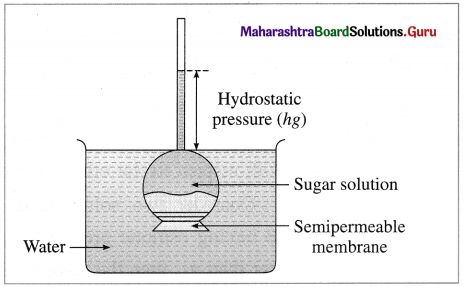
Maharashtra Board Class 12 Chemistry Solutions Chapter 2 Solutions 1
Osmosis and osmotic pressure

(2) Explanation : Consider an inverted thistle funnel on the mouth of which a semipermeable membrane is firmly fastened. It is filled with the experimental solution and immersed in a solvent like water. As a result, solvent molecules pass through the membrane into the solution in the funnel causing rising of level in the arm of thistle funnel. This increases the hydrostatic pressure. At a certain stage this rising level stops indicating an equilibrium between the rates of flow of solvent molecules from solvent to solution and from solution to solvent. The hydrostatic pressure at this stage represents osmotic pressure of the solution in the thistle funnel.

Question ii.
A solution concentration is expressed in molarity and not in molality while considering osmotic pressure. Why ?
Answer:

  1. While calculating osmotic pressure by equation, π = CRT, the concentration is expressed in molarity but not in molality.
  2. This is because the measurements of osmotic pressure are made at a certain constant temperature.
  3. Molarity depends upon temperature but molality is independent of temperature.
  4. Hence in osmotic pressure measurements, concentration is expressed in molarity.

Question iii.
Write the equation relating boiling point elevation to the concentration of solution.
Answer:
The elevation in the boiling point of a solution is directly proportional to the molal concentration (expressed in mol kg-1) of the solution.
Hence, if ΔTb is the elevation in the boiling point of a solution of molal concentration m then,
ΔTb ∝ m
∴ ΔTb = Kb m
where Kb is a proportionality constant.
If m = 1 molal,
ΔTb = Kb
Kb is called the ebullioscopic constant or molal elevation constant. Kb is characteristic of the solvent.

Question iv.
A 0.1 m solution of K2SO4 in water has freezing point of -0.43 °C. What is the value of van’t Hoff factor if Kf for water is 1.86 K kg mol-1?
Answer:
Given : m = 0.1 m, ΔTf = 0 – (-0.43) = 0.43 °C
Kf = 1.86 K kg mol-1, i = ?
ΔTf = i × Kf × m
∴ i = \(\frac{\Delta T_{\mathrm{f}}}{K_{\mathrm{f}} \times m}=\frac{0.43}{1.86 \times 0.1}\) = 2.312
van’t Hoff factor = i = 2.312

Maharashtra Board Class 12 Chemistry Solutions Chapter 2 Solutions

Question v.
What is van’t Hoff factor?
Answer:
Definition of the van’t Hoff factor, i : It is defined as a ratio of the observed colligative property of the solution to the theoretically calculated colligative property of the solution without considering molecular change.

The van’t Hoff factor can be represented as,

Maharashtra Board Class 12 Chemistry Solutions Chapter 2 Solutions 2

This colligative property may be the lowering of vapour pressure of a solution, the osmotic pressure, the elevation in the boiling point or the depression in the freezing point of the solution. Hence,
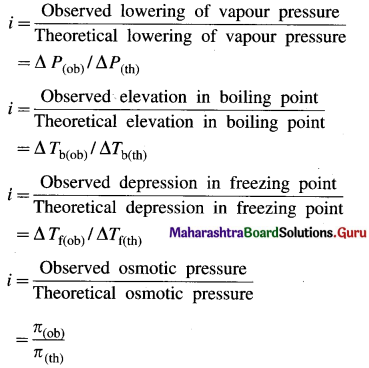
Maharashtra Board Class 12 Chemistry Solutions Chapter 2 Solutions 3

  • When the solute neither undergoes dissociation or association in the solution, then, i = 1
  • When the solute undergoes dissociation in the solution, then, i > 1
  • When the solute undergoes association in the solution, then i < 1

From the value of the van’t Hoff factor, the degree of dissociation of electrolytes, degree of association of nonelectrolytes can be obtained.

van’t Hoff factor gives the important information about the solute molecules in the solution and chemical bonding in them.

Question vi.
How is van’t Hoff factor related to degree of ionization?
Answer:
Consider 1 dm3 of a solution containing m moles of an electrolyte AxBy. The electrolyte on dissociation gives x number of Ay+ ions and y number of Bx- ions. Let α be the degree of dissociation.

At equilibrium,
AxBy ⇌ xAy+ + yBx-
For 1 mole of electrolyte : 1 – α,  xα,  yα
and For ‘m’ moles of an electrolyte : m(1 – α), mxα, myα are the number of particles.
Total number of moles at equilibrium, will be,
Total moles = m(1 – α) + mxα + myα
= m[(1 – α) + xα + yα]
= m[1 + xα + yα – α]
= m[1 + α(x + y – 1)]

The van’t Hoff factor i will be,
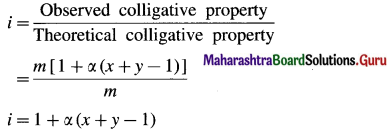
Maharashtra Board Class 12 Chemistry Solutions Chapter 2 Solutions 4
If total number of ions from one mole of electrolyte is denoted by n, then (x + y) = n
∴ i = 1 + α(n – 1)
∴ α(n – 1) = i – 1
∴ α = \(\frac{i-1}{n-1}\) ……(1)
This is a relation between van’t Hoff factor i and degree of dissociation of an electrolyte.

Question vii.
Which of the following solutions will have higher freezing point depression and why ?
a. 0.1 m NaCl b. 0.05 m Al2(SO4)3
Answer:
(1) Freezing point depression is a colligative property, hence depends on the number of particles in the solution.
(2) More the number of particles in the solution, higher is the depression in freezing point.
(3) The number of particles (ions) from electrolytes are,
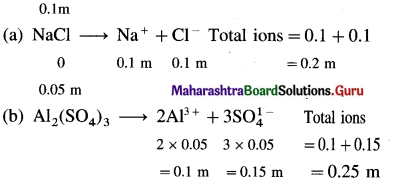
Maharashtra Board Class 12 Chemistry Solutions Chapter 2 Solutions 5
(4) Therefore Al2(SO4)3 solution will have higher freezing point depression.

Question viii.
State Raoult’s law for a solution containing a nonvolatile solute.
Answer:
Statement of Raoult’s law : The law states that the vapour pressure of a solvent over the solution of a nonvolatile solute is equal to the vapour pressure of the pure solvent multiplied by mole fraction of the solvent at constant temperature.

Maharashtra Board Class 12 Chemistry Solutions Chapter 2 Solutions

Question ix.
What is the effect on the boiling point of water if 1 mole of methyl alcohol is added to 1 dm3 of water? Why?
Answer:

  • The boiling point of water (or any liquid) depends on its vapour pressure.
  • Higher the vapour pressure, lower is the boiling point.
  • When 1 mole of volatile methyl alcohol is added to 1 dm3 of water, its vapour pressure is increased decreasing the boiling point of water.

Question x.
Which of the four colligative properties is most often used for molecular mass determination? Why?
Answer:

  1. Since osmotic pressure has large values, it can be measured more precisely.
  2. The osmotic pressure can be measured at a suitable constant temperature.
  3. The molecular masses can be measured more accurately.
  4. Therefore, it is more useful to determine molecular masses of expensive substances by osmotic pressure.

3. Answer the following.

Question i.
How vapour pressure lowering is related to a rise in boiling point of solution?
Answer:
(1) The boiling point of a liquid is the temperature at which the vapour pressure of the liquid becomes equal to the external pressure, generally 1 atm (101.3 × 10³ Nm-2).

(2) When a liquid is heated, its vapour pressure rises till it becomes equal to the external pressure.
If the liquid has a low vapour pressure, it has a higher boiling point.
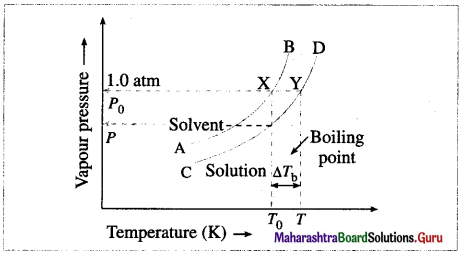
Maharashtra Board Class 12 Chemistry Solutions Chapter 2 Solutions 6
Vapour pressure curve showing elevation in boiling point

(3) When a nonvolatile solute is added to a solvent, its vapour pressure decreases, hence the boiling point increases.
This is explained by graphical representation of the vapour pressure and the boiling point of the pure solvent and the solution.

If T0 and T are the boiling points of a pure solvent and a solution, then the elevation in the boiling point is given by,
ΔTb = T – T0
The curve AB, represents the variation in the vapour pressure of a pure solvent with temperature while curve CD represents the variation in the vapour pressure of the solution.

(4) This elevation in the boiling point is proportional to the lowering of the vapour pressure, i.e., P0 – P, where P0 and P are the vapour pressures of the pure solvent and the solution.
[ΔTb ∝ (P0 – P) or ΔTb ∝ ΔP]

Question ii.
What are isotonic and hypertonic solutions?
Answer:
(1) Isotonic solutions : The solutions having the same osmotic pressure at a given temperature are called isotonic solutions.

Explanation : If two solutions of substances A and B contain nA and nB moles dissolved in volume V (in dm3) of the solutions, then their concentrations are,
CA = \(\frac{n_{\mathrm{A}}}{V}\) (in mol dm-3) and
CB = \(\frac{n_{\mathrm{B}}}{V}\) (in mol dm-3)

If the absolute temperature of both the solutions is T, then by the van’t Hoff equation,
πA = CART and πB = CBRT, where πA and πB are their osmotic pressures.
For the isotonic solutions,
πA = πB
∴ CA = CB
∴ \(\frac{n_{\mathrm{A}}}{V}=\frac{n_{\mathrm{B}}}{V}\)
∴ nA = nB
Hence, equal volumes of the isotonic solutions at the same temperature will contain equal number of moles (hence, equal number of molecules) of the substances.

(2) Hypertonic solutions : When two solutions have different osmotic pressures, then the solution having higher osmotic pressure is said to be a hypertonic solution with respect to the other solution.

Explanation : Consider two solutions of substances A and B having osmotic pressures πA and πB. If πB is greater than πA, then the solution B is a hypertonic solution with respect to the solution A.
Hence, if CA and CB are their concentrations, then CB > CA. Hence, for equal volume of the solutions, nB > nA.

Question iii.
A solvent and its solution containing a nonvolatile solute are separated by a semipermable membrane. Does the flow of solvent occur in both directions? Comment giving reason.
Answer:

  1. When a solvent and a solution containing a non-volatile solute are separated by a semipermeable membrane, there arises a flow of solvent molecules from solvent to solution as well as from solution to solvent.
  2. Due to higher vapour pressure of solvent than solution, the rate of flow of solvent molecules from solvent to solution is higher.
  3. As more and more solvent passes into solution due to osmosis, the solvent content increases, and the rate of backward flow increases.
  4. At a certain stage an equilibrium is reached where both the opposing rates become equal attaining an equilibrium.

Question iv.
The osmotic pressure of CaCl2 and urea solutions of the same concentration at the same temperature are respectively 0.605 atm and 0.245 atm. Calculate van’t Hoff factor for CaCl2.
Answer:
Given : πCacl2 = 0.605 atm;
πUrea = 0.245 atm
For urea solution, van’t Hoff factor, i = 1
πCacl2 = i × (CRT)Cacl2
πUrea = (CRT)Urea
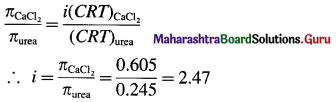
Maharashtra Board Class 12 Chemistry Solutions Chapter 2 Solutions 7
van’t Hoff factor = i = 2.47

Question v.
Explain reverse osmosis.
Answer:
Reverse osmosis : The phenomenon of the passage of solvent like water under high pressure from the concentrated aqueous solution like seawater into pure water through a semipermeable membrane is called reverse osmosis.

The osmotic pressure of seawater is about 30 atmospheres. Hence when pressure more than 30 atmospheres is applied on the solution side, regular osmosis stops and reverse osmosis starts. Hence pure water from seawater enters the other side of pure water.
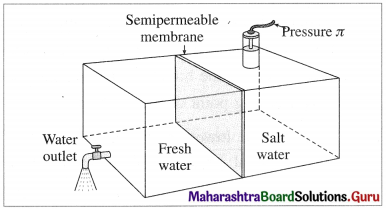
Maharashtra Board Class 12 Chemistry Solutions Chapter 2 Solutions 8
Purification of seawater by reverse osmosis

For this purpose of suitable semipermeable membrane is required which can withstand high pressure conditions over a long period.
This method is used successfully in Florida since 1981 producing more than 10 million litres of pure water per day.

Maharashtra Board Class 12 Chemistry Solutions Chapter 2 Solutions

Question vi.
How molar mass of a solute is determined by osmotic pressure measurement?
Answer:
Consider V dm3 (litres) of a solution containing W2 mass of a solute of molar mass M2 at a temperature T.
Number of moles of solute, n2 = \(\frac{W_{2}}{M_{2}}\)
The osmotic pressure π is given by,
π = \(\frac{W_{2} R T}{M_{2} V}\)
∴ M2 = \(\frac{W_{2} R T}{\pi V}\)
By measuring osmotic pressure of a solution, the molar mass of a solute can be calculated.
Since osmotic pressure can be measured more precisely, it is widely used to measure molar masses of the substances.

Question vii.
Why vapour pressure of a solvent is lowered by dissolving a nonvolatile solute into it?
Answer:
Lowering of vapour pressure of a solution :
When a nonvolatile solute is added to a pure solvent, the surface area is covered by the solute molecule decreasing the rate of evaporation, hence its vapour pressure decreases. This decrease in vapour pressure is called lowering of vapour pressure.

If P0 is the vapour pressure of a pure solvent (liquid) and P is the vapour pressure of the solution, where P < P0, then, (P0 – P) is the lowering of the vapour pressure.

Question viii.
Using Raoult’s law, how will you show that ∆P = \(\boldsymbol{P}_{1}^{0}\)x2 ? Where x2 is the mole fraction of solute in the solution and \(\boldsymbol{P}_{1}^{0}\) vapour pressure of pure solvent.
Answer:
If x1 and x2 are the mole fractions of solvent and solute respectively, then
x1 + x2
By Raoult’s law,
P = x1 × P0
where P0 is the vapour pressure of a pure solvent and P is the vapour pressure of the solution at given temperature.
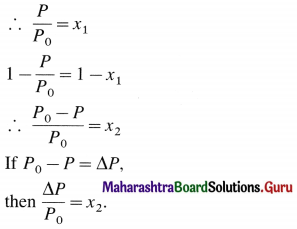
Maharashtra Board Class 12 Chemistry Solutions Chapter 2 Solutions 9

Question ix.
While considering boiling point elevation and freezing point depression a solution concentration is expressed in molality and not in molarity. Why?
Answer:

  • Boiling point elevation and freezing point depression involve temperature changes, (ΔTb and ΔTf).
  • Since molarity depends on temperature but molality is independent of temperature we use molality and not molarity in considering boiling point elevation and freezing point depression.

Question 4.
Derive the relationship between degree of dissociation of an electrolyte and van’t Hoff factor.
Answer:
Consider 1 dm3 of a solution containing m moles of an electrolyte AxBy. The electrolyte on dissociation gives number of Ay+ ions and y number of Bx- ions. Let α be the degree of dissociation.

At equilibrium,
AxBy ⇌ xAy+ + yBx-
For 1 mole of electrolyte : 1 – α, xα, yα and
For ‘m’ moles of an electrolyte : m(1 – α), mxα, myα are the number of particles.
Total number of moles at equilibrium, will be,
Total moles = m(1 – α) + mxα + myα
= m[(1 – α) + xα + yα]
= m[1 – xα + yα – α]
= m[1 + α(x + y – 1)]
The van’t Hoff factor i will be,
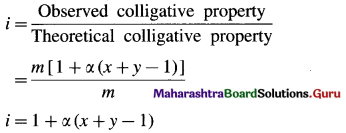
Maharashtra Board Class 12 Chemistry Solutions Chapter 2 Solutions 10
If total number of ions from one mole of electrolyte is denoted by n, then (x + y) = n
∴ i = 1 + α(n – 1)
∴ α(n – 1) = i – 1
∴ α = \(\frac{i-1}{n-1}\) ……..(1)
This is a relation between van’t Hoff factor i and degree of dissociation of an electrolyte.

Maharashtra Board Class 12 Chemistry Solutions Chapter 2 Solutions

Question 5.
What is effect of temperature on solubility of solids in water? Give examples.
Answer:
The solubility of a solid solute depends upon temperature.
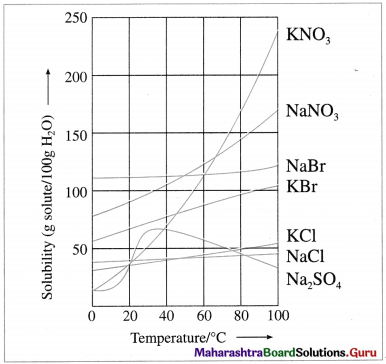
Maharashtra Board Class 12 Chemistry Solutions Chapter 2 Solutions 11
Variation of solubilities of some ionic solids with temperature

  • Generally rise in temperature increases the solubility. This is due to expansion of holes or empty spaces in the liquid solvent. Generally 10 °C rise in temperature, increases the solubility of solids two fold.
  • Dissolution process may be endothermic or exothermic.
  • The solubility of the substances like NaBr, NaCl, KCl, etc. changes slightly with the increase in temperature.
  • The solubility of the salts like NaNO3, KNO3, KBr, etc. increases appreciably with the increase in temperature.
  • The solubility of Na2SO4 first increases and after 30 °C decreases with the increase in temperature.

This variation in solubility with temperature can be used to separate the salts from the mixture by fractional crystallisation.

Question 6.
Obtain the relationship between freezing point depression of a solution containing nonvolatile nonelectrolyte and its molar mass.
Answer:
The freezing point depression, ΔTf of a solution is directly proportional to molality (m) of the solution.
∴ ΔTf ∝ m
∴ ΔTf = Kf m
where Kf is a molal depression constant.
The molality of a solution is given by,

Maharashtra Board Class 12 Chemistry Solutions Chapter 2 Solutions 12
If W1 grams of a solvent contain W2 grams of a solute of the molar mass M2, then the molality m of the solution is given by,
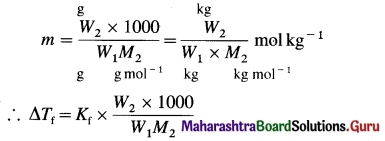
Maharashtra Board Class 12 Chemistry Solutions Chapter 2 Solutions 13
If the weights are expressed in kg then,
ΔTf = Kf × \(\frac{W_{2}}{W_{1} M_{2}}\)
The unit of Kf is K kg mol-1
Hence, from the measurement of the depression in the freezing point of the solution, the molar mass of the substance can be determined.

Question 7.
Explain with diagram the boiling point elevation in terms of vapour pressure lowering.
Answer:
(1) The boiling point of a liquid is the temperature at which the vapour pressure of the liquid becomes equal to the external pressure, generally 1 atm (101.3 × 10³ Nm-2).

(2) When a liquid is heated, its vapour pressure rises till it becomes equal to the external pressure.
If the liquid has a low vapour pressure, it has a higher boiling point.
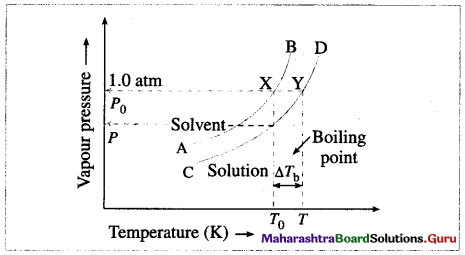
Maharashtra Board Class 12 Chemistry Solutions Chapter 2 Solutions 14
Vapour pressure curve showing elevation in boiling point

(3) When a nonvolatile solute is added to a solvent, its vapour pressure decreases, hence the boiling point increases.
This is explained by graphical representation of the vapour pressure and the boiling point of the pure solvent and the solution.

If T0 and T are the boiling points of a pure solvent and a solution, then the elevation in the boiling point is given by,
ΔTb = T – T0
The curve AB, represents the variation in the vapour pressure of a pure solvent with temperature while curve CD represents the variation in the vapour pressure of the solution.

(4) This elevation in the boiling point is proportional to the lowering of the vapour pressure, i.e., P0 – P, where P0 and P are the vapour pressures of the pure solvent and the solution.
[ΔTb ∝ (P0 – P) or ΔTb ∝ ΔP]

Question 8.
Fish generally needs O2 concentration in water at least 3.8 mg/L for survival. What partial pressure of O2 above the water is needed for the survival of fish? Given the solubility of O2 in water at 0 °C and 1 atm partial pressure is 2.2 × 10⁻³ mol/L (0.054 atm)
Answer:
Given : Required concentration of O2
= 3.8 mg/L
= \(\frac{3.8 \times 10^{-3}}{32} \mathrm{~mol} \mathrm{~L}^{-1}\)
Solubility of O2 = 2.2 × 10⁻³ mol L-1
P = 1 atm
Partial pressure of O2 needed = Po2 = ?
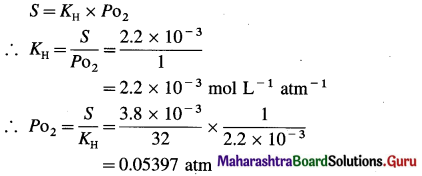
Maharashtra Board Class 12 Chemistry Solutions Chapter 2 Solutions 15
Pressure needed = Po2 = 0.05397 atm.

Question 9.
The vapour pressure of water at 20 °C is 17 mm Hg. What is the vapour pressure of solution containing 2.8 g urea in 50 g of water? (16.17 mm Hg)
Answer:
Given : Vapour pressure of pure solvent (water) = P0
= 17 mm Hg
Weight of solvent = W1 = 50 g
Weight of solute (urea) = 2.8 g
Molecular weight of a solvent = M1 = 18
Molecular weight of a solute (urea) = M2
= 60 g mol-1
\(\frac{P_{0}-P}{P_{0}}=\frac{W_{2} \times M_{1}}{W_{1} \times M_{2}}\)
∴ \(\frac{17-P}{17}=\frac{2.8 \times 18}{50 \times 60}\) = 0.0168
∴ 17 – P = 17 × 0.0168
17 – P = 0.2856
∴ P= 17 – 0.2856
= 16.7144 mm Hg
Vapour pressure of solution = 16.7144 mm Hg

Maharashtra Board Class 12 Chemistry Solutions Chapter 2 Solutions

Question 10.
A 5% aqueous solution (by mass) of cane sugar (molar mass 342 g/mol) has freezing point of 271K. Calculate the freezing point of 5% aqueous glucose solution.
Answer:
Given : W2 = 5 g cane sugar; W1 = 100 – 5 = 95 g
M2 = 342 g mol-1; Tf1 = 271 K;
ΔTf1 = 273 – 271 = 2 K; Tf = ?
W2 = 5 g glucose, W’1 = 100 – 5 = 95 g,
M’2 = 180 g mol-1, ΔTf2 = ?
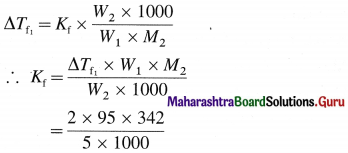
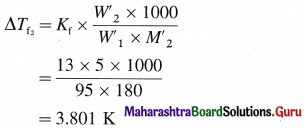
Maharashtra Board Class 12 Chemistry Solutions Chapter 2 Solutions 16
= 12.996 K kg mol-1
≅ 13 K kg mol-1
Maharashtra Board Class 12 Chemistry Solutions Chapter 2 Solutions 17
∴ Freezing point of solution = Tf
= 273 – 3.801 = 269.2 K
Freezing point of solution = 269.2 K.

Question 11.
A solution of citric acid C6H8O7 in 50 g of acetic acid has a boiling point elevation of 1.76 K. If Kb for acetic acid is 3.07 K kg mol-1, what is the molality of solution?
Answer:
Given : W1 = 50 g acetic acid
ΔTb = 1.76 K
Kb = 3.07 K kg mol-1
m = ?
ΔTb = Kb × m
∴ m = \(\frac{\Delta T_{\mathrm{b}}}{K_{\mathrm{b}}}\)
= \(\frac{1.76}{3.07}\)
= 0.5733 m
Molality of solution = 0.5733 m

Question 12.
An aqueous solution of a certain organic compound has a density of 1.063 gmL-1, an osmotic pressure of 12.16 atm at 25°C and a freezing point of -1.03°C. What is the molar mass of the compound? (334 g/mol)

Question 13.
A mixture of benzene and toluene contains 30% by mass of toluene. At 30°C, vapour pressure of pure toluene is 36.7 mm Hg and that of pure benzene is 118.2 mm Hg. Assuming that the two liquids form ideal solutions, calculate the total pressure and partial pressure of each constituent above the solution at 30°C.
Answer:
Given : 30% by mass of toluene (T) and 70% by mass of benzene (B).
WT = 30 g; WB = 70g
\(P_{\mathrm{T}}^{0}\) = 36.7 mm Hg; \(P_{\mathrm{B}}^{0}\) = 118.2 mm Hg
MT = 92 g mol-1; MB = 78 g mol-1
PT = ?, PB = ?, Psoln = ?
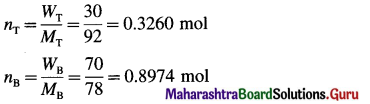
Maharashtra Board Class 12 Chemistry Solutions Chapter 2 Solutions 18
Total number of moles = nTotal = nT + nB
= 0.326 + 0.8974
= 1.2234 mol

Mole fractions :
xT = \(\frac{n_{\mathrm{T}}}{n_{\text {Total }}}=\frac{0.326}{1.2234}\) = 0.2665
xB = 1 – 0.2665 = 0.7335
Psoln = xT + \(P_{\mathrm{T}}^{0}\) + xB × \(P_{\mathrm{B}}^{0}\)
= 0.2665 × 36.7 + 0.7335 × 118.2
= 9.780 + 86.7
= 96.48 mm Hg

Partial pressures :
PT = xT × Psoln
= 0.2665 × 96.48
= 25.71 mm Hg
PB = xB × Psoln
= 0.7335 × 96.48
= 70.77 mm Hg
Total pressure Psoln = 96.48 mm Hg
Partial pressures : PToluene = 25.71 mm Hg
PBenzene = 70.77 mm Hg

Maharashtra Board Class 12 Chemistry Solutions Chapter 2 Solutions

Question 14.
At 25 °C a 0.1 molal solution of CH3COOH is 1.35% dissociated in an aqueous solution. Calculate freezing point and osmotic pressure of the solution assuming molality and molarity to be identical.
Answer:
Given : T = 273 + 25 = 298 K
C = 0.1 m ≅ 0.1 M; Kf = 1.86 K kg mol-1
Per cent dissociation = 1.35
Freezing point = tf = ?
π = ?
α = \(\frac{1.35}{100}\) = 0.0135

Maharashtra Board Class 12 Chemistry Solutions Chapter 2 Solutions 19
i = 1 – α + α + α = 1 + α = 1 + 0.0135 = 1.0135
(i) ΔTf = i × Kf × m
= 1.0135 × 1.86 × 0.1
= 0.1885 °C
∴ Freezing point of solution = 0 – 0.1885
= – 0.1885 °C

(ii) n = iCRT
= 1.035 × 0.1 × 0.08206 × 298
= 2.53 atm

(i) Freezing point of solution = – 0.1885 °C
(ii) Osmotic pressure = π = 2.53 atm

Question 15.
A 0.15 m aqueous solution of KCl freezes at -0.510 °C. Calculate i and osmotic pressure at 0 °C. Assume volume of solution equal to that of water.
Answer:
Given : c = 0.15 m KCl ≅ 0.15 M KCl
ΔTf = 0 – Tf = 0 – (-0.510) = 0.510 °C
T = 273 K; Kf = 1.86 K kg mol-1
i = ?; π = ?
ΔTf = i × Kf × m
∴ i = \(\frac{\Delta T_{\mathrm{f}}}{K_{\mathrm{f}} \times m}\)
= \(\frac{0.510}{1.86 \times 0.15}\)
= 1.828
π = iCRT
= 1.828 × 0.15 × 0.08206 × 273
= 6.143 atm
i = 1.828, Osmotic pressure = π = 6.143 atm

12th Chemistry Digest Chapter 2 Solutions Intext Questions and Answers

Can you tell ? (Textbook Page No. 29)

Question 1.
Why naphthalene dissolves in benzene but not in water ?
Answer:
Since naphthalene is a covalent nonpolar substance, it is soluble in a nonpolar solvent like benzene but insoluble in polar solvent like water.

Question 2.
Anhydrous sodium sulphate dissolves in water with the evolution of heat. What is the effect of temperature on its solubility ?
Answer:
Since the dissolution of anhydrous sodium sulphate in water is an exothermic process due to evolution of heat, according to Le Chatelier’s principle its solubility decreases with the increase in temperature.

(Textbook Page No. 42)

Question 1.
If 1.25 m sucrose solution has ΔTf of 2.32 °C, what will be the expected value of ΔTf for 1.25 m CaCl2 solution?
Answer:
Sucrose being nonelectrolyte, it has i = 1 but for CaCl2,
(CaCl2 → Ca2+ + 2Cl) the value of i = 3.
Hence
ΔTf = i × 2.32
= 3 × 2.32
= 6.92 °C
∴ ΔTf = 6.92 °C.

(Textbook Page No. 44)

Question 1.
Which of the following solutions will have maximum boiling point elevation and which have minimum freezing point depression assuming the complete dissociation? (a) 0.1m KCl (b) 0.05 m NaCl (c) 1 m AlPO4 (d) 0.1 m MgSO4.
Solution :
Boiling point elevation and freezing point depression are colligative properties that depend on number of particles in solution. The solution having more number of particles will have large boiling point elevation and that having less number of particles would show minimum freezing point depression.
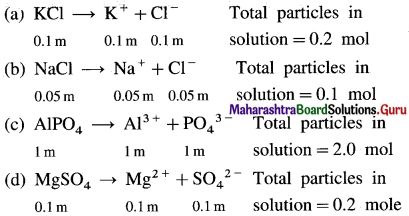
Maharashtra Board Class 12 Chemistry Solutions Chapter 2 Solutions 20
AlPO4 solution contains highest moles and hence highest number particles and in turn, the maximum ΔTb. NaCl solution has minimum moles and particles, it has minimum ΔTf.

Maharashtra Board Class 12 Chemistry Solutions Chapter 2 Solutions

Question 2.
Arrange the following solutions in order of increasing osmotic pressure. Assume complete ionization. (a) 0.5 m Li2SO4 (b) 0.5 m KCl (c) 0.5 m Al2(SO4)3 (d) 0.1 m BaCl2.
Answer:
Consider 1 dm3 of each solution.
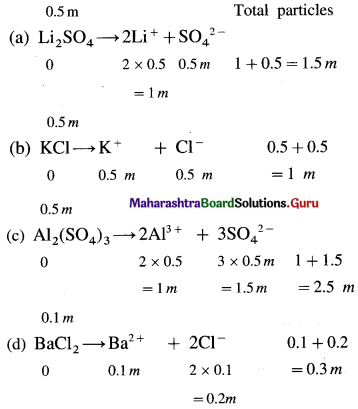
Maharashtra Board Class 12 Chemistry Solutions Chapter 2 Solutions 21
Osmotic pressure being a colligative property, it depends on number of particles in the solution.
Therefore, increasing order of osmotic pressure is,

Maharashtra Board Class 12 Chemistry Solutions Chapter 2 Solutions 22

Maharashtra Board Class 12 Secretarial Practice Important Questions Chapter 11 Financial Market

Balbharti Maharashtra State Board Class 12 Secretarial Practice Important Questions Chapter 11 Financial Market Important Questions and Answers.

Maharashtra State Board 12th Secretarial Practice Important Questions Chapter 11 Financial Market

1A. Select the correct answer from the options given below and rewrite the statements.

Question 1.
A ___________ is an institution that facilitates exchange of financial instruments.
(a) Capital Market
(b) Financial Market
(c) Money Market
Answer:
(b) Financial Market

Question 2.
The ___________ market contributes to the national growth by ensuring a continuous flow of surplus funds to deficit units.
(a) Financial
(b) Money
(c) Secondary
Answer:
(a) Financial

Maharashtra Board Class 12 Secretarial Practice Important Questions Chapter 11 Financial Market

Question 3.
The market which provides short term funds is ___________
(a) Capital Market
(b) Sold Market
(c) Money Market
Answer:
(c) Money Market

Question 4.
The maturity period of commercial bills is ___________ days.
(a) 90
(b) 92
(c) 96
Answer:
(a) 90

Question 5.
___________ are debt instruments that are issued by corporate houses for raising short term financial resources.
(a) Commercial papers
(b) Treasury bills
(c) Government securities
Answer:
(a) Commercial papers

Question 6.
The maturity period of Treasury bill is ___________ days.
(a) 192
(b) 182
(c) 172
Answer:
(b) 182

Question 7.
The debt instruments which are issued by the corporate houses to raise funds from the money market is ___________
(a) Certificate of deposit
(b) Preference shares
(c) Commercial papers
Answer:
(c) Commercial papers

Maharashtra Board Class 12 Secretarial Practice Important Questions Chapter 11 Financial Market

Question 8.
___________ deals in medium and long term funds.
(a) Capital Market
(b) Gold Market
(c) Money Market
Answer:
(a) Capital Market

Question 9.
The repurchase rate which is also known as the official bank rate is ___________ rate.
(a) Repo
(b) Credit
(c) Interest
Answer:
(a) Repo

Question 10.
___________ bills enjoy a high degree of liquidity.
(a) Treasury
(b) Commercial
(c) Publicity
Answer:
(a) Treasury

Question 11.
___________ is also known as new issue market.
(a) Primary Market
(b) Secondary Market
(c) Financial Market
Answer:
(a) Primary Market

Question 12.
The Market which is also known as the government securities market is ___________ market.
(a) Primary
(b) Secondary
(c) Gilt-edged
Answer:
(c) Gilt-edged

Question 13.
A market where existing securities are resold or traded is called ___________ market.
(a) Commodity
(b) Secondary
(c) Primary
Answer:
(b) Secondary

Maharashtra Board Class 12 Secretarial Practice Important Questions Chapter 11 Financial Market

Question 14.
A financial market is a link between investor and ___________
(a) borrowers
(b) creditors
(c) capitalists
Answer:
(a) borrowers

Question 15.
___________ plays an important role in the financial system of a country.
(a) Capital Market
(b) Money Market
(c) Financial Market
Answer:
(a) Capital Market

Question 16.
The market which provides short term fund is ___________
(a) Capital Market
(b) Gold Market
(c) Money Market
Answer:
(c) Money Market

Question 17.
The market which deals in medium-term and long-term credit or fund is called ___________
(a) Money Market
(b) Capital Market
(c) Gold Market
Answer:
(b) Capital Market

Question 18.
A security market in which new issues of securities (i.e. shares and debentures) are arranged or organized is called ___________ market.
(a) Primary
(b) Secondary
(c) Bullion
Answer:
(a) Primary

Question 19.
In Money Market, funds can be traded for a maximum period of ___________ year/s.
(a) one
(b) five
(c) two
Answer:
(a) one

Maharashtra Board Class 12 Secretarial Practice Important Questions Chapter 11 Financial Market

Question 20.
The debt instruments which are issued by the corporate houses to raise funds from the money market is ___________
(a) Certificate of deposit
(b) Preference shares
(c) Commercial Papers
Answer:
(c) Commercial Papers

Question 21.
___________ is the most common method to meet the credit needs of trade and industry.
(a) Commercial papers
(b) Treasury bills
(c) Commercial bills
Answer:
(c) Commercial bills

Question 22.
The liquidity is ___________ in case of commercial bills.
(a) high
(b) low
(c) constant
Answer:
(a) high

Question 23.
The repurchase rate which is also known as the official bank rate is ___________ rate.
(a) Repo
(b) Credit
(c) Interest
Answer:
(a) Repo

Question 24.
The market which is also known as the government securities market is ___________ market.
(a) Primary
(b) Secondary
(c) Gilt-edged
Answer:
(c) Gilt-edged

Maharashtra Board Class 12 Secretarial Practice Important Questions Chapter 11 Financial Market

Question 25.
Under ___________ the shares of a company are sold among the selected group of persons.
(a) Right issue
(b) Private placement
(c) Public issue
Answer:
(b) Private placement

Question 26.
A market where existing securities are resold or traded is called ___________ market.
(a) commodity
(b) secondary
(c) primary
Answer:
(b) secondary

1B. Match the pairs.

Question 1.

Group ‘A’Group ‘B’
(1) Treasury bill(a) Primary market
(2) Commercial bill(b) Long term credit
(3) New Issue(c) Mobilization of funds
(4) Stock Exchange(d) Promissory note
(5) Financial Market(e) Short term credit
(f) Secondary market
(g) Central Government
(h) Deals only with brokers
(i) New banking institution
(j) Mutual Fund

Answer:

Group ‘A’Group ‘B’
(1) Treasury bill(d) Promissory note
(2) Commercial bill(e) Short term credit
(3) New Issue(a) Primary market
(4) Stock Exchange(f) Secondary market
(5) Financial Market(c) Mobilization of funds

Question 2.

Group ‘A’Group ‘B’
(1) Money Market(a) Most common method to meet credit needs
(2) Commercial bills(b) Primary Market
(3) Repo rate(c) Interest
(4) Gilt-edged market(d) Government securities market
(5) Secondary market(e) Official bank rate
(f) Treasury bills
(g) Financial market
(h) Short term funds are borrowed and lent
(i) Stock exchange
(j) Fewer applications than expected

Answer:

Group ‘A’Group ‘B’
(1) Money Market(h) Short term funds are borrowed and lent
(2) Commercial bills(a) Most common method to meet credit needs
(3) Repo rate(e) Official bank rate
(4) Gilt-edged market(d) Government securities market
(5) Secondary market(i) Stock exchange

1C. Write a word or a term or a phrase that can substitute each of the following statements.

Question 1.
A market that provides long-term funds.
Answer:
Capital Market

Question 2.
An intermediary between the lender and borrower.
Answer:
Financial Market

Question 3.
A market where short-term funds are borrowed and lent.
Answer:
Money Market

Maharashtra Board Class 12 Secretarial Practice Important Questions Chapter 11 Financial Market

Question 4.
A debt instrument issued by the corporate house for raising the short-term funds from the money market.
Answer:
Commercial Paper

Question 5.
Short-term instrument issued by a commercial bank and special financial institution.
Answer:
Certificate of deposit

Question 6.
A type of bill in the nature of promissory note issued by the government.
Answer:
Treasury bill

Question 7.
A market for borrowing and lending long-term capital is required by the business enterprises.
Answer:
Capital Market

Question 8.
The market deals in the issue of new securities.
Answer:
Primary Market

Question 9.
The government securities market is for government and semi-government securities.
Answer:
Gilt-edged Security Market

Question 10.
The equity shares of the companies are issued to the existing equity shareholders.
Answer:
Right Issue

Question 11.
A marketplace where the existing securities are bought and sold.
Answer:
Secondary Market

Maharashtra Board Class 12 Secretarial Practice Important Questions Chapter 11 Financial Market

Question 12.
The place where buying and selling of securities take place.
Answer:
Stock Exchange

Question 13.
The institution which regulates business in the stock exchange.
Answer:
SEBI

Question 14.
A market for financial assets which are close substitutes for money.
Answer:
Money Market

Question 15.
A market where short-term funds are borrowed and lent.
Answer:
Money Market

Question 16.
A market for borrowing and lending long-term capital is required by the business enterprises.
Answer:
Capital Market

Question 17.
A debt instrument issued by the corporate house for raising the short-term funds from the money market.
Answer:
Commercial Paper

Question 18.
The negotiable term deposit certificates are issued by the financial institutions at discount, at market rate, or at par.
Answer:
Certificate of deposit

Question 19.
A type of bill in the nature of promissory note issued by the government.
Answer:
Treasury Bill

Maharashtra Board Class 12 Secretarial Practice Important Questions Chapter 11 Financial Market

Question 20.
The bill is issued by the government for raising short-term funds to bridge the gap between receipts and expenditure.
Answer:
Treasury Bill

Question 21.
A market where productive capital is raised and made available for industrial purposes.
Answer:
Capital Market

Question 22.
A market for government and semi-government securities.
Answer:
Gilt-edged Market

Question 23.
The market is utilized for raising fresh capital in the form of shares and debentures.
Answer:
Primary Market

Question 24.
The equity shares of the companies are issued to the existing equity shareholders.
Answer:
Right Issue

Question 25.
The most popular method of raising long-term securities by offering them to the public by using a prospectus.
Answer:
Public Issue

Maharashtra Board Class 12 Secretarial Practice Important Questions Chapter 11 Financial Market

Question 26.
A marketplace where the existing securities are bought and sold.
Answer:
Secondary/Stock Market

1D. State whether the following statements are true or false.

Question 1.
Money market Facilitates mobilization of funds.
Answer:
False

Question 2.
Repo Rate is known as an official bank Rate.
Answer:
True

Question 3.
The financial market does not contribute towards nations’ growth and development.
Answer:
False

Question 4.
Commercial bill is a common method to meet long term needs of industry.
Answer:
False

Question 5.
Reverse Repo Rate is similar to Repo Rate.
Answer:
False

Question 6.
MMMF is a part of the capital market.
Answer:
False

Question 7.
The financial market brings together borrowers and lenders.
Answer:
True

Maharashtra Board Class 12 Secretarial Practice Important Questions Chapter 11 Financial Market

Question 8.
Certificate of deposit is a part of the money market.
Answer:
True

1E. Find the odd one.

Question 1.
91 days, 182 days, 365 days
Answer:
365 days

Question 2.
Share, debentures, MMMF’s
Answer:
MMMF’s

Question 3.
Treasury Bill, certificate of deposit, bond
Answer:
Bond

Question 4.
Share, debenture, commercial paper
Answer:
Commercial paper

Question 5.
SEBI, RBI, SIDBI
Answer:
SIDBI

Maharashtra Board Class 12 Secretarial Practice Important Questions Chapter 11 Financial Market

Question 6.
Commercial paper, certificate of deposit, bond
Answer:
Bond

Question 7.
Preference share, Equity shares, commercial bill
Answer:
Commercial Bill

1F. Complete the sentences.

Question 1.
Financial Assets are exchanged in a ___________
Answer:
Financial Market

Question 2.
___________ is dealing with second hand issue.
Answer:
Secondary Market

Question 3.
Money Market is Regulated by ___________
Answer:
RBI

Question 4.
The instruments of ___________ can easily converted into cash.
Answer:
Money Market

Maharashtra Board Class 12 Secretarial Practice Important Questions Chapter 11 Financial Market

Question 5.
___________ is an unsecured promissory note issued by companies.
Answer:
Commercial Paper

Question 6.
Secondary market is commonly called as ___________
Answer:
Stock Exchange

Question 7.
___________ Market increases liquidity of fund in the economy.
Answer:
Money

Question 8.
___________ is dealing with mobilisation of fund.
Answer:
Capital Market

Question 9.
Derivative market is specially designed to ___________
Answer:
derivatives

Question 10.
___________ are the intermediary of primary market.
Answer:
Underwriters

Question 11.
___________ is also known as new issue market.
Answer:
Primary Market

Question 12.
___________ are the intermediary of Secondary Market.
Answer:
Security brokers

Maharashtra Board Class 12 Secretarial Practice Important Questions Chapter 11 Financial Market

Question 13.
In ___________ risk factor is very less.
Answer:
Money Market

Question 14.
Government security market is also called as ___________
Answer:
Gilt Edged Market

Question 15.
Private companies deal their securities in ___________
Answer:
Industrial Security Market

1G. Select the correct option from the bracket.

Question 1.

Group ‘A’Group ‘B’
(1) ………………….(a) Promissory note
(2) …………………(b) short term credit
(3) New Issue(c) ……………….
(4) Stock Exchange(d) ………………

(Commercial bill, Treasury bill, Secondary market, Primary market)
Answer:

Group ‘A’Group ‘B’
(1) Treasury Bill(a) Promissory note
(2) Commercial Bill(b) short term credit
(3) New Issue(c) Primary Market
(4) Stock Exchange(d) Secondary Market

Question 2.

Group ‘A’Group ‘B’
(1) Financial Market(a) ………………….
(2) Money Market(b) …………………
(3) ………………….(c) Primary Market
(4) ………………….(d) Commercial Paper
(5) Capital Market(e) …………………

(Financial Securities, Short Term, Neiv issue, unsecured promissory note, long term)
Answer:

Group ‘A’Group ‘B’
(1) Financial Market(a) Financial Securities
(2) Money Market(b) Short term
(3) New Issue(c) Primary Market
(4) Unsecured promissory Note(d) Commercial Paper
(5) Capital Market(e) Long Term

Question 3.

Group ‘A’Group ‘B’
(1) ………………….(a) Gilt-edged Market
(2) …………………(b) Repo Rate
(3) Commercial bills(c) ……………………
(4) Money market(d) …………………..

(Short term, most common method to meet credit needs, official bank rate, Government securities)
Answer:

Group ‘A’Group ‘B’
(1) Government securities(a) Gilt-edged Market
(2) Official Bank Rate(b) Repo Rate
(3) Commercial bills(c) Most common method to meet credit needs
(4) Money market(d) short term

1H. Answer in one sentence.

Question 1.
What is Repo Rate?
Answer:
This is a rate at which commercial banks borrow money from the central bank (RBI).

Maharashtra Board Class 12 Secretarial Practice Important Questions Chapter 11 Financial Market

Question 2.
What is a Secondary Market?
Answer:
It is the market where existing securities are resold. It is also called as the stock market.

Question 3.
What is a Treasury bill?
Answer:
It is a short-term security issued by RBI on behalf of the Central Government of India to meet government short-term fund requirements.

Question 4.
What is commercial paper?
Answer:
Commercial paper is an unsecured debt instrument issued by companies to build short-term finance.

Question 5.
What is the Gilt-edged market?
Answer:
The gilt-edged market is the market where government securities are traded. This market deals in government and semi-government securities.

1I. Correct the underlined word/s and rewrite the following sentences.

Question 1.
Treasury bills are issued by companies.
Answer:
Commercial papers are issued by companies.

Question 2.
Capital Market builds finance for the short term.
Answer:
Money Market builds finance for the short term.

Question 3.
Gilt edge market deals with corporate securities.
Answer:
Industrial Securities Market deals with corporate securities.

Question 4.
The government uses commercial bills to build short-term finance.
Answer:
Treasury Bills uses commercial bills to build short-term finance.

Maharashtra Board Class 12 Secretarial Practice Important Questions Chapter 11 Financial Market

Question 5.
Mutual Fund deals in Money Market.
Answer:
Money Market Mutual Fund deals in Money Market.

Question 6.
The minimum value of the commercial paper is 6 lakhs.
Answer:
The minimum value of the commercial paper is 5 lakhs.

Question 7.
Trade Bills are unsecured negotiable promissory notes issued by Banks.
Answer:
Certificate of deposits is an unsecured negotiable promissory note issued by Banks.

Question 8.
Underwriters are the intermediary of the secondary market.
Answer:
Security Brokers are the intermediary of the secondary market.

Question 9.
Direct Investment took place in the secondary market.
Answer:
Indirect Investment took place in the secondary market.

Question 10.
In the primary market security price is fixed by Demand and supply.
Answer:
In the Secondary market security price is fixed by Demand and supply.

Question 11.
Primary Market the parties dealing in this market are the only investors.
Answer:
Secondary Market the parties dealing in this market are the only investors.

Maharashtra Board Class 12 Secretarial Practice Important Questions Chapter 11 Financial Market

1J. Arrange in proper order.

Question 1.
Arrange the given instruments by using minimum amount Criteria:
(a) Certificate of deposit
(b) Commercial paper
(c) Treasury Bill
Answer:
(a) Treasury Bill
(b) Certificate of deposit
(c) Commercial paper

Question 2.
Arrange the following instruments on the basis of ‘Year of the beginning’:
(a) Commercial papers
(b) Certificate of deposits
(c) Treasury bills
Answer:
(a) Treasury bills [1990]
(b) Certificate of deposits [1989]
(c) Commercial papers [1917]

Question 3.
Arrange the following securities on the basis of redemption:
(a) Preference shares
(b) Equity shares
(c) Debentures
Answer:
(a) Debentures
(b) Preference shares
(c) Equity shares

2. Explain the following terms/concepts.

Question 1.
Private Placement
Answer:
Private placement means when a company offers its securities to a selected group of persons identified by the board excluding qualified institutional buyers and employees not exceeding 200. This helps the company to raise funds quickly and economically

Question 2.
Government Securities
Answer:

  • The marketable debt issued by the government, semi-government which represents claims on the government is known as ‘Government Securities’.
  • These securities are safe as payment of interest & repayment of principal amount are guaranteed.

Maharashtra Board Class 12 Secretarial Practice Important Questions Chapter 11 Financial Market

Question 3.
Repo Rate
Answer:

  • Repo is an agreement where the seller of a security agrees to buy it back from the lender at a higher price on a future date.
  • This agreement is made between RBI and commercial banks. Here, commercial banks borrow from RBI.

Question 4.
Reverse Repo Rate
Answer:

  • Reverse Repo rate is the rate at which RBI borrows from commercial banks.
  • Reverse Repo rate is always less than Repo Rate.

Question 5.
Gilt-edged market
Answer:
The gilt-edged market is the market where government securities are traded. This market deals in government and semi-government securities.

Question 6.
Money Market Mutual Fund
Answer:
Money Market Mutual Funds (MMMFs):
A Mutual Fund which invests in Money market instruments like Call Money, Repos, T-bills, CDs, etc. is called as MMMFs. This type of Mutual Fund invests in debt instruments that mature in less than 1 year and have low risk. Individuals and corporates are allowed to invest in MMMFs.

3. Study the following case/situation and express your opinion.

1. M/s. Radheshyam company wants short-term loans (Borrowing) to meet its working capital needs. Hence as an expert advice M/s. Radheshyam on the following matters.

Question (a).
Can a company select a capital market to complete its working capital needs?
Answer:
No, Company cannot select a capital market to meet working capital requirements. A company should go for the money market.

Question (b).
If a company selects the money market, the names of the instruments through which short-term finance can be build up?
Answer:
If company select money market option, it can build up finance through Trade bill, commercial papers and MMMF’s.

Question (c).
Is completion of working capital needs important to Radhaeshyam Company?
Answer:
Yes, completion of working capital needs important to Radheshyam company. Because working capital needs are daily needs of the business. Once it is completed production cycle can work better.

Maharashtra Board Class 12 Secretarial Practice Important Questions Chapter 11 Financial Market

2. Government of India wants short-term finance to deal with the short-term deficit condition. Advice the government on the following.

Question (a).
Name of the instrument through which government can build up short-term finance?
Answer:
Treasury bill is the best option to build short-term finance for the Government. It can be issued for 91 days, 182 days, and 364 days.

Question (b).
What will be the minimum amount of investment in the Treasury bill?
Answer:
The minimum amount of investment in treasury bills is ₹ 25,000.

Question (c).
Method of issue of Treasury bill.
Answer:
Treasury bills are issued at discount and repaid at par. Hence it is also caused as a ‘zero’ coupon bond.

4. Distinguish between the following.

Question 1.
Commercial Bills and Treasury Bills
Answer:

PointsCommercial BillsTreasury Bills
1. MeaningCommercial Bills are the money market instruments that are created to fulfill the credit needs of Trade and Industry.Treasury bills are the money market instruments that are created to fulfill the credit needs of the government.
2. Nature of instrumentThey are in the form of a bill of Exchange.They are in the form of promissory notes.
3. Maturity PeriodThe maturity period is 3 months/90 days.The maturity period of treasury bills is 91 days, 182 days, 364 days.
4. BorrowerBlue Chip companies or big business organizations are the borrowers.Government is the borrower.
5. Development of marketThe commercial bill market has not much developed in the money market.Treasury bills have developed in the money market due to government support.

Question 2.
Repo Rate and Reverse Repo Rate
Answer:

PointsRepo RateReverse Repo Rate
1. MeaningIt is the interest rate at which the central bank repurchases the Government Securities.It is the interest rate at which commercial banks repurchase the Government Securities.
2. LevelRepo Rate is always higher than Reverse Repo Rate.Reverse Repo rate is always lower than Repo Rate.
3. InitiativeIt is carried out by the central bank.It is carried out by a commercial bank.
4. Current RateThe current Repo Rate as of February 2020 is 5.15%.The current Reverse Repo Rate as of February 2020 is 4.90%.
5. Lender and BorrowerHere, the lender is RBI and Borrower is a commercial Bank.Here, the lender is a commercial Bank and Borrower is RBI.
6. Borrower’s objectiveIts main objective is to manage short-term deficiency of funds.Its main objective is to reduce the overall supply of money in the economy.

5. Answer in brief.

Question 1.
Write a note on the importance of the financial market.
Answer:
Role: A financial market is of great use for a country as it helps the economy in the following ways:
(i) Saving Mobilization:
Obtaining funds from surplus units such a households individuals, public sector units, central government, etc and channelizing their funds or productive purposes.

(ii) Investments:
The financial market plays an important role in arranging to invest funds thus, collected in those units which are in need of the funds.

(iii) National Growth:
The financial market contributes to the national growth by ensuring a continuous flow of surplus funds to deficit units.

(iv) Entrepreneurship Growth:
Financial markets contribute to the development of the entrepreneurial class by making available the necessary financial resources.

(v) Industrial Development:
The components of financial markets help towards accelerated growth of industrial and economic development of a country thus, contributing to raising the standard of living and the society’s wellbeing.

(vi) Capital formation:
The capital market brings together borrowers and lenders. It attracts saving from people and directs it towards the institutions where it is needed. It generates capital for the business.

Maharashtra Board Class 12 Secretarial Practice Important Questions Chapter 11 Financial Market

Question 2.
Explain constituents of Capital Market.
Answer:
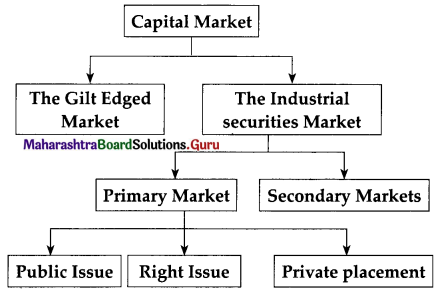
The capital market is divided into two segments:

  • Gilt Edged Market
  • Industrial Securities Market

(i) Gilt Edged Market:
It is also known as the government securities market, which is a market for government and semi-government securities.
Features of this market are:

  • Guaranteed return on investment
  • No speculation on securities
  • Major institutions are LIC, PF, and commercial banks.
  • The heavy volume of transactions
  • Institutional-based investors.

(ii) Industrial Securities Market:
It is a market for industrial securities such as bonds, equities, etc. It comprises two segments.

  • Primary Market
  • Secondary Market

Primary Market:
It is also known as New Issue Market. The market is utilized for raising fresh capital in the form of shares and debentures. It helps to accelerate economic and industrial development.

Modes of raising capital in the Primary Market:
(i) Public Issue/Prospectus:
Securities are issued to the general public. This is the most popular method of raising long-term funds. In this method, securities are offered to the public by issuing a prospectus.

(ii) Rights Issue:
The equity shares of a company are issued to the existing equity shareholders in the form of rights issues. In this issue, additional securities are offered to the existing shareholders.

(iii) Private Placement:
Under the private placement, the shares of a company are sold among the selected group of persons. There are three categories of participants in the primary market i.e. issuers of securities, investors, and intermediaries.

Secondary Market:
It is a market where existing securities are sold or traded. This market is also known as the stock market. The secondary market consists of recognized stock exchanges operating under rules, bye-laws, and regulations duly approved by the government.

Question 3.
Write a note on Participants in the Money Market.
Answer:
Some important participants in the money market:
(i) Reserve Bank of India:
It is the most important participant in the money market. Through the money market, RBI regulates the money supply and implements its monetary policy. It issues government securities on behalf of the government and also underwrites them. It acts as an intermediary and regulator of the market.

(ii) Central and State Government:
Central Government is a borrower in the Money Market, through the issue of Treasury Bills (T-Bills). The T-Bills are issued through the Reserve Bank of India (RBI). The T-Bills represent zero risk instruments. Due to its risk-free nature banks, corporate, etc. buy the T-Bills and lend to the government as a part of its short-term borrowing program. The state government issues bonds called State Development Loans.

(iii) Public Sector Undertakings (PSU):
Many listed government companies can issue commercial paper in order to obtain its working capital.

(iv) Scheduled Commercial Banks:
Scheduled commercial banks are very big borrowers and lenders in the money market. They borrow and lend in call money market, short notice market, Repo and Reverse Repo market.

(v) Insurance Companies:
Both, the general and life insurance companies are usual lenders in the money market. They invest more in capital market instruments. Their role in the money market is limited.

(vi) Mutual Funds:
Mutual Funds offer varieties of schemes for the different investment objectives of the public. Mutual funds schemes are liquid schemes. These schemes have the investment objective of investing in money market instruments.

Maharashtra Board Class 12 Secretarial Practice Important Questions Chapter 11 Financial Market

6. Justify the following statements.

Question 1.
Primary Market is known as the New issue market.
Answer:

  • The primary market is that security market where fresh securities are raised in the form of shares and debentures.
  • This market is mainly utilized for raising long-term funds.
  • Funds are raised in this market through various modes such as public issue/prospectus, right issue, and private placement.
  • Moreover, the primary market is also beneficial for capital formation in the country which in turn accelerates its economic and industrial development.
  • Thus, the Primary market is known as New Issue Market.

Question 2.
The gilt-edged market is known as the government securities market.
Answer:

  • A gilt-edged market is a market where government and semi-government securities are traded. Therefore, it is also known as the government securities market.
  • In such a market, mostly gilt-edged securities are traded. These are the stocks and bonds issued by the Central or State Government.
  • These securities are considered safe investments as payment of interest and repayment of principal amount on them are guaranteed by the government. Also, there is no speculation on such securities.
  • In the Gilt-edged market, the major participants are public corporations such as Life Insurance Corporation (LIC), Provident Fund (PF), and commercial banks.
  • The government securities are mostly in the form of stock certificates, promissory notes, and government bonds.
  • Thus, the gilt-edged market is known as the government securities market.

Question 3.
Repo rate is known as the official bank Rate.
Answer:

  • Repo rate refers to the discounted interest rate at which the Central Bank repurchases the government securities.
  • Such transaction is mainly carried out to reduce short-term liquidity in the system.
  • Here, the Central Bank has the sole power to adjust (increase or decrease) the repo rate so as to control the money supply in an economy.
  • Additionally, the transactions are mainly carried out between the Central Bank and Commercial Banks at a repo rate.
  • Due to all the above reasons, the repo rate is known as the official bank rate.

Maharashtra Board Class 12 Secretarial Practice Important Questions Chapter 11 Financial Market

Question 4.
Capital Market facilitates the mobilization of funds.
Answer:

  • The money market is a place where short-term funds are borrowed and lent.
  • It is a market for financial assets that are close substitutes for money.
  • The instruments dealt in the money market are liquid and can be easily converted into cash at a low transaction cost.
  • Due to this, the money market fails to facilitate the mobilization of funds.
  • On the other hand, the Capital market, a market for long-term instruments, facilitates the mobilization of funds.
  • In this market, the instruments such as bonds, debentures, equity shares, and stocks having long or indefinite maturity periods are traded.
  • Thus, mobilization of funds is facilitated by the capital market rather than the money market.

7. Answer the following questions.

Question 1.
Explain the role and importance of the financial market in the development of an economy.
Answer:
Role: A financial market is of great use for a country as it helps the economy in the following ways:
(i) Saving Mobilization:
Obtaining funds from surplus units such as households, individuals, public sector units, Central Government, etc and channelizing their funds or productive purposes.

(ii) Investments:
The financial market plays an important role in arranging to invest funds thus, collected in those units which are in need of the funds.

(iii) National Growth:
The financial market contributes to national growth by ensuring a continuous flow of surplus funds to deficit units.

(iv) Entrepreneurship Growth:
Financial markets contribute to the development of the entrepreneurial class by making available the necessary financial resources.

(v) Industrial Development:
The components of financial markets help towards accelerated growth of industrial and economic development of a country thus, contributing to raising the standard of living and the society’s wellbeing.

(vi) Capital formation:
The capital market brings together borrowers and lenders. It attracts saving from people and directs it towards the institutions where it is needed. It generates capital for the business.

(vii) Employment Generation:
The capital market is contributed towards the generation of capital. It supports the development of small and large businesses. It creates employment opportunities for the public.

(viii) Productive use of funds:
The financial market allows productive use of the fund. An excess fund of investors is used by the borrowers for productive purposes.

Maharashtra Board Class 12 Secretarial Practice Important Questions Chapter 11 Financial Market

Question 2.
Explain constituents of the Indian capital market.
Answer:
Maharashtra Board Class 12 Secretarial Practice Important Questions Chapter 11 Financial Market 7 Q2

(i) The Gilt Edged Market: It is also known as the government securities market, which is a market for government and semi-government securities. Features of this market are:

  • Guaranteed return on investment
  • No speculation on securities
  • Major institutions are LIC, PF, and commercial banks.
  • The heavy volume of transactions
  • Institutional-based investors.

(ii) Industrial Securities Market: It is a market for industrial securities such as bonds, equities, etc. It comprises two segments.

  • Primary Market
  • Secondary Market

(A) Primary Market: It is also known as New Issue Market. The market is utilized for raising fresh capital in the form of shares and debentures. The industrial sectors usually approach this market for raising fresh capital. This is usually a long-term fund. The primary market is useful for capital formation in the country and accelerates economic and industrial development.

Modes of raising capital in the Primary Market:
(i) Public Issue/Prospectus:
Securities are issued to the general public. This is the most popular method of raising long-term funds. In this method, securities are offered to the public by issuing a prospectus.

(ii) Rights Issue:
The equity shares of a company are issued to the existing equity shareholders in the form of rights issues. In this issue, additional securities are offered to the existing shareholders.

(iii) Private Placement:
Under the private placement, the shares of a company are sold among the selected group of persons. There are three categories of participants in the primary market. They are the issuers of securities, investors, and intermediaries.

(B) Secondary Market: It is a market where existing securities are sold or traded. This market is also known as the stock market. The secondary market consists of recognized stock exchanges operating under rules, bye-laws, and regulations duly approved by the government.

A stock exchange is defined under section 2(3) of the Securities Contracts (Regulations)
Act 1956 as “An association, organization or body of individuals, whether incorporated or not established for the purpose of assisting, regulating or controlling of business in buying, selling or dealing in securities.”

Functions of Secondary Market:

  • To facilitate liquidity and marketability of securities.
  • To contribute to the economic growth through mobilization of funds to the most efficient channels.
  • To provide an instant valuation of securities dealt at the stock exchange.
  • To ensure a measure of safety and fair dealing to protect investor’s interests.

Maharashtra Board Class 12 Secretarial Practice Important Questions Chapter 11 Financial Market

8. Attempt the following.

Question 1.
Explain features of the Indian Money Market?
Answer:
A money market is a place where short-term funds are borrowed and lent. The Instruments dealt with within this market are liquid financial assets.
The features of the money market are as follows:
(i) No Fixed Place for Trading of Securities/Shares:
In the money market, there is no definite place to carry out lending and borrowing operations of securities or shares.

(ii) Involvement of Brokers:
Dealings in such a market can be conducted with or without the participation of brokers.
Companies, banks, etc. may directly deal in the money market.

(iii) Financial Assets:
The financial assets that are dealt in the money market are close substitutes for money as these assets can be easily converted into cash without any loss in value.

(iv) Organisations Involved:
The main organizations dealing in the money market in India are the Reserve Bank of India (RB), State governments, banks, corporate investors, etc.

(v) Nature of the Market:
It is not a single market but a collection of markets for different instruments such as commercial bills, commercial papers, certificates of deposits, government securities, etc.

(vi) Term of Finance:
The funds can be borrowed or lent for a maximum period of one year.

(vii) Source of Short Term Funds:
The money market provides a place or a system whereby short-term (for a period of less than one year) funds can be easily borrowed or lent.

Question 2.
Explain important participants of the Indian Money Market.
Answer:
Some important participants in the Indian Money Market are:
(i) Reserve Bank of India:
It is the most important participant in the money market. Through the money market, RBI regulates the money supply and implements its monetary policy. It issues government securities on behalf of The Government and also underwrites them. It acts as an intermediary and regulator of the market.

(ii) Central and State Government:
Central Government is a borrower in the Money Market, through the issue of Treasury Bills (T-Bills). The T-Bills are issued through the Reserve Bank of India (RBI). The T-Bills represent zero risk instruments. Due to its risk-free nature banks, corporate, etc. buy the T-Bills and lend to the government as a part of its short-term borrowing program. The state government issues bonds called State Development Loans.

(iii) Public Sector Undertakings (PSU):
Many listed government companies can issue commercial paper in order to obtain their working capital.

(iv) Scheduled Commercial Banks:
Scheduled commercial banks are very big borrowers and lenders in the money market. They borrow and lend in the call money market, short notice market, Repo and Reverse Repo market.

(v) Insurance Companies:
Both, the general and life insurance companies are usual lenders in the money market. They invest more in capital market instruments. Their role in the money market is limited.

(vi) Mutual Funds:
Mutual Funds offer varieties of schemes for the different investment objectives of the public. Mutual funds schemes are liquid schemes. These schemes have the investment objective of investing in money market instruments.

(vii) Non-Banking Finance Companies (NBFCs): NBFCs use their surplus funds to invest in government securities, bonds, etc. (Example of NBFC – Unit Trust of India)

Maharashtra Board Class 12 Secretarial Practice Important Questions Chapter 11 Financial Market

(viii) Corporates:
Corporates borrow by issuing commercial papers which are nothing but short-term promissory notes. They are the lender to the banks when they buy the certificate of deposit issued by the banks.

(ix) Primary Dealers:
Their main role is to promote transactions in government securities. They buy as well as underwrite the government securities.

Maharashtra Board Class 11 Secretarial Practice Solutions Chapter 1 Secretary

Balbharti Maharashtra State Board Class 11 Secretarial Practice Solutions Chapter 1 Secretary Textbook Exercise Questions and Answers.

Maharashtra State Board Class 11 Secretarial Practice Solutions Chapter 1 Secretary

1A. Select the correct answer from the options given below and rewrite the statements.

Question 1.
The word Secretary is derived from the Latin word ____________ which means a confidential writer.
(a) Amatya
(b) Scribae
(c) Secretarius
Answer:
(c) Secretarius

Question 2.
Only ____________ can be appointed as a Secretary.
(a) an Individual
(b) a Partnership firm
(c) a Joint-stock company
Answer:
(a) an individual

Maharashtra Board Class 11 Secretarial Practice Solutions Chapter 1 Secretary

Question 3.
A Secretary is a custodian of ____________ information.
(a) confidential
(b) individual
(c) investigative
Answer:
(a) confidential

Question 4.
The Secretary of a Joint-stock company should be a member of ____________
(a) IPS
(b) ICSI
(c) IAS
Answer:
(b) ICSI

Question 5.
____________ is the oldest type of Secretary.
(a) Company Secretary
(b) Personal Secretary
(c) Secretary of Government Department
Answer:
(b) Personal Secretary

Question 6.
The main objective of a co-operative society is to ____________ the interest of its members.
(a) neglect
(b) takeover
(c) protect
Answer:
(c) protect

Question 7.
Secretary of Government department must be a member of the ____________
(a) ICSI
(b) IAS
(c) ICWA
Answer:
(b) IAS

Maharashtra Board Class 11 Secretarial Practice Solutions Chapter 1 Secretary

Question 8.
____________ means correctness in doing a work.
(a) Accuracy
(b) Loyalty
(c) Courteous
Answer:
(a) Accuracy

1B. Match the pairs.

Question 1.

Group ‘A’Group ‘B’
(a) Amatya(1) Government department
(b) Ministry of Finance(2) Paid employee
(c) Personal Secretary(3) Appointed by busy persons
(d) Loyalty(4) Roman Empire
(e) Financial duties(5) Maintenance of books of accounts
(f) Secretary(6) Faithfulness
(7) Reveals information
(8) Appointed by Co-operative societies
(9) Ancient Indian history
(10) Correspondence
(11) Free service
(12) Joint Stock company

Answer:

Group ‘A’Group ‘B’
(a) Amatya(9) Ancient Indian history
(b) Ministry of Finance(1) Government department
(c) Personal Secretary(3) Appointed by busy persons
(d) Loyalty(6) Faithfulness
(e) Financial duties(5) Maintenance of books of accounts
(f) Secretary(2) Paid employee

1C. Write a word or a term or a phrase that can substitute each of the following statements.

Question 1.
The term was used in the Roman empire was for a person who was a professional letter writer.
Answer:
Scribae

Question 2.
The sports club is an example of this type of organization.
Answer:
Non-profit association

Question 3.
A Secretary appointed by an individual.
Answer:
Personal Secretary

Question 4.
The quality that a Secretary should possess is to be faithful to his organization.
Answer:
Loyalty

Question 5.
The Latin word for a Secretary.
Answer:
Secretarius

Maharashtra Board Class 11 Secretarial Practice Solutions Chapter 1 Secretary

Question 6.
The Company Secretary must be a member of this organization.
Answer:
ICSI

Question 7.
The Secretary of a Co-operative organization in Maharashtra must have knowledge of this Act.
Answer:
Maharashtra State Co-operative Societies Act, 1960

Question 8.
An association that aims to protect the interest of its members.
Answer:
Co-operative society

1D. State whether the following statements are True or False.

Question 1.
A Secretary is responsible only for typing letters.
Answer:
False

Question 2.
The Secretary of a Government department is the oldest type of Secretary.
Answer:
False

Question 3.
The Secretary should remain confidential about his organization.
Answer:
True

Question 4.
A Secretary also looks after routine and administrative duties.
Answer:
True

Question 5.
A Secretary is a paid employee.
Answer:
True

Maharashtra Board Class 11 Secretarial Practice Solutions Chapter 1 Secretary

Question 6.
Chitnis is a term used in the ancient Roman period.
Answer:
False

Question 7.
A Secretary need not have knowledge of computers.
Answer:
False

Question 8.
Cultural Association is an example of a Government department.
Answer:
False

1E. Find the odd one.

Question 1.
Secretarius, Scribae, ICSI, Chitnis
Answer:
ICSI

Question 2.
Leadership, IAS, Tactfulness
Answer:
IAS

1F. Complete the sentences.

Question 1.
In Latin language, a confidential writer was called as ____________
Answer:
Secretarius

Question 2.
The oldest type of Secretary is ____________ secretary.
Answer:
Personal Secretary/Personal Assistant

Question 3.
A company secretary must be a member of ____________
Answer:
ICSI (Institute of Company Secretaries of India)

Maharashtra Board Class 11 Secretarial Practice Solutions Chapter 1 Secretary

1G. Select the correct option from the bracket.

Question 1.

Group ‘A’Group ‘B’
(1) …………………Personal Secretary
(2) Secretary of Government Department………………………….
(3) ICSI………………………….
(4) …………………Scribae
(5) Custodian of secret…………………….

(IAS, Appointed by busy individuals, Secretary, Roman Empire, Company Secretary)
Answer:

Group ‘A’Group ‘B’
(1) Appointed by busy individualsPersonal Secretary
(2) Secretary of Government DepartmentIAS
(3) ICSICompany Secretary
(4) Roman EmpireScribae
(5) Custodian of secret Secretary

1H. Answer in one sentence.

Question 1.
Who can appoint a personal secretary?
Answer:
Personal Secretary can be appointed by busy individuals, eg. Doctors, Lawyers, Engineers, Chartered Accountants, Actors, Politicians, Leaders, Ministers, etc.

Question 2.
Which company should appoint a full-time company secretary?
Answer:
Listed companies and all other companies with a paid-up share capital of five crores or more should appoint a full-time company secretary.

Question 3.
A Cultural Club is an example of which type of organization?
Answer:
A Cultural Club is an example of a Non-profit association.

Question 4.
The knowledge of which Act is a must for a secretary of Co-operative Society?
Answer:
A secretary of a co-operative society should have a good knowledge of the Co-operative Societies Act.

1I. Correct the underlined word and rewrite the following sentences.

Question 1.
Personal Secretary is appointed by a Joint Stock Company.
Answer:
Personal Secretary is appointed by a busy individual.

Question 2.
Busy individuals appoint Company Secretary.
Answer:
Busy individuals appoint Personal Secretary.

Question 3.
The Secretary of a Government Department must be a member of ICSI.
Answer:
The Secretary of a Government Department must be a member of IAS.

Maharashtra Board Class 11 Secretarial Practice Solutions Chapter 1 Secretary

Question 4.
The term Chitnis was used in Roman Empire.
Answer:
The term Chitnis was used in Ancient Indian history.

2. Explain the following terms/concepts.

Question 1.
Secretary
Answer:
An individual employed to handle general administration, office management, correspondence, and confidential information of an organization.

Question 2.
Confidential officer
Answer:
Secretary is entrusted with the secret and confidential information of his employer and of the business itself.

Question 3.
Compliance officer
Answer:
A secretary must stick to or comply with various sets and its provisions that are applicable to the business like maintaining books, filing returns, etc.

Question 4.
Tactfulness
Answer:
An ability of a person to handle a situation in the right manner. Secretary must handle the different situations and people insensible way.

Question 5.
Loyalty
Answer:
Loyalty means faithfulness. As a confidential officer, a secretary should not share secret matters with anyone.

3. Study the following case/situation and express your opinion.

1. Rajiv and Sanjiv have applied for the post of Company Secretary at Pharma India Pvt. Ltd. Rajiv has experience of 10 years as a Personal Secretary. He later worked as a Secretary at Venus Co-operative Bank for 2 years. Sanjiv has passed his CS examination and is a member of ICSI. He has no working experience. Rajiv is only a commerce graduate.

Question (a).
Who is better suited for the above post? Justify your answer.
Answer:
Sanjiv is suited for the post as he has passed his CS exams and is a member of ICSI which is the basic qualification for a company secretary according to the Companies Act, 2013.

Question (b).
Can Rajiv be selected as a Personal Assistant for one of the Directors?
Answer:
Yes, Rajiv has experience of 10 years as a personal secretary, hence he can be able to assist the director.

Question (c).
Can Rajiv be appointed as Secretary to Pharma India Pvt Ltd.?
Answer:
No, Pharma India Pvt. Ltd. is a private company that can appoint a Company Secretary for its work. Rajiv has experience as a personal secretary so he cannot be appointed as a secretary to Pharma India Pvt. Ltd.

Maharashtra Board Class 11 Secretarial Practice Solutions Chapter 1 Secretary

2. Harshada has cleared her CS examination and intends to make her career as a Secretary at the Government department.

Question (a).
Can she apply for the post of Secretary at Government Department?
Answer:
No, a secretary of the Government department must have a clear Civil Services Examination and must be in Indian Administrative Services.

Question (b).
Can she be appointed as the Secretary of ABC Ltd.?
Answer:
Yes, she can be appointed as the secretary of ABC Ltd which is a company, and shehasclearedherCS examination.

Question (c).
As a Company Secretary will Harshada be considered as an employee?
Answer:
Yes, a company secretary is a full-time employee and gets a salary as determined by the Board of Directors.

4. Distinguish between the following.

Question 1.
Personal Secretary and Company Secretary
Answer:

BasisPersonal SecretaryCompany Secretary
1. MeaningAn individual appointed by a busy person to assist him.An individual appointed by the Board of directors to carry out various duties in a Joint Stock Company.
2. AppointmentPersonal Secretary is appointed by a busy person or professionals.Company Secretary is appointed by the Board of Directors.
3. QualificationThere is no prescribed qualification for a personal secretary.The company secretary must be a member of ICSI.
4. Legal StatusA personal secretary has no legal status.The company secretary possesses legal status.
5. PowersThe personal secretary has limited powers as given by the employer.The company secretary has statutory and managerial powers.
6. PurposeTo assist a busy person in his day-to-day work.To assist the Board of directors in taking decisions and executive functions.
7. PositionThe personal secretary is an assistant of the employer.The company secretary is one of the members of Key Managerial Personnel.

Question 2.
Secretary of Co-operative Society and Secretary of Government Department
Answer:

BasisSecretary of Co-operative SocietySecretary of Government Department
1. MeaningSecretary of Co-operative Society is one of the members of the managing committee appointed to carry out the working of the society.An officer who works under the guidance of the minister or the department.
2. AppointmentHe is appointed by the managing committee.He is appointed by the State or Central government.
3. QualificationThere is no prescribed qualification.He must have passed an IAS exam.
4. PositionThe secretary is a member of society.The secretary is the administrative head of his department.
5. PurposeHe has to protect the interest of his members.He has to carry out administrative work under the control of the minister.
6. RemunerationHe is a member of the managing committee and gets an honorarium.He gets salary and perks as per the Government rules.

Question 3.
Company Secretary and Secretary of a Government Department
Answer:

BasisCompany SecretarySecretary of Government Department
1. MeaningSecretary appointed by the Board of Directors to carry out statutory and managerial duties.Secretary appointed by State or Central government to handle the work of different government departments.
2. QualificationHe must be a member of ICSI.He must have passed an IAS exam.
3. AppointmentHe is appointed by the Board of directors.He is appointed by the Central or State government.
4. PowersHe has administrative and managerial powers.He has statutory powers as per the ministry.
5. PurposeHe has to assist the Board of directors in taking decisions.He has to assist the ministers in carrying out administrative work.
6. RemunerationHe is paid a salary as decided by the Board of Directors.He is paid salary and perks as per government rules.

Question 4.
Secretary of Non-profit Association and Secretary of Co-operative Society.
Answer:

BasisSecretary of Non-profit AssociationSecretary of Co-operative Society
1. MeaningA person appointed to look after the working of the association.Secretary is one of the members of the managing committee appointed to look after the working of the society.
2. AppointmentSecretary is appointed by the managing committee of the association.Secretary is appointed by the managing committee of the society.
3. Legal StatusThe secretary has no legal status.Secretary has legal status as per the Co-operative Societies Act.
4. PowerHe has limited powers.He has power as per the Co-operative Societies Act.
5. CompulsoryIt is not compulsory. It is optional to appoint a secretary.The appointment of a secretary is compulsory as per the Act.
6. ObjectThe main objective is to promote social, cultural, and sports activities.The main objective is to protect the interest of its members.

5. Answer in brief.

Question 1.
Describe any four qualities of a Secretary.
Answer:
Qualities of a Secretary are as follows:

  1. Accuracy: A secretary must be accurate in his work like accuracy in office work, record keeping, drafting letters, reports, etc.
  2. Loyalty: A secretary should be loyal. He is a custodian of secret information about his business. He should not disclose the secret of the business to outsiders.
  3. Adaptability: There are many changes that take place within the business and outside the business. A secretary must adapt himself to every situation and should be ready for every challenge.
  4. Leadership: As a leader, a secretary should be able to guide, advise and direct the subordinates. He should create team spirit among his subordinates.

Question 2.
State any four functions of a Secretary.
Answer:
The functions of a Secretary are as follows:

  1. Correspondence: It is a basic function of the secretary. He drafts letters, handles inward and outward mails, types letters, files important correspondence. He must handle correspondence well so as to maintain the goodwill of the business.
  2. Reception functions: A secretary courteously attends to the visitors, telephone calls, arrange meetings, fix appointments, etc.
  3. Financial functions: Secretary handles the financial transactions and maintains proper books of accounts. He handles banking transactions like depositing money, withdrawing money from the bank, issuing cheques and demand drafts, etc.
  4. Administrative functions: Secretary performs administrative functions like supervising and controlling the activities of the business, effective coordination, training, orientation, promotion of employees.

Maharashtra Board Class 11 Secretarial Practice Solutions Chapter 1 Secretary

Question 3.
Mention any four features of a Secretary.
Answer:
Features of a Secretary are as follows:

  1. Individual: Only an individual can be appointed as a secretary. A partnership firm, corporate body, or institution cannot be appointed as a secretary.
  2. Employee: Secretary is a paid employee of the business. He is given a salary or honorarium for the work or task done by him.
  3. Confidential officer: A secretary is the custodian of the secret or confidential information of his employer and business.
  4. Appointment: A secretary can be appointed by a busy person, Co-operative society, Non-profit association, Government, Joint Stock company, etc.

6. Justify the following statements.

Question 1.
A secretary should be courteous and have a pleasing personality.
Answer:

  1. A secretary should be courteous as he deals with people within and outside the organization.
  2. As he gets the plans executed in the business he must be kind and polite with fellow workers.
  3. As a secretary represents the business to outsiders and as a leader within the business, he must have a pleasing personality with confidence and the ability to tackle challenging situations.
  4. Thus, a secretary should be courteous and have a pleasing personality.

Question 2.
A secretary is considered a paid employee.
Answer:

  1. A secretary is a paid employee of the business.
  2. He works as a secretary and receives a salary or honorarium in return.
  3. He is not the owner but works for them.
  4. Thus, a secretary is considered a paid employee.

Question 3.
Only individuals can be secretaries.
Answer:

  1. A secretary is always an individual.
  2. Only a person can perform the work of a secretary.
  3. A corporate body, institution, or partnership firm cannot be appointed as a secretary.
  4. Thus, only individuals can be secretaries.

Question 4.
A secretary is a link between the staff and members.
Answer:

  1. With the help of effective communication, the secretary strikes a balance between the staff and members.
  2. The plans, policies, and decisions made by the top-level are communicated to the staff, which helps inefficient working of the business.
  3. Thus, a secretary is a link between the staff and members.

Question 5.
A personal secretary is appointed by busy individuals.
Answer:

  1. A personal secretary is appointed by busy persons to handle their day-to-day work.
  2. Professionals and busy persons appoint a secretary so that routine work is handled by the secretary and they can focus on other important work.
  3. Thus, a personal secretary is appointed by busy individuals.

Maharashtra Board Class 11 Secretarial Practice Solutions Chapter 1 Secretary

7. Answer the following questions.

Question 1.
Define a Secretary and explain the importance of a secretary.
Answer:
According to Oxford Dictionary “A person whose work is to write for others, especially one who is employed to conduct correspondence, keep records and to transact various other business for another person or for a society or corporation or public body.”

The importance of a secretary are:
(i) Provide guidance and advice:
The secretary provides guidance to the management for efficient working and achieving goals. He also gives advice to the superior on important matters and helps them to take the correct decision.

(ii) Custodian of secret information:
The secretary is closely connected with top management and has access to all the secret and confidential information about the business. He safeguards confidential documents and decisions of the business.

(iii) Correspondent:
Secretary handles all the inward and outward mails of the business. He conducts correspondence with members, directors, registrar, bank, government authorities, etc.

(iv) Conducting meetings:
Secretary carries out all formalities before, during, and after the meeting. He prepares notice, agenda, minutes, etc., and makes all the arrangements for the meetings.

(v) Administrator:
Secretary handles office administration and routine management work efficiently. On behalf of the employer, he looks after the working of day to day work of the business.

(vi) Legal officer:
Secretary performs various statutory duties. He prepares books, reports, registers, documents as prescribed by the Companies Act, 2013.

(vii) Link between management and staff:
The secretary is a link between management and staff. He maintains a balance between management and staff through effective communication and proper coordination.

Question 2.
Explain the features of a secretary.
Answer:
The features of a secretary are as follows:

  1. Individual: Only an individual can be appointed as a secretary. An organization, firm, society, or corporate body cannot be appointed as a secretary.
  2. Employee: Secretary is not the owner of the business. He is a paid employee. Secretary works in the business and expects salary or honorarium for the work done by him.
  3. Custodian of secret information: The secretary has custody of all the secret information of the business as he is closely connected with the top-level management.
  4. Appointment: Secretary can be appointed by busy persons, professionals, non-profit associations, co-operative society, or Joint Stock companies.
  5. Qualities: In order to perform his duties efficiently a secretary must possess qualities like intelligence, accuracy, loyalty, Courtesy, etc.

Maharashtra Board Class 11 Secretarial Practice Solutions Chapter 1 Secretary

Question 3.
Describe the qualities of a secretary.
Answer:
The qualities of a secretary are as follows:

  1. Accuracy: It means correctness. While corresponding, preparing reports and records, books of accounts, and register the secretary must be accurate in his work.
  2. Adaptability: Secretary must have the ability to adjust with the change within and outside the business like change in management rules and policies, change in government policies, etc.
  3. Loyalty: Secretary has access to all the secret information of the business. He must be faithful and not disclose the information to anyone.
  4. Cooperative: Secretary works with the people and through the people. He should instill the feeling of team spirit and oneness.
  5. Punctuality: Secretary must have a sense of time. He must complete the work on time. If the work is delayed it would affect the growth of the business.
  6. Piteasing personality: Secretary must have an impressive and confident personality. With decent behaviour, a good temper, and a positive approach, he can gain respect from others.
  7. Tactful: A secretary handles different people and situations. He should be able to handle situations wisely and deal with people in a sensible way.

Question 4.
Explain briefly the various types of Institutional secretaries.
Answer:
Types of Institutional secretaries:
(i) Secretary of a Non-profit Association:
The non-profit association is formed to provide service and not to earn profits. The managing committee looks, after the working of Non-profit association. The Secretary of a Non-profit association is appointed by the managing committee on a salary or honorarium basis. There is no prescribed qualifications of the secretary of the Non-profit association however, knowledge of correspondence, banking transactions, knowledge of computers are expected in these associations.

(ii) Secretary of a Co-operative Society:
It is a voluntary organization formed for the welfare of its members. Managing committee handles or manage the working of the society. One of the members of the managing committee is appointed as a secretary. Secretary of Co-operative society can be appointed as a full-time employee. Secretary must have full knowledge of all the provisions of the Co-operative Societies Act.

(iii) Secretary of a Government Department:
The Secretary of a Government department is appointed by the Central or State Government. Secretary handles the work of various government departments on behalf of the ministers and act as an administrative head of the department. The secretary of the government department should be a graduate and be in Indian Administrative Services [IAS].

(iv) Secretary of a Joint Stock Company:
The Secretary of a Joint Stock company holds a key managerial position and handles the business on behalf of the members. Secretary of a Joint Stock Company is appointed by the Board of Directors. According to the Companies Act, 2013 the Companies Secretary must be a member of the Institute of Company Secretaries of India (ICSI). Joint Stock Company works on a large scale, hence, full-time secretary handles day-to-day work on behalf of the Board of directors.

Maharashtra Board Class 11 Secretarial Practice Solutions Chapter 1 Secretary

Activity 1. (Textbook Page No. 9)

Find out the following:

  1. Company Secretary of Mahindra and Mahindra Ltd.
  2. Principal Secretary of Prime Minister of India.
  3. Chief Secretary, Maharashtra State.
  4. Secretary, School Education Department, Government of Maharashtra.

Answer:

  1. Narayan Shankar
  2. Pramod Kumar Mishra
  3. Sitaram Kunte
  4. Vishal Solanki (IAS)

Activity 2. (Textbook Page No. 9)

Atmaram Bendre is a Secretary of Gokulghar Housing Society, Enlist his duties.
Answer:
Duties of a Secretary performed by Atmaram Bendre residing at Gokulghar Housing Society, Malad (W), Mumbai are as follows:

  1. To hold a monthly meeting of Managing Committee.
  2. To prepare notice along with agenda and issue to members of the managing committee.
  3. To record and maintain minutes book of the managing committee.
  4. To assist the chairman before, during, and after the meeting.
  5. To issue a Share certificate to members of the Co-operative Housing Society.
  6. To transfer Share certificate within a given period of time.
  7. To maintain books relating to the resignation and transfer of members of society.
  8. To examine the documents related to transferring flats.
  9. To take appropriate actions against default members by giving legal notice, if any.
  10. To maintain accounting records required for auditing.
  11. To finalize the audit report.
  12. To utilize the sinking fund of the society with prior approval of members of society for repair, maintenance internal leakage problem, etc.
  13. To give No Objection Certificate for flat agreement of sale or any kind of loans on flat.
  14. To abide bye-laws as guided by Co-operative Housing Society Act, 1960.
  15. To maintain all correspondence records, files, documents, etc.
  16. To issue notice to the member who breaches the bye-laws of the society.
  17. To maintain records for the societies such as account records, statutory records, and membership records.
  18. To produce records as and when required by the government authorities with the consent of members.
  19. To issue allotment or cancellation letter as required by the members of the society.
  20. To take contingency meetings as and when required in the event of an emergency.

Maharashtra Board Class 11 English Yuvakbharati Solutions Chapter 4.3 Extracts of Drama

Balbharti Yuvakbharati English 11th Digest Chapter 4.3 Extracts of Drama – (A) A Midsummer – Night’s Dream Notes, Textbook Exercise Important Questions and Answers.

Maharashtra State Board Class 11 English Yuvakbharati Solutions Chapter 4.3 Extracts of Drama – A Midsummer – Night’s Dream

11th English Digest Chapter 4.3 Extracts of Drama – A Midsummer – Night’s Dream Textbook Questions and Answers

Characters:

1. Choose the odd one out.

Question (i)
Bottom, Moth, Mustard seed, Cobweb
Answer:
Bottom

Maharashtra Board Class 11 English Yuvakbharati Solutions Chapter 4.3 Extracts of Drama

Question (ii)
Flute, Snug, Quince, Cobweb
Answer:
Cobweb

Question 2.
Match the columns.

Column ‘A’Column ‘B’
(a) Theseus1. Robin Goodfellow
(b) Titania2. Queen of the Amazons
(c) Puck3. Duke of Athens
(d) Hippolyta4. Fairies
(e) Cobweb, Moth5. Queen of the fairies

Answer:

Column ‘A’Column ‘B’
(a) Theseus3. Duke of Athens
(b) Titania5. Queen of the fairies
(c) Puck1. Robin Goodfellow
(d) Hippolyta2. Queen of the Amazons
(e) Cobweb, Moth4. Fairies

Question 3.
Draw a character sketch of Oberon as an enemy of his wife but a friend of lovers.
Answer:
Oberon, the king of fairies, is shown having two faces. On the one hand, he is shown hatching a plan with the help of Puck by using ‘Love in Idleness’ ensuring that the proper lovers end up loving each other. He is also shown sympathising Helena on seeing Demetrius’ cold behaviour towards her. He brings blessings, good health and peace to all the newly married couples towards the end.

On the other hand, in his dealings with his wife Titania, Oberon is potrayed as a wicked man. At the beginning of the play, Oberon is shown fighting with Titania over the custody of an Indian boy. Here, he is however, trying to prove his authority as a male and win the boy. He also tricks his wife by casting a spell upon her that leaves her fall in love with Bottom. He then releases the spell off her when he gets what he has wanted – The boy.

Maharashtra Board Class 11 English Yuvakbharati Solutions Chapter 4.3 Extracts of Drama

Question 4.
Comment on the loving pair of Lysander and Helena from the point of view of developing their character sketch.
Answer:
Hermia and Lysander loved each other and they eloped in the forest to get married. Helena loved Demetrius but it was the effect of the love potion which was applied to Lysander’s eyes when he slept. Therefore, as he woke up he saw Helena and he started developing feelings for her. But Helena loved Demetrius. On her part Helena was very right. At the end both found their right companions Helena – Demetrius and Lysander – Hermia.

Setting:

1. Correct the given sentences with justification.

Question (i)
The play is restricted to only a part of the woods.
Answer:
The play is not restricted to only a part of the woods because the references, Quince’s cottage, in the another part of the wood etc., are there in the play.

Question (ii)
Since there is a reference to the Indian boy, there are some scenes from India too.
Answer:
The reference to the Indian boy is found in Act II scene I as Puck says “A lovely boy, stolen from an Indian king” and when Titania said that his mother was a votaress of my order and in the spiced Indian air. The reference of Titania’s Indian friend is also found.

Question 2.
The characters are a part of the stage setting. How does this reflect when the characters of the play range from the Duke and the Indian boy to the fairies?
Answer:
Characters are a part of stage setting. This reflects in ‘A Midsummer Night’s Dream’ from the Duke in the palace as he instructs Philostrate to arrange for the celebration with great revelry. However, in the another part of the wood Oberon and Titania struggle for the custody of the Indian boy. Oberon uses love potion on the eyelids of Titania when she sleeps. As the setting of the stage changes the characters change accordingly. Because of the presence of the fairies and an Indian boy, the characters in the play range from real to imaginary.

Question 3.
What changes in the stage setting would you suggest.
Answer:
The characters are the part of stage setting and the play starts with Theseus, Duke of Athens as he wins the queen of Amazons, Hippolyta. But later, in their marriage celebration there are the king and the queen of fairies, Oberon and Titania as well as other fairies and elves as imaginary characters. Characters are arranged from real to imaginary. I suggest that all characters should be real humans.

Maharashtra Board Class 11 English Yuvakbharati Solutions Chapter 4.3 Extracts of Drama

Question 4.
Comment on the versality and the aptness of the stage setting, as per the requirement of the play ‘A Midsummer Night’s Dream’.
Answer:
As per the requirement of the play ‘A Midsummer Night’s Dream’ the versality and the aptness of the stage setting go hand in hand. The play starts in the palace and then the stage of the play develops in two different parts of the wood. The stage-setting has been arranged according to the need of the characters and the plot. The characters are set accordingly onto the stage.

Plot:

Question 1.
State whether the following statements are True/False.

  1. Lysander and Demetrius fall in love with Helena as a result of the love potion.
  2. Oberon transforms Bottom’s head into that of an ass.
  3. Titania falls in love with an ass.
  4. Both Demetrius and Lysander fight for Helena.

Answer:

  1. True
  2. False
  3. False
  4. True

2. Give reasons:

Question (i)
Oberon and Titania fight for the custody of the Indian boy because –
(a) Oberon wants the custody of the Indian boy so that Titania would give him a lot time along with the boy.
(b) Titania wants the Indian boy because of her love and duty towards the small boy.

Maharashtra Board Class 11 English Yuvakbharati Solutions Chapter 4.3 Extracts of Drama

Question 3.
The consequences of Oberon ‘s jealousy for Titania are comic rather than tragic, comment.
Answer:
Oberon was jealous of his queen Titania because she refused to give the boy to him . She fell in love with Bottom. Oberon decided to seek revenge on his queen. It was Oberon himself who made Titania to fall in love with Bottom who wa§ having the head of a donkey. Comic incident was created by that scene in the drama.

Question 4.
There were some reasons why Theseus was initially against but later gave consent for the marrige of Hermia with Lysander. Explain.
Answer:
The reasons why Theseus was initially against but later gave consent for the marrige of Hermia with Lysander because Hermia’s father’s wish was that she should marry with Demetrius and she disobeyed her father. The Duke wants that Hermia should follow the rules and decision of her father. But she eloped with Lysander. It was Hermia’s true love for Lysander that made Theseus to change his decision and agreed that Hermia should marry with Lysander.

Form:

1. Select the correct options.

Question (i)
A Midsummers Night’s Dream is a _______
(a) poetic drama
(b) comedy of errors
(c) comedy based on fantasy
(d) a character play
(e) a revenge tragedy
(f) belongs to realm of dreams.
Answer:
A Midsummer Night’s Dream is a comedy of errors.

Question 2.
Find 2/4 expressions of humour from the extract.
Answer:
Expressions of humour from the extract are:
1. Helena: You do advance your cunning more and more –
Lysander: I had no judgement when to her I swore.
2. Hermia: What’s this to my Lysander? Where is he? Ah, good Demetrius, wilt thou give him me ?
Demetrius: I had rather give his carcass to my bounds.
Hermia: Out dog / out cur/ thou drivest me past the bounds.

Maharashtra Board Class 11 English Yuvakbharati Solutions Chapter 4.3 Extracts of Drama

Question 3.
‘A Midsummer Night’s Dream’ is one of the best examples of Shakespeare’s comedy of errors. Comment.
Answer:
A Midsummer Night’s Dream is one of the best examples of Shakespear’s comedy of errors because it has all the features of comedy of errors like conflict between characters, resolution over the problem, cleared confusions between the love triangle, reunion and marriage. It all seem very funny and interesting.

Theme:

Question 1.
Shakespeare is acknowledged as the greatest writer because he understood human nature better than anyone else. Explain the statement in context of the of play.
Answer:
Many authors have tried to potray love as human nature, however, none could display it better than Shakespeare does in his plays. In this play – ‘A Midsummer Night’s Dream’ he explains human nature of ‘control’ through love. He has given a clear picturisation of how love controls a person in the character of Theseus as he forgives Hermia and allows her to marry her love Lysander. It reveals that true love prevails and finds solace.

Shakespeare also explains human nature of conflicts between family and friends. He gives a clear picturisation of conflict when the magic potion ‘Love in Idleness’ was wrongly used on Lysander and he falls in love with Helena because of which Hermia and Helena start a quarrel. Another conflict potrayed, is between the family, when Hermia is given three choices by her father – marry Demetrius, become a nun or die to which she rebels against her father and decides to elope to the woods to marry her love Lysander. Hence, Shakespeare is acknowledged as the greatest writer of human nature.

Maharashtra Board Class 11 English Yuvakbharati Solutions Chapter 4.3 Extracts of Drama

Question 2.
Prove with the theme of the play/ extract that the deeper human emotion which profoundly interested Shakespeare, was jealousy.
Answer:
The theme of the play ‘A Midsummer Night’s Dream’ is love. Shakespeare portrays how people fall in love with those who appear beautiful to them. However, if one rejects other’s true love, then jealousy starts in the minds of the lovers. The same situation arises if one does not spend quality time with the other. In this play the example of Oberon and Titania is apt to describe human emotion.

Language:

Question 1.
Interpret the following lines in Simple English.
Puck: I’ll follow you.
Bottom: The finch, the sparrow.
Answer:
The song is sung by Bottom to try to keep his courage up as Puck has just turned his head into that of an ass. This transformation scared everyone around him and he is alone in the forest. But his song awakens Titania who falls in love with him immediately and the use of appropriate words and songs are there for the other parts of the wood also.

2. Comment on the literary device, used in the following lines.

Question (i)
Titania: Be kind and courteous to this gentleman
Answer:
Tautology. The words kind and courteous denote the same meaning to give dramatic effect.

Question (ii)
Titania: Come wait upon him: lead him to my bower.
Answer:
Repetition. The word him is repeated two times to give dramatic effect.
Apostrophe. Time has been addressed by Titania to other fairies.

Maharashtra Board Class 11 English Yuvakbharati Solutions Chapter 4.3 Extracts of Drama

Question 3.
Shakespeare’s poetry has come to be valued for its own sake on the stage. Comment with reference to the play ‘A Midsummer Night’s Dream’.
Answer:
Shakespeare’s poetry, in his ‘A Midsummer Night’s Dream’ is found outstanding and valued for it’s own sake on the stage. The expressions of love through poetry made his drama lively and interesting. Through the poetic language Shakespeare underlined the truth of human nature and through poetic expressions made the critical moments easier.

Yuvakbharati English 11th Digest Chapter 4.3 Extracts of Drama – A Midsummer – Night’s Dream Additional Important Questions and Answers

Question 1.
Then will two at once woo one;
That must needs be sport alone:
Answer:
Reference : These lines are taken from William Shakespeare’s famous comedy ‘A Midsummer Night’s Dream’. Act III scene II.
Context: The lines are said by Puck as he applied love potion on the eyelids of Demetrius with negligence. Explanation : In ‘A Midsummer Night’s Dream’, a comic character Puck was told by Oberon, the king of fairies to use the love potion on the eyelides of Demetrius so that he wakes up and sees Helena and will fall in love with her.
But Puck uses the love potion on the eyelids of Lysander, supposing him to be Demetrius. Helena sees the first person Lysander after waking up and falls in love with her instantly. A misunderstanding of Puck made a chaotic situation between the lovers.

Maharashtra Board Class 11 English Yuvakbharati Solutions Chapter 4.3 Extracts of Drama

Question 2.
Shakespeare’s poetry has come to be valued for its own sake on the stage. Comment with reference to the play ‘A midsummer Night’s Dream’
Answer:
In midsummer night’s dream, Shakespeare’s used theatrical circle simply as fantasy. In order to made it more effective he used poetic lines for enlightening the beauty of the actions in the drama. These poetic lines revealed the nature of characters and developed poetic structure of the drama.

Extracts of Drama – A Midsummer – Night’s Dream Summary in English

In the Palace:

Theseus, Duke of Athens wins Hippolyta in war and they are to be married. So, he instructs Philostrate to arrange for the celebration.

Egeus, the father of Hermia wants his daughter to be married with Demetrius. But she refuses to marry Demetrius as she is in love with Lysander. The Duke Theseus urges her to obey her father and gives her three alternatives: (1) marry Demetrius (2) become a nun or (3) suffer a death sentence. Hermia has time to decide until Theseus, The Duke of Athen’s marriage.

Hermia and Lysander decide to elope to the woods and get married but, Demetrius who used to love Helena, now rejected her love and is interested in Hermia. Hermia tries to win back the love of Demetrius for Helena. As Hermia elopes with Lysander, Demetrius follows her and Helena follows Demetrius.

At the Quinces Cottage:

The workmen from Athens wish to perform a play ‘Pyramus and Thisby’ at the Duke’s wedding. They all plan to meet in the forest for the rehearsal.

In the Woods:

A different world has been seen in the woods. The king of fairies, Oberon and Queen of fairies, Titania are having a fight over the custody of an Indian boy. To teach a lesson to her, Oberon, with the help of Puck, a mischievous spirit, plans to use the magic potion ‘Love in Idleness’, the juice if poured on the eyelids of a sleeping person, makes his/her fall madly in love with the first person he/she sees after waking up. He thus plans to madden Titania and get the custody of the Indian boy.

Oberon then sees Demetrius’ cold behaviour towards Helena and tries to help them by developing feelings in the heart of Demetrius for her. Therefore, he asks Puck to squeeze the magic juice on the eyelids of Demetrius Taking Lysander for Demetrius, Puck squeezes the magic juice on his eyelids.

Helena who enters the wood following Demetrius, proves to be the first person Lysander sees after waking up and falls in love with her instantly. Titania found too much interested in Bottom, one of the workmen of Athens. Puck bewitches him by transforming his head into that of an ass and it bewildered Titania.

In the Another Part of the Wood:

Puck wins the heart of Oberon for punishing Titania and Bottom. But when Oberon realises Puck’s mistake of using magic potion for Lysander instead of Demetrius, he himself squeezes it on the eyelids of Demetrius and orders Puck to fetch Helena as he wakes up to restore the love of Demetrius for Helena. He also corrects the relations of Lysander with Hermia as well as orders Puck to restore Bottom’s head and feels sorry for Titania.

Theseus, Hippolyta and Egeus enter and see the four Athenians and the love between them. He allows Demetrius and Helena and Hermia and Lysander to marry. At last, in the final scene, ‘Pyramus and Thisbe’ was performed for the marriage ceremony of Theseus and Hippolyta in the presence of Oberon and Titania with their fairies and elves to sing and dance and bless the newly wedded. Thus, the play ‘A Midsummer Night’s Dream’ ends on a happy note.

Maharashtra Board Class 11 English Yuvakbharati Solutions Chapter 4.3 Extracts of Drama

Glossary:

  1. night-rule – dark deeds,
  2. consecrated – sacred,
  3. dote on – to love,
  4. extremity – whole heartedly,
  5. patches – clowns,
  6. nuptial – marriage/ matrimonial/ moments of nuptial bliss,
  7. nole – head,
  8. mimic – commie actor,
  9. russet-pated choughs – birds of the crow family with reddish, brown (or grey) heads,
  10. sever – separate from each other,
  11. stamp – a noise made by bringing one’s foot heavily on the ground but, here – thing like ‘trick’ (i.e. giving
  12. Bottom an ass’s head),
  13. yielders – those who yield (giving up or surrender),
  14. latch’d – leached, anointed (love juice),
  15. ey’d – seen,
  16. antipodes – the opposite side of the earth,
  17. venus – the evening star,
  18. carcass – dead body,
  19. mispris’d – mistaken,
  20. an – and (or) even,
  21. adder – circuit,
  22. debt that bankrupt sleep doth sorrow owe – sleepless due to sorrow,
  23. confounding – confusing and breaking,
  24. Ioi tartars bow – weapon used by the Asian warriors who invaded Europe in the 13 century,
  25. cupid’s archery – Roman God of love,
  26. a lover’s fee – love requited,
  27. fond pageant – silly behaviour,
  28. tales – untrue stories,
  29. sport alone – fun by itself,
  30. devilish holy – a conflict between two truths,
  31. nymph – nature goddess,
  32. Taurus – a mountain range in Turkey,
  33. superpraise – praise excessively,
  34. conjure – summon/call,
  35. disparage – regards being of little worth,
  36. englids – brightens,
  37. confederacy – plot/plan,
  38. chid – rebuked/scold,
  39. artificial gods – creators of works of art,
  40. union in partition – two in one,
  41. incorporate – united,
  42. so in grace – so much in favour/in a good condition,
  43. ethiope – black face, but actually a scornful reference to her dark hair,
  44. canker blossom – a flower blighted by a worm lodged in the bud,
  45. stealth – stealing away,
  46. fond – foolish,
  47. suffer her to flout – allow her to mock,
  48. knot grass – a weed which creeps and makes entangling roots,
  49. officious – meddlesome/self assertive enthusiastic,
  50. aby – pay a heavy penalty,
  51. check by jowl – closely,
  52. king of shadows – fairy kings,
  53. sort – occur,
  54. welkin – sky,
  55. Acheron – the world of dead,
  56. rail thou – use violent language,
  57. Aurora’s harbinger – forerunner of the dawn (the morning star),
  58. wormy beds – graves,
  59. Neptune – the ocean, in ancient mythology,
  60. hither (archaic word) – to or towards this place,
  61. constraineth (archaic word) – to impose limitations,
  62. crust – (archaic words)to curse,
  63. a knavish lad – a mischievous boy,
  64. woe – great sorrow,
  65. bedabbled – sensuous,
  66. briers – wild shrubs,
  67. mare – an adult female horse,
  68. stalls – work-benches,
  69. barren – stupid/brainless,
  70. Anon – quickly,
  71. the creeping fowler eye – wild geese keep a close watch on hunter who is creeping up to shoot,
  72. of force she must be ey’d – inevitably (perforce) she will be seen,
  73. lay breath so bitter on your bitter foe – speak so bitterly to no one but your bitter enemy,
  74. may be bored – may have a hold driven right through it,
  75. dead – pale and bloodless,
  76. touch – feat,
  77. tender – attention and care,
  78. look – be sure,
  79. cheer – countenance.

Maharashtra State Board Class 11 Secretarial Practice Important Questions and Answers

Maharashtra State Board HSC 11th Secretarial Practice Important Questions and Answers

Maharashtra Board 11th HSC Important Questions

Maharashtra State Board Class 11 Secretarial Practice Solutions Digest

Maharashtra State Board 11th Std Secretarial Practice Textbook Solutions Digest

Maharashtra State Board Class 11 Textbook Solutions

Maharashtra Board Class 12 Secretarial Practice Important Questions Chapter 12 Stock Exchange

Balbharti Maharashtra State Board Class 12 Secretarial Practice Important Questions Chapter 12 Stock Exchange Important Questions and Answers.

Maharashtra State Board 12th Secretarial Practice Important Questions Chapter 12 Stock Exchange

1A. Select the correct answer from the options given below and rewrite the statements.

Question 1.
The Securities Contracts (Regulation) Act was passed in the year _____________
(a) 1956
(b) 1947
(c) 1971
Answer:
(a) 1956

Question 2.
SEBI was established in the year _____________
(a) 1988
(b) 1987
(c) 1986
Answer:
(a) 1988

Maharashtra Board Class 12 Secretarial Practice Important Questions Chapter 12 Stock Exchange

Question 3.
The Oldest Stock Exchange in Asia is _____________
(a) BSE
(b) NSE
(c) LSE
Answer:
(a) BSE

Question 4.
The BSE switched to electronic trading system in _____________
(a) 1988
(b) 1995
(c) 1956
Answer:
(b) 1995

Question 5.
Stock Exchange is also formed/termed as _____________
(a) Local Market
(b) Super Market
(c) Stock Market
Answer:
(c) Stock Market

1B. Match the pairs.

Question 1.

Group ‘A’Group ‘B’
(1) SEBI(a) Sensex
(2) Stock Exchange(b) Primary market
(3) Nifty(c) Auction
(4) Bear(d) Made up of 50 listed companies
(5) SENSEX(e) Optimistic about rising in prices of securities
(f) Pessimistic about fall in prices of securities
(g) Purchase and sale of shares
(h) Machinery regulating Stock Exchanges
(i) BSE
(j) NSE

Answer:

Group ‘A’Group ‘B’
(1) SEBI(h) Machinery regulating Stock Exchanges
(2) Stock Exchange(g) Purchase and sale of shares
(3) Nifty(d) Made up of 50 listed companies
(4) Bear(f) Pessimistic about fall in prices of securities
(5) SENSEX(i) BSE

Question 2.

Group ‘A’Group ‘B’
(1) Bull(a) A Secondary Market for Securities
(2) Stag(b) Auction
(3) Broker(c) Invests in Primary Market
(4) Stock Exchange(d) Mandiwala
(5) NSE(e) Deals on behalf of his client
(f) A broker optimistic about rising in prices of securities
(g) A broker pessimistic about fall in prices of securities
(h) 1992
(i) 1988
(j) 1996

Answer:

Group ‘A’Group ‘B’
(1) Bull(f) A broker optimistic about rising in prices of securities
(2) Stag(c) Invests in Primary Market
(3) Broker(e) Deals on behalf of his client
(4) Stock Exchange(a) A Secondary Market for Securities
(5) NSE(h) 1992

1C. Write a word or a term or a phrase that can substitute each of the following statements.

Question 1.
He/She acts as a link between Jobber and the investor.
Answer:
broker

Question 2.
The securities contract (Regulation) Act 1956, provides the functioning, licensing of this institution.
Answer:
Stock Exchange

Maharashtra Board Class 12 Secretarial Practice Important Questions Chapter 12 Stock Exchange

Question 3.
The first listed Stock Exchange in India.
Answer:
BSE

Question 4.
The professional speculator in the Stock Exchange.
Answer:
Jobber

Question 5.
An intermediary between investor and broker.
Answer:
Jobber

Question 6.
The single and most important institution in the secondary market for securities.
Answer:
Stock Exchange

1D. State whether the following statements are True or False.

Question 1.
Stock Exchange in India is regulated by SEBI.
Answer:
True

Question 2.
Stock Exchange is also called a Primary Market.
Answer:
False

Maharashtra Board Class 12 Secretarial Practice Important Questions Chapter 12 Stock Exchange

Question 3.
The NSE is the first listed Stock Exchange in India.
Answer:
False

Question 4.
The objective of SEBI is to protect the interests of companies.
Answer:
False

Question 5.
The securities market is an organised market in India.
Answer:
True

Question 6.
Stock Exchanges reflect the financial progress of a country.
Answer:
True

Question 7.
There is no control on Stock Exchange.
Answer:
False

Question 8.
Stock Exchange is a place for buying and selling securities.
Answer:
True

Maharashtra Board Class 12 Secretarial Practice Important Questions Chapter 12 Stock Exchange

Question 9.
Insider trading is legally permitted.
Answer:
False

1E. Find the odd one.

Question 1.
BSE, NSE, LSE
Answer:
LSE

Question 2.
Crash, Bull, Bear
Answer:
Crash

Question 3.
Sensex, Rally, Nifty
Answer:
Rally

1F. Complete the sentences.

Question 1.
A bear broker whose expectations have gone wrong and makes a loss in dealings is called _____________
Answer:
Lame duck

Question 2.
SEBI has its headquarters in _____________
Answer:
Mumbai

Maharashtra Board Class 12 Secretarial Practice Important Questions Chapter 12 Stock Exchange

Question 3.
The NSE (National Stock Exchange of India) was incorporated in the year _____________
Answer:
1992

Question 4.
SEBI regulates capital markets in _____________
Answer:
India

Question 5.
A smart speculator, who quickly judges market trends thereby makes profits is _____________
Answer:
a wolf

Question 6.
The instructions are given by an investor to the broker to buy or sell a security when it reaches a certain price is called _____________
Answer:
stop-loss

1G. Select the correct option from the bracket.

Question 1.

Group ‘A’Group ‘B’
(a) Oldest Stock Exchange in India(1) ……………………….
(b) ………………..(2) Stock Exchange

(BSE, Secondary Market)
Answer:

Group ‘A’Group ‘B’
(a) Oldest Stock Exchange in India(1) BSE
(b) Secondary Market(2) Stock Exchange

1H. Answer in one sentence.

Question 1.
What is SEBI?
Answer:
SEBI is a statutory body under the SEBI Act, 1992, which regulates and controls the activities of the stock exchanges and protects the interest of investors.

Maharashtra Board Class 12 Secretarial Practice Important Questions Chapter 12 Stock Exchange

1I. Correct the underlined word/s and rewrite the following sentences.

Question 1.
NSE is the oldest Stock Exchange in Asia.
Answer:
BSE is the oldest Stock Exchange in Asia.

Question 2.
Insider Trading is the practice of buying and selling securities within the same trading day before the closing of markets on that day.
Answer:
Day Trading is the practice of buying and selling securities within the same trading day before the closing of markets on that day.

Question 3.
The sensitive index called Sensex is made up of the 50 largest and actively traded stocks of listed companies.
Answer:
The sensitive index called Sensex is made up of the 30 largest and actively traded stocks of listed companies.

Question 4.
Investors can deal in their securities through a Jobber.
Answer:
Investors can deal in their securities through a broker.

Maharashtra Board Class 12 Secretarial Practice Important Questions Chapter 12 Stock Exchange

Question 5.
In India, Bear is known as Tejiwala.
Answer:
In India, Bear is known as Mandiwala.

2. Explain the following terms/concepts.

Question 1.
Insider Trading
Answer:
Insider trading is the trading of a public listed company’s securities by an individual with access to non-public information about the company. It is illegal as it is unfair to other investors who do not have access to the information.

Question 2.
Sensex
Answer:
It is the Index of the BSE that was created in 1986, which represents the increase or decrease in prices of stocks of a selected group of companies. The sensitive Index called Sensex is made up of the 30 largest and actively traded stocks of listed companies.

Question 3.
Nifty
Answer:
It is the index of the NSE created in 1996 made up of 50 listed companies. It includes all the 30 Sensex stocks.

Question 4.
Crash
Answer:
If the Sensex or Nifty moves in a downward direction, it is called a crash. Bears are active during this period.

Question 5.
Stop-loss
Answer:
It is instruction or order given by an investor to the broker to buy or sell a security when it reaches a certain price. This instruction is given by the investor when he wants to avoid losses when the prices fall below the stop price.

3. Study the following case/situation and express your opinion.

1. Ajay is a licensed member of the Stock Exchange Arnav his client wants to purchase securities. Answer the questions from the above situation.

Question (a).
By what term/name will Ajay be known?
Answer:
Ajay will be known as ‘Broker’.

Question (b).
How did Ajay become/acquire the term?
Answer:
Ajay acquired the term as ‘Broker’ by registering himself with the Stock Exchange as it is required for the purpose of trading in the Stock Exchange.

Question (c).
How did the transaction between them take place?
Answer:
The transaction between Ajay and Arnav was validated by a note given by Ajay to his client Arnav. This note is called contract note which both Ajay and Arnav had a copy of each immediately after their transaction within 24 hours.

Maharashtra Board Class 12 Secretarial Practice Important Questions Chapter 12 Stock Exchange

2. Anurag is an employee of the Stock Exchange who passes sensitive information relating to likely high growth in profits of ‘sun’ company to his relative Jyoti. Jyoti thus buys shares at low prices. But due to the Corona Virus spread and lockdown and worldwide panic, the Sensex is moving swiftly in a downward direction. Answer the following queries.

Question (a).
Describe the nature of the term that describes Jyoti’s actions?
Answer:
The term that describes Jyoti’s actions is known as ‘Insider trading’ means trading due to non-public sensitive information about ‘SUN’ Company.

Question (b).
Is Jyoti’s action normal? Why?
Answer:
Jyoti’s action which is based on insider information is illegal. It is unfair to other investors who do not have access to the information.

Question (c).
What is this downward direction called?
Answer:
If the Sensex/ Nifty moves in a downward direction it is called a ‘CRASH’.

3. Moon Co-Ltd. listed its shares in Bombay Stock Exchange (BSE). Due to the COVID-19 pandemic, the Stock Exchanges in India came crashing down. Answer the queries.

Question (a).
What do you mean by the term Stock Exchange Crash?
Answer:
If the Sensex or Nifty moves in the downward direction, it is called a crash.

Question (b).
What is the Index of BSE called?
Answer:
The index of BSE is called Sensex which represents the increase or decrease in prices of stocks of a selected group of companies.

Question (c).
The Index of BSE comprises of how many companies.
Answer:
The index of BSE or Sensitive index called Sensex is made up of the 30 largest and actively traded stocks of listed companies. It was created in 1986.

Maharashtra Board Class 12 Secretarial Practice Important Questions Chapter 12 Stock Exchange

4. Keith Bionics Ltd. a newly formed company makes a public issue of shares for the first time to raise capital funds. It also gets itself listed for the first time with BSE. Answer the queries.

Question (a).
What is Keith Bionics’ first time issue termed as/called?
Answer:
The public issue of shares or other securities by the new company ‘Keith Bionics Ltd/is termed as/called ‘Initial Public Offer (IPO)’.

Question (b).
What do you mean by listing with BSE?
Answer:
Listing means an agreement signed by Keith Bionics Ltd. with BSE so that its share and securities get a platform to be bought and sold in BSE multiple times.

Question (c).
What is the advantage of listing to Keith Bionics Ltd.?
Answer:
Because of listing with BSE the shares and securities of Keith Bionics Ltd. can be bought and sold (traded) in BSE repeatedly thus providing marketability along with liquidity for this company’s share.

4. Distinguish between the following.

Question 1.
Bull and Bear
Answer:

PointsBullBear
1. MeaningA speculator who purchases the securities with the intention to sell them at a higher price later is called the Bull.A speculator who sells the securities when the prices of securities start falling is called the Bear.
2. FunctionsA bull buys securities at a lesser price and sells them at a maximum higher price to make the maximum possible profit.A bear buys securities at a lesser price and sells them at a little higher price to make a desirable profit and to avoid selling at a still lower prices in the future.
3. ExpectationA bull always anticipates that the prices of securities will rise further in the future.A bear always anticipates that the prices of securities will fall further in the future.
4. Other namesA bull is also called ‘Tejiwala’. This is because he always anticipates the price to rise.A bear is also called ‘Mandiwala’. This is because he always expects the price to fall.
5. Nature/View of futureA bull takes an optimistic view of the future.A bear takes a pessimistic view of the future.

5. Answer in brief.

Question 1.
Explain the management and organizational structure of the Stock Exchange in India.
Answer:
(i) Management of Stock Exchange:

  • The Executive committee of the stock exchange looks after the overall activities and management of the stock exchange.
  • The composition, powers, and the name of the executive committee differ from exchange to exchange.
  • There are other supporting committees to assist the executive committee like an advisory committee, listing committee, etc.

(ii) Organization Structure of Stock Exchanges in India:
In India, the stock exchange may be organized in one of the following three forms:

  • Voluntary non-profit making organization.
  • Companies with liability limited by shares.
  • Companies with liability limited by guarantee.

The Securities Contract (Regulations) Act 1956, provides rules for their functioning, licensing, recognition, and controlling speculations.

(iii) Membership of Stock Exchange:
The eligibility criteria for membership may differ from stock exchange to stock exchange.

Maharashtra Board Class 12 Secretarial Practice Important Questions Chapter 12 Stock Exchange

6. Justify the following statements.

Question 1.
Stock Exchange is a Secondary Market.
Answer:

  • The stock exchange is a specific place where the trading of securities is arranged in an organized method.
  • In the primary market, new securities are floated by the issuing companies and direct contact with the public at large is established for selling of the securities.
  • A stock exchange is the single most important institution in the secondary market for securities.
  • It is the place where already issued and outstanding shares are bought and sold, repeatedly.
  • Thus, it is rightly said that Stock Exchange is a secondary market which is an organized market in India.

Question 2.
The objective of SEBI is to protect the interest of investors.
Answer:

  • The Securities and Exchange Board of India was set up on 12th April 1988, the main purpose of setting up SEBI was to develop and regulate stock exchange in India.
  • The objectives of SEBI are to protect the interest of the investors.
  • To bring professionalism in the working of intermediaries in the capital markets, i.e., brokers, mutual funds, stock exchanges, Demat depositories, etc. is also an objective of SEBI.
  • Objectives of SEBI also include creating a good financial climate, so that companies can raise long-term funds through the issue of securities – shares and debentures.
  • Thus, it is rightly said that the objective of SEBI is to protect the interest of investors.

Question 3.
Insider trading is considered illegal.
Answer:

  • Insider trading refers to the trading of shares on the stock exchanges with sensitive information, which is not yet published.
  • The insiders include managers, directors, other employees, auditors, etc., who have a hold over sensitive information and accordingly buy or sell on the Stock Exchanges.
  • For instance, if the sensitive information relates to likely high growth in profits of the company, then the insiders may buy the shares at a low price and when the information is published, the share price may shoot up considerably resulting in the insiders selling and making huge profits.
  • Insider trading is restricted by SEBI.
  • Thus, insider trading is considered illegal.

7. Answer the following questions.

Question 1.
What is Stock Exchange? Explain the organizational structure and features of the Stock Exchange.
Answer:
Stock Exchange is a place where securities are purchased and sold in an organized manner. It is also known as Stock Market, Share Market, Share Bazaar, or Secondary Market. The Securities Exchange Board of India regulates the stock exchange.

Organization Structure of Stock Exchanges in India:
In India, the stock exchange may be organized in one of the following three forms:

  • Voluntary Non-Profit making organization
  • Companies with liability limited by shares
  • Companies with liability limited by guarantee

The Securities Regulation Act 1956 provides rules for functioning, licensing, recognition, and controlling the stock exchanges.

Maharashtra Board Class 12 Secretarial Practice Important Questions Chapter 12 Stock Exchange

Features of Stock Exchange:
(i) Market for Securities:
Stock exchange deals with securities. Securities include equity shares, preference shares, debentures, government securities, and bonds, etc. It is a trading place where corporate securities and government securities are traded.

(ii) Second Hand Securities:
Stock exchange includes trading of securities that are already issued by the companies. In other words, second-hand securities are bought and sold among investors in the stock exchange.

(iii) Listed Securities:
Only listed securities can be traded on a stock exchange. Listing of securities provides protection of the investor’s interests. The company also has to strictly follow the rules laid down by the stock exchange.

(iv) Organised and Regulated Market:
The stock exchange is an organized market of securities. All the listed companies have to follow the rules and regulations laid down by the stock exchange.

(v) Specific Location:
The stock exchange is a place where securities are traded. It is a marketplace where brokers and intermediaries meet to conduct dealings in securities. Now, the stock exchange has also been digitalized.

(vi) Only Members can trade:
The stock exchange is only open to its members who are known as brokers. Brokers act as agents between members or their authorized agents on behalf of the investors.

Question 2.
Explain the importance of the Stock Exchange.
OR
State/Explain the role of the Stock Exchange.
Answer:
The stock exchange’s role is vital for the economic development of a nation. It is briefly stated as follows:
(i) Assist in raising funds:
Stock Exchanges’ enables companies to raise long-term funds which can be utilized for expansion and modernization and also for the purpose of setting up new projects.

(ii) Facilitates listing of shares:
The companies that issue shares to the public can get their shares listed in one or more stock exchanges thus, enabling them to raise long-term funds through the issue of shares.

(iii) Facilitates trading of shares:
The stock exchanges facilitate the trading of shares between sellers and buyers thus, brings liquidity to the shares. Sellers can sell shares and realize cash when in need of funds or whenever they want to book profits.

Maharashtra Board Class 12 Secretarial Practice Important Questions Chapter 12 Stock Exchange

(iv) Generate Employment:
Stock Exchanges generate employment facilities in the country as a number of brokers, sub-brokers, agents, and others employment. Stock Exchanges also facilitate indirect employment in the various sectors.

(v) Facilitates Capital Formation:
Stock Exchanges encourage investors to invest in the primary and secondary stock markets. By investments, money is saved. These savings leads to investment in shares and other securities thus, leading to capital formation.

(vi) Stimulates Industrial Development:
The stock exchanges facilitate mobilization of long-term funds through the issue of shares and debentures which are utilized by companies for Expansion and Modernization, Setting up of new projects.
Thus enhancing and improving industrial development in the country.

(vii) Facilitates Regional Development:
The stock exchanges facilitate regional development through companies that generate long-term funds due to them. Thus, utilizing the funds generated for the development of backward regions by setting up new units.

(viii) Provides Investment Opportunity:
The stock exchanges provide additional opportunities for investors to invest in shares. Usually, returns from stock markets are much higher as compares to traditional forms of investment, provided investment is done in good companies that provide good returns to investors.

(ix) Provides revenue to the government.
The stock exchanges provide revenue to the government either directly or indirectly. The stock exchanges pay tax on the revenue earned by them, an investor who invests in stock markets are subject to capital gains tax. The companies also pay their taxes thus, providing revenue to the government.

(x) Promotes efficient management of listed companies:
Stock Exchanges indirectly promote the efficiency of the management of listed companies. Listed companies have to perform well for their own interest and that of their shareholders. The efficiency of the listed company is reflected in the share prices on stock markets. Higher the efficiency, higher is the performance and as such higher the prices of the shares on the stock markets.

8. Attempt the following.

Question 1.
Write about the major Stock Exchanges in India.
Answer:
Following are the two most important Stock Exchanges in India.
(i) Bombay Stock Exchange BSE:

  • Bombay Stock Exchanges commonly referred to as the BSE is a stock exchange located on Dalai Street, Mumbai.
  • It is the 11th largest Stock Exchange in the world by market capitalization. Established in 1875, BSE is Asia’s first Stock Exchange and is the first listed Stock Exchange in India.
  • At that time it was called ‘The Native Share and Stock Broker’s Association. (NSSBA). Approximately over 5000 companies are listed in the BSE.
  • It is now a demutualized and corporatized entity registered under the Companies Act 1956.
  • (e) The BSE switched to an electronic trading system in 1995. This automated, screen-based trading platform is called BSE-On-Line Trading (BOLT).
  • BSE is the first exchange in India and second in the world to obtain ISO 9001:2000 certifications.
  • The BSE has also introduced a centralized
    exchange-based internet system, bsewebx.co.in to enable investors anywhere in the world to trade on the BSE platform.
  • It operates one of the most respected capital market educational institutes in the country (The BSE Institute Ltd). BSE also provides depository services through its Central Depository Services Ltd. CDSL arm.

Maharashtra Board Class 12 Secretarial Practice Important Questions Chapter 12 Stock Exchange

(ii) National Stock Exchange (NSE):

  • NSE was set up by a group of leading Indian Financial Institutions in 1992 as a company and was recognized as a Stock Exchange in 1993 under the Securities Contracts (Regulation) Act, 1956.
  • It started trading activities in 1994.
  • It is the largest and most modem stock exchange in India.
  • The NSE is located in Mumbai. It was the first demutualized electronic exchange in India.
  • NSE was the first exchange in the country to provide a modern, fully automated screen-based electronic trading system that offered easy trading facilities to investors.
  • The main index of NSE is the NIFTY which was launched in 1996.

Features:

  • It has nationwide coverage.
  • There is transparency in dealings.
  • Investors can check the exact price at which the transaction took place.
  • The index of NSE is called The broader 50 share – NIFTY.

Objectives:

  • Establishing nationwide trading facilities for all types of securities.
  • Ensuring equal access to investors all over the country through an appropriate communication network.
  • Meeting informational benchmarks and standards.
  • Enabling shorter settlement cycles.

Maharashtra Board Class 12 Secretarial Practice Solutions Chapter 12 Stock Exchange

Balbharti Maharashtra State Board Class 12 Secretarial Practice Solutions Chapter 12 Stock Exchange Textbook Exercise Questions and Answers.

Maharashtra State Board Class 12 Secretarial Practice Solutions Chapter 12 Stock Exchange

1A. Select the correct answer from the options given below and rewrite the statements.

Question 1.
A stock exchange is where stock brokers and traders can buy and sell ______________
(a) Gold
(b) Securities
(c) Goods
Answer:
(b) Securities

Maharashtra Board Class 12 Secretarial Practice Solutions Chapter 12 Stock Exchange

Question 2.
The ______________ is the first Stock Exchange to be recognized by the Indian Government under the Securities Contracts (Regulation) Act.
(a) BSE
(b) NSE
(c) OTCEI
Answer:
(a) BSE

Question 3.
______________ is a dealer in Stock Exchange who carries on trading of securities in his own name.
(a) Jobber
(b) Broker
(c) Bull
Answer:
(a) Jobber

Question 4.
A ______________ who expects fall in price of securities.
(a) bull
(b) bear
(c) Jobber
Answer:
(b) bear

Maharashtra Board Class 12 Secretarial Practice Solutions Chapter 12 Stock Exchange

Question 5.
The practice of buying and selling within the same trading day before the close of the market on that day is called ______________
(а) insider trading
(b) day trading
(c) auction
Answer:
(b) day trading

1B. Match the pairs.

Question 1.

Group ‘A’Group ‘B’
(a) SEBI(1) Expects the price of shares to rise in the future.
(b) Day Trading(2) Expects the price of shares to fall in the future.
(c) Bull(3) Buying and selling of securities during the same trading day.
(d) Bear(4) To protect the interest of investors in the securities market.
(e) BSE(5) Buying and selling of securities to particular investors.
(6) One of the oldest stock exchanges in India.
(7) To protect the interest of companies in the securities market.
(8) Buying and selling of securities within a week.
(9) Newest Stock Exchange in India.
(10) One who invests in new issues of securities.

Answer:

Group ‘A’Group ‘B’
(a) SEBI(4) To protect the interest of investors in the securities market.
(b) Day Trading(3) Buying and selling of securities during the same trading day.
(c) Bull(1) Expects the price of shares to rise in the future.
(d) Bear(2) Expects the price of shares to fall in the future.
(e) BSE(6) One of the oldest stock exchanges in India.

1C. Write a word or a term or a phrase that can substitute each of the following statements.

Question 1.
A specific place where the trading of securities is arranged in an organized method.
Answer:
Stock Exchange

Question 2.
The first Stock Exchange to be recognized by the Indian Government under the Securities Contracts Regulation Act.
Answer:
BSE

Question 3.
A dealer in the Stock Exchange who carries on the trading of securities in his own name.
Answer:
Jobber

Question 4.
A speculator who expects the price of shares rises in the future.
Answer:
Bull

1D. State whether the following statements are True or False.

Question 1.
A Stock Exchange is a reliable barometer to measure the economic condition of a country.
Answer:
True

Question 2.
Bombay Stock Exchange is the oldest Stock Exchange in India.
Answer:
True

Maharashtra Board Class 12 Secretarial Practice Solutions Chapter 12 Stock Exchange

Question 3.
A broker is a dealer in the Stock Exchange who carries on the trading securities in his own name.
Answer:
False

Question 4.
A Bear is a speculator who expects the prices of shares to rise in the future.
Answer:
False

1E. Complete the sentences.

Question 1.
The oldest Stock Exchange in India is the ______________
Answer:
BSE

Question 2.
A speculator who expects fall in prices of share ______________
Answer:
Bear

Question 3.
A person who buys or sells shares on behalf of his clients is called as ______________
Answer:
broker

Question 4.
The largest and most modern stock exchange in India is the ______________
Answer:
National Stock Exchange

1F. Select the correct option from the bracket.

Question 1.

Group ‘A’Group ‘B’
(a) Regulator of Capital Market(1) …………………..
(b) ……………………(2) Nifty
(c) Jobber(3) …………………..
(d) …………………..(4) Oldest Stock Exchange in the world

(London Stock Exchange, Index of NSE, SEBI, Trades in securities in his own name)
Answer:

Group ‘A’Group ‘B’
(a) Regulator of Capital Market(1) SEBI
(b) Index of NSE(2) Nifty
(c) Jobber(3) Trades securities in his own name
(d) London Stock Exchange(4) Oldest Stock Exchange in the world

1G. Answer in one sentence.

Question 1.
What is Stock Exchange?
Answer:
A Stock Exchange is a place or a platform where investors-individuals, institutions, or organizations meet to purchase or sell securities.

Maharashtra Board Class 12 Secretarial Practice Solutions Chapter 12 Stock Exchange

Question 2.
Who is a Broker?
Answer:
He is a licensed member of a stock exchange who transacts business on the behalf of his clients, being an agent between investors and jobbers.

Question 3.
Who is Jobber?
Answer:
A Jobber is a professional speculator in the stock exchange who carries on the trading securities in his name.

Question 4.
Who is a Bull?
Answer:
Bull (Tejiwala) is an optimistic speculator who expects the price of a share to rise in the future and buys with the hope of selling at a high price to earn profit.

Question 5.
Who is Bear?
Answer:
A bear is a speculator who expects the prices of shares to fall in the future and sells his securities at the prevailing prices to avoid loss.

Question 6.
Who is Lame Duck?
Answer:
A lame-duck is a bear broker whose expectations have gone wrong and makes a loss in his dealings.

Question 7.
What is a trading ring?
Answer:
The trading of shares that takes place during trading hours on the floor of the stock exchange is called the Trade Ring.

Question 8.
What is Sensex?
Answer:
Sensex is the index of the BSE which represents the increase or decrease in prices of stocks of a selected group of companies.

Maharashtra Board Class 12 Secretarial Practice Solutions Chapter 12 Stock Exchange

Question 9.
What is Rally?
Answer:
If the Sensex or Nifty moves in an upward direction over a period of 14 to 20 trading sessions, it is called as a rally.

Question 10.
What is Crash?
Answer:
If the Sensex or Nifty moves in a downward direction, it is called a crash.

1H. Correct the underlined word/s and rewrite the following sentences.

Question 1.
One of the functions of SEBI is to protect the interest of issuers of securities in the securities market.
Answer:
One of the functions of SEBI is to protect the interest of investors in securities in the securities market.

Question 2.
A Broker cannot directly deal with investors.
Answer:
A Jobber cannot directly deal with investors.

Question 3.
A Bear expects prices of shares to rise in the future.
Answer:
A Bull expects prices of shares to rise in the future.

Question 4.
A Bull buys new issues of securities from the primary market.
Answer:
A stag buys new issues of securities from the primary market.

Maharashtra Board Class 12 Secretarial Practice Solutions Chapter 12 Stock Exchange

Question 5.
A stock market is an important constituent of the money market.
Answer:
A stock market is an important constituent of the capital market.

2. Explain the following terms/concepts.

Question 1.
Stock Exchange
Answer:
Stock Exchange is a specific place where various types of securities are purchased and sold. The term securities include equity shares, preference shares, debentures, government securities, and bonds, etc. including units of mutual funds. They act as intermediaries between investors and borrowers, to provide safety and stability to the investors, stock exchanges in India are regulated by SEBI.

Question 2.
Broker
Answer:
He is a member of the stock exchange and is licensed by the stock exchange to buy or sell shares on his client’s behalf. He is an agent between the investors and Jobber and earns his income in the form of commission or brokerage.

Maharashtra Board Class 12 Secretarial Practice Solutions Chapter 12 Stock Exchange

Question 3.
Jobber
Answer:
A Jobber is a professional speculator in the stock exchange who carries on the trading securities in his own name. He buys securities as an owner and sells them at a higher price, and cannot deal with investors directly.

Question 4.
Bull
Answer:
A Bull is a speculator who is optimistic, expects the price of a share to rise in the future, and buys with the hope of selling them at higher prices to earn profit. A bull’s action leads to higher prices for securities as there is an excess purchase over sales.

Question 5.
Bear
Answer:
Bear (Mandiwala) is a pessimistic speculator who expects a fall in the price of a security, so he sells his securities at prevailing prices to avoid loss as he anticipates further fall in prices. His action leads to lowering prices as there is an excess of sales over the purchase.

Question 6.
Contract Note
Answer:
It is a note given by a broker to his client in a specific form, validating the transaction. Its copy comes immediately to both after the transaction within 24 hours.

3. Study the following case/situation and express your opinion.

1. Mr. Y is a practicing Company Secretary offering advisory services to companies, institutions, etc. on corporate laws including the Companies Act. He has received few queries from his clients, please assist Mr. Y in answering them.

Question (a).
BDI bank wants to offer DP services. Whom should they approach for registering as DP?
Answer:
If BDI bank wants to offer DP services, they should approach the concerned Depository for registering themselves.

Question (b).
KM Financial wants to offer Debenture Trustee services. Where should they apply for getting registered?
Answer:
If KM Financial wants to offer Debenture Trustee services then they should be registered with SEBI to act as Debenture Trustee.

Question (c).
TT Ltd. Co. wants to issue an IPO. Should it get itself registered with SEBI?
Answer:
The entire IPO process is regulated by SEBI, TT Ltd. Co should register with The U. S. Securities and Exchange Commission (SEC) which ensures that the company has made disclosures in detail thus TT Ltd will get the green signal to issue IPO.

Maharashtra Board Class 12 Secretarial Practice Solutions Chapter 12 Stock Exchange

2. Mr. P has recently got his B.Sc. degree. He has enrolled in a course in the securities market. As a new student of this subject, he has few queries as follows:

Question (a).
Does a company need to be listed on a stock exchange’s ability to sell its securities through the stock exchange?
Answer:
Yes, a company needs to be listed on Stock Exchanges to sell its securities through the Stock Exchange.

Question (b).
What is the term used for referring to a stock exchange’s ability to reflect the economic conditions of a country?
Answer:
A Stock Exchange is the “Economic Barometer” and acts as an economic mirror that reflects the economic conditions of a country, eg. Boom, recession period.

Question (c).
Which term refers to the functions of the stock exchange as a provider of a ready market for sale and purchase of security?
Answer:
The “Liquidity” function is the main function of the Stock Exchange as it provides a ready market for the sale and purchase of securities.

4. Distinguish between the following.

Question 1.
Jobber and Broker
Answer:

PointsJobberBroker
1. MeaningA Jobber is one who buys and sells securities in his own name.A broker is an agent who deals in buying and selling securities on behalf of his client.
2. Nature of TradingA jobber carries out trading activities only with the broker.A broker carries out trading activities with the jobber on behalf of his investors.
3. Restrictions on DealingsA jobber is prohibited to directly buy or sell securities in the stock exchange. Also, he cannot directly deal with the investors.A broker acts as a link between the jobber and the investors. He trades i.e. buys and sells securities on behalf of his investors.
4. AgentA jobber is a special mercantile agent.A broker is a general mercantile agent.
5. Form of ConsiderationA jobber gets consideration in the form of profit. The positive difference between sale and purchase of securities.A broker gets consideration in the form of commission or brokerage. The rate/amount of brokerage is fixed by stock exchanges.
6. Amount of ConsiderationThe amount of Consideration payable to Jobber is determined by the competition of jobbers.The rate or amount of brokerage of a broker is fixed as per stock exchange provisions.

5. Answer in brief.

Question 1.
State the functions of SEBI.
Answer:
The various functions of SEBI are

  • To protect the interest of investors in the securities stock market.
  • To promote the development of securities markets.
  • To regulate the business in stock exchanges and any other securities market.
  • To register and regulate the working of stockbrokers, sub-brokers, share transfer agents, bankers to an issue, trustee of trust deeds, registrars to an issue, merchants bankers, underwriters, and such other intermediaries who may be associated with the securities market.
  • To register and regulate the working of the Depositories, Depository Participants, Custodians of securities, foreign institutional investors, credit rating agencies.
  • To register and regulate the working of venture capital funds and collective investment schemes including mutual funds.
    • To promote and regulate self-regulatory organizations.
    • To prohibit fraudulent and unfair trade practices relating to securities markets.
  • To promote investors’ education and training of intermediaries of the securities market.
  • To prohibit insider trading in securities.
  • To conduct research and carry out publications.

Maharashtra Board Class 12 Secretarial Practice Solutions Chapter 12 Stock Exchange

Question 2.
State any four features of the Stock Exchange.
OR
What are the features of the Stock Exchange?
Answer:
According to the Securities Contracts (Regulation) Act 1956, the term stock exchange is defined as, “An association, organization or body of individuals, whether incorporated or not, established for the purpose of assisting, regulating and controlling of business in buying, selling and dealing in securities.”

Husband and Dockerary have defined stock exchange as “Stock exchanges are the privately organized market which is used to facilitate trading in securities.”

The important features of a stock exchange are as follows:
(i) Market for Securities:
The stock exchange is a place where all types of corporate securities, as well as securities of government and semi-government bodies, are traded.

(ii) Second Hand Securities:
Securities traded in the Stock exchange are those securities that are already issued by the companies. In other words, second-hand securities are bought and sold among investors in a stock exchange.

(iii) Listed Securities:
Only securities that are listed with the stock exchange can be traded on a stock exchange. Listing of securities helps in protecting the interest of investors as companies have to strictly comply with the rules laid down by the stock exchange.

(iv) Organised and Regulated Market:
All Listed Companies have to comply with the guidelines of SEBI. Companies will also have to function as per the rules and regulations laid down by the Stock exchange.

(v) Specific Location:
The stock exchange is a specific physical place where securities are traded. It is a marketplace where brokers and intermediaries meet to conduct dealings in securities. Today, all trading is done electronically on a stock exchange.

(vi) Trading only through Members:
Securities in a Stock exchange can be traded only by the members of the exchange on their own behalf or through authorized brokers.

6. Justify the following statements.

Question 1.
The Securities and Exchange Board of India SEBI is the regulator for the securities market in India.
Answer:

  • The Securities and Exchange Board of India was set up on 12th April 1988. The main purpose of setting up SEBI was to develop and regulate stock exchanges in India.
  • The objectives of SEBI are to protect the interest of the investors and regulate the securities market in India.
  • To bring professionalism in the working of intermediaries in the capital markets, i.e., brokers, mutual funds, stock exchanges, Demat- depositories, etc. is also a feature of SEBI.
  • The role of SEBI also includes creating a good financial climate, so that companies can raise long-term funds through the issue of securities – shares and debentures.
  • The main function of SEBI is to register and regulate the working of stockbrokers, sub-brokers, share transfer agents, bankers to an issue, trustee of trust deeds, registrars to an issue, merchant bankers, underwriters, and such other intermediaries who may be associated with securities market.
  • Thus, it is rightly said that SEBI is the regulator of the securities market in India.

Maharashtra Board Class 12 Secretarial Practice Solutions Chapter 12 Stock Exchange

Question 2.
Stock exchanges work for the growth of the Indian economy.
Answer:

  • The stock exchange is a specific place where the trading of securities is arranged in an organized method.
  • The stock exchanges help in the process of rapid economic development by speeding up the process of capital formation as well as resource mobilization in India.
  • It helps in raising medium-term capital as well as long-term capital for the development and expansion of the companies in the Indian economy.
  • New industries and commercial enterprises can easily acquire capital funds for economic growth.
  • It reflects a healthy financial and investment conducive atmosphere in the economy. It stimulates investment in the productive sector which accelerates the process of economic development of the nation.
  • Thus, it is rightly said that the stock exchanges work for the growth of the Indian economy.

7. Answer the following questions.

Question 1.
Explain the functions of the Stock Exchange.
Answer:
Definition Of Stock Exchange: According to the Securities Contracts (Regulation) Act of 1956, the term ‘stock exchange’ is defined as “An association, organization or body of individuals, whether incorporated or not established for the purpose of assisting, regulating and controlling of business in buying, selling and dealing in securities.”

Husband and Dockerary have defined stock exchange as: “Stock exchanges are privately organized markets which are used to facilitate trading in securities.”

Stock Exchange performs various important functions discussed as follows:
(i) Mobilisation of Savings:
Stock markets are organized and regulated markets that protect the interests of the investors. It obtains surplus funds (savings) from individual households private and public sector units etc. and channelizes them in the proper direction. It thus provides a ready market for buying and selling securities.

(ii) Capital Formation:
Investors in securities are attracted due to good returns on investments and capital appreciation. The stock exchanges encourage investors to invest in the primary and secondary stock markets for investing in stock markets, investors need to save money. Savings lead to investment in shares and other securities. Such investments lead to capital formation.

(iii) Pricing of Securities:
The price of the securities are sold in the stock markets is based on demand and supply forces listed securities get prestige and reputation. When the prices of the shares go up constantly, their security value increases. The valuation of securities is useful to investors, the government, and creditors. The investors thus can gauge their investment worth and the creditors too can estimate the creditworthiness of a company.

(iv) Economic Barometer:
A stock exchange is a reliable barometer to measure the economic condition of a country. They encourage investors to invest and help companies to generate long-term funds thus promoting industrial development. The rise or fall in the share prices indicates the boom or recession cycle of the economy. The stock exchange is the pulse of the economy and the mirror that reflects the country’s economic status.

(v) Protecting Interest of Investors:
In the stock markets, only the listed securities are traded. The stock exchanges protect the interests of the investors through the strict enforcement of their rules and regulations. The securities Control (Regulation) Act 1956, provides rules for the functioning, licensing, and controlling speculations of stock exchanges. The SEBI also plays an important role in monitoring stock exchanges thus protect the interests of the investors by regulating intermediaries, monitoring speculation, and making the investors aware of their rights through IEPF, etc.

Maharashtra Board Class 12 Secretarial Practice Solutions Chapter 12 Stock Exchange

(vi) Liquidity:
The stock exchange facilitates liquidity by providing a ready market for the sale and purchase of securities. It provides marketability along with liquidity to investments in corporate enterprises. Because of stock exchange investors can convert a long-term investment into short-term and medium-term as it provides a two-way outlet by transforming money into an investment and vice versa without much delay.

(vii) Better Allocation of Capital:
The stock exchange regulates and controls the flow of investment from unproductive to productive, uneconomic to economic, unprofitable to profitable enterprises. Thus, savings of the people are channelized into industry yielding good returns, and under utilization of capital is avoided.

(viii) Contributes to Economic Growth:
The stock exchange help in the process of rapid economic development by speeding up the process of capital formation as well as resource mobilization. It helps in raising medium as well as long-term capital for the development and expansion of the companies. The resource of the economy flows from one company to another. This leads to capital formation as well as economic growth.

(ix) Providing Scope for Speculation:
Stock Exchanges’ like any other market provides a mechanism for evaluating the prices of securities through the basic law of demand and supply. Stock Exchange prices help to check the real worth of the securities in the market and thus permit healthy speculation of securities.

(x) Promotes the Habit of Savings and Investment: The stock market offers attractive opportunities for investment in various securities by obtaining funds from surplus units such as households, individuals, public sector units, central government, etc, and channelizing these funds for productive purposes.

Maharashtra Board Class 11 English Yuvakbharati Solutions Chapter 4.1 History of English Drama

Balbharti Yuvakbharati English 11th Digest Chapter 4.1 History of English Drama Notes, Textbook Exercise Important Questions and Answers.

Maharashtra State Board Class 11 English Yuvakbharati Solutions Chapter 4.1 History of English Drama

11th English Digest Chapter 4.1 History of English Drama Textbook Questions and Answers

1. Name any four periods of History of British drama.

Question 1.
Name any four periods of History of British drama.
Answer:
The four periods of History of British drama are:

  1. Medieval Period or Early Period (11th to 15th Century)
  2. Renaissance Period (16th to 17th Century)
  3. Restoration Period (1660 onwards)
  4. Victorian Period (1837 to 1901)

Maharashtra Board Class 11 English Yuvakbharati Solutions Chapter 4.1 History of English Drama

2. List the four elements of drama.

Question 1.
List the four elements of drama.
Answer:
The four elements of drama are:

  1. Plot
  2. Characters
  3. Theme
  4. Stage directions

3. State a type of drama each from any four periods of history.

Question 1.
State a type of drama each from any four periods of history.
Answer:

  1. (Morality) Medieval period – Everyman (1490)
  2. (Comedy) Renaissance Period – A Midsummer Night’s Dream (1595)
  3. (Tragedy) Restoration Period – All for Love (1677)
  4. (19th Century Morality) Victorian Period – An Enemy of the People (1882)

4. Compare the features of comedy and tragedy.

Question 1.
Compare the features of comedy and tragedy.
Answer:

ComedyTragedy
1. Comedy is a humorous story with a happy ending.1. A tragedy is a serious story with a sad ending.
2. Characters in comedy are ordinary people from day to day life.2. Characters in tragedy are royal personages, extraordinary and with divine qualities.
3. Comedy reveals truth in humourous way.3. Tragedy reveals truth in realistic way.
4. Comedy gives emotional relief through laughter. E.g. As You Like It, A Midsummer Night’s Dream4. Tragedy brings purgation through arousing pity and fear in the mind of audience. E.g. Hamlet, King Lear…

Maharashtra Board Class 11 English Yuvakbharati Solutions Chapter 4.1 History of English Drama

5. State the difference between poetry and drama.

Question 1.
State the difference between poetry and drama.
Answer:

DramaPoetry
1. Drama is a composition, normally in prose, telling a story and intended to be represented by actors imitating the characters and speaking the dialogue.1. Poetry is a verse or a poetic presentation for recitation than performance.
2. Drama is presentation in acts and scenes and dialogues.2. Poetry is presented in the form of stanzas and recited in rhyme and rhythm.
3. Drama is factual and realistic in its theme and message.3. Poetry is imaginative and visualizes the experience or scenario.
4. Drama consists of a beginning, middle and end. It’s complete in itself. E.g. Pygmalion by Georgr Bernard Shaw.4. Poetry doesn’t bother to be compact. It is beyond time, place and reason. E.g. Ozymandias by the poet P. B. Shelley.

6. State the difference between drama and novel.

Question 1.
State the difference between drama and novel.
Answer:

DramaNovel
1. Drama is a composition, normally in prose, telling a story and intended to be represented by actors imitating the characters and speaking the dialogue.1. Novel is written in basic prose style and it is only for armchair reading not for performance.
2. Drama is a presentation in acts and scenes and dialogues.2. Novel is a presentation of the events in the form of paragraphs.
3. Drama is a performance, so the characters are the mouthpieces of the dramatists.3. Novel is a prose narrative, so the narrator plays important role in describing the characters and their actions.
4. Dialogue is the most essential element of drama and is a greater exposure for the characters. E.g. As You Like It by Shakespeare.4. Although novels sometimes have dialogues, it is not a necessary part of the structure like it is for drama. E.g. Pride and Prejudice by Jane Austen..

7. Define drama.

Question 1.
Define drama.
Answer:
Drama is a Greek word meaning ‘act’ or ‘deed’. The Ancient Greek philosopher Aristotle used this term in a very influential treatise called the Poetics. In this text, Aristotle classified different forms of poetry according to basic features he thought could be commonly recognized in their composition.

Maharashtra Board Class 11 English Yuvakbharati Solutions Chapter 4.1 History of English Drama

8. Explain the term plot.

Question 1.
Explain the term plot.
Answer:
Plot is a logically developed chain of the events in a narrative. The events are arranged in such a way that the whole drama becomes an action. The plot of drama has six stages – Exposition, Conflict, Rising Action, Climax, Falling Action and Denouement or Ending. In short, Aristotle called plot as ‘a complete action’ and it means a plot consists of beginning, middle and end. The plot of a drama may be simple or complex.

9. Differentiate between characters and characterization.

Question 1.
Differentiate between characters and characterization.
Answer:
A character is a person, an animal, or a supernatural power performing action drama or any literary work. The dramatists create the characters as per their intentions and needs. The characters which are used to represent a particular trait or quality are stock or static characters. The characters which change and have varied angle are called round or dynamic characters.

On the other hand, characterization is an art and the techniques a dramatist or a writer used to create and develop characters. The dramatists take every effort to bring the characters to life by establishing their relation with the characters. In short, characterization is the process through which the dramatists try to reveal the characters and their personal qualities.

Maharashtra Board Class 11 English Yuvakbharati Solutions Chapter 4.1 History of English Drama

10. Enlist a few reasons for watching a drama live on the stage.

Question 1.
Enlist a few reasons for watching a drama live on the stage.
Answer:
The reasons for watching a drama live on the stage are:

  1. Live drama involves real people on real stage giving real experience to the audience.
  2. It boosts our literary knowledge and develops our understanding of drama.
  3. It has greater impact on our perspective towards life and helps to form objective approach.
  4. It helps us to present our views and respect others views. It guides us to take proper decisions in life.
  5. It gives direct purgation of our emotions and builds our confidence.

Maharashtra Board Class 11 English Yuvakbharati Solutions Chapter 3.6 The Art of Compering

Balbharti Yuvakbharati English 11th Digest Chapter 3.6 The Art of Compering Notes, Textbook Exercise Important Questions and Answers.

Maharashtra State Board Class 11 English Yuvakbharati Solutions Chapter 3.6 The Art of Compering

11th English Digest Chapter 3.6 The Art of Compering Textbook Questions and Answers

Question 1.
Read the given words and share with your friend what comes to your mind.
Answer:
Anchoring:
It requires absence of stage fright, presence of mind and confidence.
Compering:
It requires, confidence and knowledge and smartness to make quick changes.
Hosting Programmes:
He has to shoulder responsibility of everything needed for the programme including stage arrangement, seating arrangement, lighting arrangement, mike, etc.
Public Speaking:
It requires communication skill and fluency in language.

Maharashtra Board Class 11 English Yuvakbharati Solutions Chapter 3.6 The Art of Compering

Question 2.
Discuss the essential qualities and also the precautions that a compere should take while compering a programme.
Maharashtra Board Class 11 English Yuvakbharati Solutions Chapter 3.6 The Art of Compering 1
Answer:
Precaution to be taken:

  1. A compere should keep the audience constantly engaged.
  2. He should be confident enough to handle the last minute change in the formal programme.
  3. He should take precaution to follow th protocol while anchoring the official programme.
  4. He should always keep in mind that he is not the star of the programme but only an anchor.

(A1)

Question 1.
Imagine that you wish to organize a cultural event in your college. Prepare your own web chart to indicate the qualities that you expect to have in a compere.
Maharashtra Board Class 11 English Yuvakbharati Solutions Chapter 3.6 The Art of Compering 2
Answer:
Maharashtra Board Class 11 English Yuvakbharati Solutions Chapter 3.6 The Art of Compering 3

Maharashtra Board Class 11 English Yuvakbharati Solutions Chapter 3.6 The Art of Compering

(A2)

Question (i)
Imagine that you are a compere of a prize distribution ceremony of your college. Write a script of the same. You can take help of the following points.
(a) Introduction
(b) Welcome speech
(c) Lighting the lamp
(d) Welcome song
(e) Main event
(f) Vote of thanks
Answer:
(a) Introduction: Honorable Chief Guest, respected Principal of the college, respected teachers and highly enthusiastic audience, I welcome one and all on behalf of our college.

(b) Welcome speech: Today, as we gather for the prize distribution ceremony, we are privileged to have Mr. Joy Joshi as the Guest of Honor. Mr. Joshi is a social worker and the Principal of New Era Art and Commerce College. I welcome Joshi sir on behalf the principal of our college. I request our Principal -to felicitate Joshi sir with a bouquet and a momentum as a token of respect.

(c) Lighting the lamp: To begin with our programme. I call upon our honorable Chief Guest Shri Joshi to light the traditional lamp. I also request all the dignitaries on the dais to join Joshi sir. Lighting of the traditional lamp symbolizes spread of knowledge. It leads us from darkness to light.

(d) Welcome song: Now I call upon the stage a group of students to recite the welcome song.
Thank you friends. It a nice presentation, we all enjoyed the song.

(e) Main event: Throughout the year, various co-curricular competitions were organised in college. It included music, dance, rangoli and elocution too. I request our Chief Guest to felicitate prize winning students. Let me begin the prize distribution ceremony by calling on stage Mukta Deo, the toper of the previous year. She secured 95% marks in the Board Examination. Congratulations to Mukta Deo.

Now, I call upon the stage Miss. Gauravi Khanna who stood first in the dance competition, Mr. Advait Kulkarni who bagged gold medal in inter-college swimming competition and Miss. Anahita More who stood first in inter-college singing competition.

It gives me immense sense of satisfaction the as we approach to the end of the programme. I feel honoured as many of my classmates and friends are honoured today. Friends, winning and losing is a part of game. What matters is participation in the event. Let’s again congratulate all the winners and the participants of all the contests. Let’s motivate them with a big round of applause for their journey towards progress. After all journey towards success begins with a single step.

Sincere thanks to Honourable Chief Guest Shri Joshi. Special thanks to our Vice Principal Mrs. Shreya Patil and teachers for organizing this programme, the audience for your presence. Your appreciation and motivation will help our friends in their journey towards success.

Thank You.

Maharashtra Board Class 11 English Yuvakbharati Solutions Chapter 3.6 The Art of Compering

Question (ii)
Mass media events often need comperes. Find out the area or sector in which a compere is a must. Write about the special skills needed to take up compering as a career and give some clues about how to acquire these skills.
Answer:
Programmes like prize distribution ceremony, music concert, dance competition, need a compere. Special skills are required for compering such programme.
(a) A compere must have good communication skill. He/She must have knowledge of the subject while compering any music show. He/She must know about the song, the singer, the film to which the song belongs. He/She must know the lyrics and the meaning of the song too. Sometimes certain incidents are related with songs. A compere must know everything so that he can use the same while compering if needed.

(b) Attire of the compere must be suitable for the event and he should be able to carry the same comfortably.

(c) Confidence is the most important criteria for choosing the career in compering.

(d) A compere must be able to use variations in his voice particularly while narrating emotional incidents, patriotic songs, sad songs, etc.

(e) The body language should reflect enthusiasm and high level of positive attitude.

(f) Flexibility and cooperative nature are essential to make career in compering because anything can happen at the last minute during the event. A compere should be able to handle the situation skillfully without disturbing the already declared schedule. This requires management skills.

(g) Many times being multilingual is the requirement of the programme. It is necessary that a compere must have the knowledge of the regional and the national language.

(h) Presence of mind is required to add or omit the last minute entry or exit in the contest.

Every aspirant in compering must develop all these skills. He/She must inculcate the habit of reading, punctuality and practice. He/She should update himself daily with the latest compering techniques. Reading and accurate pronunciation play important role in grooming the personality of a compere. He/She should be interested in the fields like politics, sports, music, current affairs, entertainment, etc. The practice of all these can make his personality a versatile one.

Maharashtra Board Class 11 English Yuvakbharati Solutions Chapter 3.6 The Art of Compering

(A3) Project:

Question 1.
Make a list of functions/events/programmes/activities organized in your junior college. Choose three events and plan a programme schedule of your own. Prepare a script as well to show the associating role of the compere for a particular event. Make your own sequence and design a template for the same.

Yuvakbharati English 11th Digest Chapter 3.6 The Art of Compering Additional Important Questions and Answers

Question 1.
Imagine that you have to arrange a ‘Teachers’ Day Celebration’ programme in your college. Prepare a schedule of the programme.
Answer:

  1. Introduction
  2. Welcome speech
  3. Lighting the lamp
  4. Welcome song
  5. Felicitation of the teachers
  6. Principal’s speech
  7. Speech of the Chief Guest
  8. Vote of thanks

Maharashtra Board Class 11 English Yuvakbharati Solutions Chapter 3.6 The Art of Compering

Glossary:

  1. compering – act as compere (host)
  2. ceremony – a celebration of an event, achievement or anniversary
  3. elegance – graceful and stylish in appearance
  4. confidence – the feeling of trust
  5. voice modulation – control or adjustment of voice
  6. language fluency – ability to speak or perform in a Language
  7. bountiful – ample.