Maharashtra Board Class 11 Secretarial Practice Important Questions Chapter 4 Documents Related to Formation of a Company

Balbharti Maharashtra State Board Class 11 Secretarial Practice Important Questions Chapter 4 Documents Related to Formation of a Company Important Questions and Answers.

Maharashtra State Board 11th Secretarial Practice Important Questions Chapter 4 Documents Related to Formation of a Company

1A. Select the correct answer from the options given below and rewrite the statements.

Question 1.
The document that contains the constitution of the company is _____________
(a) Article of Association
(b) Prospectus
(c) Memorandum of Association
Answer:
(c) Memorandum of Association

Question 2.
A _____________ company must issue prospectus to the public for capital subscription.
(a) Statutory
(b) Private
(c) Public
Answer:
(c) Public

Maharashtra Board Class 11 Secretarial Practice Important Questions Chapter 4 Documents Related to Formation of a Company

Question 3.
For alteration in the Articles _____________ resolution is required.
(a) Ordinary
(b) Special
(c) Circular
Answer:
(b) Special

Question 4.
The Domicile clause of the Memorandum of Association states about the _____________ of a company.
(a) capital
(b) liability
(c) registered address
Answer:
(c) registered address

Question 5.
The aims and objectives of a company are stated in the _____________ clause of the Memorandum of Association.
(a) Name
(b) Object
(c) Domicile
Answer:
(b) Object

Question 6.
The _____________ is almost an unalterable document.
(a) Memorandum
(b) Articles
(c) Prospectus
Answer:
(a) Memorandum

Question 7.
The _____________ is primary and supreme document of the company.
(a) Memorandum of Association
(b) Articles of Association
(c) Prospectus
Answer:
(a) Memorandum of Association

1B. Match the pairs.

Question 1.

Group ‘A’Group ‘B’
(a) Memorandum of Association(1) Letter issued to a selected group of investor
(b) Articles of Association(2) Invitation to purchase Shares
(c) Prospectus(3) Constitution of Company
(d) Civil liability(4) Letter issued to all shareholder
(e) Offer letter(5) Invitation for meeting
(f) Book Building Process(6) Rules regarding Internal Management
(7) Pay compensation to Investor
(8) Rules regarding external affairs of the company
(9) Collecting bank deposits
(10) Determining issue price of shares

Answer:

Group ‘A’Group ‘B’
(a) Memorandum of Association(3) Constitution of Company
(b) Articles of Association(6) Rules regarding Internal Management
(c) Prospectus(2) Invitation to purchase Shares
(d) Civil liability(7) Pay compensation to Investor
(e) Offer letter(1) Letter issued to a selected group of investor
(f) Book Building Process(10) Determining issue price of shares

1C. Write a word or a term or a phrase that can substitute each of the following statements.

Question 1.
A constitution or charter of the company.
Answer:
Memorandum of Association

Question 2.
An almost unalterable document of the joint-stock company.
Answer:
Memorandum of Association

Maharashtra Board Class 11 Secretarial Practice Important Questions Chapter 4 Documents Related to Formation of a Company

Question 3.
The clause of the memorandum provides the name of the state in which the company’s registered office is situated.
Answer:
Domicile Clause

Question 4.
An invitation to the public to subscribe for shares or debentures of the company.
Answer:
Prospectus

1D. State whether the following statements are True or False.

Question 1.
The AOA is an alterable document.
Answer:
True

Question 2.
The company can be registered without MOA.
Answer:
False

Question 3.
Nobody is liable for mis-statements in the prospectus.
Answer:
False

1E. Complete the sentences.

Question 1.
The constitution of a joint-stock company is called _____________
Answer:
Memorandum of Association

Question 2.
The rules regarding internal management are given in the _____________
Answer:
Articles of Association

Maharashtra Board Class 11 Secretarial Practice Important Questions Chapter 4 Documents Related to Formation of a Company

Question 3.
The document which is a charter or constitution of a company is the _____________
Answer:
Memorandum of Association

Question 4.
The primary basic document of a company is the _____________
Answer:
Memorandum of Association

Question 5.
The _____________ is sub-ordinate document to memorandum.
Answer:
Articles of Association

Question 6.
In the case of Public Company Limited by Shares or Guarantee, the last word should be _____________
Answer:
Limited

Question 7.
The last word in case of Private Company Limited by shares should be _____________
Answer:
Private Limited

Question 8.
Resolution which requires 3/4th majority of votes in favour of a proposal is called as _____________
Answer:
Special Resolution

Maharashtra Board Class 11 Secretarial Practice Important Questions Chapter 4 Documents Related to Formation of a Company

Question 9.
Article which require 9/10th of majority in favour is called _____________
Answer:
Entrenched Article

1F. Select the correct option from the bracket.

Question 1.

Group ‘A’Group ‘B’
(1) Doctrine of Indoor Management………………………
(2) ……………………..Financial institution guiding companies
(3) Civil liability………………………
(4) Act beyond the power of Memorandum………………………
(5) …………………….Misleading information in the prospectus

(Mis-statement in a prospectus, Assumption of company acting as per MOA and AOA, Mis-statement in a prospectus, Lead Merchant Bankers, Doctrine of Ultra-vires)
Answer:

Group ‘A’Group ‘B’
(1) Doctrine of Indoor ManagementAssumption of the company acting as per MOA and AOA
(2) Lead Merchant BankersFinancial institution guiding companies
(3) Civil liabilityMis-statement in a prospectus
(4) Act beyond the power of MemorandumDoctrine of Ultra-vires
(5) Mis-statement in a prospectusMisleading information in the prospectus

1H. Answer in one sentence.

Question 1.
What do you mean by special resolution?
Answer:
Resolution which requires 3/4th or 75% majority of votes in favour of a proposal is called a special resolution.

Question 2.
What do you mean by injunction?
Answer:
The injunction is an order from the court to stop the company from doing any act which is Ultra-vires.

Question 3.
What is ordinary resolution?
Answer:
The resolution which requires a simple majority of votes cast in favour or against a proposal, (i.e. 51%)

Maharashtra Board Class 11 Secretarial Practice Important Questions Chapter 4 Documents Related to Formation of a Company

Question 4.
What is a lien on shares?
Answer:
Lien on shares means a company has a right of possession of shares when the member does not pay off his debts or liabilities to the company.

Question 5.
Explain the term IPO and Book Building Process.
Answer:
IPO: Initial Public Offer is an offer made by the company for the first time to the public to buy the shares of the company.
Book Building Process: It is a process where a company determines the issue price of shares/securities based on demand from the public.

Question 6.
Who are lead merchant bankers?
Answer:
Lead Merchant Bankers are the financial institutions that guide the issuing companies in the matter relating to the issue of shares.

Question 7.
Who is Registrar to issue?
Answer:
Registrar to the issue is the agents who are appointed by the issuing company for collecting application forms and money, maintaining records of investors, etc.

1I. Correct the underlined word and rewrite the following sentences.

Question 1.
Articles of Association is an invitation to the public to buy the shares of a company.
Answer:
The prospectus is an invitation to the public to buy the shares of a company.

Maharashtra Board Class 11 Secretarial Practice Important Questions Chapter 4 Documents Related to Formation of a Company

Question 2.
Capital Clause describes the liability of the members.
Answer:
The liability Clause describes the liability of the members.

Question 3.
The prospectus must be issued within 120 days from the date of incorporation.
Answer:
The prospectus must be issued within 90 days from the date of incorporation.

1J. Arrange in proper order.

Question 1.
(a) Liability clause
(b) Registered Office clause
(c) Subscription clause
Answer:
(a) Registered Office clause
(b) Liability clause
(c) Subscription clause

2. Answer in brief.

Question 1.
Explain the types of Prospectus.
Answer:
Types of Prospectus:
(i) Abridged Prospectus:

  • It contains the main contents of a prospectus in brief.
  • It is attached with the application form issued.
  • It is issued only in case of a public offer.

(ii) Shelf Prospectus:

  • It is an alternative option to print a fresh prospectus for every issue of shares.
  • It can be used for all further issues made by the company for up to one year.
  • However, for every subsequent issue, a company has to file an ‘Information Memorandum’ with ROC.

(iii) Red Herring Prospectus:

  • It is a kind of incomplete prospectus.
  • It does not include particulars like the number of shares offered and the issue price of the shares offered.
  • It is generally issued at the time of Initial Public Offer (IPO) or under Book Building Process.

Maharashtra Board Class 11 Secretarial Practice Important Questions Chapter 4 Documents Related to Formation of a Company

(iv) Letter of offer:

  • It is issued while making the “Right Issue” to the existing shareholders.
  • It contains the details of the offer.

(v) Offer letter:
It is issued to a selected group of investors while making a private placement.

Maharashtra Board Class 11 Secretarial Practice Solutions Chapter 4 Documents Related to Formation of a Company

Balbharti Maharashtra State Board Class 11 Secretarial Practice Solutions Chapter 4 Documents Related to Formation of a Company Textbook Exercise Questions and Answers.

Maharashtra State Board Class 11 Secretarial Practice Solutions Chapter 4 Documents Related to Formation of a Company

1A. Select the correct answer from the options given below and rewrite the statements.

Question 1.
___________ is a primary document of the company which contains the aims and objectives of the company.
(a) Memorandum of Association
(b) Articles of Association
(c) Prospectus
Answer:
(a) Memorandum of Association

Question 2.
___________ describes the relationship between company and outsiders.
(a) Memorandum of Association
(b) Articles of Association
(c) Prospectus
Answer:
(a) Memorandum of Association

Maharashtra Board Class 11 Secretarial Practice Solutions Chapter 4 Documents Related to Formation of a Company

Question 3.
The ___________ clause describes the range of activities a company can undertake.
(a) Name
(b) Capital
(c) Object
Answer:
(c) Object

Question 4.
Any act done by the company beyond the Powers of Memorandum is called as ___________
(a) Doctrine of indoor management
(b) Ultra-Vires
(c) Mis-statement
Answer:
(b) Ultra-Vires

Question 5.
___________ acts are void or legally ineffective.
(a) Object clause
(b) Main object
(c) Ultra Vires
Answer:
(c) Ultra Vires

Question 6.
___________ clause contains the details of liability of the members.
(a) Name
(b) Liability
(c) Object
Answer:
(b) Liability

Question 7.
___________ clause states the amount of Authorised capital with which the company is registered.
(a) Liability
(b) Object
(c) Capital
Answer:
(c) Capital

Question 8.
___________ contains rules and regulations for internal management of the company.
(a) Articles of Association
(b) Prospectus
(c) Memorandum of Association
Answer:
(a) Articles of Association

Maharashtra Board Class 11 Secretarial Practice Solutions Chapter 4 Documents Related to Formation of a Company

Question 9.
Articles establishes relationship between company and ___________
(a) members
(b) outsiders
(c) ROC
Answer:
(a) members

Question 10.
___________ is an invitation to the public to subscribe for shares of the company.
(a) Memorandum
(b) Prospectus
(c) Articles of Association
Answer:
(b) Prospectus

Question 11.
For making multiple issue of shares within a year, a company can prepare a ___________ Prospectus.
(a) Abridged
(b) Shelf
(c) Red Herring
Answer:
(b) Shelf

Question 12.
___________ is an incomplete prospectus.
(a) Red Herring Prospectus
(b) Shelf Prospectus
(c) Abridged Prospectus
Answer:
(a) Red Herring Prospectus

1B. Match the pairs.

Question 1.

Group ‘A’Group ‘B’
(a) Capital clause(1) Details of capital structure of a company
(b) Liability clause(2) Used for multiple issues of shares
(c) Acts beyond the Powers of Memorandum(3) Abridged Prospectus
(d) Red Herring Prospectus(4) Describes main objectives
(e) Shelf Prospectus(5) Used for Right Issue
(6) Incomplete Prospectus
(7) Ultra-Vires
(8) Doctrine of Indoor management
(9) Extent of liability of members
(10) Articles of Association

Answer:

Group ‘A’Group ‘B’
(a) Capital clause(1) Details of capital structure of a company
(b) Liability clause(9) Extent of liability of members
(c) Acts beyond the Powers of Memorandum(7) Ultra-Vires
(d) Red Herring Prospectus(6) Incomplete Prospectus
(e) Shelf Prospectus(2) Used for multiple issues of shares

1C. Write a word or a term or a phrase that can substitute each of the following statements.

Question 1.
The primary document of a company states the aims and objectives of a company.
Answer:
Memorandum of Association

Question 2.
The document establishes the company’s relationship with outsiders.
Answer:
Memorandum of Association

Maharashtra Board Class 11 Secretarial Practice Solutions Chapter 4 Documents Related to Formation of a Company

Question 3.
The document states the limits within which a company has to operate.
Answer:
Memorandum of Association

Question 4.
The document contains Name Clause, Registered Office Clause, Capital Clause, etc.
Answer:
Memorandum of Association

Question 5.
The document is subordinate to the Memorandum of Association.
Answer:
Articles of Association

Question 6.
The document contains rules and regulations for internal management.
Answer:
Articles of Association

Question 7.
A term used for acts beyond the scope of the Memorandum of Association.
Answer:
Ultra-Vires

Maharashtra Board Class 11 Secretarial Practice Solutions Chapter 4 Documents Related to Formation of a Company

Question 8.
The clause describes the main activities a company can undertake.
Answer:
Object Clause

Question 9.
The clause gives details of Authorized Capital or Registered Capital.
Answer:
Capital Clause

Question 10.
The clause describes the extent of liability of members.
Answer:
Liability Clause

Question 11.
The last clause of the Memorandum contains the name, signature, and other details of all the subscribers of the Memorandum.
Answer:
Association or Subscription Clause

Question 12.
The document establishes a relationship between a company and its members.
Answer:
Articles of Association

Question 13.
Document issued by public company inviting the public to subscribe to its shares.
Answer:
Prospectus

Question 14.
Prospectus attached with every share application form.
Answer:
Abridged Prospectus

Maharashtra Board Class 11 Secretarial Practice Solutions Chapter 4 Documents Related to Formation of a Company

Question 15.
Prospectus used for multiple issues of shares within a year.
Answer:
Shelf Prospectus

Question 16.
It is an incomplete prospectus.
Answer:
Red Herring Prospectus

Question 17.
This prospectus does not contain information about the quantum of shares to be issued or the price at which shares will be issued.
Answer:
Red Herring Prospectus

1D. State whether the following statements are True or False.

Question 1.
A Memorandum of Association and Articles of Association are prepared at the time of incorporation of a company.
Answer:
True

Question 2.
Memorandum of Association describes the nature and character of the company.
Answer:
True

Question 3.
Memorandum establishes the relationship between Company and Members.
Answer:
False

Question 4.
Any act done by the company beyond the Powers of Memorandum is Ultra-Vires.
Answer:
True

Maharashtra Board Class 11 Secretarial Practice Solutions Chapter 4 Documents Related to Formation of a Company

Question 5.
Articles of Association can have provisions that contradict the Memorandum.
Answer:
False

Question 6.
Memorandum need not have a Liability Clause.
Answer:
False

Question 7.
Articles of Association are subordinate to Memorandum.
Answer:
True

Question 8.
A memorandum contains rules and regulations for the internal management of a company.
Answer:
False

Question 9.
Every subscriber who signs the Memorandum must also sign the Articles.
Answer:
True

Question 10.
Entrenched Articles cannot be easily altered.
Answer:
True

Question 11.
Prospectus can be issued by a private company.
Answer:
False

Question 12.
Only public companies can issue Prospectus.
Answer:
True

Maharashtra Board Class 11 Secretarial Practice Solutions Chapter 4 Documents Related to Formation of a Company

Question 13.
The prospectus must be issued within 1 year from the date of filing it with the ROC.
Answer:
False

Question 14.
Actions can be taken against a company or its officers for misstatements in the prospectus.
Answer:
True

Question 15.
Every company has to issue a shelf prospectus every time it offers shares to the public.
Answer:
False

Question 16.
Red Herring prospectus does not contain details of the price at which shares will be sold by the company.
Answer:
True

Question 17.
Letter of the offer is issued at the time of Rights Issue.
Answer:
True

1E. Find the odd one.

Question 1.
Name Clause, Rights of Board of Directors, Object Clause.
Answer:
Rights of Board of Directors

Question 2.
Rights of shareholders, Appointment and remuneration of Directors, Liability clause.
Answer:
Liability Clause

Maharashtra Board Class 11 Secretarial Practice Solutions Chapter 4 Documents Related to Formation of a Company

Question 3.
Shelf prospectus, Abridged Prospectus, Articles of Association.
Answer:
Articles of Association

1F. Complete the sentences.

Question 1.
The documents which state the aims and objectives of a company is called as ___________
Answer:
Memorandum of Association

Question 2.
Any act done by the company which goes beyond the powers of Memorandum of Association will be called as ___________
Answer:
Ultra-Vires

Question 3.
The document which is subordinate to the Memorandum of Association is called ___________
Answer:
Articles of Association

Question 4.
The document which contains the rules and regulations governing the internal management of a company is called ___________
Answer:
Articles of Association

Maharashtra Board Class 11 Secretarial Practice Solutions Chapter 4 Documents Related to Formation of a Company

Question 5.
The document issued by a company to invite investors to buy its securities is called as ___________
Answer:
Prospectus

1G. Select the correct option from the bracket.

Question 1.

Group ‘A’Group ‘B’
(1) …………………….Memorandum of Association
(2) Liability clause………………………….
(3) Incomplete Prospectus………………………….
(4) ………………………Establishes relationship between the company and its members

(Articles of Association, Red Herring Prospectus, Primary document, Details of liability of members)
Answer:

Group ‘A’Group ‘B’
(1) Primary DocumentMemorandum of Association
(2) Liability clauseDetails of liability of members
(3) Incomplete ProspectusRed Herring Prospectus
(4) Articles of AssociationEstablishes relationship between the company and its members

1H. Answer in one sentence.

Question 1.
Which document contains the aims and objectives of the company?
Answer:
Memorandum of Association contains the aims and objectives of the company.

Question 2.
What does the capital clause describe?
Answer:
The capital clause states the amount of capital with which the company is registered and the division of it into shares of a fixed amount.

Question 3.
When is Abridged Prospectus issued?
Answer:
Abridged Prospectus is issued only in case of a public offer made by a company.

1I. Correct the underlined word and rewrite the following sentences.

Question 1.
Articles of Association states the aims and objectives of the company.
Answer:
Memorandum of Association states the aims and objectives of the company.

Maharashtra Board Class 11 Secretarial Practice Solutions Chapter 4 Documents Related to Formation of a Company

Question 2.
The prospectus is subordinate to the Memorandum of Association.
Answer:
Articles of Association are subordinate to Memorandum of Association.

Question 3.
The prospectus contains a liability clause.
Answer:
Memorandum of Association contains a liability clause.

1J. Arrange in proper order.

Question 1.
(a) Subscription clause
(b) Name clause
(c) Object clause
Answer:
(a) Name clause
(b) Object clause
(c) Subscription clause

2. Explain the following terms/concepts.

Question 1.
Memorandum of Association
Answer:

  • It is a secondary document.
  • A Memorandum of Association is a primary document of a company.
  • It states the objects for which the company is formed.
  • A Memorandum of Association of a company is a charter or constitution of a company.
  • It describes the range of activities a company can undertake.
  • No company can be registered without a Memorandum of Association.
  • Memorandum establishes a relationship between the company and an outsider.

Question 2.
Articles of Association
Answer:

  • Articles of Association is a secondary document.
  • It contains rules and regulations that govern the internal management of the company.
  • Articles of Association is also known as Bye-laws of a company.
  • It defines the powers, duties, and rights of managers officers, and board of directors.
  • It establishes a relationship between the company and its members.
  • This document is subordinate to Memorandum.

Maharashtra Board Class 11 Secretarial Practice Solutions Chapter 4 Documents Related to Formation of a Company

Question 3.
Name Clause
Answer:

  • This clause contains the name of the company.
  • The name of the company should not be identical to any existing company.
  • If it is a private company, then it should have the word Private Limited at the end.
  • And in the case of a public company, then it should add the word limit at the end of its name.
  • For eg ABC Private Limited in the case of the private and ABC Ltd for a public company.

Question 4.
Object Clause
Answer:

  • This clause states the objective with which the company is formed.
  • It is the most important clause of the Memorandum of Association.
  • The clause defines the scope and limitations of the activities of the company.
  • The objects must be clearly defined keeping in mind the following conditions.
    • The objects of the company must be legal.
    • The objects should not be against the provisions of any law.
    • The objects must not be immoral.

Question 5.
Liability Clause
Answer:

  • This clause defines the liability of the members of the company.
  • In the case of companies limited by shares, the liability of the members is limited to the extent of unpaid shares.
  • In the case of a company limited by guarantee, the liability is limited to the amount of guarantee given by each member.
  • In the case of an unlimited liability company with or without share capital, this clause states that the liability of its members is unlimited.

Question 6.
Capital Clause
Answer:

  • This clause states the amount of capital with which the company is registered.
  • The capital with which the company is registered is called registered capital or authorized capital.
  • A company can issue only that number of shares that are authorized by its memorandum.
  • The company has to alter the capital clause if the company wants to issue more shares than authorized capital.

Question 7.
Registered Office Clause
Answer:

  • This clause contains the name of the state in which the registered office of the company is to be situated.
  • Every company must have a registered office within 30 days of its incorporation.
  • A registered office is a place where all the important documents of the company are kept.
  • The registered office clause determines the jurisdiction of the Registrar of Companies and of the court.

Maharashtra Board Class 11 Secretarial Practice Solutions Chapter 4 Documents Related to Formation of a Company

Question 8.
Ultra Vires act
Answer:

  • The word Ultra means beyond and the word Vires means the powers.
  • Thus Ultra-Vires means beyond the powers of Memorandum.
  • The doctrine of ultra-vires states that any activity done by a company that is beyond the powers of the company will be null and void.
  • The purpose of the Doctrine of Ultra-Vires is to protect all the stakeholders.
  • The stakeholders have the right to see that the company uses their money for the objects mentioned in Memorandum.

Question 9.
The doctrine of Indoor Management
Answer:

  • The doctrine of Indoor Management states that persons entering into a contract with the company need not inquire whether the company or its officers have properly followed the internal proceedings.
  • It is assumed that the company acts as per its Memorandum and Articles of Association.
  • The doctrine of Indoor Management protects the interest of outsiders when they act based on the Memorandum of Association and Articles of Association.

Question 10.
Prospectus
Answer:

  • A prospectus is any document that invites deposits or offers from the public for the purchase of any shares or debentures of a company.
  • When a public company is collecting capital by issuing shares to the public has to issue a prospectus.
  • The prospectus must be true and factual as investors decide to invest based on the information given in the prospectus.
  • The types of the prospectus issued by a company are:
    • Abridged Prospectus
    • Shelf Prospectus
    • Red Herring Prospectus
    • Letter of offer
    • Offer Letter

Question 11.
Mis-statements in Prospectus
Answer:

  • Mis-statements means:
    • The statement is misleading in form or content.
    • Where any inclusion of statement or omission is likely to mislead the reader.
  • If the investor has purchased shares based on the misleading information in the prospectus he can take action against the company.
  • The company and persons will be responsible for issuing mis-statement prospectus and have to face liability.

Question 12.
Abridged Prospectus
Answer:

  • Abridged Prospectus contains the main contents of a prospectus in brief.
  • It is attached with the application form issued by the company while offering securities.
  • The abridged prospectus is issued only in case of a public offer made by a company.
  • It contains all the salient features of a prospectus.

Maharashtra Board Class 11 Secretarial Practice Solutions Chapter 4 Documents Related to Formation of a Company

Question 13.
Shelf Prospectus
Answer:

  • The company instead of preparing a fresh prospectus for every issue prepares a shelf prospectus.
  • Shelf Prospectus can be used for all issues made by the company for up to one year.
  • An Information Memorandum has to be filed with ROC every time during the validity period of one year of the shelf prospectus.
  • Information Memorandum contains latest material facts such as new charges, changes in financial position, etc.

Question 14.
Red Herring Prospectus
Answer:

  • A red herring prospectus is a kind of incomplete prospectus as it does not include complete particulars of the quantity/price of the securities.
  • It is usually issued at the time of IPO (Initial Public Offer).
  • A red herring prospectus shall have the same obligations that are applicable to the prospectus.
  • A company must file a Red Herring Prospectus with ROC at least 3 days prior to the opening of the subscription list and the offer.

3. Study the following case/situation and express your opinion.

1. The Articles of a company stated that while borrowing any money from outsiders, the document must have the signatures of the Managing Director (MD) and any one of the Director. The Articles of Association clearly stated the procedure to be followed while borrowing money. The Managing Director did not follow all the procedures but still borrowed money from Mr. X. Mr. X assumed that the MD has followed the required procedures.

Question (a).
Can the MD be held punishable for his act?
Answer:
He can be held liable for his actions and can be insisted to pay back the loan amount.

Question (b).
Under which Doctrine can Mr. X take action against the company?
Answer:
Under Doctrine of Indoor Management.

Question (c).
Explain the Doctrine.
Answer:

  • According to this doctrine, persons dealing with the company need not inquire whether internal proceedings relating to the contract are correctly followed.
  • They are satisfied that the transactions are in accordance with the memorandum and articles of association.
  • If there are any internal irregularities then the company will be liable as the person has acted in good faith and he did not know about the internal arrangement of the company.
  • Similarly with X as he has acted in good faith and lent money to the managing director, but the managing director did not follow the procedure. So there is an irregularity that can make the director liable for his actions.

2. Mr. A entered into a contract with Star Limited Company and as advance payment gave a cheque of ₹ 1 lac to a Director Mr. Sam. Mr. Sam is not the Managing Director. Articles state that only the MD is authorized to sign any contracts or receive any payments on behalf of the company.

Question (a).
Did Mr. Sam have the authority to accept the cheque? Why?
Answer:
Sam did not have the authority to accept the cheque because usually, individual directors do not have the authority to act on the company’s behaviour unless expressly authorized.

Question (b).
Can Mr. Sam’s action be called as Ultra-Vires? Why?
Answer:
Mr. Sam’s action cannot be called ultra-vires because any act done by him beyond the powers of the memorandum is called Ultra-Vires.

3. The Object clause of Memorandum of a Company stated the main object as manufacturing of plastic chairs and tables and any other activity in furtherance of achievement of its main activity. The Board of Directors wants also to produce T.V. Serials and feels that the shareholders may give their permission.

Question (a).
Can the company with immediate effect start producing T.V. serials? Why?
Answer:
No, a company cannot start producing T.V. serials with immediate effect. A company cannot indulge in activities other than those provided in the object clause. The activities carried outside the scope drawn by the Memorandum of Association are called Ultra-Vires activities.

Question (b).
How can the object clause of the company be altered?
Answer:
A special resolution must be passed in the General Meeting for altering the object clause.

Maharashtra Board Class 11 Secretarial Practice Solutions Chapter 4 Documents Related to Formation of a Company

4. A public limited company has issued all the shares mentioned in its Memorandum as Authorised Capital. Now the company wants to make a public issue of 10,000 shares at a face value of ₹ 100 per share, to raise more funds for its expansion activities.

Question (a).
Which clause of Memorandum needs to be altered?
Answer:
The capital clause of the memorandum needs to be altered.

Question (b).
In which meeting the alteration can be approved?
Answer:
A capital clause is altered by passing an ordinary resolution in a general meeting of the company.

Question (c).
Which document should the company issue to invite the public to buy its shares?
Answer:
The prospectus is the document issued to invite the public to buy its shares.

5. A Company stated in its prospectus that it has been making profits for the last 5 years. However, Mr. X., an investor found out that two years back the company had not made any profit. The prospectus was filed with ROC on 1st January 2017 and was issued to the public on 10th February 2018.

Question (a).
Can Mr. X state that there was mis-statement in the prospectus?
Answer:
Yes, Mr. X can state mis-statement in the prospectus.

Question (b).
If found guilty which two types of liability will the company and its officers face?
Answer:

  • Civil liability (Pay compensation for loss suffered by the investor)
  • Criminal liability companies or their officers will be fined or imprisoned or both.

Question (c).
Can the prospectus be valid for the issue to the public on 10th February 2018?
Answer:
No, the prospectus will not be valid for the issue to the public on 10th February 2018.

6. A Company plans to offer Rights Issues.

Question (a).
Which document must it send to its shareholders for offering the rights issue?
Answer:
Letter of the offer must be sent to its shareholders for offering the rights issue.

Question (b).
Instead of the rights issue, if the company wants to issue shares to the public which document must it issue for inviting the public to subscribe to it.
Answer:
The prospectus is the document to be issued by the company if it wants to issue shares to the public instead of rights issues.

Question (c).
Name the document which is called an incomplete prospectus.
Answer:
Red Herring prospectus is called an incomplete prospectus.

Maharashtra Board Class 11 Secretarial Practice Solutions Chapter 4 Documents Related to Formation of a Company

4. Distinguish between the following.

Question 1.
Memorandum of Association and Articles of Association.
Answer:

BasisMemorandum of AssociationArticles of Association
1. MeaningMemorandum of Association is a document that contains all the fundamental information which are required for the incorporator of the company.Articles of Association is a document containing all the rules and regulations that govern the company.
2. Defined inSection 2(56)Section 2(5)
3. Types of information containedPowers and objects of the company.Rules for internal management of a company.
4. StatusIt is subordinate to companies Act.It is subordinate to Memorandum.
5. Retrospective effectThe memorandum of the company cannot be amended retrospectively.The Articles of Association can be amended retrospectively.
6. Major contentsA memorandum must contain 6 clauses.The Articles can be drafted as per the choice of the company.
7. Filing with registrarMemorandum of Association must be filed with Registrar of Company by all types of companies.Filing of Articles of Association is optional for a public company as it may adopt Table (A).
8. AlterationAlteration can be done after passing special resolution in Annual General Meeting and previous approval of central government or company law board is required.Alteration can be done in the Articles by passing special Resolution at Annual General Meeting.
9. RelationDefine the relationship between company and outsider.Regulates the relationship between company and members.
10. Acts done beyond the scopeAbsolutely void.Can be satisfied by shareholders.

5. Answer in brief.

Question 1.
State any four clauses of Memorandum of Association.
Answer:
Memorandum of Association is a basic document, which gives information about the aims and objects of the company. It is also a charter of a company.

The following are four clauses of Memorandum of Association:
(i) Name Clause:

  • This clause state the company’s proposed name.
  • It must end with the word limited if its a public company or private limited if its a private company.
  • It can’t be identical to any existing company’s name.
  • It can’t resemble any registered Trade Mark.
  • It should not be misleading in any way.

(ii) Registered office clause:

  • The registered office clause lists the name of the state where the company’s registered office is physically located.
  • The registered office’s physical location determines which jurisdiction the Registrar of companies and which court the company would fall under.
  • It also confirms the company’s nationality .
  • The registered office’s full address must be provided to the Registrar of companies to simplify further communications.

(iii) The object clause:

  • This clause defines the objects for which a company is formed. It indicates the range of activities a company can undertake. This clause states in detail the main object for which the company is to be incorporated.
  • The objects of the company must not be illegal, immoral or against the public policy.
  • A company cannot do anything beyond or outside the scope of its objects.

(iv) Liability clause:

  • The liability clause explains what liability each of the company’s member faces. If the company is limited by shares the liability that each member faces can be no more than the face value of share.
  • If the company is limited by guarantee, this clause must define how much liability each individual company member holds.

Question 2.
State any four contents of Articles of Association.
Answer:
Articles of Association is a document which contains rules and regulations that governs the internal management.
The following are the four contents of Articles of Association:

  • Share capital – Shares and their value and their division into different types of shares.
  • Rights of each class of shareholders and procedure for variation of their rights.
  • Procedure relating to allotment of shares, making of calls and forfeiture of shares.
  • Rules relating to transfer and transmission of shares and the procedure to be followed.

Maharashtra Board Class 11 Secretarial Practice Solutions Chapter 4 Documents Related to Formation of a Company

Question 3.
State the statutory requirements in relation to Prospectus.
Answer:
Prospectus is an invitation to public to purchase its share and debentures. It is issued after the formation of company.
The following are the statutory requirements in relation to Prospectus:

  • Draft Prospectus to be made Public: A draft prospectus filed with SEBI by the company should be made available to the public and to the stock exchange where the company wants to lists its shares.
  • Signed by Director’s: Prospectus must be signed by all directors or by duly authorised attorney.
  • Registration of Prospectus: A copy of the prospectus must be registered with ROC before issuing it to the public.
  • Dating of Prospectus: A prospectus has to be dated. The date on the prospectus is considered as the date of publication of prospectus.
  • Issuing Prospectus to Public: Prospectus must be issued to the public within 90 days from the date of registering a copy with the ROC.

6. Justify the following statements.

Question 1.
Memorandum of Association defines the limitations of the powers of the company.
Answer:

  • The Memorandum of Association is a basic or fundamental or primary document of a company.
  • It contains the following clauses: Name clause, Address clause, Object clause, Liability clause,Capital clause, Association of subscription clause.
  • The entire business centres around its object clause.
  • Object clause of the Memorandum of Association defines the area beyond which the company cannot do anything.
  • It determines the powers of the company.
  • It helps the stakeholders to know what is its permitted range of operation.
  • A company is governed by Memorandum of Association and any act beyond it shall be considered as ultra-vires.
  • Hence, Memorandum of Association defines the limitations of the power of the company.

Question 2.
Ultra-vires acts are null and void.
Answer:

  • A Memorandum of Association of a company is a basic charter of the company.
  • If a company departs from its Memorandum of Association such an act is ultra-vires.
  • The doctrine of ultra vires is a fundamental rule of company law.
  • An act legally in itself but not authorized by the object clause of Memorandum of Association of a company is ultra-vires.
  • Hence if the company does an act or enters into a contract beyond the powers of the company then the act is said to be null and void.
  • The company cannot sue on an ultra-vires transaction or it cannot be sued.
  • Thus, I agree with the above statement.

Maharashtra Board Class 11 Secretarial Practice Solutions Chapter 4 Documents Related to Formation of a Company

Question 3.
Contents of Articles can be altered.
Answer:

  • As per section 2(2) of the companies Act, 1956 ‘Articles’ means Articles of Association of a company as originally framed or as altered from time to time in pursuance of any previous companies’ law or of this Act.
  • The Articles regulate the internal management of a company.
  • It states the relationship between the company and its members.
  • The articles, being the internal regulations of a company can be altered easily.
  • The articles are required to be altered from time to time as per changes made by the government in the company law or as per changing situations in the corporate sector.
  • Thus, the Articles of Association can be altered by passing a ‘Special Resolution’ at a general meeting.

Question 4.
The doctrine of Indoor Management protects outsiders who are unaware of the correctness of the internal proceedings of a company.
Answer:

  • The doctrine of Indoor Management states that a person entering into a contract with the company need not inquire whether the company has followed the internal processing.
  • It is assumed that the company acts as per the Memorandum of Association and Articles of Association.
  • Because certain information which is internal to a company cannot be known to outsiders.
  • So the doctrine of Indoor Management protects the interest of the outsider when the act is based on the Memorandum of Association and Articles of Association.

Question 5.
A prospectus is an important document issued by a public company.
Answer:

  • A prospectus usually is in the form of a statement giving all material information about the company and showing its future prospectus.
  • It aims at inviting investors to subscribe to its shares and debentures.
  • It is a must for every public company to prepare its prospectus.
  • It is through the prospectus that the prospective investors know the details of the shares offered by the company.
  • Otherwise, the investors would have no idea of the shares that a public company is selling.
  • All detailed information about a company like its business management, financial structure, etc., are provided in the prospectus.
  • The main idea to issue a prospectus is to collect capital for the company from the general public.
  • It should contain true, fair, and correct information.
  • Hence, the prospectus is very important for a public company.

Maharashtra Board Class 11 Secretarial Practice Solutions Chapter 4 Documents Related to Formation of a Company

Question 6.
Company and officers responsible for issuing Prospectus are liable for mis-statements in Prospectus.
Answer:

  • The prospectus is a written document giving an invitation to the public to purchase shares or debenture of the company.
  • It provides all the necessary information about a company, its business, the management, financial structure, etc., of a company.
  • A prospectus must be prepared very carefully and accurately.
  • It should contain true and correct information and honest disclosure of facts.
  • A company and all those officials can be held responsible for any mis-statement in the prospectus.
  • These people have to face severe consequences.
  • The shareholder can cancel the contract.
  • Persons authorizing the issue of prospectus containing mis-statement are punishable with imprisonment of two years and a fine up to ₹ 5,000.
  • Thus, I agree with the above statement.

7. Answer the following questions.

Question 1.
Briefly explain the clauses of the Memorandum of Association.
Answer:

  • The Memorandum of Association is the principal document of a company.
  • It is considered the charter of the company.
  • It contains the powers and objectives of the company.
  • It can be altered only according to the provisions made in the companies act regarding its alterations.
  • Memorandum of Association provides information to the outsiders.

The Memorandum of Association contains the following clauses:
1. Name clause:

  • This clause contains the complete name of the company.
  • The company can choose any name subject to the following restrictions.
  • The name of the company must end with the word limited in the case of a public limited company and with the word private limited in the case of a private limited company.
  • The name should not be similar or identical to the name of any other company.
  • The name should not contain the word cooperative.
  • The name should not convey any connection or link of the company with the government department.

Alteration of name clause: A company can change its name by passing a special resolution and by obtaining approval from the central government.

2. Address clause:

  • This clause contains the name of the state in which the registered office of the company is to be located.
  • It is necessary because a company gets the registration from that state only.
  • A registered office is a place where all the important documents are kept.
  • A company must have a registered office when it starts its business activities or within 30 days whichever is earlier.

Alteration of address clause: A company may change its Registered office from

  • One place to another place within the same city or town.
  • One town or city to another town or city within the same state.
  • One state to another state.
  • In both these cases, a special resolution is to be passed in General Meeting.

3. Object clause:

  • It is the most important clause of the Memorandum of Association.
  • It contains the main object of the company.
  • This clause defines the scope and limitations of the activities of the company.
  • The objects must be defined keeping in mind the following conditions:
  • the objects of the company must be legal.
  • the objects should not be contrary to the provisions of any law.
  • the objects must not be immoral.

Alteration in object clause: In order to alter its object clause, a company must pass a special resolution.

4. Liability clause:

  • This clause defines the liability of the members of the company.
  • In the case of a company limited by shares, the liability of the members is limited to the extent of the unpaid amount of share capital.
  • In the case of a company limited by guarantee, the liability is limited to the amount of guarantee.

Alteration of liability clause: If a company wants to make any alteration in its liability clause then it must pass a unanimous resolution in a meeting.

5. Capital clause:

  • The clause specifies the amount of share capital with which a company is to be registered.
  • The capital with which a company is registered is called registered capital.
  • A company can issue only that number of shares that are authorized by its memorandum.

Alteration of the capital clause: A company can alter its capital clause by passing a special resolution and by obtaining approval from the company law board.

6. The Association clause or Subscription clause:

  • A company is an association of persons, who subscribe to its capital.
  • For a public company minimum of 7 persons must subscribe to a memorandum by signing it and giving their undertaking that each one shall buy at least one share of a company.
  • For a private company minimum of 2 persons must subscribe to the Memorandum of Association by signing it and they also give an undertaking that each one shall buy at least one share of a company.
  • Each subscriber has to put his name address and occupation in the presence of at least one witness who shall also put in his details.

Maharashtra Board Class 11 Secretarial Practice Solutions Chapter 4 Documents Related to Formation of a Company

Question 2.
Define Memorandum of Association. Explain briefly its features.
Answer:
Definition:
As per section 2(28) of the companies Act 1956 “Memorandum of Association means the Memorandum of Association of a company as originally framed or altered from time to time in pursuance of any previous company laws or of this Act”.
As such this definition does not state exactly the scope, use, and importance of memorandum in a company.

  • Lord Cairns observed that – “The memorandum of association is a charter and defines the limits of the powers of a company. The memorandum contains the fundamental conditions upon which alone the company is allowed to incorporate”.
  • Lord Macmillan states that – “The purpose of the memorandum is to enable the shareholders, creditors and those who deal with the company to know what is its permitted range of enterprise”.

Meaning:
In simple words, the Memorandum of Association of a company means

  • a basic or fundamental primary document of a company.
  • a charter or constitution of a company
  • no company can be incorporated without the Memorandum of Association.
  • It lays down the range of its activities.
  • It is a public document and can be inspected by those who deal with the company.

Features of Memorandum of Association:
The following are the features of the Memorandum of Association:

  • Memorandum of Association states the nature of business activities to be conducted by the company.
  • It informs about the scope of activities of the company.
  • It is prepared by promoters of the company.
  • It is signed by at least 7 persons in the case of a public company and 2 persons in the case of a private company.
  • It is submitted to the registrar of companies for registration.
  • All companies must prepare their own Memorandum of Association.
  • It defines the relationship between the company and outsiders.
  • It is an unalterable charter of the company.
  • It is a public document.

Question 3.
What are Articles of Association? Explain briefly its content.
Answer:
Articles of Association contain rules and regulations regarding the management of the company’s internal affairs.

  • It defines the powers, duties, and rights of managers, officers, and the board of directors.
  • It establishes a relationship between the company and its members.

Contents of Articles of Association:

  • The amount of share capital and different classes of shares
  • Rights of each type of shareholders
  • Procedure for making allotment of shares
  • Procedure for issuing share certificates
  • Procedure for transfer of shares
  • Procedure for forfeiture of shares
  • Procedure for reissue of forfeited shares
  • Procedure for conducting meetings
  • Procedure for appointment and removal of directors
  • Duties powers and remuneration of directors
  • Procedure for declaration and payment of dividend
  • Procedure regarding the keeping of books of accounts and their audit
  • Procedure regarding winding up of the company
  • Seal of the company

Alteration of Articles of Association:

  • A company may change its Article of Association by passing a special resolution.
  • A company can alter its Articles of Association in the following ways:
    • by the adoption of a new set of an Articles
    • by deletion of an article
    • by addition or insertion of a new article
    • by substitution of an article
    • by amendment of an article

Maharashtra Board Class 11 Secretarial Practice Solutions Chapter 4 Documents Related to Formation of a Company

Question 4.
Define Prospectus. Explain its contents.
Answer:
Definition: “Sec 2(70) of Companies Act, 2013 defines prospectus as any document described or issued as a prospectus and includes 32a Red Herring Prospectus or shelf prospectus or/and notice, circular advertisement or other document inviting offers from the public for the subscription or purchase of any securities of a body corporate”.

Meaning: Prospectus is a document that contains information about various aspects of the company and invests the investors to buy the securities offered by the company.

Contents of Prospectus:
A prospectus must contain the following:
(i) Information and Reports:
As per the Companies Act, the prospectus must contain information such as the name of the issuing company its full registered office address with phone numbers, email address, nature, number and price of securities being offered, details of a lead merchant banker, registrar to the issue, name of the stock exchange where the shares are listed.

  • It must also have listed a clause of general risk date of opening and closing of issue etc.
  • It must also have reported on financial information.

(ii) Declaration:
There should be a declaration by the company saying that all the provisions of the Companies Act have been complied with and that the prospectus does not contain anything contrary to the provisions of the Companies Act.

(iii) Statement of an Expert:
A prospectus may contain a statement made by an expert like Company Secretary, Chartered Accountant, Cost Accountant, Valuer, Engineer, etc., relating to matters that they have looked into.

  • Any other matter as may be prescribed by the Companies Act.
  • The expert has to give written consent to issue the prospectus.

(iv) Any other matter as may be prescribed by the Companies Act.

Maharashtra Board Class 11 Secretarial Practice Important Questions Chapter 3 Formation of a Company

Balbharti Maharashtra State Board Class 11 Secretarial Practice Important Questions Chapter 3 Formation of a Company Important Questions and Answers.

Maharashtra State Board 11th Secretarial Practice Important Questions Chapter 3 Formation of a Company

1A. Select the correct answer from the options given below and rewrite the statements.

Question 1.
Directors declaration form should be filed within ___________ days from the date of incorporation.
(a) 180
(b) 80
(c) 100
Answer:
(a) 180

1B. Write a word or a term or a phrase that can substitute each of the following statements.

Question 1.
ROC allows 21 digit numbers at the time of issuing Certificate of Incorporation.
Answer:
Corporate Identity Number

1C. State whether the following statements are True or False.

Question 1.
A company shall be formed for any lawful purpose.
Answer:
True

Question 2.
First Director of the company appointed by ROC.
Answer:
False

Maharashtra Board Class 11 Secretarial Practice Important Questions Chapter 3 Formation of a Company

2. Explain the following terms/concepts.

Question 1.
TAN
Answer:
Tax Deduction and Collection Account Number is issued by the Income Tax Department to all persons who are responsible for deducting or collecting tax. It is a 10 digit alphanumeric code.

Question 2.
ROC
Answer:
Registrar of Companies is an authority as per the Companies Act, which can incorporate companies.

Question 3.
Company limited by Guarantee
Answer:
A company where members guarantee to contribute a certain amount of money either to the assets of the company, at the time of winding up of the company, or towards the cost of winding up of the company.

Question 4.
Fiduciary duty
Answer:
It means that a person has to act in good faith and trust which is put upon him by another person.
Eg. Promoters have fiduciary duties towards the company they are setting up. It means they have to act in a manner that protects and promotes the interest of the proposed company.

Question 5.
Prospectus
Answer:
It is an invitation to the public by the Joint Stock Company to subscribe to the shares of the company.
Private company issues “Statement in lieu of Prospectus” in place of ‘framing its own-‘Prospectus’.

Maharashtra Board Class 11 Secretarial Practice Important Questions Chapter 3 Formation of a Company

3. Answer in brief.

Question 1.
State the steps in Commencement of Business.
Answer:
Commencement of Business: Public companies and private companies not having share capital can commence their business after getting an Incorporation Certificate. But, companies having share capital and which are incorporated after 2nd November 2018 have to obtain a Certificate of Commencement of Business.

Steps in Certificate of Commencement of Business:
(i) Filing of a declaration by Directors:
Every Director has to file a declaration along with the prescribed fees declaring that he has paid the value of shares agreed to be taken by him. Such declaration should be verified by Company Secretary or Chartered Accountant or Cost Accountant. Such declaration should be submitted within 180 days from the date of incorporation.

(ii) File verification of Registered Office:
The company has to also file verification of its registered office with the ROC.

(iii) Obtain license or approval from Sectoral Regulator:
Companies that propose to conduct banking business, insurance business, or proposed to be listed on Stock exchanges need to register with Sectoral Regulators like RBI, Securities and Exchange Board of India, etc. Such companies must submit approval received from Sectoral Regulator to ROC.

(iv) Commencement of business:
After filing the required documents, RQC issues the Certificate of Commencement of Business. Public and Private companies having share capital can now start their business or start the collection of capital. A public company can now issue a prospectus to invite the public for subscribing to its share capital.

Question 2.
Draw a flow chart of Steps in the incorporation of a company.
Answer:
Following steps are undertaken to incorporate a company:
Obtain Digital Signature Certificate (DSC)

Register DSC in the name of Director with MCA

Obtain Director Identification Number (DIN)

Apply for Reservation of Name

Finalize Memorandum of Association and Articles of Association

Signing, Stamping, and Dating of Memorandum and Articles of Association

Prepare other necessary documents

Deciding address for communication

Obtain a statutory declaration

Filing of application and documents for Incorporation with ROC

Obtaining Certificate of Incorporation

Maharashtra Board Class 11 Secretarial Practice Important Questions Chapter 3 Formation of a Company

Question 3.
State the various types of companies.
Answer:
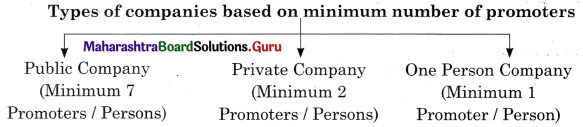
(i) Based on a minimum number of promoters:
As per Company Act, 2013 (Section 3) Promoters can form 3 types of companies. Such types of companies are based on numbers of Promoters.
Maharashtra Board Class 11 Secretarial Practice Important Questions Chapter 3 Formation of a Company 3 Q3

(ii) Based on Capital Structure [Section 3(2)]:

  • Company Limited by Shares: In this type of company capital is formed by shares and the liability is limited.
  • Company Limited by Guarantee: In this company, its members have guaranteed to contribute an amount of money either to the assets /of the company at the time of winding up towards the cost of winding up of the company.
  • Unlimited Liability Company: In this company, the liability of members is unlimited, they are liable for all amounts of debts and liabilities.

4. Answer the following questions.

Question 1.
Give the proforma of Certificate of Incorporation.
Answer:

GOVERNMENT OF INDIA
MINISTRY OF CORPORATE AFFAIRS
Central Registration Centre
Certificate of Incorporation
{Pursuant to sub-section (2) of section 7 of the Companies Act, 2013
(18 of 2013) and rule 18 of the Companies (Incorporation) Rules, 2014}

I hereby certify that ___________ is incorporated on this ___________ Day of ___________ Two thousand ___________ under the Companies Act, 2013 (18 of 2013) and that the company is limited by shares.

The Corporate Identity Number of the Company is ___________
The Permanent Account Number (PAN) of the company is ___________
The Tax Deduction and Collection Account Number (TAN) of the company is ___________
Given under my hand at ___________ this ___________ day of ___________ (month) Two thousand ___________

Digital Signature Certificate
For and on behalf of the Jurisdictional Registrar of Companies
Registrar of Companies
Central Registration Centre

Disclaimer: This Certificate only evidences incorporation of the company on the basis of documents and declarations of the applicant (s). This Certificate is neither a license nor permission to conduct business or solicit deposits or funds from the public. Permission of sector regulators is necessary wherever required. Registration status and other details of the company can be verified on www.mca.gov.in

Mailing address as per record available in Registrar of Companies office:
______________________
______________________


Maharashtra Board Class 11 English Yuvakbharati Solutions Chapter 4.3 Extracts of Drama

Balbharti Yuvakbharati English 11th Digest Chapter 4.3 Extracts of Drama – (B) An Enemy of the People Notes, Textbook Exercise Important Questions and Answers.

Maharashtra State Board Class 11 English Yuvakbharati Solutions Chapter 4.3 Extracts of Drama – An Enemy of the People

11th English Digest Chapter 4.3 Extracts of Drama – An Enemy of the People Textbook Questions and Answers

Character:

Question 1.
Mayor Peter Stockmann is a contrast to Dr. Thomas Stockmann. Justify.
Answer:
There are lots of good things you can say about Dr. Stockmann, the protagonist of ‘An Enemy of the People’. He is an idealist and a man having great love and care for his family. He is generous with his neighbors and truly cares for his fellow men. Despite his troubles, he wishes to make the world a better place. Most importantly, the doctor is a man of principles willing to fight for justice no matter what it costs.

On the contrary, Mayor Peter Stockmann, his brother is a practical man. He is the antagonist in the play who is less worried about the common men in the city. Throughout the play, the Mayor, Stockmann mercilessly tries to ruin his brother’s life in order to keep the truth from being revealed. He hardly shows any affinity towards his brother. He never shows any feeling of guilt for the fact that he’s totally messing up the life of a family member.

Maharashtra Board Class 11 English Yuvakbharati Solutions Chapter 4.3 Extracts of Drama

Question 2.
Write the character sketch of Dr. Stockmann.
Answer:
Dr. Stockmann is the brother of the Mayor, Peter Stockmann and the protagonist/hero of the play. He is a practising medical doctor and the medical officer of the town baths. He is an ideal person who has great love for family, fellow citizens and social values. Dr. Stockmann believes strongly in individual freedom and the right of every man to express himself freely.

He is a man of morality and truth and is ready to fight against injustice. He tries to raise his voice against the hypocritical ways of his brother and the members of conservative government. The play revolves around his struggle to give justice to common men of the city. Finally, his fruitless efforts lead him to such misfortune to ruin everything in his profession and life. However, he is not ready to give up his efforts for truth. We see him as a man of patience and strength when he remarks – “The strongest man in the world is he who stands alone!”

3. Read the given extract.

Question (i)
Complete the following table. (Answers are given directly in bold)
Answer:

CharacterSupportive CharacterIncident
1. Dr. Stockmann(a) Mrs. Stockmann
(b) Petra Stockmann
(a) Ready to stand with him in every difficulty.
(b) Joins her father in his fight against injustice.
2. Peter Stockmann(a) Aslaksen
(b) Hovstad
(a) To stand in opposition of Dr. Stockmann
(b) Turned to the Mayor’s side in the final scene.
3. Aslaksen(a) Dr. Stockmann
(b) Tradesmen
(a) Trusted him for printing the article.
(b) Gave their support to him.

Maharashtra Board Class 11 English Yuvakbharati Solutions Chapter 4.3 Extracts of Drama

Question (ii)
Match the column ‘A’ with column ‘B’

Column ‘A’Column ‘B’
1. Dr. Thomas StockmannOpportunist
2. KatherineVulnerable
3. PeterHonest and upright
4. PetraCoward
5. HovstadTimid but supportive
6. BillingCunning and corrupt
7. AslaksenCourageous

Answer:

Column ‘A’Column ‘B’
1. Dr. Thomas StockmannHonest and upright
2. KatherineVulnerable
3. PeterCunning and corrupt
4. PetraCourageous
5. HovstadTimid but supportive
6. BillingOpportunist
7. AslaksenCoward

Plot:

Question 1.
Describe the climax scene in your own words. Write your comments on it.
Answer:
In the final scene, Dr. Stockmann realizes that no one is going to support him to publish the article as no one is ready to take any step against the Mayor. So, Stockmann asks Hovstad to give him back his papers (article). He announces in front of the Mayor that he will read out the article in a mass meeting for everybody to hear the voice of truth. But, the Mayor assures him that no one will lend him a hall in the city to do this.

Billing and Hovstad have also the same opinion. Mrs. Stockmann feels shameful to know the fact that no one is willing to give her husband a hall. She is rather shocked to know that everyone has turned against her husband. Dr. Stockmann is ready to hire a drum to walk on the city streets reading the article. It shows his determination to reveal the truth at any cost. All the family members are ready to stand with Dr. Stockmann in his sincere efforts to purify the society.

Maharashtra Board Class 11 English Yuvakbharati Solutions Chapter 4.3 Extracts of Drama

Question 2.
Describe in your own words the incident when Hovstad’s real intention to help Dr. Stockmann is exposed.
Answer:
When Dr. stockmann reached Hovstad’s office, he notices the Mayor’s stick and hat and suspects him of hiding in the next room. Dr. Stockmann enquired if Hovstad was going to publish the article in ‘People’s Messenger’. Hovstad answered him that he had to wait for publishing the article.

Hovstad didn’t refuse him but was not ready to publish it. He was under the influence of the Mayor and had personal interest. In addition, both Billing and Aslaksen supported the editor. Dr. Stockmann approached to Aslaksen for requesting him to atleast print the article as a pamphlet. However he denied doing so. Finally, Hovstad refused to print the article saying it would ruin doctor’s family. Here, the Dr. realized Hovstad’s real intention of not printing the article as he was doing everything to protect himself.

3. Write down the consequences of the following occurrences, with the help of the play.

Question (a)
Dr. Thomas Stockmann wants an article exposing social evils to be printed in the newspaper.
Answer:
Dr. Stockmann was an idealist and a lover of truth. When he came across the unhygienic condition of the baths which was a direct threat to the health of the people, he decided to publish the article in the newspaper exposing the Mayor and his cronies. This would directly affect the ruling government to lose their seats. In addition, it would raise public outcry against the social injustice of the Mayor and his stakeholders had to pay a large amount to rectify the issue.

Question (b)
The Mayor, Peter Stockmann persuades Mr. Hovstad and Mr. Billing from printing the article.
Answer:
The Mayor entered Hovstad’s office through the back doors. He didn’t want to let Dr. Stockmann know about his visit to Hovstad. When he met Hovstad and Billing, he told them that Dr. Stockmann is a headstrong man and had some wrong informations about the condition of the baths.

He also praised both Hovstad and Billing and assured them that he had another article to publish which would clear the doubts of all regarding the baths. He indirectly assured them to have their favour in this matter if they supported him. As Dr. Stockmann came to know about the Mayor’s visit to Hovstad’s office to persuade them, he was of the firm opinion that they would not publish his article.

Maharashtra Board Class 11 English Yuvakbharati Solutions Chapter 4.3 Extracts of Drama

Question (c)
Aslaksen declares that he would not print Dr. Stockmann’s article.
Answer:
As the Mayor told Aslaksen his idea of raising the money from the small tradesmen, Aslaksen thought that Dr. Stockmann’s idea of extensive alternation of the baths was unrealistic. So he decided not to print the article in the newspaper and save the small tradesmen from this unnecessary burden. As Aslaksen denied printing the article, Dr. Stockmann assured them that he would read the article in the mass meeting or raise the issue on the streets of the city. He would anyway expose the ruling government and give justice to common men.

Question (d)
Katherine encourages Dr. Stockmann to proceed in his attempts in the cause of public attempts.
Answer:
When the Mayor and his supporter opposed Dr. Stockmann, Mrs. Stockmann felt shameful that all of them turned against her husband. She put her arm onto his neck and told him that she was ready to stand with him. She encouraged him not to give up his idea and she and her children would help him in his mission. She finally promised to support him till the end. She added that her children Morten, Ejlif and Petra would follow him on the streets of the city.

Setting:

Question 1.
The setting of the act is the office of the newspaper ‘The Herald’. Explain how it is the proper background for the theme of the play.
Answer:
This act is set in the editor’s room at the office of ‘People’s Messenger’. One door leads to the printing office and another to the rest of the offices. There is a large table in the middle covered with books, papers and newspapers and there is a desk at the window. The room is described as ‘dingy and cheerless’.

The setting of the play is appropriate to the theme as the single door opening shows that truth is the only way to be followed by everyone. The dingy and clumsy atmosphere and old furniture urge need of change and renovation in the existing situation. The table covered with books and newspapers is a symbol of chaos and anarchy in the government.

The window stands for a ray of hope in the darkness of injustice. A few closed chairs symbolize time to wind-up prevailing conservative government and bring in new liberal governance. The glass panels stand for transparency and clarity in every section of the government.

Maharashtra Board Class 11 English Yuvakbharati Solutions Chapter 4.3 Extracts of Drama

Question 2.
Explain the use of the following property in the development of the play.
Answer:
(a) Hat – Hat plays an important role in the development of the play. It stands for the city’s authority, ‘the Mayor’ as it was a part of the official uniform. When Dr. Stockmann put on the hat, he told his brother that the entire city was in his hand. He also added that with that supreme power he would throw him off the existing government. Dr. Stockmann saw the Mayor’s hat in the editor’s room and could realize that the Mayor was hiding in the next room, listening his conversation with the editor. This made him understand the Mayor’s plot of ruining his article.

(b) Stick – The stick at certain instances was a symbol of assertiveness, commitment, new ideas or sticking to the old things. The stick in Dr. Stockmann’s hand suggests his assertiveness, commitment and new ideas in the existing government with the support of everyone. But the stick in the Mayor’s hand, suggests that the whole situation was groomed by him to turn against Dr. Stockmann. The stick in the hand of the Mayor also proves his authority and command over other people.

(c) An envelope containing the letter – The envelope of the letter focuses over the issue of grievance which everyone keeps by hiding a secret. Dr. Stockmann took various efforts to expose the issue but finally Hovstad returned the envelope to him, which suggests how everyone tried to conceal the burning issue. The issue needed immediate attention, but was hidden from the public as the letter was hidden by the envelope.

3. Explain the following statements with reference to the context.

Question (a)
And then, once the ring is broken, we’ll get to work and show the public every day just how incompetent the Mayor is!
Answer:
When both Hovstad and Billing read Dr. Stockmann’s article, they were shocked to know that the article would bring a revolution in the city. Hovstad was ready to publish that article the next day in ‘People’s Messenger’. Billing thought that if the Mayor didn’t like it then it would be a great trouble for them. But Hovstad was ready to take the risk as the problem was acute.

The Mayor would be in trouble from either by the small tradesmen and the householders’ association or by the shareholders in the bath. Anyhow the ring would be a broken and they would get a chance everyday to expose the Mayor through the newspaper and the entire government would go in the hands of the liberals.

Maharashtra Board Class 11 English Yuvakbharati Solutions Chapter 4.3 Extracts of Drama

Question (b)
From now on The Herald shall be my artillery.
Answer:
Billing, Aslaksen, Hovstad and Dr. Stockmann were discussing about the article. Hovstad was ready to publish the article in the ‘People’s Messenger’ on the next day only. Seeing this Aslaksen agreed with Hovstad to print whatever he wished to print. Dr. Stockmann was of the opinion that it would disrupt on the entire system.

Dr. Stockmann told them that the Mayor and his cronies tried to persuade him by all means but he was determined to publish the article at any cost. Now, Dr. Stockmann considered ‘People’s Messenger’ as his sheet-anchor (additional support)to use it as an artillery to attack on the Mayor with one article after another.

Question (c)
You ought to be ashamed of yourself.
Answer:
Petra visited Hovstad and she told him that she could not translate the novel he had given her. Hovstad asked the reason why she could not translate that book. She answered that the book was unrealistic and she didn’t find it to be read by the common men. At that time, Petra came to know Hovstad’s original intention not printing her father’s article revealing the truth. She thought him as a loyal person but he turned a traitor. So she said that he ought to be ashamed of himself.

Maharashtra Board Class 11 English Yuvakbharati Solutions Chapter 4.3 Extracts of Drama

Question (d)
Because your father can’t do without my help.
Answer:
Petra did not wish to translate the book as it was unrealistic. When she asked Hovstad about her father’s article, Hovstad told her that he was not going to print the article. She sensed the intention of Hovstad and his behaviour. She did not like his way of looking at the truth. She got upset when Hovstad told her that she was fighting against it as it was only a matter of her father. She became furious as she heard his remarks that her father couldn’t do anything without his help. She got to know the attitude of Hovstad to support the Mayor in the issue.

Question (e)
And it’s by no means the small sacrifice the town will have to make.
Answer:
The Mayor tried hard to persuade Aslaksen and Hovstad that they should not support Dr. Stockmann in his attempts to publish the article as it was not in favour of the small tradesmen and the householders. If the Mayor would go for the extensive alteration of the baths, the town would have to sacrifice. It would incur great expenditure on the municipal.

As a result, they would have to put extra burden of taxes over the tradesmen and commoners. In addition, the baths would be shut down for two years. In such condition, the householders would have to suffer a lot. Eventually, the city would have to be ready to make the sacrifice but Aslaksen was in no mood to put the additional burden over the tradesmen and householders.

Maharashtra Board Class 11 English Yuvakbharati Solutions Chapter 4.3 Extracts of Drama

Glossary:

  1. sledgehammer – mallet or a heavy hammer used for breaking rocks
  2. chicken-hearted – cowardly or easily frightened
  3. prudent – wise and sensible, shrewd
  4. bombard – attack/ assault/ bother
  5. bigwigs – VIP or important persons
  6. mince – cut/ chop/ crumble
  7. salvation – deliverance/ escape/ rescue
  8. alderman – an elected member of a city council /next in status to the mayor
  9. compositor – a person who arranges the text and pictures of a newspaper or a book before it is printed
  10. trembling – shake/shiver/vibrate
  11. dingy – dull/colourless
  12. hypocrite – fraud/ deceiver/ pretender
  13. trivial – unimportant/ little/ worthless
  14. subscription – membership fee/ donations/ contribution.

Maharashtra Board Class 12 Chemistry Solutions Chapter 10 Halogen Derivatives

Balbharti Maharashtra State Board 12th Chemistry Textbook Solutions Chapter 10 Halogen Derivatives Textbook Exercise Questions and Answers.

Maharashtra State Board Class 12 Chemistry Solutions Chapter 10 Halogen Derivatives

1. Choose the most correct option.

Question i.
The correct order of increasing reactivity of C-X bond towards nucleophile in the following compounds is
Maharashtra Board Class 12 Chemistry Solutions Chapter 10 Halogen Derivatives 268
a. I < II < III < IV
b. II < I < III < IV
c. III < IV < II < I
d. IV < III < I < II
Answer:
(d) IV < III < I < II

Maharashtra Board Class 12 Chemistry Solutions Chapter 10 Halogen Derivatives

Question ii.
Maharashtra Board Class 12 Chemistry Solutions Chapter 10 Halogen Derivatives 269
The major product of the above reaction is,
Maharashtra Board Class 12 Chemistry Solutions Chapter 10 Halogen Derivatives 270
Answer:
(c)

Question iii.
Which of the following is likely to undergo racemization during alkaline hydrolysis?
Maharashtra Board Class 12 Chemistry Solutions Chapter 10 Halogen Derivatives 271
Answer:
(a) Only I

Question iv.
The best method for preparation of alkyl fluorides is
a. Finkelstein reaction
b. Swartz reaction
c. Free radical fluorination
d. Sandmeyer’s reaction
Answer:
b. Swartz reaction

Question v.
Identify the chiral molecule from the following.
a. 1-Bromobutane
b. 1,1- Dibromobutane
c. 2,3- Dibromobutane
d. 2-Bromobutane
Answer:
(d) 2-Bromobutane

Question vi.
An alkyl chloride on Wurtz reaction gives 2,2,5,5-tetramethylhexane. The same alkyl chloride on reduction with zinc-copper couple in alchol give hydrocarbon with molecular formula C5H12. What is the structure of alkyl chloride
Maharashtra Board Class 12 Chemistry Solutions Chapter 10 Halogen Derivatives 272
Answer:
(a)

Question vii.
Butanenitrile may be prepared by heating
a. propanol with KCN
b. butanol with KCN
c. n-butyl chloride with KCN
d. n-propyl chloride with KCN
Answer:
(d) n-propyl chloride with KCN

Question viii.
Choose the compound from the following that will react fastest by SN1 mechanism.
a. 1-iodobutane
b. 1-iodopropane
c. 2-iodo-2 methylbutane
d. 2-iodo-3-methylbutane
Answer:
(c) 2-iodo-2 methylbutane

Maharashtra Board Class 12 Chemistry Solutions Chapter 10 Halogen Derivatives

Question ix.
Maharashtra Board Class 12 Chemistry Solutions Chapter 10 Halogen Derivatives 273
The product ‘B’ in the above reaction sequence is,
Maharashtra Board Class 12 Chemistry Solutions Chapter 10 Halogen Derivatives 274
Answer:
(d)

Question x.
Which of the following is used as source of dichlorocarbene
a. tetrachloromethane
b. chloroform
c. iodoform
d. DDT
Answer:
(b) chloroform

2. Do as directed.

Question i.
Write IUPAC name of the following compounds
Maharashtra Board Class 12 Chemistry Solutions Chapter 10 Halogen Derivatives 275
Answer:
Maharashtra Board Class 12 Chemistry Solutions Chapter 10 Halogen Derivatives 23
Maharashtra Board Class 12 Chemistry Solutions Chapter 10 Halogen Derivatives 24

Question ii.
Write structure and IUPAC name of the major product in each of the following reaction.
Maharashtra Board Class 12 Chemistry Solutions Chapter 10 Halogen Derivatives 276
Maharashtra Board Class 12 Chemistry Solutions Chapter 10 Halogen Derivatives 277
Answer:
Structure and IUPAC name
Maharashtra Board Class 12 Chemistry Solutions Chapter 10 Halogen Derivatives 126
Maharashtra Board Class 12 Chemistry Solutions Chapter 10 Halogen Derivatives 127

Maharashtra Board Class 12 Chemistry Solutions Chapter 10 Halogen Derivatives

Question iii.
Identify chiral molecule/s from the following.
Maharashtra Board Class 12 Chemistry Solutions Chapter 10 Halogen Derivatives 278
Answer:
Chiral molecule
Maharashtra Board Class 12 Chemistry Solutions Chapter 10 Halogen Derivatives 88

Question iv.
Which one compound from the following pairs would undergo SN2 faster from the?
Maharashtra Board Class 12 Chemistry Solutions Chapter 10 Halogen Derivatives 279
Answer:
(1) Sincey Maharashtra Board Class 12 Chemistry Solutions Chapter 10 Halogen Derivatives 157 is a primary halide it undergoes SN2 reaction faster than Maharashtra Board Class 12 Chemistry Solutions Chapter 10 Halogen Derivatives 158.
(2) Since iodine is a better leaving group than chloride, 1-iodo propane (CH3CH2CH2I) undergoes SN2 reaction faster than l-chloropropane (CH3CH2CH2CI).

Question v.
Complete the following reactions giving major product.
Maharashtra Board Class 12 Chemistry Solutions Chapter 10 Halogen Derivatives 280
Answer:
Maharashtra Board Class 12 Chemistry Solutions Chapter 10 Halogen Derivatives 214

Maharashtra Board Class 12 Chemistry Solutions Chapter 10 Halogen Derivatives 215
Answer:
Maharashtra Board Class 12 Chemistry Solutions Chapter 10 Halogen Derivatives 216

Maharashtra Board Class 12 Chemistry Solutions Chapter 10 Halogen Derivatives 217
Answer:
Maharashtra Board Class 12 Chemistry Solutions Chapter 10 Halogen Derivatives 218

Maharashtra Board Class 12 Chemistry Solutions Chapter 10 Halogen Derivatives

Maharashtra Board Class 12 Chemistry Solutions Chapter 10 Halogen Derivatives 219
Answer:
Maharashtra Board Class 12 Chemistry Solutions Chapter 10 Halogen Derivatives 266

Question vi.
Name the reagent used to bring about the following conversions.
a. Bromoethane to ethoxyethane
b. 1-Chloropropane to 1 nitropropane
c. Ethyl bromide to ethyl isocyanide
d. Chlorobenzene to biphenyl
Answer:
Maharashtra Board Class 12 Chemistry Solutions Chapter 10 Halogen Derivatives 220

Question vii.
Arrange the following in the increase order of boiling points
a. 1-Bromopropane
b. 2- Bromopropane
c. 1- Bromobutane
d. 1-Bromo-2-methylpropane
Answer:
l-Bromo-2-methylpropane, 2-Bromopropane, 1-Bromopropane, 1-Bromo butane

Question viii.
Match the pairs.
Maharashtra Board Class 12 Chemistry Solutions Chapter 10 Halogen Derivatives 283
Answer:
Maharashtra Board Class 12 Chemistry Solutions Chapter 10 Halogen Derivatives 246

Maharashtra Board Class 12 Chemistry Solutions Chapter 10 Halogen Derivatives

3. Give reasons

Question i.
Haloarenes are less reactive than haloalkanes.
Answer:
Haloarenes (Aryl halides) are less reactive than (alkyl halides) haloalkanes due to the following reasons :

(1) Resonance effect : In haloarenes, the electron pairs on halogen atom are in conjugation with 7r-electrons of the benzene ring. The delocalization of these electrons C-Cl bond acquires partial double bond character.
Maharashtra Board Class 12 Chemistry Solutions Chapter 10 Halogen Derivatives 208

Due to partial double bond character of C-Cl bond in aryl halides, the bond cleavage in haloarene is difficult and are less reactive. On the other hand, in alkyl halides, carbon is attached to chlorine by a single bond and it can be easily broken.

(2) Aryl halides are stabilized by resonance but alkyl halides are not. Hence, the energy of activation for the displacement of halogen from aryl halides is much greater than that of alkyl halides.

(3) Different hybridization state of carbon atom in C-X bond :
(i) In alkyl halides, the carbon of C-X bond is sp3-hybridized with less 5-character and greater bond length of 178 pm, which requires less energy to break the C-X bond.

(ii) In aryl halides, the carbon of C-X bond is sp3-hybridized with more 5-character and shorter bond length which requires more energy to break C-X bond. Therefore, aryl halides are less reactive than alkyl halides.

(iii) Polarity of the C-X bond : In aryl halide C-X bond is less polar than in alkyl halides. Because sp3-hybrid carbon of C-X bond has less tendency to release electrons to the halogen than a sp3-hybrid carbon in alkyl halides. Thus halogen atom in aryl halides cannot be easily displaced by nucleophile.

(2) Aryl halides are extremely less reactive towards nucleophilic substitution reactions.
Answer:
Aryl halides are extremely less reactive towards nucleophilic substitution reaction due to the following reasons : (1) Resonance effect : In haloarenes, the electron pairs on halogen atom are in conjugation with 7r-electrons of the benzene ring. The delocalization of these electrons C-Cl bond acquires partial double bond character.
Maharashtra Board Class 12 Chemistry Solutions Chapter 10 Halogen Derivatives 209

Due to partial double bond character of C-Cl bond in aryl halides, the bond cleavage in haloarene is difficult and are less reactive towards nucleophilic substitution.

(2) Sp2 hybrid state of C : Different hybridization state of carbon atom in C-X bond : In aryl halides, the carbon of C-X bond is sp2-hybridized with more 5-character and shorter bond length of 169 pm which requires more energy to break C-X bond. It is difficult to break a shorter bond than a longer bond, in alkyl chloride (bond length 178 pm) therefore, aryl halides are less reactive towards nucleophilic substitution reaction.

(3) Instability of phenyl cation : In aryl halides, the phenyl cation formed due to self ionisation will not be stabilized by resonance which rules out possibility of SN1 mechanism. Also backside attack of nucleophile is blocked by the aromatic ring which rules out SN2 mechanism. Thus cations are not formed and hence aryl halides do not undergo nucleophilic substitution reaction easily.

(4) As any halides are electron rich molecules due to the presence of re-bond, they repel electron rich nucleophilic, attack. Hence, aryl halides are less reactive towards nucleophilic substitution reactions. However, the presence of electron withdrawing groups at o/p position activates the halogen of aryl halides towards substitution.
Maharashtra Board Class 12 Chemistry Solutions Chapter 10 Halogen Derivatives 210

(3) Aryl halides undergo electrophilic substitution reactions slowly.
Answer:
Aryl halides undergo electrophilic substitution reactions slowly and it can be explained as follows :

Maharashtra Board Class 12 Chemistry Solutions Chapter 10 Halogen Derivatives

(1) Inductive effect : The strongly electronegative halogen atom withdraws the electrons from carbon, atom of the ring, hence aryl halides show reactivity towards electrophilic attack.

(2) Resonance effect : The resonating structures of aryl halides show increase in electron density at ortho and para position, hence it is o, p directing.
Maharashtra Board Class 12 Chemistry Solutions Chapter 10 Halogen Derivatives 211

The inductive effect and resonance effect compete with each other. The inductive effect is stronger than resonance effect. The reactivity of aryl halides is controlled by stronger inductive effect and o, p orientation is controlled by weaker resonating effect.
Maharashtra Board Class 12 Chemistry Solutions Chapter 10 Halogen Derivatives 212

The attack of electrophile (Y) on haloarenes at ortho and para positions are more stable due to formation of chloronium ion. The chloronium ion formed is comparatively more stable than other hybrid structures of carbonium ion.

(4) Reactions involving Grignard reagent must be carried out under anhydrous condition.
Answer:
(1) Grignard reagent (R Mg X) is an organometallic compound. The carbon-magnesium bond is highly polar and magnesium halogen bond is in ionic in nature. Grignard reagent is highly reactive.

(2) The reactions of Grignard reagent are carried out in dry conditions because traces of moisture may spoil the reaction and Grignard reagent reacts with water to produce alkane. Hence, reactions involving Grignard reagent must be carried out under anhydrous condition.

(5) Alkyl halides are generally not prepared by free radical halogenation of alkane.
Answer:
(1) Free radical halogenation of alkane gives a mixture of all different possible Monohaloalkanes as well as polyhalogen alkanes.
(2) In this method, by changing the quantity of halogen the desired product can be made to predominate over the other
products. Hence, alkyl halides are generally not prepared by free radical halogenation of alkane.

Question ii.
Alkyl halides though polar are immiscible with water.
Answer:
(1) In alkyl halide, the halogen atom is more electronegative than carbon atom, the C – X bond is polar.
(2) Though alkyl halide is polar, it is insoluble in water because alkyl halide is not able to form hydrogen bonds with water. Attraction between alkyl halide molecule is stronger than attraction between alkyl halide and water.

(2) C-F bond in CH3F is the strongest bond and C-I bond in CH3I is the weakest bond. Explain.
Answer:
(1) Methyl fluoride (CH3F) is highly polar molecule and has the shortest C-F bond length (139 pm) and the strongest C-F bond due to greater overlap of orbitals of the same principal quantum number i.e., overlap of 2sp3 orbital of carbon with 2pz orbital of fluorine.
(2) Methyl iodide (CH3I) is much less polar and has the longest (C-I) bond length (214 pm) and the weakest C-I bond due to poor overlap of 2sp3 orbital carbon with 5pz orbital of iodine i.e., 2sp3 orbital of carbon cannot penetrate into larger p-orbitals.

(3) The boiling point of alkyl iodide is higher than that of alkyl fluoride.
Answer:
For a given alkyl group, the boiling point increases with increasing atomic mass of the halogen, because magnitude of van der Waals force increases with increase in size and mass of halogen. Therefore, boiling point of alkyl iodide is higher than that of alkyl fluoride.

(4) The boiling point of isopropyl bromide is lower than that of it-propyl bromide.
Answer:
For isomeric alkyl halides (isopropyl bromide and n-propyl bromide), the boiling point decreases as the branching increases, surface area decreases on branching and van der Waals forces decrease, therefore, the boiling point of isopropyl bromide is lower than that of n-propyl bromide.

(5) p-Dichlorobenzene Maharashtra Board Class 12 Chemistry Solutions Chapter 10 Halogen Derivatives 75 has mp. higher than those of o-and rn-isomers.
Answer:
p-Dichlorobenzene has higher melting point than those of o-and m-isomers. This is because of its symmetrical structure which can easily fits in crystal lattice. As a result intermolecular forces of attraction are stronger and therefore greater energy is required to overcome its lattice energy.

Maharashtra Board Class 12 Chemistry Solutions Chapter 10 Halogen Derivatives

Question iii.
Reactions involving Grignard reagent must be carried out under anhydrous conditions.

Question iv.
Alkyl halides are generally not prepared by free radical halogenation of alkanes.
Answer:
(1) Direct fluorination of alkanes is highly exothermic, explosive and invariably leads to polyfluorination and decomposition of the alkanes. It is difficult to control the reaction.
(2) Direct iodination of alkanes is highly reversible and difficult to carry out.
(3) In direct chlorination and bromination, the reaction is not selective. It can lead to different isomeric monohalogenated alkanes (alkyl halides) as well as polyhalogenated alkanes.
Hence, halogenation of alkanes is not a good method of preparation of alkyl halides.

4. Distinguish between – SN1 and SN2 mechanism of substitution reaction ?
Answer:
Maharashtra Board Class 12 Chemistry Solutions Chapter 10 Halogen Derivatives 152

5. Explain – Optical isomerism in 2-chlorobutane.
Answer:
(1) 2-Chlorobutane contains an asymmetric. Maharashtra Board Class 12 Chemistry Solutions Chapter 10 Halogen Derivatives 265 carbon atom (the starred carbon atom) which is attached to four different groups, i.e., ethyl (-CH2 – CH3), methyl (CH3), chloro (Cl) and hydrogen (H) groups.
Maharashtra Board Class 12 Chemistry Solutions Chapter 10 Halogen Derivatives 83
(2) Two different arrangements of these groups around the carbon atom are possible as shown in the figure. Hence, it exists as a pair of enanti¬omers. The two enantiomers are mirror images of each other and are not superimposable.

(3) One of the enantiomers will rotate the plane of plane-polarized light to the left hand side and is called the laevorotatory isomer (/-isomer). The other enantiomer will rotate the plane of plane-polarized light to the right hand side and is called the dextrorotatory isomer (d-isomer).

(4) Equimolar mixture of the d- and the 1-isomers is optically inactive and is called the racemic mixture or the racemate (dl-mixture). The optical inactivity of the racemic mixture is due to external compensation.

Maharashtra Board Class 12 Chemistry Solutions Chapter 10 Halogen Derivatives

6. Convert the following.

Question i.
Propene to propan-1-ol
Answer:
Maharashtra Board Class 12 Chemistry Solutions Chapter 10 Halogen Derivatives 177

Question ii.
Benzyl alcohol to benzyl cyanide
Answer:
Maharashtra Board Class 12 Chemistry Solutions Chapter 10 Halogen Derivatives 178

Question iii.
Ethanol to propane nitrile
Answer:
Maharashtra Board Class 12 Chemistry Solutions Chapter 10 Halogen Derivatives 179

Question iv.
But-1-ene to n-butyl iodide
Answer:
Maharashtra Board Class 12 Chemistry Solutions Chapter 10 Halogen Derivatives 180

Question v.
2-Chloropropane to propan-1-ol
Answer:
Maharashtra Board Class 12 Chemistry Solutions Chapter 10 Halogen Derivatives 181

Question vi.
tert-Butyl bromide to isobutyl bromide
Answer:
Maharashtra Board Class 12 Chemistry Solutions Chapter 10 Halogen Derivatives 182

Maharashtra Board Class 12 Chemistry Solutions Chapter 10 Halogen Derivatives

Question vii.
Aniline to chlorobenzene
Answer:
Maharashtra Board Class 12 Chemistry Solutions Chapter 10 Halogen Derivatives 183

Question viii.
Propene to 1-nitropropane
Answer:
Maharashtra Board Class 12 Chemistry Solutions Chapter 10 Halogen Derivatives 184

7. Answer the following

Question i.
HCl is added to a hydrocarbon ‘A’ (C4H8) to give a compound ‘B’ which on hydrolysis with aqueous alkali forms tertiary alcohol ‘C’ (C4H10O). Identify ‘A’ , ‘B’ and ‘C’.
Answer:
Maharashtra Board Class 12 Chemistry Solutions Chapter 10 Halogen Derivatives 173

Question ii.
Complete the following reaction sequences by writing the structural formulae of the organic compounds ‘A’, ‘B’ and ‘C’.
Maharashtra Board Class 12 Chemistry Solutions Chapter 10 Halogen Derivatives 281
Answer:
Maharashtra Board Class 12 Chemistry Solutions Chapter 10 Halogen Derivatives 175
Maharashtra Board Class 12 Chemistry Solutions Chapter 10 Halogen Derivatives 176

Maharashtra Board Class 12 Chemistry Solutions Chapter 10 Halogen Derivatives

Question iii.
Observe the following and answer the questions given below.
Maharashtra Board Class 12 Chemistry Solutions Chapter 10 Halogen Derivatives 282
a. Name the type of halogen derivative
b. Comment on the bond length of C-X bond in it
c. Can react by SN1 mechanism? Justify your answer.
Answer:
a. Vinyl halide
b. C – X bond length shorter in vinyl halide than alkyl halide. Vinyl halide has partial double bond character due to resonance.

In vinyl halide, carbon is sp hybridised. The bond is shorter and stronger and the molecule is more stable.

c. Yes, It reacts by SN1 mechanism. SN1 mechanism involves formation of carbocation intermediate. The vinylic carbocation intermediate formed is resonance stabilized, hence SN1 mechanism is favoured.

Activity :
1. Collect detailed information about Freons and their uses.
2. Collect information about DDT as a persistent pesticide.
Reference books
i. Organic chemistry by Morrison, Boyd, Bhattacharjee, 7th edition, Pearson
ii. Organic chemistry by Finar, Vol 1, 6th edition, Pearson

12th Chemistry Digest Chapter 9 Halogen Derivatives Intext Questions and Answers

Use your brain power….. (Textbook page 212)

Maharashtra Board Class 12 Chemistry Solutions Chapter 10 Halogen Derivatives 284

Question 1.
Write IUPAC names of the following:
Maharashtra Board Class 12 Chemistry Solutions Chapter 10 Halogen Derivatives 29
Answer:
Maharashtra Board Class 12 Chemistry Solutions Chapter 10 Halogen Derivatives 30

Maharashtra Board Class 12 Chemistry Solutions Chapter 10 Halogen Derivatives

Question 10.1 : (Textbook page 213)

How will you obtain 1.bromo.1-methylcyclohexane from alkene? Write possible structures of alkene and the reaction involved.
Maharashtra Board Class 12 Chemistry Solutions Chapter 10 Halogen Derivatives 285
Answer:
Maharashtra Board Class 12 Chemistry Solutions Chapter 10 Halogen Derivatives 64

Use your brain power ….. (Textbook page 213)

Question 1.
Rewrite the following reaction by filling the blanks:
Maharashtra Board Class 12 Chemistry Solutions Chapter 10 Halogen Derivatives 65
Answer:
Maharashtra Board Class 12 Chemistry Solutions Chapter 10 Halogen Derivatives 66
Maharashtra Board Class 12 Chemistry Solutions Chapter 10 Halogen Derivatives 67

Maharashtra Board Class 12 Chemistry Solutions Chapter 10 Halogen Derivatives

Question 10.2 : (Textbook page 216)

Arrange the following compounds in order of increasing boiling points : bromoform, chloromethane, dibromomethane, bromomethane.
Answer:
The comparative boiling points of halogen derivatives are mainly related with van der Waals forces of attraction which depend upon the molecular size. In the present case all the compounds contain only one carbon. Thus the molecular size depends upon the size of halogen and number of halogen atoms present.

Thus increasing order of boiling point is, CH3CI < CH3Br < CH2Br2 < CHBr3

Try this ….. (Textbook page 2016)

Question 1.
(1) Make a three-dimensional model of 2-chlorobutane.
(2) Make another model which is a mirror image of the first model.
(3) Try to superimpose the two models on each other.
(4) Do they superimpose on each other exactly ?
(5) Comment on whether the two models are identical or not.
Answer:
(1) (2) and (3)
Maharashtra Board Class 12 Chemistry Solutions Chapter 10 Halogen Derivatives 76
(4) Two models are non-superimposable mir ror images of each other called enantiomers.

(5) Two enantiomers are identical. Theyhave the same physical properties (such as melting points, boiling points, densities refractive index). They also have identical chemical properties. The magnitude of their optical rotation is equal but the sign of optical rotation is opposite.

Try this ….. (Textbook page 219)

Question 1.
1. Draw structares of enantiomers of lactic acid Maharashtra Board Class 12 Chemistry Solutions Chapter 10 Halogen Derivatives 91 using Fischer projection formulae.
2. Draw structures of enantiomers of 2-bromobutane using wedge formula.
Answer:
(1)
Maharashtra Board Class 12 Chemistry Solutions Chapter 10 Halogen Derivatives 92

(2) Wedge formula : 2-brornobutane
Maharashtra Board Class 12 Chemistry Solutions Chapter 10 Halogen Derivatives 93

Maharashtra Board Class 12 Chemistry Solutions Chapter 10 Halogen Derivatives

Can you tell? (Textbook page 220)

Question 1.
Alkyl halides, when treated with alcoholic solution of silver nitrite, give nitroalkanes whereas with sodium nitrite they give alkyl nitrites. Explain.
Answer:
Nitrite ion is an ambident nucleophile, which can attack through ‘O’ or ‘N’.
Maharashtra Board Class 12 Chemistry Solutions Chapter 10 Halogen Derivatives 124
Both nitrogen and oxygen are capable of donating electron pair. C – N bond, being stronger than N – O bond, attack occurs through C atom from alkyl halide forming nitroalkane.

However, sodium nitrite (NaNO2) is an ionic compound and oxygen is free to donate pair of electrons. Hence, attack occurs through oxygen resulting in the formation of alkyl nitrite.
Maharashtra Board Class 12 Chemistry Solutions Chapter 10 Halogen Derivatives 125

Use your brain power! (Textbook page 222)

Question 1.
Draw the Fischer projection formulae of two products obtained when compound (A) reacts with OHe by SN1 mechanis.
Maharashtra Board Class 12 Chemistry Solutions Chapter 10 Halogen Derivatives 144
Answer:
Maharashtra Board Class 12 Chemistry Solutions Chapter 10 Halogen Derivatives 145

Question 2.
Draw the Fischer projection formula of the product formed when compound (B) reacts with OHΘ by SN2 mechanism.
Maharashtra Board Class 12 Chemistry Solutions Chapter 10 Halogen Derivatives 146
Answer:
Maharashtra Board Class 12 Chemistry Solutions Chapter 10 Halogen Derivatives 147

Question 10.4 : (Textbook page 223)

Allylic and benzylic halides show high reactivity towards the SN1 mechanism than other primary alkyl halides. Explain.
Answer:
In allylic and benzylic halide, the carbocation formed undergoes stabilization through the resonance. Hence, allylic and benzylic halides show high reactivity towards the SN1 reaction. The resonating structures are
Maharashtra Board Class 12 Chemistry Solutions Chapter 10 Halogen Derivatives 149

Resonance stabilization of allylic carbocation
Maharashtra Board Class 12 Chemistry Solutions Chapter 10 Halogen Derivatives 150
Resonance stabilization of benzylic carbocation

Maharashtra Board Class 12 Chemistry Solutions Chapter 10 Halogen Derivatives

Question 10.5 : (Textbook page 224)

Which of the following two compounds would react faster by SN2 mechanism and Why?
Maharashtra Board Class 12 Chemistry Solutions Chapter 10 Halogen Derivatives 151
Answer :
In SN2 mechanism, a pentacoordinate T.S. is involved. The order of reactivity of alkyl halides towards SN2 mechanism is.
Primary > Secondary > Tertiary, (due to increasing crowding in T.S. from primary to tertiary halides.
1- Chlorobutane being primary halide will react faster by SN2 mechanism, than the secondary halide 2- chlorobutane.)

Can you tell? (Textbook page 227)

Question 1.
Conversion of chlorobenzene to phenol by aqueous sodium hydroxide requires high temperature of about 623K and high pressure. Explain.
Maharashtra Board Class 12 Chemistry Solutions Chapter 10 Halogen Derivatives 199
Answer:
Due to the partial double bond character in chlorobenzene, the bond cleavage in chlorobenzene is difficult and is less reactive. Hence, during the conversion of chlorobenzene to phenol by a question NaOH requires high temperature & high pressure.

Maharashtra Board Class 12 Chemistry Solutions Chapter 16 Green Chemistry and Nanochemistry

Balbharti Maharashtra State Board 12th Chemistry Textbook Solutions Chapter 10 Halogen Derivatives Textbook Exercise Questions and Answers.

Maharashtra State Board Class 12 Chemistry Solutions Chapter 16 Green Chemistry and Nanochemistry

1. Choose the most correct option.

Question i.
The development that meets the needs of the present without compromising the ability of future generations to meet their own need is known as
a. Continuous development
b. Sustainable development
c. True development
d. Irrational development
Answer:
b. Sustainable development

Maharashtra Board Class 12 Chemistry Solutions Chapter 16 Green Chemistry and Nanochemistry

Question ii.
Which of the following is ϒ-isomer of BHC?
a. DDT
b. lindane
c. Chloroform
d. Chlorobenzene
Answer:
b. lindane

Question iii.
The prefix ‘nano’ comes from
a. French word meaning billion
b. Greek word meaning dwarf
c. Spanish word meaning particle
d. Latin word meaning invisible
Answer:
(b) Greek word meaning dwarf

Question iv.
Which of the following information is given by FTIR technique?
a. Absorption of functional groups
b. Particle size
c. Confirmation of formation of nanoparticles
d. Crystal structure
Answer:
(a) Absorption of functional groups

Question v.
The concept of green chemistry was coined by
a. Born Haber
b. Nario Taniguchi
c. Richard Feynman
d. Paul T. Anastas
Answer:
(d) Paul T. Anastas

2. Answer the following

Question i.
Write the formula to calculate % atom economy.
Answer:
Maharashtra Board Class 12 Chemistry Solutions Chapter 16 Green Chemistry and Nanochemistry 9

Question ii.
Name the ϒ-isomer of BHC.
Answer:
Lindane

Question iii.
Ridhima wants to detect structure of surface of materials. Name the technique she has to use.
Answer:
Scanning electron microscopy (SEM)

Question iv.
Which nanomaterial is used for tyres of car to increase the life of tyres?
Answer:
Carbon black

Question v.
Name the scientist who discovered scanning tunneling microscope (STM) in 1980.
Answer:
Gerd Binning and Heinrich Rohrer. (Nobel prize 1986)

Question vi.
1 nm = …..m?
Answer:
1 nm = 109 m

Maharashtra Board Class 12 Chemistry Solutions Chapter 16 Green Chemistry and Nanochemistry

3. Answer the following

Question i.
Define
(i) Green chemistry
(ii) sustainable development.
Answer:
(i) Green chemistry : Green chemistry is the use of chemistry for pollution prevention and it designs the use of chemical products and processes that reduce or eliminate the use or generation of hazardous substances.

(ii) Sustainable development : Sustainable development is the development that meets the needs of the present, without compromising the ability of future generations to meet their own needs.

Question ii.
Explain the role of green chemistry.
Answer:
When the waste and pollution that society generates exceeds the Earth’s natural capacity for dealing with it, the green chemistry approach plays an important role.

  • To reduce or eliminate the use or generation of hazardous substances in the design, manufacture and use of chemical products by promoting innovative chemical technologies.
  • Capital expenditure required for prevention of pollution is controlled by the use of green chemistry.
  • Since green chemistry incorporates and promotes pollution prevention practices in the manufacturing process of chemicals it helps industrial ecology.
  • Green chemistry helps to protect the presence of ozone in the stratosphere. Ozone layer is essential for the survival of life on the earth.
  • Global warming (Greenhouse effect) is controlled by green chemistry. At present it is the beginning of the green revolution.
  • It is an exciting time with the new challenges for chemist involved with the discovery, manufacturing and use of chemicals. Green chemistry helps us to save environment and save earth, which is important for our future.

Question iii.
Give the full form (long form) of the names for the following instruments.
a. XRD
b. TEM.
c. STM
d. FTIR
e. SEM
Answer:
a. XRD-X-ray diffraction
b. TEM-Tunneling Electron Microscope
c. STM – Scanning Tunneling Microscope
d. FTIR-Fourier Transform Infrared Spectroscope
e. SEM-Scanning Electron Microscope

Question iv.
Define the following terms :
a. Nanoscience
b. Nanotechnology
c. Nanomaterial
d. Nanochemistry
Answer:
a. Nanoscience : The study of phenomena and manipulation of materials at atomic, molecular and macromolecular scales where properties differ significantly from those at a larger scale is called nanoscience.

b. Nanotechnology : The design, characterization, production and application of structures, device and system by controlling shape and size at nanometer scale is called nanotechnology.

c. Nanomaterial : A material having structural components with at least one dimension in the nanometer scale that is 1 -100 nm is called the nanomaterial. Nanomaterials are larger than single atoms but smaller than bacteria and cells.

d. Nanochemistry : It is the combination of chemistry and nanoscience. It deals with designing and synthesis of materials of nanoscale with different size and shape, structure and composition and their organization into functional architectures.

Maharashtra Board Class 12 Chemistry Solutions Chapter 16 Green Chemistry and Nanochemistry

Question v.
How nanotechnology plays an important role in water purification techniques?
Answer:

  1. Water purification is an important issue as 1.1 billion people do not have access to improved water supply. Water contains water bom pathogens like viruses, bacteria.
  2. Silver nanoparticles are highly effective bacterial disinfectant to remove E. Coli from water. Hence, filter materials coated with silver nanoparticles is used to clean water.
  3. Silver nanoparticles (AgNps) is a cost effective alternative technology (for e.g. water purifier).

Question vi.
Which nanomaterial is used in sunscreen lotion? Write its use.
Answer:
Zinc oxide (ZnO) and Titanium dioxide (TiO2) nanoparticles are used sunscreen lotions. The chemicals protect the skin against harmful u.v (ultraviolet) rays by absorbing or reflecting the light and prevent the skin from damage.

Question vii.
How will you illustrate the use of safer solvent and auxiliaries?
Answer:

  • Use of safer solvents and auxiliaries – is a principle of green chemistry it states that safer solvent like water, supercritical CO2 should be used in place of volatile halogenated organic solvents, like CH2CI2, CHCI3, CCI4 for chemical synthesis and other purposes.
  • Solvents dissolve solutes and form solutions, they facilitate many reactions. Water is a safer benign solvent while solvents like dichloromethane (CH2CI2), chloroform (CHCI3) etc are hazardous.
  • Use of toxic solvents affect millions of workers every year and have implications for consumers and the environment. A large amount of waste is created by their use and they also have huge environmental and health impacts.
  • Finding safer solvents or designing processes which are solvent free is the best way to improve the process and the product.

Question viii.
Define catalyst. Give two examples.
Answer:
A substance which speeds up the rate of a reaction without itself being changed chemically in the reaction is called a catalyst. It helps to increase selectivity, minimise waste and reduce reaction time and energy demands. For example : Hydrogenation of oil the catalyst used are platinum or palladium, Raney nickel.

4. Answer the following

Question i.
Explain any three principles of green chemistry.
Answer:

  1. Environment protection is the prime concern which has lead to the need for designing chemicals that degrade and can be discarded easily. These chemicals and their degradation products should be non-toxic, non-bioaccumulative or should not be environmentally persistent.
  2. This principle aims at waste product being automatically degradable to clean the environment. Thus the preference for biodegradable polymers and pesticides.
  3. To make the separation and segregation easier for the consumer an international plastic recycle mark is printed on larger items.
  4. There is a dire need to develop improvised analytical methods to allow for real time, in process monitoring and control prior to the formation of hazardous substances.
  5. It is very much important for the chemical industries and nuclear reactors to develop or modify analytical
    methodologies so that continuous monitoring of the manufacturing and processing unit is possible.
  6. It is needed to develop chemical processes that are safer and minimize the risk of accidents. It is important to select chemical substances used in a chemical reaction in such a way that they can minimize the occurrence of chemical accidents, explosions, fire and emissions.
  7. For example : Chemical process that works with the gaseous substances can lead to relatively higher possibilities of accidents including explosion as compared to the system working with nonvolatile liquid and solid substances.

Question ii.
Explain atom economy with suitable example.
Answer:
(1) Atom economy is a measure of the amount of atoms from the starting material that are present in the final product at the end of a chemical process. Good atom economy means most of the atoms of the reactants are incorporated in the desired products. Only small amount of waste is produced, hence lesser problem of waste disposal.

Maharashtra Board Class 12 Chemistry Solutions Chapter 16 Green Chemistry and Nanochemistry

(2) The atom economy of a process can be calculated using the following formula.

Maharashtra Board Class 12 Chemistry Solutions Chapter 16 Green Chemistry and Nanochemistry 1

The atom economy of the above reacijon is less than 50% and waste produced is higher.

Question iii.
How will you illustrate the principle, minimization of steps?
Answer:
(1) The technique of protecting or blocking group is commonly used in organic synthesis. Finally on completion of reaction deprotection of the group is required. This leads to unnecessary increase in the number of steps and decreased atom economy.

(2) The green chemistry principle aims to develop processes to avoid necessary steps i.e. (minimization of steps). When biocatalyst is used very often there is no need for protection of selective group. For example, conversion of m-hydroxyl benzaldehyde to m-hydroxybenzoic acid.
Maharashtra Board Class 12 Chemistry Solutions Chapter 16 Green Chemistry and Nanochemistry 6

Question iv.
What do you mean by sol and gel? Describe the sol-gel method of preparation for nanoparticles.
Answer:
(1) Sol : Sols are dispersions of colloidal particles in a liquid. Colloids are solid particles with diameter of 1-100 nm.

(2) Gel : A gel is interconnected rigid network with pores of submicrometer dimensions and polymeric chains whose average length is greater than a micrometer.

(3) Sol-gel Process : A sol-gel process is an inorganic polymerisation reaction. It is generally carried out at room temperature, it includes four steps : Hydrolysis, polycondensation, drying and thermal decomposition. This method is widely used to prepare oxide materials.
Maharashtra Board Class 12 Chemistry Solutions Chapter 16 Green Chemistry and Nanochemistry 8

The reactions involved in the sol-gel process are as follows :
MOR + H2O → MOH + ROH (hydrolysis)
metal alkoxide
MOH + ROM → M-O-M + ROH (condensation)

  • Formation of different stable solution of the alkoxide or solvated metal precursor.
  • Gelation involves the formation of an oxide or alcohol-bridged network (gel) by a polycondensation reaction.
  • Aging of the gel means during that period gel transforms into a solid mass.
  • Drying of the gel involves removal of water and other volatile liquids from the gel network.
  • Dehydration is achieved when the material is heated at temperatures up to 800°C.

Maharashtra Board Class 12 Chemistry Solutions Chapter 16 Green Chemistry and Nanochemistry

Question v.
Which flower is an example of self-cleaning?
Answer:

  • Lotus is an example of self cleansing.
  • Nanostructures on the lotus plant leaves are super hydrophobic, they repel water which carries dirt as it rolls off.
    Thus though lotus plant (Nelumbonucifera) grows in muddy water, its leaves always appear clean.

Activity :
Collect information about the application of nanochemistry in cosmetics and pharmaceuticals

12th Chemistry Digest Chapter 16 Green Chemistry and Nanochemistry Intext Questions and Answers

Do you know? (Textbook page 343)

Question 1.
Does plastic packaging impact the food they wrap ?
Answer:
Phthalates leach into food through packaging so you should avoid microwaving food or drinks in plastic and not use plastic cling wrap and store your food in glass container whenever possible. Try to avoid prepackaging, processed food so that you will reduce exposure to the harmful effects of plastic.

Used Catalyst (Textbook page 342)

Question 18.
Complete the chart:

ReactionName of Catalyst used
1. Hydrogenation of oil (Hardening)…………………………………
2. Haber’s process of manufacture of ammonia…………………………………
3. Manufacture of HDPE polymer…………………………………
4. Manufacture of H2S04 by contact process…………………………………
5. Fischer-Tropsch process (synthesis of gasoline)…………………………………

Answer:

ReactionName of Catalyst used
1. Hydrogenation of oil (Hardening)Nickel (Ni)
2. Haber’s process of manufacture of ammoniaIron
3. Manufacture of HDPE polymerZeigler-Natta catalyst
4. Manufacture of H2S04 by contact processVanadium oxide (V205)
5. Fischer-Tropsch process (synthesis of gasoline)Cobalt-based or Iron based


Maharashtra Board Class 11 Secretarial Practice Important Questions Chapter 2 Joint Stock Company

Balbharti Maharashtra State Board Class 11 Secretarial Practice Important Questions Chapter 2 Joint Stock Company Important Questions and Answers.

Maharashtra State Board 11th Secretarial Practice Important Questions Chapter 2 Joint Stock Company

1A. Select the correct answer from the options given below and rewrite the statements.

Question 1.
A joint stock company has ___________ life.
(a) short
(b) limited
(c) continuous
Answer:
(c) continuous

Question 2.
A Joint Stock Company has independent ___________
(a) survival
(b) legal status
(c) capital
Answer:
(b) legal status

Maharashtra Board Class 11 Secretarial Practice Important Questions Chapter 2 Joint Stock Company

Question 3.
Shares of company are ___________
(a) transferable
(b) non-transferable
(c) none of these
Answer:
(a) transferable

Question 4.
In a small company, paid-up share capital does not exceed ₹ ___________ or such higher amount as may be prescribed.
(a) ₹ 100 lakh
(b) ₹ 20 lakh
(c) ₹ 50 lakh
Answer:
(c) ₹ 50 lakh

Question 5.
In general business partnership firm maximum ___________ partners are allowed.
(a) 2
(b) 20
(c) 50
Answer:
(c) 50

Question 6.
A Joint Stock company is ___________ person.
(a) real
(b) an artificial
(c) a natural
Answer:
(b) an artificial

Maharashtra Board Class 11 Secretarial Practice Important Questions Chapter 2 Joint Stock Company

Question 7.
Registration is ___________ for every company.
(a) voluntary
(b) compulsory
(c) optional
Answer:
(b) compulsory

1B. Match the pairs.

Question 1.

Group ‘A’Group ‘B’
(a) Sole Trading Concern(1) Hindu Succession Act, 1956
(b) Joint Hindu Family Business(2) Unlimited liability, joint, and several
(c) Partnership Firm(3) ‘One Many Army’
(d) Reserve Bank of India(4) Limited liability
(e) Foreign Company(5) ‘One Man Business’
(6) Statutory Company
(7) Hindu Succession Act, 1932
(8) Public company
(9) Company incorporated outside India
(10) Company incorporated within India

Answer:

Group ‘A’Group ‘B’
(a) Sole Trading Concern(5) ‘One Man Business’
(b) Joint Hindu Family Business(7) Hindu Succession Act, 1932
(c) Partnership Firm(2) Unlimited liability, joint, and several
(d) Reserve Bank of India(6) Statutory Company
(e) Foreign Company(9) Company incorporated outside India

1C. Write a word or a term or a phrase that can substitute each of the following statements.

Question 1.
The place for dealing with shares of the company.
Answer:
Share market/Stock exchange

Question 2.
A company has continuous life.
Answer:
Perpetual succession

Question 3.
The form of commercial organization suitable to carry large scale business operations.
Answer:
Joint Stock company

Question 4.
A company opposite to a holding company.
Answer:
Subsidiary company

Maharashtra Board Class 11 Secretarial Practice Important Questions Chapter 2 Joint Stock Company

Question 5.
A company incorporated outside India.
Answer:
Foreign company

Question 6.
A company that is not a private company.
Answer:
Public Company

Question 7.
A company having no limit on the liability of its member.
Answer:
Unlimited Liability company

1D. State whether the following statements are True or False.

Question 1.
A Joint Stock company is an artificial person created by law.
Answer:
True

Question 2.
A joint-stock company is a superior form of business organization.
Answer:
True

Question 3.
The Joint Stock company collects huge capital from the public.
Answer:
True

Question 4.
Part of the profit of the company distributed among the shareholders is known as Dividends.
Answer:
True

Question 5.
There is no Government control and supervision over the working of Joint Stock companies.
Answer:
False

Maharashtra Board Class 11 Secretarial Practice Important Questions Chapter 2 Joint Stock Company

Question 6.
In a private company maximum number of membership is restricted to up to 50.
Answer:
False

1E. Complete the sentences.

Question 1.
A business that is owned and managed by one person is called as ___________
Answer:
Sole Trading Concern

Question 2.
A company incorporated outside India, but having a place of business in India is called ___________
Answer:
Foreign company

Question 3.
An organization in which management is based on democratic nature and ‘One member One vote’ is called as ___________
Answer:
Co-operative society

Question 4.
A feature of Joint Stock company, by which member can sell shares as and when he desires, called as ___________
Answer:
transferability of shares

Maharashtra Board Class 11 Secretarial Practice Important Questions Chapter 2 Joint Stock Company

Question 5.
A business organization owned and manages by family members is called ___________
Answer:
Joint Hindu Family Business

Question 6.
A business organization owned and manages by two or more person collectivity is called as ___________
Answer:
Partnership firm

Question 7.
An incorporated association which is an artificial person created by law having perpetual succession is called ___________
Answer:
Joint Stock Company

Question 8.
A voluntary association of individual formed for providing service to member is ___________
Answer:
Co-operative Society

Question 9.
The liability of ‘Karta’ in JHF business is ___________
Answer:
Unlimited

Question 10.
Life Insurance Corporation of India is an example of ___________
Answer:
Statutory Company

Question 11.
Companies which are incorporated under the Companies Act, 2013 are ___________
Answer:
Registered Company

Maharashtra Board Class 11 Secretarial Practice Important Questions Chapter 2 Joint Stock Company

1F. Select the correct option from the bracket.

Question 1.

Group ‘A’Group ‘B’
(1) Holding Company…………………….
(2) Bharat Heavy Electrical Limited……………………
(3) …………………Signature of a company
(4) ………………..Long and stable life
(5) ………………..Combination of Partnership and Joint Stock Company.

(Common seal, Government company, more than 50% share capital of another company, Perpetual succession, Limited Liability Partnership (LLP))
Answer:

Group ‘A’Group ‘B’
(1) Holding Companymore than 50% share capital of another company
(2) Bharat Heavy Electrical LimitedGovernment company
(3) Common sealSignature of a company
(4) Perpetual successionLong and stable life
(5) Limited Liability Partnership (LLP)Combination of Partnership and Joint Stock Company.

1G. Answer in one sentence.

Question 1.
What is a Limited Liability Partnership (LLP)?
Answer:
LLP means where partners have limited liability and the personal assets of partners are not attached.

Question 2.
What is Sole Trading’s concern?
Answer:
It is a form of business organization that is owned, managed, and controlled by one person. It is also called ‘One Man Business’ or ‘One Man Show’.

Question 3.
Who controls the Joint Hindu Family business?
Answer:
‘Karta’ the head of the family controls the business of the Joint Hindu Family.

Question 4.
Which Act controls Joint Hindu Family business?
Answer:
Joint Hindu Family business is governed by Hindu Succession Act, 1956.

Maharashtra Board Class 11 Secretarial Practice Important Questions Chapter 2 Joint Stock Company

Question 5.
What is a Partnership firm?
Answer:
A business organization that is owned, managed, and controlled by 2 or more persons is called a Partnership firm.

Question 6.
What is a Co-operative Society?
Answer:
A cooperative society is a voluntary association of persons formed to achieve certain economic objectives and is governed under Maharashtra State Co-operative Societies Act, 1960. The nature of such a society is service-oriented.

Question 7.
What are the Articles of Association?
Answer:
Articles of Association is a document that describes the internal rules and regulations to manage the company.

Question 8.
What is a Joint-Stock company?
Answer:
A Joint Stock company is an incorporated association, which is an artificial person created by law, having a separate name, a separate legal entity, and a perpetual succession.

Question 9.
What is SEBI?
Answer:
Securities and Exchange Board of India (SEBI) is a body that is established to protect the interest of investors in securities and regulate the security market.

Question 10.
What is an Unlimited Liability company?
Answer:
A company not having any limit on the liability of its members is called an Unlimited Liability company It can be either a private company or a public company or a one-person company.

Maharashtra Board Class 11 Secretarial Practice Important Questions Chapter 2 Joint Stock Company

Question 11.
What is a Private company?
Answer:
A private company is a company that by its articles restricts the right to transfer its share, limits the maximum number of members to 50, and prohibits the issue of prospectus.

1H. Correct the underlined word and rewrite the following sentences.

Question 1.
The liability of shareholders of the company is unlimited.
Answer:
The liability of shareholders of the company is limited.

Question 2.
The member of the Joint Hindu family business is called as partners.
Answer:
The member of the Joint Hindu family business is called as co-parceners.

Question 3.
A Joint Stock Company is a natural person created by law.
Answer:
A Joint Stock Company is an artificial person created by law.

Question 4.
A partnership firm is governed by the Co-operative Societies Act, 1960.
Answer:
Co-operative Society is governed by the Co-operative Societies Act, 1960.

Question 5.
Partnership firm enjoys separate legal entity.
Answer:
The joint Stock company enjoys a separate legal entity.

Maharashtra Board Class 11 Secretarial Practice Important Questions Chapter 2 Joint Stock Company

Question 6.
A dormant company is opposite to a Holding company.
Answer:
A subsidiary company is opposite to a Holding company.

2. Explain the following terms/concepts.

Question 1.
Small company
Answer:

  • The amount of paid-up capital is not more than ₹ 50 lakh or such a higher amount as may be prescribed.
  • The turnover of its last Profit and Loss account does not exceed 2 crores or such a higher amount as may be prescribed.
  • A small company means, company other than a public company.
  • A small company is formed as per section 2(85).

Question 2.
Public company
Answer:

  • A minimum of 7 members is needed for incorporation and no maximum limit.
  • The shares of a public company are easily transferable.
  • The minimum paid-up capital is prescribed by the Articles.
  • It can invite and accept deposits from the public.
  • A company, which is not a private company is called a Public Company.

Maharashtra Board Class 11 Secretarial Practice Important Questions Chapter 2 Joint Stock Company

Question 3.
Statutory company
Answer:

  • These companies are incorporated by Special Act.
  • Such Special Act is passed in Central or State legislative.
  • E.g. Reserve Bank of India, SBI, Unit Trust of India. LIC, etc.

Question 4.
Company Limited by shares
Answer:

  • Such companies have share capital.
  • The liability of every member is limited to the unpaid amount of face value of shares.
  • At the time of winding up of the company, the remaining unpaid amount can be called upon by a member.
  • Public and Private companies both may be companies limited by shares.

Question 5.
Unlimited Liability company
Answer:

  • The liability of members of such a company is unlimited.
  • The members are liable to pay the debts of the company.
  • Private property may be used to pay the companies debts.
  • Private company Public companies and even One Person, a private company may be formed as unlimited Liability company.

Question 6.
Subsidiary company
Answer:

  • Such companies are controlled by holding companies.
  • Holding company purchases more than half of the total share capital of the Subsidiary company.
  • Holding Company has the power to appoint or remove all or a majority of its directors.
  • A subsidiary company is just the opposite of a Holding company.

Maharashtra Board Class 11 Secretarial Practice Important Questions Chapter 2 Joint Stock Company

Question 7.
Evolution of Joint Stock company
Answer:

  • In 1760, the industrial revolution took place. Before that production was dependent on manpower.
  • Sole Trading concern, Joint Hindu Family Business, and Partnership firm became inadequate to face a new era of production.
  • LocaPSmall markets turned into regional, national, and international markets.
  • This led to the evolution of the Joint Stock company.

3. Study the following case/situation and express your opinion.

1. Mr. Vishal and Mr. Rahul came together and formed a business under the agreement. They contributed capital by carrying unlimited liability.

Question (a).
What is the form of business in the above case?
Answer:
This is a partnership firm.

Question (b).
Explain the type of agreement and relation between Mr. Vishal and Mr. Rahul.
Answer:
Mr. Vishal and Mr. Rahul both are partners in this partnership firm.

Question (c).
State the liability of partners.
Answer:
The liability of partners is unlimited, joint, and several.

Maharashtra Board Class 11 Secretarial Practice Important Questions Chapter 2 Joint Stock Company

4. Distinguish between the following.

Question 1.
Joint Hindu Family Business and Joint Stock Company.
Answer:

BasisJoint Hindu Family Business (JHFB)Joint Stock Company
1. MeaningIt is a business organization owned and managed by members of the Joint Hindu Family.It is an association of persons formed under the Companies Act, 2013 to run a business.
2. Number of membersThere is no limit on the minimum and maximum number of members.Private Company minimum 2 members and maximum 200 members. Public Company minimum 7 members and maximum unlimited.
3. RegistrationRegistration is not necessary.Registration is compulsory under the Indian Companies Act, 2013.
4. LiabilityKarta has unlimited liability while Co-parceners have limited liability.The liability of all members is limited.
5. StabilityIt has no stability. Death or insolvency of members may affect stability.It has a stable business. Death or insolvency of a member will not affect the stability.
6. CapitalComparatively, it requires limited capital.It requires a huge amount of capital.
7. SecrecyIt maintains maximum secrecy.It maintains less business secrecy.
8. ManagementKarta is responsible for the management of the business.The Board of Directors is responsible for the management of the Joint Stock company.
9. Government ControlThere is less government control.There is more government control on working of the Joint Stock company.

5. Answer in brief.

Question 1.
How is a Joint Stock Company is different from Joint Hindu Family Business?
Answer:
Joint Stock Company:

  • It is an association of persons formed under the Companies Act, 2013 to run a business.
  • Private Company minimum 2 members and maximum 200 members.
  • Public Company minimum 7 members and maximum unlimited.
  • Registration is compulsory under the Indian Companies Act, 2013.
  • The liability of all members is limited.
  • It has a stable business. Death or insolvency of a member will not affect the stability.
  • It requires a huge amount of capital.
  • It maintains less business secrecy.
  • The Board of Directors is responsible for the management of Joint Stock company.
  • There is more government control on working of the Joint Stock company.

Joint Hindu Family Business (JHFB):

  • It is a business organization owned and managed by members of the Joint Hindu Family.
  • There is no limit on the minimum and maximum number of members.
  • Registration is not necessary.
  • Karta has unlimited liability while Co-parceners have limited liability.
  • It has no stability. Death or insolvency of members may affect stability.
  • Comparatively, it requires limited capital.
  • It maintains maximum secrecy.
  • Karta is responsible for the management of the business.
  • There is less government control.

Question 2.
What are the other types of companies?
Answer:
Other Types of Companies are as follows:

  1. Government Company: A government company means a company in which more than 51% of paid-up capital is held by
    • Central Government or
    • one or more State Governments or
    • partly by Central and partly by State Government or
    • Subsidiary Company of Government Company. It may be a private or a public company.
  2. Foreign Company: It means a company that is incorporated outside of India, but having business in India.
  3. Dormant company: A company that is registered for a future project or has not made any significant accounting transactions in the last two years or has not filed financial statements or annual returns in the last two years is called a Dormant company.
  4. Listed Company: A company that has listed any of its securities on any recognized stock exchange is called a Listed Company. Such a company has to follow SEBI’s guidelines and the provisions of the Companies Act, 2013.

Maharashtra Board Class 11 Secretarial Practice Important Questions Chapter 2 Joint Stock Company

6. Justify the following statements.

Question 1.
A Joint Stock company is a voluntary association of individuals.
Answer:

  • A company is an association or group of persons.
  • A large number of people invest in the company.
  • So, there are no restrictions for any person irrespective of caste, creed, sex, etc. The membership is open to all.
  • A person at his own wish can become a member of the company.
  • A shareholder/member can leave his membership by transferring shares.
  • The company neither forces anyone to become a member nor to give away his membership.
  • So, a Joint Stock company is a voluntary association of individuals.

Question 2.
A Joint Stock Company is a superior form of business organization.
Answer:

  • Commercial organizations like Sole Trading Concern, Partnership firms, Joint Hindu Family are not able to meet all the challenges and various increasing needs of the market.
  • The Joint Stock company, therefore, acquires a higher position, as it can fulfill the challenges and increasing needs of the markets.
  • The Joint Stock company operates not only at the national level but also at the international level.
  • It is managed by specialized or professional persons which bring higher returns to the company.
  • This leads to the growth and long existence of the company.
  • As the Joint Stock company conducts its activities on a large scale, it provides employment to a large number of members.
  • Due to all the above reasons, Joint Stock Company is superior to other forms of business organization.

Maharashtra Board Class 11 Secretarial Practice Important Questions Chapter 2 Joint Stock Company

Question 3.
A Joint Stock Company is not a natural person.
Answer:

  • A Joint Stock Company is an artificial person, created by law.
  • It has no physical existence, but it has legal existence.
  • It is not created by natural birth but can act as a natural person.
  • It can enter into a contract in its own name.
  • It can purchase and sell property, appoint persons as employees, etc.
  • It can open a bank account in its own name and can also raise loans.
  • It can file a suit against third parties and can also be sued in a court of law.
  • All the above acts are done in the name of the company and the members are not responsible for any of this.
  • Thus, a Joint Stock Company is not a natural person.

Question 4.
A Joint Stock company has a long and stable life.
Answer:

  • Being an artificial person, the company cannot die by natural death.
  • New members join, old members, go, but the company carries its business forever.
  • The company is not affected due to the death, insolvency of its members or directors.
  • A company has a separate legal status. So it has continuous life.
  • As long as a company has sufficient capital and efficient management, it can continue its business for years together.

Maharashtra Board Class 11 Secretarial Practice Solutions Chapter 2 Joint Stock Company

Balbharti Maharashtra State Board Class 11 Secretarial Practice Solutions Chapter 2 Joint Stock Company Textbook Exercise Questions and Answers.

Maharashtra State Board Class 11 Secretarial Practice Solutions Chapter 2 Joint Stock Company

1A. Select the correct answer from the options given below and rewrite the statements.

Question 1.
A sole proprietorship has ______________ owner/owners.
(a) one
(b) two
(c) five
Answer:
(a) one

Question 2.
The head of Joint Hindu Family Business is called as ______________
(a) Proprietor
(b) Director
(c) Karta
Answer:
(c) Karta

Maharashtra Board Class 11 Secretarial Practice Solutions Chapter 2 Joint Stock Company

Question 3.
Indian Partnership Act was passed in the year ______________
(a) 1923
(b) 1932
(c) 1956
Answer:
(b) 1932

Question 4.
The members of Hindu Undivided Family Business are called ______________
(a) Karta
(b) partners
(c) co-parceners
Answer:
(c) co-parceners

Question 5.
The liability of shareholders in the public limited joint stock company is ______________
(a) Limited
(b) Unlimited
(c) Collective
Answer:
(a) Limited

Question 6.
The minimum number of members required for a co-operative society is ______________
(a) 10
(b) 20
(c) 50
Answer:
(a) 10

Question 7.
The ______________ is/are elected representative of shareholders who manage affairs of company.
(a) Secretary
(b) Directors
(c) Auditors
Answer:
(b) Directors

Maharashtra Board Class 11 Secretarial Practice Solutions Chapter 2 Joint Stock Company

Question 8.
State Bank of India is the example of ______________ Company.
(a) Chartered
(b) Statutory
(c) Foreign
Answer:
(b) Statutory

1B. Match the pairs.

Question 1.

Group ‘A’Group ‘B’
(a) Sole Trading concern(1) 1932
(b) Joint Hindu Family Business(2) Partner
(c) Partnership Act(3) Artificial person
(d) Joint Stock Company(4) 1923
(e) Co-operative Society(5) Karta
(6) Natural person
(7) Single Ownership
(8) Equal voting rights
(9) Multiple ownership
(10) Minimum 9 members

Answer:

Group ‘A’Group ‘B’
(a) Sole Trading concern(7) Single Ownership
(b) Joint Hindu Family Business(5) Karta
(c) Partnership Act(1) 1932
(d) Joint Stock Company(3) Artificial person
(e) Co-operative Society(8) Equal voting rights

Question 2.

Group ‘A’Group ‘B’
(a) Private company(1) 51% share capital held by Government
(b) Public company(2) Bank of England
(c) Government company(3) Maximum 200 members
(d) Statutory Company(4) Minimum 7 members
(e) Limited Liability Partnership(5) Maximum 100 members
(6) Minimum 5 partners
(7) 40% share capital
(8) Minimum 5 members
(9) Life Insurance Corporation
(10) Minimum 2 partners

Answer:

Group ‘A’Group ‘B’
(a) Private company(3) Maximum 200 members
(b) Public company(4) Minimum 7 members
(c) Government company(1) 51% share capital held by Government
(d) Statutory Company(9) Life Insurance Corporation
(e) Limited Liability Partnership(10) Minimum 2 partners

1C. Write a word or a term or a phrase that can substitute each of the following statements.

Question 1.
The owner is the sole manager and decision-maker of his business.
Answer:
Sole Trader

Question 2.
The senior-most family member of Joint Hindu Family Business.
Answer:
Karta

Maharashtra Board Class 11 Secretarial Practice Solutions Chapter 2 Joint Stock Company

Question 3.
The members of Joint Hindu Family Business.
Answer:
Co-parceners

Question 4.
An artificial person created by law.
Answer:
Joint Stock company

Question 5.
The persons who have entered into an agreement of partnership.
Answer:
Partners

Question 6.
A person who purchases shares of a Joint Stock Company.
Answer:
Shareholder

Question 7.
The official signature of Joint Stock Company.
Answer:
Common seal

Maharashtra Board Class 11 Secretarial Practice Solutions Chapter 2 Joint Stock Company

Question 8.
Name a company that is created by special legislation of parliament or state assembly.
Answer:
Statutory company

1D. State whether the following statements are True or False.

Question 1.
A Joint Stock company is a voluntary association of persons.
Answer:
True

Question 2.
A Joint Stock company is a formal form of business organization.
Answer:
True

Question 3.
Registration of a Joint Stock company is compulsory.
Answer:
True

Question 4.
A Joint Stock company is a natural person.
Answer:
False

Question 5.
A Joint Stock company does not enjoy independent legal status.
Answer:
False

Maharashtra Board Class 11 Secretarial Practice Solutions Chapter 2 Joint Stock Company

Question 6.
The liability of shareholders of a public limited company is limited.
Answer:
True

Question 7.
A Joint Stock company has a long and stable life.
Answer:
True

Question 8.
There is no separation of ownership and management in a Joint Stock company.
Answer:
False

Question 9.
Board of Directors manages the Company.
Answer:
True

1E. Complete the sentences.

Question 1.
A company is a creation of law, hence it is called as ______________
Answer:
Legal Person or Artificial Person

Question 2.
A company which is incorporated under a Special Act is called as ______________
Answer:
Statutory Company

Question 3.
A company which has only one member is called as ______________
Answer:
One Person Company

Question 4.
A listed company must follow the provisions of Companies Act and ______________
Answer:
SEBI Guidelines

Maharashtra Board Class 11 Secretarial Practice Solutions Chapter 2 Joint Stock Company

1F. Select the correct option from the bracket.

Question 1.

Group ‘A’Group ‘B’
(1) Private company……………………
(2) Public company……………………
(3) ……………………..Member has unlimited liability
(4) Incorporated Outside India……………………..
(5) ……………………..service-oriented organization

(Foreign Company, Minimum 7 members, Maximum 200 members, Co-operative society, Unlimited Liability Company)
Answer:

Group ‘A’Group ‘B’
(1) Private companyMaximum 200 members
(2) Public companyMinimum 7 members
(3) Unlimited Liability CompanyMember has unlimited liability
(4) Incorporated Outside IndiaForeign Company
(5) Co-operative societyservice-oriented organization

1G. Answer in one sentence.

Question 1.
How many member/s can be there in a One Person company?
Answer:
There can be only one member in a Person Company.

Question 2.
What is a Holding company?
Answer:
A company that holds more than one-half of the total share capital of another company or carries the power to appoint or remove all or majority of directors of another company is called a Holding Company.

Question 3.
What is meant by a Foreign company?
Answer:
A company incorporated outside India, but conducting business in India, called a foreign company.

1H. Correct the underlined word and rewrite the following sentences.

Question 1.
Statutory companies are registered under the Companies Act.
Answer:
Statutory companies are registered under Special Act passed by Central or State legislative.

Question 2.
A Subsidiary company holds more than half of the total share capital of another company.
Answer:
A Holding company holds more than half of the total share capital of another company.

Maharashtra Board Class 11 Secretarial Practice Solutions Chapter 2 Joint Stock Company

Question 3.
A private company must have a minimum of 7 Members.
Answer:
A private company must have a minimum of 2 members.

Question 4.
A public company can have a maximum of 200 members.
Answer:
A private company can have a maximum of 200 members.

2. Explain the following terms/concepts.

Question 1.
Dormant company
Answer:

  • It is registered for future projects.
  • It has not made any accounting transactions in the last two years.
  • It has not submitted a financial statement or annual report in the last two years.
  • Section 455 of Companies Act, 2013 is applicable to a Dormant Company.

Question 2.
Holding company
Answer:

  • A company holds more than half of the share capital of another company.
  • Such a company may have the power to appoint a director of another company.
  • It has the power to remove directors of another company.

Question 3.
Foreign company
Answer:

  • A company that is incorporated/registered outside India.
  • It may conduct business in India.
  • Bata India Limited, Nestle India Limited, Whirlpool Corporation, etc. are examples of foreign companies.

Question 4.
Company limited by guarantee
Answer:

  • Such a company is formed under Section 2(21).
  • This company may or may not have share capital.
  • Member promises to pay a fixed amount at the time of liquidation.
  • This fixed amount is mentioned in the Memorandum of Association.
  • This amount is used to pay debts and liabilities.

Question 5.
Associate company
Answer:

  • The firm over which another firm exercises control, which is less than the degree of control exercised over a subsidiary company.
  • A company in which another company has a significant influence.
  • It means control of at least 20% of total capital or of decisions under an agreement.

Maharashtra Board Class 11 Secretarial Practice Solutions Chapter 2 Joint Stock Company

Question 6.
Limited Liability
Answer:

  • The liability of shareholders is limited in Joint Stock Company.
  • Personal property cannot be used to pay the debts of the company.
  • Liability is limited to the unpaid part of the face value of shares held by a shareholder.
  • Shareholders are not liable to pay debts and liability of the company.

Question 7.
Perpetual Succession
Answer:

  • It means continuous existence.
  • Joint Stock Company has perpetual succession.
  • The life/existence of the company is not affected by the death, insolvency, or retirement of any member or director.
  • The company enjoys long and stable life.

Question 8.
Listed company
Answer:

  • It means a company that has any of its securities listed on any recognized stock exchange.
  • A public company may be a listed or unlisted company.
  • The listed company needs to follow the guidelines of SEBI.
  • They have to follow the Companies Act.

Question 9.
One Person company
Answer:

  • In this company, only one person is a member.
  • It should follow all rules and formalities of a private company.
  • It is conducted by one promoter with limited liability.
  • Such a business organization is better as compared to a sole trader.

Question 10.
Government company
Answer:

  • More than 51% of paid-up share capital is held by the Government.
  • The government may be Central or State Government or partly Central Government and partly one or more State Government.
  • It may be a subsidiary company of a Government company.
  • It may be a Private company or a Public company.

3. Study the following case/situation and express your opinion.

1. Two promoters got ‘Super Drinks Pvt. Ltd.’ incorporated on 18th January 2018. The company has 100 members as of 31st March 2019.

Question (a).
What is the maximum number of members this company can have?
Answer:
The maximum number of members for this company is 200 because this is a private company.

Question (b).
Can this company invite the general public to subscribe for shares?
Answer:
This company cannot invite the general public to subscribe for shares.

Question (c).
Can the shareholders of the company sell its shares to outsiders?
Answer:
Being a private company, there are restrictions to shareholders to sell these to outsiders.

Maharashtra Board Class 11 Secretarial Practice Solutions Chapter 2 Joint Stock Company

2. Kali VFX Ltd. was incorporated on 1st January 2019 as a public limited company.

Question (a).
How many minimum numbers of members must be there in this company?
Answer:
A minimum number of members must be 7 in this company because it is a Public company.

Question (b).
Can the members of this company sell their shares to outsiders?
Answer:
Being a Public company member can sell its shares to outsiders. There is no restriction on the transferability of shares.

Question (c).
How many maximum numbers of members can this company have?
Answer:
In a public company, there is no limit for the number of maximum members as it is a Public company.

3. Sunset Printers Pvt. Ltd. was incorporated on 5th December 2015 as per the provisions of the Companies Act, 2013. Mr. Manoj was the only subscriber to the Memorandum and Articles of Association and he was also the only member of the company.

Question (a).
Is this company a One Person company?
Answer:
Yes, this is a One Person company, because only one/single person is a member of this company.

Question (b).
Will the liability of Mr. Manoj be limited or unlimited?
Answer:
The liability of Mr. Manoj is limited.

Question (c).
Will the company close down on the death, insanity, or insolvency of Mr. Manoj?
Answer:
No, Company will not close down on the death, insanity, or insolvency of Mr. Manoj.

4. On 1st January 2018 Mr. John bought 100 shares of TIPS Paints Ltd. The face value of each share was ₹ 10. Mr. John paid the full amount of ₹ 1,000. In December 2018 the company suffered a loss of ₹ 10 crores.

Question (a).
Can the company ask Mr. John to pay any further money to the company?
Answer:
No, Company cannot ask Mr. John for further payment, because, he has already paid the full amount of face value.

Question (b).
Which feature of a Joint Stock company is referred to in this example?
Answer:
‘Limited Liability is a feature, which is referred to in this example.

Question (c).
Explain the feature briefly.
Answer:
As per ‘Limited liability’ member of the company is not liable to debts of the company. Member is liable only up to the unpaid amount of share capital. Members’ personal property will not be used for the liability of a company.

Maharashtra Board Class 11 Secretarial Practice Solutions Chapter 2 Joint Stock Company

4. Distinguish between the following.

Question 1.
Sole Trading Concern and Joint Hindu Family Business.
Answer:

BasisSole Trading Concern (STC)Joint Hindu Family Business (JHFB)
1. MeaningIt is a business organization owned, financed, and managed by a single person.It is a business organization owned and managed by members of the Joint Hindu Family.
2. Number of membersOnly one or single person.There is no limit on the minimum and maximum number of members.
3. LiabilityLiability is unlimited.Karta has unlimited liability while co-parceners have limited liability.
4. SecrecyIt ensures maximum business secrecy.It maintains more business secrecy.
5. ManagementA sole trader is responsible for the management of the business.Karta is responsible for the management of the business.

Question 2.
Sole Trading Concern and Partnership Firm
Answer:

BasisSole Trading Concern (STC)Partnership Firm (PF)
1. MeaningIt is a business organization owned, financed, and managed by a single person.It is a business organization owned, financed, and managed by two or more persons collectively.
2. Number of membersOnly one or single person is required to form Sole Trading Concern.Minimum 2 and maximum 50 members are required for general business.
3. RegistrationRegistration is not necessary.Registration is not necessary. But it is compulsory in Maharashtra.
4. LiabilityThe liability of a sole trader is unlimited.Partners carry unlimited liability and joint and several.
5. CapitalComparatively, it requires limited capital.Compared to Sole Trading concern and Joint Hindu Family business it requires more capital.
6. SecrecyIt ensures maximum secrecy.Secrecy may be shared by partners.
7. ManagementA sole trader is responsible for the management of the business.All partners are equally responsible for the management of the business.
8. Government ControlThere is less government control.There is limited government control on the working of the firm.

Question 3.
Partnership Firm and Joint Stock Company
Answer:

BasisPartnership Firm (PF)Joint Stock Company
1. MeaningIt is a business organization owned, financed, and managed by two or more persons collectively.It is an association of persons formed under the Companies Act, to run a business.
2. Number of membersMinimum 2 and maximum 50 members are required for general business.For Private company minimum 2 and maximum 200. For Public company minimum 7 and maximum unlimited.
3. RegistrationRegistration is not necessary. But is compulsory in Maharashtra.Registration is compulsory under the Companies Act, 2013.
4. LiabilityPartners carry unlimited liability, joint, and several.The liability of all members is limited, to the extent of shares held by him.
5. StabilityIt has no stability. Death or insolvency of a partner may affect stability.It has a stable business. Death or insolvency of a member does not affect the stability.
6. CapitalCompared to Sole Trading concern and Joint Hindu Family business it requires more capital.It requires a huge amount of capital.
7. SecrecySecrecy may be shared by partners.It maintains less business secrecy.
8. ManagementAll partners are equally responsible for the management of the business.The Board of Directors is responsible for the management of the Joint Stock Company.
9. Government ControlThere is limited government control on the working of the partnership firms.There is more government control on working of Joint Stock companies.

Question 4.
Joint Stock Company and Co-operative Society
Answer:

BasisJoint Stock CompanyCo-operative society
1. MeaningIt is an association of persons formed under the Company Act, 2013 to run a business.It is a voluntary association of individuals which is formed for providing services to members.
2. Number of membersPrivate Company minimum 2 and maximum 200. Public company minimum 7 and maximum unlimited.Minimum 10 and maximum no limit.
3. RegistrationRegistration is compulsory under the Indian company Act 2013.Registration is compulsory under State Societies Act.
4. CapitalIt requires a huge amount of capital.Compared to Sole Trading concern and Joint Hindu Family business it requires more capital but less than Joint Stock Company.
5. ManagementThe Board of Directors is responsible for the management of Joint Stock company.Managing Committee is a managing body for a Cooperative society.

Question 5.
Private Company and Public Company
Answer:

BasisPrivate CompanyPublic Company
1. DefinitionA company, which by its articles restricts the right to transfer of shares and limits maximum membership up to 200 is called a Private Company.A company that is not a private company is called a Public Company.
2. Number of membersMinimum 2 and maximum 200 members.Minimum 7 and maximum ‘No limit’ on membership.
3. Number of directorsMinimum 2 directors are essential, in Private Company.Minimum 3 directors are essential in a Public Company.
4. Right to transfer sharesShares of Private companies are not transferable.Shares of public companies are freely transferable.
5. Issue of prospectusA private company cannot issue a prospectus.Public companies can issue prospectus.
6. Ending wordsName of the Private Company compulsory ends with “Private Limited.”Name of Public company compulsory ends with “Limited”.

5. Answer in brief.

Question 1.
How is LLP different from a partnership firm?
Answer:
LLP and Partnership Firm both look alike but are separate and have separate features:

  • Legal base: Limited Liability Partnership is based on “Limited Liability Partnership Act, 2008” and regular partnership is based on “Partnership Act, 1932”.
  • A number of partners: In a Partnership firm, a minimum of two partners and a maximum of fifty partners are allowed and in LLP minimum of two partners and a maximum no limit.
  • Liability: In LLP, partners have limited liability while in a partnership firm, partners have unlimited liability.
  • Transfer of ownership: There is no restriction on joining and leaving the LLP, but in a partnership firm, partners cannot transfer their shares without the permission of other partners.

Maharashtra Board Class 11 Secretarial Practice Solutions Chapter 2 Joint Stock Company

Question 2.
Explain the different types of companies on the basis of the liabilities of members.
Answer:
There are three types of companies on the basis of liabilities of members which are explained as under:
(i) Companies Limited by Shares: Such companies are formed as per Section 2(22) of the Companies Act, 2013. Such companies have to share capital and their members have limited liabilities up to unpaid part of the face value of shares held by them. At the time of winding up of the company, the personal property of shareholders is not used. They are liable only for the unpaid part of the number of shares purchased.

(ii) Company Limited by Guarantee: As per Section 2(21), such companies may or may not have share capital. Every Member promises to pay a specific amount for liabilities and debts of the company at the time of liquidation. Such amount is mentioned in Memorandum. Member simply gives guarantee and carries a specific amount of liability. Generally, such companies work for the promotion of sports, art, culture, charity, etc.

(iii) Unlimited Liability Company: As per section 2(92), members of these companies have unlimited liability. Members are fully liable to liabilities and debts of the company. It may be a private, public, or one-person company.

Question 3.
What are holding and subsidiary companies?
Answer:
Holding company:

  • A company holds more than half of the share capital of another company.
  • Such a company may have the power to appoint a director of another company.
  • It has the power to remove directors of another company.

Subsidiary company:

  • Such companies are controlled by holding companies.
  • Holding company purchases more than half of the total share capital of the Subsidiary company.
  • Holding Company has the power to appoint or remove all or a majority of its directors.
  • A subsidiary company is just the opposite of a Holding company.

6. Justify the following statements.

Question 1.
Registration of Joint Stock Company is compulsory.
Answer:

  • In India, the Joint Stock Companies are governed by the Companies Act, 2013.
  • Every company has to be registered under the Companies Act, 2013.
  • Registration gives birth to a company.
  • On registration, the company gets a separate legal entity/identity.
  • Without registration, no company can come into existence.
  • After getting a registration certificate, it becomes a corporate body.
  • So, the registration of a Joint Stock Company is compulsory and not optional.
  • Thus, registration of a Joint Stock Company is compulsory.

Maharashtra Board Class 11 Secretarial Practice Solutions Chapter 2 Joint Stock Company

Question 2.
A Joint Stock Company is an artificial person.
Answer:

  • A Joint Stock Company is an incorporated association, which is an artificial person created by law, having a separate name, a separate legal entity, and perpetual succession.
  • It is an artificial person because it is the creation of law.
  • It does not have a physical existence but has legal existence.
  • It enjoys certain rights and also conducts business like any human being.
  • A company is an artificial person because it is not developed by the process of a natural person.
  • It is the law of the land that gives birth to a company, hence, it is an artificial but legal person.
  • A company has a distinct name and a common seal.
  • It can make contracts, appoint staff, borrow money, open an account in the bank, acquire assets and conduct other business activities by its office bearers and staff.
  • It can sue and be sued by others. So, a Joint Stock Company is an artificial person, created by law.
  • Thus, a Joint Stock Company is an artificial person.

Question 3.
The liability of shareholders of the company is limited.
Answer:

  • The liability of shareholders of the company is always limited.
  • It is limited to the extent of the unpaid part of the face value of the shares held by them. Personal property of shareholders will not be taken or sold to pay the creditors or loan of the company.
  • Shareholders are not concerned with other liabilities of the company.
  • eg. If a shareholder has bought 100 shares of ₹ 10/- each, then he is liable only for ₹ 1000/- and not more.
  • Thus, the liability of shareholders of a Joint Stock Company is limited.

Question 4.
The ownership and management are separated in Joint Stock Company.
Answer:

  • A Joint Stock Company is a voluntary association of individuals for profit, having its capital divided into transferable shares, the ownership of which is the condition of membership.
  • The members of a joint-stock company are many and they are scattered all over.
  • It becomes very difficult for them to manage the business of the company.
  • Lots of time may be wasted as all the shareholders are not able to come together at one place at the same time and as a result, there is a delay in decision making.
  • To avoid these problems, the shareholders elect their representatives known as “Board of Directors”.
  • The Board of Directors handles the business of the company on behalf of the shareholders.
  • But, all important decisions pertaining to the company are not taken without the consent of all the shareholders.
  • The owners of the company are the shareholders.
  • The managers of the company are the Board of Directors.
  • So, there is a separation of ownership and management in Joint Stock Company.
  • Thus, the ownership and management are separated in Joint Stock Company.

Question 5.
The Joint Stock Company collects huge capital from the public.
Answer:

  • A company requires large capital to carry out its activities.
  • This capital is being collected from the public as it is not possible for an individual to contribute such a big amount.
  • A company issues shares, debentures, bonds and also accepts public deposits for raising its capital.
  • A company can also take loans from banks and financial institutions.
  • a Large number of members bring in a large number of funds that can be profitably invested in the expansion of the company.
  • So, for a large-scale business, large capital is collected by the Joint Stock Company.
  • Thus, the Joint Stock Company collects huge capital from the public.

Maharashtra Board Class 11 Secretarial Practice Solutions Chapter 2 Joint Stock Company

Question 6.
There is more Government control and supervision over the working of a Joint Stock company.
Answer:

  • A Joint Stock Company is controlled and supervised by the Government.
  • A company has to follow numerous provisions of the Companies Act and other Acts.
  • The company has to follow all rules and regulations of the Government.
  • If any of the legal provisions are violated, various charges are levied on the company.
  • Government control protects the financial interest of a large number of investors.
  • If any of the business of a company is carried out illegally, strict actions are taken by the Government authorities on the working of the company.
  • So, there is more Government control and supervision over the working of Joint Stock companies.

7. Answer the following questions.

Question 1.
State the features of Sole Trading Concern.
Answer:
Features of Sole Trading Concern.

  • No separate law: There is no separate law or act for sole trading concern. But, while conducting the business, it should follow routine laws which are applicable.
  • Ownership: In a sole trading concern, only one person is the ail owner.
  • Capital: Capital is contributed by the owner and an owner is a single person. Hence, capital is collected by a single person. So the size of capital is very small.
  • Division of earnings: A sole trader is a single person, so there is no division of profit or loss. All profit is enjoyed by the owner and also bears all the losses of the business.
  • Management: The business activities of Sole Trading Concern are managed by a single owner. Such an owner is a decision-maker.
  • Secrecy: Sole Trader can ensure maximum business secrecy. The owner is not required to discuss the business matter with any outsider. Thus, maximum secrecy can be maintained.
  • Liability: The liability of Sole Trader is unlimited. The owner’s personal property can be used for debts and liabilities of the business concern.
  • Legal Status: Sole Trading Concern does not enjoy a separate legal status. There is no business registration by law. So, it does not have legal status.
  • Suitable for small-scale business: Sole Trading Concern is suitable for small-scale business activity. Sole Traders can collect limited capital and thus cannot undertake large-scale business activity.
  • Government control: There is no much government control over such type of business.

Question 2.
State the features of Joint Hindu Family Business.
Answer:
Features of Joint Hindu Family Business:

  • Membership: Membership of Joint Hindu Family business is possible only by birth. Every child born in a family is considered a member of the Joint Hindu Family business.
  • Karta: ‘Karta’is the head of the family. Generally, a senior person of the family plays the role of Karta in the Joint Hindu Family business.
  • Co-parceners: ‘Co-parceners’ are the members of the family, rather than ‘Karta’. They play a supporting role in the family and have limited liability.
  • The number of members: There is no limit on the minimum and maximum number of members.
  • Liability: Liability of ‘Karta’ is unlimited, while the liability of ‘Co-parceners’ is limited in Joint Hindu Family business.
  • Decision making: Being ahead of a Joint Hindu Family business, ‘Karta’ is the sole decision-maker. Thus, quick decision-making is possible in such type of business.
  • Management: ‘Karta’ is head of Joint Hindu Family business activity, so such person is considered as manager, controller, and co-ordinator of business.
  • Profit-sharing: The profit-sharing ratio keeps on changing in the Joint Hindu Family business. This ratio depends on the number of family members, which keeps on changing on birth and death in a family member.
  • Legal Act: Joint Hindu Family business is governed by Hindu Succession Act, 1956. But, it does not need any registration. There is less government control on the Joint Hindu Family business.

Maharashtra Board Class 11 Secretarial Practice Solutions Chapter 2 Joint Stock Company

Question 3.
State the features of the Partnership Firm.
Answer:
Features of Partnership Firm:

  • Meaning: The business organization, which is owned, managed, and controlled by two or more persons under Partnership Act, 1932 is called a partnership firm.
  • Registration: As per Partnership Act, 1932, registration is not compulsory. But, registration has been made compulsory in the state of Maharashtra.
  • A number of members: The minimum number of members is 2 partners and a maximum of 50 partners for general business.
  • Capital: The capital of a partnership firm is contributed by all the partners.
  • Liability: In a partnership firm, the liability of partners is unlimited and is joint and several. The personal property of partners can be used to pay off the liabilities and debts of the partnership firm.
  • Legal status: Partners of partnership firm enter into business with an agreement which is made as per Partnership Act, 1932. But, such firms do not enjoy separate legal statuses.
  • Transfer of shares: In a partnership firm, partners cannot transfer their shares without the permission of other partners.
  • Management: The business of a partnership firm is conducted, managed and controlled by all the partners. They are the joint owners and joint managers of a firm.
  • No separation of ownership and management: As per the Partnership Act, 1932 all partners of the firm are owners, and as such it is the responsibility of all the partners to manage the business. So there is no separation of ownership and management.
  • Profit-sharing: Being an owner of a firm, all the partners share profits and losses as per the ratio which is mentioned in the partnership deed.

Question 4.
State the features of Co-operative Society.
Answer:
Features of Co-operative Society:
(i) Meaning: Co-operative society is a voluntary association of persons, formed to provide services and economic welfare to its members.
(ii) Registration: The registration of a Co-operative society is compulsory in the state of Maharashtra, under Maharashtra State Co-operative Societies Act, 1960.
(iii) Membership: Membership of a Cooperative Society is open to all. Any person of sound mind can enter in Cooperative society.
(iv) Number of Membership: Minimum ten members are required and maximum there is no limit to join Co-operative Society.
(v) Liability: Members of the Cooperative society carry limited liability. The personal property of a member cannot be used for liability or debts of the society.
(vi) Aim of society: Generally, another form of business organization has its aim as profit. But, a Cooperative society has no aim of maximization of profit. They are formed with an aim of providing service and economic welfare to the members.
(vii) Legal status: Co-Operative societies are formed under a specific act, so they enjoy independent legal status different from its members.
(viii) Management: Management in a Cooperative society is based on the principle of ‘Democracy’. Shareholder/member enjoys equal voting right to decide management authority. ‘One Person One Vote’ principle is followed by the Cooperative society.
(ix) Government control: There is strict Government control and supervision on working of Co-operative society. Generally, the state Government controls the activity of Cooperative society.

Question 5.
State the features of a Limited Liability Partnership.
Answer:
Features of Limited Liability Partnership (LLP):

  • Meaning: It is a combination of features of a partnership firm and a Joint Stock company. The liability of all partners in such a partnership firm is limited.
  • Legal entity: Limited Liability Partnership has a separate legal entity. Partners and Limited Liability Partnership are distinct from each other i.e. it is a body corporate.
  • the number of members: In a Limited Liability Partnership, a minimum of two partners are required. There is no limit on a maximum number of partners in a Limited Liability partnership.
  • Capital: The capital of a business organization is collected from all partners. There is no requirement for minimum capital contribution.
  • Business operation: It is simple to form and easy to operate.
  • (vi) Liability: Limited Liability Partnership carry limited liability. The liability of each partner is limited to his share as written in the agreement.
  • Cost of formation: As compared to a Joint Stock Company, the formation of a Limited Liability Partnership is very simple and easy. It has a low cost of formation.
  • Transfer of share: In a Limited Liability Partnership, there is no restriction on the transfer of ownership/shares, except to follow rules of the partnership agreement, In short, there is less restriction on joining and leaving the Limited Liability Partnership.
  • In a Limited Liability Partnership, double taxation is avoided and there is no tax on share in profit.

Maharashtra Board Class 11 Secretarial Practice Solutions Chapter 2 Joint Stock Company

Question 6.
Define Joint Stock Company and explain its features.
Answer:
Definition of Joint Stock Company:

  • As per Section 2(20) of the Companies Act, 2013: “Company means a company incorporated under this Act or under any previous company law”.
  • According to Prof. H.L.Haney: “A Joint Stock Company is a voluntary association of individuals for profit, having its capital divided into transferable shares, the ownership of which is the condition of membership”.

Features of Joint Stock Company:
(i) Voluntary association: It is a voluntary association of individuals. Membership is open to all. Any person can join and leave the company subject to rules of the Articles of Association of the company.

(ii) Incorporated Association: Company is an association of persons formed and incorporated/registered under the Companies Act, 2013. Registration is compulsory. After incorporation, an association obtains the status of a Joint Stock Company.

(iii) Separate legal entity: The company enjoy a separate legal status different from its members and directors. Though the members are the owners, yet they are not liable for the actions of the company.

(iv) Artificial person: A company is a creation of law. A company does not have a physical existence, but it can conduct various activities like a human being.
E.g. enter into a contract, open a bank account, purchase or sell assets, appoint employees, etc. The company has corporate existence.

(v) Perpetual succession: A company has a perpetual succession means continuous existence. The company can enjoy a long and stable life. It is not affected by the death, insolvency, or retirement of any member.

(vi) Common seal: A company has a common seal of its own and all its activities are conducted under this seal. A company is an artificial person, its seal is the substitute for its signature. This seal is a name or any other recognition of a company.

(vii) Limited liability: The liability of members/shareholders of the company is limited. It is limited up to the unpaid part of the face value of shares held by shareholders. The personal property of a shareholder cannot be used for repayment of debts of the company.

(viii) Separation of ownership and management: As per the Companies Act, shareholders are the owners of the company, but they are unable to manage the day-to-day business activities as they are large in number, scattered and they keep on transferring shares. So, they appoint directors for management purposes. Thus, ownership and management are separate in the case of a Joint Stock Company.

(ix) Transferability of shares: The shares of a public company are transferable. They can be transferred freely whenever shareholder desires to sell. Shares of private companies are not freely transferable.

(x) Number of members: A company is owned by a large number of members. For private companies, minimum of 2 members and a maximum of 200 members are required and for the public company a minimum of 7 members and a maximum no limit.

(xi) Capital: Due to a large number of members, a huge amount of capital can be collected by the company in the form of shares, debentures, bonds, public deposits, etc. It can also borrow loans from banks and financial institutions.

(xii) Government control: There is strict control and supervision by the Government on the working of the company. The company has to follow the regulations and file Profit and Loss Account, Balance Sheet, and other financial statements with the Registrar. It should maintain all required books of accounts.

Question 7.
Define a ‘company’. Explain the types of companies on the basis of the liability of members.
Answer:
Definition of Joint Stock Company:

  • As per Section 2(20) of the Companies Act, 2013: “Company means a company incorporated under this Act or under any previous company law’.
  • According to Prof. H.L.Haney: “A Joint Stock company is a voluntary association of individuals for profit, having it’s capital divided into transferable shares, the ownership of which is the condition of membership”.

Types of Companies on the basis of liability of members:
(i) Companies Limited by Shares: Such companies are formed as per Section 2(22) of the Companies Act, 2013. Such companies have to share capital and their members have limited liabilities up to unpaid part of the face value of shares held by them. At the time of winding up of the company, the personal property of shareholders is not used.

(ii) Company Limited by Guarantee: As per Section 2(21) of Companies Act, 2013 such companies may or may not have share capital. Every Member promises to pay a specific amount for liabilities and debts of the company on liquidation. Such amount is mentioned in the Memorandum of Association. Members give guarantees and they carry a specific amount of liability. Generally, such companies work for the promotion of sports, art, culture, charity, etc.

(iii) Unlimited Liability Companies: As per Section 2(92) of the Companies Act, 2013 such companies have members with unlimited liability. Members are fully liable to liabilities and debts of the company. It may be a private, public, or one-person company.

Maharashtra Board Class 11 Secretarial Practice Solutions Chapter 2 Joint Stock Company

Question 8.
Explain any four types of companies.
Answer:
Following are the types of companies:
(A) On the basis of Incorporation:

  • Statutory Company: Statutory companies are incorporated by Special Act. Such Act is passed in Central or State legislation.
  • E.g. Reserve Bank of India, State Bank of India, Unit Trust of India, Life Insurance Corporation, etc.
  • Registered Company: Such companies are formed under the Companies Act, 2013 or any previous company law.

(B) On the basis of Number of Members:
(i) Private Company: It is a company having minimum paid-up capital as prescribed by its Articles. Such companies restrict the rights of their members to transfer their shares and also restrict the maximum number of its members up to 200. Such companies are also prohibited to invite the public to subscribe to their securities or deposits.

(ii) Public Company: It is a company having a minimum paid-up share capital as prescribed by its Articles. Such companies do not restrict the rights of their members to transfer their shares. It requires minimum of 7 members to form a company and there is no limit on the maximum number of members. Such companies can
invite the public to subscribe for its securities or deposits.

(iii) One Person Company: It is a company, in which one person is a member. Such a company is managed by a single person, having limited liability. It should follow the rules of a private company. It may have one or more directors.

(C) One the basis of Liability of Members:
(i) Companies Limited by Shares: Such companies are formed as per Section 2(22) of the Companies Act, 2013. Such companies have to share capital and its members have limited liabilities up to unpaid part of the face value of shares held by them. At the time of winding up of the company, the personal property of shareholders is not used.

(ii) Company Limited by Guarantee: As per Section 2(21) of Companies Act, 2013 such companies may or may not have share capital. Every Member promises to pay a specific amount for liabilities and debts of the company on liquidation. Such amount is mentioned in the Memorandum of Association. Members give guarantees and they carry a specific amount of liability. Generally, such companies work for the promotion of sports, art, culture, charity, etc.

(iii) Unlimited Liability Companies: As per Section 2(92) of the Company Act, 2013 such companies have members with unlimited liability. Members are fully liable to liabilities and debts of the company. It may be a private, public, or one-person company.

(D) On the basis of Control:
(i) Holding Company: A company holding more than half of the share capital of another company is called a Holding Company. This company has the power to appoint directors of another company and remove directors of another company.

(ii) Subsidiary Company: The company which is controlled by a holding company is called a Subsidiary Company.

Maharashtra Board Class 11 Secretarial Practice Solutions Chapter 2 Joint Stock Company

Activity (Text Book Page No. 25)

Identify the type of following companies:

  1. Bajaj Auto Limited
  2. Coal India Limited
  3. Microsoft India
  4. Kirloskar Foundation

Answer:

  1. Bajaj Auto Limited – Public Limited Company
  2. Coal India Limited – Government Company
  3. Microsoft India – Subsidiary Company of American Software Company Microsoft Corporation
  4. Kirloskar Foundation – Company Not for Profit (Corporate Social Responsibility)

Maharashtra Board Class 12 Chemistry Important Questions Chapter 10 Halogen Derivatives

Balbharti Maharashtra State Board 12th Chemistry Important Questions Chapter 10 Halogen Derivatives Important Questions and Answers.

Maharashtra State Board 12th Chemistry Important Questions Chapter 10 Halogen Derivatives

Question 1.
What are halogen derivatives of hydrocarbons?
Answer:
The replacement of hydrogen atom/s in aliphatic or aromatic hydrocarbons by halogen atom/s results in the formation of halogen derivatives of hydrocarbons.

Maharashtra Board Class 12 Chemistry Important Questions Chapter 10 Halogen Derivatives Important Questions

Question 2.
How are halogen derivatives of hydrocarbons classified?
Answer:
Halogen derivatives of alkane are classified as :
Maharashtra Board Class 12 Chemistry Solutions Chapter 10 Halogen Derivatives 1

  1. Monohalogen derivative (or alkyl halide) : It is a halogen derivative of an alkane in which one hydrogen atom is replaced by one halogen atom and it is also called alkyl halide. E.g. C2H5Br.
  2. Poh halogen derivatives : These are halogen derivatives in which more than one hydrogen atoms of an alkane are substituted by corresponding number of halogen atoms.

They are classified as follows :
(i) Dihalogen derivatives : The compounds formed by the substitution of two hydrogen atoms of an alkane by two halogen atoms are called dihalogen derivatives.
Maharashtra Board Class 12 Chemistry Solutions Chapter 10 Halogen Derivatives 2

They are further classified as :

  • Vicinal dihalides Maharashtra Board Class 12 Chemistry Solutions Chapter 10 Halogen Derivatives 3(Two halogen atoms on vicinal or adjacent carbon atoms)
  • Geminal dihalides : CH3 – CHCI2 (Two halogen atoms on the same carbon atom)

(ii) Trihalogen derivatives : The compounds formed by the substitution of three hydrogen atoms of an alkane by three halogen atoms are called trihalogen derivatives.
Maharashtra Board Class 12 Chemistry Solutions Chapter 10 Halogen Derivatives 4

(iii) Tetrahalogen derivatives : The compounds formed by the substitution of four hydrogen atoms of an alkane by four halogen atoms are called tetrahalogen derivatives. E.g. CCI4.

Question 3.
What are alkyl halides? How are they classified?
Answer:
The compound formed by the replacement of one hydrogen atom in an alkane by a halogen atom is called an alkyl halide. The halogen atom is bonded to sp3 hybridised carbon. Alkyl halides are classified into the following three classes depending on the type of the carbon to which halogen atom is bonded.

(1) Primary (1°) alkyl halide : Alkyl halide in which a halogen atom is bonded to a primary carbon atom is called primary alkyl halide.

[Primary (1°) carbon atom i.e., the carbon atom which is attached to only one carbon atom.]
Maharashtra Board Class 12 Chemistry Solutions Chapter 10 Halogen Derivatives 5

They are represented by the general formula R – CH2 – X.

Maharashtra Board Class 12 Chemistry Important Questions Chapter 10 Halogen Derivatives Important Questions

(2) Secondary (2°) alkyl halide : Alkyl halide in which a halogen atom is bonded to a secondary carbon atom is called secondary alkyl halide. [Secondary (2°) carbon i.e., the carbon atom which is attached to two other carbon atoms.]
Maharashtra Board Class 12 Chemistry Solutions Chapter 10 Halogen Derivatives 6

They are represented by the general formula Maharashtra Board Class 12 Chemistry Solutions Chapter 10 Halogen Derivatives 7 (R and R’ can be same or different)

(3) Tertiary (3°) alkyl halide : Alkyl halide in which halogen atom is bonded to a tertiary carbon atom is called tertiary alkyl halide. [Tertiary (3°) carbon i.e., the carbon atom which is attached to three other carbon atoms.]
Maharashtra Board Class 12 Chemistry Solutions Chapter 10 Halogen Derivatives 8

They are represented by the general formula Maharashtra Board Class 12 Chemistry Solutions Chapter 10 Halogen Derivatives 9 (R, R’ and R” may be same or different)

Question 4.
Explain the following :
(1) Alkyl halide or haloalkanes
(2) Allylic halides
(3) Benzylic halide
(4) Vinylic halide
(5) Haloalkyne
(6) Aryl halide or haloarenes.
Answer:
(1) Alkyl halide or haloalkanes : In alkyl halides or haloalkanes the halogen atom is bonded to sp3 hybridized carbon which is a part of saturated carbon chain.
Example : Maharashtra Board Class 12 Chemistry Solutions Chapter 10 Halogen Derivatives 9
(2) Allylic halides : In allylic halides, halogen atom is bonded to a sp3 hybridized carbon atom next to a carbon-carbon double bond.

Example : Maharashtra Board Class 12 Chemistry Solutions Chapter 10 Halogen Derivatives 11

(3) Benzylic halide : In benzylic halides, halogen atom is bonded to a sp3 hybridized carbon atom which is further bonded to an aromatic ring.
Example : Maharashtra Board Class 12 Chemistry Solutions Chapter 10 Halogen Derivatives 12

(4) Vinylic halides : In vinylic halides, halogen atom is bonded to a sp2 hybridized carbon atom of aliphatic chain. Vinylic halide is a haloalkene.
Example : Maharashtra Board Class 12 Chemistry Solutions Chapter 10 Halogen Derivatives 13

(5) Haloalkyne : In haloalkynes, halogen atom is bonded to a sp hybridized carbon atom.
Example : Maharashtra Board Class 12 Chemistry Solutions Chapter 10 Halogen Derivatives 14

(6) Aryl halides or haloarenes : In aryl halides, halogen atom is directly bonded to the sp2 hybridized carbon atom of aromatic ring.
Example : Maharashtra Board Class 12 Chemistry Solutions Chapter 10 Halogen Derivatives 15
Maharashtra Board Class 12 Chemistry Important Questions Chapter 10 Halogen Derivatives Important Questions

Question 5.
Give the IUPAC names of the following :
Answer:
Maharashtra Board Class 12 Chemistry Solutions Chapter 10 Halogen Derivatives 16

Maharashtra Board Class 12 Chemistry Important Questions Chapter 10 Halogen Derivatives Important Questions

Question 6.
Draw the structures of the following compounds:
Answer:
Maharashtra Board Class 12 Chemistry Solutions Chapter 10 Halogen Derivatives 18
Maharashtra Board Class 12 Chemistry Solutions Chapter 10 Halogen Derivatives 19
Maharashtra Board Class 12 Chemistry Solutions Chapter 10 Halogen Derivatives 20
Maharashtra Board Class 12 Chemistry Solutions Chapter 10 Halogen Derivatives 21

Maharashtra Board Class 12 Chemistry Important Questions Chapter 10 Halogen Derivatives Important Questions

Question 7.
Write the structure of-
(a) 3-chloro-3-ethylhex-l-ene
(b) 1-Iodo-2, 3-dimethylbutane
(c) 1, 3, 5-tribromobenzene
Answer:
Maharashtra Board Class 12 Chemistry Solutions Chapter 10 Halogen Derivatives 22

Question 8.
Write structures of
(a) 2-iodo-3-methyl pentane
(b) 3-chiorolleNane
(c) 1-chloro-2, 2-dimethyl propane
(d) 1-chloro-4-ethyl cyclohexane.
Answer:
Maharashtra Board Class 12 Chemistry Solutions Chapter 10 Halogen Derivatives 25

Question 9.
Write the possible isomers of monochloro derivatives of 2,3-Dimethylbutane and write their IUPAC names.
Answer:
The given parent hydrocarbon has molecular formula, C6H14. The monochloro derivative of this compound has molecular formula C6H13CI.
The parent hydrocarbon is,

Maharashtra Board Class 12 Chemistry Solutions Chapter 10 Halogen Derivatives 25
Hence the structures of isomers of monochioroderivative are.
Maharashtra Board Class 12 Chemistry Solutions Chapter 10 Halogen Derivatives 27

Maharashtra Board Class 12 Chemistry Important Questions Chapter 10 Halogen Derivatives Important Questions

Question 10.
Write structures and IUPAC names of all possible isomers of C5H11Br and classify them as l°/2°/3°.
Answer:
C5H11Br is a monohalogen derivative.
Maharashtra Board Class 12 Chemistry Solutions Chapter 10 Halogen Derivatives 28

Question 11.
How are following compounds obtained from alcohols :
(1) ethyl chloride C2H5CI
(2) isopropyl chloride (CH3 CHCI – CH3)
(3) tert-butyl chloride (CH3)3 – CI?
Answer:
Alcohols in the presence of Lucas reagent which is a solution of concentrated HCI and ZnCI2 form alkyl halides. Hydrogen chloride is used with zinc chloride (Grooves’ process) for primary and secondary alcohols.

Maharashtra Board Class 12 Chemistry Solutions Chapter 10 Halogen Derivatives 31

(3) Tertiary alcohols don’t need ZnCI2 to react with HCI.
Maharashtra Board Class 12 Chemistry Solutions Chapter 10 Halogen Derivatives 32
The order of reactivity of alcohols with a given halo acid is 3° >2°> 1°.

Question 12.
How are following compounds prepared from alcohols:
(1) ethyl bromide (C2H5Br)
(2) isopropyl bromide (CH3 – CHBr – CH3)
(3) tert-butyl bromide (CH3)3 C – Br?
Answer:
(1) Ethyl alcohol on heating with conc. hydrobromic acid (48%) forms ethyl bromide.
OR
When ethyl alcohol is treated with a mixture of NaBr and H2SO4, ethyl bromide is formed. Here HBr is generated in situ.
Maharashtra Board Class 12 Chemistry Solutions Chapter 10 Halogen Derivatives 33
(2) Isopropyl alcohol, on reaction with NaBr and dil. H2SO4 forms isopropyl bromide.

Maharashtra Board Class 12 Chemistry Solutions Chapter 10 Halogen Derivatives 34
(3) Tertiary alcohol on reaction with sodium bromide and dil. H2SO4 forms tert-butyl bromide.
Maharashtra Board Class 12 Chemistry Solutions Chapter 10 Halogen Derivatives 35

Maharashtra Board Class 12 Chemistry Important Questions Chapter 10 Halogen Derivatives Important Questions

Question 13.
How is ethyl iodide obtained from ethyl alcohol?
Answer:
When ethyl alcohol is treated with sodium or potassium iodide in 95 % phosphoric acid, ethyl iodide is formed. Here HI is generated in situ.
Maharashtra Board Class 12 Chemistry Solutions Chapter 10 Halogen Derivatives 36

Question 14.
How will you prepare the following :

(1) Ethyl chloride (chloroethane) from ethyl alcohol using
(i) PCI3
(ii) PCI5 and
(iii) SOCI2.
Answer:
(i) When ethyl alcohol is refluxed with phosphorus trichloride, ethyl chloride is formed.
Maharashtra Board Class 12 Chemistry Solutions Chapter 10 Halogen Derivatives 37
(ii) When ethyl alcohol is refluxed with phosphorus pentachloride, ethyl chloride is formed.

Maharashtra Board Class 12 Chemistry Solutions Chapter 10 Halogen Derivatives 38
(iii) When ethyl alcohol is refluxed with thionyl chloride, in the presence of pyridine, ethyl chloride is formed. The by-products obtained are gases. Therefore, this method is preferred for preparation of alkyl chloride.

Maharashtra Board Class 12 Chemistry Solutions Chapter 10 Halogen Derivatives 39

(2) Isopropyl chloride (2-chloropropane) from isopropyl alcohol using
(i) PCI3
(ii) PCI5
(iii) SOCI2.
Answer:
When isopropyl alcohol is refluxed with phosphorus trichloride, isopropyl chloride is formed.
Maharashtra Board Class 12 Chemistry Solutions Chapter 10 Halogen Derivatives 40

When isopropyl alcohol is refluxed with phosphorus pentachloride, isopropyl chloride is formed.
Maharashtra Board Class 12 Chemistry Solutions Chapter 10 Halogen Derivatives 41

When isopropyl alcohol is refluxed with thionyl chloride, in the presence of pyridine, isopropyl chloride is formed. The by-products obtained are gases. Therefore, this method is preferred for the preparation of alkyl chloride.

Maharashtra Board Class 12 Chemistry Solutions Chapter 10 Halogen Derivatives 42

(3) Ethyl bromide (bromoethane) from ethyl alcohol.
Answer:
When ethyl alcohol is treated with a mixture of red phosphorus and bromine or hydrobromic acid (phosphorus tribromide is generated in situ), ethyl bromide is formed.
Maharashtra Board Class 12 Chemistry Solutions Chapter 10 Halogen Derivatives 43

Maharashtra Board Class 12 Chemistry Important Questions Chapter 10 Halogen Derivatives Important Questions

(4) Ethyl iodide (do ethane) from ethyl alcohol.
Answer:
When ethyl alcohol is heated with a mixture of red phosphorus and iodine, (phosphorus triiodide is generated in situ), ethyl iodide is formed.
Maharashtra Board Class 12 Chemistry Solutions Chapter 10 Halogen Derivatives 44

Question 15.
Explain halogenation of methane.
Answer:
Halogenation : A reaction of alkanes with halogens (CI2, Br2, I2) in the presence of appropriate conditions forming a mixture of alkyl halides.
(1) Chlorination:
Maharashtra Board Class 12 Chemistry Solutions Chapter 10 Halogen Derivatives 44
(2) When excess of chlorine is used, tetrachioro methane, a major product is obtained. When excess of methane is used, chioromethane, a major product is obtained. The order of reactivity of halogens towards alkane is

Maharashtra Board Class 12 Chemistry Solutions Chapter 10 Halogen Derivatives 47
(3) lodination:
Maharashtra Board Class 12 Chemistry Solutions Chapter 10 Halogen Derivatives 48
However, iodination reaction is a reversible reaction. HI being a strongest reducing agent reduces methyl iodide back to methane.

(4) Fluorination: A reaction of alkane with fluorine is explosive and also hydrofluoric acid is poisonous and corrosive. Hence, alkyl fluorides are not prepared by halogenation of alkane.

Question 16.
Predict the possible products of the following reaction :
(1) Bromination of propane
(2) Bromination of n-butane
(3) Bromination of 2-Methyl propane.
Answer:
(1) Bromination of propane

Maharashtra Board Class 12 Chemistry Solutions Chapter 10 Halogen Derivatives 49
(2) Bromination of n-butane
Maharashtra Board Class 12 Chemistry Solutions Chapter 10 Halogen Derivatives 50
(3) Bromination of 2-Methyl propane
Maharashtra Board Class 12 Chemistry Solutions Chapter 10 Halogen Derivatives 51

Maharashtra Board Class 12 Chemistry Important Questions Chapter 10 Halogen Derivatives Important Questions

Question 17.
How are following compounds prepared by halogenation of ethane :
(1) Chloroethane
(2) Bromoethane
(3) Iodoethane?
Answer:
(1) Chlorination of ethane : When ethane (excess) is reacted with a limited quantity of chlorine in the presence of diffused sunlight or U.V. light or at high temperature, chloroethane is obtained.
Maharashtra Board Class 12 Chemistry Solutions Chapter 10 Halogen Derivatives 52

(2) Bromination of ethane : When ethane is heated with Br2 in the presence of anhydrous AlBr3, bromoethane is obtained.
Maharashtra Board Class 12 Chemistry Solutions Chapter 10 Halogen Derivatives 53

(3) Iodination : When ethane is reacted with I2 in the presence of suitable oxidising agents like-HgO or HIO3 or dilute HNO3 iodoethane is obtained.
Maharashtra Board Class 12 Chemistry Solutions Chapter 10 Halogen Derivatives 54

Question 18.
Direct iodination of alkanes is not possible.
Answer:
(1) Direct iodination of alkanes using iodine is highly reversible.
\(\mathrm{RH}+\mathrm{I}_{2} \rightleftharpoons \mathrm{RI}+\mathrm{HI}\)
(2) Hydroiodic acid HI being strong reducing agent, it reduces RI to alkane RH.
(3) The reaction takes place only in the presence of a suitable oxidizing agent like HgO, HIO3 or dilute HNO3 which decomposes HI. Hence, direct iodination of alkanes is not possible.
Maharashtra Board Class 12 Chemistry Solutions Chapter 10 Halogen Derivatives 55

Question 20.
How are following compounds obtained from alkenes :
Maharashtra Board Class 12 Chemistry Solutions Chapter 10 Halogen Derivatives 56
Answer:
(1) Ethene on reaction with hydrogen chloride forms
Maharashtra Board Class 12 Chemistry Solutions Chapter 10 Halogen Derivatives 57
(2) Ethene on reaction with hydrogen bromide forms

Maharashtra Board Class 12 Chemistry Solutions Chapter 10 Halogen Derivatives 58
(3) Propene on reaction with hydrogen iodide forms
Maharashtra Board Class 12 Chemistry Solutions Chapter 10 Halogen Derivatives 59
(4) but-2-ene on reaction with hydrogen iodide forms 2-iodobutane.
Maharashtra Board Class 12 Chemistry Solutions Chapter 10 Halogen Derivatives 60

Question 19.
State and explain Markovnikov’s rule.
Answer:
Markovnikov’s rule : When an unsymmetrical reagent is added to an unsymmetrical alkene, the negative part of the reagent gets attached to that carbon atom of the double bond which carries less number of hydrogen atoms.

Example : Addition of HBr’to unsymmetrical alkene like propene gives two products.
Maharashtra Board Class 12 Chemistry Solutions Chapter 10 Halogen Derivatives 61

Maharashtra Board Class 12 Chemistry Important Questions Chapter 10 Halogen Derivatives Important Questions
Isopropyl bromide is the major product, since the negative part (Br) of HBr is attached to carbon atom of a double bond with less number of hydrogen atoms.

Question 20.
Explain peroxide effect.
OR
Write a note on the Kharasch-Mayo effect.
OR
Explain the addition of HBr to (unsymmetrical alkene) propane in the presence of benzoyl peroxide.
Answer:
The addition of HBr to an unsymmetrical alkene (propane) in the presence of benzoyl peroxide takes place in the opposite orientation to that of Markovnikov’s rule and this is known as Kharasch-Mayo effect or peroxide effect or Anti-Markovnikov addition.
Maharashtra Board Class 12 Chemistry Solutions Chapter 10 Halogen Derivatives 62

Question 21.
Write the structure of alkyl halide obtained by the action hydrogen bromide on 2-Methyiprop-1-ene in the presence of peroxide.
Answer:
In the presence of peroxide. HBr to 2-Methyl prop-I-cne forms l-Bromo-2-methylpropane.
Maharashtra Board Class 12 Chemistry Solutions Chapter 10 Halogen Derivatives 63

Question 22.
How are alkyl iodides prepared from alkyl chlorides/bromides?
Answer:
Alkyl iodide is prepared by treating alkyl chloride or alkyl bromide with sodium iodide, in the presence of dry acetone, sodium chloride or sodium bromide precipitates from the solution and can be separated by filtration. This reaction is known as Finkelstein reaction.
Maharashtra Board Class 12 Chemistry Solutions Chapter 10 Halogen Derivatives 70

Question 23.
How are alkyl fluorides prepared with alkyl chlorides/alkyl bromides?
Answer:
When alkyl chloride or alkyl bromide is heated with metallic fluorides like AgF, CaF2, CoF2 or Hg2F2, alkyl fluoride is formed.
Maharashtra Board Class 12 Chemistry Solutions Chapter 10 Halogen Derivatives 71

This reaction is known as Swarts reaction.

Question 24.
Explain the preparation of haloarenes using electrophilic substitution.
Answer:
When arene is treated with chlorine or bromine in dark at ordinary temperature in the presence of lewis acid as a catalyst like Fe, FeCI3 or anhydrous AlCI3, aryl chloride or aryl bromide is formed.

When toluene is brominated in dark at ordinary temperature in the presence of iron, a mixture of ortho and para bromo tolerene is obtained.

Maharashtra Board Class 12 Chemistry Solutions Chapter 10 Halogen Derivatives 72

Ortho and para isomers can be easily separated as there is large difference in melting points of ortho and para isomers.

Maharashtra Board Class 12 Chemistry Important Questions Chapter 10 Halogen Derivatives Important Questions

Question 25.
Write a note on Sandmeyer’s reaction.
Answer:
Aryl halides are most commonly prepared by replacement of nitrogen of diazonium salt. The replacement of diazonium group by -Cl or -Br using cuprous salt is called Sandmeyer’s reaction. When a primary aromatic amine (like aniline) suspended in cold F1C1, is treated with sodium nitrite, a diazonium salt (benzene diazonium chloride) is formed. When diazonium salt is treated with cuprous chloride or cuprous bromide, aryl halide (chlorobenzene or bromobenzene) is formed.

Maharashtra Board Class 12 Chemistry Solutions Chapter 10 Halogen Derivatives 73

When benzene diazonium salt is mixed with potassium iodide, iodobenzene is formed.
Maharashtra Board Class 12 Chemistry Solutions Chapter 10 Halogen Derivatives 74

Question 26.
Define the following :
Answer:
(1) Monochromatic light : It consists of rays of single wavelength vibrating in different planes perpendicular to the direction of propagation of the light.
Maharashtra Board Class 12 Chemistry Solutions Chapter 10 Halogen Derivatives 77
(2) Plane polarized light : A light having oscillations only in one plane perpendicular to direction of propagation of light is known as plane polarized light.
Maharashtra Board Class 12 Chemistry Solutions Chapter 10 Halogen Derivatives 78
(3) Optical isomerism : The steroisomerism in which the isomers have different spatial arrangements of groups/atoms around a chiral atom is called optical isomerism.

(4) Optical activity : The property of a substance by which it rotates plane of polarization of incident plane polarized light is known as optical activity.

(5) Optically active compound : The compound which rotate the plane of plane polarized light is called optically active compound.

(6) Enantiomers : The optical isomers which are non-superimposable mirror images of each other are called enantiomers or enantiomorphs or optical antipodes.
Example : 2-chlorobutane, lactic acid

(7) Chiral carbon atom : Carbon atom in a molecule which carries four different groups/atoms is called chiral carbon atom.

Chiral atom in a molecule is marked with asterisk (*)

For example : C in lactic acid
Maharashtra Board Class 12 Chemistry Solutions Chapter 10 Halogen Derivatives 79

(8) Chiral molecule : When a molecule contains one chiral atom, it acquires a unique property i.e. it is non- superimposable with its mirror image is said to be chiral molecule.

(9) Chirality : The relationship between a chiral molecule and its mirror image is similar to the relationship between left and right hands. Therefore it is called handedness or chirality.

(10) Dextrorotatory substance or r/-Isomer : An optically active substance (or isomer) which rotates the plane of a plane polarized light to the right hand side (RHS) is called dextrorotatory substance (or isomer) and denoted by d or (+) sign.

(11) Laevorotatory substance or /-Isomer : An optically active substance (or isomer) which rotates the plane of a plane polarized light to the left hand side (LHS) is called laevorotatory substance (or isomer) and denoted by / or (-) sign.

(12) Racemic mixture or Racemate : A mixture containing equimolar quantities of dextro (d) and laevo (/) optical
isomers which is optically inactive due to molecules of one enantiomer is cancelled by equal and opposite optical rotation due to molecules of the other enantiomer is called a racemic mixture or racemate. It is represented as (dl) or (+).

Maharashtra Board Class 12 Chemistry Important Questions Chapter 10 Halogen Derivatives Important Questions

Question 27.
Calculate the number of isomers for 2-chlorobutane.
Answer:
The number of optical isomers possible for a compound is 2n where n = number of asymetric carbon atoms.
As n = 1 for 2-ehlorobutane, 2n = 21 = 2. Hence, it has two optical isomers.

Question 28.
How many optical isomers are possible for C5H11 CI?
Answer:
The number of optical isomers : 3.

Question 29.
How many optical isomers are possible for glucose?
Answer:
The number of optical isomers : 16.

Question 30.
Draw the structures and indicate the chiral carbon atoms in
(1) Lactic acid
(2) 2-Chlorobutane.
Answer:
(1) In lactic acid structure, Maharashtra Board Class 12 Chemistry Solutions Chapter 10 Halogen Derivatives 80 the starred carbon atom is chiral carbon atom as it is attached to four different substituents, COOH, OH, CH3 and H.
(2) In 2-chlorobutane structure, Maharashtra Board Class 12 Chemistry Solutions Chapter 10 Halogen Derivatives 81 the starred carbon atom is chiral carbon atom as it is attached to four different substituents, -CH2 – CH3 (ethyl), CH3 (methyl), Cl and H.
Question 31.
Identify chira! and achiral molecules.
Maharashtra Board Class 12 Chemistry Solutions Chapter 10 Halogen Derivatives 82

Question 32.
Complete the following reactions and explain optical activity of the products formed:
(i) Pent-1-ene with HBr
Answer:
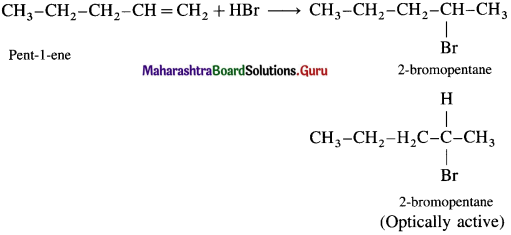
Maharashtra Board Class 12 Chemistry Solutions Chapter 10 Halogen Derivatives 84
(ii) Pent-2-ene with HBr
Answer:
Maharashtra Board Class 12 Chemistry Solutions Chapter 10 Halogen Derivatives 85

Maharashtra Board Class 12 Chemistry Important Questions Chapter 10 Halogen Derivatives Important Questions

Question 33.
C6H12 (A) on treatment with HCI produced a compound Y. Which is optically active, what is structure A?
Answer:
Maharashtra Board Class 12 Chemistry Solutions Chapter 10 Halogen Derivatives 86

Question 34.
A racemic mixture is optically inactive. Explain.
Answer:

  • A racemic mixture contains equimolar (or equimolecular) quantities of the dextrorotatory (d-) and laevorotatory (l-) isomers (enantiomers) of a compound.
  • The d-enantiomer rotates the plane of plane-polarized light to the right, while the l-enantiomer rotates the same to the left to the same extent.
  • The quantities of the d- and l-enantiomers being the same, both the rotations are of the same magnitude, but of opposite directions. Hence, they cancel each other. Hence, a racemic mixture is optically inactive.
  • It is represented as dl or ( + ). Example : ( ± ) lactic acid

Question 35.
Explain Fischer projection formula with illustration.
OR
Write a note on Fischer projection formula.
Answer:
Fischer projection formula or cross formula : The three dimensional (3-D) view of a molecule is presented on plane of paper. A Fischer projection formula can be drawn by visualizing the main carbon chain verical in the molecule. Each carbon on the vertical chain is represented by a cross.

Maharashtra Board Class 12 Chemistry Solutions Chapter 10 Halogen Derivatives 89

Conventionally the horizontal lines of the cross represent bonds projecting up from the carbon and the vertical lines represent the bonds going below the carbon.

Question 36.
Explain Wedge formula with illustration
OR
Write a note on Wedge formula.
Answer:
Wedge formula : When a tetrahedral carbon is imagined to be present in the plane of paper all the four bonds at this carbon cannot lie in the same plane. The bonds in the plane of paper are represented by normal lines, the bonds projecting above the plane of paper are represented by solid wedges (or simply by bold lines) while bonds going below the plane of paper are represented by broken wedges (or simply by broken lines).
Maharashtra Board Class 12 Chemistry Solutions Chapter 10 Halogen Derivatives 90

Question 37.
Give a laboratory test to confirm the presence of halogen in the original organic compound.
Answer:
Haloalkanes are of neutral type in aqueous medium. On warming with aqueous sodium or potassium hydroxide the covalently bonded halogen in haloalkane is converted to halide ion.

Maharashtra Board Class 12 Chemistry Solutions Chapter 10 Halogen Derivatives 94

When this reaction mixture is acidified by adding dilute nitric acid and silver nitrate solution is added a precipitate of silver halide is formed which confirms presence of halogen in the original organic compound.

Maharashtra Board Class 12 Chemistry Solutions Chapter 10 Halogen Derivatives 95

Maharashtra Board Class 12 Chemistry Important Questions Chapter 10 Halogen Derivatives Important Questions

Question 38.
Define the following :
Answer:
(1) Mechanism of a reaction : It is a step by step description of exactly how the reactants are transformed into products in as much details as possible.
(2) Substitution reaction : When a group bonded to a carbon in a substrate is replaced by another group to get a product with no change in state of hybridization of that carbon, the reaction is called substitution reaction.

Question 39.
Describe the action of aqueous KOH (or NaOH) on :
(1) ethyl bromide
(2) isopropyl bromide
(3) tert-butyl chloride
(4) methyl bromide
(5) 2-chlorobutane.
Answer:
(1) Ethyl bromide : When ethyl bromide (bromoethane) is refluxed with aqueous potassium hydroxide, ethyl alcohol is formed. The reaction is called a hydrolysis reaction.
Maharashtra Board Class 12 Chemistry Solutions Chapter 10 Halogen Derivatives 96
(2) Isopropyl bromide : When isopropyl bromide (2-bromopropane) is boiled with aqueous potassium hydroxide, isopropyl alcohol is formed.
Maharashtra Board Class 12 Chemistry Solutions Chapter 10 Halogen Derivatives 97
(3) Tert-butyl chloride : When tert-butyl chloride is refluxed with aqueous potassium hydroxide, tert-butyl alcohol is formed.
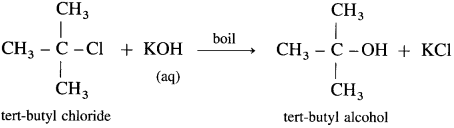
Maharashtra Board Class 12 Chemistry Solutions Chapter 10 Halogen Derivatives 98
(4) Methyl bromide : When methyl bromide (bromomethane) is heated with aq. KOH, it is hydrolysed to methyl alcohol (methanol).

Maharashtra Board Class 12 Chemistry Solutions Chapter 10 Halogen Derivatives 99
(5) 2-chlorobutane : When 2-Chlorobutane is boiled with aqueous KOH, Butan-2-ol is obtained.

Maharashtra Board Class 12 Chemistry Solutions Chapter 10 Halogen Derivatives 100

Question 40.
Describe the action of sodium ethoxide on
(1) ethyl bromide
(2) methyl bromide :
OR
Write a note on Williamson’s synthesis.
OR
How are ethers prepared from alkyl halides?
Answer:
Williamson’s synthesis : When an alkyl halide (R – X) is heated with sodium alkoxide (R – O – Na), an ether is obtained. In this reaction halide (-X) of alkyl halide is replaced by an alkoxy group (-OR). This reaction is known as Williamson’s synthesis. This method is used to prepare simple (or symmetrical) ethers and mixed (or unsymmetrical) ethers.

Sodium alkoxide is obtained by a reaction of sodium with an alcohol.

Maharashtra Board Class 12 Chemistry Solutions Chapter 10 Halogen Derivatives 101

(1) Simple (symmetrical) ether : When an alkyl halide and sodium alkoxide having similar alkyl groups are heated, symmetrical ether is obtained.

Maharashtra Board Class 12 Chemistry Solutions Chapter 10 Halogen Derivatives 102

e.g., When ethyl bromide is heated with sodium ethoxide, diethyl ether is formed.

Maharashtra Board Class 12 Chemistry Solutions Chapter 10 Halogen Derivatives 103

(2) Mixed (unsymmetrical) ether : When an alkyl halide and sodium alkoxide having different alkyl groups are heated, unsymmetrical ether is obtained.
Maharashtra Board Class 12 Chemistry Solutions Chapter 10 Halogen Derivatives 104
When methyl bromide is heated sodium ethoxide, ethyl methyl ether is formed.Maharashtra Board Class 12 Chemistry Solutions Chapter 10 Halogen Derivatives 105
When ethyl bromide is heated with sodium meihoxide, ethyl methyl ether is formed.
Maharashtra Board Class 12 Chemistry Solutions Chapter 10 Halogen Derivatives 106

Maharashtra Board Class 12 Chemistry Important Questions Chapter 10 Halogen Derivatives Important Questions

Question 41.
What is the action of silver salt of carboxylic acid on alkyl halide?
Answer:
When an alkyl halide (R – X) is heated with silver salt of carboxylic acid (R -COOAg). an ester is obtained.
Maharashtra Board Class 12 Chemistry Solutions Chapter 10 Halogen Derivatives 107

Question 42.
Describe the action of alcoholic silver acetate on
(1) methyl bromide
(2) ethyl bromide.
Answer:
(1) Methyl bromide : When methyl bromide is heated with an alcoholic silver acetate, methyl acetate is formed.

Maharashtra Board Class 12 Chemistry Solutions Chapter 10 Halogen Derivatives 108
(2) Ethyl bromide : When ethyl bromide is heated with an alcoholic silver acetate, ethyl acetate is formed.

Maharashtra Board Class 12 Chemistry Solutions Chapter 10 Halogen Derivatives 109

Question 43.
What is the action of alcoholic silver propionate on ethyl bromide?
Answer:
When ethyl bromide is heated with an alcoholic silver propionate. ethyl propionate is formed.

Maharashtra Board Class 12 Chemistry Solutions Chapter 10 Halogen Derivatives 110

Question 44.
Describe the action of excess of ammonia on (I) ethyl bromide (2) n.propyl bromide.
Answer:
(1) Ethyl bromide : When ethyl bromide is boiled under pressure with an excess of alcoholic ammonia, ethylamine (ethanamine) is formed. This is known as ‘ammonolysis of ethyl bromide.

Maharashtra Board Class 12 Chemistry Solutions Chapter 10 Halogen Derivatives 111

(2) n-propyl bromide : When n-propy1 bromide is boiled under pressure with an excess of ammonia, n-propyl amine (propanamine) is formed.

Maharashtra Board Class 12 Chemistry Solutions Chapter 10 Halogen Derivatives 112

Question 45.
What is ammonolysis? Give a suitable example for the reaction.
Answer:
When an alkyl halide is boiled under pressure with an excess of alcoholic solution of ammonia (NH3), corresponding (primary amine) alkyl amine is formed. This reaction is known as ammonolysis of alkyl halide.

Maharashtra Board Class 12 Chemistry Solutions Chapter 10 Halogen Derivatives 113

(1) Ethyl bromide : When ethyl bromide (bromoethane) is refluxed with aqueous potassium hydroxide, ethyl alcohol is formed. The reaction is called a hydrolysis reaction.
Maharashtra Board Class 12 Chemistry Solutions Chapter 10 Halogen Derivatives 96
(2) Isopropyl bromide : When isopropyl bromide (2-bromopropane) is boiled with aqueous potassium hydroxide, isopropyl alcohol is formed.
Maharashtra Board Class 12 Chemistry Solutions Chapter 10 Halogen Derivatives 97
(3) Tert-butyl chloride : When tert-butyl chloride is refluxed with aqueous potassium hydroxide, tert-butyl alcohol is formed.
Maharashtra Board Class 12 Chemistry Solutions Chapter 10 Halogen Derivatives 98
(4) Methyl bromide : When methyl bromide (bromomethane) is heated with aq. KOH, it is hydrolysed to methyl alcohol (methanol).
Maharashtra Board Class 12 Chemistry Solutions Chapter 10 Halogen Derivatives 99
(5) 2-chlorobutane : When 2-Chlorobutane is boiled with aqueous KOH, Butan-2-ol is obtained.
Maharashtra Board Class 12 Chemistry Solutions Chapter 10 Halogen Derivatives 100

Maharashtra Board Class 12 Chemistry Important Questions Chapter 10 Halogen Derivatives Important Questions

Question 46.
Describe the action of aqueous alcoholic potassium cyanide on
(1) ethyl bromide
(2) methyl iodide.
Answer:
Ethyl bromide : When ethyl bromide (bromoethane) is boiled with alcoholic solution of potassium cyanide in aqueous ethanol, ethyl cyanide (ethyl nitrile) is formed.

Maharashtra Board Class 12 Chemistry Solutions Chapter 10 Halogen Derivatives 114
(2) Methyl iodide : When methyl iodide is boiled with alcoholic solution of potassium cyanide, methyl cyanide is formed.
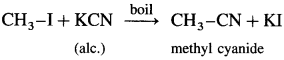
Maharashtra Board Class 12 Chemistry Solutions Chapter 10 Halogen Derivatives 115

Question 47.
Describe the action of alcoholic silver cyanide on
(1) ethyl bromide
(2) methyl chloride.
OR
Explain isocyanide reaction of
(1) ethyl bromide
(2) methyl chloride.
Answer:
(1) Ethyl bromide : When ethyl bromide is heated with alcoholic silver cyanide, ethyl isocyanide is formed.

Maharashtra Board Class 12 Chemistry Solutions Chapter 10 Halogen Derivatives 116
(2) Methyl chloride : When .methyl chloride is heated with alcoholic silver cyanide, methyl isocyanide is formed.

Maharashtra Board Class 12 Chemistry Solutions Chapter 10 Halogen Derivatives 117
The above reactions (1) and (2) are called isocyanide reaction.

Question 48.
Describe the action of potassium nitrite on
(i) ethyl bromide,
(ii) methyl chloride.
Answer:
(1) Ethyl bromide : When ethyl bromide is treated with potassium nitrite, ethyl nitrite is formed.
Maharashtra Board Class 12 Chemistry Solutions Chapter 10 Halogen Derivatives 118
(2) Methyl chloride : When methyl chloride is treated with potassium nitrite, methyl nitrite is formed.
Maharashtra Board Class 12 Chemistry Solutions Chapter 10 Halogen Derivatives 119

Question 49.
Describe the action of silver nitrite on (1) ethyl chloride (2) n-propyl bromide.
Answer:
(1) Ethy chloride : When ethyl chloride is treated with silver nitrite, nitroethane is obtained.

Maharashtra Board Class 12 Chemistry Solutions Chapter 10 Halogen Derivatives 120
(2) n-Propyt bromide: When n-propyl bromide is treated with silver nitrate, nitropropane is obtained.
Maharashtra Board Class 12 Chemistry Solutions Chapter 10 Halogen Derivatives 121

Question 50.
How will you convert (the following:

(1) Ethyl bromide to ethanol.
Answer:

Maharashtra Board Class 12 Chemistry Solutions Chapter 10 Halogen Derivatives 128

(2) Ethyl bromide to propane nitrile.
Answer:

Maharashtra Board Class 12 Chemistry Solutions Chapter 10 Halogen Derivatives 129

(3) Ethyl bromide to ethyl amine.
Answer:

Maharashtra Board Class 12 Chemistry Solutions Chapter 10 Halogen Derivatives 130

(4) Ethyl bromide to ethyl acetate.
Answer:

Maharashtra Board Class 12 Chemistry Solutions Chapter 10 Halogen Derivatives 131

(5) Ethyl bromide to ethyl isocyanide.
Answer:
Maharashtra Board Class 12 Chemistry Solutions Chapter 10 Halogen Derivatives 132

(6) Ethyl bromide to ethyl methyl ether.
Answer:

Maharashtra Board Class 12 Chemistry Solutions Chapter 10 Halogen Derivatives 133

Maharashtra Board Class 12 Chemistry Important Questions Chapter 10 Halogen Derivatives Important Questions

(7) Ethyl bromide to n-butane.
Answer:
Maharashtra Board Class 12 Chemistry Solutions Chapter 10 Halogen Derivatives 134

(8) Ethyl bromide to Ethyl magnesium bromide.
Answer:

Maharashtra Board Class 12 Chemistry Solutions Chapter 10 Halogen Derivatives 135

Question 51.
Define the following :
Answer:
(1) Nucleophilic bimolecular reaction (SN2) : The substitution reaction in which a nucleophile reacts with the substrate and the rate of the reaction depends on the concentration of the substrate and the nucleophile is called a nucleophilic bimolecular reaction.

Example :
Maharashtra Board Class 12 Chemistry Solutions Chapter 10 Halogen Derivatives 136

(2) SN1 reaction : The substitution reaction in which a nucleophile reacts with the substrate and the rate of the reaction depends only on the concentration of the substrate is called nucleophilic unimolecular or first order reaction or SN1 reaction.

Question 52.
Explain, the mechanism of alkaline hydrolysis (reaction with aqueous KOH) of tert-butyl bromide (2-Bromo-2-methylpropane) with energy profile diagram.
OR
Explain only reaction mechanism for alkaline hydrolysis of tert-butyl bromide.
Answer:
(i) Consider alkaline hydrolysis of tert-butyl bromide (2-Bromo-2 methylpropane) with aqueous NaOH or KOH.
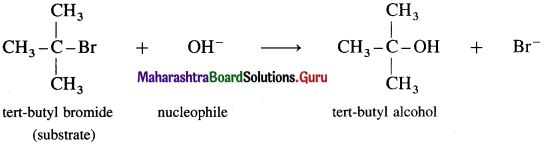
Maharashtra Board Class 12 Chemistry Solutions Chapter 10 Halogen Derivatives 137
(ii) Kinetics of the reaction : Due to steric hindrance of voluminous three methyl groups around carbon, nucleophile OH- cannot attack carbon atom directly. Hence, the reaction takes place in two steps.

Step I : This involves heterolytic fission of C – Br covalent bond in the substrate forming carbocation and Br. This is a slow process.
Maharashtra Board Class 12 Chemistry Solutions Chapter 10 Halogen Derivatives 138

Step II : This step involves attack of nucleophile OH- or carbocation forming C – OH bond and product tert-butyl alcohol. Since it involves ionic charge neutralisation, it is a fast step.
Maharashtra Board Class 12 Chemistry Solutions Chapter 10 Halogen Derivatives 139

Rate Determining Step (R.D.S.) : Since the first step is a slow step, it is R.D.S., and therefore the rate of the reaction depends on the concentration of only one reactant, (CH3) C – Br.
Rate = R = k [(CH3)3 C – Br] where k is a rate constant of the reaction.

SN1 reaction : The reaction between tert.butyl bromide and hydroxide ion to form tert.butyl alcohol follows a first-order kinetics. The rate of this reaction depends only on the concentration of one substance (tert-butyl bromide) and is independent of the concentration of alkali added. It is an unimolecular first (1st) order Nucleophilic Substitution reaction denoted as SN reaction.

Maharashtra Board Class 12 Chemistry Important Questions Chapter 10 Halogen Derivatives Important Questions

Stereochemistry and mechanism of the reaction : The reaction takes place in two steps and both the steps involve formation of transition states (T.S.).

T.S. -1 for first step :
Maharashtra Board Class 12 Chemistry Solutions Chapter 10 Halogen Derivatives 140

In this transition state, C – Br bond is partially broken, so that carbon atom carries partial positive charge (+δ) and Br carries partial negative charge (-δ) which further breaks forming carbocation and Br . Tert-butyl cation (carbocation) has a planar structure and the CH3 – C – CH3 bond angle is 120°. It is the intermediate of the reaction. It is unstable. In this step, hybridisation of carbon atom changes from sp3 (tetrahedral geometry) to sp (planar geometry).

T.S. – II for second step :
Maharashtra Board Class 12 Chemistry Solutions Chapter 10 Halogen Derivatives 141

In this transition state, C – OH bond is partially fonned so that carbon atom carries partial positive charge (+ δ) and OH carries partial negative charge ( -δ) which further forms tert-butyl alcohol.

Formation of a racemic mixture : Since OH has equal probability of the attack on carbocation from frontside and from backside, the products obtained are equal. In case of optical active alkyl halide, a racemic mixture is obtained.

Question 53.
Discuss SN2 mechanism of methyl bromide using aqueous KOH. Draw energy profile diagram.
OR
Discuss the mechanism of alkaline hydrolysis of methyl bromide or Bromomethane.
Answer:
(1) Consider alkaline hydrolysis of methyl bromide (Bromomethane). CH3Br with aqueous NaOH or KOH.
Maharashtra Board Class 12 Chemistry Solutions Chapter 10 Halogen Derivatives 142

(2) Stereochemistry and Kinetics of the reaction iR.D.S.) : This hydrolysis reaction takes place only in one step which is a rate determining step i.e. R.D.S. The rate of hydrolysis reaction depends on the Concentration of CH3Br
and 0H which are present in the R.D.S. of the reaction.
Rate = R = k [CH3Br] (OH]
where k is rate constant of the reaction.

SN2 reaction : The reaction between methyl bromide and hydroxide ion to form methanol follows a second order kinetics, since the rate of the reaction depends on the concentrations of two reacting species, namely methyl bromide and hydroxide ion it is bimolecular second order (2nd) Nucleophilic Substitution reaction denoted by SN2.

(3) Mechanism of the reaction :
(i) It is a single step mechanism. The reaction takes place in the following steps :
Maharashtra Board Class 12 Chemistry Solutions Chapter 10 Halogen Derivatives 143

(ii) Backside attack of the nucleophile : Nucleophile, OH attacks carbon atom of CH3Br from back side i. e. from opposite side to that of the leaving group i.e. Br to experience minimum steric repulsion and electrostatic repulsion between the incoming nucleophile (OH) and leaving Br.

Maharashtra Board Class 12 Chemistry Important Questions Chapter 10 Halogen Derivatives Important Questions

(iii) Transition state : When a nucleophile, OH approaches carbon atom of CH3Br, the potential energy of the system increases until a transition state (T.S.) of maximum potential energy is formed in which C – Br bond is partially broken and C – OH bond is partially formed. The negative charge is equally shared by both incoming nucleophile- OH and outgoing, leaving group-Br. (Thus, the total negative charge is diffused.)

(iv) In CH3Br, carbon atom is sp3 -hybridized and CH3Br molecule is tetrahedral. The hybridisation of carbon atom changes to sp2 hybridisation. The transition state contains pentacoordinate carbon having three δ (sigma) bonds in one plane making bond angles of 120° with each other i.e., H1; H2 and H3 atoms lie in one plane while two partial covalent bonds containing Br and OH lie collinear and on opposite sides perpendicular to the plane.

(v) Inversion of configuration : The transition state decomposes fast by the complete breaking of the C-Br bond and the new C-OH bond is formed on the other side. The breaking of C-Br bond and the formation of C-OH bond take place simultaneously. The energy required to break the C-Br bond is partly obtained from the energy released when C-OH bond is formed. The formation of product CH3OH is accompanied by complete or 100% inversion of configuration forming again sp3-hybridized carbon atom giving tetrahedral CH3OH molecule. But in this structure the positions of H2 and H3 atoms in the reactant (CH3Br) and in product are on the opposite side. This inversion of configuration is called Walden inversion.

Question 54.
Discuss the factors influencing SN1 and SN2 mechanism.
Answer:
(1) Nature of substrate : SN2 : The transition state (T.S.) of SN2 mechanism + is pentacoordinate, it is crowded. As a result SN2 mechanism is favoured in primary halides and least favoured in tertiary halides.

SN1 : A planar carbocation intermediate is formed in SN1 reaction. Bulky alkyl groups can be easily accommodated in planar carbocation and it has no steric crowding. As a result SN1 mechanism is favoured in tertiary halides and least favoured in primary halides.

The carbocation intermediate is stabilized by + effect of alkyl substituents and also by hyperconjugation y effect of alkyl substituents containing a-hydrogens. As a result, SN1 mechanism is favoured in tertiary halides and least favoured in primary halides.
Maharashtra Board Class 12 Chemistry Solutions Chapter 10 Halogen Derivatives 148

Thus, tertiary alkyl halides undergo nucleophilic substitution by SN1 mechanism while primary halides follow SN2 mechanism.

(2) Nucleophilicity of the reagent : A strong nucleophile attacks the substrate faster and favours SN2 mechanism. The rate of SN1 mechanism is independent of the nature of nucleophile. Nucleophile does not react in the 1st step (slow step) of SN1. Nucleophile reacts fast after the carbocation intermediate is formed.

(3) Solvent polarity : (1) SN1 reaction proceeds more rapidly in polar protic solvents than in aprotic solvent. Polar protic solvent decreases the rate of SN2 reaction. (2) In SN2 mechanism, rate depends on substrate as well as nucleophile. A polar solvent stabilizes nucleophile by solvation. Thus solvent deactivates the nucleophile by stabilizing it. Hence, aprotic solvents or solvent of low polarity will favour SN2 mechanism.

Question 55.
How does relative reactivity for alkaline hydrolysis with respect to SN2 and SN1 vary in the following alkyl halides :
(1) Bromomethane
(2) Bromoethane
(3) 2-Bromopropane
(4) 2-Bromo-2-methylpropane ?
Answer:
(A) Relative reactivity for SN2 mechanism decreases in the order of :

Maharashtra Board Class 12 Chemistry Solutions Chapter 10 Halogen Derivatives 153
(B) Relative reactivity for SN1 mechanism decreases in the order of :
2-Bromo-2-methylpropane > 2-Bromopropane > Bromoethane > Bromomethane

Maharashtra Board Class 12 Chemistry Solutions Chapter 10 Halogen Derivatives 154

Maharashtra Board Class 12 Chemistry Important Questions Chapter 10 Halogen Derivatives Important Questions

Question 56.
Explain with reason the relative order of reactivity of l°/2°/3° alkyl halides by SN1 mechanism.
Answer:
In alkaline hydrolysis of an alkyl halide by SN1 mechanism, the formation of carbocation as an intermediate product is involved.

The increasing order of a stability of carbocation is,
Maharashtra Board Class 12 Chemistry Solutions Chapter 10 Halogen Derivatives 155
The stability order for carbocation is 3° > 2° > 1°.
Therefore the increasing order of reactivity by SN1 mechanism of alkyl halides is
(1°) primary < (2°) secondary < (3°) tertiary

Question 57.
Which one of the following is more easily hydrolysed in SN1 and SN2 reaction by aqueous KOH, C6H5 CHCIC6H5 and C6H5CH2CI?
Answer:
In SN1 reaction C6H5CHCI C6H5 will be more easily hydrolysed than C6H5CH2CI
In SN2 reaction C6H5 CH2CI will be more easily hydrolysed than C6H5CHCIC6H5.

Question 58.
Choose the member that will react faster than the following pairs by SN1 mechanism.
(1) l-bromo-2, 2-dimethyl propane or 2-bromopropane.
Maharashtra Board Class 12 Chemistry Solutions Chapter 10 Halogen Derivatives 159
Answer:
The reactivity of SN1 reaction depends on the steric hindrance, in 2-bromopropane, a-carbon atom is attached to two methyl groups suffers greater steric hindrance to nucleophilic attack than l-bromo-2, 2-dimethyl propane. Hence, 2-bromopropane react faster by SN1 mechanism.

(2) 2-Iodo-2-methyl butane or 2-iodio-3-methyl butane.
Maharashtra Board Class 12 Chemistry Solutions Chapter 10 Halogen Derivatives 160
Answer:
Since, 2-Iodo-2-methyl butane is a tertiary alkyl halide, it undergoes SN-1 reaction faster than 2-iodo-3-methyl butane.

(3) 1-Chloro propane or 2-chloropropane.
Maharashtra Board Class 12 Chemistry Solutions Chapter 10 Halogen Derivatives 161
Answer:
Since, 2-chloropropane is a secondary alkyl halide, it undergoes SN-1 reaction faster than 1-chloropropane.

(4) 2-Iodo-2-methyl butane or tert-butyl chloride.
Maharashtra Board Class 12 Chemistry Solutions Chapter 10 Halogen Derivatives 162
Answer:
Since, iodine is a better leaving group than chloride 2-iodo-2-methyl butane undergo SN-1 reaction faster than tert-butyl chloride.

Maharashtra Board Class 12 Chemistry Important Questions Chapter 10 Halogen Derivatives Important Questions

Question 59.
Write a note on elimination reaction.
OR
Explain dehydrohalogenation reaction.
Answer:
When alkyl halide having at least one β-hydrogen is boiled with alcoholic solution of potassium hydroxide (KOH), an alkene is formed due to elimination of hydrogen atom from β-carbon and halogen atom from α-carbon, is called dehydrohalogenation.
Maharashtra Board Class 12 Chemistry Solutions Chapter 10 Halogen Derivatives 164

Tertiary butyl bromide when heated with alcoholic solution of potassium hydroxide forms isobutylene.
Maharashtra Board Class 12 Chemistry Solutions Chapter 10 Halogen Derivatives 165

This reaction is called β-elimination (or 1,2-elimination) reaction as it involves elimination of halogen and a β-hydrogen atom.

As hydrogen and halogen is removed in this reaction it is also known as dehydrohalogenation reaction.

Question 60.
Describe the action of alcoholic potassium hydroxide (aic. KOH) on
(1) ethyl bromide
(2) n-propyl bromide
(3) isopropyl bromide
(4) tert-butyl chlorIde.
Answer:
(1) Ethyl bromide : When ethyl bromide (bromoethane) is heated with alcoholic potassium hydroxide (alcoholic alkali). ethene (gas) is formed by the dehydrobrominaion reaction.

Maharashtra Board Class 12 Chemistry Solutions Chapter 10 Halogen Derivatives 166

(2) n-PropI bromide : When n-propyl bromide is heated with alcoholic potassium hydroxide, propene is formed.
Maharashtra Board Class 12 Chemistry Solutions Chapter 10 Halogen Derivatives 167

(3) Isopropvl bromide : When isopropyl bromide (2-bromopropane) is boiled with alcoholic potassium hydroxide, propcne is formed.

Maharashtra Board Class 12 Chemistry Solutions Chapter 10 Halogen Derivatives 168

(4) Tert-hutyl chloride: When ten-butyl chloride (2-chloro-2-methyl propanc) is hcatcd with alcoholic KOH.
Maharashtra Board Class 12 Chemistry Solutions Chapter 10 Halogen Derivatives 169

Question 61.
Describe the action of alc.KOH on 2-bromobutane.
When 2-bromobutane is boiled with alc.KOH on 2-bromobutane, a mixture of but-l-ene and but-2-ene is formed.
Answer:
Maharashtra Board Class 12 Chemistry Solutions Chapter 10 Halogen Derivatives 170

Maharashtra Board Class 12 Chemistry Important Questions Chapter 10 Halogen Derivatives Important Questions

Question 62.
Explain Saytzelf’s rule with suitable example.
Answer:
Saytzcff’s rule : In dehydrohalogenation reaction the preferred product is that alkene which has the greater number of alkyl groups attached to the doubly bonded carbon atoms.

Hence the number of alkyl substituents on doubly bonded Carbon atoms increases, the stability of the alkene giving its major products.

Hence the increasing stability of alkenes is.
Maharashtra Board Class 12 Chemistry Solutions Chapter 10 Halogen Derivatives 171

There are two types of fi hydrogens (β1 and β2) therefore two alkenes are expected.

Maharashtra Board Class 12 Chemistry Solutions Chapter 10 Halogen Derivatives 172

Question 63.
What is a Grignard reagent ?
Answer:
Grignard reagent : An organometallic compound in which the divalent magnesium is directly linked to an alkyl group (R -) and a halogen atom (X), and has general formula R – Mg – X is called Grignard reagent. OR When alkyl halide is treated with magnesium in dry ether as solvent, it gives alkyl magnesium halide. It is known as Grignard reagent.
Maharashtra Board Class 12 Chemistry Solutions Chapter 10 Halogen Derivatives 185

The carbon-magnesium bond is highly polar and magnesium-halogen bond is in ionic in nature. Grignard reagent is highly reactive. It is an important reagent and used in the preparation of a large number of organic compounds.

Question 64.
How is Grignard reagent prepared ?
Answer:
Grignard reagent is an alkyl magnesium halide, R – Mg – X obtained by the reaction of alkyl halide R – X with magnesium (Mg) in dry ether.

Maharashtra Board Class 12 Chemistry Solutions Chapter 10 Halogen Derivatives 186

When an alkyl halide like CH3I is added from a dropping funnel to a flask containing pieces of pure Mg in pure and dry ether (diethyl ether) and a trace of iodine, Grignard reagent, CH3 – Mg – I is formed.

Maharashtra Board Class 12 Chemistry Solutions Chapter 10 Halogen Derivatives 187

Ethyl iodide when treated with magnesium in presence of dry ether forms ethyl magnesium iodide.
Maharashtra Board Class 12 Chemistry Solutions Chapter 10 Halogen Derivatives 188

Question 65.
Write a note on Grignard reagent.
Answer:
(1) Ethyl bromide : When ethyl bromide (bromoethane) is heated with alcoholic potassium hydroxide (alcoholic alkali). ethene (gas) is formed by the dehydrobrominaion reaction.
Maharashtra Board Class 12 Chemistry Solutions Chapter 10 Halogen Derivatives 166

(2) n-PropI bromide : When n-propyl bromide is heated with alcoholic potassium hydroxide, propene is formed.
Maharashtra Board Class 12 Chemistry Solutions Chapter 10 Halogen Derivatives 167

(3) Isopropvl bromide : When isopropyl bromide (2-bromopropane) is boiled with alcoholic potassium hydroxide, propcne is formed.
Maharashtra Board Class 12 Chemistry Solutions Chapter 10 Halogen Derivatives 168

(4) Tert-hutyl chloride: When ten-butyl chloride (2-chloro-2-methyl propanc) is hcatcd with alcoholic KOH.
Maharashtra Board Class 12 Chemistry Solutions Chapter 10 Halogen Derivatives 169

Maharashtra Board Class 12 Chemistry Solutions Chapter 10 Halogen Derivatives 170

Maharashtra Board Class 12 Chemistry Important Questions Chapter 10 Halogen Derivatives Important Questions

Question 66.
Describe the action of water on
(1) methyl magnesium iodide
(2) ethyl magnesium iodide.
Answer:
(1) Methyl magnesium iodide : When methyl magnesium iodide is treated with water, methane is obtained
Maharashtra Board Class 12 Chemistry Solutions Chapter 10 Halogen Derivatives 190
(2) Ethyl magnesium iodide : When ethyl magnesium iodide is treated with water, ethane is obtained.
Maharashtra Board Class 12 Chemistry Solutions Chapter 10 Halogen Derivatives 191

Question 67.
Describe the action of ammonia on
(1) ethyl magnesium bromide
(2) n-propyl magnesium chloride.
Answer:
(1) Ethyl magnesium bromide : When ethyl magnesium bromide is treated with ammonia, ethane is formed.
Maharashtra Board Class 12 Chemistry Solutions Chapter 10 Halogen Derivatives 192
(2) n-Propyl magnesium chloride : When n-propyl magnesium chloride is treated with ammonia, propane is formed.
Maharashtra Board Class 12 Chemistry Solutions Chapter 10 Halogen Derivatives 193

Question 68.
Explain Wurtz reaction. OR Explain the action of sodium with alkyl halides.
Answer:
(1) When an alkyl halide is treated with metallic sodium in dry ether, the corresponding higher alkane is formed. This is called Wurtz reaction or Wurtz coupling reaction.

Maharashtra Board Class 12 Chemistry Solutions Chapter 10 Halogen Derivatives 194
(2) In this reaction the alkyl radicals from two molecules of the reacting alkyl halide combine or couple to form the higher alkane.

(3) Thus, methyl bromide reacts with sodium in ether to form ethane (C2H6), while ethyl bromide under the same conditions forms n-butane (C4H10).
Maharashtra Board Class 12 Chemistry Solutions Chapter 10 Halogen Derivatives 195

(4) If a mixture of two different alkyl halides is treated with Na in dry ether, then a mixture of alkanes is obtained called self coupling products. For example, a mixture of CH3Br and C2H5Br gives propane along with C2H6 and C4H10.

Maharashtra Board Class 12 Chemistry Solutions Chapter 10 Halogen Derivatives 196

Question 69.
Explain the reaction of haloarene with alkyl halide and sodium metal.
Write a note on Wurtz-Fittig reaction.
Answer:
When an alkyl halide and an aryl halide is treated with sodium metal in dry ether the corresponding alkylarene (alkyl benzene) is formed. The reaction is known as Wurtz-Fittig reaction. This reaction allows alkylation of alkyl halides.
Maharashtra Board Class 12 Chemistry Solutions Chapter 10 Halogen Derivatives 197

Question 70.
Describe the action of aryl halide on sodium metal.
Answer:
Aryl halide reacts with sodium metal in dry ether, biphenyl is formed. This reaction is known as Fittig reaction.
Maharashtra Board Class 12 Chemistry Solutions Chapter 10 Halogen Derivatives 198

Maharashtra Board Class 12 Chemistry Important Questions Chapter 10 Halogen Derivatives Important Questions

Question 71.
Identify the product A of following reaction.
Maharashtra Board Class 12 Chemistry Solutions Chapter 10 Halogen Derivatives 200
Answer:
Maharashtra Board Class 12 Chemistry Solutions Chapter 10 Halogen Derivatives 201

Question 72.
Explain the following substitution reactions of chlorobenzene :
(1) Halogenation
(2) Nitration
(3) Sulphonation.
Answer:
(1) Halogenation : When chlorobenzene is reacted with chlorine in presence of anhydrous ferric chloride, a mixture of ortho and para-dichlorobenzene (major product) is formed.
Maharashtra Board Class 12 Chemistry Solutions Chapter 10 Halogen Derivatives 203
(2) Nitration : When chlorobenzene is heated with nitrating mixture (cone, nitric acid -I- cone, sulphuric acid) a mixture of l-chloro-4-nitro benzene (major product) and l-chloro-2-nitrobenzene is formed.
Maharashtra Board Class 12 Chemistry Solutions Chapter 10 Halogen Derivatives 204
(3) Sulphonation : When chlorobenzene is heated with concentrated sulphuric acid, a mixture of 4-chlorobenzene sulphonic acid (major product) and 2-chlorobenzene sulphonic acid is formed.
Maharashtra Board Class 12 Chemistry Solutions Chapter 10 Halogen Derivatives 205

Question 73.
Describe the action of the following on chlorobenzene :
(1) Methyl chloride in the presence of anhydrous AICI3
(2) Acetyl chloride in the presence of anhydrous AICI3.
Answer:
(1) Methyl chloride in the presence of anhydrous AICI3 : When chlorobenzene is treated with methyl chloride in the presence of anhydrous AICI3, a mixture of l-chloro-4-methyl benzene (major product) and l-chloro-2-methyl benzene is formed. Since, the alkyl group is introduced in the benzene ring, the reaction is termed as Friedel Craft’s alkylation.
Maharashtra Board Class 12 Chemistry Solutions Chapter 10 Halogen Derivatives 206

(2) Acetyl chloride in the presence of anhydrous AICI3 : When chlorobenzene is reacted with acetyl chloride in the presence of anhydrous AICI3, a mixture of 2-chloro acetophenone and 4-chloro acetophenone (major product) is formed. Since, the acetyl group is introduced in the benzene ring, the reaction is termed as Friedel Craft’s acylation.
Maharashtra Board Class 12 Chemistry Solutions Chapter 10 Halogen Derivatives 207

Maharashtra Board Class 12 Chemistry Important Questions Chapter 10 Halogen Derivatives Important Questions

Question 74.
Write a note on Friedel Craft’s reaction.
Answer:

(1) Methyl chloride in the presence of anhydrous AICI3 : When chlorobenzene is treated with methyl chloride in the presence of anhydrous AICI3, a mixture of l-chloro-4-methyl benzene (major product) and l-chloro-2-methyl benzene is formed. Since, the alkyl group is introduced in the benzene ring, the reaction is termed as Friedel Craft’s alkylation.
Maharashtra Board Class 12 Chemistry Solutions Chapter 10 Halogen Derivatives 206

(2) Acetyl chloride in the presence of anhydrous AICI3 : When chlorobenzene is reacted with acetyl chloride in the presence of anhydrous AICI3, a mixture of 2-chloro acetophenone and 4-chloro acetophenone (major product) is formed. Since, the acetyl group is introduced in the benzene ring, the reaction is termed as Friedel Craft’s acylation.
Maharashtra Board Class 12 Chemistry Solutions Chapter 10 Halogen Derivatives 207

Question 75.
Convert 1-chlorobutane into the following compounds :
Maharashtra Board Class 12 Chemistry Solutions Chapter 10 Halogen Derivatives 221
Answer:
(1) 1-Chlorobutane to butan-l-ol :
Maharashtra Board Class 12 Chemistry Solutions Chapter 10 Halogen Derivatives 222
(2) 1-Chlorobutane to 1-iodobutane :
Maharashtra Board Class 12 Chemistry Solutions Chapter 10 Halogen Derivatives 223
(3) 1-Chlorobutane to n-butyl cyanide (CH3 – CH2 – CH2 – CH2 – CN) :

Maharashtra Board Class 12 Chemistry Solutions Chapter 10 Halogen Derivatives 224
(4) l-Chlorobutane to Maharashtra Board Class 12 Chemistry Solutions Chapter 10 Halogen Derivatives 225
Maharashtra Board Class 12 Chemistry Solutions Chapter 10 Halogen Derivatives 226

Question 76.
Predict the expected product of substitution reactions :
(1) Isobutyl chloride + sodium ethoxide.
Answer:
Maharashtra Board Class 12 Chemistry Solutions Chapter 10 Halogen Derivatives 227

(2) n-butyl chloride + sodium.
Answer:
Maharashtra Board Class 12 Chemistry Solutions Chapter 10 Halogen Derivatives 228

Maharashtra Board Class 12 Chemistry Important Questions Chapter 10 Halogen Derivatives Important Questions

(3) 1-chloropropane + aq. potassium hydroxide.
Answer:

Maharashtra Board Class 12 Chemistry Solutions Chapter 10 Halogen Derivatives 229

(4) Aniline + NaNO2/HCl.
Answer:
Maharashtra Board Class 12 Chemistry Solutions Chapter 10 Halogen Derivatives 230

Question 77.
Write the products:
Maharashtra Board Class 12 Chemistry Solutions Chapter 10 Halogen Derivatives 231
Maharashtra Board Class 12 Chemistry Solutions Chapter 10 Halogen Derivatives 232

Question 78.
Identify A and B in the following :

Maharashtra Board Class 12 Chemistry Solutions Chapter 10 Halogen Derivatives 234
Answer:
Maharashtra Board Class 12 Chemistry Solutions Chapter 10 Halogen Derivatives 235

Maharashtra Board Class 12 Chemistry Solutions Chapter 10 Halogen Derivatives 236
Answer:
Maharashtra Board Class 12 Chemistry Solutions Chapter 10 Halogen Derivatives 237

Maharashtra Board Class 12 Chemistry Solutions Chapter 10 Halogen Derivatives 238
Answer:
Maharashtra Board Class 12 Chemistry Solutions Chapter 10 Halogen Derivatives 239

Maharashtra Board Class 12 Chemistry Solutions Chapter 10 Halogen Derivatives 267
Answer:
Maharashtra Board Class 12 Chemistry Solutions Chapter 10 Halogen Derivatives 239

Maharashtra Board Class 12 Chemistry Solutions Chapter 10 Halogen Derivatives 240
Answer:
Maharashtra Board Class 12 Chemistry Solutions Chapter 10 Halogen Derivatives 241

Maharashtra Board Class 12 Chemistry Solutions Chapter 10 Halogen Derivatives 242
Answer:
Maharashtra Board Class 12 Chemistry Solutions Chapter 10 Halogen Derivatives 243

Maharashtra Board Class 12 Chemistry Important Questions Chapter 10 Halogen Derivatives Important Questions

Question 79.
State the uses of the following compounds :
(1) Dichloromethane (CH2CI2)
(2) Trichloromethane or Chloroform (CHCI3)
(3) Tetrachloromethane or carbon tetrachloride (CCI4)
(4) Iodoform (CHI3)
(5) Freons
(6) DDT (p, p’-Dichlorodiphenyl trichloroethane).
Answer:
(1) Dichloromethane (CH2CI2) :

  • Dichloromethane dissolves wide range of organic compounds, hence it is used as solvent for many chemical reactions.
  • It is used as a solvent as a paint remover and degreaser.
  • It is used as propellant in aerosols and as a fumigant pesticide for grains and strawberries.
  • It is used to decaffinate tea or coffee.

(2) Trichloromethane or Chloroform (CHCI3) :

  • Chloroform in the production of chlorofluoromethane, freon refrigerant R-22.
  • It is used as solvent in pharmaceuticals, pesticides, gums, fats, resins and dye industry.
  • It is a good source of dichlorocarbene species.

(3) Tetrachloromethane or carbon tetrachloride (CCI4) :

  • Carbon tetrachloride is used in the manufacture of refrigerants.
  • It is used as a dry cleaning agent and as a pesticide for stored grains.
  • It is very useful solvent for oils, fats and resins. It serves as a source of chlorine.

(4) Iodoform (CHI3) :

  • Iodoform is used as antiseptic, dressing of wounds and sores.
  • On small scale it is used as disinfectant.

(5) Freons :

  • Freons are widely used as propellants in aerosol, products of food, cosmetics and pharmaceutical industries.
  • Freons containing bromine in their molecules are used as fire extinguishers.
  • They are used in aerosol insecticides, solvent for cleaning clothes and metallic surfaces.
  • It is used as foaming agents in the preparation of foamed plastics and in production of certain fluorocarbons.
  • It is used as refrigerants and air conditioning purposes.

Question 80.
State the environmental effects of the following compounds :
(1) Dichloromethane (CH2CI2)
(2) Trichloromethane or chloroform (CHCI3)
(3) Tetrachloromethane or carbon tetrachloride (CCI4)
(4) Iodoform (CHI3)
(5) Freon.s (CCI2F2, CCI3F, CHCIF2)
Maharashtra Board Class 12 Chemistry Solutions Chapter 10 Halogen Derivatives 247
Answer:
(1) Dichloromethane (CH2CI2) :

  • Higher levels of dichloromethane in air causes nausea, numbness in fingers and toes, dizziness.
  • Lower levels of dichloromethane causes impaired vision and hearing.
  • Direct contact with eyes can damage cornea.

(2) Trichloromethane or chloroform (CHCI3) :

  • When chloroform is exposed to air in the presence of sunlight, it slowly oxidised to phosgene, a poisonous compound, therefore it is stored in dark, amber coloured bottles.
  • Chloroform vapour when inhaled for a short time causes dizziness, headache and fatigue and if inhaled for a long time affects central nervous system.

(3) Tetrachloromethane or carbon tetrachloride (CCI4) :

  • Exposure to carbon tetrachloride causes eye irritation, damages nerve cells, vomiting sensation, dizziness, unconciousness or death. Long exposure to chloroform may affect liver.
  • When mixed with air it causes depletion of the ozone layer, which affects human skin leading to cancer.

(4) Iodoform (CHI3) : Iodoform has a strong smell. It causes irritation to skin and eyes. It may cause respiratory irritation or breathing difficulty, dizziness, nausea, depression of central nervous system, visual disturbance.

(5) Freons (CCI2F2, CCI3F, CHCIF2) :

  • Freon as refrigerant causes ozone depletion.
  • Freons have low toxicity and low biological activity.
  • Freons from propane group are more toxic in nature.
  • Regular large inhalation of freon results in breathing problems, organ damage, loss of consciousness.

(6) DDT :
Maharashtra Board Class 12 Chemistry Solutions Chapter 10 Halogen Derivatives 248

  • DDT is not readily metabolised by animals.
  • It is deposited and stored in fatty tissues.
  • Exposure to high doses of DDT may cause vomiting, tremors or shakiness.
  • Laboratory animal studies showed adverse effect of DDT on liver and reproduction.
  • DDT is a pressistent organic pollutant, readily absorbed in soils and tends to accumulate in the ecosystem.
  • When dissolved in oil or other lipid, it is readily absorbed by the skin. It is resistant to metabolism.
  • There is a ban on use of DDT due to all these adverse effects.

Maharashtra Board Class 12 Chemistry Important Questions Chapter 10 Halogen Derivatives Important Questions

Question 81.
What is the chemical name of freon?
Answer:
The chemical name of freon is Dichlorodifluoromethane.

Question 82.
What is the chemical name of DDT ?
Answer: The chemical name of DDT is p, p’-Dichlorodiphenyltrichloroethane.

Activity :
(1) Collect detailed information about Freons and their uses.
(2) Collect information about DDT as a persistent pesticide.
Reference books :
(1) Organic chemistry by Morrison, Boyd, Bhattacharjee, 7th edition, Pearson.
(2) Organic chemistry by Finar, Vol 1, 6th edition, Pearson

Multiple Choise Questions

Question 83.
Select and write the most appropriate answer from the given alternatives for each sub-question :

Question 1.
Maharashtra Board Class 12 Chemistry Solutions Chapter 10 Halogen Derivatives 250
Answer:
(b) CH3 – CH2 – CH2 – I

Question 2.
The rate of SN2 reaction depends on the concentra¬tion of
(a) only the substrate
(b) only the reagent
(c) both the substrate and the reagent
(d) neither the substrate nor the reagent
Answer:
(c) both the substrate and the reagent

Question 3.
In SN2 reaction, the hydrolysis of alkyl halide shows
(a) the retention of configuration
(b) the inversion of configuration
(c) both retention and inversion of configuration
(d) no change in the configuration
Answer:
(b) the inversion of configuration

Question 4.
The one step exothermic reaction is
(a) SN1
(b) SN2
(C) SN
(d) S2N
Answer:
(b) SN2

Question 5.
Which of the following is correct about SN2 mechanism?
(a) Two step reaction
(b) Complete inversion of configuration
(c) Formation of carbonium ion
(d) Favoured by polar solvent
Answer:
(b) Complete inversion of configuration

Question 6.
Which of the following is not a nucleophile?
(a) Ammonia
(b) Ammonium ion
(c) Primary amine
(d) Secondary amine
Answer:
(d) Secondary amine

Maharashtra Board Class 12 Chemistry Important Questions Chapter 10 Halogen Derivatives Important Questions

Question 7.
Which of the following undergoes nucleophilic substitution exclusively by SN2 mechanism ?
(a) ethyl chloride
(b) isopropyl chloride
(c) chlorobenzene
(d) benzyl chloride
Answer:
(d) benzyl chloride

Question 8.
Which of the following is most reactive towards nucleophilic substitution reaction ?
(a) CH2 = CH – CI
(b) CH3CH = CHCI
(c) C6H5CI
(d) CICH2 – CH = CH2
Answer:
(d) CICH2 – CH = CH2

Question 9.
The stability order of carbocation is
(a) 2° > 3° > 1°
(b) 3° > 2° > 1°
(c) 3° > 1° > 2°
(d) 1° > 3° > 2°
Answer:
(b) 3° > 2° > 1°

Question 10.
Maharashtra Board Class 12 Chemistry Solutions Chapter 10 Halogen Derivatives 255
(a) ethane
(b) propane
(c) n-butane
(d) n-pentane
Answer:
(c) n-butane

Question 11.
Which of the following characteristic properties of the enantiomers is correct?
(a) The enantiomers possess same physical and chemical properties
(b) The enantiomers are optically active compounds
(c) The enantiomers have different optical rotations
(d) All of these
Answer:
(d) All of these

Question 12.
The optically inactive compound is
(a) glucose
(b) lactic acid
(c) isopropyl alcohol
(d) 2-bromo butane
Answer:
(c) isopropyl alcohol

Question 13.
A compound with the molecular formula CH2OH(CHOH)3CH2OH has optically active forms
(a) 3
(b) 4
(c) 6
(d) 8
Answer:
(d) 8

Maharashtra Board Class 12 Chemistry Important Questions Chapter 10 Halogen Derivatives Important Questions

Question 14.
A racemic mixture consists of
(a) equal amount of d and l isomers
(b) unequal amounts of d and / isomers
(c) unknown amounts of d and / isomers
(d) only d isomers
Answer:
(a) equal amount of d and l isomers

Question 15.
Which of the following compounds is not optically active ?
(a) Lactic acid
(b) Secondary butyl chloride
(c) n-propyl iodide
(d) Glucose
Answer:
(c) n-propyl iodide

Question 16.
Which of the following compounds shows optical activity ?
(a) n-butyl chloride
(b) isobutyl chloride
(c) sec-butyl chloride
(d) t-butyl chloride
Answer:
(c) sec-butyl chloride

Question 17.
The major product of the following reaction is
Maharashtra Board Class 12 Chemistry Solutions Chapter 10 Halogen Derivatives 256
Answer:
(c)

Question 18.
The above reaction is known as
Maharashtra Board Class 12 Chemistry Solutions Chapter 10 Halogen Derivatives 257
(a) Wurtz-Fittig reaction
(b) Friedel Craft’s reaction
(c) Sandmeyer’s reaction
(d) Swarts reaction
Answer:
(b) Friedel Craft’s reaction

Maharashtra Board Class 12 Chemistry Important Questions Chapter 10 Halogen Derivatives Important Questions

Question 19.
Iodoform is used as
(a) an anaesthetic
(b) an antiseptic
(c) an analgesic
(d) an antibiotic
Answer:
(b) an antiseptic

Question 20.
p, p’-dichlorodiphenyl trichloroethane is used as
(a) insecticide
(b) anaesthetic
(c) antiseptic
(d) refrigerant
Answer:
(a) insecticide

Question 21.
The order of reactivity in nucleophilic substitution reaction is
(a) CH3F < CH3C1 < CH3I < CH3Br
(b) CH3F < CH3C1 < CH3Br < CH3I
(c) CH3F < CH3Br < CH3C1 < CH3I
(d) CH3I < CH3Br < CH3C1 < CH3F
Answer:
(b) CH3F < CH3C1 < CH3Br < CH3I

Question 22.
Racemate is
(a) optically active
(b) optically dextro rotatory
(c) optically inactive
(d) optically laevorotatory
Answer:
(c) optically inactive

Question 23.
The number of asymmetric carbon atoms in glucose are
(a) 2
(b) 3
(c) 4
(d) 5
Answer:
(c) 4

Question 24.
The geometry of carbon lum ion is
(a) Tetrahedral
(b) planar
(c) linear
(d) pyramidal
Answer:
(b) planar

Question 25.
In its nucleophilic substitution reaction, aryl halide resembles
(a) Vinyl chloride
(b) allyl chloride
(e) Benzyl chloride
(d) ethyl chloride
Answer:
(a) Vinyl chloride

Question 26.
The weakest C-Cl bond is present in
Maharashtra Board Class 12 Chemistry Solutions Chapter 10 Halogen Derivatives 258
Answer:
(d)

Maharashtra Board Class 12 Chemistry Important Questions Chapter 10 Halogen Derivatives Important Questions

Question 27.
Which alkyl halide among the following com¬pounds has the highest boiling point ?
(a) (CH3)3CCI
(b) CH3CH2CH2CH2CI
(c) CH3CH2CH2C1
(d) CH3CH(CH3)CH2CI
Answer:
(b) CH3CH2CH2CH2CI

Question 28.
It is difficult to break C-Cl bond in CH2 = CH – CI due to
(a) Hyper conjugation
(b) Resonance
(c) Electromeric effect
(d) Inductive effect
Answer:
(b) Resonance

Question 29.
Which one of the following when heated with metallic sodium will not give the corresponding alkane ?
Maharashtra Board Class 12 Chemistry Solutions Chapter 10 Halogen Derivatives 259
Answer:
(c)

Question 30.
The most reactive alkyl halide towards SN2 reac¬tion is
(a) CH3X
(b) R3CX
(C) R2CHX
(d) RCH2X
Answer:
(a) CH3X

Question 31.
The number of electrons surrounding the carbon- ium ion is
(a) 6
(b) 8
(c) 10
(d) 7
Answer:
(a) 6

Question 32.
The lowest stability of carbocation among the compounds
Maharashtra Board Class 12 Chemistry Solutions Chapter 10 Halogen Derivatives 260
Answer:
(a)

Question 33.
Carbon atom in methyl carbocation contains how many pairs of electrons?
(a) 8
(b) 4
(c) 3
(d) 5
Answer:
(b) 4

Maharashtra Board Class 12 Chemistry Important Questions Chapter 10 Halogen Derivatives Important Questions

Question 34.
The optically inactive compound is
(a) Glucose
(b) Lactic acid
(c) 2-Chlorobutane
(d) 2-Chloropropane
Answer:
(d) 2-Chloropropane

Question 35.
The hydrogen halide which does not obey Markownikv rule in presence of peroxide is
(a) HC1
(b) HBr
(c) HF
(d) HI
Answer:
(b) HBr

Question 36.
Which one of the following is NOT used to prepare alkyl halide from an alcohol ?
(a) SOCl2
(b) PC13
(c) HC1 + ZnCl2
(d) NaCl
Answer:
(d) NaCl

Question 37.
The total number of electrons present in the central carbon atom of a free radical is
(a) 7
(b) 8
(c) 9
(d) 6
Answer:
(a) 7

Question 38.
In which of the following pairs both are nucleophiles ?
(a) BF3, AICI3
(b) NO+2, Cl
(c) CN, NH3
(d) Br+, BC13
Answer:
(c) CN, NH3

Question 39.
Which one of the following alkane is NOT formed in Wurtz reaction ?
(a) Methane
(b) Ethane
(c) Propane
(d) Butane
Answer:
(a) Methane

Question 40.
Which of the following groups has highest priority according to R, S convention?
(a) CH2OH
(b) COOH
(c) COCH3
(d) COOCH3
Answer:
(d) COOCH3

Question 41.
The halogen atom in aryl halides is
(a) o- and p-di reefing
(b) m-directing
(c) o, m and p-di reefing
(d) only m-directing
Answer:
(a) o- and p-di reefing

Maharashtra Board Class 12 Chemistry Important Questions Chapter 10 Halogen Derivatives Important Questions

Question 42.
Chlorobenzene can be obtained by benzene diazonium chloride by
(a) Friedel Craft’s reaction
(b) Wurtz reaction
(c) Gatterman’s reaction
(d) Fittig reaction
Answer:
(c) Gatterman’s reaction

Question 43.
Which of the following carbocations is least stable ?
Maharashtra Board Class 12 Chemistry Solutions Chapter 10 Halogen Derivatives 261
Maharashtra Board Class 12 Chemistry Solutions Chapter 10 Halogen Derivatives 262
Answer:
(c)

Question 44.
But-l-ene on reaction with HCI in the presence of sodium peroxide yields
(a) n-butyl chloride
(b) isobutyl chloride
(c) secondary butyl chloride
(d) tertiary butyl chloride
Answer:
(c) secondary butyl chloride

Question 45.
Carbon tetrachloride is used as
(a) anaesthetic
(b) antiseptic
(c) dry cleaning agent
(d) fire extinguisher
Answer:
(c) dry cleaning agent

Question 46.
Identify the product D in the following sequence of reactions :
Maharashtra Board Class 12 Chemistry Solutions Chapter 10 Halogen Derivatives 263
(a) 2, 2-dimethyl butane
(b) 2, 3-dimethyl butane
(C) hexane
(d) 2, 4-dimethylpentane
Answer:
(b) 2, 3-dimethyl butane

Question 47.
The preparation of alkyl fluoride from alkyl chlor ide, in presence of metallic fluorides is known as
(a) Williamson’s reaction
(b) Finkeistein reaction
(c) Swarts reaction
(d) Wurlz reaction
Answer:
(c) Swarts reaction

Maharashtra Board Class 12 Chemistry Important Questions Chapter 10 Halogen Derivatives Important Questions

Question 48.
UPAC name of the following compound is
Maharashtra Board Class 12 Chemistry Solutions Chapter 10 Halogen Derivatives 264
(a) 3-Bromo-3, 4-dimetbyiheptane
(b) 3,4-dimethyl-3-bromoheptane
(c) 5-Bromo-4,5-dimethylheptane
(d) 4,5-dimethyl-5-bromoheptane
Answer:
(a) 3-Bromo-3, 4-dimetbyiheptane

Maharashtra Board Class 11 Secretarial Practice Important Questions Chapter 1 Secretary

Balbharti Maharashtra State Board Class 11 Secretarial Practice Important Questions Chapter 1 Secretary Important Questions and Answers.

Maharashtra State Board 11th Secretarial Practice Important Questions Chapter 1 Secretary

1A. Select the correct answer from the options given below and rewrite the statements.

Questions 1.
A secretary is an _____________ of the business.
(a) owner
(b) employee
(c) creditor
Answer:
(b) employee

Question 2.
_____________ is appointed by busy individuals.
(a) Personal secretary
(b) Secretary of Joint Stock Company
(c) Secretary of Government department
Answer:
(a) Personal secretary

Maharashtra Board Class 11 Secretarial Practice Important Questions Chapter 1 Secretary

Question 3.
_____________ function implies compliance of various provisions of Acts applicable to the organization.
(a) Financial
(b) Statutory
(c) Office
Answer:
(b) Statutory

Question 4.
Every listed company and all other companies having paid-up capital of _____________ or more should have a full-time secretary.
(a) 10 crore
(b) 2 crore
(c) 5 crore
Answer:
(c) 5 crore

Question 5.
_____________ is an organization formed with the motive of providing services and not to earn profits.
(a) Joint Stock Company
(b) Non Profit Association
(c) Co-operative Society
Answer:
(b) Non-Profit Association

Question 6.
The function of a secretary to look after the inward and outward mail is called _____________
(a) Reception
(b) Statutory
(c) Correspondence
Answer:
(c) Correspondence

Maharashtra Board Class 11 Secretarial Practice Important Questions Chapter 1 Secretary

Question 7.
In ancient Indian history, secretary was referred to as _____________
(a) Scribae
(b) Secretarius
(c) Amatya
Answer:
(c) Amatya

Question 8.
_____________ means ability to adjust oneself to changing situation.
(a) Loyalty
(b) Adaptability
(c) Punctuality
Answer:
(b) Adaptability

Question 9.
A secretary appointed by an institution or organization is called _____________ secretary.
(a) Private
(b) Institutional
(c) Social
Answer:
(b) Institutional

Question 10.
A person who acts as a confidential writer is a _____________
(a) worker
(b) secretary
(c) servant
Answer:
(b) secretary

Question 11.
A person who does writing work for his boss is a _____________
(a) secretary
(b) board of directors
(c) managing committee
Answer:
(a) secretary

Question 12.
In the old Roman empire the secretary was referred to as _____________
(a) Scribae
(b) Chitnis
(c) Amatya
Answer:
(a) Scribae

Maharashtra Board Class 11 Secretarial Practice Important Questions Chapter 1 Secretary

Question 13.
In ancient Indian literature, the post of secretary is referred as _____________
(a) Sachiva
(b) Scribae
(c) Secretarius
Answer:
(a) Sachiva

Question 14.
The term secretary means a _____________
(a) confidential writer
(b) servant
(c) adviser
Answer:
(a) confidential writer

Question 15.
Secretary should have the knowledge of _____________
(a) accountancy
(b) civics
(c) science
Answer:
(a) accountancy

Question 16.
Every business organization needs a secretary having a knowledge of recording _____________ transactions.
(a) financial
(b) private
(c) illegal
Answer:
(a) financial

1B. Match the pairs.

Question 1.

Group ‘A’Group ‘B’
(a) Scribae(1) No legal status
(b) Secretarial Standards and Audit(2) Companies Act, 1956
(c) Co-operative society(3) Minimum 5 members
(d) Sports club(4) Roman empire
(e) Concept of Key Managerial Personnel(5) To check whether the company comply with a legal requirement
(f) Personal Secretary(6) IAS
(7) Minimum 10 members
(8) Latin civilization
(9) Companies Act, 2013
(10) Non-profit association
(11) has legal status

Answer:

Group ‘A’Group ‘B’
(a) Scribae(4) Roman empire
(b) Secretarial Standards and Audit(5) To check whether the company comply with a legal requirement
(c) Co-operative society(7) Minimum 10 members
(d) Sports club(10) Non-profit association
(e) Concept of Key Managerial Personnel(9) Companies Act, 2013
(f) Personal Secretary(1) No legal status

Question 2.

Group ‘A’Group ‘B’
(a) Secretarius(1) Amatya, Sachiva
(b) Roman Empire(2) Oldest profession
(c) Indian Literature(3) Latest profession
(d) Profession of a secretary(4) Scribae
(e) Secretary(5) Latin word
(6) Employer
(7) Employee

Answer:

Group ‘A’Group ‘B’
(a) Secretarius(5) Latin word
(b) Roman Empire(4) Scribae
(c) Indian Literature(1) Amatya, Sachiva
(d) Profession of a secretary(2) Oldest profession
(e) Secretary(7) Employee

1C. Write a word or a term or a phrase that can substitute each of the following statements.

Question 1.
The state and central government secretaries for various department functions under them.
Answer:
Ministries in the Sachivalaya

Question 2.
The person appointed under the Companies Act, 2013 by the board of directors.
Answer:
Companies Secretary

Question 3.
To check whether the company sticks to the legal and procedural requirement.
Answer:
Secretarial Standards and Secretarial Audit

Maharashtra Board Class 11 Secretarial Practice Important Questions Chapter 1 Secretary

Question 4.
Secretary appointed by industrialists, professionals, leaders, etc.
Answer:
Personal secretary

Question 5.
The function of a secretary in which they attend to telephone calls, visitors and fix appointments.
Answer:
Reception

Question 6.
The quality of a secretary means kindness and politeness.
Answer:
Courtesy

Question 7.
Position of a secretary in a ministry or department.
Answer:
Administrative head

Question 8.
Act under which Cooperative Societies get registered in Maharashtra.
Answer:
Maharashtra State Co-operative Societies Act 1960

Question 9.
The new concept was introduced under the Companies Act, 2013 regarding company secretary.
Answer:
Key Managerial Personnel

Question 10.
A person doing secretarial work in Ancient Indian History.
Answer:
Sachivaor Amatya

Maharashtra Board Class 11 Secretarial Practice Important Questions Chapter 1 Secretary

Question 11.
A type of secretary appointed by an institution.
Answer:
Institutional Secretary

Question 12.
Name the profession which is as old as human civilization.
Answer:
Secretary

Question 13.
The information is not supposed to be disclosed by the secretary.
Answer:
Secret and Confidential

1D. State whether the following statements are True or False.

Question 1.
In ancient Indian history, Secretary was referred to as Secretarius.
Answer:
False

Question 2.
An individual alone can be appointed as a Secretary.
Answer:
True

Question 3.
A secretary is a custodian of secret and confidential information of the organization.
Answer:
True

Question 4.
A secretary does not act as a link between management and staff of the organization.
Answer:
False

Question 5.
A company secretary is the oldest type of secretary.
Answer:
False

Question 6.
The managing committee appoints the secretary of the Non-profit association.
Answer:
True

Maharashtra Board Class 11 Secretarial Practice Important Questions Chapter 1 Secretary

Question 7.
The secretary performs administrative functions.
Answer:
True

Question 8.
The leadership skills of a secretary do not create a team spirit.
Answer:
False

Question 9.
The Board of directors appoints a secretary of a government department.
Answer:
False

Question 10.
The concept of Key Managerial Personnel has been introduced in the Companies Act, 2013.
Answer:
True

1E. Find the odd one.

Question 1.
Individual, Paid employee, Confidential officer, a Government department
Answer:
Government department

Question 2.
Rotary club, Sports club, Co-operative banks, Lions club
Answer:
Co-operative banks

Question 3.
Reception function, Statutory function, Financial function, Accuracy
Answer:
Accuracy

Question 4.
Co-operatives banks, Co-operative housing society, Chamber of Commerce, Consumer Co-operative stores.
Answer:
Chamber of Commerce.

1F. Complete the sentences.

Question 1.
In Roman empire a professional letter writer is called _____________
Answer:
Scribae

Question 2.
Secretary appointed by busy individuals is known as _____________
Answer:
Personal Secretary

Maharashtra Board Class 11 Secretarial Practice Important Questions Chapter 1 Secretary

Question 3.
An association formed with an objective to provide service to its member is a _____________
Answer:
Co-operative Society

Question 4.
Finance secretary, Defence secretary, Home Secretary are the examples of _____________
Answer:
Secretary of Government department

Question 5.
Secretary is either paid salary or paid _____________
Answer:
an honorarium

1G. Select the correct option from the bracket.

Question 1.

Group ‘A’Group ‘B’
(1) Chamber of Commerce…………………
(2) …………………..Correctness
(3) Key Managerial Personnel…………………
(4) …………………..₹ 5 crores or more
(5) ……………………Latin word

(Joint Stock Company, Non-profit association, Company Secretary, Accuracy, Secretarius)
Answer:

Group ‘A’Group ‘B’
(1) Chamber of CommerceNon-profit association
(2) AccuracyCorrectness
(3) Key Managerial PersonnelCompany Secretary
(4) Joint Stock Company₹ 5 crores or more
(5) SecretariusLatin word

1H. Answer in one sentence.

Question 1.
Lions club is an example of which type of organization?
Answer:
Lions club is an example of a Non-profit association.

Question 2.
The body which looks after the working of Non-profit associations.
Answer:
The Managing Committee looks after the working of the Non-profit association.

Maharashtra Board Class 11 Secretarial Practice Important Questions Chapter 1 Secretary

Question 3.
Under which act does the Cooperative society in Maharashtra have to get registered?
Answer:
The Co-operative Society in Maharashtra has to get registered under Maharashtra State Co-operative Act, 1960.

Question 4.
Who can appoint Institutional Secretary?
Answer:
The institutional secretary can be appointed by Non-profit Association, Cooperative society, Joint-stock company, and Government Department.

Question 5.
Who can be appointed as a secretary for the Ministry of External Affairs?
Answer:
An IFS (Indian Foreign Services) can be appointed as a secretary for the Ministry of External Affairs.

Question 6.
Who acts as a link between management and staff?
Answer:
Secretary acts as a link between management and staff.

1I. Correct the underlined word and rewrite the following sentences.

Question 1.
Company Secretary must be a member of IAS.
Answer:
Company Secretary must be a member of ICSI.

Question 2.
The term scribae was used in Indian history.
Answer:
The term scribae was used in the Roman empire.

Question 3.
The Co-operative Society is managed by the Board of Directors.
Answer:
The Co-operative Society is managed by of Managing committee.

Maharashtra Board Class 11 Secretarial Practice Important Questions Chapter 1 Secretary

Question 4.
The Latin name for secretary is Amatya.
Answer:
The Latin name for secretary is Secretarius.

Question 5.
The Secretary of the Lions Club is an example of a Personal secretary.
Answer:
The Secretary of the Lions Club is an example of an Institutional secretary.

2. Explain the following terms/concepts.

Question 1.
Key Managerial Personnel
Answer:
For the efficient working of the company, the Board of directors is assisted by many persons known as key managerial personnel.

Question 2.
Administrators
Answer:
The secretary handles the office administration on behalf of the employer. He assists in making plans, execution of plans, supervision, etc.

Question 3.
Institutional Secretary
Answer:
A secretary appointed by an institution or organization is called an Institutional secretary.
E.g. Secretary of Non-profit association, or Co-operative society or Joint Stock Company, or Government Department.

Question 4.
Government Department
Answer:
The department working under the various ministers of the State and Central Government is called as Government Department.

Question 5.
Courtesy
Answer:
It means showing politeness and kindness while dealing with people, which creates positive impressions about the employer and the organization.

3. Study the following case/situation and express your opinion.

1. Amit is interested to work as an Institutional Secretary but he lacks the willingness to accept challenges, has a bad temper, and is ignorant about operating a computer.

Question (a).
Does lack of computer knowledge affect the performance of Amit?
Answer:
Yes, with the advancement of the technical aspect in business, Amit needs to update his computer knowledge. Most of the correspondence these days is done through emails.

Question (b).
Is willingness to accept challenges an important quality of a secretary? why?
Answer:
Yes, Policies, technology, and business situations keep on changing and a secretary must adapt himself to the situation and face the challenges.

Maharashtra Board Class 11 Secretarial Practice Important Questions Chapter 1 Secretary

4. Distinguish between the following.

Question 1.
Secretary of a Joint Stock Company and Secretary of a Co-operative Society.
Answer:

BasisSecretay of a Joint Stock CompanySecretary of a Co-operative Society
1. MeaningA company secretary is an individual, having prescribed qualifications, appointed by the Board of Directors to carry out ministerial and administrative duties.A secretary of a Co-operative society is appointed by the Managing Committee to carry out administrative and secretarial duties.
2. PositionHe is one of the members of the Key Managerial Personnel.He is a member of society and voted to become a secretary.
3. AppointmentHe is appointed by the Board of Directors.He is appointed by the managing committee.
4. QualificationA company secretary must possess the prescribed qualification i.e. Associate Membership of the Institute of Company Secretaries of India (I.C.S.I.)There is no prescribed qualification for a secretary of a Cooperative society.
5. Government ActA Joint Stock company is governed by the Indian Companies Act, 2013.A co-operative society is governed by the Co-operative Societies Act, 1960, and the bye-laws adopted from time to time.
6. RemunerationBeing an employee of a company he gets a salary.A secretary of a Co-operative society gets a salary if he is appointed as an employee of the Co-operative society. But if he is a member of a managing committee then he gets an honorarium.
7. Basis of AppointmentGenerally, a company secretary is appointed on a full-time basis.A Secretary of a Cooperative society may be appointed on a full-time or part-time basis.

Question 2.
Secretary of a Co-operative Society and Personal Secretary.
Answer:

BasisSecretary of a Co-operative societyPersonal Secretary
1. MeaningA secretary appointed by the managing committee of the Co-operative society to carry out administrative and secretarial duties.A secretary is appointed by an individual, businessman, doctor, lawyer, accountant, etc. to assist him in routine business activities.
2. PurposeHe is to assist in safeguarding the common interest of the members.He is to assist busy individuals in their day-to-day work.
3. AppointmentHe is appointed by the managing committee of the society.He is appointed by businessmen, doctors, lawyers, accountants, etc.
4. DutiesHis duties are governed by the Co-operative Societies Act and Bye-Laws of the society.His duties are decided by the employer who appoints him.
5. PowersHe is given managerial and statutory powers in society as per the Act.He is given powers by his employer, which are generally limited.

5. Answer in brief.

Question 1.
State any four importances of a Secretary.
Answer:
The importance of a Secretary are as follows:

  • Correspondent: Secretary is a professional letter writer and handles the correspondence of the business. He skillfully drafts letters and prepares reports and maintains the goodwill of the business.
  • Custodian of secret information: A secretary is closely connected with the top-level management and has access to all the confidential information of the business. He should not disclose these to outsiders.
  • Administrator: Secretary acts as an administrator. He efficiently handles office management and also execution duties of the business.
  • Legality: Secretary performs various statutory duties. He files returns, maintain books and register as stated by the Act.

6. Justify the following statements.

Question 1.
It is compulsory to appoint a secretary in Joint Stock Company.
Answer:

  • Joint Stock Company works on a large scale.
  • Hence, every company with paid-up capital of ₹ 5 crores or more must appoint a full-time secretary.
  • A company secretary acts as a line of communications between the Board and the staff.
  • He acts as the mouthpiece of the Board, as the Directors act only through the secretary.
  • Every grievance of the staff is communicated to the Directors through the secretary.
  • Thus, It is compulsory to appoint a secretary in Joint Stock Company.

Maharashtra Board Class 11 Secretarial Practice Important Questions Chapter 1 Secretary

Question 2.
A company secretary is the mouthpiece of the Board of Directors.
Answer:

  • A company secretary is normally appointed by the Board of Directors.
  • He executes the decisions of the Board and carries out the instructions and orders of the board.
  • He acts as a confidential clerk of the Board.
  • He has to help the directors in framing the policies of the company and preparing progress reports and other reports.
  • A company secretary acts as a line of communications between the Board and the staff.
  • He acts as the mouthpiece of the Board, as the Directors act only through the secretary.
  • Every grievance of the staff is communicated to the Directors through the secretary.
  • Hence, it is compulsory to appoint a secretary in Joint Stock Company.
  • Thus, a company secretary is the mouthpiece of the Board of Directors.

Question 3.
Non-Profit Association means an institution formed for providing services.
Answer:

  • The non-profit association is a voluntary association established for conducting social, cultural, educational, or economic activities.
  • Such associations work for the benefit of the members and for society.
  • These associations are service-oriented, which promotes the welfare of society.
  • Examples: Rotary clubs, social clubs, sports clubs, educational institutions, recreation clubs, cultural clubs, chamber of commerce, etc.
  • Thus, Non-Profit Association means an institution formed for providing services.

Question 4.
The personal secretary must be an individual.
Answer:

  • A personal secretary is an individual who is appointed by busy persons like industrialists, businessmen, or professionals to conduct their correspondence and do their personal work.
  • Professionals like doctors, lawyers, engineers, chartered accountants or actors, ministers appoint personal secretaries due to their busy schedules in order to do their routine work.
  • Therefore, the personal secretary is appointed by people who have to devote their time and energy to discharge more important and challenging duties.
  • A personal secretary is also called a personal assistant or private secretary.
  • He is entrusted with confidential matters and his duties vary in nature.
  • An individual only can perform all such work of a personal secretary.
  • Thus, the Personal secretary must be an individual.

Question 5.
A sports club is not a cooperative society.
Answer:

  • A cooperative society is a voluntary organization registered under the Co-operative Societies Act.
  • It mainly aims at protecting and safeguarding the common interests of its members and the public.
  • It also provides various services and amenities.
  • Such organizations have to add the word “co-operative” to their names.
  • Eg. Co-operative Bank, Consumer Co-operative store, Co-operative Housing Society, etc.
  • Therefore, a sports club cannot be a cooperative society, it is a recreation center, where various sports are introduced and training is given to players.
  • It is an example of a Non-profit organization.
  • Thus, a sports club is not a cooperative society.

Maharashtra Board Class 11 Secretarial Practice Important Questions Chapter 1 Secretary

7. Answer the following questions.

Question 1.
Explain the importance of a secretary.
Answer:
(i) Expert advice and guidance: A secretary provides advice and guidance to his boss on important matters. He advises the management in taking important policy decisions. Sometimes his decisions are more appropriate than his boss and such decisions may result in the growth of the business.

(ii) Administrator: A secretary acts as an administrator. He has to administer the functions like planning, organizing, directing, and controlling the activities. Routine issues like attending and answering the calls, emails, appointments, drafting letters, reports, speeches, etc. are well administered by the secretary. By doing this he enables the head of the organization to concentrate only on important matters.

(iii) Custodian of Secret Information: A secretary is a custodian of the secret, confidential and important information of his organization. Since he is closely connected with the top management, he participates in the decision-making, policy framing, planning, etc. As the secretary is entrusted with all such secret matters of his organization, he has to keep it confidential and does not leak or disclose to outsiders.

(iv) Correspondent: As a secretary is a person who deals with the writing work, he has to deal with the correspondence of the organization. He has to write different types of letters to different people as well as organizations. Therefore, he should write letters skillfully so that he is able to create and maintain the goodwill of the organization.

(v) Legal compliance office: A secretary is responsible for compliance with legal requirements on behalf of his organization. Maintenance of statutory books and records, filing of returns and statements to concerned authorities, completion of work within the time limit laid down by the law are the responsibilities of a secretary. Therefore, he is called the ‘legal executive’ of his organization.

(vi) Conduct Meeting: Meetings play an important part in different organizations as it is the best means to communicate with each other and take decisions. In the case of a joint-stock company, there are meetings of the shareholders, creditors, Board of Directors, etc. So the secretary of a joint-stock company has to organize, conduct different meetings and has to play a very important role before, during as well as after the meetings.

On the other hand, he is also called the brain, as he suggests and advises the boss, eyes as he watches everything on behalf of his boss, ears because he listens to everybody and hands of his boss as he executes all the decisions and policies of his boss and the organization.

(vii) Link between Management and Staff: A secretary occupies the nucleus (central) position, around which the whole office machinery rotates. He occupies a key position in the administrative setup of the organization. He is a link between the top, middle and lower management. He is also a link between his organization and outsiders like customers, clients, other organizations, government bodies, etc.

Maharashtra Board Class 11 Secretarial Practice Important Questions Chapter 1 Secretary

(viii) Fulfillment of Secretarial Standards and Secretarial Audit: Secretary keeps a check on whether the company is following all the legal and procedural requirements. This keeps the company free from legal consequences.

Conclusion: A secretary is, therefore, an indispensable officer, office executive, confident, trustworthy, and legal executive of his organization.