Maharashtra Board Class 11 History Solutions Chapter 5 Janapadas and Republics

Balbharti Maharashtra State Board Class 11 History Solutions Chapter 5 Janapadas and Republics Textbook Exercise Questions and Answers.

Maharashtra State Board Class 11 History Solutions Chapter 5 Janapadas and Republics

1A. Choose the correct alternative and write the complete sentences.

Question 1.
A region occupied by the ‘janas’ was called as __________
(a) Ganarajya
(b) Janapada
(c) Mahajanapada
(d) Gotra
Answer:
(b) Janapada

Question 2.
The principal functionary of a Ganasangha was known as __________
(a) Senapati
(b) Bhandagarika
(c) Raja
(d) Uparaja
Answer:
(c) Raja

Maharashtra Board Class 11 History Solutions Chapter 5 Janapadas and Republics

Question 3.
The author of the ‘Ashtadhyayi’ which mentions ‘Janapadin’ was __________
(a) Kautilya
(b) Panini
(c) Chanakya
(d) Vyas
Answer:
(b) Panini

Question 4.
The sense of territoriality and the ensuing awareness __________ were the main factors responsible for the formation of ancient Janapadas in India.
(a) of unity
(b) of authority
(c) of autonomy
(d) of public authority
Answer:
(c) of autonomy

1B. Find the incorrect pairs from set ‘B’ and write the correct ones.

Question 1.

Set ‘A’Set ‘B’
(a) Praachyaof the east
(b) Praatichyaof the west
(c) Udichyaof the north
(d) Aparantathe region to the north of Vindhya ranges

Answer:
(d) Aparanta – the region to the south of Vindhya ranges

2. Choose the correct reason and complete the sentence.

Question 1.
The Ganasangha of the Youdhey, Malav, Kshudraka were mentioned as Ayudhajivi. Because-
(a) it was in the northeast region of the Indian Subcontinent.
(b) these people were skilled warriors and warfare was the means of their livelihood.
(c) they were skilled in trade and commerce.
(d) these were the ganasanghas dependent on agriculture and animal husbandry.
Answer:
(b) these people were skilled warriors and warfare was the means of their livelihood.

Maharashtra Board Class 11 History Solutions Chapter 5 Janapadas and Republics

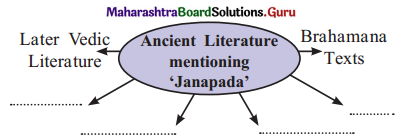
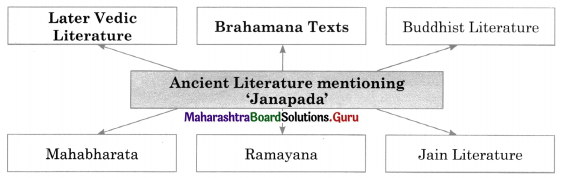
3. Complete the concept map.

Question 1.
Maharashtra Board Class 11 History Solutions Chapter 5 Janapadas and Republics 3 Q1
Answer:
Maharashtra Board Class 11 History Solutions Chapter 5 Janapadas and Republics 3 Q1.1

4. Explain the concepts with examples.

Question 1.
Ganarajya and Sangharajya
Answer:

  • ‘Gana’ means the ruling class comprising members of equal social status.
  • Similarly, ‘sangha’ means a state formed by many kulas or janapadas by coming together.
  • By the 6th century B.C.E. many sangharajyas had come into existence.
  • There were three main types of the ancient federation of states in India:
  • Ganarajya of the members of the same kula. For example, Malava and Shibi.
  • Ganarajya was created by more than one kulas coming together. For example, Vajji Ganasangha. It included eight kulas. Vajji, Lichchhavi, Dnyatruk, and Videha were the important ganas among them.
  • More than one ganrajyas coming together to create a sangharajya. For example, Yaudheya- Kshudrak Sangh.

Question 2.
Vartashastarpajivi Ganasnagh
Answer:

  • Ancient Indian literature mentions two more types of ganasanghas.
  • ‘Ayudhjivi’ sangh and ‘Varta-Shastropajivi’ sangh.
  • ‘Varta’ means trade and commerce.
  • The people in the Varta-Shastropajivi ganasanghas lived by trade and commerce, agriculture and animal husbandry, as well as their skills in warfare.
  • People in the Kamboj and Saurashtra ganasanghas earned their livelihood by these means.

Question 3.
‘Jana’ and ‘Janapada’
Answer:

  • Vedic people used the term Jana to designate a group of people, united under a common bond of singular kinship structure.
  • Their settlement was known as ‘Grama’.
  • A cluster of gramas consisting of the same Jana was known by the name of that particular Jana.
  • A region occupied by a Janas was called Janapada.
  • Gradually the Janapadas had more formal administrative structures transforming them into independent states.
  • These were the first well-established states of ancient India.
  • However, this does not necessarily mean that every Janapada evolved into an independent state.

Maharashtra Board Class 11 History Solutions Chapter 5 Janapadas and Republics

5. Answer the following questions in detail.

Question 1.
Describe the democratic and oligarchic states in ancient India.
Answer:
Democratic States:

  • Some of the ganasanghas were divided into regional zones called ‘Khanda’.
  • They functioned through a group of elected individuals, who were found capable.
  • Each of the elected members represented his respective khanda.
  • These elected members were installed with collective authority for the smooth running of the ganasangha.
  • This was a democratic system. Ganasanghas which functioned in this democratic way existed in Punjab and Sindh at the time of Alexander’s invasion.
  • Each elective representative of the respective regional zone was designated as ‘Ganamukhya’.
  • Every ganamukhya was a member of the assembly known as ‘ganaparishada’.
  • The decisions made by the ganaparishada were implemented by designated functionaries of various cadres.
  • He was known as the ‘Adhyaksha’ or ‘Raja’.

Oligarchic States:

  • In this type the elite class in the society held all the powers of decision-making and administration,
  • Panini and Kautilya mention them as ‘Rajshabdopajivi’ Sangh.
  • Panini includes Vajji, Andhaka, Vrishni, Yaudheya in the Rajashabdopjivi type.
  • Kautilya includes the Vrijji or Vajji, Madrak, Kuru, Panchala, etc. in this type.
  • This type of ganasanghas was more prevalent in the eastern region of Uttar Pradesh and Bihar.

Maharashtra Board Class 11 History Solutions Chapter 5 Janapadas and Republics

Activity

Present an act in the class based on the simulation of the administrative system of an oligarchic state.
Answer:
Students have to make the presentation in class.

Maharashtra Board Class 11 English Yuvakbharati Solutions Chapter 3.5 Film Review

Balbharti Yuvakbharati English 11th Digest Chapter 3.5 Film Review Notes, Textbook Exercise Important Questions and Answers.

Maharashtra State Board Class 11 English Yuvakbharati Solutions Chapter 3.5 Film Review

11th English Digest Chapter 3.5 Film Review Textbook Questions and Answers

1. Read the following conversation and complete the activities given below.

  • Minnie: Exams are over. I feel so relaxed ! Let us plan something interesting.
  • Ritu: What about a movie?
  • Paddy: Great! Let’s go for “Aladdin”!
  • Minnie: Oh, no! I have seen it. It has only a ‘one star’ rating.
  • Ritu: How about that new release ummm….yes, “Harry Potter?
  • Della: It is boring. I have read the review this morning. I don’t want to waste my time.
  • Paddy: Wait, friends. I will check. Let’s decide later.

Maharashtra Board Class 11 English Yuvakbharati Solutions Chapter 3.5 Film Review

Question (i)
Choose the correct alternative from the following. From one star given to the movie we conclude that –
(a) The movie is very short.
(b) The movie is not worth watching.
(c) The movie is serious.
(d) The movie is in black and white.
Answer:
(b) The movie is not worth watching.

Question (ii)
Discuss how/why are ‘stars’ given to a movie.
Answer:
A star is a symbol of movie rating .It was in 1928 that a newspaper film critic Irene Thiner initiated the grading system on a scale of zero to three status. Star are given to a movie to know how good, bad or average a movie is.

Question (iii)
The word ‘Review’ is different from summarizing and appeal writing. Choose the correct statements of the following.
(a) Film review is an expression of your personal views towards a particular film, documentary or movie.
(b) A film review gives you an opportunity to express opinions about the movie, including its characters, plot and background.
(c) A film review gives appealing sentences that make your reader curious or anxious about the film.
(d) A review means explanation of each and every event of the film.
Answer:
(a) Film review is an expression of your personal views towards a particular film, documentary or movie,
(b) A film review gives you an opportunity to express opinions about the movie, including its characters, plot and background.

Maharashtra Board Class 11 English Yuvakbharati Solutions Chapter 3.5 Film Review

(A1)

Question (i)
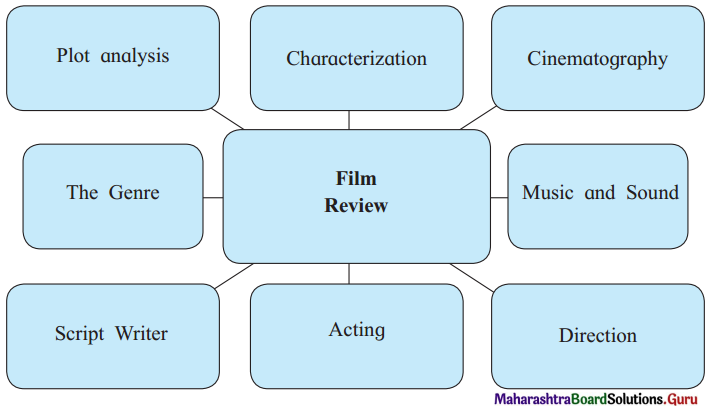
Every movie is worth critiquing. Describe in detail each point related with the film review with the help of the following web.
Maharashtra Board Class 11 English Yuvakbharati Solutions Chapter 3.5 Film Review 1
Answer:
Film Review : Dangal

Genre: Dangal is the most inspiring and entertaining movie. The film also makes strong feminist statement showing girls at par with boys.

Script Writer: Script of the movie ‘Dangal’ is written by Nitesh Tiwari who has been successful in creating the interest of the audience not only in the story of the film but also in the sport of wrestling.

Direction: The direction is also done by Nitesh Tiwari. He won the Filmfare award for the Best Director, 2017 for Dangal.

Producer : The film is produced by the renowned actor Amir Khan. Kiran Rao and Siddharth Roy Kapoor.

Acting : Amir Khan played the role of Mahavir Singh Phogat and Sakshi Tanwar played the role of the wife of Mahavir Singh Phogat. Zaira Wasim and Fatima played the role of Geeta and Sanya Malhotra and – Suhani Bhatnagar played the role of Babita Phogat. Aparshakti Khurrana and Rutvik Sahora played the role of Omkar, the nephew of Mahavir Singh Phogat. A negative role is played by Girish Kulkarni, the coach of Geeta Phogat and Babita Phogat.

It is wonderful to see Amir Khan as Mahavir Singh Phogat on a big screen. His appearance as the father of his daughters, their coach, guide and strong supporter till the end touches the audience emotionally.

Music and Sound: Music director Pritam and lyricist Amitabh Bhattacharya smartly themed their music. Some of the songs evoke the innocence of every viewer.

Cinematography: The cinematographer of the movie is Sethu Sriram. (Satyajit Anand). He presented a senario of an authentic and real wrestling matches that kept the audience spell bound till Geeta Phogat the daughter of Mahavir Singh Phogat bags gold medal for the Nation.

Plot Analysis: The film Dangal focuses on the continuous efforts of Mahavir Singh Phogat and his daughters to realize the dream. Struggle of the daughters Geeta and Babita and their hard work are the main stroyline of the movie. Mahavir Singh Phogat the wrestling champion was forced to give up wrestling for better employment. He was highly discouraged because he wanted to win a Gold for the nation. He thought that his unborn son would do it. However, Mahavir Singh due to the birth of his daughters, loses hope of bagging gold medal yet, keeps his decision of training the daughters in wrestling.

Continuous and regular training make the daughters wrestlers. After defeating the boys in the village, Mahavir decides to admit the daughters in National Sports Academy. Discouraged due to different techniques taught there, Mahavir decides to train daughters personally. The coach decides to ban the daughters from playing wrestling but Mahavir Singh manages and the daughters continue to receive training in the academy. Inspite of many problems Mahavir provides training to his girls by watching videos of the matches played by the daughters.

The jealous coach locks Mahavir Singh in a room during the final match played by his daughter. Frustrated Mahavir stands up joyfully to hear the Indian National Anthem. Finally, the daughters bring smile on the face of Mahavir Singh Phogat. The cooperation of the daughters during their hard training, sacrificing small joys of life, overcoming every obstacle in the way is presented in a perfect manner.

Message: “Believe in Yourself’ and “Work hard till you achieve your Goal”. The film also arouses social cause of treating girls and boys equally.

Maharashtra Board Class 11 English Yuvakbharati Solutions Chapter 3.5 Film Review

Question (ii)
Discuss and explain the movie ‘The Jungle Book’ with the help of the following points.
(a) Classic elements
(b) Fantasy
(c) Photorealism
(d) Blending of emotions
Answer:
Rudyard Kipling, created an intense world with a description of the jungle and creatures living in it using his concept, Disney made the classic tale of Mowgli into film, wherein, Mowgli became the central character. It is interesting to watch the story of a boy after his fathers death is discovered by Bagheera, the black panther. A pack of wolves and Raksha are the boy’s caretakers. Mowgli’s jump, swinging from tree to tree, other live animals, running scenes are perfectly presented to make the audience believe about Mowgli’s inclination towards behaving like animals.

Sher Khan’s unsympathetic behaviour towards Mowgli and Mowgli’s decision to search human beings like him brings about acceptable twist in the story. Blood curdling incident of Kaa’s hypnotising attack on Mowgli is presented in a wonderful manner. Thus the movie ‘The Jungle Book’ takes the audience into a world of fantasy. There is a perfect blend of emotions which is brought by presenting Mowgli’s relation with the fatherfigure Bagheera, motherly Raksha, friendly pack of wolves. The film is also an incredible visual treat – with only one human character, introduction of various species of animals. The movie is interesting to watch and is highly recommended.

Question (iii)
‘It all builds on the charm of the 1967 film, which by itself is a must watch for any child.’
Explain the sentence in the context of the movie, focusing on the two given phrases ‘Charm of the 1967 film’ and a ‘must watch’.
Answer:
The year 1967 is considered to be very crucial in the film industry. It is the time when many revolutionary films were produced. New themes were introduced and very different stories were brought about. ‘An Introduction of the World of Fantasy’ is one them.

The Jungle Book is a perfect movie which easily takes the audience into the world of fantasy in a unique way. Though the mind does not believe on the story of Mowgli, him being handled safely by the wild animals, heart is made to believe the same. This is perfectly brought about by Jon Favreau in ‘The Jungle book.’ Thus the movie is really a charm of 1967 which is a must watch for all generations to come.

(A2)

Question (i)
Complete the following sentences.
Answer:
The factors that have made ‘The Jungle Book’ a great movie are –
(a) It is a fantasy world of wonder.
(b) The effective animation and presentation of the wildlife make the movie interesting.
(c) The story of the movie is unique.
(d) The film is a perfect blend of human emotions and a journey in the world of fantasy.

Question (ii)
The present review concludes with two words ‘Heartwarming and Enjoyable’. Write your opinion in about 100 to 150 words.
Answer:
The Jungle Book is a unique combination of Rudyard Kipling’s story and Favreau’s direction. It is an awesome experience to watch the same on the big screen. Presence of the orphan boy Mowgli in the forest, his interaction with wild animals, their love and care towards him, emotionally keeps the audience glued to the screen. The perfect landscaping and setting delves the audience into the world of the jungle throughout the movie. Mowgli’s behaviour following the laws of the Jungle, the supersized orangutan, dangerous python, Mowgli’s learning of practical wisdom from Bagheera the father figure, make it a wonderful experience to watch. Thus the movie is heartwarming and enjoyable.

Maharashtra Board Class 11 English Yuvakbharati Solutions Chapter 3.5 Film Review

(A3)

Question (i)
‘Narnia’ (Part 1, 2, 3, 4) is a film about four children who find a path to Narnia. Discuss the special effects and direction. Write a review with the help of the following points in about 100-150 words.
(a) Storyline
(b) Producer
(c) Director
(d) Music Director
(e) Characters / Casting
(d) Setting / Location
(f) Conflict
(g) Message
(i) Significance of the title
Answer:
‘Narnia’ potrays the history of Narnia, an imaginary world of fantasy and magic from its creation to its destruction. The movies, directed by Andrew Adamson (first two parts), Michael Apted (third partjand Joe Johnstaone (fourth parts) is based on C. S. Lewis’s series of novel. ‘The Chronicles of Narnia’.The movie revolves around the adventures of Pevensie siblings, Peter, Susan, Edmund and Lucy who are sent away to a safe place during the world war.

While playing hide and seek, they discover the magical wardrobe which on opening, takes them to the enchanted island of Narnia. The beautiful cinematography and performance of the children, world of fantasy and magic, speaking animals is an awesome experience to watch. The separation of the children from their mother, death of some animals, witches yelling,etc., are presented in a perfect way that brings tears rolling down from the audience’s eyes.

The basic conflict of the movies is the conflict between good and evil. Each part of the movie has slight different representation. Yet, they potray a single message of triumph of good over evil. The real success of the him is not only touching the heart of the audience but also making them believe in the world of imagination and fantasy. The cinematography and animation are so skillful that the animals look real. The him enlightens the audience by opening the doors of a new world of imagination. The movie teaches the audience beautiful special effects and sound, adventure, unity and sacrihce for each other.

(A4)

Question (i)
Form groups and try to write a script for a short him or documentary on any topic of your choice. The script must develop properly. You can take help of the following points.

  • choose a topic
  • central theme
  • the beginning, the middle and the end
  • the message

Answer:
[Students are expected to attempt this question on their own.]

Maharashtra Board Class 11 English Yuvakbharati Solutions Chapter 3.5 Film Review

Question (ii)
Form groups and use the ICT lab of your Junior College to make a shorthlm on the script that you have prepared. There are several soft-wares that can be used for editing. You can take professional help. One can upload his/her him on mediums like Youtube and submit the link to the subject teacher.
Answer:
[Students are expected to attempt this question on their own.]

Question (iii)
There are ample career opportunities in him making and producing hlms.
The following professions require different professional skills,write them accordingly.
table
‘The story of the movie decides it’s success’. Comment.
Answer:
The story is the heart of a play/film. The music, direction, cinematography, special effects are made to relate to the story. It is the story of the movie which makes the audience spellbound. The story always has a message to the audience. It is the story that helps the audience specially the youngsters, to imagine, to learn, to create interest in the world around, to get inspired and to think. Cinematography, music, animation, etc., give a wonderful experience to watch any movie on the big screen. All these revolve round the central theme ‘the story’ of the movie.

Question 5.
You must have heard about Film and Television Institute of India (FTII), Pune. It is India’s top media Institute. It plays an important role in providing talent to commercial cinema, TV and web serials. Browse the internet and find information about other institutes in India and abroad.
Answer:
[Students are expected to attempt this question on their own.]

Yuvakbharati English 11th Digest Chapter 3.5 Film Review Additional Important Questions and Answers

Question 1.
What are the steps and stages in review writing?
Answer:
A film critic is an article containing analysis and evaluation of a film, While writing a review about a film, a writer has to consider various things. A film critic should write about the relevance of the title, storyline and producer. He should write about the type of film, its director and the cast.

A film critic should write about various events, cinematography, set design, music, plot, characters and message given through the film. He/She should write about the sequence of the events according to its importance. Lastly, he/she should suggest to edit or add the title or content according to its necessity.

Maharashtra Board Class 11 English Yuvakbharati Solutions Chapter 3.5 Film Review

Question 2.
What are the aspect of the review?
Answer:
Film review is an analysis or evaluation of a film from the viewer’s point. Various aspect of review are the genre, plot analysis, characterization, cinematography, music, production and direction, plot, message given in the film (moral), sound, set designs and location.

Question 3.
What are the precautions to be taken while writing a film?
Answer:
Film review is an analysis or evaluation of a film from the viewer’s point. Precausions should be taken while writing a review of a film. A review should create curiosity about the movie but not discourage the reader. While commenting on the film dealing with social issues, the writer should not hurt the feelings of people. Critic should express opinion about the film.

A personal attack on any actor, producer, director should be avoided. A review writer should have knowledge of various aspect of editing and cinematography. He should avoid commenting on religious beliefs. While penning down the thoughts, a review writer should be careful about religious sentiments.

Maharashtra Board Class 11 English Yuvakbharati Solutions Chapter 3.5 Film Review

Glossary:

  1. photorealism – detail description of
  2. resourcefulness – ability to overcome difficulties
  3. relevance – appropriate
  4. genre – style or category of art/music/literature
  5. cinematography – the art of photography and camera work in film-making
  6. characterization – the creation of a fictional character
  7. plot – the main events of a play/novel/film.

Maharashtra Board Class 11 History Important Questions Chapter 4 Vedic Period

Balbharti Maharashtra State Board Class 11 History Important Questions Chapter 4 Vedic Period Important Questions and Answers.

Maharashtra State Board 11th History Important Questions Chapter 4 Vedic Period

1A. Choose the correct alternative and write the complete sentences.

Question 1.
____________ was composed in India around 1500 B.C.E.
(a) Atharvaveda
(b) Samaveda
(c) Yajurveda
(d) Rigveda
Answer:
(d) Rigveda

Question 2.
In the year 1583, an Italian merchant ____________ came to Kochi, Kerala.
(a) Vasco da Gama
(b) Filippo Sassetti
(c) Albuquerque
(d) Ferdinand
Answer:
(b) Fillippo Sassetti

Maharashtra Board Class 11 History Important Questions Chapter 4 Vedic Period

Question 3.
The texts of the four Vedas are known as the ____________
(a) Aranyaka
(b) Brahmanas
(c) Samhitas
(d) Upanishads
Answer:
(c) Samhitas

Question 4.
The verses in the Rigveda are known as ____________
(a) Ruchas
(b) Suktas
(c) Mandala
(d) Mantras
Answer:
(a) Ruchas

Question 5.
The Vedic society was organised into four classes known as ____________
(a) Ashramas
(b) Varnas
(c) Javas
(d) Mahajanapadas
Answer:
(b) Varnas

Question 6.
____________ mentioned as the Lord of Urvara.
(a) Agni
(b) Varun
(c) Indra
(d) Pushan
Answer:
(b) Varun

Maharashtra Board Class 11 History Important Questions Chapter 4 Vedic Period

Question 7.
The chariot makers in the Vedic Period were known as ____________
(a) Rathakara
(b) Taksham
(c) Kulal
(d) Vaya
Answer:
(a) Rathakara

Question 8.
The verses in ____________ is known on ‘Rueha’.
(a) Samaveda
(b) Rigveda
(c) Atharvaveda
(d) Yajurveda
Answer:
(b) Rigveda

Question 9.
The ____________ is regarded as the text that is fundamental in development of Indian music.
(a) Rigveda
(b) Samaveda
(c) Yajurveda
(d) Atharvaveda
Answer:
(b) Samaveda

1B. Find the incorrect pair from set ‘B’ and write the correct ones.

Question 1.

Set ‘A’Set ‘B’
(a) RigvedaSuktas (hymns)
(b) YajurvedaExplanation of the sacrificial rituals
(c) SamavedaRules of reciting mantras
(d) AtharvavedaRules of grammar

Answer:
(d) Atharvaveda – Charms and medicines for various problems and diseases

Question 2.

Set ‘A’Set ‘B’
(a) ShatdruSutlej
(b) AsikniChinab
(c) ParushiBias
(d) VitastaJhelum

Answer:
(c) Parushi – Ravi

Maharashtra Board Class 11 History Important Questions Chapter 4 Vedic Period

Question 3.

Set ‘A’Set ‘B’
(a) KubhaKabul
(b) GomatiGomal
(c) SuvastuSwat
(d) ‘God’s CountryDevraya Desh

Answer:
(d) ‘God’s Country’ – Devnirmit Desh

1C. Find the odd one out.

Question 1.
Deities of the Vedic period:
(a) Indra
(b) Varun
(c) Ashwins
(d) Rathakara
Answer:
(d) Rathakara

Question 2.
Rivers of the Saptasindhu:
(a) Shatdru
(b) Vipas
(c) Asikni
(d) Cauvery
Answer:
(d) Cauvery

Question 3.
The Vedas:
(a) Rigveda
(b)Yajurveda
(c) Upanishad
(d) Atharvaveda
Answer:
(c) Upanishad

Maharashtra Board Class 11 History Important Questions Chapter 4 Vedic Period

Question 4.
Terms associated with the textile industry:
(a) Tantum
(b) Otum
(c) Shuttle
(d) Uran
Answer:
(d) Uran

2A. Write the names of historical places, persons, and events.

Question 1.
Asiatic Society of Bengal in 1784.
Answer:
Sir William Jones

Question 2.
Tribal Settlements.
Answer:
Krishtya

Question 3.
Earthen Jars in Marathi.
Answer:
Rahatgadage

Question 4.
Vedic name for carpenters.
Answer:
Takshan

Question 5.
Vedic name for the weaver.
Answer:
Vaya

Question 6.
Two well-known epics.
Answer:
Ramayana and Mahabharata

Maharashtra Board Class 11 History Important Questions Chapter 4 Vedic Period

Question 7.
River transport.
Answer:
Navya

2B. Choose the correct reason and complete the sentence.

Question 1.
The Rigvedic culture is the culture of the ____________
(a) Early Vedic period
(b) Late Vedic Period
(c) Post Vedic Period
(d) Pre Vedic period
Answer:
(a) Early Vedic period

Question 2.
The Atharvaveda contains information about ____________
(a) Science, Technology and Inventions.
(b) Charms and medicines for various problems and diseases.
(c) Day-to-day life.
(d) The norms of statesmanship.
Answer:
(b) Charms and medicines for various problems and diseases.

Question 3.
The ____________ also mentions trade by exchange, negotiations, and traders travelling far and wide to earn profits.
(a) Atharvaveda
(b) Samaveda
(c) Yajurveda
(d) Rigveda
Answer:
(d) Rigveda

2C. Write the correct chronological order.

Question 1.
(a) Brahmanas
(b) Aryamka
(c) Vedas
(d) Upanishada
Answer:
(a) Vedas
(b) Brahmanas
(c) Aryamka
(d) Upanishads

Maharashtra Board Class 11 History Important Questions Chapter 4 Vedic Period

Question 2.
(a) Grihasthashram
(b) Vanaprasthashram
(c) Brahmacharyashram
(d) Sanyasashram
Answer:
(a) Brahmacharyashram
(b) Grihasthashram
(c) Vanaprasthashram
(d) Sanyasashram

Question 3.
(a) Vedic Literature and Social organisation of Vedic Times
(b) Vedic literature, Linguistics, and Archaeology
(c) Later Vedic Period
(d) The Early Vedic Culture
Answer:
(a) Vedic literature, Linguistics, and Archaeology
(b) Vedic Literature and Social organisation of Vedic Times
(c) The Early Vedic Culture
(d) Later Vedic Period

3. Complete the concept maps.

Question 1.
Maharashtra Board Class 11 History Important Questions Chapter 4 Vedic Period 3 Q1
Answer:
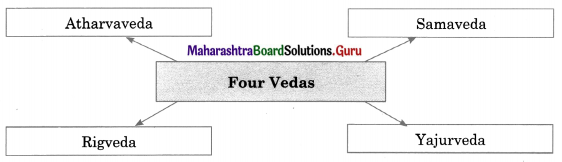
Maharashtra Board Class 11 History Important Questions Chapter 4 Vedic Period 3 Q1.1

Question 2.
Maharashtra Board Class 11 History Important Questions Chapter 4 Vedic Period 3 Q2
Answer:
Maharashtra Board Class 11 History Important Questions Chapter 4 Vedic Period 3 Q2.1

Maharashtra Board Class 11 History Important Questions Chapter 4 Vedic Period

Question 3.
Maharashtra Board Class 11 History Important Questions Chapter 4 Vedic Period 3 Q3
Answer:
Maharashtra Board Class 11 History Important Questions Chapter 4 Vedic Period 3 Q3.1

4. Explain the following concepts.

Question 1.
Varna System.
Answer:

  • The Vedic society was organized into four classes known as ‘Varna’, namely, Brahmana, Kshatriya, Vaishya, and Shudra.
  • The varna system is first mentioned in the tenth mandala (chapter) of the Rigveda.
  • In the later Vedic period, the varna system lost its flexibility.
  • Also, the caste system got rooted firmly by this period.
  • In the beginning, the varna or the caste was decided by one’s occupation.
  • Later it came to be determined on the basis of birth.

5. Explain the statement with reasons.

Question 1.
It became impossible to change one’s Varna and caste in which he/she was born.
Answer:

  • The varna system is first mentioned in the tenth mandala (chapter) of the Rigveda.
  • In the later Vedic period, the varna system lost its flexibility.
  • Also, the caste system got rooted firmly by this period.
  • In the beginning, the varna or the caste was decided by one’s occupation.
  • Later it came to be determined on the basis of birth.
  • Hence it became impossible to change one’s varna and caste, in which he/she was born.

Question 2.
Vedic literature is supposed to be the earliest literature of India.
Answer:

  • The language of Vedic Literature in Sanskrit and it is one of the oldest languages.
  • Vid’ in Sanskrit means to know and ‘Ved’ means knowledge.
  • The four Vedas namely, Rigveda, Yajurveda, Samaveda, and Atharvaveda form the core of the Vedic literature.
  • The texts of these four Vedas are known as the ‘Samhitas’.
  • Thus, the Vedic literature is supposed to be the earliest literature of India.

Maharashtra Board Class 11 History Important Questions Chapter 4 Vedic Period

Question 3.
Yajurveda is a combined composition of the Rigvedic richa in verse and the explanation of its use as a mantra in prose.
Answer:

  • The Yajurveda offers an explanation of the sacrificial rituals.
  • It explains when and how the mantras should be used.
  • A Rigvedic Richa, when recited in sacrificial rituals, is regarded as Mantra.
  • Thus, the Yajurveda is a combined composition of the Rigvedic richa in verse and the explanation of its use as a mantra in prose.

6. State your opinion.

Question 1.
Later Vedic Period saw the spread of Later Vedic culture from the foothills of the Himalayas in the north to the Vindhya Mountains in the south.
Answer:

  • Later Vedic Period is dated to around 1000-600 B.C.E. The information about this period is gathered from the treatises written in that period.
  • The material culture as reflected in the epics, Ramayana and Mahabharata was studied with the help of archaeological evidence.
  • A picture of the migration in the Later Vedic period can be gathered from the Saptasindhu region toward the east and its geographic markers from the literature of that period.
  • Thus, this period saw the spread of Later Vedic culture from the foothills of the Himalayas in the north to the Vindhya Mountains in the south.

7. Answer the following questions in detail.

Question 1.
Write a note on Vedic literature in detail.
Answer:

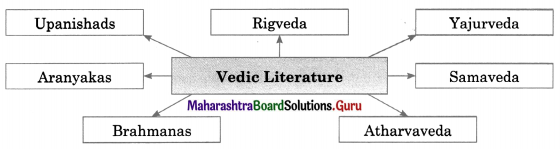
  • Vedic literature is supposed to be the earliest literature of India. Its language is Sanskrit.
  • The four Vedas form the core of Vedic literature, i.e., Rigveda, Yajurveda, Samaveda and Atharvaveda.
  • The texts of these four Vedas are known as ‘Samhitas’ vid in Sanskrit means ‘to know’ and Veda means ‘knowledge.
  • The Rigveda contains Suktas (hymns) composed to eulogize the deities.
  • The verses in the Rigveda are known as ‘Rucha’. A number of Ruchas strung together to make a Sukta (hymn).
  • Many Suktas make one Mandala. The Yajurveda offers explanations of rituals.
  • It explains how and when mantras are to be used. The Samaveda is a text that gives the rules of reciting mantras in a musical form.
  • The Atharvaveda is about day-to-day life. It contains information about charms and medicines.

Question 2.
Write a note on the Later Vedic period in detail.
Answer:

  • The Later Vedic period is dated around 1000-600 B.C.E. The treatises of the period give information about this period.
  • This period saw the spread of Later Vedic from the foothills of the Himalayas in the north to the Vindhyas in the south.
  • A story in the Satapatha Brahmana bears evidence of the Later Vedic period settling and bringing land under cultivation from west to east.
  • The Later Vedic period saw a gradual formation of the confederacies of the Vedic villages. They were known as ‘Janapadas’.
  • Generally, the seniors and the elites in a Janapada collectively took social decisions.
  • They functioned like oligarchic states. These slowly expanded into Mahajanapadas.

Maharashtra Board Class 11 History Important Questions Chapter 4 Vedic Period

Question 3.
Write about the following:
(a) Varna System
(b) Ashrama System
Answer:
(a) Varna System:

  • The Vedic society was organised into four classes known as “Varna’ namely Brahmana Kshatriya, Vaishya, and Shudra.
  • The Varna system is mentioned in the 10th Mandala (chapter) of the Rigveda.
  • In the Later Vedic period, the varna system became rigid. Also, the caste system got firmly rooted.
  • In the beginning, the varna or the caste was decided by one’s occupation later it came to be determined on the basis of birth.

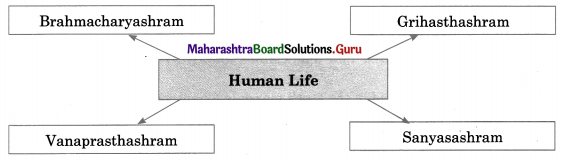
(b) Ashrama System: The Ashrama System of the Vedic period was divided into four stages namely Brahmacharya Ashram, Grihastha Ashram, Vanaprastha Ashrama, and Sanyasa Ashrama.

  • In the first stage, one was expected to spend an austere life and earn knowledge and necessary occupational skills.
  • In the second stage, one was expected to fulfill one’s prescribed duties with one’s wife by his side.
  • In the third stage, one was expected to retire from the active life of a householder.
  • It was also desirable that one should stay away from human settlement, renounce all family bonds, accept a wandering life, etc.
  • A Sanyasi was to give up all worldly attachments and not be permitted to settle at one place for a longer time.

8. Answer the following questions with the help of given points.

Question 1.
Write a note on Ashrama System with the help of stages involved in it.
Answer:
The Ashrama System of the Vedic culture lays down the norms of living an ideal life by dividing the span of human life into four successive stages, namely Brahmacharyashram, Grihasthashram, Vanaprasthashram, and Sanyasashram.

  • In the first stage, one was expected to spend an austere life and earn knowledge and necessary occupational skills.
  • In the second stage, one was expected to fulfill one’s prescribed duties with one’s wife by his side.
  • In the third stage, one was expected to retire from the active life of the householder and if the need is to give advice to the younger people. It was also desirable that one should stay away from human settlement.
  • In the fourth and the last stage one was expected to renounce all the family bonds, accept a wandering life, and go away. A Sanyasi was not permitted to settle at one place for a longer time.

Maharashtra Board Class 11 History Important Questions Chapter 4 Vedic Period

Question 2.
Write a note on Vedic Literature:
(a) Rigveda
(b) Yajurveda
(c) Samaveda
(d) Atharvaveda
Answer:
Vedic literature is supposed to be the earliest literature of India. Its language is Sanskrit. The four Vedas namely, Rigveda, Yajurveda, Samaveda, and Atharvaveda form the core of the Vedic literature.

(a) Rigveda: The Rigveda contains Suktas (hymns) composed to eulogize the deities. The verses in Rigveda are known as ‘Rucha’. A number of Ruchas strung together makes a Sukta (hymn). Many Suktas make one Mandala.

(b) Yajurveda: The Yajurveda offers an explanation of the sacrificial rituals. It explains when and how the mantras should be used. A Rigvedic Richa, when recited in sacrificial rituals, is regarded as Mantra. The Yajurveda is a combined composition of the Rigvedic richa in verse and the explanation of its use as a mantra in prose.

(c) Samaveda: The Samaveda is a text that gives the rules of reciting mantras in a musical form. The Samaveda is regarded as the text that is fundamental in the development of Indian music.

(d) Atharvaveda: The Atharvaveda is about day-to-day life. It contains information about charms and medicines for various problems and diseases. It also talks about the norms of statesmanship.

Maharashtra Board Class 11 History Solutions Chapter 4 Vedic Period

Balbharti Maharashtra State Board Class 11 History Solutions Chapter 4 Vedic Period Textbook Exercise Questions and Answers.

Maharashtra State Board Class 11 History Solutions Chapter 4 Vedic Period

1A. Choose the correct alternative and write the complete sentences.

Question 1.
The importance of agriculture is clearly emphasised in the ______________ mandala of the Rigveda.
(a) 4th
(b) 10th
(c) 8th
(d) 6th
Answer:
(b) 10th

Question 2.
A potter is mentioned as an artisan in the ______________ for the first time.
(a) Rigveda
(b) Yajurveda
(c) Samaveda
(d) Atharvaveda
Answer:
(b) Yajurveda

Maharashtra Board Class 11 History Solutions Chapter 4 Vedic Period

Question 3.
The god who protected the animals was known as ______________
(a) Indra
(b) Pushan
(c) Ashwin
(d) Varun
Answer:
(b) Pushan

1B. Find the incorrect pair from set ‘B’ and write the correct ones.

Question 1.

Set ‘A’Set ‘B’
(a) NishkaGold ornament
(b) BarleyMaincrop of the Vedic people
(c) KrishtyaThe apparatus of drawing water from the well
(d) NavyaRiver transport

Answer:
(c) Krishtya – Tribal settlements

1C. Write the names.

Question 1.
A branch of linguistics.
Answer:
Philology

Question 2.
A battle was fought among the ten tribal chiefs.
Answer:
Dasharajnya Yuddha

Question 3.
Cultivable land prepared by ploughing.
Answer:
Urvara

Maharashtra Board Class 11 History Solutions Chapter 4 Vedic Period

2. Complete the concept map given below:

Question 1.
Maharashtra Board Class 11 History Solutions Chapter 4 Vedic Period 2 Q1
Answer:
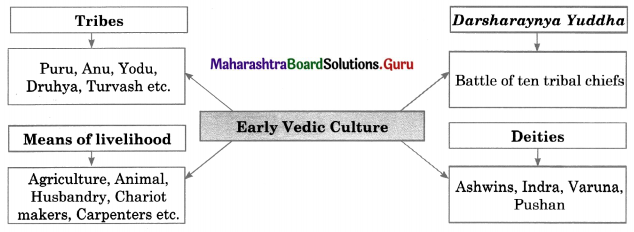
Maharashtra Board Class 11 History Solutions Chapter 4 Vedic Period 2 Q1.1

3. Choose the correct reason and complete the sentence.

Question 1.
Panis were looked upon as enemies by the Vedic people because-
(a) they belonged to a different tribe.
(b) their language was impure.
(c) Panis used to steal the cattle of the Vedic people.
(d) Panis did not obey the orders of the Vedic people.
Answer:
(c) Panis used to steal the cattle of the Vedic people.

4. State your opinion.

Question 1.
There is a debate about the original home of the Aryans.
Answer:

  • The debate began in the 16th Century. Till then the concept of the ‘Aryans’ was not known.
  • The European academics became aware of the similarities between Sanskrit and Latin-Greek languages.
  • This resulted in the notion of the Indo-European language family which gave momentum to the search for a Mother language from which developed the Indo-European languages.

Maharashtra Board Class 11 History Solutions Chapter 4 Vedic Period

Question 2.
The Rigvedic people subsisted on agriculture.
Answer:

  • The Rigvedic tribal settlements have been mentioned as ‘Krishtya’ in the Rigveda. ‘Krish’ means ploughing.
  • Hence the people who ploughed and also their settlements were mentioned as ‘Krishtya’.
  • The importance of agriculture is clearly emphasised in the 10th mandala of Rigveda.
  • It states that for the farmer his ploughshare is the means of obtaining.

5. Explain the following concepts.

Question 1.
Origin of Aryan people.
Answer:

  • There are multiple unanswered questions, such as, who were the Aryans, did they arrive in India from a distant place or were they natives of India, which are the archaeological sites where the remains of their culture are found, how to identify those remains, etc.
  • Most of the information about their culture is derived from Vedic literature. There are various v opinions about the chronology of the Vedic culture.
  • However, there is a general agreement that the Vedic people composed Rigveda in India around 1500 B.C.E.
  • However, Lokmanya Tilak calculated this date as 6000 B.C.E. on the basis of astronomical events.
  • He was also of the opinion that the original home of the Aryans was in the Arctic region.
  • This debate began in the 16th century. Till then the concept of the ‘Aryans’ was not known.

Maharashtra Board Class 11 History Solutions Chapter 4 Vedic Period

Question 2.
Indo-European family of languages.
Answer:

  • In the year 1583, an Italian merchant by the name of Filippo Sassetti came to Kochi (Cochin) the port city in Kerala.
  • He never returned to his motherland. He stayed in Kerala and Goa. During his stay, he wrote detailed letters to his family members about Indian life, language and culture. He happens to be the first European who wrote about his observations of Indian society.
  • He also studied Sanskrit. He was the first one who observed the similarities between Sanskrit and Latin.
  • His observations could be said to be the first, to give impetus to the notion of a family of Indo-European languages.

Maharashtra Board Class 12 English Yuvakbharati Solutions Chapter 2.8 Small Towns and Rivers

Balbharti Yuvakbharati English 12th Digest Chapter 2.8 Small Towns and Rivers Notes, Textbook Exercise Important Questions and Answers.

Maharashtra State Board Class 12 English Yuvakbharati Solutions Chapter 2.8 Small Towns and Rivers

12th English Digest Chapter 2.8 Small Towns and Rivers Textbook Questions and Answers

Question (i)
Most of the civilizations have flourished on the banks of the rivers. Discuss the reasons in the class.
Points:
(a) Availability of water
(b) Fertile soil for agriculture
(c) Fishing ground
(d) Transport

Maharashtra Board Class 12 English Yuvakbharati Solutions Chapter 2.8 Small Towns and Rivers

Question (ii)
Write down the names of the famous cities that are situated on the banks of the rivers given below.
Answer:

RiverCity
GangaVaranasi
YamunaMathura
GodavariRajahmundry
VaradaSagara
KrishnaVijayawada
TapiSurat

Question (iii)
Write down the names of the rivers on the banks of which following cities have prospered:
Answer:

CityRiver
LondonThames
CairoNile
New YorkHudson
ParisSiene

Question (iv)
Divide your class into groups and discuss the changes that might have taken place when the cities grow on the banks of the rivers.
Points: Dwellings are built – Population grows – Fishing flourishes – Outsiders come to settle – Trading takes place – Prosperity increases – Increased population, trade, traffic and fishing begin to harm the river system – River system shows damage – River starts to decay

Maharashtra Board Class 12 English Yuvakbharati Solutions Chapter 2.8 Small Towns and Rivers

Question (v)
Share your views in the class on the topic ‘Conservation of Rivers and Development of the Cities.’
(Students may list their own points of views.)

(A1)

Question 1.
State the importance of Nature in the lives of the people from the North-eastern part of India as expressed in the poem with reference to:
(a) Flowers
(b) River
(c) Bamboo
(d) East
Answer:
(a) Flowers – Tuberoses are woven into wreaths to be placed on the body of a departed as a mark of love and respect.
Sole: Most of the textual ‘Wh’ questions are converted to Activity Format.
(b) River: The people believe the river has a soul. They respect their rivers and even revere it as divine as its waters are immortal.
(c) Bamboo: The poet says ‘in the cool bamboo’. The colour is a cool green. The place where the bamboo grows is also cool.
(d) East: The direction of sunrise is very important for the people of Arunachal Pradesh. They ensure the dead are placed pointing west so that their soul directly enters the golden house of the sun. They believe that finally souls must attain the sun’s abode in the east.

(A2)

Question (i)
The poet has described her small town in Arunachal Pradesh. Pick out from the extract, the lines that describe the poet’s town.
Answer:
1. ‘My hometown lies calmly amidst the trees’,
2. ‘it is always the same In summer and winter With the dust flying Or the wind howling down the gorge’

Maharashtra Board Class 12 English Yuvakbharati Solutions Chapter 2.8 Small Towns and Rivers

Question (ii)
Make a list of natural elements mentioned in the extract.
Answer:
trees, winter, summer, wind, tuberoses, life, land, river, fish, stars

Question (iii)
‘The river has a soul.’ Elaborate the concept in your words as the poet has explained in the extract.
Answer:
When the poet says ‘The river has a soul’ she personifies the river. The river flows with great force – ‘like a torrent of grief. The river flowing with great force can be like a person pouring out grief in a storm of emotion. The river also seems to be holding its breath, maybe because it is choking with filth. There are no fishes. It is not clear and sparkling. So the poet says -‘I think it holds its breath seeking a land of fish and stars’.

Question (iv)
The poet is convinced with the thought of immortality of water. Pick out the relevant lines from the extract.
Answer:
‘The river has a soul’.

(v) The poet has used some unconventional expressions. Illustrate them in your words.

Question (a)
‘Torrent of grief.
Answer:
The poet describes the river flowing in summer with great speed. Just like someone becomes emotional in great sadness, the force of the water seems to be like the outpouring of sorrow of the river.

Maharashtra Board Class 12 English Yuvakbharati Solutions Chapter 2.8 Small Towns and Rivers

Question (vi)
The poet has connected the need to preserve Nature with the belief of particular community and her childhood memories. Write down the measures you would take to convince the people regarding the need to conserve the Nature.
Answer:
We have to make people at large realize that we are a part of the nature not apart from the nature. Saving nature is to save ourselves, To bring about this realization I can address my steps to two sections. The first would be the children. Saving water would be the first thing to teach children. Story-telling, poems, songs, games, cartoons and can easily bring the conservation ideas to young minds. I would take my ideas to schools, parks, malls and try to spread this to the young ones.

The other section is of course the adult public across economic and social levels. The well- off people must not be careless if they can afford to pay bills they can waste resources.

I will do everything possible. I will use social media to spread various messages/ mottos.

(A3)

Question (i)
Write down the expressions related to ‘the seasons’ from the extract.
Answer:
1. Summer or winter
2. ‘in the summer’

Question (ii)
Match column ‘A’ with column ‘B’.

AB
1. cool
2. happy
3. dreadful
4. dry
(a) silence
(b) earth
(c) bamboo
(d) pictures

Answer:

  1. cool-bamboo
  2. happy – pictures
  3. dreadful – silence
  4. dry-earth

Maharashtra Board Class 12 English Yuvakbharati Solutions Chapter 2.8 Small Towns and Rivers

(A4)

Question (i)
Read the expression ‘a sad wreath of tuberoses’.
‘Is the wreath sad?’ Explain the figure of speech.
Answer:
The figure of speech is transferred epithet. The sad mourners have placed the wreath of tuberoses on the dead. The emotion of sadness has been transferred to the flowers for effect.

Question (ii)
List and explain the metaphorical expressions from the extract.
Answer:
1. ‘torrent of grief’. The river sweeps along with great speed as if it is pouring out sorrow.
2. ‘Wind howling down the gorge’. The wind blowing through the narrow gorges creates a sound exactly like howling.
3. ‘The river has a soul’. The river is spoken of as a living being, a human.
4. ‘It holds its breath’. The river may be choking with debris and filth.

Question (iii)
‘The river has a soul.’
‘Life and death.’
These are the two expressions that are repeated in the poem; but both of them indicate different figures of speech. Find out and discuss.
Answer:
(a) ‘Life and death’
In the first usage it is used as antithesis, to emphasise the beginning and end.
In the second instance it is irony to indicate that neither life nor death is permanent. Ironically the rituals are permanent.
(b) ‘The river has a soul’
In the first instance it is used to personify the river. Several human-like qualities are attributed to the river,
= it cuts through the land
= it is cascading in grief
= it holds its breath
= it seeks a land

Maharashtra Board Class 12 English Yuvakbharati Solutions Chapter 2.8 Small Towns and Rivers

Question (iv)
Find out the beauty of the free verse reflected in this poem.
Answer:
“Small Towns and Rivers’ is written in free- verse. Since there are irregular lengths of lines and no rhyme, the reading of the poem is almost like a story-telling. Each stanza has a different number of lines and there is no order for mixing up the short and long lines.

The poem is not confined by an obvious rhythm so we feel there is a kind of freedom.We are free to imagine the widespread setting of the North-eastern terrain of mountains and rivers, mists, golden sunlight and the town by the river.

(A5)

Question (i)
Prepare the arguments for group discussion on the topic
‘A balanced progress never harms the Nature’.
For:

  • Growth should be planned to take place in stages
  • Planning vital for the growth
  • Sustainability must be ensured
  • Pros and cons of the damage to environment must be weighed
  • Short-term gains in progress must not harm long-term eco-factors

Against:

  • Growth must not be halted for issues of environment
  • Costs will go up due to delays
  • Delays in progress will slow down economy and employment
  • Slowdown in economy will cause public to protest
  • Sacrifices have to be made – one can’t have the cake and eat it too.

Maharashtra Board Class 12 English Yuvakbharati Solutions Chapter 2.8 Small Towns and Rivers

Question (ii)
Compose 4 to 6 lines on ‘Gift of the Seasons’.
Answer:
Gift of the Seasons
Each season brings a sweetly wrapt gift;
We can gift her back : no water pollution in
the season of the Sun.
No air pollution when
The rains come down.
And no degradation the rest of the year!

Question (iii)
Write an appreciation of the poem ‘Small Towns and Rivers’. Use the points given below:

  • About the poem/poet/title
  • Theme
  • Poetic devices, language, style
  • Special features – tone and type
  • Values, message
  • Your opinion about the poem

Answer:
The poem ‘Small Towns and Rivers’ written by Mamang Dai is a beautiful word-picture. It is also a lament of the poet about her beautiful native land of Arunachal Pradesh.

This theme shows in the way she begins the poem that small towns remind her of death. It is shocking. She implies the town is unchanging in all weathers, but development comes along and changes everything. There is irony in that the cycle of life and death shows that life is not permanent, but the rituals are permanent.

She uses metaphor that the rivers are not only alive like us humans, but actually immortal. She personifies the river by way the river ‘holds its breath’ because it is choking. It is flowing in search of a place where it will flow clean and clear. The poet uses metaphor of the water-cycle to illustrate the river has a soul and its waters are immortal.

The poet builds a climax with ‘shrine of happy’ childhood memories. This becomes growing up -‘grow with anxiety’. Then she speaks of how the dead are placed pointing west so the soul can ascend directly into the sun’s golden home in the east. This tells us about the traditions of her region.

The poem is in free verse and seems to be in easy language, but we can understand the full depth of meaning only after reading it more than once. The poem is a lament about the destruction of nature for development. We all will feel the sorrow of the poet when we read about how nature’s beauty is damaged for man’s greed called ‘progress’.

Maharashtra Board Class 12 English Yuvakbharati Solutions Chapter 2.8 Small Towns and Rivers

Question (iv)
Write a dialogue between two friends on ‘Importance of the rivers’
Answer:
Priya: Jai, it goes without saying that fresh, clean water is essential for humans and nature to survive. Rivers are precious sources of fresh drinking water for people across the world. And when rivers are so badly polluted by industry or by poor water management practices, it can be a case of life-or-death. This unfortunately happens across the world.

Jai: Yes Priya. Freshwater habitats account for some of the richest biodiversity in the world, and rivers are a vital, vibrant ecosystem for many species. Only those who live by the river know about this wealth of nature. Those who live far away and damaging the system with the poisons are not aware.

Priya: People depend on rivers for their way of life and their livelihoods. From fishing to agriculture, the way our waterways are managed has a direct impact on people’s lives. There are millions of people who follow their ancestors’ way of living and earning a livelihood. But modern technology has wrecked the very source of these.

Jai: Rivers are absolutely vital: for fresh drinking water, for people’s livelihoods and for nature. Unfortunately, they’re still threatened. We must commit to recovering freshwater biodiversity, restoring natural river flows and cleaning up polluted water for people and nature to thrive.
Priya: Yes Jai. I agree. It is the crying need of the day.

(A6)

Question (i)
Collect information about rivers in Maharashtra.

Maharashtra Board Class 12 English Yuvakbharati Solutions Chapter 2.8 Small Towns and Rivers

Question (ii)
Further reading:
‘The River Poems’ – Mamang Dai
‘The World Is Too Much With Us’ – William Wordsworth

Yuvakbharati English 12th Digest Chapter 2.8 Small Towns and Rivers Additional Important Questions and Answers

Read the extract and complete the activities given below:

Global Understanding:

Question 1.
Describe the river in the 3rd stanza.
Answer:
The river flows with great force -‘like a torrent’-. The river has life and soul. It breathes. But it seems as if the river is holding its breath. It seems to be in search of fishes which will live in it and stars which will be reflected in its waters.

Maharashtra Board Class 12 English Yuvakbharati Solutions Chapter 2.8 Small Towns and Rivers

Question 2.
What is meant by immortality?
Answer:
Immortality means the ability to live forever, without death.

Question 3.
Give reasons-The dead are placed pointing to the west.
Answer:
The people of Arunachal Pradesh believe that it will be possible for the soul of the departed person enter ‘the house of the sun’. They hope the soul will be able to ‘walk into the golden east’. So they place the dead (with feet) pointing to the west.

Question 4.
The poet has described her small town in Arunachal Pradesh. Pick out from the extract the lines that describe the poet’s town.
Answer:

  1. The town has ‘A shrine of happy pictures’ to mark the days of childhood.
  2. Small towns grow with anxiety for the future.
  3. Like her town, ‘small towns’ are ‘by the river’.
  4. Make a list of natural elements mentioned in the extract.

Maharashtra Board Class 12 English Yuvakbharati Solutions Chapter 2.8 Small Towns and Rivers

Question 5.
Make a list of natural elements mentioned in the extract.
Answer:
River, Earth, Mountaintops, Sun, Sunlight, Bamboo

Question 6.
The poet is convinced with the thought of immortality of water. Pick out the relevant lines from the extract.
Answer:
1. The river has a soul.
2. from the first drop of rain to dry earth
3. mist on the mountaintops
4. the immortality of water.

Interpretation/Inference/Analysis:

Question 1.
The land of fish and stars.
Answer:
The poet says she thinks the river is holding its breath. One has to hold one’s breath when he/she is unable to breathe or does not want to breathe. The river may be choking with garbage and is not able to breathe. The river may be stinking and may not be able to breathe.

As the river is so filthy there are no fish. It is dirty; the water is not sparkling in the day and cannot reflect the stars at night. So the river is in search of a land where there it can flow clean, it will have fish and where its clear water will sparkle in the sun and glitter with stars at night.

Question 2.
The river has a soul.’ Elaborate the concept in your words as the poet has explained in the extract.
Answer:
The poet states the river has a soul. The soul is deathless. The water that flows in the river came from the drops of rain. The water evaporated, rose as mist to the mountaintops. Then it formed clouds and poured down as rain to the dry earth and flowed again. Thus the river goes on, immortal, deathless.

Maharashtra Board Class 12 English Yuvakbharati Solutions Chapter 2.8 Small Towns and Rivers

Question 3.
The poet has used some unconventional expressions. Illustrate them in your words. Illustrate them in your words. Shrine of happy pictures
Answer:
There is a shrine probably in the town which has pictures inside. The pictures may be those of the happy moments experienced by the people in the town. Those memories are so sacred that it is a shrine to them. They protect and guard it because they have only sad and grim things happening at present.

Personal Response:

Question 1.
Rivers are our lifeline. They are an extremely important part of the eco-system and even considered sacred. Many major rivers and smaller ones have been misused and almost destroyed. Write down how we can restore our rivers to their original state.
Answer:
The condition of rivers worldwide is horrific. Everything from industrial chemical-waste to garbage is being thrown into rivers. Melted snow or the rainwater from springs come down from hills and mountains as sweet water for our survival. Polluting this is a crime against humanity.

Strict laws should be made and enforced to stop industrial activity near rivers. Wastes from industry, city, town or village must not reach the river. Only channels of rainwater must be allowed to reach the river. Awareness should be created for maintaining cleanliness along the banks.

In the olden days lakes, water bodies were considered precious and were guarded, Houses had wells. But people have lost the respect for water sources. Rivers are treated as sewage channels. Fines and punishments must be imposed and security put in for safeguarding our beautiful rivers.

Maharashtra Board Class 12 English Yuvakbharati Solutions Chapter 2.8 Small Towns and Rivers

Poetic Creativity:

Question 1.
Compose 4 to 6 lines on ‘River’.
Answer:
The River is our Mother

Like a mother the river soothes us.
When dying of thirst she revives us.
When tired and dirty she cleans us.
When growing our grain she waters the green.
Why! Oh why can’t we keep her clean!

Maharashtra Board Class 11 History Important Questions Chapter 3 Chalcolithic Villages in India

Balbharti Maharashtra State Board Class 11 History Important Questions Chapter 3 Chalcolithic Villages in India Important Questions and Answers.

Maharashtra State Board 11th History Important Questions Chapter 3 Chalcolithic Villages in India

1A. Choose the correct alternative and write the complete sentences.

Question 1.
___________ culture at Balathal is dated to 4000 B.C.E.
(a) Ahar
(b) Jorwe
(c) Ganeshwar-Jodhpura
(d) Malwa
Answer:
(a) Ahar

Question 2.
Ahar culture is also known as ___________ culture.
(a) Jorwe
(b) Kayatha
(c) Banas
(d) Savalda
Answer:
(c) Banas

Maharashtra Board Class 11 History Important Questions Chapter 3 Chalcolithic Villages in India

Question 3.
___________ is a site situated on the bank of the river known as Chhoti Kali Sindh.
(a) Savalda
(b) Navadatoli
(c) Malwa
(d) Kayatha
Answer:
(d) Kayatha

Question 4.
___________ was known as ‘Rangpur’.
(a) Maharashtra
(b) Gujarat
(c) Madhya Pradesh
(d) Rajasthan
Answer:
(b) Gujarat

Question 5.
Savalda is in ___________ district.
(a) Satara
(b) Ratnagiri
(c) Dhule
(d) Pune
Answer:
(c) Dhule

Question 6.
The culture in south Gujarat is known as ___________ culture.
(a) Pravhas
(b) Nevase
(c) Malwa
(d) Rangpur
Answer:
(a) Pravhas

Maharashtra Board Class 11 History Important Questions Chapter 3 Chalcolithic Villages in India

Question 7.
The age when huge stone slabs were used is known as ___________ age.
(a) Palaeolithic
(b) Mesolithic
(c) Neolithic
(d) Megalithic
Answer:
(d) Megalithic

Question 8.
The archaeological evidence shows that ___________ was a centre of mass production of pottery.
(a) Gilund
(b) Khethri
(c) Balathal
(d) Baras
Answer:
(c) Balathal

1B. Find the incorrect pair from set ‘B’ and write the correct ones.

Question 1.

Set ‘A’Set ‘B’
(a) Malwa Culture1600-1400 B.C.E.
(b) Megalithic circles in India1500-500 B.C.E
(c) Early Jorwe Culture1400-1000 B.C.E.
(d) Late Jorwe Culture1000-800 B.C.E.

Answer:
(d) Late Jorwe Culture – 1000-700 B.C.E.

Question 2.

Set ‘A’Set ‘B’
(a) Early Harappan phase3950-2600 B.C.E.
(b) Mature (urban) phase2500-1800 B.C.E.
(c) Savalda culture2000-1800 B.C.E.
(d) Post-Harappan phase1900-900 B.C.E.

Answer:
(b) Mature (urban) phase – 2600-1900 B.C.E.

Maharashtra Board Class 11 History Important Questions Chapter 3 Chalcolithic Villages in India

1C. Find the odd one out.

Question 1.
Ahar, Kayatha, Malwa, Mohenjodaro.
Answer:
Mohenjodaro

Question 2.
Early Harappan phase, Mature (Urban) phase, Pre Harappan Phase, Post-Harappan phase.
Answer:
Pre Harappan Phase

Question 3.
Malwa Culture, Early Jorwe Culture, Late Jorwe Culture, Post Late Jorwe Culture.
Answer:
Post-Late Jorwe Culture

Question 4.
Odisha, Todas, Kurumbas, Nagas.
Answer:
Nagas

Question 5.
Takalghat, Mahuzari, Khasis, Khapa.
Answer:
Khasis

Question 6.
Godavari, Inamgaon, Tapi, Bhima.
Answer:
Inamgaon

2A. Write the names of historical places, persons, and events.

Question 1.
A tributary of the river Banas
Answer:
Ahar

Maharashtra Board Class 11 History Important Questions Chapter 3 Chalcolithic Villages in India

Question 2.
The culture found at Khetri
Answer:
Ganeshwar-Jodhpura

Question 3.
Pottery found in river beds
Answer:
Ochre coloured pottery

Question 4.
An important site of Malwa culture on the banks of Narmada
Answer:
Navadatoli

Question 5.
Tribes in Odisha
Answer:
Bodos

Question 6.
Furnace discovered near Nagpur
Answer:
Naikund

2B. Choose the correct reason and complete the sentence.

Question 1.
Ochre Coloured Pottery (OCP) and copper hoards are supposed to belong ___________
(a) one and the same culture
(b) one and the another culture
(c) similar culture
(d) different culture
Answer:
(a) one and the same culture

Maharashtra Board Class 11 History Important Questions Chapter 3 Chalcolithic Villages in India

Question 2.
People of the Mature Harappan and the Late Harappan culture had the knowledge of ___________
(a) designs include motifs like sun, moon, fish, deer, and peacock
(b) wheel-made pottery
(c) the technology of making copper objects
(d) excavations of copper artifacts
Answer:
(b) wheel-made pottery

Question 3.
Kayatha culture was contemporary to the ___________
(a) Dholavira region
(b) Mohenjodaro
(c) Banas culture
(d) Harappan Civilisation
Answer:
(d) Harappan Civilisation

Question 4.
Ahar culture at Balathal is dated to ___________
(a) 400 B.C.E
(b) 40 B.C.E
(c) 4000 B.C.E
(d) 40000 B.C.E
Answer:
(c) 4000 B.C.E

2C. Write the correct chronological order.

Question 1.
(a) Malwa culture – 1800 B.C.
(b) Early Jorwe culture – 1400 B.C.
(c) Ahar culture – 4000 B.C.E.
(d) Savalda culture – 2000 B.C.E.
Answer:
(a) Ahar culture – 4000 B.C.E.
(b) Savalda culture – 2000 B.C.E.
(c) Malwa culture – 1800 B.C.E.
(d) Early Jorwe culture – 1400 B.C.E.

Maharashtra Board Class 11 History Important Questions Chapter 3 Chalcolithic Villages in India

Question 2.
(a) Late Jorwe Culture – 1000-700 B.C.E.
(b) Kutch – Saurashtra was abandoned by 1900 B.C.E.
(c) Early Jorwe Culture – 1400-1000 B.C.E.
(d) Malwa Culture – 1600-1400 B.C.E.
Answer:
(a) Kutch – Saurashtra were abandoned by 1900 B.C.E.
(b) Malwa Culture – 1600-1400 BCE
(c) Early Jorwe Culture – 1400-1000 B.C.E.
(d) Late Jorwe Culture – 1000-700 B.C.E.

Question 3.
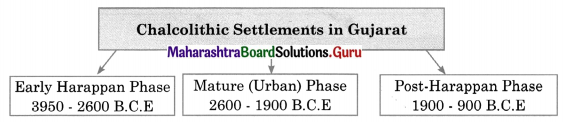
(a) Mature (urban) phase – 2600-1900 B.C.E.
(b) ‘Ahar’ culture at Balathal – 4000 B.C.E.
(c) Post-Harappan phase – 1900-900 B.C.E.
(d) Early Harappan phase – 3950-2600 B.C.E.
Answer:
(a) ‘Ahar’ culture at Balathal – 4000 B.C.E.
(b) Early Harappan phase – 3950-2600 B.C.E.
(c) Mature (urban) phase – 2600-1900 B.C.E.
(d) Post-Harappan phase – 1900-900 B.C.E.

3. Complete the concept maps.

Question 1.
Maharashtra Board Class 11 History Important Questions Chapter 3 Chalcolithic Villages in India 3 Q1
Answer:
Maharashtra Board Class 11 History Important Questions Chapter 3 Chalcolithic Villages in India 3 Q1.1

Question 2.
Maharashtra Board Class 11 History Important Questions Chapter 3 Chalcolithic Villages in India 3 Q2
Answer:
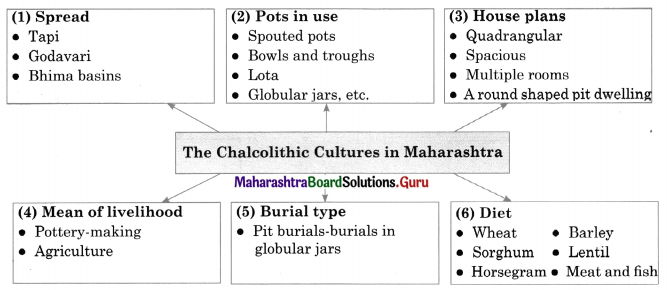
Maharashtra Board Class 11 History Important Questions Chapter 3 Chalcolithic Villages in India 3 Q2.1

Question 3.
Maharashtra Board Class 11 History Important Questions Chapter 3 Chalcolithic Villages in India 3 Q3
Answer:
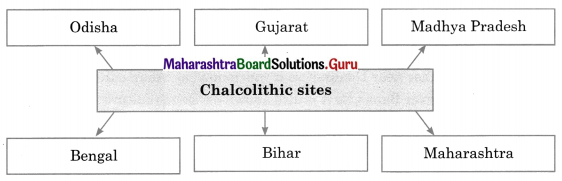
Maharashtra Board Class 11 History Important Questions Chapter 3 Chalcolithic Villages in India 3 Q3.1

Maharashtra Board Class 11 History Important Questions Chapter 3 Chalcolithic Villages in India

Question 4.
Maharashtra Board Class 11 History Important Questions Chapter 3 Chalcolithic Villages in India 3 Q4
Answer:
Maharashtra Board Class 11 History Important Questions Chapter 3 Chalcolithic Villages in India 3 Q4.1

4. Write short notes.

Question 1.
Ochre coloured pottery
Answer:

  • Initially, the Ochre Coloured Pottery (OCP) was mostly found in river beds.
  • Generally, the potsherds of OCP are found in worn-out, rounded, and brittle conditions as they remained in flowing water for a long time.
  • A number of sites of the OCP are found in Punjab, Haryana, Rajasthan, and the western region of Uttar Pradesh.
  • The OCP culture in Rajasthan is dated about 3000 B.C.E.

Question 2.
Jorwe Pottery
Answer:

  • Jorwe pots are well baked giving a metallic sound and designs on these pots are painted in brown.
  • They are red in colour with designs painted in black.
  • Jorwe pottery includes shapes like spouted pots, carinated bowls, and troughs (carination is the central ridge on the pot), lota, globular jars, etc.
  • The Late Jorwe people made pots of the same shapes, but without any decoration.

5. Explain the statements with reasons.

Question 1.
There were two chalcolithic cultures in Gujarat, in the post-Harappan period.
Answer:

  • In the post-Harappan period, there were two chalcolithic cultures in Gujarat.
  • The culture in south Gujarat was known as ‘Prabhas’ culture and the one in northeastern Gujarat was known as ‘Rangpur’ culture.
  • The pottery of these chalcolithic cultures was akin to Late Harappan pottery with regards to the colour, shapes, and designs.
  • These cultures existed till 1800-1200 B.C.E.

Question 2.
Savalda people and The Harappans in Saurashtra had trade relations.
Answer:

  • There was a cultural contact between the Savalda people and the Harappans in Saurashtra.
  • Its evidence has been found at the site of Kaothe in Dhule district.
  • The artifacts made of chank shells found at Kaothe confirm that the Savalda people and The Harappans in Saurashtra had trade relations.

Maharashtra Board Class 11 History Important Questions Chapter 3 Chalcolithic Villages in India

6. State your opinion.

Question 1.
Kayatha culture was contemporary to the Harappan civilisation.
Answer:

  • The people of Kayatha culture subsisted on agriculture and animal husbandry.
  • They mainly used handmade pots and microliths.
  • Artifacts like copper axes and bangles, necklaces made of beads of steatite were found in the Kayatha houses.
  • People of Kayatha culture and Harappan culture seem to have been in contact much before the rise of the Harappan cities.

Question 2.
Ochre Coloured Pottery (OCP) and copper hoards are supposed to belong to one and the same culture.
Answer:

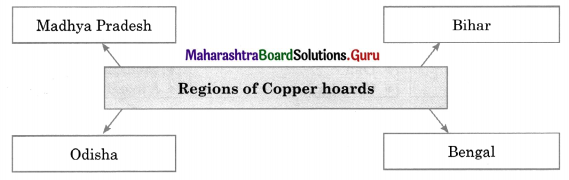
  • The Copper Hoards found in India come from various regions, such as Uttar Pradesh, Bihar, Bengal, Odisha, and Madhya Pradesh.
  • The copper objects found in these hoards indicate that the artisans who fashioned them were very highly skilled.
  • The archaeological sites of OCP and the find-spots of the copper hoards often seem to be situated in the same vicinity, not very distant from each other.
  • Hence, OCP and copper hoards are supposed to belong to one and the same culture.

7. Answers the following questions in detail.

Question 1.
Write a note on ‘Jorwe’ pottery.
Answer:

  • Jorwe pots are well baked giving a metallic sound. They are red in colour with designs painted in black.
  • Jorwe pottery includes shapes like spouted pots, carinated bowls, and troughs, lota, globular jars, etc.
  • The late Jorwe people made pots of the same shapes but without any decoration.
  • Potters kilns were found in both Malwa and Early Jorwe periods.
  • They were round in shape. The kiln of the early Jowre period was larger and of greater capacity.
  • In the late Jorwe period potters did not have a specially built kiln. They baked their pots directly on the ground.
  • Inamgaon was the centre of pottery production which supplied pottery to the surrounding villages.

Maharashtra Board Class 11 History Important Questions Chapter 3 Chalcolithic Villages in India

Question 2.
Discuss the Megalithic period in India.
Answer:

  • A nomadic people around 700 B.C.E. erected stone circles by using huge slabs of rock.
  • The space within these circles was used to bury dead people.
  • These circles are known as Megaliths. The period of these Megaliths is known as the ‘Megalithic Age’.
  • They were used for various purposes, but mainly they contain the remains of the dead.
  • They were the memorials of the dead. Such megalithic circles have been found in many parts of the world.
  • A few tribes in India practice it even today. For instance; the Bodos in Odisha, Todas, and Kurumbas in South India.
  • Nagas and Khasis in Northeast India. Most of these circles in India are dated to 1500-500 B.C.E.
  • Perhaps these people were from South India. The Megalithic circles in Maharashtra belong to the Iron Age. They are dated to 1000-400 B.C.E.
  • In Maharashtra, Megalithic burials have been found in the Vidarbha region especially in the districts of Nagpur, Chandrapur, and Bhandara.
  • Megalithic people used horses for transport and travel. They were instrumental in introducing the ‘Iron Age’ in ancient India.

8. Answer the following questions with the help of given points.

Question 1.
Write a note with the help of the following points:
(a) ‘Ahar’ or ‘Banas’ Culture
(b) Ganeshwar – Jodhpur Culture
(c) Kayatha Culture
(d) Malwa Culture
Answer:
(a) ‘Ahar’ or ‘Banas’ Culture: The chalcolithic cultures in India generally belong to the post- Harappan period. However, the ‘Ahar’ or ‘Banas’ culture in the Mewad region of Rajasthan was contemporary to the Harappan civilisation. Balathal and Gilund near Udaipur are the important sites of Ahar culture. ‘Ahar’ culture at Balathal is dated to 4000 B.C.E and was first discovered at Ahar near Udaipur, so it was named as ‘Ahar’ culture.

(b) Ganeshwar-Jodhpura Culture: Many sites of the culture known as ‘Ganeshwar-Jodhpura’ culture have been found in the vicinity of the copper mines at Khetri. The settlements there are earlier than the Harappan civilisation. During the excavations at Ganeshwar copper artifacts like arrowheads, spearheads, harpoons, bangles, chisels, and also pottery was found. The people of Ganeshwar-Jodhpura culture supplied copper objects to the Harappans.

(c) Kayatha Culture: Kayatha is a site situated on the banks of the river known as Chhoti Kali Sindh, at a distance of 25 kilometers from Ujjain in Madhya Pradesh. Kayatha culture was contemporary to the Harappan civilisation. The people of Kayatha culture subsisted on agriculture and animal husbandry.

Maharashtra Board Class 11 History Important Questions Chapter 3 Chalcolithic Villages in India

(d) Malwa Culture: The name ‘Malwa’ obviously tells us that this culture originated and spread first in the Malwa region. It existed in Madhya Pradesh during 1800-1200 B.C.E. ‘Navadatoli’ situated on the river Narmada, on the opposite bank of Maheshwar, is an important site of Malwa culture. The other important sites are Eran (District Sagar) and Nagda (District Ujjain). They were surrounded by protective walls.

Maharashtra Board Class 11 English Yuvakbharati Solutions Chapter 4.2 The Rising of the Moon

Balbharti Yuvakbharati English 11th Digest Chapter 4.2 The Rising of the Moon Notes, Textbook Exercise Important Questions and Answers.

Maharashtra State Board Class 11 English Yuvakbharati Solutions Chapter 4.2 The Rising of the Moon

11th English Digest Chapter 4.2 The Rising of the Moon Textbook Questions and Answers

(A1)

Question 1.
There are some dialogues which are short, but quite effective. They give us enjoyment and add beauty to the main story. Find some more from the text. (Answers are given directly in bold)
Maharashtra Board Class 11 English Yuvakbharati Solutions Chapter 4.2 The Rising of the Moon 1
Answer:
Maharashtra Board Class 11 English Yuvakbharati Solutions Chapter 4.2 The Rising of the Moon 2

Maharashtra Board Class 11 English Yuvakbharati Solutions Chapter 4.2 The Rising of the Moon

(A2)

Theme

Comment on the given statement after reading the given dialogue.

Question (a)
“And if we get him itself, nothing but abuse on our heads for it from the people, and may be from our own relations”.
Answer:
We don’t think of our society at large. If we catch the prisoner, Irish people will abuse us. They expect us to cooperate with the patriots as they are our own people. If we do not catch the escaped prisoner, the British Government will abuse us. In any case if we catch the prisoner or do not catch anyhow we are the one who are going to be abused.

Question (b)
“It’s a pity some honest man not to be better of that”.
Answer:
It was a good opportunity for the sergeant to show his honesty to the Britishers. He wanted to catch the escaped prisoner and also to get the reward.

Question (c)
“I wouldn’t be in your shoes if he reward me ten times as much. People generally fall victim to incentives. Some people stick to values”.
Answer:
Those who stick to values and are not templed at all, are the people of principles. Such people don’t betray anyone. They are very brave and loyal.

Maharashtra Board Class 11 English Yuvakbharati Solutions Chapter 4.2 The Rising of the Moon

Question (d)
“But when I saw a man in trouble, I could never help trying to set him out of it. It’s human to help others”.
Answer:
The sergeant was alone in the dangerous dark night. The man wanted to help the sergeant to keep a watch. He told the sergeant that he would help him in his task and would not demand any share in the reward that the sergeant gets for catching the escaped prisoner.

Question (ii)
The priorities of the sergeant are shifted. Complete the given table by using the given clues.
Answer:

Priorities of the Sergeant in the beginningPriorities at the end of the play
Law and dutypatriotism
To Catch the escaped prisonerSympathised the prisoner

Question (iii)
Find the sentence from the play selected to the given points.
Answer:
a. Loyalty in Irish nationalism.

(a) “May be Sergeant, you’ll be on the side of the country yet”.
(b) “I have my duties and I know them”.
(c) “I am in the force”.
(d) “We have to do our duty in the force”.

b. Tension between different loyalties.

(a) “It’s little we get but abuse from the people, and no choice but to obey our orders”.
(b) ‘You won’t betray me… the friend of Granuaile”.
(c) “May be Sergeant, it comes into your head sometimes, in spite of your belt and your tunic, that it might have been as well for you to have followed Granuaile”.
(d) “Stop that that’s no song to be singing in these times”.

Maharashtra Board Class 11 English Yuvakbharati Solutions Chapter 4.2 The Rising of the Moon

(A5)

The description of the character is given below. Identify the character from the play. Find some sentences which support your choice.

Question (a)
He is a brave but irresponsible person.
Answer:
The character is sergeant.
(Brave) (a) “I don’t want it. Bring it with you, He is irresponsible”.
(b) Sergeant (after a pause) – no one.

Question (b)
He is a major character. He dominates the story.
Answer:
The character is the man. ,
(Major) (a) “I know well the man you are waiting for”.
(Dominate) (b) “Will you let me pass or must I make you let me?”

Question (c)
He is smart as well as brave.
Answer:
The character is the man.
(Smart) (a) “Back to the town isn’t it?”
(Brave) (b) “You need’nt ask me who I am, that placard will tell you”.

Question (d)
He is the centre of the play.
Answer:
The character is sergeant.
(a) “Am I as great a fool as I think I am?”
(b) “Indeed it’s a hard thing to be in the force, out at night and no thanks for it, for all the danger we’re in. And it’s little we get but abuse from the people, and no choice but to obey our orders, and never asked when a man is sent into danger”.

Maharashtra Board Class 11 English Yuvakbharati Solutions Chapter 4.2 The Rising of the Moon

Question (e)
He is obedient and simple.
Answer:
The answer is the policeman B.
(Obedient) (a) “You bade us to come back here and keep watch with you”.
(Simple) (b) ‘You might want it. There are clouds coming up and you have the darkness of the night before you.”

Yuvakbharati English 11th Digest Chapter 4.2 The Rising of the Moon Additional Important Questions and Answers

Character Analysis:

Question 1.
Write your opinion about the man and the sergeant.
Answer:
The sergeant plays an important character and grips the audience’s attention. He is basicallyan Irish man, however, his duty requires him to serve the British and go against his own country. In the beginning of the play, he is in need of money. He is eager to arrest the prisoner who has escaped the gaol and get the reward of hundred pounds. He is seen as a loyal police officer under the British Government. His words, “The whole country depends on us to keep law and order”, is inspiring. However, his character undergoes a change as the play proceeds.

He develops arrogance and begins to argue with the ragged man. When the ragged man begins to sing patriotic ballads, the sergeant’s behaviour suddenly turns patriotic and reminds him of the days when he used to indulge in freeing Ireland from the chains of the Britishers. Towards the end of the play we see the sacrificing behaviour of the sergeant as he sacrifices his reward and promotion by not arresting the prisoner. He is shown to be less intelligent than the ragged man but soft-hearted. However, he then asks himself, “I wonder, now, am I as great a fool as I think I am?” As audience, we can term him foolish but also call him a great patriot.

On the other hand, the ragged man in the play is having heroic qualities as he is smart and a passionate lover of his country. He introduces himself as a ballad singer and also touches the heart of the police officer by singing love and patriotic ballads. He is so perfect in making-up his identity that the policeman (sergeant) cannot suspect him until he reveals his identity. He intelligently brings out stories from the sergeant which proves his wittiness.

He succeeds in bringing out the feelings of patriotism from the sergeant, turns himself into a friend of the sergeant and escapes safely from being imprisoned again. But before escaping, he expresses gratitude to the sergeant with a note of optimism. He promises him to pay back his good turn. He is optimistic and tells that a day will surely come that Ireland will be free from the British rules.

Maharashtra Board Class 11 English Yuvakbharati Solutions Chapter 4.2 The Rising of the Moon

Reference To Context:

Comment on the given statement after reading the given dialogue.

Question 1.
The man tries to enforce the sergeant in favour of the criminal.
Answer:
The man tries to enforce the sergeant in favour of the criminal by repetedly saying, “Never mind. I’m going. I wouldn’t be in your shoes if the reward was ten times as much”.

Thought-Provoking Questions:

Question 1.
The man and the sergeant need each other’s support. Find such examples.
Answer:
On that dark night, while keeping a watch, the man and the sergeant needed each other’s support. The man told the sergeant that he had seen the escaped criminal at his own place. Describing the criminal the man told that there wasn’t any weapon he didn’t know the use of. He also told that the escaped criminal was a strong and muscular man.

This description created fear in the mind of the sergeant and he actually needed the support of the man. The man also needed the sergeant’s support. He had planned to escape from the place which was not possible without the help of the sergeant. Thus the man and the sergeant both needed each other’s support.

Maharashtra Board Class 11 English Yuvakbharati Solutions Chapter 4.2 The Rising of the Moon

Question 2.
Find out the reason of the man for staying at the place.
Answer:
The ballad singer, as the ragged man introduces himself in the play, is actually the escaped prisoner. Using his intelligence he however tries to stay with the sergeant because he knows that the police are in search of him to put him back into custody. The hour is not safe for him to move and therefore he engages himself with the sergeant so that the other policemen do not doubt him and he can make a move when the time is safe.

Question 3.
Write about the persuasive approach of the man.
Answer:
The man (the escaped prisoner) introduced himself as a ballad singer. He started singing ballads to persuade the sergeant in believing his identity. He also told the sergeant that he was so poor that he would earn money by singing ballads and would arrange for his supper. The man was dominating enough as he stuck to the place in spite of repeated warnings of the sergeant to go away from the place.

Question 4.
Find the life of a singer that is mentioned in the play.
Answer:
The man introduces himself as a poor ballad singer who sings patriotic ballads for the sailors to earn himself a living.

Question 5.
The wavelength of the man and the sergeant goes together. Find the evidences from the text.
Answer:
The wavelength of the man and sergeant goes together, this can be proved when the sergeant is eager find the escaped prisoner for a hundred pounds and a promotion on the basis of which he can support his family in a better way. On the other hand, the man introduces himself as a ballad singer who sings patriotic ballads to the sailors to earh living. In the other part of the act, the ragged man proves his patriotism by hiding his identity of prisoner belonging to Ireland. As the play comes to an end, the sergeant allows the man to escape in spite of knowing that he is the prisoner they were in search of. This is because the ragged man belongs to Ireland, the nation the sergeant used to belong, in his youth.

Question 6.
Discussion about patriotic songs goes on. Find the points from the text.
Answer:
On the dark night while keeping a watch,the man sings patriotic songs to which the sergeant says, “Stop that that’s no song to be singing in these times”. The man then explains to the sergeant that he was only singing to keep his heart up. The sergeant sympathetically says, “Well, you can sing if it gives you more courage”.However, when the man continues to sing the sergeant corrects the lyrics. They also further discuss about ‘Granuaile’.

Question 7.
The sergeant’s reaction surprises the audience. Write your opinion. .
Answer:
In the begining of the play, the sergeant was loyal to the British Government. As the play unfolds we find that the man has successfully brought about a change in the mind of the sergeant. He has aroused patriotism in the sergeant. The sergeant now lets go the prisoner easily. This surprises the audience. The change from the loyal British sergeant into the man with patriotism in the mind is drastic and surprising for the readers.

Question 8.
The sergeant supports the man by misguiding his comrades. Write your views.
Answer:
The sergeant was the loyal British servant. He wanted to catch the escaped prisoner for a reward. As the play unfolded the man who introduced himself as a ballad singer brought about changes in the mind of the sergeant. During their discussion the man arouse patriotism in his mind and reminded him of his youth when he had joined a group of patriots. The sergeant was torn between his duty and his nation. But finally patriotism won and the sergeant helped the man to escape. He misguided his assistants in order to let the prisoner escape easily.

Maharashtra Board Class 11 English Yuvakbharati Solutions Chapter 4.2 The Rising of the Moon

Glossary:

  1. lonesome – lonely, without any company
  2. quay – wooden or metal platform projecting into the water for loading and unloading of ships
  3. sergeant – a police officer ranking below an inspector
  4. placard – a sign for public display, either posted on the wall or carried during a demonstration
  5. gaol – jail
  6. kelp – a large brown seaweed that typically has long, tough stalk
  7. assize – The court which sat at intervals in each country of England and Wales to administer the civil and
  8. criminal law
  9. plaid – a type of woolen cloth
  10. shuffles – move/walk by dragging one’s feet
  11. barrack – police accommodation
  12. queer – strange
  13. to keep one’s heart up – to keep oneself happy
  14. tunic – a loose garment
  15. pike – an infantry weapon with a pointed steel or iron head on a long wooden shaft.

Maharashtra Board Class 12 Chemistry Important Questions Chapter 9 Coordination Compounds

Balbharti Maharashtra State Board 12th Chemistry Important Questions Chapter 9 Coordination Compounds Important Questions and Answers.

Maharashtra State Board 12th Chemistry Important Questions Chapter 9 Coordination Compounds

Question 1.
What are double salts?
Answer:
Double salts are crystalline molecular or addition compounds containing more than one salt in simple molecular proportions soluble in water and in solution they ionise and exhibit all the properties of the constituent ions.

For example, K2SO4+ A12(SO4)324H2O
\(\mathrm{K}_{2} \mathrm{SO}_{4} \cdot \mathrm{Al}_{2}\left(\mathrm{SO}_{4}\right)_{3} \cdot 24 \mathrm{H}_{2} \mathrm{O}_{(\mathrm{aq})} \longrightarrow 2 \mathrm{~K}_{(\mathrm{aq})}^{+}+2 \mathrm{Al}_{(\mathrm{aq})}^{3+}+4 \mathrm{SO}_{4(\mathrm{aq})}^{2-}+24 \mathrm{H}_{2} \mathrm{O}_{0}\)

Maharashtra Board Class 12 Chemistry Important Questions Chapter 9 Coordination Compounds Important Questions

Question 2.
Define coordination compound.
Answer:
Coordination compound : It consists of a central metal ion or atom surrounded by atoms, molecules or anions called ligands by coordinate bonds, e.g. cisplatin Pt(NH3)2Cl2, [Cu(NH3)4]SO4.

Question 3.
Define Lewis bases and Lewis acids with respect to a coordination compound.
Answer:

  • Lewis bases : In a coordination compound the ligands being electron pair donors they are Lewis bases.
  • Lewis acids : The central metal atom or ion being electron acceptor behaves as a Lewis acid.
  • For example, in the coordination compound, [Cu(NH3)4]2+, NH3 is a Lewis base and Cu2+ is a Lewis acid.

Question 4.
Define coordination sphere. Give example.
Answer:
Coordination sphere : A coordination entity consisting of a central metal atom or ion and the coordinating groups like neutral molecules or anions (ligands) written inside a square bracket is together called coordination sphere. This is a discrete structural unit. The ionisable groups (generally ions) called counter ions are written outside the bracket.

For example, in the coordination compound K4[Fe(CN)6], the coordination sphere is [Fe(CN)6]4- while K+ represents counter ion.

Question 5.
Define and explain charge number of a complexion.
Answer:
Charge number of a complexion : The net charge carried by a complexion or a coordination entity is called its charge number.

Explanation :
(i) Charge number is equal to the algebraic sum of the charges carried by central metal atom or ion and all the ligands attached to it.
(ii) E.g. consider anionic complex, [Fe(CN)6]4-.
Charge number of [Fe(CN)6]4- = Charge on Fe2+ ions + 6 x charge on CN = ( + 2) + 6( -1) = – 4 Hence charge number of [Fe(CN)6]4- is – 4.

Question 6.
Explain the oxidation state of a metal in a complex.
Answer:

  • The oxidation state of a metal atom or ion in the complex is the apparent charge carried by it in the complex.
  • It depends upon the atomic number and electronic configuration of the metal atom or ion.
  • The coordination number, the formula and geometry of a complex depend upon the oxidation state of the metal
    atom or ion.

Question 7.
What is the charge on a monodentate ligand X in the complex, [NiX4]2-?
Answer:
The charge number of the complex ion is – 2. Nickel being divalent, its oxidation state is + 2. If the charge on monodentate ligand X is y, then Charge number = charge on Ni2+ charge on 6X – 2 = + 2 + 4 xy
∴ y = – 1
Hence the charge on ligand X is – 1.

Question 8.
Calculate the oxidation state of a metal in the following complexes :
(a) [Fe(NH3)6](NO3)3
(b) Ni(CO)5.
Answer:
(a) [Fe(NH3)6](NO3)3 ⇌ [Fe(NH3)6]3+ + 3NO3

NH3 is a neutral ligand, and the charge number of complex ion is + 3.
If the oxidation state of Fe is x then,
+ 3 = x + 6(0)
∴ x = + 3
∴ The oxidation state of Fe is +3.

(b) Ni(CO)5 is a neutral complex and CO is a neutral ligand. If the oxidation state of Ni is x, then zero = x + 5 x (zero)
∴ x = zero.
The oxidation state of Ni is zero.

Question 9.
Define and explain the term coordination number (C.N.) of a metal in the complex.
Answer:
Coordination number or legancy (C.N.) : The number of (monodentate) ligands which are directly bonded by coordinate bonds to central metal atom or ion in a coordination compound is called coordination number (C.N.) of the metal atom or ion.

Explanation :

  • The coordination number (C.N.) is a characteristic property of the metal and its electronic configuration.
  • C.N. takes the values from 2 to 10, of which 4 and 6 are very common.
  • The light transition metals show C.N. 4 and 6 while the heavier transition metals show C.N. 8.
  • The geometry and shape of a complex compound depends upon C.N. of the metal.

Maharashtra Board Class 12 Chemistry Important Questions Chapter 9 Coordination Compounds Important Questions

Question 10.
Mention primary valence, secondary valence and coordination number in the following complexes :
(a) [Cu(NH3)JCI2
(b) [Co(NH3)3CI3]
(C) K4[Fe(CN)6]
(d) [CoF6]3
(e) [Pt(NH3)2Cl2]
(f) [Pt(NH3)2(Py)3CI2]
(g) Cr(CO)6
(h) [Ni(CN)4]2-
Answer:
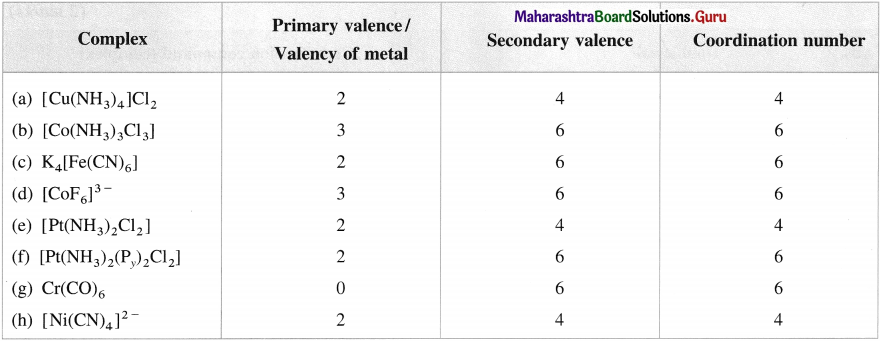
Maharashtra Board Class 12 Chemistry Solutions Chapter 9 Coordination Compounds 2

Question 11.
Classify the following complexes as homoleptic and heteroleptic complex :
(a) [Cu(NH3)4]SO4;
(b) [Cu(en)2(H2O)CI]2+
(c) [Fe(H2O)5(NCS)]2+
(d) Tetraaminezinc(II) nitrate.

Question 12.
Summarise the rules of IUPAC nomenclature of coordination compounds.
Answer:
Following rules are followed for naming coordination compounds recommended by IUPAC :

  1. In case of a complexion or a neutral molecule, name the ligand first and then the metal.
  2. The names of anionic ligands are obtained by changing the ending -ide to -o and -ate to -ato.
  3. The name of a complex is one single word. There must not be any space between different ligand names as well as between ligand name and the name of the metal.
  4. After the name of the metal, write its oxidation state in Roman number which appears in parentheses without any space between metal name and parentheses.
  5. If complex has more than one ligand of the same type, the number is indicated with prefixes, di-, tri-, tetra-, penta-, hexa- and so on.
  6. For the complex having more than one type of ligands, they are written in an alphabetical order. Suppose two ligands with prefixes are tetraaqua and dichloro. While naming in alphabetical order, tetraaqua is written first and then dichloro.
  7. If the ligand itself contains numerical prefix in its name, then display number by prefixes bis for 2, tris for 3, tetrakis for 4 and so forth. Put the ligand name in parentheses. For example, (ethylenediamine)3 or (en)3 would appear as tris (ethylenediamine) or tris(ethane-l, 2-diamine).
  8. The metal in cationic or neutral complex is specified by its usual name while in the anionic complex the name of metal ends with ‘ate’.

Question 13.
State effective atomic number (EAN).
OR
State and explain effective atomic number (EAN). How is it calculated?
Answer:
Effective atomic number (EAN) : It is the total number of electrons present around the central metal atom or ion and calculated as the sum of electrons of metal atom or ion and the number of electrons donated by ligands.

It is calculated by the formula : EAN = Z – X + Y where.
Z = Atomic number of metal atom
X = Number of electrons lost by a metal atom forming a metal ion
Y = Total number of electrons donated by all ligands in the complex.

Generally the value of EAN is equal to the atomic number of the nearest inert element.

Explanation : Consider a complex ion [Co(NH3)6]3+
Oxidation state of cobalt is + 3 hence X = 3.
There are six ligands, hence Y = 2 x 6 = 12
Atomic number of cobalt. Z = 27
∴ EAN = Z – X + Y = 27 – 3 + 12 = 36.

Maharashtra Board Class 12 Chemistry Important Questions Chapter 9 Coordination Compounds Important Questions

Question 14.
Find effective atomic number (EAN) in the following complexes :
(1) [Ni(CO)4]
(2) [Fe(CN)6]4-
(3) [Co(NH3)6]3+
(4) [Zn(NH3)J2+
(5) [Pt(NH3)6]4+
Answer:
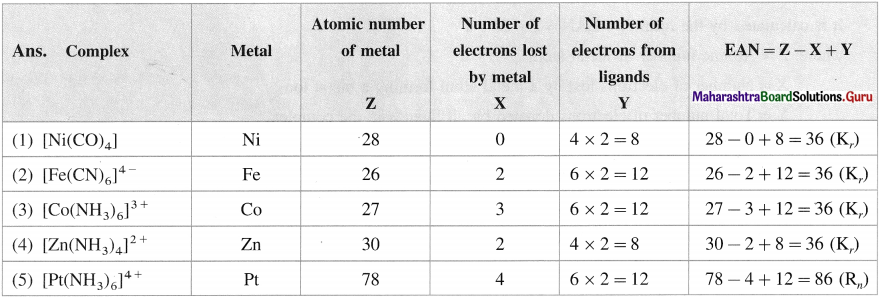
Maharashtra Board Class 12 Chemistry Solutions Chapter 9 Coordination Compounds 4

Question 15.
What is effective atomic number (EAN) in the following complexes ?
(1) [Fe(CN)6]3-
(2) [CU(NH3)4]2+
(3) [Pt(NH3)4]2+
Answer:
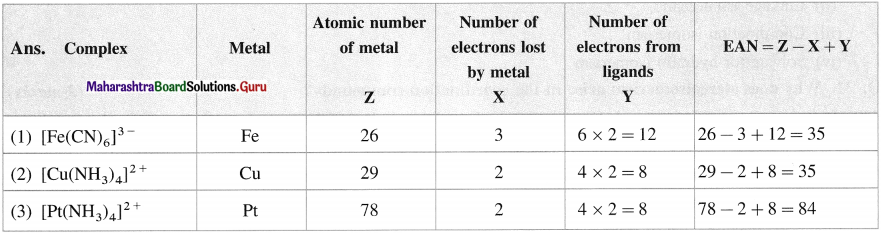
Maharashtra Board Class 12 Chemistry Solutions Chapter 9 Coordination Compounds 5

Question 16.
Calculate EAN in the following complexes :
(1) [Cr(H2O)2(NH3)2(en)]CI3;
(2) [Ni(en)2]SO4;
(3) Na3[Cr(C2O4)3].
Answer:
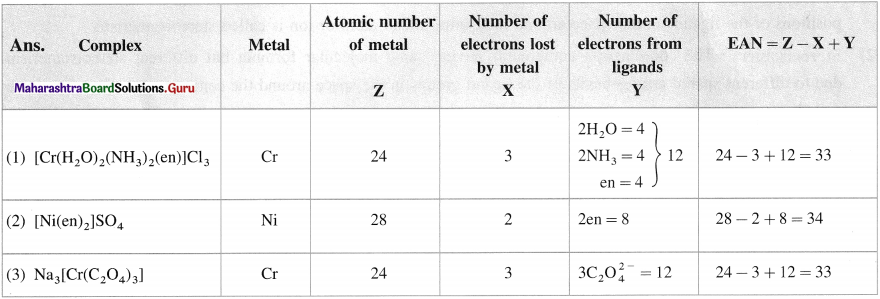
Maharashtra Board Class 12 Chemistry Solutions Chapter 9 Coordination Compounds 6

Question 17.
Define in coordination compounds :
(1) Isomerism
(2) Isomers.
Answer:

  1. Isomerism : It is the phenomenon in coordination compounds having same molecular formula but different physical and chemical properties due to different arrangements of the ligands around the central metal atom or ion in the space.
  2. Isomers : The isomers are the coordination compounds having same molecular formula but different physical and chemical properties due to the difference in arrangements of the ligands in the space.

Question 18.
Mention the types of isomerisms in coordination compounds.
Answer:
There are two principal types of isomerisms in coordination compounds as follows :
(A) Stereoisomerism
(B) Structural isomerism (OR Constitutional isomerism)

(A) Stereoisomerism is further classified as :

  • Geometrical isomerism
  • Optical isomerism

(B) Structural isomerism is further classified as :

  • Ionisation isomerism
  • Linkage isomerism
  • Coordination isomerism
  • Solvate (or hydrate) isomerism

Maharashtra Board Class 12 Chemistry Important Questions Chapter 9 Coordination Compounds Important Questions

Question 19.
Why does stereoisomerism arise in the coordination compounds?
Answer:
In the coordination compounds (complexes) the ligands are linked to the central metal atom or ion by coordinate bonds which are directional in nature and hence give rise to the phenomenon of stereoisomerism.

In this isomerism, the different stereoisomers have different arrangements of ligands (atoms, molecules or ions) in space around the central metal atom or ion. Hence they have different physical and chemical properties and give rise to the phenomenon of stereoisomerism.

Question 20.
Define, in coordination compounds : (1) Stereoisomerism (2) Stereoisomers.
Answer:
(1) Stereoisomerism The phenomenon of isomerism in the coordination compounds arising due to different spatial positions of the ligands in the space around the central metal atom or ion is called stereoisomerism.

(2) Stereoisomers : The coordination compounds having same molecular formula but different stereoisomerism due to different spatial arrangements of the ligand groups in the space around the central metal atom or ion are called stereoisomers.

Question 21.
Define :
(1) Geometrical isomerism and
(2) Geometrical isomers.
Answer:
(1) Geometrical isomerism : The phenomenon of isomerism in the heteroleptic coordination compounds with the same molecular formula but different spatial arrangement of the ligands in the space around the central metal atom or ion is called geometrical isomerism.

(2) Geometrical isomers : The heteroleptic coordination compounds having same molecular formula but different geometrical isomerism due to different spatial arrangements of the ligands in the space around the central metal atom or ion are called geometrical isomers.

Question 22.
Define cis and trails isomers in the coordination compounds.
Answer:
(1) Cis-isomer : A heteroleptic coordination compound in which two similar ligands are arranged adjacent to each other is called cis-isomer. For example,
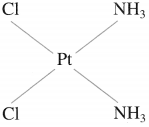
Maharashtra Board Class 12 Chemistry Solutions Chapter 9 Coordination Compounds 11

Gis-Diamminedichloroplatinum(II)

(2) Trans-isomer : A heteroleptic coordination compound in which two similar ligands are arranged diagonally opposite to each other is called trans-isomer. For example,
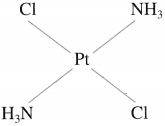
Maharashtra Board Class 12 Chemistry Solutions Chapter 9 Coordination Compounds 12

Trans-Diamminedichloroplatinum(II)

Question 23.
Write structures for geometrical isomers of Diamminebromochloroplatinum(II).
Answer:

Maharashtra Board Class 12 Chemistry Solutions Chapter 9 Coordination Compounds 7

Question 24.
Explain the geometrical isomerism of the octahedral complex of the type [MA4B2] with a suitable example.
Answer:

  • Consider an octahedral complex of a metal M with coordination number six and monodentate ligands a and b having formula [MA4B2],
  • CA-isomer is obtained when both the B ligands occupy adjacent (1,2) positions.
  • Trans-isomer is obtained when the ligands B occupy the opposite (1,6) positions.
  • For example, consider a complex [CO(NH3)4CI2]+. The structures of cis and trans isomers are
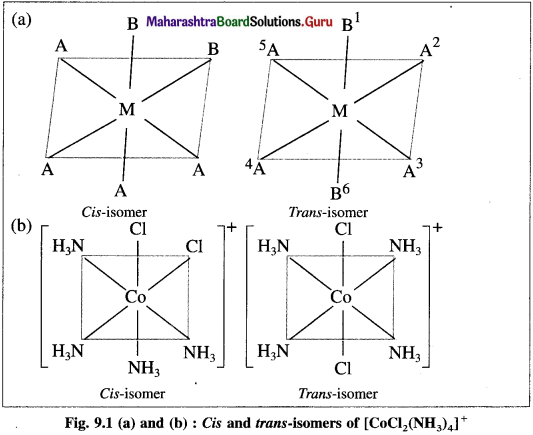
    Maharashtra Board Class 12 Chemistry Solutions Chapter 9 Coordination Compounds 8

Maharashtra Board Class 12 Chemistry Important Questions Chapter 9 Coordination Compounds Important Questions

Question 25.
Explain the geometrical isomerism of the octahedral complex of the type [M(AA)2B2] with a suitable example.
Answer:

  • Consider an octahedral complex of metal M with coordination number six and a bidentate ligand AA and monodentate ligand B having molecular formula [M(AA)2B2] .
  • Bidentate ligand AA has two identical coordinating atoms.
  • Cis- isomer is obtained when two bidentate AA ligands as well as two ‘B’ ligands are at adjacent positions.
  • Trans-isomer is obtained when two AA ligands and two B ligands are at opposite positions.
  • For example, consider a complex [Co(en)2CI2]+.
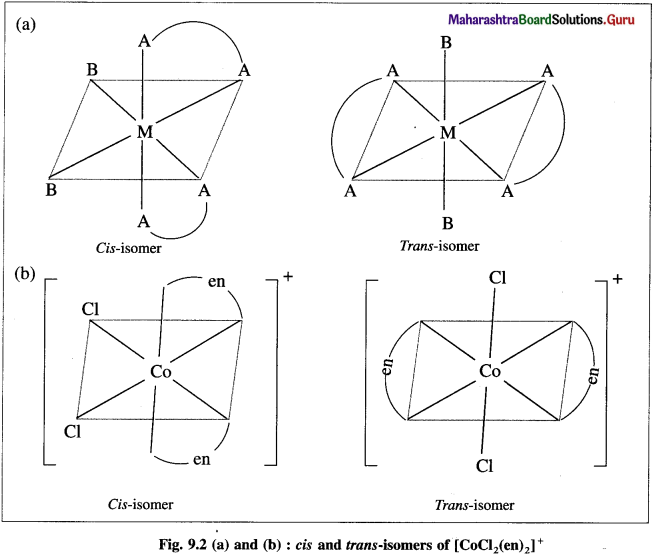
    Maharashtra Board Class 12 Chemistry Solutions Chapter 9 Coordination Compounds 10

Question 26.
Explain the geometrical isomerism of the octahedral complex of the type [MA4BC] with suitable example.
Answer:

  • Consider an octahedral complex of metal M with coordination number six and monodentate ligands A, B andC.
  • Cis-isomer is obtained when both the ligands B and C occupy adjacent (1,2) positions.
  • Trans-isomer is obtained when the ligands B and C occupy opposite positions.
  • For example, consider a complex [Pt(NH3)4BrCI] of the type [MA4BC],
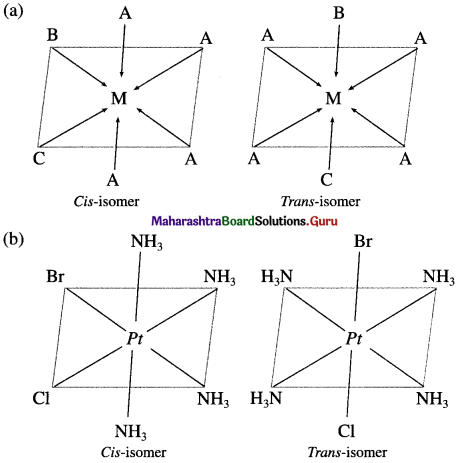
    Maharashtra Board Class 12 Chemistry Solutions Chapter 9 Coordination Compounds 13

Question 27.
Define : (1) Optical isomerism (2) Optical isomers.
Answer:
(1) Optical isomerism : The phenomenon of isomerism in which different coordination compounds having same molecular formula have different optical activity is called optical isomerism.

(2) Optical isomers : Different coordination compounds having same molecular formula but different optical activity
are called optical isomers.

Question 28.
Explain : (1) Plane polarised light (2) Optical activity.
Answer:
(1) Plane polarised light : A monochromatic light having vibrations only in one plane is called a plane polarised light. This light is obtained by passing monochromatic light through NICOL prism.

(2) Optical activity : A phenomenon of rotating a plane of a plane polarised light by an optically active substance is
called optical activity. This substance is said to be optically active.

Maharashtra Board Class 12 Chemistry Important Questions Chapter 9 Coordination Compounds Important Questions

Question 29.
Explain : (1) Dextrorotatory substance (2) Laevorotatory substance. (1 mark each)
Answer:

  1. Dextrorotatory substance : An optically active substance which rotates the plane of a plane polarised light to right hand side is called dextrorotatory or d isomer denoted by d.
  2. Laevorotatory substance : An optically, active substance which rotates the plane of a plane polarised light to the left hand side is called laevorotatory or l isomer and denoted by l.

Question 30.
What are the conditions for the optical isomerism in coordination compounds?
Answer:

  • Optical isomerism is exhibited by those coordination compounds which possess chirality.
  • There should not be the presence of element of symmetry which makes the complex optically inactive.
  • The mirror images of the complex molecule or ion must be non-superimposable with the molecule or ion. B

Question 31.
What are enantiomers?
Answer:
Enantiomers : The two forms of the optical active complex molecule which are mirror images of each other are called enantiomers.

There are two forms of enantiomers, d form and l form.

Question 32.
Draw diagrams for the optical isomers of a complex, [Co(en)3]3+.
Answer:
The complex [Co(en)3]3+ has two optical isomers.
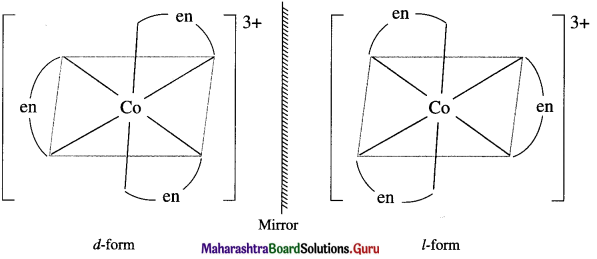
Maharashtra Board Class 12 Chemistry Solutions Chapter 9 Coordination Compounds 14

Question 33.
Explain the optical isomerism in the octahedral complex with two symmetrical bidentate chelating ligands.
Answer:
The octahedral complexes of the type [M(AA)2Q2]”±, in which two symmetrical bidentate chelating ligands like AA and two monodentate ligands like a are coordinated to the central metal atom or ion exhibit optical isomerism and two optical isomers d and l can be resolved. For example, [Pt Cl2(en)2]2.

The cis-form is unsymmetrical and optically active while the trans-form is symmetrical and hence optically inactive. The optical isomers of cis-form (d and ) of this complex along with trans-form are shown below,
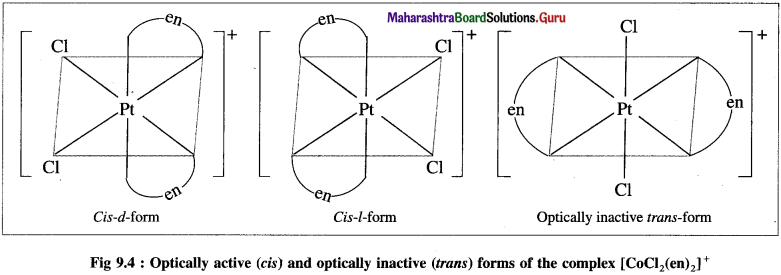
Maharashtra Board Class 12 Chemistry Solutions Chapter 9 Coordination Compounds 15

Question 34.
When are optical isomers called chiral?
Answer:
When the mirror images of optical isomers of the complex are nonsuperimposable they are said to be chiral. For example, [Co(en)2(NH3)2]3+.

Question 35.
Define and explain ionisation isomerism.
Answer:
Ionisation isomerism : The phenomenon of isomerism in the metal complexes in which there is an exchange of ions between coordination (or inner) sphere and outer sphere is known as ionisation isomerism.

Explanation :

  • Ionisation isomers have same molecular formula but different arrangement of ions in the inner sphere and outer sphere in the complex,
  • Hence on ionisation, these ionisation isomers produce different ions in the solution. This ionisation isomerism is also called ion-ion exchange isomerism.

Examples:
(A) [CO(NH3)4CI2]Br and (B) [Co(NH3)4CIBr] Cl

Ionisation :
(A) [CO(NH3)4CI2] Br ⇌ [CO(NH3)4CI2]+ + Br-
(B) [Co(NH3)4CIBr]Cl ⇌ [CO(NH3)4ClBr]+ + CP
In the isomers (A) and (B), there is an exchange of ions namely Br and CI.

Maharashtra Board Class 12 Chemistry Important Questions Chapter 9 Coordination Compounds Important Questions

Question 36.
Define : (1) Linkage isomerism (2) Linkage isomers.
OR
What is linkage isomerism ? Explain with an example.
Answer:
(1) Linkage isomerism : The phenomenon of isomerism in which the coordination compounds have same metal atom or ion and same ligand but bonded through different donor atoms or linkages is known as linkage isomerism.

(2) Linkage isomers : The coordination compounds having same metal atom or ion and ligand but bonded through different donor atoms or linkages are called linkage isomers.
For example : Nitro complex [CO(NH3)5NO2]CI2 = (Yellow) and nitrito complex [CO(NH3)5ONO]CI2 (Red)

Question 37.
Explain linkage isomers with NO2 group as a ligand.
Answer:
(1) Nitro group (NO2) is an ambidentate ligand. NO2 group may link to central metal atom, through N or O.
(2) The two linkage isomers are, [CI: → Ag ← : NO2] and [CI: → Ag ← O-NO]
Choloronitroargentate(I) ion and Chloronitritoargentate(I) ion

Question 38.
Write linkage isomers of a complex having constituents Co3+, 5NH3 and NO2.
Answer:
(i) NO2 is an ambidentate ligand which can be linked through N or O.
(ii) The linkage isomers are as follows :
(a) [CO(NH3)5(NO2)]2+ Pentaamminenitrocobalt(III) ion
(b) [CO(NH3)5(ONO)]2+ Pentaamminenitritocobalt(III) ion

Question 39.
Define: (1) Coordination isomerism (2) Coordination isomers.
Answer:
(1) Coordination isomerism : The phenomenon of isomerism in the ionic coordination compounds having the same molecular formula but different complex ions involving the interchange of ligands between cationic and anionic spheres of different metal. ions is called coordination isomerism.

(2) Coordination isomers : The ionic coordination compounds having same molecular formula but different complexions duc to interchange of ligands between cationic and anionic spheres of different metal ions are called coordination isomers.

For example,

Maharashtra Board Class 12 Chemistry Solutions Chapter 9 Coordination Compounds 27

Question 40.
Give three examples of coordination isomers. (I mark each)
Answer:

  • [Cu(NH3)4] [PICI4] and I Pt(NH3)4] [ICuCl44]
  • [Cr(NH3)6] [Cr(CN)6] and [Cr(NH3)4(CN)2] [Cr(NH3)2(CN)4]
  • [Cr(NH3)6] [Cr(SCN)6] and [Cr(NH3)4(SCN)2] [Cr(SCN)4(NH3)2]

Question 41.
Define Solvate or Hydrate isomerism.
Answer:
Solvate ate or Hydrate isomerism : The phenomenon of isomerism in the coordination compounds arising due to the exchange of solvent or H2O molecules inside the coordination sphere and outer sphere of the complex is known as solvate or hydrate isomerism.

Question 42.
Define solvate or hydrate isomers.
OR
What are hydrate isomers? Explain with examples.
Answer:
Solvate or Hydrate isomers : The coordination compounds having the same molecular formula but differ in the number of solvent or H2O molecules inside the coordination sphere and outer sphere of the complexes are called solvate or hydrate isomers.

For example : [Cr(H2O)6] CI3; [Cr(H2O)5CI]CI2 H2O; and [Cr(H2O)4CI2] CI 2H2O.

Question 43.
A coordination compound has the formula COCI3 6H2O. Write the hydrate isomers of the complex.
Answer:
The possible hydrate isomers of the coordination compounds having molecular formula COCI3 6H2O are as follows :
(1) [CO(H2O)6]CI3;
(2) [CO(H2O)5CI]CI2 H2O
(3) [CO(H2O)4CI2] Cl – 2H2O
(4) [Co(H2O)3 CI3] 3H2O.

Maharashtra Board Class 12 Chemistry Important Questions Chapter 9 Coordination Compounds Important Questions

Question 44.
Explain the steps involved in describing the bonding in coordination compounds using valence bond theory.
Answer:

  • Vacant d-orbitais of metal ion form coordination bonds with ligands.
  • s, p orbitais along with vacant d-orbitais of metal ion take part in hybridisation.
  • The number of vacant hybrid orbitais formed is equal to number of hybridising orbitais which is equal to the number of ligand donor atoms or coordination number of the metal.
  • The metal-ligand coordination bonds are formed by the overlap between the vacant hybrid orbitais of metal and the filled orbitais of the ligands.
  • The hybrid orbitais used by the metal ion point in the direction of the ligands.
  • When inner (n – 1)d orbitais of metal ion are used in the hybridisation then the complex is called (a) inner orbital complex while when outer nd orbitais are used, complexes are called (b) outer orbital complexes. .

Question 45.
Explain the steps involved ¡n the metal-ligand bonding.
Answer:

  • Find the oxidation state of central metal ion in the complex.
  • Write the valence shell electronic configuration of metal ion.
  • From the formula of the complex determine the number of ligands and find the number of metal ion orbitais required for bonding.
  • Find the orbitais of metal ion available for hybridisation and the type of hybridisation involved.
  • Represent the electronic configuration of metal ion after hybridisation.
  • Exhibit filling of hybrid orbitais after complex formation.
  • Determine the nunther of unpaired electrons and predict magnetic property of the complex.
  • Find whether the complex is low spin or high spin (applicable for octahedral complexes with d4 or d8 electronic configuration.)

Question 46.
What are the salient features of valence bond theory (VBT)?
Answer:
The salient features of valence bond theory (VBT) are as follows :

  1. According to this theory, a central metal atom or ion present in a complex provides a definite number of vacant orbitals (s, p, d and) to accommodate the electrons from the ligands for the formation coordinate bonds with the metal ion atom.
  2. The number of vacant orbitals provided by the central metal atom or ion is the same as the coordination number of the metal. For example : Cu2+ provides 4 vacant orbitals in the complex. [Cu(NH3)4]2+.
  3. The vacant orbitals of metal atom or ion undergo hybridisation forming the same number of hybridised orbitals, since the bonding with the hybrid orbitals is stronger.
  4. Each ligand has one or more orbitals containing one or more lone pairs of electrons.
  5. The shape or geometry of the complex depends upon the type of hybridisation of the metal atom.
  6. When inner orbitals namely (n – 1) d orbitals in transition metal atom or ion hybridise, the complex is called inner complex and when outer orbitals i.e., nd orbitals hybridise then the complex is called outer complex.
  7. When the central metal atom or ion in the complex contains one or more unpaired electrons the complex is
    paramagnetic while if all the electrons are paired, the complex is diamagnetic.

Question 47.
What is the spin pairing process in the coordination compound?
Answer:
When the ligands approach the metal atom or ion for the formation of a complex, they influence the valence electrons of metal atom or ion. Accordingly the ligands are classified as (A) strong ligands and (B) weak ligands.

(A) Strong ligands :

  • They cause the pairing of unpaired electrons present in the metal atom or ion.
  • Spin pairing process :
    • The process of pairing of unpaired electrons in metal atom or ion due to the presence of ligands in the complex is called spin pairing process.
    • This spin pairing process decreases the number of unpaired electrons and hence decreases the paramagnetic character of the complex.
    • The strong ligands also promote the outer ns electrons to the vacant inner (n – 1)d orbitals.

(B) Weak ligands : The weak ligands have no effect on the electrons in the valence shell of a metal atom or ion.
Strong ligands : CO, CN, ethylenediammine (en), NH3, EDTA, etc.
Weak ligands : CI, I, OH, etc.

[Note : If a complex has n number of unpaired electrons then the magnetic moment, μ is given by ‘spin only’ formula μ = n(n + 2) B.M. where B.M. (Bohr Magneton) is the unit of magnetic moment. Hence from the magnitude of p, the number of unpaired electrons in the complex and its structure can be evaluated.]

Maharashtra Board Class 12 Chemistry Important Questions Chapter 9 Coordination Compounds Important Questions

Question 48.
Explain the structure of octahedral complex, [CO(NH3)6]3+ on the basis of valence bond theory.
Answer:
(1) Hexaamminecobalt(III) ion, [CO(NH3)6]3+ is a cationic complex, the oxidation state of cobalt is + 3 and the coordination number is 6.

(2) Electronic configuration : 27CO [Ar]18 3d7 4s2
Electronic configuration : Co3+ [Ar]18 3d6 4s° 4p°

Maharashtra Board Class 12 Chemistry Solutions Chapter 9 Coordination Compounds 32

(3) Since NH3 is a strong ligand, due to spin pairing effect, all the four unpaired electrons in 3d orbital are paired giving two vacant 3d orbitals.

Maharashtra Board Class 12 Chemistry Solutions Chapter 9 Coordination Compounds 33

(4) Since the coordination number is Co3+ ion gets six vacant orbitais by hybridisation of two 3d vacant orbitais, One 4s and three 4p orbitais forming six d2sp3 hybrid orbitais giving octahedral geometly. It is an inner complex.

Maharashtra Board Class 12 Chemistry Solutions Chapter 9 Coordination Compounds 34

(5) 6 lone pairs of electrons from 6NH3 ligands are accommodated in the six vacant d2sp3 hybrid orbitals. Thus six hybrid orbitals of Co3+ overlap with filled orbitals of NH3 forming 6 coordinate bonds giving octahedral geometry to the complex.

Maharashtra Board Class 12 Chemistry Solutions Chapter 9 Coordination Compounds 35

Since the complex has all electrons paired, it is diamagnetic.
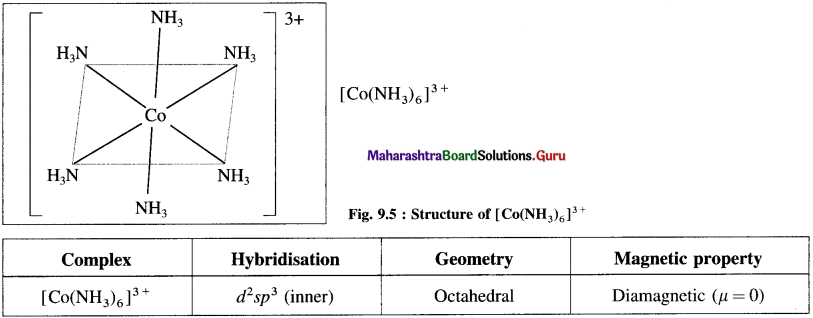
Maharashtra Board Class 12 Chemistry Solutions Chapter 9 Coordination Compounds 36

Question 49.
Explain the geometry of [CoF6]3- on the basis of valence bond theory.
Answer:
(1) Hexafluorocobaltate(III) ion, [CoF]3- is an anionic complex, the oxidation state of cobalt is +3 and the coordination number is 6.
(2) Electronic configuration : 27Co [Ar]18 3d7 4s2 4p° 4d°
Electronic configuration : Co3+ [Ar]18 3d6 4s° 4p° 4d°

Maharashtra Board Class 12 Chemistry Solutions Chapter 9 Coordination Compounds 37

(3) Since F is a weak ligand, there is no spin pairing effect and Co3+ possesses 4 unpaired electrons.
(4) Since the coordination number is 6, the Co3+ ion gets six vacant orbitals by hybridisation of one 45 orbital, three 4p orbitals and two 4d orbitals forming six sp3d2 hybrid orbitals giving octahedral geometry.

Maharashtra Board Class 12 Chemistry Solutions Chapter 9 Coordination Compounds 38
(5) 6 lone pairs of electrons from 6F ligands are accommodated in the six vacant sp3d2 hybrid orbitals. Thus six hybrid orbitals of Co3+ overlap with filled orbitals of F forming 6 coordinate bonds giving octahedral geometry to the complex. It is an outer complex.

Maharashtra Board Class 12 Chemistry Solutions Chapter 9 Coordination Compounds 39

As the complex has 4 unpaired electrons it is paramagnetic.
Magnetic movement μ is, Maharashtra Board Class 12 Chemistry Solutions Chapter 9 Coordination Compounds 29

Maharashtra Board Class 12 Chemistry Solutions Chapter 9 Coordination Compounds 40

Maharashtra Board Class 12 Chemistry Important Questions Chapter 9 Coordination Compounds Important Questions

Question 50.
Explain the structure of tetrachloronickelate(II) [NiCI]2- on the basis of valence bond theory.
Answer:
(1) Tetrachloronickelate(II) ion is an anionic complex, oxidation state of Ni is +2 and the coordination number is 4.
(2) Electronic configuration : 28Ni [Ar]18 3d8 4s2 4p°
Electronic configuration : Ni2+ [Ar]18 3d8 4s° 4p°

Maharashtra Board Class 12 Chemistry Solutions Chapter 9 Coordination Compounds 41

(3) Since the coordination number is 4, it gets 4 vacant hybrid orbitals by sp3 -hybridisation of one 4s and three 4p orbitals giving tetrahedral geometry to the complex.

Maharashtra Board Class 12 Chemistry Solutions Chapter 9 Coordination Compounds 42
(4) As Cl is a weak ligand, 2 unpaired electrons in Ni2+ remain undisturbed.
(5) 4 lone pairs of electrons from 40 ligands are accommodated in the vacant four sp3 hybrid orbitals. Thus four sp3 hybrid orbitals of Ni2+ overlap with filled orbitals of Clforming 4 coordination bonds, giving tetrahedral geometry to the complex.
Since the complex has 2 unpaired electrons, it is paramagnetic.

Maharashtra Board Class 12 Chemistry Solutions Chapter 9 Coordination Compounds 43
Magnetic moment \(\mu \text { is, } \mu=\sqrt{n(n+2)}=\sqrt{2(2+2)}=2.83 \text { B.M. }\)
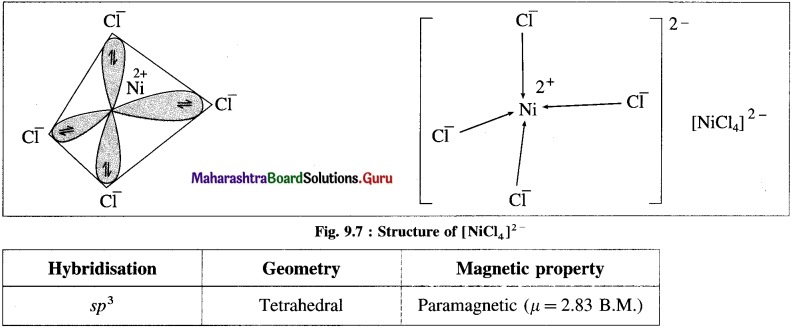
Maharashtra Board Class 12 Chemistry Solutions Chapter 9 Coordination Compounds 44

Question 51.
Explain the structure of [Ni(CN)4]2- on the basis of valence bond theory.
Answer:
(1) Tetracyanonickelate (II) ion, INi(CN)2]2- is an anionic complex, oxidation state of Ni is + 2 and the coordination number is 4.
(2) Electronic configuration : 22Ni [Ar]18 3d8 4s2 4p°
Electronic configuration: Ni2+ [Ai]18 3d8 4s° 4p°

Maharashtra Board Class 12 Chemistry Solutions Chapter 9 Coordination Compounds 45
(3) Since CN is a sa-ong ligand, one of the unpaired electrons in 3d orbital is promoted giving two paired electrons and one vacant 3d orbital.

Maharashtra Board Class 12 Chemistry Solutions Chapter 9 Coordination Compounds 46
(4) Since the coordination number is 4, Ni2+ gets 4 vacant hybrid orbitais by hybridisation of one 3d, one 4s and two 4p orbitais forming four dsp2 hybrid orbitaIs. This has square planar geometry.

Maharashtra Board Class 12 Chemistry Solutions Chapter 9 Coordination Compounds 47
(5) 4 lone pairs from 4CN ligands are accommodated in the vacant four dsp2 hybrid orbitais. Thus four dps2 hybrid orbitais of Ni2+ overlap with filled orbitais of CN forming 4 coordinate bonds giving square planar geometry to the complex. It is an inner complex.

Maharashtra Board Class 12 Chemistry Solutions Chapter 9 Coordination Compounds 48
Since the complex ion has all electrons paired, it is diamagnetic.
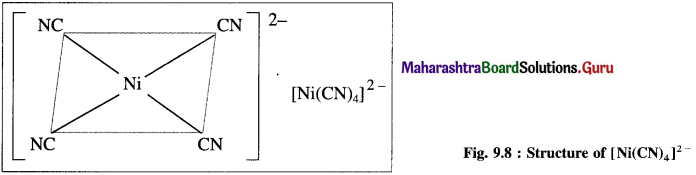
Maharashtra Board Class 12 Chemistry Solutions Chapter 9 Coordination Compounds 49
Maharashtra Board Class 12 Chemistry Solutions Chapter 9 Coordination Compounds 50

Maharashtra Board Class 12 Chemistry Important Questions Chapter 9 Coordination Compounds Important Questions

Question 52.
What are the limitations of valence bond theory?
Answer:
In case of the coordination compounds, the valence bond theory has the following limitations :
(1) It cannot explain the spectral properties (colours) of the complex compounds.
(2) Even if the magnetic moments can be calculated from the number of unpaired electrons, it cannot explain the magnetic moment arising due to orbital motion of electrons.
(3) It cannot explain why the metal ions with the same oxidation state give inner complexes and outer complexes with different ligands.
(4) In every complex, it cannot explain magnetic properties based on geometry of the complex.
(5) Quantitative interpretations of thermodynamic and kinetic stabilities of the coordination compounds cannot be accounted.
(6) The complexes with weak field ligands and strong field ligands cannot be distinguished.
(7) It cannot predict the tetrahedral and square planar geometry of complexes with coordination number 4.
(8) The order of reactivity of inner complexes of d3, d4, d5 and d6 metal ions cannot be explained.
(9) It cannot explain the rates and mechanisms of reactions of the coordination compounds.

Question 53.
What are the assumptions of Crystal Field Theory (CFT)?
Answer:
Bethe and van Vleck developed Crystal Field Theory (CFT) to explain various properties of coordination compounds. The salient features of CFT are as follows :

  1. In a complex, the central metal atom or ion is surrounded by various ligands which are either negatively charged ions (F, CI, CN, etc.) or neutral molecules (H2O, NH3, en, etc.) and the most electronegative atom in them points towards central metal ion.
  2. The ligands are treated as point charges involving purely electrostatic attraction between them and metal ion.
    • The central metal ion has five, (n – 1)d degenerate orbitals namely dxy, dyz, dzx, d(x2 – y2) and dz2.
    • When the ligands approach the metal ion, due to repulsive forces, the degeneracy of <i-orbitals is destroyed and they split into two groups of different energy, t2g and eg orbitals. This effect is called crystal field splitting which depends upon the geometry of the complex.
    • The T-orbitals lying in the direction of ligands are affected to a greater extent while those lying in between the ligands are affected to a less extent.
    • Due to repulsion, the orbitals along the axes of ligands acquire higher energy while those lying in between the ligands acquire less energy.
    • Hence repulsion by ligands give two sets of split up orbitals of metal ion with different energies.
    • The energy difference between two sets of d-orbitais after splitting by ligands is called crystal field splitting energy (CFSE) and represented by Δ0 or by arbitrary term 10Dq. The value of Δ or 10Dq depends upon the geometry of the complex.
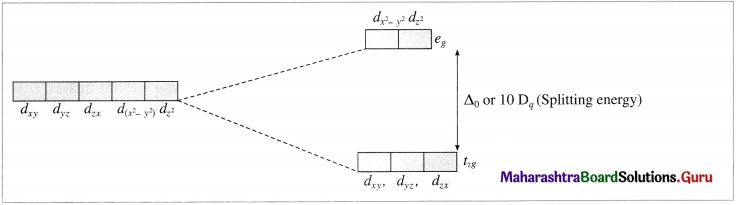
      Maharashtra Board Class 12 Chemistry Solutions Chapter 9 Coordination Compounds 53
  3. The electrons of metal ion occupy the split d-orbitais according to Hund’s rule. aufbau principle and those orbitais with minimum repulsion and the farthest away from the ligands.
  4. CFI’ does not account for overlapping of orbitais of central metal ion and ligands, hence does not consider covalent nature of the complex.
  5. From the crystal field stability energy, the stability of the complexes can he known.
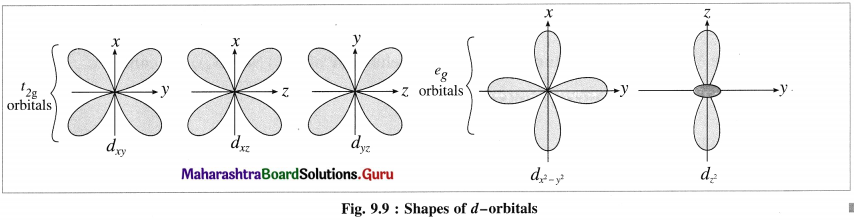
    Maharashtra Board Class 12 Chemistry Solutions Chapter 9 Coordination Compounds 54

Question 54.
What is crystal field splitting?
Answer:
The splitting of five degenerate d-orbitals of the transition metal ion into different sets of orbitals (to2g and eg) having different energies in the presence of ligands in the complex is called crystal field splitting.

Question 55.
What is crystal field stabilisation energy?
Answer:
Crystal field stabilisation energy (CFSE) It is the change in energy achieved by preferential filling up of the orbitals by electrons in the complex of metal atom or ion.

CFSE is expressed as a negative .quantity i.e., CFSE < 0. Higher the negative value more is the stability of the complex. m

Question 56.
Explain the factors affecting Crystal Field Splitting parameter (Δ0).
Answer:
Crystal Field Splitting parameter (Δ0) depends on. (a) Strength of the ligands and (b) Oxidation state of the metal.

(a) Strength of the ligands : Since strong field ligands like CN, en, etc. approach closer to the central metal ion, it results in a large crystal field splitting and hence Δ0 has higher values.
(b) Oxidation state of the metal A metal ion with the higher positive charge draws the ligands closer to it which results in large separation of t2g and eg set of orbitals. The complexes involving metal ions with low oxidation state have low values of Δ0. For example [Fe(NH3)6]3+ has higher Δ0 than [Fe(NH3)6]2+. H

Maharashtra Board Class 12 Chemistry Important Questions Chapter 9 Coordination Compounds Important Questions

Question 57.
Explain the octahedral geometry of complexes using crystal field theory.
Answer:
(1) In an octahedral complex [MX6]n+, the metal atom or ion is placed at the centre of regular octahedron while six ligands occupy the positions at six vertices of the octahedron.

(2) Among five degenerate d-orbitals. two orbitals namely dx2 – y2 and dz2 are axial and have maximum electron density along the axes, while remaining three c-orbitals namely dxy, dyz and dyz are planar and have maximum electron density in the planes and in-between the axes.

(3) Hence, when the ligands approach a metal ion, the orbitals dx2 – y2 and dz2 experience greater repulsion and the orbitals dzy, dyz and dzx experience less repulsion.
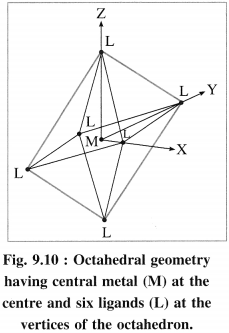
Maharashtra Board Class 12 Chemistry Solutions Chapter 9 Coordination Compounds 55

(4) Therefore the energy of dx2 – y2 and dz2 increases while the energy of dxy, dyz and dzx decreases and five d-orbital lose degeneracy and split into two point groups. The orbitals dxy, dyz and dyz form t2g group of lower energy while dx2 – y2 and dz2 form e group of higher energy.

Thus t2g has three degenerate orbitals while eg has two degenerate orbitals.

(5) Experimental calculations show that the energy of t2g orbitals is lowered by 0.4Δ0 or 4Dq and energy of eg. orbital is increased by 0.6 Δ0 or 6Dq Thus energy difference between t2g and eg orbitals is Δ0 or 10Dg which is crystal field splitting energy.
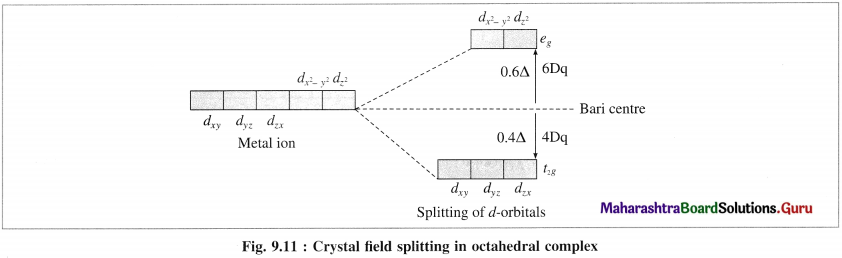
Maharashtra Board Class 12 Chemistry Solutions Chapter 9 Coordination Compounds 56

(6) CFSF increases with the increasing strength of ligands and oxidation stale of central metal ion.

Question 58.
Explain the tetrahedral geometry of complexes using crystal field theory.
Answer:
(1) In the tetrahedral complex, [MX4], the metal atom or ion is placed at the centre of the regular tetrahedron and the four ligands, are placed at four corners of the tetrahedron.

(2) The ligands approach the central metal atom or ion in-between the three coordinates x, y and The orbitals dxy, dyz and d are pointed towards ligands and experience greater repulsion while the axial orbitals dx2y2 and dz2 lie in-between metal-ligand bond axes and experience comparatively less experience.
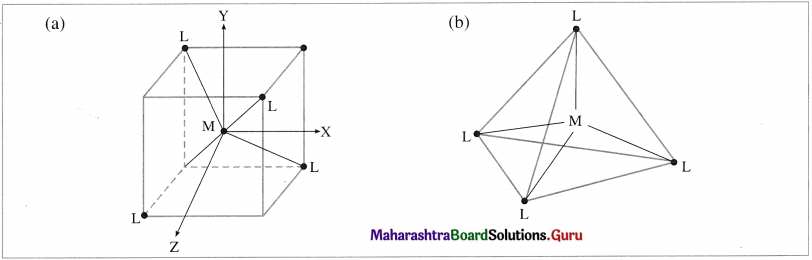
Maharashtra Board Class 12 Chemistry Solutions Chapter 9 Coordination Compounds 57
Fig. 9.12 (a) and (b) : Tetrahedral geometry hasing central metal atoll) (M) at the centre and four ligands (L) al the four corners

Maharashtra Board Class 12 Chemistry Important Questions Chapter 9 Coordination Compounds Important Questions

(3) Therefore energy of dxy, dyz and ddzx orbitals is increased while that of dx2y2 and dz2 is lowered. Hence 5d-orbitals lose their degeneracy and split into two point groups, namely f2? of higher energy (dxy, dyz and dzx) and eg of lower energy (dx2 – y2 and dz2).
Maharashtra Board Class 12 Chemistry Solutions Chapter 9 Coordination Compounds 58

(4) The experimental calculations show that the energy of t2g orbitals is increased by 0.4 Δ0 or 4Dq and energy of eg is lowered by 0.6 Δ0 or 6Dg. Thus energy difference between t2g and eg orbitals is Δ0 or 10Dg which is crystal field splitting energy (CFSE).

(5) This explains that the entry of each electron in eg orbitals, stabilises the complex by 0.6 Δ0 or 6Dq While the entry of each electron in t2g orbitals destabilises the tetrahedral complex by 0.4 Δ0 or 4Dg.

(6) In case of strong field ligands, the electrons prefer to pair up in eg orbitals giving low spin (LS) complexes while in case of weak held ligands, the electrons prefer to enter higher energy t2g orbitals giving more unpaired electrons and hence form high spin (HS) complexes.

Table 9.4 : Properties of complexes
Maharashtra Board Class 12 Chemistry Solutions Chapter 9 Coordination Compounds 59

Question 59.
Give valence bond description for the bonding in the complex [VCI4]. Draw box diagrams for free metal ion. Which hybrid prbitals are used by the metal? State the number of unpaired electrons.
Answer:
Maharashtra Board Class 12 Chemistry Solutions Chapter 9 Coordination Compounds 64
Since CI is a weak ligand, there is no pairing of electrons.
Number of unpaired electrons = 2
Type of hybridisation = sp3

Geometry of complex ion = Tetrahedral
The complex ion is paramagnetic.

Maharashtra Board Class 12 Chemistry Important Questions Chapter 9 Coordination Compounds Important Questions

Question 60.
Write a note on colour in coordination compounds.
Answer:

  • A large number of coordination compounds show wide range of colours due to d – d transition of electron and this can be explained by crystal field theory (CFT).
  • The complex absorbs the light in one visible region (400 nm to 700 nm) and transmits the light in different visible region giving complementary colour.
  • Consider an octahedral purple coloured complex of [Ti(H2O)6]3+ which absorbs green light and transmits purple colour. Similarly [Cu(H2O)6]2+ absorbs the light in the red region of radiation spectrum and transmits in the blue region, hence the complex appears blue.
  • The absorption of light arises due to d-d transition of electron from lower energy level (t2g) to higher energy level (eg) in octahedral complex.
  • The energy required for transition depends upon crystal field splitting energy Δ0. If Δ0 = ΔE, then the energy of an absorbed photon (hv) is \(\Delta E=h v=\frac{h c}{\lambda}\) where λ, v and c are wavelength, frequency and velocity of the absorbed light.
  • Higher the magnitude of Δ0 or ΔE, higher is the frequency or lower is the wavelength of the absorbed radiation.
  • Since Δ0 depends upon nature of metal atom or ion, its oxidation state, nature of ligands and the geometry of the complex, different coordination compounds have different colours.

Question 61.
Explain the purple colour of the complex, [Ti(H2O)6]3+ with the help of crystal field theory.
Answer:
(1) [Ti(H2O)6]3+ is an octahedral complex, oxidation state of titanium is +3 (Ti3+) and the coordination number is 6.

(2) Electronic configuration = 22Ti [Ar]18 3d2 4s2
Electronic configuration = Ti3+ + [Ar]18 3d1
OR

Maharashtra Board Class 12 Chemistry Solutions Chapter 9 Coordination Compounds 66
(3) According to crystal field theory, 3d orbitals undergo crystal field splitting giving higher energy eg, two orbitals and lower energy t2g, three orbitals.
Maharashtra Board Class 12 Chemistry Solutions Chapter 9 Coordination Compounds 67
(4) The crystal field splitting energy (CFSE), Δ0 is found to be 3.99 x 10⁻¹⁹ J/ion from the spectrochemical studies.

(5) The absorption of radiation of wavelength λ or frequency v results in the transition of one unpaired electron from Photon energy t2g orbital to eg orbital.
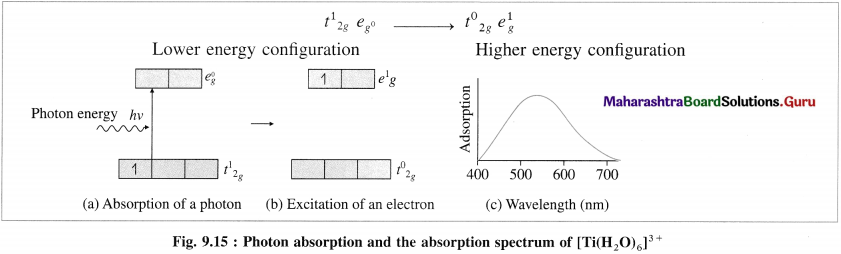
Maharashtra Board Class 12 Chemistry Solutions Chapter 9 Coordination Compounds 68
(6) The wavelength of the absorbed radiation will be.
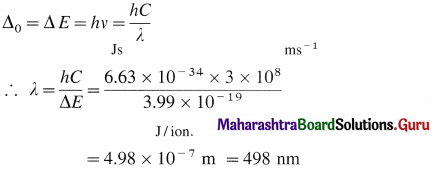
Maharashtra Board Class 12 Chemistry Solutions Chapter 9 Coordination Compounds 69
(7) Hence the complex [Ti(H2O)6]3+ absorbs the green radiation of wavelength 498 nm in the visible region and transmits the complementary purple light. Therefore the complex is purple coloured.

Question 62.
An octahedral complex absorbs the radiation of wavelength 620 nm. Find the crystal field splitting energy.
Answer:
Crystal field splitting energy Δ0 is given by,
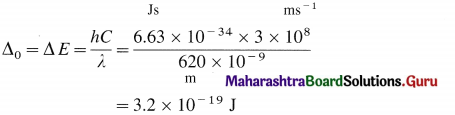
Maharashtra Board Class 12 Chemistry Solutions Chapter 9 Coordination Compounds 70

Maharashtra Board Class 12 Chemistry Important Questions Chapter 9 Coordination Compounds Important Questions

Question 63.
What are the applications of coordination compounds ?
Answer:
(1) In biology : Several biologically important natural compounds are metal complexes which play an important role in number of processes occurring in plants and animals.

For example, chlorophyll in plants is a complex of Mg2+ ions, haemoglobin in blood is a complex of iron, vitamin B12 is a complex of cobalt.

(2) In medicine : The complexes are used on a large scale in medicine. Many medicines in the complex form are more stable, more effective and can be assimilated easily.

For example, platinum complex [Pt(NH3)2CI2] known as cisplatin is effectively used in cancer treatment. EDTA is used to treat poisoning by heavy metals like lead.

(3) To estimate hardness of water :

  • The hardness of water is due to the presence Mg2+ and Ca2+ ion in water.
  • The strong field ligand EDTA forms stable complexes with Mg2+ and Ca2+. Hence these ions can be removed by adding EDTA to hard water.

Similarly these ions can be selectively estimated due to the difference in their stability constants.

(4) Electroplating : This involves deposition of a metal on the other metal. For smooth plating, it is necessary to supply continuously the metal ions in small amounts.

For this purpose, a solution of a coordination compound is used which dissociates to a very less extent. For example, for uniform and thin plating of silver and gold, the complexes K[Ag(CN)2] and K[Au(CN)2] are used.

Multiple Choice Questions

Select and write the most appropriate answer from the given alternatives for each subquestion :

Question 1.
The coordination number of cobalt in the complex [Co(en)2Br2]CI2 is
(a) 4
(b) 5
(c) 6
(d) 7
Answer:
(c) 6

Question 2.
EDTA combines with cations to form
(a) chelates
(b) polymers
(c) clathrates
(d) non-stoichiometric compounds
Answer:
(a) chelates

Question 3.
Which one of the following compounds can exhibit coordination isomerism?
(a) [Co(en)2CI2]Br
(b) [CO(NH3)6] [Cr(CN)6]
(c) [Co(en)3]CI3
(d) [CO(NH3)5NO2]CI2
Answer:
(b) [CO(NH3)6] [Cr(CN)6]

Question 4.
Which of the following compounds can exhibit linkage isomerism?
(a) [Co(en)3]CI3
(b) [Co(en)2CI2]CI
(c) [Co(en)2NO2Br]CI
(d) [Co(NH3)5CI]Br2
Answer:
(c) [Co(en)2NO2Br]CI

Question 5.
Oxidation number of cobalt in K[COCI4] is
(a) +1
(b) -1
(c) +3
(d) -3
Answer:
(b) -1

Maharashtra Board Class 12 Chemistry Important Questions Chapter 9 Coordination Compounds Important Questions

Question 6.
The correct structure of [Cr(H2O)6]3+ is ……………………
(a) octahedral
(b) tetrahedral
(c) square pyramidal
(d) trigonal bipyramidal
Answer:
(b) tetrahedral

Question 7.
Amongst the following ions which one has the highest paramagnetism?
(a) [Cr(H2O)6]3+
(b) [Fe(H2O)6]2+
(c) [CU(H2O)6]2+
(d) [Zn(H2O)6]2+
Answer:
(b) [Fe(H2O)6]2+

Question 8.
The geometry of [Ni(CN)4]3- and [NiCI4]-2 are
(a) both tetrahedral
(b) both square planar
(c) tetrahedral and square planar respectively
(d) square planar and tetrahedral respectively
Answer:
(d) square planar and tetrahedral respectively

Question 9.
The complex cis-[Pt(NH3)2CI2] is used in treatment of cancer under the name.
(a) Aspirin
(b) Eqanil
(c) cisplatin
(d) transplatin
Answer:
(c) cisplatin

Question 10.
[CO(NH3)6]3+ is an orbital complex and is in nature.
(a) inner, paramagnetic
(b) inner, dimagnetic
(c) outer, paramagnetic
(d) outer, dimagnetic
Answer:
(b) inner, dimagnetic

Question 11.
The IUPAC name of [Ni(Co)4] is
(a) tetra carbonyl nickel (O)
(b) tetra carbonyl nickel (II)
(c) tetra carbonyl nickelate (O)
(d) tetra carbonyl nickelate (II)
Answer:
(a) tetra carbonyl nickel (O)

Question 12.
The number of ions produced by the complex [CO(NH3)4CI2] Cl is
(a) 1
(b) 2
(c) 3
(d) 4
Answer:
(b) 2

Question 13.
The dimagnetic species is
(a) [Ni(CN)4]2-
(b) [NiCl4]2-
(c) [CoCI4]2-
(d) [CoF6]2-
Answer:
(a) [Ni(CN)4]2-

Question 14.
Which one of the following is an inner orbital complex as well as diamagnetic in behaviour (Atomic no. Zn = 30, Cr = 24, Co = 27, Ni = 28)
(a) [Zn(NH3)6]2+
(b) [Cr(NH3)6]3+
(c) [CO(NH3)6]3+
(d) [Ni(NH3)6]2+
Answer:
(c) [CO(NH3)6]3+

Maharashtra Board Class 12 Chemistry Important Questions Chapter 9 Coordination Compounds Important Questions

Question 15.
Among [Ni(Co)J, [Ni(CN)4]2A [NiClJ2- Species, the hybridisation states at the Nickel atom are respectively
(a) sp3, dsp2, sp3
(b) sp3, dsp2, dsp2
(c) dsp2, sp3, sp3
(d) sp3, sp3, dsp2
Answer:
(a) sp3, dsp2, sp3

Question 16.
The strongest ligand in the following is
(a) CN
(b) Br
(c) HO
(d) F
Answer:
(a) CN

Question 17.
Magnetic moment of (NH4)2 (MnBr4) is BM
(a) 5.91
(b) 4.91
(c) 3.91
(d) 2.91
Answer:
(a) 5.91

Question 18.
The complex which violates EAN rule is
(a) Fe(CO)5
(b) [Fe(CN)6]3-
(c) Ni(CO)4
(d) [Zn(NH3)4]CI2
Answer:
(b) [Fe(CN)6]3-

Question 19.
EDTA is a ligand of the type
(a) bidentate
(b) tridentate
(c) tetradentate
(d) hexadentate
Answer:
(d) hexadentate

Question 20.
The cationic complex among the following is
(a) K3[Fe(CN)6]
(b) Ni(CO)4
(c) K2HgI4
(d) [CO(NH3)6]CI2
Answer:
(d) [CO(NH3)6]CI2

Question 21.
If Z is the atomic number of a metal, X is number of electrons lost forming metal ion and Y is the number of electrons from the ligands then EAN is
(a) Z + X + Y
(b) X – Z + Y
(c) Z – X + Y
(d) X + Z – Y
Answer:
(c) Z – X + Y

Question 22.
Octahedral complex has hybridisation,
(a) dsp2
(b) d3sp3
(c) dsp3
(d) d2sp3
Answer:
(d) d2sp3

Maharashtra Board Class 12 Chemistry Important Questions Chapter 9 Coordination Compounds Important Questions

Question 23.
Inner complex has hybridisation,
(a) d2sp3
(b) sp3d2
(c) sp3d
(d) sp3d3
Answer:
(a) d2sp3

Question 24.
The number of unpaired electrons in [CO(NH3)6]3+ is
(a) 0
(b) 1
(c) 2
(d) 4
Answer:
(a) 0

Question 25.
The number of unpaired electrons in [NiClJ2- and [Ni(CN)4]2_ are respectively,
(a) 2, 2
(b) 2, 0
(c) 0, 0
(d) 1, 2
Answer:
(b) 2, 0

Question 26.
Among the following complexes, the highest magnitude of crystal field stabilisation energy will be for [Co(H2O)6]3+, [CO(CN)6]3-, [Co(NH3)6]3+, [CoF6]3-
(a) [Co(H2O)6]3+
(b) [CO(CN)6]3-
(c) [Co(NH3)6]3+
(d) [CoF6]3-
Answer:
(b) [CO(CN)6]3-

Question 27.
The number of unpaired electrons in a low spin octahedral complex ion of d1 is
(a) 0
(b) 1
(c) 2
(d) 3
Answer:
(b) 1

Question 28.
The number of unpaired electrons in a high spin octahedral complex ion of d7 is
(a) 0
(b) 1
(c) 2
(d) 3
Answer:
(d) 3

Question 29.
Ligand used in the estimation of hardness of water is
(a) EDTA
(b) DBG
(c) chloride
(d) bromo
Answer:
(a) EDTA

Question 30.
Which of the following complexes will give a white precipitate on treatment with a solution of barium nitrate?
(a) [Cr(NH3)4SO4] CI
(b) [CO(NH3)4CI2] NO2
(c) [Cr(NH3)4CI2] SO4
(d) [CrCI3(H2O)4]CI
Answer:
(c) [Cr(NH3)4CI2] SO4

Maharashtra Board Class 12 Chemistry Important Questions Chapter 9 Coordination Compounds Important Questions

Question 31.
What is effective atomic number of Fe (z = 26) in [Fe(CN)6]4-?
(a) 12
(b) 30
(c) 26
(d) 36
Answer:
(d) 36

Question 32.
Cisplatin compound is used in the treatment of
(a) malaria
(b) cancer
(c) AIDS
(d) yellow fever
Answer:
(b) cancer

Maharashtra Board Class 12 Chemistry Solutions Chapter 9 Coordination Compounds

Balbharti Maharashtra State Board 12th Chemistry Textbook Solutions Chapter 9 Coordination Compounds Textbook Exercise Questions and Answers.

Maharashtra State Board Class 12 Chemistry Solutions Chapter 9 Coordination Compounds

1. Choose the most correct option.

Question i.
The oxidation state of cobalt ion in the complex [Co(NH3)5Br]SO4 is ……………………….
a. + 2
b. + 3
c. + 1
d. + 4
Answer:
(b) + 3

Maharashtra Board Class 12 Chemistry Solutions Chapter 9 Coordination Compounds

Question ii.
IUPAC name of the complex [Pt(en)2(SCN)2]2+ is ………………………
a. bis (ethylenediamine dithiocyanatoplatinum (IV) ion
b. bis (ethylenediamine) dithiocyantoplatinate (IV) ion
c. dicyanatobis (ethylenediamine) platinate IV ion
d. bis (ethylenediammine)dithiocynato platinate (IV) ion
Answer:
(a) bis(ethylenediamine dithiocyanatoplatinum (IV) ion

Question iii.
Formula for the compound sodium hexacynoferrate (III) is
a. [NaFe(CN)6]
b. Na2[Fe(CN)6]
c. Na[Fe(CN)6]
d. Na3[Fe(CN)6]
Answer:
(d) Na3[Fe(CN)6]

Question iv.
Which of the following complexes exist as cis and trans isomers?
1. [Cr(NH2)2Cl4]
2. [Co(NH3)5Br]2⊕
3. [PtCl2Br2]2⊕ (square planar)
4. [FeCl2(NCS)2]2⊕ (tetrahedral)
a. 1 and 3
b. 2 and 3
c. 1 and 3
d. 4 only
Answer:
(a) 1 and 3

Question v.
Which of the following complexes are chiral?
1. [Co(en)2Cl2]
2. [Pt(en)Cl2]
3. [Cr(C2O4)3]3⊕
4. [Co(NH3)4CI2]
a. 1 and 3
b. 2 and 3
c. 1 and 4
d. 2 and 4
Answer:
(a) 1 and 3

Question vi.
On the basis of CFT predict the number of unpaired electrons in [CrF6]3.
a. 1
b. 2
c. 3
d. 4
Answer:
(c) 3

Question vii.
When an excess of AgNO3 is added to the complex one mole of AgCl is precipitated. The formula of the complex is ……………..
a. [CoCl2(NH3)4]Cl
b. [CoCl(NH3)4] Cl2
c. [CoCl3(NH3)3]
d. [Co(NH3)4]Cl3
Answer:
(a) [COCI3(NH3)4]CI

Question viii.
The sum of coordination number and oxidation number of M in [M(en)2C2O4]Cl is
a. 6
b. 7
c. 9
d. 8
Answer:
(c) 9

Maharashtra Board Class 12 Chemistry Solutions Chapter 9 Coordination Compounds

2. Answer the following in one or two sentences.

Question i.
Write the formula for tetraammineplatinum (II) chloride.
Answer:
Formula of tetraamineplatinum(II) chloride : [Pt(NH3)4]CI2

Table 9.1 : IUPAC names of anionic and neutral ligands
Maharashtra Board Class 12 Chemistry Solutions Chapter 9 Coordination Compounds 3
Table 9.2: IUPAC names of anionic complexes

MetalName
A1
Cr
Cu
Co
Au(Gold)
Fe
Pb
Mn
Mo
Ni
Zn
Ag
Sn
Aluminate
Chromate
Cuprate
Cobaltate
Aurate
Ferrate
Plumbate
Manganate
Molybdate
Nickelate
Zincate
Argentate
Stannate

Table 9.3 : IUPAC names of some complexes

ComplexIUPAC name
(i) Anionic complexes :
(a) [Ni(CN)J2-
(b) [Co(C204)3]3-
(c) [Fe(CN)6]4-
Tetracyanonickelate(II) ion Trioxalatocobaltate(III) ion
Hexacyanoferrate(II) ion
(ii) Compounds containing complex anions and metal cations :
(a) Na3[Co(N02)6]
(b) K3[A1(C204)3]
(c) Na3[AIF6]
Sodium hexanitrocobaltate(III)
Potassium trioxalatoaluminate(III)
Sodium hexafluoroaluminate(III)
(iii) Cationic complexes :
(a) [Cu(NH3)4]2+
(b) [Fe(H20)5(NCS)]2+
(c) [Pt(en)2(SCN)2]2+
Tetraamminecopper(II) ion
Pentaaquai sothiocyanatoiron(III) ionBis(ethylenediamine)dithiocyanatoplatinum(IV)
(iv) Compounds containing complex cation and anion :
(a) [PtBr2(NH3)4]Br2
(b) [Co(NH3)5C03]CI
(c) [Co(H20)(NH3)5]I3
Tetraamminedibromoplatinum(IV) bromide, Pentaamminecarbonatocobalt(III) chloride, Pentaammineaquacobalt(III) iodide
(v) Neutral complexes :
(a) Co(N02)3(NH3)3
(b) Fe(CO)5
(c) Rh(NH3) 3(SCN) 3
Triamminetrinitrocobalt(III) Pentacarbonyliron(0) Triamminetrithiocyanatorhodium(III)

Maharashtra Board Class 12 Chemistry Solutions Chapter 9 Coordination Compounds

Question ii.
Predict whether the [Cr(en)2(H2O)2]3+ complex is chiral. Write structure of its enantiomer.
Answer:
(i) Complex is chiral.
(ii) The following are its enantiomers
Maharashtra Board Class 12 Chemistry Solutions Chapter 9 Coordination Compounds 19

Question iv.
Name the Lewis acids and bases in the complex [PtCl2(NH3)2].
Answer:
Lewis acid : Pt2+
Lewis bases : Cl and NF3

Question v.
What is the shape of a complex in which the coordination number of central metal ion is 4?
Answer:
A complex with the coordination number of central metal ion equal to 4 may be tetrahedral or square planar.

Question vi.
Is the complex [CoF6] cationic or anionic if the oxidation state of cobalt ion is +3?
Answer:
In the complex, Co carries + 3 charge while 6F carry – 6 charge. Hence the net charge on the complex is – 3.
Therefore it is an anionic complex.

Question vii.
Consider the complexes [Cu(NH3)4][PtCl4] and [Pt(NH3)4] [CuCl4]. What type of isomerism these two complexes exhibit?
Answer:
Since in these two given complexes, there is an exchange of ligands between cationic and anionic constituents, they exhibit coordination isomerism.

Question viii.
Mention two applications of coordination compounds.
Answer:
(1) In biology : Several biologically important natural compounds are metal complexes which play an important role in number of processes occurring in plants and animals.

For example, chlorophyll in plants is a complex of Mg2+ ions, haemoglobin in blood is a complex of iron, vitamin B12 is a complex of cobalt.

(2) In medicine : The complexes are used on a large scale in medicine. Many medicines in the complex form are more stable, more effective and can be assimilated easily.

For example, platinum complex [Pt(NH3)2CI2] known as cisplatin is effectively used in cancer treatment. EDTA is used to treat poisoning by heavy metals like lead.
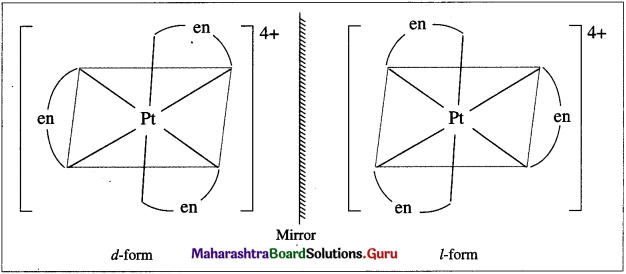
(3) To estimate hardness of water :

  • The hardness of water is due to the presence Mg2+ and Ca2+ ion in water.
  • The strong field ligand EDTA forms stable complexes with Mg2+ and Ca2+. Hence these ions can be removed by adding EDTA to hard water.

Similarly these ions can be selectively estimated due to the difference in their stability constants.

(4) Electroplating : This involves deposition of a metal on the other metal. For smooth plating, it is necessary to supply continuously the metal ions in small amounts.
For this purpose, a solution of a coordination compound is used which dissociates to a very less extent. For example, for uniform and thin plating of silver and gold, the complexes K[Ag(CN)2] and K[Au(CN)2] are used.

3. Answer in brief.

Question i.
What are bidentate ligands? Give one example.
Answer:
Bidentate ligand : This ligand has two donor atoms in the molecule or ion. For example, ethylenediamine, H2N – (CH2)2 – NH2.

Question ii.
What is the coordination number and oxidation state of metal ion in the complex [Pt(NH3)Cl5]2?
Answer:
Coordination number = 6
Oxidation state of Pt = +4.

Maharashtra Board Class 12 Chemistry Solutions Chapter 9 Coordination Compounds

Question iii.
What is the difference between a double salt and a complex? Give an example.
Answer:

Double saltCoordination compound (complex)
(1) Double salts exist only in the solid state and dissociate into their constituent ions in the aqueous solutions.(1) Coordination compounds exist in the solid-state as well as in the aqueous or non-aqueous solutions.
(2) Double salts lose their identity in the solution.(2) They do not lose their identity completely.
(3) The properties of double salts are same as those of their constituents.(3) The properties of coordination compounds are different from their constituents.
(4) Metal ions in the double salts show their normal valence.(4) Metal ions in the coordination compounds show two valences namely primary valence and second­ary valence satisfied by anions or neutral molecules called ligands.
(5) For example in K2SO4. K2SO4. A12(SO4)3. 24H2O. The ions K+, Al3 + and SO4 show their properties.(5) In K4[Fe(CN)6], ions K+ and [Fe(CN)6]4‘~ ions show their properties.

Question iv.
Classify the following complexes as homoleptic and heteroleptic
[Cu(NH3)4]SO4, [Cu(en)2(H2O)Cl]3⊕, [Fe(H2O)5(NCS)]2⊕, tetraammine zinc (II) nitrate.
Answer:
Homoleptic complex :
(a) [Cu(NH3)4]SO4
(d) Tetraaminezinc (II) nitrate : [Zn(NH3)4](NO3)2

Heteroleptic Complex :
(b) [Cu(en)2(H2O)CI]2+
(c) [Fe(H2O)5(NCS)]2+

Question v.
Write formulae of the following complexes
a. Potassium ammine-tri chloroplatinate (II)
b. Dicyanoaurate (I) ion
Answer:
(a) Potassium amminetrichloroplatinate(II) K[Pt(NH3)CI3]
(b) Dicyanoaurate (I) ion [AU(CN)2]

Question vi.
What are ionization isomers? Give an example.
Answer:
Ionisation isomers : The coordination compounds having same molecular composition but differ in the compositions of coordination (or inner) sphere and outer sphere and produce different ions on ionisation in the solution are called ionisation isomers. For example, Pentaamminesulphatocobalt (III) bromide [Co(NH3)5SO4] Br, Pentaamminebromocobalt(III) sulphate [Co(NH3)5Br] SO4.

Question vii.
What are the high-spin and low-spin complexes?
Answer:
(1) High spin complex (HS) :

  • The complex which has greater iwmher of unpaired electrons and hence a higher value of resultant spin and magnetic moment is called high spin (or spin free) or IlS complex.
  • It is formed with weak field ligands and the complexes have lower values for crystal field splitting energy (CFSE). Δ0
  • The paramagnetism of HS complex is larger.

(2) Low spin complex (LS) :

  • The complex which has the Icasi number of unpaired electrons or all electrons paired and hence the lowest
    (or no) resultant spin or magnetic moment is called low spin (or spin paired) or LS complex.
  • It is formed with strong tickl ligands and the complexes have higher values of crystal field splitting energy (Δ0).
  • Low spin complex is diamagnetic or has low paramagnetism.

Table 9.5 : d-orbitai diagrams fir high spin and low spin complexes
Maharashtra Board Class 12 Chemistry Solutions Chapter 9 Coordination Compounds 60

(Only the electronic configurations c4 to d1 render the high spin and low spin complexes)

Maharashtra Board Class 12 Chemistry Solutions Chapter 9 Coordination Compounds

Question viii.
[CoCl4]2⊕ is a tetrahedral complex. Draw its box orbital diagram. State which orbitals participate in hybridization.
Answer:
27Co [Ar] 3d74s2
Oxidation state of Co = +2 Co2+ [Ar] 3d7 4s°
Since CI is a weak ligand, there is no pairing of electrons. Since C.N. is 4, there is sp3 hybridisation.
Maharashtra Board Class 12 Chemistry Solutions Chapter 9 Coordination Compounds 30

Question ix.
What are strong field and weak field ligands? Give one example of each.
Answer:
The ligands are then classified as (a) strong field and (b) weak field ligands. Strong field ligands are those in which donor atoms are C,N or P. Thus CN, NC, CO, HN3, EDTA, en (ethylenediammine) are considered to be strong ligands. They cause larger splitting of d orbitals and pairing of electrons is favoured. These ligands tend to form low spin complexes. Weak field ligands are those in which donor atoms are halogens, oxygen or sulphur.

For example, F, CI, Br, I, SCN, C2O42-. In case of these ligands the A0 parameter is smaller compared to the energy required for the pairing of electrons, which is called as electron pairing energy. The ligands then can be arranged in order of their increasing field strength as
I < Br < CI < S2- < F < OH < C2O42- < H2O < NCS < EDTA < NH3 < en < CN < CO.

Question x.
With the help of a crystal field energy-level diagram explain why the complex [Cr(en)3]3⊕ is coloured?
Answer:
Maharashtra Board Class 12 Chemistry Solutions Chapter 9 Coordination Compounds 31

Since (en) is a strong field ligand there is pairing of electrons. The electrons occupy the t2g orbitals of lower energy. It has one unpaired electron. Due to d-d transition, it is coloured.

4. Answer the following questions.

Question i.
Give valence bond description for the hybrid orbitals are used by the metal? State the number of unpaired electrons.
Answer:
Since CI is a weak ligand, there is no pairing of electrons.
Number of unpaired electrons = 2
Type of hybridisation = sp3

Geometry of complex ion = Tetrahedral
The complex ion is paramagnetic.

Question ii.
Draw a qualitatively energy-level diagram showing d-orbital splitting in the octahedral environment. Predict the number of unpaired electrons in the complex [Fe(CN)6]4⊕. Is the complex diamagnetic or paramagnetic? Is it coloured? Explain.
Answer:
(A) r-orbital splitting in the octahedral environment :
Maharashtra Board Class 12 Chemistry Solutions Chapter 9 Coordination Compounds 65
(B) [Fe (CN)6]4- is an octahedral complex.
(C) Since CN is a strong ligand, there is pairing of electrons and the complex is diamagnetic.
(D) The complex exists as lemon yellow crystals.
(In the complex all electrons in t2g are paired and requires high radiation energy for excitation.)

Question iii.
Draw isomers in each of the following
a. [Pt(NH3)2ClNO2]
b. [Ru(NH3)4Cl2]
c. [Cr(en2)Br2]
Answer:
(a) [Pt(NH3)2CINO2]
Maharashtra Board Class 12 Chemistry Solutions Chapter 9 Coordination Compounds 20
(b) [RU(NH3)4CI2]
Maharashtra Board Class 12 Chemistry Solutions Chapter 9 Coordination Compounds 21
(c) [Cr(en2)Br2]+
Maharashtra Board Class 12 Chemistry Solutions Chapter 9 Coordination Compounds 22

Maharashtra Board Class 12 Chemistry Solutions Chapter 9 Coordination Compounds

Question iv.
Draw geometric isomers and enantiomers of the following complexes.
a. [Pt(en)3]4⊕
b. [Pt(en)2ClBr]2⊕
Answer:
The complex [Pt(en)3]4+ has two optical isomers.

Maharashtra Board Class 12 Chemistry Solutions Chapter 9 Coordination Compounds 23
Maharashtra Board Class 12 Chemistry Solutions Chapter 9 Coordination Compounds 24

Question v.
What are ligands? What are their types? Give one example of each type.
Answer:
Ligands : The neutral molecules or negatively charged anions (or rarely positive ions) which are bonded by coordinate bonds to the central metal atom or metal ion in a coordination compound are called ligands or donor groups. For example in [Cu(CN)4]2-, four CN ions are ligands coordinated to central metal ion Cu2+. Ligands can be classified on the basis of number of electron donor atoms in the ligand i.e. denticity.

(1) Monodentate or unidentate ligand : A ligand molecule or an ion which has only one donor atom with a lone pair of electrons forming only one coordinate bond with metal atom or ion in the complex is called monodentate or unidentate ligand. For example NH3, Cl, OH, H2O, etc.

(2) Polydentate or multidentate ligand : A ligand molecule or an ion which has two or more donor atoms with the lone pairs of electrons forming two or more coordinate bonds with the central metal atom or ion in the complex is called polydentate or multidentate ligand. For example, ethylene diamine, H2N – (CH2)2 – NH2.
According to the number of donor atoms they are classified as follows :

  • Bidentate ligand : This ligand has two donor atoms in the molecule or ion. For example, ethylenediamine, H2N – (CH2)2 – NH2.
  • Tridentate ligand : This ligand molecule has three donor atoms or three sites of attachment.
    E.g. Diethelene triamine, H2N – CH2 – CH2 – NH – CH2 – CH2 – NH2. This has three N donor atoms.
  • Tetradentate (or quadridentate) ligand : This ligand molecule has four donor atoms.
    Eg. Triethylene tetraamine which has four N donor atoms.
  • Hexdentate ligand : This ligand molecule has six donor atoms. E.g. Ethylenediamine tetracetato.

(3) Ambidentate ligand : A ligand molecule or an ion which has two or more donor atoms, however in the formation of a complex, only one donor atom is attached to the metal atom or an ion is called ambidentate ligand. For example, NO2 which has two donor atoms N and O forming a coordinate bond, M ← ONO (nitrito) or M ← NO2 (nitro).

(4) Bridging ligand : A monodentate ligand having more than one lone pairs of electrons, hence can attach to two or more metal atoms or ions and hence acts as a bridge between different metal atoms is called bridging ligand. For example : OH, F, SO4-2, etc.

Question vi.
What are cationic, anionic and neutral complexes? Give one example of each.
Answer:
(1) Cationic sphere complexes : A positively charged coordination sphere or a coordination compound having a positively charged coordination sphere is called cationic sphere complex.

For example : [Zn(NH3)4]2+ and [Co(NH3)5CI] SO4 are cationic complexes. The latter has coordination sphere [Co(NH3)5CI]2+, the anion SO42+ makes it electrically neutral.

(2) Anionic sphere complexes : A negatively charged coordination sphere or a coordination compound having negatively charged coordination sphere is called anionic sphere complex. For example, [Ni(CN)4]2+ and K3[Fe(CN)6] have anionic coordination sphere; [Fe(CN)6]3- and three K+ ions make the latter electrically neutral.

(3) Neutral sphere complexes : A neutral coordination complex does not possess cationic or anionic sphere.

[Pt(NH3)2CI2] or [Ni(CO)4] are neither cation nor anion but are neutral sphere complexes.

Maharashtra Board Class 12 Chemistry Solutions Chapter 9 Coordination Compounds

Question vii.
How stability of the coordination compounds can be explained in terms of equilibrium constants?
Answer:
Stability of the coordination compounds : The stability of coordination compounds can be explained on the basis of their stability constants. The stability of coordination compounds depends on metal-ligand interactions. In the complex, metal serves as electron-pair acceptor (Lewis acid) while the ligand as Lewis base (since it is electron
donor). The metal-ligand interaction can be realized as the Lewis acid-Lewis base interaction. Stronger the interaction greater is stability of the complex.

Consider the equilibrium for the metal-ligand interaction :
Ma+ + nLx- ⇌ [MLn]a+(-nx)
where a, x, [a + ( – nx)] denote the charge on the metal, ligand and the complex, respectively. Now, the equilibrium constant K is given by
Maharashtra Board Class 12 Chemistry Solutions Chapter 9 Coordination Compounds 28

Stability of the complex can be explained in terms of K. Higher the value of K larger is the thermodynamic stability of the complex hence K is called stability constant, and denoted by Kstah. The equilibria for the complex formation with the corresponding K values are given below.

Ag+ + 2CN ⇌ [Ag(CN)2] K = 5.5 x 10¹⁸
Cu2+ + 4CN ⇌ [CU(CN)4]2- K = 2.0 x 1027
Co3+ + 6NH3 ⇌ [CO(NH3)6]3+ K = 5.0 x 1033

From the above data, the stability of the complexes is [Co(NH3)6]3+ > [Cu(CN)4]2- > [Ag(CN)2].

Question viii.
Name the factors governing the equilibrium constants of the coordination compounds.
Answer:
The equilibrium constant of the complex depends on the following factors :

(a) Charge to size ratio of the metal ion : Higher the ratio greater is the stability. For the divalent metal ion complexes their stability shows the trend : Cu2+ > Ni2+ > Co2+ > Fe2+ > Mn2+ > Cd2+. The above stability order is called the Irving-William order. In the above list both Cu and Cd have the charge + 2, however, the ionic radius of Cu2 + is 69 pm and that of Cd2 + is 97 pm. The charge to size ratio of Cu2+ is greater than that of Cd2+. Therefore the Cu2+ forms stable complexes than Cd2+.

(b) Nature of the ligand : A second factor that governs stability of the complexes is related to how easily the ligand can donate its lone pair of electrons to the central metal ion that is, the basicity of the ligand. The ligands those are stronger bases tend to form more stable complexes.

Activity :
1. The reaction of chromium metal with H 2SO4 in the absence of air gives blue solution of chromium ion.
Cr(s) + 2H(aq) → Cr2⊕(aq) + H2(s)
Cr2⊕ forms octahedral complex with H2O ligands.
a. Write formula of the complex
b. Describe bonding in the complex using CFT and VBT.
Draw crystal field splitting and valence bond orbital diagrams.

2. Reaction of complex [Co(NH3)3(NO2)3 with HCl gives a complex [Co(NH3)3H2OCl2] in which two chloride ligands are trans to one another.
a. Draw possible stereoisomers of starting material
b. Assuming that NH3 groups remain in place, which of two starting isomers would give the observed product?

12th Chemistry Digest Chapter 9 Coordination Compounds Intext Questions and Answers

Use your brain power ……. (Textbook page 192)

Question 1.
Draw Lewis structures of the following ligands and identify the donor atom in them :
NH3, H2O.
Answer:
Maharashtra Board Class 12 Chemistry Solutions Chapter 9 Coordination Compounds 1

Maharashtra Board Class 12 Chemistry Solutions Chapter 9 Coordination Compounds

Try this ………. (Textbook page 193)

Question 1.
Can you write ionisation of [Ni (NH3)6] CI2?
Answer:
[Ni (NH3)6] CI2 → [Ni(NH3)6]2+ + 2CI

Question 2.
Identify coordination sphere and counter ions.
Answer:
Coordination sphere : [Ni(NH3)6]2+
Counter ions : CI

Can you tell ? (Textbook page 193)

Question 1.
A complex is made of Co (III) and consists of four NH3 molecules and two CI ions as ligands. What is the charge number and formula of complexion?
Answer:
The complex ion has formula, [Co(NH3)4CI2]+.
The charge number is + 1.

Use vour brain power ……………… (Textbook page 193)

Question 1.
Coordination number used in coordination of compounds is somewhat different than that used in solid state. Explain.
Answer:

  • In a coordination compound the coordination number is the number of donor atoms of ligands directly attached to metal atom or ion.
  • In a solid state, the number of closest constituent atoms or ions in contact with a particular atom in the crystal lattice is called coordination number.
  • In a coordination compound, coordination number depends upon nature of metal atom or ion, and its electronic configuration.
  • In a solid state, the coordination number depends upon the crystalline structure of the unit cell.

Can you tell? ………………. (Textbook page 194)

Question 1.
What is the coordination number of
(a) Co in [CoCl2(en)2]+ = 6
(b) Ir in [Ir(C2O4)2Cl2]3+ and
(c) Pt in [Pt(NO2)2(NH3)2] ?
Answer:
(a) Coordination number of Co in [CoCl2(en)2]+ = 6
(b) Coordination number of Ir in [Ir(C2O4)2Cl2]3+ = 6
(c) Coordination number of Pt in [Pt(NO2)2(NH3)2] = 4

Use your brain power ……… (Textbook page 195)

Question 1.
Classify the complexes as homoleptic and heteroleptic:
(a) [Co (NH3)5CI]SO4,
(b) [CO(ONO)(NH3)5]CI2,
(c) [CoCl(NH3)(en)2]2+ and
(d) [Cu(C2O4)3]3-
Answer:
Homoleptic Complexes : (d) [Cu(C2O4)3]3-
Heteroleptic Complexes : (a) [CO(NH3)5CI]SO4
(b) [CO(ONO)(NH3)5]CI2,
(C) [CoCl(NH3)(en)2]2+

Use your brain power ……… (Textbook page 195)

Question 1.
Classify the complexes as cationic, anionic or Cr(H2O)2(C2O4)23-, PtCI2(en)2 and Cr(CO)6.
Answer:
Cationic complexes : [CO(NH3)6]CI2
Anionic complexes : Na4[Fe(CN)6], [Cr(H2O)2 (C2O4)2]3-
Neutral complexes : Cr(CO)6, Pt CI2(en)2

Try this ……. (Textbook page 197)

Question 1.
Write the representation of the following :
(i) Tricarbonatocobaltate(III) ion.
(ii) Sodium hexacyanoferrate(III).
(iii) Potassium hexacyafioferrate(II).
(iv) Aquachlorobis(ethylenediamine)cobalt(III).
(v) Tetraaquadichlorochromium(III) chloride.
(vi) Diamminedichloroplatinum(II).
Answer:
(i) [Co(C03)3]3-
(ii) Na3[Fe(CN)6]
(iii) K4[Fe(CN)6]
(iv) Co(en)2(H2O)(Cl)
(v) [Cr(H2O)4CI2]CI
(vi) Pt(NH3)2CI2

Maharashtra Board Class 12 Chemistry Solutions Chapter 9 Coordination Compounds

Try this …… (Textbook page 196)

Question 1.
Find out the EAN of
(a) [Zn(NH3)4]2+
(b) [Fe(CN)6]4+
Answer:
(a) For the complex ion, [Zn(NH3)4]2+ :
Atomic number of Zn = Z = 30
Charge on metal ion = + 2
∴ Number of electrons lost by Zn atom = X = 2 Total number of electrons donated by 4NH23
ligands = Y = 2 x 4 = 8
EAN = Z – X + Y
= 30 – 2 + 8
= 36

(Note : This is atomic number of the nearest inert element 36Kr.)

(b) For the complex ion, [Fe(CN)J4- :
For Fe, Z = 26 (Atomic number)
X = 2 (Due to + 2 charge on Fe)
Y = 12 (Due to 6 CN ligands)
∴ EAN = Z – X + Y
= 26 – 2 + 12
= 36

Use your brain power …… (Textbook page 197)

Question 1.
Do the following complexes follow the EAN rule
(a) Cr(CO)4,
(b) Ni(CO)4,
(c) Mn(CO)5,
(d) Fe(CO)5?
Answer:
(a) Cr(CO)4 : EAN = Z – X + Y
(b) Ni(C0)4 : EAN = Z – X + Y
= 24 – 0 + 8
= 28 – 0 + 8
= 32
= 36
(c) Mn(CO)5 : EAN = Z – X + Y
= 25 – 0 + 10
= 35

(d) Fe(CO)5 : EAN = Z – X + Y
= 26 – 0 + 10
= 36

Conclusion :
(a) Cr(CO)4 and (c) Mn(CO)5 do not follow EAN Rule.

Maharashtra Board Class 12 Chemistry Solutions Chapter 9 Coordination Compounds

Try this ….. (Textbook page 199)

Question 1.
Draw structures of ci,c and trans isomers of [Fe(NH3)2(CN)4]
Answer:
Maharashtra Board Class 12 Chemistry Solutions Chapter 9 Coordination Compounds 9

Remember ….. (Textbook page 199)

Our hands are non-superimposable mirror images. When you hold your left hand up to a mirror the image looks like right hand.

Try this ….. (Textbook page 199)

Question 1.
Draw enantiomers of [Cr(OX)2]3 where OX = C2O4 :
Answer:
Maharashtra Board Class 12 Chemistry Solutions Chapter 9 Coordination Compounds 16

Question 2.
Draw (A) enantiomers and (B) cis and trans isomers of [Cr(H2O)2(OX)2] :
Answer:
(A) Enantiomers :
Maharashtra Board Class 12 Chemistry Solutions Chapter 9 Coordination Compounds 17

(B) as and trans isomers :
Maharashtra Board Class 12 Chemistry Solutions Chapter 9 Coordination Compounds 18

Maharashtra Board Class 12 Chemistry Solutions Chapter 9 Coordination Compounds

Can you tell ? ….. (Textbook page 200)

Question 1.
Can you write IUPAC names of isomers (I) [Co(NH3)5SO4]Br and (II) [Co(NH3)5Br]SO4?
Answer:
Maharashtra Board Class 12 Chemistry Solutions Chapter 9 Coordination Compounds 25

Question 2.
Write linkage isomers of [Fe(H2O)5SCN]+. Write their IUPAC names.
Answer:
Maharashtra Board Class 12 Chemistry Solutions Chapter 9 Coordination Compounds 26

Use your brain power …..(Textbook page 201)

Question 1.
The stability constant K of the [Ag(CN)2] is 5.5 x 10 while that for the corresponding [Ag(NH3)2]+ is 1.6 x 10⁷. Explain why [Ag(CN)2]2- is more stable.
Answer:
Stability constant of [Ag(CN)2]2- is larger than that of [Ag(NH3)2]+ and hence [Ag(CN)2]2- is more stable. Also, CN is a stronger ligand than NH3.

Remember …… (Textbook Page 202)

Question 1.
Complete the missing entries.
Maharashtra Board Class 12 Chemistry Solutions Chapter 9 Coordination Compounds 71
Maharashtra Board Class 12 Chemistry Solutions Chapter 9 Coordination Compounds 51

(Note : The missing entries are underlined.)

Table 9.3: Type of hybridisation and geometry of a complex
Maharashtra Board Class 12 Chemistry Solutions Chapter 9 Coordination Compounds 52

Try this ….. (Textbook page 204)

Question 1.
Based on the VBT predict structure and magnetic behaviour of the [Ni(NH3)6]
Answer:
28Ni [Ar] 3d8 4s2
Ni3+ [Ar] 3d7 4s°
Hybridisation : sp3d2
Geometry : Octahedral
Magnetic property : Paramagnetic

Maharashtra Board Class 12 Chemistry Solutions Chapter 9 Coordination Compounds

Try this …… (Textbook page 202)

Question 1.
Give VBT description of bonding in each of following complexes. Predict their magnetic behaviour.
(a) [ZnCI4]2+
(b) [CO(H2O)6]2- (high spin)
(c) [Pt(CN)4]2- (square planar)
(d) [CoCI4]2- (tetrahedral)
(e) [Cr(NH3)6]3+

Try this ……. (Textbook page 206)

Question 1.
Sketch qualitatively crystal field d orbital energy level diagrams for each of the following complexes :
(a) [Ni(en)3]2+ (b) [Mn(CN)6]3- (c) [Fe(H2O)6]2+
Predict whether each of the complexes is diamagnetic or paramagnetic.
Answer:
(a) The complex ion, [Ni(en)3]2+ is octahedral.
28Ni [Ar] 3d8 4s2
Ni2+ [Ar] 3d8 4s°.

Maharashtra Board Class 12 Chemistry Solutions Chapter 9 Coordination Compounds 61

Since en is a strong ligand there is pairing of electrons.
Number of unpaired electrons = n = 2 in t2g, orbitals
Magnetic moment = \(\mu=\sqrt{n(n+2)}\)
\(=\sqrt{2(2+2)}=2.83 \mathrm{~B} . \mathrm{M} .\)

The complex ion is paramagnetic.

(b) The complex ion [Mn(CN)6]3- is octahedral.
25Mn [Ar] 3d5 4s2
Mn3+ [Ar] 3d4 4s°

Maharashtra Board Class 12 Chemistry Solutions Chapter 9 Coordination Compounds 62

Since CN is a strong ligand there is pairing of electrons.
Number of unpaired electrons = n = 2 in t2g, orbitals
Magnetic moment = \(\mu=\sqrt{n(n+2)}\)
\(=\sqrt{2(2+2)}=2.83 \mathrm{~B} . \mathrm{M}\).

The complex ion is paramagnetic.

(c) The complex ion [Fe(H2O)6]2+ is octahedral.
26Fe [Ar] 3d6 4s2
Fe2+ [Ar] 3d6 45°

Maharashtra Board Class 12 Chemistry Solutions Chapter 9 Coordination Compounds 63

Since H2O is a weak ligand, there is no pairing of electrons.
Number of unpaired electrons = n = 4 in t2g and eg orbitals.
Magnetic moment
\(\begin{aligned}
=\mu &=\sqrt{n(n+2)} \\
&=\sqrt{4(4+2)} \\
&=4.90 \mathrm{~B} . \mathrm{M} .
\end{aligned}\)
The complex ion is paramagnetic.

Maharashtra Board Class 11 English Yuvakbharati Solutions Chapter 3.2 Blog Writing

Balbharti Yuvakbharati English 11th Digest Chapter 3.2 Blog Writing Notes, Textbook Exercise Important Questions and Answers.

Maharashtra State Board Class 11 English Yuvakbharati Solutions Chapter 3.2 Blog Writing

11th English Digest Chapter 3.2 Blog Writing Textbook Questions and Answers

Question (i)
Discuss the various mass media available for people to express their views and complete the web.
Maharashtra Board Class 11 English Yuvakbharati Solutions Chapter 3.2 Blog Writing 1
Answer:
Maharashtra Board Class 11 English Yuvakbharati Solutions Chapter 3.2 Blog Writing 2

Maharashtra Board Class 11 English Yuvakbharati Solutions Chapter 3.2 Blog Writing

Question (ii)
Discuss the various mass media available for people to express their views and complete the web.
Answer:

A
Profession

B
Description

C
Known as

Blog WritingWrites/Publishes an information piece, views, opinions, etc. on (www.World Wide Web)Blogger
Story WritingWrites in short on one or more genres of fiction/in magazines, anthologies, etc.Story Writer
Song/Lyric WritingWrites lyrics/songs for films, plays, etc. on a given topicSong Writer/Lyricist
Academic WritingWrites in scientific journals, university magazines, etc., as a result of their Studies and ResearchAcademic Writer
TranslatingTranslates an original work from one language into anotherTranslator
Newspaper WritingWrites in national, state and local newspapers as a staff memberJournalist
Column WritingWrites on trends or comments on issues in a column everyday or weeklyColumnist
Screen WritingWrites scripts for films/movies/T.V., etc.Screenplay Writer
Fiction/Novel WritingWrites long stories of fiction, non-fiction and other genresNovelist
Drama/Play WritingWrites for theatre on genres like fiction and non-fiction, historical, etc.Dramatist/Playwright

(A1)

Question 1.
Discuss the various blogs and their features with your friends.
A blog helps us to express our –
Answer:

  • feelings
  • thoughts
  • opinions
  • views

Maharashtra Board Class 11 English Yuvakbharati Solutions Chapter 3.2 Blog Writing

(A2)

Question (i)
We all know that blogs can be written on any topics. Your teacher will divide the class in groups and assign a task to every group to make a list of various topics on which blogs are normally written. List a few.
Answer:

  • Social Awareness
  • Environmental Issue
  • Health
  • Personality Development

Question (ii)
Go through the blog given in the text and also refer to different blogs on the internet about various social issues and environment hazards. Write blogs on the topics given below.
Answer:
(i) Earth with no Trees

Trees are not only our best friends but our life. They are an important part of our ecology as they produce oxygen on which human beings exist. They absorb carbon dioxide and release oxygen which we human beings and wild life breath. There would be no rain if there were no trees. Trees absorb water through roots and release during transpiration. Trees keep environment moist. They help to prevent soil erosion.

Trees also conserve rainwater. Sometimes dead trees fall on the soil and gets buried. It is a scientifically proven fact that trees control sound pollution. This is the reason why trees are planted at the strategic locations like highways, near factories and near airports. Trees conserve energy, save water, shield us from dangerous UV rays.

If there were no trees, there would be no life. We would not get food, clothing, shelter and the most important, oxygen, on which survival depends. There would be no rainfall. Temperature on the earth would increase and ultimately not only human but also life of every small creature would be in danger.

(ii) Say ‘No’ to Tobacco

In India every year about 2 millions die due to tobacco and its effects. It is the biggest enemy of public health. Tobacco is one of the causes of cancer. A smokers puts not only his life but the life of others in danger. Inhaling the smoke from cigarettes, cigars or pipes we too intake tobacco which is hazardous to life. Bronchitis, liver cancer and prostrate cancer are gifts of tobacco. Around 15% of teenagers are addicted to tobacco, it is therefore necessary to create awareness. After all ‘Prevention is Better than Cure’. Creating grassroot level awareness is a must.
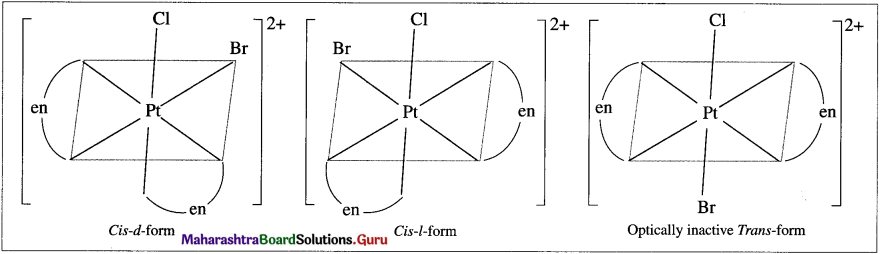
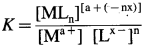
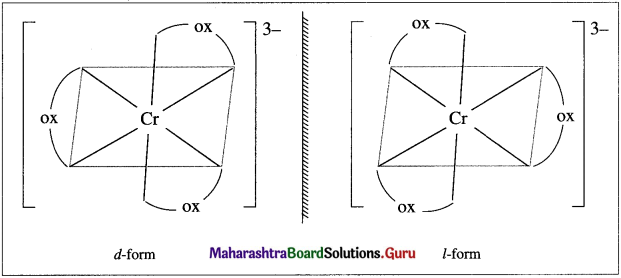
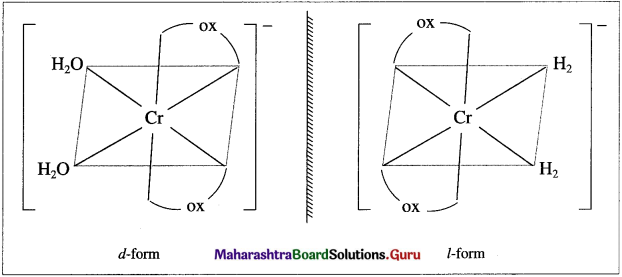
Everyone should make an effort to educate youngsters about the ill effects of tobacco. At the same time, there should be government control over sale of tobacco products. Strict action should be taken on companies selling tobacco illegally in remote as well as rural areas. At the same time, strict action also must be taken to reinforce the already existing ban on the sale of tobacco products  near educational institutes. Health check-up camp must be organized regularly to detect oral diseases specially cancer. Mass-media should be aggressively used to campaign against tobacco.

(iii) Man vs Nature

Human beings are the creation of nature. Humans get food, clothing water, shelter, air and a ton of other things from nature. Our mother earth is a unique planet where conditions are suitable for life. Breathing is the most necessary and natural action for every moment which depends on the nature. But we are behaving carelessly on the planet. We hurt nature due to our carelessness.

We have set up millions of factories on the earth which create and increase air pollution. Smoke from vehicle is added daily. This causes pollution and affects our health too. At the same time, we go on cutting tress which actually are our best friends. Besides greed for the forest products, humans greed for encroaching forest land for his use is increasing day by day. As a result of it, wild life is also in danger. There are vast reservoirs of pure drinking water on the globe but we are using it carelessly and polluting it.

It has been noted by researches that in coming 50 years there will scarcity of oil. Global warming is hazardous for everyone. It is creating problems to Glaciers. Not only man but other animals are also creations of the nature but we have put their life too in danger. As a result we don’t find the small bird ‘sparrow’ in polluted cities. Actually by keeping this attitude towards nature, man is digging his own grave. Nature is powerful enough to correct hostile actions of human beings. If nature decides to correct human actions, flood, tsunami, famine, anything can be the result. Therefore it is the need of time that humans should live smartly in harmony with nature and respect nature too.

(iv) Child Labour: A Curse to Humanity

Child Labour is a curse to humanity. Children are supposed to go to school, enjoy and learn but are found to be working. They are the most important asset of the society but poverty, illegitimacy, problem of unemployment make them do odd jobs. We are also responsible for this problem of child labour. This problem is more common in underdeveloped nation and thus needs to be corrected.

Protecting children from being child labourers is the responsibility of not only government but of each and every citizen. Use of children as a helping hand on own farm was common but the things changed after industrialization. Various factory owners appointed children and we find many children doing dangerous tasks in industries like fire crackers, carpet industries. In such industries their life is found to be in danger. In pencil making industry they are subjected to lung diseases, In carpet making industries they can lose their eyesight and in fire crackers industry they are exposed to dangerous chemicals. All this must be avoided and banned at the earliest.

To curb this, children from poor strata of the society should be provided with education and teenagers with vocational training. Education will create awareness among them. Some arrangement of providing them nutritious food should also be made by the Government and NGOs. To eradicate the problem of child labour, meticulous planning not only by the government but also by ‘us’ is needed. This is sadly not functioning to the fullest and as a result we share the blame of child labour.

Maharashtra Board Class 11 English Yuvakbharati Solutions Chapter 3.2 Blog Writing

(A3)

Question 1.
Prepare a word register for writing a blog, by choosing a particular topic of your own choice. You can write on environment, pollution, education etc.
Answer:
Word Register – Pollution:

global warming, Co2, breathing, tree plantation, factories, water pollution, air, soil, oxygen, ozone layer, diseases, infection, climate, ultraviolet rays.

Word Register Education:

Knowledge, school, college, vocational, training, personality, awareness, books, internet, apps, computer.

(A4)

Question 1.
Given below are the few topics for blog writing. Discuss and write.

  1. Personality Development
  2. Health and Fitness
  3. Social Dynamics
  4. Self Defence
  5. Communication Skills

Answer:
(i) Personality Development:

Personality is a perfect amalgam of a person’s physical and psychological development, manners, relationship with other members of the society, optimistic attitude and many other factors. Now a days management skill including time management, soft skills, health and leadership qualities also play an important role in shaping ones personality.

Practice of Yoga, meditation and regular exercise can keep a person fit. For learning time management one can keep small goals and try to complete the same in a limited time span. We must be polite while speaking with others. Our behaviour should not be aggressive. One must be a good listener and should be proactive rather than being reactive. Creative vision, optimism arise from within. Reading, knowledge about the world matters a lot.

Possessing all these qualities, increase the confidence of the person which is ultimately reflected in his character. Our positive gestures, while speaking, our being social help us to climb the ladder of success. To learn all these qualities, one must keep aside the ego. One should avoid backbiting and should always help others whenever needed. One should be confident enough, always try to learn new things and be one’s ownself. All these qualities cannot be achieved overnight. Some of these come from within while some can be achieved. Including all these qualities in a person’s character creates a good personality.

(ii) Health and Fitness

It is said that ‘Health is wealth’. Health in medical term does not only mean free of diseases but it also means a state of being well. A healthy person should be able to do his daily chores, his occupation. A healthy or physically fit person is able to face changes in the surrounding.

Health and fitness can be achieved by various ways such as intake of nutritious diet, healthy lifestyle, maintenance of hygiene, regular exercise or yoga and meditation. Not only this but a person’s positive attitude towards life matters the most. Proper and nutritious diet can keep you physically fit but meditation and yoga along with optimistic attitude keep one mentally fit. Regular practice of yoga and mediation reduces stress, blood sugar level and various other health issues like blood pressure and hyperacidity.

Now a days almost all human beings including kids are found to be under stress. Industrialization and computerization has no doubt made human life easy but created many health and fitness issue. There is a competition in every walk of life and one must survive the same. The basic need is therefore to stay healthy and fit. One can achieve it by going to gym, practising yoga and meditation, running, walking, cycling, aerobics, dance, swimming, playing outdoor games and many others. Practising any of these is the key of maintaining health. To maintain health and fitness has now become a need of the time.

(iii) Self Defence

Self defence means defending oneself from getting harmed. Physical self defence is the use of force for self protection. One can protect himself by being armed or unarmed too. Armed self defence allows the use of weapons for self defence while in unarmed self defence person does not use any weapon. His only weapon is his stamina and physical strength. There are some restrictions on the use of weapons. The armed force is the exception to it. Not only this, but self defence can also be achieved by avoiding the problematic situation.

Self defence techniques can be learned and learning the same is an urgent need of in today’s age. Specially women must learn it. In the changing scenario of increasing terrorism in society, it becomes a necessity for everyone to learn it. Many martial arts coaches train their students various methods of self defence. Apart from learning self defence, one must be optimistic enough to handle the problems in front of him. While handling the critical situation, everyone should trust in themselves and tackle with high level of confidence.

(iv) Social Dynamics

Man is a social animal. He lives in a society and is influenced by the people around him.. Our society is built on the principles of social dynamics. In society, behaviour of every person is different. People interact with one another and this results in deciding their behaviour in a group. Thus social dynamics is actually a behaviour of group which is the result of influence created by other group members. Social dynamics involve the study of interrelationship of people with one another.

When people come together in a group,they interact, share their thoughts, their ideas and knowledge. The exchange of thoughts, knowledge and ideas bring about positive change in the group behaviour, thereby bringing change in the society.

(v) Communication Skills

The way of communicating to others is an important skill in a person which enables us to understand the things that are being said. Our brains develop at every stage of our life using different techniques to communicate a message. There are many different skills used to communicate a message in an effective manner.

Maharashtra Board Class 11 English Yuvakbharati Solutions Chapter 3.2 Blog Writing 3

The principles of effective communication are Listening, Speaking when required, Curiosity, Engaging and Body language. Using the principles of effective comm unication helps increase our ability to be understood. This boosts our confidence and self esteem to speak.

Maharashtra Board Class 11 English Yuvakbharati Solutions Chapter 3.2 Blog Writing 4

Maharashtra Board Class 11 English Yuvakbharati Solutions Chapter 3.2 Blog Writing

(A5)

Question 1.
There are many blog websites like www.livejournal.com, www.wordpress. com, www.blogger.com and www.blogs.myspace.com. You can develop your blog writing skills taking on the basis of this make a list of career opportunities available to you.

Yuvakbharati English 11th Digest Chapter 3.2 Blog Writing Additional Important Questions and Answers

Question 1.
What is the importance of blog writing?
Answer:
A blog is an article on a topic expressing the views, experiences or feelings of a person. Writing a blog is really a challenging thing to do.

In the changing scenario of E-age, we find that joint families are rarely seen. Even in nuclear families now a days family members hardly share their views, ideas. (The reason may be any.) People are in contact with each other but are not connected. In such situation a blog plays very important role.

A blog gives a platform to the person to share his views, opinion or even feelings. In this way he gets an opportunity to communicate with people. Secondly in spite of availability of mass media like newspaper, writing of a person cannot be published always. A blog provides a person (blogger) to share his views and make it available for the readers. One can share anything interesting in a blog.

Maharashtra Board Class 11 English Yuvakbharati Solutions Chapter 3.2 Blog Writing

Question 2.
What is the difference between a blog writing and newspaper write up?
Answer:
A blog is an article wherein a person (a blogger) has right to share his views feelings or opinion about anything. A newspaper article writer does not share his feelings or views always. A newspaper article is generally focused on the topics of public interest. Most of the time newspaper articles are only informative. A newspaper article can be written daily or weekly whereas a blogger can write and post a blog at any time in a day.

Question 3.
What precaution is taken while developing a blog?
Answer:
A blog is an article expressing person’s views, feelings or opinion. Utmost precautions should be taken while posting a blog on social media. There is no limitation regarding number of words and number of topics on which a blog can be written. But a blogger must make sure to avoid repetition. A reader may find it uninteresting to read lengthy description of a simple thing.

A blog posted on social media is read by many people belonging to different caste, creed and community. A blogger must not post anything in his blog which may 1 hurt feelings of people or make antisocial elements active.

Question 4.
Why is a blog developed and uploaded?
Answer:
A blog is a platform one gets to express his views, feelings or opinions. A person a blogger) can communicate with the world through his writing. Writing a blog is an opportunity given to mature writers. A blogger can refine his writing skills while expressing his views. It is uploaded so that he can communicate and share his experiences with others. It can give a chance to the blogger to be a good writer.

Maharashtra Board Class 11 English Yuvakbharati Solutions Chapter 3.2 Blog Writing

Question 5.
Go through the blog given in the text and also refer to different blogs on the internet about various social issues and environment hazards. Write blogs on the topics given below.
Answer:
(i) Are we Happier than our Forefathers?

There was a time centuries ago, in the stone age when man wandered about from place to place in groups. Slowly life became stable, when man decided to settle down. He learnt farming and domestication of animals like cow, sheep, goat and buffalo. These animals gave him milk and helped him to plough the field as well as carry loads. This change in man was a definite change for the better.

Of course, today the world has progressed by leaps and bounds. Quick means of communication, advancement in technology, the boon of the atomic age has made distances so small. The world today has become a smaller place, thanks to progress.

Medicines and drugs have lengthened life and given us cures for dreaded disease. Today man can do so many things that our forefathers could not even dream of achieving. Excessive use of fuels such as diesel, kerosene, petrol and other harmful chemicals have ruined the planet earth. Our atmosphere is so steeped in poisonous gases that we have no fresh air to breathe. This has resulted in the depletion of the ozone layer. Atomic weapons and bombs are a constant threat to our very existence.

Do we honestly say we are happier than our forefathers? At what cost? Yes, we are more comfortable, we have progressed, but at what cost? At the cost of our lives and happiness. Let us not forget that happiness does not depend on material comforts. It depends on the state of our mind. I can safely say that we have forfeited our mental happiness for worldly comforts.

(ii) If Trees Could Talk

Tree can speak to you and I may not understand what they are trying to tell us. It was proved by the famous scientist, Jagdish Chandra Bose, that plants can feel pain and can even reveal how they are feeling. Unfortunately, these sounds cannot be understood by man and can only be recorded on a graph. Vegetation is not deaf and dumb, though we may think so.

If trees could speak, they would have told us several things both good and bad. I am sure the bad things would be much more than about the good habits of man. I am sure the tree would grumble and cry. out in pain at man’s indecent, vulgar and rude behaviour.

All trees would complain about the brutal and barbarious behaviour of man. A tree would explain to us that it gave us shade from the hot blistering sun, plenty of wood, choicest fruit, medicinal herbs, ayurvedic pesticides and insecticides like the neem, yet man is so ungrateful and despicable, he takes the tree for granted and does not care if he chops it and hacks it painfully.

Man goes about cutting down forests and building high rise structures or big factories that give out poisonous gases. Trees, if we could only understand what they were trying to tell us, would inform us that we were murderers and butchers who took pleasure in destroying nature that God has created for man. They would have wept with grief and pain as they related the insanity and callousness of man.

(iii) Leisure – It’s Uses and Abuses

I remember W. H. Davis saying in one of his poems
‘What is this life, if full of care,
We have no time to stand and stare?!

These lines tell us that in the middle of rushing here and doing this and that and attacking this job and completing that duty, we must ,find time to relax and.cool down. Those of us living in cities spend all our free time, glued to the TV – The idiot box as our elders call it. The rich spend their time in restaurants and nightclubs. No one today spends time with Nature – especially those living in towns and cities.

The best way to spend one’s leisure moments is to come in contact with nature in a park, a zoo, a garden or an aviary. Some of us have a tendency of misusing our leisure time. Some youngsters spend their time gambling, drinking, teasing girls, stealing, getting into trouble by making fun of passers-by and by gossiping. All these activities cause terrible harm to themselves as well as to others. Those belonging to rich families have stag parties or kitty parties and drink alcohol, gamble and go about spoiling the names of their acquaintances and friends.

We can use our leisure time developing our hobbies such as photography, reading, writing, gardening, doing embroidery, painting, learning dancing, playing musical instruments and other things for which we have talents. It is better to develop our talents, for who knows when these will help us in our life. Relaxation is important, but just lying idle will cause trouble to our minds as well as to our body, hence we must do something constructive and useful in our leisure hours.

(iv) Democracy – The Best form of Government

Abraham Lincoln described democracy as the Government of the people, for the people and by the people. This system of government is the most acceptable because every single individual in the country is a part of the governing process. The legislature is elected by the people themselves, while the Executive is selected from the Legislature. A corrupt government will surely not be elected again.

Other forms of government are monarchy and dictatorship. In both monarchy and dictatorship, the ruler is the Supreme ultimate power over the people. The people themselves have absolutely no say in the matter. They have no remedy against misuse of power or against in justice. There is no individual freedom, no freedom of speech or expression. The individual is a captive in his own nation. How ironical this may seem, but it is very true.

I am not saying that democracy is the most ideal form of Government. It does not guarantee social justice and is quite often corrupt. It is slow in functioning and not very capable in emergencies, but yet we feel it is the most effective form of Government.

How can there be an effective function of governments like monarchy, dictatorship and autocracy when the individual is left out completely? Such governments profess ‘might’ is right theory and are more often than not, corrupt and evil one man shows.

The most important attribute of democracy is the fact that all are treated equally before the law, irrespective of caste, creed and sex. The dignity of man is recognised and respected. The individual takes active part in the governing of his country. He is responsible if things go wrong. We therefore feel that democracy is more advantageous than other forms of governments.

(v) Unity in Diversity

India is a land where we can clearly see Unity in Diversity. This means that there is a strand of oneness running through all of us that makes us one in mind and spirit and thought.

India is diverse in topography. We have in one country snow capped mountains as well as deserts, plains as well as plateaus, rivers as well as lakes, areas of heavy rainfall as well as very scanty rainfall. Yet India is one country to all of us. India is a land of diverse people. There are people living in different states who have different language, different mode of dressing different food habits and different traditions. Yet they are all Indians.

We have people of different religions living together as brothers. These external difference of physical features of dress, of language, of food and of festivals are superficial differences to the true Indian. What really matters in the feeling of being an Indian. The strand of Indianness, is what really matters. It is this strand that brings in all Indians the feeling of belonging, the feeling being at home with your near and dear ones.

Today sadly, there is an atmosphere of intolerance, narrow – mindedness, groupism and party spirit, but yet we can proudly say that we have not lost our basic values. The sense of national unity is a priority with most Indians. We must however strive for this unity to be strengthened. We must instill in our youth the feeling of pride for our culture and tradition and we must remember to retain our identity as Indians.

(vi) Students and Discipline

Discipline is of utmost importance in society and it is the student who needs it most if he is going to become an exemplary citizen. Today physical fitness is not all. The student must be taught values and the meaning of discipline in order to make him whole in body and mind. If he is not disciplined from the very beginning he will turn out dissatisfied with life, a failure, and a candidate for violence.

Let us not forget, that teaching discipline to the student is not solely the job of the school. Parents have to be very much involved in this. It is they who have to maintain discipline at home and in the neighbourhood.

We notice that the problem of indiscipline becomes worse as the student grows older and goes to college. This must be because he is now getting more and more exposed to media. TV soaps and other serials and the cinema are always portraying students as indisciplined. They are shown as not having any regard for their elders and betters. Our children love to ape, hence they copy all the bad habits and examples of indiscipline.

Students are becoming more and more violent today. We do not say that they have no reasons to have grievances. Of course, they are not satisfied with the syllabus. They are unhappy with the way teaching is done. They are worried about stiff competition. They are bothered about the free pattern and the partiality of the teachers. These are serious grievances, but this does not mean that students should retaliate by being indisciplined. The education system needs to be changed and our young students must be taught how to choose between right and wrong. A well-disciplined person will become a success in life.