Maharashtra Board Class 6 Civics Solutions Chapter 1 Our Life in Society

Balbharti Maharashtra State Board Class 6 Civics Solutions Chapter 1 Our Life in Society Notes, Textbook Exercise Important Questions and Answers.   

Maharashtra Board Class 6 Civics Solutions Chapter 1 Our Life in Society

Class 6 Civics Chapter 1 Our Life in Society Textbook Questions and Answers

1. Fill in the blanks:

Question 1.
Man felt the need for ______ for the day to day affairs of society to run smoothly.
Answer:
rules

Question 2.
_______ helps the development of people’s talents.
Answer:
Society

Maharashtra Board Class 6 Civics Solutions Chapter 1 Our Life in Society

Question 3.
We all have some emotional and some _____ needs too.
Answer:
physical

2. Answer in one sentence:

Question 1.
What are the basic needs of man.
Answer:
Food, clothes, shelter, education and health 1 are the basic needs of man.

Question 2.
Whose company do we like?
Answer:
We like the company of our family members, relatives and friends.

Question 3.
What opportunities does society provide us with?
Answer:
Society provides the opportunities for expressing our thoughts and feelings and to develop our artistic and other talents.

Maharashtra Board Class 6 Civics Solutions Chapter 1 Our Life in Society

3. What do you think? Answer in two or three sentences:

How is a society formed?
Answer:

  • A society is formed when people come together to achieve certain common objectives.
  • A society includes different groups, institutions and organisations.

Question 2.
Why is it necessary to set up a permanent system in society?
Answer:

  • In order to fulfil needs like food, clothing, shelter and security, society has to create a , permanent system.
  • Without a system, the day-to-day affairs of the society cannot be carried on.
  • A system is essential for the continued existence of the society.

Question 3.
What makes life in society more stable and organised?
Answer:

  • A Vast systen needs to be created includes factories to manufacture tools and equipment used for farming, a market for the goods produced, etc.
  • The existence of many such systems makes a society stable and organised.

Question 4.
If there were no social institutions what difficulties would we have faced?
Answer:

  • If there were no social institutions individual development would not have taken place at the fullest. It would be difficult to meet our physical and emotional needs.
  • There would be no social stability or security.

Maharashtra Board Class 6 Civics Solutions Chapter 1 Our Life in Society

4. What would you do in the following situations?

Question 1.
Your friend has forgotten to bring something he needs in school.
Answer:
First, I would ask him if I could help. I will offer him the things which he needs. If I don’t have it I will inform the teacher and ensure that it reaches him. After all a friend in need is a friend indeed.

Question 2.
You meet a blind or otherwise handicapped person on the way.
Answer:
I will first ask if he needs help and extend a helping hand to him. I will help him cross the road and ensure that he reaches his destination safely.

Activities:

  • Meet a skilled tradesman who makes farmers’ tools. Make a list of all those who help the farmer in his work.
  • Visit a nearby bank and find out the different purposes for which the bank lends money.
  • Make a list of man’s basic needs and some additional needs.

Class 6 Civics Chapter 1 Our Life in Society Additional Important Questions and Answers

Fill in the blanks:

Question 1.
Variety of ______ leads to development of our skills and capabilities.
Answer:
occupations

Question 2.
Our life in society is ______.
Answer:
interdependent

Maharashtra Board Class 6 Civics Solutions Chapter 1 Our Life in Society

Question 3.
Every person is bom with some qualities and _______.
Answer:
capabilities

Question 4.
Society helps in the development of our ________ capabilities and the power to think.
Answer:
emotional

Question 5.
A society is formed when people come together to achieve certain common ________.
Answer:
objectives

Question 6.
A ________ is essential for continued existence of the society.
Answer:
system

Question 7.
The existence of many systems makes a society _______.
Answer:
stable

Question 8.
Education and health related services and facilities allow us to live with _____.
Answer:
dignity

Question 9.
Our ________ is a part of the society.
Answer:
family

Maharashtra Board Class 6 Civics Solutions Chapter 1 Our Life in Society

Name the following:

Question 1.
Any two physical needs of man:
Answer:
Food, clothing.

Question 2.
The people who provide companionship:
Answer:
Family members, friends.

Question 3.
Two basic needs:
Answer:
Education, health.

Question 4.
Two emotional needs of man:
Answer:
Security, appreciation.

Question 5.
Artists whose talents are developed in the society:
Answer:
Singers/ musicians.

Complete the analogy:

Question 1.
Food : Physical needs :: appreciation : __________.
Answer:
emotional need

Maharashtra Board Class 6 Civics Solutions Chapter 1 Our Life in Society

Question 2.
Nomadic stage : No stability and security :: settled : ______.
Answer:
organised and security life way of life.

State whether the following statements are true or false giving reasons:

Question 1.
There are rules in society.
Answer:
TRUE

  • Living in society, man felt the need for rules to help in the smooth functioning of day-to¬day matters.
  • Rules have made our life organised and stable.

Question 2.
A society is a mob or crowd of people.
Answer:
FALSE
A society is formed when people come together to achieve certain common objectives

Answer in one sentence:

Question 1.
From which stage has man moved into a settled social life?
Answer:
Man has moved from a nomadic stage to a settled social life.

Question 2.
What was one of the main motivations for the creation of society?
Answer:
Man realised that living in a group provides him security and develops an organised way of life and this was one of the main motivation for creation of society.

Maharashtra Board Class 6 Civics Solutions Chapter 1 Our Life in Society

Question 3.
What did rules give rise to?
Answer:
Rules gave rise to conventions, ethics, values, rules and laws.

Question 4.
Which facilities allow us to live with dignity?
Answer:
Education and health related services and facilities allow us to live with dignity.

Question 5.
In what way does society help us to develop our personality?
Answer:
Society helps in the development of our emotional capabilities and power to think. It also provides the opportunity for expressing our thoughts and feelings.

Answer in two or three sentences:

Question 1.
What would happen in the field of agriculture if there was no system to carry out various activities.
Answer:
(a) Various institutions are created to perform all functions related to agriculture which includes factories to manufacture farming tools and equipments, banks to provide loans to the farmers and a market for the agricultural products.

(b) If the above systems did not exist it would be difficult to carry out agricultural activities.

What would you do in the following situations ?

Question 1.
There is a melodious singer in your society, but he cannot nurture his talent due to lack of funds.
Answer:
I will encourage him to pursue his talent and will inform the elders in the society about his talent and request them to help j him. I can also encourage him to participate in the functions organised by the society and thereby showcase his talent.

Give reasons:

Question 1.
Our social life is interdependent.
Answer:

  • A variety of industries and occupations help to fulfil our needs.
  • This leads to development of our skills and capabilities.
  • Our basic needs are fulfilled in society.
  • We depend on each other for our emotional’ needs such as security, appreciation, praise, j support, etc.
  • Thus our life in society is interdependent.

Maharashtra Board Class 6 Civics Solutions Chapter 1 Our Life in Society

Question 2.
The variety of occupations in the society help us in fulfilling our needs.
Answer:

  • A variety of industries and occupations help us to fulful our needs, for example, we need books for studying and paper for books.
  • That is why occupations like manufacturing papery printing books, binding, etc. also develop.
  • Thus the variety of occupations in the society. help us in fulfilling our needs.

Maharashtra Board Class 7 Civics Solutions Chapter 6 Directive Principles of State Policy and Fundamental Duties

Balbharti Maharashtra State Board Class 7 Civics Solutions Chapter 6 Directive Principles of State Policy and Fundamental Duties Notes, Textbook Exercise Important Questions and Answers.

Maharashtra Board Class 7 Civics Solutions Chapter 6 Directive Principles of State Policy and Fundamental Duties

Class 7 Civics Chapter 6 Directive Principles of State Policy and Fundamental Duties Textbook Questions and Answers

1. List the restrictions on the powers of the Government.
Maharashtra Board Class 7 Civics Solutions Chapter 6 Directive Principles of State Policy and Fundamental Duties 1
Answer:
Restrictions upon the powers of the Government are listed below:

  • State should not discriminate between and among citizens on the basis of caste, religion, race, language or gender.
  • State shall not deny anybody equality before the law and equal protection of the laws.
  • No person shall be deprived of his life.
  • State shall not impose any religious taxes.

Maharashtra Board Class 7 Civics Solutions Chapter 6 Directive Principles of State Policy and Fundamental Duties

2. Say ‘Yes’ or ‘No’.

Question 1.
The jobs advertised in the newspaper are for men and women both.
Answer:
Yes

Question 2.
Men and women doing the same work in a factory get different wages.
Answer:
No

Question 3.
Government implements various schemes for the improvement of public health.
Answer:
Yes

Question 4.
State shall protect all monuments of historic interest and national importance.
Answer:
Yes

Maharashtra Board Class 7 Civics Solutions Chapter 6 Directive Principles of State Policy and Fundamental Duties

3. Tell why:

Question 1.
The State shall protect all monuments of historic interest and national importance.
Answer:

  • It is one of important Directive Principles of State policy.
  • Monuments are a part of India’s rich cultural heritage. A rich source to learn history, it is our collective responsibility to protect them.

Question 2.
A pension scheme is implemented for old people.
Answer:

  • The pension scheme is the State’s way of offering public assistance to citizens who have retired from work.
  • This ensures that the retired person can lead a comfortable life.
  • Hence a pension scheme is implemented for old people.

Question 3.
Free and compulsory education has been made available to children in the age group 6 to 14.
Answer:

  • No child should be deprived of education. So it is made available.
  • Right to Liberty now also includes Right to Education and all children are entitled to get education as a Fundamental right.

4. Say right or wrong. Correct and write the wrong ones:

Question 1.
Not to let the National Flag fall down on the ground.
Answer:
Right: It is our Fundamental Duty to respect the National Flag.

Question 2.
To stand in attention while the National Anthem is playing.
Answer:
Right: It is our Fundamental Duty to respect our National Anthem.

Maharashtra Board Class 7 Civics Solutions Chapter 6 Directive Principles of State Policy and Fundamental Duties

Question 3.
To carve or paint our names on the walls of a historic place like a fort.
Answer:
Wrong: It is our Fundamental Duty to value and preserve the rich heritage of our composite culture.

Question 4.
To give lesser wages to women than to men for the same work.
Answer:
Wrong: Fundamental Rights put restrictions on the power of the government and one of the restriction states that the state should not discriminate between and among citizens on the basis of gender amongst other things.

Question 5.
To keep public places clean.
Answer:
Right: It is our Fundamental Duty to safeguard public property.

5. Write about the following:

Question 1.
The Directive Principles of the Constitution enumerated in the textbook.
Answer:
(i) The State should secure adequate means of livelihood to all citizens without any gender discrimination.

(ii) The State should secure equal pay for equal work for both men and women.

(iii) The State should secure the improvement of public health.

(iv) The State shall endeavour to protect and improve the environment and safeguard the forests and wild-life of the country.

(v) The State shall protect all monuments of historic interest and national importance.

(vi) The State shall promote with special care the educational and economic interests of the weaker sections of the people, especially the Scheduled Castes and Tribes.

(vii) The State shall offer public assistance to citizens in cases of unemployment, old age, sickness, etc.

(viii) The State shall secure a uniform civil code applicable to the entire country.

Question 2.
The provision of a Uniform Civil Code for citizens in the Directive Principles of the Indian Constitution.
Answer:
(i) The provision of a Uniform Civil Code for citizens in mentioned in the Constitution.

(ii) It aims to replace personal laws based on the customs and scriptures of the different religious communities living in India with a common set of laws, which is uniform to all the citizens of India.

Maharashtra Board Class 7 Civics Solutions Chapter 6 Directive Principles of State Policy and Fundamental Duties

Question 3.
Why is it said that the Directive Principles and Fundamental Rights are two sides of the same coin?
Answer:

(i) Directive Principles of State Policy and Fundamental Rights are two sides of the same coin.

(ii) Due to Fundamental Rights, citizens get the most needed liberty, while Directive Principles of State Policy creates an atmosphere conducive to the growth of democracy.

6. What are the ways in which citizens can conserve the environment ? Write with examples.
Answer:
There are various ways in which citizens can conserve the environment:

(i) Citizens can support the endeavour of the State to protect and improve the environment and safeguard the forests and wild-life of the country.

(ii) Citizens should collectively take responsible actions to protect and improve the natural environment we are a part of.

(iii) Citizens should put to an end cruelty towards animals and have compassion for living creatures.

Activities

  • Education is our right. Form groups and discuss our duties in this respect.
  • The State shall protect all monuments of historic interest and national importance. This is one of the Directive Principles. Find out the efforts made by the State about the conservation and protection of forts and make a chart.
  • Gather information about the schemes implemented by the Government for children’s health.

Class 7 Civics Chapter 6 Directive Principles of State Policy and Fundamental Duties Additional Important Questions and Answers

Complete the sentence by choosing the appropriate words from the options given below:

Question 1.
Due to citizens get the most needed liberty. (Fundamental Rights, Directive Principles of State Policy, Fundamental Duties)
Answer:
Fundamental Rights

Question 2.
In order that the Indian citizens become conscious of their responsibilities ______ were included in the Constitution.
(Fundamental Rights, Fundamental Duties, Directive Principles of State Policy)
Answer:
Fundamental Duties

Maharashtra Board Class 7 Civics Solutions Chapter 6 Directive Principles of State Policy and Fundamental Duties

Question 3.
We should perform all the tasks that we have undertaken honestly always striving for ______. (excellence, progress, prosperity)
Answer:
excellence

Question 4.
Fundamental Rights restricts the power of the government to impose any ________. (laws, restrictions, religious taxes)
Answer:
religious taxes

Question 5.
Every citizen of India who is a parent or guardian should provide opportunities of education to his or her child or ward between the age of six and _______years. (eighteen, fourteen, seventeen)
Answer:
fourteen

Say ‘Yes’ or ‘No’:

Question 1.
The state should secure the improvement of public health.
Answer:
Yes

Question 2.
Public assistance is provided to citizens in cases of unemployment, old age, sickness etc.
Answer:
Yes

Name the following:

Question 1.
Put restriction on the power of the government.
Answer:
Fundamental Rights

Question 2.
Direction or guidelines in the Constitution about how to achieve the goals expressed in the Preamble of the Constitution.
Answer:
Directive Principles of the State Policy

Question 3.
Any two challenges faced by India after independence.
Answer:
Establishing order, carrying out smooth administration.

Maharashtra Board Class 7 Civics Solutions Chapter 6 Directive Principles of State Policy and Fundamental Duties

Question 4.
Any one directive which ensures that there is no gender discrimination.
Answer:
State should secure equal pay for equal work for both men and women.

Question 5.
It is our Fundamental Duty to respect these two national symbols.
Answer:
National Flag, National Anthem.

Question 6.
Any one practice we are expected to renounce according to the Fundamental Duties listed in our Constitution.
Answer:
Practices derogatory to the dignity of women.

Question 7.
It is our Fundamental Duty to develop these values.
Answer:
Scientific temper, Humanism, Spirit of inquiry and reform.

Say right or wrong with reason. Correct the write down the corrections:

Question 1.
To sacrifice our life for the sake of our motherland.
Answer:
Right: It is our Fundamental Duty .to defend the country, and to render national service when called upon to do so.

Question 2.
The State protects all monuments of historic interest and national importance.
Answer:
Right: It is one of the important Directive Principles of the State Policy.

Maharashtra Board Class 7 Civics Solutions Chapter 6 Directive Principles of State Policy and Fundamental Duties

Answer in one or two sentence:

Question 1.
Which restrictions on the power of the government by the Fundamental Rights ensure that no discrimination is practised by the State?
Answer:
Fundamental Rights restrains the State from discriminating between and among citizens on the basis of caste, religion, race, language or gender.

Question 2.
When India got independence, why was it necessary to draw up new policies?
Answer:
When India got independence the task of nation building had to be undertaken and for this new policies had to be drawn up.

Question 3.
What is included in the Directive Principles of the State Policy with respect to environment?
Answer:
It is included in the Directive Principles of the State Policy that the State shall endeavour to protect and improve the environment and safeguard the forest and wild-life of the country.

Question 4.
What is stated in the Directive Principles of State Policy with respect to weaker sections of the Society?
Answer:
It is stated in the Directive Principles of the State Policy that State shall promote with special care the educational and economic interest of the weaker sections of the people, especially the Scheduled Castes and Tribes.

Question 5.
What is the State expected to secure as per the Directive Principles of State Policy which is applicable to the entire country?
Answer:
The State is expected to secure a Uniform Civil Code applicable to the entire country according to the Directive Principles of State policy.

Question 6.
What can we do if a Directive is not implemented by the Government.
Answer:
If a Directive is not implemented by the Government, we can put pressure on the Government in various ways to make a policy in order to meet the goals.

Question 7.
When will the benefits of the various schemes of the Government not reach all the people?
Answer:
The benefits of the various schemes of the government cannot reach all the people if they do not fulfil their Fundamental Duties.

Maharashtra Board Class 7 Civics Solutions Chapter 6 Directive Principles of State Policy and Fundamental Duties

Question 8.
Why were the Fundamental Duties included in the Constitution?
Answer:
Fundamental Duties were included in the Constitution so that the Indian citizens become conscious of their responsibilities.

Question 9.
Why is it mentioned in our Fundamental Duties that we should strive towards excellence in all spheres of individual and collective activity?
Answer:
It is mentioned in our Fundamental Duties that we should strive towards excellence in all spheres of individual and collective activity so that the nation can constantly rise to higher levels of endeavour and achievement.

Answer the following in brief:

Question 1.
What are the ways in which citizens can conserve the environment?
Answer:
There are various ways in which citizens can conserve the environment:

  • Citizens can support the endeavour of the State to protect and improve the environment and safeguard the forests and wild-life of the country.
  • Citizens should collectively take responsible actions to protect and improve the natural environment we are a part of.
  • Citizens should put to an end cruelty towards animals and have compassion for living creatures.

Question 2.
State any five Fundamental Duties of the Indian citizens.
Answer:
Fundamental Duties of the Indian citizens are as follows:

  • To abide by the Constitution and respect the National Anthem.
  • To cherish and follow the noble ideals which inspired our national struggle for freedom.
  • To uphold and protect the sovereignty, unity and integrity of India.
  • To defend the country, and to render national service when called upon to do so.
  • To promote harmony and the spirit of common brotherhood transcending diversities; to renounce practices derogatory to the dignity of women.

Maharashtra Board Class 7 Civics Solutions Chapter 6 Directive Principles of State Policy and Fundamental Duties

Give reason:

Question 1.
The State shall protect all monuments of historic interest and national importance.
Answer:

  • It is one of important Directive Principles of State policy.
  • Monuments are a part of India’s rich cultural heritage. A rich source to learn history, it is our collective responsibility to protect them.

Question 2.
A pension scheme is implemented for old people.
Answer:

  • The pension scheme is the State’s way of offering public assistance to citizens who have retired from work.
  • This ensures that the retired person can lead a comfortable life.
    Hence a pension scheme is implemented for old people.

Question 3.
Free and compulsory education has been made available to children in the age group 6 to 14.
Answer:

  • No child should be deprived of education. So it is made available.
  • Right to Liberty now also includes Right to Education and all children are entitled to get education as a Fundamental right.

Give your own response:

Question 1.
What else do you think the Government should do for students? Make a list of your demands. How would you convince others that your demands are just?
Answer:
The list of our demands are:

  • Emphasis on skill training in school.
  • Choice of a wide variety of subjects based on one’s interest.
  • Compulsory training in a particular Sport.
  • Making a foreign language compulsory in the curriculum.
  • Better facilities in schools.
  • Programme of mid-day meals should be implemented in all the schools in the rural areas.
  • Inspection of schools from time to time to check the quality of education imparted.
  • I will convince others through dialogues and discussion and go by the will of the majority.

Maharashtra Board Class 7 Civics Solutions Chapter 6 Directive Principles of State Policy and Fundamental Duties

Question 2.
Which improvements will be possible with the following facilities offered by the Government?
Answer:

  • Public toilets: Maintenance from time to time and continuous water supply.
  • Clean water supply: Ensuring that water treatment to remove contaminants is done before it reaches homes and other places for consumption.
  • Vaccination of children:
  • Create awareness among parents about different vaccinations through different media of communication.
  • Organise vaccination drives from time to time.

Can you tell?

Question 1.
There is a directive to ensure ‘equal pay for equal work’.
Which principles and ideals of the Constitution will be realised with this directive? Why does it happen that inspite of doing the same work, women are paid less than men?
Answer:
(i) Right to Equality and the assurance that State shall not discriminate among citizens will be realised with this objective.

(ii) Due to lack of awareness of rights and no strict implementation of law, we witness gender discrimination at work.

Observe the Picture and answer the questions given below:
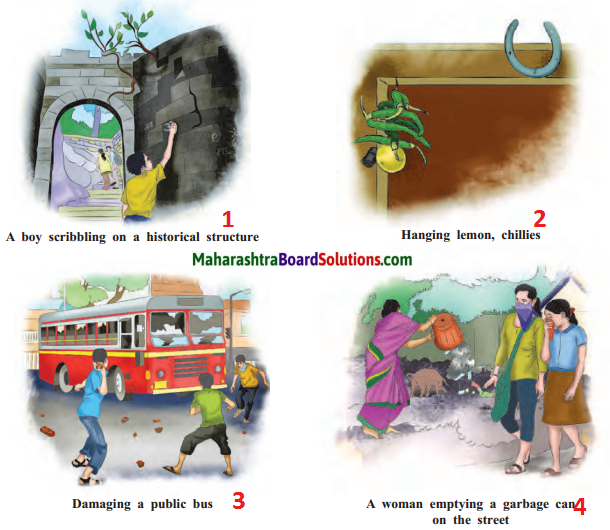
Maharashtra Board Class 7 Civics Solutions Chapter 6 Directive Principles of State Policy and Fundamental Duties 2
Which of the Fundamental Duties are not being followed in the situations above?

Question 1.
A boy scribbling on a historical structure.
Answer:
The duty to value and preserve the rich heritage of our composite culture.

Question 2.
Hanging lemon, chillies
Answer:
The duty to develop the scientific temper, humanism and spirit of inquiry and reform.

Question 3.
Damaging a public bus
Answer:
The duty to safeguard public property and to abjure violence.

Question 4.
A woman emptying a garbage can on the street.
Answer:
The duty to protect and improve the natural environment.

What do you think?

Question 1.
Girls and boys between the ages 6 and 14 have got the Right to Education. All the girls and boys in this age group should be in school. Yet many girls and boys are not able to go to school because of many reasons. They have to work to help their parents earn a living for the family. Do you think that it is unfair to such children to insist that they go to school?
Answer:
No I don’t think it is unfair to such children to insist that they go to school.

(i) Practising child labour is a form of exploitation and we have the Right against Exploitation which extends constitutional protection to children.

(ii) Similarly it is the Fundamental Duty of every citizen who is a parent or guardian to provide opportunities of education to his or her child or ward between the age of six and fourteen years.

Maharashtra Board Class 7 Civics Solutions Chapter 6 Directive Principles of State Policy and Fundamental Duties

Question 2.
Which improvements will be possible with the following facilities offered by the Government?
Answer:
(i) Public toilets :

  • Public toilets will eradicate open defecation and will improve the overall public health
  • As the availability of toilets at close proximity to highway will ensure that people do not face inconvenience while traveling.

(ii) Clean water supply:

  • Water is our basic need hence providing clean water is very important
  • It will prevent the spread of water borne diseases like cholera, jaundice, etc.

(iii) Vaccination of children:

  • Vaccination will improve the health of infants
  • Vaccination will reduce the occurrence of diseases like polio in infants

Maharashtra Board Class 6 Geography Solutions Chapter 3 Comparing a Globe and a Map; Field Visits

Balbharti Maharashtra State Board Class 6 Geography Solutions Chapter 3 Comparing a Globe and a Map; Field Visits Notes, Textbook Exercise Important Questions and Answers.

Maharashtra Board Class 6 Geography Solutions Chapter 3 Comparing a Globe and a Map; Field Visits

Class 6 Geography Chapter 3 Comparing a Globe and a Map; Field Visits Textbook Questions and Answers

Question 1.
What characteristics of two and three dimensional devices did you note?
Answer:
Two-dimensional objects have length and width and its product is area. Three-dimensional objects have length, width and height and its product is volume.

Question 2.
What features can be shown on a very small globe?
Answer:
On a very small globe the entire earth can be represented.

Maharashtra Board Class 6 Geography Solutions Chapter 3 Comparing a Globe and a Map; Field Visits

Question 3.
Which device will be suitable for understanding the concept of day and night on the earth?
Answer:
The globe is suitable for understanding the concept of day and night on the earth.

Question 4.
Which device will be useful to show your village/city?
Answer:
A map can be useful to show a village/city.

Question 5.
Which device can be easily carried from one place to another?
Answer:
A map can be easily carried from one place to another.

Activity:

Make two groups. Each group should ask the other group to find the locations of different places on the globe. You may also do this with a map.

Class 6 Geography Chapter 3 Comparing a Globe and a Map; Field Visits Textbook Questions and Answers

Study the world map, a map of India and the globe and answer the following questions:
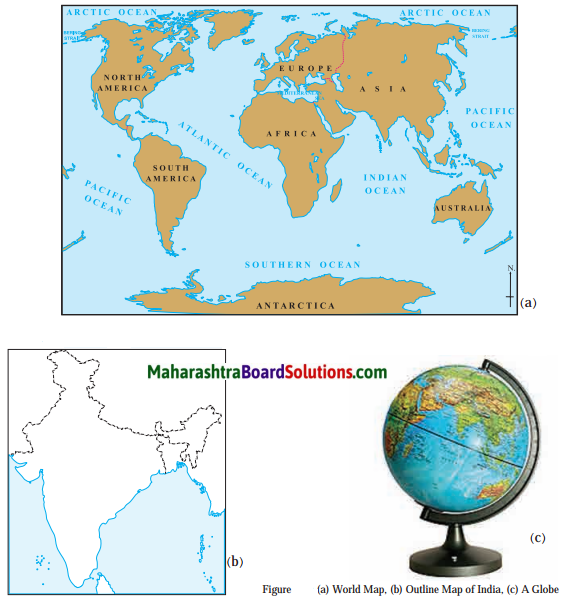
Maharashtra Board Class 6 Geography Solutions Chapter 3 Comparing a Globe and a Map Field Visits 1

Question 1.
Which device is flat?
Answer:
The world map and map of India are flat.

Maharashtra Board Class 6 Geography Solutions Chapter 3 Comparing a Globe and a Map; Field Visits

Question 2.
Which device is spherical?
Answer:
The globe is spherical.

Question 3.
Which of these devices allows you to see the entire area of the earth at the same time?
Answer:
The globe allows us to see the entire area of the earth at the same time.

Question 4.
Which device allows you to see only one side of the earth at a time?
Answer:
The map allows us to see only one side of the earth at a time.

Question 5.
Which device can be used for studying a particular region in detail?
Answer:
A map can be used for studying a particular region in detail.

Question 6.
Which device can be called a model of the earth?
Answer:
The globe can be called a model of the earth.

Class 6 Geography Chapter 3 Comparing a Globe and a Map; Field Visits Textbook Questions and Answers

Fill in the blanks with the correct option from the brackets:

Question 1.
Map is ______ dimensional whereas a globe is ______ dimensional. (one, tvo, three, four)
Answer:
two, three

Question 2.
______ is a representative model of theentire earth. (map, sphere, globe)
Answer:
Globe

Question 3.
A field visit is an important method of studying ________.(political science, geography, history)
Answer:
geography

Question 4. _______ is the largest operational globe in the world. (EARTHA, Earth, Earthia)
Answer:
EARTHA

Name the following:

Question 1.
Two objects which are two-dimensional.
Answer:
Map, land

Question 2.
Two objects which are three-dimensional.
Answer:
Globe, duster

Question 3.
Two places for students to be taken for field visit.
Answer:
Post office, mall

Maharashtra Board Class 6 Geography Solutions Chapter 3 Comparing a Globe and a Map; Field Visits

Question 4.
Place where EARTHA is housed.
Answer:
Yarmouth in the State of Maine in the United States of America.

Answer the following questions in detail:

Question 1.
How is a field visit an important method of studying geography?
Answer:

  • A field visit helps us to understand the geographical and social conditions of a place.
  • It provides an opportunity to directly interact with the local people and understand their problems.

Question 2.
Write a note on – EARTHA.
Answer:

  • EARTHA is the largest operational globe in the world.
  • It is housed at Yarmouth in the State of Maine in the United State of America.
  • The rotation and revolution speed of this globe is maintained as per that of the earth.

Maharashtra Board Class 6 Geography Solutions Chapter 3 Comparing a Globe and a Map; Field Visits

Question 3.
How is a map drawn?
Answer:
Various steps to draw a map:

  • A wire globe is prepared.
  • A source of light is placed inside the globe.
  • Thereafter projection of the wire graticule is obtained on a paper
  • This projection is used to drawmaps.

Maharashtra Board Class 6 Geography Solutions Chapter 2 Let us Use the Graticule

Balbharti Maharashtra State Board Class 6 Geography Solutions Chapter 2 Let us Use the Graticule Notes, Textbook Exercise Important Questions and Answers.

Maharashtra Board Class 6 Geography Solutions Chapter 2 Let us Use the Graticule

Class 6 Geography Chapter 2 Let us Use the Graticule Textbook Questions and Answers

A. Put a tick mark against the correct option in the space given:

Question 1.
66° 30′ North parallel means:
(i) Arctic Circle
(ii) Equator
(iii) Antarctic Circle
Answer:
Arctic Circle

Maharashtra Board Class 6 Geography Solutions Chapter 2 Let us Use the Graticule

Question 2.
Which parallel bisects the earth?
(i) Tropic of Cancer
(ii) Tropic of Capricorn
(iii) Equator
Answer:
Equator

Question 3.
What is the angular distance of the Arctic Circle from North Pole?
(i) 66° 30′
(ii) 90°
(iii) 23° 30
Answer:
23° 30′

Question 4.
Where do the Prime Meridian and the equator • intersect each other?
(i) Southern Ocean
(ii) Atlantic Ocean
(iii) African Continent
Answer:
African Continent

Question 5.
Up to which parallels from the equator can the j sun’s rays be perpendicular?
(i) Tropic of Cancer and Tropic of Capricorn
(ii) Arctic and Antarctic Circles
(iii) North and South Poles
Answer:
Tropic of Cancer and Tropic of Capricorn

Question 6.
What would be the latitude of a place on the South pole?
(i) 9o°S
(ii) 90°N
(iii) 0°D
Answer:
90° S

Maharashtra Board Class 6 Geography Solutions Chapter 2 Let us Use the Graticule

B. Read the following statements and correct the wrong ones:

Question 1.
While describing the location of a place mentioning the meridian is sufficient.
Answer:
While describing the location of a place, we need to consider one parallel and one meridian.

Question 2.
For describing the extent of a region, it is necessary to assume the latitude and longitude of the centre of the adjoining region.
Answer:
For describing the extent of a region, we need to consider two parallels and two meridians at the extreme ends of the same regions.

Question 3.
Location of a road can be described only with a map.
Answer:
Location of a road can be described with latitude and longitude of a point.

Question 4.
0° East meridian and 180° East meridian.
Answer:
0° meridian and 180° meridian.

Question 5.
The extent of a road or a river course is described with the help of the latitude of a point in the source and the longitude of a point at the end.
Answer:
The extent of a road or a river course is described with the help of the latitude and the longitude of a point in the source and also at the end.

Question 6.
8° 4′ N parallel to 37° 66° N parallel is the correct description of a location
Answer:
8° 4’ N parallel to 37° 66’ N parallel is the correct description of a location.

Maharashtra Board Class 6 Geography Solutions Chapter 2 Let us Use the Graticule

C. Find the locations of following cities from a world map, a map of India or a Globe and write down the latitude and longitude of each of them:

  1. Mumbai
  2. Guwahati
  3. Srinagar
  4. Bhopal
  5. Chennai
  6. Ottawa
  7. Tokyo
  8. Johannesburg
  9. New York
  10. London

Answer:

PlaceLatitudeLongitude
Mumbai19° 00′ N72 48’ E
Guwahati26° 12′ N91 48’ E
Srinagar34° 05′ N74 50’ E
Bhopal23° 18′ N77 24’ E
Chennai13° 06′ N80 18’ E
ottawa45° 27′ N75 42’ W
Tokyo35° 45′ N139 45’ E
Johannesburg26° 10′ S28 03’ E
New York43° 00′ N75 00’ W
London51° 31′ N0 7’ W

D. Find and write down the extent of the following. (Check them on the internet/ mobile):

Question 1.
Maharashtra (State)
Answer:
Question 1. 20° 00′ N / 76° 00’E

Question 2.
Chile (A country)
Answer:
35° 00′ S / 72° 00’W

Question 3.
Australia (A continent)
Answer:
10° 30′ S to 43° 39′ S – 113° E to 153° E

Maharashtra Board Class 6 Geography Solutions Chapter 2 Let us Use the Graticule

Question 4.
Sri Lanka (An island)
Answer:
7° 30′ N / 80° 50′ E

Question 5.
Trans Siberian Railway of Russia (Starting point – St. Petersburg, Terminal Point-Vladivostok)
Answer:
59° 55′ N / 30° 20′ E – 43° 10′ N / 131° 53’ E

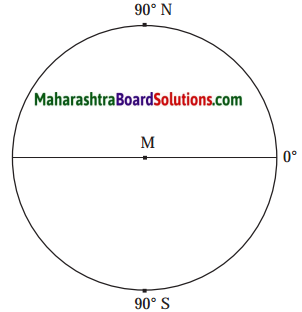
E. Draw important parallels and meridians in the figure given below and label them with appropriate angular measures. (Use the protractor.)
Maharashtra Board Class 6 Geography Solutions Chapter 2 Let us Use the Graticule 1
Answer:
Maharashtra Board Class 6 Geography Solutions Chapter 2 Let us Use the Graticule 2

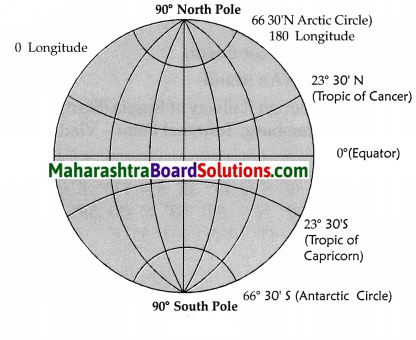
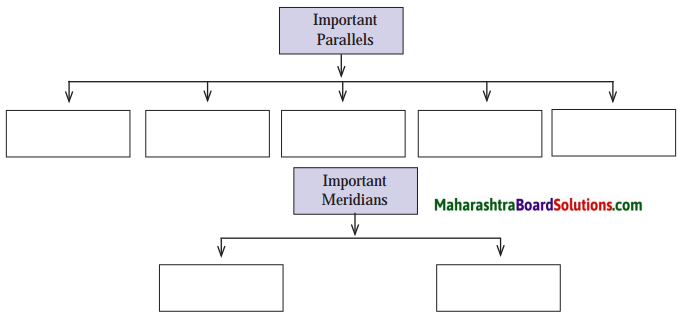
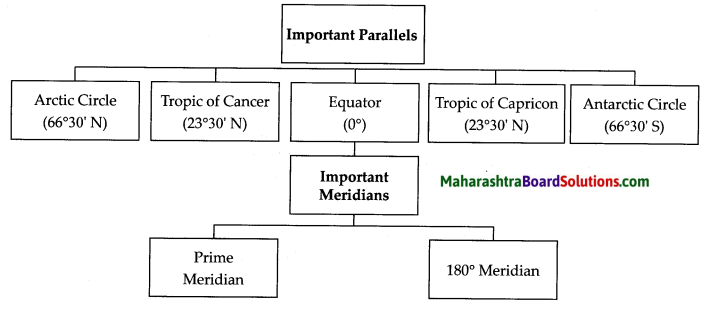
F. Write the important parallels and meridians in the following table:
Maharashtra Board Class 6 Geography Solutions Chapter 2 Let us Use the Graticule 5

Answer:
Maharashtra Board Class 6 Geography Solutions Chapter 2 Let us Use the Graticule 4

Class 6 Geography Chapter 2 Let us Use the Graticule InText Questions and Answers

Make friends with the globe!

Observe the globe and answer the following questions.
Maharashtra Board Class 6 Geography Solutions Chapter 2 Let us Use the Graticule 2
Question 1.
What are the horizontal lines on the globe called?
Answer:
The horizontal lines on the globe are called latitudes.

Maharashtra Board Class 6 Geography Solutions Chapter 2 Let us Use the Graticule

Question 2.
List the continents and oceans through which the equator passes.
Answer:
Continents – Africa, South America, Asia Oceans – Pacific, Atlantic and Indian

Question 3.
Encircle the intersection of 0° meridian and 0° parallel on the globe.
Answer:
Students may attempt this question of their own.

Question 4.
Which ocean is spread in all the four hemispheres?
Answer:
Pacific Ocean

Question 5.
Which continent is spread in all the four hemispheres?
Answer:
The continent of Africa

Question 6.
At which two parallels do all the meridians converge?
Answer:
90°N and 90°S parallels.

State the Importance of the following:

Question 1.
Prime Meridian
Answer:
The main purpose is to fix the global standard time and co-ordinate the standard times of different countries.

Question 2.
180° Meridian
Answer:
The International Date Line is marked with reference to this meridian.

Question 3.
Great Circles
Answer:
Great Circles are used for finding the minimum distance between any two places on the surface of the earth.

Maharashtra Board Class 6 Geography Solutions Chapter 2 Let us Use the Graticule

Let us use the graticule:

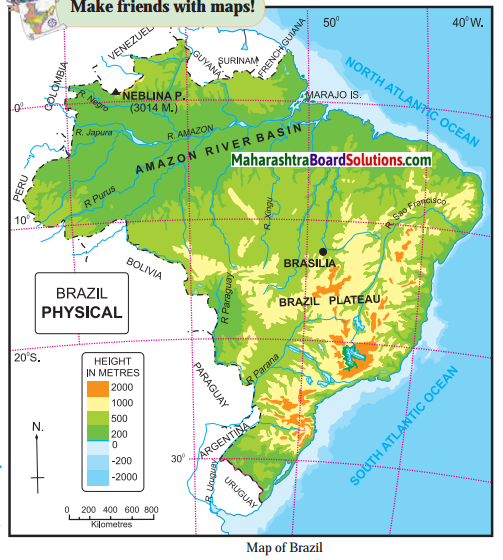
Answer the following questions about the location and extent with the help of figure page 11 of your textbook.

Maharashtra Board Class 6 Geography Solutions Chapter 2 Let us Use the Graticule 6

Question 1.
Which latitude and longitude define the location of the capital of Brazil- Brasilia?
Answer:
13°S latitude and 48°W longitude.

Question 2.
What would be the longitudinal extent of Brazil that spreads from 5° 15′ N to 33° 45′ S latitude?
Answer:
Longitudinal extent would be 34° 47’W to 73° 59’W.

Question 3.
In which hemispheres does Brazil extend in the north-south direction?
Answer:
Brazil extends in the both northern and southern hemispheres.

Maharashtra Board Class 6 Geography Solutions Chapter 2 Let us Use the Graticule

Question 4.
In which hemisphere does Brazil extend in the east-west direction?
Answer:
Brazil extends in the Western Hemisphere.

Question 5.
Which parallels and meridians should be used to describe the extend of River Sao Francisco?
Answer:
River Sao Francisco has its source at 40° 04′ W/ 20° 02’S and terminal point at 37°W/10°S.

Question 6.
Describe the location of Marajo Island using the graticule.
Answer:
Using the Graticules, the location of Marajo island is 0.4°N and 51°W.

Think a little!
Question 1.
Find on the globe, the meridians opposite to the ones mentioned below:
90°E, 170°W, 30°E, 20°W
Answer:

  • 90°E – 90°W
  • 170°W – 10°E
  • 30°E – 150°W
  • 20°W – 160°E

Think a little!

Question 1.
Which important parallel passes through India?
Answer:
Tropic of Cancer (23° 30′ N)

Question 2.
Which areas do not get perpendicular rays?
Answer:
Areas to the North of Tropic of Cancer (till Jammu and Kashmir).

Question 3.
Which region receives perpendicular ray on two days in a year?
Answer:
The region to the south of Tropic of Cancer (till Kaniyakumari).

Use your brain power!

Question 1.
In what direction should an aeroplane fly in order to cover the shortest distance between Kolkata and Chicago?
Answer:
To cover the shortest distance between Kolkata and Chicago, the aeroplane should move north west via Delhi.

Class 6 Geography Chapter 2 Let us Use the Graticule Additional Important Questions and Answers

Fill in the blanks:

Question 1.
______ is known as the smallest country in the world.
Answer:
Vatican City

Question 2.
The International Date line is marked with reference to _____ meridian.
Answer:
180°

Maharashtra Board Class 6 Geography Solutions Chapter 2 Let us Use the Graticule

Question 3.
The Prime Meridian is known as ________.
Answer:
Greenwich Meridian

Question 4.
Global Standard Time is known as ______.
Answer:
Greenwich Mean Time

Question 5.
Variation in the intensity of sunlight leads to regional diversity in ____ and ______.
Answer:
plant, animal life

Question 6.
Different temperature zones give rise to ______ belts.
Answer:
pressure

Question 7.
The 180° meridian lies opposite to the _______.
Answer:
Prime Meridian

Question 8.
The equator as well as all pairs of opposite meridians form ______.
Answer:
Great Circles

Question 9.
Due to the ______ and _______ of sunlight, different temperature zones are formed on the earth.
Answer:
duration, intensity

Question 10.
All places between 23° 30′ north and south of equator receives _______ rays on two days in a year.
Answer:
perpendicular

Match the pairs correctly:

Question 1.

A (Latitudes)B (Names)
(1)23°30’N(a) Antarctic Circle
(2) 23°30′ S(b) Tropic of Capricorn
(3)66°30’N(c) Tropic of Cancer
(4) 66°30′ S(d) Arctic Circle
(e) Great Circle
(f) Prime Meridian

Answer:
1 – c
2 – b
3 – d
4 – a

Maharashtra Board Class 6 Geography Solutions Chapter 2 Let us Use the Graticule

Complete the following sentence:

Question 1.
While describing the location of a place, we need to consider _______.
Answer:
only one parallel and one meridian

Question 2.
For describing the extent of a region, we need to consider _________.
Answer:
two parallels and two meridians at the extreme ends of the region

Question 3.
For describing the extent of linear features like a river or road we need to consider ______.
Answer:
the latitudes and longitude of their terminal points

Question 4.
All places between 23°30′ N and S of the ! equator receive perpendicular rays _____.
Answer:
on two days in a year

Question 5.
Depending on the seasons, daytime can be greater than 24 hours in areas between ________.
Answer:
the polar circles and the poles

Question 6.
All places between 23° 30′ N and South of equator ______ rays on two days in a year.
Answer:
receive perpendicular

Answer the following questions in one sentence:

Question 1.
What are Great Circles used for?
Answer:
Great Circles are used for finding the minimum distance between any two places on the surface of the earth.

Question 2.
Where is Vatican City located?
Answer:
Vatican City is the smallest country in the world located within Italy on the Italian peninsula.

Maharashtra Board Class 6 Geography Solutions Chapter 2 Let us Use the Graticule

Question 3.
Why is the Prime Meridian considered an important meridian?
Answer:
The prime meridian is an important meridian because its main purpose is to fix the global standard time and co-ordinate the standard times of different countries.

Maharashtra Board Class 7 Science Solutions Chapter 1 The Living World: Adaptations and Classification

Balbharti Maharashtra State Board Class 7 Science Solutions Chapter 1 The Living World: Adaptations and Classification Notes, Textbook Exercise Important Questions and Answers.

Maharashtra State Board Class 7 Science Solutions Chapter 1 The Living World: Adaptations and Classification

Class 7 Science Chapter 1 The Living World: Adaptations and Classification Textbook Questions and Answers

1. Find my match!

Question a.

Column ‘A’Column ‘B’
1. Lotusa. Flower and leaves attract insects
2. Aloeb. Haustorial roots for absoption of food
3. Cuscutac. Adapted to live in deserts
4. Venus fly trapd. Adapted to live in water

Answer:

Column ‘A’Column ‘B’
1. Lotusd. Adapted to live in water
2. Aloec. Adapted to live in deserts
3. Cuscutab. Haustorial roots for absoption of food
4. Venus fly trapa. Flower and leaves attract insects

Maharashtra Board Class 7 Science Solutions Chapter 1 The Living World: Adaptations and Classification

2. Read the paragraph and answer the following questions:

I am a penguin. I live in polar region covered by snow. My abdomen is white. My skin is thick with a layer of fat underneath. My body is spindle-shaped. My wings are small. My toes are webbed. We live in flocks.

Question a.
Why is my skin white and thick and why is there a thick layer of fat underneath?
Answer:

  1. White skin colour camouflage with the snow so penguins cannot be easily spotted and they get protected from enemies.
  2. Thick skin and thick layer of fat underneath gives them protection from severe cold.

Question b.
Why do we live in flocks sticking close to each other?
Answer:
Penguins live in flocks sticking close to each other because sticking close to each other reduce the relative area so there is least loss of heat and they get protection from cold.

Question c.
Which geographical region do I inhabit? Why?
Answer:

  1. Penguins inhabit Antarctica region. Antarctica is surrounded by ocean. Climate is colder, drier and windier.
  2. It does not have human population. This climate is suitable for penguins, so they inhabit Antarctica.

Question d.
Which adaptations should you have to enable you to live permanently in the polar region? Why?
Answer:

  1. I should be a warm blooded animal. This should allow me to permanently live in polar region.
  2. My body has to be covered with thick fur or scale so that loss of heat will be very less and I can survive in severe cold.

3. Who is lying?

Question a.
Cockroach – I have five legs.
Answer:
Cockroach is lying. It has six legs.

Maharashtra Board Class 7 Science Solutions Chapter 1 The Living World: Adaptations and Classification

Question b.
Hen – My toes are webbed.
Answer:
Hen is lying because hen’s toes are not webbed. Duck has webbed toes.

Question c.
Cactus – My fleshy, green part is a leaf.
Answer:
Cactus is lying. It’s fleshy, green part is a stem not a leaf.

4. Read each of the following statements. Write a paragraph about adaptation with reference to each statement.

Question a.
There is extreme heat in deserts.
Answer:

  1. Plant’s stem is fleshy, leaves get modified into thorns to reduce loss of water. Steam perform photosynthesis in the absence of leaves.
  2. Animals have cushioned soles, hump, long legs and nostrils are protected by folds of skin. Eyelashes are long and thick.

Question b.
Grasslands are lush green.
Answer:
Insects like grasshoppers have green colour so they can be camouflaged amidst grasses.

Question c.
We hide.
Answer:
In equatorial region grasses are very tall, so to protect themselves animals like tiger, elephants and deer remain hidden in these tall grasses.

Maharashtra Board Class 7 Science Solutions Chapter 1 The Living World: Adaptations and Classification

Question d.
We have long ears.
Answer:
It helps the animals to receive sounds from long distance, and they can protect themselves from predators.

5. Answer the following:

Question a.
Why is the camel called the ‘ship of the desert’?
Answer:

  1. Camel lives in a desert easily due to following adaptations. It has long legs and cushioned soles which keep the body of camel above the sand and cushioned soles do not allow to sink in sand while walking.
  2. The nostrils are protected by folds of skin.
  3. The eyelashes are long and thick.
  4. It has hump which stores fats so it helps camel to survive in desert for many days without food and water.

Due to above adaptations camel is used to carry people and transport goods from one place to another place in the desert. Therefore, camel is called the ship of the desert.

Maharashtra Board Class 7 Science Solutions Chapter 1 The Living World: Adaptations and Classification

Question b.
How can the plants like cactus and acacia live in deserts with scarce water?
Answer:
The plants like cactus and acacia live in deserts with scarce water due to the following adaptations.

  1. Leaves are like small needles or have been modified into thorns, as a result they lose very little water by evaporation.
  2. The stem stores water and food so it is fleshy.
  3. The stems are green as they perform photosynthesis in the absence of leaves.
  4. Their roots penetrate deep into the soil in search of water.
  5. There is a thick layer of a waxy substance on the stems.

Question c.
What is the inter-relationship between adaptations of organisms and their surroundings?
Answer:
1. Adaptations of organisms depend on the changes in the surroundings.

2. To adjust with those changes in the surroundings adaptation takes place gradually and continuously in organisms.

3. Changes that take place in the various organs and life processes of organisms, enable them to live, feed, reproduce to perpetuate themselves and to protect themselves from their enemies in specific surroundings, depending upon the habitat and its geographical conditions, are called adaptations.

Maharashtra Board Class 7 Science Solutions Chapter 1 The Living World: Adaptations and Classification

Question d.
How are organisms classified?
Answer:

  1. Different scientists have used different criteria and independently classified plants and animals.
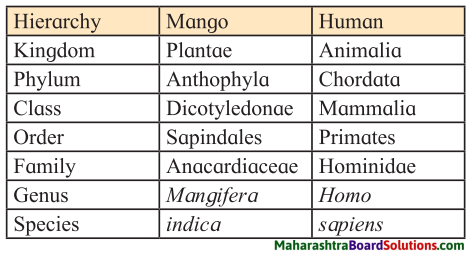
  2. A hierarchy is formed in the classification that starts with kingdom Animalia or kingdom Plantae, further groups and sub-groups are formed depending upon basic similarities and differences.
  3. This is called the ‘hierarchy of classification’.
  4. Binomial nomenclature is used to identify each organism. Accordingly, a scientific name has been assigned to each organism.
  5. It consists of two parts – first part is ‘genus’ and second ‘species’.
  6. All identified organisms have been assigned a binomial name as per the guidelines of the International code of Nomenclature. For e.g.
GenusSpecies
MangoMangiferaIndica
HumanHomoSapiens

Activity:

Question 1.
Find out how the gradual adaptation from primitive man to modern man must have taken place.

Class 7 Science Chapter 1 The Living World: Adaptations and Classification Important Questions and Answers

Fill in the blanks.

Question 1.
Leaves of some aquatic plants are …………. and …………. ike a ribbon.
Answer:
thin, slender

Question 2.
…………. in stems and …………. of aquatic plants are useful for floating in water.
Answer:
Air spaces, petioles

Question 3.
Leaves of desert plants are modified into …………. .
Answer:
thorns

Maharashtra Board Class 7 Science Solutions Chapter 1 The Living World: Adaptations and Classification

Question 4.
The stems of desert plants are green as they perform …………. in the absence of leaves.
Answer:
photosynthesis

Question 5.
…………. roots of grasses prevent soil erosion.
Answer:
Fibrous

Question 6.
Grasses in the …………. region are very tall.
Answer:
equatorial

Question 7.
…………. are found in hilly areas as well as plains.
Answer:
Vast meadows

Question 8.
Plants need …………., …………. and …………. for growth.
Answer:
nitrogen, phosphorus, potassium

Question 9.
Dodder has …………. roots for absorbing nutrients from the host plant.
Answer:
haustorial (sucking)

Maharashtra Board Class 7 Science Solutions Chapter 1 The Living World: Adaptations and Classification

Question 10.
Fungi do not have …………. so cannot perform photosynthesis.
Answer:
chlorophyll

Question 11.
Fish breathe with …………. instead of a nose.
Answer:
gills

Question 12.
Fish have …………. within the body to help them to float.
Answer:
air bladders

Question 13.
Frog and duck have …………. toes.
Answer:
webbed

Question 14.
Tigers have …………. paws.
Answer:
padded

Question 15.
Bats can fly with the help of …………. .
Answer:
patagium.

Question 16.
Desert plants are either leafless or their leaves are like …………. or modified into …………. .
Answer:
needles, thorns

Maharashtra Board Class 7 Science Solutions Chapter 1 The Living World: Adaptations and Classification

Question 17.
Spring like …………. on the stems of some climbers are examples of their adaptation.
Answer:
Tendrils

Question 18.
…………. is not a sudden process, it is gradual and continuous.
Answer:
Adaptation

Question 19.
…………. proposed the theory of the survival of the fittest.
Answer:
Charles Darwin

Match the columns:

Question 1.

Column ‘A’Column ‘B’
1. Cactusa. Herbivorous animal
2. Pineb. Carnivorous animal
3. Tigerc. Snowy region plant
4. Blackbuckd. Desert plant

Answer:

Column ‘A’Column ‘B’
1. Cactusd. Desert plant
2. Pinec. Snowy region plant
3. Tigerb. Carnivorous animal
4. Blackbucka. Herbivorous animal

Maharashtra Board Class 7 Science Solutions Chapter 1 The Living World: Adaptations and Classification

Question 2.

Column ‘A’Column B’
1. Doga. Hibiscus roso sinensis
2. Cowb. Sorghum bicolor
3. Hibiscusc. Bos taurus
4. Joward. Canis lupus familiarise

Answer:

Column ‘A’Column B’
1. Dogd. Canis lupus familiarise
2. Cowc. Bos taurus
3. Hibiscusa. Hibiscus roso sinensis
4. Jowarb. Sorghum bicolor

Maharashtra Board Class 7 Science Solutions Chapter 1 The Living World: Adaptations and Classification

Name the following:

Question 1.
Animals which live in desert in deep burrows.
Answer:
Rats, snakes, spiders, lizards

Maharashtra Board Class 7 Science Solutions Chapter 1 The Living World: Adaptations and Classification

Question 2.
Animals which have webbed feet.
Answer:
Frog, duck

Question 3.
Plants of snowy regions.
Answer:
Deodar, pine

Question 4.
Plants that eat insects.
Answer:
Drosera, venus flytrap, pitcher plant

Question 5.
World Frog Protection Day.
Answer:
29th April

Maharashtra Board Class 7 Science Solutions Chapter 1 The Living World: Adaptations and Classification

Question 6.
2 parts of bionomial nomenclature.
Answer:
genus and species.

Who am I?

Question 1.
My leaves trap insects.
Answer:
Venus fly trap or pitcher plant.

Question 2.
I have waxy feathers and webbed feet.
Answer:
Duck

Question 3.
I breath through skin in water and through lungs on land.
Answer:
Frog

Question 4.
I have sucking roots through which I take nutrition from my host plant.
Answer:
Dodder (cuscuta)

Question 5.
I have silvery white body with thick long hair
Answer:
Snow animals like polar bear.

Maharashtra Board Class 7 Science Solutions Chapter 1 The Living World: Adaptations and Classification

Question 6.
I have waxy broad leaves and air spaces in my stem.
Answer:
Lotus (or aquatic plants)

Question 7.
My Scientific name is Bos taurus.
Answer:
Cow

Question 8.
I discovered Binomial nomenclature.
Answer:
Carl Linnaeus

Question 9.
I have special thin folds in between my forelegs and hind legs called patagium.
Answer:
Bat

Maharashtra Board Class 7 Science Solutions Chapter 1 The Living World: Adaptations and Classification

Question 10.
I am mango, my genus is?
Answer:
Mangifera

Say whether true or false, correct and rewrite the false statements:

Question 1.
Killing or harming frogs is prohibited by the Wild Life Protection Act.
Answer:
True

Question 2.
Scientific name of jowar is Bos taurus.
Answer:
False. Scientific name of jowar is Sorghum bicolor

Question 3.
Theory of natural selection was found by Charles Darwin.
Answer:
True

Maharashtra Board Class 7 Science Solutions Chapter 1 The Living World: Adaptations and Classification

Question 4.
T.V. Channels like National Geographic, Wild and Discovery show about the feeding habits of animals.
Answer:
True

Question 5.
The spindle shaped body of birds maximizes the resistance of air while flying.
Answer:
False. The spindle shaped body of birds minimises the resistance of air while flying.

Question 6.
House lizard and monitor lizards have webbed toes.
Answer:
False. House lizard and monitor lizards have clawed toes.

Question 7.
Crocodiles use their muscles for creeping.
Answer:
True

Maharashtra Board Class 7 Science Solutions Chapter 1 The Living World: Adaptations and Classification

Question 8.
The eyes of predatory carnivores are located on either side of the head.
Answer:
False. The eyes of predatory carnivores are located in the front of their head.

Question 9.
A frog is an amphibian.
Answer:
True

Question 10.
Diverse types of bushes and grasses are found in the grasslands.
Answer:
True.

Complete the given table:

Question 1.
Maharashtra Board Class 7 Science Solutions Chapter 1 The Living World Adaptations and Classification 1

Question 2.
Give one special adaptation or features of the following plant or animal to suit its habitat surrounding
Answer:

Plant/animalSpecial adaptation/features
1. FishStream lined body
2. BirdHollow bones, feathers
3. CamelThick skin, folds in skin near nosetrils
4. Deerlong and tapering legs with strong hooves
5. TigerPadded paws, sharp canine teeth
6. Duckwaxy feathers, webbed toes
7. FungiRoot like fibers
8. CuscutaLeafless, yellow thread like stem with haustorial (sucking) roots
9. Venus fly trapTrigger hair inside their traps
10. Deodar treeConical shape and needle shaped leaves
11. Grape vineTendrils for support
12. AcaciaFleshy thick green stem with leaves turned into thorns.

Maharashtra Board Class 7 Science Solutions Chapter 1 The Living World: Adaptations and Classification

Who is lying?

Question 1.
Camel has thin skin and short eyelashes.
Answer:
Camel is lying – It has thick skin and long and thick eyelashes.

Answer in one or two sentences:

Question 1.
What is called ‘hierarchy of classification’?
Answer:

  1. A hierarchy is formed in the classification that starts with kingdom Animalia or Kingdom Plantae, further groups and sub-groups are formed depending upon basic similarities and differences.
  2. This is called the ‘hierarchy of classification’.

Question 2.
What theories were proprosed by Charles Darwin
Answer:
The theories of Charles Darwin are Theory of natural selection and theory of survival of the fittest.

Maharashtra Board Class 7 Science Solutions Chapter 1 The Living World: Adaptations and Classification

Question 3.
Explain the terms Autotrophic and Parasitic
Answer:
1. Plants which are able to produce their own food with the help of the process of photosynthesis are called autotrophic plants eg. All green plants.

2. Plants which are not able to produce their own food but depend upon other plants for their nutrition are called parasitic plants They are leafless and non green in colour eg. Dodder (cuscuta). They have haustorial (sucking) roots for absorbing nutrients from the host plant.

Give scientific reasons:

Question 1.
Leaves of some aquatic plants are thin and slender like a ribbon.
Answer:
Leaves of some aquatic plants are thin and slender like a ribbon because this shape helps them to withstand fast currents of water.

Question 2.
Some aquatic plants have air spaces in stems.
Answer:
Some aquatic plants have air spaces in stems because air spaces help the plants to float on water.

Maharashtra Board Class 7 Science Solutions Chapter 1 The Living World: Adaptations and Classification

Question 3.
Desert plants have thorns.
Answer:

  1. Desert plants have thorns because in deserts, due to scarcity of water these plants are either leafless or their leaves are like small needles or modified into thorns.
  2. They lose very little water by evaporation due to little surface area. This helps plants to survive in desert.

Question 4.
Desert plants have green stem.
Answer:
Desert plants have green stem because green stem performs photosynthesis in the absence of leaves.

Question 5.
Desert plants have strong roots.
Answer:
Desert plants have strong roots so they can penetrate deep into the soil in search of water.

Question 6.
Deodar tree is conical in shape.
Answer:
Deodar tree grows in snowy region and conical shape of the tree doesn’t allow snow to accumulate on the tree and thus protect the tree from snow.

Question 7.
Pine tree has thick bark.
Answer:
Pine tree grows in snowy region where it is extremely cold and its thick bark helps the tree to withstand the cold.

Maharashtra Board Class 7 Science Solutions Chapter 1 The Living World: Adaptations and Classification

Question 8.
Plants in forest grow tall.
Answer:
In forest region variety of trees, shrubs and herbs are found. These plants compete amongst themselves for sunlight. Hence trees grow tall to get sunlight.

Question 9.
Cuscuta has haustorial roots.
Answer:

  1. Cuscuta is a parasitic plant. It is leafless and cannot prepare food on its own.
  2. So to get food haustorial (sucking) roots penetrate up to the conducting vessels of the host plant to absorb water and food, the Cuscuta has haustorial roots.

Question 10.
Fungi have root-like fibers.
Answer:

  1. Fungi are parasitic.
  2. They do not have chlorophyll and cannot perform photosynthesis.
  3. So these root-like fibers help to absorb the food from the starchy foodstuffs like bhakri and bread.

Question 11.
Pitcher plant eats insects.
Answer:

  1. Pitcher plant grows in a soil where nitrogen, phosphorous and potassium are very less. But the plant needs these for the growth.
  2. So to fulfill the need for nitrogen, pitcher plant consumes insects.

Maharashtra Board Class 7 Science Solutions Chapter 1 The Living World: Adaptations and Classification

Question 12.
Duck and frog have webbed feet.
Answer:
When duck and frog are in water at that time the webbed feet act as oars and help them to swim in water.

Question 13.
Frogs can swim easily in water.
Answer:
Frogs have webbed toes, slippery, smooth skin and triangular head. This helps the frog to swim easily through water.

Question 14.
Tiger has sharp and pointed canine teeth.
Answer:
Tiger is a carnivorous animal. So the sharp and pointed canine teeth help the tiger to tear the prey and eat.

Question 15.
Blackbuck has eyes on either side of the head.
Answer:
Blackbuck is a herbivore animal and eyes on either side of the head gives them wide angle vision which helps to protect themselves from predators.

Maharashtra Board Class 7 Science Solutions Chapter 1 The Living World: Adaptations and Classification

Question 16.
Tigers have padded paws.
Answer:
Tigers are carnivorous animals. So these padded paws enable them to silently stalk their prey and capture it easily.

Question 17.
The eyes of predatory carnivores are located in the front of their head.
Answer:
The eyes of predatory carnivores are located in the front of their head because it helps them to spot their prey from a long distance.

Question 18.
Camel can live in desert.
Answer:

  1. Camel can live in desert because it has thick skin to prevent loss of water from the body. Their legs are long with flat and cushioned soles.
  2. The nostrils are protected by folds of skin. The eyelashes are long and thick so these adaptations enable Camels to live in desert easily.

Maharashtra Board Class 7 Science Solutions Chapter 1 The Living World: Adaptations and Classification

Question 19.
White fox has white body colour.
Answer:

  1. White fox lives in snowy region which throughout the year is covered with snow.
  2. White colour of fox matches with the snow so it gets camouflaged in snow and it can save itself from predators.

Question 20.
Birds can fly in the air.
Answer:

  1. Birds can fly in the air because the spindle shaped body minimises the resistance of air while flying.
  2. Their hollow bones, body covering of feathers and forelegs being modified into wings, their body being light in weight, all these factors make the birds adapted to fly in the air.

Can you tell?

Answer the following questions:

Question 1.
Arc the plants and animals from Kashmir and Rajasthan of the same type? Can you elaborate on any differences between the two?
Answer:
Plants and animals from Kashmir and Rajasthan are of different types.
Differences in plants:

  1. Plants of Kashmir, which is a snowy region, are conical in shape due to their sloping branches.
  2. This shape prevents the snow accumulation on the tree and the thick bark helps the tree to withstand the cold.
  3. But the plants of Rajasthan, which is a desert region, are either leafless or their leaves are small, needle shaped or have been modified into thorns. So the loss of water can be reduced
  4. The stem stores water and food so they are fleshy. The stem performs photosynthesis in the absence of leaves.

Differences in animals:

  1. Animals of Kashmir have thick hair and white or silver body colour camouflaged with snow. This helps them to get protection in snowy region.
  2. The animals of Rajasthan have long legs with flat and cushioned soles.
  3. The nostrils are protected by folds of skin. The eyelashes are long and thick. It gives protection from sand and heat.

Maharashtra Board Class 7 Science Solutions Chapter 1 The Living World: Adaptations and Classification

Question 2.
In what way are sloping branches useful to plants in a snowy region?
Answer:
In a snowy region sloping branches of a plant gives conical shape to the tree and it doesn’t allow snow to accumulate on tree inspite of heavy snowfall and thus protect the tree from severe cold and snow.

Question 3.
What is the main difference between vehicles on the road and aeroplanes?
Answer:
The two main differences between vehicles on the road and aeroplanes are:

  1. aeroplanes have wings whereas vehicles on the road do not have wings.
  2. The body of aeroplanes are spindle shaped and the body of vehicles on the road depends on the number of wheels they have.

Use your brain power!

Answer the following questions:

Question 1.
Why does water trickle off lotus leaves?
Answer:

  1. Water trickles off lotus leaves because it is coated with waxy covering on it.
  2. It is one of the adaptations of aquatic plants to survive in water without getting wet and rot or sink to the bottom.

Maharashtra Board Class 7 Science Solutions Chapter 1 The Living World: Adaptations and Classification

Question 2.
Why don’t the leaves of lotus plants rotinwatei?
Answer:
leaves of these plants do not rot in water because it is covered with waxy coating on it so that they do not get wet.

Question 3.
Why are roots of lotus plants short and fibrous?
Answer: –

  1. These plants grow in water so the roots do not need to go deep down in search of water. Their roots are not anchored in the soil.
  2. So their roots are short and fibrous.

Question 4.
The lotus stalk has holes or air spaces?
Answer:

  1. The air spaces in stems and petioles of aquatic plants are useful for making them float in water and also to prevent them from rotting
  2. Hence, the lotus stalk has holes or air spaces.

Maharashtra Board Class 7 Science Solutions Chapter 1 The Living World: Adaptations and Classification

Answer in detail:

Question 1.
Explain the Darwin’s theory of evolution.
Answer:
Charles Darwin, a biologist suggested two principles in his theory of evolution.

  1. Theory of survival of the fittest: He said that only those organisms are likely to survive which can best adapt themselves to a changing environment. This is called the theory of survival of the fittest.
  2. Theory of ‘Natural selection’: If an organism is bom with a new beneficial characteristic and is able to survive, this change is preserved in the next generation. This is called the theory of ‘natural selection’.

Diagram based questions:

Draw a neat labelled diagram of fish and answer the following questions.
Answer:
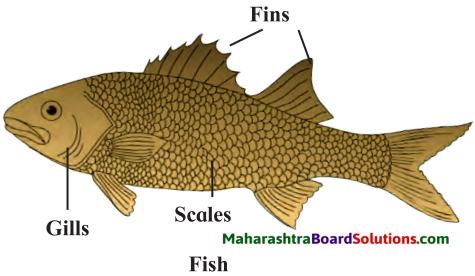
Maharashtra Board Class 7 Science Solutions Chapter 1 The Living World Adaptations and Classification 2

Question a.
Why do fish have a body tapering towards both its ends?
Answer:
Fish have its body tapering towards its ends, to allow them to swim with least resistance in water.

Maharashtra Board Class 7 Science Solutions Chapter 1 The Living World: Adaptations and Classification

Question b.
Why do Fish have transparent eyelids.
Answer:
The transparent eyelids of fish protect the eyes from the substance in the water

Question c.
How are they able to float?
Answer:
Fish have air bladders within their body which help them to float.

Observe the diagram and answer the questions.
Answer:
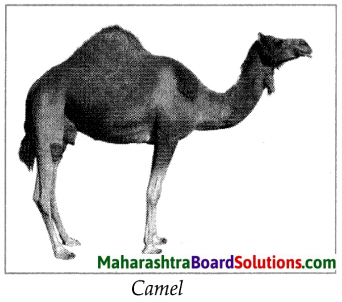
Maharashtra Board Class 7 Science Solutions Chapter 1 The Living World Adaptations and Classification 3

Question a.
What habitat does this camel live in?
Answer:
Camel lives in desert habitats or in areas where there is scarcity of water.

Maharashtra Board Class 7 Science Solutions Chapter 1 The Living World: Adaptations and Classification

Question b.
State any 2 of its body adaptations to survive in desert?
Answer:

  1. Thick skin to prevent loss of water from the body
  2. The eyelashes are long and thin
  3. Their legs are long and flat with cushioned soles

Question c.
How does a camel protect itself from sand storms or winds carrying sand?
Answer:
Camels have nostrils protected by folds of skin and long thick eyelashes to prevent entry of fir dust and sand into its nose and eyes.

Paragraph based questions:

Compare and contrast:

Question 1.
Compare the lotus plant to the Acacia plant and Hibiscus plant.
Answer:

Lotus plantHibiscus plantAcacia plant
I. Stem have air spaces in themStem do not have air spaces and do not store too much of water and foodStem is fleshy and stores water and food
ii. Leaves have a waxy coatingLeaves do not have a waxy coating and have thin laminaLeaves are not present and if present are very tiny or modified into thorns

Maharashtra Board Class 7 Science Solutions Chapter 1 The Living World: Adaptations and Classification

Question 2.
What is the difference between the plants given in the pictures. Give 2 points of difference taking into consideration their adaptations with their surroundings.
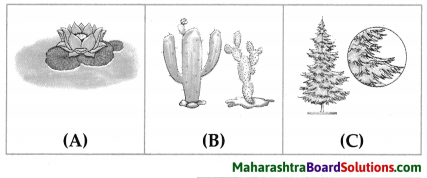
Maharashtra Board Class 7 Science Solutions Chapter 1 The Living World Adaptations and Classification 4
Answer:

A. CactusB. LotusC. Deodar tree
i. Stem is green and fleshyStem is with air spaceShape of tree is conical
ii. leaves are reduced or absent and replaced by thornsLeaves are broad and with a waxy coatingLeaves are needle shaped

Maharashtra Board Class 6 History Solutions Chapter 10 Ancient India: Cultural

Balbharti Maharashtra State Board Class 6 History Solutions Chapter 10 Ancient India: Cultural Notes, Textbook Exercise Important Questions and Answers.

Maharashtra Board Class 6 History Solutions Chapter 10 Ancient India: Cultural

Class 6 History Chapter 10 Ancient India: Cultural Textbook Questions and Answers

1. Answer in one sentence:

Question 1.
Make a list of ancient Indian universities.
Answer:
The ancient Indian universities are Takshashila, Vamasi, Valabhi, Nalanda, Vikramshila and Kanchi.

Question 2.
Make a list of the Indian goods that were in demand in foreign countries.
Answer:
Indian goods like fine textiles, ivory, precious stones, spices, beautifully made earthen ; pottery were in great demand in foreign countries.

Maharashtra Board Class 6 History Solutions Chapter 10 Ancient India: Cultural

2. Name the following:

Question 1.
Epics and poetic composition of ancient India.
Answer:
Epics Silappadhikaram and Manimekhalai and Arsha epics Ramayana and Mahabharata and Paumchariya a poetic work are composition of ancient India.

3. Fill in the blanks:

Question 1.
The epic Ramayana was composed by rishi
(a) Vyas
(b) Valmiki
(c) Munni
Answer:
(b) Valmiki

Question 2.
The science of Indian medicine is called
(a) Ayurveda
(b) Homeopathy
(c) Alopathy
Answer:
(a) Ayurveda

Question 3.
Thousands of students could live at the University.
(a) Kanchi
(b) Takshashila
(c) Nalanda
Answer:
(c) Nalanda

Maharashtra Board Class 6 History Solutions Chapter 10 Ancient India: Cultural

4. Answer in brief:

Question 1.
Explain what is meant by ‘Tipitaka’.
Answer:
Tipitaka is a Buddhist religious text written in Pali. It contains three categories of texts.

  • Sutta Pitaka
  • Vinay Pitaka
  • Abhidhamma Pitaka

Question 2.
What is the message of the Bhagwad Gita?
Answer:

  • The Bhagwad Gita tells us that each one of us should do our duty without expecting rewards.
  • It also says that the path of devotion to God is open to all.

Question 3.
What aspects does Ayurveda take into account?
Answer:
Ayurveda is a very old traditional Indian medical science. Ayurveda not only seeks to understand the symptoms, diagnosis and treatment of an illness but also takes into account the prevention of the illness.

Question 4.
What is meant by Sangham Literature?
Answer:
Sangham means a gathering of learned men. The literature that is compiled in such gathering is known as Sangham literature.

Maharashtra Board Class 6 History Solutions Chapter 10 Ancient India: Cultural

5. Discuss:

Question 1.
Art and architecture of the Mauryan and Gupta period.
Answer:

  • Indian architecture reached its peak during the Mauryan and the Gupta periods.
  • The stone pillar erected by Emperor Ashoka at various places are excellent examples of Indian sculpture.
  • The stupa at Sanchi and cave sculptures at Karla, Nashik, Ajanta, Ellora, etc. show that the same tradition advanced even further.

6. What would you do ?

Question 1.
How would you obtain information about Ayurvedic medicine and use it in your day to day life?
Answer:
I will try to get information about Ayurveda from different literature that is available either in bookstores or on internet. I will try to deal with minor ailments like cough, cold, acidity, aches and pains in day to day life through ayurvedic stores. I will try to improve my health in order to prevent ailments by taking ayurvedic medicines to improve my immunity.

Question 2.
On a trip to a historical site, your friend in writes his name on the structure.
Answer:
When on a trip to a historical site, I see my friend write his name on the structure, I will gently tell him the importance of historical monuments and also how the ancient Indians must have built it with lots of effort, without modern technology and equipment. Thus invoking respect for the ancient fellow Indians is my friend. Also telling him how proud we Indians should be of their art and talents.

7. Observe the picture of the stupa at Sanchi and obtain more information about it.
Maharashtra Board Class 6 History Solutions Chapter 10 Ancient India Cultural 1
Answer:
Sanchi is an outstanding specimen of Buddhist art and architecture. The Sanchi stupa is one of the best preserved early stupa in central India. The Sanchi stupa is surrounded by a railing with four carved gateways facing in all four directions. An interesting characteristic about Sanchi stupa is that Lord Buddha has been symbolically represented by footsteps, wheels, thrones, etc. rather than by his own image. The Sanchi stupa is one of the most wonderful structures of ancient India.

Maharashtra Board Class 6 History Solutions Chapter 10 Ancient India: Cultural

Activity:

  • Obtain information from the elders in your family, about some special buildings in your neighbourhood.
  • Visit some historical buildings, memorials in your neighbourhood and write a note about the history you learn from the visits there.

Class 6 History Chapter 10 Ancient India: Cultural Additional Important Questions and Answers

Complete the sentence by choosing the correct option:

Question 1.
______ means a gathering of learned men.
(a) Pitaka
(b) Sangham
(c) Shreni
Answer:
(b) Sangham

Question 2.
The Agamgranthas are a collection of the teachings of ________.
(a) Guru Nanak
(b) Gautam Buddha
(c) Vardhaman Mahavir
Answer:
(c) Vardhaman Mahavir

Question 3.
Vimalsuri has told the story of ____ in Paumchariya a poetic work in Prakrit.
(a) Rama
(b) Harishchandra
(c) Buddha
Answer:
(a) Rama

Maharashtra Board Class 6 History Solutions Chapter 10 Ancient India: Cultural

Question 4.
Tipitaka is written in ______.
(a) English
(b) Pali
(c) Hindi
Answer:
(b) Pali

Question 5.
_______ women composed gathas about their own experience.
(a) Illiterate
(b) Housewives
(c) Learned
Answer:
(c) Learned

Question 6.
The Bhagwad Gita, which is a sacred text of the Hindu, is a part of the ______.
(a) Ramayana
(b) Arthashastras
(c) Mahabharata
Answer:
(c) Mahabharata

Question 7.
Adi Shankaracharya lived during the ______ century CE.
(a) seventh
(b) eighth
(c) ninth
Answer:
(b) eighth

Question 8.
Kautilya wrote the ______.
(a) Arthashastra
(b) Raghuvansha
(c) Brahmasutras
Answer:
(a) Arthashastra

Question 9.
Patanjali wrote _______.
(a) Kumarsambhava
(b) Upanishads
(c) Mahabhashya
Answer:
(c) Mahabhashya

Maharashtra Board Class 6 History Solutions Chapter 10 Ancient India: Cultural

Question 10.
‘Ramayana’ and ‘Mahabharata’ are the two _______ epics of ancient India.
(a) Arsha
(b) Modern
(c) Classical
Answer:
(a) Arsha

Question 11.
Arsha means _______ by rishis or sages.
(a) sung
(b) reported
(c) composed
Answer:
(c) composed

Question 12.
The main character of Ramayana is ________.
(a) Shri Ram
(b) rishis
(c) Kautilya
Answer:
(a) Shri Ram

Question 12.
Mahabharata has been composed by the sage ______.
(a) Kautilya
(b) Vyas
(c) Adi
Answer:
(b) Vyas

Question 14.
India has an ancient tradition of telling a ____ through songs, music and dance.
(a) story
(b) moral
(c) fairytale
Answer:
(a) story

Maharashtra Board Class 6 History Solutions Chapter 10 Ancient India: Cultural

Question 15.
_______ composed by Pandit Vishnusharma is an excellent example of narrative literature.
(a) Champak
(b) Chandamama
(c) Panchatantra
Answer:
(c) Panchatantra

Question 16.
________ was carried out by sea as well as land routes.
(a) Trade
(b) Travel
(c) Study
Answer:
(a) Trade

Question 17.
The concept of stitching clothes was introduced in India during the ______ period.
(a) Vakataka
(b) Kushana
(c) Satavahana
Answer:
(b) Kushana

Question 18.
Jeevaka was a well known ______ at the court of king Bimbisara.
(a) clown
(b) minister
(c) vaidya
Answer:
(c) vaidya

Question 19.
_______ were the first to use the numerals 1 to 9 and zero.
(a) Chinese
(b) Nepalese
(c) Indians
Answer:
(c) Indians

Question 20.
The scientist Aryabhatta wrote the book Aryabhatiya which included many formulae for ______ operations.
(a) mathematical
(b) scientific
(c) medical
Answer:
(a) mathematical

Maharashtra Board Class 6 History Solutions Chapter 10 Ancient India: Cultural

Question 21.
Aryabhatta was also an ________.
a) scientist
(b) astronomer
(c) astrologer
Answer:
(b) astronomer

Question 22.
________ was an important city on the ancient indian trade route.
(a) Nalanda
(b) Vikramshila
(c) Takshashila
Answer:
(c) Takshashila

Question 23.
Emperor Harshavardhan made generous donations to ________University.
(a) Nalanda
(b) Vikramshila
(c) Takshashila
Answer:
(a) Nalanda

Question 24.
Vikramshila University was established by king _______ in the eighth century CE.
(a) Harshavardhan
(b) Dharmapal
(c) Ashoka
Answer:
(b) Dharmapal

Question 25.
During the Pallava dynasty, ________ in Tamil Nadu emerged as an important centre of education.
(a) Nalanda
(b) Valabhi
(c) Kanchi
Answer:
(c) Kanchi

Question 26.
The stone pillars erected by Emperor Ashoka at various places are excellent examples of Indian ________.
(a) sculpture
(b) drawing
(c) photography
Answer:
(a) sculpture

Maharashtra Board Class 6 History Solutions Chapter 10 Ancient India: Cultural

Question 27.
_______ architecture developed during the in South India.
(a) Pillar
(b) Temple
(c) Statue
Answer:
(b) Temple

Question 28.
The art of making ______ images of deities emerged during the period of the Pallavas.
(a) copper
(c) gold
(c) bronze
Answer:
(c) bronze

Question 29.
The ______ pillar at Mehrauli near Delhi is evidence of the advanced knowledge of metallurgy of the ancient Indians.
(a) iron
(b) gold
(c) bronze
Answer:
(a) iron

Answer in one sentence:

Question 1.
In which languages was the ancient Indian literature written?
Answer:
Ancient Indian literature was written in Sanskrit, Ardhamagadhi, Pali and Tamil languages.

Question 2.
What variety was included in the ancient Indian literature?
Answer:
Ancient Indian literature included varieties like religious literature, treatises on grammar, epics, plays, stories, etc.

Question 3.
What does ‘Sangham’ mean?
Answer:
Sangham means a gathering of learned men.

Question 4.
Name two prominent Sangham epics.
Answer:
The two prominent epics are ‘Silappadhikarm’ and Manimekhalai’.

Maharashtra Board Class 6 History Solutions Chapter 10 Ancient India: Cultural

Question 5.
What do we learn from the Sangham literature?
Answer:
From the Sangham literature we learn about the political and social life in south India during the period.

Question 6.
Name the three important religious texts.
Answer:
The important religious texts are Agamgranth, Tipitaka and Bhagwad Gita.

Question 7.
In which languages are the Jain Agamgranth written?
Answer:
The Jain Agamgranthas are written in the Prakrit languages of Ardhamagadhi, Shaurseni and Maharashtri.

Question 8.
What does Agamgranthas contain?
Answer:
Agamgranthas are a collection of the teachings of Vardhaman Mahavir.

Question 9.
Give the literary work of Haribhadrasuri.
Answer:
Haribhadrasuri’s literary work Samaraichchakaha is well known.

Question 10.
What does Sutta Pitaka contain?
Answer:
Sutta Pitaka includes texts of Gautam Buddha’s teachings or sermons.

Question 11.
What instructions are given in Vinay Pitaka?
Answer:
The Vinay Pitaka gives the rules of behaviour which bhikkhus and bhikkhunis in the Bauddha Sangha should follow in their day- to-day lives.

Question 12.
Which is the sacred text of the Hindus?
Answer:
The Bhagvad Gita is the sacred text of the Hindus.

Question 13.
Who wrote the Arthashastra?
Answer:
Kautilya wrote the Arthashastra.

Maharashtra Board Class 6 History Solutions Chapter 10 Ancient India: Cultural

Question 14.
What is Ashtadhyayi?
Answer:
Ashtadhyayi is a treatise in grammar written by the grammarian Panini.

Question 15.
Name the two Arsha of ancient India.
Answer:
Ramayana and Mahabharata are the two ‘Arsha’ epics of ancient India.

Question 16.
What does ‘Arsha’ mean?
Answer:
Arsha means composed by rishis or sages.

Question 17.
Who wrote the Ramayana?
Answer:
Rishi Valmiki composed the Ramayana.

Question 18.
Who wrote the Mahabharata?
Answer:
The Mahabharata has been composed by sage Vyas.

Question 19.
Which literature is an excellent example of narrative literature?
Answer:
Panchatantra composed by Pandit Vishnusharma is an excellent example of narrative literature.

Question 20.
What are shrenis?
Answer:
Organisations of traders and artisans are called shrenis.

Question 21.
When was the concept of stitching clothes introduced in India?
Answer:
The concept of stitching clothes was introduced in India during the Kushana period.

Question 22.
What does Charaka Samhita contain?
Answer:
The Charaka Samhita contains detailed information about clinical diagnosis and pharmacy.

Maharashtra Board Class 6 History Solutions Chapter 10 Ancient India: Cultural

Question 23.
Explain the concept of decimal system.
Answer:
Indians invented the concept of decimal system in which the value of a digit changes according to its place ekam, daham, (units, terms, etc).

Question 24.
Name some of the students who attended the Takshashila University.
Answer:
A famous vaidya, Jeevaka, Chandragupta Maurya, the grammarian Panini and vaidya Charaka are some of the students of the Takshashila University.

Question 25.
Which Chinese scholar visited the Takshashila University?
Answer:
The famous Chinese Bauddha bhikkhu, Fa-hien visited the Takshashila University.

Question 26.
Name the Chinese Bhikkhus that visited Valabhi.
Answer:
Yuan Chwang and Itsing, the Chinese Bauddha Bhikkhus visited Valabhi.

Question 27.
Which emperor made generous donation to Nalanda University?
Answer:
Emperor Harshavardhan made generous donation to Nalanda University.

Question 28.
How could one get admission at the Nalanda University?
Answer:
Students seeking admission to the university had to appear for an examination at the entrance gate.

Question 29.
Who established the Vikramshila University?
Answer:
Vikramshila University was established by a king named Dharmapal in the eighth century

Question 30.
When did Kanchi emerge as an important centre of education?
Answer:
During the reign of the Pallava dynasty, Kanchi in Tamil Nadu emerged as an important centre of education.

Maharashtra Board Class 6 History Solutions Chapter 10 Ancient India: Cultural

Question 31.
How do we know that Indian sculpture was excellent?
Answer:
The stone pillars erected by Emperor Ashoka at various places are excellent examples of Indian sculptures.

Answer in brief:

Question 1.
What is a classical period in history?
Answer:
Sometimes there is such a period in the history of language, literature and art and that its glory remains undiminished even later on such a period is said to be classical.

Question 2.
Explain ‘Theatre’.
Answer:
India has an ancient tradition of telling a story through songs, music and dance. When these arts are presented with supporting dialogues they are known as ‘theatre’.

Question 3.
Give the importance of surgeon Sushruta’s treatise.
Answer:

(a) The famous surgeon Sushruta has discussed the diagnosis of different ailments and their remedies in his treatiste the ‘Sushruta Samhita’.

(b) The importance of this text is that it discusses the different causes leading to injuries, fractures, their types and the various types of surgeries required for them.

Answer the following:

Question 1.
Takshashila University
Answer:
(a) Takshashila was an important city on the ancient Indian trade route.

(b) Gautama Buddha and a famous vaidya, had studied at Takshashila University.

(c) Chandragupta Maurya the founder of the Mauryan Empire was educated at this university.

(d) The Greek historians who accompanied Alexander have also given a description of if the university. They have stated that such a university did not exist anywhere in Greece.

(e) The famous Chinese Bauddha bhikkhu, Fa- Hien who came to India around 400 CE also visited the Takshashila University. The university provided education in various subjects such as Vedic literature, Buddhist philiosophy, economics, logic, etc.

Maharashtra Board Class 6 History Solutions Chapter 10 Ancient India: Cultural

Maharashtra Board Class 6 History Solutions Chapter 9 Ancient Kingdoms of the South

Balbharti Maharashtra State Board Class 6 History Solutions Chapter 9 Ancient Kingdoms of the South Notes, Textbook Exercise Important Questions and Answers.

Maharashtra Board Class 6 History Solutions Chapter 9 Ancient Kingdoms of the South

Class 6 History Chapter 9 Ancient Kingdoms of the South Textbook Questions and Answers

1. Can you tell ?

Question 1.
Whose name did the Satavahana kings write before their own?
Answer:
Jhe Satavahana kings were known to follow the custom of writing their mother’s name before their own.

Question 2.
The ancient name of Kolhapur.
Answer:
The ancient name of Kolhapur was ‘Kuntal’.

2. Complete the table by reading the map in the lesson:

PallavaKanchi
Aihole, Badami, Pattdakal
Satavahana

Answer:

PallavaKanchi
ChalukyaAihole, Badami, Pattdakal
SatavahanaAjanta, Ellora, Nashik, Bhokardan

Maharashtra Board Class 6 History Solutions Chapter 9 Ancient Kingdoms of the South

3. Tabulate the following names as dynasties and their capitals:
Satavahana, Pandya, Chalukya,Vakataka, Pallava, Madurai, Pratishthan, Kanchipuram, Vatapi
Answer:

 Dynasty                                                                     Capital
SatavahanaPratishthan
ChalukyaVatapi
VakatakaVatsagulm
PallavaKanchipuram
PandyaMadurai

4. Observe any three picture in the lesson and write in your own words what you learn from them:
Answer:
The Kailas Temple:
Maharashtra Board Class 6 History Solutions Chapter 9 Ancient Kingdoms of the South 1
The Kailas temple at Ellora in Maharashtra was carved out during the reign of Krishna Raja I. This temple is the largest rock-cut monolithic ancient Hindu temple. This temple gets its name Kailas as it symbolizes mount Kailas, the home of Lord Shiva.

A Satavahana coin:
Maharashtra Board Class 6 History Solutions Chapter 9 Ancient Kingdoms of the South 3
Indian trade was at its zenith during the Satavahana period. Indian goods were exported to western countries and even as far as Rome. Trade took place by sea and this fact is known through coins which have the image of a ship carved on it.

The Ratha or chariot temples:
Maharashtra Board Class 6 History Solutions Chapter 9 Ancient Kingdoms of the South 2
The rathas or shrines shaped as temple chariot are hewn from the granite rock. They are a perfect example of monilithic rock-cut architecture of the Pallava dynasty. These group monuments at Mahabalipuram has been classified as a UNESCO World Heritage Site.

Maharashtra Board Class 6 History Solutions Chapter 9 Ancient Kingdoms of the South

5. Answer in one sentence:

Question 1.
Name the ancient dynasties of Southern India.
Answer:
The Cher, Pandya and Chola dynasty were the ancient dynasties of Southern India.

Question 2.
After the decline of the Mauryan Empire which local kings became independent?
Answer:
After the decline of the Mauryan Empire, the local kings in Maharashtra, Andhra Pradesh, Karnataka became independent.

6. Anwer in brief:

Question 1.
Write about the achievements of Mahendra Varman.
Answer:

  • Mahendra Varman was an able Pallava ruler.
  • He expanded the Pallava kingdom.
  • He was also a playwright.

Question 2.
What is meant by Tri-samudra-toya-peet- vahnah?
Answer:
Tri-samudra-toya-peet-vahnah means ‘one whose houses have drunk the water of three seas’. It simply means to describe the one whose kingdom is so vast that it extends to the three seas, i.e. Arabian sea, the Bay of Bengal and the Indian Ocean.

Question 3.
What goods were exported from the Muziris port?
Answer:
Goods like spices, pearls, precious stones were exported from the Muziris port.

Activity:

Make a collection of the pictures in the chapter and display them in the school exhibition

Maharashtra Board Class 6 History Solutions Chapter 9 Ancient Kingdoms of the South

Class 6 History Chapter 9 Ancient Kingdoms of the South Additional Important Questions and Answers

Complete the sentence by choosing the correct option:

Question 1.
Muziris is mentioned as an important port on the coast of _______.
(a) Kerala
(b) Tamil Nadu
(c) Chennai
Answer:
(a) Kerala

Question 2.
Muziris port was in the ______ Kingdom and was a major centre for export.
(a) Chola
(b) Pandya
(c) Cher
Answer:
(c) Cher

Question 3.
The Pandya kingdom was a part of today’s ______.
(a) Karnataka
(b) Tamil Nadu
(c) Maharashtra
Answer:
(b) Tamil Nadu

Question 4.
The capital of the Pandya kingdom was ______.
(a) Kodaikanal
(b) Maharashtra
(c) Madurai
Answer:
(c) Madurai

Question 5.
After the decline of the Mauryan Empire, the local kings in Maharashtra, Andhra Pradesh Karnataka also became _____.
(a) independent
(b) dependent
(c) republic
Answer:
(a) independent

Maharashtra Board Class 6 History Solutions Chapter 9 Ancient Kingdoms of the South

Question 6.
Pratishthan or the present day Paithan in ______ was the capital of Satvahana Dynasty.
(a) Delhi
(b) Maharashtra
(c) Andhra Pradesh
Answer:
(b) Maharashtra

Question 7.
King Simuk was the founder of the _______ dynasty.
(a) Satavahana
(b) Vakataka
(c) Chalukya
Answer:
(a) Satavahana

Question 8.
The inscription in the _______ caves near Junnar in Pune district bear the names of the important persons of this dynasty.
(a) Kanheri
(b) Kolhapur
(c) Naneghat
Answer:
(c) Naneghat

Question 9.
Of the ________ Kings, Gautamiputra Satakarni is particularly well known.
(a) Chalukya
(b) Satavahana
(c) Vakataka
Answer:
(a) Chalukya

Question 10.
Satakarni defeated the _________ king Nahpana.
(a) Shaka
(b) Cher
(c) Paithan
Answer:
(a) Shaka

Maharashtra Board Class 6 History Solutions Chapter 9 Ancient Kingdoms of the South

Question 11.
The famous poetic work Gatha-Saptashati in Maharashtri, was ________ by the Satavahana king Hala.
(a) composed
(b) edited
(c) sung
Answer:
(a) composed

Question 12.
Indian trade ________ greatly during the Satavahana period.
(a) decreased
(b) increased
(c) receded
Answer:
(b) increased

Question 13.
Paithan, Ter, Bhokardan, Kolhapur were recognised as important centres of ________.
(a) music
(b) culture
(c) trade
Answer:
(c) trade

Question 14.
Indian goods were exported as far away as ________.
(a) America
(b) Rome
(c) Sri Lanka
Answer:
(b) Rome

Question 15.
The cave sculptures at Ajanta, Nashik, Karla, Bhaje, Kanheri, Junnar in Maharashtra were carved during the ______ period.
(a) Satavahana
(b) Vakataka
(c) Cher
Answer:
(a) Satavahana

Maharashtra Board Class 6 History Solutions Chapter 9 Ancient Kingdoms of the South

Question 16.
The power of the Satavahanas began to _______ by the third century CE.
(a) strengthen
(b) weaken
(c) flourish
Answer:
(b) weaken

Question 17.
Among the dynasties that emerged after the Satavahana period was the Vakataka, a _______ dynasty.
(a) powerful
(b) varied
(c) dynamic
Answer:
(a) powerful

Question 18.
The Vakataka dynasty was founded by _____.
(a) King Pravarsen
(b) King Pulakeshi
(c) King Vindhyashakti
Answer:
(c) King Vindhyashakti

Question 19.
King Vindhyashakti was ______ by Pravarsen I.
(a) succeeded
(b) finalised
(c) demoralised
Answer:
(a) succeeded

Question 20.
Chandragupta II had married his daughter Prabhavati to _________, the Vakataka king.
(a) Dantidurg
(b) Setubandh
(c) Rudrasen II
Answer:
(c) Rudrasen II

Maharashtra Board Class 6 History Solutions Chapter 9 Ancient Kingdoms of the South

Question 21.
Varahdev, a minister of the Vakataka king Harishen, was a follower of _______.
(a) Judaism
(b) Buddhism
(c) Elinduism
Answer:
(b) Buddhism

Question 22.
Kalidasa’s ______ also belongs to the Vakataka period.
(a) Meghadoot
(b) Setubandh
(c) Saptashati
Answer:
(a) Meghadoot

Question 23.
The Chalukya dynasty in _____ was a powerful one.
(a) Sri Lanka
(b) Karnataka
(c) Nepal
Answer:
(b) Karnataka

Question 24.
Pulakeshi I established the rule of the Chalukya Ancient Kingdoms of the South dynasty in the _______ century CE.
(a) fourth
(b) fifth
(c) sixth
Answer:
(c) sixth

Question 25.
The famous temples at Badami, Aihole and Pattadakal were built during the _______ period,
(a) Vakataka
(b) Satavahana
(c) Chalukya
Answer:
(c) Chalukya

Question 26.
The Pallavas were also powerful dynasty in ______ India.
(a) South
(b) North
(c) East
Answer:
(a) South

Question 27.
_______ in Tamil Nadu was the capital of the Pallava dynasty.
(a) Mahabalipuram
(b) Kanchipuram
(c) Ellora
Answer:
(b) Kanchipuram

Maharashtra Board Class 6 History Solutions Chapter 9 Ancient Kingdoms of the South

Question 28.
Mahendra Varman was an able _______ ruler.
(a) Chalukya
(b) Pallava
(c) Vakataka
Answer:
(b) Pallava

Question 29.
The famous ‘ratha’ temples of ________ were sculpted during the reign of Mahendra Varman.
(a) Maharashtra
(b) Kaniyakumari
(c) Mahabalipuram
Answer:
(c) Mahabalipuram

Question 30.
The Pallavas had a powerful and well equipped ______.
(a) army
(b) navy
(c) airforce
Answer:
(b) navy

Question 31.
The Rashtrakuta dynasty was first established in ______ by king Dantidurg.
(a) Mahabalipuram
(b) Nepal
(c) Maharashtra
Answer:
(c) Maharashtra

Question 32.
Krishna Raja I had the famous Kailas temple carved at _______.
(a) Ellora
(b) Ajanta
(c) Kanheri
Answer:
(a) Ellora

Answer in one sentence:

Question 1.
Name the ancient dynasties of Southern India.
Answer:
The Cher, Pandya and Chola dynasty were the ancient dynasties of Southern India.

Question 2.
Which ancient port is mentioned as an important port?
Answer:
‘Muziris, is mentioned as an important port on the coast of Kerala.

Maharashtra Board Class 6 History Solutions Chapter 9 Ancient Kingdoms of the South

Question 3.
What was the capital of the Paridya kingdom?
Answer:
The capital of the Pandya kingdom was Madurai.

Question 4.
What was the capital of the Satavahana dynasty?
Answer:
Pratishthan or the preseht day Paithan in Maharashtra was the capital of the Satavahana dynasty.

Question 5.
Who was the founder of the Satavahana dynasty?
Answer:
iCing Simuk was the founder of the Satavahana dynasty.

Question 6.
Which custom did the Satavahana kings follow?
Answer:
The Satavahana kings were known to follow the custom of writing their mother’s name before their own.

Question 7.
Name a popular Satavahana king.
Answer:
Gautamiputra Satakarni was a very well known Satavahana king.

Question 8.
What title was given to Gautamiputra Satakarni?
Answer:
Gautamiputra Satakarni was awarded the title Tri-samudra-toya-peet-vahan’.

Maharashtra Board Class 6 History Solutions Chapter 9 Ancient Kingdoms of the South

Question 9.
Give the extent of the Satavahana empire.
Answer:
The Satavahana empire extended from the river Narmada in the north to the Tunga- bhadra river in the south.

Question 10.
Name the trade centres of the Satavahana period.
Answer:
Paithan, Ter, Bhokardan, Kolhapur were recognised as important trade centres of the Satavahana period.

Question 11.
Which caves were sculpted during the Satavahana period?
Answer:
The Caves at Ajanta, Nashik, Karla, Bhaje, Kanheri, Junnar in Maharashtra were carved during the Satavahana period.

Question 12.
Which dynasty emerged after the Satavahan dynasty?
Answer:
The Vakataka dynasty emerged after the Satavahana dynasty.

Question 13.
Who founded the Vakataka dynasty?
Answer:
The Vakataka dynasty was founded by king Vindhyashakti.

Question 14.
What did the Vakataka king, Pravarsen II compose?
Answer:
The Vakataka king Pravarsen II composed ‘Setubandh’ in Maharashtra.

Question 15.
What was the name of Kalidasa’s literature?
Answer:
Kalidasa’s literature was ‘Meghdoot’.

Maharashtra Board Class 6 History Solutions Chapter 9 Ancient Kingdoms of the South

Question 16.
Which powerful dynasty was from Karnataka?
Answer:
The Chalukya dynasty was a powerful dynasty from Karnataka.

Question 17.
Name the capital of the Chalukya dynasty.
Answer:
Badami or Vatapi was the capital of the Chalukya dynasty.

Question 18.
Name the temples built during the Chalukya period.
Answer:
The famous temples at Badami, Aihole and Pattadakal were built during the Chalukya period.

Question 19.
Which powerful dynasty existed in South India?
Answer:
The Pallavas were a powerful dynasty in South India.

Question 20.
Name the capital of the Pallava Kingdom.
Answer:
Kanchipuram in Tamil Nadu was the capital of the Pallava kingdom.

Question 21.
What is characteristic of the ‘ratha’ temples?
Answer:
The ‘ratha’ temples of Mahabalipuram are characteristic to have been sculpted from a single rock.

Question 22.
Write Yuan Chwang’s opinion about the Pallava kings.
Answer:
Yuan Chwang visited Kanchi and recorded that people of all religions received tolerant and just treatment under the rule of the Pallava kings.

Question 23.
Who was the founder of the Rashtrakuta Dynasty?
Answer:
King Dantidurg was the founder of the Rashtrakuta Dynasty.

Question 24.
Who sculpted the Kailas temple at Ellora?
Answer:
Krishna Raja I had the famous Kailas temple carved at Ellora.

Maharashtra Board Class 6 History Solutions Chapter 9 Ancient Kingdoms of the South

Answer in brief:

Question 1.
Describe the work of literature by king Hala.
Answer:
The Satavahana king Hala composed the famous poetic work Gatha-Saptashati in Maharashtrin a Prakrit language.
This work provides information about the life of the people during the Satavahana period.

Maharashtra Board Class 10 Marathi Kumarbharti Solutions Chapter 1 जय जय हे भारत देशा

Balbharti Maharashtra State Board Class 10 Marathi Solutions Kumarbharti Chapter 1 जय जय हे भारत देशा Notes, Textbook Exercise Important Questions and Answers.

Maharashtra State Board Class 10 Marathi Kumarbharti Chapter 1 जय जय हे भारत देशा

शब्दार्थ

तपोवन – तपस्व्यांचे वास्तव्य असणारे वन. उजळली – प्रकाशमय झाली. उपनिषदे – वेदांचे सार. नररत्ने – वीरपुरुष, देशभक्त. खाण – भांडार. युग – काही शतकांचा कालखंड. धैर्य – धाडस, हिंमत. छळ – जुलूम. नच – नाहीच. वाकल्या माना – शरणागत. कापरे – भीती. अभिमान – सार्थ गर्व. आत्मशक्ती – स्वबळ, मनाची शक्ती. त्याग – सोडणे. श्रम – कष्ट, मेहनत. धुंद – आनंदाने बेभान. हरित क्रांती – धनधान्याची विपुलता. विश्वशांती – जगामध्ये शांतता नांदणे. कंगाल – दरिद्री. थरारल्या – शहारल्या. झळकत – प्रकाशत. मशाल – मोठी ज्योत. लोकशक्ती – लोकांची एकजूट, एकता. दलितमुक्ती – पीडितांची शोषणापासून सुटका.

Maharashtra Board Class 10 Marathi Solutions Chapter 1 जय जय हे भारत देशा

कवितेचा (गीताचा) भावार्थ

हे माझ्या प्रिय भारत देशा, तुझा जयजयकार असो! तू नवीन जगाची आशा आहेस.

तपोवनातून उपनिषदांतील तत्त्वज्ञानाची भाषा प्रकाशमय झाली. तुझ्या मातृभूमीत शूरवीर पुरुषांच्या खाणी जन्माला आल्या; उदयाला आल्या. युगानुयुगे तू जगाला धैर्याची शिकवण दिली आहेस. तू नवीन सूर्याचा तेजस्वी देश आहेस. तू नवीन जगाची प्रेरणा आहेस. तुझा जयजयकार असो.

जुलूम-जबरदस्तीपुढे, मारक शक्तीपुढे आणि छळ करणाऱ्या व्यवस्थेपुढे तू कधी वाकला नाहीस, शरण आला नाहीस. तुझा शूर पराक्रमी स्वाभिमान पाहून अन्यायालाही भीतीचे कापरे भरते. अन्यायाला धडकी भरते. हे आत्मबळाच्या देशा, हे त्यागाच्या नि भक्तीच्या देशा, तुझा विजय असो. तू नवीन जगाची आस आहेस, तुझा जयजयकार असो.

घाम गाळून, कष्ट करून पिकलेली शेते आनंदाने बेहोश होऊन डोलत आहेत. घामाच्या थेंबांतून शेतकऱ्याच्या हृदयातील आनंद ओसंडतो आहे. तू हरितक्रांतीचा देश आहेस, तू विश्वामध्ये शांती नांदवणारा देश आहेस, तुझा विजय असो. तू नवीन जगाची आशा आहेस. हे भारत देशा, तुझा जयजयकार असो.

दैन्य-दारिद्र्याच्या घोर अन्यायाला जाळणाऱ्या मशाली आता पेटून झळाळत आहेत. त्यामुळे भोवताली भुकेकंगालांच्या झोपड्या आनंदाने शहारत आहेत. जनतेची एकजूट असलेल्या, हे लोकशक्तीच्या देशा, तुझा विजय असो. सर्व शोषित-पीडित जनांच्या मुक्तीचा तू देश आहेस. तू नव्या जगाची एकमेव आशा आहेस. हे भारत देशा, तुझा बुलंद जयजयकार असो.

Maharashtra Board Class 8 Science Solutions Chapter 17 Man-made Materials

Balbharti Maharashtra State Board Class 8 Science Solutions Chapter 17 Man-made Materials Notes, Textbook Exercise Important Questions and Answers.

Maharashtra State Board Class 8 Science Solutions Chapter 17 Man-made Materials

Class 8 Science Chapter 17 Man-made Materials Textbook Questions and Answers

1. Try to find it:

Question a.
Plastic shows …………. property, hence it can be moulded to any shape.
Answer:
Plastic shows plasticity property, hence it can be moulded to any shape.

Question b.
Motor cars are coated with ……… .
Answer:
Motor cars are coated with Teflon.

Question c.
Thermocol melts at ………… °C.
Answer:
Thermocol melts at more than 100 °C (it is about 240 °C).

Question d.
…………….. glass dissolves in water.
Answer:
Alkali silicate or water glass dissolves in water.

Maharashtra Board Class 8 Science Solutions Chapter 17 Man-made Materials

2. Who is my partner?

Question a.

Column ‘A’Column ‘B’
1. Lead glassa. Plates
2. Bakeliteb. Mattresses
3. Thermocolc. Electric bulb
4. Optic glassd. Electric switch
5. Polypropylenee. Lens

Answer:

Column ‘A’Column ‘B’
1. Lead glassc. Electric bulb
2. Bakelited. Electric switch
3. Thermocola. Plates
4. Optic glasse. Lens
5. Polypropyleneb. Mattresses

Maharashtra Board Class 8 Science Solutions Chapter 17 Man-made Materials

3. Answer the following.

Question a.
Thermocol is produced from which material?
Answer:
Thermocol is made from polystyrene which is also a complex thermoplastic substance.

Question b.
Write uses of PVC.
Answer:
PVC or Polyvinyl chloride is used for making bottles, raincoat, pipes, handbags, shoes, electric cable insulation, furniture, ropes, toys, etc.

Question c.
Write the natural or man-made raw material of the following items.
Mattress, beaker, bangle, chair, gunny bag, broom, knife, pen.
Answer:

ItemsNatural raw materialMan-made raw materials
MattressCotton, Coir (Jute fibres)Polypropylene
Beaker___Glass (Silicate or borosilicate glass)
BangleGold, silver, lac, copperPlastic, Glass
ChairWoodPlastic (PVC)
Gunny bagJute, cottonPlastic (PVC)
BroomPlant fibresPlastic fibres (PVC)
KnifeMetals such as ironPlastic
PenMetalsPlastic

Maharashtra Board Class 8 Science Solutions Chapter 17 Man-made Materials

Question d.
Which are the main ingredients of glass?
Answer:
The main ingredients of glass are sand and silica.

Question e.
How the plastic is produced?
Answer:

  1. Plastics are derived from natural materials such as natural gas, oil, coal, minerals and plants.
  2. The first synthetic plastics were i derived from cellulose, a substance found in plants and trees. This cellulose was heated with chemicals and resulted in a plastic like material.
  3. In modern times, the different raw materials are used for making plastics, but most plastics are made from the hydrocarbons present in the natural gas, oil and coal.
  4. Plastics are simply chains of like molecules linked together. These chains are called polymers. Thus, many plastics begin with “poly,” such as polyethylene, polystyrene and polypropylene.
  5. These polymers are made of carbon and hydrogen and sometimes oxygen, nitrogen, sulphur, chlorine, fluorine, phosphorous or silicon.
  6. Plastic is produced in factories by suitable chemical reactions.

Maharashtra Board Class 8 Science Solutions Chapter 17 Man-made Materials

4. Distinguish between. 

Question a.
Man-made material and natural material
Answer:

Man-made materialNatural material
1. The man-made materials are obtained from processes in scientific laboratory.1. Natural materials are obtained from nature.
2. Man-made materials are subjected to rigorous processing to alter the material for serving the intended purpose.2. Natural materials are subjected to less treatment and processing.
3. Man-made materials are typically much more durable having a very long lifespan.3. Natural materials have shorter lifespan, because these materials were once alive and so gradually perish over time.
4. Maintaining man-made materials require less care and attention.4. Maintaining natural materials requires lots of care and continuous attention.
5. Man-made materials can have a negative environmental impact because they are not sustainable.
E.g. Glass, plastic, Thermocol, soil, metals, rubber.
5. Natural materials do not have a negative environmental impact because they can be degraded easily.
E.g. Cotton, silk, wood.

Maharashtra Board Class 8 Science Solutions Chapter 17 Man-made Materials

Question b.
Thermoplastic and Thermosetting plastic:
Answer:

ThermoplasticThermosetting plastic
1. The plastic that can be moulded as per our wish is called thermoplastic.1. The plastic in which a specific shape is given with the help of mould and this shape cannot be changed again on heating is called thermosetting plastic.
2. Thermoplastic substances can be recycled and reused.
E.g. PVC – Polyvinyl chloride, PS – Polystyrene, PE – Polyethylene and PP – Polypropylene are types of thermoplastics.
2. Thermosetting plastic cannot be reused again.
E.g. Bakelite, Melamine, Polyurethane and polyster are the types of thermosetting plastics.

5. Answer the following in your own words.

Question a.
Explain the effect of following materials on environment and human health.
1. Plastic
2. Glass.
3. Thermocol.
Answer:
1. Plastic:

  1. Plastic is non-degradable substance. Hence if thrown in any ecosystem, it remains unchanged for many years.
  2. It is one of the worst environmental pollutants as its disposal is a major problem.
  3. If thrown in water bodies, it affects the aquatic animals. Many of turtles mistake it for algae and eat the plastic. Eventually such animals die due to choking.
  4. In terrestrial environment, the grazing animals like cattle are affected due to plastic.
  5. If burnt it emits very toxic gases.
  6. In landfill sites, it remains unchanged for thousands of years.

2. Glass:

  1. The glass production is carried out at high temperatures of about 1500 °C. This burning emits many hazardous gases like sulphur dioxide, nitrogen dioxide, carbon dioxide. These gases cause the greenhouse effect.
  2. Moreover, glass being non-degradable, cause pollution.
  3. If broken glass pieces or any waste glass material is disposed into aquatic environment, it affects animals and plants.
  4. Similarly, glass pieces block the drainages.
  5. The waste glass thrown anywhere cause injury to terrestrial fauna.

3. Thermocol:

  1. Thermocol contains carcinogenic ingredients in the form of styrene. If there is prolonged contact with thermocol, there is a possibility of blood cancer like leukemia and lymphoma.
  2. Thermocol is non-degradable. It cannot be degraded into harmless substances easily.
  3. If it is burnt for destruction, it releases toxic gases in atmosphere.
  4. The plates and cups used for food, water, tea, etc. are made up of thermocol. This may affect the health. Reheating the food kept in thermocol releases styrene. This styrene may dissolve in that food, causing health problems like cancer.

Maharashtra Board Class 8 Science Solutions Chapter 17 Man-made Materials

Question b.
Which measures will you arrange to minimize the environmental problems arising due to non-degradable plastic?
Answer:

  1. The use of plastic should be minimum. Reducing the consumption, reusing the same plastic again and again, recycling the used plastic and making some new products from the used plastic are some of the measures that can be adopted.
  2. There are attempts to use plastic in making roads. Therefore, plastic is bought with good price at some places.
  3. Therefore, instead of disposing of it anywhere, it should be collected and sold in best possible way.
  4. The better alternatives for plastic should be adopted.
  5. The awareness programmes about misuse of plastic should be arranged so that common man can understand the dangers of using plastic.

6. Write short notes. 

Question a.
Glass production:
Answer:
The general preparation of the glass is as follows:

  1. Mixture of sand, soda, lime and small quantity of magnesium oxide is heated in furnace.
  2. At 1700 °C sand or silicon dioxide melts.
  3. To make the mixture melt at lesser temperature, pieces of discarded glasses are added to it.
  4. This addition makes the mixture to melt at lesser temperature of 850 °C.
  5. When all the ingredients of mixture are liquified, then again it is heated up to 1500 °C.
  6. This heating is immediately followed by cooling.
  7. The sudden cooling causes the mixture to become homogeneous, amorphous and transparent instead of crystalline.
  8. For variety of glass types, different proportions of ingredients are used for heating.

Maharashtra Board Class 8 Science Solutions Chapter 17 Man-made Materials

Question b.
Optic glass:
Answer:

  1. Optic glass or optical glass needs to be very clear and transparent as it is used in spectacles, lenses and other devices like microscopes.
  2. Optic glasses are produced from the mixture of sand, soda, limestone, barium oxide and boron.

Question c.
Uses of plastic:
Answer:
Plastic, the man-made material is used in various forms in modern age. According to the type of plastic, its uses are different.
Maharashtra Board Class 8 Science Solutions Chapter 17 Man-made Materials 4

I. Thermoplastic materials are used for manufacturing following articles:

  1. Polyvinyl chloride or PVC is used to make bottles, raincoat, pipes, handbags,: shoes, electric cable insulation, furniture, ropes, toys, etc.
  2. Polystyrene is used in making thermo insulating parts of electric appliances like refrigerators, gears of machines, toys, protective coverings like covers of CD and DVD, etc.
  3. Polyethylene (PE) plastics are used for making milk bags, packing bags, flexible garden pipes, etc.
  4. Polypropylene (PP) is used in making parts of loudspeakers and vehicles, ropes, mattresses, laboratory appliances, etc.

II. Thermosetting plastic is used in the manufacturing of the following items:
Maharashtra Board Class 8 Science Solutions Chapter 17 Man-made Materials 5

  1. Bakelite for making cabinets of radio, T.V., telephones, electric switches, toys, plastic handles of cookers, etc.
  2. Melamine for making domestically useful items like cup – saucers, plates, tray, some spare parts of airplane engines, electric and sound insulating coverings, etc.
  3. Polyurethane in making surfing boards, small boats, furniture, seats in vehicles, etc.
  4. Polyester in fibreglass, toners of laser printers, textile industry, etc.

Maharashtra Board Class 8 Science Solutions Chapter 17 Man-made Materials

Can you tell?

Question 1.
Make a list of 20 different man-made materials present in your home, school and places around and discuss.
Answer:
Schoolbag, books, computer, table lamp, tube lights, benches, shoes, dress, pencil, pen, tiffin box, water bottle, raincoat, umbrella, medicine tablets, pen drive, chalk, duster, utensils, gas burner, biscuits.

Can you recall?

Question 1.
How many plastic carry bags are brought in your home in a day? What happens to those later on?
Answer:
Till May 2018 about one or two plastic bags were brought in our home every day. But now due to prohibition on plastic bags and other plastic items by the Government, the use of plastic has been drastically reduced. The bags brought at home caused lot of plastic pollution. Plastic is non-biodegradable, thus it always created problem of their disposal.

If dumped in a water body, it can be hazardous for aquatic animals. If thrown in the garbage, plastic articles find their way to landfilling areas. If thrown anyhow plastic may be consumed by stray animals. This causes toxic effects on them. If burnt they emit toxic gases.

Question 2.
How are the used up and thrown away carry bags, water bottles, milk bags recycled?
Answer:
The plastic waste is collected by the kabadiwala or sweepers. They sell these articles to the recycling units. In recycling units, the recycling of some of the plastic items is done. This leads to formation of plastic of low quality which may be used in making some newer plastic items.

Maharashtra Board Class 8 Science Solutions Chapter 17 Man-made Materials

Question 3.
Which material is wrapped around the items of glass or similar material during transport to prevent from breaking up?
Answer:
The plastic bubble wrap or thermocol is used to protect fragile items from the shocks and breaks during their transport.

Project:

Question 1.
Collect the information about the plastic used in production of utensils used in microwave oven.

Question 2.
Collect the information about the material used in production of denture. (A set of artificial teeth)

Class 8 Science Chapter 17 Man-made Materials Important Questions and Answers

Try to find it:

Question 1.
The plastic that can be moulded as per our wish is called …………… .
Answer:
The plastic that can be moulded as per our wish is called thermoplastic.

Maharashtra Board Class 8 Science Solutions Chapter 17 Man-made Materials

Question 2.
…………… is a type of plastic used for manufacturing artificial teeth.
Answer:
Polyacrylic is a type of plastic used for manufacturing artificial teeth.

Question 3.
Thermocol is a form of a complex material called ……………. .
Answer:
Thermocol is a form of a complex material called polystyrene.

Write whether the following statements are True or False: Rewrite the false statements after correcting:

Question 1.
Plastics are inorganic polymers that show plasticity.
Answer:
False. (Plastics are organic polymers that show plasticity.)

Question 2.
Polythene, PVC are thermosetting plastic materials.
Answer:
False. (Polythene, PVC are thermoplastic materials.)

Maharashtra Board Class 8 Science Solutions Chapter 17 Man-made Materials

Question 3.
Plastic is bad conductor of heat and electricity.
Answer:
True.

Question 4.
Surfing boards are made up of bakelite.
Answer:
False. (Surfing boards are made up of polyurethane.)

Question 5.
Being bad conductor of electricity, glass is used as insulator in electric appliances.
Answer:
True.

Match the columns:

Question 1.

Column AColumn B
1. Borosilicate glassa. Oxide of specific metal.
2. Alkali silicate glassb. Sand, soda, limestone, barium oxide and boron.
3. Lead glassc. Sand and soda.
4. Optical glassd. Sand, soda, limestone and lead oxide.
5. Coloured glasse. Sand, soda, boric acid and aluminium oxide.

Answer:

Column AColumn B
1. Borosilicate glasse. Sand, soda, boric acid and aluminium oxide.
2. Alkali silicate glassc. Sand and soda.
3. Lead glassd. Sand, soda, limestone and lead oxide.
4. Optical glassb. Sand, soda, limestone, barium oxide and boron.
5. Coloured glassa. Oxide of specific metal.

Maharashtra Board Class 8 Science Solutions Chapter 17 Man-made Materials

Find the odd one out:

Question 1.
Bakelite, Melamine, Polystyrene, Polyester.
Answer:
Polystyrene (All others are thermosetting plastic materials, polystyrene is thermoplastic.)

Question 2.
Polyvinyl chloride, Polystyrene, Polypropylene, Polyurethane.
Answer:
Polyurethane (All others are thermoplastic materials, polyurethane is thermosetting plastic.)

Question 3.
Vegetable peels, Cotton bolls, Wooden scraps, Plastic bag.
Answer:
Plastic bag (All others are degradable materials, plastic is non-degradable.)

Maharashtra Board Class 8 Science Solutions Chapter 17 Man-made Materials

Question 4.
Teflon, Polyacrylic, Fibreglass, Polyester.
Answer:
Fibreglass (All others are types of plastic.)

Considering the relationship in the first pair, complete the second pair:

Question 1.
Processed glass: Fen glass : : Alkali silicate glass : ………..
Answer:
Water glass

Question 2.
Ferrous oxide: Bluish green glass : : Copper oxide : ……..
Answer:
Red glass

Question 3.
Lens : Optical glass : : Laboratory glassware : ……….
Answer:
Silica glass

Question 4.
Light bulbs, Tubes: Lead glass : : Medicine storing : ………
Answer:
Borosilicate glass

Maharashtra Board Class 8 Science Solutions Chapter 17 Man-made Materials

Question 5.
Glass: Mixture of silica and silicate : : Thermocol : ………..
Answer:
Polystyrene.

Distinguish between:

Question 1.
Degradable and Non-degradable substances:
Answer:

Degradable substancesNon-degradable substances
1. The substances which can be naturally reduced into their inorganic constituents are called degradable substances.1. The substances that cannot be degraded on their own into their inorganic constituents are called non-degradable substances.
2. Degradable substances are not accumulated in the nature.2. Non-degradable substances remain accumulated in the nature for a long time.
3. Degradable substances emit foul odour when they are being decomposed.3. Non-degradable substances may not emit foul odour as they are not degraded. But they make the place look dirty.
4. Usually microorganisms play a part in the degradation process, hence such substances are also called biodegradable.
E.g. Vegetables, fruits, wood, cotton or wool fibres, etc.
4. Microorganisms cannot act on non-degradable substances and hence they are also called non-biodegradable substances.
E.g. Plastic, thermocol, glass, metals, etc.

Maharashtra Board Class 8 Science Solutions Chapter 17 Man-made Materials

Write short notes:

Question 1.
Properties of plastic:
Answer:

  1. Plastic is non-corrosive.
  2. It is non-degradable as it does not decompose.
  3. The factors such as humidity, heat, rain, etc. do not affect plastic.
  4. Any coloured item can be manufactured from plastic.
  5. Plastic shows property of plasticity. Thus it can be moulded into any shape that is needed.
  6. Plastic is a bad conductor of heat and electricity.
  7. Plastic is light-weight and thus preferred for carrying.

Maharashtra Board Class 8 Science Solutions Chapter 17 Man-made Materials

Question 2.
Properties of Glass:
Answer:
The glass becomes soft on heating and thus can be moulded into desired shape.

  1. According to ingredients added at the time of preparation of glass, its density changes accordingly.
  2. Glass is slow conductor of heat. If a cold glass is quickly heated, it cracks suddenly. Similarly, the warm glass if exposed to sudden cooling, it too cracks.
  3. Glass is a bad conductor of electricity. Therefore, it is used as insulating material in electric appliances.
  4. Glass is transparent, allowing most of light to pass through it. If there are chromium, vanadium or iron oxides in the glass, large amount of light is absorbed in glass.

Answer the following questions in one sentence only:

Question 1.
What is the use of plastic in healthcare sector?
Answer:
Saline bottles, pouches, blood bags, syringes and medicine bottles are made up of plastic, making plastic irreplaceable in the healthcare sector.

Question 2.
Which material is used in coating of vehicles? Why?
Answer:
Teflon is used for coating the vehicle as it protects the vehicles from scratches.

Question 3.
What is the use of polyacrylic type of plastic?
Answer:
Polyacrylic plastic used for manufacturing lenses and in the manufacture of artificial teeth.

Maharashtra Board Class 8 Science Solutions Chapter 17 Man-made Materials

Question 4.
What is 4R principle?
Answer:
The 4R principle is the way of behaviour that prevents or lessens the environmental pollution. The 4Rs are Reduce, Reuse, Recycle and Recover.

Question 5.
What are the eco-friendly options for a plastic bag?
Answer:
Jute bag, cloth bag and reusable bags of any natural materials are the eco-friendly options for the plastic bag.

Question 6.
How is Borosilicate glass produced?
Answer:
Borosilicate glass is produced by melting the mixture of sand, soda, boric acid and aluminium oxide.

Question 7.
When is large amount of light absorbed in the glass?
Answer:
If there are oxides of either chromium, vanadium or iron in the glass, large amount of light is absorbed in it.

Give scientific reasons:

Question 1.
It is harmful to eat food kept in thermocol.
Answer:
Thermocol is made up from polystyrene. It is carcinogenic (cancer causing) substance. When food kept in r thermocol containers is reheated, this , styrene dissolves in it. This may affect the r health of the person who consumes such food. It has been noted that there is a great possibility of blood cancer like leukaemia r and lymphoma if one remains in contact with thermocol for a longer time. Thus, it is harmful to eat food kept in thermocol.

Maharashtra Board Class 8 Science Solutions Chapter 17 Man-made Materials

Question 2.
Vessels used to cook food in the microwave oven are made up of plastic.
Answer:
The vessels made from metals cannot be used in the microwave oven. The microwaves cannot penetrate steel and so ‘ can only heat the contents through the open top. Some metals cause sparking with microwaves. Microwave energy is absorbed differently by different materials. Plastics of only certain kind are more suitable to be used in the microwave oven.

Answer the following:

Question 1.
What are the qualities of thermocol?
Answer:

  1. Thermocol is modern man-made material made from polystyrene.
  2. It can be transformed into liquid state when heated at more than 100 °C temperature. On cooling, it returns to the solid state.
  3. Therefore, any desired shape can be given to it.
  4. It acts as a good shock-absorber and hence used as a packing material to transport brittle material.
  5. It is a bad insulator of heat and hence used for storing fish and other perishable articles in market.

Think about it:

Question 1.
Why are the plastic tanks used for storage of chemicals?
Answer:
Plastic is non-corrosive. It is comparatively non-reactive and it does not decompose. Moreover, the plastic containers are easier for handling. They are lighter and unbreakable. Hence the plastic tanks are used for storage of chemicals.

Maharashtra Board Class 8 Science Solutions Chapter 17 Man-made Materials

Question 2.
Why most of domestically useful items are replaced by plastic?
Answer:
Plastic is lighter and unbreakable. The handling thus becomes easier. It is non-corrosive, hence pickles, spices, etc. can be stored in plastic containers. It is cheaper as compared to the metal and glass articles. Thus, it becomes popular with general public. It is easier to wash and maintain the plastic articles. These are some of the reasons of making plastic a domestically useful material.

Collect information:

Question 1.
To prevent the degradation due to sunlight, some materials are stored in which type of bottles?
Answer:
Maharashtra Board Class 8 Science Solutions Chapter 17 Man-made Materials 6
The amber glass or brown coloured glass bottles are used to store the materials that may get degraded due to sunlight. This colour prevents the ultraviolet rays of the sun to enter the bottle and bring about chemical changes in the materials. Especially, for sensitive medicines, brown glass bottles are used.

Maharashtra Board Class 8 Science Solutions Chapter 17 Man-made Materials

Question 2.
Which type of glass is used in vehicles to avoid injuries in accidents?
Answer:
Front and rear doors have tempered glass. The windshield has laminated safety glass. Even if the accident takes place the glass pieces do not injure the passengers. Laminated safety glass combines two curved glass sheets and a plastic lamina between the two layers of the glass.

This glass is tough and protective. Tempered glass on the other hand is toughened glass which is processed by controlled thermal or chemical treatments. Upon breaking, the tempered glasses crumble into small granular chunks instead of splintering into sharp glass pieces. This prevents the injuries.

Sketch and label the diagram of glass manufacturing process:

Maharashtra Board Class 8 Science Solutions Chapter 17 Man-made Materials 1

Open-Ended Questions:

Question 1.
Classify and make a chart of the materials used in various items in house. Make additions to that chart with reference to various materials.
Maharashtra Board Class 8 Science Solutions Chapter 17 Man-made Materials 2
Answer:
Maharashtra Board Class 8 Science Solutions Chapter 17 Man-made Materials 3

Question 2.
Make list about use of thermocol in your daily life.
Answer:

  1. Decorative items used at the time of festivals.
  2. Packing materials.
  3. Insulating boxes to keep food warm.
  4. Insulating boxes to keep fish in iced condition to prevent decomposition.
  5. Thermocol beads in the bean bags.

Maharashtra Board Class 7 Science Solutions Chapter 9 Heat

Balbharti Maharashtra State Board Class 7 Science Solutions Chapter 9 Heat Notes, Textbook Exercise Important Questions and Answers.

Maharashtra State Board Class 7 Science Solutions Chapter 9 Heat

Class 7 Science Chapter 9 Heat Textbook Questions and Answers

Fill in the blanks:

Question a.
Maximum heat is absorbed by a ………….. coloured object.
Answer:
black

Question b.
……………. of heat does not require a medium.
Answer:
Radiation

Maharashtra Board Class 7 Science Solutions Chapter 9 Heat

Question c.
Conduction of heat takes place through a ……………. substance.
Answer:
solid

Question d.
The shining surface in a thermos flask decreases the outgoing heat by ……………… .
Answer:
reflection

Question e.
Cooking utensils are made from metals due to their property of ……………… .
Answer:
conduction

Question f.
The earth receives heat from the sun by ………………. .
Answer:
radiation

Maharashtra Board Class 7 Science Solutions Chapter 9 Heat

2. What will absorb heat?
Steel spoon, wooden board, glass vessel, iron griddle (lava), glass, wooden spoon, plastic plate, soil, water, wax.

Question a.
What will absorb heat?
Steel spoon, wooden board, glass vessel, iron griddle (lava), glass, wooden spoon, plastic plate, soil, water, wax.
Answer:
Following will absorb heat fast: steel spoon, iron griddle, water, wax. Remaining objects also obsorb heat but very slowly.

3. Write Answers to the following questions. 

Question a.
How does a fever get lowered by putting a cold compress on the forehead of a patient?
Answer:
The water in the cold compress will evaporate by the heat of fever thus taking some local heat of the body and temperature of the body is lowered, therefore the fever gets lowered by putting a cold compress on the forehead of a patient.

Question b.
Why are the houses in Rajasthan painted white?
Answer:
Rajasthan being a desert, temperature is very high. So there is excess heat. White colour doesn’t absorb the heat but reflects back, so houses will not become hot due to excess heat and inside of the house will be cool. So the houses in Rajasthan are painted white.

Maharashtra Board Class 7 Science Solutions Chapter 9 Heat

Question c.
What are the modes of heat transfer?
Answer:
There are three modes of heat transfer:

  1. conduction
  2. convection
  3. radiation.

Question d.
Explain which mode of heat transfer causes sea breezes and land breezes?
Answer:

  1. Unequal heating of air above the sea and land sets up convection currents which cause sea breezes during the day time.
  2. The land near the sea is heated by sunlight to a higher temperature than the sea.
  3. As the air above the land is heated, it becomes lighter and moves upwards, its place is then taken by cooler air moving from the sea towards the land.
  4. Sea breezes are thus set up. At night, the land cools faster than water in the sea. Therefore air above sea water is hotter than air above the land.
  5. So cooler air from the land moves towards the sea forming land breeze.

Question e.
Why is the outer coat of the penguins of Antarctica black?
Answer:
The outer coat of the penguins of Antarctica is black because black colour absorbs heat so penguins get lots of heat due to this black colour and they can live easily in very, very cold Antarctica region.

Maharashtra Board Class 7 Science Solutions Chapter 9 Heat

Question f.
Why are heaters fitted near the floor and air conditioners near the ceiling of a room?
Answer:
1. Due to air conditioners, air becomes cool so its density increases and it becomes heavy. So it goes down and warm air with less density comes up and take the place of cold air. This cycle goes on and on and the whole room becomes cool.
2. If it is fitted near the floor then cool air of high density can’t go up and upper air with low density cannot come down and cooling of the room does not take place properly so air conditioners are fitted near the ceiling of a room.
3. Heaters are fitted near the floor. Due to heating, air becomes hot which is lighter than cold air. So it goes up and upper air with high density comes down.
4. This cycle goes on and on and the full room becomes warm. So heaters are fitted near the floor.

4. Give scientific reasons.

Question a.
An ordinary glass bottle cracks when boiling water is poured into it, but a borosil glass bottle does not.
Answer:

  1. An ordinary glass bottle cracks when we pour boiling water into it because there is a lot of temperature difference between the inner and outer parts of the glass.
  2. The inner part gets hot and expands while the outer part remains cold since glass is a bad conductor of heat.
  3. This unequal expansion causes the crack of glass bottle.
  4. But the borosil glass bottle has a very high melting point so the temperature difference is very less, hence it doesn’t crack.

Maharashtra Board Class 7 Science Solutions Chapter 9 Heat

Question b.
The telephone wires which sag in summer become straight in winter.
Answer:

  1. Telephone wires are made up of copper metal. Metals expand on heating.
  2. In summer the copper wire expands, thus the length of the wire increases between the two poles and instead of remaining straight it sags.
  3. In winter due to cold, it contracts and comes back to the original position, so it becomes straight in winter.

Question c.
Dewdrops form on the grass in winter.
Answer:

  1. During the winter, the temperature of air is low, its capacity to hold the vapour is less.
  2. At such times the excess water vapour is transformed into water droplets due to cold. And so the dew drops form on the grass in winter.

Question d.
In winter, why does an iron pillar feel colder than a wooden pole.
Answer:

  1. Iron is a metal and metals are very good conductors of heat so it transfers heat at a much faster rate than wood.
  2. That means, when we touch them, metals conducts away energy in the form of heat emitted by our hand and temperature of our hand lowers down and we get a cold’ sensation.
  3. This is what makes the metal appear colder than the wood.
  4. The wood is taking away heat at a much slower rate.

Maharashtra Board Class 7 Science Solutions Chapter 9 Heat

Project:

Question 1.
Make a note of the various examples of heat transfer seen in day-to-day life.

Class 7 Science Chapter 9 Heat Important Questions and Answers

Fill in the blanks:

Question 1.
………………… is an indicator of the heat in a substance.
Answer:
Temperature

Question 2.
………………. flows from higher temperature to lower temperature.
Answer:
Heat

Maharashtra Board Class 7 Science Solutions Chapter 9 Heat

Question 3.
Transfer of heat from one place to another takes place by ……………. or ……………. .
Answer:
conduction, convection, radiation

Question 4.
During conduction, particles of the substance …………….. in their place.
Answer:
vibrate

Question 5.
In a convection current, warm air travels …………….. .
Answer:
upwards

Question 6.
A …………….. is necessary for the conduction of heat.
Answer:
medium

Maharashtra Board Class 7 Science Solutions Chapter 9 Heat

Question 7.
The ………………. of conduction of heat through a medium depends on the medium.
Answer:
speed

Question 8.
Convection takes place only in …………… medium.
Answer:
fluid

Question 9.
Transfer of heat in the absence of a medium is called ……………… .
Answer:
radiation

Maharashtra Board Class 7 Science Solutions Chapter 9 Heat

Question 10.
Substances through which heat travels easily and quickly are called …………… .
Answer:
good conductors

Question 11.
Substances through which heat travels very slowly are called ………… of heat.
Answer:
bad conductors

Question 12.
Copper is a better ………… of heat than …………. .
Answer:
conductor, iron

Maharashtra Board Class 7 Science Solutions Chapter 9 Heat

Question 13.
………………. made first thermos flask in 1892.
Answer:
Sir James Dewar

Question 14.
Neither conduction nor convection of the heat occurs in thermos flask due to the ……………… .
Answer:
vacuum.

Match the following:

Question 1.

Column ‘A’Column ‘B’
1. Good conductora. flow of particles
2. Bad conductorb. particles vibrate
3. Conductionc. glass
4. Convectiond. copper

Answer:

Column ‘A’Column ‘B’
1. Good conductord. copper
2. Bad conductorc. glass
3. Conductionb. particles vibrate
4. Convectiona. flow of particles

Maharashtra Board Class 7 Science Solutions Chapter 9 Heat

Question 2.

Column ‘A’Column ‘B’
1. Radiationa. convection current
2. Black bodyb. conduction
3. Vibrationc. absorbs more heat
4. A rotating paper lanternd. no medium

Answer:

Column ‘A’Column ‘B’
1. Radiationd. no medium
2. Black bodyc. absorbs more heat
3. Vibrationb. conduction
4. A rotating paper lanterna. convection current

Maharashtra Board Class 7 Science Solutions Chapter 9 Heat

Say whether true or false, correct and rewrite the false statements:

Question 1.
Glass is a bad conductor of heat.
Answer:
True

Question 2.
In a thermos flask, hot things remain hot and cold things become warm.
Answer:
False. In a thermos flask, hot things remain hot and cold things remain cold.

Question 3.
Radiation of heat depends upon the colours of the outer surface of the body.
Answer:
True

Maharashtra Board Class 7 Science Solutions Chapter 9 Heat

Question 4.
During radiation, the particles of the medium vibrate.
Answer:
True

Question 5.
Copper is better conductor of heat than iron.
Answer:
True

Question 6.
During conduction, particles of the conductor leave their original place.
Answer:
False. During conduction, particles of the conductor do not leave their original place, but only vibrate in their own place.

Question 7.
Hot water is heavier than cold water.
Answer:
False – Hot water is lighter than cold water.

Maharashtra Board Class 7 Science Solutions Chapter 9 Heat

Question 8.
A convection current always travels down wards.
Answer:
False – A convection current always travels upwards.

Question 9.
Every warm substance continuously emits heat in all directions around itself.
Answer:
True

Question 10.
Air is a bad conductor of heat.
Answer:
True

Define the following:

  1. Conduction
  2. convection
  3. radiation
  4. Transfer of heat.

Answer:

  1. Conduction: The transfer of heat from one end of a solid substance to the other, without the particles leaving their original place is called conduction.
  2. Convection: Transfer of heat in fluids due to formation of currents is called convection.
  3. Radiation: Transfer of heat in all directions in the absence of a medium is called radiation.
  4. Transfer of heat: The flow of heat from one place to another is called transfer of heat.

Maharashtra Board Class 7 Science Solutions Chapter 9 Heat

Give scientific reasons:

Question 1.
Cricketers wear white clothes when playing in the sun.
Answer:
White clothes do not absorb heat but reflect back therefore cricketers wear white clothes while playing in the sun.

Question 2.
Sawdust is a bad conductor of heat.
Answer:
Sawdust is a bad conductor of heat because heat travels very slowly through it.

Question 3.
We can feel the heat of table lamp under it.
Answer:
We can feel the heat of table lamp under it because every warm substance continuously emits heat in all directions around itself by radiation.

Maharashtra Board Class 7 Science Solutions Chapter 9 Heat

Question 4.
Medium is necessary for conduction.
Answer:
Conduction is the transfer of heat from one end of a substance to another. Transfer of heat has to be done by particles of a substance and particles of a substance are particles of a medium. Hence, a medium is necessary for conduction.

Question 5.
Explain the structure and functioning of thermometer containers-
Answer:

  1. Thermoware containers keep food hot. These containers consist two boxes fitted one inside the other.
  2. The outer box is made up of plastic while the inner one is made up of a shiny metal, there is air between the two boxes.
  3. Air is a bad conductor of heat. Thus, heat is not lost by either conduction or convection. Also, the shiny inner surface prevents heat loss due to radiation.
  4. The container has a plastic lid. This also prevents any transfer of heat.

Question 6.
what is mailed infrared camera? Write its uses.
Answer:

  1. Radiation of heat takes place from many objects in nature such as trees, mountains, stones and roads.
  2. A camera has been developed which uses these radiations to make our surroundings visible even at night. This is called infrared camera.
  3. It is used to keep watch on the movements of the enemy during the night.
  4. It is also used to track the movements of animals in the wild.

Maharashtra Board Class 7 Science Solutions Chapter 9 Heat

Question 7.
Why is mercury used in a thermometer?
Answer:
Mercury is used in a thermometer because of the following properties.

  1. There is a big difference between the freezing point and boiling point of mercury. Its freezing point is – 39° C and its boiling point is 357° C.
  2. It is shiny and can be easily seen.
  3. It does not stick to glass.
  4. It expands regularly and uniformly in all conditions.

Question 8.
Write the difference between Conduction, Convection and Radiation.
Answer:

ConductionConvectionRadiation
1. It is a mode of transfer of heat from hot part of an object to the cold part.It is a mode of transfer of heat by means of convection currents.It is a mode of transfer of heat in all directions without any medium.
2. It occurs in solids.It occurs in liquids and gases.It occurs in all objects of high temperature and vacuum.
3. It is a slow process.It is a slow processIt is a fast process.

Maharashtra Board Class 7 Science Solutions Chapter 9 Heat

Question 9.
Draw and explain about the Thermos flask or Dewar flask.
Answer:
Maharashtra Board Class 7 Science Solutions Chapter 9 Heat 1

Principle:
1. As there is no medium in the vacuum between the two bottles, no transfer of heat can take place by conduction or convection.
2. Radiant heat is reflected back inside from the shiny surfaces.
3. Glass and plastic are bad conductors of heat hence they do not transfer heat either into or out of the bottle. Thus transfer of heat does not take place by any of the three modes, namely conduction, convection or radiation Hence, hot things in the flask remain hot and cold things cold.

Structure:

  1. A thermos flask consists of two thin glass bottles fitted one inside the other.
  2. The inner surfaces of the bottles have a silver coating to shine like a mirror.
  3. A vacuum is created in the space between the two bottles by removing all the air from it.
  4. A plastic or cork lid is provided to fit on the mouth of the bottle.

Maharashtra Board Class 7 Science Solutions Chapter 9 Heat

Draw neat labelled diagrams of:

Question 1.
The relation between density and convection
Answer:
Maharashtra Board Class 7 Science Solutions Chapter 9 Heat 2

Question 2.
Conduction of heat
Answer:
Maharashtra Board Class 7 Science Solutions Chapter 9 Heat 3

Question 3.
Convection of heat
Answer:
Maharashtra Board Class 7 Science Solutions Chapter 9 Heat 4

Question 4.
Expansion and contraction of a liquid
Answer:
Maharashtra Board Class 7 Science Solutions Chapter 9 Heat 5

Question 5.
Thermos flask
Answer:
Maharashtra Board Class 7 Science Solutions Chapter 9 Heat 1

Can you tell?

Answer the following questions:

Question 1.
Why does the halwai wrap up cloth around the end of his slotted spoon while stirring the boiling milk in his large kadhai?
Answer:
The halwai wrap up cloth around the end of his slotted spoon while stirring the boiling milk in his large kadhai because (i) His slotted spoon is made up of metal and metal is a good conductor of heat so due to constant heating spoon gets very hot which makes hand to get burnt, (ii) But cloth is a bad conductor of heat so it does not allow heat to reach till hand and halwai does not feel hot when he stirs the boiling milk.

Maharashtra Board Class 7 Science Solutions Chapter 9 Heat

Question 2.
Why do we hold a steel glass in a handkerchief while drinking hot milk from it?
Answer:

  1. Steel is metal and it is a good conductor of heat. So due to hot milk it becomes hot and it is difficult to hold. Person’s hand get burnt due to it.
  2. So it is better to hold in a handkerchief because handkerchief is made up of cloth which is a bad conductor of heat. So your hand does not feel hot.

Use your brain power!

Question 1.
Why do we wear woollen clothes in winter?
Answer:
We wear woollen clothes in winter because

  1. Air is a poor conductor of heat and woollen clothes do not allow the transfer of body heat.
  2. Therefore we do not feel cold in woollen clothes and get protected from cold in winter.

Question 2.
Why do we use white clothes in summer and dark or black clothes in winter?
Answer:

  1. White clothes do not absorb heat, so in summer, weather is very hot and white clothes protect us from heat whereas in winter it is very cold so we need more heat.
  2. Dark or black clothes absorb more heat so we get protection from cold.

Maharashtra Board Class 7 Science Solutions Chapter 9 Heat

Question 3.
Why is there a gap at the joints of rails and of cement concrete bridges?
Answer:

  1. The joints of rails and cement concrete bridges are made of iron. Metal is a good conductor of heat so in summer due to heat it expands and its length will be increased.
  2. To allow for this expansion, gaps are kept.
  3. If these gaps are not kept, then after expansion the rails and cement concrete would have buckled upwards due to lack of space.
  4. Due to that bridges would crack and railway tracks get crooked.

Question 4.
Why is mercury or alcohol used in a thermometer?
Answer:
Mercury is used in a thermometer because of the following properties.
Alcohol is used in a thermometer for the following properties.

  1. It can measure a low temperature because its freezing point is low. (-115°C) but it can not measure higher temperature as its boiling point is low.
  2. It can measure the temperature precisely because it has large expansion coefficient.
  3. It’s expansion is regular.
  4. Less hazardous.

Maharashtra Board Class 7 Science Solutions Chapter 9 Heat

Question 5.
Why hot substance does not remain as hot after two or three hours?
Answer:
A little heat is lost from around the lid and by a small amount of conduction through the vessel. So hot substance does not remain as hot after two or three hours.

Diagram based questions.

Observe the diagram and answer the given questions below it.

1.
Maharashtra Board Class 7 Science Solutions Chapter 9 Heat 2

Question a.
What is the diagram about?
Answer:
The diagram is showing us the relation between density and convection.

Question b.
Why is the ice wrapped in wire gauze?
Answer:
Ice floats on water, to make it sink, it is wrapped in wire gauze.

Maharashtra Board Class 7 Science Solutions Chapter 9 Heat

Question c.
What does this experiment prove?
Answer:
When a liquid is heated, its density decreases and it rises upwards. This leads to the convection currents which makes the heated liquid rise upwards and cooler liquid takes it place.

2.
Maharashtra Board Class 7 Science Solutions Chapter 9 Heat 6

Question a.
What is the diagram about?
Answer:
Expansion and contraction of a solid substance.

Question b.
Does the same thing happen in liquids and gases?
Answer:
Yes. Generally substances solids, liquids and gases expand on heating and contract on cooling.

Maharashtra Board Class 7 Science Solutions Chapter 9 Heat

Question c.
Give one example of this property in everyday life.
Answer:
Gaps are present in between two railway line track joints so that they do not bend due to expansion.

3.
Maharashtra Board Class 7 Science Solutions Chapter 9 Heat 7

Question a.
Label parts 1 – 4
Answer:

  1. Vacuum
  2. metal/plastic jar
  3. Spring
  4. silvered surface of the glass.

Question b.
What is the principle of this object?
Answer:
As there is no medium in the vacuum between the two bottles, no transfer of heat takes place due to conduction and convection and radiated heat is reflected back by the shiny surface.

Question c.
State the uses of the given object.
Answer:
The temperature of substances inside it are maintained for some time. Hot things remain hot and cold things cold for 2 – 3 hours.

Maharashtra Board Class 7 Science Solutions Chapter 9 Heat

Question d.
What is an infrared camera?
Answer:
It is a camera which uses radiations to make our surroundings visible at night. Using this camera, it is possible to keep a watch on the movements of the enemy during the night.

Question e.
What is thermoware?
Answer:
Thermoware are object which do not allow heat to escape from them. So things stay warm in them. eg. hot pot, thermos flask.