Maharashtra Board Class 12 Hindi Yuvakbharati Solutions Chapter 6 पाप के चार हथियार

Balbharti Maharashtra State Board Hindi Yuvakbharati 12th Digest Chapter 6 पाप के चार हथियार Notes, Textbook Exercise Important Questions and Answers.

Maharashtra State Board 12th Hindi Yuvakbharati Solutions Chapter 6 पाप के चार हथियार

12th Hindi Guide Chapter 6 पाप के चार हथियार Textbook Questions and Answers

कृति-स्वाध्याय एवं उत्तर

आकलन

प्रश्न 1.
(अ) कृति पूर्ण कीजिए:

(1) पाप के चार हथियार ये हैं –
(a) …………………………………………………..
(b) …………………………………………………..
(c) …………………………………………………..
(d) …………………………………………………..
उत्तर :
पाप के चार हथियार ये हैं –
उपेक्षा
निंदा
हत्या
श्रद्धा

Maharashtra Board Class 12 Hindi Yuvakbharati Solutions Chapter 6 पाप के चार हथियार

(2) जॉर्ज बर्नार्ड शॉ का कथन – ………………………………………………………
………………………………………………………………………………
………………………………………………………………………………
उत्तर :
जॉर्ज बर्नार्ड शॉ का कथन – जॉर्ज बर्नार्ड शॉ कहते हैं कि लोग उनकी बातों को दिल्लगी समझकर उड़ा देते हैं। लोग उनकी उपेक्षा करते हैं और उनकी बातों पर गौर नहीं करते।

शब्द संपदा

प्रश्न 2.
शब्दसमूह के लिए एक शब्द लिखिए :

(a) जिसे व्यवस्थित न गढ़ा गया हो – ………………………………….
(b) निंदा करने वाला – ………………………………….
(c) देश के लिए प्राणों का बलिदान देने वाला – ………………………………….
(d) जो जीता नहीं जाता – ………………………………….
उत्तर
(1) जिसे व्यवस्थित न गढ़ा गया हो – अनगढ़
(2) निंदा करने वाला – निंदक
(3) देश के लिए प्राणों का बलिदान देने वाला – शहीद
(4) जो जीता नहीं जाता – अजेय

अभिव्यक्ति

प्रश्न 3.
(अ) ‘समाज सुधारक समाज में व्याप्त बुराइयों को पूर्णत: समाप्त करने में विफल रहे’, इस कथन पर अपना मत प्रकट कीजिए।
उत्तर :
संसार में अनेक महान समाज सुधारक हुए हैं। वे अपने समाजसुधार के कार्यों से अपना नाम अमर कर गए हैं। हर युग में अनेक समाज सुधारक समाज को सुधारने का कार्य करते रहे हैं, पर समाज में व्याप्त बुराइयों की तुलना में उनकी संख्या नगण्य है। इसके अलावा समाज सुधारकों को जनता का पर्याप्त सहयोग भी नहीं मिल पाता। इसलिए वे अपने कार्य में पूर्णतः सफल नहीं हो पाते।

इतना ही नहीं, भिन्न-भिन्न कारणों से समाज विरोधी तत्त्व भी अपने स्वार्थ के कारण समाज सुधारकों के दुश्मन बन जाते हैं। इससे समाज सुधारकों के कार्य में केवल अड़चनें ही नहीं आतीं, बल्कि उनकी जान पर भी बन आती है।

इसलिए समाज सुधारकों के लिए समाज में व्याप्त बुराइयों को पूरी तरह समाप्त करना संभव नहीं हो पाया। आए दिन लोगों के प्रति होने वाले अन्याय और अत्याचार की घटनाएँ इस बात का सबूत हैं कि समाजसुधारक समाज में व्याप्त बुराइयों को पूर्णतः समाप्त करने में विफल रहे हैं।

(आ) ‘लोगों के सक्रिय सहभाग से ही समाज सुधारक का कार्य सफल हो सकता हैं’, इस विषय पर अपने विचार स्पष्ट कीजिए।
उत्तर :
समाज सुधार कोई छोटा-मोटा काम नहीं है। इसका दायरा विशाल है। इस कार्य को करने का बीड़ा उठाने वाले को इस कार्य में निरंतर रत रहना पड़ता है। किसी भी अकेले व्यक्ति के वश का यह काम नहीं है। इस कार्य को सुचारु रूप से संपन्न करने के लिए समाज सुधारक को समाज के प्रतिनिधियों एवं निष्ठावान कार्यकर्ताओं का सहयोग लेना आवश्यक होता है। समाज में तरहतरह की विकृतियाँ होती हैं।

उनके बारे में जानकारी करने और उन्हें १ दूर करने के लिए समाज के लोगों का सहयोग प्राप्त करना अत्यंत आवश्यक होता है। इसके अतिरिक्त किसी भी सामाजिक बुराई के पीछे विभिन्न कारणों से कुछ लोगों का स्वार्थ भी होता है। ऐसे लोगों से निपटे बिना उसे दूर नहीं किया जा सकता।

बिना लोगों के सक्रिय सहयोग से ऐसे समाज विरोधी तत्त्वों से पार पाना संभव, नहीं हो पाता। इसलिए इन सभी बातों को ध्यान में रखकर समाज ३ सुधारक को लोगों का सक्रिय सहयोग लेना आवश्यक है। लोगों ३ के सक्रिय सहयोग से ही वह अपने कार्य में सफल हो सकता है।

Maharashtra Board Class 12 Hindi Yuvakbharati Solutions Chapter 6 पाप के चार हथियार

पाठ पर आधारित लघूत्तरी प्रश्न –

प्रश्न 4.
(अ) ‘पाप के चार हथियार पाठ का संदेश लिखिए।
उत्तर :
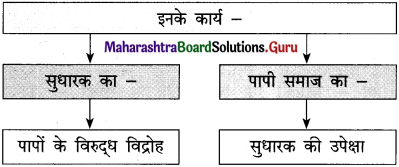
‘पाप के चार हथियार’ पाठ में लेखक कन्हैयालाल मिश्र ‘प्रभाकर’ ने एक ज्वलंत समस्या की ओर ध्यान आकर्षित किया है। संसार में चारों ओर पाप, अन्याय और अत्याचार व्याप्त है, फिर भी कोई संत, महात्मा, अवतार, पैगंबर या सुधारक इससे मुक्ति का मार्ग बताता है, तो लोग उसकी बातों पर ध्यान नहीं देते और उसकी अवहेलना करते हैं। उसकी निंदा करते हैं। इतना ही नहीं, इस प्रकार के कई सुधारकों को तो अपनी जान तक गँवा देनी पड़ी है।

लेकिन यही लोग सुधारकों, महात्माओं की मृत्यु के पश्चात उनके स्मारक और मंदिर बनाते हैं और उनके विचारों और कार्यों का गुणगान करते नहीं थकते। जो लोग सुधारक के जीवित रहते उसकी बातों को अनसुना करते रहे, उसकी निंदा करते रहे और उसकी जान के दुश्मन बने रहे, उसकी मृत्यु के पश्चात उन्हीं लोगों के मन में उसके लिए श्रद्धा की भावना उमड़ पड़ती है और वे उसके स्मारक और मंदिर बनाने लगते हैं।

इस प्रकार लेखक ने ‘पाप के चार हथियार’ के द्वारा यह संदेश दिया है कि सुधारकों और महात्माओं के जीते जी उनके विचारों पर ध्यान देने और उन पर अमल करने से ही समस्याओं का समाधान होता है, न कि स्मारक और मंदिर बनाने से।

(आ) ‘पाप के चार हथियार निबंध का उददेश्य स्पष्ट कीजिए।
उत्तर :
संसार में पाप, अत्याचार और अन्याय का बोलबाला रहा है और आज भी वह वैसा ही है। इससे लोगों को मुक्ति दिलाने के लिए अनेक महापुरुषों, सुधारकों, समाज सेवकों एवं संतमहात्माओं ने अथक प्रयास किया, पर वे अपने प्रयास में सफल नहीं हो पाए। उल्टे उन्हें समाज के लोगों की उपेक्षा तथा निंदा आदि का शिकार होना पड़ा और कुछ लोगों को अपनी जान भी गँवानी पड़ी।

पर देखा यह गया है कि जीते जी जिन सुधारकों और महापुरुषों को समाज का सहयोग नहीं मिला और उनकी अवहेलना होती रही, मरने के बाद उनके स्मारक और मंदिर भी बने और लोगों ने उन्हें भगवान-सुधारक कह कर वंदनीय भी बताया। यहाँ लेखक यह कहना चाहते हैं कि मरणोपरांत सुधारक का स्मारक-मंदिर बनना सुधारक और उसके प्रयासों दोनों की पराजय है।

अच्छा तो तब होता, जब लोग सुधारक के जीते जी उसके विचारों को अपनाते और पाप, अत्याचार और अन्याय जैसी बुराइयों के खिलाफ संघर्ष में उसका सहयोग करते और समाज से इन बुराइयों के दूर होने में सहायक बनते। इससे सुधारक समाज को पाप, अन्याय, भ्रष्टाचार और अत्याचार जैसी बुराइयों से मुक्ति दिलाने में सफल हो सकता था। लोगों को सुधारक की उपेक्षा, निंदा अथवा उनके खिलाफ षड्यंत्र रचने के बजाय उनके अभियान में अपना पूरा सहयोग देना चाहिए। तभी समाज से ये बुराइयाँ दूर हो सकती हैं। यही इस पाठ का उद्देश्य है।

साहित्य संबंधी सामान्य ज्ञान

प्रश्न 5.
(अ) कन्हैयालाल मिश्र ‘प्रभाकर’ जी के निबंध संग्रहों के नाम लिखिए –
उत्तर :
कन्हैयालाल मिश्र ‘प्रभाकर’जी के निबंध संग्रहों के नाम हैं –
(1) जिंदगी मुस्कुराई
(2) बाजे पायलिया के घूघरू
(3) जिंदगी लहलहाई
(4) महके आँगन – चहके द्वार।

(आ) लेखक कन्हैयालाल मिश्र ‘प्रभाकर’ जी की भाषाशैली –
उत्तर :
कन्हैयालाल मिश्रजी कथाकार, निबंधकार एवं पत्रकार थे। आपकी भाषा मँजी हुई, सहज-सरल और मुहावरेदार है, जो कथ्य को दृश्यमान और सजीव बना देती है। आपके लेखन में तत्सम शब्दों का प्रयोग भारतीय चिंतन-मनन को अधिक प्रभावशाली बना देता है। आप एक सफल निबंधकार थे। आप में अपने विषय को प्रखरता से प्रस्तुत करने की सामर्थ्य है।

Maharashtra Board Class 12 Hindi Yuvakbharati Solutions Chapter 6 पाप के चार हथियार

प्रश्न 6.
रचना के आधार पर निम्न वाक्यों के भेद पहचानिए :
(1) संयोग से तभी उन्हें कहीं से तीन सौ रुपये मिल गए।
(2) यह वह समय था, जब भारत में अकबर की तूती बोलती थी।
(3) सुधारक होता है करुणाशील और उसका सत्य सरल विश्वासी।
(4) फिर भी सावधानी तो अपेक्षित है ही।
(5) यह तस्वीर निःसंदेह भयावह है लेकिन इसे किसी भी तरह अतिरंजित नहीं कहा जाना चाहिए।
(6) आप यहीं प्रतीक्षा कीजिए।
(7) निराला जी हमें उस कक्ष में ले गए, जो उनकी कठोर साधना का मूक साक्षी रहा है।
(8) लोगों ने देखा और हैरान रह गए।
(9) सामने एक बोर्ड लगा था, जिस पर अंग्रेजी में लिखा था।
(10) ओजोन एक गैस है, जो ऑक्सीजन के तीन परमाणुओं से मिलकर बनी होती है।
उत्तर :
(1) सरल वाक्य
(2) मिश्र वाक्य
(3) संयुक्त वाक्य
(4) सरल वाक्य
(5) मिश्र वाक्य
(6) सरल वाक्य
(7) मिश्र वाक्य
(8) संयुक्त वाक्य
(9) मिश्र वाक्य
(10) मिश्र वाक्य।

Hindi Yuvakbharati 12th Digest Chapter 6 पाप के चार हथियार Additional Important Questions and Answers

कृतिपत्रिका के प्रश्न 1 (अ) तथा प्रश्न 1 (आ) के लिए
गद्यांश क्र. 1
प्रश्न. निम्नलिखित पठित गद्यांश पढ़कर दी गई सूचनाओं के अनुसार कृतियाँ कीजिए :

कृति 1 : (आकलन)

प्रश्न 1.
शब्दों को उचित वर्ग में लिखिए :
पीड़ित वर्ग – पीड़क वर्ग

जीवन में दोष संसार में पाप
व्यवस्था में अन्याय व्यवहार में अत्याचार

उत्तर :

जीवन में दोषव्यवस्था में अन्याय
संसार में पाप व्यवहार में अत्याचार

प्रश्न 2.
उत्तर लिखिए :
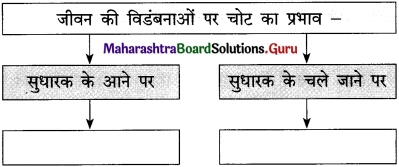
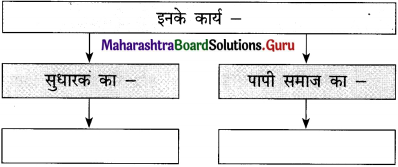
Maharashtra Board Class 12 Hindi Yuvakbharati Solutions Chapter 6 पाप के चार हथियार 1
उत्तर :
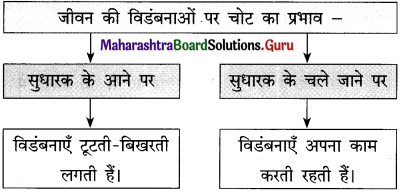
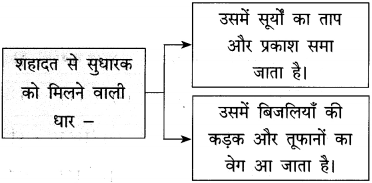
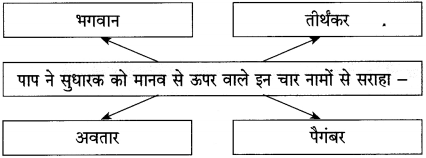
Maharashtra Board Class 12 Hindi Yuvakbharati Solutions Chapter 6 पाप के चार हथियार 2

Maharashtra Board Class 12 Hindi Yuvakbharati Solutions Chapter 6 पाप के चार हथियार

कृति 2 : (शब्द संपदा)

प्रश्न 1.
निम्नलिखित शब्दों के विलोम शब्द लिखिए :
(1) नैतिक x …………………………..
(2) पाप x …………………………..
(3) सत्य x …………………………..
(4) असफल x …………………………..
उत्तर :
(1) नैतिक x अनैतिक
(3) सत्य x असत्य
(2) पाप x पुण्य
(4) असफल x सफल।

गद्यांश क्र. 2
प्रश्न. निम्नलिखित पठित गद्यांश पढ़कर दी गई सूचनाओं के अनुसार कृतियाँ कीजिए :

कृति 1 : (आकलन)

प्रश्न 1.
आकृति पूर्ण कीजिए :
Maharashtra Board Class 12 Hindi Yuvakbharati Solutions Chapter 6 पाप के चार हथियार 3
उत्तर :
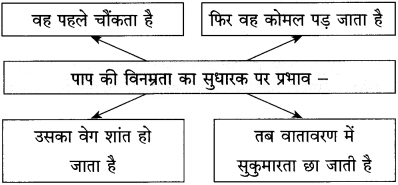
Maharashtra Board Class 12 Hindi Yuvakbharati Solutions Chapter 6 पाप के चार हथियार 6

प्रश्न 2.
उत्तर लिखिए : गद्यांश में आए पाप के दो नारे –
(1) …………………………
(2) …………………………
उत्तर :
(1) अजी बेवकूफ है, लोगों को बेवकूफ बनाना चाहता है।
(2) ओह, मैं तुम्हें खिलौना समझता रहा और तुम साँप निकले। पर मैं साँप को जीता नहीं छोडूंगा – पीस डालूँगा।

प्रश्न 3.
आकृति पूर्ण कीजिए :
(1) सुधारक के सत्य की स्थिति –
(i) उपेक्षा की रगड़ से – कुछ तेज हो जाता है।
(i) निंदा की रगड़ से –
(iii) हत्या के घर्षण से –
उत्तर :
(i) उपेक्षा की रगड़ से – कुछ तेज हो जाता है।
(ii) निंदा की रगड़ से – और भी प्रखर हो जाता है।
(iii) हत्या के घर्षण से – प्रचंड हो उठता है।

Maharashtra Board Class 12 Hindi Yuvakbharati Solutions Chapter 6 पाप के चार हथियार

प्रश्न 4.
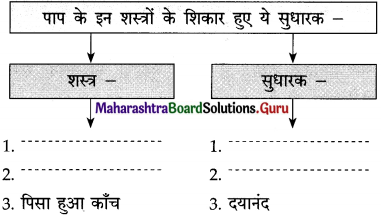
Maharashtra Board Class 12 Hindi Yuvakbharati Solutions Chapter 6 पाप के चार हथियार 4
उत्तर :
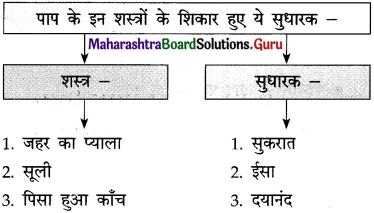
Maharashtra Board Class 12 Hindi Yuvakbharati Solutions Chapter 6 पाप के चार हथियार 7

प्रश्न 5.
Maharashtra Board Class 12 Hindi Yuvakbharati Solutions Chapter 6 पाप के चार हथियार 5
उत्तर :
Maharashtra Board Class 12 Hindi Yuvakbharati Solutions Chapter 6 पाप के चार हथियार 8

Maharashtra Board Class 12 Hindi Yuvakbharati Solutions Chapter 6 पाप के चार हथियार

कृति 2 : (शब्द संपदा)

प्रश्न 1.
गद्यांश में प्रयुक्त उपसर्गयुक्त शब्द ढूँढ़कर लिखिए :
(1) …………………………………
(2) …………………………………
(3) …………………………………
(4) …………………………………
उत्तर :
(1) विद्रोह
(2) प्रतिनिधि
(3) असह्य
(4) प्रलाप।

गद्यांश क्र. 3
प्रश्न. निम्नलिखित पठित गद्यांश पढ़कर दी गई सूचनाओं के अनुसार कृतियाँ कीजिए :

कृति 1 : (आकलन)

प्रश्न 1.
उत्तर लिखिए :
(1) पाप सत्य पर यह फेंकता है – [ ]
(2) पाप का ब्रह्मास्त्र – [ ]
(3) अब पाप का नारा यह होता है – [ ]
(4) अब पाप सुधारक की यह लगता है – [ ]
उत्तर :
ब्रह्मास्त्र
श्रद्धा
सत्य की जय! सुधारक की जय
चरण वंदना

प्रश्न 2.
कृति पूर्ण कीजिए :
Maharashtra Board Class 12 Hindi Yuvakbharati Solutions Chapter 6 पाप के चार हथियार 9
उत्तर :
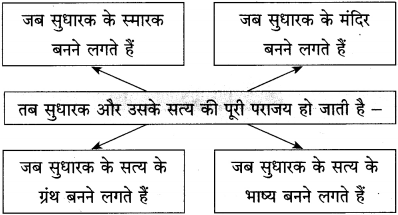
Maharashtra Board Class 12 Hindi Yuvakbharati Solutions Chapter 6 पाप के चार हथियार 12

Maharashtra Board Class 12 Hindi Yuvakbharati Solutions Chapter 6 पाप के चार हथियार

Maharashtra Board Class 12 Hindi Yuvakbharati Solutions Chapter 6 पाप के चार हथियार 10
उत्तर :
Maharashtra Board Class 12 Hindi Yuvakbharati Solutions Chapter 6 पाप के चार हथियार 13

Maharashtra Board Class 12 Hindi Yuvakbharati Solutions Chapter 6 पाप के चार हथियार 11
उत्तर :
Maharashtra Board Class 12 Hindi Yuvakbharati Solutions Chapter 6 पाप के चार हथियार 14

Maharashtra Board Class 12 Hindi Yuvakbharati Solutions Chapter 6 पाप के चार हथियार

कृति 2 : (शब्द संपदा)

प्रश्न 1.
पद्यांश से ढूँढ़कर प्रत्यययुक्त शब्द लिखिए और शब्द और प्रत्यय अलग करके लिखिए :
(1) ………………………………
(2) ………………………………
(3) ………………………………
(4) ………………………………
उत्तर :
(1) तोलकर – तोल + कर
(2) विश्वासी – विश्वास + ई
(3) वंदनीय – वंदन + ईय
(4) अजेयता – अजेय + ता।

प्रश्न 2.
निम्नलिखित शब्दों के लिंग पहचानकर लिखिए :
(1) चरण – ………………………………
(2) सुधारक – ………………………………
(3) वाणी – ………………………………
(4) पराजय – ………………………………
उत्तर :
(1) चरण – पुल्लिंग
(2) सुधारक – पुल्लिंग
(3) वाणी – स्त्रीलिंग
(4) पराजय – स्त्रीलिंग।

कृति 3 : (अभिव्यक्ति)

प्रश्न 1.
‘स्मारकों और समाधियों का उद्देश्य’ विषय पर 40 से 50 शब्दों में अपने विचार व्यक्त कीजिए।
उत्तर :
स्मारक और समाधियाँ महापुरुषों, मनीषियों, विचारकों, समाज सुधारकों, राजनेताओं तथा शहीदों के अद्भुत कार्यों को ध्यान में रखकर उन्हें सम्मान देने, याद रखने तथा उनके कार्यों से प्रेरणा लेने के उद्देश्य से बनाए जाते हैं। इससे आने वाली पीढ़ियाँ उन्हें याद रखती हैं और उनके कार्यों से प्रेरणा लेती हैं।

पर ऐसा बहुत कम देखा जाता है। अकसर इनके प्रति लोगों में श्रद्धा की भावना होती है। वे इनके दर्शन कर इन्हें श्रद्धांजलि भी देते हैं, पर इनके कार्यों से प्रेरणा लेने की बात उनके मन में कम ही आती है। इन महापुरुषों, मनीषियों, विचारकों, समाज सुधारकों, राजनेताओं तथा शहीदों को सच्ची श्रद्धांजलि उनके कार्यों से प्रेरणा लेकर समाज और देश के विकास के लिए कार्य करना है।

स्मारकों एवं समाधियों की स्थापना के पीछे यही भावना छिपी होती है और लोगों के मन में भी यही भावना होनी चाहिए।

Maharashtra Board Class 12 Hindi Yuvakbharati Solutions Chapter 6 पाप के चार हथियार

मुहावरे

निम्नलिखित मुहावरों का अर्थ लिखकर वाक्य में प्रयोग कीजिए :
(1) दाल न गलना।
अर्थ : चतुराई काम न आना।
वाक्य : आफिस के कई लोगों ने उस ईमानदार कर्मचारी को निकलवाने की बड़ी कोशिश की, पर उनकी दाल न गली।

(2) गड़े मुरदे उखाड़ना।
अर्थ : पुरानी कटु बातों को याद करना।
वाक्य : बुढ़िया अकसर अपने बेटों से गड़े मुरदे उखाड़ने की भाषा में ही बोला करती थी।

(3) फूंक फूंक कर पाँव रखना।
अर्थ : अति सावधानी बरतना।
वाक्य : सेठ मटरूमल को जब से धंधे में भारी घाटा उठाना पड़ा है, तब से वे लेन-देन में फूंक फूंक कर पाँव रखते हैं।

(4) आठ-आठ आँसू रोना।
अर्थ : बहुत अधिक रोना।
वाक्य : बुढ़िया का इकलौता बेटा जब से विदेश में नौकरी करने गया है, तब से वह उसकी याद में आठ-आठ आँसू रोती रहती है।

(5) रंग में भंग होना।
अर्थ : प्रसन्नता के वातावरण में विघ्न पड़ना।
वाक्य : कोरोना के लॉक डाउन के कारण मेरे दोस्त नलिन के विवाह समारोह के उत्सव में रंग में भंग हो गया।

काल परिवर्तन :

प्रश्न 1.
निम्नलिखित वाक्यों का काल परिवर्तन कर के वाक्य फिर से लिखिए :
(1) इसमें संसार का एक बहुत बड़ा सत्य कह दिया गया है। (पूर्ण भूतकाल)
(2) शॉ के इन शब्दों में अहंकार की पैनी धार है। (सामान्य भविष्यकाल)
(3) इसे वे क्यों नहीं बदल पाए? (सामान्य वर्तमानकाल)
(4) सुधारक का सत्य निंदा की रगड़ से और भी प्रखर हो जाता है। (अपूर्ण भूतकाल)
(5) इस वेग में वह पिस जाएगा। (पूर्ण भूतकाल)
उत्तर :
(1) इसमें संसार का एक बहुत बड़ा सत्य कह दिया गया था।
(2) शॉ के इन शब्दों में अहंकार की पैनी धार होगी।
(3) इसे वे क्यों नहीं बदल पाते?
(4) सुधारक का सत्य निंदा की रगड़ से और भी प्रखर हो रहा था।
(5) इस वेग में वह पिस गया था।

Maharashtra Board Class 12 Hindi Yuvakbharati Solutions Chapter 6 पाप के चार हथियार

वाक्य शुद्धिकरण

प्रश्न 1.
निम्नलिखित वाक्यों को शुद्ध करके लिखिए :
(1) वह स्वरग का अमरित है।
(2) समाज की पाप विवश हो जाती है।
(3) पाप के पास चार शस्त्रे है।
(4) वे मुझे बर्दास्त नई कर सकते।
(5) ये नारा ऊँचे उठता रहता है।
उत्तर :
(1) वह स्वर्ग का अमृत है।
(2) समाज का पाप विवश हो जाता है।
(3) पाप के पास चार शस्त्र हैं।
(4) वे मुझे बर्दाश्त नहीं कर सकते।
(5) यह नारा ऊँचा उठता रहता है।

पाप के चार हथियार Summary in Hindi

पाप के चार हथियार लेखक का परिचय

Maharashtra Board Class 12 Hindi Yuvakbharati Solutions Chapter 6 पाप के चार हथियार 15
पाप के चार हथियार
लेखक का नाम :
कन्हैयालाल मिश्र ‘प्रभाकर’। (जन्म : 26 सितंबर, 1906; निधन : 1995.)

प्रमुख कृतियाँ : ‘धरती के फूल’ (कहानी संग्रह)। ‘जिंदगी मुस्कुराई’, ‘बाजे पायलिया के घूघरू’, ‘जिंदगी लहलहाई’, ‘महके आँगन – चहके द्वार’ (निबंध संग्रह), ‘दीप जले शंख बजे’, ‘माटी हो गई सोना’ (संस्मरण एवं रेखाचित्र) आदि।

पाप के चार हथियार विशेषता : कथाकार, निबंधकार, पत्रकार तथा स्वतंत्रता सेनानी। आपने पत्रकारिता में स्वतंत्रता के स्वर को ऊँचा उठाया। आपका संपूर्ण साहित्य मूलतः सामाजिक सरोकारों का शब्दांकन है। आप पद्मश्री सम्मान से विभूषित हैं।

पाप के चार हथियार विधा : निबंध। निबंध का अर्थ है विचारों को भाषा में व्यवस्थित रूप से बाँधना। इसमें वैचारिकता का अधिक महत्त्व होता है तथा विषय को सहजता से रखने का सामर्थ्य होता है।

पाप के चार हथियार विषय प्रवेश : संसार भर के अनेक संतों, महात्माओं, महापुरुषों, विचारकों, दार्शनिकों तथा समाज सुधारकों ने मनुष्य जाति को पाप, अपराध तथा दुष्कर्मों से मुक्त कराने के लिए अथक प्रयास किया है, पर आज तक संसार में अन्याय, अत्याचार, भ्रष्टाचार, पाप और दुष्कर्मों का अंत नहीं हो पाया है। इसका कारण यह है कि लोगों को इन संतों, महात्माओं और समाज सुधारकों के प्रति श्रद्धा तो होती है, पर वे उनके द्वारा व्यक्त विचारों को अपने आचरण में गंभीरतापूर्वक नहीं उतारते। ऐसा क्यों होता है? लेखक ने प्रस्तुत निबंध में यही बताने का प्रयास किया है।

Maharashtra Board Class 12 Hindi Yuvakbharati Solutions Chapter 6 पाप के चार हथियार

पाप के चार हथियार पाठ का सार

संसार में सदा से पाप, अपराध, अन्याय, अत्याचार, दुष्कर्म एवं भ्रष्टाचार का बोलबाला रहा है। संसार के कई महापुरुषों, विचारकों, सुधारकों एवं संतों ने मानव जाति को इनसे मुक्ति दिलाने के लिए अथक प्रयास किए हैं, पर यह समस्या आज भी पहले जैसे सर्वत्र व्याप्त है। इसका मुख्य कारण रहा है विचारकों तथा सुधारकों को लोगों का सहयोग न मिलना। इनकी कही गई बातों पर ध्यान न देना। उनके विचारों को आचरण में न उतारना। यही कारण है कि सुधारक अपने उद्देश्य में सफल नहीं हो पाते।

लेखक कहते हैं कि बुराइयों के विरुद्ध सुधारक की बातें लोगों को किसी पागल व्यक्ति की बकवास लगती हैं, जिन्हें वे सुनना ही नहीं चाहते। यदि कभी एकाध बात सुन लेते हैं, तो उसकी निंदा करते नहीं थकते और उस पर लोगों को बेवकूफ बनाने का आरोप लगाने लगते हैं। लेखक कहते हैं कि जब सुधारक का स्वर कुछ प्रखर हो जाता है, तो सामाजिक बुराइयों के लिए यह स्थिति कठिन हो जाती है और ऐसे में सुधारक की हत्या भी हो जाती है। वे कहते हैं कि सुकरात, ईसा और दयानंद की हत्या इसी तरह हुई थी।

लेकिन इसके बाद स्थिति में एकदम बदलाव आ जाता है। सुधारक के विचारों का विरोध करने वाले लोगों के मन में उसके प्रति श्रद्धा उमड़ पड़ती है। इसके बाद उसे भगवान, तीर्थकर, अवतार, पैगंबर और संत, महाप्रभु की संज्ञा दी जाने लगती है। अब वह लोगों के लिए सामान्य सुधारक न रहकर विशिष्ट व्यक्ति हो जाता है। उसके स्मारक और मंदिर बनने लगते हैं।

उसकी प्रशंसा होने लगती है। लेखक कहते हैं कि यहीं सुधारक और उसके सिद्धांत की पराजय हो जाती है। यही कारण है कि अनेक महापुरुषों, विचारकों, सुधारकों एवं संतों द्वारा इन सामाजिक बुराइयों को दूर करने के लिए किए गए प्रयास सफल न हो पाए।

पाप के चार हथियार मुहावरे : अर्थ और वाक्य प्रयोग

(1) ढाँचा डगमगा उठना।
अर्थ : आधार हिल उठना।
वाक्य : कभी-कभी किसी व्यक्ति द्वारा कोई गलत निर्णय ले लेने के कारण किसी परिवार अथवा पूरे समाज का ढाँचा डगमगा उठता है।

(2) लहर को ऊपर से उतार देना।
अर्थ : सिर झुका कर संकट को गुजरने देना।
वाक्य : कोरोना संकट देश की अर्थव्यवस्था को डगमगा देने वाला है, पर हमारी सरकार इस लहर को ऊपर से उतार देने का सफल प्रयास कर रही है।

(3) गले के नीचे उतरना।
अर्थ : स्वीकार करना।
वाक्य : महाराष्ट्र और कर्नाटक के सीमा विवाद का फैसला ऐसा होना चाहिए, जो दोनों राज्यों की सरकारों और जनता के गले उतरने वाला हो।

(4) विवश होना।
अर्थ : लाचार होना।
वाक्य : कोरोना के प्रकोप से बचने के लिए हर आदमी लॉक डाउन के समय अपने घर में रहने के लिए विवश है।

Maharashtra Board Class 12 Hindi Yuvakbharati Solutions Chapter 6 पाप के चार हथियार

टिप्पणियाँ

  • जॉर्ज बर्नार्ड शॉ : आपका जन्म 26 जुलाई, 1856 को आयलैंड में हुआ। आपको साहित्य का नोबल पुरस्कार प्राप्त हुआ है। शॉ महान नाटककार, कुशल राजनीतिज्ञ तथा समीक्षक रह चुके हैं। पिग्मॅलियन, डॉक्टर्स डायलेमा, मॅन ऐंड सुपरमॅन, सीझर ऐंड क्लिओपॅट्रा आपके प्रसिद्ध नाटक हैं।
  • तीर्थंकर : जैन धर्मियों के 24 उपास्य मुनि।
  • सुकरात (सॉक्रेटिस) : युनानी दार्शनिक सुकरात का जन्म ढाई हजार वर्ष पहले एथेन्स में हुआ। वे युवकों से संवाद स्थापित कर उन्हें सोचने की दिशा में प्रवृत्त करते थे। आप प्रसिद्ध विचारक प्लेटो के गुरु थे।
  • दयानंद : आर्य समाज के संस्थापक स्वामी दयानंद सरस्वती समाजसुधारक के रूप में जाने जाते हैं। आपको योगशास्त्र तथा वैद्यकशास्त्र का भी ज्ञान था।
  • ब्रह्मास्त्र : पुराणों के अनुसार एक प्रकार का अस्त्र जो मंत्र द्वारा चलाया जाता था।

पाप के चार हथियार शब्दार्थ

  • खूबियों का पुंज = विशेषताओं का गुच्छा
  • पीड़क = पीड़ा पहुँचाने वाला
  • एकांगी = एक पक्षीय
  • पैने = तीखे/धारदार
  • बखान = वर्णन
  • लोकोत्तर = सामान्य लोगों से ऊपर/विशिष्ट
  • अजेय = जिसे जीता न जा सके
  • अंबार = ढेर
  • विडंबना = उपहास
  • प्रलाप = निरर्थक बात, बकवास
  • शहादत = बलिदान
  • उपसंहार = सार, निष्कर्ष
  • फलितार्थ = सारांश/निचोड़/तात्पर्य
  • खंडित = भग्न, टूटा हुआ

पाप के चार हथियार मुहावरे

  • ढाँचा डगमगा उठना = आधार हिल उठना
  • लहर को ऊपर से उतार देना = सिर झुकाकर संकट को गुजरने देना
  • गले के नीचे उतरना = स्वीकार होना
  • विवश होना = लाचार होना

(टिप्पणियाँ)

  • जॉर्ज बर्नार्ड शॉ : आपका जन्म २६ जुलाई १८५६ को आयर्लंड में हुआ। आपको साहित्य का नोबल पुरस्कार प्राप्त हुआ है। शॉ महान नाटककार, कुशल राजनीतिज्ञ तथा समीक्षक रह चुके हैं। पिग्मैलियन, डॉक्टर्स डाइलेमा, मॅन एंड सुपरमैन, सीझर अँड क्लियोपैट्रा आपके प्रसिद्ध नाटक हैं।
  • तीर्थंकर : जैन धर्मियों के २४ उपास्य मुनि।
  • सुकरात (सॉक्रेटिस) : यूनानी दार्शनिक सुकरात का जन्म ढाई हजार वर्ष पहले एथेन्स में हुआ। युवकों से संवाद स्थापित कर उन्हें सोचने की दिशा में प्रवृत्त करते थे। आप प्रसिद्ध विचारक प्लेटो के गुरु थे।
  • दयानंद : आर्य समाज के संस्थापक स्वामी दयानंद सरस्वती समाजसुधारक के रूप में जाने जाते हैं। आपको योगशास्त्र तथा वैद्यकशास्त्र का भी ज्ञान था। Maharashtra Board Class 12 Hindi Yuvakbharati Solutions Chapter 6 पाप के चार हथियार
  • ब्रह्मास्त्र : पुराणों के अनुसार एक प्रकार का अमोध अस्त्र जो मंत्र द्वारा चलाया जाता था।

Maharashtra Board 11th BK Textbook Solutions Chapter 1 Introduction to Book Keeping and Accountancy

Balbharti Maharashtra State Board Bookkeeping and Accountancy 11th Solutions Chapter 1 Introduction to Book Keeping and Accountancy Textbook Exercise Questions and Answers.

Maharashtra State Board Bookkeeping and Accountancy 11th Solutions Chapter 1 Introduction to Book Keeping and Accountancy

1. Answer in One Sentence:

Question 1.
What is Book-keeping?
Answer:
Recording the business transactions in the books of accounts systematically by considering some definite principles is called book-keeping.

Question 2.
What is meant by Goods?
Answer:
Any commodity, article, or merchandise in which trader regularly deals or carries on trade is called goods e.g. cloth is the goods for cloth merchant.

Question 3.
What is Capital?
Answer:
Amount invested by the proprietor into the business from time to time is called Capital.

Maharashtra Board 11th BK Textbook Solutions Chapter 1 Introduction to Book Keeping and Accountancy

Question 4.
What are Drawings?
Answer:
The total amount of goods and services are withdrawn by the proprietor from time to time for self-use is called drawings.

Question 5.
What is Goodwill?
Answer:
The money value of business reputation earned by the business over the number of years is called Goodwill.

2. Give the word term or phrase which can substitute each of the following statements:

Question 1.
Recording of business transactions.
Answer:
Book-keeping

Question 2.
Amount invested in the business by the proprietor.
Answer:
Capital

Question 3.
A person to whom the amount is payable.
Answer:
Creditor

Maharashtra Board 11th BK Textbook Solutions Chapter 1 Introduction to Book Keeping and Accountancy

Question 4.
The exchange between two persons.
Answer:
Transaction

Question 5.
Excess of expenses over income.
Answer:
Loss

Question 6.
A person whose assets are sufficient enough to meet business obligations.
Answer:
Solvent

Question 7.
Book-keeping is providing all required financial information to the businessman.
Answer:
Decision Making

Question 8.
Property of any description owned by Proprietor.
Answer:
Assets

Maharashtra Board 11th BK Textbook Solutions Chapter 1 Introduction to Book Keeping and Accountancy

Question 9.
Assets that remain in the business for only for short time and can be converted into cash very easily.
Answer:
Current Assets

Question 10.
Allowance is given on catalogue price of goods.
Answer:
Trade Discount

3. Select the most appropriate alternatives from those given below and rewrite the statements.

Question 1.
Surplus of income over expenses is _____________
(a) Profit
(b) Deficit
(c) Loss
(d) Financial Statements
Answer:
(a) Profit

Question 2.
In _____________ basis of accounting, actual cash receipts and actual cash payments are recorded.
(a) Accrual
(b) Hybrid
(c) Cash
(d) Mercantile
Answer:
(c) Cash

Question 3.
Amount which is not recoverable from customer is known as _____________
(a) Bad Debts
(b) Debts
(c) Debtors
(d) Doubtful debts
Answer:
(a) Bad Debts

Maharashtra Board 11th BK Textbook Solutions Chapter 1 Introduction to Book Keeping and Accountancy

Question 4.
Accounts must be honestly prepared and they must disclose all material information is known as _____________
(a) Entity Concepts
(b) Dual Aspect Concept
(c) Disclosure Concept
(d) Cost Concept
Answer:
(c) Disclosure Concept

Question 5.
A commodity in which a trader deals is known as _____________
(a) Goods
(b) Income
(c) Property
(d) Expenditure
Answer:
(a) Goods

Question 6.
_____________ means a reputation of a business valued in terms of money.
(a) Trademark
(b) Assets
(c) Patents
(d) Goodwill
Answer:
(d) Goodwill

Question 7.
According to _____________ Cash flow statement is prepared and presented for the period for which the profit and loss account is prepared.
(a) AS-3
(b) AS-10
(c) AS-6
(d) AS-2
Answer:
(a) AS-3

Question 8.
The immediate recognition of loss is supported by principle of _____________
(a) Conservatism
(b) Objective
(c) Matching
(d) Consistency
Answer:
(a) Conservatism

Maharashtra Board 11th BK Textbook Solutions Chapter 1 Introduction to Book Keeping and Accountancy

Question 9.
Brief explanation of an entry is called as _____________
(a) Folio
(b) Narration
(c) Posting
(d) Journalising
Answer:
(b) Narration

Question 10.
An act of exchange of things or services between the two parties is termed as _____________
(a) Ledger
(b) Transfer
(c) Transaction
(d) Business
Answer:
(c) Transaction

4. State whether the following statements are true or false with reasons:

Question 1.
Book-keeping and accounting are one and the same thing.
Answer:
This statement is False.
Book-Keeping means recording business transactions in a separate set of books and accountancy is the process of summarising and analyzing the business transactions which are recorded in the books of accounts, so book-keeping and accounting are not one and the same thing.

Question 2.
Conservatism means to follow the safe side.
Answer:
This statement is True.
This accounting concept suggests that while preparing accounting statements, planning, policies, strategies, and budgets, all possible or anticipated losses must be taken into consideration. While unrealized prospective or anticipated profits should be ignored. This is known as “The policy of playing a safe game” or “Principal of Prudence”.

Question 3.
The double entry system is based on the “Dual Aspect” concept.
Answer:
This statement is True.
This accounting concept explains that every business transaction has two aspects viz. (i) acquisition or increase in the asset of the business and (ii) creation or increase in claims against the business. Assets refer to the valuable things owned by the business. Capital refers to the proprietor’s contribution to the business to provide funds to undertake activities. Capital refers to the proprietor’s contribution to the business to provide funds to undertake activities. Capital is the owner’s claim against the business, e.g. a capital of ₹ 5,00,000 received in cash by the business from the proprietor has dual aspects viz. business has cash i.e. asset of ₹ 5,00,000 and the proprietor has a claim of ₹ 5,00,000 against the business entity called capital.

Maharashtra Board 11th BK Textbook Solutions Chapter 1 Introduction to Book Keeping and Accountancy

Question 4.
Bank overdraft is an asset of the business.
Answer:
This statement is False.
Bank overdraft is a liability of the business. Businesses owe to the bank for the excess amount withdrawn from the bank account. It is a temporary loan from a bank.

Question 5.
A solvent person is a person whose assets are more than his liabilities.
Answer:
This statement is True.
A person who is unable to pay his debts is called insolvent. An insolvent person does not have sufficient assets to pay his debts. His business debts are much larger than his business and personal assets. He cannot settle the dues of his creditors fully. Insolvency leads to the compulsory dissolution of the business.

Question 6.
Cash discount does not appear in the books of accounts.
Answer:
This statement is False.
It is the amount deducted from the final amount due at the time of receipt. It is the concession given for encouraging prompt payment. It is given either for the spot payment or for payment within a specific period. A cash discount is calculated after deducting a trade discount, since it is a loss to the seller and gain to the buyer, a cash discount appears in the books of accounts.

Question 7.
A transaction is concerned with money or money’s worth.
Answer:
This statement is True.
In common parlance, a transaction is a dealing between two or more persons, in which one person gives something to the other and in exchange for that receives something from the other. It is an exchange of goods and services either for cash or for any other goods or services. In other words, it is a business activity that interprets in money terms what business gives and what business receives in that exchange. To complete the transaction at least two persons are required. Purchase of goods, sale of goods, receipt, and payment of cash, borrowing, and lending, depositing cash into the bank, withdrawal of cash from the bank, etc. are examples of business transactions.

Maharashtra Board 11th BK Textbook Solutions Chapter 1 Introduction to Book Keeping and Accountancy

Question 8.
Accounting is the language of business.
Answer:
This statement is True.
Book-keeping is a part of Accounting. It is the primary stage in accounting. It is the process of recording transactions in accounts. Accounting is part of Accountancy. Accountancy is the practice of recording, classifying and reporting business transactions for a business. Accounting principles are the basic norms and assumptions developed and established as the basis for an accounting system. These principles are adopted by accountants universally. So accounting is the language of business.

Question 9.
In the early times of civilization, accounting was done by owners.
Answer:
This statement is False.
Booking is a part of Accounting that follows certain rules for recording transactions. It has classification, concepts, conventions, and principles which requires certain knowledge and qualifications. So it is done by an accountant.

Question 10.
Book-keeping is useful to find out all tax liabilities.
Answer:
This statement is True.
As all business transactions are recorded in the books of accounts so there is no question of hiding any income or expenses, with the help of book-keeping businessmen know their liabilities towards the government for tax payments like GST., Income tax, etc.

5. Do you agree or disagree with the following statements:

Question 1.
Accounting is useful only to the owner.
Answer:
Disagree

Question 2.
Book-keeping is an art, science, and profession.
Answer:
Agree

Maharashtra Board 11th BK Textbook Solutions Chapter 1 Introduction to Book Keeping and Accountancy

Question 3.
Bills Payable is an asset of the business.
Answer:
Disagree

Question 4.
In Book-keeping and Accountancy, only non-monetary transactions are recorded.
Answer:
Disagree

Question 5.
Totalling of Journal or Ledger is called casting.
Answer:
Agree

6. Complete the following sentences:

Question 1.
Revenue arising as a result of business transactions is known as _____________
Answer:
Income

Question 2.
Excess of gross profit over operating expenses is _____________
Answer:
Operating profit

Question 3.
An expenditure which is basically revenue in nature but the benefit of which is not exhausted within one year is called as _____________
Answer:
Deferred revenue expenditure

Question 4.
The amount deducted by the seller from the list price of goods at the time of sale is _____________
Answer:
Trade Discount

Maharashtra Board 11th BK Textbook Solutions Chapter 1 Introduction to Book Keeping and Accountancy

Question 5.
A person to whom the business owes money for the goods or services is known as _____________
Answer:
Creditor

Student Activity: (Textbook Page No. 9)

Collect some Advertisements relating to discounts and stick them in the notebook.
Answer:
Go through daily new paper read advertisements regarding sales like flip cart, Amazon, Big Bazar, etc.

Maharashtra Board Class 12 Hindi Yuvakbharati Solutions Chapter 9 चुनिंदा शेर

Balbharti Maharashtra State Board Hindi Yuvakbharati 12th Digest Chapter 9 चुनिंदा शेर Notes, Textbook Exercise Important Questions and Answers.

Maharashtra State Board 12th Hindi Yuvakbharati Solutions Chapter 9 चुनिंदा शेर

12th Hindi Guide Chapter 9 चुनिंदा शेर Textbook Questions and Answers

कृति-स्वाध्याय एवं उत्तर

आकलन

प्रश्न 1.
(अ) लिखिए :

(a) परिंदों को यह शिकायत है –
उत्तर :
परिंदों को यह शिकायत है, हे मालिक कभी तो हमारी बात सुनो। ऐसा प्रतीत होता है कि जो दाना आपकी कृपा से हमें प्राप्त होता है, उसमें भी कीड़े लगे हैं।

Maharashtra Board Class 12 Hindi Yuvakbharati Solutions Chapter 9 चुनिंदा शेर

(b) नदी के प्रति उत्तरदायित्व –
उत्तर :
नदी के प्रति उत्तरदायित्व – हमारी संस्कृति में नदी को माता के रूप में पूजा जाता है। नदी मानव सभ्यता के लिए जीवनदायिनी का काम करती है। इस नदी रूपी माता के लिए हमारा भी कुछ उत्तरदायित्व है। हमें नदी को स्वच्छ रखना चाहिए। कूड़ा-कचरा, रसायन नदी में नहीं डालने चाहिए।

(आ) परिणाम लिखिए :
(a) पानी सर से गुजर जाएगा तो – ………………………………………….
उत्तर :
पानी सर से गुजर जाएगा तो – पानी सर से गुजर जाने का अर्थ है परिस्थिति का हाथों से निकल जाना। ऐसी स्थिति आने पर या तो व्यक्ति बिलकुल हताश हो जाता है या विद्रोही बनकर न करने योग्य कार्य भी कर गुजरता है।

(b) कवि जिंदगी के सवालों में खो गए – ………………………………………….
उत्तर :
कवि जिंदगी के सवालों में खो गए तब ऐसा हआ कि कवि के सवालों के जवाब उनके उजालों में खो गए।

शब्द संपदा

प्रश्न 2.
पाठ में आए चार उर्दू शब्द और उनके हिंदी अर्थ :
(1) ………………… = …………………
(2) ………………… = …………………
(3) ………………… = …………………
(4) ………………… = …………………
उत्तर :
(1) खुशबू – सुगंध
(2) परिंदे – पक्षी
(3) ख्वाब – स्वप्न
(4) जिंदगी – जीवन।

Maharashtra Board Class 12 Hindi Yuvakbharati Solutions Chapter 9 चुनिंदा शेर

अभिव्यक्ति

प्रश्न 3.
(अ) ‘आकाश के तारे तोड़ लाना’, इस मुहावरे को स्पष्ट कीजिए।
उत्तर :
आकाश के तारे तोड़ लाना मुहावरे का अर्थ है असंभव काम करना। जब कोई व्यक्ति किसी ऐसे कार्य की पूर्ति कर दे, जिसे कर पाना असंभव माना जा रहा हो तब उसके इस असंभव कार्य के लिए उपर्युक्त मुहावरे का प्रयोग किया जाता है। असीमित कठिनाइयों से भरा कोई काम, जिसे कर पाने में सभी असहज हों, वह कार्य विशेष कर पाना सभी को असंभव लगे, तब यह मुहावरा दोहराया जाता है। जैसे – तुम्हें क्या लगता है कि नलिन कुछ कर नहीं सकता। अरे… समय आने पर वह आकाश के तारे भी तोड़कर ला सकता है।

(आ) ‘क्रांति कभी भी अपने-आप नहीं आती; वह लाई जाती हैं, इस कथन पर अपने विचार लिखिए।
उत्तर :
क्रांति अर्थात बदलाव लाना। बदलाव शासन व्यवस्था के प्रति हो सकता है या फिर किसी सामाजिक प्रथा के विरोध में। क्रांति कभी भी अपने-आप नहीं आती। क्रांति के लिए मानव को ही प्रयास करना पड़ता है। कोई व्यवस्था अथवा रूढ़ि भले ही जर्जर हो चुकी हो, समाज के विकास के लिए अहितकर बन रही हो।

अगर हम उसे बदलने के लिए क्रांतिकारी कदम नहीं उठाएँगे, तो हमारा समाज प्रगति नहीं कर पाएगा, कूपमंडूक बना रहेगा। इतिहास साक्षी है कि जब-जब मानव ने नए सिद्धांतों को, नई खोजों को अपनाया, समाज निरंतर विकास के मार्ग पर आगे बढ़ता रहा।

रसास्वादन

प्रश्न 4.
(अ) कवि की भावुकता और संवेदनशीलता को समझते हुए ‘चुनिंदा शेर’ का रसास्वादन कीजिए।
उत्तर :
कवि अपनी जिंदगी में आई परेशानियों से अप्रभावित हुए बिना उनका इस प्रकार सामना करते रहे कि वहीं से मानो उजाले फूट पड़े। सारी परेशानियाँ इस प्रकार समाप्त हो गईं मानो कभी थीं ही नहीं। हर सुबह हमारे लिए एक नया संदेश लेकर आती है। रात्रि के घोर अंधकार में जुगनू द्वारा फैलाए गए हल्के से प्रकाश में भी आशा की एक किरण छिपी होती है। कवि नित्य नए सपने देखता था, जागती आँखों के सपने।

वह नहीं जानता था कि उसके सपनों में, उसके विचारों में क्रांति का बीज छिपा है। उसके द्वारा आसमान पर लिखे गए सपने एक दिन क्रांति का रूप ले लेंगे। हँसी और आँसू मनुष्य के जीवन के दो अंग हैं। परंतु आज हर मनुष्य अपने जीवन की विसंगतियों से इस कदर त्रस्त है कि वह नहीं चाहता कि दूसरा कोई भी अपने आँसुओं से उसका कंधा भिगोए। अतः हमें अपने चेहरे पर एक मुखौटा लगाकर अपने आँसुओं को हँसी से छिपा लेना चाहिए।

Maharashtra Board Class 12 Hindi Yuvakbharati Solutions Chapter 9 चुनिंदा शेर

ईश्वर फकीरों, साधुओं और समाज की भलाई की इच्छा रखने वाले लोगों को ऐसी शक्ति प्रदान करता है कि उनके मुख से निकले आशीर्वाद सच होने लगते हैं। ऐसे लोगों की आँखें मानो करुणा और स्नेह बरसाती रहती हैं। हर मनुष्य की सहनशक्ति की एक सीमा होती है। प्रतिकूल परिस्थितियों, असफलताओं और अन्याय को सहन करने की शक्ति जिस दिन समाप्त हो जाएगी, उस व्यक्ति का विवेक उसका साथ छोड़ देगा।

वह दिन बस विद्रोह का दिन होगा। जीवन में निरंतर मिलती निराशाओं के कारण आँखों से आँसू इस प्रकार बहते रहते हैं मानो बाढ़ आ गई हो। कभी-कभी तो ऐसा प्रतीत होता है कि यह जीवन नहीं, बल्कि अषाढ़ का महीना है और निरंतर बादल बरस रहे हैं। एक मेहनतकश इन्सान जेठ मास की कड़कती हुई धूप में नंगे पाँव डामर की जलती सड़क पर चला जा रहा है। उसके पैरों की उँगलियाँ जल रही हैं।

साथ ही दिलोदिमाग में निराशा और हताशा की आँधियाँ चल रही हैं, बिजलियाँ घुमड़ रही हैं। मनुष्य की साँसें निश्चित हैं अर्थात प्रत्येक मनुष्य अपने जीवन में कितना आयुष्य पाएगा, कितनी साँसें ले पाएगा, यह पूर्वनिश्चित है। कवि को ऐसा महसूस होता है मानो उनकी साँसें उनकी अपनी नहीं हैं। अपनी साँसों पर उनका कोई अधिकार नहीं है। इस संसार में अनगिनत लोग ऐसे हैं, जिनमें से किसी का सिर खुला है, तो किसी के पैर चादर से बाहर हैं।

ये लोग अपनी आवश्यकताओं की पूर्ति भी नहीं कर पाते। हे ईश्वर ऐसा कुछ करो कि सभी लोगों को आवश्यकता की हर चीज मिले। सभी अपना भरण-पोषण उचित ढंग से कर सकें। कल भूख और बीमारी के कारण जिस मजदूर की साँसें बंद हो गई, जो इस निर्मोही दुनिया को छोड़कर चला गया, वह अनपढ़ था, निरक्षर था। परंतु उसके भी अनगिनत सपने थे। सपने देखने के लिए किसी भी प्रकार की साक्षरता की आवश्यकता नहीं होती। वह रोज अपनी इच्छाओं, आकांक्षाओं को मानो किताब में लिखता रहता था।

साहित्य संबंधी सामान्य ज्ञान

प्रश्न 5.
(अ) कैलाश सेंगर जी की प्रसिद्ध रचनाओं के नाम – ……………………………………
उत्तर :

  • सूरज तुम्हारा है (गजल संग्रह)
  • यहाँ आदमी नहीं, जूते भी चलते हैं
  • सुबह होने का इंतजार (कहानी संग्रह)
  • अभी रात बाकी है (अनूदित साहित्य)

(आ) गजल इस भाषा का लोकप्रिय काव्य प्रकार है – ……………………………………
उत्तर :
उर्दू

प्रश्न 6.
कोष्ठक में दी गई सूचना के अनुसार काल परिवर्तन करके वाक्य फिर से लिखिए :
(1) एक-एक क्षण आपको भेंट कर देता हूँ। (सामान्य भविष्यकाल)
(2) बैजू का लहू सूख गया है। (सामान्य भूतकाल)
(3) मन बहुत दुखी हुआ था। (अपूर्ण भूतकाल)
(4) पढ़-लिखकर नौकरी करने लगा। (पूर्ण भूतकाल)
(5) यात्रा की तिथि भी आ गई। (सामान्य वर्तमानकाल)
(6) मैं पता लगाकर आता हूँ। (सामान्य भविष्यकाल)
(7) गर्ग साहब ने अपने वचन का पालन किया। (सामान्य भविष्यकाल)
(8) मौसी कुछ नहीं बोल रही थी। (अपूर्ण वर्तमानकाल)
(9) सुधारक आते हैं। (पूर्ण भूतकाल)
(10) प्रकाश उसमें समा जाता है। (सामान्य भूतकाल)
उत्तर :
(1) एक-एक क्षण आपको भेंट कर दूंगा।
(2) बैजू का लहू सूख गया।
(3) मन बहुत दुखी हो रहा था।
(4) पढ़-लिखकर नौकरी करने लगा था।
(5) यात्रा की तिथि भी आ जाती है।
(6) मैं पता लगाकर आऊँगा।
(7) गर्ग साहब अपने वचन का पालन करेंगे।
(8) मौसी कुछ नहीं बोल रही है।
(9) सुधारक आए थे।
(10) प्रकाश उसमें समा जाता था।

Maharashtra Board Class 12 Hindi Yuvakbharati Solutions Chapter 9 चुनिंदा शेर

Hindi Yuvakbharati 12th Digest Chapter 9 चुनिंदा शेर Additional Important Questions and Answers

कृतिपत्रिका के प्रश्न 2 (अ) तथा प्रश्न 2 (आ) के लिए
पद्यांश क्र. 1

प्रश्न. निम्नलिखितपद्यांश पढ़कर दी गई सूचनाओं के अनुसार कृतियाँ कीजिए :

कृति 1 : (आकलन)

प्रश्न 1.
निम्नलिखित शब्दों के लिए पद्यांश में प्रयुक्त शब्द ढूँढ़कर लिखिए :
(1) पक्षी – ………………………………………….
(2) सपना – ………………………………………….
(3) कला – ………………………………………….
(4) क्रांति – ………………………………………….
उत्तर :
(1) पक्षी – परिंदे
(2) सपना – ख्वाब
(3) कला – हुनर
(4) क्रांति – इन्कलाब

कृति 2 : (शब्द संपदा)

प्रश्न 2.
निम्नलिखित शब्दों के समानार्थी शब्द पद्यांश में से ढूँढ़कर लिखिए :
(1) निशा = कवि जिंदगी के सवालों में खो गए तब ऐसा हआ कि कवि के सवालों के जवाब उनके उजालों में खो गए।
(2) कुसुम = कवि जिंदगी के सवालों में खो गए तब ऐसा हआ कि कवि के सवालों के जवाब उनके उजालों में खो गए।
(3) प्रश्न = कवि जिंदगी के सवालों में खो गए तब ऐसा हआ कि कवि के सवालों के जवाब उनके उजालों में खो गए।
(4) स्वामी = कवि जिंदगी के सवालों में खो गए तब ऐसा हआ कि कवि के सवालों के जवाब उनके उजालों में खो गए।
उत्तर :
(1) निशा = रात
(2) कुसुम = फूल
(3) प्रश्न = सवाल
(4) स्वामी = मालिक।

पद्यांश क्र. 2
प्रश्न. निम्नलिखित पद्यांश पढ़कर दी गई सूचनाओं के अनुसार कृतियाँ कीजिए :

कृति 1 : (आकलन)

प्रश्न 1.
पद्यांश से दो ऐसे प्रश्न तैयार कीजिए, जिनके उत्तर निम्नलिखित हों :
(1) किताब
(2) अपनी साँस।
उत्तर :
(1) मजदूर रोज क्या लिखता था?
(2) कवि को क्या पराए धन-सी लगती है?

कृति 2 : (शब्द संपदा)

प्रश्न 1.
निम्नलिखित शब्दों का वचन बदलकर लिखिए :
(1) किताब – ……………………………….
(2) नदी – ……………………………….
(3) आँखों – ……………………………….
(4) उँगलियाँ – ……………………………….
उत्तर :
(1) किताब – किताबें
(2) नदी – नदियाँ
(3) आँखों – आँख
(4) उँगलियाँ – उँगली।

Maharashtra Board Class 12 Hindi Yuvakbharati Solutions Chapter 9 चुनिंदा शेर

प्रश्न 2.
निम्नलिखित शब्दों के लिंग पहचानकर लिखिए :
(1) साँस – ……………………………….
(2) कंगन – ……………………………….
(3) सड़क – ……………………………….
(4) चादर – ……………………………….
उत्तर :
(1) साँस – स्त्रीलिंग
(2) कंगन – पुल्लिंग
(3) सड़क – स्त्रीलिंग
(4) चादर – स्त्रीलिंग।

रसास्वादन मुद्दों के आधार पर
कृतिपत्रिका के प्रश्न 2 (इ) के लिए

प्रश्न 1.
निम्नलिखित मुद्दों के आधार पर शेरों का रसास्वादन कीजिए :
उत्तर :
(1) रचना का शीर्षक : चुनिंदा शेर।
(2) रचनाकार : कैलाश सेंगर।
(3) कविता की केंद्रीय कल्पना : प्रस्तुत कविता में कवि की रचनाओं की प्रभावशीलता, परेशानियों से घबराए बिना उनका सामना करना, सुखद भविष्य के सपने देखना, उन्हें प्राप्त करने का प्रयास करने, आँसुओं को हँसी से छिपा लेना, त्याग और तपस्या के महत्त्व, समाज की भलाई की इच्छा, मनुष्य की सहन शक्ति की सीमा, विद्रोह, मेहनतकश इनसान के दिलोदिमाग में चलने वाली निराशा और हताशा की आँधियों का उल्लेख किया गया है। साथ ही इच्छा व्यक्त की गई है।
(4) रस-अलंकार :
(5) प्रतीक विधान : चट्टानी रातों को जुगनू से वह सँवारा करती है’ पंक्तियों में आशा की एक किरण के लिए जुगनू का प्रतीक के रूप में प्रयोग किया गया है।
(6) कल्पना : सामाजिक विषमता, अव्यवस्था तथा आम आदमियों की विवशताओं को अभिव्यक्त किया गया है।
(7) पसंद की पंक्तियाँ तथा प्रभाव : इसमें लाशें भी मिला करती हैं, तुम जरा देख-भाल तो लेते। इसको माँ कहके पूजनेवालों, इस नदी को खंगाल तो लेते। नदियों को माँ की तरह पूजनेवालों के लिए इन पंक्तियों में नदियोंको साफ-सुथरा रखने का आँख खोलनेवाला संदेश दिया गया है।
(8) कविता पसंद आने का कारण : इन पंक्तियों में कवि जलप्रदूषण रोकने की प्रेरणा दे रहे हैं। नदी मानव सभ्यता के लिए जीवन दायिनी का काम करती है। हमें नदी को स्वच्छ रखना चाहिए। कूड़ा-करकट, रसायन आदि नदी में नहीं डालने चाहिए।

अलंकार

प्रश्न 1.
निम्नलिखित काव्य पंक्तियों में निहित अलंकार पहचानकर उसका नाम लिखिए :
(1) नहिं पराग, नहिं मधुर मधु, नहिं विकास इहिं काल।
अलि कलि ही सौं बिंध्यौ, आगे कौन हवाल।।
(2) सिर फट गया उसका, मानो अरुण रंग का घड़ा।
(3) वन शारदी चंदिका चादर ओढ़े।
उत्तर :
(1) अन्योक्ति अलंकार
(2) उत्प्रेक्षा अलंकार
(3) रूपक अलंकार।

Maharashtra Board Class 12 Hindi Yuvakbharati Solutions Chapter 9 चुनिंदा शेर

रस

प्रश्न 1.
निम्नलिखित काव्य पंक्तियों में निहित रस पहचानकर है उसका नाम लिखिए :
(1) बतरस लालच लाल की मुरली धरी लुकाय।
सौंह करै, भौंहन हँसै, दै न कहि नटि जाय।।

(2) एक भरोसो, एक बल, एक आस विश्वास।
एक राम घनश्याम हित, चातक तुलसीदास।।

(3) आँखें निकाल उड़ जाते, क्षण भर उड़कर आ जाते।
शव जीभ खींचके कौवे, चुभला-चुभलाकर खाते।।
उत्तर :
(1) शृंगार रस
(2) भक्ति रस
(3) वीभत्स रस।

मुहावरे

प्रश्न 1.
निम्नलिखित मुहावरों के अर्थ लिखकर वाक्य में प्रयोग कीजिए :

(1) चोर की दाढ़ी में तिनका
अर्थ : अपराधी का भयभीत और सशंकित रहना।
वाक्य : दरोगा साहब को चोर की दाढ़ी में तिनका के है सिद्धांत पर अपराधियों को पकड़ने में समय नहीं लगता था।

(2) डकार तक न लेना
अर्थ : सब कुछ हजम कर लेना।
वाक्य : भ्रष्टाचार में लिप्त लोग करोड़ों रुपए खाकर बैठ जाते हैं और डकार तक नहीं लेते।

(3) पाँचों ऊँगलियाँ घी में होना
अर्थ : चहुँ ओर लाभ होना।
वाक्य : जब तक नरेश अपने नाना के साथ कोलकाता में धंधा करता था, तब तक उसकी पाँचों ऊँगलियाँ घी में होती थी।

(4) पोंगा होना
अर्थ : नासमझ होना।
वाक्य : भोलाराम की बात मत करो, वह तो पोंगा है पोंगा।

(5) बात का धनी
अर्थ : वचन का पक्का।
वाक्य : सेठ जेठामल गुस्सैल जरूर हैं, पर बात के धनी हैं।

(6) मूंछ उखाड़ना
अर्थ : घमंड चूर-चूर कर देना।
वाक्य : गोल्डन समारा अखाड़े के बाहर दारा सिंह को बढ़-चढ़कर चुनैतियाँ दे रहा था, पर अखाड़े में उतरा, तो दारा सिंह ने पटक-पटक कर उसकी मूंछ उखाड़ ली।

Maharashtra Board Class 12 Hindi Yuvakbharati Solutions Chapter 9 चुनिंदा शेर

वाक्य शुद्धिकरण

प्रश्न 1.
निम्नलिखित वाक्य शुद्ध करके लिखिए :
(1) यहाँ तक की मिट्टी प्रदूषन से अछूती नहीं रही।
(2) निराला जी अपने युग की विशिष्ठ प्रतीभा हैं।
(3) चारों तरफ खुशिया जूमती थीं।
उत्तर :
(1) यहाँ तक कि मिट्टी भी प्रदूषण से अछूती नहीं रही।।
(2) निराला जी अपने युग की विशिष्ट प्रतिभा हैं।
(3) चारों तरफ खुशियाँ झूमती थीं।

चुनिंदा शेर Summary in Hindi

चुनिंदा शेर कवि का परिचय

चुनिंदा शेर कवि का नाम : कैलाश सेंगरय। (जन्म 16 फरवरी, 1954.)

चुनिंदा शेर प्रमुख कृतियाँ : सूरज तुम्हारा है (गजल संग्रह), यहाँ आदमी नहीं, जूते भी चलते हैं, सुबह होने का इंतजार (कहानी संग्रह), अभी रात बाकी है (अनूदित साहित्य) आदि।

चुनिंदा शेर विशेषता : कैलाश सेंगर जी की कविताएँ सहज-सरल भाषा में लिखी गई हैं, जिनमें आम आदमी की जिंदगी में व्याप्त वेदना, भावना आदि की अभिव्यक्ति है। गजल, गीत, कविता, कहानी, नाटक और पत्रकारिता के क्षेत्र में आपका योगदान उल्लेखनीय है। कथानक के तीखेपन और मौलिक प्रयोगों के कारण कैलाश सेंगर अत्यंत लोकप्रिय हैं। विधा उर्दू कविता का लोकप्रिय प्रकार गजल है। इस विधा की लोकप्रियता के फलस्वरूप हिंदी साहित्य में भी इसने अपनी जगह बना ली है और प्रेम की भावभूमि से हटकर यथार्थ की जमीन पर खड़ी है।

चुनिंदा शेर विषय प्रवेश : प्रस्तुत गजलों में सामाजिक विषमता, अव्यवस्था, आम आदमी की विवशताओं को विभिन्न चित्र शब्दों के माध्यम से अभिव्यक्त किया गया है।

चुनिंदा शेर कविता का सरल अर्थ

(1) गजलों से खुशबू …………………………………………. हुनर देता है।

कैलाश जी का यह मानना है कि कवि अपनी गजलों से, अपनी कविताओं से खुशबू फैलाने में सक्षम होता है। वह अपनी कृतियों से चट्टानों पर भी फूल खिला सकता है अर्थात असंभव कार्य को संभव करके दिखा सकता है, क्रांति ला सकता है।

परिंदे ईश्वर से शिकायत कर रहे हैं कि हे मालिक कभी तो हमारी बात भी सुनो। ऐसा प्रतीत होता है कि जो दाना आपकी कृपा से हमें प्राप्त होता है, उसमें भी कीड़े लगे हैं। अर्थात आपकी कृपा भी अब प्रदूषित हो गई है।

Maharashtra Board Class 12 Hindi Yuvakbharati Solutions Chapter 9 चुनिंदा शेर 1

कवि जिंदगी में आई परेशानियों से अप्रभावित हुए बिना उनका इस प्रकार सामना करते रहे कि वहीं से मानो उजाले फूट पड़े। सारी परेशानियाँ इस प्रकार समाप्त हो गईं मानो कभी थी ही नहीं।

Maharashtra Board Class 12 Hindi Yuvakbharati Solutions Chapter 9 चुनिंदा शेर

कवि कहते हैं कि ऐसा प्रतीत होता है कि हर सुबह हमारे लिए एक नया संदेश लेकर आती है। रात्रि के घोर अंधकार में जुगनू है द्वारा फैलाए गए हल्के से प्रकाश में भी आशा की एक किरण छिपी होती है।

कवि नित्य नए सपने देखता था, जागती आँखों के सपने। वह नहीं जानता था कि उसके सपनों में, उसके विचारों में क्रांति का बीज छिपा है। उसके द्वारा आसमान पर लिखे गए सपने एक दिन क्रांति का रूप ले लेंगे।

हँसी और आँसू मनुष्य के जीवन के दो अंग हैं। परंतु आज है हर मनुष्य अपने जीवन की विसंगतियों से इस कदर त्रस्त है कि वह नहीं चाहता कि दूसरा कोई भी अपने आँसुओं से उसका कंधा भिगोए। अतः अच्छा यही रहेगा कि अपने चेहरे पर एक मुखौटा लगाया जाए और अपने आँसुओं को हँसी से छिपा लिया जाए।

कवि त्याग और तपस्या के महत्त्व पर प्रकाश डालते हुए कहते हैं कि ईश्वर फकीरों, साधुओं और समाज की भलाई की इच्छा रखने वाले लोगों को ऐसी शक्ति प्रदान करता है कि उनके मुख से निकले आशीर्वाद सच होने लगते हैं। ऐसे लोगों की आँखें मानो करुणा और स्नेह बरसाती रहती हैं।

(2) इसमें लाशें भी मिला करती हैं …………………………………………. इक किताब लिखता था।

कवि कहते हैं कि हमारी संस्कृति में नदी को माता के रूप में पूजा जाता है। नदी मानव सभ्यता के लिए जीवन दायिनी का काम करती है। इस नदी रूपी माता के लिए हमारा भी कुछ उत्तरदायित्व है। इसमें लोग लाशें तक बहा देते हैं। हमें नदी को स्वच्छ रखना चाहिए। कूड़ा-कचरा, रसायन आदि नदी में नहीं डालने चाहिए।

Maharashtra Board Class 12 Hindi Yuvakbharati Solutions Chapter 9 चुनिंदा शेर 2

कवि कहते हैं कि हर मनुष्य की सहन शक्ति की एक सीमा होती है। प्रतिकूल परिस्थितियों, असफलताओं और अन्याय को सहन करने की शक्ति जिस दिन समाप्त हो जाएगी, उस व्यक्ति का विवेक उसका साथ छोड़ देगा, वह दिन बस विद्रोह का दिन होगा।

कवि कहते हैं कि जीवन में निरंतर मिलती निराशाओं के कारण आँखों से आँसू इस प्रकार बहते रहते हैं मानो बाढ़ आ गई हो। कभी-कभी तो ऐसा प्रतीत होता है कि यह जीवन नहीं, बल्कि अषाढ़ का महीना है और निरंतर बादल बरस रहे हैं।

एक मेहनतकश इन्सान का वर्णन करते हुए कवि कहते हैं कि वह जेठ मास की कड़कती हुई धूप में नंगे पाँव डामर की जलती सड़क पर चला जा रहा है। उसके पैरों की उँगलियाँ जल रही हैं। साथ ही दिलोदिमाग में निराशा और हताशा की आँधियाँ चल रही हैं, बिजलियाँ घुमड़ रही हैं।

कवि कहते हैं कि मनुष्य की साँसें निश्चित हैं अर्थात प्रत्येक मनुष्य अपने जीवन में कितना आयुष्य पाएगा, कितनी साँसें ले पाएगा, यह पूर्वनिश्चित है। कवि को ऐसा महसूस होता है मानो उनकी साँसें उनकी अपनी नहीं हैं। अपनी साँसों की संख्या पर उनका कोई अधिकार नहीं है। ठीक उसी प्रकार जैसे किसी दूसरे की धन-संपत्ति पर हमारा अधिकार नहीं होता। या जैसे हम आवश्यकता पड़ने पर अपने कंगन या अन्य कोई आभूषण किसी महाजन के पास गिरवी रख देते हैं। उसी प्रकार हमारी साँसें भी हमारी अपनी नहीं है।

कवि सृष्टि को बनाने वाले जीवनदाता से कहता है कि इस संसार में अनगिनत लोग ऐसे हैं, जिनमें किसी का सिर खुला है, तो किसी के पैर चादर से बाहर हैं। ये लोग अपनी आवश्यकताओं की पूर्ति भी नहीं कर पाते। हे ईश्वर ऐसा कुछ करो कि सभी लोगों को आवश्यकता की हर चीज मिले। सभी अपना भरण-पोषण उचित ढंग से कर सकें।

Maharashtra Board Class 12 Hindi Yuvakbharati Solutions Chapter 9 चुनिंदा शेर 3

कवि कहते हैं कि कल भूख और बीमारी के कारण जिस मजदूर की साँसें बंद हो गईं, जो इस निर्मोही दुनिया को छोड़कर चला गया, वह अनपढ़ था, निरक्षर था। परंतु उसके भी अनगिनत सपने थे। सपने देखने के लिए किसी भी प्रकार की साक्षरता की आवश्यकता नहीं होती। वह रोज अपनी इच्छाओं, आकांक्षाओं को मानो किताब में लिखता रहता था।

Maharashtra Board Class 12 Hindi Yuvakbharati Solutions Chapter 9 चुनिंदा शेर

चुनिंदा शेर मुहावरे : अर्थ और वाक्य प्रयोग

(1) चट्टानों पर फूल खिलना।
अर्थ : कड़ी मेहनत से खुशहाली पाना।
वाक्य : हिमानी ऐसी दृढनिश्चयी है कि यदि वह ठान ले तो चट्टानों पर फूल खिला सकती है।

(2) सिर से पानी गुजर जाना।
अर्थ : कष्ट या संकट का पराकाष्ठा तक पहुँच जाना, संयम अथवा सहने की शक्ति समाप्त हो जाना।
वाक्य : आए दिन सेठ की गालियाँ सुन-सुनकर गोपाल को लगा कि अब तो सिर से पानी गुजर गया और वह मालिक को टका-सा जवाब देकर नौकरी छोड़कर चला गया।

Maharashtra Board Class 12 Biology Important Questions Chapter 12 Biotechnology

Balbharti Maharashtra State Board 12th Biology Important Questions Chapter 12 Biotechnology Important Questions and Answers.

Maharashtra State Board 12th Biology Important Questions Chapter 12 Biotechnology

Multiple Choice Questions

Question 1.
Recombinant DNA technique was established by ………………..
(a) Herbert Boyer
(b) Stanley Cohen
(c) Peter Lobban
(d) both (a) and (b)
Answer:
(d) both (a) and (b)

Question 2.
Modern biotechnology includes ………………..
(a) r-DNA technology and PCR
(b) microarrays, cell culture and fusion
(c) production of curds, cheese, wine
(d) both (a) and (b)
Answer:
(d) both (a) and (b)

Maharashtra Board Class 12 Biology Important Questions Chapter 12 Biotechnology

Question 3.
How many of the following statements are correct with reference to electrophoresis.
1. DNA is positively charged and it moves towards the negative electrode.
2. DNA is negatively charged and it moves towards the anode.
3. Longer DNA fragments move faster during electrophoresis.
4. Shorter DNA fragments move slowly during electrophoresis.
(a) One
(b) TWo
(c) Three
(d) Four
Answer:
(a) One

Question 4.
PCR technique was developed by ………………..
(a) Stanley Cohen
(b) Herbert Boyer
(c) W. Arber
(d) K. Mullis
Answer:
(d) K. Mullis

Question 5.
……………….. technique is used for in vitro gene cloning or gene multiplication.
(a) Electrophoresis
(b) SDS-PAGE
(c) Spectroscopy
(d) PCR
Answer:
(d) PCR

Question 6.
During denaturation step of polymerase chain reaction, the reaction mixture is heated at ………………..
(a) 40-60°C
(b) 70-75°C
(c) 90-98°C
(d) 36°C
Answer:
(c) 90-98 °C

Question 7.
Annealing temperature of primer is ………………..
(a) 40-60°C
(b) 72°C
(c) 90-98°C
(d) 36°C
Answer:
(a) 40-60 °C

Question 8.
During PCR new strand of DNA is synthesized by ………………..
(a) thermostable Taq DNA polymerase
(b) ligase
(c) phosphorylase
(d) RE
Answer:
(a) thermostable Taq DNA polymerase

Question 9.
Restriction enzymes were discovered by ………………..
(a) K. Mullis
(b) S. Cohen
(c) H. Boyer
(d) Smith, Nathan and Arber
Answer:
(d) Smith, Nathan and Arber

Question 10.
The molecular scissors of DNA are ………………..
(a) ligases
(b) polymerases
(c) endonucleases
(d) transcriptases
Answer:
(c) endonucleases

Question 11.
……………….. generates DNA fragments with sticky ends.
(a) Eco RI
(b) Bam HI
(c) Hind II
(d) both (a) and (b)
Answer:
(d) both (a) and (b)

Question 12.
……………….. is Type III endonulcease.
(a) Hapal
(b) Eco R I
(c) Bgll
(d) Eco K
Answer:
(a) Hapal

Question 13.
Select the incorrect statement.
(a) Type II restriction endonucleases have separate activities for cleaving and methylation.
(b) Type I restriction endonucleases function simultaneously as endonuclease and methylase.
(c) Type II restriction endonucleases cut DNA at specific non-pallindromic sequences.
(d) Thousands of Type II restriction endonucleases have been discovered.
Answer:
(c) Type II restriction endonucleases cut DNA at specific non-palindromic sequences

Question 14.
Ti plasmids are present in ………………..
(a) Bacillus thuringiensis
(b) Agrobacterium tumejaciens
(c) Haemophilus influenza
(d) Escherichia coli
Answer:
(b) Agrobacterium tumefaciens

Question 15.
Plasmid DNA containing foreign DNA is called ………………..
(a) chimeric DNA
(b) passenger DNA
(c) recombinant DNA
(d) both (a) and (c)
Answer:
(d) both (a) and (c)

Question 16.
Bacterial host cell takes up naked r-DNA by process of ………………..
(a) transduction
(b) transfection
(c) transformation
(d) all of these
Answer:
(c) transformation

Question 17.
Virosomes are ………………..
(a) liposome
(b) inactivated HIV
(c) liposome + inactivated HIV
(d) none of these
Answer:
(c) liposome + inactivated HIV

Question 18.
Recombinant protein used in the treatment of emphysema is ………………..
(a) a 1-Antitrypsin
(b) relaxin
(c) Interleukin-1 receptor
(d) urokinase
Answer:
(a) a 1-Antitrypsin

Question 19.
Tissue plasminogen activator and urokinase are used in the treatment of ………………..
(a) blood clots
(b) atherosclerosis
(c) emphysema
(d) asthama
Answer:
(a) blood clots

Question 20.
Bacillus is involved in the production of ……………….. vaccine that melts in mouth.
(a) polio
(b) flu
(c) chicken pox
(d) none of these
Answer:
(b) flu

Question 21.
First transgenic plant produced is …………………..
(a) Bt cotton
(b) tlavr savr tomato
(c) wheat
(d) tobacco
Answer:
(d) tobacco

Question 22.
Insect resistant GMO plants contain ………………..
(a) cowpea trypsin inhibitor gene
(b) cry gene
(c) chalone isomerase gene
(d) (a) or (b)
Answer:
(d) (a) or (b)

Question 23.
‘Cry’ genes are present in ………………..
(a) Agrobacterium tumifaciens
(b) Bacillus thuringiensis
(c) Rhizobium species
(d) Escherichia coli
Answer:
(b) Bacillus thuringiensis

Question 24.
Crystals of Bt toxin produced by some bacteria do not kill the bacteria themselves because ………………..
(a) bacteria are resistant to toxin
(b) toxin is immature
(c) toxin is inactive
(d) bacteria encloses toxin in a special case
Answer:
(c) toxin is inactive

Question 25.
The gene coding for a-amylase inhibitor isolated from ……………….. is transferred to tobacco.
(a) mung bean
(b) adzuki bean
(c) E.coli
(d) daffodils
Answer:
(b) adzuki bean

Question 26.
The enzyme affecting the shelf life of Jlavr savr tomato is ………………..
(a) galactosidase
(b) transacetylase
(c) permease
(d) polygalactouranase
Answer:
(d) polygalactouranase

Question 27.
Ferritin, an iron storage protein, isolated from ……………….. and Phaseolus is transferred to ………………… to increase its iron content.
(a) soybean, rice
(b) rice, wheat
(c) maize, soybean
(d) rice, soybean
Answer:
(a) soybean, rice

Question 28.
To improve oil content and oil quality, ……………….. genes are transferred to soybean, oil palm, rapeseed and sunflower.
(a) Arabidopsis
(b) cry
(c) tobacco
(d) canola
Answer:
(a) Arabidopsis

Question 29.
Artemecin is an ……………….. drug developed from transgenic plants.
(a) anticancer
(b) antimalarial
(c) antibacterial
(d) antifungal
Answer:
(b) antimalarial

Question 30.
The transgenic cow born in Scotland, could produce a human protein in her milk for human therapeutics.
(a) Dolly
(b) Molly
(c) Tracy
(d) none of these
Answer:
(c) Tracy

Question 31.
Indian patent does not allow ………………..
(a) process patent
(b) product patent
(c) biopatent
(d) both (b) and (c)
Answer:
(b) product patent

Maharashtra Board Class 12 Biology Important Questions Chapter 12 Biotechnology

Question 32.
Biopatent are awarded for ………………..
(a) strains of microbes and cell lines
(b) DNA sequences
(c) GMO
(d) All of these
Answer:
(d) All of these

Match the columns

Question 1.

Column AColumn B
(1) Sir Edward Sharpey Schafer(a) Chemically synthesized DNA sequence of insulin
(2) Hakura(b) Discovery of insulin
(3) Gilbert and Villokomaroff(c) PCR
(4) K. Mullis(d) Insulin production using r-DNA technology

Answer:

Column AColumn B
(1) Sir Edward Sharpey Schafer(b) Discovery of insulin
(2) Hakura(a) Chemically synthesized DNA sequence of insulin
(3) Gilbert and Villokomaroff(d) Insulin production using r-DNA technology
(4) K. Mullis(c) PCR

Question 2.

Restriction enzymeRecognition sequence
(1) Alu I(a) 5′ G-A-A-T-T-C 3′

3′ C-T-T-A-A-G 5’

(2) Bam HI(b) 5′ G-T-C-G-A-C3′

3′ C-A-G-C-T-G 5′

(3) Eco RI(c) 5′ A-G-C-T 3′

3′ T-C-G-A5′

(4) Hind II(d) 5′ G-G-A-T-T-C 3′

3′ C-C-T-A-A-G 5′

Answer:

Restriction enzymeRecognition sequence
(1) Alu I(c) 5′ A-G-C-T 3′

3′ T-C-G-A5′

(2) Bam HI(d) 5′ G-G-A-T-T-C 3′

3′ C-C-T-A-A-G 5′

(3) Eco RI(a) 5′ G-A-A-T-T-C 3′

3′ C-T-T-A-A-G 5’

(4) Hind II(b) 5′ G-T-C-G-A-C3′

3′ C-A-G-C-T-G 5′

Classify the following to form Column B as per the category given in Column A

(i) Provide tissues for human transplants
(ii) Cancer research
(iii) E. coli hygromycin resistant gene
(iv) Supply of factor IX.

Column A: (Transgenic animal)Column B : (Application)
(a) Transgenic mice——————
(b) Transgenic cattle——————
(c) Pig clones——————
(d) Transgenic fish——————

Answer:

Column A: (Transgenic animal)Column B : (Application)
(a) Transgenic mice(ii) Cancer research
(b) Transgenic cattle(iv) Supply of factor IX
(c) Pig clones(i) Provide tissues for human transplants
(d) Transgenic fish(iii) E. coli hygromycin resistant gene

Very short answer questions

Question 1.
Who used the term biotechnology for the first time and for what purpose?
Answer:
Karl Ereky in 1919 first used the term biotechnology to describe a process for large scale production of pigs.

Question 2.
Which is the oldest form of biotechnology ?
Answer:
Making curds or bread is the oldest form of biotechnology. Preparation of wine and other alcoholic beverages using microbial fermentation is also old biotechnology.

Question 3.
Modern biotechnology is based on which two core techniques?
Answer:
Modern biotechnology is based on two core techniques – Genetic engineering and chemical engineering.

Question 4.
What is the use of Chemical engineering?
Answer:
Chemical engineering technology is used to maintain sterile environment for manufacturing products like vaccines, antibodies, enzymes, organic acids, vitamins, therapeutics, etc.

Question 5.
What are the different techniques used to characterize macromolecules on the basis of their molecular weight?
Answer:
The techniques used to characterize macromolecules on the basis of molecular weight are gel permeation, osmotic pressure, ion exchange chromatography, spectroscopy, mass spectrometry, electrophoresis, etc.

Question 6.
What are the different types of electrophoresis ?
Answer:
Different types of electrophoresis are agarose gel electrophoresis, PAGE (Polyacrylamide Gel Electrophoresis), SDS – PAGE (Sodium dodecyl Sulphate-PAGE).

Question 7.
What is the use of polymerase chain reaction?
Answer:
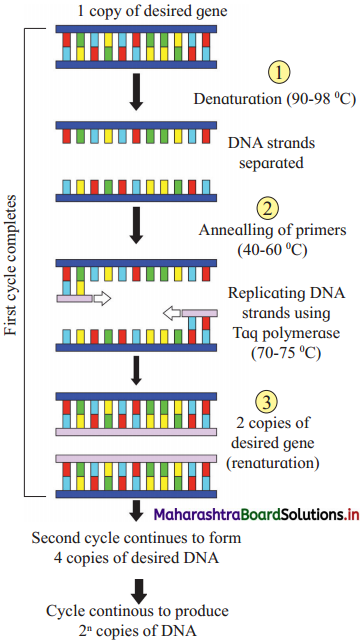
Polymerase chain reaction is used for in vitro gene cloning or gene multiplication to produce a billion copies of the desired segment of DNA and RNA, with high accuracy and specificity, in few hours.

Question 8.
What are the requirements of polymerase chain reaction?
Answer:
Polymerase chain reaction requires thermal cycler, DNA containing the desired segment to be amplified, deoxyribonuclueoside triphosphates (dNTPs), excess of two primer molecules, heat stable DNA polymerase and appropriate quantities of Mg++ions.

Question 9.
Enlist various biological tools required for transformation of recombinant DNA?
Answer:
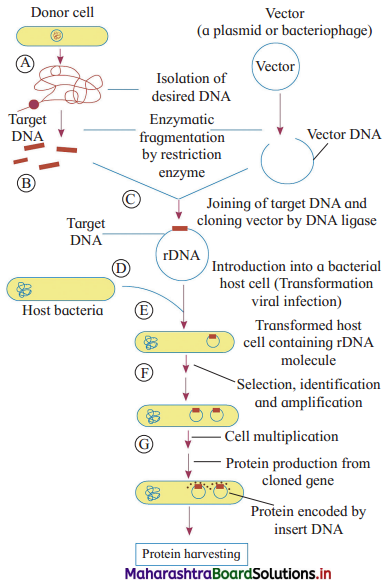
Biological tools used for transformation of recombinant DNA are enzymes, cloning vectors (vehicle DNA) and competent host (cloning organisms).

Question 10.
Enlist various enzymes used in recombinant DNA technology?
Answer:
Various enzymes used in recombinant DNA technology are lysozymes, nucleases (exonucleases, endonucleases, restriction endonucleases), DNA ligases, DNA polymerases, alkaline phosphatases, reverse transcriptases, etc.

Question 11.
How do bacteria protect their own DNA from restriction enzymes?
Answer:
The bacteria protect their own DNA from restriction enzymes by methylating the bases at susceptible sites. This chemical modification blocks the action of the enzyme.

Question 12.
What is restriction?
Answer:
Restriction is the process by which the DNA strand is cut into restriction fragments with the help of restriction endonuclease enzymes or REs.

Maharashtra Board Class 12 Biology Important Questions Chapter 12 Biotechnology

Question 13.
What are molecular scissors? Why are they so called?
Answer:
The enzyme restriction endonucleases are called molecular scissors because they can cut the DNA molecule at a specific point.

Question 14.
What is palindrome in DNA?
Answer:
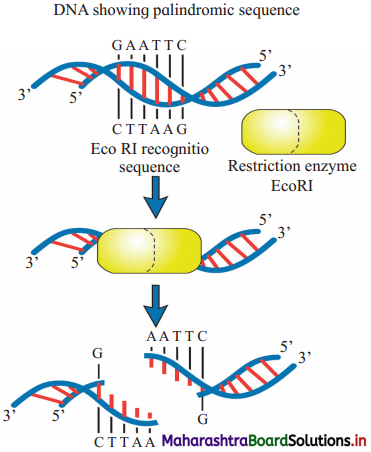
Palindrome is a DNA sequence which when read on opposite strands of DNA (3′ to 5′ or 5′ to 3′) it reads same.

Question 15.
What are sticky ends?
Answer:
Sticky ends are short extensions of cleaved DNA molecule which can form hydrogen bonded base pairs with other complementary sticky ends.

Question 16.
Give examples of restriction endo¬nucleases that cut DNA at non- pallindromic sequences.
Answer:
Hpal, MboII

Question 17.
Give example of Type I restriction endonucleases.
Answer:
Eco KI

Question 18.
Give example of Type II restriction endonucleases.
Answer:
Eco RI, Bg II

Question 19.
Give the role of plasmids in bacterial cells.
Answer:
Plamids in bacterial cells carry genes for antibiotic resistance (R plasmids) and F plasmids are involved in conjugation.

Question 20.
What are plasmids?
Answer:
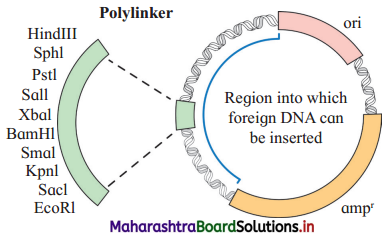
The small, extra chromosomal double stranded, circular forms of DNA which are capable of autonomous replication are called plasmids.

Question 21.
What is the source of gene to be cloned in vector?
Answer:
Gene to be cloned is obtained from gene library or by amplification.

Question 22.
What is chimeric DNA?
Answer:
Chimeric DNA is the combination of vector DNA and foreign DNA.

Question 23.
What is meant by transformed cells?
Answer:
The competent host cells which have taken up r-DNA Eire called transformed cells.

Question 24.
What are the different techniques by which foreign DNA can be transferred to host cell without using a vector?
Answer:
Foreign DNA can be transferred to host cell without using a vector by techniques like electroporation, microinjection, lipofection, shot gun, ultrasonification, biolistic method, etc.

Question 25.
Which marker genes are present in plasmid PBR 322?
Answer:
Markers genes in PBR322 plasmid are ampicillin resistant gene and tatracyclin resistant gene.

Question 26.
What is c-DNA?
Answer:
DNA produced by reverse transcription of m-RNA is known as c-DNA.

Question 27.
What are the objectives of CCMB?
Answer:
The objectives of CCMB are to conduct high quality basic research and training in frontier areas of modern biology and promote centralized national facilities for new and modern techniques in the interdisciplinary areas of biology.

Question 28.
Give examples of health problems which develop due to interaction between genetic and environmental factors?
Answer:
Health problems like high cholesterol and high blood pressure develop due to interaction between genetic and environmental factors.

Question 29.
Give examples of diseases which are caused due to single gene defects.
Answer:
Human genetic diseases like sickle-cell anaemia, thalassemia, Tay-sach’s disease, cystic fibrosis, Huntington’s chorea, haemophilia, alkaptonuria, albinism, etc. . are caused by single gene defects.

Question 30.
What is gene therapy?
Answer:
Gene therapy is the treatment of genetic disorders by replacing, altering or supplementing a gene that is absent or abnormal and whose absence or abnormality is responsible for the disease.

Question 31.
What is the use of virosomes?
Answer:
Virosomes are used in gene delivery.

Question 32.
Enlist the diseases where clinical trials of somatic cell gene therapy have been employed?
Answer:
The clinical trials of somatic cell gene therapy have been employed for the treatment of disorders like cancer, rheumatoid arthritis, SCID, Gaucher’s disease, familial hypercholesterolemia, haemophilia, phenylketonuria, cystic fibrosis, sickle-cell anaemia, Duchenne muscular dystrophy, emphysema, thalassemia, etc.

Question 33.
Which gene codes for Bt toxin?
Answer:
‘Cry’ gene codes for Bt toxin.

Question 34.
The a-amylase inhibitor gene transferred to tobacco from azuki bean acts against which pests?
Answer:
The a-amylase inhibitor gene transferred to tobacco from azuki bean acts against Zabrotes subjasciatus and Callosobruchus chinensis.

Question 35.
Which gene has been introduced in j sugarbeet for synthesis of fructants?
Answer:
1-sucroese sucrose fructosyl transferase gene has been introduced in sugarbeet for synthesis of fructants.

Question 36.
What percent of world population is affected by iron deficiency?
Answer:
30% of the population is affected by iron deficiency.

Question 37.
What causes softening of tomatoes during ripening?
Answer:
The enzyme polygalacturonase in tomato, breaks down pectin in the middle lamella of cell wall. This results in softening of fruits J during ripening.

Question 38.
What is superglue?
Answer:
Superglue is a biochemical glue for body repairs during surgery.

Question 39.
How is superglue produced?
Answer:
Superglue is produced by tobacco plants which contain genes encoding for adhesive proteins which allow marine mussels to stick to rocks.

Question 40.
Which oncogenes are being analyzed in transgenic mice to find out their role in development of breast cancer?
Answer:
myc and ras oncogenes are being analyzed in transgenic mice to find out their role in development of breast cancer.

Question 41.
How much milk is provided by Holstein cow on an average?
Answer:
Holstein cow provides about 6000 litres of milk per year.

Question 42.
Which gene is introduced in sheep to increase meat production?
Answer:
Human growth hormone gene is introduced in sheep for promoting growth and meat production.

Question 43.
Enlist desirable traits present in transgenic chicken?
Answer:
Desirable traits in transgenic chicken are low levels of fat and cholesterol, high protein containing eggs, in vivo resistance to viral and coccidial diseases, better feed efficiency and better meat quality.

Question 44.
Clones of which animals can provide tissues and organs for human transplants?
Answer:
The pig clone can provide animal organs and tissues for human transplants (xenotransplantation).

Question 45.
Which genes have been introduced in transgenic fish?
Answer:
Transgenic fish are transfected with E.coli hygromycin resistance gene, growth hormone and chicken crystalline protein.

Question 46.
Why does the Indian Government has set up the Genetic Engineering Approval Committee (GEAC)?
Answer:
The Indian Government has set up the Genetic Engineering Approval Committee (GEAC) to make decisions regarding the validity of research involving GMOs and addresses the safety of GMOs introduced for public use.

Question 47.
What is the duration of a biopatent?
Answer:
Duration of biopatents is five years from the date of the grant or seven years from the date of filing the patent application, whichever is less.

Maharashtra Board Class 12 Biology Important Questions Chapter 12 Biotechnology

Question 48.
What was the first biopatent awarded for?
Answer:
First biopatent was awarded for genetically engineered bacterium ‘Pseudomonas’ used for clearing oils spills.

Question 49.
What is Texmati?
Answer:
Texmati is a trade name of “Basmati rice line and grains” for which Texas based American company Rice Tec Inc was awarded a patent by the US Patent and Trademark Office (USPTO) in 1997.

Give definitions of the following

Question 1.
Biotechnology
Answer:
Biotechnology is defined as ‘the development and utilization of biological forms, products or processes for obtaining maximum benefits to man and other forms of life’.
OR
According to OECD (Organization for Economic Cooperation and Development, 1981), biotechnology is defined as the application of scientific and engineering principles to the processing of materials by biological agents to provide goods and service to the human welfare’.

Question 2.
Genetic engineering/r-DNA technology
Answer:
Genetic engineering is defined as the manipulation of genetic material towards a desired end and in a directed and predetermined way, using in vitro process.
OR
According to John E. Smith (1996), genetic engineering as ‘the formation of new combination of heritable material by the insertion of nucleic acid molecule produced by whatever means outside the cells, into any virus, bacterial plasmid or other vector system so as to allow their incorporation into a host organism in which they do not occur naturally but in which they are capable of continued propagation’.

Question 3.
Nucleases
Answer:
Enzymes that cut the phosphodiester bonds of polynucleotide chains are called as nucleases.

Question 4.
Vector
Answer:
Vectors are DNA molecules that carry a foreign DNA segment and replicate inside the host cell.

Question 5.
Plasmid
Answer:
Plasmids are small, extra chromosomal, double stranded circular forms of DNA that replicate autonomously.

Question 6.
Transformation
Answer:
Insertion of a vector into the target bacterial cell is called transformation. (Learn this as well)

Question 7.
Transfection
Answer:
Insertion of a vector into the eukaryotic cells is called transfection. (Learn this as well)

Question 8.
Transduction
Answer:
Inserting a viral vector in cloning procedures is called transduction. (Learn this as well)

Question 9.
Gene library
Answer:
Gene libarary is a collection of different DNA sequences from an organism where each sequence has been cloned into a vector for ease of purification, storage and analysis.

Question 10.
Genomic library
Answer:
Genomic library is a collection of clones that represent the complete genome of an organism.

Question 11.
c-DNA library
Answer:
c-DNA library is a collection of clones containing c-DNAs inserted into suitable vector like a phage or plasmid.

Question 12.
Passenger DNA
Answer:
Passanger DNA is the foreign DNA which is inserted into a cloning vector.

Question 13.
Gene therapy
Answer:
Gene therapy is the treatment of genetic disorders by replacing, altering or supplementing a gene that is absent or abnormal and whose absence or abnormality is responsible for the disease.

Question 14.
Genetically modified organisms
Answer:
Genetically modified organisms are those whose genetic material has been artificially manipulated in a laboratory through genetic engineering to create combinations of plant, animal, bacterial, and viral genes that do not occur in nature or through traditional crossbreeding methods.

Name the following

Question 1.
Restriction endonucleases which produce fragments with sticky ends.
Answer:
Bam HI and Eco RI.

Question 2.
Restriction endonucleases which produce fragments with blunt ends.
Answer:
Alu I, Hind III.

Question 3.
Most commonly used vectors.
Answer:
Plasmid vectors (pBR 322, pUC, Ti plasmid) and bacteriophages (lambda phage, M13 phage.

Question 4.
Bacteriophages used as vectors.
Answer:
Ml3, lambda virus

Question 5.
Constructed plasmids.
Answer:
pBR 322, pBR 320, pACYC 177

Question 6.
Most commonly used plasmid in r-DNA technology.
Answer:
pBR 322

Question 7.
Plasmid vector for plants.
Answer:
Ti plasmid

Question 8.
Soil bacterium that causes a plant disease called crown gall.
Answer:
Agrobacterlum tumejaciens

Question 9.
Bacteria as competent host.
Answer:
Bacillus Haemophilus, Helicobacter pyroli and E. coli.

Question 10.
Most commonly used host in transformation experiments.
Answer:
E. coli

Question 11.
Cloning organisms used in plant biotechnology.
Answer:
Agrobacterium tumejaciens.

Question 12.
Human protein produced by r-DNA technology to treat anaemia.
Answer:
Erythropoeitin

Question 13.
Human protein produced by r-DNA technology to treat asthma.
Answer:
Interleukin 1 receptor

Question 14.
Human protein produced by r-DNA technology to treat antherosclerosis.
Answer:
Platelet derived growth factor

Maharashtra Board Class 12 Biology Important Questions Chapter 12 Biotechnology

Question 15.
Human protein produced by r-DNA technology to treat parturition.
Answer:
Relaxin

Question 16.
Human protein produced by r-DNA technology to treat cancer.
Answer:
Interferons, tumour necrosis factor, inter-leukins, macrophage activating factor.

Question 17.
Recombinant protein used in the treatment of haemophiliaA.
Answer:
Factor VIII

Question 18.
Recombinant protein used in the treatment of haemophiliaB.
Answer:
Factor IX

Question 19.
Transgenic food crop used to reduce vitamin A deficiency diseases.
Answer:
Golden rice

Question 20.
Human proteins expressed in cow milk.
Answer:
Human lactoferrin, human alpha lactalbumin, human serum albumin, human bile salt.

Question 21.
Bacterial genes concerned with biosynthesis of cystein.
Answer:
cys E, cys M

Question 22.
Transgenic fish.
Answer:
Atlantic salmon, catfish, goldfish, Tilapia, zebra-fish, common carp, rainbow trout.

Give significance or functions of the following

Question 1.
Transgenic plants.
Answer:

  1. Transgenic plants Eire genetically engineered to carry various desirable traits.
  2. They are resistant to bacterial and viral diseases (e.g. tomato, potato, etc), insect pests (Bt cotton), herbicides (e.g. maize and wheat) and abiotic stresses.
  3. Transgenic plants can be used as bioreactors or factories (molecular farming) for production of novel drugs like interferons, humanized antibodies against infective agents like HIV, amino acids and immunotherapeutic drugs.
  4. Some transgenic plants have improved nutritional qualities, e.g. golden rice and golden mustard are biofortified with vitamin A.
  5. Transgenic plants like Flavr savr tomatoes have been engineered to have more shelf life.
  6. Transgenic plants also produce edible vaccines, e.g. Potato, tomato, etc.

Question 2.
Transgenic animals.
Answer:

  1. Transgenic animals are genetically modified animals that are used in a wide range of fields.
  2. In the field of medical research, transgenic animals like mice are used to identify the functions of specific factors through over- or under-expression of a modified gene (the inserted transgene). They are designed to study how genes contribute to the development of disease. These animals are used to investigate development of diseases like cancer, cystic fibrosis, rheumatoid arthritis, etc.
  3. In toxicology field, they are used for detection of toxicants. They are used as responsive test animals.
    Transgenic animals are used to evaluate a specific genetic change in molecular biology studies.
  4. In pharmaceutical industry, transgenic animals are used for targeted production of pharmaceutical proteins, drug production and product efficacy testing.
  5. They are also used in study of mammalian developmental genetics.

Transgenic farm animals like cattle, sheep, v poultry, pigs, etc. exhibit many desirable traits.

  1. Improved quantity and quality of meat
  2. Improved quality and quantity of milk
  3. More egg production
  4. Better quality and quantity of wool
  5. Disease resistance
  6. Production of low-cost pharmaceuticals and biologicals

Distinguish between the following

Question 1.
Old or classical biotechnology and Modem biotechnology.
Answer:

Old or classical biotechnologyModem biotechnology
1. It is mainly based on fermentation technology.1. It is based on genetic engineering and chemical engineering.
2. It does not involve alteration or modification of genetic material of organisms to develop specific Product.2. It involves the alteration or modification of genetic material of organisms to develop specific product.
3. It does not involve the use of r-DNA technology, polymerase chain reaction (PCR), microarrays, cell culture and fusion, and bioprocessing to develop products.3. It involves the use of r-DNA technology, polymerase chain reaction (PCR), microarrays, cell culture and fusion, and bioprocessing to develop specific products.
4. There is no ownership of old biotechnology.4. It involves ownership of technology.
5. Examples : Preparation of curd, ghee, soma, vinegar, yogurt, cheese making, wine making, etc.5. Examples : Transgenic organisms.

Question 2.
Genomic library and c-DNA library.
Answer:

Genomic libraryc-DNA library
1. It is a collection of clones that represent the complete genome of an organism.1. It is a collection of clones containing c-DNAs inserted into suitable vectors like phages or plasmids.
2. DNA fragments to be cloned are obtained by cutting genomic DNA by restriction enzymes.2. c-DNAs are produced by the process of reverse transcription, using complete m-RNA complement obtained from a tissue or an organism.

Question 3.
Germ line gene therapy and somatic cell gene therapy.
Answer:

Germ line gene therapySomatic cell gene therapy
1. Germ line gene therapy involves modification of genome of germ cells like sperms, eggs, early embryos.1. Somatic cell gene therapy involves modification of genome of somatic cells like bone marrow cells, hepatic cells, fibroblasts, endothelium, pulmonary epithelial cells, central nervous system and smooth muscle cells of wall of blood vessels.
2. It allows transmission of the modified genetic information to the next generation.2. It does not allow transmission of the modified genetic information to the next generation.
3. Its application in human beings is not encouraged because of technical and ethical reasons.3. It is a feasible option and clinical trials are carried out for treatment of various diseases.

Give reason

Question 1.
The genetic engineering is alternatively called recombinant DNA technology or gene cloning.
Answer:

  1. Genetic engineering involves the manipulation of genetic material in a directed, predetermined, in vitro way to develop a desired end product.
  2. It manipulates the genes for improvement of living organisms,
  3. It involves repairing of the defective genes, replacing of defective genes by healthy genes or normal genes and artificially synthesizing of a totally new gene.
  4. Genetic engineering also involves transfer of a new gene, transfer of genes to a new location or into a new organism, gene cloning, combining of genes from two organisms.
  5. This results in alteration of the genotype and desired products can be developed.
  6. Therefore, the genetic engineering is alternatively called recombinant DNA technology or gene cloning.

Question 2.
Bacteria have restriction enzymes.
Answer:

  1. Restriction endonucleases or restriction enzymes in bacteria help them to recognize and destroy various viral DNAs that might enter the cell.
  2. They cut the phosphodiester back bone at highly specific sites on both strands of DNA.
  3. Thus, these enzymes restrict the potential growth of the virus and protect bacteria.
  4. Hence, bacteria produce restriction enzymes.

Question 3.
All the fragments of a genome are cloned for storing them in genomic library.
Answer:

  1. Genomic DNA is fragmented at the time of preparing genomic library.
  2. It is not known which fragment has the desired gene.
  3. Therefore all the fragments have to be cloned to store the copies of each separately.
  4. Screening for the desired gene is later done through complementation or using DNA probes.
  5. Therefore, all the fragments of a genome are cloned for storing them in genomic library.

Question 4.
The establishment of genomic library is more meaningful in prokaryotes than in eukaryotes.
Answer:

  1. The prokaryotic genome does not contain repetitive DNA.
  2. Eukaryotic DNA genome contains introns, regulatory genes and repetitive DNA.
  3. Hence, the establishment of genomic library is more meaningful in prokaryotes than in eukaryotes.

Question 5.
Flavr savr tomato has longer shelf life.
Answer:

  1. Flavr savr is genetically modified type of tomato.
  2. It is developed by inserting antisense gene which retards ripening.
  3. Due to the presence of this gene a cell wall degrading enzyme called polygalactouronase is produced in lesser amounts.
  4. Owing to the above reason, Flavr savr tomato has longer shelf life.

Question 6.
Pigs are regarded as the most suitable animals to be bred for heart transplant.
Answer:

  1. A pig’s heart is about the same size as a human heart.
  2. Pig heart valves are used in human heart surgery for over a decade.
  3. Hence, pigs are regarded as the most suitable animals to be bred for heart transplant.

Maharashtra Board Class 12 Biology Important Questions Chapter 12 Biotechnology

Question 7.
Patent jointly issued by Delta and Pineland Company and U. S. department of agriculture under the title ‘control of plant gene expression’ was not granted by Indian government.
Answer:

  1. Patent jointly issued by Delta and Pineland Company and U. S. department of agriculture under the title ‘control of plant gene expression’ is based on a gene that produces a protein toxic to plant and thus prevents seed germination.
  2. Because of such patents, financially powerful corporations would acquire monopoly over biotechnological process.
  3. Thus it would pose a threat to global food security.
  4. Therefore this patent was considered morally unacceptable and fundamentally unequitable and it was not granted by the Indian government.

Write short notes

Question 1.
Electrophoresis.
Answer:

  1. Electrophoresis is a technique that involves migration and separation of charged particles under the influence of electric field.
  2. It is used for the separation of charged molecules like DNA, RNA and proteins, by application of an electric field.
  3. Movement of charged particles is determined by particle size, shape and charge.
  4. DNA is negatively charged and hence it moves towards the positive anode.
  5. It results in size separation of DNA fragments as small fragments of DNA molecules move faster.
  6. Different types of electrophoresis are agarose gel electrophoresis, PAGE and SDA PAGE.

Question 2.
Recognition sequences or restriction sites.
Answer:

  1. Restriction endonucleases have the ability to recognize specific sequences in DNA and cleave it.
  2. They are 4 to 8 nucleotides long and characterized by a particular type of internal symmetry.
  3. The specific site at which restriction endonuclease cuts the DNA is called recognition site or restriction site.
  4. Each restriction endonuclease recognizes its specific recognition sequence.
  5. Restriction cutting may result in DNA fragments with blunt ends or cohesive or sticky ends or staggered ends (having short, single stranded projections).

For example, recognition sequence of by the enzyme EcoRI is
3′ —– -CTTAA-G —–5′
5′ —– -G A A T T C —–3′
It is as palindrome, i.e. When read on opposite strand of DNA (3′ to 5′ or 5′ to 3′) it reads same.
When the enzyme EcoRI recognizes this sequence, it breaks each strand at the same site in the sequence i.e. between the A and G residues.

Question 3.
Plasmids as cloning vectors.
Answer:

  1. Plasmids are small, extra-chromosomal, double stranded circular forms of DNA that replicate autonomously.
  2. They are seen in bacterial cells, yeast and animal cell.
  3. Plasmids are considered as replicons as they are capable of autonomous replication in suitable host.
  4. The most commonly used vectors in r-DNA technology are plasmids as they replicate in E. coli.

Plasmid as a cloning vector should have a replication origin, a marker gene for antibiotic resistance, control elements like promoter, operator, ribosome binding site, etc. and a region where foreign DNA can be inserted. Naturally plasmids do not have all these features. Hence, they are constructed by inserting gene for antibiotic resistance. pBR 322, pBR320, paCYC177 are the constructed plasmids.

Ti plasmid (for tumor-inducing) of Agrobacterium tumefaciens is an important vector for carrying new DNA in many plants. It contains a transposon, called T DNA, which inserts copies of itself into the chromosomes of infected plant cells. The transposon, with the new DNA, can be inserted into the host cell’s chromosomes. A plant cell containing this DNA, can then be grown in culture or induced to form a new, transgenic plant.

Question 4.
Bt cotton.
Answer:

  1. Bt cotton is well known example of insect resistant transgenic plant which is engineered with a gene from B. thuringiensis.
  2. ‘cry’ gene present in B. thuringiensis produces a protein that forms crystalline inclusions in bacterial spores.
  3. When insect ingests it, because of high pH and the proteinase enzymes present in insect’s midgut, the crystalline inclusions are hydrolyzed to release the core toxic fragments.
  4. This toxin causes midgut paralysis and disruption of midgut cells of insect.
  5. Bt toxin acts against many species of Lepidoptera, Diptera and Coleoptera insects.

Question 5.
Golden rice.
Answer:

  1. Golden rice is a transgenic plant developed by Swiss researchers.
  2. It contain genes from the soil bacterium Erwinia and either maize or daffodil plants.
  3. These plants are biofortified to have high content of vitamin A.
  4. The golden colour is due to vitamin A.
  5. Consumption of golden rice and golden mustard can reduce occurrence of vitamin A deficiency diseases (VAD).

Question 6.
Insulin.
Answer:

  1. Insulin is a peptide hormone produced by β -cells of islets of Langerhans of pancreas.
  2. Insulin is essential for the control of blood sugar levels.
  3. Disease Diabetes mellitus is caused due to inability to make insulin.
  4. Insulin was discovered by Sir Edward Sharpey Schafer (1916) while studying Islets of Langerhans.
  5. Hakura et al (1977) chemically synthesized DNA sequence of insulin for two chains A and B and separately inserted into two PBR322 plasmid vector.

Gilbert and Villokomaroff, 1978 produced insulin production using r-DNA technology.

  1. The recombinant plasmids, containing insulin gene inserted by the side of β-galactosidase, were transferred into E. coli host.
  2. The host produced penicillinase pnd pre-pro insulin.
  3. Insulin is later separated by trypsin treatment.

Question 7.
Transgenic cattle.
Answer:

  1. Transgenic cattle are used for food production and for the production of human therapeutic proteins.
  2. Transgenic cattle engineered with additional copies of bovine beta or kappa casein, show 8 to 20% increase in beta casein and a two-fold increase in kappa casein.
  3. Various human proteins like Human lactoferrin, human alpha lactalbumin, human serum albumin and human bile salt stimulated lipase are expressed in the milk of transgenic cattle.
  4. Transgenic cows produce factor IX (plasma thromboplastin component), used in the treatment of haemophilia.
  5. Tracy, the transgenic cow born in Scotland, could produce a human protein in her milk for human therapeutics.
  6. Human antibody products are made using transgenic cows that are immunized with a vaccine containing the disease agent. Antibodies are currently used for treatment of infectious diseases, cancer, transplanted organ rejection, autoimmune diseases and for use as antitoxins.

Question 8.
Transgenic fish.
Answer:

  1. The commercially important fish like Atlantic salmon, catfish, goldfish, Tilapia, zebra-fish, common carp, rainbow trout, etc. are transfected with growth hormone, chicken crystalline protein and E.coli hygromycin resistance gene.
  2. Transgenic fish showed increased cold tolerance and improved growth.

Short Answer Questions

Question 1.
What are the two phases of the development of biotechnology in terms of its growth?
Answer:
Two phases of the development of biotechnology in terms of its growth are as follows:
Traditional biotechnology (old biotechnology) : It is based on fermentation technology that uses microorganisms in the preparation of curd, ghee, soma, vinegar, yogurt, cheese making, wine making, etc.

Modern biotechnology (new biotechnology) :

  1. During 1970 ‘recombinant DNA technology was developed and then established by Stanley Cohen and Herbert Boyer in 1973.
  2. This technique alters or modifies genetic material to develop of new products.
  3. The combination of biology and production technology based on genetic engineering evolved into modern biotechnology.
  4. Modern biotechnology is based on two core techniques-genetic engineering and chemical engineering.

Question 2.
What are the different techniques and devices used in r-DNA technology?
Answer:
(1) Several techniques are used in r-DNA technology to isolate and characterize the macromolecules like DNA, RNA, proteins.
(2) The techniques used on the basis of molecular weight are gel permeation, osmotic pressure, ion exchange chromatography, spectroscopy, mass spectrometry, electrophoresis, etc.

(3) Electrophoresis:

  • It is used for the separation of charged molecules like DNA, RNA and proteins, by application of an electric field.
  • Different types of electrophoresis : Agarose gel electrophoresis, PAGE, SDA PAGE.

(4) Polymerase chain reaction (PCR) : It is used for in vitro gene cloning or gene multiplication to produce a billion copies of the desired segment of DNA or RNA, with high accuracy and specificity, in few hours.

Question 3.
What are the basic requirements of PCR technique?
Answer:
The basic requirements of PCR technique are as follows:

  1. DNA containing the desired segment to be amplified.
  2. Excess of forward and reverse primers which are synthetic oligonucleotides of 17 to 30 nucleotide.
  3. They are complementary to the sequences present in DNA.
    dNTPs which are of four types such as dATB dGTB dTTP and dCTR
  4. A thermostable DNA polymerase (e.g. Taq DNA polymerase enzyme) that can withstand a high temperature of 90-98°C.
  5. Appropriate quantities of Mg++ ions.
  6. Thermal cycler, a device required to carry out PCR reactions.

Question 4.
What are the two types of nucleases? What is their function?
Answer:

  1. The two types of nucleases are exonucleases and endonucleases.
  2. Exonucleases remove nucleotides from the ends of the DNA.
  3. Endonucleases are those enzymes that have ability to make cuts at specific positions within the DNA molecule.
  4. Of the endonucleases, restriction endonucleases serve as the molecular scissors in genetic engineering experiments.
  5. They are used for cutting DNA molecules at specific predetermined sites. This is needed for gene cloning or recombinant DNA technology.

Question 5.
Explain different types of restriction enzymes?
Answer:
Different types of restrictions enzymes are as follows:

  1. Type I – They function . simultaneously as endonuclease and methylase e.g. EcoK.
  2. Type II – They exhibit separate cleaving and methylation activities. They are more stable and are used in r-DNA technology e.g. EcoRI, Bgll. They cut DNA at specific sites within the pallindrome. Thousands of type II restriction enzymes have been discovered.
  3. Type III – They cut DNA at specific non- palindromic sequences e.g. Hpal, MboII.

Question 6.
With the help of a suitable example, illustrate palindrome.
Answer:

  1. Palindrome is a sequence which when read on opposite strands of DNA (3′ to 5’ or 5’ to 3’), reads same.
  2. When the enzyme EcoRI recognizes this sequence, it breaks each between the A and G residues.
  3. In palindrome, the base sequence of second half in DNA represents the mirror image of the base sequence of the first half.
  4. Palindromes are actually groups of letters which form the same word when read in both forward and backward directions.

For example, recognition sequence of by the enzyme EcoRI is a palindrome.
3′ —— – C T T A A G—–5′
5′ —— – G A A T T C—–3′

Same restriction enzyme must be used to cut vector and donor DNA, because it will produce fragments with the same complementary sticky ends, making it bond formation possible between them.

Question 7.
Explain how Ti plasmid of Agrobacterium tumefaciens acts as a vector for transferring genes to plants?
Answer:

  1. Agrobacterium tumefaciens is a soil bacterium that causes crown gall disease in plants.
  2. This disease involves the formation of tumor in the plant.
  3. Ti plasmid in A. tumefaciens contains a transposon called T DNA.
  4. T DNA inserts copies of itself into the chromosomes of infected plant cells.
  5. The transposons, with the foreign DNA, can be inserted into the host cell’s chromosomes.
  6. A plant cell containing this DNA, can then be grown in culture or induced to form a new, transgenic plant.

construction of Genomic library:

  1. When genomic library is constructed, the entire genome or DNA is isolated from a particular organism.
  2. This DNA is fragmented using suitable restriction endonucleases.
  3. These separated fragments are later inserted into cloning vectors.
  4. This develops recombinant vectors.
  5. Such recombinant vectors are transferred into suitable organisms such as bacteria or yeast. Each host cell then contains one fragment.
  6. These transformed organisms are cultured and their clones are thus produced. These clones are stored in the genomic library.

Question 8.
Explain with example how transformed host cells are selected from non- transformed?
Answer:

  1. Transformed recombinant cells are selected using marker genes.
  2. For example, markers genes in pBR 322 plasmid are ampicillin resistant gene and tetracyclin resistant gene.
  3. When pstl restriction enzyme is used, ampicillin resistant gene gets knocked off from the plasmid and recombinant cells become sensitive to ampicillin.

Question 9.
Give the types of human proteins and hormones produced by recombinant DNA techniques.
Answer:

  1. Blood proteins produced by recombinant DNA technique are Erythropoeitin, Tissue plasminogen activator, urokinase, Factor VIII, Factor IX, etc.
  2. Hormones : Insulin, Epidermal growth factor.

Maharashtra Board Class 12 Biology Important Questions Chapter 12 Biotechnology

Question 10.
What are edible vaccines? How are they produced?
Answer:

  1. Edible vaccine is an edible plant part engineered to produce an immunogenic protein, which when consumed gets recognized by immune system.
  2. Immunogenic protein of certain pathogens are active when administered orally.
  3. The gene encoding for immunogenic protein is isolated and inserted in a suitable vector.
  4. Recombinant vector is then transferred to plant genome.
  5. Expression of this gene in specific parts of the plant results in the synthesis of immunogenic proteins.
  6. When animals or mainly humans consume these plant parts, they get vaccinated against certain pathogen.

Question 11.
Give an example of ‘melt in mouth’ vaccine and state the advantages of such vaccines.
Answer:

  1. Example of ‘melt in the mouth’ vaccine that can be administered by placing it under tongue, is the production of flu vaccine by Bacillus which melts in the mouth and get delivered into the blood stream.
  2. Advantages of edible oral vaccines are that they can be easily administered, can be easily stored and they are of low cost.

Question 12.
What is meant by recalcitrant seeds? How such plants can be conserved?
Answer:

  1. Recalcitrant seeds are those whose survival is educed upon drying (reduction in moisture below a certain level) and freezing and thus are difficult to store.
  2. It involves subcellular damage of seeds which results in loss of viability, when dried.
  3. Plants which produce recalcitrant sees could be conserved using tissue culture technique.

Question 13.
What are the different ways in which gene therapy is used?
Answer:
Gene therapy is being used as follows:

  1. Replacement of missing or defective genes.
  2. Delivery of genes that speed the destruction of cancer cells.
  3. Supply of genes that cause cancer cells to revert back to normal cells.
  4. Delivery of bacterial or viral genes as a form of vaccination.
  5. Delivery of DNA to antigen expression and generation of immune response.
  6. Supply of gene for impairing viral replication.
  7. Provide genes that promote or impede the growth of new tissue.
  8. Deliver genes that stimulate the healing of damaged tissue.

Question 14.
What are the different types in which genes could be delivered during gene therapy?
Answer:
Genes can be delivered by three ways:

  1. Ex vivo delivery : In this type of gene delivery, viral or non-viral vectors are used to introduce the desired gene in the cells isolated from patient, e.g. Parkinson’s disease, a neurological disorder.
  2. In vivo delivery : In this method, therapeutic genes are directly delivered at the target sites of the cells of diseased tissue. Intravenous infusion genes are injected directly into tumor in the treatment of cancer.
  3. Use of virosomes (Liposome + inactivated HIV), bionic chips.

Question 15.
What are transgenic plants? Explain with any two examples.
Answer:
The genetically engineered crop plants carrying desirable traits are called transgenic plants.
Examples of transgenic plants:

  1. Bt Cotton : Bt cotton is a transgenic plant. Bt toxin gene has been cloned and introduced in many plants to provide resistance to insects without the need of insecticides.
  2. Golden rice : It is a genetically engineered rice with higher beta carotene (provitamin A) content.
  3. Flavr savr tomato : It is developed by inhibiting synthesis of polygalactournonase by inserting antisense gene. This type of tomato has a longer shelf life.

Question 16.
Give any two examples of insect resistant transgenic crops.
Answer:
Examples of insect resistant transgenic crops are as follows:
(1) BT crops:

  • Insect resistant transgenic plants contain either a gene from B. thuringiensis or the cowpea trypsin inhibitor gene.
  • ‘cry’ gene present in B. thuringiensis produces a protein that forms crystalline inclusions in bacterial spores. When insect ingests it, because of high pH and the proteinase enzymes present in insect’s midgut, they are hydrolyzed to release the core toxic fragments.
  • This toxin causes midgut paralysis and disruption of midgut cells of insect.
  • Bt toxin activity has been against many species of insects within the orders of Lepidoptera, Diptera and Coleoptera.

(2) Transgenic tobacco:

  • The gene of a-amylase inhibitor (aAl-Pv), isolated from adzuki bean (Phaseolus vulgaris) is transferred to tobacco.
  • This gene works against pests like Zabrotes subfasciatus and Callosobruchus chinensis.

Question 17.
Give any two examples of biofortified transgenic crops.
Answer:
Examples of biofortified transgenic crops are as follows:

  1. Golden rice and Golden mustard These are transgenics rich in vitamin A.
  2. Arabidopsis genes are transferred to soybean, oil palm, rapeseed and sunflower for improvement in oil content and oil quality.
  3. Ferritin, an iron storage protein, isolated from soybean and Phaseolus is transferred to rice to increase its iron content.
  4. Plants deficient in amino acids like methionine, lysine and tryptophan have been engineered to improve protein content.

Question 18.
What factors are responsible for losses during storage and transport of crops? Explain, with example, how genetic engineering can reduce these losses?
Answer:

  1. Diseases and pests, bruising on soft fruits and vegetables, heat and cold storage, over-ripeness, loss of flavours and odours, etc. lead to great deal of losses during storage and transport of crops.
  2. Most of these changes are caused due to endogenous enzyme activities which could be slowed down using genetic engineering.

For example, shelf life of Flavr savr tomatoes has been increased using genetic engineering techniques.
(a) The enzyme polygalacturonase breaks down pectin in the cell wall, leading to softening of fruit during ripening of tomatoes.
(b) In genetically modified Flavr savr tomatoes, polygalactouronase enzyme is inhibited by antisense genes. These tomatoes can remain on the vine until mature and be transported in a firm solid state.

Question 19.
How transgenic animals are produced.?
Answer:

  1. Transgenic animals are produced using recombinant DNA technology.
  2. Foreign DNA is introduced in transgenic animals using r-DNA technology.
  3. It is then transmitted through the germ line so that every cell if the animal contains the same modified genetic material.
  4. This involves cloning of desired gene and introduction of cloned gene into fertilized eggs, successful implantation of modified eggs into receptive female and obtaining progeny carrying cloned genes.

Question 20.
Write any two scientific and commercial values of transgenic animals in favour of human beings.
Answer:
(1) Scientific value of transgenic animals:

  • Transgenic mice are used medical research to identify the functions of specific factors through over – or under-expression of a modified gene (the inserted transgene). They are designed to study how genes contribute to the development of disease. These animals are used to investigate development of diseases like cancer, cystic fibrosis, rheumatoid arthritis, etc.
  • In toxicology field, they are used for detection of toxicants. They are used as responsive test animals.

(2) Commercial value of transgenic animals:

  • Transgenic cattle are used for production of human therapeutic proteins such as human lactoferin, human serum albumin, etc.
  • Better quality and quantity of wool by transgenic sheep.

Question 21.
How sheep are genetically altered to produce wool of better quality?
Answer:

  1. Bacterial genes, cys E and cys M, are identified, cloned and introduced in sheep.
  2. These genes are involved in biosynthesis of cysteine.
  3. Cysteine is involved in formation of keratin protein found in wool.
  4. Thus, transgenic sheep produce more quantity and better quality of wool.

Question 22.
What is meant by ethics?
Answer:

  1. Ethics is a discipline concerned with moral values or principles.
  2. It deals with certain sets of standards which regulate behaviour of community.
  3. It is concerned with socially accepted norms of moral duty, conduct and judgment.
  4. Ethical concepts differ according to culture and traditions.
  5. They also change with time and get influenced by progress in science and technology.

Question 23.
What are the adverse effects of Biotechnology on the Environment?
Answer:
The adverse effects of biotechnology on the environment are as follows:

  1. Unintended hybrid strains of weeds and other plants can develop resistance to herbicides through cross-pollination. E.g. Crops of Round Up-ready soybeans which are used in agriculture, possibly confer Round Up resistance to neighbouring plants.
  2. Bt corn has adversely affected non target species – Monarch butterfly. It may also prove harmful to neutral or even beneficial species.

Question 24.
Discuss various health concerns regarding the use of GMO crops.
Answer:
Various concerned related to health regarding the use of GMO crops are as follows:

  1. GMO crops may develop some allergies, e.g. A gene from the Brazil nut was transferred to soybean in order to increase methionine content. But this transgenic soybean has caused allergies in some people which are known to suffer from nut allergies (“Biotech Soybeans”).
  2. GMO technology is a recent development and its the long-term effects on health cannot be anticipated at this point.
  3. Potential effects of transgenic proteins, which were never been ingested earlier, on the human body are yet unknown.
  4. The use of GMOs may lead to the development of antibiotic and vaccine- resistant strains of diseases.

Question 25.
What is a patent?
Answer:

  1. Patent is a special right granted to the inventor by the government.
  2. A patent consists of three parts – grant (an agreement with the inventor), specification (subject matter of invention) and claims (scope of invention to be protected).
  3. Patent is a personal property of inventor and it can be sold like any other property.

Question 26.
What is meant by traditional knowledge? What is its importance?
Answer:

  1. Traditional knowledge is a deep understanding of ecological processes and the ability to obtain useful products from the local habitat in a sustainable way.
  2. Most traditional knowledge is handed down through generations. This helps in the development of modern, commercial applications. This saves the makers time, money and effort.

Traditional knowledge includes:

  1. Knowledge about food, crop varieties and agricultural/farming practice.
  2. Sustainable management of natural resources and conservation of biological diversity.
  3. Biologically important medicines.

Chart or Table based Questions

Question 1.

RESourceEnd products
Alu I————-Blunt ends
————Bacillus amyloliquefaciens HSticky ends
Eco R I————–Sticky ends
Hind IIH. influenza Rd————–

Answer:

RESourceEnd products
Alu IArthobacter luteusBlunt ends
Bam H IBacillus amyloliquefaciens HSticky ends
Eco R IE. coli Ry 13Sticky ends
Hind IIH. influenza RdBlunt ends

Question 2.

SubstancePotential benefitCropTransgene
Provitamin AAnti-oxidant————–Phytoene synthase, Lycopene cyclase
Fructans————–Sugarbeet—————-
Vitamin E—————-Canolaγ -tocopherol methyl transferase
FlavonoidsAnti-oxidentTomato————–
————–Iron fortificationRiceFerritin, metallothioein, phytase

Answer:

SubstancePotential benefitCropTransgene
Provitamin AAnti-oxidantRicePhytoene synthase, Lycopene cyclase
FructansLow caloriesSugarbeetI – sucrose : sucrose fructosyl transferase
Vitamin EAnti-oxidantCanolaγ -tocopherol methyl transferase
FlavonoidsAnti-oxidentTomatoChalone isomerase
IronIron fortificationRiceFerritin, metallothioein, phytase

Maharashtra Board Class 12 Biology Important Questions Chapter 12 Biotechnology

Question 3.

OrganizationExpand
OECD——————
GEAC——————
USDA——————
USPTO——————
CSIR—————–

Answer:

OrganizationExpand
OECDOrganization for Economic Cooperation and Development
GEACGenetic Engineering Approval Committee
USDAUS Department of Agriculture
USPTOUS Patent and Trademark Office
CSIRCouncil of Scientific and Industrial Research

Diagram Based Questions

Question 1.
(a) Name the reaction shown in the given diagram.
(b) What are the three steps in this reaction?
Answer:
Maharashtra Board Class 12 Biology Important Questions Chapter 12 Biotechnology 1
(a) Polymerase chain reaction
(b) Three steps of polymerase chain reaction are denaturation of DNA, annealing of primer and extension of primer.

Question 2.
(a) Which enzyme has recognition sequence shown in the diagram given below?
(b) What is meant by palindrome?
(c) Enzyme in the given diagram cuts DNA to produce ———- ends.
Maharashtra Board Class 12 Biology Important Questions Chapter 12 Biotechnology 2
Answer:
(a) Enzyme is EcoRI.
(b) Palindrome is a DNA sequence which when read in opposite direction (3’ to 5’ or 5’ to 3’) it reads same.
(c) Enzyme in the given diagram cuts DNA to produce sticky ends.

Question 3.
Draw a labelled diagram of a plasmid showing ori, ampr and a region into which foreign DNA can be inserted.
Answer:
Maharashtra Board Class 12 Biology Important Questions Chapter 12 Biotechnology 3

Question 4.
Draw a diagram showing steps in r-DNA technology.
Answer:
Maharashtra Board Class 12 Biology Important Questions Chapter 12 Biotechnology 4

Long Answer Questions

Question 1.
Explain with examples how transgenic plants can be used as factories or bioreactors?
Answer:

  1. Transgenic plants are potential factories or bioreactors for biochemicals and biopharmaceuticals like starch, sugar, lipids, proteins, hormones, antibodies, vaccines or enzymes.
  2. Various fine chemicals, perfumes, adhesive compounds industrial lubricants, etc. can be isolated from plants.
  3. Plants can be the source of biodegradable plastic and ‘renewable’ energy to replace fossil fuels.
  4. Transgenic plants useful for production of novel drugs like interferons, edible vaccines, antibodies, amino acids, immunotherapeutic drugs, etc. Thus, they are like bioreactors for molecular farming.

Examples:

  1. The gene for Human growth hormone has been inserted into the chloroplast DNA of tobacco plants.
  2. Humanized antibodies against HIV, Respiratory syncytial virus (RSV), Herpes simplex virus (HSV), the cause of “cold sores” are developed using transgenic plants.
  3. Superglue’ is a biochemical glue for body repairs during surgery. It is produced by tobacco plants which contain genes encoding for adhesive proteins which allow marine mussels to stick to rocks.
  4. Protein antigens to be used in vaccines : e.g. Patient-specific antilymphoma vaccines. B-cell lymphomas are clones of malignant B cells expressing a unique antibody molecule on their surface.
  5. Transgenic plants cam be used as factories for producing oil having nutritional value like cod-liver oil. These plants are engineered with a oil encoding gene from marine algae.
  6. Transgenic plants produce the antimalarial drug, Artemisinin.
  7. Genetically engineered opium poppy can be used to produce powerful painkillers.
  8. Transgenic plants like potatoes, tomatoes, bananas, soybeans, alfalfa and cereals can be used as edible vaccine.

Maharashtra Board Class 12 Biology Important Questions Chapter 11 Enhancement of Food Production

Balbharti Maharashtra State Board 12th Biology Important Questions Chapter 11 Enhancement of Food Production Important Questions and Answers.

Maharashtra State Board 12th Biology Important Questions Chapter 11 Enhancement of Food Production

Multiple Choice Questions

Question 1.
Means of in situ germplasm conservation are ………………….
(a) forests
(b) Natural Reserves
(c) botanical gardens, seed banks
(d) both (a) and (b)
Answer:
(d) both (a) and (b)

Question 2.
Means of ex situ germplasm conservation are ………………….
(a) forests and seed banks
(b) natural Reserves
(c) botanical gardens, seed banks
(d) botanical garden and forests
Answer:
(c) botanical gardens, seed banks

Maharashtra Board Class 12 Biology Important Questions Chapter 11 Enhancement of Food Production

Question 3.
Germplasm includes ………………….
(a) only improved varieties of crop
(b) all cultivated varieties and wild relatives of a particular crop
(c) all hybridized varieties only
(d) only mutant varieties of a crop
Answer:
(b) all cultivated varieties and wild relatives of a particular crop

Question 4.
Taichung Native-1 is a variety of rice from ………………….
(a) China
(b) Korea
(c) Malaysia
(d) Taiwan
Answer:
(d) Taiwan

Question 5.
Which of the following is not a fungal disease ?
(a) Late blight of potato
(b) Brown rust of wheat
(c) Red rot of sugar cane
(d) Black rot of crucifers
Answer:
(d) Black rot of crucifer

Question 6.
…………………. variety of wheat is resistant to Hill bunt disease.
(a) Himgiri
(b) Pusa swarnim
(c) Kalyan sona
(d) Pusa A-4
Answer:
(a) Himgiri

Question 7.
Regina-II variety of …………………. is resistant to bacterial rot.
(a) wheat
(b) cabbage
(c) cauliflower
(d) Brassica
Answer:
(b) cabbage

Question 8.
The nectar-less cotton having smooth leaves has resistance against ………………….
(a) bollworms
(b) jassids
(c) aphids
(d) stem borers
Answer:
(a) bollworms

Question 9.
………………… gave concept of in vitro cell culture.
(a) Haberlandt
(b) Frank
(c) Yabuta and Sumiki
(d) None of these
Answer:
(a) Haberlandt

Question 10.
Tissue culture requirements are ………………….
(a) pH of nutrient medium 5 to 5.8
(b) Sterilized glassware, nutrient medium, explants, inoculation chamber
(c) Temperature 18 °C to 20 °C
(d) All of these
Answer:
(d) All of these

Question 11.
Hybrid maize with double the quantity of amino acids …………………. have been developed.
(a) lysine and tryptophan
(b) alanine and aspartic acid
(c) glutamic and proline
(d) histidine and cystine
Answer:
(a) lysine and tryptophan

Question 12.
Inbreeding increases ………………….
(a) homozygosity
(b) heterozygosity
(c) heterosis
(d) hemizygosity
Answer:
(a) homozygosity

Question 13.
Which hormone is used for MOET method?
(a) GH
(b) LH
(c) FSH
(d) ICSH
Answer:
(c) FSH

Question 14.
Find the odd one out.
(a) Sahiwal
(b) Sindhi
(c) Gir
(d) Holstein
Answer:
(d) Holstein

Question 15.
Pullorum is a …………………. disease.
(a) viral
(b) bacterial
(c) fungal
(d) parasitic
Answer:
(b) bacterial

Question 16.
Propolis is ………………….
(a) bee glu
(b) royal jelly
(c) bee venom
(d) none of these
Answer:
(a) bee glu

Question 17.
Select the incorrect pair.
(a) Apis dorsata – Rock bee
(b) Apis indica -Indian bee
(c) Apis florae – Little bee
(d) Apis mellifera – Wild bee
Answer:
(d) Apis mellifera – Wild bee

Question 18.
fishery takes place in Sundarban area of ………………….
(a) Estuarine, West Bengal
(b) Marine, Odisha
(c) Fresh water, West Bengal
(d) None of these
Answer:
(a) Estuarine, West Bengal

Question 19.
Which stage in the life cycle of silk moth secretes silk?
(a) Caterpillar
(b) Egg
(c) Pupa
(d) Adult
Answer:
(a) Caterpillar

Question 20.
Lac insect is a native of ………………….
(a) China
(b) India
(c) Africa
(d) Europe
Answer:
(b) India

Question 21.
Alcoholic fermentation is brought about by ………………….
(a) Lactobacillus
(b) Saccharomyces
(c) Trichoderma
(d) Streptomyces
Answer:
(b) Saccharomyces

Question 22.
…………………. and …………………. are alcoholic beverages produced without distillation.
(a) Wine, rum
(b) Wine, beer
(c) Whisky, brandy
(d) Brandy, beer
Answer:
(b) Wine, beer

Question 23.
Organic acid can be produced directly from glucose or formed as end products from ………………….
(a) pyruvate
(b) ethanol
(c) gluconic acid
(d) both (a) and (b)
Answer:
(d) both (a) and (b)

Question 24.
The microbial source of vinegar is ………………….
(a) Aspergillus niger
(b) Rhizopus arrhizus
(c) Acetobacter aceti
(d) Streptomyces venezuelae
Answer:
(c) Acetobacter aceti

Question 25.
Statins are produced by ………………….
(a) Monascus purpureus
(b) Streptococcus
(c) Aspergillus niger
(d) None of these
Answer:
(a) Monascus purpureus

Question 26.
…………………. is used as a ‘clot buster’.
(a) Pectinase
(b) Statin
(c) Invertase
(d) Streptokinase
Answer:
(d) Streptokinase

Question 27.
Aspergillus niger is used to manufacture ………………….
(a) pectinase, gluconic acid and vitamin C
(b) pectinase, gluconic acid and vitamin B12
(c) invertase, acetic acid and vitamin C
(d) pectinase, citric acid and invertase
Answer:
(a) pectinase, gluconic acid and vitamin C

Question 28.
The first Gibberellin was isolated by ………………….
(a) Frank
(b) Skoog
(c) Yabuta and Sumiki
(d) None of these
Answer:
(c) Yabuta and Sumiki

Question 29.
Once the BOD of waste water is reduced, it is passed into a ………………….
(a) settling tank
(b) primary sedimentation tank
(c) anaerobic sludge digesters
(d) aeration tank
Answer:
(a) settling tank

Question 30.
During biogas production species used to bring about hydrolysis or solubilization is ………………….
(a) Pseudomonas
(b) Rhizopus
(c) Methanococcus
(d) Methanobacillus
Answer:
(a) Pseudomonas

Question 31.
…………………. bacteria are used as herbicides.
(a) Pseudomonas spp., Xanthomonas spp., Agrobacterium spp.
(b) Bacillus thuringiensis, B. papilliae, B. lentimorbus
(c) Pseudomonas spp., Bacillus thuringiensis, B. papilliae
(d) Xanthomonas spp., Agrobacterium spp., Bacillus thuringiensis
Answer:
(a) Pseudomonas spp., Xanthomonas spp., Agrobacterium spp.

Question 32.
The weed Senecio jacobeac is controlled by ………………….
(a) Cactoblastis cactorum
(b) Xanthomonas spp
(c) Bacillus thuringiensis
(d) tyrea moth
Answer:
(d) tyrea moth

Question 33.
Nosema locustae is …………………. pathogen.
(a) bacteria
(b) fungal
(c) protozoan
(d) viral
Answer:
(c) protozoan

Question 34.
Which of the following bacterial pathogen is not used as herbicide ?
(a) Pseudomonas
(b) Xanthomonas
(c) Agrobacterium
(d) Azotobacter
Answer:
(d) Azotobacter

Maharashtra Board Class 12 Biology Important Questions Chapter 11 Enhancement of Food Production

Question 35.
Identity free living bacterial biofertlizer ………………….
(a) Rhizobium
(b) Azotobacter
(c) Nostoc
(d) Bacillus thuringiensis
Answer:
(b) Azotobacter

Question 36.
The ectomycorrhizae form …………………. on the root surface.
(a) root tuber
(b) mantle
(c) root hair
(d) arbuscles
Answer:
(b) mantle

Match the columns

Question 1.

Column I (Biofortified crop)Column II (Nutrient Enrichment)
(1) Maize(a) Five times more iron
(2) Rice(b) Twice the amount of lysine and tryptophan
(3) Wheat Atlas-66(c) Enriched in vitamin A and minerals
(4) Carrots, spinach(d) High protein content

Answer:

Column I (Biofortified crop)Column II (Nutrient Enrichment)
(1) Maize(b) Twice the amount of lysine and tryptophan
(2) Rice(a) Five times more iron
(3) Wheat Atlas-66(d) High protein content
(4) Carrots, spinach(c) Enriched in vitamin A and minerals

Question 2.

Column I (Organic Acids]Column II (Microbial source)
(1) Citric acid(a) Rhizopus arrhizus
(2) Fumaric acid(b) Acetobacter aceti
(3) Gluconic acid(c) Aspergillus niger
(4) Acetic acid(d) Aspergillus niger

Answer:

Column I (Organic Acids]Column II (Microbial source)
(1) Citric acid(c) Aspergillus niger
(2) Fumaric acid(a) Rhizopus arrhizus
(3) Gluconic acid(d) Aspergillus niger
(4) Acetic acid(b) Acetobacter aceti

Classify the following to form Column B as per the category given in Column A.

Question 1.
i. Alternaria crassa
ii. Agrobacterium spp.
iii. Cactoblastis cactorum
iv. Beavueria bassiana

Column A (Biocontrol agents)Column B (Host)
Microbial pesticide————
Mycoherbicide————
Insect as herbicide————–
Bacterial herbicide—————

Answer:

Column A (Biocontrol agents)Column B (Host)
Microbial pesticideBeavueria bassiana
MycoherbicideAlternaria crassa
Insect as herbicideCactoblastis cactorum
Bacterial herbicideAgrobacterium spp.

Question 2.
i. Hairy leaves in wheat
ii. Nectar-less cotton having smooth leaves
iii. Hairy leaves in cotton
iv. Solid stem in wheat

Resistance to insectsMorphological characters
Jassids————
Cereal leaf beetle————
Stem borers————–
Bollworms—————

Answer:

Resistance to insectsMorphological characters
JassidsHairy leaves in cotton
Cereal leaf beetleHairy leaves in wheat
Stem borersSolid stem in wheat
BollwormsNectar-less cotton having smooth leaves

Very Short Answer Questions

Question 1.
What are the different methods of plant breeding?
Answer:
Different methods of plant breeding are introduction, selection, hybridization, mutation breeding, polyploidy breeding, tissue culture, r-DNA technology and SCP (Single cell protein).

Question 2.
Which variety of sugar cane having high sugar content and better yield is cultivated in South India?
Answer:
Saccharum ojficinarum variety of sugar cane has high sugar content and better yield. It is cultivated in South India.

Question 3.
What are the desirable characteristics in hybrid varieties millets developed in India?
Answer:
Hybrid varieties of millets developed in India are high yielding and resistant to water stress.

Question 4.
Give examples of natural physical mutagens.
Answer:
Natural physical mutagens are high temperature, high concentration of CO2, X-rays, UV rays.

Question 5.
Give examples of chemical mutagens.
Answer:
Chemical mutagens are nitrous acid, EMS (Ethyl – Methyl – Sulphonate), mustard gas, colchicine, etc.

Question 6.
How are seedlings or seeds mutated?
Answer:
Seedlings or seeds are mutated by irradiating them by CO-60 or exposing them to UV bulbs, X-ray machines, etc.

Question 7.
What are the effects of mutagens?
Answer:
Effects of mutagens are gene mutations and chromosomal aberrations.

Question 8.
Which biochemical characters are responsible for resistance against stem borers in maize?
Answer:
High aspartic acid, low nitrogen and sugar content are responsible for resistance against maize stem borers.

Question 9.
What does the plant tissue culture medium consists of?
Answer:
The plant tissue culture medium consists of water, all essential minerals, sources for carbohydrates, proteins and fats, growth hormones like auxins and cytokinins, vitamins. Agar is added to solidify nutrient medium for callus culture.

Question 10.
What are the types of tissue culture based on nature of explants?
Answer:
Cell culture, organ culture, pollen or anther culture, meristem culture and embryo culture are the types of tissue culture based on nature of explants.

Question 11.
What are the types of tissue culture based on the type of in vitro growth?
Answer:
Callus culture and suspension culture are the type of tissue culture based on the type of in vitro growth.

Question 12.
What is the necessity of subculturing?
Answer:
Both the callus and suspension cultures die in due course of time when nutrients get consumed. Therefore, a part of callus or suspension of cells is transferred to the flask containing new nutrient medium. This is subculturing, which is necessary to ensure continuous nutrient supply essential for continuous growth.

Question 13.
Enlist substances that are used as substrate for the production of SCP.
Answer:
Agricultural waste like corn cobs, sugar cane molasses, wood shavings, sawdust, paraffin, N-alkanes, human and animal wastes are the substrates used for the production of SCR.

Maharashtra Board Class 12 Biology Important Questions Chapter 11 Enhancement of Food Production

Question 14.
How biofortified crops are produced?
Answer:
Biofortified crops are produced by conventional selective breeding practices and r-DNA technology.

Question 15.
What per cent of world livestock population is present in India and China and what is the productivity?
Answer:
India and China have 70% of world livestock populations, but the productivity is only 25% of the world farm produce.

Question 16.
What is silage made up of?
Answer:
Silage is fermented fodder made up of legumes, grasses, maize and jowar.

Question 17.
What is the supplementary food to silage?
Answer:
Silage is supplemented with oilcakes, minerals, vitamins and salts.

Question 18.
What is layer?
Answer:
The hen which is reared to obtain eggs is called a layer.

Question 19.
What is broiler?
Answer:
The hen which is reared to obtain meat is called a broiler.

Question 20.
What are the allied professions to poultry?
Answer:
The allied professions to poultry are processing of eggs and meat, marketing of poultry products, compounding and sale of poultry feed, poultry equipment, pharmaceuticals, feed additives, etc.

Question 21.
Which areas are suitable for bee keeping?
Answer:
The areas having sufficient wild shrubs, cultivated crops of sunflower, mustard, safflower, chilly, cabbage, cucumber, legumes, etc. and fruit orchards of apple, mangoes, citrus, etc. are suitable for bee keeping.

Question 22.
What is indicated by yellow spots?
Answer:
Yellow spots indicate shrinking of female lac insect.

Question 23.
What is indicated by orange spots on the eggs of lac insect?
Answer:
Orange spots indicate that eggs are about to hatch.

Question 24.
What is the main function of a fermenter?
Answer:
The main function of a fermenter is to provide a controlled environment for growth of specific microorganisms or a defined mixture of microorganisms, to obtain the desired product.

Question 25.
What is known as Brewer’s yeast?
Answer:
Saccharomyces cerevisiae var. ellipsoids is commonly known as Brewer’s yeast.

Question 26.
Which fermenter is used for large scale preparation of alcohol?
Answer:
Tubular tower fermenter is used for large scale preparation of alcohol.

Question 27.
What is the use of gluconic acid?
Answer:
Gluconic acid is used in medicine for solubility of Ca++

Question 28.
What is the use of citric acid?
Answer:
Citric acid is used in confectionary.

Question 29.
What is the use of fumaric acid?
Answer:
Fumaric acid is used in resins as wetting agents.

Question 30.
Give examples of diseases which are treated using antibiotics.
Answer:
Diseases like plague, whooping cough, diphtheria and leprosy are treated using antibiotics.

Question 31.
What is the mechanism of actions of statins?
Answer:
Statins produced by yeast Monascus purpureus are blood cholesterol lowering agents. They are competitive inhibitors of the enzyme that catalyzes synthesis of cholesterol.

Question 32.
Enlist the various enzymes produced using microorganisms.
Answer:
Amylase, cellulase, protease, lipase, pectinase, streptokinase, invertase enzymes are produced using microorganisms.

Question 33.
Gibberellin was first isolated from which plant?
Answer:
Gibberellin was first isolated from rice plant infected by fungus Gibberella Jujikuroi.

Question 34.
How many different types of Gibberellins have been isolated?
Answer:
About 15 different types of Gibberellins have been isolated.

Question 35.
Give the chemical composition of biogas.
Answer:
The biogas consists of methane (50-60%), CO2 (30 to 40%), H2S (0-3%) and other gases like CO, N2, H2 in traces.

Question 36.
Which substrates are used for biogas production?
Answer:
Substrates like cattle dung (most commonly used substrate, a rich source of cellulose from plants), plant wastes, animal wastes, domestic wastes, agriculture waste, municipal wastes, forestry wastes, etc. are used for biogas production.

Question 37.
Which are the most commonly used models of biogas plants ?
Answer:
Models of biogas plants developed by KVTC (Khadi and Village Industries Commission) and IARI (Indian Agricultural Research Institute) are the most commonly used in India.

Question 38.
Which bacteria transform acetic acid into biogas?
Answer:
The acetic acid is transformed into biogas by methanogenic bacteria like Methanococcus, Methanobacterium and Methanobacillus.

Question 39.
What are the four groups of biocontrol agents?
Answer:
The four groups of biocontrol agents are bacteria, fungi, viruses and protozoans.

Question 40.
What is mycoherbicide ?
Answer:
The pathogenic fungus which kills or inhibits the growth of a weed is called mycoherbicide.

Question 41.
What are the three types of bacterial biofertilizers on the basis of function?
Answer:
On the basis of function, bacterial biofertilizers are of three types – nitrogen fixing, phosphate solubilizing and compost making biofertilizers.

Question 42.
What are the eight different types of mycorrhiza as per recent classification?
Answer:
Nowadays, mycorrhiza are classified into 8 different types – ectomycorrhizae, endomycorrhizae, ectendomycorrhizae, orchidaceous mycorrhizae, ericoid mycorrhizae, arbutoid mycorrhizae, monotrapoid mycorrhizae and ophioglossoid mycorrhizae.

Question 43.
What is heterocyst?
Answer:
Cynobacteria possess specialized colourless cells called heterocysts which are the sites of nitrogen fixation.

Question 44.
Give the role of heterocyst.
OR
Give the importance of heterocyst in cyanobacteria.
Answer:
The heterocysts are the sites of nitrogen fixation in cyanobacteria.

Maharashtra Board Class 12 Biology Important Questions Chapter 11 Enhancement of Food Production

Question 45.
Who discovered mycorrhizae?
Answer:
Mycorrhizae were discovered by Frank (1885).

Give definitions of the following

Question 1.
Food
Answer:
Food is defined as solid or liquid substance, which is swallowed, digested and assimilated in the body, keeping us well.

Question 2.
Plant breeding
Answer:
Plant breeding is the improvement or purposeful manipulation in the heredity of crops and the production of new superior varieties of existing crop plants.

Question 3.
Germplasm collection
Answer:
Germplasm collection is the entire collection having all the diverse alleles for all genes in a given crop.

Question 4.
Mutation
Answer:
Mutation is defined as the sudden heritable change in the genotype, which is caused naturally.

Question 5.
Tissue culture
Answer:
Tissue culture is growing isolated cells, tissues, organs ‘in vitro’ on a solid or liquid nutrient medium, under aseptic and controlled conditions of light, humidity and temperature, for achieving various objectives.

Question 6.
Explant
Answer:
The part of plant used in tissue culture is known as explant.

Question 7.
Totipotency
Answer:
An inherent ability of living plant cell to grow, divide, redivide and give rise to a whole plant is known as totipotency.

Question 8.
Callus
Answer:
Callus is defined as a mass of undifferentiated cells, formed by division and redivision of the cells of explant.

Question 9.
Single cell protein
Answer:
Single cell protein is defined as a crude or a refined edible protein, extracted from pure microbial cultures or from dead or dried cell biomass.

Question 10.
Biofortiflcation
Answer:
Biofortification is a method of developing crops having higher quantity and quality of vitamins, minerals and fats, to overcome problem of malnutrition.

Question 11.
Animal husbandry
Answer:
Animal husbandry is an agricultural practice of breeding and raising livestock.

Question 12.
Inbreeding
Answer:
Breeding of closely related individuals for 4 to 6 generations is known as inbreeding.

Question 13.
Outbreeding
Answer:
Breeding of unrelated animals either of the same breed but having no common ancestors for 4 to 6 generations (outcrossing) or of different breeds (crossbreeding) or even of different species (interspecific hybridization), is known as outbreeding.

Question 14.
Outcrossing
Answer:
Breeding of animals of the same breed but having no common ancestors for 4 to 6 generations is known as outcrossing.

Question 15.
Crossbreeding
Answer:
Breeding of superior male of one breed with superior female of another breed is known as crossbreeding.

Question 16.
Interspecific hybridization
Answer:
Breeding of animals of two different but related species is known as interspecific hybridization.

Maharashtra Board Class 12 Biology Important Questions Chapter 11 Enhancement of Food Production

Question 17.
Apiculture
Answer:
Apiculture is an artificial rearing of honey bees to obtain bee products like honey, wax, pollens, bee venom, propolis (bee glue) and royal jelly and to use honey bees as pollinating agents for crop plants.

Question 18.
Antibiotics
Answer:
Antibiotics are organic substances produced in small amounts by certain microbes to kill or inhibit the growth of other microbes.

Question 19.
Biotechnology
Answer:
Biotechnology is defined as the applications of scientific and engineering principles for the processing of materials by biological agents to provide goods and service to humans or for human welfare.

Question 20.
Biocontrol or biological control:
Answer:
Biocontrol is the natural method of eliminating and controlling insects, pests and other disease-causing agents by using their natural, biological enemies.

Question 21.
Biocontrol agents
Answer:
Biocontrol agents are the organisms like insects, bacteria, fungi, viruses and protozoans which are employed for biocontrol.

Question 22.
Fertilizers
Answer:
Fertilizers Eire the nutrients necessary for plant growth and which increase the productivity of cultivated plants.

Question 23.
Biofertilizers
Answer:
Biofertilizers are commercial preparation of ready-to-use live bacterial, cyanobacterial (mostly N2 fixing) or fungal formulations which enhance the nutrient quality of soil.

Name the Following

Question 1.
Hybrid wheat varieties in India.
Answer:
Sonalika and Kalyan Sona

Question 2.
Semi-dwarf rice varieties in India.
Answer:
Jaya, Padma and Ratna

Question 3.
Sugar cane varieties developed at Coimbatore, Tamil Nadu.
Answer:
CO-419, 421, 453

Question 4.
Hybrid varieties of millets developed in India.
Answer:
Ganga-3 (maize), CO-12 (Jowar), Niphad (Bajra)

Question 5.
Fungal disease of plants.
Answer:
Brown rust of wheat, Red rot of sugar cane, Late blight of potato

Question 6.
Bacterial disease of plants.
Answer:
Black rot of crucifers

Question 7.
Viral disease of plants.
Answer:
Tobacco mosaic disease

Question 8.
Mutant variety of rice.
Answer:
Jagannath

Question 9.
Mutant variety of wheat.
Answer:
NP 836 (rust resistant)

Question 10.
Mutant variety of cotton.
Answer:
Indore-2 (resistant to bollworm)

Question 11.
Mutant variety of cabbage.
Answer:
Regina-II

Question 12.
The most preferred tissue culture medium.
Answer:
MS (Murashige and Skoog) medium.

Question 13.
High yielding varieties of banana used in Maharashtra.
Answer:
Shrimati, Basarai, G-9

Question 14.
The fungi used for the production of SCP.
Answer:
Aspergillus niger, Trichoderma viride, Saccharomyces cerevisiae, Candida utilis.

Question 15.
Algae used for the production of SCR
Answer:
Spirulina spp, Chlorella pyrenoidosa

Question 16.
Bacteria used for the production of SCR
Answer:
Methylophilus methylotrophus, Bacillus megasterium

Question 17.
A new breed of sheep developed from crossing of Bikaneri ewe and Marino rams in Punjab.
Answer:
Hisardale

Question 18.
Indian breeds of cows.
Answer:
Sahiwal, Sindhi, Gir

Question 19.
Exotic breeds of cows.
Answer:
Jersey, Brown Swiss, Holstein

Maharashtra Board Class 12 Biology Important Questions Chapter 11 Enhancement of Food Production

Question 20.
Breeds of bufaaloes in India.
Answer:
Jaffarabadi, Mehsana, Murrah, Nagpuri, Nili, Surati.

Question 21.
Common breeds of cattle and poultry in the farms, found in your area.
Answer:
Khillari, Gir (breeds of cows), Aseel, Kadaknath (poultry)

Question 22.
American poultry breeds.
Answer:
Plymouth Rock, New Hampshire, Rhode Island Red

Question 23.
Asiatic poultry breeds.
Answer:
Brahma, Cochin and Langshan

Question 24.
Mediterranean poultry breeds.
Answer:
Leghorn, Minorca

Question 25.
English poultry breed.
Answer:
Australorp

Question 26.
Indian poultry breeds.
Answer:
Chittagong, Aseel, Brahma and Kadaknath.

Question 27.
Best layer.
Answer:
Leghorn

Question 28.
Best broilers.
Answer:
Plymouth rock, Rhode Island Red, Aseel, Brahma and Kadaknath

Question 29.
Viral diseases of poultry.
Answer:
Ranikhet, Bronchitis, Avian influenza (bird flu), Bird flu

Question 30.
Bacterial diseases of poultry.
Answer:
Pullorum, Cholera, Typhoid, TB, CRD (chronic respiratory disease), Enteritis.

Question 31.
Fungal diseases of poultry.
Answer:
Aspergillosis, Favus and Thrush.

Question 32.
Parasitic diseases of poultry.
Answer:
Lice infection, roundworm, caecal worm infections, etc.

Question 33.
Protozoan diseases of poultry.
Answer:
Coccidiosis

Question 34.
Domesticated species of bees.
Answer:
Apis mellifera, Apis indica

Question 35.
Lac insect.
Answer:
Trachardia lacca

Question 36.
Silk moth.
Answer:
Bombyx mori

Question 37.
The common fresh water fish.
Answer:
Labeo rohita (rohu), Catla (catla), Cirrihanus mrigala (mrigala) and other carps.

Question 38.
The common marine fish.
Answer:
Harpadon (Bombay duck), Sardinella (sardine), Rastrelliger (mackerel) and Stromateus (pomphret).

Question 39.
Estuaries found in Maharashtra and where these estuaries are located.
Answer:
Thane creek, Manori creek, Rajapuri creek, Kalbadevi Estuary in Ratnagiri, Damanganga estuary and Narmada estuary

Question 40.
Different fish found at an estuary.
Answer:
Clupeids, mullets, catfishes, perches, Mugil cephalus gar fishes, halfbeaks, eels, flatfishes, sharks, rays, oysters and migratory fishes include Hilsa ilisha, Polynemus spp., Pampana, Tachysurus spp, Pangasius spp., etc.

Question 41.
Best Silk.
Answer:
Mulberry silk

Question 42.
Silk of inferior quality.
Answer:
Tussar silk, Eri silk

Maharashtra Board Class 12 Biology Important Questions Chapter 11 Enhancement of Food Production

Question 43.
Distilled alcoholic beverages.
Answer:
Whisky, brandy, rum

Question 44.
Traditional drink made by fermenting the sugar sap extracted from palm plants and coconut palm.
Answer:
Toddy

Question 45.
The wine of Goa, made by fermenting fleshy pedicels of cashew fruits.
Answer:
Fenny

Question 46.
The microbes used in fermentation of dhokla.
Answer:
Lactobacilli

Question 47.
Microbes used in the production of vitamin B2.
Answer:
Neurospora gossypii, Eremothecium ashbyi

Question 48.
Microbes used in the production of vitamin B12.
Answer:
Pseudomonas denitrtficans

Question 49.
Microbes used in the production of vitamin C.
Answer:
Aspergillus niger

Question 50.
Symbiotic N2 fixing microorganisms.
Answer:
Rhizobium, Anabaena, Frankia.

Question 51.
Free-living or Non-Symbiotic N2 fixing microorganisms.
Answer:
Azotobacter, Nostoc, Clostridium, Beijerinkia, Klebsiella, etc.

Question 52.
Phosphate solubilizing biofertilizers.
Answer:
Pseudomonas striata, Bacillus polymyxa, Agrobacterium, Microccocus, Aspergillus spp., etc.

Question 53.
Nitrogen fixing cyanobacteria.
Answer:
Anabaena, Nostoc, Plectonema, Oscillatoria.

Question 54.
Cyanobacteria associated with lichens.
Answer:
Anabaena, Nostoc and Tolypothrix

Question 55.
Cyanobacteria associated with plants like Azolla and Cycas.
Answer:
Anabaena

Question 56.
The aquatic fern commonly used in paddy field as a biofertilizer.
Answer:
Azolla.
Give functions or significance

Question 1.
Hybridization
Answer:

  1. Hybrdization is an effective means of combining together the desirable characters of two or more varieties.
  2. New genetic combinations of already existing characters and new genetic variations can be created by hybridization.
  3. Hybridization exploits and utilizes hybrid- vigour.

Question 2.
Food
Answer:

  1. Food is organic, energy rich, non-poisonous, edible and nourishing substance.
  2. It provides nutrients for growth and development of body.
  3. It provides energy for metabolic reactions.
  4. It keeps us alive, strong and healthy.

Question 3.
Antibiotics
Answer:

  1. Antibiotics are secondary metabolites of therapeutic importance, produced in small amounts by certain microbes like bacteria, fungi and a few algae.
  2. They inhibit growth of other microbial pathogens like fungi and bacteria.
  3. Thus, they are antifungal and antibacterial in nature.
  4. Antibiotics are used in treatment of deadly diseases like plague, whooping cough, diphtheria, leprosy, etc.

Distinguish between the following

Question 1.
Callus culture and Suspension culture.
Answer:

Callus CultureSuspension culture
1. Solid nutrient medium is used in callus culture.1. Liquid nutrient medium is used in suspension culture.
2. No shaker or agitator is needed.2. Shaker or agitator is needed.
3. Cells of explants divide and redivide to form callus.3. Callus is not formed.
4. Callus a mass of undifferentiated cells.4. Suspension culture consists of single isolated cells or small groups of cells.
5. It shows slow growth.5. It shows faster growth.

Question 2.
Outcrossing and Crossbreeding.
Answer:

OutcrossingCrossbreeding
1. Breeding of animals of the same breed but having no common ancestors for 4 to 6 generations is known as outcrossing.1. Breeding of superior male of one breed with superior female of another breed is known as crossbreeding.
2. Progeny is known as outeross.2. Progeny is known as hybrid.
3. New breeds are not developed by outcrossing.3. New breeds or hybrids are formed by crossbreeding.
4. An outcross helps to overcome inbreeding depression.4. Hybrids are subjected to inbreeding and new stable breeds are developed by crossbreeding.

Question 3.
Inorganic fertilizers and Organic fertilizers / biofertilizers.
Answer:

Inorganic fertilizersOrganic fertilizers / biofertilizers
1. They are non-renewable nutritional resources.1. They are renewable nutritional resources.
2. Inorganic fertilizers are synthetic and are in the form of chemicals.2. They are biological in origin.
3. They are mixtures of mineral salts of NPK in definite proportions.3. Organic fertilizers are farmyard manure, green manure and compost.
Whereas, bio fertilizers are live bacterial, cyanobacterial (mostly N<sub>2</sub> fixing) or fungal formulations which enhance the nutrient quality of soil.
4. Excessive use of inorganic fertilizers results in pollution of soil, groundwater and air.4. They do not cause pollution.
5. They are not part of sustainable agriculture.5. They are part of organic farming and sustainable agriculture.

Question 4.
Ectomycorrhizae and Endomycorrhizae.
Answer:

EctomycorrhizaeEndomycorrhizae
1. Mycelium of ectomycorrhizal fungi form a sheath called mantle on the surface of roots.1. Most of the endomycorrhizal hyphae penetrate in the root cortex.
2. Few hyphae form hartig-net in the intercellular spaces of root cortex.2. Fungal hyphae do not produce hartig-net.
3. Arbuscles and vesicles are not formed.3. Arbuscles and vesicles are formed.

Give reasons

Question 1.
Why are honey bees called as best pollinators?
Answer:

  1. About 80% of insect pollination is carried by honey bees.
  2. They pollinate various crops like sunflower, mustard, safflower, chilly, cabbage, cucumber, legumes, fruits like apple, mango, citrus, etc.
  3. They increase the productivity of crops.
  4. Hence, honey bees are important pollinators.

Maharashtra Board Class 12 Biology Important Questions Chapter 11 Enhancement of Food Production

Question 2.
Regular visit of veterinary doctor to dairy farm is mandatory.
Answer:
Daily visit of veterinary doctor to dairy farm is mandatory to diagnose health problems, diseases and for their rectification.

Question 3.
Apis mellifera and Apis indica are known as domesticated species.
Answer:

  1. Apis mellifera and Apis indica are suitable for apiculture.
  2. Hence, they are known as domesticated species.

Question 4.
Cages of silkworm larvae must be well managed and protected.
Answer:

  1. Silkworm larvae may get infected by protozoans, viruses and fungi.
  2. Ants, crows, other birds and predators may attack these larvae.
  3. Hence, cages of silkworm larvae must be well managed and protected.

Question 5.
Buttermilk is used in the dough of dhokla.
Answer:

  1. Buttermilk contains the lactobacilli.
  2. These lactobacilli bring about the fermentation of gram flour.
  3. CO2 produced during fermentation increases the volume of the dough.
  4. It escapes during the steaming of dough, making dhokla porous and spongy.
  5. Hence, buttermilk is used in the dough of dhokla.

Question 6.
We include mushrooms in our diet.
Answer:

  1. Mushrooms are directly used as food.
  2. They produce large, fleshy fruiting bodies which are edible.
  3. They are low calorie, sugar free, fat free, but rich in proteins, vitamins, minerals and amino acids.
  4. Hence, we include mushrooms in our diet.

Question 7.
Vitamins are to be consumed through food or tablets or capsules.
Answer:

  1. Vitamins B and K are produced in the body.
  2. But some vitamins like C, D and E are not produced in the body.
  3. If our body does not get these vitamins in the required quantity, then the deficiency of these vitamins may result in various diseases.
  4. Therefore, vitamins are to be consumed through food or tablets or capsules.

Question 8.
Enzymes are essential for survival of living organisms.
Answer:

  1. Enzymes are proteins which act as biocatalysts.
  2. They speed up the chemical reactions without undergoing any change themselves.
  3. They catalyze reactions more quickly and efficiently at body temperature.
  4. Thus they play key role in metabolic reactions.
  5. Hence, enzymes are essential for survival of living organisms.

Question 9.
Biogas plants are more often built in rural areas.
Answer:

  1. Biogas is a non-conventional and renewable source of energy obtained by microbial fermentation.
  2. Cattle dung (the main substrate), domestic wastes, agricultural waste, agro industrial wastes, forestry wastes, etc. are utilized as substrates for production of biogas.
  3. Biogas is eco-friendly and does not cause pollution, can be used as domestic fuel.
  4. As the raw material for its production is readily available, the biogas plants are more often built in rural areas.

Question 10.
Why are healthy root nodules pink in colour?
Answer:

  1. Rhizobium has symbiotic relationship with roots of leguminous plants.
  2. It infects root cortex and form root nodules.
  3. Root nodules are the site of nitrogen fixation.
  4. Enzyme nitrogenase which catalyzes nitrogen fixation, gets inhibited by oxygen.
  5. But root nodule contain a pigment called leghaemoglobin which acts as oxygen scavanger and protects nitrogenase from getting inhibited.
  6. Leghaemoglobin is pink in colour.
  7. Hence, healthy root nodules are pink in colour.

Give Short Notes

Question 1.
Callus culture.
Answer:

  1. In callus culture, nutrient medium is solidified using agar-agar is used.
  2. Shaker or agitator is not required.
  3. Sterilized explant is placed on solid nutritive medium.
  4. The cells of explants absorb nutrients and start multiplying.
  5. This results in the formation of callus.
  6. Callus is a mass of undifferentiated cells, formed by division of the cells of explants.
  7. Growth hormones, auxins and cytokinins are provided to callus in specific proportion to induce formation of organs.
  8. If auxins are in more quantity, roots are formed (rhizogenesis) and if the cytokinins are in more quantity, shoot formation takes place (caulogenesis).
  9. Thus new plantlets are formed.
  10. Callus culture required subculturing to ensure its continuous growth.

Question 2.
Suspension culture.
Answer:

  1. In suspension culture, small groups of cells or a single cell are transferred to liquid nutritive medium as explants.
  2. The liquid medium is constantly agitated by using shakers (agitators).
  3. The agitation serves the purpose of aeration, mixing of medium and prevents the aggregation of cells.
  4. Generally the suspension culture shows a high proportion of single isolated cells and small clumps of cells.
  5. Suspension culture grows much faster than callus culture.
  6. Suspension culture is used for cell biomass production which can be utilized for biochemical isolation, regeneration of new plants, etc.

Question 3.
Applications of micropropagation.
Answer:

  1. Micropropagation involves in rapid multiplication of genetically similar plants (clones).
  2. A large number of plantlets are obtained within a short period and in a small space.
  3. Plants are obtained throughout the year, under controlled conditions, independent of seasons.
  4. As micropropagation results in the formation of clones, desirable characters (genotype and sex) of superior variety can be maintained for many generations.
  5. The rare plant and endangered species are multiplied and conserved using this technique.
  6. With the help of somatic hybrids (cybrids), new variety can be obtained in short time span.
  7. Micropropagation is involved in commercial production of ornamental plants like v orchids, Chrysanthemum, Eucalyptus, etc. and fruit plants like banana, grapes, Citrus, etc.

Question 4.
Applications of tissue culture.
Answer:
Applications of tissue culture are as follows:

  1. Production of healthy plants from diseased plants using apical meristems as explants.
  2. Production of stress resistant plants.
  3. Production of haploid plantlets by pollen culture.
  4. Production of secondary metabolites such as alkaloids, enzymes, hormones, etc.
  5. Multiplication of rare and endangered plants.
  6. Production of somaclonal variants.
  7. Use of micropropagation techniques to produce large number of genetically identical plants.
  8. Protoplast culture
  9. Tissue culture has applications in forestry, agriculture, horticulture, genetic engineering and physiology.

Question 5.
Single cell protein (SCP).
Answer:

  1. Single-cell protein is a crude or a refined edible protein, extracted from pure microbial cultures or from dead or dried cell biomass.
  2. Microorganisms like algae, fungi, yeast and bacteria with high protein content in their biomass, are grown using waste and inexpensive substrates.
  3. Substrates used for growing microbial biomass are wood shavings, sawdust, corn cobs, paraffin, N-alkanes, sugar cane molasses, even human and animal wastes.
  4. SCP is rich in proteins, vitamins, vitamin B complex, minerals and fats.
  5. It can be used as fodder for achieving fattening of calves, pigs, in breeding fish and even in poultry and cattle farmimg.
  6. Fungi like Aspergillus niger, Trichoderma viride, Saccharomyces cerevisiae, Candida utilis, algae like Spirulina spp, Chlorella pyrenoidosa, bacteria like Methylophilus, methylotrophus and Bacillus megasterium are used for the production of SCR

Question 6.
Advantages of Single Cell Protein.
Answer:

  1. Microbes that are used as SCP have very high protein contents in their biomass – 43% to 85% (W/W basis).
  2. SCP is a good source of vitamins, vitamin B complex, fats, amino acids, minerals, crude fibres, etc.
  3. As microorganisms multiply fast, large quantity of biomass can be produced in a short duration.
  4. The microbes can be grown using waste materials and inexpensive substrates. This decreases pollution.
  5. The microbes can be genetically modified to vary the amino acid composition.
  6. SCPs can be used as fodder for achieving fattening of calves, pigs, in breeding fish, poultry and cattle farming.

Question 7.
Inbreeding.
Answer:

  1. Inbreeding is the mating of two closely related individuals of the same breed for 4 to 6 generations.
  2. During inbreeding superior males and superior females of the same breed are identified. The superior males and superior females from this progeny are identified and used for further mating.
  3. Due to inbreeding, homozygosity is increased and harmful recessive genes are exposed. Inbreeding is done when a pure line of an animal is expected.
  4. Inbreeding helps in accumulation of superior genes and elimination of harmful or less desirable genes.
  5. Continued inbreeding usually reduces fertility and productivity. This is called inbreeding depression.

Question 8.
Fish farming.
Answer:
Fish farming is the practice of culturing the edible and commercially important fish species in the ponds, lakes or reservoirs. Fish farming helps in boosting the productivity and the economy of the nation.

For maintaining a fish farm, following aspects are taken into consideration:

  • selection of the site
  • excavation of the pond
  • managing hatchery
  • nursery
  • looking after rearing ponds and
  • stocking ponds besides managing the water source, supplying fertilizer and supplementary feed, etc.

Question 9.
Microbes in industrial vitamin production.
Answer:
(1) Vitamins are nitrogenous organic compounds, required in minute quantities for normal growth and development of the body.

(2) The microbes are involved in the industrial production of vitamins like thiamine (vitamin B1, riboflavin (vitamin B2), pyridoxine, folic acid, pantothenic acid, biotin, vitamin B12, ascorbic acid (Vitamin C), beta-carotene (provitamin A) and ergosterol (provitamin D).

(3) Examples of some vitamins produced by fermetaion using different microbial sources are-

  • Vitamin B2 – Neurospora gossypii, Eremothecium ashbyi
  • Vitamin B12 – Pseudomonas denitrijicans
  • Vitamin C – Aspergillus niger

Maharashtra Board Class 12 Biology Important Questions Chapter 11 Enhancement of Food Production

Question 10.
Industrial uses of enzymes.
Answer:

  1. Enzymes are used to improve the quality of the fabrics in the textile industry.
  2. In the pulp and paper industry, they are involved in biomechanical pulping and bleaching.
  3. In food industry, enzymes are used in the fermentation processes to produce bread and alcoholic beverages such as wine and beer.
  4. They are used in the extraction of carotenoids and olive oil.
  5. Enzymes are also used in cosmetics, animal feed and agricultural industries.
  6. Lipases are used to remove oil stains and to increase the brightness in detergent industry. They have superior cleaning properties.
  7. Streptokinase is used as a ‘clot buster’ for clearing blood clots in the blood vessels in heart patients.

Question 11.
Microorganisms in sewage.
Answer:

  1. Sewage contains pathogenic bacteria, viruses, fungi, protozoa which cause dysentery, cholera, typhoid, polio and infectious hepatitis, etc. It also contains nematodes and algae.
  2. Their number and type of microorganisms in sewage depends on the composition and source of sewage.
  3. Millions of bacteria per ml may be present in raw untreated sewage.
  4. Bacteria in sewage include coliforms, fecal Streptococci, anaerobic spore forming bacilli and other bacteria found in the intestinal tract of humans.
  5. The sewage also contains soil bacteria.
  6. During sewage decomposition, initially aerobic and facultative anaerobic organisms predominate which are followed by strict anaerobic especially methogenic bacteria that produce methane (CH4) and CO2.

Question 12.
Rhizobia as a biofertilizer
Answer:

  1. Rhizobia [Singular – Rhizobium) are rod¬shaped, motile, aerobic, gram negative, non- spore forming, nitrogen-fixing bacteria.
  2. They contain Nod genes and Nif genes.
  3. They live in symbiotic association with leguminous roots.
  4. They form nodule on the roots of leguminous plants and multiply inside the nodule.
  5. Nodules are the site of nitrogen fixation. They are pink in colour and contain enzyme nitrogenase and oxygen scavenger leghaemoglobin.
  6. Rhizobia fix atmospheric nitrogen into organic forms, which can be used by plants as nutrients. The host plant in return provides food and water to the bacterium (Rhizobia).
  7. Rhizobia are host specific e.g. leguminosarum is specific to pea R. phaseoli is specific to beans.
  8. In a laboratory, pure cultures of specific Rhizobium species are raised which are used for the preparation of biofertilizer.

Question 13.
Azotobacter as a biofertilizer
Answer:

  1. Azotobacter is a free living, nitrogen fixing, aerobic, non-photosynthetic, non-nodule forming bacterium.
  2. It is associated with roots of grasses and certain plants.
  3. It is used as a biofertilizer for non-leguminous plants like rice, cotton, vegetables, etc.

Question 14.
Azospirillumas as a biofertilizer
Answer:

  1. Azospirillum acts as a biofertilizer for non- leguminous plants like cereals, millets, cotton, oilseed, etc.
  2. It is a free living, aerobic nitrogen fixing bacterium associated with roots of corn, wheat and jo war.
  3. It fixes the nitrogen (20-40 kg N/ha).

Question 15.
Anabaena as a biofertilizer
Answer:

  1. Anabaena is a cyanobacterial biofertilizer.
  2. It is multicellular, filamentous nitrogen fixing organism that exits as plankton.
  3. It can fix nitrogen both in free living conditions as well as by forming symbiotic associations.
  4. Anabaena forms symbiotic relationship with Azolla, Anthoceros and Cycas.
  5. It is found in dorsal leaf lobe in Azolla, thallus of Anthoceros and in coralloid roots of Cycas.
  6. It has specialized colourless cells known as heterocysts.
  7. Heterocysts are the sites for nitrogen fixation.

Question 16.
Benefits of Biofertilizers.
Answer:

  1. Biofertilizers increase soil fertility.
  2. They are low cost and can be used by marginal farmers.
  3. They do not cause pollution.
  4. BGA secret growth promoting substances, organic acids, proteins and vitamins.
  5. Azotobacter supplies nitrogen and antibiotics in the soil.
  6. Use of biofertilizers improves physico-chemical properties of soil-like texture, structure, pH, water holding capacity of soil by providing nutrients and organic matter.
  7. The use of chemical fertilizers gets reduced and the pollution also becomes less.

Short Answer Questions

Question 1.
What are the objectives of plant breeding?
Answer:
Objectives of plant breeding are as follows:

  1. To increase crop yield,
  2. To improve quality of produce.
  3. To increase tolerance to environmental stresses.
  4. To develop varieties of plants resistant to pathogens and insect pest.
  5. To alter the life span.

Question 2.
What are the different types of hybridization in plants?
Answer:
The different types of hybridization in plants are as follows:

  1. Intravarietal : It is the hybridization between plants of same variety.
  2. Intervarietal : It is the hybridization between two varieties of the same species.
  3. Interspecific : It is the hybridization between two species of the same genus.
  4. Intergeneric : It is the hybridization between two genera of the same family.
  5. Wide/distant crosses : These are the crosses between distantly related parental plants.

Question 3.
How aseptic conditions are maintained in tissue culture?
Answer:

  1. Glassware is sterilized by using detergents and hot air oven.
  2. Nutrient medium is autoclaved under constant pressure of 15 lb/sq inch, continuously for 20 minutes to sterilize it.
  3. Explant is treated with 20% ethyl alcohol and 0.1% HgCl2.
  4. Sterilization of inoculation chamber (Laminar air flow) is done using UV ray tube for 1 hour before actual inoculation of explant on the sterilized nutrient medium.

Question 4.
What are the objectives of biofortification ?
Answer:
Objectives of biofortification are as follows:

  1. Improvement in protein content and quality.
  2. Improvement in oil content and quality.
  3. Improvement in vitamin content.
  4. Improvement in micronutrient content and quality.
  5. To overcome the problem of malnutrition.

Question 5.
What are the objectives of animal breeding?
Answer:
Objectives of animal breeding are as follows:

  1. To increase the yield of animals.
  2. To improve the production of milk, quality of milk product, quality of meat or maximum yield of eggs per year, etc.
  3. To develop breeds with desirable characters.

Question 6.
What is artificial insemination? What are its advantages?
Answer:

  1. Artificial insemination is the technique used for controlled breeding experiments.
  2. Superior males of a particular commercial breed are selected.
  3. Semen from such superior males is collected and injected into the genital tract of female.
  4. This insemination is either done immediately or semen is frozen and used later on.
  5. In frozen semen, sperms can remain alive for long duration. They are also convenient for transport.
  6. Artificial insemination is preferred as it is easy and helpful to overcome several problems of normal mating.

Question 7.
What is Multiple Ovulation Embryo Transfer (MOET) technology? Where is it used?
OR
Explain the technique of multiple ovulation embryo transfer (MOET) in animal breeding.
Answer:

  1. Multiple Ovulation Embryo Transfer (MOET) technology is used to increase chances of successful production of hybrids.
  2. In this technique, cow is administered with Follicle Stimulating Hormone (FSH) which induces follicular maturation and then the super ovulation is brought about.
  3. By such technique in each cycle, 6 to 8 eggs mature simultaneously.
  4. The cow is then either mated with a superior bull or she is artificially inseminated.
  5. The blastocysts at 8 to 32 cell stage are recovered non-surgically and transferred to surrogate mothers.
  6. The genetic mother who gave the egg is then again subjected to another round of super ovulation.
  7. This technology is used for cattle, sheep, rabbits, buffaloes, etc.
  8. The MOET is used to produce high milk yielding breeds of female and high quality meat yielding bulls with lean meat containing less lipids. It helps in increasing favourable herd size in a short period.

Question 8.
As a dairy owner what measures will you adopt to improve the quality of milk?
Answer:

  1. In order to improve the quality of milk, following measures should be taken at every stage of dairy farming:
  2. Good breeds having high yielding potential should be selected.
  3. The breeds selected should be suitable for the local climatic conditions.
  4. The breeds selected should have proper resistance to diseases.
  5. Cattles should be well looked after with proper care.
  6. The feed should be of suitable quality and quantity. Feed includes silage made from legumes, grasses, maize and jowar. Silage should be supplemented with oilcakes, minerals, vitamins and salts.
  7. Utmost care should be taken about cleanliness and hygiene of the cattle as well as the handlers who handle the cattle.
  8. This is especially important during milking, storage and transport of milk and its products. Mechanized processes should be adopted as far as possible as they reduce chance of direct contact of produce with the handlers.
  9. The shed must be clean and well maintained. Similarly the dairy should be spacious with adequate facilities for feeding, watering and light.
  10. Help of veterinary doctor should be sought from time to time for the identification of health problems, diseases and rectification.
  11. Transportation of milk, processing, marketing and distribution play a vital role in dairy industry. If all the above care is taken then the quality of milk will surely improve.

Question 9.
Explain in short the poultry management.
Answer:
For the management of poultry, following aspects are to be taken care of:

  1. Selection of proper and disease free breed, suitable and safe farm conditions.
  2. Proper feeding practice and the quality of feed and water.
  3. Hygiene and health care of the birds.
  4. Management of layers is done by selecting high yielding chicken. Their farms are kept clean, dry and well ventilated. They are given proper feed at proper times. Other aspects such as debeaking, etc. are also taken care of.
  5. In the farm, importance is given to infrastructure such as proper and adequate lighting, placing waterer at places, looking after sanitation, culling and vaccination.
  6. Management of broiler similarly includes selection of breed, housing, temperature, ventilation, lighting, observing the floor space and broiler feed.

Maharashtra Board Class 12 Biology Important Questions Chapter 11 Enhancement of Food Production

Question 10.
What is apiculture? What is its importance?
Answer:

  1. Apiculture is artificial rearing of honey bees to obtain various bee products.
  2. Various products such as honey, wax, pollen, bee venom, propolis (bee glue) royal jelly, etc. are obtained from this cottage industry. Honey is an important item as ayurvedic medicine and in food due to its nutritional value.
  3. Bees also help in the cross pollination of various crops. Hence in pastures, wild shrubs, fruit orchards and cultivated crops, honeybees play an important role as pollinators.
  4. Bee keeping in crop fields increases the productivity of both honey and the crop.
  5. Apiculture itself is a means for employment for rural youth. It is an age old cottage industry which can be done along with agriculture.

Question 11.
What are the requirements of bee keeping?
Answer:

  1. Bee keeping requires bee hive boxes which consist of comb foundation sheets.
  2. In addition, the bee veil, smoker, bee brush, gloves, gumshoes, uncapping knives, swarm net, queen excluder, overall hive tool, etc. are required.
  3. Bee keeping requires familiarity with the habits of bees, selection of suitable location, catching and hiving of swarms, management of hives during different seasons, handling and collection of honey, bee wax and other products.
  4. Successful bee keeping also requires periodic inspection for cleanliness of hive boxes, activity of bees and queen, condition of brood, provision of water.

Question 12.
What are the main divisions of fishery?
Answer:

  1. Fishery can be capture fishery and culture fishery.
  2. Three main divisions of capture fishery are : Inland fishery, estuarine fishery and marine fishery.
  3. Inland fishery : It is culturing and capturing of from fresh water bodies. It is carried out on about 40 to 50 lakh acres of fresh water bodies such as rivers, ponds, lakes and dams.
  4. Marine fishery : It includes capturing fish from sea water. India has a coastline of about 7500 km.
    Estuarine fishery : It includes capture of fish from estuaries.
  5. Culture fishery is either of polyculture or of monoculture type. In polyculture, different species are cultured simultaneously at the same time in the same pond. In monoculture, only a single species is cultured.

Question 13.
Can “fishery” be a sustainable job option?
Answer:

  1. Fishery can never be a job. It is a livelihood or can be an occupation.
  2. Fish is a renewable resource. If managed properly, it can be a sustainable resource.
  3. The sustainability is dependent upon the availability of fishes and other edible organisms. But due to climate change, pollution and overexploitation of fish resources, these are depleting rapidly, it is estimated by the scientists that by 2050, no fish will be left in the seas.
  4. However, if aquaculture is done to raise fishes, partly it can be sustaining. But there . are many environmental regulations that can hamper the business of aquaculture.

Question 14.
Describe sericulture in brief.
Answer:

  1. Sericulture is the practice of rearing silkworms for the production of silk.
  2. The silkworm (Bombyx mort) is reared for obtaining best quality of silk called mulberry silk. Tussar silk and Eri silk are other varieties of silk which are inferior to the mulberry silk.
  3. Larvae of silkworm are fed on the mulberry leaves. Quality and quantity of silk depends on the quality of mulberry leaves.
  4. These larvae are reared, developed and well looked after by the skilful labour keeping a constant watch.
  5. Silkworm larvae may be infected by protozoans, viruses and fungi. Ants, crows, birds, and other predators are ready to attack these insects, hence the cages of these larvae must be managed to prevent predators attack.
  6. Silk is obtained from the cocoon of the silkworm.
  7. Sericulture is an age old practice and can be started with low investment and small space. It requires scientific knowledge and skill. Disabled, older and handicapped people also can practise it.

Question 15.
What are the different stages found in the life cycle of silkworm?
Answer:

  1. Stages of development in the life cycle of silkworm are egg, larva, pupa and adult.
  2. The larva is the silkworm caterpillar.
  3. The adult (imago) stage is the silkworm moth.

Question 16.
Describe the process of cocoon formation.
Answer:

  1. The eggs of silkworm hatch into larvae.
  2. The larvae develop into a caterpillar.
  3. Caterpillar feeds on fresh mulberry leaves.
  4. After its growth and moulting, the silkworm secretes a silk fibre to form cocoon.
  5. The silk is a continuous filament comprising fibroin protein, secreted from salivary glands of silkworm and a gum called sericin, which cements the filaments.
  6. The silk solidifies when it contacts the air.
  7. The silkworm spins approximately one mile of filament and completely encloses itself in a cocoon in about two or three days.

Question 17.
Which process is involved in silk production from cocoon?
Answer:

  1. The silk is a continuous filament comprising fibroin protein, secreted from salivary glands of silkworm and a gum ailed sericin.
  2. To remove the sericin, which cements,the filaments, cocoons are placed in hot water.
  3. It frees the silk filaments and readies them for reeling. This is known as the degumming process.
  4. The sillworm pupa gets killed in hot water.
  5. Single filaments are combined to form thread.
  6. The threads are plied to form yarn.
  7. After drying, the raw silk is packed according to quality.

Question 18.
Give the economic importance of lac.
OR
State the economic importance of ‘lac culture’.
Answer:
Lac is used for the following purposes:

  1. For making bangles.
  2. For making different types of toys.
  3. It is used in wood works.
  4. Polish is made from lac.
  5. Inks can be prepared from lac.
  6. Lac is largely used for silvering mirrors.

Question 19.
Tribal people from India have a great contribution in production of lac. But it needs certain trees. Name at least two such trees which give food yield of lac. How is lac purified?
Answer:

  1. Like her, peepal, palas, kusum, babul, etc. are used for feeding lac insects during the practice of lac culture.
  2. Natural lac is contaminated and hence it is washed and purified. This helps to obtain shellac in pure form.

Question 20.
Give an account of alcoholic beverages.
Answer:

  1. Alcoholic beverages are the products of alcoholic fermentation of particular substrates.
  2. Tubular tower fermenters are used to produce alcoholic beverages on a large scale.
  3. Beer is produced from barley by fermentation. For the production of beer, strains of Saccharomyces cerevisiae are used.
  4. Wine is prepared from grapes.
  5. Whisky is prepared by fermenting mixed grains of wheat, barley and corn followed by the distillation of the products of fermentation.
  6. Liquors like beer, wine are produced without distillation.
  7. Whisky, rum and brandy are distilled alcoholic beverages.
  8. Toddy is prepared by fermenting the sugar sap extracted from palms and coconut palms.
  9. Fenny is fermented by fleshy pedicels of cashew fruits.

Question 21.
Industrial production of which substances involves fermentation by microbes? What is the nature of these substances and which factors determine the synthesis of specific products?
Answer:

  1. During fermentation of substrates, various useful products like alcoholic beverages, organic acids, vitamins, growth hormones, enzymes, antibiotics and other molecules of medical significance are produced.
  2. They are secondary metabolites produced during idio phase and are not required for their growth.
  3. A specific secondary metabolite is produced depending on the type of microorganism and the type of substrate.

Question 22.
Can antibiotics kill viruses?
Answer:

  1. Antibiotics work by targeting cell wall or other metabolic pathways in bacteria.
  2. But viruses do not have cell walls and they do not carry out any metabolic reaction when outside the host.
  3. Hence, antibiotics cannot kill viruses.

Question 23.
What are gibberellins? Give the applications of gibberellins.
Answer:
Gibberellins are growth hormones produced by higher plants and fungi.

Applications of gibberellins are as follows:

  1. Gibberellins induce parthenocarpy in fruits like pear and apple.
  2. Gibberellins promote growth by stem elongation.
  3. They break the dormancy of seeds.
  4. They induce flowering in long day plants in short day conditions.
  5. They are used to enlarge the size of grapes.

Maharashtra Board Class 12 Biology Important Questions Chapter 11 Enhancement of Food Production

Question 24.
What is sewage? Describe its composition.
Answer:

  1. Sewage is the waste matter carried off on drainage.
  2. Composition of sewage varies depending upon its industrial source, e.g. textile, chemicals, pharmaceuticals, dairy, canning, brewing, meat packing, tannery, oil refineries and meat industries, etc.
  3. Sewage consists of human excreta, animal dung, household waste, slaughter house waste, dissolved organic matter, algae, nematodes, pathogenic bacteria, viruses and protozoa, discharged waste water from hospitals, industries (contains toxic dissolved organic and inorganic chemicals), tannery and pharmaceutical waste, etc.
  4. Bacteria in sewage include coliforms, fecal Streptococci, anaerobic spore forming bacilli and other bacteria found in human intestinal tract.
  5. Sewage consists of about water (99.5% to 99.9%) and inorganic and organic matter (0.1 to 0.5%) in suspended and soluble form.

Question 25.
State whether BOD will be high or low
(a) in water after primary treatment
(b) in water after secondary treatment.
Answer:
(a) After primary treatment, the primary effluent present in the primary sedimentation tank, still contains large amount of dissolved organic matter. Hence, the BOD is high.

(b) Secondary treatment is a biological treatment. Primary effluent is passed into aeration tank, where aerobic bacteria and fungi form flocks and consume the major part of organic matter in the effluents. Hence, the BOD is reduced.

Question 26.
Enlist the advantages of biogas.
Answer:
Advantages of biogas are as follows:

  1. Biogas is a cheap, safe, non-conventional and renewable source of energy.
  2. It can be easily generated, stored and transported.
  3. Biogas burns with a blue flame without producing smoke.
  4. Biogas is of great help in improving ‘ the sanitation of the surrounding.
  5. Biogas is an eco-friendly gas. It does not cause pollution and imbalance of the environment.
  6. Leftover sludge can be used as fertilizer.
  7. It is used as domestic and industrial fuel. Biogas can be used for domestic lighting, street lighting, cooking, small scale industries, etc.

Question 27.
Explain how Bacillus thuringiensis acts as a bio-control agent.
Answer:

  1. Bacillus thuringiensis (Bt) is an effective biocontrol agent against butterfly, caterpillars.
  2. Dried spores of Bacillus thuringiensis are mixed with water and sprayed onto vulnerable plants such as Brassicas and fruit trees.
  3. When insect larvae eat the leaves, they get killed by the toxin (cry protein) released in their gut by bacteria.

Question 28.
Explain how Trichoderma acts as a bio-control agent.
Answer:

  1. Trichoderma is an effective biocontrol agent against soil borne fungal plant pathogens.
  2. It is a free-living fungus found in the root ecosystem (rhizosphere).
  3. It produces substances like viridin, gliotoxin, gliovirin, etc. that inhibit the soil borne pathogens which infect root and rhizomes to cause rot disease.

Question 29.
What are bioherbicides? Give any two examples.
Answer:

  1. Bacteria, fungi and insects which kill the dicot herbs which acts as weeds in the fields of monocot cereal crops, are known as bioherbicides.
  2. Pseudomonas spp. and Xanthomonas spp. kill several weeds.
  3. Fungus Alternaria crassa controls water hyacinth.

Question 30.
What is composting? Which microorganisms are found in active compost?
Answer:

  1. Composting is a natural process in which organic matter is converted into a dark rich compost or humus.
  2. During composting, microorganisms break down organic matter into compost.
  3. Microorganisms found in active compost are bacteria, fungi, actinobacteria, protozoa and rotifers.

Question 31.
What are cyanobacteria? Give any two examples cyanobacteria as biofertilizers.
Answer:

  1. Cyanobacteria are aerobic, photosynthetic, N2 fixing microorganisms.
  2. They are aquatic or terrestrial.
  3. They may be free-living or symbiotic.
  4. They may be heterocystous or non- heterocystous. Heterocyst is the site of nitrogen fixation.
  5. e.g. Free living cyanobacteria are Anabaena, Nostoc, Tolypothrix, Plectonema, Oscillatoria.
  6. Anabaena and Nostoc have symbiotic relationship with lichens.
  7. Anabaena is also symbiotically associated with Azolla and Cycas.

Chart based or table based questions

Question 1.
Complete the table given below.

CropVarietyResistant to disease
Wheat————–Leaf and stripe rust, Hill bunt
————-Pusa swarnimWhite rust
Cauliflower————–Black rot and Curl blight black rot
ChilliPusa sadabahar—————

Answer:

CropVarietyResistant to disease
WheatHimgiriLeaf and stripe rust, Hill bunt
BrassicaPusa swarnimWhite rust
CauliflowerPusashubhraBlack rot and Curl blight black rot
ChilliPusa sadabaharChilli mosaic virus, Tobacco mosaic virus, leaf curl

Question 2.
Complete the table given below.

CropVarietyInsect pest
BrassicaPusa Gaurav————-
————-Pusa sem 2 m Pusa sem 3Jassids, aphids, fruit borer
Okra————–Shoot and fruit borer

Answer:

CropVarietyInsect pest
BrassicaPusa GauravAphids
Flat beanPusa sem 2 m Pusa sem 3Jassids, aphids, fruit borer
OkraPusa Sawani, Pusa A-4Shoot and fruit borer

Diagram based questions

Question 1.
a. Identify A and B in the following diagram.
b. What is organogenesis?
c. What is meant by hardening?
Maharashtra Board Class 12 Biology Important Questions Chapter 11 Enhancement of Food Production 1
a. A : Explant, B : Callus

b. When auxins are provided to callus in more quantity compared to cytokinins, it gives rise to roots (rhizogenesis) and when cytokinins are provided in more quantity, there is development of shoot (caulogenesis). This induction of organ formation in callus by providing growth hormones in proper proportion is known as organogenesis.

c. Plantlets produced in tissue culture laboratory are transferred to polythene bags containing sterilized soil and are kept on low light and high humidity conditions for suitable period of time. This is known as hardening.

Question 2.
a. Identify honey bees A, B and C in the given diagram.
b. They belong to which species?
Maharashtra Board Class 12 Biology Important Questions Chapter 11 Enhancement of Food Production 2
a. A : Worker honey bee, B : Queen honey bee, C : Drone of honey bee
b. They belong to species Apis mellifera.

Question 3.
Identify A, B, C and D in the given diagram.
Maharashtra Board Class 12 Biology Important Questions Chapter 11 Enhancement of Food Production 3
Answer:
A : Honey super
B : Queen excluder
C : Hive bodies
D : Entrance reducer

Question 4.
Identify fish A, B, C and D in the given diagram.
Maharashtra Board Class 12 Biology Important Questions Chapter 11 Enhancement of Food Production 4
Answer:
A : Rohu fish,
B : Mrigal fish,
C : Grass carp and
D : Silver carp

Question 5.
a. Identify A, B and C in the given diagram.
b. The given diagram represent life cycle of _____
Maharashtra Board Class 12 Biology Important Questions Chapter 11 Enhancement of Food Production 5
a. A : Mature caterpillar, B : Cocoon and C : Adult female
b. Silk moth (Bombyx mori)

Maharashtra Board Class 12 Biology Important Questions Chapter 11 Enhancement of Food Production

Question 6.
a. Identify stages A and B in the given diagram.
b. Larvae are also called …………..
c. The diagram represent life cycle of ……………
Maharashtra Board Class 12 Biology Important Questions Chapter 11 Enhancement of Food Production 6
Answer:
a. A : Hatching, B : Pupa
b. Crawlers
c. Lac insect

Question 7.
Draw a labelled diagram of Tubular tower fermenter.
Answer:
Maharashtra Board Class 12 Biology Important Questions Chapter 11 Enhancement of Food Production 7

Question 8.
Draw a labelled diagram of biogas plant.
Answer:
Maharashtra Board Class 12 Biology Important Questions Chapter 11 Enhancement of Food Production 8

Question 9.
a. Identify A in the given diagram.
b. Name the bacteria which form ‘A’ in roots of leguminous plants.
Maharashtra Board Class 12 Biology Important Questions Chapter 11 Enhancement of Food Production 9
Answer:
a. A : Root nodules
b. Rhizobia form root nodules in leguminous plants.

Question 10.
Draw a labelled diagram of T.S. of root nodule.
Answer:
Maharashtra Board Class 12 Biology Important Questions Chapter 11 Enhancement of Food Production 10

Question 11.
Identify and describe the plant in the given diagram.
Maharashtra Board Class 12 Biology Important Questions Chapter 11 Enhancement of Food Production 11
Answer:
The plant in the given diagram is Azolla.
Azolla is an aquatic fern that has symbiotic association with nitrogen fixing cyanobacterium Anabaena.
It propagates vegetatively and spreads in rice fields very rapidly.
It has a floating rhizome with small overlapping bilobed leaves and roots.
Azolla provides habitat to Anabaena.
The leaf shows dorsal and ventral lobe.
7. Anabaena filaments are present in the aerenchyma of dorsal lobe.

Question 12.
a. Identify A, B and C in the given diagram.
b. Name the plant which has symbiotic relationship with ‘A’.
Maharashtra Board Class 12 Biology Important Questions Chapter 11 Enhancement of Food Production 12
Answer:
a. A : Anabaena, B : Photosynthetic zone. C : Dorsal lobe.
b. Azolla m

Long Answer Questions

Question 1.
Explain concept of outbreeding and its types.
Answer:
(1) Outbreeding involves breeding of two unrelated animals.
(2) It is of three types, viz. outcrossing, cross-breeding and interspecific hybridization.

(3) Outcrossing:

  • Outcrossing involves mating of animals of same breed, which do not have a common ancestors on either side of mating partners up to 4 to 6 generations.
  • The progeny obtained from such mating is called an outcross.
  • Outcrossing is done to overcome inbreeding depression.

(4) Crossbreeding:

  • In crossbreeding superior males of one breed are mated with superior females of another breed.
  • New animal breeds of desirable characters are developed by this method.
  • Example : Hisardale breed of sheep is developed in Punjab by crossing Bikaneri ewes and Marino rams.

(5) Interspecific hybridization:

  • It involves breeding of animals of two different but related species.
  • It is used to produce animals with desirable characters from both the parents.
  • e.g. Mule is a breed obtained from horse and donkey.
  • It may not be always successful.

Question 2.
Which dairy products are prepared using microorganisms? How?
Answer:

  1. Dairy products prepared using microorganisms are curds, yogurt, butter milk and cheese.
  2. The starter or inoculum used in preparation of dairy products contains millions of lactic acid bacteria (LAB).
  3. Curd is prepared by inoculating milk with Lactobacillus acidophilus. It ferments lactose sugar of milk into lactic acid. Lactic acid causes coagulation and partial digestion of milk protein casein. Thus, milk is changed into curd. It also checks growth of disease causing microbes.
  4. Yogurt is produced by curdling milk with the help of Streptococcus thermophilus and Lactobacillus bulgaricus.
  5. Buttermilk is the acidulated liquid left after churning of butter from curd, is called buttermilk.
  6. During the preparation of cheese, the milk is coagulated with LAB. The curd formed is filtered and whey is separated. The solid mass is then ripened with growth of mould that develops flavour in it. Characteristic texture, flavour and taste of cheese are developed by different specific microbes.

The ‘Roquefort cheese is ripened by blue green mold Penicillium roquejortii. Camembert cheese is ripened by blue-green mold P. camembertii. The large holes in Swiss cheese are developed due to production of a large amount of CO2 by a bacterium known as Propionibacterium shermanii.

Maharashtra Board Class 12 Biology Important Questions Chapter 11 Enhancement of Food Production

Question 3.
What are biofertilizers? Explain what are the different types of biofertilizers with suitable examples.
Answer:

  1. Biofertilizers are commercial ready to use live bacterial, cyanobacterial or fungal formulations.
  2. When they are applied to plants, in soil or in composting pits, soil fertility increases. Biofertilizers are cost effective and eco-friendly.

Types of biofertilizers as follows:
1. Bacterial biofertilizers:

  • Nitrogen fixing bacterial biofertilizers : They convert atmospheric nitrogen into compounds of nitrogen like ammonia, nitrites and nitrates. The nitrogen fixing bacteria Rhizobium forms symbiotic association with roots of leguminous plants. Free living nitrogen fixing bacteria are Azotobacter and Azospirillum.
  • Phosphate solubilizing biofertilizers : They are the bacteria which solubilize the insoluble inorganic phosphate compound, e. g. Pseudomonas striata, Bacillus polymyxa, Agrobacterium, Microccocus, Aspergillus spp., etc.
  • Bacteria are also involved in composting.

2. Cyanobacterial biofertilizers:

  • They are nitrogen fixing biofertilizers.
  • Heterocysts are the site of nitrogen fixation.
  • Free living cyanobacteria are Anabaena, Nostoc, Tolypothrix, Plectonema, Oscillatoria.
  • Anabaena and Nostoc have symbiotic relationship with lichens
  • Anabaena is also symbiotically associated with Azolla and Cycas.

3. Fungal biofertilizers:

  • Fungal biofertilizers are mycorrhizae which form symbiotic association with roots of higher plants. There may be ectomycorrhiza and endomycorrhiza (VAM).
  • Ectomycorrhizae increase the absorptive surface area of rots and increase uptake of water and nutrients.
  • Plants with endomycorrhizae grow well even in less irrigated lands.

4. Microbes involved in composting:
During composting, microorganisms break down organic matter into compost. E.g. bacteria, fungi, actinobacteria, protozoa and rotifers.

Question 4.
Describe in details different types of mycorrhizae.
Answer:
Mycorrhizae are fungi that form symbiotic association with the roots of higher plants in humid forests.
There are two types as follows:
(1) Ectomycorrhizae:

  • Mycelium of these fungi form mantle on the surface of the roots.
  • Due to this absorptive surface area of roots increases and uptake of water and nutrients (N, P Ca and K) improves.
  • The plant vigour, growth and yield increase.
  • Some hyphae may penetrate into the root and form hartig-net in ‘the intercellular spaces of root cortex.

(2) Endomycorrhizae:

  • Fugal hypahe of endomycorrhizae penetrate the root cortex and form branched arbuscules intracellularly. They also form vesicles mostly in the intercellular spaces.
  • Hence, they are called Vesiculo Arbuscular Mycorrhizae (VAM). Nowadays they are described as AM fungi.
  • The plants associated with VAM grow luxuriantly in less irrigated lands.
  • VAM increase the productivity of field.

Maharashtra Board Class 12 Biology Important Questions Chapter 10 Human Health and Diseases

Balbharti Maharashtra State Board 12th Biology Important Questions Chapter 10 Human Health and Diseases Important Questions and Answers.

Maharashtra State Board 12th Biology Important Questions Chapter 10 Human Health and Diseases

Multiple Choice Questions

Question 1.
The infectious stage of Plasmodium is …………………
(a) trophozoite
(b) sporozoite
(c) cryptozoite
(d) metacercaria
Answer:
(b) sporozoite

Question 2.
After birth, antibodies are transferred from mother to infant through …………………
(a) colostrum
(b) placenta
(c) blood
(d) tissue fluid
Answer:
(a) colostrum

Maharashtra Board Class 12 Biology Important Questions Chapter 10 Human Health and Diseases

Question 3.
Which cells give rise to T-lymphocytes?
(a) Thymocytes
(b) Bone marrow cells
(c) Erythrocytes
(d) Leucocytes
Answer:
(a) Thymocytes

Question 4.
Where is antigen D is present?
(a) On Rhesus factor
(b) On the surface of RBCs
(c) On A-antigen
(d) On AB-antigen
Answer:
(b) On the surface of RBCs

Question 5.
Erythroblastosis foetalis is caused when mother is …………………
(a) Rh +ve
(b) with antibody ‘a’
(c) Rh -ve
(d) with antibody ‘b’
Answer:
(c) Rh -ve

Question 6.
Which of the following is NOT a parasitic vector insect?
(a) Mosquito
(b) Housefly
(c) Honey bee
(d) Head louse
Answer:
(c) Honey bee

Question 7.
Which is the proper sequence in the developmental stages of Plasmodium?
(a) Merozoites → Sporozoite → Trophozoites → Schizonts
(b) Trophozoites → Merozoites → Sporozoite → Schizonts
(c) Sporozoite → Merozoites → Trophozoites → Schizonts
(d) Schizonts → Merozoites → Sporozoite → Trophozoites.
Answer:
(c) Sporozoite → Merozoites → Trophozoites → Schizonts

Question 8.
There is no vaccination on this disease till today.
(a) Typhoid
(b) Tuberculosis
(c) Polio
(d) AIDS
Answer:
(d) AIDS

Question 9.
Charas, hashish, ganja are obtained from …………………
(a) Papaver somnijerum
(b) Erythroxylum coca
(c) Atropa belladorta
(d) Cannabis sativa
Answer:
(d) Cannabis sativa

Question 10.
………………. Plant is used to obtain cocaine alkaloid.
(a) Marijuana
(b) Papaver somntferum
(c) Cannabis sativa
(d) Coca
Answer:
(d) Coca

Question 11.
………………… fish is released in the waterbody to prevent the spread of Malaria and Filaria.
(a) Pomfret
(b) Tilapia
(c) Gambusia
(d) Gold fish
Answer:
(c) Gambusia

Question 12.
The carcinogen that can cause vaginal cancer is …………………
(a) Vinyl chloride
(b) Diethylstilboestrol
(c) Mustard gas
(d) Cadmium oxide
Answer:
(b) Diethylstilboestrol

Question 13.
Prostate cancer can be caused due to exposure to …………………
(a) cadmium oxide
(b) mustard gas
(c) asbestos
(d) Nickel and chromium compounds
Answer:
(a) cadmium oxide

Question 14.
Choose the correct definition of health …………………
(a) Health is not contracting any disorder or disease.
(b) State of complete physical, mental and social well-being.
(c) Health is complete absence of any disease.
(d) Health is feeling good all the time.
Answer:
(b) State of complete physical, mental and social well-being

Question 15.
The interval between infection and appearance of disease symptoms is called …………………
(a) inoculation
(b) penetration
(c) infection period
(d) incubation period
Answer:
(d) incubation period

Question 16.
What is injected in vaccination ?
(a) Half killed pathogen
(b) Dead pathogens
(c) Live pathogens
(d) Readymade antibodies
Answer:
(a) Half killed pathogen

Question 17.
Who among the following is considered as father of immunology ?
(a) Ferdinand Kohn
(b) Robert Koch
(c) Louis Pasteur
(d) Edward Jenner
Answer:
(d) Edward Jenner

Question 18.
Who coined the term antibiotics ?
(a) Charles Darwin
(b) Louis Pasteur
(c) Alexander Fleming
(d) Selman Waksman
Answer:
(d) Selman Waksman

Question 19.
Who coined the term antibody?
(a) Selman Waksman
(b) Alexander Fleming
(c) Paul Ehrlich
(d) Edward Jenner
Answer:
(c) Paul Ehrlich

Question 20.
Widal test is used for the diagnosis of …………………
(a) Malaria
(b) Typhoid
(c) Diabetes mellitus
(d) HIV/AIDS
Answer:
(b) Typhoid

Question 21.
Which bacterial genus out of the following is the common pathogen causing pneumonia ?
(a) Streptococcus sps
(b) Lactobacillus sps
(c) Pseudomonas sps
(d) Salmonella sps
Answer:
(a) Streptococcus sps

Question 22.
Given below are some statements. Which among them are symptoms of pneumonia ?
(i) Greenish, yellow sputum coughed out.
(ii) Hepatomegaly and hypoglycemia.
(iii) High fever with shaking chills.
(iv) Thickening of skin and underlying tissues.
(v) Stabbing chest pain with shortness of breath.
(vi) Mood swings and joint pains along with nausea and vomiting.
(a) (i), (ii), (iii), (iv)
(b) (i), (iii), (v), (vi)
(c) (i), (ii), (iv), (vi)
(d) (ii), (iii), (iv), (v)
Answer:
(b) (i), (hi), (v), (vi)

Question 23.
Which of the following is not the common way to prevent common cold ?
(a) Using hand sanitizers
(b) Blowing nose in open
(c) Staying away from people suffering from cold
(d) Sipping warm water
Answer:
(b) Blowing nose in open

Question 24.
Common cold is not cured by antibiotics because it is …………………
(a) caused by a virus
(b) caused by a Gram-positive bacterium
(c) caused by a Gram-negative bacterium
(d) not an infectious disease
Answer:
(a) caused by a virus

Question 25.
Motile zygote of Plasmodium occurs in …………………
(a) gut of female Anopheles
(b) salivary glands of Anopheles
(c) Human RBCs
(d) Human liver
Answer:
(a) gut of female Anopheles

Question 26.
Haemozoin is …………………
(a) a precursor of haemoglobin
(b) a toxin from Streptococcus
(c) a toxin from Plasmodium
(d) a toxin from Hemophilus
Answer:
(c) a toxin from Plasmodium

Question 27.
Vaccination against malaria is not possible because …………………
(a) they produce antibodies and antitoxins
(b) they do not produce antibodies and antitoxins
(c) antibodies resistant to vaccines are produced
(d) none of these
Answer:
(b) they do not produce antibodies and antitoxins

Question 28.
The active form of Entamoeba histolytica feeds upon …………………
(a) blood only
(b) erythrocytes, mucosa and submucosa of colon
(c) mucosa and submucosa of colon only
(d) food in intestine
Answer:
(b) erythrocytes, mucosa and submucosa of colon

Question 29.
Eating unwashed and raw green leafy vegetables grown along the railway tracks in Mumbai may cause …………………
(a) malaria
(b) influenza
(c) amoebic colitis
(d) ringworm
Answer:
(c) amoebic colitis

Question 30.
Which method of water purification can terminate amoebae ?
(a) Chlorination
(b) Sedimentation
(c) Filtration
(d) Boiling
Answer:
(d) Boiling

Question 31.
Which of the following measures should be taken to control amoebic dysentery ?
(A) Using insecticidal sprays to kill flies.
(B) Not allowing stagnant water to be accumulated over a long time.
(C) To avoid eating uncovered food.
(D) Drinking only boiled water.
(E) Eating plenty of fruits.
(a) (A) (C) (D)
(b) (A) (B) (D)
(c) (B) (C) (E)
(d) (A) (B) (E)
Answer:
(a) (A) (C) (D)

Maharashtra Board Class 12 Biology Important Questions Chapter 10 Human Health and Diseases

Question 32.
Which of the following should be avoided for endemic spread of amoebiasis ?
(a) Cleaning bathroom taps and toilet seats with disinfectants.
(b) Washing hands and using hand sanitizers.
(c) Proper sewage disposal and treatment.
(d) Eating uncovered roadside food.
Answer:
(d) Eating uncovered roadside food.

Question 33.
Name the disease in which the genital organs are grossly affected due to infective helminth.
(a) Ascariasis
(b) Ring worm
(c) Scabies
(d) Filariasis
Answer:
(d) Filariasis

Question 34.
Find the odd organism:
(a) Wuchereria bancrofti
(b) Brugia malayi
(c) Brugia timori
(d) Ascaris lumbricoides
Answer:
(d) Ascaris lumhricoides

Question 35.
When is hydrocele formed in a man ?
(a) When testis are not functioning properly.
(b) When scrotum is infected with filarial worms.
(c) When testis are injured due to accident.
(d) When there is water accumulation in testis.
Answer:
(b) When scrotum is infected with filarial worms

Question 36.
Which medicine is used for eradicating microfilariae from endemic areas ?
(a) Diethyle carbamacine
(b) Mebendazole
(c) Albendazole
(d) Rimfampcin
Answer:
(a) Diethyle carbamacine

Question 37.
Which of the following fungi are causative organisms of ringworm ?
(a) Microsporum
(b) Candida
(c) Thrush
(d) Tinea pedis
Answer:
(a) Microsporum

Question 38.
On which material present on the outer skin surfaces of the human body does the fungus causing infections feed on ?
(a) Melanin
(b) Keratin
(c) Lignin
(d) Suberin
Answer:
(b) Keratin

Question 39.
Which of the following statements is correct ?
(a) Fungus grows well on dry skin.
(b) Fungus cannot survive on the outside of the hair shafts.
(c) Fungus thrives well on the warm and moist skin.
(d) Nails can never show fungal infections.
Answer:
(c) Fungus thrives well on the warm and moist skin.

Question 40.
Which of the following pair is viral diseases ?
(a) Common cold, AIDS
(b) Dysentery, Common cold
(c) Typhoid, Tuberculosis
(d) Ringworm, AIDS
Answer:
(a) Common cold, AIDS

Question 41.
Which one of the following glands is often referred in relation with AIDS ?
(a) Thymus
(b) Adrenal
(c) Thyroid
(d) Pancreas
Answer:
(a) Thymus

Question 42.
The first patient of AIDS was detected in India in …………………
(a) 1980
(b) 1986
(c) 1990
(d) 1996
Answer:
(b) 1986

Question 43.
Why is it said that for AIDS prevention is the only cure ?
(a) AIDS does not have any cure, once it is contracted.
(b) By prevention AIDS cannot be cured.
(c) AIDS can be cured by proper medication and vaccination.
(d) Only prevention helps as there is no cure for AIDS.
Answer:
(d) Only prevention helps as there is no cure for AIDS.

Question 44.
After a person is detected to be having AIDS by ELISA test, which is the next confirmatory test ?
(a) Western blot
(b) Southern blot
(c) PCR
(d) Northern blot
Answer:
(a) Western blot

Question 45.
What is full form of ELISA ?
(a) Enzyme Linked Inductive Assay
(b) Enzyme Linked Iron Sorbent Assay
(c) Enzyme Linked Immunosorbent Assay
(d) None of the above
Answer:
(c) Enzyme Linked Immunosorbent Assay

Question 46.
The possible ways of transmission of AIDS are …………………
(A) Intimate sexual contact
(B) Hugging and kissing
(C) Blood transfusion without properly checking it
(D) Eating from the same plate
(E) Sharing bed linen
(F) Transplacental infection from infected mother
(G) Sharing same tattoo gun and syringes
(a) (A), (C), (F), (G)
(b) (B), (D), (E), (G)
(c) (C), (D), (E), (F)
(d) (A), (B), (C), (D)
Answer:
(a) (A), (C), (F), (G)

Question 47.
Which one of the following statements is correct ?
(a) Benign tumours show the property of metastasis.
(b) Heroin accelerates body functions.
(c) Malignant tumours may exhibit metastasis.
(d) Patients who have undergone surgery are given cannabinoids to relieve pain.
Answer:
(c) Malignant tumours may exhibit metastasis.

Question 48.
Heroin or smack is chemically …………………
(a) diclofenac
(b) diacetyl morphine
(c) benzodiazepine
(d) amphetamines
Answer:
(b) diacetyl morphine

Question 49.
Ecstasy is a drug that is used in most of the Rev parties which is chemically a derivative of …………………
(a) Barbiturates
(b) Amphetamines
(c) Catecholamine
(d) Morphine
Answer:
(b) Amphetamines

Question 50.
From which plant is charas obtained?
(a) Cannabis sativa
(b) Erythroxylum coca
(c) Papaver somniferum
(d) Atropa belladonna
Answer:
(a) Cannabis sativa

Question 51.
Opium is obtained from the latex of the unripe fruits of …………………
(a) Cannabis sativa
(b) Thea siensis
(c) Papaver somniferum
(d) Erythroxylon coca
Answer:
(c) Papaver somniferum

Question 52.
Use of Cannabis products results in …………………
(a) depressed brain activity and feeling of calmness
(b) suppressed brain function and relief of pain
(c) stimulation of nervous system, increased alertness and activity
(d) alteration in perception, thoughts and feelings
Answer:
(d) alteration in perception, thoughts and feelings

Question 53.
Marijuana, ganja and LSD are …………………
(a) narcotics
(b) stimulants
(c) hallucinogens
(d) all of these
Answer:
(c) hallucinogens

Question 54.
What is the source of LSD ?
(a) Poppy seeds
(b) Datura plant
(c) Sugar
(d) Claviceps purpurea
Answer:
(d) Claviceps purpurea

Question 55.
Narcotics are …………………
(a) amphetamines and caffeine
(b) morphine and heroine
(c) LSD and cocaine
(d) barbiturates and benzodiazepine
Answer:
(b) morphine and heroine

Question 56.
Which is an incorrectly matched pair ?
(a) LSD – Ergot fungus
(b) Heroin – Opium
(c) Amphetamines – Depressant
(d) Benzodiazepine – Calmpose tablets
Answer:
(c) Amphetamines – Depressant

Question 57.
Choose the incorrect statement
(a) The excessive use of anabolic steroids cause severe acne.
(b) In both the sexes there is increased aggressiveness and mood swings, due to steroids.
(c) In females, anabolic steroids cause breast enlargement.
(d) In males, anabolic steroids cause enlargement of prostate gland.
Answer:
(c) In females, anabolic steroids cause breast enlargement.

Question 58.
Who are the first ones to note the danger signs of drug or alcohol abuse in the adolescents ?
(a) Alert parents and teachers
(b) Neighbours
(c) Relatives
(d) Doctors
Answer:
(a) Alert parents and teachers

Question 59.
Who can give professional help for the deaddiction?
(a) Highly qualified psychiatrist
(b) Parents
(c) Teachers
(d) Friends
Answer:
(a) Highly qualified psychiatrist

Match the columns

Question 1.

Column IColumn II
(a) Metchnikoff(i) ABO Blood group system
(b) Fleming(ii) Concept of immunity
(c) Edward Jenner(iii) Phagocytic cells
(d) Karl Lands teiner(iv) Lysozyme

Answer:

Column IColumn II
(a) Metchnikoff(iii) Phagocytic cells
(b) Fleming(iv) Lysozyme
(c) Edward Jenner(ii) Concept of immunity
(d) Karl Lands teiner(i) ABO Blood group system

Question 2.

DiseaseVector species
(a) Dengue(i) Anopheles
(b) Malaria(ii) Housefly
(c) Filaria(iii) Culex
(d) Typhoid(iv) Aedes

Answer:

DiseaseVector species
(a) Dengue(iv) Aedes
(b) Malaria(i) Anopheles
(c) Filaria(iii) Culex
(d) Typhoid(ii) Housefly

Classify the following to form Column B as per the category given in Column A

Question 1.
Benzyl penicillin, Chloromycetin, Mebendazole, Levamisole, Pyrimethamine Ampicillin, Ty21a vaccine, Sulfadoxine.

Column A (Disease)Column B (Treatment)
(1) Pneumonia————–
(2) Malaria————–
(3) Ascariasis————–
(4) Typhoid————–

Answer:

Column A (Disease)Column B (Treatment)
(1) PneumoniaBenzyl penicillin, Ampicillin
(2) MalariaPyrimethamine, Sulfadoxine
(3) AscariasisMebendazole, Levamisole
(4) TyphoidChloromycetin, Ty21a vaccine

Question 2.
Lung cancer, Pituitary, Spleen, Skin cancer, Cancer of adipose tissue, lymph nodes, Adrenal, Bone tumour.

Column (A Type of cancer)Column B (Organs affected)
(1) Carcinoma————–
(2) Sarcoma————–
(3) Lymphoma————–
(4) Adenocarcinoma————–

Answer:

Column (A Type of cancer)Column B (Organs affected)
(1) CarcinomaLung cancer, Skin cancer
(2) SarcomaCancer of adipose tissue, Bone tumour
(3) LymphomaSpleen, Lymph nodes
(4) AdenocarcinomaPituitary, Adrenal

Very Short Answer Questions

Question 1.
By which process T-cells and B-cells are produced?
Answer:
T-cells and B-cells are produced from the stem cells called haemocytoblasts, in bone marrow of adults and in liver of the foetus, by the process of haematopoiesis and in the bone marrow in adult.

Question 2.
What is a hinge?
Answer:
Hinge is the region of Y-shaped structure, holding arms and stem of antibody where four polypeptide chains of antibody are held together by disulfide bonds (-s-s-) to form a ‘Y’-shaped structure.

Question 3.
What is epitope?
Answer:
Epitope is antigenic determinant, which is present on antigens.

Maharashtra Board Class 12 Biology Important Questions Chapter 10 Human Health and Diseases

Question 4.
What is paratope?
Answer:
Paratope is antigen binding site that is present on the antibodies.

Question 5.
Which antigen is present in Rh +ve person?
Answer:
Antigen D is present in Rh +ve person.

Question 6.
Give the role of flushing action of lachrymal secretions.
Answer:
The conjunctiva is freed from foreign particles by the flushing action of lachrymal secretions.

Question 7.
What happens when lachrymal secretion is absent in eyes?
Answer:
Eyes become susceptible to infection when lachrymal secretion is absent.

Question 8.
In tears which antibacterial substance is present?
Answer:
Lysozyme is the antibacterial substance present in the tears.

Question 9.
Which kind of immunity is provided by vaccination?
Answer:
Artificial acquired active and passive immunity is provided by vaccination.

Question 10.
Who was Edward Jenner?
Answer:
Edward Jenner was the British scientist who developed cowpox vaccine for the protection against small pox virus.

Question 11.
Mrunmayi is called universal blood acceptor. What is her blood group?
Answer:
Blood group of Mrunmayi is AB.

Question 12.
What are antigens?
Answer:
Different foreign substances that invade the body and are capable of stimulating an immune response are called antigens.

Question 13.
In which animal Rh factor was discovered at first?
Answer:
Rh factor was first discovered in Rhesus monkey for the first time.

Question 14.
What is elephantiasis?
Answer:
Elephantiasis is one of the symptoms of lymphatic filariasis, in which there is thickening of skin and underlying tissues due to presence of malarial parasite.

Question 15.
What is dermatophytosis ?
Answer:
Dermatophytosis is a clinical condition in which fungal infection of skin occur in humans, pets and cattle which is commonly called as ringworm.

Question 16.
What is sporozoite?
Answer:
Sporozoite is a developmental stage of Plasmodium produced by rupture of oocyst. Sporozoite can enter the bloodstream in human body and then infect hepatocytes or liver cells, where they multiply into merozoites.

Question 17.
Why does male mosquito not spread Malaria?
Answer:
Male mosquito feed only on plant sap and not blood of human beings; therefore it does not spread Malaria.

Question 18.
Where does Plasmodium reproduce asexually?
Answer:
Plasmodium reproduce asexually in the liver cells and red blood cells of infected human being.

Question 19.
Where does Plasmodium reproduce sexually?
Answer:
Plasmodium undergoes sexual reproduction by the process of fertilization and development in the intestine of mosquito.

Question 20.
Which fish can be used for mosquito control?
Answer:
Gambusia fish can be used for mosquito control.

Question 21.
What is arthralgia?
Answer:
Arthralgia means joint pains.

Question 22.
What do you mean by hepatomegaly?
Answer:
Hepatomegaly means enlargement of liver.

Question 23.
Which organism yields LSD?
Answer:
Ergot fungus, Claviceps purpurea yield LSD.

Question 24.
Enlist various types of barriers which prevent entry of foreign agents into the body.
Answer:

  1. Epithelial surface
  2. Antimicrobial substances in blood and tissues
  3. Cellular factors in innate immunity
  4. Fever
  5. Acute phase proteins (APPs).

Question 25.
Which is the gastro-intestinal disease by which 15% Indian population is affected?
Answer:
Amoebiasis or amoebic dysentery is the gastro-intestinal disease by which 15% Indian population is affected.

Question 26.
What are the anti-helminthic drugs which are used in treatment of Ascariasis?
Answer:
Anti-helminthic drugs like Piperazine, Mebendazole, Levamisole, Pyrantel are used against Ascaris lumbricoidies.

Question 27.
Which are the diseases that can be avoided by eradication of mosquitoes in your area?
Answer:
Malaria, dengue, chikungunya and filariasis or elephantiasis can be avoided by eradication of mosquitoes.

Define the following

Question 1.
Serology
Answer:
A branch of immunology which deals with the study of antigen-antibody interactions is called serology.

Question 2.
Hygiene
Answer:
Hygiene is the science of health, which aims at preserving, maintaining and improving the health of an individual or the community as a whole.

Question 3.
Disease
Answer:
Disease is a condition of disrupted or deranged functioning of one or more organs or systems of the body caused due to infection, detective diet or heredity.

Question 4.
Immune system
Answer:
The system which protects us from various infectious agents is called immune system.

Question 5.
Resistance
Answer:
Resistance is an ability to ward off damage or disease through our defence mechanism.

Question 6.
Immunity
Answer:
The immunity is defined as the general ability of a body to recognize and neutralize or destroy and eliminate foreign substances or resist a particular infection or disease.

Question 7.
Antibody
Answer:
The protective chemicals produced by immune cells in response to antigens is called antibodies.

Question 8.
Opsonisation
Answer:
The process of coating of bacteria to facilitate their subsequent phagocytosis by macrophages is called opsonisation.

Question 9.
Pathogen
Answer:
Pathogen are living agents such as viruses, ricketssia, bacteria, fungi, protozoans, helminth and certain insect larvae which are capable of causing diseases.

Question 10.
Parasite
Answer:
An organism that lives in or on another organism called host and takes its nourishment from it (host) is called parasite.

Question 11.
Pathogenicity
Answer:
The ability of an organism to enter a host and cause a disease is called pathogenicity.

Question 12.
Infectious disease
Answer:
The disease which is transmitted from infected person to another healthy person either directly or indirectly is called infectious disease or communicable disease.

Question 13.
Non-infectious disease
Answer:
The disease that cannot be transmitted from one infected person to another healthy person, either directly or indirectly is called non infectious or non-communicable disease.

Question 14.
Innate immunity
Answer:
Innate immunity is defined as the resistance to infections that an individual possesses due to his or her genetic make-up and thus it is inborn defence mechanism present naturally in the body.

Question 15.
Acquired immunity
Answer:
The resistance developed during lifetime is called acquired immunity.

Question 16.
APP proteins
Answer:
APP proteins or acute phase proteins are certain collection of plasma proteins which are suddenly increased by the infection caused after injury.

Question 17.
Incubation period
Answer:
Incubation period is the time interval from the invasion of a pathogen to the development of clinical manifestations or symptoms.

Name the following

Question 1.
Name the cell that produces lymphokines.
Answer:
Helper T-cells

Question 2.
Blood group systems in human beings.
Answer:
ABO, Rh, Duffy, Kidd, Lewis, P MNS, Bombay blood group.

Maharashtra Board Class 12 Biology Important Questions Chapter 10 Human Health and Diseases

Question 3.
Types of sarcoma.
Answer:

  1. Osteosarcoma (bone)
  2. Myosarcoma (muscle)
  3. Chondrosarcoma (cartilage)
  4. Liposarcoma (adipose tissue)

Question 4.
Therapies used for treatment of cancer.
Answer:

  1. Chemotherapy
  2. Radiotherapy
  3. Surgery
  4. Immunotherapy
  5. Supportive therapy

Question 5.
Name the term for the transmission of HIV from pregnant mother to foetus.
Answer:
Transplacental.

Question 6.
Factors that maintain good health.
Answer:

  1. Balanced diet
  2. Personal hygiene
  3. Regular exercise
  4. Right attitude of mind
  5. Good habits.

Question 7.
Two examples of ascaricides.
Answer:
Mebendazole and Albendazole, etc.

Question 8.
Two vaccines for typhoid.
Answer:

  1. Oral Ty21a
  2. Injectable Typhoid polysaccharide vaccine or Typhium vi/ Typherix.

Question 9.
Parasites causing lymphatic filariasis.
Answer:

  1. Wuchereria bancrojti
  2. Brugiamalayi
  3. Brugia timori.

Question 10.
Parasites causing Subcutaneous Filariasis.
Answer:

  1. Loa loa
  2. Mansonella spp.

Question 11.
Name the scientists who discovered AB blood group?
Answer:
Decastallo and Sturti

Distinguish between the following

Question 1.
Inborn immunity and acquired immunity.
Answer:

Inborn ImmunityAcquired Immunity
1. Inborn immunity or innate immunity is also called natural immunity.1. Acquired immunity is also called adaptive immunity.
2. Innate immunity is present right from the birth.2. Acquired immunity is not present at birth, but is acquired during lifetime of the individual.
3. Inborn immunity does not depend upon the previous exposure to a pathogen or foreign substance.3. Acquired immunity always depends upon the previous exposure to a pathogen or foreign substance.
4. It is non-specific immunity as it can offer resistance to any pathogen.4. It is specific immunity as it can offer resistance only to a particular pathogen.
5. Innate immunity consists of various types of barriers for defence against the pathogens.5. Acquired immunity consists of various types of cells which are able to produce antibodies.
6. Inborn immunity shows immediate effect in the body.6. Acquired immunity requires several days to become activated.
7. Inborn immunity is seen in all animals.7. Acquired immunity is seen only in vertebrates.
8. Inborn immunity is genetic in nature and is heritable.8. Acquired immunity is non-genetic in nature and is non-heritable.

Question 2.
Communicable and non-communicable diseases.
Answer:

Communicable diseasesNon-communicable diseases
1. Diseases transmitted from infected person to healthy person are called communicable or infectious diseases.1. Diseases that are not passed from one person to other are non-communicable or non-infectious diseases.
2. Communicable diseases spread through pathogens.2. Non-communicable diseases do not spread through pathogens.
3. Communicable diseases are not inherited from parental generation to offspring.3. Non-communicable diseases like cancer can be from parental generation to offspring.
4. Vectors play the major role in spreading disease from one person to another.4. Caused due to allergy, illness, malnutrition or abnormalities in cell proliferation, changes in lifestyle, environment play a significant role.
5. Treated by conventional methods using antibiotics and other drugs.5. Treated conservatively for a long time or surgically.
6. Diseases are acute which develop suddenly due to infections.

E.g. Pneumonia, Tuberculosis, AIDS, Typhoid, Cholera, Malaria.

6. Diseases are chronic which develop and persist for a long time.
E.g. Cancer, Rickets, Allergies, Kwashiorkor, Diabetes, Heart disease, etc.

Question 3.
Ascariasis and Filariasis.
Answer:

AscariasisFilariasis
1. Only one species Ascaris lumbricoid.es cause ascariasis.1. There are many species of nematode that can cause filariasis.
2. Ascaris causes the infection of alimentary canal.2. Wuchereria bancrofti causes the infection of lymphatic system.
3. Ascaris does not cause swellings of upper and lower limbs.3. Filariasis cause swellings of extremities.
4. Ascaris is caused due to faeco-oral transmission.4. Filariasis is caused due to vector transmission (Culex mosquito).
5. Medicines for treatment of Ascariasis are Piperazine, Mebendazole, Levamisole, Pyrantel.5. Medicines for treatment of filariasis are diethyl- carbamazine citrate.

Short answer questions

Question 1.
Despite constant exposure to variety of pathogens, why do most of us remain healthy?
Answer:

  1. All human beings are exposed to various foreign bodies, including infectious agents like bacteria, viruses, etc. which are called pathogens.
  2. But human body can resist almost all types of these pathogens.
  3. For this purpose, there is immune system which protects us from various infectious agents.
  4. There is resistance and prevention of the damage or disease, through our defence mechanisms.
  5. Thus, despite constant exposure to variety of pathogens, most of us remain healthy.

Question 2.
What are the unique features of acquired immunity?
Answer:
Following are the unique features of acquired immunity:

  1. Specificity : Production of specific antibody or T-lymphocyte against a particular antigen/ pathogen is called specificity.
  2. Diversity : Ability to recognize vast variety of diverse pathogens or foreign molecules by immunity is called diversity.
  3. Discrimination between self and non¬self : Acquired immunity can differentiate between own body cells (self) and foreign (non-self) molecules.
  4. Memory : The first immune response upon encounter of a specific foreign agent and its elimination is retained as a memory. This results in quicker and stronger immune response when the same pathogen is encountered again.

Question 3.
Describe the polypeptide chains seen in the structure of an antibody.
Answer:

  1. There are four polypeptide chains which make the antibody.
  2. There are two heavy or H-chains and two light or L-chains.
  3. Each chain has two distinct regions, the variable region and the constant region.
  4. Variable regions carry the antigen binding site or paratope.
  5. This part of antibody recognizes and bindsto the specific antigen to form an antigen- antibody complex.

Question 4.
Which are the antimicrobial substances in blood and tissues?
Answer:

  1. There are more than 30 serum proteins, circulating in the blood in an inactive state, which forms the complement system.
  2. ‘Complement cascade’ is activated by presence of pathogens and thus they eliminate pathogens.
  3. Cells which are affected by viruses secrete interferons which are a class of cytokines. These soluble proteins attack the pathogens.
  4. Some leucocytes stimulate other cells to protect themselves from viral infection.

Question 5.
Is developing fever a bad sign or a good action? Explain.
Answer:

  1. Fever is the innate immunity mechanism. When there is fever, the body rises.
  2. This is in response to infection in a natural way.
  3. Developing fever is a natural defence mechanism.
  4. Fever helps to accelerate the physiological processes by which the invading pathogens are destroyed.
  5. Fever stimulates the production of interferon and helps in recovery from viral infections.
  6. Taking all these points into consideration, getting fever is a good action that innate immunity is working properly, however, entry of pathogen in the body causing illness is a bad sign.

Question 6.
With the help of a chart explain the compatibility of human blood groups.
Answer:
Different types of blood groups:
Maharashtra Board Class 12 Biology Important Questions Chapter 10 Human Health and Diseases 1

  1. Person with blood group A can donate blood to persons having blood group A or AB and receive blood from A or O.
  2. Person with blood group B can donate blood to persons having blood group B or AB and receive blood from B or O.
  3. Person with blood group O can donate blood to all the persons having blood group either A, B, AB or O, because blood group O is universal donor. But can receive blood only from person having blood group O.
  4. Person with blood group AB can donate blood to only AB but can receive blood from all the persons having blood group either, A, B, O or AB because AB is universal recipient.

Question 7.
The blood group of Krutika is O Rh +ve. What would be the possible blood groups of her parents?
Answer:

  1. Krutika has O blood group, therefore her genotype is I°I°.
  2. Her parents can be of following combinations.
  3. They may be having blood group A or B with heterozygous genotype respectively, i.e. IAI° and IBI°. If both of them are heterozygous, having either A or B blood group, Krutika can be of O type.
  4. Other possibility is both the parents have to be O.
  5. For being Rh positive, her at least one parent should be Rh positive. Rh negative is a recessive phenotype and hence needs double dose of these genes.

Question 8.
Can a person with blood group O Rh+ve donate blood to a patient with blood group O Rh-ve? Why?
Answer:
No. blood group O may be common to both donor and recipient but their Rh factor is different. A person with RH+ve blood cannot donate to a patient with Rh-ve blood group. In Rh+ve blood there is antigen D. This antigen D when enters the body of recipient, there are production of anti-RH antibodies in his or her body. These anitibodies with cause agglutination of the Rh +ve blood which will be given to the patient. This agglutination will cause clots inside the vital organ of the recipient and the death may follow.

Question 9.
Why do we suffer from common cold repetitively in our life, but other viral diseases like Influenza or Small pox only once?
Answer:
Influenza infection causes production of antibodies in our body, once the virus attacks us. Therefore, second encounter with the virus may not cause effect. But in case of common cold, large number of different virus families are responsible for developing infection of common cold. Many a times different allergens are also inducing agents for common cold. Thus we may suffer from common cold again and again.

Question 10.
What are the symptoms of pneumonia?
Answer:

  1. Main symptoms of infectious pneumonia are cough producing greenish or yellow sputum or phlegm and a high fever with chills.
  2. Shortness of breath, stabbing chest pain, coughing up blood, headaches, sweaty and clammy skin, loss of appetite, fatigue, blueness of the skin, nausea, vomiting, mood swings and joint pains or muscle aches are some other symptoms.

Question 11.
What is the diagnosis and treatment of filariasis? How can we control this disease ?
Answer:
I. Diagnosis and Treatment : For the patient, diethyl-carbamazine citrate is the drug used for twice a day for three weeks. Thereafter for five days every six months the same treatment is repeated. This becomes effective against filarial worms.

II. Prevention and Control:

  1. Mosquito eradication should be done for controlling filariasis.
  2. In the areas with mosquitoes, avoid mosquito bite by using mosquito nets and insect repellents.

Question 12.
What are the signs and symptoms of filariasis?
Answer:
Signs and symptoms of filariasis:

  1. As the lymphatic drainage does not take place, there is oedema with thickening of skin and underlying tissue.
  2. Extremities like legs, arms, breasts, scrotum, etc. are affected by nematode causing lymphatic filariasis, i. e. Wuchereria bancrofti.
  3. Lymph vessels and lymph nodes are enlarged and swollen.
  4. Elephantiasis is seen in which limbs are swollen like legs of elephant.
  5. Lymphoedema, i.e. accumulation of lymph fluid is seen in tissue causing swelling.
  6. Hydrocele condition develops in which testis are enlarged due to accumulation of lymphatic fluid in testis.

Question 13.
What are the various ways in which mosquitoes can be eradicated from any area?
Answer:
Eradication of mosquitoes:

  1. Removal of all stagnant water pools around the houses.
  2. If such water bodies are there, they should be sprayed with insecticides.
  3. But better option which is eco-friendly is releasing mosquito eating fish like Gambusia or Tilapia.
  4. Use of mosquito repellent plants like Citronella. Use of coils and repellent creams.
  5. Fumigation of the area to kill the mosquito.
  6. Aedes sps. breed in man-made containers, especially plastic and cement tanks. Care should therefore be taken to dispose such containers properly. Water should not be accumulated in them.

Question 14.
What precautions will you take if you are travelling in an area which has lot of mosquitoes?
Answer:

  1. Avoiding areas where mosquitoes are in more concentration.
  2. Carrying mosquito repellent creams or coils.
  3. Use of mosquito nets and other fumigation devices.
  4. Wearing full clothing in light colours.
  5. Staying indoors when mosquitoes are swarming, especially in the evening.
  6. Taking anti-malarial pills as a precautionary measure.

Maharashtra Board Class 12 Biology Important Questions Chapter 10 Human Health and Diseases

Question 15.
Deaddiction may be difficult but not impossible. Collect information about NGOs, working in the field of deaddiction.
Answer:
There are many NGOs that work in the field of deaddiction. In different cities, there are different organizations. Even the central Government has started helpline number 1800-11-0031 for those drug and alcohol addicts who need help to come out of these addictions. Muktangan in Pune is one such reputed organization which does the great work in the field of deaddiction.

Question 16.
What are the most common warning signs of drug and alcohol abuse among youth ?
Answer:
The most warning signs of addictions are as follows:

  1. Drop in academic performance, absenteeism from school or college.
  2. No interest in personal hygiene and hobbies.
  3. Withdrawal from the society, increased tendency of isolation and depression.
  4. Aggressive and rebellious behaviour resulting into strained relationships with family and friends.
  5. Fatigue and change in sleeping and eating habits.
  6. Fluctuations in weight, appetite, deteriorating health, etc.

Question 17.
What are the preventive measures for malaria?
Answer:
Preventive measures of malaria :

  1. Transmission of malarial parasite can be reduced by preventing mosquito bites. Therefore, mosquitoes should be controlled or totally eradicated.
  2. This can be done by using of mosquito nets and insect repellents.
  3. Mosquito control measures such as spraying insecticides inside houses and draining stagnant water where mosquitoes lay their eggs.
  4. The mosquito larvae can be eradicated by releasing Gambusia fish which can feed upon these larvae.
  5. Vaccine against malaria is also under preparation.

Question 18.
How does Entamoeba histolytica causes amoebiosis ?
Answer:

  1. Amoebiosis is spread through ingestion of the cyst form of Entamoeba histolytica. This is a commensal organism.
  2. Cyst is a semi-dormant and hardy structure found in faeces of infected person.
  3. Non-encysted amoebae are called trophozoites. The trophozoites die quickly after leaving the body but may also be present in faeces.
  4. Trophozoites are rarely the source of new infections.
  5. The infection may remain asymptomatic for many days as Amoeba can remain latent in the gastrointestinal tract.

Question 19.
Describe the signs and symptoms of amoebiasis.
Answer:
Amoebiasis shows following common symptoms:

  1. Diarrhoea, flatulence, stool with mucus and abdominal pains (cramps) are common.
  2. Stool sticky with mucus and blood.
  3. Amoebae form cysts in the liver, in such case there is hepatomegaly, i.e. enlargement of liver.
  4. Liver shows amoebic liver abscess accompanied with fever and pain in right side of the abdomen.

Question 20.
How can amoebiasis be prevented?
Answer:
Prevention of amoebiasis is to be done at two levels, viz. at home and at endemic level.
1. Prevention of the spread of amoebiasis at the home level:

  • Washing hands with soap and water after using the toilet or changing a baby’s diaper and before handling and eating food.
  • Cleaning bathrooms and toilets properly with germicides.
  • Avoiding raw vegetables when in endemic areas where they are grown in soil fertilized by human faeces.
  • Boiling and purifying the drinking water.

2. Prevention of the spread of amoebiasis at endemic level:

  • Avoiding consumption of street foods especially in public places.
  • Following good sanitary practice, as well as using proper sewage disposal or treatment.
  • E. histolytica cysts are usually resistant to chlorination; therefore sedimentation and filtration of water supplies are necessary to reduce the incidence of infection.
  • Avoiding shared towels or face washers.

Question 21.
Describe the symptoms of ascariasis.
Answer:

  1. After infection by Ascaris lumbricoides, there is appearance of eggs in stools in 60 – 70 days.
  2. In larval ascariasis, symptoms are seen in 4-16 days after infection.
  3. The final symptoms are gastrointestinal discomfort, colic and vomiting, fever and appearance of live worms in faeces.
  4. Some patients may have pulmonary symptoms. Inflammation of alveolar walls is seen. This is known as pneumonitis.
  5. Some may show neurological disorders during migration of the larvae.
  6. Loss of appetite which reflects in weight loss.
  7. A bolus of worms may obstruct the intestine.
  8. Larvae that migrate may also cause eosinophilia, i.e. increase in number of eosinophils.

Question 22.
What are the preventive measures against ascariasis?
Answer:

  1. Prevention of ascariasis can be done by adopting the following measures :
  2. Use of proper toilet facilities.
  3. Safe disposal of excreta.
  4. Protection of food from dirt and soil.
  5. Washing of vegetables before cooking and avoiding eating raw, unwashed vegetables and fruits.
  6. Hand washing and use of safe food. Observing personal hygiene.
  7. Use of pharmaceutical drugs such as Mebendazole and Albendazole can kill Ascaris.

Question 23.
Discuss the clinical manifestation of AIDS.
Answer:
There are four stages of clinical manifestations or symptoms of AIDS.

  1. Stage I : This is initial infection with the virus and formation of antibodies, usually 2-8 weeks after initial infection.
  2. Stage II : In this stage the person is asymptomatic carrier. Incubation takes place with a period ranging for 6 months to 10 years.
  3. Stage III : This is called AIDS related complex (ARC). In this stage, one or more of the following clinical signs are seen. E.g. Recurrent fever for longer than one month, fatigue, unexplained diarrhoea, night sweats, shortness of breath, loss of more than 10 per cent body weight, etc.
  4. Stage IV : This is the end stage in which patient shows full blown AIDS. Thus it is called the end stage of HIV infection. Life threatening opportunistic infections (like pneumonia, tuberculosis, Kaposi sarcoma, etc.) are easily caught during this period.

Question 24.
Through which modes HIV infection does not spread?
Answer:

  1. HIV does not spread through casual contact such as hugging, etc.
  2. Insect bite such as mosquito bites does not transmit HIV.
  3. Participation in sports is not the mode by which HIV transmits.
  4. Contact between articles used by AIDS patient, a hand shake with him or her does not transmit HIV
  5. HIV infections do not occur through swimming pool or by sharing clothes, utensils, etc.

Question 25.
Write about laboratory diagnosis and treatment of AIDS.
Answer:
I. Laboratory diagnosis :

  1. There are two tests for diagnosis of AIDS.
  2. First test is ELISA (Enzyme-Linked Immunosorbent Assay) which is used to detect the HIV antibodies.
  3. The second confirmatory test is Western Blot, which is used to weed out any false positive results. It is a highly specific test.
  4. It is based on detecting specific antibody to viral core protein and envelope glycoprotein.

II. Treatment of AIDS:

  1. AIDS cannot be cured.
  2. Antiretroviral drugs are used to reduce the viral load and prolong the life of HIV patient. E.g. Antiretroviral therapy (ART) uses drugs such as TDF (tenofovir), EFV (Efavirenz), Lamivudine (3TC), etc.

Question 26.
Describe the structure of HIV with a suitable diagram.
Answer:

  1. Human Immunodeficiency Virus or HIV is spherical and 100 to 140 nm in diameter.
  2. It has centrally located two ss RNA molecules along with reverse transcriptase enzymes.
  3. There are coverings of two layers of proteins. The outer layer formed by matrix protein (pi7) while in inner layer is of capsid protein (p24).
  4. An additional layer of lipids is seen over the matrix protein layers. This layer is impregnated with glycoprotein GP120 and GP41.
    Maharashtra Board Class 12 Biology Important Questions Chapter 10 Human Health and Diseases 2

Question 27.
What are the modes of transmission of HIV or AIDS?
Answer:
The transmission of HIV occurs through following routes:

  1. Sexual relations, mainly unsafe sexual contact including oral, vaginal and anal sex.
  2. Through blood and blood products either by blood transfusions or sharing needles and syringes.
  3. Transplacental From pregnant mother to her foetus through placenta. Nursing mother can also transmit HIV to her baby through lactation.
  4. Spreading the virus is very rare in case of accidental needle injury, artificial insemination with infected donated semen and transplantation with infected organs.
  5. HIV is seen in urine, tears, saliva, breast milk and vaginal secretions but unless these body fluids enter the injuries and wounds, transmission is not easy.

Question 28.
What are the measures of prevention and control of AIDS ?
Answer:

  1. Preventive measures : AIDS has no cure, hence prevention is the best choice. The
    following steps help in preventing this dreadful disease.
  2. High risk group people should be educated about HIV transmission. They should never donate blood.
  3. Use of disposable needles and syringes should be done with proper disposal.
  4. Risky sexual habits should be avoided.
  5. Tooth brushes, razors, other articles that can become contaminated with blood should not be shared.
  6. Blood should be screened before receiving it.
  7. Routine screening of blood and semen donors, organ donors (kidney, liver, lung, cornea), and patients undergoing haemodialysis must be done.
  8. Pregnant women or those women who are contemplating pregnancy should be regularly screened.

Question 29.
Explain the ill-effects of opioids and cannabinoids on health.
OR
What are harmful effects of drug abuse?
Answer:

  1. Opioids bind to specific opioid receptors which are present in central nervous system and gastrointestinal tract. Some opioids e.g. heroin act like depressants and slow down all the body functions.
  2. Cannabinoids have the capacity to interact with receptors present in the brain. Inhalation or ingestion of cannabinoids such as marijuana, hashish, charas and ganja have adverse effect on cardiovascular system.
  3. Cannabinoid like LSD causes hallucinations.
  4. All these substances are addictive and hence cause adverse effects on the body and health.

Question 30.
Give the adverse effects of opioids, cannabinoids and morphine on human health.
Answer:
1. Opioids:

  • Opioids bind to specific opioid receptors present in the central nervous system and in gastrointestinal tract.
  • They are depressants and slow down the body functions.

2. Cannabinoids:

  • Cannabinoids interact with receptors in the brain.
  • They affect cardiovascular system of the body.

3. Morphine:

  • Morphine is an effective sedative and pain killer when used for medicinal purpose.
  • When abused it affects physical, physiological and psychological functions.

Give reasons

Question 1.
Vaccines are safe.
Answer:
During their manufacture, vaccines are rigorously tested. Many rounds of study, examination and research are carried out before they are used for general public. Extensive research and evidences are gathered to check their safety. Sometimes, some vaccines produce side effects but these are rare and mild. Hence vaccines are considered to be safe.

Question 2.
Innate immunity is also known as non-specific immunity.
Answer:
Innate immunity is non-specific because it does not depend on previous exposure to foreign substances. It is inborn capacity of the body to resist the pathogen that causes the disease. It is natural immunity and hence it remains non-specific, trying to protect the body in case of any invasion of foreign body.

Question 3.
Vaccination is important for preventing pneumonia.
Answer:
Vaccinations for pneumonia are available against Haemophilus influenzae and Streptococcus pneumoniae. If given earlier in life, they reduce the chances of catching pneumococcal infections. The deaths can be prevented which are common due to lung infections. Since it is a common and chronic j disease for all age groups, for the prevention one must take vaccination.

Maharashtra Board Class 12 Biology Important Questions Chapter 10 Human Health and Diseases

Question 4.
Common cold is the most frequent ! infectious disease in humans.
Answer:
Common cold is caused by virus which is abundantly present in congested city environments. The upper respiratory tract is infected due to these rhinoviruses and corona viruses. Average adult contracts such infections 2 to 4 times in a year while children capture it 6 to 12 times in a year. Therefore, it is said to be the most frequent infectious disease of human beings.

Question 5.
Typhoid is food and water-borne disease.
Answer:
Typhoid is caused due to Salmonella typhi which isa Gram-negative bacterium, transmitted from a patient or carrier to another healthy person through contaminated food or water. Flying insects, mostly houseflies transmit the bacteria from faeces to the food. Poor hygienic habits and improper public sanitation system spreads typhoid. Therefore, it is said to be food and water-borne disease.

Question 6.
Malignant tumour is more dangerous than benign tumour.
Answer:
Malignant tumour cells can show metastasis and hence can spread far and wide in the body, affecting other healthy cells and tissues. They are difficult to cure by any therapy as one does not know exact location of the cancerous cells. They also produce variety of symptoms depending on their i location. On the contrary, benign tumours can be treated surgically. Since they are covered by a cyst like membrane, the cancerous cells do not spread from them. Thus malignant tumour can be lethal as against the benign tumour.

Question 7.
Prevention is better than cure for AIDS.
Answer:
Till this time, there is no preventive vaccination for AIDS. There is also no cure for AIDS. The medicines are also costly and may not give complete cure. The only way to remain away from AIDS is the complete awareness about it. Thus it should be prevented by not allowing HIV to enter our body. Once HIV finds the entrance, the cure is impossible. Therefore, it is said that prevention is better them cure for AIDS.

Write short notes

Question 1.
Cellular factors in innate immunity.
Answer:

  1. Phagocytic cells ingest and destroy the pathogens.
  2. This is natural defence against the invasion of pathogenic microorganisms and other foreign particles in blood and tissues.
  3. Phagocytic cells are of two types, viz. microphages and macrophages. They can remove foreign particles that enter the body.
  4. Natural killer (NK) cells is a class of lymphocytes which carry out important and non-specific defence against viral infections and tumours.

Question 2.
Acute phase proteins (APPs).
Answer:

  1. Acute phase proteins are involved in innate immune mechanism.
  2. When there is an infection or injury, it leads to a sudden increase in concentration of certain plasma proteins, which are called acute phase proteins or APPs.
  3. These include C Reactive Protein (CRP), Mannose binding protein, Alpha-1-acid glycoprotein, Serum Amyloid P etc.
  4. APPs enhance host resistance, prevent tissue injury and promote repair of inflammatory lesions.

Question 3.
Rh factor.
Answer:
Rh factor:

  1. Rh factor is the term adapted from Rhesus monkey.
  2. In rhesus monkey, there is antigen D on the surface of their RBCs.
  3. Landsteiner and Wiener discovered this antigen and termed it as Rh factor.
  4. Persons having Rh factor or D antigen are called Rh positive while those lacking D antigen or Rh factor are called Rh negative.

Question 4.
Erythroblastosis foetalis.
Answer:

  1. Erythroblastosis foetalis is condition in which there is destruction of the erythrocytes of the foetus. It is the haemolytic disease of the newborn (HDN).
  2. This is caused in foetus, if mother is Rh -ve and father is Rh +ve. Rh +ve is the dominant allele, the foetus becomes Rh +ve, when its father is RH +ve.
  3. Rh +ve blood groups have D antigen which induces a strong immunogenic response when introduced into Rh -ve individuals.
  4. During foetal life, there is connection between mother and foetus through placenta, therefore Rh +ve antigen D from the foetus enters maternal circulation.
  5. This triggers formation of anti-Rh antibodies in mother. Subsequently Rh+ve foetus receives anti-Rh antibodies produced by mother.
  6. This causes agglutination reaction resulting into haemolysis in foetus. In order to prevent HDN, Rh -ve mother is injected with the anti-Rh antibody during all her pregnancies if her husband is Rh +ve.

Question 5.
Common cold.
Answer:

  1. The common cold (nasopharyngitis or rhinopharyngitis) is a viral infectious disease of the upper respiratory system. The causative organisms are rhinoviruses and coronaviruses.
  2. Symptoms include cough, sore throat, runny nose and fever.
  3. There is no known treatment, however, symptoms usually resolve spontaneously in 7 to 10 days.
  4. The best prevention for the common cold is to stay away from infected people and places where infected individuals have been.
  5. Hand washing with plain soap and water is recommended. Also alcohol-based hand sanitizers provide very little protection.

Question 6.
Life cycle of Plasmodium.
Answer:

  1. Anopheles Female mosquito which is a carrier carries sporozoites. When it bites the human, these sporozoites enter human circulation.
  2. Sporozoites undergo asexual reproduction through fission or schizogony in the liver cells or erythrocytes of the human.
  3. It forms merozoites. The cells formed within erythrocytes function as gametocytes. They undergo gamogony.
  4. Upon biting such person, the gametocytes enter into female Anopheles, fertilization occurs in its gut.
  5. Diploid zygote transforms into oocyst. Oocyst forms large number of haploid sporozoites through meiosis (sporogony).
  6. Sporozoites migrate to salivary glands and are ready to infect new human host.
  7. Again Sporozoite → Merozoite → Trophozoite → Schizont sequence is carried on for plasmodial stages in human body.
  8. The sexual life cycle of Plasmodium occurs in mosquito body which acts as a vector. While its asexual phase takes place in human body.

Question 7.
Pneumonia.
Answer:

  1. Pneumonia is an inflammatory condition of alveoli in the lungs causing formation of fluid in the lungs. This condition is called consolidation and exudation.
  2. Causes of pneumonia are infection due to bacteria, viruses, fungi or parasites, chemical burns or physical injury to the lungs.
  3. Influenza virus, adenovirus, para influenza and Respiratory Syncytial Virus (RSV) are some viruses that can cause pneumonia. Bacteria like Streptococcus pneumoniae and fungal pathogens e.g. Pneumocystis jirovecii and Pneumocystis carinii can also spread infection of pneumonia. Chemical burns of physical injury to lungs also cause similar infection.
  4. Main symptoms of infectious pneumonia are cough producing greenish or yellow sputum or phlegm and a high fever with chills.
  5. Shortness of breath or dyspnea, stabbing chest pain, coughing up blood, headaches, sweaty and clammy skin, loss of appetite, fatigue, blueness of the skin, nausea, vomiting, mood swings and joint pains or muscle aches are some other symptoms.
  6. Preventive vaccination against pneumonia is available. Medicines such as Benzyl penicillin, Ampicillin and Chloramphenicol are effective to prevent pneumonia.

Question 8.
Ringworm.
Answer:

  1. Ringworm or Dermatophytosis is a clinical condition caused by Trichophyton and Microsporum fungal infection of the skin. This infection is seen in humans and pets.
  2. Dermatophytes are the fungi that feed on keratin. Keratin is the material found in the outer layer of skin, hair and nails.
  3. These fungi attack various parts of the body. Infections on the body forms enlarged raised red rings. These patches have intense itching. Infection on the skin of the feet may cause athlete’s foot and jock itch.
  4. When the nails are infected it causes onychomycosis. During this the nails thicken, discolour and finally crumble and fall off.
  5. Prevention of ringworm infection is to be done by avoiding sharing of clothing, sports equipment, towels or sheets. Clothes should be washed in hot water with fungicidal soap after suspected exposure to ringworm. One should not walk barefoot but use appropriate footwear.
  6. Diagnosis of ringworm is done by physical examination and treatment is done with uses drugs like nystatin, fluconazole, itraconazole, etc.

Question 9.
Dengue.
Answer:

  1. Dengue is a viral disease causing high fever. It is a painful, debilitating vector-borne disease.
  2. There are four closely related dengue viruses that cause infection.
  3. Vector of Dengue virus is female Aedes mosquito. The mosquito takes up the dengue virus when it sucks blood of a person suffering from dengue.
  4. The spread of dengue is not directly from one person to another person.

Question 10.
Performance enhancers.
Answer:

  1. Performance enhancers are certain drugs used by sportspersons to enhance their performance during competitions.
  2. Narcotic analgesics, anabolic steroids, diuretics and certain hormones are misused by such sportspersons to increase muscle strength and bulk. It also promotes aggressiveness and improve overall performance.
  3. Use of anabolic steroids cause side effects.
  4. Females show masculinization, increased aggressiveness, mood swings, depression, abnormal menstrual cycles, excessive hair growth on the face and body, enlargement of clitoris, deepening of voice.
  5. Males show acne, increased aggressiveness, mood swings, depression, and reduction of size of the testicles, decreased sperm production, kidney and liver dysfunction, breast enlargement, premature baldness, enlargement of the prostate gland.
  6. These effects may be permanent with prolonged use. Using such drugs is illegal and punishable.

Chart Based Questions

Question 1.
Complete the chart of ABO blood group system and answer the questions given below:
Maharashtra Board Class 12 Biology Important Questions Chapter 10 Human Health and Diseases 3
Questions:
(i) Which blood group from the above table is called universal acceptor?
(ii) Which blood group from the above table is called universal donor?
Answer:
Maharashtra Board Class 12 Biology Important Questions Chapter 10 Human Health and Diseases 4
(i) Blood group AB is called universal acceptor.
(ii) Blood group O is called universal donor.

Question 2.
Complete the table

Plasmodium speciesIncubation periodPattern of fever
————————–High fever after 48 hours.
————–28 days————–
————–17 days————-
————————-High fever at irregular intervals between 22 to 48 hours.

Answer:

Plasmodium speciesIncubation periodPattern of fever
P. vivax14 daysHigh fever after 48 hours.
P. malariae28 daysHigh fever after 72 hours interval
P. ovale17 daysHigh fever after 48 hours interval
P. falciparum12 daysHigh fever at irregular intervals between 22 to 48 hours.

Question 3.
Complete the following table
Maharashtra Board Class 12 Biology Important Questions Chapter 10 Human Health and Diseases 5
Answer:
Maharashtra Board Class 12 Biology Important Questions Chapter 10 Human Health and Diseases 6

Question 4.
Complete the following table:

CarcinogenOrgan affected
N-nitrosodimethlene————–
Aflatoxin———-
————–Vagina
————–Urinary bladder
————–Prostate
————–Skin and lungs

Answer:

CarcinogenOrgan affected
N-nitrosodimethleneLungs
AflatoxinLiver
DiethylstilboestrolVagina
2-naphthylamine and 4-aminobiphenylUrinary bladder
Cadmium oxideProstate
Soot, coal tar (2-4 benzopyrene)Skin and lungs

Diagram Based Questions

Question 1.
Label the given diagram
Img 7Maharashtra Board Class 12 Biology Important Questions Chapter 10 Human Health and Diseases 7
Answer:

  1. Antigen binding site.
  2. Variable region of heavy chain
  3. Varible region of light chain
  4. Constant region of light chain
  5. Constant region of heavy chain
  6. Disulphide bond
  7. Hinge
  8. Light chain
  9. Heavy chain

Question 2.
Observe the given diagram and answer the following questions:
Maharashtra Board Class 12 Biology Important Questions Chapter 10 Human Health and Diseases 8
(1) What is I and II in the above diagram?
Answer:
I is a virus which is trying to cause infection, II are two antigen molecules which are trying to attack the virus.

(2) What structures are responsible for antigen and antibody complex? Identify them in the above diagram.
Answer:
(a) is epitope which is antigen determinant and
(b) is a paratope which is part of the antibody. Epitope and paratope are specific to each other and hence they form a complex.

(3) What is the study of antigen-antibody interactions called?
Answer:
The study of antigen-antibody interactions is called serology.

Question 3.
Fill in the blanks after observing the diagram.
Maharashtra Board Class 12 Biology Important Questions Chapter 10 Human Health and Diseases 9
On the right side of the diagram, the stages of plasmodium are passed in the body of ……………….. Whereas on the left side of the diagram, those take place in the body of ………………, ………………. is the stage that is dormant in the liver of human host. From this ………………… and then ………………… is the stage in the erythrocytes, which rupture and gives rise to …………….. Microgamete and macrogamete fuse with each other to form …………………… which later gives rise to ookinete which forms ………………… This enters the salivary glands of mosquito …………………. phase of Plasmodium occurs in mosquito body, whereas …………………… phase is in human body.
Answer:
On the right side of the diagram, the stages of plasmodium are passed in the body of human. Whereas on the left side of the diagram, those take place in the body of mosquito. Hypnozoite is the stage that is dormant in the liver of human host. From this schizont and then merozoites Trophozoite is the stage in the erythrocytes, which rupture and gives rise to gamerocyte. Microgamete and macrogamete fuse with each other to form zygote which later gives rise to ookinete which forms sporozoites. This enters the salivary glands of mosquito. Sexual phase of Plasmodium occurs in mosquito body, whereas asexual phase is in human body.

Question 4.
Observe the given diagram and answer the following questions
Maharashtra Board Class 12 Biology Important Questions Chapter 10 Human Health and Diseases 10
(1) Enlist the stages of Entamoeba histolytica you see in the above diagram.
Answer:
Trophozoite, pre-cystic form, cyst, binucleate cyst, quadrinucleate cyst, Metacycstic amoeba, amoebulae are the different stage of Entamoeba histolytica that are seen in the above diagram.

(2) Where are these stages passed?
Answer:
These stages are passed in the lumen of intestine of the host human being.

(3) How does Entamoeba come out of the body of the host?
Answer:
Encysted Entamoeba pass out with the faecal matter of the host.

Maharashtra Board Class 12 Biology Important Questions Chapter 10 Human Health and Diseases

Question 5.
Observe the given diagram and answer the following questions:
Maharashtra Board Class 12 Biology Important Questions Chapter 10 Human Health and Diseases 11

(1) In life cycle of Ascaris at what stage do they enter the human body?
Answer:
When there is development of infective larva inside the egg of Ascaris, it enters the human body.

(2) How do they enter the human body and through which organ do they enter?
Answer:
Ascaris eggs are deposited in the faeces. They mix in the soil, if faeces is exposed in open. From there, it can enter into nearby water body or it may contaminate vegetables or other food stuffs. Such unhygienic food or unclean hands pass these eggs in the body of human through the mouth.

(3) What are the vital organs affected by the Ascaris during its development within the body of host human ?
Answer:
Ascaris can affect trachea, lungs, heart, brain and eyes too.

(4) In which organ do they copulate and produce fertilized eggs?
Answer:
Adult male and female copulate in the intestine of the host human.

Question 6.
Observe the given diagram and answer the following questions:
Maharashtra Board Class 12 Biology Important Questions Chapter 10 Human Health and Diseases 12

(1) In which host stage II is completed?
Answer:
Stage II is completed in human.

(2) What happens in step 1 and step 2?
Answer:
Humans are infected at step 1 when mosquito bites human and larvae enter blood stream. In step 2 adult Wuchereria worms are formed in lymphatics.

(3) Describe the events in step 3.
Answer:
Mosquito carries the blood as it bites the human in step 4 and ingests microfilariae in human blood. Later the microfilariae start growing in the midgut of mosquito.

(4) In which host stage I is completed?
Answer:
Stage I is completed in mosquito.

Question 7.
Sketch and label the diagram of pathogen that causes typhoid.
Answer:
Pathogen of typhoid is Salmonella typhi.
Maharashtra Board Class 12 Biology Important Questions Chapter 10 Human Health and Diseases 13

Question 8.
Sketch and label disease causing agents of pneumonia.
Answer:
Maharashtra Board Class 12 Biology Important Questions Chapter 10 Human Health and Diseases 14

Question 9.
Sketch and label benign and malignant tumours.
Answer:
Maharashtra Board Class 12 Biology Important Questions Chapter 10 Human Health and Diseases 15

Question 10.
Sketch and label structure of HIV.
Answer:
Maharashtra Board Class 12 Biology Important Questions Chapter 10 Human Health and Diseases 16

Long answer questions

Question 1.
Describe different ways in which epithelial surface offers the innate immunity.
Answer:

  1. Skin and mucous covering, when intact protects the body against the invasion by pathogens. The healthy skin has bactericidal activity due to the salts present in drying sweat.
  2. Sebaceous glands in the skin produce secretions and long chain of fatty acids. These are bactericidal and fungicidal.
  3. Respiratory tract is provided with mucosa which prevents entry of microorganisms to a large extent.
  4. The inhaled particles are arrested through hair in the nasal passage. The particles that pass beyond nasal passage are caught by mucus lining the epithelium. They are swept back to pharynx. Then they are either swallowed or coughed out.
  5. The cough reflex is an important defence mechanism of respiratory tract.
  6. There is saliva in the mouth which has inhibitory effect on microorganisms. Gastric secretions has acidity and hence microorganisms are destroyed in stomach.
  7. The flushing action of urine eliminates bacteria from the urethra. Semen too has antibacterial substances, e.g. Spermine and zinc.

Question 2.
Explain ABO blood group system in human being with a suitable chart.
Answer:

  1. In ABO system, the blood groups are determined by the antigen present on the surface of red blood cells.
  2. The blood groups are of four types, viz. A. B, AB and O.
  3. In person with blood group A there is antigen ‘A’ on the surface of their red blood cells (RBCs) and antibodies ‘b’ in their plasma.
  4. In person with blood group B there is antigen ‘B’ on the surface of their red blood cells (RBCs) and antibodies ‘a’ in their plasma.
  5. In person with blood group AB there are both antigens ‘A’ and ‘B’ on the surface of their RBCs and no antibodies in their plasma.
  6. In person with blood group ‘O’ there are no antigens ‘A’ and ‘B’ on the surface of their RBCs but have both ‘a’ and ‘b’ antibodies in their plasma.
  7. During blood transfusion compatibility of blood has to be taken into consideration.
  8. Person with ‘O’ blood group is called universal donor while the person with ‘AB’ blood group is called universal recipient. Individuals with blood group O can donate blood to anyone, while those individuals with blood group AB can receive blood from any person.
    Maharashtra Board Class 12 Biology Important Questions Chapter 10 Human Health and Diseases 17

Question 3.
What are the main causes of cancer?
Answer:
Causes of Cancer : Following carcinogenic factors are responsible for causing cancer.

  1. Chemicals : Many induce development of cancer. E.g. nicotine, caffeine, polycyclic hydrocarbons and products of combustion of coal and oil. Sex hormone and steroids, if given or secreted in excess, can cause cancer. E.g. Breast cancer.
  2. Radiation : Radiations such as X-rays, gamma-rays, cosmic rays, ultra-violet rays are carcinogenic.
  3. Viruses : Virus possessing oncogenes (v-onc genes) are carcinogenic. E.g. EBV (Epstein-barr virus), HPV (Human papiloma virus) are oncogenic viruses.
  4. Oncogenes : Cellular oncogenes (c-onc genes) or proto-oncogenes can cause cancer. They are present in normal cells but if activated they lead to oncogenic transformation of cells.
  5. Addiction : Addictive substances like cigarette smoke, tobacco lead to cancer of mouth, lips and lungs. Alcohol can cause cancer of oesophagus, stomach, intestine and liver. Drugs like marijuana or anaerobic steroids can also cause cancer.

Maharashtra Board Class 12 Biology Important Questions Chapter 10 Human Health and Diseases

Question 4.
What are the different ways of treating cancer?
Answer:
Cancer treatment consists of combination of a number of therapies which are follows:
(1) Chemotherapy : Chemotherapy means giving certain anticancer drugs. These drugs check cell division by inhibiting DNA synthesis. But these are more toxic to cancerous cell than to normal cells. Chemotherapy shows side effects such as hair loss or anaemia.

(2) Radiotherapy : In addition to chemotherapy, radiations are given. The cancer cells are bombarded with the radiations from radioactive materials such as cobalt, iridium and iodine. The X-rays, gamma rays and charge particles are used to destroy the cancerous tissue or cells. They cause minimum damage to the surrounding normal tissue or cells.

(3) Surgery : Entire cancerous tissue or cells are removed surgically. E.g. breast tumour or uterine tumour. After removing the cancerous tissue, additionally other treatments are also given.

(4) Immunotherapy : For tackling with tumour, patients are given biological response modifiers such as a-interferon which activates their immune system to destroy the tumour.

(5) Supportive therapy : With supportive therapy, patient’s quality of life is increased. To treat symptoms of cancer and side effects of cancer treatments, this therapy is used. This therapy varies depending upon condition of individual patient.

Maharashtra Board Class 12 Biology Important Questions Chapter 9 Control and Co-ordination

Balbharti Maharashtra State Board 12th Biology Important Questions Chapter 9 Control and Co-ordination Important Questions and Answers.

Maharashtra State Board 12th Biology Important Questions Chapter 9 Control and Co-ordination

Multiple choice questions

Question 1.
The supporting cells that produce myelin sheath in the CNS are ……………….
(a) Oligodendrocytes
(b) Satellite cells
(c) Astrocytes
(d) Schwann cells
Answer:
(a) Oligodendrocytes

Question 2.
Human brain develops to its full size at an age of year/s.
(a) 1
(b) 6
(c) 12
(d) 18
Answer:
(b) 6

Maharashtra Board Class 12 Biology Important Questions Chapter 9 Control and Co-ordination

Question 3.
Telencephalon is the other name of ……………….
(a) pons varolii
(b) medulla oblongata
(c) cerebrum
(d) cerebellum
Answer:
(c) cerebrum

Question 4.
Olfactory tracts merge in olfactory area of lobe.
(a) Frontal
(b) Parietal
(c) Occipital
(d) Temporal
Answer:
(d) Temporal

Question 5.
………………. is the largest commissure of the human brain.
(a) Corpora striata
(b) Corpora quadrigemina
(c) Habencular commissure
(d) Corpus callosum
Answer:
(d) Corpus callosum

Question 6.
Grey matter of the brain shows large collection of ……………….
(a) dendrons
(b) cytons
(c) axons
(d) synapsis
Answer:
(b) cytons

Question 7.
Masses of grey matter in white matter of the cerebrum are called ……………….
(a) corpora striata
(b) corpus callosum
(c) paracoel
(d) basal ganglia
Answer:
(d) basal ganglia

Question 8.
Parietal and temporal lobes of cerebrum are separated by sulcus.
(a) lateral
(b) parieto occipital
(c) central
(d) median longitudinal
Answer:
(a) lateral

Question 9.
……………… area is motor speech area
(a) Acoustic
(b) Wernike’s
(c) Somato sensory
(d) Broca’s
Answer:
(d) Broca’s

Question 10.
Maxillary nerve is a branch of nerve.
(a) Occulomotor
(b) Trochlear
(c) Trigeminal
(d) Facial
Answer:
(c) Trigeminal

Question 11.
Spinal accessory is the cranial nerve.
(a) IV
(b) VI
(c) IX
(d) XI
Answer:
(d) XI

Question 12.
Rotation of eye ball is controlled by ……………….
(a) Optic nerve
(b) Pathetic nerve
(c) Auditory nerve
(d) Hypoglossal nerve
Answer:
(b) Pathetic nerve

Question 13.
The spinal nerves emerge out of vertebral column through ……………….
(a) intervertebral foramina
(b) neural canal
(c) central canal
(d) foramen magnum
Answer:
(a) intervertebral foramina

Question 14.
The neuro transmitter is removed by an enzyme called ……………….
(a) noradrenaline
(b) acetylcholine
(c) hyaluronidase
(d) cholinesterase
Answer:
(d) cholinesterase

Question 15.
The reflex action originates in ……………….
(a) sensory neuron
(b) motor neuron
(c) receptor organ
(d) effector organ
Answer:
(c) receptor organ

Question 16.
Cytons of neurons are located in dorsal root ganglion.
(a) afferent
(b) efferent
(c) adjustor
(d) association
Answer:
(a) afferent

Question 17.
Wall of carotid arteries contain ……………….
(a) thermoreceptors
(b) mechanoreceptors
(c) baroreceptors
(d) statoacoustic receptors
Answer:
(c) baroreceptors

Question 18.
The electronegativity inside the membrane is due to ……………….
(a) less anions than cations
(b) less cations than anions
(c) bicarbonates
(d) carbonates
Answer:
(b) less cations than anions

Question 19.
The neuro transmitters stimulate ……………….
(a) presynaptic membrane
(b) cyton
(c) axon terminals
(d) postsynaptic membrane
Answer:
(d) postsynaptic membrane

Question 20.
………………. is an extero-receptor.
(a) Thermoreceptor
(b) Baroreceptor
(c) Proprioreceptor
(d) Enteroreceptor
Answer:
(a) Thermoreceptor

Question 21.
The are described as windows for brain.
(a) sensory neurons
(b) motor neurons
(c) effectors
(d) sense organs
Answer:
(d) sense organs

Question 22.
Otolith organ is formed of ……………….
(a) cochlea and vestibule
(b) sacculus and utriculus
(c) semicircular canals
(d) ear ossicles
Answer:
(b) sacculus and utriculus

Question 23.
Olfactory bulbs are extensions of brain’s ……………….
(a) cerebrum
(b) limbic system
(c) RAS
(d) pons varolii
Answer:
(b) limbic system

Question 24.
Gustatory senses are noted by ……………….
(a) retina
(b) skin
(c) nose
(d) tongue
Answer:
(d) tongue

Question 25.
………………. is attached to the eardrum.
(a) Malleus
(b) Incus
(c) Stapes
(d) Cochlea
Answer:
(a) Malleus

Question 26.
Eustachian tube is present in ……………….
(a) external ear
(b) internal ear
(c) heart
(d) middle ear
Answer:
(d) middle ear

Question 27.
The internal ear is a fluid filled structure called ……………….
(a) cochlea
(b) vestibule
(c) labyrinth
(d) otolith
Answer:
(c) labyrinth

Question 28.
The space within cochlea is known as ……………….
(a) scala vestibule
(b) scala tympani
(c) aqueous chamber
(d) scala media
Answer:
(d) scala media

Question 29.
Thermoregulatory centre in the body is ……………….
(a) hypothalamus
(b) cerebellum
(c) spinal cord
(d) pituitary
Answer:
(a) hypothalamus

Maharashtra Board Class 12 Biology Important Questions Chapter 9 Control and Co-ordination

Question 30.
Which of the following is a sensory nerve?
(a) Vagus
(b) Auditory
(c) Facial
(d) Lumbar
Answer:
(b) Auditory

Question 31.
Chemical transmission in synapse occurs due to ……………….
(a) cholesterol
(b) ADH
(c) acetylcholine
(d) cholinesterase
Answer:
(c) acetylcholine

Question 32.
Voluntary muscular coordination is under the control of ……………….
(a) medulla
(b) pons
(c) hypothalamus
(d) cerebrum
Answer:
(d) cerebrum

Question 33.
All involuntary vital activities are under the control of ……………….
(a) medulla oblongata
(b) cerebellum
(c) cerebral hemispheres
(d) pons Varolii
Answer:
(a) medulla oblongata

Question 34.
Cerebellum is controlling centre for ……………….
(a) muscular strength
(b) memory
(c) equilibrium
(d) muscular coordination
Answer:
(c) equilibrium

Question 35.
Which receptors are present in the retina?
(a) Chemoreceptors
(b) Thermoreceptors
(c) Photoreceptors
(d) Baroreceptors
Answer:
(c) Photoreceptors

Question 36.
Breathing is controlled by ……………….
(a) trachea
(b) medulla oblongata
(c) lungs
(d) hypothalamus
Answer:
(b) medulla oblongata

Question 37.
Corpus callosum is a nerve fibre bridge which connects ……………….
(a) two cerebral hemispheres
(b) cerebrum and cerebellum
(c) cerebellum and medulla
(d) midbrain and hindbrain
Answer:
(a) two cerebral hemispheres

Question 38.
Centre for thirst and hunger are located in ……………….
(a) cerebrum
(b) cerebellum
(c) hypothalamus
(d) medulla
Answer:
(c) hypothalamus

Question 39.
Gyri in the brain are present in ……………….
(a) cerebral cortex
(b) olfactory lobes
(c) medulla oblongata
(d) hypothalamus
Answer:
(a) cerebral cortex

Question 40.
Which of the following is a structure of mesencephalon?
(a) Inferior colliculi
(b) Thalamus
(c) Cerebellum
(d) Pons varolii
Answer:
(a) Inferior colliculi

Question 41.
Third ventricle lies in ……………….
(a) midbrain
(b) forebrain
(c) cerebellum
(d) medulla oblongata
Answer:
(b) forebrain

Question 42.
Medulla oblongata encloses ……………….
(a) third ventricle
(b) fourth ventricle
(c) first ventricle
(d) second ventricle
Answer:
(b) fourth ventricle

Question 43.
Loss of memory may result from injury to the ……………….
(a) corpora quadrigemina
(b) pons varolii
(c) cerebellum
(d) cerebrum
Answer:
(d) cerebrum

Question 44.
Terminal non-nervous part of spinal cord is ……………….
(a) funiculus
(b) filum terminale
(c) cauda equina
(d) conus terminalis
Answer:
(b) filum terminale

Question 45.
Which part of the pituitary is neurohaemal organ?
(a) Pars distalis
(b) Infundibulum
(c) Pars nervosa
(d) Pars intermedia
Answer:
(c) Pars nervosa

Question 46.
Development of secondary sexual characteristics in female is under the control of ……………….
(a) growth hormone
(b) TSH
(c) estrogen
(d) progesterone
Answer:
(c) estrogen

Question 47.
Hypersecretion of STH in children causes ……………….
(a) cretinism
(b) gigantism
(c) dwarfism
(d) myxoedema
Answer:
(b) gigantism

Question 48.
Milk secretion in lactating woman is controlled by ……………….
(a) LH
(b) prolactin
(c) relaxin
(d) oestrogen
Answer:
(b) prolactin

Question 49.
ADH is secreted by
(a) adrenal gland
(b) thyroid
(c) hypothalamus
(d) pancreas
Answer:
(c) hypothalamus

Question 50.
BMR is increased by the administration of ……………….
(a) insulin
(b) GH
(c) thyroxine
(d) testosterone
Answer:
(c) thyroxine

Question 51.
The largest endocrine gland in the body is ……………….
(a) pituitary
(b) adrenal
(c) liver
(d) thyroid
Answer:
(d) thyroid

Question 52.
Diabetes insipidus is caused by the deficiency of ……………….
(a) calcitonin
(b) oxytocin
(c) atrial natriuretic factor
(d) vasopressin
Answer:
(d) vasopressin

Question 53.
Simple goitre is caused by the deficiency of ……………….
(a) TSH
(b) thyrocalcitonin
(c) thyroxine
(d) iodine
Answer:
(d) iodine

Question 54.
Exopthalmic goitre is also known as ……………….
(a) Grave’s disease
(b) Gull’s disease
(c) Simple goitre
(d) Cushing’s disease
Answer:
(a) Grave’s disease

Question 55.
Cushing’s syndrome is developed due to ……………….
(a) hyposecretion of ACTH
(b) hypersecretion of corticoids
(c) hyposecretion of thyroxine
(d) hypersecretion of thyroxine
Answer:
(b) hypersecretion of corticoids

Maharashtra Board Class 12 Biology Important Questions Chapter 9 Control and Co-ordination

Question 56.
Pituitary gland is under the control of ……………….
(a) thyroid
(b) adrenal
(c) pineal
(d) hypothalamus
Answer:
(d) hypothalamus

Question 57.
FSH is secreted by ……………….
(a) pituitary gland
(b) thyroid gland
(c) ovary
(d) adrenal gland
Answer:
(a) pituitary gland

Question 58.
ICSH stimulates ……………….
(a) ovary
(b) Leydig cells
(c) seminiferous tubules
(d) kidney
Answer:
(b) Leydig cells

Question 59.
Which of the following secrete LH ?
(a) Pituitary
(b) Thyroid
(c) Ovary
(d) Adrenal
Answer:
(a) pituitary

Question 60.
TSH regulates secretion.
(a) thyroxine
(b) MSH
(c) androgens
(d) insulin
Answer:
(a) thyroxine

Question 61.
Deficiency of thyroxine in adults cause ……………….
(a) cretinism
(b) myxoedema
(c) diabetes
(d) Cushing’s disease
Answer:
(b) myxoedema

Question 62.
Osmotic pressure and blood pressure are maintained by ……………….
(a) glucocorticoids
(b) aldosterone
(c) TRF
(d) MSH
Answer:
(b) aldosterone

Question 63.
Hormone secreted by corpus luteum is ……………….
(a) aldosterone
(b) progesterone
(c) testosterone
(d) cortisol
Answer:
(b) progesterone

Question 64.
………………. is also called hypophyseal stalk.
(a) Infundibulum
(b) Median eminence
(c) Pars intermedia
(d) Sphenoid bone
Answer:
(a) infundibulum

Question 65.
………………. is like a collar around hypophyseal stalk.
(a) Pars distalis
(b) Pars nervosa
(c) Pars intermedia
(d) Pars tuberalis
Answer:
(d) Pars tuberalis

Question 66.
Herring bodies are the parts of ……………….
(a) hypothalamo-hypophyseal tracts
(b) pituicytes
(c) hypothalamo-hypophyseal portal system
(d) pituitary cleft
Answer:
(a) hypothalamo-hypophyseal tracts

Question 67.
Corticotropin is the other name of ……………….
(a) ACTH
(b) STH
(c) Aldosterone
(d) ADH
Answer:
(a) ACTH

Question 68.
Adrenal failure leads to ……………….
(a) Acromegaly
(b) Simmond’s disease
(c) Midget
(d) Addison’s disease
Answer:
(d) Addison’s disease

Question 69.
Prolactin inhibiting factor is secreted by ……………….
(a) Hypophysis
(b) Hypothalamus
(c) Thyroid
(d) Mammary glands
Answer:
(b) Hypothalamus

Question 70.
Which one of the following is not applicable to prolactin ?
(a) Mammotropin
(b) Lactogenic hormone
(c) Somatotropin
(d) Luteotropin
Answer:
(c) Somatotropin

Question 71.
………………. is a gonadotropic hormone.
(a) STH
(b) LTH
(c) ACTH
(d) FSH
Answer:
(d) FSH

Question 72.
Rhythmic integrated contractions of jejunum are controlled by ……………….
(a) coherin
(b) insulin
(c) glucagon
(d) ADH
Answer:
(a) coherin

Question 73.
Thyroid gland is derived from of embryo.
(a) ectoderm
(b) mesoderm
(c) endoderm
(d) ecto-endoderm
Answer:
(c) endoderm

Question 74.
Deficiency of thyroxine in infants causes ……………….
(a) Cretinism
(b) Grave’s disease
(c) Myxoedema
(d) Exophthalmos
Answer:
(a) Cretinism .

Question 75.
………………. is a hypercalcemic hormone.
(a) PTH
(b) TCT
(c) Thyroxine
(d) ACTH
Answer:
(a) PTH

Question 76.
………………. is a middle layer of adrenal cortex.
(a) Zona fasciculata
(b) Zona pellicida
(c) Zona glomerulosa
(d) Zona reticularis
Answer:
(a) Zona fasciculata

Question 77.
Decrease in the blood calcium level is ……………….
(a) hyperglycemia
(b) hypercalcemia
(c) hypoglycemia
(d) hypocalcemia
Answer:
(d) hypocalcemia

Question 78.
………………. stimulates RBC production.
(a) Aldosterone
(b) Cortisol
(c) Epinephrine
(d) Parathormone
Answer:
(b) Cortisol

Question 79.
Chemicals which are released at the synaptic junction are called ……………….
(a) hormones
(b) neurotransmitters
(c) cerebrospinal fluid
(d) lymph
Answer:
(b) neurotransmitters

Question 80.
Potential difference across resting membrane is negatively charged. This is due to differential distribution of the following ions.
(a) Na+ and K+ ions
(b) Ca++ and Cl ions
(c) Ca++ and Mg++ ions
(d) Mg++ and Cl ions
Answer:
(a) Na+ and K+ ions

Question 81.
Which of the following is not involved in Knee-jerk reflex?
(a) Muscle spindle
(b) Motor neuron
(c) Brain
(d) Inter neurons
Answer:
(c) Brain

Question 82.
An area in the brain which is associated with strong emotions is ……………….
(a) Cerebral cortex
(b) Cerebellum
(c) Limbic system
(d) Medulla
Answer:
(c) Limbic system

Question 83.
Which is the vitamin present in Rhodopsin?
(a) Vitamin A
(b) Vitamin B
(c) Vitamin C
(d) Vitamin D
Answer:
(a) Vitamin A

Question 84.
Wax gland present in the ear canal is modified ……………….
(a) Sweat gland
(b) Vestibular gland
(c) Cowper’s gland
(d) Sebaceous gland
Answer:
(d) Sebaceous gland

Question 85.
The part of internal ear responsible for hearing is ……………….
(a) cochlea
(b) semicircular canal
(c) utriculus
(d) sacculus
Answer:
(a) cochlea

Question 86.
The organ of corti is a structure present in ……………….
(a) external ear
(b) middle ear
(c) semi circular canal
(d) cochlea
Answer:
(d) cochlea

Question 87.
Select the right match of endocrine gland and their hormones among the options given below.
A. Pineal i. Epinephrine
B. Thyroid ii. Melatonin
C. Ovary iii. Estrogen
D. Adrenal medulla iv. Tetraiodothyronine
(a) A-iv, B-ii, C-iii, D-i
(b) A-ii, B-iv, C-i, D-iii
(c) A-iv, B-ii, C-i, D-iii
(d) A-ii, B-iv, C-iii, D-i
Answer:
(d) A-ii, B-iv, C-iii, D-i

Question 88.
Listed below are the hormones of anterior pituitary origin. Tick the wrong entry.
(a) Growth hormone
(b) FSH
(c) Oxytocin
(d) ACTH
Answer:
(c) Oxytocin

Question 89.
Mary is about to face an interview. But during the first five minutes before the interview she experiences sweating, increased rate of heartbeat, respiration, etc. Which hormone is responsible for her restlessness?
(a) Estrogen and progesterone
(b) Oxytocin and vasopressin
(c) Adrenaline and noradrenaline
(d) Insulin and glucagon
Answer:
(c) Adrenaline and noradrenaline

Question 90.
The steroid responsible for balance of water and electrolytes in our body is ……………….
(a) Insulin
(b) Melatonin
(c) Testosterone
(d) Aldosterone
Answer:
(d) Aldosterone

Question 91.
Thymosin is responsible for ……………….
(a) raising the blood sugar level
(b) raising the blood calcium level
(c) increased production of T lymphocytes
(d) decrease in blood RBC
Answer:
(c) increased production of T lymphocytes

Question 92.
In the mechanism of action of a protein hormone, one of the second messengers is ……………….
(a) Cyclic AMP
(b) Insulin
(c) T3
(d) Gastrin
Answer:
(a) Cyclic AMP

Maharashtra Board Class 12 Biology Important Questions Chapter 9 Control and Co-ordination

Question 93.
Leydig cells produce a group of hormones called ……………….
(a) androgens
(b) estrogen
(c) aldosterone
(d) gonadotropins
Answer:
(a) androgens

Question 94.
Corpus luteum secretes a hormone called ……………….
(a) prolactin
(b) progesterone
(c) aldosterone
(d) testosterone
Answer:
(b) progesterone

Question 95.
Cortisol is secreted from ……………….
(a) pancreas
(b) thyroid
(c) adrenal
(d) thymus
Answer:
(c) adrenal

Question 96.
A hormone responsible for normal sleep – wake cycle is ……………….
(a) epinephrine
(b) gastrin
(c) melatonin
(d) insulin
Answer:
(c) melatonin

Question 97.
Match the pairs and choose the correct answer among the following options.
A. Epinephrine
i. Increase in muscle growth
B. Testosterone
ii. Decrease in blood pressure
C. Glucagon
iii. Decrease in liver glycogen content
D. Atrial natriuretic factor
iv. Increase in heartbeat
(a) A-ii, B-i, C-iii, D-iv
(b) A-iv, B-i, C-iii, D-ii
(c) A-i, B-ii, C-iii, D-iv
(d) A-i, B-iv, C-ii, D-iii
Answer:
(b) A-iv, B-i, C-iii, D-ii

Question 98.
Blood calcium level is a resultant of how much dietary calcium is absorbed, how much calcium is lost in the urine, how much bone dissolves releasing calcium into the blood and how much calcium from blood enters tissues. Several factors play an important role in these processes. Mark the one which has no role.
(a) Vitamin D
(b) Parathyroid hormone
(c) Thyrocalcitonin
(d) Thymosin
Answer:
(d) Thymosin

Question 99.
All the following tissues in mammals except one consists of a central ‘medullary’ region surrounded by a cortical region. Mark the wrong entry.
(a) Ovary
(b) Adrenal
(c) Liver
(d) Kidney
Answer:
(c) Liver

Match the columns

Question 1.
Match the hormones with their source

Column AColumn B
(1) Glucagon(i) Neurohypophysis
(2) Adrenaline(ii) Islets of Langerhans
(3) Somato tropins(iii) Adenohypophysis
(4) ADH(iv) Medulla

Answer:

Column AColumn B
(1) Glucagon(ii) Islets of Langerhans
(2) Adrenaline(iv) Medulla
(3) Somato tropins(iii) Adenohypophysis
(4) ADH(i) Neurohypophysis

Question 2.
Match the layer of adrenal with its hormone.

Column A (Layers of adrenal cortex)Column B (Hormones)
(1) Zona glomerulosa(A) Cortisols
(2) Zona fasciculata(B) Androgens
(3) Zona reticularis(C) Aldosterone

Answer:

Column A (Layers of adrenal cortex)Column B (Hormones)
(1) Zona glomerulosa(C) Aldosterone
(2) Zona fasciculata(A) Cortisols
(3) Zona reticularis(B) Androgens

Question 3.
Match the disorder with the gland associated with it.

Column A (Disorder)Column B (Associated Gland)
(1) Addison’s disease(A) Hypothalamus
(2) Grave’s disease(B) Pituitary
(3) Diabetes insipidus(C) Thyroid
(4) Acromegaly(D) Adrenal

Answer:

Column A (Disorder)Column B (Associated Gland)
(1) Addison’s disease(D) Adrenal
(2) Grave’s disease(C) Thyroid
(3) Diabetes insipidus(A) Hypothalamus
(4) Acromegaly(B) Pituitary

Classify the following to form Column B as per the category given in Column A

Question 1.

Column AColumn B
(1) Forebrain————–
(2) Midbrain————–
(3) Hindbrain————–

Answer:

Column AColumn B
(1) ForebrainOlfactory lobes, Corpus callosum
(2) MidbrainSuperior colliculi, Iter
(3) HindbrainPons varolii, Vermis

Question 2.
Types of nerves
Occulomotor, Facial, Optic, Vagus, Abducens, Vestibulocochlear

Column AColumn B
(1) Sensory————–
(2) Motor————–
(3) Mixed————–

Answer:

Column AColumn B
(1) SensoryOptic, Vestibulocochlear
(2) MotorOcculomotor, Abducens
(3) MixedFacial, Vagus

Question 3.
Hormones
Estrogen, Glucagon, Epinephrine, Relaxin, Somatostatin, Nor-Adrenalin

Column AColumn B
(1) Ovary————
(2) Pancreas————
(3) Adrenal Medulla————

Answer:

Column AColumn B
(1) OvaryEstrogen, Relaxin
(2) PancreasGlucagon, Somatostatin
(3) Adrenal MedullaEpinephrine, Nor-Adrenaline

Question 4.
Disorders
Dwarfism, Myxoedema, Addison’s disease, Cushing’s disease, Gigantism, Goitre

Column AColumn B
(1) Pituitary————
(2) Thyroid————
(3) Adrenal Cortex————

Answer:

Column AColumn B
(1) PituitaryDwarfism, Gigantism
(2) ThyroidMyxoedema, Goitre
(3) Adrenal CortexAddison’s disease, Cushing’s disease

Very short answer questions

Question 1.
What is the need for the control and coordination in multicellular animals?
Answer:
Multicellular animals need control and coordination to maintain constancy of internal environment, i.e. homeostasis.

Question 2.
How do plants carry out control and coordination?
Answer:
Plants carry out control and coordination by sending chemical signals and bringing about various types of movements.

Question 3.
What is the type of nervous system of Earthworm?
Answer:
Earthworm is an annelid having ventral, ganglionated nervous system. It consists mainly of nerve ring, nerve cord and peripheral segmentally arranged nerves.

Question 4.
What kind of nervous system is seen in Hydra, earthworm and cockroach?
Answer:
In Hydra, the nervous system is in the form of nerve net, while in earthworm and cockroach the nervous system is ganglionated.

Question 5.
What is a gland?
Answer:
An organized collection of secretory epithelial cells capable of producing of some secretion is called a gland.

Maharashtra Board Class 12 Biology Important Questions Chapter 9 Control and Co-ordination

Question 6.
What do you mean by discrete endocrine glands ?
Answer:
The glands which are exclusively endocrine in function are discrete endocrine glands.

Question 7.
What is genu and splenium?
Answer:
Genu is anterior and splenium is posterior fold of corpus callosum.

Question 8.
Which is the largest basal nucleus of brain ?
Answer:
Corpus striatum is the largest basal nucleus of the brain.

Question 9.
What is EEG?
Answer:
EEG is electro encephalography. It is used to detect the electrical changes taking place in the brain.

Question 10.
Mention the major sulci present in the cerebral hemispheres.
Answer:
The sulci present in the cerebral hemisphere are – central sulcus, parieto-occipital sulcus and lateral sulcus.

Question 11.
What is the difference in ‘tract’ and ‘nerve’?
Answer:
A bundle of axons within CNS is called a ‘tract’ while the one outside the CNS is called ‘nerve’.

Question 12.
What is a choroid plexus? State its locations.
Answer:
Network of blood capillaries associated with the brain is called choroid plexus, which are anterior choroid plexus present on the roof of epithalamus and posterior choroid plexus located on the roof of medulla oblongata.

Question 13.
What is a synapse ?
Answer:
The interconnection between two neurons or neuron with motor organ is called synapse.

Question 14.
What is a polarised membrane?
Answer:
The cell membrane of a neuron at resting stage is called polarised membrane. In such membrane, the outer side of the cell membrane is more electropositive due to more Na+ ions.

Question 15.
What is summation effect?
Answer:
Many weak stimuli given in a quick succession may produce a response due to summation or additive effect of stimuli, which is known as summation effect.

Question 16.
What is synaptic delay?
Answer:
The time required for a nerve impulse to cross a synapse during transmission of a nerve impulse is called synaptic delay, which is about 0.3-0.5 milliseconds.

Question 17.
What is refractory period?
Answer:
The time interval between two consecutive nerve impulses is called refractory period, during which a nerve cannot be stimulated. Nerve is stimulated only after completion of this period.

Question 18.
What is a synaptic cleft?
Answer:
Small intercellular space between two successive neurons which is about 20¬30 nm in width, is called synaptic cleft.

Question 19.
What is synaptic transmission?
Answer:
The process by which the impulse from the pre-synaptic neuron is conducted to the post-synaptic neuron or cell is called synaptic transmission.

Question 20.
What is a pre-synaptic neuron?
Answer:
The neuron carrying an impulse to the synapse is the pre-synaptic neuron.

Question 21.
What is transmission terminal and generator region?
Answer:
The pre-synaptic membrane of a neuron is transmission terminal while the post- synaptic membrane is called generation region.

Question 22.
What is synaptic fatigue?
Answer:
The synaptic fatigue is the time lag or halting of the transmission of nerve impulse, temporarily at synapse due to exhaustion of its neurotransmitter.

Question 23.
What is the width of synaptic cleft?
Answer:
The width of synaptic cleft is about 20-30 nm.

Question 24.
How much is the resting potential of axon?
Answer:
The resting potential of axon is -70 mV.

Question 25.
How does Na+ – K+ pump work?
Answer:
During repolarisation of certain part of a nerve, Na+ – K+ Pump, pumps out 3 Na+ ions for every 2 K+ ions they pump into the cell.

Question 26.
What is blood-brain barrier?
Answer:
The barrier that keeps a check on passage of ions and large molecules from the blood to the brain tissue is called blood-brain barrier. Endothelial cells lining the blood capillaries help in this process along with the astrocytes.

Question 27.
Enlist meninges of human brain.
Answer:
Dura mater, arachnoid mater or membrane and pia mater are the meninges of human brain.

Question 28.
What is the source of CSF?
Answer:
CSF is secreted by the choroid plexuses of brain and ependymal cells lining the ventricles of brain and central canal of spinal cord.

Question 29.
What is the function of tympanic membrane?
Answer:
Tympanic membrane vibrates on receiving the sound waves and then transfers the vibrations to malleus, the first of the three ear ossicles.

Question 30.
Mention the role of semicircular canals in ear.
Answer:
Semicircular canals help in balancing the equilibrium of the body.

Question 31.
What is the cause for diabetes insipidus?
Answer:
Diabetes insipidus is caused by the deficiency of ADH.

Question 32.
Give role of Parathormone.
Answer:
Parathormone regulates the calcium balance in the body. It increases blood calcium level by increasing reabsorption of calcium from bones.

Question 33.
What is meningitis?
Answer:
Infection of meninges is called meningitis.

Question 34.
Where is general motor area located? What is the function of this area?
Answer:
General motor area is located on precentral gyrus of frontal lobe. It is concerned with all motor activities.

Question 35.
What is the role of Wernicke’s area?
Answer:
Wernicke’s area is the sensory speech area responsible for understanding and formulating written and spoken language.

Question 36.
What is the location of Wernicke’s area?
Answer:
Wernicke’s area is located in the area of contact between temporal, parietal and occipital lobes of cerebrum.

Question 37.
What is the role of Broca’s area?
Answer:
The role of Broca’s area which is the motor speech area that translates thoughts into speech and controls movement of tongue, lips and vocal cords.

Question 38.
What is the location of Broca’s area?
Answer:
Broca’s area is present in the frontal lobe of cerebrum.

Question 39.
Which areas are present in the post central gyrus?
Answer:
General sensory areas concerned with sensation of temperature, touch, pressure, pain and speech are present in the post central gyrus.

Question 40.
Which areas are located on temporal lobe?
Answer:
The areas concerned with sense of taste, sense of hearing and sense of smell are located on temporal lobe.

Question 41.
What is the main function of occipital lobe?
Answer:
Occipital lobe carries sensory visual area which is concerned with the sense of sight. Association visual area is concerned with perception, analysis and storing of information obtained by sight.

Question 42.
What is neuroendocrine system?
Answer:
Neuroendocrine system is an integrated and coordinated system consisting of nervous and endocrine system which brings about the coordination of the body.

Question 43.
What is the quantity of cerebrospinal fluid in adult human being?
Answer:
Cerebrospinal fluid is about 120 ml in adult human being.

Question 44.
How many neurons are present in the brain?
Answer:
There are about 30,000 million neurons in the brain.

Question 45.
Which part of the brain forms 80-85% of the brain?
Answer:
Cerebrum forms 80-85% of the brain.

Question 46.
Which sense is poorly developed in human beings and what is the reason for this?
Answer:
Sense of smell is poorly developed in human beings and it is due to less developed olfactory lobes.

Question 47.
Where are lateral ventricles situated and what is its roof called?
Answer:
Lateral ventricles are the cavities filled with cerebrospinal fluid, present inside the cerebrum and its roof is called pallium.

Question 48.
What is foramen of Monro?
Answer:
Foramen of Monro is a narrow opening that connects lateral ventricle present in cerebrum with third ventricle present in diencephalon.

Question 49.
What is the roof and floor of diencephalon called respectively?
Answer:
Roof of diencephalon is epithalamus and floor of diencephalon is hypothalamus.

Question 50.
Which hormones are produced from pineal gland? Name their functions.
Answer:
Serotonin and melatonin are hormones of pineal gland which are concerned with metabolic activities and regulation of biological rhythm respectively.

Question 51.
What is Habenular commissure?
Answer:
Habenular commissure connects the lateral walls of diencephalon or thalami with each other.

Question 52.
What structure is present on the anterior side of the hypothalamus?
Answer:
Optic chiasma or crossing of two optic nerves is seen on the anterior side of the hypothalamus.

Question 53.
Name the parts of corpora quadrigemina and give their functions.
Answer:
The upper two lobes of corpora quadrigemina are called superior colliculi which receive impulse from optic nerves while the lower two lobes are called inferior colliculi which receive auditory stimuli. Both colliculi control and coordinate head movements.

Question 54.
What is arbour vitae?
Answer:
Arbor vitae is white, branching tree-like processes of white matter that are sent into grey cortex of cerebellum.

Question 55.
Which cranial nerve is called a dentist nerve?
Answer:
Trigeminal, the Vth cranial nerve is called a dentist nerve.

Question 56.
What is central canal?
Answer:
Central canal is the narrow central cavity present inside the spinal cord.

Question 57.
Which cranial nerves originate from the midbrain?
Answer:
Cranial nerves (III) Occulomotor, (IV) Pathetic and (VI) Abducens originate from the midbrain.

Question 58.
What is the other name for the auditory cranial nerve?
Answer:
Vestibulocochlear.

Question 59.
What is the difference between unconditioned and conditioned reflexes?
Answer:
Unconditioned reflexes are inborn or hereditary and permanent while the conditioned reflexes are temporary, learnt or acquired during lifetime.

Question 60.
Give examples of unconditional reflexes.
Answer:
Blinking of eyes, withdrawing of hand upon pricking, suckling to breast by infant, swallowing, knee jerk, sneezing and coughing are some of the unconditional reflexes.

Question 61.
What do you mean by accommodation power of the lens?
Answer:
The ability of the lens by which the light ray from far and near objects is focused on the retina is called accommodation power of the lens. The lens makes fine adjustments to bring such sharp focus on retina.

Question 62.
Where is pituitary located?
Answer:
Pituitary is located inside a depression called sella turcica which is present in sphenoid bone of the skull.

Question 63.
What is the difference between Lorain dwarf and Frohlic dwarf?
Answer:
Lorain dwarf is mentally normal while Frohlic dwarf is mentally abnormal.

Question 64.
How is Simmond’s disease caused?
Answer:
Simmond’s disease is caused due to hyposecretion of GH during adulthood.

Question 65.
How is Addison’s disease caused?
Answer:
Addison’s disease is caused by the hyposecretion of ACTH that leads to adrenal failure.

Question 66.
How is Cushing’s disease caused?
Answer:
Hypersecretion of corticoids causes Cushing’s disease.

Question 67.
What is the main difference between diabetes mellitus and diabetes insipidus?
Answer:
Diabetes mellitus is caused due to deficiency of insulin while diabetes insipidus is caused due to deficiency of ADH.

Question 68.
Which cells secrete coherin? What is the function of coherin?
Answer:
Coherin is the hormone secreted by hypothalamic neurons that brings about prolonged, rhythmic integrated contractions of the jejunum.

Question 69.
What is the difference between Gull’s disease (Myxoedema) and Grave’s disease?
Answer:
Gull’s disease is caused due to hyposecretion of thyroxine while Grave’s disease is caused due to hypersecretion of thyroxine.

Question 70.
In which part thyroid gland stores its hormones?
Answer:
The lumen of thyroid follicles store the thyroid hormones in the form of thyroglobulins.

Question 71.
What are thymosins?
Answer:
Thymosins are hormones secreted by thymus gland which promote the production of antibodies.

Question 72.
Which hormone is secreted by the heart?
Answer:
Heart secretes ANF or Atrial Natriuretic Factor.

Name the following

Question 1.
Name the region consisting of nerve fibres that connects cerebrum and medulla oblongata.
Answer:
Pons Varolii.

Question 2.
Give the names of cranial nerve number VIth and VIIth.
Answer:
VTth cranial nerve is Abducens and Vllth cranial nerve is Facial.

Question 3.
Name the three sulci present on the cerebral hemispheres.
Answer:
Central sulcus, lateral sulcus and parieto¬occipital sulcus.

Question 4.
Name the band of nerve fibres that connect cerebrum, cerebellum and spinal cord.
Answer:
Crura cerebri.

Question 5.
Name the second largest part of the brain.
Answer:
Cerebellum.

Question 6.
Name the three branches of trigeminal nerve.
Answer:
Ophthalmic, Maxillary and Mandibular.

Question 7.
Name the nerve which arises from ventral side of medulla and supplies the tongue.
Answer:
Hypoglossal.

Question 8.
Name of emergency hormones secreted by sympathetic nervous system.
Answer:
Adrenaline and nor-adrenaline are the emergency hormones secreted by sympathetic nervous system.

Question 9.
Name the disorders caused by hyposecretion of thyroxine in children and adults.
Answer:

  1. Hyposecretion of thyroxine in children : Cretinism.
  2. Hyposecretion of thyroxine in adults : Myoxedema.

Question 10.
Name the dual exocrine as well as endocrine gland. Name the hormones secreted by it.
Answer:
Pancreas is the dual gland, exocrine as well as endocrine, it secretes hormones like insulin, glucagon and somatostatin.

Question 11.
Name the four peptide hormones secreted by endocrine cells of alimentary canal.
Answer:
Gastrin, secretin, cholecystokinin and GIPT or Gastric inhibitory peptide.

Question 12.
Name the disorder caused by the under secretion of thyroxine in children.
Answer:
Cretinism is the disorder seen in children due to under secretion of thyroxine.

Give functions of the following

Question 1.
Meninges and CSF.
Answer:
Functions of meninges:

  1. Meninges give protection to the brain and the spinal cord.
  2. They are also nutritive in function.
  3. Cerebrospinal fluid acts as a shock absorber. It protects the brain from mechanical injuries and from desiccation.
  4. It also maintains constant pressure inside and outside the CNS and regulates the temperature.

Functions of CSF:

  1. CSF helps in exchange of nutrients and wastes between the blood and the brain tissue.
  2. CSF supplies oxygen to the brain.

Question 2.
The functions of forebrain.
Answer:
(A) Functions of cerebrum:

  1. The cerebrum controls the voluntary activities.
  2. The cerebrum perceives various sensory stimuli received through vision, taste, smell, sound, touch, speech, etc.
  3. It is the centre of memory, will-power, intelligence, reasoning and learning.
  4. The cerebrum is the centre for emotions, thoughts and feelings, pain, pleasure, fear, fatigue, pressure, temperature, etc.
  5. It is also the centre for micturition, defecation, weeping, laughing, etc

(B) Function of olfactory lobes: Sensation of smell.

(C) Functions of diencephalon:

  1. Diencephalon acts as a relay centre for motor and sensory impulses between spinal cord, brainstem and various areas of cerebral cortex.
  2. Diencephalon consists of epithalamus, thalami and hypothalamus. Therefore it acts as a centre for homeostasis and higher centre of autonomous nervous system.
  3. Hypothalamic nuclei secrete neurohormones which influence the pituitary gland.
  4. Diencephalon regulates heartbeats, blood pressure and water balance.
  5. Anterior choroid plexus which is located in the diencephalon secretes cerebrospinal fluid.
  6. Hypothalmic regions control many involuntary functions such as hunger, thirst, thermo-regulation, fear, anger, sleep, sexual desire, etc.

Question 3.
Write various functions of hindbrain.
Answer:
Functions of hindbrain:
(i) Cerebellum:

  1. Cerebellum is a primary centre for the control of equilibrium, posture, balancing and orientation.
  2. Neuromuscular activities are regulated by the cerebellum.
  3. Coordination of walking, running, speaking, etc. is under the control of hindbrain.

(ii) Pons:

  1. Activities of two cerebellar hemispheres are coordinated by pons.
  2. Nerve fibres cross over in this area and thus the right side of the brain controls the left part of the body and vice versa.
  3. Pons controls the consciousness of the brain.
  4. Breathing centre is located in pons along with medulla.

(iii) Medulla oblongata:

  1. Medulla oblongata controls all the involuntary activities such as heartbeats, respiration, vasomotor activities.
  2. Peristalsis and reflex actions such as coughing, sneezing, swallowing, etc. are also under the control of medulla oblongata.
  3. Medulla oblongata is essential for all the vital functions of the body.

Question 4.
Spinal cord.
Answer:
Functions of spinal cord:

  1. Spinal cord is the main pathway for conduction of sensory and motor nerve impulses.
  2. The sensory impulses travel from the body
    to the brain and the motor impulses travel from the brain to the body.
  3. Spinal reflexes are controlled by spinal cord.
  4. The spinal cord reduces the load on the brain by taking appropriate actions in a reflex way.

Question 5.
Pituitary gland.
Answer:
Functions of pituitary:

  1. Pituitary secretes seven main hormones viz. ACTH, TSH. GH or STH, LTH or Prolactin, MSH and gonadotropins such as FSH, LH or ICSH.
  2. These hormones are secreted upon receiving proper releasing factor from hypothalamus.
  3. These hormones bring about many coordinating functions in the body. Almost all endocrine glands are under the control of these hormones.
  4. The neurohypophysis part stores two hormones, viz. vasopressin and oxytocin which are secreted by hypothalamus.
  5. Important functions such as growth and reproductive processes, pregnancy, childbirth, lactation, etc. are under the control of pituitary.
  6. Neurohypophysis acts as a neurohaemal organ and stores the hormones for some time.

Question 6.
Functions of hormones secreted by the thyroid gland.
Answer:

  1. Thyroxine is the main metabolic hormone in the body.
  2. Thyroxine maintains basal metabolic rate (BMR) by increasing glucose oxidation. It brings about calorigenic effect by energy production.
  3. It also controls normal protein synthesis.
  4. The physical growth, development of gonads and development of mental faculties is under the control of thyroxine.
  5. It controls tissue differentiation during metamorphosis particularly in amphibia.
  6. Body weight, respiration rate, heart rate, blood pressure, temperature, digestion, etc. is regulated by thyroxine.
  7. Another hormone of thyroid, i.e. calcitonin regulates calcium metabolism of the body.

Question 7.
Give significance of relaxin and inhibin.
Answer:
1. Relaxin : Relaxin relaxes the cervix of the pregnant female and ligaments of pelvic girdle during parturition.
2. Inhibin : Inhibin inhibits the FSH and GnRH production.

Question 8.
Enlist hormones secreted by GI tract and state their role.
Answer:
Gastrointestinal tract:
In the gastrointestinal mucosa, certain ells are endocrine in function. These cells produce hormones which play vital role in digestive processes and flow of digestive juices.

  1. Gastrin : This hormone stimulates gastric glands to produce gastric juice.
  2. Secretin : This hormone is responsible for secretion of pancreatic juice and bile from pancreas and liver.
  3. Cholecystokinin CCK/Pancreozymin PZ : This hormone stimulates gall bladder to release bile and stimulates the pancreas to release its enzymes.
  4. Entero-gastrone/Gastric inhibitory peptide (GIP) : It slows gastric contractions and inhibits the secretion of gastric juice.

Distinguish between the following

Question 1.
Electrical and chemical synapses:
Answer:

Electrical synapseChemical synapse
1. The gap between the successive neurons in electrical synapse is very less [3.8 nm],1. The gap between two successive neurons in chemical synapse is larger than electrical synapse [10-20 nm].
2. Transmission across the gap is faster in electrical synapse.2. Transmission across the gap in chemical synapse is relatively slower than electrical synapse.
3. Electrical synapse is less common.3. Chemical synapse is more common.
4. Electrical synapse is found in those places of the body requiring instant response.4. Chemical synapse is found almost everywhere and connects neuron to neuron, muscles or glands.

Question 2.
Sympathetic and parasympathetic nervous system.
Answer:

Sympathetic nervous systemParasympathetic nervous system
1. Sympathetic nervous system is formed by 22 pairs of sympathetic ganglia, 2 sympathetic cords which run parallel to vertebral column.1. Parasympathetic nervous system has nerve fibres which run along with cranial and spinal nerves.
2. Sympathetic nervous system works through neurotransmitter, adrenaline.2. Parasympathetic nervous system works through release of acetylcholine.
3. Sympathetic nervous system enhances all the involuntary functions.3. Parasympathetic nervous system retards all the involuntary functions.
4. It brings about fight, fright and flight responses.4. It brings about relaxation, comfort, pleasure, etc.
5. The pre-ganglionic nerve fibres are short and the post-ganglionic nerve fibres are long in sympathetic nervous system.5. The pre-ganglionic nerve fibres are long and the post-ganglionic nerve fibres are short in parasympathetic nervous system.

Question 3.
Unconditional reflexes and Conditional reflexes
Answer:

Unconditional reflexesConditional reflexes
1. Unconditional reflexes are inborn.1. Conditional reflexes are not inborn, they require training.
2. Unconditional reflexes are permanent.2. Conditional reflexes are temporary.
3. They never disappear and need no previous experience.3. They may disappear after sometime and need proper training for developing it.
4. Unconditional reflexes are heritable.4. Conditional reflexes are non-heritable.
5. Sneezing, coughing, blinking of eye, etc. are unconditional reflexes.5. Cycling, driving, playing games, etc. are due to conditional reflexes.

Question 4.
Epithalamus and hypothalamus.
Answer:

Epithalamushypothalamus
1. Epithalamus is the roof of diencephalon.1. Hypothalamus is the floor of diencephalon.
2. Epithalamus shows pineal stalk to which pineal gland is attached.2. Hypothalamus shows infundibulum to which pituitary gland is attached.
3. Epithalamus is non-nervous in nature.3. Hypothalamus is the higher centre of autonomous nervous system.
4. Epithalamus has anterior choroid plexus which secretes cerebrospinal fluid.4. Hypothalamus has neurons which secrete two endocrine hormones.
5. Epithalamus controls biological rhythm.5. Hypothalamus controls homeostasis of the body.

Question 5.
Dura mater and pia mater.
Answer:

Dura materpia mater
1. Dura mater is the outermost meninx.1. Pia mater is the innermost meninx.
2. Dura mater lies on the innermost side of skull or cranium.2. Pia mater lies on outermost side of the brain.
3. Dura mater is tough, thick and fibrous.3. Pia mater is thin and highly vascular.
4. Dura mater is mainly protective in function.4. Pia mater is mainly nourishing in nature.
5. Below dura mater is subdural space.5. Above pia mater is sub-arachnoidal space.

Question 6.
Cerebrum and cerebellum
Answer:

CerebrumCerebellum
1. The cerebrum is the larger part forming 85% of the brain. It has four lobes.1. The cerebellum is the smaller part forming 11%. of the brain. It has three lobes.
2. The cerebrum coordinates the functions of the sensory and motor areas.2. The cerebellum coordinates the equilibrium of muscular movements during walking and running.
3. The cerebrum plays an important role in receiving the sensory impulses such as touch, pain, heat, cold, etc.3. The cerebellum plays an important role in maintaining the posture and balance of the body.
4. The cerebrum is concerned with higher mental faculties such as memory, will and intelligence.4. The cerebellum is concerned with muscular mechanism.

Question 7.
Cranial nerves and Spinal nerves
Answer:

Cranial nervesSpinal nerves
1. Nerves arising from the brain are cranial nerves.1. Nerves arising from the spinal cord are spinal nerves.
2. There are 12 pairs of cranial nerves.2. There are 31 pairs of spinal nerves.
3. Cranial nerves are of three types, viz sensory, mixed and motor.3. All spinal nerves are of mixed type.
4. Cranial nerves are responsible for cerebral reflexes.4. Spinal nerves are responsible for spinal reflexes.

Question 8.
Extero and entero receptors.
Answer:

ExteroceptorsInteroceptors
1. Receptors receiving stimuli from outer environment of the body are called exteroceptors.1. Receptors receiving stimuli from inside the body are called interoceptors.
2. These are somatic receptors.2. These are visceral receptors.
3. Exteroceptors keep the body informed about . changes in the environment like temperature, pressure, touch, etc.3. Interoceptors keep the homeostasis in the body by receiving stimuli from inside the body.
4. Mechanoreceptors, thermoreceptors, chemical receptors, photoreceptors and statoacoustic receptors are the different types of exteroceptors.4. Propioceptors, enteroceptors, baroceptors are the different types of interoceptors.

Question 9.
Adenohypophysis and neurohypophysis.
Answer:

AdenohypophysisNeurohypophysis
1. Adenohypophysis is the anterior lobe of pituitary.1. Neurohypophysis is the posterior lobe of pituitary.
2. There is portal system between adenohypo-physis and hypothalamus which has blood sinusoids.2. There is axonal knobs and blood vessels that connect neurohypophysis and hypothalamus.
3. Adenohypophysis forms 75% of pituitary.3. Neurohypophysis forms 25% of pituitary.
4. Adenohypophysis has three parts, pars tuberalis, pars distalis and pars intermedia.4. Neurohypophysis has three parts, median eminence, infundibulum and pars nervosa
5. Adenohypophysis has chromophil (acidophil and basophil) and chromophobe cells.5. Neurohypophysis has axonic fibres and pituicytes.
6. Adenohypophysis secretes seven different hormones after receiving an appropriate message from hypothalamus through releasing factors.6. Neurohypophysis does not produce hormones on its own. It is a neurohaemal organ as it receives and stores two hormones from hypothalamus.

Question 10.
FSH and LH
Answer:

FSHLH
1. FSH is follicle stimulating hormone essential for the development of ovary.1. LH is luteinizing hormone responsible for ovulation in females.
2. FSH stimulates ovary (follicular cells) to produce estrogen.2. LH stimulates ovary (corpus luteum) to produce progesterone.
3. FSH in males is responsible for the spermatogenesis.3. LH in females is responsible for the development of corpus luteum.
4. Negative feedback mechanism exists between amounts of FSH and estrogen in females.4. Negative feedback mechanism exists between amounts of LH and progesterone in females.
5. FSH is indirectly responsible for the development of secondary sexual characters in females.5. LH is indirectly responsible for maintenance of pregnancy in females.

Question 11.
Glucocorticoids and mineralcorticoids
Answer:

GlucocorticoidsMineralocorticoids
1. Glucocorticoids control carbohydrate metabolism.1. Mineralocorticoids regulate mineral concentration.
2. These are secreted by the cells of zona fasciculata.2. These are secreted by the cells of zona glomerulosa.
3. These also regulate protein and fat metabolism.3. These regulate salt-water balance.
4. Cortisol is the main glucocorticoid.4. Aldosterone is the main mineralocorticoid.

Give scientific reasons

Question 1.
Number of gyri is related to the degree of intelligence.
Answer:

  1. Gyri are the ridges in the folds present on the cerebral cortex.
  2. The number of folds increase the surface area of the cerebral cortex.
  3. Cerebral cortex has sensory and motor areas such as Wernicke’s area, Broca’s area, etc. If the surface area is greater, the neurons in these areas are also more in number.
  4. Greater the number of neurons greater is the intelligence.
  5. The number of gyri therefore is said to be related to the degree of intelligence.

Question 2.
A drunken person cannot maintain balance of the body.
Answer:

  1. Cerebellum is the primary centre for controlling equilibrium and balance of the body.
  2. Alcohol has an adverse effect on the neurons of cerebellum.
  3. Consciousness of brain is also controlled by cerebellum.
  4. When a person is drunk, the alcohol in his or her blood affects the activities of cerebellum and hence the person cannot maintain the balance of the body.

Question 3.
We are able to understand the smell of the first showers of rain or the sudden changes in the climate.
Answer:

  1. We are able to understand any smell because of our olfactory mucosa and olfactory lobes of the brain.
  2. Volatile substances are received by the olfacto-receptors in the nose.
  3. Nerve impulse generated are carried by olfactory nerve and transmitted to brain where the impulse is interpreted.
  4. The characteristic earthy smell is due to a compound ‘geosmin’.
  5. Geosmin is produced by some species of Streptomyces [ gram positive soil bacterium],
  6. Similarly, sudden change in the climate is easily noticed in the form of temperature change in the surrounding.
  7. This change is detected by caloreceptors of the skin. From these receptors the signal is transmitted to CNS where the change is perceived.

Question 4.
We are able to hear the chirping of the birds and recognize the sound of the bird.
Answer:

  1. The phonoreceptors of the body receive the sound waves and transfer the nerve impulses to the auditory areas of the brain.
  2. The interpretation, of the sound is a combined effort of sensory and association areas [auditory areas] of temporal lobes of the brain.
  3. This is how we are able to hear the chirping of the birds and recognize the sound of the bird.

Question 5.
We can see and enjoy the beautiful colours of the nature after the sunrise.
Answer:

  1. The light receptor are present in the retina of eyes.
  2. These are photosensitive rod and cone cells. Cone cells are sensitive to bright light-and colours.
  3. On receiving the light rays, these cells convert them into nerve impulses.
  4. The cones are of three types, which contain their own characteristic photo-pigments that respond to red, green and blue lights.
  5. Various combinations of these cones and their photo pigments produce sensation of different colours.
  6. These impulses are carried to the visual cortex of the occipital lobe where the image is interpreted.
  7. In this manner, we can see and enjoy the beautiful colours of the nature after the sunrise.

Question 6.
Cerebellum is well developed in humans.
Answer:

  1. Our posture is upright and mode of locomotion is bipedal.
  2. While standing, walking and running, our body has to be in a state of balance.
  3. Cerebellum controls balancing, posture, body equilibrium and orientation.
  4. Thus to control static as well as dynamic equilibrium of the body, cerebellum is well developed.

Question 7.
Mr. Sharma suffered from a stroke and the right side of his body was paralysed. However his response was normal for knee jerk reflex with either leg. Explain how and why?
Answer:

  1. Stroke is damage to the brain due to interruption of its blood supply.
  2. Due to this brain functions and cerebral reflexes are severely affected.
  3. However, spinal reflexes remain largely unaffected.
  4. In the above case. Mr. Sharma suffered from a stroke and developed paralysis. But his response to the knee jerk was normal as it is controlled by spinal cord.

Maharashtra Board Class 12 Biology Important Questions Chapter 9 Control and Co-ordination

Question 8.
The word hormone is a misnomer.
Answer:

  1. Hormone is adapted from the Greek word ‘hormein’ means to excite.
  2. But the hormones secreted by the endocrine glands and cells carry out two fold functions, viz. excitatory and inhibitory.
  3. The word hormone is therefore a misnomer.

Question 9.
Pituitary may be considered as the coordinator of endocrine orchestra but not master endocrine gland.
Answer:

  1. The pituitary gland was formerly considered as a master endocrine gland, because all other endocrine glands are under the control of pituitary hormones.
  2. But now it is known that the pituitary gland itself is under the control of hypothalamus through hypo thalamo – hypophysial axis.
  3. Through various releasing factors and release inhibiting factors, the secretions of pituitary are regulated by hypothalamus.
  4. Pituitary in turn controls growth, secretion and maintenance of glands such as adrenal cortex, thyroid and gonads.

Question 10.
Pituitary gland plays an important role in pregnancy and childbirth.
Answer:
Pituitary gland plays an important role in pregnancy and childbirth for the following reasons:

  1. Luteinizing hormone secreted by the pituitary gland stimulates ovulation, formation of corpus luteum and the synthesis of progesterone which are necessary for pregnancy.
  2. Lactogenic hormone secreted by the pituitary gland promotes breast development during pregnancy and stimulates the secretion of milk after childbirth.
  3. Oxytocin secreted by hypothalamus and sent by pituitary gland stimulates the contraction of the uterus during childbirth.

Question 11.
Fall and rise in blood calcium stimulates secretion of parathyroid.
Answer:

  1. Normal calcium level in the blood is called calcemia.
  2. Increase in the blood calcium is called hypercalcemia while decrease in the level is called hypocalcemia.
  3. Decrease in the blood calcium, stimulates the parathyroid glands to secrete PTH.
  4. PTH stimulates osteoclasts of bone to start bone resorption. This will help to cause increase in the blood calcium level.
  5. Increase in the blood calcium above normal will retard the secretion of PTH. Hence further increase in the blood calcium is stopped.

Question 12.
Pancreas is both exocrine as well as endocrine gland.
Answer:

  1. Pancreas is heterocrine gland i.e. both exocrine and endocrine gland.
  2. The exocrine part is pancreatic acini. The cells of acini secrete pancreatic juice containing digestive enzymes like trypsinogen, chymotrypsinogen, etc.
  3. Endocrine part of pancreas is made up of groups of cells called Islets of Langerhans. There are four kinds of cells in islets of Langerhans which secrete hormones.

Alpha (α) cells (20%) secrete glucagon.
Beta (β)) cells (70%) secrete insulin.
Delta (δ) cell (5%) secrete somatostatin. PP cells or F cells (5%) secrete pancreatic polypeptide (PP).
Hence, pancreas is said to be exocrine as well as endocrine gland.

Question 13.
Patient suffering from hypothyroidism shows increased level of TSH. Why?
Answer:

  1. Hypothyroidism means decrease in the secretion of T3 and T4
  2. Decrease in T4, i.e. thyroxine in the blood triggers negative feedback mechanism.
  3. The hormone receptors in hypothalamus detect this change and secrete TRE
  4. TRF stimulates the pituitary to secrete TSH
  5. Thus, Patient suffering from hypothyroidism shows increased level of TSH due to negative feedback control.

Question 14.
We are advised to use iodized salt.
OR
Why do we use iodized salt?
Answer:

  1. Iodine is needed for synthesis of thyroid hormone.
  2. If there is deficiency of iodine in the diet, it causes enlargement of thyroid gland leading to simple goitre.
  3. This disease is common in hilly areas hence it is also called endemic goitre.
  4. Addition of iodine to table salt prevents this disease.
  5. Therefore we must use iodised salt.

Write short notes on the following

Question 1.
Nervous system of Hydra.
Answer:

  1. Hydra, a cnidarian shows the diffused nervous system in the form of nerve net.
  2. It is the most primitive nervous system.
  3. There are two nerve nets in the mesoglea-one connected towards the epidermis and second towards the gastro-dermis.
  4. Hydra lacks sensory organs, but the sensory cells scattered in the body wall.
  5. The nerve impulse shows no polarity or direction. As all neurons are interconnected the response is seen throughout the body.

Question 2.
Nervous system of Planaria.
Answer:

  1. Planaria is a flatworm and belongs to the phylum Platyhelminthes.
  2. It is the most primitive animal with a Central Nervous System (CNS) located on the ventral side of body.
  3. Nervous system consists of a mass of cerebral or cephalic ganglion appearing like an inverted U-shaped brain.
  4. Ventrally from below the ganglia arise a pair of Ventral Nerve Cords (VNC) or long nerve cords. These are interconnected to each other by transfer nerve or commissure in a ladder like manner.
  5. The PNS include sensory cells arranged in lateral cords in the body.

Question 3.
Resting potential of a nerve fibre.
Answer:

  1. The neurons have a property of excitability.
  2. The transmission of the nerve impulse along the long nerve fibre is a result of electrical changes across the neuronal membrane during conduction of an excitation.
  3. The plasma membrane separates the outer [extra cellular fluid] and inner solutions [intra cellular fluid/cytoplasm] of different chemical compounds.
  4. The external tissue fluid has both Na+ and K+
  5. On the inside there is an excess of K+ along with large amount of negatively charged protein molecules and nucleic acid.
  6. This condition of a resting nerve is also called a polarised state and it is established by maintaining an excess of Na+ on the outer side.

Question 4.
Electrical synapse.
Answer:

  1. In this type of synapse gap between the neighbouring neurons is very narrow.
  2. This electrical link is formed between the pre-and post-synaptic neurons.
  3. At the gap junction, the two cells are within almost 3.8 nm distance of each other.
  4. Transmission across the gap is faster.
  5. Electrical synapses are found in those places of the body requiring fastest response as in the defence reflexes.

Question 5.
Velocity of nerve impulse.
Answer:

  1. The rate of transmission of impulse is higher in long and thick nerves.
  2. It is higher in warm blooded animals [homeotherms] than in cold blooded animal [poikilotherms].
  3. The velocity of transmission is higher in voluntary fibres (100- 120 m/second in man) as opposed to autonomic or involuntary nerves (10-20 m/second).
  4. It is faster in medullated nerve fibre [up to 150 m/s], as the impulse has to jump from one node of Ranvier to the next as compared with non-medullated nerve fibre [10-25 m/s]

Question 6.
Meninges of CNS.
Answer:

  1. Meninges are the connective tissue membranes that cover the brain and the spinal cord. There are three meninges, viz. dura mater, arachnoid mater and pia mater that cover the Central nervous system.
  2. The outermost tough, thick and fibrous meninx is dura mater. It is protective in function as it is attached to the inner side of the cranium.
  3. The middle, thin and vascular membrane formed of reticular connective tissue is called arachnoid mater. It carries out nutritive function and also gives protection to the brain.
  4. The innermost highly vascular and thin membrane is pia mater. It lies in contact with CNS. It is nutritive in function.
  5. There is subdural space between the dura mater and arachnoid mater. It is filled with serous fluid.
  6. Besides, there is a sub-arachnoidal space lying between arachnoid mater and pia mater. It is filled with cerebrospinal fluid.

Question 7.
Ventricles in human brain.
Answer:

  1. Ventricles are the cavities present in different parts of the brain.
  2. There are four ventricles in the human brain. All the ventricles are connected with each other.
  3. They are filled with cerebrospinal fluid.
  4. Paracoel or lateral ventricles-I and-II are present inside the cerebral hemispheres.
  5. The diencephalon has ventricle-III.
  6. Ventricle-III is in connection with lateral ventricles by foramen of Monro.

Question 8.
Sympathetic nervous system.
Answer:

  1. Sympathetic Nervous System is formed by 22 pairs of sympathetic ganglia. These ganglia are linearly arranged on two sympathetic cords. Sympathetic nerve cords run on either side of the vertebral column.
  2. Sympathetic nerve cords are connected to CNS by rami communicans of spinal nerve fibres.
  3. This system works during stress, pain, anger, fear or emergency. It is supposed to bring about fight, flight or fright reactions.
  4. Action of sympathetic nervous system is dependent on adrenaline or noradrenaline. This neurotransmitter is secreted by sympathetic nervous system as an emergency hormone.

Question 9.
Parasympathetic nervous system.
Answer:

  1. Parasympathetic nervous system consists of nerve fibres of some cranial nerves, sacral nerves and parasympathetic ganglia.
  2. These parasympathetic ganglia are present on the sides of visceral organs like heart, lungs, stomach, kidney, etc.
  3. Parasympathetic ganglia gives out parasympathetic fibres which innervates these involuntary organs.
  4. Parasympathetic nervous system works through release of acetylcholine which acts as neurotransmitter. It is an inhibiting neurotransmitter which affects visceral organs.
  5. This system works during rest and brings about relaxation, comfort, pleasure, etc.

Question 10.
Parkinson’s disease.
Answer:

  1. Degeneration of dopamine-producing neurons in the CNS causes Parkinson’s disease.
  2. Symptoms develop gradually over the years.
  3. Symptoms are tremors, stiffness, difficulty in walking, balance and coordination.
  4. Seen in old age and is incurable.

Question 11.
Alzheimer’s disease.
Answer:

  1. Alzheimer’s disease is the most common form of dementia.
  2. Its incidence increases with the age.
  3. Symptoms include the loss of cognitive functioning, thinking, remembering, reasoning and behavioural abilities. It interferes with the person’s daily life and activities.
  4. It occurs due to loss of cholinergic and other neurons in the CNS and accumulation of amyloid proteins.
  5. There is no cure for Alzheimer’s, but treatment slows down the progression of the disease and may improve the quality of life.

Question 12.
Types of reflex actions.
Answer:

  1. The reflex actions are of two types, viz. cerebral and spinal.
  2. Cerebral reflex actions are controlled by the brain.
  3. Spinal reflex actions are controlled by the spinal cord.
  4. In man, most of the reflex actions are controlled by the spinal cord.

Question 13.
Pavlov’s experiment about conditional reflex.
Answer:

  1. Conditional reflex was demonstrated by Pavlov while performing experiments with dogs.
  2. Pavlov offered some food to dog and noticed that the dog starts salivating after smelling and seeing the food.
  3. Simultaneously he rang the bell so that the dog associated the food with the sound of bell. This experiment was repeated many a times by him.
  4. Later he only rang the bell and did not give any food to the dog. But still the dog salivated.
  5. This shows that the dog was conditioned to the sound of bell. The dog learnt that there is a relation between food and sound of bell. This is called conditional response.

Question 14.
Mechanism of vision.
Answer:

  1. The light rays of visible wavelength pass through the cornea and the lens and are focused on the retina of the eye.
  2. The sight is possible due to conjugated proteins present in the rods and the cones.
  3. These are photo pigments which are composed of opsin (a protein) and retinal (Vitamin A derivative).
  4. The light induces dissociation of retinal from the opsin, which causes a change in the structure of the opsin.
  5. This causes the change in the permeability of the retinal cells.
  6. It generates action potential which is carried via bipolar cells and ganglion cells and further conducted by the optic nerves to the visual cortex (vision centre) of the brain.
  7. The neural impulses are analyzed and the image formed on the retina is thus recognized.

Question 15.
Mechanism of hearing.
Answer:

  1. The external ear receives the sound waves and sends to the tympanic membrane. The tympanum vibrates transmitting the vibrations to the chain of three ossicles and then to the oval window.
  2. The vibrations are further passed on to the fluid of cochlea.
  3. The waves in the perilymph and endolymph induces movements in the basilar membrane.
  4. The hair cells of organ of Corti bend and are pressed against the tectorial membrane.
  5. Due to this pressure, the nerve impulses are generated and are sent to the afferent nerve fibres.
  6. The impulses are carried by the auditory nerves to the auditory centre of the brain, where the impulses are analyzed and the sound is perceived.

Question 16.
Types of endocrine systems.
Answer:
There are 3 types of endocrine systems.

  1. Discrete endocrine system : The glands exclusively endocrine in function are called discrete endocrine glands.
  2. Mixed endocrine system : The glands endocrine as well as exocrine in function are called mixed endocrine glands.
  3. Diffused endocrine system : Some endocrine cells scattered in a particular region/gland form diffused endocrine system.

Question 17.
Thymus.
OR
Functions of Thymosin.
Answer:

  1. Thymus is located on the dorsal side of the heart and the aorta.
  2. It consists of many lobules.
  3. The thymus plays major role in the development of the immune system.
  4. Thymus secretes thymosin which plays an important role in the differentiation of T-lymphocytes. These cells built cell mediated immunity.
  5. The thymosin also promotes the production of antibodies providing humoral immunity.
  6. The degeneration of thymus gland occur in old individuals leading to decreased production of thymosin thereby weakening of immune response.

Question 18.
The role of heart and kidney in hormone secretion.
Answer:
(I) Kidney:

  1. Kidney produces renin, erythropoietin and calcitriol (calcitriol is the active form of vitamin cholecalciferol (D3).
  2. Renin along with angiotensin helps in maintaining the blood pressure in the renal artery by vasoconstriction.
  3. Erythropoietin stimulates erythropoiesis.
  4. Calcitriol helps in absorbing calcium from the stomach.

(II) Heart:

  1. Heart walls secrete Atrial natriuretic hormone /ANE
  2. ANF increases sodium excretion [natriuresis] along with water.
  3. It acts along with kidneys and reduces blood pressure by lowering blood volume.

Question 19.
Hormones secreted by adrenal gland.
Answer:

  1. The adrenal cortex secretes corticoids. Corticoids is a group of several hormones that control several vital body functions.
  2. Corticoids are of two types, viz. mineralocorticoids and glucocorticoids.
  3. Small amounts of androgenic steroids are also secreted by the adrenal cortex which have the role in the growth of axial and pubic hairs and facial hairs during puberty.
  4. The mineralocorticoids regulate the electrolyte balance while the glucocorticoids are involved in carbohydrate metabolism.
  5. Adrenal medulla secretes adrenaline or epinephrine and noradrenaline or norepinephrine.

Question 20.
Role of mineralocorticoids.
Answer:

  1. The mineralocorticoids regulate ionic and osmotic balance, by regulating the amounts of electrolyte and water.
  2. Aldosterone is the main mineralocorticoid that acts on the renal tubules.
  3. Aldosterone stimulates the re-absorption of Na+ and water and excretion of K+ and phosphate ions.
  4. The aldosterone helps in the maintenance of electrolytes, body fluid volume, osmotic pressure and blood pressure.

Question 21.
Secretions of adrenal medulla and their role.
Answer:

  1. The adrenal medulla secretes two catecholamine hormones, viz. adrenaline (epinephrine) and noradrenaline (nor-epinephrine).
  2. Adrenaline and noradrenaline increase alertness, dilation of pupils, piloerection, sweating, etc.
  3. Both the hormones increase the rate of heartbeat, strength of heart contraction and rate of respiration.
  4. These hormones also stimulate the breakdown of glycogen, lipids and proteins thereby increasing blood glucose level.
  5. All the above reactions are useful for survival during emergency situations and in stress condition. Therefore, they are called emergency hormones or 3 F hormones of fright, fight or flight.

Question 22.
Cortisols and their role.
Answer:
I. Cortisol : Cortisol is the main glucocorticoid hormone.

II. Role of cortisol:

  1. Cortisol stimulates many metabolic reactions such as gluconeogenesis, lipolysis and proteinolysis.
  2. It inhibits cellular uptake and utilization of amino acids.
  3. Cortisol also plays an important role in maintaining the cardiovascular system and kidney functions.
  4. It is also involved in anti-inflammatory reactions and suppresses the immune response.
  5. Cortisol stimulates the RBC production.

Question 23.
Disorders of adrenal cortical hormones.
Answer:

  1. Disorders of adrenal cortical secretions are of two types, viz. hyposecretion and hypersecretion.
  2. Hyposecretion of corticosteroids causes Addison’s disease.
  3. The symptoms of Addison’s disease are general weakness, weight loss, low body temperature, feeble heart action, low BR acidosis, excessive loss of Na+ and Cl in urine, impaired kidney functioning and kidney failure, etc.
  4. Hypersecretion of corticoids causes Cushing’s disease.
  5. The symptoms of Cushing’s disease are alkalosis, enhancement of total quantity of electrolytes in extracellular fluid, polydipsia, increased BR muscle paralysis, etc.

Question 24.
Hormones of adenohypophysis.
Answer:
I. Somatotropic Hormone (STH) or Growth Hormone (GH):

  1. The secretion of GH is under dual control of hypothalamus through GHRF (Growth hormone releasing factor) and GHIF (Growth hormone inhibiting factor).
  2. The GH brings about general growth of the body.
  3. The principal actions of GH Eire promotion of linear growth in the skeleton, increase in the size of the muscles and connective tissue.
  4. GH enhances the protein synthesis. The lipolysis in adipose tissue to release more fatty acids is also stimulated by GH.
  5. The growth of bones by absorption of calcium takes place due to GH.

II. Thyroid Stimulating Hormone (TSH) or Thyrotropin:

  1. TSH is regulated by TRF (Thyrotropin releasing factor) from hypothalamus’
  2. For inhibition there is a negative feedback between thyroxine level in the blood and secretion of TSH.
  3. TSH stimulates thyroid glands to increase uptake of iodine for synthesis of thyroxine. It brings breakdown of colloid to release thyroxine.

III. Adrenocorticotropic Hormone (ACTH) Corticotropin :

  1. ACTH stimulates growth of adrenal cortex Eind stimulates it to secrete glucocorticoids Eind mineralocorticoids.
  2. The regulation of ACTH secretion is under the control of hypothalamic CRF (Corticotropin releasing factor) and the negative feedback mechanism between plasma level of cortisol and ACTH.

IV. Prolactin (PRL) or Luteotropic hormone (LTH):
1. Secretion of prolactin is under duad control by hypothalamus by two factors such as PRF (Prolactin releasing factor) and PIF (Prolactin inhibiting factor) of hypothalamus.

2. Prolactin performs many functions therefore it has many terms as follows :

  • Development of mammary glands (Mammo tropin).
  • Milk secretion by mammary glands (Lactogenic hormone).
  • Maintenance of corpus luteum so that- it keeps on secreting progesterone during pregnancy (Luteotropin).

3. It may be inhibiting the chances of pregnancy during lactation period.

V. Gonadotropic Hormones (GTH) or Gonadotropins:
1. There are two types of gonadotropins, viz. FSH and LH or ICSH.

2. The secretions of gonadotropin are regulated by gonadotropin releasing factor (GHRF) of hypothalamus.

(3) They are regulated by negative feedback by sex hormones such as testosterone and estrogen.
(a) Follicle Stimulating Hormone (FSH):

  • FSH in female stimulates development of Graafian follicles. It helps in the formation of ovum by stimulating oogenesis.
  • It also stimulates ovarian follicular cells for secretion of female sex hormones, estrogen.
  • Under influence of estrogen, development of secondary sexual characters occurs in female.
  • In males, FSH stimulates germinal epithelium of seminiferous tubules for spermatogenesis and helps in the production and maturation of sperms.
  • Deficiency of FSH leads to infertility in both the sexes.

(b) Luteinizing hormone (LH) in females and Interstitial cell stimulating hormone (ICSH) in males:

  • LH brings about ovulation, i.e. rupture and release of ovum from the mature Graafian follicle. The empty Graafian follicle is transformed into corpus luteum.
  • Corpus luteum is a secondary endocrine source which secretes gestational hormone progesterone. Progesterone is a pregnancy stabilizing hormone.
  • In males, ICSH stimulates interstitial cells of Leydig which in turn secretes male sex hormone, the testosterone.
  • Testosterone develops secondary sexual characters in males.
  • High level of progesterone in female signals negative feedback, to pituitary to stop secretion of LH.
  • In males, high level of testosterone in blood gives negative feedback signal to Inhibit the secretion of FSH.

Short answers questions

Question 1.
Give one point of distinction between nervous coordination and hormonal coordination.
Answer:

  1. The activity of nervous coordination is quick, immediate and fast as it sends the electrical signals.
  2. Hormonal coordination is slow and long lasting as it takes place through the action of hormones.

Question 2.
Write about types of nerves.
Answer:
Nerve is a group of neurons enclosed in a connective tissue sheath epineurium. It is classified as:

  1. Sensory nerve : A nerve having all sensory neurons is called sensory nerve. It carries information from sense organs to CNS. It is also called afferent nerve.
  2. Motor nerve : A nerve having all motor neurons is called motor nerve. It carries information from CNS to effector organs. It is also called efferent nerve.
  3. Mixed nerve : A nerve having with both sensory and motor neurons is called a mixed nerve. Sensory neurons in it carry nerve impulses from sense organs to CNS while motor neurons carry nerve impulses from CNS to effector organs.

Maharashtra Board Class 12 Biology Important Questions Chapter 9 Control and Co-ordination

Question 3.
What is the composition of neural tissue?
Answer:
Neural tissue is derived from embryonic ectoderm. It consists of two types of cells.

  1. Neurons or nerve fibres : These are structural and functional units of nervous tissue. They conduct nerve impulses and coordinate various body activities.
  2. Neuroglial cells : These are supportive cells which protect neurons throughout CNS and PNS. They perform other functions like secretion of myelin sheath, phagocytosis, production of CSF, etc. e.g Schwann cells, astrocytes, satellite cells, etc.

Question 4.
Explain the structure of cyton.
Answer:

  1. Cyton is the main body of a neuron or nerve fibre.
  2. The cyton has a distinct central nucleus with a nucleolus and neuroplasm.
  3. Cytoplasm surrounds the nucleus around which there are neurofibrils, Nissl’s granules and other cell organelles.
  4. Nissl’s granules are rich in ribosomes and proteins.
  5. Neurofibrils play an important role in transmission of nerve impulse.
  6. The cytons are generally found inside the brain, spinal cord (CNS) and in the ganglia.
  7. Cytons within CNS form ‘nuclei’ while those present outside CNS in nerves form ‘ganglia’.

Question 5.
Enlist the various connective tissue layers in a nerve along with their location.
Answer:
Connective tissue layers in a nerve are:

  1. Endoneurium : Covers each nerve fibre.
  2. Perineurium : Covers each nerve bundle having a number of neurons.
  3. Epineurium : Covers many nerve bundles to form a peripheral nerve.

Question 6.
What is a synapse?
Answer:

  1. Synapse is a microscopic functional gap between two successive neurons.
  2. In this telodendrites of pre-synaptic neuron are in close proximity with dendrites of post-synaptic neuron.
  3. This gap is also called synaptic cleft.
  4. During transmission of nerve impulse, the synapse get filled with neurotransmitters like acetyl choline.

Question 7.
What are the three divisions of nervous system? What are their chief functions?
Answer:

  1. The three divisions of nervous system are central nervous system, peripheral nervous system and autonomous nervous system.
  2. The central nervous system (CNS) consists of brain and spinal cord. The brain and spinal cord are the coordinators for all nervous functions.
  3. The peripheral nervous system (PNS) is constituted by several nerves given by the central nervous system to all the body parts. All these nerves carry impulses to the CNS and bring back the responses from them. They are divided into cranial nerves and spinal nerves.
  4. The autonomous nervous system controls all the internal organs and is not under voluntary control.

Question 8.
Does this CSF remain enclosed inside the ventricles? What can be the outcome of such a situation?
Answer:

  1. CSF is present within the CNS as well as around it.
  2. This fluid communicates with each other on the roof of medulla oblongata through 3 apertures, viz. Foramina of Luschka and foramen of Magendie.
  3. This communication ensures constant pressure of CSF within as well as outside the CNS.
  4. In the absence of this communication, there would be a pressure difference within as well as outside the CNS which will result in disturbances in the activities of CNS. Moreover, intercranial pressure would rise.

Question 9.
Enlist the different parts of the brain.
Answer:

  1. There are three divisions of the brain, viz. forebrain (prosencephalon), midbrain mesencephalon) and hindbrain (rhombencephalon).
  2. Forebrain is divided into cerebrum (telencephalon) and diencephalon (thalamencephalon). Underdeveloped of factory lobes (rhinencephalon) can also be seen in the anterior region.
  3. Midbrain consists of corpora quadrigemina and crura cerebri.
  4. Hindbrain has cerebellum (metencephalon) and brain stem. It is divided into pons varolii and medulla oblongata (myelencephalon).

Question 10.
Describe functional areas of cerebral cortex.
Answer:
Functional areas of cerebrum:

  1. There are three functional areas in cerebrum viz., sensory, association and motor area.
  2. In sensory area, sensory receptors bring the sensory inputs. These inputs are analysed in sensory area.
  3. The sensory speech area is located in parietal lobe. It is called Wernicke’s area.
  4. Association area forms the major portion of the cerebrum. It processes, analyses and stores the information given by the inputs. Power of reasoning, will, understanding, memory, etc. are the faculties present in the cerebral cortex.
  5. Motor area is present in the frontal lobe lying anterior to the premotor area. In the lower part of the motor area just above the lateral sulcus lies the Broca’s area or motor speech area. The Broca’s area controls the movements necessary for speech.

Question 11.
Explain in detail the regions associated with the diencephalon.
Answer:
Diencephalon is a part present between forebrain and midbrain. It has three regions epithalamus, thalami and hypothalamus.
(1) Epithalamus : Epithalamus is the roof of diencephalon. It is highly vascular and non- nervous. It forms anterior choroid plexus that secretes cerebrospinal fluid. Pineal body is attached to epithalamus with the help of pineal stalk. Pineal body secretes serotonin and melatonin.

(2) Thalami : The lateral parts of diencephalon which are interconnected with the habencular commissure are called thalami. From thalami all sensory impulses (except olfactory impulses) pass on to the cerebrum.

3. Hypothalamus : Hypothalamus is the floor of the brain. Pituitary gland is attached to this floor by an infundibular stalk. Hypothalamus has many hypothalamic nuclei which are scattered in the white matter.

Question 12.
What is EBG? What information can be obtained from the EEG?
Answer:

  1. EEG stands for electroencephalography.
  2. It refers to the recordings of the brain’s spontaneous electrical activities in certain period of time.
  3. These are recorded using multiple electrodes.
  4. EEG is non-invasive method and measures voltage fluctuations resulting from ionic current within the neurons.
  5. The basic concepts involved in this are similar to ECG.
  6. It is used to diagnose conditions like epilepsy, sleep disorders, encephalopathies, coma, etc.

Question 13.
Find out how different functional areas of the brain can be mapped?
Answer:
Functional areas and status of the brain can be mapped by several imaging techniques available such as-

  1. MRI : Magnetic Resonance Imaging
  2. CT : Computed Tomography
  3. PET : Positron Emission Tomography

Question 14.
Which are silent areas of the brain?
Answer:

  1. Silent areas of the brain refer to association areas of the brain.
  2. One such area is in the prefrontal cortex of brain.
  3. These are the areas of the brain in which pathogenic conditions may occur without producing symptoms.
  4. Injury to these areas is not accompanied by symptoms related to sensory and motor functions.

Question 15.
Is nervous tissue without lymphatic vessels?
Answer:

  1. CSF is the lymph of CNS.
  2. CSF is continuously generated by the ependymal cells lining the ventricles and central canal and simultaneously drained out of the brain into the blood stream.
  3. There are no lymphatic vessels in the nervous system.
  4. But the CSF is drained into peripheral blood circulation with the help of lymph vessels associated with meninges mainly the dura mater.

Question 16.
Explain the structure of spinal cord.
Answer:
Structure of spinal cord:

  1. Spinal cord is a 42 to 45 cm long, 2 cm thick and hollow tube, extending from medulla oblongata to lumbar region.
  2. It lies in the neural canal of vertebral column.
  3. At the other end, it tapers down and is called conus medullaris. The posterior most end is called filum terminale which appears as a thread-like structure.
  4. Beyond the second lumbar vertebra, it forms a horse tail-like structure called cauda equina. Cauda equina is a bunch of dorsal and ventral roots of last pair of spinal nerves.
  5. There are two swellings on the spinal cord. The upper is cervical swelling and lower is lumbar swelling. Accordingly there are two plexuses, the cervical plexus supplying nerves to hands and the lumbar plexus supplying nerves to legs.
  6. 31 pairs of spinal nerves arise from spinal cord.

Question 17.
What is the significance of reflex action?
Answer:
Significance of reflex action :

  1. Reflex action helps the animals to adjust quickly to the changing environment.
  2. Reflex action is for quick actions necessary for survival. The life may have been in danger in the absence of reflex action.
  3. Most of the reflexes are spinal reflexes, i.e. reflexes controlled by spinal cord. Thus the brain is not involved in these actions. This prevents overloading of the brain and brain fatigue.
  4. Some reflexes are inborn and hence training or learning is not required for these.

Question 18.
During extraction of a tooth, the dentist gives an injection of Anaesthesia to the patient before extraction. Is the action potential generated? How does the local anaesthesia work? What is the effect of pain killer on the nervous system?
Answer:

  1. Teeth are innervated by branches of trigeminal nerve [Vth cranial nerve]
  2. Extraction of tooth stimulates this nerve which then carries the impulse [action potential) to the pain centre of the brain where the pain is perceived.
  3. To avoid this, dentists give anaesthesia, to numb the nerve.
  4. Action potential is not generated due to anaesthesia.
  5. Hence the pain is not perceived.
  6. Similarly, some common pain killers act on the nerve endings and pain centres of the brain, preventing generation of action potential.

Question 19.
Give a list of psychological disorders.
Answer:

  1. Autism spectrum disorder.
  2. Bipolar disorder.
  3. Depression.
  4. Anxiety disorder.
  5. ADHD (Attention Deficit Hyperactivity Disorder).
  6. Stress related disorders.

Question 20.
What are endocrine glands?
Answer:

  1. Endocrine glands are ductless glands which are capable of secreting hormones.
  2. The hormones are poured directly into the bloodstream as the endocrine glands do not have duct.
  3. Hormones regulate the function of target tissue or organ.
  4. They either have excitatory effect or have an inhibitory effect.

Question 21.
What are the main endocrine glands in human body?
Answer:
The main endocrine glands in human body are as follows:

  1. Pituitary or hypophysis
  2. Hypothalamus
  3. Thyroid
  4. Parathyroid
  5. Adrenal or suprarenal
  6. Islets of Langerhans in pancreas
  7. Endocrine parts of gonads, i.e. testis and ovary.
  8. Pineal gland and thymus are also endocrine glands of less importance.

Question 22.
What are the common properties of hormones?
OR
State properties of hormones.
Answer:

  1. Hormones are specifically produced in response to a certain stimulus.
  2. Depending on nature and intensity of the stimulus, the rate of secretion of a hormone varies from low to very high.
  3. Hormones are produced in one organ and show their effect on distant ‘target’ organ. The source and the target region may be distantly located.
  4. Hormones are directly poured in blood circulation and always carried through blood.
  5. Hormones are always bound to specific carrier proteins while being transported through the blood.
  6. Hormones have a high degree of target specificity.
  7. Every hormone acts basically by modifying some aspect of cellular metabolism.
  8. The excessive secretions or deficiencies- of hormones may lead to serious disorders. Such disorders are called hyper – and hypo- disorders, respectively.

Question 23.
What are the disorders caused due to hyposecretion and hypersecretion of GH or STH?
Answer:
(1) Hypersecretion is excessive secretion. In children, the hypersecretion of GH causes gigantism. In adults, it causes Acromegaly.

(2) Hyposecretion, i.e. lesser secretion of GH in children cause dwarfism. The person is also referred to as midget. There are two types of dwarfs, viz. Frohlic dwarf who are mentally abnormal and Lorain dwarf who are mentally normal.

(3) Hyposecretion of GH in adults cause Simmond’s disease.

Question 24.
What are the disorders caused due to hyposecretion and hypersecretion of ACTH?
Answer:

  1. Hyposecretion of ACTH leads to Addison’s disease, i.e. adrenal failure. This results in affected carbohydrate metabolism leading to weakness and fatigue.
  2. The hypersecretion leads to excessive growth of adrenal cortex. This causes Cushing’s disease.

Question 25.
Write an account of hormones secreted by the thyroid gland.
Answer:

  1. Thyroid secretes triiodothyronine or T3, tetraiodothyronine or thyroxine or T4 and thyr ocalcitonin.
  2. The thyroid gland synthesize, store and discharge these hormones.
  3. T3 and T4 are iodinated derivatives of amino acid tyrosine which are secreted by thyroid follicular cells and stored in follicles. They have similar function. The secretion of T3 and T4 are regulated by Thyroid stimulating hormone (TSH) or thyrotropin of pituitary gland in negative feedback manner. T3 is more active and T4 is more potent hormone.
  4. Thyrocalcitonin is secreted by the parafollicular cells.
  5. Thyrocalcitonin regulates blood calcium level. It stimulates bones to take up Ca++ from the blood and deposit it in the form of calcium phosphates in the bones, thereby decreasing blood Ca++ level. Increased calcium level of blood stimulates ‘C’ cells to secrete thyrocalcitonin and vice versa.

Question 26.
Describe adrenal glands with respect to morphology, histology and secretions.
Answer:

  1. A pair of adrenal or suprarenal glands are located just on the upper border of kidneys.
  2. The adrenal gland shows two distinct regions, viz. thicker outer cortex and thinner inner medulla.
  3. The adrenal cortex consists of three distinct regions. The outer zona glomerulosa, the middle zona fasciculata and inner zona reticularis.
  4. Adrenal cortex produces corticoids. Corticoids is a collective term for many hormones, such as glucocorticoids, mineralocorticoids and steroid sex hormones.
  5. Adrenal medulla secretes adrenaline or epinephrine and noradrenaline or norepinephrine.

Question 27.
Why are reproductive organs called dual in function?
Answer:

  1. A pair of testes in males and a pair of ovaries in female both secrete hormones which are essential for sexual characters and function.
  2. Besides this, they also produce male and female gametes respectively. Therefore they are said to be dual in function.

Question 28.
What are male hormones? What is their source and functions?
OR
Write a short note on the functions of androgens.
Answer:

  1. Androgens are male hormones. The most significant androgen is the testosterone.
  2. Interstitial cells of Leydig present in the testis of mature man produce androgen. Androgens are steroid in chemical nature.
  3. Androgens regulate and stimulate the development, maturation and functions of the male reproductive organs like seminiferous tubules, epididymis, vas deferens, seminal vesicles, prostate glands and urethra.
  4. Androgens are made sex hormones. They produce secondary sexual characteristics. Low pitch of voice is produced due to changes in the vocal cords which take place due to testosterone, etc. They stimulate muscular growth and growth of facial and axillary hairs.
  5. The mental make up of a man like aggressiveness is due to testosterone.
  6. They stimulate seminiferous tubules for the process of spermatogenesis.

Question 29.
What are female sex hormones? What role do they play?
Answer:
(1) The ovaries secrete two steroid hormones viz., estrogen and progesterone.

(2) The estrogen is secreted by the developing ovarian follicles. It has many roles in stimulation of female reproductive functions and growth of ovaries, fallopian tubes, uterus and vagina.

(3) It also controls female secondary sexual characteristics like high pitch of voice, development of mammary glands, broadening of pelvis, growth of pubic hairs and deposition of subcutaneous fats to produce feminine stature.

(4) The estrogen also regulates female sexual behaviour.

(5) The empty Graafian follicle after ovulation is converted into a structure called corpus luteum which secretes a hormone known as progesterone. Progesterone is a gestational hormone which is essential for maintaining the pregnancy. It also acts on the mammary glands and stimulates them for lactation, milk synthesis and ejection.

Question 30.
Why is pancreas called a dual gland?
Answer:

  1. Pancreas is called a dual gland because it is exocrine as well as endocrine in nature.
  2. The exocrine pancreas secretes digestive enzymes through acini.
  3. The endocrine pancreas secretes hormones through its endocrine cells called Islets of Langerhans.

Question 31.
What are the hormones of pancreas? Describe the functions of pancreatic hormones.
OR
Pancreas plays an important role in controlling diabetes mellitus. Explain.
Answer:

  1. Islets of Langerhans consists of three types of cells known as a-cells, β-cells and δ-cells.
  2. α-cells secrete glucagon while β-cells secrete insulin. δ-cells secrete somatostatin.
  3. The glucagon is a hyperglycemic hormone. It is a peptide hormone which acts mainly on the liver cells. Here it stimulates hepatocytes for glycogenolysis (i.e. breakdown of glycogen) leading to increased level of blood glucose (i.e. hyperglycemia).
  4. It also stimulates gluconeogenesis (i.e. formation of glucose from non-carbohydrate sources). This in turn brings rise in blood glucose level or hyperglycemia.
  5. Glucagon reduces the cellular glucose uptake and utilisation.
  6. Insulin is also a peptide hormone, which plays a major role in maintenance of blood glucose level.
  7. Insulin stimulates hepatocytes and adipocytes for cellular glucose uptake and utilization.

Therefore glucose from the blood decreases causing hypoglycemia. This hormone helps in the conversion of glucose to glycogen (i.e. glycogenesis) that occurs in target cells.

Question 32.
How is blood glucose level maintained?
Answer:
The blood glucose level is maintained by the joint but antagonistic action of insulin and glucagon.
Insulin is hypoglycemic hormone while glucagon is hyper/glycemic hormone.

When there is excess sugar in the blood, more insulin is secreted by the pancreatic islets. This causes the conversion of blood glucose into glycogen. This process is known as glycogenesis. This causes decline in the level of glucose in the blood.

When there is less blood glucose level then the glucagon is secreted. It causes stored glycogen to be converted into glucose. This process is called glycogenolysis.

Question 33.
What happens when there is insufficiency or deficiency of insulin in the body?
Answer:

  1. Due to insufficiency, of insulin level there is prolonged hyperglycemia. This leads to diabetes mellitus.
  2. In this diabetic condition cells are unable to utilize glucose. Therefore, in a diabetic person blood glucose levels are high. The glucose is excreted in urine.
  3. The harmful compounds like ketone bodies are formed leading to ketosis.
  4. Diabetes can be treated by taking insulin injections or tablets (insulin therapy) or with hypoglycemic drugs.

Question 34.
Where are parathyroid glands located? What are their functions?
OR
Write a short note on the functions of Parathyroid hormone (PTH).
Answer:

  1. Parathyroid glands are located on the back side of the thyroid gland.
  2. There are two pairs of parathyroid glands. One pair of parathyroid is in each lobe of thyroid.
  3. Parathyroid glands secrete a peptide hormone known as parathromone or parathyroid hormone (PTH).
  4. The level of Ca++ in the blood regulates the secretion of PTH.
  5. PTH is hypercalcemic hormone, it increases blood calcium level. Thus the calcium balance is maintained by TCT and PTH.

Question 35.
What are the gastrointestinal hormones? Explain the function of each.
Answer:

  1. There are scattered endocrine cells in different parts of alimentary canal.
  2. These cells secrete four peptide hormones which are gastrin, secretin, cholecystokinin (CCK) and gastric inhibitory peptide (GIP).
  3. Gastrin stimulates gastric glands for the secretion of hydrochloric acid and pepsinogen.
  4. The secretin acts on exocrine pancreas and stimulates secretion of water and bicarbonate ions to form pancreatic juice.
  5. CCK acts on pancreas and gall bladder and stimulates the secretion of pancreatic enzymes and bile juice respectively.
  6. GIP inhibit gastric secretion and motility.

Maharashtra Board Class 12 Biology Important Questions Chapter 9 Control and Co-ordination

Question 36.
Name the hormone secreted by the heart. What is its function?
Answer:

  1. The atrial wall of the heart secrete a peptide hormone known as atrial natriuretic factor (ANF).
  2. When the blood pressure increases, ANF hormone is secreted.
  3. It causes dilation of the blood vessels.
  4. Blood then can easily flow with lesser resistance and hence BP decreases.

Question 37.
What are the hormones of kidney? What function do they carry out ?
Answer:

  1. The juxtaglomerular cells of the kidney produce a peptide hormone known as erythropoietin.
  2. Erythropoiesis stimulates bone marrow for the production of RBCs. It thus stimulates the process of erythropoiesis.
  3. Hormone calcitriol from kidney helps in the formation of bones.

Question 38.
Give importance of hypothalamus.
Answer:

  1. Hypothalamus is the controlling centre for hypophysis.
  2. Hypothalamus secretes releasing factors and inhibiting factors and hence regulate the secretions of hypophysis. E.g. Adrenocorticotropin hormone releasing factor or CRF; Thyrotropin releasing factor or TSHRF; GHRF and GHRIE i.e. Growth hormone releasing and release inhibiting factor, etc.
  3. Hypothalamus forms the hypothalamo- hypophyseal axis through which transportation of neurohormones take place.
  4. Hormones like vasopressin and oxytocin are secreted by neurosecretory cells of hypothalamus.
  5. Hypothalamus can register the internal changes in the body as it is a part of diencephalon and thus it accordingly brings about coordination in the body through endocrine system.

Question 39.
Write a brief account of releasing factors secreted by hypothalamus.
Answer:
(1) In the hypothalamus, there are several groups of neurosecretory cells which form different nuclei.

(2) These hypothalamic nuclei are supraoptic, paraventricular, dorso-median and ventromedian nuclei. These neurosecretory cells produce releasing and inhibiting factors.

(3) The hypothalamic neurohormones regulating the release of pituitary hormones are called releasing factors. The following are some of J the important releasing factors:

  • CRF or corticotropin releasing factor or ACTH releasing factor releases secretion of Adrenocorticotropin hormone (ACTH).
  • TRF or TSHRF (Thyroid stimulating hormone releasing factor) stimulates release of TSH.
  • FSH RF (Follicle stimulating hormone ; releasing factor) stimulates release of FSH.
  • GHRF (Growth hormone releasing factor) GHRIF (Growth hormone release inhibiting factor) act on release and regulation of growth hormone.
  • PRF (Prolactin releasing factor) and PRIF ; (Prolactin release inhibiting factor) act on release and regulation of prolactin.
  • MSHRF (Melanocyte stimulating hormone releasing factor) and MSH RIF (Melanocyte stimulating hormone release inhibiting factor) act on release and regulation of MSH.

Question 40.
Hormones are called chemical messengers and regulators. Explain.
Answer:

  1. Hormones bring about coordination in the body with the help of nervous system.
  2. Endocrine system and nervous system together form neuro-endocrine system.
  3. This system works in tune with the external and internal environmental changes.
  4. The hormones are either excitatory or inhibitory. They bring about the actions accordingly to keep the body in homeostasis or equilibrium.
  5. Almost all endocrine glands are controlled by negative feedback inhibition. Some glands are auto-regulatory. Therefore, the concentration of hormones cannot be in excess or in deficiency.
  6. Almost all the functions such as metabolism, growth, reproduction, etc. are under the control of hormones. Therefore hormones are called regulators and messengers.

Chart based/Table based questions

Question 1.
Draw a flow chart of – steps in generation and conduction of a nerve impulse.
Answer:
Maharashtra Board Class 12 Biology Important Questions Chapter 9 Control and Co-ordination 1

Question 2.
Enlist the names of following cranial nerves: I, II, VII, XII
Answer:

NumberNAMENATURE
IOlfactorySensory
IIOpticSensory
VIIFacialMixed
XIIhypoglossalMotor

Question 3.
Enlist the names of following cranial nerves : III, W VI, XI
Answer:

NumberNAMENATURE
IIIOcculomotorMotor
IVTrochlear/PatheticMotor
VIAbducensMotor
XISpinal accessoryMotor

Question 4.
Complete the table.

NumberTypeNo. of PairsRegion
————Cervical————-—————
T1 – T12————-12 pairs————-
L1 – L5————-5 pairsLower back
————-Sacral————-Pelvic
————–Coccygeal—————Tall region

Answer:

NumberTypeNo. of PairsRegion
C1 – C8Cervical8 pairsNeck
T1-T12Thoracic12 pairsThorax / Upper back
L1 -L5Lumber5 pairsLower back
S – S5Sacral5 pairsPelvic
Co1Coccygeal1 pairTall region

Question 5.
Write types of neuroglial cells of CNS and PNS in tabular form.
Answer:

CNS – glial cellsPNS – glial cellsFunctions
Oligodendrocytes [cells with few branches]Schwann cellsSecrete myelin sheath
Astrocytes [star-shaped and most abundant glial cells in CNS]Satellite cellsProtect, cushion and supply nutrients to nearby neurons. Help in maintaining blood-brain barrier.
Microglia

[small cells with few branches]

MacrophagesPhagocytosis
Ependymal cells lining the ventricles of brain [mostly columnar]Ependymal cells lining central canal of spinal cordSecrete cerebrospinal fluid

Question 6.
Enlist the various receptors found at various location in the body.
Answer:

ReceptorsTypeslocations
MechanoreceptorsThermoreceptorsSkin
Tango [touch and pressure] receptorsSkin
Tactile [light touch] receptorsSkin
ChemoreceptorsGustato receptorstongue
Olfacto receptorsOlfactory mucosa
PhotoreceptorsRod and cone cellsRetina of eye
PhonoreceptorsOrgan of CortiCochlea of internal ear
Stato receptorsCristae and maculaeSemicircular canals, utricle, saccule of internal ear

Question 7.
Sketch the concept maps for mechanism of vision and mechanism of hearing.
Answer:
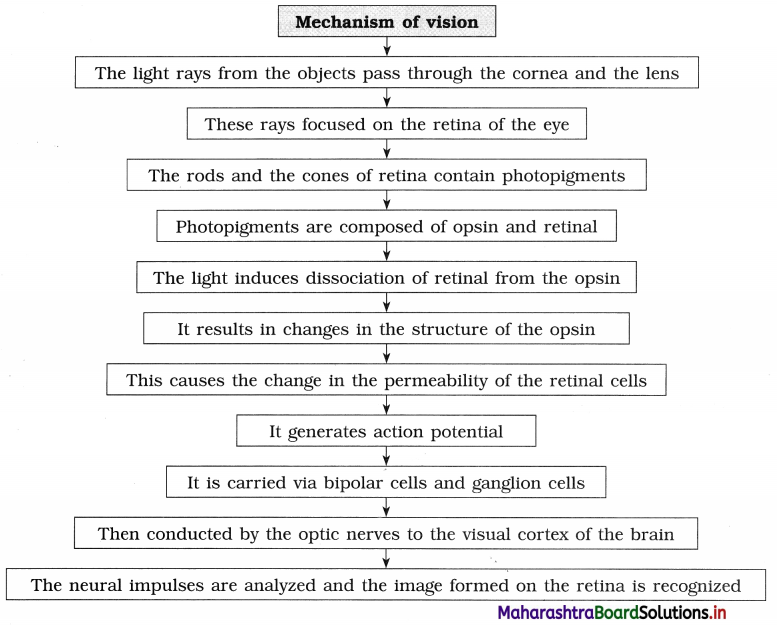
Maharashtra Board Class 12 Biology Important Questions Chapter 9 Control and Co-ordination 2
Maharashtra Board Class 12 Biology Important Questions Chapter 9 Control and Co-ordination 3

Question 8.
Complete the table given below by putting a tick (✓) in the boxes where applicable.

ActionReflexVoluntary
1. Touching a hot object———-———–
2. Releasing saliva on smelling food———–————
3. Applying a car’s brakes in an emergency————————–
4. Blinking of eyes when a small insect touches the eye———–————

Answer:

ActionReflexVoluntary
1. Touching a hot object
2. Releasing saliva on smelling food
3. Applying a car’s brakes in an emergencycan be a conditioned feclex too.
4. Blinking of eyes when a small insect touches the eye————

Question 9.
Complete the following table

ActionReflexVoluntary
1. Optic nerve———–———–
2. Facial———–————
3. Hypoglossal————————–
4. Trigeminal———–————
5. Auditory
6. Glosso-pharyngeal

Answer:

ActionReflexVoluntary
1. Optic nerveSensorySense of vision and light
2. FacialMixedFacial expression, movement of neck, tongue, etc. and saliva secretion
3. HypoglossalMotorMovement of tongue
4. TrigeminalMixedSensation of touch, taste and jaw movements
5. AuditorySensoryHearing and equilibrium
6. Glosso-pharyngealMixedTaste, pharyngeal contractions ‘and saliva secretion

Diagram based questions

Question 1.
Sketch and label – nerve net of Hydra.
Answer:
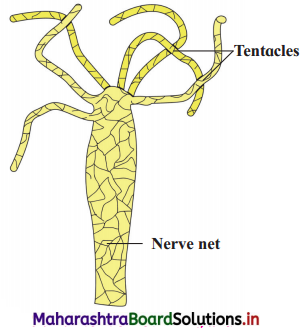
Maharashtra Board Class 12 Biology Important Questions Chapter 9 Control and Co-ordination 4

Question 2.
Sketch and label – nervous system of Planaria
Answer:
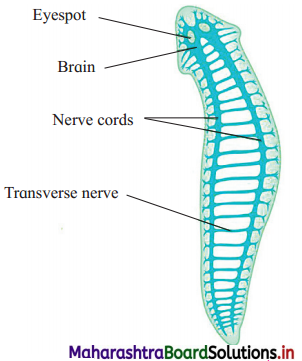
Maharashtra Board Class 12 Biology Important Questions Chapter 9 Control and Co-ordination 5

Question 3.
Sketch and label – depolarization and repolarization along nerve.
Answer:
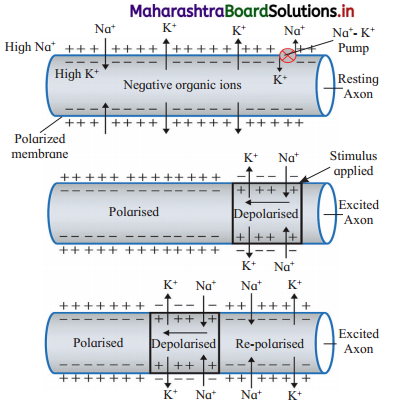
Maharashtra Board Class 12 Biology Important Questions Chapter 9 Control and Co-ordination 6

Question 4.
Sketch and label ultrastructure of synapse.
Answer:
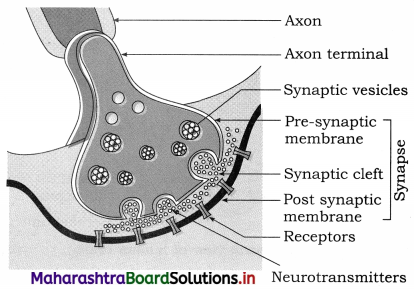
Maharashtra Board Class 12 Biology Important Questions Chapter 9 Control and Co-ordination 7

Question 5.
Sketch and label – lateral view of brain.
Answer:
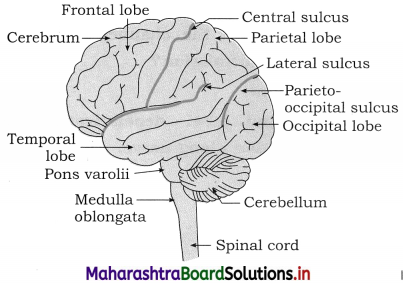
Maharashtra Board Class 12 Biology Important Questions Chapter 9 Control and Co-ordination 8

Maharashtra Board Class 12 Biology Important Questions Chapter 9 Control and Co-ordination

Question 6.
Sketch and label – functional areas of Brain?
Answer:
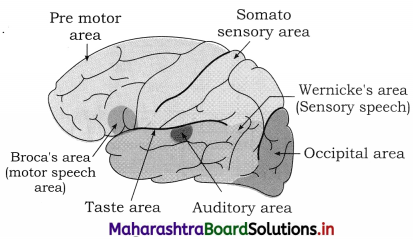
Maharashtra Board Class 12 Biology Important Questions Chapter 9 Control and Co-ordination 9

Question 7.
Sketch and label – ventral view of human brain.
Answer:
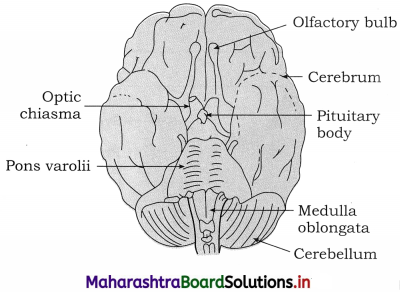
Maharashtra Board Class 12 Biology Important Questions Chapter 9 Control and Co-ordination 10

Question 8.
Sketch and label – ventricles of brain.
Answer:
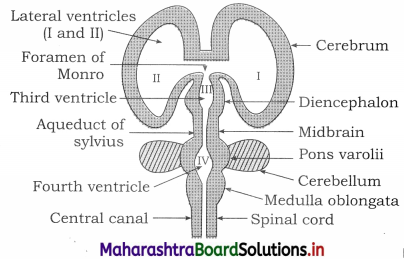
Maharashtra Board Class 12 Biology Important Questions Chapter 9 Control and Co-ordination 11

Question 9.
Sketch and label T.S. of spinal cord.
Answer:
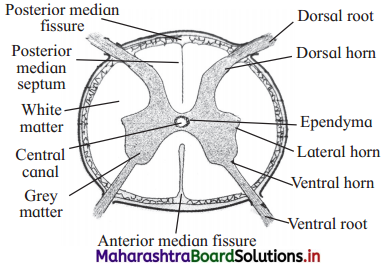
Maharashtra Board Class 12 Biology Important Questions Chapter 9 Control and Co-ordination 12

Question 10.
Sketch and label – formation of spinal nerve.
Answer:
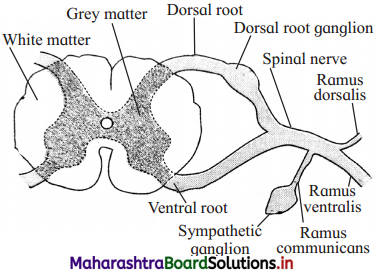
Maharashtra Board Class 12 Biology Important Questions Chapter 9 Control and Co-ordination 13

Question 11.
Sketch and label – mechanism of hormone action.
Answer:
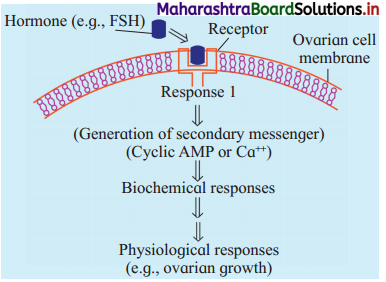
Maharashtra Board Class 12 Biology Important Questions Chapter 9 Control and Co-ordination 14
Maharashtra Board Class 12 Biology Important Questions Chapter 9 Control and Co-ordination 15

Question 12.
Sketch and label – V.S. of pituitary.
Answer:
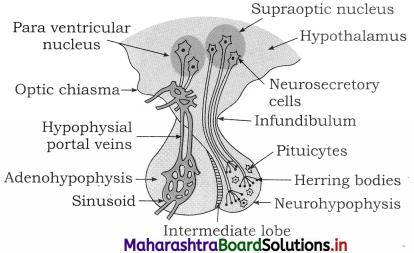
Maharashtra Board Class 12 Biology Important Questions Chapter 9 Control and Co-ordination 16

Question 13.
Sketch and label – morphology of thyroid
Answer:
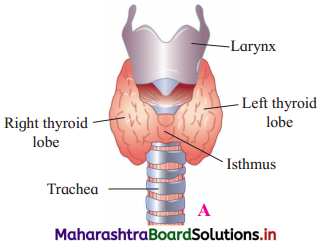
Maharashtra Board Class 12 Biology Important Questions Chapter 9 Control and Co-ordination 17

Question 14.
Sketch and label – histology of thyroid
Answer:
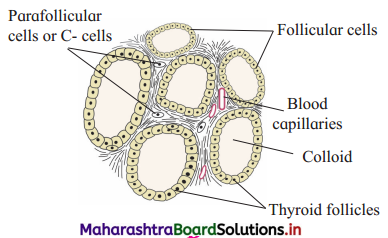
Maharashtra Board Class 12 Biology Important Questions Chapter 9 Control and Co-ordination 18

Question 15.
Sketch and label – parathyroid glands
Answer:
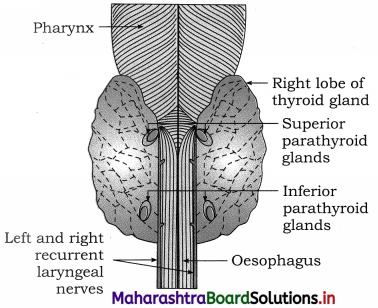
Maharashtra Board Class 12 Biology Important Questions Chapter 9 Control and Co-ordination 19

Question 16.
Sketch and label thymus.
Answer:
Maharashtra Board Class 12 Biology Important Questions Chapter 9 Control and Co-ordination 20

Question 17.
Sketch and label – adrenal gland.
Answer:
Maharashtra Board Class 12 Biology Important Questions Chapter 9 Control and Co-ordination 21

Long answer questions

Question 1.
Explain transmission of nerve impulse across a synapse.
OR
Explain how is impulse transmitted through a synapse?
Answer:

  1. The nerve impulse travels along the axon of the pre-synaptic neuron to the axon terminal.
  2. Pre-synaptic neurons or axons have several synaptic knobs at their ends or terminals.
  3. These knobs have membranous sacs, called synaptic vesicles having neurotransmitter molecules.
  4. When an impulse reaches a synaptic knob, voltage sensitive Ca++ channels open and calcium ions (Ca++) diffuse inward from the extracellular fluid.
  5. The increased calcium concentration inside the cells, initiates a series of events that help to fuse the synaptic vesicles with the cell membrane of pre-synaptic neuron, where they release their neurotransmitters by exocytosis.
  6. The neurotransmitters bind to the receptors of the post-synaptic cell,
  7. This action is either excitatory (stimulating) or inhibitory (slowing down/stopping).
  8. Once the impulse has been transferred across the synapse, the enzyme like acetyl cholinesterase destroys the
  9. neurotransmitter and the synapse is ready to receive a new impulse.

Question 2.
Explain transmission of nerve impulse along the axon.
OR
Describe the conduction of a nerve impulse in the neuron.
Answer:
1. Before conduction of nerve impulse, the cell membrane is in the polarized state.

2. When a stimulus is applied at a site on the polarised membrane, the membrane at that site becomes freely permeable to Na+.

3. This leads to a rapid influx of Na+ followed by the reversal of the polarity at that site, i.e., the outer surface of the membrane becomes negatively charged and the inner side becomes positively charged.

4. The polarity of the membrane at that site [site A] is thus reversed and hence depolarised. The electrical potential difference across the plasma membrane at the site of stimulation is called the action potential, which is in fact termed as a nerve impulse.

5. At sites immediately ahead [site B], the axon membrane has a positive charge on the outer surface and a negative charge on its inner surface. As a result, a current flows on the inner surface from site A to site B.
Maharashtra Board Class 12 Biology Important Questions Chapter 9 Control and Co-ordination 22

6. On the outer surface current flows from site B to site A to complete the circuit of current flow. Hence, the polarity at the site is reversed, and an action potential is generated at site B. Thus, the impulse (action potential) generated at site A arrives at site B.

7. The sequence is repeated along the length of the axon and consequently the impulse is conducted.

8. The rise in the stimulus-induced permeability to Na+ is extremely short-lived. It is quickly followed by a rise in permeability to K+.

9. Within a fraction of a second, K+ diffuses outside the membrane and restores the resting potential of the membrane at the site of excitation and the fibre becomes once more responsive to further stimulation.

Maharashtra Board Class 12 Biology Important Questions Chapter 9 Control and Co-ordination

Question 3.
Explain the structure of cerebrum. Structure of cerebrum
Answer:
Answer: Structure of cerebrum:

  1. Cerebrum is the largest part of the brain. It forms 80-85% volume of the brain.
  2. A median longitudinal fissure divides the cerebrum into two cerebral hemispheres. These hemispheres are interconnected by a thick band of transverse nerve fibres called corpus callosum.
  3. The outer part of cerebrum is called cerebral cortex while the inner part is called cerebral medulla.
  4. The roof of cerebrum is called pallium. Pallium is highly folded forming sulci and gyri. Sulci are depressions while gyrl are ridges. The gyri increase the surface area of cerebral cortex.
  5. The ventro-lateral walls of cerebrum are thickened and are called corpora striata.
  6. The cerebral cortex has three deep sulci, the central, lateral and parieto-occipital.
  7. These sulci divide the cerebral hemisphere into four lobes. These are frontal, parietal, occipital and temporal lobes. A fifth median lobe called insula or insular cortex is folded deep within the lateral sulcus.
  8. The central sulcus separates frontal and parietal lobes, the lateral sulcus separates parietal and temporal lobes and the parieto¬occipital sulcus separates parietal and occipital lobe.

Question 4.
Describe the structure and function of midbrain.
Answer:
1. Structure of midbrain:

  • Midbrain is the middle part of the brain situated between the forebrain and the hindbrain. It is present between the pons varolii and diencephalon.
  • It has two distinct regions : Corpora quadrigemina and crura cerebri.
  • Corpora quadrigemina consists of two pairs of lobes, viz., superior colliculi and inferior colliculi. These are located in the thick wall of midbrain.
  • Crura cerebri are thick bands of longitudinal nerve fibres, present on the floor of midbrain.

2. Functions of midbrain:

  • Inferior colliculi control and coordinate auditory reflexes.
  • Superior colliculi control head and eye movements.
  • Crura cerebri connect the cerebrum to cerebellum and spinal cord.

Question 5.
Give an account of structure of hindbrain.
Answer:
Structure of hindbrain:

  1. Hindbrain includes cerebellum, pons varolii and medulla oblongata.
  2. Cerebellum is 11% of the total brain and is the second largest part of the brain.
  3. It has three lobes, median vermis and lateral two cerebral hemispheres. It has outer grey and inner white matter.
  4. Cerebral cortex shows sulci and gyri. The inner white matter of cerebellar medulla shows arbor vitae or branching tree-like processes.
  5. Pons is the part that connects the two cerebral hemispheres. It has outer white and inner grey matter. Pons is made up of nerve fibres which form bridges between cerebrum and medulla oblongata.
  6. Medulla oblongata is the last part of the hindbrain which continues further as a spinal cord. It has outer white and inner grey matter.
  7. Its roof shows has posterior choroid plexus.
  8. Eight pairs of cranial nerves arise from medulla oblongata.

Question 6.
Describe T.S. of spinal cord.
Answer:

  1. Externally there are three meninges covering spinal cord Duramater, arachnoid membrane and pia mater.
  2. Dorsoventrally there are two fissures, the shallow dorsal or posterior fissure and the deeper ventral or anterior fissure.
  3. From dorsal fissure a dorsal septum extends inside.
  4. Neurocoel or central canal is situated in the centre of spinal cord.
  5. The central canal is filled with cerebro¬spinal fluid and is lined by cuboidal epithelial cells called layer of ependyma.
  6. There is inner grey and outer white matter in the spinal cord. This grey matter is in the shape of ‘H’ with two dorsolateral horns and two ventro-lateral horns.
  7. Dorsal horns form dorsal roots and ventral horns form ventral roots.
  8. White matter is divided into three columns, viz., the dorsal funiculi, ventral funiculi and lateral funiculi on either side.
  9. Ascending and descending tracts of nerve fibres arise from dorsal and ventral roots of the spinal cord. Ascending tracts are sensory while descending tracts are motor in nature.

Question 7.
What are the different types of reflexes?
Answer:
1. Based on the location of their action : Thereflexes are divided into somatic reflexes and visceral reflexes.

  • When effector is located in body structures such as skeletal muscles, it is called a somatic reflex.
  • When the effector is located in the visceral organs such as glands or smooth muscles then it is called a visceral reflex.

2. Based on the basis of number of neurons : Reflexes are of two types, viz. monosynaptic reflexes and polysynaptic reflexes.

  • Simple or monosynaptic reflexes are those in which one sensory and one motor neuron are involved in the reflex action.
  • Polysynaptic or complex reflexes are those when more than two neurons are involved in the reflex action.

3. Based on inheritance and experience of learning : The reflexes are subdivided into unconditional or inborn and conditional or acquired.

  • Unconditional or inborn reflexes are inborn or hereditary. They are permanent, never disappear and need no previous experience, e.g. blinking of eyes, suckling, swallowing, knee jerk, sneezing, coughing, etc.
  • Conditional or acquired reflexes are acquired during life by experience or learning. They are based on individual learning or experience. These are not heritable, temporary and may disappear or reappear, e.g. driving, cycling, etc.

Question 8.
Explain the mechanism of reflex action.
Answer:

  1. Mechanism of reflex action: There are series of sequential events in which reflex action is completed:
  2. Stimulus is picked up by any receptors, e.g. pricking of a needle in the hand, causes skin to be a receptor.
  3. Sensory impulse is formed in grey matter of spinal cord. It receives sensory impulse, interprets it and generates motor impulse.
  4. The cyton of motor neuron present in the ventral horn of grey matter and axon conducts motor impulse from spinal cord to effector organ. This is further carried by dendrites innervating the skin.
  5. Impulse is carried to the association neuron by axon of sensory neuron, when impulse reaches the end of the axon there is a synapse.
  6. Transmission takes place by releasing acetylcholine from the synaptic buttons at the end of the axon.
  7. It fills the synaptic gap and helps in chemical transmission of the impulse from axon of one neuron to dendron of the other neuron. Once the impulse reaches the dendrites of association neuron; axonic button releases an enzyme, acetylcholine esterase which neutralizes the acetylcholine and again a synaptic gap is formed. This mechanism helps to receive new impulse or avoid the mixing of different impulses.
  8. The association neuron receives sensory impulse, interprets it, analyses it and generates motor impulse. Motor impulse again travels through synapse between association neuron and motor neuron.
  9. Impulse travels through motor neuron and reaches the effector organ like skeletal muscles or the gland. The effector organ gives a proper response like contraction of the muscles or secretion by the gland.

Question 9.
Define receptors. Enlist different types of receptors.
Answer:
1. Receptors : Receptors are specialized cells, tissues or organs present in the body which receive different stimuli.

2. Types of receptors:

  • Receptors are of two types, viz. exteroceptors and interoceptors.-
  • Exteroceptors receive stimuli directly from the external environment. They are somatic in nature.
  • Interoceptors are located inside the body and are visceral in nature. They respond to internal changes in the body.
  • The various types of exteroceptors and interoceptors, their location and functions have been summarized in the table given below:
    Types of ExteroceptorsLocationFunction
    1. MechanoreceptorsTouch corpuscles in skinTangoreceptors Pressure Tactile receptors- Touch
    2. ThermoreceptorsSkinFrigido receptors (cold) Heat receptors (warmth)
    3. ChemoreceptorsTongue, nasal mucosaGustatoreceptors – Taste Olfactoreceptors- Smell
    4. Statoacoustic receptorsInternal earCochlea – Hearing Semicircular canals-Balance and equilibrium
    5. PhotoreceptorsRetina of the eyeRods and cones interpret images Rods-black and white image. Sensitive to dim light. Cones – Coloured image. Sensitive to bright light.

Question 10.
Describe the different parts of human eye.
OR
Describe briefly the structure of eye.
Answer:

  1. Human eyes are a pair of organs located in sockets of the skull called orbits.
  2. Eyeball is spherical and has three layers.
  3. Sclera is the outer layer of dense connective tissue with anterior transparent cornea.
  4. Choroid is the middle layer. It is bluish in colour containing many blood vessels. The anterior region is thick and forms the ciliary body. Posterior 2/3rd region is thinner.
  5. Iris is the forward segment of the ciliary body which is pigmented and opaque. This part is the visible coloured portion of the eye.
  6. Lens is present anteriorly inside the iris and is held in position by the ligaments of ciliary body.
  7. The aperture surrounded by the iris in front of the lens is known as pupil. The movement of the pupil is regulated by the muscle fibres of iris.
  8. The innermost layer of the eye is the retina having three sub-layers formed by ganglion cells, bipolar cells and photoreceptor cells, which are sensitive to light.
  9. There are two types of photoreceptor cells, viz. rods and cones containing light sensitive proteins. They are termed as photo pigments, rhodopsin which is a derivative of vitamin A (in rods) and iodopsin (in cones).
  10. The cones are responsible for daylight or photopic vision and colour vision. The rods function in dim light giving scotopic vision.
  11. The cones are of three types, each containing its own characteristic photopigments that respond to red, green and blue lights.
  12. The optic nerve leaves the eye at a point slightly away from the median posterior pole of the eyeball. In this region, the rods and cones are absent therefore this region is known as blind spot. Macula lutea, a yellowish pigmented spot is present lateral to the blind spot.
  13. Fovea is a central pit present beside it. Fovea is a thinned out portion of the retina where only the cones are densely packed and therefore have greatest visual acuity (resolution).
  14. A space between the cornea and the lens is called aqueous chamber. It contains a thin watery fluid known as aqueous humor.
    Maharashtra Board Class 12 Biology Important Questions Chapter 9 Control and Co-ordination 24

Question 11.
Describe the internal structure of human ear.
OR
Ear is one of the important sense organs known for its role in hearing and balancing. Describe those structures present in the internal ear which helps in these functions.
Answer:

  1. The ears are the auditory sensory organs, also involved in maintaining equilibrium of the body.
  2. The ear is composed of three divisions namely the outer ear, middle ear and internal ear.
  3. The external ear consists of the pinna and external auditory meatus (canal). The pinna is for the collection of sound waves coming from the environment. The external auditory canal is the circular tube leading inside up to the eardrum or tympanic membrane.
  4. The tympanic membrane or eardrum is formed of connective tissues having outer skin cover and inner mucus membrane.
  5. The middle ear consists of chain of three ossicles called malleus, incus and stapes, The malleus is attached to the tympanic membrane and the stapes is connected to the oval window of the internal ear. They help in the transmission of sound waves from external auditory canal to internal ear.
  6. Connecting middle ear with the pharynx is eustachian tube which helps in equalizing the air pressure on either side of the tympanic membrane.
  7. The internal ear is fluid filled structure called labyrinth. It has two parts, bony and the membranous labyrinth.
  8. The outer bony labyrinth is formed by the series of channels in which the membranous abyrinth containing endolymph fluid is present.
  9. The membranes consist of coiled cochlea, the reissner’s membrane and basilar membranes. These membranes divide the surrounding perilymph filled bony labyrinth into an upper scala vestibule and a lower scala tympani.
  10. The space within cochlea which is known as scala media is filled with endolymph. The scala vestibule ends at the oval window at the base of cochlea.
  11. The scala tympani terminates at the round window which opens to the middle ear. The organ of corti is located on the basilar membrane. It contains the hair cells which act as auditory receptors.
  12. The hair cells are columnar cells present in rows. The basal ends of the hair cells are in close contact with the afferent nerve fibres while their apical end contains numerous cilia. A thin elastic membrane projects above the rows of the hair cells called tectorial membrane.
  13. Above the cochlea, the internal ear also contains vestibular apparatus. It consists of three semicircular canals and the otolith organ formed of the sacculus and utriculus. The semicircular canals lie in different plane at right angles to each other and are suspended in the perilymph.
  14. The bases of canals are swollen and are called ampullae, which contain a projecting ridge known as crista ampullaris which contain hair cells.
  15. The sacculus and utriculus also have projecting ridge called macula. The crista and macula are the specific receptors of vestibular apparatus. They are responsible for maintenance of body posture and the balance.
    Maharashtra Board Class 12 Biology Important Questions Chapter 9 Control and Co-ordination 25

Question 12.
Write an account of position and structure of pituitary gland.
Answer:
Pituitary gland (Hypophysis):
I. Position : Pituitary or Hypophysis is located on the ventral side of brain below the hypothalamus. Infundibulum or hypophyseal stalk attaches pituitary to hypothalamus just behind the optic chiasma. It is well protected in sella turcica which is a depression of the sphenoid bone of the skull.

II. Morphological structure of pituitary- gland: The pituitary gland shows two distinct regions : Anterior lobe or adenohypophysis and posteriorlobe or neuro-hypophysis.
(1) Adenohypophysis or Anterior lobe : It is the largest lobe of the gland and forms about 75% of pituitary gland. It develops as an outgrowth called Rathke’s pouch from the roof of embryonic buccal cavity. It has three divisions, viz. pars tuberalis, pars distalis and pars intermedia.

(i) Pars tuberalis : Tubular region present below the hypothalamus is known as pars tuberalis. It is like a collar around the infundibulum. It is non-secretory in nature.
(ii) Pars distalis : The largest anterior region which is secretory in nature is called pars distalis. It is made up of loose cords of epitheloid secretory cells which are separated by reticular connective tissue containing blood sinusoids. It is connected to the hypothalamus by portal system formed by blood sinusoids.
(iii) Pars intermedia : The narrow cleft between the pars distalis and pars nervosa of neuro – hypophysis is called the intermediate part or pars intermedia. It is reduced, less developed and non-functional in human being.

(2) Neuro-hypophysis or Posterior lobe : The posterior lobe of the pituitary which is attached to hypothalamus by infundibular stalk is called neuro-hypophysis. It is smaller and constitute 25% of pituitary. It has the following three parts:

  1. Median eminence : The swollen median part of the hypothalamus where infundibulum gets attached is called median eminence.
  2. Infundibulum : Infundibulum is the hypophyseal stalk that helps in attachment of pituitary gland to the hypothalamus. It contains mainly the axonic fibres of neurosecretory cells present in hypothalamus. It forms the major connection of hypothalamo-hypophysis axis.
  3. Pars nervosa : The lowermost, larger region of neuro-hypophysis that contains axons is called pars nervosa. It acts as a neurohaerhal organ and contains specialized cells called pituicytes.

Maharashtra Board Class 12 Biology Important Questions Chapter 9 Control and Co-ordination

Question 13.
In a person, Pars distalis part of the Pituitary gland is not producing hormones in sufficient quantity. Explain the effects it will produce with respect to the different hormones.
OR
Give names and functions of hormones secreted by adenohypophysis.
Answer:
Pars distalis of the pituitary gland produces following hormones:
GH, ACTH, TSH, FSH, LH/ICSH, LTH and MSH. If these hormones are produced in deficient quantities, following disorders are seen.
1. GH:
(a) Hyposecretion of GH in childhood leads to dwarfism. Frohlich dwarf or Lorain dwarf may be produced based on mental capacity. Hyposecretion in adulthood causes Simmonds’s disease.
(b) Hypersecretion of GH in childhood causes gigantism and in adulthood it causes acromegaly.

2. TSH :
(a) Hyposecretion of TSH leads to thyroid atrophy.
(b) Hypersecretion of TSH causes excessive functioning of thyroid gland.

3. ACTH :
(a) Hyposecretion of ACTH causes Addisons’ disease, in which adrenal gland shows failure of functions.
(b) Hypersecretion of ACTH causes Cushing’s disease, in which the adrenal cortex undergoes excessive growth.

4. FSH : Hyposecretion of FSH leads to infertility in both the sexes. Hypersecretion of FSH in females cause disturbances in menstrual cycle.

5. LH/ICSH : Hyposecretion of LH in females will cause lack of ovulation. Hyposecretion of ICSH in males cause reduction in masculinity. Sperm production may be affected. Hypersecretion of LH/ICSH can cause disturbances in reproductive cycles.

6. LTH : Corpus luteum is not maintained due to lesser amount of LTH. Lactogenesis will also hamper if there is hyposecretion of LTH.

Question 14.
Describe the hormones of neuro¬hypophysis.
Answer:
Hormones of neuro-hypophysis : Neuro-hypophysis does not secrete any hormone itself but stores the hormones which are secreted by hypothalamic neurons. It stores and releases the following hormones, viz. ADH, Oxytocin and coherin.
1. Anti Diuretic Hormone (ADH) or Vasopressin:

  • ADH brings about anti-diuretic action and also increases blood pressure.
  • It is a regulatory hormone which plays a major role in osmoregulation.
  • It increases the permeability of distal convoluted tubule or collecting tubules of uriniferous tubules of kidney.
  • Higher ADH levels decrease the urine output and helps for water conservation. It helps in the absorption of water from the ultrafiltrate thus regulates the water balance of body fluids.
  • ADH also controls constriction of arterioles and increases blood pressure in kidney which facilitates ultra filtration. Therefore it is also called vasopressin.
  • ADH is regulated by increase or decrease of osmotic pressure of blood in a feedback manner.
  • The osmotic pressure is detected by osmoreceptors in the hypothalamus.

2. Oxytocin (Birth hormone):

  • Oxytocin helps in parturition.
  • It is a powerful stimulant of contraction of uterine myometrium at the end of gestation due to which the labour is initiated.
  • It also stimulates myoepithelial cells of mammary glands for milk ejection during lactation.
  • It also helps in fertilization by powerful contractions of the uterine musculature to drive the sperms upward towards fallopian tubes.
  • Oxytocin also excites musculature of gallbladder, ureters, urinary bladder, intestine, etc. for proper functioning of these organs.

3. Coherin : Coherin induces prolonged, rhythmic integrated contractions of the jejunum.

Question 15.
Describe the morphology of thyroid gland.
Or
With the help of a suitable diagram describe the structure of thyroid gland.
Answer:
Morphology of thyroid gland:

  1. Thyroid is the largest endocrine gland in the body.
  2. It weighs about 25 to 30 g and measures about 5 cm in length and 3 cm in width.
  3. It is located in the neck region anteriorly just below the larynx and situated ventrolaterally to the trachea.
  4. The thyroid is derived from the endoderm of the embryo.
  5. The thyroid can vary in size as per age, sex and diet.
  6. It is reddish brown, bilobed and highly vascular
  7. The two lobes are joined by connective tissue called isthmus which is located at 2nd to 4th tracheal cartilage.
  8. Therefore, the right and left lobe of thyroid are seen on both sides of the trachea.
  9. The gland is H-shaped having butterfly-like appearance.
  10. The structural and functional units of thyroid gland are the thyroid follicles.
  11. From the outer surface there lies a connective tissue capsule. A number of septa arise from the connective tissue which are called trabeculae. They divide the gland into lobules. Each lobule has follicles which store hormone. The number of follicles are about three million.

Question 16.
Describe neurohormonal regulation of pituitary and thyroid gland.
Answer:
Pituitary gland is directly under the influence of neurohormones of hypothalamus while thyroid is indirectly influenced.
I. Neurohormonal regulation of pituitary:

  1. Hypothalamus secretes releasing factors and inhibiting factors and hence regulate the secretions of pituitary (hypophysis).
  2. Hypothalamus forms the hypothalamohypophysial axis through which transportation of neuro-hormones take place.
  3. Pituitary secretes a variety of hormones which influence other endocrine glands of the body. E.g. GH, PRL, TSH, ACTH, Gonadotropins

II. Neurohormonal regulation of thyroid :

  1. Hypothalamus secretes TRF [Thyrotropin releasing factor] which influences the anterior pituitary to release TSH.
  2. TSH in turn stimulates thyroid follicles to produce and release two thyroid hormones – T3 and T4. (Thyroxin)
  3. Increase in T3 and T4 triggers negative feedback mechanism that stops the secretion of TRF.

(4) As the pituitary does not get the signal in the form of TRF TSH secretion is stopped.

Question 17.
Name the hormones secreted by the adrenal cortex and state their role.
Answer:
Adrenal cortex secretes 3 types of corticoids – mineralocorticoids, glucocorticoids and sex corticoids.
I. Mineralocorticoids:

  1. The mineralocorticoids regulate ionic and osmotic balance, by regulating the amounts of electrolyte and water.
  2. Aldosterone is the main mineralocorticoid that acts on the renal tubules.
  3. Aldosterone stimulates the re-absorption of Na+ and water and excretion of K+ and phosphate ions.
  4. The aldosterone helps in the maintenance of electrolytes, body fluid volume, osmotic pressure and blood pressure.

II. Glucocorticoids:

  1. Cortisol is the main glucocorticoid. Cortisol stimulates many metabolic reactions such as gluconeogenesis, lipolysis and proteinolysis.
  2. It inhibits cellular uptake and utilization of amino acids.
  3. Cortisol also plays an important role in maintaining the cardiovascular system and kidney functions.
  4. It is also involved in anti-inflammatory reactions and suppresses the immune response.
  5. Cortisol stimulates the RBC production.

III. Sex corticoids (Gonadocorticoids).

  1. Sex corticoids, Androgens and estradiols are produced by the adrenal cortex.
  2. In males, they have a role in development and maintenance of external sex characters.
  3. Excess sex corticoids in female causes adrenal virilism and hirsutism (excess hair on face)
  4. Excess sex corticoids in males causes gynaecomastia i.e. enlarged breast.

Maharashtra Board Class 12 Biology Important Questions Chapter 8 Respiration and Circulation

Balbharti Maharashtra State Board 12th Biology Important Questions Chapter 8 Respiration and Circulation Important Questions and Answers.

Maharashtra State Board 12th Biology Important Questions Chapter 8 Respiration and Circulation

Multiple-choice Questions

Question 1.
The nasal cavity is divided into right and left nasal chambers by a …………………..
(a) sphenoid
(b) palatine
(c) mesethmoid
(d) zygomatic
Answer:
(c) mesethmoid

Question 2.
The right lung is divided into …………………..
(a) 3 lobes
(b) 2 lobes
(c) 4 lobes
(d) 6 lobes
Answer:
(a) 3 lobes

Maharashtra Board Class 12 Biology Important Questions Chapter 8 Respiration and Circulation

Question 3.
Carbon dioxide is carried in the blood mainly as …………………..
(a) sodium carbonate
(b) sodium bicarbonate
(c) carbaminohaemoglobin
(d) carbonic acid
Answer:
(b) sodium bicarbonate

Question 4.
Transport of oxygen is carried out by …………………..
(a) plasma
(b) lungs
(c) RBCs
(d) nostrils
Answer:
(c) RBCs

Question 5.
Respiration taking place at the alveoli of lungs is called …………………..
(a) internal respiration
(b) external respiration
(c) cellular respiration
(d) tissue respiration
Answer:
(b) external respiration

Question 6.
The volume of air inspired or expired during normal breathing is …………………..
(a) ERV
(b) IRV
(c) TV
(d) VC
Answer:
(c) TV

Question 7.
What is the partial pressure of oxygen and carbon dioxide respectively in the atmospheric air?
(a) PPO2 159 mmHg, PPCO22 0.3 mmHg
(b) PPO2 104 mmHg, PPCO2 40 mmHg
(c) PPO2 40 mmHg, PPCO2 45 mmHg
(d) PPO2 95 mmHg, PPCO2 40 mmHg
Answer:
(b) PPO2 104 mmHg, PPCO2 40 mmHg

Question 8.
The vital capacity of human lung is equal to …………………..
(a) 3500 ml
(b) 4600 ml
(c) 500 ml
(d) 1200 ml
Answer:
(b) 4600 ml

Question 9.
The exchange of gases between alveolar air and alveolar capillaries occurs by …………………..
(a) osmosis
(b) active transport
(c) absorption
(d) diffusion
Answer:
(d) diffusion

Question 10.
Oxygen dissociation curve will shift to right on the decrease of …………………..
(a) acidity
(b) carbon dioxide concentration
(c) temperature
(d) pH
Answer:
(d) pH

Question 11.
Respiratory organs in scorpion are …………………..
(a) gills
(b) book lungs
(c) skin
(d) book gills
Answer:
(b) book lungs

Question 12.
Breakdown of alveoli of lungs resulting in reducing surface area for gas exchange is known as …………………..
(a) emphysema
(b) sneezing
(c) pneumonia
(d) tuberculosis
Answer:
(a) emphysema

Question 13.
During inspiration, the diaphragm …………………..
(a) relaxes
(b) contracts
(c) expands
(d) shows no change
Answer:
(b) contracts

Question 14.
Over inflation of the lungs is prevented due to …………………..
(a) Bohr’s effect
(b) Conditioned reflex
(c) Hering-Breuer reflex
(d) Haldane effect
Answer:
(c) Hering-Breuer reflex

Question 15.
Which of the following prevents collapsing of trachea?
(a) Muscles
(b) Diaphragm
(c) Ribs
(d) Cartilaginous rings
Answer:
(d) cartilaginous rings

Question 16.
Which one of the following produces antibodies ?
(a) Monocytes
(b) Erythrocytes
(c) Lymphocytes
(d) Monocytes
Answer:
(c) Lymphocytes

Question 17.
Plasma protein which initiate blood coagulation is …………………..
(a) prothrombin
(b) fibrinogen
(c) thrombin
(d) fibrin
Answer:
(a) prothrombin

Question 18.
The covering of heart is …………………..
(a) perichondrium
(b) pericardium
(c) periosteum
(d) peritoneum
Answer:
(b) pericardium

Question 19.
Left atrioventricular aperture is guarded by …………………..
(a) tricuspid valve
(b) Eustachian valve
(c) bicuspid valve
(d) semilunar valve
Answer:
(c) bicuspid valve

Question 20.
The pulmonary trunk and systemic aorta are joined by …………………..
(a) chordae tendinae
(b) columnae carnae
(c) ligamentum arteriosum
(d) Purkinje fibres
Answer:
(c) ligamentum arteriosum

Question 21.
Atrioventricular node is located in …………………..
(a) left atrium
(b) right atrium
(c) left ventricle
(d) right ventricle
Answer:
(b) right atrium

Question 22.
…………………. is most commonly used to feel pulse.
(a) Radial vein
(b) Brachial artery
(c) Brachial vein
(d) Radial artery
Answer:
(d) Radial artery

Question 23.
QRS is related to …………………..
(a) atrial contraction
(b) ventricular contraction
(c) atrial relaxation
(d) ventricular relaxation
Answer:
(b) ventricular contraction

Question 24.
Blood is a fluid connective tissue derived from …………………..
(a) ectoderm
(b) mesoderm
(c) endoderm
(d) epithelium
Answer:
(b) mesoderm

Question 25.
What is the increase in number of RBCs called?
(a) Erythropoiesis
(b) Polycythaemia
(c) Erythrocytopenia
(d) Erythroblastosis
Answer:
(b) Polycythaemia

Question 26.
What is the increase in the number of WBCs called?
(a) Leucopoiesis
(b) Leukopenia
(c) Leucocytosis
(d) Leukaemia
Answer:
(c) Leucocytosis

Question 27.
In which of the following diseases there is uncontrolled increase in number of WBCs ?
(a) Leucopoiesis
(b) Leukopenia
(c) Leucocytosis
(d) Leukaemia
Answer:
(d) Leukaemia

Question 28.
What is the decrease in the number of WBCs called?
(a) Leucopoiesis
(b) Leukopenia
(c) Leucocytosis
(d) Leukaemia
Answer:
(b) Leukopenia

Question 29.
Which is the correct arrangement of types of WBCs with respect to their number in blood?
(Consider Neutrophil = N, Eosinophil = E, Basophil = B, Monocyte = M and Lymphocyte = L)
(a) NLMEB
(b) BEMLN
(c) NEBLM
(d) MEBLN
Answer:
(a) NLMEB

Question 30.
Which is the correct order in which the proteins participate in clotting of blood?
(a) Prothrombinase → Prothrombin → Thromboplastin → Thrombin
(b) Thromboplastin → Prothrombinase → Prothrombin → Thrombin
(c) Prothrombin → Thromboplastin → Thrombin → Prothrombinase
(d) Thrombin → Prothrombin → Thromboplastin → Prothrombinase
Answer:
(b) Thromboplastin → Prothrombinase → Prothrombin → Thrombin

Question 31.
Decrease in platelet count is called …………………..
(a) thrombocytopenia
(b) thrombocytosis
(c) thrombokinase
(d) thromboplastin
Answer:
(a) thrombocytopenia

Question 32.
Atrioventricular groove is also called a …………………..
(a) foramen ovale
(b) ligamentum arteriosum
(c) coronary sulcus
(d) ductus arteriosus
Answer:
(c) coronary sulcus

Question 33.
The coronary sinus opens into the …………………..
(a) left atrium
(b) right atrium
(c) left ventricle
(d) right ventricle
Answer:
(b) right atrium

Question 34.
Name the valve from the following that guards the opening of inferior vena cava.
(a) Tricuspid valve
(b) Semilunar valve
(c) Eustachian valve
(d) Thebesian valve
Answer:
(c) Eustachian valve

Question 35.
Name the valve from the following guarding the opening of coronary sinus …………………..
(a) Thebesian valve
(b) Eustachian valve
(c) Tricuspid valve
(d) Semilunar valve
Answer:
(a) Thebesian valve

Question 36.
What is an oval aperture in the interatrial septum of the foetus called?
(a) Fossa ovalis
(b) Foramen ovalis
(c) Ligamentum arteriosum
(d) Ductus arteriosus
Answer:
(b) Foramen ovalis

Question 37.
What is the meaning of stroke volume?
(a) Amount of blood in the body
(b) Pressure of contraction of heart
(c) Amount of blood put out of the ventricles in one minute
(d) Amount of blood put out of the ventricles in one beat
Answer:
(d) Amount of blood put out of the ventricles in one beat

Question 38.
How much amount of blood is put out of the heart during one minute?
(a) Equal to cardiac output
(b) Equal to stroke volume
(c) Equal to half of blood volume
(d) Equal to quarter of blood volume
Answer:
(a) Equal to cardiac output

Question 39.
What is the time taken for one cardiac cycle of normal human being?
(a) 0.1 second
(b) 0.3 second
(c) 0.4 second
(d) 0.8 second
Answer:
(d) 0 .8 second

Question 40.
Deposition of fatty substances in the lining of arteries results in …………………..
(a) arteriosclerosis
(b) atherosclerosis
(c) hyperglycemia
(d) hypotension
Answer:
(b) atherosclerosis

Maharashtra Board Class 12 Biology Important Questions Chapter 8 Respiration and Circulation

Question 41.
Largest number of white blood corpuscles are …………………..
(a) eosinophils
(b) basophils
(c) neutrophils
(d) monocytes
Answer:
(c) neutrophils

Question 42.
Which of the following animal have open circulatory system?
(a) Earthworm
(b) Cockroach
(c) Frog
(d) Rabbit
Answer:
(b) Cockroach

Question 43.
Which of the following leucocytes have unlobed nucleus?
(a) lymphocyte
(b) eosinophils
(c) neutrophils
(d) basophils
Answer:
(a) lymphocyte

Question 44.
Carbonic anhydrase is found in …………………..
(a) WBC
(b) RBCs
(c) thrombocytes
(d) blood plasma
Answer:
(b) RBCs

Question 45.
The typical Lubb – Dup sounds heard in the heart of a healthy person are due to …………………..
(a) closing of cuspid valves followed by the closing of the semilunar valves
(b) closing of semilunar valves
(c) closing of tricuspid valves
(d) closing of bicuspid valves
Answer:
(a) closing of cuspid valves followed by the closing of the semilunar valves

Match the columns

Question 1.

AnimalRespiratory organ
(1) Fishes(a) Trachea
(2) Birds/Reptiles(b) Moist cuticle
(3) Insects(c) Gills
(4) Earthworm(d) Lungs

Answer:

AnimalRespiratory organ
(1) Fishes(c) Gills
(2) Birds/Reptiles(d) Lungs
(3) Insects(a) Trachea
(4) Earthworm(b) Moist cuticle

Question 2.

Respiratory organsAlternative name
(1) Larynx(a) Lid of larynx
(2) Trachea(b) Air sacs
(3) Alveoli(c) Sound box
(4) Epiglottis(d) Windpipe

Answer:

Respiratory organsAlternative name
(1) Larynx(c) Sound box
(2) Trachea(d) Windpipe
(3) Alveoli(b) Air sacs
(4) Epiglottis(a) Lid of larynx

Question 3.

Respiratory capacitiesRespiratory volumes
(1) Residual volume (RV)(a) 500 ml
(2) Vital capacity (VC)(b) 2000 – 3000 ml
(3) Tidal volume (TV)(c) 1100 – 1200 ml
(4) Inspiratory reserve volume (IRV)(d) 4100 – 4600 ml

Answer:

Respiratory capacitiesRespiratory volumes
(1) Residual volume (RV)(c) 1100 – 1200 ml
(2) Vital capacity (VC)(d) 4100 – 4600 ml
(3) Tidal volume (TV)(a) 500 ml
(4) Inspiratory reserve volume (IRV)(b) 2000 – 3000 ml

Question 4.

DiseaseSymptoms
(1) Asthma(a) Fully blown out alveoli
(2) Bronchitis(b) Inflammation of lungs with cough and fever
(3) Emphysema(c) Spasm of Bronchial muscles
(4) Pneumonia(d) Inflammation of bronchi

Answer:

DiseaseSymptoms
(1) Asthma(c) Spasm of Bronchial muscles
(2) Bronchitis(d) Inflammation of bronchi
(3) Emphysema(a) Fully blown out alveoli
(4) Pneumonia(b) Inflammation of lungs with cough and fever

Question 5.

Valves in heartLocation
(1) Bicuspid/Mitral valve(a) Opening of inferior vena cava
(2) Tricuspid valve(b) Opening of coronary sinus
(3) Eustachian valve(c) Left atrioventricular aperture
(4) Thebesian valve(d) Right atrioventricular aperture

Answer:

Valves in heartLocation
(1) Bicuspid/Mitral valve(c) Left atrioventricular aperture
(2) Tricuspid valve(d) Right atrioventricular aperture
(3) Eustachian valve(a) Opening of inferior vena cava
(4) Thebesian valve(b) Opening of coronary sinus

Question 6.

Blood vesselFunctions
(1) Pulmonary aorta(a) Carries oxygenated blood to left atrium
(2) Superior vena cava(b) Carries oxygenated blood to all body parts
(3) Pulmonary vein(c) Carries deoxygenated blood from upper parts of body to right atrium
(4) Aorta(d) Carries deoxygenated blood to lungs

Answer:

Blood vesselFunctions
(1) Pulmonary aorta(d) Carries deoxygenated blood to lungs
(2) Superior vena cava(c) Carries deoxygenated blood from upper parts of body to right atrium
(3) Pulmonary vein(a) Carries oxygenated blood to left atrium
(4) Aorta(b) Carries oxygenated blood to all body parts

Question 7.

CellsFunctions
(1) T-lymphocytes(a) Phagocytic in function
(2) Neutrophils(b) Responsible for Humoral immunity
(3) Eosinophils/Acidophils(c) Responsible for cell-medicated immunity
(4) B-lymphocytes(d) Anti-allergic [Antihistamine] in function

Answer:

CellsFunctions
(1) T-lymphocytes(c) Responsible for cell-medicated immunity
(2) Neutrophils(a) Phagocytic in function
(3) Eosinophils/Acidophils(d) Anti-allergic [Antihistamine] in function
(4) B-lymphocytes(b) Responsible for Humoral immunity

Question 8.

Waves recorded in ECGHeart activity
(1) P wave(a) Ventricular repolarization
(2) QRS complex(b) Atrial depolarization
(3) T wave(c) Isoelectric segment
(4) ST segment(d) Ventricular depolarization

Answer:

Waves recorded in ECGHeart activity
(1) P wave(b) Atrial depolarization
(2) QRS complex(d) Ventricular depolarization
(3) T wave(a) Ventricular repolarization
(4) ST segment(c) Isoelectric segment

Question 9.

Events in cardiac cycleTime duration
(1) Atrial systole(a) 0.3 second
(2) Atrial diastole(b) 0.5 second
(3) Ventricular systole(c) 0.1 second
(4) Ventricular diastole(d) 0.7 second

Answer:

Events in cardiac cycleTime duration
(1) Atrial systole(c) 0.1 second
(2) Atrial diastole(d) 0.7 second
(3) Ventricular systole(a) 0.3 second
(4) Ventricular diastole(b) 0.5 second

Classify the following to form Column B as per the category given in Column A

Question 1.
Classify the following composition of blood plasma given below as per Column ‘A’ and complete Column ‘B’. Select from the given options
(i) Serum albumin
(ii) Bicarbonates
(iii) Urea
(iv) Sulphates of sodium
(v) Fibrinogen
(vi) Uric acid

Column AColumn B
(1) Plasma proteins————
(2) Nitrogenous waste————
(3) Inorganic salts————

Answer:

Column AColumn B
(1) Plasma proteinsSerum albumin Fibrinogen
(2) Nitrogenous wasteUrea, Uric acid
(3) Inorganic saltsBicarbonates, Sulphates of sodium

Question 2.
Classify the following animals having different respiratory organs given below as per Column ‘A’ and complete Column ‘B’.
Select from the given options:
(i) Scorpion
(ii) Reptiles
(iii) Amphibian tadpoles of frog
(iv) Spiders
(vi) Salamanders
(v) Birds

Column AColumn B
(1) External gills————
(2) Book lungs————
(3) Lungs————

Answer:

Column AColumn B
(1) External gillsAmphibian tadpoles of frog, Salamanders
(2) Book lungsScorpion, Spiders
(3) LungsReptiles, Birds

Maharashtra Board Class 12 Biology Important Questions Chapter 8 Respiration and Circulation

Question 3.
Classify the following disorders of respiratory system given below as per Column A and complete Column ‘B’. Select from the given options:
(i) Pneumonia
(ii) Asbestosis
(iii) Emphysema
(iv) Laryngitis
(v) Chronic bronchitis
(vi) Silicosis

Column AColumn B
(1) Occupational disorders————
(2) Disorders due to smoking and air pollution————
(3) Disorders due to viruses and bacteria————

Answer:

Column AColumn B
(1) Occupational disordersAsbestosis, Silicosis
(2) Disorders due to smoking and air pollutionEmphysema, Chronic bronchitis
(3) Disorders due to viruses and bacteriaPneumonia, Laryngitis

Question 4.
Classify the following white blood corpuscles given below as per Column A and complete Column ‘B’. Select from the given options:
(i) Eosinophils
(ii) T-lymphocytes
(iii) Neutrophils
(iv) Basophils
(v) B-lymphocytes
(vi) Monocytes

Column AColumn B
(1) Phagocytic cells————
(2) Cells involved in giving immune response————
(3) Cells that increase during allergic and anti-allergic responses————

Answer:

Column AColumn B
(1) Phagocytic cellsNeutrophils Monocytes
(2) Cells involved in giving immune responseT-lymphocytes-B-lymphocytes
(3) Cells that increase during allergic and anti-allergic responsesEosinophils, Basophils

Very Short Answer Questions

Question 1.
How many molecules of ATP are formed when one molecule of glucose is oxidized?
Answer:
38 molecules of ATP are formed when one molecule of glucose is oxidized.

Question 2.
What are the three regions of nasal chamber?
Answer:
Vestibule, respiratory part and sensory part are the three regions of nasal chamber.

Question 3.
What is meant by respiratory cycle?
Answer:
Alternate inspiration and expiration together make one respiratory cycle.

Question 4.
Why is it dangerous to sleep in a garage where automobiles have running engines?
Answer:
It is dangerous to sleep in a garage where automobiles have running engines because it may cause carbon monoxide poisoning.

Question 5.
In which form major part of CO2 is transported in the blood?
Answer:
CO2 is transported in the blood in the form of sodium and potassium bicarbonates.

Question 6.
Which are the parts of plant that help in the process of gaseous exchange?
Answer:
The parts of plants that help in the process of gaseous exchange are stomata, lenticels, etc.

Question 7.
Which respiratory membranes help in gaseous exchange between the alveolar air and the blood?
Answer:
The layer of squamous epithelium lining the alveolus, basement membrane and a layer of squamous epithelium lining the capillary wall help in gaseous exchange between the alveolar air and the blood.

Question 8.
When will the oxygen dissociation curve shift towards the right?
Answer:
The oxygen dissociation curve will shift towards the right due to increase in H+ concentration, increase in PPCO2 rise in temperature and rise in DPG (2, 3 diphosphoglycerate), formed in RBCs during glycolysis.

Question 9.
What is the action of carbonic anhydrase in the RBCs of blood?
Answer:
In the RBCs, CO2 combines with water in the presence of a Zn containing enzyme, carbonic anhydrase to form carbonic acid. In the presence of carbonic anhydrase carbonic acid immediately dissociates into HCO3and H+ ions leading to large accumulation of HCO3 inside the RBCs.

Question 10.
How much energy is required for the formation of single molecule of ATP ?
Answer:
For the formation of a single molecule of ATP about 7.3 Kcal of energy is required.

Question 11.
What is Hamburger’s phenomena?
Answer:
The diffusion of Chloride ions into the RBCs to main the ionic balance between RBCs and the plasma is called Hamburger’s phenomena or chloride shift.

Question 12.
What is the role of Hering-Breuer reflex in respiration?
Answer:
The Hering-Breuer reflex controls the depth and rhythm of respiration. It also prevents the lungs from inflating to the point of bursting.

Question 13.
How much blood is present in the human body and from which embryonic germ layer is it derived?
Answer:
An average adult has about 4 to 6 litres of blood, which is red coloured fluid connective tissue derived from embryonic mesoderm.

Question 14.
What is the percentage of plasma in the blood and how much water does it contain?
Answer:
There is 55% of plasma in the blood and it contains 90 to 92% water.

Question 15.
What is the average life span of RBCs?
Answer:
RBCs have a life span of about 120 days.

Question 16.
What is normal RBC count and total WBC count?
Answer:
Average RBC count in adult human is 5.1 to 5.8 million per cubic mm and average total WBC count in adult human is 5000 to 9000 per cubic mm.

Question 17.
What is erythropoiesis?
Answer:
The process of formation of Red Blood Cells is called erythropoiesis.

Question 18.
What is increase in the RBC number called?
Answer:
The increase in the number of RBCs is called polycythemia.

Question 19.
What is leucopenia and erythrocytopenia ?
Answer:
The decrease in the number of white blood cells is called leucopenia whereas decrease in the number of red blood cells is called erythrocytopenia.

Question 20.
Where are Eustachian valve and Thebesian valve located?
Answer:
Eustachian valve is present at the opening of inferior vena cava while Thebesian valve is present near the opening of coronary sinus.

Question 21.
What is foramen ovale and how is it related to fossa ovalis?
Answer:
Foramen ovale is an oval opening in the interatrial septum of the foetal heart representing the fossa ovalis which lies as a depression on the right side of interatrial septum.

Question 22.
When is a person described as having hypertension?
Answer:
When the blood pressure values Eire more than 140 mm Hg systolic pressure and more than 90 mm Hg diastolic pressure, then the person is described as having hypertension.

Question 23.
What are the effects of excessive hypertension?
Answer:
Excessive hypertension of values about 220/120 mm Hg can cause blindness, nephritis, stroke or paralysis.

Question 24.
What is the difference between anemia and leukemia?
Answer:
Anemia is disorder caused due to the deficiency of heaemoglobin while leukemia is blood cancer in which there is abnormal increase in the number of white blood cells.

Question 25.
What is the difference between tachycardia and bradycardia?
Answer:
The faster heart rate over 100 beats per minute is called tachycardia, while the slower heart rate below 60 beats per minute is called bradycardia.

Question 26.
What is the difference between chordae tendinae and columnae carnae?
Answer:
Chordae tendinae are chords that connect bicuspid and tricuspid valves with the papillary muscles in ventricles while columnae carnae are series of irregular muscular ridges present on the inner surface of the ventricles.

Question 27.
Which valves prevent the backward flow of blood at the time of ventricular systole?
Answer:
Semilunar valves located at the base of pulmonary artery and systemic aorta prevent the backward flow of blood at the time of ventricular systole.

Maharashtra Board Class 12 Biology Important Questions Chapter 8 Respiration and Circulation

Question 28.
What are the time intervals for atrial systole, ventricular systole and joint diastole?
Answer:
Atrial systole is for 0.1 second, ventricular systole is for 0.3 second and joint diastole is for 0.4 second.

Question 29.
In the electrocardiogram shown below, which wave represents ventricular diastole?
Maharashtra Board Class 12 Biology Important Questions Chapter 8 Respiration and Circulation 1
Answer:
‘T’ wave represents ventricular diastole.

Question 30.
Mention the role of pacemaker in human heart.
Answer:
Pacemaker can generate wave of contraction or cardiac impulse for rhythmic contraction of heart.

Question 31.
Which structure in the heart is called pacemaker?
Answer:
Sinuatrial node [S. A. node] in the heart wall is called a pacemaker.

Question 32.
What is electrocardiograph?
Answer:
The instrument which is used to record action potentials generated in the heart muscles is called an electrocardiograph or ECG machine.

Question 33.
What is angina pectoris?
Answer:
Angina pectoris is the pain in the chest caused due to reduction in blood supply to cardiac muscle caused due to narrowed and hardened coronary arteries.

Question 34.
What is pulse pressure?
Answer:
Difference between systolic and diastolic pressure is called pulse pressure which is normally 40 mm Hg.

Question 38.
What would happen if respiration takes place in one single step?
Answer:
If respiration takes place in one single step, then the chemical energy released at once during that step might result in a brief blast of light and heat and may lead to death of the cell. Hence respiration is a step-wise process.

Question 39.
Why do the veins have valves?
Answer:
The veins have valves at regular intervals to prevent backflow of blood as blood flows through veins with low pressure.

Question 40.
What is Bohr effect?
Answer:
Bohr effect is the shift of oxyhaemoglobin dissociation curve due to change in partial pressure of CO in blood.

Question 41.
What is Haldane effect?
Answer:
Decrease of pH of blood, due to increase in the number of H+ ions, HCO3 changes into H2O and CO2 by the presence of oxyhaemoglobin is called Haldane effect.

Give definitions of the following

Question 1.
Respiration
Answer:
It is a biochemical process of oxidation of organic compounds in an orderly manner for the liberation of chemical energy in the form of ATP.

Question 2.
Breathing
Answer:
It is a physical process by which gaseous exchange takes place between the atmosphere and the lungs. It involves inspiration and expiration.

Question 3.
Tidal Volume (TV)
Answer:
It is the volume of un¬ inspired or expired during normal breathing. It is 500 ml.

Question 4.
Inspiratory reserve volume (IRV)
Answer:
The maximum or the extra volume of air that is inspired during forced breathing in addition to TV (2000 to 3000 ml).

Question 5.
Expiratory reserve volume (ERV)
Answer:
The maximum volume of air that is expired during forced breathing after normal expiration. (1000 to 1100 ml).

Question 6.
Dead space (DS)
Answer:
The volume of air that is present in the respiratory tract (from nose to the terminal bronchioles), but not involved in gaseous exchange (150 ml).

Question 7.
Residual volume (RV)
Answer:
The volume of air that remains in the lungs and the dead space even after maximum expiration (1100 to 1200 ml).

Question 8.
Total lung capacity
Answer:
The maximum amount of air that the lungs can hold after a maximum forceful inspiration (5200 to 5900 ml).

Question 9.
Vital capacity (VC)
Answer:
The maximum amount of air that can be breathed out after of maximum inspiration. It is the sum total of TV, IRV and ERV and is 4100 to 4600 ml.

Question 10.
Oxygen dissociation curve
Answer:
The relationship between HbO2 saturation and oxygen tension (PPO2) is called oxygen dissociation curve.

Question 11.
Phosphorylation
Answer:
The process that involves trapping the heat energy in the form of high energy bond of ATP molecule is called phosphorylation.

Question 12.
Artificial ventilation
Answer:
It is the method of inducing breathing in a person when natural respiration has ceased or is faltering.

Question 13.
Ventilator
Answer:
A ventilator is a machine that supports breathing and is used during surgery, treatment for serious lung diseases or other conditions when normal breathing fails.

Question 14.
Cyclosis
Answer:
Cyclosis is the streaming movement of the cytoplasm shown by almost all living organisms. E.g. Paramoecium, Amoeba, etc.

Question 15.
Single circulation
Answer:
The movement of blood once through the heart during each circulation cycle is called single circulation.

Question 16.
Double circulation
Answer:
The movement of blood twice through the heart during one circulation cycle is called double circulation.

Question 17.
Erythropoiesis
Answer:
The process of formation of RBCs is called erythropoiesis.

Question 18.
Polycythemia
Answer:
The increase in the number of RBCs is called polycythemia.

Question 19.
Erythrocytopenia
Answer:
The decrease in the number of RBCs is called Erythrocytopenia.

Question 20.
Hematocrit
Answer:
The hematocrit is ratio of the volume of RBCs to total blood volume of blood.

Question 21.
Diapedesis
Answer:
Leucocytes perform amoeboid movement. Due to this kind of movement they can move out of the capillary walls. This is called diapedesis.

Question 22.
Leucocytosis
Answer:
Increase in the number of leucocytes or WBCs is called leucocytosis.

Question 23.
Leucopenia
Answer:
The decrease in the number of white blood cells is called leucopenia.

Question 24.
Leukaemia
Answer:
Pathological Increase in the number WBCs is called leukaemia or blood cancer.

Question 25.
Thrombocytopenia
Answer:
Decrease in the number of blood platelets is called thrombocytopenia.

Question 26.
Blood Coagulation
Answer:
Conversion of liquid blood into semisolid jelly is called blood coagulation or blood clotting.

Question 27.
Pericardium
Answer:
Double layered peritoneum that covers the heart from outside is called pericardium.

Question 28.
Pacemaker
Answer:
Pacemaker is the region that has power of generation of wave of contraction. In heart, sinoatrial node is called pacemaker.

Question 29.
Heartbeat
Answer:
The rhythmic contraction and relaxation of the heart is called heartbeat.

Question 30.
Pulse
Answer:
A pressure wave that travels through the arteries after each ventricular systole is called pulse.

Question 31.
Heart rate
Answer:
The rate with which the heart beats per minute is called the heart rate.

Question 32.
Stroke volume
Answer:
The amount of blood thrown out of the ventricles during one systole is called the stroke volume.

Question 33.
Cardiac output
Answer:
The amount of blood thrown out of the ventricles during one minute is called cardiac output.

Question 34.
Tachycardia
Answer:
Higher heart rate over 100 beats per minute is called tachycardia.

Question 35.
Bradycardia
Answer:
Lower heart rate which is lesser than 60 per minute is called bradycardia.

Question 36.
Myogenic
Answer:
When the initiation and further regulation of heartbeats take place in the muscles then such a heart is called myogenic.

Question 37.
Cardiac cycle
Answer:
Consecutive systole and diastole constitutes a single heartbeat or cardiac cycle.

Maharashtra Board Class 12 Biology Important Questions Chapter 8 Respiration and Circulation

Question 38.
Arterial blood pressure
Answer:
The pressure exerted by blood on the wall of artery is called arterial blood pressure.

Question 39.
Angiology
Answer:
Study of blood vessels is called angiology.

Question 40.
Angiography
Answer:
X-ray or imaging of the cardiac blood vessels to locate the position of blockages is called angiography.

Question 41.
Heart transplant
Answer:
Replacement of severely damaged heart by normal heart from brain- dead or recently dead donor is called heart transplant.

Question 42.
Silent Heart Attack
Answer:
Silent heart attack, also known as silent myocardial infarction, is a type of heart attack that lacks the general symptoms of classic heart attack like extreme chest pain, hypertension, shortness of breath, sweating and dizziness.

Question 43.
Electrocardiogram
Answer:
Graphical recording of electrical variations detected at the surface of body during their propagation through the wall of heart is electrocardiogram (ECG).

Question 44.
Lymph
Answer:
It is a fluid connective tissue with almost similar composition to the blood except RBCs, platelets and some proteins.

Give functions of the following

Question 1.
Epiglottis.
Answer:
The epiglottis prevents the entry of food into the trachea by closing the glottis temporarily.

Question 2.
Carbonic anhydrase.
Answer:
Carbonic anhydrase enzyme is found inside the RBCs only to accelerate the rate of formation of carbonic acid from CO2 and H2O.

Question 3.
Ventilators.
Answer:
Ventilators used in hospitals are part of life supporting system, which help in breathing by

  1. Pushing oxygen into the lungs
  2. Removing carbon dioxide from the lungs

Question 4.
Erythrocytes.
Answer:
Erythrocytes carry oxygen to all cells of the body from the lungs and bringing carbon dioxide from all the cells back to lungs.

Question 5.
Neutrophils.
Answer:
Neutrophils are responsible for destroying pathogens by the process of phagocytosis.

Question 6.
Thrombocytes/Platelets.
Answer:
Platelets secrete platelet factors which are essential in blood clotting. They also seal v the ruptured blood vessels by formation of platelet plug/thrombus. They secrete serotonin, a local vasoconstrictor.

Question 7.
Pericardial fluid.
Answer:
Pericardial fluid acts as a shock absorber and protects the heart from mechanical injuries. It also keeps the heart moist and acts as lubricant.

Question 8.
Heart walls.
Answer:
The epicardium and endocardium are protective in function whereas myocardium is responsible for contraction and relaxation of heart.

Question 9.
Valves in heart.
Answer:
Valves in the heart prevent the backflow of the blood at the time of systole and help in maintaining a unidirectional flow of blood.

Question 10.
Chordae tendinae.
Answer:
Chordae tendinae attach the bicuspid and tricuspid valves to the ventricular wall (papillary muscles) and regulate their opening and closing.

Question 11.
Semilunar valves.
Answer:
Semilunar valves prevent the backward flow of blood from pulmonary aorta and the aorta into the respective ventricles.

Question 12.
Sinoatrial node [SA] or Pacemaker.
Answer:
SA node acts as pacemaker of heart because it has the power of generating a new wave of contraction and making the pace of contraction.

Question 13.
Electrocardiogram (ECG).
Answer:
ECG helps to diagnose the abnormality in conducting pathway, enlargement of heart chambers, damage to cardiac muscles, reduced blood supply to cardiac muscles and causes of chest pain.

Question 14.
Blood.
Answer:
Functions of blood:

  1. Transport of oxygen and carbon dioxide
  2. Transport of food
  3. Transport of waste product
  4. Transport of hormones
  5. Maintenance of pH
  6. Water balance
  7. Transport of heat
  8. Defence against infection
  9. Temperature regulation
  10. Blood clotting/coagulation
  11. Helps in healing

Name the following

Question 1.
Name two animals in which moist skin acts as a respiratory surface.
Answer:
Earthworm, Frog

Question 2.
Name the respiratory organs in insects and fish.
Answer:
Insects – Tracheal tubes and spiracles
Fish – Internal gills

Question 3.
Name any two disorders of respiratory system.
Answer:
Asthma and pneumonia are the two disorders of respiratory system.

Question 4.
Name the structural and functional unit of lungs.
Answer:
Alveolus is the structural and functional unit of lungs.

Question 5.
Name the energy currency of cell.
Answer:
ATP is the energy currency of cell.

Question 6.
Name the site where actual exchange of O2 and CO2 takes place between air and blood in the body of man.
Answer:
Alveolus of lung.

Question 7.
Name any two respiratory centres required for regulation of breathing.
Answer:
Inspiratory centre, Expiratory centre, Pneumotaxic centre and Apneustic centre.

Question 8.
Name the muscles which move ribs up and down.
Answer:
External intercostal muscles.

Question 9.
Name two phyla where haemocoel is present.
Answer:
Phylum-Arthropoda and Phylum-Mollusca.

Question 10.
Name the animal-group which show single circulation.
Answer:
Fishes

Question 11.
Name the cells which produce thrombocytes.
Answer:
Megakaryocytes produce thrombocytes.

Question 12.
Name the process of formation of red blood corpuscles.
Answer:
Erythropoiesis

Question 13.
Name the space in which human heart is located.
Answer:
Mediastinum is the space in which human heart is located.

Question 14.
Name the types of lymphocytes depending upon functions.
Answer:
B-lymphocytes and T-lymphocytes.

Question 15.
Name the layers of peritoneum that surrounds the heart sequentially from outside to inside.
Answer:
Fibrous pericardium, parietal layer of serous pericardium and visceral layer of serous pericardium.

Question 16.
Name the connection between the pulmonary trunk and systemic aorta.
Answer:
Ligamentum arteriosum that represents remnant of ductus arteriosus of foetus.

Question 17.
Name the valve between left atrium and left ventricle and give its significance.
Answer:
Between left atrium and left ventricle is mitral or bicuspid valve which maintains the unidirectional flow of blood by preventing hs backflow.

Question 18.
Name the walls of an artery.
Answer:
Outer tunica externa, middle tunica media and inner tunica interna.

Question 19.
Name the instrument used to measure blood pressure.
Answer:
Sphygmomanometer is used to measure blood pressure.

Question 20.
Name the plasma proteins involved in the process of blood clotting.
Answer:
Prothrombin and fibrinogen.

Question 21.
Name the various components of conducting system of the heart.
Answer:
Conducting system of the heart consists of SA node, AV node, bundle of His and Purkinje fibers.

Maharashtra Board Class 12 Biology Important Questions Chapter 8 Respiration and Circulation

Question 22.
Name the neurotransmitters that decrease and increase the heart rate in human beings respectively.
Answer:
Acetylcholine decreases heart rate and adrenaline or epinephrine increases the heart rate in human.

Question 23.
Who discovered ECG?
Answer:
Willem Einthoven discovered ECG.

Distinguish between the following

Question 1.
Pharynx and Larynx.
Answer:

PharynxLaryix
1. Pharynx is a short, vertical tube.1. Larynx is a sound producing organ located at the end of pharynx.
2. Mouth leads to the pharynx.2. Larynx leads to the oesophagus.
3. Vocal cords are absent.3. Vocal cords are present.
4. Pharynx does not increase in size at the time of puberty.4. Larynx increases in size at the time of puberty.
5. Pharynx does not show Adam’s apple.5. Larynx shows Adam’s apple in adult males.

Question 2.
Inspiration and Expiration.
Answer:

InspirationExpiration
1. Inspiration is an active process.1. Expiration is a passive process.
2. During inspiration diaphragm contracts and becomes flattened.2. During expiration diaphragm relaxes and becomes dome shaped.
3. During inspiration intercostal muscles contract.3. During expiration intercostal muscles relax.
4. During inspiration ribs are pulled outwards and sternum is raised.4. During expiration ribs are pulled inwards and sternum is lowered.
5. During inspiration the space in the thoracic cavity increases.5. During expiration the space in the thoracic cavity decreases.
6. During inspiration pressure in the lungs decreases.6. During expiration pressure in the lungs increases.
7. During inspiration the volume of the lungs increase.7. During expiration the volume of the lungs decreases.
8. During inspiration air comes inside the body.8. During expiration air goes out of the body.

Question 3.
External respiration and Internal respiration.
Answer:

External respirationInternal respiration
1. The respiratory processes occurring in lungs is called external respiration.1. The respiratory processes that occur in tissues is called internal respiration.
2. During external respiration O2 from the lungs enters into the lung capillaries by diffusion.2. During internal respiration O2 from the blood enters the tissue cells.
3. During external respiration CO2 from the lung capillaries diffuse into the lungs.3. During internal respiration CO2 from the tissues enters into the blood.
4. During external respiration exchange of gases takes place between the air and the lungs.4. During internal respiration exchange of gases take place between the blood and the tissue.
5. Formation of oxyhaemoglobin takes place during external respiration.5. Oxyhaemoglobin dissociates into oxygen and haemoglobin during internal respiration.
6. During external respiration CO2 is released.6. During internal respiration carbamino haemoglobin is formed which is carried to the lungs.

Question 4.
Transport of O2 and Transport of CO2.
Answer:

Transport of O2Transport of CO2
1. Transport of O2 takes place from lungs to the tissues and cells.1. Transport of CO2 takes place from tissues and cells to the lungs.
2. Oxygen is carried as oxyhaemoglobin to the tissues with the help of RBCs.2. Carbon dioxide is carried as carbaminohaemoglobin from the tissues with the help of plasma and RBCs.
3. Oxygen does not form oxides or other products during its transport.3. CO2 forms bicarbonates with sodium and potassium during its transport.
4. O2 does not form acids during its transport.4. CO2 dissolves in water to form carbonic acid.

Question 5.
Vital Capacity of Lung and Total Lung Capacity.
Answer:

Vital Capacity of LungTotal Lung Capacity
1. It is the maximum amount of air a person can expire and inspire to their maximum extent.1. It is the maximum amount of air that the lungs can hold after a maximum forceful inspiration.
2. It is the sum total of inspiratory reserve volume, tidal volume and expiratory reserve volume.2. It is the sum total of vital capacity and residual volume.
3. It ranges from 4100 to 4600 ml.3. It ranges from 5200 to 5800 ml.

Question 6.
Inspiratory Reserve Volume (IRV) and Expiratory Reserve Volume (ERV).
Answer:

Inspiratory Reserve Volume (IRV)Expiratory Reserve Volume (ERV).
1. It is the maximum volume of air, or the extra volume of air, that is inspired during forced breathing.1. It is the maximum volume of air that is expired during forced breathing.
2. Its value is 2000/3000 ml.2. Its value is 1000/1100 ml.

Question 7.
T. S. of artery and T.S. of vein.
Answer:

T. S. of arteryT.S. of vein
1. Histologically in transverse section of artery there are three walls, tunica externa, tunica media and tunica interna or endothelium.1. Histologically in transverse section of vein there are three walls, tunica externa, tunica media and tunica interna or endothelium.
2. Tunica media is thick and muscular.2. Tunica media is thinner as compared to artery.
3. Lumen of artery is narrow.3. Lumen of vein is broad.

Question 8.
Erythrocytes and Leucocytes.
Answer:

ErythrocytesLeucocytes
1. Erythrocytes have a definite shape which is elliptical or oval.1. Leucocytes do not have definite shape as they are amoeboid.
2. They are enucleated.2. They are nucleated.
3. Erythrocytes contain haemoglobin and hence appear red.3. Leucocytes are devoid of any respiratory pigment and hence appear colourless.
4. The normal erythrocyte count is 4.3 to 5.8 million per cubic mm of blood.4. The normal leucocyte count is 4000 to 11000 per cubic mm of blood.
5. The life span of erythrocytes is 100 to 120 days.5. The life span of leucocytes is 3 to 4 days.
6. The diameter of erythrocytes is 7.2 m and thickness is about 2 to 2.2 m.6. The size of leucocytes varies with its subtypes and is of average size of 8 to 15 m.
7. Erythrocytes are formed by the process of erythropoiesis in red bone marrow.7. Leucocytes are formed by the process of leucopoiesis in bone marrow, tonsils, lymph nodes, spleen, thymus, etc.
8. Erythrocytes transport the respiratory gases.8. Leucocytes help in the formation of antibodies besides fighting against foreign antigens by phagocytic activity.

Question 9.
Eosinophils and Basophils.
Answer:

EosinophilsBasophils
1. Cytoplasmic granules present in eosinophils are stained with acidic stains.1. Cytoplasmic granules present in basophils are stained with basic stains.
2. Nucleus is bilobed.2. Nucleus is twisted.
3. Eosinophils constitute 3% of total WBCs.3. Basophils constitute 0.5% of total WBCs.

Question 10.
Neutrophils and Eosionophils.
Answer:

NeutrophilsEosinophils
1. Cytoplasmic granules present in neutrophils are stained with neutral stains.1. Cytoplasmic granules present in eosinophils are stained with acidic stains.
2. Nucleus is three to five lobes showing polymorphic form.2. Nucleus is bilobed.
3. Neutrophils constitute 62% of total WBCs.3. Eosinophils constitute 3% of total WBCs.

Question 11.
Lymphocytes and Monocytes.
Answer:

LymphocytesMonocytes
1. Large round nucleus but size of the cell is smaller.1. Large kidney shaped nucleus and largest size among WBCs.
2. Lymphocytes form 25-33% of WBCs.2. Monocytes form 3-9% of WBCs.

Question 12.
Granulocytes and Agranulocytes.
Answer:

GranulocytesAgranulocytes
1. WBCs with granular cytoplasm are called granulocytes. Thus, cytoplasmic granules are present.1. WBCs with agranular cytoplasm are called agranulocytes. Thus, cytoplasmic granules are absent.
2. Nuclei of granulocytes are variously lobed.2. Nuclei of agranulocytes are not lobed.

Question 13.
Single circulation and Double circulation.
Answer:

Single circulationDouble circulation
1. Blood flows only once through the heart in a complete cycle.1. Blood flows twice through the heart during one complete circulation. Systemic – to and fro ‘ from heart to body and pulmonary – to and fro from heart to lungs.
2. Heart pumps deoxygenated blood only.2. Heart pumps both deoxygenated and oxygenated blood to lungs and body respectively.
3. Blood is oxygenated in gills.3. Blood is oxygenated in lungs.
4. Occurs only in fishes.4. Occurs in amphibians, reptiles, birds and mammals.

Question 14.
Systolic blood circulation and Diastolic blood circulation.
Answer:

Systolic blood circulationDiastolic blood circulation
1. Blood is passed from right ventricle to lungs by pulmonary artery during systolic circulation. Similarly, from left ventricle the oxygenated blood is given to the entire body through systemic aorta during systolic circulation.1. Blood is passed to left atrium from lungs by pulmonary veins during diastolic circulation. Similarly, deoxygenated blood from entire body is brought back to heart through vena cava during diastolic circulation.
2. Systolic blood circulation is under maximum pressure as heart is forcing the blood to come out of heart.2. Diastolic blood circulation is under minimum blood pressure as heart is relaxed during diastole.

Question 15.
Atria and Ventricles.
Answer:

AtriaVentricles
1. Atria are upper chambers of the heart.1. Ventricles are lower chambers of the heart.
2. Atria are thin walled.2. Ventricles are thick walled.
3. Atria are receiving chambers.3. Ventricles are distributing chambers.
4. Interatrial septum divides the two auricles (atria).4. Interventricular septum divides the two ventricles.
5. Right atrium is larger in size than left atrium.5. Left ventricle is larger in size than the right ventricle.

Question 16.
S.A. Node and A.V. Node.
Answer:

S.A. NodeA.V. Node
1. Sinoatrial node is present in the right ventricle near the opening near the opening of the superior vena cava.1. Atrioventricular node is present in the right ventricle near the opening of the coronary sinus.
2. S.A. node is the pacemaker of the heart and it starts atrial systole.2. A.V. node starts ventricular systole through bundles of His and Purkinje’s fibre system.

Question 17.
Pulmonary circulation and Systemic circulation.
Answer:

Pulmonary circulationSystemic circulation
1. The course of blood from the right ventricle to the left atrium of the heart through the lungs is called pulmonary circulation.1. The course of blood from the left ventricle to the right atrium of the heart through the body is called systemic circulation.
2. Pulmonary circulation is mainly for sending the blood for oxygenation in the lungs from the heart and bringing it back to the heart after oxygenation.2. Systemic circulation is for sending the deoxygenated blood from the body to the heart and sending oxygenated blood from the heart to the body.

Question 18.
Atrio ventricular valves and Semilunar valves.
Answer:

Atrio ventricular valvesSemilunar valves
1. Atrio ventricular valves Eire present between the atria and ventricles. On the right side there is tricuspid valve whereas on the left side there is bicuspid valve.1. Semilunar valves are present at the opening of pulmonary artery and systemic aorta.
2. Atrio ventricular valves prevent the back flow of blood from ventricles to atria at the time of systole.2. Semilunar valves prevent the back flow of blood from pulmonary artery and systemic aorta back to the heart.

Question 19.
Hypertension and Hypotension.
Answer:

HypertensionHypotension
1. Blood pressure values more than 140 mm Hg SP and 90 mm HG DP is called hypertension.1. Blood pressure values less them 120 mm Hg SP and 70 mm HG DP is called hypotension.
2. Excessive hypertension can result into lethal complications such as stroke or paralysis.2. Hypotension may not be lethal if immediate measures are taken to raise the blood pressure.

Give reasons

Question 1.
ATP is called energy currency of the cell.
Answer:

  1. During cellular respiration, the oxidation of food (glucose) takes place.
  2. This happens in the mitochondria using the oxygen present in the blood.
  3. ATP molecules are formed during this oxidation.
  4. ATP is used for various vital body processes and also for maintaining the body temperature to constancy.
  5. Since energy is stored in the form of ATP it is called an energy currency of the cell.

Question 2.
The vestibule of nasal chamber has fine hair.
Answer:

  1. Vestibule is the anterior most part of the nasal chamber.
  2. The hairs present in this region trap the dust particles and prevent them from entering into the interiors of the respiratory passage.
  3. Therefore, the vestibule of nasal chambers has fine hair.

Question 3.
Glottis is guarded by a flap called epiglottis.
Answer:

  1. The oesophagus and trachea lie side by side.
  2. There is possibility that food particles may enter respiratory passage at the time of gulping.
  3. However, the epiglottis prevents the entry of food into the respiratory passage by closing it temporarily.
  4. Thus, for preventing the entry of food particles into respiratory passage, the glottis is guarded by a flap called epiglottis.

Maharashtra Board Class 12 Biology Important Questions Chapter 8 Respiration and Circulation

Question 4.
Alveoli are very flexible.
Answer:

  1. Alveoli are made up of collagen and elastin fibres.
  2. They are very thin (0.0001 mm) and lined by non-ciliated squamous epithelium.
  3. All the above structural components make the alveoli very flexible.

Question 5.
Expiration is called a passive process.
Answer:

  1. During expiration, intercostal muscles relax. This results in pulling the ribs inwards.
  2. Diaphragm also relaxes and returns to its normal dome shape.
  3. The collective contraction of ribs and diaphragm results in the reduction of
    thoracic cavity and hence automatically air is pushed out of the lungs.
  4. Since the pressure on the lungs increase rushing the air to outside, expiration is called a passive process.

Question 6.
Pericardium acts as a defence wall for the heart.
Answer:

  1. Pericardium protects the heart. It is double layered peritoneum, having outer fibrous and inner serous pericardium layers.
  2. Fibrous pericardium being tough gives protection to the heart.
  3. Serous pericardium has two layers, parietal and visceral layer or epicardium.
  4. In between these two layers, there is pericardial fluid, which helps to absorb shocks and provide nourishment.
  5. In this way pericardium acts as a defence wall.

Question 7.
Valves are present in veins.
Answer:

  1. Veins carry blood to the heart.
  2. At that time the backward flow of the blood should be prevented.
  3. Therefore, valves are present in veins.

Question 8.
Atria are thin walled than ventricles.
Answer:

  1. Atria are receiving chambers, while ventricles are distributing chambers.
  2. The blood is driven out from ventricles.
  3. Ventricles are therefore, strong and with thicker walls.
  4. Atria are thin walled as compared to ventricles.

Question 9.
Heart is called a pump.
Answer:

  1. The heart acts as a pumping organ. It shows continuous pumping action.
  2. The rhythmic contraction or systole and relaxation or diastole of heart forms one heartbeat.
  3. Such heartbeats occur about 72 times per minute.
  4. The heart efficiently pumps about 5 litres of blood per minute. Therefore, the heart is called a pump.

Question 10.
In normal human heart, there is no mixing of oxygenated and deoxygenated blood.
Answer:

  1. In normal human heart, there is completely formed atrioventricular septum.
  2. This septum keeps the deoxygenated and oxygenated blood separate.
  3. Hence there is no mixing of the two types of blood.

Question 11.
Blood pressure is inversely related to the elasticity of the blood vessels.
Answer:

  1. When the blood gushes through the blood vessels, the walls of blood vessels -can expand a little due to their elasticity.
  2. But as the age advances, the elasticity is reduced and then the blood vessels do not expand.
  3. Hence the flowing blood gets more resistance and the blood pressure can rise.
  4. Lesser the elasticity more will be the blood pressure, whereas more the elasticity of the vessel wall, then the pressure will not rise.
  5. In this way, the blood pressure is inversely related to the elasticity of the blood vessels.

Write short notes

Question 1.
Chloride shift or Hamburger’s phenomenon.
Answer:

  1. About 70% of CO2 is transported in the form of sodium bicarbonates/potassium bicarbonates from tissue cells to lungs.
  2. In the RBCs, CO2 combines with water in the presence of a Zn containing enzyme, carbonic anhydrase to form carbonic acid. This action is rapid in RBCs as compared to that in the plasma.
  3. Carbonic acid being unstable, immediately dissociates into HCO3 and H+in the presence of same enzyme, leading to large accumulation of HCO3 inside the RBCs. It thus moves out of RBCs. This can bring about imbalance of the charge inside the RBCs.
  4. To maintain the ionic balance between the RBCs and the plasma, Cl diffuses into the RBCs. This movement of chloride ions is known as chloride shift or Hamburger’s phenomenon.
  5. HCO3 that comes in the plasma joins to Na+/K+ forming NaHCO3/KHCO3 which can maintain pH of blood. The remaining H+ ions in the RBCs are buffered by haemoglobin by the formation of oxyhaemoglobin.
  6. At the level of lungs, due to the low partial pressure of carbon dioxide of the alveolar air, hydrogen ion and bicarbonate ions combine to form carbonic acid and under the influence of carbonic anhydrase again yields carbon dioxide and water.

Question 2.
Regulation of breathing.
Answer:
(1) Respiration is under dual control, i.e. nervous and chemical. Normal breathing is an involuntary process. Steady state of respiration is controlled by neurons located in the pons and medulla and are known as the respiratory centres. They regulate the rate and depth of breathing.

(2) These centres are divided into three groups : dorsal group of neurons in the medulla (inspiratory centre), ventro-lateral group of neurons in medulla (inspiratory and expiratory centre) and pneumotaxic centre located in the pons and apneustic centre which is antagonistic in action to pneumotaxic centre.

(3) During inspiration, when the lungs expand to a critical point, the stretch receptors are stimulated and impulses are sent along the vagus nerves to the expiratory centre. It then sends out inhibitory impulses to the inspiratory centre.

(4) The inspiratory muscles relax and expiration follows. As the air leaves but, the lungs are deflated and the stretch receptors are no longer stimulated. Thus, the inspiratory centre is no longer inhibited and a new respiration begins. These events are called the Hering – Breuer reflex. The Hering – Breuer reflex controls the depth and rhythm of respiration. It also prevents the lungs from inflating to the point of bursting.

(5) The respiratory centre has connections with the cerebral cortex that means we can voluntarily change our pattern of breathing. Voluntary control is protective because it enables us to prevent water or irritating gases from entering the lungs.

Question 3.
Carbon monoxide poisoning.
Answer:

  1. Carbon monoxide poisoning is caused when carbon monoxide is combined with haemoglobin.
  2. Haemoglobin is said to have 250 times more affinity for carbon monoxide than that for the oxygen.
  3. Therefore, haemoglobin with carbon monoxide forms a stable compound, the carboxyhemoglobin.
  4. Due to the formation of carboxyhaemoglobin, the haemoglobin no longer carries oxygen to the cells and tissues. Tissues then suffer from oxygen starvation. This leads to asphyxiation and in extreme cases it leads to death.
  5. Carbon monoxide poisoning occurs in closed rooms with incompletely burning substances such as stove burners or furnaces and garages having running automobile engines.
  6. Person suffering from carbon monoxide poisoning has to be administered with oxygen-carbon dioxide mixture, so that high levels of CO2 makes carbon monoxide dissociated from haemoglobin.

Question 4.
Artificial ventilation.
Answer:
(1) Artificial ventilation is the artificial respiration. It is the method of inducing breathing in a person when natural respiration has ceased or is faltering. If used properly and quickly, it can prevent death due to drowning, choking, suffocation, electric shock, etc.

(2) The process involves two main steps:
a. Establishing and maintaining an open air passage from the upper respiratory tract to the lungs.
b. Force inspiration and expiration as in mouth to mouth respiration or by mechanical means like ventilator.

(3) A ventilator is a machine that supports breathing and is used during surgery, treatment for serious lung diseases or other conditions when normal breathing fails.

Question 5.
Erythrocytes.
Answer:

  1. Erythrocytes or red blood corpuscles. They are circular, biconcave, enucleated cells.
  2. The RBC size : 7 pm in diameter and 2.5 pm in thickness.
  3. The RBC count : 5.1 to 5.8 million RBCs/ cu mm of blood in an adult male and 4.3 to 5.2 million/cu mm in an adult female.
  4. The average life span of RBC : 120 days.
  5. RBCs are formed by the process of erythropoiesis. In foetus, RBC formation takes place in liver and spleen whereas in adults it occurs in red bone marrow.
  6. The old and worn out RBCs are destroyed in liver and spleen.
  7. Polycythemia is an increase in number of RBCs while erythrocytopenia is decrease in their (RBCs) number.

Functions of RBCs:

  1. Transport of oxygen from lungs to tissues and carbon dioxide from tissues to lungs with the help of haemoglobin.
  2. Maintenance of blood pH as haemoglobin acts as a buffer.
  3. Maintenance of the viscosity of blood.

Question 6.
Heartbeat.
Answer:

  1. The rhythmic contraction and relaxation of the heart is called heartbeat.
  2. Each heartbeat includes one systole and one diastole. During systole the heart contracts and during diastole it relaxes.
  3. The rate with which the heart beats is called heart rate. The normal heart rate is 72 beats per minute.
  4. Tachycardia means faster heart rate of about more than 100 beats per minute.
  5. Bradycardia means slower heart rate that is below 60 beats per minute.

Question 7.
Pulse.
Answer:

  1. A pressure wave that travels through the arteries after each ventricular systole is called a pulse.
  2. The pulse can be felt in any artery that lies near the surface of the body.
  3. The radial artery at the wrist is most commonly used to feel the pulse.
  4. The pulse rate per minute indicates the heart rate. Since each heartbeat generates one pulse in the arteries, the pulse rate is same as that of heart rate, i.e. 72 times per minute.

Maharashtra Board Class 12 Biology Important Questions Chapter 8 Respiration and Circulation

Question 8.
Peacemaker.
Answer:

  1. Pacemaker is the region in tile heart which initiates the beating.
  2. The natural pacemaker of the heart is sinoatrial node (SA node).
  3. The pacemaker is autorhythmic, it is able to repeatedly and rhythmically generate impulses.
  4. SA node is responsible for initiation of cardiac excitation. Therefore, it is called a pacemaker.

Question 9.
Blood pressure.
Answer:

  1. Blood pressure is the pressure exerted by the flowing blood on the walls of arteries.
  2. Blood pressure described in two terms viz. systolic blood pressure and diastolic blood pressure. Systolic blood pressure is the maximum pressure of blood when heart undergoes ventricular systole. It is responsible for flow of blood in the arteries. Normal systolic pressure is 120 mm Hg.
  3. Diastolic blood pressure is the minimum pressure of blood when heart undergoes diastole. Normal diastolic pressure is 80 mm Hg.
  4. Blood pressure is represented as 120/80 mm Hg for a normal human being.

Question 10.
Hypertension.
Answer:

  1. In a normal healthy person the blood pressure values are 120 mm Hg (systolic)/ 80 mm Hg (diastolic).
  2. When the blood pressure is persistently more than 140 mm Hg systolic pressure and 90 mm Hg diastolic arterial blood pressure then it is said to be hypertension or high blood pressure.
  3. Excessively high blood pressure is very dangerous as high blood pressure of about 220/120 mm Hg may cause rupturing of blood vessels.
  4. Rupture of eye blood vessels can lead to blindness.
  5. If blood vessels of kidney are affected then nephritis is caused.
  6. Hemorrhage occurring in the brain can lead to stroke or paralysis. Therefore, hypertension is commonly called silent killer. It may be present for years with no distinct symptoms.
  7. The factors causing hypertension are arteriosclerosis (reduction of elasticity of blood vessels), atherosclerosis (deposition, of cholesterol inside the blood vessels wall), obesity, physical or emotional stress, alcoholism, smoking, cholesterol rich diet, increased secretion of renin, epinephrine or aldosterone, etc.

Question 11.
Coronary artery disease (CAD).
Answer:

  1. Coronary artery disease is a condition caused due to problems like atherosclerosis.
  2. In this disease, coronary arteries are narrowed due to deposition of fatty substances.
  3. Due to this the blood flow to the heart is reduced.
  4. In coronary heart disease, the heart muscle is damaged because of an inadequate amount of blood due to obstruction of its blood supply.
  5. The symptoms of CAD depend upon the degree of obstruction.
  6. Symptoms are mild chest pain or angina pectoris.
  7. In severe cases it results in heart attack known as myocardial infarction.

Question 12.
Angina pectoris.
Answer:

  1. Angina pectoris is the pain in the chest. It results from a reduction in blood supply to cardiac muscle due to narrowed and hardened coronary arteries.
  2. Atherosclerosis and arteriosclerosis can cause this problem. Basically, the coronary arteries are affected during angina pectoris.
  3. It causes heaviness and severe pain in the chest. The pain can also be felt at the neck, lower jaw, left arm and left shoulder.
  4. Angina pectoris often occurs during exertion, when the heart demands more oxygen and narrowed blood vessels cannot supply. It disappears with rest.

Question 13.
Heart failure.
Answer:

  1. Heart failure is caused due to progressive weakening of the heart muscle. This results in the failure of the heart to pump the blood effectively.
  2. Hypertension increase the after load on the heart leading to significant enlargement of the heart.
  3. This finally results in heart failure.
  4. Factors responsible for heart failure are advanced age, malnutrition, chronic infections, toxins, severe anaemia or hyperthyroidism, etc.
  5. Any problem leading to degeneration of heart muscle, may result in heart failure.

Question 14.
Atherosclerosis.
Answer:

  1. Atherosclerosis is the deposition of fatty substances and cholesterol on the inner lining of eateries.
  2. This deposition results in the formation of atherosclerotic plaque.
  3. It results in the decrease of the lumen of the blood vessels causing increasing resistance for the blood to flow which in turn results in the hypertension.
  4. Atherosclerosis of the coronary arteries results in decrease in the blood flow to the heart muscles.
  5. Due to such condition, coronary heart disease is caused.

Question 15.
ECG.
Answer:

  1. Electrocardiogram or ECG is the graphic v record of electrical variations produced by the heart during one heartbeat or cardiac cycle.
  2. ECG is taken with the help of an instrument called electrocardiograph or ECG machine. Electrocardiograph records the action potentials generated by the heart muscles.
  3. The electrical activity of heart is represented in the form of a graph plotted with time on X-axis against voltage displacement on Y-axis.
  4. A normal ECG is a graph having series of ridges and furrows. There are waves such as P-wave, QRS complex and T-wave.
  5. P-wave is a small upwards wave representing impulse generated by SA node. P-wave is caused by atrial depolarization that results in atrial contraction.
  6. QRS-complex wave begins as a downward deflection, continues as a large upright triangular wave and ends’ as a downward wave.
  7. QRS-complex wave represents spreading of impulse from SA node to AV node, then to bundle of His and Purkinje fibres. It causes ventricular depolarization resulting in ventricular contraction.
  8. T-wave is a broad upward wave which represents ventricular repolarization resulting in ventricular relaxation.
  9. Functions of ECG are mainly for diagnosis and also for prognosis. It is useful to detect abnormal functioning of heart as in coronary artery diseases, heart block, angina pectoris, tachycardia, ischemic heart disease, myocardial infarction, cardiac arrest, etc.

Question 16.
Angiography.
Answer:

  1. Angiography is an X-ray imaging of the cardiac blood vessels to locate the position of blockages.
  2. Depending upon the degree of blockage, remedial procedures like angioplasty or by¬pass surgery are performed.
  3. In angioplasty a stent is inserted at the site of blockage to restore the blood supply while in by-pass surgery, the atherosclerotic region is by-passed with part of vein or artery taken from any other suitable part of the body, like hands or legs.

Question 17.
Silent Heart Attack or silent myocardial infarction.
Answer:

  1. Silent heart attack is a type of heart attack that lacks the general symptoms of classic heart attack like extreme chest pain, hypertension, shortness of breath, sweating and dizziness.
  2. Symptoms of silent heart attack are so mild that a person often confuses it for regular « discomfort and thereby ignores it.
  3. Men are more affected by silent heart attack than women.

Question 18.
Heart Transplant.
Answer:

  1. Heart transplant is the replacement of severely damaged heart by normal heart from brain-dead or recently dead donor,
  2. Heart transplant is necessary in case of patients with end-stage heart disease and severe coronary arterial disease.

Short Answer Questions

Question 1.
What is meant by respiration? How is it useful in the production of energy?
Answer:

  1. Respiration is the biochemical process in which organic compound such as glucose are oxidized to liberate chemical energy.
  2. During respiration energy is released in gradual and step wise process. The released energy is in the form of bonds of ATP (Adenosine Tri Phosphate) molecules are shown below:
    C6H12O6 + 6O2 → 6CO2 + 6H2O + 38 ATP
  3. ATP is the biologically useful energy. ATP drives most of the life process.
  4. When cell requires the energy, ATP is hydrolyzed and is converted into ADP with subsequent release of energy.
  5. The respiratory system, blood and the body cells play an important role in the process of respiration.

Question 2.
How does exchange of gases take place at the alveolar level?
Answer:
1. Exchange of gases between the alveolar air and the blood is known as external respiration.

2. Simple squamous epithelial layer of alveolus is intimately associated with a similar layer lining the capillary wall. Both of these layers are thin walled and together they make up the respiratory membrane through which gaseous exchange occurs between the alveolar air and the blood.

3. Diffusion of gases will take place from an area of higher partial pressure to an area of lower partial pressure until the partial pressure in the two regions reaches equilibrium.

4. The partial pressure of carbon dioxide of blood entering the pulmonary capillaries is 45 mmHg while partial pressure of carbon dioxide in alveolar air is 40 mmHg. Due to this difference, carbon dioxide diffuses from the capillaries into the alveolus.

5. Similarly, partial pressure of oxygen of blood in pulmonary capillaries is 40 mmHg while in alveolar blood it is 104 mmHg. Due to this difference oxygen diffuses from alveoli to the capillaries.
Maharashtra Board Class 12 Biology Important Questions Chapter 8 Respiration and Circulation 2

Question 3.
What is the role of haemoglobin in the transport of oxygen in the blood?
Answer:

  1. Haemoglobin is a respiratory pigment present in cytoplasm of RBCs. About 97% of oxygen is transported by these haemoglobin molecules from lungs to tissues.
  2. Haemoglobin has a high affinity for Oa and combines with it to form oxyhaemoglobin. One molecule of Hb has four FeT, each of which can pick up a molecule of oxygen (O2). Hb + 4O2 → Hb (4O2)
  3. Oxyhaemoglobin is transported from lungs to the tissues where it readily dissociates to release O2.
    Hb (4O2) → Hb + 4O2
  4. In the alveoli where PPOa is high and PPCO2 is low, oxygen binds with haemoglobin, but in tissues, where PPO2 is lower and PPCO2 is high, Oxyhaemoglobin dissociates and releases O2 for diffusion into the tissue cells.

Question 4.
What is blood? What is the normal quantity of blood in an adult human being?
Answer:

  1. Blood is the fluid connective tissue that circulates in the body.
  2. Blood is derived from mesoderm.
  3. It is bright red, slightly alkaline fluid having pH about 7.4. It is salty, viscous fluid heavier than water.
  4. The average sized adult has about 5 litres of blood in his/her body which constitutes about 8% of the total body weight.

Maharashtra Board Class 12 Biology Important Questions Chapter 8 Respiration and Circulation

Question 5.
Describe the structure and the function of thrombocytes.
Answer:

  1. Thrombocytes or platelets are non- nucleated, round and biconvex blood corpuscles.
  2. They are smallest corpuscles measuring about 2.5 to 5 mm in diameter with a count of about 2.5 lakhs/cu mm of blood.
  3. Their life span is about 5 to 10 days.
  4. Thrombocytes are formed from megakaryocytes of bone marrow. They break from these cells as fragments during the process of thrombopoiesis.
  5. Thrombocytosis is the increase in platelet count while thrombocytopenia is decrease in platelet count.
  6. Thrombocytes possess thromboplastin which helps in clotting of blood.
  7. Therefore, at the site of injury platelets aggregate and form a platelet plug. Here they release thromboplastin due to which further blood clotting reactions take place.

Question 6.
Describe the structure of the heart wall.
Answer:

  1. The heart wall is composed of three layers, viz. outer epicardium, middle myocardium and inner endocardium.
  2. Epicardium is composed of single layer of mesothelium having flat epithelial cells.
  3. Myocardium is composed of cardiac muscle fibres. These muscle fibres perform the function of systole and diastole by showing contraction and relaxation of muscle wall of the heart.
  4. Endocardium is composed of single layer of flat epithelial cells called endothelium.

Question 7.
Name the two heart sounds. How and when are they produced?
Answer:

  1. In one normal heartbeat the heart sounds like lubb and dup are produced once each.
  2. The rhythmic contraction (Systole) and relaxation (diastole) forms are heartbeat. The heart sounds are due to closure of valves.
  3. Lubb sound is produced during ventricular systole when the cuspid valves close both the atrioventricular apertures preventing blood flow into atria.
  4. Dub sound is produced during ventricular diastole when semilunar valves are closed, preventing backflow of blood from pulmonary trunk and systemic aorta into ventricles.

Question 8.
What is double circulation? What is its significance?
Answer:
(1) Double circulation : Movement of blood twice through the heart during one circulation cycle is called double circulation. Body → heart → lungs → heart → body is the course of double circulation.

(2) Significance of double circulation:
a. Double circulation is more effective type of circulation in which oxygenated and deoxygenated type of blood do not intermix.
b. The systemic circulation i.e. from body to heart and back to body while the pulmonary circulation i.e. from heart to lungs and back to heart circulate the blood uniformly.

(3) Coronary and hepatic portal circulation is also achieved due to double circulation.

Question 9.
Describe pulmonary and systemic circulation.
Answer:

  1. In human beings, there is double circulation because blood passes twice through the heart during one cardiac cycle.
  2. The blood follows two routes viz. pulmonary and systemic.
  3. Pulmonary circulation is circulation between heart and lungs. Systemic circulation is the circulation between the heart and body organs (except lungs).
  4. During pulmonary circulation, the blood passes from the right ventricle to the left atrium of the heart through lungs.
  5. The right ventricle pumps deoxygenated blood into the pulmonary trunk which carries it to lungs for oxygenation. The oxygenated blood from the lungs is brought to left atrium by two pairs of pulmonary veins.
  6. During systemic circulation, the blood from the left ventricle passes to the right atrium of heart through body organs.
  7. The left ventricle pumps oxygenated blood into the systemic aorta which carries it to all body organs except lungs. The deoxygenated blood from the body organs is brought to right atrium by superior and inferior venae cavae.

Question 10.
How is cardiac activity regulated?
Answer:

  1. Normal activities of the heart are auto regulated. The specialized muscles help in this regulation.
  2. The heart is said to be myogenic due to this ability.
  3. In the medulla oblongata of brain, there is cardiovascular centre,
  4. From this centre, sympathetic and parasympathetic nerves innervate the sinoatrial node.
  5. Sympathetic nerves secrete adrenaline and it stimulates and increases the heartbeat.
  6. Parasympathetic nerves secrete acetylcholine and it decreases the heart rate.
  7. Rate of heartbeat is controlled in response to inputs from various receptors like proprio-receptors.
  8. These receptors monitor the position of limbs and muscles. There are chemoreceptors which monitor chemical change in blood and baroreceptors that monitor the stretching of main arteries and veins.

Chemical control on heart rate:

  1. Hypoxia, acidosis, alkalosis cause decrease in cardiac activity.
  2. Hormones like epinephrine and nor epinephrine enhance the cardiac activity.
  3. Elevated blood level of K+ and Na+ decreases the cardiac activity.

Question 11.
What are the main features of respiratory surface?
Answer:
The respiratory surface, for the efficient gaseous exchange should have the following features:

  1. It should have a large surface area.
  2. It should be thin, highly vascular and permeable to allow exchange of gases.
  3. It should be moist.

Question 12.
What is the co-relationship between activeness of organism and complexity of transport system?
Answer:

  1. As the size of an organism increases, its surface area to volume ratio decreases. This means it has relatively less surface area available for substances to diffuse through.
  2. Large multicellular organisms therefore cannot rely on diffusion alone to supply their cells with Substances such as food and oxygen and to remove waste products. Large multicellular organisms require specialized transport system.
  3. In short for the organisms to become active, they must be having complex transport system to bring about their vital functions rapidly.

Question 13.
What are the granules in granulocytes?
Answer:

  1. Neutrophils : Granules . of neutrophils contain cationic proteins and other proteins that are used to kill bacteria, some enzymes to breakdown bacterial proteins, lysozymes to breakdown bacterial cell wall. etc.
  2. Eosinophils : Granules of eosinophil contains a unique toxic basic protein receptors that bind to IgE used to help in killing parasites.
  3. Basophils : Granules of basophils contain abundant histamine, heparin and platelet activating factor.

Question 14.
What is haemoglobin count in normal human beings? What is the function of haemoglobin?
Answer:

  1. The normal haemoglobin in adult male is 13-18 mg/100 ml of blood.
  2. In a normal adult female, it is about 11.5-16.5 mg/100 ml of blood.
  3. In anaemic individuals there is lesser amount of haemoglobin.
  4. Functions of haemoglobin is to transport oxygen from lungs to tissues and carbon dioxide from tissues of lungs.
  5. Haemoglobin acts as a buffer and maintains the blood pH.

Question 15.
Why has the heart-recipient to rely upon life-time supply of immunosuppressants?
Answer:
Person who has undergone heart transplant needs lifetime supply of immunosuppressants because in these persons organ rejection is a constant threat. Keeping away the immune system from attacking the transplanted organ requires constant supply of immunosuppressant drugs. These drugs help prevent immune system from attacking (“rejecting”) the donor organ. Typically, these drugs are taken for the life-time for maintaining transplanted organ.

Question 16.
Why is it difficult to hold one’s breath beyond a limit?
Answer:

  1. It is difficult to hold one’s breath beyond a limit because the pressure of oxygen and carbon dioxide in blood changes as one holds his breath.
  2. When the breath is held beyond a limit, the urge to breath becomes irresistible.
  3.  When the breath is held forever, body becomes starved of oxygen and person may fall unconscious and the instinct to breath would take over.

Question 17.
Why and when do the leucocytes perform diapedesis?
Answer:

  1. Diapedesis is the movement of leucocytes through the wall of blood capillaries into the tissue space.
  2. Leucocytes perform diapedesis as an important part of their reaction to tissue injury or infection.
  3. This process forms the part of the innate immune response, involving recruitment of non-specific leucocytes.
  4. Monocytes also use this process during their development into macrophages.
  5. Diapedesis helps leucocytes to perform their functions like phagocytosis, production of antibodies, secretion of inflammatory response chemicals, etc.

Question 18.
Why are obese persons prone to hypertension?
Answer:
(1) Being overweight or obese is a major cause of hypertension, accounting for 65% to 75% of the risk for human primary hypertension.

(2) Following factors play an important role in initiating obesity hypertension:

  1. Physical compression of the kidneys by fat.
  2. Activation of the renin-angiotensin – aldosterone system
  3. Increased sympathetic nervous system activity.
  4. Obesity means more body-surface area. In order to supply blood to these parts. Heart and blood vessels work more resulting into hypertensions.

(3) Blood pressure rises as body weight increases and therefore obese persons are prone to hypertension.

Question 19.
Why does the transplanted heart beats at higher rate than normal?
Answer:

  1. The transplanted heart beats at higher rate than normal (about 100 to 110 beats per minute) because the nerves leading to the heart are cut during the operation. These nerves stimulate the pacemaker i.e. Sinoatrial node.
  2. The new heart also responds more slowly to exercise and does not increase its rate as quickly as before.

Question 20.
Why do large animals cannot carry out respiration without the help of circulatory system?
Answer:

  1. Large animals have various organ systems which always work in a coordinated manner.
  2. These animals provide large respiratory surfaces (numerous alveoli) for the exchange of gases. But these respiratory gases must be carried to the cells of tissues which are away from the respiratory surfaces.
  3. To carry these gases to tissues, there is need of transport system. These gasses are transported from respiratory surfaces to the cells of tissues through blood as a transporting medium.
  4. Therefore, large animals cannot carry out respiration without the help of circulatory system.

Question 21.
What is immunity? Name its types.
Answer:

  1. Immunity is the general ability of a body to recognize, neutralize or destroy and eliminate foreign substances or resist a particular infection or disease.
  2. There are two basic types of immunity, viz. innate immunity and acquired immunity, Acquired immunity is further divided into four types, i.e. Natural acquired active immunity, Natural acquired passive immunity, Artificial acquired active passive immunity and Artificial acquired passive immunity.

Question 22.
Why does the platelet count decrease in dengue patient?
Answer:

  1. The causative pathogen of dengue is dengue virus which induces bone marrow suppression. Since in bone marrow blood cells are formed its suppression causes the deficiency of blood cells leading to low platelet count.
  2. The dengue virus also links with platelets in the blood when there is a virus-specific antibody present in the human body.
  3. When vascular endothelial cell which are infected with dengue virus gets combined with platelets, they tend to destroy platelets. This is one of the major causes of low platelet count in dengue fever.
  4. Even the antibodies that are produced after infection of the dengue virus also cause the destruction of platelets, thus lowering the platelet count.

Question 23.
Why does our immune system fail against pathogens like Trypanosoma cruzi and Plasmodium?
Answer:

  1. Microbes have evolved a diverse range of strategies to destroy the host immune system. The protozoan parasite Trypanosoma cruzi and Plasmodium show similar such adaptations to disturb host defence mechanism.
  2. This parasite attacks host tissues including both peripheral and central lymphoid tissues.
  3. This causes systemic acute response in host body which the parasite tries to overcome. The parasite in fact weakens both innate and acquired immunity.
  4. It interferes with the antigen presenting function of dendritic cells via an action on hosts like lectin receptors. These receptors also induce suppression of CD4+ T cells responses. Therefore, our immune system fail against such pathogens.

Question 24.
What is the relation between immunity and organ transplantation?
Answer:

  1. Those who undergo an organ transplant face the possibility that their immune system will reject their new organ and that they will always be at a higher risk for infections.
  2. The immune system is able to recognize the difference between cells that belong to our body and those that do not by learning to identity protein markers (antigens) that are found on cell and infection surfaces.
  3. In people, the antigens or markers that identity their immune system are referred to as the human leukocyte antigen (HLA).
  4. Antigens that are recognized as unfriendly invaders stimulate an immune response to destroy them.
  5. Therefore, when organ transplantation is done, the immune responses are temporarily stalled. This helps in acceptance of the graft in the recipient’s body.

Question 25.
How do monocytes perform amoeboid movement and phagocytosis?
Answer:
Monocytes can perform phagocytosis. They do this by using intermediary or opsonising proteins such as antibodies or complement that coat the pathogen. They also bind to the microbe directly via pattern-recognition receptors that recognize pathogens. In this way they perform amoeboid movement and indulge in phagocytosis.

Question 26.
How do monocytes modify into macrophages?
Answer:
Monocytes upon having inflammation, selectively travel to the sites of inflammation. Here they produce inflammatory cytokines and contribute to local and systemic inflammation. They are highly infiltrative. They differentiate into inflammatory macrophages, which then remove PAMPs or pathogen-associated molecular patterns and cell debris.

Chart based/Table based questions

Question 1.
Complete the following:

OrganismHabitatRespiratory surface/organ
1. InsectsTerrestrial—————
2. Amphibian tadpoles of frog, salamanders—————-—————-
3. FishAquatic————–
4. Reptiles, Birds and Mammals—————-—————-

Answer:

OrganismHabitatRespiratory surface/organ
1. InsectsTerrestrialTracheal tubes and spiracles
2. Amphibian tadpoles of frog, salamandersAquaticExternal gills
3. FishAquaticInternal gills
4. Reptiles, Birds and MammalsTerrestrialLungs

Question 2.

Partial pressure of gasesAlveolar airPulmonary, capillaries
PPO2——————————
PPCO2—————-—————-

Answer:

Partial pressure of gasesAlveolar airPulmonary, capillaries
PPO2104 mm Hg40 mm Hg
PPCO240 mm Hg45 mm Hg

Question 3.
Maharashtra Board Class 12 Biology Important Questions Chapter 8 Respiration and Circulation 3
Answer:
Maharashtra Board Class 12 Biology Important Questions Chapter 8 Respiration and Circulation 4

Question 4.
Complete the following flow chart
Maharashtra Board Class 12 Biology Important Questions Chapter 8 Respiration and Circulation 5
Answer:
Maharashtra Board Class 12 Biology Important Questions Chapter 8 Respiration and Circulation 6

Question 5.
Complete the following Table

Waves on ECGHeart ActivityCaused due to
P waveAtrial contraction—————-
QRS wave—————–Ventricular depolarization
T wave—————–Ventricular repolarization

Answer:

Waves on ECGHeart ActivityCaused due to
P waveAtrial contractionAtrial depolarization
QRS waveVentricular contractionVentricular depolarization
T waveVentricular contractionVentricular repolarization

Question 6.

Cardiovascular disordersSymptom
Coronary Artery Diseases (CAD)Deposition of calcium, fat, cholesterol and ———————
—————-Pain in chest resulting from reduction in the blood supply to the cardiac muscles.
Silent Heart AttackMyocardial infarction without ———————-

Answer:

Cardiovascular disordersSymptom
Coronary Artery Diseases (CAD)Deposition of calcium, fat, cholesterol and fibrous tissues in blood vessels.
Angina pectorisPain in chest resulting from reduction in the blood supply to the cardiac muscles.
Silent Heart AttackMyocardial infarction without showing symptoms of classical heart attack.

Maharashtra Board Class 12 Biology Important Questions Chapter 8 Respiration and Circulation

Question 7.

Instrument / TechniquePurpose of use
Sphygmomanometer———————
—————-X-ray imaging of the cardiac blood vessels to locate the position of blockages.
—————To measure ECG.

Answer:

Instrument / TechniquePurpose of use
SphygmomanometerTo measure blood pressure.
AngiographyX-ray imaging of the cardiac blood vessels to locate the position of blockages.
ElectrocardiographTo measure ECG.

Diagram based questions

Question 1.
Give the name and function of A and ‘B’ from the diagram given below
Maharashtra Board Class 12 Biology Important Questions Chapter 8 Respiration and Circulation 7
Answer:

NameFunction
(A) EpiglottisEpiglottis prevents the entry of food into trachea.
(B) Tracheal cartilageTracheal cartilage prevents collapse of trachea and always keeps it open.

Question 2.
Label parts A’ and ‘B’ from the following diagram and answer the following questions
Maharashtra Board Class 12 Biology Important Questions Chapter 8 Respiration and Circulation 8
(a) What is the partial pressure of O2 in part ‘B’?
(b) What is the partial pressure of CO2 in part A’?
(c) How many alveoli are present in the lungs?
Answer:
Label A → Blood from pulmonary artery Label B → Alveolus
(a) The partial pressure of O2 in alveolar air is 104 mm Hg.
(b) The partial pressure of CO2 in pulmonary capillaries is 45 mmHg.
(c) There are about 700 million alveoli in the lungs.

Question 3.
Label parts A’ and ‘B’ from the given diagram and give their functions.
Maharashtra Board Class 12 Biology Important Questions Chapter 8 Respiration and Circulation 9
Answer: Part A → Sinoatrial [SA] node
Function : SA node acts as pacemaker of heart because it has the power of generating a new wave of contraction and making the pace of contraction.
Part B → Atrioventricular [AV] node
Function : Atrioventricular [AV] node acts as pace-setter of heart.

Question 4.
Sketch and label the dorsal (posterior) view of human heart.
Answer:
Maharashtra Board Class 12 Biology Important Questions Chapter 8 Respiration and Circulation 10

Question 5.
Sketch and label the ventral (anterior) view of human heart.
Answer:
Maharashtra Board Class 12 Biology Important Questions Chapter 8 Respiration and Circulation 11

Question 6.
Sketch and label – Electrocardiogram or ECG.
Answer:
Maharashtra Board Class 12 Biology Important Questions Chapter 8 Respiration and Circulation 12

Question 7.
Sketch and label – T.S. of Artery, Vein and Capillary.
Answer:
Maharashtra Board Class 12 Biology Important Questions Chapter 8 Respiration and Circulation 13

Question 8.
Observe the diagrams of blood cells and answer the following questions
Maharashtra Board Class 12 Biology Important Questions Chapter 8 Respiration and Circulation 14
(a) Which of the above is agranulocyte ?
(b) Describe its origin and structure.
(c) Mention its types.
(d) Explain its function.
Answer:
(a) The figure ‘D’ is agranulocyte.
(b) Structure : Agranulocytes do not show cytoplasmic granules and their nucleus is not lobed.
(c) Agranulocytes are of two types, viz. lymphocytes and monocytes.
(d) Functions of agranulocytes : Agranulocytes are responsible for immune response of body by producing antibodies and monocytes are phagocytic in function.

Question 9.
Observe the diagrammatic representation of double circulation and answer the given questions.
Maharashtra Board Class 12 Biology Important Questions Chapter 8 Respiration and Circulation 15

  1. Why the circulation shown in the above diagram is called double circulation?
  2. What are the two main routes of double circulation?
  3. Which blood vessels carry oxygented blood to heart and deoxygenated blood to lungs?
  4. Which blood vessels carry deoxygented blood to heart and oxygenated blood to body organs?

Answer:

  1. During circulation, blood passes twice through the heart, therefore it is called double circulation.
  2. (1) Pulmonary circulation which is from heart to lungs and back from lungs to heart.
    (2) Systemic circulation which is from heart to body and back from all body organs to the heart.
  3. Oxygenated blood is carried to the heart by pulmonary veins. Dexoygenated blood is carried to the lungs by pulmonary artery.
  4. Deoxygenated blood is carried to heart by superior and inferior vena cavae. Oxygenated blood is carried to the body organs by systemic or dorsal aorta.

Maharashtra Board Class 12 Biology Important Questions Chapter 8 Respiration and Circulation

Question 10.
Observe the cardiac cycle given below and answer the following questions
Maharashtra Board Class 12 Biology Important Questions Chapter 8 Respiration and Circulation 16

  1. Which phases of cardiac cycle are shown in the above diagrammatic representation ?
  2. How much time is taken for entire heart to be in diastole?
  3. How much longer is ventricular systole as compared to atrial systole?

Answer:

  1. There are four main phases of cardiac cycle shown in the above diagram. They are
    (1) AS : Arterial systole. (2) AD : Atrial diastole. (3) VS : Ventricular systole.
    (4) VD : Ventricular diastole which is along with joint diastole.
  2. Diastole of entire heart is called joint diastole, which is for about 0.4 second.
  3. Ventricular systole is almost for the double time than the atrial systole. Atrial systole is for 0.15 second whereas ventricular systole is for 0.3 second.

Long Answer Questions

Question 1.
Describe the respiratory system of human.
Answer:
Respiratory system of human : Human respiratory system consists of nostrils, nasal chambers, pharynx, larynx, trachea, bronchi, bronchioles, lungs, diaphragm and intercostal muscles.
1. Nostrils and nasal chambers:
Maharashtra Board Class 12 Biology Important Questions Chapter 8 Respiration and Circulation 17

  1. Oxygen rich air is taken in the body through the nostrils or external nares. They are external opening of the nose. Carbon dioxide and water vapour are also released out of the body through the same passage i.e. the nostrils.
  2. Internal nares open into the pharynx. The space between external and internal nares is knows as nasal chamber which is lined internally by mucous membrane and ciliated epithelium.
  3. Nasal chamber is divided into two parts by a cartilage called mesethmoid. Each part of these halves is further divided into three regions, viz. vestibule, respiratory part and sensory part.
  4. Vestibule is the anteriormost part of nasal chamber. In the vestibule fine hairs are present. They filter out the dust particles and prevent them from going inside.
  5. Respiratory part is the second region which is richly supplied with the capillaries. Air is made warm and moist in this region.
  6. Sensory part is lined by sensory epithelium. It is concerned with the detection of smell.

2. Pharynx:

  1. Pharynx is a short and vertical tube measuring about 12 cm in length. In pharynx the respiratory and food passages cross each other.
  2. The upper part of pharynx is known as naso-pharynx which conducts the air. The lower part is called laryngo-pharynx or oro¬pharynx which conducts food to the oesophagus.
  3. Tonsils that are made up of lymphatic tissue are present in the pharynx. They kill the bacteria by trapping them in the mucus.

3. Larynx:

  1. Larynx produces sound. In males it increases in size at puberty. This is termed as Adam’s apple. It is clearly seen in the neck region.
  2. From pharynx air enters the larynx. The opening through which it enters is called glottis. Glottis is guarded by a flap called epiglottis.
  3. Epiglottis prevents the entry of food particles into the trachea.
  4. TWo folds of elastic tissue called vocal cords are seen along the side of glottis. When they vibrate the sound is produced.

4. Trachea:

  1. The trachea or wind pipe is about 12 cm long and 2.5 cm wide.
  2. It is situated in front of the oesophagus and runs downwards in the thorax through the neck.
  3. The trachea is made up of fibrous muscular tissue wall which is supported by ‘C’-shaped cartilages. These cartilaginous rings are 16 to 20 in number.
  4. Internally the tracheal wall bears ciliated epithelium and mucous glands.
  5. When any foreign particle enters the trachea inadvertently. It is thrown out by coughing action.
  6. Mucous and ciliary action remove the dust particles and push them upwards to the larynx. These particles are then gulped and taken into the oesophagus.

5. Bronchi and bronchioles:

  1. At the distal end, the trachea divides into two bronchi (Singular – bronchus). Bronchi lie below the sternum or breast bone.
  2. Each bronchus has a complete ring of cartilage for support. The two bronchi enter into the lungs on either side.
  3. After entering into the lungs each bronchus divides into secondary and tertiary bronchi. The tertiary bronchi divide and re-divide to form minute bronchioles.
  4. Bronchioles do not have cartilages in their walls. Each bronchiole ends into a balloon like alveolus.
  5. Owing to the presence of alveoli the lungs become spongy and elastic.

6. Lungs:

  1. Lungs are principal respiratory organs located in the thoracic cavity.
  2. They are pinkish, soft, hollow, paired, elastic and distensible organs.
  3. Each lung is enclosed in a pleural sac which consists of two membranes, viz. an outer parietal and inner visceral.
  4. The parietal and visceral membranes enclose pleural cavity which is filled with pleural fluid. The pleural fluid lubricates and prevents friction when pleural membranes slide on each other.
  5. Lungs are highly vascular as they are richly supplied with blood capillaries.
  6. The left lung has two lobes while the right lung has three lobes. Each lobe has many bronchioles and alveolar sacs. The alveolar sacs are spherical and thin walled.
  7. Each alveolar sac contains about 20 alveoli. The alveoli appear as a bunch of grapes. The lobule in the lung thus consists of alveolar ducts, alveolar sacs and alveoli.
  8. Each alveolus has thin and elastic walls. It is about 0.1 mm in diameter. Alveoli are covered by network of capillaries from pulmonary artery and pulmonary vein. A network of pulmonary capillaries supply the alveolus.
  9. The alveolar wall is 0.0001 mm thick and made up of simple, non-ciliated, squamous epithelium. It has collagen and elastin fibres.
  10. Every lung has about 700 million alveoli. They increase the surface area of the lungs for exchange of gases.

Question 2.
Describe the process of respiration in man.
OR
Describe the mechanism of respiration in human beings.
Answer:
Respiration includes breathing, external respiration, internal respiration and cellular respiration.
A. Breathing : During breathing air comes in and goes out of the lungs. The rate of gaseous exchange is speeded up by breathing. Breathing involves two processes, viz. inspiration and expiration
1. Inspiration:

  1. Inspiration is the process in which the air containing oxygen is taken inside the lung.
  2. Inspiration is the active process which is possible due to intercostal muscles, sternum and diaphragm.
  3. During inspiration, intercostal muscles contract, ribs are pulled outward as a result of which the space in the thoracic cavity is increased.
  4. At the same time the lower part of the breast bone is raised and diaphragm flattens by contraction.
  5. The volume of thoracic cavity is thus increased.
  6. Pressure in the lungs decreases as the lungs expand and their volume is increased. Owing to this the atmospheric air enters inside the body through respiratory passage and reaches the lungs.

2. Expiration:

  1. Expiration is the process in which air containing carbon dioxide and water vapour is expelled out of the lungs.
  2. Expiration is a passive process.
  3. During expiration, intercostal muscles relax and ribs are pulled inwards.
  4. The diaphragm relaxes and becomes dome shaped. Intercostal muscles contract simultaneously and due to these events, the volume of the thoracic cavity is reduced.
  5. The pressure on the lungs is thus increased as a result of which they are compressed.
  6. Due to this, air rushes out of the lungs and is expelled out through the nose.
    Maharashtra Board Class 12 Biology Important Questions Chapter 8 Respiration and Circulation 18

B. External respiration : The process of external respiration takes place in the lungs where oxygen from the lungs diffuses into the blood capillaries present in the lung tissue. Similarly carbon dioxide from the blood capillaries diffuses out and enters in the alveoli in the lungs.

C. Internal respiration : Internal respiration takes place in the cells of the body. Oxygen brought by the blood is given to the cells and the tissues during internal respiration. Similarly carbon dioxide passes into the blood cells from the cells and tissues.

D. Cellular respiration : Cellular respiration takes place in the mitochondria of the cell, where oxygen is utilised to liberate energy in the form of ATP molecules.

Question 3.
Describe the respiratory disorders.
Answer:

  1. Following are some respiratory disorders : Emphysema is caused due to alveolar abnormalities. Chronic bronchitis results into coughing and shortness of breath.
  2. Viral and bacterial respiratory diseases. Acute bronchitis, sinusitis, laryngitis and pneumonia are some of the inflammatory diseases caused either due to virus or due to bacteria.
  3. Allergens like pollen or pet dander can cause asthma. In asthma constriction of bronchioles takes place causing periodic wheezing and difficulty in breathing.
  4. Occupational hazards cause respiratory diseases like silicosis or asbestosis. In these disorders there is inflammation fibrosis leading to lung damage.

Treatments of respiratory diseases:

  1. Bacterial diseases can be completely cured by specific antibiotics.
  2. Viral diseases need to be taken care of by using vaporizers and decongestants.
  3. Asthma needs treatment by inhalers and nebulizers.
  4. For occupational disorders proper mask and other protective gear is a must.
  5. Lethal diseases like pneumonia should be controlled by medication and rest.

Question 4.
How does transport of O2 and CO2 take place in man?
Answer:
1. Transport of O2:

  1. Only 3% of the total oxygen is transported in a dissolved state by the plasma.
  2. The remaining 97% is transported in the form of oxyhaemoglobin in the RBCs.
  3. Hemoglobin present is RBCs combines with oxygen to form oxyhaemoglobin.
    Hb + 4O2 → Hb (4O2)
  4. Oxyhaemoglobin is transported from lungs to the tissues where it readily dissociates to release O2.
  5. Binding of oxygen with haemoglobin in the alveoli and release of oxygen into the tissue cells depends upon the difference in partial pressure of O2 and CO2.

2. Transport of CO2: Carbon dioxide is transported by RBCs and plasma in three different forms.

  1. By plasma in solution form (7%) : About 7% of CO2 is transported in a dissolved form as carbonic acid (which can be broken down into CO2 and H2O).
    CO2 + H2O = H2CO3.
  2. By bicarbonate ions (70%) : Nearly 70% of carbon dioxide is transported in the form of sodium bicarbonate/potassium bicarbonate in the plasma.
  3. RBCs contains an enzyme, carbonic anhydrase. In the presence of this enzyme CO2 combines with water to form carbonic acid.
  4. Carbonic anhydrase also brings about dissociation of carbonic acid immediately tending to large accumulation of HCO3- ions inside the RBCs.
    CO2 + H2O Carbonic anhydrese H2CO2 Carbonic anhydrase H+ + HCO3-
  5. The bicarbonate ions moves out of RBCs and this would bring about imbalance of the charge inside the RBCs.
  6. To maintain the ionic balance, Cl ions diffuse from plasma into the RBCs. This movement of chloride ions is known as chloride shift or Hamburger’s phenomenon.
  7. HCO3- ions from the plasma then joins to Na+/K+ forming NaHCO3/KHCO3 (to maintain PH of blood).
    HCO3- + Na+ → NaHCO3 Sodium bicarbonate
  8. H+ is taken up by haemoglobin to form Reduced Hb (HHb).
  9. At the level of the lungs due to the low partial pressure of the alveolar air, hydrogen ion and bicarbonate ions recombine to form carbonic acid and in presence of carbonic anhydrase it again yields carbon dioxide and water.
    H+ + HCO3- Carbonic anhydrase H2CO3 Carbonic anhydrase CO2 + H2O.

3. By red blood cells (23%):

  1. Carbon dioxide binds with the amino group of the haemoglobin and form a loosely bound compound carbaminohaemoglobin Hb + CO2 = HbCO2
  2. Due to low partial pressure of CO2 at alveolus carbaminohaemoglobin decomposes releasing the carbon dioxide.

Maharashtra Board Class 12 Biology Important Questions Chapter 8 Respiration and Circulation

Question 5.
Describe different types of leucocytes.
OR
Describe five types of leucocytes, with the help of diagrams. Add a note on their functions.
Answer:
Maharashtra Board Class 12 Biology Important Questions Chapter 8 Respiration and Circulation 19

  1. Leucocytes or White Blood Corpuscles (WBCs) are colourless, nucleated, amoeboid and phagocytic cells.
  2. Their size ranges between 8 to 15 pm. Total WBC count is 5000 to 9000 WBCs/cu mm of blood. The average life span of a WBC is about 3 to 4 days.
  3. They are formed by leucopoiesis in red bone marrow, spleen, lymph nodes, tonsils, thymus and Payer’s patches, whereas the dead WBCs are destroyed by phagocytosis in blood, liver and lymph nodes.
  4. Leucocytes are mainly divided into two types, viz., granulocytes and agranulocytes.
  5. Granulocytes : Granulocytes are cells with granular cytoplasm and lobed nucleus. Based on their staining properties and shape of nucleus, they are of three types, viz. neutrophils, eosinophils and basophils.

(I) Neutrophils:

  1. In neutrophils, the cytoplasmic granules take up neutral stains.
  2. Their nucleus is three to five lobed.
  3. It may undergo changes in structure hence they are called polymorphonuclear leucocytes or polymorphs.
  4. Neutrophils are about 70% of total WBCs.
  5. They are phagocytic in function and engulf microorganisms.

(II) Eosinophils or acidophils:

  1. Cytoplasmic granules of eosinophils take up acidic dyes such as eosin. They have bilobed nucleus.
  2. Eosinophils are about 3% of total WBCs.
  3. They are non-phagocytic in nature.
  4. Their number increases (i.e. eosinophilia) during allergic conditions.
  5. They have antihistamine property.

(III) Basophils:

  1. The cytoplasmic granules of basophils take up basic stains such as methylene blue.
  2. They have twisted nucleus.
  3. In size, they are smallest and constitute about 0.5% of total WBCs.
  4. They too are non-phagocytic.
  5. Their function is to release heparin which acts as an anticoagulant and histamine that is involved in inflammatory and allergic reaction.

Agranulocytes : There are two types of agranulocytes, viz. monocytes and lymphocytes. Agranulocytes do not show cytoplasmic granules and their nucleus is not lobed. They are of two types, viz. lymphocytes and monocytes.
(I) Lymphocytes:

  1. Agranulocytes with a large round nucleus are called lymphocyte.
  2. They are about 30% of total WBCs.
  3. Agranulocytes are responsible for immune response of the body by producing antibodies.

(II) Monocytes:

  1. Largest of all WBCs having large kidney shaped nucleus are monocytes. They are about 5% of total WBCs.
  2. They are phagocytic in function.
  3. They can differentiate into macrophages for engulfing microorganisms and removing cell debris. Hence they are also called scavengers.
  4. At the site of infections they are seen in more enlarged form.

Question 6.
Give an account of external features of the human heart.
Answer:
(1) The heart is hollow, muscular, conical organ about the size of one’s fist with broad base and narrow apex tilted towards left measuring about 12 cm in length. 9 cm in breadth and weighing about 250 to 300 grams.

(2) The human heart has four chambers, two atria which are superior, small, thin walled receiving chambers and two ventricles which are inferior, large, thick walled, distributing chambers.
Maharashtra Board Class 12 Biology Important Questions Chapter 8 Respiration and Circulation 20

(3) Externally there is a transverse groove between the atria and the ventricles which is known as atrioventricular groove or coronary sulcus.

(4) Between the right and left ventricles there is interventricular sulcus (pi. sulci). In these sulci the coronary arteries and coronary veins are present.

(5) Oxygenated blood to the heart is supplied by coronary arteries while coronary veins collect deoxygenated blood from the heart. The coronary veins join to form coronary sinus which opens into the right atrium.

(6) Right atrium is larger in size than the left atrium. Deoxygenated blood from all over the body is brought through superior vena cava and inferior vena cava and poured into right atrium. Oxygenated blood from lungs is brought to heart by two pairs of pulmonary veins which carry it to the left atrium.

(7) Pulmonary trunk is seen arising from the right ventricle, which carries deoxygenated blood to lungs. While systemic aorta arises from the left ventricle and carries oxygenated blood to all parts of the body.

(8) The pulmonary trunk and systemic aorta are connected by ligamentum arteriosum that represents remnant of ductus arteriosus of foetus.

Question 7.
With the help of well labelled diagram describe the internal structure of human heart.
OR
Sketch and label internal view of heart.
Answer:
Maharashtra Board Class 12 Biology Important Questions Chapter 8 Respiration and Circulation 21
The heart shows four chambers with two atria and two ventricles.

I. Atria:
1. Right atrium:

  1. There are two atria which are separated from each other by interatrial septum. They are thin walled receiving chambers on the upper side.
  2. The right atrium receives deoxygenated blood from upper part of body through superior vena cava and from the lower part of the body by inferior vena cava. In the right atrium opens the coronary sinus.
  3. Eustachian valve guards the opening of inferior vena cava while opening of coronary sinus is guarded by Thebesian valve.
  4. On the right side of interatrial septum is seen an oval depression called the fossa ovalis. In the interatrial septum of the foetus there is an oval opening called foramen ovale. Fossa ovalis is remnant of this foramen ovale.
  5. Right atrium opens into the right ventricle.

2. Left atrium:

  1. The oxygenated blood from the lungs is brought into left atrium through four openings of pulmonary veins.
  2. Left atrium opens into the left ventricle.

II. Ventricles:

  1. There are two ventricles which are separated from each other by interventricular septum. They are two thick walled distributing chambers situated on the lower side of the heart.
  2. Left ventricle has thickest wall as it pumps blood to all parts of the body.
  3. The inner surface of the ventricle is thrown into a series of irregular muscular ridges called columnae carnae or trabeculae carnae.
  4. Each atrium opens into the ventricle of its side through atrioventricular aperture. These apertures are guarded by valves made up of connective tissue. The right atrioventricular valve has three flaps hence called tricuspid valve. Left atrioventricular valve has two flaps hence called bicuspid valve or mitral valve.
  5. Bicuspid and tricuspid valves are attached to papillary muscles of ventricles by chordae tendinae. The chordae tendinae prevent the valves from turning back into the atria during the contraction of ventricles.
  6. From the right ventricle arises pulmonary trunk which carries deoxygenated blood to lungs for oxygenation.
  7. From the left ventricle arise systemic aorta which distributes oxygenated blood to all parts of the body.
  8. Pulmonary aorta and systemic aorta has three semilunar valves at the base which prevent backward flow of blood during ventricular diastole.

Question 8.
With the help of suitable diagram, describe the conducting system of human heart.
Answer:
(1) The human heart is myogenic.

(2) Conducting system of the heart consists of sinoatrial node, atrioventricular node, bundles of His and Purkinje’s fibre system.

(3) The pacemaker of the heart is sinoatrial node because here the heartbeat originates. Pacemaker has power of generation of wave of contraction. This is modified cardiac tissue, also called a nodal tissue.

(4) SA node is situated in the wall of right atrium near the opening of superior vena cava. The wave of contraction generated by SA node is conducted by cardiac muscle fibres to both the atria. This results in contraction resulting into atrial systole.
Maharashtra Board Class 12 Biology Important Questions Chapter 8 Respiration and Circulation 22

(5) The atrioventricular node (AV node) is located in the wall of right atrium near the opening of coronary sinus. AV node receives the wave of contraction generated by SA node through intermodal pathways.

(6) Bundle of His arises from AV node and divides into right and left bundle branches. These are located in the interventricular septum.

(7) The bundle branches further form Purkinje fibres which penetrate into myocardium of ventricles.

(8) The bundle of His and Purkinje fibres conduct the wave of contraction from AV node to myocardium of ventricles causing ventricular systole.

Maharashtra Board Class 12 Biology Important Questions Chapter 8 Respiration and Circulation

Question 9.
Describe the detail cardiac cycle.
OR
Explain the working of heart.
Answer:
(1) The working of heart or cardiac cycle is formed by atrial systole, ventricular systole and joint diastole. It takes place in 0.8 second.

(2) During atrial systole from right atrium, the deoxygenated blood is poured into right ventricle through atrioventricular aperture. Similarly, from left atrium, the oxygenated blood enters the left ventricle through atrioventricular aperture. This entire atrial systole lasts for 0.1 second.

(3) After auricular systole follows the ventricular systole. During ventricular systole, the deoxygenated blood from the right ventricle enters the pulmonary trunk, which carries blood to lungs for oxygenation. At the same time, the oxygenated blood from the left ventricle enters the aorta which is then supplied to all parts of the body. The ventricular systole lasts for 0.3 second.

(4) Joint diastole or complete cardiac diastole is the phase taking place after the systole, when the entire heart undergoes relaxation, for 0.4 second.

(5) During joint diastole, the right atrium receives deoxygenated blood from all parts of the body through superior vena cava, inferior vena cava and coronary sinus. The left atrium receives oxygenated blood from the lungs through two pairs of pulmonary veins.

Question 10.
What is blood clotting? How and when does it occur?
Answer:

  1. Blood clotting is coagulation of blood in order to stop the blood flow and resuting blood loss at the time of injury.
  2. When the blood vessel is intact, blood does not clot due to the presence of active anticoagulants like heparin and antithrombin. But when there is an injury causing rupture of a blood vessel, bleeding starts.
  3. This bleeding is stopped by the process of blood clotting during which liquid blood is converted into semisolid jelly.

The events occurring during blood clotting are as follows:

  1. Release of thromboplastin from thrombocytes and injured tissue.
  2. Formation of enzyme prothrombinase in the blood due to initiation of thromboplastin.
  3. Conversion of inactive prothrombin into active thrombin by prothrombinase in the presence of Ca ions.
  4. Conversion of soluble fibrinogen into insoluble fibrin by thrombin.
  5. Formation of a clot by enmeshing platelets, other blood cells and plasma in the fibrin fibres enmesh.

These reactions occur in 2 to 8 minutes. Therefore, clotting time is said to be 2 to 8 minutes.

Question 11.
What is repolarization and depolarization ?
Answer:
Repolarization is a stage of an action potential in which the cell experiences a reduction of voltage due to the efflux of potassium (K+) ions along its electrochemical gradient. This phase occurs after the cell reaches its highest voltage from depolarization.

Depolarization occurs in the four chambers of the heart : both atria first and then both ventricles. The SA node sends the depolarization wave to the atrioventricular (AV) node which-with about a 100 minutes delay to let the atria finish contracting-then causes contraction in both ventricles, seen in the QRS wave.

Question 12.
What is the correlation between depolarization and repolarization as well as contraction and relaxation of the heart?
Answer:
Depolarization and Repolarization:

  1. When cardiac cells are at rest, they are polarized, meaning no electrical activity takes place.
  2. The cell membrane of the cardiac muscle cell separates different concentrations of ions, such as sodium, potassium, and calcium. This is called the resting potential.
  3. Electrical impulses are generated by specialized cardiac cells automatically.
  4. Once an electrical cell generates an electrical impulse, this electrical impulse causes the ions to cross the cell membrane and causes the action potential, also called depolarization.
  5. The movement of ions across the cell membrane through sodium, potassium and calcium channels, is the drive that causes contraction of the cardiac cells/muscle.
  6. Depolarization with corresponding contraction of myocardial muscle moves as a wave through the heart. Depolarization thus corresponds with contraction of heart.
  7. Repolarization is the return of the ions to their previous resting state, which corresponds with relaxation of the myocardial muscle. Repolarization thus corresponds with relaxation of heart.
  8. Depolarization and repolarization are electrical activities which cause muscular activity.
  9. The electrical changes in the myocardial cell during the depolarization – repolarization cycle is detected on ECG.

Maharashtra Board Class 12 Biology Important Questions Chapter 8 Respiration and Circulation

Question 13.
How are the signals detected and amplified by electrocardiograph?
Answer:

  1. The action potential created by contractions of the heart wall spreads electrical currents from the heart throughout the body.
  2. The spreading electrical currents create different potentials at points in the body, which can be sensed by electrodes placed on the skin.
  3. The electrodes are made of metals and salts and they act as biological transducers.
  4. Ten electrodes are attached to different points on the body while taking ECG.
  5. There Eire three main leads responsible for measuring the electrical potential difference between arms and legs.
  6. Electrical potential difference between electrodes is recorded.
  7. As in all ECG lead measurements, the electrode connected to the right leg is considered the ground node.
  8. These ECG signals are acquired using a biopotential amplifier and then displayed using instrumentation software. This is recorded on ECG machine or electrocardiograph. The recorded ECG is anailysed by an expert.

Maharashtra Board Class 12 Biology Important Questions Chapter 7 Plant Growth and Mineral Nutrition

Balbharti Maharashtra State Board 12th Biology Important Questions Chapter 7 Plant Growth and Mineral Nutrition Important Questions and Answers.

Maharashtra State Board 12th Biology Important Questions Chapter 7 Plant Growth and Mineral Nutrition

Multiple-choice questions

Question 1.
For the following, which is the aspect of growth? Example – Increase in length, size, and a number of cells.
(a) Quantitative
(b) Qualitative
(c) Both (a) and (b)
(d) Three dimensional
Answer:
(a) Quantitative

Question 2.
In vascular plants, growth takes place due to ………………..
(a) conducting tissues
(b) embryo
(c) meristems
(d) stem cell
Answer:
(c) meristems

Maharashtra Board Class 12 Biology Important Questions Chapter 7 Plant Growth and Mineral Nutrition

Question 3.
What is growth?
(a) Temporary, irreversible increase in an organism.
(b) Permanent, reversible increase in an organism.
(c) Permanent, irreversible decrease in an organism.
(d) Permanent, irreversible increase in an organism.
Answer:
(d) Permanent, irreversible, increase in an organism

Question 4.
Based on location, plants have these three types of meristems.
(a) Basal, Intercalary and Lateral
(b) Apical, Basal and Lateral
(c) Apical, Interfascicular and Lateral
(d) Apical, Intercalary, Lateral
Answer:
(d) Apical, Intercalary, Lateral

Question 5.
Meristem cells are ………………..
(a) thin walled, vacuolated with prominent nucleus
(b) thick walled, non-vacuolated without nucleus
(c) thin walled, non-vacuolated with prominent nucleus
(d) thick walled, vacuolated with prominent nucleus
Answer:
(c) thin walled, non-vacuolated with prominent nucleus

Question 6.
Select correct sequence of phases of growth.
(a) Phase of formation, phase of elongation, phase of maturation
(b) Phase of cell division, phase of enlargement, phase of elongation
(c) Phase of formation, phase of maturation, phase of elongation
(d) Phase of enlargement, phase of cell division, phase of maturation
Answer:
(a) Phase of formation, phase of elongation, phase of maturation

Question 7.
In which phase of growth, growth rate is at accelerated pace?
(a) Lag phase
(b) Log phase
(c) Steady phase
(d) Stationary phase
Answer:
(b) Log phase

Question 8.
Water is essential for growth because it is necessary ………………..
(a) for turgidity
(b) as nutrient
(c) as raw material
(d) for gravity
Answer:
(a) for turgidity

Question 9.
Which equipment is suitable for measuring linear growth of shoot?
(a) Horizontal microscope
(b) Spectroscope
(c) Crescograph
(d) Auxanometer
Answer:
(d) Auxanometer

Question 10.
Which is correct expression of absolute growth rate (AGR)?
(a) AGR = \(\frac { dn }{ dt }\)
(b) AGR = \(\frac { dt }{ dn}\)
(c) AGR = \(\frac { RGR }{ n }\)
(d) AGR = \(\frac { n }{ RGR }\)
Answer:
(a) AGR = \(\frac { dn }{ dt }\)

Question 11.
Arithmetic growth in plants shows ……………….. graph.
(a) Sigmoid
(b) J-shaped
(c) linear
(d) elliptical
Answer:
(c) linear

Question 12.
What is grand period of growth?
(a) The total time required for all phases to occur
(b) The total time required for exponential phase
(c) The total time required for Lag and Log phase together
(d) The toted time required for stationary phase
Answer:
(a) The total time required for all phases to occur

Question 13.
Which tissue is formed by process of de-differentiation?
(a) Intrafascicular cambium
(b) Secondary phloem
(c) Interfascicular cambium
(d) Secondary xylem
Answer:
(c) Interfascicular cambium

Question 14.
The example of environmental plasticity- heterophylly observed is ………………..
(a) Cotton
(b) Coriander
(c) Larkspur
(d) Buttercup
Answer:
(d) Buttercup

Question 15.
Synthesis of IAA takes place from amino acid ………………..
(a) Methionine
(b) Tryptophan
(c) Valine
(d) Aspartic acid
Answer:
(b) Tryptophan

Question 16.
Find the odd one out.
(a) IAA
(b) 2, 4-D
(c) NAA
(d) IBA
Answer:
(a) IAA

Question 17.
The selective herbicide is ………………..
(a) IBA
(b) GA3
(c) 2, 4 D
(d) NAA
Answer:
(c) 2, 4 D

Question 18.
This hormone promotes rooting in artificial method of cutting ………………..
(a) Gibberellin
(b) Auxin
(c) Cytokinin
(d) Dormin
Answer:
(b) Auxin

Question 19.
Chemically the peculiar structure of gibberellins is ……………….. ring.
la) pyrole ring
(b) purine ring
(c) gibbeane ring
(d) pyrimidine
Answer:
(c) gibbeane ring

Question 20.
First natural cytokinin was obtained from ……………….. by Letham.
(a) Maize grains
(b) Coconut milk
(c) Rice seedling
(d) Tomato
Answer:
(a) Maize grains

Question 21.
A low ratio of cytokinin to auxin induces ……………….. in plants.
(a) rooting
(b) shooting
(c) bud formation
(d) flowering
Answer:
(a) rooting

Question 22.
Apical dominance : Auxin : : Fruit ripening : ?
(a) Gibberellin
(b) Cytokinin
(c) Ethylene
(d) Abscissic acid
Answer:
(c) Ethylene

Question 23.
Which hormone is known as stress hormone ?
(a) Auxin
(b) Gibberellin
(c) Ethylene
(d) Abscissic acid
Answer:
(d) Abscissic acid

Question 24.
Abscissic acid is synthesised from ………………..
(a) Methionine
(b) Malic acid
(c) Mevalonic acid
(d) Mucin
Answer:
(c) Mevalonic acid

Question 25.
Photoperiodic response is because of pigment ………………..
(a) Cytochrome
(b) Phytochrome
(c) Anthocyanin
(d) Phycobilin
Answer:
(b) Phytochrome

Question 26.
The favourable temperature for vernalization is ………………..
(a) 1 to 6 °C
(b) 11 to 16 °C
(c) 10 to 16 °C
(d) – 1 to 1 °C
Answer:
(a) 1 to 6 °C

Question 27.
Identify the group of non-mineral elements needed by plants.
(a) PO4, CO3, SO4
(b) C, H, O
(c) N, P K
(d) C, H, N
Answer:
(b) C, H, O

Maharashtra Board Class 12 Biology Important Questions Chapter 7 Plant Growth and Mineral Nutrition

Question 28.
The deficiency symptoms of these minerals are visible in young leaves ………………..
(a) Ca, CO
(b) S, P
(c) Ca, S
(d) Zn, Mg
Answer:
(c) Ca, S

Question 29.
The symptom chlorosis is observed as ………………..
(a) yellowing of leaf
(b) premature leaf fall
(c) malformation of leaf
(d) localized death of tissue
Answer:
(a) yellowing of leaf

Question 30.
…………….. is constituent of chlorophyll.
(a) Mn
(b) Mg
(c) Mo
(d) Fe
Answer:
(b) Mg

Question 31.
This is essential for O2 evolution in photosynthesis and for proper solute concentration
(a) Ca
(b) Cu
(c) Cl
(d) Co
Answer:
(c) Cl

Question 32.
For active absorption of mineral uptake, energy is supplied by ………………..
(a) respiration
(b) chemosynthesis
(c) photosynthesis
(d) transpiration
Answer:
(a) respiration

Question 33.
Cyanobacteria fix nitrogen in specialised cells called ………………..
(a) Velamen
(b) Haustoria
(c) Heteocysts
(d) Hormogonia
Answer:
(c) Heteocysts

Question 34.
In root nodule, symbiotic nitrogen fixer organism is ………………..
(a) Rhizopus
(b) Pseudomonas
(c) Rhizobium
(d) Nitrosomonas
Answer:
(c) Rhizobium

Question 35.
In plant body, amides are transported through ………………..
(a) sieve tubes
(b) xylem vessels
(c) phloem parenchyma
(d) plasmodesmata
Answer:
(b) xylem vessels

Question 36.
Building blocks of proteins are ………………..
(a) amides
(b) amino acids
(c) carboxylic acid
(d) nitrates
Answer:
(b) amino acids

Question 37.
Flowering plants Aster, Dahlia and Chrysanthemum are ………………..
(a) SDP
(b) LDP
(c) DNP
(d) SDP or LDP
Answer:
(a) SDP

Question 38.
Experimental material of Garner and Allard for discovery of photoperiodism was ………………..
(a) Cucumber and Tomato
(b) Dahlia and Aster
(c) Soybean and Tobacco
(d) Cabbage and Spinach
Answer:
(c) Soybean and Tobacco

Question 39.
Which of the following is used for the production of long seedless grapes ?
(a) Auxin
(b) Cytokinin
(c) Ethylene
(d) Gibberellin
Answer:
(d) Gibberellin

Question 40.
In vernalization, the cold stimulus is perceived by ………………..
(a) axillary bud
(b) floral bud
(c) leaves
(d) apical bud (shoot apex)
Answer:
(d) apical bud (shoot apex)

Question 41.
Xanthium is ………………..
(a) SDP
(b) LDP
(c) DNP
(d) not a flowering plant
Answer:
(a) SDP

Question 42.
Growth starts slowly during the ………………..
(a) lag phase
(b) exponential phase
(c) maturation phase
(d) stationary phase
Answer:
(a) lag phase

Question 43.
Cytokinins induce the formation of ………………..
(a) shoot apex
(b) intrafascicular cambium
(c) cork cambium
(d) interfascicular cambium
Answer:
(d) interfascicular cambium

Question 44.
Bakane disease in rice is associated with the discovery of ………………..
(a) cytokinins
(b) gibberellins
(c) auxins
(d) ethylene
Answer:
(b) gibberellins

Question 45.
ABA is also known as ………………..
(a) antitoxin
(b) antivirulent
(c) antioxidant
(d) antigibber ellin
Answer:
(d) antigibberellin

Question 46.
Gibberellins were first discovered from ………………..
(a) bacteria
(b) fungi
(c) algae
(d) gymnosperms
Answer:
(b) fungi

Question 47.
Which of the following is trace element?
(a) Mg
(b) Nitrogen
(c) Sulphur
(d) Mn
Answer:
(d) Mn

Maharashtra Board Class 12 Biology Important Questions Chapter 7 Plant Growth and Mineral Nutrition

Question 48.
Which of the following is a macronutrient?
(a) Ca
(b) Mn
(c) Zn
(d) Mo
Answer:
(a) Ca

Question 49.
Nitrogen is an important constituent of ………………..
(a) carbohydrates
(b) sugars
(c) proteins
(d) polyphosphates
Answer:
(c) proteins

Question 50.
Deficiency of phosphorus causes ………………..
(a) stunted growth
(b) inward rolling of leaf margin
(c) brittle cell walls
(d) necrotic spots
Answer:
(a) stunted growth

Question 51.
Which of the following is not an essential element for plant?
(a) Sulphur
(b) Boron
(c) Iron
(d) Cadmium
Answer:
(d) Cadmium

Question 52.
…………….. is a constituent of middle lamella.
(a) Mg
(b) K
(c) Ca
(d) P
Answer:
(c) Ca

Match the columns

Question 1.

Column A (Phase of growth)Column B (Condition)
(1) Lag phase(a) Growth rate faster
(2) Log phase(b) Growth rate steady state
(3) Stationary phase(c) Growth rate slow

Answer:

Column A (Phase of growth)Column B (Condition)
(1) Lag phase(c) Growth rate slow
(2) Log phase(a) Growth rate faster
(3) Stationary phase(b) Growth rate steady state

Question 2.
Maharashtra Board Class 12 Biology Important Questions Chapter 7 Plant Growth and Mineral Nutrition 1
Answer:
(1) -(c) Arithmetic growth
(2) – (a) Rate of growth against time
(3) -(b) Geometric growth curve

Question 3.

Column AColumn B
(1) Use of measuring scale(a) Record of primary growth
(2) Crescograph(b) Increase in height of plant
(3) Auxanometer(c) Measure growth in field
(4) Horizontal microscope(d) Measurement of linear growth of shoot

Answer:

Column AColumn B
(1) Use of measuring scale(b) Increase in height of plant
(2) Crescograph(a) Record of primary growth
(3) Auxanometer(d) Measurement of linear growth of shoot
(4) Horizontal microscope(c) Measure growth in field

Question 4.

Column AColumn B
(1) Auxin(a) Bolting in rosette plants
(2) Cytokinin(b) Stimulate flowering in SDP
(3) Gibberellins(c) Promotion of growth of lateral buds
(4) Abscissic acid(d) Apical dominance

Answer:

Column AColumn B
(1) Auxin(d) Apical dominance
(2) Cytokinin(c) Promotion of growth of lateral buds
(3) Gibberellins(a) Bolting in rosette plants
(4) Abscissic acid(b) Stimulate flowering in SDP

Question 5.

Column AColumn B (Symptoms observed)
(1) Deficiency of Cu(a) Malformed leaves
(2) Deficiency of Bo(b) Leaves with yellow edges
(3) Deficiency of Zn(c) Brown heart disease
(4) Deficiency of K(d) Die back of shoot

Answer:

Column AColumn B (Symptoms observed)
(1) Deficiency of Cu(d) Die back of shoot
(2) Deficiency of Bo(c) Brown heart disease
(3) Deficiency of Zn(a) Malformed leaves
(4) Deficiency of K(b) Leaves with yellow edges

Question 6.

Column AColumn B (Organisms)
1. Symbiotic nitrogen fixationa. Nitrobacter
2. Denitrificationb. Cyanobacteria
3. Free living nitrogen fixersc. Rhizobium
4. Nitrificationd. Paracoccus

Answer:

Column AColumn B (Organisms)
1. Symbiotic nitrogen fixationc. Rhizobium
2. Denitrificationd. Paracoccus
3. Free living nitrogen fixersb. Cyanobacteria
4. Nitrificationa. Nitrobacter

Classify the following to form Column B as per the category given in Column A.

Question 1.
Classify the given plant growth regulators as per their specific control of event in plant life cycle in Column A and complete Column B.
(IAA, GA, Cytokinin, Abscissic acid)

Column AColumn B
(1) Shedding of leaves————-
(2) Induce flowering in LDP————
(3) Apical dominance————-
(4) Induce RNA synthesis————-

Answer:

Column AColumn B
(1) Shedding of leavesAbscissic acid
(2) Induce flowering in LDPGA
(3) Apical dominanceIAA
(4) Induce RNA synthesisCytokinin

Maharashtra Board Class 12 Biology Important Questions Chapter 7 Plant Growth and Mineral Nutrition

Question 2.
Classify the given specific effects of different types of auxins in Column A and complete Column B with the examples.
(IAA, NAA, 2, 4-D, IBA, 2, 4, 5-T)

Column AColumn B
(1) Selective synthetic herbicide————-
(2) Seedless fruits————
(3) Flowering in pineapple————-
(4) Synthetic auxin————-
(5) Agent orange————

Answer:

Column AColumn B
(1) Selective synthetic herbicide2, 4-D
(2) Seedless fruitsIAA
(3) Flowering in pineappleNAA
(4) Synthetic auxinIBA
(5) Agent orange2, 4, 5 – T

Question 3.
Classify the given plant hormones as their specific effect observed in plants in Column A and complete Column B.
(ABA, GA, Ethylene, Kinetin)

Column AColumn B
(1) Bolting of rosette plants————-
(2) Epinasty————
(3) Closure of stomata————-
(4) Proliferation of callus————-

Answer:

Column AColumn B
(1) Bolting of rosette plantsGA
(2) EpinastyEthylene
(3) Closure of stomataABA
(4) Proliferation of callusKinetin

Question 4.
Classify the given disease to their cause given in Column B.
(Ethylene, GA, Deficiency of BO, Deficiency of Cu)

Column AColumn B
(1) Brown heart disease————-
(2) Bakane disease of Rice————
(3) Die back of shoot————-
(4) Degreening of Banana————-

Answer:

Column AColumn B
(1) Brown heart diseaseDeficiency of BO
(2) Bakane disease of RiceGA
(3) Die back of shootDeficiency of Cu
(4) Degreening of BananaEthylene

Question 5.
Classify the given organisms related to Nitrogen cycle in Column B.
[Nitrobacter, Rhizobium, Pseudomonas, Nitrosococcus)

Column AColumn B
(1) Symbiont in root nodule————-
(2) Conversion of nitrite to nitrate————
(3) Denitrification process————-
(4) Conversion of ammonia to nitrite————-

Answer:

Column AColumn B
(1) Symbiont in root noduleRhizobium
(2) Conversion of nitrite to nitrateNitrobacter
(3) Denitrification processPseudomonas
(4) Conversion of ammonia to nitriteNitrosococcus

Very short answer questions

Question 1.
Enlist the types of meristems that we observe in plants.
Answer:
In plants, there are apical, intercalary and lateral meristems.

Question 2.
Give characteristic features of meristematic cells.
Answer:
Meristematic cells are thin walled, non- vacuolated with prominent nuclei having granular cytoplasm and are capable of cell division.

Question 3.
What is the role of oxygen in growth?
Answer:
Oxygen is required for respiration of cells and release of energy for the process of growth.

Question 4.
What is the role of water for growth?
Answer:
Water maintains turgidity of the cell and is chief component of protoplasm as well as it is a medium for various biochemical reactions.

Question 5.
Mention the mathematical formula for rate of absolute growth.
Answer:
Absolute Growth Rate = AGR = \(\frac { dn }{ dt }\) where dn is cell number and dt is time interval.

Question 6.
What is exponential phase of growth curve?
Answer:
In exponential phase or log phase, growth rate is faster. It accelerates and reaches its maximum.

Question 7.
Is there any relation between phases of growth and regions of growth curve?
Answer:
Yes, there is relation between the two as initially growth is slow, which accelerates and ultimately it slows down and becomes steady which is observed in growth curve.

Question 8.
Which plant organ does show both arithmetic and geometric growth?
Answer:
Embryo that develops from zygote inside the seed shows initially the growth which is geometric and later on arithmetic.

Maharashtra Board Class 12 Biology Important Questions Chapter 7 Plant Growth and Mineral Nutrition

Question 9.
Describe the example of plasticity related to internal stimuli.
Answer:
In plants like cotton, coriander and larkspur heterophylly is observed where leaves in juvenile stage and adult stage show different forms.

Question 10.
What is the role of growth hormones in plants?
Answer:
Growth hormones inhibit, promote or modify the growth in plants.

Question 11.
What is the peculiarity of growth hormones ?
Answer:
Growth hormones are needed in very small amount to evoke the response and they act at a site away from their place of production.

Question 12.
Which is the first hormone to be discovered in plants?
Answer:
Auxin IAA i.e. Indole acetic acid is the first hormone to be discovered in plants.

Question 13.
Give the full form of 2, 4 – D.
Answer:
It is synthetic auxin 2, 4-dichlorophenoxy acetic acid.

Question 14.
What is the effect of NAA and 2, 4-D foliar spray?
Answer:
Foliar spray of synthetic hormones induce flowering in plants litchi and pineapple and prevent premature fruit drop in apples, pear and oranges.

Question 15.
How cytokinins control apical dominance ?
Answer:
Cytokinins promote growth of lateral buds by cell division and thus control apical dominance.

Question 16.
What was the discovery of Richmond and Lang?
Answer:
Richmond and Lang discovered that cytokinins delay the process of ageing and senescence, abscission in plant organs.

Question 17.
What is ‘epinasty’?
Answer:
It is an effect of ethylene where it causes drooping of leaves and flowers.

Question 18.
Why is auxin called a growth regulator?
Answer:
Auxin is synthesized at meristematic region of plants and it controls cell enlargement, cell elongation and stimulates growth of stem and root, apical dominance. Hence it is growth promoting hormone.

Question 19.
What is effect of gibberellin application on apple?
Answer:
Gibberellin causes parthenocarpy in apple.

Question 20.
How can we overcome apical dominance?
Answer:
By application of cytokinin we can overcome apical dominance effect.

Question 21.
Which is standard bioassay method for auxins?
Answer:
Avena curvature test/Avena coleoptile test is a standard bioassay method for auxins.

Question 22.
ABA is called as stress hormone why?
Answer:
Answer: ABA induces dormancy in seeds by inhibiting growth. Thus plants can tide over adverse environmental conditions. Hence it is called as stress hormone.

Question 23.
What was the plant material for study of photoperiodism by Garner and Allard?
Answer:
The flowering response of Soybean and Maryland mammoth variety of tobacco was studied by Garner and Allard.

Question 24.
What is photomorphogenesis?
Answer:
Control of morphogenesis by light and phytochrome pigment is called photomorphogenesis.

Question 25.
What is critical concentration of minerals ?
Answer:
The concentration of the essential elements below which plant growth is retarded is termed as critical concentration.

Question 26.
What is a role of Sulphur in plants?
Answer:
Sulphur is constituent of amino acids, proteins, vitamins (mainly thaimine, biotin CoA) and Ferredoxin.

Question 27.
What is a role of nitrogen in plants?
Answer:
Nitrogen is constituent of amino acids, proteins, nucleic acid, vitamins, hormones, coenzymes, ATP and chlorophyll molecule.

Question 28.
Which is the process by which mainly we get nitrogen in human tissues?
Answer:
Industrial nitrogen fixation by Haber – Bosch Nitrate process is responsible for nitrogen found in human tissues.

Question 29.
Give equation of Haber – Bosch process.
Answer:
Maharashtra Board Class 12 Biology Important Questions Chapter 7 Plant Growth and Mineral Nutrition 2

Maharashtra Board Class 12 Biology Important Questions Chapter 7 Plant Growth and Mineral Nutrition

Question 30.
What is nitrogen assimilation?
Answer:
Nitrogen present in the soil as nitrates, nitrites and ammonia is absorbed by plants and converted into nitrogenous organic compounds is nitrogen assimilation.

Give definitions of the following

Question 1.
Growth
Answer:
Growth can be defined as permanent, irreversible increase in the bulk of an organism with change in form.

Question 2.
Efficiency index
Answer:
The increased growth per unit time is called efficiency index.

Question 3.
Absolute growth rate (AGR)
Answer:
The measurement and comparison of total growth per unit time is called absolute growth rate.

Question 4.
Relative growth rate (RGR)
Answer:
The growth of a particular system per unit time expressed on a common basis or alternately it is the ratio of growth in the given time per initial growth.

Question 5.
Differentiation
Answer:
A permanent change in structure and function of cells that leads to their maturation is called differentiation.

Question 6.
Redifferentiation
Answer:
When cells produced from de-differentiation lose their capacity to divide and mature for specific function it is known as re-differentiation.

Question 7.
Development
Answer:
The progressive changes in shape, form and degree of complexity which includes growth, maturation and morphogenesis is referred as development.

Question 8.
Growth Hormone or Growth regulators
Answer:
The internal factors that influence growth by inhibiting, promoting or modifying it are called growth hormones or regulators.

Question 9.
Apical dominance
Answer:
In higher plants growing apical bud inhibits the growth of lateral buds. This is known as apical dominance.

Question 10.
Critical photoperiod
Answer:
That length of photoperiod above or below which the plant shows flowering is critical photoperiod.

Question 11.
Photomorphogenesis
Answer:
The control of morphogenesis of plants by light and phytochrome is photomorphogenesis.

Question 12.
Symptom or hunger sign
Answer:
Any visible deviation from the normal structure and function of the plant is called symptom or hunger sign.

Question 13.
Active absorption of minerals
Answer:
Uptake of mineral ions against concentration gradient, with expenditure of energy (ATP) is called active absorption.

Question 14.
Nitrogen fixation
Answer:
Free nitrogen of air N2 is converted to nitrogenous salts so that it is made available to plants is called nitrogen fixation.

Question 15.
Nitrification
Answer:
Soil microbes, mainly : chemoautotrophs convert ammonia into j nitrate, the form of nitrogen which can be used by plants, this process is nitrification.

Question 16.
Amidation
Answer:
Ammonia may be absorbed by amino acids to produce amides. This process is called amidation.

Name the following

Question 1.
Instrument developed by Indian physiologist to measure growth.
Answer:
Crescograph developed by Sir J.C. Bose.

Question 2.
Instrument to measure linear growth of shoot.
Answer:
Auxanometer.

Question 3.
Type of growth curve for geometric growth.
Answer:
J-shaped or exponential growth curve.

Question 4.
The process by which cork cambium is formed.
Answer:
Dedifferentiation.

Maharashtra Board Class 12 Biology Important Questions Chapter 7 Plant Growth and Mineral Nutrition

Question 5.
Ability of plant to form different kinds of structures.
Answer:
Plasticity.

Question 6.
Condition where plant exhibits different types of leaves on same plant.
Answer:
Heterophylly.

Question 7.
Growth promoter hormones.
Answer:
Auxins, gibberellins and cytokinins.

Question 8.
Growth inhibitors of plants.
Answer:
Ethylene and abscissic acid.

Question 9.
First hormone that is discovered in plant and its precursor.
Answer:
Amino acid tryptophan is precursor of Indole acetic acid (IAA).

Question 10.
A synthetic hormone that acts as selective herbicide.
Answer:
2, 4 – D (dichlorophenoxy acetic acid).

Question 11.
A plant hormone discovered from fungus.
Answer:
Gibberellic acid (GA).

Question 12.
A plant hormone also present in fish (Herring) sperm DNA.
Answer:
Kinetin (cytokinin).

Question 13.
A plant hormone also present in urine of person suffering from Pellagra.
Answer:
Auxin.

Question 14.
Most widely used source of ethylene for fruit ripening.
Answer:
Ethephon – 2 chloroethyl phosphoric acid.

Question 15.
A precursor from which GA and ABA are synthesized.
Answer:
Mevalonic acid.

Question 16.
Plant antitranspirant.
Answer:
Abscissic acid.

Question 17.
Chemical stimulant of low temperature effect on flowering of plants.
Answer:
Vernalin.

Question 18.
Methods of synthesis of amino acids.
Answer:
Reductive animation and Transamination.

Question 19.
Common amides present in plants.
Answer:
Asparagine and Glutamine.

Question 20.
Nitrogen fixing prokaryotic organisms.
Answer:
Diazotrophs or Nitrogen fixers.

Question 21.
Special structures of cyanobacteria where N2 fixation occurs.
Answer:
Heterocysts.

Question 22.
A synthetic cytokinin hormone.
Answer:
6 – benzyl adenine.

Give Functions/Significance/Importance of the following

Question 1.
Meristems
Answer:
In plants meristems are situated at specific regions where growth takes place by constant and continuous addition of new cells. Meristems have capacity to divide (Mitotic divisions).

Question 2.
Synthetic auxin 2, 4-D
Answer:
It is selective herbicide which kills dicot weeds and foliar spray of 2, 4-D induces flowering in litchi and pineapple, prevents premature fruit drop in apples, pear, oranges.

Question 3.
Coconut milk
Answer:
Coconut milk contains natural cytokinin substance kinetin which is used as nutritional supplement for callus tissue culture where proliferation is noticed due to promotion of cell division.

Question 4.
Ethylene/Ethephon
Answer:
It is used for fruit ripening and as it causes degreening effect by increasing activity of chlorophyllase enzyme for banana and citrus fruits.

Question 5.
Abscissic acid/ABA
Answer:
It is natural growth inhibiting substance in plants and it acts as plant anti Iranspirant causing closure of stomata. It is stress hormone that induces plant to bear the adverse environmental conditions like drought.

Question 6.
Phytochrome
Answer:
It is a proteinaceous pigment present in leaves which perceives stimulus of light for flowering. As it is interconvertible in two forms, it promotes flowering in SDP and inhibits flowering in LDE.

Maharashtra Board Class 12 Biology Important Questions Chapter 7 Plant Growth and Mineral Nutrition

Question 7.
Vernalization
Answer:
It is response of flowering to low temperature treatment which helps in cultivation of crops in regions where they do not occur naturally and also crops can be produced earlier.

Question 8.
Nitrogen cycle
Answer:
Nitrogen is essential macronutrient for plant growth, it is constituent of amino acids, proteins, nucleic acids, vitamins, hormones, ATP coenzymes, chlorophyll molecule. It is limiting nutrient for plant productivity and agricultural ecosystem. Through food chain it moves to consumers, i.e. animals and decomposers.

Distinguish between the following

Question 1.
Phase of cell division and Phase of cell enlargement
Answer:

Phase of cell divisionPhase of cell enlargement
1. In this phase cells of meristems divide by mitotic division.1. In this phase newly formed cells become vacuolated and turgid, osmotically active.
2. Rate of growth at slow pace.2. Rate of growth at accelerated pace.
3. This is described as lag phase.3. This is described as log phase.
4. There is no synthesis of any new material.4. Synthesis of new wall materials and other materials takes place.

Question 2.
Long day plants and Short day plants
Answer:

Long day plantsShort day plants
1. Plants that flower only when they are exposed to light period longer than their critical photoperiod are called long day plants (LDP).1. Plants that flower only when they are exposed to light period shorter than the critical photoperiod are called short day plants (SDP).
2. The plants usually flower in summer.2. The plants usually flower in winter or late summer.
3. These plants require short night period for flowering. Hence, they are also known as short night plants.3. These plants require long night period for flowering. Hence, they are also known as long night plants.
4. Plants such as Pea, Radish, Sugar, Beet, Cabbage, Spinach, Wheat, poppy are LDP4. Plants such as Dahlia, Aster, Tobacco, Chrysanthemum, Soybean (Glycine max) Cocklebur (Xanthium) are SDP

Question 3.
Passive absorption of Minerals and Active absorption of minerals
Answer:

Passive absorption of mineralsActive absorption of minerals
1. The movement of mineral ions into root cells due to diffusion, without expenditure of energy is called passive absorption.1. The uptake of mineral ions by root cells that requires expenditure of ATP energy is known as active absorption.
2. The movement is according to concentration gradient.2. The movement of mineral ions is against concentration gradient.
3. It takes place by direct ion exchange, diffusion, indirect ion exchange – mass flow and Donnan equilibrium.3. It takes place by mineral ion accumulation in root hair and carrier concept.

Given reasons

Question 1.
Water is essential for growth in plants.
Answer:

  1. Meristematic cells divide and form new cells.
  2. Absorption of water is necessary for maintaining turgidity in the newly formed cells.
  3. Turgidity results in enlargement of cells in phase of cell elongation.
  4. Water is essential component of protoplasm of cells.
  5. biochemical reactions. Therefore it is essential for growth in plants.

Question 2.
2, 4-D is used as herbicide.
Answer:

  1. 2, 4-D is a synthetic auxin which kills dicot weeds.
  2. Our most of the food crops are cereals, i.e. monocot plants.
  3. Weeds are unwanted plants which otherwise lower the productivity hence to kill them. Selective herbicide is used.

Question 3.
In morphogenesis of plants cytokinin auxin ratio is important.
Answer:

  1. Auxins and cytokinins are growth promoting substances which stimulate cell division and cell enlargement.
  2. A high cytokinin promotes shooting in plants.
  3. A low ratio of cytokinin to auxin induces root development.
  4. A high ratio of cytokinin to auxin induces growth of buds and shoot development.
  5. Thus cytokinin and auxin ratio and their interactions control morphogenesis in plants.

Question 4.
ABA is described as an antitranspirant.
Answer:

  1. ABA is a growth inhibiting hormone.
  2. ABA is responsible for causing efflux of K+ ions from guard cells of stomata.
  3. As a result of this, osmotic changes occur and guard cells become flaccid resulting in closure of stomata.
  4. Transpiration mainly occurs through open stomata and due to closure the activity is checked. Hence it is described as antitranspirant.

Question 5.
Some deficiency symptoms of mineral are visible in young leaves while some appear in older leaves.
Answer:

  1. When mineral element is present below a certain critical concentration it is said to be deficient.
  2. Symptoms are indicated in the form of certain morphological changes on the mobility of element.
  3. These symptoms depend on the mobility of element inside the plant body.
  4. When the element is relatively immobile like S, Ca then the symptoms appear first in young leaves.
  5. When the elements are actively mobilised inside plant body, they are transported to young tissues then the symptoms are visible in older, i.e. senescent leaves e.g. N, Mg, K.

Question 6.
In Donnan equilibrium of passive absorption of minerals concentration of cations increases inside the cell.
Answer:

  1. Minerals exist in soil in the form of charged particles.
  2. Certain negatively charged (anions) get accumulated on the inner side of cell membrane after their entry inside cell.
  3. These anions cannot diffuse out through semipermeable cell membrane.
  4. Thus additional mobile cautions are needed inside the cell to balance these fixed anions.
  5. Hence, the concentration of cations increases inside the cell.

Question 7.
A sudden drop in active absorption of minerals is noticed if roots are deprived of oxygen supply.
Answer:

  1. Absorption of mineral ions from soil against concentration gradient is known as active absorption.
  2. It requires energy (ATP) for absorption by absorbing root cell.
  3. The source of energy is respiration of cells for supply of ATE
  4. When the roots are deprived of oxygen, their respiration process is affected and thus energy is not supplied in required amount. Hence, a sudden drop in absorption of minerals is noticed.

Question 8.
Nitrogen is a limiting nutrient in the agricultural system.
Answer:

  1. Nitrogen is a major nutrient for plant growth.
  2. Proper carbon/nitrogen ratio in soil is necessary for plant growth.
  3. It is component of proteins in the form of amino acids.
  4. Proteins are synthesised from photosynthetic products sugars.
  5. Nitrogen exists in atmosphere but it is inert, non-reactive.
  6. Plants need nitrogen in a reactive form usually nitrate in soil.
  7. This supply need to be maintained through biological and physical nitrogen fixation.
  8. Otherwise productivity is affected hence it is limiting nutrient in the agricultural ecosystem.

Question 9.
Cucumber and sunflower are regarded as photoneutral plants.
Answer:

  1. In cucumber and sunflower, the flower is not controlled by light period.
  2. Both these plants flower in all light periods.
  3. Cucumber and sunflower, therefore, are regarded as photoneutral plants.

Write short notes on the following

Question 1.
Meristems
Answer:

  1. In vascular plants, growth is indeterminate and occurs at specific regions where meristems are located.
  2. Meristems are of three types based on their location – apical, intercalary and lateral.
  3. Meristems are thin walled cells with prominent nucleus with granular cytoplasm, non-vacuolated.
  4. Mitotic divisions take place in meristematic cells.

Question 2.
Phase of cell formation
Answer:

  1. Formative phase is the first phase of growth.
  2. During this phase, the meristematic cells undergo mitosis to form new cells.
  3. During formative phase, the rate of growth is slow.
  4. The phase of cell formation is also called lag phase.
  5. This phase is also known as phases of cell division.

Question 3.
Development
Answer:

  1. Development is progressive changes taking place in shape, form and degree of complexity in an organism.
  2. In plants, it includes all the changes taking place in sequence from seed germination to senescence or death of plant.
  3. Development is an orderly process.
  4. It includes growth, morphogenesis, maturation and senescence.

Question 4.
Plasticity
Answer:

  1. Plasticity is the capacity of plant being molded or formed.
  2. It is ability of plant to develop different kinds of structures in response to environmental factors or stimuli.
  3. Different kinds of structures can be developed in plants due to internal stimuli in different phases, i.e. juvenile and adult.
  4. Heterophylly is shown in plant in different phases or in different environmental conditions.
  5. In coriander and cotton plants, two different kinds of leaves are observed in young (juvenile) and mature (adult) plant.
  6. In buttercup, two different kinds of leaves are observed in terrestrial (on land) and aquatic (in water) habitat.

Question 5.
Phytohormones/Plant Growth Regulators
Answer:

  1. Phytohormones or plant growth regulators are internal factor that influence growth.
  2. They inhibit, promote or modify the plant growth.
  3. Plant hormones are organic substances produced naturally in plants and required in small amount.
  4. Their place of production and site of the activity are different.
  5. Auxins, gibberellins, cytokinins are growth promoters and ethylene, abscissic acid are growth inhibitors.

Question 6.
Phytochrome
Answer:

  1. These are proteinaceous pigments present
  2. Phytochrome exists in two interconvertible forms. Pr and Pfr.
  3. Phytochromes are located in cell membranes of chlorophyllous cells.
  4. When Pfr absorbs red light it is converted to Pr.
  5. Pfr is accumulated in plants during daytime and inhibits flowering in SDP but initiates flowering in LDP

Question 7.
Venralization
Answer:

  1. Effect of temperature on flowering of plants is known as vernalization.
  2. For inducing early flowering pretreatment of seeds or seedlings is done at 1 to 6 °C for about a months duration.
  3. Shoot apical meristem is believed to be site of vernalization stimulus.
  4. Vernalization stimulus is in a form of chemical named vernalin.
  5. Vernalization is effective in ereals (wheat) and crucifers.

Maharashtra Board Class 12 Biology Important Questions Chapter 7 Plant Growth and Mineral Nutrition

Question 8.
Apical dominance
Answer:

  1. The presence of apical bud inhibits the growth of lateral buds. This phenomenon in which the apical (terminal) bud is active and lateral buds remain inactive is called apical dominance.
  2. It is believed that apical dominance is controlled by an auxin which is synthesized in the apical bud.
  3. From the apical bud, the auxin migrates to the lateral buds and inhibits their growth.
  4. When apical bud is removed, the lateral buds grow and form branches.
  5. For producing more branches therefore, the apical buds are removed.
  6. Cytokinins reverse apical dominance effect by promoting growth of lateral buds by cell division.

Question 9.
Toxicity of micronutrients or mineral toxicity
Answer:

  1. Micronutrients are required in minute quantities by plants.
  2. Their moderate decrease causes deficiency symptoms while their moderate increase causes toxicity.
  3. The reduction in dry weight of a tissue by 10% by any mineral is known as toxicity.
  4. It is not easy to identify toxicity symptoms.
  5. Most of the time, the excess of an element inhibits the uptake of another element resulting in causing the deficiency symptom of that element.
  6. Manganese inhibits calcium translocation towards apex of stem and exhibits symptoms of chlorosis with grey spots appearing on leaves.
  7. This is because manganese competes with iron and magnesium for uptake.
  8. Therefore what we see as symptoms of manganese toxicity, may be the deficiency symptoms of Fe, Mg and Ca.

Question 10.
Day neutral plants (DNP)
Answer:

  1. Day neutral plants are those in which flowering is not affected by the duration of the light period.
  2. Day neutral plants flower in all photoperiods.
  3. Day neutral plants are also known as photoneutral or intermediate plants.
  4. Plants such as cucumber, shoe-flower, sunflower, tomato, maize, balsam, etc. are day neutral plants.

Short Answer Questions

Question 1.
What is de-differentiation?
Answer:

  1. The differentiated cells which are formed may again gain the capacity to divide as per need.
  2. Permanent cells (mature cells) undergo de-differentiation and become meristematic.
  3. This acquired feature of living permanent cells is known as de-differentiation.
  4. e.g. Formation of interfascicular cambium and cork cambium from parenchyma cells of medullary rays and outer cortical cells respectively.

Question 2.
Discuss about natural Auxin.
Answer:

  1. F.W. Went named the growth promoting substance as Auxin.
  2. Auxin was also isolated from urine of patient of pellagra.
  3. Indole 3 acetic acid was first hormone discovered in plants.
  4. IAA is most common and natural hormone synthesized at growing tips and responsible for cell elongation.
  5. It is synthesized from tryptophan and shows polar transport – Basipetal transport.

Question 3.
Discuss about discovery of Gibberellins.
Answer:

  1. Gibberellins are growth promoting hormones and were isolated form fungus Gibberella Jujikuroi by Kurasawa.
  2. Rice plants when infected with this fungus show stem elongation i.e. Bakane disease.
  3. Yabuta and Sumuki isolated gibberellins in crystalline form, from fungal culture and named it gibberellins.
  4. Gibberellins are synthesized from mevalonic acid at young leaves, seeds, root and stem tips and show non-polar transport.

Question 4.
Discuss about discovery of cytokinin.
Answer:

  1. Cytokinins are growth promoting hormones that stimulate cell division.
  2. Skoog and Miller discovered first cytokinin when they were investigating nutritional requirements of tobacco callus culture.
  3. It was observed that the callus proliferated when there was addition of coconut milk as supplement.
  4. The degraded sample of herring (fish) sperm DNA also showed similar growth of tobacco callus. They named the substance as kinetin.

Question 5.
Discuss about discovery of abscissic acid.
Answer:

  1. Abscissic acid (ABA) is a natural growth inhibiting hormone.
  2. It was observed by Carns and Addicott that shedding of cotton balls occur due to chemical substance abscission I and II.
  3. From the buds of Acer, Wareing isolated substance that causes bud dormancy and named it as dormin.
  4. These two chemical substances were identical and now known as abscissic acid.
  5. ABA is synthesized in leaves, fruits and seeds from mevalonic acid.

Question 6.
What is day neutral plant (DNP)? Give any two examples.
Answer:

  1. The plants which do not require specific duration of light period or dark period flowering are day neutral plants (DNP).
  2. They flower throughout the year, as they do not need specific photoperiod.
  3. The flowering in these plants is independent of photoperiod.
  4. Examples – cucumber, tomato, cotton, sunflower, maize and balsam.

Question 7.
Discuss about discovery of phytochromes.
Answer:

  1. Phytochromes are proteinaceous pigments present in cell membrane of green cells.
  2. Phytochromes receive photoperiodic stimulus and induce flowering in plants in response to light duration.
  3. Hendrick and Borthwick observed that in SD plants flowering is inhibited if dark period is interrupted by flash of red light (660 nm).
  4. If flash of far red light (730 nm) is given then again flowering is observed in SD plants.
  5. Pigment system of plant receives photoperiodic stimulus and these pigments exist in two interconvertible forms Pfr and Pr

Question 8.
What is mineral nutrition of plants?
Answer:

  1. Plants require inorganic materials for the synthesis of food.
  2. These elements are obtained by plants in the form of minerals mainly form soil.
  3. Chemical analysis of plant ash reveals that about 40 different minerals are needed by plants which are taken from surroundings, (air, soil and water)
  4. These minerals are absorbed in dissolved form, i.e. ionic form through root system mainly root hairs.
  5. Some minerals are required in large amounts (major) while some are needed only in traces or small amounts (minor).

Question 9.
What are symptoms of mineral deficiency in plants?
Answer:
Any visible deviation from the normal structure and function of plants due to lack or unavailability of particular element below its critical concentration is deficiency symptom of that mineral element.

The common symptoms observed in plants are as follows:

  1. Stunting : Retarded growth and thus stem appears short and condensed.
  2. Chlorosis : This is loss or lack of chlorophyll that result in yellowing of leaf.
  3. Necrosis : It is localized death of tissue. Mottling : This is appearance of green or non-green patches or spots on leaves. Abscission : This is premature fall of leaves, buds, fruits and flowers.

Question 10.
Enlist the role of following minerals and the symptoms caused due to their deficiency : (a) Calcium (b) Boron and (c) Chlorine.
Answer:
(a) Calcium:
Role : Involved in selective permeability of cell membranes, activator of certain enzymes, required as calcium pectate in middle lamella of cell wall at root and stem apex (for cell division).
Deficiency symptom : stunted growth.

(b) Boron:
Role : Required for uptake and utilization of Calcium (Ca2+), pollen germination, cell differentiation, carbohydrate translocation. Deficiency symptom : Brown heart disease

(c) Chlorine:
Role : Na+ and K+ help to determine solute concentration and anion – cation balance in cells, necessary for oxygen evolution in photosynthesis.
Deficiency symptom : Poor growth of plant.

Question 11.
What is Donnan Equilibrium?
Answer:

  1. Donnan equilibrium is a process of passive absorption of minerals in plants which is without any expenditure of energy.
  2. It is assumed that certain anions after their entry by diffusion into the cell get fixed on inner side of cell membrane.
  3. Additional mobile cations are needed to balance this fixed anions as they cannot diffuse outside.
  4. Concentration of cations thus increases due to accumulation.
  5. This passive absorption of anions or cations from exterior against their concentration gradients so as to neutralize the effect of cations or anion is known as Donnan equilibrium.

Question 12.
Explain physical nitrogen fixation.
Answer:

  1. Conversion of free nitrogen of air into nitrogenous compounds that are made available to plants for uptake is known as : nitrogen fixation.
  2. Physical nitrogen fixation occurs in step- : wise manner and it takes place in atmosphere j and soil.
  3. Under the influence of electric discharge, lightning and thunder, atmospheric nitrogen combines with oxygen to form nitric oxide.
  4. Nitric oxide is then oxidized to nitrogen peroxide in presence of oxygen.
  5. Nitrogen peroxide combines with rainwater to form nitrous and nitric acid which come on ground as acid rains.
  6. On ground, alkali radicals (mainly of Ca, K) react with nitric acid to produce nitrites and nitrates which are absorbable forms for plants.

Maharashtra Board Class 12 Biology Important Questions Chapter 7 Plant Growth and Mineral Nutrition

Question 13.
Give equations of physical nitrogen fixation.
Answer:
(1) Physical nitrogen fixation occurs in stepwise manner in atmosphere and on land (soil)
Maharashtra Board Class 12 Biology Important Questions Chapter 7 Plant Growth and Mineral Nutrition 3

Question 14.
Give the equations of amino acid synthesis.
Answer:
1. Macromolecule proteins are made up of building blocks of amino acids.
2. Amino acids are synthesized by two methods – Reductive animation and transamination.
3. Reductive amination – Ammonia reacts with alpha keto glutaric acid to form glutamic acid.
Maharashtra Board Class 12 Biology Important Questions Chapter 7 Plant Growth and Mineral Nutrition 4
4. Transamination – Amino group of one amino acid is transferred to other carboxylic acid at keto position.
Maharashtra Board Class 12 Biology Important Questions Chapter 7 Plant Growth and Mineral Nutrition 5

Question 15.
Explain lag phase, log phase and steady phase of growth.
Answer:
1. In plants, growth curve is always sigmoid, i.e. S-shaped. This is because growth starts slowly during formative phase, becomes rapid during elongation phase and finally slows down to a steady state during the maturation phase.

2. The standard growth curve shows three phases, viz. lag phase, log phase and stationary phase.
(i) Lag phase or initial growth phase : This is the initial phase of growth. During this phase of growth, the rate of growth is slow. It corresponds to formative phase of growth where new cells are formed due to cell division.

(ii) Log phase or exponential phase : This is the second phase of growth. During this phase, the growth is rapid and maximum. It corresponds to the phase of cell elongation.

(iii) Stationary phase or steady phase : The stationary phase is the third and last phase of growth. In this phase, growth slows down and becomes steady. The cells undergo differentiation during stationary phase.

Chart based or Table based questions

Question 1.
Complete the chart of plasticity.
Maharashtra Board Class 12 Biology Important Questions Chapter 7 Plant Growth and Mineral Nutrition 6
Answer:
Maharashtra Board Class 12 Biology Important Questions Chapter 7 Plant Growth and Mineral Nutrition 7

Question 2.
Complete the flow chart of development.
Maharashtra Board Class 12 Biology Important Questions Chapter 7 Plant Growth and Mineral Nutrition 8
Answer:
Maharashtra Board Class 12 Biology Important Questions Chapter 7 Plant Growth and Mineral Nutrition 9

Question 3.
Complete the table of growth hormones.
Maharashtra Board Class 12 Biology Important Questions Chapter 7 Plant Growth and Mineral Nutrition 10
Answer:
Maharashtra Board Class 12 Biology Important Questions Chapter 7 Plant Growth and Mineral Nutrition 11

Question 4.
Complete the table of mineral nutrition of plants.
Maharashtra Board Class 12 Biology Important Questions Chapter 7 Plant Growth and Mineral Nutrition 12
Answer:
Maharashtra Board Class 12 Biology Important Questions Chapter 7 Plant Growth and Mineral Nutrition 13

Diagram based questions

Question 1.
Draw diagram of photoperiodic response of SDP and LDP.
Answer:
Maharashtra Board Class 12 Biology Important Questions Chapter 7 Plant Growth and Mineral Nutrition 14

Question 2.
With the help of diagram show arithmetic growth and geometric growth.
Answer:
Maharashtra Board Class 12 Biology Important Questions Chapter 7 Plant Growth and Mineral Nutrition 15

Question 3.
Draw the sigmoid growth curve.
Answer:
Maharashtra Board Class 12 Biology Important Questions Chapter 7 Plant Growth and Mineral Nutrition 16

Question 4.
Observe the diagram and answer the questions related to it.
Maharashtra Board Class 12 Biology Important Questions Chapter 7 Plant Growth and Mineral Nutrition 17

  1. From which cells newly formed cells are added? How?
  2. How is rate of growth in zone of cell elongation?
  3. What is peculiarity of zone of differentiation? How is rate of growth in this region?

Answer:

  1. Meristematlc cells add new cells by mitotic division.
  2. Rate of growth is at accelerated pace.
  3. The rate of growth is at steady state and cells become specialised to perform specific function become mature.

Question 5.
Observe the adjacent graph indicating growth. What is correct labelling of A, B and C respectively?
Maharashtra Board Class 12 Biology Important Questions Chapter 7 Plant Growth and Mineral Nutrition 18
Answer:
A. Stationary Phase
B. Exponential Phase
C. Lag Phase

Maharashtra Board Class 12 Biology Important Questions Chapter 7 Plant Growth and Mineral Nutrition

Question 6.
Maharashtra Board Class 12 Biology Important Questions Chapter 7 Plant Growth and Mineral Nutrition 19
(1) Observe the above graph indicating increase in height of plants. Which type of growth indicates this pattern of graph?
(2) Give its mathematical expression.
Answer:
(1) Arithmetic growth

(2) Lt = Lo + rt where
Lt = Length at time t,
Lo = Length at time zero r = growth rate,
t = time of growth

Question 7.
Observe the figure given below of two different leaves ‘A’ and ‘B’ Which leaf shows much higher relative growth rate ?
Maharashtra Board Class 12 Biology Important Questions Chapter 7 Plant Growth and Mineral Nutrition 20
Answer:
Relative Growth Rate (RGR) = Growth per unit time as % of intial size.
RGR = \(\frac { Growth per unit time }{ intial size }\) × 100
Leaf A = 10 – 5 = 5, \(\frac { 5 }{ 5 }\) × 100 = 100%
Leaf B = 55 – 50 = 5, \(\frac { 5 }{ 50 }\) × 100 = 10%
Hence fig. A shows more relative growth.

Question 8.
Observe the diagrams A and ‘B’ showing growth in two leaves. Which diagram shows more relative growth?
Maharashtra Board Class 12 Biology Important Questions Chapter 7 Plant Growth and Mineral Nutrition 21
Answer:
Relative Growth Rate (RGR)
= Growth per unit time as % of intial size.
RGR = \(\frac { Growth per unit time }{ intial size }\) × 100
Leaf A = 20 – 10 = 10, \(\frac { 10 }{ 10 }\) × 100 = 100%
Leaf B = 60 – 50 = 10, \(\frac { 10 }{ 50 }\) × 100 = 20%
Hence Diagram A shows more relative growth.

Question 9.
Identify the type of growth curves observed in plants.
Maharashtra Board Class 12 Biology Important Questions Chapter 7 Plant Growth and Mineral Nutrition 22
Answer:
Constant linear growth curve for the arithmetic growth.
Exponential (J shaped) growth curve for the geometric growth.
Sigmoid growth curve related to distinct phases of growth.

Question 10.
Fill in the blanks in the given nitrogen cycle.
Maharashtra Board Class 12 Biology Important Questions Chapter 7 Plant Growth and Mineral Nutrition 23
Answer:
Maharashtra Board Class 12 Biology Important Questions Chapter 7 Plant Growth and Mineral Nutrition 24

Long answer questions

Question 1.
What is hydroponics? How is it useful in identifying the role of nutrients?
Answer:

  1. Growing plants in aqueous (soilless) medium is known as hydroponics. [Greek word hudor = water and ponos = work]
  2. It is technique of growing plants by supplying all necessary nutrients in the water supply given to plant.
  3. A nutrient medium is prepared by dissolving necessary salts of micronutrients and macronutricnts In desired quantity and roots of plants are suspended in this liquid with appropriate support.
  4. Hydroponics is of great use in studying the deficiency symptoms of different mineral nutrients.
  5. The plants uptake mineral nutrients in the form of dissolved ions with the help of root hairs from the surrounding medium or nutrient solution supplied.
  6. While preparing the required nutrient medium particular nutrient can be totally avoided and then the effect of lack of that nntr’cnt can be studied in variation of plant growth.
  7. Any visible change noticed from normal structure and function of the plant is the symptom or hunger sign considered.
  8. For e.g. Yellowing of leaf is observed due to loss of chlorophyll pigments or Chlorosis is noticed if Magnesium is lacking as it is a structural component of chlorophyll pigment.

Question 2.
Explain the active absorption of minerals.
Answer:

  1. Plants absorb minerals from the soil with their root system.
  2. Minerals are absorbed from the soil in the form of charged particles, positively charged cations and negatively charged anions.
  3. The absorption of minerals against the concentration gradient which requires expenditure of metabolic energy is called active absorption.
  4. The ATP energy derived from respiration in root cells is utilized for active absorption.
  5. Ions get accumulated in the root hair against the concentration gradient.
  6. These ions pass into cortical cells and finally reach xylem of roots.
  7. Along with the water these minerals are carried to other parts of plant.

Question 3.
What is growth? What are its characteristics ?
Answer:
Growth : Growth is a “vital process which brings about an irreversible increase in an organism or its part with respect to its size, weight, form and volume.”

Characteristics of growth:

  1. Growth is a permanent increase in size, weight, shape, volume and dry weight of a plant.
  2. The change occurring due to growth is permanent and irreversible.
  3. Growth is an intrinsic process caused due to internal activities.
  4. Growth occurs by cell division and cell elongation followed by cell maturation which lead to the formation of different types of tissues.
  5. Growth in plants is mostly localized, i.e. restricted to some regions of plants possessing meristematic tissues or meris terns.
  6. Growth has a qualitative aspect where development takes place in an orderly manner and differentiation leads to higher and more complex state.

Maharashtra Board Class 12 Biology Important Questions Chapter 7 Plant Growth and Mineral Nutrition

Question 4.
Describe the phases of growth.
Answer:
There are three phases of growth, viz, formation phase, elongation phase and maturation phase.
(1) Formative phase (Phase of cell division) : This is the first phase of growth. In this phase, the meristematic cells undergo mitosis to produce new cells. Owing to the formation of new cells, there occurs a slight increase in the size of the organ.

(2) Elongation phase (Phase of cell enlargement) : This is the second phase of growth. In this phase, the new cells that are formed, undergo enlargement as a result of which the size and volume of the cells increase. Enlargement of cells occur mostly in linear direction as a result of which the elongation of the root and stem takes place. The enlargement of cells causes a considerable increase in size and weight of an organ and a plant as a whole.

(3) Maturation phase (Phase of cell maturation and differentiation) : Maturation phase is the third and last phase of growth. In this phase, the elongated cells undergo maturation and differentiation to form various types of plant tissues like parenchyma, sclerenchyma, xylem and phloem.

Question 5.
Explain the various conditions of growth that are essential.
Answer:

  1. For a proper growth of plant various environmental and physiological conditions are necessary.
  2. Carbon/Nitrogen ratio in soil is having effect on growth as both carbon and nitrogen are structural elements in carbohydrates, proteins and other biomolecules.
  3. Water is essential component of protoplasm and required for turgidity of cells during cell enlargement phase. It is a medium in which various biochemical reactions ocfcur.
  4. Nutrients are necessary for proper growth. Macronutrients and micronutrients have their specific role.
  5. Temperature of 25 – 35 °C is optimum for growth.
  6. Light is essential for seed germination and photosynthesis.
  7. Oxygen is necessary for respiration and supply of energy.
  8. Gravitational force decides direction of growth for root system and shoot system.
  9. Growth hormones are organic compounds that are involved in various physiological aspects and control of growth.

Question 6.
What are plant growth regulators? Give the characteristics of plant growth regulators.
Answer:
Plant growth regulators : Plant growth regulators or phytohormones or plant hormones as they are also called are organic compounds synthesised by the plants which promote, inhibit or control the growth and other physiological processes.

Characteristics of plant growth regulators:

  1. Plant growth regulators are organic compounds other than nutrients.
  2. They are synthesised at the apices of root, stem and leaves from where they are transported to other parts of plants where they produce their effects.
  3. They are required in minute quantities.
  4. A single plant growth regulator can control or regulate the various aspects of growth.

Question 7.
Enlist the five main types of growth regulators and state the role of abscissic acid in plants.
Answer:
Five main types of growth regulators:

  1. Auxins
  2. Gibberellins
  3. Cytokinins
  4. Ethylene and
  5. Abscissic acid.

Role of abscissic acid (ABA) in plants:

  1. Abscissic acid influences abscission and dormancy.
  2. ABA accelerates senescence of leaves, flowers and fruits.
  3. It is a stress hormone as it is produced during drought and other unfavourable climatic conditions.
  4. ABA induces dormancy in seeds, buds and tubers.
  5. It acts as growth inhibitor as it retards growth.
  6. ABA plays an important role in closing of stomata to check transpiration.
  7. It inhibits and delays cell division and suppresses cambial activity by inhibiting mitosis in vascular cambium.
  8. ABA inhibits flowering in LDP and stimulates flowering in short day plants (SDP).

Question 8.
Write an account of auxins as growth regulators.
Answer:

  1. Auxins are plant growth regulators produced naturally by plants.
  2. They are weak organic acids capable of promoting cell elongation during the growth of stem and root.
  3. Auxins are synthesized in shoot and root apices besides young leaf primordia.
  4. Auxins may be natural or synthetic.
  5. Naturally occurring auxins are indole-3- acetic acid (IAA) and its derivatives.
  6. NAA, 2, 4-D and 2,4, 5-T are synthetic auxins.
  7. Auxins in higher concentration promote the growth of stem.
  8. Auxins play an important role in initiation and promotion of cell division.
  9. Auxins help in the formation of adventitious roots from cuttings when applied in lower concentration.
  10. Auxins play an important role in apical dominance.
  11. Auxin prevents abscission by preventing the action of hydrolytic enzymes in abscission layer.
  12. Auxins are used to produce parthenocarpic fruits in plants like orange, apple, tomato and grapes.

Question 9.
Give an account of physiological effects and application of auxin with examples.
Answer:

  1. Auxins are growth promoting substances synthesized at meristematic regions of plants.
  2. The primary effect of auxin is cell enlargement and it stimulates growth of stem and root.
  3. Apical dominance – The phenomenon where growing apical bud inhibits the growth of lateral bud is apical dominance which is controlled by auxin synthesized at apical bud.
  4. Owing to activity of inducing multiplication of cells it is used in plant tissue culture to produce callus.
  5. Auxin stimulates formation of lateral and adventitious roots hence used for rooting propagation of cuttings.
  6. 2, 4-D is a synthetic herbicide which kills dicot weeds.
  7. Induced parthenocarpy in fruits-oranges, banana, grapes, lemons is by application of auxin.
  8. Foliar spray of NAA and 2, 4-D induces flowering in litchi and pineapple.
  9. Premature fruit drop of apples, pear and oranges is prevented.
  10. Auxins break seed dormancy and promote germination.
  11. Auxins promote early differentiation of xylem and phloem, cell elongation, increase rate of respiration, prevent formation of abscission layer.

Question 10.
Explain the application of gibberellins.
Answer:

  1. Gibberellins are growth promoting hormone and it is present in root tips, stem tips and seeds.
  2. Gibberellins break dormancy of bud, dormancy of seed.
  3. They promote seed germination in cereals by activating or synthesising enzyme amylase to produce sugar.
  4. Gibberellins induce elongation of the cells in stem hence increase in internode length is noticed.
  5. In rosette plants like cabbage it causes ‘bolting’ that is increase in internode length before flowering.
  6. Gibberellins are more effective in inducing parthenocarpy than auxins in plants like tomato, apple and pear.
  7. It is also used to increase fruit size and length of bunches in grapes.
  8. By its application genetically dwarf plants can be converted to phenotypically tall e.g. Maize.
  9. It overcomes requirement of vernalization, delays senescence and prevents abscission.
  10. Application of gibberellins causes production of male flowers on female plants.

Question 11.
Describe about the physiological effects and applications of cytokinin.
Answer:

  1. Cytokinins are growth promoting hormone that promotes cell division. Kinetin, zeatin are examples of cytokinin.
  2. They promote cell division as well as cell enlargement.
  3. High cytokinin promotes shoot development.
  4. Growth of lateral buds is promoted by cytokinins. Thus it controls apical dominance.
  5. Process of ageing and senescence, abscission of plant organs is delayed by their application.
  6. It promotes formation of interfascicular cambium.
  7. It has a role in breaking seed dormancy and promotes seed germination.
  8. Cytokinins induce RNA synthesis.
  9. Cytokinin and auxin ratio and their interactions control morphogenesis and cell differentiation.

Question 12.
Discuss about physiological effects and applications of ethylene.
Answer:

  1. Ethylene is a gaseous growth inhibitor hormone.
  2. It promotes ripening of fruits like bananas, apples and mangoes. The commercial application of ethephon is done.
  3. It initiates growth of lateral roots.
  4. Dormancy of buds and seeds is broken by its application.
  5. It accelerates formation of abscission layer and thus abscission of leaves, flowers and fruits is observed.
  6. Ethylene is responsible for checking growth of lateral buds thus causes apical dominance and retards flowering.
  7. Process of senescence of plant organs is enhanced.
  8. Epinasty, i.e. drooping of leaves and flowers results due to its application in some plants.
  9. It increases activity of chlorophyllase enzyme causing degreening effect in banana and Citrus fruits.

Question 13.
Discuss about experiment of Hendricks and Borthwick for discovery of phytochromes.
Answer:

  1. Phytochrome pigments receive photoperiodic stimulus and control flowering in plants.
  2. Hendricks and Borthwick observed that in SDP flowering is inhibited if continuous dark period is interrupted even by a short duration or flash of red light of wavelength 660 nm.
  3. If this interruption is again exposed to flash of far red light of wavelength 730 nm, then these plants flower.
  4. From this they concluded that some pigment system in plant receives the photoperiodic stimulus.
  5. These pigment proteins are called phytochromes and it exists in two interconvertible forms – Pr and Pfr.
  6. These pigments are located in cell membranes of green cells.
  7. Pfr is biologically active form and during daytime it gets accumulated in the plant.

Maharashtra Board Class 12 Biology Important Questions Chapter 7 Plant Growth and Mineral Nutrition

Question 14.
Give schematic representation of nitrogen cycle and enlist important steps of this cycle.
Answer:

  1. Atmospheric nitrogen is a source of nitrogen cycle.
  2. The important steps of the cycle are Nitrogen fixation, Nitrification, Ammonification, Nitrogen assimilation by plants. Amino acid synthesis and amidation, Denitrification and sedimentation.
  3. Amino acid are building blocks of proteins. Amides are amino acid with two amino groups.
  4. Schematic representation of Nitrogen
    Maharashtra Board Class 12 Biology Important Questions Chapter 7 Plant Growth and Mineral Nutrition 25

Question 15.
What is nitrogen cycle? Describe it briefly.
Answer:

  1. The cyclic movement of nitrogen between the atmosphere, biosphere and geosphere in different forms is called nitrogen cycle.
  2. Nitrogen cycle is one of the most important biogeochemical cycles.
  3. The nitrogen cycle involves many processes such as cycling of nitrogen through the biosphere, atmosphere and geosphere, nitrogen fixation, nitrogen uptake, formation of biomass, ammonification, nitrification and denitrification, etc.
  4. Bacteria such as Nitrosomonas, Nitrosococcus and Nitrobacter are the nitrifying bacteria which play an important role in nitrification.
  5. Denitrification is carried out by the bacteria Pseudomonas denitrifficans. From this it is obvious that bacteria play a major role in nitrogen cycle.
  6. Nitrogen fixation occurs by physical, industrial and biological methods. Prokaryotic organism play an important role in biological nitrogen fixation.

Maharashtra Board Class 12 Biology Important Questions Chapter 6 Plant Water Relation

Balbharti Maharashtra State Board 12th Biology Important Questions Chapter 6 Plant Water Relation Important Questions and Answers.

Maharashtra State Board 12th Biology Important Questions Chapter 6 Plant Water Relation

Multiple Choice Questions

Question 1.
What is the reason behind the various properties of water?
(a) Physical state
(b) Hydrogen bonding
(c) Colour
(d) Fluidity
Answer:
(b) Hydrogen bonding

Question 2.
Which special type of tissue is present in epiphytic roots?
(a) Velamen
(b) Lenticel
(c) Aerenchyma
(d) Haustoria
Answer:
(a) Velamen

Maharashtra Board Class 12 Biology Important Questions Chapter 6 Plant Water Relation

Question 3.
In which zone of root we come across root hairs?
(a) meristematic region
(b) zone of elongation
(c) zone of absorption
(d) maturation zone
Answer:
(c) zone of absorption

Question 4.
In double layered cell wall of root hair, outer layer is of ……………..
(a) cellulose
(b) pectin
(c) cutin
(d) suberin
Answer:
(b) pectin

Question 5.
What is rhizosphere?
(a) Root ball formed by growth of roots
(b) Covering of root tip
(c) Microenvironment around root
(d) region of root hairs
Answer:
(c) Microenvironment around root

Question 6.
A root hair is derived from …………….. cell.
(a) epidermal
(b) cortical
(c) endodermal
(d) pericycle
Answer:
(a) epiderinal

Question 7.
When we keep raisins in water they swell up, due to ……………..
(a) exosmosis
(b) plasmolysis
(c) imbibition
(d) diffusion
Answer:
(c) imbibition

Question 8.
This phenomenon is associated with exchange of gases ……………..
(a) osmosis
(b) diffusion
(c) imbibition
(d) plasmolysis
Answer:
(b) diffusion

Question 9.
What is correct expression for diffusion pressure deficit (D.PD.)?
(a) D.PD. = O.R – S.E
(b) D.PD. = T.E – O.E
(c) D.PD. = W.E – T.R
(d) D.PD. = O.R – T.R
Answer:
(d) D.PD. = O.P – T.P

Question 10.
What is true for a turgid cell?
(a) T.R is zero
(b) T.R = S.R
(c) D.P.D. is zero
(d) W.R = S.R
Answer:
(c) D.P.D. is zero

Question 11.
The particles which easily diffuse through cell membrane are ……………..
(a) lipid soluble
(b) water soluble
(c) hydrophilic
(d) lipophobic
Answer:
(a) lipid soluble

Question 12.
Which proteins help in facilitated diffusion process?
(a) cutin
(b) mucin
(c) aquaporins
(d) lipoproteins
Answer:
(c) aquaporins

Question 13.
D.PD. is now known as ……………..
(a) water potential
(b) solute potential
(c) pressure potential
(d) osmotic potential
Answer:
(a) water potential

Question 14.
Water always flows from ……………..
(a) more negative water potential to less negative water potential
(b) high water potential area to low water potential area
(c) low water potential area to high water potential area
(d) negative water potential area to area of zero water potential
Answer:
(b) high water potential area to low water potential area

Question 15.
Plasmolysed cell becoming turgid is process of ……………..
(a) replasmolysis
(b) incipient plasmolysis
(c) deplasmolysis
(d) exosmosis
Answer:
(c) deplasmolysis

Question 16.
In a fully turgid cell ……………..
(a) T.P = O.P
(b) T.P = S.P
(c) O.P = S.P
(d) T.RP = 0 (zero)
Answer:
(a) T.P = O.P

Question 17.
Casparian strip of endodermis has material ……………..
(a) pectin
(b) suberin
(c) cutin
(d) porin
Answer:
(b) suberin

Question 18.
Water from pericycle is forced into xylem due to ……………..
(a) aquaporin
(b) plasmodesmata
(c) root pressure
(d) ion-channels
Answer:
(c) root pressure

Question 19.
Water absorbed from root hair when passes through intercellular spaces and cell wall it is …………….. pathway.
(a) apoplast
(b) symplast
(c) transmembrane
(d) plasmodesmata
Answer:
(a) apoplast

Question 20.
In root system, secondary roots arise from ……………..
(a) cortical cells
(b) endodermis
(c) pericycle
(d) passage cell
Answer:
(c) pericycle

Question 21.
Active absorption of water occurs during ……………..
(a) early morning
(b) daytime
(c) bright sunlight
(d) night time
Answer:
(d) night-time

Question 22.
The value of root pressure is usually about ……………..
(a) +1 to +12 bars
(b) -1 to +1 bars
(c) +1 to +2 bars
(d) +1 to +21 bars
Answer:
(c) +1 to +2 bars

Question 23.
The ascent of sap in plants takes place through ……………..
(a) xylem
(b) phloem
(c) parenchyma
(d) endodermis
Answer:
(a) xylem

Maharashtra Board Class 12 Biology Important Questions Chapter 6 Plant Water Relation

Question 24.
From the following, which water will show greatest water potential (ψ)
(a) pure water
(b) salt water
(c) sugar water
(d) salt + sugar + water
Answer:
(a) pure water

Question 25.
Due to entry of water in a cell, the pressure potential ……………..
(a) increases
(b) decreases
(c) remains unaffected
(d) becomes zero
Answer:
(a) increases

Question 26.
Which mineral element is not remobilized in plants?
(a) P
(b) K
(c) S
(d) Ca
Answer:
(d) Ca

Question 27.
Phloem sap analysis is done using isotope ……………..
(a) 16O
(b) 14C
(c) 15N
(d) 35S
Answer:
(b) 14C

Question 28.
In plants, food is mainly translocated in form of ……………..
(a) starch
(b) glucose
(c) sucrose
(d) amino acids
Answer:
(c) sucrose

Question 29.
Transport of food through phloem is ……………..
(a) unidirectional
(b) bidirectional
(c) three dimensional
(d) absent
Answer:
(b) bidirectional

Question 30.
Guttation occurs through ……………..
(a) stomata
(b) lenticels
(c) hydathodes
(d) velamen
Answer:
(c) hydathodes

Question 31.
Amount of cuticular transpiration is about ……………..
(a) 0.1-1%
(b) 8 – 10%
(c) 90 – 93%
(d) 2 – 8%
Answer:
(b) 8 – 10%

Question 32.
Epistomatic leaf shows ……………..
(a) stomata on upper side
(b) stomata on lower side
(c) stomata on both surfaces
(d) absence of stomata
Answer:
(a) stomata on upper side

Question 33.
Dumbbell shaped guard cells are found in ……………..
(a) most dicots
(b) grasses
(c) gymnosperms
(d) desert plants
Answer:
(b) grasses

Question 34.
Stomatal transpiration occurs during night time in ……………..
(a) most dicots
(b) grasses
(c) gymnosperms
(d) desert plants
Answer:
(d) desert plants

Question 35.
Reservoir of K+ ions is ……………..
(a) guard cells
(b) epidermal cells
(c) subsidiary cells
(d) mesophyll
Answer:
(c) subsidiary cells

Question 36.
Guard cells are surrounded by ……………..
(a) epidermal hairs
(b) mesophyll cells
(c) accessory cells
(d) lenticels
Answer:
(c) accessory cells

Question 37.
When guard cells close stomata at night which acid prevents uptake of K+ and C ions?
(a) Abscissic acid
(b) Pyruvic acid
(c) Malic acid
(d) Acetic acid
Answer:
(a) Abscissic acid

Question 38.
Which type of injury is noticed in plants if there is excessive transpiration?
(a) Burning
(b) Chlorosis
(c) Necrosis
(d) Wilting
Answer:
(d) Wilting

Question 39.
Maximum transpiration occurs through ……………..
(a) cuticle
(b) lenticels
(c) stomata
(d) bark
Answer:
(c) stomata

Question 40.
What will be the condition of guard cells during night-time?
(a) Show increased turgor pressure
(b) Become flaccid
(c) Increase uptake of K+ and Cl ions
(d) Starch converted to sugar
Answer:
(b) Become flaccid

Question 41.
Cell A has water potential – 10 bars and cell B has – 5 bars, the movement of water will occur from ……………..
(a) A to B
(b) B to A
(c) No movement
(d) Either A to B or B to A
Answer:
(b) B to A

Question 42.
What is the correct symbol and unit of water potential?
(a) ψ and ha
(b) ω and ha
(c) ω and Pa
(d) ψ and Pa
Answer:
(d) ψ and Pa

Question 43.
When root system absorbs water, which is the first physical process concerned with this activity?
(a) Osmosis
(b) Imbibition
(c) Facilitated diffusion
(d) Diffusion
Answer:
(b) Imbibition

Match the columns

Question 1.

Column A (Scientist)Column B (Theory)
(1) Munch(a) Proton transport theory
(2) Bohem(b) Pressure flow theory
(3) J. Pristley(c) Capillary theory
(4) Levitt(d) Root Pressure theory

Answer:

Column A (Scientist)Column B (Theory)
(1) Munch(b) Pressure flow theory
(2) Bohem(c) Capillary theory
(3) J. Pristley(d) Root Pressure theory
(4) Levitt(a) Proton transport theory

Question 2.

Column A (Scientist)Column B (Theory)
(1) Dixon and Joly(a) Starch-sugar                inter conversion
(2) Steward(b) Osmotic absorption theory
(3) Atkins and Pristley(c) Non-osmotic absorption theory
(4) Kramer and Thimann(d) Cohesion tension theory

Answer:

Column A (Scientist)Column B (Theory)
(1) Dixon and Joly(d) Cohesion tension theory
(2) Steward(a) Starch-sugar inter conversion
(3) Atkins and Pristley(b) Osmotic absorption theory
(4) Kramer and Thimann(c) Non-osmotic absorption theory

Question 3.

Column AColumn B (New Terminology)
(1) D.P.D.(a) Osmotic potential
(2) O.E(b) Pressure potential
(3) T.P(c) Water potential

Answer:

Column AColumn B (New Terminology)
(1) D.P.D.(c) Water potential
(2) O.E(a) Osmotic potential
(3) T.P(b) Pressure potential

Classify the following to form Column B as per the category given in Column A

Question 1.
B, Co, Mn, P, N, S

Column AColumn B
Macro elements——–, ———-, ——–
Micro elements——–, ———-, ——–

Answer:

Column AColumn B
Macro elementsP, N, S
Micro elementsB, Co, Mn

Maharashtra Board Class 12 Biology Important Questions Chapter 6 Plant Water Relation

Question 2.
Capillary water, Combined water, Hygroscopic water, Gravitational water.

Column AColumn B
(1) Water adsorbed on soil particles—————
(2) Water penetrated deep in soil————–
(3) Water present as hydrated oxides————-
(4) Water present between soil particles————-

Answer:

Column AColumn B
(1) Water adsorbed on soil particlesHygroscopic water
(2) Water penetrated deep in soilGravitational water
(3) Water present as hydrated oxidesCombined water
(4) Water present between soil particlesCapillary water

Very short answer question

Question 1.
Why water acts as a thermal buffer?
Answer:
The water has high specific heat, high heat of vaporization and high heat of fusion hence it acts as a thermal buffer.

Question 2.
Why water can easily rise in capillaries?
Answer:
Water has high surface tension and high adhesive and cohesive force hence it can easily rise in capillaries.

Question 3.
Enlist the kind of water available in soil environment.
Answer:
Soil environment has gravitational water, hygroscopic water, combined water and capillary water.

Question 4.
Mention examples of imbibition process.
Answer:
Soaking of seeds, swelling up of raisins, kneading of flour and warping of wooden doors in rainy season.

Question 5.
What is the mechanism of imbibition?
Answer:
When imbibition takes place water molecules (imbibate) get tightly adsorbed on imbibant without formation of solution.

Question 6.
Why water enters plant cell by process of diffusion?
Answer:
Water present around cell wall has more diffusion pressure than inner cell sap hence water moves in the cell through freely permeable cell wall by diffusion.

Question 7.
What is isotonic condition in osmotic system?
Answer:
A condition where concentration of solution has neither gain nor loss of water in an osmotic system is isotonic.

Question 8.
What is effect on protoplasm when cell is plasmolysed ?
Answer:
When cell is plasmolysed, protoplast of cell shrinks and recedes from the cell wall thus gap is observed between cell wall and protoplast.
Question 9.
What is apoplast pathway?
Answer:
When water absorbed by root hair passes across the roots through cell wall and intercellular spaces of root cortex it is called apoplast pathway.

Question 10.
Which experiment is a proof for existence of root pressure?
Answer:
When a stem of potted plant is cut above the soil, xylem sap is seen oozing through cut end, that proves presence of root pressure.

Question 11.
Which analysis indicates that minerals are absorbed by plants?
Answer:
Analysis of plant ash contents is indication of absorbed minerals.

Question 12.
Which ions are readily remobilized in plants?
Answer:
Ions of phosphorus, sulphur and nitrogen are remobilized from older plants, parts (leaves) to younger parts.

Question 13.
What is radial and tangential translocation?
Answer:
When lateral translocation of food occurs in root or stem, transport from phloem to pith is radial translocation while that from phloem to cortex is tangential translocation.

Question 14.
What is loading of vein?
Answer:
In turgid cell, due to increased turgor pressure of photosynthetic cell, sugar is forced into the sieve tube of the vein, which is known as loading of vein.

Question 15.
What is unloading of vein?
Answer:
At the sink end, turgor pressure is lowered and hence turgor pressure gradient is developed from sieve-tube which translocates food passively along concentration gradient, this is vein unloading.

Question 16.
What is peculiarity of wall of guard cells?
Answer:
The inner wall of guard cell that faces opening is thick and inelastic while its outer wall or lateral wall is thin and elastic.

Question 17.
Give reaction of starch-sugar interconversion theory.
Answer:
Maharashtra Board Class 12 Biology Important Questions Chapter 6 Plant Water Relation 1

Question 18.
How do land plants absorb water and mineral salts from the soil?
Answer:
Land plants absorb water and mineral salts from soil with the help of their roots.

Question 19.
In which form the water is lost from leaves to the atmosphere?
Answer:
The water is lost in the form of vapour from leaves to the atmosphere.

Question 20.
How does plants lift the water from soil up to canopy without any pump?
Answer:
Plants have vascular tissue system of xylem, mainly through vessels and tracheids. Water is conducted upwards due to pull created in this continuous channel of water.

Question 21.
What is a peculiarity of epiphytic plants like orchids?
Answer:
The epiphytic plants like orchids have epiphytic roots with special water vapour absorbing layer of velamen tissue that absorbs water vapour from air.

Maharashtra Board Class 12 Biology Important Questions Chapter 6 Plant Water Relation

Question 22.
What are root hairs?
Answer:
Root hairs are the extensions of epiblema or epidermal cells in the region of absorption.

Question 23.
Why do the wooden doors become very hard to close and open in rainy season?
Answer:
During rainy season wooden doors swell up due to imbibition of water. The humidity or moisture content of air increases and wood which is hydrophilic takes up this moisture.

Question 24
How does the water come out through the surface of porous earthen pot?
Answer:
Earthen pot has tiny pores through which water diffuses out. Due to evaporation of this water from surface water kept inside becomes cool.

Question 25.
Describe external structure of root hair.
Answer:
A root hair is a cytoplasmic extension of epiblema cell which is colourless, unbranched, ephemeral, very delicate tubular structure of about 1 to 10 mm long.

Question 26.
What is gravitational water?
Answer:
Water present in the soil that percolates deep inside due to gravitational force is called gravitational water.

Question 27.
How can we describe osmotic movement of water related to energy?
Answer:
The osmotic movement of water is on the basis of free energy which is used to do work.

Question 28.
Which process is responsible for transport of minerals and to make them available to cells?
Answer:
The minerals absorbed by roots are transported upwards through sap and from veins by process of diffusion cells uptake them.

Question 29.
Give examples of vertical translocation of food in downward direction and upward direction.
Answer:
Food is translocated in downward direction from leaves (source) to root, while during germination of seed, bulbil, corm it is in upward direction.

Question 30.
What is translocation of food?
Answer:
The transport of food from one part of plant to the other part, i.e. source to sink is called translocation of food.

Question 31.
Which plant tissues are involved in transport of water, minerals and food?
Answer:
A complex plant tissue xylem, mainly with its tracheids and vessels is involved in transport of water and minerals while complex tissue phloem with sieve tubes and companion cells is involved in transport of food.

Question 32.
Which is a direct pathway of transport available in plants through root system?
Answer:
Secondary roots that originate from pericycle that is outer layer of vascular cylinder, bypass endodermis with Casparian strip allow direct apoplast pathway to enter xylem and phloem.

Question 33.
For which type of plants root pressure theory of ascent of sap is applicable?
Answer:
Root pressure theory is applicable to plants having height up to 10 to 20 metres.

Question 34.
What is hydrogen bond?
Answer:
Hydrogen bond results from the attractive force between a hydrogen atom covalently bonded to a very electronegative atom like O or N.

Question 35.
When you burn an incense stick in one corner of room, its fragrance spreads all over the room in a short time. How does it happen?
Answer:
The process of diffusion is responsible for spreading the fragrance of an incense stick in one corner of room.

Give definitions of the following

Question 1.
Facilitated diffusion
Answer:
The passive absorption of solutes when mediated by a carrier is called facilitated diffusion.

Question 2.
Osmotic pressure / Osmotic potential
Answer:
The pressure exerted due to osmosis is osmotic pressure now termed as osmotic potential.

Question 3.
Deplasmolysis
Answer:
When plasmolysed cell is placed in hypotonic solution, endo-osmosis occurs making cell turgid again then this is called deplasmolysis.

Question 4.
Translocation of food
Answer:
The movement of food from one part of plant to the other part is called translocation of food.

Name the following

Question 1.
Condition of cell wall and cell membrane : based on permeability.
Answer:
Cell wall freely permeable and Cell membrane semipermeable.

Question 2.
Weak solution having low osmotic concentration.
Answer:
Hypotonic

Question 3.
Strong solution having high osmotic concentration.
Answer:
Hypertonic

Question 4.
A suberised layer on endodermis.
Answer:
Casparian strip

Question 5.
One example of each epistomatic, hypostomatic and amphistomatic leaf.
Answer:

  1. Epistomatic leaf – Lotus
  2. Hypostomatic – Nerium.
  3. Amphistomatic – Grass

Question 6.
Pathway for entry of water into xylem from endodermis.
Answer:
Symplast pathway

Question 7.
A material deposited on endodermis which forms barrier.
Answer:
Suberin

Question 8.
Water imbibed or adsorbed on soil particles.
Answer:
Hygroscopic water

Maharashtra Board Class 12 Biology Important Questions Chapter 6 Plant Water Relation

Question 9.
Water potential was previously known as.
Answer:
D.ED. or Diffusion pressure deficit

Question 10.
Free energy per molecule in chemical system.
Answer:
Chemical potential

Question 11.
The substance synthesized in cell responsible for increasing osmotic concentration as per Munch theory.
Answer:
Glucose

Question 12.
A waxy substance present in layer on outer surface of epidermis.
Answer:
Cutin in layer cuticle

Question 13.
Anatomical structure through which guttation occurs.
Answer:
Hydathode

Question 14.
Type of leaves in hydrophytes based on distribution of stomata.
Answer:
Epistomatic

Question 15.
Type of leaves in xerophytes based on distribution of stomata.
Answer:
Hypostomatic

Question 16.
The form in which food is transported in plants and then stored in plants.
Answer:
Transported in the form of sugar, sucrose and stored as starch.

Question 17.
Chief vascular element concerned with transport of food in plant.
Answer:
Sieve tubes of phloem.

Give functions/significance of the following

Question 1.
Zone of absorption of root.
Answer:
This zone has unicellular root hairs which absorb water available in rhizosphere.

Question 2.
Diffusion.
Answer:

  1. Necessary for absorption of water by root hairs
  2. For absorption of minerals
  3. Conduction of water against gravity
  4. Exchange of gases
  5. Transport and distribution of food.

Question 3.
Turgor pressure.
Answer:

  1. Keeps cells and cell organelles stretched
  2. Provides support
  3. During growth essential for cell enlargement
  4. Maintains shape of cell
  5. Facilitates opening and closing of stomata

Question 4.
Osmosis.
Answer:

  1. Absorption of water into root
  2. Maintains turgidity of cell
  3. Facilitates cell to cell movement of absorbed water
  4. Resistance to drought or frost injury
  5. Helps in drooping movement of leaflet.
    E.g. Touch me not plant

Question 5.
Root pressure.
Answer:
Hydrostatic pressure developed in living cells of root helps in forcing water from pericycle into xylem
Helps in upward conduction of water against gravity

Question 6.
Transpiration.
Answer:

  1. Removal of excess of water
  2. Helps in passive absorption of water and minerals
  3. Helps in ascent of sap – transpiration pull
  4. Maintains turgor of cells
  5. Imparts cooling effect by reducing temperature 90% – 93% is stomatal transpiration and hence when stomata are open gaseous exchange takes place.

Question 7.
Guard cells.
Answer:

  1. They contain few chloroplasts so capable of photosynthesis.
  2. They can change their size hence opening and closing of stomatal aperture.

Distinguish between the following

Question 1.
Diffusion and Osmosis.
Answer:

DiffusionOsmosis
1. Diffusion is the movement of ions, atoms or molecules of solute, liquids or gases.1. Osmosis Is the special type of diffusion of water or solvent.
2. Diffusion involves the flow of diffusing particles in both the directions.2. Osmosis involves the unidirectional flow of solvent molecules.
3. Diffusion does not occur through a semi- permeable membrance.3. Osmosis occurs through a semi-permeable membrance.
4. Diffusion occurs from a place of higher concentration of diffusing particles to a place of lower concentration.4. Osmosis occurs from a solution of lower concentration to a solution of higher concentration.

Question 2.
Active absorption and Passive absorption.
Answer:

Active absorptionPassive absorption
1. Active absorption is a physiological process.1. Passive absorption is a physical process.
2. Active absorption takes place by the process of osmosis.2. Passive absorption takes place by suction force.
3. It involves the expenditure of energy on the part of absorbing cells.3. It does not involve the expenditure of energy on the part of absorbing cells.
4. Active absorption takes place against the concentration gradient.4. Passive absorption takes place along the concentration gradient.

Question 3.
Cuticular transpiration and Stomatal transpiration.
Answer:

Cuticular transpirationStomatal transpiration
1. Cuticular traspiration takes place through the cuticle.1. Stomatal traspiration takes place through the stomata.
2. Cuticular transpiration accounts for 8 to 10% of total loss of water from plants.2. Stomatal transpiration accounts for 80 to 90% of total loss of water from plants.
3. Cuticular transpiration depends upon the thickness of the cuticle.3. Stomatal traspiration depends upon the number and size of stomata.

Give reasons or explain the statements

Question 1.
Water is considered as ‘elixir of life’.
Answer:

  1. Water plays an important role in living organisms.
  2. About 90 – 95% water is present in cell which is functional and structural unit of living organisms.
  3. It helps in maintaining turgidity and shape of cells and cell organelles.
  4. Due to its various properties, it is medium of biochemical reactions, transporting medium and thermal buffer also.
  5. Therefore it is absolutely necessary for life i.e. ‘elixir of life’.

Maharashtra Board Class 12 Biology Important Questions Chapter 6 Plant Water Relation

Question 2.
Water is a best transporting medium.
Answer:

  1. Water is in liquid state at room temperature.
  2. It is best solvent for most of the solutes. Thus called universal solvent.
  3. It is inert inorganic compound with neutral pH i.e. pH 7 when in pure form.
  4. Hence it is best medium for dissolved minerals.

Question 3.
Water is significant molecule that connects physical world with biological processes.
Answer:

  1. Water is an important constituent of cell. About 90 – 95% of protoplasm is water.
  2. Water in liquid state is best solvent in which various minerals and food molecules are dissolved and transported.
  3. Water acts as the thermal buffer has high specific heat.
  4. Water molecules have high adhesive and cohesive forces of attraction.
  5. It can rise in capillaries due to high surface tension and adhesive forces, e.g. Ascent of sap in plants.
  6. Due to all these important factors it is a significant molecule connecting physical world with biological processes.

Question 4.
Absorption of water by roots from soil is with physical processes inhibition, diffusion and osmosis.
Answer:

  1. Water is absorbed from rhizosphere with the help of unicellular root hairs.
  2. Root hairs have plasma membrane and thin, double layer cell wall of pectin and cellulose.
  3. During imbibition water molecules get tightly adsorbed to the wall of hydrophilic colloids.
  4. Cell wall is freely permeable membrane hence through diffusion water passes into the cell.
  5. Osmosis is a special kind of diffusion of solvent through a semipermeable membrane and as plasma membrane is semipermeable, water enters cell by osmotic mechanism.
  6. Hence all these three physical processes occur sequentially when water is absorbed by roots.

Question 5.
Additional apoplastic pathway through secondary roots is beneficial to plants.
Answer:

  1. Secondary roots develop from the pericycle which is inside endodermis.
  2. Protoxylem is situated close to pericycle in root.
  3. Endodermis have suberized layer Casparian strip which forces water to move in the symplast so that it can enter the vascular xylem.
  4. Since secondary roots originate form pericycle, they bypass the Casparian strip.
  5. Therefore, a direct pathway to xylem and phloem is available without moving into symplast.
Write shorts notes

Question 1.
Role of water or Biological importance of water.
Answer:

  1. Water is absolutely necessary for life.
  2. It is a major constituent of protoplasm.
  3. If provides aqueous medium for various metabolic reactions that take place in plant.
  4. It is raw material for photosynthesis.
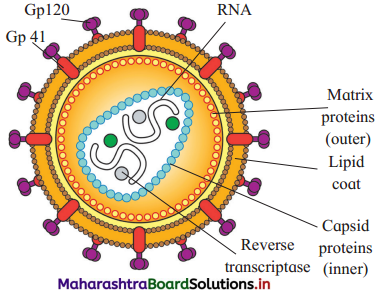
  5. It helps in maintaining the turgidity of cells.
  6. It is excellent solvent for various organic materials.
  7. It is transporting medium for dissolved minerals.
  8. It is thermal buffer.

Question 2.
Properties of water.
Answer:

  1. Water is a compound and it is in liquid state at room temperature.
  2. It is an inert inorganic compound with neutral pH.
  3. It has high specific heat, high heat of vapourization, high heat of fusion.
  4. It has high surface tension.
  5. Water molecule has good adhesive and cohesive forces of attraction.
  6. The various properties of water are result of weak hydrogen bonding between the water molecules.

Question 3.
Lenticular transpiration.
Answer:
Maharashtra Board Class 12 Biology Important Questions Chapter 6 Plant Water Relation 2

  1. Small, raised structures, which are composed of loose cells with large intercellular spaces situated on bark are lenticels.
  2. They are observed on bark of old stem, root and on woody pericarp of fruits.
  3. Lenticular transpiration is of very small amount about 0.1% to 1% of total transpiration.
  4. It is very slow process but occurs throughout the day.

Question 4.
Structure of stomatal apparatus.
Answer:

  1. Stomata are minute openings mainly located in the epidermal surfaces of young stem and leaves.
  2. It is composed of two guard cells and accessory cells which form the opening stomatal pore for transpiration.
  3. Guard cells are kidney shaped in dicot plants and dumbbell shaped in grasses.
  4. Guard cells have unevenly thickened wall, inner wall thick, inelastic while outer wall is thin and elastic.
  5. Guard cells are nucleated cells with few chloroplasts and hence can perform photosynthesis.
  6. Accessory cells are specialized cells that surround the guard cells and are reservoirs of K+ ions.

Question 5.
Apoplast pathway.
Answer:

  1. The movement of water across the root cells occur by two pathways viz. apoplast and symplast.
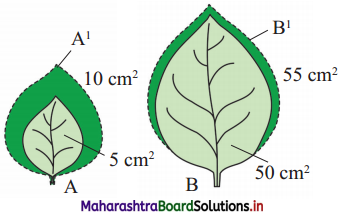
  2. Apoplast movement of water in plants occurs exclusively through cell walls and intercellular spaces in living cells of cortex.
  3. Apoplast pathway is up to the endodermis as the suberized layer of Casparian strip obstructs the movement.
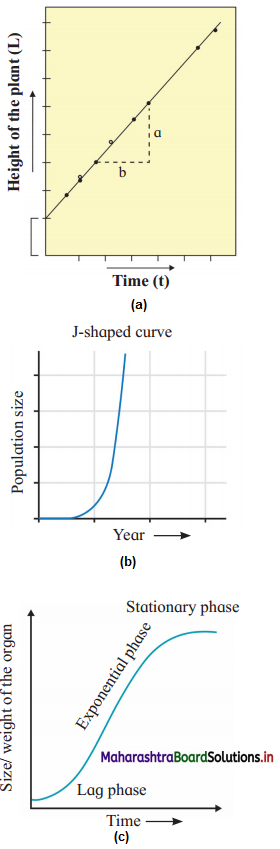
  4. Additional apoplastic route giving direct contact to xylem and phloem is through secondary roots which originate at pericycle and bypass endodermis.
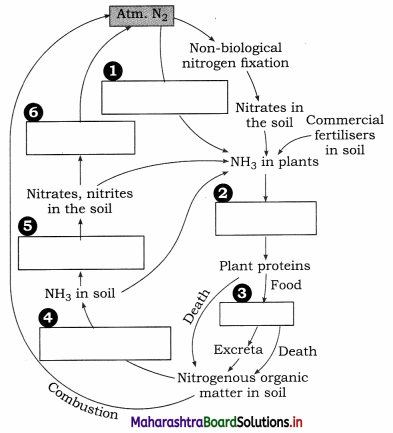
  5. The cellulosic walls of root hair, cortical cells are hydrophilic and permeable to water.

Question 6.
Water potential.
Answer:

  1. Chemical potential of water is called water potential.
  2. The Greek letter (ψ) psi represents water potential.
  3. The unit of measurement is in bars/pascals (Pa) or atmosphere.
  4. Water potential of pure water is always zero.
  5. Water potential of protoplasm is equal to D.PD. but it has a negative value.
  6. Water always moves from less negative potential to more negative water potential.

Short answer questions

Question 1.
Enlist macronutrients and micronutrients required for plant growth.
Answer:

  1. Some minerals which are required in large amounts for plant metabolism are macronutrients. E.g. C, H, O, E N, S, Mg, Ca, K. etc.
  2. Some minerals which are required in small amounts for plant metabolism are micronutrients. E.g. Cu, Co, Mn, B, Zn, Cl, etc.

Question 2.
Explain about the factors that affect water absorption.
Answer:

  1. Water is absorbed by unicellular root hairs from soil.
  2. Presence of capillary water in soil is needed as this water from soil is absorbed by root hairs.
  3. Soil temperature of 20-30°C favours water absorption.
  4. Rate of absorption is decreased by high concentration of solutes in soil.
  5. Soil should be properly aerated, poorly aerated soil shows poor absorption rate.
  6. Increased transpiration accelerates rate of absorption of water.

Question 3.
Explain mechanism of sugar transport through phloem.
Answer:

  1. The part of plant where food is synthesized is known as source and where it is utilized is sink.
  2. Food is translocated through phloem tissue in the form of sucrose along the concentration gradient from source to sink.
  3. Munch’s pressure flow theory or mass flow hypothesis is widely accepted theory for sugar transport.
  4. Glucose is synthesized in photosynthetic cells hence endo-osmosis occurs due to increased osmotic concentration.
  5. With this turgor pressure increases and sugar is forced in sieve tube of vein from photosynthetic cell – Vein loading.
  6. At the sink, sugar is utilized and excess amount converted to starch, hence osmotic concentration is lowered and exosmosis takes place.
  7. Turgor pressure is lowered hence turgor pressure gradient is set and food is translocated passively against concentration gradient – Vein unloading.

Question 4.
Explain the principles of cohesion tension theory and its limitations?
Answer:

  1. Cohesion tension theory is widely accepted theory for translocation of water proposed by Dixon and Joly.
  2. It is based on principles cohesion and adhesion of water molecules along with transpiration pull.
  3. Strong attractive force between water molecules is cohesive force and the strong force of attraction between water molecules and wall of lumen of xylem vessels is called adhesive force.
  4. Owing to these cohesive and adhesive forces a continuous column of water is maintained in xylem elements from root to aerial parts, tips of leaves.
  5. Transpiration pull is developed in the xylem vessel in leaves.
  6. This pull is transmitted downwards and due to suction pressure, water is pulled passively against gravity, i.e. ascent of sap.

Limitations of theory-

  1. For activity of transpiration pull, water column should be maintained constantly and continuously. Owing to changes in temperature during day and night, gas bubbles may be formed in the water channel. This will break the continuity.
  2. According to this theory, tracheids are more efficient than vessels because of their tapering end walls which support water column. Vessels are tubular structure with open ends.

Question 5.
What is the meaning of specific heat, heat of vaporization and heat of fusion?
Answer:

  1. Specific heat : The specific heat is the amount of heat per unit mass required to raise the temperature by one degree. The specific heat of water is 1 calorie/gram degree C.
  2. Heat of vapourization : It is the amount of energy that must be added to a liquid substance to transform a quantity of that substance to gas. It is also known as heat of evaporation.
  3. Heat of fusion : It is amount of energy typically heat, provided to a specific quantity of the substance to change its state from solid to liquid at constant pressure.

Maharashtra Board Class 12 Biology Important Questions Chapter 6 Plant Water Relation

Question 6.
What are adhesive and cohesive forces?
Answer:

  1. Adhesive and cohesive forces are attractive forces between molecules of same substance.
  2. Cohesive forces exist between molecules of the same type. E.g. between water-water molecule.
  3. Adhesive forces exist between dissimilar molecules. E.g. water molecule and lignin deposited wall of xylem element.

Chart based/Table based questions

Question 1.
Complete the table based on types of solution.
Maharashtra Board Class 12 Biology Important Questions Chapter 6 Plant Water Relation 3
Answer:
Maharashtra Board Class 12 Biology Important Questions Chapter 6 Plant Water Relation 4

Question 2.
Complete the table.

EventPhysical process
1. Soaking of Seeds—————-
2. Water entering guard cells—————-
3. Exchange of gases—————
4. Loss of water in liquid form—————
5. Water coming out through earthen pot—————
6. Loss of water in vapour form—————
7. Absorption of solutes passively by carrier—————
8. Spreading of fragrance of incense stick—————

Answer:

EventPhysical process
1. Soaking of SeedsImbibition
2. Water entering guard cellsOsmosis
3. Exchange of gasesDiffusion
4. Loss of water in liquid formGuttation
5. Water coming out through earthen potDiffusion
6. Loss of water in vapour formTranspiration
7. Absorption of solutes passively by carrierFacilitated Diffusion
8. Spreading of fragrance of incense stickDiffusion

Diagram based questions

Question 1.
Zones of root
Answer:
Maharashtra Board Class 12 Biology Important Questions Chapter 6 Plant Water Relation 5

Question 2.
Structure of root hair
Answer:
Maharashtra Board Class 12 Biology Important Questions Chapter 6 Plant Water Relation 6

Question 3.
Diffusion of water
Answer:
Maharashtra Board Class 12 Biology Important Questions Chapter 6 Plant Water Relation 7

Question 4.
Pathway for water uptake
Answer:
Maharashtra Board Class 12 Biology Important Questions Chapter 6 Plant Water Relation 8

Question 5.
L. S. of sieve tube (Transport of food)
Answer:
Maharashtra Board Class 12 Biology Important Questions Chapter 6 Plant Water Relation 9

Maharashtra Board Class 12 Biology Important Questions Chapter 6 Plant Water Relation

Question 6.
Structure of stomata and Types of guard cells
Answer:
Maharashtra Board Class 12 Biology Important Questions Chapter 6 Plant Water Relation 10

Long answer questions

Question 1.
Write a note on macronutrients and micronutrients required for plant growth.
Answer:

  1. Plants absorb mincral nutrients from their surroundings.
  2. For a proper growth of plants about 35 to 40 different elements are required.
  3. Plants absorb these nutrients in ionic or dissolved form from soil with their root system e.g. Phosphorus as PO4. Sulphur as SO42- etc.
  4. Based on their requirement in quantity. they are classified as major nutrients or macronutrients and those needed In small amounts are minor or micronutrients.
  5. Macroclements are required in large amounts, as they play nutritive and structural roles e.g. C, H, O. R Mg. N, K. S and Ca. -Ca pectate cell wall component. Mg component of chlorophyll.
  6. C. H, O are non-mineral major elements obtained from air and water e.g. CO2 is source of carbon, Hydrogen from water.
  7. Microelements arc required In traces as they mainly have catalytic role as co-factors or activators of enzymes.
  8. Microelernents may be needed for certain activity in life cycle of plant e.g. B for pollen germination, Si has protective role during stress conditions and fungal attacks, Al enhances availability of phosphorus.
  9. The Important micronutrients for plant growth are Mn. B. Cu, Zn, Cl.