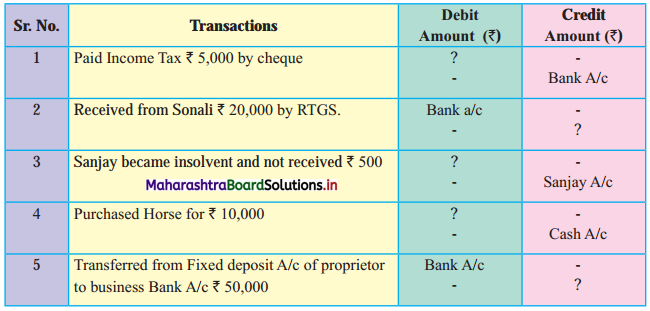
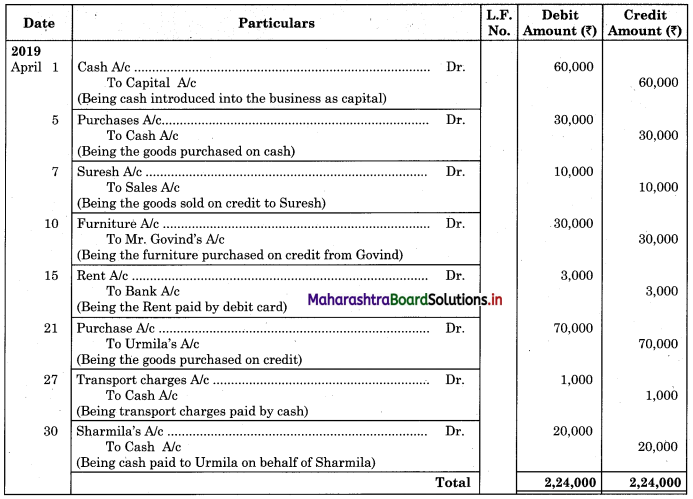
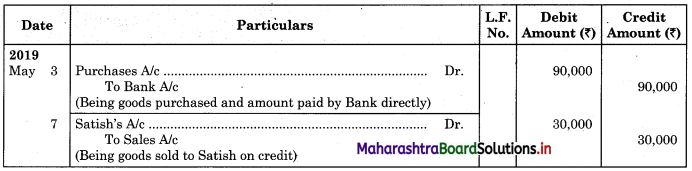
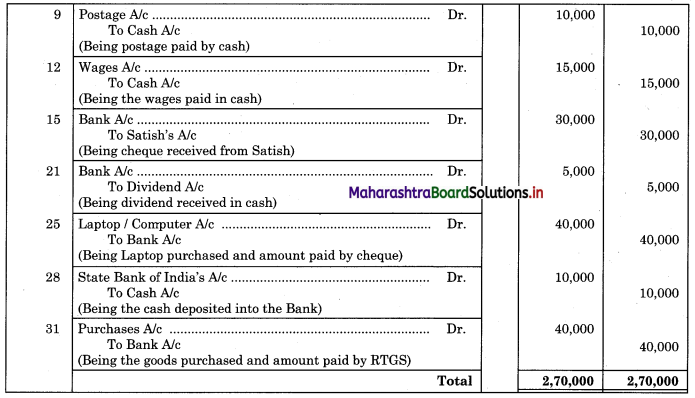
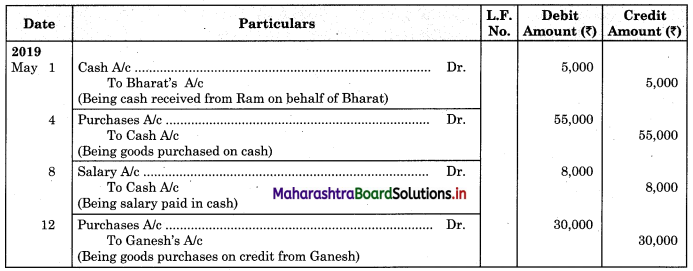
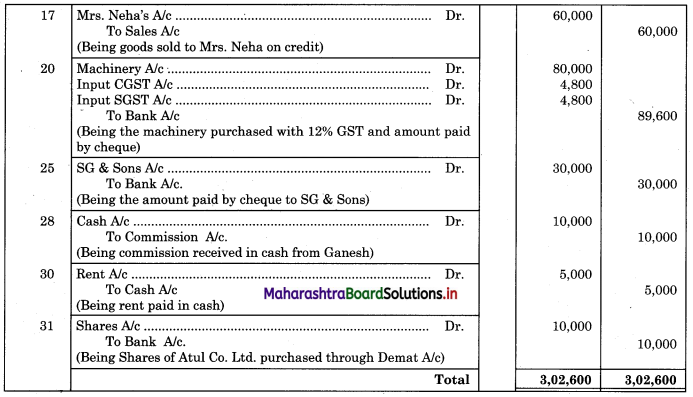
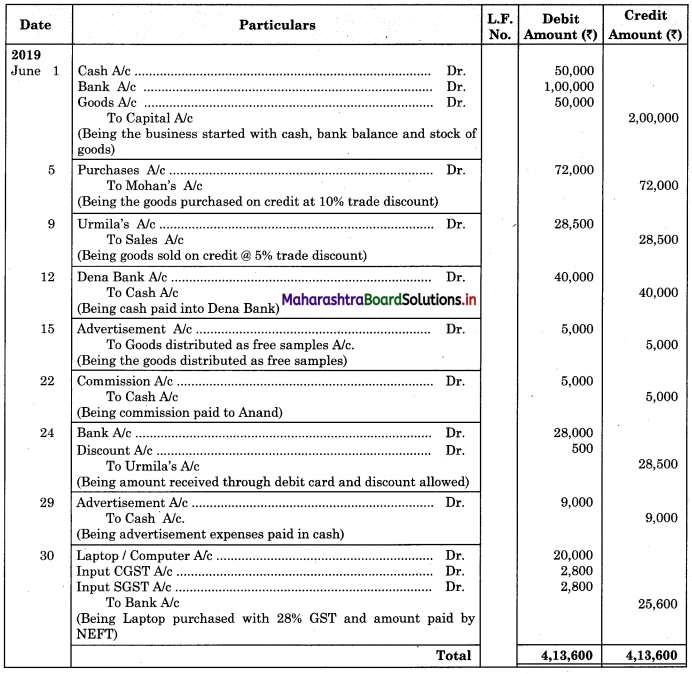
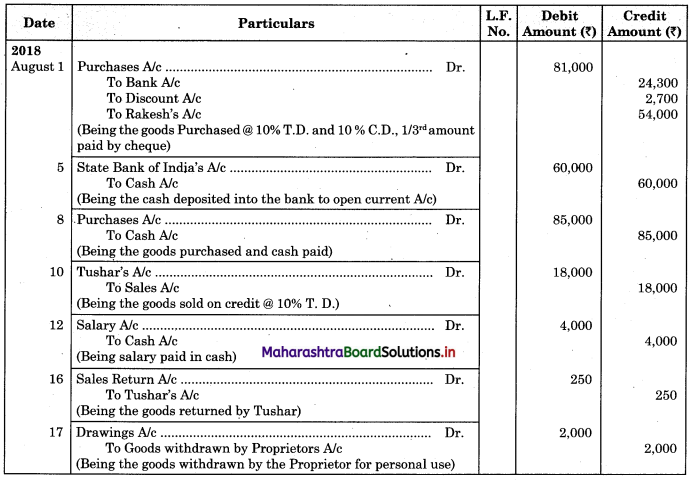
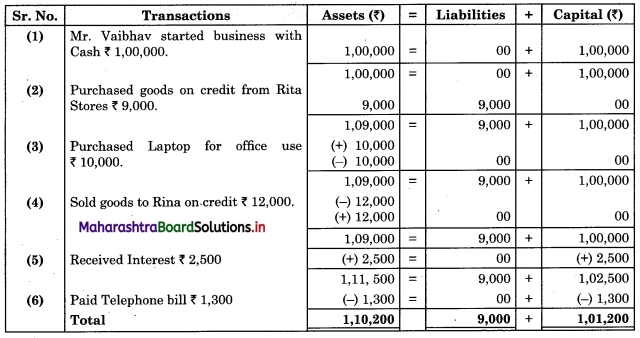
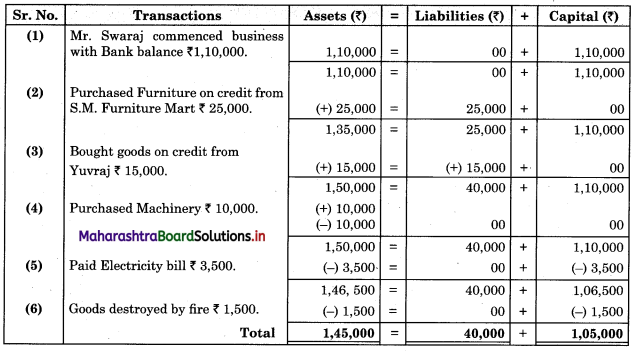
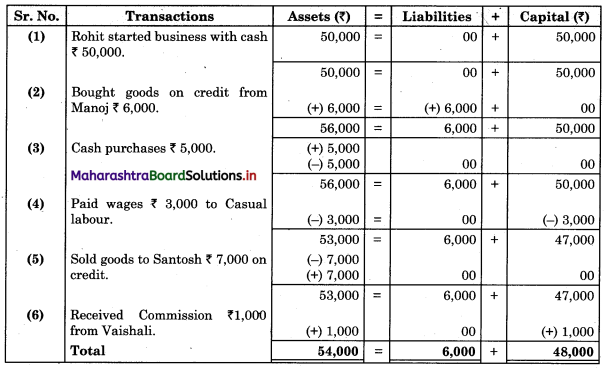
Maharashtra Board 11th BK Textbook Solutions Chapter 6 Bank Reconciliation Statement

Balbharti Maharashtra State Board Bookkeeping and Accountancy 11th Solutions Chapter 6 Bank Reconciliation Statement Textbook Exercise Questions and Answers.

Maharashtra State Board Bookkeeping and Accountancy 11th Solutions Chapter 6 Bank Reconciliation Statement

1. Answer in one sentence.

Question 1.
Who prepares a bank Pass Book?
Answer:
The Bank passbook is prepared by the bank.

Question 2.
What is a pay-in-slip?
Answer:
Pay-in-slip is the slip that is filled when the bank account holder deposits a cheque or cash into his bank account.

Maharashtra Board 11th BK Textbook Solutions Chapter 6 Bank Reconciliation Statement

Question 3.
What is a bank overdraft?
Answer:
The amount withdrawn by the account holder from his current account in excess of the balance standing in that account up to, specified limit is known as bank overdraft.

Question 4.
What is a withdrawal slip?
Answer:
It is a document/form, which is used by the savings account holder for withdrawing cash from his bank account.

Question 5.
Who sends the bank statement?
Answer:
A bank statement is sent by the Bank manager to the account holder informing about debit or credit given by the bank.

Question 6.
What does a debit balance in Cash Book represent?
Answer:
The debit balance of the cash Book indicates a positive Bank balance as per Cash Book.

Question 7.
Who prepares the Bank Reconciliation Statement?
Answer:
A Businessman, trader, or accountant prepares Bank Reconciliation Statement at the end of every month.

Maharashtra Board 11th BK Textbook Solutions Chapter 6 Bank Reconciliation Statement

Question 8.
What does the debit balance in Pass Book represent?
Answer:
The debit balance of Passbook represents Overdraft as per passbook.

Question 9.
On which side is interest on bank deposit recorded in Pass Book?
Answer:
Interest on bank deposits is recorded on the credit side of the passbook.

Question 10.
Why is Bank Reconciliation Statement prepared?
Answer:
A bank reconciliation statement is prepared to disclose the causes of the difference between the balances shown by the cash book and passbook.

2. Give one word/term/phrase which can substitute each of the following statements:

Question 1.
The account on which overdraft facility is allowed by the bank.
Answer:
Current Account

Question 2.
Extract of ledger account of the account holder in the books of the bank.
Answer:
Pass Book

Maharashtra Board 11th BK Textbook Solutions Chapter 6 Bank Reconciliation Statement

Question 3.
Alphanumeric code that facilitates electronic funds transfer in India.
Answer:
IFSC (Indian Financial System Code)

Question 4.
Statement showing the causes of disagreement between the balance of Cash Book and Pass Book.
Answer:
Bank Reconciliation Statement

Question 5.
Debit balance in Pass Book.
Answer:
Overdraft as per Pass Book

Question 6.
A form which is filled for depositing cash or cheque into bank.
Answer:
Pay-in-slip

Question 7.
The left-hand side of Pay-in-slip.
Answer:
Counterfoil

Question 8.
Credit balance in Cash Book.
Answer:
Overdraft as per Cash Book

Maharashtra Board 11th BK Textbook Solutions Chapter 6 Bank Reconciliation Statement

Question 9.
A book maintained by traders to record banking transactions.
Answer:
Cash Book

Question 10.
Excess of bank deposits over withdrawals by a businessman in bank current account.
Answer:
Bank Balance (favourable balance)

3. Do you agree or disagree with the following statements:

Question 1.
The bank column of Cash Book represents the bank account.
Answer:
Agree

Question 2.
A bank statement enables the account holder to prepare Bank Reconciliation Statement.
Answer:
Agree

Question 3.
Cheques issued for payment but not presented to bank appear in Cash Book only.
Answer:
Agree

Maharashtra Board 11th BK Textbook Solutions Chapter 6 Bank Reconciliation Statement

Question 4.
Bank Reconciliation Statement is prepared only during the year-end.
Answer:
Disagree

Question 5.
Bank Reconciliation Statement is similar to the bank statement.
Answer:
Disagree

Question 6.
Bank balance as per Cash Book is always equal to bank balance as per Pass Book.
Answer:
Disagree

Question 7.
Bank advice is sent by the businessman to the bank.
Answer:
Disagree

Question 8.
Pay-in-slip is used for depositing cheques into banks.
Answer:
Agree

Question 9.
The difference in Cash Book Balance and Pass Book balance may arise due to errors committed while recording.
Answer:
Agree

Maharashtra Board 11th BK Textbook Solutions Chapter 6 Bank Reconciliation Statement

Question 10.
Payment and receipt of cash through internet banking generate an automatic proof.
Answer:
Agree

4. Select the most appropriate alternative from those given and rewrite the following statements:

Question 1.
Overdraft means ____________ balance of Cash Book.
(a) closing
(b) debit
(c) opening
(d) credit
Answer:
(d) credit

Question 2.
When a cheque is deposited and collected by bank Pass Book is ____________
(a) dishonoured
(b) debited
(c) credited
(d) written
Answer:
(c) credited

Question 3.
A ____________ is a summary of financial transactions that take place over a period of time on a bank account.
(a) withdrawal slip
(b) bank advice
(c) bank statement
(d) Pay-in-slip
Answer:
(c) bank statement

Question 4.
Debiting an entry in Cash Book ____________ cash balance.
(a) increases
(b) decreases
(c) nullifies
(d) none of the above
Answer:
(a) increases

Question 5.
Bank Reconciliation Statement is prepared by ____________
(a) student
(b) businessman
(c) bank
(d) none of the above
Answer:
(b) businessman

Maharashtra Board 11th BK Textbook Solutions Chapter 6 Bank Reconciliation Statement

Question 6.
Bank balance as per Pass Book means ____________ balance of Pass Book.
(a) credit
(b) opening
(c) debit
(d) closing
Answer:
(a) credit

Question 7.
Bank gives overdraft facility to ____________ account holder.
(a) savings
(b) recurring
(c) current
(d) fixed
Answer:
(c) current

Question 8.
Debit balance as per Cash Book is also known as ____________ balance.
(a) favourable
(b) overdraft
(c) abnormal
(d) unfavourable
Answer:
(a) favourable

Question 9.
When extracts of Cash Book and Pass Book are given for uncommon periods, only ____________ items are considered for preparation of Bank Reconciliation Statement.
(a) uncommon
(b) normal
(c) favourable
(d) common
Answer:
(d) common

Maharashtra Board 11th BK Textbook Solutions Chapter 6 Bank Reconciliation Statement

Question 10.
When extract of Cash Book and Pass Book is given for common period, only ____________ items are considered
for preparation of Bank Reconciliation Statement.
(a) uncommon
(b) common
(c) favourable
(d) unfavourable
Answer:
(a) uncommon

5. Complete the following statements:

Question 1.
Payments credited in Cash Book are ____________ in Pass Book.
Answer:
Debited

Question 2.
While preparing Bank Reconciliation Statement only ____________ column of Cash Book is considered.
Answer:
Bank

Question 3.
Cheques issued to creditors appear first in ____________ book.
Answer:
Cash

Question 4.
A statement showing the reasons for the difference in Cash Book Balance and Pass Book balance is known as ____________
Answer:
Bank Reconciliation Statement

Question 5.
Overcast on receipt side of Pass Book means ____________ in Pass Book balance.
Answer:
Increase

Question 6.
Online transfer made to our creditors appear on the ____________ side of Cash Book.
Answer:
Payment/Credit

Maharashtra Board 11th BK Textbook Solutions Chapter 6 Bank Reconciliation Statement

Question 7.
Interest on overdraft charged by bank is ____________ in Pass Book.
Answer:
Debited

Question 8.
Normally the Cash Book shows debit balance and Pass Book shows ____________ balance.
Answer:
Credit

Question 9.
The form filled for withdrawing cash from bank is known as ____________
Answer:
Withdrawal Slip

Question 10.
A businessman can update his records on receiving ____________
Answer:
Bank Advice

6. State whether the following statements are True or False with reasons:

Question 1.
Cheques deposited into the bank but not yet cleared appears in the Pass Book only.
Answer:
This statement is False.
Cheques deposited into the bank but not yet cleared appears in the cash book only. Bank records entry in the passbook only after the cheque is cleared. So there is no entry for this transaction in the Pass Book.

Question 2.
Direct deposit made by debtors into a businessman’s bank account is recorded on the credit side of Pass Book.
Answer:
This statement is True.
The credit side of the passbook means deposits made in the bank account. When direct deposits are made by debtors into a businessman’s bank account. It increases the bank balance and it is recorded on the credit side of Pass Book.

Question 3.
A businessman can prepare a Bank Reconciliation statement only with Cash Book Balance.
Answer:
This statement is False.
The businessman can prepare a Bank Reconciliation statement with the help of a cash book, bank column, and passbook. It is a comparison between the two to correct the differences. Both i.e. cash book and pass book/Bank statement are required to prepare a Bank Reconciliation statement.

Maharashtra Board 11th BK Textbook Solutions Chapter 6 Bank Reconciliation Statement

Question 4.
When overdraft as per Cash Book is given, bank charges debited in Pass Book only are to be added.
Answer:
This statement is True.
Bank overdraft as per cash book means negative bank balance. The businessman has to pay the Bank. Bank charges are expenses for the business and this increases the amount payable to the bank so bank charges debited in the passbook only are to be added in the cash book.

Question 5.
Bank Statement is sent by Bank to the businessman.
Answer:
This statement is True.
A bank statement is a statement issued by the bank to the current account holder informing about the bank transactions during a particular period of time. Generally, it is issued every i.e. month. It gives details information about bank deposits and withdrawals etc.

7. Draft the following specimen with imaginary Name, Account Number, Amount.

Question 1.
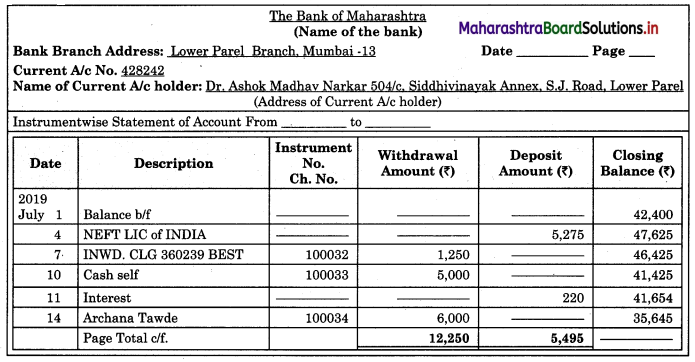
Bank Statement
Answer:
Specimen of Bank Statement is given below:
Maharashtra Board 11th BK Textbook Solutions Chapter 6 Bank Reconciliation Statement 7 Q1

Question 2.
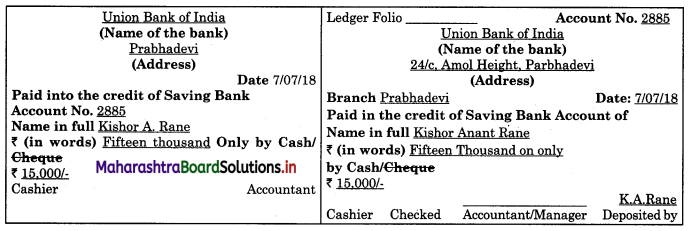
Pay-in-slip
Answer:
(a) Specimen of pay-in-slip is given below: Front side
Maharashtra Board 11th BK Textbook Solutions Chapter 6 Bank Reconciliation Statement 7 Q2
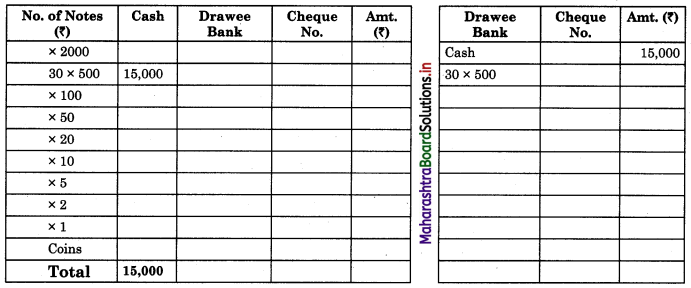
(b) Reverse (Back-side) of Pay-in-slip:
Maharashtra Board 11th BK Textbook Solutions Chapter 6 Bank Reconciliation Statement 7 Q2.1

Question 3.
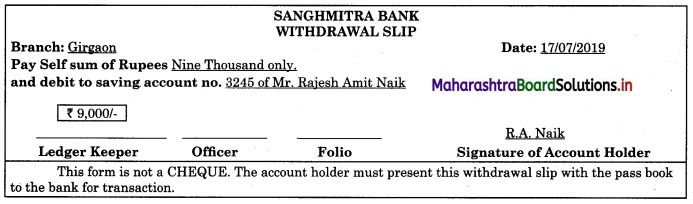
Withdrawal slip
Answer:
Specimen form of a withdrawal slip is given below:
Maharashtra Board 11th BK Textbook Solutions Chapter 6 Bank Reconciliation Statement 7 Q3

Maharashtra Board 11th BK Textbook Solutions Chapter 6 Bank Reconciliation Statement

Question 4.
Bank Advice
Answer:
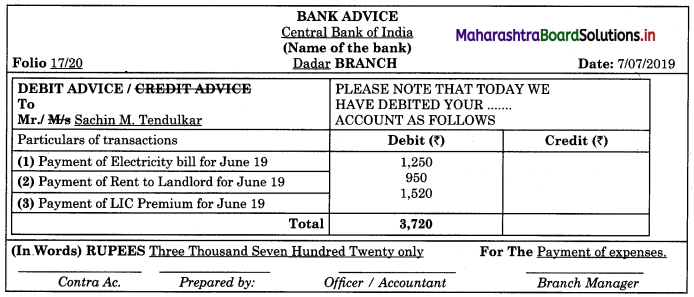
Specimen of bank advice is given below:
Maharashtra Board 11th BK Textbook Solutions Chapter 6 Bank Reconciliation Statement 7 Q4

Question 5.
Pass Book
Answer:
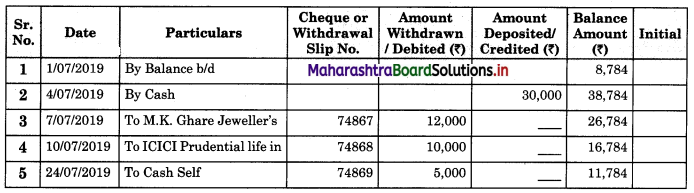
Specimen form of the Bank passbook is given below:
Bank Pass Book
Maharashtra Board 11th BK Textbook Solutions Chapter 6 Bank Reconciliation Statement 7 Q5

8. Correct and rewrite the following statements.

Question 1.
The form filled for depositing cash or cheque into the bank is known as Pass Book.
Answer:
The form filled for depositing cash or cheque into the bank is known as Pay in slip.

Question 2.
Bank Reconciliation Statement is prepared by Bank.
Answer:
Bank Reconciliation Statement is prepared by Businessman.

Question 3.
Debit balance as per Pass Book is known as favourable balance.
Answer:
Debit balance as per Pass Book is known as unfavorable balance.

Question 4.
When a cheque is deposited into Bank it is credited to Cashbook.
Answer:
When a cheque is deposited into Bank it is debited in Cash Book.

Maharashtra Board 11th BK Textbook Solutions Chapter 6 Bank Reconciliation Statement

Question 5.
When extracts are given for the common period only common items are to be considered.
Answer:
When extracts are given for the common period only uncommon items are to be considered.

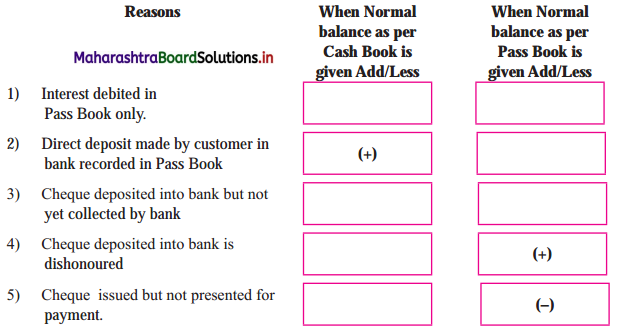
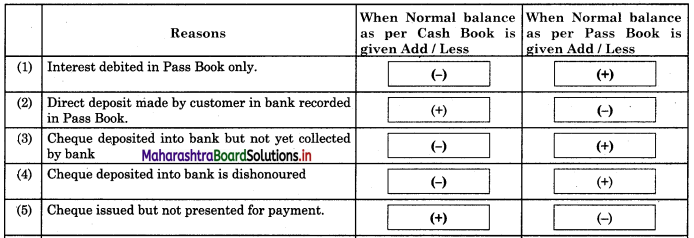
9. Complete the following table.

Question 1.
Maharashtra Board 11th BK Textbook Solutions Chapter 6 Bank Reconciliation Statement 9 Q1
Answer:
Maharashtra Board 11th BK Textbook Solutions Chapter 6 Bank Reconciliation Statement 9 Q1.1

Practical Problems

Question 1.
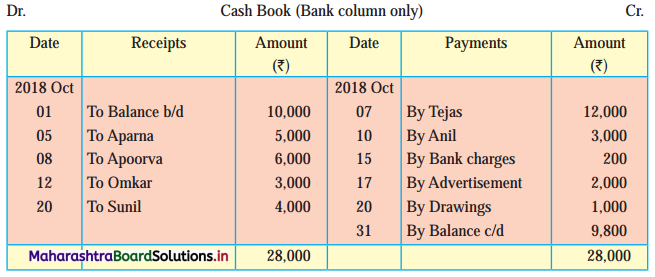
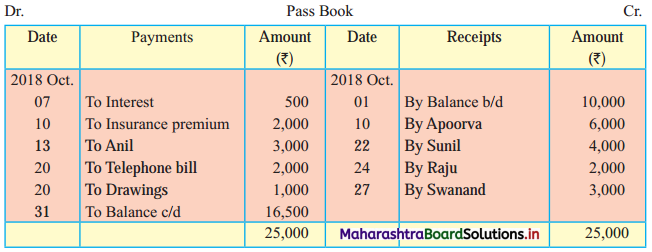
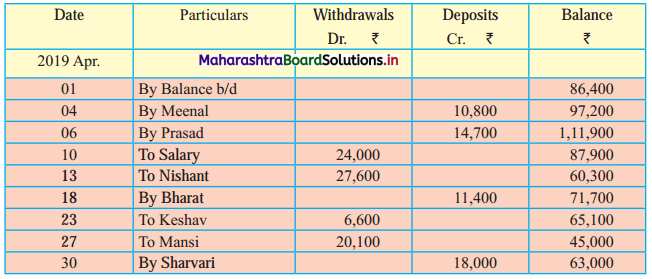
Following is the extract of the Cash Book (Bank Column only) and passbook. Prepare Bank Reconciliation Statement as of 31st Oct. 2018.
In the books of ____________
Maharashtra Board 11th BK Textbook Solutions Chapter 6 Bank Reconciliation Statement Practical Problems Q1
In the books of Bank
Maharashtra Board 11th BK Textbook Solutions Chapter 6 Bank Reconciliation Statement Practical Problems Q1.1
Solution:
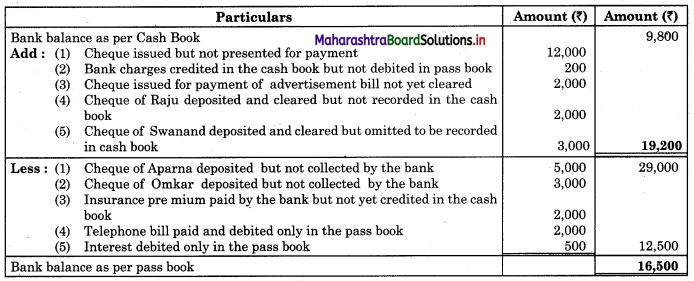
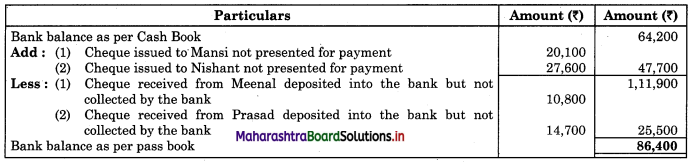
Bank Reconciliation Statement as of 31st October 2018.
Maharashtra Board 11th BK Textbook Solutions Chapter 6 Bank Reconciliation Statement Practical Problems Q1.2

Working Notes:
When extract of Cashbook and passbook are given for the same period i.e. for the month of April 2018, we have to consider only uncommon entries for adding and deducting from Bank Reconciliation Statement. This is shown in the following working notes.
In order to find out items to be added and items to be deducted in the Bank Reconciliation Statement, we have to prepare Cash Book and passbook on the basis of accounting information given in the problem:
Cash Book
Maharashtra Board 11th BK Textbook Solutions Chapter 6 Bank Reconciliation Statement Practical Problems Q1.3

Bank Pass Book
Maharashtra Board 11th BK Textbook Solutions Chapter 6 Bank Reconciliation Statement Practical Problems Q1.4

Maharashtra Board 11th BK Textbook Solutions Chapter 6 Bank Reconciliation Statement

Explanation:
1. First record the opening balance in the appropriate book i.e. either in Cashbook or passbook.
2. Bank balance of ₹ 9,800 as per Cashbook is recorded on the debit side of Cashbook in a box.
3. In this problem, the entries which are passed on the debit side of the Cashbook and passbook are to be added in the Bank Reconciliation Statement and the entries passed on the credit side of the Cashbook and passbook are to be deducted in the Bank Reconciliation Statement. This is because the opening balance appears on the debit side of the Cash Book.

Question 2.
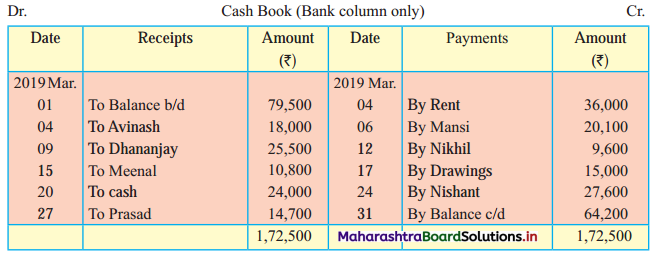
From the following extract of Cash Book and Pass Book prepare Bank Reconciliation Statement as of 31st March 2019.
In the books of ____________
Maharashtra Board 11th BK Textbook Solutions Chapter 6 Bank Reconciliation Statement Practical Problems Q2
In the books of Bank
Bank Pass Book
Maharashtra Board 11th BK Textbook Solutions Chapter 6 Bank Reconciliation Statement Practical Problems Q2.1
Solution:
Bank Reconciliation Statement as of 31st March 2019
Maharashtra Board 11th BK Textbook Solutions Chapter 6 Bank Reconciliation Statement Practical Problems Q2.2

Working Notes:
When extract of Cashbook and passbook are given for the same period i.e. for the month of April 2011, we have to consider only uncommon entries for adding and deducting from Bank Reconciliation Statement. This is shown in the following working notes.
In order to find out items to be added and items to be deducted in the Bank Reconciliation Statement, we have to prepare Cash Book and passbook on the basis of accounting information given in the problem:
Cash Book
Maharashtra Board 11th BK Textbook Solutions Chapter 6 Bank Reconciliation Statement Practical Problems Q2.3

Bank Pass Book
Maharashtra Board 11th BK Textbook Solutions Chapter 6 Bank Reconciliation Statement Practical Problems Q2.4

Question 3.
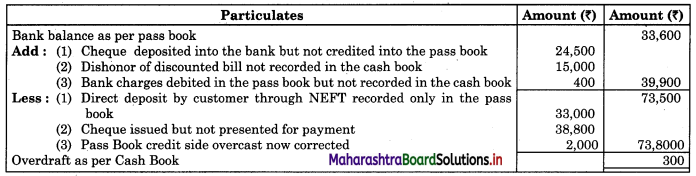
On 31st August 2018 bank passbook of Mr. Ravi showed a credit balance of ₹ 33,600, but Cash Book showed a different balance. On comparing the two books following differences were noticed:
1. Cheques paid into the bank but not credited before 31st Aug 2018 amounted to ₹ 24,500.
2. Direct deposit by the customer through NEFT ₹ 33,000 recorded in the passbook only.
3. Cheques issued on 28th Aug 2018 were presented for payment on 5th Sep. 2018 amounted to ₹ 38,800.
4. A bill receivable for ₹ 15,000 discounted with the bank was dishonored on 30th Aug 2018. Intimation of the same was received only on 3rd Sep 2018.
5. Passbook credit side was overcast ₹ 2,000.
6. Bank debited ₹ 400 for bank charges in the passbook, which was not recorded in Cash Book.
Prepare Bank Reconciliation Statement as of 31st August 2018.
Solution:
Bank Reconciliation Statement as of 31st August 2018.
Maharashtra Board 11th BK Textbook Solutions Chapter 6 Bank Reconciliation Statement Practical Problems Q3

Working Notes:
In order to find out items to be added and items to be deducted in the Bank Reconciliation Statement, we have to prepare Cash Book and passbook on the basic information given in the problem:
Cash Book (With Bank Column)
Maharashtra Board 11th BK Textbook Solutions Chapter 6 Bank Reconciliation Statement Practical Problems Q3.1

Bank Pass Book
Maharashtra Board 11th BK Textbook Solutions Chapter 6 Bank Reconciliation Statement Practical Problems Q3.2

Explanation:
1. First record the opening balance in the appropriate book and at the appropriate side i.e. either in Cashbook or passbook.

2. In the above problem Bank balance of ₹ 33,600 as per the passbook is recorded on the credit side of the passbook in a box.

3. In this problem, the entries which are passed on the credit side of the Cashbook and passbook are to be added in the Bank Reconciliation Statement and the entries passed on the debit side of the Cash Book and passbook are to be deducted in the Bank Reconciliation Statement. This is because the opening balance appears on the credit side of the passbook.

4. Pass the entry of the given transactions in the book in which entry is not passed due to one or another reason, e.g. cheque of ₹ 24,300 is deposited but not collected. In this case, entry is not passed in the passbook, as the cheque is not collected by the bank. Now draft the entry for the given transaction on the credit side of the passbook. This is because, after the collection of cheques, the bank balance is increased. In the same way for remaining transactions pass the entry in that book where entry is not passed corresponding.

Maharashtra Board 11th BK Textbook Solutions Chapter 6 Bank Reconciliation Statement

Question 4.
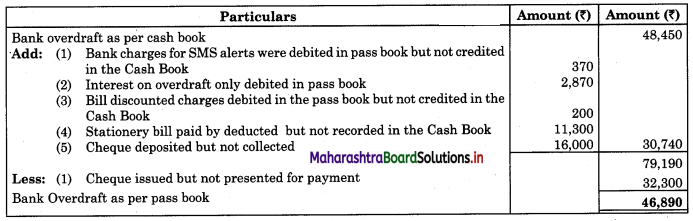
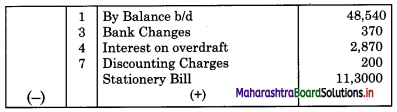
From the following details prepare Bank Reconciliation Statement as of 31st Dec. 2018.
1. Bank overdraft as per Cash Book on 31st Dec. 2018 was ₹ 48,450.
2. Bank charges for SMS alerts ₹ 370 were debited in passbook but not recorded in Cash Book.
3. Interest in overdraft ₹ 2,870 did not appear in Cash Book.
4. A bill for ₹ 12,000 discounted with bank appears in Cash Book at the full amount but the bank has deducted ₹ 200 discounting charges.
5. Cheques issued but not presented for payment before 31st Dec. 2018 amounted to ₹ 32,300.
6. Cheques amounting to ₹ 24,000 were deposited into the bank but only a cheque of ₹ 8,000 was collected by the bank before 31st Dec. 2018.
7. Paid stationary bill ₹ 11,300 by debit card. It was not recorded in Cash Book.
Solution:
Bank Reconciliation Statement as of 31st December 2018.
Maharashtra Board 11th BK Textbook Solutions Chapter 6 Bank Reconciliation Statement Practical Problems Q4

Working Notes:
Cash Book (With Bank Column)
Maharashtra Board 11th BK Textbook Solutions Chapter 6 Bank Reconciliation Statement Practical Problems Q4.1

Bank Pass Book
Maharashtra Board 11th BK Textbook Solutions Chapter 6 Bank Reconciliation Statement Practical Problems Q4.2

Question 5.
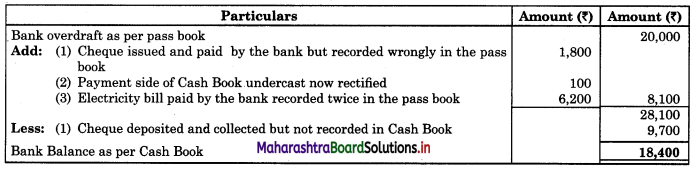
From the following particulars prepare Rank Reconciliation Statement as of 30th June 2019.
1. Credit balance as per pass book ₹ 20,000.
2. A cheque for ₹ 3,500 was issued and paid by the bank, recorded in Pass Book as ₹ 5,300.
3. Cheque deposited ₹ 9,700 collected by the bank was not recorded in Cash Book.
4. Payment side of the Cash Book was undercast by ₹ 100.
5. Electricity bill paid by bank ₹ 6,200 was recorded twice in Pass Book.
Solution:
Bank Reconciliation Statement as of 30th June 2019.
Maharashtra Board 11th BK Textbook Solutions Chapter 6 Bank Reconciliation Statement Practical Problems Q5

Working Notes:
Cash Rook (With Rank Column)
Maharashtra Board 11th BK Textbook Solutions Chapter 6 Bank Reconciliation Statement Practical Problems Q5.1

Bank Pass Book
Maharashtra Board 11th BK Textbook Solutions Chapter 6 Bank Reconciliation Statement Practical Problems Q5.2

Question 6.
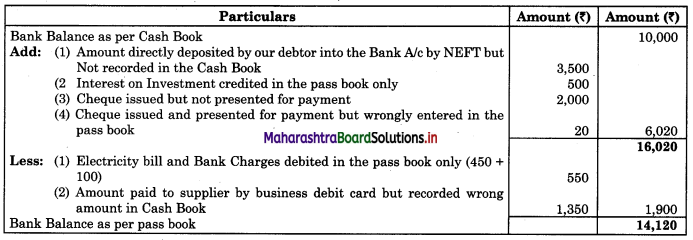
Prepare Bank Reconciliation Statement from the following information as of 31st March 2019.
1. Balance as per Cash Book ₹ 10,000.
2. Cheque of ₹ 2,000 issued but not presented to Bank for payment.
3. Our debtor directly deposited ₹ 3,500 to our Bank account by NEFT, not recorded in the Cash Book.
4. Bank paid electricity bill on our behalf ₹ 450 and charged Bank charges ₹ 100.
5. Paid ₹ 1,500 to ABC & company, our supplier by business debit card but recorded in Cash Book as ₹ 150.
6. Bank credited interest on Investment ₹ 500.
7. Cheque of ₹ 885 issued and presented to Bank but wrongly entered in the Pass Book as ₹ 865.
Solution:
Bank Reconciliation Statement as on 31st March 2019
Maharashtra Board 11th BK Textbook Solutions Chapter 6 Bank Reconciliation Statement Practical Problems Q6

Working Notes:
Cash Book (With Bank Column)
Maharashtra Board 11th BK Textbook Solutions Chapter 6 Bank Reconciliation Statement Practical Problems Q6.1

Bank Pass Book
Maharashtra Board 11th BK Textbook Solutions Chapter 6 Bank Reconciliation Statement Practical Problems Q6.2

Maharashtra Board 11th BK Textbook Solutions Chapter 6 Bank Reconciliation Statement

Question 7.
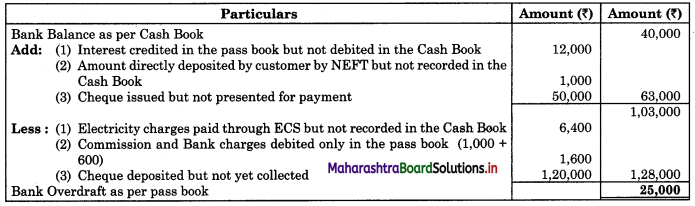
On 31st January 2018 Bank balance as per Cash Book was ₹ 40,000 but Pass Book was showing some other balances following were the causes of the difference.
1. Cheques were issued for ₹ 1,00,000 in January 2018 but cheques of ₹ 50,000 were only presented to the Bank for payment before January 31st, 2018
2. Cheques were sent to the Bank for collection of ₹ 2,00,000 out of which cheques of ₹ 80,000 were only credited by the Bank in January 2018.
3. Following entries were shown in the passbook in January 2018, but no corresponding entries were made in the Cash Book.
(i) Payment of ₹ 6,400 by Bank for Electricity Bill by ECS.
(ii) Interest credited by Bank ₹ 12,000
(iii) Bank debited commission ₹ 1,000 and Bank charges for ₹ 600.
(iv) Direct deposit made by customer ₹ 1,000 by NEFT to our account.
Prepare Bank Reconciliation Statement as of 31st January 2018.
Solution:
Bank Reconciliation Statement as of 31st January 2018
Maharashtra Board 11th BK Textbook Solutions Chapter 6 Bank Reconciliation Statement Practical Problems Q7

Working Notes:
Cash Book (With Bank Column)
Maharashtra Board 11th BK Textbook Solutions Chapter 6 Bank Reconciliation Statement Practical Problems Q7.1

Bank Pass Book
Maharashtra Board 11th BK Textbook Solutions Chapter 6 Bank Reconciliation Statement Practical Problems Q7.2

Question 8.
In January 2018, the Pass Book of Mr. Girish Kumbhar showed a bank balance of ₹ 14,000. A comparison of the Cash Book with the Pass Book revealed the following.
1. Cheque deposited but not credited by Bank ₹ 10,000
2. Dividend on shares collected by Bank but not recorded in the Cash Book ₹ 1,000
3. Bank paid Insurance premium as per standing instruction by ECS ₹ 500, no corresponding entry was passed in the Cash Book.
4. Bank debited Commission ₹ 75.
5. A debit of ₹ 900 in respect of cheque dishonored appears in Pass Book only.
6. Cheque of ₹ 1,500 deposited into Bank wrongly recorded twice in the Cash Book.
7. Total cheques of ₹ 20,000 were issued during the month of January 2018, but cheques of ₹ 8,000 only were presented for payment in January 2018.
Prepare Bank Reconciliation Statement as of 31st January 2018.
Solution:
Bank Reconciliation Statement as of 31st March 2019
Maharashtra Board 11th BK Textbook Solutions Chapter 6 Bank Reconciliation Statement Practical Problems Q8

Working Notes:
Cash Book (With Bank Column)
Maharashtra Board 11th BK Textbook Solutions Chapter 6 Bank Reconciliation Statement Practical Problems Q8.1

Pass Book
Maharashtra Board 11th BK Textbook Solutions Chapter 6 Bank Reconciliation Statement Practical Problems Q8.2

Question 9.
Form the following details provided by Prasharit enterprises, prepare a Bank Reconciliation Statement as of 31st March 2018.
1. Overdraft as per Cash Book ₹ 28,000
2. Cheque issued of ₹ 2,000 and presented to Bank returned dishonored but the effect of dishonored is not recorded in the Cash Book.
3. Bank debited Bank charges ₹ 150.
4. Bank transferred ₹ 2,500 to the savings account of the proprietor but not recorded in the Cash Book.
5. Cheque issued to the supplier but not presented to Bank before 21st March 2018, ₹ 1,600
6. Cheques of ₹ 3,000 and ₹ 2,000 were deposited into Bank but cheques of ₹ 3,000 were only credited by Bank before 31st March 2018.
7. Out customer directly deposited ₹ 1,500 in our Bank account but wrongly recorded it in the cash column of the Cash Book.
8. Bank debited interest on overdraft ₹ 750.
Solution:
Bank Reconciliation Statement as of 31st March 2018.
Maharashtra Board 11th BK Textbook Solutions Chapter 6 Bank Reconciliation Statement Practical Problems Q9
Maharashtra Board 11th BK Textbook Solutions Chapter 6 Bank Reconciliation Statement Practical Problems Q9.1

Working Notes:
Cash Book (Bank column)
Maharashtra Board 11th BK Textbook Solutions Chapter 6 Bank Reconciliation Statement Practical Problems Q9.2

Pass Book
Maharashtra Board 11th BK Textbook Solutions Chapter 6 Bank Reconciliation Statement Practical Problems Q9.3

Maharashtra Board 11th BK Textbook Solutions Chapter 6 Bank Reconciliation Statement

Question 10.
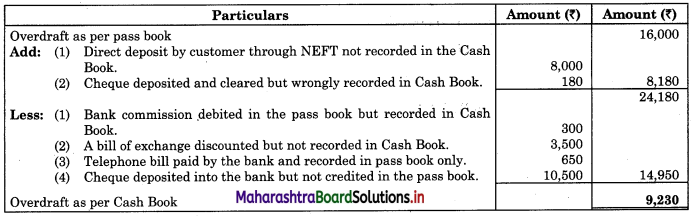
Prepare Bank Reconciliation Statement as of 31st Dec. 2018
1. Debit balance as per pass book ₹ 16,000
2. Customer directly deposited in our Bank account by NEFT ₹ 8,000.
3. Cheques deposited into Bank but not credited by Bank ₹ 10,500.
4. Pass Book shows a debit entry for Bank commission ₹ 300, not recorded in Cash Book.
5. A Bill of Exchange of ₹ 3,500 was discounted with the Bank in December 2018, returned dishonored in January 2019.
6. As per standing instructions Bank paid the Telephone bill of ₹ 650, not recorded in the Cash Book.
7. Cheque of ₹ 975 deposited into the Bank but wrongly recorded on ₹ 795 in Cash Book.
Solution:
Bank Reconciliation Statement as of 31st December 2018.
Maharashtra Board 11th BK Textbook Solutions Chapter 6 Bank Reconciliation Statement Practical Problems Q10

Working Notes:
Cash Book (with Bank column)
Maharashtra Board 11th BK Textbook Solutions Chapter 6 Bank Reconciliation Statement Practical Problems Q10.1

Bank Pass Book
Maharashtra Board 11th BK Textbook Solutions Chapter 6 Bank Reconciliation Statement Practical Problems Q10.2

Maharashtra Board 11th BK Textbook Solutions Chapter 5 Subsidiary Books

Balbharti Maharashtra State Board Bookkeeping and Accountancy 11th Solutions Chapter 5 Subsidiary Books Textbook Exercise Questions and Answers.

Maharashtra State Board Bookkeeping and Accountancy 11th Solutions Chapter 5 Subsidiary Books

Objective Type Questions & Answers

1. Answer the following questions in one sentence.

Question 1.
What are Subsidiary Books?
Answer:
Subdivision of journals on the basis of nature of transactions is known as Subsidiary Books.

Question 2.
What is a Cash Book?
Answer:
The subsidiary book in which details of cash are received in the form of cash, cheques, drafts, etc., and details of payment made in the form of cash, cheques, drafts, etc. is called a cash book.

Maharashtra Board 11th BK Textbook Solutions Chapter 5 Subsidiary Books

Question 3.
State the meaning of ‘Contra entry’.
Answer:
The accounting entries which appear on both the sides of cash book are called contra entries.

Question 4.
State the meaning of the imprest system of Petty Cash Book.
Answer:
Imprest System of Petty cash book is a system in which head cashier gives fixed (imprest) amount to the petty cashier at the beginning of month/fortnight to meet the expenses of that period. Later on the shortfall after meeting the expenses is reimbursed by the head cashier.

Question 5.
Which transactions are recorded in Purchase Book?
Answer:
Goods purchased on credit for resale are only recorded in the Purchase Book.

Question 6.
Which sales are recorded in Sales Book?
Answer:
Credit sales of goods are recorded in Sales Book.

Question 7.
Which transactions are recorded in the Journal Proper?
Answer:
Journal Proper is meant for recording opening entries, closing entries, adjustment entries, transfer entries, and rectification entries.

Maharashtra Board 11th BK Textbook Solutions Chapter 5 Subsidiary Books

Question 8.
Who is a Petty Cashier?
Answer:
A cashier in charge of recording transactions in a petty cash book is known as Petty Cashier.

2. Give a word/term or phrase for each of the following statements:

Question 1.
A person who maintains Petty Cash Book.
Answer:
Petty Cashier

Question 2.
A bank account which the businessman prefers to open.
Answer:
Current Account

Question 3.
Petty Cash Book in which the payment side is ruled in suitable columns.
Answer:
Analytical Petty Cash Book

Maharashtra Board 11th BK Textbook Solutions Chapter 5 Subsidiary Books

Question 4.
Subsidiary book in which only credit purchases of goods are recorded.
Answer:
Purchase Book

Question 5.
Subsidiary book in which return of goods sold on credit is recorded.
Answer:
Sales Return Book

Question 6.
The entry is recorded on both sides of the cash book.
Answer:
Contra Entry

Question 7.
Name the account which encourages personal savings.
Answer:
Saving Account

Question 8.
A note was issued by the buyer to the seller giving full details of goods returned.
Answer:
Debit Note

Maharashtra Board 11th BK Textbook Solutions Chapter 5 Subsidiary Books

Question 9.
A note was issued by the seller on receipt of defective goods from the customer.
Answer:
Credit Note

Question 10.
Name the bank account on which overdraft facility is given to the Account holder.
Answer:
Current Account

3. Select the most appropriate answers from the alternatives given below and rewrite the sentences.

Question 1.
Cash column of Cash Book can never have ____________ balance.
(a) credit
(b) debit
(c) zero
(d) none of the above
Answer:
(a) credit

Question 2.
Any entry recorded on both sides of Cash Book is known as ____________ entry.
(a) opening
(b) rectifying
(c) transfer
(d) contra
Answer:
(d) contra

Question 3.
The source document for recording in Sales book is ____________
(a) Inward Invoice
(b) Outward Invoice
(c) Voucher
(d) Cash Memo
Answer:
(b) Outward Invoice

Maharashtra Board 11th BK Textbook Solutions Chapter 5 Subsidiary Books

Question 4.
Credit purchase of Machinery is recorded in the ____________
(a) Purchase Book
(b) Cash Book
(c) Journal Proper
(d) Returns Outward Book
Answer:
(c) Journal Proper

Question 5.
Sub-division of journal is known as ____________ book.
(a) Subsidiary
(b) Purchase Return
(c) Purchase
(d) Journal Proper
Answer:
(a) Subsidiary

Question 6.
Additional cash introduced in business is recorded in ____________
(a) Purchase Book
(b) Cash Book
(c) Journal Proper
(d) Returns Inwards Book
Answer:
(b) Cash Book

Question 7.
Entry for bad debts is recorded in the ____________
(a) Sales Book
(b) Purchase Book
(c) Cash Book
(d) Journal Proper
Answer:
(d) Journal Proper

Question 8.
Direct deposit made by the customer into our bank is recorded in the ____________ side of the Cash Book.
(a) payments
(b) credit
(c) receipts
(d) both
Answer:
(c) receipts

Maharashtra Board 11th BK Textbook Solutions Chapter 5 Subsidiary Books

Question 9.
The person who draws the cheque and signs on it is the ____________
(a) drawer
(b) drawee
(c) payee
(d) all of the above
Answer:
(a) drawer

Question 10.
A fixed amount is deposited for a fixed period in ____________ deposit account.
(a) Current
(b) Savings
(c) Fixed
(d) Recurring
Answer:
(c) Fixed

4. State whether the following statements are True or False with reasons:

Question 1.
Journal is a book of secondary entry.
Answer:
This statement is False.
Journal is a book of prime entry.

Question 2.
Assets sold on credit are entered in Sales Journal.
Answer:
This statement is False.
Assets sold on credit are entered in Journal Proper.

Question 3.
Cash and credit purchases are entered in Purchase Book.
Answer:
This statement is False.
Only credit purchases are entered in Purchase Book.

Maharashtra Board 11th BK Textbook Solutions Chapter 5 Subsidiary Books

Question 4.
Cash sales are entered in Sales Journal.
Answer:
This statement is False.
Cash sales are entered in the cash book.

Question 5.
Cash Book records transactions relating to receipts and payments of cash.
Answer:
This statement is True.
Cashbook is prepared for cash transactions only. All incomes are receipts and they are recorded on the debit side of Cashbook. All expenses are payments recorded to the credit side.

5. Do you agree with the following statements.

Question 1.
Trade discount is recorded in Cash Book.
Answer:
Disagree

Question 2.
Petty Cash Book is a book with having a record of big payments.
Answer:
Disagree

Question 3.
Cash received is entered on the debit side of the Cash Book.
Answer:
Agree

Question 4.
Transactions recorded on both debit and credit side of Cash Book is known as Contra Entry.
Answer:
Agree

Maharashtra Board 11th BK Textbook Solutions Chapter 5 Subsidiary Books

Question 5.
Credit purchase of machinery is entered in Purchase Journal.
Answer:
Disagree

6. Complete the following sentences:

Question 1.
Cash Book is a ____________ Journal.
Answer:
Subsidiary

Question 2.
In Journal Proper, only ____________ discount is recorded.
Answer:
Cash

Question 3.
Return of goods purchased on credit to the suppliers will be entered in ____________ Journal.
Answer:
Purchase return

Question 4.
Assets sold on credit are entered in ____________
Answer:
Journal proper

Maharashtra Board 11th BK Textbook Solutions Chapter 5 Subsidiary Books

Question 5.
Double column Cash Book records transactions relating to cash and ____________
Answer:
Bank

Question 6.
Credit purchases of goods are recorded in ____________
Answer:
Purchase Book

Question 7.
Cash Book does not record the ____________ Transactions.
Answer:
Credit

Question 8.
Credit balance shown by a bank column in Cash Book is ____________
Answer:
Overdraft

Question 9.
Petty Cash Book is used for recording ____________ expenses.
Answer:
Petty

Question 10.
In Purchase Book goods purchased on ____________ are recorded.
Answer:
Credit

7. Correct the following sentences and rewrite them the same.

Question 1.
Cash purchases of goods are recorded in the Purchase book.
Answer:
Cash purchases of goods are recorded in Cashbook.

Question 2.
Cash Book records cash transactions as well as credit transactions.
Answer:
Cash Book records only cash transactions.

Maharashtra Board 11th BK Textbook Solutions Chapter 5 Subsidiary Books

Question 3.
Small and large business records all transactions in subsidiary books.
Answer:
Large business records all transactions in subsidiary books.

Question 4.
The person who maintains the Petty Cash Book is called Chief Cashier.
Answer:
The person who maintains the Petty Cash Book is called Petty Cashier.

8. Calculate the following.

Question 1.
Cash purchases for ₹ 1,60,000 at 10% T.D. and 5% C.D. What is the amount of Net purchases?
Answer:
Gross Price = ₹ 1,60,000
Less: 10% T.D. = ₹ 16,000
Net Price = ₹ 1,44,000
Less: 5% C.D. = ₹ 7,200
Net Purchases = ₹ 1,36,800

Question 2.
Purchased goods from Harish for ₹ 12,000 @ 7% T.D. What is the amount of Trade discount?
Answer:
Trade Discount = Purchases Price × Percentage of T.D.
= 12,000 × \(\frac{7}{100}\)
= ₹ 840

Question 3.
Sold 50 Shirts at ₹ 300 per shirt and 40 Trousers at ₹ 600 each. What is the amount of sales?
Answer:
(1) 50 Shirts × ₹ 300 = ₹ 15,000
(2) 40 Trousers × ₹ 600 = ₹ 24,000
Total Sales = ₹ 39,000

Maharashtra Board 11th BK Textbook Solutions Chapter 5 Subsidiary Books

Question 4.
Sold 30 Jackets at ₹ 500 per Jacket at 8% Trade discount, What is the amount of Trade discount?
Answer:
Sales Value = 30 Jackets × ₹ 500 = ₹ 15,000
Trade Discount = 15,000 × \(\frac{8}{100}\) = ₹ 1,200

9. Complete the following Table.

Question 1.
Maharashtra Board 11th BK Textbook Solutions Chapter 5 Subsidiary Books 9 Q1
Answer:
2,000

Question 2.
Maharashtra Board 11th BK Textbook Solutions Chapter 5 Subsidiary Books 9 Q2
Answer:
45,000

Question 3.
Maharashtra Board 11th BK Textbook Solutions Chapter 5 Subsidiary Books 9 Q3
Answer:
1,84,000

Maharashtra Board 11th BK Textbook Solutions Chapter 5 Subsidiary Books

Question 4.
Maharashtra Board 11th BK Textbook Solutions Chapter 5 Subsidiary Books 9 Q4
Answer:
1,10,000

Question 5.
Maharashtra Board 11th BK Textbook Solutions Chapter 5 Subsidiary Books 9 Q5
Answer:
8,000

Question 6.
Maharashtra Board 11th BK Textbook Solutions Chapter 5 Subsidiary Books 9 Q6
Answer:
1,40,000

Question 7.
Maharashtra Board 11th BK Textbook Solutions Chapter 5 Subsidiary Books 9 Q7
Answer:
1,10,000

Question 8.
Maharashtra Board 11th BK Textbook Solutions Chapter 5 Subsidiary Books 9 Q8
Answer:
1,580

Maharashtra Board 11th BK Textbook Solutions Chapter 5 Subsidiary Books

Question 9.
Maharashtra Board 11th BK Textbook Solutions Chapter 5 Subsidiary Books 9 Q9
Answer:
1,650

Question 10.
Maharashtra Board 11th BK Textbook Solutions Chapter 5 Subsidiary Books 9 Q10
Answer:
600

Practical Problems

Question 1.
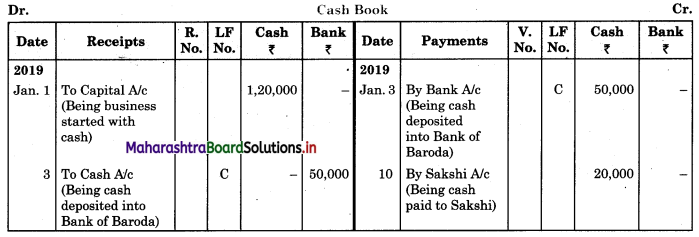
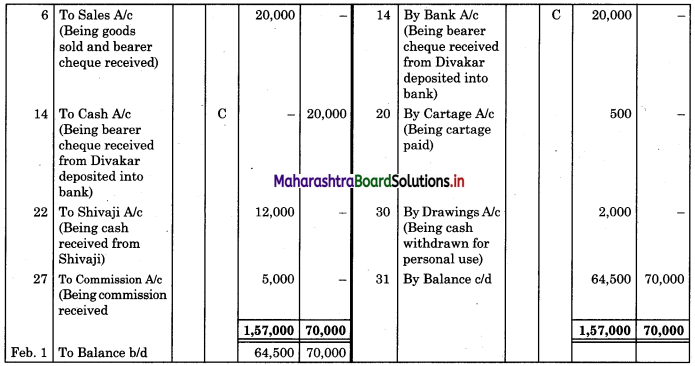
Prepare a two-column Cash Book with the help of the following information for January 2018.

January 2018Amt (₹)
01Started business with cash1,20,000
03Cash paid into Bank of Baroda50,000
05Purchased goods from Sakshi on credit20,000
06Sold goods to Divakar and received a bearer cheque20,000
10Paid to Sakshi cash20,000
14Cheque received on December 06, 2018, deposited into Bank
18Sold goods to Shivaji on credit12,000
20Cartage paid in cash500
22Received cash from Shivaji12,000
27Commission received5,000
30Drew cash for personal use2,000

Solution:
In the books of ____________
Maharashtra Board 11th BK Textbook Solutions Chapter 5 Subsidiary Books Practical Problems Q1
Maharashtra Board 11th BK Textbook Solutions Chapter 5 Subsidiary Books Practical Problems Q1.1
Note: Transactions dated 5th and 18th are credit transactions, hence not to be recorded in the cash book.

Question 2.
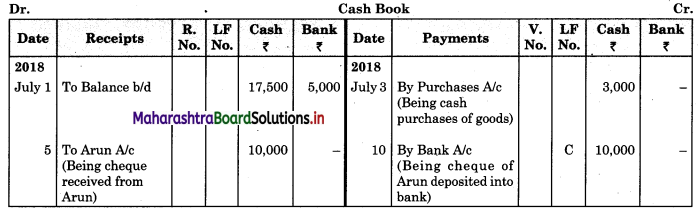
Prepare a two-column Cash Book from the following transaction for the year July 2018.

July 2018Amt (₹)
01Cash in hand17,500
01Cash at Bank5,000
03Purchased goods for cash3,000
05Received cheque from Arun10,000
08Sold goods for cash8,000
10Arun’s cheque deposited into the bank
12Purchased goods and paid by cheque20,000
15Paid establishment expenses through bank1,000
18Cash Sales7,000
20Deposited into bank10,000
24Paid General Expenses500
27Received commission by Cross cheque6,000
29Paid Rent2,000
30Withdrew cash for personal use1,200
31Wages paid6,000

Solution:
In the books of ____________
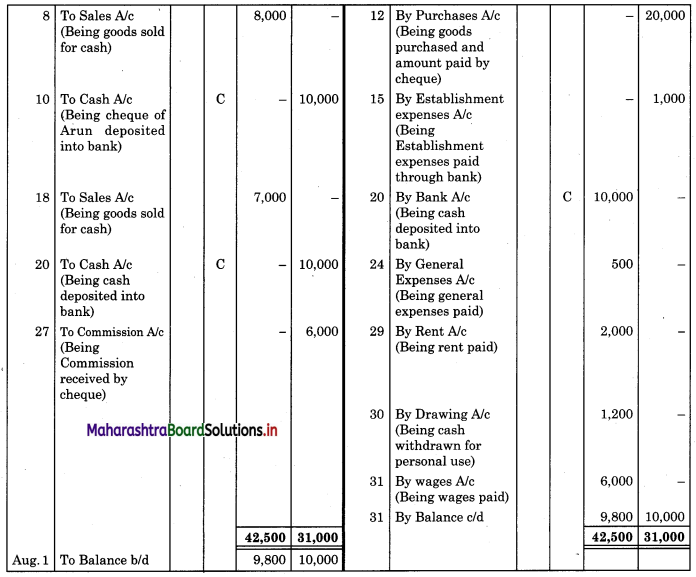
Maharashtra Board 11th BK Textbook Solutions Chapter 5 Subsidiary Books Practical Problems Q2
Maharashtra Board 11th BK Textbook Solutions Chapter 5 Subsidiary Books Practical Problems Q2.1

Maharashtra Board 11th BK Textbook Solutions Chapter 5 Subsidiary Books

Question 3.
Record the following transactions in the Cash Book of M/s Kamal Traders. Balance for the month of July 2018: Cash in hand ₹ 2,000 and balance in Bank Current account ₹ 8,000.

July 2018Amt (₹)
03Cash Sales2,300
05Purchased goods and amount paid by cheque6,000
08Cash Sales10,000
12Paid General Expenses700
15Sold goods and amount received by Cheque and deposited into Bank20,000
18Purchased Motor Car paid by Cheque15,000
20Cheque received from Mrunal deposited into Bank10,000
22Cash Sales7,000
25Mrunal’s cheque returned dishonoured
28Paid Rent2,000
29Paid Telephone expenses by cheque500
31Cash is withdrawn from Bank for personal use2,000

Prepare a two-column Cash Book.
Solution:
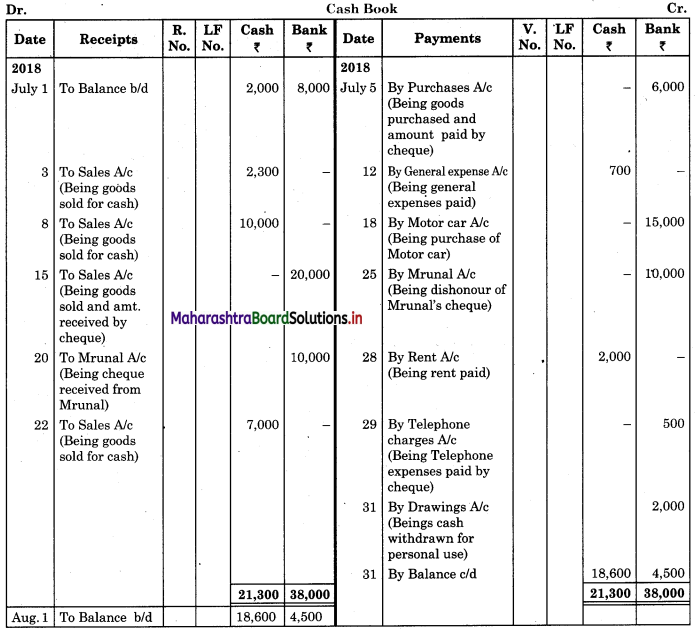
In the books of M/s Kamal Traders
Maharashtra Board 11th BK Textbook Solutions Chapter 5 Subsidiary Books Practical Problems Q3

Question 4.
Prepare Analytical Petty Cash Book from the following transactions in the books of Swarali General Stores, Kolhapur. The imprest amount is ₹ 1,500 received from the main cashier.

2018 JanuaryAmt (₹)
01Paid Cartage50
02Telephone Charges40
02Bus Fare20
03Postage30
04Refreshment to Employees80
06Courier Charges30
08Refreshment to Customers50
10Cartage35
15Taxi Fare to Manager70
18Purchased Stationery65
20Bus Fare10
22Xerox Charges30
25Internet Charges35
27Postage Stamps200
29Repair on Furniture105
30Cleaning Expenses115
31Miscellaneous Expenses100

Solution:
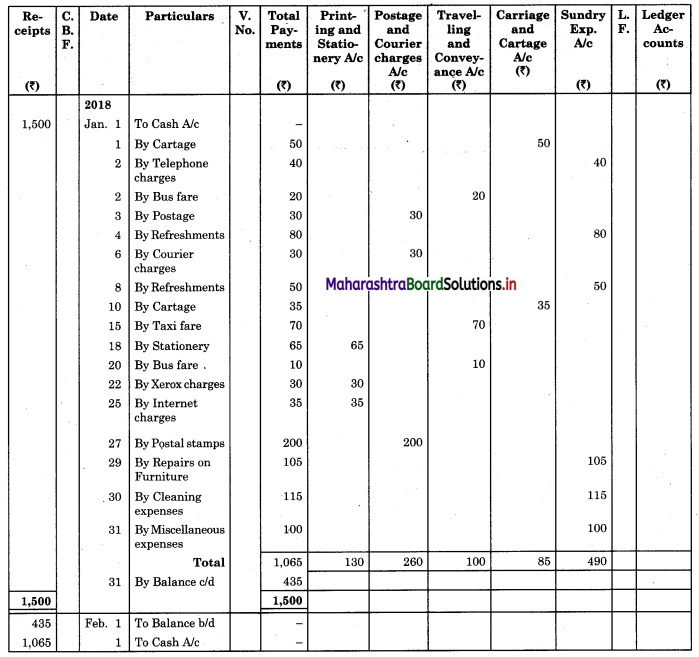
Analytical Petty Cash Book of Swarali General Stores
Maharashtra Board 11th BK Textbook Solutions Chapter 5 Subsidiary Books Practical Problems Q4

Question 5.
From the following information prepare Columnar Petty Cash Book kept on imprest system in the books of Manisha Books Stall, Beed.

2018 AprilAmt (₹)
01Opening petty cash balance200
02Received a bearer cheque to make up the imprest amount1,200
03Gave a tip to peon40
04Purchased stationery150
05Paid Taxi Fare35
06Purchased Stamp pad140
07Paid Cartage40
08Paid Bus Fare30
11Paid to sweeper50
13Purchased a box of pencils40
14Paid Mobile charges35
15Gave it to Sohan on account250
19Paid for Refreshment to staff150
20Paid Railway Fare30
21Paid Carriage65

Solution:
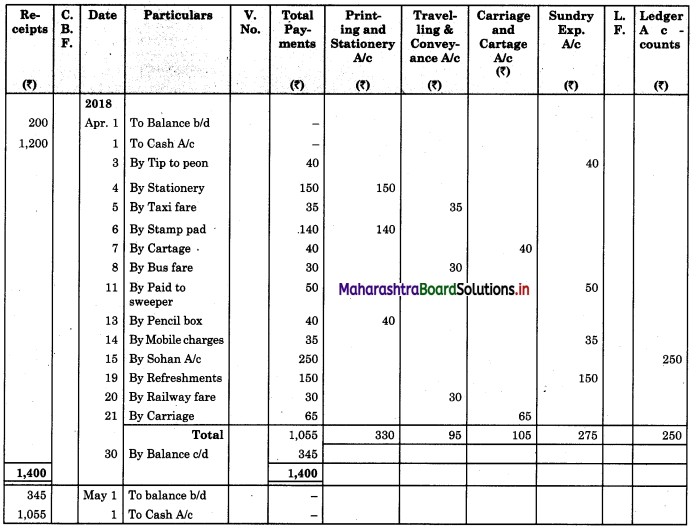
Analytical Petty Cash Book of Manish a Books Stall, Beed
Maharashtra Board 11th BK Textbook Solutions Chapter 5 Subsidiary Books Practical Problems Q5

Question 6.
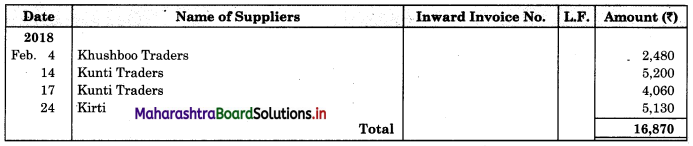
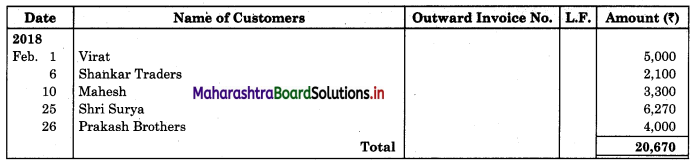
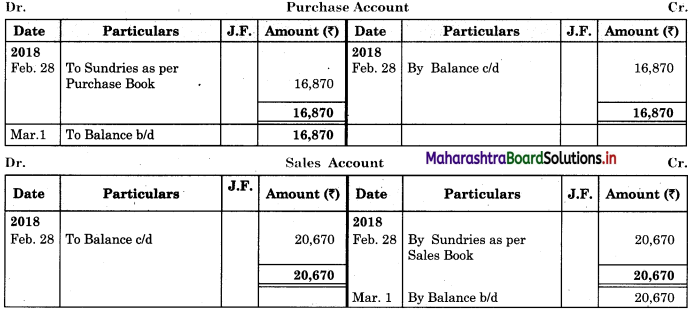
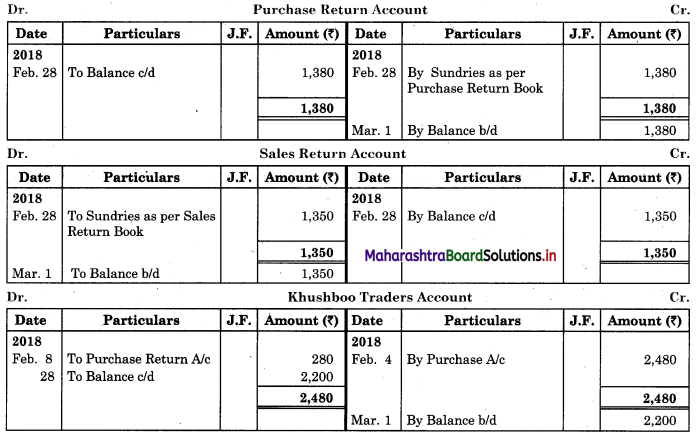
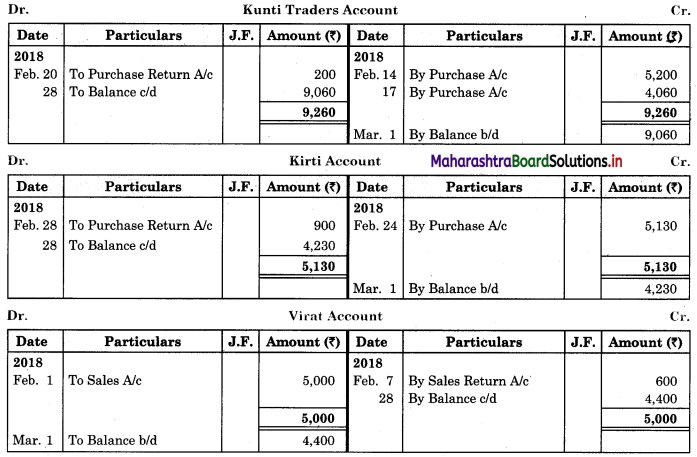
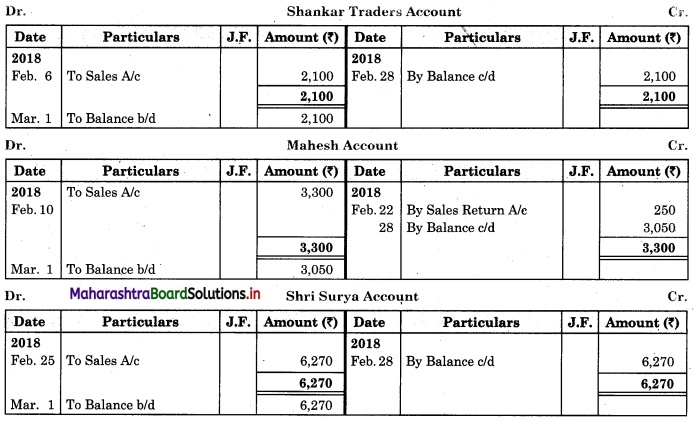
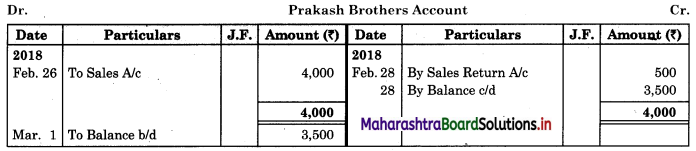
Prepare proper Subsidiary Books and post them to the ledger from the following transactions for the month of February 2018.

2018 FebruaryAmt (₹)
01Goods sold to Virat5,000
04Purchased goods from Khushboo Traders2,480
06Sold goods to Shankar Traders2,100
07Virat returned goods600
08Returns goods to Khusboo Traders280
10Sold goods to Mahesh3,300
14Purchased from Kunti Traders5,200
15Furniture purchased from Arun3,200
17Bought goods from Kunti Traders4,060
20Return goods to Kunti Traders200
22Return goods from Mahesh250
24Purchased goods from Kirti less 10% T.D.5,700
25Sold goods to Shri Surya goods less 5% T.D.6,600
26Sold goods to Prakash Brothers4,000
28Return goods to Kirti less 10% T.D.1,000
28Prakash Brothers returned goods500

Solution:
In the books of ____________
Purchase Book
Maharashtra Board 11th BK Textbook Solutions Chapter 5 Subsidiary Books Practical Problems Q6

Sales Book
Maharashtra Board 11th BK Textbook Solutions Chapter 5 Subsidiary Books Practical Problems Q6.1

Maharashtra Board 11th BK Textbook Solutions Chapter 5 Subsidiary Books

Purchase Return Book
Maharashtra Board 11th BK Textbook Solutions Chapter 5 Subsidiary Books Practical Problems Q6.2

Sales Return Book
Maharashtra Board 11th BK Textbook Solutions Chapter 5 Subsidiary Books Practical Problems Q6.3

In the books of ____________
Maharashtra Board 11th BK Textbook Solutions Chapter 5 Subsidiary Books Practical Problems Q6.4
Maharashtra Board 11th BK Textbook Solutions Chapter 5 Subsidiary Books Practical Problems Q6.5
Maharashtra Board 11th BK Textbook Solutions Chapter 5 Subsidiary Books Practical Problems Q6.6
Maharashtra Board 11th BK Textbook Solutions Chapter 5 Subsidiary Books Practical Problems Q6.7
Maharashtra Board 11th BK Textbook Solutions Chapter 5 Subsidiary Books Practical Problems Q6.8

Question 7.
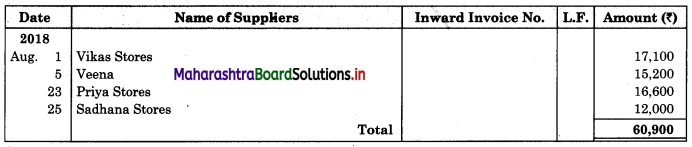
Enter the following transactions in the books of Vijay in Purchase Book, Sales Book, Purchase Returns Book and Sales Returns Book and Journal Proper for the month of August 2018.
2018 August
01 Purchased goods from Vikas Stores ₹ 18,000 at 5% Trade Discount
02 Sold goods of ₹ 9,000 to Prabhakar Traders
05 Veena sold goods of ₹ 16,000 to us at 5% Trade Discount as per our order dated 28th July, 2018.
08 Sent a Debit Note to Vikas Stores ₹ 1,600 (Gross) for goods returned.
10 Sold goods of ₹ 12,000 on credit to Shamal & Sons at 6% Trade Discount.
18 Received Credit Note from Veena ₹ 900 (Gross) for goods returned.
22 Sent Credit Note to Prabhakar Traders for ₹ 1,500 for goods returned. Received Dedit note from Shamal & Sons for ₹ 1,200 (Net) for goods returned.
23 Purchased goods of ₹ 16,600 from Priya Stores and paid for Carriage ₹ 150.
25 Purchased goods from Sadhana Stores ₹ 12,000 and sold the same to Aradhana Stores at a profit of 20% on cost.
28 Aradhana Stores returned goods of ₹ 2,400 as they were defective and the same were returned to Sadhana Stores.
31 Purchased Furniture for office use ₹ 30,000 from Art Furniture Works on credit.
Solution:
In the books of Vijay
Purchase Book
Maharashtra Board 11th BK Textbook Solutions Chapter 5 Subsidiary Books Practical Problems Q7

Sales Book
Maharashtra Board 11th BK Textbook Solutions Chapter 5 Subsidiary Books Practical Problems Q7.1

Purchase Return Book
Maharashtra Board 11th BK Textbook Solutions Chapter 5 Subsidiary Books Practical Problems Q7.2

Maharashtra Board 11th BK Textbook Solutions Chapter 5 Subsidiary Books

Sales Return Book
Maharashtra Board 11th BK Textbook Solutions Chapter 5 Subsidiary Books Practical Problems Q7.3

Journal Proper
Maharashtra Board 11th BK Textbook Solutions Chapter 5 Subsidiary Books Practical Problems Q7.4

Question 8.
Mr. Akash gives you the following information and asks you to prepare Purchase Book, Sales Book, Purchase Returns Book and Sales Return Book for the month of January 2018.
2018 January
01 Purchased goods on credit from Dhanal Traders for ₹ 15,000 and sold the same to Kunal Traders at a profit of 25% on cost.
05 Placed an order with Sunetra for goods of ₹ 10,000 less 5% Trade discount.
08 Purchased goods of ₹ 20,000 at 10% Trade Discount from Saurabha Traders.
13 Sold goods to Vinayak Stores ₹ 8,000 at 5% Trade Discount.
15 Vinayak Stores returned goods to us ₹ 200.
18 Sunetra executed our order placed on 5th Jan. 2018.
20 Sold goods to Vishnu Traders ₹ 21,000 less 5% Trade Discount.
22 Returned goods to Sunetra ₹ 1,000 (Gross).
28 Kunal Traders returned goods to us ₹ 500
30 Returned goods to Sourabh Traders ₹ 1,500.
Solution:
In the books of Mr. Akash
Purchase Book
Maharashtra Board 11th BK Textbook Solutions Chapter 5 Subsidiary Books Practical Problems Q8

Sales Book
Maharashtra Board 11th BK Textbook Solutions Chapter 5 Subsidiary Books Practical Problems Q8.1

Purchase Return Book
Maharashtra Board 11th BK Textbook Solutions Chapter 5 Subsidiary Books Practical Problems Q8.2

Maharashtra Board 11th BK Textbook Solutions Chapter 5 Subsidiary Books

Sales Return Book
Maharashtra Board 11th BK Textbook Solutions Chapter 5 Subsidiary Books Practical Problems Q8.3

Question 9.
Enter the following transactions in the Subsidiary Book of Kamal Traders.
2018 April
01 Bought from Suhas goods of ₹ 12,000 as per his Invoice No. 41.
04 Purchased from Virat goods of ₹ 11,870 less 10% Trade Discount vide Bill No. 12.
07 Bought from Kuldip goods of ₹ 11,000 less 25% Trade Discount vide Bill No. 12.
08 Bought from M/s. Art Furniture Works, Furniture for ₹ 13,000 vide Invoice No. 84.
12 Sold to Dhiraj goods of ₹ 11,500 vide Sales Invoice No. 27
13 Sold to Raja goods of ₹ 12,780 less 5% Trade Discount, vide invoice No. 88
21 Sold to Suresh goods of ₹ 8,000 less 20% Trade Discount
23 Dhiraj returned goods of ₹ 500 vide our Credit note No. 14
26 Suresh returned goods of ₹ 150 (gross) vide our Credit Note No. 115
28 Returned to Suhas goods ₹ 1,200 vide our Debit Note No. 09
30 Returned to Virat goods of ₹ 1,300 (Gross) vide our Debit Note No. 10.
30 Returned to Kuldip goods of ₹ 1,100 (Gross) vide our Debit Note No. 11.
Solution:
In the books of Kamal Traders
Purchase Book
Maharashtra Board 11th BK Textbook Solutions Chapter 5 Subsidiary Books Practical Problems Q9

Sales Book
Maharashtra Board 11th BK Textbook Solutions Chapter 5 Subsidiary Books Practical Problems Q9.1

Purchase Return Book
Maharashtra Board 11th BK Textbook Solutions Chapter 5 Subsidiary Books Practical Problems Q9.2

Sales Return Book
Maharashtra Board 11th BK Textbook Solutions Chapter 5 Subsidiary Books Practical Problems Q9.3

Maharashtra Board 11th BK Textbook Solutions Chapter 5 Subsidiary Books

Journal Proper
Maharashtra Board 11th BK Textbook Solutions Chapter 5 Subsidiary Books Practical Problems Q9.4

Question 10.
Enter the following transactions in the Subsidiary Books of Navyug Traders:
2018 March
01 Sold to Bharat Patil goods ₹ 10,000 at 10% Trade discount.
04 Purchased from Naresh goods of ₹ 11,000 less 10% Trade discount.
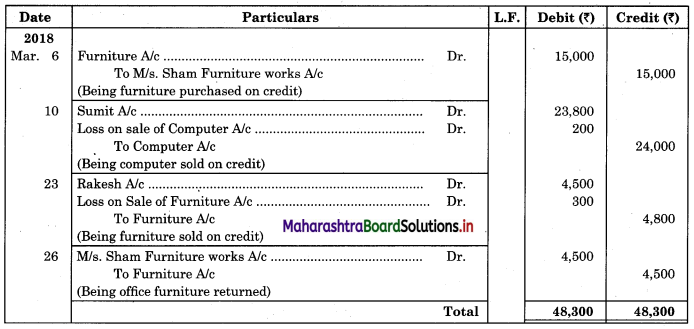
06 Purchased Furniture from M/s. Sham Furniture Works, of ₹ 15,000 for office use.
07 Bharat Patil returned 20% of the goods bought by him on 1st March above and we gave him fresh goods in exchange.
08 Sold to Sundar goods of ₹ 13,000 less 15% Trade Discount.
10 Sold to Sumit Computer for ₹ 23,800 with a book value of ₹ 24,000.
12 Placed an order with Sajan for goods of ₹ 12,000.
17 Purchased from Naresh goods of ₹ 14,000 and sold them to Kamesh for ₹ 16,000.
19 Kamesh returned us goods of ₹ 1,600 and immediately returned the same to Naresh.
23 Sold to Rakesh for ₹ 4,500 old Furniture with a book value of ₹ 4,800.
26 Returned to M/s. Sham Furniture Works, office Furniture of ₹ 4,500.
28 Sajan executed our order dated 12th March, 2018.
Solution:
In the books of Navyug Traders
Purchase Book
Maharashtra Board 11th BK Textbook Solutions Chapter 5 Subsidiary Books Practical Problems Q10

Sales Book
Maharashtra Board 11th BK Textbook Solutions Chapter 5 Subsidiary Books Practical Problems Q10.1

Purchase Return Book
Maharashtra Board 11th BK Textbook Solutions Chapter 5 Subsidiary Books Practical Problems Q10.2

Sales Return Book
Maharashtra Board 11th BK Textbook Solutions Chapter 5 Subsidiary Books Practical Problems Q10.3

Maharashtra Board 11th BK Textbook Solutions Chapter 5 Subsidiary Books

Journal Proper
Maharashtra Board 11th BK Textbook Solutions Chapter 5 Subsidiary Books Practical Problems Q10.4

Maharashtra Board 11th BK Textbook Solutions Chapter 4 Ledger

Balbharti Maharashtra State Board Bookkeeping and Accountancy 11th Solutions Chapter 4 Ledger Textbook Exercise Questions and Answers.

Maharashtra State Board Bookkeeping and Accountancy 11th Solutions Chapter 4 Ledger

1. Answer in one sentence only.

Question 1.
What is Ledger?
Answer:
Ledger is an important book of account in which individual records business transactions with respect to persons, properties, expenses, or losses are maintained.

Question 2.
What is ledger posting?
Answer:
Transferring the entry passed in the journal to the ledger for the individual record is called ledger posting.

Question 3.
When does an account show a nil balance?
Answer:
When the total credit side of an account equals the total of the debit side, such an account shows a nil balance.

Maharashtra Board 11th BK Textbook Solutions Chapter 4 Ledger

Question 4.
What is Folio?
Answer:
Page number of the account opened in the ledger is called Ledger folio.

Question 5.
Where is the statement form of ledger A/c is used in actual practice?
Answer:
The statement form of ledger A/c is used in the banks and financial institutions to prepare the client’s account showing balances of accounts after each transaction is complete.

Question 6.
Why Proprietor’s Capital account is a liability for the business?
Answer:
Capital invested in the business by the proprietor is an asset for the proprietor and liability for the business.

Question 7.
Why does a cash account never shows a credit balance?
Answer:
Available cash with the business is an asset of the business and the account of every asset shows debit, cash account always shows debit balance.

Maharashtra Board 11th BK Textbook Solutions Chapter 4 Ledger

Question 8.
What is ‘Trial Balance’?
Answer:
Trial Balance is an abstract or list of all the ledger accounts as on a specified date showing debit total and the credit total of all the accounts or their net balance.

2. Write the word, term, phrase, which can substitute each of the statements.

Question 1.
Principal Book of accounts.
Answer:
Ledger

Question 2.
Transferring a journal entry to the appropriate accounts in the Ledger.
Answer:
Posting

Question 3.
Page number of Ledger to which an entry is posted.
Answer:
Ledger folio

Maharashtra Board 11th BK Textbook Solutions Chapter 4 Ledger

Question 4.
The process of extracting the balance and inserting it on the lesser side of an account.
Answer:
Balancing

Question 5.
A debit balance to Personal Accounts.
Answer:
Debtor

Question 6.
A credit balance to Bank Account.
Answer:
Bank overdraft

Question 7.
An account to be debited for goods damaged by fire.
Answer:
Loss by fire

Maharashtra Board 11th BK Textbook Solutions Chapter 4 Ledger

Question 8.
A Trial Balance in which only net balances of all ledger accounts are transferred.
Answer:
Net Trial Balance

3. Select appropriate alternatives from those given below and rewrite the sentences.

Question 1.
In case of a credit transaction one of the account must be a ______________ account.
(a) Cash
(b) Credit
(c) Personal
(d) Debit
Answer:
(c) Personal

Question 2.
‘c/d’ indicates ______________ balance.
(a) Opening
(b) Closing
(c) Positive
(d) Negative
Answer:
(b) Closing

Question 3.
______________ Column of ledger is used for writing page number of Journal.
(a) J.F.
(b) L.F.
(c) Date
(d) Particulars
Answer:
(a) J.F.

Maharashtra Board 11th BK Textbook Solutions Chapter 4 Ledger

Question 4.
Debtors Account shows ______________ balance.
(a) Real
(b) Negative
(c) Credit
(d) Debit
Answer:
(d) Debit

Question 5.
______________ is the process of deriving the difference between totals of the debit and credit side of each ledger a/c.
(a) Totalling
(b) Journalizing
(c) Balancing
(d) Posting
Answer:
(c) Balancing

Question 6.
Total of Purchase book is ______________ to Purchase Account.
(a) posted
(b) moved
(c) given
(d) entered
Answer:
(a) posted

Question 7.
Real account always shows ______________ balance.
(a) minimum
(b) maximum
(c) debit
(d) credit
Answer:
(c) debit

Maharashtra Board 11th BK Textbook Solutions Chapter 4 Ledger

Question 8.
______________ is prepared to test arithmetical accuracy of Books of Accounts.
(a) Trial Balance
(b) Ledger
(c) Journal
(d) List
Answer:
(a) Trial Balance

4. State whether the following statements are ‘True or False’ with reasons.

Question 1.
Ledger is a book of Original Entry.
Answer:
This statement is False.
Ledger is a book of Secondary Entry.
Journal is a book of Original Entry: First, all transactions are recorded to journal or subsidiary books, and then they are pasted to the respective ledger accounts.

Question 2.
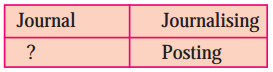
The process of recording a transaction in the Journal is called Posting.
Answer:
This statement is False.
The process of recording a transaction in the Journal is called Journalising. Posting means transferring journal entries to respective ledger accounts.

Question 3.
A cash withdrawal from business by the trader should be credited to Drawings A/c.
Answer:
This statement is False.
Cash withdrawn from the business by the trader should be debited to Drawing A/c. It is a personal account and as per the golden rules of a personal account Debit the receiver.

Maharashtra Board 11th BK Textbook Solutions Chapter 4 Ledger

Question 4.
Balances of Nominal Accounts are carried forward to the next year.
Answer:
This statement is False.
Balances of Nominal Accounts are transferral to Trading and Profit and loss accounts of the year to find Gross Profit and Net Profit.

Question 5.
When the debit side of an account is greater than the credit side, the account shows a debit balance.
Answer:
This statement is True.
While balancing the ledger account the side which is greater is the balance of that account so when the debit side of an account is greater the account shows debit balances.

Question 6.
The name of an account written on top of each account is called ‘Head of Account’.
Answer:
This statement is True.
There are many ledger accounts in the ledger book. To identity, the name of the account, every account on the Top Head of Account is written.

Question 7.
Agreement of Trial Balance always proves accounting accuracy.
Answer:
This statement is False.
Even though the Trial balance is tally there may be some mistake like the complete omission of transaction or compensatory error so Agreement of Trial Balance does not always prove accounting accuracy.

Maharashtra Board 11th BK Textbook Solutions Chapter 4 Ledger

Question 8.
The trial balance is based on the double-entry principle that for every debit there is an equal amount of corresponding credit.
Answer:
This statement is True.
Trial balance is an extract of ledger balances. Ledger is prepared of journal book which follows the Double Entry System of book-keeping. When both the effects of debit and credit with equal amount is given. The trial balance will be tally.

5. Fill in the blanks.

Question 1.
______________ Balance on Nominal Account shows expenses or loss.
Answer:
debit

Question 2.
Cash account always shows ______________ balance.
Answer:
debit

Question 3.
The right hand side of an account is called ______________ side.
Answer:
credit

Question 4.
Creditors shows ______________ balance.
Answer:
credit

Maharashtra Board 11th BK Textbook Solutions Chapter 4 Ledger

Question 5.
______________ accounts are closed by transferring its balances to Profit and Loss Account.
Answer:
Nominal

Question 6.
‘b/d’ means ______________
Answer:
brought down

Question 7.
Rent paid for the residential quarter will be debited to ______________ account.
Answer:
Drawings

Question 8.
Sold goods of ₹ 24,000 at 20% Profit on cost, the purchase price of the goods is ______________
Answer:
₹ 20,000

6. Complete the following table.

Question 1.
Maharashtra Board 11th BK Textbook Solutions Chapter 4 Ledger 6 Q1
Answer:
Ledger

Question 2.
Maharashtra Board 11th BK Textbook Solutions Chapter 4 Ledger 6 Q2
Answer:
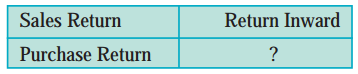
Return outward

Question 3.
Maharashtra Board 11th BK Textbook Solutions Chapter 4 Ledger 6 Q3
Answer:
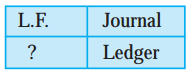
J.F.

Maharashtra Board 11th BK Textbook Solutions Chapter 4 Ledger

Question 4.
Maharashtra Board 11th BK Textbook Solutions Chapter 4 Ledger 6 Q4
Answer:
Credit balance

Question 5.
Maharashtra Board 11th BK Textbook Solutions Chapter 4 Ledger 6 Q5
Answer:
Nominal A/c

7. Put ‘4’ mark for the nature of balance for the following.

Question 1.
Maharashtra Board 11th BK Textbook Solutions Chapter 4 Ledger 7 Q1
Maharashtra Board 11th BK Textbook Solutions Chapter 4 Ledger 7 Q1.1
Answer:

AccountDr. BalanceCr. Balance
1. Capital A/c4
2. Goodwill4
3. Bank Overdraft4
4. Bills Receivable4
5. Creditors4
6. Drawings4
7. Advertisement4
8. Prepaid Rent4
9. Outstanding Salary4
10. Bad debts4

Practical Problems

Question 1.
Give Journal entries of the following posting from the ledger account.
In the books of Sopan
Maharashtra Board 11th BK Textbook Solutions Chapter 4 Ledger Practical Problems Q1
Maharashtra Board 11th BK Textbook Solutions Chapter 4 Ledger Practical Problems Q1.1
Maharashtra Board 11th BK Textbook Solutions Chapter 4 Ledger Practical Problems Q1.2
Solution:
Journal of Sopan
Maharashtra Board 11th BK Textbook Solutions Chapter 4 Ledger Practical Problems Q1.3
Maharashtra Board 11th BK Textbook Solutions Chapter 4 Ledger Practical Problems Q1.4

Maharashtra Board 11th BK Textbook Solutions Chapter 4 Ledger

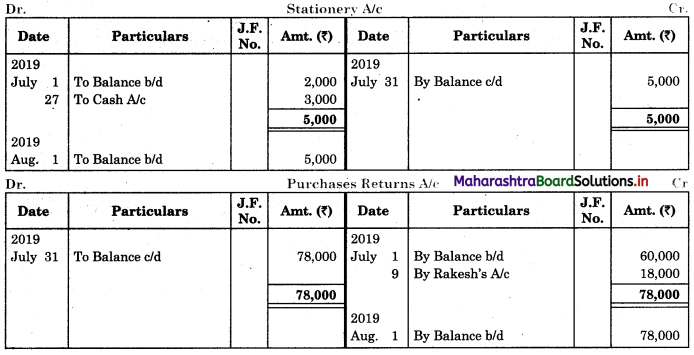
Question 2.
Prepare necessary Ledger Accounts from the following Subsidiary Books.
Purchase Book
Maharashtra Board 11th BK Textbook Solutions Chapter 4 Ledger Practical Problems Q2
Purchase Return Book
Maharashtra Board 11th BK Textbook Solutions Chapter 4 Ledger Practical Problems Q2.1
Solution:
In the Ledger of ______________
Maharashtra Board 11th BK Textbook Solutions Chapter 4 Ledger Practical Problems Q2.2
Maharashtra Board 11th BK Textbook Solutions Chapter 4 Ledger Practical Problems Q2.3

Question 3.
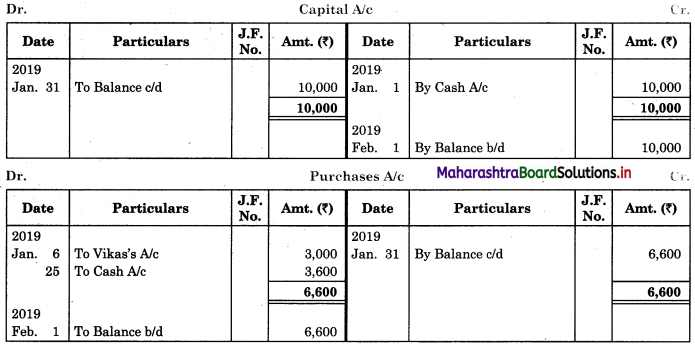
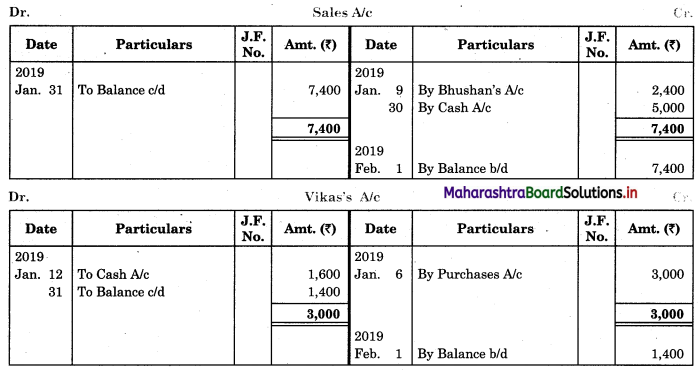
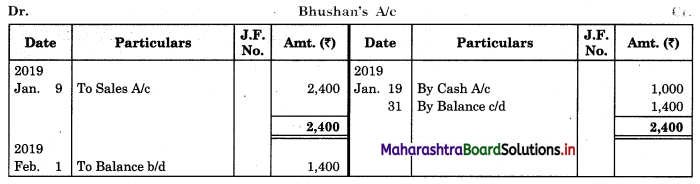
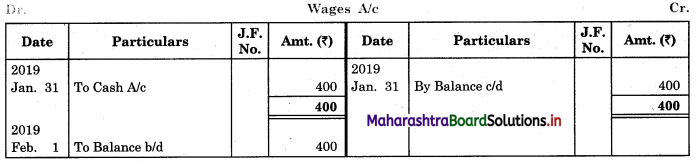
From the following transactions prepare necessary Ledger Accounts in the Books of Vinay and balance the same.
2019 Jan.
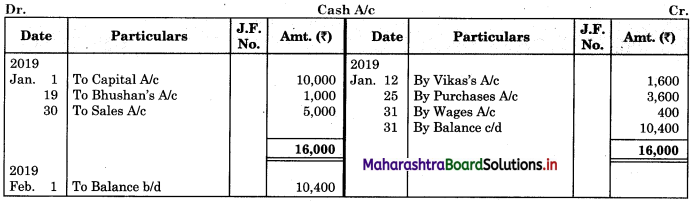
1 Started business with Cash ₹ 10,000
6 Bought goods from Vikas ₹ 3,000
9 Sold goods to Bhushan ₹ 2,400
12 Paid to Vikas on account ₹ 1,600
19 Received on account from Bhushan ₹ 1,000
25 Cash Purchases ₹ 3,600
30 Cash Sales ₹ 5,000
31 Paid Wages ₹ 400
Solution:
In the Ledger of Vinay
Maharashtra Board 11th BK Textbook Solutions Chapter 4 Ledger Practical Problems Q3
Maharashtra Board 11th BK Textbook Solutions Chapter 4 Ledger Practical Problems Q3.1
Maharashtra Board 11th BK Textbook Solutions Chapter 4 Ledger Practical Problems Q3.2
Maharashtra Board 11th BK Textbook Solutions Chapter 4 Ledger Practical Problems Q3.3
Maharashtra Board 11th BK Textbook Solutions Chapter 4 Ledger Practical Problems Q3.4

Question 4.
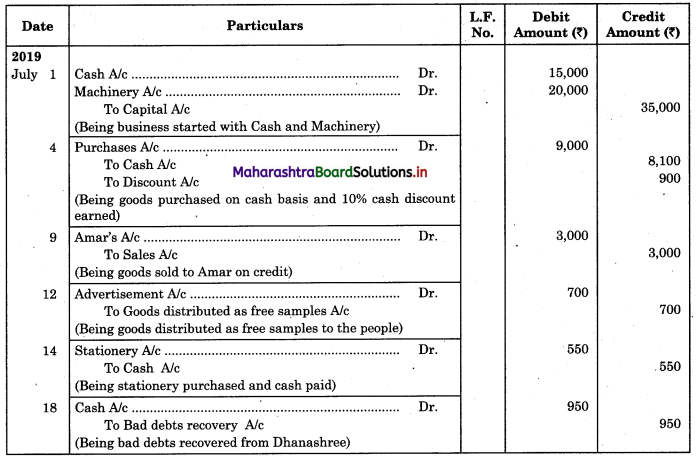
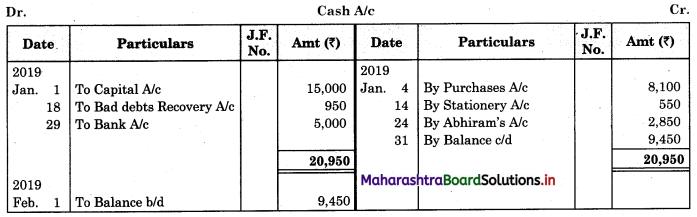
Journalise the following transactions and prepare Cash A/c only.
2019 July
1 Hardik started the business with Cash ₹ 15,000 and Machinery ₹ 20,000.
4 Purchased goods for ₹ 9,000 less 10% Cash Discount.
9 Sold goods to Amar ₹ 3,000.
12 Distributed goods worth ₹ 700 as free samples.
14 Bought Stationery for ₹ 550 for office use.
18 Received ₹ 950 from Dhanashree, a customer, whose account was earlier written off as a bad debt.
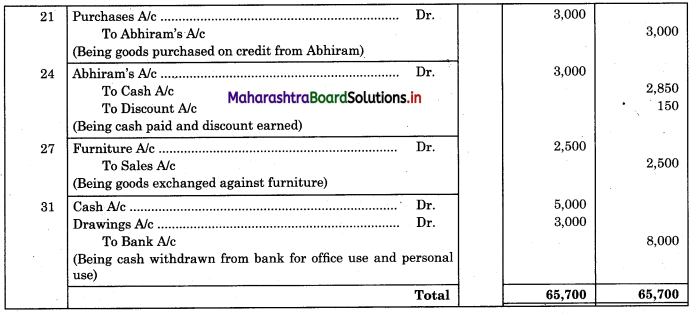
21 Abhiram invoiced us goods worth ₹ 3,000.
24 Settled Abhiram’s account, he allowed 5% cash discount.
27 Exchanged goods worth ₹ 2,500 against Furniture of the same amount.
29 Withdrawn cash from ATM ₹ 5,000 for office use and ₹ 3,000 for personal use.
Solution:
Journal of Hardik ______________
Maharashtra Board 11th BK Textbook Solutions Chapter 4 Ledger Practical Problems Q4
Maharashtra Board 11th BK Textbook Solutions Chapter 4 Ledger Practical Problems Q4.1
Ledger of Hardik
Maharashtra Board 11th BK Textbook Solutions Chapter 4 Ledger Practical Problems Q4.2

Maharashtra Board 11th BK Textbook Solutions Chapter 4 Ledger

Question 5.
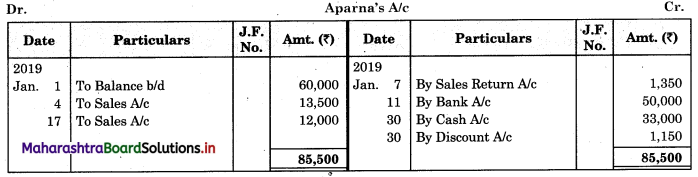
Prepare Aparna’s account in the books of Suparna.
2019 Jan.
1 Balance due from Aparna ₹ 60,000
4 Sold goods to Aparna ₹ 15,000 at 10% Trade Discount.
7 Goods returned by Aparna ₹ 1,500 (Gross)
11 Received crossed cheque from Aparna ₹ 50,000
17 Invoiced goods to Aparna ₹ 12,000
25 Sold goods to Aparna in cash ₹ 6,000
30 Received cash from Aparna ₹ 33,000 in full settlement of her account.
Solution:
Ledger of Suparna
Maharashtra Board 11th BK Textbook Solutions Chapter 4 Ledger Practical Problems Q5

Working Notes:
Jan. 4:
Trade discount = 10% on ₹ 15,000
= \(\frac {10}{100}\) × ₹ 15,000
= ₹ 1,500
Net Selling Price = Catalogue price – Trade discount
= 15,000 – 1,500
= ₹ 13,500

Question 6.
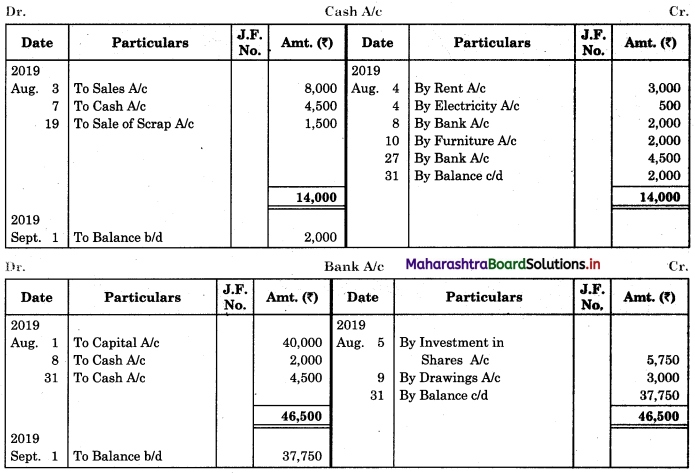
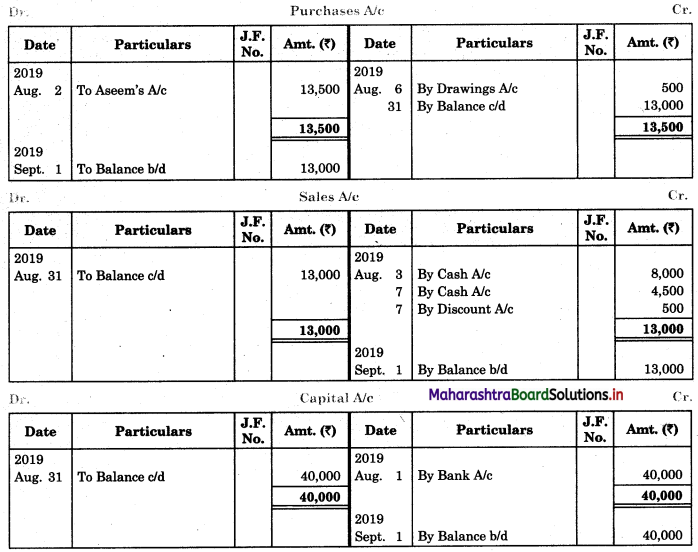
Prepare Cash A/c, Bank A/c, Purchases A/c, Sales A/c, and Capital A/c and balance the same in the books of Madanlal.
2019 Aug.
1 Started business with a bank balance of ₹ 40,000.
2 Purchased goods from Aseem worth ₹ 15,000 less 10% Trade Discount.
3 Sold goods to Arun for ₹ 8,000 in cash.
4 Paid Rent ₹ 3,000 and Electricity bill ₹ 500.
5 Purchased 100 Shares of Perfect Technologies for ₹ 55 per share and paid Brokerage ₹ 250 by transfer through net banking.
6 Withdrawal of goods for personal use ₹ 500.
7 Sold goods for cash ₹ 5,000 less 10% Cash Discount.
8 Deposited cash into Bank ₹ 2,000.
9 Paid ₹ 3,000 for daughter’s tuition fees by Debit Card.
10 Purchased a Table for ₹ 2,000.
19 Received ₹ 1,500 by selling the scrap.
27 Paid cash into a bank in excess of ₹ 2,000
Solution:
In the Ledger of Madanlal
Maharashtra Board 11th BK Textbook Solutions Chapter 4 Ledger Practical Problems Q6
Maharashtra Board 11th BK Textbook Solutions Chapter 4 Ledger Practical Problems Q6.1

Question 7.
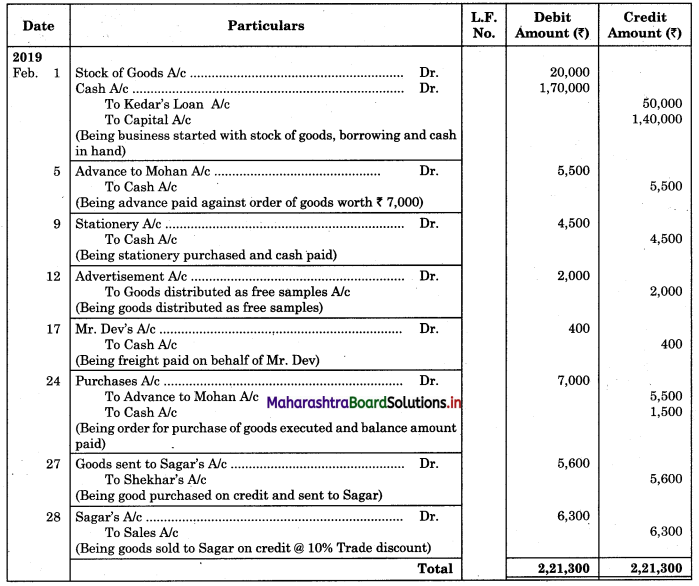
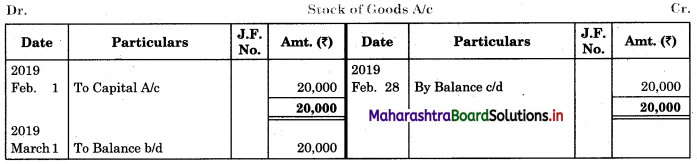
Journalise the following transactions; post them into Ledger for February 2019
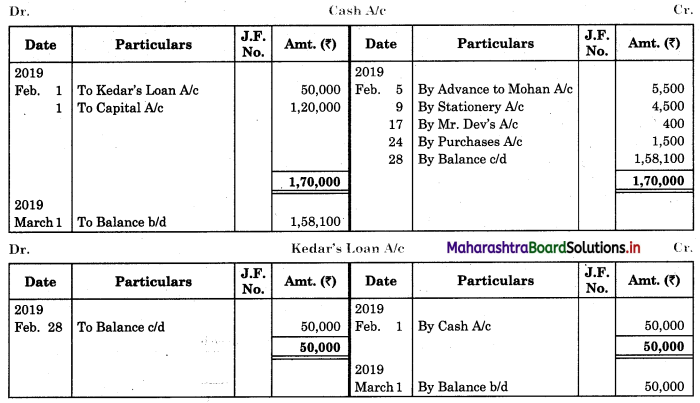
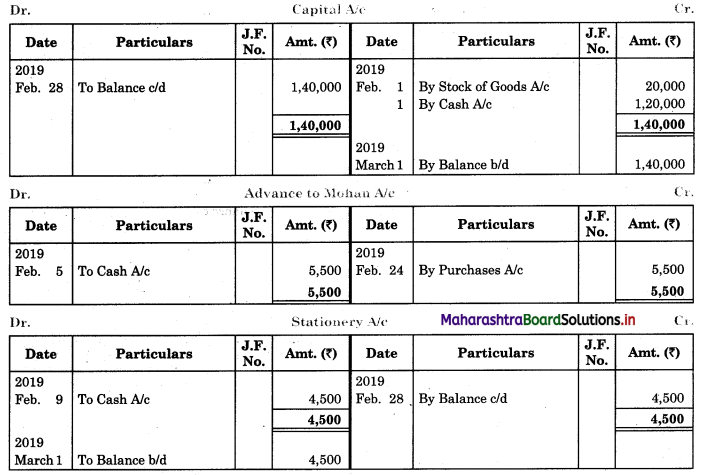
1 Sunil Started business with a stock of goods ₹ 20,000 and Cash ₹ 1,70,000 out of which ₹ 50,000 borrowed from his friend Kedar @ 10 p.a.
5 Placed an order for goods worth ₹ 7,000 with Mohan for which an advance of ₹ 5,500 was paid.
9 Purchased Stationery for office use ₹ 4,500
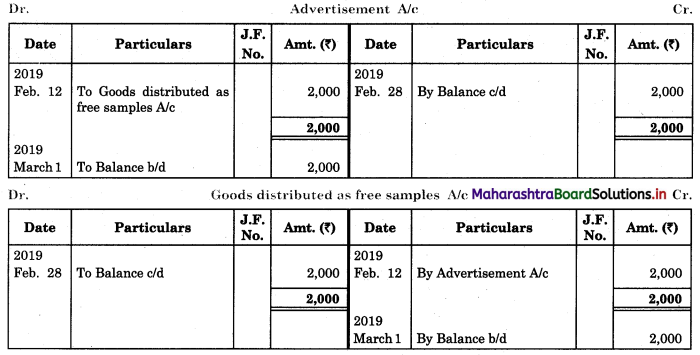
12 Goods distributed as free samples ₹ 2,000
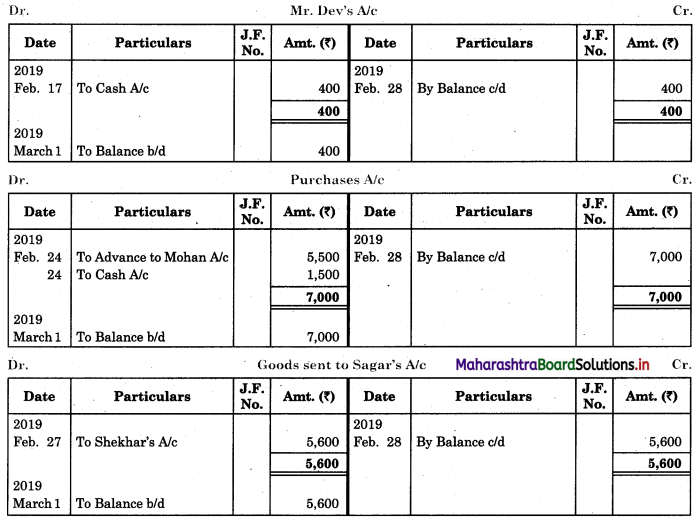
17 Paid Freight ₹ 400 on behalf of Mr. Dev.
24 Received Goods from Mohan as per our order dated 5th Feb and settled his account.
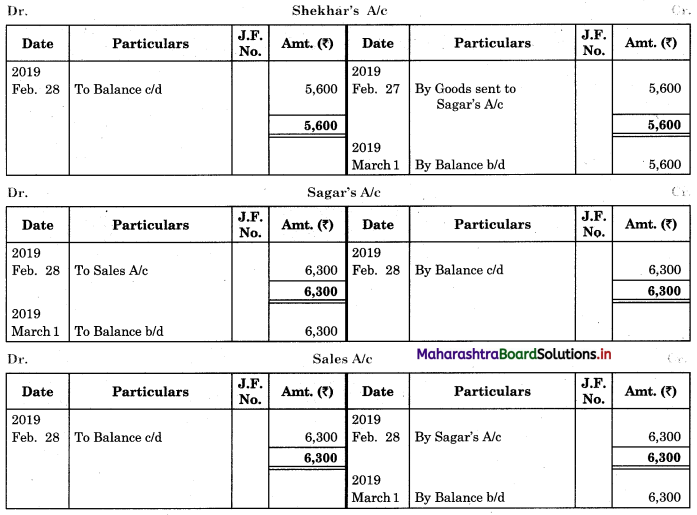
27 Bought goods from Shekhar on two months credit for ₹ 7,000 at 20% Trade Discount with instructions to send them to Sagar.
28 Sent to Sagar Outward Invoice for goods supplied by Shekhar, at list price less 10% Trade Discount.
Solution:
Journal of Sunil
Maharashtra Board 11th BK Textbook Solutions Chapter 4 Ledger Practical Problems Q7
Ledger of Sunil
Maharashtra Board 11th BK Textbook Solutions Chapter 4 Ledger Practical Problems Q7.1
Maharashtra Board 11th BK Textbook Solutions Chapter 4 Ledger Practical Problems Q7.2
Maharashtra Board 11th BK Textbook Solutions Chapter 4 Ledger Practical Problems Q7.3
Maharashtra Board 11th BK Textbook Solutions Chapter 4 Ledger Practical Problems Q7.4
Maharashtra Board 11th BK Textbook Solutions Chapter 4 Ledger Practical Problems Q7.5
Maharashtra Board 11th BK Textbook Solutions Chapter 4 Ledger Practical Problems Q7.6

Maharashtra Board 11th BK Textbook Solutions Chapter 4 Ledger

Question 8.
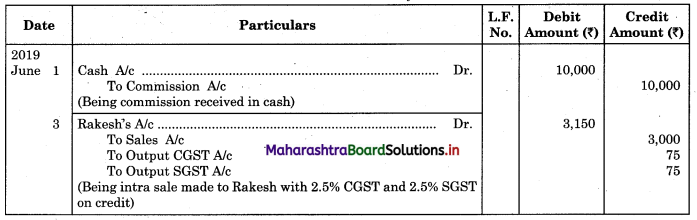
Journalise the following transactions and Prepare ledger accounts in the books of Sanjeev.
2019 June
1 Cash Received from Raju ₹ 10,000 for commission.
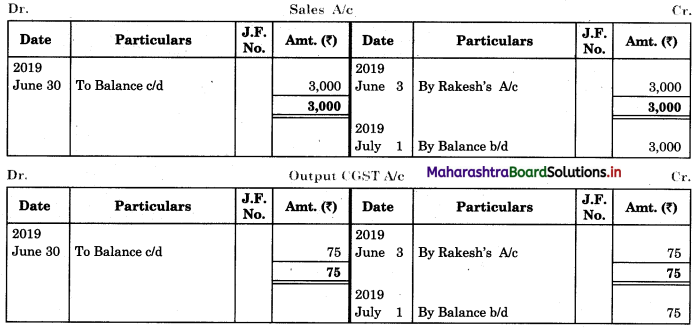
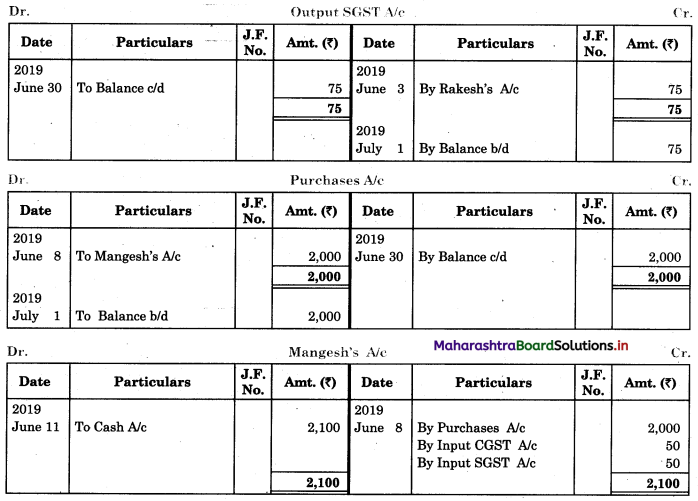
3 Intra-state sale to Rakesh ₹ 3,000 and SGST @ 2.5% and CGST @ 2.5% applicable.
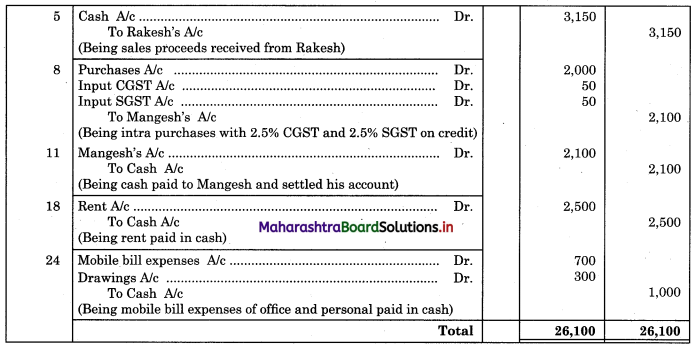
5 Received full amount from Rakesh.
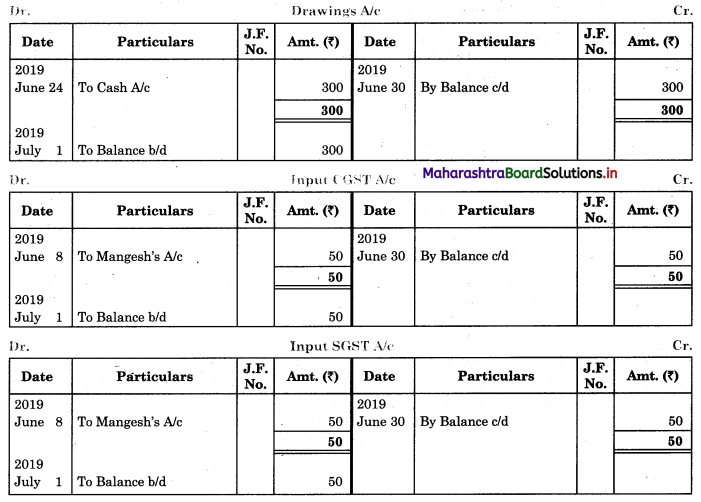
8 Intra-state purchases from Mangesh ₹ 2,000 and SGST @ 2.5% and CGST @ 2.5% applicable.
11 Paid the necessary amount to Mangesh.
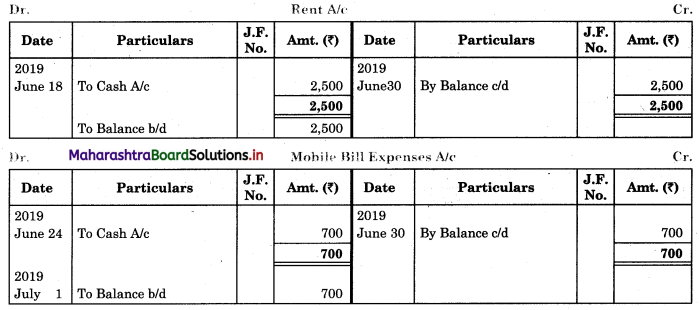
18 Paid Rent ₹ 2,500
24 Paid mobile bill ₹ 1,000 out of which ₹ 700 for office use and for ₹ 300 for personal use.
Solution:
Journal of Sanjeev
Maharashtra Board 11th BK Textbook Solutions Chapter 4 Ledger Practical Problems Q8
Maharashtra Board 11th BK Textbook Solutions Chapter 4 Ledger Practical Problems Q8.1
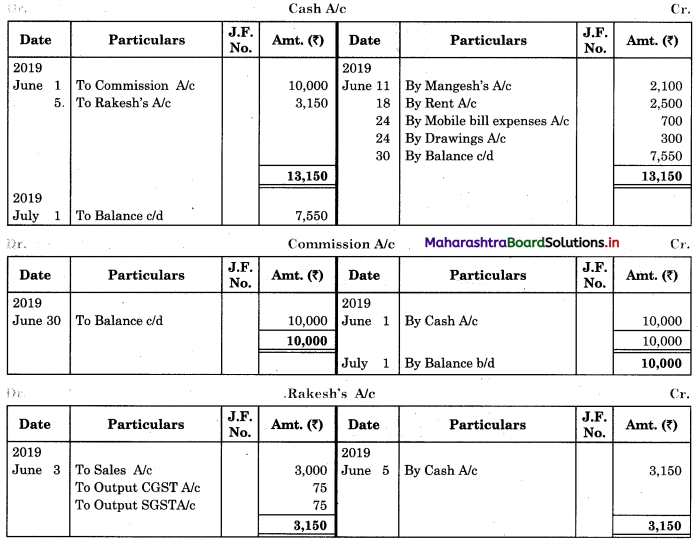
In the Ledger of Sanjeev
Maharashtra Board 11th BK Textbook Solutions Chapter 4 Ledger Practical Problems Q8.2
Maharashtra Board 11th BK Textbook Solutions Chapter 4 Ledger Practical Problems Q8.3
Maharashtra Board 11th BK Textbook Solutions Chapter 4 Ledger Practical Problems Q8.4
Maharashtra Board 11th BK Textbook Solutions Chapter 4 Ledger Practical Problems Q8.5
Maharashtra Board 11th BK Textbook Solutions Chapter 4 Ledger Practical Problems Q8.6

Maharashtra Board 11th BK Textbook Solutions Chapter 4 Ledger

Question 9.
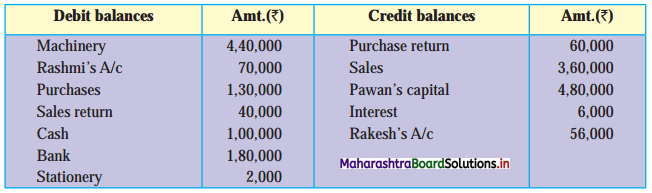
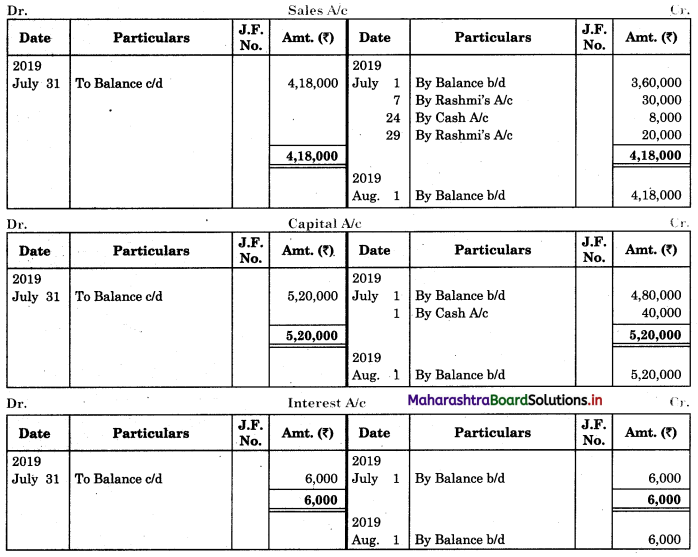
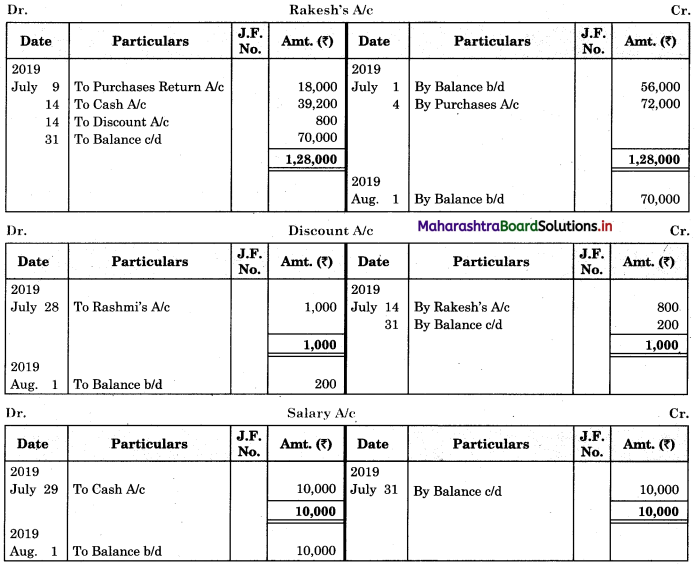
The following ledger balances were extracted from the books of Pawan Pawar, Pune as of 1st July 2019.
Maharashtra Board 11th BK Textbook Solutions Chapter 4 Ledger Practical Problems Q9
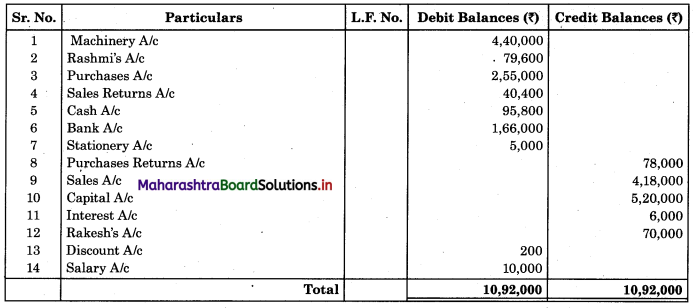
The following transactions took place during July 2019. Post them into Ledger and prepare Trial Balance as of 31st July 2019.
1 Introduced additional Capital ₹ 40,000
4 Bought goods from Rakesh ₹ 80,000 @ 10% Trade Discount
7 Sold goods to Rashmi ₹ 30,000
9 Returned goods to Rakesh ₹ 20,000 (Gross)
11 Rashmi returned goods to us ₹ 400
14 Paid to Rakesh ₹ 40,000 @ 2% Cash Discount
22 Made purchases ₹ 17,000 and amount paid by cheque
24 Cash Sales ₹ 8,000
27 Bought Stationery ₹ 3,000
28 Received from Rashmi ₹ 39,000 by RTGS and discount allowed ₹ 1000
29 Paid Salary ₹ 10,000
29 Sold goods to Rashmi ₹ 20,000
31 Bought goods from Rakesh ₹ 36,000 and paid by cheque.
Solution:
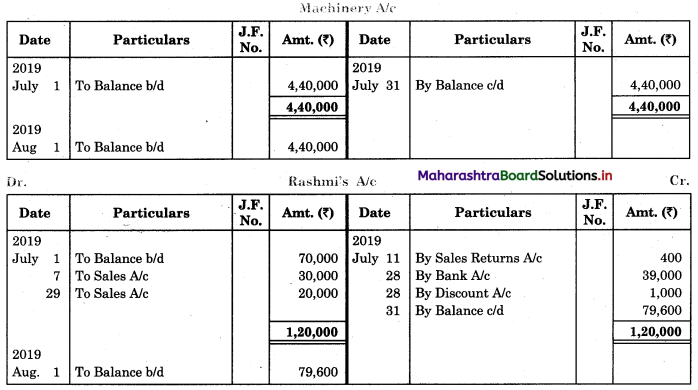
Ledger of Pawan Pawar, Pune
Maharashtra Board 11th BK Textbook Solutions Chapter 4 Ledger Practical Problems Q9.1
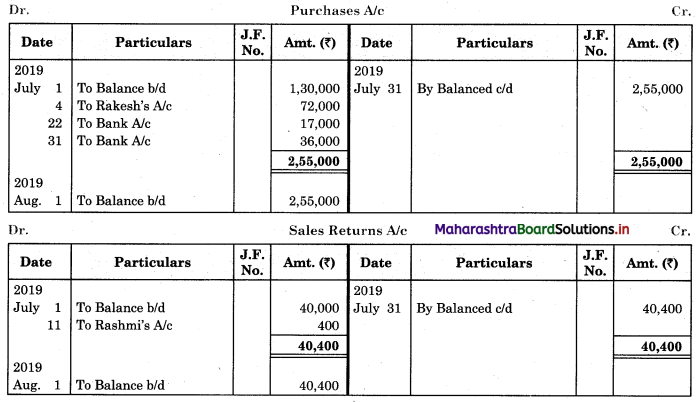
Maharashtra Board 11th BK Textbook Solutions Chapter 4 Ledger Practical Problems Q9.2
Maharashtra Board 11th BK Textbook Solutions Chapter 4 Ledger Practical Problems Q9.3
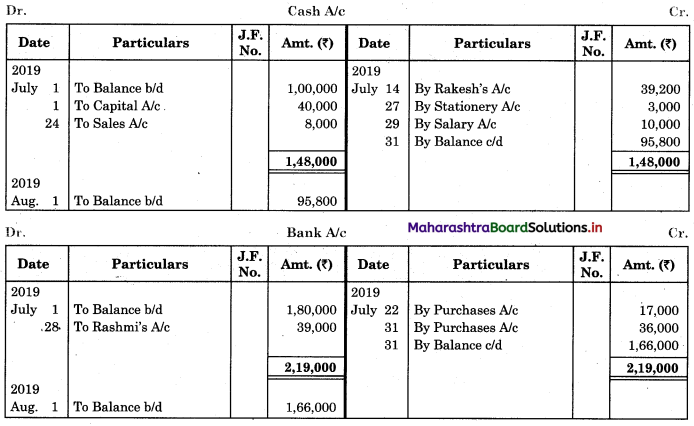
Maharashtra Board 11th BK Textbook Solutions Chapter 4 Ledger Practical Problems Q9.4
Maharashtra Board 11th BK Textbook Solutions Chapter 4 Ledger Practical Problems Q9.5
Maharashtra Board 11th BK Textbook Solutions Chapter 4 Ledger Practical Problems Q9.6

Trial Balance as of 31st July 2019
Maharashtra Board 11th BK Textbook Solutions Chapter 4 Ledger Practical Problems Q9.7

Maharashtra Board 11th BK Textbook Solutions Chapter 3 Journal

Balbharti Maharashtra State Board Bookkeeping and Accountancy 11th Solutions Chapter 3 Journal Textbook Exercise Questions and Answers.

Maharashtra State Board Bookkeeping and Accountancy 11th Solutions Chapter 3 Journal

1A. Answer in One Sentence:

Question 1.
What is Journal?
Answer:
Journal is a book of account in which all types of day-to-day business transactions are recorded in chronological
order.

Question 2.
What is Narration?
Answer:
Explanation of transaction which is written just below the accounting entry in the particular column is called narration.

Question 3.
What is GST?
Answer:
GST is an abbreviated form of Goods and Service Tax that is levied by the Government on specific goods and services in the place of different taxes levied earlier.

Maharashtra Board 11th BK Textbook Solutions Chapter 3 Journal

Question 4.
In which year GST was imposed by the Central Government of India?
Answer:
In the year 2017 GST was imposed by the Central Government of India.

Question 5.
What is meant by simple entry?
Answer:
An entry in which only two accounts are affected viz. one account is debited and the other account is credited is called simple entry.

Question 6.
What is the meaning of combined entry?
Answer:
A journal entry that combines more than one debit or more than one credit or both is called a combined/compound entry.

Question 7.
Which account is debited, when rent is paid by Debit card?
Answer:
The rent account is debited when rent is paid by debit card.

Question 8.
Which discount is not recorded in the books of account?
Answer:
Trade discount is not recorded in the books of the account.

Question 9.
In which order monthly transactions are recorded in a Journal?
Answer:
In chronological (date wise) order monthly transactions are recorded in the journal.

Maharashtra Board 11th BK Textbook Solutions Chapter 3 Journal

Question 10.
Which account is credited, when goods are sold on credit?
Answer:
Sales account is credited, when goods are sold on credit.

2. Give one word/term or phrase for each of the following statements:

Question 1.
A book of prime entry.
Answer:
Journal

Question 2.
The tax imposed by Central Government on Goods and Services.
Answer:
GST

Question 3.
A brief explanation of an entry.
Answer:
Narration

Question 4.
The process of recording transactions in the Journal.
Answer:
Journalising

Question 5.
The French word from which the word Journal is derived.
Answer:
Jour

Maharashtra Board 11th BK Textbook Solutions Chapter 3 Journal

Question 6.
Concession is given for immediate payment.
Answer:
Cash discount

Question 7.
Entry in which more than one accounts are be debited or credited.
Answer:
Combined Entry

Question 8.
Anything took by the proprietor from the business for his private use.
Answer:
Drawings

Question 9.
Tax payable to the Government on purchase of goods.
Answer:
Input Tax

Question 10.
Page number of the ledger.
Answer:
Ledger Folio

3. Select the most appropriate alternative from the alternatives given below and rewrite the statements.

Question 1.
___________ means explanation of the transactions recorded in the Journal.
(a) Narration
(b) Journalising
(c) Posting
(d) Casting
Answer:
(a) Narration

Maharashtra Board 11th BK Textbook Solutions Chapter 3 Journal

Question 2.
___________ discount is not recorded in the books of accounts.
(a) Trade
(b) Cash
(c) GST
(d) VAT
Answer:
(a) Trade

Question 3.
Recording of transaction in Journal is called ___________
(a) posting
(b) journalising
(c) narration
(d) prime entry
Answer:
(b) journalising

Question 4.
Every Journal entry require ___________
(a) casting
(b) posting
(c) narration
(d) journalising
Answer:
(c) narration

Question 5.
The ___________ column of the Journal is not recorded at the time of journalising.
(a) date
(b) particulars
(c) ledger folio
(d) amount
Answer:
(c) ledger folio

Question 6.
Goods sold on credit should be debited to ___________
(a) Purchase A/c
(b) Customer A/c
(c) Sales A/c
(d) Cash A/c
Answer:
(b) Customer A/c

Maharashtra Board 11th BK Textbook Solutions Chapter 3 Journal

Question 7.
Wages paid for installation of Machinery should be debited to ___________
(a) Wages A/c
(b) Machinery A/c
(c) Cash A/c
(d) Installation A/c
Answer:
(b) Machinery A/c

Question 8.
The commission paid to the agent should be debited to ___________
(a) Drawing A/c
(b) Cash A/c
(c) Commission A/c
(d) Agent A/c
Answer:
(c) Commission A/c

Question 9.
Loan taken from Dena Bank should be credited to ___________
(a) Capital A/c
(b) Dena Bank A/c
(c) Cash A/c
(d) Dena Bank Loan A/c
Answer:
(d) Dena Bank Loan A/c

Question 10.
Purchase of animals for cash should be debited to ___________
(a) Livestock A/c
(b) Goods A/c
(c) Cash A/c
(d) Bank A/c
Answer:
(a) Livestock A/c

4. State whether the following statements are True or False with reasons.

Question 1.
Narration is not required for each and every entry.
Answer:
This statement is False.
Correct statement: Narration is required for each and every entry.
Reasons: Narration is a brief explanation of the Journal Entry. It is written in the bracket just below the accounting entry. By reading the narration, the reader understands the meaning and significance of accounting entry and the nature and type of business transactions. Narration should be as short as possible and it should be simple and easy to understand.

Maharashtra Board 11th BK Textbook Solutions Chapter 3 Journal

Question 2.
A journal voucher is a must for all transactions recorded in the Journal.
Answer:
This statement is True.
Reasons: A voucher is a document that supports a payment made by the businessmen. It is legal evidence that a certain sum of money has been paid to a specific person or party. A Journal voucher is an original or basic voucher on the basis of which business transactions are journalized in the journal. Journal voucher provides legal proof for the business transactions. Therefore a journal voucher is necessary for all transactions recorded in the journal.

Question 3.
Cash discount allowed should be debited to discount A/c.
Answer:
This statement is True.
Reasons: Any allowance or reduction in payment allowed by the seller to the buyer or creditor to the debtor on payment of cash is called cash discount. It is the concession given to encourage prompt payment. The gash discount allowed is an expense or a loss to the receiver. Expenses or Losses are always to be debited. Cash discount allowed is an expense or loss and therefore it is debited to Discount A/c.

Question 4.
Journal is a book of prime entry.
Answer:
This statement is True.
Reasons: Journal is the most important book of accounts. It is a book of daily records. It is the main book of accounts in which transactions are recorded for the first time from source documents. Therefore this book is known as the book of original entry or first entry or prime entry. Business transactions are first entered in the journal and then they are recorded in other accounts book. For these reasons, the journal is called a book of prime entry.

Question 5.
Trade discount is recorded in the books of accounts.
Answer:
This statement is False.
Correct statement: Trade discount is never recorded in the books of accounts.
Reasons: The discount which is allowed or given by the manufacturer to wholesalers and by wholesalers to retailers and retailers to customers on the bulk purchases is called trade discount. By custom or by law trade discount is calculated on the catalog or printed price of the goods. Trade discount is directly deducted from the printed price and net prices of the goods or services are recorded in the books of accounts. A trade discount is given to encourage the buyers to increase their purchases. It is given to traders to enable them to earn a sizeable profit on the printed prices.

Question 6.
Goods lost by theft are debited to the goods account.
Answer:
This statement is False.
Correct statement: Goods lost by theft is credited to the goods account.
Reasons: Goods account is a real account because unsold goods are the property of the business. If goods are purchased or acquired, the Goods account is debited and if goods are sold or lost from the business, they are credited. As per the traditional approach, goods lost means go away from the business, and whatever goes out an account of it is credited. As per the modern approach if loss of business increases account of such loss is credited in the hooks of account.

Maharashtra Board 11th BK Textbook Solutions Chapter 3 Journal

Question 7.
If rent is paid to the landlord, the landlord’s A/c should be debited.
Answer:
This statement is False.
Correct Statement: If rent is paid to the landlord, the Rent account should be debited.
Reasons: Rent paid is an expense and hence it is a nominal account. When rent is paid to the landlord, the rent account is affected and not the landlord’s account. Rent is an expense to a tenant who pays it and it is an income for the landlord. Such payment is not personally due to the landlord as there is no lending and borrowing of money between landlord and rent payer. As per the rule of nominal account, the rent account is debited because it is an expense. As cash goes out cash account is credited.

Question 8.
Book Keeping records monetary and non-monetary transactions.
Answer:
This statement is False.
Correct Statement: Book Keeping records only monetary transactions.
Reasons: According to the money measurement concept, in the books of accounts accountant records only those business transactions which are monetary or financial in nature and capable to be expressed in monetary terms. It means the qualitative and quantitative aspects which cannot be measured in terms of money are not recorded in the books of account personal or non-monetary transactions are not recorded, in the books of accounts e.g. giving lift from car to neighbour, drinking tea along with friends in the restaurant, etc. are not recorded in the books of account as these transactions are not monetary in nature.

Question 9.
Drawings made by the proprietor increase his capital.
Answer:
This statement is False.
Correct statement: Drawings made by the proprietor decreases his capital.
Reasons: Total amount of goods and services withdrawn by the proprietor from the business from time to time for personal use or family use is called drawings. Withdrawals made by a businessman for business purpose is not treated as drawings. Drawings are always adjusted or deducted from capital. Heavy withdrawals made by a businessman for self-use reduces capital in the business. If the businessman controls the drawings more funds are made available for the development of the business. Drawing made by the proprietor reduces his capital investment.

Question 10.
GST paid on the purchase of goods Input tax A/c should be debited.
Answer:
This statement is True.
Reasons: GST is abbreviated from Goods and Service Tax. GST is levied by the government on the purchases of Goods and Services at a specified rate. Since it is imposed on purchases of goods and services, it increases its cost. GST is added to the purchase price. Purchases are always debited and hence GST i.e. Input tax account is also debited along with purchases. In the case of sales of goods and services, the output tax account is credited.

5. Fill in the blanks.

Question 1.
The first book of original entry is the ___________
Answer:
Journal

Question 2.
The process of recording transaction into journal is called ___________
Answer:
Journalising

Question 3.
An explanation of the transaction recorded in the journal ___________
Answer:
Narration

Maharashtra Board 11th BK Textbook Solutions Chapter 3 Journal

Question 4.
___________ discount is not recorded in the books of accounts.
Answer:
Trade

Question 5.
___________ is concession allowed for bulk purchase of goods or for immediate payment.
Answer:
Discount

Question 6.
Every Journal Entry requires ___________
Answer:
Narration

Question 7.
___________ discount is always recorded in the books of accounts.
Answer:
Cash

Question 8.
___________ is the document on the basis of which the entry is recorded in the journal.
Answer:
Voucher

Question 9.
There are ___________ parties to a cheque.
Answer:
Three

Question 10.
The ___________ cheque is safer than other cheques as it cannot be encashed on the counter of the bank.
Answer:
Crossed.

6. Specimen and Proforma.

Question 1.
Prepare specimen of Tax Invoice.
Answer:
Maharashtra Board 11th BK Textbook Solutions Chapter 3 Journal 6 Q1

Maharashtra Board 11th BK Textbook Solutions Chapter 3 Journal

Question 2.
Prepare specimen of Receipt.
Answer:
Maharashtra Board 11th BK Textbook Solutions Chapter 3 Journal 6 Q2

Question 3.
Prepare specimen of the Crossed cheque.
Answer:
Maharashtra Board 11th BK Textbook Solutions Chapter 3 Journal 6 Q3

Question 4.
Prepare specimen of Cash voucher.
Answer:
Maharashtra Board 11th BK Textbook Solutions Chapter 3 Journal 6 Q4

7. Correct the following statements and rewrite the statements.

Question 1.
All business transactions are recorded in the Journal.
Answer:
Only monetary transactions are recorded in the Journal.

Question 2.
A cash discount is not recorded in the books of accounts.
Answer:
A cash discount is recorded in the books of accounts.

Question 3.
Journal is a book of Secondary entry.
Answer:
Journal is a book of Prime entry.

Question 4.
GST is imposed by the Government of India from 1st July 2018.
Answer:
GST is imposed by the Government of India from 1st July 2017.

Maharashtra Board 11th BK Textbook Solutions Chapter 3 Journal

Question 5.
The machinery purchased by the Proprietor decreases his capital.
Answer:
Machinery purchased by the proprietor increases his Capital.

8. Do you agree or disagree with the following statements.

Question 1.
Narration is required for every entry.
Answer:
Agree

Question 2.
GST stands for Goods and Sales Tax.
Answer:
Disagree

Question 3.
Trade discount is not recorded in the books of accounts.
Answer:
Agree

Question 4.
Wages paid for the installation of Machinery is debited to Wages Account.
Answer:
Disagree

Maharashtra Board 11th BK Textbook Solutions Chapter 3 Journal

Question 5.
The process of entering or recording the transactions in a Journal is called Journalising.
Answer:
Agree

9. Calculate the following:

Question 1.
Purchased Motor Car from Tata & Company worth ₹ 2,00,000 at 18% GST. Find out GST amount.
Solution:
Cost of the Motor Car = ₹ 2,00,000
GST @ 18% = 2,00,000 × \(\frac{18}{100}\) = ₹ 36,000
Net value of the Motor Car = ₹ 2,00,000 + ₹ 36,000 = ₹ 2,36,000

Question 2.
Paid Transport charges ₹ 10,000 @ 5% GST. Calculate CGST & SGST.
Solution:
Transport charges = ₹ 10,000 @ 5% GST.
CGST = Transport charges × 2.5%.
= 10,000 × \(\frac{2.5}{100}\)
= 10,000 × \(\frac{25}{1000}\)
= ₹ 250
SGST = Transport charges × 2.5%.
= 10,000 × \(\frac{2.5}{100}\)
= 10,000 × \(\frac{25}{1000}\)
= ₹ 250
Net value = 10,000 + 250 + 250 = ₹ 10,500.

Question 3.
Bought goods from Ranjan ₹ 10,000 @ 5% GST and 10% cash discount. Calculate cash discount.
Solution:
Cost of the goods bought = ₹ 10,000 @ 5% GST and 10% cash discount.
GST on Goods Purchased = Cost of goods × 5%.
= 10,000 × \(\frac{5}{100}\)
= ₹ 500.
Net value of Goods Purchased = 10,000 + 500 = ₹ 10,500
Cash discount = Net value × 10%.
= 10,500 × \(\frac{10}{100}\)
= ₹ 1,050.

Maharashtra Board 11th BK Textbook Solutions Chapter 3 Journal

Question 4.
Received cheque of ₹ 90,000 from Kiran in full settlement of his account ₹ 1,00,000/-. Calculate discount rate.
Solution:
Discount allowed to Kiran = Amount due – Amount received
= 1,00,000 – 90,000
= ₹ 10,000.
Rate of discount allowed to Kiran = \(\frac{100 \times \text { Total Discount allowed }}{\text { Amount on which discount allowed }}\)
= \(\frac{100 \times 10,000}{1,00,000}\)
= 10%

Question 5.
Sold goods of ₹ 1,00,000 at 10% Trade Discount and 10% cash discount to Ram and received 50% amount by cheque. Calculate the amount of cheque received.
Solution:
Trade Discount = Catalogue price × Rate of trade discount
= 1,00,000 × \(\frac{10}{100}\)
= ₹ 10,000
Net amount receivable = Catalogue price – Trade Discount
= 1,00,000 – 10,000
= ₹ 90,000
50% of net amount received.
∴ Amount receivable = 50% of 90,000
= \(\frac{50}{100}\) × 90,000
= ₹ 45,000
Cash discount allowed = 10% on ₹ 45,000
= \(\frac{10}{100}\) × 45,000
= ₹ 4,500
Amount of cheque received = 50% of total amount – Cash discount
= 45,000 – 4,500
= ₹ 40, 500
Amount received by cheque = ₹ 40,500.

10. Complete the following table.

Question 1.
Maharashtra Board 11th BK Textbook Solutions Chapter 3 Journal 10 Q1
Answer:
1. Drawings A/c
2. Sonali’s A/c
3. Bad debts A/c
4. Livestock A/c
5. Capital A/c

Practical Problems

Question 1.
Journalise the following transactions in the books of Anand General Merchants.
2019 April
1 Mr. Anand started the business with cash of ₹ 60,000.
5 Purchased goods for cash ₹ 30,000.
7 Sold goods of ₹ 10,000 to Suresh.
10 Purchased Furniture from Mr. Govind on credit ₹ 30,000.
15 Paid for Rent ₹ 3000 and paid by debit card.
21 Purchased goods from Urmila on credit ₹ 70,000.
27 Paid for Transport ₹ 1,000 to United Transport.
30 Paid to Urmila ₹ 20,000 on behalf of Sharmila.
Solution:
In the Journal of Anand General Merchants
Maharashtra Board 11th BK Textbook Solutions Chapter 3 Journal Practical Problems Q1

Maharashtra Board 11th BK Textbook Solutions Chapter 3 Journal

Question 2.
Journalise the following transactions in the books of Gajanan.
2019 May
3 Purchased goods for ₹ 90,000 and amounts paid by Bank directly.
7 Sold goods to Satish on credit ₹ 30,000.
9 Paid for Postage ₹ 10,000.
12 Paid for Wages ₹ 15,000.
15 Received cheque of ₹ 30,000 from Satish.
21 Received Dividend ₹ 5000.
25 Purchased Laptop of ₹ 40,000 and paid by cheque.
28 Deposited cash ₹ 10,000 into State Bank of India.
31 Purchased goods for ₹ 40,000 and paid by RTGS.
Solution:
Journal of Gajanan
Maharashtra Board 11th BK Textbook Solutions Chapter 3 Journal Practical Problems Q2
Maharashtra Board 11th BK Textbook Solutions Chapter 3 Journal Practical Problems Q2.1

Question 3.
Journalise the following transactions in the books of Ashok General Stores.
2019 May
1 Received ₹ 5,000 from Ram on behalf of Bharat.
4 Purchased Goods for cash ₹ 55,000.
8 Paid for Salary ₹ 8,000.
12 Purchased goods from Ganesh ₹ 30,000 on credit.
17 Sold goods to Mrs. Neha ₹ 60,000 on credit.
20 Purchased Machinery of ₹ 80,000 @ 12% GST and amount paid by cheque.
25 Paid to SG & Sons by cheque ₹ 30,000.
28 Received Commission ₹ 10,000 from Ganesh.
30 Paid Rent ₹ 5000.
31 Purchased Shares of Atul Company Ltd. for ₹ 10,000 through Demat account.
Solution:
Journal of Ashok General Stores
Maharashtra Board 11th BK Textbook Solutions Chapter 3 Journal Practical Problems Q3
Maharashtra Board 11th BK Textbook Solutions Chapter 3 Journal Practical Problems Q3.1
Working Note:
Dated 20th May 2019:
Calculation of CGST and SGST on Machinery
Catalogue price of ₹ 80,000 @ 12%.
CGST i.e. Central Goods and Services Tax = 12% × \(\frac{1}{2}\) = 6%.
CGST = Price of Machinery × 6%.
= 80,000 × \(\frac{6}{100}\)
= ₹ 4,800.
SGST i.e. State Goods and Service Tax = 12% × \(\frac{1}{2}\) = 6%.
SGST = 80,000 × \(\frac{6}{100}\) = ₹ 4,800.

Maharashtra Board 11th BK Textbook Solutions Chapter 3 Journal

Question 4.
Journalise the following transactions in the books of Sanjay General Stores.
2019 June
1 Started business with cash ₹ 50,000, Bank ₹ 1,00,000, Goods worth ₹ 50,000.
5 Purchased goods from Mohan on credit ₹ 80,000 at 10% Trade Discount.
9 Sold goods to Urmila ₹ 30,000 at 5% Trade Discount.
12 Paid into Dena Bank ₹ 40,000.
15 Goods worth ₹ 5000 were distributed as a free samples.
22 Paid for Commission ₹ 5,000 to Anand.
24 Received ₹ 28,000 from Urmila in full settlement of her account by Debit Card.
29 Paid for Advertisement ₹ 9,000.
30 Purchased Laptop for ₹ 20,000 @ 28% GST and amount paid by NEFT.
Solution:
Journal of Sanjay General Stores
Maharashtra Board 11th BK Textbook Solutions Chapter 3 Journal Practical Problems Q4
Working Note:
5th June 2019:
Calculation of Trade discount
Purchased goods for ₹ 80,000 @ 10% Trade discount
Trade discount = 80,000 × \(\frac{10}{100}\) = ₹ 8,000
Net Purchase Price = 80,000 – 8,000 = ₹ 72,000

24th June 2019:
Discount allowed to Urmila = Amount due – Amount received
= 28,500 – 28,000
= ₹ 500

30th June 2019:
Calculation of CGST and SGST
Price of Laptop = ₹ 20,000 @ 28% GST.
CGST = (Price of Laptop) × Rate of CGST
= 20,000 × \(\frac{14}{100}\)
= ₹ 2,800
SGST = (Price of Laptop) × Rate of SGST
= 20,000 × \(\frac{14}{100}\)
= ₹ 2,800

Maharashtra Board 11th BK Textbook Solutions Chapter 3 Journal

Question 5.
Journalise the following transactions in the books of Kunal Stores.
2018 August
1 Purchased goods of ₹ 90,000 at 10% Trade Discount and 10% Cash Discount from Rakesh and 1/3rd amount paid by cheque.
5 Opened current account in State Bank of India by depositing ₹ 60,000.
8 Cash purchases ₹ 85,000.
10 Goods sold on credit to Tushar ₹ 20,000 @ 10% Trade Discount.
12 Paid Salary ₹ 4,000.
16 Tushar returned goods of ₹ 250.
17 Goods taken by Kunal for his private use ₹ 2,000.
20 Purchased Laptop of ₹ 40,000 from Joshi Electronics @ 18% GST and paid by cheque.
22 Rent paid by cheque ₹ 15,000.
25 Purchased Motor car worth ₹ 2,00,000 for cash @ 18% GST and paid by Bank.
26 Goods distributed as free sample ₹ 4,000.
28 Purchased goods from Amit of ₹ 60,000 on credit.
30 Paid by ECS cash to Amit ₹ 58,500, who allowed us a discount of ₹ 1,500.
30 Sold goods ₹ 5,000 at a loss of ₹ 1,000
31 Sold goods for ₹ 20,000.
Solution:
Journal of Kunal Stores
Maharashtra Board 11th BK Textbook Solutions Chapter 3 Journal Practical Problems Q5
Maharashtra Board 11th BK Textbook Solutions Chapter 3 Journal Practical Problems Q5.1
Working Notes:
1. 2018 Aug. 1st:
Trade discount = 10% on Purchase catalogue price
= \(\frac{10}{100}\) × 90,000
= ₹ 9,000
Net Purchase price = 90,000 – 90,00 = ₹ 81,000
Amount paid = \(\frac{1}{3}\) × 81,000 = ₹ 27,000
Cash discount = 10% on 27,000
= \(\frac{10}{100}\) × 27,000
= ₹ 2700
Amount paid by cheque = 27,000 – 2700 = ₹ 24,300

2. Aug. 10th:
Net price of Goods sold to Tushar = 20,000 – 10% Trade discount
= 20,000 – \(\frac{10}{100}\) × 20,000
= 20,000 – 2,000
= ₹ 18,000

3. 20th Aug. 2018:
Calculation of GST
CGST = 9% on ₹ 40,000
= \(\frac{9}{100}\) × 40,000
= ₹ 3,600
SGST = 9% on ₹ 40,000
= \(\frac{9}{100}\) × 40,000
= ₹ 3,600

4. 25th Aug. 2018:
Calculation of GST
CGST = 9% on ₹ 2,00,000
= \(\frac{9}{100}\) × 2,00,000
= ₹ 18,000
SGST = 9% on ₹ 2,00,000
= \(\frac{9}{100}\) × 2,00,000
= ₹ 18,000

Maharashtra Board 11th BK Textbook Solutions Chapter 3 Journal

Question 6.
Journalise the following transactions in the books of Nina General Stores.
2018 Sept
1 Sold goods of ₹ 50,000 at 10% Trade Discount and 10% Cash Discount to Raj and received 50% by cheque and 20% by cash.
3 Bought goods worth ₹ 60,000 from Prashant at 7.5% Trade Discount and half amount paid by cash.
5 Returned goods worth ₹ 550 to Prashant.
7 Sold goods worth ₹ 90,000 to Ranvir on credit at 10% Trade Discount.
12 Received Commission ₹ 4,500.
15 Received cheque of ₹ 80,000 from Ranvir in full settlement of his account.
18 Purchased Computer worth ₹ 80,000 from Reliance Company by cheque at 28% GST.
22 Wages paid ₹ 13,000.
23 Paid for Life Insurance premium ₹ 17,000.
27 Sold goods worth ₹ 28,000 to Tushar who paid us ₹ 18,000 immediately
Solution:
Journal of Nina General Stores
Maharashtra Board 11th BK Textbook Solutions Chapter 3 Journal Practical Problems Q6
Maharashtra Board 11th BK Textbook Solutions Chapter 3 Journal Practical Problems Q6.1
Working Notes:
1. 1st Sept. 2018:
Selling (invoice) price = ₹ 50,000
Trade Discount = 10% on ₹ 50,000
= \(\frac{10}{100}\) × 50,000
= ₹ 5,000
Net selling price = 50,000 – 5,000 = ₹ 45,000
50% of the Net selling price received by cheque
Amount of cheque received = 50% of Net selling price – Cash discount
= \(\frac{50}{100}\) × 45,000 – 10% on ₹ 22,500
= 22,500 – 2,250
= ₹ 20,250
20% of Net selling price received by cash.
Net amount of cash received = 20% of Net selling price – Cash discount
= \(\frac{20}{100}\) × 45,000 – Cash discount
= 9,000 – \(\frac{10}{100}\) × 9000
= 9,000 – 900
= ₹ 8,100
30% of Net Selling price is not received
∴ Amount not received = \(\frac{30}{100}\) × 45,000 = ₹ 13,500
Total of cash discount = 2,250 + 900 = ₹ 3,150

2. 3rd Sept. 18:
Trade discount = 7.5% on 60,000
= \(\frac{7.5}{100}\) × 60,000
= ₹ 4,500
Net Purchase price = 60,000 – 4,500 = ₹ 55,500

3. 18th Sept. 18:
Calculation of GST
CGST = (Purchase Price of Computer) × 14%
= 80,000 × \(\frac{14}{100}\)
= ₹ 11,200
SGST = 80,000 × \(\frac{14}{100}\) = ₹ 11,200
Net Purchase price of Computer = 80,000 + 11,200 + 11,200 = ₹ 1,02,400

Question 7.
Journalise the following transactions in the books of Varun
2018 Oct.
1 Purchased Machinery of ₹ 95,000 and paid ₹ 5,000 for freight.
3 Purchased goods for ₹ 1,50,000 and amount paid by Bank.
6 Purchased Laptop from Nagesh & Co. worth ₹ 1,80,000 @ 18% GST.
10 Paid into Bank of Baroda ₹ 70,000.
12 Paid for Rent ₹ 4,000 and Commission ₹ 3,000.
15 Bought goods from Tushar Company Ltd. ₹ 1,20,000 at 12% GST and paid 1/2 amount by RTGS.
16 Cash purchases ₹ 50,000 amount paid by cheque.
20 Invoiced goods to Satish ₹ 80,000 at 12% GST and the amount received by cheque.
25 Paid for Telephone charges ₹ 90,000
27 Mrs. Varsha bought goods from us ₹ 90,000 at a 12% Trade Discount.
28 Purchased goods from Abhijeet & Sons ₹ 1,50,000 at 18% GST.
30 Paid to Abhijeet & Sons and received 10% Cash Discount by cheque.
31 Paid for Advertisement ₹ 8,000 and Brokerage ₹ 12,000.
Solution:
Journal of Varun
Maharashtra Board 11th BK Textbook Solutions Chapter 3 Journal Practical Problems Q7
Maharashtra Board 11th BK Textbook Solutions Chapter 3 Journal Practical Problems Q7.1

Maharashtra Board 11th BK Textbook Solutions Chapter 3 Journal

Question 8.
Journalise the following transactions in the books of Dhoni Auto Car Centre
2018 Nov
1 Sold 1,000 shares for ₹ 100 each and paid brokerage @ 1% and the amount credited to our account.
4 Purchased goods from Ashish & Co. of ₹ 2,00,000.
6 Sold goods to Virat & Co. ₹ 1,50,000.
8 Paid for Advertisement ₹ 30,000 to Times of India.
10 Paid for Printing and Stationery ₹ 7,000.
12 Purchased goods from Prakash & Co. ₹ 1,50,000 @ 18% GST.
15 Paid for Transport charges ₹ 10,000 @12% GST.
20 Purchased goods from Vikram & Sons ₹ 1,20,000 @ 18% GST and paid half the amount immediately.
25 Paid to Prakash & Co. less 10% discount.
30 Invoiced Goods to Sanjay ₹ 60,000.
31 Sanjay returned goods of ₹ 10,000.
31 Sanjay became insolvent and recovered only 50 paise in a rupee as a final settlement from him.
Solution:
Journal of Dhoni Auto Car Centre
Maharashtra Board 11th BK Textbook Solutions Chapter 3 Journal Practical Problems Q8
Maharashtra Board 11th BK Textbook Solutions Chapter 3 Journal Practical Problems Q8.1
Working Notes:
1. 2018, Nov. 1:
Amount credited to Bank A/c = Sales proceed – Brokerage @ 1%
= 1,000 × 100 – \(\frac{1}{100}\) × 1,000 × 100
= 1,00,00 – 1,000
= ₹ 99,000

2. Nov. 12:
Net Purchase price = Purchase price + 9% CGST + 9% SGST
= 1,50,000 + \(\frac{9}{100}\) × 1,50,000 + \(\frac{9}{100}\) × 1,50,000
= 1,50,000 + 13,500 + 13,500
= ₹ 1,77,000

3. Nov. 20:
Net Purchase price = Purchase price + 9% CGST + 9% SGST
= 1,20,000 + \(\frac{9}{100}\) × 1,20,000 + \(\frac{9}{100}\) × 1,20,000
= 1,20,000 + 10,800 + 10,800
= ₹ 1,41,600
Amount paid = \(\frac{1}{2}\) of 1,41,600 = ₹ 70,800 and credit purchased = ₹ 70,800.

4. Nov. 25:
Cash discount = Amount due to Prakash & Co × 10%
= 1,77,000 × \(\frac{10}{100}\)
= ₹ 17,700

5. Bad debts = Amount due from Sanjay – Amount recovered
= 50,000 – 50% of 50,000
= 50,000 – 25,000
= ₹ 25,000

Question 9.
Journalise the following transactions in the books of Hero Enterprises.
Balance on 1st April 2019
Cash at Bank ₹ 80,000, Sundry Debtors Ram ₹ 20,000, Rahim ₹ 30,000, Stock ₹ 55,000, Building ₹ 1,50,000.
Credit Balances on 1st April 2019
Sundry Creditors Swapna ₹ 20,000, Rohit ₹ 30,000, Bank Loan ₹ 50,000.
2019 April
1 Purchased goods worth ₹ 1,50,000 from Prashant & Co., less 10% Trade Discount.
4 Sold goods to Mr. Amit Sharma ₹ 70,000 at 10% Trade Discount on credit.
9 Purchased goods for cash ₹ 2,00,000 @ 28% GST amount paid by NEFT.
12 Sold Goods to Aditya Ray of ₹ 90,000 @ 28% GST.
15 Paid for Rent ₹ 5000 and Salary ₹ 18,000.
17 Paid for Proprietor’s house Rent ₹ 12,000.
20 Sold half of the goods purchased on 9th April at 20% Profit and 28% GST.
25 Paid for Wages ₹ 1,500.
25 Purchased Furniture ₹ 1,80,000 @ 12% GST and amount paid by RTGS.
28 Sold an old Furniture of ₹ 20,000 for ₹ 12,000.
30 Sold shares of ₹ 10,000 for ₹ 15,000 and the amount received by cheque.
Solution:
Journal of Hero Enterprises
Maharashtra Board 11th BK Textbook Solutions Chapter 3 Journal Practical Problems Q9
Maharashtra Board 11th BK Textbook Solutions Chapter 3 Journal Practical Problems Q9.1
Working Notes:
1. 2019 April, 20:
Cost of Goods sold = \(\frac{1}{2}\) of purchases on 9th April, 2019
= \(\frac{1}{2}\) × 2,00,000
= ₹ 1,00,000
Selling price of Goods sold = \(\frac{120}{100}\) × ₹ 1,00,000 = ₹ 1,20,000

2. April, 28:
Loss on sale of furniture = Cost of furniture – Selling price
= 20,000 -12,000
= ₹ 8,000

3. April, 30:
Profit on sale of shares = Selling price – Cost of shares
= 15,000 – 10,000
= ₹ 5,000

Maharashtra Board 11th BK Textbook Solutions Chapter 3 Journal

Question 10.
Journalise the following transactions in the books of Harbhajan & Co. for the month of 1st April 2019.
Balance on 1st April 2019
Cash in hand ₹ 35,000, Cash at Bank ₹ 25,000, Furniture ₹ 1,50,000, Laptop ₹ 1,00,000
Debtors: Sangita ₹ 40,000, Viru ₹ 30,000
Creditors: Ganesh ₹ 10,000, Garima ₹ 40,000, Bank loan ₹ 50,000.
2019 April
1 Purchased goods from Ajay Kumar worth ₹ 2,50,000 at 10% Trade discount @ 18% GST and paid 1/4 amount in Cash.
5 Purchased shares of Infosys Company ₹ 50,000 and ₹ 500 paid as a brokerage for Demat A/c.
8 Sold goods to Raj worth ₹ 90,000 at 10% Trade discount and 1/3 amount received by cash and 5% cash discount is allowed.
12 Paid house rent of proprietor ₹ 9,000 and office rent ₹ 5,000.
15 Purchased Laptop of ₹ 60,000 @ 18% GST and paid amount by cheque.
20 Paid transport charges on the above Laptop ₹ 1,000 @ 18% GST.
25 Paid Commission ₹ 20,000 to Ram.
26 Paid Telephone Charges ₹ 1,000.
28 Transferred from private Bank A/c of proprietor to business Bank A/c ₹ 40,000.
30 Bought goods for ₹ 1,50,000 @ 12% as GST by cheque.
30 Exchanged our Furniture of ₹ 30,000 against a Motor car of the same value for business.
Solution:
Journal of Harbhajan & Co.
Maharashtra Board 11th BK Textbook Solutions Chapter 3 Journal Practical Problems Q10
Maharashtra Board 11th BK Textbook Solutions Chapter 3 Journal Practical Problems Q10.1
Working Notes:
1. 8 April 2019:
Net selling price = Selling price – 10% Trade discount
= 90,000 – 10% on 90,000
= 90,000 – 9,000
= ₹ 81,000
Cash received = \(\frac{1}{3}\) of 81,000
= \(\frac{1}{3}\) × 81,000
= ₹ 27,000
Net cash received = 27,000 – Cash discount @ 5%
= 27,000 – \(\frac{5}{100}\) × 27,000
= 27,000 – 1,350
= ₹ 25, 650
Credit sale = \(\frac{2}{3}\) of 81,000
= \(\frac{2}{3}\) × 81,000
= ₹ 54,000

Maharashtra Board 11th BK Textbook Solutions Chapter 2 Meaning and Fundamentals of Double Entry Book-Keeping

Balbharti Maharashtra State Board Bookkeeping and Accountancy 11th Solutions Chapter 2 Meaning and Fundamentals of Double Entry Book-Keeping Textbook Exercise Questions and Answers.

Maharashtra State Board Bookkeeping and Accountancy 11th Solutions Chapter 2 Meaning and Fundamentals of Double Entry Book-Keeping

1. Answer in one sentence only.

Question 1.
What is a Double Entry System?
Answer:
A system of accounting is which double or two-fold effects of every business transaction are recorded systematically in the books of accounts is called a double-entry book-keeping system.

Question 2.
What is an Account?
Answer:
The summarised record of all transactions related to a person, an institution, an income, and expenditure, an asset, a liability, a profit, gain as per the accounting principles is called an account.

Question 3.
State the meaning of the Single Entry System.
Answer:
A book-keeping system in which only one aspect of every business transaction is considered and systematically recorded in the books of accounts and other aspects are completely ignored is called Single Entry System.

Maharashtra Board 11th BK Textbook Solutions Chapter 2 Meaning and Fundamentals of Double Entry Book-Keeping

Question 4.
What is Personal Account?
Answer:
Account of person or account relating to a person with whom a business keeps dealings is called Personal Account.
e.g. Kishor’s A/c, Bank of India’s A/c.

Question 5.
State the rules of Nominal Account.
Answer:
The rules of Nominal Account state that Debit all expenses or loses and Credit all incomes and gains.

Question 6.
Give two examples of intangible assets.
Answer:
Goodwill and Patents or Trademark are two examples of intangible assets.

Question 7.
State the meaning of Real Account.
Answer:
Account of tangible as well as intangible property or anything owned and possessed by the business is called real account, e.g. Cash A/c.

Question 8.
Give two examples of income and gains.
Answer:
Interest received, Discount earned, sales, etc. are examples of income and gains.

Maharashtra Board 11th BK Textbook Solutions Chapter 2 Meaning and Fundamentals of Double Entry Book-Keeping

Question 9.
State the rule for Personal Account.
Answer:
The rule of personal account states that Debit the receiver and Credit the giver.

Question 10.
How many methods of recording accounting information are there?
Answer:
The methods of recording accounting information are broadly classified as (i) Indian System and (ii) English System. It is sub-classified as (a) a Single Entry System and (b) a Double Entry System.

2. Write one word/term or phrase which can substitute each of the following statements.

Question 1.
Method of Accounting which records both aspects of the transaction.
Answer:
Double Entry System

Question 2.
The right-hand side of an account.
Answer:
Credit side

Question 3.
Name of the account which is debited when proprietor uses business money for personal use.
Answer:
Drawings A/c

Question 4.
Accounts of Assets and Properties.
Answer:
Real A/c

Maharashtra Board 11th BK Textbook Solutions Chapter 2 Meaning and Fundamentals of Double Entry Book-Keeping

Question 5.
Accounts of Expenses and Losses and Incomes and Gains.
Answer:
Nominal A/c

Question 6.
The left-hand side of an account.
Answer:
Debit side

Question 7.
The Assets which cannot be seen, touched or felt.
Answer:
Intangible Asset

Question 8.
A person who invented the Double Entry System.
Answer:
Luca D. Bargo Pacioli

Question 9.
Incomplete system of recording business transactions.
Answer:
Single Entry System

Question 10.
A scientific system of recording business transactions.
Answer:
Double Entry system

3. Select the most appropriate alternatives from those given below and rewrite the statements.

Question 1.
International Accounting day is observed on _______________
(a) 10th November
(b) 12th November
(c) 10th December
(d) 15th December
Answer:
(a) 10th November

Maharashtra Board 11th BK Textbook Solutions Chapter 2 Meaning and Fundamentals of Double Entry Book-Keeping

Question 2.
Conventional system of accounting is _______________
(a) English entry system
(b) Double entry system
(c) Indian System
(d) None of these
Answer:
(c) Indian System

Question 3.
Every debit has corresponding _______________
(a) Debit
(b) Credit
(c) Right hand side
(d) None of these
Answer:
(b) Credit

Question 4.
Radha’s Account is a type of _______________ account.
(a) Nominal
(b) Personal
(c) Real
(d) Expenses
Answer:
(b) Personal

Question 5.
Machinery Account is _______________ account.
(a) Nominal
(b) Income
(c) Personal
(d) Real
Answer:
(d) Real

Maharashtra Board 11th BK Textbook Solutions Chapter 2 Meaning and Fundamentals of Double Entry Book-Keeping

Question 6.
Goodwill is _______________ asset.
(a) Tangible
(b) Current
(c) an intangible
(d) None of these
Answer:
(c) an intangible

Question 7.
Prepaid expenses is _______________ account.
(a) Real
(b) Personal
(c) Nominal
(d) Income
Answer:
(b) Personal

Question 8.
Debit the receiver, Credit the _______________
(a) Goes out
(b) Giver
(c) Income and gains
(d) Comes in
Answer:
(b) Giver

Question 9.
Debit what comes in, Credit what _______________
(a) Giver
(b) Expenses and losses
(c) Goes out
(d) Income and gains
Answer:
(c) Goes out

Maharashtra Board 11th BK Textbook Solutions Chapter 2 Meaning and Fundamentals of Double Entry Book-Keeping

Question 10.
Debit all _______________ and Credit all income and gains.
(a) Giver
(b) Expenses and losses
(c) Goes out
(d) None of these
Answer:
(b) Expenses and Losses

4. State whether the following statements are True or False with reasons.

Question 1.
Outstanding expense is a nominal account.
Answer:
This statement is False.
Outstanding expenses are personal accounts. It is a representative personal account. Expenses are payable to some person.

Question 2.
A capital account is a real account.
Answer:
This statement is False.
Capital is a personal account. Amount invested in the business by the proprietor is capital. A proprietor is a natural person.

Question 3.
Every debit has equal and corresponding credit.
Answer:
This statement is True.
Under the Double Entry System, the two-fold effects of each transaction are recorded. Under this system one account is to be debited and another is to be credited with an equal amount.

Maharashtra Board 11th BK Textbook Solutions Chapter 2 Meaning and Fundamentals of Double Entry Book-Keeping

Question 4.
The discount received is a nominal account.
Answer:
This statement is True.
Discount received in an income for the business. All expenses and income come under the Nominal account.

Question 5.
The drawings account is a nominal account.
Answer:
This statement is False.
The drawing is a Personal account. Drawing means cash on goods withdrawn by the proprietor for personal use. As the proprietor is a Personal account his drawings are also a Personal account.

Question 6.
Outstanding salary is a nominal account.
Answer:
This statement is False.
Outstanding salary is Personal account. Salary is the amount payable to staff. As he is a person, the amount payable to him is a personal account. It is a Representative Personal account.

Question 7.
A loan account is a personal account.
Answer:
This statement is True.
The loan is taken from a person or bank and they are persons either natural or person or artificial persons.

Question 8.
A goodwill account is a real account.
Answer:
This statement is True.
All properties/assets come under real accounts. Goodwill is an intangible asset so goodwill is a Real account.

Question 9.
A discount account is a nominal account.
Answer:
This statement is False.
Trade discount is a noncash transaction it is not recorded in the books of account so it doesn’t fall under any account.

Maharashtra Board 11th BK Textbook Solutions Chapter 2 Meaning and Fundamentals of Double Entry Book-Keeping

Question 10.
Personal transactions of proprietors are recorded in the books of account of business.
Answer:
This statement is False.
Personal transactions of proprietors are not recorded in the books of account of business. Only business transactions are recorded in the books of account of business as businesses have a separate entity.

Question 11.
A motor car account is a Real Account.
Answer:
This statement is True.
All properties and assets fall under real accounts. Motor car is property so it is a real account.

Question 12.
The rule of a Nominal Account is to Debit the receiver and Credit the giver.
Answer:
This statement is False.
The rule of the Nominal account is to debit all expenses and losses Credit all incomes and gains.

Question 13.
A bank loan account is a Nominal account.
Answer:
This statement is False.
The bank account is a Personal account. It is a representative person.

Question 14.
Assets = Capital + Liabilities
Answer:
This statement is True.
Total assets are always equal to total liabilities. Total liabilities include capital also.
So Assets = Capital + Liabilities.

Maharashtra Board 11th BK Textbook Solutions Chapter 2 Meaning and Fundamentals of Double Entry Book-Keeping

Question 15.
A Trademark account is a personal account.
Answer:
This statement is False.
Trademark is a real account. All tangible and intangible assets are properties and they fall under real account.

5. Fill in the blanks.

Question 1.
Increase in asset is debited and decrease in asset is _______________
Answer:
Credited

Question 2.
Assets = Liabilities + _______________
Answer:
Capital

Question 3.
Increase in capital is credited and decrease in capital is _______________
Answer:
Debited

Question 4.
Scientific and complete system of recording is known as _______________
Answer:
Double Entry System

Question 5.
Debit all expenses and losses, Credit all _______________
Answer:
Income and Gains

Maharashtra Board 11th BK Textbook Solutions Chapter 2 Meaning and Fundamentals of Double Entry Book-Keeping

Question 6.
Land and Building account is _______________ account.
Answer:
Real

Question 7.
Cash Book and Personal Accounts are only maintained under _______________ system.
Answer:
Single Entry

Question 8.
Debit what comes in and credit what goes out is the rule of _______________ account.
Answer:
Real

Question 9.
Travelling expenses account is _______________ type of Account.
Answer:
Nominal

Question 10.
Every transaction has _______________ effect.
Answer:
Two Fold

Question 11.
_______________ accounts are accounts of properties and assets.
Answer:
Real

Maharashtra Board 11th BK Textbook Solutions Chapter 2 Meaning and Fundamentals of Double Entry Book-Keeping

Question 12.
Laptop account is a _______________ account.
Answer:
Real

6. Classify the following accounts under the types of Personal, Real, and Nominal accounts.

Question 1.
Mr. Rohit’s capital A/c
Answer:
Personal Account

Question 2.
Loose Tools A/c
Answer:
Real Account

Question 3.
Drawing A/c
Answer:
Personal Account

Question 4.
Cartage A/c
Answer:
Nominal Account

Question 5.
Prepaid Rent A/c
Answer:
Personal Account

Maharashtra Board 11th BK Textbook Solutions Chapter 2 Meaning and Fundamentals of Double Entry Book-Keeping

Question 6.
Copyright A/c
Answer:
Real Account

Question 7.
Patent A/c
Answer:
Real Account

Question 8.
Outstanding Income A/c
Answer:
Personal Account

Question 9.
Prepaid Expenses A/c
Answer:
Personal Account

Question 10.
Commission Received A/c
Answer:
Nominal Account

Question 11.
Freight A/c
Answer:
Nominal Account

Maharashtra Board 11th BK Textbook Solutions Chapter 2 Meaning and Fundamentals of Double Entry Book-Keeping

Question 12.
Plant and Machinery A/c
Answer:
Real Account

Question 13.
Sundry Income A/c
Answer:
Nominal Account

Question 14.
Live Stock A/c
Answer:
Real Account

Question 15.
Goods distributed as free sample A/c
Answer:
Nominal Account

Question 16.
Radhika’s A/c
Answer:
Personal Account

Maharashtra Board 11th BK Textbook Solutions Chapter 2 Meaning and Fundamentals of Double Entry Book-Keeping

Question 17.
Outstanding Wages A/c
Answer:
Personal Account

Question 18.
Loss on Sale of Furniture A/c
Answer:
Nominal Account

Question 19.
Bank of Maharashtra A/c
Answer:
Personal Account

Question 20.
Loan A/c
Answer:
Personal Account

Question 21.
Computer A/c
Answer:
Real Account

Question 22.
Legal Expenses A/c
Answer:
Nominal Account

Maharashtra Board 11th BK Textbook Solutions Chapter 2 Meaning and Fundamentals of Double Entry Book-Keeping

Question 23.
Fixed Deposit A/c
Answer:
Real Account

Question 24.
Income Receivable A/c
Answer:
Personal Account

Question 25.
Audit Fees A/c
Answer:
Nominal Account

Question 26.
Trademark A/c
Answer:
Real Account

Question 27.
Loss by fire A/c
Answer:
Nominal Account

Question 28.
Motor Car A/c
Answer:
Real Account

Maharashtra Board 11th BK Textbook Solutions Chapter 2 Meaning and Fundamentals of Double Entry Book-Keeping

Question 29.
Income tax A/c
Answer:
Personal Account

Question 30.
GST A/c (Goods and Service Tax)
Answer:
Nominal Account

Question 31.
Siddhivinayak Trust A/c
Answer:
Personal Account

Question 32.
Office Equipment A/c
Answer:
Real Account

Question 33.
The stock of Stationery A/c
Answer:
Real Account

Question 34.
Indian Railways A/c
Answer:
Personal Account

Maharashtra Board 11th BK Textbook Solutions Chapter 2 Meaning and Fundamentals of Double Entry Book-Keeping

Question 35.
Income Received in Advance A/c
Answer:
Personal Account

Question 36.
Dividend on Investment Advance A/c
Answer:
Nominal Account

Question 37.
Discount A/c
Answer:
Nominal Account

Question 38.
Raj & company A/c
Answer:
Personal Account

Maharashtra Board 11th BK Textbook Solutions Chapter 2 Meaning and Fundamentals of Double Entry Book-Keeping

Question 39.
Repairs A/c
Answer:
Nominal Account

Question 40.
Royalty A/c
Answer:
Nominal Account

7. Complete the following Accounting equation table.

Question 1.
Maharashtra Board 11th BK Textbook Solutions Chapter 2 Meaning and Fundamentals of Double Entry Book-Keeping 7 Q1
Answer:

TransactionsAssets (₹)=Liabilities (₹)+Capital (₹)
1. Started business with Cash ₹ 50,00050,000=00+50,000
2. Purchased goods of ₹ 10,00050,000
(+) 10,000
(-) 10,000
=00+50,000
3. Goods stolen ₹ 1,00050,000
(-) 1,000
=00+50,000
(-) 1,000
4. Sold goods for Cash ₹ 5,00049,000
(+) 5,000
(-) 5,000
=00+49,000
5. Loan taken from Bank ₹ 7,00049,000
(+) 7,000
=00
7,000
+49,000
Total56,000=7,000+49,000

8. Give necessary transactions for the following effect of increase and decrease in Assets, Capital, and Liabilities.

Question 1.
Maharashtra Board 11th BK Textbook Solutions Chapter 2 Meaning and Fundamentals of Double Entry Book-Keeping 8 Q1
Answer:

1.Sold goods for Cash ₹ 10,000Increase in Assets
Decrease in Assets
2.Goods costing ₹ 12,000 Sold for ₹ 15,000Increase in Capital
Decrease in Assets
3.Paid cash ₹ 8,500 to our creditor Mr. KishorDecrease in Liabilities
Decrease in Assets
4.Goods worth ₹ 7,000 stolen from GodownDecrease in Assets
Decrease in Capital

Practical Problems

Question 1.
Prepare a chart showing Analysis of the following transactions in a Tabular form according to the Traditional Approach:
1. Rajasaheb started the business with cash of ₹ 85,000.
2. Goods Purchased for cash ₹ 5,000.
3. Sold goods on credit worth ₹ 6,000 to Ramesh.
4. Cash deposited into Bank of Maharashtra ₹ 12,000.
5. Interest received ₹ 700 from Radhika.
6. Paid Rent ₹ 2,000 to the landlord.
7. Bought goods on credit from Birajmohan ₹ 7,000.
8. Withdrew cash from bank ₹ 1,000 for office use.
9. Purchased computer ₹ 9,000 for cash.
10. Paid Mobile bill (office) ₹ 500.
11. Sold old Mobile ₹ 2,000.
12. Received Rent ₹ 1,000 from the tenant.
Solution:
Table showing analysis of the transactions is given below (Traditional Approach)
Maharashtra Board 11th BK Textbook Solutions Chapter 2 Meaning and Fundamentals of Double Entry Book-Keeping Practical Problems Q1

Maharashtra Board 11th BK Textbook Solutions Chapter 2 Meaning and Fundamentals of Double Entry Book-Keeping

Question 2.
Prepare Chart showing Analysis of the following transaction in a Tabular form according to Modern Approach.
1. Mr. Meghraj started the business with cash of ₹ 30,000.
2. Deposited cash into Bank of India ₹ 2,000.
3. Withdrew cash ₹ 1,000 for personal use.
4. Purchased goods on credit from Nilesh ₹ 2,000.
5. Cash purchases ₹ 3,000.
6. Paid Wages ₹ 400.
7. Purchased a chair for office use ₹ 3,200.
8. Sold goods to Mohan worth ₹ 1,200.
9. Withdrew Cash for Office use ₹ 3,000.
10. Sold old furniture ₹ 9,000.
11. Received Dividend of ₹ 1,000.
12. Paid for Printing bill book ₹ 200.
Solution:
Analysis of transactions by applying rules of Debit and Credit (Modern Approach)
Maharashtra Board 11th BK Textbook Solutions Chapter 2 Meaning and Fundamentals of Double Entry Book-Keeping Practical Problems Q2
Maharashtra Board 11th BK Textbook Solutions Chapter 2 Meaning and Fundamentals of Double Entry Book-Keeping Practical Problems Q2.1

Question 3.
Give the accounting equation for the following transactions:
1. Mr. Vaibhav started the business with Cash of ₹ 1,00,000.
2. Purchased goods on credit from Rita Stores ₹ 9,000.
3. Purchased Laptop for office use ₹ 10,000.
4. Sold goods to Rina on credit ₹ 12,000.
5. Received Interest ₹ 2,500.
6. Paid Telephone bill ₹ 1,300.
Solution:
Table showing Accounting equations for the transactions.
Maharashtra Board 11th BK Textbook Solutions Chapter 2 Meaning and Fundamentals of Double Entry Book-Keeping Practical Problems Q3

Maharashtra Board 11th BK Textbook Solutions Chapter 2 Meaning and Fundamentals of Double Entry Book-Keeping

Question 4.
Give the accounting equation for the following transactions.
1. Mr. Swaraj commenced business with a Bank balance of ₹ 1,10,000.
2. Purchased Furniture on credit from S.M Furniture Mart ₹ 25,000.
3. Bought goods on credit from Yuvraj ₹ 15,000.
4. Purchased Machinery ₹ 10,000.
5. Paid Electricity bill ₹ 3,500.
6. Goods destroyed by fire ₹ 1,500.
Solution:
Table showing equation for the transactions.
Maharashtra Board 11th BK Textbook Solutions Chapter 2 Meaning and Fundamentals of Double Entry Book-Keeping Practical Problems Q4

Question 5.
Show accounting equation for the following transactions:
1. Rohit started the business with cash of ₹ 50,000.
2. Bought goods on credit from Manoj ₹ 6,000.
3. Cash purchases ₹ 5,000.
4. Paid wages ₹ 3,000 to Casual labour.
5. Sold goods to Santosh ₹ 7,000 on credit.
6. Received Commission ₹ 1,000 from Vaishali.
Solution:
Maharashtra Board 11th BK Textbook Solutions Chapter 2 Meaning and Fundamentals of Double Entry Book-Keeping Practical Problems Q5

Maharashtra Board Class 12 Hindi Yuvakbharati Solutions Chapter 8 सुनो किशोरी

Balbharti Maharashtra State Board Hindi Yuvakbharati 12th Digest Chapter 8 सुनो किशोरी Notes, Textbook Exercise Important Questions and Answers.

Maharashtra State Board 12th Hindi Yuvakbharati Solutions Chapter 8 सुनो किशोरी

12th Hindi Guide Chapter 8 सुनो किशोरी Textbook Questions and Answers

कृति-स्वाध्याय एवं उत्तर

आकलन

प्रश्न 1.
(अ) अंतर स्पष्ट कीजिए :

रूढ़ि परंपरा
(1) …………………….. (1) ……………………..
(2) …………………….. (2) ……………………..

उत्तर :

रूढ़ि परंपरा
(1) रूढ़ि स्थिर होती है।(1) परंपरा निरंतर गतिशील है।
(2) रूढ़ि ऐसी रीति-नीति है, जो समय के साथ अपना अर्थ खो चुकी है।(2) परंपरा समय के साथ बहती धारा है, जो अनुपयोगी हो गए मूल्यों को छोड़कर उपयोगी मूल्यों के साथ आगे बढ़ती है।

Maharashtra Board Class 12 Hindi Yuvakbharati Solutions Chapter 8 सुनो किशोरी

(आ) कारण लिखिए :
(1) सुगंधा का पत्र पाकर लेखिका को खुशी हुई …………………………………..
(2) पश्चिमी मूल्य रूपी फल हमारे किसी काम के नहीं होंगे …………………………………..
उत्तर :
(1) सुगंधा का पत्र पाकर लेखिका को खुशी हुई क्योंकि सुगंधा लेखिका की पुत्री थी।
(2) रूढ़ि अर्थात ऐसी रीतियाँ, जो समय के साथ अनुपयोगी हो गई हैं, जिनका पालन करके समाज पिछड़ रहा हो, उन्हें हमें छोड़ देना चाहिए। जैसे बाल विवाह, पर्दा प्रथा, बहुविवाह प्रथा आदि।

शब्द संपदा

प्रश्न 2.
शब्द युग्म को पाठ के आधार पर पूर्ण कीजिए :
(1) क्षत – …………………………………..
(2) आदान – …………………………………..
(3) सूझ – …………………………………..
(4) सोच – …………………………………..
उत्तर :
(1) क्षत – विक्षत
(2) आदान – प्रदान
(3) पुरानी – जर्जर
(4) कहने – सुनने

अभिव्यक्ति

प्रश्न 3.
(अ) विद्यार्थी जीवन में मित्रता का महत्त्व’, इस विषय पर अपना मंतव्य लिखिए।
उत्तर :
विद्यार्थी जीवन स्वतंत्र जीवन होता है। यह ऐसा महत्त्वपूर्ण समय होता है, जिसमें विद्यार्थी चाहे तो अच्छा इनसान बन सकता है और बिगड़ना चाहे तो बिगड़ सकता है। यह ऐसी अवस्था है, जब एक युवा या युवती के विकास में उसके संगीसाथियों का बहुत अधिक प्रभाव होता है।

यदि इस समय अच्छे विद्यार्थियों से मित्रता होगी, तो वह भविष्य में अच्छा ही रहेगा और यदि उसकी संगति बुरे विद्यार्थियों से होगी तो उस पर भी बुरी संगत का असर होगा और वह भी अपने लक्ष्य से भटक जाएगा। सच्चा मित्र हमारे सुख-दुख में सदैव हमारा साथ देता है।

हमारी उलझनों, परेशानियों को दूर करने में हमारी सहायता करता है।

(आ) ‘युवा पीढ़ी किस ओर’, इस विषय पर अपने विचार लिखिए।
उत्तर :
युवा वर्ग किसी भी समाज व देश के लिए आशा की किरण होता है। देशवासी युवाओं में देश का भविष्य देखते हैं। परंतु आज की युवा पीढ़ी अपनी संस्कृति, अपने मूल्यों को तो काट फेंकना चाहती है परंतु पश्चिमी संस्कृति के पीछे दीवानी हो रही है।

युवा पीढ़ी कर्तव्य-पालन के समय विदेशों के उदाहरण दिया करती है। वहाँ युवक-युवती प्रारंभ से ही अपनी अलग गृहस्थी बसा लेते हैं। परंतु ये लोग इस तथ्य को नकार देते हैं कि वहाँ बहुत छोटी अवस्था से ही किशोर-किशोरी स्वावलंबी हो जाते हैं।

वे अपने पोषण के लिए माता-पिता पर निर्भर नहीं करते। प्रत्येक संस्कृति के जीवन-मूल्य अलग होते हैं। भारतीय युवाओं को यह तथ्य समझना चाहिए।

पाठ पर आधारित लघूत्तरी प्रश्न

प्रश्न 4.
(अ) ‘उड़ो बेटी, उड़ो ! पर धरती पर निगाह रखकर’, इस पंक्ति में निहित सुगंधा की माँ के विचार स्पष्ट कीजिए।
उत्तर :
उड़ो बेटी, उड़ो पर धरती पर निगाह रखकर के द्वारा लेखिका का कहना है कि सपने देखना, उन्हें पूरा करने का प्रयास करना प्रत्येक व्यक्ति का अधिकार है। परंतु हमें अपनी महान सभ्यता, अपनी संस्कृति व अपने जीवन मूल्यों को कभी भी नहीं भूलना चाहिए।

Maharashtra Board Class 12 Hindi Yuvakbharati Solutions Chapter 8 सुनो किशोरी

अपनी धरती से, अपनी जड़ों से कटकर कोई भी व्यक्ति लंबे समय तक सुखी नहीं रह पाता। जीवन में ऐसे अनेक अवसर आते हैं, जब पीछे छोड़ दिए गए रिश्ते और लोग हमें याद आते हैं और हमें व्याकुल कर जाते हैं।

(आ) पाठ के आधार पर रूढ़ि-परंपरा तथा मूल्यों के बारे में लेखिका के विचार स्पष्ट कीजिए।
उत्तर :
समय के साथ अपना अर्थ खो चुकी या वर्तमान प्रगतिशील समाज को पीछे ले जाने वाली समाज की कोई भी रीति-नीति रूढ़ि है। रूढ़ि स्थिर होती है। जबकि परंपरा समय के साथ अनुपयोगी हो गए मूल्यों को छोड़ती और उपयोगी मूल्यों को जोड़ती निरंतर बहती धारा परंपरा है। परंपरा गतिशील है।

एक निरंतर बहता निर्मल प्रवाह, जो हर सड़ी-गली रूढ़ि को किनारे फेंकता और हर भीतरी-बाहरी, देशी-विदेशी उपयोगी मूल्य को अपने में समेटता चलता है।

साहित्य संबंधी सामान्य ज्ञान

प्रश्न 5.
(अ) आशारानी व्होरा जी के लेखन कार्य का प्रमुख उद्देश्य – …………………………………..
उत्तर :
विभिन्न क्षेत्रों में अग्रणी रही महिलाओं के जीवन संघर्ष को चित्रित करना और वर्तमान नारी वर्ग के सम्मुख उनके आदर्श प्रस्तुत करना।

(आ) आशारानी व्होरा जी की रचनाएँ – …………………………………..
उत्तर :

  • भारत की प्रथम महिला
  • स्वतंत्रता सेनानी लेखिकाएँ
  • क्रांतिकारी किशोरी
  • स्वाधीनता सेनानी
  • लेखक पत्रकार

प्रश्न 6.
कोष्ठक में दी गई सूचना के अनुसार अर्थ के आधार पर वाक्य परिवर्तन करके फिर से लिखिए :
(1) मनुष्य जाति की नासमझी का इतिहास क्रूर और लंबा है। (प्रश्नात्मक वाक्य)
(2) दया निर्बल थी, वह इतना भार सहन न कर सकी। (निषेधात्मक वाक्य)
(3) अपनी समस्याओं पर माँ से खुलकर बात करके उनसे सलाह (प्रश्नात्मक वाक्य)
(4) मेरे साथ न्याय नहीं हुआ है। (विधि वाक्य)
(5) शेष आप इस लिफाफे को खोलकर पढ़ लीजिए। (आज्ञार्थक वाक्य)
(6) ऐसे समय वह तुम्हारी बात न सुने। (विधि वाक्य) (7) वे निरर्थक हैं तो फिर सार्थक क्या है? (विधानार्थक वाक्य)
(8) मैं तुम्हें खिलौना समझता रहा और तुम साँप निकले। (विस्मयादिबोधक वाक्य)
(9) इस क्षेत्र में भी रोजगार की भरपूर संभावनाएं हैं। (निषेधात्मक वाक्य)
(10) आप भी तो एक विख्यात फीचर लेखक हैं। (विस्मयादिबोधक वाक्य)
उत्तर:
(1) क्या मनुष्य जाति की नासमझी का इतिहास क्रूर और लंबा है?
(2) दया सबल नहीं थी, वह इतना भार सहन न कर सकी।
(3) क्या अपनी समस्याओं पर माँ से खुलकर बात करके उनसे . सलाह लेती है?
(4) मेरे साथ न्याय करें।
(5) शेष आप इस लिफाफे को खोलकर पढ़ो।
(6) ऐसे समय वह तुम्हारी बात सुने।
(7) वे निरर्थक हैं।
(8) अच्छा मैं तुम्हें खिलौना समझता रहा और तुम साँप निकले।
(9) इस क्षेत्र में रोजगार की भरपूर संभावनाएँ नहीं हैं।
(10) आप एक विख्यात फीचर लेखक हैं!

Maharashtra Board Class 12 Hindi Yuvakbharati Solutions Chapter 8 सुनो किशोरी

Hindi Yuvakbharati 12th Digest Chapter 8 सुनो किशोरी Additional Important Questions and Answers

(कृतिपत्रिका के प्रश्न 1 (अ) तथा प्रश्न 1 (आ) के लिए)
गद्यांश क्र. 1

प्रश्न. निम्नलिखित पठित गद्यांश पढ़कर दी गई सूचनाओं के अनुसार कृतियाँ कीजिए :

कृति 1 : (आकलन)

प्रश्न 1.
संजाल पूर्ण कीजिए :
Maharashtra Board Class 12 Hindi Yuvakbharati Solutions Chapter 8 सुनो किशोरी 1
उत्तर :
Maharashtra Board Class 12 Hindi Yuvakbharati Solutions Chapter 8 सुनो किशोरी 2

कृति 2 : (शब्द संपदा)

प्रश्न 1.
निम्नलिखित शब्दों में उपसर्ग लगाकर नए शब्दों को वाक्यों में प्रयोग कीजिए:
(1) पसंद – …………………………………………….
(2) अधिकार – …………………………………………….
उत्तर :
(1) पसंद – ना + पसंद, नापसंद।
वाक्य : मुझे किसी की भी निंदा सुनना सख्त नापसंद है।

(2) अधिकार – अन + अधिकार, अनधिकार।
वाक्य : हमें दूसरों के मामलों में अनधिकार घुसपैठ नहीं करनी चाहिए।

कृति 3 : (अभिव्यक्ति)

प्रश्न 1.
‘पश्चिमी सभ्यता का अंधानुकरण समाज के लिए हानिप्रद’ विषय पर अपना मत व्यक्त कीजिए।
उत्तर :
आज भारतीय पश्चिमी सभ्यता के जाल में दिन-ब-दिन इस सीमा तक फँसते जा रहे हैं कि अपनी संस्कृति को भूल रहे हैं। पश्चिम से आई हर चीज, चाहे वह उनका बोलने-चलने का ढंग हो या कपड़े पहनने का तरीका, वहाँ का खान-पान हो या वहाँ के त्योहार, आज हम सभी को अपनाने में अपनी शान समझते हैं, बिना यह सोचे कि वह हमारे देश, हमारे समाज और हमारी जलवायु के अनुकूल है भी या नहीं।

पश्चिमी सभ्यता सदा से ही खाओ, पियो और आनंद मनाओ के सिद्धांत को मानती आई है। आज पश्चिमी सभ्यता का अनुकरण करके हम दुख के भागी बन रहे हैं। समाज में चारों ओर अराजकता फैल रही है। इसके परिणामस्वरूप ही आज हमारे महान देश में वृद्धाश्रमों की संख्या बढ़ती जा रही है। हमें पश्चिमी सभ्यता का आकर्षण छोड़कर अपनी संस्कृति, परंपराओं और मूल्यों का अनुसरण करना चाहिए।

Maharashtra Board Class 12 Hindi Yuvakbharati Solutions Chapter 8 सुनो किशोरी

गद्यांश क्र. 2
प्रश्न. निम्नलिखित पठित गद्यांश पढ़कर दी गई। सूचनाओं के अनुसार कृतियाँ कीजिए :

कृति 1 : (आकलन)

प्रश्न 1.
उत्तर लिखिए :
(1) नई पीढ़ी इन्हें काट फेंकना चाहती है –
(2) नए मूल्यों के निर्माण का यह अभी नई पीढ़ी में नहीं आया है –
(3) आज नहीं तो कल, ये भरहराकर गिरेंगे ही –
(4) पश्चिमी मूल्यों के ये हमारे किसी काम के नहीं है –
उत्तर :
(1) पुराने मूल्यों को
(2) दम-खम
(3) जर्जर मूल्य
(4) फल।

प्रश्न 2.
कारण लिखिए : पश्चिमी मूल्य रूपी फल हमारे किसी काम के नहीं होंगे –
उत्तर :
जिस प्रकार हर पौधे को पनपने, फलने-फूलने के लिए विशेष प्रकार, की भूमि की आवश्यकता होती है, हर पौधा हर स्थान पर नहीं पनप सकता, उसी प्रकार हर देश व संस्कृति और समाज के मूल्य भी अलग होते हैं। पश्चिमी सभ्यता का अंधानुकरण भारतीय समाज के लिए अग्राह्य होगा।

प्रश्न 3.
वाक्य पूर्ण कीजिए :
(1) यह पगडंडी काटने का साहस ही पहले जरूरी है, …………………………………
(2) नए मूल्यों का निर्माण करना है तो नए ज्ञान-विज्ञान को …………………………………
उत्तर :
(1) यह पगडंडी काटने का साहस ही पहले जरूरी है, नई चौड़ी राह उसी में से खुलती दिखाई देगी।
(2) नए मूल्यों का निर्माण करना है तो नए ज्ञान-विज्ञान को पहले अपनी धरती पर टिकाना होगा।

कृति 2 : (शब्द संपदा)

प्रश्न 1.
निम्नलिखित शब्दों के विरुद्धार्थी शब्द लिखिए :
(1) निर्मल x ………………………….
(2) निर्माण x ………………………….
(3) धरती x ………………………….
(4) स्थिर x ………………………….
उत्तर :
(1) निर्मल x मलिन
(2) निर्माण x ध्वंस
(3) धरती x आकाश
(4) स्थिर x अस्थिर।

Maharashtra Board Class 12 Hindi Yuvakbharati Solutions Chapter 8 सुनो किशोरी

प्रश्न 2.
शब्द युग्म को पाठ के आधार पर पूर्ण कीजिए :
(1) सोच – ………………………….
(2) रीति – ………………………….
(3) दम – ………………………….
(4) ज्ञान – ………………………….
उत्तर :
(1) सोच – समझ
(2) रीति – नीति
(3) दम – खम
(4) ज्ञान – विज्ञान।

कृति 3 : (अभिव्यक्ति)

प्रश्न 1.
‘पुरानी परंपराओं का त्याग करना ही उचित है’ विषय पर अपना मत व्यक्त कीजिए।
उत्तर :
कोई भी प्रक्रिया लगातार प्रयोगों से गुजरने के बाद परंपरा का रूप ले लेती है। साथ ही उसमें परिवर्तन की गुंजाइश भी रहती है। परंतु जो बातें, परंपराएँ कल समाज के हित के लिए बनाई गई थीं, बदलती परिस्थितियों में पहले के समान हितकारक हों, आवश्यक नहीं है। अतः हमें ऐसी परंपराओं का मोह त्याग देना चाहिए। जैसे बाल विवाह का प्रचलन मुस्लिम काल में शायद आवश्यक रहा हो, परंतु कालांतर में यह परंपरा एक कुरीति के रूप में सामने आई और है इसके विरोध में 1929 में बाल विवाह अधिनियम बनाया गया। जो है समाज और देश पुरानी परंपराओं से चिपके रहते हैं, उनकी उन्नति है रुक जाती है और वे समय से पिछड़ जाते हैं।

गद्यांश क्र. 3
प्रश्न. निम्नलिखित पठित गद्यांश पढ़कर दी गई है सूचनाओं के अनुसार कृतियाँ कीजिए :

कृति 1 : (आकलन)

प्रश्न 1.
परिच्छेद से दो ऐसे प्रश्न तैयार कीजिए, जिनके उत्तर निम्नलिखित हों :
(1) क्रांति की
(2) पछतावा।
उत्तर :
(1) किसकी बड़ी-बड़ी बातें करना आसान है?
(2) जब पानी सिर से गुजर चुका होता है, तब क्या होता है?

प्रश्न 2.
वाक्य सही करके लिखिए :
(1) उस स्थिति में की गई यह कथित क्रांति कठिन भी होगी और असफल भी।
(2) मेरी राय में तुम्हें और तुम्हारी दोस्त को धैर्य से प्रतीक्षा करनी चाहिए।
उत्तर :
(1) उस स्थिति में की गई यह कथित क्रांति न कठिन होगी और न असफल।
(2) मेरी राय में रचना को और उसके दोस्त को धैर्य से प्रतीक्षा करनी चाहिए।

Maharashtra Board Class 12 Hindi Yuvakbharati Solutions Chapter 8 सुनो किशोरी

कृति 2 : (शब्द संपदा)

प्रश्न 1.
निम्नलिखित शब्दों के लिंग पहचानकर लिखिए :
(1) हस्तक्षेप – ………………………………
(2) लगाव – ………………………………
(3) क्रांति – ………………………………
(4) प्रेरणा – ………………………………
उत्तर :
(1) हस्तक्षेप – पुल्लिंग
(2) लगाव – पुल्लिंग
(3) क्रांति – स्त्रीलिंग
(4) प्रेरणा – स्त्रीलिंग।

प्रश्न 2.
निम्नलिखित जोड़ियों में से विशेषण और विशेष्य की सही जोड़ियाँ बनाकर लिखिए :
(1) निहायत – भावनाएँ
(2) नासमझ – किशोरी
(3) भावुक – मूर्खता
(4) रोमानी – उम्र।
उत्तर :
(1) निहायत – मूर्खता
(3) भावुक – किशोरी
(2) नासमझ – उम्र
(4) रोमानी – भावनाएँ।

गद्यांश क्र. 4
प्रश्न. निम्नलिखित पठित गद्यांश पढ़कर दी गई। सूचनाओं के अनुसार कृतियाँ कीजिए :

कृति 1 : (आकलन)

प्रश्न 1.
संजाल पूर्ण कीजिए :
Maharashtra Board Class 12 Hindi Yuvakbharati Solutions Chapter 8 सुनो किशोरी 3
उत्तर :
Maharashtra Board Class 12 Hindi Yuvakbharati Solutions Chapter 8 सुनो किशोरी 4

प्रश्न 2.
परिणाम लिखिए : सुगंधा रचना का साथ छोड़ देगी ……………………………
उत्तर :
सुगंधा रचना का साथ छोड़ देगी तो वह और टूट जाएगी। अकेली पड़कर वह उधर ही जाने के लिए कदम बढ़ा लेगी, जिधर जाने से सुगंधा उसे रोकना चाहती है।

Maharashtra Board Class 12 Hindi Yuvakbharati Solutions Chapter 8 सुनो किशोरी

प्रश्न 3.
सहसंबंध जोड़कर अर्थपूर्ण वाक्य बनाइए :
(1) यदि तुम्हें लगे कि लड़का निर्दोष है, निश्छल है तो – दोनों को पढ़ाई के अंत तक प्रतीक्षा करने का परामर्श दे , सकती हो।
(2) एक शुभचिंतक सहेली के नाते – वह अपनी बड़ी बहन या भाभी से निर्देशन ले।
(3) यदि उसकी माँ इस योग्य न हो तो – उसका मन टटोलो और उसे प्यार से समझाओ।
(4) उसका मूड देखकर – तुम्हें उसे इसलिए अकेले नहीं छोड़ देना है कि वह तुम्हारी बात नहीं सुनती।
उत्तर :
(1) यदि तुम्हें लगे कि लड़का निर्दोष है, निश्छल है तो दोनों को पढ़ाई के अंत तक प्रतीक्षा करने का परामर्श दे, सकती हो।
(2) एक शुभचिंतक सहेली के नाते तुम्हें उसे इसलिए अकेले नहीं छोड़ देना है कि वह तुम्हारी बात नहीं सुनती।
(3) यदि उसकी माँ इस योग्य न हो तो ऐसे समय वह अपनी बड़ी बहन या भाभी से निर्देशन ले।
(4) उसका मूड देखकर उसका मन टटोलो और उसे प्यार से समझाओ।

कृति 2 : (शब्द संपदा)

प्रश्न 1.
परिच्छेद में प्रयुक्त उपसर्गयुक्त शब्दों से मूल शब्द और उपसर्ग अलग कीजिए और उन उपसर्गों से दो-दो नए शब्द बनाइए:
(1) ………………………………….
(2) ………………………………….
(3) ………………………………….
(4) ………………………………….
उत्तर :
(1) अडिग – अ + डिग, (1) अधर्म – (2) असत्य।
(2) अनहोनी – अन + होनी, (1) अनपढ़ – (2) अनजान।
(3) हमदर्द – हम + दर्द, (1) हमशक्ल – (2) हमउम्र।
(4) निर्दोष – निर् + दोष, (1) निर्जन – (2) निर्बल।

प्रश्न 2.
शब्द युग्म को पाठ के आधार पर पूर्ण कीजिए :
(1) सूझ – ………………………………….
(2) बेटा – ………………………………….
उत्तर :
(1) सूझ – समझ
(2) बेटा – बेटी।।

मुहावरे

प्रश्न 1.
निम्नलिखित मुहावरों के अर्थ लिखकर वाक्य में प्रयोग कीजिए :
(1) कागजी घोड़े दौड़ाना
अर्थ : लिखा-पढ़ी करना।
वाक्य : आजकल के जमाने में केवल कागजी घोड़े दौड़ाने से काम नहीं बनता।

(2) खाला का घर
अर्थ : आसान काम।
वाक्य : गाँव के लोग दस-पाँच किलोमीटर पैदल चल लेना खाला का घर समझते हैं।

(3) खाल मोटी होना
अर्थ : बेशर्म होना।
वाक्य : घोटाला करने वाले राजनीतिज्ञों की खाल मोटी होती है।

Maharashtra Board Class 12 Hindi Yuvakbharati Solutions Chapter 8 सुनो किशोरी

(4) गिरगिट की तरह रंग बदलना
अर्थ : अवसरवादी होना।
वाक्य : आजकल के कुछ नेता अवसर देखकर गिरगिट की तरह रंग बदल लेते हैं।

(5) घोड़े बेचकर सोना
अर्थ : निश्चित होकर सोना।
वाक्य : दिनभर सड़क बनाने वाले मजदूर रात को ऐसे सो रहे थे, मानो घोड़े बेचकर सो रहे हों।

(6) चोली दामन का साथ होना
अर्थ : घनिष्ठ संबंध होना।
वाक्य : प्राचीनकाल की गुरुकुल शिक्षा प्रणाली में गुरु-शिष्य का चोली दामन का साथ होता था।

(7) कन्नी काटना।
अर्थ : निकल जाना।
वाक्य : बड़ा बेटा और बहू पहले ही माँ-बाप से कन्नी काट चुके थे।

काल परिवर्तन

प्रश्न 1.
निम्नलिखित वाक्यों को कोष्ठक में सूचित काल में परिवर्तन कीजिए :
(1) नए मूल्यों के निर्माण का दम-खम अभी उसमें नहीं आया है। (अपूर्ण वर्तमानकाल)
(2) ये बातें बेटा-बेटी के लिए समान रूप से लागू होती हैं। (सामान्य भविष्यकाल)
(3) मैं इसके परिणाम की प्रतीक्षा करूँगी। (अपूर्ण भूतकाल)
उत्तर :
(1) नए मूल्यों के निर्माण का दम-खम अभी उसमें नहीं आ रहा है।
(2) ये बातें बेटा-बेटी के लिए समान रूप से लागू होंगी।
(3) मैं इसके परिणाम की प्रतीक्षा कर रही थी।

वाक्य शुद्धिकरण

प्रश्न 1.
निम्नलिखित वाक्य शुद्ध करके लिखिए :
(1) हमें पुरानी-झर्झर रूढ़ियों को तोड़णा है।
(2) में इसके परिणाम की प्रतीक्छा करूँगी।
(3) दोस अकेली रचना का है बी नहीं।
उत्तर :
(1) हमें पुरानी-जर्जर रूढ़ियों को तोड़ना है।
(2) मैं इसके परिणाम की प्रतीक्षा करूँगी।
(3) दोष अकेली रचना का है भी नहीं।

सुनो किशोरी Summary in Hindi

सुनो किशोरी लेखक का परिचय

सुनो किशोरी लेखक का नाम : आशारानी व्होरा। (जन्म 7 अप्रैल, 1921; निधन 2009.)

Maharashtra Board Class 12 Hindi Yuvakbharati Solutions Chapter 8 सुनो किशोरी

सुनो किशोरी प्रमुख कृतियाँ : भारत की प्रथम महिलाएँ, स्वतंत्रता सेनानी लेखिकाएँ, क्रांतिकारी किशोरी, स्वाधीनता सेनानी, लेखक-पत्रकार आदि।

सुनो किशोरी विशेषता : आपने आधुनिक हिंदी साहित्य में नारी विषयक लेखन को समृद्ध किया। लेखन में नई धारा को जन्म। विभिन्न क्षेत्रों में अग्रणी रही. महिलाओं के जीवन संघर्ष को चित्रित किया और वर्तमान नारी वर्ग के सम्मुख उनके आदर्श प्रस्तुत किए।

सुनो किशोरी विधा : पत्र शैली में लिखा गया निबंध।

सुनो किशोरी विषय प्रवेश : प्रस्तुत पाठ पत्र शैली में लिखा गया है। लेखिका अपनी पुत्री को रूढ़ि और परंपरा का अंतर बताते हुए कह रही है कि हमें जीवन में ऊँचा उठने का प्रयास अवश्य करना चाहिए परंतु अपनी संस्कृति, अपनी सभ्यता से कटकर नहीं। साथ ही लेखिका का यह भी कहना है कि किशोरियों की शंकाओं, परेशानियों, प्रश्नों, दुश्चिंताओं आदि के समाधान के लिए एक माँ या एक अच्छी सखी को मार्गदर्शिका के रूप में कार्य करना चाहिए।

Maharashtra Board Class 12 Hindi Yuvakbharati Solutions Chapter 8 सुनो किशोरी 5

सुनो किशोरी पाठ का सार

लेखिका की पुत्री सुगंधा की किशोरी सखी रचना ने अभी कॉलेज में प्रवेश लिया है। वहाँ वह एक सहपाठी की ओर आकर्षित हो जाती है। अभी लड़का और लड़की दोनों की आयु कम है। लेखिका अपनी पुत्री को उसे उचित मार्गदर्शन देने की प्रेरणा दे रही है। साथ ही सखी का साथ न छोड़ने का भी परामर्श देती है। किशोर अवस्था। में बच्चे अपने साथियों पर कहीं अधिक विश्वास करते हैं।

सुनो किशोरी मुहावरे : अर्ध औ२ वाक्य प्रयोग

(1) धरती पर निगाह रखना।
अर्थ : वास्तविकता से जुड़े रहना।
वाक्य : हमें प्रगति की राह पर निरंतर आगे बढ़ते हुए भी धरती पर निगाह रखनी चाहिए।

(2) फलीभूत होना।
अर्थ : फल में परिणत होना, परिणाम निकल आना।
वाक्य : सोनल के भारतीय प्रशासनिक सेवा में चुने जाने पर है उसके माता-पिता की आशाएँ फलीभूत हुईं।

(3) राह का रोड़ा बनना।
अर्थ : उन्नति में बाधा बनना।
वाक्य : कुछ लोग दूसरों को आगे बढ़ता नहीं देख सकते। जब देखो, वे किसी-न-किसी की राह का रोड़ा बने रहते हैं।

Maharashtra Board Class 12 Hindi Yuvakbharati Solutions Chapter 8 सुनो किशोरी

(4) कन्नी काटना।
अर्थ : निकल जाना।
वाक्य : कामचोर विजय का जरा-से काम को क्या कह दिया, झट कन्नी काट ली।

(5) आगाह करना।
अर्थ : सूचित करना।
वाक्य : मौसम विभाग ने संपूर्ण महाराष्ट्र को मूसलाधार वर्षा के लिए आगाह किया है।

सुनो किशोरी शब्दार्थ

  • डैना = पंख
  • अवांछित = जिसकी इच्छा न की गई हो
  • भरहराकर = तेजी से
  • निहायत = अत्याधिक, पूरी तरह से
  • जुनून = पागलपन, उन्माद
  • अंतर्मुखी होना = अपने भीतर झाँककर सोचना
  • निजात = छुटकारा
  • आगाह करना = सूचित करना,
  • यथार्थ = सच्चाई/वास्तविकता
  • क्षत-विक्षत = बुरी तरह से घायल, लहू-लुहान
  • बुनियादी = मौलिक
  • भर्त्सना = अनुचित काम के लिए बुरा-भला कहना
  • अल्हड़ = भोला-भाला
  • राजदार = भेद जानने वाला/भेदिया
  • मंशा = इच्छा
  • निश्छल = छल रहित

सुनो किशोरी मुहावरे

  • धरती पर निगाह रखना = वास्तविकता से जुड़े रहना
  • राह का रोड़ा बनना = उन्नति में बाधा बनना
  • फलीभूत होना = फल में परिणत होना, परिणाम निकल आना
  • कन्नी काटना = बचकर निकल जाना

Maharashtra Board Class 12 Hindi Yuvakbharati Solutions Chapter 7 पेड़ होने का अर्थ

Balbharti Maharashtra State Board Hindi Yuvakbharati 12th Digest Chapter 7 पेड़ होने का अर्थ Notes, Textbook Exercise Important Questions and Answers.

Maharashtra State Board 12th Hindi Yuvakbharati Solutions Chapter 7 पेड़ होने का अर्थ

12th Hindi Guide Chapter 7 पेड़ होने का अर्थ Textbook Questions and Answers

कृति-स्वाध्याय एवं उत्तर

आकलन

प्रश्न 1.
(अ) लिखिए : पेड़ का बुलंद हौसला सूचित करने वाली दो पंक्तियाँ :
(a) ……………………………………………..
(b) ……………………………………………..
उत्तर :
(a) भेड़िया, बाघ, शेर की दहाड़ पेड़ किसी से नहीं डरता है।
(b) पेड़ रात भर तूफान से लड़ा है।

Maharashtra Board Class 12 Hindi Yuvakbharati Solutions Chapter 7 पेड़ होने का अर्थ

(आ) कृति पूर्ण कीजिए :
Maharashtra Board Class 12 Hindi Yuvakbharati Solutions Chapter 7 पेड़ होने का अर्थ 1
उत्तर :
Maharashtra Board Class 12 Hindi Yuvakbharati Solutions Chapter 7 पेड़ होने का अर्थ 8

शब्द संपदा

प्रश्न 2.
निम्नलिखित भिन्नार्थक शब्दों का अर्थपूर्ण वाक्य में प्रयोग कीजिए :
(१) साँस – सास
……………………………………………
……………………………………………
(२) ग्रह – गृह
……………………………………………
……………………………………………
(३) आँचल-अंचल
……………………………………………
……………………………………………
(४) कुल-कूल
……………………………………………
……………………………………………
उत्तर :
(1) साँस – सच कहा गया है कि जब तक साँस है, तब तक आशा नहीं छोड़नी चाहिए।
सास – अपने गुणों के कारण रुचि सास की बहुत लाड़ली है।

(2) ग्रह – संपूर्ण सौर मंडल में शनि सबसे सुंदर ग्रह है।
गृह – आलोक ने गृह-प्रवेश के अवसर पर बड़ी शानदार पार्टी दी।

(3) आँचल – अनन्या सात साल की हो गई है पर अभी भी माँ का आँचल पकड़े उसके पीछे-पीछे घूमती रहती है।
अंचल – भाई की पोस्टिंग चंबल अँचल में होने पर घर के सभी लोग बहुत चिंतित हुए।

(4) कुल – रामचंद्र जी सूर्य कुल के सूर्य थे।
कूल – नदी के कूल पर ठंडी हवा मन को मोह रही थी।

अभिव्यक्ति

प्रश्न 3.

(अ) ‘पेड़ मनुष्य का परम हितैषी’, इस विषय पर अपना मंतव्य लिखिए।
उत्तर :
पेड़ मनुष्य का परम हितैषी है। प्रकृति की ओर से धरती को दिया गया अनमोल उपहार है पेड़। सभी प्रकार की वनस्पतियाँ, फल, फूल, अनाज, लकड़ी, खनिज सभी हमें पेड़ों से ही मिलते हैं। पेड़ हमें इमारती लकड़ी, ईंधन, पशुओं के लिए चारा, औषधि, लाख, गोंद, पत्ते आदि देते हैं।

हम जो विषैली वायु बाहर छोड़ते हैं, वृक्ष उसे ग्रहण करके स्वच्छ और स्वास्थ्यवर्धक वायु हमें प्रदान करते हैं और हमें जीवन देते हैं। पेड़ वर्षा कराने में भी सहायक होते हैं। हमें अपने जीवन में वृक्षों के महत्त्व को समझना चाहिए।

Maharashtra Board Class 12 Hindi Yuvakbharati Solutions Chapter 7 पेड़ होने का अर्थ

(आ) ‘भारतीय संस्कृति में पेड़ का महत्त्व’, इस विषय पर अपने विचार व्यक्त कीजिए।
उत्तर :
भारतीय संस्कृति में आदि काल से पेड़ों का महत्त्वपूर्ण स्थान रहा है। पेड़ों को देवताओं का स्थान दिया गया है। पेड़ों की पूजा की जाती थी। उनके साथ मनुष्यों के समान आत्मीयता बरती जाती थी। पीपल के पेड़ की पूजा-अर्चना की जाती थी।

स्त्रियाँ उपवास करके उसकी परिक्रमा करती थी और जल अर्पण करती थी। इसी प्रकार केले के पेड़ के पूजन की भी प्रथा थी। तुलसी का पौधा तो आज भी अत्यंत पवित्र माना जाता है। बेल के पेड़ के पत्ते भगवान शंकर के मस्तक पर चढ़ाए जाते हैं।

वातावरण की शुद्धता के लिए पेड़ अत्यंत आवश्यक हैं क्योंकि हम जो विषैली वायु बाहर छोड़ते हैं, पेड़ उसे ग्रहण करके स्वच्छ और स्वास्थ्यवर्धक वायु हमें प्रदान करते हैं और हमें जीवन देते हैं।

रसास्वादन

प्रश्न 4.
‘पेड़ हौसला है, पेड़ दाता है’, इस कथन के आधार पर संपूर्ण कविता का रसास्वादन कीजिए।
उत्तर :
पेड़ होने का अर्थ कविता में कवि डॉ. मुकेश गौतम पेड़ के माध्यम से मनुष्य को मानवता, परोपकार आदि मानवोचित गुणों की प्रेरणा दे रहा है। मनुष्य जरा-सी प्रतिकूल परिस्थिति आने पर या किसी कार्य में मनचाही सफलता न मिलने पर हौसला खो बैठता है। पेड़ भयंकर आँधी-तूफान का सामना करता है, घायल होकर टेढ़ा हो जाता है, परंतु वह अपना हौसला नहीं छोड़ता।

पेड़ के हौसले के कारण शाखों में स्थित घोंसले में चिड़िया के चहचहाते छोटे-छोटे बच्चे सारी रात भयंकर तूफान चलते रहने के बाद भी सुरक्षित रहते हैं। सचमुच पेड़ का हौसला बहुत बड़ा है। पेड़ बहुत बड़ा दाता है। पेड़ की जड़, तना, शाखाएँ, पत्ते, फूल, फल और बीज अर्थात पेड़ का कोई भी भाग अनुपयोगी नहीं होता। अपने स्वार्थ के लिए पेड़ पर कुल्हाड़ी चलाने वालों, उसे काटने वालों के किसी भी दुर्व्यवहार व अत्याचार का पेड़ कभी बदला लेने का नहीं सोचता। वह तो जीवन भर देता ही रहता है।

हम श्वासोच्छ्वास के माध्यम से जो विषैली वायु बाहर छोड़ते हैं, पेड़ उसे स्वच्छ करके हमें स्वास्थ्यवर्धक वायु प्रदान करता है। पेड़ रोगों के लिए विभिन्न प्रकार की औषधियाँ देता है। मनुष्य समाज में किसी की शवयात्रा हो या कोई शुभ कार्य, या फिर किसी की बारात, पेड़ सभी को पुष्पों की सौगात देता है।

पेड़ कवि को कागज, कलम तथा स्याही, पेड़ वैद्य और हकीम को विभिन्न रोगों के लिए दवाएँ तथा शासन और प्रशासन के लोगों को कुरसी, मेज और आसन देता है। वास्तव में देखा जाए तो पेड़ की ऐसी कोई भी वस्तु नहीं है, जो मनुष्य के काम न आती हो।

पेड़ संत के समान है, जो दूसरों को देते ही हैं, किसी से कुछ भी अपेक्षा नहीं रखते। वास्तविकता तो यह है कि पेड़ दधीचि है। जिस प्रकार दधीचि ने देवताओं की रक्षा के लिए वज्रास्त्र बनाने के लिए जीते-जी अपनी अस्थियाँ भी दान कर दी थीं, उसी प्रकार पेड़ बिना किसी स्वार्थ के जीवन भर देता ही रहता है।

साहित्य संबंधी सामान्य ज्ञान

प्रश्न 5.
(अ) नयी कविता का परिचय – ……………………………………………..
उत्तर :
नयी कविता में काव्य क्षेत्र में नए भाव बोध को व्यक्त करने के लिए शिल्प पक्ष और भाव पक्ष के स्तर पर नए प्रयोग किए गए। नए प्रतीकों, उपमानों और प्रतिमानों को ढूँढ़ा गया। परिणामस्वरूप नयी कविता आज के मनुष्य के व्यस्त जीवन का दर्पण और आस-पास की सच्चाई की तस्वीर बनकर उभरी।

(आ) डॉ. मुकेश गौतम जी की रचनाएँ – ……………………………………………..
उत्तर :

  • अपनों के बीच
  • सतह और शिखर
  • सच्चाइयों के रू-ब-रू
  • वृक्षों के हक में
  • लगातार कविता
  • प्रेम समर्थक हैं पेड़
  • इसकी क्या जरूरत थी (कविता संग्रह)

Maharashtra Board Class 12 Hindi Yuvakbharati Solutions Chapter 7 पेड़ होने का अर्थ

अलंकार

उत्प्रेक्षा : जहाँ पर उपमेय में उपमान की संभावना प्रकट की जाए या उपमेय को ही उपमान मान लिया जाए; वहाँ उत्प्रेक्षा अलंकार होता है।
उत् – + प्र + ईक्षा – अर्थात् प्रकट रूप से देखना।
इस अलंकार में मानो, जनु – जानहुँ, मनु – मानहुँ जैसे शब्दों का प्रयोग किया जाता है।

  1. सोहत ओढ़े पीत पट श्याम सलोने गात।
    मनों नीलमनि शैल पर, आतप पर्यो प्रभात।।
  2. उस क्रोध के मारे तनु उसका काँपने लगा।
    मानो हवा के जोर से सोता हुआ सागर जगा।।
  3. लता भवन ते प्रगट भए तेहि अवसर दोउ भाइ।
    निकसे जनु जुग विमल बिंधु, जलद पटल बिलगाइ।।
  4. जान पड़ता है नेत्र देख बड़े-बड़े।
    हीरकों में गोल नीलम हैं जड़े।।
  5. झूठे जानि न संग्रही, मन मुँह निकसै बैन।
    याहि ते मानहुँ किए, बातनु को बिधि नैन।।

Hindi Yuvakbharati 12th Digest Chapter 7 पेड़ होने का अर्थ Additional Important Questions and Answers.

कृतिपत्रिका के प्रश्न 2 (अ) तथा प्रश्न 2 (आ) के लिए)
पद्यांश क्र. 1 प्रश्न. निम्नलिखितपद्यांश पढ़कर दी गई सूचनाओं के अनुसार कृतियाँ कीजिए :

कृति 1 : (आकलन)

प्रश्न 1.
आकृति पूर्ण कीजिए :
Maharashtra Board Class 12 Hindi Yuvakbharati Solutions Chapter 7 पेड़ होने का अर्थ 5
उत्तर :
Maharashtra Board Class 12 Hindi Yuvakbharati Solutions Chapter 7 पेड़ होने का अर्थ 6

प्रश्न 2.
वाक्य पूर्ण कीजिए :
(1) पेड़ किसी के पाँव
(2) आदमी एक पेड़ जितना
उत्तर :
(1) पेड़ किसी के पाँव नहीं पड़ता है।
(2) आदमी एक पेड़ जितना बड़ा कभी नहीं हो सकता।

Maharashtra Board Class 12 Hindi Yuvakbharati Solutions Chapter 7 पेड़ होने का अर्थ

कृति 2 : (शब्द संपदा)

प्रश्न 1.
निम्नलिखित शब्द के वचन बदलकर लिखिए :
(1) साँस – …………………………….
(2) कमरे – …………………………….
(3) हौसला – …………………………….
(4) आँधी – …………………………….
उत्तर :
(1) साँस – साँसें
(2) अर्थ – आर्थिक
(3) हौसला – हौसले
(4) तूफान – तूफानी।

प्रश्न 2.
निम्नलिखित शब्दों में प्रत्यय लगाकर नए शब्द बनाइए :
(1) आदमी – …………………………….
(2) अर्थ – …………………………….
(3) बड़ा – …………………………….
(4) तूफान – …………………………….
उत्तर :
(1) आदमी – आदमियत
(3) बड़ा – बड़प्पन
(2) कमरे – कमरा
(4) आँधी – आँधियाँ।

कृति 3 : (अभिव्यक्ति)

प्रश्न 1.
‘हालात से भागने की बजाय उसका सामना करना ही बेहतर है’ इस विषय पर अपना मत स्पष्ट कीजिए।
उत्तर :
कहा जाता है कि मनुष्य परिस्थितियों के हाथ में एक कठपुतली के समान होता है। यह भी कहा जाता है कि जब रेतीला तूफान आता है तो शुतुरमुर्ग अपनी गरदन रेत में गड़ा लेता है और समझता है कि खतरा टल गया। परंतु खतरा टलता नहीं है। ऐसा ही स्वभाव अनेक व्यक्तियों का भी होता है।

जब भी प्रतिकूल परिस्थितियाँ सामने आ जाती हैं, ऐसे लोग उनका सामना करने की बजाय अपना उद्देश्य ही बदल लेते हैं। ऐसा करना उचित नहीं है। स्थिति से भागने के बजाय डटकर उसका सामना करना चाहिए।

आज नहीं तो कल सफलता अवश्य मिलेगी। हमें पेड़ से सीख लेनी चाहिए। कैसा ही भयंकर आँधी-तूफान हो, पेड़ हार नहीं मानता, डटा रहता है।

पद्यांश क्र. 2
प्रश्न. निम्नलिखित पद्यांश पढ़कर दी गई सूचनाओं के अनुसार कृतियाँ कीजिए :

कृति 1 : (आकलन)

प्रश्न 1.
आकृति पूर्ण कीजिए :
(1) पेड़ करता है – [ ]
(2) पेड़ देता है – [ ]
उत्तर :
(1) पेड़ करता है – सभी का स्वागत
(2) पेड़ देता है – सभी को विदाई

Maharashtra Board Class 12 Hindi Yuvakbharati Solutions Chapter 7 पेड़ होने का अर्थ

कृति 2 : (शब्द संपदा)

प्रश्न 1.
निम्नलिखित शब्दों का लिंग बदलकर लिखिए :
(1) चिड़िया – …………………………………….
(2) शेर – …………………………………….
(3) पहाड़ – …………………………………….
(4) बाघ – …………………………………….
उत्तर :
(1) चिड़िया – चिड़ा
(2) शेर – शेरनी
(3) पहाड़ – पहाड़ी
(4) बाघ – बाघिन।

प्रश्न 2.
निम्नलिखित शब्दों के समानार्थी शब्द लिखिए :
(1) पेड़ = …………………………………….
(2) हवा = …………………………………….
(3) पहाड़ = …………………………………….
(4) राहगीर = …………………………………….
उत्तर :
(1) पेड़ = तरु
(2) हवा = अनिल
(3) पहाड़ = पर्वत
(4) राहगीर = यात्री।

पद्यांश क्र. 3
प्रश्न. निम्नलिखित पद्यांश पढ़कर दी गई सूचनाओं के अनुसार कृतियाँ कीजिए :

कृति 1 : (आकलन)

प्रश्न 1.
कविता की पंक्तियों को उचित क्रमानुसार लिखकर प्रवाह तख्ता पूर्ण कीजिए:
(1) वृक्ष के पास ऐसी एक भी चीज नहीं है
(2) हमेशा देता आया है मनुष्य का साथ
(3) हमारे लिए ही तो है पेड़ की हर एक चीज
(4) सभी के लिए देता है पुष्पों की सौगात
उत्तर :
(1) हमारे लिए ही तो है पेड़ की हर एक चीज
(2) सभी के लिए देता है पुष्पों की सौगात
(3) हमेशा देता आया है मनुष्य का साथ
(4) वृक्ष के पास ऐसी एक भी चीज नहीं है

Maharashtra Board Class 12 Hindi Yuvakbharati Solutions Chapter 7 पेड़ होने का अर्थ

कृति 2 : (शब्द संपदा)

प्रश्न 1.
निम्नलिखित शब्दों के भिन्न अर्थों को वाक्यों द्वारा स्पष्ट कीजिए :
(1) जड़
(2) तना
(3) फल।
उत्तर :
(1) जड़ :

  • अर्थ : वृक्ष का मूल।
    वाक्य : वृक्ष अपनी जड़ के द्वारा धरती से पोषक तत्त्व ग्रहण करता है।
  • अर्थ : मूर्ख।
    वाक्य : मनीश को दर्शन की बातें क्या समझ आएँगी, वह है तो बिलकुल जड़ है।

(2) तना :

  • अर्थ : पेड़ का जमीन से ऊपर का मोटा भाग।
    वाक्य : तने के कारण ही पेड़ खड़ा रहता है।
  • अर्थ : अकड़ा हुआ।
    वाक्य : धीरज जाने अपने आपको क्या समझता है, हर समय तना रहता है।

(3) फल :

  • अर्थ : खाने का फल।
    वाक्य : हमें अपने भोजन में मौसमी फलों का समावेश अवश्य करना चाहिए।
  • अर्थ : परिणाम।
    वाक्य : परीक्षा-फल के दिन मंदिरों में छात्र-छात्राओं की भीड़ लग जाती है।

प्रश्न 2.
पद्यांश में प्रयुक्त विलोम शब्दों की जोड़ियों को वाक्य में प्रयोग कीजिए :
(1) ……………………………… वाक्य :
(2) ……………………………… वाक्य :
उत्तर :

  1. सुबह-शाम।
    वाक्य : मेरी माँ सुबह-शाम नियमपूर्वक मंदिर जाती है।
  2. दिन-रात।
    वाक्य : नेहा ने मेडिकल की प्रवेश परीक्षा की तैयारी के लिए दिन-रात एक कर दिया।

रसास्वादन मुद्दों के आधार पर
कृतिपत्रिका के प्रश्न 2 (इ) के लिए

प्रश्न 1.
निम्नलिखित मुद्दो के आधार पर पेड़ होने का अर्थ’ कविता का रसास्वादन कीजिए :
उत्तर :
(1) रचना का शीर्षक : पेड़ होने का अर्थ।
(2) रचनाकार : डॉ. मुकेश गौतम।

(3) कविता की केंद्रीय कल्पना : सब कुछ दूसरों को देकर जीवन की सार्थकता सिद्ध करना। पेड़ मनुष्य का बहुत बड़ा शिक्षक है। पेड़ मनुष्य का हौसला बढ़ाता है। वह उसे समाज के प्रति जिम्मेदारी का निर्वाह करना सिखाता है। पेड़ ने भारतीय संस्कृति को जीवित रखा है और उसने मानव को संस्कारशील बनाया है।

Maharashtra Board Class 12 Hindi Yuvakbharati Solutions Chapter 7 पेड़ होने का अर्थ

(4) रस-अलंकार :

(5) प्रतीक विधान : कवि ने पेड़ को परोपकार के लिए अपना सर्वस्व न्योछावर करते हुए दर्शाया है। कवि ने इस तरह के महान त्यागी के लिए महर्षि दधीचि जैसे महान दाता तथा संत का प्रतीक के रूप में सटीक उपयोग किया है।

(6) कल्पना : पेड़ आदि काल से मनुष्य का सबसे बड़ा शिक्षक, उसका हौसला बढ़ाने वाला तथा समाज के प्रति उसको अपनी जिम्मेदारियाँ निभाने का बोध कराने वाला रहा है। उसने भारतीय संस्कृति को जीवित रखने और मनुष्य को संस्कारशील बनाने का काम किया है।

(7) पसंद की पंक्तियाँ तथा प्रभाव : कविता की पसंद की पंक्तियाँ इस प्रकार हैं :
राह में गिरा देता है फूल,
और करता है इशारा उसे आगे बढ़ने का।

(8) कविता पसंद आने का कारण : प्रस्तुत कविता में कवि ने पेड़ के माध्यम से मनुष्य को मानवता, परोपकार जैसे मानवोचित गुणों की प्रेरणा दी है।

अलंकार

प्रश्न 1.
निम्नलिखित काव्य पंक्तियों में निहित अलंकार पहचानकर उसका नाम लिखिए :
(1) चरन-कमल बंदी हरिराई।
(2) पीपर पात सरिस मन डोला।
(3) हनुमान की पूँछ में लगन न पाई आग।
लंका सगरी जल गई, गए निसाचर भाग।
उत्तर :
(1) रूपक अलंकार।
(2) उपमा अलंकार।
(3) अतिशयोक्ति अलंकार।

रस

प्रश्न 1.
निम्नलिखित काव्य पंक्तियों में निहित रस पहचानकर उसका नाम लिखिए :
(1) अखिल भुवन चर, अचर सब, हरि मुख में लख मातु।
चकित भई, गद्गद वचन, विकसित दृग पुलकातु।
(2) सुनहूँ राम जेहि शिवधनु तोरा।
सहसबाहु सम सो रिपु मोरा।
(3) मेरे तो गिरधर गोपाल, दूसरो न कोई।
जाके सिर मोर मुकुट, मेरो पति सोई।
उत्तर :
(1) अद्भुत रस
(2) रौद्र रस
(3) शांत रस।

मुहावरे

प्रश्न 1.
निम्नलिखित मुहावरों के अर्थ लिखकर वाक्य में प्रयोग कीजिए :
(1) आसमान पर थूकना
अर्थ : अशोभनीय कार्य करना।
वाक्य : जिनके माता-पिता अपने बच्चों को अच्छे संस्कार नहीं देते, उनके बच्चे आसमान पर थूकने वाले हों, तो ताज्जुब नहीं।

Maharashtra Board Class 12 Hindi Yuvakbharati Solutions Chapter 7 पेड़ होने का अर्थ

(2) उल्टी गंगा बहाना
अर्थ : उल्टा काम करना।
वाक्य : जब देखो तब ये सज्जन उल्टी गंगा ही बहाते हैं।

(3) एक लाठी से हाँकना
अर्थ : सबके साथ समान व्यवहार करना।
वाक्य : कुछ लोग अच्छे-बुरे सबको एक ही लाठी से हाँकने की कोशिश करते हैं।

(4) चार चाँद लगाना
अर्थ : शोभा बढ़ाना।
वाक्य : उस विद्वान की शालीनता उनके व्यक्तित्व में चार चाँद लगा रही थी।

(5) कोल्हू का बैल
अर्थ : बहुत परिश्रम करने वाला।
वाक्य : मुनीम जी की बात और है, वे तो कोल्हू के बैल

(6) कौड़ी-कौड़ी का मोहताज
अर्थ : अत्यंत निर्धन होना।
वाक्य : गनेश शेठ अपने जमाने में इस बाजार के सबसे बड़े सेठ थे, पर उनके बेटे ऐसे नालायक निकले कि आज वे कौड़ी-कौड़ी के मोहताज हो गए हैं।

काल परिवर्तन

प्रश्न 1.
निम्नलिखित वाक्यों को कोष्ठक में सूचित काल में परिवर्तन कीजिए :
(1) कवि पेड़ को देख रहा था। (सामान्य भूतकाल)
(2) पेड़ सभी का स्वागत करता है। (अपूर्ण वर्तमानकाल)
(3) किशोरी का पत्र पाकर खुशी हुई। (सामान्य भविष्यकाल)
उत्तर :
(1) कवि ने पेड़ को देखा।
(2) पेड़ सभी का स्वागत कर रहा है।
(3) किशोरी का पत्र पाकर खुशी होगी।

वाक्य शुद्धिकरण

प्रश्न 1.
निम्नलिखित वाक्य शुद्ध करके लिखिए :
(1) मनुश्य पेड़ जितना बड़ा कबी नहीं हो सकता।
(2) पेड़ पर चहचाते हुए चिड़िया के बच्चों की घोंसला है।
(3) ओझोन गैस मानव स्वास्थ के लिए हानिकारक होती है।
उत्तर :
(1) मनुष्य पेड़ जितना बड़ा कभी नहीं हो सकता।
(2) पेड़ पर चहचहाते हुए चिड़िया के बच्चों का घोंसला है।
(3) ओजोन गैस मानव स्वास्थ्य के लिए हानिकारक होती है।

पेड़ होने का अर्थ Summary in Hindi

पेड़ होने का अर्थ कवि का परिचय

कवि का नाम : डॉ. मुकेश गौतम। (जन्म 1 जुलाई, 1970.)

पेड़ होने का अर्थ कवि परिचय : डॉ. मुकेश गौतम ने आधुनिक कवियों में अपनी विशिष्ट पहचान बनाई है। आज के मनुष्य की समस्याएँ और प्रकृति के साथ होने वाला क्रूर अत्याचार आपकी कविता में प्रखरता से उभरता है। सामाजिक सरोकार की भावना आपके काव्य का मुख्य स्वर है।

प्रमुख कृतियाँ : अपनों के बीच, सतह और शिखर, सच्चाइयों के रू-ब-रू, वृक्षों के हक में, लगातार कविता, प्रेम समर्थक हैं पेड़, इसकी क्या जरूरत थी (कविता संग्रह) आदि।

Maharashtra Board Class 12 Hindi Yuvakbharati Solutions Chapter 7 पेड़ होने का अर्थ

विशेषता : आधुनिक भावबोध की सहज-सीधे रूप में अभिव्यक्ति। हास्य-व्यंग्य का सफल मंचन। भावों और विचारों का प्रभावशाली ढंग से संप्रेषण।

विधा : नई कविता

पेड़ होने का अर्थ टिप्पणियाँ

दधीचि : दधीचि एक महान ऋषि थे। कहा जाता है कि एक बार वृत्रासुर नामक राक्षस देवलोक पर अधिकार करने के लिए सभी देवताओं को तरह-तरह से परेशान कर रहा था। उसके अत्याचार बढ़ते ही जाते थे। ब्रह्मा जी ने देवताओं को बताया कि वृत्रासुर को मारने का एक ही उपाय है। वह है पृथ्वीवासी आत्म-त्यागी महर्षि दधीचि की अस्थियों से बना वज्र। देवराज इंद्र के कहने पर महर्षि ने बिना किसी हिचकिचाहट के उसी समय समाधि लगाई और अपनी देह त्याग दी।

विषय प्रवेश : पेड़ और मनुष्य का नाता आदि काल से रहा है। पेड़ मनुष्ये का बहुत बड़ा शिक्षक है। पेड़ मनुष्य का हौसला बढ़ाता है, समाज के प्रति जिम्मेदारी का निर्वाह करना सिखाता है। पेड़ ने भारतीय संस्कृति को जीवित रखा है और मानव को संस्कारशील बनाया है।

पेड़ होने का अर्थ कविता का सरल अर्थ

(1) आदमी पेड़ नहीं हो सकता ………………………………………….. हालात से लड़ता है।

प्रस्तुत कविता में कवि पेड़ के माध्यम से मनुष्य को मानवता, परोपकार आदि मानवोचित गुणों की प्रेरणा दे रहा है। कवि अपने कमरे में खिड़की के पास बैठा है। वह बाहर खड़े पेड़ को देखता है तो पेड़ का हौसला, उसकी दान की प्रवृत्ति कवि को सोचने पर विवश कर देती है। अनगिनत विचार उसके मस्तिष्क में उठने लगते हैं। कवि कहते हैं, मनुष्य कितना भी बड़ा क्यों हो जाए, वह पेड़ जैसा कभी नहीं बन सकता।

Maharashtra Board Class 12 Hindi Yuvakbharati Solutions Chapter 7 पेड़ होने का अर्थ 2

पेड़ के हौसले से मनुष्य को सीख लेनी चाहिए। पेड़ जबसे जन्म लेता है अर्थात जब वह कोमल-सा अंकुर होता है, तब से जीवनपर्यंत किसी का आश्रय वह नहीं लेता। कैसा भी आँधी-तूफान आए या सामने कोई कैसा भी बड़े-से-बड़ा, प्रतापी राजा आ जाए, पेड़ कभी किसी के सामने नहीं झुकता।

जब तक पेड़ जीवित रहता है, जैसी भी परिस्थिति हो, एक ही स्थान पर खड़े-खड़े उसका डटकर सामना करता है। जबकि मनुष्य का स्वभाव है कि शक्तिशाली व्यक्ति या स्वार्थपूर्ति करने वाले के पैरों में नाक रगड़ने से भी वह नहीं कतराता। साथ ही जरा-सी प्रतिकूल परिस्थिति आने पर या किसी कार्य में मनचाही सफलता न मिलने पर हौसला खो बैठता है।

Maharashtra Board Class 12 Hindi Yuvakbharati Solutions Chapter 7 पेड़ होने का अर्थ

(2) जहाँ भी खड़ा है ………………………………………….. पेड़ बहुत बड़ा हौसला है।

कवि कहते हैं, पेड़ जहाँ भी खड़ा हो, चाहे सड़क पर हो, किसी झील के किनारे हो या फिर पहाड़ के ऊपर हो, उसकी मनोस्थिति एक जैसी रहती है। पेड़ के सामने भेड़िया, बाघ जैसे हिंसक पशु आ जाएँ या शेर दहाड़ने लगे, पेड़ किसी से नहीं डरता। जबकि मनुष्य हिंसक पशु के सामने आने पर डर से ही मर जाता है। पेड़ मनुष्य के समान न कभी किसी की हत्या करता है, न ही आत्महत्या।

Maharashtra Board Class 12 Hindi Yuvakbharati Solutions Chapter 7 पेड़ होने का अर्थ 3

इसके विपरीत पेड़ थके हुए यात्रियों को ठंडी हवा देता है, शीतल छाया देता है। यही नहीं पेड़, राहगीरों के समक्ष पुष्प वर्षा करके मानो उन्हें अपनी राह पर आगे बढ़ते रहने की प्रेरणा देता है। पेड़ के समीप जो भी आता है, पेड़ सभी का स्वागत करता है। यात्री जब थकान उतरने के बाद पेड़ के नीचे से उठकर चल देते हैं, तो पेड़ सभी को विदा भी करता है। कवि कहते हैं कि गाँव के रास्ते में मुस्कुराता पेड़ जाने कबसे टेढ़ा खड़ा है।

पहले वह पेड़ टेढ़ा नहीं था। वह पूरी रात तेज तूफान का सामना करता रहा। पेड़ घायल हो गया, इसी के कारण टेढ़ा भी हो गया, परंतु उसने अपना हौसला नहीं छोड़ा। पेड़ की शाखों में एक घोंसले में चिड़िया के चहचहाते छोटे-छोटे बच्चे थे। सारी रात भयंकर तूफान चलते रहने के बाद भी पेड़ के हौसले के कारण वह छोटा-सा घोंसला सुरक्षित है। सचमुच पेड़ का हौसला बहुत बड़ा है।

(3) दाता है पेड़ ………………………………………….. पेड़ संत है, दधीचि है।

पेड़ बहुत बड़ा दाता है। पेड़ के फलों के गुणों से तो सभी परिचित हैं, परंतु इसके साथ ही पेड़ की जड़, तना, शाखाएँ हों या पत्ते, फूल और बीज, पेड़ का कोई भी भाग अनुपयोगी नहीं होता। मानव समाज में ऐसे भी लोग हैं, जो पेड़ को पूजते हैं। दूसरी ओर अपने स्वार्थ के लिए पेड़ पर कुल्हाड़ी चलाने वाले, उसे काटने वालों की भी कमी नहीं है। लेकिन पेड़ मनुष्य के किसी भी दुर्व्यवहार पर कभी भी आँसू नहीं गिराता।

Maharashtra Board Class 12 Hindi Yuvakbharati Solutions Chapter 7 पेड़ होने का अर्थ

मानव पेड़ पर कैसा भी अत्याचार क्यों न करे, पेड़ उससे कभी बदला लेने का नहीं सोचता। वह तो जीवन भर देता ही रहता है। हम श्वासोच्छ्वास के माध्यम से जो विषैली वायु बाहर छोड़ते हैं, पेड़ उसे स्वच्छ करके हमें स्वास्थ्यवर्धक वायु प्रदान करता है। पेड़ रोगों के लिए विभिन्न प्रकार की औषधियाँ देता है।

मनुष्य समाज में किसी की शवयात्रा हो या कोई शुभ कार्य, या फिर किसी की बारात, पेड़ सभी को सजावट के लिए पुष्पों की सौगात देता है। जब से सृष्टि का आरंभ हुआ है, अनादि काल से पेड़ हमेशा मनुष्य को देता ही आया है। पेड़ कवि को कागज, कलम तथा स्याही प्रदान करता है।

पेड़ वैद्य और हकीम को विभिन्न रोगों के लिए दवाएँ देता है। पेड़ शासन और प्रशासन के लोगों को कुरसी, मेज और आसन देता है। वास्तव में देखा जाए तो पेड़ की ऐसी कोई भी वस्तु नहीं है, जो मनुष्य के काम न आती हो। पेड़ संत के समान है, जो दूसरों को देते ही हैं, किसी से कुछ भी अपेक्षा नहीं रखते।

वास्तविकता तो यह है कि पेड़ दधीचि है। जिस प्रकार दधीचि ने देवताओं की रक्षा के लिए वज्रास्त्र बनाने के लिए जीते-जी अपनी अस्थियाँ भी दान कर दी थीं, उसी प्रकार पेड़ बिना किसी स्वार्थ के जीवन भर देता ही रहता है।

पेड़ होने का अर्थ शब्दार्थ

  • ढूँठ = फूल-पत्ते विहीन सूखा पेड़
  • सौगात = भेंट, उपहार

Maharashtra Board Class 12 Hindi Yuvakbharati Solutions Chapter 7 पेड़ होने का अर्थ

पेड़ होने का अर्थ टिप्पणी

  • दधीचि : एक ऋषि जिन्होंने वृत्रासुर का वध करने हेतु अस्त्र बनाने के लिए इंद्र को अपनी हड्डियाँ दी थीं।

Maharashtra Board Class 12 Biology Important Questions Chapter 15 Biodiversity, Conservation and Environmental Issues

Balbharti Maharashtra State Board 12th Biology Important Questions Chapter 15 Biodiversity, Conservation and Environmental Issues Important Questions and Answers.

Maharashtra State Board 12th Biology Important Questions Chapter 15 Biodiversity, Conservation and Environmental Issues

Multiple Choice Questions

Question 1.
Diversity in living beings is due to ……………………
(a) mutation
(b) long term evolutionary change
(c) gradual change
(d) short term evolutionary change
Answer:
(b) long term evolutionary change

Question 2.
Diversification of plant life appeared ……………………
(a) due to long periods of evolutionary changes
(b) due to abrupt mutations
(c) suddenly on the earth
(d) by seed dispersal
Answer:
(a) due to long periods of evolutionary changes

Maharashtra Board Class 12 Biology Important Questions Chapter 15 Biodiversity, Conservation and Environmental Issues

Question 3.
Rauwolfia vomitoria shows …………………. in terms of the potency and concentration of reserpine that it produces.
(a) genetic diversity
(b) species diversity
(c) ecological diversity
(d) biodiversity
Answer:
(a) genetic diversity

Question 4.
Which of the following country has the greatest ecosystem diversity?
(a) Norway
(b) India
(c) Sweden
(d) Finland
Answer:
(b) India

Question 5.
India has deserts, rain forests, mangroves, coral reefs, wetlands, estuaries and alpine meadows. What kind of biodiversity is depicted in this statement?
(a) Geographic diversity
(b) Species diversity
(c) Ecological diversity
(d) Genetic diversity
Answer:
(c) Ecological diversity

Question 6.
Biodiversity and its conservation are vital environmental issues of international concern because ……………….
(a) it fetches more economic progress and development
(b) it can attract more international tourists
(c) biodiversity and its conservation is essential for our survival and well-being of earth
(d) all the animals and plants would be extinct if not taken care of
Answer:
(c) biodiversity and its conservation is essential for our survival and well-being of earth

Question 7.
Biodiversity of geographical region represents …………………….
(a) endangered species found in the region
(b) the diversity in the organisms living in the region
(c) genetic diversity present in the dominant species of the region
(d) species endemic to the region
Answer:
(b) the diversity in the organisms living in the region

Question 8.
The latitudinal gradient in the pattern of biodiversity shows that …………………
(a) species diversity decreases as one moves away from the equator towards the poles
(b) species diversity increases as we move away from the equator towards the poles
(c) species diversity decreases as we move away from the poles towards the equator
(d) species diversity remains constant as we move away from the poles towards the equator
Answer:
(a) species diversity decreases as one moves away from the equator towards the poles

Question 9.
Which of the following is the possible cause for greater biodiversity in the tropics?
(a) Higher productivity due to more solar energy.
(b) Lesser technological development.
(c) Traditional and religious practices for conservation of nature.
(d) Lesser natural calamities.
Answer:
(a) Higher productivity due to more solar energy.

Question 10.
Log S = log C = Z log A is the equation that depicts relation between ………………….
(a) population density and time
(b) population growth and time
(c) species richness and area
(d) area and species migrations
Answer:
(c) species richness and area

Question 11.
Regression coefficient is shown by ……………………….. in the Humboldt’s equation [Log S = log C + Z log A] of species richness.
(a) S
(b) Z
(c) A
(d) C
Answer:
(b) Z

Question 12.
Choose an incorrect statement:
(a) The relation between species richness and area for a wide variety of taxa turns out to be a rectangular hyperbola.
(b) The relation between species richness and area on a logarithmic scale, the relationship is a straight line.
(c) For the species-area relationships among very large areas like the entire continents, the slope of the line appears to be much steeper.
(d) Value of Z always keep on changing for every taxonomic group or the region.
Answer:
(d) Value of Z always keep on changing for every taxonomic group or the region.

Question 13.
Who observed that within a region, species richness increased with increasing explored area, to a certain limit ?
(a) Robert May
(b) John Muir
(c) Alexander von Humboldt
(d) David Tilman
Answer:
(c) Alexander von Humboldt

Question 14.
Who was Alexander von Humboldt ?
(a) American Population biologist
(b) German naturalist and geographer
(c) Dutch Botanist
(d) French Zoologist
Answer:
(b) German naturalist and geographer

Question 15.
Which is the most well-known pattern of biodiversity ?
(a) Species-Area relationship
(b) Latitudinal gradient
(c) Longitudinal gradient
(d) Altitudinal gradient
Answer:
(b) Latitudinal gradient

Question 16.
Name the scientist who studied ecosystem by using analogy of ‘The rivet popper hypothesis’.
(a) John Muir
(b) Alexander von Humboldt
(c) Robert May
(d) Paul Ehrlich
Answer:
(d) Paul Ehrlich

Question 17.
When is the serious threat developed to an ecosystem ?
(a) When any one or two species become extinct.
(b) When key species that drive ecosystem become extinct.
(c) When native species are replaced by exotic species.
(d) When human beings take conservation measures.
Answer:
(b) When key species that drive ecosystem become extinct.

Question 18.
Which animal group is more vulnerable to the process of extinction ?
(a) Amphibian
(b) Reptilia
(c) Aves
(d) Mammalia
Answer:
(a) Amphibian

Question 19.
Deforestation does not lead to
(a) quick nutrient cycling
(b) soil erosion
(c) alteration of local weather condition
(d) destruction of natural habitat of wild animals
Answer:
(a) quick nutrient cycling

Question 20.
What are the ‘The Evil Quartet’ for the loss of biodiversity ?
(a) Habitat loss and fragmentation, Over exploitation, Alien species invasion, Co-extinctions
(b) Pollution, Global warming, Increasing population, Reclamation
(c) Greenhouse effect, Sea level rise, Air pollution, Deforestation
(d) Agriculture, Industrialization, Urbanization, Constructing transport facilities
Answer:
(a) Habitat loss and fragmentation, Over exploitation, Alien species invasion, Co-extinctions

Question 21.
Introduction of which aquaculture fish has created threat to the indigenous catfishes in Indian rivers ?
(a) Clarias gariepinus
(b) Arius sps.
(c) Heteropneustus Jossilis
(d) Pangasius pangasius
Answer:
(a) Clarlas gariepinus

Question 22.
The phenomena of co-extinction is observed when ………………….
(a) host fish gets extinct, its parasites also meet the same fate
(b) parasites are killed, the host too suffers
(c) host-parasite relationship is terminated
(d) parasites overpower the host
Answer:
(a) host fish gets extinct, its parasites also meet the same fate

Question 23.
Which of the following suffers due to co-extinction ?
(a) Selection of mates for reproduction
(b) Plant-pollinator mutualism
(c) Feeding preferences
(d) Prey-predator relationships
Answer:
(b) Plant-pollinator mutualism

Question 24.
The region with very high levels of species richness is called
(a) Biodiversity hotspot
(b) National Park
(c) Sanctuary
(d) Biosphere
Answer:
(a) Biodiversity hotspot

Question 25.
Which of the following does not offer ex-situ conservation to the flora and fauna ?
(a) Zoological parks
(b) Botanical gardens
(c) Sanctuaries
(d) Gene banks
Answer:
(c) Sanctuaries

Question 26.
Gametes of threatened species can be preserved in viable and fertile condition for long periods using ………………… techniques.
(a) cryopreservation
(b) tissue culture
(c) formalin preservation
(d) DNA hybridization
Answer:
(a) cryopreservation

Question 27.
Find the odd one out
(a) Seed banks
(b) Gene banks
(c) In vitro fertilization
(d) Electrophoresis
Answer:
(d) Electrophoresis

Question 28.
Chipko andolan movement is to protect the ………………….
(a) flora
(b) fauna
(c) trees
(d) rivers
Answer:
(c) trees

Question 29.
Hotspots are the examples of …………………..
(a) in-situ conservation
(b) ex-situ conservation
(c) wildlife protection
(d) water conservation
Answer:
(a) in-situ conservation

Question 30.
Which of the following is not the outcome of preserving biodiversity ?
(a) To maintain the ecological processes.
(b) To build national economy.
(c) To study life in its natural habitats.
(d) To disturb ecological balance.
Answer:
(d) To disturb ecological balance.

Question 31.
Which of the following is not an example of ex-situ conservation of biodiversity ?
(a) Botanical gardens
(b) Culture collections
(c) Zoological parks
(d) Colleges teaching courses on biodiversity
Answer:
(d) Colleges teaching courses on biodiversity

Question 32.
Cryopreservation of gametes of threatened species in viable and fertile condition can be referred to as ………………..
(a) In-situ cryo-conservation of biodiversity
(b) In-situ conservation of biodiversity
(c) Advanced ex-situ conservation of biodiversity
(d) In-situ conservation by sacred groves
Answer:
(c) Advanced ex-situ conservation of biodiversity

Question 33.
In which of the following, both pairs have correct combination ?
(a) In-situ conservation : Tissue culture Ex-situ conservation : Sacred groves
(b) In-situ conservation : National Park Ex-situ conservation : Botanical Garden
(c) In-situ conservation : Cryopreservation Ex-situ conservation : Wildlife Sanctuary
(d) In-situ conservation : Seed Bank Ex-situ conservation : National Park
Answer:
(b) In-situ conservation : National Park, Ex-situ conservation : Botanical Garden

Question 34.
The organization which publishes the Red List of species is …………………
(a) UNEP
(b) WWF
(c) ICFRE
(d) IUCN
Answer:
(d) IUCN

Question 35.
The World Biodiversity Day is observed on ………………..
(a) 22nd April
(b) 5th June
(c) 3rd March
(d) 22nd May
Answer:
(d) 22nd May

Question 36.
Which of the following expanded form of the given acronyms is correct?
(a) IPCC = International Panel for Climate Change.
(b) UNEP = United Nations Environment Policy.
(c) EPA = Environmental Pollution Agency.
(d) IUCN = International Union for Conservation of Nature and Natural Resources.
Answer:
(d) IUCN = International Union for Conservation of Nature and Natural Resources

Question 37.
The Air Prevention and Control of Pollution Act came into force in …………………
(a) 1975
(b) 1981
(c) 1985
(d) 1990
Answer:
(b) 1981

Question 38.
Which is the most dangerous and common kind of environmental pollution ?
(a) Air
(b) Water
(c) Noise
(d) Radioactive
Answer:
(a) Air

Maharashtra Board Class 12 Biology Important Questions Chapter 15 Biodiversity, Conservation and Environmental Issues

Question 39.
How does carbon monoxide, a poisonous gas emitted by automobiles, prevent transport of oxygen into the body tissues ?
(a) By destroying haemoglobin.
(b) By forming a stable compound with haemoglobin.
(c) By obstructing the reaction of oxygen with haemoglobin.
(d) By changing oxygen into carbon dioxide.
Answer:
(b) By forming a stable compound with haemoglobin

Question 40.
A scrubber in the exhaust of a chemical industrial plant removes
(a) gases like ozone and methane
(b) particulate matter of the size 2.5 micrometer or less
(c) gases like sulphur dioxide
(d) particulate matter of the size 5 micrometer or above
Answer:
(c) gases like sulphur dioxide

Question 41.
Which of the following can be considered as the most hazardous effect of air pollution ?
(a) Reduction in the growth and yield of the crop.
(b) Premature death of the plants.
(c) Effect on the monuments.
(d) Deleterious effects on the respiratory system of all animals.
Answer:
(d) Deleterious effects on the respiratory system of all animals.

Question 42.
Harmful effects of air pollution does not depend on the
(a) concentration of pollutants
(b) duration of exposure
(c) the type of organism
(d) time of the day
Answer:
(d) time of the day

Question 43.
Which equipment is most widely used for filtering out particulate matter ?
(a) Scrubber
(b) Electrostatic precipitator
(c) Filters
(d) Centrifuges
Answer:
(b) Electrostatic precipitator

Question 44.
What is the percentage of particulate matter removed from the thermal power exhaust with the help of electrostatic precipitator ?
(a) 25%
(b) 50%
(c) 80%
(d) 99%
Answer:
(d) 99%

Question 45.
Scrubber removes gases like
(a) Ozone
(b) Carbon dioxide
(c) Sulphur dioxide
(d) Methane
Answer:
(c) Sulphur dioxide

Question 46.
Which part of the electrostatic precipitator is maintained at several thousand volts ?
(a) Collection plates
(b) Electrode wires
(c) Corona
(d) Water line spray
Answer:
(b) Electrode wires

Question 47.
Which particles are responsible for causing the greatest harm to human health ?
(a) Particulates with size 1.00 micrometres in diameter.
(b) Particulates with size of 10 mm.
(c) Particulates with size 2.5 micrometres or less in diameter.
(d) Particulates with size of 100 micrometres in diameter
Answer:
(c) Particulates with size 2.5 micrometres or less in diameter.

Question 48.
According to Central Pollution Control Board (CPCB), which particulate size in diameter (in micrometers) of the air pollutants is responsible for greatest harm to human health ?
(a) 2.5 or less
(b) 1.5 or less
(c) 1.0 or less
(d) Between 2.5-5.3
Answer:
(a) 2.5 or less

Question 49.
When the exhaust passes through the catalytic converters, what happens to the unburnt hydrocarbons ?
(a) They are converted to oxygen and water.
(b) They are converted to energy to run the car.
(c) They are converted to carbon dioxide and water.
(d) They are converted to carbonates.
Answer:
(c) They are converted to carbon dioxide and water.

Question 50.
When the exhaust passes through the catalytic converters, what happens to the carbon monoxide and nitric oxide ?
(a) They are changed to carbon dioxide and nitrogen gas, respectively.
(b) They are changed to oxygen and carbon monoxide respectively.
(c) They are converted into hydrocarbons.
(d) They remain unchanged.
Answer:
(a) They are changed to carbon dioxide and nitrogen gas, respectively.

Question 51.
Motor vehicles equipped with catalytic converter should use unleaded petrol because
(a) lead causes pollution
(b) lead in the petrol inactivates the catalyst
(c) lead makes automobile machinery inefficient
(d) lead causes more consumption of petrol
Answer:
(b) lead in the petrol inactivates the catalyst

Question 52.
Which expensive metals are fitted into catalytic converters of the automobiles for reducing emission of poisonous gases ?
(a) Platinum-palladium and rhodium
(b) Silver, Gold
(c) Platinum and Gold
(d) Rhodium and Silver
Answer:
(a) Platinum-palladium and rhodium

Question 53.
Which part of the electrostatic precipitator attract the charged dust particles ?
(a) Collection plates
(b) Electrode wires
(c) Corona
(d) Dust particles
Answer:
(a) Collection plates

Question 54.
Two thirds of sulphur dioxides are produced by
(a) heating plants
(b) industrial processes
(c) automobile traffic
(d) electric power plants
Answer:
(d) electric power plants

Question 55.
Which is the worst polluted city among the world with respect to air pollution ?
(a) New York
(b) Tokyo
(c) New Delhi
(d) Dubai
Answer:
(c) New Delhi

Question 56.
Which are the other equivalent norms to Euro-II norms ?
(a) Bharat stage II
(b) Euro-III
(c) Euro-IV
(d) Air (Prevention and Control of Pollution) Act
Answer:
(a) Bharat stage II

Question 57.
Which of the following statements is inaccurate ?
(a) All automobiles should have Euro-III emission norm compliant automobiles and fuels by 2010.
(b) All automobiles and fuel-petrol and diesel – were to have met the Euro-III emission specifications in major 11 cities from April 1, 2005.
(c) All automobiles should have to meet the Euro-IV norms by April 1, 2010.
(d) Quality of Delhi air has significantly deteriorated due to all the above norms.
Answer:
(d) Quality of Delhi air has significantly deteriorated due to all the above norms.

Question 58.
What was observed within a period of 1997 and 2005 in Delhi as regards to air quality ?
(a) There was net increase in all the types of air pollutants.
(b) Delhi became totally pollution-free during this period only.
(c) There was substantial fall in concentrations of CO2 and SO2.
(d) There was decrease in the concentration of H2S and CO.
Answer:
(c) There was substantial fall in concentrations of CO2 and SO2.

Question 59.
When was Air (Prevention and Control of Pollution) Act amended to include noise as an air Pollutant ?
(a) 1981
(b) 1984
(c) 1986
(d) 1987
Answer:
(d) 1987

Question 60.
Which of the following is not the measure to reduce the noise pollution ?
(a) Delimitation of horn-free zones around hospitals and schools.
(b) Permissible sound-levels of crackers and of loudspeakers.
(c) Time limits after which loudspeakers cannot be played.
(d) Complete ban on processions playing loud percussion instruments.
Answer:
(d) Complete ban on processions playing loud percussion instruments.

Question 61.
How does CO affect plant respiration ?
(a) By yellowing leaves
(b) By closing stomatal openings
(c) By reacting with cytochrome oxidase enzyme system
(d) By causing defoliation and leaf lesions
Answer:
(c) By reacting with cytochrome oxidase enzyme system

Question 62.
Acid rains are produced by
(a) excess emissions of NO2 and SO2 from burning fossil fuels
(b) excess production of NH3 by industry and coal gas
(c) excess release of carbon monoxide by incomplete combustion
(d) excess formation of CO2 by combustion and animal respiration
Answer:
(a) excess emissions of NO2 and SO2 from burning fossil fuels

Question 63.
How much decibel sound is produced by the jet plane or rocket ?
(a) 50 dB
(b) 80 dB
(c) 150 dB
(d) 200 dB
Answer:
(c) 150 dB

Question 64.
To what decibel level noise rises during festive seasons due to crackers ?
(a) 20 dB
(b) 50 dB
(c) 100 dB
(d) 150 dB
Answer:
(c) 100 dB

Maharashtra Board Class 12 Biology Important Questions Chapter 15 Biodiversity, Conservation and Environmental Issues

Question 65.
dB is the standard abbreviation used for the quantitative expression of
(a) the density of bacteria in a medium
(b) a particular pollutant
(c) the dominant Bacillus in a culture
(d) a certain pesticide
Answer:
(b) a particular pollutant

Question 66.
Sound becomes hazardous noise pollution at level
(a) above 30 dB
(b) above 80 dB
(c) above 100 dB
(d) above 120 dB
Answer:
(b) above 80 dB

Question 67.
When was Water (Prevention and Control of Pollution) Act passed by the Government of India ?
(a) 1974
(b) 1984
(c) 1986
(d) 1992
Answer:
(a) 1974

Question 68.
A mere ………………… impurities make water contaminated with domestic sewage unfit for human use.
(a) 0.8%
(b) 0.7%
(c) 0.5%
(d) 0.1%
Answer:
(d) 0.1%

Question 69.
What is the outcome of algal bloom ?
(a) Lots of algae available for fodder.
(b) Deterioration of water quality and fish mortality.
(c) Cleaning up of the ambient water.
(d) Decrease in BOD amount.
Answer:
(b) Deterioration of water quality and fish mortality

Question 70.
When there are excessive microorganisms in the water that cause biodegradation there is
(a) sharp rise in the dissolved oxygen content
(b) sharp decline of dissolved oxygen content
(c) refreshing odour to the water
(d) loss of algal population
Answer:
(b) sharp decline of dissolved oxygen content

Question 71.
Which is world’s most problematic aquatic weed ?
(a) Hydrilla
(b) Pistia
(c) Eichhornia crassipes
(d) Duckweed
Answer:
(c) Eichhornia crassipes

Maharashtra Board Class 12 Biology Important Questions Chapter 15 Biodiversity, Conservation and Environmental Issues

Question 72.
Which two substances are well-known for biomagnification ?
(a) Mercury and DDT
(b) Cadmium and Lead
(c) Petroleum hydrocarbons and sewage
(d) Paper manufacturing effluents and copper
Answer:
(a) Mercury and DDT

Question 73.
Choose the correct statement
(a) Concentration of DDT in the water declined with the passing time.
(b) Concentration of DDT in the water remains the same over many years without any effect.
(c) If concentration of DDT starts at 0.003 ppb in water, it can ultimately reach 25 ppm in fish-eating birds.
(d) If concentration of DDT is 25 ppm in water, in fish-eating bird population it reduces to 0.003 ppb later.
Answer:
(c) If concentration of DDT starts at 0.003 ppb in water, it can ultimately reach 25 ppm in fish-eating birds

Question 74.
Which major pollutant is released from electricity generating units ?
(a) heated water
(b) arsenic
(c) cadmium
(d) ammonia
Answer:
(a) heated water

Question 75.
Which of the statement is incorrect with reference to thermal waste water ?
(a) Thermal wastewater eliminates or reduces the number of organisms sensitive to high temperature.
(b) Thermal wastewater may enhance the growth of plants and fish in extremely cold areas.
(c) Thermal wastewater causes damage to the indigenous flora and fauna.
(d) Thermal waste water is not an important category of pollutants.
Answer:
(d) Thermal waste water is not an important category of pollutants.

Question 76.
Choose the incorrect statement from the following statements
(a) Ecological sanitation is a sustainable system for handling human excreta.
(b) One can save lot of water if flush is not used for sanitation.
(c) Ecological sanitation is a practical, hygienic, efficient and cost-effective solution to human waste disposed.
(d) Human excreta cannot be recycled into any resource or natural and safe fertilizer.
Answer:
(d) Human excreta cannot be recycled into any resource or natural and safe fertilizer.

Question 77.
Eutrophication is caused by
(a) acid rain
(b) nitrates and phosphates
(c) sulphates and carbonates
(d) CO2 and CO
Answer:
(b) nitrates and phosphates

Question 78.
Measuring Biochemical Oxygen Demand (BOD) is a method used for
(a) estimating the amount of organic matter in sewage water.
(b) working out the efficiency of oil driven automobile engines.
(c) measuring the activity of Saccharomyces cerevisae in producing curd on a commercial scale.
(d) working out the efficiency of RBCs about their capacity to carry oxygen.
Answer:
(a) estimating the amount of organic matter in sewage water.

Question 79.
High value of BOD (Biochemical Oxygen Demand) indicates that
(a) consumption of organic matter in the water is higher by the microbes
(b) water is pure
(c) water is highly polluted
(d) water is less polluted
Answer:
(c) water is highly polluted

Question 80.
When huge amount of sewage is dumped into a river, its BOD will
(a) increase
(b) decrease
(c) sharply decrease
(d) remain unchanged
Answer:
(a) increase

Question 81.
Which river of India is considered as an unending sewer ?
(a) Mula in Pune
(b) Panchaganga in Kolhapur
(c) Ganga from Haridwar to Kolkata
(d) Patalganga in Panvel
Answer:
(c) Ganga from Haridwar to Kolkata

Question 82.
Sewage drained into water bodies kill fishes because
(a) excessive carbon dioxide is added to water
(b) it gives off a bad smell
(c) it removes the food eaten by the fish
(d) it increases competition fishes for dissolved oxygen
Answer:
(d) it increases competition fishes for dissolved oxygen

Question 83.
Which method was commonly practised for managing solid waste generated by municipal bodies ?
(a) Open dumps
(b) Open burning dumps
(c) Accumulation in trenches
(d) Accumulation in water bodies
Answer:
(b) Open burning dumps

Question 84.
Biochemical Oxygen Demand (BOD) may not be a good index for pollution of water bodies receiving effluents from
(a) domestic sewage
(b) dairy industry
(c) petroleum industry
(d) sugar industry
Answer:
(c) petroleum industry

Question 85.
What is the appropriate scientific method for waste disposed ?
(a) Land fill
(b) Open burning dump
(c) Sanitary landfill
(d) Open dumps (Junk yards)
Answer:
(c) Sanitary landfill

Question 86.
Which statement correctly describes the process of waste disposal in sanitary landfill ?
(a) Solid wastes are dumped in a trench or depression.
(b) Solid wastes are dumped in a depression and compacted.
(c) Solid wastes are dumped in a trench, compacted and covered by soil.
(d) Solid wastes are dumped in a trench and burnt to reduce volume.
Answer:
(c) Solid wastes are dumped in a trench, compacted and covered by soil.

Question 87.
Which is adverse effect of sanitary land fill noticed occasionally?
(a) Breeding place for rats and flies.
(b) Seepage of chemicals polluting ground water.
(c) Burning of hazardous waste.
(d) Accumulation of biodegradable materials.
Answer:
(b) Seepage of chemicals polluting ground water.

Question 88.
From the following, which is not a category of sorting of waste ?
(a) Recyclable
(b) Biodegradable
(c) Non-biodegradable
(d) Explosive
Answer:
(d) Explosive

Question 89.
From the following, which is a recyclable waste ?
(a) Food waste
(b) Newspaper
(c) Leather
(d) Rubber
Answer:
(b) Newspaper

Question 90.
Which is appropriate method for disposal of hospital wastes ?
(a) Sanitary landfills
(b) Open dumps
(c) Use of incinerators
(d) Composting
Answer:
(c) Use of incinerators

Question 91.
Which is valid suggestion for responsible citizen to deal with managing non- biodegradable waste ?
(a) Mixing of biodegradable and recyclable waste material.
(b) Mixing of biodegradable and non- biodegradable waste material.
(c) Use of more and more disposable material.
(d) Use of cloth bags and avoid plastic carry bags.
Answer:
(d) Use of cloth bags and avoid plastic carry bags.

Question 92.
For treatment of e-waste, which is the most suitable solution ?
(a) Recycling and recovery
(b) Buried in landfills
(c) Incineration
(d) Disposal and storage in open
Answer:
(a) Recycling and recovery

Question 93.
Which metals are recovered from recycling of E-waste ?
(a) Copper, iron, silicon, nickel and gold.
(b) Platinum, aluminium, silicon, silver and rhodium.
(c) Sodium, iron, silicon, uranium and potassium.
(d) Copper, radium, zinc, cobalt and titanium.
Answer:
(a) Copper, iron, silicon, nickel and gold.

Question 94.
Greenhouse effect is warming due to
(a) infra-red rays reaching earth
(b) moisture layer in the atmosphere
(c) increase in temperature due to increase in carbon dioxide concentration of the atmosphere
(d) ozone layer in the atmosphere
Answer:
(c) increase in temperature due to increase in carbon dioxide concentration of the atmosphere

Question 95.
Which one of the following is the correct percentage of the two (out of the total of 4) greenhouse gases that contribute to the total global warming ?
(a) CFCs 14%, Methane 20%
(b) CO2 40%, CFCs 30%
(c) N2O 6%, CO2 86%
(d) Methane 20%, N2O 18%
Answer:
(a) CFCs 14%, Methane 20%

Question 96.
The two gases making highest relative contribution to the greenhouse gases are
(a) CO2 and CH4
(b) CH4 and N2O
(c) CFCs and N2O
(d) CO2 and N2
Answer:
(a) CO2 and CH4

Maharashtra Board Class 12 Biology Important Questions Chapter 15 Biodiversity, Conservation and Environmental Issues

Question 97.
Which is the chief reason of global warming ?
(a) Greenhouse effect
(b) Absorption of UV radiations by ozone
(c) Effect of visible light
(d) Trapping of radio waves
Answer:
(a) Greenhouse effect

Question 98.
Why naturally occurring greenhouse effect is important?
(a) It maintains the temperature of earth at average 15 °C.
(b) It maintains the temperature of earth at 18 °C.
(c) It maintains lot of greenery on the surface of the earth.
(d) It maintains level of ozone in atmosphere.
Answer:
(a) It maintains the temperature of earth at average 15 °C.

Question 99.
Clouds and gases reflect about ………………… of the incoming solar radiation.
(a) one half
(b) one-fourth
(c) one tenth
(d) three-fourth
Answer:
(b) one-fourth

Question 100.
Montreal Protocol aims at ……………………
(a) Biodiversity conservation
(b) Control of water pollution
(c) Control of CO2 emission
(d) Reduction of ozone depleting substances
Answer:
(d) Reduction of ozone depleting substances

Question 101.
Which are the four most affected aspects due to climate change caused due to global warming?
(a) Energy, Agricultural research, Sewage disposed, Entertainment.
(b) Food supply, Water, Health, Infrastructure.
(c) Political views, Equality, Natural Resources, Safety of women.
(d) Education, Empowerment of people, Shelter, Processed food.
Answer:
(b) Food supply, Water, Health, Infrastructure.

Question 102.
What is exactly measured in Dobson units or DU?
(a) The thickness of the ozone in a column of air from the ground to the top of the Atmosphere.
(b) The noise level in the circumscribed area.
(c) The amount of chlorofluorocarbons.
(d) The hole in the ozone umbrella.
Answer:
(a) The thickness of the ozone in a column of air from the ground to the top of the Atmosphere.

Question 103.
‘Good ozone’ is found in the while the bad ozone is in ………………….
(a) Mesosphere, Ionosphere
(b) Mesosphere, Troposphere
(c) Stratosphere, Troposphere
(d) Stratosphere, Ionosphere
Answer:
(c) Stratosphere, Troposphere

Question 104.
UV-B does not cause ……………………
(a) aging of skin
(b) damage to skin cells
(c) various types of skin cancers
(d) albinism or lightning of the skin
Answer:
(d) albinism or lightning of the skin

Question 105.
What is snow-blindness cataract ?
(a) Cataract noticed in people living in snow clad areas.
(b) Cataract that shows symptom of white dense patch.
(c) Cataract resulted due to inflammation of cornea.
(d) Cataract that causes total blindness.
Answer:
(c) Cataract resulted due to inflammation of cornea.

Question 106.
Which policy is introduced by Government of India to conserve forests effectively with local people ?
(a) Wildlife protection
(b) Chipko movement
(c) Joint forest movement
(d) Joint tree plantation
Answer:
(c) Joint forest movement

Question 107.
Name the award declared by Government of India to motivate people for protecting wildlife.
(a) Amrita Devi-Bishnoi Tree Protection Award.
(b) Amrita Devi – Bishnoi Wildlife Protection Award.
(c) Amrita Devi-Chipko Movement Award.
(d) Bahuguna – Chipko Movement Award.
Answer:
(b) Amrita Devi – Bishnoi Wildlife Protection Award.

Match the columns

Question 1.

Column AColumn B
(1) Walter Rosen(a) Popularisation of term biodiversity
(2) David Tillman(b) Rivet Popper Hypothesis
(3) Paul Ehrlich(c) Productivity Stability Hypothesis
(4) Edward Wilson(d) Coined

Answer:

Column AColumn B
(1) Walter Rosen(d) Coined
(2) David Tillman(c) Productivity Stability Hypothesis
(3) Paul Ehrlich(b) Rivet Popper Hypothesis
(4) Edward Wilson(a) Popularisation of term biodiversity

Question 2.

Column I (Phenomena)Column II (Effect)
(1) Eutrophication(a) Soil erosion
(2) Biomagnification(b) Prevention of extinction
(3) Conservation(c) Accumulation of non-biodegradable substance
(4) Deforestation(d) Death of aquatic ecosystem

Answer:

Column I (Phenomena)Column II (Effect)
(1) Eutrophication(d) Death of aquatic ecosystem
(2) Biomagnification(c) Accumulation of non-biodegradable substance
(3) Conservation(b) Prevention of extinction
(4) Deforestation(a) Soil erosion

Maharashtra Board Class 12 Biology Important Questions Chapter 15 Biodiversity, Conservation and Environmental Issues

Question 3.

Indian region showsNumber
(1) Biosphere reserves(a) 448
(2) National parks(b) 14
(3) Wildlife sanctuaries(c) 90

Answer:

Indian region showsNumber
(1) Biosphere reserves(b) 14
(2) National parks(c) 90
(3) Wildlife sanctuaries(a) 448

Classify the following to form Column B as per category given in Column A.

Question 1.
Karnataka, Chanda, Khasi, Rajasthan, Sarguja, Jaintia, Maharashtra, Bastar.

RegionSacred groves seen at
(1) Meghalaya—————
(2) Western ghat regions—————
(3) Aravali hills—————
(4) Madhya Pradesh————–

Answer:

RegionSacred groves seen at
(1) MeghalayaKhasi, Jaintia
(2) Western ghat regionsKarnataka,
(3) Aravali hillsMaharashtra
(4) Madhya PradeshRajasthan, Bastar

Question 2.
Dust, Carbon monoxide, Lead, Smog, Methane, Mercury, DDT, Cadmium.

Column AColumn B (Examples)
(1) Particulate pollutant—————
(2) Gaseous pollutant—————
(3) Biomagnification—————
(4) Heavy metals————–

Answer:

Column AColumn B (Examples)
(1) Particulate pollutantDust, Smog
(2) Gaseous pollutantCarbon monoxide, Methane
(3) BiomagnificationMercury, DDT
(4) Heavy metalsLead, Cadmium

Very short answer questions

Question 1.
Which are the biodiversity hotspots in India?
Answer:
India has three of world’s biodiversity viz. Western Ghats, Indo-Burma and Eastern- Himalayas.

Question 2.
How many national parks and sanctuaries are present in Maharashtra?
Answer:
In Maharashtra, there are 5 national parks and 11 sanctuaries.

Question 3.
What is included under biodiversity?
Answer:
Biodiversity includes a vast array of species of microorganisms – viruses, algae, fungi, plants and animals occurring in all the different habitats on Earth and forming the ecological complexes.

Question 4.
Who coined the biodiversity?
Answer:
The term biodiversity was coined by Walter Rosen in 1982.

Question 5.
Who popularised the term biodiversity?
Answer:
Edward Wilson popularized the term biodiversity to describe combined diversity at all the levels of biological organisation.

Question 6.
How long it has taken for Biodiversity to form on the earth?
Answer:
Biodiversity which is currently present took over 3.5 billion of years of evolutionary history to form on earth.

Question 7.
Where does India stand as far as species diversity is concerned?
Answer:
Answer:
India is one among 15 nations that are rich in species diversity.

Question 8.
Which habitats do not show latitudinal and altitudinal gradients?
Answer:
Arid and Semiarid habitats and aquatic habitat do not show latitudinal and altitudinal gradient.

Question 9.
What is the relationship between species richness and latitudinal gradient?
Answer:
Species richness is high at lower latitudes and there is a steady decline towards the poles, i.e. species richness for plants and animals decreases as we move away from equator to the poles.

Question 10.
What is the relationship between species diversity and altitude?
Answer:
Species diversity is more at lower altitudes than at the higher altitude.

Question 11.
At which latitude there is maximum diversity?
Answer:
Biodiversity is maximum in tropical rain forests at equator.

Question 12.
Enumerate the biodiversity in Amazon rain forest
Answer:
The world’s largest tropical rainforest of Amazon, there are around 40,000 plant species, nearly 1,300 bird species, 3,000 types of fish, 427 species of mammals and more than 1,25,000 invertebrates.

Question 13.
How many species have been documented as per IUCN data of 2004?
Answer:
Over 1.5 million species have been documented as per IUCN data (2004).

Question 14.
How much of global biodiversity wealth has been recorded as per May’s estimate?
Answer:
As per May’s estimate of global biodiversity, there are 22% of our natural wealth recorded.

Question 15.
Which are the activities of humans that could cause loss of biodiversity even before they are recorded?
Answer:
Human activities like reclamation and deforestation can cause loss of varieties even before they are identified and recorded.

Question 16.
Which one is considered the sixth extinction? Why?
Answer:
The current loss of biodiversity is considered to be the sixth extinction. It is considered so because the loss of biodiversity is progressing at an alarming rate of 100 to 1000 times faster than pre-human times.

Question 17.
Enlist the causes of Biodiversity losses.
Answer:
There are four major causes of biodiversity losses which are popularly known as, ‘The Evil Quartet’ which are habitat loss and fragmentation, over exploitation, alien species invasion and co-extinction.

Maharashtra Board Class 12 Biology Important Questions Chapter 15 Biodiversity, Conservation and Environmental Issues

Question 18.
Why alien species of animals become invasive and harmful to local species?
Answer:
There is lack of local predator for the invasive species, therefore, the invasive species cannot be controlled.

Question 19.
What is the work of The International Union for Conservation of Nature and Natural Resources (IUCN)?
Answer:
The International Union for Conservation of Nature and Natural Resources or IUCN maintains a Red Data Book or Red list which includes records of conservation status of plant and animal species.

Question 20.
What was the main reason of loss of natural resources in last ten decades?
Answer:
Human population has grown exponentially along with industrial development, both of these have resulted in the rampant loss of natural resources in last ten decades.

Question 21.
Which Act was passed to protect and improve quality of environment?
Answer:
In order to protect and improve the quality of our environment, the Government of India has passed the Environment Protection Act 1986.

Question 22.
Which is the Indian law that includes noise as an air pollutant?
Answer:
In India, the Air (Prevention and Control of Pollution) Act 1981, Amendment 1987, includes noise as an air pollutant.

Question 23.
What are the sources of noise pollution?
Answer:
The common sources of noise pollution are machines, transportation, construction sites, industries, etc.

Question 24.
How do we identify polluted water?
Answer:
Polluted water is usually turbid, foul smelling, coloured and contains number of pathogens, heavy metals, oils, etc.

Question 25.
What is the most common source of water pollution?
Answer:
Domestic sewage is one of the most common sources of water pollution.

Question 26.
What is algal bloom?
Answer:
Algal bloom is excessive growth of planktonic freely floating blue-green algae caused due to presence of large amount of nutrients in water.

Question 27.
Why is algal bloom considered to be bad?
Answer:
Algal bloom makes the water coloured and unpotable, releasing toxins in water which can kill the fish.

Question 28.
Why water pollution act was passed in India? When was it passed?
Answer:
When Government realised the importance of maintaining the cleanliness of the water bodies, the Water (Prevention and Control of Pollution) Act was passed in year 1974 to safeguard our water resources.

Question 29.
Which substances can cause biomagnification ?
Answer:
Those substance like some pesticides which are non-biodegradable and those which get accumulated in the tissues of living organisms without metabolism or excretion, cause biomagnification.

Question 30.
Which method of recycling of sewage is used in Tirumala hills?
Answer:
At Tirumala hills there are reverse osmosis units set up to recycle sewage water, which helps in solving the huge water demand.

Question 31.
What is the advantage of recycling of sewage water by reverse osmosis (RO)?
Answer:
Recycling sewage water by RO System helps to solve the problem of scarcity of water and also disposal of sewage water.

Question 32.
Which systems are now made mandatory by Municipal Corporation for new constructions ?
Answer:
Rainwater harvesting is made mandatory for new constructions by Municipal Corporation.

Question 33.
Which ban was imposed by Maharashtra Government on 23rd June 2018?
Answer:
Maharashtra government sent a notification to ban use, sale, distribution and storage of plastic material to fight pollution caused due to extensive use of plastic.

Question 34.
What are biomedical wastes?
Answer:
The harmful wastes generated by the hospitals that contains disinfectants, harmful chemicals, discarded body parts, blood and also pathogenic microorganisms are called biomedical wastes.

Question 35.
Why recycling of e-wastes is considered dangerous?
Answer:
In developing countries, due to lack of facilities for recycling of e-waste, it is done by manual methods, which is harmful as the workers are exposed to toxic substances from e-waste.

Question 36.
Which are commonly called greenhouse gases?
Answer:
CO2 and methane are commonly called greenhouse gases.

Question 37.
What are Dobson units?
Answer:
Thickness of the ozone in a column of air from the ground to the top of the atmosphere is measured as Dobson units (DU).

Question 38.
If ozone layer is intact, which UV radiations are absorbed by earth’s atmosphere?
Answer:
UV radiations of wavelength shorter than UV-B i.e. 100-280 nm are almost completely absorbed by earth’s atmosphere, given that the ozone layer is intact.

Question 39.
What is the aim of National Forest Policy?
Answer:
National Forest Policy (NFP) aims at maintaining 33% forest cover in the country.

Question 40.
How much forest cover is being lost due to deforestation?
Answer:
Almost 40% tropical forests and 1% temperate forests are lost due to deforestation.

Give definition of the following

Question 1.
Biodiversity
Answer:
Biodiversity is part of nature which includes the differences in the genes among the individuals of a species; the variety and richness of all plants and animal species at different scales in a space – local regions, country and the world; and the types of ecosystem, both terrestrial and aquatic, within a defined area.

Question 2.
Extinct species
Answer:
The species which gets totally eliminated from the earth is called extinct species.

Question 3.
Endangered species
Answer:
When the number of members of a species starts dwindling, it is said to be endangered species.

Question 4.
Invasive species
Answer:
The species that does not belong to the region or locality but is introduced accidentally or intentionally which causes harmful effects to the already existing local species, are called invasive species.

Question 5.
Bioprospecting
Answer:
Bioprospecting is systematic search for development of new sources of chemical compounds, genes, microorganisms, macroorganism and other valuable products from nature.

Question 6.
Biochemical Oxygen Demand (BOD)
Answer:
BOD is the amount of dissolved oxygen required by microorganisms for decomposing the organic matter present in water which is expressed in milligram of oxygen per litre (mg/L) of water.

Question 7.
Natural Eutrophication
Answer:
Natural eutrophication is the process of aging of a lake due to nutrient enrichment of water.

Question 8.
Cultural or Accelerated eutrophication
Answer:
The process of aging of the water body due to pollutants from human activities such as effluents from agricultural lands, industries and homes (household).

Maharashtra Board Class 12 Biology Important Questions Chapter 15 Biodiversity, Conservation and Environmental Issues

Question 9.
Biological Magnification (Biomagnification) :
Answer:
Biological magnification is the phenomenon through which certain pollutants get accumulated in tissues in increasing concentration along the food chains in successive trophic levels.

Question 10.
Deforestation
Answer:
Deforestation is conversion of forest area into non-forest area.

Question 11.
Reforestation
Answer:
Reforestation is the natural process of restoring a forest that once existed but was destroyed or removed at some time in past.

Question 12.
Chipko Movement
Answer:
Chipko Movement is people’s participation for the protection of trees in which people hug the trees and save it from the axe of tree-cutters. Initially it happened in 1974 in Garhwal region of Himalayas and now it is spread world-wide.

Question 13.
Joint Forest Management (JFM)
Answer:
Joint Forest Management is an attempt to conserve forests in a sustainable matter which has been introduced by the Government of India in 1980s for working with the local communities for protection and management of the forests.

Name the following/Give examples

Question 1.
Levels of biodiversity
Answer:

  1. Genetic diversity
  2. Species diversity or community diversity
  3. Ecosystem diversity or ecological diversity

Question 2.
Two patterns of biodiversity
Answer:

  1. Latitudinal and Altitudinal gradient
  2. Species-area relationship.

Question 3.
Three types of extinction
Answer:

  1. Natural extinction
  2. Mass extinction
  3. Manmade (anthropogenic) extinction

Question 4.
Three examples of animals that are now extinct due to over-exploitation
Answer:

  1. Dodo
  2. Stellar sea cow
  3. Passenger pigeon

Question 5.
Types of air pollutants
Answer:

  1. Particulate pollutants
  2. Gaseous pollutants.

Question 6.
Name the different types of pollution.
Answer:

  1. Water pollution
  2. Air pollution
  3. Radioactive pollution
  4. Noise pollution
  5. Soil pollution.

Question 7.
Main types of wastes
Answer:

  1. Biodegradable
  2. Recyclable
  3. Non-biodegradable.

Distinguish between the following

Question 1.
Genetic diversity and Species diversity.
Answer:

Genetic diversitySpecies diversity
(1) Genetic diversity is intraspecific diversity.(1) Species diversity is interspecific diversity.
(2) Genetic diversity is due to number and types of genes and chromosomes present in different species.(2) Species diversity is due to number of species of plants and animals that are present in a region.
(3) Genetic diversity includes variations in genes, alleles and chromosomes(3) Species diversity includes species richness and species evenness.

Question 2.
In-situ and ex-situ conservation.
Answer:

In-situ conservationEx-situ conservation
(1) In-situ conservation is a onsite conservation.(1) Ex-situ conservation is done outside the habitat of plants and animals.
(2) Plant and animal species are conserved in their natural habitat for protecting endangered species.(2) Plant and animal species are conserved in artificial or manmade place.
(3) It is done in natural environment.(3) It is done in manmade environment.
(4) National parks, Sanctuaries, biosphere reserve, etc. are set up for in-situ conservation.(4) Zoo, aquarium, seed banks are the examples of ex-situ conservation
(5) It is a dynamic process. Cheap and convenient to conduct.(5) It is static process. Its expensive and commercial process.
(6) Captive breeding is not successful in all cases of in-situ conservation method.(6) Captive breeding is successful and can help in increasing the number of endangered organisms.

Give reasons

Question 1.
There is decrease in species diversity at higher altitude.
Answer:

  1. At higher altitudes, there are different climatic conditions such as drastic season variations and lesser ambient temperature.
  2. Survival of organisms thus becomes difficult. Therefore, at such altitudes, species diversity decreases.

Question 2.
Loss of biodiversity leads to the overall imbalance in the ecosystem.
Answer:

  1. Loss of biodiversity in any area leads to the decline in plant production.
  2. There is lower resilience to environmental disturbance like flood.
  3. It may also lead to alteration in environmental processes like disease cycles, plant productivity, etc.
  4. The food chains and food webs are disturbed.
  5. The productivity of the ecosystem is reduced and this results into overall imbalance in the ecosystem.

Question 3.
Motor vehicles equipped with catalytic converter should use unleaded petrol.
Answer:

  1. There is lead in the petrol which can inactivate the catalyst present in catalytic converter.
  2. Due to this inactivation catalytic converter will not work properly. Therefore motor vehicles equipped with catalytic converter should use unleaded petrol.

Question 4.
Using CNG as a fuel is more eco-friendly.
Answer:

  1. Diesel or petrol cause air pollution.
  2. On the other hand, CNG is advantageous because it is cheaper and thus people find it economical to use CNG.
  3. CNG burns efficiently and causes lesser pollution.
  4. CNG cannot be adulterated. Thus, it is, the only adulteration-proof fuel which is eco-friendly.

Question 5.
High BOD indicates intense level of microbial pollution.
Answer:

  1. When BOD of a water sample is high, it denotes that the amount of dissolved oxygen in the water which is required by the microorganisms to decompose the organic matter in that water is high.
  2. This shows that there are many microbes in the water body. Thus, high BOD indicates intense level of microbial pollution.

Question 6.
If microorganisms are more in a water body, other aquatic creatures find it difficult to survive.
Answer:

  1. Microorganisms involved in biodegradation of organic matter in water body consume lot of dissolved oxygen.
  2. Due to this consumption there is sharp decline in oxygen level of water which leads to mortality of fish and other aquatic creatures. Therefore, other aquatic creatures find it difficult to survive.

Question 7.
Lake can literally get choked to death due to eutrophication.
Answer:

  1. Eutrophication means enrichment due to nutrients.
  2. Pollution due to human activities releases effluents through agricultural lands, industries and houses.
  3. Many of these contain phosphates and sulphates which cause excessive eutrophication.
  4. This leads to non-availability of oxygen for other aquatic organisms, mainly causing death of fish.
  5. The processes of decomposition of these dead fish adds to further depletion of oxygen and hence lake can literally get choked to death due to eutrophication.

Question 8.
Water hyacinth is called ‘Terror of Bengal’.
Answer:

  1. Water hyacinth (Eichhornia crassipes) is native plant of amazon basin which was introduced in India for its beautiful, purple flowers.
  2. It has become an invasive species.
  3. This plant is a nuisance as it grows excessively and covers entire water body in which it is present.
  4. It grows faster than our ability to remove it, so it is commonly called ‘Terror of Bengal’.

Question 9.
Most of the water pollution is manmade.
Answer:

  1. There Eire many activities of human beings which dump the wastes into water bodies.
  2. The industrial processes also cause dumping of hazardous waste into surrounding water bodies.
  3. Human activities is the only factor that causes water pollution and there are no natural causes for water pollution.

Question 10.
There is steady concentration of ozone in the stratosphere.
Answer:

  1. Ozone is a form of oxygen which is photo-dissociated and is generated by absorption of short wavelength UV radiations.
  2. Both generation and dissociation of ozone is in equilibrium.
  3. This is the equation which shows these conversions.
    O3 → O2 + [O]
    O2 + [O] → UV RAYS → O3
  4. Therefore, there is steady concentration of ozone in the stratosphere.

Question 11.
The CO2 has crucial role in global warming.
Answer:
(1) Carbon dioxide is produced by many activities of human beings such as destruction of forests, combustion of fossil fuels, cement plants and other industries, burning and respiration by all living organisms.

(2) This CO2 forms a layer in the upper atmosphere.

(3) When solar energy reaches the earth surface, the infrared radiations from this are trapped by the layer of CO2.

(4) Along with CO2 other gases such as methane, CFCs and nitrogen oxides also form a blanket in the atmosphere which traps the reflected infrared rays.

(5) This results in greenhouse effect and global warming. CO2 alone can increase the temperature by about 50%. During the last 50 years the average temperature of the earth has increased due to steadily increasing CO2 concentration. Thus, CO2 plays a crucial role in global warming.

Maharashtra Board Class 12 Biology Important Questions Chapter 15 Biodiversity, Conservation and Environmental Issues

Question 12.
Global warming is caused by ‘greenhouse effect’.
Answer:

  1. Carbon dioxide along with methane, nitrogen oxides and CFCs can absorb infrared radiations reflected from the earth’s surface.
  2. The blanket formed by these gases in the atmosphere traps the reflected infrared rays and produces heat on the earth’s surface which results in greenhouse effect.
  3. The greenhouse effect in turn causes global warming.

Question 13.
Ozone present in the stratosphere is called good ozone.
Answer:

  1. The ozone present in the upper atmospheric region, i.e. in the stratosphere, absorbs the ultraviolet radiations present in the sunlight.
  2. These radiations are harmful for living organisms.
  3. Since ozone protects the living organisms from such dangerous UV radiations, therefore, the ozone present in the stratosphere is called good ozone.

Question 14.
The UV radiations are injurious.
Answer:

  1. When ultraviolet (UV) radiation falls on the cells of living organisms it is absorbed in the DNA and proteins present in the nucleus.
  2. The high energy of UV radiations break the chemical bonds within these molecules.
  3. This results in damage to the skin cells and cause skin cancers of various types.
  4. High doses of UV-B radiations also cause inflammation of cornea called snow blindness, cataract, etc. The UV radiations therefore are injurious.

Question 15.
Plastic ban in Maharashtra is an essential step.
Answer:
1. Plastic is non-biodegradable and man-made substance which cannot be decomposed naturally.

2. If burnt it causes toxic fumes. If buried it will contaminate the soil. If thrown anyhow, it can damage other animals like cattle. If thrown in water bodies, it kills the aquatic organisms. It clogs the water outlets and can cause flooding of cities during rainy season. Therefore, disposal of plastic has become a major issue.

3. On the contrary, the users of plastic have increased tremendously due to ease in using the plastic items.

4. Because plastic causes damage to ecosystem, it was very essential to curtail its use. Banning its use reduces is helpful in managing the excessive and unnecessary use, therefore, plastic ban in Maharashtra is an essential step.

Write short notes

Question 1.
Ecological (Ecosystem) diversity.
Answer:

  1. Different types of ecosystems or habitats within a given geographical area forms ecosystem diversity.
    On Earth there are a large variety of ecosystems.
  2. Each ecosystem has its own complement of distinctive interlinked species, based on the differences in the habitat. It is also specific for particular geographical region.
  3. In one region, generally, there may be one or many different types of ecosystems.
  4. In India, there are varieties of ecosystems such as deserts, rain forests, deciduous forests, estuaries, wetlands, grasslands, etc.
  5. In India, the Western Ghats show great ecosystem diversity. However, regions like Ladakh and Rann of Kutch have less ecosystem diversity.

Question 2.
Habitat loss and fragmentation.
Answer:

  1. Habitat loss and fragmentation is the prime cause of destruction of biodiversity.
  2. Due to degradation and pollution there is reduction in vast natural habitats. This creates crisis situation for resident living organisms.
  3. This is largely due to human activities.
  4. There is also a threat to migratory birds and for animals which need larger territories.
  5. Reduction in tropical rain forests has been reduced from 14% to 6% over the years, which has surely destroyed many species.

Question 3.
Over-exploitation.
Answer:

  1. Humans have exploited natural resources beyond their needs.
  2. The excessive consumption and accumulation have resulted into problem of over¬exploitation.
  3. Overexploitation of resources has caused threats to various organisms.
  4. Dodo bird, stellar sea cow and passenger pigeon are extinct due to overexploitation.
  5. Over exploitation of fish from sea has also resulted into dearth of fish.

Question 4.
Alien species invasion.
Answer:

  1. When invasive species are accidentally or intentionally introduced into a particular region which causes extinction of local and already existing species, it is called alien species invasion.
  2. Examples of such invasive plant species are
    (a) the carrot grass (Parthenium)
    (b) Lantana(c) Water hyacinth (Eichhornia).
  3. Invasive animal species is African catfish Clarias gariepinus, introduced for aquaculture purpose. This has caused harm to endemic catfish varieties.
  4. Invasion by such species is one of the major reasons for extinction of local species.

Question 5.
Co-extinctions.
Answer:

  1. When one organism is associated with other one in an obligatory way, then, if one is extinct, the other also gets extinct.
  2. Extinction of one variety leads to loss of associate variety from the ecosystem. Such phenomena is called co-extinction.
  3. Extinction of host fish causes extinction of unique parasites.
  4. Coevolved plant-pollinator also will have such a threat.

Question 6.
Write a note on BD Act 2002.
Answer:

  1. The law broadly defines biodiversity.
  2. It includes plants, animals and microorganisms and their parts, their genetic materials and by-products.
  3. It excludes value added products and human genetic material.
  4. Regulation of access to Indian biological resources as well as scientific cataloguing of traditional knowledge about ethnobiological materials were the main objectives for proposing this Act.
  5. There is three-tier system, viz. National Biodiversity Authority (NBA) at the national level, the State Biodiversity Boards (SBBs) at the state level and Biodiversity Management Committees (BMCs) at the local level that gives approval of utilization of any biological resource for commercial or research purpose.
  6. It is mandatory for foreigners, NRIs as well as Indian citizens and institutions to seek permission from NBA before exploiting local resource.
  7. NBA has powers of civil court. Not seeking approval of NBA, can incur jail and fine up to 10 lakh rupees.

Question 7.
Particulate air pollutants.
Answer:

  1. Particulate air pollutants are either solids or liquids.
  2. Particles having larger diameter of 10 pm settle in the soil but finer particles with 1 pm or less remain suspended in the air.
  3. Central Pollution Control Board (CPCB) has declared that, particulate matter of size 2.5 pm or less in diameter (PM 2.5) are responsible for causing the greatest harm to humans.
  4. These fine particulates can be inhaled deep into the lungs and are responsible for irritation, inflammation and damage to lungs.
  5. In addition to this, it causes breathing and respiratory disorders and premature deaths.
  6. Examples of particulate pollutants are : Smoke, smog, pesticides, heavy metals, dust and radioactive elements.

Question 8.
Gaseous pollutants.
Answer:
(1) Gaseous pollutants are gases which cause air pollution.

(2) Some common gaseous pollutants are CO2, CO, SO2, NO, NO2, etc.

(3) Carbon dioxide (CO2) : It is a greenhouse gas which is continuously produced due to human activities such as burning of fossil fuels and rampant deforestation. Photosynthesis carried out by plants can balance CO2 : O2 ratio in the air, provided there is good green cover. CO2 is also removed from the air by weathering of silicate rocks forming limestone. Aeroplane traffic especially release lot of CO2. CO2 is the main cause for global warming and climate change.

(4) Carbon monoxide (CO) : CO is a toxic gas produced by incomplete combustion of different fuels. Therefore, vehicular exhausts are the largest source of CO.

(5) Nitrogen dioxide (NO2) and nitrogen monoxide (NO) : Nitrogen oxides are released through automobiles and chemical industries as waste gases. NOa can form nitric acid after reacting with water vapour, this causes irritation to eyes and lungs. Injury to lungs, liver and kidneys is caused due to these gases.

Question 9.
Thermal pollution.
Answer:

  1. Thermal pollution of water is caused when heated water is added to the water body which results into rise in temperature of water.
  2. Thermal and nuclear power plants cause thermal pollution of adjoining water bodies.
  3. The power plants use water as coolant and release back this hot water.
  4. Many resident organisms which are sensitive to temperature die due to sudden rise in temperature.
  5. This leads to loss of flora and fauna of the water body.

Question 10.
Ecosan.
Answer:

  1. Ecological sanitation (Ecosan) is a sanitation provision that safely reuses excreta in agriculture as a manure.
  2. By Ecosan the need for chemical fertilizers is reduced. Ecosan toilet is a closed system without water and it is an alternative to leach pit toilets.
  3. They are useful in places of water scarcity or places with risk of ground water contamination.
  4. The principle of recovery and recycling of nutrients from excreta to create a valuable resource for agriculture is used here in Ecosan.
  5. The pit of an ecosan toilet fills up after some time, then it is closed and sealed for about 8-9 months.
  6. In this time the faeces gets completely composted to organic manure.
  7. It is a practical, efficient and cost-effective solution for human waste disposal.
  8. There are working Ecosan toilets in many areas of Gujarat, Kerala, Tamil Nadu and Sri Lanka.

Question 11.
Sanitary landfills.
Answer:

  1. Sanitary landfills are the places where wastes are dumped in depression or trench. Wastes are dumped here on everyday basis.
  2. In large metro cities, landfills are over-filled rapidly. Landfills are unhealthy and they may emit foul odour.
  3. Also there is a danger of chemicals percolating and reaching down to ground water and contaminate this water source.

Maharashtra Board Class 12 Biology Important Questions Chapter 15 Biodiversity, Conservation and Environmental Issues

Question 12.
Greenhouse effect.
Answer:
1. Greenhouse effect is caused due to heating up of earth’s surface and atmosphere. This heating is due to trapped infrared rays that are reflected from the earth’s surface by atmospheric gases.

2. The solar energy reaches the earth in the form of ultraviolet radiations, visible light and infrared and radio waves. Clouds and gases reflect about Vith radiations and absorb some of it.

3. Harmful UV radiations are absorbed by the ozone layer of the stratosphere and thus do not reach the earth’s surface.

4. Infrared radiation has heating effect thus it warms up the earth’s atmosphere and various objects. A part of the infrared radiations falling on the earth surface which have longer wavelength is reflected back into the outer space.

5. But there is a layer of carbon dioxide in the lower region of the atmosphere along with other atmospheric gases such as methane, nitrogen oxide, etc.

6. Due to these gases radiations cannot escape out. Carbon dioxide, along with methane, nitrogen oxides and CFCs can absorb infrared radiations reflected from the earth’s surface. They are therefore called greenhouse gases.

7. The blanket of these greenhouse gases in the atmosphere traps the reflected infrared rays and produces heat on the earth’s surface. This results in greenhouse effect which in turn causes global warming.

Question 13.
Mission Harit Maharashtra.
Answer:

  1. Government of Maharashtra in 2016, undertook an ambitious project of planting 50 crore trees in four years.
  2. Yearly targets were given to each district for plantations.
  3. The plantations are under the guidelines of National Forest Policy (NFP).
  4. For information about plantation, protection and mass awareness, a 24-hour toll free helpline number 1926 called ‘Hello Forest’ has been set up.
  5. There is also a mobile application called ‘My Plants’ which is set up by Forest Department. It records details of the plantation such as numbers, species and location.
  6. Following number of saplings were planted. 2.87 crore saplings in 2016, 5.17 crore saplings in 2017, 15.17 crore saplings in 2018, 33 crore saplings in 2019. Authorities are taking care of these plantations.
  7. Also Japanese Miyawaki method of plantation is adapted by State Forest Department and Social Forestry Department. Such plantations are in districts of Beed, Hingoli, Pune, Jalgaon, Aurangabad, etc.

Short answer questions

Question 1.
Why and how did biodiversity evolve on the earth?
Answer:

  1. There is great diversity with respect to size from microscopic to macroscopic, shape, colour, form, mode of nutrition, type of habitat, reproduction, motility, duration of life cycle span, etc.
  2. This diversity evolved in living beings for surviving and perpetuating to accommodate with different environmental conditions such as climatic, edaphic, topographic, geographic, etc. and different situations.
  3. For achieving this, living organisms adapted to different conditions and various habitats.
  4. This lead in formation of different features which lead to diversity in them.
  5. These adaptations in different environments serve as basis for diversity.

Question 2.
Explain species diversity with suitable examples.
Answer:

  1. Species diversity is interspecific diversity due to number of species of plants and animals that are present in a region.
  2. It can be expressed by variety of species i.e. species richness as well as number of individuals of different species i.e. species evenness.
  3. E.g. Species diversity is more in Western Ghats than in Eastern Ghats.
  4. Natural undisturbed tropical forests have much greater species richness than monoculture plantation of timber plant, developed by forest plantation.

Question 3.
What are latitudes and longitudes ? Which of these imaginary lines are more significant with reference to diversification of living beings?
Answer:

  1. Latitude is a geographic coordinate that specifies the north-south position of a point on the Earth’s surface. It is an angle which ranges from 0° at the Equator to 90° (North or South) at the poles.
  2. Longitude is a geographic coordinate that specifies the east-west position of a point on the Earth’s surface, or the surface of a celestial body. It is an angular measurement, usually expressed in degrees.
  3. Latitude is the imaginary line that is more significant to diversification of living beings.
  4. Species richness shows latitudinal gradient for many plants and animal species. Species richness is high at lower latitudes and there is a steady decline towards the poles.

Question 4.
Explain Productivity Stability Hypothesis.
Answer:

  1. Productivity Stability Hypothesis emphasises the importance of species diversity to the ecosystem. This hypothesis was given by David Tillman.
  2. It states that rich diversity leads to lesser variation in biomass production over a period of time and species richness is not needed for maintaining the stability of an ecological community.
  3. If average biomass production remains fairly constant over a period of time, then that community remains stable.
  4. The stable community remains strong to withstand disturbances and also recover quickly. Such community is resistant to invasive species.

Question 5.
What are the shortcomings of the graphic representation diagrams that give data of existing organisms?
Answer:

  1. In the diagrams of graphic representation of known animal and plant groups there is no data about prokaryotes.
  2. Several moneran species which are not cultivable under laboratory conditions are also not included.
  3. Conventional taxonomic methods are not suitable for identification of prokaryotic species. Therefore, such species are not included in these diagrams.

Question 6.
What is India’s wealth in biodiversity?
Answer:

  1. India has a share of 8.1% of total biodiversity wealth of the earth.
  2. India is one of the 12 megadiversity countries of the globe.
  3. India has 2.4% of total land area of the world but there are around 45000 identified plant species and nearly double the number of animal varieties in India.

Question 7.
What are the reasons for loss of biodiversity?
Answer:
Loss of biodiversity occurs due to two main causes:

  1. Natural reasons : E.g. Forest fires, earthquakes, volcanic eruptions, etc.
  2. Manmade reasons : E.g. Habitat destruction, hunting, settlement, overexploitation and reclamation.

Question 8.
When did major mass extinction events occurred ?
Answer:
In the following geological time scale, plants as well as animal groups underwent major mass extinctions.

  1. Between Cretaceous and Coenozoic period.
  2. Between Triassic and Jurassic period.
  3. Between Permian and Triassic period.
  4. Between Devonian and Carboniferous period.
  5. Between Ordovician and Silurian period.

Question 9.
What do you understand by invasive species? How does it affect local population?
Answer:

  1. New species are introduced into any ecosystem either accidentally or intentionally.
  2. Such introduction proves harmful for existing species.
  3. Sometimes even local species get extinct.
  4. If such extinction happens, then this new species is called an invasive species. E.g. Parthenium or carrot grass, Lantana and water hyacinth (Eichhornia) are such invasive plant species.
  5. Nile perch which is a predator fish in Lake Victoria cause harm to 200 local species of Cichlid fish.
  6. Clarias gariepinus (African catfish) was brought to India for aquaculture purpose. This catfish species has proved harmful to endemic catfish varieties.
  7. Since there is lack of local predator, this alien species survives and cause harmful effect on local species.

Question 10.
Explain how loss of species diversity can harm ecosystem?
Answer:

  1. When species diversity is lost, the ecosystem enters into imbalance.
  2. The biodiversity loss results into lesser plant production.
  3. This causes disruption of further food chains and food webs.
  4. The environmental processes such as disease cycles, plant productivity, etc. are also adversely affected.
  5. The productivity of the ecosystem is reduced and this results into overall imbalance in the ecosystem.

Question 11.
What is the basic cause of pollution?
Answer:

  1. Exponential growth of human population coupled with industrial development is the main cause of imbalance in all the ecosystems.
  2. There is also excessive utilization and production of synthetic materials and construction activities.
  3. These together have caused several undesired substances in ecosphere.
  4. This dumping of substances has resulted in severe pollution.

Question 12.
What are the effects of air pollution?
Answer:

  1. Air pollutants affect the surfaces of the respiratory system of all living beings. Therefore, any type of air pollution affects the process of respiration and respiratory system.
  2. The concentration of pollutants decide the severity of damage caused to body.
  3. Duration of exposure and the type of the organism also decide the effects of air pollution.
  4. In plants, air pollution results in poor yield of crops and premature death of plants.
  5. Particulate pollutants are very harmful for human beings. Fine particulates which enter the depths of lungs are responsible for irritation, inflammation and damage to lungs.
  6. This causes breathing and respiratory disorders and premature deaths.

Question 13.
Which is the major cause of atmospheric air pollution and how can it be avoided?
Answer:

  1. Automobiles are the major cause for atmospheric (air) pollution.
  2. Regular maintenance of vehicles and use of lead-free petrol or diesel can reduce air pollution as lesser pollutants are released from the exhausts.
  3. Using public transport and carpooling can be done to reduce number of automobiles on the road.

Question 14.
Does particulate matter help to reduce atmospheric temperature?
Answer:
Particulate matter plays a complicated role when it comes to influencing the temperature of the earth. The particles are light-absorbing and consequently contribute to the rise in global temperatures, but they also reflect a portion of the sunlight and so play a role in increasing the albedo, which moderates the temperature increase. This is what is known as negative radiative forcing.

Question 15.
Give any norms for reducing sulphur and aromatic contents of petrol and diesel.
Answer:
Euro I, II, III and IV norms were suggested in world to reduce sulphur and aromatic contents of petrol and diesel. In India, the aim is to reduce sulphur emission to 50 ppm in petrol and diesel along with aromatic hydrocarbons to 35%. Government has directly adapted BS VI norm.

Question 16.
What are the ill effects of noise pollution on human health?
Answer:

  1. Noise causes psychological and physiological changes in human beings. It causes sleeplessness, increased heartbeat, altered breathing pattern and psychological stress.
  2. Extremely high sound level of more than 150 decibels or more generated during a take-off of a jet plane or rocket, may damage ear drums, resulting into permanent hearing loss.
  3. Noise negatively interferes with child’s learning and behaviour pattern.

Question 17.
What are the ways to reduce noise pollution?
Answer:

  1. Using sound absorbent materials or by muffling the noise, especially in the industrial areas.
  2. Laws to reduce noise pollution should be strictly implemented.
  3. Blowing of horns should be discouraged in the areas of schools and hospitals.
  4. Firecrackers and loudspeakers should be completely banned. Government rules regarding this should be strictly followed.
  5. Supreme Court of India has banned loudspeakers at public gatherings after 10 pm.
  6. Awareness about noise pollution caused during festivals and processions should be spread among masses.

Question 18.
Explain BOD and its effects on aquatic ecosystem.
Answer:

  1. BOD is the amount of dissolved oxygen required by microorganisms for decomposing the organic matter present in water.
  2. This can be measured by chemical testing and is expressed in milligram of oxygen per litre (nigT) of water.
  3. If BOD of water is high, it denotes that the water is highly polluted with decomposing organic matter.
  4. High BOD shows that water is not potable but is polluted with microorganisms and organic debris.
    Waters with higher BOD will also cause death of resident aquatic organisms.
  5. Lower BOD on the other hand can vouch for cleaner water.
  6. BOD is an indicator of polluted ecosystem.

Maharashtra Board Class 12 Biology Important Questions Chapter 15 Biodiversity, Conservation and Environmental Issues

Question 19.
Why do you think the amount of DDT is maximum in birds?
Answer:

  1. Birds like hawk or kingfisher occupy the higher trophic levels.
  2. They feed on smaller prey like small birds, frogs, fishes, snakes, etc. These smaller animals feed on insects which already may have accumulated some amount of DDT due to their feeding on plants having DDT content.
  3. Since non-biodegradable DDT remains in tissues of organisms, larger birds will receive the maximum dose of DDT.
  4. As the phenomenon of biomagnification occurs in case of non-biodegradable DDT, the amount of DDT will go on rising from plants → insects → smaller animals → then to larger birds. Birds of prey will thus have maximum DDT in their tissues.

Question 20.
Ecological sanitation is the need of the day. Justify.
Answer:

  1. Large megacities have excessive human population.
  2. The problem of water shortage is also severe in some cities.
  3. Many slum-dwelling people do not have access to clean and safe toilet too.
  4. Open-air defecation results into outbreak of many communicable diseases.
  5. It also results into unclean and unhygienic atmosphere. In such case, ecological sanitation is a much better option.

Question 21.
What is solid waste? How is it disposed?
Answer:

  1. Solid waste means all the trash which is not needed by a person who throws it. Wastes from home, offices, stores, schools, hospitals, etc. form the wastes which is collected and disposed by municipality.
  2. Municipal solid waste is composed of paper, food, plastic, glass, metals, rubber, leather, textile, etc.
  3. Burning reduces volume of the waste. But it produces toxic air pollution.
  4. The incomplete burning also causes release of CO.
  5. Open dumps of wastes are breeding ground for rats and flies, so sanitary landfills are created.

Question 22.
Why is solid waste management facing endless problems?
Answer:

  1. Disposal of solid wastes is huge problem and personnel looking after this are overburdened.
  2. Open burning causes obnoxious gases which lead to air pollution.
  3. Open dumps serve as breeding grounds for rats and flies causing contamination of the environment.
  4. Epidemics of infectious diseases can spread if waste is kept unattended.
  5. Method of landfills is also inadequate. Such sites in large metros are getting filled. From such landfills, dangerous chemicals also seep and pollute underwater ground resources.
  6. Plastic and other synthetic items in the solid waste cause further problems in decomposition and hence they damage the ecosystem.

Question 23.
How pollution by domestic garbage can be controlled?
Answer:

  1. Everybody should learn to segregate garbage at source. The wet i.e. biodegradable and dry i.e. non-biodegradable materials should be separated, instead of throwing them callously in trash.
  2. Non-biodegradable material can be recycled or reused. It should be disposed off in proper way.
  3. Biodegradable material should be composted at home by simple methods of vermicomposting.
  4. Every household should practise these methods which will reduce the volume of garbage that is sent out to land filling or burning.
  5. The excessive load on Municipalities can also be reduced if each one takes the responsibility of his or her own garbage.
  6. Larger establishments like offices, schools or industries should provide space for solid waste and other garbage management.

Question 24.
What is e-waste? How is it disposed?
Answer:

  1. Any useless part of electronic origin or irreparable computers and other electronic goods as well as electrical waste are known as e-wastes.
  2. e-wastes are buried in landfills or are completely burnt.
  3. e-waste is also exported to developing countries like China, India and Pakistan from developed countries for recycling.
  4. Recycling is done for e-wastes in which metals like copper, iron, silicon, nickel and gold are recovered.

Question 25.
How citizens should sort out solid wastes?
Answer:

  1. All the collected wastes should be categorized into three types, viz. biodegradable, non- biodegradable and recyclable.
  2. Each person should sort out the waste. The biodegradable wastes should be put into deep pits and allowed to undergo slow degradation. Every building should have pit for biodegradable domestic wastes.
  3. Recyclable material like newspaper, plastic bags, empty milk pouches should be sold off.
  4. Every citizen should reduce his or her garbage generation and should also minimize the use of non-biodegradable products. Simple change such as refusing a plastic bag and using a reusable cloth bag can solve the problem of plastic garbage.

Question 26.
What are the preventive measures against Global warming?
Answer:

  1. Reducing use of fossil fuel.
  2. Efficient use of energy. Use of alternative energy sources like solar or wind energy.
  3. Reducing deforestation.
  4. Tree plantation and afforestation activities.
  5. Reducing the rate of growth of human population.
  6. International initiatives for reduction of greenhouse gases.

Question 27.
What is global warming? On what does it depend?
Answer:

  1. Global warming is increased temperature of the earth. During past century, the temperature of the
  2. Earth has increased by 0.6 °C, most of it during last three decades.
  3. This is mainly caused by greenhouse effect.
  4. Global warming depends upon the amount of CO2 and other greenhouse gases present in the atmosphere.
  5. An increase in CO2 concentration increases earth’s temperature by retaining more heat.
  6. Carbon dioxide increases temperature by about 50%, CFCs increase it by 20% and methane increases it by 15% whereas other pollutants increase it by 10%.
  7. Atmospheric air pollution, industrialization and greenhouse effect cause global warming.

Question 28.
Give an account of possible effects of global warming.
Answer:

  1. This rise in temperature leads to unfavourable changes in environment and resulting in odd climatic changes. (E.g. El Nino effect).
  2. Global warming results in melting of polar ice caps and Himalayan snow caps which may be the cause for submerging of the coastal areas.
  3. The frequency and severity of cyclones, hurricanes and unseasonal rains has increased tremendously causing series of natural disasters all over the world. This results into loss of infrastructure.
  4. Outbreak of various vector borne diseases has increased in last two decades due to global warming.
  5. The marine environment is worst affected due to excessive heat being absorbed into oceans.

Question 29.
Why greenhouse gases are increasing in their proportion?
Answer:

  1. Greenhouse gases are increasing due to excessive burning of fossil fuels in industries, by automobiles and air transportation, by burning of agricultural wastes, etc.
  2. All the combustion is causing levels of CO2 to rise.
  3. Biogas plants, paddy fields, cattle sheds add methane to atmosphere.
  4. More amount of chlorofluorocarbons are emitted due to fire extinguishers and air conditioners.
  5. Due to loss of forest cover, there are few trees left to absorb atmospheric CO2.
  6. Man is making development and progress due to which green house gases are increasing in proportion.

Question 30.
How is ozone hole formed?
OR
Give effect of CFC on ozone shield.
Answer:

  1. The ozone molecules are attacked by chlorofluorocarbon molecules. This action causes disturbances in the ozone shield due to increased rate of ozone degradation by Chlorofluorocarbon (CFC).
  2. CFCs can move upwards to reach stratosphere. Here UV rays act on them and release Cl atoms. The released Cl-degrades ozone, which subsequently releasing molecular oxygen.
  3. Cl atoms act as catalyst. So, they remain in the stratosphere and continue the effect of ozone degradation.
  4. This results in ozone depletion. This leads to the formation of ozone hole which is a large area of thinned ozone layer. One such ozone hole was observed over the Antarctic region.

Question 31.
What is the effect of UV-B radiation on body?
Answer:

  1. UV-B radiations of wavelength 280-322nm cause following deleterious effects:
  2. Damaging effect to DNA.
  3. Formation of mutation.
  4. Aging of skin and damage to skin cells including various types of skin cancers.
  5. Cornea of human eye absorbs UV-B radiations. High dose of UV-B causes inflammation of cornea called snow blindness, cataract, etc. leading to permanent damage to cornea.

Question 32.
What is Montreal Protocol?
Answer:

  1. Montreal Protocol was signed agreement of an international treaty among different nations who had recognised the harmful effects of ozone depletion.
  2. It was signed at Montreal (Canada) in 1987 to control emission of ozone depleting substances.
  3. After signing of Montreal protocol and its subsequent execution in 1989, the ozone depletion has been reduced worldwide.

Question 33.
‘There is a hole in the ozone layer.’ What do you understand by this ?
Answer:

  1. The area in Antarctica region with a thin ozone layer is known as ozone hole.
  2. CFCs (chlorofluorocarbons) which -are widely used as refrigerants disturb the balance between the production and degradation of ozone.
  3. Ultraviolet (UV) rays and chlorofluorocarbons (CFCs) release chlorine (Cl) ions which act as catalyst in the degradation of ozone layer.
  4. Chloride ions also degrade the ozone layer.
  5. The degradation of ozone layer results in the depletion of ozone causing a hole in the ozone layer.

Question 34.
What is the scenario of deforestation in India?
Answer:

  1. The scenario of deforestation is grim in India because we have cut down many trees from forests due to various developmental activities.
  2. At the beginning of 20th century, 30% was the forest cover.
  3. By the end of the 20th century, it became 19.4%.
  4. The National Forest Policy 1988 of India has recommended 33% forest cover for the plains and 67% for the hills.

Question 35.
What are the causes of deforestation?
Answer:
Causes of deforestation are as follows:

  1. Conversion of forest to agricultural land for growing food for ever-increasing human population.
  2. Trees are cut for timber, firewood, for keeping cattle in farm and for other purposes.
  3. For constructions of dams, road, railways, metros, residential complexes, etc.
  4. For any kind of developmental activities due to Government Policies.

Question 36.
What is Jhum cultivation?
Answer:

  1. Jhum cultivation is practised in north eastern India.
  2. This is also called slash and burn agriculture in which farmers cut down trees of the forest and burn the plant remains.
  3. This ash from burnt trees is used as fertilizer. The land is used for farming and cattle grazing.
  4. When cultivation is harvested, the area is left for several years so as to allow its recovery.

Question 37.
How Jhum cultivation has lead to deforestation in recent years?
Answer:

  1. Because in the Jhum cultivation, the forest trees are burnt to make space for farming and for obtaining ash as fertilizer, it leads to loss of precious forest cover.
  2. Once the trees are destroyed, farmers use this land for farming. After the cultivation and harvest, the land is left barren.
  3. It is used for cattle grazing.
  4. Since long period is required for the recovery of land back into forest patch, the deforestation results.

Question 38.
What are the major effects of deforestation ?
Answer:
Major effects of deforestation:

  1. Increased concentration of COa in the atmosphere.
  2. Trees hold lot of carbon in their biomass which is lost with deforestation.
  3. Loss of biodiversity due to habitat destruction.
  4. Disturbances in hydrologic cycle.
  5. Soil erosion and desertification in extreme cases.

Question 39.
Why Amrita Devi Bishnoi Wildlife Protection Award is started by Government of India? To whom is it given?
Answer:

  1. In 1731, a Bishnoi woman Amrita Devi hugged the trees to save them but was killed by King of Jodhpur who wanted the wood for his palace. For protecting the forest Amrita Devi and her three daughters along with hundreds of other Bishnois lost their lives.
  2. The Government of India in memory of this sacrifice has started Amrita Devi Bishnoi Wildlife Protection Award.
  3. This award is given to individuals or community from rural areas who protect wildlife.

Question 40.
What is Joint Forest Management?
Answer:

  1. Government of India has introduced the concept of Joint Forest Management (JFM) for working closely with local communities who protect and manage forests.
  2. In return, for their services to the forest, the communities can get benefit of various forest products (Fruits, gum, rubber, medicine, etc.).
  3. This is done with the idea to conserve the forest in a sustainable manner.
  4. JFM has started from 1980.

Question 41.
Floods in Sangli and Kolhapur in August 2019, were responsible for many problems during and after the floods. Think and enlist different types of problems faced by flood affected areas.
Answer:

  1. Floods of Western Maharashtra were mainly due to unseasonal and extremely heavy rain caused by climate change events.
  2. The floods had hit the districts of Kolhapur and Sangli hard. Sangli got completely marooned: There was no electric supply for extended period.
  3. Over two lakh people were living without electricity in affected areas.
  4. Lack of food and drinking water was a main problem.
  5. Several water-supply schemes became dysfunctional.
  6. Fields were completely ruined as crops were damaged. In Kolhapur district alone crops over 67,000 hectares were damaged.
  7. Large number of cattle were dead.
  8. Houses were destroyed completely. Thousands of people were shifted to safer places.
  9. About 223 villages in district of Kolhapur suffered a lot. 18 out of these have been completely marooned.
  10. About 28,897 persons were affected out of which 8,923 people were shifted.
  11. 813 houses were affected in the district, out of which 89 are completely damaged.
    There was also the scarcity of petrol and diesel.
  12. The Mumbai-Bengaluru National Highway, which passes through Kolhapur was dysfunctional and hence transport was also affected.

Chart based/Table based questions

Question 1.
Complete the given table:

VehicleNormsCities of Implementation
—————-Bharat Stage II——————-
4 wheelersBharat Stage III——————
4 wheelers—————13 mega cities (Delhi and NCR, Mumbai, Kolkata, Chennai, Bengaluru, Surat, Kanpur, Agra, Lucknow, Solapur) since April 2010.
2 wheelersBharat Stage III——————–
—————Bharat Stage IIIThroughout the country since October 2010

Answer:

VehicleNormsCities of Implementation
4 wheelersBharat Stage IIAll metro cities
4 wheelersBharat Stage IIIThroughout the country since October 2010
4 wheelersBharat Stage IV13 mega cities (Delhi and NCR, Mumbai, Kolkata, Chennai, Bengaluru, Surat, Kanpur, Agra, Lucknow, Solapur) since April 2010.
2 wheelersBharat Stage IIIThroughout the country since October 2010
3 wheelersBharat Stage IIIThroughout the country since October 2010

Maharashtra Board Class 12 Biology Important Questions Chapter 15 Biodiversity, Conservation and Environmental Issues

Question 2.
Complete the given table

Name of polluting gasSourceEffect
——————————–Combining with haemoglobin and causing respiratory problems
NO2Chemical industries—————–
CO2———————————
——————-Biogas plantsGreenhouse effect

Answer:

Name of polluting gasSourceEffect
COVehicular exhaustCombining with haemoglobin and causing respiratory problems
NO2Chemical industriesIrritation to lungs and eyes
CO2Combustion of any kindGreenhouse effect
CH4Biogas plantsGreenhouse effect

Diagram based questions

Question 1.
What can you say about species diversity A and B?
Maharashtra Board Class 12 Biology Important Questions Chapter 15 Biodiversity, Conservation and Environmental Issues 1
Answer:

  1. Size of species A and B are same. The number of species shown in both A and B are also same as both A and B have 4 different species each.
  2. Group A : In this species 4 different species are seen, but the density of the plants is not much. Group B also shows 4 different species. But two of these are in less number.
  3. Group A is more diverse that species B, but species B is showing more population of one species.

Question 2.
Observe the figure and answer the following questions.
(a) Identify the given instrument.
(b) What is its significance?
(c) Explain its working in brief.
Maharashtra Board Class 12 Biology Important Questions Chapter 15 Biodiversity, Conservation and Environmental Issues 2
Answer:
(a) Electrostatic precipitator.

(b) This is an important equipment which is used to remove particulate matter like soot and dust present in industrial exhaust. It is capable of removing almost 99% particulate matter present in exhaust of a thermal power plant.

(c) (1) In Electrostatic precipitator, high voltage is applied which produces electric discharge.
(2) This discharge causes ionisation of air in the smokestack.
(3) As a result, the free electrons are formed.
(4) These electrons in the ionised air attach to the gaseous or dust particles moving up the stack.
(5) Negatively charged particles move towards the positive electrode and settle down there.
(6) They are then removed by vibrations of the electrodes and collected in the reservoir.

Question 3.
Observe the given diagram and answer the questions given below.
Maharashtra Board Class 12 Biology Important Questions Chapter 15 Biodiversity, Conservation and Environmental Issues 3
(a) What is the name of this equipment?
(b) What is the function of such equipment?
(c) Explain its working in brief.
Answer:
(a) Exhaust gas scrubber.
(b) Exhaust gas scrubbers are used to clean air by removing both dust and gases.
(c) The exhaust is passed through dry or wet packing material. When it is done, gases like SO2 are removed. For this purpose, the exhaust is passed through a spray of water or lime.

Maharashtra Board Class 12 Biology Important Questions Chapter 15 Biodiversity, Conservation and Environmental Issues

Question 4.
Observe the given diagram and answer the questions based on it.
Maharashtra Board Class 12 Biology Important Questions Chapter 15 Biodiversity, Conservation and Environmental Issues 4
(a) Which apparatus is shown in the given diagram ?
(b) What is the function of this apparatus?
(c) What are the reactions that can take place in blocks 1, 2, and 3?
Answer:
(a) Catalytic converter.

(b) The harmful gases like CO and nitrogen oxides which are present in the automobile exhausts are removed by catalytic converters. Thereby, harmful effects of air pollution are reduced.

(c) In block 1 : Nitrogen oxides are present in the exhaust gases. They enter into reduction block of catalyst. The oxides of nitrogen react forming nitrogen and oxygen.
In block 2 : The exhaust gases enter the next block called oxidation block of the catalyst. Here, hydrocarbons and the newly formed oxygen react to form carbon dioxide.
In block 3 : The exhaust gases enter into last block from here the least harmful gases are released out.

Question 5.
Observe the graph and explain Alexander von Humboldt’s views about species richness and area relationship.
Maharashtra Board Class 12 Biology Important Questions Chapter 15 Biodiversity, Conservation and Environmental Issues 5
Answer:

  1. Scientists have tried to establish relationship between species diversity and the size of the habitat. It is considered that number of species present is directly proportional to the area.
  2. It is understood that larger areas may have more resources that can be distributed amongst the inhabitant species.
  3. Alexander von Humboldt observed that species richness does increase with the increase in area but only till a certain limit.
  4. For many species this curve is a rectangular hyperbola.
  5. If we consider S to be species richness, A as area under study, C as the Y intercept and Z as the slope of the line, this relationship can be described by the equation, log S = log C + Z log A.
  6. On logarithmic scale this relationship is a straight line, as observed in the figure above. For smaller areas, value of Z ranges between 0.1 to 0.2 regardless of species or region under study.
  7. But for the larger areas like the entire continents, slopes are closer to vertical axis i.e. steeper.
  8. This observation indicates that in very large areas, number of species found, increase faster than the area explored.

Question 6.
Explain the phenomenon of biomagnification by observing the diagram given below.
OR
Explain the phenomenon of biological magnification.
Maharashtra Board Class 12 Biology Important Questions Chapter 15 Biodiversity, Conservation and Environmental Issues 6
Answer:

  1. Some non-biodegradable substances like pesiticides or heavy metals have the tendency to accumulate in the tissues of living organisms.
  2. When such organisms are eaten by their predators, these pollutants enter the bodies of predators.
  3. At lower trophic level the concentration of such pollutant may be low, but when they are fed upon by their predator the amount of pollutant goes on increasing.
  4. As shown in the diagram there is only 0.000003 ppm DDT in the water. This DDT level is meagre but when zooplankton survive in this water, DDT concentration increases in their body and becomes 0.04 ppm.
  5. When many of these zooplankton are eaten by small fish, it rises to 0.5 ppm.
  6. In turn, the several smaller fish are eaten by a large fish and in it the concentration rises to 2 ppm.
  7. When such larger fishes are consumed by a bird, it receives maximum amount of DDT which might kill this bird.
  8. In this way, the DDT level shows biomagnification. Biomagnification is thus the phenomena of increase in the concentration of non-biodegradable substances according to the food chain or trophic relationships.

Long answer questions

Question 1.
What is biodiversity? Explain genetic diversity with suitable example.
Answer:
1. Biodiversity is the part of nature which includes the differences in the genes among the individuals of a species; the variety and richness of all plants and animal species at different scales in a space – local regions, country and the world; and the types of ecosystem, both terrestrial and aquatic, within a defined area.

2. Genetic diversity:
Genetic diversity is the intraspecific diversity in the number and types of genes and chromosomes present in different species.

  • It also includes variation in the genes and their alleles in the same species. Variation within a population and diversity between populations that are associated with adaptation to local conditions.
  • Genetic diversity or variability is essential for a healthy breeding population of a species.
  • Genetic variations are changes in the allelic genes which lead to individual differences within species.
  • Such variations help in the evolution. The chances of continuation of species in the changing environmental conditions are caused due to such variation and it allows the best organisms to get adapted to survive. Races and subspecies are formed due to genetic diversity.
  • Examples of genetic diversity : (a) There are 1000 varieties of mangoes and 50.000 varieties of rice or wheat in India, (b) Rauwolfia vomitoria is a medicinal plant that secretes reserpine.
  • This plant is inhabitant of different Himalayan ranges. There is variations in terms of potency and concentration of reserpine, from different locations.

Question 2.
Species richness goes on decreasing as we move from equator to pole. Explain.
Answer:

  1. In tropical regions, there are lesser climatic changes throughout the year and availability of plenty of sunlight.
  2. Moreover, in tropical areas there are lesser disturbances like periodic glaciations as compared to those seen in the polar regions.
  3. In tropical regions, there is a stability over millions of years which favoured speciation and hence there is more species richness.
  4. Also in tropical regions, there are lesser migrations which reduce gene flow between geographically isolated regions. This too favoured speciation.
  5. There is more availability of intense sunlight, warmer temperatures and higher annual rainfall in tropics. These factors have brought higher species richness in tropics.
  6. Constant climatic conditions and abundance of resources in tropical regions provide more food preferences for animals species.
  7. E.g. fruits are available throughout the year in rain forests, therefore variety of frugivorous animals are seen here, as compared to the temperate regions.

In short, species richness or diversity for plants and animals decreases as we move away from equator to the poles.

Question 3.
Explain Rivet Popper Hypothesis.
Answer:

  1. Rivet Popper hypothesis was given by Paul Ehrlich to emphasise significance of diversity.
  2. For explaining the hypothesis, he gave an analogy between aeroplane and ecosystem.
  3. As the rivets keep all parts of the aeroplane together, similarly, all species keep the diversity of an ecosystem in functional.
  4. Just as if one species gets extinct, initially not much of a problem will take place in an ecosystem, just as in case of a single rivet mission cannot cause problem in flight. However, if the same damage is continued, the turbulence will be experienced.
  5. When more rivets are popped out gradually, there will be a serious threat to the safety of the aeroplane.
  6. Also the rivets in key positions can cause serious situation. With same analogy he explained that if loss of species occurs, initially the problem will not be obvious but later if similar damage continues, there will be a threat to the ecosystem.
  7. Thus, there is a relationship between diversity and well-being of ecosystem which is not linear.
  8. Loss of key species causes threat in very short span of time by affecting food chains, food web, energy flow, natural cycles, etc. This will disturb the balance of the ecosystem.

Question 4.
Give various categories of endangered species explained by IUCN.
Answer:
Following are the categories of endangered species as explained by IUCN.

  1. Extinct (EX) : EX is added to species in which the last individual has died or is not recorded. So now on the earth not a single organism of this kind can be seen.
  2. Extinct in the Wild (EW) : This category contains those species whose members survive only in captivity.
  3. Critically Endangered (CR) : Critically endangered is a category containing those species that possess an extremely high risk of extinction with very few surviving members around 50 or so.
  4. Endangered (EN) : EN is added to a species that possess a very high risk of extinction as a result of rapid population decline of 50 to more than 70% over past three generations or the previous 10 years.
  5. Vulnerable (VU) : VU is a category containing those species that possess a very high risk of extinction as a result of rapid population decline of 30 to more them 50% over last three generations or the previous 10 years.
  6. Near Threatened (NT) : NT are species that are close to becoming threatened or may meet the criteria for threatened status in the near future.
  7. Least Concern (LC) : LC is a category containing species that are pervasive and abundant after careful assessment.
  8. Data Deficient (DD) : DD is a condition applied to species in which the amount of available data related to its risk of extinction, is lacking in some way.
  9. Not Evaluated (NE) In NE category any of the nearly 1.9 million species described by scientists are included, but not assessed by the IUCN.

Maharashtra Board Class 12 Biology Important Questions Chapter 15 Biodiversity, Conservation and Environmental Issues

Question 5.
What were the measures taken by Delhi Government to combat air pollution in Delhi?
Answer:
Following measures were taken to combat air pollution by Delhi Government:

  1. All the city buses were converted to run on CNG (i.e. compressed natural gas) by year 2002. CNG causes less pollution and is less expensive fuel.
  2. There was new fuel policy drafted by the Government.
  3. The norms were set to reduce sulphur and aromatic content of petrol and diesel.
  4. Engines of the automobiles were upgraded.
  5. Bharat stage emission standards (BS) were set. These standards are equivalent to Euro norms and have evolved on similar lines as Bharat Stage II (BS II) to BS VI from 2001 to 2017.

Question 6.
Why is Delhi worst polluted city as far as air pollution is concerned?
Answer:

  1. Delhi has colder weather during winters.
  2. There are stagnant winds which trap smoke from various sources like automobile exhausts and firecrackers.
  3. Many farms surrounding Delhi resort to burning crop stubbles.
  4. Even in the city garbage is lit.
  5. There is more dust on the roads.
  6. Automobile traffic is heavy and public transport systems were not efficient, till the metro was started.

Effects caused by this air pollution are as follows:

  1. Citizens suffered breathlessness and chest muscle contraction.
  2. The irritation in eyes, asthma and allergy were frequently reported.

Question 7.
What were the control measures taken by Delhi Government for combating air pollution ?
Answer:
Following measures were taken by Delhi Government:

  1. By 2002, all the city buses of Delhi were converted to CNG buses which now do not run on diesel.
  2. The new fuel policy was introduced and the norms were set to reduce sulphur and aromatic content of petrol and diesel.
  3. Upgradation of engines was done.
  4. Bharat stage emission standards (BS) were set which were equivalent to Euro norms.
  5. Bharat Stage II (BS II) to BS VI norms were given from 2001 to 2017.
  6. Administration took certain measures like closing educational institutions, suspending of construction or demolition work, undertaking vacuum cleaning of roads, etc.
  7. The polluting industries were penalized and Badarpur thermal power plant was temporarily closed down.

Question 8.
How is water polluted due to domestic sewage and Industrial Effluents?
Answer:

  1. When water is impure, it cannot be used for human consumption.
  2. Small amount about 0.1% impurities in water also makes the water polluted.
  3. In domestic sewage, there are dissolved salts such as nitrates, phosphates, other nutrients and toxic metal ions as well as organic compounds.
  4. Sewage also contains biodegradable organic matter and harmful bacterial and virus.
  5. Organic matter can be decomposed by bacteria and other microorganisms. But such water is not potable.
  6. Industrial effluents also contain harmful heavy metals and other solids.
  7. Solids can be easily removed from water but the dissolved salts cannot be separated.
  8. Biodegradable organic matter in sewage water is calculated by measuring Biochemical Oxygen Demand (BOD).

Question 9.
What is eutrophication? Describe the phenomena of eutrophication.
Answer:

  1. Eutrophication is the phenomena caused when a body of water becomes overly enriched with minerals and nutrients which induce excessive growth of algae.
  2. This process may result in oxygen depletion of the water body.
  3. Planktonic algae and algal bloom are the result of such nutrient-enriched water.
  4. Due to excessive growth of these plant species, the light in the lower layer of water is reduced.
  5. These plants perform photosynthesis during daytime but at night they compete with animal species for oxygen.
  6. There organic load of water body increases causing reduction in dissolved oxygen content.
  7. This results in death of fishes and other aquatic organisms. Once these dead bodies start decomposing in the water, there is more oxygen depletion.
  8. It then results in loss of species diversity.
  9. The water body which was once eutrophic now turns into stinking and turbid water body with coloured water. This is death of an ecosystem.

Question 10.
What are the two types of eutrophication? What is the main difference in them?
Answer:

  1. Natural Eutrophication and Cultural or Accelerated Eutrophication are two types of eutrophication.
  2. Natural eutrophication is caused due to natural processes. It is also called aging of a lake due to nutrient enrichment of water.
  3. It is a very slow and gradual process.
  4. Natural aging of lakes may take thousands of years, depending on the size of the lake, climatic conditions and other factors.
  5. Cultural or Accelerated eutrophication is caused due to human activities and chiefly due to pollution. Effluents from agricultural lands, industries and homes (household) cause such type of eutrophication.
  6. This phenomenon is called Cultural or Accelerated eutrophication.
  7. Due to excessive growth of algae there is lesser amount of dissolved oxygen for aquatic organisms, especially during night time. Due to this death of fish and other aquatic organisms take place.
  8. The dead bodies of aquatic organisms decompose causing further depletion of the dissolved oxygen.
  9. This results into complete collapse of the ecosystem of water body.

Question 11.
Comment on deforestation status of the world and its major effects.
Answer:
I. Deforestation status of the world:

  1. Forest area has declined all across the world in the past three decades. But in last decade, it is the reverse trend as the rate of forest loss has declined due to the growth of sustainable management.
  2. Global Forest Resources Assessment 2020 (FRA 2020) has given the figures of the rate of forest loss in 2015-2020. It is said to be declined to 10 million hectares (mha), reducing from 12 million hectares (mha) in 2010-2015.
  3. The FRA 2020 was released by the United Nations Food and Agriculture Organization (FAO) on May 13, 2020. It has examined the status of, and trends in, more than 60 forest-related variables in 236 countries and territories in the period 1990-2020.
  4. The world lost 178 mha of forest since 1990. However, the rate of net forest loss decreased substantially during 1990-2020 due to a reduction in deforestation in some countries, plus increases in forest area in others through afforestation and the natural expansion of forests.
  5. The rate of net forest loss declined from 7.8 mha per year in the decade 1990-2000 to 5.2 mha per year in 2000-2010 and 4.7 mha per year in 2010-2020.
  6. Among the world’s regions, Africa had the largest annual rate of net forest loss in 2010-2020, at 3.9 mha, followed by South America, at 2.6 mha.
  7. On the other hand, Asia had the highest net gain of forest area in 2010-2020, followed by Oceania and Europe.
  8. The world’s total forest area was 4.06 billion hectares (bha), which was 31% of the total land area. This area was equivalent to 0.52 ha per person, the report noted.
  9. The largest proportion of the world’s forests were tropical (45%), followed by boreal, temperate and subtropical.
  10. More than 54% of the world’s forests were in only five countries – the Russian Federation, Brazil, Canada, the United States of America and China. The area of naturally regenerating forests worldwide decreased since 1990, but the area of planted forests increased by 123 mha.

Maharashtra Board Class 12 Biology Important Questions Chapter 15 Biodiversity, Conservation and Environmental Issues

The rate of increase in the area of planted forest slowed in the last ten years.
(Source : https : //www.downtoearth.org.in/ news/forests/deforestation-rate-globally- declined-between-2015-and-2020-fao- report-71107)

II. The effects of deforestation:

  1. Increased concentration of COa in the atmosphere.
  2. Trees hold lot of carbon in their biomass which is lost with deforestation.
  3. Loss of biodiversity due to habitat destruction.
  4. Disturbances in hydrologic cycle.
  5. Soil erosion and desertification in extreme cases.

Maharashtra Board Class 12 Biology Important Questions Chapter 14 Ecosystems and Energy Flow

Balbharti Maharashtra State Board 12th Biology Important Questions Chapter 14 Ecosystems and Energy Flow Important Questions and Answers.

Maharashtra State Board 12th Biology Important Questions Chapter 14 Ecosystems and Energy Flow

Multiple Choice Questions

Question 1.
What is true about the ecosystem?
(a) Primary consumers are least dependent upon producers.
(b) Primary consumers outnumber the producers.
(c) Producers are more than primary consumers.
(d) Secondary consumers are the largest and most powerful.
Answer:
(c) Producers are more than primary consumers.

Question 2.
In an ecosystem, which shows one way passage?
(a) Free energy
(b) Carbon
(c) Nitrogen
(d) Potassium
Answer:
(a) Free energy

Maharashtra Board Class 12 Biology Important Questions Chapter 14 Ecosystems and Energy Flow

Question 3.
How many are biotic components from the following? Climate, carbohydrates, microbes, green plants, lipids, water, proteins, photosynthetic bacteria, chemosynthetic bacteria, herbivores, carnivores.
(a) 6
(b) 5
(c) 4
(d) 7
Answer:
(a) 6

Question 4.
From the following, which is the basic requirement for any type of ecosystem to function and sustain?
(a) Constant output of solar energy
(b) Constant input of solar energy
(c) Organic substances
(d) Organic substances dissolved in water
Answer:
(b) Constant input of solar energy

Question 5.
Which type of spatial patterns noticed in ecosystem structure?
(a) Zonation
(b) Stratification
(c) Zonation and stratification
(d) Zonation, stratification and distribution
Answer:
(c) Zonation and stratification

Question 6.
In which strata of any aquatic body there will be maximum photosynthesis?
(a) Bottom deposits
(b) Middle strata of a water body
(c) Near coastal region
(d) The depth till where sunlight can reach
Answer:
(d) The depth till where sunlight can reach

Question 7.
Which spatial pattern occurs vertically in an ecosystem?
(a) Zonation
(b) Stratification
(c) Y-shaped pattern
(d) Pyramid
Answer:
(b) Stratification

Question 8.
Which of the following is one of the characteristics of a biological community?
(a) Sex ratio
(b) Stratification
(c) Natality
(d) Mortality
Answer:
(b) Stratification

Question 9.
Identify the likely organisms (1), (2), (3) and (4) in the food web given below:
Maharashtra Board Class 12 Biology Important Questions Chapter 14 Ecosystems and Energy Flow 1
Answer:
(a) deer, rabbit, frog, rat

Question 10.
Which of the following is the basic requirement for any ecosystem to function and sustain?
(a) A constant input of solar energy
(b) Ample water availability
(c) Cool temperatures
(d) Enough winds and currents around
Answer:
(a) A constant input of solar energy

Question 11.
Which one is the most accurate definition of primary production?
(a) The amount of the food produced by plants.
(b) The amount of food available to herbivores.
(c) The amount of biomass or organic matter produced per unit area over a time period by plants during photosynthesis.
(d) The amount of crop produced by farmer.
Answer:
(c) The amount of biomass or organic matter produced per unit area over a time period by plants during photosynthesis.

Question 12.
Primary production is expressed in terms of
(a) kg/area
(b) weight (g-2) or energy (kcalm -2)
(c) energy in food calories
(d) calories /sq. m.
Answer:
(b) weight (g-2) or energy (kcalm-2)

Question 13.
Considerable amount of GPP is utilized by plants in
(a) metabolism
(b) respiration
(c) homeostasis
(d) excretion
Answer:
(b) respiration

Question 14.
Which one is the most appropriate definition of secondary productivity?
(a) Secondary productivity is the rate of formation of new organic matter by consumers.
(b) Secondary productivity is the amount of food consumed by the carnivores.
(c) Secondary productivity is the amount of food consumed by the producers.
(d) Secondary productivity is the amount of energy lost in the food chain.
Answer:
(a) Secondary productivity is the rate of formation of new organic matter by consumers.

Question 15.
Choose the factor on which primary productivity does not depend.
(a) The plant species inhabiting a particular area
(b) Amount of primary consumers dependent on plants
(c) Availability of nutrients
(d) Photosynthetic capacity of plants
Answer:
(b) Amount of primary consumers dependent on plants.

Question 16.
The annual net primary productivity of the whole biosphere is approximately billion tonnes (dry weight) of organic matter.
(a) 10
(b) 50
(c) 100
(d) 170
Answer:
(d) 170

Question 17.
The rate at which light energy is changed into chemical energy of organic molecules in ecosystems is
(a) net primary productivity
(b) gross primary productivity
(c) net secondary productivity
(d) gross secondary productivity
Answer:
(b) gross primary productivity

Question 18.
What is net primary productivity?
(a) Total rate of photosynthesis
(b) Rate of energy storage by consumer
(c) Amount of organic matter stored by plants
(d) Rate of energy used
Answer:
(c) Amount of organic matter stored by plants

Question 19.
Which is the correct sequence of the steps decomposition process?
(a) Fragmentation → Mineralization → Catabolism → Humification → Leaching
(b) Leaching → Catabolism → Humification → Fragmentation → Mineralization
(c) Fragmentation → Leaching → Catabolism → Humification → Mineralization
(d) Catabolism → Humification → Fragmentation → Leaching → Mineralization
Answer:
(c) Fragmentation → Leaching → Catabolism → Humification → Mineralization

Question 20.
Match the columns:

1. Fragmentationi. Release of inorganic nutrients
2. Leachingii. Bacterial and fungal enzymes
3. Catabolismiii. Accumulation of dark amorphous substance
4. Humificationiv. Precipitated as unavailable salts
5. Mineralizationv. Break down into smaller pieces

(a) 1-v, 2-ii, 3-iii, 4-i, 5-iv
(b) 1-v, 2-iv, 3-ii, 4-iii, 5-i
(c) 1-ii, 2-iii, 3-iv, 4-v, 5-i
(d) 1-iii, 2-v, 3-iv, 4-i, 5-ii
Answer:
(b) 1-v, 2-iv, 3-ii, 4-iii, 5-i

Question 21.
The slow rate of decomposition of fallen logs in nature is due to their
(a) low moisture content
(b) poor nitrogen content
(c) anaerobic environment around them
(d) low cellulose content
Answer:
(a) low moisture content

Question 22.
Small amount of energy sustains the entire living world is only ……………………… of the PAR.
(a) 20-25%
(b) 10-15%
(c) 2-10%
(d) 1-2%
Answer:
(c) 2-10%

Question 23.
Choose incorrect statement out of the following
(a) Much larger fraction of energy flows through the DFC than through the GFC.
(b) Some of the organisms of DFC are prey to the GFC animals.
(c) In an aquatic ecosystem, GFC is the major conduit for energy flow.
(d) Much less fraction of energy flows through the GFC than through the DFC.
Answer:
(d) Much less fraction of energy flows through the GFC than through the DFC

Question 24.
In an ecosystem, bacteria are considered as
(a) primary consumers
(b) microconsumers
(c) macroconsumers
(d) secondary consumers
Answer:
(b) microconsumers

Question 25.
Which of the following can be a top carnivore of marine ecosystem?
(a) Zooplankton
(b) Sea cucumber
(c) Sea horse
(d) Kingfisher
Answer:
(d) Kingfisher

Question 26.
Identify the possible link ‘A’ in the following food chain.
Plant → Insect → Frog → A’ → Eagle
(a) Rabbit
(b) Wolf
(c) Cobra
(d) Parrot
Answer:
(c) Cobra

Question 27.
Why is the pyramid of biomass inverted in sea?
(a) Because plants are absent.
(b) Because fishes have less biomass.
(c) Because phytoplankton which are primary producers have less biomass.
(d) Because primary producers have more biomass.
Answer:
(c) Because phytoplankton which are primary producers have less biomass.

Question 28.
Identify the wrong statement in relation to concept of pyramids.
(a) Pyramid of energy is always upright, can never be inverted.
(b) In most ecosystems, all the pyramids of number of energy and biomass are upright.
(c) Inverted pyramid of biomass is observed in pond ecosystem as small standing crop of phytoplankton supports larger zooplanktons.
(d) Pyramid of biomass in sea is upright because fishes feed on standing crop of planktons.
Answer:
(d) Pyramid of biomass in sea is upright because fishes feed on standing crop of planktons.

Question 29.
Identify A, B, C and D in the following simplified model of phosphorus cycling in a terrestrial ecosystem.
Maharashtra Board Class 12 Biology Important Questions Chapter 14 Ecosystems and Energy Flow 2
Answer:
(a) Detritus, Rock minerals, producer, litter fall

Question 30.
From the following, which is not a fate of carbon in plants?
(a) Released in transpiration. atmosphere through
(b) Liberated in respiration. atmosphere through
(c) Consumed by animal in the form of food.
(d) Remains as it is as organic matter when plant dies.
Answer:
(a) Released in atmosphere through transpiration.

Question 31.
Bacterial role in carbon cycle is ………………
(a) photosynthesis
(b) chemosynthesis
(c) assimilation
(d) breakdown of organic matter
Answer:
(d) breakdown of organic matter

Question 32.
Which out of the following is the major reservoir of carbon?
(a) Animal bodies
(b) Fruits
(c) Ocean
(d) Coal mines
Answer:
(c) Ocean

Maharashtra Board Class 12 Biology Important Questions Chapter 14 Ecosystems and Energy Flow

Question 33.
Which act of human beings has great impact on carbon cycle?
(a) Breaking of limestone
(b) Building up of limestone reefs
(c) Burning of fossil fuels
(d) Volcanic eruption
Answer:
(c) Burning of fossil fuels

Question 34.
Rock phosphates are brought into circulation by the process of ………………….
(a) combustion
(b) sedimentation
(c) weathering
(d) absorption
Answer:
(c) weathering

Question 35.
In animals this structure is not containing phosphorus.
(a) Bones
(b) Shells
(c) Teeth
(d) Hairs
Answer:
(d) Hairs

Question 36.
Phosphorus is not a major constituent of
(a) DNA
(b) Proteins
(c) RNA
(d) ATP
Answer:
(b) Proteins

Question 37.
Secondary Succession takes place on/in
(a) Newly cooled lava
(b) Bare rock
(c) Degraded forest
(d) Newly created pond
Answer:
(c) Degraded forest

Question 38.
Vertical distribution of different species occupying different levels in a biotic community is known as
(a) Pyramid
(b) Divergence
(c) Stratification
(d) Zonation
Answer:
(c) Stratification

Question 39.
The developmental stages of ecological succession are called
(a) serial stages
(b) serai stages
(c) cereal stages
(d) trophic levels
Answer:
(b) serai stages

Question 40.
What is the peculiarity of pioneers in succession?
(a) They are always heterotrophic components.
(b) They always face favourable growth conditions.
(c) They are the most successful terminal occupants of the area.
(d) They face adverse conditions and get established there.
Answer:
(d) They face adverse conditions and get established there.

Question 41.
What are pioneers?
(a) First serai stage
(b) Heterotrophic serai stage
(c) Terminal (last) serai stage
(d) Final climax community
Answer:
(a) First serai stage

Question 42.
The stable community established in an area is known as
(a) pioneer community
(b) climax community
(c) equilibrium community
(d) autotrophic community
Answer:
(b) climax community

Question 43.
The entire sequence of communities that successively change in a given area are called
(a) climax
(b) sere
(c) pioneer
(d) standing population
Answer:
(b) sere

Question 44.
The primary succession refers to the development of communities on a ………………….
(a) freshly cleared crop field
(b) forest clearing after devastating fire
(c) pond, freshly filled with water after a dry phase
(d) Newly-exposed habitat with no record of earlier vegetation
Answer:
(d) Newly-exposed habitat with no record of earlier vegetation

Question 45.
Which is the most important service provided by environment?
(a) Release of oxygen
(b) Formation of ozone layer
(c) Carbon assimilation in photosynthesis
(d) Agents of pollination
Answer:
(c) Carbon assimilation in photosynthesis

Match the columns

Question 1.

Column AColumn B
(1) Tansley(a) 10% law
(2) C. Elton(b) Ecosystem services
(3) R. Lindemann(c) Ecological pyramids
(4) Millennium Ecosystem Assessment report(d) Ecosystem

Answer:

Column AColumn B
(1) Tansley(d) Ecosystem
(2) C. Elton(b) Ecosystem services
(3) R. Lindemann(a) 10% law
(4) Millennium Ecosystem Assessment report(c) Ecological pyramids

Question 2.

Column AColumn B
(1) Rooted floating angiosperm(a) Cyperus
(2) Free-floating plant(b) Typha
(3) Reed swamp(c) Pistia
(4) Marsh-meadow(d) Lotus

Answer:

Column AColumn B
(1) Rooted floating angiosperm(d) Lotus
(2) Free-floating plant(c) Pistia
(3) Reed swamp(b) Typha
(4) Marsh-meadow(a) Cyperus

Question 3.

Column AColumn B
(1) Pioneer species(a) Entire gradient of communities
(2) Climax species(b) Spatial pattern
(3) Succession(c) Quercus
(4) Sere(d) Crustose lichen

Answer:

Column AColumn B
(1) Pioneer species(d) Crustose lichen
(2) Climax species(c) Quercus
(3) Succession(b) Spatial pattern
(4) Sere(a) Entire gradient of communities

Classify the following to form Column B as per the category given in Column A.

Question 1.
Estuarine waters, Taiga, Aquarium tank, Lake, Evergreen forest, Flower garden.

Types of ecosystemsExamples
(1) Aquatic————–
(2) Terrestrial—————
(3) Artificial————–

Answer:

Types of ecosystemsExamples
(1) Aquatic(a) Estuarine waters, Lake
(2) Terrestrial(b) Taiga, Evergreen forest
(3) Artificial(c) Aquarium tank, Flower garden

Question 2.
Xerarch, Epipelagic, Hydrosere, Sublittotral, Intertidal, Benthic.

PhenomenaExamples
(1) Stratification————–
(2) Zonation—————
(3) Succession————–

Answer:

PhenomenaExamples
(1) Stratification(a) Epipelagic, Benthic
(2) Zonation(b) Sublittotral, Intertidal
(3) Succession(c) Xerarch, Hydrosere

Question 3.
Nature trails, Pollination, Sea food, Carbon sequestration, Animal therapy, Pest control, Health care, Nutrient cycling.

Column AColumn B
(1) Supporting services————–
(2) Provisioning services—————
(3) Regulating services————–
(4) Cultured services—————

Answer:

Column AColumn B
(1) Supporting services(a) Pollination, Nutrient services cycling
(2) Provisioning services(b) Sea food, Health care
(3) Regulating services(c) Carbon sequestration, services Pest control
(4) Cultured services(d) Nature trails, Animal services therapy

Very short answer questions

Question 1.
What forms the physical structure of the ecosystems?
Answer:
Interaction of biotic and abiotic components, results in a physical structure of ecosystems.

Question 2.
How is species composition of an ecosystem decided?
Answer:
By identification and enumeration of plant and animal species of a given ecosystem, its species composition can be decided.

Question 3.
What does base of each pyramid represent?
Answer:
The base of each pyramid represents the first trophic level of producers.

Question 4.
How is stratification seen in the forested land?
Answer:
Stratification seen in forested land is as follows trees occupying top vertical strata or layer of a forest, shrubs the second strata and herbs and grasses occupying the bottom layer.

Question 5.
What is meant by nutrient cycling?
Answer:
The cyclic movement of nutrient elements through the various components of an ecosystem, is called nutrient cycling.

Question 6.
Why nutrient cycling is called biogeochemical cycle?
Answer:
The nutrients are cycled from biotic organisms (bio) to abiotic components in the earth (geo) and all these nutrients are in the form of chemicals, therefore, nutrient cycling is called biogeochemical cycle.

Question 7.
What is the function of reservoirs in nutrient cycling?
Answer:
The function of the reservoir is to meet with the deficit, which occurs due to imbalance in the rate of influx and efflux in any ecosystem.

Question 8.
Till what time does the climax community remain stable?
Answer:
The climax community remains stable as long as the environment remains unchanged.

Question 9.
Which are the pioneers in the aquatic habitat during primary succession?
Answer:
Small phytoplankton are the pioneers in the aquatic habitat during primary succession.

Maharashtra Board Class 12 Biology Important Questions Chapter 14 Ecosystems and Energy Flow

Question 10.
What are serai communities?
Answer:
The individual transitional communities formed during succession are termed serai communities.

Question 11.
What are the benefits given by the healthy ecosystems?
Answer:
Healthy ecosystems give the benefits from wide range of economic, environmental and aesthetic goods and services.

Question 12.
Which are the major producers in a terrestrial ecosystem?
Answer:
The major producers in a terrestrial ecosystem are herbaceous and woody plants.

Question 13.
Which are the major producers in an aquatic ecosystem?
Answer:
Major producers in an aquatic ecosystem are phytoplankton and algae.

Question 14.
Which event is the beginning of the detritus food chain or web?
Answer:
Death of any organism is the beginning of the detritus food chain or web.

Question 15.
State the 10% law. Who gave this law?
Answer:
R. Lindermann gave the 10% law which states that only 10% of the energy is transferred to each trophic level as net energy, from the previous trophic level. B

Give definitions of the following

Question 1.
Ecosystem
Answer:
A self-regulatory and self-sustaining structural and functional unit of biosphere in which there are interacting biotic and abiotic components is called an ecosystem.

Question 2.
Stratification
Answer:
Vertical distribution of different species of plants and animals occupying different levels, is known as stratification.

Question 3.
Zonation
Answer:
Horizontal distribution of plants and animals on land or in water, is called zonation.

Question 4.
Productivity
Answer:
Conversion of inorganic chemicals into organic material with the help of the radiant energy of the sun by the autotrophs and consumption of the autotrophs by heterotrophs.

Question 5.
Decomposition
Answer:
Decomposition is the break-down of dead organic material and mineralization of the dead matter.

Question 6.
Energy flow
Answer:
Energy flow is the unidirectional flow of energy from producers to consumers and finally dissipation and loss as heat.

Question 7.
Saprotrophs
Answer:
Organisms which can degrade the detritus and obtain their energy and nutrient requirements are called saprotrophs

Question 8.
Trophic level
Answer:
A specific place occupied by the organisms in the food chain is called their trophic level.

Question 9.
Ecological pyramid
Answer:
Ecological pyramid is the graphic representation showing relationship between the organisms of different successive trophic levels with respect to energy, biomass and number.

Question 10.
Leaching
Answer:
The precipitation of water-soluble inorganic nutrients into the soil horizon in the form of salts is called leaching.

Question 11.
Humification
The formation of humus is humification.

Question 12.
Mineralization
Answer:
The process in which humus is degraded by some microbes to release inorganic nutrients is called mineralization.

Question 13.
Eutrophication
Answer:
Eutrophication is the sudden influx of phosphorus in water bodies due to agricultural runoff or industrial effluents which are rich in phosphate content.

Question 14.
Ecological succession
Answer:
The gradual and predictable change in the species composition of a given area is called ecological succession.

Question 15.
Sere
Answer:
The entire sequence of communities that successively change in a given area is called a sere.

Name the following

Question 1.
Functional aspects of ecosystem.
Answer:

  1. Productivity
  2. Decomposition
  3. Nutrient cycling
  4. Energy flow.

Question 2.
Two types of spatial patterns.
Answer:

  1. Stratification
  2. Zonation.

Question 3.
Stratification seen in open seas.
Answer:
Epipelagic, mesopelagic, bathy-pelagic and benthic zones.

Question 4.
Zonation seen at the junction of aquatic and terrestrial ecosystems.
Answer:
Inter-tidal, Littoral, Sub-littoral zones.

Question 5.
Common herbivores in terrestrial ecosystem.
Answer:
Insects (grasshopper, aphids), birds (parrot) and some mammals (sheep, cattle, goat, donkey).

Maharashtra Board Class 12 Biology Important Questions Chapter 14 Ecosystems and Energy Flow

Question 6.
Secondary consumers.
Answer:
All carnivorous animals such as frogs, lizards, birds of prey, hunting animals like tiger, lion, wolf, etc.

Question 7.
Three types of food chains.
Answer:

  1. Grazing
  2. Detritus
  3. Arasitic.

Question 8.
Different trophic levels.
Answer:
Producer, herbivore, primary carnivore, secondary carnivore, tertiary carnivore and ultimate carnivore are different trophic levels.

Question 9.
Three types of ecological pyramids.
Answer:

  1. Pyramid of biomass
  2. Pyramid of numbers
  3. Pyramid of energy

Question 10.
The important steps in the process of decomposition.
Answer:

  1. Fragmentation
  2. Leaching
  3. Catabolism
  4. Humification
  5. Mineralization

Question 11.
Sequential steps in process of succession.
Answer:

  1. Nudation
  2. Invasion
  3. Ecesis
  4. Aggregation
  5. Competition and co-action
  6. Reaction and stabilization

Question 12.
Types of Nutrient cycles.
Answer:

  1. Gaseous and
  2. Sedimentary.

Question 13.
Reservoir for the sedimentary cycle.
Answer:
Earth’s crust.

Question 14.
Reservoir for gaseous cycles.
Answer:
Atmosphere.

Distinguish between the following

Question 1.
Natural ecosystem and artificial ecosystem.
Answer:

Natural ecosystemArtificial ecosystem
1. Natural ecosystems are naturally formed.1. Artificial ecosystems are man made.
2. There are no human inputs in natural ecosystems.2. Artificial ecosystem is based on all human inputs.
3. Natural ecosystems are self-sustainable.3. Artificial ecosystems are not self-sustainable.
4. In natural ecosystem, energy and materials are used and reused in cyclic manner. E.g. Ocean, forest, wetlands, estuary.4. In artificial ecosystem, Energy and materials have to be given by human intervention which requires constant inputs. E.g. Farm land, aquaculture ponds, aquarium in the house.

Question 2.
Primary and secondary succession.
Answer:

Primary successionSecondary succession
1. The primary succession starts in the area where no living organisms ever existed.1. The secondary succession starts in an area which has lost all the living organisms once existed.
2. Areas where primary succession starts are bare rock, newly formed pond, newly cooled lava, etc.2. Abandoned farm, cut or burnt forest, flooded land’, etc. are areas where secondary succession begins.
3. Primary succession is a very slow process.3. Secondary succession is comparatively a faster process.

Question 3.
Carbon cycle and phosphorus cycle.
Answer:

Carbon cyclePhosphorus cycle
1. Carbon cycle is a gaseous cycle.1. Phosphorus cycle is a sedimentary cycle.
2. Carbon cycle has higher speed.2. Phosphorus cycle is very slow.
3. There is respiratory release of CO2 in carbon cycle.3. There is no respiratory release of phosphorus.
4. Atmospheric inputs of carbon through rainfall are larger.4. Atmospheric inputs of phosphorus through rainfall are much smaller.
5. Exchanges of phosphorus between organism and environment are negligible in carbon cycle due to photosynthesis and respiration.5. Exchanges of phosphorus between organism and environment are negligible in phosphorus cycle.

Given reasons

Question 1.
All animals are called consumers.
Answer:

  1. All animals depend on plants for food either directly as in case of herbivorous animals or indirectly as in case of carnivorous animals.
  2. Animals cannot perform photosynthesis as they are not autotrophic.
  3. They are heterotrophic and hence all are called consumers.

Question 2.
Food chains do not exist in isolation, but are always interconnected to form food web.
Answer:

  1. Food chains start from producers and end with consumers.
  2. But beyond secondary carnivores, the amount of energy available is too less.
  3. Thus, there is no tertiary carnivore that feeds exclusively on secondary carnivore.
  4. The secondary carnivore, however, many times will feed on herbivores directly.
  5. Therefore, food chains do not exist in isolation, but are always interconnected to form food web, so that the stability of ecosystem is maintained.

Question 3.
The pyramid of biomass in the sea is inverted.
Answer:

  1. The food chain in the sea is dependent on producers i.e. phytoplankton.
  2. The biomass of phytoplankton is always. lesser to the biomass of fishes which are dependent upon these phytoplankton.
  3. The pyramid of biomass, therefore, in the sea is inverted.

Question 4.
The pyramid of energy is always upright.
Answer:

  1. When the energy is moving from one trophic level to the next one, there is loss of some energy in the form of heat.
  2. Therefore, the energy is always more on the lower trophic levels as compared to the higher trophic levels.
  3. Due to this reason, the pyramid of energy is always upright and never inverted.

Maharashtra Board Class 12 Biology Important Questions Chapter 14 Ecosystems and Energy Flow

Question 5.
Only a fraction of sunlight is used for photosynthesis.
Answer:

  1. When sunlight falls on the earth surface about 34% of this is reflected back.
  2. About 10% is held by the ozone layer, water vapour and other atmospheric gases.

  3. Out of the total solar energy, about 56% reaches to the earth’s atmosphere.
  4. Only 0.02% of the sunlight is used for photosynthesis. This shows that only a fraction of sunlight is used for photosynthesis.

Question 6.
Usually crustose lichens form a pioneer species.
Answer:

  1. The pioneer species is the one which invades a bare area.
  2. When primary succession occurs it takes place on rocks.
  3. The crustose lichens can secrete acids which can dissolve rocks. This starts weathering of rocks and soil formation.
  4. Further, bryophytes and mosses can take hold of such soil. Therefore, as a pioneer on the barren rocks only crustose lichens can grow.

Write short notes

Question 1.
Zonation in wetland.
Answer:
There are four zones in wetland, viz. subtidal channels, mudflats, low marsh and high marsh. High marsh is more in terrestrial ecosystem while the subtidal channels are more of aquatic nature.

  1. Subtidal channels : These are important habitat for fish during low tide. This region allows good drainage and flooding in mudflats.
  2. Mudflats : This area is very rich in invertebrate life. Therefore, many wading birds are dependent for food in this area. Algal mat is also observed on mud flats.
  3. Low marsh : This area is a good habitat for cordgrass, insects, herons and egrets and the clapper rails.
  4. High marsh : This region supports pickleweed and patches of cordgrass. Sparrow and clapper rails are seen here.

Question 2.
Pond as a small ecosystem.
Answer:

  1. For every ecosystem there are four important functional aspects viz. productivity, decomposition, nutrient cycling and energy flow.
  2. In a small pond ecosystem, too, there are complex interactions.
  3. Pond is a shallow water body in which all the above four basic processes of an ecosystem are observed.
  4. The abiotic component is water along with dissolved inorganic and organic substances and rich soil deposit at the bottom of the pond.
  5. The sunlight acts as a source of solar energy, the cycle of temperature, day-length and other climatic conditions regulate the rate of function of the entire pond.
  6. Phytoplankton are the main producers along with algae and other aquatic plants.
  7. Zooplankton, aquatic insects and fish are the consumers.
  8. The decomposers are the fungi and bacteria present in the bottom soil.

Question 3.
Primary succession.
Answer:

  1. Primary succession means the initial development of life on barren piece of land.
  2. Primary succession occurs on newly cooled lava, rocks and newly created pond or reservoir. In a newly formed volcanic island, the life starts and takes up millions of years to develop the whole biomass.
  3. In the successive serai stages, there is a change in the diversity of species of organisms, increase in the number of species and organisms as well as an increase in the total biomass.
  4. The establishment of a new biotic community is generally very slow and takes millions of years.
  5. Primary succession depends on climatic condition, soil characteristics and natural processes.
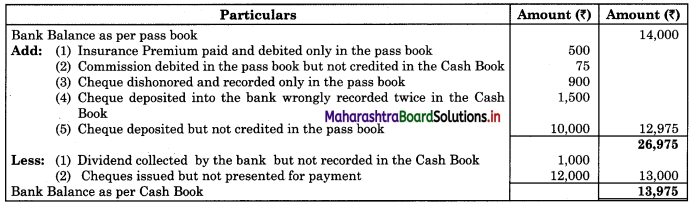
Question 4.
Secondary succession.
Answer:

  1. Secondary succession begins in areas where previously natural biotic communities were present. But later were destroyed due to causes such as abandoned farm lands, burnt or cut forests, flooded lands, etc.
  2. Secondary succession is faster than primary succession because already there is some soil or sediment present.
  3. It occurs in the form of changed vegetation. But due to changed vegetation, there is also change in the resident animals that depend for food and shelter.
  4. Thus, with secondary succession, the numbers and types of animals and decomposers also change.
  5. During succession, natural or human induced disturbances (fire, deforestation, etc.), can convert a particular serai stage of succession to an earlier previous / preceding stage.
  6. Sometimes, disturbances like this can create new conditions that encourage some species and eliminate other species.

Question 5.
Succession of Plants.

Answer:

  1. Succession of plants is of two types based on the nature of the habitat. These are hydrarch or hydrosere which is based on water or very wetland areas and xerarch or xerosere based on very dry areas.
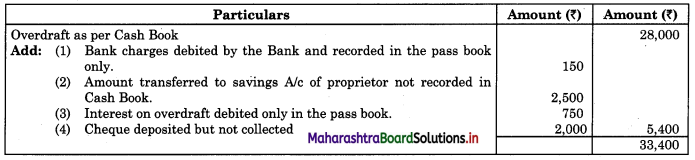
  2. In wetter areas hydrarch succession begins and then successional series progress from hydric to the mesic conditions.
  3. Xerarch succession starts in dry areas and the series progress from xeric to mesic conditions.
  4. Both hydrarch and xerarch successions lead to mesic or medium water condition which is neither too xeric nor too hydric.

Question 6.
Pioneer species.
Answer:

  1. Pioneer species are the ones that invade a bare area during primary succession.
  2. Crustose lichens which are able to secrete acids to dissolve rock usually start as pioneer species. They bring about weathering of rocks and soil formation.
  3. Later here bryophytes, mosses are settled as they can take hold in the small amount of soil. They are then followed by herbaceous plants, and after several more stages, ultimately a stable climax forest community is formed.

Question 7.
Succession in aquatic habitat.
Answer:

  1. In aquatic habitats the pioneer species in primary succession are the small phytoplankton.
  2. Phytoplankton are replaced by rooted- submerged plants (e.g. Hydrilla), rooted- floating angiosperms (e.g. Lotus) followed by free-floating plants (e.g.Pistia), then reed swamp (e.g. Typha), marsh-meadow (e.g. Cyperus), scrub (e.g. Alnus) and finally the trees (e.g. Quercus) in a very systematic and gradual way.
  3. The climax again would be a forest. With passage of time, the water body is converted into land.

Short Answer Questions

Question 1.
Describe the functions of the ecosystem.
Answer:
Functions of an ecosystem:

  1. Biological energy flow.
  2. Productivity of the ecosystem.
  3. Photosynthesis and respiration that take place in the ecosystem.
  4. Nutrient cycles operating in the ecosystem.
  5. Regulation of the environment by the organisms and the regulation of the organisms by the environment in turn.
  6. Interactions of biotic and abiotic components of the ecosystem.

Question 2.
What are the types of ecosystems? Give their suitable examples.
Answer:
Ecosystems are of two types, viz. natural ecosystem and artificial ecosystem.
(1) Natural ecosystems : The ecosystems which operate under natural conditions without any much major interference by man are called natural ecosystems. E.g. terrestrial ecosystems such as grasslands, forests, deserts, etc. or aquatic ecosystems such as lakes, river, wetland, etc.

(2) Artificial ecosystems : The man engineered ecosystems which are maintained artificially by man by the addition of energy are called artificial ecosystems. These ecosystems are dependent upon manipulations from human beings. E.g. croplands, aquarium, aquaculture, etc. are the types of artificial ecosystems.

Question 3.
What are the different components of ecosystem?
Answer:
(1) There are two main components of the ecosystem, viz. abiotic components and biotic components.

(2) Abiotic components include all the inorganic substances such as B S, C, N, H, etc., their distribution and amount available in an ecosystem and the organic compounds such as proteins, carbohydrates, lipids, etc. along with the climate of that region.

(3) Biotic components include all the living organisms living in an ecosystem. The living organisms may be autotrophic or producers and converters or transducers. These are either green plants having photosynthetic abilities or chemosynthetic microorganisms. The heterotrophic organisms are called consumers.

They can either be macroconsumers or microconsumers.

  1. Macroconsumers are herbivores, carnivores or omnivores as per the order in which they appear in the food chain.
  2. Herbivores are primary consumers while the carnivores are secondary consumers.
  3. Omnivores can be secondary or tertiary consumers.
  4. Microconsumers are decomposing organisms and hence they are also called decomposers. They have saprophytic mode of nutrition. Bacteria, actinomycetes and fungi are some of the microconsumers.
  5. Microconsumers decompose complex organic compounds from dead and living protoplasm and release the inorganic nutrients obtained from them, back to the environment.

Question 4.
What are the two spatial patterns in an ecosystem? Describe them briefly.
Answer:

  1. There are two spatial patterns recognized in an ecosystem, viz. zonation and stratification.
  2. Zonation is the spatial pattern which occurs horizontally along the ground. Along a horizontal gradient, the density and distribution of the species keep on varying.
  3. Stratification is the spatial pattern which occurs vertically. This is determined by the height of organisms. Such stratification is seen in forest community where trees of different species grow to different heights.

Question 5.
Describe the concept of energy flow.
OR
In an ecosystem the flow of energy is unidirectional. Explain.
Answer:
(1) For considering the energy flow in an ecosystem the following aspects have to be taken into account:

  • The efficiency of the producers in the absorption and conversion of the solar energy.
  • The quantity of converted energy is used by the consumers.
  • The total input of energy in the form of food and its efficiency of assimilation by the consumers.
  • The amount of energy is lost through respiration, heat, excretion, etc.
  • The ultimate gross net production.

(2) The energy captured by autotrophs never returns back to the sun. The energy obtained by the herbivores will never go back to autotrophs. Hence energy flow is always unidirectional.

(3) The energy flow through different trophic levels is progressive and hence previous trophic level cannot get this back.

(4) The amount of energy keeps on decreasing as it travels to further trophic level. This loss of energy is due to dissipation as heat formed during various metabolic activities of the organism. The energy loss is measured as respiration coupled with unutilized energy.

(5) If the food chain is shorter there is greater amount of available food energy. When the length of food chain increases, there is corresponding more loss of energy.

Question 6.
What could be the reason for the low productivity of ocean?
Answer:

  1. The conditions of land and in ocean are not same. Primary productivity which is the biomass or dry weight produced by the plants per unit area during the photosynthesis is different for oceanic ecosystem.
  2. In ocean, sunlight does not penetrate uniformly at all depths. It is thus the main limiting factor which decreases the rate- of photosynthesis.
  3. Decrease in rate of photosynthesis decreases the growth of phytoplankton and then that of the zooplankton. Aquatic plants such as algae are also affected due to lack of sunlight.
  4. Minerals and nutrients is also a limiting factor based on location of the oceans.
  5. Therefore, there is less productivity of the oceans to about 55 billion tons as compared to productivity on land which is about 170 billion tonnes.

Question 7.
What could be the connecting points between the GFC and DFC?
Answer:

  1. In grazing food chain, the energy is transferred from producers to consumers.
  2. The autotrophs convert inorganic matter into organic compounds which is then transferred in food chain or food web.
  3. In detritus food chain energy is obtained from organic matter or detritus generated in trophic levels of the grazing food chain.
  4. Detritus such as dead bodies of animals or fallen leaves, which are then eaten by decomposers or detritivores.
  5. These detritivores can also be consumed in grazing food chain by secondary consumers or predators.
  6. When decomposers convert organic matter back into inorganic substances, the autotrophs use these minerals again.
  7. In this way GFC and DFC are connected to each other in cyclic and mutual exchanges.

Maharashtra Board Class 12 Biology Important Questions Chapter 14 Ecosystems and Energy Flow

Question 8.
How will you classify man as carnivore (primary/ secondary) or omnivore? Why?
Answer:
Autotrophic producers or plants make the first trophic level. They synthesize their own food. Herbivores are primary consumers. They eat producers. Carnivores are secondary consumers. They eat primary consumers. The trophic level of man is omnivore as he eats both plants and animals. Non vegetarian person can be called carnivore while totally vegetarian person can be herbivore. However, the most appropriate placement of man is omnivorous.

Question 9.
How many trophic levels human beings function in a food chain?
Answer:
(1) All food chains and webs have at least two dr three trophic levels. Generally, there are a maximum of four tropic levels. Many consumers feed at more than one tropic level.

(2) Man is a primary consumer when he eat plants such as vegetables. Vegans and vegetarians who do not consume any animal product, fish or meat of any kind are primary consumers. They belong to the second trophic level.

(3) But some humans have different dietary choices. Many humans are omnivores, meaning they consume both plant and animal material. Thus, they may be on the third or even fourth tropic level.

(4) For example, if man consumes goat meat he is a part of the third tropic level.

(5) But when he eats bigger fish (and considering fish eats smellier fish) he becomes tertiary consumer on the fourth tropic level.

Question 10.
What is climax community? What leads to such a community?
Answer:

  1. Climax community is the community which is near equilibrium with the environment.
  2. The sequential changes in the structure and composition of the community, to adjust with the changing environment is called a climax community.

Question 11.
From algae to forest, explain in relation with the succession.
Answer:

  1. When there is a succession from algae to forest, it depends upon the amount of water available.
  2. The succession begins with small phyto-planktons followed by submerged and free floating and then rooted hydrophytes, sages, grasses and finally the trees.
  3. Similarly, there is also a transformation from a pool of water to swamp then marsh and then mesic which means neither too dry nor too wet conditions.
  4. Then small plants like mosses can inhabit followed by herbs, shrubs and then trees. Such succession ultimately leads to a stable climax forest community.

Question 12.
Explain the following terms with reference to ecological succession.
(1) Serai stages.
Answer:
The developmental stages of the ecological succession are known as serai stages.

(2) Pioneers.
Answer:
The organisms belonging to first serai stage in the ecological succession are known as pioneers.

(3) Hydrosere.
Answer:
Hydrosere or hydrarch succession is a type of ecological succession which is determined by the amount of water available during succession. Hydrosere occurs when there is abundant water available in the area where organisms reside.

(4) Xerosere.
Answer:
Xerosere or xerarch succession is a type of ecological succession which is determined by the amount of water available during succession. Xerosere occurs when there is very little water available in the area where organisms reside. Such succession is observed in desert regions.

Question 13.
Why is zonation more pronounced at the edges of habitat?
Answer:

  1. Edge of the habitat is an abruptly changing region. E.g. the shore or littoral zone is the edge between aquatic and terrestrial habitats.
  2. At such places there is variety of environmental factors, such as temperature, wind exposure, light intensity, wave action, and salinity, etc.
  3. These abiotic factors are never constant in such areas and they show tremendous variation.
  4. Therefore, the intertidal communities show differences in regions that are occupied by them. In this way zonation is more pronounced in such areas when edges of habitat are present.

Question 14.
What is the maximum number of trophic levels in a food chain?
Answer:

  1. There are maximum four trophic levels in an ecosystem.
  2. Rarely five levels are seen where it is occupied by apex consumer.
  3. But as the trophic levels are moving from producers to consumers, lesser and lesser energy remains.
  4. Through heat loss, lot of amount of energy is dissipated, therefore no ecosystem can sustain fifth trophic level.

Question 15.
How would you explain inverted pyramid of biomass in oceanic ecosystem?
Answer:

  1. Pyramid of biomass is inverted in an oceanic ecosystem because in oceans the biomass of fishes is much more than the biomass of phytoplanktons.
  2. The biomass of phytoplanktons which are the producers in the ocean is smaller than that of zooplanktons.
  3. Zooplankton are primary consumers in oceans. The biomass of zooplanktons is smaller than that of secondary consumers which are fish.
  4. This results in the inverted pyramid of biomass is an oceanic ecosystem.
  5. Also the life span of phytoplankton is very small, which are consumed almost as rapidly as they are formed.
  6. The phytoplankton have high reproductive potential by which they reproduce rapidly. All these facts make the pyramid inverted in case of oceanic ecosystem.

Question 16.
What is secondary productivity? What is annual net primary productivity of biosphere?
Answer:

  1. Secondary productivity is defined as the rate of formation of new organic matter by consumers.
  2. It is the rate of assimilation of food energy by the consumers.
  3. This amount of energy available to consumer for transfer to the next trophic level.
  4. The annual net primary productivity of the whole biosphere is approximately 170 billion tonnes (dry weight) of organic matter. Of 170 billion tonnes, the oceans create about 55 billion tonnes, and rest is by land ecosystems.

Complete the given chart

Trophic levelsType of organismsStatusExample
…………….….……………………..Secondary consumer……………………..
……………..…Herbivore, Heterotrophs……………………..…………………….
……………..…Autotrophs…………………….Phytoplankton, grass, trees

Answer:

Trophic levelsType of organismsStatusExample
Third trophic levelCarnivore, HeterotrophsSecondary consumerLion, Frog
Second trophic levelHerbivore, HeterotrophsPrimary consumerCattle, Sheep, Deer
First trophic levelAutotrophsProducerPhytoplankton, grass, trees

Diagram based questions

Question 1.
Sketch and label Carbon cycle
Answer:
Maharashtra Board Class 12 Biology Important Questions Chapter 14 Ecosystems and Energy Flow 3

Question 2.
Sketch and label phosphorus cycle
Answer:
Maharashtra Board Class 12 Biology Important Questions Chapter 14 Ecosystems and Energy Flow 4

Question 3.
Sketch and label decomposition cycle
Answer:
Maharashtra Board Class 12 Biology Important Questions Chapter 14 Ecosystems and Energy Flow 5

Question 4.
Sketch and label simple grazing food chain
Answer:
Maharashtra Board Class 12 Biology Important Questions Chapter 14 Ecosystems and Energy Flow 6

Maharashtra Board Class 12 Biology Important Questions Chapter 14 Ecosystems and Energy Flow

Question 5.
Sketch and label ecological pyramids of energy and pyramid of biomass
Answer:
Maharashtra Board Class 12 Biology Important Questions Chapter 14 Ecosystems and Energy Flow 7

Question 6.
Observe pyramids of numbers and answer the questions below
Maharashtra Board Class 12 Biology Important Questions Chapter 14 Ecosystems and Energy Flow 8
Questions:
1. In the above pyramid of numbers how many primary consumers are supporting secondary consumers? What will happen if the numbers are reversed?
2. When does pyramid of numbers get inverted in case of a single tree ecosystem ?
3. What will happen, if in the above example, we substitute larger bird of prey feeding on small insect eating birds?
Answer:
(1) 500,000 primary consumers are supporting 5000 secondary consumers. If the numbers are reversed, i.e. if primary consumers are lesser than secondary consumers, then the secondary consumers will have fierce competition and will lead to decline in their number too. The pyramid of numbers will get inverted in such case.

(2) If we plot the number of insects on a single tree, smaller birds feeding on insects, and parasites on those birds, we get an inverted pyramid.

(3) If large birds are feeding on smaller insect eating birds, their population will decrease. This will result into increased number of insects as there will be no check on the insect population due to loss of smaller predator birds. If larger birds keep on feeding constantly and unchecked on smaller birds, the smaller ones will eventually become lesser and lesser in their population and this in turn will starve the larger birds too, leading in decrease of their population too.

Question 7.
Observe the given food web and answer the questions
Maharashtra Board Class 12 Biology Important Questions Chapter 14 Ecosystems and Energy Flow 9
Questions
1. Name the producers in the above web.
2. Name the primary consumers in the above web.
3. Which is an omnivore animal in the above web? Why?
4. Why frog is occupying an important ecological position in this web?
5. From the given food web diagram, give the trophic levels where the eagle is present.
Answer:
1. Corn crop, flowering plant, lavender plant, mango tree
2. Grasshopper, butterfly, fruit fly
3. Rat, because it feeds on grains of corn as well as on insects.

4. Frog feeds on insects and keeps the insect population under check. It also falls prey to snakes and birds of prey like eagle. Thus, supports their population by providing food.

5. (1) Eagle is apex consumer in the following cases : Lavender/Producer → Butterfly/ Primary consumer → Dragon fly /Secondary consumer → Thrush/Tertiary consumer → Eagle/Apex consumer
Or
Corn/Producer → grasshopper/Primary consumer → frog/Secondary consumer → python/Tertiary consumer → eagle/Apex consumer.
(2) Eagle is tertiary consumer in the following case : Rat/Primary consumer → python/ Secondary consumer → eagle/Tertiary consumer
(3) Secondary consumer in the following case : Rat/Primary consumer → eagle/ Secondary consumer

Question 8.
Observe the given figure and answer the questions:
Maharashtra Board Class 12 Biology Important Questions Chapter 14 Ecosystems and Energy Flow 10
Questions:
1. Which trophic level has maximum energy?
2. Why carnivores have least energy shown in this diagram?
Answer:
1. Producers which form first trophic level has maximum energy.

2. When energy flows from one trophic level to the next, some amount is lost as heat. As it can be seen that producers had 1000 joules of energy, out of which 900 joules are lost when energy flowed from producers to primary consumers. Further, it was lost again by 90 joules while herbivore to carnivore energy flow was taking place. Therefore, the carnivore gets least energy as it is the higher trophic level.

Question 9.
Identify A, B, C, D and E given in sketch of carbon cycle
Maharashtra Board Class 12 Biology Important Questions Chapter 14 Ecosystems and Energy Flow 11
Answer:
A : Combustion
B : Respiration by plants
C : Respiration by animals
D : Photosynthesis
E : Decomposition.

Question 10.
Observe the diagram and answer the questions
Maharashtra Board Class 12 Biology Important Questions Chapter 14 Ecosystems and Energy Flow 12
1. Fill in the empty boxes with proper words in the above figure.
2. Which cycle is it depicting?
3. What kind of cycle is it?
Answer:
1. A : geological uplifting, B : Weathering of phosphate from rocks, C : Phophaste in solution. D : Detritus settling at bottom, E : Sedimentation forming New rocks, F : Phosphate in soil, G : Leaching
2. Phosphorus cycle
3. Sedimentary cycle

Long answer questions

Question 1.
Describe the pathway followed by phosphorus in an ecosystem.
Answer:
Maharashtra Board Class 12 Biology Important Questions Chapter 14 Ecosystems and Energy Flow 13
(1) The phosphorus cycle is the simplest of all the nutrient cycles, which is a type of sedimentary cycle. It constitutes cyclic movement of phosphorus through hydrosphere, lithosphere and biosphere.

(2) Since phosphorus is a heavy molecule it never goes into the atmosphere. Phosphorus remains in the bodies of organisms, dissolved in water or in the form of rock. The natural reservoir of phosphorus is rock in which phosphorus is present in the form of phophates.

(3) Upon weathering of the rock due to action of mildly acidic water, the phosphates in the rock go into the solution.

(4) Plants take up phosphorus in the form of phosphate. The roots of plants can absorb phosphate ions from the soil. Animals obtain phosphorus through food which they consume. Thus autotrophs supply phosphorus to heterotrophs. Phosphorus is a major biological constituent of all the living organisms.
It is found in biological membranes, nucleic acids e.g. DNA, RNA, cellular energy transfer systems such as ATE Phosphorus is thus an essential element.

(5) The requirement of phosphorus in animals is much more as it is the component of bones, hooves, teeth, shells.

(6) The waste products formed through defecation and the dead organisms are decomposed by phosphate-solubilizing bacteria releasing phosphorus. This in turn is used up by other growing plants. Phosphorus is always in short supply and hence acts as limiting factor for the plant growth.

Sudden influx of phosphorus in the form of agricultural runoff or industrial effluents rich in phosphate content, leads to eutrophication in water bodies. Eutrophication is due to overgrowth of algae at the instance of high phosphorus dissolved in water. The overgrowth of algae kills or harms the aquatic life.

Question 2.
What are the most important ecological services whose value cannot be determined?
Answer:
(1) The main ecological services are fixation of atmospheric CO2 and release of O2 are the most important services provided by an ecosystem.

(2) Photosynthetic activity of photoautotrophs helps in carbon sequestration in the form of CO2 from the atmosphere. At the same time it releases O2 as a by-product.

(3) O2 is needed for respiration by all aerobic organisms. Oxygen also purifies air.

(4) For human consumption, crops and fruits are continuously required. These can be produced only after pollination of plants. Wind, water or other biotic agent such as insects therefore play an important role as ecosystem service. Without pollination there would be no crops and no fruits.

Question 3.
What are the four categories of ecosystem services as given by Millennium Ecosystem Assessment Report in 2005? What are the services included in each?
Answer:
Ecosystem services are of following four categories:
(1) Supporting services : Support to the life on earth such as nutrient cycling, primary production, soil formation, habitat provision, pollination and overall maintenance of balance of ecosystem.

(2) Provisioning services : Provides necessities such as food in the form of crops, fruits and seafood, raw materials such as timber, skins, fuel wood, genetic resources in the form of seeds, crop improvement genes, and health care, other resources such as water, medicinal resources in the form of test and assay organisms and ornamental resources such as furs, feathers, ivory, orchids, butterflies, etc.

Maharashtra Board Class 12 Biology Important Questions Chapter 14 Ecosystems and Energy Flow

(3) Regulating services : Regulation of processes on the earth such as carbon sequestration, prey-predation regulation, waste decomposition and detoxification, purification of water and air and pest control.

(4) Cultural services : Under this category, humans get services from nature in the form of cultural, spiritual and historical, recreational experiences, opportunity to learn science and indulge in education, and pets and animal therapy.

Maharashtra Board Class 12 Biology Important Questions Chapter 13 Organisms and Populations

Balbharti Maharashtra State Board 12th Biology Important Questions Chapter 13 Organisms and Populations Important Questions and Answers.

Maharashtra State Board 12th Biology Important Questions Chapter 13 Organisms and Populations

Multiple Choice Questions

Question 1.
All ecosystems on the earth together form
(a) biosphere
(b) biome
(c) living world
(d) environment
Answer:
(a) biosphere

Question 2.
What is the mean annual temperature in the region of Arctic and Alpine tundra ?
(a) About -10 to 2 °C
(b) About -2 to 2 °C
(c) About 0 to 5 °C
(d) About 5 to 10 °C
Answer:
(a) About -10 to 2 °C

Maharashtra Board Class 12 Biology Important Questions Chapter 13 Organisms and Populations

Question 3.
Which out of the following are the major biomes in India ?
(I) Desert (II) Grassland (III) Tropical rain forest (IV) Temperate forest (V) Coniferous forest (VI) Deciduous forest (VII) Sea coast (VIII) Tundra
(a) (II) (IV) (VI) (VII)
(b) (I) (II) (V) (VIII)
(c) (I) (III) (VI) (VII)
(d) (II) (III) (VI) (VIII)
Answer:
(c) (I) (III) (VI) (VII)

Question 4.
Important key elements that bring about variations in the different habitats are
(a) temperature, water, light and soil
(b) salinity, pollutants, water
(c) modern developmental parameters in the region
(d) scientific progress and technological innovations
Answer:
(a) temperature, water, light and soil

Question 5.
Which out of the following is the most ecologically relevant factor?
(a) Water
(b) Temperature
(c) Salinity
(d) Wind speed
Answer:
(b) Temperature

Question 6.
Animals that can tolerate a narrow range of temperature are
(a) stenothermal
(b) eurythermal
(c) poikilothermic
(d) homeothermic
Answer:
(a) stenothermal

Question 7.
Animals that can tolerate a narrow range of salinity are
(a) euryhaline
(b) anadromous
(c) catadromous
(d) stenohaline
Answer:
(d) stenohaline

Question 8.
What is the source of energy in the depths of more than 500 m in the oceans?
(a) Sunlight
(b) Wind energy
(c) Dead and decaying matter
(d) Phytoplankton
Answer:
(c) Dead and decaying matter

Question 9.
Which factor does not determine percolation and water holding capacity of the soil?
(a) Soil composition
(b) Grain size
(c) Aggregation of soil particles
(d) Vegetation on that soil
Answer:
(d) Vegetation on that soil

Question 10.
Which factors of soil does not determine the vegetation in any area?
(a) pH
(b) mineral composition
(c) topography
(d) types of microorganisms
Answer:
(d) types of microorganisms

Question 11.
Find the odd one out
(a) Dormancy
(b) Hibernation
(c) Aestivation
(d) Migration
Answer:
(d) Migration

Question 12.
Which of the following ability is present in the desert animals?
(a) Ability to concentrate urine.
(b) Ability to remain inside the shelters and escape need of water.
(c) Ability to derive water from all the fruits.
(d) Ability to absorb water from air.
Answer:
(a) Ability to concentrate urine.

Question 13.
Which of the statement does not describe the adaptation of the desert plants ?
(a) Desert plants have a thick cuticle on their leaf surfaces.
(b) Desert plants have their stomata arranged in sunken pits.
(c) Desert plants have a special photosynthetic pathway called CAM.
(d) Desert plants have soft stems and large leaves.
Answer:
(d) Desert plants have soft stems and large leaves.

Question 14.
What is the use of CAM type of photosynthetic pathway for the desert plants ?
(a) It enables their stomata to remain closed during day time.
(b) It requires less sunlight for the photosynthesis.
(c) It requires less amount of chlorophyll during photosynthesis.
(d) The water absorbed from the soil by the plants during CAM photosynthetic pathway is less.
Answer:
(a) It enables their stomata to remain closed during day time.

Question 15.
In which plant photosynthetic function is taken over by the flattened stems?
(a) Nephrolepis
(b) Cycas
(c) Opuntia
(d) Zea mays
Answer:
(c) Opuntia

Question 16.
What is Allen’s rule?
(a) Mammals from colder climates generally have shorter ears and limbs to minimise heat loss.
(b) Mammals have constant temperature of the body in spite of their varied habitats.
(c) Mammals can be oviparous at times.
(d) The ecosystem of cold climate regions is equally occupied with mammals, birds and reptiles.
Answer:
(a) Mammals from colder climates generally have shorter ears and limbs to minimise heat loss.

Question 17.
Sunken stomata is the characteristic feature of
(a) hydrophyte
(b) mesophyte
(c) xerophyte
(d) halophyte
Answer:
(c) xerophyte

Question 18.
Which of the following pairs is correctly matched ?
(a) Uricotelism-aquatic habitat
(b) Parasitism-intra-specific relationship
(c) Excessive perspiration-xeric adaptation
(d) Stream-lined body-aquatic adaptation
Answer:
(d) Stream-lined body-aquatic adaptation

Question 19.
World population day is observed on
(a) 11th July
(b) 16th September
(c) 23rd October
(d) 1st December
Answer:
(a) 11th July

Question 20.
World Environment day is celebrated on
(a) 22nd April
(b) 5th June
(c) 1st October
(d) 16th November
Answer:
(b) 5th June

Question 21.
World Earth day is observed on
(a) 22nd April
(b) 5th June
(c) 21st October
(d) 26th November
Answer:
(a) 22nd April

Question 22.
World ozone day is celebrated on
(a) 5th June
(b) 16th September
(c) 1st October
(d) 23rd October
Answer:
(b) 16th September

Question 23.
A group of individuals belonging to the same species within an ecosystem is called a
(a) community
(b) habitat
(c) population
(d) specific group
Answer:
(c) population

Question 24.
The populations of different species that live and interact together in the ecosystem are called
(a) community
(b) habitat
(c) population
(d) interspecies
Answer:
(a) community

Question 25.
If do not occur in an ecosystem, the survival of organisms may not take place and functioning of ecosystem is lost.
(a) interactions
(b) struggle
(c) reproduction
(d) none of the above
Answer:
(a) interactions

Question 26.
If in a pond there were 200 lotus plants last year and through reproduction 20 new plants are added, taking the current population to 220, what is the natality rate of the lotus for that year ?
(a) 0.2
(b) 0.4
(c) 0.1
(d) 1.0
Answer:
(c) 0.1

Question 27.
During laboratory experiments, 30 fishes died from an aquarium tank having 150 fishes during one month. What is the rate of mortality of fishes per month ?
(a) 0.2
(b) 0.3
(c) 0.4
(d) 0.5
Answer:
(a) 0.2

Question 28.
Which of the following is correct statement?
(a) Natality can never be controlled in any population.
(b) If mortality is more than natality, the density of population declines.
(c) Natality and mortality are always same for every population.
(d) If natality is more than mortality the population size declines.
Answer:
(b) If mortality is more than natality, the density of population declines.

Question 29.
What is the apt definition of density?
(a) The capacity of a population to sustain.
(b) The total number of genes in a population.
(c) The total number of individuals in a population per unit area.
(d) The total number of births taking place.
Answer:
(c) The total number of individuals in a population per unit area.

Question 30.
On which of the following factors is growth rate of a population dependent ?
(a) Density and natality
(b) Natality and age structure
(c) Mortality and density
(d) Natality and mortality
Answer:
(a) Density and natality

Question 31.
When pre-reproductive age group is large in a population, what will be the growth rate of that population?
(a) Steady
(b) Rapid
(c) Declining
(d) None of these
Answer:
(b) Rapid

Question 32.
When pre-reproductive and post-reproductive age group is same in structure, the population is
(a) declining
(b) increasing
(c) steady
(d) disappearing
Answer:
(c) steady

Question 33.
In which type of interactions, interacting species do not live closely together ?
(a) Competition
(b) Parasitism
(c) Commensalism
(d) Predation
Answer:
(d) Predation

Maharashtra Board Class 12 Biology Important Questions Chapter 13 Organisms and Populations

Question 34.
Name the interaction in which one species is harmed but the other remains unaffected,
(a) Commensalism
(b) Parasitism
(c) Amensalism
(d) Competition
Answer:
(c) Amensalism

Question 35.
Choose the correct statement from the following
(a) Carnivores are the only predators in any ecosystem
(b) Herbivores are in a broad ecological context not very different from predators.
(c) Sparrow eating grain is not a predator.
(d) Predation and parasitism are one and the same.
Answer:
(b) Herbivores are in a broad ecological context not very different from predators.

Question 36.
What is the meaning of symbiosis?
(a) Living together
(b) Breeding together
(c) Fighting with each other
(d) Feeding together
Answer:
(a) Living together

Question 37.
Gause’s ‘Competitive Exclusion Principle’ can work only when
(a) the resources are limited
(b) the resources are abundant
(c) the inferior species and superior species do not need same resources
(d) only when there is interspecific competition
Answer:
(a) the resources are limited

Question 38.
The word commensalism means
(a) on the either side of the table
(b) sharing the table
(c) eating at the table of other
(d) on the top of the table
Answer:
(b) sharing the table

Question 39.
Which of the following is not a classical example of commensalism?
(a) An orchid growing as an epiphyte on a mango branch.
(b) Barnacles growing on the back of a whale.
(c) The cattle egret and grazing cattle.
(d) Lichen seen on the tree.
Answer:
(d) Lichen seen on the tree

Question 40.
Calotropis plant is poisonous for herbivores as it is rich in
(a) opium
(b) cardiac glycosides
(c) quinine
(d) strychnine
Answer:
(b) cardiac glycosides

Question 41.
Term ecology was first used by
(a) Grinnell
(b) Reiter
(c) Haeckel
(d) Darwin
Answer:
(b) Reiter

Question 42.
Who introduced subject ecology to the world.
(a) Reiter
(b) Grinnell
(c) Darwin
(d) E. Haeckel
Answer:
(d) E. Haeckel

Question 43.
The term niche was first time used by
(a) Grinnell
(b) Haeckel
(c) Mendel
(d) Darwin
Answer:
(a) Grinnell

Match the columns

Question 1.

Column AColumn B
(1) Organism(a) Large unit with specific climatic zone
(2) Population(b) Different species in particular area
(3) Community(c) Same species in a geographical area
(4) Biome(d) Basic unit of ecological hierarchy

Answer:

Column AColumn B
(1) Organism(d) Basic unit of ecological hierarchy
(2) Population(c) Same species in a geographical area
(3) Community(b) Different species in particular area
(4) Biome(a) Large unit with specific climatic zone

Question 2.

Water body ASalinity values B
(1) Streams(a) 340 ppt
(2) Indian Ocean(b) 5 ppt
(3) Hyper saline lagoon(c) 30-35 ppt
(4) Dead sea(d) 100 ppt

Answer:

Water body ASalinity values B
(1) Streams(b) 5 ppt
(2) Indian Ocean(c) 30-35 ppt
(3) Hyper saline lagoon(d) 100 ppt
(4) Dead sea(a) 340 ppt

Classify the following to form Column B as per the category given in Column A

Question 1.
Emigration, Immigration, More mortality, Unlimited resources, More natality, Continuous reproduction.

Column AColumn B
(1) Decrease in population density————–
(2) Increase in population density—————
(3) Exponential growth————–

Answer:

Column AColumn B
(1) Decrease in population densityEmigration, More mortality
(2) Increase in population densityImmigration, More natality
(3) Exponential growthUnlimited resources, Continuous reproduction.

Question 2.
Hungary, United States, Denmark, Italy, Australia, Kenya, Nigeria, Germany

Pattern of population growthName of the countries
(1) Rapid growth————–
(2) Slow growth—————
(3) Zero growth————–
(4) Negative growth————–

Answer:

Pattern of population growthName of the countries
(1) Rapid growthKenya, Nigeria
(2) Slow growthUnited States, Australia
(3) Zero growthDenmark, Italy
(4) Negative growthHungary, Germany

Question 3.
Epiphytic orchid and mango tree, Ascaris and human, Egret and cattle, Lichen having alga and fungus, Bumblebee and flowering plant, Plasmodium vivax and man.

Column AColumn B
(1) Mutualism————–
(2) Commensalism—————
(3) Parasitism————–

Answer:

Column AColumn B
(1) MutualismLichen having alga and fungus, Bumblebee and flowering plant.
(2) CommensalismEpiphytic orchid and mango tree, Egret and cattle.
(3) ParasitismAscaris and human, Plasmodium vivax and man.

Very short answer questions

Question 1.
What are the key abiotic factors that influence all habitats?
Answer:
Key abiotic factors that influence all habitats are ambient temperature, availability of water, light and type of soil.

Question 2.
What is homeostasis?
Answer:
Homeostasis is the state of steady interned, physical and chemical conditions maintained by living systems.

Question 3.
What is meant by eurythermal?
Answer:
Eurythermal are those organisms that can tolerate and thrive in a wide range of temperatures.

Question 4.
What is meant by stenothermal?
Answer:
Stenothermal are those organisms which are restricted to only narrow range of temperatures.

Maharashtra Board Class 12 Biology Important Questions Chapter 13 Organisms and Populations

Question 5.
What is euryhaline?
Answer:
Organisms which can tolerate wide range of salinities are called euryhaline.

Question 6.
What is stenohaline?
Answer:
Organisms which are restricted only to a narrow range of salinity are called stenohaline.

Question 7.
What are the various characteristics of soil?
Answer:
Characteristics of the soil are soil composition, grain size, the percolation and water holding capacity, pH, mineral composition of the soil.

Question 8.
What decides the vegetation of an area?
Answer:
The soil characteristics along with pH, mineral composition and topography, and climatic factors determine the vegetation of an area.

Question 9.
What is Population ecology?
Answer:
Population ecology is an important area of ecology because it links ecology to population dynamics, genetics and evolution.

Question 10.
In which interaction of species, both the species are at a loss?
Answer:
Competition is the type of interaction where . both the species are at a loss.

Question 11.
What is parasitism?
Answer:
Parasitism is the type of interaction between two species in which parasitic species is benefited and the host species is harmed.

Question 12.
What are ectoparasites?
Answer:
Parasites that feed on the external surface of the host organism are called ectoparasites.

Question 13.
Name blood sucking ectoparasites.
Answer:
Lice, mosquito feeding on human blood and ticks parasitic on dogs.

Question 14.
Name the malarial parasite and its vector.
Answer:
The malarial parasite is Plasmodium vivax which needs a vector anopheles mosquito.

Question 15.
Name the secondary metabolites that act as defensive substances against grazers and browsers.
Answer:
Nicotine, caffeine, quinine, strychnine, opium, etc. are secondary metabolites which act as defensive substances produced by plants against grazers and browsers.

Question 16.
Name the ectoparasites which infest the marine fish.
Answer:
Copepods are the ectoparasites which infest the marine fish.

Question 17.
What do you mean by ‘evolutionary arms race’? In which kind of interactions is it observed?
Answer:
In order to save their lives, prey species : have evolved various defence mechanisms. This are called ‘evolutionary arms race’. These defence mechanisms are seen in prey-predator interactions.

Give Definitions of the following

Question 1.
Habitat
Answer:
The physical space of an organism with the other living or non-living factors is called its habitat.

Question 2.
Microhabitat
Answer:
The immediate surrounding of an organism is called microhabitat.

Question 3.
Niche
Answer:
Niche is defined as the processes about how that organism is linked with its physical and biological environment.

Question 4.
Fundamental niche
Answer:
Fundamental niche is the niche in the absence of all competitors, this is highly improbable in nature.

Question 5.
Realized niche
Realized niche is more realistic approach, in the presence of competition for the resources available in the habitat.

Question 6.
Competition
Answer:
Competition is defined as a process in which the fitness of one species is significantly lowered in the presence of another species.

Give one or two examples of the following

Question 1.
Intraspecific competition
Answer:
Two dogs fighting for same food. Two tomcats fighting for their territory.

Question 2.
Commensalism
Answer:
An orchid growing as an epiphyte on a branch of mango tree, is benefited due to support offered by mango tree but the mango tree does not get any benefit.

Maharashtra Board Class 12 Biology Important Questions Chapter 13 Organisms and Populations

Question 3.
Ectoparasites
Answer:
Mosquito, louse sucks blood from human host.

Question 4.
Endoparasites
Answer:
Round worm. Ascaris and tape worm are endoparasites in the intestine of humans.

Name the type of association

Question 1.
Cattle egret birds with buffalo.
Answer:
Commensalism

Question 2.
Tiger and the deer.
Answer:
Predator and prey relationship

Question 3.
Visiting flamingos and fishes in the estuarine water.
Answer:
Interspecific competition.

Distinguish between the following

Question 1.
Natality and Mortality.
Answer:

NatalityMortality
1. Birth rate of any population is called its natality.1. Death rate of any population is called its mortality.
2. Rise in natality increase the population density.2. Rise in mortality decrease the population density.
3. Decline in natality decrease the population.3. Decline in mortality increase the population.
4. Natality is the positive factor for population growth.4. Mortality is the negative factor for population growth.
5. Absolute natality will always be more than realized natality.5. Absolute mortality will always be less them realized mortality.

Question 2.
Eurythermal and stenothermal.
Answer:

EurythermalStenothermal
1. Animals which can tolerate wide range of temperatures are called eurythermal.1. Animals which can tolerate only narrow range of temperature fluctuations are called stenothermal.
2. Eurythermal animals show reduced temperature sensitivity.2. Stenothermal animals show high temperature sensitivity.
3. Body functions of eurythermal animals can occur at wide range of temperature range.

E.g. Goat, man, cat, dog, tiger, cow, sheep, monkey, crab, etc.

3. Body functions of stenothermal animals can occur at only narrow range of temperature range.

E.g. Insects, fishes, reptiles, snakes, etc.

Give scientific reasons

Question 1.
Temperature is said to be the most ecologically relevant environmental factor.
Answer:

  1. Temperature fluctuations on the earth are quite marked.
  2. The distribution of plants and animals on the earth depends upon temperature range.
  3. For the organisms ambient temperature affects their enzyme kinetics of the cell.
  4. Entire metabolism, activity and other physiology of the organism is dependent on temperature. Therefore, it is said to be the most ecologically relevant environmental factor.

Question 2.
Adaptation is an important attribute of the organism.
Answer:

  1. Organisms adapt to their surrounding environment by showing physiological, behavioural or morphological changes which are called adaptations.
  2. Due to adaptations, organisms can survive and reproduce in its environment. Therefore, adaptation is said to be am important attribute of the organisms.

Question 3.
Both host and the parasite tend to co¬evolve, against each other.
Answer:

  1. Host and parasitic relationship is most specific. This means that for a particular parasite there is specific host.
  2. Many parasites have evolved to be host-specific as they can parasitize only a single species of host. Therefore, during evolution, they both co-evolve together, against each other.

Question 4.
Cuscuta plant does not have chlorophyll.
Answer:

  1. Cuscuta is a parasitic plant. It is commonly found growing on hedge plant.
  2. It derives its nutrition directly from the host plant on which it thrives by parasitizing it.
  3. Since it does not prepare its own food by photosynthesis, it loses chlorophyll from the leaves.

Question 5.
Predators in nature are called prudent.
Answer:

  1. Predators control the prey population but if a predator over exploits its prey, then the prey might become extinct.
  2. If prey species is not available, the predator will also starve and become extinct. Predators, therefore, do not kill the prey unnecessarily. They act as prudent.

Write short notes

Question 1.
Temperature fluctuations on the earth.
Answer:

  1. The temperatures vary from subzero levels in polar areas and high altitudes, to about 50 °C in tropical deserts during summer.
  2. There are also seasonal changes in the temperature.
  3. Temperature also shows progressive decrease from the equator towards the poles and from plains to the mountain tops.
  4. Some unique habitats such as hot springs may show very high temperatures of about 80 to 100 °C.
  5. In deep-sea hydrothermal vents average temperatures may rise up to 400 °C.

Question 2.
Adaptations of mammals in colder regions.
Answer:

  1. Mammals inhabiting colder regions have shorter snout, ears, tail and limbs to minimize the loss of body heat. This is called Allen’s Rule.
  2. Aquatic mammals such as whales and seals living in the polar seas, have a thick layer of fat which is called a blubber below their skin.
  3. Blubber acts as an insulator and thus helps to keep the body warm by reducing loss of body heat.
  4. Some animals like polar bears undergo hibernation and thus tide over the stressful winters.

Question 3.
Natality.
Answer:

  1. Natality is the birth rate of a population. Due to increased natality the population density rises.
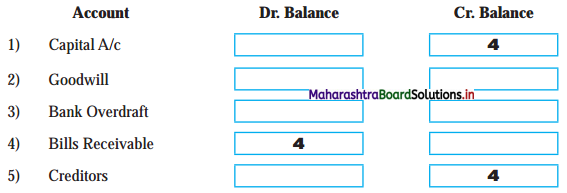
  2. Natality is a crude birth rate or specific birth rate.
  3. Crude birth rate : Number of births per 1000 population/year gives crude birth rate. Crude birth rate is helpful in calculating population size.
  4. Specific birth rate : Crude birth rate is relative to a specific criterion such as age. E.g. If in a pond, there were 200 carp fish and their population rises to 800. Then, taking the current population to 1000, the birth rate becomes 800/200 = 4 offspring per carp per year. This is specific birth rate.
  5. Absolute Natality : The number of births under ideal conditions when there is no competition and the resources such as food and water are abundant, then it give absolute natality.
  6. Realized Natality : The number of births under different environmental pressures give realized natality. Absolute natality will be always more than realized natality.

Maharashtra Board Class 12 Biology Important Questions Chapter 13 Organisms and Populations

Question 4.
Mortality.
Answer:

  1. Mortality is the death rate of a population. It gives a measure of the number of deaths in a particular population, in proportion to the size of that population, per unit of time.
  2. Mortality rate is typically expressed in deaths per 1,000 individuals per year.
    A mortality rate of 9.5 (out of 1,000) in a population of 1,000 would mean 9.5 deaths per year in that entire population or 0.95% out of the total.
  3. Absolute Mortality : The number of deaths under ideal conditions when there is no competition, and all the resources such as food and water are abundant, then it gives absolute mortality.
  4. Realized Mortality : The number of deaths under environmental pressures come into play gives realized mortality.
  5. It must be remembered that absolute mortality will always be less than realized mortality.

Question 5.
Populations Interactions
Answer:

  1. In nature, every species requires interactions with at least one other species for its food.
  2. Even autotrophic plant species needs soil microbes to break down the organic matter in soil and return the inorganic nutrients for absorption.
  3. The plants need animal agents . for pollination.
  4. Animals, plants and microbes cannot live in isolation but interact in various ways to form a biological community.
  5. Such interactions can be interspecific (within two different species) or intraspecific (within the same species).
  6. Interspecific interactions are of broad four types viz, neutralism, negative or harmful, positive or beneficial, and both positive and negative interactions.
  7. Interacting species live closely together in interactions such as predation, parasitism and commensalism.
  8. Neutralism interaction have no significant effect on either species. Negative interactions are of competition or amensalism type. Positive interactions occur in the form of mutualism, protocooperation and commensalism. Parasitism and predation are both positive and negative type of interaction.
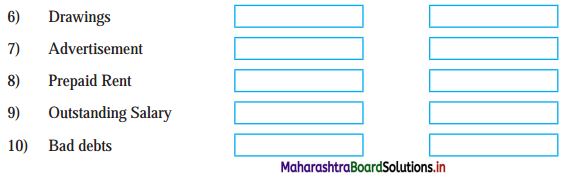
Question 6.
Mutualism
Answer:

  1. Mutualism is an obligatory and interdependent interaction. It is an association of two species in which both of them are benefited.
  2. The classic example of mutualism is lichens. Lichen is an intimate, mutualistic relationship between a fungus and photosynthetic algae or cyanobacteria.
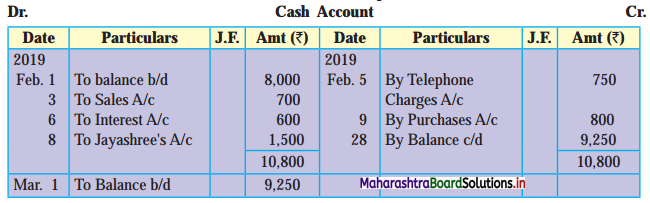
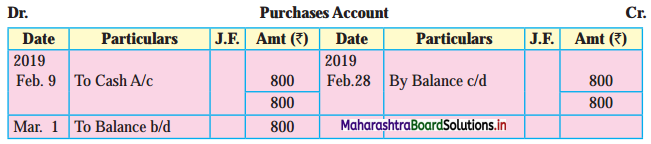
  3. Most of the plant and animal interactions are of mutualistic type.
  4. For pollination and seed dispersal, plants depend on the animals.
  5. Animals in turn feed on pollen and nectar during pollination. During seed dispersal juicy and nutritious fruits are used by the animals.
  6. In animal-animal interactions also mutualism is seen in many instances.

Question 7.
Brood parasitism
Answer:

  1. Brood parasitism is a type of parasitic behaviour shown by Asian Koel. Koel lays its eggs in the nest of crow.
  2. Crow acts as a host bird and incubate the eggs of koel.
  3. The eggs of koel show resemblance to the host’s egg in size and colour. This reduces the chances of the crow detecting koel’s eggs and ejecting them from the nest.
  4. Eggs of koel hatch before the host’s eggs and hence parasitic bird is in advantage.

Short answer questions

Question 1.
What are the three main types of niches?
Answer:

  1. Spatial or habitat niche : Spatial or habitat niche means the physical space occupied by the organisms.
  2. Trophic niche : This kind of niche is based on the trophic level of an organism in a food chain.
  3. Multidimensional or hypervolume niche : In multidimensional niche, number of abiotic and biotic environmental factors are considered. The resulting space by the niche is called hypervolume. Therefore it is also called hypervolume niche.
  4. It shows the position of an organism in the environmental gradient.

Question 2.
Why do animals need to maintain homeostasis?
Answer:

  1. Homeostasis keeps the body in equilibrium.
  2. All the internal functions are maintained due to homeostasis.
  3. Survival, growth and reproduction can be achieved due to this steady state.
  4. The external environment changes constantly but by homeostasis, organisms can cope up with this change.
  5. Thus homeostasis is a way of adaptation for survival.

Question 3.
How is sunlight important for every ecosystem ?
Answer:

  1. Sunlight is essential for the plants for photosynthesis.
  2. It is the only source of energy for the entire ecosystem.
  3. Without sunlight the food chains will not exist.
  4. Survival of plants is therefore dependent on sunlight.
  5. In case of animals diurnal and seasonal variations in light intensity and duration decide the feeding, foraging and reproductive activities.
  6. Migrations shown by certain animals also depend on light.
  7. Almost all animals have behaviour based on photoperiod. The proportion of sunlight on land also decides the ambient temperature. Thus, life is dependent on light.

Question 4.
What can be the causes of deviation from 1 : 1 sex ratio in natural habitat?
Answer:

  1. In nature, when there is chromosomal sex determination, usually 1 : 1 sex ratio is obtained. But there are other causes for deviation from 1 : 1 sex ratio.
  2. There are many other environmental sex determination methods where 1 : 1 sex
    ratio becomes skewed. This is due to mere chance of fertilization.
  3. Also some lower animals show parthenogenesis e.g. as in honey bees. In such cases, offspring produced may not be in 1 : 1 proportion.

Question 5.
What are the special adaptations that endoparasites show?
Answer:

  1. Endoparasites show loss of unnecessary sense organs as these are not needed for the parasite.
  2. There are adhesive organs or suckers always present in the endoparasites which are needed to cling on to the host.
  3. Endoparasites show loss of digestive system.
  4. They have very high reproductive capacity.
  5. The complex life cycles are seen in such parasites which involve intermediate hosts or vectors to facilitate transfer to the host.

Question 6.
What are the effects of parasite on the host?
Answer:

  1. Most of the parasites cause harm to the host.
  2. Host is affected by reducing its survival, growth and reproduction.
  3. Some parasites can also be fatal to the host causing death of the host.
  4. The population density of host species is reduced by parasites.
  5. The host species become more vulnerable to predation by making it physically weak.

Question 7.
What is the role of predator in balancing the ecosystem?
Answer:

  1. Predators keep prey population under control. If predators are lacking from the ecosystem, the prey population will rise without any control. Their high density may cause instability in ecosystem.
  2. Predators also help in maintaining the species diversity in a community. This is done by reducing the intensity of competition among competing prey species.
  3. Predators control the pest species and thus can be used for natural biological control measures in an ecosystem. E.g. frog controlling the locust population.
  4. Predators also control the invading exotic species and stop their rapid spread of such species.

Question 8.
How does prey species defend themselves against predators?
Answer:
Prey species show following defence mechanisms:

  1. Showing camouflage for concealment.
  2. Moving at faster speed for escape.
  3. Cryptic colouration to avoid the detection. This is seen in some insects. Also predators display such cryptic colouration to avoid detection. E.g. Colouration in frog.
  4. Bad taste due to accumulated chemicals.
    E.g. The Monarch butterfly is highly distasteful to its predator bird as it stores a special chemical in the body during its caterpillar stage by feeding on a poisonous weed.

Question 9.
With suitable examples describe commensalism.
Answer:
I. Commensalism : Commensalism is the interaction between two species in which one species derives benefit and the other one is neither harmed nor benefited.
II. Examples of commensalism:

  1. Orchid grows as epiphyte on other big trees. The tree do not get any benefit but is neither harmed. But orchid gets support.
  2. Cattle egret is the insectivorous bird which forage close to cattle. When cattle move, the hidden insects in the grass are flushed out. These insects are then captured by egrets. Cattle do not get benefit but birds do.
  3. Sea anemone has stinging cells on the tentacles which offer protection to clown fish. Clown fish gets the protection from other predators, whereas, sea anemone does not derive any benefit from this association.

Maharashtra Board Class 12 Biology Important Questions Chapter 13 Organisms and Populations

Question 10.
What are different population attributes?
Answer:

  1. Basic physical attributes of population are population size and population density.
  2. Number of individuals in a population is its size whereas number of individuals present per unit space, in a given time is called its density.
  3. The other attributes are natality or birth rate, mortality or death rate, immigration means coming into the population, emigration means leaving from the population, age pyramids, sex ratio and biotic potential etc.

Question 11.
What are the decisive factors for population density?
Answer:
The density of a population in a given habitat during a given period fluctuates due to changes in four basic processes, viz.

  1. Natality i.e. birth rate (The number of births during a given period in the population that are added to the initial density).
  2. Mortality i.e. death rate (The number of deaths in the population during a given period).
  3. Immigration i.e. number of individuals of the same species that have come into the habitat from elsewhere during the time period under consideration.
  4. Emigration i.e. the number of individuals of the population who left the habitat and gone elsewhere during the time period under consideration.
  5. Natality and immigration increase in population density whereas mortality and emigration decrease it.

Question 12.
Should an ideal parasite be able to thrive within the host without harming it?
Answer:
A parasite that resides inside the body of host, will certainly cause discomfort to the host. But if the host dies, the parasite also will diminish. Therefore, Ideal parasite will not extract more benefits from the host. But ideal parasite cannot stay alive without association with host. They need host for various purposes like nutrition, food. Some need the host for completing their life cycle. So parasite will always harm the host in order to thrive.

Question 13.
Why didn’t natural selection lead to the evolution of such totally harmless parasites?
Answer:
Being a parasite means causing trouble or harm to the host. When host-parasite relationship is concerned both of them evolve together which is also called co¬evolution. If totally harmless parasite has to be evolved through natural selection, then such parasite will not remain as a parasite but will become commensal or can show amensalism. Therefore, natural selection does not lead to evolution of totally harmless parasite.

Question 14.
What will happen when carrying capacity of any habitat is exceeded?
Answer:
When the carrying capacity of any habitat is exceeded there is severe resource crunch. This may be in the form of food, shelter or availability of mates. This results into struggle for survival. This will result into death of those who cannot cope up with the struggle. They may die due to starvation or due to interactions such as fierce competitions. This causes the population again to come back to equilibrium. Thus when carrying capacity is exceeded, the natural way is to reduce the population in the habitat.

Question 15.
What could be the reasons behind enormous increase in human population?
Answer:

  1. Human population has increased enormously in last century due to increased natality and reduced mortality.
  2. Due to advances in medical sciences, vaccinations and better life expectancy mortality rate has been considerably reduced. With the exception of Covid 19 Pandemic, all the mortalities due to epidemics were controlled due to modern medical facilities.
  3. Due to better food production and advances in agriculture methods, people are not starving anymore. This has considerably reduced the deaths due to starvations.
  4. However, natality rate has not been reduced especially in developing countries. Lack of family planning measures, ignorance, illiteracy and traditional thinking about birth of male child, all such factors have caused tremendous increase in the human population.

Question 16.
What can be reason behind the different reproductive strategies adopted by monocot plants like cereals / pulses and dicot plants like mango?
Answer:
The monocot plants such as cereals and pulses and also mango are commercially important cash crops. Therefore, in order to obtain profitable harvest, different reproductive strategies are adopted.

Chart based / Table based questions

Question 1.
Complete the following table by placing the categories and the given signs + : Benefited ; – : Inhibited ; 0 : Not affected

InteractionsSpecies
AB
1. Neutralism – …………………..
2. Negative interactions …………………………
3. Positive interactions …………………….
4. Both positive and negative interactions …………………………..

Answer:

InteractionsSpecies
AB
1. Neutralism – no significant effectOO
2. Negative interactions

a. Competition – direct interference type

b. Competition – resource – use type

c. Amemsalism


O
3. Positive interactions

a. Symbiosis (Mutualism)

b. Commensalism

c. Protocooperation

+
+
+
+
O
+
4. Both positive and negative interactions

a. Parasitism

b. Predation

+
+

Diagram based questions

Question 1.
Sketch and label the graph showing logistic growth curve of the population.
Answer:
Maharashtra Board Class 12 Biology Important Questions Chapter 13 Organisms and Populations 1

Question 2.
Sketch and label the graph showing exponential growth curve of the population.
Answer:
Maharashtra Board Class 12 Biology Important Questions Chapter 13 Organisms and Populations 2

Question 3.
Sketch the different types of Age Pyramids.
Answer:
Maharashtra Board Class 12 Biology Important Questions Chapter 13 Organisms and Populations 3

Question 4.
From the age pyramids given in figure what will be your forecast for 15 years from now for the populations of 1. Kenya, 2. Australia, 3. Italy and 4. Hungary?
Maharashtra Board Class 12 Biology Important Questions Chapter 13 Organisms and Populations 4
Answer:
(1) Forecast for Kenya : Kenya is showing rapid growth as its pre-reproductive group is large. Post-reproductive group is much reduced. Therefore, 15 years from now, the population will be large.

(2) Forecast for Australia : Australian age pyramid is showing larger post-reproductive group. In the years to come, they will be removed from the population. Also the pre-reproductive group is not much large. This will not add to the Australian population in the future. Thus, this country will show slow growth.

(3) Forecast for Italy : In Italy the reproductive and post-reproductive groups are almost similar. The pre-reproductive group is also limited. Hence, in future, the population will not expand. At the same time the post-reproductive group here is large which means that the population growth will be reduced in the next 15 years.

(4) Forecast for Hungary : Hungary is showing : typical age pyramid where the pre-reproductive and reproductive groups are small. On the contrary, the post-reproductive group is more, which shows that in the next 15 years, the old people will leave the population, causing negative growth.

Maharashtra Board Class 12 Biology Important Questions Chapter 13 Organisms and Populations

Long answer questions

Question 1.
What are the characteristics of ecological niche ?
Answer:

  1. A niche describes how that organism is linked with its physical and biological environment.
  2. Niche is described as a position of a species in the environment. It gives the idea about how the organisms are surviving and fulfilling their needs of shelter and food.
  3. By studying niche one can get idea of the flow of energy from one organism to another. This helps to understand the feeding habits and interactions involving food chain and food web.
  4. If any niche is left vacant, other organisms\fill that position.
  5. The niche is specific to each species. Two species can never share the same niche. By having specific niche, every organism tries to reduce competition for resources.
  6. E.g. In birds, each one is specific in their eating habits, some are insectivorous, while some are frugivorous. Some are omnivorous, in this way birds living in the same habitat differ in their niches because of different eating habits.

Question 2.
What are the different ways in which organisms adapt to the changes in the environment?
Answer:
To survive and propagate further in any environment, organisms show one of the four possible ways, viz. regulate, conform, migrate and suspend.
(1) Regulate : In this method, organisms maintain homeostasis by physiological and behavioural changes. Due to homeostatic regulation, they can perform thermoregulation or osmoregulation. E.g. All birds and mammals show constant body temperature and osmotic concentration irrespective of external temperature.

(2) Conform : Most of the animals and plants are unable to maintain a constant internal environment. Their body parameters change according to outside environment. E.g. Poikilothermic animals cannot maintain body temperature but they are simple conformers. In few aquatic animals, the osmotic concentration of the body fluids changes according to surrounding osmotic concentration. Few conformers can regulate the parameters in limited range.

(3) Migrate : When organism is unable to cope up with surrounding temperatures, they migrate temporarily from such stressful habitat to a more favourable habitat. After the stressful period is over, they return back. Birds show long-distance migrations during severe winter.

(4) Suspend : Suspending the life activities for particular period is one of the methods to cope up with stressful conditions. Seeds of plants remain dormant over unfavourable period and once favourable conditions are resumed they start growing. This state is called dormancy during which metabolic activities are suspended. Hibernation and aestivation seen in some animals is also for escaping severe winter or summer respectively. E.g. Polar bear shows hibernation while snails and fish show aestivation. These are also suspension measures.

Question 3.
What are the adaptations in animals living under crushing pressure at great depths of ocean?
Answer:

  1. Environment of depths of ocean are characterized by high pressure, low temperature, absence of light, calmness of water, absence of phytoplankton and other producers, scarcity of food and thus animals staying here show many adaptations.
  2. Due to extreme pressure the bodies of deep- sea fish and other animals are very much compressed.
  3. The bony skeletons are much reduced except for jaws. They have watery muscles. Some deep-sea fishes exhibit greatly enlarged eyes which act like telescope.
  4. They are highly effective as in depths there is less light. Their retina is composed of a number of tiers of rods, presumably arranged to absorb all the limited light that enters the eye. However, the eye-size is small.
  5. Some benthic fishes have eyes located on only one side of the body. E.g. Sole fish.
  6. Many deep-sea animals are bioluminescent, i.e. they produce their own light by means of luminous organs.
  7. In anglerfish, the light is used as a bait to attract prey and also for species and sex recognition.
  8. The mouth of deep-sea fish is the enormous, which enables them to gulp large sized prey.
  9. Many of the deep-sea animals have long appendages, abundant spines, stalks or other

Question 4.
With the help of suitable diagram describe the Exponential population growth curve.
Answer:
Maharashtra Board Class 12 Biology Important Questions Chapter 13 Organisms and Populations 5

  1. When the resources are abundant, organisms show continuous growth of a population without any hindrance. With unlimited resources, each species has the ability to realise fully its innate potential to grow in number.
  2. Such growth of a population is called an exponential or geometric growth.
  3. Any species growing exponentially under unlimited resource conditions can reach enormous population densities in a short time. E.g. Human population shows such exponential growth.
  4. Exponential growth shows J-shaped curve.

Question 5.
Explain the ‘Competitive Exclusion Principle’ given by Gause.
Answer:
Gause’s ‘Competitive Exclusion Principle’:
(1) This principle states that two closely related species competing for the same resources cannot co-exist indefinitely and the competitively inferior one will be eliminated eventually.

(2) The Gause’s principle may be true if resources are limiting, but not otherwise. More recent studies do not support such gross generalisations about competition. The species during competition also show resource partitioning.

(3) In resource partitioning, the species facing competition might evolve mechanisms that promote co-existence rather than exclusion. If two species compete for the same resource, they could avoid competition by choosing, for instance, different times for feeding or different foraging patterns. E.g. Five closely related species of warblers living on the same tree were able to avoid competition and co-exist due to behavioural differences in their foraging activities. If there are two competing species and one is comparatively superior than the other, then the inferior one remains restricted to smaller geographical area. If this superior species is removed then only the inferior species expands its range.

Question 6.
What are the key differences that make such a great variation in the physical and chemical conditions of different habitats?
Answer:
Different abiotic factors make great variations in the physical and chemical conditions of different habitats.
The most important abiotic factors are temperature, water, light and soil. These abiotic factors act with the resident biotic factors in that habitat. Biotic components such as pathogens, parasites, predators and competitors keep on interacting continuously. All such interactions cause variations in different habitats.

Maharashtra Board Class 12 Biology Important Questions Chapter 13 Organisms and Populations

Question 7.
Give names of eurythermal and stenothermal animals and plants?
Answer:

  1. Eurythermal animals : Goat, man, cow, crab, bivalves, etc.
  2. Stenothermal animals : Insects, reptiles, snakes, fishes, etc.
  3. Eurythermal plants : Roses, daisies, oak trees, some fruits and vegetables.
  4. Stenothermal plants : Croton, Bougainvillea, Frangipani, vines and orchids, some other fruits and vegetables

Question 8.
What will be the effect of increasing global temperatures on the different habitats and the organisms found in those habitats?
Answer:

  1. Global temperature rise or global warming is having great impact on natural habitats.
  2. Aquatic habitats like oceans are worst affected as 90% of extra heat enters marine waters. These elevated temperatures cause adverse effects on marine habitat.
  3. Coral reefs are also affected due to increased temperature. It causes bleaching of coral reefs. Fish populations are adversely affected.
  4. Due to rising temperature, the tundra regions and polar regions are showing melting of snow. These habitats are disappearing and the animals from these areas such as polar bears are on the verge of extinction. Increased temperatures also cause desertification of the once green habitats.
  5. Nearly 50% of the species are under threat of extinction due to climate change. Global warming and climate change thus reduces biodiversity.
  6. Every plant and animal species is adapted to a specific temperature conditions. But due to global warming and associated climate change, these species are affected. Some species show migrations to cooler places.
  7. Temperatures also alter the life cycles of plants and animals. When temperatures rise, many plants grow rapidly and bloom earlier in the spring and survive longer into the fall. Some animals leave hibernation sooner.

Question 9.
Give examples of an animal and plant that can survive in fresh water as well as sea water.
Answer:
Few fish species such as salmons, crustacean prawns and crabs are able to survive in fresh water as well as sea water. Among plants, few phytoplankton, some algal species and mangorves show similar phenomena.

Question 10.
What is the source of energy for the life in deep ocean trenches where sunlight does not reach?
Answer:
In deep ocean trenches, the sunlight does not penetrate. Hence photosynthesis is not possible here. Most of the organisms that live here depend upon subsistence on falling organic matter. This organic matter falls off down from the upper photic zones, where phytoplankton can perform photosynthesis. This organic matter acts as source of energy for the life in deep oceanic trenches.