Maharashtra Board Class 12 Biology Important Questions Chapter 5 Origin and Evolution of Life

Balbharti Maharashtra State Board 12th Biology Important Questions Chapter 5 Origin and Evolution of Life Important Questions and Answers.

Maharashtra State Board 12th Biology Important Questions Chapter 5 Origin and Evolution of Life

Multiple Choice Questions

Question 1.
Which statement is true for the theory of spontaneous generation?
(a) Life came from outer space.
(b) Life can arise from dead matter.
(c) Life can arise from non-living things only
(d) Life arises spontaneously by miracle
Answer:
(c) Life can arise from non-living things only

Question 2.
When man makes the selection during animal husbandry and plant breeding programmes, then it is an example of ……………….
(a) reverse evolution
(b) artificial selection
(c) mutation
(d) natural selection
Answer:
(b) artificial selection

Maharashtra Board Class 12 Biology Important Questions Chapter 5 Origin and Evolution of Life

Question 3.
Palaeontological evidences for evolution are ……………….
obtained in the form of
(a) development of embryo
(b) homologous organs
(c) fossils
(d) analogous organs
Answer:
(c) fossils

Question 4.
The homologous organs such as bones of forelimbs of whale, bat, cheetah and man are similar in structure, because ……………….
(a) one organism has given rise to another
(b) they share a common ancestor
(c) they perform the same function
(d) they have biochemical similarities
Answer:
(b) they share a common ancestor

Question 5.
Which type of evolution gives rise to analogous organs?
(a) divergent evolution
(b) parallel evolution
(c) genetic drift
(d) convergent evolution
Answer:
(d) convergent evolution

Question 6.
Hardy Weinberg’s equation of genetic equilibrium i.e. (p + q)² = p² + 2pq + q² = 1 is used in ……………….
(a) population genetics
(b) Mendelian genetics
(c) biometrics
(d) molecular genetics
Answer:
(a) population genetics

Question 7.
Which type of rocks show maximum fossils ?
(a) Sedimentary rocks
(b) Igneous rocks
(c) Metamorphic rocks
(d) Any type of rock
Answer:
(a) Sedimentary rocks

Question 8.
Industrial melanism observed in moth, Biston bitularia shows ………………. type of natural selection.
(a) stabilising
(b) directional
(c) disruptive
(d) artificial
Answer:
(b) directional

Question 9.
Variations during mutations of meiotic recombinations are ……………….
(a) random and directionless
(b) random and directional
(c) small and directional
(d) random, small and directional
Answer:
(a) random and directionless

Question 10.
Theory of special creation is based on ………………. beliefs.
(a) scientific
(b) religious
(c) traditional
(d) mythological
Answer:
(b) religious

Question 11.
Which sentence holds true for theory of biogenesis?
(a) Living organisms arise from non-living things.
(b) Theory of biogenesis can explain origin of life.
(c) Continuity of life can be explained by this theory.
(d) This theory was disproved by Louis Pasteur.
Answer:
(c) Continuity of life can be explained by this theory

Question 12.
Who gave the Big-Bang theory that explained the origin of life ?
(a) Georges Lemaitre
(b) Oparin and Haldane
(c) Charles Darwin
(d) J.B.S. Haldane
Answer:
(a) Georges Lemaitre

Question 13.
Primitive atmosphere of the earth was of type ……………….
la) oxidizing
(b) reducing
(c) aerobic
(d) oxido-reducing
Answer:
(b) reducing

Question 14.
What is the meaning of protobiogenesis?
(a) The origin of life on the earth.
(b) The origin of protozoans on the earth.
(c) The origin of protists on the earth.
(d) The origin of protons of the earth.
Answer:
(a) The origin of life on the earth

Question 15.
What are the first form of life on the earth called ?
(a) Pre-cells or Protobionts
(b) Protoproteins
(c) Coacervates
(d) Chromophores
Answer:
(a) Pre-cells or Protobionts

Question 16.
Which of the following is a landmark in the origin of life ?
(a) Formation of oxygen
(b) Formation of carbohydrates
(c) Formation of proteins
(d) Formation of water
Answer:
(c) Formation of proteins

Question 17.
The first chemicals formed on the earth were ………………. etc.
(a) oxygen, CFC, ozone
(b) DNA. RNA and nucleotides
(c) salt, sugar, proteins
(d) water, ammonia, methane
Answer:
(d) water, ammonia, methane

Question 18.
The unique feature of hot dilute soup is that there was no free ………………. in it.
(a) nitrogen
(b) oxygen
(c) carbon
(d) sulphur
Answer:
(b) oxygen

Question 19.
On which plant did Hugo de Vries work during his experimentations?
(a) Hibiscus rosa sinensis
(b) Oenothera lamarkiana
(c) Mirabilis jalapa
(d) Pisum sativum
Answer:
(b) Oenothera lamarkiana

Question 20.
Which one out of the following is a connecting link between fish and amphibian ?
(a) Archaeopteryx
(b) Seymouria
(c) Ichthyostega
(d) Dinosaurus
Answer:
(c) Ichthyostega

Question 21.
Homologous organs always lead to ………………. evolution.
(a) convergent
(b) divergent
(c) parallel
(d) radiating
Answer:
(b) divergent

Question 22.
Find the odd one out
(a) Caecum
(b) Nictitating membrane
(c) Coccyx
(d) Sacrum
Answer:
(d) Sacrum

Question 23.
The most common types of fossils are ……………….
(a) moulds
(b) casts
(c) actual remains
(d) model
Answer:
(c) actual remains

Question 24.
In geological time scale which period showed dominance of reptiles ?
(a) Triassic
(b) Jurassic
(c) Cretaceous
(d) Eocene
Answer:
(b) Jurassic

Question 25.
Which was the period of beginning of modern birds ?
(a) Triassic
(b) Jurassic
(c) Cretaceous
(d) Eocene
Answer:
(c) Cretaceous

Question 26.
Which epoch showed mammals at height of evolution ?
(a) Eocene
(b) Oligocene
(c) Miocene
(d) Pliocene
Answer:
(c) Mlocene

Question 27.
When did Holocene began ? (mya = million years ago)
(a) 2 mya
(b) 1 mya
(c) 0.5 mya
(d) 0.01 mya
Answer:
(d) 0.01 mya

Question 28.
Cichlid fishes in Lake Victoria are representatives of ………………. type of speciation.
(a) allopatric
(b) sympatric
(c) isolation
(d) random
Answer:
(b) sympatric

Question 29.
Which is the offspring of male horse and female donkey?
(a) Mule
(b) Hinny
(c) Marino
(d) Baroque
Answer:
(b) Hinny

Question 30.
Which one out of the following is a living fossil ?
(a) Coelacanth
(b) Lung fish
(c) Shark
(d) Rays
Answer:
(a) Coelacanth

Question 31.
Giant cephalopods like Nautilus were present in ………………. period.
(a) Silurian
(b) Devonian
(c) Ordovician
(d) Permian
Answer:
(c) Ordovician

Maharashtra Board Class 12 Biology Important Questions Chapter 5 Origin and Evolution of Life

Question 32.
First modern birds were formed during ………………. period.
(a) Triassic
(b) Jurassic
(c) Cretaceous
(d) Eocene
Answer:
(c) Cretaceous

Question 33.
When did man emerge during evolutionary time period ?
(a) Eocene
(b) Oligocene
(c) Miocene
(d) Pliocene
Answer:
(d) Pliocene

Question 34.
Find the odd monkey out:
(a) Baboons
(b) Gibbons
(c) Macaques
(d) Langurs
Answer:
(b) Gibbons

Question 35.
Who was man with ape-brain ?
(a) Pithecanthropus
(b) Dryopithecus
(c) Australopithecus
(d) Neanderthal man
Answer:
(c) Australopithecus

Question 36.
Who was the first true man ?
(a) Pithecanthropus
(b) Cro-magnon
(c) Australopithecus
(d) Neanderthal man
Answer:
(a) Pithecanthropus

Question 37.
Which one of the following is not present in human beings ?
(a) S curves in vertebral column
(b) Orthognathus face
(c) Simian gap
(d) Chin
Answer:
(c) Simian gap

Question 38.
Which is the correct sequence of human evolution ?
(a) Australopithecus → Ramapithecus → Homo sapiens → Homo habilis
(b) Homo erectus → Homo habilis → Homo sapiens
(c) Ramapithecus → Homo habilis → Homo erectus → Homo sapiens
(d) Australopithecus → Ramapithecus → Homo erectus → Homo habilis → Homo sapiens.
Answer:
(c) Ramapithecus – Homo hablUs -‘ Homo erectus Homo sapiens

Question 39.
Fossils of Homo erectus were obtained in ………………. and ……………….
(a) Kenya, Shivalik hills
(b) Java, Peking
(c) Africa, Asia
(d) Neanderthal valley, Taung
Answer:
(b) Java, Peking

Question 40.
Dentition more like that of the modern man was seen for the first time in ……………….
(a) Dryopithecus
(b) Ramapithecus
(c) Australopithecus
(d) Homo habilis
Answer:
(d) Homo habilis

Question 41.
Lemur and Tarsier belongs to ……………….
(a) Prosimi
(b) Hyalobatidae
(c) Pongidae
(d) Homonidae
Answer:
(a) Prosimi

Match the columns

Question 1.

Geological timeAnimal life
(1) Cambrian(a) Amphibians
(2) Ordovician(b) First terrestrial animals
(3) Silurian(c) Jawless fishes
(4) Devonian(d) Trilobite

Answer:

Geological timeAnimal life
(1) Cambrian(d) Trilobite
(2) Ordovician(c) Jawless fishes
(3) Silurian(b) First terrestrial animals
(4) Devonian(a) Amphibians

Question 2.

Human stageCranial capacity in CC
(1) Homo sapiens(a) 650-800
(2) Homo neanderthalensis(b) 900
(3) Homo habilis(c) 1400
(4) Homo erectus(d) 1450

Answer:

Human stageCranial capacity in CC
(1) Homo sapiens(d) 1450
(2) Homo neanderthalensis(c) 1400
(3) Homo habilis(a) 650-800
(4) Homo erectus(b) 900

Classify the following to form Column B as per the category given in Column A

Question 1.
Nictitating membrane, Seymouria, Lung fish, Flipper of whale and wing of bird, Wing of insect and wing of bird, wisdom
tooth, Eye of octopus, an eye of mammal, vertebrate heart and brain.

Column IColumn II
(1) Homologous organs————-
(2) Analogous organs————-
(3) Vestigial organs————-
(4) Connecting links————-

Answer:

Column IColumn II
(1) Homologous organsFlipper of whale and wing of bird, Vertebrate heart and brain
(2) Analogous organsWing of insect and wing of bird. Eye of octopus, an eye of mammal
(3) Vestigial organsNictitating membrane, wisdom tooth
(4) Connecting linksSeymouria, Lung fish

Maharashtra Board Class 12 Biology Important Questions Chapter 5 Origin and Evolution of Life

Question 2.
Origin of conifers, Abundance of trilobites, Diversification of fishes, All types of marine algae, Formation of forests, Rise of dinosaurs, Extinction

Geological time periodMajor events
Cambrian————-
Devonian————-
Permian————-
Triassic————-

Answer:

Geological time periodMajor events
CambrianAbundance of trilobites, All types of marine algae
DevonianDiversification of fishes, Formation of forests
PermianOrigin of conifers. Rise of modern insects.
TriassicRise of dinosaurs, Extinction of seed ferns

Very short answer questions

Question 1.
What is protobiogenesis?
Answer:
The origin of life on the earth is called protobiogenesis.

Question 2.
What are panspermia?
Answer:
Panspermia or cosmozoa are considered to be spores through which life came on the earth from distant planets.

Question 3.
What are protobionts?
Answer:
Protobionts were first form of life which were formed by nucleic acids along with other inorganic and organic molecules. They have some properties of living form.

Question 4.
What are eobionts?
Answer:
Eobionts or protocells are the first primitive living system which are formed by colloidal aggregations of lipids and proteinoids.

Question 5.
When did universe originate? How?
Answer:
Universe originated about 20 billion years ago by huge titanic explosion called big- bang.

Question 6.
What were the different energy sources during primitive times when earth was cooling?
Answer:
The different available energy sources during primitive times were ultra-violet rays, radiations, lightning and volcanic activities.

Question 7.
How was first cell formed on the primitive earth?
Answer:
In the protocell, when RNA or DNA system developed and they started regulating various metabolic activities, then it was called a first cell.

Question 8.
How was first cell formed on the primitive earth?
Answer:
In the protocell, when RNA or DNA system developed and they started regulating various metabolic activities, then it was called a first cell.

Question 9.
How was first cell on the earth in its metabolism ?
Answer:
First cell was anaerobic, heterotrophic and obtained energy by chemoheterotrophic processes.

Question 10.
What are ribozymes?
Answer:
Ribozymes are catalytic RNA which act as biocatalyst.

Maharashtra Board Class 12 Biology Important Questions Chapter 5 Origin and Evolution of Life

Question 11.
Who disproved Lamarck’s theory?
Answer:
August Weismann disproved Lamarck’s theory.

Question 12.
Write theory of germplasm as suggested by Wallace.
Answer:
The theory of germplasm says that variations produced in germ cells or germplasm are inherited to next generations, but the somatic variations present in somatoplasm or somatic cells are not inherited.

Question 13.
Who are the main contributors of modem : synthetic theory of evolution?
Answer:
R. Fischer, J. B. S. Haldane, T. Dobzhansky, Huxley, E. Mayr, Simpson, Stebbins, Fisher, Sewall Wright, Medel, T. H. Morgan, etc. are the main contributors of modern theory of evolution.

Question 14.
What is variation?
Answer:
The variations are the differences that occur in morphology, physiology, nutrition, habit, behavioural patterns, etc.

Question 15.
What is mutation?
Answer:
Sudden, large, inheritable and drastic change occurring in the genetic constitution is called mutation.

Question 16.
What is gene frequency?
Answer:
Gene frequency is the relative frequency of an allele or a gene at a particular locus in a population, as compared to other genes, expressed as a fraction or percentage.

Question 17.
What is the other name for genetic drift?
Answer:
Sewall wright effect is the other name for genetic drift.

Question 18.
Why is genetic drift called founder’s effect?
Answer:
The allelic frequency of new population which undergoes genetic drift becomes different from the original one, thus the original drifted population becomes different and are called ‘founders’. Since founders are formed therefore genetic drift is called founder’s effect.

Question 19.
What are fossils?
Answer:
Fossils are the dead remains of plants and animals from prehistoric times, which are found in different forms such as moulds, casts, actual remains or compression seen in various geological layers.

Question 20.
What is embryology?
Answer:
Embryology is the branch of biology and medicine which deals with study of embryos and their development.

Give definition of the following

Question 1.
Gene flow
Answer:
The transfer of genes between two genetically different populations among themselves is called gene flow.

Question 2.
Genetic drift
Answer:
Any random fluctuation (alteration) in allele frequency, occurring in the natural population by pure chance, is called genetic drift.

Question 3.
Chromosomal aberrations
Answer:
The structural, morphological change in chromosome due to rearrangement, is called chromosomal aberrations.

Question 4.
Mendelian population
Answer:
Small interbreeding group of a population is defined as Mendelian population.

Question 5.
Crossing over
Answer:
Exchange of genetic material between non-sister chromatids of homologous chromosomes in sexually reproducing organisms, during gamete formation is called crossing over.

Question 6.
Saltation
Answer:
Saltation is defined as single step large mutation.

Name the following

Question 1.
The book written by Charles Darwin after returning from voyage.
Answer:
Origin of species by natural selection.

Question 2.
Five main postulates of Darwinism.
Answer:

  1. Overproduction
  2. Struggle for existence
  3. Organic variations
  4. Natural selection
  5. Origin of next species.

Question 3.
Five key factors of evolution as suggested by Stebbins.
Answer:

  1. Gene mutations
  2. Mutations in the chromosome structure and number
  3. Genetic recombinations
  4. Natural selection
  5. Reproductive isolation.

Maharashtra Board Class 12 Biology Important Questions Chapter 5 Origin and Evolution of Life

Question 4.
Name the four types of chromosomal aberrations.
Answer:

  1. Deletion
  2. Translocation
  3. Duplication
  4. Inversion

Question 5.
Name of the insect that displayed industrial melanism and the name of the scientist who studied them.
Answer:
Kettlewell reported that Biston betularia or peppered moth displayed industrial melanism.

Question 6.
Example of homologous organs in plants.
Answer:
Thorns of Bougainvillea and tendrils of Cucurbita.

Question 7.
Example of analogous organs in plants.
Answer:
Sweet potato and potato.

Question 8.
Pre-mating isolating mechanisms.
Answer:

  1. Habitat or ecological isolating mechanism
  2. Seasonal or temporal isolating mechanism
  3. Ethological isolating mechanism
  4. Mechanical isolating mechanism

Question 9.
Post-mating isolating mechanisms.
Answer:

  1. Gamete mortality
  2. Zygote mortality
  3. Hybrid sterility

Question 10.
Name of connecting link between reptiles and birds.
Answer:
Archaeopteryx is the connecting link between reptiles and birds.

Question 11.
Name of connecting link between amphibians and reptiles.
Answer:
Seymouria is the connecting link between amphibians and reptiles.

Question 12.
Name of connecting link between fish and amphibians.
Answer:
Ichthyostegia is a missing link between fish and amphibians.

Question 13.
Name the period that was dominant for Amphibia.
Answer:
Carboniferous is dominant period for Amphibia.

Question 14.
Name the epoch when mammals were at the height of evolution.
Answer:
Miocene epoch.

Question 15.
Name the era when birds began to origin.
Answer:
Mesozoic era.

Question 16.
Name the three subclasses of Class Mammalia.
Answer:

  1. Marsupials
  2. Monotremes
  3. Eutheria

Question 17.
Name the three subfamilies of family Hominoidea.
Answer:

  1. Hyalobatidae
  2. Pongidae
  3. Hominidae

Give the significance of the following

Question 1.
Significance of Natural selection
Answer:

  1. Natural selection is the main driving force behind the evolution.
  2. Natural selection favours those genetic variations which have better fitness value.
  3. Such organisms are at selective advantage and they produce more offspring than the rest. Such organisms have greater survival and reproductive capacity.
  4. In this way natural selection helps in the evolution of new species.
  5. Natural selection favours differential reproduction of gene and brings about changes in the gene frequency.
  6. Natural selection brings about evolutionary changes.
  7. Natural selection also eliminates the genes carrying harmful mutations. This is called mutation balance in which allele frequency of harmful recessives remain constant generation after generation.

Distinguish between the following

Question 1.
Gene flow and Genetic drift.
Answer:

Gene flowGenetic drift
1. Gene flow is the alteration in the gene frequency due to migrations.1. Genetic drift is alteration in the gene frequency by pure chance.
2. Gene flow occurs due to exchange of genes in the adjacent populations through interbreeding.2. Genetic drift occurs due to accidental and sudden elimination of a particular gene.
3. Larger populations tend to show more migrations and hence more gene flow.3. Smaller populations have greater chances of genetic drift.
4. Gene flow occurs due to emigration and immigration.4. Genetic drift occurs only within the specified population.

Maharashtra Board Class 12 Biology Important Questions Chapter 5 Origin and Evolution of Life

Question 2.
Directional, Stabilizing and Disruptive selection.
Answer:

Directional selectionStabilizing selectionDisruptive selection
1. Natural selection operating in a linear direction is called directional selection.1. Natural selection operating to balance or stabilize the population is called stabilizing selection.1. Natural selection which disrupts the mean characteristics of a population is called disruptive selection.
2. In directional selection, more individuals acquire characters other than the mean character value.2. In stabilizing selection, more individuals of a population acquire a mean character value.2. In disruptive selection, more number of individuals acquire extreme or peripheral character value.
3. Directional selection eliminates one of the extremes of the phenotypic range and favour the other.3. Stabilizing selection tends to favour the intermediate forms and eliminate both the phenotypic extremes.3. Disruptive selection favours extreme phenotypes and eliminate intermediate.
4. It streamlines variations.4. It reduces variations.4. It increases variations.
5. This kind of selection is the most common.5. This kind of selection is common.5. This kind of selection is rare.
6. Directional selection operates for many generations, it results in an evolutionary trend within a population and shifting a peak in one direction.

E.g. Industrial melanism, DDT resistance in mosquito, etc.

6. This selection leads to evolutionary change but tend to maintain phenotypic stability within population.

E.g. All the populations which have adapted to their environment.

6. It ensures the effect on the entire gene pool of a population, considering all mating types or systems.

E.g. African seed cracker finches with different sized beaks

Question 3.
Homologous organs and Analogous organs.
Answer:

Homologous organsAnalogous organs
1. Homologous organs are structurally similar to one another.1. Analogous organs are structurally dissimilar to one another.
2. Homologous organs are functionally dissimilar from one another.2. Analogous organs are functionally similar to one another.
3. Homologous organs help in tracing the evolutionary relationships.3. Analogous organs do not help in tracing the evolutionary relationships.
4. Homologous organs lead to divergent evolution.4. Analogous organs lead to convergent evolution.
5. Animals residing in different habitats but having closer evolutionary relationship show homologous organs.

E.g. Forelimbs of frog, lizard, bird, bat, whale, man, etc.

5. Diverse animals residing in the similar habitat show analogous organs.

E.g. Wing of a bird and wing of an insect.

Question 4.
Allopatric and Sympatric speciation.
Answer:

Allopatric speciationSympatric speciation
1. Allopatric speciation is the formation of a new species due to separation of a segment of population from the original population.1. Sympatric speciation is the formation of species within single population.
2. There is geographical barrier cutting across the species range during such speciation.2. There is no geographical isolation during sympatric speciation.
3. Allopatric speciation does not have physiological barrier.3. Sympatric speciation is due to physiological or reproductive isolating barrier.
4. Migration of individual are also helpful in allopatric speciation. E.g. African elephant and Indian elephant.4. Mutations are helpful in sympatric speciation. E.g. Cichlid fishes in Lake Victoria.

Give scientific reasons

Question 1.
Simple organic molecules did not show decomposition in primitive oceans.
Answer:
Simple organic molecules which were formed during chemical evolution, accumulated at the bottom of water bodies. At that time there was no free oxygen and enzymes. Therefore, simple organic molecules did not show decomposition in primitive oceans.

Question 2.
Archaeopteryx is called connecting link between reptiles and birds.
Answer:
(1) Archaeopteryx shows reptilian as well as avian characters.

(2) Reptilian characters are as follows:

  • Jaws with homodont (all similar) teeth. Bones are nonpneumatic i.e. solid.
  • Ribs have a single head. Sternum without keel.
  • Abdominal ribs present which are like the crocodilian ribs.
  • Forearms have three digits ending in distinct claws while the hind limb has four digits ending in clawed digits.

(3) Avian characters shown by it are as follows:

  • Forearms modified into wings.
  • Feathery exoskeleton.
  • Skull bones are completely fused.
  • Cranium is rounded with large orbits and a single condyle.
  • Jaws are modified into beak.
  • Limb bones have first toe in opposable manner. Foot present with clawed digits. Since it showed characters of both the classes, it is considered as the connecting link between the two.

Question 3.
Birds are glorified reptiles.
Answer:
Huxley, the evolutionary biologist gave this statement after studying the characters of birds and reptiles. The fossil bird, Archaeopteryx was discovered which showed characters of both Reptilia and Aves. It showed transformation of reptilian characters into bird characters. Hence, birds are said to be glorified reptiles with feathery exo-skeleton and other glorious characteristics.

Question 4.
Analogous organs do not have significant role in evolution.
Answer:
Analogous organs lead to convergent evolution, i.e. different organisms show same superficial structural similarities due to similar functions or habitat. But anatomically and structurally they are different. These organs do not help to trace the common ancestry. Therefore, they are said to have no significant role in evolution.

Question 5.
Australopithecus is described as a man with ape brain.
Answer:
(1) Australopithecus can be considered as a connecting link between ape and man due to the following ape-like and man like characteristics shown by it.

(2) The ape-like characteristics of Australopithecus:

  • The jaws and teeth were larger than those of modern man.
  • The face was prognathous, i.e. it had a muzzle like slope
  • The chin was absent
  • The eye-brow ridges projected over the eyes
  • Their cranial capacity ranged from 450-600 c.c.

(3) The man-like characteristics of Australopithecus:

  • It walked nearly or completely straight due to erect posture.
  • The vertebral column had a distinct lumbar curve with broad basin-like pelvic girdle.
  • Dentition was man-like with the smoothly rounded parabolic dental arch.
  • A simian gap was absent. Australopithecus is therefore, rightly described as a man with ape brain.

Write short notes on the following

Question 1.
Evidences of Darwinism.
Answer:
(1) Height of neck of Giraffe : Long-necked Giraffe came into existence in the following way. Long-necked Giraffe could pluck and eat more leaves from tall trees and woody climbers. So it was well adapted to the environment. Short-necked one could not get food and thus perished in the struggle. This adaptation was transmitted to their offspring.

(2) Black colour peppered moths : The example of industrial melanism seen in U.K. is an excellent example of natural selection in action. Black coloured moths evolved gradually as new species from the previous white coloured forms.

(3) DDT resistance in mosquitoes : Intensive DDT spraying destroyed all types of mosquitoes. Some mosquitoes developed resistance to DDT and survived in spite of DDT spray. They reproduced more and were thus selected naturally.

Question 2.
Drawbacks and Objections to Darwinism.
Answer:

  1. Darwin took into consideration minute fluctuating variation as principal factors. But these are neither heritable nor are part of evolution.
  2. Darwin did not distinguish somatic and germinal variation and considered all variations are heritable.
    ‘Arrival of the fittest’ was not explained by him.
  3. Darwin was unable to explain the cause, origin and inheritance of variations and of vestigial organs.
  4. He also could not explain extinction of species.
  5. Gradual accumulation of useful variations forms the new species, but their intermediate forms were not recognised.
  6. Darwin could not explain existence of neutral flowers and the sterility of hybrids.

Question 3.
The main features of mutation theory.
Answer:

  1. Mutations are large, sudden and discontinuous variations in a population.
  2. Changes caused due to mutations are inheritable.
  3. The raw material for organic evolution is provided by mutations.
  4. Mutation can be useful or harmful. Useful mutations are at evolutionary advantage as they are selected by nature.
  5. Accumulation of the useful mutations over a period of time leads to the origin and establishment of new species.
  6. Harmful or non-adaptive mutation may persist or get eliminated by nature.

Maharashtra Board Class 12 Biology Important Questions Chapter 5 Origin and Evolution of Life

Question 4.
Directional selection.
Answer:

  1. Natural selection bringing about directional change without disrupting the balance is called directional selection.
  2. In a population when more individuals acquire characters which are other than the mean character value, then it is called directional selection.
  3. Natural selection usually acts to eliminate one of the extremes of the phenotypic range and favour the other. E.g. systematic elimination of homozygous recessives.
  4. Directional selection operates for many generations, it results in an evolutionary trend within a population and shifting a peak in one direction.
    E.g. Industrial melanism, DDT resistant mosquito, etc.

Question 5.
Stabilizing selection/Balancing selection.
Answer:

  1. Stabilizing selection is the type of natural selection which balances the population, hence it is also known as balancing selection.
  2. In such population more individuals acquire a mean character value.
  3. Such selection tends to favour the intermediate forms and eliminate both the phenotypic extremes.
    E.g. More number of infants with intermediate weight survive better as compared to overweight or underweight infants.
  4. Stabilizing selection reduces variations.
  5. It tends to maintain phenotypic stability within population, and does not bring about drastic evolutionary changes.
  6. A population showing stabilizing selection is well-adapted to its environment.

Question 6.
Homologous organs.
Answer:

  1. The structural similarities between the homologous organs indicate that they have a common ancestry.
  2. Different homologous organs indicate divergent evolution or adaptive radiation.
  3. Homologous organs help in tracing the phylogenetic relationships.
  4. Homologous organs are those organs which are structurally similar but functionally dissimilar.

E.g.
(i) Forelimbs of frog, lizard, bird, bat, whale and man are homologous to each other. All the limbs are morphologically similar in construction such as similar limb bones but are dissimilar in function. Frog limbs are meant for hopping, lizard limbs help in crawling, birds and bats fly with the . help of forelimbs while whale uses it for swimming and man for handling the objects.

(ii) Vertebrate heart and brain. & In plants, thorns of Bougainvillea and tendrils of Cucurbita represent homology.

Question 7.
Analogous organs.
Answer:

  1. Analogous organs are similar in function but dissimilar in structural details.
  2. They do not help to trace the relationship in the evolution but help to understand the convergent evolution.
  3. Structural modifications in the organs are due to similar habitat.

E.g.
(i) Wing of an insect and wing of a bird, both are useful in flight so they are functionally similar but are structurally different. Insect wing is formed by exoskeleton expansion while bird wing is the modified forelimb.

(ii) Eye of the Molluscan octopus and of eye of mammals. They differ in their retinal position, structure of lens and origin of different eye parts, but both perform function of vision.

(iii) The flippers of penguins (birds) and dolphins (mammals).

(iv) Sweet potato which is a root modification and potato which is a stem modification, both perform similar function of storing starchy food.

Question 8.
Vestigial organ.
Answer:

  1. Vestigial organs are rudimentary organs which are imperfectly developed and non¬functional, degenerate structures.
  2. These organs in animals become functionless thus their presence in the body is not required.
  3. But they are simply present as they descend down during evolution and continue to exist.
  4. In the process of evolution, they may disappear totally.
  5. They indicate evolutionary line as they were once functional in the ancestors.

Examples of vestigial organs in human beings:

  1. Caecum and vermiform appendix : These are functional in herbivorous animals where they help in cellulose digestion. In humans they are functionless.
  2. Nictitating membrane situated in the eyes of humans. It is a remnant of third eyelid.
  3. Coccyx or tail vertebrae which shows remnant of tail, Wisdom teeth or 3rd molars. These organs indicate that human beings descended from ape like ancestors.

Question 9.
Types of fossils.
Answer:
There are four main types of fossils : actual remains, moulds, casts and compressions.
1. Actual remains : The most common type of fossil is actual remains in which the plants, animals and human bodies are seen embedded in permafrost of arctic or alpine snow. Due to severe cold temperature, the bodies remain preserved in the actual state, E.g., Fossil of Woolly Mammoth in Siberia. Many insects and smaller arthropods remained embedded and thus preserved in amber or hardened resin.

2. Moulds : Hardened encasements formed in the outer parts of organic remains of animals or plants form moulds. The organisms later decays leaving cavities or the impression in permanent form. E.g. Footprints.

3. Casts : Casts are hardened pieces of mineral matter which is deposited in the cavities of moulds.

4. Compressions : A thin carbon film indicates the outline of external features of ancient organism, but other structural details are not seen.

Question 10.
Major changes that occurred in human evolution.
Answer:

  1. Major changes that took place in evolution of man are as follows :
  2. Increase in size and complexity of brain and enhanced intelligence.
  3. Increase in cranial capacity.
  4. Bipedal locomotion.
  5. Opposable thumb.
  6. Erect posture.
  7. Shortening of forelimbs and lengthening of hind limbs.
  8. Development of chin. Orthognathous face.
  9. Broadening of pelvic girdle and development of lumbar curvature.
  10. Social and cultural development such as articulated speech, art, development of tools, etc.

Question 11.
Dryopithecus.
Answer:

  1. Dryopithecus is also called Proconsul. Leakey discovered the fossils of Dryopithecus, on an island in Lake Victoria of Africa. Also the fossil was found in Haritalyanga in Bilaspur district of Himachal Pradesh.
  2. It was a group of apes that lived in Miocene epoch about 20 to 25 million years ago.’
    Several species of Dryopithecus are available, the important among these is African fossil D. africanus.
  3. Dryopithecus has a close similarity to chimpanzee and also walked like a modern chimpanzee.
  4. The structure of its limbs and wrists show that knuckle walking was lesser in it. It used the flat of its hands like a monkey.
  5. It had arms and legs of the same length and had a semi-erect posture.

Maharashtra Board Class 12 Biology Important Questions Chapter 5 Origin and Evolution of Life

Question 12.
Ramapithecus.
Answer:

  1. Ramapithecus was on direct line of evolution of man.
  2. It was called an ape-man like primate.
  3. Its fossils were obtained in the form of teeth and jaw bones in the rocks of Siwalik Hills in India by Lewis and also in Kenya.
  4. It existed during late Miocene and early Pliocene epoch about 14 to 12 million years ago.
  5. It walked erect on its hind limbs.
  6. It had close similarity with chimpanzee.
  7. Some scientists believe that Dryopithecus evolved into Ramapithecus.

Question 13.
Australopithecus.
Answer:

  1. Australopithecus is considered as connecting link between ape and man.
  2. Its fossils were obtained from Toung valley in South Africa, from Ethiopia and Tanzania.
  3. It was in late Pliocene or early Pleistocene epoch about 4 to 1.8 million years ago.
  4. It was about 4 feet tall. It had prognathus face, with larger jaws. Chin was absent. Lumbar curvature was present.
  5. It walked upright.
  6. The cranial capacity was about 450 to 600 CC. Therefore, it was called man with ape brain.

Question 14.
Homo habilis.
Answer:

  1. Homo habilis is described as Handy man. His fossils were obtained from Olduvai Gorge in Tanzania, Africa.
  2. He existed in late Pliocene or early Pleistocene about 2.5 to 1.4 million years ago.
  3. He was lightly built.
  4. Fossil of lower jaw was obtained which showed that his dentition was more like modern man with small molars.
  5. He walked erect. His cranial capacity was 640 to 800 cc.
  6. He did not eat meat and made stone tools.

Question 15.
Homo erectus.
Answer:

  1. Homo erectus was also known as Java man or Peking Man due to his fossils obtained from these areas.
  2. He was also called ape man.
  3. He lived in the middle Pleistocene epoch about 1.5 million years ago.
  4. He was 5 feet in height with prognathous face, massive jaws, huge teeth and bony eye brow ridges.
    Chin was absent.
  5. He walked erect.
  6. The cranial capacity was 900 cc.
  7. He was omnivorous and probably used fire and ate meat.

Question 16.
Neanderthal man.
Answer:

  1. The scientific name of Neanderthal man is Homo neanderthalensis. He is described as advanced prehistoric man.
  2. It was called Neanderthal man because its first fossil was collected from Neanderthal valley in Germany by Fuhlrott (1856).
  3. It was heavily built and short and had outwardly curved thigh bones.
  4. The facial features were as follows : prominent brow ridges, thick skull bones, low and slanting forehead, deep jaw without a chin, etc.
  5. Neanderthal man existed in late Pleistocene epoch about 1,00,000 to 40,000 years ago. It was widely spread in Europe, Asia and North America. It became extinct about 25,000 years ago.
  6. The cranial capacity of Neanderthal man was about 1400 cc, which was roughly equal to that of modern man. He used hide for dressing.
  7. It showed intellectual development in constructing and using flint tools and fire.
  8. The Neanderthal men used to bury their dead bodies along with their tools and perform ceremonies.

Short answer questions

Question 1.
Enlist the steps in the process of chemical evolution.
Answer:

  1. Origin of Earth and Primitive atmosphere.
  2. Formation of ammonia, water and methane.
  3. Formation of simple organic molecules.
  4. Formation of complex organic molecules.
  5. Formation of Nucleic acids.
  6. Formation of Protobionts or Procells.
  7. Formation of first cell.

Question 2.
When did Earth originate? Which transformations took place later?
Answer:

  1. Earth originated about 4.6 billion years ago as a part of the solar system.
  2. When it was formed, it was a rotating cloud of hot gases and cosmic dust. It was then appearing like a nebula.
  3. Later the condensation and cooling started which resulted in stratification.
  4. Heavier elements like nickel and iron settled to the core. Lighter elements like helium, hydrogen, nitrogen, oxygen, carbon, etc. remained on the surface and they formed the primitive atmosphere.
  5. This atmosphere of the earth was of a reducing type, devoid of free oxygen and very hot.

Question 3.
How were simple organic molecules formed on the earth?
Answer:
1. Initially earth’s temperature was very high but as the cooling process started, lighter elements reacted chemically with each other.

2. The early atmosphere was rich in hydrogen, carbon, nitrogen and sulphur. Hydrogen was most active and hence it reacted with other elements to form chemicals on earth like CH4, NH3, H20 and H2S.

3. With decreasing temperature of the earth, steam condensed into water that resulted in heavy rainfall. This constantiy falling rainwater got accumulated on the land to form different water bodies and especially oceans. It also cooled down the earth.

4. The early molecules of hydrocarbons, ammonia, methane and water underwent reactions like condensation, polymerisation, oxidation and reduction due to different energy sources such as ultra-violet rays, radiations, lightning and volcanic activities.

5. These reactions resulted in formation of simple organic molecules like monosaccharides, amino acids, purines, pyrimidines, fatty acids, glycerol, etc.

Question 4.
How were complex organic molecules formed during chemical evolution?
Answer:

  1. The primitive broth in which simple organic molecules were suspended, was neutral and free from oxygen.
  2. In this broth polymerisation took place and simple organic molecules aggregated to form new complex organic molecules like polysaccharides, fats, proteins, nucleosides and nucleotides.
  3. Protoproteins were formed by polymerisation of amino acids. These protoproteins later formed proteins.
  4. Formation of protein molecules is considered as landmark in the origin of life. Later the enzymes were formed which accelerated the rate of other chemical reactions.

Question 5.
How were protobionts formed with the help of nucleic acids during chemical evolution?
Answer:

  1. By the reaction between phosphoric acid, sugar and nitrogenous bases (purines and pyrimidines), nucleotides may have been formed.
  2. These nucleotides joined together to form nucleic acids such as RNA and DNA.
  3. Nucleic acids acquired self-replicating ability which is a fundamental property of living form.
  4. They later formed protobionts. They were the first form of life formed by nucleic acids along with inorganic and organic molecules.
  5. Protobionts were the prebiotic chemical aggregates having some properties of living system. Aggregation of organic molecules due to coacervation formed these protobionts.

Question 6.
Why variations are seen in population?
Answer:
Variations are seen in population due to gene flow, genetic drift, genetic recombinations that occur at the time of gamete formation, crossing over and sudden drastic changes like gene mutations or chromosomal aberrations. All the above factors are constantly operating over every population. Due to these evolutionary processes, variation take place in a population.

Maharashtra Board Class 12 Biology Important Questions Chapter 5 Origin and Evolution of Life

Question 7.
In which conditions the gene frequency of a population will remain constant?
Answer:
In the condition of no migrations of the organisms, no mutations, no sexually reproduction consisting of crossing over, no genetic drift, no recombinations and variation, the gene frequency of a population will remain constant. Such hypothetical conditions will never exist because even one set of sexually reproducing organisms forms an offspring which is slightly different from its parents. This means that there is constant change of gene frequency.

Question 8.
What is carbon dating and how does it work?
Answer:
Carbon dating is the method to find out the age of the fossil or any other organic matter. In carbon dating, the relative proportions of the carbon isotopes, carbon-12 and carbon-14 which are present in the organic matter, is estimated. The ratio between them changes as radioactive carbon-14 decays and is not replaced by exchange with the atmosphere. From these findings the age of that organic matter can be concluded.

Question 9.
What is a connecting link? Give suitable examples of connecting links.
Answer:

  1. A connecting link is an intermediate or transitional state between two systematic groups of organisms.
  2. It bears characters common to both these groups on either side of its position. Thus it represents an evolutionary line.
  3. Connecting links are also called a missing link.
    E.g. Archaeopteryx, the extinct bird is a connecting link between Reptiles and Aves.
  4. Seymouria is a connecting link between Amphibia and Reptilia.
  5. Ichthyostega is a connecting link between Pisces and Amphibia.

Question 10.
What is geological time scale? How is it divided ?
Answer:

  1. Geological time scale is the arrangement of major divisions of geological time into eras, periods and epochs on the time scale.
  2. This division is based on the study of fossilized organisms obtained from the different strata of the earth.
  3. The characteristic significant events that occurred in the organization of organisms helped the geologists to understand the geological time scale.
  4. The major divisions of geological time are called eras.
  5. The eras are divided into periods and the periods into epochs.
  6. By studying fossils in the earth crust, the evolutionary changes in the organisms have been traced out.

Question 11.
What is meant by palaeontological evidences ?
Answer:

  1. Palaeontology means the study of fossils. Palaeontological evidences are the fossilized forms of various organisms which are obtained from different strata of the earth. They represent the dead remains of plants and animals that lived in the past in various geological layers.
  2. The older and more primitive forms of life are excavated from the lower strata of the soil whereas the recent ones are situated on the upper layers of the soil.
  3. Fossils are formed in variety of materials such as sedimentary rocks, amber, volcanic gas, ice, peat bogs, soil, etc.
  4. They provide the true, direct and reliable evidences of evolution.

Question 12.
What are the molecular evidences that show the evolution?
Answer:

  1. Different organisms have basic similarities in their molecules and the cellular constituents.
  2. All living organisms have the same basic structural and functional unit, i.e. cell.
  3. Cell organelles such as endoplasmic reticulum, Golgi bodies, mitochondria, etc. are present in different types of organisms.
  4. Proteins and gene performing different functions have the same basic pattern which shows a common ancestry.
  5. Catabolic activities of liberating energy, synthesis of macromolecules such as proteins, carbohydrates, nucleic acids, etc. are similar in different organisms.
  6. ATP is the common energy currency of all the organisms.
  7. All the above facts are called molecular evidences in favour of evolution.

Question 13.
Arrange the following stages of the human evolution in the order of their increasing cranial capacity, (a) Neanderthal man (b) Cro-Magnon man (c) Homo erectus (d) Homo habilis.
Answer:

  1. Homo habilis (650-800 cc)
  2. Homo erectus (850-1200 cc)
  3. Neanderthal man (1400 cc)
  4. Cro-Magnon man (1450 cc)

Question 14.
Since your earlier school days you have been solving mysteries/puzzles labelled as use your brain power. Did you ever wonder why human brain has such a capacity? Why and how we evolved along these lines? What is the extent of similarity between humans, chimpanzees and monkeys?
Answer:
Human beings have extremely well- developed brain. Especially the cerebral hemispheres are very large constituting 85% of the brain weight. Due to such cerebrum, there are many, neurons. They are responsible for faculties such as speech, memory, emotions, thought process. The mind or psyche is well developed due to over developed cerebral hemispheres.

That’s why human brain has tremendous capacity of Chimpanzees are also comparatively more intelligent than the monkeys. However, the development of speech and language is lacking in them. The cranial capacity of chimpanzee and monkey is 275-500 cc and 45-50 cc respectively, whereas humans have 1450-1500 cc. Larger the brain, more is the intelligence and all other mental faculties which only humans show.

Maharashtra Board Class 12 Biology Important Questions Chapter 5 Origin and Evolution of Life

Question 15.
Even though the cranium of elephant is larger than that of man, humans are considered more intelligent than elephant. Why is it so?
Answer:
Elephant’s brain is large weighing about 5 kg. But elephant’s body weight too is very high. The proportion of body brain weight is highest in human beings. Therefore, humans are considered more intelligent than elephant. Moreover, the cerebral cortex of elephant is not very well developed, instead they have well developed cerebellum which helps in locomotion and balancing their huge bodies. Human brain has very well-developed cerebrum which brings about cognitive behaviour and intelligence.

Chart based/Table based questions

Question 1.
Give the graphical representation of Hardy-Weinberg’s principle in the form of Punnet square.
Answer:
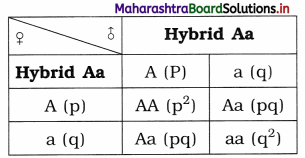
Maharashtra Board Class 12 Biology Important Questions Chapter 5 Origin and Evolution of Life 1
Genotypes = AA + 2 Aa + aa
Gene frequencies = p² + 2pq + q²

Question 2.
Make a chart showing the types of isolating mechanisms.
Answer:
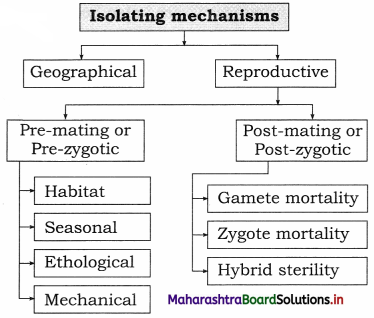
Maharashtra Board Class 12 Biology Important Questions Chapter 5 Origin and Evolution of Life 2

Diagram based questions

Question 1.
Give diagrammatic representation to show RNA world.
Answer:
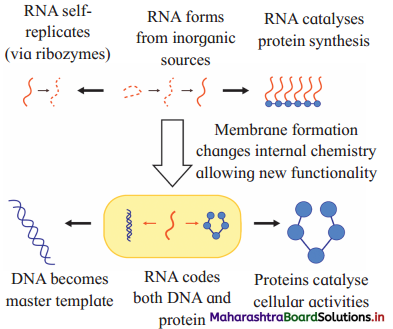
Maharashtra Board Class 12 Biology Important Questions Chapter 5 Origin and Evolution of Life 3

Question 2.
Sketch and label four types of chromosomal aberrations
Answer:
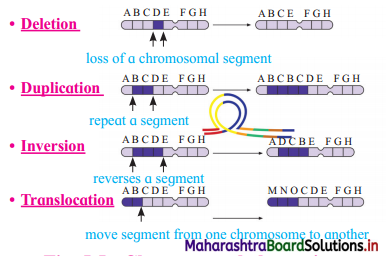
Maharashtra Board Class 12 Biology Important Questions Chapter 5 Origin and Evolution of Life 4

Question 3.
Sketch the graphs to show directional and stabilizing selection.
Answer:
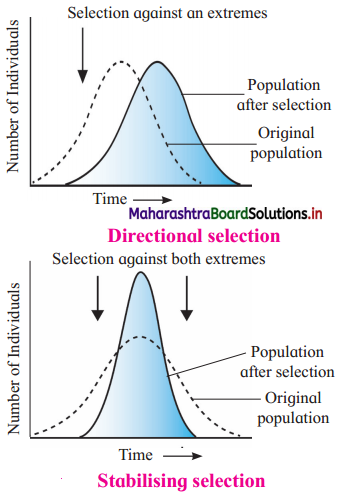
Maharashtra Board Class 12 Biology Important Questions Chapter 5 Origin and Evolution of Life 5

Long Answer Questions

Question 1.
Write about four old theories which suggested about how did life originate on the earth.
Answer:
1. Theory of special creation : Theory of special creation is the oldest theory which is based on religious beliefs. According to this theory, all the living organisms were created by supernatural power. However, since there are no scientific proofs to this theory, it is not accepted.

2. Cosmozoic theory/Theory of Panspermia : This theory says that life did not originate on the earth but it was exported from the other planets in the form of biological spores or microorganisms which were named as cosmozoa or panspermia. They may have descended to the earth from other planets. Recently, NASA has reported fossils of bacteria-like organisms on a piece of Martian rock recovered from Antarctica. Such facts may throw some light on the cosmozoic theory.

3. Theory of spontaneous generation or Abiogenesis : There was a belief that life originated from non-living material spontaneously. This theory was later disproved by Louis Pasteur.

4. Theory of biogenesis : This theory says that living organisms can originate only from pre-existing living beings. It is same as reproduction. But this theory of biogenesis was unable to explain origin of life on earth. It explains only the continuity of life.

Question 2.
Haldane described ‘Hot dilute soup’ in his theory. Describe how this soup led to formation of some important molecules.
Answer:
(1) The primitive sea containing molecules of organic substances without free oxygen was described as ‘hot dilute soup or primitive broth’ by Haldane. He proposed the theory of chemical evolution.

(2) According to this theory, the chemical evolution took place in the following steps : (a) Origin of earth and its primitive atmosphere, (b) Formation of ammonia, water and methane. These molecules dissolved in rainwater and formed the seas, (c) Then synthesis of simple organic compounds took place, followed by formation of complex organic compounds such as nucleic acids.

(3) The early molecules underwent chemical reactions such as condensation, polymerization, oxidation and reduction.

(4) The biologically important molecules such as monosaccharides, amino acids, purine, pyrimidine, fatty acids and glycerol were formed due to these reactions, utilizing the sources of energy on the primitive earth.

(5) Since oxygen was lacking, there was no degradation. Enzymes were also absent and hence there was formation of complex molecules in the hot dilute soup.

(6) This further led to the formation of pre-cells or protobiont. These aggregates were called coacervates by Oparin or microspheres by Sidney Fox. This further gave rise to first cells on the earth.

Question 3.
Explain the process of formation of eobionts.
Answer:

  1. Protobionts or coacervates were colloidal aggregations of hydrophobic proteins and lipids (lipoid bubbles).
  2. They grew in size by taking up material from surrounding aqueous medium.
  3. During their growth they became thermodynamically unstable and split into smaller units. These were called microspheres.
  4. They were proteinoids formed from colloidal hydrophilic complexes surrounded by water molecules.
  5. These bodies were like primitive cells having outer double-membrane. Across this membrane diffusion and osmosis may have occurred. They were more stable than coacervates.
  6. Coacervates and microspheres were non-living colloidal aggregations of lipids and proteinoids respectively.
  7. But they showed growth and division like living cells.
  8. These colloidal aggregations turned into first primitive living system called eobionts or protocell.

Question 4.
Describe RNA World hypothesis.
Answer:
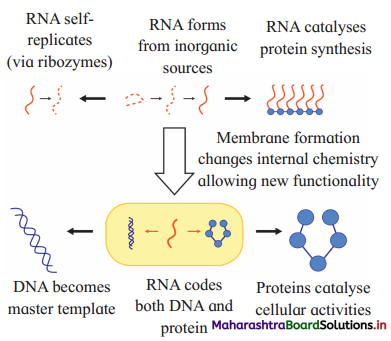
Maharashtra Board Class 12 Biology Important Questions Chapter 5 Origin and Evolution of Life 6
(1) RNA world hypothesis is based on discovery of catalytic RNA or ribozymes. It was proposed by Carl Woese, Francis Crick and Leslie Orgel in 1960 whereas Ribozymes were discovered by Sidney Altman and Thomas Cech in 1980.

(2) According to this hypothesis, early life must have been based most probably on RNA.

(3) Factors supporting this hypothesis are:

  • RNA is found abundantly in all living cells.
  • It is structurally related to DNA.
  • Chains of RNA can evolve or undergo mutations, replicate and catalyse reactions.
  • Biomolecules like Acetyl-Co-A have a nucleotide in their molecular structure.
  • Ribosome acts as a protein assembly unit in the cell and is seen in many types of cells.
  • In ribosomes, translation process is catalysed by RNA.

(4) The primitive molecules underwent repeated replication and mutation forming varieties of RNA molecules with varying sizes and catalytic properties.

(5) They later developed their own protein coats and machinery to survive the assembly of primitive cell.

(6) From them DNA was developed which was double stranded stable structure.

(7) It further kept on evolving giving rise to rich biodiversity on earth.

Maharashtra Board Class 12 Biology Important Questions Chapter 5 Origin and Evolution of Life

Question 5.
Explain in brief Darwinism and its five main postulates.
Answer:
Darwinism means theories of natural selection and speciation as put forth by Charles Darwin. The five main postulates of his theories are as follows: Overproduction or prodigality, Struggle for existence, Organic variations, Natural selection, Origin of new species (speciation).
1. Overproduction (Prodigality of nature) : There is a natural tendency to produce more number of progeny in geometric ratio for continuing the species. E.g. Salmon fish produces about 28 lakh eggs in a single season. Single pair of elephants would produce 19,000,000 elephants. But the size of given species in a given area remains relatively constant because of fluctuations that occur seasonally.

2. Struggle for existence Due to over¬production there is struggle for existence between the members of population for limited supply of food or to overcome adverse environmental conditions or for a space or to escape from enemies, etc.

3. Organic variations : There are differences in morphology, physiology, nutrition, habit, behavioural patterns, etc., among the members of same species or members of different species. These variations act as raw material for evolution.

4. Natural selection : Some organisms possess better variations to get adapted and survive under existing environmental conditions, while some do not have. Better adapted organisms are selected by the nature while those with unfavourable variations perish. The principle by which useful variations are preserved by nature, is called ‘Natural Selection’. It is also called ‘survival of fittest’ by H. Spencer.

5. Origin of new species (speciation) : Favourable variations are transmitted from generation to generation, resulting into better adapted generations. Gradually these adaptations with few new modifications become fixed in the life cycle, forming a new species.

Question 6.
Explain modern Synthetic Theory of Evolution in brief.
Answer:
(1) Modern synthetic theory of evolution is the result of modification of Darwinism and theory of mutations by taking into consideration studies of genetics, ecology, anatomy, geography and palaeontology.

(2) Five key factors of modern synthetic theory are gene mutations, mutations in the chromosome structure and number, genetic recombinations, natural selection and reproductive isolation. All these finally contribute in the evolution of new species or process of speciation.

(3) Population or Mendelian population is the small group of ‘interbreeding populations’. For every Mendelian population there is a gene pool which is constituted by total number of genotypes in it. The genotype of an organism in a population is constant, but the gene pool constantly undergoes change due to different factors such as mutations, recombination, gene flow, genetic drift, etc.

(4) Every gene has two alleles. The proportion of a particular allele in the gene pool, to the total number of alleles at a given locus, is called gene frequency. Thus any change in the gene frequency in the gene pool affects population.

(5) The five main factors are broadly divided into three main concepts as follows:
(i) Genetic variations caused due to various aspects of mutation, recombination and migration. Such variations cause change in the gene frequency. Gene mutations or point mutation change the phenotype of the organism, leading to variation. Recombination is caused due to crossing over in which new genetic combinations are produced. Sexual reproduction due to fertilization of gametes also cause recombinations. All these lead to variations, Gene flow is movement of genes into or out of the population, either due to migrations or dispersal of gametes.

Gene flow therefore change the gene frequencies of the population. Genetic drift is a random change which occurs by pure chance. It occurs in small populations but change the gene frequency. Chromosomal aberrations are structural or morphological changes in the chromosomes causing rearrangement of the sequence of genes.

(ii) Natural selection is said to be the main driving force in evolution. It brings about evolutionary changes by selecting favourable gene combinations by differential reproduction of genes. This brings about changes in gene frequency from one generation to next generation.

(iii) Isolation means the separation of the population of a particular species into smaller units which prevents interbreeding between them. This over a long time period leads to speciation or formation of new species.

Question 7.
What are different types of chromosomal aberrations?
Answer:
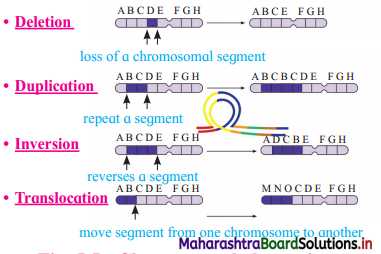
Maharashtra Board Class 12 Biology Important Questions Chapter 5 Origin and Evolution of Life 7
Chromosomal aberrations:
(1) The structural, morphological change, which take place in chromosome due to rearrangement, is called chromosomal aberrations.

(2) The aberrations change the sequence of the genes. This causes variations. Chromosomal aberrations are mainly of following four types:

  1. Deletion : Loss of genes from chromosome.
  2. Duplication : Genes are repeated or doubled in number on chromosome.
  3. Inversion : A particular segment of chromosome is broken and gets reattached to the same chromosome in an inverted position due to 180° twist. There is no loss or gain of gene complement of the chromosome.
  4. Translocation : Transfer or transposition of a part of chromosome or a set of genes to a non-homologous chromosome is called translocation. It is effected naturally by the transposons present in the cell.

Question 8.
What are the different pre-zygotic isolating mechanisms?
Answer:
(1) Pre-zygotic or pre-mating isolating mechanisms do not allow individuals to mate with each other at all.

(2) By various mechanisms the two groups remain isolated. These mechanisms are of following types:
(i) Habitat isolation : Habitat isolation is the phenomenon in which members of a population living in the same region occupy different habitats. Hence the potential mates do not interbreed among themselves.

(ii) Seasonal isolation : In seasonal isolation, members of a population share the same region but attaining sexual maturity at the different times of the year. They thus remain isolated reproductively preventing interbreeding among themselves.

(iii) Ethological isolation : Ethological isolation is seen when members of two populations have different mating behaviours. This prevents interbreeding.

(iv) Mechanical isolation : Mechanical isolation is seen when the members of two populations have differences in the structure of reproductive organs. Due to such differences interbreeding is not possible.

Question 9.
What are the different post-zygotic isolating mechanisms?
Answer:

  1. In post-zygotic or post-mating isolating mechanisms, the two individuals can mate but the result of mating is not favourable.
  2. Thus the populations remain isolated without the actual genetic exchange.

Post-mating isolating mechanisms are divided into the following categories:

  1. Gamete mortality : In gamete mortality, there is death of gametes. Sperm transfer may take place but the egg is not fertilized due to gamete mortality.
  2. Zygote mortality : In zygote mortality, the zygote is formed but it fails to thrive. Though the egg is fertilized the zygote does not survive.
  3. Hybrid sterility : In this isolation, there is the formation of hybrid as the gametes or zygotes do not die but the hybrid formed is sterile. Sterile hybrid cannot contribute genetically to further generations.

Maharashtra Board Class 12 Biology Important Questions Chapter 5 Origin and Evolution of Life

Question 10.
What is Hardy-Weinberg equilibrium? Explain it in brief.
Answer:

  1. Hardy and Weinberg were two scientists who proposed a concept of genetic equilibrium popularly known as Hardy- Weinberg principle or equilibrium.
  2. This principle states that gene, allele or genotype frequencies remain the same from generation to generation unless disturbed by factors like mutation, non-random mating, genetic drift, etc.
  3. For explaining the concept of equilibrium they assumed that there are two alleles located at a single locus (A and a).
  4. Their respective frequencies are p and q.
  5. The frequency of genotype AA is p, for 2Aa is 2pq and for aa is q.
  6. The equilibrium equation is p² + 2pq + q² = 1
  7. It says that if sum total of gene frequencies is 1, then sum total of genotype frequencies is also equal to 1. When the equilibrium is disturbed then only evolution occurs.

Question 11.
Human being is said to be most evolved, intelligent living being. Yet we are not self-sufficient. Think of various aspects for which we depend on other living beings for our survival.
Answer:
Human brain is evolved and super- specialised but yet in many aspects human beings are much dependent on other natural factors. Human body is not with any protective exoskeleton, or organs of offence and defence.

Unless well dressed, he cannot cope up with severe cold temperatures as he lacks natural protective fur. He cannot run fast as the other animals can. Neither he can digest uncooked food. He has overcome all his shortcomings by using his brain power.

He has managed to take fur and feathers from other animals by killing them. He also uses other natural fibres from plants to cover his body. He has also finished fish from the oceans by over-exploitation and polluting the natural habitats of these creatures.

He takes meat from other animals by killing them and for the purpose he domesticates them to satisfy his hunger. Before technical age, animals were used as beasts of burden and as means of transport. Thus human history has shown excessive use of horses, camels, elephants, etc.

Man snatches milk from other animals like cows and buffaloes which is for their young ones. But the entire diary industry and human needs for dairy products have been taken care of by these herbivores.

Apart from all such uses, man also uses other animals for experimentations and pharmaceutical industries. In this way, man has mastered other animal kingdom due to his intelligence.
Maharashtra Board Class 12 Biology Important Questions Chapter 4 Molecular Basis of Inheritance

Balbharti Maharashtra State Board 12th Biology Important Questions Chapter 4 Molecular Basis of Inheritance Important Questions and Answers.

Maharashtra State Board 12th Biology Important Questions Chapter 4 Molecular Basis of Inheritance

Multiple Choice Questions

Question 1.
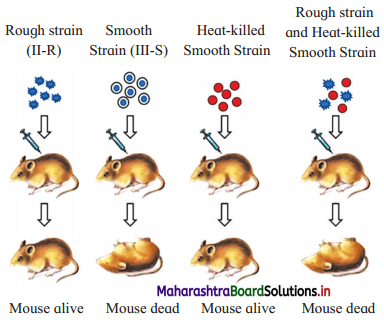
How many of the following characteristics are shown by the R-strain of Streptococcus pneumonia? Avirulent, Smooth, Pathogenic, Capsulated ………………..
(a) One
(b) TWo
(c) Three
(d) Four
Answer:
(a) One

Question 2.
Griffith obtained …………….. from the blood of the dead mice.
(a) dead S-strain bacteria
(b) live R-strain bacteria
(c) dead R-strain bacteria
(d) live S-strain bacteria
Answer:
(d) live S-strain bacteria

Maharashtra Board Class 12 Biology Important Questions Chapter 4 Molecular Basis of Inheritance

Question 3.
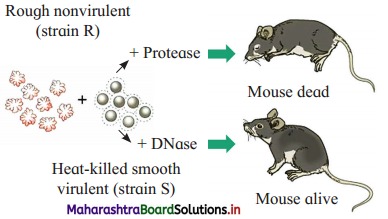
Oswald T. Avery, Colin M. MacLeod and Maclyn McCarty demonstrated that ………………..
(a) transformation of live S-strain bacteria into R-strain type was because of DNA of bacteria of S-strain.
(b) the transforming substance was either a protein or RNA.
(c) only DNA was able to transform harmless R-strain into virulent S-strain.
(d) when DNA isolated from S-strain bacteria, was digested with DNase, the transformation occurred.
Answer:
(c) only DNA was able to transform harmless R-strain into virulent S-strain

Question 4.
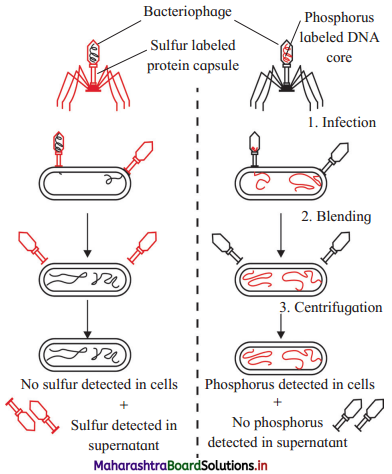
Which of the following was NOT observed in Hershey and Chase experiment?
(a) Viruses grown in the presence of radioactive sulphur, had radioactive protein but not radioactive DNA.
(b) Radioactive ‘P’ remained in suspension.
(c) Only radioactive ‘P’ was found inside the bacterial cells in the pellet.
(d) Viruses grown in the presence of radioactive phosphorus contained radioactive DNA but not radioactive proteins.
Answer:
(b) Radioactive ‘P’ remained in suspension.

Question 5.
Enzymes like ……………….. and DNA topoisomerase-I, play important role in maintaining super-coiled state in prokaryotic DNA.
(a) DNA ligase
(b) DNA gyrase
(c) RNA polymerase
(d) None of these
Answer:
(b) DNA gyrase

Question 6.
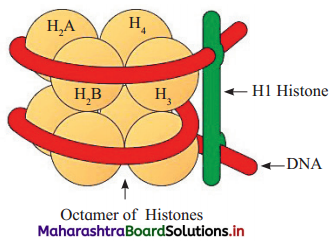
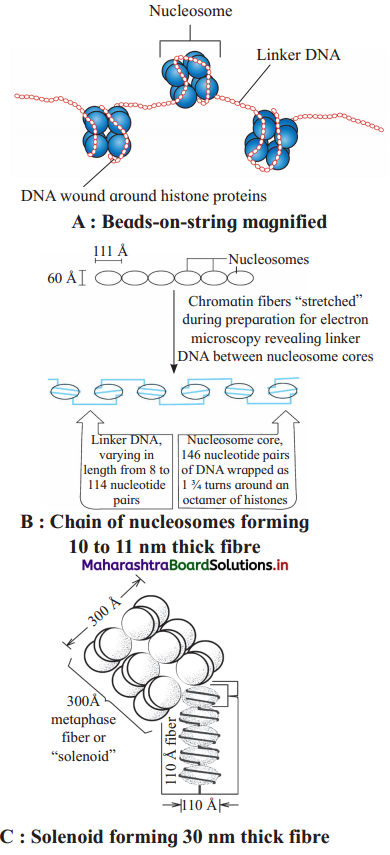
Histone octamer of nucleosome has two molecules, each of ……………….. proteins.
(a) H2A, H2B, H3 and H4
(b) H2A, H2B, H3 and H1
(c) H2A, H2B. H3A and H3B
(d) H1A, H2B, H3A and H4
Answer:
(a) H2A, H2B, H3 and H4

Question 7.
Select the CORRECT statement.
(a) Euchromatin is mainly located near centromere and telomeres.
(b) Heterochromatin replicates at faster rate than euchromatin.
(c) Heterochromatin has 2 to 3 times more DNA than in the euchromatin.
(d) Heterochromatin is lightly stained region of chromonema.
Answer:
(c) Heterochromatin has 2 to 3 times more DNA than in the euchromatin

Question 8.
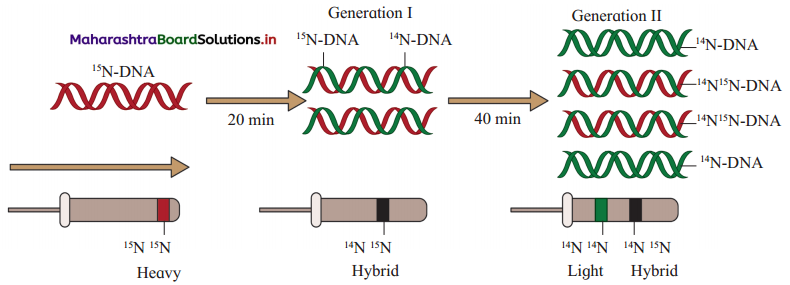
A DNA molecule in which both strands have 14N is allowed to replicate in an environment containing 15N. What will be the exact number of DNA molecules that contain the 14N after three replications?
(a) One
(b) Two
(c) Four
(d) Eight
Answer:
(b) Two

Question 9.
As the base sequence present on one strand of DNA decides the base sequence of other 8 strand, this strand is considered as ………………..
(a) descending strand
(b) leading strand
(c) lagging strand
(d) complementary strand
Answer:
(d) complementary strand

Question 10.
In prokaryotes ……………….. recognizes the promoter sequence.
(a) alpha factor
(b) rho factor
(c) theta factor
(d) sigma factor
Answer:
(d) sigma factor

Question 11.
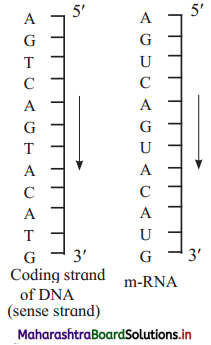
If the base sequence in DNA is 5′ AAAA 3′, then the base sequence in m-RNA is ………………..
(a) 5′ UUUU 3′
(b) 3′ UUUU 5′
(c) 5′ AAAA 3′
(d) 3′ TTTT 5′
Answer:
(c) 5′ AAAA 3′

Question 12.
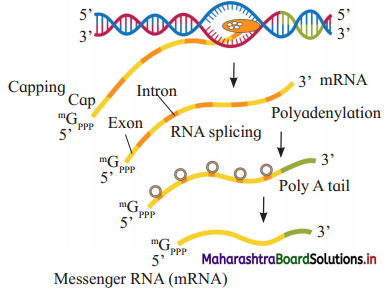
During capping, methylated guanosine tri¬phosphate is added to 5′ end of ………………..
(a) m-RNA
(b) t-RNA
(c) hnRNA
(d) r-RNA
Answer:
(c) hnRNA

Question 13.
If each codon has two nucleotides, then there will be ……………….. codons, which can encode for only …………….. different types of amino acids.
(a) 16, 16
(b) 16, 20
(c) 20, 16
(d) 64, 64
Answer:
(a) 16, 16

Question 14.
What would happen if in a gene encoding a polypeptide of 50 amino acids, 25th codon (UAU) is mutated to UAA?
(a) A polypeptide of 24 amino acids is formed.
(b) Two polypeptides of 24 and 25 amino acids will be formed.
(c) A polypeptide of 49 amino acids is formed.
(d) A polypeptide of 25 amino acids is formed.
Answer:
(a) A polypeptide of 24 amino acids is formed.

Question 15.
A strand of DNA has following base sequence – 3′ AAAAGTGAATAGTGA 5′. On transcription it produces an m-RNA. Which of the following anticodon of t-RNA recognizes the third codon of this m-RNA?
(a) AAA
(b) CUG
(c) AAG
(d) CTG
Answer:
(c) AAG

Question 16.
Polynucleotide chain consisting of only CUA repeats will give polypeptide chain with only one amino acid ………………..
(a) tryptophan
(b) leucine
(c) serine
(d) methionine
Answer:
(b) leucine

Question 17.
Select the INCORRECT statement.
(a) Dr. Khorana prepared polyribo-nucleotides chains with known repeated sequences of two or three nucleotides by using synthetic DNA.
(b) M. Nirenberg and Matthaei synthesized artificial m-RNA which was a homopolymer of uracil ribonucleotides.
(c) Enzyme polynucleotide phosphorylase polymerizes RNA with defined sequences in a template-dependent manner.
(d) Evidence for triplet nature of geneticcode, was given by Crick (1961) using “frame-shift mutation”.
Answer:
(c) Enzyme polynucleotide phosphorylase polymerizes RNA with defined sequences in a template-dependent manner.

Question 18.
…………… is/are based on complementarity principle.
(a) Replication and translation
(b) Replication and transcription
(c) Translation
(d) Only replication
Answer:
(b) Replication and transcription

Question 19.
Cysteine has codons, while isoleucin has ……………….. codons.
(a) two, three
(b) three, two
(c) two, four
(d) four, two
Answer:
(a) two, three

Question 20.
Out of 64 codons, only 61 code for the 20 different amino acids. This is known as ……………….. of genetic code.
(a) non-ambiguity
(b) overlapping nature
(c) ambiguity
(d) degeneracy
Answer:
(d) degeneracy

Question 21.
Mutation that results in Sickle-cell anaemia is a ………………..
(a) deletion
(b) frame-shiftmutation
(c) point mutation
(d) insertion
Answer:
(c) point mutation

Question 22.
Initiator charged t-RNA occupies the ……………….. of ribosome first.
(a) A-site
(b) P-site
(c) E-site
(d) either A-site or P-site
Answer:
(b) P-site

Question 23.
It takes ……………….. for formation of peptide bond.
(a) 10 seconds
(b) 0.1 second
(c) less than 0.1 second
(d) 60 seconds
Answer:
(c) less than 0.1 second

Question 24.
Anticodon and codon bind by ………………..
(a) glycosidic bond
(b) hydrogen bond
(c) phosphodiester bond
(d) none of these
Answer:
(b) hydrogen bond

Question 25.
The UTRs are present at ………………..
(a) 5′-end, before start codon and at 3′-end, after stop codon of m-RNA
(b) 5′-end, before start codon and at 3′-end, after stop codon of t-RNA
(c) only at 3′-end, after stop codon of m -RNA
(d) only at 5′-end, before start codon of m-RNA
Answer:
(a) 5′-end, before start codon and at 3′-end, after stop codon of m-RNA

Question 26.
The action of structural genes is regulated by …………….. site with the help of a …………….. protein.
(a) operator, inducer
(b) operator, repressor
(c) regulator, repressor
(d) regulator, inducer
Answer:
(b) operator, repressor

Question 27.
Repressor protein is produced by the action of ………………..
(a) gene z
(b) gene y
(c) gene i
(d) gene o
Answer:
(c) gene i

Question 28.
Select the correct pair.
(a) Gene z – Transacetylase
(b) Gene y – Beta-galactocidase
(c) Gene a – Beta-galactoside permease
(d) Gene I – Repressor
Answer:
(d) gene I – repressor

Maharashtra Board Class 12 Biology Important Questions Chapter 4 Molecular Basis of Inheritance

Question 29.
Structural genomics involves ……………….. of genome.
(a) mapping
(b) sequencing
(c) analysis
(d) all of these
Answer:
(d) all of these

Question 30.
The technique of transferring DNA fragments separated on agarose gel to a synthetic nitrocellulose membrane is known as ………………..
(a) Southern blotting
(b) Autoradiography
(c) Southern hybridization
(d) None of these
Answer:
(a) Southern blotting

Question 31.
Sequence of various steps in DNA fingerprinting is ………………..
i. Southern blotting.
ii. Restriction digestion
iii. Agarose gel electrophoresis
iv. DNA isolation
v. Photography.
vi. Selection of DNA probe
vii. Hybridization
(a) iv, iii, ii, i, v, vi, vii
(b) iv. v, iii, i, vi, vii, ii
(c) iv, ii, iii, i, vi, vii, v
(d) ii, iii, iv, i, vi, vii,
Answer:
(c) iv, ii, iii, i, vi. vii, v

Match the Columns

Question 1.

Column AColumn B
(1) Frederick Griffith(a) Test tube assay
(2) Avery, McCarty and MacLeod(b) Streptococcus pneumoniae
(3) Alfred Hershey and Martha Chase(c) E. coli
(4) Meselson and Stahl(d) Bacteriophages

Answer:

Column AColumn B
(1) Frederick Griffith(b) Streptococcus pneumoniae
(2) Avery, McCarty and MacLeod(a) Test tube assay
(3) Alfred Hershey and Martha Chase(d) Bacteriophages
(4) Meselson and Stahl(c) E. coli

Classify the following to form Column B as per the category given in Column A

Question 1.
(i) UUU
(ii) CUA
(iii) UAA
(iv) AUG
(v) UAG
(vi) UGA

Column AColumn B
1. Initiator codon————–
2. Stop codons————-
3. Codon that codes for Phenyl alanin————–
4. Codon that codes for leucine————-

Answer:

Column AColumn B
1. Initiator codon(iv) AUG
2. Stop codons(iii) UAA, (v) UAG, (vi) UGA
3. Codon that codes for Phenyl alanin(i) UUU
4. Codon that codes for leucine(ii) CUA

Question 2.
(i) Severo Ochoa
(ii) F. Jacob and J. Monod
(iii) Temin and Baltimore
(iv) H. Winkler
(v) T. H. Roderick
(vi) R Kornberg

Column AColumn B
(1) Lac Operon————–
(2) Central dogma in retroviruses————-
(3) Coined the term Genome————–
(4) Coined the term Genomics————-
(5) Enzymatic synthesis of RNA————-
(6) DNA is associated with histones and non-histones————–

Answer:

Column AColumn B
(1) Lac Operon(ii) E Jacob and J. Monod
(2) Central dogma in retroviruses(iii) Temin and Baltimore
(3) Coined the term Genome(iv) H. Winkler
(4) Coined the term Genomics(v) T. H. Roderick
(5) Enzymatic synthesis of RNA(i) Severo Ochoa
(6) DNA is associated with histones and non-histones(vi) R. Kornberg

Very Short Answer Questions

Question 1.
What are the two types of bacteria used by F. Griffith and which one out of these is avirulent?
Answer:
S-type and R-type strains of Streptococcus penumoniae were used by F. Griffith and out of these R-type is avirulent.

Question 2.
Enlist the characteristics of S-strain pneumoniae.
Answer:
S-strain pneumoniae are virulent, smooth and encapsulated.

Question 3.
What is the bacteriophage?
Answer:
Bacteriophage is a virus that infects bacterium and injects its genetic material in the bacterium.

Question 4.
What is the length of DNA double helix molecule in a typical mammalian cell?
Answer:
The length of DNA double helix molecule in a typical mammalian cell is approximately 2.2 meters.

Question 5.
What is the approximate size of a typical nucleus ?
Answer:
Approximate size of a typical nucleus is 10-6 m.

Question 6.
What is size of E. coli cell?
Answer:
The size of E. coli cell size is 2-3 µm.

Question 7.
What determines the charge on protein molecules?
Answer:
A protein acquires its charge depending upon the abundance of amino acid residues with charged side chains.

Question 8.
What is nucleosome core?
Answer:
Nucleosome core is a histone octamer.

Question 9.
Where is H1 histone present?
Answer:
H1 histone binds the DNA thread where it enters and leaves the nucleosome.

Question 10.
How are solenoid fibres formed?
Answer:
Six nucleosomes get coiled and then form solenoid that looks like coiled telephone wire of 30 nm diameter (300Å).

Question 11.
How is chromatin fibre formed?
Answer:
Supercoiling of solenoid fibre forms a looped structure called chromatin fibre.

Question 12.
What is NHC?
Answer:
NHC stands for Nonhistone Chromosomal proteins.

Question 13.
List as many different enzyme activities required during DNA synthesis as you can.
Answer:
Phosphorylase, Helicase, DNA polymerase, Primase, DNA ligase, Super helix relaxing enzyme, Topoisomerase (gyrase) are different enzymes required during DNA synthesis.

Question 14.
How many replicons are present in prokaryotes and eukaryotes respectively?
Answer:
Prokaryotes have one replicon. Several replicons in tandem are present in eukaryotes.

Question 15.
What is the function of SSBP?
Answer:
During replication of DNA SSBP proteins remain attached to both the separated strands and prevent them from coiling back.

Question 16.
During which phases of cell cycle, transcription occurs in the nucleus?
Answer:
Transcription occurs in the nucleus during G1 and G2 phases of cell cycle.

Question 17.
Which strand of transcription unit gets transcribed ?
Answer:
DNA strand having 3’ → 5’ polarity acts as template strand and it gets transcribed.

Question 18.
What is a cryptogram?
Answer:
Cryptogram is a genetic code consisting of triplet codons on m-RNA that code for a specific amino acids.

Question 19.
What is meant by the polarity of genetic code?
Answer:
Genetic code is always read in 5′ → 3’ direction. This is called polarity of genetic code.

Question 20.
Which mutation can result in changes in the reading frame?
Answer:
Insertion or deletion of one or two bases changes the reading frame from the point of insertion or deletion.

Question 21.
Which mutation can result in insertion or deletion of amino acids, but reading frame remains unaltered?
Answer:
Insertion or deletion of three or multiples of three bases results in insertion or deletion of amino acids and reading frame remains unaltered from that point onwards.

Question 22.
Which molecule serves as an intermediate molecules between DNA and protein during proteins synthesis?
Answer:
RNA serves as an intermediate molecule between DNA and protein during proteins synthesis.

Maharashtra Board Class 12 Biology Important Questions Chapter 4 Molecular Basis of Inheritance

Question 23.
What is the function of a groove present between two subunits of ribosome in eukaryotes ?
Answer:
The groove present between two subunits of ribosomes in eukaryotes protects the polypeptide chain from the action of cellular enzymes and also protects m-RNA from the action of nucleases.

Question 24.
Enlist different steps of protein synthesis.
Answer:
Steps in protein synthesis are:

  1. Transcription
  2. Activation of amino acids and formation of charged t-RNAs,
  3. Synthesis of polypeptide chain:
  4. initiation
  5. elongation and
  6. termination of polypeptide chain.

Question 25.
What is translocation?
Answer:
During elongation of polypeptide chain, the ribosome moves along the m-RNA in stepwise manner from start codon to stop codon (5′ → 3′), 1 codon ahead each time t, his movement is called translocation and due to this t-RNA carrying a dipeptide at A-site of the ribosome moves to the p-site.

Question 26.
What is meant by inducible enzymes?
Answer:
Bacteria like E.coli adapt to their chemical environment by synthesizing certain enzymes depending upon the substrate present. Such adaptive enzyme is called inducible enzyme.

Question 27.
What is meant by induction and inducer?
Answer:
A set of genes are switched on when a new substrate is to be metabolized. This phenomenon is called induction and small molecule responsible for this is known as inducer.

Question 28.
What is the role of a repressor gene?
Answer:
The role of a repressor gene is to produce repressor protein. Repressor binds with operator gene and this prevents transcription of structural genes in the operon.

Question 29.
Which molecule does act as inducer molecule in lac operon?
Answer:
Allolactose acts as inducer molecule in lac operon.

Question 30.
In which condition, lac operon is switched off?
Answer:
If E.coli bacteria do not have lactose in the surrounding medium as a source of energy, lac operon is switched off.

Question 31.
What lac operon consists of?
Answer:
Lac operon consists of a regulator promoter, operator and three structural genes z, y and a.

Question 32.
Which gene acts as a regulatory gene in lac operon?
Answer:
Repressor protein is produced by the action of gene i (inhibitor). This gene acts as a regulator gene.

Question 33.
When was Human Genome Project started ? When was it completed ?
Answer:
The Human Genome Project was started in 1990 and was completed in 2003.

Question 34.
What is functional genomics?
Answer:
Functional genomics is a branch of genomics that involves the study of functions of all gene sequences and their expressions in organisms.

Question 35.
What is the advantage of sequencing of genomes of non-human organisms?
Answer:
Sequencing of genomes of non-human model organisms allows researchers to study gene functions in these organisms. Since human beings possess many genes which are like those of flies, roundworms and mice, comparative studies will lead to greater understanding of human evolution.

Question 36.
What are VNTRs?
Answer:
Variable Number of Tandem Repeats (VNTRs) are unusual sequences of 20-100 base pairs, which are repeated several times and are arranged tandency.

Question 37.
Do different organisms have the same DNA?
Answer:
Different organisms differ in their DNA sequence.
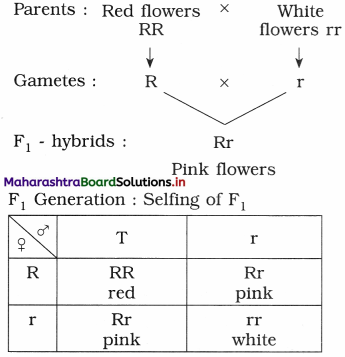
Question 38.
What is the amino acid sequence encoded by base sequence UCA, UUU, UCC, GGG, AGU of an m-RNA segment?
Answer:
The amino acid sequence: Ser-Phe – Ser – Gly- Ser

Give definitions of the following

Question 1.
Replicon
Answer:
The unit of DNA in which replication occurs is known as replicon.

Question 2.
Transcription
Answer:
Transcription is defined as the process of copying of genetic information from template strand of DNA into a complementary single stranded RNA transcript.

Question 3.
Gene
Answer:
Gene is defined as the DNA sequence coding for m-RNA/ t-RNA or r-RNA.

Question 4.
Cistron
Answer:
Cistron is defined as a segment of DNA coding for a polypeptide.

Question 5.
Monocistronic gene
Answer:
Gene is called monocistronic, when there is a single structural gene in one transcription unit.

Question 6.
Polycistronic gene
Answer:
Gene is called polycistronic, when there is a set of various structural genes in one transcription unit.

Question 7.
Interrupted or Split genes
Answer:
Interrupted or split genes are the structural genes in eukaryotes which have both exons and introns.

Question 8.
Exons
Answer:
Exons are the coding sequences or express sequences in DNA/hnRNA/ m-RNA.

Question 9.
Introns
Answer:
Introns are the non-coding sequences in DNA or hnRNA.

Question 10.
Anticodon
Answer:
Anticodon is a triplet of nucleotides present on the anticodon loop of t-RNA, which is complementary to codon on m-RNA.

Question 11.
Mutation
Answer:
Mutation is a sudden heritable change in the DNA sequence that results in the change of genotype.

Question 12.
Translation
Answer:
Translation is the process in which sequence of codons of m-RNA is decoded and accordingly amino acids are added in specific sequence to form a polypeptide on ribosomes.

Question 13.
Genomics
Genomics is the study of genomes through analysis, sequencing and mapping of genes along with the study of their functions.

Question 14.
Repressors
Answer:
Repressors are proteins which are able to bind the operator region of operon and prevent the RNA polymerase from transcribing the operon.

Name the following

Question 1.
Enzyme that cleaves DNA.
Answer:
DNase

Question 2.
Enzyme that cleaves proteins.
Answer:
Protease

Question 3.
Enzyme involved in activation of nucleotides.
Answer:
Phosphorylase

Question 4.
Enzyme involved in unwinding of DNA.
Answer:
Helicase

Question 5.
Enzyme involved in synthesis of DNA.
Answer:
DNA polymerase

Question 6.
Enzyme involved in joining of Okazaki fragments.
Answer:
DNA ligase

Question 7.
Enzyme involved in synthesis of RNA primer.
Answer:
Primase

Question 8.
Enzyme involved in removal of RNA primer.
Answer:
DNA polymerase

Question 9.
Enzyme involved in replacement of gaps in prokaryotes.
Answer:
DNA polymerase – I

Maharashtra Board Class 12 Biology Important Questions Chapter 4 Molecular Basis of Inheritance

Question 10.
Enzyme involved in replacement of gaps in eukaryotes.
Answer:
DNA polymerase α

Question 11.
Enzyme involved in formation of double helix in daughter DNA molecules.
Answer:
Topoisomerase

Question 12.
Enzyme involved in releasing strain created by unwinding of DNA.
Answer:
Super helix relaxing enzyme

Question 13.
Enzyme involved in synthesis of hnRNA, m-RNA.
Answer:
RNA polymerase – II

Question 14.
Enzyme involved in synthesis of t-RNA, snRNA.
Answer:
RNA polymerase – III

Question 15.
Enzyme involved in synthesis of r-RNA
Answer:
RNA polymerase – I

Question 16.
Enzyme involved in polymerizing RNA in template independent manner.
Answer:
Polynucleotide phosphorylase

Question 17.
Enzyme involved in peptide bond synthesis.
Answer:
Ribozyme

Question 18.
Enzyme involved in Cutting DNA at specific sites.
Answer:
Restriction endonuclease

Question 19.
Name the initiator codon of protein synthesis.
Answer:
AUG is the initiator codon of protein synthesis.

Question 20.
Name three binding sites of ribosome.
Answer:
Three binding sites for t-RNA on ribosomes are P-site (peptidy t-RNA-site), A-site (aminoacyl – t-RNA-site) and E-site (exit site).

Question 21.
Name the different structural genes in sequence of lac operon.
Answer:
There are 3 structural genes in the sequence lac-Z, lac-Y and lac-A.

Question 22.
Name the organisms whose genomes have been sequenced?
Answer:
The genomes of several organisms such as bacteria e.g. E.coli, Caenorhabditis elegans (a free living non-pathogenic nematode), Saccharomyces cerevisiae (yeast), Drosophila (fruit fly), plants (rice and Arabidopsis), Mus musculus (mouse), etc. have been sequenced.

Give Significance/Functions of the following

Question 1.
DNA.
Answer:

  1. DNA regulates and controls all the cellular activities.
  2. It replicates and gets distributed equally to the daughter cells when the cell divides.
  3. It is a carrier of genetic information.
  4. Heterocatalytic function : DNA directs the synthesis of chemical molecules other than itself. E.g. Synthesis of RNA (transcription), synthesis of protein (Translation), etc.
  5. Autocatalytic function : DNA directs the synthesis of DNA itself. E.g. Replication.
  6. DNA is a master molecule of a cell that initiates, guides, regulates and controls the process of protein synthesis.

Question 2.
Proteins.
Answer:
Proteins serve as structural components, enzymes and hormones.

Distinguish between the following.

Question 1.
Euchromatin and Heterochromatin.
Answer:

EuchromatinHeterochromatin.
1. Euchromatin is loosely packed region of the chromatain.1. Heterochromatin is densely packed region of the chromatin.
2. Euchromatin stains lightly.2. Heterochromatin stains darkly.
3. Euchromatin is transcriptionally active region of the chromatin.3. Heterochromatin is transcriptionally inactive region of the chromatin.

Question 2.
DNA in prokaryotic and eukaryotic cells.
Answer:

DNA in prokaryotesDNA in eukaryotic
1. It is present in the cytoplasm.1. It is present in the nucleus.
2. It is not associated with histones.2. It is associated with histones.
3. It is circular.3. It is linear.
4. Genes do not contain introns.4. Genes contain introns along with exons.
5. Genes are polycostronic.5. Genes are monocistronic.

Question 3.
DNA and RNA
Answer:

DNARNA
1. DNA is deoxyribonucleic acid.1. RNA is ribonucleic acid.
2. DNA is double stranded, helical molecule.2. RNA is single stranded molecule.
3. In DNA, there is deoxyribose sugar.3. In RNA, there is ribose sugar.
4. The pyrimidine nitrogen bases are cytosine and thymine.4. The pyrimidine nitrogen bases are cytosine and uracil.
5. DNA is the genetic material in all types of organisms.5. RNA is genetic material in few viruses only.
6. In eukaryotic cells, DNA is present in nucleus.6. In eukaryotic cells, RNA is present in nucleus as well as cytoplasm.
7. The number of purine : pyrimidine ratio is always 1 : 1 in DNA molecule.7. The number of purine : pyrimidine ratio may not be 1 : 1 in RNA molecule.
8. DNA sends the codon for the synthesis of proteins, but otherwise it does not participate in the protein synthesis.8. RNA takes part in the protein synthesis through transcription and translation.

Question 4.
m-RNA, t-RNA and r-RNA.
Answer:

m-RNAt-RNAr-RNA.
1. m-RNA is a simple molecule which shows linear structure without any folds.1. t-RNA is a single stranded molecule. There is regular pattern of folding shown by this molecule.1. r-RNA is a single stranded RNA that is variously folded upon itself. In the folded regions it shows complementary base pairing.
2. It performs the function of transcription during protein synthesis.2. It performs the function of transferring the amino acids during translation.2. This RNA remains associated with the ribosomes permanently. It gives the binding site for m-RNA during the process of protein synthesis. It also orients the m-RNA molecule so as to read the message on codons properly.
3. Of the total cellular RNA, m-RNA forms 3-5%.3. Of the total cellular RNA, t-RNA forms about 10-20%.3. Of the total cellular RNA, r-RNA forms 80%
4. It has molecular weight of about 5,00,000.4. t-RNA is the smallest RNA having only 73-93 nucleotides and has molecular weight of about 23,000 to 30,000 daltons.4. Molecular weight is about 40,000 to 100,000 daltons.

Give Reasons

Question 1.
Nuclein was called as nucleic acid.
Answer:
Nuclein had acidic properties and it was isolated from nucleus. Hence, it was called as nucleic acid.

Question 2.
Initially proteins (and not DNA) were considered as genetic material.
Answer:

  1. Proteins are large, complex molecules and store information required to govern cell metabolism. Hence it was assumed that variations found in species were caused by proteins.
  2. On the other hand, DNA was considered as a small, simple molecule whose composition does not vary much among species.
  3. Variations in the DNA molecules are different than the variation in shape, electrical charge and function shown by proteins.
  4. Hence, initially proteins (and not DNA) were considered as genetic material.

Question 3.
On injecting a mixture of heat-killed S-bacteria and live R bacteria, the mice died.
Answer:

  1. Griffith obtained live S-strain bacteria from the blood of the dead mice.
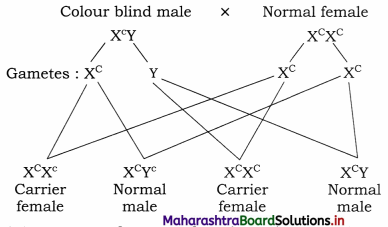
  2. In a mixture of live R-bacteria and heat killed S-bacteria, live R-strain bacteria picked up something (transforming principle) from the heat-killed S bacterium and got changed into S-type.
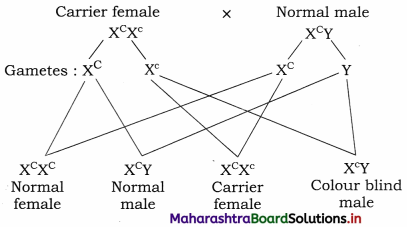
  3. Transforming principle allowed R-type bacteria to synthesize capsule and thus they became virulent.
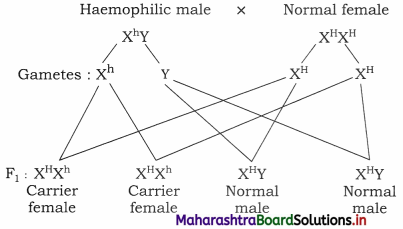
  4. Hence, on injecting a mixture of heat-killed S bacteria and live R bacteria, the mice died.

Question 4.
Viruses obtained by infecting bacteria having radioactive phosphorus contained radioactive DNA (labelled DNA), but not radioactive proteins.
Answer:
Viruses obtained by infecting bacteria having radioactive phosphorus, contained radioactive DNA (labelled DNA). but not radioactive proteins because DNA contains phosphorus (labelled DNA) but proteins do not.

Question 5.
Viruses obtained by infecting bacteria having radioactive sulphur contained radioactive protein but not radioactive DNA.
Answer:
Viruses obtained by infecting bacteria having radioactive sulphur contained radioactive protein but not radioactive DNA because DNA does not contain sulphur and proteins contain sulphur.

Question 6.
In bacteria, m-RNA does not require any processing.
Answer:
In bacteria, m-RNA does not require any processing because it has no introns and it is synthesized in cytoplasm.

Question 7.
Eukaryotic DNA is condensed and supercoiled.
Answer:

  1. In a typical mammalian cell, length of DNA double helix is approximately 2.2 metres.
  2. The size of typical nucleus is approximately 10-6 m
  3. Such a long DNA molecule has to be fitted in small nuclear space.
  4. Therefore, DNA is highly condensed, coiled and supercoiled so that it can be accommodated in the nucleus.

Maharashtra Board Class 12 Biology Important Questions Chapter 4 Molecular Basis of Inheritance

Question 8.
During translation, complementarity principle is not applicable.
Answer:
During translation, complementarity principle is not applicable as, genetic information is transferred from a polymer of nucleotides to a polymer of amino acids.

Question 9.
Protein synthesis is the most important and essential activity in the living cells.
Answer:

  1. Proteins play a significant role in the metabolism of living cells.
  2. The actual phenotypic expression of living cells is dependent on the biochemical reactions.
  3. Each biochemical reaction needs a specific enzyme for its initiation and completion. All the enzymes are proteins.
  4. In a cell there are many structural proteins too. Thousands of structural and catalytic proteins are constantly required within the cell at all times.
  5. Many functional proteins like hormones are also important for metabolism. Thus, for the synthesis of all such proteins, protein synthesis has become the most important and essential activity of the living cell.

Question 10.
Only 20 amino acids are considered as standard.
Answer:

  1. It was believed that there are total 20 amino acids in the living world. But 21st amino acid called selenocysteine was discovered later.
  2. This amino acid is coded by UGA which is usually a termination codon.
  3. In both prokaryotic and eukaryotic cells polypeptide chains contain 100-300 amino acids and they are formed by specific arrangement of 21 amino acids.
  4. But formation of selenocysteine requires the availability of element selenium in the cells.
  5. Therefore, only 20 amino acids are considered as standard.

Write Short Notes on the following

Question 1.
Friedrich Miescher’s nuclein
Answer:

  1. Nuclein is an acidic substance, having high phosphorus content and it was isolated by Friedrich Miescher in 1869, from the nuclei of pus cells.
  2. As Nuclein had acidic properties and it was isolated from nucleus, it was called as nucleic acid.
  3. E Miescher started working with white blood cells (the major component of pus). He used a salt solution to wash the pus off the bandages. He lysed the cells by adding a weak alkaline solution and isolated nucleic acid from nuclei that precipitated out of the solution.
  4. By the early 1900s, it was known that Miescher’s nuclein was a mixture of proteins and nucleic acids (DNA and RNA).

Question 2.
Packaging in Prokaryotes
Answer:
Maharashtra Board Class 12 Biology Important Questions Chapter 4 Molecular Basis of Inheritance 1

  1. Size of cell in E. coli size is 2-3µ.
  2. The nucleoid is small, circular, highly folded, naked DNA (1100 µm long in perimeter and contains about 4.6 million base pairs).
  3. When the negatively charged DNA becomes circular, the size reduces to 350 µm in diameter.
  4. Folding/looping (40-50 domains (loops) further reduce it to 30 µm in diameter.
  5. RNA connectors assist in loop formation.
  6. Further coiling and super coiling of each domain reduces the size to 2 µm in diameter.
  7. This coiling (packaging) is assisted by positively charged HU (Histone like DNA binding proteins) proteins and enzymes like DNA gyrase and DNA topoisomerase-I, which maintain supercoiled state.

Question 3.
Experimental confirmation of semiconservative replication of DNA.
Answer:
Maharashtra Board Class 12 Biology Important Questions Chapter 4 Molecular Basis of Inheritance 2
(1) Matthew Meselson and Franklin Stahl (1958) used equilibrium – density – gradient – centrifugation technique to experimentally prove semiconservative DNA replication.

(2) They cultured bacteria E.coli in the medium containing 14N (light nitrogen). They obtained equilibrium density gradient band by using 6M CsCl2. The position of this band is recorded.

(3) E. coli cells were then transferred to 15N medium (heavy isotopic nitrogen) and allowed to replicate for several generations. At equilibrium point density gradient band was obtained, by using 6M CsCl2. The position of this band is recorded.

(4) The heavy DNA (15N) molecule can be distinguished from normal DNA by centrifugation in a 6M Cesium chloride (CsCl2) density gradient. At the equilibrium point 15N DNA will form a band. In this both the strands of DNA are labelled with 15N.

(5) Such E. coli cells were then transferred to another medium containing 14N i.e. normal (light) nitrogen. After first generation, the density gradient band for 14N 15N was obtained and its position was recorded. After second generation, two density gradient bands were obtained – one at 14N 15N position and other at 14N position.

(6) The position of bands after two generations clearly proved that DNA replication is semiconservative.

Question 4.
Central Dogma of molecular biology.
Answer:
(1) Central dogma of molecular biology was postulated by EH.C. Crick in 1958.
Maharashtra Board Class 12 Biology Important Questions Chapter 4 Molecular Basis of Inheritance 3

(2) DNA gets transcribe to form m-RNA, m-RNA acts as a messenger and gets translated to form a polypeptide chain (protein) having specific amino acid sequence.

(3) This unidirectional flow of information from DNA to RNA and from RNA to proteins is referred as central dogma of molecular biology.

(4) Temin (1970) and Baltimore (1970) : Central dogma in retroviruses.
Maharashtra Board Class 12 Biology Important Questions Chapter 4 Molecular Basis of Inheritance 4

Question 5.
Processing of hnRNA.
Answer:
Maharashtra Board Class 12 Biology Important Questions Chapter 4 Molecular Basis of Inheritance 5

  1. Eukaryotes have split genes.
  2. Primary transcript or hnRNA is non-functional and contains both exons and introns.
  3. Processing of hnRNA results in functional m-RNA.
  4. The fully processed hnRNA is called m-RNA.
  5. m-RNA comes out of the nucleus through nuclear pore for getting translated.

hnRNA undergoes capping, tailing and splicing.

  1. Capping : Methylated guanosine tri¬phosphate is added to 5’ end of hnRNA.
  2. Tailing : Polyadenylation take place at 3′ end.
  3. Splicing : It is removal of introns.
  4. DNA ligase joins exons in a definite sequence (order).

Question 6.
Cracking of genetic code.
Answer:

  1. M. Nirenberg and Matthaei synthesized artificial poly-U m-RNA.
  2. Using this synthetic poly-U m-RNA and cell free system of protein synthesis, a small polypeptide consisting of only amino acid phenylalanine was obtained.
  3. It suggested that UUU codes for phenylalanine.
  4. Dr. Har Gobind Khorana devised a technique for synthesis of artificial m-RNA with repeated sequences of known nucleotides.
  5. He synthesized artificial RNA consisting of known repeated sequences of two or three nucleotides. E.g. CUC, UCU, CUC, UCU, by using synthetic DNA.
  6. This resulted in formation of polypeptide chain consisting of alternate amino acids leucine and serine.
  7. Synthetic RNA consisting of CUA, CUA, CUA, CUA repeats gave polypeptide chain with only one amino acid – leucine.
  8. Severo Ochoa established that the enzyme (polynucleotide phosphorylase) also helps in polymerizing RNA of defined sequences in a template-independent manner (i.e. enzymatic synthesis of RNA).
  9. Thus all the 64 codons in the dictionary of genetic code were deciphered.

Question 7.
Types of mutations.
Answer:

  1. Chromosomal mutations : Loss (deletion) or gain (insertion/duplication) of a segment of DNA results in alteration in the chromosome.
  2. Point mutations : They involve change in a single base pair of DNA. E.g. Mutation that results in Sickle-cell anaemia.
  3. Deletion or insertion of base pairs of DNA : It causes frame-shift mutations or deletion mutation.
  4. Insertion or deletion of one or two bases changes the reading frame from the point of insertion or deletion.
  5. Insertion or deletion of three or multiples of three bases (insert or delete) results in insertion or deletion of amino acids and reading frame remains unaltered from that point onwards.

Question 8.
Transfer-RNA.
Answer:
Maharashtra Board Class 12 Biology Important Questions Chapter 4 Molecular Basis of Inheritance 6
(1) As t-RNA can read the codon and also can bind with the amino acid, t-RNA is considered as an adapter molecule.

(2) Clover leaf structure (2 dimensional) of t-RNA:

  • t-RNA has four arms – DHU arm (has amino acyl binding loop), middle arm (has anticodon loop), Tif/C arm (has ribosome binding loop) and variable arm.
  • It has G nucleotide at 5’ end.
  • Amino acid acceptor end (3’ end) having unpaired CCA bases (i.e. amino acid binding site).

(3) For every amino acid, there is specific t-RNA.
(4) Initiator t-RNA is specific for methionine.
(5) There are no t-RNAs for stop codons.
(6) In the actual structure, the t-RNA molecule looks like inverted L (3 dimensional : structure)

Question 9.
UTRs.
Answer:

  1. m-RNA has some additional sequences that are not translated. These sequences are referred as untranslated regions (UTR).
  2. The UTRs are present at both 5′-end (before start codon) and at 3′-end (after stop codon).
  3. They are required for efficient translation process.

Short Answer Questions

Question 1.
Why are Okazaki fragments formed on lagging strand only?
Answer:

  1. The lagging template is the template strand with free 5’ end.
  2. The replication always starts at C-3 end of template strand and proceeds towards C-5 end.
  3. Both the strands of the parental DNA are antiparallel and new strands are always formed in 5′ → 3′ direction, i.e. DNA polymerase synthesizes new strand in only one direction i.e. 5′ → 3′ direction.
  4. Hence, the lagging templates becomes available for replication only discontinuously in small patches.
  5. The new lagging strand develops discontinuously away from the replicating fork in the form of small Okazaki fragments.
  6. Hence, Okazaki fragments formed on lagging strand only.

Question 2.
Why t-RNA is called as adapter molecule?
Answer:
t-RNA can read the codon on m-RNA. It also can bind with the amino acid at 3’ end and transport it to m-RNA-ribosome complex during translation. It can bind with specific codon which is complementary to its anticodon. So t-RNA is considered as an adapter molecule.

Question 3.
Why DNA replication is called semiconservative replication?
Answer:

  1. In each of the two daughter DNA molecules thus formed, one strand is parental and the other one is newly synthesized.
  2. 50% is contributed by mother DNA.
  3. Hence, DNA replication is described as semiconservative replication.

Maharashtra Board Class 12 Biology Important Questions Chapter 4 Molecular Basis of Inheritance

Question 4.
What are the functions of three types of RNAs in bacteria? Which enzyme is involved in transcription of DNA to form RNAs in bacteria? What is its function?
Answer:

  1. In bacteria, m-RNA provides the encoded message for protein synthesis; t-RNA brings specific amino acid to the site of translation; r-RNA plays role in providing binding site to m-RNA and t-RNA.
  2. There is single DNA dependent-RNA polymerase that catalyses transcription of all 3 types of RNA in bacteria.
  3. RNA polymerase binds to promoter and initiates transcription (initiation) and synthesizes RNA.

Question 5.
Explain why it was suggested that codon is a sequence of three consecutive nucleotides on m-RNA.
Answer:

  1. If each codon has only one nucleotide, then there will be 41 = 4 codons, which can encode for only four different types of amino acids.
  2. If each codon has two nucleotides, then there will be 4² = 16 codons, which can encode for only 16 different types of amino acids.
  3. If each codon has three nucleotides, then there will be 4³ = 64 codons, which are sufficient to specify 20 different types of amino acids.

Question 6.
Explain Genetic code is Non-overlapping.
Answer:

  1. Each single base is a part of only one codon.
  2. Adjacent codons do not overlap.
  3. If it had been overlapping type, with 6 bases, there would be 4 amino acid molecules in a chain.
  4. Experimental evidence favours non-overlapping nature of genetic code.

Question 7.
How degeneracy of the code is explained by Wobble hypothesis?
Answer:

  1. In 1966, Crick proposed Wobble hypothesis.
  2. According to this hypothesis, in codon- anticodon base pairing, the third base may not be complementary.
  3. The third base of codon is called wobble base and this position is called wobble position.
  4. This results in economy of t-RNA as anticodon of a t-RNA may bind with codon even when only first two bases are complementary.
  5. For example, GUU, GUC, GUA and GUG codons code for amino acid Valine.
  6. Degeneracy of genetic code means many codons can code for same amino acid.
  7. Thus, the degeneracy of genetic code gets explained by Wobble hypothesis.

Question 8.
a. What is meant by universal genetic code? Give example.
b. Why genetic code is called Non- ambiguous?
Answer:
a. Universal genetic code means that the specific codon codes for same amino acid in all living organisms, e.g. codon AUG always specifies amino acid methionine.

b. Genetic code is called non-ambiguous because, each codon specifies a particular amino acid.

Question 9.
Give examples of termination codons. Why are they known as termination codons?
Answer:

  1. UAA, UAG and UGA are known as termination codons.
  2. They do not code for any amino acid.
  3. They terminate or stop the process of elongation of polypeptide chain.
  4. Hence, they are known as termination codons.

Question 10.
How many amino acids are required for protein synthesis? From where are they obtained?
Answer:

  1. About 20 different types of amino acids are required for protein synthesis.
  2. They are available in the cytoplasm.

Question 11.
How DNA regulates protein synthesis?
Answer:

  1. DNA regulates protein synthesis by coding for the specific sequence of amino acids in a protein.
  2. This control is possible through transcription of m-RNA.
  3. Genetic code is specific for particular amino acid.

Question 12.
What is the role of ribosomes in protein synthesis?
Answer:

  1. Ribosomes serve as site for protein synthesis.
  2. A ribosome has one binding site for m-RNA and 3 binding sites for t-RNA. They are P-site (peptidylt-RNA-site), A-site (aminoacyl t-RNA-site) and E-site (exit site).
  3. In Eukaryotes, a groove which is present between two subunits of ribosomes, protects the polypeptide chain from the action of cellular enzymes and also protects m-RNA from the action of nucleases.

Question 13.
Give examples of coordinated regulation or expression, of several sets of genes.
Answer:
Examples of coordinated regulation or expression of several sets of gene are:

  1. If E.colt bacteria do not have lactose in the surrounding medium as a source of energy, then structural genes in Lac operon do not get transcribed and enzyme like β -galactosidase is not synthesized.
  2. The development and differentiation of embryo into an adult organism.

Question 14.
Explain with example what is meant by positive control of gene regulation.
Answer:

  1. A set of genes will be switched on when a substrate is to be metabolized.
  2. This phenomenon is called induction and small molecule responsible for this, is known as inducer.
  3. It is positive control of gene regulation.
  4. For example, lactose acts as an inducer in Lac operon.

Question 15.
If operator gene is deleted due to mutation, how will E.coli metabolise lactose?
Answer:
If operator gene is deleted due to mutation, lac operon cannot be regulated. It will get transcribed continuously and enzymes required for lactose metabolism will get synthesized continuously.

Question 16.
Explain in brief the process of initiation during protein synthesis.
Answer:
Initiation of synthesis of polypeptide chain takes place as follows:

  1. Small subunit of ribosome binds to the m-RNA at 5’ end.
  2. Start codon is positioned properly at P-site.
  3. Initiator t-RNA, (carrying methionine in eukaryotes or formyl methionine in prokaryotes) binds with initiation codon (AUG) of m-RNA by it’s anti-codon (UAC). Codon-anti-codon pairing involves formation of hydrogen bonds.
  4. The large subunit and smaller subunit of ribosome bind in the presence of Mg++.
  5. Thus, initiator charged t-RNA occupies the P-site and A-site is vacant for next charged t-RNA.

Question 17.
What are the application of genomics?
Answer:
Applications of genomics are as follows:

  1. Structural and functional genomics is used in the improvement of crop plant, human health and livestock.
  2. The knowledge and understanding acquired by genomics research can be applied in medicine, biotechnology and social sciences.
  3. It helps in the treatment of genetic disorders through gene therapy.
  4. It helps in the development of transgenic crops having desirable characters.
  5. Genetic markers have applications in forensic analysis.
  6. Genomics can lead to introduction of new gene in microbes to produce enzymes, therapeutic proteins and biofuels.

Question 18.
Why is HGP important?
Answer:

  1. HGP is associated with rapid development of Bioinformatics.
  2. Knowledge gained about the functions of genes and proteins has a major impact in the fields like Medicine. Biotechnology and the Life sciences.
  3. It has helped in identifying the genes that are associated with genetic characteristics.
  4. The genetic basis of many hereditary diseases can be understood.
  5. It has increased the understanding of gene structure and function in other species. As human beings have many of the genes same as those of flies, roundworms and mice, such studies will enhance understanding of human evolution.

Chart based / Table based Questions

Question 1.
Complete the following table:

OrganismDiploid chromosome number
Mouse————-
Fruitfly————
Roundworm————-
Yeast————–

Answer:

OrganismDiploid chromosome number
Mouse40
Fruitfly8
Roundworm12
Yeast32

Diagram Based Questions

Question 1.
a. Identify A and B in the following diagram.
b. Name the scientist who conducted this experiment.
Maharashtra Board Class 12 Biology Important Questions Chapter 4 Molecular Basis of Inheritance 7
Answer:
a. A : Smooth strain (III-S)
B : Rough Strain and Heat-killed Smooth Strain

b. F. Griffith conducted the experiment shown in the diagram.

Question 2.
a. Identify A and B in the given diagram.
b. What is the conclusion of the given experiment?
Maharashtra Board Class 12 Biology Important Questions Chapter 4 Molecular Basis of Inheritance 8
Answer:
a. A : Rough, nonvirulent R-strain B : Heat-killed virulent S-strain
b. When DNA of heat-killed S-strain bacteria is treated with DNase, mouse remains alive as transformation does not take place. This proves that DNA is the genetic material.

Question 3.
Identify A, B, C and name the scientists who carried out the experiment given in the diagram.
Maharashtra Board Class 12 Biology Important Questions Chapter 4 Molecular Basis of Inheritance 9
Answer:
Answer: A : Infection B : Blending C : Centrifugation Scientists who carried out experiment are Alfred Hershey and Martha Chase.

Question 4.
(1) Identify A, B and C.
(2) What are their sizes?
Maharashtra Board Class 12 Biology Important Questions Chapter 4 Molecular Basis of Inheritance 10
Answer:
(1) A : Circular, unfolded chromosome
b : Folded chromosome (40 to 50 loops)
c : Supercoiled, folded chromosome

(2) (A) 350 µ (B) 30 µ (C) 2 µ

Question 5.
Draw a labelled diagram of Nucleosome with H1 histone.
Answer:
Maharashtra Board Class 12 Biology Important Questions Chapter 4 Molecular Basis of Inheritance 11

Question 6.
Identify A and B in the given diagram.
Maharashtra Board Class 12 Biology Important Questions Chapter 4 Molecular Basis of Inheritance 12
Answer:
A : Nucleosome
B : Linker DNA

Question 7.
(a) Identify A in the given diagram.
(b) What is the dimension denoted in ‘B’
Maharashtra Board Class 12 Biology Important Questions Chapter 4 Molecular Basis of Inheritance 13
Answer:
A : Solenoid B : 300 Å

Question 8.
Sketch and label process of formation of beads on strings/fibres from chain of nucleosomes.
Answer:
Maharashtra Board Class 12 Biology Important Questions Chapter 4 Molecular Basis of Inheritance 14

Question 9.
a. Identify A. Which enzyme joined them?
b. Identify B. What is its function ?
Maharashtra Board Class 12 Biology Important Questions Chapter 4 Molecular Basis of Inheritance 15
Answer:
a. A is Okazaki fragment. These fragments are joined by DNA ligase enzyme
b. B is RNA primer. It provides 3’ OH to which nucleotide gets attached by ester bond.

Question 10.
Draw a labelled diagram showing semi-conservative replication of DNA.
Answer:
Maharashtra Board Class 12 Biology Important Questions Chapter 4 Molecular Basis of Inheritance 16

Maharashtra Board Class 12 Biology Important Questions Chapter 4 Molecular Basis of Inheritance

Question 11.
Sketch and label, Meselson and Stahls experiment.
Answer:
Maharashtra Board Class 12 Biology Important Questions Chapter 4 Molecular Basis of Inheritance 17

Question 12.
Identify A, B and C in the following diagram.
Maharashtra Board Class 12 Biology Important Questions Chapter 4 Molecular Basis of Inheritance 18
Answer:
A : Transcription
B : Translation and
C : Reverse Transcription

Question 13.
a. Draw a labelled diagram of transcription unit.
b. What is the sequence of m-RNA and coding strand if sequence of template strand of DNA is
Maharashtra Board Class 12 Biology Important Questions Chapter 4 Molecular Basis of Inheritance 19
Answer:
a. Maharashtra Board Class 12 Biology Important Questions Chapter 4 Molecular Basis of Inheritance 20
b. Maharashtra Board Class 12 Biology Important Questions Chapter 4 Molecular Basis of Inheritance 21

Question 14.
a. The following diagram shows processing of ………….
b. What is capping?
c. Identify A, B and C.
Maharashtra Board Class 12 Biology Important Questions Chapter 4 Molecular Basis of Inheritance 22
Answer:
a. hnRNA
b. Capping is addition of methylated guanosine tri-phosphate at 5′ end of hnRNA.
c. A : Exon and B : Intron C : m-RNA

Question 15.
Draw a labelled diagram of t-RNA carrying Glutamic acid.
Answer:
Maharashtra Board Class 12 Biology Important Questions Chapter 4 Molecular Basis of Inheritance 23

Question 16.
Observe the diagrams (a), (b) and (c)

  1. Which step of protein synthesis is shown in the following diagrams?
  2. During initiation, which subunit of ribosome binds with m-RNA?
  3. What are the three binding sites for t-RNA on ribosomes?
  4. On which site of ribosome second and subsequent t-RNA arrives?
  5. Which link is binding amino acids in diagram (b)?
  6. Which chain is being released from ribosome in diagram (c) ?
    Maharashtra Board Class 12 Biology Important Questions Chapter 4 Molecular Basis of Inheritance 24

Answer:

  1. Translation
  2. 30S or 40S
  3. P site, A site and E site
  4. A site
  5. Peptide link
  6. Polypeptide chain

Question 17.
Draw a labelled diagram – Working of lac operon.
Answer:
Maharashtra Board Class 12 Biology Important Questions Chapter 4 Molecular Basis of Inheritance 25

Question 18.
What is the process shown in the following diagram? Mention all the steps given in the diagram in a proper sequence.
Maharashtra Board Class 12 Biology Important Questions Chapter 4 Molecular Basis of Inheritance 26
Answer:
The process shown in the above diagram is DNA fingerprinting. The sequence of steps in the process are:

  1. Isolation of DNA
  2. Restriction digestion
  3. Gel electrophoresis
  4. Southern blotting
  5. Selection of DNA probe
  6. Hybridization
  7. Photography,

Long Answer Questions

Question 1.
Describe Griffith’s transformation experiment.
OR
In the light of Griffith’s experiment, explain the action of two strains of streptococcus pneumoniae and give his conclusion.
Answer:
Maharashtra Board Class 12 Biology Important Questions Chapter 4 Molecular Basis of Inheritance 27
(1) In 1928, Frederick Griffith, carried out experiments with bacterium Streptococcus pneumoniae (which causes pneumonia in humans and other mammals).

(2) Griffith used two strains of Streptococcus pneumonia:

  • S-type (Virulent, smooth, pathogenic and encapsulated).
  • R-type (Non-virulent, rough, non- pathogenic and non-capsulated).

(3) Experiments carried out by E Griffith:

  • Mice were injected with R-strain bacteria and they survived (no pneumonia).
  • Mice injected with S-strain bacteria developed pneumonia and died.
  • When heat-killed S-strain bacteria were injected in mice, the mice survived.
  • On injecting a mixture of heat-killed S-bacteria and live R bacteria, the mice died.

(4) Griffith obtained live S-strain bacteria from the blood of the dead mice.

(5) He concluded that the live R-strain bacteria must have picked up something (which he called transforming principle) from the heat killed S bacterium, and got changed into S-type. Transforming principle allowed R-type to synthesize capsule and it became virulent.

(6) Thus, F. Griffith first demonstrated genetic transformations.

Question 2.
Describe Avery, McCarty and MacLeod’s experiments.
Answer:
Maharashtra Board Class 12 Biology Important Questions Chapter 4 Molecular Basis of Inheritance 28

  • In 1944, Oswald T. Avery, Colin M. MacLeod and Maclyn McCarty proved that the DNA is a genetic material (transforming principle).
  • They purified DNA, RNA, proteins (enzymes) and other materials from heat killed S-strain cells and mixed them with cells of R-strain bacteria separately to confirm which one could transform living R cells into S cells.
  • Only DNA was able to transform harmless R-strain into virulent S-strain.
  • They also demonstrated that proteases, RNases did not affect transformation. Thus it was proved that the transforming substance was neither a protein nor-RNA.
  • When DNA was digested with DNase, there was no transformation.
  • These experiments proved that the transformation of Live R-strain bacteria into S-strain type was because of DNA of bacteria of S-strain.
  • Thus, they proved that the DNA is transforming principle.

Question 3.
Explain how Hershey – Chase experimentally proved that DNA is the genetic material.
Answer:
Maharashtra Board Class 12 Biology Important Questions Chapter 4 Molecular Basis of Inheritance 29
(1) Hershey and Chase worked with bacteriophages (viruses that infect bacteria and which are composed of DNA and protein coat).

(2) They cultured E. coli bacteria in medium containing radioactive phosphorus 32p. By infecting these bacteria with bacteriophages, Hershey and Chase could develop bacteriophages having DNA labelled with 32p. as DNA contains phosphorus and proteins do not.

(3) They also cultured E. coli bacteria in medium containing radioactive sulphur 35s. By infecting these bacteria with bacteriophages, they developed
bacteriophages whose protein coat was labelled with 35s, as proteins contain sulphur and DNA does not.
[Note : Viruses cannot be cultivated in medium.]

(4) Experiment involved three steps.

  • Infection : Both the types of radioactive phages were allowed to infect E.coli bacteria grown on the medium containing normal ‘P‘ and ‘S’.
  • Blending : Then bacterial cultures were agitated in blender to break contact between bacteria and parts of viruses that did not enter bacterial cells.
  • Centrifugation : It was done to separate bacterial cells as a pellet. Parts of viruses which did not enter bacteria remained in the suspension.

(5) Observation:

  • Radioactive ‘S’ remained in suspension.
  • Only radioactive ‘P’ was found inside the bacterial cell in the pellet.

(6) Thus it was proved that DNA is the genetic material which enters bacterial cell and not protein.

Maharashtra Board Class 12 Biology Important Questions Chapter 4 Molecular Basis of Inheritance

Question 4.
Explain the formation of beads on string, solenoid fibre, chromatin fibre and chromosome.
Answer:
Maharashtra Board Class 12 Biology Important Questions Chapter 4 Molecular Basis of Inheritance 30

  • Beads on string (11 nm in diameter) : Under an electron microscope, nucleosomes in thread like chromatin look like ’beads-on- string’.
  • Solenoid fibre (30 nm in diameter) : Six such nucleosomes get coiled and then form solenoid that looks like coiled telephone wire.
  • Chromatin fibre (200 nm in diameter) : Further supercoiling tends to form a looped structure called chromatin fibre.
  • Chromosome (1400 nm in diameter) : Chromatin fibre further coils and condenses at metaphase stage to form the chromosomes. Each chromatid is 700 nm in diameter.
  • Non-Histone Chromosomal Proteins (NHC) are the additional sets of proteins that contribute to the packaging of chromatin at a higher level.

Question 5.
Explain the components of a transcription unit with the help of a diagram?
Answer:
Maharashtra Board Class 12 Biology Important Questions Chapter 4 Molecular Basis of Inheritance 31
Transcription unit (Each transcribed segment of DNA) consists of the promoter, the structural gene and the terminator.
(1) The promoter:

  • The promoter is located towards 5′ end of structural gene, i.e. upstream.
  • It is a DNA sequence that provides binding site for enzyme RNA polymerase.
  • In prokaryotes, sigma factor sub unit of the enzyme recognizes the promoter.

(2) Structural genes:

  • Template strand (Antisense strand) : DNA strand having 3’→ 5’ polarity acts as template strand as DNA dependent- RNA polymerase catalyses polymerization in 5’ → 3’ direction.
  • Sense strand : The other strand of DNA having 5’ → 3’ polarity is complementary to template strand. It is called as sense strand. The sequence of bases in this strand, is same as in RNA (where Thymine is replaced by Uracil). It is the actual coding strand.

(3) The terminator:

  • The terminator is located at 3’ end of coding strand, i.e. downstream.
  • It defines the end of the transcription process.

Question 6.
What have we learnt from the Human Genome Project?
Answer:
We have learnt following salient features of human genome from the Human Genome Project.

  1. The human genome contains 3164.7 million nucleotide bases.
  2. The average gene consists of 3000 bases.
  3. Largest known human gene is dystrophin at 2.4 million bases.
  4. Total number of genes is estimated to be 3000.
  5. 99.9% nucleotide bases are exactly the same in all people.
  6. The function of about 50% of the discovered genes are unknown.
  7. Less than 2% of the genome codes for proteins.
  8. Repeated sequences make up a very large portion of the human genome. They can shed light on chromosome structure, dynamics and evolution.
  9. Chromosome 1 has most genes (2968) and the Y has the fewest (231).
  10. Single nucleotide polymorphism have been identified at about 1.4 million locations. It is useful in finding chromosomal locations for disease-associated sequences and tracing human history.

Question 7.
Describe the steps involved in DNA fingerprinting ?
Answer:
Maharashtra Board Class 12 Biology Important Questions Chapter 4 Molecular Basis of Inheritance 32
Steps involved in DNA fingerprinting are as follows:
1. Isolation of DNA : The DNA can be isolated even from the small amount of tissue like blood, hair roots, skin, etc.

2. Restriction digestion:

  • The isolated DNA is treated with restriction enzymes which cut the DNA at specific sites to form small fragments of variable lengths.
  • Variations in the lengths of restriction fragments are known as Restriction Fragment Length Polymorphism (RFLP).

3. Gel electrophoresis:

  • The DNA samples are loaded on agarose gel and electrophoresis is carried out.
  • Negatively charged DNA fragments move to the positive pole.
  • Separation of fragments depends on their length and it results in formation of bands.
  • dsDNA is then denatured into ssDNA by alkali treatment.

4. Southern blotting : The separated DNA fragments are transferred to a nylon membrane or a nitrocellulose membrane.

Maharashtra Board Class 12 Biology Important Questions Chapter 4 Molecular Basis of Inheritance

5. Selection of DNA probe:

  • DNA Probe is a known sequence of single- stranded DNA.
  • It is obtained from organisms or prepared by cDNA preparation method.
  • The DNA probe is labelled with radioactive isotopes.

6. Hybridization:

  • In this process, probe is added to the nitrocellulose membrane containing DNA fragments.
  • The single-stranded DNA probe pairs with the complementary base sequence of the DNA strand.
  • As a result DNA-DNA hybrids are formed on the nitrocellulose membrane. Unbound single-stranded DNA probe fragments are washed off.

7. Photography : The nitrocellulose membrane is then kept in contact with X-ray film. DNA bands, due to radioactive probe, give photographic image on X-ray film. This is autoradiography.

Maharashtra Board Class 12 Biology Important Questions Chapter 3 Inheritance and Variation

Balbharti Maharashtra State Board 12th Biology Important Questions Chapter 3 Inheritance and Variation Important Questions and Answers.

Maharashtra State Board 12th Biology Important Questions Chapter 3 Inheritance and Variation

Multiple Choice Questions

Question 1.
Which one of the following characters is recessive in the case of the pea plants?
(a) Axial flower
(b) Green pod
(c) Green seed
(d) Inflated pod
Answer:
(c) Green seed

Question 2.
Which of the following trait is dominant in Pisum sativum?
(a) White flowers
(b) Green seeds
(c) Yellow pods
(d) Inflated pods
Answer:
(d) Inflated pods

Maharashtra Board Class 12 Biology Important Questions Chapter 3 Inheritance and Variation

Question 3.
When phenotypic and genotypic ratio is the same, then it is an example of ……………….
(a) incomplete dominance
(b) cytoplasmic inheritance
(c) quantitative inheritance
(d) incomplete dominance and co-dominance
Answer:
(a) incomplete dominance

Question 4.
A pea plant with yellow and round seeds is crossed with another pea plant with green and wrinkled seeds produce 51 yellow round seeds and 49 yellow wrinkled seeds, the genotype of plant with yellow round seeds must be ……………….
(a) YYRr
(b) YyRr
(c) YyRR
(d) YYRR
Answer:
(a) YYRr

Question 5.
When a single gene produces two effects and one of it is lethal, then the ratio is ……………….
(a) 2 : 1
(b) 1 : 1
(c) 1 : 2 : 1
(d) 1 : 1 : 1 : 1
Answer:
(a) 2 : 1

Question 6.
When two genes control a single character and have cumulative effect, the ratio is ……………….
(a) 1 : 1 : 1 : 1
(b) 1 : 4 : 6 : 4 : 1
(c) 1 : 2 : 1
(d) 1 : 6 : 15 : 20 : 15 : 6 : 1
Answer:
(d) 1 : 6 : 15 : 20 : 15 : 6 : 1

Question 7.
Genes located on the same locus but show more than two different phenotypes are called ……………….
(a) polygenes
(b) multiple alleles
(c) co-dominants
(d) pleiotropic genes
Answer:
(b) multiple alleles

Question 8.
Genotype refers to the genetic composition of ……………….
(a) an organism
(b) an organ
(c) chromosomes
(d) germ cells
Answer:
(a) an organism

Question 9.
Individuals having identical alleles of a gene are known as ……………….
(a) homozygous
(b) heterozygous
(c) hybrids
(d) dominants
Answer:
(a) homozygous

Question 10.
If a heterozygous tall plant is crossed with a homozygous dwarf plant, the proportion of dwarf progeny will be ……………….
(a) 100 per cent
(b) 75 per cent
(c) 50 per cent
(d) 25 per cent
Answer:
(c) 50 percent

Question 11.
Inheritance of AB blood group is due to ……………….
(a) incomplete dominance
(b) polyploidy
(c) polygeny
(d) co-dominance
Answer:
(d) co-dominance

Question 12.
The recombination of characters in a dihybrid cross is related to ……………….
(a) law of dominance
(b) incomplete dominance
(c) co-dominance
(d) independent assortment
Answer:
(d) independent assortment

Question 13.
Which one of the following is a true pleiotropic gene?
(a) HbA
(b) Hbs
(c) HbD
(d) HbP
Answer:
(b) Hbs

Question 14.
For demonstrating the law of independent assortment, one should carry out ……………….
(a) back cross
(b) test cross
(c) dihybrid cross
(d) monohybrid cross
Answer:
(c) dihybrid cross

Question 15.
Which one of the following is an example of multiple alleles?
(a) Height in pea plant
(b) Hair colour in cattle
(c) Petal colour in four o’clock plant
(d) Wing-size in Drosophila
Answer:
(d) Wing-size in Drosophila

Question 16.
For the formation of 50 seeds, how many minimum meiotic divisions are necessary?
(a) 25
(b) 50
(c) 75
(d) 63
Answer:
(d) 63

Question 17.
A cross used to verify the unknown genotype of F1 hybrid is a ………………. cross.
(a) test
(b) back
(c) dihybrid
(d) monohybrid
Answer:
(a) test

Question 18.
Appearance of new combinations in F2 generation in a dihybrid cross proves the law of ……………….
(a) dominance
(b) segregation
(c) independent assortment
(d) purity of gametes
Answer:
(c) independent assortment

Question 19.
Genotype of human blood group ‘O’ will be ……………….
(a) IAIA
(b) IAIB
(c) ii
(d) IAi
Answer:
(c) ii

Question 20.
The genotype of human blood group B is ……………….
(a) IAIA
(b) IBi
(c) IAIB
(d) ii
Answer:
(b) IBi

Question 21.
……………… chromosome appears ‘V’-shaped during anaphase.
(a) Metacentric
(b) Acrocentric
(c) Telocentric
(d) Sub-Metacentric
Answer:
(a) Metacentric

Question 22.
The sister chromatids are held together by ……………….
(a) centrioles
(b) chromonemata
(c) chromomere
(d) centromere
Answer:
(d) centromere

Question 23.
Which of the following is not X-linked disorder ?
(a) Haemophilia
(b) Night-blindness
(c) Hypertrichosis
(d) Myopia
Answer:
(c) Hypertrichosis

Question 24.
Which of the following is also called bleeder’s disease ?
(a) Anaemia
(b) Thrombocytopenia
(c) Polycythemia
(d) Haemophilia
Answer:
(d) Haemophilia

Question 25.
The person with Turner’s syndrome has ……………….
(a) 45 autosomes and X sex chromosome
(b) 44 autosomes and XYY sex chromosome
(c) 45 autosomes and Y chromosome
(d) 44 autosomes and X chromosome
Answer:
(d) 44 autosomes and X chromosome

Question 26.
Which of the following is sex chromosomal disorder ?
(a) Colour blindness
(b) Turner’s syndrome
(c) Thalassemia
(d) Down’s syndrome
Answer:
(b) Turner’s syndrome

Question 27.
The word chroma means ……………….
(a) a part of nucleus
(b) a part of chromosome
(c) colour
(d) filamentous body
Answer:
(c) colour

Question 28.
Presence of whole sets of chromosomes is called ……………….
(a) aneuploidy
(b) euploidy
(c) ploidy
(d) chromatography
Answer:
(b) euploidy

Question 29.
The synonymous term for centromere is ……………….
(a) primary constriction
(b) secondary constriction
(c) telomere
(d) satellite
Answer:
(a) primary constriction

Question 30.
Small swellings on the surface of the chromosome are called ……………….
(a) centromeres
(b) chromonemata
(c) chromomeres
(d) telomeres
Answer:
(c) chromomeres

Question 31.
On what basis are the chromosomes usually classified?
(a) On the basis of their function
(b) On the basis of their length
(c) On the basis of the position of the centromere
(d) On the basis of their number
Answer:
(c) On the basis of the position of the centromere

Question 32.
Find the mismatched pair :
(a) Metacentric – V-shaped
(b) Sub-Metacentric – L-shaped
(c) Acrocentric – J-shaped
(d) Telocentric – S-shaped
Answer:
(d) Telocentric – S-shaped

Question 33.
Out of the following combinations which individual will have maximum genetically active DNA?
(a) 44 + XX
(b) 44 + XY
(c) 44 + XYY
(d) Down’s syndrome
Answer:
(a) 44 +XX

Maharashtra Board Class 12 Biology Important Questions Chapter 3 Inheritance and Variation

Question 34.
Crossing over occurs at the time of ……………….
(a) diplotene
(b) pachytene
(c) leptotene
(d) zygotene
Answer:
(b) pachytene

Question 35.
A mature woman has ………………. linkage groups.
(a) 44
(b) 22
(c) 46
(d) 23
Answer:
(d) 23

Question 36.
The pairing of homologous chromosomes is called ……………….
(a) crossing over
(b) terminalisation
(c) synapsis
(d) bivalent
Answer:
(c) synapsis

Question 37.
If only one ‘X’ chromosome is found in a female person, which of the following symptoms will she show?
(a) epicanthal skin fold
(b) webbing of neck
(c) small testis and absence of spermatogenesis
(d) presence of simian crease on the palm
Answer:
(b) webbing of neck

Question 38.
If centromere is situated in the middle of the chromosome, it is called ……………….
(a) metacentric
(b) acrocentric
(c) submetacentric
(d) telocentric
Answer:
(a) metacentric

Question 39.
In which of the following disorders the number of chromosomes present is (extra) 47?
(a) Turner’s syndrome
(b) Cushing’s syndrome
(c) Acquired immuno-deficiency syndrome
(d) Down’s syndrome
Answer:
(d) Down’s syndrome

Question 40.
Myopia is an example of ……………….
(a) complete sex linkage
(b) incomplete sex linkage
(c) recombination
(d) crossing over
Answer:
(a) complete sex linkage

Question 41.
Down’s syndrome is represented by ……………….
(a) n + 1
(b) 2n + 1
(c) 3n + 1
(d) n – 1
Answer:
(b) 2n + 1

Classify the following to form Column B as per the category given in Column A

Question 1.
Types of traits:
[Sickle-cell anaemia, Flower colour of Mirabelis jalapa, Coat colour of cattle, Human blood groups, Widow’s peak, Height in human beings.]

Column AColumn B
(1) Co-dominance—————–
(2) Incomplete dominance—————–
(3) Multiple allelism—————-
(4) Pleiotropy—————–
(5) Polygenes—————-
(6) Autosomal dominance——————

Answer:

Column AColumn B
(1) Co-dominanceCoat colour of cattle
(2) Incomplete dominanceFlower colour of Mirabelis jalapa
(3) Multiple allelismHuman blood groups
(4) PleiotropySickle-cell anaemia
(5) PolygenesHeight in human beings
(6) Autosomal dominanceWidow’s peak

Question 2.
Types of sex-linked genes:
[Haemophilia, Ichthyosis, Nephritis, Myopia, Hypertrichosis, Retinitis pigmentosa]

Column AColumn B
(1) Completely X-linked genes—————–
(2) Completely Y-linked genes—————–
(3) Incompletely sex-linked genes—————-

Answer:

Column AColumn B
(1) Completely X-linked genesHaemophilia, Myopia
(2) Completely Y-linked genesIchthyosis,Hypertrichosis
(3) Incompletely sex-linked genesNephritis, Retinitis pigmentosa

Question 3.
Genetic Disorders
[Turner’s syndrome, Sickle-cell anaemia, Thalassemia, Edward’s syndrome, Klinefelter’s syndrome, Down’s syndrome]

Column AColumn B
(A) Autosomal disorder—————–
(B) Sex chromosomal disorder—————–
(C) Mendelian disorder—————-

Answer:

Column AColumn B
(A) Autosomal disorderEdward’s syndrome, Down’s syndrome
(B) Sex chromosomal disorderTurner’s syndrome, Klinefelter’s syndrome
(C) Mendelian disorderSickle-cell anemia, Thalassemia

Very Short Answer Questions

Question 1.
What is hybrid?
Answer:
Hybrid is a heterozygous individual produced from a cross involving two parents differing in one or more contrasting characters.

Question 2.
What are homologues?
Answer:
Homologues are homologous chromosomes which are morphologically similar to each other.

Question 3.
Which law of Mendelian genetics is universally applicable?
Answer:
The law of segregation of Mendelian genetics is universally applicable.

Question 4.
Which law of Mendelian genetics is not universally applicable?
Answer:
The law of independent assortment of Mendelian genetics is not universally applicable.

Maharashtra Board Class 12 Biology Important Questions Chapter 3 Inheritance and Variation

Question 5.
Give the alternative term for checker board.
Answer:
Punnett’s square is the alternative term for the checker board.

Question 6.
Give the genotypic dihybrid ratio.
Answer:
1 : 1 : 2 : 2 : 4 : 2 : 2 : 1 : 1 is the genotypic dihybrid ratio.

Question 7.
What is a lethal gene?
Answer:
The gene which causes the death of the bearer is called lethal gene.

Question 8.
A pea plant pure for yellow seed colour is crossed with a pea plant pure for green seed colour. In F1 generation, all pea plants were with yellow seed. Which law of Mendel is applicable?
Answer:
Mendel’s law of dominance is applicable in this example.

Question 9.
Identify which one of the following is a test cross.

  1. Tt × Tt
  2. TT × tt
  3. Tt × tt

Answer:
3. Tt × tt is a test cross.

Question 10.
What colouration do roans possess? Why?
Answer:
Roans possess the mixture of red and white colour side by side due to codominant alleles for red and white traits.

Question 11.
What are polygenes?
Answer:
When a character is controlled by two or more than two pairs of genes, the genes are called polygenes.

Question 12.
In which region of chromosomes does crossing over take place?
Answer:
Crossing over takes place in the homologous region of the chromosomes.

Question 13.
What are the four sequential steps of crossing over?
Answer:
There are four sequential steps such as synapsis, tetrad formation, crossing over and terminalisation.

Question 14.
Give one example of complete linkage.
Answer:
X chromosome of Drosophila males show complete linkage.

Question 15.
What is the number of linkage groups found in honey bee?
Answer:
The number of linkage group corresponds to the haploid number of chromosomes. Honey bee’s haploid chromosomes number is 16 and thus it has 16 linkage groups.

Question 16.
Name the term for genes located on non-homologous region of Y chromosomes.
Answer:
The genes located on non-homologous region of Y chromosomes are known as holandric genes or Y-linked genes.

Question 17.
What are linkage groups?
Answer:
The genes present on the same chromosome and inherited together are called linkage group.

Question 18.
How are RBCs changed due to sickle-cell anaemia ?
Answer:
RBCs undergo change in their shape and look like a sickle, resulting in reduced capacity to carry haemoglobin.

Question 19.
Which part of a chromosome is called nucleolar organizer?
Answer:
The secondary constriction present on the chromatid arms of a chromosome is called nucleolar organizer.

Question 20.
Why is Y chromosome genetically less active?
Answer:
Since Y-chromosome possesses small amount of euchromatin that contains DNA or genes, therefore it is genetically less active.

Question 21.
Why hypertrichosis is called holandric gene?
Answer:
Hypertrichosis is Y linked gene which can be seen only in males, therefore it is called holandric gene.

Question 22.
What is the genetic difference between total colour blindness and red-green colour blindness ?
Answer:
Total colour blindness is due to incomplete sex-linked genes while red-green colour blindness is due to complete sex linkage.

Question 23.
What happens if the gene for production of factor VIII and IX becomes recessive?
Answer:
The person having recessive gene for haemophilia is deficient in clotting factors (VIII or IX) in blood, such person’s blood does not clot and he thus becomes a patient of haemophilia.

Question 24.
What is the cause of Thalassemia?
Answer:
Thalassemia is caused due to deletion or mutation of gene which codes for alpha (α) and beta (β) globin chains, causing abnormal synthesis of haemoglobin. Thus it is a quantitative abnormality of polypeptide globin chain synthesis.

Question 25.
What is monosomy? Give one example of the same.
Answer:
Monosomy is lack of one chromosome from the usual chromosomal complement. Turner’s syndrome is the example of monosomy.

Give Definitions

Question 1.
Factor
Answer:
The unit of heredity which is responsible for the inheritance and expression of a character and which is responsible for the genetic character is called a factor.

Question 2.
Gene
Answer:
The specific segment of DNA or sequence of nucleotides which is responsible for the inheritance and expression of that character is called a gene.

Maharashtra Board Class 12 Biology Important Questions Chapter 3 Inheritance and Variation

Question 3.
Alleles or Allelomorphs
Answer:
The two or more alternative forms of a given gene which are present on the identical loci on the homologous chromosomes are called alleles of each other.

Question 4.
Phenotype
Answer:
The external appearance of an individual for any trait is called phenotype for that trait.

Question 5.
Genotype
Answer:
Genetic constitution of an organism with respect to a particular trait is called genotype.

Question 6.
Homologous Chromosomes?
Answer:
The morphologically, genetically and structurally essentially identical chromosomes present in a diploid cell are called homologous chromosomes.

Question 7.
Back cross
Answer:
The cross of Fx progeny with any of the parents, irrespective of being dominant or recessive, is called back cross.

Question 8.
Linkage
Answer:
Linkage is defined as the tendency of the genes to be inherited together because they are present in the same chromosome.

Question 9.
Non-disjunction
Answer:
Non-disjunction is the phenomenon in which chromosomes fail to separate at the time of cell division, resulting in abnormal chromosomal combinations.

Question 10.
Syndrome
Answer:
The appearance of different types of symptoms at the same time in an individual is called a syndrome.

Question 11.
Aneuploidy
Answer:
Addition or deletion of one or two chromosomes in a diploid chromosome set is called aneuploidy.

Distinguish Between

Question 1.
Homozygous and Heterozygous.
Answer:

HomozygousHeterozygous
1. Individuals with similar gene pairs are called homozygous.1. Individuals with different gene pairs are called heterozygous.
2. Homozygous individuals form only one type of gametes.2. Heterozygous individuals form more than one type of gametes.
3. Individuals with similar gene pairs TT, tt, RR and rr are homozygous.3. Individuals with dissimilar gene pairs Tt and Rr are heterozygous.
4. Homozygous are also called pure breed.4. Heterozygous are referred to as hybrids.

Question 2.
Monohybrid cross and Dihybrid cross.
Answer:

Monohybrid crossDihybrid cross
1. Crosses involving a single pair of alleles are called monohybrid crosses.1. Crosses involving two pairs of alleles are called dihybrid crosses.
2. Monohybrid crosses yield a phenotypic ratio of 3 : 1 in the F2 generation.2. Dihybrid crosses yield a 9 : 3 : 3 : 1 ratio in F2 generation.
3. Monohybrid crosses yield 1 : 2 : 1 genotypic ratio in F2 generation.3. Dihybrid crosses yield 1 : 1 : 2 : 2 : 4 : 2 : 2 : 1 : 1 genotypic ratio in F2 generation.
4. Application of the law of independent assortment is not applicable in monohybrid crosses.4. Application of the law of independent assortment is applicable in dihybrid crosses.

Question 3.
Dominant characters and Recessive characters.
Answer:

Dominant charactersRecessive characters
1. The characters that are expressed in the F1 generation are called dominant characters.1. The characters that are not expressed in the F1 generation are called recessive characters. They are prevented from expressing themselves, due to presence of dominant allele.
2. Dominant character is expressed either in homozygous or heterozygous combination.2. Recessive characters are expressed only when they are in homozygous combination.
3. Dominant characters cannot be masked by recessive characters.
E.g. Round seed and yellow seed are dominant characters in pea plant.
3. Recessive characters are masked by dominant characters.

E.g. Wrinkled seed and green seed are recessive characters in pea plant.

Question 4.
Phenotype and Genotype.
Answer:

PhenotypeGenotype
1. Phenotype refers to the outward appearance of an individual such as shape, colour, sex, etc.1. Genotype refers to the genetic composition of an individual.
2. Phenotype can be observed directly in an individual.2. Genotype cannot be seen, but can be found out by modern techniques like DNA fingerprinting.
3. Individuals resembling each other may or may not have the same genotype.3. Individuals possessing the same genotype usually have the same phenotypic expression.
4. The phenotypic ratio obtained in the F2 generation of a monohybrid cross is 3 : 1.4. The genotypic ratio obtained in the F2 generation of a monohybrid cross is 1 : 2 : 1.

Maharashtra Board Class 12 Biology Important Questions Chapter 3 Inheritance and Variation

Question 5.
Incomplete dominance and Co-dominance.
Answer:

Incomplete dominanceCo-dominance
1. Incomplete dominance is seen when the phenotypes of the two parents blend together to create a new phenotype for their offspring.1. Co-dominance is seen when the two parent phenotypes are expressed together in the offspring.
2. Both the genes of an allelomorphic pair express themselves partially in F1 hybrids.2. Both the genes of an allelomorphic pair express themselves equally in F1 hybrids.
3. In incomplete dominance, a mixture of the alleles in the genotype is seen in the phenotype.3. In co-dominance, both alleles in the genotype are seen in the phenotype.
4. The phenotypic effect of one allele is more prominent than the other.4. The phenotypic effect of both the alleles is equally prominent.
5. Blending or intermixing of two alleles can be observed. A white flower and a red flower alleles mix and produce pink flowers.

Example : Pink flowers in Mirabilis jalapa.

5. No intermixing or blending effect of two alleles is observed. The colours don’t mix but are seen in patches.

Example : Roan colour in cattle.

Question 6.
Turner’s syndrome and Klinefelter’s syndrome.
Answer:

Turner’s syndromeKlinefelter’s syndrome
1. Individual with Turner’s syndrome has total 45 chromosomes in each of her cell.1. Individual with Klinefelter’s syndrome has total 47 chromosomes in each of his cell.
2. Turner’s syndrome is XO female, caused due to monosomy of X-chromosome.2. Klinefelter’s syndrome is XXY male, caused due to trisomy of X chromosome.
3. The external phenotype is of female.3. The external phenotype is of male.
4. The stature is short.4. The stature is tall and thin.
5. Secondary sexual characteristics are not developed in Turner’s syndrome.5. Secondary sexual characteristics are poorly developed in Klinefelter’s syndrome.

Give Reasons or Explain the Statements

Question 1.
Law of segregation is universally applicable.
Answer:

  1. According to the law of segregation, the members of the allelic pair remain together without mixing with each other.
  2. They segregate or separate when the gametes are formed.
  3. Thus the gametes that are formed receive only one of the two factors.
  4. Now it is known that the organisms are diploid and the gametes produced by them are haploid.
  5. The law of segregation therefore is universally applicable.

Question 2.
Mendel selected garden pea for his breeding experiments.
Answer:
Mendel selected garden pea for his breeding experiments, because:

  1. The pea plants were true breeding varieties.
  2. The pea plants being annual, it was possible to cross and study many generations within a short period.
  3. The pea plants had a number of distinguishable, contrasting characters such as tall habit and dwarf habit, round seed and wrinkled seed.
  4. The pea plants were easy to handle for breeding experiments.

Question 3.
When Mendel crossed a tall pea plant with a dwarf pea plant the offspring obtained from this cross were all tall.
Answer:

  1. The tall habit of the pea plant is dominant over the dwarf habit of the pea plant.
  2. Hence, when Mendel crossed a tall pea plant with a dwarf pea plant, the offspring obtained from this cross were all tall.

Question 4.
A cross between a homozygous tall plant with a homozygous dwarf plant results in two types of tall plants in the F2 generation.
Answer:

  1. A cross between a homozygous tall (TT) and a homozygous dwarf (tt) gives rise to a heterozygous tall (Tt) plant in the F1 generation.
  2. When the F1 plant is selfed (Tt × Tt), it gives rise to three tall plants of which two- are heterozygous (Tt) tall and one is homozygous (TT) tall.
  3. Hence a cross between a homozygous tall plant with a homozygous dwarf plant results in two types of tall plants in the F2 generation.

Question 5.
Possibility of female becoming a haemophilic is extremely rare.
Answer:

  1. Haemophilia is caused due to X-linked recessive gene. Females have double X chromosomes.
  2. Even if she has haemophilic gene on one of her X-chromosome, the dominant gene on other X-chromosome, suppresses its expression. Female therefore, does not become haemophilic.
  3. If she inherits haemophilic gene on both of her X-chromosomes, this combination becomes lethal. Such embryo is aborted. If born, she dies soon. This makes the possibility of female becoming a haemophilic extremely rare.

Question 6.
Human female is referred to as carrier of colour blindness.
Answer:
Human female is referred to as carrier of colour blindness because of the following reasons:

  1. Females possess double X-chromosomes in her gametes.
  2. If one X-chromosome is carrying recessive gene for colour blindness, her other dominant X hides the expression of colour blindness and hence she does not become a patient.
  3. But such female can carry the defective gene to her progeny. Thus she is called carrier of colour-blindness.
  4. A female having one recessive gene on X-chromosome is a carrier female, while a female possessing both recessive genes on both the X-chromosomes will be colour blind which is very rare.

Write Short Notes

Question 1.
Linkage.
Answer:

  1. Linkage is the tendency of genes to be inherited together because they are present in the same chromosome.
  2. All the genes on a chromosome are linked to one another. In the linkage group some of the genes are included.
  3. The number of linkage groups of a particular species corresponds to its haploid number of chromosomes present in the organism.
  4. In human beings, there are 23 linkage groups which correspond to the pairs of chromosomes found in each cell.
  5. Linkage groups can be separated only at the time of crossing over during meiosis. The linkage group can form a new combination of genes after crossing over.
  6. Linkages Eire of two types, viz, complete linkage and incomplete linkage.
  7. Morgan discovered linkage in animals while Bateson and Punnett discovered it in plants.

Question 2.
Multiple alleles.
Answer:

  1. Multiple alleles are more than two alternative alleles of a gene in a population situated on the same locus on a chromosome or its homologue.
  2. Multiple alleles arise by mutations of the wild type of gene. Series of multiple alleles are formed due to several mutations that take place in the wild type of allele. This series show alternative expression.
  3. Different alleles in a series show dominant-recessive relation or may show co-dominance or incomplete dominance among themselves. Among all the wild type is the most dominant one over all other mutant alleles.
  4. In Drosophila, a large number of multiple alleles are known. E.g. The size of wings from normal wings to vestigial wings is due to one allele (vg) in homozygous condition. The normal wing is dominant and wild type while vestigial wing is recessive type.
  5. Human blood groups A, B, AB and O Eire also due to series of multiple alleles.

Question 3.
Autosomal inheritance.
Answer:

  1. Transmission of body characters occurs due to autosomes. They are not concerned with sex determination or sex linkage.
  2. All the body characters from parents are passed on to their offspring through autosomes. This is called autosomal inheritance.
  3. Some autosomal characters are due to dominant genes while some other are due to recessive genes. E.g. Widow’s peak and Huntington’s disease is also autosomal dominant character, etc.
  4. Phenyl ketonuria (PKU), Cystic fibrosis and Sickle-cell anaemia are autosomal recessive traits.

Question 4.
Widow’s peak.
Answer:

  1. Widow’s peak is a prominent ‘V’ shaped hairline on forehead.
  2. It is due to autosomal dominant gene.
  3. Widow’s peak occurs in homozygous dominant (WW) and also heterozygous (Ww) individuals.
  4. Individuals with homozygous recessive (ww) genotype do not have widow’s peak but have a straight hair line.
  5. Both males and females have equal chance of inheritance.

Maharashtra Board Class 12 Biology Important Questions Chapter 3 Inheritance and Variation

Question 5.
Environmental sex determination
Answer:

  1. Environmental sex determination is shown by lower organisms such as Bonellia viridis.
  2. In this animal the environmental factors decide the sex of an offspring.
  3. There is extreme sexual dimorphism in this worm. Female is about 10 cm long while male is tiny and parasitic in the reproductive parts of mature female.
  4. If larva is reared in vicinity of mature female then it becomes a male. By settling on the proboscis of mature female, larva becomes parasitic, enters the female’s mouth and then takes permanent shelter in the female uterus. Such males then produce gametes and fertilize the eggs.
  5. If larvae are drifted away from mature female or if they settle on the sea bottom, they develop into females. Thus determination of sex is due to environmental factors.

Question 6.
Y-linked or Holandric genes.
Answer:

  1. Holandric means entirely of male sex. Y-linked genes are called holandric genes because they are located on non-homologous region of Y chromosome.
  2. The Y-linked genes are inherited directly from male to male.
  3. These genes are never seen in females due to lack of Y chromosome in them.
  4. Hyper Mchosis and ichthyosis are examples of holandric genes.
  5. Hypertrichosis means excessive development of hair on pinna of ear. This character is transmitted directly from father to son.
  6. Ichthyosis person with rough skin.

Question 7.
X-body.
Answer:

  1. German biologist, Henking in 1891, was studying spermatogenesis of the squash bug (Anasa tristis).
  2. He noted that 50% of sperms receive the unpaired chromosomes while other 50% sperms do not receive it.
  3. Henking gave a name to this structure as the X-body. He was unable to explain its role in sex determination.
  4. Further investigations by other scientists led to conclusion that the ‘X-body’ of Henking was a chromosome and gave the name as X-Chromosome to X-body.

Question 8.
Thalassemia
Answer:
(1) Thalassemia is an autosomal-eeessive disorder. The synthesis of alpha ciiains are controlled by two genes, (HBA1 and HBA2) on chromosome 16. Beta chain synthesis is controlled by gene HBB located on chromosome 11. Two alpha chains and two beta chains together form four polypeptide chains that make heterotetrameric haemoglobin molecule. But when there is defective gene on either of chromosome 16 or 11, there is quantitative abnormality of polypeptide globin chain synthesis. This results into thalassemia.

(2) Depending upon which chain is affected, thalassemia is classified as, alpha (α) thalassemia and beta (β) thalassemia.

(3) The clinical symptoms of thalassemia are as follows:

  • Pale yellow skin.
  • Anaemia due to inability to synthesize haemoglobin.
  • Slow growth and development.
  • Variation in the shape and size of RBCs.

(4) Patients need regular blood transfusions to cope with the disorder.

Short Answer Questions

Question 1.
Write the statements of three laws of inheritance given by Mendel.
Answer:
(1) Statement of Law of Dominance : When two homozygous individuals with one or more sets of contrasting characters are crossed, the alleles that appear in F1 are dominant and those which do not appear in F1 are recessive.

(2) Statement of Law of Segregation or Law of purity of gametes : When F1 hybrid forms gametes, the alleles segregate from each other and enter in different gametes. The gametes formed are pure because they carry only one either dominant allele or recessive allele each. Due to this the law is also called “Law of purity of gametes”.

(3) Statement of Law of Independent Assortment : When hybrid possessing two (or more) pairs of contrasting alleles forms gametes, these alleles in each pair segregate independently of the other pair.

Question 2.
Why are farmers and gardeners advised to buy new F1 hybrid seeds every year?
Answer:

  1. Farmers use hybrid seeds for agriculture or horticulture. Hybrid seeds are produced by crossing two unrelated parent plants.
  2. Hybrid seed varieties give improved yields and crop vigour to the farmer.
  3. Hybrids are made by crossing two highly inbred ‘parent’ plants. First generation hybrids, however, do not breed true to type, meaning that the seed they set may not grow into crops that are identical to the ‘parent’ plants.
  4. This can result in variations in yield and quality therefore many farmers prefer to buy new hybrid seed each year to ensure consistency in their final product.

Question 3.
What are the main generalizations given after Mendel’s experiments on the pea plant?
Answer:
After the Mendel’s laws of inheritance and his experiments, following generalizations were made:

  1. Single trait is shown due to single gene. Every single gene has two contrasting alleles.
  2. Two alleles are always in interaction in which one is completely dominant while other is completely recessive.
  3. Factors which were later called genes for different traits are always present on different chromosomes. These traits can assort independently of each other.

Question 4.
Mention the types of deviations from Mendel’s finding.
OR
Describe Neo-Mendelism in short.
Answer:
As the science of genetics progressed, many changes were seen from Mendel’s generalizations. These are called as Neo- Mendelism.
The deviations from Mendel’s findings can be categorised under following heads:

  1. Intragenic interactions : These interactions : are seen between the alleles of same gene. e.g. incomplete dominance and co-dominance. They are also seen in multiple allele series of a gene.
  2. Intergenic interactions : Intergenic interactions are between the alleles of different genes present on the same or different chromosomes, e.g. pleiotropy, polygenes, epistasis, supplementary and complementary genes, etc.

Question 5.
Why Drosophila is most suitable organism for genetics experiments?
Answer:
Drosophila is most suitable organism because of the following reasons:

  1. Drosophila cam easily be cultured under laboratory conditions.
  2. Life span of Drosophila is short for about two weeks.
  3. Drosophila has high rate of reproduction and hence newer organisms can be obtained rapidly.

Question 6.
What are the causes of Down’s syndrome?
Answer:

  1. Down’s syndrome is caused due to aneuploidy.
  2. Aneuploidy is due to non-disjunction of chromosome at the time of gamete formation during meiosis. Due to non-disjunction, chromosomes fail to separate.
  3. In addition to a homologous pair of 21st chromosome there is an extra 21st, therefore it is called trisomy (2n + 1) of 21st chromosome.

Question 7.
What are the characteristic symptoms of Down’s syndrome?
Answer:
Symptoms of Down’s syndrome:

  1. Typical facial features.
  2. An epicanthal skin fold, over the inner corner of eyes causing downward slanting eyes.
  3. Typical flat face, rounded flat nose, mouth always open with protruding tongue.
  4. Mental retardation.
  5. Poor skeletal development.
  6. Short stature, relatively small skull and arched palate.
  7. Flat hand with simian crease that runs across the palm.

Question 8.
Write a brief account of Turner’s syndrome.
Answer:

  1. Turner’s syndrome is a genetic disorder caused due to monosomy of X chromosome.
  2. It was first described by H. H. Turner.
  3. Turner’s syndrome is caused due to non-disjunction of sex chromosomes which takes place during gamete formation.
  4. Chromosomal complement of Turner’s syndrome is 44 + XO, having a total of 45 chromosomes.

Symptoms of Turner’s syndrome are as follows:

  1. Female phenotype.
  2. Short stature with webbing of neck.
  3. Low posterior hair line.
  4. Secondary sexual characters fail to develop.
  5. Mental retardation.

Maharashtra Board Class 12 Biology Important Questions Chapter 3 Inheritance and Variation

Question 9.
Write a brief account of Klinefelter’s syndrome.
Answer:

  1. Klinefelter’s syndrome is a genetic disorder caused due to trisomy of X chromosome.
  2. It was first described by Harry Klinefelter.
  3. Klinefelter’s syndrome is caused due to non-disjunction of sex chromosomes which takes place during gamete formation.
  4. Chromosomal complement of Klinefelter’s syndrome is 44+XXY, having a total of 47 chromosomes.

Symptoms of Klinefelter’s syndrome are as follows:

  1. The Klinefelter’s syndrome individuals are tall, thin and eunuchoid.
  2. They are sterile with poorly developed sexual characteristics.
  3. Testes are underdeveloped and small. Spermatogenesis does not take place.
  4. They have subnormal intelligence and show partial mental retardation.

Diagram Based Questions

Question 1.
Give the graphical representation of test cross and back cross.
Answer:
(1) Test cross
Answer:
Maharashtra Board Class 12 Biology Important Questions Chapter 3 Inheritance and Variation 1
The F2 generation of test cross consists of 50% heterozygous tall plants and 50% homozygous dwarf plants.

(2) Back cross
Maharashtra Board Class 12 Biology Important Questions Chapter 3 Inheritance and Variation 2
F1 crossed back with its dominant parent
Maharashtra Board Class 12 Biology Important Questions Chapter 3 Inheritance and Variation 3

Question 2.
Give a cross for incomplete dominance using a suitable example.
Answer:
Maharashtra Board Class 12 Biology Important Questions Chapter 3 Inheritance and Variation 4
Result:
Genotypic ratio – 1RR : 2 Rr : 11rr
Phenotypic ratio – 1Red : 2 Pink : 1 White

Question 3.
Give a cross of co-dominance using a suitable example.
Answer:
Coat colour in cattle
Red female RR × White male WW
P1 generation : RR × WW
Gametes : R and W
F1 generation all RW Roan coloured
P2 generation RW × RW

RW
RRRRW
WRWWW

Genotypic ratio : 1 RR : 2 RW : 1 WW
Phenotypic ratio : 1 Red : 2 Roan : 1 White

Question 4.
Draw two crosses to show inheritance of colour blindness, (i) A cross between normal female and colour blind male, (ii) A cross of carrier woman with normal man.
Answer:
(i) A cross between normal female and colour-blind male.
Maharashtra Board Class 12 Biology Important Questions Chapter 3 Inheritance and Variation 5

(ii) A cross of carrier female with normal male.
Maharashtra Board Class 12 Biology Important Questions Chapter 3 Inheritance and Variation 6

Question 5.
Draw the following crosses to show inheritance of haemophilia : Normal female with haemophilic male. Show their progeny. If one of their carrier daughters marries a normal male what would be possible genotypes of this generation.
Answer:
(1) Haemophilic male crossed with normal female:
Maharashtra Board Class 12 Biology Important Questions Chapter 3 Inheritance and Variation 7

(2) Carrier female crossed with normal male :
Maharashtra Board Class 12 Biology Important Questions Chapter 3 Inheritance and Variation 8

Maharashtra Board Class 12 Biology Important Questions Chapter 3 Inheritance and Variation

Question 6.
Sketch and label structure of X and Y chromosomes.
Answer:
Maharashtra Board Class 12 Biology Important Questions Chapter 3 Inheritance and Variation 9

Question 7.
Give the graphical representation of pleiotropy to show inheritance of Sickle-cell anaemia.
Answer:
Maharashtra Board Class 12 Biology Important Questions Chapter 3 Inheritance and Variation 10

Long Answer Questions

Question 1.
There are 16 possible individuals in F2 generation. Try to find out the phenotypes as well as the genotypic and phenotypic ratios.
Answer:
In the above dihybrid cross there are 4 phenotypes such as yellow round, yellow wrinkled, green round, green wrinkled.
There are 9 different genotypes as follows:
1 : RRYY / 2 : RRYy / 1 : RRyy / 2 : RrYY / 4 : RrYy / 2 : Rryy / 1 : rrYY /2 : rrYy / 1 : rryy

Question 2.
Explain with suitable diagram how test cross is used to find out genotype of dominant plant.
Answer:
Test cross is used to find out the exact genotype by crossing the F1 individual with homozygous recessive one.
E.g. To find out the genotype of unknown violet flower obtained in F1 generation, one can conduct two crosses as follows:
I. Unknown flower considering as RR (homozygous dominant)
RR × rr Homozygous dominant

RR
RRrRr
RRrRr

II. In such cross, all the flowers will be violet. II. Unknown flower considering as Rr (heterozygous)
Rr × rr Homozygous recessive with heterozygous

RR
RRrRr
RRrRr

In such cross half the flowers will be violet and half will be white.

Question 3.
Describe briefly Morgan’s Experiments showing linkage and crossing over. (Diagram is not needed)
Answer:
(1) Morgan used Drosophila melanogaster for his experiments.

(2) He carried out several dihybrid cross experiments to study sex-linked genes of Drosophila.

(3) Crosses between yellow-bodied, white-eyed female and brown-bodied, red-eyed males were done in P1 generation. Brown-bodied and red-eyed forms were wild.

(4) Morgan intercrossed their F1 progeny and noted that two genes did not segregate independently of each other and F2 ratio deviated very significantly from Mendelian 9 : 3 : 3 : 1 ratio.

(5) When genes are grouped on the same chromosome, some genes are strongly linked. They show very few recombinations (1.3%).

(6) When genes are loosely linked, i.e. located away from each other on chromosome, they show more (higher) recombinations (37.2%).

(7) For example, the genes for yellow body and white eye were strongly linked and showed only 1.3 per cent recombination (in cross-I).

(8) White-bodied and miniature wings showed 37.2 per cent recombination (in cross-II). Cross I shows crossing over between genes y and w.

(9) Cross II shows crossing over between genes white (w) and miniature wing (m). Here dominant wild type alleles are represented with (+) sign.

(10) Parental combinations occur more due to linkage and new combinations less due to crossing over.

Question 4.
Describe the mechanism of sex determination in human beings with a suitable cross.
Answer:
1. Sex determination in human beings:
Maharashtra Board Class 12 Biology Important Questions Chapter 3 Inheritance and Variation 11
(1) In human beings, the sex is determined with the help of X and Y chromosomes. This chromosomal mechanism of sex determination is of XX-XY type.

(2) In male, the nucleus of each cell contains 46 chromosomes or 23 pairs of chromosomes. Of these 22 pairs are autosomes and one pair of sex chromosomes. Males are thus heteromorphic as they have two different types of sex chromosomes.

(3) Autosomes or somatic chromosomes are responsible for determination of other characters of the body, but not the sex.

(4) In female cells, there are 22 pairs of autosomes and one pair of X chromosomes. Females are thus homomorphic as they have similar sex chromosomes.

(5) Thus the genotypes of female and male are as follows:
Female : 46 chromosomes = 44 autosomes + XX sex chromosomes
Male : 46 chromosomes = 44 autosomes + XY sex chromosomes

(6) During gamete formation, the diploid germ cells in the testes and ovaries undergo meiosis to produce haploid gametes (sperms and eggs). The homologous chromosomes separate and enter into different gametes during this process.

(7) The human male produces two different types of sperms, one containing 22 autosomes and one X chromosome and the other containing 22 autosomes and one Y chromosome. Human males are therefore called heterogametic, i.e. they produce different types of gametes.

(8) The human female produces only one type of eggs containing 22 autosomes and one X chromosome and therefore she is homogametic.

(9) During fertilization, if X containing sperm fertilizes the egg having X chromosome, then a female child with XX chromosomes is conceived.

(10) If Y containing sperm fertilizes the egg having X chromosome then a male child with XY chromosomes is conceived.

(11) The sex of the child thus depends upon the type of sperm fertilizing the egg. The heterogametic parent determines the sex of the child and thus the father is responsible for the determination of the sex of the child and not the mother.
Maharashtra Board Class 12 Biology Important Questions Chapter 3 Inheritance and Variation 12

Maharashtra Board Class 12 Biology Important Questions Chapter 3 Inheritance and Variation

Question 5.
Explain the mechanism of sex determination in case of birds.
Answer:

  1. Sex determination in birds is by ZW-ZZ mechanism.
  2. In birds, males are homogametic while females are heterogametic.
  3. Males produce all similar types of sperms, containing 8 autosomes and ‘Z’ sex chromosome.
  4. Females produce two different types of eggs, one containing 8 autosomes and Z chromosome and the other containing 8 autosomes and W chromosome.
  5. When Z bearing egg is fertilized by a sperm a male offspring is produced. If W bearing egg is fertilized then female offspring is produced.
    Maharashtra Board Class 12 Biology Important Questions Chapter 3 Inheritance and Variation 13

[Note : In domestic fowl chromosome number is 18, with 16 autosomes and two sex chromosomes.]

Maharashtra Board Class 12 Biology Important Questions Chapter 2 Reproduction in Lower and Higher Animals

Balbharti Maharashtra State Board 12th Biology Important Questions Chapter 2 Reproduction in Lower and Higher Animals Important Questions and Answers.

Maharashtra State Board 12th Biology Important Questions Chapter 2 Reproduction in Lower and Higher Animals

Multiple-choice questions

Question 1.
Gemmule formation takes place in ……………….
(a) Hydra
(b) Spongilla
(c) Planaria
(d) Human being
Answer:
(b) Spongilla

Question 2.
Which part of ovary in mammals acts as an endocrine gland after ovulation?
(a) stroma
(b) germinal epithelium
(c) vitelline membrane
(d) graafian follicle
Answer:
(d) graafian follicle

Maharashtra Board Class 12 Biology Important Questions Chapter 2 Reproduction in Lower and Higher Animals

Question 3.
Cessation of menstrual cycle in female is called ……………….
(a) lactation
(b) ovulation
(c) menarche
(d) menopause
Answer:
(d) menopause

Question 4.
Capacitation of sperms occurs in ……………….
(a) vas deferens
(b) vas efferens
(c) vagina
(d) ejaculatory duct
Answer:
(c) vagina

Question 5.
How many sperms are formed from a secondary spermatocyte ?
(a) 4
(b) 8
(c) 2
(d) 1
Answer:
(c) 2

Question 6.
The middle piece of the sperm contains ……………….
(a) proximal centriole
(b) nucleus
(c) mitochondria
(d) distal centriole
Answer:
(c) mitochondria

Question 7.
About which day in a normal human menstrual cycle does rapid secretion of LH (popularly called LH surge) normally occurs ?
(a) 14th day
(b) 20th day
(c) 5th day
(d) 11th day
Answer:
(a) 14th day

Question 8.
Morphogenetic movements occur during ……………….
(a) blastulation
(b) gastrulation
(c) fertilization
(d) cleavage
Answer:
(b) gastrulation

Question 9.
The technique used to block the passage of sperm in male is ……………….
(a) tubectomy
(b) vasectomy
(c) coitus interruptus
(d) rhythm method
Answer:
(b) vasectomy

Question 10.
Planaria reproduces asexually through ……………….
(a) budding
(b) gemmule formation
(c) regeneration
(d) binary fission
Answer:
(c) regeneration

Question 11.
The role of Leydig cells is ……………….
(a) nourishment of sperms
(b) to give motility to sperms
(c) synthesis of testosterone
(d) to undergo spermatogenesis
Answer:
(c) synthesis of testosterone

Question 12.
Chancre are the primary lesions caused by ……………….
(a) Neisseria gonorrhoeae
(b) Treponema pallidum
(c) Plasmodium vivax
(d) Salmonella typhi
Answer:
(b) Treponema pallidum

Question 13.
Smooth muscles lining the wall of scrotum are called ……………….
(a) detrusor muscles
(b) dartos muscles
(c) gluteal muscles
(d) latissimus dorsi muscles
Answer:
(b) dartos muscles

Question 14.
The trophoblast cells in contact with embryonal knob are called ……………….
(a) inner mass cells
(b) blastomere
(c) amniogenic cells
(d) cells of Rauber
Answer:
(d) cells of Rauber

Question 15.
The external layer of collagenous connective tissue of human testis is ……………….
(a) tunica vasculosa
(b) tunica vaginalis
(c) tunica granulosa
(d) tunica albuginea
Answer:
(d) tunica albuginea

Question 16.
Which of the following is mesodermal in origin ?
(a) Retina
(b) Enamel of teeth
(c) Heart
(d) Liver
Answer:
(c) Heart

Question 17.
Pregnancy in second trimester is maintained by ……………….
(a) LH (luteinizing hormone)
(b) progesterone
(c) estrogen
(d) hCG (human Chorionic Gonadotropin)
Answer:
(b) progesterone

Question 18.
In human foetus, the heart begins to beat at developmental age of ……………….
(a) 4th week
(b) 3rd week
(c) 6th week
(d) 8th week
Answer:
(c) 6th week

Question 19.
……………… contribute about 60% of the total volume of the semen.
(a) Prostate gland
(b) Cowper’s glands
(c) Seminal vesicles
(d) Bartholin’s glands
Answer:
(c) Seminal vesicles

Question 20.
Which of the following is hormone releasing IUD?
(a) Lippes loop
(b) Cu 7
(c) LNG 20
(d) Multiload 375
Answer:
(c) LNG 20

Question 21.
Which of the following is incorrect regarding vasectomy?
(a) Vasa deferentia is cut and tied
(b) Irreversible sterility
(c) No sperm occurs in seminal fluid
(d) No sperm occurs in epididymis
Answer:
(d) No sperm occurs in epididymis

Question 22.
The test-tube baby programme employs which one of the following techniques?
(a) Gamete intra fallopian transfer (GIFT)
(b) Zygote intra fallopian transfer (ZIFT)
(c) Intra cytoplasmic sperm injection (ICSI)
(d) Intra uterine insemination (IUI)
Answer:
(b) Zygote intra fallopian transfer (ZIFT)

Question 23.
Medical Termination of Pregnancy (MTP) is considered safe up to how many weeks of pregnancy?
(a) 8 weeks
(b) 12 weeks
(c) 24 weeks
(d) 6 weeks
Answer:
(b) 12 weeks

Question 24.
‘Saheli? an oral contraceptive pill is to be taken ……………….
(a) daily
(b) weekly
(c) quarterly
(d) monthly
Answer:
(b) weekly

Question 25.
The role of copper releasing IUDs is to ……………….
(a) inhibit ovulation
(b) prevent fertilization
(c) inhibit implantation of blastocyst
(d) inhibit gametogenesis
Answer:
(b) prevent fertilization

Question 26.
The phenomenon of nuclear fusion of sperm and egg is known as ……………….
(a) karyogamy
(b) parthenogenesis
(c) vitellogenesis
(d) oogenesis
Answer:
(a) karyogamy

Question 27.
Acrosome of spermatozoa is formed from ……………….
(a) lysosomes
(b) Golgi bodies
(c) ribosomes
(d) mitochondria
Answer:
(b) Golgi bodies

Question 28.
Which of the following undergoes spermiogenesis ?
(a) Spermatids
(b) Spermatogonia
(c) Primary spermatocytes
(d) Secondary spermatocytes
Answer:
(a) Spermatids

Question 29.
In mammals, the estrogens are secreted by the graafian follicle from its ……………….
(a) theca externa
(b) theca interna
(c) membrane granulosa
(d) corona radiata
Answer:
(b) theca interna

Question 30.
Which hormone is essential for maintenance of the endometrium of uterus?
(a) FSH
(b) LH
(c) Progesterone
(d) Estrogen
Answer:
(c) Progesterone

Question 31.
Which of the following cells during gametogenesis is normally diploid?
(a) Spermatid
(b) Spermatogonia
(c) Second polar body
(d) Secondary oocyte
Answer:
(b) Spermatogonia

Question 32.
Fertilization takes place at ……………….
(a) cervix
(b) ampulla
(c) isthmus
(d) vagina
Answer:
(b) ampulla

Question 33.
In mammals, failure of testes to descend into scrotum is known as ……………….
(a) paedogenesis
(b) castration
(c) cryptorchidism
(d) impotency
Answer:
(c) cryptorchidism

Maharashtra Board Class 12 Biology Important Questions Chapter 2 Reproduction in Lower and Higher Animals

Question 34.
Polar body is produced during the formation of ……………….
(a) sperm
(b) secondary oocyte
(c) oogonium
(d) spermatocytes
Answer:
(b) secondary oocyte

Question 35.
Menstrual flow occurs due to lack of ……………….
(a) vasopressin
(b) progesterone
(c) FSH
(d) oxytocin
Answer:
(b) progesterone

Question 36.
Approximately how many eggs are produced by a normal healthy human female up to the age of 25 years if the age of menarche is 12 years?
(a) 169
(b) 416
(c) 240
(d) 100
Answer:
(a) 169

Question 37.
In humans, at the end of the first meiotic division, the male germ cells differentiate into the ……………….
(a) spermatids
(b) spermatozoa
(c) primary spermatocytes
(d) secondary spermatocytes
Answer:
(d) Secondary spermotocytes

Question 38.
The part that carries sperms from testis to epididymis is ……………….
(a) rete testis
(b) vasa efferentia
(c) vasa differentia
(d) ejaculatory ducts
Answer:
(c) vasa differentia

Question 39.
Which period of menstrual cycle is called risky period of conception?
(a) 3rd to 7th day
(b) 7th to 13th day
(c) 10th to 17th day
(d) 15th to 25th day
Answer:
(c) 10th to 17th day

Question 40.
Which hormone confirms pregnancy?
(a) Progesterone
(b) Estrogen
(c) hCG
(d) LH
Ans
(c) hCG

Match the columns

Question 1.

Column I [Organs]Column II [Functions]
(1) Epididymis(a) Transport of sperms
(2) Sertoli cells(b) Copulatory organ
(3) Vas deferens(c) Nourishment to developing sperms
(4) Penis(d) Maturation of sperms

Answer:

Column I [Organs]Column II [Functions]
(1) Epididymis(d) Maturation of sperms
(2) Sertoli cells(c) Nourishment to developing sperms
(3) Vas deferens(a) Transport of sperms
(4) Penis(b) Copulatory organ

Question 2.

Column I [Organ/cells]Column II [Hormones]
(1) Corpus luteum(a) hCG
(2) Interstitial cells / Leydig’s cells(b) Estrogen
(3) Placenta(c) Progesterone
(4) Graafian follicle(d) Testosterone

Answer:

Column I [Organ/cells]Column II [Hormones]
(1) Corpus luteum(c) Progesterone
(2) Interstitial cells / Leydig’s cells(d) Testosterone
(3) Placenta(a) hCG
(4) Graafian follicle(b) Estrogen

Question 3.

Column IColumn II
(1) Graafian follicle(a) Site of implantation
(2) Uterus(b) Birth canal
(3) Fallopian tube(c) Site of fertilization
(4) Vagina(d) Release of secondary oocyte

Answer:

Column IColumn II
(1) Graafian follicle(d) Release of secondary oocyte
(2) Uterus(a) Site of implantation
(3) Fallopian tube(c) Site of fertilization
(4) Vagina(b) Birth canal

Question 4.

Column I [Phases]Column II [Hormonal changes]
(1) Menstrual phase(a) Rapid secretion of LH
(2) Proliferative phase(b) Increased level of FSH and estrogen
(3) Ovulatory phase(c) Increased level of progesterone
(4) Secretory phase(d) Decrease in progesterone and estrogen

Answer:

Column I [Phases]Column II [Hormonal changes]
(1) Menstrual phase(d) Decrease in progesterone and estrogen
(2) Proliferative phase(b) Increased level of FSH and estrogen
(3) Ovulatory phase(a) Rapid secretion of LH
(4) Secretory phase(c) Increased level of progesterone

Question 5.

Column IColumn II
(1) Acrosome(a) Completion of IInd meiotic division of secondary oocyte
(2) Penetration of sperm into ovum(b) Dissolution of zona pellucida
(3) Formation of fertilization membrane(c) Secretion of Hyaluronidase
(4) Acrosin / Zona lysine(d) Prevention of polyspermy

Answer:

Column IColumn II
(1) Acrosome(c) Secretion of Hyaluronidase
(2) Penetration of sperm into ovum(a) Completion of IInd meiotic division of secondary oocyte
(3) Formation of fertilization membrane(d) Prevention of polyspermy
(4) Acrosin / Zona lysine(b) Dissolution of zona pellucida

Question 6.

Column IColumn II
(1) Parturition(a) Attachment of embryo to endometrium
(2) Gestation(b) Release of egg from Graafian follicle
(3) Ovulation(c) Delivery of baby from uterus
(4) Implantation(d) Duration between pregnancy and birth

Answer:

Column IColumn II
(1) Parturition(c) Delivery of baby from uterus
(2) Gestation(d) Duration between pregnancy and birth
(3) Ovulation(b) Release of egg from Graafian follicle
(4) Implantation(a) Attachment of embryo to endometrium

Question 7.

Column I [Contraceptive method]Column II [Mode of action]
(1) Pill(a) Prevents sperms reaching cervix
(2) Condom(b) Prevents implantation
(3) Vasectomy(c) Prevents ovulation
(4) Copper T(d) Semen contains no sperms

Answer:

Column I [Contraceptive method]Column II [Mode of action]
(1) Pill(c) Prevents ovulation
(2) Condom(a) Prevents sperms reaching cervix
(3) Vasectomy(d) Semen contains no sperms
(4) Copper T(b) Prevents implantation

Question 8.

Column IColumn II
(1) Mechanical means(a) Saheli
(2) Physiological device(b) Jellies
(3) Chemical device(c) Vasectomy
(4) Permanent method(d) Diaphragm

Answer:

Column IColumn II
(1) Mechanical means(d) Diaphragm
(2) Physiological device(a) Saheli
(3) Chemical device(b) Jellies
(4) Permanent method(c) Vasectomy

Classify the following to form Column B as per the category given in Column A.

Question 1.
Classify the following contraceptives given below as per Column ‘A’ and complete Column ‘B’. Select from the given options:
(i) Foams
(ii) Lippe’s loop
(iii) Cervical caps
(iv) Multiload 375
(v) Diaphragms
(vi) Jellie

Column AColumn B
(1) Mechanical means————–, ————
(2) Chemical means————-, ————-
(3) Intra-uterine device————-, ————

Answer:

Column AColumn B
(1) Mechanical meansCervical caps, Diaphragms
(2) Chemical meansFoams, Jellies
(3) Intra-uterine deviceLippe’s loop, Multiload 375

Question 2.
Classify the following components of semen given below as per Column ‘A’ and complete the Column ‘B’. Select from the given options
(i) Acid phosphatase
(ii) Mucous like fluid
(iii) Prostaglandins
(iv) Citric acid
(v) Fructose
(vi) Fibrinogen

Column AColumn B
(1) Seminal fluid————–, ————
(2) Prostatic fluid————-, ————-
(3) Fluid from Cowper’s gland————-, ————

Answer:

Column AColumn B
(1) Seminal fluidProstaglandins, Fructose, Fibrinogen
(2) Prostatic fluidAcid phosphatase, Citric acid
(3) Fluid from Cowper’s glandMucous like fluid

Very short answer questions

Question 1.
How many sperms are present in single ejaculation?
Answer:
A single ejaculation contains about 400 millions of sperms.

Question 2.
What is gemmule? How is gemmule formed ?
Answer:
Gemmule is an internal bud formed by aggregation of archeocytes in sponges to overcome unfavourable season.

Question 3.
What is cryptorchidism?
Answer:
Failure of testis to descend into scrotum leading to sterility is called cryptorchidism.

Maharashtra Board Class 12 Biology Important Questions Chapter 2 Reproduction in Lower and Higher Animals

Question 4.
What is the beginning of the menstrual cycle and cessation of menstrual cycle respectively called?
Answer:
The beginning of the menstrual cycle is called menarche while cessation of menstrual cycle is called menopause.

Question 5.
Which men have an increased risk of prostate cancer?
Answer:
Men who are over 50 years of age and have a daily high consumption of fat have an increased risk of prostate cancer.

Question 6.
What is capacitation with reference to sperm?
Answer:
Changes in a mammalian sperm which prepare it for fertilization of ovum is called capacitation.

Question 7.
Give any two examples each of seasonal breeders and continuous breeders among sexually reproducing animals.
Answer:
Example of seasonal breeders : Goat, Sheep and Donkey.
Example of continuous breeders : Humans, apes.

Question 8.
What does IUCD indicate?
Answer:
IUCD means Intra Uterine Contraceptive Device.

Question 9.
What is full form of IVF?
Answer:
IVF means In Vitro Fertilization.

Question 10.
From which germinal layers the nervous system is derived?
Answer:
The nervous system is derived from ectoderm.

Question 11.
A mother of a one-year-old child wanted to space her second child. Her doctor suggested ‘Copper-T’. Explain its contraceptive action.
Answer:
Copper ions released from ‘Copper-T’ suppress sperm motility and the fertilizing capacity of sperms.

Question 12.
Which options are available for infertile couples to have child?
Answer:
Infertile couples have many options to have a child such as fertility drugs, modern techniques such as IVE ZIFT, GIFT, ICSI, artificial insemination, IUI, using surrogate mother or taking the sperm from sperm bank.

Question 13.
How many primary spermatocytes and oocytes are required for the formation of 100 spermatozoa and ova?
Answer:
25 Primary spermatocytes and 100 primary oocytes will be required for the formation of 100 spermatozoa and ova respectively.

Question 14.
The entrance of fallopian tube of a lady is blocked. She wants motherhood. Which method will help her?
Answer:
The method of GIFT or Gamete Intra Fallopian Transfer is the method that will help the lady to have a child.

Question 15.
What is the role of birth control pills?
Answer:
Birth control pills are contraceptive pills that check the ovulation by inhibiting the secretion of FSH and LH.

Question 16.
In T.S. of ovary, can all stages of follicles be seen simultaneously?
Answer:
In T.S. of ovary, all the stages of follicles cannot be seen simultaneously. The stage of follicles develop alternately in the ovary as per timing of menstrual cycle under the influence of hormones of pituitary and ovaries.

Question 17.
What will be marriageable age for boy and girl as per the Indian law?
Answer:
As per the Hindu Marriage Act, minimum age for boy must be 21 years and for a girl 18 years, at the time of marriage.

Question 18.
What is MTP Act?
Answer:
MTP Act is for reducing the incidences of illegal abortions and maternal mortalities.

Question 19.
Which is the time period legally allowed by MTP ACT for terminating pregnancy?
Answer:
According to MTP Act, pregnancy may be terminated within first 12 weeks, more than 12 weeks but lesser than 20 weeks.

Give definitions of the following

Question 1.
Amphimixis
Answer:
It is the process which involves the production of offspring by the formation and fusion of gametes.

Question 2.
Gametogenesis
Answer:
The gametogenesis is the process of formation of gametes in sexually reproducing animals.

Question 3.
Spermiogenesis
Answer:
The process of transformation of non-motile and non¬functional spermatid into a functional and motile spermatozoa is called spermiogenesis.

Question 4.
Insemination
Answer:
The process of deposition of semen into the vagina of the female at the time of coitus or sexual intercourse is called insemination.

Question 5.
Cleavage
Answer:
The process of early mitotic division of the zygote to form a multicellular morula stage is called cleavage.

Question 6.
Implantation
Answer:
The process by which the blastocyst after its formation, gets implanted or embedded into the endometrium of the uterus is called implantation.

Question 7.
Gestation
Answer:
The condition of carrying one or more embryos in the uterus is called gestation.

Question 8.
Placenta
Answer:
A flattened, discoidal organ present in the uterus of pregnant mother and which acts as endocrine source and nutrition provider for growing foetus is called placenta.

Question 9.
Lactation
Answer:
The process of secretion of milk in the mammary glands and expelling it through nipples out to provide nourishment to the growing baby is called lactation.

Question 10.
Parturition
Answer:
Parturition is the process of giving birth to a baby.

Question 11.
Amniocentesis
Answer:
Amniocentesis is a process in which amniotic fluid containing foetal cells is collected using a hollow needle inserted into the uterus under ultrasound guidance.

Question 12.
Infertility
Answer:
Infertility is defined as the inability to conceive naturally after (one year of) regular unprotected intercourse.

Question 13.
IVF (In Vitro Fertilization)
Answer:
It is a process of fertilization where an egg is combined with sperm outside the body in a test tube or glass plate to form a zygote under simulated conditions in the laboratory.

Question 14.
Artificial Insemination (AI)
Answer:
It is the technique during which the sperms are collected from the male and artificially introduced into the cervix of female, for the purpose of achieving a pregnancy through in vivo fertilization (inside the body).

Question 15.
Adoption
Answer:
Adoption is a legal process by which a couple or a single parent gets legal rights, privileges and responsibilities that are associated to a biological child for the upbringing of the adopted child.

Give functions of the following

Question 1.
Corpus luteum.
Answer:
Corpus luteum is a secondary endocrine source that produces progesterone for maintaining pregnancy.

Question 2.
Scrotum.
Answer:
Scrotum protects the testis and also acts as thermoregulator.

Question 3.
Acrosome of sperm.
Answer:
Acrosome of the sperm releases hyaluronidase which digests the zona pellucida surrounding the ovum due to which sperm can fertilize the ovum.

Question 4.
Sertoli cells.
Answer:
Sertoli cells provide nourishment and surface to the sperm bundles during their development.

Question 5.
Interstitial cells / Leydig’s cells.
Answer:
Interstitial cells / Leydig’s cells secrete testosterone or androgen which is a male sex hormone.

Question 6.
Prostate gland.
Answer:
Prostate gland secretes prostatic fluid which forms 30% of semen, Citric acid and acid phosphatase present in this fluid protects the sperms from acidic environment of vagina.

Question 7.
Bulbourethral glands.
Answer:
Bulbourethral glands secrete alkaline, viscous mucus like fluid which provides lubrication during copulation.

Question 8.
Bartholin’s glands.
Answer:
Bartholin glands secrete lubricating mucus like fluid which is released in vestibule.

Question 9.
Uterus.
Answer:

  1. Uterus receives ovum from fallopian tubes, develops placenta and provides site for implantation of embryo.
  2. It provides protection and nourishment to the developing embryo.
  3. It also provides path for sperms to ascend.
  4. Due to contractions of uterus, baby is expelled out at the time of parturition.

Question 10.
Vagina
Answer:

  1. Vagina acts as a copulatory passage.
  2. It acts as a birth canal during parturition in normal delivery
  3. It provides the passage for menstrual flow.

Name the following

Question 1.
The canal through which the testes descend into scrotum just before birth in human male child.
Answer:
Inguinal canal

Question 2.
The structure where sperms are matured.
Answer:
Epididymis

Question 3.
The part where the sperms are produced in the testes.
Answer:
Germinal epithelium of seminiferous tubules.

Question 4.
The gland in females homologous to Cowper’s gland.
Answer:
Bartholin’s glands or Vestibular glands.

Question 5.
Type of cleavage in human zygote
Answer:
Holoblastic, radial and indeterminate

Question 6.
The developmental stage of human being which gets implanted in the endometrium of uterus.
Answer:
Blastocyst

Question 7.
Name the primates who show presence of menstrual cycle.
Answer:
Human being and Apes like gorilla, chimpanzee, orangutan, etc.

Question 8.
Structures which help in transport of secondary oocyte through uterine tube.
Answer:
Ciliated epithelium

Question 9.
Hormones produced in women only during pregnancy.
Answer:
hCG, HPL (Human Placental Lactogen) and relaxin.

Question 10.
The oral contraceptive pill which is now. a part of the National Family Programme in India.
Answer:
Saheli

Question 11.
The scientific term for the animals giving birth to live young ones.
Answer:
Viviparous

Maharashtra Board Class 12 Biology Important Questions Chapter 2 Reproduction in Lower and Higher Animals

Question 12.
The site of fertilization in woman.
Answer:
Ampulla of fallopian tube

Question 13.
The trophoblast cells lying over the embryonal knob.
Answer:
Cells of Rauber

Question 14.
The muscles which form the wall of scrotum.
Answer:

  1. Dartos muscles
  2. Cremaster muscles

Question 15.
Names of erectile tissues in penis.
Answer:

  1. Corpora cavernosa
  2. Corpus spongiosum

Question 16.
Any two copper releasing IUD.
Answer:

  1. Copper-T, Cu 7
  2. Multiload 375

Question 17.
Any two hormone-releasing IUDs.
Answer:

  1. LNG-20
  2. Progestaert

Question 18.
Two methods of birth control which have high chances of failure.
Answer:

  1. Safe period
  2. Lactational amenorrhea

Question 19.
Uterine walls.
Answer:

  1. Perimetrium
  2. Myometrium
  3. Endometrium

Question 20.
Regions of the uterus.
Answer:

  1. Fundus
  2. Body
  3. Cervix

Question 21.
Parts of fallopian tubes.
Answer:

  1. Infundibulum
  2. Ampulla
  3. Isthmus

Question 22.
Layers of Graafian follicle which enclose antrum.
Answer:

  1. Theca externa
  2. Theca interna
  3. Membrana granulosa

Question 23.
Stages of cells in spermatogenesis.
Answer:

  1. Spermatogonia
  2. Primary spermatocytes
  3. Secondary spermatocytes
  4. Spermatids
  5. Sperms

Question 24.
Stages of cells in oogenesis.
Answer:

  1. Oogonia
  2. Primary oocytes
  3. Secondary oocytes
  4. Ootid
  5. Ovum

Give significance of the following

Question 1.
Fertilization.
Answer:
Significance of fertilization:

  1. Fertilization forms the zygote which eventually produces new offspring.
  2. Fertilization restores diploid number of chromosomes in the zygote as two haploid gametes come together in a zygote.
  3. During fertilization, centrioles are passed on to the ovum, due to this secondary oocyte can complete meiosis-II. The fertilization thus concludes the process of oogenesis.
  4. By fertilization the genetic characters of two parents are mixed. This leads to variation and has significance in evolution.
  5. Due to fertilization the sex of young one is determined.

Question 2.
Implantation.
Answer:
Gestation becomes possible due to implantation. Implantation protects the embryo and helps it to derive nourishment from the mother’s body through placenta.

Question 3.
Corpus luteum.
Answer:

  1. Corpus luteum is the temporary source of female hormone, progesterone.
  2. Corpus luteum is formed from empty Graafian follicle after the process of ovulation.
  3. Due to progesterone secreted from corpus luteum, the endometrial wall of uterus undergoes repair and increase in thickness.
  4. Progesterone is a gestational hormone and thus pregnancy is maintained if corpus luteum is well functional.

Question 4.
Fertilization membrane.
Answer:
Fertilization membrane prevents any further entry of other sperms into the egg, i.e. polyspermy is avoided.

Question 5.
Gastrulation.
Answer:

  1. Due to the process of gastrulation, three germinal layers, viz. ectoderm, mesoderm and endoderm are formed.
  2. Cells of embryonal knob become embryonic disc which develop into embryo due to gastrulation.
  3. Gastrulation is necessary for the formation of amniotic cavity which is filled with amniotic fluid.

Question 6.
Trophoblast of blastocyst.
Answer:

  1. Trophoblast cells help in absorbing nutrition for the developing embryo.
  2. Trophoblast cells at the embryonal knob (cells of Rauber) help in implantation of blastocyst.
  3. Synctiotrophoblast helps in implantation of fertilized ovum in the uterine endometrium.

Question 7.
hCG [human chorionic gonadotropin].
Answer:
hCG [human chorionic gonadotropin] is secreted in the pregnant female to extend the life of corpus luteum and stimulates its secretory activity. Presence of hCG in maternal blood and urine is an indication of pregnancy.

Question 8.
Colostrum.
Answer:

  1. Colostrum is the first milk which is sticky and yellowish secreted by the mammary glands soon after the parturition.
  2. Being high protein in its content, it nourishes the newly born child.
  3. The antibodies present in it helps in developing resistance for the newborn baby at a time when its own immune response is not fully developed.

Distinguish between the following

Question 1.
Asexual reproduction and Sexual reproduction.
Answer:

Sexual reproductionAsexual reproduction
1. Asexual reproduction requires single parent.1. Sexual reproduction needs two different parents.
2. Meiosis does not take place in asexual reproduction. Only mitosis takes place.2. Sexual reproduction involves meiosis and mitosis.
3. Gamete formation, fertilization and zygote formation does not take place.3. Gamete formation, fertilization and zygote formation are important processes in sexual reproduction.
4. Progeny and parent Eire identical genetically.4. Progeny and parents are genetically dissimilar.
5. Large number of progeny is developed by asexual reproduction. E.g. Spore formation, gemmule formation, budding, regeneration are the types of a sexual reproduction.5. Limited number of progeny is developed by sexual reproduction. E.g. Sexual reproduction is only by a single method.

Question 2.
Primary sex organs and Secondary sex organs.
Answer:

Primary sex organsSecondary / Accessory sex organs
1. Primary sex organs produce gametes.1. Secondary sex organs do not produce gametes.
2. Primary sex organs secrete sex hormones.2. Secondary sex organs do not secrete sex hormones.
3. Development of these organs is under the control of Gonadotropins released from Pituitary.
E.g. Testes in male and Ovaries in females.
3. Development of these organs is under the control of estrogen and progesterone in females and testosterone in males.
Eg. Prostate, seminal vesicles, vas deferens in males. Fallopian tubes, uterus and vagina in females.

Question 3.
Vasa efferentia and Vasa deferentia.
Answer:

Vasa efferentiaVasa deferentia
1. Vasa efferentia arise from the rete testes and enter the epididymis.1. Vasa deferentia arise from the epididymis and form ejaculatory duct after the union with seminal duct.
2. They are present in 15-20 number and are fine convoluted ductules.2. They are thick and coiled ductules present in a single pair.
3. The spermatozoa are carried from rete testis to epididymis by vasa efferentia.3. The spermatozoa are carried from epididymis to ejaculatory ducts by vasa deferentia.

Question 4.
Graafian follicle and Corpus luteum.
Answer:

Graafian follicleCorpus luteum
1. Graafian follicle is produced by the maturation of the primary follicle.1. Corpus luteum is produced by the cells of ruptured Graafian follicle.
2. It is formed in the ovary before ovulation.2. It is formed in the ovary after ovulation.
3. It produces the hormone estrogen.3. It produces the hormone progesterone.
4. It has secondary oocyte surrounded by follicle cells.4. It has only follicle cells.

Maharashtra Board Class 12 Biology Important Questions Chapter 2 Reproduction in Lower and Higher Animals

Question 5.
Menarche and Menopause.
Answer:

MenarcheMenopause
1. Menarche is the beginning of menstrual cycle.1. Menopause is the stoppage of menstrual cycle.
2. Menarche is at the age of 10 to 14.2. Menopause is at the age of 45 to 50.
3. Menarche begins with secretion of FSH and LH.3. Menopause is caused due to decline of FSH and LH secretion.
4. Menarche is the beginning of the reproductive period.4. Menopause is the end of the reproductive period.

Question 6.
Proliferative Phase and Secretory Phase.
Answer:

Proliferative PhaseSecretory Phase
1. Proliferative phase begins with the repair of endometrium.1. Secretory phase begins with ovulation.
2. Time required for proliferative phase is 5th to 13th day of menstrual cycle.2. Time required for secretory phase is 15th to 28th day of menstrual cycle.
3. Proliferative phase always ends with ovulation.3. Secretory phase ends with menstruation if egg is not fertilized. It continues further if egg is fertilized.
4. Proliferative phase is in uterus which coincides . with follicular phase in ovary during which there is formation of Graafian follicle.4. Secretory phase is in uterus which coincides with luteal phase in ovary during which there is formation of corpus luteum.
5. Proliferative phase is controlled by FSH from anterior pituitary.5. Secretory phase is controlled by LH from anterior pituitary.
6. Hormone estrogen is secreted during this phase.6. Hormone progesterone is secreted during this phase.
7. It causes the development of blood vessels and thickening of endometrium of uterus.7. It causes further thickening and secretory activity of the glands of endometrium of uterus.

Question 7.
Spermatogenesis and Oogenesis.
Answer:

SpermatogenesisOogenesis
1. Spermatogenesis takes place in testis in mature and fertile males.1. Oogenesis takes place in ovaries in mature and fertile females.
2. From one spermatogonium four haploid sperms are formed during spermatogenesis.2. From one oogonium one haploid ovum and a polar body is formed during oogenesis.
3. Spermatid developed undergoes metamorphosis in the process of spermiogenesis.3. There is no such process of metamorphosis in oogenesis.
4. Spermatid development takes place which later becomes a functional sperm.4. Ootid development does not take place during oogenesis. It develops only after fertilization.
5. Spermatogonia, primary and secondary spermatocytes and spermatid are the stages of sperms formed during spermatogenesis.5. Oogonia, primary and secondary oocytes are the stages formed during oogenesis. Ootid formation occurs only after fertilization.

Question 8.
Zona pellucida and Corona radiata.
Answer:

Zona pellucidaCorona radiata
1. Zona pellucida is inner, thin and transparent layer surrounding the secondary oocyte.1. Corona radiata is the outer thick layer surrounding the secondary oocyte.
2. Zona pellucida is a non-cellular layer.2. Corona radiata is a cellular layer.
3. Zona pellucida is secreted by the ovum itself.3. Corona radiata is formed by follicular cells which are glued together by hyaluronic acid.
4. Zona pellucida is retained for more time after fertilization till the ovum gets implanted in the uterus.4. Corona radiata is retained till the ovum gets fertilized.
5. Zona pellucida is digested by zona lysine or acrosin at the time of fertilization.5. Corona radiata is digested by hyaluronidase enzyme at the time of fertilization.

Question 9.
Morula and Blastula.
Answer:

MorulaBlastula
1. Morula is the embryonic stage formed after the completion of cleavage.1. Blastula is the embryonic stage formed after the completion of blastulation.
2. Morula is formed 4 to 6 days after the fertilization.2. Blastula is formed 6 to 7 days after the fertilization.
3. Morula consists of 16 cells.3. Blastula consists of more than 64 cells.
4. Morula is solid ball of cells.4. Blastula is a hollow ball of cells.
5. Morula stage is passed in fallopian tube, once it reaches uterus, it starts developing into the next stage.5. Blastula after reaching the uterus is implanted on the wall of uterus.
6. Morula does not have any distinction of its inner cell structure.6. Blastula has a blastocoel, trophoblast and inner cell mass.

Question 10.
Blastula and Gastrula
OR
Give two differences between blastula and gastrula.
Answer:

BlastulaGastrula
1. Blastula is formed from morula on 7th day after fertilization.1. Gastrula is formed from blastula 15 days after fertilization.
2. Blastula has a blastocoel.2. Gastrula has a gastrocoel or archenteron.
3. Blastula is produced by the process of blastulation.3. Gastrula is produced by the process of gastrulation.
4. Blastula undergoes implantation followed by gastrulation.4. Gastrula undergoes morphogenesis and then forms germs layers.
5. During blastula formation there is no movement of cells.5. Gastrula formation results from the morphogenetic movement of cells.

Give reasons

Question 1.
Testes are located outside the body cavity in scrotal sacs.
Answer:

  1. During early foetal life, the testes develop in the lumbar region of the abdominal cavity just below the kidney but during seventh month of development, they descend permanently into the respective scrotal sacs through a passage called inguinal canal.
  2. For the development of the sperm, lesser temperature than the body temperature is required.
  3. If the testes remain in the abdominal cavity, then the sperm production does not take place.
  4. This may result in impotency. Therefore, testes are located outside the body cavity.

Question 2.
Urethra is also called urinogenital duct in males.
Answer:

  1. Urinogenital duct means common duct for urine and the genital products.
  2. In males, the penis lodges urethra throughout its entire length, through which urine as well as semen are given out of the body during urination or copulation.
  3. Since the urethra carries both urine and semen, it is called urinogenital duct.

Question 3.
Proliferative phase is also called follicular phase.
Answer:

  1. Proliferative phase means there is proliferation of endometrial cells in the uterus. Follicular means there is growth of ovarian follicles in the ovaries. Both these phases are simultaneous.
  2. The follicular phase of ovaries is due to effect of FSH from adenohypophysis.
  3. The ovaries follicles grow due to FSH and start secreting estrogen.
  4. This estrogen from ovaries bring proliferative effect on the uterus.

Question 4.
Missing of menses is the first indication of pregnancy.
Answer:

  1. Menstruation occurs if there is no fertilization of ovum.
  2. The endometrium of uterus along with unfertilized egg is given out in the form of menstrual flow.
  3. The sloughing off uterine endometrium takes place due to degeneration of corpus luteum.
  4. In the absence of functional corpus luteum progesterone levels fall down. However, if the ovum is fertilized, the corpus luteum is maintained and it secretes progesterone which maintains the uterine endometrium. In such case, further growth of ovarian follicles and ovulation remains suspended and woman is said to be pregnant.
  5. Endometrial wall of uterus now thickens and helps in the growth of placenta. Thus during pregnancy, menses will not take place.

Question 5.
Progesterone is called pregnancy hormone.
Answer:

  1. Progesterone is secreted from corpus luteum which is formed from empty ovarian follicle after the ovulation.
  2. Progesterone has the capacity to maintain pregnancy.
  3. It acts on uterine endometrium and causes it to proliferate and develop in thickness.
  4. Corpus luteum keeps on secreting progesterone till the placenta takes up the function of secreting the same.

Question 6.
Human female has restricted reproductive life.
Answer:

  1. In human female, the reproductive period is about 30 – 33 years.
  2. There is menarche at the age of about 13 and menopause at the age of 45-50.
  3. During this span of 30 years, ovaries secrete sex hormones like estrogen and progesterone. After menopause this secretion is suspended.
  4. Due to changes in hormonal level, human females cannot produce eggs later. Moreover, eggs in her ovaries are utilized by the age of 45.
  5. Human female, therefore, has restricted reproductive period.

Question 7.
Zona pellucid is retained for sometime after fertilization.
Answer:

  1. Fertilization of the ovum takes place in fallopian tube where it starts cleavages immediately.
  2. Zona pellucida which remains on the surface of the ovum prevents the implantation of the blastocyst at an abnormal site such as fallopian tube.
  3. Zona pellucida keeps the sticky and phagocytic trophoblast cells unexposed till the ovum reaches the uterine lumen.
  4. Zona pellucida also protects the ovum. Therefore zona pellucida is retained for some time after fertilization.

Question 8.
The acrosome of sperm secretes an enzyme called hyaluronidase at the time of fertilization.
Answer:

  1. The enzyme hyaluronidase secreted by acrosome of sperm dissolves the membranous covering of the ovum to facilitate the entry of sperm into the ovum.
  2. It is a lytic enzyme causing lysis of egg membrane.
  3. Owing to this, the acrosome of sperm secretes an enzyme called hyaluronidase at the time of fertilization.

Question 9.
The middle part of the human sperm is characterized by the presence of a number of mitochondria.
Answer:

  1. Mitochondria provide energy required by sperms for their agile movement.
  2. The agile movement of sperms helps them to reach the vicinity of the ovum at the time of fertilization.
  3. Owing to this, the middle part of the human sperm is characterised by the presence of a number of mitochondria.

Question 10.
The size of morula remains almost same as that of ovum.
Answer:

  1. The layer zone pellucida is retained around the embryo and thus, there is no change in the overall size from zygote to morula.
  2. This layer is important because it prevents the implantation of the blastocyst at an abnormal site such as fallopian tube.
  3. Though the number of blastomeres increase, the size of morula remains almost same as that of ovum till it reaches the uterus by the end of the day 4.

Question 11.
Placenta serves as the nutritive, respiratory and excretory organ of the embryo.
Answer:

  1. Between the foetus and mother there is exchange of several materials. Food in the form of glucose, amino acids, simple proteins, lipids, mineral, salts, vitamins and hormones, antibodies, etc. is sent to foetus by maternal circulation.
  2. Oxygen from mother’s blood is also given to the foetus.
  3. The foetal metabolic wastes such as carbon dioxide, urea and water pass from foetus into the maternal blood.
  4. This exchange takes place through the placenta.
  5. In the placenta, foetal blood comes very close to maternal blood to permit these exchanges. Therefore placenta is said to serve as the nutritive, respiratory and excretory organ of the embryo.

Write short notes

Question 1.
Graafian follicle.
Answer:
Maharashtra Board Class 12 Biology Important Questions Chapter 2 Reproduction in Lower and Higher Animals 1

  1. Graafian follicle is a mature ovarian follicle.
  2. There are following protective layers on the Graffian follicle : The outermost protective and fibrous covering, theca externa. Theca interna is the next layer which can secrete hormone estrogen.
  3. Next to theca interna, there is membrana granulosa which forms discus proligerous and the corona radiata layer.
  4. Graafian follicle contains an eccentric secondary oocyte. The oocyte is surrounded by a vitelline membrane which produces zona pellucida layer.
  5. In the centre there is antrum which is filled with liquor folliculi fluid.

Question 2.
Mammary glands.
Answer:

  1. Mammary glands are accessory organs of female reproductive system. These glands are essential for lactation after parturition.
  2. They are modified sweat glands present in the subcutaneous tissue of the anterior thorax. They are in the pectoral region in the location between 2nd to 6th rib.
  3. Each mammary gland consists of fatty connective tissue and many lactiferous ducts.
  4. Each breast has glandular tissue which is divided into 15-20 irregularly shaped mammary lobes. Each lobe has an alveolar glands and lactiferous duct.
  5. Milk is secreted by alveolar glands and it is stored in the lumen of alveoli. The alveoli open into mammary tubules and these in turn forms a mammary duct.
  6. All the lactiferous ducts converge towards the nipple.
  7. Nipple is surrounded by a dark brown coloured and circular area of the skin called areola.

Maharashtra Board Class 12 Biology Important Questions Chapter 2 Reproduction in Lower and Higher Animals

Question 3.
Structure of sperm.
Answer:

  1. Sperm is microscopic, elongated haploid motile male gamete produced by spermatogenesis.
  2. It measures to about 0.055 mm or 60y in length.
  3. The sperm consists of head, neck, middle piece and tail.

Maharashtra Board Class 12 Biology Important Questions Chapter 2 Reproduction in Lower and Higher Animals 2
Head:

  1. Head is the main part which is flat and oval and has a large nucleus and an acrosome.
  2. Acrosome is formed from Golgi complex. It secretes enzyme hyaluronidase which helps in penetration of the egg during fertilization.
  3. The acrosome and anterior half of nucleus is covered by a fibrillar sheath.

Neck : Neck is short region having two centrioles.

  1. The proximal centriole plays a role in first cleavage of zygote.
  2. The axial filament of the sperm is formed by the distal centriole.

Middle piece:

  1. Middle piece acts as a power house for sperm.
  2. It bears many spirally coiled mitochondria or Nebenkern around the axial filament.
  3. The mitochondria supply energy for the sperm to swim in the female genital tract with a speed of about 1.5 to 3 mm per minute.
  4. Posterior half of nucleus, neck and middle piece of sperm are covered by a sheath.

Tail:

  1. The tail is formed of cytoplasm and is long, slender and tapering structure.
  2. The axial filament is a fine thread-like structure that arises from the distal centriole and traverses the middle piece and tail.
  3. Nine accessory fibres are present surrounding the two central longitudinal axial filaments.
  4. Tail lashes and helps the spermatozoa to swim.

Question 4.
Structure of secondary oocyte.
Answer:
Maharashtra Board Class 12 Biology Important Questions Chapter 2 Reproduction in Lower and Higher Animals 3

  1. The unfertilized egg released through ovary at the time of ovulation is a secondary oocyte.
  2. It is rounded, non-motile and haploid, non- cleidoic and microlecithal female gamete.
  3. The size is approximately 0.1 mm (100 microns).
  4. It has abundant cytoplasm called ooplasm which contains a large eccentric and prominent nucleus called germinal vesicle.
  5. Centrioles are absent in secondary oocyte.
  6. Various coverings seen around the oocyte are (i) vitelline membrane (ii) zona pellucida (iii) Corona radiata.
  7. The cells are glued together with hyaluronic acid. Between vitelline membrane and zona pellucida, there is perivitelline space which lodges first polar body. This end is called 5 animal pole and the opposite is called vegetal pole.

Question 5.
Implantation
Answer:

  1. Implantation is the process by which the blastocyst is embedded into the endometrium of uterus in the fundus region.
  2. The implantation starts 7 days after fertilization and completed by the end of 10th day.
  3. The trophoblast cells of blastocyst at the embryonal knob can stick to the uterine endometrium. The trophoblast layer then divides into inner cytotrophoblast and outer syncytiotrophoblast due to contact with endometrial cells.
  4. Cytotrophoblast is the inner layer whose cells retain their cell boundaries.
  5. Syncytiotrophoblast is the outer layer of cells without plasma membrane. The cells of syncytiotrophoblast appear multinucleate. This layer projects invasively into the endometrium and destroys endometrial cells by releasing lytic enzymes. Due to this blastocyst is buried deeply in the endometrium.

Question 6.
Fate of three germinal layers.
Answer:
Fate of germinal layers : The embryo after gastrulation develops the three germ layers, viz., ectoderm, mesoderm and endoderm. Later a process of histogenesis starts which leads to the development of different tissues and organs.
(i) Fate of ectoderm : Following tissues, structures and organs develop from the ectoderm : Epidermis of the skin, epidermal derivatives such as

  1. hair and nails
  2. sweat glands
  3. conjunctiva
  4. cornea
  5. lens
  6. retina
  7. internal and external ear
  8. enamel of teeth
  9. nasal cavity
  10. adrenal medulla
  11. stomodaeum and proctodaeum
  12. neurohypophysis and
  13. entire nervous system.

(ii) Fate of mesoderm : The mesoderm forms the following derivatives:

  1. All types of muscles
  2. connective tissue
  3. dermis of skin
  4. adrenal cortex
  5. kidney
  6. circulatory system
  7. heart
  8. blood vessels
  9. blood
  10. lymphatic vessels
  11. middle ear and
  12. dentine of teeth.

(iii) Fate of endoderm : The following organs develop from the endoderm:

  1. Epithelium of gut from pharynx to colon
  2. glands of stomach and intestine
  3. tongue and tonsils
  4. lungs, trachea, bronchi, larynx, etc.
  5. urinary bladder, vestibule and vagina
  6. liver and pancreas
  7. adenohypophysis
  8. thymus, thyroid and parathyroid
  9. eustachian tube
  10. epithelium of urethra and associated glands.

Question 7.
Placenta.
Answer:

  1. Placenta is a temporary organ derived from the tissues of the foetus as well as mother.
  2. Human placenta is called chorionic placenta as it is made up of chorion which is an extra-embryonic membrane.
  3. Blood vessels from the allantois vascularize the placenta. Branching villi emerge from the chorion and penetrate in the corresponding pits which are located in the uterine wall.
  4. There are two parts of placenta, viz. foetal placenta and maternal placenta.
  5. Foetal placenta is formed of chorionic villi.
  6. Maternal placenta is formed of uterine wall which is in intimate contact with the chorionic villi.
  7. Chorionic villi receive the blood from the embryo by umbilical artery. Umbilical vein returns the blood back to the embryo.
  8. Human placenta is said to be haemochorial because a part of placenta is from foetus which has chorionic villi. The other highly vascularized part is from uterine wall of mother. Thus foetal and maternal placenta together is called haemocorial placenta.

Question 8.
Intratuterine devices (IUDs).
Answer:

  1. IUDs are plastic or metal objects which act as contraceptive devices. They are placed into the uterus by a doctor or trained nurse.
  2. E.g. Lippe’s loop, copper releasing IUDs (Cu-T, Cu-7, multiload 375) and hormone releasing IUDs (LNG-20, Progestaert).
  3. Plastic double ‘S’ loop is called Lippe’s loop which stimulates accumulation of macrophages in the uterine cavity by attracting them. As phagocytosis increases the sperms are destroyed. Thus it acts as a contraceptive.
  4. Copper releasing IUDs suppress sperm motility and the fertilizing capacity of sperms.
  5. The hormone releasing IUDs make the : uterus unsuitable for implantation and ; cervix hostile to the sperms.
  6. Their presence in the uterus acts as a minor irritant and thus makes the ovum to move quickly out of the body.
  7. However, IUD can cause infection and occasional haemorrhage. It can cause discomfort for woman and may get spontaneously expelled out.

Question 9.
Physiological (Oral) Contraceptive « Devices.
Answer:

  1. Physiological devices are in the form of oral contraceptive pills or birth control pills. 5 They are hormonal preparations and check ovulation by inhibiting the secretion of follicle stimulating hormone and luteinizing hormone.
  2. Woman who is using pills does not release ovum at the time of ovulation and therefore conception does not occur.
  3. Birth control pills have side effects such as nausea, breast tenderness, weight gain and ‘break through’ bleeding, i.e. slight bleeding between the menstrual periods. These health hazards are due to synthetic hormones.
  4. These pills also alter the quality of cervical J mucus to prevent the entry of sperms.
  5. The birth control pills contain progesterone and estrogen. Mala-D to be taken daily and Saheli to be taken weekly are two common birth control pills in India. These pills are non-steroidal.

Question 10.
Fate of trophoblast cells of blastocyst.
Answer:

  1. Trophoblast cells do not form any part of the embryo proper.
  2. They form ectoderm of the extra-embryonic membrane called chorion.
  3. Chorion helps in supply of oxygen and nutrients to foetus from mother’s body. CO2 and nitrogenous wastes are collected from foetus and passed in mother’s blood.
  4. Thus, these cells have an important role in formation of placenta.

Question 11.
Medical Termination of Pregnancy (MTP).
Answer:

  1. MTP or Medical Termination of Pregnancy is voluntary termination of pregnancy under medical supervision. It is an induced abortion.
  2. Only during first trimester, MTP is safe for mother’s health.
  3. Upon amniocentesis examination, if abnormality is detected, usually MTP is performed.
  4. Government of India has legalized MTP There was MTP Act in 1971, which was later amended in 2017, to prevent its misuse, especially female foeticide should never be done through MTP
  5. As per MTP Act, the procedure can be done only in first 12 weeks and never after 20 weeks of pregnancy.

Question 12.
Amniocentesis
Answer:

  1. In amniocentesis, amniotic fluid containing foetal cells is collected using a hollow needle. This needle is inserted into the uterus of pregnant mother, under ultrasound guidance.
  2. The chromosomes from the foetal cells are sujected to karyotyping. This helps to detect abnormalities in the developing foetus.
  3. Amniocentesis is misused to determine the sex of the unborn child. This is illegal in India because it results into female foeticide.
  4. Another risks involved in amniocentesis are miscarriage, needle injury to foetus, leaking amniotic fluid, infection, etc.
  5. As per MTP Act (1971) the misuse of amniocentesis is curtailed.

Maharashtra Board Class 12 Biology Important Questions Chapter 2 Reproduction in Lower and Higher Animals

Question 13.
ZIFT [Zygote Intra Fallopian Transfer].
Answer:

  1. If there is a blockage in the fallopian tubes due to which fertilization is prevented, then ZIFT treatment is used.
  2. The oocyte is removed form woman’s ovary. This oocyte is fertilized outside the body under sterile conditions with the known sperms. This forms zygote. This is In Vitro Fertilization (IVF).
  3. Later the zygote is transferred in fallopian tube to achieve pregnancy.

Question 14.
GIFT [Gamete Intra Fallopian Transfer].
Answer:

  1. When the oocyte is collected from donor and transferred into the fallopian tube of another female, the technique is called GIFT. This female provides suitable environment for further development.
  2. When the entrance or upper segments of the fallopian tubes is blocked, this technique is used.
  3. Ooocytes and sperms are directly injected into regions of the fallopian tubes. Here fertilization takes place forming a blastocyst. It later enters the uterus for implantation.
  4. GIFT is successful in only 30 per cent cases.

Question 15.
Sterilization operations.
Answer:

  1. Sterilization operations are the permanent means for the birth control. These can be performed on both the sexes. Usually these are performed after the couple does not desire another child.
  2. These surgical interventions block the gamete transport and thus prevents the pregnancy.
  3. Sterilization operation in males is called vasectomy while in females it is called tubectomy.
  4. In vasectomy the vas deferens are tied and cut. In tubectomy fallopian tubes are ligated or cut.

Question 16.
Gonorrhoea.
Answer:
(1) Gonorrhoea is a sexually transmitted veneral disease caused by Diplococcus bacterium, Neisseria gonorrhoea.

(2) The incubation period is 2 to 14 days in males and 7 to 21 days in females.

(3) Infection sites are mucous membrane of urino-genital tract, rectum, throat and eye.

(4) Males show following symptoms : Partial blockage of urethra and reproductive ducts, pus from penis, pain and burning sensation : during urination, arthritis, etc.

(5) Symptoms in female include, pelvic inflammation of urinary tract, sterility, arthritis. The children born to affected mother suffer from gonococcal ophthalmia, In girl-child, there is occurrence of gonococcal vulvovaginitis before puberty.

(6) Preventive measures for gonorrhoea are as follows:

  • Sexual hygiene
  • Use of condom during coitus.
  • Sex with unknown partner or multiple partners should be avoided.

(7) Gonorrhoea can be treated with Cefixime which is antibiotic.

Short-answer Questions

Question 1.
What are sexual dimorphic characters? Enlist these characters in human male and female.
Answer:
Sexual dimorphism is the phenomena in which the sexes of the individual can be identified externally. In human beings, even in infancy there is sexual dimorphism, by which one can identify the sex of the infant.

But when the male or female reaches puberty, then secondary sexual characters are developed due to sex hormones. These characters are called sexual dimorphic characters.
(i) Secondary sexual characters in males:

  1. Presence of beard, Moustache.
  2. Hair on the Chest, Axillary and Pubic Region.
  3. Muscular body.
  4. Enlarged larynx (Adam’s apple).

(ii) Secondary sexual characters in females:

  1. Breast development.
  2. Broadening of pelvis.
  3. High pitched voice.

Question 2.
Describe the duct system that transports the sperms from seminiferous tubules to the exterior.
Answer:
(1) All the seminiferous tubules present in the testis show posterior network of tubules called rete testis. Vasa efferentia are the fine tubules which are 12-20 in number, are seen arising from rete testis. From testis to epididymis, the sperm transport is done by vasa efferentia.

(2) Epididymis has three parts, caput, corpus and cauda epididymis. In this long and highly coiled tube sperms undergo physiological maturation.

(3) Then from here sperms enter into vas deferens, which is a tube that arise from epididymis enters the abdominal cavity. On its course, later it joins the duct of seminal vesicle. Both together form the ejaculatory duct.

(4) Ejaculatory duct passes through the prostate gland and then opens into the urethra. Urethra is a common passage for urine and semen and hence it is also called urinogenital duct.

(5) Urethra passes through penis and opens to the outside by an opening called the urethral meatus or urethral orifice.

(6) Thus sperms are transported through vas deferens into urethra via ejaculatory duct and then to the outside through urethral orifice.

Question 3.
What is semen? Describe the composition of semen.
Answer:
(1) Semen is the viscous, alkaline and milky fluid having pH 7.2 to 7.7 ejaculated during sexual intercourse by male.

(2) A single ejaculation of semen i.e. 2.5 to 4 ml semen contains about 400 millions of sperms.

(3) Semen consists of sperms suspended in secretions of the epididymis and the accessory glands (seminal vesicles, prostate gland and Cowper’s gland). The semen nourishes the sperms by fructose, neutralizes acidity by Ca++, ions and bicarbonates and also activates them for movement due to prostaglandins.

Question 4.
Describe in detail the external genitalia of human female reproductive system.
Answer:
The external genital organs of female are located external to the vagina. They have collective name, ‘vulva’ or pudendum. Following are the parts of vulva.
(1) Labia majora : Labia majora are homologous to scrotum of males. They are two large folds which form the boundary of the vulva. They are composed of skin, fibrous tissue and fat. These Eire prominent and longitudinal folds on right and left sides of the vestibule.

(2) Labia minora : Smaller and thinner lip-like folds located just medially are labia minora. Posteriorly the labia minora are fused together to form the fourchette.

(3) Mons veneris : Mons veneris is fleshy elevation above the labia majora.

(4) Clitoris : It is present at the anterior end of the labia minora. It shows the presence of erectile tissues.

(5) Vestibule : Vestibule is a median vertical depression of vulva enclosing vagina and urethral opening.

(6) Hymen : Hymen is a thin layer of mucous membrane which partially occludes the opening of the vagina.

(7) Vestibular glands:

  1. Vestibular glands or Bartholin’s glands are homologous to the Cowper’s glands of the male.
  2. These are paired glands situated on either side of the vaginal opening, secreting lubricating fluid.

Question 5.
How is puberty attained in females? Will a female normally remain reproductively capable even after age 50? If not then what makes her incapable?
Answer:
(1) Puberty is achieved due to gonadotropins such as FSH and LH secreted by the anterior pituitary. These hormones stimulate the ovaries. The ovaries in turn produce estrogen and progesterone, which brings about secondary sexual characters in female. Thus she attains the puberty. The beginning of menstrual cycle or menarche takes place due to these hormonal changes at about 10 to 14 years.

(2) But the women do not remain reproductively active after the age of 50 due to hormonal imbalance. This is called menopause or cessation of reproductive cycles. Absence of enough gonadotropins and unresponsive ovarian cells cause menopause at 45 to 50 years of age.

Question 6.
Why is menstruation painful in some women?
Answer:

  1. The menstruation is painful in some women as the muscles in the uterus contract or tighten.
  2. Women who experience painful periods can have higher levels of prostaglandins, a natural body chemical that causes contractions of the uterus and blood vessels.
  3. Some women have a build-up of prostaglandins which means they experience stronger contractions and therefore due to spasmodic pain in some women menstruation is more painful.
  4. Endometrial sloughing that takes at the time of menstruation also causes painful discomfort.

Question 7.
Why is it said that consumption of mother’s milk is safety for the newborn?
Answer:
Consumption of mother’s milk is safety for the newborn because of the following reasons:

  1. Mother’s milk is the perfect food for babies in the first months of their lives. With the exception of vitamin D, it contains all the nutrients an infant needs.
  2. Mother’s milk supplies antibodies [IgA] that protect the baby’s body organs from infections. Mother’s milk provides immunity and also help in maturation of the infant’s immune system which are lacking in ordinary milk. Natural acquired passive immunity is obtained only through mother’s milk.
  3. Feeding of mother’s milk reduces the risk of overweight and obesity during childhood.
  4. It also creates the bond between mother and child.

Question 8.
Which hygienic practices should be followed by the female during menstruation ?
Answer:
The following personal hygienic practices should be followed by the female during menstruation:

  1. Keeping the pubic area clean.
  2. Changing the sanitary napkin every 4-5 hours.
  3. Reducing risk of infections by maintaining hygiene.
  4. Proper disposal of soiled sanitary napkin.
  5. Not to use damp and dirty clothes which can cause infections and bad odour. A sanitary napkin which is not changed in time can act as a perfect environment for rapid growth of infectious bacteria.

Question 9.
How can the goals of RCH be achieved?
Answer:
The goads of RCH can be achieved by the following ways:

  1. Sex education in schools is introduced. Proper and scientific information about sexual organs and safe sexual acts should be given to students. They should be made aware of sexually transmitted diseases (STD, AIDS), and problems related to adolescence.
  2. Audio-visual and the print media should be used by government and non-government organisations for creating awareness about reproductive health.
  3. Younger generation should be educated about family planning measures, pre-natal and post-natal care of women and care of infant with knowledge about importance of breastfeeding.
  4. Awareness should be spread about problems arising due to uncontrolled population growth, sex abuse and sex related crimes. Necessary steps to prevent these to be taken.
  5. Statutory ban on amniocentesis for sex determination is practised. This should be known by all.
  6. Details of child immunization programmes should be understood.
  7. New parents should get the training for new born care so that infant and maternal mortality rate can be reduced.

Question 10.
How do addictions like smoking, alcoholism and drug abuse contribute in causing infertility in men?
Answer:

  1. Tobacco, marijuana and other drugs, smoking may cause infertility in both men and women.
  2. Nicotine blocks the production of sperm and decreases the size of testicles.
  3. Alcoholism by men interferes with the synthesis of testosterone and has an impact on sperm count.
  4. Use of cocaine or marijuana may temporarily reduce the number and quality of sperm.

Question 11.
Jayesh, a young married man of 26 years is suffering from T.B. for the last 2 years. He and his wife are desirous of a child but unable to have one, what could be the possible reason? Explain.
Answer:
Jayesh, though young, is suffering from TB for last 2 years. His wife is unable to conceive the child may be due to following reasons:

  1. Tuberculosis disrupts sexual and reproductive function in patients.
  2. Moreover T.B. patients have to take not less than 4 anti-TB drugs simultaneously for a long time.
  3. These are basically a very high dose antibiotics which may hamper formation of sperms. In this way the anti-tuberculosis drugs may negatively influence on sexual function.
  4. Pulmonary TB patient shows, deterioration of all parameters of copulatory act, from sexual desire to orgasm and thus the couple is unable to conceive.
  5. Infertility is one of the most common symptoms of genital tuberculosis.

Question 12.
Neeta is 45 years old and the doctor advised her not to go for such a late pregnancy. She however wants to be the biological mother of a child without herself getting pregnant. Is this possible and how?
Answer:
(1) Neeta being 45 years old, she is approaching menopause. Therefore, she will be advised by the doctor to take the help of the modern remedial technique called surrogacy.

(2) In this technique the embryo is formed using intended father’s sperm and intended mother’s egg by In Vitro Fertilization (IVF) technique and then that embryo is implanted in a surrogate mother, sometimes called a gestational carrier.

(3) In surrogacy there is legal arrangement where the surrogate mother agrees to bear child for a couple. Remains pregnant with all the care and nourishment. Later she delivers a baby and hands it over to biological mother.

Chart based /Table based questions

Question 1.
Complete the following chart and rewrite

Female Reproductive OrgansHomology to Male Reproductive Organs
1. Labia majora————–
2. ————-Bulbourethral glands/ Cowper’s gland
3. Clitoris—————

Answer:

Female Reproductive OrgansHomology to Male Reproductive Organs
1. Labia majoraScrotum
2. Bartholin’s gland/ Vestibular glandBulbourethral glands/ Cowper’s gland
3. ClitorisPenis

Question 2.

HormonesFunctions
1. Testosterone————–
2. ————-Stimulates contractions uterine during parturition
3. Progesterone—————

Answer:

HormonesFunctions
1. TestosteroneStimulates spermatogenesis
2. OxytocinStimulates contractions uterine during parturition
3. ProgesteroneMaintain endometrium of uterus during secretory phase and gestation.

Question 3.
Complete the following chart and rewrite

HormonesFunctions
1. Rapid regeneration of endometrium and maturation of Graafian follicle————–
2. Secretion of endometrial glands and increased secretion of progesterone————–
3. Breakdown of endometrium in absence of fertilization————-

Answer:

HormonesFunctions
1. Rapid regeneration of endometrium and maturation of Graafian follicleProliferative phase / Follicular phase
2. Secretion of endometrial glands and increased secretion of progesteroneSecretory phase / Luteal phase
3. Breakdown of endometrium in absence of fertilizationMenstrual phase

Diagram based questions

Question 1.
Sketch and label Human male reproductive system.
Answer:
Maharashtra Board Class 12 Biology Important Questions Chapter 2 Reproduction in Lower and Higher Animals 4

Maharashtra Board Class 12 Biology Important Questions Chapter 2 Reproduction in Lower and Higher Animals

Question 2.
Label the given male reproductive system you have studied.
Maharashtra Board Class 12 Biology Important Questions Chapter 2 Reproduction in Lower and Higher Animals 5
Answer:

  1. Seminal vesicle
  2. Ejaculatory duct
  3. Cowper’s glands
  4. Urethra
  5. Epididymis
  6. Testis
  7. Urinary bladder
  8. Prostate gland
  9. Vas deferens
  10. Penis

Question 3.
Sketch and label human female reproductive system.
Answer:
Maharashtra Board Class 12 Biology Important Questions Chapter 2 Reproduction in Lower and Higher Animals 6

Question 4.
Give labels to given diagram of female reproductive system.
Maharashtra Board Class 12 Biology Important Questions Chapter 2 Reproduction in Lower and Higher Animals 7
Answer:

  1. Fallopian tube
  2. Fundus of Uterus
  3. Ampulla of fallopian tube
  4. Ovarian ligament
  5. Uterus
  6. Ovary
  7. Infundibulum with fimbriae
  8. Endometrium of uterus
  9. Cervix
  10. Vagina

Question 5.
Sketch and label Seminiferous tubules as seen in T.S. of testis.
Answer:
Maharashtra Board Class 12 Biology Important Questions Chapter 2 Reproduction in Lower and Higher Animals 8

Question 6.
Identify ‘A’ and ‘B’ in the diagram below and mention their functions.
Maharashtra Board Class 12 Biology Important Questions Chapter 2 Reproduction in Lower and Higher Animals 9
Answer:
(1) A : Seminiferous tubule
Function : Seminiferous tubules produce sperms by spermatogenesis.

(2) B : Vas deferens
Function : Vas deferens carry sperm from epididymis to ejaculatory duct.

Question 7.
Sketch and label – T.S. of ovary.
Answer:
Maharashtra Board Class 12 Biology Important Questions Chapter 2 Reproduction in Lower and Higher Animals 10

Question 8.
Sketch and label sectional view of mammary gland.
Answer:
Maharashtra Board Class 12 Biology Important Questions Chapter 2 Reproduction in Lower and Higher Animals 11

Question 9.
Sketch and label – Graafian follicle.
Answer:
Maharashtra Board Class 12 Biology Important Questions Chapter 2 Reproduction in Lower and Higher Animals 12

Question 10.
Sketch and label – Process spermatogenesis.
Answer:
Maharashtra Board Class 12 Biology Important Questions Chapter 2 Reproduction in Lower and Higher Animals 13

Question 11.
Sketch and label process of oogenesis.
Answer:
Maharashtra Board Class 12 Biology Important Questions Chapter 2 Reproduction in Lower and Higher Animals 14

Question 12.
Give the name and functions of ‘A’ and ‘B’ from the diagram given below
Maharashtra Board Class 12 Biology Important Questions Chapter 2 Reproduction in Lower and Higher Animals 15
Answer:
(1) A is acrosome.
Function of acrosome : Acrosome produces lytic enzyme, hyalourinidase and thus helps in the penetration of the egg during fertilization.

(2) B is tail of the human sperm.
Function of tail : Tail lashes continuously and helps the movement of the sperm in the female genital tract.

Question 13.
The diagram represents a surgical sterilization method in males. Study the same and answer the questions that follow
Maharashtra Board Class 12 Biology Important Questions Chapter 2 Reproduction in Lower and Higher Animals 16

  1. Give the name of the surgical method represented in the diagram.
  2. Which part is ligated or cut.
  3. Name the corresponding surgical method conducted in females.
  4. Name the part which is ligated in females and why?

Answer:

  1. Vasectomy
  2. Vas deferens
  3. Tubectomy
  4. Fallopian tubes are ligated so that the egg may not meet with the sperms.

Question 14.
Given below is the figure of an important structure developed during pregnancy.

  1. Name the structure and its type.
  2. Identify ‘A’. In which technique it is used.
  3. Identify ‘B’ What is its function?

Maharashtra Board Class 12 Biology Important Questions Chapter 2 Reproduction in Lower and Higher Animals 17
Answer:
(1) The given figure is placenta. The type of placenta in humans is haemochorial placenta.

(2) A is amnio tic fluid. Amnio tic fluid is withdrawn in amniocentesis technique. From this fluid foetal cells can be obtained, which are examined for any chromosomal abnormality by karyotyping.

(3) B is umbilical cord. This is the connection between placenta of mother and growing foetus. Through the umbilical cord, foetus gets nutrition and oxygen. Nitrogenous wastes and carbon dioxide is collected from foetus and brought into maternal circulation.

Question 15.
The diagram given below is that of a intra-uterine contraceptive device. Study the same and then answer the questions that follows:
Maharashtra Board Class 12 Biology Important Questions Chapter 2 Reproduction in Lower and Higher Animals 18

  1. Give the name of intra-uterine contraceptive device shown in the diagram.
  2. What is its mode of action?

Answer:

  1. The Intra-uterine contraceptive device shown in the diagram is Lippes loop.
  2. It is a plastic double ‘S’ loop. It attracts the macrophages stimulating them to accumulate in the uterine cavity. Macrophages increase phagocytosis of sperms within the uterus and acts as a contraceptive.

Question 16.
Identify A in the given diagram. Write the function of the same.
Maharashtra Board Class 12 Biology Important Questions Chapter 2 Reproduction in Lower and Higher Animals 19
Answer:
A in the above diagram is intrauterine device or IUD. It is a contraceptive device inserted in the uterus of woman. This is a hormone releasing IUD. It acts as a mechanical means of contraception and avoids pregnancy.

Maharashtra Board Class 12 Biology Important Questions Chapter 2 Reproduction in Lower and Higher Animals

Long answer questions

Question 1.
With the help of diagrammatic representation, explain the process of spermatogenesis.
Answer:
Maharashtra Board Class 12 Biology Important Questions Chapter 2 Reproduction in Lower and Higher Animals 20
(1) The process of spermatogenesis takes place in the male gonads or testis. The cells of germinal epithelium that line the seminiferous tubules undergo spermatogenesis.

(2) Primordial germ cells or germinal cells pass through three phases, viz. phase of multiplication, phase of growth and phase of maturation.

  • Multiplication phase : Primordial germ cells undergo mitotic divisions to produce many diploid (2n) spermatogonia.
  • Growth phase : Spermatogonium accumulates nutrients and grows in size, giving rise to primary spermatocyte (2n).
  • Maturation phase : The primary spermatocyte undergoes first meiotic division or maturation division. Exchange of genetic material occurs between homologous chromosomes in each spermatocyte.

(3) The meiotic division gives rise to secondary spermatocyte which is haploid (n). At the end of first meiotic division two secondary spermatocytes are formed while at the end of second meiotic division four haploid spermatids are formed.

(4) Spermatids are non-motile. They undergo spermiogenesis and form motile spermatozoan (sperm).

(5) The changes taking place during spermiogeneis are as follows:

  • Increase in length.
  • Formation of proximal and distal centriole.
  • Distal centriole forms the axial filament.
  • Mitochondria become spirally coiled.
  • Acrosome is formed from Golgi complex.

Question 2.
What is oogenesis? Describe it briefly.
Answer:
Maharashtra Board Class 12 Biology Important Questions Chapter 2 Reproduction in Lower and Higher Animals 21
1. Oogenesis is the process of formation of the haploid female gamete, i.e. ovum.

2. The process of oogenesis takes place in the follicular cells inside the ovaries. The germinal epithelium cells undergo oogenesis.

3. They pass through three phases, viz. phase of multiplication, phase of growth and phase of maturation at the time of oogenesis.

  • Multiplication phase : Germinal cells undergo mitotic divisions and produce large number of diploid (2n) oogonia. Oogonia are present in the ovaries of female even before she is born.
  • Growth phase : During puberty changes, the FSH from pituitary makes one oogonium to develop at a time. The growth takes place as the follicle matures and larger primary oocyte (2n) is produced inside the Graafian follicle.
  • Maturation phase : The primary oocyte undergoes first meiotic division. There are equal nuclear divisions during meiosis but the cytoplasm is unequally divided.

4. By the end of first meiotic division, larger haploid secondary oocyte and smaller haploid polar body are produced. Since the embryo develops from the egg, there is provision for more food in the secondary oocyte.

(5) The second meiotic division takes place in the secondary oocyte and polar body. But this division is arrested during metaphase.

(6) The secondary oocyte is released from the ovary in the process of ovulation. Remaining division takes place if and only if ovum is fertilized.

(7) The division is unequal and form functional female gamete or ovum at the time of fertilization.

Question 3.
What is gastrulation? What are the changes that are brought about by gastrulation?
Answer:
(1) Gastrulation : The process of formation of three germ layers by morphogenetic movements and rearrangements of the cells in blastula leading to the formation of gastrula is known as gastrulation.

(2) Cells on the free end of inner cell mass called hypoblasts (primitive endoderm) become flat, divide and grow towards the blastocoel to form endoderm.

(3) Endodermal cells grow within the blastocoel to form a Yolk sac.

(4) The remaining cell of the inner cell mass, in contact with cells of Rauber are called epiblasts (primary ectoderm) which further differentiate to form ectoderm.

(5) Cells of ectoderm divide and re-divide and move in such a way that they enclose the amniotic cavity. The floor of this cavity has the embryonal disc while roof is lined by amniogenic cells. Amnion is an extra embryonic membrane that surrounds and protects the embryo.

(6) Actual gastrulation occurs about days after fertilization.
Maharashtra Board Class 12 Biology Important Questions Chapter 2 Reproduction in Lower and Higher Animals 22

(7) Trilaminar embryonic disc begins with the formation of primitive streak and a shallow groove on the surface called primitive groove. From the site of primitive streak, a third layer of cells called mesoderm extends between ectoderm and endoderm. Anterior end of the primitive groove communicates with yolk sac by an aperture called blastopore (future anus).

(8) The embryonal knob thus finally differentiate into three layers – ectoderm, mesoderm and endoderm.

Question 4.
Explain the major changes taking place during the three trimesters of pregnancy in woman.
Answer:
The pregnancy period of approximately nine months (280 days) is divided into three trimesters of three months each.
1. First Trimester : (From fertilization to 12th week)

  • During first trimester there are radical changes in the body of mother as well as in the embryo.
  • The embryo receives nutrients in the first 2-4 weeks directly from the endometrium.
  • It is the main period of organogenesis and the development of body organs.
  • By the end of eight weeks, the major structures found in the adult are formed in the embryo in a rudimentary form. It is now called foetus and is about 3 cm long.
  • Arms, hands, fingers, feet, toes, CNS, excretory and circulatory system including heart are formed and begins to work.
  • Progesterone level becomes high and menstrual cycle is suspended till the end of pregnancy.
  • At the end of first trimester foetus is about 7-10 cm long.
  • The maternal part of placenta grows, the uterus becomes larger. In this period, the mother experiences morning sickness, (nausea, vomiting, mood swings, etc.)

Maharashtra Board Class 12 Biology Important Questions Chapter 2 Reproduction in Lower and Higher Animals

2. Second Trimester: (From 13th to 26th week)

  • The foetus is very active and grows to about 30 cm.
  • The uterus grows enough for the pregnancy to become obvious.
  • Hormone levels stabilize as hCG declines, the corpus luteum deteriorates and the placenta completely takes over the production of progesterone which maintains the pregnancy.
  • Head has hair, eyebrows and eyelashes appear, pinnae are distinct. Baby’s movement can be easily felt by the mother.
  • The baby reaches half the size of a new born.

3. Third Trimester: (From 27th week till the parturition)

  • Foetus grows to about 50 cm in length and about 3-4 kg in weight.
  • As the foetus grows, the uterus expands around it, the mother’s abdominal organs become compressed and displaced, leading to frequent urination, digestive blockages and strain in the back muscles.
  • At the end of third trimester the foetus becomes fully developed and ready for parturition.

Maharashtra Board Class 12 Biology Important Questions Chapter 1 Reproduction in Lower and Higher Plants

Balbharti Maharashtra State Board 12th Biology Important Questions Chapter 1 Reproduction in Lower and Higher Plants Important Questions and Answers.

Maharashtra State Board 12th Biology Important Questions Chapter 1 Reproduction in Lower and Higher Plants

Multiple-choice questions

Question 1.
In grafting, the rooted plant is used as a ………………
(a) scion
(b) stock
(c) stem
(d) root
Answer:
(b) stock

Question 2.
The method of propagation by root cutting is practised in ………………
(a) Rose
(b) Bougainvillea
(c) Sansevieria
(d) Blackberry
Answer:
(d) Blackberry

Maharashtra Board Class 12 Biology Important Questions Chapter 1 Reproduction in Lower and Higher Plants

Question 3.
Monothecous anther has ……………… pollen sacs.
(a) single
(b) two
(c) three
(d) four
Answer:
(b) two

Question 4.
In wall of mature anther, ……………… shows fibrous thickenings.
(a) epidermis
(b) endothecium
(c) middle layer
(d) tapetum
Answer:
(b) endothecium

Question 5.
Intine consists of ………………
(a) cellulose and pectin
(b) cellulose and chitin
(c) cellulose and starch
(d) cellulose and sporopollenin
Answer:
(a) cellulose and pectin

Question 6.
The stalk of the ovule that attaches to placenta is ……………… which is attached at to the body of ovule.
(a) chalaza, hilum
(b) hilum, funiculus
(c) funiculus, hilum
(d) micropyle, hilum
Answer:
(c) funiculus, hilum

Question 7.
……………… is multicellular structure embedded in nucellus.
(a) Micropyle
(b) Chalaza
(c) Embryo sac
(d) Endothecium
Answer:
(c) Embryo sac

Question 8.
The transfer of pollen grains from the anther to the stigma is called ………………
(a) pollination
(b) fertilization
(c) transpiration
(d) viability
Answer:
(a) pollination

Question 9.
This condition is not favourable for autogamy in flowers.
(a) Bisexuality
(b) Homogamy
(c) Cleistogamy
(d) Herkogamy
Answer:
(d) Herkogamy

Question 10.
From the following, mechanism of pollination by abiotic agent is ………………
(a) Ornithophily
(b) Anemophily
(c) Entomophily
(d) Chiropterophily
Answer:
(b) Anemophily

Question 11.
In which type of flowers, the pollen grains are ribbon like without exine?
(a) Anemophilous
(b) Epihydrophilous
(c) Hypohydrophilous
(d) Entomophilous
Answer:
(c) Hypohydrophilous

Question 12.
Which flower exhibits turn pipe mechanism of pollination?
(a) Salvia
(b) Zostera
(c) Oestrum
(d) Callistemon
Answer:
(a) Salvia

Question 13.
The phenomenon of pollen grains of other flowers germinate rapidly on stigma than the pollen grains of same flower is ………………
(a) Protoandry
(b) Protogyny
(c) Prepotency
(d) Pollination
Answer:
(c) Prepotency

Question 14.
Inhibition of germination of pollen on stigma of same flower is ………………
(a) self-sterility
(b) self-pollination
(c) self compatibility
(d) selfing
Answer:
(a) self-sterility

Question 15.
The stigma provides ……………… for germination of pollen on it.
(a) oxygen
(b) water
(c) pectin
(d) malic acid
Answer:
(b) water

Question 16.
For successful artificial hybridization, these processes are essential.
(a) Disbudding and Bagging
(b) Budding and Bagging
(c) Emasculation and Budding
(d) Emasculation and Bagging
Answer:
(d) Emasculation and Bagging

Question 17.
Continued self-pollination results in ………………
(a) Hybrid vigour
(b) Genetic variability at greater extent
(c) Inbreeding depression
(d) Introduction of desired traits
Answer:
(c) Inbreeding depression

Question 18.
Heterostyly : Primula flowers : : Herkogamy: ?
(a) Gloriosa
(b) Calotropis
(c) Thea
(d) Salvia
Answer:
(b) Calotropis

Question 19.
The substance having key role in recognition and compatibility of pollen in pollen – pistil interaction is ………………
(a) special proteins
(b) special lipids
(c) pollenkitt
(d) sucrose
Answer:
(a) special proteins

Question 20.
This is NOT a type but variation in endosperm.
(a) Cellular
(b) Helobial
(c) Nuclear
(d) Mosaic
Answer:
(d) Mosaic

Question 21.
In monocot embryo, the single cotyledon is ……………… shaped and it is called ………………
(a) oval, scutellum
(b) shield, scutellum
(c) angle, coleoptile
(d) angle, coleorhiza
Answer:
(b) shield, scutellum

Question 22.
Endospermic seed : Maize : : Non-endospermic seed : ?
(a) Castor
(b) Coconut
(c) Wheat
(d) Bean
Answer:
(d) Bean

Question 23.
The integuments of fertilized ovule form the ………………
(a) seed
(b) seed coat
(c) hilum
(d) perisperm
Answer:
(b) seed coat

Maharashtra Board Class 12 Biology Important Questions Chapter 1 Reproduction in Lower and Higher Plants

Question 24.
When diploid sporophytic cell forms diploid gametophyte without meiosis, it is phenomenon of ………………
(a) apogamy
(b) apocarpy
(c) apospory
(d) apoptosis
Answer:
(c) apospory

Question 25.
Which chemical substance is responsible for fruit development by Parthenocarpy?
(a) Malic acid
(b) Sucrose
(c) Boric acid
(d) Indole acetic acid
Answer:
(d) Indole acetic acid

Question 26.
Citrus seeds : Polyembryony : : Papaya fruits : ?
(a) Diplospory
(b) Apogamy
(c) Parthenocarpy
(d) Apospory
Answer:
(c) Parthenocarpy

Question 27.
Who discovered the phenomenon of double fertilization?
(a) Noll
(b) Maheshwari
(c) Leeuwenhoek
(d) Nawaschin
Answer:
(d) Nawaschin

Question 28.
When embryo development takes place the first cell of the suspensor which is towards micropylar end functions as ………………
(a) hypophysis
(b) haustorium
(c) scutellum
(d) plumule
Answer:
(b) haustorium

Question 29.
Point out the odd one.
(a) Coleoptile
(b) Coleorhiza
(c) Scutellum
(d) Perisperm
Answer:
(d) perisperm

Question 30.
Select the plant having both chasmogamous and cleistogamous flowers.
(a) Viola
(b) Primula
(c) Thea
(d) Fritillaria
Answer:
(a) Viola

Question 31.
Identify the mismatched pair.
(a) Cellular endosperm – Balsam
(b) Nuclear endosperm – Wheat
(c) Helobial endosperm – Asphodelus
(d) Mosaic endosperm – Coconut
Answer:
(d) Mosaic endosperm – Coconut

Question 32.
Up to which stage embryo development is similar in dicots and monocots?
(a) Proembryo
(b) Quadrant
(c) Octant
(d) Heart-shaped
Answer:
(c) Octant

Question 33.
The cross pollination within the same species is also called ………………
(a) hybridization
(b) xenogamy
(c) allogamy
(d) autogamy
Answer:
(b) xenogamy

Question 34.
In a recently fertilized ovule, the haploid, diploid and triploid conditions are respectively seen in ………………
(a) endosperm, nucellus, egg
(b) egg, nucellus, endosperm
(c) antipodals, oospore, primary endosperm nucleus
(d) polar nuclei, secondary nucleus, endosperm
Answer:
(c) antipodals, oospore, primary endosperm nucleus

Question 35.
In sunflower, self-pollination is avoided by ………………
(a) protogyny
(b) unisexuality
(c) self-sterility
(d) protandry
Answer:
(d) protandry

Question 36.
A versatile anther is an adaptation for ……………… type of pollination.
(a) anemophilous
(b) entomophilous
(c) hydrophilous
(d) ornithophilous
Answer:
(a) anemophilous

Question 37.
The endosperm cells in an angiospermic plant has 18 chromosomes, the number of chromosomes in its root cells will be ………………
(a) 12
(b) 6
(c) 18
(d) 24
Answer:
(a) 12

Question 38.
In porogamy, the pollen tube enters into the ovule through ………………
(a) micropyle
(b) integuments
(c) chalaza
(d) funicle
Answer:
(a) micropyle

Question 39.
Which of the following is not floral adaptation for entomophily?
(a) Large flowers
(b) Bright coloured flowers
(c) Sweet scented flowers
(d) Small inconspicuous flowers
Answer:
(d) small inconspicuous flower

Question 40.
Pollination through water is called ………………
(a) zoophily
(b) hydrophily
(c) anemophily
(d) entomophily
Answer:
(b) hydrophily

Question 41.
The types of pollination exhibited by Vallisneria and Zea mays respectively are ………………
(a) anemophily and hydrophily
(b) entomophily and hydrophily
(c) hydrophily and anemophily
(d) hydrophily and entomophily
Answer:
(c) hydrophily and anemophily

Question 42.
The union of male gamete with the female gamete is called ………………
(a) autogamy
(b) allogamy
(c) fertilization
(d) pollination
Answer:
(c) fertilization

Question 43.
The secondary nucleus is formed by the fusion of ………………
(a) two polar nuclei
(b) three nuclei
(c) two synergids
(d) two antipodal cells
Answer:
(a) two polar nuclei

Question 44.
A group of three cells situated at the base of the embryo sac are called ………………
(a) tube
(b) generative
(c) synergid
(d) antipodal
Answer:
(d) antipodal

Question 45.
The female gametophyte in angiosperms is a ……………… nucleated structure.
(a) 3
(b) 4
(c) 5
(d) 8
Answer:
(d) 8

Question 46.
In artificial hybridization, pollen grains are pollinated by ………………
(a) wind
(b) insect
(c) birds
(d) hand
Answer:
(d) hand

Question 47.
Which of the following does not occur in the embryo sac of angiosperms?
(a) egg apparatus
(b) secondary nucleus
(c) antipodal cells
(d) raphe
Answer:
(d) raphe

Question 48.
To produce 500 pollen grains, how many microspore mother cells are required ?
(a) 500
(b) 125
(c) 250
(d) 1000
Answer:
(b) 125

Maharashtra Board Class 12 Biology Important Questions Chapter 1 Reproduction in Lower and Higher Plants

Question 49.
How many meiotic divisions are required for the formation of 100 seeds ?
(a) 25
(b) 50
(c) 100
(d) 125
Answer:
(b) 50

Question 50.
During fertilization, male gametes are carried by pollen tube. This is called ………………
(a) syngamy
(b) siphonogamy
(c) mesogamy
(d) polygamy
Answer:
(b) siphonogamy

Question 51.
In bisexual flowers, maturation of gynoecium before androecium is known as ………………
(a) protandry
(b) protogyny
(c) gynandry
(d) dicliny
Answer:
(b) protogyny

Question 52.
……………… is formed in angiosperms by triple fusion.
(a) Testa
(b) Integument
(c) Endosperm
(d) Suspensor
Answer:
(c) Endosperm

Question 53.
The minimum number of meiotic divisions required to produce 120 viable seeds in pea plant is ………………
(a) 150
(b) 60
(c) 120
(d) 90
Answer:
(a) 150

Question 54.
Ornithophily is effected by ………………
(a) snails
(b) insects
(c) bats
(d) birds
Answer:
(d) birds

Question 55.
Synergids are ………………
(a) haploid
(b) triploid
(c) diploid
(d) tetraploid
Answer:
(a) haploid

Question 56.
Egg apparatus consists of ………………
(a) egg and antipodals
(b) egg and polar nuclei
(c) egg and synergids
(d) egg and secondary nucleus
Answer:
(c) egg and synergids

Question 57.
Embryo sac is ………………
(a) microgametophyte
(b) microsporangium
(c) megagame tophyte
(d) megasporangium
Answer:
(c) megagametophyte

Question 58.
If the number of chromosomes in an endosperm cell is 27, what will be the chromosome number in the definitive nucleus?
(a) 9
(b) 18
(c) 27
(d) 36
Answer:
(b) 18

Question 59.
How many meiotic divisions will be needed to produce 44 female gametophytes in angiosperms?
(a) 11
(b) 22
(c) 44
(d) 66
Answer:
(c) 44

Question 60.
Endosperm of angiosperm is ………………
(a) haploid
(b) diploid
(c) triploid
(d) tetraploid
Answer:
(c) triploid

Match the columns

Question 1.

(1) Column A (Asexual)Column B (Examples)
(1) Spore formation(a) Spirogyra
(2) Conidia formation(b) Yeast
(3) Fragmentation(c) Chlamydomonas
(4) Budding(d) Penicillium

Answer:

(1) Column A (Asexual)Column B (Examples)
(1) Spore formation(c) Chlamydomonas
(2) Conidia formation(d) Penicillium
(3) Fragmentation(a) Spirogyra
(4) Budding(b) Yeast

Question 2.

Column A (Artificial Vegetative Propagation)Column B (Examples)
(1) Leaf cutting(a) Blackberry
(2) Stem cutting(b) Apple
(3) Grafting(c) Bougainvillea
(4) Root cutting(d) Sansevieria

Answer:

Column A (Artificial Vegetative Propagation)Column B (Examples)
(1) Leaf cutting(d) Sansevieria
(2) Stem cutting(c) Bougainvillea
(3) Grafting(b) Apple
(4) Root cutting(a) Blackberry

Question 3.

Column A (Part of Anatropous ovule)Column B (Terminology)
(1) Opening at the apex(a) Hilum
(2) Stalk of the ovule(b) Integument
(3) Protective covering(c) Micropyle
(4) Place of attachment of body and stalk(d) Funiculus

Answer:

Column A (Part of Anatropous ovule)Column B (Terminology)
(1) Opening at the apex(c) Micropyle
(2) Stalk of the ovule(d) Funiculus
(3) Protective covering(b) Integument
(4) Place of attachment of body and stalk(a) Hilum

Maharashtra Board Class 12 Biology Important Questions Chapter 1 Reproduction in Lower and Higher Plants

Question 4.

Column A (Adaptation)Column B (Type of pollination)
(1) Sticky, spiny pollen grains non-fragrant flowers(a) Anemophily
(2) Feathery stigma and versatile anther(b) Chiropterophily
(3) Presence of nectar glands and sweet smell(c) Ornithophily
(4) Dull coloured flowers with strong fragrance(d) Entomophily

Answer:

Column A (Adaptation)Column B (Type of pollination)
(1) Sticky, spiny pollen grains non-fragrant flowers(c) Ornithophily
(2) Feathery stigma and versatile anther(a) Anemophily
(3) Presence of nectar glands and sweet smell(d) Entomophily
(4) Dull coloured flowers with strong fragrance(b) Chiropterophily

Question 5.

Column A (Mechanism)Column B (Type of pollination)
(1) Geitonogamy(a) Thea
(2) Herkogamy(b) Gloriosa
(3) Self-sterility(c) Cucurbita
(4) Protogyny(d) Calotropis

Answer:

Column A (Mechanism)Column B (Type of pollination)
(1) Geitonogamy(c) Cucurbita
(2) Herkogamy(d) Calotropis
(3) Self-sterility(a) Thea
(4) Protogyny(b) Gloriosa

Question 6.

Column AColumn B
(1) Nutritive tissue of embryo(a) Perisperm
(2) Remnants of nucellus in seed(b) Cotyledon
(3) Nutritive tissue of developing microspores(c) Endosperm
(4) First photosynthetic organ of embryo(d) Tapetum

Answer:

Column AColumn B
(1) Nutritive tissue of embryo(c) Endosperm
(2) Remnants of nucellus in seed(a) Perisperm
(3) Nutritive tissue of developing microspores(d) Tapetum
(4) First photosynthetic organ of embryo(b) Cotyledon

Very short answer questions

Question 1.
What is budding in plants?
Answer:
Budding in plants is an artificial method of propagation in which a single bud is joined or grafted on the stock plant.

Question 2.
What is the function of flower?
Answer:
Flower is a specialized reproductive structure which produces haploid gametes and ensures that act of fertilization will take place.

Question 3.
Enlist the wall layers of mature anther.
Answer:
Epidermis, endothecium, middle layer and tapetum are observed from outside to inside.

Question 4.
What is the peculiarity of angiospermic gametophytes ?
Answer:
The gametophytes are reduced and develop within the flower.

Question 5.
Enlist the layers of sporoderm and their composition.
Answer:
Outer layer exine is composed of sporopollenin and inner layer intine composed of cellulose and pectin.

Question 6.
What is endosporous development of embryo sac?
Answer:
The development of female gametophyte occurs within the megaspore itself.

Question 7.
Enlist the chief agents responsible for pollination process of plants.
Answer:
Abiotic agents – wind, water and Biotic agents – insects, birds, bats.

Question 8.
Describe the characters of pollens of anemophilous flowers.
Answer:
The pollen grains are produced in large number from versatile anthers and are dry, light in weight for their easy dispersal.

Question 9.
What is hay fever?
Answer:
It is the allergic symptoms observed in people who are sensitive to pollen grains mainly of anemophilous plants.

Question 10.
Enlist the different types of pollination observed in aquatic plants.
Answer:
Aquatic plants have hypohydrophilous, epihydrophilous, anemophilous as well as entomophilous type of pollination.

Question 11.
What is the main role of pistil in pollen- pistil interaction?
Answer:
As pollen grain is deposited on stigma, pistil has the ability to recognise and accept the compatible pollen of same species for further germination.

Question 12.
What type is the endosperm of coconut?
Answer:
Coconut has free nuclear vacuolated endosperm in the centre with multicellular endosperm in the outer part.

Question 13.
What is the origin of embryos in adventive polyembryony ?
Answer:
The embryos develop from diploid cells of nucellus and integuments.

Question 14.
What is vegetative propagation ?
Answer:
The reproduction which occurs with the help of vegetative organs like root, stem, leaf or bud is called vegetative reproduction or vegetative propagation.

Question 15.
What is grafting ?
Answer:
Grafting is an artificial method of vegetative propagation in which the parts of two different plants are combined in such a way that they unite with each other and continue their growth as one plant.

Question 16.
What is triple fusion?
Answer:
The process involving the fusion of a male gamete with the diploid secondary nucleus to form a triploid primary endosperm nucleus is called triple fusion.

Question 17.
What is syngamy ?
Answer:
The fusion of male gamete with the egg or oosphere to form diploid zygote or oospore is called syngamy.

Question 18.
What are the two major modes of reproduction in angiosperms ?
Answer:
The two major modes of reproduction in angiosperms are asexual reproduction and sexual reproduction.

Question 19.
What is the main feature of asexual reproduction ?
Answer:
The main feature of asexual reproduction is that it is uniparental and the offspring produced are genetically identical to the parents.

Question 20.
What is sexual reproduction ?
Answer:
The method of reproduction which involves the formation and fusion of gametes is called sexual reproduction.

Question 21.
Name the initial cells of the male and female gametophytes.
Answer:
The haploid microspores (n) and megaspores (n) are the initial cells of the male and female gametophytes.

Question 22.
At which stage, the pollen grains are liberated in the most angiosperms ?
Answer:
The pollen grains are liberated at 2-celled stage in most angiosperms.

Question 23.
What is an anatropous ovule ?
Answer:
The ovule which has a downwardly directed micropyle is called an anatropous ovule.

Question 24.
Give the scientific term used for water pollinated flowers.
Answer:
The scientific term used for water pollinated flowers is hydrophilous.

Question 25.
Give one example each of dicot endospermic seed and non-endospermic seed.
Answer:

  1. Endospermic seed : Castor
  2. Non-endospermic seed : Bean.

Question 26.
What is dichogamy?
Answer:
Maturation of anther and stigma at different times is called dichogamy.

Question 27.
How is diploid condition restored in angiosperms ?
Answer:
In angiosperms, the diploid condition is restored by the fusion of two haploid gametes.

Maharashtra Board Class 12 Biology Important Questions Chapter 1 Reproduction in Lower and Higher Plants

Question 28.
What is egg apparatus ?
Answer:
The egg apparatus is a three-celled structure lying at the micropylar end of the embryo sac.

Question 29.
Why are some seeds of citrus referred to as polyembryonic?
Answer:
When the seeds of citrus germinate, we notice development of multiple seedling. This is due to adventive embryos formed in the seeds in addition to zygotic embryo.

Give definition/meaning of the following terms

Question 1.
Reproduction
Answer:
Reproduction is the process by which offspring is produced which resembles the parents.

Question 2.
Clones
Answer:
Morphologically and genetically identical individuals are called clones.

Question 3.
Scion
Answer:
The part of the stem containing more than one bud which is joined onto a rooted plant.

Question 4.
Stock
Answer:
Stock is a rooted plant on which part of the stem (scion) is joined in grafting.

Question 5.
Microsporogenesis
Answer:
The process in which each microspore mother cell divides meiotically to form tetrad of haploid microspores (pollen grains).

Question 6.
Pollen viability
Answer:
It is the ability of pollen grains to germinate and develop into male gametophyte.

Question 7.
Pollination
Answer:
Pollination is the transfer of pollen grains from anther to the stigma of flower.

Question 8.
Autogamy
Answer:
Autogamy is a type of pollination in which bisexual flower is pollinated by its own pollen grains.

Question 9.
Dioecism
Answer:
Dioecism is condition in which the plant bears either male or female flower and it is also called unisexuality.

Question 10.
Double fertilization
Answer:
The process of fertilization where both the male gametes participate in the complex fertilization mechanism seen in angiosperms is called double fertilization.

Question 11.
Embryogenesis
Answer:
The process of development of zygote into an embryo is called embryogenesis.

Question 12.
Dormancy
Answer:
Structural or physiological adaptive mechanism for survival is called dormancy.

Question 13.
Polyembryony
Answer:
The condition in which there is development of more than one embryo inside the seed is called polyembryony.

Give significance / importance of the following

Question 1.
Reproduction
Answer:
Reproduction is an essential process that leads to continuation of species. It also maintains the continuity of life.

Question 2.
Asexual reproduction
Answer:
The fusion of sex cells is not involved in this process thus it results in the production of genetically identical progeny from a single parent.

Question 3.
Vegetative Reproduction/Propagation
Answer:
The plants reproduce asexually from their vegetative plant parts and thus new plants formed are genetically similar to their parents.

Question 4.
Sexual reproduction
Answer:
It involves fusion of two compatible gametes and thus it results in production of genetically dissimilar offspring. Variations are set in, which are important from point of view of survival and evolution of species.

Question 5.
Exine
Answer:
Outer thick layer of pollen grain which is made up of complex non- biodegradable sporopollenin that is resistant to chemicals.

Question 6.
Germ pores
Answer:
These are thin areas in the exine, through which developing pollen tube emerges out during pollen germination.

Question 7.
Pollen viability
Answer:
The functional viability of pollen grain to form male gametophyte. It can germinate in favourable environmental conditions of suitable temperature and humidity.

Question 8.
Synergid/Filiform apparatus
Answer:
It is present in egg apparatus of embryo sac (female gametophyte) which directs the pollen tube towards the egg cell due to chemicals secreted.

Question 9.
Pollination
Answer:
Non-motile pollen grains are transferred on stigma of flower with some external abiotic or biotic agents.

Question 10.
Autogamy/Self-pollination
Answer:
In a bisexual flower, when it is pollinated by its own pollen grain the offspring formed are genetically identical to their parents.

Question 11.
Xenogamy/Cross pollination/Outbreeding
Answer:
When cross pollination takes place then that generates genetically, varied offspring.

Question 12.
Heterostyly/Heteroanthy (Heteromorphy)
Answer:
When in some flowers; stigmas and anthers are placed at different levels then it prevents self-pollination by preventing pollens to reach the stigma.

Question 13.
Double fertilization
Answer:

  1. It ensures seed formation with food storage for embryo developed from fertilized egg.
  2. Diploid zygote develops into embryo which further forms a new plant.
  3. Triploid PEN forms endosperm which is nutritive tissue for embryo.
  4. Restoration of diploid condition by syngamy.

Question 14.
Endosperm
Answer:
It is nutritive tissue of embryo developed in post-fertilization changes which also triggers the growth of embryo in proper manner.

Question 15.
Seed formation
Answer:
Seeds are important propagating units of plant and their dispersal helps in distribution of species.

Question 16.
Fruit formation
Answer:
Nourishment to the developing seeds and protection of the immature seeds is role of fruit formation.

Question 17.
Apomixis
Answer:
When embryo(s) are formed through asexual method of reproduction without gamete formation, genetically identical plants can be produced rapidly and effectively by apomixis.

Question 18.
Parthenocarpy
Answer:
Development of fruit without the process of fertilization results in formation of seedless fruit.

Question 19.
Polyembryony
Answer:
As there is development of more than one embryo in the seed it increases the chances of survival of new plants.

Name the following

Question 1.
Condition in flower when androecium matures before that of gynoecium.
Answer:
Protandry

Question 2.
Method of asexual reproduction in sponges.
Answer:
Gemmule formation

Question 3.
Method in which small amount of plant tissue is carefully grown.
Answer:
Tissue culture.

Question 4.
Recent or Modern method of vegetative reproduction of plants form plant tissue.
Answer:
Micropropagation.

Maharashtra Board Class 12 Biology Important Questions Chapter 1 Reproduction in Lower and Higher Plants

Question 5.
Most common type of ovule in angiosperms.
Answer:
Anatropous

Question 6.
A diploid nucleus in central cell of embryo sac in plants.
Answer:
Secondary nucleus or definitive nucleus

Question 7.
A condition of flowers where its sex organs are exposed.
Answer:
Chasmogamy.

Question 8.
Components necessary to induce germination of pollen in synthetic medium.
Answer:
Sucrose and boric acid.

Question 9.
The plant material in which double fertilization was discovered.
Answer:
Liliaceae plants like Lilium and Fritillaria.

Question 10.
A condition in which pollen tube enters the ovule through micropyle, through chalaza or through integuments.
Answer:
Porogamy, chalazogamy and mesogamy respectively.

Question 11.
Non-motile male gametes are carried through hollow tube when pollen grain germinate.
Answer:
Siphonogamy

Question 12.
Layers of seed coat.
Answer:
Outer testa and inner tegmen

Question 13.
A state of metabolic arrest that helps in survival of organism In adverse conditions.
Answer:
Dormancy.

Question 14.
Name the nuclei taking part in triple fusion.
Answer:
The nucleus of male gamete and the secondary nucleus formed by fusion of two polar nucleI.

Question 15.
What do you call the kernel that you eat in tender coconut?
Answer:
Coconut meat (kopra)

Distinguish between

Question 1.
Asexual Reproduction – Sexual Reproduction
Answer:

Asexual ReproductionSexual Reproduction
1. Fusion of sex cells or two compatible gametes is not involved.1. Fusion of sex cells or two compatible gametes is involved.
2. It results in production of genetically identical progeny.2. It results in production of genetically dissimilar offspring.
3. Offspring inherit genes of the parent.3. Offspring have combination genes from both the parents through their gametes.
4. Variations are not observed in progeny.4. Variations due to recombination are observed which are useful for survival and evolution of species.

Question 2.
Autogamy (Self-pollination) – Xenogamy (cross pollination)
Answer:

Autogamy (Self-pollination)Xenogamy (Cross pollination)
1. In self-pollination, bisexual flower is pollinated by its own pollen grains.1. In cross pollination the pollen grains from the anther are carried to the stigma of another flower of same species.
2. Self-pollination does not depend upon external agents for pollination.2. Cross pollination does depend upon external agents for pollination.
3. Self-pollination is economical as there is no wastage of pollen grains.3. Cross pollination is not economical as there is wastage of pollen grains during transfer.
4. Offspring are genetically similar to their parents; E.g. Pea4. Offspring are genetically varied due to recombination. E.g. Food and fibre crops – Maize, Rice.

Question 3.
Hypohydrophily – Epihydrophily
Answer:

HypohydrophilyEpihydrophily
1. Pollination takes place below the surface of water.1. Pollination takes place on the surface of water.
2. Pollen grains are heavier and they sink in water.2. Pollen grains float on the water surface.
3. Pollens are long, ribbon like without exine.3. Pollens have specific gravity equal to water.
4. E.g. Zostera (sea grass)4. E.g. Vallisneria

Give scientific reasons

Question 1.
The development of embryo sac is described as monosporic.
Answer:

  1. Embryo sac develops inside the nucellus of ovule from megaspore.
  2. Megaspore mother cell is diploid structure which undergoes meiosis.
  3. After meiosis, tetrad of haploid cells are produced.
  4. The upper three megaspores degenerate and the lower one of the tetrad is functional.
  5. The entire embryo sac is developed by elongation and then three mitotic divisions of this single megaspore take place hence the development is described as monosporic.

Question 2.
Pollination is prerequisite for fertilization in plants.
Answer:

  1. Fertilization is fusion of male and female gametes.
  2. Pollination is transfer of pollen grains which carry non-motile male gametes.
  3. Pollen grains are transferred from anther to stigma of flower where they germinate.
  4. Both male and female gametes are non- motile and they are produced at two different sites.
  5. Therefore the pollination process is necessary for act of fertilization in plants.

Question 3.
Dichogamy favours cross pollination.
Answer:

  1. Maturation of anther (stamen) and stigma (carpel) at different times is called dichogamy.
  2. Dichogamy is of two types, viz, protandry and protogyny.
  3. Maturity of anthers before that of gynoecium is protandry and maturity of carpel before maturity of pollen grains is protogyny.
  4. As this forms barrier for self-pollination, dichogamy favours cross pollination.

Question 4.
Fertilization in angiosperms is double fertilization.
Answer:

  1. In angiosperms, pollen tube carries two non-motile male gametes.
  2. Pollen tube enters the embryo sac in synergids and the contents are relased.
  3. Out of the two male gametes produced by the male gametophyte, one unites with female gamete i.e syngamy and the other with the secondary nucleus i.e. triple fusion.
  4. Since both the male gametes take part in fertilization which takes place twice, it is called double fertilization.

Question 5.
Castor seed is endospermic or albuminous.
Answer:

  1. Endosperm, that is developed after fertilization is a nutritive tissue for developing embryo.
  2. Endosperm stores food material.
  3. In some seeds this reserved food is partially utilized by embryo for development, E.g; Castor.
  4. The endosperm remains in the seed and it is utilized further during seed germination. Hence the seed is endospermic or albuminous.

Maharashtra Board Class 12 Biology Important Questions Chapter 1 Reproduction in Lower and Higher Plants

Question 6.
Parthenocarpic fruits are without seeds.
Answer:

  1. In parthenocarpy, fruit is developed without fertilization.
  2. When fertilization takes place ovules in the ovary are transformed into seeds.
  3. In parthenocarpy, for fruit development chemical stimulus from placental tissue transforms or stimulates ovary into fruit but it is seedless.

Question 7.
Nucellar polyembryony is significant in horticulture.
Answer:

  1. Polyembryony is a phenomenon where we get many embryos in the seed.
  2. Polyembryony increases chances of survival of plants as there are multiple seedlings formed.
  3. Nucellar embryos are formed from diploid parental tissue.
  4. Thus genetically uniform type of seedlings are obtained which are similar to parents.

Write the short notes on the following

Question 1.
Vegetative reproduction.
Answer:

  1. It is asexual method of reproduction.
  2. Plants reproduce through their vegetative plant parts.
  3. New plants produced are genetically identical to their parents.
  4. It is very useful in agriculture and horticulture.
  5. Artificial methods like cutting and grafting are useful for propagation of desired varieties as per human needs.

Question 2.
Grafting.
Answer:

  1. It is type of artificial vegetative propagation.
  2. In this method two different plants are joined together.
  3. The part of stem containing one or more buds is scion which is joined on a rooted plant stock.
  4. They grow as one plant, e.g. Apple, Pear, Mango.
  5. When a single bud is grafted on a stock plant it is known as bud grafting or budding, e.g. Rose.

Question 3.
Pollen Viability.
Answer:

  1. It is a functional ability of pollen grain to form male gametophyte by its germination.
  2. Viable pollen grains germinate on stigmatic surface,
  3. Environmental factors mainly temperature and humidity influence its germination.
  4. Viability is low up to 30 minutes in plants like rice and wheat.
  5. Duration of viability is up to months in some plants of family Leguminosae, Rosaceae and Solanaceae.

Question 4.
Seed Dormancy.
Answer:

  1. It is a state of metabolic arrest which helps in survival of organism in unfavourable environmental conditions.
  2. Structure or physiological adaptive measures of seed that are helpful in adverse conditions is called dormancy.
  3. Seeds are dispersed during their dormancy.
  4. When dormancy period of seeds is completed then only the viable seed germinate.

Question 5.
Parthenocarpy.
Answer:

  1. It is a condition in which fruit is developed without event of fertilization.
  2. It is a natural process observed on Pineapple and Banana.
  3. A chemical stimulus in the form of auxin (IAA) is given by placental tissues of unfertilized ovary.
  4. Due to the stimulus, enlargement of ovary takes place to form a fruit.
  5. Parthenocarpic fruits are without seeds.

Question 6.
Polyembryony.
Answer:

  1. It is a condition when more than one embryos are developed inside the seed.
  2. It was first noticed in Citrus by Leeuwenhoek.
  3. When embryos develop from diploid cells of nucellus or integuments, it is described as adventive polyembryony.
  4. When zygote divides into small units which develop into embryos then it is called cleavage polyembryony.
  5. It results in multiple seedlings and is of significance in horticulture.

Question 7.
Anemophily.
Answer:

  1. The transfer of pollen grains through wind is called anemophily.
  2. Plants that are pollinated by wind are called anemophilous plants.
  3. Anemophilous plants bear small and inconspicuous flowers without any bright colours, fragrance and nectar.
  4. Flowers are produced in large numbers.
  5. Stamens are long with versatile anthers.
  6. Stigma is feathery, exposed to receive the pollen grains coming along with the wind, e.g. Grasses, maize, Jowar and Palms.

Question 8.
Hydrophily.
Answer:

  1. The transfer of pollen grains with the help of water is called hydrophily.
  2. Plants that are pollinated by water are called hydrophilous plants.
  3. Hydrophilous plants possess small, inconspicuous unisexual flowers.
  4. Flowers lack fragrance, nectar and bright colour.
  5. Pollen grains and other floral parts are protected from getting wet.
  6. Stigma is long and sticky, e.g. Zostera, Vallisneria, etc.

Question 9.
Omithophily.
Answer:

  1. The transfer of pollen grains through birds is called ornithophily.
  2. Bird pollinated plants are called ornithophilous plants.
  3. Ornithophilous plants bear large and showy flowers.
  4. Flowers brightly coloured to attract birds for pollination.
  5. Ornithophilous flowers lack fragrance as birds have poor sense of smell.
  6. Pollen grains are sticky and spiny e.g. Callistemon, Bignonia, Bombax, Butea, etc.

Question 10.
Dichogamy.
Answer:

  1. When stamens and carpels mature at different times in a bisexual flower, the condition is known as dichogamy.
  2. Owing to dichogamy self-pollination is avoided and cross pollination is favoured.
  3. Dichogamy is of two types, viz., protandry and protogyny.
  4. Protandry is seen in sunflower in which pollen grains are released much before stigma becomes receptive.
  5. In protogyny, stigma becomes ready to receive the pollen grains before the anthers mature. It is seen in plants like Gloriosa.

Question 11.
Embryo sac.
Answer:

  1. Egg apparatus is a three celled structure lying at the micropylar end of the embryo sac.
  2. The egg apparatus consists of a median egg cell called oosphere and two lateral cells called synergids.
  3. The embryo sac also consists of three antipodal cells or antipodals towards the chalazal end which degenerate after fertilization.
  4. In the centre, the embryo sac consists of a large central cell consisting of two haploid polar nuclei.
  5. The polar nuclei at a later stage fuse with each other forming a diploid secondary nucleus.
  6. The secondary nucleus develops into endosperm.

Question 12.
Entomophily.
Answer:

  1. Pollination with the help of insects is called entomophily.
  2. The insect pollinated flowers are called J entomophilous flowers.
  3. Entomophilous flowers show the following adaptations:
  4. Flowers are large and attractive.
  5. Flowers are brightly coloured with i pleasant smell.
  6. Flowers produce nectar which is food for the insects.
  7. Pollen grains are spiny and sticky for easy adherance to the rough and sticky stigma.
  8. Entomophily is seen in plants like rose, Jasmine, Oestrum, Salvia, etc.

Question 13.
Endosperm.
Answer:

  1. Endosperm is a nutritive tissue. It nourishes the developing embryo.
  2. The endosperm develops from the primary endosperm nucleus (PEN).
  3. The endosperm is a post fertilization tissue.
  4. There are two types of seeds depending upon the presence or absence of endosperm, viz., endospermic and non-endospermic.
  5. Castor, coconut, maize, etc. are endospermic seeds, while bean, pea, gram, etc. are non-endospermic seeds.

Maharashtra Board Class 12 Biology Important Questions Chapter 1 Reproduction in Lower and Higher Plants

Question 14.
Triple fusion.
Answer:

  1. Triple fusion is also called second fertilization.
  2. Out of the two male gametes in angiosperms, the first one fuses with the egg to form the zygote, while the second one fuses with the secondary nucleus to form primary endosperm nucleus. This is called triple fusion. Since each of the polar nuclei is a sister nucleus of the egg, it is called second fertilization.
  3. First fusion involves the fusion of a male gamete with the egg; the second fusion involves the fusion of two polar nuclei to form the secondary nucleus and the third fusion involves the fusion of the other male gamete with the secondary nucleus.

Short Answer Questions

Question 1.
What is asexual reperoduction? Describe fragmentation.
Answer:

  1. Production of offspring without involving fusion of two compatible gametes or sex cells is called asexual reproduction.
  2. Fragmentation : It is a type of asexual reproduction observed in lower plants, e.g. algae.
  3. Multicellular organisms break into small pieces called fragments which develop into new plant.
  4. These fragments are formed due to different reasons like accidental breakdown, death and decay of cells, etc.

Question 2.
Explain about artificial methods of vegetative reproduction.
Answer:

  1. Vegetative propagation is a kind of asexual reproduction which occurs with the help of vegetative plant parts.
  2. Cutting and grafting are two methods used to propagate desired varieties of plants.
  3. Cutting – small pieces of plant parts having one or more buds are selected for propagation, e.g, Stem cutting – Rose, Root Cutting – Blackberry and Leaf cutting – Sansevieria.
  4. Grafting – In this method two plant parts are joined ogether (Stock – rooted plant and Scion-attached plant and they continue their growth as one plant.
  5. When a single bud is grafted on stock plant it is called as bud grafting, e.g. Rose, Apple, Pear.

Question 3.
What do bananas and figs have in common?
Answer:
Banana and fig, both are edible, soft, pulpy sweet fruits which are rich source of potassium. They are grown commercially.
[Note : Banana is a true fruit, simple fleshy berry, developing from single ovary. It may contain tiny seeds in pulp. Banana is parthenocarpic fruit which is developed by parthenocarpy.

Fig is a composite fruit syconus, developing from hypanthodium inflorescence. It is 5 pollinated by insect. We come across tiny seeds inside pulp. It is a false fruit. Receptacle is edible part which encloses tiny female flowers?]

Question 4.
Describe the T.S. of anther.
OR
Sketch and label the T.S. of undehisced anther.
Answer:
Maharashtra Board Class 12 Biology Important Questions Chapter 1 Reproduction in Lower and Higher Plants 1

  1. Internally it shows four chambers called microsporangia or pollen sacs.
  2. The anther consists of two main parts, viz., anther wall and microsporangium or pollen sac.
  3. The wall of the anther can be differentiated into four layers, viz., epidermis, endothecium, middle layers and tapetum.
  4. The epidermis is the outermost layer of the anther wall. It is made up of flattened cells which are protective in function.
  5. The endothecium lies internal to the epidermis. It is made up of a single layer of cells. The cells of endothecium show fibrous thickenings on radial walls.
  6. Internal to the endothecium, lie 1 to 3 layers of parenchymatous cells forming middle layers of the anther wall. The cells of middle layers degenerate at maturity during the formation of microspores.
  7. The tapetum is the innermost nutritive layer of the wall of the anther, consisting of a single layer of cell surrounding the sporogenous tissue.

Question 5.
Describe the structure of a mature anatropous ovule or a typical angiospermic.
Answer:
Maharashtra Board Class 12 Biology Important Questions Chapter 1 Reproduction in Lower and Higher Plants 2

  1. The ovule which has a bent axis and downwardly directed micropyle is called anatropous ovule.
    It is the most common type of ovule in angiosperms.
  2. The matured anatropous ovule consists of two parts, viz., the stalk and the body. The stalk of the ovule is called the funicle or funiculus. The funicle attaches the ovule with the placenta.
  3. The point at which the funicle is attached to the body of the ovule is called hilum.
  4. Nucellus : It is made up of diploid parenchymatous cells.
    The basal part of the nucellus is called chalaza.
    The protective coverings of the nucellus are called integuments.
  5. Micropyle : The integuments do not completely cover the nucellus. They leave a small opening called micropyle at the tip.
  6. Embryo sac : In a mature ovule, the nucellus shows an oval-shaped structure towards its micropylar end called embryo sac or female gametophyte.

Question 6.
Why do some plants have both chasmogamous and cleistogemous plants flowers?
Answer:

  1. When flowers open, their sex organs are exposed for further process of fertilization then it is chasmogamous condition.
  2. Pollinating agents can easily transfer pollen grains in such flowers for self as well as cross pollination.
  3. When flowers are closed, they are self pollinated in bud conditions then this condition is cleistogamy.
  4. When some plants have both of these types of flowers it ensures pollination and fertilization leading to seed setting. When seeds are formed then perpetuation of species is achieved as new plants will germinate from it.

Question 7.
What is pollination ? What are its two types ?
Answer:
1. Pollination : The transfer of pollen grains from the anther to the stigma is called pollination.

2. Types of pollination : Pollination is of two types, viz., self-pollination and cross pollination.
(i) Self-pollination (Autogamy) : The transfer of pollen grains from the anther to the stigma of the same flower or a different flower possessing the sam genetic make-up is called self-pollination.

(ii) Cross pollination (Allogamy) : The transfer of pollen grains from the anther of a flower to the stigma of another flower borne by a different plant possessing dissimilar genetic make-up is called cross pollination.

Question 8.
What are the different types of cross pollination based on the abiotic pollinating agents?
Answer:
Based on the abiotic pollinating agents, pollination can be either anemophily or hydrophily.
(1) Anemophily : Pollination with the help of wind is called anemophily. The wind pollinated plants are called anemophilous plants. Anemophily is seen in plants like grasses, maize, wheat, rice, palms, etc.

(2) Hydrophily : Pollination effected through the agency of water is called hydrophily. Water pollinated plants are called hydrophilous plants. Hydrophily is of two types viz., hypohydrophily and epihydrophily. Plants such a zostera, Vallisneria, etc. are hydrophilous plants.

Question 9.
What are different types of cross pollination based on the biotic pollinating agents?
Answer:
Cross pollination through biotic agents are entomophily, ornithophily and chiropterophily.
(1) Entomophily : Pollination effected through insects is called entomophily. Insect pollinated plants are called entomophilous. Entomophily is seen in plants like Hibiscus, Rose, Salvia, Oestrum, Jasmine, etc.

(2) Ornithophily : Pollination effected through the agency of birds is called ornithophily. Bird pollinated plants are called ornithophilous plants.
Ornithophily is seen in plants like Callistemon, Bombax, Butea, etc.

(3) Chiropterophily : Pollination effected through bats is called chiropterophily. Bat pollinated plants are called chiropterophilous plants. Chiropterophily is seen in plants like Anthocephalous (Kadamb tree), Adansonia (Baobab tree), Kigellia (Sausage tree).

Question 10.
Give the floral adaptations for chiropterophily.
Answer:

  1. The pollination that occurs with the help of bats is called chiropterophily.
  2. In chiropterous plants the flowers are large and stout enough in such a way that bats can hold onto the flowers.
  3. Chiropterous flowers are nocturnal, i.e., they open during the night time only.
  4. Flowers emit rotten fruits like fermenting fruity odours which attract bats.
  5. Flowers produce copious nectar.
  6. Flowers possess large number of stamens which produce large amount of edible pollen grains.
  7. Anthocephalus, Kigellia and Adansonia are chiropterous flowers.

Chart or Table based guestions

I. Complete the following charts

Question 1.
Maharashtra Board Class 12 Biology Important Questions Chapter 1 Reproduction in Lower and Higher Plants 3
Answer:
Maharashtra Board Class 12 Biology Important Questions Chapter 1 Reproduction in Lower and Higher Plants 4

Question 2.
Maharashtra Board Class 12 Biology Important Questions Chapter 1 Reproduction in Lower and Higher Plants 5
Answer:
Maharashtra Board Class 12 Biology Important Questions Chapter 1 Reproduction in Lower and Higher Plants 6

Question 3.
Maharashtra Board Class 12 Biology Important Questions Chapter 1 Reproduction in Lower and Higher Plants 7
Answer:
Maharashtra Board Class 12 Biology Important Questions Chapter 1 Reproduction in Lower and Higher Plants 8

II. Complete the following tables

Question 1.
Maharashtra Board Class 12 Biology Important Questions Chapter 1 Reproduction in Lower and Higher Plants 9
Answer:
Maharashtra Board Class 12 Biology Important Questions Chapter 1 Reproduction in Lower and Higher Plants 10

Question 2.
Complete the table-Related to outbreeding devices.

TypeDescriptionExample
1. ————Unisexual flowers/Monoecious or dioecious plantsPapaya, Maize
2. ————Mechanical device to prevent Self-Pollination – Natural physical barrier—————-
3. Prepotency——————–Apple
4. Heteromorphy——————–Primula
5. ProtandryAndroecium matures earlier than gynoecium—————-

Answer:

TypeDescriptionExample
1. UnisexualityUnisexual flowers/Monoecious or dioecious plantsPapaya, Maize
2. HerkogamyMechanical device to prevent Self-Pollination – Natural physical barrierCalotropis
3. PrepotencyPollens of other flower germinate rapidly rather than from sameApple
4. HeteromorphyPresence of different forms of flowers with respect to Stigma and anthersPrimula
5. ProtandryAndroecium matures earlier than gynoeciumSunflower disc florets

Maharashtra Board Class 12 Biology Important Questions Chapter 1 Reproduction in Lower and Higher Plants

Question 3.

HypohydrophilyEpihydrophily
1. Porogamy————–
2. ————–Entry of pollen tube in Ovule piercing integuments
3. —————Entry of pollen tube in Ovule through Chalaza

Answer:

HypohydrophilyEpihydrophily
1. PorogamyEntry of pollen tube into Ovule through micropyle
2. MesogamyEntry of pollen tube in Ovule piercing integuments
3. ChalazogamyEntry of pollen tube in Ovule through Chalaza

Diagram based questions

Question 1.
T. S. of anther.
Answer:
Maharashtra Board Class 12 Biology Important Questions Chapter 1 Reproduction in Lower and Higher Plants 11

Question 2.
Development of male gametophyte
Answer:
Maharashtra Board Class 12 Biology Important Questions Chapter 1 Reproduction in Lower and Higher Plants 12

Question 3.
Development of female gametophyte
Answer:
Maharashtra Board Class 12 Biology Important Questions Chapter 1 Reproduction in Lower and Higher Plants 13

Question 4.
Double fertilization
Answer:
Maharashtra Board Class 12 Biology Important Questions Chapter 1 Reproduction in Lower and Higher Plants 14

Question 5.
Maize Seed.
Answer:
Maharashtra Board Class 12 Biology Important Questions Chapter 1 Reproduction in Lower and Higher Plants 15

Question 6.
Entry of pollen tube into Ovule – Porogamy
Answer:
Maharashtra Board Class 12 Biology Important Questions Chapter 1 Reproduction in Lower and Higher Plants 16

Long Answer Questions

Question 1.
Describe the types of reproduction in lower plants (i) Budding and (ii) Sporulation. Illustrate your answer with suitable diagrams.
Answer:
(i) Budding:
Maharashtra Board Class 12 Biology Important Questions Chapter 1 Reproduction in Lower and Higher Plants 17

  1. It is a type of asexual reproduction.
  2. It is of very common occurrence in unicellular organism yeast.
  3. It is observed in favourable condition.
  4. Mother cell produces small outgrowth which is known as bud.
  5. Buds maybe one or more and on separation, they grow as new individual.

(ii) Spore formation/Sporulation:
Maharashtra Board Class 12 Biology Important Questions Chapter 1 Reproduction in Lower and Higher Plants 18

  1. It is a tpe of asexual reproduction.
  2. It is of very common occurrence in lower plants.
  3. It occurs by production of motile zoospores that are formed in sporangia.
  4. Flagellated zoospores when liberated can grow independently into new individuals.
  5. Biflagellate zoospores are formed in algae Chlamydomonas.

Question 2.
Describe the structure of a mature pollen grain.
OR
Sketch and label pollen grain.
Answer:

  1. A typical angiospermic pollen grain (mature) is a unicellular, uninucleate, spherical or oval haploid structure.
  2. The pollen grain is also called microspore.
  3. It is covered and protected by a double layered wall called sporoderm.

Maharashtra Board Class 12 Biology Important Questions Chapter 1 Reproduction in Lower and Higher Plants 19

  1. The outer layer of the wall is thick. It is known as exine. The inner layer of the wall is thin. It is known as intine.
  2. The exine is made up of a complex substance called sporopollenin. The sporopollenin protects the pollen grain from physical and biological decomposition.
  3. The exine is spiny in insect pollinated plants, with sculptured pattern or smooth in wind pollinated plants.
  4. The exine is not continuous throughout. It is interrupted, very thin at one or more places by small pores called germ pores.
  5. The intine which is composed of cellulose and pectin encloses the protoplasm with a single haploid nucleus.

Question 3.
Describe the development of female gametophyte in angiosperms.
OR
What is megasporogenesis ? Give an account of development of the female gametophyte.
OR
With a neat diagram explain the 7-celled, 8-nucleate nature of the female gametophyte.
Answer:
1. Megasporogenesis : The process by which . the diploid megaspore mother cell of nucellus undergoes meiosis to form a tetrad of haploid megaspores is known as megasporogenesis.

2. Development of female gametophyte:
(i) The diploid megaspore mother cell undergoes meiosis to form a linear tetrad consisting of four-haploid megaspores. Generally, the chalazal megaspore becomes the functional megaspore. The other three megaspores degenerate.

(ii) The chalazal megaspore (fertile megaspore) is the first cell of the female gametophyte. It undergoes enlargement and develops into the female gametophyte. The haploid nucellus of chalazal megaspore undergoes three successive free nuclear mitotic divisions to produce eight nuclei. Of these, the first mitotic division results in the formation of two nuclei.

(iii) Both these nuclei undergo two successive mitotic divisions resulting in the formation of four nuclei at both the poles. In the meantime, one nucleus from each pole called polar nucleus moves towards the centre of the embryo sac and fuse to form a diploid nucleus called secondary nucleus.

(iv) The three nuclei at the micropylar end are organised to form a three-celled structure called egg apparatus, while the other three nuclei at the chalazal end reorganise to form three antipodal cells. The egg apparatus consists of a central cell called egg cell or female gamete which is flanked by two lateral cells called synergids.

(v) The female gametophyte consists of an egg apparatus, a secondary nucleus and three antipodal cells, A7 celled 8 nucleated structure.

Maharashtra Board Class 12 Biology Important Questions Chapter 1 Reproduction in Lower and Higher Plants

Question 4.
What are the three types of endosperm? Describe them briefly.
Answer:
There are three types of endosperm, viz., nuclear, cellular and helobial.
(i) Nuclear endosperm:
Maharashtra Board Class 12 Biology Important Questions Chapter 1 Reproduction in Lower and Higher Plants 20

  1. Nuclear endosperm is the most common type of endosperm.
  2. During the formation of nuclear endosperm, the primary endosperm nucleus (PEN) undergoes free nuclear division forming a large number of triploid nuclei which remain freely suspended in the common cytoplasm of central cell.
  3. A central vacuole pushes the nuclei towards periphery.
  4. Later on wall formation takes place around these nuclei to form a cellular mass.
  5. It is seen in plants like maize, sunflower, wheat, coconut, etc.

(ii) Cellular endosperm:

  1. In this type of endosperm, the triploid primary endosperm nucleus undergoes nuclear divisions followed by cytokinesis.
  2. Owing to this, the development of endosperm occurs in cellular form.
  3. It is less common and seen in dicot plants like Datura, Petunia, Balsam, Adoxa.

(iii) Helobial endosperm:

  1. In helobial type of endosperm, the first division of the primary endosperm nucleus is followed by the formation of cell wall.
  2. Owing to this, the central cell is divided into a large micropylar cell and a small chalazal cell.
  3. In both micropylar and chalazal chamber, the further development of the endosperm is of nuclear type.
  4. Walls develop between nuclei in micropylar chamber.
  5. This type of embryo development is seen in plants belonging to order Helobiales of Monocots. e.g. Asphodehis.

Question 5.
What is apomixis? Explain the categories of apomixis.
Answer:
(i) Apomixis : The phenomenon of formation of embryo(s) by asexual methods without formation of gametes and fertilization is termed as apomixis.

(ii) There are three main categories of apomixis.

  1. Recurrent
  2. Non-recurrent and
  3. Adventive embryony.

1. Recurrent apomixis : In this diploid sporophytic cell, archesporial cell or nucellus form embryos, When diploid megaspore mother cell forms embryo sac it is known as diplospory. It is also called apospory.

2. Non-recurrent apomixis : Haploid embryo sac is formed but the embryos arise either from egg cell or any other haploid cell. It is also known as apogamy.

3. Adventive Embryony : In this in addition to normal zygotic embryo, additional embryos develop from nucellus or integuments. It results in polyembryony.

Maharashtra Board Class 12 Biology Solutions Chapter 15 Biodiversity, Conservation and Environmental Issues

Balbharti Maharashtra State Board 12th Biology Textbook Solutions Chapter 15 Biodiversity, Conservation and Environmental Issues Textbook Exercise Questions and Answers.

Maharashtra State Board 12th Biology Solutions Chapter 15 Biodiversity, Conservation and Environmental Issues

1. Multiple choice questions

Question 1.
Observe the graph and select the correct option.
Maharashtra Board Class 12 Biology Solutions Chapter 15 Biodiversity, Conservation and Environmental Issues 1
(a) Line A represents, S = CA²
(b) Line B represents, log C = log A + Z log S
(c) Line A represents, S = CAZ
(d) Line B represents, log S = log Z + C log A
Answer:
(c) Line A represents, S = CAZ

Maharashtra Board Class 12 Biology Solutions Chapter 15 Biodiversity, Conservation and Environmental Issues

Question 2.
Select odd one out on the basis of Ex situ conservation.
(a) Zoological park
(b) Tissue culture
(c) Sacred groves
(d) Cryopreservation
Answer:
(a) Zoological park

Question 3.
Which of the following factors will favour species diversity?
(a) Invasive species
(b) Glaciation
(c) Forest canopy
(d) Co-extinction
Answer:
(a) Invasive species

Question 4.
The term “terror of Bengal’ is used for
(a) algal bloom
(b) water hyacinth
(c) increased BOD
(d) eutrophication
Answer:
(b) water hyacinth

Question 5.
CFC are air polluting agents which are produced by
(a) Diesel trucks
(b) Jet planes
(c) Rice fields
(d) Industries
Answer:
(b) Jet planes

2. Very short answer type questions.

Question 1.
Give two examples of biodegradable materials released from sugar industry.
Answer:

  1. Molasses
  2. Bagasse.

Question 2.
Name any two modern techniques of protection of endangered species.
OR
Two modern methods of ex-situ conservation of species
Answer:

  1. Tissue culture
  2. In vitro fertilization of eggs
  3. Cryopreservation.

Question 3.
Where was ozone hole discovered?
Answer:
Ozone hole was discovered in Antarctica.

Question 4.
Give one example of natural pollutant.
Answer:
Volcanic ash is a natural pollutant.

Maharashtra Board Class 12 Biology Solutions Chapter 15 Biodiversity, Conservation and Environmental Issues

Question 5.
What do you understand by EW category of living being?
Answer:
A species which becomes extinct in the wild (EW) is called EW category, their members are seen only in captivity or as a naturalized population outside its historic range due to massive habitat loss.

3. Short answer type questions.

Question 1.
Dandiya raas is not allowed after 10.00 pm. Why?
Answer:
Dandiya rass involves blaring loudspeakers which cause noise pollution. It is undesired loud sound which could be hazardous for ears and general health. In India, the Air (Prevention and Control of Pollution) Act 1981, Amendment 1987, includes noise as an air pollutant. As per law noise after 10 pm is not allowed as many people may be resting. Therefore, Dandiya Raas is not allowed after 10 pm.

Question 2.
Tropical regions exhibit species richness as compared to polar regions. Justify.
Answer:

  1. Tropical regions are bestowed by thicker vegetation and ample food due to available sunlight and humidity.
  2. Polar regions are covered over with snow, with almost no vegetation.
  3. Only handful species of animals can survive here due to their adaptations.
  4. Species richness always shows latitudinal gradient for many plants and animal species. It is high at lower latitudes and there is a steady decline towards the poles. Therefore, tropical regions show more species richness.

Question 3.
How does genetic diversity affect sustenance of a species?
Answer:

  1. Genetic diversity develops the capability of the species to adapt to the varying changes in the environment.
  2. The large variation of the different gene sets allows an individual or the whole population to have the capacity to endure environmental stress in any form.
  3. Some individuals have, a better capacity to endure the increasing pollution in the environment whereas some do not have it.
  4. Those that do not have show infertility or even death from the same conditions.
  5. Those who are able to endure and adapt to this change survive and live in a better way.
  6. This is called natural selection which leads to a loss of genetic diversity in particular habitats.
  7. Thus, due to genetic diversity can affect sustenance of some species.

Question 4.
Greenhouse effect is boon or bane? Give your opinion.
Answer:
(1) The natural greenhouse effect is good, it is a boon but human enhanced greenhouse effect is a bane.

(2) In the absence of an atmosphere, Earth’s surface temperature would be about -18 °C, or 0 °F, which is too cold for sustaining life.

(3) Earth is habitable because of the natural greenhouse effect. Heating of Earth’s atmosphere due to the presence of greenhouse gases such as water vapour, carbon dioxide (CO2), methane (CH4) and oxides of nitrogen (NO2).

(4) Greenhouse gases have just the right molecular structure to absorb infrared radiation that the Earth emits. It re-emits most of that infrared energy in all directions, warming the atmosphere to its comfortable average temperature of 15 °C (60 °F). So, the greenhouse effect was a boon in olden days before industrialization and invention of automobiles.

(5) However, due to human impact, the proportion of greenhouse gases has increased tremendously causing global warming. Thus, now greenhouse effect has become a bane.

Maharashtra Board Class 12 Biology Solutions Chapter 15 Biodiversity, Conservation and Environmental Issues

Question 5.
State the effects of CO in human body.
OR
How does CO cause giddiness and exhaustion?
Answer:
Effects of Carbon monoxide:

  1. Carbon monoxide is tasteless, colourless and odourless gas, therefore its presence goes unnoticed.
  2. It can inhibit the blood’s ability to carry oxygen to body tissues.
  3. Supply of oxygen to vital organs such as.the heart and brain is affected due to presence of CO.
  4. When CO is inhaled, it combines with the oxygen carrying haemoglobin of the blood to form carboxyhaemoglobin. Once combined with the haemoglobin, that haemoglobin is no longer available for transporting oxygen.
  5. The symptoms of CO poisoning are headache, nausea, giddiness, etc.

Question 6.
Name two types of particulate pollutants found in air. Add a note on ill effects of the same on human health.
OR
Describe any 2 particulate and gaseous pollutants.
Answer:
I. Types of gaseous pollutants include CO2, CO, SO2, NO, NO2, etc.
(1) Carbon dioxide : It is a greenhouse gas. It is produced in excess due to human activities such as burning of fossil fuels. It is also rising due to increasing deforestation. The natural cycle of Carbon dioxide is disturbed due to human interference. Otherwise, the process of photosynthesis can balance CO2 : O2 ratio of the air. Aeroplane traffic such as a jet plane also emits lots of CO2.

(2) Carbon monoxide (CO) : CO is produced due to incomplete combustion of fuels. It is a toxic gas. Vehicular exhausts produce lot of CO.

II. Types of particulate pollutants are mist, dust, fume and smoke particles, smog, pesticides, heavy metals and radioactive elements, etc.
(1) Dust are fine particles which enter the respiratory passage and can cause damage to delicate tissues in the lungs. Various processes such as construction work, demolition of buildings and traffic can cause dust pollution. There are natural causes of release of dust too, through wind or volcanic eruption.

(2) Smoke and smog are worst type of particulate air pollutants which can cause many respiratory problems like emphysema or asthma.

4. Long answer type questions.

Question 1.
Montreal Protocol is an essential step. Why is it so?
Answer:

  1. Montreal Protocol was an international treaty signed at Montreal in Canada in 1987.
  2. Later many more efforts have been made and protocols have laid down definite roadmaps separately for developing and developed countries.
  3. All these efforts were for reducing emission of CFCs and other ozone depleting chemicals.
  4. All nations realized that ozone depletion can cause penetration of harmful UV radiations to the earth’s surface. This is very hazardous, for flora, fauna and for mainly human beings. Therefore, urgent action was needed to combat this effect.
  5. Montreal Protocol was a very positive move because after 1987, there have been much better condition of ozone layer.

Maharashtra Board Class 12 Biology Solutions Chapter 15 Biodiversity, Conservation and Environmental Issues

Question 2.
Name any 2 personalities who have contributed to control deforestation in our country. Elaborate on importance of their work.
Answer:
Two personalities who have contributed to control deforestation in our country are:
Saalumara Thimmakka from Karnataka and Moirangthem Loiya from Manipur.
1. Saalumara Thimmakka :

  • Saalumara Thimmakka is the best example of peoples’ participation in reforestation.
  • She is an Indian environmentalist from Karnataka. She has taken up work of planting and tending to 385 banyan trees along a 4 km stretch of highway between Hulikal and Kudur. Other 800 trees are also planted by her.
  • She is honoured with the National Citizens Award of India and Padma Shri in 2019.

2. Moirangthem Loiya :

  • Moirangthem Loiya is from Manipur who has restored Punshilok forest. For last 17 years he is planting trees after leaving his job.
  • He brought the lost glory back for the 300 acres forest land. He planted a variety of trees like, bamboo, oak Ficus, teak, jackfruit and Magnolia.
  • This forest now has over 250 varieties of plants including 25 varieties of bamboo along with many animals making the forest rich in biodiversity.

Question 3.
How BS emission standards changed over time? Why is it essential?
Answer:

  1. BS emission standards changed over the time due to changing city life and more vehicular traffic on the road, especially in the megacities.
  2. Since capital city of Delhi was declared as worst polluted city as far as its air quality is concerned, various measures were taken by the Government of India. There was new fuel policy declared, in which Bharat stage emission standards (BS) were set.
  3. These norms were set to reduce sulphur and aromatic content of petrol and diesel. Also the vehicular engines were upgraded.
  4. Bharat stage emission standards (BS) are standards which are equivalent to Euro norms and have evolved on similar lines as Bharat Stage II (BS II) to BS VI from 2001 to 2017.
  5. Since population of Delhi was to be saved, in 2001, Bharat stage II emission norms were set for CNG and LPG vehicles.
  6. This helped in reduced emission of sulphur which was controlled at 50 ppm in diesel and 150 ppm in petrol. Also aromatic hydrocarbons were reduced at 42% in concerned fuel according to norms.
  7. Because, in spite of all the efforts, Delhi was declared as worst air-polluted city in the world in 2016, therefore, Government of India directly adapted BS VI in the year 2018, skipping BS V These efforts decreased the levels of CO2 and SO2 in Delhi.

Question 4.
During large public gatherings like Pandharpur vari, mobile toilets are deployed by the government. Explain how this organic waste is disposed.
Answer:

  1. The toilets deployed at Pandharpur at the time of vari are of the Ecosan type.
  2. Ecosan toilet is a closed system without water and it is an alternative to leach pit toilets.
  3. When the pit of an Ecosan toilet fills up after some time, then it is closed and sealed for about 8-9 months.
  4. In this time the faeces get completely composted to organic manure. In this way the organic waste can be disposed.
  5. It is a practical, efficient and cost-effective solution for human waste disposal.
  6. Also, open-air defecation is prohibited which can cause health problems. Therefore, during large public gatherings like Pandharpur vari mobile toilets like Ecosan are deployed by the government.

Question 5.
How Indian culture and traditions helped in bio-diversity conservation? Give importance of conservation in terms of utilitarian reasons.
Answer:
In Indian culture and traditions in different religions, biodiversity is protected and conserved. Few examples of worship of animals and plants can be given here.

  1. Nagpanchami festival is towards the respect of snakes. They are worshipped on that day and the local people are aware of their role in ecosystem of control of rat population.
  2. Vatapournima festival is worshipping a banyan tree.
  3. Various other festivals teach the value of plants and animals surrounding us. Even the cattle are worshipped on a particular day as a tradition.
  4. Jain religion strongly advocates protection of all animals through vegetarianism.

Maharashtra Board Class 12 Biology Solutions Chapter 15 Biodiversity, Conservation and Environmental Issues

Conservation in terms of utilitarian reasons:
The conservation of biodiversity can be done in utilitarian way or for ethical reasons. Utilitarian reasons are further classified into narrowly utilitarian and broadly utilitarian reasons:

I. Narrowly utilitarian reasons:

  1. Humans always reap material benefits from biodiversity in the form of resources for basic needs such as food, clothes, shelter.
  2. Industrial products like resins, tannins, perfume base, etc. are also obtained through biodiversity resources.
  3. For making ornaments or artefacts for aesthetic purpose, again biodiversity is sacrificed.
  4. Many medicines are also obtained through biodiversity resources which shares 25% of global medicine market.
  5. Around 25000 species are used for traditional medicines by tribal population worldwide.
  6. Bioprospecting which is a systematic search for development of new sources of chemical compounds, genes, microorganisms, macroorganisms, and other valuable products from nature which is of economically important species is also due to biodiversity.

II. Broadly utilitarian reasons:

  1. Production of oxygen done by all green plants helps human beings to thrive. Amazon forest alone gives 25% of the oxygen to the entire world.
  2. Insects carry out pollination and seed dispersal.
  3. If insects do not carry out pollination and seed dispersal, man would go hungry without crops and fruits.
  4. Biodiversity also is useful in recreation of human beings.

III. Taking all these aspects in consideration, conservation of biodiversity becomes essential. Therefore, to protect and conserve our rich biodiversity on the planet, we have to remember all the utilitarian reasons.

Maharashtra Board Class 12 Biology Solutions Chapter 14 Ecosystems and Energy Flow

Balbharti Maharashtra State Board 12th Biology Textbook Solutions Chapter 14 Ecosystems and Energy Flow Textbook Exercise Questions and Answers.

Maharashtra State Board 12th Biology Solutions Chapter 14 Ecosystems and Energy Flow

1. Multiple choice questions

Question 1.
Which one of the following has the largest population in a food chain?
(a) Producers
(b) Primary consumers
(c) Secondary consumers
(d) Decomposers
Answer:
(a) Producers

Maharashtra Board Class 12 Biology Solutions Chapter 14 Ecosystems and Energy Flow

Question 2.
The second trophic level in a lake is ……………………
(a) Phytoplankton
(b) Zooplankton
(c) Benthos
(d) Fishes
Answer:
(b) Zooplankton

Question 3.
Secondary consumers are …………………….
(a) Herbivores
(b) Producers
(c) Carnivores
(d) Autotrophs
Answer:
(c) Carnivores

Question 4.
What is the % of photosynthetically active radiation in the incident solar radiation?
(a) 100%
(b) 50%
(c) 1-5%
(d) 2-10%
Answer:
(b) 50%

Question 5.
Give the term used to express a community in its final stage of succession?
(a) End community
(b) Final community
(c) Climax community
(d) Dark community
Answer:
(c) Climax community

Question 6.
After landslide which of the following type of succession occurs?
(a) Primary
(b) Secondary
(c) Tertiary
(d) Climax
Answer:
(a) Primary

Question 7.
Which of the following is most often a limiting factor of the primary productivity in any ecosystem?
(a) Carbon
(b) Nitrogen
(c) Phosphorus
(d) Sulphur
Answer:
(c) Phosphorus

2. Very short answer question.

Question 1.
Give an example of ecosystem which shows inverted pyramid of numbers.
Answer:
Number of insects dependent on a single tree, is an example of ecosystem having inverted pyramid of numbers.

Question 2.
Give an example of ecosystem which shows inverted pyramid of biomass.
Answer:
Oceanic ecosystem has inverted pyramid of biomass.

Question 3.
Which mineral acts as limiting factor for productivity in an aquatic ecosystem?
Answer:
Phosphorus acts as limiting factor for productivity in an aquatic ecosystem.

Maharashtra Board Class 12 Biology Solutions Chapter 14 Ecosystems and Energy Flow

Question 4.
Name the reservoir and sink of carbon in carbon cycle.
Answer:
Atmosphere is the reservoir of carbon cycle, while fossil fuels embedded in ocean and oceanic waters are the sink of carbon in carbon cycle.

3. Short answer questions.

Question 1.
Upright and inverted pyramid of biomass.
Answer:

Upright pyramidInverted pyramid
1. In upright pyramid, the number and biomass of the organisms which are at first trophic level of producers is high.1. In inverted pyramid, the number and biomass of organisms at first trophic levels of producers is lowest.
2. The biomass goes on decreasing at each trophic level.2. The biomass foes on increasing at each trophic level.
3. The base of the pyramid is always in large number of producers.3. The base of pyramid is always in small numbers of producers.
4. Pyramid is always upright.4. Pyramid is always inverted.

Question 2.
Food chain and Food web.
Answer:

Food chainFood web
1. Food chain is the linear sequence of organisms for feeding purpose.1. Food web is interconnections between many small food chains.
2. In food chain the flow of energy is through a single straight pathway from the lower trophic level to the higher trophic level.2. In food web, the energy flow is interconnected through numerous food chains in the ecosystem.
3. In a food chain, members present at higher trophic level feeds on only single type of organisms.3. In a food web, one organism can feed on multiple types of organisms.
4. Energy flow can be easily calculated in food chain.4. Energy flow is difficult to calculate in a food web.
5. In food chain there is increased instability due to increasing number of separate and confined food chains.5. In food web there is increased stability due to the presence of the complex food chains.
6. The whole food chain gets affected even if one group of an organism is disturbed.6. The food web does not get disturbed by the removal of one group of organisms.
7. Member of higher trophic level depends or feed upon the single type of organisms of the lower trophic level.7. The members of higher trophic level depend or feed upon many different types of the organism of the lower trophic level.
8. Food chain consists of only 4-6 trophic levels of different species.8. Food web contains numerous trophic levels and also of different populations of species.
9. Competition is seen in members of same trophic level.9. Competition is seen in members of same as well as different trophic levels.
10. Food chains are of two types:

1. Grazing food chain 2. Detritus food chain.

10. In food web there are no types.

4. Long answer questions

Question 1.
Define ecological pyramids and describe with examples, pyramids of number and biomass.
Answer:
1. Ecological Pyramids : Ecological Pyramids are the representation of relationships between different components of ecosystem at successive trophic levels.

2. Pyramid of numbers:

  • Pyramid of numbers is the diagrammatic representation which shows the relationship between producers, herbivores and carnivores at successive trophic levels in terms of their numbers.
  • As we go up the trophic levels, the interdependent organisms keep on reducing in their numbers.
  • For example, the number of grasses are more than the number of herbivores which eat them. The number of herbivores such as rabbits would be lesser than grass but greater than the carnivores that are dependent upon the population of rabbits.
  • Thus, the producers would be more than primary consumers and primary consumers would be more than secondary consumers. The top level consumers would be least in their numbers. This pyramid shows upright nature.

Maharashtra Board Class 12 Biology Solutions Chapter 14 Ecosystems and Energy Flow

3. Pyramid of biomass:
(1) Pyramid of biomass are constructed by taking into consideration the different biomass in every successive trophic level.
(2) Pyramid of biomass in seas in inverted as the biomass of fishes is more than the biomass of phytoplankton.
Maharashtra Board Class 12 Biology Solutions Chapter 14 Ecosystems and Energy Flow 1

Question 2.
What is primary productivity? Give brief description of factors that affect primary productivity.
Answer:
(1) Primary Productivity : The rate of generation of biomass in an ecosystem which is expressed in units of mass per unit surface (or volume) per unit time, for instance grams per square metre per day (g/m²/day) is called primary productivity.

(2) Primary productivity is described as gross primary productivity (GPP) and net primary productivity (NPP).

(3) The rate of production of organic matter during photosynthesis is called gross primary productivity of an ecosystem. Of this the amount of energy lost through respiration of plants is called respiratory losses.

(4) Gross primary productivity minus respiratory losses gives the net primary productivity (NPP).

(5) Net primary productivity is the available biomass for the consumption to heterotrophs (herbivores, carnivores and decomposers).

(6) Factors affecting primary productivity: Gross primary productivity (GPP) depends on the following factors:

  • Plant species inhabiting a particular area.
  • Variety of environmental factors such as temperature, sunlight, salinity, oxygen and carbon dioxide content, etc.
  • Availability of nutrients and
  • Photosynthetic capacity of plants.

Question 3.
Define decomposition and describe the processes and products of decomposition.
Answer:

  1. Decomposition is the process carried out by the decomposer organisms.
  2. Most of the bacteria, actinomycetes and fungi are decomposers. They convert the dead and decaying organic matter into simpler compounds. These simpler inorganic substances return back to the environment.
  3. Decomposition takes place through detritus food chain. It starts from the dead organic matter. Detritus eating organisms called detritivores like earthworm, etc. breakdown the detritus into smaller fragments. Therefore, this first step of decomposition is called fragmentation.
  4. Water soluble inorganic nutrients seep into the soil after fragmentation. These nutrients get precipitated as salts. Therefore, this second step of decomposition is called leaching.
  5. The third step of decomposition is called catabolism. In this step, fungal and bacterial enzymes degrade the detritus into simple inorganic substances.
  6. The partially decomposed organic matter is called humus which is formed by the process of humification. Humus is a dark coloured amorphous substance which is the reservoir of nutrients.
  7. Humus too undergoes decomposition by bacterial action at a very slow rate and ultimately releases inorganic matter. This process is therefore called mineralization.
  8. Decomposition requires oxygen in greater amount. The rate of decomposition is dependent upon the temperature and the humidity of the environment.

Question 4.
Write important features of a sedimentary cycle in an ecosystem.
Answer:

  1. Reservoir of sedimentary cycles is earth’s crust.
  2. The nutrients such as phosphorus which show sedimentary cycle, moves through hydrosphere, lithosphere and biosphere.
  3. There is no respiratory release of nutrients into the atmosphere which show sedimentary cycle.
  4. Natural reservoir of such nutrients are usually in the form of rocks. The rocks upon weathering release such nutrients into circulation.
  5. Sedimentary cycles are very slow in their reactions.

Question 5.
Describe carbon cycle and add a note on the impact of human activities on carbon cycle.
Answer:
I. Carbon cycle:
(1) The entire carbon cycle has following basic processes viz. Photosynthesis, Respiration, Decomposition, Sedimentation and Combustion.

(2) Carbon is an important element as it forms 49% of the dry weight of all organisms. 71% of global carbon is present in the oceans. Therefore, ocean is the major reservoir of carbon. Carbon is also present in all fossil fuels. This is long term storage places or sinks for carbon which is in the form of coal, natural gas, etc.

Maharashtra Board Class 12 Biology Solutions Chapter 14 Ecosystems and Energy Flow

(3) Respiration and photosynthesis are the two events that keep the carbon in cyclic circulation. During respiration, oxygen is used for combustion of carbohydrates as a result of which carbon dioxide and water are formed with the release of energy. The process of photosynthesis utilizes carbon dioxide and water vapour liberating oxygen and producing carbohydrates at the same time.

(4) Solar energy is stored in the carbon-carbon bonds of carbohydrates during photosynthesis whereas respiration releases the same stored energy.

(5) The main reservoirs for carbon dioxide are in the oceans and in rocks. Carbon dioxide is highly soluble in water and forms mild carbonic acid upon dissolving. This dissolved carbon dioxide precipitate as a solid rock or limestone which is calcium carbonate. This reaction in the seas is aided by corals and algae which in turn builds the coral reefs made up of limestone.

(6) Carbon moves through food chains. Autotrophic green plants on land and in water take up carbon dioxide and manufacture carbohydrates by the process of photosynthesis. The carbon stored in plants has three different fates, viz. liberation into atmosphere, consumption by animals upon feeding, storage in the plant till the plant dies.

(7) Animals get their carbon requirement through their food. When autotrophs are consumed, the heterotrophs obtain carbon. Carbon in animals also has three fates, viz. release back into the atmosphere in the process of respiration, release of stored carbon from the body by the action of decomposers or conversion into fossil fuels if buried intact.

(8) Fossil fuels such as coal, oil, natural gas, etc. can be mined and burned for energy purposes. This burning releases carbon dioxide back into the atmosphere.

(9) Carbon from limestone can also be released if pushed to the surfaces and slowly weathered away. Subducting and volcanic eruptions can also release the stored carbon from sediments.
Maharashtra Board Class 12 Biology Solutions Chapter 14 Ecosystems and Energy Flow 2

II. Impact of human activities on carbon cycle:
(1) Excessive burning of fossils fuels for power plants, industrial processes and vehicular traffic, adds excessive carbon dioxide into atmosphere. When fossil fuels burn to run factories, power plants, motor vehicles, most of the carbon quickly enters the atmosphere as carbon dioxide gas.

(2) Each year, 5.5 billion tonnes of carbon is released through combustion of fossil fuels. Of this massive amount, 3.3 billion tonnes stays in the atmosphere.

(3) Rapid deforestation also increases carbon dioxide. Since plants absorb carbon dioxide for their photosynthesis, they always reduce the concentration of CO2. But deforestation upsets this balance.

(4) Massive burning of fossil fuel for energy and transport, have significantly increased the rate of release of carbon dioxide into the atmosphere which is causing global warming and resultant climate change.

Maharashtra Board Class 12 Biology Solutions Chapter 13 Organisms and Populations

Balbharti Maharashtra State Board 12th Biology Textbook Solutions Chapter 13 Organisms and Populations Textbook Exercise Questions and Answers.

Maharashtra State Board 12th Biology Solutions Chapter 13 Organisms and Populations

1. Multiple choice questions

Question 1.
Which factor of an ecosystem includes plants, animals, and microorganisms?
(a) Biotic factor
(b) Abiotic factor
(c) Direct factor
(d) Indirect factor
Answer:
(a) Biotic factor

Question 2.
An assemblage of individuals of different species living in the same habitat and having functional interactions is ……………….
(a) Biotic community
(b) Ecological niche
(c) Population
(d) Ecosystem
Answer:
(a) Biotic community

Maharashtra Board Class 12 Biology Solutions Chapter 13 Organisms and Populations

Question 3.
Association between sea anemone and Hermit crab in gastropod shell is that of ………………..
(a) Mutualism
(b) Commensalism
(c) Parasitism
(d) Amensalism
Answer:
(b) Commensalism

Question 4.
Select the statement which explains best parasitism.
(a) One species is benefited.
(b) Both the species are benefited.
(c) One species is benefited, other is not affected.
(d) One species is benefited, other is harmed.
Answer:
(d) One species is benefited, other is harmed.

Question 5.
Growth of bacteria in a newly inoculated agar plate shows ………………….
(a) exponential growth
(b) logistic growth
(c) Verhulst-Pearl logistic growth
(d) zero growth
Answer:
(c) Verhulst-Pearl logistic growth

2. Very short answer questions.

Question 1.
Define the following terms
a. Commensalism
Answer:
The interaction between two species in which one species gets benefits and the other is neither harmed nor benefited is called commensalism.

b. Parasitism
Answer:
The interaction between two species in which one parasitic species derives benefit from the other host species by harming it is called parasitism.

c. Camouflage
Answer:
Camouflage is the disguising colouration or behaviour to merge with the surrounding so that prey or predator can remain hidden.

Question 2.
Give one example for each
a. Mutualism
b. Interspecific competition
Answer:
a. Lichen is composed of alga (cyanobacteria) and fungus. They cannot survive independently. Their association is mutualistic alga synthesises food by photosynthesis and fungus does the absorption of moisture.

b. Leopard and lion competing for a same prey. Sheep and cow competing for grazing in the same land.

Maharashtra Board Class 12 Biology Solutions Chapter 13 Organisms and Populations

Question 3.
Name the type of association:
a. Clown fish and sea anemone
b. Crow feeding the hatchling of Koel
c. Humming birds and host flowering plants
Answer:
a. Commensalism
b. Brood parasitism
c. Mutualism

Question 4.
What is the ecological process behind the biological control method of managing with pest insects?
Answer:

  1. Pest insects act as prey to predator birds or frogs.
  2. The biological control method consists of releasing the predators in the farms so that they can control the pest population in the natural way.
  3. This also eliminates the use of chemical pesticides.
  4. Frogs are natural predators of locust, therefore the population of this hazardous insect is controlled by frogs and the produce from agricultural farm can be saved.

Protocooperation:

  1. Protocooperation is a type of population interaction where two species interact with each other.
  2. Both are benefited but they have no need to interact with each other.
  3. They can survive and grow even in the absence of other species.
  4. Therefore this interaction is purely for the gain that they receive in such type of interaction.
  5. The interaction that occurs can be between different kingdoms.

3. Short answer questions.

Question 1.
How is the dormancy of seeds different from hibernation in animals?
Answer:
In dormancy seed is not showing any metabolic activities. It can come back to life if and only if it gets suitable moisture and sunlight. Hibernation is suspended state, in which metabolic reactions do take place but at a very reduced pace. Animal arouses on its own after the winter sleep is over. This arousal is spontaneous and depends upon the ambient temperature. Dormant seed does not show such change unless it is planted or thrown in to moist place.

Question 2.
If a marine fish is placed in a fresh water aquarium, will it be able to survive? Give reason.
Answer:
Marine fish has its own osmoregulation which is different from the osmoregulation seen in fresh water fish. In marine water, the ambient salinity is more than the concentration of ions in the body. But in fresh water reverse is the case. Therefore, marine fish has different machinery to cope up with high saline environment. Therefore, it cannot survive in fresh water as its osmoregulation is not possible in less saline waters.

Question 3.
How is the dormancy of seeds different from hibernation in animals?
Answer:
In dormancy seed is not showing any metabolic activities. It can come back to life if and only if it gets suitable moisture and sunlight. Hibernation is suspended state, in which metabolic reactions do take place but at a very reduced pace. Animal arouses on its own after the winter sleep is over. This arousal is spontaneous and depends upon the ambient temperature. Dormant seed does not show such change unless it is planted or thrown into moist place.

Maharashtra Board Class 12 Biology Solutions Chapter 13 Organisms and Populations

Question 4.
An orchid plant is growing on the branch of mango tree. How do you describe this interaction between the orchid and the mango tree?
Answer:

  1. Orchid is an epiphyte. It gets the support from the mango tree. But it does not cause any harm to the mango tree.
  2. Mango tree does not derive any benefit from this association. Therefore, this interaction is of type of commensalism.

Question 5.
Distinguish between the following:
a. Hibernation and Aestivation
Answer:

HibernationAestivation
1. Hibernation is winter sleep shown by some warm-blooded and some cold-blooded animals.1. Aestivation is the type of summer sleep, shown by cold-blooded animals.
2. It is for the whole winter.2. It is of short duration.
3. The animals look out for the warmer place to enter into hibernation.3. Animals search for the moist, shady and cool place to sleep.
4. Metabolic activities of hibernators slowdown in this dormant stage.4. Metabolic activities of aestivators remain low during aestivation period.
5. Hibernation helps in maintaining the body temperature and prevents any internal body damage due to low temperatures.

E.g. Bats, birds, mammals, insects, etc. show hibernation.

5. Aestivation helps in maintaining the body temperature by avoiding the excessive water loss and thus prevents any internal body damaged due to high temperatures.

E.g. Bees, snails, earthworms, salamanders, frogs, earthworms, crocodiles, tortoise, etc. show aestivation.

b. Ectotherms and Endotherms
Answer:

EctothermsEndotherms
1. Ectotherms do not have ability to generate heat in the body.1. Endotherms possess the ability to generate their own body heat.
2. Ectotherms depend on the environmental sources to heat their bodies. E.g sunlight.2. Endotherms do not depend upon outside sources to generate heat.
3. Most ectotherms are confined to warmer parts of the world.3. Endotherms inhabit coldest parts of the earth.
4. Body temperature of ectotherms fluctuate according to ambient temperature.4. Body temperatures of endotherms remain constant and do not show fluctuations as per ambient temperatures.
5. Metabolic rate of ectotherms is low.

E.g. Amphibians and reptiles.

5. Metabolic rate of endotherms is high.

E.g. Mammals and birds

c. Parasitism and Mutualism
Answer:

ParasitismMutualism
1. Parasitism is the relationship where only one organism receive benefits, while the other is harmed in return.1. Mutualism is the relationship where both the organisms of distinct species are benefited.
2. Parasite cannot survive without host but if the host is overexploited then parasite too dies.2. Both the species are dependent on each other for their benefits and survival.
3. Parasitism can be facultative or obligatory.3. Mutualism is obligatory relationship.
4. Parasitism is a negative interaction.4. Mutualism is a positive interaction.

Question 6.
Write a short note on
a. Adaptations of desert animals
Answer:

  1. Animals which are well-adapted to live in deserts are called xerocoles. These animals show adaptations for water conservation or heat tolerance.
  2. These animals show low basal metabolic rate. They obtain moisture from succulent plants and rarely drink water. E.g Gazella and Oryx.
  3. Desert animals like camel produce concentrated urine and dry dung.
  4. Many other hot desert animals are nocturnal, seeking out shade during the day or dwelling underground in burrows.
  5. Smaller animals from desert, emerge from their burrows at night.
  6. Mammals living in cold deserts have developed greater insulation through warmer body fur and insulating layers of fat beneath the skin.
  7. Few adaptations to desert life are unable to cool themselves by sweating so they shelter during the heat of the day. Many desert reptiles are ambush predators and often bury themselves in the sand, waiting for prey to come within range.
  8. Other animals have bodies designed to save water. Scorpions and wolf spiders have a thick outer covering which reduces moisture loss. The kidneys of desert animals concentrate urine, so that they excrete less water.

Maharashtra Board Class 12 Biology Solutions Chapter 13 Organisms and Populations

b. Adaptations of plants to water scarcity
Or
Adaptations in desert plants.
Answer:

  1. Thick cuticle on their leaf surfaces
  2. Stomata of desert plants is sunken that is it is in deep pits to minimize loss of water through transpiration.
  3. Desert plants also have a special photosynthetic pathway (CAM -Crassulacean acid metabolism) that enables their stomata to remain closed during daytime.
  4. Some desert plants like Opuntia, have their leaves reduced or they are modified to spines. Loss of leaf surface helps in prevention of transpiration.
  5. Photosynthetic function is taken over by the flattened stems called as phylloclade.

c. Behavioural adaptations in animals
Answer:

  1. Behavioural responses to cope with variations in their environment are shown by few animals.
  2. Desert lizards manage to keep their body temperature fairly constant by behavioural adaptations. They bask in the sun and absorb heat, when their body temperature drops below the comfort zone, but move into shade, when the ambient temperature starts increasing. Even snakes also show basking during winter months.
  3. Since they are ectothermic, this kind of behaviour saves them from extreme temperatures.
  4. Many smaller animals show burrowing behaviour to adapt to the temperature extremes.
  5. Some species burrow into the sand to hide and escape from the heat.
  6. Migrations shown by the birds and mammals are also behavioural responses for adapting to severe winter temperatures.

Question 7.
Define Population and Community.
Answer:
Population:
Group of organisms belonging to same species that can potentially interbreed with each other and live together in a well-defined geographical area by sharing or competing for similar resources, is called population.

Community:
Several populations of different species in a particular area makes a community.

4. Long answer questions.

Question 1.
With the help of suitable diagram, describe the logistic population growth curve.
Answer:
Maharashtra Board Class 12 Biology Solutions Chapter 13 Organisms and Populations 1

  1. Naturally all populations of any species always have limited resources to permit exponential growth. Due to this there is always competition between individuals for limited resources. The most fit organisms succeed by survival and reproduction.
  2. A given habitat has enough resources to support a maximum possible number, but beyond a particular limit the further growth is impossible.
  3. This limit is called nature’s carrying capacity (K) for that species in that habitat.
  4. A population growing in a habitat with limited resources show following phases in a sequential manner, (a) A lag phase (b) Phase of acceleration (c) Phase of deceleration (d) An asymptote, when the population density reaches the carrying capacity.
  5. A plot of N in relation to time (t) results in a sigmoid curve. This type of population growth is called Verhulst-Pearl Logistic Growth.
  6. Since resources for growth for most animal populations are finite and become limiting sooner or later, the logistic growth model is considered as a more realistic one.
  7. Logistic growth thus always shows sigmoid curve.

Maharashtra Board Class 12 Biology Solutions Chapter 13 Organisms and Populations

Question 2.
Enlist and explain the important characteristics of a population.
Answer:
Important characteristics of a population are as follows:
1. Natality:

  1. Natality is the birth rate of a population. Due to increased natality the population density rises.
  2. Natality is a crude birth rate or specific birth rate.
  3. Crude birth rate : Number of births per 1000 population/year gives crude birth rate. Crude birth rate is helpful in calculating population size.
  4. Specific birth rate : Crude birth rate is relative to a specific criterion such as age. E.g. If in a pond, there were 200 carp fish and their population rises to 800. Then, taking the current population to 1000, the birth rate becomes 800/200 = 4 offspring per carp per year. This is specific birth rate.
  5. Absolute Natality : The number of births under ideal conditions when there is no competition and the resources such as food and water are abundant, then it give absolute natality.
  6. Realized Natality : The number of births under different environmental pressures give realized natality. Absolute natality will be always more than realized natality.

2. Mortality:

  1. Mortality is the death rate of a population. It gives a measure of the number of deaths in a particular population, in proportion to the size of that population, per unit of time.
  2. Mortality rate is typically expressed in deaths per 1,000 individuals per year.
    A mortality rate of 9.5 (out of 1,000) in a population of 1,000 would mean 9.5 deaths per year in that entire population or 0.95% out of the total.
  3. Absolute Mortality : The number of deaths under ideal conditions when there is no competition, and all the resources such as food and water are abundant, then it gives absolute mortality.
  4. Realized Mortality : The number of deaths under environmental pressures come into play gives realized mortality.
  5. It must be remembered that absolute mortality will always be less than realized mortality.

3. Density:
The density of a population in a given habitat during a given period fluctuates due to changes in four basic processes, viz.

  1. Natality i.e. birth rate (The number of births during a given period in the population that are added to the initial density).
  2. Mortality i.e. death rate (The number of deaths in the population during a given period).
  3. Immigration i.e. number of individuals of the same species that have come into the habitat from elsewhere during the time period under consideration.
  4. Emigration i.e. the number of individuals of the population who left the habitat and gone elsewhere during the time period under consideration.
  5. Natality and immigration increase in population density whereas mortality and emigration decrease it.

4. Sex ratio : Ratio of the number of individuals of one sex (male) to that of the other sex (female) is called sex ratio. In nature male, female ratio is always 1 : 1. This 1 : 1 ratio is called evolutionary stable strategy of ESS for each population.

5. Age distribution and age pyramid : This parameter is important for human population. Each population is composed of individuals of different ages. The age distribution is plotted for the population, the resulting structure is called an age pyramid. For making the age pyramid, the entire population is divided into three age groups as Pre-Reproductive (age 0-14 years), Reproductive (age 15-44 years) and Post-reproductive (age 45 -85+ years).

6. Growth : Growth of a population causes rise in its density. The size and density are dynamic parameters as they keep on changing with time, and various factors including food, predation pressure and adverse weather. From the density, one comes to know if the population is flourishing or declining.

Maharashtra Board Class 12 Biology Solutions Chapter 12 Biotechnology

Balbharti Maharashtra State Board 12th Biology Textbook Solutions Chapter 12 Biotechnology Textbook Exercise Questions and Answers.

Maharashtra State Board 12th Biology Solutions Chapter 12 Biotechnology

1. Multiple choice questions

Question 1.
MU The bacterium which causes a plant disease called crown gall is ………………..
(a) Helicobacter pylori
(b) Agrobacterium tumifaciens
(c) Thermophilus aquaticus
(d) Bacillus thuringienesis
Answer:
(b) Agrobacterium tumtfaciens

Question 2.
The enzyme nuclease hydrolyses ……………….. of polynucleotide chain of DNA.
(a) hydrogen bonds
(b) phosphodiester bonds
(c) glycosidic bonds
(d) peptide bonds
Answer:
(b) phosphodiester bonds

Maharashtra Board Class 12 Biology Solutions Chapter 12 Biotechnology

Question 3.
In vitro amplification of DNA or RNA segment is known as ………………..
(a) chromatography
(b) southern blotting
(c) polymerase chain reaction
(d) gel electrophoresis
Answer:
(c) polymerase chain reaction

Question 4.
Which of the following is the correct recognition sequence of restriction enzyme hind III.
(a) 5′ —A-A-G-C-T-T— 3′
3′ —T-T-C-G-A-A—5′
(b) 5′ — G-A-A-T-T-C—3′
3′ — C-T-T-A-A-G—5′
(c) 5′ — C-G-A-T-T-C—3′
3′ — G-C-T-A-A-G—5′
(d) 5′ — G-G-C-C—3′
3′ — C-C-G-G—5′
Answer:
(a) 5’ —A-A-G-C-T-T—3’
3’ —T-T-C-G-A-A—5’

Question 5.
Recombinant protein ……………….. is used to dissolve blood clots present in the body.
(a) insulin
(b) tissue plasminogen activator
(c) relaxin
(d) erythropoietin
Answer:
(b) tissue plasminogen activator

Question 6.
Recognition sequence of restriction enzymes are generally ……………….. nucleotide long.
(a) 2 to 4
(b) 4 to 8
(c) 8 to 10
(d) 14 to 18
Answer:
(b) 4 to 8

2. Very short answer questions

Question 1.
Name the vector which is used in production of human insulin through recombinant DNA technology.
Answer:
PBR 322

Question 2.
Which cells from Langerhans of pancreas do produce a peptide hormone insulin?
Answer:
cells of islets of Langerhans of a peptide hormone insulin.

Question 3.
Give the role of Ca++ ions in the transfer of recombinant vector into bacterial host cell.
Answer:
Ca++ ions promotes binding of plasmid DNA to lipo polysaccharides on bacterial cell surface. Then plasmid can enter the cell on heat shock.

Question 4.
Expand the following acronyms which are used in the held of biotechnology:

  1. YAC
  2. RE
  3. dNTP
  4. PCR
  5. GMO
  6. MAC
  7. CCMB.

Answer:

  1. YAC : Yeast Artificial chromosome
  2. RE : Restriction Endonuclease
  3. dNTP : Deoxyribonucleoside triphosphates
  4. PCR : Polymerase Chain Reaction
  5. GMO : Genetically Modified Organisms
  6. MAC : Mammalian Artificial Chromosome
  7. CCMB : Centre for Cellular and Molecular Biology

Question 5.
Fill in the blanks and complete the chart.

GMOPurpose
(i) Bt cotton———–
(ii) ———-Delay the softening of tomato during ripening
(iii) Golden rice———–
(iv) Holstein cow———–

Answer:

GMOPurpose
(i) Bt cottonInsect resistance
(ii) Flavr savr TomatoDelay the softening of tomato during ripening
(iii) Golden riceRich in vitamin A
(iv) Holstein cowHigh milk productivity

Maharashtra Board Class 12 Biology Solutions Chapter 12 Biotechnology

3. Short answer type questions.

Question 1.
Explain the properties of a good or ideal cloning vector for r-DNA technology.
Answer:
Desired characteristics of ideal cloning vector are as follows:

  1. Vector should be able to replicate independenly (through ori gene), so that as vector replicates, multiple copies of the DNA insert are also produced.
  2. It should be able to easily transferred into host cells.
  3. It should have suitable control elements like promoter, operator, ribosomal binding sites, etc.
  4. It should have marker genes for antibiotic resistance and restriction enzyme recognition sites within them.

Question 2.
A PCR machine can rise temperature up to 100 °C but after that it is not able to lower the temperature below 70 °C automatically. Which step of PCR will be hampered first in this faulty machine? Explain why?
Answer:

  1. If the faulty machine is not able to lower the temperature below 70 °C, then the primer annealing step will be hampered first.
  2. Each primer has a specific annealing temperature, depending upon its A, T, G, C content.
  3. For most of the primers annealing temperature is about 40-60 °C.
  4. Hence, if temperature is more than primers annealing temperature, it will be able to pair with its complementary sequence in ssDNA.

Question 3.
In the process of r-DNA technology, if two separate restriction enzymes are used to cut vector and donor DNA then which problem will arise in the formation of r-DNA or chimeric DNA? Explain.
Answer:
In the process of r-DNA technology, if two separate restriction enzymes are used to cut vector and donor DNA, then it will result in fragments with different sticky ends which will not be complementary to each other.

Question 4.

Recombinent proteinIts use in or for
(1) Platelet derived growth factor(a) Anemia
(2) a-antitrypsin(b) Cystic fibrosis
(3) Relaxin(c) Haemophilia A
(4) Eryhthropoietin(d) Diabetes
(5) Factor VIII(e) Emphysema
(6) DNA ase(f) Parturition
(g) Atherosclerosis

Answer:

Recombinent proteinIts use in or for
(1) Platelet derived growth factor(g) Atherosclerosis
(2) a-antitrypsin(e) Emphysema
(3) Relaxin(f) Parturition
(4) Eryhthropoietin(a) Anemia
(5) Factor VIII(c) Haemophilia A
(6) DNA ase(b) Cystic fibrosis

4. Long answer type questions.

Question 1.
(i) Define and explain the terms Bioethics.
Answer:

  1. Bioethics is the study of moral vision, decision and policies of human behaviour in relation to biological phenomena or events.
  2. Bioethics deals with wide range of reactions on new developments like cloning, transgenic, gene therapy, eugenics, r-DNA technology, in vitro fertilization, sperm bank, gene therapy, euthanasia, death, maintaining those who are in comatose state, prenatal genetic selection, etc.
  3. Bioethics also includes the discussion on subjects like what should and should not be done in using recombinant DNA techniques.

Ethical aspects pertaining to the use of biotechnology are:

  1. Use of animals cause great sufferings to them.
  2. Violation of integration of species caused due to transgenosis.
  3. Transfer of human genes into animals and vice versa.
  4. Indiscriminate use of biotechnology pose risk to the environment, health and biodiversity.
  5. The effects of GMO on non-target organisms, insect resistance crops, gene flow, the loss of diversity.
  6. Modification process disrupting the natural process of biological entities.

Maharashtra Board Class 12 Biology Solutions Chapter 12 Biotechnology

(ii) Define and explain the term Biopiracy.
Answer:

  1. Biopiracy is defined as ‘theft of various natural products and then selling them by getting patent without giving any benefits or compensation back to the host country’.
  2. It is unauthorized misappropriation of any biological resource and traditional knowledge.
  3. It is bio-patenting of bio-resource or traditional knowledge of another nation without proper permission of the concerned nation or unlawful exploitation and use of bioresources without giving compensation.

Following are the examples of biopiracy:
(a) Patenting of Neem (Azadirachta indica):

  1. Pirating India’s traditional knowledge about the properties and uses of neem, the USDA and an American MNC W.R. Grace sought a patent from the European Patent Office (EPO) on the “method for controlling on plants by the aid of hydrophobic extracted neem oil,” in the early 90s.
  2. The patenting of the fungicidal properties of Neem, was an example of biopiracy.

(b) Patenting of Basmati:

  1. Texmati is a trade name of “Basmati rice line and grains” for which Texas based American company Rice Tec Inc was awarded a patent by the US Patent and Trademark Office (USPTO) in 1997.
  2. This is a case of biopiracy as Basmati is a long-grained, aromatic variety of rice indigenous to the Indian subcontinent.
  3. Very broad claims about “Inventing” the said rice was the basis of patent application.
  4. The UPSTO has rejected all the claims due to people movement against Rice Tec in March 2001.

(c) Haldi (Turmeric) Biopiracy:

  1. A patent claim about the healing properties of Haldi was made by two American researchers of Indian origin of the University of Mississippi Medical Center, to the US Patent and Trademark Office.
  2. They were granted a patent in March 1995.
  3. This is an example of biopiracy because healing properties of Haldi is not a new discovery, but it is a traditional knowledge in ayurvedas for centuries.
  4. The Council of Scientific and Industrial Research (CSIR) applied to the US Patent Office for a reexamination and they realized the mistake and cancelled the patent.

(iii) Define and explain the term Biopatent.
Answer:

  1. Biopatent is a biological patent awarded for strains of microorganisms, cell lines, genetically modified strains, DNA sequences, biotechnological processes, product processes, product and product applications.
  2. It allows the patent holder to exclude others from making, using, selling or importing protected invention for a limited period of time.
  3. Duration of biopatentis five years from the date of the grant or seven years from the date of filing the patent application, whichever is less.
  4. Awarding biopatents provides encouragement to innovations and promote development of scientific culture in society. It also emphasizes the role of biology in shaping human society.
  5. First biopatent was awarded for genetically engineered bacterium ‘Pseudomonas’ used for clearing oils spills.
  6. Patent jointly issued by Delta and Pineland company and US department of agriculture having title ‘control of plant gene expression’, is based on a gene that produces a protein toxic to plant and thus prevents seed germination.

This patent was not granted by Indian government. Such a patent is considered morally unacceptable and fundamentally unequitable. Such patents would pose a threat to global food security as financially powerful corporations would acquire monopoly over biotechnological process.

Question 2.
Explain the steps in process of r-DNA technology with suitable diagrams.
Answer:
Maharashtra Board Class 12 Biology Solutions Chapter 12 Biotechnology 1
The steps involved in gene cloning are as follows:
(1) Isolation of DNA (gene) from the donor organism:

  • To obtain the desired gene to be cloned, the cells of the donor organism are sheared with the blender and treated with suitable detergent. Genetic material is then isolated and purified.
  • Isolated purified DNA is then cleaved using restriction Endonucleases.
  • Restriction fragment containing desired gene is isolated and selected for cloning. This is now called foreign DNA or passanger DNA.
  • A desired gene can also be obtained directly from genomic library or c-DNA library.

(2) Insertion of desired foreign gene into a cloning vector (vehicle DNA):

  • The foreign DNA or passanger DNA is inserted into a cloning vector (vehicle DNA) like bacterial plasmids and the bacteriophages like lamda phage and M13. The most commonly used plasmid is pBR 322.
  • Plasmids are isolated from the bacteria and are cleaved by using same RE which is used in the isolation of the desired gene from the donor.
  • Enzyme DNA ligase is used to join foreign DNA and the plasmid DNA.
  • Plasmid DNA containing foreign DNA is called recombinant DNA (r-DNA) or chimeric DNA.

(3) Transfer of r-DNA into suitable competent host or cloning organism:

  • The r-DNA is introduced into a competent host cell, which is mostly a bacterium.
  • Host cell takes up naked r-DNA by process of ‘transformation’ and incorporates it into its own chromosomal DNA which finally expresses the trait controlled by passenger DNA.
  • The transfer of r-DNA into a bacterial cell is assisted by divalent Ca++.
  • The cloning organisms are E.coli and Agrobacterium tumifaciens.
  • The competent host cells which have taken up r-DNA are called transformed cells.
  • By using techniques like electroporation, microinjection, lipofection, shot gun, ultrasonification, biolistic method, etc. Foreign DNA can also be transferred directly into the naked cell or protoplast of the competent host cell, without using vector.
  • In plant biotechnology the transformation is through Ti plasmids of A. tumifaciens.

Maharashtra Board Class 12 Biology Solutions Chapter 12 Biotechnology

(4) Selection of the transformed host cell:

  • For isolation of recombinant cell from non-recombinant cell, marker gene of plasmid vector is employed.
  • For example, pBR322 plasmid vector contains different marker genes like ampicillin resistant gene and tetracycline resistant gene. When pstl RE is used, it knocks out ampicillin resistant gene from the plasmid, so that the recombinant cells become sensitive to ampicillin.

(5) Multiplication of transformed host cell:

  • The transformed host cells are introduced into fresh culture media where they divide.
  • The recombinant DNA carried by them also multiplies.

(6) Expression of gene to obtain desired product. Then desired products like enzymes, antibiotiocs etc. separated and purified through down stream processing using bioreactors.

Question 3.
Explain the gene therapy. Give two types of it.
Answer:
Gene therapy is the treatment of genetic disorders by replacing, altering or supplementing a gene that is absent or abnormal and whose absence or abnormality is responsible for the disease.
Types of gene therapy:
(a) Germ line gene therapy:

  1. In this germ cells are modified genetically to correct a genetic defect.
  2. Normal gene is introduced into germ cells like sperms, eggs, early embryos.
  3. It allows transmission of the modified genetic information to the next generation.
  4. Although it is highly effective in treatment of the genetic disorders, its use is not preferred in human beings because of various technical and ethical reasons.

(b) Somatic cell gene therapy:

  1. In this somatic cells are modified genetically to correct a genetic defect.
  2. Healthy genes are introduced in somatic cells like bone marrow cells, hepatic cells, fibroblasts endothelium and pulmonary epithelial cells, central nervous system, endocrine cells and smooth muscle cells of blood vessel walls.
  3. Modification of somatic cells only affects the person being treated and the modified chromosomes cannot be passed on the future generations.
  4. Somatic cell gene therapy is the only feasible option and the clinical trials have already employed for the treatment of disorders like cancer, rheumatoid arthritis, SCID, Gaucher’s disease, familial hypercholesterolemia, haemophilia, phenylketonuria, cystic fibrosis, sickle-cell anaemia, Duchenne muscular dystrophy, emphysema, thalassemia, etc.

Question 4.
How are the transgenic mice used in cancer research?
Answer:

  1. Transgenic mice are used in various research areas of cancer research.
  2. Transgenic mice containing a particular oncogene (cancer causing gene) develop specific cancer.
  3. They are used to study the relationship between oncogenes and cancer development, cancer treatment and prevention of malignancy.
  4. The transgenic mouse model for the investigation of the breast cancer was developed in the laboratory of Philip Leder in Harvard (USA).
  5. Transgenic mice containing oncogenes myc and ras were analyzed to find out role of these genes in the development of breast cancer.

Question 5.
Give the steps in PCR or polymerase chain reaction with suitable diagrams.
Answer:
Maharashtra Board Class 12 Biology Solutions Chapter 12 Biotechnology 2

(1) The DNA segment and excess of two primer molecules, four types of dNTPs, the thermostable DNA polymerase are mixed together in ‘eppendorf tube’.

(2) One PCR cycle is of 3-4 minutes duration and it involves following steps:

  • Denaturation : The reaction mixture is heated at 90-98°C. Due to this hydrogen bonds in the DNA break and two strands of DNA separate. This is called denaturation.
  • Annealing of primer : When the reaction mixture is cooled to 40-60°C, the primer pairs with its complementary sequences in ssDNA. This is called annealing.
  • Extension of primer : In this step, the temperature is increased to 70-75°C. At this temperature thermostable Taq DNA polymerase adds nucleotides to 3’end of primer using single-stranded DNA as template. This is called primer extension. Duration of this step is about two minutes.

(3) In an automatic thermal cycler, the above three steps are automatically repeated 20-30 times.
(4) Thus, at the end of ‘n’ cycles 2n copies of DNA segments, get synthesized.

Question 6.
What is a vaccine? Give advantages of oral vaccines or edible vaccines.
Answer:

  1. A vaccine is a biological preparation that provides active acquired immunity against a certain disease.
  2. Vaccine is often made from a weakened or killed form of the microorganism, its toxins or one of its surface protein antigens.
  3. Edible vaccine is an edible plant part engineered to produce an immunogenic protein, which when consumed gets recognized by immune system.
  4. Immunogenic protein of certain pathogens are active when’administered orally.
  5. When animals or mainly humans consume these plant parts, they get vaccinated against certain pathogen.
  6. Oral or edible vaccines have low cost, they are easy to administer and store.

Question 7.
Enlist different types of restriction enzymes commonly used in r-DNA technology? Write on their role.
Answer:

  1. Different restriction enzymes commonly used in r-DNA technology are Alu I, Bam HI, Eco RI, Hind II, Hind III, Pst I, Sal I, Taq I, Mbo II, Hpa I, Bgl I, Not I, Kpn I, etc.
  2. They are the molecular scissors which recognize and cut the phosphodiester back bone of DNA on both strands, at highly specific sequences.
  3. The sites recognized by them are called recognition sequences or recognition sites.
  4. Different restriction enzymes found in different organisms recognize different nucleotide sequences and therefore cut DNA at different sites.
  5. Restriction cutting may result in DNA fragments with blunt ends or cohesive or sticky ends or staggered ends (having short, single stranded projections).
  6. Restriction endonucleases like Bam HI and EcoRI produce fragments with sticky ends.
  7. Restriction endonucleases like Alu I, Hind III produce fragments with blunt ends.
  8. Type I restriction endonucleases fuction simultaneously as endonuclease and methylase e.g. EcoK.
  9. Type II restriction endonucleases have separate cleaving and methylation activities. They are more stable and are used in r-DNA technology e.g. EcoRI, Bgll. They cut DNA at specific sites within the palindrome.
  10. Type III restriction endonucleases cut DNA at specific non-palindromic sequences e.g. Hpal, MboII.
  11. In bacterial cells, REs destroy various viral DNAs that might enter the cell, thus restricting the potential growth of the virus.

Maharashtra Board Class 12 Biology Solutions Chapter 12 Biotechnology

Question 8.
Enlist and write in brief about the different biological tools required in r-DNA technology.
Answer:
The biological tools used in r-DNA technology are various enzymes, cloning vectors and competent hosts.
(1) Enzymes:

  • Enzymes like lysozymes, nucleases (exonucleases and endonucleases), DNA ligase, reverse transcriptase, DNA polymerase, alkaline phosphatases, etc. are used in r-DNA technology.
  • The restriction endonucleases are used as biological or molecular scissors. They are able to cut a DNA molecule at a specific recognition site.

(2) Vectors:

  • Vectors are DNA molecules which carry foreign DNA segment and replicate inside the host cell.
  • Vectors may be plasmids, bacteriophages (M13, lambda virus), cosmid, phagemids, BAC (bacterial artificial chromosome), YAC (yeast artificial chromosome), transposons, baculoviruses and mammalian artificial chromosomes (MACs).
  • Most commonly used vectors are plasmid vectors (pBR 322, pUC, Ti plasmid) and bacteriophages (lamda phage, M13 phage).

(3) Competent host cells:

  1. They are bacteria like Bacillus haemophilus, Helicobacter pyroliand E. coli.
  2. Mostly E. coli is used for the transformation with recombinant DNA.

Maharashtra Board Class 12 Biology Solutions Chapter 11 Enhancement of Food Production

Balbharti Maharashtra State Board 12th Biology Textbook Solutions Chapter 11 Enhancement of Food Production Textbook Exercise Questions and Answers.

Maharashtra State Board 12th Biology Solutions Chapter 11 Enhancement of Food Production

1. Multiple choice questions

Question 1.
Antibiotic Chloromycetin is obtained from ………………….
(a) Streptomyces erythreus
(b) Penicillium chrysogenum
(c) Streptomyces venezuelae
(d) Streptomyces griseus
Answer:
(c) Streptomyces venezuelae

Question 2.
Removal of large pieces of floating debris, oily substances, etc. during sewage treatment is called ………………….
(a) primary treatment
(b) secondary treatment
(c) final treatment
(d) amplification
Answer:
(a) primary treatment

Maharashtra Board Class 12 Biology Solutions Chapter 11 Enhancement of Food Production

Question 3.
Which one of the following is free living bacterial biofertilizer?
(a) Azotobacter
(b) Rhizobium
(c) Nostoc
(d) Bacillus thuringiensis
Answer:
(a) Azotobacter

Question 4.
Most commonly used substrate for industrial production of beer is ………………….
(a) barley
(b) wheat
(c) corn
(d) sugar cane molasses
Answer:
(a) barley

Question 5.
Ethanol is commercially produced through a particular species of ………………….
(a) Aspergillus
(b) Saccharomyces
(c) Clostridium
(d) Trichoderma
Answer:
(b) Saccharomyces

Question 6.
One of the free-living anaerobic nitrogen- fixers is ………………….
(a) Azotobacter
(b) Beijerinckia
(c) Rhodospirillum
(d) Rhizobium
Answer:
(c) Rhodospirillum

Question 7.
Microorganisms also help in production of food like ………………….
(a) bread
(b) alcoholic beverages
(c) vegetables
(d) pulses
Answer:
(a) bread

Question 8.
MOET technique is used for ………………….
(a) production of hybrids
(b) inbreeding
(c) outbreeding
(d) outcrossing
Answer:
(a) production of hybrids

Question 9.
Mule is the outcome of ………………….
(a) inbreeding
(b) artificial insemination
(c) interspecific hybridization
(d) outbreeding
Answer:
(c) interspecific hybridization

2. Very Short Answer Questions

Question 1.
What makes idlis puffy?
Answer:
During preparation of idlis, rice and black gram flour is fermented by air borne Leuconostoc and Streptococcus bacteria. CO2 produced during fermentation makes them puffy.

Question 2.
Bacterial biofertilizers.
Answer:
Rhizobium, Frankia, Pseudomonas striata, Bacillus polymyxa, Agrobacterium, Microccocus, Azotobacter, Costridium, Beijerinkia, Klebsiella.

Question 3.
What is the microbial source of vitamin B12?
Answer:
The microbial source of vitamin B12 is Pseudomonas denitrificans.

Question 4.
What is the microbial source of enzyme invertase?
Answer:
The microbial source of enzyme invertase is Saccharomyces cerevisiae.

Question 5.
Milk starts to coagulate when Lactic Acid Bacteria (LAB) are added to warm milk as a starter. Mention any two other benefits of LAB.
Answer:
Lactic Acid Bacteria (LAB) check the growth of disease causing microbes and produce vitamin B.

Question 6.
Name the enzyme produced by Streptococcus bacterium. Explain its importance in medical sciences.
Answer:
The enzyme produced by Streptococcus spp. is streptokinase. It is used as a ‘clot buster’ for clearing blood clots in the blood vessels in heart patients.

Maharashtra Board Class 12 Biology Solutions Chapter 11 Enhancement of Food Production

Question 7.
What is breed?
Answer:
Breed is a group of animals related by descent and similar in most characters like general appearance, features, size, configuration, etc.

Question 8.
Estuary
Answer:
Estuary is a place where river meets the sea.

Question 9.
What is shellac?
Answer:
Shellac is the pure form of lac obtained by washing and filtering.

3. Short Answer Questions.

Question 1.
Many microbes are used at home during preparation of food items. Comment on such useful ones with examples.
Answer:

  1. Many food preparations made at home involves the use of microorganisms.
  2. The microbes Lactobacilli are used in the preparation of dhokla from gram flour and buttermilk by the process of fermentation.
  3. Dosa and idlis are prepared by using batter of rice and black gram which is fermented by air borne Leuconostoc and Streptococcus bacteria.
  4. Large, fleshy fruiting bodies of some mushrooms and truffles are directly used as food. It is sugar free, fat free food rich in proteins, vitamins, minerals and amino acids. It is food with low calories.
  5. Curd is prepared by inoculating milk with Lactobacillus acidophilus. Lactic acid produced during fermentation causes coagulation and partial digestion of milk protein casein and milk turns into curd.
  6. Buttermilk is the acidulated liquid left after churning of butter from curd, is called buttermilk.

Question 2.
What is biogas? Write in brief about the production process.
Answer:
Biogas is a mixture of methane CH4 (50-60%), CO2 (30-40%), H2S (0-3%) and other gases (CO, N2, H2) in traces.

Biogas production process:
a. A typical biogas plant consists of digester (made up of concrete bricks and cement or steel and is partly buried in the soil) and gas holder (a cylindrical gas tank to collect gases).
b. Raw materials like cow dung is mixed with water in equal proportion to make slurry which is fed into the digester’ through a side opening (charge pit).

Anaerobic digestion involves following processes:
i. Hydrolysis or solubilization:
Anaerobic hydrolyzing bacteria like Clostridium and Pseudomonas hydrolyse carbohydrates into simple sugars, proteins into amino acids and lipids into fatty acids.

ii. Acidogenesis:
Facultative and obligate anaerobic, acidogenic bacteria convert simple organic substances into acids like formic acid, acetic acid, H2 and CO2

iii. Methanogenesis:
Anaerobic methanogenic bacteria like Methanobacterium, Methanococcus convert acetate, H2 and CO2 into Methane, CO2 and H2O and other products.
12 mol CH3COOH → 12CH4 + 12CO2 4mol H.COOH → CH4 + 3CO2 + 2H2O CO2 + 4H2 → CH4 + 2H2O

Question 3.
Biocontrol agents.
Answer:
(1) Biocontrol agents are the organisms like (bacteria, fungi, viruses and protozoans) act which are employed for controlling pathogens, pests and weeds.

(2) They cause the disease to the pest or compete or kill them.

(3) The use of biocontrol measures greatly reduces use of toxic chemicals and pesticides that are harmful to human beings and also pollute our environment.

(4) Biocontrol agents and their hosts.

  • Bacteria (Bacillus thuringiensis, B. papilliae and B. lentimorbus Hosts : Caterpillars, cabbage worms, adult beetles
  • Fungi (Beauveria bassiana, Entomophothora, pallidaroseum, Zoophthora radicans) Host : Aphid crocci, A. unguicilata, mealy bugs, mites, white flies, etc.
  • Protozoans (Nosema locustae) Host: Grasshoppers, caterpillars, crickets
  • Viruses (Nucleopolyhedro virus-NPV, Granulovirus-GV) Host : Caterpillars, Gypsy moth, ants and beetles.

(5) Some examples:

  • Bacillus thuringiensis (Bt) is a microbiai pesticide used to get rid of butterfly, caterpillars.
  • Trichoderma fungus is an effective biocontrol agent against soil borne fungal plant pathogens which infect roots and rhizomes.
  • Phytophthora palmiuora is a mycoherbicide that controls milk weed in orchards.
  • Pseudomonas spp. is a bacterial herbicide that attacks several weeds.
  • Tyrea moth controls the weed Senecio jacobeac.

Question 4.
Name any two enzymes and antibiotics with their microbial source.
Answer:

  1. Microbial source of Chloromycetin. – Streptomyces venezuelae
  2. Microbial source of Erythromycin. – Streptomyces erythreus
  3. Microbial source of Penicillin. – Penicillium chrysogenum
  4. Microbial source of Streptomycin. – Streptomyces griseus
  5. Microbial source of Griseofulvin. – Penicillium griseojulvum
  6. Microbial source of Bacitracin. – Bacillus licheniformis
  7. Microbial source of Oxytetracyclin / Terramycin. – Streptomyces aurifaciens
  8. The enzyme produced by Streptococcus bacterium. – Streptokinase
  9. Microbial source of Invertase. – Saccharomyces cerevisiae
  10. Microbial source of Pectinase. – Sclerotinia libertine, Aspergillus niger
  11. Microbial source of Lipase. – Candida lipolytica
  12. Microbial source of Cellulase. – Trichoderma konigii

Maharashtra Board Class 12 Biology Solutions Chapter 11 Enhancement of Food Production

Question 5.
Write the principles of farm management.
Answer:
The principles of farm management are as follows:

  1. Selection of high-yielding breeds.
  2. Understanding the feed requirements of farm animals.
  3. Supply of adequate nutritional sources for the animals.
  4. Maintaining the cleanliness of environment.
  5. Maintenance of health with the help of veterinary supervision.
  6. Undertaking vaccination programmes.
  7. Development of high-yielding cross-bred varieties.
  8. Making various products and their preservation.
  9. Distribution and marketing of the farm produce.

Question 6.
Give the economic importance of fisheries.
Answer:
Economic importance of fisheries is as follows:

  1. Fish is a nutritious food and thus is a source of many vitamins, minerals and nutrients.
  2. Commercial products such as fish oil, fish meal and fertilizers, fish guano, fish glue, isinglass are prepared from fish.
  3. These by-products are used in paints, soaps, oils and medicines.
  4. Some organisms like prawns and lobsters have high export value and market price.
  5. Fish farming and other fishery trades provide job opportunity and self-employment
  6. Productivity and national economy is improved through fishery practices.

Question 7.
Enlist the species of honey bee mentioning their specific uses.
Answer:
(1) The four species of honey bees commonly found in India : Apis dorsata (rock bee, or wild bee), Apis jlorea (little bee), Apis mellifera (European bee) and Apis indica (Indian bee).

(2) Uses:

  • Rock bee : They produce 36 kg of honey per comb per year. They produce bee wax.
  • Little bee : They produce half kg of honey per hive per year.
  • European bee : The average production per colony per year is 25 to 40 kg.
  • Indian bee : The average production per colony per year is 6 to 8 kg.

Question 8.
What are A, B, C, D in the table given below.

Types of microbeNameCommercial Product
FungusAPenicillin
BacteriumAcetobacter acetiB
CAspergillus nigerCitric acid
YeastDEthanol

Answer:
A : Penicillium chrysogenum
B : Vinegar (Acetic acid)
C : Fungus
D : Sachharomyces cerevisiae var. ellipsoidis

4. Long Answer Questions.

Question 1.
Explain the process of sewage water treatment before it can be discharged into natural bodies. Why is this treatment essential?
Answer:
Sewage treatment includes following steps:
(1) Preliminary Treatment:

  • Screening: The larger suspended or floating objects are filtered and removed in screening chambers by passing the sewage through screens or net in the chambers.
  • Grit Chamber : Filtered sewage is passed into series of grit chambers which contain large stones (pebbles) and brick-ballast. Coarse particles which settle down by gravity are removed.

(2) Primary treatment (physical treatment):

  • The sewage water is pumped into the primary sedimentation tank where 50-70% of the suspended solid or organic matter get sedimented and about 30-40% (in number) of coliform organisms are removed.
  • The organic matter which is settled down is called primary sludge.
  • Primary sludge is removed by mechanically operated devices.
  • Dissolved organic matter and micro-organisms in the supernatant (effluent) are then removed by the secondary treatment.

(3) Secondary treatment (biological treatment):

  • The primary effluent is passed into large aeration tanks where it is constantly agitated mechanically and air is pumped into it.
  • The mesh like masses of aerobic bacteria, slime and fungal hyphae, known as floes are formed.
  • Aerobic microbes consume most of the organic matter and this reduces BOD (Biochemical Oxygen Demand) of the effluent.

Maharashtra Board Class 12 Biology Solutions Chapter 11 Enhancement of Food Production

(4) Tertiary treatment:

  • Once the BOD is sufficiently reduced, waste water is passed into a settling tank where the floes are allowed to sediment.
  • The sediment is called activated sludge.
  • Small part of activated sludge is transferred to aeration tank and the major part is pumped in to large anaerobic sludge digesters.
  • In these tanks, anaerobic bacteria grow and digest the bacteria and fungi in the sludge and gases like methane, hydrogen sulphide, CO2, etc. are released.
  • Effluents from these digesters are released in natural water bodies like rivers and streams after chlorination which kills pathogenic bacteria.
  • Digested sludge is then disposed.

Question 2.
Lac culture.
Answer:

  1. Lac is a pink coloured resin secreted by dermal glands of female lac insect (Trachardia lacca) that hardens on coming in contact with air forming lac.
  2. Lac is a complex substance having resin, sugar, water, minerals and alkaline substances.
  3. Lac insect is colonial in habit and it feeds on succulent twigs like ber, peepal, palas, kusum, babool,
  4. These plants are artificially inoculated in order to get better and regular supply of good quality and quantity of lac.
  5. Natural lac is always contaminated and pure form of lac obtained by washing and filtering is called as shellac.
  6. Lac is used to make bangles, toys, woodwork, inks, mirrors, etc.
  7. India’s share is 85% of total lac produced in the world.

Question 3.
Describe various methods of fish preservation.
Answer:

  1. Fish is a highly perishable commodity.
  2. After catching the fish it immediately starts spoilage process.
  3. In order to prevent this process, the fish preservation is done.

The different methods of fish preservation are as follows:

  1. Chilling : This involves covering the fish with layers of ice. Ice is effective for short term preservation. It inhibits the activity of autolytic enzymes.
  2. Freezing : It is a long duration preservation method. Fish are freezed at 0°C to -20°C. This also inhibit autolytic enzyme activities and slows down bacterial growth.
  3. Freeze drying : The deep frozen -fish at -20°C are dried by direct sublimation of ice to water vapour with any melting into liquid water. This is achieved by exposing the frozen fish to 140°C in a vacuum chamber. The fish is then packed or canned in dried condition.
  4. Sun drying : This inhibits the growth of microorganisms that spoil the fish.
  5. Smoke drying : Smoke is prepared by burning woods with less resinous matter. Bacteria are destroyed by the acid content of the smoke. Smoking also give the characteristic colour, taste and odour to fish.
  6. Salting : Salt removes the moisture from the fish tissues by osmosis. High salt concentration destroys autolytic enzymes and halts bacterial activity.
  7. Canning : Canning involves sealing the food in a container, heat ‘sterilising’ the sealed unit and cooling it to ambient temperature for subsequent storage.

Question 4.
Give an account of poultry diseases.
Answer:
Various poultry diseases are as follows:

  1. Viral diseases : Ranikhet, Bronchitis, Avian influenza (bird flu), etc. Bird flu had serious impact on poultry farming and also caused human infection.
  2. Bacterial diseases : Pullorum, Cholera, Typhoid, TB, CRD (chronic respiratory disease), Enteritis, etc.
  3. Fungal diseases : Aspergillosis, Favus and Thrush.
  4. Parasitic diseases : Lice infection, round worm, caecal worm infections, etc.
  5. Protozoan diseases : Coccidiosis.

Question 5.
Give an account of mutation breeding with examples.
Answer:

  1. Mutations are sudden heritable changes in the genotype.
  2. Natural mutations occur at a very slow rate.
  3. Natural physical mutagens include exposure to high temperature, high concentration of C02, X-rays, UV rays.
  4. Mutations can be induced by using various mutagens.
  5. Mutagens cause gene mutations and chromosomal aberrations.
  6. Chemical mutagens include nitrous acid, EMS (Ethyl – Methyl – Sulphonate), mustard gas, colchicine, etc.
  7. Seedlings or seeds are irradiated by using CO60 or UV bulbs or X-ray machines.
  8. The mutated seedlings are then screened for resistance to diseases/pests, high yield, etc.
  9. Examples of mutant varieties in different crops are Jagannath (rice), NP 836 (rust resistant wheat variety), Indore-2 (cotton variety resistant to bollworm), Regina-II (cabbage variety resistant to bacterial rot).

Maharashtra Board Class 12 Biology Solutions Chapter 11 Enhancement of Food Production

Question 6.
Describe briefly various steps of plant breeding methods.
Answer:
The main steps of the plant breeding program (Hybridization) are as follows:

(1) Collection of variability:

  • Germplasm collection is the entire collection of all the diverse alleles for all genes in a given crop.
  • Wild species and relatives of the cultivated species having desired traits are collected and preserved.
  • Forests and natural reserves are the means of in situ conservation of germplasm.
  • Botanical gardens, seed banks, etc. are means of ex situ conservation of germplasm.

(2) Evaluation and selection of parents:

  • The collected germplasm is evaluated to identify healthy and vigorous plants with desirable and complementary characters.
  • Selected parents are selfed for three to four generations to increase homozygosity.
  • Only pure lines are selected, multiplied and used in the hybridization.

(3) Hybridization:

  • The variety showing maximum desirable features is selected as female (recurrent) parent and the other variety which lacks good characters found in recurrent parent is selected as male parent (donor).
  • The pollen grains from anthers of male parent are artificially dusted over stigmas of emasculated flowers of female parent.
  • Hybrid seeds are collected and sown to grow F1 geneartion.

(4) Selection and Testing of Superior Recombinants:

  • The F1 hybrid plants which are superior to both the parents and having high hybrid vigour, are selected and selfed for few generations to make them homozygous for the said desirable characters.
  • This ensures that there is no further segregation of the characters.

(5) Testing, release and commercialization of new cultivars:

  • The newly selected lines are evaluated for the productivity and desirable features like disease resistance, pest resistance, quality, etc.
  • They are initially grown under controlled conditions of water, fertilizers, etc. and their performance is recorded.
  • The selected lines are then grown for at least three generations in natural field, in different agroclimatic zones.
  • Finally variety is released as new variety for use by the farmers.