Maharashtra Board 11th BK Important Questions Chapter 5 Subsidiary Books

Balbharti Maharashtra State Board 11th Commerce Book Keeping & Accountancy Important Questions Chapter 5 Subsidiary Books Important Questions and Answers.

Maharashtra State Board 11th Commerce BK Important Questions Chapter 5 Subsidiary Books

Objective Type Questions & Answers

1. Answer the following questions in one sentence.

Question 1.
Which transactions are recorded in the Return Outward Book?
Answer:
Return of goods purchased on credit to the suppliers is only recorded in the Return Outward Book.

Question 2.
Which transactions are recorded in the Return Inward Book?
Answer:
Goods sold on credit when returned by the customers due to certain reasons are only recorded in the Return Inward Book.

Question 3.
Who is a payee in case of cheque?
Answer:
A person to whom the amount of cheque is payable or paid is called a payee.

Maharashtra Board 11th BK Important Questions Chapter 5 Subsidiary Books

Question 4.
What is a dishonour of cheque?
Answer:
When the bank refuses to pay the amount of cheque on its presentation to the payee for certain reasons, the cheque is said to be dishonoured.

Question 5.
What is Pass Book?
Answer:
A bank passbook is a small booklet in which the details of all ledger entries in respect of banking transactions appearing in the books of the bank are entered for the knowledge of the account holder.

Question 6.
What is a Bank Book?
Answer:
A book maintained by businessmen to record only banking transactions is called Bank Book.

Question 7.
What do you mean by crossed cheque?
Answer:
A cheque on which two parallel transverse lines are drawn on its face at the left-hand top corner with or without any word is called crossed cheque.

Question 8.
What is meant by Bank Overdraft?
Answer:
The amount withdrawn by the account holder from his current account in excess of the balance standing in that account up to the specified limit is known as ‘Bank overdraft’.

Question 9.
What do you mean by analytical petty cash book?
Answer:
A petty cash book that had many sub-columns on the payment side for recording expenses that are repetitive in nature is called an analytical/columnar petty cash book.

Maharashtra Board 11th BK Important Questions Chapter 5 Subsidiary Books

Question 10.
What are opening entries?
Answer:
Entries passed at the beginning of the financial year to bring the assets and liabilities in the books of account are known as opening entries.

Question 11.
What are closing entries?
Answer:
Entries passed at the end of the financial year to close the accounts of expenses and incomes are called closing entries.

Question 12.
What are transfer entries?
Answer:
Entries passed to transfer the balance of one account to another account are known as transfer entries.

Question 13.
What are adjustment entries?
Answer:
The accounting entries are passed into the books of accounts to bring certain items which do not appear in the trial balance.
e.g. depreciation, further bad debts, closing stock, incomes receivable, etc. are called adjustment entries.

Question 14.
What is a cheque?
Answer:
A cheque is a written order given by the account holder to the bank to pay the sum of money specified there into himself or to the person in whose favour the cheque is issued.

Question 15.
What is a ‘Pay-in slip’?
Answer:
Pay-in-slip is a document used by the account holder for depositing cash as well as cheque into the bank.

Maharashtra Board 11th BK Important Questions Chapter 5 Subsidiary Books

Question 16.
What is a ‘Debit Note’?
Answer:
A document that is prepared to give debit if less debit is given earlier or to cancel the wrong credit or extra credit given is called a debit note.

Question 17.
What is a ‘Credit Note’?
Answer:
A document that is prepared to give credit if less credit is given earlier or to cancel the wrong debit or extra debit given is called a credit note.

2. Give a word/term or phrase for each of the following statements:

Question 1.
Signing on the backside of the cheque to transfer its ownership.
Answer:
Endorsement of Cheque

Question 2.
An extract of customer’s account maintained by the bank.
Answer:
Pass Book

Question 3.
A type of cheque whose payment is done across the counter of the bank.
Answer:
Bearer Cheque

Question 4.
Bank on whom a cheque is drawn.
Answer:
Drawee

Maharashtra Board 11th BK Important Questions Chapter 5 Subsidiary Books

Question 5.
Document used for depositing cash or cheque into the bank.
Answer:
Pay-in-slip

Question 6.
Subsidiary book in which only credit sale of goods is recorded.
Answer:
Sales Book

Question 7.
Subsidiary book in which return of goods purchased on credit is recorded.
Answer:
Purchase Return

Question 8.
Source document on the basis of which Purchase Book is prepared.
Answer:
Inward Invoice

Question 9.
Source document on the basis of which Sales Book is prepared.
Answer:
Outward Invoice

Maharashtra Board 11th BK Important Questions Chapter 5 Subsidiary Books

Question 10.
Source document on the basis of which Purchase Return Book is prepared.
Answer:
Debit Note

Question 11.
Source document on the basis of which Sales Return Book is prepared.
Answer:
Credit Note

Question 12.
Accounting entries passed in the journal proper in the beginning of the financial year.
Answer:
Opening Entries

Question 13.
Accounting entries are passed in the journal proper at the end of the financial year.
Answer:
Closing Entries

Question 14.
Bank’s refusal to pay the amount of cheque to the payee.
Answer:
Dishonour of Cheque

Maharashtra Board 11th BK Important Questions Chapter 5 Subsidiary Books

Question 15.
Book in which small payments are recorded.
Answer:
Petty Cash Book

Question 16.
Type of bank account in which money is deposited for a fixed period of time.
Answer:
Fixed Deposit Account

Question 17.
A written order is issued by the account holder to the bank to pay a certain amount from his account.
Answer:
Cheque

Question 18.
A cheque on which two parallel transverse lines are drawn on its face at the left-hand top corner with or without certain words.
Answer:
Crossed Cheque

Question 19.
A person who endorses the cheque.
Answer:
Endorser

Maharashtra Board 11th BK Important Questions Chapter 5 Subsidiary Books

Question 20.
A person in whose favour the cheque is endorsed.
Answer:
Endorsee

3. State whether the following statements are True or False with reasons:

Question 1.
The total of the payment side can be greater than the total of the receipt side in the case of the bank column.
Answer:
This statement is True.
It is an overdraft on the current account.

Question 2.
A cheque received and deposited into the bank on the same day is a contra entry.
Answer:
This statement is False.
A cheque received and deposited on the same day is not a contra entry.

Question 3.
Interest on overdraft charged by the bank is recorded in the cash column.
Answer:
This statement is False.
Interest on overdraft charged by the bank is recorded in the bank column.

Question 4.
It is not necessary to record dishonour of cheques in the cash book.
Answer:
This statement is False.
It is necessary to record dishonour of cheques in the cash book.

Maharashtra Board 11th BK Important Questions Chapter 5 Subsidiary Books

Question 5.
Businessman generally operates savings bank account.
Answer:
This statement is False.
Businessman generally operates a current account with the bank.

4. Do you agree with the following statements.

Question 1.
Issue of Bearer cheque record on payments side of cash book in Bank Column.
Answer:
Agree

Question 2.
Subsidiary books are the books of secondary entry.
Answer:
Disagree

Question 3.
Cash Discount is recorded in the cash book with cash and Bank columns.
Answer:
Disagree

Question 4.
Credit sale of goods to Mr. Harsh ₹ 12,000 at 5% cash discount recorded on the receipts side of cash book.
Answer:
Disagree

Question 5.
All Business transactions are recorded in the cash book only.
Answer:
Disagree

Maharashtra Board 11th BK Important Questions Chapter 5 Subsidiary Books

Question 6.
Subsidiary books are useful for small trades only.
Answer:
Disagree

Question 7.
The big amount of payment of the organization is recorded in Petty Cash Book.
Answer:
Disagree

Question 8.
Sale of the old computer on credit recorded in the sales journal.
Answer:
Disagree

Question 9.
Cashbook cash column debit side is always greater than credit side.
Answer:
Disagree

Maharashtra Board 11th BK Important Questions Chapter 5 Subsidiary Books

Question 10.
When goods are returned by the buyer to the seller, Seller sends a credit note.
Answer:
Agree

5. Complete the following sentences:

Question 1.
Cash book is a ___________ book.
Answer:
Subsidiary

Question 2.
Only ___________ transactions are recorded in Simple Cash Book.
Answer:
Cash

Question 3.
Purchase book always shows ___________ balance.
Answer:
Debit

Question 4.
Sales book shows ___________ balance.
Answer:
Credit

Question 5.
Cash column of cash book can never have a ___________ balance.
Answer:
Credit

Maharashtra Board 11th BK Important Questions Chapter 5 Subsidiary Books

Question 6.
The source document for recording sales book is ___________
Answer:
Outward Invoice

Question 7.
___________ columns of a cash book are never balanced.
Answer:
discount

Question 8.
Credit purchase of goods are recorded in ___________
Answer:
purchase book

Question 9.
A person who draws a cheque is called ___________
Answer:
drawer

Question 10.
All expenses are recorded on the ___________ side of Cashbook.
Answer:
payment

Question 11.
When a bank refuses to make the payment of the cheque, it is said to be ___________
Answer:
dishonoured

Maharashtra Board 11th BK Important Questions Chapter 5 Subsidiary Books

Question 12.
The person who keeps a record of small payments is known as ___________
Answer:
petty cashier

Question 13.
In ___________ small cash payment of expenses are recorded.
Answer:
petty cash book

Question 14.
In ___________ petty cash book, on payment side there are many sub columns.
Answer:
analytical

Question 15.
___________ advance is given to the petty cashier.
Answer:
Petty

Maharashtra Board 11th BK Important Questions Chapter 5 Subsidiary Books

Question 16.
___________ means fixed amount of petty advance.
Answer:
Imprest

Question 17.
___________ petty cash book is not popular in the business world.
Answer:
Simple

Question 18.
Petty cash book is balanced at the end of every ___________
Answer:
month

Question 19.
Only ___________ discount is recorded in the books of accounts.
Answer:
cash

Question 20.
Cash book is book of ___________ entry.
Answer:
prime

Question 21.
___________ book is an extract of customer’s account in the ledger of bank.
Answer:
pass

Maharashtra Board 11th BK Important Questions Chapter 5 Subsidiary Books

Question 22.
The debit side of the passbook is called ___________ side.
Answer:
receipt

Question 23.
To draw 2 parallel lines on the face of the cheque is called ___________ of the cheque.
Answer:
crossing

Question 24.
Discount received is recorded on ___________ side of cash book.
Answer:
credit

Question 25.
The documents from which the returns to suppliers are recorded is known as ___________
Answer:
debit note

Question 26.
Sales Return book is also called as ___________
Answer:
return inward book

Question 27.
Purchase of goods on credit basis are recorded in ___________
Answer:
purchase book

Maharashtra Board 11th BK Important Questions Chapter 5 Subsidiary Books

Question 28.
Account in which there is restriction on withdrawals are called ___________ account.
Answer:
savings

Question 29.
___________ Entry is recorded on both the sides of cash with and bank columns.
Answer:
Contra

Question 30.
In sale journal goods sold on ___________ are recorded.
Answer:
Credit

Question 31.
Machinery purchase on credit will be recorded in ___________ subsidiary book.
Answer:
Journal Proper

Question 32.
Return of goods sold on credit by the customers will be entered in ___________ journal.
Answer:
Sales Return

Question 33.
Cash discount is recorded in ___________ book.
Answer:
Journal Proper

Question 34.
___________ Note is prepared when goods are returned to supplier.
Answer:
Debit

Maharashtra Board 11th BK Important Questions Chapter 5 Subsidiary Books

Question 35.
___________ is used to deposit cash on cheque in the bank.
Answer:
Pay-in-slip

Question 36.
___________ Cheque is more safer for payments.
Answer:
Cross Account Payee

6. Correct the following sentences and rewrite them same.

Question 1.
Credit sale of goods recorded in cash book receipts side.
Answer:
Cash sale of goods recorded in cash book receipts side.

Question 2.
Journal proper book is used to record cash transactions.
Answer:
Cashbook is used to record cash transactions.

Question 3.
Pay-in-slip is us to withdraw money from Bank.
Answer:
Pay-in-slip is us to deposit the money into the Bank.

Maharashtra Board 11th BK Important Questions Chapter 5 Subsidiary Books

Question 4.
The dividend received is a loss for the business.
Answer:
The dividend received is profit for the business.

7. Complete the following Table.

Question 1.

Maharashtra Board 11th BK Important Questions Chapter 5 Subsidiary Books 7 Q1
Answer:
62,500

Question 2.
Maharashtra Board 11th BK Important Questions Chapter 5 Subsidiary Books 7 Q2
Answer:
3,500

Question 3.
Maharashtra Board 11th BK Important Questions Chapter 5 Subsidiary Books 7 Q3
Answer:
2,05,000

Question 4.
Maharashtra Board 11th BK Important Questions Chapter 5 Subsidiary Books 7 Q4
Answer:
26,500

Maharashtra Board 11th BK Important Questions Chapter 5 Subsidiary Books

Question 5.
Maharashtra Board 11th BK Important Questions Chapter 5 Subsidiary Books 7 Q5
Answer:
1,25,000

Question 6.
Maharashtra Board 11th BK Important Questions Chapter 5 Subsidiary Books 7 Q6
Answer:
3,50,000

Question 7.
Maharashtra Board 11th BK Important Questions Chapter 5 Subsidiary Books 7 Q7
Answer:
4,50,000

Question 8.
Maharashtra Board 11th BK Important Questions Chapter 5 Subsidiary Books 7 Q8
Answer:
550

Maharashtra Board 11th BK Important Questions Chapter 5 Subsidiary Books

Question 9.
Maharashtra Board 11th BK Important Questions Chapter 5 Subsidiary Books 7 Q9
Answer:
1,990

Solved Problems

Simple/Single Column Cash Book

Question 1.
Prepare a simple cash book from the following information:
2019 January
1 Mr. Ashvin started the business with cash of ₹ 95,000.
3 Purchased furniture for office use ₹ 17,500.
4 Purchased goods worth ₹ 11,000.
7 Purchased machinery for ₹ 15,000.
10 Sold goods of ₹ 14,300 to Sandeep Traders for cash.
13 Received from Suyash ₹ 9,000.
15 Withdrew ₹ 2,500 from business for personal use.
19 Borrowed loan from Mr. Tilak ₹ 40,000.
22 Purchased goods of ₹ 14,000 at 5% trade discount.
26 Paid salary to staff ₹ 18,000.
29 Paid carriage on goods purchased ₹ 1,400.
30 Paid electricity bill ₹ 4,980.
31 Deposited into bank ₹ 7,000.
Solution:
In the books of Mr. Ashvin
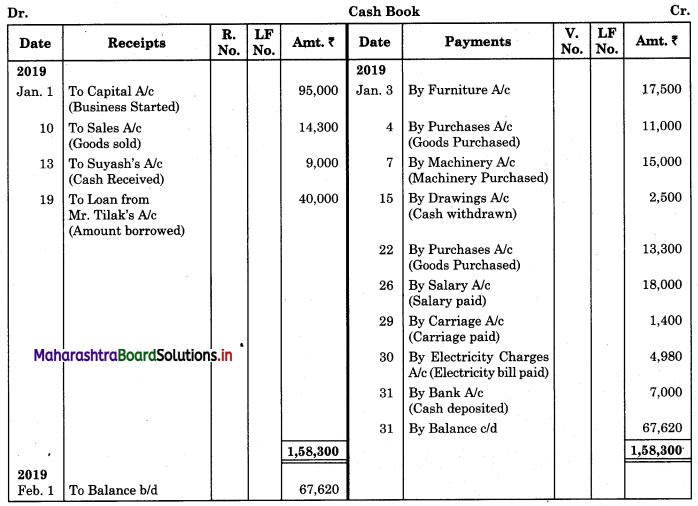
Maharashtra Board 11th BK Important Questions Chapter 5 Subsidiary Books Solved Problems Q1

Working Notes:
1. 22nd Jan.:
Net Purchase Price = Purchase Price – 5% Trade Discount
= 14,000 – 5% of 14,000
= 14,000 – 700
= ₹ 13,300

2. Balance of Cash on 31st Jan. = Total of Receipt side – Total of Payment side
= 1,58,300 – 90,680
= ₹ 67,620

Maharashtra Board 11th BK Important Questions Chapter 5 Subsidiary Books

Question 2.
Prepare a simple cash book of Mr. Shriram from the following details:
2019 Feb.
1 Balance of cash ₹ 65,500.
2 Brought additional capital ₹ 12,000.
4 Received from Nilesh on account ₹ 3,800.
7 Purchased goods from United Ltd. ₹ 16,000 and paid half the amount immediately.
9 Received commission from Aarti Traders ₹ 2,650.
10 Paid to Prithviraj Traders on account ₹ 17,800.
13 Purchased stationery for office use ₹ 2,460.
17 Received rent ₹ 4,900.
20 Paid ₹ 1,750 for insurance premium.
22 Sold goods for cash ₹ 13,800.
25 Purchased 10% debentures of ₹ 20,000
27 Paid telephone bill ₹ 3,000 and electricity bill ₹ 2,340.
28 Deposited into the bank all cash in excess of ₹ 11,000.
Solution:
In the books of Mr. Shriram
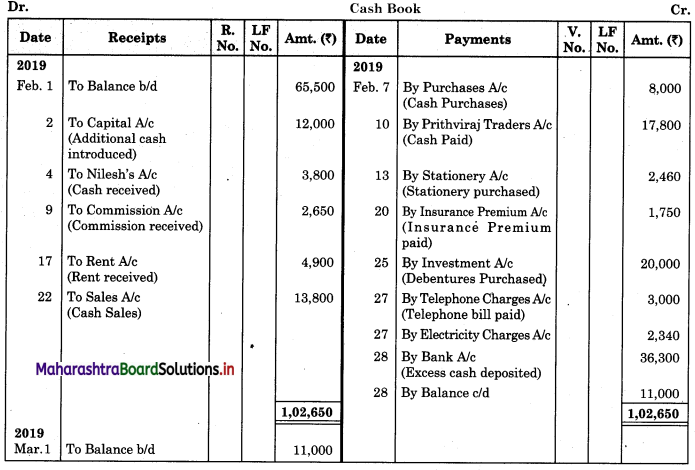
Maharashtra Board 11th BK Important Questions Chapter 5 Subsidiary Books Solved Problems Q2

Working Note:
Dates: 28th February 2011:
Excess Cash Deposited = Total of Receipt Side – Total of Payment side including Closing Cash balance
= 1,02,650 – 66,350
= ₹ 36,300

Two Column Cash Book

Question 3.
Enter the following transaction in a cash book with cash and bank columns for the month of April 2019:
2019 April
1 Started business with cash ₹ 30,000.
2 Opened a current account with the bank and deposited ₹ 9,000.
5 Received ₹ 4,850 for Cash Sales and discount allowed ₹ 50.
6 Purchased goods of ₹ 3,000 @ 10% cash discount and half the amount was paid by cash and remaining by cheque.
9 Received a crossed cheque for ₹ 7,775 from Megha Associates and discount allowed ₹ 25.
12 Purchased machinery of ₹ 13,300 and paid for installation ₹ 700.
15 Received a bearer cheque of ₹ 735 from Rahul in full settlement of his account ₹ 800.
17 Deposited into the bank ₹ 2,000.
20 Transferred ₹ 8,000 from Savings Account to Current Account.
22 Received a hearer cheque from Vinod ₹ 2,230.
24 Deposited the cheque received from Vinod into the bank.
29 Bank informed that cheque received from Vinod is dishonoured.
30 Paid for printing bill book ₹ 660.
31 Withdrew from the bank for office use ₹ 1,000.
Solution:
In the books of ___________
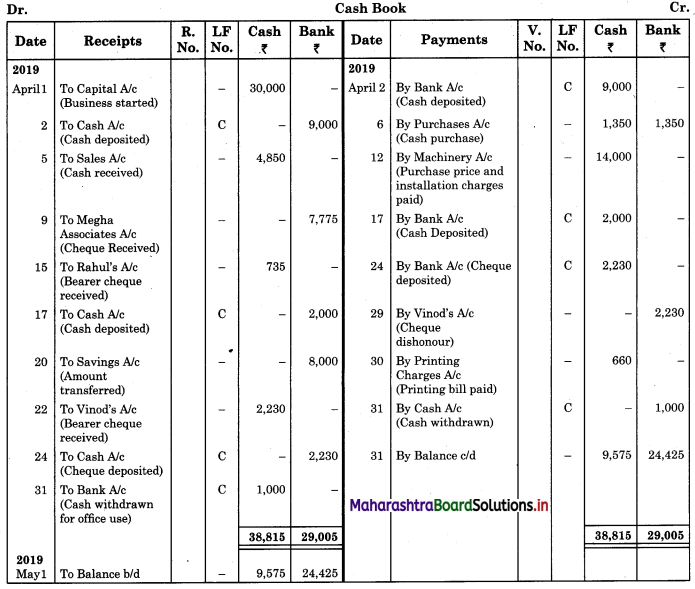
Maharashtra Board 11th BK Important Questions Chapter 5 Subsidiary Books Solved Problems Q3

Working Notes:
1. Transaction dated 6th April 2019.
Cash Discount = 10% of Goods Purchased
= 10% of 3,000
= ₹ 300
Net Cash Payable = 3,000 – 300 = ₹ 2,700
Amount paid in cash = \(\frac{1}{2}\) of 2,700 = ₹ 1,350
Amount paid by cheque = \(\frac{1}{2}\) of 2,700 = ₹ 1,350

2. Dated: 12th April, 2019.
Cost of Machinery = Purchase Price + Installation Charges
= 13,300 + 700
= ₹ 14,000

Maharashtra Board 11th BK Important Questions Chapter 5 Subsidiary Books

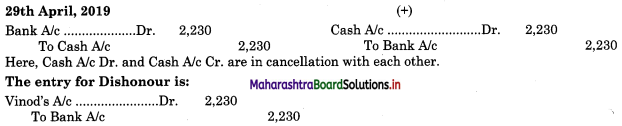
3. Transaction dated: 29th April, 2019.
Entry for dishonour of Vinod’s Cheque:
Earlier Entries:

Maharashtra Board 11th BK Important Questions Chapter 5 Subsidiary Books Solved Problems Q3.1
Maharashtra Board 11th BK Important Questions Chapter 5 Subsidiary Books Solved Problems Q3.2

Question 4.
Enter the following transaction of Hariram Bros, in a cash book with cash and bank column for the month of May 2019.
2019 May
1 Cash Balance ₹ 33,000
Bank Balance ₹ 8,000
3 Received from Prerna cash ₹ 2,750 and a bearer cheque for ₹ 645.
6 Paid to Arjun ₹ 5,300 by cheque and discount received ₹ 125.
8 Cash sales ₹ 5,645 and discount allowed ₹ 55.
10 Cheque received on 3 May 2011 deposited into the bank for collection.
12 Deposited into bank ₹ 4,000.
15 Cheque received from Prerna returned dishonoured.
18 Purchased goods from Indrajit ₹ 4,000 at an 8% trade discount and paid half the amount immediately.
20 Bank paid insurance premium under our standing instruction ₹ 1,950 and collected interest on investment ₹ 3,650.
22 Cheque issued to Arjun was dishonoured.
24 Lucky Stores directly deposited into our bank ₹ 9,500.
25 Paid salaries by cheque ₹ 5,700.
26 Withdrew by cheque ₹ 2,000 for office use and ₹ 1,500 for personal use.
31 Deposited into the bank all cash in excess of ₹ 5,000.
Solution:
In the books of Hariram Bros.
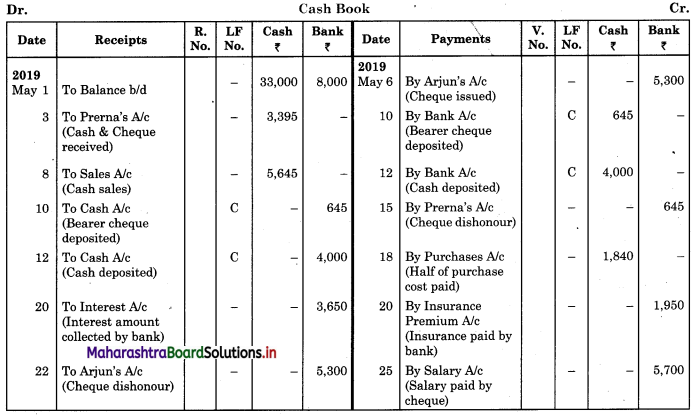
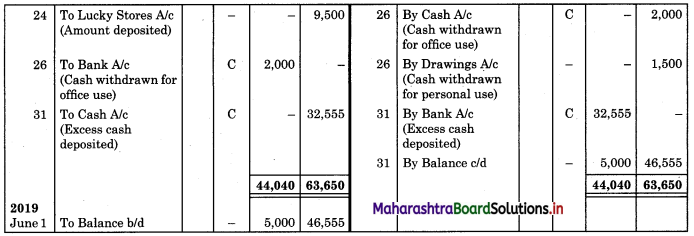
Maharashtra Board 11th BK Important Questions Chapter 5 Subsidiary Books Solved Problems Q4
Maharashtra Board 11th BK Important Questions Chapter 5 Subsidiary Books Solved Problems Q4.1

Working Notes:
1. Transaction dated 3rd May 2019:
Receipt of bearer cheque of ₹ 645 is debited to Cash A/c
Hence, Cash A/c is debited by 2,750 + 645 = ₹ 3,395

2. Transaction dated 10th May 2019:
Entry for deposit of cheque ₹ 645
Bank A/c ……………. Dr. 645
To Cash A/c 645

3. Transaction dated 15th May 2019:
Entry for dishonour of Prerna’s cheque.

Maharashtra Board 11th BK Important Questions Chapter 5 Subsidiary Books Solved Problems Q4.2
When reverse entries are reconciled Cash A/c’s gets cancelled.
? Entry for dishonour of cheque is
Prerna’s A/c…………..Dr. 645
To Bank A/c 645

4. Transaction dated 18th May, 2019:
Net Price of goods purchased = Purchase Price – Trade discount
= 4,000 – 8% of 4,000
= 4,000 – 320
= ₹ 3,680
Amount Paid = \(\frac{1}{2}\) 3,680 = ₹ 1,840

5. Date: 31st May 2019:
Excess Cash deposited = Total of a debit column of cash – Total of credit column of cash including the closing balance
= 44,040 – 11,485
= ₹ 32,555

Question 5.
Enter the following transaction of Mr. Chavan in a cash book with cash and bank column for the month of April 2019.
2019 April
1 Cash Balance ₹ 56,000
Bank Overdraft ₹ 11,000
3 Purchased goods for ₹ 13,000 for cash at 2% cash discount and amount paid by cheque.
6 Received a bearer cheque for ₹ 13,250 in full settlement of ₹ 13,500 from Govind Traders.
9 Purchased 100 shares of Amar Ltd. of ₹ 100 each at ₹ 110 each and paid by cheque.
11 Sold goods of ₹ 7,000 at a 5% cash discount to Pramod and he paid half the amount immediately.
14 Deposited into bank ₹ 11,000.
17 Received a crossed cheque for ₹ 18,000 from Gajanan Traders.
20 Bank paid our telephone bill ₹ 3,230.
21 Bank charged ₹ 540 as interest on overdraft.
22 Paid by cheque to Urmila ₹ 8,000.
25 Deposited into the bank the cheque received from Govind Traders.
27 Received a bearer cheque for ₹ 3,460 for rent which was deposited into the bank.
29 Bank informed that the cheque received for rent was dishonoured.
30 Paid life insurance premium of Mr. Chavan ₹ 4,250 by cash and electricity bill ₹ 7,400 by cheque.
Solution:
In the books of Mr. Chavan
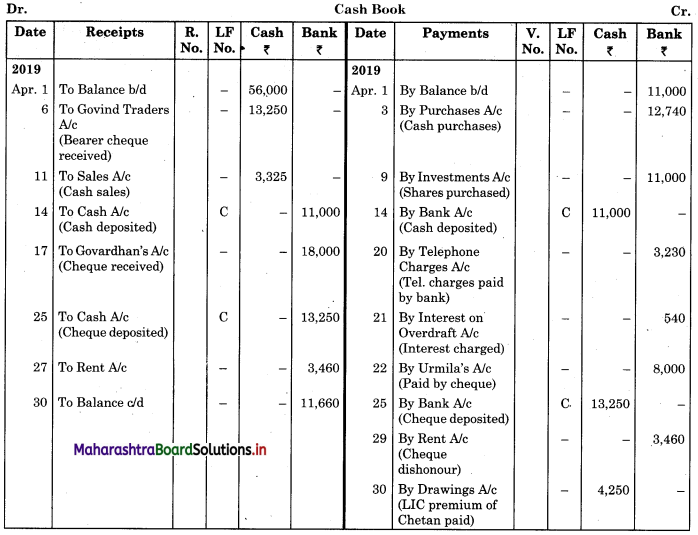
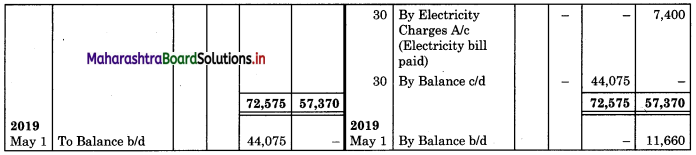
Maharashtra Board 11th BK Important Questions Chapter 5 Subsidiary Books Solved Problems Q5
Maharashtra Board 11th BK Important Questions Chapter 5 Subsidiary Books Solved Problems Q5.1

Working Notes:
1. Transaction dated 3rd April 2019:
Net payment made on cash purchases = Purchase Price – Cash discount
= 13,000 – 2% on 13,000
= 13,000 – 260
= ₹ 12,740

2. Transaction dated 9th April 2019:
Amount paid by cheque for purchase of shares = No. of shares purchased × Market value
= 100 × 110
= ₹ 11,000

Maharashtra Board 11th BK Important Questions Chapter 5 Subsidiary Books

3. Closing balance of Cash book
Cash balance = 72,575 – 28,500 = ₹ 44,075
Bank overdraft balance = 57,370 (Cr. column) – 45,710 (Dr. column)
Overdraft = ₹ 11,660

Petty Cash Book

Question 6.
Enter the Following transaction in a petty cash book having analysis columns for the month of October 2019.
2019 Oct.
1 Received cash from head cashier ₹ 1,350.
3 Paid packing charges ₹ 102.
6 Paid for postage ₹ 43.
9 Purchased 3 office files of ₹ 25 each.
13 Gave a tip to watchman ₹ 20.
18 Gave advance to clerk Mr. Shrikant ₹ 280.
22 Paid for printing ₹ 162.
25 Paid for advertisement ₹ 274.
27 Paid cleaning and washing charges ₹ 46.
29 Gave donation for Diwali celebration ₹ 150.
31 Purchased revenue stamps ₹ 65.
Solution:
Analytical Petty Cash Book of ___________
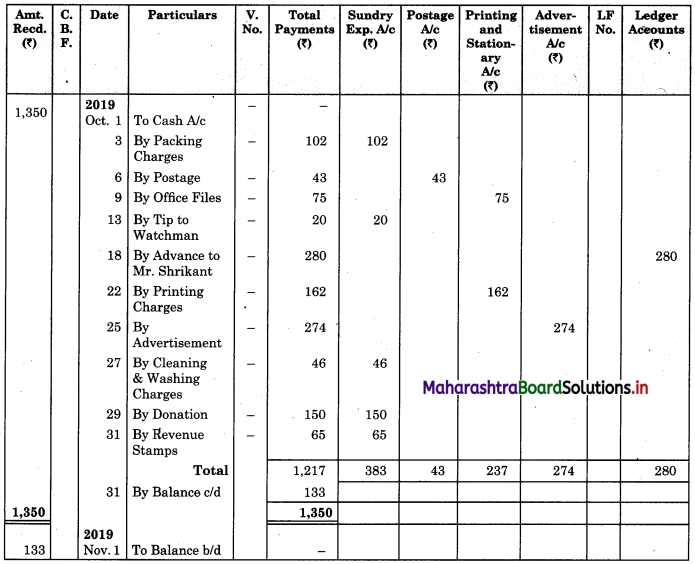
Maharashtra Board 11th BK Important Questions Chapter 5 Subsidiary Books Solved Problems Q6

Question 7.
Enter the following transaction in an analytical petty cash book under the imprest system for the month of February 2019.
2019 Feb.
1 Received cheque from Head Cashier ₹ 2,700.
4 Purchased pencils for ₹ 45, inkpot ₹ 25, and papers ₹ 55.
6 Paid for repairs ₹ 190.
10 Paid taxi fare to Manager ₹ 168.
13 Paid subscription for newspaper ₹ 212.
17 Paid for refreshments to customers ₹ 175.
19 Paid to Ranjeet in settlement of his account ₹ 230.
21 Paid wages to casual labour ₹ 220.
24 Paid electricity bill ₹ 525.
26 Paid for carriage ₹ 105.
27 Purchase a wooden chair for ₹ 275.
Solution:
Analytical Petty Cash Book of ___________
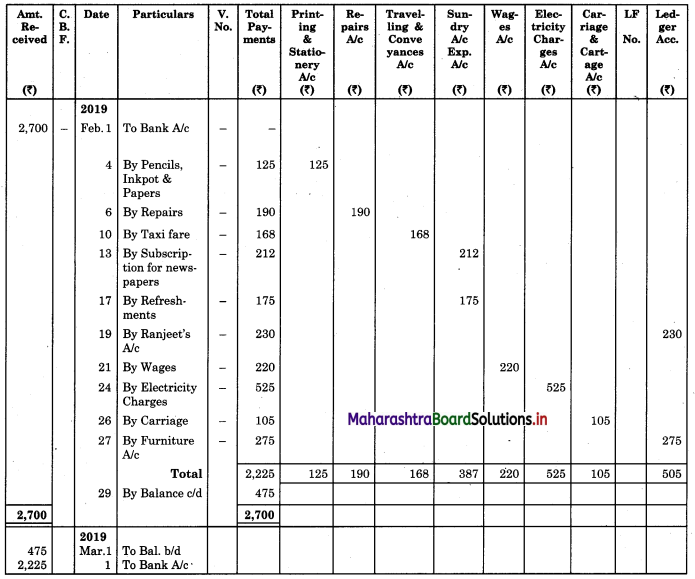
Maharashtra Board 11th BK Important Questions Chapter 5 Subsidiary Books Solved Problems Q7

Question 8.
Mr. Shrinath maintains a columnar petty cash book on the Imprest system. The Imprest amount is ₹ 850. The following information, show how his Petty Cash Book would appear for the week ended 7th September. 2019.
2019 Sept.
1 Balance in hand ₹ 125.
Postage ₹ 28.
Stationery ₹ 35.
Refreshment expenses ₹ 20.
3 Travelling and Conveyance ₹ 34.
Miscellaneous Expenses ₹ 5.
Refreshment expenses ₹ 25.
4 Repairs charges ₹ 170.
Paid for Postage ₹ 21.
5 Refreshment expenses ₹ 22.
Travelling expenses ₹ 32.
Stationery ₹ 47.
6 Refreshment expenses ₹ 19.
7 Miscellaneous Expenses ₹ 12.
Paid for Postage ₹ 7.
Repair charges ₹ 75.
Solution:
Analytical Petty Cash Book of Mr. Shrinath
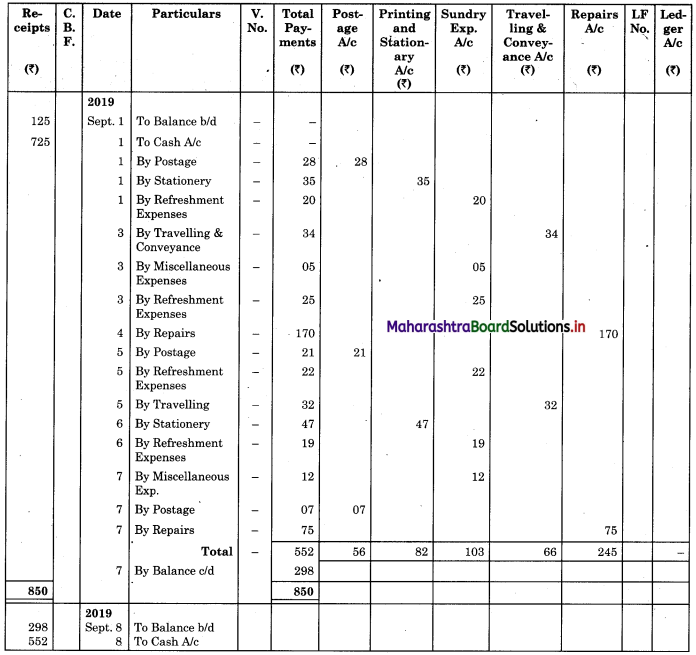
Maharashtra Board 11th BK Important Questions Chapter 5 Subsidiary Books Solved Problems Q8

Purchase Book, Sales Book, Purchase Return Book, and Sales Return Book

Question 9.
Prepare Purchase Book and Sales Book, M/s. S.K. Traders dealer in ready-made garments, Mumbai.
2019 April
1 Purchased goods from M/s. Jalna Traders, Delhi for ₹ 10,000 at 10% T.D.
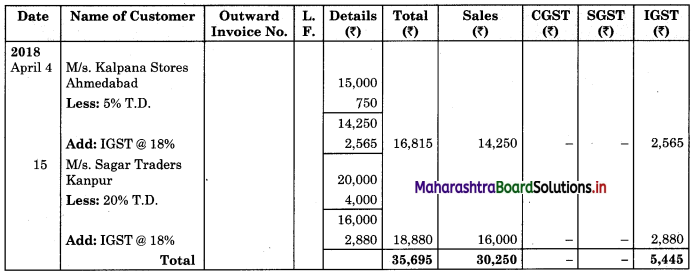
4 Sold goods to M/s Kalpana Stores, Ahmedabad for ₹ 15,000 at 5% T.D.
10 Bought goods from M/s. Raj Enterprise, Patna for ₹ 5,000.
15 Sold goods to M/s Sagar Traders, Kanpur for ₹ 20,000 at 20% T.D.
25 Bought goods from M/s. Rakesh Stores, Banglore for ₹ 12,000 @ 5% T.D.
Rate of GST applicable on ready made garments are CGST @ 9%, SGST @ 9% and IGST @ 18%.
Solution:
In the books of M/s. S.K. Traders, Mumbai
Purchase Book (Analytical)
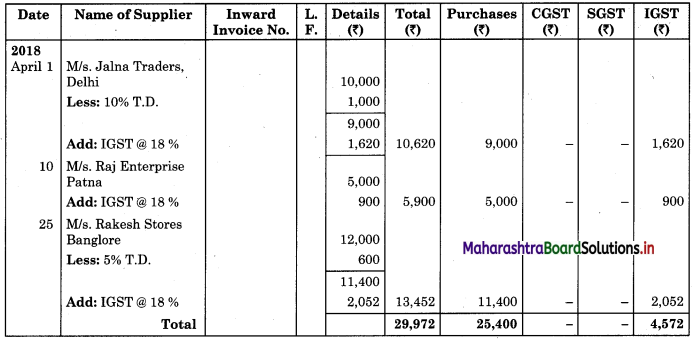
Maharashtra Board 11th BK Important Questions Chapter 5 Subsidiary Books Solved Problems Q9

Sales Book (Analytical)
Maharashtra Board 11th BK Important Questions Chapter 5 Subsidiary Books Solved Problems Q9.1
Note: In the case of inter-state sales IGST is used.

Maharashtra Board 11th BK Important Questions Chapter 5 Subsidiary Books

Journal Proper

Question 10.
Journalise the following transactions in the Journal Proper of Mr. Mahadev.
1 Pass opening entries: Debtors ₹ 20,000; Creditors ₹ 30,000; Computer ₹ 50,000 and Capital ₹ 40,000.
2 Pass closing entries: Purchases ₹ 10,000; Sales ₹ 25,000; Salaries ₹ 20,000 and Carriage ₹ 2,000.
3 Pass adjustment entries: Outstanding Wages ₹ 1,000 and Prepaid Insurance ₹ 500.
4 Pass transfer entries: Gross Profit ₹ 15,000; Net loss ₹ 2,000 and Drawings ₹ 4,000
5 Bought Machinery on credit from M/s. Tech ltd. for ₹ 50,000.
6 Allowed cash discount of ₹ 1,000 to Ajay.
Solution:
In the books of Mr. Mahadev
Journal Proper
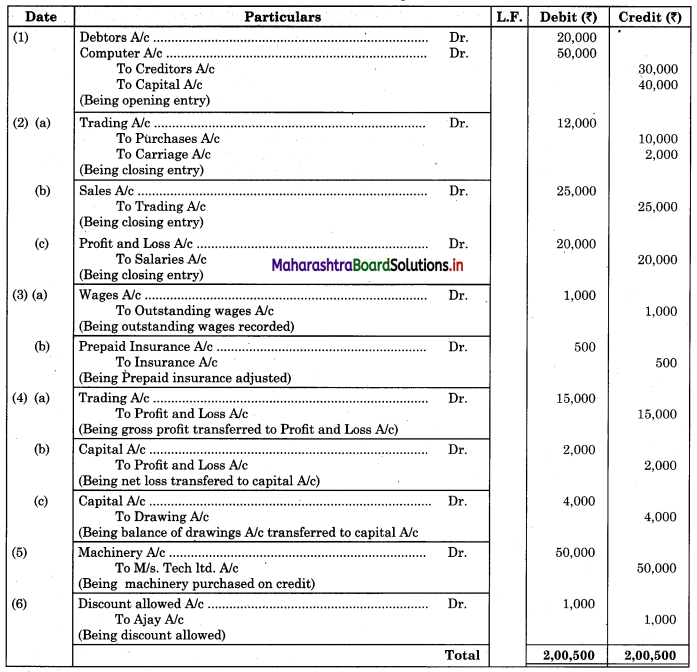
Maharashtra Board 11th BK Important Questions Chapter 5 Subsidiary Books Solved Problems Q10

Maharashtra Board 11th BK Important Questions Chapter 4 Ledger

Balbharti Maharashtra State Board 11th Commerce Book Keeping & Accountancy Important Questions Chapter 4 Ledger Important Questions and Answers.

Maharashtra State Board 11th Commerce BK Important Questions Chapter 4 Ledger

1. Answer in one sentence only.

Question 1.
State the meaning of ‘Debit Balance’.
Answer:
Excess of the debit total of an account over its credit total is called debit balance.

Question 2.
What do you mean by Credit Balance?
Answer:
Excess of credit total of an account over its debit total is called credit balance.

Maharashtra Board 11th BK Important Questions Chapter 4 Ledger

Question 3.
What is the balance of Outstanding Salary A/c?
Answer:
The balance of Outstanding Salary A/c is a credit balance.

Question 4.
What is the balance of Cash A/c?
Answer:
The balance of Cash A/c is always a debit balance.

Question 5.
Where is the balance of Salaries A/c transferred at the end of the year?
Answer:
At the end of the year, the balance of Salaries A/c is transferred to Profit and Loss A/c.

Question 6.
From which books of accounts posting is made in the Ledger?
Answer:
From Journal and Subsidiary books posting is made in the ledger.

Maharashtra Board 11th BK Important Questions Chapter 4 Ledger

Question 7.
What do you mean by the head of an Account?
Answer:
The name of the account which is written on the top of the ledger account in the middle is called “Head of an account”.

2. Write the word, term, phrase, which can substitute each of the statements.

Question 1.
A bound book of Account.
Answer:
Ledger

Question 2.
The credit balance of the Bank Account.
Answer:
Bank Overdraft

Question 3.
Recording of transactions from Journal to Ledger.
Answer:
Ledger Posting

Maharashtra Board 11th BK Important Questions Chapter 4 Ledger

Question 4.
Page number of Ledger.
Answer:
L.F. No.

Question 5.
The right-hand side of an account.
Answer:
Credit Side

Question 6.
The left-hand side of an account.
Answer:
Debit Side

Question 7.
Excess of a debit total of an account over its credit total.
Answer:
Debit Balance

Question 8.
Excess of credit total of an account over its debit total.
Answer:
Credit Balance

Maharashtra Board 11th BK Important Questions Chapter 4 Ledger

Question 9.
A secondary book of account in which entries are recorded from Journal or Subsidiary books.
Answer:
Ledger

Question 10.
Page of the account book.
Answer:
Folio

Question 11.
A book of accounts in which all ledger accounts are maintained.
Answer:
Ledger

Question 12.
Type of accounts that are not balanced but transferred to Trading Account or P/L A/c.
Answer:
Nominal Accounts

Question 13.
An account where the total purchase book is posted.
Answer:
Purchases Account

Maharashtra Board 11th BK Important Questions Chapter 4 Ledger

Question 14.
A statement of accounts’s prepared from the balances of the ledger account.
Answer:
Trial Balance

3. Select appropriate alternatives from those given below and rewrite the sentences.

Question 1.
_______________ is the act of transferring an entry from journal to ledger.
(a) Journalising
(b) Casting
(c) Balancing
(d) Posting
Answer:
(d) Posting

Question 2.
Cash account always shows _______________ balance.
(a) Credit
(b) Negative
(c) Minus
(d) Debit
Answer:
(d) Debit

Question 3.
Bank overdraft means _______________ balance of Bank A/c.
(a) Debit
(b) Credit
(c) Positive
(d) Nil
Answer:
(b) Credit

Maharashtra Board 11th BK Important Questions Chapter 4 Ledger

Question 4.
Real accounts generally shows _______________ balance.
(a) Debit
(b) Credit
(c) Negative
(d) Nil
Answer:
(a) Debit

Question 5.
Excess of debit total of an account over it’s credit total indicates _______________ balance.
(a) Negative
(b) Positive
(c) Debit
(d) Credit
Answer:
(c) Debit

Question 6.
When goods are sold on credit _______________ account is credited.
(a) Buyer’s A/c
(b) Cash A/c
(c) Sales A/c
(d) Seller’s A/c
Answer:
(c) Sales A/c

Question 7.
When the total of debit side of an account exceeds credit side, it is called _______________ balance.
(a) Debit
(b) Credit
(c) Nil
(d) Real
Answer:
(a) Debit

Question 8.
Machinery A/c shows _______________ balance.
(a) Credit
(b) Debit
(c) Positive
(d) Negative
Answer:
(b) Debit

Maharashtra Board 11th BK Important Questions Chapter 4 Ledger

Question 9.
Left hand side of an account is called _______________
(a) Credit
(b) Debit
(c) Middle
(d) Centre
Answer:
(b) Debit

Question 10.
_______________ is prepared from the balances in the ledger accounts.
(a) List
(b) Journal
(c) Book
(d) Trial Balance
Answer:
(d) Trial Balance

Question 11.
Total of Sales book is _______________ to sales account.
(a) entered
(b) moved
(c) posted
(d) given
Answer:
(c) posted

Question 12.
Wages A/c is transferred to _______________ A/c.
(a) Trading A/c
(b) Profit & Loss A/c
(c) Trial Balance
(d) Any
Answer:
(a) Trading A/c

Question 13.
All entries are posted from Journal to _______________
(a) Ledger
(b) Balance Sheet
(c) Trial Balance
(d) Cash A/c
Answer:
(a) Ledger

4. State whether the following statements are ‘True or False’ with reasons.

Question 1.
Ledger accounts are balanced every day.
Answer:
This statement is False.
Ledger accounts are balanced on a particular period of time or on the accounting year of the firm. They are not balanced every day.

Maharashtra Board 11th BK Important Questions Chapter 4 Ledger

Question 2.
Every account is divided into two sides.
Answer:
This statement is True.
Every account is divided into two sides i.e. Debit and Credit to do ledger pasting from a journal which follows the rules of double-entry book-keeping.

Question 3.
The discount allowed is a real account.
Answer:
This statement is False.
Discount allowed is an expense for the business. All expenses come under the Nominal account. So the discount allowed is a Nominal account.

Question 4.
The bank is a Nominal A/c.
Answer:
This statement is False.
A bank is an Artificial person created by law. The bank is personal accounts.

Question 5.
Accounts of expenses may show a credit balance.
Answer:
This statement is False.
Accounts of expenses always show debit balance. They fall under the nominal account and its Golden rule is to Debit all Expenses.

Question 6.
A Debtors A/c always show a credit balance.
Answer:
This statement is False.
A Debtor A/c always shows a Debit balance. The debtor is a personal account and as per the rule of personal account Debit the receiver.

Maharashtra Board 11th BK Important Questions Chapter 4 Ledger

Question 7.
When goods are sold for cash, the personal a/c of the buyer is debited.
Answer:
This statement is False.
In a cash transaction, there is no Personal A/c. The personal account comes in a credit transaction. So when goods are sold for cash, the cash account is debited. A cash account is a real account and as per rule debit what comes in.

Question 8.
Capital a/c is a nominal a/c.
Answer:
This statement is False.
Capital is a Personal account. Capital is the amount invested by the proprietor in his business. A proprietor is a person. Capital is also personal A/c.

Question 9.
Drawing a/c is a personal a/c.
Answer:
This statement is True.
Drawings mean cash or goods withdrawn by the proprietor for his personal or family use he is a person. So drawing is personal A/c.

Question 10.
Narration is not necessary for a ledger.
Answer:
This statement is False.
Narration is necessary for a Journal book and not in Ledger. Ledgers are self-narrative as every ledger has headed.

Question 11.
All a/c’s are closed down at the end of the accounting year.
Answer:
This statement is True.
All ledger accounts are closed an accounting year or Financial year to prepare the Trial balance and Financial statements of the year.

Question 12.
Recording of a transaction in the journal is called posting.
Answer:
This statement is False.
The process of recording a transaction in the Journal is called Journalising. Posting means transferring journal entries to respective ledger accounts.

Maharashtra Board 11th BK Important Questions Chapter 4 Ledger

Question 13.
Balance of personal a/c is brought down for the next year.
Answer:
This statement is True.
Personal accounts are the account of Debtors or Creditors. The business has to collect or pay amounts on personal accounts. Current year collections or payments are done in the following year. So balances of personal accounts are brought for the next year.

Question 14.
All transactions are recorded directly in the ledger.
Answer:
This statement is False.
First, every transaction is recorded in a Journal book or Subsidiary book and from there they are posted to respective ledger accounts. No transaction can be recorded directly in the ledger.

Question 15.
Ledger Folio and index are necessary for the ledger.
Answer:
This statement is True.
The index is necessary to final particular account on its page number and ledger folio number is also necessary for cross-checking with the journal book. This makes handling convenient and easier.

Question 16.
Ledger posting is not necessary for journal proper.
Answer:
This statement is False.
Ledger posting is necessary for journal proper. From Ledger trial balance and financial statements are prepared for the accounting year. Without posting of journal proper Trial balance and financial statements will not be tally and can’t give true and fair accounting.

Question 17.
Ledger Folio is recorded in the journal.
Answer:
This statement is True.
Ledger folio is a page of the ledger, where posting is made from a journal book. For cross-reference, the ledger folio is recorded in the journal.

Maharashtra Board 11th BK Important Questions Chapter 4 Ledger

Question 18.
Ledger posting is made before journal entry.
Answer:
This statement is False.
Ledger posting is made after journal entry. First, all transactions are recorded to Journal and from the journal, posting is made to Ledger.

5. Fill in the blanks.

Question 1.
Debtors A/c shows _______________ balance.
Answer:
Debit

Question 2.
Left hand side of an account is called _______________ side.
Answer:
Debit

Question 3.
_______________ is prepared from the balances in the Ledger A/c.
Answer:
Trial Balance

Question 4.
Total of salary A/c is transfered to _______________ A/c.
Answer:
Profit and loss A/c

Maharashtra Board 11th BK Important Questions Chapter 4 Ledger

Question 5.
b/d (brought down) balance indicates _______________ balance.
Answer:
Opening

Question 6.
_______________ Balance on Nominal Account shows Inconies or gains.
Answer:
Credit

Question 7.
Debtors A/c shows _______________ balance.
Answer:
Debit

Question 8.
Drawing A/c shows _______________ balance.
Answer:
Debit

Question 9.
Wages A/c balance transferred to _______________ A/c.
Answer:
Profit and Loss

Question 10.
Discount allowed shows _______________ Balance.
Answer:
Debit

Maharashtra Board 11th BK Important Questions Chapter 4 Ledger

Question 11.
Dividend received shows _______________ Balance.
Answer:
Credit

Question 12.
Ledger is the _______________ book of Accounts.
Answer:
Principal

6. Complete the following table.

Question 1.
Maharashtra Board 11th BK Important Questions Chapter 4 Ledger 6 Q1
Answer:
Credit balance

Question 2.
Maharashtra Board 11th BK Important Questions Chapter 4 Ledger 6 Q2
Answer:
Ledger

Question 3.
Maharashtra Board 11th BK Important Questions Chapter 4 Ledger 6 Q3
Answer:
Credit Balance

Maharashtra Board 11th BK Important Questions Chapter 4 Ledger

Question 4.
Maharashtra Board 11th BK Important Questions Chapter 4 Ledger 6 Q4
Answer:
Livestock A/c

Question 5.
Maharashtra Board 11th BK Important Questions Chapter 4 Ledger 6 Q5
Answer:
Output GST

7. Put ‘✓’ mark for the nature of balance for the following.

Question 1.

AccountDr. BalanceCr. Balance
1. Salary A/c
2. Purchase A/c
3. Sales Return A/c
4. Machinery A/c
5. Bank Balance A/c
6. Cash Balance A/c
7. Sale A/c
8. Purchase Return A/c
9. Bills Payable A/c
10. Debtors A/c
11. Creditors A/c
12. Stationery A/c
13. Furniture A/c
14. Amit’s Loan A/c

Answer:

AccountDr. BalanceCr. Balance
1. Salary A/c
2. Purchase A/c
3. Sales Return A/c
4. Machinery A/c
5. Bank Balance A/c
6. Cash Balance A/c
7. Sale A/c
8. Purchase Return A/c
9. Bills Payable A/c
10. Debtors A/c
11. Creditors A/c
12. Stationery A/c
13. Furniture A/c
14. Amit’s Loan A/c

Maharashtra Board 11th BK Important Questions Chapter 3 Journal

Balbharti Maharashtra State Board 11th Commerce Book Keeping & Accountancy Important Questions Chapter 3 Journal Important Questions and Answers.

Maharashtra State Board 11th Commerce BK Important Questions Chapter 3 Journal

1A. Answer in One Sentence:

Question 1.
What do you mean by Journalising?
Answer:
Journalisation means a process of recording two-fold effects of business transactions in the summarized form of debit and credit in the journal.

Question 2.
Which column in a journal is not filled in at the time of journalising?
Answer:
Ledger Folio column in a journal is not filled in at the time of journalising.

Maharashtra Board 11th BK Important Questions Chapter 3 Journal

Question 3.
Which account is credited when Salary is paid by cheque?
Answer:
Bank Account is credited when salary is paid by cheque.

Question 4.
Why is a journal called the book of prime entry?
Answer:
Journal is called a book of prime entry because all the business transactions are recorded first in the journal in a chronological order i.e. in the order of their occurrence.

Question 5.
In which order the transactions are recorded in a journal.
Answer:
The transactions are recorded in a journal in chronological order i.e. in the order of their occurrence or taking place.

Maharashtra Board 11th BK Important Questions Chapter 3 Journal

Question 6.
Which account is debited, when goods are destroyed by fire?
Answer:
When goods are destroyed by fire, the Loss by Fire Account is debited.

2. Correct the following statements and rewrite the statements.

Question 1.
Transactions can be recorded in any order in the Journal.
Answer:
Transactions must be recorded in chronological order in the Journal.

Question 2.
Trade discount is recorded in the books of accounts.
Answer:
A cash discount is recorded in the books of accounts.

Question 3.
Trade discount is calculated after cash discount while calculating discount on purchase or sales.
Answer:
Trade discount is calculated before cash discount while calculating discount on purchase or sales.

Maharashtra Board 11th BK Important Questions Chapter 3 Journal

Question 4.
Trade discount is allowed for prompt payments.
Answer:
A cash discount is allowed for prompt payments.

Question 5.
The process of entering or recording the transactions in the Journal is called posting.
Answer:
The process of entering or recording the transaction in a Journal is called Journalising.

3. Do you agree or disagree with the following statements

Question 1.
Purchase of Assets should be debited to purchase A/c.
Answer:
Disagree

Question 2.
A cash discount is recorded in the books of Accounts.
Answer:
Agree

Question 3.
GST is imposed by the local body.
Answer:
Disagree

Maharashtra Board 11th BK Important Questions Chapter 3 Journal

Question 4.
Capital is an asset for business organisations.
Answer:
Disagree

Question 5.
With NEFT, RTGS Transaction Cash A/c is affected.
Answer:
Disagree

Question 6.
On purchase of goods or assets output, GST A/c is credited.
Answer:
Disagree

Question 7.
5% GST Charge on luxury cars.
Answer:
Disagree

Maharashtra Board 11th BK Important Questions Chapter 3 Journal

Question 8.
GST Generates income to Central Government only.
Answer:
Disagree

Question 9.
Ledger Folio column in Journal filled while passing Journal entry only.
Answer:
Disagree

Question 10.
Purchase of shares of TATA Ltd should be debited to TATA Ltd’s A/c.
Answer:
Disagree

Maharashtra Board 11th BK Important Questions Chapter 2 Meaning and Fundamentals of Double Entry Book-Keeping

Balbharti Maharashtra State Board 11th Commerce Book Keeping & Accountancy Important Questions Chapter 2 Meaning and Fundamentals of Double Entry Book-Keeping Important Questions and Answers.

Maharashtra State Board 11th Commerce BK Important Questions Chapter 2 Meaning and Fundamentals of Double Entry Book-Keeping

1. Answer in one sentence only.

Question 1.
State the meaning of the accounting equation.
Answer:
An equation that indicates or shows that the total assets of a business are always equal to the total liabilities of a business plus capital is called the accounting equation.

Question 2.
What do you mean by debt?
Answer:
To debit an account means to enter the entry or write on the left-hand side of an account.

Maharashtra Board 11th BK Important Questions Chapter 2 Meaning and Fundamentals of Double Entry Book-Keeping

Question 3.
Give two examples of personal accounts.
Answer:
Two examples of personal accounts are stated below:

  1. Mr. Raghuvir Sharma’s Account
  2. The Bank of India’s Account.

Question 4.
What is a Nominal Account?
Answer:
The account relating to business expenses, incomes, and gains is called a nominal account.
e.g. Rent A/c.

Question 5.
Give two examples of real accounts.
Answer:
Two examples of real accounts are:

  1. Cash A/c
  2. Goodwill A/c

Question 6.
State whether drawings increase or decrease owner’s equity.
Answer:
Drawings made by the owner of the business decrease its equity.

Question 7.
What is a conventional cash book?
Answer:
A cash book that is prepared to record not only cash transactions but all types of transactions such as credit purchase or sale, banking transactions, opening, and closing entries, adjustments entries is called a conventional cash book.

Maharashtra Board 11th BK Important Questions Chapter 2 Meaning and Fundamentals of Double Entry Book-Keeping

Question 8.
Explain the term dual aspect.
Answer:
Every transaction has two aspects i.e. for every debit there is corresponding and equal credit.

Question 9.
State the meaning of impersonal account.
Answer:
The account which is not of a person is called an impersonal account.

Question 10.
Write the rule of Real account.
Answer:
The rule of real account states that Debit what comes in and Credit what goes out.

Question 11.
Which account will be debited when goods are sold to Ram on credit?
Answer:
When goods are sold to Ram, Ram’s A/c will be debited.

Question 12.
Which account will be debited when Mr. Shyam has paid cash to you?
Answer:
Cash A/c will be debited when Mr. Shyam has paid cash to us.

2. Write one word/term or phrase which can substitute each of the following statements.

Question 1.
Expenses are paid before it is due.
Answer:
Prepaid Expenses

Question 2.
Income due but not yet received.
Answer:
Accrued Income

Maharashtra Board 11th BK Important Questions Chapter 2 Meaning and Fundamentals of Double Entry Book-Keeping

Question 3.
Carriage paid on the sale of goods.
Answer:
Carriage Outward

Question 4.
Statement of Assets & Liabilities.
Answer:
Balance Sheet

Question 5.
Account prepared to know Net Profit or Net Loss.
Answer:
Profit & Loss Account

Question 6.
Value of goods remaining unsold at the end of the year.
Answer:
Closing Stock

Question 7.
The provision was made to compensate the loss on account of likely debts.
Answer:
Provision for Bad & Doubtful Debts

Question 8.
The accounts are prepared at the end of the accounting year to know the profit or loss and financial position of the business.
Answer:
Final Accounts

Maharashtra Board 11th BK Important Questions Chapter 2 Meaning and Fundamentals of Double Entry Book-Keeping

Question 9.
An amount spent on promoting the sale of goods.
Answer:
Selling Expenses

Question 10.
Additional information is provided below the Trial Balance.
Answer:
Adjustments

3. Select the most appropriate alternatives from those given below and rewrite the statements.

Question 1.
___________ is excess of assets over liabilities.
(a) Goodwill
(b) Capital
(c) Investments
(d) Drawings
Answer:
(b) Capital

Question 2.
Discount earned is transferred to credit side of ___________ account.
(a) Current A/c
(b) Profit & Loss Account
(c) Trading
(d) Capital
Answer:
(b) Profit & Loss Account

Question 3.
___________ is a statement that shows the financial position of a business on a specific date.
(a) Trading account
(b) Trial Balance
(c) Profit & Loss A/c
(d) Balance Sheet
Answer:
(d) Balance Sheet

Maharashtra Board 11th BK Important Questions Chapter 2 Meaning and Fundamentals of Double Entry Book-Keeping

Question 4.
Outstanding expenses are shown on the ___________ side of Balance Sheet.
(a) Assets
(b) Liability
(c) Both
(d) None of these
Answer:
(b) Liability

Question 5.
Interest on Drawing is credited to ___________ Account.
(a) Trading
(b) Profit & Loss Account
(c) Capital
(d) All
Answer:
(b) Profit & Loss Account

Question 6.
Debit balance of Trading Account means ___________
(a) Gross Loss
(b) Net Loss
(c) Net Profit
(d) Gross Profit
Answer:
(a) Gross Loss

Question 7.
Carriage Inward is debited to ___________ Account.
(a) Trading A/c
(b) Profit & Loss
(c) Capital
(d) Bank
Answer:
(a) Trading A/c

Question 8.
Excess of credit over to debit in Profit & Loss Account indicates ___________
(a) Net Profit
(b) Gross Profit
(c) Gross Loss
(d) Net Loss
Answer:
(a) Net Profit

Maharashtra Board 11th BK Important Questions Chapter 2 Meaning and Fundamentals of Double Entry Book-Keeping

Question 9.
Closing stock is always valued at cost or market price which is ___________
(a) more
(b) less
(c) zero
(d) equal
Answer:
(b) less

Question 10.
When a specific date is not given, in that case, interest on the drawing is charged for ___________ month.
(a) Four
(b) Six
(c) Eight
(d) Nine
Answer:
(b) Six

4. Fill in the blanks.

Question 1.
Gross Profit is transferred to ___________ account.
Answer:
Profit & Loss Account

Question 2.
Debit Balance of Trading Account indicates ___________
Answer:
Gross Loss

Question 3.
Income Receivable appears on ___________ side of Balance Sheet.
Answer:
Asset

Question 4.
Interest on Bank Loan is debited to ___________ A/c.
Answer:
Profit & Loss Account

Maharashtra Board 11th BK Important Questions Chapter 2 Meaning and Fundamentals of Double Entry Book-Keeping

Question 5.
Profit and Loss Account is prepared to find out ___________ results of the business.
Answer:
Networking

Question 6.
All indirect/operating expenses are transferred to ___________ account.
Answer:
Profit and Loss Account

Question 7.
Interest of proprietor’s drawing is credited to ___________ account.
Answer:
Profit & Loss Account

Question 8.
An excess of debit over credit in the Profit & Loss A/c represents the ___________
Answer:
Net Loss

Question 9.
All direct expenses are transferred to ___________ account.
Answer:
Trading A/c

Maharashtra Board 11th BK Important Questions Chapter 2 Meaning and Fundamentals of Double Entry Book-Keeping

Question 10.
Balance Sheet is ___________ of assets & liabilities.
Answer:
Statement

5. Classify the following accounts under the types of Personal, Real, and Nominal accounts.

Question 1.
Investments A/c
Answer:
Real Account

Question 2.
Creditors A/c
Answer:
Personal Account

Question 3.
Land A/c
Answer:
Real Account

Question 4.
Purchase Returns A/c
Answer:
Personal Account

Question 5.
Cash A/c
Answer:
Real Account

Question 6.
Building A/c
Answer:
Real Account

Maharashtra Board 11th BK Important Questions Chapter 2 Meaning and Fundamentals of Double Entry Book-Keeping

Question 7.
Capital A/c
Answer:
Personal Account

Question 8.
Goodwill A/c
Answer:
Real Account

Question 9.
Interest received A/c
Answer:
Nominal Account

Question 10.
Depreciation A/c
Answer:
Nominal Account

Question 11.
Stationery A/c
Answer:
Nominal Account

Question 12.
Salary A/c
Answer:
Nominal Account

Maharashtra Board 11th BK Important Questions Chapter 2 Meaning and Fundamentals of Double Entry Book-Keeping

Question 13.
Excise duty A/c
Answer:
Nominal Account

Question 14.
Bank Loan A/c
Answer:
Personal Account

Question 15.
Bank Overdraft A/c
Answer:
Personal Account

Question 16.
Sales A/c
Answer:
Nominal Account

Question 17.
Return Inwards A/c
Answer:
Personal Account

Question 18.
Rent received A/c
Answer:
Nominal Account

Maharashtra Board 11th BK Important Questions Chapter 2 Meaning and Fundamentals of Double Entry Book-Keeping

Question 19.
Wages A/c
Answer:
Nominal Account

Question 20.
Discount received A/c
Answer:
Nominal Account

Question 21.
Debtors A/c
Answer:
Personal Account

Question 22.
Furniture & Fixtures A/c
Answer:
Nominal Account

Question 23.
Purchases A/c
Answer:
Nominal Account

Maharashtra Board 11th BK Important Questions Chapter 2 Meaning and Fundamentals of Double Entry Book-Keeping

Question 24.
Bad Debts A/c
Answer:
Nominal Account

Question 25.
Dadar Library A/c
Answer:
Personal Account

Question 26.
Rent paid A/c
Answer:
Nominal Account

Question 27.
Prepaid Insurance A/c
Answer:
Personal Account

Question 28.
Carriage Outwards A/c
Answer:
Nominal Account

Question 29.
Rent Receivable A/c
Answer:
Personal Account

Maharashtra Board 11th BK Important Questions Chapter 2 Meaning and Fundamentals of Double Entry Book-Keeping

Question 30.
Profit on sale of machinery A/c
Answer:
Nominal Account

Question 31.
Bills Payable A/c
Answer:
Personal Account

Question 32.
Bank of India A/c
Answer:
Personal Account

Question 33.
Carriage Inwards A/c
Answer:
Nominal Account

Question 34.
Stock A/c
Answer:
Real Account

Question 35.
Accrued Interest A/c
Answer:
Personal Account

Maharashtra Board 11th BK Important Questions Chapter 2 Meaning and Fundamentals of Double Entry Book-Keeping

Question 36.
Bank A/c
Answer:
Personal Account

Question 37.
12% Government Bonds A/c
Answer:
Real Account

Question 38.
Carriage A/c
Answer:
Nominal Account

Question 39.
Advertisement A/c
Answer:
Nominal Account

Question 40.
Conveyance A/c
Answer:
Nominal Account

Maharashtra Board 11th BK Important Questions Chapter 2 Meaning and Fundamentals of Double Entry Book-Keeping

Question 41.
Premises A/c
Answer:
Real Account

Question 42.
Octroi A/c
Answer:
Nominal Account

Question 43.
Postage A/c
Answer:
Nominal Account

Question 44.
Electricity Charges A/c
Answer:
Nominal Account

Maharashtra Board 11th BK Important Questions Chapter 1 Introduction to Book Keeping and Accountancy

Balbharti Maharashtra State Board 11th Commerce Book Keeping & Accountancy Important Questions Chapter 1 Introduction to Book Keeping and Accountancy Important Questions and Answers.

Maharashtra State Board 11th Commerce BK Important Questions Chapter 1 Introduction to Book Keeping and Accountancy

1. Answer in One Sentence:

Question 1.
What is Transaction?
Answer:
The exchange of goods or services for money or money’s worth is called a transaction.

Question 2.
What is Cash Discount?
Answer:
The amount which is deducted by the seller from the amount due at the time of the receipt is called cash discount.

Question 3.
What is the entity concept?
Answer:
The business entity concept states that a business has a separate entity and has an independent legal existence distinct from the person who owns it.

Maharashtra Board 11th BK Important Questions Chapter 1 Introduction to Book Keeping and Accountancy

Question 4.
What is the money measurement concept?
Answer:
The money measurement concept implies that every business transaction must be recorded in a common unit of measurement i.e. in terms of money only.

Question 5.
What is the consistency concept?
Answer:
The consistency concept implies that any policy adopted for accounting should be continuous or consistent throughout the business and it need not be changed generally unless and until circumstances demand.

Question 6.
What is conservatism?
Answer:
The concept of conservatism states that while deciding the policy of the enterprise the businessman has to anticipate no profit but provide for all possible losses.

Question 7.
What is accounting?
Answer:
Accounting is a process of recording, classifying, summarising, analyzing, and interpreting financial transactions and communicating the result thereof to the users of such information.

Question 8.
Name the financial statements prepared by a business.
Answer:
A businessman prepares the financial statements such as income statements i.e. Trading Account and Profit and Loss Account and Position Statement i.e. Balance Sheet.

Maharashtra Board 11th BK Important Questions Chapter 1 Introduction to Book Keeping and Accountancy

Question 9.
Explain the term ‘Profit’.
Answer:
Excess of revenue income over revenue expenditure is termed as profit.

Question 10.
Explain the term ‘Cost Concept’.
Answer:
The concept according to which assets are recorded in the books of accounts at the price at which they are acquired or purchased is called the cost concept.

2. Give the word term or phrase which can substitute each of the following statements:

Question 1.
Dealings between two persons.
Answer:
Transaction

Question 2.
Business transaction in which cash is not paid or received immediately.
Answer:
Credit Transaction

Question 3.
An allowance is given by the receiver of the cash to the giver of cash at the time of payment.
Answer:
Cash Discount

Question 4.
Liability depends on the happening or not happening a certain event.
Answer:
Contingent Liability

Maharashtra Board 11th BK Important Questions Chapter 1 Introduction to Book Keeping and Accountancy

Question 5.
Expenditure on fixed assets increases the earning capacity of the business.
Answer:
Capital Expenditure

Question 6.
System in which entry is recorded for cash as well as credit transactions.
Answer:
Accrual System

Question 7.
The concept under which comparison of one accounting period with the other period is possible.
Answer:
Consistency Concept

Question 8.
A science and art of correctly recording in the books of accounts, all those business transactions that result in the transfer of money or money’s worth.
Answer:
Bookkeeping

Question 9.
Exchange of goods and services either for cash or any other goods or services.
Answer:
Transaction

Question 10.
Sale or purchase of goods or services for immediate cash payment.
Answer:
Cash Transaction

Maharashtra Board 11th BK Important Questions Chapter 1 Introduction to Book Keeping and Accountancy

Question 11.
Sale or purchase of goods or services for a certain value to be receivable or payable in the future.
Answer:
Credit Transaction

Question 12.
Commodity purchased or produced for sale.
Answer:
Goods

Question 13.
Excess of assets over liabilities.
Answer:
Capital

Question 14.
Excess of profit over normal profit.
Answer:
Super Profit

Question 15.
The total amount of goods and services are withdrawn by the proprietor for self-use.
Answer:
Drawings

Maharashtra Board 11th BK Important Questions Chapter 1 Introduction to Book Keeping and Accountancy

Question 16.
Amount of discount deducted from the invoice price.
Answer:
Trade discount

Question 17.
The reputation of a business is expressed in terms of money.
Answer:
Goodwill

Question 18.
The concept states that assets when purchased should be recorded at cost price.
Answer:
Cost concept

Question 19.
The concept states that business operations will continue forever.
Answer:
Concept of Going Concern

Question 20.
A concept on which a double-entry bookkeeping system is based.
Answer:
Dual Aspect Concept

Question 21.
Rules of conduct are accepted universally to record business transactions.
Answer:
Accounting Principles

Maharashtra Board 11th BK Important Questions Chapter 1 Introduction to Book Keeping and Accountancy

Question 22.
General ideas which convey certain meanings.
Answer:
Concepts

Question 23.
The general notion or abstract ideas on which accounting is based.
Answer:
Accounting Concept

Question 24.
The accounting concept suggests that a business has a separate identity from its owner.
Answer:
Business Entity Concept

Question 25.
The accounting concept states that monetary transactions are only recorded in the books of accounts.
Answer:
Money Measurement Concept

Question 26.
The money value for which assets are acquired or manufactured.
Answer:
Cost

Question 27.
Proprietor’s contribution to the business.
Answer:
Capital

Maharashtra Board 11th BK Important Questions Chapter 1 Introduction to Book Keeping and Accountancy

Question 28.
Valuable things are owned by the business.
Answer:
Assets

Question 29.
Period of time for which accounts of the business are prepared.
Answer:
Financial year/Accounting year

Question 30.
Amount received after selling of goods or services.
Answer:
Revenue

Question 31.
Excess of revenue over its cost.
Answer:
Profit

Question 32.
Name the accounting concept on the basis of which the income statement is prepared.
Answer:
Accrual Accounting Concept

3. Select the most appropriate alternatives from those given below and rewrite the statements.

Question 1.
Money value of the reputation of business is known as ____________
(a) Copyright
(b) Goodwill
(c) Patents
(d) Trademark
Answer:
(b) Goodwill

Maharashtra Board 11th BK Important Questions Chapter 1 Introduction to Book Keeping and Accountancy

Question 2.
Heavy advertising expenditure for launching a new product is called as ____________
(a) Capital expenditure
(b) Revenue Expenditure
(c) Deferred Revenue Expenditure
(d) None of these
Answer:
(c) Deferred Revenue Expenditure

Question 3.
Expenditure incurred on purchase of fixed asset is ____________
(a) Revenue Expenditure
(b) Capital Expenditure
(c) Deferred Revenue Expenditure
(d) None of these
Answer:
(b) Capital Expenditure

Question 4.
Concept which provides a line between present and future is known as ____________
(a) Going Concern Concept
(b) Cost Concept
(c) Accrual Concept
(d) Entity Concept
Answer:
(a) Going Concern Concept

Question 5.
Totalling of Journal or Ledger is called as ____________
(a) Posting
(b) Folio
(c) Casting
(d) Journalising
Answer:
(c) Casting

Maharashtra Board 11th BK Important Questions Chapter 1 Introduction to Book Keeping and Accountancy

Question 6.
In cash transaction, goods or services are exchanged for ____________
(a) other goods
(b) other services
(c) immediate cash
(d) grains
Answer:
(c) immediate cash

Question 7.
The work of book-keeping is of ____________ nature.
(a) competitive
(b) primary/basic
(c) secondary
(d) none of these
Answer:
(b) primary/basic

Question 8.
Capital is ____________ of the business.
(a) asset
(b) liability
(c) property
(d) goodwill
Answer:
(b) liability

Question 9.
The work of accounting depends upon ____________
(a) book-keeping
(b) cash book
(c) subsidiary books
(d) ledger
Answer:
(a) book-keeping

Question 10.
____________ is the amount invested by the owner of a business.
(a) Cash
(b) Money
(c) Asset
(d) Capital
Answer:
(d) Capital

Maharashtra Board 11th BK Important Questions Chapter 1 Introduction to Book Keeping and Accountancy

Question 11.
Revenue expenditure is ____________ in nature.
(a) capital
(b) outstanding
(c) recurring
(d) contingent
Answer:
(c) recurring

Question 12.
Amount withdrawn by the owner for his personal expenses is called ____________
(a) Drawings
(b) Personal expenses
(c) Cash
(d) Assets
Answer:
(a) Drawings

Question 13.
Financial statements are a part of ____________
(a) Book keeping
(b) Planning
(c) Accounting
(d) None of these
Answer:
(c) Accounting

Question 14.
A ____________ liability is an uncertain liability.
(a) Long term
(b) Contingent
(c) Current
(d) Fixed
Answer:
(b) Contingent

Question 15.
A Derson who is unable to nay his debts, is called ____________
(a) insolvent
(b) solvent
(c) well to do
(d) poor
Answer:
(a) insolvent

Maharashtra Board 11th BK Important Questions Chapter 1 Introduction to Book Keeping and Accountancy

Question 16.
According to ____________ concept business shall go on for a long time.
(a) going concerned
(b) consistency
(c) materiality
(d) dual aspects
Answer:
(a) going concerned

Question 17.
According to ____________ concept, every business transaction has two aspects.
(a) going concerned
(b) materiality
(c) business entity
(d) dual aspects
Answer:
(d) dual aspects

Question 18.
According to ____________ concept revenue is recognised when it is earned.
(a) Realisation
(b) Accounting period
(c) Accrual
(d) Matching cost
Answer:
(c) Accrual

Question 19.
According to ____________ convention, while preparing planning anticipate losses.
(a) Materiality
(b) Consistency
(c) Conservatism
(d) disclosure
Answer:
(c) Conservatism

Question 20.
Customs and traditions which guide the accountants to prepare accounting statements are called ____________
(a) Conventions
(b) Principles
(c) Concepts
(d) Procedure
Answer:
(a) Conventions

Maharashtra Board 11th BK Important Questions Chapter 1 Introduction to Book Keeping and Accountancy

Question 21.
According to ____________ concept, assets are recorded at a price paid to acquire them.
(a) Cost
(b) Money measurement
(c) Entity
(d) Dual aspect
Answer:
(a) Cost

4. State whether the following statements are true or false with reasons:

Question 1.
The trading concern is established for rendering services to society.
Answer:
This statement is False.
The main objective of trading concern is to earn profit. It is for traders’ livelihood, so the trading concern is not established for rendering services to the society.

Question 2.
Book-keeping is an art as well as a science.
Answer:
This statement is True.
Book-keeping is also considered as an art of recording business transactions because the writing of accounts in a specific style and format requires education, knowledge, training, skill, and experience. From another point of view, Book-keeping is a continuous process of collecting, analyzing, classifying, summarising, and recording the different types of business transactions. In brief, bookkeeping may be defined as “A science as well as an art of collecting, analyzing, classifying, summarising and recording all types of business transactions in a significant manner and in terms of money in a separate set of books.”

Question 3.
In Book-keeping & Accountancy non-monetary transactions are also recorded.
Answer:
This statement is False.
Only monetary transactions are recorded in Book-keeping & Accountancy. It is done to find financial results for the purpose of analyzing and interpreting.

Question 4.
Perpetual succession is explained by the concept of the entity.
Answer:
This statement is False.
The concept of entity is different from the perpetual succession. Entity means separate existence of business from the owner whereas perpetual succession means long life and continuation.

Maharashtra Board 11th BK Important Questions Chapter 1 Introduction to Book Keeping and Accountancy

Question 5.
Accounting is useful only to the owner.
Answer:
This statement is False.
Accounting is not only useful for the owner but also to the suppliers, government, customers, lenders, etc.

Question 6.
Writing of account does not require specific skill and knowledge.
Answer:
This statement is False.
Writing of account requires specific skill and knowledge as book-keeping is an art and science of correctly recording business transactions.

Question 7.
The main objective of Bookkeeping is to keep permanent records of business transactions.
Answer:
This statement is True.
The record of business transactions is prepared for a specific period of time i.e. one year and it is preserved for a long period of time.

Question 8.
In credit transactions, goods or services are purchased for cash only.
Answer:
This statement is False.
In credit transactions, goods and services are purchased and sold for credit only. Credit means post-pone payments for a future date.

Question 9.
In barter transactions, goods or services are purchased for other goods or services.
Answer:
This statement is True.
Barter means exchange of goods or services for goods or services. No money is involved in barter transactions.

Question 10.
In cash transactions, goods or services are purchased for a certain value to be paid in the future.
Answer:
This statement is False.
In a cash transaction, goods or services are purchase or sold for spot payments or receipts. No credit is allowed.

Maharashtra Board 11th BK Important Questions Chapter 1 Introduction to Book Keeping and Accountancy

Question 11.
Good is a commodity that is purchased for self-use.
Answer:
This statement is False.
Good is a commodity that is purchased for resale purposes. It is an article or a commodity in which businessman deals.

Question 12.
Amount due from other person is known as debt.
Answer:
This statement is True.
Debt is a total sum of money due from a person with whom the business has dealings. Accordingly, a person from whom such debt is due to a business is called the debtor.

Question 13.
Liabilities represent the debts or obligations that a business must receive in terms of money.
Answer:
This statement is False.
Liabilities refer to the total amount of obligations that a business has to pay in the future. Liability means the total amount owed by the business to other persons.

Question 14.
Capital = Liabilities – Assets.
Answer:
This statement is False.
Excess of business assets over business liabilities is called capital.
Capital = Assets – liabilities.

Question 15.
Drawings made by the businessman increase his capital.
Answer:
This statement is False.
Drawing means cash or goods withdrawn by the proprietor for his personal or family use. Drawings made by the businessman decreases his capital.

Maharashtra Board 11th BK Important Questions Chapter 1 Introduction to Book Keeping and Accountancy

Question 16.
A person whose assets are equal to or greater than liabilities is known as insolvent.
Answer:
This statement is False.
Insolvent means a person whose liabilities are greater than assets is known as ‘Insolvent’.

Question 17.
A person whose assets are less than business liabilities is known as insolvent.
Answer:
This statement is True.
When a person is not able to pay liabilities is called insolvent. Liabilities are greater than assets.

Question 18.
The cost or sacrifice which is incurred to run the business is known as an income.
Answer:
This statement is False.
The cost or sacrifice which is incurred to run the business is known as an expenditure.

Question 19.
Benefits which are given by giver to the receiver is known as discount.
Answer:
This statement is False.
Discount is a concession given by the seller to the buyer. There are two types of discount,

  • Cash discount
  • Trade discount

Question 20.
Posting implies recording a transaction in a journal.
Answer:
This statement is False.
Posting means transferring or recording journal entries from the journal to the respective ledger accounts. Ledger is the main book of accounting.

Maharashtra Board 11th BK Important Questions Chapter 1 Introduction to Book Keeping and Accountancy

Question 21.
Contingent liabilities can also be called doubtful liabilities.
Answer:
This statement is True.
The contingent liabilities are the liabilities whose occurrence depends upon the happening of a certain event that may or may not take place. So a contingent liabilities can also be called doubtful liabilities.

Question 22.
A sports club is a trading concern.
Answer:
This statement is False.
The sports club is a nontrading concern as they do not work for profit-making. They work for the promotion of sports.

Question 23.
A cash discount is an incentive allowed for the speedy recovery of income.
Answer:
This statement is True.
A cash discount is given by the creditor or seller to the debtor or buyer to induce him to make prompt payment. It is given at the time of cash payment.

Question 24.
Excess of revenue over expenses is called loss.
Answer:
This statement is False.
Excess of revenue over expenses is called profit. Your income is less and expenditures are less so you get profit.
Income ₹ 50,000 – Expenses ₹ 35,000 = Profit is ₹ 15,000.

Question 25.
Excess of liabilities over assets represents the solvency of a business.
Answer:
This statement is False.
Excess of liabilities over assets represents insolvency of business. A trader cannot pay his debts as liabilities are greater than his assets.
Liabilities ₹ 1,50,000 Assets ₹ 80,000.
₹ 1,50,000 – ₹ 80,000 = ₹ 70,000 deficiency.

Maharashtra Board 11th BK Important Questions Chapter 1 Introduction to Book Keeping and Accountancy

Question 26.
A business can not run without bookkeeping.
Answer:
This statement is False.
Book-keeping is a recording of business financial transactions which is useful to prepare ledger, trial balance, financial statements. All the above are useful to take decisions, planning, liabilities, and assets so a businessman cannot run his business without book-keeping.

Question 27.
Bookkeeping is necessary only for organizing with profit objectives.
Answer:
This statement is False.
Books of accounts are maintained by trading and non-trading concerns. Non-trading concerns do not earn any profits so book-keeping is not necessary only with the objective of profit.

Question 28.
The figures of profit and net worth are disclosed by books of accounts.
Answer:
This statement is True.
The purpose of preparing books of accounts is to know financial details of organization from journal ledger, trial balance, final accounts proprietor to get an idea of his financial status. The purpose of financial books of accounts is to get profit and net worth etc.

Question 29.
Financial statements are an effective weapon in the hands of management.
Answer:
This statement is True.
With help of financial statements, management does planning, decision-making for the future. The past record gives ideas to the management to improve financial decisions like more profit better financial conditions etc. so financial statements are effective weapons in the hands of management.

Maharashtra Board 11th BK Important Questions Chapter 1 Introduction to Book Keeping and Accountancy

Question 30.
Irregularities, frauds, and misappropriations can be detected only because of books accounts.
Answer:
This statement is False.
Irregularities frauds and misappropriations can be detected by auditing. Continuous and periodical auditing will detect the irregularities frauds and misappropriations which is done by a chartered accountant.

5. Do you agree or disagree with the following statements:

Question 1.
Goodwill is a tangible asset.
Answer:
Disagree

Question 2.
For income tax purposes an accounting year starts on 1st January and ends on 31st March.
Answer:
Disagree

Question 3.
Earning profits is an aim of Not for Profit Concern.
Answer:
Disagree

Question 4.
Trade discount is recorded in the books of accounts.
Answer:
Disagree

Maharashtra Board 11th BK Important Questions Chapter 1 Introduction to Book Keeping and Accountancy

Question 5.
Wages paid on installation of machinery are revenue expenditures.
Answer:
Disagree

Question 6.
An amount that is not recoverable from debtors is called bad debt.
Answer:
Agree

Question 7.
The double-entry book-keeping system is invented in India.
Answer:
Disagree

Question 8.
Book-keeping does not have any rules and regulations for recording business transactions.
Answer:
Disagree

Question 9.
The owner of the business does not have any utility of book-keeping.
Answer:
Disagree

Maharashtra Board 11th BK Important Questions Chapter 1 Introduction to Book Keeping and Accountancy

Question 10.
Bookkeeping cannot be used as financial evidence in a court of law.
Answer:
Disagree

Question 11.
It is not possible for management to plan and take decisions in business with help of book-keeping and accountancy.
Answer:
Disagree

Question 12.
Cash-withdrawn by the proprietor from his business for personal use is called capital.
Answer:
Disagree

Question 13.
A person who has to pay the business for getting goods and services on credit is known as the debtor.
Answer:
Agree

Question 14.
Trade discount is not recorded in the books of accounts.
Answer:
Agree

Maharashtra Board 11th BK Important Questions Chapter 1 Introduction to Book Keeping and Accountancy

Question 15.
Purchase of goods is revenue expenditure.
Answer:
Agree

Question 16.
Heavy expenditure on advertising is deferred revenue expenditure.
Answer:
Agree

Question 17.
A solvent person’s assets are more than his liabilities.
Answer:
Agree

Question 18.
Net Worth = Total Assets – Outsiders Liabilities
Answer:
Agree

Question 19.
Conservatism’s concept means to play safe.
Answer:
Agree

Maharashtra Board 11th BK Important Questions Chapter 1 Introduction to Book Keeping and Accountancy

Question 20.
The dual aspect means every transaction has two effects i.e. debit and credit.
Answer:
Agree

6. Complete the following sentences:

Question 1.
In barter transaction goods are exchange for ____________
Answer:
Goods

Question 2.
Asset is ____________ of the business.
Answer:
property

Question 3.
Capital expenditures are ____________ in nature.
Answer:
Non Recurring

Maharashtra Board 11th BK Important Questions Chapter 1 Introduction to Book Keeping and Accountancy

Question 4.
A ____________ liability is an uncertain liability.
Answer:
Contingent

Question 5.
A person whose liabilities are more than his assets is known as ____________
Answer:
Insolvent

Question 6.
An article or a commodity which is purchase for resale in business is called ____________
Answer:
Goods

Question 7.
Customs and traditions which guide the accountants to prepare accounting systems are called ____________
Answer:
Conventions

Question 8.
Discount given by the creditor to the debtor on payment of cash is called ____________
Answer:
Cash discount

Question 9.
For tax purpose an year starts on 1st April and ends on 31st March is called ____________
Answer:
Accounting year

Question 10.
An institution which provides standard of accounting in India called ____________
Answer:
Institute of Chartered Accountants of India

Maharashtra Board 11th BK Important Questions Chapter 1 Introduction to Book Keeping and Accountancy

Question 11.
Which accounting standard is followed for depreciation on fixed assets ____________
Answer:
AS-6

Question 12.
Brief explanation of an entry is called as ____________
Answer:
Narration

Question 13.
Businessman open ____________ type of bank account.
Answer:
Current

Question 14.
The main objective of business concern ____________
Answer:
making profits

Question 15.
Assets which are held in the business for a period of less than one year ____________
Answer:
Current Assets

Question 16.
10 years loan taken from bank by organisation is ____________ term loan.
Answer:
long

Question 17.
Heavy expenses paid on formation of an organisation is known as ____________ expenditure.
Answer:
Deferred Revenue

Maharashtra Board 11th BK Important Questions Chapter 1 Introduction to Book Keeping and Accountancy

Question 18.
Dividend received on shares is ____________ income.
Answer:
Revenue

Question 19.
Loss on sale of old machine is ____________ loss.
Answer:
Capital

Maharashtra State Board 11th Book Keeping & Accountancy Important Questions and Answers

Maharashtra State Board HSC 11th Commerce Book Keeping & Accountancy Important Questions and Answers

Maharashtra Board 11th HSC Important Questions

Maharashtra Board 11th BK Textbook Solutions Chapter 10 Single Entry System

Balbharti Maharashtra State Board Bookkeeping and Accountancy 11th Solutions Chapter 10 Single Entry System Textbook Exercise Questions and Answers.

Maharashtra State Board Bookkeeping and Accountancy 11th Solutions Chapter 10 Single Entry System

1. Answer in One sentence only.

Question 1.
What do you mean by a Single Entry System?
Answer:
A system of bookkeeping in which an accountant or businessman records only one aspect of business transaction (either debit or credit and ignores the other aspect is called ‘Single Entry System’.

Question 2.
What is a Statement of Affairs?
Answer:
A list of all assets and liabilities prepared under a single entry system to find out capital balance is called a statement of affairs.

Maharashtra Board 11th BK Textbook Solutions Chapter 10 Single Entry System

Question 3.
Which type of accounts are normally not kept under the Single Entry System?
Answer:
Under a single entry system, records of impersonal accounts i.e. real accounts and nominal accounts are not maintained.

Question 4.
Which statement is prepared under the Single Entry system to ascertain the capital balances?
Answer:
A statement of Affairs is prepared under a single entry system to ascertain capital balances.

Question 5.
How Opening Capital is calculated under the Single Entry System?
Answer:
Under a single entry system, opening capital is ascertained by preparing the opening statement of affairs.

Question 6.
Which types of accounts are maintained under the Single Entry System?
Answer:
Under a single entry system, all personal accounts and cash accounts are maintained.

Question 7.
Can a Trial Balance be prepared under a Single Entry System?
Answer:
A trial balance cannot be prepared under a single entry system.

Maharashtra Board 11th BK Textbook Solutions Chapter 10 Single Entry System

Question 8.
Which type of organizations generally follow the Single Entry System?
Answer:
Organizations having small sizes of business such as sole trading concerns and partnership firms follow a single entry system.

2. Write a word, term, or phrase which can substitute each of the following statements.

Question 1.
A statement that is similar to the Balance Sheet.
Answer:
Statement of Affairs

Question 2.
The system of Accounting is normally suitable for small business organizations.
Answer:
Single Entry System

Question 3.
A statement similar to the Balance Sheet is prepared to find out the amount of opening capital.
Answer:
Opening Statement of Affairs

Question 4.
An excess of assets over liabilities.
Answer:
Capital

Maharashtra Board 11th BK Textbook Solutions Chapter 10 Single Entry System

Question 5.
Excess of closing capital over opening capital of proprietor under Single Entry System.
Answer:
Profit

Question 6.
Name of the method of accounting suitable to firms having limited transactions.
Answer:
Single Entry System

Question 7.
A System of accounting that is unscientific.
Answer:
Single Entry System

Question 8.
Further capital introduced by the proprietor in the business concern over and above his existing capital.
Answer:
Additional Capital

3. Select the most appropriate answer from the alternatives given below and rewrite the sentence.

Question 1.
The capital balances are ascertained by preparing _______________
(a) Statement of Affairs
(b) Cash Account
(c) Drawings Accounts
(d) Debtors Accounts
Answer:
(a) Statement of Affairs

Maharashtra Board 11th BK Textbook Solutions Chapter 10 Single Entry System

Question 2.
Under Single Entry System, Opening Capital = Opening Assets less _______________
(a) Opening Liabilities
(b) Closing Liabilities
(c) Debtors Account
(d) Creditors Account
Answer:
(a) Opening Liabilities

Question 3.
Additional Capital introduced during the year is _______________ from closing capital in order to find out the correct profit.
(a) Added
(b) Deducted
(c) Divided
(d) Ignored
Answer:
(b) Deducted

Question 4.
Single Entry System may be useful for _______________
(a) Sole traders
(b) Company
(c) Government
(d) None of these
Answer:
(a) Sole traders

Question 5.
In order to find out the correct profit, drawings is _______________ from closing capital.
(a) Multiplies
(b) Divided
(c) Deducted
(d) Added
Answer:
(d) Added

Maharashtra Board 11th BK Textbook Solutions Chapter 10 Single Entry System

Question 6.
The difference between assets and liabilities is called _______________
(a) Capital
(b) Drawings
(c) Income
(d) Expenses
Answer:
(a) Capital

Question 7.
When Closing Capital is greater than the Opening Capital, the difference is _______________
(a) Profit
(b) Loss
(c) Assets
(d) Liabilities
Answer:
(a) Profit

Question 8.
Opening Capital is ₹ 30,000; Closing Capital is ₹ 60,000; Withdrawals are ₹ 5,000; and further capital brought in is ₹ 3,000; Profit is _______________
(a) ₹ 45,000
(b) ₹ 35,000
(c) ₹ 32,000
(d) ₹ 22,000
Answer:
(c) ₹ 32,000

4. State True or False with reasons:

Question 1.
The double Entry System of Book-keeping is a scientific method of books of accounts.
Answer:
This statement is True.
In the double-entry system of book-keeping, there are two-fold effects. Both the effects are recorded simultaneously with an equal amount. This system also follows principles and rules of debit and credit. Due to this, there are very fewer chances of mistakes. So double entry system of Book-Keeping is a scientific method of the book of accounts.

Question 2.
Preparation of Trial Balance is not possible under the Single Entry System.
Answer:
This statement is True.
Under the single entry system, only cash and personal accounts of debtors and creditors are open. So it is not possible to prepare. Trail balance under single entry system as it has incomplete information of Accounting.

Question 3.
Statement of Affairs and Balance Sheet are one and the same.
Answer:
This statement is False.
There is a difference between a statement of Affairs and the Balance sheet. Statement of Affair shows estimated values of assets and liabilities.

Maharashtra Board 11th BK Textbook Solutions Chapter 10 Single Entry System

Question 4.
The single Entry System is not useful for large organizations.
Answer:
This statement is True.
Under the Single Entry System, only the cash book and personal account of Debtor and Ciygditor are maintained. Real and Nominal accounts are not maintained. It has no proper set of rules to be followed. It is useful for small organisations and not for a large organisations.

Question 5.
Only Cash and Personal accounts are maintained under the Single Entry System.
Answer:
This statement is True.
The single Entry System is an ancient and unscientific method of recording business transactions. This system maintains minimum accounts so it is easy for traders to write books of accounts. This system does not follow any accounting rules. To know the cash collections and amount payable or receivable only cash and personal accounts are maintained under a single entry system.

5. Do you agree with the following statements?

Question 1.
Further capital introduced during the year increases profit.
Answer:
Disagree

Question 2.
Interest in Drawings decreases the amount of profit under the Single Entry System.
Answer:
Disagree

Question 3.
Real and Nominal accounts are not maintained under the Single Entry System.
Answer:
Agree

Question 4.
The single Entry System is based on certain rules and principles.
Answer:
Disagree

Maharashtra Board 11th BK Textbook Solutions Chapter 10 Single Entry System

Question 5.
Statement of Profit is just like Profit and Loss Account.
Answer:
Disagree

6. Fill in the Blanks.

Question 1.
Statement of Affairs is just like _______________
Answer:
Balance Sheet

Question 2.
Under Single Entry System, Profit = Closing Capital Less _______________
Answer:
Opening Capital

Question 3.
In order to find out the correct profit, drawings are _______________ to the closing capital.
Answer:
Added

Question 4.
In _______________ Book Keeping System, in every business transactions we find two effects.
Answer:
Double Entry System

Question 5.
The difference between Assets and Liabilities is called _______________
Answer:
Capital

Maharashtra Board 11th BK Textbook Solutions Chapter 10 Single Entry System

Question 6.
Single Entry System is more popular for _______________
Answer:
Sole Trader

Question 7.
Additional Capital introduced during the year is _______________ from Closing Capital in order to find out the correct profit.
Answer:
Deducted

Question 8.
Single Entry System is Suitable for _______________ business.
Answer:
Small

7. Find the odd one:

Question 1.
Interest on Drawings, Outstanding Expenses, Undervaluation of Assets, Prepaid Expenses.
Answer:
Outstanding Expenses

Question 2.
Interest on Capital, Interest on Loan, Overvaluation of Liabilities, Depreciation on Assets.
Answer:
Overvaluation of Liabilities

Question 3.
Creditors, Bills Payable, Bank Overdraft, Stock in Trade.
Answer:
Stock in Trade

8. Complete the following table:

Question 1.
Maharashtra Board 11th BK Textbook Solutions Chapter 10 Single Entry System 8 Q1
Answer:
₹ 5,000

Question 2.
Maharashtra Board 11th BK Textbook Solutions Chapter 10 Single Entry System 8 Q2
Answer:
₹ 30,000

Maharashtra Board 11th BK Textbook Solutions Chapter 10 Single Entry System

Question 3.
Maharashtra Board 11th BK Textbook Solutions Chapter 10 Single Entry System 8 Q3
Answer:
₹ 5,000

Question 4.
Maharashtra Board 11th BK Textbook Solutions Chapter 10 Single Entry System 8 Q4
Answer:
₹ 25,000, ₹ 20,000

Question 5.
Maharashtra Board 11th BK Textbook Solutions Chapter 10 Single Entry System 8 Q5
Answer:
₹ 19,000

9. Complete the following table. Put Proper mark in Box.

Question 1.
Maharashtra Board 11th BK Textbook Solutions Chapter 10 Single Entry System 9 Q1
Answer:

  1. Add
  2. Add
  3. Add
  4. Less
  5. Add
  6. Less
  7. Add
  8. Less
  9. Less
  10. Less

Practical Problems

Question 1.
Mr. Poonawala keeps his books under the Single Entry System and gives the following information.
Capital as of 31.3.2017 – ₹ 60,000
Capital as on 31.3.2018 – ₹ 1,00,000
Drawings made during the year ₹ 2,000
Additional capital introduced during the year ₹ 12,000
Calculate Profit or Loss during the year.
Solution:
In the books of Mr. Poonawala
Statement of Profit or Loss for the year ended 31st March 2018
Maharashtra Board 11th BK Textbook Solutions Chapter 10 Single Entry System Practical Problems Q1

Maharashtra Board 11th BK Textbook Solutions Chapter 10 Single Entry System

Question 2.
Sujit a small trader provides you with the following details of his business.
Maharashtra Board 11th BK Textbook Solutions Chapter 10 Single Entry System Practical Problems Q2
Additional information:
1. Sujit withdraws ₹ 5,000 for his personal use, on 1st Oct. 2017.
2. He had also withdrawn ₹ 30,000 for rent of his residential flat.
3. Depreciation Furniture by 10% p.a. and writes off ₹ 1,000 from Motor Van.
4. Charge interest on Drawings ₹ 3,000.
5. 10% Govt. Bonds were purchased on 1st Oct. 2017.
6. Allow interest on capital at 10% p.a.
7. ₹ 1,000 is written off as bad debts and provides 5% p.a. R.D.D. on Debtors.
Prepare Opening Statement of Affairs, Closing Statement of Affairs, and Statement of Profit or Loss for the year ending 31st March 2018.
Solution:
In the books of Sujit
Opening and closing statement of Affairs as on _______________
Maharashtra Board 11th BK Textbook Solutions Chapter 10 Single Entry System Practical Problems Q2.1
Statement of Profit or Loss for the year ended 31st March 2018
Maharashtra Board 11th BK Textbook Solutions Chapter 10 Single Entry System Practical Problems Q2.2

Question 3.
Anjali keeps her books by the Single Entry System. Her position on 1.4.2016 was as follows.
Cash at Bank ₹ 4,000, Cash in Hand ₹ 1,000, Stock ₹ 6,000; Sundry Debtors ₹ 8,400, Plant and Machinery ₹ 7,500, Bill Receivable ₹ 2,600, Creditors ₹ 3500; Bills Payable ₹ 4,000
On 31.3.2017 her position was as follows; cash at Bank ₹ 3,900, Cash in Hand ₹ 2,000. Stock ₹ 9000, Sundry Debtors, ₹ 7,500; Plant and Machinery ₹ 7,500; Bills Payable ₹ 2,200, Bills Receivable ₹ 3,400; Creditors ₹ 1,500.
During the year Anjali introduced further Capital of ₹ 1,500 and she spent ₹ 700 per month for her personal use.
Depreciation Plant and Machinery by 5% p.a. and create Reserve for Doubtful debts @ 5% p.a. on the debtor. Prepare Opening and Closing Statement of Affairs and Statement of Profit or Loss for the year ended 31.3.2017.
Solution:
In the books of Anjali
Opening and closing statement of Affairs as on _______________
Maharashtra Board 11th BK Textbook Solutions Chapter 10 Single Entry System Practical Problems Q3
Statement of Profit or Loss for the year ended 31st March 2017
Maharashtra Board 11th BK Textbook Solutions Chapter 10 Single Entry System Practical Problems Q3.1

Question 4.
Mr. Vijay is dealing in the business of fruits. He maintains an accounting record with a single entry. The following figures are taken from his record.
Maharashtra Board 11th BK Textbook Solutions Chapter 10 Single Entry System Practical Problems Q4
Additional information:
1. Mr. Vijay introduced ₹ 7,000 as fresh capital.
2. He spent ₹ 40,000 from his business for his daughter’s marriage.
3. Depreciate Building by ₹ 6,000.
4. Create a 5% reserve for doubtful debts on Sundry Debtor.
Prepare:
1. Opening Statement of Affairs.
2. Closing Statement of Affairs
3. Statement of Profit or Loss for the year ended 31.3.2018.
Solution:
In the books of Mr. Vijay
Opening and closing statement of Affairs as on _______________
Maharashtra Board 11th BK Textbook Solutions Chapter 10 Single Entry System Practical Problems Q4.1
Statement of Profit or Loss for the year ended 31st March 2018
Maharashtra Board 11th BK Textbook Solutions Chapter 10 Single Entry System Practical Problems Q4.2

Maharashtra Board 11th BK Textbook Solutions Chapter 10 Single Entry System

Question 5.
Miss. Fiza keeps her books on the Single Entry System and disclosed the following information about her business.
Maharashtra Board 11th BK Textbook Solutions Chapter 10 Single Entry System Practical Problems Q5
Additional information:
1. Miss. Fiza transferred ₹ 2,000 per month during the first half-year and ₹ 1000 per month for the second half-year from a business account to her personal account.
2. She sold her private asset for ₹ 40,000 and brought the proceeds into her business.
3. She also took goods worth ₹ 12,000 for private use.
4. Plant and Machinery is to be depreciated by 10% p.a.
5. Provide R.D.D. on debtors at 5% p.a.
Prepare:
1. Opening Statement of Affairs
2. Closing Statement of Affairs
3. Statement of Profit or Loss for the year ended 31.3.2018
Solution:
In the books miss Fiza
Opening and closing statement of Affairs as on _______________
Maharashtra Board 11th BK Textbook Solutions Chapter 10 Single Entry System Practical Problems Q5.1
Statement of Profit or Loss for the year ended 31st March 2018
Maharashtra Board 11th BK Textbook Solutions Chapter 10 Single Entry System Practical Problems Q5.2

Question 6.
Miss. Sanika keeps her books on the Single Entry System. The statement of affairs is given on 31st March 2018.
Maharashtra Board 11th BK Textbook Solutions Chapter 10 Single Entry System Practical Problems Q6
On 31st March 2018 their Assets and Liabilities were as follows:
Plant and Machinery ₹ 42,000, Stock ₹ 38,000, Cash in Hand ₹ 10,000, Creditors ₹ 7,000, Debtors ₹ 25,000, Bills Payable ₹ 6,000
Drawings during the year were ₹ 5,500, Plant and Machinery were found Overvalued by 5% p.a. and Stock was found Undervalued by 20% p.a., R.D.D. was to be created at 10% p.a. on Debtors, Interest on Capital was allowed at 10% p.a.
Prepare:
1. Closing Statement of Affairs.
2. Statement of Profit or Loss for the year ended 31st March 2018.
Solution:
In the books of miss Sanika
Closing statement of Affairs as on 31.03.2018
Maharashtra Board 11th BK Textbook Solutions Chapter 10 Single Entry System Practical Problems Q6.1
Statement of Profit or Loss for the year ended 31st March 2018.
Maharashtra Board 11th BK Textbook Solutions Chapter 10 Single Entry System Practical Problems Q6.2
Maharashtra Board 11th BK Textbook Solutions Chapter 10 Single Entry System Practical Problems Q6.3

Question 7.
Mr. Suhas commenced his business with the Capital of ₹ 1,50,000 on 1st April 2017. His financial position was as follows as on 31st March 2018, Cash ₹ 20,000, Stock ₹ 15,000, Debtors ₹ 30,000, Premises ₹ 90,000, Vehicles ₹ 45,000, Creditors ₹ 18,500, Bills Payable ₹ 10,000.
Additional information:
1. He brought additional capital ₹ 10,000 on 30th Sept. 2017, Interest on capital is to be provided at 5% p.a.
2. He withdrew ₹ 15,000 for personal use on which interest is to be charged at 5% p.a.
3. Write off Bad debts ₹ 500.
Prepare:
1. Closing Statement of Affairs
2. Statement of Profit or Loss for the year ended 31.3.2018.
Solution:
In the books of Mr. Suhas
Closing statement of Affairs as on 31.3.2018
Maharashtra Board 11th BK Textbook Solutions Chapter 10 Single Entry System Practical Problems Q7
Statement of Profit or Loss for the year ended 31st March 2018.
Maharashtra Board 11th BK Textbook Solutions Chapter 10 Single Entry System Practical Problems Q7.1

Maharashtra Board 11th BK Textbook Solutions Chapter 10 Single Entry System

Question 8.
Ganesh keeps his books by the Single Entry Method. Following are the details of his business:
Maharashtra Board 11th BK Textbook Solutions Chapter 10 Single Entry System Practical Problems Q8
During the year he has withdrawn ₹ 25,000 for his private purpose and goods of ₹ 3,000 for household use. On 1st Oct. 2016. He sold his household furniture for ₹ 4,000 and deposited the same amount in a business Bank Account.
Provide Depreciation on Plant and Machinery at 10% p.a. (assuming additions were made on 1st Oct. 2016) and Furniture at 5%.
Prepare:
1. Opening Statement of Affairs
2. Closing Statement of Affairs
3. Statement of Profit or Loss for the year ended 31.3.2017.
Solution:
In the books of Ganesh
Opening and Closing statement of Affairs as on _______________
Maharashtra Board 11th BK Textbook Solutions Chapter 10 Single Entry System Practical Problems Q8.1
Statement of Profit or Loss for the year ended 31st March 2017
Maharashtra Board 11th BK Textbook Solutions Chapter 10 Single Entry System Practical Problems Q8.2

Question 9.
Peter keeps his books on the Single Entry System. From the following particulars, Prepare Opening and Closing Statement of Affairs and Statement of Profit or Loss for the year ending 31st March 2018.
Maharashtra Board 11th BK Textbook Solutions Chapter 10 Single Entry System Practical Problems Q9
Additional Information:
1. Peter has withdrawn ₹ 15,000 from the business for his personal use.
2. He has introduced additional capital of ₹ 10,000 in the business on 1st January 2018.
3. Depreciate furniture @ 10% p.a.
4. Maintain reserve for doubtful debts @ 5% on Sundry Debtors.
5. Closing Stock is overvalued by 25% in the books.
Solution:
In the books of Peter
Opening and closing statement of Affairs as on _______________
Maharashtra Board 11th BK Textbook Solutions Chapter 10 Single Entry System Practical Problems Q9.1
Statement of Profit or Loss for the year ended 31st March 2018
Maharashtra Board 11th BK Textbook Solutions Chapter 10 Single Entry System Practical Problems Q9.2

Maharashtra Board 11th BK Textbook Solutions Chapter 10 Single Entry System

Question 10.
Suresh keeps his books by the Single Entry System. His position on 1.4.2017 was as follows.
Cash at Bank ₹ 4,000, Cash in Hand ₹ 3,000; Stock ₹ 8,000; Sundry Debtors ₹ 9,000; Plant & Machinery ₹ 10,000; Bills Receivable ₹ 3000; Creditors ₹ 1500; Bills Payable ₹ 2000.
On 31st March 2018, his position was as follows:
Cash at bank ₹ 6,400; Cash in Hand ₹ 1,800; Stock ₹ 10000; Sundry and Debtors ₹ 8,000; Plant & Machinery ₹ 10,000; Bills Payable ₹ 4,000; Bills Receivable ₹ 5,200; Creditors ₹ 2,000 During the year Suresh introduced further capital of ₹ 3,000 and his drawings were ₹ 700 per months. Depreciate Plant & Machinery by 5% and create a reserve for bad doubtful debts @ 5%.
Prepare:
1. Opening Statement of Affairs
2. Closing Statement of Affairs
3. Statement of Profit or Loss for the year ended 31.3.2018.
Solution:
In the books of Suresh
Opening and closing statement of Affairs as on _______________
Maharashtra Board 11th BK Textbook Solutions Chapter 10 Single Entry System Practical Problems Q10
Statement of Profit or Loss for the year ended 31st March 2018
Maharashtra Board 11th BK Textbook Solutions Chapter 10 Single Entry System Practical Problems Q10.1

Maharashtra Board 11th BK Textbook Solutions Chapter 9 Final Accounts of a Proprietary Concern

Balbharti Maharashtra State Board Bookkeeping and Accountancy 11th Solutions Chapter 9 Final Accounts of a Proprietary Concern Textbook Exercise Questions and Answers.

Maharashtra State Board Bookkeeping and Accountancy 11th Solutions Chapter 9 Final Accounts of a Proprietary Concern

1. Answer in One Sentence.

Question 1.
What is Trading Account?
Answer:
An account in which direct expenses are compared with direct incomes to find out gross profit or gross loss for a given period is known as Trading Account.

Question 2.
What do you mean by Profit and Loss Account?
Answer:
An account in which indirect expenses are compared with indirect incomes to find out net profit or net loss for a given period is known as the Profit and Loss Account.

Maharashtra Board 11th BK Textbook Solutions Chapter 9 Final Accounts of a Proprietary Concern

Question 3.
Why Balance Sheet is prepared?
Answer:
The balance sheet is prepared to ascertain the financial position of the business on a specific date usually at the end of the accounting year.

Question 4.
State the meaning of Final Accounts.
Answer:
Final Accounts are the group of Trading Account, Profit and loss account and Balance sheet prepared to know the results of business for a given period.

Question 5.
What is Net Profit?
Answer:
When the total credit side of Profit and Loss A/c is greater than the total of debit side, it indicates credit balance which is known as net profit.

Question 6.
What do you mean by Gross Profit?
Answer:
When the total credit side of Trading A/c is greater than the total of debit side, it indicates credit balance, which is called gross profit.

Question 7.
State the meaning of Accrued Income?
Answer:
Income that is due and accumulated but not yet actually received during the current accounting year is called accrued income.

Question 8.
State the meaning of Outstanding Expenses?
Answer:
The expenses which are incurred in the current year, but not paid partly or fully during the current accounting year are termed as outstanding expenses.

Maharashtra Board 11th BK Textbook Solutions Chapter 9 Final Accounts of a Proprietary Concern

Question 9.
What is Depreciation?
Answer:
Depreciation means a continuous reduction in the value of property or asset due to wear and tear, accident, fall in the market price, the passage of time, etc.

Question 10.
What do you mean by Prepaid Expenses?
Answer:
The expense which is paid in advance before they are due for payment is called prepaid expenses.

2. Give a word, term, or phrase which can substitute each of the following statements:

Question 1.
Expenses are paid before it is due.
Answer:
Prepaid Expenses

Question 2.
Income due but not yet received.
Answer:
Accrued Income

Question 3.
Carriage paid on the sale of goods.
Answer:
Carriage Outwards

Question 4.
Statement of Assets and liabilities.
Answer:
Balance Sheet

Question 5.
Account prepared to know Net Profit or Net loss.
Answer:
Profit and Loss A/c

Maharashtra Board 11th BK Textbook Solutions Chapter 9 Final Accounts of a Proprietary Concern

Question 6.
Value of goods remaining unsold at the end of the year.
Answer:
Closing Stock

Question 7.
The provision was made to compensate the loss on account of likely debts.
Answer:
Provision for Bad and Doubtful Debts

Question 8.
The accounts are prepared at the end of the accounting year to know the profit or loss and financial position of the business.
Answer:
Final Accounts

Question 9.
An amount spent on promoting the sale of goods.
Answer:
Selling Expenses

Question 10.
Additional information is provided below the Trial Balance.
Answer:
Adjustments

3. Select the most appropriate alternatives given below and rewrite the sentence:

Question 1.
_____________ is excess of assets over liabilities.
(a) Goodwill
(b) Capital
(c) Investments
(d) Drawings
Answer:
(b) Capital

Question 2.
Discount earned is transferred to credit side of _____________ account.
(a) Current
(b) Profit and Loss
(c) Trading
(d) Capital
Answer:
(b) Profit and Loss

Maharashtra Board 11th BK Textbook Solutions Chapter 9 Final Accounts of a Proprietary Concern

Question 3.
_____________ is a statement which shows the financial position of business on a specific date.
(a) Trading Account
(b) Trial Balance
(c) Profit and Loss A/c
(d) Balance Sheet
Answer:
(d) Balance Sheet

Question 4.
Outstanding expenses are shown on the _____________ side of Balance sheet.
(a) Assets
(b) Liability
(c) Both
(d) None of these
Answer:
(b) Liability

Question 5.
Interest on Drawing is credited to _____________ Account.
(a) Trading
(b) Profit and Loss
(c) Capital
(d) All
Answer:
(b) Profit and Loss

Question 6.
Debit balance of Trading Account means _____________
(a) Gross Loss
(b) Net Loss
(c) Net Profit
(d) Gross Profit
Answer:
(a) Gross Loss

Question 7.
Carriage Inward is debited to _____________ Account.
(a) Trading
(b) Profit and Loss
(c) Capital
(d) Bank
Answer:
(a) Trading

Question 8.
Excess of credit over to debit in Profit and Loss A/c indicates _____________
(a) Net Profit
(b) Gross Profit
(c) Gross Loss
(d) Net Loss
Answer:
(a) Net Profit

Maharashtra Board 11th BK Textbook Solutions Chapter 9 Final Accounts of a Proprietary Concern

Question 9.
Closing stock is always valued at cost or market price which is _____________
(a) more
(b) less
(c) zero
(d) equal
Answer:
(b) less

Question 10.
When specific date is not given, in that case interest on drawings is charged for _____________ month.
(a) Four
(b) Six
(c) Eight
(d) Nine
Answer:
(b) Six

4. State True or False with reasons:

Question 1.
In every adjustment at least there are three effects.
Answer:
This statement is False.
There are at least two effects in every adjustment of final accounts.

Question 2.
Every item of Trial Balance has only one effect.
Answer:
This statement is True.
Every transaction is recorded through journal or subsidiary books with the principle of the double-entry book-keeping system. Journal and subsidiary books are posted to the ledger account and trial balance is prepared from the balances of the ledger so there are already two effects passed. So every item of Trial Balance has only one effect.

Question 3.
Income due but not received is a liability.
Answer:
This statement is False.
Income due but not received is an Asset and not a liability.

Question 4.
Goodwill is not a fictitious asset.
Answer:
This statement is True.
Goodwill is the reputation or name and fame of a business organization in the market. It is the money value of a business reputation earned by a business. It is an intangible asset.
Fictitious assets are created by accounting entry in the books of accounts it doesn’t have any realizable value.
E.g.: Share issue expenses.

Maharashtra Board 11th BK Textbook Solutions Chapter 9 Final Accounts of a Proprietary Concern

Question 5.
The credit balance of the Profit & Loss account shows a net profit.
Answer:
This statement is True.
The credit side of profit and loss A/c represents incomes when the credit side is greater than the debit side (expenses) it shows the Net Profit of the year.

5. Fill in the blanks:

Question 1.
Gross Profit is transferred to _____________ account.
Answer:
Profit and Loss A/c

Question 2.
Debit Balance of Trading Account indicates _____________
Answer:
Gross Loss

Question 3.
Income Receivable appears on _____________ side of Balance Sheet.
Answer:
Asset

Question 4.
Interest on Bank Loan is debited to _____________ A/c.
Answer:
Profit and Loss A/c

Question 5.
Profit and Loss account is prepared to find out _____________ results of the business.
Answer:
Net Working

Question 6.
All indirect/operating expenses are transferred to _____________ account.
Answer:
Profit and Loss A/c

Question 7.
Interest of proprietor’s drawing is credited to _____________ account.
Answer:
Profit and Loss A/c

Maharashtra Board 11th BK Textbook Solutions Chapter 9 Final Accounts of a Proprietary Concern

Question 8.
An excess of debit over credit in the Profit & Loss A/c represents the _____________
Answer:
Net Loss

Question 9.
All direct expenses are transferred to _____________ account.
Answer:
Trading A/c

Question 10.
Balance Sheet is _____________ of assets & liabilities.
Answer:
Statement

6. Find the odd one:

Question 1.
Rent, Salary, Insurance, Plant, and Machinery.
Answer:
Plant and Machinery

Question 2.
Purchases, Closing stock, Debtors, Factory Rent.
Answer:

Question 3.
Capital, Bills Payable, Debtors, Outstanding wages.
Answer:
Debtors

Question 4.
Advertisement, Travelling Expenses, Factory Rent, Insurance.
Answer:
Factory Rent

Question 5.
Cash in Hand, Debtors, Outstanding Income, Reserve for Doubtful Debts.
Answer:
Reserve for Doubtful Debts

7. Do you agree or disagree with the following statements:

Question 1.
Reserve for bad debts is created by debiting Profit and Loss Account.
Answer:
Agree

Question 2.
A balance Sheet is a statement as well as an account.
Answer:
Disagree

Question 3.
Indirect Expenses are debited to Trading Account.
Answer:
Disagree

Maharashtra Board 11th BK Textbook Solutions Chapter 9 Final Accounts of a Proprietary Concern

Question 4.
Bank Overdraft is treated as an Internal Liability.
Answer:
Disagree

Question 5.
Capital is excess of Liabilities over Assets.
Answer:
Disagree

8. Correct and Rewrite the following statements:

Question 1.
The balancing figure of the Trading Account is Net Profit or Net Loss.
Answer:
The balancing figure of the Trading Account is Gross Profit or Gross Loss.

Question 2.
All direct expenses are debited to the Profit and Loss Account.
Answer:
All direct expenses are debited to Trading Account.

Question 3.
When the credit side of the Profit and Loss Account is greater than the debit side, it is called Net Loss.
Answer:
When the credit side of the Profit and Loss account is greater than the debit side, it is called Net Profit.

Question 4.
Capital A/c……………..Dr.
To Profit and Loss Account
(Being Net Profit transferred to Capital A/c)
Answer:
Profit and Loss Account…………….Dr.
To Capital A/c
(Being Net Profit transferred to Capital A/c)

Question 5.
Trading A/c……………Dr.
To Sales A/c
(Being Sales transferred to Trading A/c)
Answer:
Sales A/c…………Dr
To Trading A/c
(Being sales transferred to Trading A/c)

9. Calculate the following.

Question 1.
Calculate the Capital
Maharashtra Board 11th BK Textbook Solutions Chapter 9 Final Accounts of a Proprietary Concern 9 Q1
Solution:
Capital = Assets – Liabilities
= ₹ 1,00,000 – ₹ 39,950
= ₹ 60,050

Question 2.
The machinery of ₹ 35,500 is purchased on 1st July 2018 and on the same day ₹ 4,500 are spent on the installation of the Machinery. The proprietor has decided to Depreciate Machinery at the rate of 7% p.a. Calculate the amount of depreciation, assuming that accounting year is ending on 31st March every year.
Solution:
Cost of Machinery = Purchase Price + Installation Charges
= 35,500 + 4,500
= ₹ 40,000
Depreciation for 9 months = 40,000 × \(\frac{7}{100} \times \frac{9}{12}\) = ₹ 2,100

Maharashtra Board 11th BK Textbook Solutions Chapter 9 Final Accounts of a Proprietary Concern

Question 3.
Mr. Pramod borrowed a Loan from the State Bank of India ₹ 3,50,000 on 1st Oct. 2018 at the rate of interest of 12% p.a. Calculate the Interest on a bank loan for the year 2018-19, assuming that the financial year-end on 31st March every year.
Solution:
Interest on Bank loan for 6 months = 3,50,000 × \(\frac{12}{100} \times \frac{6}{12}\) = ₹ 21,000

Question 4.
Annual Insurance Premium ₹ 8,000 is paid on 1st Dec 2018. Calculate the amount of Insurance Premium for the accounting year ending on 31st March 2019.
Solution:
Annual Insurance Premium for 12 months = ₹ 8,000
Less: Prepaid for 8 months = ₹ 5,333
Insurance for 4 months (01.12.18 to 31.03.19) = ₹ 2,667

Question 5.
Calculate the Gross Profit/Gross Loss
Purchases A/c ₹ 15,500, Sales A/c ₹ 30,000, Carriage Inward ₹ 1,200, Opening Stock ₹ 5,000, Purchases Returns ₹ 500, Closing Stock ₹ 18,000
Solution:
Cost of Goods Sold = Opening Stock + Purchases – Purchases Returns + Carriage Inward – Closing Stock
= 5,000 + 15,500 – 500 + 1,200 – 18,000
= ₹ 3,200
Gross Profit = Sales – Cost of goods sold
= 30,000 – 3,200
= ₹ 26,800

Practical Problems

Question 1.
From the following Balances of Jayashri Traders, you are required to prepare Trading Account for the year ended 31/03/2019.
Maharashtra Board 11th BK Textbook Solutions Chapter 9 Final Accounts of a Proprietary Concern Practical Problems Q1
Solution:
In the books of Jayashri Traders
Maharashtra Board 11th BK Textbook Solutions Chapter 9 Final Accounts of a Proprietary Concern Practical Problems Q1.1

Question 2.
Prepare Profit and Loss Account of Sanjay Brothers for the year ended 31st March 2018 from the following balances.
1. Bank charges ₹ 22,000
2. Interest (Cr.) ₹ 16,000
3. Sundry expenses ₹ 42,000
4. Insurance ₹ 35,000
5. Salaries ₹ 40,000
6. Rates and Taxes ₹ 13,000
7. Postage ₹ 8,000
8. Advertisement ₹ 40,000
9. Rent paid ₹ 32,000
10. Bad debts ₹ 10,000
11. Commission (Cr) ₹ 17,500
12. Printing & Stationery ₹ 21,000
13. Loss by fire ₹ 18,000
14. Discount (Dr) ₹ 23,000
15. Discount (Cr) ₹ 37,000
16. Misc. Income ₹ 14,000
17. Depreciation ₹ 34,000
18. Carriage Outwards ₹ 60,000
19. Godown Expenses ₹ 40,000
Note: Gross Profit ₹ 4,07,500
Solution:
In the books of the Sanjay Brothers.
Maharashtra Board 11th BK Textbook Solutions Chapter 9 Final Accounts of a Proprietary Concern Practical Problems Q2

Maharashtra Board 11th BK Textbook Solutions Chapter 9 Final Accounts of a Proprietary Concern

Question 3.
From the following Trial Balance of Sanjiv & Sons. Prepare Trading Account and Profit & Loss Account for the year ending on 31st March 2019 and a Balance Sheet as on that date.
Maharashtra Board 11th BK Textbook Solutions Chapter 9 Final Accounts of a Proprietary Concern Practical Problems Q3
Additional information:
1. Closing stock on 31st March 2019, was at cost ₹ 60,000 and Market Price ₹ 70,000.
2. Outstanding expenses: Wages ₹ 4,000, Salary ₹ 2,400
3. Provide depreciation at 10% on Motor Van and 5% on Furniture.
4. Write off ₹ 2,000 for bad debts and create R.D.D. at 5% on debtors.
5. Provide 10% p.a. interest on capital.
Solution:
In the books of Sanjiv & Sons
Maharashtra Board 11th BK Textbook Solutions Chapter 9 Final Accounts of a Proprietary Concern Practical Problems Q3.1
Balance Sheet as of 31st March, 2019
Maharashtra Board 11th BK Textbook Solutions Chapter 9 Final Accounts of a Proprietary Concern Practical Problems Q3.2
Maharashtra Board 11th BK Textbook Solutions Chapter 9 Final Accounts of a Proprietary Concern Practical Problems Q3.3

Question 4.
From the following Trial Balance of Nandini & Co. as of 31st March 2019. Prepare Final Accounts after considering the adjustments given below.
Maharashtra Board 11th BK Textbook Solutions Chapter 9 Final Accounts of a Proprietary Concern Practical Problems Q4
Adjustments:
1. Closing stock valued at ₹ 1,00,000.
2. Write off ₹ 2,000 as bad debts and create a provision for doubtful debts @ 5% on Sundry Debtor.
3. Depreciate Machinery by 10% p.a. and Loose Tools is valued at ₹ 1,00,000.
4. Charge Interest on Capital @ 2% p.a.
Solution:
In the books of Nandini & Co.
Maharashtra Board 11th BK Textbook Solutions Chapter 9 Final Accounts of a Proprietary Concern Practical Problems Q4.1
Balance Sheet as of 31st March 2019
Maharashtra Board 11th BK Textbook Solutions Chapter 9 Final Accounts of a Proprietary Concern Practical Problems Q4.2
Maharashtra Board 11th BK Textbook Solutions Chapter 9 Final Accounts of a Proprietary Concern Practical Problems Q4.3

Question 5.
Prepare Final accounts of Abdul Traders for the year ending 31st March 2019 with the help of the following Trial Balance and Adjustments.
Trial Balance as of 31st March 2019.
Maharashtra Board 11th BK Textbook Solutions Chapter 9 Final Accounts of a Proprietary Concern Practical Problems Q5
Adjustments:
1. Closing stock valued at ₹ 89,600
2. Outstanding expenses Salaries ₹ 2,000, Wages ₹ 4,000
3. Charge depreciation on Machinery @ 10%
4. Bad debts are written off ₹ 2,000 and create a provision for bad and doubtful debts 5% on Sundry Debtors.
Solution:
In the books of Abdul Traders.
Maharashtra Board 11th BK Textbook Solutions Chapter 9 Final Accounts of a Proprietary Concern Practical Problems Q5.1
Maharashtra Board 11th BK Textbook Solutions Chapter 9 Final Accounts of a Proprietary Concern Practical Problems Q5.2
Balance Sheet as of 31st March 2019
Maharashtra Board 11th BK Textbook Solutions Chapter 9 Final Accounts of a Proprietary Concern Practical Problems Q5.3

Maharashtra Board 11th BK Textbook Solutions Chapter 9 Final Accounts of a Proprietary Concern

Question 6.
Following is the Trial Balance of Geeta Enterprises. You are required to prepare a Trading and Profit & Loss Account for the year ended 31st March 2019 and the Balance Sheet as of that date after taking into account the additional information provided to you.
Trial Balance as of 31st March, 2019
Maharashtra Board 11th BK Textbook Solutions Chapter 9 Final Accounts of a Proprietary Concern Practical Problems Q6
Additional information:
1. Closing stock of goods on 31st March 2019 valued at ₹ 7,100 at cost price and ₹ 7,500/- as market price.
2. Travelling expenses include ₹ 125 spent on personal traveling.
3. ₹ 175 is to be written off as bad debts which were due from Mr. Ashok, a debtor, and 5% R.D.D. is to be maintained on debtors.
4. Reserve for discount on debtors as well as on creditors is to be maintained at 2% and 3% respectively.
5. Provide 10% depreciation on Plant & Machinery and Furniture.
Solution:
In the books of Geeta Enterprises.
Maharashtra Board 11th BK Textbook Solutions Chapter 9 Final Accounts of a Proprietary Concern Practical Problems Q6.1
Balance Sheet as of 31st March 2019
Maharashtra Board 11th BK Textbook Solutions Chapter 9 Final Accounts of a Proprietary Concern Practical Problems Q6.2

Question 7.
Following are the closing ledger balances of Deepak & Co. Prepare Trading Account and Profit & Loss Account for the year ended 31st March 2019 and Balance sheet as of that date.
Ledger Balances of Mr. Deepak and Co. as of 31st March, 2019
Maharashtra Board 11th BK Textbook Solutions Chapter 9 Final Accounts of a Proprietary Concern Practical Problems Q7
Adjustments:
1. Closing stock was valued at ₹ 60,000
2. An amount of ₹ 3,000 is still to be received on account of commission.
3. Provision for discount on debtors and Provision for discount on Creditors are to be created 2% and 3% respectively.
4. Amount of Furniture is to reduce by ₹ 4,500 and Building by 10%.
5. Outstanding expenses Salaries ₹ 4,500 and Wages ₹ 1,500.
Solution:
In the books of Deepak & Co.
Maharashtra Board 11th BK Textbook Solutions Chapter 9 Final Accounts of a Proprietary Concern Practical Problems Q7.1
Balance Sheet as of 31st March 2019
Maharashtra Board 11th BK Textbook Solutions Chapter 9 Final Accounts of a Proprietary Concern Practical Problems Q7.2

Question 8.
Following is the Trial Balance extracted from the books of Raju Traders. You are required to prepare Trading A/c, Profit & Loss A/c for the year ending on 31st March 2019 and Balance Sheet as of that date after Considering the additional information given below.
Trial Balance as of 31st March 2019
Maharashtra Board 11th BK Textbook Solutions Chapter 9 Final Accounts of a Proprietary Concern Practical Problems Q8
Adjustments:
1. Closing stock is valued at ₹ 40,000 at Cost Price and ₹ 44,000 as Market Price.
2. Provide Depreciation on Plant & Machinery, Furniture, Computers @ 5%, 10%, 15% respectively.
3. Salaries are paid for 10 months only.
4. Further Bad debts amounted to ₹ 400 and provide 10% R.D.D. on Sundry Debtors.
5. Advertisement is paid for 2 years.
Solution:
In the books of Raju Traders.
Maharashtra Board 11th BK Textbook Solutions Chapter 9 Final Accounts of a Proprietary Concern Practical Problems Q8.1
Maharashtra Board 11th BK Textbook Solutions Chapter 9 Final Accounts of a Proprietary Concern Practical Problems Q8.2
Balance Sheet as of 31st March 2019
Maharashtra Board 11th BK Textbook Solutions Chapter 9 Final Accounts of a Proprietary Concern Practical Problems Q8.3

Maharashtra Board 11th BK Textbook Solutions Chapter 9 Final Accounts of a Proprietary Concern

Question 9.
From the following Trial Balance of Shradha Enterprises, you are required to prepare Final Accounts for the year ending on 31st March 2019.
Trial Balance as of 31st March 2019
Maharashtra Board 11th BK Textbook Solutions Chapter 9 Final Accounts of a Proprietary Concern Practical Problems Q9
Adjustments:
1. Insurance is prepaid to the extent of ₹ 2,250
2. Closing stock is valued at ₹ 3,80,000 Cost price and ₹ 4,00,000 as Market price.
3. Outstanding Expenses are Wages ₹ 6,000 and Rent ₹ 5,000
4. Write off further had debts ₹ 1,500 and provide 5% Reserve for doubtful debts.
5. Depreciation on Furniture and Plant & Machinery at 10% p.a. and on Freehold Premises at 15% p.a.
Solution:
In the books of Shradha Enterprises
Maharashtra Board 11th BK Textbook Solutions Chapter 9 Final Accounts of a Proprietary Concern Practical Problems Q9.1
Balance Sheet as of 31st March 2019
Maharashtra Board 11th BK Textbook Solutions Chapter 9 Final Accounts of a Proprietary Concern Practical Problems Q9.2

Question 10.
From the following Trial Balance of Ayub & Co. as of 31st March 2019, you are required to prepare Trading Account, Profit and Loss Account for the year ending 31st March 2019, and Balance Sheet as of that date after making necessary adjustments.
Trial Balance as of 31st March 2019
Maharashtra Board 11th BK Textbook Solutions Chapter 9 Final Accounts of a Proprietary Concern Practical Problems Q10
Adjustments:
1. Stock on hand on 31st March 2019 valued at ₹ 60,000
2. Rent amounting to ₹ 600 Prepaid.
3. Bad Debts ₹ 600 and create a Provision for Doubtful Debts 5%
4. Depreciation on Plant & Machinery by 10% and Furniture is valued at ₹ 4,500
5. Outstanding Salaries ₹ 900
Solution:
In the books of Ayub and Co.
Maharashtra Board 11th BK Textbook Solutions Chapter 9 Final Accounts of a Proprietary Concern Practical Problems Q10.1
Balance Sheet as of 31st March 2019
Maharashtra Board 11th BK Textbook Solutions Chapter 9 Final Accounts of a Proprietary Concern Practical Problems Q10.2

Question 11.
From the following Trial Balance of Rajnish & Sons and the additional information given below prepare Trading & Profit and Loss Account for the year ending on 31st March 2018 and Balance Sheet as on that date.
Trial Balance as of 31st March 2018
Maharashtra Board 11th BK Textbook Solutions Chapter 9 Final Accounts of a Proprietary Concern Practical Problems Q11
Adjustments:
1. Closing Stock valued at ₹ 3,00,000 cost price and ₹ 3,20,000 at Market price.
2. Salaries were paid for 10 months only.
3. Insurance is paid for one year ending on 30.06.2018
4. One of the debtors Mr. Amit became insolvent, from whom ₹ 10,000 was not received.
5. 5% R.D.D. is to be maintained on Debtors.
6. Depreciate Machinery & Furniture @ 10% and 5% respectively.
Solution:
In the books of Rajnish & Sons
Maharashtra Board 11th BK Textbook Solutions Chapter 9 Final Accounts of a Proprietary Concern Practical Problems Q11.1
Maharashtra Board 11th BK Textbook Solutions Chapter 9 Final Accounts of a Proprietary Concern Practical Problems Q11.2
Balance Sheet as of 31st March 2018
Maharashtra Board 11th BK Textbook Solutions Chapter 9 Final Accounts of a Proprietary Concern Practical Problems Q11.3

Maharashtra Board 11th BK Textbook Solutions Chapter 9 Final Accounts of a Proprietary Concern

Question 12.
From the following Trial Balance of John & Sons, you are required to prepare Trading Account, Profit and Loss Account for the year ending 31st March 2019 and Balance Sheet as of that date.
Trial Balance as of 31st March 2019
Maharashtra Board 11th BK Textbook Solutions Chapter 9 Final Accounts of a Proprietary Concern Practical Problems Q12
Adjustments:
1. Closing Stock ₹ 27,000
2. Charge Depreciation on Machinery and Motor car @ 10% and 5% respectively.
3. Create R.D.D. 5% on Sundry Debtors
4. Interest on Drawings @ 5% p.a.
5. Create Discount on Sundry Creditors 3%
6. Advertisement ₹ 1,000 is prepaid.
7. Outstanding Rent ₹ 1,500
Solution:
In the books of John and Sons
Maharashtra Board 11th BK Textbook Solutions Chapter 9 Final Accounts of a Proprietary Concern Practical Problems Q12.1
Balance Sheet as of 31st March 2019
Maharashtra Board 11th BK Textbook Solutions Chapter 9 Final Accounts of a Proprietary Concern Practical Problems Q12.2
Maharashtra Board 11th BK Textbook Solutions Chapter 9 Final Accounts of a Proprietary Concern Practical Problems Q12.3

Question 13.
From the following Trial Balance of Pushkraj, you are required to prepare Trading Account and Profit and Loss Account for the year ended 31st March 2019 and Balance Sheet as of that date.
Trial Balance as of 31st March 2019
Maharashtra Board 11th BK Textbook Solutions Chapter 9 Final Accounts of a Proprietary Concern Practical Problems Q13
Adjustments:
1. Stock on 31st March 2019 was valued at ₹ 28,000
2. Create a Provision for doubtful debts on Sundry Debtors @ 5%
3. Depreciate Motor car by 5% p.a. and Machinery by 7% p.a.
4. Outstanding expenses Rent ₹ 800 & Wages ₹ 1,000
5. Charge interest on Capital @ 3% p.a.
6. Goods of ₹ 4,000 withdrawn by the proprietor for personal use.
Solution:
In the books of Pushkraj
Maharashtra Board 11th BK Textbook Solutions Chapter 9 Final Accounts of a Proprietary Concern Practical Problems Q13.1
Maharashtra Board 11th BK Textbook Solutions Chapter 9 Final Accounts of a Proprietary Concern Practical Problems Q13.2
Balance Sheet as of 31st March 2019
Maharashtra Board 11th BK Textbook Solutions Chapter 9 Final Accounts of a Proprietary Concern Practical Problems Q13.3

Question 14.
From the following Trial Balance of Jyoti, Trading Co. Prepare the Trading Account and Profit and Loss Account for the year ended 31st March 2019 and Balance Sheet as of that date.
Trial Balance as of 31st March 2019
Maharashtra Board 11th BK Textbook Solutions Chapter 9 Final Accounts of a Proprietary Concern Practical Problems Q14
Adjustments:
1. Closing stock valued at ₹ 58,000 Cost Price while the Market price is ₹ 60,000
2. Write off ₹ 1,200 as Bad debts and create provision for doubtful debts 2% on Sundry Debtors and also create provision for discount on Creditors 5%.
3. Loose Tools is valued at ₹ 52,000 and depreciate Furniture by 10% p.a.
4. Outstanding expenses Salary ₹ 1,000 and Wages ₹ 225
5. Charge interest on Capital 2% and on Drawings 10%.
Solution:
In the books of Jyoti Trading Co.
Maharashtra Board 11th BK Textbook Solutions Chapter 9 Final Accounts of a Proprietary Concern Practical Problems Q14.1
Balance Sheet as of 31st March 2019
Maharashtra Board 11th BK Textbook Solutions Chapter 9 Final Accounts of a Proprietary Concern Practical Problems Q14.2

Maharashtra Board 11th BK Textbook Solutions Chapter 9 Final Accounts of a Proprietary Concern

Question 15.
From the following Trial Balance of Manish Enterprise, Prepare the Trading Account and Profit and Loss Account for the year ended 31st March 2019 and Balance sheet as of that date.
Trial Balance as of 31st March 2019
Maharashtra Board 11th BK Textbook Solutions Chapter 9 Final Accounts of a Proprietary Concern Practical Problems Q15
Adjustments:
1. Closing Stock was ₹ 32,000.
2. Write off 50% of patents, depreciate Plant & Machinery by 10% p.a and Office Equipment by 20%.
3. Reserve for bad debts is to be created 5% and discount on Debtors 2%.
4. Outstanding expenses Mobile charges ₹ 300 and Freight ₹ 500
5. Charge Interest on Capital @ 5%.
6. Goods of ₹ 2,000 distributed on free samples.
Solution:
In the books of Manish Enterprise
Maharashtra Board 11th BK Textbook Solutions Chapter 9 Final Accounts of a Proprietary Concern Practical Problems Q15.1
Balance Sheet as of 31st March 2019
Maharashtra Board 11th BK Textbook Solutions Chapter 9 Final Accounts of a Proprietary Concern Practical Problems Q15.2
Maharashtra Board 11th BK Textbook Solutions Chapter 9 Final Accounts of a Proprietary Concern Practical Problems Q15.3

Maharashtra Board 11th BK Textbook Solutions Chapter 8 Rectification of Errors

Balbharti Maharashtra State Board Bookkeeping and Accountancy 11th Solutions Chapter 8 Rectification of Errors Textbook Exercise Questions and Answers.

Maharashtra State Board Bookkeeping and Accountancy 11th Solutions Chapter 8 Rectification of Errors

1. Answer in One Sentence:

Question 1.
What is meant by rectification of errors?
Answer:
The correction of accounting errors in a systematic manner is called the rectification of errors.

Question 2.
What is meant by the error of principle?
Answer:
An error committed by the accountant by not following accounting principles properly is called an error of principle.

Maharashtra Board 11th BK Textbook Solutions Chapter 8 Rectification of Errors

Question 3.
What is meant by the error of partial omission?
Answer:
An error in which a transaction is correctly recorded in the books of account but one of the postings is wrong is known as partial omission. If will affect the trial balance.

Question 4.
What is meant by the error of complete omission?
Answer:
Failure on the part of an accountant to record the business transactions in the books of account is called an error of complete omission. It does not affect the agreement of the trial balance.

Question 5.
What are compensating errors?
Answer:
The error which is committed on one side of the ledger account compensates for an error committed on the other side of some other leader account is called compensating error.

2. Give one word/term or phrase for each of the following statements.

Question 1.
Errors that affect the agreement of Trial Balance.
Answer:
One-sided errors

Question 2.
Taking the total more while closing books of accounts.
Answer:
Overcasting

Question 3.
The error arises when a transaction is partially or completely omitted to be recorded in the books of accounts.
Answer:
Error of omission

Maharashtra Board 11th BK Textbook Solutions Chapter 8 Rectification of Errors

Question 4.
Transactions recorded due to violating of the accounting principles.
Answer:
Error of principle

Question 5.
Accounts to which difference in Trial Balance is transferred.
Answer:
Suspense account

Question 6.
Error in which the effect of one mistake is nullified by another mistake.
Answer:
Compensating error

Question 7.
Errors that are not disclosed by the Trial Balance.
Answer:
Two-sided errors

Question 8.
Errors of incorrect entries or wrong posting.
Answer:
Errors of commission

3. Select the most appropriate alternative from those given below and rewrite the sentence.

Question 1.
Rectification entries are passed in ______________
(a) Journal Proper
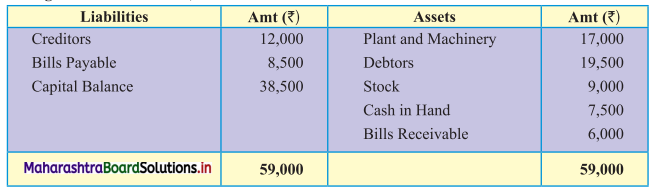
(b) Ledger
(c) Balance Sheet
(d) Cash Book
Answer:
(a) Journal Proper
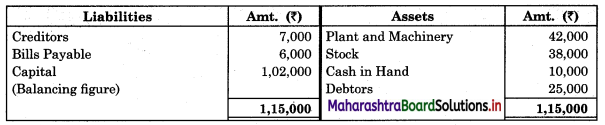
Maharashtra Board 11th BK Textbook Solutions Chapter 8 Rectification of Errors

Question 2.
The type of error for which journal entry is always required for rectification ______________
(a) over casting
(b) one sided error
(c) under casting
(d) two sided error
Answer:
(d) two-sided error

Question 3.
Error occurred due to wrong posting are called error of ______________
(a) principal
(b) commission
(c) compensating
(d) omission
Answer:
(b) commission

Question 4.
If transaction is totally omitted from the books, it is called ______________
(a) Error of recording
(b) Error of omission
(c) Error of principle
(d) Error of commission
Answer:
(b) Error of omission

Question 5.
Suspense Account is opened when ______________ does not tally.
(a) Balance sheet
(b) Trading Account
(c) Profit and loss
(d) Trial Balance
Answer:
(d) Trial Balance

4. State whether the following statements are True or False with reasons.

Question 1.
Trial Balance is prepared from the balance of ledger accounts.
Answer:
This statement is True.
A Trial balance is a statement of debit and credit balances extracted from the various accounts in the ledger. All business transactions are recorded first in Journal or in subsidiary books and subsequently, they are posted to respective ledger accounts. At the end of the year, they are balanced and transferred to the Trial balance.

Question 2.
A Trial Balance can agree in spite of certain errors.
Answer:
This statement is True.
The error of principle or error of complete omission or compensatory error is not disclosed by the Trial Balance. It will be agreed with debit and credit balances but there may be a certain error.

Question 3.
Rectification entries are passed in Cash Book.
Answer:
This statement is False.
Rectification entries are passed in the Journal Proper book. Cashbook is mainly used for cash transactions and not for rectification of errors.

Maharashtra Board 11th BK Textbook Solutions Chapter 8 Rectification of Errors

Question 4.
There is no need to open a Suspense Account if the Trial Balance agrees.
Answer:
This statement is True.
When the Trial Balance does not tally a temporary account called ‘Suspense Account’ is opened to balance the trial balance. So when the trial balance is agreed there is no need to open ‘Suspense Account’.

Question 5.
All the errors can be rectified only through Suspense Account.
Answer:
This statement is False.
The errors of principle and errors of complete omission can be rectified by passing entries. So all the errors can not be rectified by the Trial Balance.

5. Do you agree or disagree with the following statements.

Question 1.
The unintentional omission or commission of amounts and accounts while recording the transactions is known as an error.
Answer:
Agree

Question 2.
The errors committed due to wrong recording, wrong posting, wrong totaling, wrong balancing, wrong calculations are known as Arithmetical errors.
Answer:
Disagree

Question 3.
When one or more debit errors happen to equal one or more credit errors it is said to be a Compensating error.
Answer:
Agree

Maharashtra Board 11th BK Textbook Solutions Chapter 8 Rectification of Errors

Question 4.
The agreement of Trial balance is not affected when a transaction is not recorded at all in the original Books.
Answer:
Agree

Question 5.
When a transaction is not recorded according to the principles of accounting it is known as Compensating error.
Answer:
Disagree

6. Complete the following sentence.

Question 1.
______________ is assured only when there are no errors in the books of accounts.
Answer:
Accuracy

Question 2.
Transactions recorded in contravention of the accounting principles are known as ______________
Answer:
errors of principle

Question 3.
______________ entry depends generally on when the error is detected.
Answer:
Rectifying

Question 4.
Temporary account opened to rectify the entry is known as ______________
Answer:
suspense account

Maharashtra Board 11th BK Textbook Solutions Chapter 8 Rectification of Errors

Question 5.
Errors are caused due to ______________ recording of transactions.
Answer:
wrong

Practical Problems

Question 1.
Rectify the following errors:
1. Salary paid to Pravin was wrongly debited to his personal account ₹ 6,500/-
2. Cash Purchases ₹ 12,000/- from Siddhant Traders was debited to Siddhant Trader Account.
3. Paid Rent ₹ 5,000 to landlord Shantilal was debited to his personal account.
4. Received interest ₹ 700 from Bank was wrongly credited to Bank Account.
5. Advertisement expenses ₹ 5,000/- paid to Times of India was debited to Times of India.
Solution:
Journal Proper
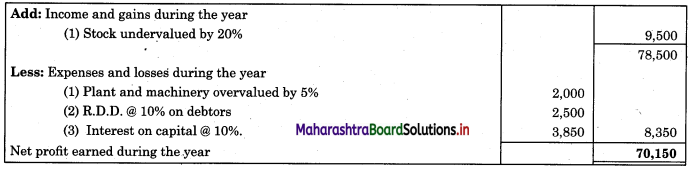
Maharashtra Board 11th BK Textbook Solutions Chapter 8 Rectification of Errors Practical Problems Q1

Working Note:
Maharashtra Board 11th BK Textbook Solutions Chapter 8 Rectification of Errors Practical Problems Q1.1

Question 2.
Rectify the following errors:
1. Machinery purchased for ₹ 9,000/- has been debited to Purchase Account.
2. ₹ 15,000/- paid to Indus Company for Machinery purchased stand debited to Indus Company Account.
3. Printer Purchased for ₹ 10,000/- was wrongly passed through Purchase Book.
4. ₹ 800/- paid to Mohan as Legal Charges were debited to his personal account.
5. Cash paid to Ramesh ₹ 500/- was debited to Suresh.
Solution:
Journal Proper
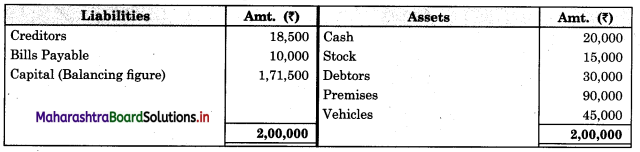
Maharashtra Board 11th BK Textbook Solutions Chapter 8 Rectification of Errors Practical Problems Q2

Working Note:
Maharashtra Board 11th BK Textbook Solutions Chapter 8 Rectification of Errors Practical Problems Q2.1
Maharashtra Board 11th BK Textbook Solutions Chapter 8 Rectification of Errors Practical Problems Q2.2

Maharashtra Board 11th BK Textbook Solutions Chapter 8 Rectification of Errors

Question 3.
Rectify the following errors:
1. A credit sale of goods to Sanjay ₹ 3,000/- has been wrongly passed through the ‘Purchase Book’.
2. A credit purchase of goods from Sheetal amounting to ₹ 2,000/- has been wrongly passed through the ‘Sales Book’.
3. A return of goods worth ₹ 500/- to Umesh was passed through the ‘Sales Return Book’.
4. A return of goods worth ₹ 900/- by Ganesh was entered in ‘Purchase Return Book’.
5. Credit Purchases from Neha ₹ 10,000/- were recorded as ₹ 11,000/-
Solution:
Journal Proper
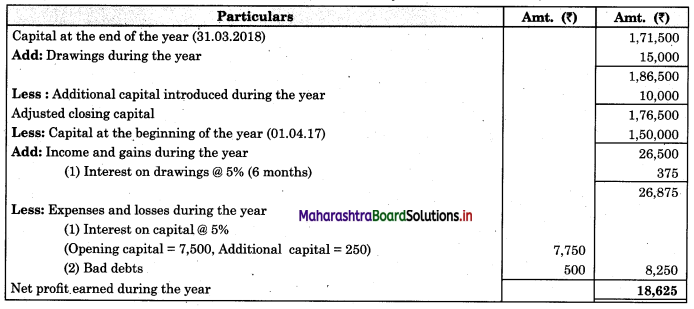
Maharashtra Board 11th BK Textbook Solutions Chapter 8 Rectification of Errors Practical Problems Q3

Working Note:
Maharashtra Board 11th BK Textbook Solutions Chapter 8 Rectification of Errors Practical Problems Q3.1
Maharashtra Board 11th BK Textbook Solutions Chapter 8 Rectification of Errors Practical Problems Q3.2

Question 4.
Rectify the following errors:
1. Paid Rent ₹ 2,000/- to Nikhil has been debited to his personal account.
2. Total of the Sales Return Book is wrongly taken more by ₹ 200/-
3. Goods sold to Dhanraj ₹ 6,500/- on credit were not posted to his personal account.
4. Old Computer purchased was debited to Repairs account ₹ 8,000/-
5. Repairs to Furniture of ₹ 500/- have been debited to Furniture account.
Solution:
Journal Proper
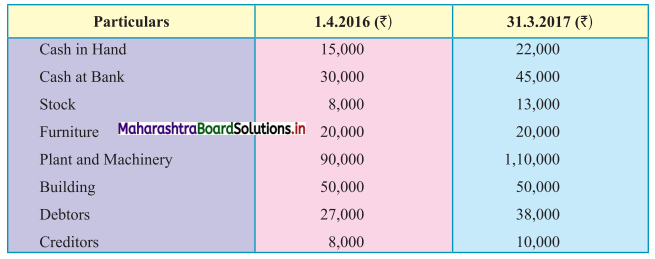
Maharashtra Board 11th BK Textbook Solutions Chapter 8 Rectification of Errors Practical Problems Q4

Working Note:
Maharashtra Board 11th BK Textbook Solutions Chapter 8 Rectification of Errors Practical Problems Q4.1

Question 5.
Rectify the following errors:
1. Wages paid for the construction of Building ₹ 10,000/- was wrongly debited to Wages Account.
2. Cash received from Patel ₹ 5,000/- though recorded in Cash Book was not posted to his personal account in the Ledger.
3. Sold goods worth ₹ 9,000/- to Rohini has been wrongly debited to Mohini’s Account.
4. Material purchased for construction of Building was debited to Purchase Account ₹ 5,000/-
Solution:
Journal Proper
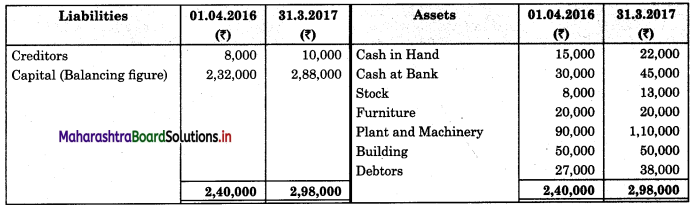
Maharashtra Board 11th BK Textbook Solutions Chapter 8 Rectification of Errors Practical Problems Q5

Working Note:
Maharashtra Board 11th BK Textbook Solutions Chapter 8 Rectification of Errors Practical Problems Q5.1

Maharashtra Board 11th BK Textbook Solutions Chapter 8 Rectification of Errors

Question 6.
There was a difference of ₹ 1230/- in a Trial Balance. It was placed on the Debit side of Suspense A/c. Later on, the following errors were discovered. Pass rectifying entries and prepare Suspense A/c.
1. Sales Book was overcast by ₹ 1,000/-
2. Goods sold to Aarti for ₹ 4,400/- has been posted to her account as ₹ 4,000/-
3. Purchases Book was overcast by ₹ 100/-
4. An amount of ₹ 500/- received from Ranjeet, has not been posted to his account.
5. Goods sold to Sameer for ₹ 750/- were recorded in Purchase Book.
6. An amount of ₹ 500/- has been posted to the credit side of the Commission Account instead of ₹ 570/-
Solution:
Journal Proper
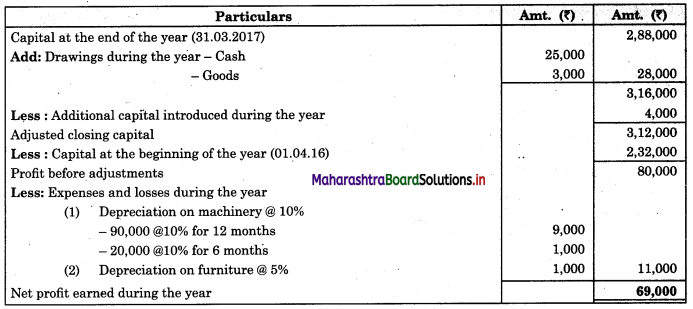
Maharashtra Board 11th BK Textbook Solutions Chapter 8 Rectification of Errors Practical Problems Q6
Maharashtra Board 11th BK Textbook Solutions Chapter 8 Rectification of Errors Practical Problems Q6.1

Question 7.
A bookkeeper finds that the debit side of the Trial Balance is short of ₹ 308/- and so for the time being, the balances of the side by putting the difference to Suspense Account. The following errors were disclosed.
1. The debit side of the purchases account was undercast by ₹ 100/-
2. ₹ 100/- is the monthly total of discount allowed to customers were credited to the discount account in the ledger.
3. An entry for goods sold of ₹ 102/- to Mihir was posted to his account as ₹ 120/-
4. ₹ 26/- appearing in the Cash Book as paid for the purchase of Stationery for office use have not been posted to Ledger.
5. ₹ 275/- paid by Mihir were credited to Mithali’s Account.
You are required to make the necessary Journal Entries and the Suspense Account.
Solution:
Journal Proper
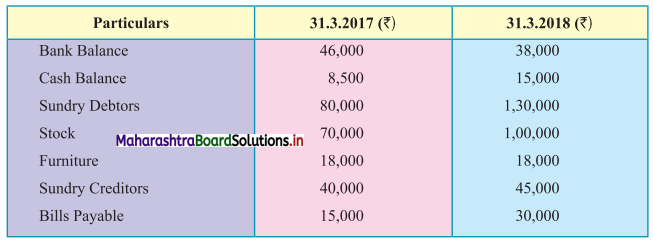
Maharashtra Board 11th BK Textbook Solutions Chapter 8 Rectification of Errors Practical Problems Q7
Maharashtra Board 11th BK Textbook Solutions Chapter 8 Rectification of Errors Practical Problems Q7.1

Question 8.
The trial Balance of Anurag did not agree. It showed an excess credit of ₹ 6,000/-. He put the difference to Suspense Account. He discovered the following errors.
1. Cash received from Ramakant ₹ 8,000/- posted to his account as ₹ 6,000/-
2. Credit purchases from Naman ₹ 7,000/- were recorded in Sales Book. However, Naman’s Account was correctly credited.
3. Return Inwards Book overcast by ₹ 1,000/-
4. Total of Sales Book ₹ 10,000/- was not posted to Sales Account.
5. Machinery purchased for ₹ 10,000/- was posted to Purchases Account as ₹ 5,000/-.
Rectify the errors and prepare Suspense Account.
Solution:
Maharashtra Board 11th BK Textbook Solutions Chapter 8 Rectification of Errors Practical Problems Q8
Maharashtra Board 11th BK Textbook Solutions Chapter 8 Rectification of Errors Practical Problems Q8.1

Maharashtra Board 11th BK Textbook Solutions Chapter 8 Rectification of Errors

Question 9.
There was an error in the Trial Balance of Mr. Yashwant on 31st March 2019, and the difference in Books was carried to a Suspense Account. Ongoing through the Books you found that.
1. ₹ 1,000/- being purchases return were posted to the debit of Purchase Account.
2. ₹ 4,000/- paid to Badrinath was debited to Kedarnath’s Account.
3. ₹ 5,400/- received from Kishor was posted to the debit of his account.
4. Discount received ₹ 2,000/- was posted to the debit of Discount Allowed Account.
5. ₹ 2,740/- paid to Repairs to Motor Cycle was debited to Motor Cycle Account ₹ 1,740/-
Give Journal Entries to rectify the above errors and ascertain the amount transferred to Suspense Account on 31st March 2019 by showing the Suspense Account, assuming that the Suspense Account is balanced after the above corrections.
Solution:
Journal Proper
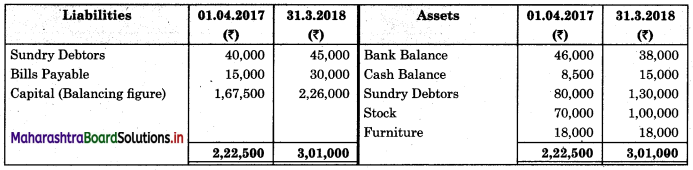
Maharashtra Board 11th BK Textbook Solutions Chapter 8 Rectification of Errors Practical Problems Q9
Maharashtra Board 11th BK Textbook Solutions Chapter 8 Rectification of Errors Practical Problems Q9.1

Question 10.
Rectify the following errors.
1. Goods purchased from Kishor ₹ 700/- were passed through Sales Book.
2. An item of ₹ 120/- in respect of purchase returns, has been wrongly entered in the Purchase Book.
3. Amount payable to Subhash for repairs done to Printer ₹ 180/- and new Printer supplied for ₹ 1,920/-, were entered in the Purchase Book as ₹ 2,000/-
4. Returned goods to Nitin ₹ 1,500/- was passed through Returns Inward Book.
5. An item of ₹ 450/- relating to the Prepaid Rent account was omitted to be brought forward.
Solution:
Journal Proper
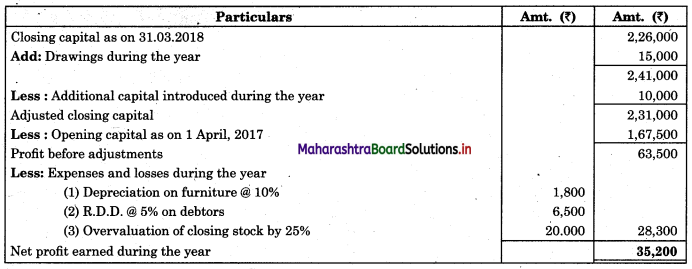
Maharashtra Board 11th BK Textbook Solutions Chapter 8 Rectification of Errors Practical Problems Q10
Note: In entry No. 5 Suspense A/c is not used as the problem is silent about the opening of Suspense A/c.

Maharashtra Board 11th BK Textbook Solutions Chapter 7 Depreciation

Balbharti Maharashtra State Board Bookkeeping and Accountancy 11th Solutions Chapter 7 Depreciation Textbook Exercise Questions and Answers.

Maharashtra State Board Bookkeeping and Accountancy 11th Solutions Chapter 7 Depreciation

1. Answer in One Sentence only.

Question 1.
What is depreciation?
Answer:
Depreciation is a gradual, continuous, and permanent decline or decrease in the value of a fixed asset due to its use, wear and tear or any other similar reason.

Question 2.
Why depreciation is charged?
Answer:
Depreciation on fixed assets is charged to ascertain the correct profit or loss on its sale, to show assets at the correct value in the Balance sheet, and to provide for its replacement.

Maharashtra Board 11th BK Textbook Solutions Chapter 7 Depreciation

Question 3.
What is a ‘Scrap Value’ of an asset?
Answer:
The total amount whatsoever received by selling used or obsolete assets or their spare parts is called residual.

Question 4.
Why depreciation is charged even in the year of loss?
Answer:
Fixed assets are used even in the year of loss and the use of fixed assets reduces its value and hence depreciation is charged even in the year of loss.

Question 5.
Which account is credited when depreciation is charged?
Answer:
The concerned fixed asset account is credited when depreciation is charged.

Question 6.
Where is the profit or loss on sale of the asset is transferred?
Answer:
The profit or loss on the sale of assets is transferred to the profit and loss account.

Question 7.
To which account balance of Depreciation A/c is transferred?
Answer:
The balance of Depreciation A/c is transferred to profit and loss A/c at the end of the year.

Question 8.
What is the formula to calculate depreciation by the Straight Line Method?
Answer:
Depreciation per annum = \(\frac{Cost of Fixed Asset (-) Scrap value}{Estimated life of Fixed Asset}\)
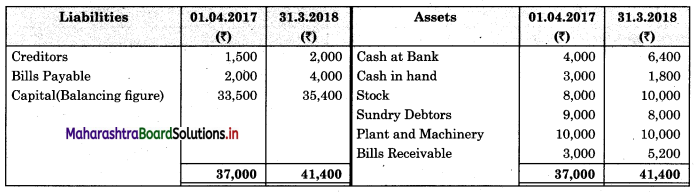
Maharashtra Board 11th BK Textbook Solutions Chapter 7 Depreciation
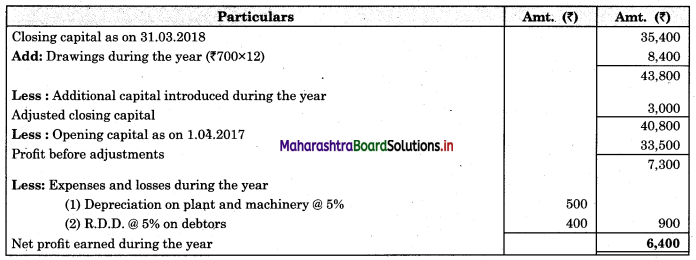
Question 9.
What is Fixed Instalment Method?
Answer:
A method of charging depreciation in which depreciation is charged on fixed assets at a fixed percentage of its original cost is called the fixed installment method.

Question 10.
Which account is debited when expenses are paid on the installation of the Machinery?
Answer:
The machinery account is debited when expenses are paid for the installation of machinery.
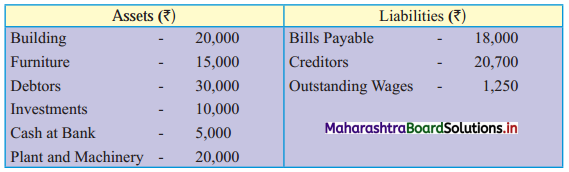
2. Write the word/term/phrase which can substitute each of the following statements:

Question 1.
A continuous, gradual, and permanent reduction in the value of the fixed assets.
Answer:
Depreciation

Question 2.
The expenditure incurred for purchase, installation charges, etc. of an asset.
Answer:
Cost of Asset

Question 3.
The amount that a fixed asset is expected to realize at its disposal.
Answer:
Scrap Value

Question 4.
The period for which the asset remains in working condition.
Answer:
The life period of asset

Maharashtra Board 11th BK Textbook Solutions Chapter 7 Depreciation

Question 5.
The method of depreciation in which the total depreciation is equally spread over the life of the asset.
Answer:
Fixed Instalment Method

Question 6.
The method of depreciation in which the rate of depreciation is fixed but the amount of depreciation reduces every year.
Answer:
Reducing Balance Method

Question 7.
The type of asset on which depreciation is charged.
Answer:
Fixed Asset

Question 8.
Expenses incurred for fixation of the new asset to bring it in working condition.
Answer:
Installation Charges

Question 9.
Excess of the Selling price of a fixed asset over its Written Down Value.
Answer:
Profit on Sale of Asset

Question 10.
Method of depreciation that cannot reach zero value.
Answer:
Diminishing Balance Method

3. Select the most appropriate answers from the alternatives given below and rewrite the sentence.

Question 1.
Decrease in the value of fixed assets is known as _____________
(a) Depreciation
(b) Appreciation
(c) Combination
(d) None of these
Answer:
(a) Depreciation

Maharashtra Board 11th BK Textbook Solutions Chapter 7 Depreciation

Question 2.
Depreciation is charged only on _____________ assets.
(a) Fixed
(b) Current
(c) Non-performing
(d) Fictitious
Answer:
(a) Fixed

Question 3.
The amount spent on installation of new machinery is a _____________ expenditure.
(a) Revenue
(b) Capital
(c) Deferred Revenue
(d) Income
Answer:
(b) Capital

Question 4.
The amount that a fixed asset is expected to realise on its disposal is known as _____________
(a) Book value
(b) Scrap value
(c) Market value
(d) Original value
Answer:
(b) Scrap value

Question 5.
The amount of depreciation reduces year after year under _____________
(a) Fixed Instalment Method
(b) Written Down Value Method
(c) Depreciation Fund Method
(d) Revaluation Method
Answer:
(b) Written Down Value Method

Question 6.
The amount of depreciation remains constant every year under _____________
(a) Straight Line Method
(b) Diminishing Balance Method
(c) Revaluation Method
(d) Insurance Policy Method
Answer:
(a) Straight Line Method

Maharashtra Board 11th BK Textbook Solutions Chapter 7 Depreciation

Question 7.
The balance of depreciation account is transferred to _____________
(a) Manufacturing A/c
(b) Trading A/c
(c) Profit & Loss A/c
(d) Balance sheet
Answer:
(c) Profit and Loss A/c

4. State whether the following statements are True or False with reasons.

Question 1.
Depreciation is charged on fixed assets.
Answer:
This statement is True.
Fixed assets working life is longer. The working life of all fixed assets decreases with the passage of time. The value of assets decreases every year so a reduction in the value of fixed assets due to its wear and tear depreciation is charged on fixed assets.

Question 2.
Depreciation increases the value of the asset.
Answer:
This statement is False.
Depreciation reduced the value of the fixed assets. The working life of all fixed assets decreases with the passage of time and its wear and tear.

Question 3.
Balance of the depreciation account is transferred to Profit and Loss A/c.
Answer:
This statement is True.
Depreciation is charged to profit and Loss A/c as it is an element of Cost. It is also essential to arrive at true value of the asset and also net profit or Loss during a particular accounting period. Even if an asset is not in use, its value is reduced due to the passage of time. Depreciation is Cost/Loss to the business. It is a noncash expenditure.

Question 4.
The Profit or Loss on the sale of the asset is ascertained only after charging depreciation.
Answer:
This statement is True.
Cost on date of sale can be ascertained only after deducting depreciation from date of purchase till the date of sale after that it is possible to compare between cost on the date of sale and selling price to ascertain profit or loss on sale of the machine.

Question 5.
Wages paid for the installation of Machinery are debited to Wages A/c.
Answer:
This statement is False.
Wages paid on the installation of machinery are debited to the machinery account as they are the capital nature of expenditures.

Question 6.
It is not necessary to depreciate an asset if it is not in use.
Answer:
This statement is False.
The working life of fixed assets decreases with passes of time. The value of these assets decreases every year as new technology introduced in the market old becomes outdated so it is necessary to depreciate an asset even it is not in use.

Maharashtra Board 11th BK Textbook Solutions Chapter 7 Depreciation

Question 7.
Depreciation is charged on Current Assets only.
Answer:
This statement is False.
Depreciation is charged only on fixed assets and not on current assets working life of fixed assets is longer and it decreases with passes of time. The value of fixed assets decreases every year so depreciation is charged on fixed assets.

Question 8.
Depreciation need not be charged when a business is making a loss.
Answer:
This statement is False.
Depreciation is charged whether a business is making losses or profits. Depreciation is the non-cash expenditure of the business like all other expenses are charged in the same way depreciation is charge even business is making losses.

5. Complete the following sentences.

Question 1.
Depreciation is charged on _____________ asset.
Answer:
Fixed

Question 2.
Wages paid for Installation/fixation of Machinery is debited to _____________ account.
Answer:
Machinery

Question 3.
Under _____________ system, the amount of depreciation changes every year.
Answer:
Diminishing Balance

Question 4.
Depreciation = \(\frac{Cost of Asset Less …………}{Estimated Working Life of Asset}\)
Answer:
Scrap value

Question 5.
Gradual and permanent decrease in the value of asset is known as _____________
Answer:
Depreciation

Maharashtra Board 11th BK Textbook Solutions Chapter 7 Depreciation

Question 6.
In Fixed Instalment System the amount of depreciation is _____________ every year.
Answer:
Constant

Question 7.
The amount spent on installation of Machinery is a _____________ expenditure.
Answer:
Capital

Question 8.
_____________ is the value which an asset realises at the end of its useful life.
Answer:
Scrap value

Question 9.
Depreciation Account is a _____________ account.
Answer:
Nominal

Question 10.
Depreciation is derived from a Latin word _____________
Answer:
Depretium

6. Do you agree or disagree with the following statements.

Question 1.
Depreciation is a non-cash expense.
Answer:
Agree

Question 2.
Underwritten the down value method the Depreciation curve slopes parallel to the ‘X’ axis.
Answer:
Disagree

Maharashtra Board 11th BK Textbook Solutions Chapter 7 Depreciation

Question 3.
The rate of depreciation depends upon the life of the fixed asset.
Answer:
Agree

Question 4.
The terminal value of the asset never affects the annual amount of depreciation.
Answer:
Disagree

Question 5.
By charging depreciation on fixed assets ascertainment of true and fair financial position is possible.
Answer:
Agree

7. Correct the following statement and rewrite the statement.

Question 1.
The residual value of an asset increases the amount of annual depreciation.
Answer:
The residual value of an asset decreases the amount of annual depreciation.

Question 2.
Depreciation is calculated on all assets.
Answer:
Depreciation is calculated on fixed assets only.

Question 3.
Underwritten down value method depreciation is calculated on the original cost of an asset.
Answer:
Underwritten down value method depreciation is calculated on its opening balance every year.

Question 4.
Depreciation provided on assets is debited to an asset accounts.
Answer:
Depreciation provided on assets is credited to an asset account.

Maharashtra Board 11th BK Textbook Solutions Chapter 7 Depreciation

Question 5.
Profit on sale of the asset is credited to an asset account.
Answer:
Profit on sale of the asset is debited to an asset account.

8. Calculate the following.

Question 1.
A machine costing ₹ 23,000 is estimated to have a life of 7 years and the scrap value is estimated at ₹ 2,000 at the end of its useful life. Find out the amount of depreciation p.a.
Solution:
Depreciation p.a. = \(\frac{Cost of Asset (-) Scrap value}{Estimated life of asset}\)
= \(\frac{23,000-2,000}{7}\)
= \(\frac{21,000}{7}\)
= ₹ 3,000 p.a.

Question 2.
If the cost of the Computer is ₹ 40,000 and depreciation is to be charged at 8% p.a. Calculate the amount of depreciation.
Solution:
Depreciation p.a. = Cost of computer (×) percentage
= 40,000 × \(\frac{8}{100}\)
= ₹ 3,200 p.a.

Question 3.
Mr. ‘X’ purchased Furniture on 1st October 2015 at ₹ 2,80,000 and spent ₹ 20,000 on its installation. He provides depreciation at 6% under the straight-line method on 31st March 2016. Calculate the amount of depreciation.
Solution:
Depreciation as per straight line method = Cost of Furniture × Percentage × Period
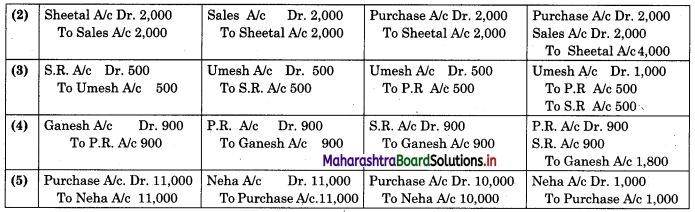
= 3,00,000 × \(\frac{6}{100}\) × \(\frac{6}{12}\)
= ₹ 9,000

Question 4.
M/s Sitaram and Co Purchased a Machinery on 1st January 2016 for ₹ 2,00,000. The company provides depreciation @ 10% p.a. on Reducing Balance Method on 31st March every year. Calculate Written Down Value of Machinery as of 31st March 2017.
Solution:
Original cost on 01.01.2016 = ₹ 2,00,000
Less: Dep for 2015-16 for 3 months = ₹ 5,000
W.D.V. on 01.04.2016 = ₹ 1,95,000
Less: Dep for 2016-17 for 12 months = ₹ 19,500
W.D.V. on318t March, 2017 = ₹ 1,75,500

Maharashtra Board 11th BK Textbook Solutions Chapter 7 Depreciation
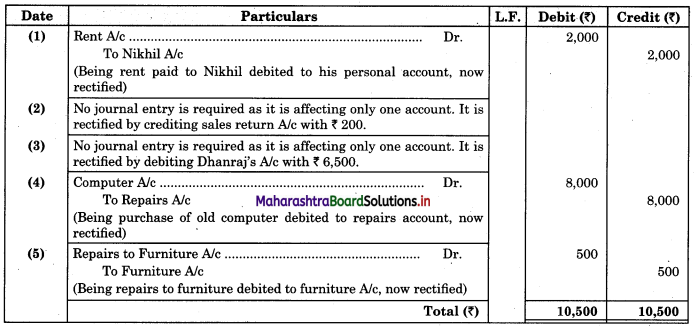
Question 5.
On 1st July 2016 M/s. Ramai & Co. .sold Machinery for ₹ 7,000 the original cost of ₹ 10,000 which was purchased on 18th April 2015. Find out the profit or loss on sale of Machinery by charging depreciation at 10% p.a. on original cost on 31st March every year.
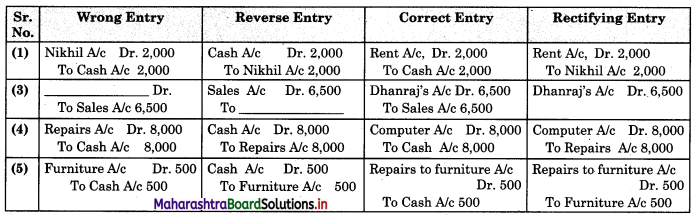
Solution:
Original cost of machinery on 01.04.2015 = ₹ 10,000
Less: Dep for 2015-16 for 12 months = ₹ 1,000
W.D.V. on 01.04.2016 = ₹ 9,000
Less: Dep for 2016-17 for 3 months = ₹ 250
W.D.V. on 01.07.2016 = ₹ 8,750
Less: Selling price = ₹ 7,000
∴ Loss on sale of machinery = ₹ 1,750

Practical Problems on Straight Line Method

Question 1.
On 1st April 2015, Farid of Nasik purchased a Motor Car for ₹ 55,000. The scrap value of the Motor Car was estimated at ₹ 10,000 and its estimated life is 10 years. The Registration charge for the Motor Car was ₹ 5,000.
Show Motor Car Account for first four years, assuming that the books of accounts are closed on 31st March every year.
Solution:
In the books of Farid, Nasik Motor Car Account
Maharashtra Board 11th BK Textbook Solutions Chapter 7 Depreciation Practical Problems on Straight Line Method Q1

Working Note:
Calculation of Depreciation per annum
Depreciation = \(\frac{Original cost of an asset (-) Scrap value}{Estimated life of asset in years}\)
= \(\frac{60,000-10,000}{10}\)
= \(\frac{50,000}{10}\)
= ₹ 5,000 p.a.

Question 2.
On 1st January 2017 ‘Sai Industries, Nagpur’ purchased a Machine costing ₹ 1,65,000 and spent ₹ 15,000 for its installation charges. The estimated life of the Machine is to be 10 years and the scrap value at the end of its life would be ₹ 30,000. On 1st October 2018, the entire Machine was sold for ₹ 1,50,000.
Show Machinery Account, Depreciation Account, for the years 2016-17, 2017-18, and 2018-19 assuming that the accounts are closed on 31st March every year.
Solution:
In the books of Sai Industries, Nagpur
Maharashtra Board 11th BK Textbook Solutions Chapter 7 Depreciation Practical Problems on Straight Line Method Q2
Maharashtra Board 11th BK Textbook Solutions Chapter 7 Depreciation Practical Problems on Straight Line Method Q2.1

Working Notes:
1. Calculation of Depreciation per annum:
Depreciation = \(\frac{Original cost of an asset (-) Scrap value}{Estimated life of asset in years}\)
= \(\frac{1,80,000-30,000}{10}\)
= \(\frac{1,50,000}{10}\)
= ₹ 15,000 p.a.

Maharashtra Board 11th BK Textbook Solutions Chapter 7 Depreciation

2. Calculation of Profit or loss on sale of machine:
Original cost 01.01.2017 = ₹ 1,80,000
Less: Depreciation for 2016-17 (3 months) = ₹ 3,750
W.D.V. on 01-04-2017 = ₹ 1,76,250
Less: Depreciation for 2019-18 (12 months) = ₹ 15,000
W.D.V. on 01.04.2018 = ₹ 1,61,250
Less: Depreciation for 2018-19 (6 months) = ₹ 7,500
W.D.V. on date of sale = ₹ 1,53,750
Less: Selling price = ₹ 1,50,000
∴ Loss on sale of machine = ₹ 3,750

Question 3.
Shubhangi Trading Company of Dombivli purchased Machinery for ₹ 86,000 on 1st January 2016 and immediately spent ₹ 4,000 on its fixation and erection. On 1st October 2016 additional Machinery costing ₹ 40,000 was purchased.
On 1st October 2017, the Machinery purchased on 1st January 2016 became obsolete and was sold for ₹ 70,000. On 1st July 2017, a new Machine was also purchased for ₹ 45,000.
Depreciation was provided annually on 31st March at the rate of 12% per annum on the fixed installment method.
Prepare Machinery Account for three years and pass Journal Entries for the Third year i.e. 2017-2018.
Solution:
In the books of Shubhangi Trading company, Dombivli
Maharashtra Board 11th BK Textbook Solutions Chapter 7 Depreciation Practical Problems on Straight Line Method Q3

Journal of Shubhangi Trading Company
Maharashtra Board 11th BK Textbook Solutions Chapter 7 Depreciation Practical Problems on Straight Line Method Q3.1
Maharashtra Board 11th BK Textbook Solutions Chapter 7 Depreciation Practical Problems on Straight Line Method Q3.2

Working Note:
Calculation of Profit or loss on sale of machine:
Original cost on 01.01.2016 = ₹ 90,000
Less: Depreciation for 2015-16 (3 months) = ₹ 2,700
W.D.V. on 01-04-2016 = ₹ 87,300
Less: Depreciation for 2016-17 (12 months) = ₹ 10,800
W.D.V. on 01.04.2017 = ₹ 76,500
Less: Depreciation for 2017-18 (6 months) = ₹ 5,400
W.D.V. on date of sale = 71,100
Less: Selling price = 70,000
∴ Loss on sale of machine = ₹ 1,100

Question 4.
On 1st Jan 2015, Triveni Traders Raigad purchased a Plaint for ₹ 12,000, and installation charges being ₹ 3,000. On 1st July 2016 another Plant was purchased for ₹ 25,000, on 1st April 2017 another Plant was purchased for ₹ 27,000, wages paid for installation amounted to ₹ 2,000. Carriage paid for the Plant amounted to ₹ 1,000.
Show Plant Account up to 31st March 2018 assuming that the rate of depreciation is @ 10% p.a. on Straight Line Method.
Solution:
In the books of Triveni Traders, Raigad
Maharashtra Board 11th BK Textbook Solutions Chapter 7 Depreciation Practical Problems on Straight Line Method Q4

Maharashtra Board 11th BK Textbook Solutions Chapter 7 Depreciation

Question 5.
Sameer & Company, Mumbai purchased a Machine worth ₹ 2,00,000 on 1st April 2016. On 1st July 2017, the company purchased an additional Machine for ₹ 40,000.
On 31st March 2019, the company sold the Machine purchased on 1st July 2017 for ₹ 35,000. The company writes off depreciation at the rate of 10% on the original cost and the books of accounts are closed every year on 31st March.
Show the Machinery Account and Depreciation Account for the first three years ending 31st March 2016-17, 2017-18 and 2018-19
Solution:
In the books of Sameer & Company, Mumbai
Maharashtra Board 11th BK Textbook Solutions Chapter 7 Depreciation Practical Problems on Straight Line Method Q5
Maharashtra Board 11th BK Textbook Solutions Chapter 7 Depreciation Practical Problems on Straight Line Method Q5.1

Working note:
Calculation of Profit or Loss on sale of machine:
Original cost on 01.07.2017 = ₹ 40,000
Less: Depreciation for 2017-18 (9 months) = ₹ 3,000
W.D.V. on 01-04-2018 = ₹ 37,000
Less: Depreciation for 2018-19 (12. months) = ₹ 4,000
W.D.V. on date of sale = ₹ 33,000
Less: Selling price = ₹ 35,000
∴ Profit on sale of machine = ₹ 2,000

Question 6.
Samarth Manufacturing Co. Ltd, Aurangabad, purchased a New Machinery for ₹ 45,000 on 1st Jan 2015 and immediately spent ₹ 5,000 on its fixation and erection. In the same year, 1st July additional Machinery costing ₹ 25,000 was purchased. On 1st July 2016, the Machinery purchased on 1st Jan 2015 became obsolete and was sold for ₹ 40,000.
Depreciation was provided annually on 31st March at the rate of 10% per annum on the Fixed Instalment Method.
You are required to prepare Machinery Account for the year 2014-15, 2015-16, 2016-17.
Solution:
In the books of Samarth Manufacturing Co. Ltd, Aurangabad
Maharashtra Board 11th BK Textbook Solutions Chapter 7 Depreciation Practical Problems on Straight Line Method Q6

Maharashtra Board 11th BK Textbook Solutions Chapter 7 Depreciation

Working Note:
Calculation of Profit or Loss on sale of machine:
Original cost on 01.01.2015 = ₹ 50,000
Less: Depreciation for 2014-15 (3 months) = ₹ 1,250
W.D.V. on 01-04-2015 = ₹ 48,750
Less: Depreciation for 2015-16 (12 months) = ₹ 5,000
W.D.V. on 01-04-2016 = ₹ 43,750
Less: Depreciation for 2016-17 (3 months) = ₹ 1,250
W.D.V. on date of sale = ₹ 42,500
Less: Selling price = ₹ 40,000
∴ Loss on sale of machine = ₹ 2,500

Practical Problems on Written Down Value Method

Question 1.
M/s Omkar Enterprise Jalgaon acquired a Printing Machine for ₹ 75,000 on 1st Oct 2015 and spent ₹ 5,000 on its transport and installation. Another Machine for ₹ 45,000 was purchased on 1st Jan 2017. Depreciation is charged at the rate of 20% on Written Down Value Method, on 31st March every year.
Prepare Printing Machine Account for the first four years.
Solution:
In the books of M/s Omkar Enterprise Jalgaon.
Maharashtra Board 11th BK Textbook Solutions Chapter 7 Depreciation Practical Practical Problems on Written Down Value Method Q1

Question 2.
Vishal Company, Dhule, purchased Machinery costing ₹ 60,000 on 1st April 2016. They purchased further Machinery on 1st October 2017, costing ₹ 30,000, and on 1st July 2018, costing ₹ 20,000. On 1st Jan 2019, one-third of the Machinery, which was purchased on 1st April 2016, became obsolete and it was sold for ₹ 18,000.
Assume that, company account closes on 31st March every year.
Show Machinery Account for the first three(3) years and pass journal entries for the Third year, after charging depreciation at 10% p.a. on Written Down Value Method.
Solution:
In the books of Vishal Company, Dhule.
Maharashtra Board 11th BK Textbook Solutions Chapter 7 Depreciation Practical Practical Problems on Written Down Value Method Q2
Maharashtra Board 11th BK Textbook Solutions Chapter 7 Depreciation Practical Practical Problems on Written Down Value Method Q2.1

Journal of Vishal Company
Maharashtra Board 11th BK Textbook Solutions Chapter 7 Depreciation Practical Practical Problems on Written Down Value Method Q2.2

Working Notes:
1. Calculation of Profit or Loss on sale as Machine:
Original cost on 01.04.2016 = ₹ 20,000
Less: Dep. for 2016-17 (12 months) = ₹ 2,000
W.D.V. on 01.04.2017 = ₹ 18,000
Less : Dep. for 2016-17 (12 months) = ₹ 1,800
W.D.V. on 01.04.2018 = ₹ 16,200
Less : Dep. for 2018-19 (9 months) = ₹ 1,215
W.D.V. on date of sale = ₹ 14,985
Less : Selling Price = ₹ 18,000
∴ Profit on sale & machine = ₹ 3,015

2. Depreciation for 2018-19
(a) Opening balance on 01.04.2018 = ₹ 77,100
Less : W.D.V. of Machine sold on 01.04.2018 = ₹ 16,200
10% depreciation on 60,900 = ₹ 6,090
(b) Purchase of Machine on 01.07.2018 20,000 – 10% – 9 months = ₹ 6,090 + ₹ 1,500 = ₹ 7,590

Maharashtra Board 11th BK Textbook Solutions Chapter 7 Depreciation

Question 3.
Mahesh Traders Solapur purchased Furniture on 1st April 2014 for ₹ 20,000. In the same year on 1st, Oct. additional Furniture was purchased for ₹ 10,000.
On 1st Oct. 2015, the Furniture purchased on 1st April 2014 was sold for ₹ 15,000 and on the same day, a new Furniture was purchased for ₹ 20,000.
The firm charged depreciation at 10% p.a. on the Reducing Balance Method.
Prepare Furniture Account and Depreciation Account for the year ending 31st March 2015, 2016, and 2017.
Solution:
In the books of Mahesh Traders, Solapur
Maharashtra Board 11th BK Textbook Solutions Chapter 7 Depreciation Practical Practical Problems on Written Down Value Method Q3
Maharashtra Board 11th BK Textbook Solutions Chapter 7 Depreciation Practical Practical Problems on Written Down Value Method Q3.1

Working Notes:
1. Calculation of Profit or loss on sale of furniture:
Original cost on 01.04.2014 = ₹ 20,000
Less: Depreciation for 2014-15 (12 months) = ₹ 2,000
W.D.V. on 01.04.2015 = ₹ 18,000
Less: Depreciation for 2015-16 = ₹ 900
W.D.V. on date of sale = ₹ 17,100
Less: Selling price = ₹ 15,000
∴ Loss on sale of furniture = ₹ 2,100

2. Calculation of Depreciation for 2016 -17:
(a) Opening balance on 01.04.2015 = ₹ 27,500
Less: W.D.V. of furniture sold on 01.04.2015 = ₹ 18,000
9,500 – 10% = ₹ 950
(b) Purchase of furniture on 01.10.2015 – 10% – 6months = 950 + 1,000 = ₹ 1,950

Question 4.
Radhika-Masale’ Amravati purchased a Plant on 1st Jan. 2015 for ₹ 80,000. A new Plant was also purchased
for ₹ 60,000, installation expenses being ₹ 10,000 on 1st April 2016. On 1st Jan 2017, a new Plant was purchased for ₹ 20,000, by disposing of the 1st Plant at ₹ 60,000.
Prepare Plant Account and Depreciation Account for 31st March 2015, 31st March 2016, and 31st March 2017, assuming that the rate of depreciation was @ 10% on Diminishing Balance Method.
Solution:
In the books of Radhika-Masale, Amravati
Maharashtra Board 11th BK Textbook Solutions Chapter 7 Depreciation Practical Practical Problems on Written Down Value Method Q4
Maharashtra Board 11th BK Textbook Solutions Chapter 7 Depreciation Practical Practical Problems on Written Down Value Method Q4.1

Working Notes:
1. Calculation of Profit or loss on sale of plant:
Original cost on 01.01.2015 = ₹ 80,000
Less: Depreciation for 2014.15. (3 months) = ₹ 2,000
W.D.V. on 01.04.2015 = ₹ 78,000
Less: Depreciation for 2015 -16 (12 months) = ₹ 7,800
W.D.V. on 01.04.2016 = ₹ 70,200
Less: Depreciation for 2016 -17 (9 months) = ₹ 5,265
W.D.V. on date of sale = ₹ 64,935
Less: Selling price = ₹ 60,000
∴ Loss on sale of plant = ₹ 4,935

2. Calculation of Depreciation for 2016-17:
(a) Opening balance on 01.04.2016 = ₹ 70,200
Less: W.D.V. of plant sold on 01.04.2016 = ₹ 70,200
Nil – 10% = Nil
(b) Purchase of plant on 01.04.2016 – 10% – 12months = ₹ 7,000
(c) Purchase of plant on 01.01.2017 – 10% – 3m months = ₹ 500
Total = ₹ 7,500

Maharashtra Board 11th BK Textbook Solutions Chapter 7 Depreciation

Question 5.
On 1st April 2015, Suman Traders purchased Machinery for ₹ 30,000. On 1st Oct. 2015, they purchased further Machinery costing ₹ 20,000.
On 1st Oct. 2016, they sold the Machine purchased on 1st April 2015 for ₹ 18,000 and brought another Machine for ₹ 15,000 on the same date.
Depreciation is provided on Machinery @ 20% p.a. on the Diminishing Balance Method and the financial year closes on 31st March every year.
Prepare the Machinery Account and Depreciation Account for the year 2015-16, 2016-17, and 2017-18.
Solution:
In the books of Suman Traders
Maharashtra Board 11th BK Textbook Solutions Chapter 7 Depreciation Practical Practical Problems on Written Down Value Method Q5
Maharashtra Board 11th BK Textbook Solutions Chapter 7 Depreciation Practical Practical Problems on Written Down Value Method Q5.1

Working Notes:
1. Calculation of Profit or loss on sale of machine:
Original cost on 01.04.2015 = ₹ 30,000
Less: Depreciation for 2015-16 (12 months) = ₹ 6,000
W.D.V. on 01.04.2016 = ₹ 24,000
Less: Depreciation for 2016-17 (6 months) = ₹ 2,400
W.D.V. on date of sale = ₹ 21,600
Less: Selling price = ₹ 18,000
∴ Loss on sale of machine = ₹ 3,600

2. Calculation of Depreciation for 2016-17:
(a) Opening balance on 01.04.2016 = ₹ 42,000
Less: W.D.V. of machine sold on 01.04.2016 = ₹ 24,000
18,000 – 20% = ₹ 3,600
(b) Purchase of machine on 01.10.2016 – 15,000 – 20% – 6months = 3,600 + 1,500 = ₹ 5,100