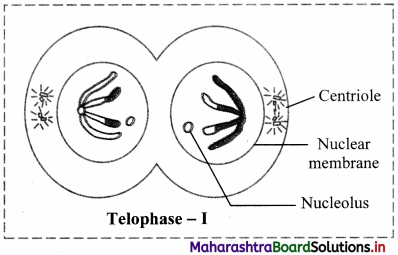
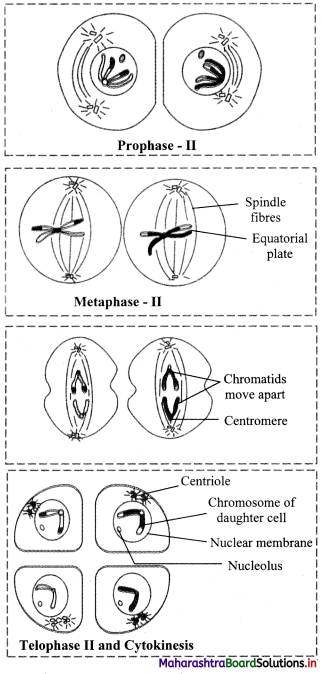
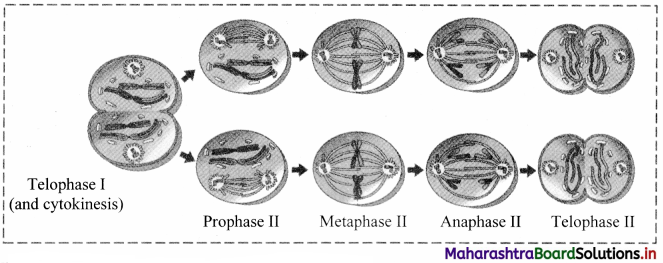
Maharashtra Board Class 11 Biology Important Questions Chapter 8 Plant Tissues and Anatomy

Balbharti Maharashtra State Board 11th Biology Important Questions Chapter 8 Plant Tissues and Anatomy Important Questions and Answers.

Maharashtra State Board 11th Biology Important Questions Chapter 8 Plant Tissues and Anatomy

Question 1.
How plant tissues are classified on the basis of their ability to divide?
Answer:
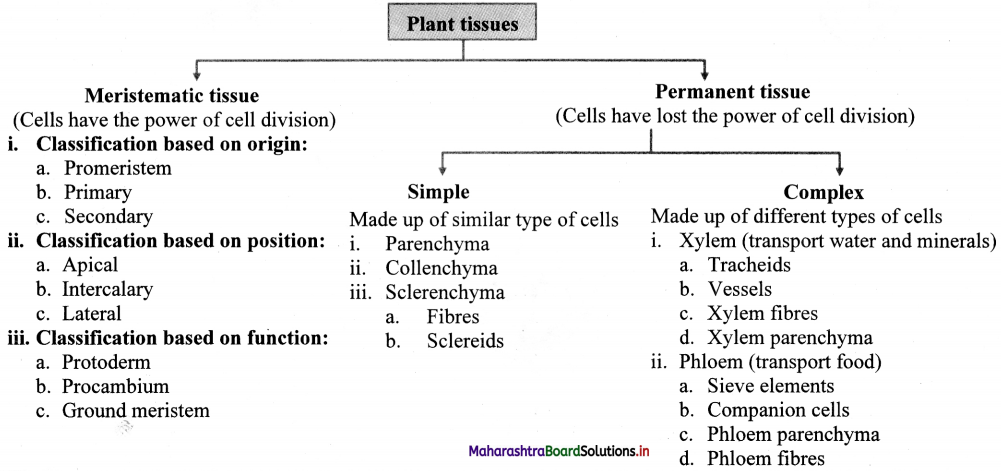
Plant tissues are classified into meristematic tissues and permanent tissues based on their ability to divide.

Maharashtra Board Class 11 Biology Important Questions Chapter 8 Plant Tissues and Anatomy

Question 2.
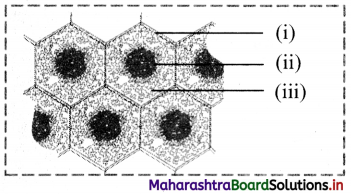
Identify the labels i, ii and iii in the given figure of meristematic tissue and write its characteristics.
Maharashtra Board Class 11 Biology Important Questions Chapter 8 Plant Tissues and Anatomy 1
Answer:
1. Cell wall
2. Nucleus
3. Cytoplasm
Characteristics of meristematic tissue:

  1. It is a group of young, immature cells.
  2. These are living cells with ability to divide in the regions where they are present.
  3. These are polyhedral or isodiametric in shape without intercellular spaces.
  4. Cell wall is thin, elastic and mainly composed of cellulose.
  5. Protoplasm is dense with distinct nucleus at the centre and vacuoles if present, are very small.
  6. Cells show high rate of metabolism.

Question 3.
With the help of neat and labelled diagram explain the classification of meristematic tissue based on its position.
Answer:
Classification of meristematic tissue based on its position:
1. Apical meristem:
a. It is produced from promeristem and forms growing point of apices of root, shoot and their lateral branches.
b. It brings about increase in length of plant body and is called as apical initials.
c. Shoot apical meristem is terminal in position whereas in root it is subterminal i.e. located behind the root cap.

2. Intercalary meristem:
a. Intercalary meristematic tissue is present in the top or base area of node.
b. Their activity is mainly seen in monocots.
c. These are short lived.

3. Lateral meristem:
a. It is present along the sides of central axis of organs.
b. It takes part in increasing girth of stem or root, e.g. Intrafascicular cambium.
c. It is found in vascular bundles of gymnosperms and dicot angiosperms.

Maharashtra Board Class 11 Biology Important Questions Chapter 8 Plant Tissues and Anatomy

Question 4.
Complete the given table representing types of meristematic tissue based on its function.
Answer:

Types of meristematic tissueFunction
1. ProtodermIt is found in young growing region of a plant forming a protective covering like epidermis around the various organs.
2. ProcambiumIt is involved in developing primary vascular tissue.
3. Ground meristemIt forms structures like cortex, endodermis, pericycle, medullary rays, pith.

Question 5.
Which are the simple permanent tissues in plants?
Answer:
Parenchyma, Collenchyma and Sclerenchyma are the simple permanent tissues in plants.

Question 6.
Complete the given chart by giving characteristics of following tissues:
Answer:
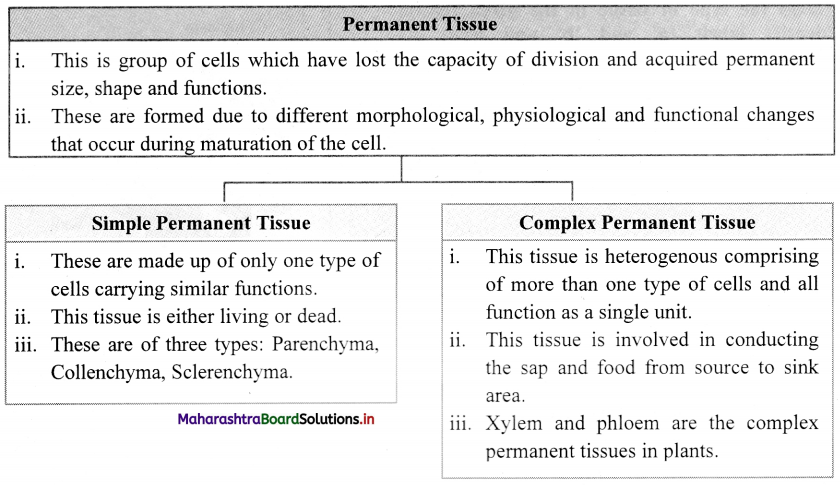
Maharashtra Board Class 11 Biology Important Questions Chapter 8 Plant Tissues and Anatomy 2

Question 7.
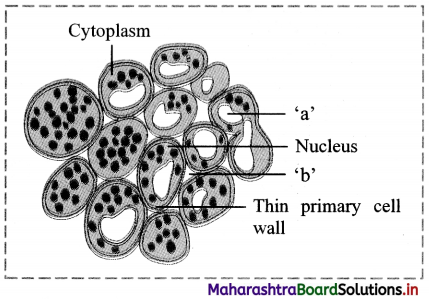
Name the type of tissue in the given figure, identify labels ‘a’ and ‘b’ and write its characteristics.
Maharashtra Board Class 11 Biology Important Questions Chapter 8 Plant Tissues and Anatomy 3
Answer:
1. The given figure represents simple permanent tissue i.e. Parenchyma.
2. a: Vacuole, b: Intercellular air spaces.

Characteristics of parenchyma: Parenchyma:

  1. It is a type of simple permanent tissue.
  2. Cells in this tissue are thin walled, isodiametric, round, oval to polygonal or elongated in shape.
  3. Cell wall is composed of cellulose.
  4. Cells are living with prominent nucleus and cytoplasm with large vacuole.
  5. Parenchyma has distinct intercellular spaces. Sometimes, cells may show compact arrangement.
  6. The cytoplasm of adjacent cells is interconnected through plasmodesmata and thus forms a continuous tissue.
  7. This is less specialized permanent tissue.
  8. Occurrence:
    These cells are distributed in all the parts of a plant body viz. epidermis, cortex, pericycle, pith, mesophyll cells, endosperm, xylem and phloem.
  9. Functions:
    These cells store food, water, help in gaseous exchange, increase buoyancy, perform photosynthesis and different functions in plant body.
  10. Dedifferentiation in parenchyma cells develops vascular cambium and cork cambium at the time of
    secondary growth.

Maharashtra Board Class 11 Biology Important Questions Chapter 8 Plant Tissues and Anatomy

Question 8.
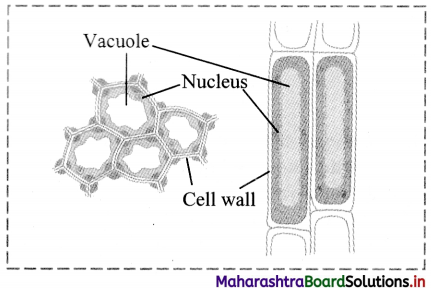
Identify the type of tissue shown in the given figure and write its characteristics.
Maharashtra Board Class 11 Biology Important Questions Chapter 8 Plant Tissues and Anatomy 4
Answer:
The given figure represents Collenchyma tissue.
Characteristics of Collenchyma:

  1. It is a simple permanent tissue made up of living cells.
  2. The cell wall is cellulosic but shows uneven deposition of cellulose and pectin especially at comers.
  3. The walls may show presence of pits.
  4. Cells are similar like parenchyma, containing cytoplasm, nucleus and vacuoles but small in size and without intercellular spaces. Thus, the cells appear to be compactly packed.
  5. The cells are either circular, oval or angular in transverse section.

Function:
Collenchyma is a living mechanical tissue and serves different functions in plants.
a. It gives mechanical strength to young stem and parts like petiole of leaf.
b. It allows bending and pulling action in plant parts and also prevents tearing of leaf.
c. It also allows growth and elongation of organs.
d. Collenchyma is usually absent in monocots and roots of dicot plant.

Question 9.
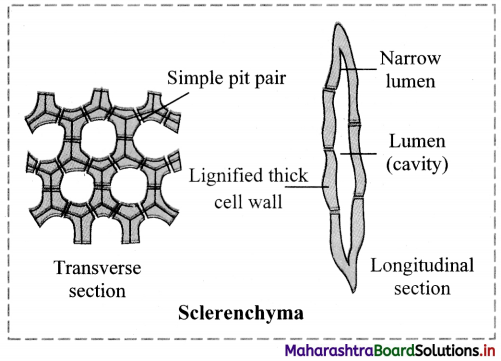
With the help of neat and labelled diagrams explain the Sclerenchyma Tissue.
Maharashtra Board Class 11 Biology Important Questions Chapter 8 Plant Tissues and Anatomy 5
Answer:
Sclerenchyma Tissue:

  1. It is simple permanent tissue made up of compactly arranged thick walled dead cells.
  2. The cells are living at the time of production but at maturity they become dead.
  3. Cells are devoid of cytoplasm.
  4. Their walls are thickened due to uniform deposition of lignin.
  5. Cells remain interconnected through several pits.

Types of Sclerenchyma:
Sclerenchyma cells are categorized into two types on the basis of their size and shape as
fibres and sclereids:
a. Fibres:
Fibres are thread-like, elongated and narrow structures with tapering and interlocking end walls. Fibres are mostly in bundles. Pits are narrow, unbranched and oblique. They provide mechanical strength.

b. Sclereids:
Sclereids are usually broad, with blunt end walls.
These occur singly or in loose groups and their pits are deep branched and straight.
These are developed due to secondary thickening of parenchyma cells and provides stiffness only.

Functions:
a. This tissue functions as the main mechanical tissue.
b. It permits bending, shearing and pulling.
c. It gives rigidity to leaves and prevents it from falling.
d. It also gives rigidity to epicarps and seeds.

Maharashtra Board Class 11 Biology Important Questions Chapter 8 Plant Tissues and Anatomy

Question 10.
Give a brief account of water-conducting tissues in higher plants.
Answer:
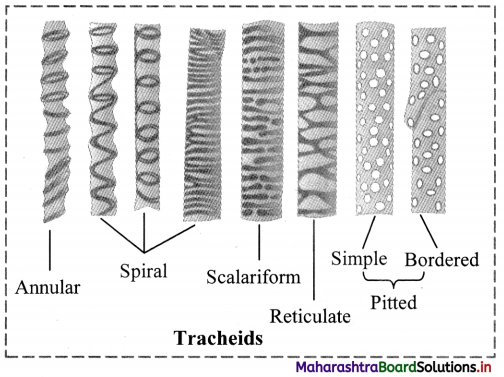
Maharashtra Board Class 11 Biology Important Questions Chapter 8 Plant Tissues and Anatomy 6
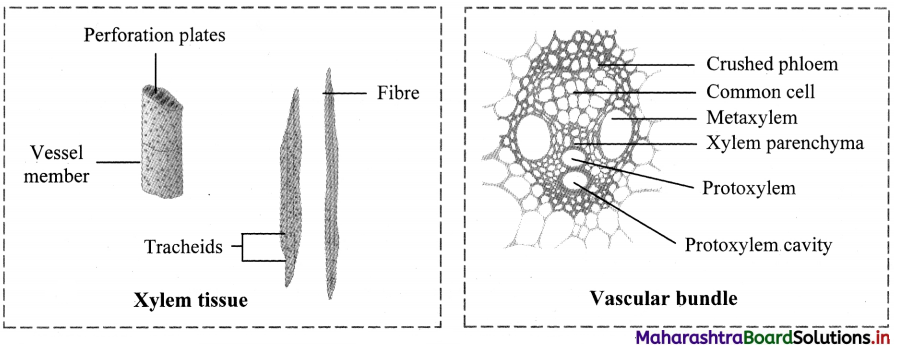
1. Xylem is the water-conducting tissue in higher plants. It is a dead complex tissue.
It also provides mechanical strength to the plant body.
Components of xylem are tracheids, vessels, xylem parenchyma and xylem fibres.

2. Tracheids:
a. These are elongated, tubular and dead cells (without protoplasm).
b. The ends are oblique and tapering.
c. The cell walls is unevenly thickened and lignified. This provides mechanical strength.
d. Tracheids contribute 95% of wood in gymnosperms and 5% in angiosperms.
e. The different types of thickening patterns are seen on their walls such as annular (in the form of rings), spiral (in the form of spring/helix), scalariform (ladder like) and pitted (small circular area). Pitted is the most advanced type of thickening which may be simple or bordered.

3. Vessels:
a. Vessels are longer than tracheids with perforated or dissolved ends and formed by union of several vessels end to end.
b. These are involved in conduction of water and minerals.
c. Their lumen is wider than tracheids and the thickening is due to lignin and similar to tracheids.
d. In monocots, vessels are rounded where as they are angular in dicot angiosperms.
e. The first formed xylem vessels (protoxylem) are small and have either annular or spiral thickenings while latter formed xylem vessels are larger (metaxylem) and have reticulate or pitted thickenings.
f. When protoxylem is arranged towards pith and metaxylem towards periphery it is called as endarch
e. g. in stem and when the position is reversed as in the roots is called as exarch.

4. Xylem parenchyma:
a. Xylem parenchyma cells are small associated with tracheids and vessels.
b. This is the only living tissue among this complex tissue.
c. The function is to store food (starch) and sometimes tannins.
d. Xylem parenchyma are involved in lateral or radial conduction of water or sap.

5. Xylem fibres:
a. Xylem fibres are sclerenchymatous cells and serve mainly mechanical support. These are called wood fibres.
b. These are also elongated, narrow and spindle shaped.
c. Cells are tapering at both the ends and their walls are lignified.

Question 11.
Draw neat and labelled diagram of xylem tissue and vascular bundle.
Answer:
Maharashtra Board Class 11 Biology Important Questions Chapter 8 Plant Tissues and Anatomy 7

Question 12.
Match the following.

Column IColumn II
1. Protoxylem(a) Xylem with larger vessels
2. Endarch Xylem(b) Protoxylem arranged towards pith
3. Metaxylem(c) Metaxylem arranged towards pith
4. Exarch xylem(d) First formed xylem vessels

Answer:

Column IColumn II
1. Protoxylem(d) First formed xylem vessels
2. Endarch Xylem(b) Protoxylem arranged towards pith
3. Metaxylem(a) Xylem with larger vessels
4. Exarch xylem(c) Metaxylem arranged towards pith

Maharashtra Board Class 11 Biology Important Questions Chapter 8 Plant Tissues and Anatomy

Question 13.
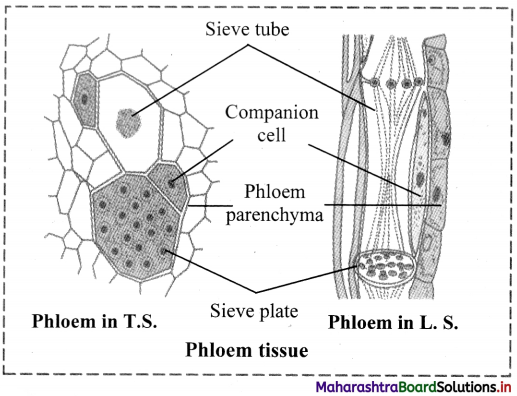
Describe the structure of phloem.
Maharashtra Board Class 11 Biology Important Questions Chapter 8 Plant Tissues and Anatomy 8
Answer:
Structure of phloem:
1. Phloem is a living tissue. It is also called as bast.
It is responsible for conduction of organic food material from source (generally leaf) to a sink (other plant parts).
On the basis of origin, it can be protophloem (first formed) and metaphloem (latterly formed).
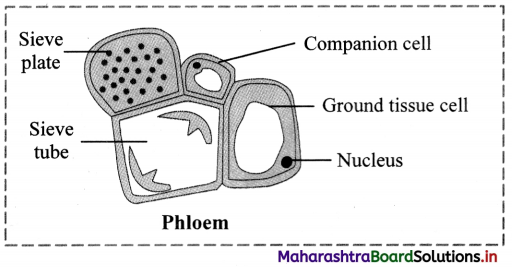
It is composed of sieve elements (sieve cells and sieve tubes), companion cells, phloem parenchyma and phloem fibres.

2. Sieve elements:
a. Sieve tubes are long tubular conducting channel of phloem.
b. These are placed end to end with bulging at end walls.
c. The sieve tube has sieve plate formed by septa with small pores.
d. The sieve plates connect protoplast of adjacent sieve tube cells.
e. The sieve tube cell is a living cell with a thin layer of cytoplasm, but loses its nucleus at maturity.
f. The sieve tube cell is connected to companion cell through phloem parenchyma by plasmodesmata.
g. Sieve cells are found in lower plants like pteridophytes and gymnosperms and sieve tubes are found in angiosperms.
h. The cells are narrow, elongated with tapering ends and sieve area located laterally.

3. Companion cells:
a. These are narrow elongated and living.
b. Companion cells are laterally associated with sieve tube elements.
c. Companion cells have dense cytoplasm and prominent nucleus.
d. Nucleus of companion cell regulates functions of sieve tube cells through simple pits.
e. From origin point of view, sieve tube cells and companion cell are derived from same cell. Death of the one result in death of the other type.

4. Phloem parenchyma:
a. Cells of phloem parenchyma are living, elongated found associated with sieve tube and companion cells.
b. Their chief function is to store food, latex, resins, mucilage, etc.
c. The cells carry out lateral conduction of food material.
d. These cells are absent in most of the monocots.

5. Phloem fibres (Bast fibres):
a. Phloem fibres are the only dead tissue among this unit.
b. They are sclerenchymatous.
c. They are generally absent in primary phloem, but present in secondary phloem.
d. These cells have with lignified walls and provide mechanical support.
e. They are used in making ropes and rough clothes.

Question 14.
Draw a diagram of phloem.
Answer:
Maharashtra Board Class 11 Biology Important Questions Chapter 8 Plant Tissues and Anatomy 9

Question 15.
Name the types of tissue systems in plants.
Answer:
The types of tissue systems in plants are epidermal tissue system, ground tissue system and vascular tissue system.

Maharashtra Board Class 11 Biology Important Questions Chapter 8 Plant Tissues and Anatomy

Question 16.
Write a short note on Epidermis.
Answer:
Epidermis:

  1. It is the outermost protective cell layer made up of compactly arranged cells without intercellular spaces.
  2. Cells show presence of central large vacuole, thin cytoplasm and a nucleus.
  3. The outer side of the epidermis is often covered with a waxy thick layer called the cuticle which prevents the loss of water.
  4. Root epidermis (Epiblema) has root hairs. These are unicellular, elongated and involved in absorption of sap from the soil.
  5. In stem, epidermal hairs are called trichomes. These are generally multicellular, branched or unbranched, stiff or soft or even secretory. These help in preventing water loss due to transpiration.

Question 17.
Draw a diagram representing epidermal tissue system.
Answer:
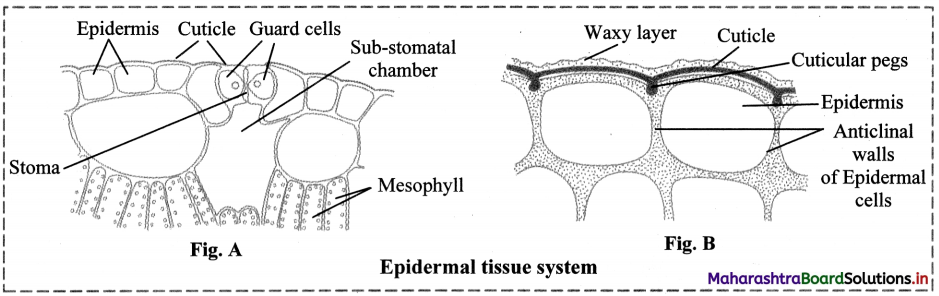
Maharashtra Board Class 11 Biology Important Questions Chapter 8 Plant Tissues and Anatomy 10

Question 18.
Write a short note on Structure of stomata.
Answer:
Structure of stomata:

  1. Small gateways in the epidermal cells are called as stomata.
  2. Stoma is controlled or guarded by specially modified cells called guard cells.
  3. These guard cells may be kidney shaped (dicot) or dumbbell shaped (monocot), collectively called as stomata.
  4. Guard cells have chloroplasts to carry out photosynthesis.
  5. Change in turgor pressure of guard cells causes opening and closing of stomata, which enables exchange of gases and water vapour.
  6. Stomata are further covered by subsidiary cells.
  7. Stoma, guard cells and subsidiary cells form a unit called stomatal apparatus.

Question 19.
Write the information related to diagrams given below.
Answer:
1. The given diagram represents stoma in dicot leaf.
[Note: We have given additional label of ‘chloroplast ’for better understanding of students]
2. Structure of stomata:

  1. Small gateways in the epidermal cells are called as stomata.
  2. Stoma is controlled or guarded by specially modified cells called guard cells.
  3. These guard cells may be kidney shaped (dicot) or dumbbell shaped (monocot), collectively called as stomata.
  4. Guard cells have chloroplasts to carry out photosynthesis.
  5. Change in turgor pressure of guard cells causes opening and closing of stomata, which enables exchange of gases and water vapour.
  6. Stomata are further covered by subsidiary cells.
  7. Stoma, guard cells and subsidiary cells form a unit called stomatal apparatus.

Question 20.
Explain the term ground tissue.
Answer:
Ground tissue:

  1. All the plant tissues excluding epidermal and vascular tissue is ground tissue.
  2. It is made up of simple permanent tissue e.g. parenchyma.
  3. It is present in cortex, pericycle, pith and medullary rays in the primary stem and root.
  4. Collenchyma and sclerenchyma in the hypodermis and chloroplasts containing mesophyll tissue in leaves is also ground tissue.

Question 21.
Describe various types of vascular bundles.
Answer:
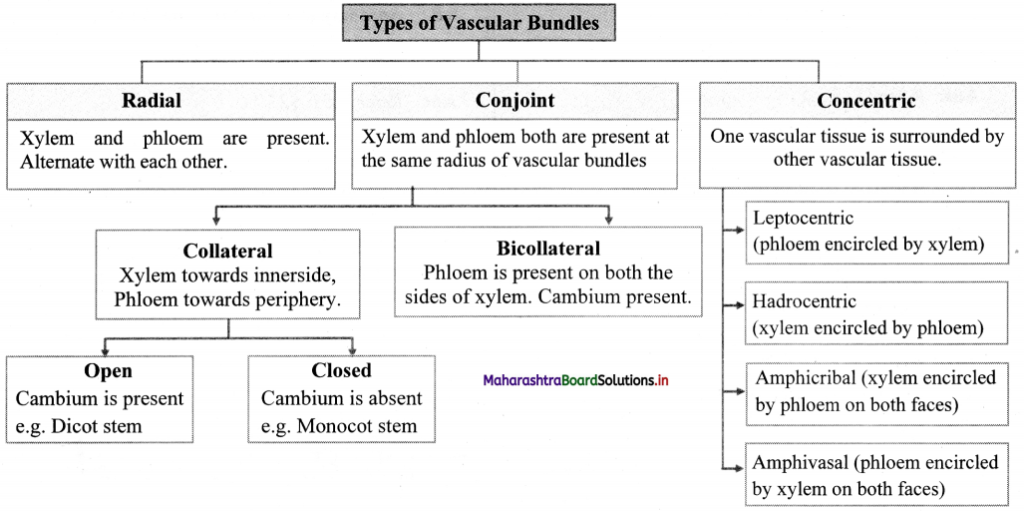
Vascular bundles occur in the form of distinct patches of the complex tissue viz. Xylem and Phloem. On the basis of their arrangement in the plant body they are classified as follows:
1. Radial vascular bundles:
When the complex tissues (xylem and phloem) are situated separately on separate radius as separate bundle, vascular bundle is called Radial vascular bundle. This is a common feature of roots.

2. Conjoint vascular bundles:
When the complex tissue (xylem and phloem) is collectively present as neighbours of each other on the same radius, vascular bundle is called Conjoint vascular bundle.
They are of two types:
a. Collateral vascular bundle:
In this type of vascular bundle, xylem lies inwards and the phloem lies outwards.
These bundles may be further of open type (secondary growth takes place) containing cambium in between xylem and phloem and closed type if cambium is not present (secondary growth absent).
b. Bicollateral vascular bundle:
When phloem is present in a vascular bundle on both the sides of xylem and intervening cambium tissue, it is called bicollateral vascular bundle. It is a feature of family Cucurbitaceae.

3. Concentric vascular bundle:
a. When one vascular tissue is completely encircling the other, it is called as concentric vascular bundle.
b. When phloem is encircled by xylem, it is called as leptocentric vascular bundle, whereas when xylem is encircled by phloem, it is called as hadrocentric vascular bundle.
c. When xylem is encircled by phloem on both faces, it is called as amphicribral vascular bundle. When phloem is encircled by xylem on both faces it is called as amphivasal vascular bundle.
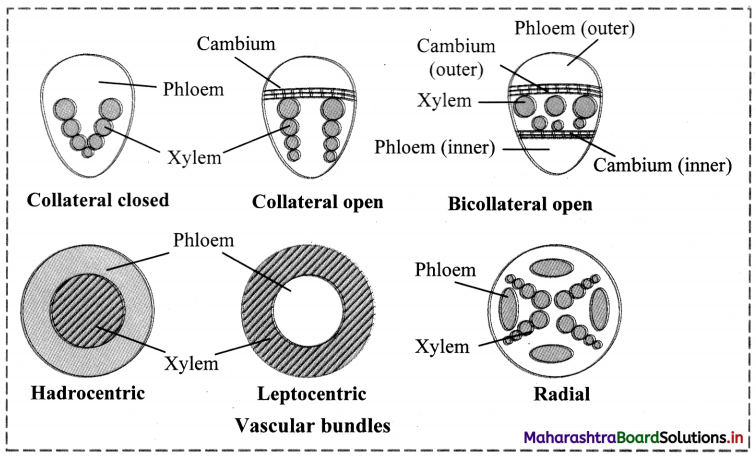
Maharashtra Board Class 11 Biology Important Questions Chapter 8 Plant Tissues and Anatomy 11

Maharashtra Board Class 11 Biology Important Questions Chapter 8 Plant Tissues and Anatomy

Question 22.
Explain how formation of cambial ring occurs in dicot stem.
Answer:

  1. The cambium present between the primary xylem and primary phloem of a vascular bundle is called intrafascicular cambium.
  2. With the onset of favourable season, meristematic cells of intrafascicular cambium become active.
  3. Simultaneously, the ray parenchyma cells, both fusiform initials and ray initials become meristematic. This is known as dedifferentiation.
  4. These form patch of cambial cells (meristematic cells) in between the adjacent bundles and produce interfascicular cambium.
  5. Both intrafascicular and interfascicular cambium join and form a complete ring, known as the cambial ring. This is possible because they lie in one plane.

Question 23.
‘Secondary growth is observed in most of the dicot and gymnospermic root.’ State whether the given statement is true or false and justify your answer.
Answer:

  1. The given statement is true.
  2. Secondary growth is observed in most of the dicot and gymnospermic root by producing secondary vascular tissue and periderm.
  3. Secondary growth is produced by vascular cambium and cork cambium respectively.
  4. Conjunctive parenchyma cells present on the inner edges of primary phloem bundles become meristematic.
  5. These cells add secondary xylem and secondary phloem on the inner and outer side respectively which results in secondary growth.

Question 24.
Differentiate between heartwood and sap wood.
Answer:

HeartwoodSap wood
1. It is central region of secondary xylem (wood).It is the peripheral region of secondary xylem (wood).
2. It is darker in colour due to deposition of oils, gums, resins, tannins, etcIt is lighter in colour and without any depositions.
3. It is non- functional part of secondary xylem.It is functional part of secondary xylem.
4. It is resistant to pathogens.It is more susceptible to pathogens
5. It is not involved in conduction of sap.It is involved in conduction of sap.
6. It is also called as duramen.It is also called as alburnum.

Question 25.
What are tyloses?
Answer:
Tyloses:
1. Tracheary elements of heartwood are plugged by in-growth of adjacent parenchyma cells are known as tyloses.
2. Tyloses are fdled by oils, gums, resins, tannins called as extractives.

Question 26.
Explain how periderm is formed?
Answer:
Formation of periderm:
As the stem increase in diameter due to activity of vascular cambium, the outer cortical and epidermal layer get ruptured. Thus, it becomes necessaiy to replace these cells by new cells.

  1. Phellogen (cork cambium) develops in extrastelar region (cortex region) of the stem.
  2. The outer cortical cells of cortex become meristematic and produce a layer of thin walled, rectangular cells. These cells cut off new cells on both sides.
  3. The cells produced on outer side develop phellem (cork), whereas on the inner side produce phelloderm (secondary cortex).
  4. The cork is impervious in nature and does not allow entry of water due to suberized walls. Secondary cortex is parenchymatous in nature.
  5. Phellogen, phellem and phelloderm constitute periderm.

Question 27.
Explain the given terms:
1. Bark
2. Lenticels
3. Anomalous secondary growth
Answer:
1. Bark:
a. Bark is non-technical term referring to all cell types found external to vascular cambium including secondary phloem.
b. Bark of early season is soft and of the late season is hard.

2. Lenticels:
a. Lenticels are aerating pores present as raised scars on the surface of bark.
b. These are portions of periderm, where phellogen activity is more.
c. Lenticels are meant for gaseous and water vapour exchange.

3. Anomalous secondary growth:
a. Monocot stems lack cambium hence secondary growth does not take place.
b. However, accessory cambium development in plants like, Dracaena, Agave, Palms and root of sweet potato shows presence of secondary growth. This is called as anomalous secondary growth.

Maharashtra Board Class 11 Biology Important Questions Chapter 8 Plant Tissues and Anatomy

Question 28.
With the help of neat and labelled diagram explain the anatomy of dicot root.
Answer:
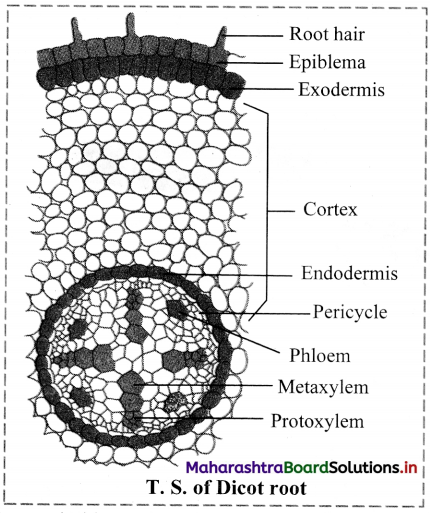
Maharashtra Board Class 11 Biology Important Questions Chapter 8 Plant Tissues and Anatomy 12
The transverse section of a typical dicotyledonous root shows following anatomical features:
1. Epiblema: It is the outermost single layer of cells without cuticle. Some epidermal cells prolong to form unicellular root hairs.
2. Cortex: It is made up of many layers of thin walled parenchyma cells. Cortical cells store food and water.
3. Exodermis: After the death of epiblema, outer layer of cortex become cutinized and is called Exodermis.

4. Endodermis:
The innermost layer of cortex is called Endodermis.
The cells are barrel-shaped and their radial walls bear Casparian strip or Casparian bands composed of suberin. Near the protoxylem, there are unthickened passage cells.

5. Stele: It consists of pericycle, vascular bundles and pith.
a. Pericycle: Next to the endodermis, there is a single layer of thin walled parenchyma cells called pericycle. It forms outermost layer of stele or vascular cylinder.
b. Vascular bundle: Vascular bundles are radial. Xylem and Phloem occur in separate patches arranged on alternate radii. Xylem is exarch in root that means protoxylem vessels are towards periphery and metaxylem elements are towards centre. Xylem bundles vary from two to six number, i.e. they may be diarch, triarch, tetrarch, etc.
Connective tissue: A parenchymatous tissue is present in between xylem and phloem.
c. Pith: The central part of stele is called pith. It is narrow and made up of parenchymatous cells, with or without intercellular spaces.
6. At a later stage cambium ring develops between the xylem and phloem causing secondary growth.

Question 29.
With the help of neat and labelled diagram explain the anatomy of monocot root.
Answer:
The transverse section of a typical monocotyledonous root shows following anatomical features:
1. Epiblema: It is the outermost single layer of cells without cuticle. Some epidermal cells prolong to form unicellular root hairs.
2. Cortex: It is made up of many layers of thin walled parenchyma cells. Cortical cells store food and water.
Endodermis: It is innermost layer of cortex. The cells of endodermis are thick walled except the passage cells which lie just opposite to the protoxylem.
Stele: It consists of pericycle, vascular bundles and pith.
a. Pericycle: Pericycle is present below the endodermis.
b. Vascular bundle: Vascular bundles are radial. Xylem and Phloem occur in separate patches arranged on alternate radii. Xylem is exarch in root that means protoxylem vessels are towards periphery and metaxylem elements are towards centre. Polyarch condition of xylem is observed, (xylem bundles are more than six).
Pith: Pith is large and well developed.
Secondary growth does not occur due to absence of cambium.

Maharashtra Board Class 11 Biology Important Questions Chapter 8 Plant Tissues and Anatomy

Question 30.
What is polyarch condition of root?
Answer:
Polyarch condition is the one in which roots possess more than six xylem bundles.

Question 31.
Explain in detail anatomy of sunflower stem.
Answer:
A transverse section of sunflower (dicot) stem shows the following structures:
1. Epidermis: It is a single, outermost layer with multicellular outgrowth called trichomes. A layer of cuticle
is usually present towards the outer surface of epidermis.

2. Cortex: Cortex is situated below the epidermis and is usually differentiated into three regions namely, hypodermis, general cortex and endodermis.
a. Hypodermis: It is situated just below the epidermis and is made of 3-5 layers of collenchymatous cells. Intercellular spaces are absent.
b. General cortex: It is made up of several layers of large parenchymatous cells with intercellular spaces.
c. Endodermis: It is an innermost layer of cortex which is made up of barrel shaped cells. It is also called starch sheath, as it is rich in starch grain.

3. Stele: It is differentiated into pericycle, vascular bundles and pith.
a. Pericycle: It is the outermost layer of vascular system situated between the endodermis and vascular bundles. In sunflower, it is multi-layered and also called hard bast.
b. Vascular bundles: Vascular bundles are conjoint, collateral, open, and are arranged in a ring. Each one is composed of xylem, phloem and cambium. Xylem is endarch. A strip of cambium is present between xylem and phloem.
c. Pith: It is situated in the centre of the young stem and is made up of large-sized parenchymatous cells with conspicuous intercellular spaces.

Question 32.
With the help of neat and labelled diagram explain the anatomy of maize stem.
Answer:
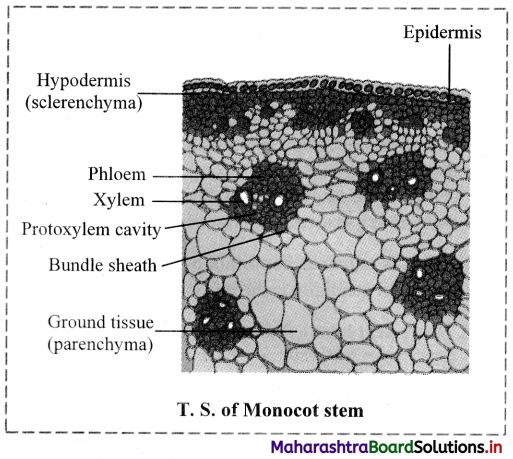
Maharashtra Board Class 11 Biology Important Questions Chapter 8 Plant Tissues and Anatomy 13
A transverse section of maize (monocot) stem shows the following structures:

  1. Epidermis: It is single layered and without trichomes.
  2. Hypodermis: It is sclerenchymatous.
  3. Ground tissue: It consists of thin walled parenchyma cells. It extends from hypodermis to the centre. It is not differentiated into cortex, endodermis, pericycle and pith.
  4. Vascular bundles: Vascular bundles are numerous and are scattered in ground tissue. Each vascular bundle is surrounded by a sclerenchymatous bundle sheath. Vascular bundles are conjoint, collateral and closed (without cambium). Xylem is endarch and shows lysigenous cavity.
  5. Pith: Pith is absent.

Question 33.
With the help of a neat and labelled diagram, describe the internal structure of dorsiventral leaf.
Answer:
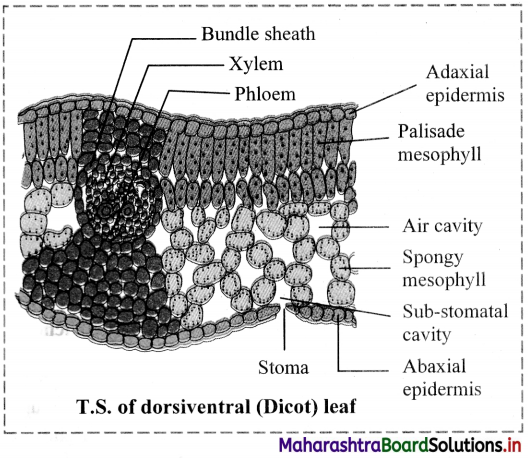
1. Structure of dorsiventral leaf: The mesophyll tissue is differentiated into palisade and spongy parenchyma in a dorsiventral leaf. This type is very common in dicot leaf. The different parts of this leaf are as follows:
2. Upper epidermis: It consists of a single layer of tightly packed rectangular, barrel shaped, parenchymatous cells which are devoid of chloroplast. A distinct layer of cuticle lies on the outside of the epidermis. Stomata are generally absent.
3. Mesophyll: Between upper and lower epidermis, there is chloroplast-containing photosynthetic tissue called mesophyll It is differentiated into Palisade parenchyma and Spongy parenchyma.
a. Palisade parenchyma:
Palisade parenchyma is present below upper epidermis and consists of closely packed elongated cells. The cells contain abundant chloroplasts and help in photosynthesis.
b. Spongy parenchyma:
Spongy parenchyma is present below palisade tissue and consists of loosely arranged irregularly shaped cells with intercellular spaces. The spongy parenchyma cells contain chloroplast and are in contact with the atmosphere through stomata.
Maharashtra Board Class 11 Biology Important Questions Chapter 8 Plant Tissues and Anatomy 14
4. Vascular system: It is made up of a number of vascular bundles of varying size depending upon the venation. Each one is surrounded by a thin layer of parenchymatous cells called bundle sheath. Vascular bundles are closed. Xylem lies towards upper epidermis and phloem towards lower epidermis. Cambium is absent, hence there is no secondary growth in the leaf.
5. Lower epidermis: It consists of a single layer of compactly arranged rectangular, parenchymatous cells. A thin layer of cuticle is also present. The lower epidermis contains a large number of microscopic pores called stomata. There is an air-space called substomatal chamber at each stoma.

Maharashtra Board Class 11 Biology Important Questions Chapter 8 Plant Tissues and Anatomy

Question 34.
With the help of a neat labelled diagram, describe the anatomy of isobilateral leaf.
Answer:
The parts of isobilateral leaf are as follows:
Maharashtra Board Class 11 Biology Important Questions Chapter 8 Plant Tissues and Anatomy 15
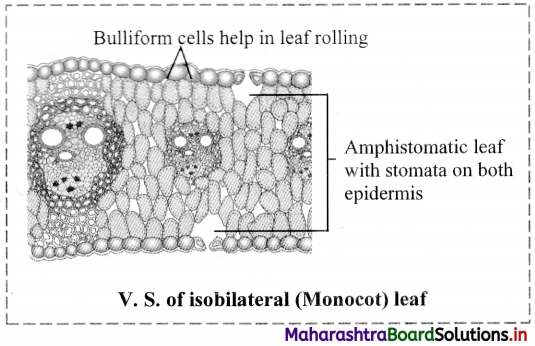
1. Epidermis:
It is single layered, present on both sides of the leaf.
It consists of compactly arranged rectangular transparent parenchymatous cells.
Both the surfaces contain stomata.
Both the surfaces have a distinct layer of cuticle.
2. Mesophyll:
Mesophyll is not differentiated into palisade and spongy tissue.
3. Vascular bundle:
These are conjoint, collateral and closed.

Question 35.
Compare between dorsiventral and isobilateral leaf.
Answer:

Dorsiventral leafIsobilateral leaf
1. Dorsiventral Leaf is very common in dicotyledonous plants.Isobilateral leaf is very common in monocotyledonous plants.
2. In this mesophyll tissue is differentiated into palisade and spongy parenchyma.In this mesophyll tissue is not differentiated into palisade and spongy parenchyma.
3. The leaves are commonly horizontal in orientation with distinct upper and lower surfaces. The upper surface which faces the sun is darker than the lower surface.In this leaf both the surfaces are equally illuminated as both the surface can face the sun, and show similar structure. The two surfaces are equally green.
4. Stomata is absent on the upper surface of these leaves.Stomata is present on both the upper and lower surfaces of these leaves.

Question 36.
Distinguish between anatomy of dicot root and monocot root.
Answer:

Anatomy of dicot rootAnatomy of monocot root
1. Pith is narrow.Pith is large and well developed.
2. Diarch, triarch or tetrarch condition can be observed. (Xylem bundles vary from two to six number)Polyarch condition is observed, (xylem bundles are more than six)
3. Cambium is formed in later stage between xylem and phloem which causes secondary growth.Secondary growth is absent.

Maharashtra Board Class 11 Biology Important Questions Chapter 8 Plant Tissues and Anatomy

Question 37.
Distinguish between anatomy of dicot stem and monocot stem.
Answer:

Anatomy of Dicot stemAnatomy of Monocot stem
1. Epidermis shows presence of multicellular trichomes.Epidermis is without trichomes.
2. Hypodermis is made up of collenchymatous cells.Hypodermis is made up of sclerenchymatous cells.
3. Medullary rays are present between vascular bundles.Medullary rays are absent.
4. Vascular bundles are arranged in the form of a ring.Vascular bundles are scattered in the ground tissue.
5. It is conjoint, collateral and open (Cambium present)They are conjoint, collateral and closed (cambium is absent).
6. Vascular bundle is not surrounded by a sclerenchymatous bundle sheath.Vascular bundle is surrounded by a sclerenchymatous bundle sheath.
7. Secondary growth takes place due to presence of cambium.Secondary growth does not occur due to absence of cambium.
8. Pith is present.Pith is absent.

Question 38.
Apply Your Knowledge

Question 1.
Which plant part would show the following:

  1. Radial vascular bundles.
  2. Large and well-developed pith.
  3. Differentiation of mesophyll into palisade and spongy tissue.
  4. Presence of stomata on both upper and lower epidermis.

Answer:

  1. Root
  2. Monocot root and Dicot stem,
  3. Dicot leaf
  4. Monocot leaf

Question 2.
When a tree is debarked, which tissues are removed?
Answer:
The bark is made up of tissues like cork, cork cambium and secondary cortex, which are removed when a tree is debarked.

Question 3.
While eating fruits like pear or guava, it feels gritty. What gives stiffness to these fruits?
Answer:
Sclereids are found in pulp of fruits like pear and guava which gives them stiffness and thus we feel gritty while eating these fruits.

Maharashtra Board Class 11 Biology Important Questions Chapter 8 Plant Tissues and Anatomy

Question 39.
Quick Review

Maharashtra Board Class 11 Biology Important Questions Chapter 8 Plant Tissues and Anatomy 16
Maharashtra Board Class 11 Biology Important Questions Chapter 8 Plant Tissues and Anatomy 17

Question 40.
Exercise

Question 1.
Define tissue.
Answer:
A group of cells having essentially a common function and origin is called as tissue.

Question 2.
Classify the meristematic tissue based on its origin.
Answer:
Classification of meristematic tissue on the basis of origin:
1. Promeristem / Primordial meristem:
a. It is also called as embryonic meristem.
b. It usually occupies very minute area at the tip of root and shoot.

2. Primary meristem:
a. It originates from the primordial meristem and occurs in the plant body from the beginning, at the root and shoot apices.
b. Cells are always in active state of division and give rise to permanent tissues.

3. Secondary meristem:
a. These tissues develop from living permanent tissues during later stages of plant growth hence are called as secondary meristems.
b. This tissue occurs in the mature regions of root and shoot of many plants.
c. Secondary meristem is always lateral (to the central axis) in position e.g. Fascicular cambium, inter fascicular cambium, cork cambium.

Maharashtra Board Class 11 Biology Important Questions Chapter 8 Plant Tissues and Anatomy

Question 3.
Explain in detail classification of meristematic tissue based on its position.
Answer:
Classification of meristematic tissue based on its position:
1. Apical meristem:
a. It is produced from promeristem and forms growing point of apices of root, shoot and their lateral branches.
b. It brings about increase in length of plant body and is called as apical initials.
c. Shoot apical meristem is terminal in position whereas in root it is subterminal i.e. located behind the root cap.

2. Intercalary meristem:
a. Intercalary meristematic tissue is present in the top or base area of node.
b. Their activity is mainly seen in monocots.
c. These are short lived.

3. Lateral meristem:
a. It is present along the sides of central axis of organs.
b. It takes part in increasing girth of stem or root, e.g. Intrafascicular cambium.
c. It is found in vascular bundles of gymnosperms and dicot angiosperms.

Question 4.
Give any two examples of secondary meristematic tissue.
Answer:
Secondary meristem is always lateral (to the central axis) in position e.g. Fascicular cambium, inter fascicular cambium, cork cambium.

Question 5.
Draw a diagram of meristematic cells.
Answer:
1. Cell wall
2. Nucleus
3. Cytoplasm
Characteristics of meristematic tissue:

  1. It is a group of young, immature cells.
  2. These are living cells with ability to divide in the regions where they are present.
  3. These are polyhedral or isodiametric in shape without intercellular spaces.
  4. Cell wall is thin, elastic and mainly composed of cellulose.
  5. Protoplasm is dense with distinct nucleus at the centre and vacuoles if present, are very small.
  6. Cells show high rate of metabolism.

Maharashtra Board Class 11 Biology Important Questions Chapter 8 Plant Tissues and Anatomy

Question 6.
Write a short note on tracheids.
Answer:
Tracheids:
a. These are elongated, tubular and dead cells (without protoplasm).
b. The ends are oblique and tapering.
c. The cell walls is unevenly thickened and lignified. This provides mechanical strength.
d. Tracheids contribute 95% of wood in gymnosperms and 5% in angiosperms.
e. The different types of thickening patterns are seen on their walls such as annular (in the form of rings), spiral (in the form of spring/helix), scalariform (ladder like) and pitted (small circular area). Pitted is the most advanced type of thickening which may be simple or bordered.

Question 7.
Describe parenchyma in detail.
Answer:
Cell is the component that brings about important processes in the living organisms.

Question 8.
Describe the structure of xylem in detail.
Answer:
1. Xylem is the water conducting tissue in higher plants. It is a dead complex tissue.
It also provides mechanical strength to the plant body.
Components of xylem are tracheids, vessels, xylem parenchyma and xylem fibres.

2. Tracheids:
a. These are elongated, tubular and dead cells (without protoplasm).
b. The ends are oblique and tapering.
c. The cell walls is unevenly thickened and lignified. This provides mechanical strength.
d. Tracheids contribute 95% of wood in gymnosperms and 5% in angiosperms.
e. The different types of thickening patterns are seen on their walls such as annular (in the form of rings), spiral (in the form of spring/helix), scalariform (ladder like) and pitted (small circular area). Pitted is the most advanced type of thickening which may be simple or bordered.

3. Vessels:
a. Vessels are longer than tracheids with perforated or dissolved ends and formed by union of several vessels end to end.
b. These are involved in conduction of water and minerals.
c. Their lumen is wider than tracheids and the thickening is due to lignin and similar to tracheids.
d. In monocots, vessels are rounded where as they are angular in dicot angiosperms.
e. The first formed xylem vessels (protoxylem) are small and have either annular or spiral thickenings while latter formed xylem vessels are larger (metaxylem) and have reticulate or pitted thickenings.
f. When protoxylem is arranged towards pith and metaxylem towards periphery it is called as endarch
e. g. in stem and when the position is reversed as in the roots is called as exarch.

4. Xylem parenchyma:
a. Xylem parenchyma cells are small associated with tracheids and vessels.
b. This is the only living tissue among this complex tissue.
c. The function is to store food (starch) and sometimes tannins.
d. Xylem parenchyma are involved in lateral or radial conduction of water or sap.

5. Xylem fibres:
a. Xylem fibres are sclerenchymatous cells and serve mainly mechanical support. These are called wood fibres.
b. These are also elongated, narrow and spindle shaped.
c. Cells are tapering at both the ends and their walls are lignified.

Question 9.
What are Sclerenchyma fibres?
Answer:
a. Fibres:
Fibres are thread-like, elongated and narrow structures with tapering and interlocking end walls. Fibres are mostly in bundles. Pits are narrow, unbranched and oblique. They provide mechanical strength.

Maharashtra Board Class 11 Biology Important Questions Chapter 8 Plant Tissues and Anatomy

Question 10.
Write the functions of parenchyma cells.
Answer:
Parenchyma, Collenchyma and Sclerenchyma are the simple permanent tissues in plants.

Question 11.
Write function of collenchyma tissue.
Answer:
Function:
Collenchyma is a living mechanical tissue and serves different functions in plants.
a. It gives mechanical strength to young stem and parts like petiole of leaf.
b. It allows bending and pulling action in plant parts and also prevents tearing of leaf.
c. It also allows growth and elongation of organs.

Question 12.
Which are the different types of tracheids based on the types of thickenings on their walls?
Answer:
The different types of thickening patterns are seen on their walls such as annular (in the form of rings), spiral (in the form of spring/helix), scalariform (ladder like) and pitted (small circular area). Pitted is the most advanced type of thickening which may be simple or bordered.

Question 13.
Death of companion cell causes death of sieve tube cells and vice versa. Justify.
Answer:
Companion cells:
a. These are narrow elongated and living.
b. Companion cells are laterally associated with sieve tube elements.
c. Companion cells have dense cytoplasm and prominent nucleus.
d. Nucleus of companion cell regulates functions of sieve tube cells through simple pits.
e. From origin point of view, sieve tube cells and companion cell are derived from same cell. Death of the one result in death of the other type.

Question 14.
Which are the three types of simple permanent tissues?
Answer:
Parenchyma, Collenchyma and Sclerenchyma are the simple permanent tissues in plants.

Maharashtra Board Class 11 Biology Important Questions Chapter 8 Plant Tissues and Anatomy

Question 15.
Write the functions of sclerenchyma tissue.
Answer:
Functions:
a. This tissue functions as the main mechanical tissue.
b. It permits bending, shearing and pulling.
c. It gives rigidity to leaves and prevents it from falling.
d. It also gives rigidity to epicarps and seeds.

Question 16.
What are the components of xylem?
Answer:
1. Xylem is the water conducting tissue in higher plants. It is a dead complex tissue.
It also provides mechanical strength to the plant body.
Components of xylem are tracheids, vessels, xylem parenchyma and xylem fibres.

Question 17.
Name the living component of xylem.
Answer:
This is the only living tissue among this complex tissue.

Question 18.
Name the dead component of phloem.
Answer:
Phloem fibres are the only dead tissue among this unit.

Question 19.
What is closed vascular bundle?
Answer:
When cambium is not present between xylem and phloem, it is known as closed vascular bundle.

Question 20.
Describe two types of conjoint vascular bundles.
Answer:
Conjoint vascular bundles:
When the complex tissue (xylem and phloem) is collectively present as neighbours of each other on the same radius, vascular bundle is called Conjoint vascular bundle.
They are of two types:
a. Collateral vascular bundle:
In this type of vascular bundle, xylem lies inwards and the phloem lies outwards.
These bundles may be further of open type (secondary growth takes place) containing cambium in between xylem and phloem and closed type if cambium is not present (secondary growth absent).
b. Bicollateral vascular bundle:
When phloem is present in a vascular bundle on both the sides of xylem and intervening cambium tissue, it is called bicollateral vascular bundle. It is a feature of family Cucurbitaceae.

Question 21.
Write the function of trichomes.
Answer:
In stem, epidermal hairs are called trichomes. These are generally multicellular, branched or unbranched, stiff or soft or even secretory. These help in preventing water loss due to transpiration.

Question 22.
What are bicollateral vascular bundle?
Answer:
Bicollateral vascular bundle:
When phloem is present in a vascular bundle on both the sides of xylem and intervening cambium tissue, it is called bicollateral vascular bundle. It is a feature of family Cucurbitaceae.

Question 23.
Name the tissue that are not included in ground tissue.
Answer:
All the plant tissues excluding epidermal and vascular tissue is ground tissue.

Maharashtra Board Class 11 Biology Important Questions Chapter 8 Plant Tissues and Anatomy

Question 24.
Which type of conjoint – vascular bundles are found in members of Cucurbitaceae family?
Answer:
Bicollateral vascular bundle:
When phloem is present in a vascular bundle on both the sides of xylem and intervening cambium tissue, it is called bicollateral vascular bundle. It is a feature of family Cucurbitaceae.

Question 25.
What is concentric vascular bundle?
Answer:
Concentric vascular bundle:
a. When one vascular tissue is completely encircling the other, it is called as concentric vascular bundle.
b. When phloem is encircled by xylem, it is called as leptocentric vascular bundle, whereas when xylem is encircled by phloem, it is called as hadrocentric vascular bundle.
c. When xylem is encircled by phloem on both faces, it is called as amphicribral vascular bundle. When phloem is encircled by xylem on both faces it is called as amphivasal vascular bundle.

Question 26.
Define intrafascicular cambium.
Answer:
The cambium present between the primary xylem and primary phloem of a vascular bundle is called intrafascicular cambium.

Question 27.
What is the difference between spring wood and autumn wood?
Answer:
During favourable conditions, spring wood (early wood) is formed which has broader xylem bands, lighter colour, tracheids with thin wall and wide lumen, fibres are less in number, low density. Whereas, during unfavourable conditions, autumn wood (late wood) is formed which has narrow xylem band, darker in colour, lumen is narrow and walls are thick with abundant fibres, high density.

Question 28.
Explain how growth rings are formed in trees?
Answer:
1. Growth rings are formed due cambial activity during favourable and non-favourable climatic conditions.
2. During favourable conditions, spring wood (early wood) is formed which has broader xylem bands, lighter colour, tracheids with thin wall and wide lumen, fibres are less in number, low density. Whereas, during unfavourable conditions, autumn wood (late wood) is formed which has narrow xylem band, darker in colour, lumen is narrow and walls are thick with abundant fibres, high density.
3. Spring wood and autumn wood that appear as alternate light and dark concentric rings, constitute an annual ring or growth ring.

Question 29.
Which tissues are together called as periderm?
Answer:
Phellogen, phellem and phelloderm constitute periderm.

Maharashtra Board Class 11 Biology Important Questions Chapter 8 Plant Tissues and Anatomy

Question 30.
What is bark?
Answer:
Bark:
a. Bark is non-technical term referring to all cell types found external to vascular cambium including secondary phloem.
b. Bark of early season is soft and of the late season is hard.

Question 31.
What is the function of lenticels?
Answer:
Lenticels are meant for gaseous and water vapour exchange.

Question 32.
Explain the term anomalous secondary growth.
Answer:
Anomalous secondary growth:
a. Monocot stems lack cambium hence secondary growth does not take place.
b. However, accessory cambium development in plants like, Dracaena, Agave, Palms and root of sweet potato shows presence of secondary growth. This is called as anomalous secondary growth.

Question 33.
Explain in detail anatomical structure of a dicot stem.
Answer:
A transverse section of sunflower (dicot) stem shows the following structures:
1. Epidermis: It is a single, outermost layer with multicellular outgrowth called trichomes. A layer of cuticle
is usually present towards the outer surface of epidermis.

2. Cortex: Cortex is situated below the epidermis and is usually differentiated into three regions namely, hypodermis, general cortex and endodermis.
a. Hypodermis: It is situated just below the epidermis and is made of 3-5 layers of collenchymatous cells. Intercellular spaces are absent.
b. General cortex: It is made up of several layers of large parenchymatous cells with intercellular spaces.
c. Endodermis: It is an innermost layer of cortex which is made up of barrel shaped cells. It is also called starch sheath, as it is rich in starch grain.

3. Stele: It is differentiated into pericycle, vascular bundles and pith.
a. Pericycle: It is the outermost layer of vascular system situated between the endodermis and vascular bundles. In sunflower, it is multi-layered and also called hard bast.
b. Vascular bundles: Vascular bundles are conjoint, collateral, open, and are arranged in a ring. Each one is composed of xylem, phloem and cambium. Xylem is endarch. A strip of cambium is present between xylem and phloem.
c. Pith: It is situated in the centre of the young stem and is made up of large-sized parenchymatous cells with conspicuous intercellular spaces.

Question 34.
Draw neat and labelled diagrams of dicot and monocot root and differentiate between their anatomical characters.
Answer:
The transverse section of a typical dicotyledonous root shows following anatomical features:
1. Epiblema: It is the outermost single layer of cells without cuticle. Some epidermal cells prolong to form unicellular root hairs.
2. Cortex: It is made up of many layers of thin walled parenchyma cells. Cortical cells store food and water.
3. Exodermis: After the death of epiblema, outer layer of cortex become cutinized and is called Exodermis.

4. Endodermis:
The innermost layer of cortex is called Endodermis.
The cells are barrel-shaped and their radial walls bear Casparian strip or Casparian bands composed of suberin. Near the protoxylem, there are unthickened passage cells.

5. Stele: It consists of pericycle, vascular bundles and pith.
a. Pericycle: Next to the endodermis, there is a single layer of thin walled parenchyma cells called pericycle. It forms outermost layer of stele or vascular cylinder.
b. Vascular bundle: Vascular bundles are radial. Xylem and Phloem occur in separate patches arranged on alternate radii. Xylem is exarch in root that means protoxylem vessels are towards periphery and metaxylem elements are towards centre. Xylem bundles vary from two to six number, i.e. they may be diarch, triarch, tetrarch, etc.
Connective tissue: A parenchymatous tissue is present in between xylem and phloem.
c. Pith: The central part of stele is called pith. It is narrow and made up of parenchymatous cells, with or without intercellular spaces.
6. At a later stage cambium ring develops between the xylem and phloem causing secondary growth.

Maharashtra Board Class 11 Biology Important Questions Chapter 8 Plant Tissues and Anatomy

Question 35.
Which type of vascular bundles are observed in isobilateral leaf?
Answer:
Vascular bundle:
These are conjoint, collateral and closed.

Question 36.
Describe the internal structure of a leaf in which mesophyll is differentiated in palisade and spongy parenchyma.
Answer:
1. Structure of dorsiventral leaf: The mesophyll tissue is differentiated into palisade and spongy parenchyma in a dorsiventral leaf. This type is very common in dicot leaf. The different parts of this leaf are as follows:
2. Upper epidermis: It consists of a single layer of tightly packed rectangular, barrel shaped, parenchymatous cells which are devoid of chloroplast. A distinct layer of cuticle lies on the outside of the epidermis. Stomata are generally absent.
3. Mesophyll: Between upper and lower epidermis, there is chloroplast-containing photosynthetic tissue called mesophyll It is differentiated into Palisade parenchyma and Spongy parenchyma.
a. Palisade parenchyma:
Palisade parenchyma is present below upper epidermis and consists of closely packed elongated cells. The cells contain abundant chloroplasts and help in photosynthesis.
b. Spongy parenchyma:
Spongy parenchyma is present below palisade tissue and consists of loosely arranged irregularly shaped cells with intercellular spaces. The spongy parenchyma cells contain chloroplast and are in contact with the atmosphere through stomata.
4. Vascular system: It is made up of a number of vascular bundles of varying size depending upon the venation. Each one is surrounded by a thin layer of parenchymatous cells called bundle sheath. Vascular bundles are closed. Xylem lies towards upper epidermis and phloem towards lower epidermis. Cambium is absent, hence there is no secondary growth in the leaf.
5. Lower epidermis: It consists of a single layer of compactly arranged rectangular, parenchymatous cells. A thin layer of cuticle is also present. The lower epidermis contains a large number of microscopic pores called stomata. There is an air-space called substomatal chamber at each stoma.

Question 37.
Multiple Choice Questions:

Question 1.
Meristematic tissues are found
(A) only in stems of the plants
(B) in both roots and stems
(C) in all growing tips of the plant body
(D) only in roots of the plants
Answer:
(C) in all growing tips of the plant body

Question 2.
The tissue responsible for translocation of food material is _________
(A) xylem
(B) cambium
(C) parenchyma
(D) phloem
Answer:
(D) phloem

Maharashtra Board Class 11 Biology Important Questions Chapter 8 Plant Tissues and Anatomy

Question 3.
________ are used in making ropes and rough clothes.
(A) Phloem parenchyma
(B) Trachieds
(C) Phloem fibres
(D) Sieve tube elements
Answer:
(C) Phloem fibres

Question 4.
_______ are the only dead tissue among the phloem.
(A) Phloem parenchyma
(B) Sieve tubes
(C) Companion cells
(D) Phloem fibres
Answer:
(D) Phloem fibres

Question 5.
Phloem was named as _______ by Haberlandt as similar to xylem.
(A) Bast
(B) Leptome
(C) Wood fibres
(D) Casparian
Answer:
(B) Leptome

Question 6.
The sieve tube cell is connected to companion cell through phloem parenchyma by
(A) Plasmodesmata
(B) Interfascicular cambium
(C) Pericycle
(D) Hypodermis
Answer:
(A) Plasmodesmata

Maharashtra Board Class 11 Biology Important Questions Chapter 8 Plant Tissues and Anatomy

Question 7.
Which of the following tissues is with dead thick-walled cells without intercellular spaces?
(A) parenchyma
(B) collenchyma
(C) sclerenchyma
(D) phloem
Answer:
(C) sclerenchyma

Question 8.
The tissue which is present in between xylem and phloem of stem is called
(A) apical meristem
(B) pericycle
(C) vascular cambium
(D) cork cambium
Answer:
(C) vascular cambium

Question 9.
In stem, epidermal hairs are called as
(A) Cuticles
(B) Casparian strip
(C) Trichomes
(D) Companion cells
Answer:
(C) Trichomes

Question 10.
_______ forms the outer covering of plant body and is derived from protodenn or dermatogen.
(A) Ground tissue system
(B) Interfascicular cambium
(C) Vascular tissue system
(D) Epidermal tissue system
Answer:
(D) Epidermal tissue system

Question 11.
_______ play a vital role in exchange of gases and water vapour.
(A) Vascular bundles
(B) Stomata
(C) Ground tissues
(D) Trichomes
Answer:
(B) Stomata

Maharashtra Board Class 11 Biology Important Questions Chapter 8 Plant Tissues and Anatomy

Question 12.
In which of the following leaf possesses dumbbell shaped guard cell’?
(A) Pisum sativum
(B) Wheat
(C) Datura
(D) Sunflower
Answer:
(B) Wheat

Question 13.
Which of the following is NOT a characteristic of spring wood?
(A) Tracheids with wide lumen
(B) Less number of fibres
(C) Narrow xylem band
(D) Lighter colour
Answer:
(C) Narrow xylem band

Question 14.
Periderm consists of
(A) Phellogen
(B) Phellem
(C) Phelloderm
(D) All of these
Answer:
(D) All of these

Question 15.
Which of the following is essential for secondary growth?
(A) Xylem
(B) Pith
(C) Phloem
(D) Cambium
Answer:
(D) Cambium

Question 16.
Vascular bundles of dicot root are
(A) radial exarch
(B) radial endarch
(C) conjoint exarch
(D) conjoint endarch
Answer:
(A) radial exarch

Question 17.
In which of the following characters, a monocot root differs from dicot root?
(A) Open vascular bundle
(B) Large pith
(C) Radial vascular bundles
(D) Scattered vascular bundles
Answer:
(B) Large pith

Question 18.
Which of the following plant shows isobilateral leaves?
(A) Hibiscus
(B) Maize
(C) Mangifera indica
(D) Sunflower
Answer:
(B) Maize

Maharashtra Board Class 11 Biology Important Questions Chapter 8 Plant Tissues and Anatomy

Question 19.
Secondary growth does not occur in
(A) Maize stem
(B) Mango leaf
(C) Carina root
(D) All of these
Answer:
(D) All of these

Question 20.
Stele of a dicot stem consists of all the given below, EXCEPT
(A) Pericycle
(B) Cortex
(C) Vascular bundles
(D) Pith
Answer:
(B) Cortex

Question 21.
Hypodermis is collenchymatous in
(A) monocot stem
(B) dicot stem
(C) monocot root
(D) both (A) and (B)
Answer:
(B) dicot stem

Question 22.
Lysigenous cavity filled with water is present in
(A) dicot stem
(B) monocot stem
(C) monocot root
(D) dicot root
Answer:
(B) monocot stem

Question 23.
The vascular bundles in a dicot stem are
(A) collateral and open
(B) radial
(C) bicollateral and open
(D) collateral and closed
Answer:
(A) collateral and open

Question 38.
Competitive Corner

Question 1.
Phloem in gymnosperms lacks:
(A) companion cells only
(B) both sieve tubes and companion cells
(C) albuminous cells and sieve cells
(D) sieve tubes only
Answer:
(B) both sieve tubes and companion cells

Question 2.
Grass leaves curl inwards during very dry weather. Select the most appropriate reason from the following:
(A) Shrinkage of air spaces in spongy mesophyll
(B) Tyloses in vessels
(C) Closure of stomata
(D) Flaccidity of bulliform cells
Hint: Grass leaves curl inwards to the minimize water loss.
Answer:
(D) Flaccidity of bulliform cells

Question 3.
Which of the statements given below is NOT true about formation of ‘annual rings’ in trees?
(A) Activity of cambium depends upon variation in climate.
(B) Annual rings are not prominent in trees of temperate region.
(C) Annual ring is a combination of spring wood and autumn wood produced in a year.
(D) Differential activity of cambium causes light and dark bands of tissue – early and late wood respectively.
Hint: Annual rings are formed due to activity of cambium. The activity of cambium is under the control of many physiological and environmental factors. In temperate regions, the climatic conditions are not uniform throughout the year due to this, annual rings are formed.
Answer:
(B) Annual rings are not prominent in trees of temperate region.

Question 4.
Regeneration of damaged growing grass following grazing is largely due to:
(A) secondary meristem
(B) lateral meristem
(C) apical meristem
(D) intercalary meristem
Hint: Intercalary meristems occur in grasses at the base of intemode, which regenerates the grass damaged due to grazing.
Answer:
(D) intercalary meristem

Question 5.
In the dicot root, the vascular cambium originates from:
(A) intrafascicular and interfascicular tissue in a ring
(B) tissue located below the phloem bundles and a portion of pericycle tissue above protoxylem
(C) cortical region
(D) parenchyma between endodermis and pericycle
Answer:
(B) tissue located below the phloem bundles and a portion of pericycle tissue above protoxylem

Maharashtra Board Class 11 Biology Important Questions Chapter 8 Plant Tissues and Anatomy

Question 6.
Casparian strips occur in
(A) Cortex
(B) Pericycle
(C) Epidermis
(D) Endodermis
Answer:
(D) Endodermis

Question 7.
Plants having little or no secondary growth are
(A) Conifers
(B) Deciduous angiosperms
(C) Grasses
(D) Cycads
Hint: Secondary growth takes place in stems and roots of dicotyledons and gymnosperms, but does not occur in monocotyledons.
Answer:
(C) Grasses

Question 8.
Secondary xylem and phloem in dicot stem are produced by
(A) Phellogen
(B) Vascular cambium
(C) Apical meristems
(D) Axillary meristems
Answer:
(B) Vascular cambium

Question 9.
The vascular cambium normally gives rise to
(A) Phelloderm
(B) Primary phloem
(C) Secondary xylem
(D) Periderm
Answer:
(C) Secondary xylem

Maharashtra Board Class 11 Biology Important Questions Chapter 8 Plant Tissues and Anatomy

Question 10.
Identify the wrong statement in context of heartwood.
(A) Organic compounds are deposited in it
(B) It is highly durable
(C) It conducts water and minerals efficiently
(D) It comprises dead elements with highly lignified walls
Hint: In old trees, secondary xylem (wood) becomes physiologically non active. It does not conduct water and becomes dark due to organic deposits (tannins, resins, oils, aromatic substances, etc.) It comprises of dead elements and called as heart wood. It is non conductive, hard, durable and resistant to microbes and insects.
Answer:
(C) It conducts water and minerals efficiently

Question 11.
Which of the following is made up of dead cell?
(A) Xylem parenchyma
(B) Collenchyma
(C) Phellem
(D) Phloem
Hint: Cork cambium (phellogen) cuts off cells on both the sides. The outer cells differentiate into cork or phellem. The cork is impervious to water due to suberin deposition in the cell wall.
Answer:
(C) Phellem
Maharashtra Board Class 11 Biology Important Questions Chapter 7 Cell Division

Balbharti Maharashtra State Board 11th Biology Important Questions Chapter 7 Cell Division Important Questions and Answers.

Maharashtra State Board 11th Biology Important Questions Chapter 7 Cell Division

Question 1.
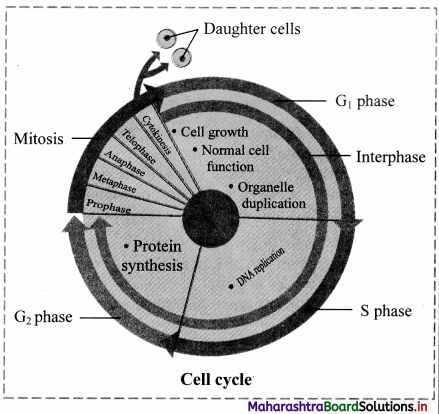
Why interphase is known as the preparatory phase.
Answer:
1. During interphase, the cell is metabolically very active.
2. In this phase, a cell grows to its maximum size, chromosomal material (DNA and histone proteins) duplicates and the cell prepares itself for the next mitotic division. Hence, the interphase is known as the preparatory phase.

Maharashtra Board Class 11 Biology Important Questions Chapter 7 Cell Division

Question 2.
Name the following.
1. In which phase does the amount of DNA per cell doubles?
2. Which types of RNA are synthesized during first growth phase?
Answer:
1. S-phase.
2. m-RNA, t-RNA and r-RNA

Question 3.
Match the Column I (Phases of Cell cycle) with Column II (Approximate time for completion).

Column IColumn II
1. G: Phase(a) 1-3 Hours
2. Gi Phase(b) 2-5 Hours
3. M Phase(c) 6-8 Hours
4. S Phase(d) 8 Hours

Answer:

Column IColumn II
1. G: Phase(b) 2-5 Hours
2. Gi Phase(d) 8 Hours
3. M Phase(a) 1-3 Hours
4. S Phase(c) 6-8 Hours

Question 4.
What is cell division? Mention the types of cell division.
Answer:
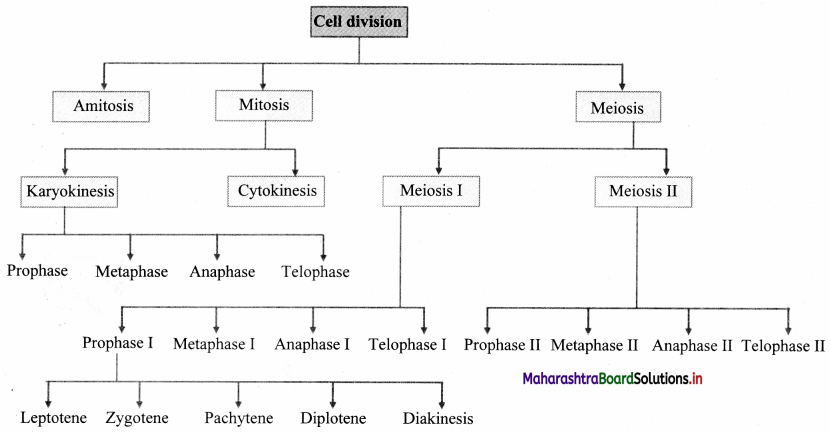
The division of cells into two (or more) daughter cells with same (or different) genetic material is called cell division. There are three types of cell divisions:
1. Amitosis:
a. It is the simplest form of cell division. The nucleus elongates and a constriction appears along its length.
b. This constriction deepens and divides nucleus into two daughter nuclei followed by division of cytoplasm resulting in formation of two daughter cells.
c. This type of division is observed in unicellular organisms, abnormal cells, old cells and in foetal membrane cells.

2. Mitosis:
a. In this type of cell division, the cell divides and forms two similar daughter cells which are identical to the parent cell.
b. It is completed in two steps as karyokinesis and cytokinesis.

3. Meiosis:
a. In this type of cell division, the number of chromosomes is reduced to half. Hence, this type of cell division is also called reductional division.
b. Meiosis produces four haploid daughter cells from a diploid parent cell.

Maharashtra Board Class 11 Biology Important Questions Chapter 7 Cell Division

Question 5.
With the help of suitable diagrams, explain karyokinesis in brief.
Answer:
Karyokinesis is the nuclear division which is divided into prophase, metaphase, anaphase and telophase.
1. Prophase:
a. In this phase, condensation of chromatin material, migration of centrioles, appearance of mitotic apparatus and disappearance of nuclear membrane takes place.
b. Due to condensation, each chromosome with its sister chromatids connected by centromere is clearly visible under light microscope.
c. The nucleolus starts to disappear.
d. Centrosome start moving towards the opposite poles of the cell.
e. Mitotic apparatus is almost completely formed.

2. Metaphase:
a. Chromosomes are completely condensed and appear short.
b. Centromere and sister chromatids become very prominent.
c. All the chromosomes are arranged at equatorial plane of cell. This is called metaphase plate.
d. Mitotic spindle is fully formed in this phase.
e. Centromere of each chromosome divides horizontally into two, each being associated with a chromatid. [Note: The centromeres divide at the beginning of anaphase so that the two chromatids of each chromosome become separated from each other.
Source: Cell Division, Donald B. McMillan, Richard J. Harris, in An Atlas of Comparative Vertebrate Histology, 2018.]

3. Anaphase:
a. In this phase, chromatids of each chromosome separate and form two chromosomes called daughter chromosomes.
b. The chromosomes which are formed are pulled away in opposite direction by spindle apparatus.
c. Anaphase ends when each set of chromosomes reach at opposite poles of the cell.

4. Telophase:
a. This is the final stage of karyokinesis.
b. The chromosomes with their centromeres begin to uncoil at the poles.
c. The chromosomes lengthen and lose their individuality.
d. The nucleolus reappears and the nuclear membrane appear around the chromosomes.
e. Spindle fibres breakdown and get absorbed in the cytoplasm. Thus, two daughter nuclei are formed.

These are small disc-shaped structures at the surface of the centromeres which serve as the sites of attachment of spindle fibres to the chromosomes.

Question 6.
Draw neat and labelled diagram of Anaphase.
Answer:
Anaphase:
a. In this phase, chromatids of each chromosome separate and form two chromosomes called daughter chromosomes.
b. The chromosomes which are formed are pulled away in opposite direction by spindle apparatus.
c. Anaphase ends when each set of chromosomes reach at opposite poles of the cell.

Maharashtra Board Class 11 Biology Important Questions Chapter 7 Cell Division

Question 7.
Match the following.

Column IColumn II
1. Prophase(a) Chromatids moving to opposite poles.
2. Metaphase(b) Nuclear membrane starts disappearing.
3. Anaphase(c) Chromosomes at equatorial plane of the cell.
4. Telophase(d) Nuclear membrane reappears

Answer:

Column IColumn II
1. Prophase(b) Nuclear membrane starts disappearing.
2. Metaphase(c) Chromosomes at equatorial plane of the cell.
3. Anaphase(a) Chromatids moving to opposite poles.
4. Telophase(d) Nuclear membrane reappears

Question 8.
Observe the given diagram and explain the depicted process in your own words.
Maharashtra Board Class 11 Biology Important Questions Chapter 7 Cell Division 1
Answer:

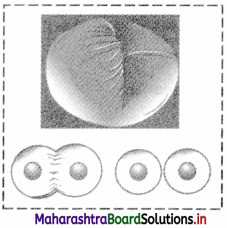
  1. The process depicted in the given diagram is cytokinesis in animal cell.
  2. This step takes place at the end of karyokinesis (nuclear division) of mitosis.
  3. It depicts the division of the cytoplasmic material in order to form two daughter cells that resemble each other.
  4. The division starts with a constriction generally at the equator. This constriction gradually deepens and ultimately joins in the centre dividing into two cells.
  5. At the time of cytoplasmic division, organelles like mitochondria and plastids get distributed between the two daughter cells.

Maharashtra Board Class 11 Biology Important Questions Chapter 7 Cell Division

Question 9.
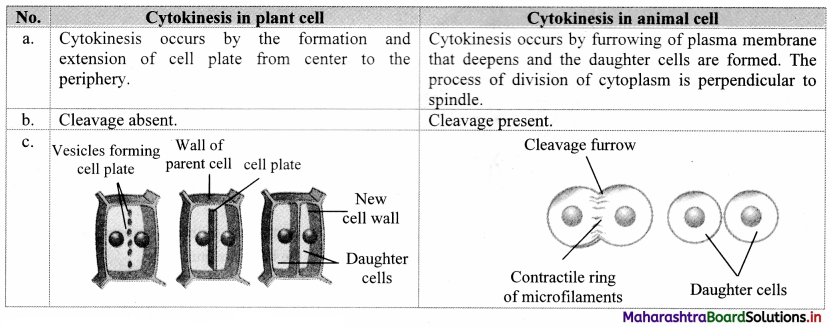
Diagrammatically differentiate between cytokinesis in animal cell and plant cell.
Answer:
Maharashtra Board Class 11 Biology Important Questions Chapter 7 Cell Division 2

Question 10.
How cell wall is formed in plant cell?
Answer:
The formation of the new cell wall begins with the formation of a simple precursor, called the ‘cell-plate’ that represents the middle lamella between the walls of two adjacent cells.

Question 11.
What is necrosis?
Answer:
Necrosis is a form of cell injury which leads to the premature death of cells. For example: due to scrape or a harmful chemical.

Question 12.
What is apoptosis? Write its significance.
Answer:

  1. Apoptosis also known as programmed cell death or cellular suicide. In apoptosis cells die in controlled way.
  2. For example: during embryonic development the cells between the embryonic fingers die in a normal process called apoptosis to give a definite shape to the fingers.
  3. Apoptosis also helps in eliminating potential cancer cells.

Maharashtra Board Class 11 Biology Important Questions Chapter 7 Cell Division

Question 13.
Which type of cell division is known as reductional division? Why?
Answer:
1. Meiosis is known as reductional division.
2. The number of chromosome is reduced to half, hence, meiosis is known as reductional division.

Question 14.
Describe the various phases of heterotypic division.
Answer:
Heterotypic division is first meiotic division, during which a diploid cell is divided into two haploid cells. The daughter cells resulting from this division are different from the parent cell in chromosome number. Hence the division is called heterotypic division.
It consists of following phases:
1. Prophase -I:
It is the most complicated and longest phase of meiotic division.
It is further divided into five sub-phases viz. leptotene, zygotene, pachytene, diplotene and diakinesis.

a. Leptotene:

  1. The volume of the nucleus increases.
  2. The chromosomes become long distinct and coiled.
  3. They orient themselves in a specific fonn known as bouquet stage. This is characterized with the ends of chromosomes converged towards the side of nucleus where the centrosome lies.
  4. The centriole duplicates into two and migrates to opposite poles. [Note: Centrioles divide during Gj phase of interphase.]

b. Zygotene:

  1. Pairing of non-sister chromatids of homologous chromosomes takes place by formation of synaptonemal complex. This pairing is called synapsis.
  2. Each pair consists of a maternal chromosome and a paternal chromosome. Chromosomal pairs are called bivalents or tetrads.

c. Pachytene:

  1. Each individual chromosome begins to split longitudinally into two similar chromatids. Therefore, each bivalent now appears as a tetrad consisting of four chromatids.
  2. The homologous chromosomes begin to separate but they do not separate completely and remain attached to one or more points. These points are called chiasmata (Appear like a cross-X).
  3. Chromatids break at these points and broken segments are exchanged between non-sister chromatids of homologous chromosomes resulting in recombination.

d. Diplotene:
The chiasma becomes clearly visible in diplotene due to beginning of repulsion between synapsed homologous chromosomes. This is known as desynapsis. Synaptonemal complex also starts to disappear.

e. Diakinesis:

  1. The chiasmata begin to move along the length of chromosomes from the centromere towards the ends of chromosomes. The displacement of chiasmata is termed as terminalization.
  2. The terminal chiasmata exist till the metaphase.
  3. The nucleolus and nuclear membrane completely disappear and spindle fibres begin to appear.

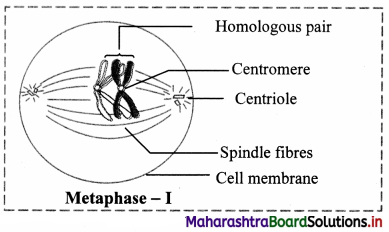
2. Metaphase -1:
a. The spindle fibres are well developed.
b. The tetrads orient themselves on equator in such a way that centromeres of homologous tetrads lie towards the poles and arms towards the equator.
c. They are ready to separate as repulsive force increases.
a. Homologous chromosomes are carried towards the opposite poles by spindle apparatus. This is known as disjunction.
b. The two sister chromatids of each chromosome do not separate in meiosis -I. This is reductional division.
c. The sister chromatids of each chromosome are connected by a common centromere.
d. Both sister chromatids of each chromosome are now different in genetic content as one of them has undergone recombination.
Maharashtra Board Class 11 Biology Important Questions Chapter 7 Cell Division 3

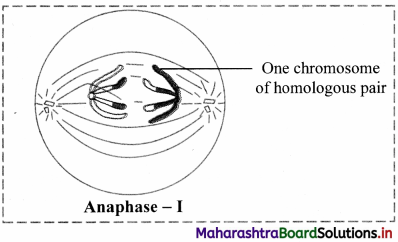
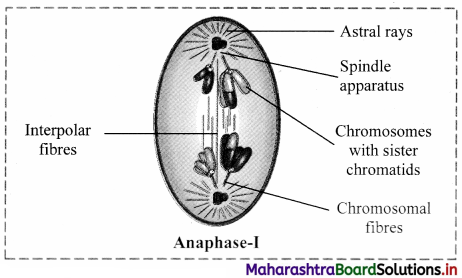
3. Anaphase – I:
1. Homologous chromosomes are carried towards the opposite poles by spindle apparatus. This is known as disjunction.
2. The two sister chromatids of each chromosome do not separate in meiosis -I. This is reductional division.
3. The sister chromatids of each chromosome are connected by a common centromere.
4. Both sister chromatids of each chromosome are now different in genetic content as one of them has undergone recombination.
Maharashtra Board Class 11 Biology Important Questions Chapter 7 Cell Division 4

4. Telophase-I:
a. The haploid number of chromosomes becomes uncoiled and elongated after reaching their respective poles.
b. The nuclear membrane and nucleolus reappear and thus two daughter nuclei are formed.
Maharashtra Board Class 11 Biology Important Questions Chapter 7 Cell Division 5

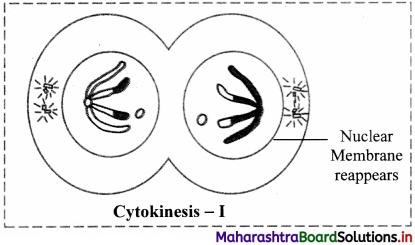
Cytokinesis -1:
Cytokinesis occurs after karyokinesis and two haploid cells are formed. In many cases, these daughter cells pass through interkinesis.
Maharashtra Board Class 11 Biology Important Questions Chapter 7 Cell Division 6
[Note: The association between the homologous chromosomes i.e. chiasmata remain till metaphase I. During metaphase /, the paired homologous chromosomes move to the metaphase plate. In anaphase [ the spindle fibers begin to shorten. As these spindle fibres shorten, the association between homologous chromosomes (chiasmata) are broken, allowing homologous chromosomes to be pulled to opposite poles.]

Maharashtra Board Class 11 Biology Important Questions Chapter 7 Cell Division

Question 15.
What is Homotypic Division? Explain its phases.
Answer:
Two haploid cells formed during first meiotic division divide further into four haploid cells this division is called homotypic division. It consists of five phases: prophase – II, metaphase – II, anaphase – II, telophase – II, and Cytokinesis – II.
Maharashtra Board Class 11 Biology Important Questions Chapter 7 Cell Division 7

1. Prophase-II:
a. The chromosomes are distinct with two chromatids.
b. Each centriole divides into two resulting in formation of two centrioles which migrate to opposite poles and form asters.
c. Spindle fibres are formed between the centrioles.
d. The nuclear membrane and nucleolus disappears in this phase.

2. Metaphase -II:
a. Chromosomes are arranged at the equator.
b. The two chromatids of each chromosome are separated by division of the centromere.
c. Some of the spindle fibres are attached to the centromeres and some are arranged end to end between two opposite centrioles.

3. Anaphase – II:
In this phase, the separated chromatids become daughter chromosomes and move to opposite poles due to the contraction of the spindle fibres attached to centromeres.

4. Telophase – II:
a. In this stage daughter chromosomes starts to uncoil.
b. The nuclear membrane surrounds each group of chromosomes.
c. Nucleolus reappears in this phase.

5. Cytokinesis – II
a. Cytokinesis takes place after the nuclear division.
b. Two haploid cells are formed from each haploid cell.
c. Thus, four haploid daughter cells are formed.
d. These cells then undergo changes to form gametes.

Maharashtra Board Class 11 Biology Important Questions Chapter 7 Cell Division

Question 16.
Why meiosis is important?
Answer:

  1. Meiotic division produces gametes or spores.
  2. If it is absent, the number of chromosomes would double or quadruple resulting in the formation of monstrosities (abnormal gametes).
  3. The constant number of chromosomes in a given species across generations is maintained by meiosis and fertilization.
  4. Because of crossing over, exchange of genetic material takes place leading to genetic variations, which are the raw materials for evolution.

Question 17.
Observe the diagram and answer the questions given below it.
Maharashtra Board Class 11 Biology Important Questions Chapter 7 Cell Division 8
1. Identify the type of cell division shown in the diagram.
2. Write its significance of meiosis.
Answer:
1. The type of cell division shown in diagram is meiosis II.
2. Meiotic division produces gametes or spores.

  1. If it is absent, the number of chromosomes would double or quadruple resulting in the formation of monstrosities (abnormal gametes).
  2. The constant number of chromosomes in a given species across generations is maintained by meiosis and fertilization.
  3. Because of crossing over, exchange of genetic material takes place leading to genetic variations, which are the raw materials for evolution.

Question 18.
Explain Anaphase-I with a neat labelled diagram.
Answer:
Maharashtra Board Class 11 Biology Important Questions Chapter 7 Cell Division 9
Anaphase:
a. In this phase, chromatids of each chromosome separate and form two chromosomes called daughter chromosomes.
b. The chromosomes which are formed are pulled away in opposite direction by spindle apparatus.
c. Anaphase ends when each set of chromosomes reach at opposite poles of the cell.

Question 19.
What is crossing over? Give its significance.
Answer:
Crossing over:
The process of exchange of genetic material between non-sister chromatids of homologous chromosomes is known as crossing over.
Significance of crossing over:
Crossing over results in genetic recombination of parental characters that leads to variations.

Maharashtra Board Class 11 Biology Important Questions Chapter 7 Cell Division

Question 20.
What happens during diakinesis?
Answer:

  1. In diakinesis, the chiasmata begin to move along the length of chromosomes from the centromere towards the ends of chromosomes.
  2. The displacement of chiasmata is termed as terminalization. The terminal chiasmata exist till the metaphase.
  3. The nucleolus disappears and the nuclear membrane also begins to disappear.
  4. Spindle fibres starts to appear in the cytoplasm.

Question 21.
Differentiate between anaphase of mitosis and anaphase – I of meiosis.
Answer:

Anaphase of mitosisAnaphase – I of meiosis
1. Centromere divides into two, resulting in the separation of chromatids.Centromere does not divide.
2. Homologous chromosomes are not involved.Homologous chromosomes are involved.
3. Disjunction does not occur.Disjunction occurs.
4. Same number of chromosomes gather at each pole.Half the chromosome number gather at respective pole.

Question 22.
Give reasons: Meiosis is known as reductional division.
Answer:
Meiosis is known as reductional division because the parent cell produces four daughter cells each having half the number of chromosomes present in the parent cell.

Question 23.
Fill in the blanks:

  1. The process of mitosis maintains the _______.
  2. ________ involves the cell death, but it benefits the organism as a whole.
  3. Crossing over takes place in _______ phase of Prophase-I.

Answer:

  1. The process of mitosis maintains the nucleo-cytoplasmic ratio.
  2. Apoptosis involves the cell death, but it benefits the organism as a whole.
  3. Crossing over takes place in pachytene phase of Prophase-I.

Question 24.
1. Complete the following flowchart.
2. Explain the type of cell division in which chromosome number remain the same as that of the parent cell.
Maharashtra Board Class 11 Biology Important Questions Chapter 7 Cell Division 10
Answer:
Maharashtra Board Class 11 Biology Important Questions Chapter 7 Cell Division 11Karyokinesis is the nuclear division which is divided into prophase, metaphase, anaphase and telophase.
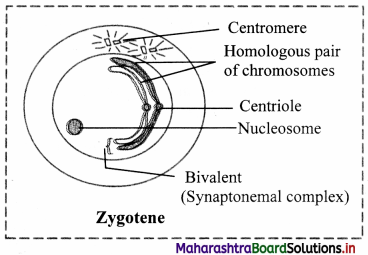
1. Prophase:
a. In this phase, condensation of chromatin material, migration of centrioles, appearance of mitotic apparatus and disappearance of nuclear membrane takes place.
b. Due to condensation, each chromosome with its sister chromatids connected by centromere is clearly visible under light microscope.
c. The nucleolus starts to disappear.
d. Centrosome start moving towards the opposite poles of the cell.
e. Mitotic apparatus is almost completely formed.

2. Metaphase:
a. Chromosomes are completely condensed and appear short.
b. Centromere and sister chromatids become very prominent.
c. All the chromosomes are arranged at equatorial plane of cell. This is called metaphase plate.
d. Mitotic spindle is fully formed in this phase.
e. Centromere of each chromosome divides horizontally into two, each being associated with a chromatid. [Note: The centromeres divide at the beginning of anaphase so that the two chromatids of each chromosome become separated from each other.
Source: Cell Division, Donald B. McMillan, Richard J. Harris, in An Atlas of Comparative Vertebrate Histology, 2018.]

3. Anaphase:
a. In this phase, chromatids of each chromosome separate and form two chromosomes called daughter chromosomes.
b. The chromosomes which are formed are pulled away in opposite direction by spindle apparatus.
c. Anaphase ends when each set of chromosomes reach at opposite poles of the cell.

4. Telophase:
a. This is the final stage of karyokinesis.
b. The chromosomes with their centromeres begin to uncoil at the poles.
c. The chromosomes lengthen and lose their individuality.
d. The nucleolus reappears and the nuclear membrane appear around the chromosomes.
e. Spindle fibres breakdown and get absorbed in the cytoplasm. Thus, two daughter nuclei are formed.

These are small disc-shaped structures at the surface of the centromeres which serve as the sites of attachment of spindle fibres to the chromosomes.

Maharashtra Board Class 11 Biology Important Questions Chapter 7 Cell Division

Question 25.
While studying mitosis, different teams of students made following observations in the cells focused under microscope.
1. In certain cells chromosomes were arranged at equatorial plane with fibres originating from cylindrical structures at both the poles.
2. Few cells showed chromatids moving towards opposite poles.
a. In first observation which stage of mitosis is seen by students and what is the scientific term used to represent cylindrical structures?
b. Which stage is seen in the second observation?
Answer:
a. The stage observed in the first case is metaphase. The scientific term used to represent the cylindrical structures are centrioles.
b. The other stage seen in second observation is anaphase.

Question 26.
During biology practical students were asked to see the slide mounted under microscope and note down their observations. Few students noted that the stage observed is anaphase of mitosis and others said that it is anaphase I of meiosis. Later while explaining about experiments teacher said that it is anaphase I of meiosis. On what basis teacher confirmed that it is anaphase I of meiosis?
Answer:
Chromosomes moving towards opposite poles during anaphase I do not separate at the centromeres.

Question 27.
Colchicine is an alkaloid extracted from plants. It prevents the formation of spindle fibres. In the presence colchicine, if a cell enters mitosis what would be the outcome?
Answer:
The spindle fibres are necessary for segregating the sister chromatids to opposite poles of the cell during anaphase. In the presence of colchicine, no spindle fibres will form to attach to the kinetochores (small disc¬like structures present on chromosomes). Therefore, the cell will be stuck in mitosis with the condensed pairs of sister chromatids in an unorganized array.

Question 28.
Read the following statements and mention whether they are TRUE or FALSE in respective boxes.
1. Life of all multicellular organisms starts from single cell which is known as zygote.
2. Spindle fibres present between centriole and centromere are known as polar fibres which can contract.
3. Growth of every living organism depends on cell division.
4. Spindle fibres present between opposite centrioles are called as kinetochore fibres which can elongate.

(i)(ii)(iii)(iv)
(A)TTFT
(B)FFTF
(C)TFTF
(D)1TFF ‘

Answer:
(C)

Maharashtra Board Class 11 Biology Important Questions Chapter 7 Cell Division

Question 29.
Quick Review

Maharashtra Board Class 11 Biology Important Questions Chapter 7 Cell Division 12

Question 30.
Exercise:

Question 1.
Define cell cycle.
Answer:

  1. Sequential events occurring in the life of a cell is called cell cycle.
  2. Interphase and M – phase are the two phases of cell cycle.
  3. Cell undergoes growth or rest during interphase and divides during M – phase.

Question 2.
Observe the following diagram and the questions based on it.
Maharashtra Board Class 11 Biology Important Questions Chapter 7 Cell Division 13
1. If the initial amount of DNA in a cell is 2C then in which phase of cell cycle the amount of this DNA would become 4C? Also name the process.
2. Which sub-phase of the interphase is of short duration?
3. Enlist the phases of karyokinesis in proper order.
Answer:
S – phase (Synthesis phase):
In this phase DNA is synthesized (replicated), so that amount of DNA per cell doubles.
Synthesis of histone proteins takes place in this phase.
Karyokinesis is the nuclear division which is divided into prophase, metaphase, anaphase and telophase.
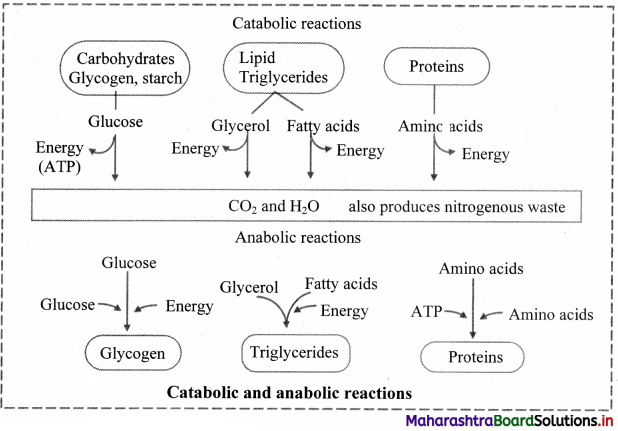
1. Prophase:
a. In this phase, condensation of chromatin material, migration of centrioles, appearance of mitotic apparatus and disappearance of nuclear membrane takes place.
b. Due to condensation, each chromosome with its sister chromatids connected by centromere is clearly visible under light microscope.
c. The nucleolus starts to disappear.
d. Centrosome start moving towards the opposite poles of the cell.
e. Mitotic apparatus is almost completely formed.

2. Metaphase:
a. Chromosomes are completely condensed and appear short.
b. Centromere and sister chromatids become very prominent.
c. All the chromosomes are arranged at equatorial plane of cell. This is called metaphase plate.
d. Mitotic spindle is fully formed in this phase.
e. Centromere of each chromosome divides horizontally into two, each being associated with a chromatid. [Note: The centromeres divide at the beginning of anaphase so that the two chromatids of each chromosome become separated from each other.
Source: Cell Division, Donald B. McMillan, Richard J. Harris, in An Atlas of Comparative Vertebrate Histology, 2018.]

3. Anaphase:
a. In this phase, chromatids of each chromosome separate and form two chromosomes called daughter chromosomes.
b. The chromosomes which are formed are pulled away in opposite direction by spindle apparatus.
c. Anaphase ends when each set of chromosomes reach at opposite poles of the cell.

4. Telophase:
a. This is the final stage of karyokinesis.
b. The chromosomes with their centromeres begin to uncoil at the poles.
c. The chromosomes lengthen and lose their individuality.
d. The nucleolus reappears and the nuclear membrane appear around the chromosomes.
e. Spindle fibres breakdown and get absorbed in the cytoplasm. Thus, two daughter nuclei are formed.

These are small disc-shaped structures at the surface of the centromeres which serve as the sites of attachment of spindle fibres to the chromosomes.

Maharashtra Board Class 11 Biology Important Questions Chapter 7 Cell Division

Question 3.
During which stage of Prophase-I synapsis occurs?
Answer:
b. Zygotene:
Pairing of non-sister chromatids of homologous chromosomes takes place by formation of synaptonemal complex. This pairing is called synapsis.
Each pair consists of a maternal chromosome and a paternal chromosome. Chromosomal pairs are called bivalents or tetrads.

Question 4.
During which stage disjunction takes place?
Answer:
Telophase-I:
a. The haploid number of chromosomes becomes uncoiled and elongated after reaching their respective poles.
b. The nuclear membrane and nucleolus reappear and thus two daughter nuclei are formed.

Question 5.
What is disjunction?
Answer:
Telophase-I:
a. The haploid number of chromosomes becomes uncoiled and elongated after reaching their respective poles.
b. The nuclear membrane and nucleolus reappear and thus two daughter nuclei are formed.

Question 6.
Why meiosis is known as reductional division?
Answer:
In this type of cell division, the number of chromosomes is reduced to half. Hence, this type of cell division is also called reductional division.

Question 7.
Sketch and label the phase of cell division in which synaptonemal complex is formed?
Answer:
Zygotene:
Pairing of non-sister chromatids of homologous chromosomes takes place by formation of synaptonemal complex. This pairing is called synapsis.
Each pair consists of a maternal chromosome and a paternal chromosome. Chromosomal pairs are called bivalents or tetrads.

Maharashtra Board Class 11 Biology Important Questions Chapter 7 Cell Division

Question 8.
Make a schematic representation of a type of cell division in which chromosome number is reduced to half.
Answer:
Karyokinesis is the nuclear division which is divided into prophase, metaphase, anaphase and telophase.

1. Prophase:
a. In this phase, condensation of chromatin material, migration of centrioles, appearance of mitotic apparatus and disappearance of nuclear membrane takes place.
b. Due to condensation, each chromosome with its sister chromatids connected by centromere is clearly visible under light microscope.
c. The nucleolus starts to disappear.
d. Centrosome start moving towards the opposite poles of the cell.
e. Mitotic apparatus is almost completely formed.

2. Metaphase:
a. Chromosomes are completely condensed and appear short.
b. Centromere and sister chromatids become very prominent.
c. All the chromosomes are arranged at equatorial plane of cell. This is called metaphase plate.
d. Mitotic spindle is fully formed in this phase.
e. Centromere of each chromosome divides horizontally into two, each being associated with a chromatid. [Note: The centromeres divide at the beginning of anaphase so that the two chromatids of each chromosome become separated from each other.
Source: Cell Division, Donald B. McMillan, Richard J. Harris, in An Atlas of Comparative Vertebrate Histology, 2018.]

3. Anaphase:
a. In this phase, chromatids of each chromosome separate and form two chromosomes called daughter chromosomes.
b. The chromosomes which are formed are pulled away in opposite direction by spindle apparatus.
c. Anaphase ends when each set of chromosomes reach at opposite poles of the cell.

4. Telophase:
a. This is the final stage of karyokinesis.
b. The chromosomes with their centromeres begin to uncoil at the poles.
c. The chromosomes lengthen and lose their individuality.
d. The nucleolus reappears and the nuclear membrane appear around the chromosomes.
e. Spindle fibres breakdown and get absorbed in the cytoplasm. Thus, two daughter nuclei are formed.

These are small disc-shaped structures at the surface of the centromeres which serve as the sites of attachment of spindle fibres to the chromosomes.

Question 9.
Describe mitosis and its stages in brief.
Answer:
Karyokinesis is the nuclear division which is divided into prophase, metaphase, anaphase and telophase.
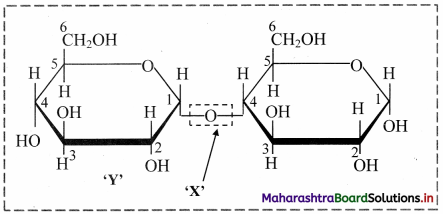
1. Prophase:
a. In this phase, condensation of chromatin material, migration of centrioles, appearance of mitotic apparatus and disappearance of nuclear membrane takes place.
b. Due to condensation, each chromosome with its sister chromatids connected by centromere is clearly visible under light microscope.
c. The nucleolus starts to disappear.
d. Centrosome start moving towards the opposite poles of the cell.
e. Mitotic apparatus is almost completely formed.

2. Metaphase:
a. Chromosomes are completely condensed and appear short.
b. Centromere and sister chromatids become very prominent.
c. All the chromosomes are arranged at equatorial plane of cell. This is called metaphase plate.
d. Mitotic spindle is fully formed in this phase.
e. Centromere of each chromosome divides horizontally into two, each being associated with a chromatid. [Note: The centromeres divide at the beginning of anaphase so that the two chromatids of each chromosome become separated from each other.
Source: Cell Division, Donald B. McMillan, Richard J. Harris, in An Atlas of Comparative Vertebrate Histology, 2018.]

3. Anaphase:
a. In this phase, chromatids of each chromosome separate and form two chromosomes called daughter chromosomes.
b. The chromosomes which are formed are pulled away in opposite direction by spindle apparatus.
c. Anaphase ends when each set of chromosomes reach at opposite poles of the cell.

4. Telophase:
a. This is the final stage of karyokinesis.
b. The chromosomes with their centromeres begin to uncoil at the poles.
c. The chromosomes lengthen and lose their individuality.
d. The nucleolus reappears and the nuclear membrane appear around the chromosomes.
e. Spindle fibres breakdown and get absorbed in the cytoplasm. Thus, two daughter nuclei are formed.

These are small disc-shaped structures at the surface of the centromeres which serve as the sites of attachment of spindle fibres to the chromosomes.

Maharashtra Board Class 11 Biology Important Questions Chapter 7 Cell Division

Question 10.
Describe chiasmata. Draw diagram to illustrate your answer.
Answer:
Pachytene:
Each individual chromosome begins to split longitudinally into two similar chromatids. Therefore, each bivalent now appears as a tetrad consisting of four chromatids.
The homologous chromosomes begin to separate but they do not separate completely and remain attached to one or more points. These points are called chiasmata (Appear like a cross-X).
Chromatids break at these points and broken segments are exchanged between non-sister chromatids of homologous chromosomes resulting in recombination.

Diplotene:
The chiasma becomes clearly visible in diplotene due to beginning of repulsion between synapsed homologous chromosomes. This is known as desynapsis. Synaptonemal complex also starts to disappear.

Question 11.
Correct the following diagram and write a short note on it.
Maharashtra Board Class 11 Biology Important Questions Chapter 7 Cell Division 14
Answer:
b. Zygotene:
Pairing of non-sister chromatids of homologous chromosomes takes place by formation of synaptonemal complex. This pairing is called synapsis.
Each pair consists of a maternal chromosome and a paternal chromosome. Chromosomal pairs are called bivalents or tetrads.

Question 12.
Explain prophase I in your own words.
Answer:
Prophase -I:
It is the most complicated and longest phase of meiotic division.
It is further divided into five sub-phases viz. leptotene, zygotene, pachytene, diplotene and diakinesis.

Question 13.
Explain homotypic division.
Answer:
Two haploid cells formed during first meiotic division divide further into four haploid cells this division is called homotypic division. It consists of five phases: prophase – II, metaphase – II, anaphase – II, telophase – II, and Cytokinesis – II.

1. Prophase-II:
a. The chromosomes are distinct with two chromatids.
b. Each centriole divides into two resulting in formation of two centrioles which migrate to opposite poles and form asters.
c. Spindle fibres are formed between the centrioles.
d. The nuclear membrane and nucleolus disappears in this phase.

2. Metaphase -II:
a. Chromosomes are arranged at the equator.
b. The two chromatids of each chromosome are separated by division of the centromere.
c. Some of the spindle fibres are attached to the centromeres and some are arranged end to end between two opposite centrioles.

3. Anaphase – II:
In this phase, the separated chromatids become daughter chromosomes and move to opposite poles due to the contraction of the spindle fibres attached to centromeres.

4. Telophase – II:
a. In this stage daughter chromosomes starts to uncoil.
b. The nuclear membrane surrounds each group of chromosomes.
c. Nucleolus reappears in this phase.

5. Cytokinesis – II
a. Cytokinesis takes place after the nuclear division.
b. Two haploid cells are formed from each haploid cell.
c. Thus, four haploid daughter cells are formed.
d. These cells then undergo changes to form gametes.

Maharashtra Board Class 11 Biology Important Questions Chapter 7 Cell Division

Question 14.
How does cytokinesis in plant cells differ from animal cells?
Answer:
The formation of the new cell wall begins with the formation of a simple precursor, called the ‘cell-plate’ that represents the middle lamella between the walls of two adjacent cells.

Question 15.
What is the significance of meiosis in sexually reproducing animals?
Answer:

  1. Meiotic division produces gametes or spores.
  2. If it is absent, the number of chromosomes would double or quadruple resulting in the formation of monstrosities (abnormal gametes).
  3. The constant number of chromosomes in a given species across generations is maintained by meiosis and fertilization.
  4. Because of crossing over, exchange of genetic material takes place leading to genetic variations, which are the raw materials for evolution.
  5. Gametes are produced by the process of meiosis which are essential for sexual reproduction.
  6. Diploid organisms have two set of chromosomes (one paternal and one maternal).
  7. For a diploid organism to undergo sexual reproduction it needs to create gametes that contain only one set of chromosomes so the number of chromosomes remains same in the next generation.
  8. In absence of meiosis, the chromosome number of parents and their offsprings will differ in every generation; hence no species will hold its characters.
  9. Also, there will be no crossing over of homologous chromosomes. Thus, there will be no variations with respect to the changing environment in progeny to maintain their existence, which may lead to extinction of species.

Question 16.
Explain the first three stages of Meiosis II.
Answer:
Two haploid cells formed during first meiotic division divide further into four haploid cells this division is called homotypic division. It consists of five phases: prophase – II, metaphase – II, anaphase – II, telophase – II, and Cytokinesis – II.

1. Prophase-II:
a. The chromosomes are distinct with two chromatids.
b. Each centriole divides into two resulting in formation of two centrioles which migrate to opposite poles and form asters.
c. Spindle fibres are formed between the centrioles.
d. The nuclear membrane and nucleolus disappears in this phase.

2. Metaphase -II:
a. Chromosomes are arranged at the equator.
b. The two chromatids of each chromosome are separated by division of the centromere.
c. Some of the spindle fibres are attached to the centromeres and some are arranged end to end between two opposite centrioles.

3. Anaphase – II:
In this phase, the separated chromatids become daughter chromosomes and move to opposite poles due to the contraction of the spindle fibres attached to centromeres.

4. Telophase – II:
a. In this stage daughter chromosomes starts to uncoil.
b. The nuclear membrane surrounds each group of chromosomes.
c. Nucleolus reappears in this phase.

5. Cytokinesis – II
a. Cytokinesis takes place after the nuclear division.
b. Two haploid cells are formed from each haploid cell.
c. Thus, four haploid daughter cells are formed.
d. These cells then undergo changes to form gametes.

Maharashtra Board Class 11 Biology Important Questions Chapter 7 Cell Division

Question 17.
Sketch, label and describe telophase in mitosis.
Answer:
Telophase:
a. This is the final stage of karyokinesis.
b. The chromosomes with their centromeres begin to uncoil at the poles.
c. The chromosomes lengthen and lose their individuality.
d. The nucleolus reappears and the nuclear membrane appear around the chromosomes.
e. Spindle fibres breakdown and get absorbed in the cytoplasm. Thus, two daughter nuclei are formed.

These are small disc-shaped structures at the surface of the centromeres which serve as the sites of attachment of spindle fibres to the chromosomes.

Question 18.
Explain the process recombination.
Answer:
a. Recombination is exchange of genetic material between paternal and maternal chromosomes during gamete formation.
b. The points where crossing over takes place is known as chiasmata.
c. Chromatids acquire new combinations of alleles by physically exchanging segments in crossing-over.
d. The exchange of genetic material between homologous chromosomes involves accurate breakage and joining of DNA molecules through a complex mechanism.
e. It is catalyzed by enzymes.

Question 19.
1. What is necrosis?
2. What is apoptosis? Mention its significance.
Answer:
1. Necrosis is a form of cell injury which leads to the premature death of cells. For example: due to scrape or a harmful chemical.
(2) 1. Apoptosis also known as programmed cell death or cellular suicide. In apoptosis cells die in controlled way.
2. For example: during embryonic development the cells between the embryonic fingers die in a normal process called apoptosis to give a definite shape to the fingers.
3. Apoptosis also helps in eliminating potential cancer cells.

Question 20.
Multiple Choice Questions:

Question 1.
Replication of DNA takes place during
(A) prophase
(B) S-phase
(C) G2 phase
(D) Interkinesis
Answer:
(B) S-phase

Question 2.
During cell division, spindle fibers are attached to
(A) telomere
(B) centromere
(C) chromomeres
(D) chromosome
Answer:
(B) centromere

Question 3.
Which of the following is the shortest phase?
(A) metaphase
(B) anaphase
(C) interphase
(D) S-phase
Answer:
(B) anaphase

Question 4.
Reappearance of nucleolus is during
(A) telophase
(B) prophase
(C) cytokinesis
(D) inter-kinesis
Answer:
(A) telophase

Maharashtra Board Class 11 Biology Important Questions Chapter 7 Cell Division

Question 5.
During telophase,
(A) nuclear membrane is formed.
(B) nucleolus appears.
(C) astral rays disappear.
(D) all the above
Answer:
(D) all the above

Question 6.
Cytokinesis in plant cell takes place by
(A) furrowing
(B) cell plate formation
(C) any one of (A) or (B)
(D) none of these
Answer:
(B) cell plate formation

Question 7.
Meiosis is a
(A) homotypic division
(B) equatorial division
(C) reductional division
(D) none of the above
Answer:
(C) reductional division

Question 8.
Formation of Synaptonemal complex during meiosis occurs at
(A) Leptotene
(B) Zygotene
(C) Diplotene
(D) Pachytene
Answer:
(B) Zygotene

Question 9.
Crossing over takes place in the ________ stage.
(A) leptotene
(B) zygotene
(C) pachytene
(D) diplotene
Answer:
(C) pachytene

Maharashtra Board Class 11 Biology Important Questions Chapter 7 Cell Division

Question 10.
Crossing over takes place between
(A) sister chromatids
(B) non-homologous chromosomes
(C) non-sister chromatids of homologues
(D) any two chromatids
Answer:
(C) non-sister chromatids of homologues

Question 11.
Crossing over of chromosomes during meiosis leads to
(A) mutation
(B) sex determination
(C) new gene combination
(D) loss of chromosomes
Answer:
(C) new gene combination

Question 12.
Points at which crossing over has taken place between homologous chromosomes are called
(A) chiasmata
(B) synaptonemal complexes
(C) centromeres
(D) telomere
Answer:
(A) chiasmata

Question 13.
Which of the following events take place during diplotene stage of prophase I of meiosis?
(A) Compaction of chromosomes
(B) Formation of synapsis
(C) Process of crossing over
(D) Repulsion of homologues
Answer:
(D) Repulsion of homologues

Question 14.
The correct sequence of stages in prophase I of meiosis is
(A) Leptotene, Pachytene, Zygotene, Diakinesis, Diplotene
(B) Zygotene, Leptotene, Pachytene, Diakinesis, Diplotene
(C) Leptotene, Zygotene, Pachytene, Diplotene, Diakinesis
(D) Diplotene, Diakinesis, Pachytene, Zygotene, Leptotene
Answer:
(C) Leptotene, Zygotene, Pachytene, Diplotene, Diakinesis

Question 15.
In which phase of meiosis are homologous chromosomes separated?
(A) Anaphase I
(B) Prophase II
(C) Anaphase II
(D) Prophase I
Answer:
(A) Anaphase I

Maharashtra Board Class 11 Biology Important Questions Chapter 7 Cell Division

Question 16.
Mitosis differs from meiosis in not having
(A) Long prophase
(B) duplication of DNA
(C) Synapsis and crossing over
(D) interphase
Answer:
(C) Synapsis and crossing over

Question 17.
How many divisions are required to produce 128 gametes?
(A) 64
(B) 16
(C) 32
(D) 12
Answer:
(C) 32

Question 18.
Number of cells undergoing meiotic divisions to produce 124 microspores in angiosperm is
(A) 62
(B) 31
(C) 124
(D) 8
Answer:
(B) 31

Question 19.
How many haploid daughter cells are produced at the end of meiosis-II?
(A) 2
(B) 4
(C) 6
(D) 8
Answer:
(B) 4

Question 21.
Competitive Corner:

Question 1.
Crossing over takes place between which chromatids and in which stage of the cell cycle?
(A) Non-sister chromatids of nonhomologous chromosomes at Pachytene stage of prophase I
(B) Non-sister chromatids of nonhomologous chromosomes at Zygotene stage of prophase I
(C) Non-sister chromatids of homologous chromosomes at Pachytene stage of prophase I
(D) Non-sister chromatids of homologous chromosomes at Zygotene stage of prophase I
Answer:
(C) Non-sister chromatids of homologous chromosomes at Pachytene stage of prophase I

Maharashtra Board Class 11 Biology Important Questions Chapter 7 Cell Division

Question 2.
After meiosis I, the resultant daughter cells have
(A) four times the amount of DNA in comparison to haploid gamete.
(B) same amount of DNA as in the parent cell in S phase.
(C) twice the amount of DNA in comparison to haploid gamete.
(D) same amount of DNA in comparison to haploid gamete.
Answer:
(C) twice the amount of DNA in comparison to haploid gamete.

Question 3.
Cells in G0 phase
(A) suspend the cell cycle
(B) terminate the cell cycle
(C) exit the cell cycle
(D) enter the cell cycle
Answer:
(C) exit the cell cycle

Question 4.
The CORRECT sequence of phases of cell cycle is: [NEET (UG) 2019]
(A) S → G1 → G2 → M
(B) G1 → S → G2 → M
(C) M → G1 → G2 → S
(D) G1 → G2 → S → M
Answer:
(B) G1 → S → G2 → M

Question 5.
The stage during which separation of the paired homologous chromosomes begins is
(A) Diakinesis
(B) Diplotene
(C) Pachytene
(D) Zygotene
Answer:
(B) Diplotene

Question 6.
Which of the following options gives the correct sequence of events during mitosis?
(A) Condensation → nuclear membrane disassembly → crossing over – segregation → telophase
(B) Condensation → nuclear membrane disassembly → arrangement at equator → centromere division → segregation → telophase
(C) Condensation → crossing over → nuclear membrane disassembly → segregation → telophase
(D) Condensation → arrangement at equator → centromere division → segregation → telophase
Answer:
(B) Condensation → nuclear membrane disassembly → arrangement at equator → centromere division → segregation → telophase

Question 7.
Which of the following is not a characteristic feature during mitosis in somatic cells?
(A) Chromosome movement
(B) Synapsis
(C) Spindle fibres
(D) Disappearance of nucleolus
Answer:
(B) Synapsis

Maharashtra Board Class 11 Biology Important Questions Chapter 7 Cell Division

Question 8.
Arrange the following events of meiosis in correct sequence. [AIPMT Retest 2015]
(a) Crossing over
(b) Synapsis
(c) Terminalisation of chiasmata
(d) Disappearance of nucleolus
(A) (b), (c), (d), (a)
(B) (b), (a), (d), (c)
(C) (b),(a), (c), (d)
(D) (a), (b), (c), (d)
Answer:
(C) (b),(a), (c), (d)

Maharashtra Board Class 11 Biology Important Questions Chapter 6 Biomolecules

Balbharti Maharashtra State Board 11th Biology Important Questions Chapter 6 Biomolecules Important Questions and Answers.

Maharashtra State Board 11th Biology Important Questions Chapter 6 Biomolecules

Question 1.
How are living organisms classified? Give examples of each.
Answer:
1. Living organisms are classified as unicellular (consisting of single-cell) and multicellular (having many cells).
2. Example of unicellular organisms: bacteria, yeast.
Examples of multicellular organisms: plants, animals.

Maharashtra Board Class 11 Biology Important Questions Chapter 6 Biomolecules

Question 2.
What is biochemistry?
Answer:
1. Biochemistry is biological chemistry that provides us the idea of the chemistry of living organisms and molecular basis for changes taking place in plants, animals and microbial cells.
2. It develops the foundation for understanding all biological processes and communication within and between cells as well as chemical basis of inheritance and diseases in animals and plants.

Question 3.
What does chemical analysis of living organisms indicate?
Answer:
Chemical analysis of all living organisms indicates the presence of the most common elements like carbon, hydrogen, nitrogen, oxygen, sulphur, calcium, phosphorus, magnesium and others with their respective content per unit mass of a living tissue.

Question 4.
Name the basic macromolecules present in the living organisms.
Answer:
Polysaccharides (carbohydrate) polymer of monosaccharide, polypeptides (proteins) polymer of amino acids and polynucleotides (nucleic acids) polymer of nucleotides are the three basic macromolecule present in the living organisms.

Question 5.
Draw a flowchart showing classification of carbohydrates.
Answer:
Maharashtra Board Class 11 Biology Important Questions Chapter 6 Biomolecules 1

Maharashtra Board Class 11 Biology Important Questions Chapter 6 Biomolecules

Question 6.
Write a short note on
1. Glucose
2. Galactose and
3. Fructose.
Answer:
1. Glucose:
a. It is the most important fuel in living cells.
b. Its concentration in the human blood is about 90mg per 100ml of blood.
c. The small size and solubility in water of glucose molecules allows them to pass through the cell membrane into the cell.
d. Energy is released when the molecules are metabolized by cellular respiration.

2. Galactose:
a. It looks very similar to glucose molecules.
b. They can also exist in a and p forms.
c. Galactose react with glucose to form the disaccharide lactose.
d. However, glucose and galactose cannot be easily converted into one another.
e. Galactose cannot play the same role in respiration as glucose.

3. Fructose:
a. It is the fruit sugar and chemically it is ketohexose but it has a five-atom ring rather than a six-atom ring.
b. Fructose reacts with glucose to form the sucrose, a disaccharide.

Question 7.
How are disaccharides absorbed through the cell membrane?
Answer:
1. Disaccharides are soluble in water but they are too big to pass through the cell membrane by diffusion.
2. They are broken down in the small intestine during digestion.
3. Thus, formed monosaccharides then pas into the blood and through cell membranes into the cells.
Maharashtra Board Class 11 Biology Important Questions Chapter 6 Biomolecules 2

Question 8.
Identify the X and Y in the following structure of a disaccharide.
Answer:
Maharashtra Board Class 11 Biology Important Questions Chapter 6 Biomolecules 3
X: Glycosidic bond Y: Glucose

Question 9.
Distinguish between monosaccharides and disaccharides.
Answer:

MonosaccharidesDisaccharides
1. They are composed of 3-6 carbon atoms.They are composed of two monosaccharide units covalently linked to each other.
2. They cannot be hydrolyzed into smaller units.They can be hydrolysed into monosaccharides.
3. Glucose, FructoseSucrose and Lactose

Question 10.
Which macromolecules are too big to escape from the cell?
Answer:
Polysaccharides are too big to escape from the cell.

Maharashtra Board Class 11 Biology Important Questions Chapter 6 Biomolecules

Question 11.
Write a short note on
1. Starch
2. Glycogen
3. Cellulose.
Answer:
1. Starch:
a. Starch is a stored food in the plants.
b. Starch contains two types of glucose polymer: amylose and amylopectin.
c. Both are made from a-glucose.
d. Amylose is an unbranched polymer of a-glucose.
e. The molecules coil into a helical structure.
f. It foims a colloidal suspension in hot water.
g. Amylopectin is a branched polymer of a-glucose.
h. It is completely insoluble in water.
Maharashtra Board Class 11 Biology Important Questions Chapter 6 Biomolecules 4

2. Glycogen:
a. It is amylopectin with very short distances between the branching side-chains.
b. Glycogen is stored in animal body particularly in liver and muscles from where it is hydrolyzed as per need to produce glucose.

3. Cellulose:
a. It is a polymer made from P-glucosc molecules and the polymer molecules are ‘straight’.
b. Cellulose serves to form the cell walls in plant cells.
c. These are much tougher than cell membranes.
d. This toughness is due to the arrangement of glucose units in the polymer chain and the hydrogen-bonding between neighbouring chains.

Maharashtra Board Class 11 Biology Important Questions Chapter 6 Biomolecules

Question 12.
Why plant fats are liquid at room temperature while animal fats are solid?
Answer:

  1. Plant fats are unsaturated fatty acids, whereas animal fats are saturated fatty acids.
  2. Fats having unsaturated fatty acids are liquid at room temperature.
  3. Saturated fatty acids are solid at room temperature. Hence, plant fats are liquid at room temperature, while animal fats are solid.

Question 13.
Draw the structure of triglyceride.
Answer:
Maharashtra Board Class 11 Biology Important Questions Chapter 6 Biomolecules 5

Question 14.
Observe the following diagram and answer the questions based on it.
1. Identify the part ‘X’ in the given diagram.
2. What is the chemical property of the part ‘X’.
Answer:
1. The part labelled as ‘X’ is non-polar tail.
2. Non-polar tails are hydrophobic in nature.

Question 15.
Give two examples of unsaturated fatty acids.
Answer:
Oleic acid and linoleic acid are the examples of unsaturated fatty acids.

Maharashtra Board Class 11 Biology Important Questions Chapter 6 Biomolecules

Question 16.
Explain primary structure of protein.
Answer:
The linear sequence of amino acids in polypeptide chain of a protein forms the primary structure of a protein.

Question 17.
Explain the secondary structure of protein with examples.
Answer:

  1. There are two types of secondary structure of protein: a-helix and P-pleated sheets.
  2. The polypeptide chain is arranged in a spiral helix. These spiral helices are of two types: a-helix (right handed) and P-helix (left handed).
  3. This spiral configuration is held together by hydrogen bonds.
  4. The sequence of amino acids in the polypeptide chain determines the location of its bend or fold and the position of formation of hydrogen bonds between different portions of the chain or between different chains. Thus, peptide chains form an a-helix structure.
  5. Example of a-helix structure is keratin.
  6. In some proteins two or more peptide chains are linked together by intermolecular hydrogen bonds. Such structures are called P-pleated sheets.
  7. Example of P-pleated sheet is silk fibres.
  8. Due to formation of hydrogen bonds peptide chains assume a secondary structure.

Question 18.
Explain the tertiary and quaternary structure of protein with example.
Answer:
Tertiary structure:

  1. In tertiary structure the peptide chains are much looped, twisted and folded back on themselves due to formation of disulphide bonds.
  2. Such loops and bends give the protein a tertiary structure.
  3. E.g. Myoglobin, enzymes.

Quaternary structure:
1. When a protein has more than two polypeptide subunits their arrangement in space is called quaternary structure.
2. E.g. Haemoglobin.

Question 19.
Write a note on properties of protein.
Answer:
Properties of proteins are as follows:

  1. Proteins are extremely reactive and highly specific in behaviour.
  2. Proteins are amphoteric in nature i.e. they act as both acids and bases.
  3. The behaviour of proteins is strongly influenced by pH.
  4. Like amino acids, proteins are dipolar ions at the isoelectric point i.e. the sum of the positive charges is equal to the sum of the negative charges and the net charge is zero.
  5. The ionic groups of a protein are contributed by the side chains of the polyfunctional amino acids.
  6. A protein consists of more basic amino acids such as lysine and arginine exist as a cation at the physiological pH of 7.4. Such proteins are called basic proteins.
  7. Histones of nucleoproteins are basic proteins.
  8. A protein rich in acidic amino acids exists as an anion at the physiological pH. Such proteins are called acidic proteins.
  9. Most of the blood proteins are acidic proteins.

Question 20.
Mention the findings of Feulgen.
Answer:
1. In 1924, Feulgen showed that chromosomes contain DNA.
2. He found that nucleic acids contain two pyrimidine (cytosine and thymine) and two purine (adenine and guanine) bases.

Maharashtra Board Class 11 Biology Important Questions Chapter 6 Biomolecules

Question 21.
What were the findings of Wilkins and coworkers?
Answer:
The findings of Wilkins and coworkers were as follows:

  1. Purine and pyrimidine bases are placed regularly along the DNA molecules at a distance of 3.4 A.
  2. DNA (Deoxyribonucleotide) is composed of sugar molecule (a pentose sugar of deoxyribose type), phosphoric acid (phosphates when in chemical combination), nitrogen containing bases (nitrogen containing organic ring compounds).
  3. Bases are of two types: Pyrimidine bases and purine bases.
  4. Pyrimidine bases are single ring (monocyclic) nitrogenous bases. Cytosine, Thymine and uracil are pyrimidines.
  5. Purine are double ring (dicyclic) nitrogenous bases. Adenine and guanine are purines.

Question 22.
Chargaff analyzed the composition of DNA from various sources. Mention what were his implications from all his experiments.
Answer:
Implications proposed by Erwin Chargaff:
1. Purine and pyrimidine always occur in equal amount in DNA.
2. The base ratio i.e. A+T/G+C may vary in the DNA of different groups of animals and plants but the ratio remains constant for particular species.

Question 23.
Describe the structure of DNA.
Answer:
Maharashtra Board Class 11 Biology Important Questions Chapter 6 Biomolecules 6

  1. DNA is a long chain made up of alternate sugar and phosphate groups. The sugar present in DNA is always a deoxyribose attached to a phosphate group. So, it forms a regular, repeating phosphate sugar sequence.
  2. A base is attached to sugar -phosphate chain. Together this unit which consist of sugar, phosphate and a base is called nucleotide.
  3. The nitrogenous base and a sugar of a nucleotide form a molecule called nucleoside. It lacks phosphate group. Four types of nucleoside are found in DNA molecule.
  4. In a nucleoside, nitrogenous base is attached to the first carbon atom (C-1) of the sugar and when a phosphate group gets attached with that of the carbon (C-5) atom of the sugar molecule a nucleotide molecule is formed.
  5. A single strand of DNA consists of several thousands of nucleotides one above the other.
  6. The phosphate group of the lower nucleotide attached with the 5th carbon atom of the deoxyribose sugar forms phospho-di-ester bond with that of the 3rd carbon atom of the deoxyribose sugar of the nucleotide placed just above it.
  7. Single long chain of polynucleotides of DNA consists of one end with sugar molecules not connected with another nucleotide having C-3 carbon which is not connected with phosphate group, similarly the other end having C-5 of the sugar is not connected with any phosphate group. These two ends of the polynucleotide chain are called as 3′ and 5′ ends respectively.
  8. The single polynucleotide strand of DNA is not straight but helical in shape.
  9. The DNA molecule consists of such two helical polynucleotide chains which are complementary to each other.
  10. The two complementary polynucleotide chains of DNA are held together by the weak hydrogen bonds.
  11. Adenine always pairs with thymine, and guanine with cytosine (a pyrimidine with a purine).
  12. Adenine-thymine pair consists of two hydrogen bonds and guanine-cytosine pair consists of three hydrogen bonds (Thus, if the sequence of bases of a polynucleotide chain is known, that of the other can be determined).

Question 24.
Draw the structures of nitrogen bases in nucleic acid.
Answer:
Maharashtra Board Class 11 Biology Important Questions Chapter 6 Biomolecules 7

Maharashtra Board Class 11 Biology Important Questions Chapter 6 Biomolecules

Question 25.
Describe the structure of RNA.
Answer:
Maharashtra Board Class 11 Biology Important Questions Chapter 6 Biomolecules 8

  1. The other nucleic acid found in living organisms is Ribose nucleic acid.
  2. In most of the organisms it is not found to be hereditary material but in certain organisms like tobacco mosaic virus, it is the hereditary material.
  3. Like DNA, ribose nucleic acid also consists of polynucleotide chain with the difference that it consists of single strand. Exceptions are Reovirus and wound tumor virus where RNA is double stranded.
  4. The nucleotides of RNA have ribose sugar instead of the deoxyribose sugar as in the case of DNA.
  5. In case of RNA, Uracil substitutes thymine of DNA.
  6. Purine, pyrimidine equality is not found in RNA molecule because of its single stranded structure.
  7. RNA strand is usually found folded upon itself in certain regions or entirely. These folding helps in stability of the RNA molecule.
  8. Most of the RNA polynucleotide chains start either with adenine or guanine.
  9. Three types of cellular RNAs have been distinguished:
    1. messenger RNA (mRNA) or template RNA,
    2. ribosomal RNA (rRNA),
    3. transfer RNA (tRNA) or soluble RNA.

Question 26.
Observe the following figure and name the type of bond shown by arrow in the structure.
Maharashtra Board Class 11 Biology Important Questions Chapter 6 Biomolecules 9
Answer:
The type of bond shown in the diagram is hydrogen bond.

Maharashtra Board Class 11 Biology Important Questions Chapter 6 Biomolecules

Question 27.
What would have happened if there were no enzymes in the body?
Answer:
If enzymes were absent in the body, either the reactions would not occur or if they occur they would occur at a very slow rate.

Question 28.
How many reactions are catalyzed by an enzyme?
Answer:
Each enzyme catalyzes only one reaction.

Question 29.
What is a substrate?
Answer:
The substance upon which an enzyme acts is termed as the substrate.

Question 30.
What is endo-enzyines? Give examples.
Answer:
The enzymes which act within the cell in which they are synthesized are known as endo-enzymes E.g., enzymes produced in the chloroplast and mitochondria.

Question 31.
What are exo-enzymes?
Answer:
1. The enzymes which act outside the cell of which they are synthesized are known as exo-enzymes. E.g. enzymes released by many fungi.
2. These enzymes, synthesized by living cell, retain their catalytic property even when extracted from cells.

Question 32.
How are enzymes categorised?
Answer:
On basis of chemical composition enzymes are categorised:
1. Purely proteinaceous enzymes: e.g. Proteases that spilt protein
2. Conjugated enzymes: enzymes are made up of a protein to which a non-protein prosthetic group is attached.

Maharashtra Board Class 11 Biology Important Questions Chapter 6 Biomolecules

Question 33.
What is a prosthetic group ? What w ill happen if it is removed?
Answer:
1. Prosthetic group is non-protein in nature and is attached to the protein component of enzyme by chemical bonds.
2. It is not removed by hydrolysis.
3. If the prosthetic group is removed the protein part of the enzyme becomes inactive.

Question 34.
What are coenzymes?
Answer:
1. Enzymes require certain organic compounds for their activity.
2. The organic compounds that are tightly attached to the protein part are called coenzymes.
3. E.g. Nicotinamaide adenine dinucleotide (NAD), Flavin mononucleotide (FMN).

Question 35.
What are co-factors?
Answer:
1. Enzymes require certain inorganic ions for their activity.
2. The inorganic ions which are loosely attached to the protein part are called co-factors.
E.g. Magnesium, copper, zinc, iron, manganese etc.
[Note: Apoenzyme (protein part) and co-factor together form a complete catalytically active enzyme which is known as holoenzyme. The co-factors are of two types; metal ions and coenzymes. A coenzyme or metal ion that is very tightly or even covalently bound to the enzyme protein is known as a prosthetic group.]

Question 36.
Complete the analogy.
Iron (Fe): Catalase: Manganese (Mn):
Answer:
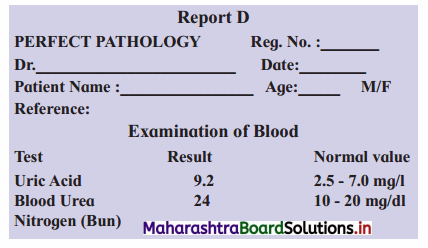
Peptidase

Question 37.
Give examples of coenzymes and cofactors.
Answer:
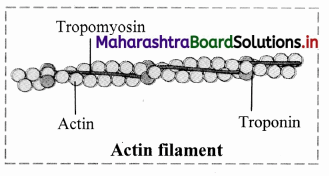
1. Nicotinamaide adenine dinucleotide (NAD), Flavin mononucleotide (FMN).
2. Magnesium, copper, zinc, iron, manganese etc.

Maharashtra Board Class 11 Biology Important Questions Chapter 6 Biomolecules

Question 38.
How are enzymes named?
Answer:
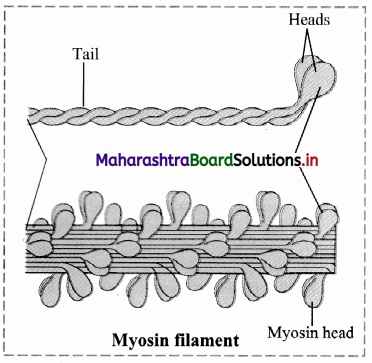
  1. Enzymes are named by adding the suffix- ‘ase’ to the name of the substrate on which they act e.g. protease, sucrase, nuclease etc. which break up proteins, sucrose and nucleic acids respectively.
  2. The enzymes can be named according to the type of function they perform.
    For e.g., dehydrogenase remove hydrogen, carboxylase add CO; decarboxylases remove C02, oxidases helping in oxidation.
  3. Some enzymes are named according to the source from which they are obtained.
    For e.g., papain from papaya, bromelain from the member of Bromeliaceae family, pineapple.
  4. According to international code of enzyme nomenclature, the name of each enzyme ends with an -ase and consists of double name!
  5. The first name indicates the nature of substrate upon which the enzyme acts and the second name indicates the reaction catalyzed.

For e.g., pyruvic decarboxylase catalyses the removal of C02 from the substrate pyruvic acid.
Similarly, the enzyme glutamate pyruvate transaminase catalyses the transfer of an amino group from the substrate glutamate to another substrate pyruvate.

Question 39.
Explain in detail the mechanism of enzyme action. Write a note on model proposed by Emil Fischer for mechanism of enzyme action.
Answer:
1. The basic mechanism by which enzymes catalyze chemical reactions begins with the binding of the substrate (or substrates) to the active site on the enzyme.
2. The active site is the specific region of the enzyme which combines with the substrate.
3. The binding of the substrate to the enzyme causes changes in the distribution of electrons in the chemical bonds of the substrate and ultimately causes the reactions that lead to the formation of products.
4. The products are released from the enzyme surface to regenerate the enzyme for another reaction cycle.
Maharashtra Board Class 11 Biology Important Questions Chapter 6 Biomolecules 10
5. Lock and Key model proposed by Emil Fischer: i. Proteinaceous Nature:
All enzymes are basically made up of protein.

Maharashtra Board Class 11 Biology Important Questions Chapter 6 Biomolecules

Question 40.
Describe the concept of metabolism.
Answer:
  1. Metabolism is the sum of the chemical reactions that take place within each cell of a living organism and provide energy for vital processes and for synthesizing new organic material.
  2. It involves continuous process of breakdown and synthesis of biomolecules through chemical reactions.
  3. Each of the metabolic reaction results in a transformation of biomolecules.
  4. Most of these metabolic reactions do not occur in isolation but are always linked with some other reactions.
  5. In cells, metabolism involves two following types of pathways:

a. Catabolic pathways
This involves formation of simpler structure from a complex biomolecule.
For e.g. when we eat wheat, bread or chapati, our gastrointestinal tract digests (hydrolyses) the starch to glucose units with help of enzymes and releases energy in form of ATP (Adenosine triphosphate).

b. Anabolic pathway
It is also called as biosynthetic pathway that involves formation of a more complex biomolecules from a simpler structure
Fone.g., synthesis of glycogen from glucose and protein from amino acids. These pathways consume energy.

Question 41.
Draw a flowchart showing catabolic and anabolic reactions.
Answer:
Maharashtra Board Class 11 Biology Important Questions Chapter 6 Biomolecules 11

Question 42.
Write a short note on secondary metabolites.
Answer:
  1. Secondary metabolites are small organic molecules produced by organisms that are not essential for their growth, development and reproduction.
  2. Several types of bacteria, fungi and plants produce secondary metabolites.
  3. Secondary metabolites can be classified on the basis of chemical structure (e.g. SMs containing rings, sugar), composition (with or without nitrogen), their solubility in various solvents, or the pathway by which they are synthesized (e.g. phenylpropanoid produces tannins).
  4. A simple way of classifying secondary metabolites includes three main groups such as:
    • Terpenes: Made from mevalonic acid that is composed mainly of carbon and hydrogen
    • Phenolics: Made from simple sugars containing benzene rings, hydrogen and oxygen.
    • Nitrogen-containing compounds: Extremely diverse class may also contain sulphur.

Maharashtra Board Class 11 Biology Important Questions Chapter 6 Biomolecules

Question 43.
Fill in the blanks.

  1. Living organism have _________ as the basic structural and functional unit.
  2. The cells have _______ containing numerous chemical molecules, the biomolecules.
  3. ________ are used very quickly by cells but if a cell is not in need of all the energy released immediately then it may get stored.
  4. By ________ reaction monosaccharide is converted to disaccharide.
  5. The balance between catabolism and anabolism maintain _______ in the cell as well as in the whole body.

Answer:
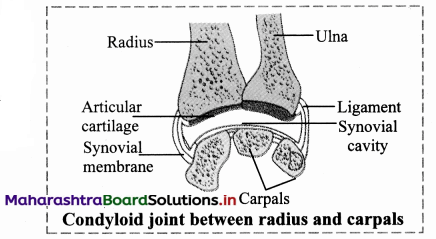
  1. Cell
  2. Protoplasm
  3. monosaccharides
  4. Condensation reaction
  5. Homeostasis

Question 44.
Apply Your Knowledge:
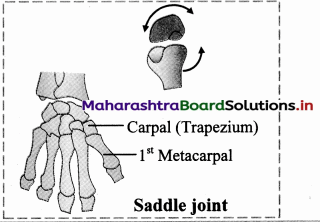
Question 1.
While performing an experiment, to understand effect of pH on enzyme activity, a student prepared
solution of varied pH. He observed that enzyme activity is maximum at a particular range of pH.
What is the reason for its maximum activity at a particular range of pH? What would be the effect on enzyme activity if strong acid or strong base is added?
Answer:
The enzymes are highly specific to pH and remain active within particular range of pH only. Hence, exhibit maximum activity only at particular range of pH. When strong acid or strong base is added in the reaction the enzyme activity is inhibited as most of the enzymes are denatured.

Question 2.
When a compound ‘x’ is added to a chemical solution containing enzyme and substrate, the enzymatic activity stops. What could be the nature of compound ‘x’?
Answer:
Compound ‘x’ could be either competitive or non-competitive inhibitor.

Question 45.
Quick Review

Maharashtra Board Class 11 Biology Important Questions Chapter 6 Biomolecules 12
Maharashtra Board Class 11 Biology Important Questions Chapter 6 Biomolecules 13

Question 46.
Exercise:

Question 1.
Draw a flow chart of biomolecules in living system.
Answer:
Refer Quick Review

Maharashtra Board Class 11 Biology Important Questions Chapter 6 Biomolecules

Question 2.
Explain what is biochemistry?
Answer:
1. Biochemistry is biological chemistry that provides us the idea of the chemistry of living organisms and molecular basis for changes taking place in plants, animals and microbial cells.
2. It develops the foundation for understanding all biological processes and communication within and between cells as well as chemical basis of inheritance and diseases in animals and plants.

Question 3.
Mention the basic macromolecules present in the living organism.
Answer:
Polysaccharides (carbohydrate) polymer of monosaccharide, polypeptides (proteins) polymer of amino acids and polynucleotides (nucleic acids) polymer of nucleotides are the three basic macromolecule present in the living organisms.

Question 4.
Write a note on monosaccharides.
Answer:
Monosaccharides:
a. Monosaccharides are the simplest sugars having crystalline structure, sweet taste and soluble in water.
b. They cannot be further hydrolyzed into smaller molecules.
c. They are the building blocks or monomers of complex carbohydrates.
d. They have the general molecular formula (CH20)n, where n can be 3, 4, 5, 6 and 7.
e. They can be classified as triose, tetrose, pentose, etc.
f. Monosaccharides containing the aldehyde (-CHO) group are classified as aldoses e.g. glucose, xylose, and those with a ketone(-C=0) group are classified as ketoses. E.g. ribulose, fructose.

Question 5.
Explain the absorption of disaccharides through the cell membrane.
Answer:
1. Disaccharides are soluble in water but they are too big to pass through the cell membrane by diffusion.
2. They are broken down in the small intestine during digestion.
3. Thus, formed monosaccharides then pass into the blood and through cell membranes into the cells.

Question 6.
Draw the structure of amylose.
Answer:
Starch:
a. Starch is a stored food in the plants.
b. Starch contains two types of glucose polymer: amylose and amylopectin.
c. Both are made from a-glucose.
d. Amylose is an unbranched polymer of a-glucose.
e. The molecules coil into a helical structure.
f. It foims a colloidal suspension in hot water.
g. Amylopectin is a branched polymer of a-glucose.
h. It is completely insoluble in water.

Question 7.
Write the significance of carbohydrates.
Answer:
Significances of carbohydrates are as follows:

  1. Carbohydrates provide energy for metabolism.
  2. Glucose is the main substrate for ATP synthesis.
  3. Lactose, a disaccharide present in the milk provides energy to babies.
  4. Polysaccharide serves as a structural component of cell membrane, cell wall and reserved food as starch and glycogen.

Maharashtra Board Class 11 Biology Important Questions Chapter 6 Biomolecules

Question 8.
What is glycosidic bond?
Answer:
Oligosaccharides:
a. A carbohydrate polymer comprising of two to six monosaccharide molecules is called oligosaccharide.
b. They are linked together by glycosidic bond.
c. They are classified on the basis of monosaccharide units:
Disaccharides: These are the sugars containing two monosaccharide units and can be further hydrolysed into smaller components. E.g.: Sucrose, maltose, lactose, etc.
Trisaccharides: These contain three monomers. E.g. Raffmose.
Tetrasaccharides: These contain four monomers. E.g.: Stachyose.

Glycosidic bond:
a. Glycosidic bond is a covalent bond that forms a linkage between two monosaccharides by a dehydration reaction.
b. It is formed when a hydroxyl group of one sugar reacts with the anomeric carbon of the other.
c. Glycosidic bonds are readily hydrolyzed by acid but resist cleavage by base.
d. There are two types of glycosidic bonds: a-glycosidic bond and P-glycosidic bond.

Question 9.
What are saturated fatty acids?
Answer:
1. Saturated fatty acids: They contain single chain of carbon atoms with single bonds.
E.g. Palmitic acid, stearic acid
2. Unsaturated fatty acids: They contain one or more double bonds between the carbon atoms of the hydrocarbon chain.
a. Simple lipids: These are esters of fatty acids with various alcohols.
E.g. Fats, wax.
b. Compound lipids: These are ester of fatty acids containing other groups like phosphate (Phospholipids), sugar (glycolipids), etc.
E.g. Lecithin
c. Sterols: They are derived lipids. They are composed of fused hydrocarbon rings (steroid nucleus) and a long hydrocarbon side chain.
E.g. Cholesterol, phytosterols.

Question 10.
Write a note on simple lipids.
Answer:
Lipids are classified into three main types:
Simple lipids:
a. These are esters of fatty acids with various alcohols. Fats and waxes are simple lipids.
b. Fats are esters of fatty acids with glycerol (CH2OH-CHOH-CH2OH).
c. Triglycerides are three molecules of fatty acids and one molecule of glycerol.
d. Unsaturated fats are liquid at room temperature and are called oils. Unsaturated fatty acids are hydrogenated to produce fats e.g. Vanaspati ghee.

Question 11.
Write a note on derived lipids.
Answer:
Derived Lipids:
a. They are composed of fused hydrocarbon rings (steroid nucleus) and a long hydrocarbon side chain.
b. One of the most common sterols is cholesterol.
Biological significance:
a. It is widely distributed in all cells of the animal body, but particularly in nervous tissue.
b. Cholesterol exists either free or as cholesterol ester.
c. Adrenocorticoids, sex hormones (progesterone, testosterone) and vitamin D are synthesized from cholesterol.
d. Cholesterol is not found in plants.
e. Sterols exist as phytosterols in plants.
f. Yam Plant (Dioscorea) produces a steroid compound called diosgenin. It is used in the manufacture of antifertility pills, i.e. birth control pills.

Maharashtra Board Class 11 Biology Important Questions Chapter 6 Biomolecules

Question 12.
What are compound lipids? Mention their biological significance.
Answer:
Compound lipids:
a. These are ester of fatty acids containing other groups like phosphate (Phospholipids), sugar (glycolipids), etc.
b. They contain a molecule of glycerol, two molecules of fatty acids and a phosphate group or simple sugar.
c. Some phospholipids such as lecithin also have a nitrogenous compound attached to the phosphate group.
d. Phospholipids have both hydrophilic polar groups (phosphate and nitrogenous group) and hydrophobic non-polar groups (hydrocarbon chains of fatty acids).
e. Glycolipids contain glycerol, fatty acids, simple sugars such as galactose. They are also called cerebrosides.
Biological significance:
a. Phospholipids contribute in the formation of cell membrane.
b. Large amounts of glycolipids are found in the brain white matter and myelin sheath.

Question 13.
Explain the classification of proteins based on their chemical composition.
Answer:
On the basis of structure, proteins are classified into three categories:
1. Simple proteins:
a. Simple proteins on hydrolysis yield only amino acids.
b. These are soluble in one or more solvents.
c. Simple proteins may be soluble in water.
d. Histones of nucleoproteins are soluble in water.
e. Globular molecules of histones are not coagulated by heat.
f. Albumins are also soluble in water but they get coagulated on heating.
g. Albumins are widely distributed e.g. egg albumin, serum albumin and legumelin of pulses are albumins.
Importance: They are involved in structural components; they also act as a storage kind of protein.
Some are associated with nucleic acids in nucleoproteins of cell.

2. Conjugated proteins:
a. Conjugated proteins consist of a simple protein united with some non-protein substance.
b. The non-protein group is called prosthetic group e.g. haemoglobin.
c. Globin is the protein and the iron containing pigment haem is the prosthetic group.
d. Similarly, nucleoproteins have nucleic acids.
e. Proteins are classified as glycoproteins and mucoproteins.
f. Mucoproteins are carbohydrate-protein complexes e.g. mucin of saliva and heparin of blood.
g. Lipoproteins are lipid-protein complexes e.g. conjugate protein found in brain, plasma membrane, milk etc. Importance: They are involved in structural components of cell membranes and organelles.
They also act as a transporter.
Some conjugated proteins are important in electron transport chain in respiration.

3. Derived proteins:
a. These proteins are not found in nature as such.
b. These proteins are derived from native protein molecules on hydrolysis.
c. Metaproteins, peptones are derived proteins.
Importance: They act as a precursor for many molecules which are essential for life.

Question 14.
What is peptide bond? Explain its formation.
Answer:
1. The covalent bond that links the two amino acids is called a peptide bond.
2. Peptide bond is formed by condensation reaction.

Question 15.
Mention the examples of simple proteins and write their significance.
Answer:
Examples of simple proteins are: E.g.: Albumins and histones.
Significance:
1. Albumin:
a. % It is the main protein in the blood.
b. It maintains the pressure in the blood vessels.
c. It helps in transportation of substances like hormone and drugs in the body.
2. Histones:
a. It is the chief protein of chromatin.
b. They are involved in packaging of DNA into structural units called nucleosomes.

Maharashtra Board Class 11 Biology Important Questions Chapter 6 Biomolecules

Question 16.
What is nucleotide?
Answer:
Nucleotide is a unit which consists of a sugar, phosphate and a base. Nucleotides are basic units of nucleic acids.

Question 17.
Write a note on structure of DNA molecule proposed by Watson and Crick.
Answer:
1. DNA is a long chain made up of alternate sugar and phosphate groups. The sugar present in DNA is always a deoxyribose attached to a phosphate group. So, it forms a regular, repeating phosphate sugar sequence.
2. A base is attached to sugar -phosphate chain. Together this unit which consist of sugar, phosphate and a base is called nucleotide.
3. The nitrogenous base and a sugar of a nucleotide form a molecule called nucleoside. It lacks phosphate group. Four types of nucleoside are found in DNA molecule.
4. In a nucleoside, nitrogenous base is attached to the first carbon atom (C-1) of the sugar and when a phosphate group gets attached with that of the carbon (C-5) atom of the sugar molecule a nucleotide molecule is formed.
5. A single strand of DNA consists of several thousands of nucleotides one above the other.
6. The phosphate group of the lower nucleotide attached with the 5th carbon atom of the deoxyribose sugar forms phospho-di-ester bond with that of the 3rd carbon atom of the deoxyribose sugar of the nucleotide placed just above it.
7. Single long chain of polynucleotides of DNA consists of one end with sugar molecules not connected with another nucleotide having C-3 carbon which is not connected with phosphate group, similarly the other end having C-5 of the sugar is not connected with any phosphate group. These two ends of the polynucleotide chain are called as 3′ and 5′ ends respectively.
8. The single polynucleotide strand of DNA is not straight but helical in shape.
9. The DNA molecule consists of such two helical polynucleotide chains which are complementary to each other.
10. The two complementary polynucleotide chains of DNA are held together by the weak hydrogen bonds.
11. Adenine always pairs with thymine, and guanine with cytosine (a pyrimidine with a purine).
12. Adenine-thymine pair consists of two hydrogen bonds and guanine-cytosine pair consists of three hydrogen bonds (Thus, if the sequence of bases of a polynucleotide chain is known, that of the other can be determined).

  1. According to Watson and Crick, DNA molecule consists of two strands twisted around each other in the form of a double helix.
  2. The two strands i.e. polynucleotide chains are supposed to be in opposite direction so end of one chain having 3′ lies beside the 5′ end of the other.
  3. One turn of the double helix of the DNA measures about 34A.
  4. It consists paired nucleotides and the distance between two neighboring pair nucleotides is 3.4A.
  5. The diameter of the DNA molecule has been found be 20A.

Question 18.
What is the function of ribosomal RNA?
Answer:
Ribosomal RNA (rRNA):
a. rRNA was discovered by Kurland in 1960.
b. It forms 50-60% part of ribosomes.
c. It accounts 80-90% of the cellular RNA.
d. It is synthesized in nucleus.
e. It gets coiled at various places due to intrachain complementary base pairing.
Role of ribosomal RNA: It provides proper binding site for m-RNA during protein synthesis.

Question 19.
Write a short note on m-RNA.
Answer:
Messenger RNA (mRNA):
a. It is a linear polynucleotide.
b. It accounts 3% of cellular RNA.
c. Its molecular weight is several million. , d. mRNA molecule carrying information to form a complete polypeptide chain is called cistron.
e. Size of mRNA is related to the size of message it contains.
f. Synthesis of mRNA begins at 5’ end of DNA strand and terminates at 3’ end.

Role of messenger RNA:
It carries genetic information from DNA to ribosomes, which are the sites of protein synthesis.
Maharashtra Board Class 11 Biology Important Questions Chapter 6 Biomolecules 14

Question 20.
Write a note on types of non-genetic RNA.
Answer:
There are three types of cellular RNAs:
1. messenger RNA (mRNA),
2. ribosomal RNA (rRNA),
3. transfer RNA (tRNA). ‘

1. Messenger RNA (mRNA):
a. It is a linear polynucleotide.
b. It accounts 3% of cellular RNA.
c. Its molecular weight is several million. , d. mRNA molecule carrying information to form a complete polypeptide chain is called cistron.
e. Size of mRNA is related to the size of message it contains.
f. Synthesis of mRNA begins at 5’ end of DNA strand and terminates at 3’ end.

Role of messenger RNA:
It carries genetic information from DNA to ribosomes, which are the sites of protein synthesis.

2. Ribosomal RNA (rRNA):
a. rRNA was discovered by Kurland in 1960.
b. It forms 50-60% part of ribosomes.
c. It accounts 80-90% of the cellular RNA.
d. It is synthesized in nucleus.
e. It gets coiled at various places due to intrachain complementary base pairing.
Role of ribosomal RNA: It provides proper binding site for m-RNA during protein synthesis.

3. Transfer RNA (tRNA):
a. These molecules are much smaller consisting of 70-80 nucleotides.
b. Due to presence of complementary base pairing at various places, it is shaped like clover-leaf.
c. Each tRNA can pick up particular amino acid.
d. Following four parts can be recognized on tRNA
1. DHU arm (Dihydroxyuracil loop/ amino acid recognition site
2. Amino acid binding site
3. Anticodon loop / codon recognition site
4. Ribosome recognition site.
e. In the anticodon loop of tRNA, three unpaired nucleotides are present called as anticodon which pair with codon present on mRNA.
f. The specific amino acids are attached at the 3’ end in acceptor stem of clover leaf of tRNA.
Role of transfer RNA: It helps in elongation of polypeptide chain during the process called translation.

Maharashtra Board Class 11 Biology Important Questions Chapter 6 Biomolecules

Question 21.
What are co-factors? Give examples.
Answer:

  1. Enzymes require certain inorganic ions for their activity.
  2. The inorganic ions which are loosely attached to the protein part are called co-factors.
  3. E.g. Magnesium, copper, zinc, iron, manganese etc.

[Note: Apoenzyme (protein part) and co-factor together form a complete catalytically active enzyme which is known as holoenzyme. The co-factors are of two types; metal ions and coenzymes. A coenzyme or metal ion that is very tightly or even covalently bound to the enzyme protein is known as a prosthetic group.]

Question 22.
Describe the important properties of enzymes.
Answer:
1. Proteinaceous Nature:
All enzymes are basically made up of protein.

2. Three-Dimensional conformation:
a. All enzymes have specific 3-dimensional conformation.
b. They have one or more active sites to which substrate (reactant) combines.
c. The points of active site where the substrate joins with the enzyme is called substrate binding site.

3. Catalytic property:
a. Enzymes are like inorganic catalysts and influence the speed of biochemical reactions but themselves remain unchanged.
b. After completion of the reaction and release of the product they remain active to catalyze again.
c. A small quantity of enzymes can catalyze the transformation of a very large quantity of the substrate
into an end product.
d. For example, sucrase can hydrolyze 100000 times of sucrose as compared with its own weight.

4. Specificity of action:
a. The ability of an enzyme to catalyze one specific reaction and essentially no other is perhaps its most significant property. Each enzyme acts upon a specific substrate or a specific group of substrates.
b. Enzymes are very sensitive to temperature and pH.
c. Each enzyme exhibits its highest activity at a specific pH i.e. optimum pH.
d. Any increase or decrease in pH causes decline in enzyme activity e.g. enzyme pepsin (secreted in stomach)shows highest activity at an optimum pH of 2 (acidic)

5. Temperature:
a. Enzymes are destroyed at higher temperature of 60-70°C or below, they are not destroyed but become inactive.
b. This inactive state is temporary and the enzyme can become active at suitable temperature.
c. Most of the enzymes work at an optimum temperature between 20°C and 35°C.

There are two types of models:
1. Lock and Key model:
a. Lock and Key model was first postulated in 1894 by Emil Fischer.
b. This model explains the specific action of an enzyme with a single substrate.
c. In this model, lock is the enzyme and key is the substrate.
d. The correctly sized key (substrate) fits into the key hole (active site) of the lock (enzyme).

2. Induced Fit model (Flexible Model):
a. Induced Fit model was first proposed in 1959 by Koshland.
b. This model states that approach of a substrate induces a conformational change in the enzyme.
c. It is the more accepted model to understand mode of action of enzyme.
d. The induced fit model shows that enzymes are rather flexible structures in which the active site continually reshapes by its interactions with the substrate until the time the substrate is completely bound to it.
e. It is also the point at which the final form and shape of the enzyme is determined.
[Note: Temperature is a factor affecting enzyme activity and not a property of enzyme.]

Maharashtra Board Class 11 Biology Important Questions Chapter 6 Biomolecules

Question 23.
Explain the classification enzymes and mention the example of each class.
Answer:
1. Enzymes are biological macromolecules which act as a catalyst and accelerates the reaction in the body.
2. Enzymes are classified into six classes:
a. Oxidoreductases: These enzymes catalyze oxidation and reduction reactions by the transfer of hydrogen and/or oxygen, e.g. alcohol dehydrogenase
b. Transferases: These enzymes catalyse the transfer of certain groups between two molecules, e.g. glucokinase
c. Hydrolases: These enzymes catalyse hydrolytic reactions. This class includes amylases, proteases, lipases etc. e.g. Sucrase
d. Lyases: These enzymes are involved in elimination reactions resulting in the removal of a group of atoms from substrate molecule to leave a double bond. It includes aldolases, decarboxylases, and dehydratases, e.g. fumarate hydratase.
e. Isomerases: These enzymes catalyze structural rearrangements within a molecule. Their nomenclature is based on the type of isomerism. Thus, these enzymes are identified as racemases, epimerases, isomerases, mutases, e.g. xylose isomerase.
f. Ligases or Synthetases: These are the enzymes which catalyze the covalent linkage of the molecules utilizing the energy obtained from hydrolysis of an energy-rich compound like ATP, GTP e.g. glutathione synthetase, Pyruvate carboxylase.

Question 24.
Enlist the factors affecting the activity of enzymes.
Answer:
The factors affecting the enzyme activity are as follows:
1. Concentration of substrate:
a. Increase in the substrate concentration gradually increases the velocity of enzyme activity within the limited range of substrate levels.
b. A rectangular hyperbola is obtained when velocity is plotted against the substrate concentration.
c. Three distinct phases (A, B and C) of the reaction are observed in the graph.
Where V = Measured velocity, Vmax = Maximum velocity, S = Substrate concentration,
Km = Michaelis-Menten constant.
d. Km or the Michaelis-Menten constant is defined as the substrate concentration (expressed in moles/lit) to produce half of maximum velocity in an enzyme catalyzed reaction.
e. It indicates that half of the enzyme molecules (i.e. 50%) are bound with the substrate molecules when the substrate concentration equals the Km value.
f. Km value is a constant and a characteristic feature of a given enzyme.
g. It is a representative for measuring the strength of ES complex.
h. A low Km value indicates a strong affinity between enzyme and substrate, whereas a high Km value reflects a weak affinity between them.
i. For majority of enzymes, the Km values are in the range of 10-5 to 10-2 moles.

2. Enzyme Concentration:
a. The rate of an enzymatic reaction is directly proportional to the concentration of the substrate.
b. The rate of reaction is also directly proportional to the square root of the concentration of enzymes.
c. It means that the rate of reaction also increases with the increasing concentration of enzyme and the rate of reaction can also decrease by decreasing the concentration of enzyme.

3. Temperature:
a. The temperature at which the enzymes show maximum activity is called Optimum temperature.
b. The rate of chemical reaction is increased by a rise in temperature but this is true only over a limited range of temperature.
c. Enzymes rapidly denature at temperature above 40°C.
d. The activity of enzymes is reduced at low temperature.
e. The enzymatic reaction occurs best at or around 37°C which is the average normal body temperature in homeotherms.

4. Effect of pH:
a. The pH at which an enzyme catalyzes the reaction at the maximum rate is known as optimum pH.
b. The enzyme cannot perform its function beyond the range of its pH value.

5. Other substances:
a. The enzyme action is also increased or decreased in the presence of some other substances such as co-enzymes, activators and inhibitors.
b. Most of the enzymes are combination of a co-enzyme and an apo-enzyme.
c. Activators are the inorganic substances which increase the enzyme activity.
d. Inhibitor is the substance which reduces the enzyme activity.

Maharashtra Board Class 11 Biology Important Questions Chapter 6 Biomolecules

Question 25.
With the help of lock and key theory explain the mechanism of enzyme action.
Answer:
1. Proteinaceous Nature:
All enzymes are basically made up of protein.

2. Three-Dimensional conformation:
a. All enzymes have specific 3-dimensional conformation.
b. They have one or more active sites to which substrate (reactant) combines.
c. The points of active site where the substrate joins with the enzyme is called substrate binding site.

3. Catalytic property:
a. Enzymes are like inorganic catalysts and influence the speed of biochemical reactions but themselves remain unchanged.
b. After completion of the reaction and release of the product they remain active to catalyze again.
c. A small quantity of enzymes can catalyze the transformation of a very large quantity of the substrate
into an end product.
d. For example, sucrase can hydrolyze 100000 times of sucrose as compared with its own weight.

4. Specificity of action:
a. The ability of an enzyme to catalyze one specific reaction and essentially no other is perhaps its most significant property. Each enzyme acts upon a specific substrate or a specific group of substrates.
b. Enzymes are very sensitive to temperature and pH.
c. Each enzyme exhibits its highest activity at a specific pH i.e. optimum pH.
d. Any increase or decrease in pH causes decline in enzyme activity e.g. enzyme pepsin (secreted in stomach)shows highest activity at an optimum pH of 2 (acidic)

5. Temperature:
a. Enzymes are destroyed at higher temperature of 60-70°C or below, they are not destroyed but become inactive.
b. This inactive state is temporary and the enzyme can become active at suitable temperature.
c. Most of the enzymes work at an optimum temperature between 20°C and 35°C.

There are two types of models:
1. Lock and Key model:
a. Lock and Key model was first postulated in 1894 by Emil Fischer.
b. This model explains the specific action of an enzyme with a single substrate.
c. In this model, lock is the enzyme and key is the substrate.
d. The correctly sized key (substrate) fits into the key hole (active site) of the lock (enzyme).

Question 26.
With the help of suitable examples give any three classes of enzymes.
Answer:
a. Oxidoreductases: These enzymes catalyze oxidation and reduction reactions by the transfer of hydrogen and/or oxygen, e.g. alcohol dehydrogenase
b. Transferases: These enzymes catalyse the transfer of certain groups between two molecules, e.g. glucokinase
c. Hydrolases: These enzymes catalyse hydrolytic reactions. This class includes amylases, proteases, lipases etc. e.g. Sucrase

Question 27.
Following graph represents the effect of substrate concentration on enzyme activity. Identify ‘X’ and ‘Y’ Write proper explanation of the process.
Maharashtra Board Class 11 Biology Important Questions Chapter 6 Biomolecules 17
Answer:
The factors affecting the enzyme activity are as follows:
1. Concentration of substrate:
a. Increase in the substrate concentration gradually increases the velocity of enzyme activity within the limited range of substrate levels.
b. A rectangular hyperbola is obtained when velocity is plotted against the substrate concentration.
c. Three distinct phases (A, B and C) of the reaction are observed in the graph.
Where V = Measured velocity, Vmax = Maximum velocity, S = Substrate concentration,
Km = Michaelis-Menten constant.
d. Km or the Michaelis-Menten constant is defined as the substrate concentration (expressed in moles/lit) to produce half of maximum velocity in an enzyme catalyzed reaction.
e. It indicates that half of the enzyme molecules (i.e. 50%) are bound with the substrate molecules when the substrate concentration equals the Km value.
f. Km value is a constant and a characteristic feature of a given enzyme.
g. It is a representative for measuring the strength of ES complex.
h. A low Km value indicates a strong affinity between enzyme and substrate, whereas a high Km value reflects a weak affinity between them.
i. For majority of enzymes, the Km values are in the range of 10-5 to 10-2 moles.

Maharashtra Board Class 11 Biology Important Questions Chapter 6 Biomolecules

Question 28.
Explain the concept of metabolism.
Answer:

  1. Metabolism is the sum of the chemical reactions that take place within each cell of a living organism and provide energy for vital processes and for synthesizing new organic material.
  2. It involves continuous process of breakdown and synthesis of biomolecules through chemical reactions.
  3. Each of the metabolic reaction results in a transformation of biomolecules.
  4. Most of these metabolic reactions do not occur in isolation but are always linked with some other reactions.
  5. In cells, metabolism involves two following types of pathways:

a. Catabolic pathways
This involves formation of simpler structure from a complex biomolecule.
For e.g. when we eat wheat, bread or chapati, our gastrointestinal tract digests (hydrolyses) the starch to glucose units with help of enzymes and releases energy in form of ATP (Adenosine triphosphate).

b. Anabolic pathway
It is also called as biosynthetic pathway that involves formation of a more complex biomolecules from a simpler structure
Fone.g., synthesis of glycogen from glucose and protein from amino acids. These pathways consume energy.

Question 29.
Distinguish between Catabolic pathways and anabolic pathways.
Answer:
In cells, metabolism involves two following types of pathways:

a. Catabolic pathways
This involves formation of simpler structure from a complex biomolecule.
For e.g. when we eat wheat, bread or chapati, our gastrointestinal tract digests (hydrolyses) the starch to glucose units with help of enzymes and releases energy in form of ATP (Adenosine triphosphate).

b. Anabolic pathway
It is also called as biosynthetic pathway that involves formation of a more complex biomolecules from a simpler structure
Fone.g., synthesis of glycogen from glucose and protein from amino acids. These pathways consume energy.

Question 30.
Write the application of secondary metabolites.
Answer:

  1. Drugs developed from secondary metabolites have been used to treat infectious diseases, cancer, hypertension and inflammation.
  2. Morphine, the first alkaloid isolated from Papaver somniferum is used as pain reliver and cough suppressant.
  3. Secondary metabolites like alkaloids, nicotine, cocaine and the terpenes, cannabinol are widely used for recreation and stimulation.
  4. Flavours of secondary metabolites improve our food preferences.
  5. Tannins are added to wines and chocolate for improving astringency.
  6. Since most secondary metabolites have antibiotic property, they are also used as food preservatives.
  7. Glucosinolates is a secondary metabolite which is naturally present in cabbage imparts a characteristic flavour and aroma because of nitrogen and sulphur-containing chemicals. It also offers protection to these plants from many pests.

Question 31.
Explain the formation of metabolic pool.
Answer:

  1. Metabolism is the sum of the chemical reactions that take place within each cell of a living organism and provide energy for vital processes and for synthesizing new’ organic material.
  2. Metabolic pool in the cell is formed due to glycolysis and Krebs cycle.
  3. The catabolic chemical reaction of glycolysis and Krebs cycle provides ATP and biomolecules. These biomolecules form the metabolic pool of the cell.
  4. These biomolecules can be utilized for synthesis of many important cellular components.
  5. The metabolites can be added or withdrawn from the pool according to the need of the cell.

Question 32.
Explain the concept of metabolic pool.
Answer:
1. Metabolic pool is the reservoir of biomolecules in the cell on which enzymes can act to produce useful products as per the need of the cell.
2. The concept of metabolic pool is significant in cell biology because it allows one type of molecule to change into another type E.g. Carbohydrates can be converted to fats and vice-versa.

Maharashtra Board Class 11 Biology Important Questions Chapter 6 Biomolecules

Question 33.
Multiple Choice Questions:

Question 1.
Most common constituents of organic compounds found in organims are
(A) C, H, O, P
(B) C, H, O
(C) C, H, N, P
(D) C, H, O, N, P
Answer:
(B) C, H, O

Question 2.
Carbohydrates are composed of
(A) carbon
(B) hydrogen
(C) oxygen
(D) all of these
Answer:
(D) all of these

Question 3.
In which of the following, the ratio of hydrogen and oxygen atoms is 2:1?
(A) proteins
(B) fats
(C) oil
(D) carbohydrates
Answer:
(D) carbohydrates

Question 4.
Which of the following do not give smaller sugar units on hydrolysis?
(A) Monosaccharides
(B) Disaccharides
(C) Polysaccharides
(D) Glycogen
Answer:
(A) Monosaccharides

Question 5.
The simplest monosaccharide made up of three carbons amongst the following is
(A) erythrose
(B) glucose
(C) glyceraldehyde
(D) ribose
Answer:
(C) glyceraldehyde

Question 6.
Deoxyribose sugar is an example of
(A) monosaccharide
(B) disaccharide
(C) polysaccharide
(D) simple protein
Answer:
(A) monosaccharide

Question 7.
Common examples of hexose sugar is/are
(A) glucose
(B) fructose
(C) erythrose
(D) both (A) and (B)
Answer:
(D) both (A) and (B)

Maharashtra Board Class 11 Biology Important Questions Chapter 6 Biomolecules

Question 8.
If a compound contains 2 monosaccharides, then it is described as
(A) derived monosaccharide
(B) disaccharide
(C) polysaccharide
(D) pentose sugar
Answer:
(B) disaccharide

Question 9.
In a disaccharide, monomers are linked with each other through ________ bonds.
(A) peptide
(B) hydrogen
(C) glycosidic
(D) ester
Answer:
(C) glycosidic

Question 10.
A disaccharide that gives two molecules of glucose on hydrolysis is
(A) sucrose
(B) maltose
(C) lactose
(D) none of these
Answer:
(B) maltose

Question 11.
Sugar present in milk is
(A) fructose
(B) lactose
(C) galactose
(D) sucrose
Answer:
(B) lactose

Question 12.
Polysaccharides consist of
(A) two monosaccharide units
(B) eight monosaccharide units
(C) many monosaccharide units
(D) amino acids
Answer:
(C) many monosaccharide units

Maharashtra Board Class 11 Biology Important Questions Chapter 6 Biomolecules

Question 13.
________ are water insoluble and small molecular weight compounds as compared to macromolecules.
(A) Lipids
(B) proteins
(C) carbohydrates
(D) nucleic acids.
Answer:
(A) Lipids

Question 14.
Simple lipids are esters of
(A) amino acids
(B) proteins
(C) phosphorus
(D) fatty acids with glycerol
Answer:
(D) fatty acids with glycerol

Question 15.
Fatty acids which do not contain double bond between carbon atoms are
(A) saturated fatty acids
(B) unsaturated fatty acids
(C) oleic and linoleic acids
(D) linoleic and linolenic acids
Answer:
(A) saturated fatty acids

Question 16.
Proteins are linear polymers of
(A) amino acids
(B) fatty acids
(C) monosaccharides
(D) nucleic acids
Answer:
(A) amino acids

Question 17.
Proteins are formed by the condensation of
(A) nucleic acids
(B) amino acids
(C) fatty acids
(D) carbohydrates
Answer:
(B) amino acids

Question 18.
Protein is
(A) micromolecule
(B) macromolecule
(C) soluble
(D) specific
Answer:
(B) macromolecule

Maharashtra Board Class 11 Biology Important Questions Chapter 6 Biomolecules

Question 19.
Keratin is a ________ protein.
(A) transport
(B) protective
(C) structural
(D) storage
Answer:
(C) structural

Question 20.
A nucleotide contains
(A) sugar + phosphate
(B) N-base + phosphate
(C) sugar + nitrogenous base
(D) sugar + N-base + phosphate
Answer:
(D) sugar + N-base + phosphate

Question 21.
Nucleotides, the polymers of nucleic acid are joined together by __________ bond.
(A) Peptide
(B) Ester
(C) Phosphodiester
(D) Glycosidic
Answer:
(C) Phosphodiester

Question 22.
Find the odd one.
(A) Adenine
(B) Cytosine
(C) Thymine
(D) Uracil
Answer:
(D) Uracil

Question 23.
The two strands of DNA are
(A) similar in nature and complementary
(B) anti-parallel and complementary
(C) parallel and complementary
(D) basically, different in nature
Answer:
(B) anti-parallel and complementary

Question 24.
RNA is genetic material in
(A) bacteria
(B) cyanobacteria
(C) bacteriophages
(D) plant viruses
Answer:
(D) plant viruses

Maharashtra Board Class 11 Biology Important Questions Chapter 6 Biomolecules

Question 25.
Which RNA is present in more amount in the cell?
(A) m-RNA
(B) t-RNA
(C) r-RNA
(D) not certain
Answer:
(C) r-RNA

Question 26.
Smallest RNA is
(A) t-RNA
(B) m-RNA
(C) r-RNA
(D) not specific
Answer:
(A) t-RNA

Question 27.
________ catalyze hydrolysis of ester, ether etc.
(A) Lyases
(B) Ligases
(C) Hydrolases
(D) Transferases
Answer:
(C) Hydrolases

Question 28.
_______ catalyze interconversions of geometric, optical and positional isomers.
(A) Transferases
(B) Ligases
(C) Oxidoreductase
(D) Isomerases
Answer:
(D) Isomerases

Question 29.
Metal cofactors are also known as?
(A) prosthetic group
(B) coenzyme
(C) activators
(D) inhibitors
Answer:
(C) activators

Question 30.
________ are also known as dehydrogenases.
(A) Oxidoreductases
(B) Ligases
(C) Lyases
(D) Transferases
Answer:
(A) Oxidoreductases

Question 31.
The enzyme functions best at temperature
(A) 30°C to 50°C
(B) 15°C to 25°C
(C) 20°C to 35°C
(D) 40°C to 50°C
Answer:
(C) 20°C to 35°C

Maharashtra Board Class 11 Biology Important Questions Chapter 6 Biomolecules

Question 32.
As temperature changes from 30° to 45° C, the rate of enzyme activity will
(A) decrease
(B) increase
(C) first increase and then decrease
(D) first decrease and then increase
Answer:
(C) first increase and then decrease

Question 33.
Out of the following, which is not a property of enzymes?
(A) Specific in nature
(B) Proteinaceous
(C) Used up in reaction
(D) Increased rate of biochemical reaction
Answer:
(C) Used up in reaction

Question 34.
Majority of cellular enzymes function best at _______ PH.
(A) acidic
(B) basic
(C) neutral
(D) strong base
Answer:
(B) basic

Question 35.
The _______ action of enzyme with a substrate is explained by lock and key theory.
(A) relative
(B) specific
(C) random
(D) abstract
Answer:
(B) specific

Question 36.
Morphine, the first alkaloid isolated from ________
(A) Pisum sativum
(B) Hibiscus rosa sinensis
(C) Papaver somniferum
(D) Azadirachta indica
Answer:
(C) Papaver somniferum

Maharashtra Board Class 11 Biology Important Questions Chapter 6 Biomolecules

Question 34.
Competitive Corner:

Question 1.
Prosthetic groups differ from co-enzymes in that –
(A) They can serve as co-factors in a number of enzyme – catalyzed reactions
(B) They require metal ions for their activity
(C) They (prosthetic groups) are tightly bound to apoenzymes
(D) Their association with apoenzymes is transient
Hint: Apoenzyme (protein part) and co-factor together form a complete catalytically active enzyme which is known as holoenzyme. The co-factors are of two types; metal ions and coenzymes. A coenzyme or metal ion that is very tightly or even covalently bound to the enzyme protein is known as a prosthetic group.
Answer:
(C) They (prosthetic groups) are tightly bound to apoenzymes

Question 2.
Consider the following statements:
1. Coenzyme or metal ion that is tightly bound to enzyme protein is called prosthetic group.
2. A complete catalytic active enzyme with its bound prosthetic group is called apoenzyme. Select the correct option.
(A) Both (i) and (ii) are false.
(B) (i) is false but (ii) is true.
(C) Both (i) and (ii) are true.
(D) (i) is true but (ii) is false.
Answer:
(D) (i) is true but (ii) is false.

Question 3.
Concanavalin A is:
(A) a lectin
(B) a pigment
(C) an alkaloid
(D) an essential oil
Answer:
(A) a lectin

Question 4.
Which one of the following carbohydrates is a heteropolysaccharide?
(A) Cellulose
(B) Starch
(C) Glycogen
(D) Hyaluronic acid
Answer:
(D) Hyaluronic acid

Question 5.
The two functional groups characteristic of sugars are
(A) Carbonyl and phosphate
(B) Carbonyl and methyl
(C) Hydroxyl and methyl
(D) Carbonyl and hydroxyl
Answer:
(D) Carbonyl and hydroxyl

Maharashtra Board Class 11 Biology Important Questions Chapter 6 Biomolecules

Question 6.
Which one of the following statements is correct with reference to enzymes?
(A) Apoenzyme = Holoenzyme + coenzyme
(B) Holoenzyme = Apoenzyme + Coenzyme
(C) Coenzyme = Apoenzyme + Holoenzyme
(D) Holoenzyme = Coenzyme + Co-factor
Answer:
(B) Holoenzyme = Apoenzyme + Coenzyme

Question 7.
Which of the following are NOT polymeric?
(A) Nucleic acids
(B) Proteins
(C) Polysaccharides
(D) Lipids
Answer:
(D) Lipids

Maharashtra Board Class 11 Biology Important Questions Chapter 5 Cell Structure and Organization

Balbharti Maharashtra State Board 11th Biology Important Questions Chapter 5 Cell Structure and Organization Important Questions and Answers.

Maharashtra State Board 11th Biology Important Questions Chapter 5 Cell Structure and Organization

Question 1.
Define cell.
Answer:
The cell is defined as a structural and functional unit of life of all living organisms capable of independent existence and can perform all functions of life.

Maharashtra Board Class 11 Biology Important Questions Chapter 5 Cell Structure and Organization

Question 2.
Write information about the instrument which is used for observing smaller organisms or cells.
Answer:

  1. To observe cells or organisms of smaller size we use a microscope.
  2. Larger cells can be seen through simple microscope but to observe smaller cells we require a compound microscope.
  3. Simple microscope can magnify image 50 to 100 times but a compound microscope can do so 1000 times or more.
  4. In the microscope a beam of light is used to make things visible hence it is a light microscope.
  5. To observe interior of cell we need electron microscope which can magnify the image 500000 times.

Question 3.
Write the shapes of the cells that can be observed.
Answer:
There is no typical shape of a cell. Cells may be spherical, rectangular, flattened, polygonal, oval, triangular, conical, columnar, etc.

Question 4.
1. Smallest cell
2. Longest cell in animals
3. Largest cell
Answer:
1. Mycoplasma (0.3 µm)
2. Nerve cell
3. Ostrich egg

Maharashtra Board Class 11 Biology Important Questions Chapter 5 Cell Structure and Organization

Question 5.
Explain the term totipotency.
Answer:

  1. Totipotency (totus – entire, potential – power) is the capacity or the potential of living nucleated cell, to differentiate into any other type of cell and thus, can form a complete new organism.
  2. A cell is totipotent as it has the entire genetic information of the organism stored in its nucleus.
  3. Embryonic animal cells are totipotent and are termed as stem cells.
  4. Stem cells are used in curing many diseases. Therefore, they have great potential for medical applications.

Question 6.
Who proposed the cell theory?
Answer:
Schwann and Schleiden proposed the cell theory.

Question 7.
Give the postulates of modern cell theory.
Answer:
Postulates of modern cell theory:

  1. All living organisms are made up of cells.
  2. Cell is the basic structural and functional unit of life.
  3. All cells arise from pre-existing cells. (Rudolf Virchow 1858 – “Omnis cellula-e-cellula”).
  4. Total activities of cells are responsible for activity of an organism.
  5. Cells show transformation of energy.
  6. Cells contain nucleic acids; DNA and RNA in the nucleus and cytoplasm.

Question 8.
State the two general categories on which living organisms are grouped.
Answer:
Living organisms are grouped into two main categories the Prokaryotes and Eukaryotes.

Question 9.
State the general characteristics of prokaryotic cell.
Answer:
General characteristics of prokaryotic cell:
1. Prokaryotic cells are primitive type of cells.
2. It does not have membrane bound cell organelles (like endoplasmic reticulum, Golgi complex, mitochondria, etc.) and well-defined nucleus (nuclear membrane is absent).
3. Genetic material is in the form of nucleoid.

4. Cell envelope:
a. Prokaryotic cell has chemically complex protective cell envelope having glycocalyx, cell wall and plasma membrane.
b. In some bacteria, glycocalyx occurs in the form of a slime layer (loose sheath). Other bacteria may have a thick and tough covering called capsule. It helps in protection of bacterial cell.

5. Cell wall:
The Gram-positive bacteria show presence of peptidoglycan layer in the cell wall and Gram-negative bacteria show presence of murein in the cell wall. It gives mechanical strength to the cell.
[Note: In Gram-negative bacteria, cell wall is made up of two layers; inner layer of Murein or peptidoglycan and outer layer of Lipopolysaccharides.]

6. Cell membrane:
a. It is the innermost covering of the cell envelope, chemically composed of lipids and proteins.
b. It helps in intercellular communication.
c. Cell membrane shows infoldings called mesosomes which help in cell wall formation, cellular respiration and DNA replication.
d. The cyanobacteria show longer extensions called as chromatophores which carry photosynthetic pigments.

7. In motile bacteria either cilia or flagella are found. Both are driven by rotatory movement produced by basal body (which works as motor) of flagellum. Other parts of flagellum are filament and hook.

8. Some other surface projections are the tubular pili (which help in inter-cellular communication) and fimbriae (for clinging to support).

9. Ribosomes:
Bacterial cell cytoplasm contains dense particles called ribosomes which help in protein synthesis. Ribosomes are 70S type (composed of a larger sub-unit 50S and + smaller sub-unit 30S).

Maharashtra Board Class 11 Biology Important Questions Chapter 5 Cell Structure and Organization

Question 10.
What is the difference between Gram-positive and Gram-negative bacterial cells? Name the technique used for differentiating such bacterial cells.
Answer:
The Gram-positive bacteria show presence of peptidoglycan layer in the cell wall and Gram-negative bacteria show presence of murein in the cell wall. The technique used for differentiating bacterial cells is Gram staining.
[Note: Murein is similar to peptidoglycan in structure and function. It is present in the cell walls of archaebacteria.

Question 11.
Write the constituents of prokaryotic cytoplasm.
Answer:
1. Cytoplasm of prokaryotes is a pool of all necessary materials like water, enzymes, elements, amino acids, etc.
2. Some inclusion bodies in form of organic (cyanophycean starch and glycogen) and inorganic granules (phosphate and sulphur) are also found.

Question 12.
Fill in the blanks.

  1. Genetic material in bacterium is a single chromosome made up of circular and coiled _______.
  2. The bacterial chromosome remains attached to _________.
  3. The _________ model of replication is observed in bacterial cells.
  4. _________ present in the bacterial cells are known as extrachromosomal self-replicating DNA.

Answer:

  1. DNA
  2. Mesosomes
  3. Theta
  4. Plasmids

Question 13.
What are eukaryotic cells?
Answer:
1. Eukaryotic cells are the cells possessing well-defined nucleus and membrane bound organelles (like mitochondria, endoplasmic reticulum, ribosomes, Golgi complex etc.).
2. Eukaryotes include protists, plants, animals and fungi.

Maharashtra Board Class 11 Biology Important Questions Chapter 5 Cell Structure and Organization

Question 14.
Write a note on cell wall in Eukaryotic cells.
Answer:

  • The rigid, protective and supportive covering, outside the cell membrane is called cell wall. It is present in plant cells, fungi and some protists.
  • Algae show presence of cellulose, galactans, mannans and minerals like calcium carbonate in cell wall.
  • In other plants, it is made up of hemicelluloses, pectin, lipids and protein.
  • Microfibrils of plant cell wall show presence of cellulose which is responsible for rigidity.
  • Some of the depositions of cell wall are silica (grass stem), cutin (epidermal walls of land plants), suberin (endodermal cells of root), wax, lignin.
  • Function:
    • Provides support, rigidity and shape to the cell.
    • Protects the protoplasm against mechanical injury and infections.

Question 15.
Explain the structure of plant cell wall.
Answer:
In plants, cell wall shows middle lamella, primary wall and secondary wall
Maharashtra Board Class 11 Biology Important Questions Chapter 5 Cell Structure and Organization 1
1. Middle lamella:
It is thin and present between two adjacent r cells. It is the first structure formed from cell plate during cytokinesis. It is mainly made up of pectin, calcium and magnesium pectate. Softening of ripe fruit is due to solubilization of pectin.
2. Primary wall:
In young plant cell, it is capable of growth. It is laid inside to middle lamella.
It is the only wall seen in meristematic tissue, mesophyll, pith, etc.
3. Secondary wall:
It is present inner to primary wall. Once the growth of primary wall stops, secondary wall is laid. At some places thickening is absent which leads to formation of pits.

Question 16.
Draw a well labelled diagram of a plant cell.
Answer:
Maharashtra Board Class 11 Biology Important Questions Chapter 5 Cell Structure and Organization 2

Maharashtra Board Class 11 Biology Important Questions Chapter 5 Cell Structure and Organization

Question 17.
Give an account of eukaryotic plasma membrane.
Answer:
Eukaryotic plasma membrane/ Cell membrane/ Biomembrane:

  1. It is thin, quasi-fluid structure present both extracellularly and intracellularly.
  2. Extracellularly, it is present around protoplast and intracellularly, it is present around most of the cell organelles in eukaryotic cell. It separates cell organelles from cytosol.
  3. Thickness of bio-membrane is about 75A.
  4. Cell membrane appears trilaminar (made up of three layers) when observed under electron microscope. It shows presence of lipids (mostly phospholipids) arranged in bilayer.
  5. Lipids possess one hydrophilic polar head and two hydrophobic non-polar tails. Therefore, phospholipids are amphipathic.
  6. Lipid molecules are arranged in two layers (bilayer) in such a way that their tails are sandwiched in between heads. Due to this, tails never come in direct contact with aqueous surrounding.
  7. Cell membrane also shows presence of proteins and carbohydrates.
  8. Ratio of proteins and lipids varies in different cells. For example, in human beings, RBCs show approximately 52% protein and 40% lipids.

Question 18.
Explain the structure of plasma membrane on the basis of Fluid mosaic model.
Answer:
Fluid mosaic model:

  1. Fluid mosaic model was proposed by Singer and Nicholson (1972).
  2. This model states that plasma membrane is made up of phospholipid bilayer and proteins.
  3. Proteins are embedded in the lipid membrane like icebergs in the sea of lipids.
  4. Phospholipid bilayer is fluid in nature.
  5. Quasi-fluid nature of lipid enables lateral movement of proteins. This ability to move within the membrane is measured as fluidity.
  6. Based on organization of membrane proteins they are of two types, as:

a. The intrinsic proteins occur at different depths of bilayer i.e. they are tightly bound to the phospholipid bilayer and are embedded in it. They span the entire thickness of the membrane. Therefore, they are known as transmembrane proteins. They form channels for passage of water.
b. The extrinsic or peripheral proteins are found on two surfaces of the membrane i.e. are loosely held to the phospholipid layer and can be easily removed.

Question 19.
Draw neat and labelled diagram of structure of plasma membrane proposed by Singer and Nicolson.
Answer:
Fluid mosaic model:

  1. Fluid mosaic model was proposed by Singer and Nicholson (1972).
  2. This model states that plasma membrane is made up of phospholipid bilayer and proteins.
  3. Proteins are embedded in the lipid membrane like icebergs in the sea of lipids.
  4. Phospholipid bilayer is fluid in nature.
  5. Quasi-fluid nature of lipid enables lateral movement of proteins. This ability to move within the membrane is measured as fluidity.
  6. Based on organization of membrane proteins they are of two types, as:

a. The intrinsic proteins occur at different depths of bilayer i.e. they are tightly bound to the phospholipid bilayer and are embedded in it. They span the entire thickness of the membrane. Therefore, they are known as transmembrane proteins. They form channels for passage of water.
b. The extrinsic or peripheral proteins are found on two surfaces of the membrane i.e. are loosely held to the phospholipid layer and can be easily removed.

Maharashtra Board Class 11 Biology Important Questions Chapter 5 Cell Structure and Organization

Question 20.
Give the functions of plasma membrane.
Answer:
1. The significant function of plasma membrane is transport of molecules across it. Plasma membrane is selectively permeable.

2. Passive transport:
a. Many molecules move across the membrane without spending energy.
b. Some molecules move by simple diffusion along the concentration gradient i.e. from higher to lower concentration.
c. Neutral molecules may move across the membrane by the process of simple diffusion.
d. Water may also move by osmosis.

3. Active transport:
a. Few ions or molecules are transported against concentration gradient i.e. from lower to higher concentration.
b. This requires energy, hence ATP is utilized. As such a transport is an energy dependent process in which ATP is utilized, it is called Active transport e.g. Na+ /K+ pump.
c. Polar molecules cannot pass through non-polar lipid bilayer. Therefore, they require carrier proteins to facilitate their transport across the membrane.

Question 21.
Write a note on cytoplasm in Eukaryotic cell.
Answer:
Cytoplasm in Eukaryotic cell:

  1. The cell contains ground substance called cytoplasmic matrix or cytosol.
  2. This colloidal jelly like material shows streaming movements called cyclosis.
  3. The cytoplasm contains water as major component along with organic and inorganic molecules like sugars, amino acids, vitamins, enzymes, nucleotides, minerals and waste products.
  4. It also contains various membrane-bound cell organelles like endoplasmic reticulum, Golgi complex, mitochondria, plastids, nucleus, microbodies and cytoskeletal elements like microtubules.
  5. Cytoplasm acts as a source of raw materials as well as seat for various metabolic activities taking place in the cell.
  6. It helps in distribution and exchange of materials between various cell organelles.

Maharashtra Board Class 11 Biology Important Questions Chapter 5 Cell Structure and Organization

Question 22.
Explain the endomembrane system of the cell.
Answer:

  1. Cell organelles are compartments in the cell that carry out specific functions.
  2. Some of these organelles coordinate with each other and complete the specific function of the cell.
  3. Nuclear membrane, endoplasmic reticulum, Golgi complex, lysosomes and various types of vesicles and vacuoles form such a group and are together considered as endomembrane system of the cell.

Question 23.
Why mitochondria and chloroplasts are not considered as a part of endomembrane system?
Answer:
1. Organelles having distinct functions are not included in endomembrane system.
2. Mitochondria or chloroplast carry out specific type of energy conversions in the cell. Therefore, mitochondria and chloroplasts are not considered as a part of endomembrane system.

Question 24.
Describe the structure of Endoplasmic Reticulum.
Answer:

  1. Endoplasmic reticulum is a network present within the cytosol.
  2. It is present in all a cells except ova and mature red blood corpuscles.
  3. Under the electron microscope, it appears like network of membranous tubules and sacs called cisternae.
  4. This network of ER divides the cytoplasm in two parts viz. one within the lumen of ER called laminal cytoplasm and non-laminal cytoplasm that lies outside ER.
  5. Membrane of ER is continuous with nuclear envelope at one end and extends till cell membrane. It thus acts as intracellular supporting framework and helps in maintaining position of various cell organelles in the cytoplasm.
  6. Depending upon the presence or absence of ribosomes, endoplasmic reticulum is called rough endoplasmic reticulum (RER) or smooth endoplasmic reticulum (SER) respectively.

Question 25.
Label the diagram
Answer:

  1. Endoplasmic reticulum is a network present within the cytosol.
  2. It is present in all a cells except ova and mature red blood corpuscles.
  3. Under the electron microscope, it appears like network of membranous tubules and sacs called cisternae.
  4. This network of ER divides the cytoplasm in two parts viz. one within the lumen of ER called laminal cytoplasm and non-laminal cytoplasm that lies outside ER.
  5. embrane of ER is continuous with nuclear envelope at one end and extends till cell membrane. It thus acts as intracellular supporting framework and helps in maintaining position of various cell organelles in the cytoplasm.
  6. Depending upon the presence or absence of ribosomes, endoplasmic reticulum is called rough endoplasmic reticulum (RER) or smooth endoplasmic reticulum (SER) respectively.

Maharashtra Board Class 11 Biology Important Questions Chapter 5 Cell Structure and Organization

Question 26.
Explain the structure, location and functions of Golgi complex.
Answer:
Golgi complex or Golgi apparatus or Golgi body act as a assembly, manufacturing cum packaging and transport unit of cell.
1. Structure of Golgi complex:
a. Golgi complex consists of stacks of membranous sacs called cistemae.
b. Diameter of cistemae varies from 0.5 to 1pm.
c. A Golgi complex may have few to several cistemae depending on its function.
d. The thickness and molecular composition of membranes at one end of the stack of a Golgi sac differ from those at the other end.
e. The Golgi sacs show specific orientation in the cell.
f. Each cistema has a forming or ‘cis’ face (cis: on the same side) and maturing or ‘trans’ face (trAnswer:the opposite side).
g. Transport vesicles that pinch off from transitional ER merge with cis face of Golgi cistema and add its contents into the lumen.

2. Location of Golgi complex:
Golgi bodies are usually located near endoplasmic reticulum.

3. Functions of Golgi complex:
a. Golgi body carries out two types of functions, modification of secretions of ER and production of its own secretions.
b. Cistemae contain specific enzymes for specific functions.
c. Refining (modification) of product takes place in a sequential manner.
d. For example, certain sugar component is added or removed from glycolipids and glycoproteins that are brought from ER, thus forming a variety of products.
e. Golgi bodies also manufacture their own products. Golgi bodies in many plant cells produce non-cellulose polysaccharides like pectin.
f. Manufactured or modified, all products of Golgi complex leave cistemae from trans face as transport vesicles.

Question 27.
How transport vesicles identify their target cell or cell membrane?
Answer:
While transport vesicles are leaving from the trans face of the Golgi, certain markers get impregnated on their membrane. These markers help them to identify their specific target cell or cell organelle.

Question 28.
Label the diagrams and write down the details of concept in your words.
Answer:
Golgi complex or Golgi apparatus or Golgi body act as a assembly, manufacturing cum packaging and transport unit of cell.
1. Structure of Golgi complex:
a. Golgi complex consists of stacks of membranous sacs called cistemae.
b. Diameter of cistemae varies from 0.5 to 1pm.
c. A Golgi complex may have few to several cistemae depending on its function.
d. The thickness and molecular composition of membranes at one end of the stack of a Golgi sac differ from those at the other end.
e. The Golgi sacs show specific orientation in the cell.
f. Each cistema has a forming or ‘cis’ face (cis: on the same side) and maturing or ‘trans’ face (trAnswer:the opposite side).
g. Transport vesicles that pinch off from transitional ER merge with cis face of Golgi cistema and add its contents into the lumen.

2. Location of Golgi complex:
Golgi bodies are usually located near endoplasmic reticulum.

3. Functions of Golgi complex:
a. Golgi body carries out two types of functions, modification of secretions of ER and production of its own secretions.
b. Cistemae contain specific enzymes for specific functions.
c. Refining (modification) of product takes place in a sequential manner.
d. For example, certain sugar component is added or removed from glycolipids and glycoproteins that are brought from ER, thus forming a variety of products.
e. Golgi bodies also manufacture their own products. Golgi bodies in many plant cells produce non-cellulose polysaccharides like pectin.
f. Manufactured or modified, all products of Golgi complex leave cistemae from trans face as transport vesicles.

Maharashtra Board Class 11 Biology Important Questions Chapter 5 Cell Structure and Organization

Question 29.
Write a note on lysosomes and make a list of lysosomal enzymes.
Answer:
Lysosomes:

  1. Lysosomes are considered as dismantling and restructuring units of a cell.
  2. These are membrane bound vesicles containing hydrolytic enzymes. The enzymes in lysosomes are used by most eukaryotic cells to digest (hydrolyse) macromolecules.
  3. The lysosomal enzymes show optimal activity in acidic pH.
  4. Lysosomes arise from Golgi associated endoplasmic reticulum.
  5. Lysosomes are polymorphic in nature and are classified as primary lysosomes, secondary or hybrid lysosomes, residual body and autophagic vesicle.
  6. The list of lysosomal enzymes includes:
    All types of hydrolases viz, amylases, proteases and lipases.

Question 30.
“Lysosomes are polymorphic in nature.” Justify the statement.
Answer:

  1. Lysosomes are classified as, Primary lysosomes; which are nothing but membrane bound vesicles in which enzymes are in inactive state.
  2. Secondary lysosomes or hybrid lysosomes, which are formed by fusion of lysosome with endocytic vesicle containing materials to be digested, represented as heterophagic vesicle. This is larger in size than primary lysosome.
  3. When organic molecules or membrane bound old cell organelle to be recycled fuses with primary lysosome, autophagic vesicles are formed.
  4. Residual body is the vesicle containing undigested remains left over in the heterophagic vesicle after releasing the products of digestion in the cytosol. Hence, lysosomes are polymorphic in nature.

Question 31.
“Lysosomes are called suicide bags of the cells”. Why?
Answer:

  1. Lysosomes which bring about digestion of cell’s own organic material like a damaged cell organelle are called autophagic vesicle (suicide bags).
  2. An autophagic vesicle essentially consists of lysosome fused with membrane bound old cell organelle or organic molecules to be recycled.
  3. Thus, lysosomes are capable of destructing all kinds of material in the cell. Therefore, can digest its own cell organelles due to presence of lysosome. Hence, lysosomes are also called as suicide bags.

Maharashtra Board Class 11 Biology Important Questions Chapter 5 Cell Structure and Organization

Question 32.
Write a note on vacuoles.
Answer:
The organelle which helps in maintaining turgidity of the cell and a proper internal balance of cellular contents is known as vacuole.

  1. The vacuoles are bound by semipermeable membrane, called tonoplast membrane. This membrane helps in maintaining the composition of vacuolar fluid (cell sap), different from that of the cytosol.
  2. Composition of cell sap differs in different types of cells.
  3. In vacuoles along with excretory products other compounds are stored that are harmful or unpalatable to herbivores, thereby protecting the plants.
  4. Attractive colours of the petals are due to storage of such pigments in vacuoles.
  5. Generally, there are two or three permanent vacuoles in a plant cell.
  6. In some large plant cells, a single large vacuole occupies the central part of the cell. It is called central vacuole. In such cells, vacuole can occupy about 90% of the total volume of the cell.
  7. The cell sap of central vacuole is a store house of various ions and thus is hypertonic to cytosol.
  8. Small vacuoles in seeds of certain plants store organic materials like proteins.
  9. In animal cells, they are few in number and smaller in size.
  10. Intake of food or foreign particle by phagocytosis involves formation of food vacuole.

Question 33.
What is the function of contractile vacuole in Paramoecium?
Answer:
Contractile vacuole performs excretion and osmoregulation in fresh water unicellular forms like Paramoecium.

Question 34.
What are microbodies? Mention their types and functions.
Answer:
Microbodies are minute membrane bound sacs found in both plant and animal cells. Microbodies contain various types of enzymes based on which they are classified into following types:
1. Sphaerosomes:
a. These are found mainly in cells involved in synthesis and storage of fats. For e. g. endosperm of oil seeds.
b. The membrane of sphaerosome is half unit membrane i.e. this membrane has only one phospholipid layer.

2. Peroxisomes:
a. Peroxisomes contain enzymes that remove hydrogen atoms from substrate and produce toxic hydrogen peroxide by utilisation of oxygen.
b. At the same time peroxisome also contains enzymes that convert toxic H202 to water. Conversion of toxic substances like alcohol takes place in liver cells by peroxisomes.

Question 35.
Draw a neat and labelled diagram and explain the functions of glyoxysomes.
Answer:
Maharashtra Board Class 11 Biology Important Questions Chapter 5 Cell Structure and Organization 3
Glyoxysomes are membrane bound organelles containing enzymes that convert fatty acids to sugar. They are observed in cells of germinating seeds where the cells utilize sugar (formed by conversion of stored fatty acids) till it starts photosynthesising on its own.

Question 36.
Describe the structure of mitochondria.
Answer:
Mitochondrion is known as the power house of the cell. It plays significant role in aerobic respiration. Mitochondria are absent in prokaryotic cells and red blood corpuscles (RBCs).

The structure of mitochondrion:

  1. Shape of the mitochondria may be oval or spherical or like spiral strip.
  2. It is a double membrane bound organelle.
  3. Outer membrane is permeable to various metabolites due to presence of a protein-Porin or Parson’s particles.
  4. Inner membrane is selectively permeable to few substances only.
  5. Both membranes are separated by intermembrane space.
  6. Inner membrane shows several finger like or plate like folds called as cristae which bears numerous particles oxysomes and cytochromes / electron carriers.
  7. Inner membrane encloses a cavity called inner chamber, containing a fluid-matrix.
  8. Matrix contains few coils of circular DNA, RNA, 70S types of ribosomes, lipids and various enzymes of Krebs’ cycle and other pathways.

Maharashtra Board Class 11 Biology Important Questions Chapter 5 Cell Structure and Organization

Question 37.
Label the diagram and write down the details of concept in your words.
Maharashtra Board Class 11 Biology Important Questions Chapter 5 Cell Structure and Organization 4
Answer:
Mitochondrion is known as the power house of the cell. It plays significant role in aerobic respiration. Mitochondria are absent in prokaryotic cells and red blood corpuscles (RBCs).

The structure of mitochondrion:

  1. Shape of the mitochondria may be oval or spherical or like spiral strip.
  2. It is a double membrane bound organelle.
  3. Outer membrane is permeable to various metabolites due to presence of a protein-Porin or Parson’s particles.
  4. Inner membrane is selectively permeable to few substances only.
  5. Both membranes are separated by intermembrane space.
  6. Inner membrane shows several finger like or plate like folds called as cristae which bears numerous particles oxysomes and cytochromes / electron carriers.
  7. Inner membrane encloses a cavity called inner chamber, containing a fluid-matrix.
  8. Matrix contains few coils of circular DNA, RNA, 70S types of ribosomes, lipids and various enzymes of Krebs’ cycle and other pathways.

Question 38.
Identify and label the following structure. Write a note on it.
Maharashtra Board Class 11 Biology Important Questions Chapter 5 Cell Structure and Organization 5
Answer:
1. The given structure is of Oxysome/ F1 Particle.
2. A: Head (F1)
B: Pedicel
C: Foot (Base / F0)
3. Structure of Oxysome:
a. Inner membrane of mitochondria bears numerous particles called as Oxysomes (F1 – Fo / Fernandez – Moran Elementary particles / Mitochondrial particles).
b. Each particle consists of head, stalk (Pedicel) and base.
c. Head (F1) / lollipop head faces towards matrix and foot (F0) is embedded in inner membrane.
d. Head acts as an enzyme ATP synthase and foot (base) as proton channel. Oxysomes are involved in proton pumping and ATP synthesis.

Maharashtra Board Class 11 Biology Important Questions Chapter 5 Cell Structure and Organization

Question 39.
What are plastids?
Answer:
Plastids are double membraned organelles containing DNA, RNA and 70S ribosomes.

Question 40.
Draw a labelled diagram of the organelle which plays a significant role in synthesis of starch in plants. Write a note on its structure.
Answer:
Chloroplast plays a significant role in synthesis of starch in plants.
Structure of chloroplast:

  1. In plants, chloroplast is found mainly in mesophyll of leaf.
  2. Chloroplast is lens shaped but it can also be oval, spherical, discoid or ribbon like.
  3. A cell may contain single large chloroplast as in Chlamydomonas or there can be 20 to 40 chloroplasts per cell as seen in mesophyll cells.
  4. Chloroplasts contain green pigment called chlorophyll along with other enzymes that help in production of sugar by photosynthesis.
  5. Inner membrane of double membraned chloroplast is comparatively less permeable.
  6. Inside the cavity of inner membrane, there is another set of membranous sacs called thylakoids.
  7. Thylakoids are arranged in the form of stacks called grana (singular: granum).
  8. The grana are connected to each other by means of membranous tubules called stroma lamellae.
  9. Space outside thylakoids is filled with stroma.
  10. The stroma and the space inside thylakoids contain various enzymes essential for photosynthesis.
  11. Stroma of chloroplast contains DNA and ribosomes (70S).

Question 41.
Insulin is the protein hormone synthesized by pancreatic cells. Name the component that performs the role of protein factory and draw their labelled structure as seen in prokaryotes and eukaryotes.
Answer:
Ribosomes are the protein factories that synthesize proteins using genetic information.
Maharashtra Board Class 11 Biology Important Questions Chapter 5 Cell Structure and Organization 6

Question 42.
Give the detailed information on ribosomes found in eukaryotic cell.
Answer:

  1. Ribosomes are protein factories of cell and were first observed as dense particles in electron micrograph of a cell by scientist Palade in 1953.
  2. Ribosomes lack membranous covering around them and are made up of Ribosomal RNA and proteins.
  3. In a eukaryotic cell, ribosomes are present in mitochondria, plastids (in plant cells) and in cytosol.
  4. Ribosomes are either found attached to outer surface of Rough Endoplasmic Reticulum and nuclear membrane or freely suspended in cytoplasm.
  5. Both are of 80S type. Each ribosome is made up of two subunits- a large (60S) and a small (40S) subunit.
  6. Bound ribosomes generally produce proteins that are transported outside the cell after processing in ER and Golgi body. e.g. Bound ribosomes of acinar cells of pancreas produce pancreatic digestive enzymes.
  7. Free ribosomes come together and form chains called polyribosomes for protein synthesis.
  8. Free ribosomes generally produce enzymatic proteins that are used up in cytoplasm, like enzymes required for breakdown of sugar.
  9. Both types of ribosomes (bound and free) can interchange position and function.
  10. Number of ribosomes is high in cells actively engaged in protein synthesis.

Maharashtra Board Class 11 Biology Important Questions Chapter 5 Cell Structure and Organization

Question 43.
What is Svedberg unit?
Answer:
The particle size of ribosomes is measured in terms of Svedberg unit (S). It is a measure of sedimentation rate of a particle in ultracentrifuge. It is thus a measure of density and size of a particle. 1S = 10-13 sec.

Question 44.
Describe the structure of nucleus.
Answer:
Nucleus is known as the master cell organelle as it regulates various metabolic activities through synthesis of various proteins and enzymes.
The nucleus in eukaryotic cell is made up of nuclear envelope, nucleoplasm, nucleolus and chromatin network.
1. Nuclear envelope:
a. Nuclear envelope is a double layered delimiting membrane of nucleus.
b. Two membranes are separated from each other by perinuclear space (10 to 50nm).
c. Outer membrane is connected with endoplasmic reticulum at places and harbours ribosomes on it.
d. The inner membrane is lined by nuclear lamina- a network of protein fibres that helps in maintaining shape of the nucleus.
e. The two membranes along with perinuclear space help in separating nucleoplasm from cytoplasm. However, nuclear membrane is not continuous.
f. There are small openings called nucleopores on the nuclear membrane.
g. The nucleopores are guarded by pore complexes which regulate flow of substances from nucleus to cytoplasm and in reverse direction.

2. Nucleoplasm or karyolymph:
a. The nucleoplasm or karyolymph contains various substances like nucleic acids, protein molecules, minerals and salts.
b. It contains chromatin network and nucleolus.

3. Nucleolus:
a. Nucleolus is made up of rRNA and ribosomal proteins and it is known as the site of ribosome biogenesis.
b. The rRNA and ribosomal proteins are transported to cytoplasm and are assembled together to form ribosomes.
c. Depending on synthetic activity of a cell, there are one or more nucleoli present in the nucleoplasm. For e.g. cells of oocyte contain large nucleolus whereas sperm cells contain small inconspicuous one.
d. Nucleolus appear as dense spherical body present near chromatin network.

Question 45.
Write the functions of the controlling unit of the cell.
Answer:
Nucleus is known as the controlling unit of the cell.
Functions of the nucleus:
1. The nucleus contains entire genetic information; hence play important role in heredity and variation.
2. It is the site for synthesis of DNA, RNA and ribosomes.
3. It plays important role in protein synthesis.

Maharashtra Board Class 11 Biology Important Questions Chapter 5 Cell Structure and Organization

Question 46.
Write a note on chromatin material.
Answer:

  1. Nucleus contains genetic information in the form of chromosomes which are DNA molecules associated with proteins.
  2. In a non-dividing cell, the chromosomes appear as thread like network and cannot be identified individually. This network is called chromatin material.
  3. The chromatin material contains DNA, histone and non-histone proteins and RNA.
  4. In some regions of chromatin, DNA is more and is genetically active called euchromatin.
  5. Some regions that contain more of proteins and less DNA and are genetically inert, are called
    heterochromatin.

[Note: Heterochromatin is a region in chromatin that is highly compacted during interphase and is generally not accessible for transcription of genes.]

Question 47.
What is the significance of having constant chromosome number in a species?
Answer:
Constant chromosome number in a species is important in phylogenetic studies.

Question 48.
Explain the cytoskeletal system of a cell.
Answer:

  1. The cytoskeleton is a supportive structure built from microtubules, intermediate filaments, and
    microfilaments.
  2. Microtubules are made up of protein- tubulin.
  3. Microfilaments are made up of actin.
  4. Intermediate filaments are composed of fibrous proteins.

Question 49.
Compete the following concept map representing the functions of cytoskeleton.
Answer:
Maharashtra Board Class 11 Biology Important Questions Chapter 5 Cell Structure and Organization 7

Question 50.
Explain in detail the structures of components that help in locomotion of unicellular organisms.
Answer:

  1. Cilium or flagellum helps in locomotion of unicellular organisms.
  2. They consist of basal body, basal plate and shaft.
  3. Basal body is placed in outer part of cytoplasm. It is derived from centriole. It has nine peripheral triplets of fibrils.
  4. Shaft is exposed part of cilia or flagella. It consists of two parts- sheath and axoneme.
  5. Sheath is covering membrane of cilium or flagellum.
  6. Core called axoneme possesses 11 fibrils (microtubules) running parallel to long axis.
  7. It shows 9 peripheral doublet microtubules and two single central microtubules (9+2).
  8. The central tubules are enclosed by central sheath.
  9. This sheath is connected to one of the tubules of peripheral doublets by a radial spoke.
  10. Central tubules are connected to each other by bridges.
  11. The peripheral doublet microtubules are connected to each other through linkers or inter-doublet bridge.

Maharashtra Board Class 11 Biology Important Questions Chapter 5 Cell Structure and Organization

Question 51.
Draw a labelled diagram of the structure of cilia.
Answer:
Cilia act as oars causing movement of cell.
Maharashtra Board Class 11 Biology Important Questions Chapter 5 Cell Structure and Organization 8

Question 52.
Spindle apparatus is formed during cell division. Write the information on the components of cell which help in formation of this.
Answer:

  1. Centrioles and centrosomes play significant role in formation of spindle apparatus during cell division.
  2. Centrosome is usually found near the nucleus of an animal cell.
  3. It contains a pair of cylindrical structures called centrioles.
  4. The cylinder (centriole) are perpendicular to each other and are surrounded by amorphous substance called pericentriolar material.
  5. Each cylinder of centriole is made up of nine sets of triplet microtubules made up of tubulin.
  6. Evenly spaced triplets are connected to each other by means of non-tubulin proteins.
  7. At the proximal end of centriole, there is a set of tubules called hub.
  8. The peripheral triplets are connected to hub by means of radial spokes. Due to this proximal end of centriole looks like a cartwheel.
  9. Centriole forms basal body of cilia and flagella.

Question 53.
Draw a labelled diagram of the structure of centriole.
Answer:
Maharashtra Board Class 11 Biology Important Questions Chapter 5 Cell Structure and Organization 9

Question 54.
Match the column I with column II.

Column IColumn II
1. Mitochondria(a) Synthesis of protein
2. Nucleus(b) Photosynthesis
3. Chloroplast(c) Respiration
4. Ribosomes(d) Nucleoplasm

Answer:

Column IColumn II
1. Mitochondria(c) Respiration
2. Nucleus(d) Nucleoplasm
3. Chloroplast(b) Photosynthesis
4. Ribosomes(a) Synthesis of protein

Question 55.
Distinguish between Plant cell and Animal cell.
Answer:

Plant cellAnimal cell
(a) Cell wall is present.Cell wall is absent.
(b) Plastids present.Plastids absent.
(c) Chloroplast present.Chloroplast absent.
(d) Centrioles are present only in lower plant forms.Centrioles are present in all animal cells.
(e) Lysosomes absent.Lysosomes present in all animal cells.
(f) Two or three large and permanent vacuoles.Small and temporary vacuoles are present.
(g) Carbohydrates stored as starch.Carbohydrates stored as glycogen.

Maharashtra Board Class 11 Biology Important Questions Chapter 5 Cell Structure and Organization

Question 56.
Label the A, B, C, and D in above diagram and write the functions of organelles A and B.
Maharashtra Board Class 11 Biology Important Questions Chapter 5 Cell Structure and Organization 10Answer:
1. A: Mitochondria B: Endoplasmic Reticulum
C: Golgi complex D: Amyloplast
2. Functions of Mitochondria: Mitochondrion is known as the powerhouse of the cell. It plays a significant role in aerobic respiration. Mitochondria are absent in prokaryotic cells and red blood corpuscles (RBCs).
3. Functions of Endoplasmic Reticulum: Refer Q.33.

Question 57.
Draw a labelled diagram of an animal cell.
Answer:
Maharashtra Board Class 11 Biology Important Questions Chapter 5 Cell Structure and Organization 11

Question 58.
Classify the following organelles / cellular components on the basis of presence or absence in prokaryotic and eukaryotic cells.
(Ribosomes, Nucleus, Plasma membrane, Mitochondria, mRNA, Endoplasmic Reticulum, Golgi complex, Centrioles, Nucleoid)
Answer:

Prokaryotic cellRibosomes, Plasma membrane, mRNA, Nucleoid
Eukaryotic cellRibosomes, Plasma membrane, mRNA, Nucleus, Mitochondria, Endoplasmic Reticulum, Golgi complex, Centrioles

Question 59.
Apply Your Knowledge

Question 1.
After learning organization of cell, to test one of the postulates of cell theory, Ananya requested her teacher to guide and allow her to perform a small experiment. The aim of the experiment Avas to form new cells in the laboratory using isolated cellular organelles from other cells. Though Ananya did not succeed to form new cells, teacher-guided and motivated her explaining why experiment performed by them failed.
1. Which postulate Ananya was willing to test and why new cells failed to form from the isolated organelles from other cells?
2. From the above mentioned data could you guess which type of cells they were trying to form whether eukaryote or prokaryote?
Answer:
1. The postulate Ananya was willing to test was, ‘all cells arise from pre-existing cells’. According to this postulate, to form new cells, pre-existing cells are must; therefore, cellular organelles did not form new cells.
2. The cells which Ananya and her teacher were trying to form were eukaryotic cells, as cellular organelles are present in eukaryotes.

Question 2.
A mix bacterial culture was given to different teams of students and was asked to write their observation regarding the shapes of bacterial cells they observed under microscope. Students discussed the characteristics among their respective teams and mentioned major types of shapes they observed.
1. Which types of bacterial shapes were observed by the students?
2. Mention why they were named in a specific manner with respect to their shapes?
Answer:
1. The bacterial shapes observed by the students are cocci, bacilli, vibrios, spirilla.
2. Under microscope, cocci appear spherical shape, bacilli appear rod shape, vibrios appear comma shape and spirilla appear twisted, therefore they are named accordingly.

Maharashtra Board Class 11 Biology Important Questions Chapter 5 Cell Structure and Organization

Question 60.
Quick Review:

Maharashtra Board Class 11 Biology Important Questions Chapter 5 Cell Structure and Organization 12

Question 61.
Exercise

Question 1.
Define cell.
Answer:
The first microscope was made by two Dutch spectacle makers Hans and Zacharias Janssen.
[Note: The Dutch scientist Anton van Leeuwenhoek made microscopes capable of magnifying single-celled organisms in a drop of pond water.]

Question 2.
Write a note on microscope.
Answer:
Cell is defined as a structural and functional unit of life of all living organisms capable of independent existence and can perform all functions of life.

Question 3.
Write a short note on totipotency.
Answer:

  1. Totipotency (totus – entire, potential – power) is the capacity or the potential of living nucleated cell, to differentiate into any other type of cell and thus, can form a complete new organism.
  2. A cell is totipotent as it has the entire genetic information of the organism stored in its nucleus.
  3. Embryonic animal cells are totipotent and are termed as stem cells.
  4. Stem cells are used in curing many diseases. Therefore, they have great potential for medical applications.

Maharashtra Board Class 11 Biology Important Questions Chapter 5 Cell Structure and Organization

Question 4.
What are the characteristics of cells in which genetic material is known as nucleoid?
Answer:
General characteristics of prokaryotic cell:
1. Prokaryotic cells are primitive type of cells.
2. It does not have membrane bound cell organelles (like endoplasmic reticulum, Golgi complex, mitochondria, etc.) and well-defined nucleus (nuclear membrane is absent).
3. Genetic material is in the form of nucleoid.

4. Cell envelope:
a. Prokaryotic cell has chemically complex protective cell envelope having glycocalyx, cell wall and plasma membrane.
b. In some bacteria, glycocalyx occurs in the form of a slime layer (loose sheath). Other bacteria may have a thick and tough covering called capsule. It helps in protection of bacterial cell.

5. Cell wall:
The Gram-positive bacteria show presence of peptidoglycan layer in the cell wall and Gram-negative bacteria show presence of murein in the cell wall. It gives mechanical strength to the cell.
[Note: In Gram-negative bacteria, cell wall is made up of two layers; inner layer of Murein or peptidoglycan and outer layer of Lipopolysaccharides.]

6. Cell membrane:
a. It is the innermost covering of the cell envelope, chemically composed of lipids and proteins.
b. It helps in intercellular communication.
c. Cell membrane shows infoldings called mesosomes which help in cell wall formation, cellular respiration and DNA replication.
d. The cyanobacteria show longer extensions called as chromatophores which carry photosynthetic pigments.

7. In motile bacteria either cilia or flagella are found. Both are driven by rotatory movement produced by basal body (which works as motor) of flagellum. Other parts of flagellum are filament and hook.

8. Some other surface projections are the tubular pili (which help in inter-cellular communication) and fimbriae (for clinging to support).

9. Ribosomes:
Bacterial cell cytoplasm contains dense particles called ribosomes which help in protein synthesis. Ribosomes are 70S type (composed of a larger sub-unit 50S and + smaller sub-unit 30S).

Question 5.
Which technique is used to differentiate between Gram positive and Gram negative bacteria?
Answer:
The Gram-positive bacteria show presence of peptidoglycan layer in the cell wall and Gram-negative bacteria show presence of murein in the cell wall. The technique used for differentiating bacterial cells is Gram staining.
[Note: Murein is similar to peptidoglycan in structure and function. It is present in the cell walls of archaebacteria.

Question 6.
What are mesosomes?
Answer:
Cytoplasm does not show streaming movement. Cytoplasm shows streaming movement.

Question 7.
What are the functions of pili and fimbriae?
Answer:
Respiratory enzymes are present on the infoldings of the plasma membrane called mesosomes. Respiratory enzymes are present within mitochondria.
e-g- Cyanobacteria (Blue green algae) and bacteria. Algae, fungi, plants and animals.

Maharashtra Board Class 11 Biology Important Questions Chapter 5 Cell Structure and Organization

Question 8.
Enlist the organelles present in eukaryotic cells.
Answer:
It also contains various membrane bound cell organelles like endoplasmic reticulum, Golgi complex, mitochondria, plastids, nucleus, microbodies and cytoskeletal elements like microtubules.

Question 9.
Who proposed the fluid-mosaic model?
Answer:
Fluid mosaic model was proposed by Singer and Nicholson (1972).

Question 10.
What are nuclear membrane?
Answer:
Nucleus is known as the master cell organelle as it regulates various metabolic activities through synthesis of various proteins and enzymes.
The nucleus in eukaryotic cell is made up of nuclear envelope, nucleoplasm, nucleolus and chromatin network.
1. Nuclear envelope:
a. Nuclear envelope is a double layered delimiting membrane of nucleus.
b. Two membranes are separated from each other by perinuclear space (10 to 50nm).
c. Outer membrane is connected with endoplasmic reticulum at places and harbours ribosomes on it.
d. The inner membrane is lined by nuclear lamina- a network of protein fibres that helps in maintaining shape of the nucleus.
e. The two membranes along with perinuclear space help in separating nucleoplasm from cytoplasm. However, nuclear membrane is not continuous.
f. There are small openings called nucleopores on the nuclear membrane.
g. The nucleopores are guarded by pore complexes which regulate flow of substances from nucleus to cytoplasm and in reverse direction.

Question 11.
Name two types of chromatin.
Answer:
1. In some regions of chromatin, DNA is more and is genetically active called euchromatin.
2. Some regions that contain more of proteins and less DNA and are genetically inert, are called heterochromatin.

Question 12.
What are lysosomes commonly known as?
Answer:
1. Lysosomes which bring about digestion of cell’s own organic material like a damaged cell organelle are called autophagic vesicle (suicide bags).
2. An autophagic vesicle essentially consists of lysosome fused with membrane bound old cell organelle or organic molecules to be recycled.
3. Thus, lysosomes are capable of destructing all kinds of material in the cell. Therefore, can digest its own cell organelles due to presence of lysosome. Hence, lysosomes are also called as suicide bags.

Question 13.
What are ribosomes?
Answer:
Ribosomes are the protein factories that synthesize proteins using genetic information.

Question 14.
What are glyoxysomes? Where do they occur?
Answer:
Glyoxysomes are membrane bound organelles containing enzymes that convert fatty acids to sugar. They are observed in cells of germinating seeds where the cells utilize sugar (formed by conversion of stored fatty acids) till it starts photosynthesising on its own.

Maharashtra Board Class 11 Biology Important Questions Chapter 5 Cell Structure and Organization

Question 15.
Sketch and label the fluid mosaic model of cell membrane.
Answer:
Fluid mosaic model:

  1. Fluid mosaic model was proposed by Singer and Nicholson (1972).
  2. This model states that plasma membrane is made up of phospholipid bilayer and proteins.
  3. Proteins are embedded in the lipid membrane like icebergs in the sea of lipids.
  4. Phospholipid bilayer is fluid in nature.
  5. Quasi-fluid nature of lipid enables lateral movement of proteins. This ability to move within the membrane is measured as fluidity.
  6. Based on organization of membrane proteins they are of two types, as:

a. The intrinsic proteins occur at different depths of bilayer i.e. they are tightly bound to the phospholipid bilayer and are embedded in it. They span the entire thickness of the membrane. Therefore, they are known as transmembrane proteins. They form channels for passage of water.
b. The extrinsic or peripheral proteins are found on two surfaces of the membrane i.e. are loosely held to the phospholipid layer and can be easily removed.

Question 16.
State the functions of Endoplasmic reticulum.
Answer:
Smooth endoplasmic reticulum (SER):
1. Depending on cell type, it helps in synthesis of lipids for e.g. Steroid secreting cells of cortical region of adrenal gland, testes and ovaries.
2. Smooth endoplasmic reticulum plays a role in detoxification in the liver and storage of calcium ions (muscle cells).

Rough Endoplasmic Reticulum (RER):

  1. Rough ER is primarily involved in protein synthesis. For e.g. Pancreatic cells synthesize the protein insulin in the ER.
  2. These proteins are secreted by ribosomes attached to rough ER and are called secretory proteins. These proteins get wrapped in membrane that buds off from transitional region of ER. Such membrane bound proteins depart from ER as transport vesicles.
  3. Rough ER is also involved in formation of membrane for the cell. The ER membrane grows in place by addition of membrane proteins and phospholipids to its own membrane. Portions of this expanded membrane are transferred to other components of endomembrane system.

Question 17.
Write short note on lysosomes.
Answer:
Lysosomes:

  1. Lysosomes are considered as dismantling and restructuring units of a cell.
  2. These are membrane bound vesicles containing hydrolytic enzymes. The enzymes in lysosomes are used by most eukaryotic cells to digest (hydrolyse) macromolecules.
  3. The lysosomal enzymes show optimal activity in acidic pH.
  4. Lysosomes arise from Golgi associated endoplasmic reticulum.
  5. Lysosomes are polymorphic in nature and are classified as primary lysosomes, secondary or hybrid lysosomes, residual body and autophagic vesicle.
  6. The list of lysosomal enzymes includes:
    All types of hydrolases viz, amylases, proteases and lipases.

Maharashtra Board Class 11 Biology Important Questions Chapter 5 Cell Structure and Organization

Question 18.
Lysosomes are known as suicide bags of the cell. Give reason.
Answer:

  1. Lysosomes which bring about digestion of cell’s own organic material like a damaged cell organelle are called autophagic vesicle (suicide bags).
  2. An autophagic vesicle essentially consists of lysosome fused with membrane-bound old cell organelle or organic molecules to be recycled.
  3. Thus, lysosomes are capable of destructing all kinds of material in the cell. Therefore, can digest its own cell organelles due to presence of lysosome. Hence, lysosomes are also called as suicide bags.

Question 19.
Describe the structure of plant cell wall.
Answer:
In plants, cell wall shows middle lamella, primary wall and secondary wall

  1. Middle lamella:
    It is thin and present between two adjacent r cells. It is the first structure formed from cell plate during cytokinesis. It is mainly made up of pectin, calcium and magnesium pectate. Softening of ripe fruit is due to solubilization of pectin.
  2. Primary wall:
    In young plant cell, it is capable of growth. It is laid inside to middle lamella.
    It is the only wall seen in meristematic tissue, mesophyll, pith, etc.
  3. Secondary wall:
    It is present inner to primary wall. Once the growth of primary wall stops, secondary wall is laid. At some places thickening is absent which leads to formation of pits.

Question 20.
Describe the cell wall of eukaryotic cells and state their function.
Answer:

  1. The rigid, protective and supportive covering, outside the cell membrane is called cell wall. It is present in plant cells, fungi and some protists.
  2. Algae show presence of cellulose, galactans, mannans and minerals like calcium carbonate in cell wall.
  3. In other plants, it is made up of hemicelluloses, pectin, lipids and protein.
  4. Microfibrils of plant cell wall show presence of cellulose which is responsible for rigidity.
  5. Some of the depositions of cell wall are silica (grass stem), cutin (epidermal walls of land plants), suberin (endodermal cells of root), wax, lignin.
  6. Function:
    1. Provides support, rigidity and shape to the cell.
    2. Protects the protoplasm against mechanical injury and infections.

Question 21.
1. Draw neat and labelled diagram of ultrastructure of mitochondria,
2. Explain the structure of mitochondria.
Answer:
Mitochondrion is known as the power house of the cell. It plays significant role in aerobic respiration. Mitochondria are absent in prokaryotic cells and red blood corpuscles (RBCs).

The structure of mitochondrion:

  1. Shape of the mitochondria may be oval or spherical or like spiral strip.
  2. It is a double membrane bound organelle.
  3. Outer membrane is permeable to various metabolites due to presence of a protein-Porin or Parson’s particles.
  4. Inner membrane is selectively permeable to few substances only.
  5. Both membranes are separated by intermembrane space.
  6. Inner membrane shows several finger like or plate like folds called as cristae which bears numerous particles oxysomes and cytochromes / electron carriers.
  7. Inner membrane encloses a cavity called inner chamber, containing a fluid-matrix.
  8. Matrix contains few coils of circular DNA, RNA, 70S types of ribosomes, lipids and various enzymes of Krebs’ cycle and other pathways.

Question 22.
1. Draw neat and labelled diagram of structure of plasma membrane proposed by Singer and Nicholson,
2. Write any two functions of plasma membrane.
Answer:
1. Fluid mosaic model:

1. Fluid mosaic model was proposed by Singer and Nicholson (1972).
2. This model states that plasma membrane is made up of phospholipid bilayer and proteins.
3. Proteins are embedded in the lipid membrane like icebergs in the sea of lipids.
4. Phospholipid bilayer is fluid in nature.
5. Quasi-fluid nature of lipid enables lateral movement of proteins. This ability to move within the membrane is measured as fluidity.
vi. Based on organization of membrane proteins they are of two types, as:
a. The intrinsic proteins occur at different depths of bilayer i.e. they are tightly bound to the phospholipid bilayer and are embedded in it. They span the entire thickness of the membrane. Therefore, they are known as transmembrane proteins. They form channels for passage of water.
b. The extrinsic or peripheral proteins are found on two surfaces of the membrane i.e. are loosely held to the phospholipid layer and can be easily removed.

(ii)

1. The significant function of plasma membrane is transport of molecules across it. Plasma membrane is selectively permeable.

2. Passive transport:
a. Many molecules move across the membrane without spending energy.
b. Some molecules move by simple diffusion along the concentration gradient i.e. from higher to lower concentration.
c. Neutral molecules may move across the membrane by the process of simple diffusion.
d. Water may also move by osmosis.

3. Active transport:
a. Few ions or molecules are transported against concentration gradient i.e. from lower to higher concentration.
b. This requires energy, hence ATP is utilized. As such a transport is an energy dependent process in which ATP is utilized, it is called Active transport e.g. Na+ /K+ pump.
c. Polar molecules cannot pass through non-polar lipid bilayer. Therefore, they require carrier proteins to facilitate their transport across the membrane.

Question 23.
1. Draw neat and labelled diagram of nucleus,
2. Write a short note on nuclear envelope.
Answer:
Nucleus is known as the master cell organelle as it regulates various metabolic activities through synthesis of various proteins and enzymes.
The nucleus in eukaryotic cell is made up of nuclear envelope, nucleoplasm, nucleolus and chromatin network.
1. Nuclear envelope:
a. Nuclear envelope is a double layered delimiting membrane of nucleus.
b. Two membranes are separated from each other by perinuclear space (10 to 50nm).
c. Outer membrane is connected with endoplasmic reticulum at places and harbours ribosomes on it.
d. The inner membrane is lined by nuclear lamina- a network of protein fibres that helps in maintaining shape of the nucleus.
e. The two membranes along with perinuclear space help in separating nucleoplasm from cytoplasm. However, nuclear membrane is not continuous.
f. There are small openings called nucleopores on the nuclear membrane.
g. The nucleopores are guarded by pore complexes which regulate flow of substances from nucleus to cytoplasm and in reverse direction.

2. Nucleoplasm or karyolymph:
a. The nucleoplasm or karyolymph contains various substances like nucleic acids, protein molecules, minerals and salts.
b. It contains chromatin network and nucleolus.

3. Nucleolus:
a. Nucleolus is made up of rRNA and ribosomal proteins and it is known as the site of ribosome biogenesis.
b. The rRNA and ribosomal proteins are transported to cytoplasm and are assembled together to form ribosomes.
c. Depending on synthetic activity of a cell, there are one or more nucleoli present in the nucleoplasm. For e.g. cells of oocyte contain large nucleolus whereas sperm cells contain small inconspicuous one.
d. Nucleolus appear as dense spherical body present near chromatin network.

Maharashtra Board Class 11 Biology Important Questions Chapter 5 Cell Structure and Organization

Question 24.
Which components of a cell help in formation of spindle apparatus formed during cell division?
Answer:
Centrioles and centrosomes play significant role in formation of spindle apparatus during cell division.

Question 25.
Write a note on control unit of a cell.
Answer:
a. Nucleus contains the genetic material of an organism.
b. This genetic material is present in the form of Deoxyribonucleic Acid (DNA) which is responsible for synthesis of various proteins and enzymes.
c. These proteins and enzymes in turn regulate metabolic activities of the cells.
Therefore, nucleus is considered as control unit of a cell.

Question 26.
What are the various types of plastids? ii. Describe the chemical composition and functions of eukaryotic cell wall.
Answer:
(i)

1. Plastids are classified according to the pigments present in it. Three main types of plastids are – leucoplasts, chromoplasts and chloroplasts.
2. Leucoplasts do not contain any photosynthetic pigments they are of various shapes and sizes. These are meant for storage of nutrients:
a. Amyloplasts store starch. b. Elaioplasts store oils. c. Aleuroplasts store proteins.
3. Chromoplasts contain pigments like carotene and xanthophyll etc.
a. They impart yellow, orange or red colour to flowers and fruits.
b. These plastids are found in the coloured parts of flowers and fruits.
iv. Chloroplasts are plastids containing green pigment chlorophyll along with other enzymes that help in production of sugar by photosynthesis. They are present in plants, algae and few protists like Euglena.

(ii)

  1. The rigid, protective and supportive covering, outside the cell membrane is called cell wall. It is present in plant cells, fungi and some protists.
  2. Algae show presence of cellulose, galactans, mannans and minerals like calcium carbonate in cell wall.
  3. In other plants, it is made up of hemicelluloses, pectin, lipids and protein.
  4. Microfibrils of plant cell wall show presence of cellulose which is responsible for rigidity.
  5. Some of the depositions of cell wall are silica (grass stem), cutin (epidermal walls of land plants), suberin (endodermal cells of root), wax, lignin.
  6. Function:
    Provides support, rigidity and shape to the cell.
    Protects the protoplasm against mechanical injury and infections.

Question 27.
1. Explain the structure of ribosomes in detail.
2. What are sphaerosomes?
3. What is totipotency?
Answer:
(i) Ribosomes are the protein factories that synthesize proteins using genetic information.

  1. Ribosomes are protein factories of cell and were first observed as dense particles in electron micrograph of a cell by scientist Palade in 1953.
  2. Ribosomes lack membranous covering around them and are made up of Ribosomal RNA and proteins.
  3. In a eukaryotic cell, ribosomes are present in mitochondria, plastids (in plant cells) and in cytosol.
  4. Ribosomes are either found attached to outer surface of Rough Endoplasmic Reticulum and nuclear membrane or freely suspended in cytoplasm.
  5. Both are of 80S type. Each ribosome is made up of two subunits- a large (60S) and a small (40S) subunit.
  6. Bound ribosomes generally produce proteins that are transported outside the cell after processing in ER and Golgi body. e.g. Bound ribosomes of acinar cells of pancreas produce pancreatic digestive enzymes.
  7. Free ribosomes come together and form chains called polyribosomes for protein synthesis.
  8. Free ribosomes generally produce enzymatic proteins that are used up in cytoplasm, like enzymes required for breakdown of sugar.
  9. Both types of ribosomes (bound and free) can interchange position and function.
  10. Number of ribosomes is high in cells actively engaged in protein synthesis.

(ii) Sphaerosomes:
a. These are found mainly in cells involved in synthesis and storage of fats. For e. g. endosperm of oil seeds.
b. The membrane of sphaerosome is half unit membrane i.e. this membrane has only one phospholipid layer.

(iii) 1. Totipotency (totus – entire, potential – power) is the capacity or the potential of living nucleated cell, to differentiate into any other type of cell and thus, can form a complete new organism.
2. A cell is totipotent as it has the entire genetic information of the organism stored in its nucleus.
3. Embryonic animal cells are totipotent and are termed as stem cells.
4. Stem cells are used in curing many diseases. Therefore, they have great potential for medical applications.

Maharashtra Board Class 11 Biology Important Questions Chapter 5 Cell Structure and Organization

Question 28.
1. Give any two functions of each of the following:
a. Golgi complex
b. Lysosomes
2. What are the major differences between eukaryotic and prokaryotic cells? Write any two points.
3. Explain the structure of cilia and flagella.
Answer:
1. a. Functions of Golgi complex:
a. Golgi body carries out two types of functions, modification of secretions of ER and production of its own secretions.
b. Cistemae contain specific enzymes for specific functions.
c. Refining (modification) of product takes place in a sequential manner.
d. For example, certain sugar component is added or removed from glycolipids and glycoproteins that are brought from ER, thus forming a variety of products.
e. Golgi bodies also manufacture their own products. Golgi bodies in many plant cells produce non-cellulose polysaccharides like pectin.
f. Manufactured or modified, all products of Golgi complex leave cistemae from trans face as transport vesicles.
b. i. Lysosomes which bring about digestion of cell’s own organic material like a damaged cell organelle are called autophagic vesicle (suicide bags).
2. An autophagic vesicle essentially consists of lysosome fused with membrane bound old cell organelle or organic molecules to be recycled.
3. Thus, lysosomes are capable of destructing all kinds of material in the cell. Therefore, can digest its own cell organelles due to presence of lysosome. Hence, lysosomes are also called as suicide bags.

(ii)

  1. Cilium or flagellum helps in locomotion of unicellular organisms.
  2. They consist of basal body, basal plate and shaft.
  3. Basal body is placed in outer part of cytoplasm. It is derived from centriole. It has nine peripheral triplets of fibrils.
  4. Shaft is exposed part of cilia or flagella. It consists of two parts- sheath and axoneme.
  5. Sheath is covering membrane of cilium or flagellum.
  6. Core called axoneme possesses 11 fibrils (microtubules) running parallel to long axis.
  7. It shows 9 peripheral doublet microtubules and two single central microtubules (9+2).
  8. The central tubules are enclosed by central sheath.
  9. This sheath is connected to one of the tubules of peripheral doublets by a radial spoke.
  10. Central tubules are connected to each other by bridges.
  11. The peripheral doublet microtubules are connected to each other through linkers or inter-doublet bridge.
    Cilia act as oars causing movement of cell.

Question 29.
Write a note on glycoprotein molecules found on membranes of RBC.
Answer:
Glycoproteins are protein molecules modified within the Golgi complex by having a short sugar chain (polysaccharide) attached to them.
The polysaccharide part of glycoproteins located on the surfaces of red blood cells acts as the antigen responsible for determining the blood group of an individual.
Different polysaccharide part of glycoproteins act as different type of antigens that determine the blood groups.
Four types of blood groups A, B, AB, and O are recognized on the basis of presence or absence of these antigens.

Question 30.
Describe in detail the structure of nucleus.
Answer:
Nucleus is known as the master cell organelle as it regulates various metabolic activities through synthesis of various proteins and enzymes.
The nucleus in eukaryotic cell is made up of nuclear envelope, nucleoplasm, nucleolus and chromatin network.
1. Nuclear envelope:
a. Nuclear envelope is a double layered delimiting membrane of nucleus.
b. Two membranes are separated from each other by perinuclear space (10 to 50nm).
c. Outer membrane is connected with endoplasmic reticulum at places and harbours ribosomes on it.
d. The inner membrane is lined by nuclear lamina- a network of protein fibres that helps in maintaining shape of the nucleus.
e. The two membranes along with perinuclear space help in separating nucleoplasm from cytoplasm. However, nuclear membrane is not continuous.
f. There are small openings called nucleopores on the nuclear membrane.
g. The nucleopores are guarded by pore complexes which regulate flow of substances from nucleus to cytoplasm and in reverse direction.

2. Nucleoplasm or karyolymph:
a. The nucleoplasm or karyolymph contains various substances like nucleic acids, protein molecules, minerals and salts.
b. It contains chromatin network and nucleolus.

3. Nucleolus:
a. Nucleolus is made up of rRNA and ribosomal proteins and it is known as the site of ribosome biogenesis.
b. The rRNA and ribosomal proteins are transported to cytoplasm and are assembled together to form ribosomes.
c. Depending on synthetic activity of a cell, there are one or more nucleoli present in the nucleoplasm. For e.g. cells of oocyte contain large nucleolus whereas sperm cells contain small inconspicuous one.
d. Nucleolus appear as dense spherical body present near chromatin network.

Question 31.
Observe the diagram given below and answer the questions based on it.
1. Identify the structure labelled as ‘A’.
2. Mention the two types of the given cell organelle.
3. Which type of ribosomes would be seen on the membrane of the given structure.
Answer:
1. Smooth endoplasmic reticulum (SER):

1. Depending on cell type, it helps in synthesis of lipids for e.g. Steroid secreting cells of cortical region of adrenal gland, testes and ovaries.
2. Smooth endoplasmic reticulum plays a role in detoxification in the liver and storage of calcium ions (muscle cells).

Rough Endoplasmic Reticulum (RER):
1. Rough ER is primarily involved in protein synthesis. For e.g. Pancreatic cells synthesize the protein insulin in the ER.
2. These proteins are secreted by ribosomes attached to rough ER and are called secretory proteins. These proteins get wrapped in membrane that buds off from transitional region of ER. Such membrane bound proteins depart from ER as transport vesicles.
3. Rough ER is also involved in formation of membrane for the cell. The ER membrane grows in place by addition of membrane proteins and phospholipids to its own membrane. Portions of this expanded membrane are transferred to other components of endomembrane system.

3. Both are of 80S type. Each ribosome is made up of two subunits- a large (60S) and a small (40S) subunit.

Maharashtra Board Class 11 Biology Important Questions Chapter 5 Cell Structure and Organization

Multiple Choice Questions:

Question 1.
Which of the following is the smallest cell?
(A) Red Blood Cell
(B) Plant cell
(C) Mycoplasma
(D) Euglena
Answer:
(C) Mycoplasma

Question 2.
From the following identify the CORRECT range of size of the bacteria.
(A) 0.3 pm to 1 mm
(B) 1 pm to 1mm
(C) 1 nm to 1 pm
(D) 3 pm to 5 pm
[Note: Prokaryotic cells generally range between 1 to 10 pm in size.]
Answer:
(D) 3 pm to 5 pm

Question 3.
Identify the CORRECT statements.
1. Nerve cells are the longest cells.
2. The concept ‘Omnis cellula-e-cellulla’ was explained by Rudolf Virchow.
3. The cell theory was proposed by Nicolson and Singer.
(A) Statements i and ii are correct.
(B) Statements ii and iii are correct.
(C) Statements i and iii are correct.
(D) Statements i, ii and iii are correct.
Answer:
(A) Statements i and ii are correct.

Question 4.
New cells generate from
(A) bacterial fermentation
(B) regeneration of old cells
(C) pre-existing cells
(D) abiotic materials
Answer:
(C) pre-existing cells

Question 5.
Mesosonle is produced by the infoldings of
(A) mitochondria
(B) chloroplast
(C) golgi complex
(D) plasma membrane
Answer:
(D) plasma membrane

Question 6.
The ribosomes present in prokaryotic cells is of type.
(A) 30S
(B) 80S
(C) 70S
(D) 50S
Answer:
(C) 70S

Question 7.
Complete the analogy.
F-plasmid: Reproduction :: R-plasmid: ________
(A) Respiration
(B) Resistance against antibiotics
(C) Packaging and transportation
(D) Apposition
Answer:
(B) Resistance against antibiotics

Maharashtra Board Class 11 Biology Important Questions Chapter 5 Cell Structure and Organization

Question 8.
A rigid, supportive and protective outer covering of plasma membrane of fungi is called
(A) cell wall
(B) lamella
(C) plasmodesmata
(D) cell membrane
Answer:
(A) cell wall

Question 9.
The cytoplasmic connections from cell to cell are known as
(A) middle lamella
(B) plasmodesmata
(C) cell membrane system
(D) endoplasmic reticulum
Answer:
(B) plasmodesmata

Question 10.
Due to presence of ________, endoplasmic reticulum is termed as rough endoplasmic reticulum.
(A) cistemae
(B) RNA
(C) ribosomes
(D) tubules
Answer:
(C) ribosomes

Question 11.
Golgi body is absent in
(A) Prokaryotes
(B) Mature mammalian RBC
(C) Akaryotes
(D) All of the above
Answer:
(D) All of the above

Question 12.
Lysosomes are not helpful in
(A) Osteogenesis
(B) Cellular digestion
(C) Metamorphosis
(D) Lipogenesis
Answer:
(D) Lipogenesis

Maharashtra Board Class 11 Biology Important Questions Chapter 5 Cell Structure and Organization

Question 13.
Identify the INCORRECT statements from the following.
1. Lysosomal enzymes do not digest their own membrane proteins.
2. Accidental release of lysosomal enzymes in limited amount does not harm the cell because pH of cytosol is near neutral.
3. Any insufficiency in secretion of lysosomal enzymes leads to disorders e.g. in genetic disorder- Klinefelter syndrome.
iv. Due to insufficiency of protease brain gets impaired resulting from accumulation of fats.
(A) Statements i and ii are incorrect.
(B) Statements i, ii and iii are incorrect.
(C) Statements iii and iv are incorrect.
(D) Statements i, ii and iv are incorrect.
Answer:
(C) Statements iii and iv are incorrect.

Question 14.
Tonoplast is a differentially permeable membrane surrounding the
(A) cytoplasm
(B) vacuole
(C) nucleus
(D) mitochondria
Answer:
(B) vacuole

Question 15.
Which organelle is surrounded by two membranes?
(A) Ribosomes
(B) Peroxisomes
(C) Vacuoles
(D) Mitochondria
Answer:
(D) Mitochondria

Question 16.
F1 particles are present in
(A) plasmids
(B) mitochondria
(C) chloroplast
(D) ribosomes
Answer:
(B) mitochondria

Question 17.
_______ are green plastids containing green pigment chlorophyll.
(A) Chloroplasts
(B) Leucoplast
(C) Chromoplasts
(D) Xanthophyll
Answer:
(A) Chloroplasts

Maharashtra Board Class 11 Biology Important Questions Chapter 5 Cell Structure and Organization

Question 18.
Select the INCORRECT statement about ribosome.
(A) Each ribosome consists of two sub- units-large and small subunit.
(B) Ribosomes are double membrane bound cell organelles.
(C) Ribosomes are made up of ribosomal RNA and protein.
(D) Ribosomes are involved in protein synthesis.
Answer:
(B) Ribosomes are double membrane bound cell organelles.

Question 19.
The space between the two nuclear membranes is known as
(A) peritonial space
(B) periplasmic space
(C) perinuclear space
(D) none of the above
Answer:
(C) perinuclear space

Question 20.
In eukaryotic cells, the chromosomes are located in
(A) nucleus
(B) nucleolus
(C) golgi complex
(D) lysosomes
Answer:
(A) nucleus

Question 21.
What is the normal chromosome number in humans?
(A) 23
(B) 46
(C) 48
(D) 16
Answer:
(B) 46

Question 22.
During which stage of cell division chromosomes become distinct and can be clearly identified?
(A) Interphase
(B) Prophase
(C) Pachytene
(D) Metaphase
Answer:
(D) Metaphase

Question 23.
Microtubules are made up of protein.
(A) tubulin
(B) fibrion
(C) collagen
(D) myosin
Answer:
(A) tubulin

Maharashtra Board Class 11 Biology Important Questions Chapter 5 Cell Structure and Organization

Competitive Corner:

Question 1.
Match the column I with column II.

Column IColumn II
(a) Golgi apparatus(i) Synthesis of protein
(b) Lysosomes(ii) Trap waste and excretory products
(c) Vacuoles(iii) Formation of glycoproteins and glycolipids
(d) Ribosomes(iv) Digesting  biomolecules

Choose the right match from options given below:
(A) a-i, b-ii, c-iv, d-iii
(B) a-iii, b-iv, c-ii, d-i
(C) a-iv, b-iii, c-i, d-ii
(D) a-iii, b-ii, c-iv, d-i
Answer:
(B) a-iii, b-iv, c-ii, d-i

Question 2.
The concept of “Omnis cellula – e- cellula” regarding cell division was first proposed by:
(A) Schleiden
(B) Aristotle
(C) Rudolf Virchow
(D) Theodore Schwann
Answer:
(C) Rudolf Virchow

Maharashtra Board Class 11 Biology Important Questions Chapter 5 Cell Structure and Organization

Question 3.
The Golgi complex participates in
(A) respiration in bacteria
(B) formation of secretory vesicles
(C) fatty acid breakdown
(D) activation of amino acid
Answer:
(B) formation of secretory vesicles

Question 4.
Which of the following is true for nucleolus?
(A) It takes part in spindle formation.
(B) It is a membrane-bound structure.
(C) Larger nucleoli are present in dividing cells.
(D) It is a site for active ribosomal RNA synthesis.
Hint: Large nucleoli are found in cells that are actively engaged in protein synthesis. Nucleolus is non-membranous structure.
Answer:
(D) It is a site for active ribosomal RNA synthesis.

Question 5.
Given below are cell organelles and their functions. Select the INCORRECT match.
(A) Lysosome – Phagocytosis
(B) Centriole – Spindle formation
(C) Sphaerosomes – Storage and synthesis of fats
(D) Leucoplast – Photosynthesis
Hint: Leucoplasts store food material.
Answer:
(D) Leucoplast – Photosynthesis

Question 6.
Which of the following cell organelles is responsible for extracting energy from carbohydrates to form ATP?
(A) Lysosome
(B) Ribosome
(C) Chloroplast
(D) Mitochondria
Hint: Glucose (carbohydrate) on complete oxidation from ATP during respiration. The ATP synthesis during carbohydrate oxidation takes place in the Mitochondria (site of aerobic respiration). Mitochondria produce cellular energy in the form of ATP.
Answer:
(D) Mitochondria

Maharashtra Board Class 11 Biology Important Questions Chapter 5 Cell Structure and Organization

Question 7.
Which of the following components provides sticky character to the bacterial cell?
(A) Cell wall
(B) Nuclear membrane
(C) Plasma membrane
(D) Glycocalyx
Hint: In some bacteria, glycocalyx is rich in glycoproteins and could be a loose sheath called as slime layer. This slime layer or glycocalyx imparts sticky character to bacterial cell wall or bacteria.
Answer:
(D) Glycocalyx

Maharashtra Board Class 11 Biology Important Questions Chapter 4 Kingdom Animalia

Balbharti Maharashtra State Board 11th Biology Important Questions Chapter 4 Kingdom Animalia Important Questions and Answers.

Maharashtra State Board 11th Biology Important Questions Chapter 4 Kingdom Animalia

Question 1.
What are grades of organization in animals?
Answer:
Cellular, cell- tissue, tissue-organ are the grades of organization in animals.

Maharashtra Board Class 11 Biology Important Questions Chapter 4 Kingdom Animalia

Question 2.
How are the animals classified based on body cavity?
Answer:
The animals are classified as acoelomates, pseudocoelomates, and coelomates based on body cavity.

Question 3.
Explain in detail the body plan in animals.
Answer:
Animals show three fundamental body plans as follows:
1. Cell aggregate body plan.
2. Blind sac body plan,
3. Tube within tube body plan.

1. Cell aggregate body plan:
a. In this body plan, cells do not form tissues or organs.
b. Differentiation and division of labour among the cells is minimal.
c. Members of phylum Porifera show cell aggregate body plan.

2. Blind sac body plan:
a. In this body plan, the body is sac-like with a single opening. Digestion is carried out in this sac-like structure.
b. The food is ingested and egested through the same
opening.
c. Members of phylum Cnidaria show a blind sac body plan.

3. Tube within tube body plan:
a. Digestive system is present in tube-like body cavity.
b. Mouth and anus are present at two separate ends of the digestive system.
c. Phylum Annelida onwards all phyla show tube within tube body plan.

Maharashtra Board Class 11 Biology Important Questions Chapter 4 Kingdom Animalia

Question 4.
Give the characteristic features of phylum Porifera.
Answer:
Phylum Porifera (Pori = Pores: feron = bearing): Members of the phylum Porifera are also called sponges. Characteristic features of the phylum:

  1. Habitat: They are aquatic, mostly marine but few species are found in fresh water.
  2. Forms: They are sedentary animals (attached to substratum or rock).
  3. Body shape: They have asymmetrical body. Body of these animals consists of many cells with minimal
    division of labour among cells. Hence, their body is considered as a colony of different types of cells.
  4. Body surface: Their body bears minute pores called ‘ostia’ through which water enters the spongocoel (body cavity). Water leaves the body through a large opening called ‘osculum’. Beating of flagella creates water current.
  5. Circulation: Water is circulated in the body through the ‘canal system’. When the water enters the body of poriferans, cells absorb the food, exchange respiratory gases and release excretory products.
  6. Digestive system: The body cavity of sponges (spongocoel) is lined by unique type of flagellated cells called choanocytes or collar cells for digestion.
  7. Endoskeleton: The body of sponges consists of calcareous / siliceous spicules and proteinaceous ‘spongin fibres’.
  8. Reproduction: Sponges reproduce asexually as well as sexually. Asexual reproduction takes place by fragmentation and gemmule formation. Sexual reproduction is by formation of gametes. Fertilization is internal and development is indirect through larval stage.
  9. Sponges have great power of regeneration.
    e.g. Scypha, Euspongia (Bath sponge), Euplectella (Venus’ flower basket).

Question 5.
Given below is a typical sponge body. Identify i, ii, and iii.
Scypha, Euspongia (Bath sponge), Euplectella (Venus’ flower basket).
Answer:

  1. Ostium,
  2. Choanocyte,
  3. Osculum

Maharashtra Board Class 11 Biology Important Questions Chapter 4 Kingdom Animalia

Question 6.
Identify the organism and enlist the general characters of its phylum.
Answer:
The given organism is Euplectella.
For characters: Phylum Porifera (Pori = Pores: feron = bearing): Members of the phylum Porifera are also called sponges. Characteristic features of the phylum:

  1. Habitat: They are aquatic, mostly marine but few species are found in freshwater.
  2. Forms: They are sedentary animals (attached to substratum or rock).
  3. Body shape: They have asymmetrical body. Body of these animals consists of many cells with minimal
    division of labour among cells. Hence, their body is considered as a colony of different types of cells.
  4. Body surface: Their body bears minute pores called ‘ostia’ through which water enters the spongocoel (body cavity). Water leaves the body through a large opening called ‘oscu lum’. Beating of flagella creates water current.
  5. Circulation: Water is circulated in the body through the ‘canal system’. When the water enters the body of poriferans, cells absorb the food, exchange respiratory gases and release excretory products.
  6. Digestive system: The body cavity of sponges (spongocoel) is lined by unique type of flagellated cells called choanocytes or collar cells for digestion.
  7. Endoskeleton: The body of sponges consists of calcareous / siliceous spicules and proteinaceous ‘spongin fibres’.
  8. Reproduction: Sponges reproduce asexually as well as sexually. Asexual reproduction takes place by fragmentation and gemmule formation. Sexual reproduction is by formation of gametes. Fertilization is internal and development is indirect through larval stage.
  9. Sponges have great power of regeneration.
    e.g. Scypha, Euspongia (Bath sponge), Euplectella (Venus’ flower basket).

Question 7.
State the characteristics of members belonging to phylum Cnidaria.
Answer:
Characteristics of members belonging to phylum Cnidaria:

  1. Habitat: They are aquatic, mostly marine and few of them are fresh – water forms.
  2. Forms: They are sessile or free swimming.
  3. Cnidoblasts: Presence of cnidoblasts or stinging cells are present on the tentacles for anchorage, offence and defence.
  4. Body Symmetry: They have radially symmetrical body.
  5. Germ layer: They are diploblastic.
  6. Body cavity: Cnidarians have a central cavity called coelenteron or gastrovascular cavity, which helps in digestion and circulation. They have blind-sac body plan i.e., single pore opening to the exterior in the digestive system.
  7. Body form: Members of this phylum exhibit two body forms. The cylindrical form, known as polyp e.g. Hydra and the umbrella – like form (.Aurelia – jelly fish) is known as medusa.
  8. Digestion: They have extracellular and intracellular digestion.
  9. Reproduction: Cnidarians reproduce asexually and sexually.

Asexual reproduction takes place by budding and regeneration. Sexual reproduction takes place gamete formation. They exhibit metagenesis i.e. alternation of polypoid generation with medusoid generation. Polyps produce medusae asexually and medusae produce polyps sexually, e.g. Obelia
e.g. Hydra, Aurelia (Jellyfish), Physalia (Portuguese man-of-war), Adamsia (Sea anemone), Diploria (Brain coral), Gorgonia (sea fan).

Maharashtra Board Class 11 Biology Important Questions Chapter 4 Kingdom Animalia

Question 8.
Describe the salient features of phylum Ctenophora.
Answer:
The members of this phylum are commonly known as comb jellies and sea walnuts. They are also known as acnidarians as they lack cnidoblasts. The phylum is considered as one of the minor phyla as it is represented by very few members.

Salient features of phylum Ctenophora:

  1. Habitat: They are exclusively marine.
  2. Forms: They are free swimming animals.
  3. Germ layers: Members of this phylum are diploblastic.
  4. Body Symmetry: They are radially symmetrical.
  5. Body plan: The animals of this phylum show blind-sac body plan.
  6. Body organization: They show tissue level organization.
  7. Locomotion: It is earned out by eight rows of ciliated comb plates.
  8. Bioluminescence: It is the characteristic feature of the members of this phylum.
  9. Digestion: It is extracellular and intracellular.
  10. Reproduction: Reproduction is sexual with indirect development.
  11. Colloblasts: These sticky cells are used to capture prey, e.g. Pleurobrachia, Ctenoplana

Question 9.
Draw a neat and labelled diagram:
1. Cnidoblast
Answer:
Maharashtra Board Class 11 Biology Important Questions Chapter 4 Kingdom Animalia 1

2. Colloblast
Answer:
Maharashtra Board Class 11 Biology Important Questions Chapter 4 Kingdom Animalia 2

Maharashtra Board Class 11 Biology Important Questions Chapter 4 Kingdom Animalia

Question 10.
Mention the unique features of phylum Platyhelminthes.
Answer:
The members of this phylum are called as flatworms.
Unique features of phylum Platyhelminthes:

  1. Body shape: Body of these animals is dorsoventrally flattened.
  2. Coelom: They are acoelomates.
  3. Germ layers: Platyhelminthes are triploblastic.
  4. Body organization: They show organ-system grade of organization.
  5. Forms: Most of them are endoparasites and few are free-living. Parasitic forms have hooks and suckers for attachment to the hosts’ body. In parasitic forms, body is covered by cuticle and in free-living forms it is covered by cilia.
  6. Digestive system: Parasitic forms generally lack digestive system. In free-living forms, the digestive system is incomplete.
  7. Body plan: They show blind-sac body plan.
  8. Excretion and osmoregulation: It occurs by flame cells or protonephridia.
  9. Reproduction: They are mostly hermaphrodite (bisexual).
  10. Self-fertilization is seen. Few animals show high power of regeneration and show polyembryony.
    e.g. Planaria, Taenia (Tapeworm), Fasciola (Liver fluke) are included in this phylum.

Question 11.
Identify the organisms and label their diagrams,

Question 1.
Maharashtra Board Class 11 Biology Important Questions Chapter 4 Kingdom Animalia 3
Answer:
The given organism is Taenia or Tapeworm.

Question 2.
Maharashtra Board Class 11 Biology Important Questions Chapter 4 Kingdom Animalia 4
Answer:
The given organism is Fasciola or Liver fluke.

Question 3.
Maharashtra Board Class 11 Biology Important Questions Chapter 4 Kingdom Animalia 5
Answer:
The given organism is Planaria.

Question 4.
Maharashtra Board Class 11 Biology Important Questions Chapter 4 Kingdom Animalia 6
Answer:
The given organism is Wuchereria.

Maharashtra Board Class 11 Biology Important Questions Chapter 4 Kingdom Animalia

Question 12.
Describe the characteristics of Aschelminthes.
Answer:
Phylum Aschelminthes (ascus – sac, helminth – worm) is also called as Nemathelminthes (Nema = thread, helmins = worms).
Characteristics of Aschelminthes:

  1. Forms: These are mostly parasitic. However, few forms are free-living.
  2. Body shape: The body is long, cylindrical, thread-like, circular in cross-section, hence they are known as roundworms.
  3. Body symmetry: These are bilaterally symmetrical.
  4. Coelom: They are pseudocoelomate animals.
  5. Germ layers: These animals are triploblastic.
  6. Body plan: They show tube within a tube-type body plan.
  7. Body covering: The body is covered by tough, resistant cuticle.
  8. Muscles: Body wall has longitudinal muscles, but circular muscles are absent.
  9. Digestive system: Alimentary canal is complete with mouth and anus, at opposite ends.
  10. Excretion: Excretion takes place either by canals or gland cells.
  11. Nervous system: Nervous system consists of a nerve ring and nerves.
  12. Reproduction: Animals are unisexual i.e. sexes are separate.
  13. Fertilization is internal. Development may or may not include larval stages. It shows sexual dimorphism.
    e.g. Ascaris (Roundworm), Wuchereria (filarial worm) and Ancylostoma (hookworm).

Question 13.
Explain the sexual dimorphism in Ascaris.
Answer:
Animals like Ascaris show sexual dimorphism. The male Ascaris is shorter and narrower than the female and has a curved posterior end with a pair of penial setae for copulation. The female Ascaris is relatively longer and broader and has a straight posterior end without penial setae.

Question 14.
Draw a neat and labelled diagram of Ascaris.
Answer:
Maharashtra Board Class 11 Biology Important Questions Chapter 4 Kingdom Animalia 7

Question 15.
Enlist the characteristic features of phylum Annelida.
Answer:
Annelids are commonly called as ring worms or segmented worms.
Characteristic feature of phylum Annelida:

  1. Forms: Annelids may be aquatic, ectoparasitic or free – living or burrowing in moist soil.
  2. Body symmetry: They are bilaterally symmetrical.
  3. Body coelom: They are true coelomates.
  4. Segmentation: Body is metamerically segmented and has a special region called clitellum.
  5. Digestive system: Alimentary canal is complete.
  6. Locomotion: Locomotion takes place with the help of setae (earthworm), parapodia (Nereis) or suckers (leech). Well developed longitudinal and circular muscles help in locomotion.
  7. Nervous system: It consists of nerve ring and ventral solid and ganglionated nerve cord.
  8. Reproduction: Mostly are hermaphrodites and few are dioecious (Nereis).
  9. Respiration: Exchange of gases takes place through body wall.
  10. Circulation: Circulatory system is of closed type. Excretion and osmoregulation is carried out with help of nephridia. e.g. Nereis (Aquatic annelid), Pheretima (Earthworm), Hirudinaria (Leech).

Maharashtra Board Class 11 Biology Important Questions Chapter 4 Kingdom Animalia

Question 16.
Which phylum onwards all phyla show tube within tube body plan?
Answer:
Phylum Annelida onwards all phyla show tube within tube body plan.

Question 17.
State the unique features of phylum Mollusca.
Answer:
Mollusca (Mollis: Soft) is the second-largest phylum.
Unique features of phylum Mollusca:

  1. Habitat: They are aquatic or seen in marshy places. Few of them are terrestrial.
  2. Forms: Molluscs are either free-living or sedentary.
  3. Body plan: These are soft bodied and show tube within a tube type of body plan.
  4. Body symmetry: Most of the Molluscs show bilateral symmetry but few are asymmetrical due to torsion (twisting).
  5. Body division: Body consists of head, foot and visceral mass. Visceral mass is enclosed in thick, muscular fold of body wall called mantle. Mantle secretes a hard-calcareous shell, that may be external or internal or absent. Muscular foot is present ventrally.
  6. Digestive system: Digestive system is well-developed and complete with anterior mouth and posterior anus. Buccal cavity has a rasping organ called radula (helps in feeding), which is provided with transverse rows of teeth.
  7. Respiration: In aquatic forms, numerous feather-like gills called ctenidia, help in aquatic respiration. Terrestrial forms may show the presence of lungs.
  8. Circulatory system: Circulatory system is of open type (except in Sepia, where it is of the closed type). Blood contains a copper-containing blue-coloured respiratory pigment called hemocyanin.
  9. Excretion: Excretion occurs by kidney-like structures, also called ‘Organ of Bojanus’.
  10. Nervous system and sense organs; Nervous system has three rjahs of Mf hxese,
    interconnected by commissures and connectives.
  11. Sense organs: Sense organs such as eyes for vision, tentacles for tactile sensation and osphradia for testing purity of water is present.
  12. Sexual reproduction: Sexes are usually separate. Animals of this phylum are mostly oviparous and the development is direct or indirect.
    e.g. Pila, Spisula (Bivalve), Octopus (devil fish), Sepia (cuttle fish), Chaetopleura (Chiton), Pinctada (Pearl oyster), Loligo (Squid), Aplysia (Sea hare), Dentalium (Tusk shell).

Question 18.
Give the economic importance of molluscs.
Answer:
Economic importance of molluscs:

  1. Pearl oyster (Pinctada) gives precious pearls.
  2. Many molluscs are edible.
  3. Molluscan shells are rich source of calcium.

Question 19.
Fill in the blanks.

  1. The stinging cells on the tentacles of cnidarians are known as _______.
  2. Laccifer lacca which produces lac, belongs to phylum __________.
  3. Excretion in molluscs occurs by _________.
  4. The annelid with locomotory structures like setae is ________.

Answer:

  1. cnidoblasts
  2. Arthropoda
  3. Organ of Bojanus
  4. earthworm

Maharashtra Board Class 11 Biology Important Questions Chapter 4 Kingdom Animalia

Question 20.
Identify the phylum to which the given organism belongs to and enlist the characteristics of this phylum.
Maharashtra Board Class 11 Biology Important Questions Chapter 4 Kingdom Animalia 8
Answer:
The given organism (Balanoglossus) belongs to phylum Hemichordata.
Characteristics of phylum Hemichordata:

  1. Habitat: Hemichordates are exclusively marine animals, usually living at the bottom of the sea in burrows. These are mostly free – living but animals like Rhabdopleura are sedentary.
  2. Body shape and division: Body is soft and vermiform. It is unsegmented and divided into three parts namely – proboscis, collar and trunk.
  3. Digestive system: Alimentary canal is complete, straight or ‘U’ shaped. Buccal cavity gives rise to a rod-like buccal diverticulum.
  4. Respiration: Respiration is brought about by numerous gills arranged in two longitudinal rows present in the pharyngeal region. Gills open by gill slits.
  5. Circulation: Circulatory system is simple and open type.
  6. Excretion: It takes place with help of with the glomerulus.
  7. Nervous system: Nervous tissue is embedded in epidermis on the dorsal as well as the ventral side.
  8. Reproduction and development: Sexes are separate (sometimes bisexual). Fertilization is external and development is indirect through free swimming larva.

Question 21.
Name the various subphyla of phylum chordata.
Answer:
Subphyla of phylum chordata:

  1. Urochordata
  2. Cephalochordata
  3. Vertebrata

Question 22.
Members of which subphyla are called protochordates?
Answer:
The members of subphyla – Urochordata and Cephalochordata are collectively called protochordates.

Question 23.
Which subphylum includes the tunicates or ascidians?
Answer:
Subphylum Urochordata includes tunicates or Ascidians.

Maharashtra Board Class 11 Biology Important Questions Chapter 4 Kingdom Animalia

Question 24.
Give the distinguishing features of Tunicata.
Answer:
Distinguishing features of Tunicata or Urochordata:

  1. Habitat: They are exclusively marine.
  2. Body covering: Soft body is covered by ‘test’ or ‘tunic’ which is made up of tunicine.
  3. Notochord: Notochord is present only in the tail of the larva and is lost during metamorphosis. Hence, the name Urochordata.
  4. Respiration: Pharynx with many gill slits for respiration.
  5. Circulation: Closed circulatory system is present.
  6. Reproduction: Development is indirect, e. g. Herdmania, Salpa, Doliolum, Ascidia.

Question 25.
Write a short note on lancelets.
Answer:

  1. Cephalochordates are also known as lancelets and are small fish-like animals that rarely exceed 5 cm in length.
  2. Lancelets are exclusively marine and live partly buried in soft marine sediments.
  3. Notochord extends throughout entire length of the body and persists throughout life.
  4. Myotomes (muscle blocks) are present.
  5. Post anal tail is present.
  6. Circulatory system is closed type. Blood lacks pigment, e.g. Branchiostoma

Question 26.
Classify Branchiostoma.
Answer:
Classification of Branchiostoma:
Kingdom: Animalia Phylum: Chordata Subphylum: Cephalochordata

Question 27.
In some chordates, the notochord is replaced by cartilaginous or bony vertebral column. Name the chordates which possess this character.
Answer:
Vertebrates

Maharashtra Board Class 11 Biology Important Questions Chapter 4 Kingdom Animalia

Question 28.
Explain in brief the divisions of sub-phylum Vertebrata.
Answer:
Sub-phylum vertebrata is divided into two divisions: Agnathostomata (lacks jaw) and Gnathostomata (bears jaw) on the basis of presence/absence of jaws.
1. Division Agnathostomata:
This division consist of the lowest or most primitive vertebrates that lack jaws.
They include only one class of living vertebrates, the Cyclostomata.
2. Division Gnathostomata:
This division includes animals with jaws.
It is divided into two superclasses: Pisces (bear fins) and Tetrapoda (bear four limbs)
[Note: Students can scan the given Q.R code for understanding the characteristics of vertebrates.]

Question 29.
Mention the characteristic feature of class Cyclostomata.
Answer:
Characteristic features of class Cyclostomata (Cyclos: Circular, stoma-mouth) Lat/Grk

  1. Members of class Cyclostomata are jaw-less and eel like organisms.
  2. Their skin is devoid of scales, soft and smooth, containing unicellular mucus glands.
  3. Median fms are present but paired fins are absent.
  4. They are ectoparasites on fishes.
  5. They have sucking circular mouth, without jaws.
  6. Cranium and vertebral column are made up of cartilage.
  7. Their digestive system lacks stomach.
  8. Respiration occurs by 6 – 15 pairs of gill slits. Gills slits are without operculum.
  9. Heart is two chambered with one auricle and one ventricle.
  10. Gonad is single, large and without gonoduct.
  11. Fertilization is external. They are anadromous as they migrate for spawning to fresh – water from marine habitat.
  12. After spawning, they die within few days. Larvae metamorphosize and migrate to ocean.
    e.g Petromyzon (Lamprey), Myxine (Hagfish).

Question 30.
Mention the important features of superclass Pisces.
Answer:
Important features of superclass Pisces:

  1. Habitat: These are aquatic animals and are present in fresh, marine and brackish waters.
  2. Body temperature: Pisces are poikilothermic animals i.e., cold blooded animals, in which body temperature changes according to the change in the surrounding temperature.
  3. Sensory organs:They have lateral line system which shows the presence of rheoreceptors for the detection of water current.
  4. Locomotion: Locomotion is by body muscles and fins. Caudal fin helps in steering wheel.
  5. Skeleton: Exoskeleton is made up of dermal scales. It is either bony or cartilaginous.
  6. Body shape: Body is streamlined and boat-shaped and helps to overcome resistance during swimming.
  7. Respiration: Respiration is by gills.
  8. Circulation: It shows single and closed circulation. Heart is two-chambered and ventral in position. Heart of fishes is described as venous heart (presence of deoxygenated blood).
  9. Nervous system: They have a well-developed brain with large olfactory lobes.
  10. Reproduction: Sexes are separate. Most of the fishes are oviparous, however some are viviparous.

Maharashtra Board Class 11 Biology Important Questions Chapter 4 Kingdom Animalia

Question 31.
Distinguish between Chondrichthyes and Osteichthyes.
Answer:

ChondrichthyesOsteichthyes
1. Endoskeleton is made of cartilage.Endoskeleton is made of bones.
2. Exoskeleton is made of minute scales called placoid scales.Exoskeleton is made of large, flat and overlapping cycloid or ctenoid scales.
3. Mouth is ventral in position.Mouth is mostly terminal in position.
4. 5-7 pairs of gill slits without operculum are present.Four pairs of gills covered by operculum are present.
5. Caudal fin is heterocercal.Caudal fin is homocercal.
6. Males have copulatory organs called claspers located between the pelvic fins.Males lack claspers.
7. Air bladder is absent.Air bladder is present to maintain buoyancy. Thus, these fishes do not need to swim constantly.
8. Fertilization is internal.Fertilization is external.
9. Many of them are viviparous animals.They are oviparous animal
10. Scolidon (Dogfish), Pristis (Sawfish), Electric ray, Common skate, Hammer headed shark, Carcharodon (Great white shark), Trygon (Stingray), Anoxypristis.Exocoetus (Flying fish), Hippocampus (Sea horse), Labeo rohita, Pomphret (Rohu), Catla (Katla), Clarius (Magur), Pterophyllum (Angle fish), Bombay duck, Lung fishes (Protopterus, Lepidosireri), Aquarium fishes like Betta (Fighting fish).

Question 32.
Match the columns:

Column I (Organism)Column II (Characteristic Feature)
1. Euplectella(a) Exoskeleton formed of placoid scales
2. Periplaneta(b) Presence of mantle
3. Sepia(c) Water canal system
4. Scoliodon(d) Jointed appendages
5. Clarias(e) Exoskeleton formed of cycloid scales

Answer:

Column I (Organism)Column II (Characteristic Feature)
1. Euplectella(c) Water canal system
2. Periplaneta(d) Jointed appendages
3. Sepia(b) Presence of mantle
4. Scoliodon(a) Exoskeleton formed of placoid scales
5. Clarias(e) Exoskeleton formed of cycloid scales

Question 33.
What are tetrapods?
Answer:
Tetrapods are group of vertebrates that includes amphibians, reptiles, birds and mammals. It includes animals that bear two pairs of appendages (with some exceptions e.g. Snakes are limbless, etc.)

Maharashtra Board Class 11 Biology Important Questions Chapter 4 Kingdom Animalia

Question 34.
Write a short note on amphibians.
Answer:

  1. These animals live on land as well as in water (freshwater only).
  2. Amphibians are poikilothermic animals.
  3. Body is differentiated into head, and trunk. Neck and tail are absent in many adults with few exceptions.
  4. Two pairs of limbs arise from the pectoral and pelvic girdles respectively, which help in locomotion.
  5. Skin is moist and glandular with mucous glands.
  6. Exoskeleton is absent.
  7. Eyelids are present. Tympanum represents the ear.
  8. Excretory products, digestive products and gametes are released through the common chamber cloaca.
  9. Circulatory system is of closed type. Heart is three-chambered and ventral. RBCs are biconvex and nucleated.
  10. Respiration is by skin, lungs and bucco-pharynx.
  11. Nervous system is well developed.
  12. Sexes are separate. Amphibians are oviparous. Fertilization is external and development is indirect through aquatic larval stage.
  13. They exhibit metamorphosis. e.g. Rana (Frog), Bufo (Toad), Salamandra (Salamander), Ichthyophis, Hyla (Tree frog), etc.

Question 35.
Name the limbless amphibian.
Answer:
Ichthyophis is a limbless amphibian.

Question 36.
Complete the table.

Phylum/ClassExcretory organCirculationRespiratory organ
ArthropodaLungs/Gills/Tracheal system
NephridiaClosedSkin/Parapodia
Organ of BojanusOpen
AmphibiaClosedLung

Answer:

Phylum/ClassExcretory organCirculationRespirators organ
ArthropodaMalpighian tubuleOpenLungs/Gills/Tracheal system
AnnelidaNephridiaClosedSkin/Parapodia
MolluscaOrgan of BojanusOpenCtenidia
AmphibiaKidneysClosedLung

Maharashtra Board Class 11 Biology Important Questions Chapter 4 Kingdom Animalia

Question 37.
Give the diagnostic characters of Reptilia.
Answer:
Diagnostic characters of Reptilia:

  1. Habitat: They are crawling animals. They are the first true terrestrial vertebrates. Few may be aquatic or semi- aquatic and are also found in marshy areas.
  2. Locomotion: Locomotion occurs by limbs in most animals. The limbs are pentadactyl with clawed digits, which help the animal to walk, creep or crawl. Snakes are limbless and crawl on their belly.
  3. Body temperature: They are poikilotherms.
  4. Exoskeleton: Skin is dry, non-glandular and covered by an exoskeleton of epidermal scales or scutes, shields or plates. Lizards and snake shed their skin periodically.
  5. Ear: Tympanum is present
  6. Circulatory system: It has two complete auricles but the ventricles are incompletely partitioned. Therefore, the heart of reptiles is not perfectly four chambered (except in crocodile the heart is four chambered).
  7. Nervous system: The brain is well developed. The olfactory lobes and cerebellum are better developed as compared to amphibians.
  8. Reproduction: Sexes are separate and exhibit prominent sexual dimorphism. Fertilization is internal and the animals are oviparous (exception – viper, it is viviparous). They show little parental care.
  9. e.g. Naja naja (Cobra), Hemidactylus (Wall lizard), Chelonia (Turtle), Crocodilus (Crocodile), Testudo (Tortoise), Chameleon (Tree lizard), Bangarus (Krait), Vipera (Viper).

Question 38.
Enlist the salient features of class Aves.
Answer:
The salient features of class Aves:

  1. Habitat: These animals are aerial in habitat.
  2. Locomotion: Forelimbs are modified into wings for flying. Hind limbs are used for walking, clasping tree branches and running. Aquatic birds have webbed toes. This helps in swimming, e.g. Duck.
  3. Body division: Body is differentiated into head, neck, trunk and tail.
  4. Body shape: Body is streamlined (boat-shaped) to reduce resistance during flight.
  5. Body temperature: These are warm-blooded animals (homeotherms) i.e., keep the body temperature constant irrespective of fluctuations in environmental temperature.
  6. Exoskeleton: Exoskeleton is made up of feathers. Scales are present on hind-limbs. Skin is thin, dry and non-glandular except oil gland at the base of tail (uropygial gland).
  7. Endoskeleton: Bones are hollow (pneumatic) with air cavities to reduce body weight.
  8. Digestion: Jaws are modified into beaks. Teeth are absent. Special structures such as crop and gizzard are present.
  9. Circulatory system: They show double circulation. Blood is red in colour due to presence of biconvex and nucleated RBCs. Heart is perfectly four-chambered, with two auricles and two ventricles.
  10. Respiration: Respiration occurs by lungs. Presence of air sacs increases the buoyancy.
  11. Nervous system: Brain is enlarged with a well developed cerebellum for equilibrium.
  12. Reproduction: Sexes are separate and the animals exhibit prominent sexual dimorphism.
  13. The female shows presence of only left ovary and left oviduct.

This helps to reduce body weight during flying. Fertilization is internal. Avians are oviparous. Parental care is very well developed.
e.g. Columba (Pigeon), Psittacula (Parrot), Struthio (Ostrich), Kiwi, Aptenodytes (Penguin), Corvus (Crow), Neophron (Vulture), Passer (Sparrow), Pavo (Peacock), etc.

Question 39.
Name the flightless bird.
Answer:
Ostrich

Maharashtra Board Class 11 Biology Important Questions Chapter 4 Kingdom Animalia

Question 40.
Give important features of class Mammalia.
Answer:
Features of class Mammalia (mammae: breasts, nipple):

  1. Special feature: Presence of mammary glands (milk-producing glands) for the nourishment of young ones. Mammary glands are modified sweat glands.
  2. Habitat: Mammals are omnipresent (present everywhere). These are mostly terrestrial, some are aquatic and few are aerial and arboreal (living on trees).
  3. Locomotion: Limbs are the organs of locomotion and are modified for walking, climbing, burrowing, swimming, etc.
  4. Body division: Body is differentiated into head, neck, trunk and tail. They have external ear (pinna).
  5. Body temperature: Mammals are homeotherms or warm-blooded animals.
  6. Exoskeleton: It is in the form of hair, fur, nails, hooves, horns, etc.
  7. Skin: Skin is glandular and has sweat glands and sebaceous (oil) glands.
  8. Mouth cavity: Mammals show heterodont dentition (various types of teeth like incisors, canines, premolars and molars).
  9. Circulation: Heart is ventral in position, four chambered with two auricles and two ventricles. RBCs are biconcave and enucleated (except camel). Blood is red in colour.
  10. Respiration: Respiration takes place by lungs.
  11. Nervous system: Brain is highly developed. Cerebrum shows a transverse band called corpus callosum.
  12. Reproduction and development: Only few mammals are oviparous, e.g. Duck billed platypus. Some have pouches for development of immature young ones. These are called marsupials, e.g. Kangaroo. Most of the mammals are placental and viviparous.

Question 41.
Give examples of animals belonging to class Mammalia.
Answer:
Bat, Rattus(rat), Macaca (monkey), Camelus (camel), Whale, Human being, Canis (dog), Elephas (elephant), Equus (horse), Pteropus (flying fox), Ornithorhynchus (platypus), Macropus (kangaroo), Trachypithecus.

Question 42.
Distinguish between Reptilia, Amphibia and Aves.
Answer:

ReptiliaAmphibiaAves
Members of Reptilia are terrestrial, with few exceptions.Members of Amphibia live on land as well as in water.Aves are terrestrial and aquatic.
They are poikilothermic.They are poikilothermic.They are homeothermic.
All reptiles have three chambered heart, except for crocodiles.They have three chambered heart.They have four-chambered heart.
Olfactory lobes and cerebellum are better developed than those of amphibians.Olfactory lobes and cerebellum are less developed as compared to reptiles.Cerebellum is well developed for equilibrium.
Skin is dry, non-glandular and covered by scales and plates.Skin is moist, glandular with mucous glands.Skin is thin, dry, non-glandular except oil gland at the base of tail.
Digits bear claws.Digits do not bear claws.Digits bear claws.
Exoskeleton bears epidermal scales or scutes, shields or plates.Exoskeleton is absent.Exoskeleton is made up of feathers.

Maharashtra Board Class 11 Biology Important Questions Chapter 4 Kingdom Animalia

Question 43.
Name the phyla to which the following animals belong:

Question 1.
Diploria
Answer:
Cnidaria

Question 2.
Ancyclostoma
Answer:
Aschelminthes

Question 3.
Nereis
Answer:
Annelida

Question 4.
Hottentotta
Answer:
Arthropoda

Question 5.
Chaetopleura
Answer:
Mollusca

Question 6.
Ophiothrix
Answer:
Echinodermata

Question 7.
Rhabdopleura
Answer:
Hemichordata

Question 8.
Exocoetus
Answer:
Chordata

Question 9.
Lepidosiren
Answer:
Chordata

Maharashtra Board Class 11 Biology Important Questions Chapter 4 Kingdom Animalia

Question 44.
Apply Your Knowledge:

Question 1.
A college conducted an inter-college quiz competition. During a round in the quiz, the students were asked to identify animals with respect to their characteristic features given below.

  1. A limbless reptile
  2. Gastrovascular cavity in Hydra
  3. The phylum which includes ringworms or segmented worms
  4. An oviparous mammal
  5. The phylum which includes comb jellies

Answer:

  1. Snake
  2. Coelenteron
  3. Phylum Annelida
  4. Duck-billed platypus
  5. Phylum Ctenophora

Question 45.
An organism has long cylindrical thread-like body. Its body wall has longitudinal muscles but no circular muscles. It is a pseudocoelomate. Identify the phylum to which it belongs.
Answer:
Aschelminthes

Question 46.
Classify the given animals in their respective groups.
Macropus, Struthio, Equus, Bufo, Anura, Salamander, Naja naja, Hippocampus, Bombay duck, Lamprey, Hagfish, Doliolum, Aplysia, Wuchereria, Physalia, Euplectella, Krait, Scypha, Ctenoplana, Brain coral, Obelia, Loligo.
Answer:

Phylum / Subphylum / ClassAnimals
1. PoriferaEuplectella, Scypha
2. CnidariaPhysalia, Brain Coral, Obelia
3. CtenophoraCtenoplana
4. MolluscaAplysia, Loligo
5. AschelminthesWuchereria
6. OsteichthyesHippocampus, Bombay duck
7. CyclostomataLamprey, Hagfish
8. UrochordataDoliolum
9. AmphibiaBufo, Anura, Salamander
10. ReptiliaNaja naja, Krait
11. AvesStruthio
12. MammaliaMacropus, Equus

Maharashtra Board Class 11 Biology Important Questions Chapter 4 Kingdom Animalia

Question 47.
Match the Column.
Maharashtra Board Class 11 Biology Important Questions Chapter 4 Kingdom Animalia 9
Answer:
1 – b,
2 – c,
3 – d,
4 – a

Quick Review:

Classification of animals at a glance:

Maharashtra Board Class 11 Biology Important Questions Chapter 4 Kingdom Animalia 10

Question 48.
Exercise:

Question 1.
Give the difference between diploblastic and triploblastic animals?
Answer:
Number of germ layers:
(a) When an organism shows only two germ layers, they are called diploblastic animals. In this case, the outer ectoderm is separated from the inner endoderm by a non-living substance called mesoglea.
(b) When an organism shows three germinal layers, they are called triploblastic animals. The three layers are namely – outer ectoderm, middle mesoderm and inner endoderm.

Maharashtra Board Class 11 Biology Important Questions Chapter 4 Kingdom Animalia

Question 2.
Name the superclass under the division Gnathostomata.
Answer:
Division Gnathostomata:
This division includes animals with jaws.
It is divided into two superclasses: Pisces (bear fins) and Tetrapoda (bear four limbs)
[Note: Students can scan the given Q.R code for understanding the characteristics of vertebrates.]

Question 3.
In which group, notochord is present only in the tail of larva.
Answer:
Notochord: Notochord is present only in the tail of the larva and is lost during metamorphosis. Hence, the name Urochordata.

Question 4.
Comment on respiration in Aves.
Answer:
Respiration: Respiration occurs by lungs. Presence of air sacs increases the buoyancy.

Question 5.
Aves and Pisces have stream-lined body.
What is the significance of this type of body.
Answer:
Exoskeleton: Exoskeleton is made up of feathers. Scales are present on hind-limbs. Skin is thin, dry and non-glandular except oil gland at the base of tail (uropygial gland).

Question 6.
Which type of circulation occurs in Aves?
Answer:
Circulatory system: They show double circulation. Blood is red in colour due to presence of biconvex and nucleated RBCs. Heart is perfectly four chambered, with two auricles and two ventricles.

Question 7.
Which group of chordates possess sucking and circular mouth without jaws?
Answer:
Characteristic features of class Cyclostomata (Cyclos: Circular, stoma-mouth) Lat/Grk

  1. Members of class Cyclostomata are jaw-less and eel like organisms.
  2. Their skin is devoid of scales, soft and smooth, containing unicellular mucus glands.
  3. Median fms are present but paired fins are absent.
  4. They are ectoparasites on fishes.
  5. They have sucking circular mouth, without jaws.
  6. Cranium and vertebral column are made up of cartilage.
  7. Their digestive system lacks stomach.
  8. Respiration occurs by 6 – 15 pairs of gill slits. Gills slits are without operculum.
  9. Heart is two chambered with one auricle and one ventricle.
  10. Gonad is single, large and without gonoduct.
  11. Fertilization is external. They are anadromous as they migrate for spawning to fresh – water from marine habitat.
  12. After spawning, they die within few days. Larvae metamorphosize and migrate to ocean.e.g Petromyzon (Lamprey), Myxine (Hagfish).

Question 8.
Give any four characteristic features of sponges.
Answer:
Phylum Porifera (Pori = Pores: feron = bearing): Members of the phylum Porifera are also called sponges. Characteristic features of the phylum:

  1. Habitat: They are aquatic, mostly marine but few species are found in freshwater.
  2. Forms: They are sedentary animals (attached to substratum or rock).
  3. Body shape: They have asymmetrical body. Body of these animals consists of many cells with minimal
    division of labour among cells. Hence, their body is considered as a colony of different types of cells.
  4. Body surface: Their body bears minute pores called ‘ostia’ through which water enters the spongocoel (body cavity). Water leaves the body through a large opening called ‘osculum’. Beating of flagella creates water current.
  5. Circulation: Water is circulated in the body through the ‘canal system’. When the water enters the body of poriferans, cells absorb the food, exchange respiratory gases and release excretory products.
  6. Digestive system: The body cavity of sponges (spongocoel) is lined by unique type of flagellated cells called choanocytes or collar cells for digestion.
  7. Endoskeleton: The body of sponges consists of calcareous / siliceous spicules and proteinaceous ‘spongin fibres’.
  8. Reproduction: Sponges reproduce asexually as well as sexually. Asexual reproduction takes place by fragmentation and gemmule formation. Sexual reproduction is by formation of gametes. Fertilization is internal and development is indirect through larval stage.
  9. Sponges have great power of regeneration.
    e.g. Scypha, Euspongia (Bath sponge), Euplectella (Venus’ flower basket).

Maharashtra Board Class 11 Biology Important Questions Chapter 4 Kingdom Animalia

Question 9.
Mention the role of cnidoblasts.
Answer:
Cnidoblasts: Presence of cnidoblasts or stinging cells are present on the tentacles for anchorage, offence and defence.

Question 10.
Name the oil gland present at the base of tail in Aves.
Answer:
Exoskeleton: Exoskeleton is made up of feathers. Scales are present on hind-limbs. Skin is thin, dry and non-glandular except oil gland at the base of tail (uropygial gland).

Question 11.
Why are cyclostomes termed as anadromous?
Answer:
Nervous system: Brain is enlarged with a well developed cerebellum for equilibrium.

Question 12.
Write a short note on Urochordates.
Answer:
Distinguishing features of Tunicata or Urochordata:

  1. Habitat: They are exclusively marine.
  2. Body covering: Soft body is covered by ‘test’ or ‘tunic’ which is made up of tunicine.
  3. Notochord: Notochord is present only in the tail of the larva and is lost during metamorphosis. Hence, the name Urochordata.
  4. Respiration: Pharynx with many gill slits for respiration.
  5. Circulation: Closed circulatory system is present.
  6. Reproduction: Development is indirect, e. g. Herdmania, Salpa, Doliolum, Ascidia.

Question 13.
Enlist the characters of second largest phylum of animal kingdom.
Answer:
Mollusca (Mollis: Soft) is the second largest phylum.
Unique features of phylum Mollusca:

  1. Habitat: They are aquatic or seen in marshy places. Few of them are terrestrial.
  2. Forms: Molluscs are either free-living or sedentary.
  3. Body plan: These are soft bodied and show tube within a tube type of body plan.
  4. Body symmetry: Most of the Molluscs show bilateral symmetry but few are asymmetrical due to torsion (twisting).
  5. Body division: Body consists of head, foot and visceral mass. Visceral mass is enclosed in thick, muscular fold of body wall called mantle. Mantle secretes a hard-calcareous shell, that may be external or internal or absent. Muscular foot is present ventrally.
  6. Digestive system: Digestive system is well-developed and complete with anterior mouth and posterior anus. Buccal cavity has a rasping organ called radula (helps in feeding), which is provided with transverse rows of teeth.
  7. Respiration: In aquatic forms, numerous feather-like gills called ctenidia, help in aquatic respiration. Terrestrial forms may show the presence of lungs.
  8. Circulatory system: Circulatory system is of open type (except in Sepia, where it is of the closed type). Blood contains a copper containing blue coloured respiratory pigment called haemocyanin.
  9. Excretion: Excretion occurs by kidney like structures, also called ‘Organ of Bojanus’.
  10. Nervous system and sense organs; Nervous system has three rjahs of Mf hxese t&e,
    interconnected by commissures and connectives.
  11. Sense orgAnswer:Sense organs such as eyes for vision, tentacles for tactile sensation and osphradia for testing purity of water is present.
  12. Sexual reproduction: Sexes are usually separate. Animals of this phylum are mostly oviparous and the development is direct or indirect.
  13. e.g. Pila, Spisula (Bivalve), Octopus (devil fish), Sepia (cuttle fish), Chaetopleura (Chiton), Pinctada (Pearl oyster), Loligo (Squid), Aplysia (Sea hare), Dentalium (Tusk shell).

Question 14.
Members of which phylum are known as segmented or ring worms?
Answer:
Annelids are commonly called as ring worms or segmented worms.
Characteristic feature of phylum Annelida:

  1. Forms: Annelids may be aquatic, ectoparasitic or free – living or burrowing in moist soil.
  2. Body symmetry: They are bilaterally symmetrical.
  3. Body coelom: They are true coelomates.
  4. Segmentation: Body is metamerically segmented and has a special region called clitellum.
  5. Digestive system: Alimentary canal is complete.
  6. Locomotion: Locomotion takes place with the help of setae (earthworm), parapodia (Nereis) or suckers (leech). Well developed longitudinal and circular muscles help in locomotion.
  7. Nervous system: It consists of nerve ring and ventral solid and ganglionated nerve cord.
  8. Reproduction: Mostly are hermaphrodites and few are dioecious (Nereis).
  9. Respiration: Exchange of gases takes place through body wall.
  10. Circulation: Circulatory system is of closed type. Excretion and osmoregulation is carried out with help of nephridia. e.g. Nereis (Aquatic annelid), Pheretima (Earthworm), Hirudinaria (Leech).

Maharashtra Board Class 11 Biology Important Questions Chapter 4 Kingdom Animalia

Question 15.
Mention the unique features of ctenophores.
Answer:
The members of this phylum are commonly known as comb jellies and sea walnuts. They are also known as acnidarians as they lack cnidoblasts. The phylum is considered as one of the minor phyla as it is represented by very few members.

Salient features of phylum Ctenophora:

  1. Habitat: They are exclusively marine.
  2. Forms: They are free swimming animals.
  3. Germ layers: Members of this phylum are diploblastic.
  4. Body Symmetry: They are radially symmetrical.
  5. Body plan: The animals of this phylum show blind-sac body plan.
  6. Body organization: They show tissue level organization.
  7. Locomotion: It is earned out by eight rows of ciliated comb plates.
  8. Bioluminescence: It is the characteristic feature of the members of this phylum.
  9. Digestion: It is extracellular and intracellular.
  10. Reproduction: Reproduction is sexual with indirect development.
  11. Colloblasts: These sticky cells are used to capture prey, e.g. Pleurobrachia, Ctenoplan

Question 16.
What is ecdysis?
Answer:
Exoskeleton: Body is covered by a tough, non – living chitinous exoskeleton. As the exoskeleton does not allow body growth, arthropods shed off their exoskeleton periodically during growth. This process is called moulting or ecdysis.

Question 17.
Give the characteristic features of class Cephalochordata.
Answer:

  1. Cephalochordates are also known as lancelets and are small fish-like animals that rarely exceed 5 cm in length.
  2. Lancelets are exclusively marine and live partly buried in soft marine sediments.
  3. Notochord extends throughout entire length of the body and persists throughout life.
  4. Myotomes (muscle blocks) are present.
  5. Post anal tail is present.
  6. Circulatory system is closed type. Blood lacks pigment, e.g. Branchiostoma

Maharashtra Board Class 11 Biology Important Questions Chapter 4 Kingdom Animalia

Question 18.
Give an example of:

Question 1.
Animals whose body is covered by shell.
Answer:
Mollusca (Mollis: Soft) is the second largest phylum.
Unique features of phylum Mollusca:

  1. Habitat: They are aquatic or seen in marshy places. Few of them are terrestrial.
  2. Forms: Molluscs are either free-living or sedentary.
  3. Body plan: These are soft bodied and show tube within a tube type of body plan.
  4. Body symmetry: Most of the Molluscs show bilateral symmetry but few are asymmetrical due to torsion (twisting).
  5. Body division: Body consists of head, foot and visceral mass. Visceral mass is enclosed in thick, muscular fold of body wall called mantle. Mantle secretes a hard-calcareous shell, that may be external or internal or absent. Muscular foot is present ventrally.
  6. Digestive system: Digestive system is well-developed and complete with anterior mouth and posterior anus. Buccal cavity has a rasping organ called radula (helps in feeding), which is provided with transverse rows of teeth.
  7. Respiration: In aquatic forms, numerous feather-like gills called ctenidia, help in aquatic respiration. Terrestrial forms may show the presence of lungs.
  8. Circulatory system: Circulatory system is of open type (except in Sepia, where it is of the closed type). Blood contains a copper containing blue coloured respiratory pigment called haemocyanin.
  9. Excretion: Excretion occurs by kidney like structures, also called ‘Organ of Bojanus’.
  10. Nervous system and sense organs; Nervous system has three rjahs of Mf hxese,
    interconnected by commissures and connectives.
  11. Sense organs: Sense organs such as eyes for vision, tentacles for tactile sensation and osphradia for testing purity of water is present.
  12. Sexual reproduction: Sexes are usually separate. Animals of this phylum are mostly oviparous and the development is direct or indirect.
  13. e.g. Pila, Spisula (Bivalve), Octopus (devil fish), Sepia (cuttle fish), Chaetopleura (Chiton), Pinctada (Pearl oyster), Loligo (Squid), Aplysia (Sea hare), Dentalium (Tusk shell).

Question 2.
Animals with organs of Bojanus for excretion.
Answer:
Mollusca (Mollis: Soft) is the second largest phylum.
Unique features of phylum Mollusca:

  1. Habitat: They are aquatic or seen in marshy places. Few of them are terrestrial.
  2. Forms: Molluscs are either free-living or sedentary.
  3. Body plan: These are soft bodied and show tube within a tube type of body plan.
  4. Body symmetry: Most of the Molluscs show bilateral symmetry but few are asymmetrical due to torsion (twisting).
  5. Body division: Body consists of head, foot and visceral mass. Visceral mass is enclosed in thick, muscular fold of body wall called mantle. Mantle secretes a hard-calcareous shell, that may be external or internal or absent. Muscular foot is present ventrally.
  6. Digestive system: Digestive system is well-developed and complete with anterior mouth and posterior anus. Buccal cavity has a rasping organ called radula (helps in feeding), which is provided with transverse rows of teeth.
  7. Respiration: In aquatic forms, numerous feather-like gills called ctenidia, help in aquatic respiration. Terrestrial forms may show the presence of lungs.
  8. Circulatory system: Circulatory system is of open type (except in Sepia, where it is of the closed type). Blood contains a copper-containing blue coloured respiratory pigment called haemocyanin.
  9. Excretion: Excretion occurs by kidney like structures, also called ‘Organ of Bojanus’.
  10. Nervous system and sense organs; Nervous system has three rjahs of Mf hxese,
    interconnected by commissures and connectives.
  11. Sense organs: Sense organs such as eyes for vision, tentacles for tactile sensation and osphradia for testing purity of water is present.
  12. Sexual reproduction: Sexes are usually separate. Animals of this phylum are mostly oviparous and the development is direct or indirect.
  13. e.g. Pila, Spisula (Bivalve), Octopus (devil fish), Sepia (cuttle fish), Chaetopleura (Chiton), Pinctada (Pearl oyster), Loligo (Squid), Aplysia (Sea hare), Dentalium (Tusk shell).

Maharashtra Board Class 11 Biology Important Questions Chapter 4 Kingdom Animalia

Question 19.
Distinguish between Arthropoda and Mollusca
Answer:
Arthropoda (Arthros: Joint, Podos: leg): Arthropoda forms the largest phylum of kingdom Animalia. Characteristics of Arthropoda:
a. Habitat: Arthropods are omnipresent.
b. Forms: Solitary or colonial, most of them are free-living. Barnacles are sedentary. Few are parasitic and sanguivorous, (e.g. Female mosquito, bed bug.)
c. Body symmetry: Body is bilaterally symmetrical.
d. Germ layers: They are triploblastic.
e. Body cavity: Arthropods are eucoelomates.
f. Body plan: They show tube within tube body plan.
g. Level of body organization: They show organ system level of organization.
h. Special features: The members of this phylum have jointed appendages. Hence, they are known as arthropods. Some insects like honey bee, ants, termites, etc. exhibit polymorphism.
i. Exoskeleton: Body is covered by a tough, non – living chitinous exoskeleton. As the exoskeleton does not allow body growth, arthropods shed off their exoskeleton periodically during growth. This process is called moulting or ecdysis.
j. Body division: Body is divided into head, thorax and abdomen.
k. Segmentation: Body shows metameric segmentation.
l. Digestion: Digestive system is complete and divided into foregut, midgut and hindgut.
m. Circulation: Circulatory system is of open type wherein, blood flows through body cavity called haemocoel.
n. Respiration: Respiration occurs through respiratory organs like gills, trachea, book lungs or book
gills.
o. Excretion: Excretion takes place by green glands, Malpighian tubules or coxal glands.
p. Nervous system: Nervous system consists of nerve ring and double, ventral ganglionated nerve cord.
q. Sense organs:Arthropods have well developed sense organs in the form of antennae, simple or compound eye and various receptors.
r. Sexual reproduction: Sexes are generally separate in arthropods with distinct sexual dimorphism.
s. Significance:
Beneficial arthropods: Some arthropods are of economic importance. For example, Honey bees (Apis) are important for their honey and wax, silk worms for the production of silk. Lobsters, prawns, crabs are edible. Harmful arthropods: Some arthropods are harmful and act as vectors to spread various diseases, e.g., Mosquitoes. Locusta (locust) is a gregarious pest. Limulus (King crab) is a living fossil.
Other examples: Cockroach (Periplaneta), butterfly, scorpion (Hottentotta) and millipede (Archispirostreptus) prawn.
Mollusca (Mollis: Soft) is the second largest phylum.

Unique features of phylum Mollusca:

  1. Habitat: They are aquatic or seen in marshy places. Few of them are terrestrial.
  2. Forms: Molluscs are either free-living or sedentary.
  3. Body plan: These are soft bodied and show tube within a tube type of body plan.
  4. Body symmetry: Most of the Molluscs show bilateral symmetry but few are asymmetrical due to torsion (twisting).
  5. Body division: Body consists of head, foot and visceral mass. Visceral mass is enclosed in thick, muscular fold of body wall called mantle. Mantle secretes a hard-calcareous shell, that may be external or internal or absent. Muscular foot is present ventrally.
  6. Digestive system: Digestive system is well-developed and complete with anterior mouth and posterior anus. Buccal cavity has a rasping organ called radula (helps in feeding), which is provided with transverse rows of teeth.
  7. Respiration: In aquatic forms, numerous feather-like gills called ctenidia, help in aquatic respiration. Terrestrial forms may show the presence of lungs.
  8. Circulatory system: Circulatory system is of open type (except in Sepia, where it is of the closed type). Blood contains a copper containing blue coloured respiratory pigment called haemocyanin.
  9. Excretion: Excretion occurs by kidney like structures, also called ‘Organ of Bojanus’.
  10. Nervous system and sense organs; Nervous system has three rjahs of Mf hxese,
    interconnected by commissures and connectives.
  11. Sense organs: Sense organs such as eyes for vision, tentacles for tactile sensation and osphradia for testing purity of water is present.
  12. Sexual reproduction: Sexes are usually separate. Animals of this phylum are mostly oviparous and the development is direct or indirect.
  13. e.g. Pila, Spisula (Bivalve), Octopus (devil fish), Sepia (cuttle fish), Chaetopleura (Chiton), Pinctada (Pearl oyster), Loligo (Squid), Aplysia (Sea hare), Dentalium (Tusk shell).

Maharashtra Board Class 11 Biology Important Questions Chapter 4 Kingdom Animalia

Question 20.
Name the phylum that forms connecting link between Chordates and Non-chordates.
Answer:

  1. Hemiehordata was earlier considered as sub phylum of Chordata because the buccal diverticulum was considered as notochord. It is now placed as a separate phylum under Non-Chordata.
  2. It possesses certain characteristics of both Chordates and Non-chordates.
  3. Absence of notochord worm-like body, heart located on the dorsal side are the Non-chordate like characteristics seen in Hemiehordata.
  4. Presence of nerve chord, pharyngeal gill slits are some of the Chordate-like characters seen in Hemiehordata.
  5. Hence, Hemiehordata is considered as a connecting link between Non-chordata and Chordata.

Question 21.
Comment on the reproduction of the members of the phylum Platyhelminthes.
Answer:
The members of this phylum are called as flatworms.
Unique features of phylum Platyhelminthes:

  1. Body shape: Body of these animals is dorsoventrally flattened.
  2. Coelom: They are acoelomates.
  3. Germ layers: Platyhelminthes are triploblastic.
  4. Body organization: They show organ-system grade of organization.
  5. Forms: Most of them are endoparasites and few are free-living. Parasitic forms have hooks and suckers for attachment to the hosts’ body. In parasitic forms, body is covered by cuticle and in free-living forms it is covered by cilia.
  6. Digestive system: Parasitic forms generally lack digestive system. In free-living forms, the digestive system is incomplete.
  7. Body plan: They show blind-sac body plan.
  8. Excretion and osmoregulation: It occurs by flame cells or protonephridia.
  9. Reproduction: They are mostly hermaphrodite (bisexual). Self fertilization is seen.
  10. Few animals show high power of regeneration and show polyembryony. e.g. Planaria, Taenia (Tapeworm), Fasciola (Liver fluke) are included in this phylum.

Question 22.
Give a list of aerial adaptations shown by birds.
Answer:

  1. In birds, the forelimbs are modified into wings for flying.
  2. They possess stream-lined body to reduce resistance during flight.
  3. Bones are hollow or pneumatic to reduce body weight.
  4. In order to reduce body weight, urinary bladder is absent. Also, females possess only left ovary and oviduct.
  5. Body is covered by feathers to facilitate flying.

Question 23.
Write a short note on Superclass Pisces. Give one example.
Answer:
Important features of superclass Pisces:

  1.  Habitat: These are aquatic animals and are present in fresh, marine and brackish waters.
  2. Body temperature: Pisces are poikilothermic animals i.e., cold blooded animals, in which body temperature changes according to the change in the surrounding temperature.
  3. Sensory orgAnswer:They have lateral line system which shows the presence of rheoreceptors for the detection of water current.
  4. Locomotion: Locomotion is by body muscles and fins. Caudal fin helps in steering wheel.
  5. Skeleton: Exoskeleton is made up of dermal scales. It is either bony or cartilaginous.
  6. Body shape: Body is streamlined and boat-shaped and helps to overcome resistance during swimming.
  7. Respiration: Respiration is by gills.
  8. Circulation: It shows single and closed circulation. Heart is two-chambered and ventral in position. Heart of fishes is described as venous heart (presence of deoxygenated blood).
  9. Nervous system: They have a well-developed brain with large olfactory lobes.
  10. Reproduction: Sexes are separate. Most of the fishes are oviparous, however some are viviparous.

Maharashtra Board Class 11 Biology Important Questions Chapter 4 Kingdom Animalia

Question 24.
Give any six salient features of class Cyclostomata.
Answer:
Characteristic features of class Cyclostomata (Cyclos: Circular, stoma-mouth) Lat/Grk

  1. Members of class Cyclostomata are jaw-less and eel like organisms.
  2. Their skin is devoid of scales, soft and smooth, containing unicellular mucus glands.
  3. Median fms are present but paired fins are absent.
  4. They are ectoparasites on fishes.
  5. They have sucking circular mouth, without jaws.
  6. Cranium and vertebral column are made up of cartilage.
  7. Their digestive system lacks stomach.
  8. Respiration occurs by 6 – 15 pairs of gill slits. Gills slits are without operculum.
  9. Heart is two chambered with one auricle and one ventricle.
  10. Gonad is single, large and without gonoduct.
  11. Fertilization is external. They are anadromous as they migrate for spawning to fresh – water from marine habitat.
  12. After spawning, they die within few days. Larvae metamorphosize and migrate to ocean.
    e.g Petromyzon (Lamprey), Myxine (Hagfish).

Question 25.
Describe salient features of Phylum Echinodermata.
Answer:
Salient features of phylum Echinodermata (Echinus – spines, derma – skin)

  1. Habitat: These are exclusively marine.
  2. Forms: Members of this phylum are solitary, sedentary or free-living and gregarious, benthic.
  3. Body symmetry: These animals are radially symmetrical with pentamerous symmetry.
  4. Shape: Members of Echinodermata are spherical, elongated or star – shaped.
  5. Body: The endoskeleton is made up of calcareous ossicles. Spines are formed on the body. Hence, they are known as echinoderms. The body has two sides oral and aboral and lacks definite divisions. Mouth is ventrally present on oral surface and anus on aboral surface.
  6. Water vascular system: Presence of water vascular system is the peculiar character of echinoderms.
  7. MadrepOrite is the opening of water vascular system through which water enters. Water vascular system is useful in locomotion, food capturing, respiration.
  8. Digestion: Digestive system is complete.
  9. Respiration: Peristomial gills, papillae, respiratory tree, etc. are used for respiration.
  10. Circulatory and excretory systems: Absent in echinoderms.
  11. Nervous system: Nervous system is simple with a nerve ring around the mouth and radial nerves in arms.
  12. Reproduction and development: Sexes are separate (sometimes bisexual). Fertilization is external.
  13. Development is indirect, i.e. through larval stages. They show high power of regeneration.
    e.g. Sea lily (Antedon), Sea star (Asterias), Sea cucumber (Cucumaria), Brittle star (Ophiothrix), Sea urchin (Echinus).

Question 26.
Explain in brief the characteristic features of Phylum Hemichordata.
Answer:
The given organism (Balanoglossus) belongs to phylum Hemichordata.
Characteristics of phylum Hemichordata:

  1. Habitat: Hemichordates are exclusively marine animals, usually living at the bottom of the sea in burrows. These are mostly free – living but animals like Rhabdopleura are sedentary.
  2. Body shape and division: Body is soft and vermiform. It is unsegmented and divided into three parts namely – proboscis, collar and trunk.
  3. Digestive system: Alimentary canal is complete, straight or ‘U’ shaped. Buccal cavity gives rise to a rod-like buccal diverticulum.
  4. Respiration: Respiration is brought about by numerous gills arranged in two longitudinal rows present in the pharyngeal region. Gills open by gill slits.
  5. Circulation: Circulatory system is simple and open type.
  6. Excretion: It takes place with help of with the glomerulus.
  7. Nervous system: Nervous tissue is embedded in epidermis on the dorsal as well as the ventral side.
  8. Reproduction and development: Sexes are separate (sometimes bisexual). Fertilization is external and development is indirect through free swimming larva.

Maharashtra Board Class 11 Biology Important Questions Chapter 4 Kingdom Animalia

Question 27.
Write the distinguishing features of class Reptilia.
Answer:
Diagnostic characters of Reptilia:

  1. Habitat: They are crawling animals. They are the first true terrestrial vertebrates. Few may be aquatic or semi- aquatic and are also found in marshy areas.
  2. Locomotion: Locomotion occurs by limbs in most animals. The limbs are pentadactyl with clawed digits, which help the animal to walk, creep or crawl. Snakes are limbless and crawl on their belly.
  3. Body temperature: They are poikilotherms.
  4. Exoskeleton: Skin is dry, non-glandular and covered by an exoskeleton of epidermal scales or scutes, shields or plates. Lizards and snake shed their skin periodically.
  5. Ear: Tympanum is present
  6. Circulatory system: It has two complete auricles but the ventricles are incompletely partitioned. Therefore, the heart of reptiles is not perfectly four chambered (except in crocodile the heart is four chambered).
  7. Nervous system: The brain is well developed. The olfactory lobes and cerebellum are better developed as compared to amphibians.
  8. Reproduction: Sexes are separate and exhibit prominent sexual dimorphism. Fertilization is internal and the animals are oviparous (exception – viper, it is viviparous). They show little parental care.
  9. e.g. Naja naja (Cobra), Hemidactylus (Wall lizard), Chelonia (Turtle), Crocodilus (Crocodile), Testudo (Tortoise), Chameleon (Tree lizard), Bangarus (Krait), Vipera (Viper).

Question 28.
Mention the unique features of Phylum Cnidaria.
Answer:
Characteristics of members belonging to phylum Cnidaria:

  1. Habitat: They are aquatic, mostly marine and few of them are fresh – water forms.
  2. Forms: They are sessile or free swimming.
  3. Cnidoblasts: Presence of cnidoblasts or stinging cells are present on the tentacles for anchorage, offence and defence.
  4. Body Symmetry: They have radially symmetrical body.
  5. Germ layer: They are diploblastic.
  6. Body cavity: Cnidarians have a central cavity called coelenteron or gastrovascular cavity, which helps in digestion and circulation. They have blind-sac body plan i.e., single pore opening to the exterior in the digestive system.
  7. Body form: Members of this phylum exhibit two body forms. The cylindrical form, known as polyp e.g. Hydra and the umbrella – like form (.Aurelia – jelly fish) is known as medusa.
  8. Digestion: They have extracellular and intracellular digestion.
  9. Reproduction: Cnidarians reproduce asexually and sexually. Asexual reproduction takes place by budding and regeneration.
  10. Sexual reproduction takes place gamete formation. They exhibit metagenesis i.e. alternation of polypoid generation with medusoid generation. Polyps produce medusae asexually and medusae produce polyps sexually, e.g. Obelia
  11. e.g. Hydra, Aurelia (Jellyfish), Physalia (Portuguese man-of-war), Adamsia (Sea anemone), Diploria (Brain coral), Gorgonia (sea fan).

Question 29.
Describe salient features of phylum Arthropoda.
Answer:
Arthropoda (Arthros: Joint, Podos: leg): Arthropoda forms the largest phylum of kingdom Animalia. Characteristics of Arthropoda:
a. Habitat: Arthropods are omnipresent.
b. Forms: Solitary or colonial, most of them are free-living. Barnacles are sedentary. Few are parasitic and sanguivorous, (e.g. Female mosquito, bed bug.)
c. Body symmetry: Body is bilaterally symmetrical.
d. Germ layers: They are triploblastic.
e. Body cavity: Arthropods are eucoelomates.
f. Body plan: They show tube within tube body plan.
g. Level of body organization: They show organ system level of organization.
h. Special features: The members of this phylum have jointed appendages. Hence, they are known as arthropods. Some insects like honey bee, ants, termites, etc. exhibit polymorphism.
i. Exoskeleton: Body is covered by a tough, non – living chitinous exoskeleton. As the exoskeleton does not allow body growth, arthropods shed off their exoskeleton periodically during growth. This process is called moulting or ecdysis.
j. Body division: Body is divided into head, thorax and abdomen.
k. Segmentation: Body shows metameric segmentation.
l. Digestion: Digestive system is complete and divided into foregut, midgut and hindgut.
m. Circulation: Circulatory system is of open type wherein, blood flows through body cavity called haemocoel.
n. Respiration: Respiration occurs through respiratory organs like gills, trachea, book lungs or book
gills.
o. Excretion: Excretion takes place by green glands, Malpighian tubules or coxal glands.
p. Nervous system: Nervous system consists of nerve ring and double, ventral ganglionated nerve cord.
q. Sense organs: Arthropods have well developed sense organs in the form of antennae, simple or compound eye and various receptors.
r. Sexual reproduction: Sexes are generally separate in arthropods with distinct sexual dimorphism.
s. Significance:
Beneficial arthropods: Some arthropods are of economic importance. For example, Honey bees (Apis) are important for their honey and wax, silk worms for the production of silk. Lobsters, prawns, crabs are edible. Harmful arthropods: Some arthropods are harmful and act as vectors to spread various diseases, e.g., Mosquitoes. Locusta (locust) is a gregarious pest. Limulus (King crab) is a living fossil.
Other examples: Cockroach (Periplaneta), butterfly, scorpion (Hottentotta) and millipede (Archispirostreptus) prawn.

Maharashtra Board Class 11 Biology Important Questions Chapter 4 Kingdom Animalia

Question 30.
Name the following.

Question 1.
Pores on the body of sponges through which the water enters.
Answer:
Body surface: Their body bears minute pores called ‘ostia’ through which water enters the spongocoel (body cavity). Water leaves the body through a large opening called ‘osculum’. Beating of flagella creates water current.

Question 2.
Brain coral belongs to this phylum.
Answer:
Characteristics of members belonging to phylum Cnidaria:

  1. Habitat: They are aquatic, mostly marine and few of them are fresh – water forms.
  2. Forms: They are sessile or free swimming.
  3. Cnidoblasts: Presence of cnidoblasts or stinging cells are present on the tentacles for anchorage, offence and defence.
  4. Body Symmetry: They have radially symmetrical body.
  5. Germ layer: They are diploblastic.
  6. Body cavity: Cnidarians have a central cavity called coelenteron or gastrovascular cavity, which helps in digestion and circulation. They have blind-sac body plan i.e., single pore opening to the exterior in the digestive system.
  7. Body form: Members of this phylum exhibit two body forms. The cylindrical form, known as polyp e.g. Hydra and the umbrella – like form (.Aurelia – jelly fish) is known as medusa.
  8. Digestion: They have extracellular and intracellular digestion.
  9. Reproduction: Cnidarians reproduce asexually and sexually. Asexual reproduction takes place by budding and regeneration. Sexual reproduction takes place gamete formation.
  10. They exhibit metagenesis i.e. alternation of polypoid generation with medusoid generation. Polyps produce medusae asexually and medusae produce polyps sexually, e.g. Obelia
  11. e.g. Hydra, Aurelia (Jellyfish), Physalia (Portuguese man-of-war), Adamsia (Sea anemone), Diploria (Brain coral), Gorgonia (sea fan).

Question 3.
Annelid with parapodia.
Answer:
Locomotion: Locomotion takes place with the help of setae (earthworm), parapodia (Nereis) or suckers (leech). Well developed longitudinal and circular muscles help in locomotion.

Question 4.
Groups under phylum Chordata which include poikilotherms?
Answer:
Important features of superclass Pisces:

  1. Habitat: These are aquatic animals and are present in fresh, marine and brackish waters.
  2. Body temperature: Pisces are poikilothermic animals i.e., cold blooded animals, in which body temperature changes according to the change in the surrounding temperature.
  3. Sensory organs: They have lateral line system which shows the presence of rheoreceptors for the detection of water current.
  4. Locomotion: Locomotion is by body muscles and fins. Caudal fin helps in steering wheel.
  5. Skeleton: Exoskeleton is made up of dermal scales. It is either bony or cartilaginous.
  6. Body shape: Body is streamlined and boat-shaped and helps to overcome resistance during swimming.
  7. Respiration: Respiration is by gills.
  8. Circulation: It shows single and closed circulation. Heart is two-chambered and ventral in position. Heart of fishes is described as venous heart (presence of deoxygenated blood).
  9. Nervous system: They have a well-developed brain with large olfactory lobes.
  10. Reproduction: Sexes are separate. Most of the fishes are oviparous, however some are viviparous.

Question 5.
The phenomenon of alternation of generation between asexual and sexual reproduction in cnidarians.
Answer:
Reproduction: Cnidarians reproduce asexually and sexually. Asexual reproduction takes place by budding and regeneration. Sexual reproduction takes place gamete formation. They exhibit metagenesis i.e. alternation of polypoid generation with medusoid generation. Polyps produce medusae asexually and medusae produce polyps sexually, e.g. Obelia

Maharashtra Board Class 11 Biology Important Questions Chapter 4 Kingdom Animalia

Question 31.
Why was phylum Elemichordata earlier considered as a sub phylum of Chordata?
Answer:

  1. Hemiehordata was earlier considered as sub phylum of Chordata because the buccal diverticulum was considered a notochord. It is now placed as a separate phylum under Non-Chordata.
  2. It possesses certain characteristics of both Chordates and Non-chordates.
  3. Absence of notochord worm-like body, heart located on the dorsal side are the Non-chordate like characteristics seen in Hemiehordata.
  4. Presence of nerve chord, pharyngeal gill slits are some of the Chordate-like characters seen in Hemiehordata. Hence, Hemiehordata is considered as a connecting link between Non-chordata and Chordata.

Question 32.
Distinguish between Platyhelminthes and Nemathelminthes.
Answer:
The members of this phylum are called as flatworms.
Unique features of phylum Platyhelminthes:

  1. Body shape: Body of these animals is dorsoventrally flattened.
  2. Coelom: They are acoelomates.
  3. Germ layers: Platyhelminthes are triploblastic.
  4. Body organization: They show organ-system grade of organization.
  5. Forms: Most of them are endoparasites and few are free-living. Parasitic forms have hooks and suckers for attachment to the hosts’ body. In parasitic forms, body is covered by cuticle and in free-living forms it is covered by cilia.
  6. Digestive system: Parasitic forms generally lack digestive system. In free-living forms, the digestive system is incomplete.
  7. Body plan: They show blind-sac body plan.
  8. Excretion and osmoregulation: It occurs by flame cells or protonephridia.
  9. Reproduction: They are mostly hermaphrodite (bisexual). Self fertilization is seen. Few animals show high power of regeneration and show polyembryony.
  10. e.g. Planaria, Taenia (Tapeworm), Fasciola (Liver fluke) are included in this phylum.
    Phylum Aschelminthes (ascus – sac, helminth – worm) is also called as Nemathelminthes (Nema = thread, helmins = worms).

Characteristics of Aschelminthes:

  1. Forms: These are mostly parasitic. However, few forms are free-living.
  2. Body shape: The body is long, cylindrical, thread-like, circular in cross-section, hence they are known as roundworms.
  3. Body symmetry: These are bilaterally symmetrical.
  4. Coelom: They are pseudocoelomate animals.
  5. Germ layers: These animals are triploblastic.
  6. Body plan: They show tube within a tube type body plan.
  7. Body covering: The body is covered by tough, resistant cuticle.
  8. Muscles: Body wall has longitudinal muscles, but circular muscles are absent.
  9. Digestive system: Alimentary canal is complete with mouth and anus, at opposite ends.
  10. Excretion: Excretion takes place either by canals or gland cells.
  11. Nervous system: Nervous system consists of a nerve ring and nerves.
  12. Reproduction: Animals are unisexual i.e. sexes are separate. Fertilization is internal. Development may or may not include larval stages. It shows sexual dimorphism.
  13. e.g. Ascaris (Roundworm), Wuchereria (filarial worm) and Ancylostoma (hookworm).

Maharashtra Board Class 11 Biology Important Questions Chapter 4 Kingdom Animalia

Question 33.
Give one word for the following.

Question 1.
The gastrovascular cavity in cnidarians
Answer:
Body cavity: Cnidarians have a central cavity called coelenteron or gastrovascular cavity, which helps in digestion and circulation. They have blind-sac body plan i.e., single pore opening to the exterior in the digestive system.

Question 2.
Animals known as acnidarians.
Answer:
The members of this phylum are commonly known as comb jellies and sea walnuts. They are also known as acnidarians as they lack cnidoblasts. The phylum is considered as one of the minor phyla as it is represented by very few members.

Salient features of phylum Ctenophora:

  1. Habitat: They are exclusively marine.
  2. Forms: They are free-swimming
  3. Germ layers: Members of this phylum are diploblastic.
  4. Body Symmetry: They are radially symmetrical.
  5. Body plan: The animals of this phylum show blind-sac body plan.
  6. Body organization: They show tissue-level organization.
  7. Locomotion: It is earned out by eight rows of ciliated comb plates.
  8. Bioluminescence: It is the characteristic feature of the members of this phylum.
  9. Digestion: It is extracellular and intracellular.
  10. Reproduction: Reproduction is sexual with indirect development.
  11. Colloblasts: These sticky cells are used to capture prey, e.g. Pleurobrachia, Ctenoplana

Question 3.
The largest phylum of kingdom Animalia.
Answer:
Arthropoda (Arthros: Joint, Podos: leg): Arthropoda forms the largest phylum of kingdom Animalia. Characteristics of Arthropoda:
a. Habitat: Arthropods are omnipresent.
b. Forms: Solitary or colonial, most of them are free-living. Barnacles are sedentary. Few are parasitic and sanguivorous, (e.g. Female mosquito, bed bug.)
c. Body symmetry: Body is bilaterally symmetrical.
d. Germ layers: They are triploblastic.
e. Body cavity: Arthropods are eucoelomates.
f. Body plan: They show tube within tube body plan.
g. Level of body organization: They show organ system level of organization.
h. Special features: The members of this phylum have jointed appendages. Hence, they are known as arthropods. Some insects like honey bee, ants, termites, etc. exhibit polymorphism.
i. Exoskeleton: Body is covered by a tough, non – living chitinous exoskeleton. As the exoskeleton does not allow body growth, arthropods shed off their exoskeleton periodically during growth. This process is called moulting or ecdysis.
j. Body division: Body is divided into head, thorax and abdomen.
k. Segmentation: Body shows metameric segmentation.
l. Digestion: Digestive system is complete and divided into foregut, midgut and hindgut.
m. Circulation: Circulatory system is of open type wherein, blood flows through body cavity called haemocoel.
n. Respiration: Respiration occurs through respiratory organs like gills, trachea, book lungs or book
gills.
o. Excretion: Excretion takes place by green glands, Malpighian tubules or coxal glands.
p. Nervous system: Nervous system consists of nerve ring and double, ventral ganglionated nerve cord.
q. Sense organs:Arthropods have well developed sense organs in the form of antennae, simple or compound eye and various receptors.
r. Sexual reproduction: Sexes are generally separate in arthropods with distinct sexual dimorphism.
s. Significance:
Beneficial arthropods: Some arthropods are of economic importance. For example, Honey bees (Apis) are important for their honey and wax, silk worms for the production of silk. Lobsters, prawns, crabs are edible. Harmful arthropods: Some arthropods are harmful and act as vectors to spread various diseases, e.g., Mosquitoes. Locusta (locust) is a gregarious pest. Limulus (King crab) is a living fossil.
Other examples: Cockroach (Periplaneta), butterfly, scorpion (Hottentotta) and millipede (Archispirostreptus) prawn.

Maharashtra Board Class 11 Biology Important Questions Chapter 4 Kingdom Animalia

Question 4.
Copper containing respiratory pigment in blood of molluscs.
Answer:
Circulatory system: Circulatory system is of open type (except in Sepia, where it is of the closed type). Blood contains a copper-containing blue-coloured respiratory pigment called haemocyanin.

Question 39.
What is the role of radula in mollusca?
Answer:
Digestive system: Digestive system is well-developed and complete with anterior mouth and posterior anus. Buccal cavity has a rasping organ called radula (helps in feeding), which is provided with transverse rows of teeth.

Question 40.
What are choanocytes?
Answer:
Digestive system: The body cavity of sponges (spongocoel) is lined by unique type of flagellated cells called choanocytes or collar cells for digestion.

Question 41.
Name the worm which causes filariasis.
Answer:
e.g. Nereis (3 annelid), Pheretima (Earthworm), Hirudinaria (Leech).

Question 42.
Multiple-choice Questions

Question 1.
Blind sac body plan occurs in
(a) Cnidaria
(b) Arthropoda
(c) Echinodermata
(d) Hemichordata
Answer:
(a) Cnidaria

Question 2.
Physalia belongs to phylum
(a) Platyhelminthes
(b) Cnidaria
(c) Nemathelminthes
(d) Arthropoda
Answer:
(b) Cnidaria

Maharashtra Board Class 11 Biology Important Questions Chapter 4 Kingdom Animalia

Question 3.
Flame cells are found in phylum
(a) Porifera
(b) Coelenterata
(c) Platyhelminthes
(d) Arthropoda
Answer:
(c) Platyhelminthes

Question 4.
___________ is commonly known as hookworm.
(a) Wuchereria
(b) Ancyclostoma
(c) Ascaris
(d) Nereis
Answer:
(b) Ancyclostoma

Question 5.
Which of the following is bilaterally symmetrical?
(a) Pleurobrachia
(b) Cucumaria
(c) Aurelia
(d) Pheretima
Answer:
(d) Pheretima

Question 6.
Malpighian tubules or coxal glands are organs of excretion found in
(a) molluscs
(b) arthropods
(c) hemichordates
(d) platyhelminthes
Answer:
(b) arthropods

Maharashtra Board Class 11 Biology Important Questions Chapter 4 Kingdom Animalia

Question 7.
________ is known as living fossil.
(a) Limulus
(b) Locusta
(c) Laccifer
(d) Loligo
Answer:
(a) Limulus

Question 8.
The member of second largest phylum is
(a) Lobster
(b) Squid
(c) Saccoglossus
(d) Antedon
Answer:
(b) Squid

Question 9.
Excretory system of these molluscs is of open type except,
(a) Sea hare
(b) Pila
(c) Octopus
(d) Sepia
Answer:
(d) Sepia

Question 10.
_________ are exclusively marine animals.
(a) Cnidarians
(b) Echinoderms
(c) Molluses
(d) Arthropoda
Answer:
(b) Echinoderms

Maharashtra Board Class 11 Biology Important Questions Chapter 4 Kingdom Animalia

Question 11.
The peculiar character of echinoderms is
(a) Presence of mantle cavity
(b) Presence of water vascular system
(c) Presence of jointed appendages
(d) Presence of ostia and osculum
Answer:
(b) Presence of water vascular system

Question 12.
Which one of the following belongs to Subphylum Cephalochordata?
(a) Amphioxus
(b) Herdmania
(c) Petromyzon
(d) Ascidia
Answer:
(a) Amphioxus

Question 13.
Complete the analogy:
Salpa: Tunicata : : Myxine : ________ .
(a) Cyclostomata
(b) Chondrichthyes
(c) Cephalochordata
(d) Amphibia
Answer:
(a) Cyclostomata

Question 14.
Members of class Reptilia
(a) are limbless except for Salamander
(b) have moist, glandular skin
(c) have better developed olfactory lobes and cerebellum than amphibians
(d) have four chambered heart except for crocodile
Answer:
(c) have better developed olfactory lobes and cerebellum than amphibians

Question 15.
Which of the following are the first true terrestrial vertebrates?
(a) Mammals
(b) Amphibians
(c) Reptiles
(d) Both (b) and (c)
Answer:
(c) Reptiles

Question 16.
________ is an oviparous mammal.
(a) Macaca
(b) Pteropus
(c) Macropus
(d) Duck billed platypus
Answer:
(d) Duck billed platypus

Maharashtra Board Class 11 Biology Important Questions Chapter 4 Kingdom Animalia

Question 43.
Competitive Corner:

Question 1.
Which of the following animals are TRUE coelomates with bilateral symmetry?
(a) Annelids
(b) Adult Echinoderms
(c) Aschelminthes
(d) Platyhelminthes
Answer:
(a) Annelids

Question 2.
Consider following features:
1. Organ system level of organization
2. Bilateral symmetry
3. True coelomates with segmentation of body Select the correct option of animal groups which possess all the above characteristics.
(a) Arthropoda, Mollusca and Chordata
(b) Annelida, Mollusca and Chordata
(c) Annelida, Arthropoda and Chordata
(d) Annelida, Arthropoda and Mollusca
Hint: In Annelida, Arthropoda and Chordata true segmentation occurs.
Answer:
(c) Annelida, Arthropoda and Chordata

Question 3.
Identify the vertebrate group of animals characterized by crop and gizzard in its digestive system.
(a) Aves
(b) Reptilia
(c) Amphibia
(d) Osteichthyes
Hint: In Aves, crop is associated with storage of food grains and gizzard is used to crush food grain.
Answer:
(a) Aves

Question 4.
Match the following organisms with their respective Characteristics.

1. Pila(P) Flame cells
2. Bomby(q) Comb plates
3. Pleurobrachia(r) Radula
4. Taenia(s) Malpighian tubules

Select the correct option from the following:
(a) i – q, ii – s, iii – r, iv – p
(b) i – r, ii – q, iii – s, iv – p
(c) i – r, ii – q, iii – p, iv – s
(d) i – r, ii – s, iii – q, iv – p
Answer:
(d) i – r, ii – s, iii – q, iv – p

Maharashtra Board Class 11 Biology Important Questions Chapter 4 Kingdom Animalia

Question 5.
An important characteristic that Hemichordates share with Chordates is
(a) absence of notochord
(b) ventral tubular nerve cord
(c) pharynx with gill slits
(d) pharynx without gill slits
Answer:
(c) pharynx with gill slits

Question 6.
Which among these is the CORRECT combination of aquatic mammals?
(a) Seals, Dolphins, Sharks
(b) Dolphins, Seals, Trygon
(c) Whales, Dolphins, Seals
(d) Trygon, Whales, Seals
Hint: Shark and Trygon (sting ray) are cartilaginous fishes. They belong to class Chondrichthyes. While Dolphins, Seals and Whales are aquatic mammals.
Answer:
(c) Whales, Dolphins, Seals

Maharashtra Board Class 11 Biology Important Questions Chapter 3 Kingdom Plantae

Balbharti Maharashtra State Board 11th Biology Important Questions Chapter 3 Kingdom Plantae Important Questions and Answers.

Maharashtra State Board 11th Biology Important Questions Chapter 3 Kingdom Plantae

Question 1.
What is the basis of the classification of kingdom Plantae?
Answer:
Kingdom Plantae is classified on the basis of characteristics like absence or presence of seeds, vascular tissues, differentiation of plant body, etc.

Maharashtra Board Class 11 Biology Important Questions Chapter 3 Kingdom Plantae

Question 2.
What are Phanerogams and Cryptogams?
Answer:
1. Phanerogams are seed-producing plants. These plants produce special reproductive structures that are visible.
2. Cryptogams are spore-producing plants. These plants do not produce seeds and flowers. They reproduce sexually by gametes, however, their sex organs are concealed.

Question 3.
Write a short note on Chlorophyceae.
Answer:

  1. Chlorophyceae includes green algae.
  2. These are mostly freshwater (a few brackish water and marine).
  3. The plant body is unicellular, colonial, or filamentous.
  4. Cell wall contains cellulose.
  5. Chloroplasts are of various shapes like discoid, plate-like, reticulate, cup-shaped, ribbon-shaped or spiral with chlorophyll a and b.
  6. Reserved food is in the form of starch.
  7. Pyrenoids are located in the chloroplast.
  8. Green algae like Chlorella are rich in protein, hence used as food even by space travelers, e.g. Chlamydomonas, Spirogyra, Chara, Volvox, Ulothrix, etc.

Question 4.
Observe the given figure of Chara and identify the parts labeled as.
Maharashtra Board Class 11 Biology Important Questions Chapter 3 Kingdom Plantae 1
Answer:
X: Oogonium (contains egg)
Y: Antheridium (contains sperms)

Maharashtra Board Class 11 Biology Important Questions Chapter 3 Kingdom Plantae

Question 5.
Internet my friend (Textbook page no. 20)
Make a list of green algae with their characteristic shape of chloroplast.
Answer:
Green algae with their characteristic shapes of chloroplast:

  1. Chlamydomonas – Cup-shaped
  2. Spirogyra – Spiral or ribbon-shaped
  3. Oedogonium – Reticulate
  4. Zygnema – Stellate or Star-shaped

[Students are expected to search for more information regarding green algae with their characteristic shape of chloroplast from internet.]

Question 6.
Write the characteristics of Phaeophyceae.
Answer:
Characteristics of Phaeophyceae (Brown algae):

  1. These algae are mostly marine, rarely fresh water.
  2. Plant body is simple branched, filamentous (e.g. Ectocarpus) or profusely branched (e.g. Petalonia).
  3. Cell wall has cellulose, fucans and algin.
  4. Photosynthetic pigments like chlorophyll-a, chlorophyll-c and fucoxanthin are present.
  5. Mannitol, laminarin are stored food materials. Body is usually differentiated into holdfast, stalk called stipe and leaf-like photosynthetic organ called frond.
  6. Many species of marine algae are used as food. e.g. Laminaria, Sargassum.
  7. Some species are used for the production of hydrocolloids (water holding substances), e.g. Ectocarpus, Fucus, etc.

Question 7.
Identify the given figure of a algae and explain the characteristics of its class with the help of following points:
Habitat, Plant body, photosynthetic pigments, cell wall, stored food
Maharashtra Board Class 11 Biology Important Questions Chapter 3 Kingdom Plantae 2
Answer:
The given figure is of Gracillaria. It belongs to class Rhodophyceae (Red algae).
Characteristics of Rhodophyceae:

  1. Habitat: These are found in marine as well as fresh water on the surface, deep sea and brackish water.
  2. Plant body: Plant body is thalloid.
  3. Photosynthetic pigments: Cells contain chlorophyll-a, chlorophyll-d and phycoerythrin.
  4. Cell wall: Cell wall is made up of cellulose and pectin glued with other carbohydrates.
  5. Stored food: Stored food is in the form of Floridean starch.

Maharashtra Board Class 11 Biology Important Questions Chapter 3 Kingdom Plantae

Question 8.
What is the commercial use of red algae?
Answer:
Red algae like Gelidium and Gracilaria are used to obtain agar-agar which is used as solidifying agent in tissue culture medium.

Question 9.
Differentiate between red algae and brown algae.
Answer:
1. Photosynthetic pigments are chlorophyll-a, chlorophyll-d and phycoerythrin. Photosynthetic pigments are chlorophyll – a, chlorophyll-c and fucoxanthin.
2. Reserve food is Floridean starch. Reserve food is mannitol and laminarin.
e.g. Porphyra, Gracilaria, Gelidium, Polysiphonia, etc. Ectocarpus, Sargassum, Fucus, Laminaria, etc.

Question 10.
How rhizoids in liverworts differ from that of mosses?
Answer:
Rhizoids are unicellular in liverworts while they are multicellular in mosses.

Question 11.
Explain the thallus structure in lower members of Bryophyta. Give its two examples.
Answer:
1. Liverworts (Hepaticeae) are known as lower members of Bryophyta.
2. Gametophyte possesses flat plant body called thallus.
The thallus is green, dorsiventral, prostrate with unicellular rhizoids.
Examples: Riccia, Marchantia.

Question 12.
What are Hornworts? Give one example.
Answer:
Hornworts (Anthocerotae) are bryophytes which have flattened thallus that produces hornlike structures called as sporophytes. e.g. Anthoceros. In liverworts, asexual reproduction occurs by fragmentation of thalli or with the help of specialized structures called as gemmae. These are green, multicellular, asexual buds which grow in receptacles called gemma cup located on thalli. These gemmae detach from the thallus and germinate to form new individual.

Maharashtra Board Class 11 Biology Important Questions Chapter 3 Kingdom Plantae

Question 13.
Explain alternation of generation in life cycle of Bryophyta.
Answer:

  1. Life cycle of Bryophytes shows sporophytic and gametophytic stages.
  2. They alternate with each other to complete their life cycle.
  3. Gametophyte is haploid, thalloid or leafy and dominant, (photosynthetic, independent thalloid or erect phase)
  4. Sporophyte is short lived, multicellular and depends totally or partially on gametophyte for nutrition and anchorage.

Question 14.
Explain in detail the two stages of gametophytic phase in life cycle of Mosses.
Answer:

  1. Gametophytic phase of the life cycle of Mosses (Musci) includes two stages namely; protonema stage and leafy stage.
  2. The protonema is prostrate green, branched and filamentous (it is also called juvenile gametophyte). It bears many buds.
  3. Leafy stage is produced from each bud.
  4. Vegetative reproduction takes place by fragmentation and budding in secondary protonema.
  5. The leafy stage has erected, slender stem like (Cauloid) main axis bearing spiral leaf like structures (Phylloid).
  6. It is fixed in soil by multicellular branched rhizoids.
  7. Leafy stage bears sex organs.

Question 15.
1. Name the two groups of Bryophytes.
2. Give the role of rhizoids in Bryophytes.
Answer:
1. Liverworts and mosses
2. Rhizoids absorb water and minerals and also help in fixation of thallus to the substratum.

Question 16.
Write economic importance of Bryophytes.
Answer:
Economic importance of Bryophytes:

  1. Some mosses provide food for herbivorous mammals, birds, etc.
  2. Species of Sphagnum, a moss; provides peat used as fuel.
  3. Mosses are also used as packing material for transport of living materials because they have significant water holding capacity.
  4. Mosses along with lichens are the first living beings to grow on rocks. They decompose rocks to form soil and make them suitable for growth of higher plants.
  5. Dense layers of mosses help in prevention of soil erosion, thus act as soil binders.

Maharashtra Board Class 11 Biology Important Questions Chapter 3 Kingdom Plantae

Question 17.
Which group of plant is known as first vascular and true land plants? Write their characteristics in detail.
Answer:

  1. Pteridophytes are known as first vascular and true land plants.
  2. Habitat: Pteridophytes grow in moist and shady places, e.g. Ferns, Horsetail. Some are aquatic (Azolla, Marsilea), xerophytic (Equisetum) and epiphytic (Lycopodium).
  3. Plant body: It is differentiated into root, stem and leaves.
  4. Primary root: The primary root is short lived and is soon replaced by adventitious roots.
  5. Stem: The stem may be aerial or underground.
  6. Leaves: This group contains plants with pinnate (feather – like) leaves. Leaves may be scaly (e.g. Equisetum), simple and sessile (e.g. Lycopodium), small (microphylls e.g. Selaginella) or large (macrophylls) and pinnately compound (e.g. Nephrolepis l Ferns).
  7. Vascular tissues: In these members xylem consists of only tracheids and phloem consists of only sieve cells.
  8. Secondary growth: Secondary growth is not seen in pteridophytes due to absence of cambium.
  9. Alternation of generations: Pteriodphytes show heteromorphic alternation of generations in which the sporophyte is diploid, dominant, autotrophic and independent. Gametophyte is haploid multicellular, generally autotrophic and short lived.

Question 18.
Match the columns.

Column IColumn II
1. Psilopsida(a) Selaginella
2. Lycopsida(b) Equisetum
3. Sphenopsida(c) Adiantum
(d) Psilotum

Answer:

Column IColumn II
1. Psilopsida(d) Psilotum
2. Lycopsida(a) Selaginella
3.Sphenopsida(b) Equisetum

Question 19.
Write economic importance of Pteridophytes.
Answer:
1. Pteridophytes are used for medicinal purpose and as soil binders.
2. Many varieties are grown as ornamental plants.

Maharashtra Board Class 11 Biology Important Questions Chapter 3 Kingdom Plantae

Question 20.
Compare the gametophyte and sporophyte of Bryophytes with that of Pteridophytes.
Answer:

BryophytesPteridophytes
GametophyteIt is haploid, dominant, photosynthetic, independent, thalloid or erect.It is haploid, multicellular, generally autotrophic and short lived.
SporophyteIt is short lived, multicellular and depends totally or partially on gametophyte for nutrition and anchorage.It is dominant, independent and | vascular plant body.    i

Question 21.
Explain the given figure.
Maharashtra Board Class 11 Biology Important Questions Chapter 3 Kingdom Plantae 3
Answer:
1. The given figure represents megasporophyll of Cycas.
2. Megasporophyll of Cycas:
Megasporophylls are usually arranged in compact structures called female cones or female strobili. Megasporophyll contains megasporangia (ovule) which produce megaspores.
[Students are expected to collect more information about coralloid roots, scale leaf and megasporophyll of Cycas.]

Question 22.
Give the economic importance of Cycas and Pinus.
Answer:
1. Cycas is grown as an ornamental plant.
2. Pinus is used as source of pine wood, turpentine oil and pine resin.

Maharashtra Board Class 11 Biology Important Questions Chapter 3 Kingdom Plantae

Question 23.
Name the following:

Question 1.
Smallest gymnosperm
Answer:
Zamiapygmaea

Question 2.
The plant known as the ‘Coast red wood of California’.
Answer:
Sequoia sempervirens

Question 24.
Ginlcgo biloba is called as living fossil. Why?
Answer:
Ginkgo biloba is called as living fossil, because this plant is found in living as well as fossil form and the number of fossil forms is much more than the living forms.

Question 25.
Which of the following nuts will not be enclosed in fruits?
Betel nut/ Areca nut, pine nut, walnut, almond, cashew nut, nutmeg.
Answer:
1. Pine nuts are edible seeds of pines which are not enclosed in a fruit. It belongs to class gymnospermae thus, seeds are not enclosed within the fruit.
2. Nuts like betel nut/ areca nut, walnut, almond, cashew nut, nutmeg will be enclosed in fruits. It is because these plants belong to class angiospermae in which seeds are enclosed within the fruit.

Question 26.
Name various groups of vascular plants. Give one characteristic feature of each group.
Answer:
There are 3 groups of vascular plants:
1. Pteridophytes
2. Gymnosperms
3. Angiosperms
Characteristics of Pteridophytes: Pteridophytes are the only cryptogams with vascular tissue. Characteristics of Gymnosperms: Gymnosperms are the plants which possess naked seeds and also known as phanerogams without ovary.
Characteristics of Angiosperms: Angiosperms are the flowering plants in which the seeds remain enclosed within the fruits. Double fertilization is the unique feature of angiosperms. [Any one feature]

Maharashtra Board Class 11 Biology Important Questions Chapter 3 Kingdom Plantae

Question 27.
Classify the given plants into their respective groups and complete the given table.
Equisetum, Chara, Marchantia, Ginkgo biloba, Riccia, Spirogyra, Adiantum, Sorghum
Answer:

ChlorophyceaeLiverwortsPteridophytaGymnospermsMonocotyledonae
Chara, SpirogyraRiccia, MarchantiaEquisetum, AdiantumGinkgo bilobaSorghum

Question 28.
Match the columns.

Column IColumn II
1. Bryophyta(a) 70 genera and 1000 living species
2. Pteridophyta(b) 32 genera and 80 species
3. Gymnospermae(c) 960 genera and 25000 species
(d) 400 genera and 11000 species

Answer:

Column IColumn II
1. Bryophyta(c) 960 genera and 25000 species
2. Pteridophyta(d) 400 genera and 11000 species
3. Gymnospermae(a) 70 genera and 1000 living species

[Source: Textbook of Biology, standard XI, First Edition; 2019, page no. 21,22,23.]

Maharashtra Board Class 11 Biology Important Questions Chapter 3 Kingdom Plantae

Question 29.
Identify the plants in the given figure and match the columns.
Maharashtra Board Class 11 Biology Important Questions Chapter 3 Kingdom Plantae 4
Maharashtra Board Class 11 Biology Important Questions Chapter 3 Kingdom Plantae 5
Answer:
1. c – 1
2. d – 2
3. a – 4
4. b – 3

Question 30.
Write a short note on Haplontic life cycle.
Answer:
1. In haplontic life cycle mitosis occurs in haploid cells.
2. It results in the formation of a single celled haploid or a multicellular haploid organism.
3. These forms produce the gametes through mitosis.
4. Zygote is formed after fertilization. This cell is the only diploid cell in the entire life cycle of the organism.
5. Thus, the same zygotic cell later undergoes meiosis.
6. This type of life cycle observed in some algae and fungi.
[Note: Haplontic life cycle is observed in many algae]

Maharashtra Board Class 11 Biology Important Questions Chapter 3 Kingdom Plantae

Question 31.
Observe the given figure and explain in detail.
Maharashtra Board Class 11 Biology Important Questions Chapter 3 Kingdom Plantae 6
Answer:

  1. The given figure indicates diplontic life cycle.
  2. Here, mitotic division occurs only in diploid cells.
  3. Gametes formed through meiosis are haploid in nature.
  4. The diploid zygote formed after fertilization divides mitotically.
  5. In this process, production of multicellular diploid organism or the production of many diploid single cells takes place.
  6. Animals show diplontic life cycle.

[Note: Diplontic type of life cycle is commonly observed in animals and all seed-bearing plants i.e. gymnosperms and angiosperms.]

Question 32.
Explain the term: Haplo-diplontic life cycle.
Answer:
1. In haplo-diplontic life cycle, mitosis occur in both diploid and haploid cells.
2. These organisms undergo through a phase in which they are multicellular and haploid (the gametophyte), and a phase in which they are multicellular and diploid (the sporophyte).
3. It is observed in land plants and in many algae.
[Note: It is commonly observed in bryophytes and pteridophytes.]

Question 33.
Fill in the blanks.
1. In haplo-diplontic life cycle, mitosis occurs in cells.
2. In diplontic life cycle, mitosis occurs in cells.
3. In haplontic life cycle, mitosis occurs in cells.
Answer:
1. diploid and haploid cells
2. diploid cells
3. haploid cells

Maharashtra Board Class 11 Biology Important Questions Chapter 3 Kingdom Plantae

Question 34.
Practical/Project:

Question 1.
Visit any nursery or botanical garden. Observe some older leaves of fern plant. You can observe some brown spots on back side of the leaflets as shown in the picture given below. Collect more information about it.
Answer:
1. The brown spots on the back side of older leaves of fern are sori.
2. They reproduce asexually by spores produced within sporangia, which are present in sori. These sori are located along the posterior surface of leaflets.

Question 35.
Read the given points.
1. A plant shows thalloid body.
2. A plant shows presence of rhizoids instead of true roots.
3. A plant needs external water for fertilization.
4. Vascular tissues are absent.
Identify the division of the plant described above.
Answer:
The plant belongs to division Bryophyta.

Question 36.
If a person wants to obtain agar for tissue culture, which plant group he should search?
Answer:
A person should search Rhodophyceae. It is because, ‘agar’ which is used as solidifying agent in tissue culture is obtained from red algae-Gelidium and Gracilaria.

Question 37.
Vinaya while playing in garden observed a pond with a green coloured covering which was floating on the surface of water? Next day she asked her teacher about the same. What her teacher must have told her?
Answer:
Vinaya’s teacher must have told her that the green coloured covering floating on the surface of pond water can be green algae like Spirogyra, Chlorella, Chlamydomonas, etc.

Question 38.
Identify the following:

  1. These plants belong to thallophyta and grow upto 100 meters in height.
  2. Plants used to obtain a product which is used a solidifying agent in preparation of ice-creams and jellies.
  3. Gymnosperm which has girth of about 125 feet.
  4. Xerophytic fern which belongs to sphenopsida.
  5. Unicellular motile alga which belongs to Chlorophyceae and shows cup-shaped chloroplast.

Answer:

  1. Kelps
  2. Gelidium, Gracilaria
  3. Taxodium mucronatum
  4. Equisetum
  5. Chlamydomonas

Maharashtra Board Class 11 Biology Important Questions Chapter 3 Kingdom Plantae

Question 39.
Quick Review:

Maharashtra Board Class 11 Biology Important Questions Chapter 3 Kingdom Plantae 7

Question 40.
Exercise:

Question 1.
Name the group of spores producing plants in
which sex organs are concealed.
Answer:
Cryptogams are spore producing plants. These plants do not produce seed and flowers. They reproduce sexually by gametes, however their sex organs are concealed.

Question 2.
Name the two divisions of phanerogams.
Answer:
v – phanerogamae

Question 3.
Complete the given flow chart.
Answer:
Quick Review

Maharashtra Board Class 11 Biology Important Questions Chapter 3 Kingdom Plantae

Question 4.
Define phanerogams.
Answer:
Phanerogams are seed producing plants. These plants produce special reproductive structures that are visible.

Question 5.
Write any two examples of phaeophyceae.
Answer:
Examples of phaeophyceae

Question 6.
Enlist the accessory pigments of algae.
Answer:
Various types of photosynthetic pigments are found in algae.
1. The accessory pigments are chlorophyll-b, chlorophyll-c, chlorophyll-d, carotenes, xanthophylls and phycobilins. Phycobilins are of two types, i.e. phycocyanin and phycoerythrin.
[Students are expected to collect more information about pigments found in algae from internet.]

Question 7.
Bryophytes are the amphibians of the plant kingdom. Justify
Answer:
Members of Bryophyta are mostly terrestrial plants which depend on water for fertilization and completion of their life cycle. Hence, they are called ‘amphibians of Plant Kingdom’.

Question 8.
Distinguish between Rhodophyceae and phaeophyceae with respect to photosynthetic pigments and reserve food.
Answer:
1. Photosynthetic pigments are chlorophyll-a, chlorophyll-d and phycoerythrin. Photosynthetic pigments are chlorophyll-a, chlorophyll-c and fucoxanthin.
2. Reserve food is Floridean starch. Reserve food is mannitol and laminarin.
e.g. Porphyra, Gracilaria, Gelidium, Polysiphonia, etc. Ectocarpus, Sargassum, Fucus, Laminaria, etc.

Question 9.
Write the characteristics of division that includes members like Chlamydomonas, Fucus, Gelidium, etc.
Answer:
Algae belongs to division Thallophyta.
Salient features of algae:

  1. Habitat: Algae are mostly aquatic, few grow on other plants as epiphytes and some grow symbiotically. Some algae are epizoic i.e. growing or living non-parasitically on the exterior of living organisms.
    Aquatic algae grow in marine or fresh water. Most of them are free-living while some are symbiotic.
  2. Structure: Plant body is thalloid i.e. undifferentiated into root, stem and leaves. They may be small, unicellular, microscopic like Cblorella (non-motile), Chlamydomonas (motile). They can be multicellular, unbranched, filamentous like Spirogyra or branched and filamentous like Chara. Sargassum is a huge macroscopic sea weed which measures more than 60 meters in length.
  3. Cell wall: The algal cell wall contains either polysaccharides like cellulose / glucose or a variety of proteins or both. Reserve food material: Reserve food is in the form of starch and its other forms.
  4. Photosynthetic pigments: Photosynthetic pigments like chlorophyll – a, chlorophyll – b, chlorophyll – c, chlorophyll – d, carotenes, xanthophylls, phycobilins are found in algae.
  5. Reproduction: Reproduction takes place by vegetative, asexual and sexual method.
  6. Life cycle: The life cycle shows phenomenon of alternation of generation, dominant haploid and reduced diploid phases.

Maharashtra Board Class 11 Biology Important Questions Chapter 3 Kingdom Plantae

Question 10.
Name the two algae from which agar is obtained.
Answer:
Red algae like Gelidium and Gracilaria are used to obtain agar-agar which is used as solidifying agent in tissue culture medium.

Question 11.
Identify the incorrectly labelled part in the figure of Funaria.
Answer:
Maharashtra Board Class 11 Biology Important Questions Chapter 3 Kingdom Plantae 8

Question 12.
Which are the first terrestrial plants to possess xylem and phloem?
Answer:
Pteridophytes are known as first vascular and true land plants.

Question 13.
Explain in detail three classes of algae.
Answer:

  1. Chlorophyceae includes green algae.
  2. These are mostly fresh water (few brackish water and marine).
  3. Plant body is unicellular, colonial or filamentous.
  4. Cell wall contains cellulose.
  5. Chloroplasts are of various shapes like discoid, plate-like, reticulate, cup-shaped, ribbon-shaped or spiral with chlorophyll a and b.
  6. Reserved food is in the form of starch.
  7. Pyrenoids are located in the chloroplast.
  8. Green algae like Chlorella are rich in protein, hence used as food even by space travelers, e.g. Chlamydomonas, Spirogyra, Chara, Volvox, Ulothrix, etc.

Characteristics of Phaeophyceae (Brown algae):

  1. These algae are mostly marine, rarely fresh water.
  2. Plant body is simple branched, filamentous (e.g. Ectocarpus) or profusely branched (e.g. Petalonia).
  3. Cell wall has cellulose, fucans and algin.
  4. Photosynthetic pigments like chlorophyll-a, chlorophyll-c and fucoxanthin are present.
  5. Mannitol, laminarin are stored food materials. Body is usually differentiated into holdfast, stalk called stipe and leaf-like photosynthetic organ called frond.
  6. Many species of marine algae are used as food. e.g. Laminaria, Sargassum.
  7. Some species are used for the production of hydrocolloids (water holding substances), e.g. Ectocarpus, Fucus, etc.

Maharashtra Board Class 11 Biology Important Questions Chapter 3 Kingdom Plantae

Question 14.
Write ecological importance of Bryophytes.
Answer:
Economic importance of Bryophytes:
1. Some mosses provide food for herbivorous mammals, birds, etc.
2. Mosses along with lichens are the first living beings to grow on rocks. They decompose rocks to form soil and make them suitable for growth of higher plants.
3. Dense layers of mosses help in prevention of soil erosion, thus act as soil binders.

Question 15.
Mention one example each of aquatic and xerophytic pteridophytes.
Answer:
Habitat: Pteridophytes grow in moist and shady places, e.g. Ferns, Horsetail. Some are aquatic (Azolla, Marsilea), xerophytic (Equisetum) and epiphytic (Lycopodium).

Question 16.
State the uses of algae.
Answer:
(a) Many species of algae are used as food. For e.g. Chlorella (rich in cell proteins hence used as food supplement, even by space travelers), Sargassum, Laminaria, Porphyra, etc.
(b) Alginic acid is produced commercially from Kelps.
(c) Hydrocolloids like algin and carrageen are obtained from brown algae and red algae respectively.
(d) ‘Agar’ which is used as solidifying agent in tissue culture is obtained from red algae like Gelidium and Gracilaria.
(e) Brown algae like sea weeds are used a fodder for sheep, goat, etc.
[Students are expected to collect more information about the economic importance of algae.]
(f) Role of algae in environment.
Answer:
(a) Being photosynthetic, algae help in increasing the level of dissolved oxygen in their immediate environment.
(b) Algae are primary producers of energy rich compounds which forms the basis of food cycles in aquatic animals.
[Students are expected to find out more information about the role of algae in environment on internet.]

Question 17.
Mosses are used as packing material during transport of living material. Give reason.
Answer:
Mosses are also used as packing material for transport of living materials because they have significant water holding capacity.

Maharashtra Board Class 11 Biology Important Questions Chapter 3 Kingdom Plantae

Question 18.
Write the important characteristics of gymnosperms with respect to following points:
1. Vascular tissues
2. Roots
3. Spores
4. Leaves
Answer:
(b) Vascular tissues: They are vascular plants having xylem with tracheids and phloem with sieve cells.
(e) Roots: The root system is tap root type. In some gymnosperms, the roots form symbiotic association with other life forms. Coralloid roots of Cycas show association with blue green algae and roots of Pinus show association with endophytic fungi called mycorrhizae.
(g) Leaves: The leaves are dimorphic. The foliage leaves are green, simple needle like or pinnately compound, whereas scale leaves are small, membranous and brown.
(h) Spores: Spores are produced by microsporophyll (Male) and megasporophyll (Female).

Question 19.
What are the essential and accessory whorls in flower?
Answer:
Flower: Besides the essential whorls of microsporophylls (androecium) and megasporophylls (gynoecium), there are accessory whorls namely, calyx (sepals) and corolla (petals) arranged together to form flowers.

Question 20.
Write the characteristics of the class which includes Helianthus annuus.
Answer:
Habitat: Angiosperms is a group of highly evolved plants, primarily adapted to terrestrial habitat.

Maharashtra Board Class 11 Biology Important Questions Chapter 3 Kingdom Plantae

Question 21.
Secondary growth is absent in monocotyledonous plants. Justify.
Answer:
(a) In dicots, vascular bundles are conjoint, collateral and open type. Cambium is present between xylem and phloem for secondary growth.
(b) Whereas in monocots, vascular bundles are conjoint, collateral and closed type. Thus, due to absence of cambium, secondary growth does not occur in majority of monocots.

Question 22.
State characteristic of class monocotyledonae.
Answer:
b. Monocotyledonae:

  1. These plants have single cotyledon in their embryo.
  2. They have adventitious root system and stem is rarely branched.
  3. Leaves generally have sheathing leaf base and parallel venation.
  4. Flowers show trimerous symmetry.
  5. The vascular bundles are conjoint, collateral and closed type.
  6. Cambium is absent between xylem and phloem.
  7. In Monocots, except few plants secondary growth is absent, e.g. Zea mays (Maize)

Question 23.
Draw a neat labelled diagram of:
1. Helianthus annuus (sunflower) plant.
2. Maize Plant.
Answer:
Two classes of Angiosperms are Dicotyledonae and Monocotyledonae.
а. Dicotyledonae:

  1. These plants have two cotyledons in their embryo.
  2. They have a tap root system and the stem is branched.
  3. Leaves show reticulate venation.
  4. Flowers show tetramerous or pentamerous symmetry.
  5. Vascular bundles are conjoint, collateral and open type.
  6. Cambium is present between xylem and phloem for secondary growth.
  7. In dicots, secondary growth is commonly found.
    e. g. Helianthus annuus (Sunflower)

b. Monocotyledonae:

  1. These plants have single cotyledon in their embryo.
  2. They have adventitious root system and stem is rarely branched.
  3. Leaves generally have sheathing leaf base and parallel venation.
  4. Flowers show trimerous symmetry.
  5. The vascular bundles are conjoint, collateral and closed type.
  6. Cambium is absent between xylem and phloem.
  7. In Monocots, except few plants secondary growth is absent, e.g. Zea mays (Maize)

Question 24.
Which is the diploid phase in life cycle of a plant?
Answer:
The life cycle of a plant includes two generations, sporophytic (diploid = 2n) and gametophytic (haploid = n)

Maharashtra Board Class 11 Biology Important Questions Chapter 3 Kingdom Plantae

Question 25.
Multiple Choice Questions:

Question 1.
Which of the following is not included in sub-kingdom Cryptogamae?
(A) Thallophyta
(B) Dicotyledonae
(C) Pteridophyta
(D) Bryophyta
Answer:
(B) Dicotyledonae

Question 2.
Unicellular, non-motile alga is
(A) Chara
(B) Chlorella
(C) Funaria
(D) Chlamydomonas
Answer:
(B) Chlorella

Question 3.
Which of the following is a brown algae?
(A) Laminaria
(B) Pteris
(C) Ulothrix
(D) Gelidium
Answer:
(A) Laminaria

Question 4.
Agar is obtained from group of algae.
(A) Rhodophyceae
(B) Chlorophyceae
(C) Phaeophyceae
(D) Both (A) and (C)
Answer:
(A) Rhodophyceae

Question 5.
In Chlamydomonas, pyrenoid is located in
(A) nucleus
(B) mitochondria
(C) chloroplast
(D) flagella
Answer:
(C) chloroplast

Question 6.
In bryophytes, represents sporophytic
generation.
(A) rhizoids
(B) thalloid
(C) capsule
(D) leafy plant body
Answer:
(C) capsule

Maharashtra Board Class 11 Biology Important Questions Chapter 3 Kingdom Plantae

Question 7.
Which of the following is an example of liverwort?
(A) Funaria
(B) Marchantia
(C) Polytrichum
(D) Sphagnum
Answer:
(B) Marchantia

Question 8.
The late Paleozoic era is regarded as the age of ______ .
(A) Thallophytes
(B) Gymnosperms
(C) Pteridophytes
(D) Angiosperms
Answer:
(C) Pteridophytes

Question 9.
Which of the following is an epiphytic pteridophyte?
(A) Azolla
(B) Equisetum
(C) Marsilea
(D) Lycopodium
Answer:
(D) Lycopodium

Question 10.
Complete the given analogy:
Lycopsida: _______:: Pteropsida: Pteris
(A) Adiantum
(B) Selaginella
(C) Equisetum
(D) Psilotum
Answer:
(B) Selaginella

Question 11.
Bryophytes differ from Pteridophytes in being
(A) vascular
(B) seeded
(C) non-vascular
(D) sporophytic
Answer:
(C) non-vascular

Maharashtra Board Class 11 Biology Important Questions Chapter 3 Kingdom Plantae

Question 12.
Endophytic fungi or mycorrhizae are found in the roots of
(A) Cycas
(B) Pinus
(C) Equisetum
(D) Hibiscus
Answer:
(B) Pinus

Question 13.
Gymnosperms are characterized by the absence of
(A) tracheids in xylem
(B) sieve cells in phloem
(C) heterosporous condition
(D) fruit formation
Answer:
(D) fruit formation

Question 14.
Complete the given analogy:
Tallest angiosperm : Eucalyptus :: Smallest angiosperm : _________ .
(A) Zanta pygmaea
(B) Sequoia sempervirens
(C) Taxodium mucronatum
(D) Wolffia
Answer:
(D) Wolffia

Maharashtra Board Class 11 Biology Important Questions Chapter 3 Kingdom Plantae

Question 15.
Select the INCORRECT statement with respect to angiosperms.
(A) Seeds are enclosed within a fruit.
(B) These plants show heteromorphic alternation of generation.
(C) Megaspores are borne on highly specialized microsporophyll.
(D) They are most advanced group of flowering plants.
Answer:
(C) Megaspores are borne on highly specialized microsporophyll.

Question 16.
Parallel venation is a characteristic feature of
(A) Monocotyledons
(B) Dicotyledons
(C) Pteridophytes
(D) Bryophytes
Answer:
(A) Monocotyledons

Question 17.
In gymnosperms and angiosperms _______ is much reduced.
(A) gametophyte
(B) root
(C) sporophyte
(D) vascular bundle
Answer:
(A) gametophyte

Question 18.
Presence of rhizoids in place of true roots is a characteristic of
(A) Gymnosperms
(B) Bryophyta
(C) Pteridophyta
(D) Angiosperms
Answer:
(B) Bryophyta

Question 19.
Competitive Corner:

Question 1.
Which one of the following statements is wrong?
(A) Laminaria and Sargassum are used as food.
(B) Algae increase the level of dissolved oxygen in the immediate environment.
(C) Algin is obtained from red algae, and carrageen from brown algae.
(D) Agar-agar is obtained from Gelidium and Gracilaria.
Hint: Algin is obtained from brown algae and carrageenan from red algae.
Answer:
(C) Algin is obtained from red algae, and carrageen from brown algae.

Question 2.
Select the CORRECT statement.
(A) Sequoia is one of the tallest trees.
(B) The leaves of gymnosperms are not well adapted to extremes of climate.
(C) Gymnosperms are both homosporous and heterosporous.
(D) Salvinia, Ginkgo and Pinus all are gymnosperms.
Hint: The leaves of gymnosperms are well adapted to withstand extremes of climate. Gymnosperms are heterosporous. Salvinia is a Pteridophyte.
Answer:
(A) Sequoia is one of the tallest trees.

Maharashtra Board Class 11 Biology Important Questions Chapter 3 Kingdom Plantae

Question 3.
In bryophytes and pteridophytes, transport of male gametes requires
(A) Birds
(B) Water
(C) Wind
(D) Insects
Answer:
(B) Water

Maharashtra Board Class 11 Biology Important Questions Chapter 2 Systematics of Living Organisms

Balbharti Maharashtra State Board 11th Biology Important Questions Chapter 2 Systematics of Living Organisms Important Questions and Answers.

Maharashtra State Board 11th Biology Important Questions Chapter 2 Systematics of Living Organisms

Question 1.
Write the definition of systematics given by G. Simpson in 1961.
Answer:
Systematics is the study of the kinds and diversity of organisms and their comparative and evolutionary relationship.

Maharashtra Board Class 11 Biology Important Questions Chapter 2 Systematics of Living Organisms

Question 2.
Explain the term taxonomy.
Answer:

  1. Taxonomy means classification following certain rules or principles.
  2. The word taxonomy comes from two Greek words, taxis meaning arrangement, and nomos meaning law or rule.
  3. The term taxonomy was coined by A.P. de Candolle (Swiss Botanist) [1778-1841].

Question 3.
Who coined the term taxonomy?
Answer:
The term taxonomy was coined by A.P. de Candolle (Swiss Botanist) [1778-1841].

Question 4.
Define the term classification. What is the basis of classification?
Answer:
1. Classification is the arrangement of organisms or groups of organisms in distinct categories in accordance with a particular and well-established plan.
2. It is based on the similarities and differences among the organisms.

Maharashtra Board Class 11 Biology Important Questions Chapter 2 Systematics of Living Organisms

Question 5.
What are the three types of classification systems?
Answer:
The three types of classification systems are:
(i) Artificial system:
(a) It is based on few visible, easily observable characters, which are non-evolutionary such as habit, colour, form, etc.
(b) It does not consider the affinities (relationships) among different organisms.
E.g. Linnaeus system of classification.

(ii) Natural system:
It is based on objectively significant characters with respect to their affinities with other organisms.
E.g. Bentham and Hooker’s system of classification.

(iii) Phylogenetic system:
It is based on the phylogenetic relationship between different organisms with respect to common evolutionary descent (ancestor).
E.g. Engler and Prantl’s classification.

Question 6.
What is domain? Name the three domains of life.
Answer:
1. Domain is a unit larger than Kingdom in the system of classification.
2. Three domains of life are Archaea, Bacteria and Eukarya.

Maharashtra Board Class 11 Biology Important Questions Chapter 2 Systematics of Living Organisms

Question 7.
Who proposed the three-domain system?
Answer:
Carl Woese proposed the three-domain system.

Question 8.
State one similarity and difference between archaea and bacteria?
Answer:
Both archaea and bacteria are prokaryotic. They differ in their cell wall structures.

Question 9.
Which domain has eukaryotic cells?
Answer:
Domain Eukarya has eukaryotic cells.

Question 10.
what is chemotaxonomy? Explain with example.
Answer:

  1. It is method of biological classification based on the similarities and differences in structure of certain chemical compounds present among the organisms being classified.
  2. Thus, it is a classification based on chemical constituents of organisms.
  3. For e.g. Cell wall with peptidoglycan is present in Bacteria while it is absent in Archaea. Among Eukarya, fungi have chitinous cell wall, while plants have cellulosic cell wall.

Question 11.
Write a short note on numerical taxonomy.
Answer:
Numerical taxonomy:

  1. It is based on quantification of characters and develops an algorithm for classification.
  2. The aim of this was to create a taxonomy using numeric algorithms like cluster analysis rather than using subjective evaluation of their properties.
  3. It was proposed by Sokel and Sneath in 1963.

Maharashtra Board Class 11 Biology Important Questions Chapter 2 Systematics of Living Organisms

Question 12.
What is cladogram? Give a diagrammatic representation of three domains of life with the help of cladogram.
Answer:
1. It is a representation of hypothetical relationship denoting a comparison of organisms and their common ancestors.
2. It has a typical branching pattern.

Question 13.
Write in detail about the Phylogeny.
Answer:
Phylogeny:

  1. It is the evolutionary relationship of organism.
  2. It is an important tool in classification as it considers not merely the morphological status but also the relationship of one group of organisms with other groups of life.
  3. The system helps to understand the evolution and also focuses on the similarities of their metabolic functioning.
  4. Woese’s three domain concept as well as Whittaker’s five kingdom system are examples of phylogenetic relationship.

Question 14.
What is the use of DNA barcoding?
Answer:
DNA barcoding helps to study newly identified species as well as understanding ecological and evolutionary relationships between living organisms.

Question 15.
What are the steps involved in the process of DNA barcoding?
Answer:
The process of DNA barcoding includes two basic steps:
1. Collecting DNA barcode data of known species.
2. Matching the barcode sequence of the unknown sample against the barcode library for identification.

Question 16.
What are the applications of DNA barcoding?
Answer:
The applications of DNA barcoding are as follows:

  1. It helps to protect endangered species.
  2. It plays an important role in preservation of natural resources.
  3. It is also used for pest control in agriculture.
  4. It is used for identification of disease vectors.
  5. It is used for authentication of natural health products.
  6. It is also used for identification of medicinal plants.

Maharashtra Board Class 11 Biology Important Questions Chapter 2 Systematics of Living Organisms

Question 17.
What is taxonomic category?
Answer:

  1. Category is a rank or level in the hierarchial classification of organisms.
  2. Each category is referred to as a unit of classification.
  3. Category is a part of taxonomic arrangements hence, called taxonomic category.
  4. All categories together constitute the taxonomic hierarchy.

Question 18.
What are the compulsory taxonomic categories?
Answer:
Kingdom, division, class, order, family, genus, species are the compulsory categories.

Question 19.
What are the facultative taxonomic categories?
Answer:
Sub-order, sub-family, etc. are the facultative categories which are used when required.

Question 20.
Define taxonomic hierarchy.
Answer:
The manner of scientific grouping of different taxonomic categories in a descending order on the basis of their ranks or positions in classification is called taxonomic hierarchy.

Question 21.
Define the term Taxon. Give some examples of taxa at different hierarchical levels.
Answer:
1. Taxon is a group of living organisms of any rank in the system of classification.
2. In plant kingdom, each taxonomic group such as angiospermae, dicotyledonae, polypetalae, malvaceae represents a taxon.

Question 22.
Write the classification of:
Answer:
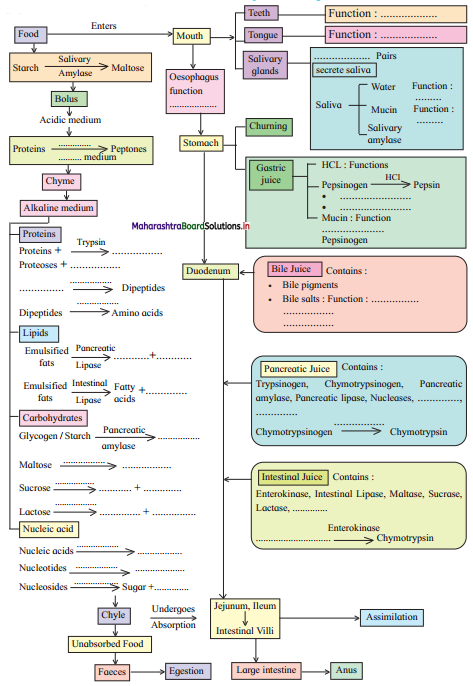
1. China Rose
2. Cobra

Maharashtra Board Class 11 Biology Important Questions Chapter 2 Systematics of Living Organisms

Question 23.
Explain the following terms:

  1. Species
  2. Genus
  3. Family
  4. Order
  5. Class
  6. Division/Phylum
  7. Sub kingdom
  8. Kingdom

Answer:
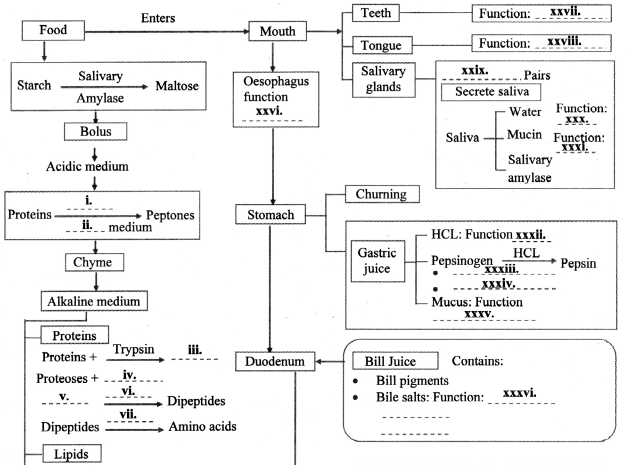
(i) Species:
(a) Species is the principal natural taxonomic unit, ranking below a genus.
(b) It is a group of organisms that can interbreed under natural condition to produce fertile offspring.
(c) It was thought to be an indivisible, stable and static unit.
(d) However, in the modem taxonomy, subdivision of species such as sub-species, varities and populations are seen and given more importance.

(ii) Genus:

(a) Genus is a taxonomic rank or category larger than species used in the biological classification of living and fossil organisms.
(b) Genus is a group of species bearing close resemblance to one another in their morphological characters but they do not interbreed.
(c) For e.g. Tiger, Leopard, Lion all three belong to same genus Panthera. They have common characters yet are different from each other because their genus is same but species is different.
(d) Another example is genus Solarium. Brinjal and potato both belong to this genus.

(iii) Family:

(a) It is one of the major hierarchial taxonomic rank.
(b) A family represents a group of closely related genera.
(c) For e.g. genera like Hibiscus, Gossypium, Sida, Bombax are included in same family Malvaceae.
(d) Although, there are many similarities between cat and dog, cat belongs to the family of leopards, tigers and lions, i.e. family Felidae and dog belongs to different family i.e. Canidae.

(iv) Cohort/Order:

(a) It is taxonomic rank used in the classification of organisms and recognised by nomenclature codes.
(b) An order is a group of closely related families showing definite affinities.
(c) Members belonging to same order but different families may show very few dissimilarities.
(d) For e.g. family Papaveraceae, Brassicaceae, Capparidaceae, etc with parietal placentation are grouped in order Parietales.
(e) Families of dogs and cats though are different, they belong to same order Carnivora.

(v) Class:

(a) The class is the distinct taxonomic rank of biological classification having its own distinctive name.
(b) Class is the assemblage of closely allied orders.
(c) For e.g. Orders Carnivora and order Primates belong to class Mammalia. Thus monkeys, gorillas, gibbons (Primates) and dogs, cats, tigers (Carnivora) belong to same class.

(vi) Division/ Phylum:

(a) The division is a category composed of related classes.
(b) For e.g. division Angiospermae includes two classes Dicotyledonae and Monocotyledonae.
(c) In animal classification, instead of division, the category Phylum is used.

(vii) Sub-kingdom:

(a) Different divisions having some similarities form sub-kingdom.
(b) The divisions Angiospermae and Gymnospermae forms the sub-kingdom Phanerogams or Spermatophyta (all seed producing plants).

(viii) Kingdom:

(a) It is the highest taxonomic category composed of different sub-kingdoms.
(b) For e.g. sub-kingdom Phanerogams and Cryptogams form the Plant kingdom or Plantae which includes all the plants, while all animals are included in kingdom Animalia.

Maharashtra Board Class 11 Biology Important Questions Chapter 2 Systematics of Living Organisms

Question 24.
Define nomenclature.
Answer:
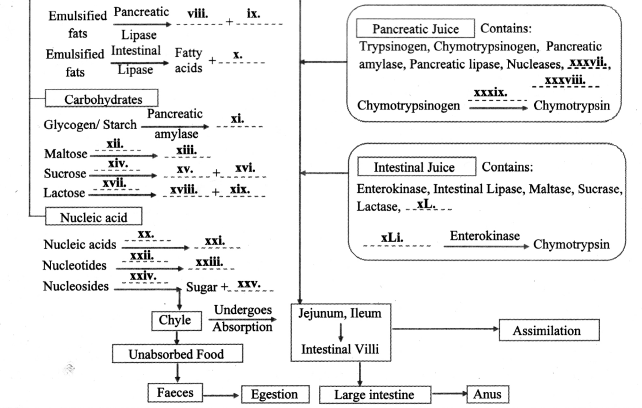
The art of giving name to the organism is called nomenclature.

Question 25.
What is meant by vernacular name?
Answer:
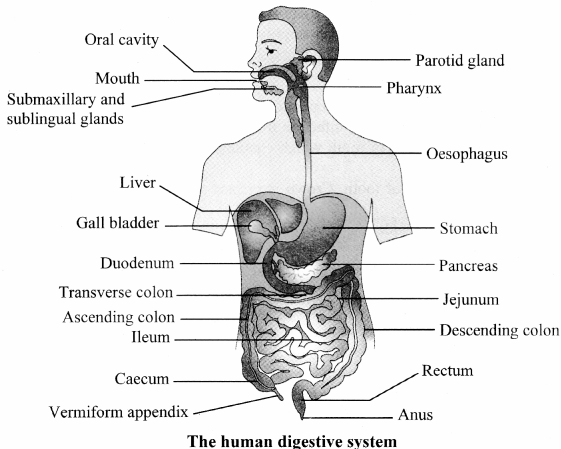
Vernacular names are the names which are given to organisms in a particular region and language by local people.

Question 26.
What are the disadvantages of vernacular names of organisms?
Answer:
Disadvantages of vernacular names/ local names/ common names:

  1. Vernacular names do not indicate the necessary information about the organism.
  2. It does not indicate proper relationship of the organisms.
  3. Vernacular names are not universal, e.g. Pansy (Viola tricolor L.) grown in most European and American gardens has about 50 common english names. In Ayurveda, mango (Mangifera indica L.) is known by over 50 different names which are in Sanskrit language.
  4. Vernacular names have limited usage.
  5. Local names are different and confusing.

Question 27.
Who proposed binomial system of nomenclature?
Answer:
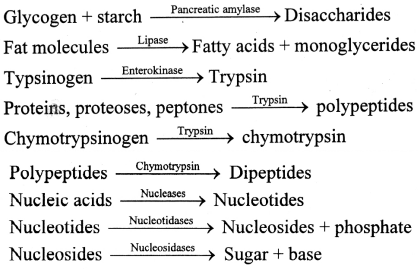
Swedish naturalist Carl Linnaeus proposed binomial system of nomenclature.

Maharashtra Board Class 11 Biology Important Questions Chapter 2 Systematics of Living Organisms

Question 28.
What is binomial nomenclature? Give the rules for binomial nomenclature.
Answer:
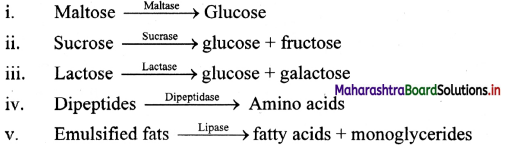
1. A system of nomenclature of plants and animals in which the scientific name consists of two words or parts or epithets is called binomial nomenclature.
2. This system of nomenclature was developed by Carl Linnaeus. He gave certain principles for this nomenclature in his book ‘Species Plantarum’.

Rules of binomial nomenclature:

  1. The name of the organism is composed of two Latin or Greek words.
  2. Generic epithet is a simple noun which should come first and always begin with a capital letter.
  3. Specific epithet is the descriptive adjective which should come later and begin with a small letter.
  4. The generic and specific epithet must be underlined separately if hand written or in italics when printed.
  5. The generic as well as specific epithet should not have less than three letters and more than thirteen letters.
  6. Usually the name of the author who names a plant or animal is also written in full or abbreviated form after scientific name. e.g. Mangifera indica L. Where L stands for Linnaeus.

Question 29.
In Mangifera indica L., what does letter ‘L’ indicate?
Answer:
In Mangifera indica L., letter L indicates author’s name i.e. Linnaeus.

Question 30.
Which kingdoms were included in two kingdom system of classification? Who introduced it?
Answer:
The two-kingdom system of classification included Kingdom plantae and Kingdom animalia. This system was introduced by Carl Linnaeus.

Question 31.
What was the drawback of two kingdom system of classification?
Answer:
Two kingdom system was found inadequate for classification of some organisms like bacteria, fungi, Euglena, etc.

Question 32.
Who suggested five kingdom system of classification?
Answer:
R.H. Whittaker suggested five kingdom system of classification.

Question 33.
Match the following.

Column IColumn II
1. Vibrioa. Rod-shaped
2. Bacillusb. Spherical
3. Spirillumc. Spiral shaped
d. Comma or kidney-shaped

Answer:

Column IColumn II
1. Vibriod. Comma or kidney-shaped
2. Bacillusa. Rod-shaped
3. Spirillumc. Spiral shaped

Maharashtra Board Class 11 Biology Important Questions Chapter 2 Systematics of Living Organisms

Question 34.
Identify the different shapes of bacterial cells shown in the given figures:
Maharashtra Board Class 11 Biology Important Questions Chapter 2 Systematics of Living Organisms 1
Answer:
Figure a: Coccus;
Figure b: Coccobacillus;
Figure c: Vibrio
Figure d: Bacillus;
Figure e: Spirillum; Figure f: Spirochete

Question 35.
What are Archaebacteria?
Answer:

  1. These are the most primitive type of bacteria.
  2. They are differentiated from other bacteria on the basis of their different cellular features.
  3. These bacteria are mostly found in the extreme environmental conditions, hence called extremophiles.
  4. Bacteria that can withstand high salinities are called halophiles, while those that withstand extreme temperature are known as thermophiles.
  5. Methanogenic bacteria found in gut of ruminants (cows and buffaloes) help in production of methane in biogas plants.

Question 36.
Why are archaebacteria called extremophiles?
Answer:

  • These bacteria are mostly found in the extreme environments, hence called extremophiles.
  • They have capacity to survive in very severe conditions.
  • They are found in a variety of places from volcanic craters to salty lakes and hot springs.

Question 37.
Write in detail about Eubacteria.
Answer:
Eubaceria:

  1. These are commonly referred as true bacteria.
  2. They have cell wall made up of peptidoglycan.
  3. Eubacteria are mostly heterotrophic, few are autotrophic.
  4. The autotrophs can be photosynthetic like Chlorobium (Green sulphur bacteria) and Chromatium or chemosynthetic like sulphur bacteria.
  5. These are mostly multicellular filamentous forms living in fresh water.
  6. Filaments show heterocyst which helps in nitrogen fixation.
  7. The body is covered by mucilaginous sheath.
  8. The genetic material is typical prokaryotic.
  9. The photosynthetic pigments include Chl-a, Chl-b, carotenes and xanthophylls.
  10. Most of them are decomposers that help in breaking down large molecules in simple molecules or minerals.

Question 38.
Write a short note on useful and harmful bacteria.
Answer:
(i) Useful bacteria:
Most of the bacteria act as a decomposer. They breakdown large molecules in simple molecules or minerals. Examples of some useful bacteria:
Lactobacillus’. It helps in curdling of milk.
Azotobacter. It helps to fix nitrogen for plants.
Streptomyces: It is used in antibiotic production such as streptomycin.
Methanogens: These are used for production of methane (biogas) gas from dung.
Pseudomonas spp. and Alcanovorax borkumensis: These bacteria have the ability to destroy the pyridines and other chemicals. Hence, used to clear the oil spills.

(ii)Harmful bacteria:
This includes disease causing bacteria. They cause various diseases like typhoid, cholera, tuberculosis, tetanus, etc. Examples of some harmful bacteria:
Salmonella typhi: It is a causative organism of typhoid.
Vibrio cholerae: It causes cholera.
Mycobacterium tuberculosis’. It causes tuberculosis.
Clostridium tetani: It causes tetanus.
Clostridium spp.: It causes food poisoning.
Many forms of mycoplasma are pathogenic.
Agrobacterium , Erwinia, etc are the pathogenic bacteria causing plant diseases.
Animals and pets also suffer from bacterial infections caused by Brucella, Pastrurella, etc.

Maharashtra Board Class 11 Biology Important Questions Chapter 2 Systematics of Living Organisms

Question 39.
Identify label X and Y in the given figure of Cyanobacteria (Nostoc).
Answer:
Maharashtra Board Class 11 Biology Important Questions Chapter 2 Systematics of Living Organisms 2

Question 40.
what is Mycoplasma?
Answer:

  1. These are the smallest living cells known.
  2. They lack cell wall.
  3. Many forms are pathogenic.
  4. They are resistant to common antibiotics because they lack cell wall.

Question 41.
Identify the following diagram, label it and write detail information in your words.
Answer:
The given figure represents Paramoecium.
Characteristics:

  1. It belongs to kingdom Protista. It is further classified as animal like protist.
  2. It lacks cell wall.
  3. It shows heterotrophic and holozoic nutrition.
  4. It is a ciliated protozoan where locomotion is due to cilia.
  5. It has gullet (a cavity) which opens on the cell surface.

Question 42.
Which kingdom shows link with all eukaryotic members?
Answer:
Kingdom Protista shows link with all eukaryotic kingdoms such as kingdom plantae, fungi and animalia.

Question 43.
Unicellular eukaryotic organisms are included in which kingdom?
Answer:
Unicellular eukaryotic organisms are included in kingdom Protista.

Maharashtra Board Class 11 Biology Important Questions Chapter 2 Systematics of Living Organisms


Question 44.
Give different types of Protists with examples.
Answer:
Protists are of different types:
(i) Plant like protists (Photosynthetic protists):
(a) They are termed as phytoplanktons, also known as Chrysophytes.
(b) They are autotrophic (photosynthetic) in nature and form major producers of ocean ecosystem.
(c)Most of them are referred as Diatoms because they have body wall made up of two soap-box like fitting silica covers. E.g. Diatoms.

1. Dinoflagellates:
(i) They are aquatic (mostly marine) and autotrophic (photosynthetic).
(ii) They have wide range of photosynthetic pigments which can be yellow, green, brown, blue and red.
(iii) The cell wall is made up of cellulosic stiff plates.
(iv) A pair of flagella is present, hence they are motile.
(v) They are responsible for famous ‘red tide’. E.g. Gonyaulax. It makes sea appear red.

2. Euglenoids:
(i) They lack cell wall but have a tough covering of proteinaceous pellicle.
(ii) Pellicle covering provides flexibility and contractibility to Euglena.
(iii) They possess two flagella, one short and other long.
(iv) They behave as heterotrophs in absence of light but possess pigments, similar to that of higher plants, for photosynthesis.

(ii) Animal like protists (Consumer protists):
(a) They are the primitive animal forms.
(b) They are also termed as protozoans.
(c) These are heterotrophic and lack cell wall.
(d) Amoeboid protozoans have pseudopodia as locomotory organs. E.g. Amoeba, Entamoeba.
Amoeba is free living form, but Entamoeba is endoparasite and causes amoebic dysentery.
(e) Flagellated protozoans have flagella as locomotory organ. E.g. Trypanosoma.
(f) Cilliated protozoans have cilia for locomotion. E.g. Paramoecium.
(g) Plasmodium is a Sporozoan protozoa. It causes malaria. It forms spores in one of its life stages.

(iii) Fungi like protists (Consumer decomposer protists):
(a) They form a group called Myxomycetes.
(b) They are saprophytic in nature, found on decaying leaves.
(c) Their cells aggregate to form a large cell mass called plasmodium.
(d) The spores of plasmodium are very tough and survive extreme conditions, e.g. Slime molds.

Question 45.
Why diatoms are used in filtration and polishing?
Answer:
Diatoms forms a substance called Diatomaceous earth. These are the shells of diatoms containing silica that left behind for many years. Diatomaceous earth is granular; hence it is used in polishing and filtration.

Maharashtra Board Class 11 Biology Important Questions Chapter 2 Systematics of Living Organisms

Question 46.
Label the given figures representing ventral and dorsal view of Gonyaulax.
Maharashtra Board Class 11 Biology Important Questions Chapter 2 Systematics of Living Organisms 3
Answer:
Maharashtra Board Class 11 Biology Important Questions Chapter 2 Systematics of Living Organisms 4

Question 47.
Identify the following diagram, label it and write detail information in your words.
Answer:
The given figure represents Euglena.
Characteristics:
(i) It belongs to kingdom Protista. It is further classified into euglenoids.

1. Dinoflagellates:

  1. They are aquatic (mostly marine) and autotrophic (photosynthetic).
  2. They have wide range of photosynthetic pigments which can be yellow, green, brown, blue and red.
  3. The cell wall is made up of cellulosic stiff plates.
  4. A pair of flagella is present, hence they are motile.
  5. They are responsible for famous ‘red tide’. E.g. Gonyaulax. It makes sea appear red.

2. Euglenoids:

  1. They lack cell wall but have a tough covering of proteinaceous pellicle.
  2. Pellicle covering provides flexibility and contractibility to Euglena.
  3. They possess two flagella, one short and other long.
  4. They behave as heterotrophs in absence of light but possess pigments, similar to that of higher plants, for photosynthesis.

Maharashtra Board Class 11 Biology Important Questions Chapter 2 Systematics of Living Organisms

Question 48.
Write the characteristics of Kingdom plantae.
Answer:
Characteristics of Kingdom plantae:

  1. Kingdom plantae is dominated by autotrophs.
  2. Some members are insectivorous plants. E.g. Venus fly trap, pitcher plant, bladderwort, while some are heterotrophic parasitic members like Cuscuta.
  3. Members of this kingdom are eukaryotic, multicellular, having eukaryotic cells containing chlorophyll.
  4. Their cell wall is mostly made up of cellulose.
  5. They exhibit alternation of generation i.e. life cycle has two distinct phases.
  6. It is divided into two major groups Cryptogams and Phanerogams.

Question 49.
Give the general characters of Kingdom Fungi with examples.
Answer:
General characters of Kingdom Fungi:
1. Type of organisms: It is a unique kingdom of eukaryotic heterotrophic organisms, showing extracellular digestion. They may be unicellular or multicellular and filamentous. These are commonly found in warm and humid places.
2. Nucleus: The cells may be multinucleate or uninucleate.
3. Body: Multicellular organisms consist of a body called mycelium in which a number of thread or fibre-like structures called hyphae are present. The hyphae may be with septa (septate) or without septa (aseptate). The non-septate multinucleated hyphae are called coenocytic hyphae.
4. Cell wall: The cell wall in fungi is composed of chitin or fungal cellulose.
5. Cell organelles: The fungi contain well organized membrane bound cell organelles except the chloroplasts.
6. Nutrition: The fungi exhibit heterotrophic mode of nutrition and most of the members are saprophytes and absorb food which is decomposed (digested) outside. Some are parasitic or predators.
7. Reproduction: They reproduce both sexually as well as asexually. Asexual reproduction takes place by fragmentation, fission and budding.
8. Some fungi are symbiotic. These fungi either live with algae as lichens or as mycorrhiza in association with roots of higher plants.

Question 50.
Identify the following diagram, label it and write detail information in your words.
Answer:
The given figure represents Mucor.
Characteristics:

  1. It belongs to class phycomycetes of kingdom fungi.
  2. Mycelium is made up of aseptate coenocytic hyphae.
  3. It commonly grows on decaying fruits,vegetables, in soil, on various food- stuff-like bread, jellies, jams, etc.
  4. In favourable conditions mucor reproduces asexually by formation of spores within sporangia. It can also reproduce by sexual means.

Question 51.
Identify the following diagram, label it and write detail information in your words.
Answer:
The given figure represents Aspergillus.
Characteristics:

  1. It belongs to class ascomycetes of kingdom Fungi.
  2. It is multicellular.
  3. The hyphae are branched and septate.
  4. Aspergillus grows well in soil, decaying vegetation, hay, dung, on
  5. plants, etc.
  6. Asexual reproduction takes place by spores called conidia which are produced at the tip of hyphae called conidiophores.

Maharashtra Board Class 11 Biology Important Questions Chapter 2 Systematics of Living Organisms

Question 52.
Identify the following diagram, label it and write detail information in your words.
Answer:
The given figure represents Agaricus (Mushroom).
Characteristics:

  1. It belongs to class basidiomycetes of kingdom Fungi.
  2. It has branched septate hyphae.
  3. It grows in soil, on rotten wood, etc.
  4. It is edible and rich in proteins.
  5. Vegetative reproduction takes place by fragmentation.

Question 53.
Explain how fungi exhibit heteromorphic mode of nutrition?
Answer:

  1. Most of the members of kingdom fungi are saprophytes.
  2. They absorb food which is decomposed (digested) outside.
  3. Some are parasites or predators and some are symbiotic.
  4. In fungi, chloroplast is absent, thus they cannot synthesize their own food by photosynthesis. Due to this, fungi exhibit heteromorphic mode of nutrition.

Quesiton 54.
Identify the given picture and explain in detail.
Answer:
The given picture represents Lichens.

  1. Lichen is an association of an alga and fungus.
  2. It is the best example of symbiosis or mutualism.
  3. They are found in extreme environments like snow clad poles.
  4. The algal component of lichen is phycobiont, mostly belongs to cyanobacteria (blue-green algae) or green algae and fungal component is mycobiont.
  5. Algae prepares the food and supplies it to the fungal component, while fungal component provides shelter to algae and also absorbs water and minerals for algae.
  6. The association is intense and it is difficult to identify them as separate living beings.
  7. They are very sensitive to pollutions, hence not found in polluted areas.
  8. They are used as pollution indicators.
  9. They play an important role in soil formation by using specific acid productions.
    [Note: Lichens cannot be categorized as acellular organisms]

Question 55.
Write the general characters of Kingdom Animalia with examples.
Answer:
General characters of Kingdom Animalia:

  1. Types of organisms: The organisms are multicellular and eukaryotic.
  2. Habitat: The organisms may be aquatic, terrestrial, amphibious or aerial in habitat.
  3. Cell organelles: The organisms do not possess cell wall, plastids and central vacuole.
  4. Locomotion: Majority of the animals are motile. However, few like sponges are sedentary.
  5. Sense orgAnswer: They possess sense organs, nervous system and respond to stimuli by exhibiting certain behaviour.
  6. Reproduction: They mostly reproduce sexually by producing gametes, while some can reproduce asexually.
  7. Nutrition: They are heterotrophic, mostly holozoic, sometimes parasitic.
  8. Growth: It is determinate, (follow definite pattern)

Maharashtra Board Class 11 Biology Important Questions Chapter 2 Systematics of Living Organisms

Question 56.
Observe and discuss:
Complete the following table on the basis of previous knowledge.

CharactersMoneraProtistaFungiPlantaeAnimalia
Cell typeProkaryoticEukaryoticEukaryoticEukaryoticEukaryotic
Cell wallPresent in some organismsPresent (cellulose)
Nuclear membraneAbsentPresentPresentPresent
Body organizationUnicellularMulticellular/ loose tissueTissue /organTissue            /organ system
Mode of nutritionAutotrophic Photosynthetic, HeterotrophicAutotrophic (Photosynthetic)
Ecological roleDecomposersDecomposersConsumers

Answer:

CharactersMoneraProtistaFungiPlantaeAnimalia
Cell typeProkaryoticEukaryoticEukaryoticEukaryoticEukaryotic
Cell wallPresent (Peptidoglycan)Present in some organismsPresent (chitin)Present (cellulose)Absent
Nuclear

membrane

AbsentPresentPresentPresentPresent
Body organizationUnicellularUnicellularMulticellular/ loose tissueTissue /organTissue  /organ system
Mode of nutritionHeterotrophic (saprophytic/ parasitic)

Autotrophic (Photoautotrophic/ Chemoautotrophic)

Autotrophic Photosynthetic, HeterotrophicHeterotrophic (saprophytic/ parasitic)Autotrophic (Photosynthetic)Heterotrophic (holozoic)
Ecological roleDecomposersProducers and consumersDecomposersProducersConsumers

Question 57.
Who referred virus as ‘contagium vivum fluidum’?
Answer:
M. W. Beijerinck referred virus as ‘contagium vivum fluidum (infectious living fluid).’

Question 58.
Who demonstrated that viruses are inert outside the host cell and can be crystallised?
Answer:
Stanley demonstrated that viruses are inert and can be crystallised.
[Note: Students can scan the adjacent QR code for detail classification of given tree diagram.]

Maharashtra Board Class 11 Biology Important Questions Chapter 2 Systematics of Living Organisms

Question 59.
What is the structure of virus?
Answer:

  1. Viruses are acellular and ultramicroscopic.
  2. The genetic material in viruses is either single or double-stranded RNA or double-stranded DNA.
  3. Their genetic material is protected by a protein coat called capsid.
  4. Capsid is made up of smaller units called capsomeres.
  5. Capsomeres are arranged in polyhedral or helical forms thus, imparting that particular shape to the virus.

Question 60.
Give examples of:
1. Diseases caused by viruses in plants:
2. Diseases caused by viruses in animals:
Answer:
1. Diseases caused by viruses in plants: Leaf curling, yellowing, mosaic formation, etc.
2. Diseases caused by viruses in animals: Swine flu, Small pox, mumps, herpes, common cold, AIDS, etc.

Question 61.
Write a short note on viroids.
Answer:
Viroids:

  1. These are mainly plant pathogens.
  2. Viroids were discovered by Theodor Diener.
  3. The first viroid discovered was PSTV (Potato spindle tuber viroid) which causes a disease in potato.
  4. Viroids are very small, circular, single stranded RNA which are without any protein coat.
  5. Viroids are smaller in size than viruses.

Question 62.
Apply Your Knowledge:

Question 1.
In your laboratory you accidentally discover an old permanent slide without a label. You are curious to identify it, and you place the slide under the microscope. You observe the following features:
1. Well-organized nucleus
2. Unicellular
3. Biflagellate – one placed longitudinally and the other transversely.
Answer:
All unicellular eukaryotes form a connecting link between prokaryotic Kingdom Monera and complex eukaryotic Kingdoms Plantae, Fungi and Animalia. Since the specimen shows the presence of two flagella, one placed longitudinally and the other transversely, the given organism can be dinoflagellate and has to be placed under Kingdom Protista.

Maharashtra Board Class 11 Biology Important Questions Chapter 2 Systematics of Living Organisms

Question 2.
Name the following:
1. The kingdom which includes the smallest living forms.
2. The protists which behave as heterotroph in absence of light but performs photosynthesis in presence of light
3. These are infectious single stranded RNA, smaller than virus
Answer:
1. Kingdom Monera
2. Euglena
3. Viroids

Question 63.
Quick Review
Answer:
Taxonomic Hierarchy

Kingdom → Sub-kingdom → Division/phylum → Class → Cohort /order → Family → Genus → Species

Maharashtra Board Class 11 Biology Important Questions Chapter 2 Systematics of Living Organisms 5

Question 64.
Exercise

Question 1.
Define Systematics.
Answer:
Systematics is the study of kinds and diversity of organisms and their comparative and evolutionary relationship.

Question 2.
What is classification?
Answer:
Classification is the arrangement of organisms or groups of organisms in distinct categories in accordance with a particular and well-established plan.

Maharashtra Board Class 11 Biology Important Questions Chapter 2 Systematics of Living Organisms

Question 3.
Explain different methods of classification.
Answer:
The three types of classification systems are:
(i) Artificial system:
(a) It is based on few visible, easily observable characters, which are non-evolutionary such as habit, colour, form, etc.
(b) It does not consider the affinities (relationships) among different organisms.
E.g. Linnaeus system of classification.

(ii) Natural system:
It is based on objectively significant characters with respect to their affinities with other organisms.
E.g. Bentham and Hooker’s system of classification.

(iii) Phylogenetic system:
It is based on the phylogenetic relationship between different organisms with respect to common evolutionary descent (ancestor).
E.g. Engler and Prantl’s classification.

Question 4.
Domain eukarya has which cells?
Answer:
Domain Eukarya has eukaryotic cells.

Question 5.
Name three domains of life.
Answer:
Three domains of life are Archaea, Bacteria and Eukarya.

Maharashtra Board Class 11 Biology Important Questions Chapter 2 Systematics of Living Organisms

Question 6.
Write a short note on chemotaxonomy.
Answer:
1. It is method of biological classification based on the similarities and differences in structure of certain chemical compounds present among the organisms being classified.
2. Thus, it is a classification based on chemical constituents of organisms.
3. For e.g. Cell wall with peptidoglycan is present in Bacteria while it is absent in Archaea.
Among Eukarya, fungi have chitinous cell wall, while plants have cellulosic cell wall.

Question 7.
What is numerical taxonomy? Who proposed it?
Answer:
Numerical taxonomy:

  1. It is based on quantification of characters and develops an algorithm for classification.
  2. The aim of this was to create a taxonomy using numeric algorithms like cluster analysis rather than using subjective evaluation of their properties.
  3. It was proposed by Sokel and Sneath in 1963.

Question 8.
Write a note on cladogram?
Answer:
1. It is a representation of hypothetical relationship denoting a comparison of organisms and their common ancestors.
2. It has a typical branching pattern.

Question 9.
Write a short note on phylogeny.
Answer:
Phylogeny:

  1. It is the evolutionary relationship of organism.
  2. It is an important tool in classification as it considers not merely the morphological status but also the relationship of one group of organisms with other groups of life.
  3. The system helps to understand the evolution and also focuses on the similarities of their metabolic functioning.
  4. Woese’s three domain concept, as well as Whittaker’s five-kingdom system, are examples of phylogenetic relationship.

Question 10.
Explain DNA barcoding.
Answer:
DNA barcoding is a new method for identification of any species based on its DNA sequence, which is obtained from a tiny tissue sample of the organism under study.
DNA barcoding helps to study newly identified species as well as understanding ecological and evolutionary relationships between living organisms.
The process of DNA barcoding includes two basic steps:
(i) Collecting DNA barcode data of known species.
(ii) Matching the barcode sequence of the unknown sample against the barcode library for identification.

The applications of DNA barcoding are as follows:

  1. It helps to protect endangered species.
  2. It plays an important role in preservation of natural resources.
  3. It is also used for pest control in agriculture.
  4. It is used for identification of disease vectors.
  5. It is used for authentication of natural health products.
  6. It is also used for identification of medicinal plants.

Maharashtra Board Class 11 Biology Important Questions Chapter 2 Systematics of Living Organisms

Question 11.
Explain the term taxonomic category.
Answer:

  1. Category is a rank or level in the hierarchial classification of organisms.
  2. Each category is referred to as a unit of classification.
  3. Category is a part of taxonomic arrangements hence, called taxonomic category.
  4. All categories together constitute the taxonomic hierarchy.

Question 12.
Give the classification of cobra.
Answer:
Cobra

Question 13.
Give the classification of china-rose.
Answer:
China Rose

Question 14.
What is taxon? Give any one example of it.
Answer:
1. Taxon is a group of living organisms of any rank in the system of classification.
2. In plant kingdom, each taxonomic group such as angiospermae, dicotyledonae, polypetalae, malvaceae represents a taxon.

Maharashtra Board Class 11 Biology Important Questions Chapter 2 Systematics of Living Organisms

Question 15.
Which are the units of classification?
Answer:
(i) Species:
(a) Species is the principal natural taxonomic unit, ranking below a genus.
(b) It is a group of organisms that can interbreed under natural condition to produce fertile offspring.
(c) It was thought to be an indivisible, stable and static unit.
(d) However, in the modem taxonomy, subdivision of species such as sub-species, varities and populations are seen and given more importance.

(ii) Genus:

(a) Genus is a taxonomic rank or category larger than species used in the biological classification of living and fossil organisms.
(b) Genus is a group of species bearing close resemblance to one another in their morphological characters but they do not interbreed.
(c) For e.g. Tiger, Leopard, Lion all three belong to same genus Panthera. They have common characters yet are different from each other because their genus is same but species is different.
(d) Another example is genus Solarium. Brinjal and potato both belong to this genus.

(iii) Family:

(a) It is one of the major hierarchial taxonomic rank.
(b) A family represents a group of closely related genera.
(c) For e.g. genera like Hibiscus, Gossypium, Sida, Bombax are included in same family Malvaceae.
(d) Although, there are many similarities between cat and dog, cat belongs to the family of leopards, tigers and lions, i.e. family Felidae and dog belongs to different family i.e. Canidae.

(iv) Cohort/Order:

(a) It is taxonomic rank used in the classification of organisms and recognised by nomenclature codes.
(b) An order is a group of closely related families showing definite affinities.
(c) Members belonging to same order but different families may show very few dissimilarities.
(d) For e.g. family Papaveraceae, Brassicaceae, Capparidaceae, etc with parietal placentation are grouped in order Parietales.
(e) Families of dogs and cats though are different, they belong to same order Carnivora.

(v) Class:

(a) The class is the distinct taxonomic rank of biological classification having its own distinctive name.
(b) Class is the assemblage of closely allied orders.
(c) For e.g. Orders Carnivora and order Primates belong to class Mammalia. Thus monkeys, gorillas, gibbons (Primates) and dogs, cats, tigers (Carnivora) belong to same class.

(vi) Division/ Phylum:

(a) The division is a category composed of related classes.
(b) For e.g. division Angiospermae includes two classes Dicotyledonae and Monocotyledonae.
(c) In animal classification, instead of division, the category Phylum is used.

(vii) Sub-kingdom:

(a) Different divisions having some similarities form sub-kingdom.
(b) The divisions Angiospermae and Gymnospermae forms the sub-kingdom Phanerogams or Spermatophyta (all seed producing plants).

(viii) Kingdom:

(a) It is the highest taxonomic category composed of different sub-kingdoms.
(b) For e.g. sub-kingdom Phanerogams and Cryptogams form the Plant kingdom or Plantae which includes all the plants, while all animals are included in kingdom Animalia.

Maharashtra Board Class 11 Biology Important Questions Chapter 2 Systematics of Living Organisms

Question 16.
Explain the following terms by giving one example of each:
1. Sub-kingdom
2. Genus
3. Order
Answer:
1. Sub-kingdom:

(a) Different divisions having some similarities form sub-kingdom.
(b) The divisions Angiospermae and Gymnospermae forms the sub-kingdom Phanerogams or Spermatophyta (all seed producing plants).

2. Genus:

(a) Genus is a taxonomic rank or category larger than species used in the biological classification of living and fossil organisms.
(b) Genus is a group of species bearing close resemblance to one another in their morphological characters but they do not interbreed.
(c) For e.g. Tiger, Leopard, Lion all three belong to same genus Panthera. They have common characters yet are different from each other because their genus is same but species is different.
(d) Another example is genus Solarium. Brinjal and potato both belong to this genus.

3. Cohort/Order:

(a) It is taxonomic rank used in the classification of organisms and recognised by nomenclature codes.
(b) An order is a group of closely related families showing definite affinities.
(c) Members belonging to same order but different families may show very few dissimilarities.
(d) For e.g. family Papaveraceae, Brassicaceae, Capparidaceae, etc with parietal placentation are grouped in order Parietales.
(e) Families of dogs and cats though are different, they belong to same order Carnivora.

Question 17.
‘A family represents a group of closely related genera’. Give one example to justify the statement.
Answer:
(c) For e.g. genera like Hibiscus, Gossypium, Sida, Bombax are included in same family Malvaceae.

Maharashtra Board Class 11 Biology Important Questions Chapter 2 Systematics of Living Organisms

Question 18.
What does letter ‘L’ indicates in Man gif era indica L., ?
Answer:
In Mangifera indica L., letter L indicates author’s name i.e. Linnaeus.

Question 19.
1. Define binomial nomenclature system.
2. Who proposed it?
3. Why a unique name for a particular individual is essential in a multilingual country like India?
Answer:
1. The name of the organism is composed of two Latin or Greek words.
2. Generic epithet is a simple noun which should come first and always begin with a capital letter.
3. The generic and specific epithet must be underlined separately if hand written or in italics when printed.

Question 20.
Why is binomial nomenclature useful for classification of organisms?
Answer:
Binomial nomenclature is important because:

  1. The binomials are simple, meaningful and precise.
  2. They are standard since they do not change from place to place.
  3. These names avoid confusion and uncertainty created by local or vernacular names. The organisms are known by the same name throughout the world.
  4. The binomials are easy to understand and remember.
  5. It indicates phylogeny (evolutionary history) of organisms.
  6. It helps to understand inter-relationship between organisms.

Question 21.
Which are the two kingdoms of organisms given by Carl Linnaeus? What was the drawback of this system?
Answer:
The two-kingdom system of classification included Kingdom plantae and Kingdom animalia. This system was introduced by Carl Linnaeus. Two kingdom system was found inadequate for classification of some organisms like bacteria, fungi, Euglena, etc.

Maharashtra Board Class 11 Biology Important Questions Chapter 2 Systematics of Living Organisms

Question 22.
Name the five kingdoms given by Whittaker?
Answer:
Five kingdom system of classification was proposed by R.H. Whittaker in 1969. This system shows the phylogenetic relationship between the organisms.
The five kingdoms are:

  1. Kingdom Monera
  2. Kingdom Protista
  3. Kingdom Plantae
  4. Kingdom Fungi
  5. Kingdom Animalia

Question 23.
Unicellular prokaryotic organisms are included in which kingdom?
Answer:
(i) Size: The organisms included in this kingdom are microscopic, unicellular and prokaryotic.

Question 24.
Explain kingdom Monera with the help of given points:
i. Nucleus
ii. Reproduction
iii. Nutrition
Answer:
(i) Nucleus: These organisms do not have well defined nucleus. DNA exists as a simple double stranded circular single chromosome called as nucleoid. Apart from the nucleoid they often show presence of extrachromosomal DNA which is small circular called plasmids.
(ii) Reproduction: The mode of reproduction is asexual or with the help of binary fission or budding. Very rarely, sexual reproduction occurs by conjugation method.
(iii) Nutrition: Majority are heterotrophic, parasitic or saprophytic in nutrition. Few are autotrophic that can be either photoautotrophs or chemoautotrophs.

Question 25.
Give examples of archaebacteria and eubacteria.
Answer:
Examples:
Archaebacteria: e.g. Methanobacillus, Thiobacillus, etc.
Eubacteria: e.g. Chlorobium, Chromatium, and Cyanobacteria e.g. Nostoc, Azotobacter, etc.

Question 26.
What is mycoplasma?
Answer:
1. These are the smallest living cells known.
2. They lack cell wall.
3. Many forms are pathogenic.
4. They are resistant to common antibiotics because they lack cell wall.

Maharashtra Board Class 11 Biology Important Questions Chapter 2 Systematics of Living Organisms

Question 27.
Enlist different types of protozoa.
Answer:
(ii) Animal like protists (Consumer protists):
(a) They are the primitive animal forms.
(b) They are also termed as protozoans.
(c) These are heterotrophic and lack cell wall.
(d) Amoeboid protozoans have pseudopodia as locomotory organs. E.g. Amoeba, Entamoeba.
Amoeba is free living form, but Entamoeba is endoparasite and causes amoebic dysentery.
(e) Flagellated protozoans have flagella as locomotory organ. E.g. Trypanosoma.
(f) Cilliated protozoans have cilia for locomotion. E.g. Paramoecium.
(g) Plasmodium is a Sporozoan protozoa. It causes malaria. It forms spores in one of its life stages.

Question 28.
Which are the different types of protists?
Answer:
Protists are of different types:
(i) Plant like protists (Photosynthetic protists):
(a) They are termed as phytoplanktons, also known as Chrysophytes.
(b) They are autotrophic (photosynthetic) in nature and form major producers of ocean ecosystem.
(c)Most of them are referred as Diatoms because they have body wall made up of two soap-box like fitting silica covers. E.g. Diatoms.

1. Dinoflagellates:
(i) They are aquatic (mostly marine) and autotrophic (photosynthetic).
(ii) They have wide range of photosynthetic pigments which can be yellow, green, brown, blue and red.
(iii) The cell wall is made up of cellulosic stiff plates.
(iv) A pair of flagella is present, hence they are motile.
(v) They are responsible for famous ‘red tide’. E.g. Gonyaulax. It makes sea appear red.

2. Euglenoids:
(i) They lack cell wall but have a tough covering of proteinaceous pellicle.
(ii) Pellicle covering provides flexibility and contractibility to Euglena.
(iii) They possess two flagella, one short and other long.
(iv) They behave as heterotrophs in absence of light but possess pigments, similar to that of higher plants, for photosynthesis.

(ii) Animal like protists (Consumer protists):
(a) They are the primitive animal forms.
(b) They are also termed as protozoans.
(c) These are heterotrophic and lack cell wall.
(d) Amoeboid protozoans have pseudopodia as locomotory organs. E.g. Amoeba, Entamoeba.
Amoeba is free living form, but Entamoeba is endoparasite and causes amoebic dysentery.
(e) Flagellated protozoans have flagella as locomotory organ. E.g. Trypanosoma.
(f) Cilliated protozoans have cilia for locomotion. E.g. Paramoecium.
(g) Plasmodium is a Sporozoan protozoa. It causes malaria. It forms spores in one of its life stages.

(iii) Fungi like protists (Consumer decomposer protists):
(a) They form a group called Myxomycetes.
(b) They are saprophytic in nature, found on decaying leaves.
(c) Their cells aggregate to form a large cell mass called plasmodium.
(d) The spores of plasmodium are very tough and survive extreme conditions, e.g. Slime molds.

Question 29.
What are dinoflagellates?
Answer:
Protists are of different types:
(i) Plant like protists (Photosynthetic protists):
(a) They are termed as phytoplanktons, also known as Chrysophytes.
(b) They are autotrophic (photosynthetic) in nature and form major producers of ocean ecosystem.
(c)Most of them are referred as Diatoms because they have body wall made up of two soap-box like fitting silica covers. E.g. Diatoms.

1. Dinoflagellates:
(i) They are aquatic (mostly marine) and autotrophic (photosynthetic).
(ii) They have wide range of photosynthetic pigments which can be yellow, green, brown, blue and red.
(iii) The cell wall is made up of cellulosic stiff plates.
(iv) A pair of flagella is present, hence they are motile.
(v) They are responsible for famous ‘red tide’. E.g. Gonyaulax. It makes sea appear red.

Question 30.
Explain animal like protists.
Answer:
(ii) Animal like protists (Consumer protists):
(a) They are the primitive animal forms.
(b) They are also termed as protozoans.
(c) These are heterotrophic and lack cell wall.
(d) Amoeboid protozoans have pseudopodia as locomotory organs. E.g. Amoeba, Entamoeba.
Amoeba is free living form, but Entamoeba is endoparasite and causes amoebic dysentery.
(e) Flagellated protozoans have flagella as locomotory organ. E.g. Trypanosoma.
(f) Cilliated protozoans have cilia for locomotion. E.g. Paramoecium.
(g) Plasmodium is a Sporozoan protozoa. It causes malaria. It forms spores in one of its life stages.

Question 31.
Give examples of insectivorous plants.
Answer:
(ii) Some members are insectivorous plants. E.g. Venus fly trap, pitcher plant, bladderwort, while some are heterotrophic parasitic members like Cuscuta.

Question 32.
What are the two major group in which kingdom plantae is divided?
Answer:
(vi) It is divided into two major groups Cryptogams and Phanerogams.

Maharashtra Board Class 11 Biology Important Questions Chapter 2 Systematics of Living Organisms

Question 33.
Explain fungi like protist.
Answer:
(iii) Fungi like protists (Consumer decomposer protists):
(a) They form a group called Myxomycetes.
(b) They are saprophytic in nature, found on decaying leaves.
(c) Their cells aggregate to form a large cell mass called plasmodium.
(d) The spores of plasmodium are very tough and survive extreme conditions, e.g. Slime molds.

Question 34.
What are the characteristics of euglenoids?
Answer:
Euglenoids:

  1. They lack cell wall but have a tough covering of proteinaceous pellicle.
  2. Pellicle covering provides flexibility and contractibility to Euglena.
  3. They possess two flagella, one short and other long.
  4. They behave as heterotrophs in absence of light but possess pigments, similar to that of higher plants, for photosynthesis.

Question 35.
Explain in detail general characters of Kingdom Fungi.
Answer:
Euglenoids:

  1. They lack cell wall but have a tough covering of proteinaceous pellicle.
  2. Pellicle covering provides flexibility and contractibility to Euglena.
  3. They possess two flagella, one short and other long.
  4. They behave as heterotrophs in absence of light but possess pigments, similar to that of higher plants, for photosynthesis.

Question 36.
Why do fungi exhibit heterotrophic mode of nutrition?
Answer:
Nutrition: The fungi exhibit heterotrophic mode of nutrition and most of the members are saprophytes and absorb food which is decomposed (digested) outside. Some are parasitic or predators.

Question 37.
Name the four classes of kingdom fungi.
Answer:
Fungi are classified into four types on the basis of their structure, mode of spore formation and fruiting bodies as follows:
1. Phycomycetes:
Members of this class are commonly called as algal fungi.
These are consisting of aseptate coenocytic hyphae.
They grow well in moist and damp places on decaying organic matter as well as in aquatic habitats or as parasites on plants.
e.g. Mucor, Rhizopus (bread mold), Albugo (parasitic fungus on mustard).

2. Ascomycetes:
These are commonly called as sac fungi.
These are multicellular. Rarely they are unicellular (e.g. Yeast).
Hyphae are branched and septate.
They can be decomposers, parasites or coprophilous (grow on dung).
Some varieties of this class are consumed as delicacies such as morels and truffles.
Neurospora is useful in genetic and biochemical assays.
e.g. Aspergillus, Penicillium, Neurospora, Claviceps, Saccharomyces (unicellular ascomycetes).

3. Basidiomycetes:
These are commonly called as club fungi.
They have branched septate hyphae.
e.g. Agaricus (mushrooms), Ganoderma (bracket fungi), Ustilago (smuts), Puccinia (rusts), etc.

4. Deuteromycetes:
It is a group of fungi which are known to reproduce only asexually.
They are commonly called imperfect fungi.
They are mainly decomposers, while few are parasitic, e.g. Alternaria.

Maharashtra Board Class 11 Biology Important Questions Chapter 2 Systematics of Living Organisms

Question 38.
Explain in detail the class of kingdom fungi which includes yeast.
Answer:
Ascomycetes:

  1. These are commonly called as sac fungi.
  2. These are multicellular. Rarely they are unicellular (e.g. Yeast).
  3. Hyphae are branched and septate.
  4. They can be decomposers, parasites or coprophilous (grow on dung).
  5. Some varieties of this class are consumed as delicacies such as morels and truffles.
  6. Neurospora is useful in genetic and biochemical assays.
    e.g. Aspergillus, Penicillium, Neurospora, Claviceps, Saccharomyces (unicellular ascomycetes).

Question 39.
Why deuteromycetes are called imperfect fungi?
Answer:
Deuteromycetes:

  • It is a group of fungi which are known to reproduce only asexually.
  • They are commonly called imperfect fungi.
  • They are mainly decomposers, while few are parasitic, e.g. Alternaria.

Question 40.
What are lichens?
Answer:
The given picture represents Lichens.

  1. Lichen is an association of an alga and fungus.
  2. It is the best example of symbiosis or mutualism.
  3. They are found in extreme environments like snow clad poles.
  4. The algal component of lichen is phycobiont, mostly belongs to cyanobacteria (blue-green algae) or green algae and fungal component is mycobiont.
  5. Algae prepares the food and supplies it to the fungal component, while fungal component provides shelter to algae and also absorbs water and minerals for algae.
  6. The association is intense and it is difficult to identify them as separate living beings.
  7. They are very sensitive to pollutions, hence not found in polluted areas.
  8. They are used as pollution indicators.
  9. They play an important role in soil formation by using specific acid productions.
    [Note: Lichens cannot be categorized as acellular organisms]

Maharashtra Board Class 11 Biology Important Questions Chapter 2 Systematics of Living Organisms

Question 41.
What is the fungal partner in lichen called?
Answer:
The algal component of lichen is phycobiont, mostly belongs to cyanobacteria (blue-green algae) or green algae and fungal component is mycobiont.

Question 42.
What is the algal partner in lichen called?
Answer:
The algal component of lichen is phycobiont, mostly belongs to cyanobacteria (blue-green algae) or green algae and fungal component is mycobiont.

Question 43.
Why lichens are considered as pollution indicators?
Answer:
They are very sensitive to pollutions, hence not found in polluted areas.

Question 44.
Holozoic mode of nutrition is observed in which kingdom?
Answer:
Nutrition: They are heterotrophic, mostly holozoic, sometimes parasitic.

Question 45.
Who coined the name contagium vivum fluidum?
Answer:
M. W. Beijerinck referred virus as ‘contagium vivum fluidum (infectious living fluid).’

Question 46.
What is the genetic material in viruses?
Answer:
Viruses possess their own genetic material in the form of either DNA or RNA, but never both. The genetic material in viruses is covered by a protein coat (capsid), hence called nucleoprotein.

Question 47.
What are bacteriophages?
Answer:
Bacteriophage:
(a) They have tadpole-like shape.
(b) They infect bacteria and hence are called as bacteriophage.
(c) Bacteriophages were discovered by Twort.
(d) Bacteriophages have double stranded DNA as the genetic material.
(e) Its body consists of head, collar and tail.

Question 48.
Give example of viral disease caused in humans.
Answer:
Diseases caused by viruses in animals: Swine flu, Small pox, mumps, herpes, common cold, AIDS, etc.

Question 49.
Who discovered viroids?
Answer:
Viroids were discovered by Theodor Diener.

Question 50.
What is the genetic material in viroids?
Answer:
Viroids are very small, circular, single stranded RNA which are without any protein coat.

Maharashtra Board Class 11 Biology Important Questions Chapter 2 Systematics of Living Organisms

Question 51.
Multiplechoice Questions:

Question 1.
The term ‘Taxonomy’ was coined by
(A) Carl Linnaeus
(B) A.P. de Candolle
(C) Carl Woese
(D) R.H Whittaker
Answer:
(B) A.P. de Candolle

Question 2.
Arrangement of organisms into distinct categories is called
(A) Taxonomy
(B) Taxon
(C) Nomenclature
(D) Classification
Answer:
(D) Classification

Question 3.
The domain known for its survival in very extreme condition like high temperature, salinity, etc. is
(A) Eukarya
(B) Archaea
(C) Bacteria
(D) Cyanobacteria
Answer:
(B) Archaea

Question 4.
Kingdom Protista, Fungi, Plantae and Animalia are included under domain
(A) Eukarya
(B) Archaea
(C) Bacteria
(D) Cyanobacteria
Answer:
(A) Eukarya

Question 5.
Which system of classification was based upon easily observable characters?
(A) Natural
(B) Phylogenetic
(C) Artificial
(D) DNA barcoding
Answer:
(C) Artificial

Question 6.
System based upon chemical constituents of organisms is
(A) Cladogram
(B) Phylogeny
(C) DNA barcoding
(D) chemotaxonomy
Answer:
(D) chemotaxonomy

Maharashtra Board Class 11 Biology Important Questions Chapter 2 Systematics of Living Organisms

Question 7.
Woese’s three domain and Whittaker’s five kingdom concept is based upon
(A) Visible characters
(B) Phylogenetic relationship
(C) Numerical taxonomy
(D) DNA barcoding
Answer:
(B) Phylogenetic relationship

Question 8.
A taxonomic group of any rank is called
(A) grade
(B) category
(C) variety
(D) taxon

Question 9.
One of the following has correct descending sequence hierarchy
(A) class, division, order, family
(B) division, class, order, family
(C) order, family, class, division
(D) family, order, class, genus
Answer:
(B) division, class, order, family

Question 10.
Which among the following is an order?
(A) Malvales
(B) Polypetalae
(C) Angiospermae
(D) Hibiscus
Answer:
(A) Malvales

Question 11.
The basic unit of classification
(A) genus
(B) species
(C) kingdom
(D) family
Answer:
(B) species

Maharashtra Board Class 11 Biology Important Questions Chapter 2 Systematics of Living Organisms

Question 12.
As we go higher in taxonomical ladder i.e. from species to kingdom, the number of common characters
(A) remains constant
(B) goes on increasing
(C) goes on decreasing
(D) increases till class and then starts decreasing
Answer:
(C) goes on decreasing

Question 13.
Group of species which resemble closely in morphological characters but do not interbreed is called
(A) genus
(B) species
(C) family
(D) order
Answer:
(A) genus

Question 14.
Highest category of taxonomy is
(A) species
(B) class
(C) order
(D) kingdom
Answer:
(D) kingdom

Question 15.
Carl Linnaeus introduced binomial system of nomenclature in his book
(A) Species Plantarum
(B) ICBN
(C) Plantarum Linnaeus
(D) Species Linnaeus
Answer:
(A) Species Plantarum

Question 16.
Before 2011, scientific names were confirmed by
(A) ICBN
(B) IBC
(C) ICZN
(D) IBA
Answer:
(A) ICBN

Maharashtra Board Class 11 Biology Important Questions Chapter 2 Systematics of Living Organisms

Question 17.
Which code is also known as “Shenzhen code”?
(A) ICBN
(B) IBC
(C) ICZN
(D) IBA
Answer:
(B) IBC

Question 18.
In Helianthus annuus, ‘annuus ’ indicates
(A) genus
(B) species
(C) family
(D) class
Answer:
(B) species

Question 19.
In five kingdom classification, unicellular prokaryotes are included in kingdom
(A) Protista
(B) Fungi
(C) Monera
(D) Animalia
Answer:
(C) Monera

Question 20.
The bacteria that can withstand high salinities are called
(A) Saltophiles
(B) Thermophiles
(C) Halophiles
(D) Psychrophiles
Answer:
(C) Halophiles

Question 21.
The bacteria that can withstand extreme temperature are known as
(A) Saltophiles
(B) thermophiles
(C) Halophiles
(D) both (A) and (C)
Answer:
(B) thermophiles

Question 22.
Bacillus is
(A) comma shaped
(B) rod shaped
(C) kidney shaped
(D) spiral
Answer:
(B) rod shaped

Maharashtra Board Class 11 Biology Important Questions Chapter 2 Systematics of Living Organisms

Question 23.
Which organism belongs Monera?
(A) Cyanobacteria
(B) Mushroom
(C) Euglena
(D) Moss
Answer:
(A) Cyanobacteria

Question 24.
_________ is an example of plant like protists.
(A) Diatoms
(B) Ustilago
(C) Entamoeba
(D) Euglena
Answer:
(A) Diatoms

Question 25.
Fungi like protist are also called as ________.
(A) Myxomycetes
(B) Mycomycetes
(C) Mycoplasm
(D) Yeast
Answer:
(A) Myxomycetes

Quesiton 26.
The body of a fungus is made up of
(A) hyphae
(B) sporangium
(C) rhizoid
(D) fruiting body
Answer:
(A) hyphae

Question 27.
Agaricus belongs to class
(A) Deuteromycetes
(B) Phycomycetes
(C) Basidiomycetes
(D) Ascomycetes
Answer:
(C) Basidiomycetes

Maharashtra Board Class 11 Biology Important Questions Chapter 2 Systematics of Living Organisms

Question 28.
Which of the following is harmful fungus that causes diseases in plants?
(A) Puccinia
(B) Mushroom
(C) Yeast
(D) Streptomyces
Answer:
(A) Puccinia

Question 29.
Which of the following is NOT true about kingdom animalia?
(A) Members are heterotrophs.
(B) They lack chlorophyll as well as cell wall.
(C) Growth is indeterminate.
(D) Most of the members have capacity of locomotion.
Answer:
(C) Growth is indeterminate.

Question 30.
Which of the following are virus free varieties of banana produced by tissue culture technique?
(A) Shrimanti
(B) Basarai
(C) G-9
(D) All of these
Answer:
(D) All of these

Question 31.
The fungal component of lichen is called
(A) phycobiont
(B) photobiont
(C) mycobiont
(D) symbiont
Answer:
(C) mycobiont

Maharashtra Board Class 11 Biology Important Questions Chapter 2 Systematics of Living Organisms

Question 52.
Competitive Corner:

Question 1.
Which of the following is against the rules of ICBN?
(A) Generic and specific names should be written starting with small letters.
(B) Hand written scientific names should be underlined.
(C) Every species should have a generic name and a specific epithet.
(D) Scientific names are in Latin and should be italized.
Hint: The generic name should start with a capital letter while the species name should start with small letter.
Answer:
(A) Generic and specific names should be written starting with small letters.

Question 2.
Select the correctly written scientific name of Mango which was first described by Carolus Linnaeus: [NEET Odisha 2019]
(A) Mangifera indica
(B) Mangifera Indica
(C) Mangifera indica Car. Linn.
(D) Mangifera indica Linn
Hint: The author’s name appears after the specific epithet i.e. at the end of the biological name in this manner – Mangifera indica Linn.
Answer:
(D) Mangifera indica Linn

Question 3.
Match the organisms in Column I with habitats in Column II.

Column IColumn II
1. Halophiles(a) Hot springs
2. Thermoacidophiles(b) Aquatic environment
3. Methanogens(c) Guts of ruminants
4. Cyanobacteria(d) Salty areas

Select the correct answer from the options given below:
(A) i – b, ii – d, iii – c, iv – a
(B) i – d, ii – a, iii – c, iv – b
(C) i – a, ii – b, iii – c, iv – d
(D) i – c, ii – d, iii – b, iv – a
Answer:
(B) i – d, ii – a, iii – c, iv – b

Maharashtra Board Class 11 Biology Important Questions Chapter 2 Systematics of Living Organisms

Question 4.
Which of the following statements is CORRECT?
(A) Lichens are not good pollution indicators.
(B) Lichens do not grow in polluted areas.
(C) Algal component of lichens is called mycobiont.,
(D) Fungal component of lichens is called phycobiont.
Hint: Lichens bare good pollution indicators as they do not grow in polluted areas.
Answer:
(B) Lichens do not grow in polluted areas.

Question 5.
Match Column – I with Column – II. Choose the correct answer from the options given below:

Column – IColumn – II
1. Saprophyte(a) Symbiotic association of fungi with plants roots
2. Parasite(b) Decomposition of dead
3. Lichens(c) Living on living plants or animals
4. Mycorrhiza(d) Symbiotic association of algae and fungi

(A) i – q, ii – p, iii – r, iv – s
(B) i – q, ii – r, iii – s, iv – p
(C) i – p, ii – q, iii – r, iv – s
(D) i – r, ii – q, iii – p, iv – s
Answer:
(B) i – q, ii – r, iii – s, iv – p

Question 6.
Lowest category in the hierarchial system of classification is
(A) species
(B) order
(C) kingdom
(D) genus
Answer:
(A) species

Maharashtra Board Class 11 Biology Important Questions Chapter 2 Systematics of Living Organisms

Question 7.
Which group of fungi is called imperfect fungi?
(A) Ascomycetes
(B) Phycomycetes
(C) Deuteromycetes
(D) Basidiomycetes
Answer:
(C) Deuteromycetes

Question 8.
Which one of the following is an Incorrect pair?
(A) Three kingdom system of classification → Haeckel
(B) Three domain system of classification → Adolf Mayr
(C) Five Kingdom system of classification → R.H.Whittaker
(D) Two kingdom system of classification → Carolus Linnaeus
Hint: Three domain system of classification → Carl Woese
Answer:
(B) Three domain system of classification → Adolf Mayr

Question 9.
In the system of classification, which one of the following is NOT a category?
(A) Kingdom
(B) Series
(C) Angiospermae
(D) Genus
Hint: Angiospermae is a taxon.
Answer:
(C) Angiospermae

Question 10.
Which one of the following characteristics is NOT shown by a virus?
(A) They are acellular.
(B) They can be crystallised.
(C) Active outside the host’s body.
(D) Have genetic material.
Hint: Viruses are inert outside the host cell.
Answer:
(C) Active outside the host’s body.

Question 11.
Select the WRONG statement.
(A) Pseudopodia are locomotory and feeding structures in Sporozoans.
(B) Mushrooms belong to Basidiomycetes.
(C) Cell wall is present in members of Fungi and Plantae.
(D) Mitochondria are the powerhouse of the cell in all kingdoms except Monera.
Hint: Pseudopodia are locomotory and feeding structures in Protozoans.
Answer:
(A) Pseudopodia are locomotory and feeding structures in Sporozoans.

Maharashtra Board Class 11 Biology Important Questions Chapter 2 Systematics of Living Organisms

Question 12.
Which of the following are found in extreme saline conditions?
(A) Archaebacteria
(B) Eubacteria
(C) Cyanobacteria
(D) Mycobacteria
Hint: Bacteria found in extremely saline conditions are called halophiles. Archaebacteria includes bacteria that survive in most harsh habitats such as extreme salty area, hot springs and marshy area.
Answer:
(A) Archaebacteria

Question 13.
Which among the following are the smallest living cells, known without a definite cell wall, pathogenic to plants as well as animals and can survive without oxygen?
(A) Bacillus
(B) Pseudomonas
(C) Mycoplasma
(D) Nostoc

Question 14.
Viroids differ from viruses in having
(A) DNA molecules with protein coat
(B) DNA molecules without protein coat
(C) RNA molecules with protein coat
(D) RNA molecules without protein coat
Hint: Viroids are smaller than viruses. They are regarded as sub-viral agents or free RNA, without protein coat (usually found in viruses). They are infectious RNA. e.g. Potato spindle tuber disease.
Answer:
(D) RNA molecules without protein coat

Maharashtra Board Class 11 Biology Solutions Chapter 16 Skeleton and Movement

Balbharti Maharashtra State Board 11th Biology Textbook Solutions Chapter 16 Skeleton and Movement Textbook Exercise Questions and Answers.

Maharashtra State Board 11th Biology Solutions Chapter 16 Skeleton and Movement

1. Choose the correct option

Question (A).
The functional unit of striated muscle is …………..
a. cross-bridges
b. myofibril
c. sarcomere
d. z-band
Answer:
c. sarcomere

Question (B).
A person slips from the staircase and breaks his ankle bone. Which bones are involved?
a. Carpals
b. Tarsal
c. Metacarpals
d. Metatarsals
Answer:
b. Tarsal

Maharashtra Board Class 11 Biology Solutions Chapter 16 Skeleton and Movement

Question (C).
Muscle fatigue is due to the accumulation of ……..
a. pyruvic acid
b. lactic acid
c. malic acid
d. succinic acid
Answer:
b. lactic acid

Question (D).
Which one of the following is NOT antagonistic muscle pair?
a. Flexo-extensor
b. Adductor-abductor
c. Levator-depressor
d. Sphinetro-suprinater
Answer:
d. Sphinetro-suprinater

Question (E).
Swelling of sprained foot is reduced by soaking in hot water containing a large amount of common salt,
a. due to osmosis
b. due to plasmolysis
c. due to electrolysis
d. due to photolysis
Answer:
a. due to osmosis

Question (F).
Role of calcium in muscle contraction is ……….
a. to break the cross bridges as a cofactor in the hydrolysis of ATP
b. to bind with troponin, changing its shape so that the actin filament is exposed
c. to transmit the action potential across the neuromuscular junction.
d. to re-establish the polarisation of the plasma membrane following an action potential
Answer:
b. to bind with troponin, changing its shape so that the actin filament is exposed

Question (G).
Hyper-secretion of parathormone can cause which of the following disorders?
a. Gout
b. Rheumatoid arthritis
c. Osteoporosis
d. Gull’s disease
Answer:
c. Osteoporosis

Question (H).
Select correct option between two nasal bones
Maharashtra Board Class 11 Biology Solutions Chapter 16 Skeleton and Movement 1
Answer:
(c) Maharashtra Board Class 11 Biology Solutions Chapter 16 Skeleton and Movement 2

Question 2.
Answer the following questions

Question (A).
What kind of contraction occurs in your neck muscles while you are reading your class assignment?
Answer:

  1. Isometric contractions occur in the neck muscles while reading class assignment.
  2. These contractions are important for supporting objects in a fixed position.

Maharashtra Board Class 11 Biology Solutions Chapter 16 Skeleton and Movement

Question (B).
Observe the diagram and enlist importance of ‘A’, ‘B’ and ‘C’.
Maharashtra Board Class 11 Biology Solutions Chapter 16 Skeleton and Movement 3
Answer:

  1. A – Posterior portion of vertebral foramen of atlas vertebrae; Importance – The spinal cord runs through this portion of vertebral foramen
  2. B – Anterior portion of vertebral foramen of axis vertebrae; Importance – In this portion, the odontoid process of axis vertebrae forms ‘NO’ joint.
  3. C – Inferior articular facet; Importance – It articulates with superior articular facet of axis and permits rotatory movement of head.

Question (C).
Raju intends to train biceps; while exercising using dumbbells, which joints should remain stationary and which should move?
Answer:
While performing exercise of biceps using dumbbells, the joint which should remain stationary are wrist joint or radiocarpal joint, ball and socket joint of shoulder. The only joint which should move is hinge joint of elbow.

Question (D).
In a road accident, Moses fractured his leg. One of the passers by, tied a wodden plank to the fractured leg while Moses
was rushed to the hospital Was this essential? Why?
Answer:

  1. Fracture is a significant and traumatic injury which requires medical attention however, getting timely first aid is important.
  2. If any bone is fractured, it is essential that the fractured part be immobilized to prevent further injury. It can be done with the help of any available wooden plank or batons or rulers. Thus, a wooden plank was tied to Moses’s fractured leg as a first aid for fracture.
  3. A fractured bone is immobilized to prevent the sharp edges of the fractured bone from moving and cutting tissue, muscle, blood vessels and nerves. Immobilization can also help reduce pain or control shock.

Question (E).
Sprain is more painful than fracture. Why?
Answer:

  1. A sprain is an injury that involves the ligaments (tissues that connect bones at joints), whereas a fracture is an injury that involves bones.
  2. Sprains can be of three degree: 1st degree: Mild with micro-tears, 2nd degree: Partial with visible tear in ligament, 3rd degree: Completely torn ligament.
  3. If a sprain is 3rd degree, it will be more painful than a fracture. It usually requires a surgery to fix this injury, while breaking a bone, most of the time does not require surgery.
  4. Breaks or Fractures also vary greatly. Minor fractures (like stress/ hairline fractures) are much less painful than compound/ complex fractures in which the bone may be cracked into half.
  5. Blood supply is essential for growth and regeneration. Bones are highly vascularized whereas, ligaments are not. This causes the bones to heal comparatively faster than severe sprains. Thus, the duration of enduring pain until the injury heals also differs.
  6. Also, ligaments have a rich supply of sensory nerves, which may also be responsible for an elevated sense of pain during severe sprains.

[Note: 1st and 2nd degree sprains are not very serious and may be lesser painful than a fracture. Depending on the severity of the injury, intensity of pain will vary.]

Question (F).
Why a red muscle can work for a prolonged period whereas white muscle fibre suffers from fatigue after a shorter work? (Refer to chapter animal tissues.)
Answer:

  1. Red muscle fibres contain large amount of myoglobin and mitochondria (site of aerobic respiration), whereas white muscles fibres contain lesser amount of myoglobin and mitochondria.
  2. Myoglobin is an iron-containing pigment that carries oxygen molecules to muscle tissues. Abundance of these pigments in red muscle fibres supports higher rate of aerobic respiration, whereas white muscle fibres have less mitochondria and depend upon anaerobic respiration.
  3. Anaerobic respiration in muscle white fibres leads to the production of lactic acid and accumulation of higher of levels lactic acid can result in fatigue in white muscle fibres.

Thus, red muscle fibres can perform prolonged work and show less fatigue due to accumulation of negligible amount loss or of lactic acid, whereas white muscle fibres suffer from fatigue after a shorter work due to accumulation of higher amount of lactic acid.

3. Answer the following questions in detail

Question (A).
How is the structure of sarcomere suitable for the contractility of the muscle? Explain its function according to sliding
filament theory. (Refer to chapter animal tissues.)
Answer:
i. Sarcomere is the functional unit of myofibril. It has specific arrangement of actin and myosin filaments. The components of sarcomere are organized into variety of bands and zones. Actin and myosin are referred as contractile proteins. Actin is called as thin filament whereas myosin in called as thick filament. The structure of sarcomere:

ii. ‘A’ band – dark bands present at the centre of sarcomere and contain myosin as well as actin.
‘H’ zone or Hensen’s zone – light area present at the centre of ‘A’ band
‘M’ line – present at the centre of ‘H’ zone
‘I’ band – light bands present on the either side of ‘A’ band containing only actin
Z’ line – adjacent ‘I’ bands are separated by ‘Z’ line.

iii. Sliding filament theory: It was put forth by H.E Huxley and A.F Huxley. It is also known as ‘Walk along theory’ or Ratchet theory.

  • According to the sliding filament theory, the interaction between actin and myosin filaments is the basic cause of muscle contraction. The actin filaments are interdigitated with myosin filaments.
  • The head of the myosin is joined to the actin backbone by a cross bridge forming a hinge joint. From this joint, myosin head cannot tilt forward or backward. This movement is an active process as it utilizes ATP.
  • Myosin head contains ATPase activity. It can derive energy by the breakdown of ATP molecule. This energy can be used for the movement of myosin head.
  • During contraction, the myosin head gets attached to the active site of actin filaments and pull them inwardly so that the actin filaments slide over the myosin filaments. This results in the contraction of muscle fibre.
    Maharashtra Board Class 11 Biology Solutions Chapter 16 Skeleton and Movement 6

Question (B).
Ragini, a 50 year old office goer, suffered hair-line cracks in her right and left foot in short intervals of time. She was worried about minor jerks leading to hair line cracks in bones. Doctor explained to her why it must be happening and prescribed medicines.

What must be the cause of Ragini’s problem? Why has it occurred? What precautions she should have taken earlier? What care she should take in future?
Answer:

  1. Considering Ragini’s age, she may be undergoing menopause. After menopause, oestrogen level declines resulting in lower bone density.
  2. Osteoporosis:
    • In this disorder, bones become porous and hence brittle. It is primarily age related disease and is more common in women than men.
    • Osteoporosis may be caused due to decreasing estrogen secretion after menopause, deficiency of vitamin D, low calcium diet, decreased secretion of sex hormones and thyrocalcitonin.
  3. As age advances, bone resorption outpaces bone formation. Hence, the bones lose mass and become brittle. More calcium is lost in urine, sweat, etc., than it is gained through diet. Thus, prevention of disease is better than treatment by consuming adequate amount of calcium and exercise at young age.
  4. A person with previous hairline fractures is more susceptible to reoccurrence of fractures. Hence, Ragini needs to take her medications and supplements properly, avoid jerky movements and maintain body weight.

Question (C).
How does structure of actin and myosin help muscle contraction?
Answer:
i. Myosin filament:

  1. Each myosin filament is a polymerized protein.
    Many meromyosins (monomeric proteins) constitute one thick filament.
  2. Myosin molecule consists of two heavy chains (heavy meromyosin / HMM) coiled around each other forming a double helix. One end of each of these chains is projected outwardly is known as cross bridge. This end folds to form a globular protein mass called myosin head.
  3. Two light chains are associated with each head forming 4 light chains/light meromyosin / LMM.
  4. Myosin head has a special ATPase activity. It can split ATP to produce energy.
  5. Myosin contributes 55% of muscle proteins.
  6. In sarcomere, myosin tails are arranged to point towards the centre of the sarcomere and the heads point to the sides of the myofilament band.
    Maharashtra Board Class 11 Biology Solutions Chapter 16 Skeleton and Movement 7

ii. Actin filament: It is a complex type of contractile protein. It is made up of three components:

  1. F actin: It forms the backbone of actin filament. F actin is made up of two helical strands. Each strand is composed of polymerized G actin molecules. One ADP molecule is attached to G actin molecule.
  2. Tropomyosin: The actin filament contains two additional protein strands that are polymers of tropomyosin molecules. Each strand is loosely attached to an F actin. In the resting stage, tropomyosin physically covers the active myosin-binding site of the actin strand.
  3. Troponin: It is a complex of three globular proteins, is attached approx. 2/3rd distance along each tropomyosin molecule. It has affinity for actin, tropomyosin and calcium ions. The troponin complex is believed to attach the tropomyosin to the actin. The strong affinity of troponin for calcium ions is believed to initiate the contraction process.
    Maharashtra Board Class 11 Biology Solutions Chapter 16 Skeleton and Movement 8

Question (D).
Justify the structure of atlas and axis vertebrae with respect to their position and function.
Answer:
i. Atlas vertebrae:

  1. Atlas is the ring-like, 1st cervical vertebrae. It has anterior, posterior arches and large lateral masses.
  2. It lacks centrum and spinous process. The superior surfaces of the lateral masses are concave and are known as superior articular facets.
  3. These facets articulate with the occipital condyles of the occipital bone thereby forming atlanto-occipital joints. This articulation permits ‘YES movement’ or nodding movement.
  4. The inferior surfaces of the lateral masses known as inferior articular facets articulate with axis vertebrae,

ii. Axis vertebrae:

  1. It is the 2nd cervical vertebrae.
  2. A peg-like process called odontoid process projects superiorly through the anterior portion of the vertebral foramen of the atlas.
  3. The odontoid process forms a pivot on which the atlas and head rotate. This arrangement allows ‘NO movement’ or side to side movement of the head.
  4. The articulation formed between the anterior arch of atlas, the odontoid process of the axis and between their articular facets is called as atlanto-axial joint.

Maharashtra Board Class 11 Biology Solutions Chapter 16 Skeleton and Movement

Question (E).
Observe the blood report given below and diagnose the possible disorder.
Maharashtra Board Class 11 Biology Solutions Chapter 16 Skeleton and Movement 9
Answer:
On observing Report D, it is clear that the level of uric acid is more than normal, thus the patient must be suffering from gouty arthritis.

Also, the elevated blood urea nitrogen (BUN) indicates dysfunctional liver and/ or kidneys. It generally occurs due to decrease in GFR, caused by renal disease or obstruction of urinary tract.

Question 4.
Write short notes on following points

Question (A).
Actin filament
Answer:
Actin filament: It is a complex type of contractile protein. It is made up of three components:

  1. F actin: It forms the backbone of actin filament. F actin is made up of two helical strands. Each strand is composed of polymerized G actin molecules. One ADP molecule is attached to G actin molecule.
  2. Tropomyosin: The actin filament contains two additional protein strands that are polymers of tropomyosin molecules. Each strand is loosely attached to an F actin. In the resting stage, tropomyosin physically covers the active myosin-binding site of the actin strand.
  3. Troponin: It is a complex of three globular proteins, is attached approx. 2/3rd distance along each tropomyosin molecule. It has affinity for actin, tropomyosin and calcium ions. The troponin complex is believed to attach the tropomyosin to the actin. The strong affinity of troponin for calcium ions is believed to initiate the contraction process.
    Maharashtra Board Class 11 Biology Solutions Chapter 16 Skeleton and Movement 11

Question (B).
Myosin filament
Answer:
i. Myosin filament:

  1. Each myosin filament is a polymerized protein.
    Many meromyosins (monomeric proteins) constitute one thick filament.
  2. Myosin molecule consists of two heavy chains (heavy meromyosin / HMM) coiled around each other forming a double helix. One end of each of these chains is projected outwardly is known as cross bridge. This end folds to form a globular protein mass called myosin head.
  3. Two light chains are associated with each head forming 4 light chains/light meromyosin / LMM.
  4. Myosin head has a special ATPase activity. It can split ATP to produce energy.
  5. Myosin contributes 55% of muscle proteins.
  6. In sarcomere, myosin tails are arranged to point towards the centre of the sarcomere and the heads point to the sides of the myofilament band.
    Maharashtra Board Class 11 Biology Solutions Chapter 16 Skeleton and Movement 10

Question (C).
Role of calcium ions in contraction and relaxation of muscles.
Answer:
Calcium ions play a major role in contraction and relaxation of muscles.

  1. Calcium ions are released from the sarcoplasm during muscle contraction and stored in sarcoplasmic reticulum during muscle relaxation.
  2. When a skeletal muscle is excited and an action potential travels along the T tubule, the concentration of calcium ions increases.
  3. These calcium ions bind to troponin which in turn undergoes a conformational change that causes tropomyosin to move away from the myosin-binding sites on actin. Once these binding sites are free, myosin heads bind to them to form cross-bridges and the muscle fiber contracts.
  4. The decrease in calcium ion concentration in the sarcoplasmic reticulum causes tropomyosin to slide back and block the myosin binding sites on actin. This causes the muscle to relax.

Question 5.
Draw labelled diagrams

Question (A).
Synovial joint.
Answer:
i. Synovial joints / freely movable joints / diarthroses:

  1. It is characterized by presence of a space called synovial cavity between articulating bones that renders free movement at the joint.
  2. The articulating surfaces of bones at a synovial joint are covered by a layer of hyaline cartilage. It reduces friction during movement and helps to absorb shock.
  3. Synovial cavity is lined by synovial membrane that forms synovial capsule. Synovial membrane secretes synovial fluid. Maharashtra Board Class 11 Biology Solutions Chapter 16 Skeleton and Movement 12
  4. Synovial fluid is a clear, viscous, straw coloured fluid similar to lymph. It is viscous due to hyaluronic acid. The synovial fluid also contains nutrients, mucous and phagocytic cells to remove microbes.
    Synovial fluid lubricates the joint, absorbs shocks, nourishes the hyaline cartilage and removes waste materials from hyaline cartilage cells (as cartilage is avascular). Phagocytic cells destroy microbes and cellular debris formed by wear and tear of the joint.
  5. If the joint is immobile for a while, the synovial fluid becomes viscous and as joint movement starts, it becomes less viscous.
  6. The joint is provided with capsular ligament and numerous accessory ligaments. The fibrous capsule is attached to periosteum of articulating bones. The ligament helps in avoiding dislocation of joint.
  7. The types of synovial joints are on follows:

1. Pivot joint: In this type of joint, the rounded or pointed surface of one bone articulates with a ring formed partly by another bone and partly by the ligament. Rotation only around its own longitudinal axis is possible. e.g. in joint between atlas and axis vertebrae, head turns side ways to form ‘NO’ joint.
Maharashtra Board Class 11 Biology Solutions Chapter 16 Skeleton and Movement 13

2. Ball and socket joint: The ball like surface of one bone fits into cup like depression of another bone forming a movable joint. Multi-axial movements are possible. This type of joint allows movements along all three axes and in all directions. e.g. Shoulder and hip joint.
Maharashtra Board Class 11 Biology Solutions Chapter 16 Skeleton and Movement 14

3. Hinge joint: In a hinge joint, convex surface of one bone fits into concave surface of another bone. In most hinge joints one bone remains stationary and other moves. The angular opening and closing motion (like hinge) is possible. In this joint only mono-axial movement takes place like flexion and extension. e.g. Elbow and knee joint.
Maharashtra Board Class 11 Biology Solutions Chapter 16 Skeleton and Movement 15

4. Condyloid joint: It is an ellipsoid joint. The convex oval shaped projection of one bone fits into oval shaped depression in another bone. it is a biaxial joint because it permits movement along two axes viz, flexion, extension, abduction, adduction and circumduction is possible. e.g. Metacarpophalangeal joint.
Maharashtra Board Class 11 Biology Solutions Chapter 16 Skeleton and Movement 16

5. Gliding joint: It is a planar joint, where the articulating surfaces of bones are flat or slightly curved. These joints are non-axial because the motion they allow does not occur along an axis or a plane. e.g. Intercarpal and intertarsal joints.

6. Saddle joint: This joint is a characteristic of Homo sapiens. Here the articular surface of one bone is saddle-shaped and that of other bone fits into saddle (each bone forming this joint have both concave and convex areas). It is a modified condyloid joint in which movement is somewhat more free. It is a biaxial joint that allows flexion, extension, abduction, adduction and circumduction.
e.g. Carpometacarpellar joint between carpal (trapezium) and metacarpal of thumb.
Maharashtra Board Class 11 Biology Solutions Chapter 16 Skeleton and Movement 17

Question (B).
Different cartilagenous joints.
Answer:
Cartilaginous / slightly movable joints / amphiarthroses:
These joints are neither fixed nor freely movable. Articulating bones are held together by hyaline or fibrocartilages. They are further classified as

a. Synchondroses: The two bones are held together by hyaline cartilage. They are meant for growth. On completion of growth, the joint gets ossified, e.g. Epiphyseal plate found between epiphysis and diaphysis of a long bone, Rib – Sternum junction.
Maharashtra Board Class 11 Biology Solutions Chapter 16 Skeleton and Movement 18

b. Symphysis: In this type of joint, broad flat disc of fibrocartilage connects two bones. It occurs in mid-line of the body. e.g. Intervertebral discs, manubrium and sternum, pubic symphysis.
Maharashtra Board Class 11 Biology Solutions Chapter 16 Skeleton and Movement 19
Maharashtra Board Class 11 Biology Solutions Chapter 16 Skeleton and Movement 19.1

Practical / Project :

Identify the following diagrams and demonstrate the concepts in classroom.
Maharashtra Board Class 11 Biology Solutions Chapter 16 Skeleton and Movement 20
Answer:
The diagrams A, B and C represent Class I, Class II and Class III lever respectively.
For description:

  1. Class I lever: The joint between the first vertebra and occipital condyle of skull is an example of Class I lever. The force is directed towards the joints (fulcrum); contraction of back muscle provides force while the part of head that is raised acts as
    Maharashtra Board Class 11 Biology Solutions Chapter 16 Skeleton and Movement 21
  2. Class II lever: Human body raised on toes is an example of Class II lever. Toe acts as fulcrum, contracting calf muscles provide the force while raised body acts as resistance.
    Maharashtra Board Class 11 Biology Solutions Chapter 16 Skeleton and Movement 22
  3. Class III lever: Flexion of forearm at elbow exhibit lever of class III. Elbow joint acts as fulcrum and radius, ulna provides resistance. Contracting bicep muscles provides force for the movement.
    Maharashtra Board Class 11 Biology Solutions Chapter 16 Skeleton and Movement 23

[Students are expected to perform the given activity on their own]

12th Biology Digest Chapter 16 Skeleton and Movement Intext Questions and Answers

Movements And Locomotion (Textbook Page No. 193)

Question 1.
Streaming of protoplasm, peristalsis, walking, running, etc. Which of the above-mentioned movements are internal? Which are external? Can you add few more examples?
Answer:

  1. Streaming of protoplasm, peristalsis are internal movements. Walking and running are external movements.
  2. Examples of internal movement: Contraction and relaxation heart, inspiration and expiration, contraction of blood vessels, etc.
  3. Examples of external movement: Swimming; movement tongue, jaws, snout, tentacles, movement of ear pinna, etc.

Can you recall? (Textbook Page No. 193)

Question 1.
Which are different types of muscular tissues?
Answer:

  1. Smooth / non-striated / visceral / involuntary muscles
  2. Cardiac muscles
  3. Skeletal / straited / voluntary muscles.

Question 2.
Name the type of muscles which bring about running and speaking.
Answer:
Skeletal muscles (Voluntary muscles)

Maharashtra Board Class 11 Biology Solutions Chapter 16 Skeleton and Movement

Question 3.
Name the muscles which do not contract as per our will.
Answer:
Involuntary muscles (smooth muscles and cardiac muscles)

Question 4.
Which type of muscles show rhythmic contractions?
Answer:
Cardiac muscles

Question 5.
Which type of muscle is present in the diaphragm of the respiratory system?
Answer:
Skeletal muscle

Question 6.
State the functions of:

  1. Smooth muscles
  2. Cardiac muscles
  3. Striated muscles

Answer:

  1. Smooth muscles: They bring about involuntary movements like peristalsis in the alimentary canal, constriction and dilation of blood vessels.
  2. Cardiac muscles: They bring about contraction and relaxation of the heart.
  3. Striated muscles: They control voluntary movements of limbs, head, trunk, eyes, etc.

Can you recall? (Textbook Page No. 193)

Question 1.
Name the part of human skeleton situated along the vertical axis.
Answer:
Axial skeleton

Question 2.
Give an account of bones of human skull.
Answer:
Skull is made up of 22 bones. It is located at the superior end of vertebral column. The bones of skull are
joined by fixed or immovable joints except for jaw.

Skull consists of cranium or brain box and facial bones.

i. Cranium: It is made up of four median bones and two paired bones.

  1. Frontal bone: It is median bone (unpaired) forming forehead, roof of orbit (eye socket) and the most anterior part of cranium. It is connected to two parietals, sphenoid and ethmoid bone.
  2. Parietal bones: These paired bones form the roof of cranium and greater portion of sides of the cranium.
  3. Temporal bones: These paired bones are situated laterally just above the ear on either side. Each temporal bone gives out zygomatic process that joins zygomatic bone to form zygomatic arch. Just at the base of zygomatic process is mandibular fossa, a depression for mandibles (lower jaw bone) that forms the only movable joint of the skull. This bone harbors the ear canal that directs sound waves into the ear. The processes of temporal bones provide points for attachment for various muscles of neck and tongue.
  4. Occipital bone: It is a single bone present at the back of the head. It forms the posterior part and most of the base of cranium. The inferior part of this bone shows foramen magnum, the opening through which medulla oblongata connects with spinal cord. On the either sides of foramen magnum are two prominent protuberances called occipital condyles. These fit into the corresponding depressions present in 1st vertebra.
  5. Sphenoid bone: Median bone present at the base of the skull that articulates with all other cranial bones and holds them together. This butterfly shaped bone has a saddle shaped region called sella turcica. In this hypophyseal fossa, the pituitary gland is lodged.
  6. Ethmoid bone: This median bone is spongy in appearance. It is located anterior to sphenoid and posterior to nasal bones. It contributes to formation of nasal septum and is major supporting structure of nasal cavity.

ii. Facial Bones: Fourteen facial bones give a characteristic shape to the face. The growth of face stops of the
age of 16.
Following bones comprise the facial bones:

  1. Nasals: These are paired bones that form the bridge of nose.
  2. Maxillae: These form the upper jaw bones. They are paired bones that join with all facial bones except mandible. Upper row of teeth are lodged maxillae.
  3. Palatines: These are paired bones forming the roof of buccal cavity or floor of the nasal cavity.
    Maharashtra Board Class 11 Biology Solutions Chapter 16 Skeleton and Movement 31
  4. Zygomatic bones: They are commonly called as cheek bones.
  5. Lacrimal bones: These are the smallest amongst the facial bones.
    These bones form the medial wall of each orbit. They have lacrimal fossa that houses lacrimal sacs. These sacs gather tears and send them to nasal cavity.
  6. Inferior nasal conchae: They form the part of lateral wall of nasal cavity. They help to swirl and filter air before it passes to lungs.
  7. Vomer: The median, roughly triangular bone that forms the inferior portion of nasal septum.
  8. Mandible: This median bone forms the lower jaw. It is the largest and strongest facial bone. It is the only movable bone of skull. It has curved horizontal body and two perpendicular branches i.e. rami. These help in attachment of muscles. It has lower row of teeth lodged in it.

Think about it. (Textbook Page No. 193)

Question 1.
Did you ever feel tickling in muscles?
Answer:
Yes, the tickling sensation in muscles can be felt and sometimes it is also accompanied by itching sensation.

Question 2.
What is locomotion?
Answer:
The change in locus of whole body of living organism from one place to another place is called locomotion.

Question 3.
State the four basic types of locomotory movements seen in animals.
Answer:
The four basic types locomotory movements seen in animals are:

  1. Amoeboid movement: It is performed by pseudopodia, e.g. leucocytes.
  2. Ciliary movement: It is performed by cilia, e.g. ciliated epithelium. In Paramoecium, cilia help in passage of food through cytopharynx.
  3. Whirling movement: It is performed by flagella, e.g. sperms.
  4. Muscular movement: It is performed by muscles, with the help of bones and joints.

Question 4.

Question 1.
Why do muscles show spasm after rigorous contraction?
Answer:

  1. Rigorous contraction of muscles occurs during strenuous activities (swimming. running, cycling, aerobics. etc.)
  2. Muscle contraction requires energy. Glucose in muscle cells breakdown during anerobic respiration resulting in accumulation of lactic acid.
  3. This lactic acid buildup triggers muscle spasm around muscle cells.

Maharashtra Board Class 11 Biology Solutions Chapter 16 Skeleton and Movement

Question 2.
Why do we shiver during winter?
Answer:

  1. Humans are homeotherms as the can regulate their body temperature with respect to the surrounding temperature. During winter, when temperature falls, the thermoreceptors detect the change in temperature and send signals to the brain.
  2. Shivering reflex i.e. rapid contraction of muscles is triggered by the brain to generate heat and raise the body temperature.

Can you tell? (Textbook Page No. 194)

Question 1.
Why are movement and locomotion necessary among animals?
Answer:

  • Movement is one of the important characteristics of all the living organisms. Animals exhibit wide range of
    movements like rhythmic beating of heart, movement of diaphragm during respiration, ingestion of food,
    movement of eyeballs, etc.
  • Locomotion results into change in place or location of an organism. Animals locomote in search of food, mate, shelter, breeding ground. while escaping from the enemy, etc.
  • Thus, locomotion and movement are necessary to support the living of animals.

Question 2.
All locomotions are movements but all movements are not locomotion. Justify
Answer:
Locomotion occurs when body changes its position, however all movements may not result in locomotion. Thus, all locomotions are movements but all movements are not locomotion.

Question 3.
Kriti was diagnosed with knee tendon injury. She asked the doctor whether she will be able to walk due to the injury? If not then state the reason.
Answer:
Knee tendon injury affects the ability to walk. Kriti may not be able to walk freely as the tendons attached to the bones help in the movement of the parts of skeleton.

Question 4.
What are antagonistic muscles? Explain with example.
Answer:

  1. The muscles that work in pairs and produce opposite action are known as antagonistic muscles, e.g. biceps and triceps of upper arm.
  2. The biceps (flexors) bring flexion (folding) and triceps (extensors) bring extension of the elbow joint.
  3. One member from a pair is capable of bending the joint by pulling of bones the other member is capable of straightening the same joint by pulling.
  4. In antagonistic pair of muscles, one member is stronger than the other, e.g. The biceps are stronger than the triceps.

Question 5.
Describe the antagonistic muscles in detail.
Answer:
Following are the important antagonistic muscles:

  1. Flexor and extensor: Flexor muscle on contraction results into bending or flexion of joint, e.g. Biceps. Extensor muscle on contraction results in straightening or extension of a joint, e.g. Triceps.
  2. Abductor and adductor: Abductor muscle moves a body part away from the body axis. e.g. Deltoid muscle of shoulder moves the arm away from the body. Adductor muscle moves a body part towards the body axis, e.g. Latissimus dorsi of shoulder moves the arm near the body.
  3. Pronator and supinator: Pronator turns the palm downwards and supinator turns the palm upward.
  4. Levator and depressor: Levator raises a body part and the depressors lower the body part.
  5. Protractor and retractor: Protractor moves forward, whereas the retractor moves backward.
  6. Sphincters: Circular muscles present in the inner walls of anus, stomach, etc., for closure and opening.

Question 6.
Differentiate between:
i. Flexor and extensor muscles
Answer:

Flexor MusclesExtensor Muscles
a.Flexor muscles contract and bring about the bending or flexion of joint.a.Extensor muscles contract and bring about the straightening or extension of joint.
b.These muscles decrease the angle between the bones on two sides of a joint.b.These muscles increase the angle between the components of limb.
e.g.Bicepse.g.Triceps

ii. Pronator and supinator: Pronator turns the palm downwards and supinator turns the palm upward.

Can you recall? (Textbook Page No. 194)

Question 1.
Comment on contraction of skeletal muscles.
Answer:
Skeletal muscles show quick and strong voluntary contractions. They bring about voluntary movements of the body. For mechanism of muscle contraction:

When the muscles are relaxed, the active sites remain covered with tropomyosin and troponin complex. Due to this, myosin cannot interact with active site of actin and thus contraction cannot occur.

  1. When an impulse (action potential) comes to muscle through motor end plate, it spreads throughout the sarcolemma of the myofibril.
  2. The transverse tubules of sarcoplasmic reticulum release large number of Ca++ ions into sarcoplasm. These calcium ions interact with the troponin molecules and the interaction inactivates troponin-tropomyosin complex. This causes change in the structure of tropomyosin.
  3. As a result, tropomyosin gets detached from the active site of actin (F actin) filament, exposing the active site for actin.
  4. The myosin head cleaves the ATP to derive energy and gets attached to the uncovered active site of actin. This results into the formation of acto-myosin complex.
  5. The myosin heads are now tilted backwards and pull the attached actin filament inwardly. This results in contraction of the muscle fibres.

Do You Know How (Textbook Page No. 195)

Question 1.
Do skeletal muscles contract and bring about movement and locomotion?
Answer:
When the muscles are relaxed, the active sites remain covered with tropomyosin and troponin complex. Due to this, myosin cannot interact with active site of actin and thus contraction cannot occur.

  1. When an impulse (action potential) comes to muscle through motor end plate, it spreads throughout the sarcolemma of the myofibril.
  2. The transverse tubules of sarcoplasmic reticulum release large number of Ca++ ions into sarcoplasm. These calcium ions interact with the troponin molecules and the interaction inactivates troponin-tropomyosin complex. This causes change in the structure of tropomyosin.
  3. As a result, tropomyosin gets detached from the active site of actin (F actin) filament, exposing the active site for actin.
  4. The myosin head cleaves the ATP to derive energy and gets attached to the uncovered active site of actin. This results into the formation of acto-myosin complex.
  5. The myosin heads are now tilted backwards and pull the attached actin filament inwardly. This results in contraction of the muscle fibres.

Internet my friend. (Textbook Page No. 196)

Question 1.
Collect information about‘T’ tubules of sarcoplasmic reticulum.
Answer:

  1. T tubules or the transverse tubules are invaginations of the sarcolemma penetrating into the myocyte interior, forming a highly branched and interconnected network that makes junctions with the sarcoplasmic reticulum.
  2. These tubules are selectively enriched with specific ion channels and proteins crucial in the development of calcium transients necessary in excitation-contraction coupling, thereby facilitating a fast-synchronous contraction of the entire cell volume.
  3. They are unique to straited muscle cells.
    [Source: https://www. uniprot. org/locations]

Can you tell? (Textbook Page No. 197)

Question 1.
Explain the chemical changes taking place in muscle contraction.
Answer:
The muscle undergoes various chemical changes during contraction, they are as follows:

  1. A nerve impulse arrives at the motor nerve. The neurotransmitter – acetylcholine is released at the neuromuscular junction (N-M junction or motor endplate) enters into the sarcomere.
  2. This leads to inflow of Na+ inside the sarcomere and generates an action potential in the muscle fibre.
  3. The action potential passes down the T tubules and activates calcium channels in the T tubular membrane. Activation of calcium channel allows calcium ions to pass into the sarcoplasm. These Ca++ ions binds to the specific sites on troponin of actin filaments and a conformational change occurs in the troponin – tropomyosin complex, thereby removing the masking of active sites for myosin on the actin filament.
  4. In the myosin head, the enzyme ATPase gets activated in the presence of Ca++ and converts ATP into ADP and inorganic phosphate.
  5. This energy from ATP hydrolysis is utilized by myosin bridges or myosin heads to bind with active sites of actin and form actomyosin complex pulling the actin filaments towards the centre of sarcomere. The myosin heads are now tilted backwards and pull the attached actin filament inwardly towards them. The actin filament slides over mysosin and contraction occurs.
  6. Also, the ADP needs to be converted back to ATP immediately as they required for muscular contraction, This is achieved in the muscles by the presence of another high energy compound, creatine phosphate.
  7. ADP combines with creatine phosphate to produce ATP and creatinine due to which the supply of ATP for muscle contraction is restored but the level of creatine phosphate keeps decreasing and the level of creatinine keeps on increasing.
  8. The creatinine formed needs to be reconverted to creatine phosphate. This is done by ATP produced during oxidation of glycogen through glycolysis.

Maharashtra Board Class 11 Biology Solutions Chapter 16 Skeleton and Movement

Question 2.
Why are muscle rich in creatine phosphate?
Answer:

  1. Creatine phosphate or phosphocreatine is formed from ATP, when the muscle is in relaxed state. It is a phosphorylated form of creatine.
  2. Muscle cells contain creatine phosphate which acts as energy reserve as this high energy compound acts as a phosphate donor for ATP formation.
  3. ATP acts as an immediate source of energy for contraction

Question 3.
Explain the mechanism of muscle contraction and relaxation.
Answer:
Mechanism of muscle contraction:

When the muscles are relaxed, the active sites remain covered with tropomyosin and troponin complex. Due to this, myosin cannot interact with active site of actin and thus contraction cannot occur.

  1. When an impulse (action potential) comes to muscle through motor end plate, it spreads throughout the sarcolemma of the myofibril.
  2. The transverse tubules of sarcoplasmic reticulum release large number of Ca++ ions into sarcoplasm. These calcium ions interact with the troponin molecules and the interaction inactivates troponin-tropomyosin complex. This causes change in the structure of tropomyosin.
  3. As a result, tropomyosin gets detached from the active site of actin (F actin) filament, exposing the active site for actin.
  4. The myosin head cleaves the ATP to derive energy and gets attached to the uncovered active site of actin. This results into the formation of actomyosin complex.
  5. The myosin heads are now tilted backwards and pull the attached actin filament inwardly. This results in contraction of the muscle fibres.

Muscle relaxation: During relaxation, all the events occur in reverse direction as that of muscle contraction.

  1. When the stimulation is terminated, the actomyosin complex is broken down and myosin head gets detached from actin filaments. This process utilizes ATP.
  2. Also, the Ca++ ions are pumped back into the sarcoplasmic reticulum. This process too is an energy dependent process and utilizes ATP.
    Maharashtra Board Class 11 Biology Solutions Chapter 16 Skeleton and Movement 24
  3. As a result, the troponin-tropomyosin complex is restored again which covers the active sites of act in filament, due to disappearance of the Ca++ ions. The interaction between actin and myosin ceases and the actin filaments return back to their original position.
  4. This results in muscle relaxation.

Question 4.
What do you understand by muscle twitch?
Answer:
Single muscle twitch:

Single muscle twitch: It is a muscle contraction initiated by a single brief-stimulation. It occurs in 3 stages: a latent period of no contraction, a contraction period and a relaxation period.

  1. The involuntary contraction of muscle fibers is known as muscle twitch.
  2. Muscle twitch is also known as fasciculation.
  3. It is caused due accumulation of lactic acid in muscles.

Do You Know How (Textbook Page No. 198)

Question 1.
Exoskeletal components change from lower to higher group of animals. These include chitinous structures, nails, horns, hooves, scales, hair, shell, plates, fur, muscular foot, tube feet, etc.

Question 1.
Do you know any of these exoskeletal structures help in movement and locomotion?
Answer:
Nails, hooves, scales, plates, muscular foot and tube feet help in movement and locomotion.

Question 2.
How do scales and plates help in movement and locomotion?
Answer:
Scales and plates in reptiles like snakes provide grip to move on rough edgy surfaces.

Question 3.
Are scales of a fish and that of snake similar?
Answer:
Fishes have dermal scales (bony scales), whereas reptiles like snakes have epidermal scales or scutes (horny, tough extensions of outer layer of skin i.e., stratum corneum).

Question 4.
Find out more information about exoskeletal structures and their role in movement and locomotion.
Answer:
Exoskeletal structures: Exoskeleton provide support, help in movement and also provides protection from predators. The exoskeletal structures vary from organism to organism. Echinoderms have tube feet for locomotion whereas molluscs (e.g. Chiton) have muscular foot for movement and locomotion

[Students are expected to find out more information about exoskeletal structures on their own.]

Question 2.
Name the tissues that form the structural framework of the body.
Answer:
Cartilage and bone

Do you remember? (Textbook Page No. 198)

Question 1.
What are the components of skeletal system?
Answer:
The components of skeletal system are bones, tendons, ligaments and joint.

Maharashtra Board Class 11 Biology Solutions Chapter 16 Skeleton and Movement

Question 2.
What type of bones are present in our body?
Answer:
Long bones, short bones, flat bones, irregular bones and sesamoid bones.

Question 3.
How do bones help in various ways?
Answer:

  1. Bones form the framework of our body and thus provide shape to the body.
  2. They protect vital organs thus help in the smooth functioning of body.
  3. The joints between the bones help in movement and locomotion.
  4. They provide firm surface for attachment of muscles.
  5. They are reservoirs of calcium and form important site for hemopoiesis.

Use your brain power. (Textbook Page No. 198)

Question 1.
Can you compare bone, muscle and joint which help in locomotion with any simple machines you have studied earlier?
Answer:
Bone, muscle and joint can be compared to the simple machines called levers. Joints act as fulcrum, respective muscle generates the force required to move the bone associated with joint.

Question 2.
Explain the three types of lever found in human body.
Answer:
The three types of lever are as follows:

  1. Class I lever: The joint between the first vertebra and occipital condyle of skull is an example of Class I lever. The force is directed towards the joints (fulcrum); contraction of back muscle provides force while the part of head that is raised acts as resistance.
    Maharashtra Board Class 11 Biology Solutions Chapter 16 Skeleton and Movement 25
  2. Class II lever: Human body raised on toes is an example of Class II lever. Toe acts as fulcrum, contracting calf muscles provide the force while raised body acts as resistance.
    Maharashtra Board Class 11 Biology Solutions Chapter 16 Skeleton and Movement 26
  3. Class III lever: Flexion of forearm at elbow exhibit lever of class III. Elbow joint acts as fulcrum and radius, ulna provides resistance. Contracting bicep muscles provides force for the movement.
    Maharashtra Board Class 11 Biology Solutions Chapter 16 Skeleton and Movement 27

Use your brain power. (Textbook Page No. 199)

Question 1.
Why are long bones slightly bent and not straight?
Answer:

  1. Long bones include tibia, fibula, femur, humerus, radius, ulna, etc.
  2. They have greater length than width. They consist of a shaft and variable number of epiphysis.
  3. They are slightly bent or curved to absorb the stress of the body’s weight and evenly distribute the body weight at several different points.
  4. If long bones were straight, the weight of the body would be unevenly distributed and the bone would fracture more easily.

Identify and label. (Textbook Page No. 199)

Question 1.
Identify the different bones.
Answer:
Maharashtra Board Class 11 Biology Solutions Chapter 16 Skeleton and Movement 28

Identify and label. (Textbook Page No. 200)

Question 1.
Name A, B, C and D from the given figure and discuss in group.
Maharashtra Board Class 11 Biology Solutions Chapter 16 Skeleton and Movement 32
Answer:
A – Coronal suture,
B – Sagittal suture,
C – Lambdoidal suture,
D – Lateral / Squamous suture

Skull has many sutures (type of immovable joints) present, out of which four prominent ones are:

  1. Coronal suture: Joins frontal bone with parietals.
  2. Sagittal suture: Joins two parietal bones.
  3. Lambdiodal suture: Joins two parietal bones with occipital bone.
  4. Lateral/squamous sutures: Joins parietal and temporal bones on lateral side.

Can you tell? (Textbook Page No. 201)

Question 1.
Give schematic plan of human skeleton.
Answer:
Maharashtra Board Class 11 Biology Solutions Chapter 16 Skeleton and Movement 29

Maharashtra Board Class 11 Biology Solutions Chapter 16 Skeleton and Movement 30

[Note: Numbers in the bracket indicate the number of bones.]

Can you tell? (Textbook Page No. 201)

Question 1.
Enlist the bones of cranium.
Answer:
Cranium: It is made up of four median bones and two paired bones.

  1. Frontal bone: It is median bone (unpaired) forming forehead, roof of orbit (eye socket) and the most anterior part of cranium. It is connected to two parietals, sphenoid and ethmoid bone.
  2. Parietal bones: These paired bones form the roof of cranium and greater portion of sides of the cranium.
  3. Temporal bones: These paired bones are situated laterally just above the ear on either side. Each temporal bone gives out zygomatic process that joins zygomatic bone to form zygomatic arch. Just at the base of zygomatic process is mandibular fossa, a depression for mandibles (lower jaw bone) that forms the only movable joint of the skull. This bone harbors the ear canal that directs sound waves into the ear. The processes of temporal bones provide points for attachment for various muscles of neck and tongue.
  4. Occipital bone: It is a single bone present at the back of the head. It forms the posterior part and most of the base of cranium. The inferior part of this bone shows foramen magnum, the opening through which medulla oblongata connects with spinal cord. On the either sides of foramen magnum are two prominent protuberances called occipital condyles. These fit into the corresponding depressions present in 1st vertebra.
  5. Sphenoid bone: Median bone present at the base of the skull that articulates with all other cranial bones and holds them together. This butterfly shaped bone has a saddle shaped region called sella turcica. In this hypophyseal fossa, the pituitary gland is lodged.
  6. Ethmoid bone: This median bone is spongy in appearance. It is located anterior to sphenoid and posterior to nasal bones. It contributes to formation of nasal septum and is major supporting structure of nasal cavity.

Can you tell? (Textbook Page No. 201)

Question 1.
Write a note on structure and function of skull.
Answer:
i. Structure of skull:
Skull is made up of 22 bones. It is located at the superior end of vertebral column. The bones of skull are joined by fixed or immovable joints except for jaw.

Skull consists of cranium or brain box and facial bones.

i. Cranium: It is made up of four median bones and two paired bones.

  1. Frontal bone: It is median bone (unpaired) forming forehead, roof of orbit (eye socket) and the most anterior part of cranium. It is connected to two parietals, sphenoid and ethmoid bone.
  2. Parietal bones: These paired bones form the roof of cranium and greater portion of sides of the cranium.
  3. Temporal bones: These paired bones are situated laterally just above the ear on either side. Each temporal bone gives out zygomatic process that joins zygomatic bone to form zygomatic arch. Just at the base of zygomatic process is mandibular fossa, a depression for mandibles (lower jaw bone) that forms the only movable joint of the skull. This bone harbors the ear canal that directs sound waves into the ear. The processes of temporal bones provide points for attachment for various muscles of neck and tongue.
  4. Occipital bone: It is a single bone present at the back of the head. It forms the posterior part and most of the base of cranium. The inferior part of this bone shows foramen magnum, the opening through which medulla oblongata connects with spinal cord. On the either sides of foramen magnum are two prominent protuberances called occipital condyles. These fit into the corresponding depressions present in 1st vertebra.
  5. Sphenoid bone: Median bone present at the base of the skull that articulates with all other cranial bones and holds them together. This butterfly shaped bone has a saddle shaped region called sella turcica. In this hypophyseal fossa, the pituitary gland is lodged.
  6. Ethmoid bone: This median bone is spongy in appearance. It is located anterior to sphenoid and posterior to nasal bones. It contributes to formation of nasal septum and is major supporting structure of nasal cavity.

ii. Facial Bones: Fourteen facial bones give a characteristic shape to the face. The growth of face stops of the age of 16.
Following bones comprise the facial bones:

  1. Nasals: These are paired bones that form the bridge of nose.
  2. Maxillae: These form the upper jaw bones. They are paired bones that join with all facial bones except mandible. Upper row of teeth are lodged maxillae.
    Maharashtra Board Class 11 Biology Solutions Chapter 16 Skeleton and Movement 33
  3. Palatines: These are paired bones forming the roof of buccal cavity or floor of the nasal cavity.
  4. Zygomatic bones: They are commonly called as cheek bones.
  5. Lacrimal bones: These are the smallest amongst the facial bones. These bones form the medial wall of each orbit. They have lacrimal fossa that houses lacrimal sacs. These sacs gather tears and send them to nasal cavity.
  6. Inferior nasal conchae: They form the part of lateral wall of nasal cavity. They help to swirl and filter air before it passes to lungs.
  7. Vomer: The median, roughly triangular bone that forms the inferior portion of nasal septum.
  8. Mandible: This median bone forms the lower jaw. It is the largest and strongest facial bone. It is the only movable bone of skull. It has curved horizontal body and two perpendicular branches i.e. rami. These help in attachment of muscles. It has lower row of teeth lodged in it.

ii. Functions of skull:

  1. It protects the brain.
  2. It provides sockets for ear, nasal chamber and eyes.
  3. Mandible bone of the skull helps in opening and closing of the mouth.

Maharashtra Board Class 11 Biology Solutions Chapter 16 Skeleton and Movement

Internet my friend. (Textbook Page No. 201)

Question 1.
Cleft palate and cleft lip
Answer:

  1. Cleft palate and cleft lip are the birth defects that occur when a baby’s lip or mouth does develop properly.
  2. Cleft palate happens when the tissue that forms the roof of the mouth does not join together completely during pregnancy.
  3. Cleft lip happens when the tissue that makes up the lip does not join completely before birth. This leads to formation of an opening in the upper lip.

[Students are expected to find more information about Cleft Palate and lip on internet.]

Can you tell? (Textbook Page No. 202)

Question 1.
Why skull is important for us? Enlist few reasons.
Answer:
Functions of skull:

  • It protects the brain.
  • It provides sockets for ear, nasal chamber and eyes.
  • Mandible bone of the skull helps in opening and closing of the mouth.

Internet my friend. (Textbook Page No. 202)

Question 1.
Find out information about sinuses present in skull, functions of skull and disorder ‘sinusitis’.
Answer:
Sinuses are the hollow cavities present in the skull. They humidify the air we breathe.

i. The four types of sinuses present in the skull:

  • Frontal sinuses: They are located above each eye. There are right and left frontal sinuses.
  • Maxillary sinuses: They are the largest among all sinuses, located just behind the cheekbones near to upper jaws.
  • Sphenoid sinuses: These are present just behind the nose.
  • Ethmoid sinuses: These are present between the eyes.

ii. Functions of skull:

Functions of skull:

  • It protects the brain.
  • It provides sockets for ear, nasal chamber and eyes.
  • Mandible bone of the skull helps in opening and closing of the mouth.

iii. Sinusitis: It is the inflammation of tissue lining the sinuses. Healthy sinuses when get blocked with mucus and germs causing infection which may lead to sinusitis.

[Students are expected to find more information about sinusitis, using the internet.]

Something interesting. (Textbook Page No. 202)

Question 1.
If police suspect strangulation, they carefully inspect hyoid bone and cartilage of larynx. These get fractured during strangulation. V arious such investigations are done in case of suspicious death of an individual where ossification of sutures in skull, width of pelvic girdle, etc. are examined to find out approximate age of victim or gender of victim, etc. You may find out information about forensic science.
Answer:
Forensic science is an application of science which is used in the matter of criminal determination and civil law. It is generally used in investigation of crimes. Forensic scientists collect, preserve and analyze the evidence during the course of investigation.
[Students are expected to find more information about forensic science on internet.]

Try this. (Textbook Page No. 202)

Question 1.
Feel your spine (vertebral column). Is it straight or curved?
Answer:
Our spinc shows four slight curves which are visible when viewed from the sides.

Question 2.
Find information about slipped disc. (Textbook page no.202)
Answer:

  1. The bones of vertebral column are supported by the intervertebral discs.
  2. These intervertebral discs act as shock absorbers due to which they are constantly compressed.
  3. The disc consists of two parts – soft gelatinous inner part (nucleus pulposus) and tough outer ring.

If the ligaments of the intervertebral discs become injured, the pressure developed in the nucleus pulposus protrudes posteriorly or into one of the adjacent vertebrae. This is known as slipped disc.

[Students are expected to find more information using the internet.]

Can you tell? (Textbook Page No. 204)

Question 1.
Write a note on curvatures of vertebral column and mention their importance.
Answer:

  1. The four curvatures in human spine are cervical, lumbar, thoracic and sacral curvatures.
  2. The cervical and lumbar curvatures are secondary and convex whereas the thoracic and sacral curvatures are
    primary and concave.
  3. Importance: Curvatures help in maintaining balance in upright position. They absorb shocks while walking
    and also protect the vertebrae from fracture.

Maharashtra Board Class 11 Biology Solutions Chapter 16 Skeleton and Movement

Question 2.
Explain the structure of typical vertebra.
Answer:

  1. Each vertebra has prominent central body called centrum.
  2. The centra of human vertebrae are flat in anterio-posterior aspect. Thus, human vertebrae are amphiplatyan.
  3. From the either side of the centrum are two thick short processes which unite to form an arch like structure called neural arch, posterior to centrum.
  4. Neural arch forms vertebral foramen which surrounds the spinal cord.
  5. Vertebral foramina of all vertebrae form a continuous ‘neural canal’. Spinal cord along with blood vessels and protective fatty covering passes through neural canal.
  6. The point where two processes of centrum meet, the neural arch is drawn into a spinous process called neural spine.
    Maharashtra Board Class 11 Biology Solutions Chapter 16 Skeleton and Movement 35
  7. From the base of neural arch, two articulating processes called zygapophyses are given out on either side. The anterior is called superior zygapophyses and posterior called inferior zygapophyses.
  8. In a stack of vertebrae, inferior zygapophyses of one vertebra articulates with superior zygapophyses of next vertebra. This allows slight movement of vertebrae without allowing them to fall.
  9. At the junction of zygapophyses, a small opening is formed on either side of vertebra called intervertebral foramen that allows passage of spinal nerve.
  10. From the base of neural arch, lateral processes are given out called transverse processes. Neural arch, neural spine and transverse processes are meant for attachment of muscles.

Question 2.
How will you identify a thoracic vertebra?
Answer:
Thoracic vertebrae can be identified on the basis of centrum, as the centrum of the thoracic vertebrae is heart shaped.

Can you recall? (Textbook Page No. 206)

Question 1.
How does humerus form ball and socket joint? Where is it located?
Answer:
The head of humerus fits into the glenoid cavity of scapula and forms ball and socket joint. it is located in shoulder and hips.

Can you tell? (Textbook Page No. 208)

Question 1.
Differentiate between the skeleton of palm and foot.
Answer:

Skeleton of palmSkeleton of foot
a.It consists of metacarpals and phalangesIt consists of metatarsals and phalanges
b.Saddle joints and condyloid joints are in the palm.Condyloid or saddle joints are not present the foot.

Question 2.
Explain the longest bone in human body.
Answer:
Femur: The thigh bone is the longest bone in the body. The head is joined to shaft at an angle by a short neck. It forms ball and socket joint with acetabulum cavity of coxal bone. The lower one third region of shaft is triangular flattened area called popliteal surface. Distal end has two condyles that articulate with tibia and fibula.
Maharashtra Board Class 11 Biology Solutions Chapter 16 Skeleton and Movement 36

Internet my friend. (Textbook Page No. 212)

Question 1.
Find out information about types of fractures and how they heal.
Answer:

  1. Fractures are classified based on their severity, shape or position of the fracture line or the physician who first described them.
  2. Types of fractures:
    1. Open fractures: The broken ends of the bone protrude through skin.
    2. Comminuted fractures: The bone is splintered, crushed or broken into pieces at the site of impact and smaller bone fragments lie between the two main fragments.
    3. Greenstick fractures: A partial fracture in which one side of the bone is broken and the other side bends.
    4. Impacted fractures: One end of the fractured bone is forcefully driven into the inferior of the other.
    5. Pott fractures: Fracture of the distal end lateral leg bone with serious injury of the distal tibial articulation.
    6. Codes fractures: Fracture of the distal end of the lateral forearm in which the distal fragment is displaced posteriorly.
  3. A fractured bone heals in four phases viz, reactive phase, fibrocartilaginous formation phase, bony callus formation phase and bone remodeling phase.

[Source: Tortora, G., Derrickson, B. Principles of Anatomy and Physiology. 15th Edition]

[Students are expected to find out more information about healing of fractures using the internet.]

Do you remember? (Textbook Page No. 208)

Question 1.
What are joints? What are the types?
Answer:
i. A point where two or more bones get articulated is called joint or articulation or athrosis.
They are classified based on degree of flexibility or movement they permit into lastly synovial or freely movable or diarthroses type of joints.

ii. Synarthroses / fibrous joints / movable joints:
In this joint, the articulating bones are held together by means of fibrous connective tissue. Bones do not exhibit movement. Hence, it is immovable or fixed type of joint. Synarthroses are further classified into sutures, syndesmoses and gomphoses.

  • Sutures: It is composed of thin layer of a dense fibrous connective tissue. Sutures are places of growth. They remain open till growth is complete. On completion of growth, they tend to ossify. Sutures may permit some moulding during childhood. Sutures are further classified into butt joint, scarf joint, lap joint and serrate joint.
  • Syndesmoses: It is present where there is greater distance between articulating bones. At such locations, fibrous connective tissue is arranged as a sheet or bundle, e.g. Distal tibiofibular joint, interosseous membrane between tibia and fibula and that between radius and ulna.
  • Gomphoses: In this type of joint, a cone shaped bone fits into a socket provided by other bone,
    e. g. Tooth and jaw bones.
    Maharashtra Board Class 11 Biology Solutions Chapter 16 Skeleton and Movement 37

iii. Cartilaginous / slightly movable joints / amphiarthroses:
These joints are neither fixed nor freely movable. Articulating bones are held together by hyaline or
fibrocartilages. They are further classified as

  • Synchondroses: The two bones are held together by hyaline cartilage. They are meant for growth.
    On completion of growth, the joint gets ossified, e.g. Epiphyseal plate found between epiphysis and diaphysis of a long bone, Rib – Sternum junction.
  • Symphysis: In this type of joint, broad flat disc of fibrocartilage connects two bones. It occurs in mid-line of the body. e.g. Intervertebral discs, manubrium and sternum, pubic symphysis.
    Maharashtra Board Class 11 Biology Solutions Chapter 16 Skeleton and Movement 38

iv. Synovial joints / freely movable joints / diarthroses:

  1. It is characterized by presence of a space called synovial cavity between articulating bones that renders free movement at the joint.
  2. The articulating surfaces of bones at a synovial joint are covered by a layer of hyaline cartilage. It reduces friction during movement and helps to absorb shock.
    Maharashtra Board Class 11 Biology Solutions Chapter 16 Skeleton and Movement 39
  3. Synovial cavity is lined by synovial membrane that forms synovial capsule. Synovial membrane secretes synovial fluid.
  4. Synovial fluid is a clear, viscous, straw coloured fluid similar to lymph. It is viscous due to hyaluronic acid. The synovial fluid also contains nutrients, mucous and phagocytic cells to remove microbes. Synovial fluid lubricates the joint, absorbs shocks, nourishes the hyaline cartilage and removes waste materials from hyaline cartilage cells (as cartilage is avascular). Phagocytic cells destroy microbes and cellular debris formed by wear and tear of the joint.
  5. If the joint is immobile for a while, the synovial fluid becomes viscous and as joint movement starts, it becomes less viscous.
  6. The joint is provided with capsular ligament and numerous accessory ligaments. The fibrous capsule is attached to periosteum of articulating bones. The ligament helps in avoiding dislocation of joint.

g. The types of synovial joints are on follows:

1. Pivot joint: In this type of joint, the rounded or pointed surface of one bone articulates with a ring formed partly by another bone and partly by the ligament. Rotation only around its own longitudinal axis is possible. e.g. in joint between atlas and axis vertebrae, head turns side ways to form ‘NO’ joint.
Maharashtra Board Class 11 Biology Solutions Chapter 16 Skeleton and Movement 40

2. BaIl and socket joint: The ball like surface of one bone fits into cup like depression of another bone forming a movable joint. Multi-axial movements are possible. This type of joint allows movements along all three axes and in all directions. e.g. Shoulder and hip joint.
Maharashtra Board Class 11 Biology Solutions Chapter 16 Skeleton and Movement 41

3. Hinge joint: In a hinge joint, convex surface of one bone fits into concave surface of another bone. In most hinge joints one bone remains stationary and other moves. The angular opening and closing motion (like hinge) is possible. In this joint only mono-axial movement takes place like flexion and extension. e.g. Elbow and knee joint.
Maharashtra Board Class 11 Biology Solutions Chapter 16 Skeleton and Movement 42

4. Condyloid joint: It is an ellipsoid joint. The convex oval shaped projection of one bone fits into oval shaped depression in another bone. It is a biaxial joint because it permits movement along two axes viz, flexion, extension, abduction, adduction and circumduction is possible. e.g. Metacarpophalangeal joint.
Maharashtra Board Class 11 Biology Solutions Chapter 16 Skeleton and Movement 43

5. Gliding joint: It is a planar joint, where the articulating surfaces of bones are flat or slightly curved. These joints are non-axial because the motion they allow does not occur along an axis or a plane. e.g. Intercarpal and intertarsal joints.

Saddle joint: This joint is a characteristic of Homo sapiens. Here the articular surface of one bone is saddle-shaped and that of other bone fits into saddle (each bone forming this joint have both concave and convex areas). It is a modified condyloid joint in which movement is somewhat more free. It is a biaxial joint that allows flexion, extension, abduction, adduction and circumduction. e.g. Carpometacarpellar joint between carpal (trapezium) and metacarpal of thumb.
Maharashtra Board Class 11 Biology Solutions Chapter 16 Skeleton and Movement 44

Imagine. (Textbook Page No. 208)

Question 1.
If your elbow joint would be a fixed type of joint and joint between teeth and gum would be freely movable.
Answer:

  1. If the elbow joint would be fixed the flexion and extension of the forearm won’t be possible. Also, rotation of the forearm and wrist would not be not possible.
  2. Gomphoses is the type of joint that holds the teeth in the jaw bone. If this joint would be freely movable, we would not be able to chew and all our teeth would fall out.

Maharashtra Board Class 11 Biology Solutions Chapter 16 Skeleton and Movement

Use your brain power. (Textbook Page No. 210)

Question 1.
Why are warming up rounds essential before regular exercise?
Answer:

  1. Warming up before exercise stimulates the production and secretion of synovial fluid which reduces the stress on joints during exercise.
  2. Also, if a joint is immobile for a while, the synovial fluid becomes viscous and as joint movement starts, it becomes less viscous.
  3. Warming up increases the blood circulation, loosening the joints and increasing the blood flow. It also prepares the muscles for physical activity and prevents injuries.

Can you tell? (Textbook Page No. 211)

Question 1.
Classify various types of joints found in human body. Present the information in the form of chart. Give example of each type.
Answer:

i. A point where two or more bones get articulated is called joint or articulation or athrosis.
They are classified based on degree of flexibility or movement they permit into lastly synovial or freely movable or diarthroses type of joints.

ii. Synarthroses / fibrous joints / movable joints:
In this joint, the articulating bones are held together by means of fibrous connective tissue. Bones do not exhibit movement. Hence, it is immovable or fixed type of joint. Synarthroses are further classified into sutures, syndesmoses and gomphoses.

  1. Sutures: It is composed of thin layer of a dense fibrous connective tissue. Sutures are places of growth. They remain open till growth is complete. On completion of growth, they tend to ossify. Sutures may permit some moulding during childhood. Sutures are further classified into butt joint, scarf joint, lap joint and serrate joint.
  2. Syndesmoses: It is present where there is greater distance between articulating bones. At such locations, fibrous connective tissue is arranged as a sheet or bundle, e.g. Distal tibiofibular joint, interosseous membrane between tibia and fibula and that between radius and ulna.
  3. Gomphoses: In this type of joint, a cone shaped bone fits into a socket provided by other bone,
    e. g. Tooth and jaw bones.
    Maharashtra Board Class 11 Biology Solutions Chapter 16 Skeleton and Movement 37

iii. Cartilaginous / slightly movable joints / amphiarthroses:
These joints are neither fixed nor freely movable. Articulating bones are held together by hyaline or
fibrocartilages. They are further classified as

  • Synchondroses: The two bones are held together by hyaline cartilage. They are meant for growth.
    On completion of growth, the joint gets ossified, e.g. Epiphyseal plate found between epiphysis and diaphysis of a long bone, Rib – Sternum junction.
  • Symphysis: In this type of joint, broad flat disc of fibrocartilage connects two bones. It occurs in mid-line of the body. e.g. Intervertebral discs, manubrium and sternum, pubic symphysis.
    Maharashtra Board Class 11 Biology Solutions Chapter 16 Skeleton and Movement 38

iv. Synovial joints / freely movable joints / diarthroses:

  1. It is characterized by presence of a space called synovial cavity between articulating bones that renders free movement at the joint.
  2. The articulating surfaces of bones at a synovial joint are covered by a layer of hyaline cartilage. It reduces friction during movement and helps to absorb shock.
    Maharashtra Board Class 11 Biology Solutions Chapter 16 Skeleton and Movement 39
  3. Synovial cavity is lined by synovial membrane that forms synovial capsule. Synovial membrane secretes synovial fluid.
  4. Synovial fluid is a clear, viscous, straw coloured fluid similar to lymph. It is viscous due to hyaluronic acid. The synovial fluid also contains nutrients, mucous and phagocytic cells to remove microbes.
    Synovial fluid lubricates the joint, absorbs shocks, nourishes the hyaline cartilage and removes waste materials from hyaline cartilage cells (as cartilage is avascular). Phagocytic cells destroy microbes and cellular debris formed by wear and tear of the joint.
  5. If the joint is immobile for a while, the synovial fluid becomes viscous and as joint movement starts, it becomes less viscous.
  6. The joint is provided with capsular ligament and numerous accessory ligaments. The fibrous capsule is attached to periosteum of articulating bones. The ligament helps in avoiding dislocation of joint.

g. The types of synovial joints are on follows:

1. Pivot joint: In this type of joint, the rounded or pointed surface of one bone articulates with a ring formed partly by another bone and partly by the ligament. Rotation only around its own longitudinal axis is possible. e.g. in joint between atlas and axis vertebrae, head turns side ways to form ‘NO’ joint.
Maharashtra Board Class 11 Biology Solutions Chapter 16 Skeleton and Movement 40

2. BaIl and socket joint: The ball like surface of one bone fits into cup like depression of another bone forming a movable joint. Multi-axial movements are possible. This type of joint allows movements along all three axes and in all directions. e.g. Shoulder and hip joint.
Maharashtra Board Class 11 Biology Solutions Chapter 16 Skeleton and Movement 41

3. Hinge joint: In a hinge joint, convex surface of one bone fits into concave surface of another bone. In most hinge joints one bone remains stationary and other moves. The angular opening and closing motion (like hinge) is possible. In this joint only mono-axial movement takes place like flexion and extension. e.g. Elbow and knee joint.
Maharashtra Board Class 11 Biology Solutions Chapter 16 Skeleton and Movement 42

4. Condyloid joint: It is an ellipsoid joint. The convex oval shaped projection of one bone fits into oval shaped depression in another bone. It is a biaxial joint because it permits movement along two axes viz, flexion, extension, abduction, adduction and circumduction is possible. e.g. Metacarpophalangeal joint.
Maharashtra Board Class 11 Biology Solutions Chapter 16 Skeleton and Movement 43

5. Gliding joint: It is a planar joint, where the articulating surfaces of bones are flat or slightly curved. These joints are non-axial because the motion they allow does not occur along an axis or a plane. e.g. Intercarpal and intertarsal joints.

Saddle joint: This joint is a characteristic of Homo sapiens. Here the articular surface of one bone is saddle-shaped and that of other bone fits into saddle (each bone forming this joint have both concave and convex areas). It is a modified condyloid joint in which movement is somewhat more free. It is a biaxial joint that allows flexion, extension, abduction, adduction and circumduction. e.g. Carpometacarpellar joint between carpal (trapezium) and metacarpal of thumb.
Maharashtra Board Class 11 Biology Solutions Chapter 16 Skeleton and Movement 44

[Students are expected to prepare a chart on their own.]

Can you tell? (Textbook Page No. 211)

Question 1.
Human beings can hold an object in a better manner than monkeys. Why?
Answer:

  1. Humans and monkeys both have five fingers including thumb, however humans can hold an object in better manner than monkeys because humans have highly developed opposable thumbs. The opposable thumb allows better grip.
  2. The saddle joint in thumb allows free and independent movement to the thumb the carpometacarpellar joint between carpal (trapezium) and metacarpal of thumb makes the thumb opposable. It allows biaxial movements, i.e. flexion – extension and adduction – abduction but not rotation.

[Note: Gorillas, chimpanzees, orangutans and some other variants of apes have opposable thumb.]

Internet my friend. (Textbook Page No. 211)

Question 92.
Now a days we hear from many elderly people that they are undergoing knee replacement surgery. Find out why one has to undergo knee replacement; how it is carried out and how it can be prevented.
Answer:
Knee replacement is done in following cases:

  1. Osteoarthritis: The cartilage in the knee undergoes degradation. It is caused by many factors such as muscle weakness, aging, obesity, etc.
  2. Rheumatoid arthritis: It is characterised by inflammation of the synovial membrane, where it starts secreting excess of synovial fluid in the joint. This fluid exerts extensive pressure on the joint and causes severe pain.
  3. Post-traumatic arthritis: This is caused due to breakage of ligament or cartilage. The breakage can be due to severe injury or accident. It causes severe pain and requires knee replacement.
  4. Procedure:
    The procedure involves removal of the damaged cartilage or ligament and replaces it with artificial implant made up of either metal, plastic or both. Metal or plastic knee caps are used to cover the knees. The implant is connected to the bone and an artificial knee joint is made between them.
  5. Prevention: Maintaining body weight, exercising regularly, consuming appropriate medications and supplements, etc.

[Students are expected to find out more information about knee replacement on internet]

Find out. (Textbook Page No. 212)

Question 1.
You must have heard of Sachin Tendulkar suffering from ‘tennis elbow’, a cricketer suffering from a disorder named after another game. Can common people too suffer from this disorder? Find out more information about this disorder.
Answer:

  1. Tennis elbow is caused due to inflammation of tendon which joins muscles of forearm to the bone of upper arm (humerus). It is known as lateral epicondylitis.
  2. It causes severe pain in the elbow. It occurs due to extensive repetitive movement of hand. This damages the tendon and increases the tenderness of the elbow joint.
  3. This disorder develops not only in athletes but also in other common people whose job involves extensive movement of hand such as carpenter, painter, plumber, etc.

[Students are expected to find more information about tennis elbow on their own.]

Maharashtra Board Class 11 Biology Solutions Chapter 15 Excretion and Osmoregulation

Balbharti Maharashtra State Board 11th Biology Textbook Solutions Chapter 15 Excretion and Osmoregulation Textbook Exercise Questions and Answers.

Maharashtra State Board 11th Biology Solutions Chapter 15 Excretion and Osmoregulation

1. Choose the correct option

Question (A).
Which one of the following organisms would spend maximum energy in the production of nitrogenous waste?
a. Polar bear
b. Flamingo
c. Frog
d. Shark
Answer:
b. Flamingo

Question (B).
In human beings, uric acid is formed due to metabolism of __________.
a. amino acids
b. fatty acids
c. creatinine
d. nucleic acids
Answer:
d. nucleic acids

Maharashtra Board Class 11 Biology Solutions Chapter 15 Excretion and Osmoregulation

Question (C).
Visceral layer : Podocytes :: PCT : _______
a. Cilliated cells
b. Squamous cells
c. Columnar cells
d. Cells with brush border
Answer:
d. Cells with brush border

Question (D).
Deproteinised plasma is found in __________.
a. Bowman’s capsule
b. Descending limb
c. Glomerular capillaries
d. Ascending limb
Answer:
a. Bowman’s capsule, b. Descending limb, d. Ascending limb

Question (E).
Specific gravity of urine would _______ if level of ADH increases.
a. remain unaffected
b. increases
c. decreases
d. stabilise
Answer:
b. increases

Question (F).
What is micturition?
a. Urination
b. Urine formation
c. Uremia
d. Urolithiasis
Answer:
a. Urination

Question (G).
Which one of the following organisms excrete waste through nephridia?
a. Cockroach
b. Earthworm
c. Crab
d. Liver Fluke
Answer:
c. Crab

Question (H).
Person suffering from kidney stone is advised not to have tomatoes as it has _______.
a. seeds
b. lycopene
c. oxalic acid
d. sour taste
Answer:
c. oxalic acid

Question (I).
Tubular secretion does not take place in ________.
a. DCT
b. PCT
c. collecting duct
d. Henle’s loop
Answer:
b. PCT

Question (J).
The minor calyx ____________.
a. collects urine
b. connects pelvis to ureter
c. is present in the cortex
d. receives column of Bertini
Answer:
a. collects urine

Question (K).
Which one of the followings is not a part of human kidney?
a. Malpighian body
b. Malpighian tubule
c. Glomerulus
d. Loop of Henle
Answer:
b. Malpighian tubule

Maharashtra Board Class 11 Biology Solutions Chapter 15 Excretion and Osmoregulation

Question (L).
The yellow colour of the urine is due to presence of ___________
a. uric acid
b. cholesterol
c. urochrome
d. urea
Answer:
c. urochrome

Question (M).
Hypotonic filtrate is formed in _______
a. PCT
b. DCT
c. LoH
d. CT
Answer:
a. PCT

Question (N).
In reptiles, uric acid is stored in _____
a. cloaca
b. fat bodies
c. liver
d. anus
Answer:
a. cloaca

Question (O).
The part of nephron which absorbs glucose and amino acid is______
a. collecting tubule
b. proximal tubule
c. Henle’s loop
d. DCT
Answer:
b. proximal tubule

Question (P).
Bowman’s capsule is located in kidney in the ________
a. cortex
b. medulla
c. pelvis
d. pyramids
Answer:
a. cortex

Question (Q).
The snakes living in desert are mainly__________
a. aminotelic
b. ureotelic
c. ammonotelic
d. uricotelic
Answer:
d. uricotelic

Question (R).
Urea is a product of breakdown of ___________
a. fatty acids
b. amino acids
c. glucose
d. fats
Answer:
b. amino acids

Question (S).
Volume of the urine is regulated by__________
a. aldosterone
b. ADH
c. both a and b
d. none
Answer:

Question 2.
Answer the following questions

Question (A).
Doctors say Mr. Shaikh is suffering from urolithiasis. How it could be explained in simple words?
Answer:
Urolithiasis is the condition of having calculi in the urinary tract (which also includes the kidneys), which may pass into urinary bladder.

Question (B).
Anitaji needs to micturate several times and feels very thirsty. This is an indication of change in permeability of certain part of nephron. Which is this part?
Answer:

  1. Need to micturate several times (polyuria) and feeling very thirsty (polydipsia) is a symptom of diabetes insipidus (imbalance of fluids in the body).
  2. ADH prevents diuresis and due to absence of ADH, large amount of dilute urine is excreted.
  3. ADH stimulates reabsorption of water from last part of DCT and entire collecting duct by increasing the permeability of cells.
  4. If the permeability of these cells changes, it will result in increase in urine volume (frequent micturition) and increase in the osmolarity of blood. An imbalance in volume and osmolarity of body fluids increases thirst.

[Note: Water is reabsorbed by osmosis in PCT, DCT and descending limb of loop of Henle)

Question (C).
Effective filtration pressure was calculated to be 20 mm Hg; where glomerular hydrostatic pressure was 70 mm of Hg. Which other pressure is affecting the filtration process? How much is it?
Answer:
The other pressure affecting the filtration process is osmotic pressure of blood and filtrate hydrostatic pressure. Commonly effective filtration pressure (EFP) is represented as;
EFP = Glomerular Hydrostatic pressure in glomerulus – (Osmotic pressure of blood + Filtrate Hydrostatic pressure)
If EFP = 20 mmHg and Glomerular Hydrostatic pressure = 70 mmHg
20 = 70 – (Osmotic pressure of blood + Filtrate hydrostatic pressure)
∴ (Osmotic pressure of blood + Filtrate hydrostatic pressure) = 70-20
Then (Osmotic pressure of blood + Filtrate Hydrostatic pressure) = 50 mmHg .

[Note: Given values are insufficient to calculate the exact osmotic pressure of blood and filtrate hydrostatic pressure. The sum of the two values can be calculated to be 50 mmHg ]

Question (D).
Name any one guanotelic organism.
Answer:
Spiders, scorpions and penguins are guanotelic organisms as they excrete guanine.

Question (E).
Why are kidneys called ‘retroperitoneal’?
Answer:
Kidneys are located in abdomen. Kidneys are not surrounded by peritoneum instead they are located posterior to it. Thus, kidneys are called retroperitoneal.

Question (F).
State role of liver in urea production.
Answer:

  1. Ammonia formed during the breakdown of amino acids is converted into urea in the liver of ureotelic animals.
  2. This conversion takes place by the help of the ornithine / urea cycle.
  3. 3 ATP molecules are used to produce one molecule of urea using the ornithine/ urea cycle. Since, the liver contains carrier molecules and enzymes necessary for urea cycle, it plays a major role in urea production.

Question (G).
Why do we get bad breath after eating garlic or raw onion?
Answer:

  1. Raw onion and garlic contain volatile sulphur-containing compounds.
  2. Sulphur-containing compounds have a distinctive odour which remain in the mouth after consumption of onion and garlic.
  3. Also, volatile compounds (like certain sulphur containing compounds) in foodstuffs are generally excreted through the lungs and may result in bad breath.

3. Answer the following questions

Question (A).
John has two options as treatment for his renal problem : Dialysis or kidney transplants. Which option should he choose? Why?
Answer:

  1. If John has two options of dialysis and kidney transplant, readily available he must opt for kidney transplant.
  2. A kidney transplant, if successful, can improve the quality of life of a patient and reduce the risk of death.
  3. The patient would not have to endure frequent dialysis procedures. Repeated visits for dialysis takes time and may not allow the patient to perform normal activities or go to office regularly.
  4. Dialysis is regarded as a holding measure until kidney transplant can be performed or a supportive measure in those for whom a transplant would be inappropriate. However, dialysis cannot replace all the functions of a normal kidney such as production of hormones like erythropoietin, calcitriol and renin. Hence, if John has an option of kidney transplant, he must opt for it.

Question (B).
Amphibian tadpole can afford to be ammonotelic. Justify.
Answer:

  1. Tadpole (larval stage of life cycle of amphibian) is aquatic. They are ammonotelic as they excrete nitrogenous waste in the form of ammonia.
  2. Ammonia is very toxic and requires large amount of water for its elimination.
  3. It is readily soluble in water and diffuses across the body surface and into the surrounding water.
  4. Also, the water lost during excretion can be made up through the surrounding water in ammonotelic organisms.

Hence, amphibian tadpole can afford to be ammonotelic.

Question (C).
Birds are uricotelic in nature. Give reason.
Answer:

  1. Birds are capable of converting ammonia into uric acid by ‘inosinic acid pathway’ in their liver.
  2. Uric acid is least toxic and hence, it can be retained in the body for some time.
  3. It is least soluble water hence, negligible amount of water is required for its elimination.
  4. This mode of excretion can also help reduce body weight (an adaptation for flight) and those animals which
    need to conserve more water follow uricotelism.

Hence, in order to conserve water as an adaptation for flight, birds are uricotelic in nature.

Question 4.
Write the explanation in your word

Question (A).
Nitya has been admitted to hospital after heavy blood loss. Till proper treatment could be given; how did Nitya’s body must have tackled the situation?
Answer:

  1. Heavy blood loss is called haemorrhage. In case of haemorrhage or severe dehydration, the osmoreceptors stimulate Antidiuretic hormone (ADH) secretion.
  2. ADH is important in regulating water balance through the kidneys. For detailed mechanism of reabsorption by ADH:

Regulating water reabsorption through ADH:
Hypothalamus in the midbrain has special receptors called osmoreceptors which can detect change in osmolarity (measure of total number of dissolved particles per liter of solution) of blood.

If osmolarity of blood increases due to water loss from the body (after eating namkeen or due to sweating), osmoreceptors trigger release of Antidiuretic hormone (ADH) from neurohypophysis (posterior pituitary). ADH stimulates reabsorption of water from last part of DCT and entire collecting duct by increasing the permeability of cells.

This leads to reduction in urine volume and decrease in osmolarity of blood.

Once the osmolarity of blood comes to normal, activity of osmoreceptor cells decreases leading to decrease in ADH secretion. This is called negative feedback.
In case of hemorrhage or severe dehydration too, osmoreceptors stimulate ADH secretion. ADH is important in regulating water balance through kidneys.

In absence of ADH, diuresis (dilution of urine) takes place and person tends to excrete large amount of dilute urine. This condition called as diabetes insipidus.

[Note: Hypothalamus is a part of forebrain]

Another regulatory mechanism that must have been activated is RAAS. For detailed mechanism of electrolyte reabsorption:

Electrolyte reabsorption through RAAS:
Another regulatory mechanism is RAAS (Renin Angiotensin Aldosterone System) by Juxta Glomerular Apparatus (JGA).

Whenever blood supply (due to change in blood pressure or blood volume) to afferent arteriole decreases (e.g. low BP/dehydration), JGA cells release Renin. Renin converts angiotensinogen secreted by hepatocytes in liver to Angiotensin I. ‘Angiotensin-converting enzyme’ further modifies Angiotensin I to Angiotensin II, the active form of hormone. It stimulates adrenal cortex to release another hormone called aldosterone that stimulates DCT and collecting ducts to reabsorb more Na+ and water, thereby increasing blood volume and pressure.

Maharashtra Board Class 11 Biology Solutions Chapter 15 Excretion and Osmoregulation

Question 5.
Complete the diagram / chart with correct labels / information. Write the conceptual details regarding it

Question (A).
Maharashtra Board Class 11 Biology Solutions Chapter 15 Excretion and Osmoregulation 1
Answer:
Maharashtra Board Class 11 Biology Solutions Chapter 15 Excretion and Osmoregulation 2
The composition of urine depends upon food and fluid consumed by an individual. There are two ways in which it the composition is regulated. They are as follows:

i. Regulating water reabsorption through ADH
ii. Electrolyte reabsorption though RAAS
iii. Atrial Natriuretic Peptide

i. Regulating water reabsorption through ADH:
Hypothalamus in the midbrain has special receptors called osmoreceptors which can detect change in osmolarity (measure of total number of dissolved particles per liter of solution) of blood.

If osmolarity of blood increases due to water loss from the body (after eating namkeen or due to sweating), osmoreceptors trigger release of Antidiuretic hormone (ADH) from neurohypophysis (posterior pituitary). ADH stimulates reabsorption of water from last part of DCT and entire collecting duct by increasing the permeability of cells.
This leads to reduction in urine volume and decrease in osmolarity of blood.

Once the osmolarity of blood comes to normal, activity of osmoreceptor cells decreases leading to decrease in ADH secretion. This is called negative feedback.
In case of hemorrhage or severe dehydration too, osmoreceptors stimulate ADH secretion. ADH is important in regulating water balance through kidneys.

In absence of ADH, diuresis (dilution of urine) takes place and person tends to excrete large amount of dilute urine. This condition called as diabetes insipidus.

[Note: Hypothalamus is a part of forebrain]

ii. Electrolyte reabsorption through RAAS:
Another regulatory mechanism is RAAS (Renin Angiotensin Aldosterone System) by Juxta Glomerular Apparatus (JGA).

Whenever blood supply (due to change in blood pressure or blood volume) to afferent arteriole decreases (e.g. low BP/dehydration), JGA cells release Renin. Renin converts angiotensinogen secreted by hepatocytes in liver to Angiotensin I. ‘Angiotensin converting enzyme’ further modifies Angiotensin I to Angiotensin II, the active form of hormone. It stimulates adrenal cortex to release another hormone called aldosterone that stimulates DCT and collecting ducts to reabsorb more Na+ and water, thereby increasing blood volume and pressure.

iii. Atrial natriuretic peptide (ANP): A large increase in blood volume and pressure stimulates atrial wall to produce atrial natriuretic peptide (ANP). ANP inhibits Na+ and Cl reabsorption from collecting ducts inhibits release of renin, reduces aldosterone and ADH release too. This leads to a condition called Natriuresis (increased excretion of Na+ in urine) and diuresis.

Question (B).
Maharashtra Board Class 11 Biology Solutions Chapter 15 Excretion and Osmoregulation 3
Answer:
Maharashtra Board Class 11 Biology Solutions Chapter 15 Excretion and Osmoregulation 4

  1. Nephrons are structural and functional units of kidney.
  2. Each nephron consists of a 4 – 6 cm long, thin-walled tube called the renal tubule and a bunch of capillaries known as the glomerulus.
  3. The wall of the renal tubule is made up of a single layer of epithelial cells.
  4. Its proximal end is wide, blind, cup-like and is called as Bowman’s capsule, whereas the distal end is open.
  5. The nephron is divisible into Ilowman’s capsule, neck, proximal convoluted tubule (PCT), Loop of Henle (LoH), distal convoluted tubule (DCT) and collecting tubule (CT).
  6. The glomerulus is present in the cup-like cavity of Bowman’s capsule and both are collectively known as renal corpuscle or Malpighian body.

Question (C)
Maharashtra Board Class 11 Biology Solutions Chapter 15 Excretion and Osmoregulation 5
Answer:
Nephron is the structural and functional unit of kidney.
Structure of nephron:
A nephron (uriniferous tubule) is a thin walled, coiled duct, lined by a single layer of epithelial cells. Each nephron is divided into two main parts:

i. Malpighian body
ii. Renal tubule

Maharashtra Board Class 11 Biology Solutions Chapter 15 Excretion and Osmoregulation 6

i. Malpighian body: Each Malpighian body is about 200pm in diameter and consists of a Bowman’s capsule and glomerulus.

a. Glomerulus:
Glomerulus is a bunch of fine blood capillaries located in the cavity of Bowman’s capsule.
A small terminal branch of the renal artery, called as afferent arteriole enters the cup cavity (Bowman capsule) and undergoes extensive fine branching to form network of several capillaries. This bunch is called as glomerulus.
The capillary wall is fenestrated (perforated).

All capillaries reunite and form an efferent arteriole that leaves the cup cavity.
The diameter of the afferent arteriole is greater than the efferent arteriole. This creates a high hydrostatic pressure essential for ultrafiltration, in the glomerulus.

b. Bowman’s capsule:
It is a cup-like structure having double walls composed of squamous epithelium.
The outer wall is called as parietal wall and the inner wall is called as visceral wall.
The parietal wall is thin consisting of simple squamous epithelium.
There is a space called as capsular space / urinary space in between two walls.
Visceral wall consists of special type of squamous cells called podocytes having a foot-like pedicel. These podocytes are in close contact with the walls of capillaries of glomerulus.
There are small slits called as filtration slits in between adjacent podocytes.

ii. Renal tubule:

a. Neck:
The Bowman’s capsule continues into the neck. The wall of neck is made up of ciliated epithelium. The lumen of the neck is called the urinary pole. The neck leads to proximal convoluted tubule.

b. Proximal Convoluted Tubule :
This is highly coiled part of nephron which is lined by cuboidal cells with brush border (microvilli) and surrounded by peritubular capillaries. Selective reabsorption occurs in PCT. Due to convolutions (coiling), filtrate flows slowly and remains in the PCT for longer duration, ensuring that maximum amount of useful molecules are reabsorbed.

c. Loop of Henle :
This is ‘U’ shaped tube consisting of descending and ascending limb.
The descending limb is thin walled and permeable to water and lined with simple squamous epithelium.
The ascending limb is thick walled and impermeable to water and is lined with simple cuboidal epithelium.
The LoH is surrounded by capillaries called vasa recta.
Its function is to operate counter current system – a mechanism for osmoregulation.
The ascending limb of Henle’s loop leads to DCT.

d. Distal convoluted tubule:
This is another coiled part of the nephron.
Its wall consists of simple cuboidal epithelium.
DCT performs tubular secretion / augmentation / active secretion in which, wastes are taken up from surrounding capillaries and secreted into passing urine.
DCT helps in water reabsorption and regulation of pH of body fluids.

e. Collecting tubule:
This is a short, straight part of the DCT which reabsorbs water and secretes protons.
The collecting tubule opens into the collecting duct.

Maharashtra Board Class 11 Biology Solutions Chapter 15 Excretion and Osmoregulation 7

Question (D).
Maharashtra Board Class 11 Biology Solutions Chapter 15 Excretion and Osmoregulation 8
Answer:
Maharashtra Board Class 11 Biology Solutions Chapter 15 Excretion and Osmoregulation 9
The composition of urine depends upon food and fluid consumed by an individual. There are two ways in which it the composition is regulated. They are as follows:

i. Regulating water reabsorption through ADH
ii. Electrolyte reabsorption though RAAS
iii. Atrial Natriuretic Peptide

i. Regulating water reabsorption through ADH:
Hypothalamus in the midbrain has special receptors called osmoreceptors which can detect change in osmolarity (measure of total number of dissolved particles per liter of solution) of blood.

If osmolarity of blood increases due to water loss from the body (after eating namkeen or due to sweating), osmoreceptors trigger release of Antidiuretic hormone (ADH) from neurohypophysis (posterior pituitary). ADH stimulates reabsorption of water from last part of DCT and entire collecting duct by increasing the permeability of cells.
This leads to reduction in urine volume and decrease in osmolarity of blood.

Once the osmolarity of blood comes to normal, activity of osmoreceptor cells decreases leading to decrease in ADH secretion. This is called negative feedback.
In case of hemorrhage or severe dehydration too, osmoreceptors stimulate ADH secretion. ADH is important in regulating water balance through kidneys.

In absence of ADH, diuresis (dilution of urine) takes place and person tends to excrete large amount of dilute urine. This condition called as diabetes insipidus.

[Note: Hypothalamus is a part of forebrain]

ii. Electrolyte reabsorption through RAAS:
Another regulatory mechanism is RAAS (Renin Angiotensin Aldosterone System) by Juxta Glomerular Apparatus (JGA).
Whenever blood supply (due to change in blood pressure or blood volume) to afferent arteriole decreases (e.g. low BP/dehydration), JGA cells release Renin. Renin converts angiotensinogen secreted by hepatocytes in liver to Angiotensin I. ‘Angiotensin-converting enzyme’ further modifies Angiotensin I to Angiotensin II, the active form of hormone. It stimulates adrenal cortex to release another hormone called aldosterone that stimulates DCT and collecting ducts to reabsorb more Na+ and water, thereby increasing blood volume and pressure.

iii. Atrial natriuretic peptide (ANP): A large increase in blood volume and pressure stimulates atrial wall to produce atrial natriuretic peptide (ANP). ANP inhibits Na+ and Cl reabsorption from collecting ducts inhibits release of renin, reduces aldosterone and ADH release too. This leads to a condition called Natriuresis (increased excretion of Na+ in urine) and diuresis.

Question (E).
Maharashtra Board Class 11 Biology Solutions Chapter 15 Excretion and Osmoregulation 10
Answer:
Maharashtra Board Class 11 Biology Solutions Chapter 15 Excretion and Osmoregulation 11

  1. When renal function of a person falls below 5 – 7 %, accumulation of harmful substances in blood begins. In such a condition the person has to go for artificial means of filtration of blood i.e. haemodialysis.
  2. In haemodialysis, a dialysis machine is used to filter blood. The blood is filtered outside the body using a dialysis unit.
  3. In this procedure, the patients’ blood is removed; generally from the radial artery and passed through a cellophane tube that acts as a semipermeable membrane.
  4. The tube is immersed in a fluid called dialysate which is isosmotic to normal blood plasma. Hence, only excess salts if present in plasma pass through the cellophane tube into the dialysate.
  5. Waste substances being absent in the dialysate, move from blood into the dialyzing fluid.
  6. Filtered blood is returned to vein.
  7. In this process it is essential that anticoagulant like heparin is added to the blood while it passing through the tube and before resending it into the circulation, adequate amount of anti-heparin is mixed.
  8. Also, the blood has to move slowly through the tube and hence the process is slow.

Maharashtra Board Class 11 Biology Solutions Chapter 15 Excretion and Osmoregulation

Question 6.
Prove that mammalian urine contains urea.
Answer:

  1. Urea is a nitrogenous waste formed by breakdown of protein (deamination of amino acids).
  2. During this process, amino groups are removed from the amino acids present in the proteins and converted to highly toxic ammonia. The ammonia is finally converted to area through ornithine cycle. Thus, the urea formed is passed to kidneys and excreted out of the body through urine.
  3. Reabsorption of urea (proximal tubule, collecting ducts) and active secretion of urea (Henle loop) leads to a urea circulation (urea recycling) between the lumen of the nephron and renal medulla, which is an important element of the renal urine concentration.
  4. About 54 g of urea is filtered per day in the glomerular capsule, of which approximately 30 g is excreted in the urine and 24 g is reabsorbed into blood (assuming GFR is 180 litres/day).
  5. Urinalysis can help detect the amount of urea in urine (Urine urea nitrogen test, urease test, etc.).

Practical / Project :

Visit to a nearby hospital or pathological laboratory and collect detailed information about different blood and urine tests.
Answer:
Testing the urine is known as urinalysis. It generally has three parts:

  1. Visual examination: Check sample colour and clearness.
  2. Dipstick examination: Checks for abnormal amounts of glucose, protein, etc.
  3. Microscopic examination: Check for presence of RBCs. WBCs, bacteria, crystals, etc.
  4. Apart from routine urine examination, specific tests may also be done. They are as follows:
    • BUN (Blood Urea Nitrogen) Test: It measures the amount of nitrogen in blood and evaluates kidney function.
    • Urease Test/ Urea Nitrogen Test: It is done to check the amount of urea in urine sample.
    • Urine albumin to creatine ratio (UACR) test: Estimates the amount of albumin in urine.

[Students are expected to collect more information and perform the given activity on their own]

12th Biology Digest Chapter 15 Excretion and Osmoregulation Intext Questions and Answers

Can you recall? (Textbook Page No. 174)

Question 1.
Why are various waste products produced in the body of an organism?
Answer:
Metabolism produces a variety of by-products, some of which need to be eliminated. Such by-produçts are called metabolic waste products.

Question 2.
How are these waste eliminated?
Answer:
Depending on the type of waste product, they are eliminated through various organs of the body:

The various excretory products produced by the human body are as follows:

  1. Fluids such as water; gaseous wastes like CO2 nitrogenous wastes like ammonia, urea and uric acid, creatinine; minerals; salts of sodium, potassium. calcium, etc. if present in body in excess are excreted through urine, faeces and sweat.
  2. Pigments formed due to breakdown of haemoglobin like bilirubin (excreted through faeces) and urochrome (eliminated through urine).
  3. The pigments present in consumed foodstuffs like beet root or excess of vitamins, hormones and drugs.
  4. Volatile substances present in spices (eliminated through lungs).

Have you ever observed? (Textbook Page No. 174)

Question 1.
When does urine appear deeply coloured?
Answer:
Urine can appear deeply coloured due to various reasons:

  • Severe dehydration resulting in production of concentrated urine.
  • Consumption of foodstuff like beet root, which contain coloured pigments.
  • Some medications can also cause the urine to appear deeply coloured.

Think about it. (Textbook Page No. 174)

Question 1.
Do organisms differ in type of metabolic wastes they produce?
Answer:
Yes, organisms differ in the type of metabolic wastes they produce. Some organisms excrete ammonia while some excrete urea or uric acid as metabolic wastes.

Question 2.
Do environment or evolution have any effect on type of waste produced by an organism?
Answer:

  • The theory of evolution proposes that life started in an aquatic environment.
  • Aquatic organisms are generally ammonotelic. It is believed that the urea cycle evolved to adapt to a changing environment when terrestrial life forms evolved.
  • Arid conditions probably led to the evolution of the uric acid pathway as a means of conserving water.
  • However, the correlation between evolution and type of waste production is uncertain.

Question 3.
How do thermoregulation and food habits affect saste production?
Answer:

  1. To generate heat. endotherms convert the food that they eat into energy through a process called metabolism. Hence, they consume more tì.od in order to meet their energy requirements.
  2. Also, carnivorous diet contains more proteins than herbivores.
  3. Consumption of high protein or more food containing proteins can result in production of large amount of nitrogenous waste
  4. These animals would also require more energy to eliminate the high levels oF nitrogenous wastes which build up when animal protein is digested.

Use your brain power. (Textbookpage No. 175)

Question 1.
Why ammonia is highly toxic?
Answer:

  1. Ammonia is basic in nature and its retention in the body would disturb the pH of the body.
  2. An increase in pH would disturb all enzyme catalysed reactions in the body and also make the plasma membrane unstable.

Hence, ammonia is highly toxic to the body.

Maharashtra Board Class 11 Biology Solutions Chapter 15 Excretion and Osmoregulation

Find out. (Textbook page No. 175)

You will study about a type of arthritis called gouty arthritis caused due to accumulation of uric acid in joints. Where does uric acid come from in case of ureotelic human beings?
Answer:

  1. Uric acid produced as a waste product during the normal breakdown of nucleic acids (purines) and certain naturally occurring substances found in foods such as mushrooms. Mackerel, dried beans. etc.
  2. This uric acid is generally excreted out along with urine.
  3. If uric acid is produced in excess or not excreted, it accumulates in joints causing gouty arthritis.

Think about it. (Textbook Page No.175)

Endotherms consume more food in order to meet energy requirements. Also, carnivorous diet contains more proteins than herbivorous. Does it affect excretion of nitrogenous waste?
Answer:

  1. To generate heat, endotherms convert the food that they eat into energy through a process called metabolism. Hence, they consume more food in order to meet their energy requirements.
  2. Also, carnivorous diet contains more proteins than herbivores.
  3. Consumption of high protein or more food containing proteins can result in production of large amount of nitrogenous waste.
  4. These animals would also require more energy to eliminate the high levels of nitrogenous wastes which build up when animal protein is digested.

Observe and Discuss (Textbook Page No. 176)

Question 1.
These are blood reports of patients undergoing investigations for kidney function. What is creatinine? What is your observation and opinion about the findings? Why is it used as an index of kidney function?
Maharashtra Board Class 11 Biology Solutions Chapter 15 Excretion and Osmoregulation 12
Maharashtra Board Class 11 Biology Solutions Chapter 15 Excretion and Osmoregulation 13
Answer:
i. Creatinine:

  • Plasma creatinine is produced from catabolism of creatinine phosphate during skeletal muscle contraction.
  • It provides a ready source of high energy phosphate.

ii. Observations and Opinion:
Report A indicates a value of creatinine which is higher than the normal range. This would indicate impaired kidney function.
Report B indicates high fasting blood sugar and detection of sugar in the blood is known as glucosuria. High fasting blood sugar (>126 mg/dL) is usually indicative of diabetes.

iii. Creatinine used as an index of kidney function:

  • Normally blood creatinine levels remain steady because the rate of production matches his excretion in urine.
  • Hence, plasma creatinine is used as an index of kidney function and its level above normal is an indication of poor renal function.

Think about it. (Textbook Page No. 176)

Question 1.
During summer, we tend to produce less urine, is it so?
Answer:

  1. Generally, excess water containing wastes is lost from the body in the time of urine. sweat and faeces.
  2. During summer when the surrounding temperature is high. we also lose a considerable amount of water in the form of sweat.

Thus, the kidneys retain water for maintaining the concentration of body fluids and reduce the amount of water lost through urine.

Question 2.
Marine birds like Albatross spend their life on the sea. That means the water the, drink is salty. how do they manage osnioregulation then?
Answer:

  1. Marine birds like Albatross have special glands called salt glands near their nostrils.
  2. These glands are capable of secreting salts by active transport and help to manage osmotic balance,

[Note: The salt glands in Albatross are located in or on the skull in the area of eyes.]

Question 3.
like ectothermic and endothermic animals, do organisms differ in the way they maintain salt balance?
Answer:
Yes, organisms differ in the way they maintain salt balance.

  1. Animals can be either isosmotic to the surrounding (osmoconformers or control the internal environment independent of external environment (osmoregulators).
  2. Marine organisms are mostly osmoconfòrmers because their body fluids and external environment are isosmotic in nature while fresh water forms and terrestrial organisms are osmoregulators,
  3. Generally, most organisms can tolerate only a narrow range of salt concentrations. Such organism are known as stenohaline organisms.
  4. Organisms which are capable of handling a wide change in salinity are called euryhaline organisms.e.g. Barnacles, clams etc.

Find out. (Textbook Page No 176)

Question 1.
How do freshwater fishes and marine fishes carry out osmoregulation?
Answer:
Osmoregulation is the process of maintaining an internal concentration of salt and water in the body of fishes.

i. Freshwater fishes:
The salt concentration inside the body of freshwater fishes is higher than their surrounding water. Due to this, water enters the body due to osmosis.
If the flow of water into the body is not regulated. fishes would swell and get bigger.
To compensate this, the kidneys produce a large amount of urine,
Excretion of large amounts of urine regulates the level of water in the body hut results in the loss of salts.
Thus, in order to maintain a sufficient salt level, special cells in the gills (chloride cells) take tip ions from
the water, which are then directly transported into the blood.

ii. Marine fishes:
Since the salt content in blood of marine fishes is much lower than that of seawater, they constantly tend to lose water and build up salt.
To replace the water loss, they continually need to drink seawater.
Since their small kidney can only excrete a relatively small amount of urine, salt is additionally excreted through gills, where chloride cells work in reverse as in freshwater fishes.

Make a table. (Textbook Page No. 178)

Question 1.
The details of modes of excretion of nitrogenous wastes.
Answer:
The three main modes of excretion in animals are as follows:

i. Ammonotelism
ii. Ureotelism
iii. Uricotelism

i. Ammonotelism:

  1. Elimination of nitrogenous wastes in the form of ammonia is called as ammonotelism.
  2. Ammonia is basic in nature and hence it can disturb the pH of the body, if not eliminated immediately.
  3. Any change in pH would disturb all enzyme catalyzed reactions in the body and would also make the plasma membrane unstable.
  4. Ammonia is readily soluble in water and needs large quantity of water to dilute and reduce its toxicity.
  5. This is however an energy saving mechanism of excretion and hence all animals that have plenty of water available for dilution of ammonia, excrete nitrogenous wastes in the form of ammonia.
  6. Animals that follow this mode of excretion are known as ammonotelic animals.
  7. 1 gm ammonia needs about 300 – 500 ml of water for elimination.
  8. Ammonotelic animals excrete ammonia through general body surface (skin), gills and kidneys.
    e.g. Ammonotelism is found in aquatic invertebrates, bony fishes, and aquatic / larval amphibians. Animals without excretory system (Protozoa) are also ammonotelic.

ii. Ureotelism:

  1. Elimination of nitrogenous wastes in the form of urea is called as ureotelism.
  2. Urea is comparatively less toxic and less water-soluble than ammonia. Hence, it can be concentrated to some extent in body.
  3. The body requires less water for elimination.
  4. Since it is less toxic and less water soluble, ureotelism is suitable for animals that need to conserve water to some extent. Hence, ureotelism is common in terrestrial animals, as they have to conserve water.
  5. It takes about 50 ml H2O for removal of 1 gm NH2 in form of urea.
  6. Ureotelic animals generally convert ammonia to urea in the liver by operating ornithine / urea cycle in which 3 ATP molecules are used to produce one molecule of urea.
    e.g. Mammals, cartilaginous fishes (sharks and rays), many aquatic reptiles, most of the adult amphibians, etc. are ureotelic.

iii. Uricotelism:

  1. Elimination of nitrogenous wastes in the form of uric acid is called as uricotelism.
  2. Uric acid is least toxic and hence, it can be retained in the body for some time in concentrated form.
  3. It is least soluble in water. Hence there is minimum (about 5 – 10 ml for 1 gm) or no need of water for its elimination.
  4. Those animals which need to conserve more water follow uricotelism. However, these animals need to spend more energy.
  5. Ammonia is converted into uric acid by ‘inosinic acid pathway’ in the liver of birds, e.g. Birds, some insects, many reptiles, land snails, are uricotelic.

No.

Ureotelism

Uricotelism

i.It is the elimination of nitrogenous waste in the form of urea.It is the elimination of nitrogenous waste in the form of uric acid.
ii.Excretion of urea requires less (moderate ) amount of water.Excretion of uric acid requires negligible amount of water.
iii.Removal of 1 gm of urea requires 50 ml of water.Removal of 1 gm of uric acid requires 5 – 10 ml of
iv.rea is less toxic.Uric acid is least toxic.
e.g.It is generally seen in terrestrial animals. Mammals, cartilaginous fishes (sharks and rays), many aquatic reptiles, most adult amphibians, etc.It is seen in birds, some insects, many reptiles, land snails, etc.
No.AmmonotelismUricotelism
i.It is the elimination of nitrogenous waste in the form of ammonia.It is the elimination of nitrogenous waste in the form of uric acid.
ii.Excretion of ammonia requires plenty of water.Excretion of uric acid requires negligible amount of water.
iii.Removal of 1 gm of ammonia requires 300 – 500 ml of water.Removal of 1 gm of uric acid requires 10ml of water.
iv.Ammonia is very toxic.Uric acid is less toxic.
e.g.It is found in aquatic invertebrates, bony fishes and aquatic/ larval amphibians, etc.It is seen in birds, some insects, many reptiles, land snails, etc.

[Students can Refer these and make a chart on their own.]

Use your brain power. (Textbook Page No. 178)

Question 1.
Creatinine is considered as index of kidney function. Give reason.
Answer:

  1. Plasma creatinine is produced from catabolism of creatinine phosphate during skeletal muscle contraction.
  2. It provides a ready source of high energy phosphate.
  3. Normally blood creatinine levels remain steady because the rate of production matches its excretion in urine.
  4. Hence, plasma creatinine is used as an index of kidney function and its level above normal is an indication of poor renal function.

[Note: Plasma creatinine is a waste product produced by muscles from the breakdown of a compound called ‘creatine phosphate ’.]

Maharashtra Board Class 11 Biology Solutions Chapter 15 Excretion and Osmoregulation

Make a table. (Textbook Page No. 178)

Question 1.
The excretory organs found in various animal phyla.
Answer:

Sr. No.Animal PhylaExcretory organs
 i.PoriferaLack excretory organ instead rely on water transport system/ Canal system
ii.CoelenterataLack specialised excretory organs. Excretion takes place through simple diffusion or through the mouth.
            iii.CtenophoraLack specialised excretory organs
 iv.PlatyhelminthesProtonephridia or Flame cells
v.AschelminthesExcretory tube and pore
vi.AnnelidaNephridia
vii.ArthropodaMalpighian tubules
viii.MolluscaOrgan of Bojanus
ix.EchinodermataLack specialized excretory organs, waste materials directly diffuse into water or are excreted through tube feet
x.HemichordataProboscis gland
xi.ChordataKidney

Observe and complete. (Textbook Page No. 178)

Question 1.
Label the diagram and complete following paragraphs.
Maharashtra Board Class 11 Biology Solutions Chapter 15 Excretion and Osmoregulation 14
i. Kidney: A pair of ____ shaped kidneys are present on either side of the ____ from 12th thoracic to 3rd lumbar vertebra. Kidneys are present behind ___. Hence are called retroperitoneal. Dimensions of
each kidney are 10 × ____ × ____ cms. Average weight is ___ g in males and 135 g in ____. Outer surface is ___ and inner is concave. Notch on the inner concave surface is called ___. Renal artery enters and renal vein as well as ureter leave the kidney through hilus. Each kidney has almost 1 million functional units called ___.

ii. Ureters: A pair of ureters arise from ___ of each kidney. Each ureter is a long muscular tube 25 – 30 cm in length. Ureters open into ___ by separate openings, which are not guarded by valves. They pass obliquely through the wall of urinary bladder. This helps in prevention of ___ of urine due to compression of ureters while bladder is filled.

iii. Urinary bladder: It is a median ___ sac. A hollow muscular organ, the bladder is situated in pelvic cavity posterior to pubic symphysis. At the base of the ___ there is a small inverted triangular area called trigone. At the apex of this triangle is opening of urethra. At the two points of the base of the triangle are openings of ureters. Urinary bladder is covered externally by peritoneum. Inner to peritoneum is muscular layer. It is formed by detrusor muscles which consist of three layers of smooth muscles. Longitudinal – circular – longitudinal respectively. Innermost layer is made up of transitional ___. It helps bladder to stretch.

iv. Urethra: It is a ___ structure arising from urinary bladder and opening to the exterior of the body.
There are ___ urethral sphincters between urinary bladder and urethra.
a. Internal sphincter: Made up of ___ muscles, involuntary in nature.
b. External sphincter: Made up of ___ muscles, voluntary in nature.
Answer:
Maharashtra Board Class 11 Biology Solutions Chapter 15 Excretion and Osmoregulation 15

i. Kidney: A pair of bean shaped kidneys are present on either side of the backbone from 12th thoracic to 3rd lumbar vertebra. Kidneys are present behind peritoneum. Hence are called retroperitoneal. Dimensions of each kidney are 10 × 5 × 4 cms. Average weight is 150 g in males and 135 g in females. Outer surface is convex and inner is concave. Notch on the inner concave surface is called hilum. Renal artery enters and renal vein as well as ureter leave the kidney through hilus. Each kidney has almost 1 million functional units called nephron.

ii. Ureters: A pair of ureters arise from hilum of each kidney. Each ureter is a long muscular tube 25 – 30 cm in length. Ureters open into urinary bladder by separate openings, which are not guarded by valves. They pass obliquely through the wall of urinary bladder. This helps in prevention of backward flow of urine due to compression of ureters while bladder is filled.

iii. Urinary bladder: It is a median pear-shaped sac. A hollow muscular organ, the bladder is situated in pelvic cavity posterior to pubic symphysis. At the base of the urinary bladder there is a small inverted triangular area called trigone. At the apex of this triangle is opening of urethra. At the two points of the base of the triangle are openings of ureters. Urinary bladder is covered externally by peritoneum. Inner to peritoneum is muscular layer. It is formed by detrusor muscles which consist of three layers of smooth muscles. Longitudinal – circular – longitudinal respectively. Innermost layer is made up of transitional epithelial tissue. It helps bladder to stretch.

iv. Urethra: It is a fibromuscular tube-like structure arising from urinary bladder and opening to the exterior of the body. There are two urethral sphincters between urinary bladder and urethra.
a. Internal sphincter: Made up of detrusor muscles, involuntary in nature.
b. External sphincter: Made up of striated muscles, voluntary in nature.
If this valve is not functioning properly during inflammation of bladder, it can lead to kidney infection.

Maharashtra Board Class 11 Biology Solutions Chapter 15 Excretion and Osmoregulation

Internet is my friend. (Textbook Page No. 179)

Question 1.
Find out what is floating kidney.
Answer:

  1. Floating kidney or nephroptosis, is an inferior displacement or dropping of the kidney.
  2. This condition occurs when the kidney slips from its normal position because it is not held securely in place by the adjacent organs or its fat covering.
  3. It generally develops in extremely thin people whose adipose capsule or renal fascia is deficient.
  4. It may result in twisting of the ureter and cause blockage of urine flow. The resulting backup of urine would put pressure on the kidney and damage the tissues.
  5. Twisting of the ureter may also cause pain and discomfort.
  6. This condition is more common in females than males and happens commonly among one in four people.
  7. Weakening of the fibrous bands that hold the kidney in place can predispose to floating kidney.

Can you recall? (Textbook Page No. 179)

Question 1.
Observe the figure carefully and label various regions of L.S. of kidney.
Maharashtra Board Class 11 Biology Solutions Chapter 15 Excretion and Osmoregulation 16
Answer:
Maharashtra Board Class 11 Biology Solutions Chapter 15 Excretion and Osmoregulation 17

Can you tell? (Textbook Page No.182)

Question 1.
Why are kidneys called ‘retroperitoneal’?
Answer:
Kidneys are located in abdomen. Kidneys are not surrounded by peritoneum instead they are located posterior to it. Thus, kidneys are called retroperitoneal.

Question 2.
Why urinary tract infections are more common in females than males?
Answer:

  • The urethra in women (4 cm) is much shorter than that of males (20 cm).
  • This allows easy passage of bacteria into the urinary bladder.

Hence, urinary tract infections are more common in females than males.

Question 3.
What is nephron? Which are its main parts? Why are they important?
Answer:
Nephron is the structural and functional unit of kidney.
Structure of nephron:
A nephron (uriniferous tubule) is a thin walled, coiled duct, lined by a single layer of epithelial cells. Each nephron is divided into two main parts:

i. Malpighian body
ii. Renal tubule
Maharashtra Board Class 11 Biology Solutions Chapter 15 Excretion and Osmoregulation 6

i. Malpighian body: Each Malpighian body is about 200pm in diameter and consists of a Bowman’s capsule and glomerulus.

a. Glomerulus:
Glomerulus is a bunch of fine blood capillaries located in the cavity of Bowman’s capsule.
A small terminal branch of the renal artery, called as afferent arteriole enters the cup cavity (Bowman capsule) and undergoes extensive fine branching to form network of several capillaries. This bunch is called as glomerulus.
The capillary wall is fenestrated (perforated).

All capillaries reunite and form an efferent arteriole that leaves the cup cavity.
The diameter of the afferent arteriole is greater than the efferent arteriole. This creates a high hydrostatic pressure essential for ultrafiltration, in the glomerulus.

b. Bowman’s capsule:
It is a cup-like structure having double walls composed of squamous epithelium.
The outer wall is called as parietal wall and the inner wall is called as visceral wall.
The parietal wall is thin consisting of simple squamous epithelium.
There is a space called as capsular space / urinary space in between two walls.
Visceral wall consists of special type of squamous cells called podocytes having a foot-like pedicel. These podocytes are in close contact with the walls of capillaries of glomerulus.
There are small slits called as filtration slits in between adjacent podocytes.

ii. Renal tubule:

a. Neck:
The Bowman’s capsule continues into the neck. The wall of neck is made up of ciliated epithelium. The lumen of the neck is called the urinary pole. The neck leads to proximal convoluted tubule.

b. Proximal Convoluted Tubule :
This is highly coiled part of nephron which is lined by cuboidal cells with brush border (microvilli) and surrounded by peritubular capillaries. Selective reabsorption occurs in PCT. Due to convolutions (coiling), filtrate flows slowly and remains in the PCT for longer duration, ensuring that maximum amount of useful molecules are reabsorbed.

c. Loop of Henle :
This is ‘U’ shaped tube consisting of descending and ascending limb.
The descending limb is thin walled and permeable to water and lined with simple squamous epithelium.
The ascending limb is thick walled and impermeable to water and is lined with simple cuboidal epithelium.
The LoH is surrounded by capillaries called vasa recta.
Its function is to operate counter current system – a mechanism for osmoregulation.
The ascending limb of Henle’s loop leads to DCT.

d. Distal convoluted tubule:
This is another coiled part of the nephron.
Its wall consists of simple cuboidal epithelium.
DCT performs tubular secretion / augmentation / active secretion in which, wastes are taken up from surrounding capillaries and secreted into passing urine.
DCT helps in water reabsorption and regulation of pH of body fluids.

e. Collecting tubule:
This is a short, straight part of the DCT which reabsorbs water and secretes protons.
The collecting tubule opens into the collecting duct.

Maharashtra Board Class 11 Biology Solutions Chapter 15 Excretion and Osmoregulation 7

Think about ¡t. (Textbook Page No. 182)

Question 1.
How much blood ¡s supplied to kidney?
Answer:
Around 600 ml of blood passes through each kidney per minute.

Do this. (Textbook Page No. 183)

Question 1.
Check blood reports of patients and comment about possibility of glucosuria.
Answer:
Glucosuria is the presence of glucose sugar in urine. High glucose in urine is usually indicative of diabetes mellitus.

ConditionGlucose range in urine
Normal0 to 15 mg/dL (0 to 0.8 mmol/L)
Prediabetes100 to 125 mg/dL (5.6 to 6.9 mmol/L)
Diabetes126 mg/dL (7 mmol/L)

[Students can get access to sample reports on the internet and refer the above table to comment on blood reports of patients on their own.]

Use your brain power. (Textbook Page No. 185)

Question 1.
In which regions of nephron the filtrate will he isotonic to blood?
Answer:
Filtrate leasing the proximal convoluted tubule (PCT) is isotonic to the blood plasma.

Can you tell? (Textbook Page No. 185)

Question 1.
Explain the process of urine formation in details.
Answer:
Process of urine formation is completed in three steps, namely;

i. Ultrafiltration/ Glomerular filtration,
ii. Selective reabsorption,
iii. Tubular secretion / Augmentation

i. Ultrafiltration / Glomerular filtration :
Diameter of afferent arteriole is greater than the efferent arteriole. The diameter of capillaries is still smaller than both arterioles. Due to the difference in diameter, blood flows with greater pressure through the glomerulus. This is called as glomerular hydrostatic pressure (GHP) and normally, it is about 55 mmHg. GIIP is opposed by osmotic pressure of blood (normally, about 30 mm Hg) and capsular pressure (normally, about 15 mm Hg).

Hence net / effective filtration pressure (EFP) is 10 mm Hg.
EFP = Hydrostatic pressure in glomerulus – (Osmotic pressure of blood + Filtrate Hydrostatic pressure)
= 55 – (30 + 15)
= 10 mm Hg

Under the effect of high pressure, the thin walls of the capillary become permeable to major components of blood (except blood cells and macromolecules like protein).
Thus, plasma except proteins oozes out through wall of capillaries.
About 600 ml blood passes through each kidney per minute.

The blood (plasma) flowing through kidney (glomeruli) is filtered as glomerular filtrate, at a rate of 125 ml / min. (180 L/d).
Glomerular filtrate / deproteinized plasma / primary urine is alkaline, contains urea, amino acids, glucose, pigments, and inorganic ions.
Glomerular filtrate passes through filtration slits into capsular space and then reaches the proximal convoluted tubule.

ii. Selective reabsorption :
Selective reabsorption occurs in proximal convoluted tubule (PCT). It is highly coiled so that glomerular filtrate passes through it very slowly. Columnar cells of PCT are provided with microvilli due to which absorptive area increases enormously.
This makes the process of reabsorption very effective.
These cells perform active (ATP mediated) and passive (simple diffusion) reabsorption.

Substances with considerable importance (high threshold) like – glucose, amino acids, vitamin C, Ca++, K+, Na+, Cl are absorbed actively, against the concentration gradient. Low threshold substances like water, sulphates, nitrates, etc., are absorbed passively.
In this way, about 99% of glomerular filtrate is reabsorbed in PCT and DCT.

iii. Tubular secretion / Augmentation :
Finally filtrate reaches the distal convoluted tubule via loop of Henle. Peritubular capillaries surround DCT. Cells of distal convoluted tubule and collecting tubule actively absorb the wastes like creatinine and ions like K+, H+ from peritubular capillaries and secrete them into the lumen of DCT and CT, thereby augmenting the concentration of urine and changing its pH from alkaline to acidic.
Secretion of H+ ions in DCT and CT is an important homeostatic mechanism for pH regulation of blood. Tubular secretion is the only process of excretion in marine bony fishes and desert amphibians.
Maharashtra Board Class 11 Biology Solutions Chapter 15 Excretion and Osmoregulation 18

Question 2.
How does counter current mechanism help concentration of urine?
Answer:
Under the conditions like low water intake or high water loss due to sweating, humans can produce concentrated urine. This urine can be concentrated around four times i.e. 1200 mOsm/L than the blood (300 mOsm/L). Hence, a mechanism called countercurrent mechanism is operated in the human kidneys. The countercurrent mechanism operating in the Limbs of Henle’s loop of juxtamedullary nephrons and vasa recta is as follows:

  1. It involves the passage of fluid from descending to ascending limb of Henle’s loop.
  2. This mechanism is called countercurrent mechanism, since the flow of tubular fluid is in opposite direction through both limbs.
  3. In case of the vasa recta, blood flows from ascending to descending parts of itself.
  4. Wall of descending limb is thin and permeable to water, hence, water diffuses from tubular fluid into tissue fluid due to which, tubular fluid becomes concentrated.
  5. The ascending limb is thick and impermeable to water. Its cells can reabsorb Na+ and Cl from tubular fluid and release into tissue fluid.
  6. Due to this, tissue fluid around descending limb becomes concentrated. This makes more water to move out from descending limb into tissue fluid by osmosis.
  7. Thus, as tubular fluid passes down through descending limb, its osmolarity (concentration) increases gradually due to water loss and on the other hand, progressively decreases due to Na+ and Cl secretion as it flows up through ascending limb.
  8. Whenever retention of water is necessary, the pituitary secretes ADH. ADH makes the cells in the wall of collecting ducts permeable to water.
  9. Due to this, water moves from tubular fluid into tissue fluid, making the urine concentrated.
  10. Cells in the wall of deep medullar part of collecting ducts are permeable to urea. As concentrated urine flows through it, urea diffuses from urine into tissue fluid and from tissue fluid into the tubular fluid flowing through thin ascending limb of Henle’s loop.
  11. This urea cannot pass out from tubular fluid while flowing through thick segment of ascending limb, DCT and cortical portion of collecting duct due to impermeability for it in these regions.
  12. However, while flowing through collecting duct, water reabsorption is operated under the influence of ADII. Due to this, urea concentration increases in the tubular fluid and same urea again diffuses into tissue fluid in deep medullar region.
  13.  Thus, same urea is transferred between segments of renal tubule and tissue fluid of inner medulla. This is called urea recycling; operated for more and more water reabsorption from tubular fluid and thereby excreting small volumes of concentrated urine.
  14. Osmotic gradient is essential in the renal medulla for water reabsorption by counter current multiplier system.
  15. This osmotic gradient is maintained by vasa recta by operating counter current exchange system.
  16. Vasa recta also have descending and ascending limbs. Blood that enters the descending limb of the vasa recta has normal osmolarity of about 300 mOsm/L.
  17.  As it flows down in the region of renal medulla where tissue fluid becomes increasingly concentrated, Na+, Cl and urea molecules diffuse from tissue fluid into blood and water diffuse from blood into tissue fluid.
  18. Due to this, blood becomes more concentrated which now flows through ascending part of vasa recta. This part runs through such region of medulla where tissue fluid is less concentrated.
  19. Due to this, Na+, Cl and urea molecules diffuse from blood to tissue fluid and water from tissue fluid to blood. This mechanism helps to maintain the osmotic gradient.
    Maharashtra Board Class 11 Biology Solutions Chapter 15 Excretion and Osmoregulation 19

Try this. (Textbook Page No. 185)

Question 1.
Read the given urine report and prepare a note on composition of normal urine.
Maharashtra Board Class 11 Biology Solutions Chapter 15 Excretion and Osmoregulation 20
Answer:
The composition of normal urine is as follows:

  1. A volume of 1 – 2 litres of urine in 24 hours is normal. This volume can however vary considerably as it depends on fluid intake, physical activity, temperature, etc.
  2. The colour of normal urine is generally pale yellow due to urochrome (pigment produced by breakdown of bile). The colour of urine may vary slightly due to urochrome concentration and diet.
  3. The appearance of urine is generally clear and transparent.
  4. Any form of deposits (sediments/ crystals) is generally absent in normal urine.
  5. The pH of normal urine is acidic and is generally around 6.0 (Range: 4.6 to 8.0). The pH varies considerably with the diet of a person.
  6. The specific gravity of urine is an average of 1.02 ( Range : 1.001 to 1.035).
  7. Albumin, sugar, bile salts bile pigments, ketone bodies and casts are absent in normal urine.
  8. Occult blood is generally not seen in normal urine.

Think (Textbook Page No. 185)

Question 1.
What would happen if ADH secretion decreases due to any reason?
Answer:
In absence of ADH, diuresis (dilution of urine) takes place and person tends to excrete large amount of dilute urine. This condition called as diabetes insipidus. Frequent excretion of large amount of dilute urine may cause a person to feel thirsty.

Think and appreciate. (Textbook Page No. 185)

Question 1.
How do kidneys bring about homeostasis? Is there any role of neuro endocrine system in it?
Answer:
The composition of urine depends upon food and fluid consumed by an individual. There are two ways in which it the composition is regulated. They are as follows:

i. Regulating water reabsorption through ADH
ii. Electrolyte reabsorption though RAAS
iii. Atrial Natriuretic Peptide

i. Regulating water reabsorption through ADH:
Hypothalamus in the midbrain has special receptors called osmoreceptors which can detect change in osmolarity (measure of total number of dissolved particles per liter of solution) of blood.
If osmolarity of blood increases due to water loss from the body (after eating namkeen or due to sweating), osmoreceptors trigger release of Antidiuretic hormone (ADH) from neurohypophysis (posterior pituitary). ADH stimulates reabsorption of water from last part of DCT and entire collecting duct by increasing the permeability of cells.

This leads to reduction in urine volume and decrease in osmolarity of blood.
Once the osmolarity of blood comes to normal, activity of osmoreceptor cells decreases leading to decrease in ADH secretion. This is called negative feedback.
In case of hemorrhage or severe dehydration too, osmoreceptors stimulate ADH secretion. ADH is important in regulating water balance through kidneys.

In absence of ADH, diuresis (dilution of urine) takes place and person tends to excrete large amount of dilute urine. This condition called as diabetes insipidus.
[Note: Hypothalamus is a part of forebrain]

ii. Electrolyte reabsorption through RAAS:
Another regulatory mechanism is RAAS (Renin Angiotensin Aldosterone System) by Juxta Glomerular Apparatus (JGA).
Whenever blood supply (due to change in blood pressure or blood volume) to afferent arteriole decreases (e.g. low BP/dehydration), JGA cells release Renin. Renin converts angiotensinogen secreted by hepatocytes in liver to Angiotensin I. ‘Angiotensin converting enzyme’ further modifies Angiotensin I to Angiotensin II, the active form of hormone. It stimulates adrenal cortex to release another hormone called aldosterone that stimulates DCT and collecting ducts to reabsorb more Na and water, thereby increasing blood volume and pressure.

iii. Atrial natriuretic peptide (ANP): A large increase in blood volume and pressure stimulates atrial wall to produce atrial natriuretic peptide (ANP). ANP inhibits Na+ and Cl reabsorption from collecting ducts inhibits release of renin, reduces aldosterone and ADH release too. This leads to a condition called Natriuresis (increased excretion of Na+ in urine) and diuresis.

No. Both ADH and RAAS are essential for homeostasis.

  1. Only ADH can lower blood Na+ concentration by way of water reabsorption in DCI and collecting duct. whereas RAAS stimulates Na+ reabsorption and maintains osmolarity of body fluid.
  2. Action of ADH and RAAS leads to increase in blood volume and osmolarity.
  3. For mechanism of Atrial natriuretic peptide:

Atrial natriuretic peptide (ANP): A large increase in blood volume and pressure stimulates atrial wall to produce atrial natriuretic peptide (ANP). ANP inhibits Na+ and Cl reabsorption from collecting ducts inhibits release of renin, reduces aldosterone and ADH release too. This leads to a condition called Natriuresis (increased excretion of Na+ in urine) and diuresis.

ADH is produced by the hypothalamus and is stored and released by the posterior pituitary or the neurohypophysis in response to appropriate trigger. Hence, there is a role of the neuroendocrine system in homeostasis.

Use your brain power. (Textbook Page No. 186)

Question 1.
Can we use this knowledge in treatment of high blood pressure? Why high BP medicines are many a times diuretics?
Answer:

  1. Yes, the knowledge of homoeostasis is used in the treatment of high blood pressure.
  2. Some commonly used theories for treatment of high blood pressure are as follows:
    • Angiotensin II receptor blockers (ARBs) are used as medications to treat high blood pressure. These medications block the action of angiotensin II by preventing angiotensin II from binding to angiotensin II receptors on the muscles surrounding blood vessels. As a result, blood vessels enlarge (dilate), and blood pressure is reduced.
    • Another method is the use of ‘Angiotensin converting enzyme’ ACE blockers. These inhibitors inhibit activity of ACE and therefore decrease the production of angiotensin II. As a result, these medications cause the blood vessels to enlarge or dilate, and this reduces blood pressure.
  3. Vasodilation reduces arterial pressure. Reduced angiotensin II leads to natriuresis (increased excretion of Na+ in urine) and diuresis, thereby reducing blood pressure.
  4. Too much salt can cause extra fluid to build up in the blood vessels, raising blood pressure. Diuretics are substances that slow renal absorption of water and thereby cause diuresis (elevated urine flow rate) which in turn reduces blood volume and blood pressure by flushing out salt and extra fluid. Hence, high BP medicines are many a times diuretics.

Maharashtra Board Class 11 Biology Solutions Chapter 15 Excretion and Osmoregulation

Can you tell? (Textbook page no. 186)
How do skin and lungs help in excretion?
OR
Can you tell? (Textbook page no. 187)
Explain role of lungs and skin in excretion.
Answer:
Yes, various organs other than the kidney participate in excretion. They are as follows:

i. Skin:

Skin acts as an accessory excretory organ. The skin of many organisms is thin and permeable. It helps in diffusion of waste products like ammonia.
Human skin however is thick and impermeable. It shows presence of two types of glands namely, sweat glands and sebaceous glands.

  • Sweat glands are distributed all over the skin. They are abundant in the palm and facial regions.
    These simple, unbranched, coiled, tubular glands open on the surface of the skin through an opening called sweat pore. Sweat is primarily produced for thermoregulation but it also excretes substances like water, NaCl, lactic acid and urea.
  • Sebaceous glands are present at the neck of hair follicles. They secrete oily substance called sebum.
    It forms a lubricating layer on skin making it softer. It protects skin from infection and injury.

ii. Lungs:

Lungs are the accessory excretory organs. They help in excretion of volatile substances like CO2 and water vapour produced during cellular respiration. Along with CO2, lungs also remove excess of H2O in the form of vapours during expiration. They also excrete volatile substances present in spices and other food stuff.

Can you tell? (Textbook Page No. 187)

Question 1.
When does kidney produce renin? Where is it produced in kidney?
Answer:
Kidney produces renin whenever blood supply (due to change in blood pressure or blood volume) to afferent arteriole decreases (e.g. low BP/dehydration).
The juxtaglomerular Apparatus (JGA) cells secrete renin.

Maharashtra Board Class 11 Biology Solutions Chapter 15 Excretion and Osmoregulation

Question 2.
Explain how electrolyte balance of blood plasma maintained.
Answer:
The composition of urine depends upon food and fluid consumed by an individual. There are two ways in which it the composition is regulated. They are as follows:

i. Regulating water reabsorption through ADH
ii. Electrolyte reabsorption though RAAS
iii. Atrial Natriuretic Peptide

i. Regulating water reabsorption through ADH:
Hypothalamus in the midbrain has special receptors called osmoreceptors which can detect change in osmolarity (measure of total number of dissolved particles per liter of solution) of blood.

If osmolarity of blood increases due to water loss from the body (after eating namkeen or due to sweating), osmoreceptors trigger release of Antidiuretic hormone (ADH) from neurohypophysis (posterior pituitary). ADH stimulates reabsorption of water from last part of DCT and entire collecting duct by increasing the permeability of cells.

This leads to reduction in urine volume and decrease in osmolarity of blood.
Once the osmolarity of blood comes to normal, activity of osmoreceptor cells decreases leading to decrease in ADH secretion. This is called negative feedback.
In case of hemorrhage or severe dehydration too, osmoreceptors stimulate ADH secretion. ADH is important in regulating water balance through kidneys.

In absence of ADH, diuresis (dilution of urine) takes place and person tends to excrete large amount of dilute urine. This condition called as diabetes insipidus.
[Note: Hypothalamus is a part of forebrain]

ii. Electrolyte reabsorption through RAAS:
Another regulatory mechanism is RAAS (Renin Angiotensin Aldosterone System) by Juxta Glomerular Apparatus (JGA).

Whenever blood supply (due to change in blood pressure or blood volume) to afferent arteriole decreases (e.g. low BP/dehydration), JGA cells release Renin. Renin converts angiotensinogen secreted by hepatocytes in liver to Angiotensin I. ‘Angiotensin converting enzyme’ further modifies Angiotensin I to Angiotensin II, the active form of hormone. It stimulates adrenal cortex to release another hormone called aldosterone that stimulates DCT and collecting ducts to reabsorb more Na and water, thereby increasing blood volume and pressure.

iii. Atrial natriuretic peptide (ANP): A large increase in blood volume and pressure stimulates atrial wall to produce atrial natriuretic peptide (ANP). ANP inhibits Na+ and Cl reabsorption from collecting ducts inhibits release of renin, reduces aldosterone and ADH release too. This leads to a condition called Natriuresis (increased excretion of Na+ in urine) and diuresis.

No. Both ADH and RAAS are essential for homeostasis.

  1. Only ADH can lower blood Na+ concentration by way of water reabsorption in DCI and collecting duct. whereas RAAS stimulates Na+ reabsorption and maintains osmolarity of body fluid.
  2. Action of ADH and RAAS leads to increase in blood volume and osmolarity.
  3. For mechanism of Atrial natriuretic peptide:

Atrial natriuretic peptide (ANP): A large increase in blood volume and pressure stimulates atrial wall to produce atrial natriuretic peptide (ANP). ANP inhibits Na+ and Cl reabsorption from collecting ducts inhibits release of renin, reduces aldosterone and ADH release too. This leads to a condition called Natriuresis (increased excretion of Na+ in urine) and diuresis.

Can you tell? (Textbook Page No. 187)

Question 1.
What is the composition of sweat?
Answer:
Sweat is composed of water, NaCl, lactic acid and urea.

Internet my friend. (Textbook Page No. 189)

Question 1.
Treatments other than surgical removal of kidney stone like Lithotripsy. (Breaking down of kidney stones using shock waves).
Answer:
a. Cystoscopy and ureteroscopy:
During cystoscopy, the doctor uses a cystoscope to look inside the urethra and bladder to find a stone in the urethra or bladder.
During ureteroscopy, the doctor uses a ureteroscope, which is longer and thinner than a cystoscope, to see detailed images of the lining of the ureters and kidneys.

The doctor inserts the cystoscope or ureteroscope through the urethra to see the rest of the urinary tract. Once the stone is found, the doctor can remove it or break it into smaller pieces.
The doctor performs these procedures in the hospital with anesthesia.

b. Percutaneous nephrolithotomy:
The doctor uses a thin viewing tool, called a nephroscope, to locate and remove the kidney stone.
The doctor inserts the tool directly into your kidney through a small cut made in your back.
For larger kidney stones, the doctor also may use a laser to break the kidney stones into small pieces. The doctor performs percutaneous nephrolithotomy in a hospital with anesthesia.

c. Generally for smaller stones doctors recommend drinking lots of water, consuming pain relievers and consuming medicines like alpha blocker to relax the ureter muscles, and help pass the kidney stones more quickly and with less pain

[Students are expected to find more information using the internet.]

Question 2.
Dietary restrictions suggested for kidney patients.
Dietary restrictions for kidney patients include the following:

  1. Drinking large amounts of water.
  2. Reduce consumption of oxalate rich food like rhubarb, beets, okra, spinach, Swiss chard, sweet potatoes, nuts, tea, chocolate and soy products.
  3. Follow a diet low in salt and animal protein.
  4. Reduce consumption of calcium supplements (if any) but consume appropriate amount of calcium in food.

[Students are expected to find more information using the internet.]

Maharashtra Board Class 11 Biology Solutions Chapter 14 Human Nutrition

Balbharti Maharashtra State Board 11th Biology Textbook Solutions Chapter 14 Human Nutrition Textbook Exercise Questions and Answers.

Maharashtra State Board 11th Biology Solutions Chapter 14 Human Nutrition

1. Choose the correct option

Question A.
Acinar cells are present in ……………..
a. liver
b. pancreas
c. gastric glands
d. intestinal glands
Answer:
b. pancreas

Question B.
Which type of teeth is maximum in number in the human buccal cavity?
a. Incisors
b. Canines
c. Premolars
d. Molars
Answer:
d. Molars

Maharashtra Board Class 11 Biology Solutions Chapter 14 Human Nutrition

Question C.
Select odd one out on the basis of digestive functions of tongue.
a. Taste
b. Swallowing
c. Talking
d. Mixing of saliva in food
Answer:
c. Talking

Question D.
Complete the analogy:
Ptyalin: Amylase : : Pepsin : …………….. .
a. Lipase
b. Galactose
c. Proenzyme
d. Protease
Answer:
d. Protease

2. Answer the following questions

Question A.
For the school athletic meet, Shriya was advised to consume either Glucon-D or fruit juice but no sugarcane juice. Why it must be so?
Answer:
Sugarcane juice contain disaccharides. Disaccharides take time to digest i.e. breaking into monosaccharides, Glucon — D and fruit juices contain monosaccharide. Therefore, for instant supply of energy during athletic meet Glucon – D or fruit juices are preferred and not sugarcane.

Question B.
Alcoholic people may suffer from liver disorder. Do you agree? Explain your answer.
Answer:

  1. Liver disorder in alcoholic people may occur after years of heavy drinking.
  2. Most of the alcohol in the body is broken down in the liver by an enzyme called alcohol dehydrogenase, which transforms ethanol into a toxic compound called acetaldehyde (CH3CHO).
  3. ver consumption of alcohol leads to cirrhosis (distorted or scarred liver) and eventually to liver failure.
    Therefore, alcoholic people may suffer from liver disorder.

Maharashtra Board Class 11 Biology Solutions Chapter 14 Human Nutrition

Question C.
Digestive action of pepsin comes to a stop when food reaches small intestine. Justify.
Answer:
Pepsin acts in acidic medium thus it is active in stomach. There is alkaline condition in the small intestine. pH of small intestine is very high for pepsin to work. Therefore, pepsin gets denatured in the small intestine.

Question D.
Small intestine is very long and coiled. Even if we jump and run, why it does not get twisted? What can happen if it gets twisted?
Answer:

  1. Mesentery is a tissue that is located in the abdomen. It attaches the small intestine to the wall of the abdomen and keeps it in place and therefore it does not get twisted while running and jumping.
  2. If small intestine gets twisted, the affected spot may block the food, liquid passing through it. It may sometimes cut off the blood flow if the twist is very severe. If this happens the surrounding tissue may die and can cause serious problems.

3. Write down the explanation

Question A.
Digestive enzymes are secreted at appropriate time in our body. How does it happen?
Answer:

  1. The digestive enzymes and juices are produced in sequential manner and at a proper time.
  2. These secretions are under neurohormonal control.
  3. Sight, smell and even thought of food trigger saliva secretion.
  4. Tenth cranial nerve stimulates secretion of gastric juice in stomach.
  5. Even the hormone gastrin brings about the same effect.

B. Explain the structure of tooth. Explain why human dentition is considered as thecodont, diphydont and heterodont.
Answer:

  1. Structure of tooth:
    • A tooth consists of the portion that projects above the gum called crown and the root that is made up of two or three projections which are embedded in gum.
    • A short neck connects the crown with the root.
    • The crown is covered by the hardest substance of the body called enamel which is made up of calcium phosphate and calcium carbonate.
    • Basic shape of tooth is derived from dentin which is a calcified connective tissue.
    • The dentin encloses the pulp cavity. It is filled with connective tissue pulp. It contains blood vessels and nerves.
    • Pulp cavity has extension in the root of the tooth called root canal.
    • The dentin of the root of tooth is covered by cementurn which is a bone like substance that attaches the root to the surrounding socket in the gum.
  2. Human dentition is described as thecodont, diphyodont and heterodont.
  3. It is called the codont type because each tooth is fixed in a separate socket present in the jaw bones by gomphosis type of joint.
  4. It is called diphyodont type because we get only two sets of teeth, milk teeth and permanent teeth.
  5. It is called heterodont type because humans have four different type of teeth like incisors, canines, premolars and molars.
    Maharashtra Board Class 11 Biology Solutions Chapter 14 Human Nutrition 7

Maharashtra Board Class 11 Biology Solutions Chapter 14 Human Nutrition

Question C.
Explain heterocrine nature of pancreas with the help of histological structure.
Answer:
Pancreas:

  1. Pancreas is a leaf shaped heterocrine gland present in the gap formed by bend of duodenum under the stomach.
  2. Exocrine part of pancreas is made up of acini, the acinar cells secrete alkaline pancreatic juice that contains various digestive enzymes.
  3. Pancreatic juice is collected and carried to duodenum by pancreatic duct.
  4. The common bile duct joins pancreatic duct to form hepato-pancreatic duct. It opens into duodenum.
  5. Opening of hepato-pancreatic duct is guarded by sphincter of Oddi.
  6. Endocrine part of pancreas is made up of islets of Langerhans situated between the acini.
  7. It contains three types of cells a-cells which secrete glucagon, P-cells which secretes insulin and 5 cells secrete somatostatin hormone.
  8. Glucagon and insulin together control the blood-sugar level.
  9. Somatostatin hormone inhibits glucagon and insulin secretion.

4. Write short note on

Question A.
Position and function of salivary glands.
Answer:
Salivary Glands:

  • There are three pairs of salivary glands which open in buccal cavity.
  • Parotid glands are present in front of the ear.
  • The submandibular glands are present below the lower jaw.
  • The glands present below the tongue are called sublingual.
  • Salivary glands are made up of two types of cells.
  • Serous cells secrete a fluid containing digestive enzyme called salivary amylase.
  • Mucous cells produce mucus that lubricates food and helps swallowing.

Question B.
Jaundice
Answer:

  1. Jaundice is a disorder characterized by yellowness of conjunctiva of eyes and skin and whitish stool.
  2. It is a sign of abnormal bilirubin metabolism and excretion.
  3. Jaundice develops if excessive break down of red blood cells takes place along with increased bilirubin level than the liver can handle or there is obstruction in the flow of bile from liver to duodenum.
  4. Bilirubin produced from breakdown of haemoglobin is either water soluble or fat soluble.
  5. Fat soluble bilirubin is toxic to brain cells.
  6. There is no specific treatment to jaundice.
  7. Supportive care, proper rest are the treatments given to the patient.
    [Note: Treatment ofjaundice will depend on the underlying cause of it. For example, hepatitis-induced jaundice would require treatment which includes antiviral or steroid medications ]

Maharashtra Board Class 11 Biology Solutions Chapter 14 Human Nutrition

Question 5.
Observe the diagram. This is histological structure of stomach. Identify and comment on significance of the layer marked by arrow.
Maharashtra Board Class 11 Biology Solutions Chapter 14 Human Nutrition 1
Answer:
The layer marked in the diagram represents glandular epithelium of mucosa.
Significance of the glandular epiihelium of mucosa:
Goblet cells of the epithelial layer of a mucous membrane secrete mucus which lubricates the lumen of the alimentary canal. This helps in movement of food through the gastrointestinal tract.

Question 6.
Find out pH maxima for salivary amylase, trypsin, nucleotidase and pepsin and place on the given pH scale
Maharashtra Board Class 11 Biology Solutions Chapter 14 Human Nutrition 2
Answer:
Salivary amylase = 6.8
Trypsin = 8
Nucleotidase = 7.5
Pepsin = 2

Question 7.
Write the name of a protein deficiency disorder and write symptoms of it.
Answer:

  1. Kwashiorkor is a protein deficiency disorder.
  2. This protein deficiency disorder is found generally in children between one to three years of age.
  3. Children suffering from Kwashiorkor are underweight and show stunted growth, poor brain development, loss of appetite, anaemia, protruding belly, slender legs, bulging eye, oedema of lower legs and face, change in skin and hair colour.

Question 8.
Observe the diagram given below label the A, B, C, D, E and write the function of A, C in detail.
Maharashtra Board Class 11 Biology Solutions Chapter 14 Human Nutrition 3
Answer:
A- Bile duct, B- Stomach, C- Common hepatic duct, D- Pancreas, E- Gall Riadder

Functions: Bile duct: It carries hile from the gall bladder and empties it into the tipper part of the small intestine. Common hepatic duct: It drains bile from the liver. It helps in transportation of waste from liver and helps in digestion by releasing bile.
[Note: Labels (A) and (O) have been modified for the better understanding of the students]

Maharashtra Board Class 11 Biology Solutions Chapter 14 Human Nutrition

Practical / Project : Here are the events in the process of digestion. Fill in the blanks and complete the flow chart.
Maharashtra Board Class 11 Biology Solutions Chapter 14 Human Nutrition 4
Answer:
Maharashtra Board Class 11 Biology Solutions Chapter 14 Human Nutrition 5
Maharashtra Board Class 11 Biology Solutions Chapter 14 Human Nutrition 6

11th Biology Digest Chapter 14 Human Nutrition Intext Questions and Answers

Can you recall? (Textbook Page No. 161)

Question 1.
What is nutrition?
Answer:

  1. Nutrition is the sum of the processes by which an organism consumes and utilizes food substances,
  2. WHO defines nutrition as the intake of food, considered in relation to the body’s dietary needs.
  3. The term nutrition includes the process like ingestion, digestion, absorption, assimilation and egestion.

Question 2.
Enlist life processes that provide us energy to perform different activities.
Answer:
The life processes which are essential and provide us energy are nutrition and respiration.

Think about it (Textbook Page No. 161)

Question 1.
Our diet includes all necessary nutrients. Still we need to digest it. Why is it so?
Answer:

  1. Digestion is a very important process of converting complex, noil-diffusible and non-absorbable food substances into simple, diffusible and assimilable substances.
  2. Our diet includes all necessary nutrients, which are in the form of complex substances like carbohydrates, proteins, fats and vitamins.
  3. These complex substances are converted into simple, diffusible and assimilable substances through the process of digestion.
    Hence, there is a need for digestion of food.

Maharashtra Board Class 11 Biology Solutions Chapter 14 Human Nutrition

Human Digestive System (Textbook Page No. 161)

Question 1.
Label the diagram
Answer:
Maharashtra Board Class 11 Biology Solutions Chapter 14 Human Nutrition 8

Do you know? (Textbook Page No. 162)

Question 1.
Who controls the deglutition?
Answer:
The process of swallowing is called deglutition. Medulla oblongata controls the deglutition.

Question 2.
Is deglutition voluntary or involuntary?
Answer:

  • Deglutition consists of three phases: oral phase, pharyngeal phase and oesophagal phase.
  • The oral phase is voluntary whereas the pharyngeal and oesophagal phases are involuntary.
    [Source: Goya!, R. K., & Mashimo, H. (2006,.). Physio!o’ of oral, pharyngeal, and esophageal motility. GI Motility online.]

Use your brain power (Textbook Page No. 165)

Question 1.
Draw a neat labelled diagram of human alimentary canal and associated glands in situ.
Answer:
Maharashtra Board Class 11 Biology Solutions Chapter 14 Human Nutrition 8

Question 2.
Write a note on human dentition.
Answer:

  1. Human dentition is described as thecodont, diphyodont and heterodont.
  2. It is called thecodont type because each tooth is fixed in a separate socket present in the jaw bones by gomphosis type of joint.
  3. It is called diphyodont type because we get only two sets of teeth, milk teeth and permanent teeth.
  4. It is called heterodont type because humans have four different type of teeth like incisors, canines, premolars and molars.

Maharashtra Board Class 11 Biology Solutions Chapter 14 Human Nutrition

Question 3.
Muscularis layer in stomach is thicker than that in intestine. Why is it so?
Answer:
Muscularis layer in stomach is thicker than that of intestine because food is churned and gastric juices are mixed in the stomach whereas in intestine only absorption takes place.

Question 4.
Liver is a vital organ. Justify.
Answer:

  1. Kupffer cells of liver destroy toxic substances, dead and worn-out blood cells and microorganisms.
  2. Bile juice secreted by liver emulsifies fats and makes food alkaline.’
  3. Liver stores excess of glucose in the form of glycogen.
  4. Deamination of excess amino acids to ammonia and its further conversion to urea takes place in liver.
  5. Synthesis of vitamins A, D, K and BI2 takes place in liver.
  6. It also produces blood proteins like prothrombin and fibrinogen.
  7. During early development, it acts as haemopoietic organ.
    Therefore, liver is a vital organ.

Internet my friend: (Textbook Page No. 171)

Question 1.
Collect the different videos of functioning of digestive system,
Answer:
[Note: Students can scan the adjacent Q.R code to get conceptual clarity with the aid of a relevant video.]
Maharashtra Board Class 11 Biology Solutions Chapter 14 Human Nutrition 9

Find out (Textbook Page No. 162)

Question 1.
What will be the dental formula of a three years old child?
Answer:
The dental formula of a three-year-old child will be: I \(\frac{2}{2}\), C \(\frac{1}{1}\), M \(\frac{2}{2}\) = \(\frac{2,1,2}{2,1,2}\)
i. e. 5 × 2 = 10 teeth in each jaw = 20 teeth.
As a child has 20 teeth by the age of three.

Maharashtra Board Class 11 Biology Solutions Chapter 14 Human Nutrition

Question 2.
What is dental caries and dental plaque? How can one avoid it?
Answer:

  • Dental caries are tooth decay or cavities caused by acids secreted by bacteria. Dental caries may be yellow or black in color.
  • Dental plaques also known as tooth plaque is a soft, sticky film which forms on the teeth regularly. It is colourless to pale yellow in colour.
  • Tooth decay and dental plaque can be prevented by brushing teeth twice a day with a fluoride containing tooth paste.
  • Rinsing mouth thoroughly with a mouth wash and use of dental floss or interdental cleaners to clean teeth daily can help to avoid dental caries and dental plaque.

Internet my friend (Textbook Page No. 162)

Question 1.
Find out the role of orthodontist and dental technician.
Answer:
a. Orthodontics is a specialization in dental profession. Orthodontist straightens the crooked teeth, locates problem in patients’ teeth and their overall oral development. They might use X-rays, plaster molds or dental appliances like retainers and space maintainers to correct the problems,

b. Dental technicians are the ones which improves patients’ appearance, ability to chew and speech. They make dentures, crowns, bridges and dental braces.

Question 2.
What is a root canal treatment?
Answer:

  • Root canal treatment is also known as endodontic treatment.
  • It is a dental treatment of removing infection from inside of a tooth.
  • Root canal is hollow section of tooth which contains the nerve tissue, blood vessels and other cells, this is also known as pulps.
  • Crown and root are a part of tooth. Crown is present above the gum while root is embedded in the gum.
    e. Pulp which is present inside the root canal nourishes the tooth and provides moisture to the surrounding material.
  • The nerves present inside the pulp sense hot cold temperatures as pain.
  • First step of a root canal treatment is removal of dead pulp tissues by making a hole on the surface of tooth.
  • In second step, the dentist cleans and decontaminates the area and fills the hollow area with adhesive cement in order to seal the canal completely.
  • The tooth is dead after the therapy and the patient no longer feel any pain but the tooth becomes more fragile than ever.
  • The last step of root canal is adding a crown or filling. Until the crown or filling is complete, patient is not supposed to chew or bite using that tooth. After the crown or filling patient can use that tooth as before.

Find out (Textbook Page No. 163)

Question 1.
You must have heard about appendicitis. It is inflammation of appendix. Find more information about this disorder.
Answer:

  1.  Appendicitis is a condition where there is inflammation of appendix.
  2. Appendix is a vestigial organ. It is a linger shaped pouch that projects from colon on the lower right side of the abdomen.
  3. Appendicitis pain is very severe. It initially starts from the navel and then moves.
  4. It occurs in the people of age group between 10 to 30.
  5. Surgical removal is the standard treatment for appendicitis.
  6. Symptoms: Nausea and vomiting, loss of appetite, low grade fever, constipation, abdominal bloating, severe pain in the right side of the abdomen.
  7. Appendicitis is caused when there is blockage in the lining of the appendix that results in infection. The bacteria multiply rapidly and causes inflammation and it is then filled with pus.
  8. If not treated properly appendix can rupture which can lead to further complications.
    [Students can use above answer for reference and find more information about appendicitis.]

Maharashtra Board Class 11 Biology Solutions Chapter 14 Human Nutrition

Question 2.
What is heartburn? Why do we take antacids to control it?
Answer:
Heart burn is a problem created when stomach contents (acid) are forced back up to oesophagus. It causes a burning pain in lower chest.

Antacids are bases and help to treat heartburn by neutralizing the stomach acid. The key ingredients of antacids are calcium carbonate, magnesium hydroxide, aluminium hydroxide or sodium bicarbonate.

Activity (Textbook Page No. 163)

Make a model of human digestive system in a group.
Answer:
[Students are expected to perform this activity on their own.]

Always Remember (Textbook Page No. 166)

Question 1.
Food remains for a very short time in mouth but action of salivary amylase continues for further IS to 30 minutes till gastric juice mixes with food in the stomach. Why do you think it stops after the food gets mixed with gastric juice?
Answer:

  1. The gastric juices are mixed with food in the stomach.
  2. The pH of the stomach is 1.0-2.0 which is very acidic. Such high level of acidity leads to denaturation of salivary amylase’s protein structure.
  3. On the other hand, pH 6.8 is required for salivary amylase to carry out the activity which is not found in stomach. Thus, activity of salivary amylase is stopped when food is mixed with gastric juice.

Internet my friend (Textbook Page No. 167)

Question 1.
How are bile pigments formed?
Answer:

  1. When old and worn out red blood cells are destroyed by macrophages in liver, the globin portion of hemoglobin is split off and heme is converted to biliverdin.
  2. Most of this biliverdin is converted to bilirubin, which gives bile its major pigmentation.
    [Source http://www.biologydiscussion.com/human-physiology/digestive-system/bile-pigments/bile-pigments-origin-and-formation-digestive-juice-human-biology/81803]

Maharashtra Board Class 11 Biology Solutions Chapter 14 Human Nutrition

Think about it (Textbook Page No. 167)

Question 1.
How can I keep my pancreas healthy? Can a person live without pancreas?
Answer:

  1. Pancreas can be kept healthy by:
    • Eating proper balanced and low-fat diet, with plenty of whole grains, fruits and vegetables.
    • Regular exercise and maintaining a healthy weight.
    • Limiting alcohol consumption and avoid smoking.
    • Adequate intake of water.
    • Regular checkups.
  2. The pancreas is a gland that secretes digestive enzymes and insulin which is needed for a person to survive.
  3. Without pancreas the person will develop diabetes and will have to take insulin for the rest of the life.
  4. Without pancreas the body’s ability to absorb nutrients also decreases.
    Hence, though a person can survive without pancreas he may have to remain dependent on the medicines for survival.

Do it yourself? (Textbook Page No. 167)

Question 1.
You have studied the representation of enzymatic actions in the form of reactions.
Write the reactions of pancreatic enzymes.
Answer:
Maharashtra Board Class 11 Biology Solutions Chapter 14 Human Nutrition 10

Do it yourself (Textbook Page No. 168)

Question 1.
Observe the following reactions and explain in words.
Maharashtra Board Class 11 Biology Solutions Chapter 14 Human Nutrition 11
Answer:

  1. Maltase acts on maltose to form glucose.
  2. Sucrase acts on sucrose to form glucose and fructose.
  3. Lactase acts on lactose to form glucose and galactose.
  4. Dipeptidase acts on dipeptides to form amino acids.
  5. Emulsified fats are converted into fatty acids and glycerol by lipase.

Use your brain power (Textbook Page No. 168)

Question 1.
Make a flow chart for digestion of carbohydrate.
Answer:
Maharashtra Board Class 11 Biology Solutions Chapter 14 Human Nutrition 12

Maharashtra Board Class 11 Biology Solutions Chapter 14 Human Nutrition

Question 2.
What is a proenzyme? Enlist various proenzymes involved in process of digestion and state their function.
Answer:
Proenzymes are synthesized in cells as an inactive precursor that undergo some modification before becoming catalytically active.
The various proenzymes involved in process of digestion are as follows:

  • Pepsinogen: Pepsinogen when converted into its active form pepsin acts on proteins to form peptones and proteoses.
  • Trypsinogen: Trypsinogen when converted to it active form trypsin converts proteins, proteoses and peptones to polypeptides.
  • Chymotrypsinogen: Chymotrypsinogen when converted to active form chymotrypsin it converts polypeptides to dipeptides.

Question 3.
Differentiate between Chyme and Chyle.
Answer:

No.ChymeChyle
a.Chyme is a semi-fluid acidic mass of partially digested food.Chyle is an alkaline slurry which contains various nutrients ready for absorption.
b.Chyme leaves stomach and enters the small intestine.Chyle leaves small intestine and enters large intestine.

Question 4.
Digestion of fats take place only after the food reaches small intestine. Give reason.
Answer:
Digestion of fats takes place in small intestine because the presence of fats in small intestine stimulates the release of pancreatic lipase from pancreas and bile from liver. Pancreatic lipases hydrolyze fat molecules into fatty acids and monoglycerides and bile brings about emulsification of fats. Therefore, digestion of fats occur when food reaches small intestine.

Observe and Discuss (Textbook Page No. 169)

Question 1.
Action of digestive juice in your group.
Answer:

Digestive juices

Action

SalivaSaliva contains salivary amylase which breaks down starch into maltose.
Gastric juiceHC1 breaks converts inactive pepsinogen into its active form pepsin. Pepsin then breakdown proteins into peptones and proteoses.
Pancreatic juicePancreatic amylase acts on glycogen and starch and converts those into disaccharides. Enterokinase converts trypsinogen into trypsin (active form).
Trypsin converts proteins, proteoses, peptones to polypeptides.
Chymotrypsin converts polypeptides to dipeptides.
Nucleases digest nucleic acids to pentose sugar.
Intestinal enzymesMaltase converts maltose to glucose.
Sucrase converts sucrose to glucose and fructose.
Lactase converts lactose to glucose and galactose.
Dipeptidases converts dipeptides to amino acids.
Lipase converts emulsified fats into fatty acids and monoglycerides.
Bile juiceIt brings about emulsification of fats.

Can you recall? (Textbook Page no. 170)

Question 1.
What is balanced diet?
Answer:
Balanced diet is a diet which contains proper amount of carbohydrates, fats, vitamins, proteins and minerals to maintain a good health.

Maharashtra Board Class 11 Biology Solutions Chapter 14 Human Nutrition

Question 2.
Explain the terms undernourished, over-nourished and malnourished in details.
Answer:

  • Undernourished: When supply of nutrients is less than the minimum amount of nutrients or food required for good health is called undernourished.
  • Over-nourished: The intake of nutrients is excessive. In over-nourished the amount of nutrients exceeds the amount required for normal growth.
  • Malnourished: Malnourished is a condition where a person’s diet does not contain right amount of nutrients.

Do you know? (Textbook Page No. 170)

Question 1.
What is gross calorific value?
Answer:
The amount of heat liberated by complete combustion of lg food in a bomb calorimeter is termed as gross calorific (gross energy) value.

Question 2.
What is physiological value?
Answer:
The actual energy produced by 1 g food is its physiological value.

Question 3.
Name the following
Energy content of food in animals is expressed in terms of?
Answer:
Heat Energy

Question 4.
Complete the following table representing Gross calorific value and physiological value of food component.

Food Component

Gross calorific value (Kcal/g)

Physiological value (Kcal/g)

Fats(A)9.0
(B)5.654.0
Carbohydrates(C)(D)

Answer:

Food Component

Gross calorific value (Kcal/g)

Physiological value (Kcal/g)

Fats9.459.0
Proteins5.654.0
Carbohydrates4.14.0

Find out (Textbook Page No. 171)

Question 1.
Find out the status of nialnutrition among children in Maharashtra and efforts taken by the government to overcome the situation. Search for various NGOs working in this field.
Answer:
93,783 children have been diagnosed with severe acute malnutrition and 5.7 lakh with moderate acute malnutrition in Maharashtra.
Steps taken by government to overcome malnutrition:

  1. Promotion of infant and young child feeding practices.
  2. Management of malnutrition at community and facility level by trained service providers.
  3. Treatment of children with severe acute malnutrition at special units called the Nutrition Rehabilitation Centres (NRCs), set up at public health facilities.
  4. A special program to combat micronutrient deficiencies of Vitamin A, Iron and Folic acid.
  5. The initiatives like Mother and Child protection card, village health and nutrition days, are taken by the government for addressing the nutrition concerns in children, pregnant women and lactating mothers.

Various NCOs working in this field:

  1. Akshay Patra
  2. Fight Hunger Foundation,
  3. Feeding India,
  4. No Hungry child
    [Source: http://pib.nic.in/newsite/PrintRelease.aspx?relid=l 13725; https://yourstory.com/2016/10/world- food-day-ngosj
    [Note: Students can use above answer as reference and find more information from the internet.]

Maharashtra Board Class 11 Biology Solutions Chapter 14 Human Nutrition

Question 2.
Are jaundice and hepatitis same disorders?
Answer:
Jaundice and Hepatitis are two different disorders.

Jaundice: Jaundice occurs when the rate of bilirubin production exceeds the rate of its elimination. It causes yellowing of skin and eyes.

Hepatitis: It is a disease where there is inflammation of liver. It may be caused because of infection, over alcohol consumption, immune system disorder etc.

Do you know (Textbook Page No. 171)

Question 1.
Alcoholism causes different disorders of liver like steatosis (fatty liver), alcoholic hepatitis, fibrosis and cirrhosis. Collect more information on these disorders and try to increase awareness against alcoholism in society. Collect information about NGOs working against alcoholism.
Answer:
Steatosis (fatty liver): Steatosis is accumulation of fat in the liver. Treatment can help but it cannot be cured. Major risk factors are obesity and Diabetes type II, it is also associated with excessive alcohol consumption. Fatigue, weight loss and abdominal pain are some symptoms. It is a benign condition but in very smaller number of patients it can lead to liver failure. Treatment involves diet and exercise to reduce obesity.

Alcoholic hepatitis: Alcoholic Hepatitis is liver inflammation caused by excessive consumption of alcohol. It occurs in people who drink heavily for many years. Symptoms like yellowing of skin and eye, accumulation of fluid in stomach which leads to increase in stomach size. Treatments like completely stopping of alcohol consumption, hydration and nutrition care are carried out. Administration of steroid drugs reduces liver inflammation.

Fibrosis: There is significant scarring of liver tissue in this condition. Fibrosis itself does not cause any symptoms. Diagnosis includes doctor’s evaluation, blood tests and imaging tests, liver biopsy. Treatments include stopping the consumption of alcohol. There are no such effective drugs for curing of fibrosis.

Cirrhosis: It is a chronic liver damage caused due to various reasons which leads to irreversible scarring of liver and liver failure. Causes of cirrhosis are chronic alcohol abuse and hepatitis. Patients may experience fatigue, weakness and weight loss. In later stages, patients may develop jaundice, abdominal swelling and gastrointestinal bleeding. In advanced stage, a liver transplant is required.

NGOs working against alcoholism:

  1. Muktangan Rehabilitation Centre
  2. Anmol Jeevan Foundation
  3. Sankalp Rehabilitation Trust
  4. Kripa Foundation
  5. Harmony Foundation
  6. Hands for you Rehab Centre