Maharashtra Board Class 12 Hindi परिशिष भावार्थ गुरुबानी वृंद के दोहे

Balbharti Maharashtra State Board Hindi Yuvakbharati 12th Digest परिशिष भावार्थ : गुरुबानी, वृंद के दोहे Notes, Questions and Answers.

Maharashtra State Board 12th Hindi परिशिष भावार्थ : गुरुबानी, वृंद के दोहे

भावार्थ : पाठ्यपुस्तक पृष्ठ क्रमांक २३, २४ : कविता – गुरुबानी – गुरु नानक

जो लोग गुरु से लापरवाही बरतते हैं और अपने–आपको ही ज्ञानी समझते हैं; वे व्यर्थ ही उगने वाले तिल की झाड़ियों के समान हैं। दुनिया के लोग उनसे किनारा कर लेते हैं। इधर से वे फलते–फूलते दिखाई देते हैं पर उनके भीतर झाँककर देखो तो गंदगी और मैल के सिवा कुछ दिखाई नहीं देगा।। १।।

Maharashtra Board Class 12 Hindi परिशिष भावार्थ : गुरुबानी, वृंद के दोहे

मोह को जलाकर उसे घिसकर स्याही बनाओ। बुद्धि को श्रेष्ठ कागज समझो ! प्रेमभाव की कलम बनाओ। चित्त को लेखक और गुरु से पूछकर लिखो– नाम की स्तुति। और यह भी लिखो कि उस प्रभु का न कोई अंत है और न कोई सीमा।। २।।

हे मन ! तू दिन–रात भगवान के गुणों का स्मरण कर जिन्हें एक क्षण के लिए भी नहीं भूलता। संसार में ऐसे लोग विरले ही होते हैं। अपना ध्यान उसी में लगाओ और उसकी ज्योति से तुम भी प्रकाशित हो जाओ। जब तक तुझमें अहंभाव या ‘मैं, मेरा, मेरी’ की भावना रहेगी तब तक तुझे प्रभु के दर्शन नहीं हो सकते। जिसने हृदय से भगवान के नाम की माला पहन ली है; उसे ही प्रभु के दर्शन होते हैं।। ३।।

हे प्रभो ! अपनी शक्ति के सब रहस्यों को केवल तुम्हीं जानते हो। उनकी व्याख्या कोई दूसरा कैसे कर सकता है? तुम प्रकट रूप भी हो, अप्रकट रूप भी हो। तुम्हारे अनेक रंग हैं। अनगिनत भक्त, सिद्ध, गुरु और शिष्य तुम्हें ढूँढ़ते–फिरते हैं। हे प्रभु ! जिन्होंने तेरा नामस्मरण किया, उनको प्रसाद में (भिक्षा में) तुम्हारे दर्शन की प्राप्ति हुई है। तुम्हारे इस संसार के खेल को केवल कोई गुरुमुख ही समझ सकता है। तुम्हारे इस संसार में तुम्ही युग–युग में विद्यमान रहते हो।। ४।।

हे पंडित ! संसार में दिन–रात महान आरती हो रही है। आकाश रूपी थाल में सूर्य और चाँद दीपक और हजारों तारे–सितारे मोती बनकर जगमगा रहे हैं। मलय की खुशबूदार हवा का धूप महक रहा है। वायु चँवर से हवा कर रही है। जंगल के सभी वृक्ष फूल चढ़ा रहे हैं। हृदय में अनहद नाद का ढोल बज रहा है। हे मनुष्य ! इस महान आरती के होते हुए तेरी आरती की क्या आवश्यकता है, क्या महत्त्व है ? अर्थात भगवान की असली आरती तो मन से उतारी जाती है और श्रद्धा ही भक्त की सबसे बड़ी भेंट है। फिर आप लोग थालियों में ये थोड़े–थोड़े फल–फूल लेकर मूर्ति पर क्यों चढ़ाते हो? क्या उसके पास थालियों की कमी है? अरे ! आकाश ही उसका नीलम थाल है ! सूर्य और चंद्रमा की ओर देखो। वे भगवान की आरती में रखे हुए दीपक हैं। ये तारे ही उसके मोती हैं और हवा उसे दिन–रात चँवर झुला रही है।। ५।।

Maharashtra Board Class 12 Hindi परिशिष भावार्थ : गुरुबानी, वृंद के दोहे

भावार्थ : पाठ्यपुस्तक पृष्ठ क्रमांक २७, २८ : कविता – वृंद के दोहे

माँ सरस्वती के ज्ञान भंडार की बात बड़ी ही अनूठी और अपूर्व है। यह ज्ञान भंडार जितना खर्च किया जाए, उतना बढ़ता जाता है और खर्च न करने पर वह घटता जाता है अर्थात ज्ञान देने से बढ़ता है और अपने पास रखने पर नष्ट हो जाता है ॥१॥

आँखें ही मन की सारी अच्छी–बुरी बातों को व्यक्त कर देती हैं… जैसे स्वच्छ आईना अच्छे–बुरे को बता देता है।।२।।

अपनी पहुँच, क्षमता को पहचानकर ही कोई भी कार्य कीजिए। जैसे– हमें उतने ही पाँव फैलाने चाहिए जितनी हमारी चादर हो।।३।।

यदि आप व्यापार करते हैं तो व्यापार में छल–कपट का सहारा न लें। छल–कपट से किया गया व्यवहार ग्राहक को आपसे दूर ले जाता है। जैसे– लकड़ी (काठ) की हाँडी आग पर एक ही बार चढ़ती है, बार–बार नहीं क्योंकि लकड़ी पहली बार में ही जल जाती है।।४।।

ऊँचे स्थान पर बैठने से बिना गुणोंवाला कोई भी व्यक्ति बड़ा नहीं बन जाता। ठीक वैसे ही जैसे मंदिर के शिखर पर बैठने से कौआ गरूड़ नहीं बन जाता।।५।।

दूसरे के भरोसे अपना कार्य अथवा व्यवसाय छोड़ देना उचित नहीं है। जैसे– पानी से भरे बादलों को देखकर पानी से भरा अपना घड़ा फोड़ देना बुद्धिमानी नहीं है।।६।।

दुष्ट अथवा छोटे व्यक्ति की संगति में रहना अथवा कुछ कहकर उसे छेड़ना श्रेयस्कर नहीं है। जैसे– कीचड़ में पत्थर फेंकने से वह कीचड़ हमपर ही उछलकर हमें गंदा कर देता है।।७।।

Maharashtra Board Class 12 Hindi परिशिष भावार्थ : गुरुबानी, वृंद के दोहे

जो ऊँचाई पर, उच्च पद पर पहुँचता है, उसका नीचे उतर आना भी उतना ही स्वाभाविक है। जैसे– दोपहर के समय तपा हुआ दग्ध सूर्य शाम के समय अस्त हो जाता है, डूब जाता है।।८।।

जिसके पास गुण होते हैं, उसी के अनुसार उसे आदर प्राप्त होता है। जैसे– मधुर वाणी के कारण कोयल को आम प्राप्त होते हैं और कर्कश ध्वनि के कारण कौए को निबौरी (नीम का फल) प्राप्त होती है।।९।।

अविवेक के साथ किया गया कार्य स्वयं के लिए हानिकर सिद्ध होता है। जैसे– कोई मूर्ख अपनी अविवेकता से कार्य कर अपने पाँव पर अपने हाथ से कुल्हाड़ी मार बैठता है।।१०।।

पालने में बच्चे के लक्षण देखकर ही उसके अच्छे–बुरे होने का पता चल जाता है। जैसे– उत्तम बीज के पौधों के पत्ते चिकने अर्थात स्वस्थ पाए जाते हैं।।११।।

Maharashtra Board Class 12 Hindi Yuvakbharati Solutions Chapter 18 प्रकाश उत्पन्न करने वाले जीव

Balbharti Maharashtra State Board Hindi Yuvakbharati 12th Digest Chapter 18 प्रकाश उत्पन्न करने वाले जीव Notes, Textbook Exercise Important Questions and Answers.

Maharashtra State Board 12th Hindi Yuvakbharati Solutions Chapter 18 प्रकाश उत्पन्न करने वाले जीव

12th Hindi Guide Chapter 18 प्रकाश उत्पन्न करने वाले जीव Textbook Questions and Answers

कृति-स्वाध्याय एवं उत्तर

पाठ पर आधारित

प्रश्न 1.
प्रकाश उत्पन्न करने वाले जीवों द्वारा प्रकाश उत्पन्न करने के उद्देश्यों की जानकारी दीजिए।
उत्तर :
हम कोई भी काम करते हैं, तो उसके पीछे हमारा कोई-न-कोई उद्देश्य होता है। उसी तरह प्रकाश उत्पन्न करने वाले जीवों का भी प्रकाश उत्पन्न करने के पीछे सार्थक उद्देश्य होता है।

वातावरण में लाखों कीट-पतंगे उड़ते रहते हैं। प्रकाश उत्पन्न करने वाले जीवों का अँधेरे में प्रकाश उत्पन्न करने का एक कारण उजाले में अपने साथी की खोज करना होता है। इसके अलावा प्रकाश उत्पन्न करने वाले जीव इससे संकेतों का आदान-प्रदान भी करते हैं।

जीवों द्वारा प्रकाश उत्पन्न करने का दूसरा उद्देश्य उजाले में अपने शिकार को खोजना होता है। वह उजाले में शिकार को स्पष्ट रूप से देखकर उसे अपना शिकार बना सकता है। कुछ जीव अपने प्रकाश से शिकार को आकर्षित करने का काम भी करते हैं। प्रकाश से आकर्षित होकर शिकार जब उसके पास आता है, तो वह आसानी से उसे अपना शिकार बना लेता है।

है कुछ जीव, विशेषकर मछलियाँ, कामाफ्लास के लिए प्रकाश उत्पन्न करते हैं। इस प्रकाश में वे अपने परिवेश से इतना घुल-मिल जाते हैं कि सरलता से वे दिखाई नहीं देते। इससे उन जीवों को शिकार करने और अपने आप को सुरक्षित रखने में सुविधा होती है।

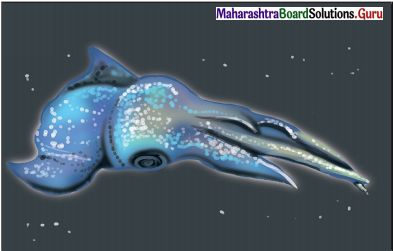
जीवों द्वारा प्रकाश उत्पन्न करने का उद्देश्य आत्मरक्षा करना भी होता है। सागरों और महासागरों में पाए जाने वाले कुछ जीव अपने प्रकाश उत्पादक अंगों से प्रकाश उत्पन्न करते हैं। ये स्क्विड के समान अपने शरीर से एक विशेष प्रकार का तरल रसायन छोड़ते हैं, जो पानी में मिलकर चमकीला प्रकाश-सा हो जाता हैं। इससे उनका शत्र उन्हें देख नहीं पाता है और वे वहाँ से भागने में सफल हो जाते हैं।

इस प्रकार प्रकाश उत्पन्न करने वाले जीवों द्वारा प्रकाश उत्पन्न करने के कई सार्थक उद्देश्य होते हैं।

Maharashtra Board Class 12 Hindi Yuvakbharati Solutions Chapter 12 लोकगीत

प्रश्न 2.
प्रकाश उत्पन्न करने वाले जीवों की वैज्ञानिक अध्ययन की दृष्टि से जानकारी लिखिए।
उत्तर :
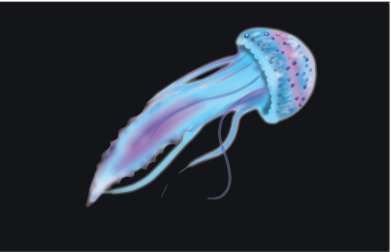
प्रकाश उत्पन्न करने वाले जीवों के बारे में किए गए विभिन्न अध्ययनों से वैज्ञानिकों को अनेक प्रकार की जानकारियाँ प्राप्त हुई हैं। प्रकाश उत्पन्न करने वाले जीव जमीन और जल दोनों स्थानों पर पाए जाते हैं। जल में पाए जाने वाले ये जीव तालाबों और नदियों के जल में नहीं पाए जाते। प्रकाश उत्पन्न करने वाले जीव खारे जल वाले गहरे समुद्रों में पाए जाते हैं। इनमें जेलीफिश, स्क्विड, क्रिल तथा विभिन्न जातियों वाले झींगे मुख्य हैं।

वैज्ञानिक अध्ययनों के आधार पर प्रकाश उत्पन्न करने वाले जीव दो प्रकार से प्रकाश उत्पन्न करते हैं – एक तो अपने शरीर पर पाए जाने वाले जीवाणुओं के माध्यम से, दूसरे रसायन के पदार्थों की पारस्परिक क्रिया के द्वारा। जीवाणुओं द्वारा प्रकाश उत्पन्न करने वाले जीवों के पूरे शरीर पर प्रकाश उत्पन्न करने वाले जीवाणु रहते हैं। ये निरंतर प्रकाश उत्पन्न करते रहते हैं।

इन जीवों में इस प्रकाश को ढकने अथवा प्रकाश वाले भाग को अपने शरीर के अंदर खींचने की क्षमता होती है। अतः वे अपनी आवश्यकता के अनुसार इस प्रकाश का उपयोग करते हैं। रसायनों के द्वारा प्रकाश उत्पन्न करने वाले जीवों के शरीर में ल्यूसीफेरिन (Luciferin) और ल्यूसीफेरैस (Luciferase) नामक रसायन होते हैं। इन दोनों रसायनों की सहायता से ये जीव प्रकाश उत्पन्न करते हैं।

अधिकांश जीव जीवाणुओं द्वारा अथवा रासायनिक क्रिया द्वारा प्रकाश उत्पन्न करते हैं। पर कुछ ऐसे भी जीव होते हैं, जिनके शरीर पर न तो प्रकाश उत्पन्न करने वाले जीवाणु रहते हैं और न ही उनके शरीर पर रसायन उत्पन्न करने वाले अंग ही होते हैं। फिर भी ये प्रकाश उत्पन्न करते हैं।

इन जीवों के शरीर में विशेष प्रकार के द्रव पदार्थ वाली ग्रंथि होती है। यह द्रव पदार्थ पानी के संपर्क में आते ही प्रकाश उत्पन्न करता है। समुद्र में पाए जाने वाले प्रकाश उत्पादक जीवों के लिए पानी आवश्यक होता है। ये जीव पानी के बाहर प्रकाश उत्पन्न नहीं कर सकते।

प्रकाश उत्पन्न करने वाले जीवों की संख्या काफी है। जीव वैज्ञानिक अभी प्रकाश उत्पन्न करने वाले नए-नए जीवों की खोज कर रहे हैं तथा उनके द्वारा उत्पन्न किए जाने वाले प्रकाश पर शोध कर रहे हैं।

व्यावहारिक प्रयोग

प्रश्न 1.
समुद्री जीवों पर शोधपूर्ण आलेख पढ़ें।
उत्तर :
पृथ्वी के तीन चौथाई हिस्से पर समुद्रों की विशाल जल राशि व्याप्त है। इस जल राशि में समुद्री जीवों की विचित्र दुनिया है। ऐसी दुनिया जिसके बारे में जानकर दाँतों तले ऊँगली दबा लेनी पड़ती है।

समुद्र बड़े-छोटे, रंगबिरंगे, खतरनाक विषैले जीवों तथा प्रकाश उत्पन्न करने वाले असंख्य जीवों से भरा पड़ा है।

एक ओर जहाँ समुद्र में पाए जाने वाले जीवों पर आधारित मत्स्य उद्योग, सजावटी सामानों तथा अन्य अनेक वस्तुओं के व्यवसाय फल-फूल रहे हैं, वहीं समुद्र में अभी भी ऐसे अनेक जीव हैं जिनके बारे में हम जानते तक नहीं।

समुद्र के अद्भुत संसार में पाया जाने वाला अद्भुत जीव है व्हेल। यह समुद्र का सबसे बड़ा जीव है। इसकी लंबाई 25 मीटर और वजन 150 से 180 टन तक होता है। गहरे पानी में पाया जाने वाला यह जीव साँस लेने के लिए जब अपने सिर में बने छेद से पानी फेंकता है तो लगता है, जैसे बादल फटकर बरसात हो रही हो। विशाल जीवों में खतरनाक शॉर्क मछली भी मशहूर है। यह इतनी खतरनाक होती है कि अन्य समुद्री जीव इससे दूरी बनाकर चलते हैं। समुद्र में बिजली की तरह करंट मारने वाली दो मीटर लंबी बामी मछली की शकल-सूरत वाली एक मछली पाई जाती है, जिसका नाम है ईल।

इसके शरीर में 860 वॉट का करंट प्रवाहित होता है। यह अपने इस करंट से मगर जैसे खतरनाक जीव को भी मार डालती है। समुद्र में पाई जाने वाली सॉर्ड फिश चपटे और बहुत बड़े आकार की होती है। उसका थूथना नुकीला होता है और वजन 600 किलो तक का होता है। स्टिंग रे फिश का आकार हवाई जहाज जैसा होता है और इसके जबड़ों के पास वाले दो बड़े-बड़े काँटे बहुत विषैले होते हैं। विषैली मछलियों में जेली फिश का भी समावेश हैं।

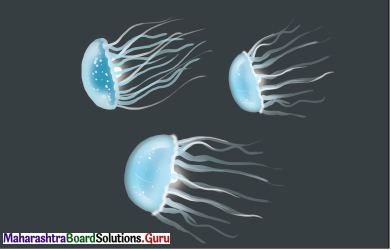
यह पारदर्शी होती है और इसके शरीर से लटकने वाले रेशे बहुत विषैले होते हैं। इसलिए इसे पकड़कर उठाते समय बहुत सावधानी बरतनी पड़ती हैं।

समुद्र में कुछ ऐसी मछलियाँ भी पाई जाती हैं, जो उड़ सकती हैं। इन्हें फ्लाइंग फिश के नाम से जाना जाता है। ये पानी की सतह के ऊपर तेज गति से उड़ती हुई जाती हैं। ये मछलियाँ आकार में छोटी होती हैं। समुद्र में तीक्ष्ण दाँतों वाली पॉफर नाम की एक विचित्र मछली पाई जाती है। वह सामान्य मछलियों की तरह लंबी होती है पर छूने पर यह गोल आकार धारण कर लेती है।

समुद्र सी-हार्स, शील, डाल्फिन, लायन फिश, शंख, सीपियों, धोंधों, केकड़ों, कछुओं तथा विभिन्न प्रकार के साँपों से भरा हुआ है। इसमें तरह-तरह की हजारों किस्म की रंगबिरंगी मछलियाँ पाई जाती हैं।

इसके अलावा समुद्र में प्रकाश उत्पन्न करने वाले जीवों का विशाल संसार है। ये जीव अपने शिकार करने अथवा अपनी आत्मरक्षा के लिए प्रकाश उत्पन्न करते हैं। इन जीवों में ऑक्टोपस, एंगलर मछलियाँ, कटलफिश, कार्डिनल मछली, क्रिल, जेली फिश, टोड मछली, धनुर्धारी मछली, वाम्बेडक मछली, मूंगे, लालटेल मछली, वाइपर मछली, शंबुक, समुद्री कासनी, समुद्री स्लग, समुद्री स्क्विर्ट, स्क्विड तथा व्हेल मछली प्रमुख हैं। जीव वैज्ञानिक अभी भी समुद्र में प्रकाश उत्पन्न करने वाले जीवों की खोज का कार्य कर रहे हैं।

जिस प्रकार समुद्र का आरपार नहीं है उसी प्रकार समुद्री जीवों का भी आरपार नहीं है।

प्रश्न 2.
प्रकाश उत्पन्न करने वाले किसी एक जीव की खोज कीजिए।
उत्तर :
संसार में प्रकाश उत्पन्न करने वाले अनेक जीव हैं। प्रकाश उत्पन्न करने वाले जीवों को दो वर्गों में बाँटा जा सकता है। एक जमीन पर पाए जाने वाले जीव और दूसरे जल में पाए जाने वाले जीव। यहाँ हम जमीन पर पाए जाने वाले प्रकाश उत्पन्न करने वाले जीव जुगनू की जानकारी प्राप्त करेंगे।

जुगनू एक सामान्य कीड़ा है, जो रात के अंधेरे में आकाश में रुक-रुक कर प्रकाश करते हुए उड़ता है। यह ग्रामीण भागों में सर्वत्र पाया जाता है। गाँवों में अकसर बच्चे जुगनू को मुट्ठी में पकड़ कर खेलते हैं। दूसरे बच्चे यह देख कर ताज्जुब करते हैं कि आग को मुट्ठी में पकड़ने पर भी उसका हाथ जला क्यों नहीं। पर प्रकाश उत्पन्न करने वाले जीवों के प्रकाश में ऊष्मा नहीं होती। यह प्रकाश ठंडा होता है। इसलिए हाथ जलने का सवालही नहीं उठता।

प्रकाश उत्पन्न करने वाले जीव दो प्रकार से प्रकाश उत्पन्न करते ई हैं। एक जीवाणुओं द्वारा और दूसरे रासायनिक, पदार्थों की पारस्परिक क्रिया द्वारा। जुगनू रासायनिक पदार्थों की पारस्परिक क्रिया द्वारा प्रकाश उत्पन्न करता है।

वह रात के अंधेरे में आकाश में उड़ते हुए रुक-रुक प्रकाश छोड़ता है। यह प्रकाश उसके शरीर के पिछले हिस्से में चमकता हुआ दिखाई देता है। जुगनू अपने छोटे-छोटे परों से उड़ता है। रात के अँधेरे में उड़ते हुए जुगनू के प्रकाश उत्पन्न करने के कई कारण है। दिन में जुगनू चिड़ियों आदि के खाए जाने के डर से झाड़ियों में छुपा रहता है। रात के समय उत्युक्त आकाश में उसे उड़ने का अवसर मिलता है।

उड़ते समय वह अपने साथी की प्रकाश के द्वारा खोज करता है। इस तरह के प्रकाश में उसका एक मकसद अपने शिकार करने की खोज करना भी होता है। लेकिन उसके शरीर से प्रकाश उत्पन्न करने से वह अपने बड़े शत्रु कीट-पतंगे की नजर में आ जाता है और आसानी से वह उनका शिकार भी बन जाता है।

जुगनू के प्रकाश उत्पन्न करने के पीछे वैज्ञानिक कारण जो भी हों, उसे प्रकाश उत्पन्न करते हुए उड़ते देखना सब को अच्छा लगता है।

प्रकाश उत्पन्न करने वाले जीव Summary in Hindi

प्रकाश उत्पन्न करने वाले जीव लेखक का परिचय

प्रकाश उत्पन्न करने वाले जीव लेखक का नाम :
डॉ. परशुराम शुक्ल। (जन्म 6 जून, 1947.)

प्रकाश उत्पन्न करने वाले जीव प्रमुख कृतियाँ :
‘जासूस परमचंद के कारनामे’ (बाल धारावाहिक), ‘नन्हा जासूस’ (बाल कहानी संग्रह), ‘सुनहरी परी और राजकुमार’ (बाल उपन्यास), ‘नंदनवन’, ‘आओ बच्चो, गाओ बच्चो’, ‘मंगल ग्रह जाएँगे’ (बाल कविता संग्रह) आदि।

प्रकाश उत्पन्न करने वाले जीव विशेषता :
बाल साहित्य लेखन और पशु जगत का विश्लेषण करने में सिद्धहस्त। आपकी अनेक कृतियों का अंग्रेजी, उर्दू, पंजाबी, सिंधी आदि भाषाओं में अनुवाद। राष्ट्रीय स्तर के अनेक पुरस्कारों से सम्मानित।

विधा :
लेख। लेख लिखने की परंपरा बहुत पुरानी है। इसमें वस्तुनिष्ठता, ज्ञानपरकता तथा शोधपरकता जैसे तत्त्वों का समावेश होता है। लेख समाज विज्ञान, राजनीति, इतिहास जैसे विषयों का ज्ञानवर्धन करने के साथ-साथ जानकारी का नवीनीकरण भी करते हैं।

प्रकाश उत्पन्न करने वाले जीव विषय प्रवेश :
हम प्रकाश उत्पन्न करने वाले जीवों में केवल जुगनू से ही परिचित हैं। लेकिन जुगनू के अतिरिक्त ऐसे अनेक जीव हैं, जो प्रकाश उत्पन्न करते हैं। प्रस्तुत पाठ में लेखक ने प्रकाश उत्पन्न करने वाले जीवों के बारे में विस्तार से बताया है। लेखक कहना चाहते हैं कि हमें विज्ञान की दृष्टि से संसार को देखने की आवश्यकता है।

प्रकाश उत्पन्न करने वाले जीव पाठ का सार

विश्व के समस्त जीवों के लिए प्रकाश का बहुत महत्त्व है। मनुष्य ने अपने लिए प्रकाश की कई तरह की कृत्रिम व्यवस्था की. है। इसी तरह संसार में ऐसे अनेक जीव पाए जाते हैं जिनके शरीर पर प्रकाश उत्पन्न करने वाले अंग होते हैं। मानव द्वारा तैयार किए गए प्रकाश में ऊष्मा होती है, पर जीवों द्वारा उत्पन्न प्रकाश में ऊष्मा नहीं होती। जीवों के प्रकाश उत्पन्न करने की क्रिया को ल्युमिनिसेंस (Luminiscence) कहते हैं।

Maharashtra Board Class 12 Hindi Yuvakbharati Solutions Chapter 18 प्रकाश उत्पन्न करने वाले जीव 1

प्रकाश उत्पन्न करने वाले जीवों में जुगनू (Firefly) प्रसिद्ध जीव है। यह कीट वर्ग का जीव है और पूरे वर्ष प्रकाश उत्पन्न करता है।

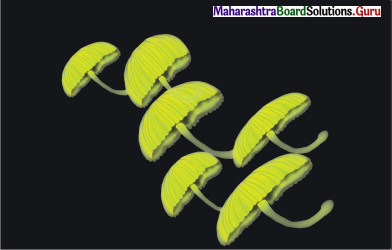
संसार में कवक (छत्रक) (Fungus) की कुछ जातियाँ रात में प्रकाश उत्पन्न करती हैं। इसी प्रकार मशरूम की कुछ जातियाँ भी रात में प्रकाश उत्पन्न करती हैं।

प्रकाश उत्पन्न करने वाले जीव थल की अपेक्षा खारे पानी यानी सागरों-महासागरों में अधिक पाए जाते हैं। ये सागर के गहरे पानी में पाए जाते है। इनमें जेलीफिश, स्क्विड, क्रिल तथा विभिन्न जाति के झींगे मुख्य हैं।

प्रकाश उत्पन्न करने वाले जीव दो प्रकार से प्रकाश उत्पन्न करते हैं। एक जीवाणुओं द्वारा और दूसरे रासायनिक पदार्थों की पारस्परिक क्रिया द्वारा कुछ जीवों के शरीर पर ऐसे जीवाणु रहते हैं, जो प्रकाश उत्पन्न करते हैं। ये जीव प्रकाश उत्पन्न करने वाले जीवाणुओं से सहजीवी संबंध बना लेते हैं और आवश्यकता के अनुसार इनके प्रकाश का उपयोग करते हैं।

Maharashtra Board Class 12 Hindi Yuvakbharati Solutions Chapter 18 प्रकाश उत्पन्न करने वाले जीव 2

जीवाणुओं के प्रकाश का उपयोग करने वाले जीव इस प्रकाश का उपयोग दो तरह से करते हैं – एक शरीर के भाग को भीतर खींच कर और दूसरे प्रकाश उत्पन्न करने वाले भाग को ढककर। इससे वे उस स्थान का प्रकाश समाप्त कर देते हैं।

प्रकाश उत्पन्न करने वाले कुछ जीव रसायनों की सहायता से प्रकाश उत्पन्न करते हैं। वे रसायन प्रकाश उत्पन्न करने वाले जीवों के शरीर में रहते हैं तथा ल्यूसीफेरिन तथा ल्यूसीफेरैस नामक रसायनों की सहायता से प्रकाश उत्पन्न करते हैं।

अधिकांश जीव जीवाणुओं द्वारा अथवा रासायनिक क्रिया द्वारा प्रकाश उत्पन्न करते हैं। लेकिन कुछ जीव ऐसे होते हैं जिनके शरीर में विशेष प्रकार की ग्रंथि होती है, जिससे एक विशेष प्रकार का द्रव पदार्थ निकलता है। वह द्रव पदार्थ पानी के संपर्क में आते ही प्रकाश उत्पन्न करने लगता है।

समुद्र में पाए जाने वाले प्रकाश उत्पादक जीव पानी के बाहर प्रकाश उत्पन्न नहीं कर सकते हैं।

अध्ययनों से पता चला है कि जमीन और पानी के सभी जीव अपने अलग-अलग उद्देश्यों की पूर्ति के लिए अपने-अपने ढंग से प्रकाश उत्पन्न करते हैं। ये उद्देश्य इस प्रकार होते हैं – साथी की खोज और संकेतों का आदान-प्रदान, शिकार की खोज और शिकार को आकर्षित करना, कामाफ्लास उत्पन्न करना तथा आत्मरक्षा करना।

Maharashtra Board Class 12 Hindi Yuvakbharati Solutions Chapter 18 प्रकाश उत्पन्न करने वाले जीव 3

गहरे समुद्रों में अनेक जीव शिकार की खोज के लिए अपने शरीर से प्रकाश उत्पन्न करते हैं। एंगलर मछली उनमें से एक है। समुद्र में अनेक जीव, विशेषकर मछलियाँ शिकार करने अथवा सुरक्षा की दृष्टि से कामाफ्लास के लिए प्रकाश उत्पन्न करती हैं। इससे उन्हें शिकार करने और सुरक्षित रहने में सहायता मिलती है। समुद्र के कुछ अन्य जीव भी आत्मरक्षा के लिए अपने प्रकाश अंगों से तरल रसायन छोड़कर चमकीला प्रकाश उत्पन्न करते हैं।

प्रकाश उत्पन्न करने वाले जीवों के बारे में वैज्ञानिक अध्ययन सन 1600 के आसपास शुरू हुआ था। वैज्ञानिक यह जानना चाहते थे कि कुछ जीव प्रकाश क्यों उत्पन्न करते हैं। सन 1794 तक जीव वैज्ञानिक यह समझते रहे कि समुद्री जीव फासफोरस की सहायता से प्रकाश उत्पन्न करते हैं। किंतु फासफोरस विषैला पदार्थ होता है यह जीवित कोशिका में नहीं रह सकता। इसलिए इस मत को मान्यता नहीं मिल सकी।

सन 1794 में इटली के वैज्ञानिक स्पैलेंजानी, सन 1887 में फ्रांसीसी वैज्ञानिक थिबाइस तथा सन 1894 में प्रोफेसर अलिरक डाहलगैट ने जीवों के प्रकाश उत्पन्न करने के बारे में विभिन्न मत व्यक्त किए। इससे प्रकाश उत्पन्न करने वाले नए-नए जीवों के खोज के कार्य को प्रोत्साहन मिला।

सागर में प्रकाश उत्पन्न करने वाले तरह-तरह के जीव पाए गए हैं, जो अपनी किस्म के निराले हैं।

Maharashtra Board Class 12 Hindi Yuvakbharati Solutions Chapter 18 प्रकाश उत्पन्न करने वाले जीव 4

धरती पर पाए जाने वाले प्रकाश उत्पन्न करने वाले जीवों की संख्या बहुत है। इनमें ऑक्टोपस, एंगलर मछलियाँ, कटलफिश, कनखजूरा, कार्डिनल मछली, क्रिल, कोपपाड, क्लाम, जुगनू, जेलीफिश, टोड मछली, धनुर्धारी मछली, नलिका कृमि, पिडाक, वाम्बेडक मछली, ब्रिसलमाउथ, भंगुरतारा, मूंगा, लालटेल मछली, वाइपर मछली, शंबुक, शल्क कृमि, समुद्री कासनी, समुद्री स्लग, समुद्री स्क्विर्ट, स्क्विड तथा व्हेल मछली आदि प्रमुख हैं।

प्रकाश उत्पन्न करने वाले जीव शब्दार्थ

कृत्रिमबनावटी।
आविष्कारईजाद।
संरचनाबनावट।
तंतुतागा, रेशा।
ऊष्मागर्मी।
कवकछत्रक, कुकुरमुत्ता।
थलजमीन।
सहजीवीसाथ रहने वाला।
जीवाणुक्षुद्रतम जीव।
नियंत्रितनियंत्रण में रखा हुआ।
रसायनपदार्थों का तत्त्वगत ज्ञान।
ग्रंथिशरीर का वह विशेष अंग जो शारीरिक क्रियाओं को जारी रखने के लिए आवश्यक रासायनिक यौगिका का निर्माण करके उसे शरीर में भेजता है।
रासायनिकरसायनशास्त्र या तत्त्व संबंधी।
अवयवअंग।
प्रयोगशालावह स्थान जहाँ पदार्थ विज्ञान, रसायनशास्त्र आदि विषयक तथ्यों को समझने, जानने या नई बातों का पता लगाने की दृष्टि से विविध प्रयोग किए जाते हैं।
द्रव पदार्थतरल पदार्थ।
विश्लेषणकिसी चीज के अंगों को अलग करना।
कामाफ्लासकिसी जीव की वह स्थिति, जिसमें वह अपने परिवेश में घुल मिल जाता है।

प्रकाश उत्पन्न करने वाले जीव शोधपरक लेखन के मुद्दे

  • विषय का उल्लेख
  • शोध की आवश्यकता
  • शोध को लेकर विविध पुस्तकों का अध्ययन
  • शोध विषय के पुष्ट्यार्थ विविध संदर्भ पुस्तकों का वाचन
  • शोध कार्य की सूची
  • शोधविषय की सिद्धता
  • सिद्धता का कॉपी में अंकन
  • शोधकार्य की साहित्यिक उपयोगिता

Maharashtra Board Class 12 Hindi Yuvakbharati Solutions Chapter 16 मैं उद्घोषक

Balbharti Maharashtra State Board Hindi Yuvakbharati 12th Digest Chapter 16 मैं उद्घोषक Notes, Textbook Exercise Important Questions and Answers.

Maharashtra State Board 12th Hindi Yuvakbharati Solutions Chapter 16 मैं उद्घोषक

12th Hindi Guide Chapter 16 मैं उद्घोषक Textbook Questions and Answers

कृति-स्वाध्याय एवं उत्तर

पाठ पर आधारित

प्रश्न 1.
‘सूत्र संचालक के कारण कार्यक्रम में चार चाँद लगते हैं’, इसे स्पष्ट कीजिए।
उत्तर :
आज के जमाने में सूत्र संचालक का महत्त्व बहुत बढ़ गया है। कार्यक्रम छोटा हो या बड़ा, सूत्र संचालक अपनी प्रतिभा से उसमें चार चाँद लगा देता है। वह अपनी भाषा, आवाज में उतारचढ़ाव, अपनी हाजिरजवाबी, श्रोताओं से चुटीले संवादों, संचालन के बीच-बीच में सरसता लाने के लिए चुटकुलों, रोचक घटनाओं के प्रयोग, मंच पर उपस्थित महानुभावों के प्रति अपने सम्मान सूचक शब्दों के प्रयोग, कार्यक्रमों के अनुसार भाषा-शैली में परिवर्तन करने तथा अपनी गलती पर माफी माँग लेने आदि गुणों के कारण सूत्र संचालन में तो चार चाँद लगा ही देता हैं, उपस्थित जन-समुदाय की प्रशंसा का पात्र भी बन जाता हैं। सूत्र संचालक अपने मिलनसार व्यक्तित्व, अपने विविध विषयों के ज्ञान, कार्यक्रम के सुचारुसंचालन, अपनी अध्ययनशीलता, अपनी प्रभावशाली और मधुर आवाज के संतुलित प्रयोग आदि के बल पर कार्यक्रम में जान डाल देता है। सधे हुए सूत्र संचालक की प्रतिभा का लाभ कार्यक्रमों और उनके आयोजकों को मिलता है। इस तरह सधे हुए सूत्र संचालक के कारण कार्यक्रम में चार चाँद लग जाते हैं।

Maharashtra Board Class 12 Hindi Yuvakbharati Solutions Chapter 16 मैं उद्घोषक

प्रश्न 2.
उत्तम मंच संचालक बनने के लिए आवश्यक गुण विस्तार से लिखिए।
उत्तर :
मंच संचालन एक कला है। अच्छा मंच संचालक कार्यक्रम में जान डाल देता है। मंच संचालक श्रोता और वक्ता को जोड़ने वाली कड़ी होता है। वही सभा की शुरूआत करता है। उत्तम मंच संचालक बनने के लिए संचालक को अच्छी तैयारी करनी पड़ती है। जिस तरह का कार्यक्रम हो, उसी तरह की तैयारी भी होनी चाहिए। उसी के अनुरूप कार्यक्रम की संहिता लेखन करनी चाहिए। मंच संचालक के लिए प्रोटोकॉल का ज्ञान, प्रभावशाली व्यक्तित्व, हँसमुख, हाजिरजवाबी तथा विविध विषयों का ज्ञान होना चाहिए। इसके अतिरिक्त भाषा पर उसका प्रभुत्व होना आवश्यक है।

मंच संचालक को किसी कार्यक्रम में ऐन मौके पर परिवर्तन होने पर संहिता में परिवर्तन कर संचालन करते हुए कार्यक्रम को सफल बनाना पड़ता है। यह क्षमता उसमें होनी चाहिए। अच्छे मंच संचालक को हर प्रकार के साहित्य का अध्ययन करना आवश्यक है। मंच संचालक को इस बात का ध्यान रखना चाहिए कि कार्यक्रम कोई भी हो, मंच की गरिमा बनी रहनी चाहिए। सबसे पहले मंच संचालक श्रोताओं के सामने आता है।

इसलिए उसका परिधान, वेशभूषा आदि सहज और गरिमामय होनी चाहिए। मंच संचालक के अंदर आत्मविश्वास, सतर्कता, सहजता के साथ श्रोताओं का उत्साह बढ़ाने का गुण होना आवश्यक है। इसके अलावा मंच संचालक में समयानुकूल छोटेछोटे चुटकुलों तथा रोचक घटनाओं से श्रोताओं को बाँधे रखने की शक्ति भी जरूरी है। अच्छे मंच संचालक को भाषा का पर्याप्त ज्ञान होना आवश्यक है।

भाषा की शुद्धता, शब्दों का चयन, शब्दों का उचित प्रयोग तथा किसी प्रख्यात साहित्यकार के कथन का उल्लेख कार्यक्रम को प्रभावशाली एवं हृदयस्पर्शी बना देता है। यही उत्तम मंच संचालक की थाती होती है। उत्तम मंच संचालक बनने वाले व्यक्ति को उपर्युक्त गुणों को आत्मसात करना आवश्यक है।

प्रश्न 3.
सूत्र संचालन के विविध प्रकारों पर प्रकाश डालिए।
उत्तर :
आजकल संगीत संध्या तथा जन्मदिन की पार्टी का भी संचालन जरूरी हो गया है। सूत्र संचालक, मंच और श्रोताओं के बीच सेतु का कार्य करता है। कार्यक्रमों अथवा समारोहों में निखार लाने का कार्य सूत्र संचालक ही करता है। इसलिए सूत्र संचालक का बहुत महत्त्व होता है। सूत्र संचालन कई प्रकार के होते हैं। इसके मुख्यतः निम्न प्रकार होते हैं।

शासकीय कार्यक्रम का सूत्र संचालन, दूरदर्शन हेतु सूत्र संचालन, रेडियो हेतु सूत्र संचालन, राजनीतिक, सामाजिक तथा सांस्कृतिक कार्यक्रमों का सूत्र संचालन। अलगअलग कार्यक्रमों का संचालन करने के लिए सूत्र संचालक को अलग-अलग प्रकार की सावधानियाँ बरतनी पड़ती हैं।

शासकीय एवं राजनीतिक समारोहों के सूत्र संचालन में प्रोटोकॉल का बहुत ध्यान रखना पड़ता है। इसके लिए पदों के अनुसार नामों की सूची बनानी पड़ती है। दूरदर्शन तथा रेडियो कार्यक्रमों का सूत्र संचालन करने के पहले उन पर प्रसारित किए जाने वाले कार्यक्रमों की संपूर्ण जानकारी प्राप्त करनी जरूरी है। कार्यक्रम की संहिता लिखकर तैयारी करनी होती हैं। सामाजिक तथा सांस्कृतिक कार्यक्रमों के सूत्र संचालन का कार्य हल्के-फुल्के ढंग का होता है। इनके लिए अलग संहिता लेखन की तैयारी करनी पड़ती है।

Maharashtra Board Class 12 Hindi Yuvakbharati Solutions Chapter 16 मैं उद्घोषक

व्यावहारिक प्रयोग।

प्रश्न 1.
अपने कनिष्ठ महाविद्यालय में मनाए जाने वाले ‘हिंदी दिवस समारोह’ का सूत्र संचालन कीजिए।
उत्तर :
सूत्र संचालक : दोस्तो! हिंदी दिवस के उपलक्ष्य में आज महात्मा गांधी स्मारक इंटर कालेज, नाशिक में आयोजित इस समारोह में आपका हार्दिक स्वागत है। इस अवसर पर मुझे अपनी भाषा हिंदी से संबंधित कुछ पंक्तियाँ याद आती हैं –

जो थी तुलसी, चंद्र, सूर, भूषण को प्यारी।
थे रहीम, रसखान आदि जिस पर बलिहारी।
छवि ने जिसको लुभा लिया, जिसकी मनहारी।
सचमुच भाषा सकल राष्ट्र की वही हमारी।।

तो दोस्तो! हिंदी दिवस के इस अवसर पर अब बारहवीं कक्षा की छात्राओं द्वारा तैयार किया गया यह सुंदर नृत्य गीत प्रस्तुत है। आपके सामने यह नृत्य गीत प्रस्तुत कर रही हैं – ऋचा, ऋधि, मधुरिमा, रोहा और अन्विता!

(कक्षा बारहवीं की लड़कियाँ –
जय माँ भारती जय, जय।
जय माँ भारती जय, जय।।
गीत गाते हुए नृत्य करती हैं।)
(तालियों की गड़गड़ाहट होती है।)

सूत्र संचालक : दोस्तो! तालियों की गड़गड़ाहट ही बता रही है कि यह नृत्य-गीत आप सबको कैसा लगा।

दोस्तो! अब हम आरंभ कर रहे हैं आज का मुख्य समारोह, यानी हिंदी दिवस का रंगारंग कार्यक्रम। मंच पर उपस्थित हैं हमारे कालेज के प्रिंसिपल श्री राजेंद्र पेंडसे जी, आज के प्रमुख अतिथि स्थानीय राणाप्रताप. कालेज के हिंदी विभाग के अध्यक्ष श्री लोकनाथ सिन्हाजी तथा कालेज के अन्य अध्यापकगण।

सूत्र संचालक : अब हम महात्मा गांधी स्मारक इंटर कालेज के हिंदी विभाग के प्रभारी श्री श्रीपत मिश्र जी से प्रार्थना करते है कि आप हमारे प्रमुख अतिथि श्री लोकनाथ सिन्हाजी को पुष्पगुच्छ देकर उनका स्वागत करें। श्री श्रीपत जी मिश्र…

(श्रीपत मिश्र प्रमुख अतिथि का पुष्पगुच्छ देकर स्वागत करते है। तालियों की गड़गड़ाहट होती है।)

दोस्तो! अब हम अपने महात्मा गांधी स्मारक इंटर कालेज के प्रिंसिपल श्री राजेंद्र पेंडसे जी की ओर से प्रमुख अतिथि श्री लोकनाथ सिन्हा जी से प्रार्थना करते हैं कि वे माँ सरस्वती के समक्ष दीप प्रज्ज्वलित कर उन्हें माल्यार्पण करें। श्रीमान लोकनाथ सिन्हा जी!

(लोकनाथ सिन्हा जी माँ सरस्वती के समक्ष रखे दीपदान के दीप प्रज्ज्वलित करते हैं। वे सरस्वती की मूर्ति को माला पहनाते हैं। तालियों की गड़गड़ाहट होती है।)

Maharashtra Board Class 12 Hindi Yuvakbharati Solutions Chapter 16 मैं उद्घोषक

सूत्र संचालक : अब कालेज की ग्यारहवीं कक्षा की छात्राएँ – सुनीता संघवी और जाह्नवी पांडेय देवी सरस्वती का वंदना गीत प्रस्तुत करेंगी…

(सुनीता और जाह्नवी माँ सरस्वती का वंदना गीत गाती हैं)
या कुन्देन्दुतुषार हार धवला, या शुभ्रवस्त्रावृता।
या वीणावरदण्डमण्डितकरा। या श्वेतपद्मासना।
या ब्रह्माच्युत शंकरप्रभृतिभिर्देवैः सदा वंदिता।
सा मां पातु सरस्वती भगवती निःशेषजाड्यापहा।।
(सरस्वती वंदना समाप्त होती है।) (तालियों की गड़गड़ाहट होती है।)

सूत्र संचालक : अब कालेज के प्रिंसिपल श्री राजेंद्र पेंडसे जी । हमारे प्रमुख अतिथि श्री लोकनाथ सिन्हा जी का परिचय देंगे और कालेज की विभिन्न गतिविधियों से आप लोगों को परिचित कराएँगे। श्री राजेंद्र पेंडसे जी…

(श्री राजेंद्र पेंडसे प्रमुख अतिथि को समारोह का अतिथि पद स्वीकार करने के लिए बधाई देते हैं और संक्षेप में उनका परिचय देते हैं।)
(वे कालेज की गतिविधियों के बारे में बताते हैं।)

सूत्र संचालक : अब मैं प्रिंसिपल साहब राजेंद्र पेंडसेजी की ओर से प्रमुख अतिथि लोकनाथ सिन्हा जी से प्रार्थना करूँगा कि वे हिंदी वाद-विवाद प्रतियोगिता, हिंदी अंत्याक्षरी प्रतियोगिता तथा परीक्षाओं .. में प्रथम तथा द्वितीय स्थान पाने वाले विद्यार्थियों को अपने कर कमलों से पुरस्कार प्रदान करने की कृपा करें।

सूत्र संचालक : हिंदी वाद-विवाद प्रतियोगिता में प्रथम पुरस्कार विजेता जनार्दन शर्मा मंच पर आ जाएँ।

(प्रमुख अतिथि के हाथों जनार्दन शर्मा पुरस्कार लेते हैं। तालियाँ बजती हैं।)

सूत्र संचालक : अब वाद-विवाद प्रतियोगिता में द्वितीय पुरस्कार पाने वाले जयंत साठे मंच पर आ जाएँ।

(जयंत साठे पुरस्कार लेते हैं। तालियाँ बजती हैं।)

सूत्र संचालक : अब हिंदी अंत्याक्षरी प्रतियोगिता में प्रथम स्थान पाने वाली स्नेहा पाण्डेय मंच पर आकर अपना पुरस्कार ग्रहण करें। स्नेहा पाण्डेय।
(स्नेहा पाण्डेय प्रमुख अतिथि से पुरस्कार ग्रहण करती है। तालियाँ बजती हैं।)

सूत्र संचालक : अब मैं परीक्षाओं में प्रथम तथा द्वितीय स्थान पाने वाले विद्यार्थियों से आग्रह करता हूँ कि वे मंच पर आकर अपने-अपने पुरस्कार ग्रहण करें। मैं पुरस्कार विजेताओं को उनके नाम से बुलाऊँगा। सभी विजेता बारी-बारी से मंच पर आकर अपनाअपना पुरस्कार प्राप्त करें।

कक्षा नौवीं : प्रथम पुरस्कार – राकेश शिंदे।
द्वितीय पुरस्कार – स्मिता सिंह।

कक्षा दसवीं : प्रथम पुरस्कार – ओंकार शर्मा।
द्वितीय पुरस्कार – रोहिणी दवे।

Maharashtra Board Class 12 Hindi Yuvakbharati Solutions Chapter 16 मैं उद्घोषक

कक्षा ग्यारहवीं : प्रथम पुरस्कार – जतिन सेवक।
द्वितीय पुरस्कार – सचिन मेहरा।

(विजेता छात्र बारी-बारी से प्रमुख अतिथि से अपने-अपने पुरस्कार प्राप्त करते हैं। तालियाँ बजती हैं।)

सूत्र संचालक : अब कालेज के विज्ञान विभाग के प्रभारी श्री पवन राव ‘हिंदी भाषा की विशेषता’ के बारे में अपने विचार आपके सामने रखेंगे।

(पवन राव हिंदी भाषा के बारे में अपने विचार व्यक्त करते हैं। तालियाँ बजती हैं।)

सूत्र संचालक : अब हमारे कालेज के वाणिज्य विभाग के प्रभारी श्री अशोक शास्त्री जी ‘हिंदी में संभावनाएँ’ विषय पर अपने विचार प्रस्तुत करेंगे। आप लोग ध्यान से सुनिए।

(श्री अशोक शास्त्री अपने विचार व्यक्त करते हैं। तालियाँ बजती हैं।)

सूत्र संचालक : अब हमारे कालेज के हिंदी विभाग के प्रभारी श्रीपत मिश्र जी आपके समक्ष हिंदी भाषा में रोजगार की संभावनाओं के बारे में आपको बताएँगे। श्री श्रीपत मिश्र जी।

(श्री श्रीपत मिश्र अपना भाषण समाप्त करते हैं। तालियाँ बजती हैं।)

सूत्र संचालक : अब यहाँ उपस्थित सभी लोग उत्सुकतापूर्वक प्रतीक्षा कर रहे होंगे कि हमारे प्रमुख अतिथि राणाप्रताप कालेज के हिंदी विभाग के अध्यक्ष श्री लोकनाथ सिन्हा जी हिंदी भाषा के बारे में अपने विचारों से हमें अवगत कराएँ। अब वे आपके समक्ष हैं।

(श्री लोकनाथ सिन्हा अपने विचार बताते हैं। तालियाँ बचती हैं।)

सूत्र संचालक : दोस्तो! आज हमारी हिंदी भाषा के बारे में आप लोगों को काफी उपयोगी जानकारियाँ प्राप्त हुईं। और अब समय आ गया है कार्यक्रम की समाप्ति का।

अब कालेज के वाइस प्रिंसिपल श्री रंगनाथ दाते जी आज के हमारे प्रमुख अतिथि, अध्यापकों, विद्यार्थियों तथा उपस्थित जनसमुदाय के प्रति आभार व्यक्त करेंगे।

(वाइस प्रिंसिपल श्री रंगनाथ दाते जी आभार व्यक्त करते हैं।) (अंत में दोपहर 12.00 बजे राष्ट्रगान के साथ समारोह समाप्त हुआ।)

Maharashtra Board Class 12 Hindi Yuvakbharati Solutions Chapter 16 मैं उद्घोषक

प्रश्न 2.
शहर के प्रसिद्ध संगीत महोत्सव का मंच संचालन कीजिए।
उत्तर :
मंच संचालक : भाइयो और बहनो! आज हमारे शहर कोल्हापुर में आयोजित प्रसिद्ध संगीत महोत्सव में आप सबका स्वागत है। और स्वागत है इस महत्त्वपूर्ण संगीत महोत्सव में अपने मधुर गीत-संगीत से श्रोताओं को सराबोर करने के लिए पधारे हुए संगीतकारों, गायक-गायिकाओं तथा उपस्थित जन-समुदाय का।।

मंच संचालक : …तो दोस्तो! प्रतीक्षा की घड़ियाँ समाप्त हुईं। अब आपके समक्ष मंच पर विराजमान हैं अपने साज-ओ-सामान के साथ शहर के प्रसिद्ध तबलावादक पंडित राधेश्यामजी। पंडित जी अपने तबलावादन के लिए पूरे जिले में विख्यात हैं। उनका साथ दे रही हैं शास्त्रीय गायिका शारदादेवी जी। पंडित जी के स्वागत में जोरदार तालियाँ…

(गायिका शारदादेवी के स्वरों के साथ पंडित राधेश्याम की उँगलियाँ तबले पर थिरकने लगती हैं। लोग वाह-वाह करते हैं। तालियों की गड़गड़ाहट से सभागार गूंज उठता है।)

मंच संचालक : वाह भाई वाह! वाह वाह। पंडित जी ने वाकई अपनी वाद्य कला से श्रोताओं का मन मोह लिया। सभागार में गूंजती हुई तालियों का शोर इसका सबूत है।

मंच संचालक : दोस्तो! अब आप सुनेंगे अपनी चहेती लोकगीत गायिका राधा वर्मा को। वे आपको सावन माह की वर्षा की फुहारों के बीच गाए जाने वाले मधुर गीत कजरी के रस से सराबोर करेंगी। उनके साथ हारमोनियम पर हैं रामनाथ शर्माजी और ढोलक पर हैं पंडित राधारमण त्रिपाठी जी।

(राधा वर्मा जी अपने कजरी गीत से समां बाँध देती हैं और लोग तालियाँ बजाकर ‘वन्स मोर… वन्स मोर…’ कहकर शोर मचाते हैं।)

मंच संचालक : दोस्तो! शांत रहिए… शांत! राधा जी आपके आग्रह का मान जरूर रखेंगी। राधा जी प्लीज! प्लीज!

(राधा वर्मा दूसरी बार कजरी गाना शुरू करती हैं। अब श्रोता भी उनके स्वर में स्वर मिलाकर गाना शुरू कर देते हैं।)

मंच संचालक : वाह! वाह! दोस्तो, कजरी गीत है ही ऐसा।

समूह में गाने पर इसका आनंद और ज्यादा, और ज्यादा बढ़ने लगता । है। वाह भाई वाह!

Maharashtra Board Class 12 Hindi Yuvakbharati Solutions Chapter 16 मैं उद्घोषक

मंच संचालक : अब मंच पर आपके समक्ष हैं प्रसिद्ध भजन गायक सुमित संत जी। संत जी की गायकी से तो आप सब परिचित ही हैं। अपने भजनों से संत जी आपको भक्ति रस से सराबोर कर देंगे। सुमित जी के साथ तबले पर हैं कामता प्रसाद जी। हारमोनियम 1 पर हैं रामदास और सारंगीवादन कर रहे हैं प्रभु नारायण जी।

(सुमित संत ‘पायोजी मैंने रामरतन धन पायो’ तथा ‘मेरे तो गिरधर गोपाल दूसरो न कोई’ जैसे भजनों से श्रोताओं को भक्ति रस से सराबोर कर देते हैं। तालियों और वाह! वाह के स्वर गूंजते हैं।)

मंच संचालक : वाह भाई! मेरे तो गिरधर गोपाल… (गुनगुनाते । हैं) वाह! भक्ति रस का जवाब नहीं। आत्मा-परमात्मा का मिलन
कराने वाला रस है भक्ति रस। वाह! वाह! वाह!

मंच संचालक : दोस्तो! अब आपको हम गजल गायकी की दुनिया में ले चलते हैं। मंच पर आपके सामने हैं प्रसिद्ध गजल गायक राजेंद्र शर्मा जी। गजल संभ्रांत श्रोताओं का गीत है। गजल के कई गायकों को अंतरराष्ट्रीय ख्याति प्राप्त है। श्री राजेंद्र शर्मा जी…

(राजेंद्र शर्मा की गायकी पर श्रोता झूमते हैं। एक-एक शब्द पर दाद देते हैं। वाह-वाह के शब्द सुनाई देते हैं। राजेंद्र शर्मा अपना गायन समाप्त करते हैं। तालियों की गड़गड़ाहट होती हैं।)

मंच संचालक : दोस्तो! अब आप के समक्ष सितारवादक रमाशंकर जी तंत्रवाद्य सितार की मधुर ध्वनि से आपका मनोरंजन करने आ रहे है। सितारवादक रविशंकर का नाम तो आपने सुना ही होगा। अब सुनिए रमाशंकर जी को।

(सितारवादक रमाशंकर अपने सितार पर मधुर ध्वनि से श्रोताओं को मंत्रमुग्ध कर देते हैं। तालियों की गडगडाहट होती है।)

मंच संचालक : दोस्तो! मृदंग के मधुर स्वर से तो आप परिचित ही होंगे। मृदंग मंदिरों में बजाया जाने वाला वाद्य हैं। इसके अलावा गाँवों में देवी-देवताओं की पूजा-अर्चना में मृदंग वाद्य का प्रयोग होता है। तो सुनिए अब मृदंग के मधुर स्वर पंडित कमलाकांत शर्मा जी से।

(पंडित कमलाकांत अपने मृदंग पर ऐसी थपकियाँ देते हैं कि श्रोता वाह-वाह करने लगते हैं।)

मंच संचालक : दोस्तो! अब हम एक ऐसे वाद्य और उसे बजाने वाले व्यक्ति से आपका परिचय कराते हैं, जो वाद्य पुराने जमाने में लड़ाई के समय सैनिकों में उत्साह पैदा करने के लिए बजाया जाता था। लेकिन आजकल इसका प्रयोग गाँवों में नौटंकियों में किया जाता है। इसका नाम है नगाड़ा। आज इसे मंच पर बजा रहे हैं पंडित श्यामनारायण जी। श्यामनारायण जी का पेशा ही है नौटंकियों में नगाड़ा बजाना। तो श्यामनारायण जी… कड़कड़… कड़कड़… धम्म!

(श्यामनारायण जी नौटंकी की तर्ज पर नगाड़ा बजाते हैं। श्रोता मस्ती से सिर हिलाते हैं। कुछ दर्शक अपने स्थान पर खड़े होकर नगाड़े की तर्ज पर अभिनय भी करने लगते हैं। श्यामनारायण जी नगाड़ा वादन बंद करते हैं। तालियों की गड़गड़ाहट होती हैं।)

मंच संचालक : दोस्तो! अब मैं आपके सामने आपका परिचित वाद्य यानी बाँसुरी बजाने वाले कलाकार को मंच पर अपने बाँसुरी वादन से आपका मनोरंजन करने के लिए बुलाता हूँ। दोस्तो! बाँसुरी की धून बहुत कर्णप्रिय होती है। भगवान श्री कृष्ण की बाँसुरी सुनकर गायें तक उनके पास दौड़ी चली आती थीं। तो शीतल यादव जी मंच पर अपनी बाँसुरी के साथ आपके सामने हैं।

Maharashtra Board Class 12 Hindi Yuvakbharati Solutions Chapter 16 मैं उद्घोषक

(शीतल यादव बाँसुरी बजाते हैं। उनकी बाँसुरी की धुन से पंडाल गूंजने लगता है। तालियाँ बजती हैं।)

मंच संचालक : दोस्तो! संगीत महोत्सव का कार्यक्रम हो और उसमें फिल्मी गीत-संगीत का समावेश न हो, ऐसा कैसे हो सकता है। दोस्तो! हम आज आपको फिल्मी गीतों के करावके संगीत की महफिल में ले चलते हैं। तो फिर देर किस बात की।…

(मंच पर करावके संगीत बजता है। इसमें सन 1960 से लेकर सन 1980 तक के मधुर गीतों के मुखड़ों संगीत बजते हैं और गायक मधुर स्वर में इन गीतों को गाते हैं।)

मंच संचालक : दोस्तो! आपको पॉप संगीत का मजा दिलाए बिना भला हम कैसे जाने देंगे। ऐसी कल्पना भी मत कीजिए। तो हो जाए धम… धमा… धम…।
(मंच पर दिल दहला देने वाला पॉप संगीत बजता है। लोग इस संगीत के साथ नाचने लगते हैं।)

मंच संचालक : अरे भाई, हम तो भूल ही गए। हमारे बीच एक १ बहुत ही उदीयमान कलाकार कब से अपनी बारी की प्रतीक्षा कर १ रहे हैं। ये हैं बैंजो वादक मास्टर देवांश पांडेय जी। तो पांडेय जी, शुरू हो जाइए।

(देवांश पांडेय जी अपने बैंजो वादन से श्रोताओं को मंत्रमुग्ध कर देते हैं। चारों ओर से वाह-वाह का शोर होता हैं।)

मंच संचालक : अरे भाई, हमें पता है कि आप हमारे चहेते कलाकार पुत्तूचेरी पिल्लई को सुने बिना नहीं जाने वाले हैं। भाइयो! आखिर में आपके सामने श्रीमान पिल्लई साहब ही आ रहे हैं। आप तो जानते ही हैं कि वे –
प्यारा भारत देश हमारा।
हमको प्राणों से है प्यारा।

गीत हिंदी, मराठी, गुजराती, तमिल और तेलुगु भाषाओं में सुनाते १ हैं। आप यह देशभक्तिपूर्ण मधुर गीत सुनिए।

(श्री पिल्लई पाँच भाषाओं में यह गीत गाते हैं। तालियाँ बजती है।) (गीत समाप्त होता हैं।)

मंच संचालक : दोस्तो! इस गीत के साथ ही हमारा आज का संगीत महोत्सव का यह समारोह समाप्त होता है।

Maharashtra Board Class 12 Hindi Yuvakbharati Solutions Chapter 16 मैं उद्घोषक

॥ जय हिंद ।।
(राष्ट्रगान बजता है, परदा गिरता है।)

Maharashtra Board Class 12 Hindi Yuvakbharati Solutions Chapter 16 मैं उद्घोषक 1 Maharashtra Board Class 12 Hindi Yuvakbharati Solutions Chapter 16 मैं उद्घोषक 2

मैं उद्घोषक Summary in Hindi

मैं उद्घोषक लेखक का परिचय

मैं उद्घोषक लेखक का नाम :
आनंद प्रकाश सिंह। (जन्म : 21 जुलाई, 1958.)

मैं उद्घोषक प्रमुख कृतियाँ :
पत्र-पत्रिकाओं में विभिन्न विषयों पर लेख, समीक्षाएँ, कहानियाँ, कविताएँ आदि प्रकाशित।

मैं उद्घोषक विशेषता :
पंडित भीमसेन जोशी तथा कई अन्य प्रसिद्ध व्यक्तियों द्वारा लेखक के सूत्र-संचालन की प्रशंसा। किंग ऑफ वॉईस, संस्कृति शिरोमणि तथा अखिल आकाशवाणी जैसे पुरस्कारों से सम्मानित।

मैं उद्घोषक विधा :
आत्मकथा। आत्मकथा लेखन हिंदी साहित्य में रोचक और पठनीय लेखन माना जाता है। अपने अनुभवों तथा व्यक्तिगत प्रसंगों को पूरी निष्ठा से बताना आत्मकथा की पहली शर्त है। आत्मकथा उत्तम पुरुष वाचक सर्वनाम ‘मैं’ में लिखी जाती है।

मैं उद्घोषक विषय प्रवेश :
आजकल मंच संचालन अथवा सूत्र संचालन बहुत लोकप्रिय और महत्त्वपूर्ण माना जाता है। लेखक एक सफल मंच संचालक और सूत्र संचालक रहे हैं। प्रस्तुत लेख में उन्होंने बताया है कि सफल उद्घोषक अथवा मंच संचालक बनने के लिए व्यक्ति में कौन-कौन से आवश्यक गुण होने चाहिए। लेखक के अनुसार कार्यक्रम की सफलता मंच संचालक अथवा सूत्र संचालक के आकर्षक एवं उत्तम संचालन तथा उसके अपने विशेष गुणों पर आधारित होती है।

मैं उद्घोषक पाठ का सार

प्रस्तुत पाठ में यह बताया गया है कि एक सफल उद्घोषक बनने के लिए व्यक्ति में कौन-कौन से गुण होने चाहिए और इसमें रोजगार की क्या संभावनाएँ हैं। इस लेख के लेखक स्वयं लंबे अरसे तक एक प्रतिष्ठित उद्घोषक रहे हैं। इस आत्मकथात्मक लेख में उन्होंने अपने अनुभव से अर्जित अनेक गुणों से परिचित कराया है।

Maharashtra Board Class 12 Hindi Yuvakbharati Solutions Chapter 16 मैं उद्घोषक 3

Maharashtra Board Class 12 Hindi Yuvakbharati Solutions Chapter 16 मैं उद्घोषक

उद्घोषक, मंच संचालक और एंकर अलग-अलग नाम हैं उद्घोषक के। यह श्रोता और वक्ता को जोड़ने वाली कड़ी का काम करता है। किसी भी कार्यक्रम में मंच संचालक की भूमिका बहुत महत्त्वपूर्ण होती है। उद्घोषक ही आयोजकों तथा अतिथियों को मंच पर आमंत्रित करता है तथा पूरे कार्यक्रम का संचालन करता है।

उदघोषक बनने के लिए कठिन अभ्यास की आवश्यकता होती है। आरंभ में मंच पर बोलने में सबको झिझक होती है। पर हिम्मत जुटाकर अभ्यास करते रहने से यह झिझक दूर हो जाती है। अधिकांश मंच संचालकों के साथ ऐसी घटनाएँ अकसर होती हैं। धीरे-धीरे उनमें आत्मविश्वास आ जाता है।

सूत्र संचालन के कई प्रकार होते हैं। इसके मुख्य प्रकार हैं – शासकीय कार्यक्रम का सूत्र संचालन, दूरदर्शन हेतु सूत्र संचालन, रेडियो हेतु सूत्र संचालन, राजनीतिक, सामाजिक तथा सांस्कृतिक
कार्यक्रमों का सूत्र संचालन।

शासकीय एवं राजनीतिक समारोहों के सूत्र संचालन में प्रोटोकॉल १ का ध्यान रखते हुए अधिकारियों के पदों के अनुसार नामों की सूची बनाकर किसका किसके हाथों स्वागत करना है, इसकी योजना बनानी पड़ती है। इसमें आलंकारिक भाषा का प्रयोग नहीं करना चाहिए।

दूरदर्शन तथा रेडियो कार्यक्रम का सूत्र संचालन करने के लिए इन पर प्रसारित किए जाने वाले कार्यक्रमों की पूरी जानकारी होनी जरूरी है। इनके कार्यक्रमों की संहिता लिखकर तैयार करनी होती है।

सूत्र संचालन करते समय रोचकता, रंजकता तथा विभिन्न प्रसंगों का उल्लेख कार्यक्रम में करने से उसमें जान आ जाती है। कार्यक्रम और श्रोताओं के अनुसार भाषा का प्रयोग जरूरी होता है।

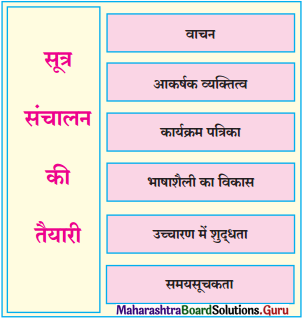
सत्र संचालक को यह ध्यान रखना होता है कि जिस प्रकार का कार्यक्रम हो उसी तरह की उसकी तैयारी की जानी चाहिए और उसी तरह उसकी संहिता लेखन करना चाहिए। संचालक को चाहिए कि वह संचालन के लिए आवश्यक तत्त्वों का अध्ययन करे।

सूत्र संचालक में कुछ गुणों का होना आवश्यक है। उसे मिलनसार, हँसमुख, हाजिरजवाबी तथा विविध विषयों का जानकार होने के साथ भाषा पर उसका अधिकार होना चाहिए। इसके अलावा उसे आयोजकों की ओर से अचानक मिली सूचना के अनुसार संहिता में परिवर्तन कर संचालन करना आना चाहिए।

लेखक कहते हैं कि कार्यक्रम कोई भी हो, मंच संचालक को मंच की गरिमा बनाए रखनी चाहिए। मंच पर आने वाला पहला व्यक्ति मंच संचालक होता है। अतएव उसका परिधान, वेशभूषा, केश सज्जा आदि सहज और गरिमामय होना चाहिए। उसका व्यक्तित्व और आत्मविश्वास उसके शब्दों में उतरना चाहिए।

Maharashtra Board Class 12 Hindi Yuvakbharati Solutions Chapter 16 मैं उद्घोषक

सतर्कता, सहजता और उत्साह वर्धन उद्घोषक के मुख्य गुण हैं। उद्घोषक को कार्यक्रम का आरंभ रोचक ढंग से करना चाहिए। बीच-बीच में प्रसंग के अनुसार चुटकुले, शेर-ओ-शायरी के अंश का प्रयोग करना चाहिए। इसके लिए उद्घोषक को निरंतर अध्ययन करते रहना होता है।

उपर्युक्त बातों पर ध्यान देने वाला व्यक्ति अच्छा उद्घोषक बन सकता है। मंच पर उद्घोषक श्रोता एवं दर्शकों के समक्ष होता है, पर रेडियो और कभी-कभी टीवी का सूत्रधार परदे के पीछे होता है। उसकी केवल आवाज सुनाई देती है। लेकिन उसका दायरा विस्तृत होता है। तब उसको अपनी आवाज का कमाल दिखाना होता है।

इस क्षेत्र में रोजगार की पर्याप्त संभावनाएँ हैं। विशेषकर भाषा का अध्ययन करने वाले विद्याथियों के लिए। सूत्र संचालन में तो भाषा की महत्त्वपूर्ण भूमिका होती है।

मैं उद्घोषक शब्दार्थ

वक्ताबोलने वाला।
नामचीननामी, मशहूर।
भूरि-भूरिबहुत ज्यादा।
हस्तीव्यक्तित्व।
गौरवान्वितगौरवयुक्त।
अहममहत्त्वपूर्ण।
पापड़ बेलनाघोर परिश्रम करना, बहुत कष्ट झेलना।
थरथरानाकाँपना।
हकलानाजिह्वा के दोष के कारण रुकरुककर बोलना।
शासकीयसरकारी। Maharashtra Board Class 12 Hindi Yuvakbharati Solutions Chapter 16 मैं उद्घोषक
प्रोटोकॉलशिष्टाचारपूर्वक, विधिवत।
सत्कारसम्मान।
आलंकारिकअलंकारयुक्त।
संहितासूची।
संकलनसंग्रह।
सेतुपुल।
सटीकबिलकुल ठीक।
मुशायराशायरों का इकट्ठा होकर शेर पढ़ना।
हाजिरजवाबीबात का तुरंत बढ़िया जवाब सोच लेने की शक्ति।
ज्ञाताजानकार।
परिधानपहनने का कपड़ा।
गरिमामयीगौरवमयी।
सतर्कतासावधानी।
जिज्ञासाभराजानने की इच्छा से परिपूर्ण।
प्रेरणादायकप्रेरणा देने वाली।
रोजगारजीविका।

Maharashtra Board Class 11 Biology Important Questions Chapter 16 Skeleton and Movement

Balbharti Maharashtra State Board 11th Biology Important Questions 16 Skeleton and Movement Important Questions and Answers.

Maharashtra State Board 11th Biology Important Questions Chapter 16 Skeleton and Movement

Question 1.
Name the three types of muscles which bring about movements in humans.
Answer:

  1. Smooth / non-striated / visceral / involuntary muscles
  2. Cardiac muscles
  3. Skeletal / straited / voluntary muscles.

Question 2.
Name the type of muscles which bring about running and speaking.
Answer:
Skeletal muscles (Voluntary muscles)

Maharashtra Board Class 11 Biology Important Questions Chapter 16 Skeleton and Movement

Question 3.
Name the muscles which do not contract as per our will.
Answer:
Involuntary muscles (smooth muscles and cardiac muscles)

Question 4.
Which type of muscles show rhythmic contractions?
Answer:
Cardiac muscles

Question 5.
Which type of muscle is present in the diaphragm of the respiratory system?
Answer:
Skeletal muscle

Question 6.
State the functions of:

  1. Smooth muscles
  2. Cardiac muscles
  3. Striated muscles

Answer:

  1. Smooth muscles: They bring about involuntary movements like peristalsis in the alimentary canal, constriction and dilation of blood vessels.
  2. Cardiac muscles: They bring about contraction and relaxation of the heart.
  3. Striated muscles: They control voluntary movements of limbs, head, trunk, eyes, etc.

Question 7.
What is locomotion?
Answer:
The change in locus of whole body of living organism from one place to another place is called locomotion.

Question 8.
State the four basic types of locomotory movements seen in animals.
Answer:
The four basic types locomotory movements seen in animals are:

  1. Amoeboid movement: It is performed by pseudopodia, e.g. leucocytes.
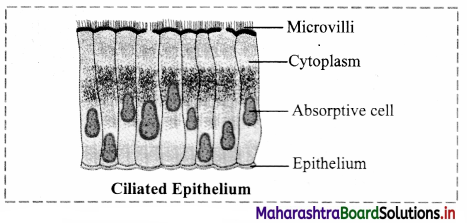
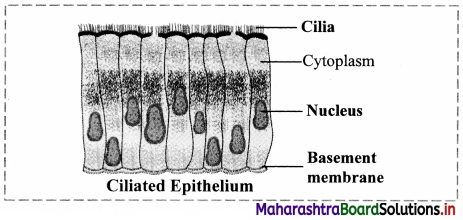
  2. Ciliary movement: It is performed by cilia, e.g. ciliated epithelium. In Paramoecium, cilia help in passage of food through cytopharynx.
  3. Whirling movement: It is performed by flagella, e.g. sperms.
  4. Muscular movement: It is performed by muscles, with the help of bones and joints.

Question 9.
All locomotions are movements but all movements are not locomotion. Justify
Answer:
Locomotion occurs when body changes its position, however all movements may not result in locomotion. Thus, all locomotions are movements but all movements are not locomotion.

Maharashtra Board Class 11 Biology Important Questions Chapter 16 Skeleton and Movement

Question 10.
Kriti was diagnosed with knee tendon injury. She asked the doctor whether she will be able to walk due to the injury? If not then state the reason.
Answer:
Knee tendon injury affects the ability to walk. Kriti may not be able to walk freely as the tendons attached to the bones help in the movement of the parts of skeleton.

Question 11.
Explain the types of straited muscles.
Answer:
On the basis of movements striated muscles are of three types:

  1. Agonists: These are considered as the prime movers. They bring about the initial movement of a part.
    e.g. biceps
  2. Antagonists: They bring about the action opposite to that of prime movers. e.g. Triceps.
  3. Svnergists They assist the prime movers. e.g. Brachialis assist biceps.

Question 12.
Describe the antagonistic muscles in detail.
Answer:
Following are the important antagonistic muscles:

  1. Flexor and extensor: Flexor muscle on contraction results into bending or flexion of joint. e.g. Biceps. Extensor muscle on contraction results in straightening or extension of a joint. e.g. Triceps.
  2. Abductor and adductor: Abductor muscle moves a body part away from the body axis. e.g. Deltoid muscle of shoulder moves the arm away from the body. Adductor muscle moves a body part towards the body axis.
    e.g. L.atissirnus dorsi of shoulder moves the arm near the body.
  3. Pronator and supinator: Pronator turns the palm downwards and supinator turns the palm upward.
  4. Levator and depressor: Levator raises a body part and the depressors lower the body part.
  5. Protractor and retractor: Protractor moves forward, whereas the retractor moves backward.
  6. Sphincters: Circular muscles present in the inner walls of anus, stomach. etc., for closure and opening.

Question 13.
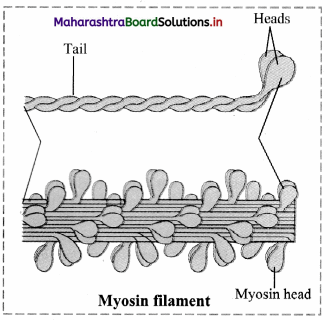
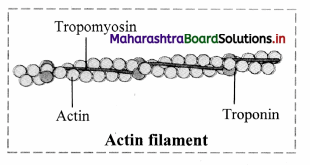
Describe the structure of myosin and actin filaments, with the help of neat and labelled diagram.
Answer:
i. Myosin filament:

  1. Each myosin filament is a polymerized protein. Many meromyosins (monomeric proteins) constitute one thick filament.
  2. Myosin molecule consists of two heavy chains (heavy meromyosin / HMM) coiled around each other forming a double helix. One end of each of these chains is projected outwardly is known as cross bridge. This end folds to form a globular protein mass called myosin head.
  3. Two light chains are associated with each head forming 4 light chains/light meromyosin / LMM.
  4. Myosin head has a special ATPase activity. It can split ATP to produce energy.
  5. Myosin contributes 55% of muscle proteins.
  6. In sarcomere, myosin tails are arranged to point towards the centre of the sarcomere and the heads point to the sides of the myofilament band.
    Maharashtra Board Class 11 Biology Important Questions Chapter 16 Skeleton and Movement 1

ii. Actin filament: It is a complex type of contractile protein. It is made up of three components:

  1. F actin: It forms the backbone of actin filament. F actin is made up of two helical strands. Each strand is composed of polymerized G actin molecules. One ADP molecule is attached to G actin molecule.
  2. Tropomyosin: The actin filament contains two additional protein strands that are polymers of tropomyosin molecules. Each strand is loosely attached to an F actin. In the resting stage, tropomyosin physically covers the active myosin-binding site of the actin strand.
  3. Troponin: It is a complex of three globular proteins, is attached approx. 2/3rd distance along each tropomyosin molecule. It has affinity for actin, tropomyosin and calcium ions. The troponin complex is believed to attach the tropomyosin to the actin. The strong affinity of troponin for calcium ions is believed to initiate the contraction process.
    Maharashtra Board Class 11 Biology Important Questions Chapter 16 Skeleton and Movement 2

Question 14.
A muscle can only pull and not push the bone. Why?
Answer:
The fundamental characteristic of the muscle is contraction. Therefore, muscle can only pull and not push the bone.

Question 15.
Explain the physiology of muscle contraction.
Answer:
When the muscles are relaxed, the active sites remain covered with tropomyosin and troponin complex. Due to this, myosin cannot interact with active site of actin and thus contraction cannot occur.

  1. When an impulse (action potential) comes to muscle through motor end plate, it spreads throughout the sarcolemma of the myofibril.
  2. The transverse tubules of sarcoplasmic reticulum release large number of Ca++ ions into sarcoplasm. These calcium ions interact with the troponin molecules and the interaction inactivates troponin-tropomyosin complex. This causes change in the structure of tropomyosin.
  3. As a result, tropomyosin gets detached from the active site of actin (F actin) filament, exposing the active site for actin.
  4. The myosin head cleaves the ATP to derive energy and gets attached to the uncovered active site of actin. This results into the formation of acto-myosin complex.
  5. The myosin heads are now tilted backwards and pull the attached actin filament inwardly. This results in contraction of the muscle fibres.

Question 16.
Why do we shiver during winter?
Answer:

  1. Humans are homeotherms as they can regulate their body temperature with respect to the surrounding temperature. During winter, when temperature falls, the thermoreceptors detect the change in temperature and send signals to the brain.
  2. Shivering reflex i.e. rapid contraction of muscles is triggered by the brain to generate heat and raise the body temperature.

Maharashtra Board Class 11 Biology Important Questions Chapter 16 Skeleton and Movement

Question 17.
Write a short note on role of calcium ions in contraction and relaxation of muscles.
Answer:
Calcium ions play a major role in contraction and relaxation of muscles.

  1. Calcium ions are released from the sarcoplasm during muscle contraction and stored in sarcoplasmic reticulum during muscle relaxation.
  2. When a skeletal muscle is excited and an action potential travels along the T tubule, the concentration of calcium ions increases.
  3. These calcium ions bind to troponin which in turn undergoes a conformational change that causes tropomyosin to move away from the myosin-binding sites on actin. Once these binding sites are free, myosin heads bind to them to form cross-bridges and the muscle fiber contracts.
  4. The decrease in calcium ion concentration in the sarcoplasmic reticulum causes tropomyosin to slide back and block the myosin binding sites on actin. This causes the muscle to relax.

[Note: Students can scan the adjacent Q.R code to get conceptual clarity with the aid of a relevant video.]

Question 18.
Muscle contraction and relaxation are active processes. Give reason.
Answer:
Muscle contraction and relaxation are active processes as during both the processes energy is utilized by hydrolysis of ATP into ADP and inorganic phosphate by the enzyme ATPase.

Question 19.
Describe the properties of muscles observed on electrical stimulation.
Answer:
Properties of muscles observed on electrical excitation:

  1. Single muscle twitch: It is a muscle contraction initiated by a single brief-stimulation. It occurs in 3 stages: a latent period of no contraction, a contraction period and a relaxation period.
  2. Summation: If the muscle is stimulated before the end of the twitch, it generates greater tension i.e., summation or addition of effect takes place. Repeated stimuli will produce increasing strength of contraction (stair case phenomenon).
  3. Tetanus: If stimulation is very rapid and frequent the muscle does not have time to relax. It remains in a
    state of contraction called tetanus.
  4. Rcfraètory period: Immediately aller one stimulus, the muscle fibre cannot respond to another stimulus. This resting or refractory period is about 0.02 seconds.
  5. Threshold stimulus: For a muscle fibre to contract, a certain minimum strength or intensity of stimulus is required. This is called threshold stimulus.
  6. All or none principie: A stimulus below threshold will not result in contraction. A threshold stimulus will result in contraction. This contraction leads to maximum force. Higher stimulus will not increase force of contraction i.e. a muscle libre contracts either ftilly or not at all. This is ‘all or none’ principle. All types of muscle and nerve fibres obey this law.
  7. Oxygen debt: During strenuous exercise, the oxygen supply of muscle rapidly becomes insufficient to maintain oxidative phosphorylation of respiratory substrate. At this stage, muscles contract anaerobically and accumulate lactic acid produced by anaerobic glycolysis. Lactic acid produces less AlP and is toxic. It causes tiredness, pain and muscle cramps. During recovery, oxygen consumption of the muscle far exceeds than that in the resting state. This extra oxygen consumed during recovery is called oxygen debt of the muscle.

Note: The duration of refractory period varies with the muscle involved. Cardiac muscles have a longer refractory period of about 250 msec whereas skeletal muscles have a short refractory period of about I msec]

Question 20.
What is difference between endoskeleton and exoskeleton?
Answer:
The supportive structures present inside the body form the endoskeleton and when the supportive structures are present on the outer surface of the body they form exoskeleton.

Question 21.
Name the tissues that form the structural framework of the body.
Answer:
Cartilage and bone

Question 22.
What type of bones are present in our body?
Answer:
Long bones, short bones, flat bones, irregular bones and sesamoid bones.

Question 23.
How do bones help in various ways?
Answer:

  1. Bones form the framework of our body and thus provide shape to the body.
  2. They protect vital organs thus help in the smooth functioning of body.
  3. The joints between the bones help in movement and locomotion.
  4. They provide firm surface for attachment of muscles.
  5. They are reservoirs of calcium and form important site for hemopoiesis.

Question 24.
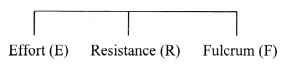
Explain the three types of lever found in human body.
Answer:
The three types of lever are as follows:

  1. Class I lever: The joint between the first vertebra and occipital condyle of skull is an example of Class I lever. The force is directed towards the joints (fulcrum); contraction of back muscle provides force while the part of head that is raised acts as resistance.
    Maharashtra Board Class 11 Biology Important Questions Chapter 16 Skeleton and Movement 3
  2. Class II lever: Human body raised on toes is an example of Class II lever. Toe acts as fulcrum, contracting calf muscles provide the force while raised body acts as resistance.
    Maharashtra Board Class 11 Biology Important Questions Chapter 16 Skeleton and Movement 4
  3. Class III lever: Flexion of forearm at elbow exhibit lever of class III. Elbow joint acts as fulcrum and radius, ulna provides resistance. Contracting bicep muscles provides force for the movement.
    Maharashtra Board Class 11 Biology Important Questions Chapter 16 Skeleton and Movement 5

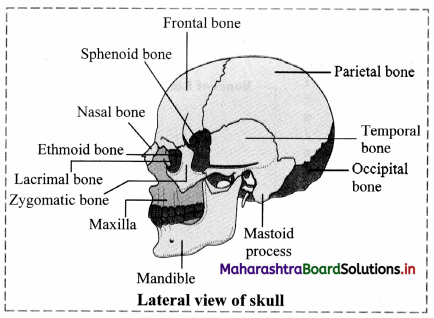
Question 25.
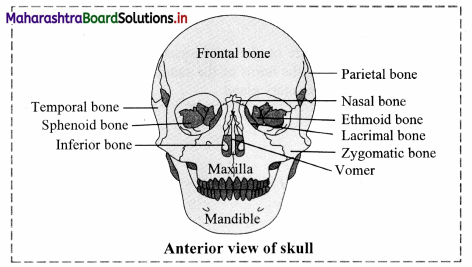
Give an account of bones of human skull.
Answer:
Skull is made up of 22 bones. It is located at the superior end of vertebral column. The bones of skull are
joined by fixed or immovable joints except for jaw.
Skull consists of cranium or brain box and facial bones.

i. Cranium: It is made up of four median bones and two paired bones.

  1. Frontal bone: It is median bone (unpaired) forming forehead, roof of orbit (eye socket) and the most anterior part of cranium. It is connected to two parietals, sphenoid and ethmoid bone.
  2. Parietal bones: These paired bones form the roof of cranium and greater portion of sides of the cranium.
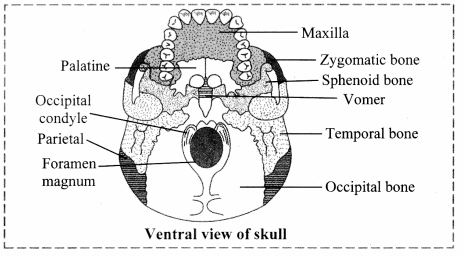
  3. Temporal bones: These paired bones are situated laterally just above the ear on either side. Each temporal bone gives out zygomatic process that joins zygomatic bone to form zygomatic arch. Just at the base of zygomatic process is mandibular fossa, a depression for mandibles (lower jaw bone) that forms the only movable joint of the skull. This bone harbors the ear canal that directs sound waves into the ear. The processes of temporal bones provide points for attachment for various muscles of neck and tongue.
  4. Occipital bone: It is a single bone present at the back of the head. It forms the posterior part and most of the base of cranium. The inferior part of this bone shows foramen magnum, the opening through which medulla oblongata connects with spinal cord. On the either sides of foramen magnum are two prominent protuberances called occipital condyles. These fit into the corresponding depressions present in 1st vertebra.
  5. Sphenoid bone: Median bone present at the base of the skull that articulates with all other cranial bones and holds them together. This butterfly shaped bone has a saddle shaped region called sella turcica. In this hypophyseal fossa, the pituitary gland is lodged.
  6. Ethmoid bone: This median bone is spongy in appearance. It is located anterior to sphenoid and posterior to nasal bones. It contributes to formation of nasal septum and is major supporting structure of nasal cavity.

ii. Facial Bones: Fourteen facial bones give a characteristic shape to the face. The growth of face stops of the age of 16.
Following bones comprise the facial bones:
Maharashtra Board Class 11 Biology Important Questions Chapter 16 Skeleton and Movement 6

  1. Nasals: These are paired bones that form the bridge of nose.
  2. Maxillae: These form the upper jaw bones. They are paired bones that join with all facial bones except mandible. Upper row of teeth are lodged maxillae.
  3. Palatines: These are paired bones forming the roof of buccal cavity or floor of the nasal cavity.
  4. Zygomatic bones: They are commonly called as cheek bones.
  5. Lacrimal bones: These are the smallest amongst the facial bones.
    These bones form the medial wall of each orbit. They have lacrimal fossa that houses lacrimal sacs. These sacs gather tears and send them to nasal cavity.
  6. Inferior nasal conchae: They form the part of lateral wall of nasal cavity. They help to swirl and filter air before it passes to lungs.
  7. Vomer: The median, roughly triangular bone that forms the inferior portion of nasal septum.
  8. Mandible: This median bone forms the lower jaw. It is the largest and strongest facial bone. It is the only movable bone of skull. It has curved horizontal body and two perpendicular branches i.e. rami. These help in attachment of muscles. It has lower row of teeth lodged in it.

Maharashtra Board Class 11 Biology Important Questions Chapter 16 Skeleton and Movement

Question 26.
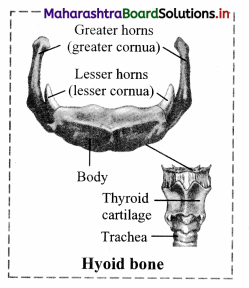
Give an account of hyoid bone.
Answer:

  1. It is a ‘U’ shaped bone that does not articulate with any other bone.
  2. It is suspended from temporal bone by ligaments and muscles.
  3. It is located between mandible and larynx.
  4. It has horizontal body and paired projections called horns.
  5. It provides site for attachment of some tongue muscles and muscles of neck and pharynx.
    Maharashtra Board Class 11 Biology Important Questions Chapter 16 Skeleton and Movement 7

Question 27.
Sketch and label the anterior and ‘entraI view of skull.
Answer:
Maharashtra Board Class 11 Biology Important Questions Chapter 16 Skeleton and Movement 8
Maharashtra Board Class 11 Biology Important Questions Chapter 16 Skeleton and Movement 9

Question 28.
Mention the sutures in skull along with their location.
Answer:
Skull has many sutures (type of immovable joints) present, out of which four prominent ones are:

  1. Coronal suture; Joins frontal bone with parietals.
  2. Sagittal suture: Joins two parietal bones.
  3. Lambdiodal suture: Joins two parietal bones with occipital bone.
  4. Lateral/squamous sutures: Joins parietal and temporal bones on lateral side.

Question 29.
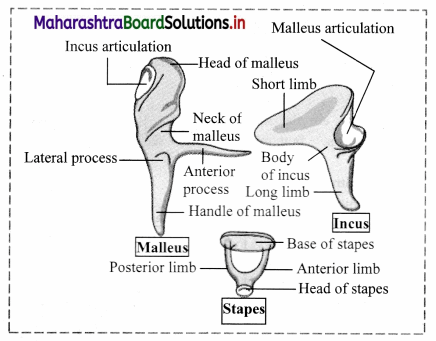
What are ear ossicles?
Answer:
The three tiny bones present in each middle ear namely malleus, incus and stapes, together are called ‘ear ossicles’

Question 30.
Draw a neat and labelled diagram of ear ossicles.
Answer:
Maharashtra Board Class 11 Biology Important Questions Chapter 16 Skeleton and Movement 10

Question 31.
Write a note on human vertebral column. Sketch and label the structure of the vertebral column.
Answer:

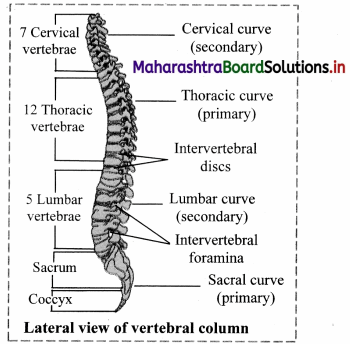
  1. Human vertebral column or backbone is a part of axial skeleton.
  2. It is made up of a chain of irregular bones called vertebrae.
    Maharashtra Board Class 11 Biology Important Questions Chapter 16 Skeleton and Movement 11
  3. Humans have 33 vertebrae in early years of growth, whereas adults have 26 vertebrae.
  4. In adults, five sacral vertebrae lìjse to tòrm one sacrum and four coccygeal vertebrae fuse to form single coccyx.

Question 32.
Explain the cervical vertebrae in detail.
Answer:

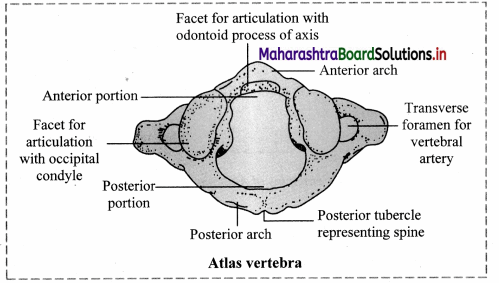
  1. Atlas vertebrae:
    Maharashtra Board Class 11 Biology Important Questions Chapter 16 Skeleton and Movement 12
  2. It is the 1st cervical vertebra.
  3. It is a ring like bone and consists of anterior and posterior arches.
  4. It does not have centrum and spinous process.
  5. The transverse processes and transverse foramina of atlas are large.
  6. The vertebral foramen is large and divided into two parts by transverse ligament.
  7. Spinal cord passes through anterior compartment.
  8. Anterior zygopophyses are replaced by facets for attachment with occipital condyle of skull that forms ‘Yes joint’.

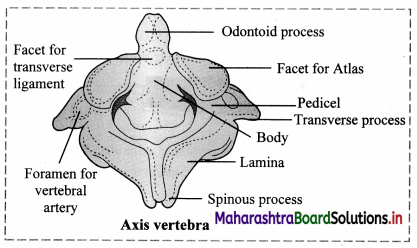
ii. Axis vertebrae:

  1. It is the 2nd cervical vertebrae.
  2. The centrum of this vertebra gives out tooth-like odontoid process.
    Maharashtra Board Class 11 Biology Important Questions Chapter 16 Skeleton and Movement 13
  3. Odontoid process fits into the anterior portion of vertebral foramen of atlas vertebra thereby forming pivot joint, also known as ‘No joint’.

iii. Typical cervical vertebrae:

  1. Vertebrae number 3 to 6 are called as typical cervical vertebrae.
  2. They show short centrum and bifid spinous process.
  3. The transverse processes of these vertebrae are reduced; each having large vertebrarterial canal at its base for the passage of vertebral artery.

iv. 7th cervical vertebra (Vertebra prominens): It is the largest cervical vertebra where the neural spine is straight.

Question 33.
Write a note on thoracic vertebrae. Sketch and label thoracic vertebrae.
Answer:

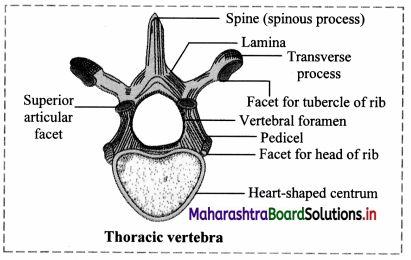
  1. There are 12 thoracic vertebrae found in the chest region.
  2. The centrurn of thoracic vertebrae is heart shaped and all the processes are well developed.
  3. Except for 11th and 12th vertebrae; transverse process of other thoracic vertebrae show facets for attachment with ribs.
    Maharashtra Board Class 11 Biology Important Questions Chapter 16 Skeleton and Movement 14

Question 34.
Elaborate on lumbar vertebrae with help of a neat and labelled diagram.
Answer:
Maharashtra Board Class 11 Biology Important Questions Chapter 16 Skeleton and Movement 15

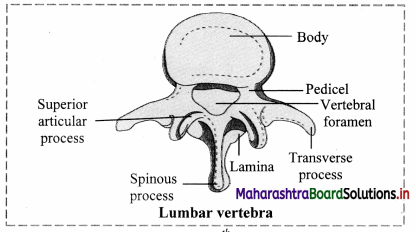
  1. There are 5 lumbar vertebrae.
  2. They are well developed vertebrae and exhibit all the characters of a typical vertebrae.
  3. The centrum of the lumbar vertebrae is kidney shaped.

Question 35.
Give an account on:
i. Sacrum
ii. Coccyx
Answer:
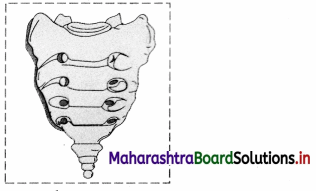
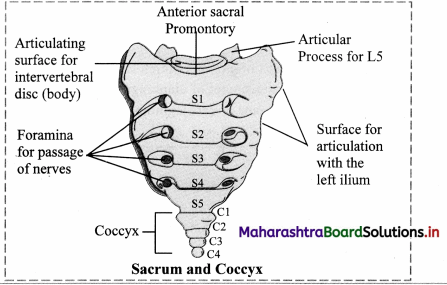
i. Sacrum:

  1. It is a triangular bone formed by the fusion of five sacral vertebrae.
  2. It is located in pelvic cavity between two hip bones.
  3. The anterior end of sacrum is broad and posterior end is narrow.
  4. It consists of vertebral foramina formed by the fusion of vertebrae.
  5. The reduced neural spines can be observed projecting from dorsal aspect of sacrum.
  6. Function: It gives strength to pelvic girdle,

ii. Coccyx:

  1. It is a triangular bone which is formed by fusion of four coccygeal vertebrae.
  2. It is reduced and does not show vertebral foramina and spinous processes.
  3. The transverse processes of coccygeal vertebrae are reduced.

Maharashtra Board Class 11 Biology Important Questions Chapter 16 Skeleton and Movement

Question 36.
Identify the given vertebrae and label it.
Maharashtra Board Class 11 Biology Important Questions Chapter 16 Skeleton and Movement 16
Answer:
Maharashtra Board Class 11 Biology Important Questions Chapter 16 Skeleton and Movement 17

Question 37.
Describe in brief the structure of thoracic cage.
Answer:
Thoracic cage consists of 12 pairs of ribs, breast bone or sternum.

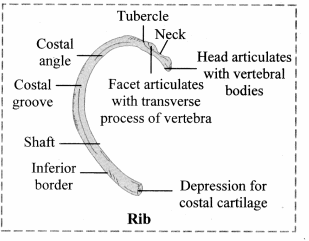
i. Ribs:

  1. A rib is a ‘C’ shaped bone. It is attached to respective thoracic vertebrae on dorsal side.
  2. Twelve pairs of ribs are attached to twelve thoracic vertebrae. For attachment to the vertebrae the posterior ends of ribs have two protuberances namely the head and tubercle.
  3. The head of rib attaches to facet formed by demifacets of adjacent thoracic vertebrae at the base of transverse processes.
    Maharashtra Board Class 11 Biology Important Questions Chapter 16 Skeleton and Movement 18
  4. The tip of transverse processes of these vertebrae also have facets for attachment of ribs where tubercles of ribs are attached.
  5. Ribs provide space for attachment of intercostal muscles.
  6. On ventral side, the ribs may or may not attach the sternum. Depending on their attachment, the ribs are classified into three types:
    1. True ribs: First seven pairs of ribs are attached directly to the sternum by means of their costal cartilages.
    2. False ribs: Costal cartilages of rib numbers 8, 9 and 10 are attached to rib number 7 on either side and not directly to the sternum. Hence, these are called false ribs.
    3. Floating ribs: Last two pairs of ribs have no ventral connection. Hence, they are called floating ribs.

ii. Sternum:

  1. It is a flat, narrow bone, around 15 cms in length.
    Maharashtra Board Class 11 Biology Important Questions Chapter 16 Skeleton and Movement 19
  2. It is placed medially in anterior thoracic ] jugular notch wall (chest region).
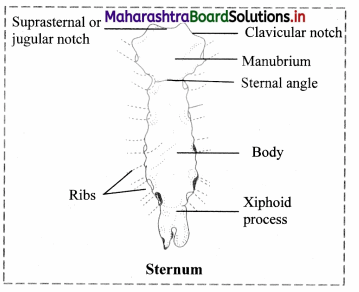
  3. It consists of three distinct parts – manubrium, body and xiphoid processes.
  4. Manubrium shows two notches on anterio-lateral side for attachment with clavicle of each side. It also shows two notches on each of the lateral side for attachment of first two pairs of ribs.
  5. Body of sternum is a flat bone that shows five notches on lateral aspect which are meant for direct or indirect attachment of ribs.
  6. Xiphoid process is lowermost part of sternum which is initially cartilaginous and gets ossified in adults. It provides space for the attachment of diaphragm and abdominal muscles.
  7. Ribs are attached to sternum by means of cartilaginous extensions called costal cartilages.

Question 38.
What is intercostal space?
Answer:
The space between the ribs is called as intercostal space.

Question 39.
Describe the bones of pectoral girdle.
Answer:
Maharashtra Board Class 11 Biology Important Questions Chapter 16 Skeleton and Movement 20
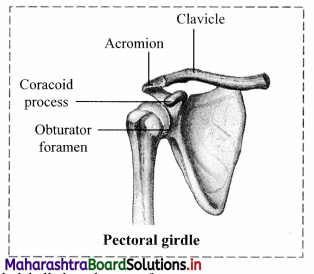
Pectoral girdle is called as shoulder girdle. It attaches forelimb skeleton with axial skeleton. There are two pectoral girdles, each consists of a shoulder blade or scapula and collar bone or clavicle.

i. Clavicle:

  1. It is a ‘S’ shaped slender bone.
  2. One end of clavicle is attached to acromion process of scapula. The other rounded end called sternal end attaches to manubrium of sternum.
  3. This connects upper arm skeleton to axial skeleton.

ii. Scapula:

  1. It is a large, flat, triangular bone that occupies posterior chest wall extending from 2nd to 7th ribs.
  2. It is attached to axial skeleton by muscles and tendons.
  3. Scapula bears a concave socket called glenoid cavity at its lateral angle.
  4. Head of humerus (the upper arm bone) fits into the glenoid cavity.
  5. A beak like coracoid process projects from lateral angle of scapula and acromion process arise from scapula. They can be easily felt as high point of shoulder. Both the processes are meant for attachment of muscles.

Question 40.
Describe the bones of forelimb.
Answer:
Forelimb consists of humerus, radius and ulna (together forming forearm bones), carpals (bones of wrist), metacarpals (bones of palm) and phalanges (bones of digits). It consists of 30 bones.

i. Humerus:

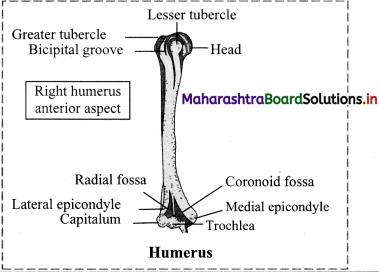
  1. This is the bone of upper arm.
  2. It has a hemispherical head at its proximal end. On either side of head of humerus are present a pair of projections termed greater and lesser tubercles.
    Maharashtra Board Class 11 Biology Important Questions Chapter 16 Skeleton and Movement 21
  3. Bicipital groove is a deep groove present between the tubercles where a tendon of biceps muscle is attached.
  4. The shaft of humerus shows deltoid tuberosity. Distal end of humerus shows pulley like part called trochlea that articulates with ulna.

ii. Radius and Ulna:

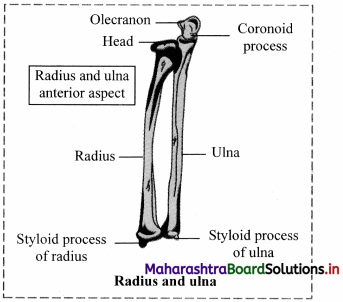
  1. Radius is located laterally on thumb side of the forearm.
  2. The proximal end of radius has disc like head that articulates with humerus bone.
  3. The shaft of radius widens distally to form styloid process.
  4. Ulna is located medially on little finger side of forearm.
  5. At the proximal end of ulna there is a prominent process called Olecranon process that forms elbow joint with humerus bone. On the lateral side, near the upper end of ulna is present the radial notch into which the side of head of radius is fixed.
    Maharashtra Board Class 11 Biology Important Questions Chapter 16 Skeleton and Movement 22
    f. Radius and ulna articulate with each other at upper and lower extremities by superior and inferior radio-ulnar joints. In between the shaft of two bones, interosseous membrane is present.

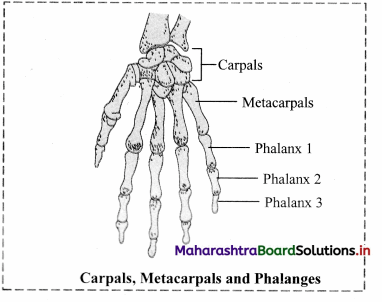
iii. Carpals: These are bones of wrist, arranged in two rows of four each.

iv. Metacarpals: Five elongated metacarpals form the bones of palm. Their proximal ends join with carpals and distal ends form knuckles.

v. Phalanges: Phalanges form the bones of fingers and thumb. There are 14 phalanges in each hand (Four fingers have three phalanges each and thumb has two).
Maharashtra Board Class 11 Biology Important Questions Chapter 16 Skeleton and Movement 23

Question 41.
Explain briefly the pelvic girdle with a neat and labelled diagram.
Answer:

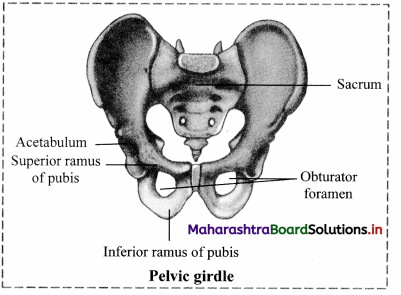
  1. Pelvic girdle also known as hip girdle connects hind limb skeleton with axial skeleton.
  2. It is made up of two hip bones called coxal bones. These coxal bones unite posteriorly with sacrum.
  3. Coxal bone is a large irregularly shaped bone is made up of three parts – ilium, ischium and pubis.
  4. At the point of fusion of ilium, ischium and pubis, a cavity called acetabulum is present that forms ball and socket joint with the thigh bone.
    Maharashtra Board Class 11 Biology Important Questions Chapter 16 Skeleton and Movement 24
  5. The two pubis bones are joined medially by cartilaginous joint called pubic symphysis. Pubis and ischium together form a ring of bone that encloses a space called obturator foramen.

Question 42.
Describe the bones of lower limb.
Answer:
The bones of lower limb are femur, patella, tibia and fibula, tarsals, metatarsals and phalanges.

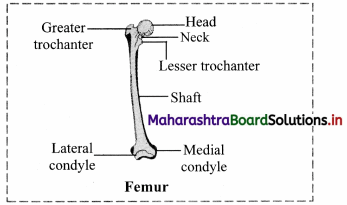
i. Femur: The thigh bone is the longest bone in the body. The head is joined to shaft at an angle by a short neck. It forms ball and socket joint with acetabulum cavity of coxal bone. The lower one third region of shaft is triangular flattened area called popliteal surface. Distal end has two condyles that articulate with tibia and fibula.
Maharashtra Board Class 11 Biology Important Questions Chapter 16 Skeleton and Movement 25

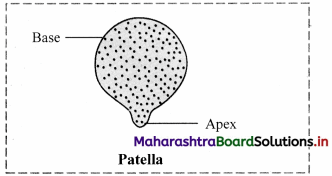
ii. Patella: It is also called as knee cap. ft is a sesamoid bone (bone embedded in tendon). It is a flat rounded bone with a pointed lower end.
Maharashtra Board Class 11 Biology Important Questions Chapter 16 Skeleton and Movement 26

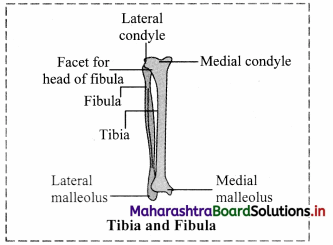
iii. Tibia and fibula: These are the two long bones of shank or lower leg. The two bones are connected to each other at the extremities. In between the two bones interosseous membrane is present.

  1. Tibia: It is much thicker and stronger than fibula. Its broad and expanded upper end articulates with femur and the lower end articulates with talus (tarsal bone).
  2. Fibula: It is a long slender bone on lateral side of tibia.
    Maharashtra Board Class 11 Biology Important Questions Chapter 16 Skeleton and Movement 27

iv. Tarsals: These are the bones of ankle. Seven tarsals are arranged in three rows, two proximal, one intermediate and four distal.
Maharashtra Board Class 11 Biology Important Questions Chapter 16 Skeleton and Movement 28

v. Metatarsals: Five metatarsal bones support the foot. Proximally they attach with distal row of tarsals and distally the metatarsals articulate with phalanges.

vi. Phalanges: These are the bones of the toes. Except the big toe which has two phalanges, the other four toes have three phalanges each.

Question 43.
What is arthrology?
Answer:
The study of joints is called arthrology.

Question 44.
What makes synovial joint freely movable?
Answer:
Synovial joint is characterised by synovial cavity between the articulating bones which allows free movement at the joint. This makes the joint freely movable.

Question 45.
Complete the given table.
Maharashtra Board Class 11 Biology Important Questions Chapter 16 Skeleton and Movement 29
Answer:
Maharashtra Board Class 11 Biology Important Questions Chapter 16 Skeleton and Movement 30

Question 46.
State and explain the disorders related to muscles.
Answer:
i. Muscular dystrophy:

  1. It is a gradual wasting disease affecting various groups of muscles.
  2. It is a genetic disorder.
  3. Usually the voluntary skeletal muscles are weakened whereas internal muscles such as diaphragm are not affected in the patient suffering from this disorder.
  4. The Duchenne type of muscular dystrophy usually occurs in boys, affecting their lower limbs.
  5. Limb girdle muscular dystrophy affects the muscles of shoulders or hips and it usually starts in adults between 20 – 30 years.
  6. There is no cure for this disease.

ii. Myasthenia gravis:

  1. It is a weakness of skeletal muscles.
  2. It is caused by an abnormality at the neuromuscular junction that partially blocks muscle contraction.
  3. It is an autoimmune disorder caused by excessive production of certain antibodies in the blood stream. These antibodies bind to acetylcholine receptors of neuromuscular junction. Thus, the transmission of nerve impulses to the muscle fibres is blocked. This causes progressive and extensive muscle weakness.
  4. It may affect the eye and eyelid movements, facial expression and swallowing.
  5. The degree of muscle weakness varies from local to general.
  6. Symptoms: Ptosis (drooping or falling of upper eye lid), diplopia or double vision, difficulty in swallowing, chewing and speech.

Maharashtra Board Class 11 Biology Important Questions Chapter 16 Skeleton and Movement

Question 47.
Give an account on disorders related to bones.
Answer:

  1. Arthritis: It is an inflammation of joints. It is a painful disorder of bones, ligaments, tendons, etc. In this disorder, joints become swollen, stiff and painful. It can lead to disability.
  2. Arthritis is of three types:
    1. Osteoarthritis: In this disorder, the joint cartilage is degenerated. It is caused by various factors like aging, obesity, muscle weakness, etc. This is the most common type of arthritis that affects hands, knees and spine.
    2. Gouty arthritis (Gout): In this disorder, joint pain occurs due to the deposition of uric acid in joints. If uric acid is produced in excess or is not excreted, it accumulates in joints as sodium urate. The accumulated sodium urate degenerates the cartilage causing inflammation and pain. It generally affects the joints of feet.
    3. Rheumotoid arthritis: It is an autoimmune disorder where body’s immune system attacks its own tissues. In rheumatoid arthritis, synovial membrane swells up and starts secreting extra synovial fluid. This fluid exerts pressure on joint and makes it painful. Membrane may develop abnormal granulation tissue called pannus. Pannus may erode cartilage. Fibrous tissue gets ossified and may lead to stiffness in joints.
  3. Osteoporosis:
    1. In this disorder, bones become porous and hence brittle. It is primarily age related disease and is more common in women than men.
    2. As age advances, bone resorption outpaces bone formation. Hence, the bones lose mass and become brittle. More calcium is lost in urine, sweat, etc., than it is gained through diet. Thus, prevention of disease is better than treatment by consuming adequate amount of calcium and exercise at young age.
    3. Osteoporosis may be caused due to decreasing estrogen secretion after menopause, deficiency of vitamin D, low calcium diet, decreased secretion of sex hormones and thyrocalcitonin.

Question 48.
Name the following.

Question 1.
The striated muscles that are known as prime movers
Answer:
Agonists

Question 2.
The antagonistic muscles that lower the body part
Answer:
Depressor

Question 3.
The contractile proteins of sarcomere
Answer:
Actin and myosin

Question 4.
Sliding filament theory is also known as
Answer:
Walk along theory or Rachet theory

Question 5.
The smallest facial bone
Answer:
Lacrimal bones

Question 6.
Number of bones in thoracic cage
Answer:
25

Question 7.
The first cervical vertebrae
Answer:
Atlas

Question 8.
The three bones of pelvic girdle
Answer:
Ilium, ischium and pubis

Question 9.
The bone which is known as the knee cap
Answer:
Patella

Question 10.
Age related disorder more common in woman than man.
Answer:
Osteoporosis

Question 49.
Fill in the blanks.

Question 1.
The actin filament contains two additional proteins strands that are polymers of ___ molecules.
Answer:
tropomyosin

Question 2.
___ of sarcoplasmic reticulum release large number of Ca++ into sarcoplasm.
Answer:
Transverse (T) tubules

Question 3.
The joint between the first vertebra and occipital condyle of skull is an example of ____ class of lever.
Answer:
Class I

Question 4.
Endoskeleton of an adult human consists of ___ bones.
Answer:
206

Maharashtra Board Class 11 Biology Important Questions Chapter 16 Skeleton and Movement

Question 5.
___ are the bones that connect limbs to the axial skeleton.
Answer:
Girdles

Question 6.
___ bones form the roof of cranium.
Answer:
Parietal

Question 7.
Zveomatic bone is commonly known as ___ bone.
Answer:
Cheek

Question 8.
The largest and strongest facial bone is ___
Answer:
Mandible

Question 9.
There are ___ types of vertebrae.
Answer:
5

Question 10.
___ is also known as shoulder girdle.
Answer:
Pectoral girdle

Question 11.
___ are the bones of wrist.
Answer:
Carpals

Question 12.
___ is known as immovable or fixed joint.
Answer:
Synarthroses

Maharashtra Board Class 11 Biology Important Questions Chapter 16 Skeleton and Movement

Question 13.
Tibia and fibula are two long bones of ___.
Answer:
Shank or lower leg

Question 14.
___ is caused due to deposition of uric acid in joints.
Answer:
Gouty arthritis

Question 50.
State whether the following statements are True or False:

Question 1.
Saggital suture joins frontal bone with parietal bone.
Answer:
False. Saggital suture joins two parietal bones.

Question 2.
In human beings, there are 10 pairs of ribs.
Answer:
False. In human beings, there are 12 pairs of ribs.

Question 3.
Hyoid bone does not articulate with any other bone.
Answer:
True

Question 4.
Pivot joint is present between Atlas and Axis vertebrae.
Answer:
True

Question 5.
The two pubis bones are joined by cartilaginous joint called pubic symphysis.
Answer:
True

Question 6.
Rheumatoid arthritis is an autoimmune disorder.
Answer:
True

Question 50.
Identify the INCORRECTLY labelled part of pectoral girdle.
Maharashtra Board Class 11 Biology Important Questions Chapter 16 Skeleton and Movement 31
Answer:
Glenoid cavity is incorrectly labelled as obturator foramen.

Multiple Choice Questions

Question 1.
Locomotion in sperms takes place with the help of
(A) flagella
(B) cilia
(C) pseudopodia
(D) muscles
Answer:
(A) flagella

Question 2.
Levator muscles result into the action of
(A) lowering a body part
(B) tensing a body part
(C) relaxing a body part
(D) raising a body part
Answer:
(D) raising a body part

Maharashtra Board Class 11 Biology Important Questions Chapter 16 Skeleton and Movement

Question 3.
Which of these is not a skull bone?
(A) Frontal
(B) Scapula
(C) Occipital
(D) Temporal
Answer:
(B) Scapula

Question 4.
Immovable joint is in between the bones of
(A) frontal and parietal
(B) metacarpal and phalangeal
(C) femur and tibia
(D) radius and ulna
Answer:
(A) frontal and parietal

Question 5.
Total number of vertebrae in human beings is
(A) 22
(B) 33
(C) 24
(D) 12
Answer:
(B) 33

Question 6.
Which of the following is NOT a part of appendicular skeleton?
(A) Girdles
(B) Forelimb
(C) Hindlimb
(D) Vertebral column
Answer:
(D) Vertebral column

Question 7.
___ connects the upper arm to the axial skeleton.
(A) Clavicle
(B) Patella
(C) Tibia
(D) Femur
Answer:
(A) Clavicle

Question 8.
__ is a part of hind limb.
(A) Radius
(B) Ulna
(C) Humers
(D) Fibula
Answer:
(D) Fibula

Question 9.
Which of the following are toe bones?
(A) Tarsals
(B) Metatarsals
(C) Carpals
(D) Phalanges
Answer:
(D) Phalanges

Question 10.
Sutures on the skull are ___ joints.
(A) freely movable
(B) slightly movable
(C) fixed
(D) synovial
Answer:
(C) fixed

Question 11.
___ is an example of syndesmoses.
(A) Distal tibiofibular joint
(B) Rib-sternum junction
(C) Tooth and jaw bones
(D) Intervertebral disc
Answer:
(A) Distal tibiofibular joint

Question 12.
Elbow joint is
(A) ball and socket joint
(B) hinge joint
(C) suture joint
(D) gliding joint
Answer:
(B) hinge joint

Question 13.
Complete the analogy.
Hinge joint: Monoaxial movement:: ___ Biaxial movement
(A) Ball and socket joint
(B) Gliding joint
(C) Condyloid joint
(D) Both (A) and (B)
Answer:
(C) Condyloid joint

Question 14.
An autoimmune disorder in which an antibody reduces the efficiency of transmission between the motor neuron is called
(A) Myasthenia gravis
(B) Tetany
(C) Osteoarthritis
(D) Osteoporosis
Answer:
(A) Myasthenia gravis

Maharashtra Board Class 12 Hindi Yuvakbharati Solutions Chapter 15 फीचर लेखन

Balbharti Maharashtra State Board Hindi Yuvakbharati 12th Digest Chapter 15 फीचर लेखन Notes, Textbook Exercise Important Questions and Answers.

Maharashtra State Board 12th Hindi Yuvakbharati Solutions Chapter 15 फीचर लेखन

12th Hindi Guide Chapter 15 फीचर लेखन Textbook Questions and Answers

कृति-स्वाध्याय एवं उत्तर

पाठ पर आधारित

प्रश्न 1.
फीचर लेखन की विशेषताएँ लिखिए।
उत्तर :
फीचर किसी विशेष घटना, व्यक्ति, जीव-जंतु, स्थान, प्रकृति-परिवेश से संबंधित व्यक्तिगत अनुभूतियों पर आधारित आलेख होता है। फीचर समाचारों को नया आयाम देता है, उनका परीक्षण करता है तथा उन पर नया प्रकाश डालता है। फीचर समाचारपत्र का प्राण तत्त्व होता है। पाठक की प्यास बुझाने, घटना की मनोरंजनात्मक अभिव्यक्ति की कला का नाम फीचर है। फीचर किसी गद्य गीत की तरह होता है जो बहुत लंबा, नीरस और गंभीर नहीं होना चाहिए। इससे पाठक बोर हो जाते हैं और ऐसे फीचर , कोई पढ़ना नहीं चाहता। फीचर किसी विषय का मनोरंजक शैली में विस्तृत विवेचन है।

Maharashtra Board Class 12 Hindi Yuvakbharati Solutions Chapter 15 फीचर लेखन

अच्छा फीचर नवीनतम जानकारी से परिपूर्ण होता है। किसी घटना की सत्यता, तथ्यता फीचर का मुख्य तत्त्व है। फीचर लेखन में शब्द चयन अत्यंत महत्त्वपूर्ण है। लेखन की भाषा सहज, संप्रेषणीयता से परिपूर्ण होनी चाहिए। प्रसिद्ध व्यक्तियों के कथनों, उद्धरणों, लोकोक्तियों और मुहावरों का प्रयोग फीचर में है चार चाँद लगा देता है। फीचर लेखन में भावप्रधानता होनी चाहिए, क्योंकि नीरस फीचर कोई भी नहीं पढ़ना चाहता।

फीचर से संबंधित तथ्यों का आधार दिया जाना चाहिए। विश्वसनीयता के लिए फीचर ३ में तार्किकता आवश्यक है। तार्किकता के बिना फीचर अविश्वसनीय ३ बन जाता है। फीचर में विषय की नवीनता होना आवश्यक है, क्योंकि उसके अभाव में फीचर अपठनीय हो जाता है। फीचर में किसी व्यक्ति अथवा घटना विशेष का उदाहरण दिया गया हो तो उसकी संक्षिप्त जानकारी भी देनी चाहिए।

फीचर के विषयानुकूल चित्रों, कार्टूनों अथवा फोटो का उपयोग किया जाए तो फीचर अधिक प्रभावशाली बन जाता है। फीचर लेखन में राष्ट्रीय स्तर के तथा अन्य महत्त्वपूर्ण तथा समसामयिक विषयों का समावेश होना है चाहिए। फीचर पाठक की मानसिक योग्यता और शैक्षिक पृष्ठभूमि के अनुसार होना चाहिए।

प्रश्न 2.
फीचर लेखन के सोपानों को स्पष्ट कीजिए।
उत्तर :
फीचर लेखन की प्रक्रिया के निम्नलिखित सोपान हैं :

  1. प्रस्तावना : प्रस्तावना में फीचर के विषय का संक्षिप्त परिचय दिया जाता है। यह परिचय आकर्षक और विषयानुकूल होना चाहिए। परिचय पढ़कर पाठकों के मन में फीचर पढ़ने की जिज्ञासा जाग्रत होती है और पाठक अंत तक फीचर से जुड़ा रहता है।
  2. विवरण अथवा मुख्य कलेवर : फीचर में विवरण का महत्त्वपूर्ण स्थान है। फीचर में लेखक स्वयं के अनुभव, लोगों से प्राप्त जानकारी और विषय की क्रमबद्धता, रोचकता के साथ-साथ संतुलित तथा आकर्षक शब्दों में पिरोकर उसे पाठकों के सम्मुख रखता है जिससे फीचर पढ़ने वाले को ज्ञान और अनुभव से संपन्न कर दे।
  3. उपसंहार : यह अनुच्छेद संपूर्ण फीचर का सार अथवा निचोड़ होता है। इसमें फीचर लेखक फीचर का निष्कर्ष भी प्रस्तुत कर सकता है अथवा कुछ अनुत्तरित प्रश्न पाठकों के ऊपर भी छोड़ सकता है। उपसंहार ऐसा होना चाहिए जिससे पाठक को विषय से संबंधित ज्ञान भी मिल जाए और उसकी जिज्ञासा भी बनी रहे।
  4. शीर्षक : विषय का ओचित्यपूर्ण शीर्षक फीचर की आत्मा है। शीर्षक संक्षिप्तं रोचक और जिज्ञासावर्धक होना चाहिए। नवीनता, आकर्षकता और ज्ञानवृद्धि उत्तम शीर्षक के गुण हैं।

प्रश्न 3.
फीचर लेखन करते समय बरती जाने वाली सावधानियों पर प्रकाश डालिए।
उत्तर :
फीचर लेखन करते समय बरती जाने वाली सावधानियाँ :

  • फीचर लेखन में आरोप-प्रत्यारोप करने से बचना चाहिए।
  • फीचर लेखन में आलंकारिक और अति क्लिष्ट भाषा का है प्रयोग नहीं करना चाहिए।
  • फीचर लेखन में अति नाटकीयता से बचना चाहिए।
  • झूठा तथ्यात्मक आँकड़े, प्रसंग अथवा घटनाओं का उल्लेख है करना उचित नहीं।
  • फीचर लेखन में अति कल्पनाओं और हवाई बातों के प्रयोग है से बचना चाहिए।
  • फीचर लेखन में भावप्रधानता होनी चाहिए, क्योंकि नीरस फीचर कोई भी नहीं पढ़ना चाहता।
  • फीचर बहुत लंबा, ऊबाऊ और गंभीर नहीं होना चाहिए। फीचर में विषय की नवीनता होना आवश्यक है।
  • फीचर लेखन की भाषा सहज, संप्रेषणीयता से परिपूर्ण होनी चाहिए।
  • फीचर से संबंधित तथ्यों का आधार दिया जाना चाहिए। विश्वसनीयता के लिए फीचर में तार्किकता आवश्यक है।
  • फीचर लेखन पाठक की मानसिक योग्यता और शैक्षिक पृष्ठभूमि को ध्यान में रखकर किया जाना चाहिए।
  • फीचर में किसी व्यक्ति अथवा घटना विशेष का उदाहरण दिया गया हो तो उसकी संक्षिप्त जानकारी भी देनी चाहिए।
  • फीचर के विषयानुकूल चित्रों, कार्टूनों अथवा फोटो का उपयोग किया जाए तो फीचर अधिक प्रभावशाली बन है जाता है।
  • फीचर लेखन में राष्ट्रीय स्तर के तथा अन्य महत्त्वपूर्ण तथा समसामयिक विषयों का समावेश होना चाहिए।

Maharashtra Board Class 12 Hindi Yuvakbharati Solutions Chapter 15 फीचर लेखन

व्यावहारिक प्रयोग

प्रश्न 4.
भारत के अंतरिक्ष कार्यक्रम पर फीचर लेखन कीजिए।
उत्तर :
भारत का अंतरिक्ष कार्यक्रम डॉ विक्रम साराभाई की संकल्पना है। उन्हें भारतीय अंतरिक्ष कार्यक्रम का जनक कहा जाता है। वर्तमान में इस कार्यक्रम की कमान भारतीय अंतरिक्ष अनुसंधान संगठन (इसरो) के हाथों में है। इसरो की स्थापना 1969 में डॉ. विक्रम साराभाई की अध्यक्षता में की गई। इसका मुख्यालय बंगलौर में है। भारत ने अपने पहले अंतरिक्ष कार्यक्रम की शुरुआत बेहद सीमित संसाधनों के साथ की थी।

जब पहले उपग्रह को अंतरिक्ष में भेजा गया तब शायद ही किसी ने सोचा हो कि भारत का अंतरिक्ष यान किसी दिन मंगल ग्रह के लिए जा सकेगा। भारत के अंतरिक्ष कार्यक्रम से कई बड़े वैज्ञानिक जुड़े रहे हैं। पूर्व राष्ट्रपति डॉ. ए. पी. जे. अब्दुल कलाम भी भारत के अंतरिक्ष कार्यक्रम में योगदान दे चुके हैं।

स्थापना के बाद से ही भारतीय अंतरिक्ष कार्यक्रम अच्छी तरह से ऑर्केस्ट्रेटेड किया गया है और इसमें संचार और रिमोट सेंसिंग के लिए उपग्रह, अंतरिक्ष परिवहन प्रणाली और अनुप्रयोग कार्यक्रम जैसे तीन अलग-अलग तत्त्व थे। प्राकृतिक संसाधनों और आपदा प्रबंधन सहायता की निगरानी और प्रबंधन के लिए दूरसंचार, टेलिविजन प्रसारण और मौसम संबंधी सेवाओं और रिमोट सेंसिंग सैटेलाइट के लिए दो प्रमुख परिपालन प्रणालियों को भारतीय राष्ट्रीय उपग्रह स्थापित किया गया है।

1960 और 1970 के दशक के दौरान भारत ने भू राजनीतिक और आर्थिक विचारों के कारण अपना स्वयं का लॉन्च वाहन कार्यक्रम प्रारंभ किया। देश ने एक साउंडिंग रॉकेट प्रोग्राम विकसित किया और 1980 के दशक तक सैटेलाइट लॉन्च व्हीकल – 3 और अधिक उन्नत, संवर्धित सैटेलाइट लॉन्च व्हीकल (ए एस एल वी) को परिचालन सहायक बुनियादी ढाँचे के साथ पूरा किया।

सबसे पहले धुंबा को रॉकेट लॉन्चिग सेंटर के तौर पर चुना गया था। धरती की भू चुंबकीय भूमध्य रेखा धुंबा से गुजरती है। भारत ने पहला रॉकेट 21 नवंबर 1963 को लॉन्च किया था यानी मंगल यान से करीब 50 साल पहले। ये एक नाइक-अपाचे रॉकेट था। 1975 में भारत ने अपना पहला उपग्रह आर्यभट्ट लॉन्च किया और इस तरह अंतरिक्ष युग में प्रवेश किया। इसका वजन सिर्फ 360 किलोग्राम था और इसका नाम प्राचीन भारत के प्रसिद्ध खगोलविद आर्यभट्ट के नाम पर रखा गया था।

Maharashtra Board Class 12 Hindi Yuvakbharati Solutions Chapter 15 फीचर लेखन

भास्कर – 1 भारत का पहला रिमोट सेंसिंग सैटेलाइट था, इस उपग्रह का कैमरा जो तस्वीरें भेजता था, उन्हें वन, पानी और सागरों के अध्ययन में इस्तेमाल किया जाता था। चंद्रयान का भारत के अंतरिक्ष कार्यक्रम में महत्त्वपूर्ण स्थान है। चंद्रयान ने चंद्रमा की सतह पर पानी की खोज की थी।

इसरो ने प्रक्षेपण यान प्रौद्योगिकी की उन्नति के लिए अपनी ऊर्जा को आगे बढ़ाया, जिसके परिणामस्वरूप पी एस एल वी और जी एस एल वी प्रौद्योगिकियों का निर्माण हुआ। पिछले साढ़े चार दशकों में भारत का अंतरिक्ष कार्यक्रम ने एक सुसंगठित, आत्मनिर्भर कार्यक्रम के माध्यम से प्रभावशाली प्रगति की है।

प्रश्न 5.
लता मंगेशकर पर फीचर लेखन कीजिए।
उत्तर :
भारतरत्न लता मंगेशकर भारत की अप्रतिम गायिका हैं। उनकी मधुर आवाज की पूरी दुनिया दीवानी है। पिछले छह-सात दशकों से भारतीय सिनेमा को अपनी आवाज के जादू से सराबोर करने वाली लता का जन्म 28 सितंबर, 1929 को इंदौर के मराठी परिवार में पंडित दीनदयाल के घर में हुआ। लता के पिता रंगमंच के कलाकार और गायक भी थे। अतः संगीत लता को विरासत में मिला। लता के जन्म के कुछ दिन बाद ही इनका परिवार महाराष्ट्र चला गया।

लता मंगेशकर ने अपनी संगीत यात्रा का प्रारंभ मराठी फिल्मों से किया। इन्होंने ‘हिंदुस्तान क्लासिकल म्यूजिक’ के उस्ताद अमानत अली खान से क्लासिकल संगीत सीखना शुरु किया। भारत बँटवारे के बाद उस्ताद अमानत अली खान के पाकिस्तान चले जाने के बाद लता ने बड़े गुलाम अली खान, पंडित तुलसीदास शर्मा तथा उस्ताद अमानत खान देवसल्ले से संगीत सीखा।

गुलाम हैदर ने 1948 में लता को ‘मजबूर’ फिल्म में पहला ब्रेक दिया। तब से लेकर 1989 तक लता मंगेशकर ने 30000 से भी अधिक गाने गाए हैं, जो अपने आप में एक रिकॉर्ड है। इस दौर में हिंदी फिल्म इंडस्ट्री का शायद ही कोई ऐसा फिल्म निर्देशक और संगीत निर्देशक होगा, जिसके साथ लता जी ने काम न किया हो। लता मंगेशकर अत्यंत शांत स्वभाव और प्रतिभा की धनी हैं।

उन्होंने रागों पर आधारित अनेक गाने गाए, तो दूसरी ओर ‘अल्लाह. तेरो नाम’ और ‘प्रभु तेरो नाम’ जैसे भजन भी गाए, वहीं 1963 में पंडित जवाहरलाल नेहरू की उपस्थिति में देश का सबसे जीवंत गीत ‘ऐ मेरे वतन के लोगों’ गाया। इस गाने को सुनते समय नेहरू जी की आँखों से आँसू बह निकले थे।

लता मंगेशकर भारतीय संगीत में महत्त्वपूर्ण योगदान देने के लिए पद्मभूषण, पद्मविभूषण, दादा साहेब फाल्के अवॉर्ड, महाराष्ट्र भूषण अवॉर्ड, भारतरत्न, 3 बार राष्ट्रीय फिल्म अवॉर्ड, बंगाल फिल्म पत्रकार संगठन अवॉर्ड, फिल्म फेअर लाइफटाइम अचीवमंट अवॉर्ड सहित अनेक अवॉर्ड जीत चुकी हैं। आज पूरी संगीत दुनिया उनके आगे नतमस्तक है।

फीचर के प्रकार

  • समाचार फीचर
  • खोजपरक फीचर
  • मानवीय रुचिपरक फीचर
  • सांस्कृतिक कार्यक्रमों से संबंधित फीचर
  • व्याख्यात्मक फीचर
  • ऐतिहासिक फीचर
  • जन रुचि के विषयों पर आधारित फीचर
  • विज्ञान फीचर
  • खेल-कूद फीचर
  • फोटो फीचर
  • पर्वोत्सवी फीचर
  • इलेक्ट्रॉनिक माध्यमों पर आधारित फीचर
  • विशेष घटनाओं पर आधारित फीचर
  • व्यक्तिगत फीचर
  • रेडियो फीचर

Maharashtra Board Class 12 Hindi Yuvakbharati Solutions Chapter 15 फीचर लेखन

फीचर लेखन Summary in Hindi

फीचर लेखन का परिचय

फीचर लेखन लेखक का नाम :
डॉ. बीना शर्मा। (जन्म 20 अक्तूबर 1959.)

फीचर लेखन प्रमुख कृतियाँ :
‘हिंदी शिक्षण – अंतर्राष्ट्रीय परिप्रेक्ष्य’, ‘भारतीय सांस्कृतिक प्रतीक’ आदि।

फीचर लेखन विशेषता :
डॉ. बीना का लेखन शिक्षा क्षेत्र और भारतीय संस्कृति से प्रेरित है। स्त्री विमर्श और समसामयिक विषयों पर आपका विशेष लेखन। आपका साहित्य भारतीय संस्कारों और जीवन मूल्यों के प्रति आग्रही है।

Maharashtra Board Class 12 Hindi Yuvakbharati Solutions Chapter 15 फीचर लेखन 3

फीचर लेखन विषय प्रवेश :
आज के दौर में फीचर लेखन पत्रकारिता क्षेत्र का आधार स्तंभ बन गया है। फीचर का मुख्य कार्य पाठक के सम्मुख किसी विषय का सजीव वर्णन करना होता है। प्रस्तुत पाठ में लेखिका फीचर लेखन का स्वरूप, उसकी विशेषताएँ, प्रकार आदि पर प्रकाश डालते हुए इस तथ्य को उद्भासित कर रही है कि फीचर लेखन जहाँ एक ओर समाज के दर्पण के रूप में कार्य कर सकता है, वहीं यह आजीविका का स्रोत भी बन सकता है।

फीचर लेखन पाठ का सार

स्नेहा एक पत्रकार है। आज वह और उसका पूरा परिवार आनंद और गर्व की भावना से भरा है। पत्रकारिता के क्षेत्र में फीचर लेखन के लिए दिए जाने वाले ‘सर्वश्रेष्ठ फीचर लेखन’ के लिए स्नेहा को राष्ट्रीय पुरस्कार से सम्मानित किया गया है। आज उसके परिवार द्वारा एक पार्टी का आयोजन किया गया है। स्नेहा के पति, उसके सास-ससुर, पुत्री प्रिया और पुत्र नैतिक उसे बधाई दे रहे हैं। स्नेहा की आँखों में खुशी के आँसू हैं।

Maharashtra Board Class 12 Hindi Yuvakbharati Solutions Chapter 15 फीचर लेखन 1

स्नेहा अतीत में खो जाती है। बी. ए. कर लेने के बाद पिता द्वारा भविष्य के बारे में पूछने पर वह पत्रकारिता का कोर्स करने है की इच्छा प्रकट करती है, जिसे माता द्वारा भी समर्थन मिलता है। स्नेहा पत्रकारिता का कोर्स ज्वाइन कर लेती है। पत्रकारिता की कक्षा का प्रथम दिवस – पहले लेक्चर में प्रोफेसर ने पत्रकारिता पाठ्यक्रम का पहला पेपर पढ़ाना शुरु किया। विषय था – फीचर लेखन। उन्होंने फीचर लेखन की विभिन्न परिभाषाओं को समझाते हुए कहा – फीचर लेखन के क्षेत्र में चर्चित जेम्स डेविस कहते हैं – ‘फीचर समाचारों को नया आयाम देता है, उनका परीक्षण करता है तथा उन पर नया प्रकाश डालता है।’

Maharashtra Board Class 12 Hindi Yuvakbharati Solutions Chapter 15 फीचर लेखन

स्नेहा की फीचर लेखन में विशेष रुचि थी। उसके द्वारा प्रसिद्ध फीचर लेखक पी. डी. टंडन का उल्लेख करने पर प्रोफेसर ने बताया कि पी. डी. टंडन के अनुसार ‘फीचर किसी गद्य गीत की तरह होता है, जो बहुत लंबा, नीरस और गंभीर नहीं होना चाहिए। इससे पाठक बोर हो जाते हैं और ऐसे फीचर कोई पढ़ना नहीं चाहता। फीचर किसी विषय का मनोरंजक शैली में विस्तृत विवेचन है।’

इन परिभाषाओं के द्वारा स्नेहा अच्छी तरह समझ गई कि फीचर समाचारपत्र का प्राण तत्त्व होता है। पाठक की प्यास बुझाने, घटना की मनोरंजनात्मक अभिव्यक्ति की कला का नाम फीचर है। पत्रकारिता कोर्स के बीतते दिन-महीने, फीचर लेखन के संबंध में सुने हुए लेक्चर्स, प्रोफेसरों के साथ की गई चर्चाएँ, अध्ययन, परीक्षा, फीचर लेखन का प्रारंभ फीचर लेखन और आज का दिन। फीचर लेखन की सिद्धहस्त लेखिका बनना ही स्नेहा का एकमात्र सपना था।

Maharashtra Board Class 12 Hindi Yuvakbharati Solutions Chapter 15 फीचर लेखन 4

स्नेहा को याद आ रहा है वह दिन जब उसे पत्रकारिता कोर्स में फीचर लेखन पर व्याख्यान देने के लिए बुलाया गया था। आज उसे अपना परिश्रम सार्थक होता नजर आ रहा था। रोचक प्रसंगों के साथ स्नेहा फीचर लेखन की विशेषताएँ बताने लगी – अच्छा फीचर नवीनतम जानकारी से परिपूर्ण होता है।

किसी घटना की सत्यता, तथ्यता फीचर का मुख्य तत्त्व है। फीचर लेखन में राष्ट्रीय स्तर के तथा अन्य महत्त्वपूर्ण विषयों का समावेश होना चाहिए क्योंकि समाचारपत्र दूर-दूर तक जाते हैं। साथ ही फीचर का विषय समसामयिक होना चाहिए।

फीचर लेखन में भावप्रधानता होनी चाहिए, क्योंकि नीरस फीचर कोई भी नहीं पढ़ना चाहता। फीचर से संबंधित तथ्यों का आधार दिया जाना चाहिए। विश्वसनीयता के लिए फीचर में तार्किकता आवश्यक है। तार्किकता के बिना फीचर अविश्वसनीय बन जाता है। फीचर में विषय की नवीनता होना आवश्यक है क्योंकि उसके अभाव में फीचर अपठनीय हो जाता है। फीचर में किसी व्यक्ति अथवा घटना विशेष का उदाहरण दिया गया हो तो उसकी संक्षिप्त जानकारी भी देनी चाहिए।

फीचर लेखन करते समय लेखक को पाठक की मानसिक योग्यता और शैक्षिक पृष्ठभूमि को ध्यान में रखना चाहिए। प्रसिद्ध व्यक्तियों के कथनों, उद्धरणों, लोकोक्तियों और मुहावरों का प्रयोग फीचर में चार चाँद लगा देता है। फीचर लेखक को निष्पक्ष रूप से अपना मत व्यक्त करना चाहिए तभी पाठक उसके विचारों से सहमत हो सकेगा। फीचर लेखन में शब्द चयन अत्यंत महत्त्वपूर्ण है। लेखन की भाषा सहज, संप्रेषणीयता से परिपूर्ण होनी चाहिए। फीचर के विषयानुकूल चित्रों, कार्टूनों अथवा फोटो का उपयोग किया जाए तो फीचर अधिक प्रभावशाली बन जाता है।

Maharashtra Board Class 12 Hindi Yuvakbharati Solutions Chapter 15 फीचर लेखन 2

एक विद्यार्थी के पूछने पर स्नेहा बताती है कि फीचर किसी विशेष घटना, व्यक्ति, जीव-जंतु, तीज-त्योहार, दिन, स्थान, प्रकृतिपरिवेश से संबंधित व्यक्तिगत अनुभूतियों पर आधारित आलेख होता है। इस आलेख को कल्पनाशीलता, सृजनात्मक कौशल के साथ मनोरंजक और आकर्षक शैली में प्रस्तुत किया जाता है। फीचर अनेक प्रकार के हो सकते हैं।

Maharashtra Board Class 12 Hindi Yuvakbharati Solutions Chapter 15 फीचर लेखन

फीचर लेखन मुख्य रूप से –

  • व्यक्तिपरक फीचर
  • सूचनात्मक फीचर
  • विवरणात्मक फीचर
  • विश्लेषणात्मक फीचर
  • साक्षात्कार
  • विज्ञापन फीचर

स्नेहा ने आगे फीचर लेखन करते समय बरती जाने वाली सावधानियों के बारे में बताया :

  • फीचर लेखन में आरोप-प्रत्यारोप करने से बचना चाहिए।
  • फीचर लेखन में क्लिष्ट और आलंकारिक भाषा का प्रयोग नहीं करना चाहिए।
  • फीचर लेखन में झूठे तथ्यात्मक आँकड़े, प्रसंग अथवा घटनाओं का उल्लेख करना उचित नहीं है।
  • फीचर अति नाटकीयता से परिपूर्ण नहीं होना चाहिए।
  • फीचर लेखन में लेखक को अति कल्पनाओं और हवाई बातं के प्रयोग से बचना चाहिए।

इन सभी सावधानियों को ध्यान रखेंगे तो फीचर लेखन अधिकाधिक विश्वसनीय और प्रभावी बन सकता है।

फीचर लेखन की प्रक्रिया पर प्रकाश डालते हुए स्नेहा ने बताया कि फीचर लेखन के मुख्य तीन अंग हैं :

  1. विषय का चयन : फीचर लेखन में विषय का चयन करते समय इस बात का ध्यान रखना चाहिए कि विषय रोचक, ज्ञानवर्धक और उत्प्रेरित करने वाला हो। अतः फीचर का विषय समयानुकूल और समसामयिक होना चाहिए। विषय जिज्ञासा उत्पन्न करने वाला हो।
  2. सामग्री का संकलन : फीचर लेखन में विषय संबंधी सामग्री का संकलन करना महत्त्वपूर्ण अंग है। उचित जानकारी और अनुभव के अभाव में लिखा गया फीचर नीरस सिद्ध हो सकता है। विषय से संबंधित उपलब्ध पुस्तकों, पत्र-पत्रिकाओं से सामग्री जुटाने के अलावा बहुत-सी सामग्री लोगों से मिलकर, कई स्थानों पर जाकर जुटानी पड़ती है।
  3. फीचर योजना : फीचर लिखने से पहले फीचर का एक योजनाबद्ध ढाँचा बनाना चाहिए।

एक अन्य विद्यार्थी की जिज्ञासा शांत करते हुए स्नेहा ने बताया – निम्न चार सोपानों अथवा चरणों के आधार पर फीचर लिखा जाता है :

  1. प्रस्तावना : प्रस्तावना में फीचर के विषय का संक्षिप्त परिचय होता है। यह परिचय आकर्षक और विषयानुकूल होना चाहिए। इससे पाठकों के मन में फीचर पढ़ने की जिज्ञासा जाग्रत होती है और पाठक अंत तक फीचर से जुड़ा रहता है।
  2. विवरण अथवा मुख्य कलेवर : फीचर में विवरण का महत्त्वपूर्ण स्थान है। फीचर में लेखक स्वयं के अनुभव, लोगों से प्राप्त जानकारी और विषय की क्रमबद्धता, रोचकता के साथसाथ संतुलित तथा आकर्षक शब्दों में पिरोकर उसे पाठकों के सम्मुख रखता है जिससे फीचर पढ़ने वाले को ज्ञान और अनुभव से संपन्न कर दे।
  3. उपसंहार : यह अनुच्छेद संपूर्ण फीचर का सार अथवा निचोड़ होता है। इसमें फीचर लेखक फीचर का निष्कर्ष भी प्रस्तुत कर सकता है अथवा कुछ अनुत्तरित प्रश्न पाठकों के ऊपर भी छोड़ सकता है। उपसंहार ऐसा होना चाहिए जिससे पाठक को विषय से संबंधित ज्ञान भी मिल जाए और उसकी जिज्ञासा भी बनी रहे।
  4. शीर्षक : विषय का औचित्यपूर्ण शीर्षक फीचर की आत्मा है। शीर्षक संक्षिप्त, रोचक और जिज्ञासावर्धक होना चाहिए। नवीनता, आकर्षकता और ज्ञानवृद्धि उत्तम शीर्षक के गुण हैं।

Maharashtra Board Class 12 Hindi Yuvakbharati Solutions Chapter 15 फीचर लेखन

फीचर लेखन शब्दार्थ

आनंदित प्रसन्न।
सम्मानित आदर किया हुआ।
उपलक्ष्य उद्देश्य।
छलछलाना आँसू भर आना।
समर्थन किसी मत की पुष्टि।
पत्रकारिता पत्रकार का काम।
चर्चित जिसकी चर्चा की जाती हो।
आयाम विस्तार।
परीक्षण परीक्षा।
विश्लेषण अलग करना।
परिभाषित जिसकी परिभाषा की गई हो।
नीरस Maharashtra Board Class 12 Hindi Yuvakbharati Solutions Chapter 15 फीचर लेखन जिसमें रस न हो।
मनोरंजक मन को प्रसन्न करने वाला।
विस्तृत विस्तार वाला।
विवेचन व्याख्या।
प्राण तत्त्व आत्मा।
प्रविष्ट अंदर आना।
आँखें फटी-की-फटी रह जानाबहुत अधिक आश्चर्य होना।
विख्यात प्रसिद्ध।
बरबस अचानक।
शीर्ष सर्वोच्च।
सिद्धहस्त जिसका हाथ कोई काम करने में मँजा हो।
व्याख्यान भाषण।
सार्थक सफल।
रोचक रुचि उत्पन्न करने वाला।
परिपूर्ण संपूर्ण।
तथ्यता यथार्थता।
समावेश शामिल होना।
समसामयिक समकालीन, एक ही समय में होने वाला।
विश्वसनीयता विश्वास के योग्य होने का गुण।
तार्किकता तर्क करने की योग्यता।
अविश्वसनीय विश्वास न करने योग्य। Maharashtra Board Class 12 Hindi Yuvakbharati Solutions Chapter 15 फीचर लेखन
अपठनीय जो पढ़ने योग्य न हो।
उद्धरण किसी लेख के अंश को दूसरे लेख में प्रयोग करना।
लोकोक्ति लोगों द्वारा कही गई उक्ति अर्थात कथन।
निष्पक्ष जो किसी तरह का पक्षपात न करता हो।
विषयानुकूल विषय के अनुकूल।
आश्वस्त जिसे आश्वासन दिया गया हो।
परिवेश वातावरण।
अनुभूतिअनुभव।
आलेख लेख।
व्यक्तिपरक व्यक्तिगत।
सूचनात्मक सूचना संबंधी।
विवरणात्मक सविस्तार वर्णन वाला।
साक्षात्कार भेंट।
सटीक उचित।
तर्कसंगत जो तर्क पर आधारित हो।
क्लिष्ट कठिनाई से समझ में आने वाला।
चयन Maharashtra Board Class 12 Hindi Yuvakbharati Solutions Chapter 15 फीचर लेखन चुनाव।
ज्ञानवर्धक ज्ञान बढ़ाने वाला।
उत्प्रेरित उत्साहित।
समयानुकूल समय के अनुकूल।
संकलन संग्रह।
मंतव्य विचार।
सोपान सीढ़ी।
कलेवर ऊपरी ढाँचा।
क्रमबद्धता क्रम के अनुसार।
अनुच्छेद पैराग्राफ।
अनुत्तरित जिसका उत्तर न दिया गया हो।
औचित्यपूर्ण उपयुक्त।
जिज्ञासावर्धक जानने की इच्छा बढ़ाने वाला।
शंका प्रश्न।
समाधान किसी प्रश्न का संतोषजनक उत्तर।
विख्यात प्रसिद्ध। Maharashtra Board Class 12 Hindi Yuvakbharati Solutions Chapter 15 फीचर लेखन
योगदान सहायता देना।
कुतूहल अचरज।
कृतज्ञता उपकार मानना।

Maharashtra Board Class 11 Biology Important Questions Chapter 15 Excretion and Osmoregulation

Balbharti Maharashtra State Board 11th Biology Important Questions Chapter 15 Excretion and Osmoregulation Important Questions and Answers.

Maharashtra State Board 11th Biology Important Questions Chapter 15 Excretion and Osmoregulation

Question 1.
What are metabolic waste products?
Answer:
Metabolism produces a variety of by-products, some of which need to be eliminated. Such by-products are called metabolic waste products.

Question 2.
Define excretion.
Answer:
The process of eliminating waste products from the body is called excretion.

Maharashtra Board Class 11 Biology Important Questions Chapter 15 Excretion and Osmoregulation

Question 3.
Where are metabolic wastes produced?
Answer:
Metabolic wastes are produced inside body cells.

Question 4.
Enlist the various excretory products produced in the human body.
Answer:
The various excretory products produced by the human body are as follows:

  1. Fluids such as water; gaseous wastes like CO2; nitrogenous wastes like ammonia, urea and uric acid, creatinine; minerals; salts of sodium, potassium, calcium, etc. if present in body in excess are excreted through urine, faeces and sweat.
  2. Pigments formed due to breakdown of haemoglobin like bilirubin (excreted through faeces) and urochrome (eliminated through urine).
  3. The pigments present in consumed foodstuffs like beet root or excess of vitamins, hormones and drugs.
  4. Volatile substances present in spices (eliminated through lungs).

Question 5.
Write a note on deamination.
Answer:

  1. Deamination is the process of breakdown of excess amino acids.
  2. It is an essential process, since the body of an organism is unable to store excess amino acids.
  3. In this process, amino group is separated from the amino acid and ammonia is formed.
  4. Toxic ammonia is either excreted or converted to less toxic forms like urea or uric acid before excretion.

Maharashtra Board Class 11 Biology Important Questions Chapter 15 Excretion and Osmoregulation

Question 6.
Availability of water plays a key role in deciding the mode of excretion of an organism. Justify.
Answer:

  1. Ammonia is the basic product of deamination process.
  2. Ammonia is highly toxic and needs to be diluted immediately.
  3. If there is no or limited access to water, need for conversion of ammonia becomes necessary.
    Hence, the availability of water plays a key role in deciding the mode of excretion of an organism.

Question 7.
What are the three main modes of excretion in animals?
Answer:
The three main modes of excretion in animals are as follows:
i. Ammonotelism
ii. Ureotelism
iii. Uricotelism

  1. Ammonotelism:
    • Elimination of nitrogenous wastes in the form of ammonia is called as ammonotelism.
    • Ammonia is basic in nature and hence it can disturb the pH of the body, if not eliminated immediately.
    • Any change in pH would disturb all enzyme catalyzed reactions in the body and would also make the plasma membrane unstable.
    • Ammonia is readily soluble in water and needs large quantity of water to dilute and reduce its toxicity.
    • This is however an energy saving mechanism of excretion and hence all animals that have plenty of water available for dilution of ammonia, excrete nitrogenous wastes in the form of ammonia.
    • Animals that follow this mode of excretion are known as ammonotelic animals.
    • 1 gm ammonia needs about 300 – 500 ml of water for elimination.
    • Ammonotelic animals excrete ammonia through general body surface (skin), gills and kidneys.
      e.g. Ammonotelism is found in aquatic invertebrates, bony fishes, and aquatic / larval amphibians. Animals without excretory system (Protozoa) are also ammonotelic.
  2. Ureotelism:
    • Elimination of nitrogenous wastes in the form of urea is called as ureotelism.
    • Urea is comparatively less toxic and less water-soluble than ammonia. Hence, it can be concentrated to some extent in body.
    • The body requires less water for elimination.
    • Since it is less toxic and less water soluble, ureotelism is suitable for animals that need to conserve water to some extent. Hence, ureotelism is common in terrestrial animals, as they have to conserve water.
    • It takes about 50 ml H2O for removal of 1 gm NH2 in form of urea.
    • Ureotelic animals generally convert ammonia to urea in the liver by operating ornithine / urea cycle in which 3 ATP molecules are used to produce one molecule of urea.
      e.g. Mammals, cartilaginous fishes (sharks and rays), many aquatic reptiles, most of the adult amphibians, etc. are ureotelic.
  3. Uricotelism:
    • Elimination of nitrogenous wastes in the form of uric acid is called as uricotelism.
    • Uric acid is least toxic and hence, it can be retained in the body for some time in concentrated form.
    • It is least soluble in water. Hence there is minimum (about 5 – 10 ml for 1 gm) or no need of water for its elimination.
    • Those animals which need to conserve more water follow uricotelism. However, these animals need to spend more energy.
    • Ammonia is converted into uric acid by ‘inosinic acid pathway’ in the liver of birds, e.g. Birds, some insects, many reptiles, land snails, are uricotelic.

Question 8.
Fill in the blanks:
i. ________ is the basic product of deamination process.
ii. Aquatic amphibians excrete nitrogenous waste in the form of _______.
iii. Uricotelic organisms, convert ammonia to urea in the _______ by operating _____ cycle.
iv. Ammonia is converted into uric acid by ______ pathway in birds.
Answer:
i. Ammonia
ii. Ammonia
iii. liver, omithine/urea
iv. inosinic acid

Question 9.
Explain the following sentences,
i. Humans are ureotelic.
Answer:

  • Urea is comparatively less toxic and less water – soluble than ammonia. Hence, it can be concentrated to some extent in the body.
  • The body requires less water for elimination of urea.
    c. Due to these properties, ureotelism is suitable for animals which need to conserve water to some extent.
    Thus, humans are ureotelic.

ii. Sharks retain more urea in their blood.
Answer:

  • Sharks retain more urea in their body fluid (blood) to make their blood isotonic to surrounding marine water (in order to maintain osmotic balance).
  • This helps them to prevent possible loss of water by exosmosis.

Question 10.
Distinguish between Ureotelism and Uricotelism.
Answer:

No.UreotelismUricotelism
i.It is the elimination of nitrogenous waste in the form of urea.It is the elimination of nitrogenous waste in the form of uric acid.
ii.Excretion of urea requires less (moderate ) amount of water.Excretion of uric acid requires negligible amount of water.
iii.Removal of 1 gm of urea requires 50 ml of water.Removal of 1 gm of uric acid requires 5 – 10 ml of water, j
iv.Urea is less toxic.Uric acid is least toxic.
e.g.It is generally seen in terrestrial animals. Mammals, cartilaginous fishes (sharks and rays), many aquatic reptiles, most adult amphibians, etc.It is seen in birds, some insects, many reptiles, land snails, etc.

Maharashtra Board Class 11 Biology Important Questions Chapter 15 Excretion and Osmoregulation

Question 11.
Distinguish between Ammonotelism and Uricotelism.
Answer:

No.

Ammonotelism

Uricotelism

i.It is the elimination of nitrogenous waste in the form of ammonia.It is the elimination of nitrogenous waste in the form of uric acid.
ii.Excretion of ammonia requires plenty of water.Excretion of uric acid requires negligible amount of water.
iii.Removal of 1 gm of ammonia requires 300 – 500 ml of water.Removal of 1 gm of uric acid requires 10ml of water.
iv.Ammonia is very toxic.Uric acid is less toxic.
e.g.It is found in aquatic invertebrates, bony fishes and aquatic/ larval amphibians, etc.It is seen in birds, some insects, many reptiles, land snails, etc.

Question 12.
Terrestrial animals are generally either ureotelic or uricotelic, not ammonotelic. Why?
Answer:

  1. Ammonia is highly toxic to animals.
  2. An animal requires large amount of water to dissolve and eliminate ammonia.
  3. Terrestrial animals cannot lose such a large amount of water.
  4. Ureotelic and uricotelic animals require less amount of water for removal of nitrogenous waste. Hence, to conserve water, ureotelism and uricotelism is adapted by terrestrial animals.

Question 13.
What is plasma creatinine? Why is it used as an index of kidney function?
Answer:

  1. Plasma creatinine is produced from catabolism of creatinine phosphate during skeletal muscle contraction.
  2. It provides a ready source of high energy phosphate.
  3. Normally blood creatinine levels remain steady because the rate of production matches its excretion in urine.
  4. Hence, plasma creatinine is used as an index of kidney function and its level above normal is an indication of poor renal function.
    [Note: Plasma creatinine is a waste product produced by muscles from the breakdown of a compound called ‘creatine phosphate.]

Question 14.
How can excretion play a role in homeostasis?
Answer:

  1. Homeostasis is the maintenance of constant internal environment of the body.
  2. Homeostasis is however dependent on osmoregulation, which is the process of controlling solute concentrations and water balance.
  3. The composition of blood and therefore the internal environment is highly dependent on what the excretory organs retain in the body.
    Hence, excretion plays an important role in homeostasis.

Question 15.
How do different organisms carry out excretion?
Answer:
Different organisms carry out excretion in the following manner:

  1. Unicellular organisms have contractile vacuoles which collect and discharge waste products outside the cell.
  2. Excretion in sponges takes place by diffusion of waste material in water. This waste is discharged through the osculum.
  3. True organs of excretion are found in those animals that show bilateral symmetry.
  4. The most common type of excretory organ is a simple or branching tube that opens to the exterior, through pores called nephridiopores. This system is generally found in some annelids, Amphioxus, earthworms, etc.
  5. In most of the insects, excretion takes place by a set of blind ended tubules called malpighian tubules.
  6. Crustaceans have green glands as excretory organs.
  7. Members of phylum Echinodermata do not have any specialised excretory organs. Waste materials directly diffuse into water or are excreted through tube feet.
  8. The mammalian kidneys are a collection of functional units called nephrons, which are well designed to excrete metabolic waste.

Maharashtra Board Class 11 Biology Important Questions Chapter 15 Excretion and Osmoregulation

Question 16.
What are nephridia? Explain the major types of nephridia in detail.
Answer:
Nephridia are simple or branching tubules used for excretion which open to the exterior through pores called nephridiopores.
Two major types of nephridia are as follows:
i. Protonephridia:
These are network of dead end tubes called flame cells. They are mostly found in animals that lack a true body cavity, e.g. Platyhelminthes, rotifers, some annelids and Amphioxus.

ii. Metanephridia:
These are unbranched coiled tubes that are connected to the body cavity through funnel like structures called nephrostomes. Body fluid enters the nephridium through nephrostome and gets discharged ‘ through nephridiopore. e.g. Earthworms.

Question 17.
Distinguish between the Ureter and Urethra.
Answer:

No.UreterUrethra
i.Ureters are two duct-like structures arising from the hilum of the kidney.Urethra is a single tube-like structure arising from the urinary bladder.
ii.Ureter carries urine from the kidney to the urinary bladder.Urethra carries urine from the urinary bladder to the exterior of the body.
iii.Ureters are paired structures.Urethra is unpaired structure.

Question 18.
Write a short note on micturition.
Answer:

  1. The process of release of urine from the urinary bladder is called micturition.
  2. The average capacity of urinary bladder is 700 ml.
  3. When urinary bladder is almost half filled, stretch receptors in urinary bladder transmit impulses to spinal cord, initiating a conscious desire to expel urine.
  4. Micturition reflex center of spinal cord transmit impulses to the wall of urinary bladder and internal urethral sphincter.
  5. Bladder muscles contract and muscles of internal urethral sphincter relax.
  6. The external sphincter receives impulses from conscious centre of brain and relaxes.
  7. This leads to elimination of urine from the bladder.

Question 19.
Explain the L.S of kidney with a neat and labelled diagram.
Answer:

  1. Each kidney is covered by three layers of tissue, namely the outermost renal fascia, middle adipose capsule and innermost renal capsule.
    • The outermost layer, renal fascia is made up of a thin layer of fibrous connective tissue. It anchors the kidney to the abdominal wall as well as surrounding tissue.
    • The middle layer is a mass of fatty tissue called adipose capsule. It protects the kidneys by shock absorption.
    • The innermost layer, renal capsule is a smooth transparent fibrous membrane that is continuous with outer layer of ureters. It acts as a barrier against spread of infections in kidney.
  2. The L.S. of kidney shows two distinct regions within the capsule. Histologically, kidney is divisible into two regions as renal cortex and renal medulla.
    • Renal cortex is the outer / peripheral, red coloured and granular region. It contains Malpighian bodies, convoluted tubules and blood vessels.
    • Medulla is inner region of kidney with pale red colour and striated appearance. Medulla mainly consists of Loops of Henle and collecting ducts. All these are arranged in conical manner to form renal pyramids.
    • Cortex extends in medulla as columns of Bertini / renal columns between pyramids. Narrow tip of pyramid is called as renal papilla. There are several pyramids.
    • Renal papilla open into the minor calyx. Minor calyces merge together to form major calyces and major calyces unite together to form renal pelvis.
    • Renal pelvis (renal sinus) is funnel-shaped area in the region of medulla of kidney. Renal pelvis
      Maharashtra Board Class 11 Biology Important Questions Chapter 15 Excretion and Osmoregulation 1

Question 20.
What is nephrology?
Answer:
Nephrology is branch of biology that deals with the structure, function and disorders of male and female urinary system.

Maharashtra Board Class 11 Biology Important Questions Chapter 15 Excretion and Osmoregulation

Question 21.
Write a note on nephron.
Answer:

  1. Nephrons are structural and functional units of kidney.
  2. Each nephron consists of a 4 – 6 cm long, thin-walled tube called the renal tubule and a bunch of capillaries known as the glomerulus.
  3. The wall of the renal tubule is made up of a single layer of epithelial cells.
  4. Its proximal end is wide, blind, cup-like and is called as Bowman’s capsule, whereas the distal end is open.
  5. The nephron is divisible into Bowman’s capsule, neck, proximal convoluted tubule (PCT), Loop of Henle (LoH), distal convoluted tubule (DCT) and collecting tubule (CT).
  6. The glomerulus is present in the cup-like cavity of Bowman’s capsule and both are collectively known as renal corpuscle or Malpighian body.

Question 22.
With the help of a well labelled diagram, describe the structure of nephron.
Answer:
Nephron is the structural and functional unit of kidney.
Structure of nephron:
A nephron (uriniferous tubule) is a thin walled, coiled duct, lined by a single layer of epithelial cells. Each nephron is divided into two main parts:
i. Malpighian body
ii. Renal tubule
Maharashtra Board Class 11 Biology Important Questions Chapter 15 Excretion and Osmoregulation 2

i. Malpighian body: Each Malpighian body is about 200pm in diameter and consists of a Bowman’s capsule and glomerulus.
a. Glomerulus:
Glomerulus is a bunch of fine blood capillaries located in the cavity of Bowman’s capsule.
A small terminal branch of the renal artery, called as afferent arteriole enters the cup cavity (Bowman capsule) and undergoes extensive fine branching to form network of several capillaries. This bunch is called as glomerulus.
The capillary wall is fenestrated (perforated).
All capillaries reunite and form an efferent arteriole that leaves the cup cavity.
The diameter of the afferent arteriole is greater than the efferent arteriole. This creates a high hydrostatic pressure essential for ultrafiltration, in the glomerulus.

b. Bowman’s capsule:
It is a cup-like structure having double walls composed of squamous epithelium.
The outer wall is called as parietal wall and the inner wall is called as visceral wall.
The parietal wall is thin consisting of simple squamous epithelium.
There is a space called as capsular space / urinary space in between two walls.
Visceral wall consists of special type of squamous cells called podocytes having a foot-like pedicel. These podocytes are in close contact with the walls of capillaries of glomerulus.
There are small slits called as filtration slits in between adjacent podocytes.

ii. Renal tubule:
a. Neck:
The Bowman’s capsule continues into the neck. The wall of neck is made up of ciliated epithelium. The lumen of the neck is called the urinary pole. The neck leads to proximal convoluted tubule.

b. Proximal Convoluted Tubule :
This is highly coiled part of nephron which is lined by cuboidal cells with brush border (microvilli) and surrounded by peritubular capillaries. Selective reabsorption occurs in PCT. Due to convolutions (coiling), filtrate flows slowly and remains in the PCT for longer duration, ensuring that maximum amount of useful molecules are reabsorbed.

c. Loop of Henle :
This is ‘U’ shaped tube consisting of descending and ascending limb.
The descending limb is thin walled and permeable to water and lined with simple squamous epithelium.
The ascending limb is thick walled and impermeable to water and is lined with simple cuboidal epithelium.
The LoH is surrounded by capillaries called vasa recta.
Its function is to operate counter current system – a mechanism for osmoregulation.
The ascending limb of Henle’s loop leads to DCT.

d. Distal convoluted tubule:
This is another coiled part of the nephron.
Its wall consists of simple cuboidal epithelium.
DCT performs tubular secretion / augmentation / active secretion in which, wastes are taken up from surrounding capillaries and secreted into passing urine.
DCT helps in water reabsorption and regulation of pH of body fluids.

e. Collecting tubule:
This is a short, straight part of the DCT which reabsorbs water and secretes protons.
The collecting tubule opens into the collecting duct.

Question 23.
What is the difference between Cortical nephrons and Juxtamedullary nephrons.
Answer:

Cortical nephrons

Juxtamedullary nephrons

i.They have a shorter loop of Henle.They have a longer loop of Henle.
ii.Loop of Henle of these nephrons extends very little into the medulla.Loop of Henle of these nephrons run deep into the medulla.
iii.Most nephrons are cortical nephrons.Few nephrons are juxtamedullary nephrons.
iv.Efferent arteriole forms peritubular capillary network around DCT, PCT and Henle’s loop of cortical nephronsEfferent arteriole forms loop-shaped vasa recta around  Henle’s loop of juxtamedullary nephrons.

Question 24.
Sketch and label Malpighian body.
Answer:
Maharashtra Board Class 11 Biology Important Questions Chapter 15 Excretion and Osmoregulation 3

Question 25.
What are podocytes? In which part of the nephron are they present?
Answer:
Podocytes are a special type of squamous cells that have a foot-like pedicel. They are present in the visceral wall of the Bowman’s capsule and are in close contact with the walls of capillaries of glomerulus

Maharashtra Board Class 11 Biology Important Questions Chapter 15 Excretion and Osmoregulation

Question 26.
Write a short note on Juxta Glomerular Apparatus.
Answer:

  1. Some smooth muscle cells of the wall of afferent arteriole are modified in such a way that their sarcoplasm is granular. These cells are called juxtaglomerular (JG) cells.
  2. In each nephron, initial part of DCT makes contact with the afferent arteriole of same nephron.
  3. Cells in the wall of DCT in this region are packed more densely than those in other region of DCT. This is called macula densa.
  4. Macula densa and the JG cells together form Juxta Glomerular Apparatus (JGA).
  5. The JGA plays an important role in blood pressure regulation within the kidney.

Question 27.
Explain the mechanism of urine formation in detail.
Answer:
Process of urine formation is completed in three steps, namely;
i. Ultrafiltration/ Glomerular filtration,
ii. Selective reabsorption,
iii. Tubular secretion / Augmentation

i. Ultrafiltration / Glomerular filtration :
Diameter of afferent arteriole is greater than the efferent arteriole. The diameter of capillaries is still smaller than both arterioles. Due to the difference in diameter, blood flows with greater pressure through the glomerulus. This is called as glomerular hydrostatic pressure (GHP) and normally, it is about 55 mmHg. GIIP is opposed by osmotic pressure of blood (normally, about 30 mm Hg) and capsular pressure (normally, about 15 mm Hg).

Hence net / effective filtration pressure (EFP) is 10 mm Hg.
EFP = Hydrostatic pressure in glomerulus – (Osmotic pressure of blood + Filtrate Hydrostatic pressure)
= 55 – (30 +15)
= 10 mm Hg

Under the effect of high pressure, the thin walls of the capillary become permeable to major components of blood (except blood cells and macromolecules like protein).
Thus, plasma except proteins oozes out through wall of capillaries.
About 600 ml blood passes through each kidney per minute.

The blood (plasma) flowing through kidney (glomeruli) is filtered as glomerular filtrate, at a rate of 125 ml / min. (180 L/d).

Glomerular filtrate / deproteinized plasma / primary urine is alkaline, contains urea, amino acids, glucose, pigments, and inorganic ions.

Glomerular filtrate passes through filtration slits into capsular space and then reaches the proximal convoluted tubule.

ii. Selective reabsorption :
Selective reabsorption occurs in proximal convoluted tubule (PCT). It is highly coiled so that glomerular filtrate passes through it very slowly. Columnar cells of PCT are provided with microvilli due to which absorptive area increases enormously.

This makes the process of reabsorption very effective.
These cells perform active (ATP mediated) and passive (simple diffusion) reabsorption.
Substances with considerable importance (high threshold) like – glucose, amino acids, vitamin C, Ca++, K+, Na+, Cl are absorbed actively, against the concentration gradient. Low threshold substances like water, sulphates, nitrates, etc., are absorbed passively.
In this way, about 99% of glomerular filtrate is reabsorbed in PCT and DCT.

iii. Tubular secretion / Augmentation :
Finally filtrate reaches the distal convoluted tubule via loop of Henle. Peritubular capillaries surround DCT. Cells of distal convoluted tubule and collecting tubule actively absorb the wastes like creatinine and ions like K+, H+ from peritubular capillaries and secrete them into the lumen of DCT and CT, thereby augmenting the concentration of urine and changing its pH from alkaline to acidic.

Secretion of H+ ions in DCT and CT is an important homeostatic mechanism for pH regulation of blood. Tubular secretion is the only process of excretion in marine bony fishes and desert amphibians.
Maharashtra Board Class 11 Biology Important Questions Chapter 15 Excretion and Osmoregulation 4

Question 28.
Marine bony fishes and desert amphibians rely on which process of excretion?
Answer:
Tubular secretion

Question 29.
Where does selective reabsorption of glomerular filtrate take place?
Answer:
Selective reabsorption of glomerular filtrate takes place in the proximal convoluted tubule (PCT).

Question 30.
What is glomerular filtration pressure or net effective filtration pressure?
Answer:
Glomerular filtration pressure (GFP)/ Effective filtration pressure (EFP) is the difference between the hydrostatic pressure (GHP) and the sum of osmotic pressure of blood and capsular pressure (CHP).
It can be represented as:
EFP = Glomerular hydrostatic pressure – (Osmotic pressure of blood + Filtrate Flydrostatic pressure)
= 55 – (30 + 15)
= 10 mmHg
[Note: Net filtration pressure = Glomerular blood hydrostatic pressure – (Capsular hydrostatic pressure + Blood colloid osmotic pressure)
Source: Tort or a, G., Derrickson, B. Principles of Anatomy and Physiology. 11th Edition.]

Question 31.
Distinguish between Selective reabsorption and Tubular secretion.
Answer:

No.

Selective rcabsorption

Tubular secretion

i.Selective reabsorption is concerned with the selective absorption of useful substances from the glomerular filtrate.Tubular secretion is transfer of materials from peritubular capillaries to the renal tubular lumen.
ii.Substances with considerable importance (high threshold) like – glucose, amino acids, vitamin C, Ca++, K+, Na+, Cl are absorbed actively, against concentration gradientIn this process, substances like urea. amino acids, glucose, pigments, and inorganic ions arc removed from the blood and discharged along with the urine.
iii.Selective reabsorption occurs in Proximal convoluted tubule, Henle’s loop, Distal convoluted tubule and collecting duct.Tubular secretion occurs in Distal convoluted tubules only.

Maharashtra Board Class 11 Biology Important Questions Chapter 15 Excretion and Osmoregulation

Question 32.
Explain the process of concentration of urine in deai1.
OR
Explain counter current mechanism in detail.
Answer:
Under the conditions like low water intake or high water loss due to sweating, humans can produce concentrated urine. This urine can be concentrated around four times i.e. 1200 mOsm/L, than the blood (300 mOsm/L). hence, a mechanism called countercurrent mechanism is operated in the human kidneys. The countercurrent mechanism operating in the Limbs of Henle’s loop of juxtamedullarv nephrons and vasa recta is as follows:
i. It involves the passage of fluid from descending to ascending limb of Henle’s loop.

ii. This mechanism is called countercurrent mechanism, since the flow of tubular fluid is in opposite direction through both limbs.

iii. In case of the vasa recta, blood flows from ascending to descending parts of itself.

iv. Wall of descending limb is thin and permeable to water, hence, water diffuses from tubular fluid into tissue fluid due to which, tubular fluid becomes concentrated.
v. The ascending limb is thick and impermeable to water. Its cells can reabsorb Na+ and Cl from tubular fluid and release into tissue fluid.

vi. Due to this, tissue fluid around descending limb becomes concentrated. This makes more water to move out from descending limb into tissue fluid by osmosis.

vii. Thus, as tubular fluid passes down through descending limb, its osmolarity (concentration) increases gradually due to water loss and on the other hand, progressively decreases due to Na+ and Cl secretion as it flows up through ascending limb.

viii. Whenever retention of water is necessary, the pituitary secretes ADH. ADH makes the cells in the wall of collecting ducts permeable to water.

ix. Due to this, water moves from tubular fluid into tissue fluid, making the urine concentrated.

x. Cells in the wall of deep medullar part of collecting ducts are permeable to urea. As concentrated urine flows through it, urea diffuses from urine into tissue fluid and from tissue fluid into the tubular fluid flowing through thin ascending limb of Henle’s loop.

xi. This urea cannot pass out from tubular fluid while flowing through thick segment of ascending limb, DCT and cortical portion of collecting duct due to impermeability for it in these regions.

xii. However, while flowing through collecting duct, water reabsorption is operated under the influence of ADII. Due to this, urea concentration increases in the tubular fluid and same urea again diffuses into tissue fluid in deep medullar region.

xiii. Thus, same urea is transferred between segments of renal tubule and tissue fluid of inner medulla. This is called urea recycling; operated for more and more water reabsorption from tubular fluid and thereby excreting small volumes of concentrated urine.

xiv. Osmotic gradient is essential in the renal medulla for water reabsorption by counter current multiplier system.

xv. This osmotic gradient is maintained by vasa recta by operating counter current exchange system.

xvi. Vasa recta also have descending and ascending limbs. Blood that enters the descending limb of the vasa recta has normal osmolarity of about 300 mOsm/L.

xvii. As it flows down in the region of renal medulla where tissue fluid becomes increasingly concentrated, Na+, Cl and urea molecules diffuse from tissue fluid into blood and water diffuse from blood into tissue fluid.

xviii. Due to this, blood becomes more concentrated which now flows through ascending part of vasa recta. This part runs through such region of medulla where tissue fluid is less concentrated.

xix. Due to this, Na+, Cl and urea molecules diffuse from blood to tissue fluid and water from tissue fluid to blood. This mechanism helps to maintain the osmotic gradient.
Maharashtra Board Class 11 Biology Important Questions Chapter 15 Excretion and Osmoregulation 5

Question 33.
Camel excretes concentrated urine. Give reason.
Answer:
In order to reabsorb water to maximum capacity, loop of Henle is longer in desert mammals like camel. Hence, camel excretes concentrated urine.

Question 34.
Why is urine yellow in colour?
Answer:
Normal urine is pale yellow coloured transparent liquid, due to the pigment urochrome.

Question 35.
How is the composition of urine regulated?
Answer:
The composition of urine depends upon food and fluid consumed by an individual. There are two ways in which it the composition is regulated. They are as follows:

  1. Regulating water reabsorption through ADH
  2. Electrolyte reabsorption though RAAS
  3. Atrial Natriuretic Peptide

i) Regulating water reabsorption through ADH:
Hypothalamus in the midbrain has special receptors called osmoreceptors which can detect change in osmolarity (measure of total number of dissolved particles per liter of solution) of blood.

If osmolarity of blood increases due to water loss from the body (after eating namkeen or due to sweating), osmoreceptors trigger release of Antidiuretic hormone (ADH) from neurohypophysis (posterior pituitary). ADH stimulates reabsorption of water from last part of DCT and entire collecting duct by increasing the permeability of cells.

This leads to reduction in urine volume and decrease in osmolarity of blood.

Once the osmolarity of blood comes to normal, activity of osmoreceptor cells decreases leading to decrease in ADH secretion. This is called negative feedback.

In case of hemorrhage or severe dehydration too, osmoreceptors stimulate ADH secretion. ADH is important in regulating water balance through kidneys.

In absence of ADH, diuresis (dilution of urine) takes place and person tends to excrete large amount of dilute urine. This condition called as diabetes insipidus.
[Note: Hypothalamus is a part of forebrain]

ii) Electrolyte reabsorption through RAAS:
Another regulatory mechanism is RAAS (Renin Angiotensin Aldosterone System) by Juxta Glomerular Apparatus (JGA).

Whenever blood supply (due to change in blood pressure or blood volume) to afferent arteriole decreases (e.g. low BP/dehydration), JGA cells release Renin. Renin converts angiotensinogen secreted by hepatocytes in liver to Angiotensin I. ‘Angiotensin converting enzyme’ further modifies Angiotensin I to Angiotensin II, the active form of hormone. It stimulates adrenal cortex to release another hormone called aldosterone that stimulates DCT and collecting ducts to reabsorb more Na and water, thereby increasing blood volume and pressure.

iii) Atrial natriuretic peptide (ANP):
A large increase in blood volume and pressure stimulates atrial wall to produce atrial natriuretic peptide (ANP). ANP inhibits Na+ and Cl reabsorption from collecting ducts inhibits release of renin, reduces aldosterone and ADH release too. This leads to a condition called Natriuresis (increased excretion of Na+ in urine) and diuresis.

Maharashtra Board Class 11 Biology Important Questions Chapter 15 Excretion and Osmoregulation

Question 36.
What is renin? Give its function.
Answer:
Renin is an enzyme secreted by juxtaglomerular cells of afferent arteriole.
Function: It activates Angiotensinogen to Angiotensin-I.

Question 37.
What is the function of Angiotensin II?
Answer:
Functions of Angiotensin II:

  1. It constricts arterioles in kidney thereby reducing blood flow and increasing blood pressure.
  2. It stimulates PCT cells to enhance reabsorption of Na+, Cl and water.
  3. It stimulates adrenal cortex to release another hormone called aldosterone that stimulates DCT and collecting ducts to reabsorb more Na and water, thereby increasing blood volume and pressure.

Question 38.
Which hormones and factors are involved in regulation of kidney function?
Answer:
Hormones like ADH, Renin, Angiotensin and Atrial Natriuretic Peptide (ANP) are involved in regulation of kidney function.

Question 39.
Can improper kidney function lead to brittle bones? Justify your answer.
Answer:
Yes, improper kidney function lead to brittle bones.

  1. Kidneys participate in synthesis of calcitriol, the active form of Vitamin D which is needed for absorption of dietary calcium.
  2. Deficiency of calcitriol can lead to brittle bones.

Question 40.
Do organs other than kidney participate in excretion? Explain.
Answer:
Yes, various organs other than the kidney participate in excretion. They are as follows:
i. Skin:
Skin acts as an accessory excretory organ. The skin of many organisms is thin and permeable. It helps in diffusion of waste products like ammonia.
Human skin however is thick and impermeable. It shows presence of two types of glands namely, sweat glands and sebaceous glands.
a. Sweat glands are distributed all over the skin. They are abundant in the palm and facial regions. These simple, unbranched, coiled, tubular glands open on the surface of the skin through an opening called sweat pore. Sweat is primarily produced for thermoregulation but it also excretes substances like water, NaCl, lactic acid and urea.
b. Sebaceous glands are present at the neck of hair follicles. They secrete oily substance called sebum. It forms a lubricating layer on skin making it softer. It protects skin from infection and injury.

ii. Lungs:
Lungs are the accessory excretory organs. They help in excretion of volatile substances like C02 and water vapour produced during cellular respiration. Along with CO2, lungs also remove excess of H2O in the form of vapours during expiration. They also excrete volatile substances present in spices and other food stuff.

Question 41.
Enlist the human excretory organs and their excretory products.
Answer:
Excretory OrgAnswer:

  1. Lungs: Remove CO2 and also water vapour to a considerable extent. Volatile substances present in spices and other food stuff are excreted through lungs
  2. Kidneys: Remove nitrogenous waste products like ammonia, urea and uric acid, creatinine. They also remove excessive amount of water, salts and certain minerals.
  3. Skin: Remove water, NaCl, lactic acid and urea by through of sweat.

Question 42.
What is albuminaria? What are its causes?
Answer:

  • Albuminaria is the presence of excess albumin in the urine.
  • Causes: Injury to the endothelial capsular membrane as a result of increased blood pressure, injury or irritation of kidney cells by substances such as toxins or heavy metals.

Maharashtra Board Class 11 Biology Important Questions Chapter 15 Excretion and Osmoregulation

Question 43.
A patient report indicates presence of excessive quantities of ketone bodies in the urine. What does this indicate? How is it caused?
Answer:
Presence of excessive quantities of ketone bodies in the urine indicates that the patient is suffering from diabetes mellitus, starvation or too little carbohydrates in the diet.

Question 44.
Sheela is suffering from kidney infection. Presence of which type of cells in the urine can be indicative of this?
Answer:
Presence of leucocytes in the urine can be indicative of infection of kidney or other urinary organs.

Question 45.
Enlist the various disorders and diseases related to the excretory system.
Answer:
Some disorders and diseases related to the excretory system are as follows:

  1. Kidney stones
  2. Uremia
  3. Nephritis
  4. Renal Failure
  5. Ketonuria
  6. Albuminaria

Question 46.
Write a note on kidney stones with reference to types, symptoms and diagnosis.
Answer:
Kidney stones are also called renal calculi. They may be formed in any portion of urinary tract, from kidney tubules to external opening.
Types:
Depending on their composition, kidney stones are classified into the following types.

  1. Calcium stones : These are usually calcium oxalate or calcium phosphate stones.
  2. Struvite stones : These are formed in response to bacterial infection caused by urea – splitting bacteria. They grow in size quickly and become quite large.
  3. Uric acid stones : These stones usually affect people drinking less water or consuming high protein diet.
  4. Cystine stones : It is a genetic disorder that causes the kidney to excrete too much of certain amino acid.

Symptoms:
Intermittent pain below rib cage in back and side ways. Hazy, brownish/reddish/ pinkish urine. Frequent urge to pass urine. Pain during micturition.

Diagnosis:
Uric acid content of blood, colour of urine, kidney X-ray, sonography of kidney are different diagnostic tests prescribed depending on symptoms.

Question 47.
What is uremia?
Answer:
If the level of urea in blood rises above 0.05%, the condition is known as uremia. It may lead to kidney failure.

Question 48.
What is the normal content of urea in blood?
Answer:
The normal content of urea in blood is 0.01 to 0.03 %.

Question 49.
Write a note on nephritis.
Answer:

  1. Nephritis is the inflammation of kidneys characterised by proteinuria.
  2. It is caused due to increased permeability of glomerular capsular membrane, permitting large amounts of proteins to escape from blood to urine.
  3. This leads to change in blood colloidal osmotic pressure, leading to movement of fluid from blood to interstitial spaces.
  4. It is reflected as edema.

Maharashtra Board Class 11 Biology Important Questions Chapter 15 Excretion and Osmoregulation

Question 50.
What is renal failure? Describe its types.
Answer:
Renal failure is the decrease or cessation of glomerular filtration and ¡s classified into two types.
i) Acute Renal failure (ARF):
ARF is sudden worsening of renal function that most commonly happens after severe bleeding. There is a decrease in urine output (oligouriaf scanty urine i.e., less than 400 mi/day or less than 0.5 ml/kg/li in children). Other causes of ARF may include acute obstruction of both ureters or nephrotoxic drugs. ARF can be detected biochemically by elevated serum creatinine levels.

ii) Chronic kidney disease (CKD) :
It is the progressive and generally irreversible decline in glomerular filtration rate (GFR). It may be caused due to chronic glomerulonephritis. It can be detected by reduced kidney size and possibility of anaemia.

Question 51.
When does a patient need to undergo haemodialysis? Explain the process in detail.
Answer:

  1. When renal function of a person falls below 5 – 7 %, accumulation of harmful substances in blood begins. In such a condition, the person has to go for artificial means of filtration of blood i.e. haemodialysis.
  2. In haemodialysis, a dialysis machine is used to filter blood. The blood is filtered outside the body using a dialysis unit.
  3. In this procedure, the patients’ blood is removed; generally from the radial artery and passed through a cellophane tube that acts as a semipermeable membrane.
  4. The tube is immersed in a fluid called dialysate which is isosmotic to normal blood plasma. Hence, only excess salts if present in plasma pass through the cellophane tube into the dialysate.
  5. Waste substances being absent in the dialysate, move from blood into the dialyzing fluid.
  6. Filtered blood is returned to vein.
  7. In this process it is essential that anticoagulant like heparin is added to the blood while it passing through the tube and before resending it into the circulation, adequate amount of anti-heparin is mixed.
  8. Also, the blood has to move slowly through the tube and hence the process is slow.

Question 52.
Write a note on peritoneal dialysis.
Answer:

  1. In this method, the dialyzing fluid is introduced in abdominal cavity or peritoneal cavity.
  2. The peritoneal membrane acts as semipermeable dialyzing membrane.
  3. Toxic wastes and extra solutes pass into the fluid.
  4. This fluid is drained out after a prescribed period of time.
  5. Peritoneal dialysis can be repeated as per the need of the patient.
  6. It can be carried out at home at work or while travelling. But it is not as efficient as haemodialysis.

Question 53.
What are the drawbacks of haemodialysis?
Answer:

  • Kidneys are associated with secretion of erythropoietin, renin and calcitriol which is not possible using dialysis machine.
  • During dialysis, the blood has to move slowly through the tube and hence the process is slow.

Question 54.
What is kidney transplant?
Answer:

  1. It is the organ transplant of a healthy kidney into a patient with end – stage renal disease.
  2. Kidney transplantation is classified as cadaveric (deceased donor) or living donor kidney transplant.
  3. Living donor kidney transplant are further classified as genetically related (living-related) or non-related (living non-related) transplants.

Maharashtra Board Class 11 Biology Important Questions Chapter 15 Excretion and Osmoregulation

Question 55.
Complete the diagram / chart with correct labels / information. Write the conceptual details regarding it.
i)
Maharashtra Board Class 11 Biology Important Questions Chapter 15 Excretion and Osmoregulation 6
Answer:
Maharashtra Board Class 11 Biology Important Questions Chapter 15 Excretion and Osmoregulation 7
Skin:
Skin acts as an accessory excretory organ. The skin of many organisms is thin and permeable. It helps in diffusion of waste products like ammonia.
Human skin however is thick and impermeable. It shows presence of two types of glands namely, sweat glands and sebaceous glands.
a. Sweat glands are distributed all over the skin.
They are abundant in the palm and facial regions. These simple, unbranched, coiled, tubular glands open on the surface of the skin through an opening called sweat pore. Sweat is primarily produced for thermoregulation but it also excretes substances like water, NaCI, lactic acid and urea.

b. Sebaceous glands are present at the neck of hair follicles.
They secrete oily substance called sebum. It forms a Lubricating layer on skin making it softer. It protects skin from infection and injury.

ii)
Maharashtra Board Class 11 Biology Important Questions Chapter 15 Excretion and Osmoregulation 8
Answer:
Maharashtra Board Class 11 Biology Important Questions Chapter 15 Excretion and Osmoregulation 9

  1. In this method, the dialyzing fluid is introduced in abdominal cavity or peritoneal cavity.
  2. The peritoneal membrane acts as semipermeable dialyzing membrane.
  3. Toxic wastes and extra solutes pass into the fluid.
  4. This tluid is drained out after a prescribed period of time.
  5. Peritoneal dialysis can be repeated as per the need of the patient.
  6. It can be carried out at home at work or while travelling. But it is not as efficient as haemodialysis.

Question 55.
Invertebrates, bony fishes, tadpoles, etc. are ammonotelic. Whereas birds, reptiles, land snails, etc. are uricotelic. What would be the probable reason for the difference in mode of excretion?
i. Ammonotelic organisms conserve water as conversion of ammonia to uric acid requires large amount of water.
ii. Elimination of ammonia requires large quantity of water, thus ammonotelism is seen in aquatic animals.
iii. Uricotelic organisms require moderate water for eliminating urea and formation of ammonia requires expenditure of energy. Thus, to conserve water and energy, these animals have uricotelism mode of excretion.
iv. Aquatic animals can retain ammonia and store it in the body for long time.
(A) i and iii
(B) only ii
(C) only iv
(D) ii and iii
Answer:
(B)

Question 56.
A lab technician was evaluating blood reports of some patients. She observed the following values of the report:

Sr. No.PatientComments on urine/ blood report
i.AHigh levels of glucose in urine
ii.BPresence of excess quantities of ketone in urine
iii.CPresence of leucocytes in urine
iv.D0.06% urea in blood
V.EHigh level of proteins in blood

Read the given comments and discuss what disorder/disease the patient must be suffering from.

Answer:

Sr. No.PatientComments on urine/ blood reportDisorder/ Disease
i.AHigh levels of glucose in urineGlucosuria
ii.BPresence of excess quantities of ketone in urineKetonuria (Indicative of diabetes mellitus)
iii.CPresence of leucocytes in urineInfection of kidney or urinary organs
iv.D0.06% urea in bloodUremia
V.EHigh level of proteins in bloodProteinuria/ Nephritis

Multiple Choice Questions

Question 1.
Uric acid is the main nitrogenous waste in
(A) birds
(B) cartilaginous fish
(C) mammals
(D) larval amphibians
Answer:
(A) birds

Question 2.
Protonephridia is the excretory organ of
(A) platyhelminthes
(B) coelenterates
(C) arthropods
(D) aschelminthes
Answer:
(A) platyhelminthes

Maharashtra Board Class 11 Biology Important Questions Chapter 15 Excretion and Osmoregulation

Question 3.
The glomerulus receives blood through the
(A) vasa recta
(B) renal artery
(C) afferent arteriole
(D) efferent arteriole
Answer:
(C) afferent arteriole

Question 4.
More ADH results in
(A) reduced permeability of DCT
(B) dilute urine
(C) reduced blood pressure
(D) concentrated urine
Answer:
(D) concentrated urine

Competitive Corner

Question 1.
Match the items in Column-I with those in Column-II [NEET Odisha 2019]

Column-IColumn-II
i.Podocytesa.Crystallised oxalates
ii.Protonephridiab.Annelids
iii.Nephridiac.Amphioxus
iv.Renal calculid.Filtration slits

Select the correct option from the following:
(A) i-d, ii-b, iii-c, iv-a
(B) i-c, ii-d, iiii-b, iv-a
(C) i-c, ii-b, iii-d, iv-a
(D) i-d, ii-c, iii-b, iv-a
Answer:
(D) i-d, ii-c, iii-b, iv-a

Question 2.
Match the following parts of a nephron with their function: [NEET Odisha 2019]

i.Descending limb of Henle’s loopa.Reabsorption of salts only
ii.Proximal convoluted tubuleb.Reabsorption of water only
iii.Ascending limb of Henle’s loopc.Conditional reabsorption of sodium ions and water
iv.Distal convoluted tubuled.Reabsorption of ions, water and organic nutrients

Select the correct option from the following:
(A) i-d, ii-a, iii-c, iv-b
(B) i-a, ii-c, iii-b, iv-d
(C) i-b, ii-d, iii-a, iv-c
(D) i-a, ii-d, iii-b, iv-c
Answer:
(C) i-b, ii-d, iii-a, iv-c

Question 3.
Which of the following factors is responsible for the formation of concentrated urine? [NEET(UG) 2019]
(A) Secretion of erythropoietin by Juxtaglomerular complex.
(B) Hydrostatic pressure during glomerular filtration.
(C) Low levels of antidiuretic hormone.
(D) Maintaining hyperosmolarity towards inner medullary interstitium in the kidneys.
Answer:
(D) Maintaining hyperosmolarity towards inner medullary interstitium in the kidneys.

Maharashtra Board Class 11 Biology Important Questions Chapter 15 Excretion and Osmoregulation

Question 4.
Portions of renal cortex, which are projected into renal medulla, among the renal pyramids are called as _______. [MHT CET 2019]
(A) Columns of Bertini
(B) Columnae Camae
(C) Ampullae
(D) Ducts of Bellini
Answer:
(A) Columns of Bertini

Question 5.
Renal failure is typically detected by biochemical analysis of blood which shows _______. [MHT CET 2019]
(A) increased level of amino acids
(B) lower level of uric acid
(C) lower level of serum creatinine
(D) higher level of serum creatinine
Answer:
(D) higher level of serum creatinine

Question 6.
Which of the following statements is CORRECT with reference to nephron? [MHT CET 2019]
(A) ADH hormone increases permeability of PCT cells to reabsorb water.
(B) Efferent arteriole forms peritubular network all around tubule.
(C) Podocytes occur in ascending limb of loop of Henle.
(D) Descending limb of Henle’s loop is impenneable to water.
Answer:
(B) Efferent arteriole forms peritubular network all around tubule.

Question 7.
Match the items given in Column I with those in Column li and select the correct option given below. [NFET (UG) 2018]

Column I (Function)

Column II (Part of excretory system)

i.Ultrafiltrationa.Henle’s loop
ii.Concentration of urineb.Ureter
iii.Transport of urinec.Urinary bladder
iv.Storage of urined.Malpighian corpuscle
v.e.Proximal convoluted tubule

(A) i-e, ii-d, iii-a, iv-b
(B) i-d, ii-a, iii-b, iv-c
(C) i-d, ii-e, iii-b, iv-c
(D) i-e, ii-d, iii-a, iv-c
Answer:
(B) i-d, ii-a, iii-b, iv-c

Question 8.
Match the items given in Column I with those in Column II and select the correct option given below. [NEET (UG) 2018]

Column I 

Column II

i.Glycosuriaa.Accumulation of uric acid in joints
ii.Goutb.Mass of crystalised salts within the kidney
iii.Renal calculic.Inflammation of glomeruli
iv.Glomerular nephritisd.Presence of glucose in urine

(A) i-b, ii-c, iii-a, iv-d
(B) i-a, ii-b, iii-c, iv-d
(C) i-c, ii-b, iii-d, iv-a
(D) i-d, ii-a, iii-b, iv-c
Answer:
(D) i-d, ii-a, iii-b, iv-c

Maharashtra Board Class 11 Biology Important Questions Chapter 15 Excretion and Osmoregulation

Question 9.
In the given diagram of Malpighian body, blood is filtered from part labelled ________
Maharashtra Board Class 11 Biology Important Questions Chapter 15 Excretion and Osmoregulation 15
(A) L
(B) M
(C) N
(D) O
Hint: L – Afferent arteriole
M – Efferent arteriole
N – Glomerulus
O – Proximal convoluted tubule
Blood filtration occurs in glomerulus. Afferent arteriole is the blood vessel leading to glomerulus. Efferent arteriole carries blood away from the glomerulus. Proximal convoluted tubule is involved in reabsorption of useful substances from the filtrate.
Answer:
(C) N

Question 10.
Majority of kidney stones consist crystals of [MHT CET 2018]
(A) calcium oxalate, sodium bicarbonate
(B) calcium oxalate, calcium phosphate
(C) calcium phosphate, sodium chloride
(D) calcium carbonate, copper sulphate
Answer:
(B) calcium oxalate, calcium phosphate

Question 11.
Which of the following group of animals is guanotelic? [MHT CEE 2018]
(A) Labeo, turtle, camel
(B) Lizard, snake, scorpion
(C) Penguin, spider, scorpion
(D) Spider, scorpion, snake
Answer:
(C) Penguin, spider, scorpion

Question 12.
Which of the following statements is CORRECT? [NEET (UG) 2017]
(A) The ascending limb of loop of Henle is impermeable to water.
(B) The descending limb of loop of Henle is impermeable to water.
(C) The ascending limb of loop of Henle is permeable to water.
(D) The descending limb of loop of Henle is permeable to electrolytes.
Hint: Descending limb of loop of Henle is permeable to water but impermeable to electrolytes. While ascending limb of loop of Henle is impermeable to water and permeable to electrolytes.
Answer:
(A) The ascending limb of loop of Henle is impermeable to water.

Question 13.
A decrease in blood pressure/volume will not cause the release of [NEET (UG) 2017]
(A) Renin
(B) Atrial Natriuretic Factor
(C) Aldosterone
(D) ADH
Hint: Decrease in blood pressure or volume stimulates the release of renin, aldosterone and ADH. ANF is released when blood pressure increases or blood volume increases. Release of ANF causes vasodilation and also inhibit renin angiotensin mechanism that decreases blood pressure and blood volume.
Answer:
(B) Atrial Natriuretic Factor

Maharashtra Board Class 11 Biology Important Questions Chapter 15 Excretion and Osmoregulation

Question 14.
Formation of urea takes place in the _________. [MHT CET 2017]
(A) Heart
(B) Kidney
(C) Liver
(D) Lung
Answer:
(C) Liver

Question 15.
The yellow colour of normal urine is due to [MHT CET 2017]
(A) Bilirubin
(B) Biliverdin
(C) Urochrome
(D) Uric acid
Answer:

Question 16.
Uremia is indicated when the blood urea level rises above _______ [MHT CET 2017]
(A) 0.05%
(B) 0.04%
(C) 0.03%
(D) 0.02 %
Answer:
(A) 0.05%

Maharashtra Board Class 11 Biology Important Questions Chapter 14 Human Nutrition

Balbharti Maharashtra State Board 11th Biology Important Questions 14 Human Nutrition Important Questions and Answers.

Maharashtra State Board 11th Biology Important Questions Chapter 14 Human Nutrition

Question 1.
Explain various steps involved in nutrition.
Answer:
The various steps involved in nutrition are as follows:

  1. Ingestion: It is the introduction of food into the mouth, i.e. intake of food (eating) inside the body.
  2. Digestion: The process during which the complex, non-diffusible and non-absorbable food substances are converted into simple, diffusible, and absorbable substances by the action of enzymes is called digestion.
  3. Absorption: The process of diffusion of digested food into blood and lymph is called absorption.
  4. Assimilation: The process by which protoplasm is synthesized into each cell of the body by utilizing simple food substances is called assimilation.
  5. Egestion: The elimination of undigested food from the body is called egestion.

Question 2.
What are the dietary needs of human being?
Answer:
Carbohydrates, proteins, fats, vitamins, minerals, water and fibres in adequate amount are the dietary needs of human being.

Maharashtra Board Class 11 Biology Important Questions Chapter 14 Human Nutrition

Question 3.
Fill in the blanks:
i. Food provides _________ for growth and tissue repair.
ii. ________ are also required in small quantities for nutrition.
Answer:
i. energy, organic material.
ii. Vitamins, minerals.

Question 4.
Define: Digestion
Answer:
Digestion is defined as the process by which the complex, non-diffusible and non-absorbable food substances are converted into simple, diffusible and assimilable substances.

Question 5.
What is dentition?
Answer:
The study of teeth with respect to their number, arrangement, development etc. is known as dentition.

Maharashtra Board Class 11 Biology Important Questions Chapter 14 Human Nutrition

Question 6.
Describe the structure and functions of the various parts of the alimentary canal.
Answer:
Human Digestive system:
Human digestive system consists of alimentary canal and associated digestive glands.
Alimentary canal:
Alimentary canal is a long tube-like structure of varying diameter starting from mouth and ending with anus. It is about 8-10m long.
Alimentary canal consists of mouth, buccal cavity, pharynx, oesophagus, stomach, small intestine, large intestine and anus.
Mouth:

  • It is also called oral or buccal cavity and is bounded by fleshy lips.
  • Its side walls are formed of cheeks, roof is formed by palate and floor by tongue.
  • It is internally lined by a mucous membrane.
  • Salivary glands open into the buccal cavity.

Function: It helps in ingestion of food.

Teeth:

  • 32 teeth are present in the buccal cavity of an adult human being.
  • Human dentition is described as thecodont, diphyodont and heterodont.
  • It is called thecodont type because each tooth is fixed in a separate socket present in jaw bones by gomphosis type of joint.
  • In our life time, we get only two sets of teeth, milk teeth and permanent teeth. This is called diphyodont dentition.
  • We have four different type of teeth hence we are heterodont.
  • Types of teeth are incisors (I) canines (C) premolars (PM) and molar (M).
  • Each half of each jaw has two incisors, one canine, two premolars and three molars.
  • Thus, dental formula of adult human can be represented as:
    i\(\frac{2}{2}\), c\(\frac{1}{1}\), pm\(\frac{2}{2}\), m\(\frac{3}{3}\) = \(\frac{8}{8}\) = 16 × 2 = 32

Tongue:
It is the muscular fleshy organ and is roughly triangular in shape. It lies along the floor of the buccal cavity.

Functions: The upper surface of the tongue bears numerous projections called papillae.
These papillae contain sensory receptors called taste buds.

ii. Pliary nx:

  • The buccal cavity leads to a short pharynx.
  • Pharynx is a common passage for food and air.
  • The pharynx opens into trachea through an opening called glottis.
  • The glottis is guarded by a cartilaginous flap called epiglottis. The epiglottis closes during the swallowing (deglutition) action and pre vents entry of food into the trachea.
  • The lower region of pharynx is called oropharynx.
  • Oropharynx opens into oesophagus through gullet.

iii. Oesophagus:

  • The oesophagus is a thin, muscular tube.
  • It lies behind the trachea.
  • It is approximately 25cm long tube passes through the neck, central aspect of rib cage, pierces the diaphragm and joins the stomach.
  • It is lined by mucus cells.
  • Mucus lubricates the passageway of food.
  • Oesophagus is made up of longitudinal and circular muscles.

Function: The rhythmic wave of contraction and relaxation of these muscles is called peristalsis that helps in passage of food through oesophagus.

iv. Stomach:
The stomach is located in the upper left portion of the abdominal cavity.
It is a muscular sac-like ‘J1 shaped organ, around 25 to 30cm in length.
It is divided into upper cardiac region and lower pyloric region.

  • Cardia or Cardiac: It is first part in which oesophagus opens. The cardia surrounds the band of circular muscles present at the junction of oesophagus and stomach called cardiac sphincter. The cardiac sphincter prevents back flow or regurgitation of food from stomach to oesophagus.
  • Fundus: It is the dome shaped region above and left of cardia.
  • Body: It forms the large central portion of stomach that stores the food.
  • Pylorus: It is a narrow posterior region of stomach.
    It opens into duodenum, the initial part of small intestine.
    This opening is guarded by a set of sphincter muscles called pyloric sphincter.
    It regulates the flow of food from stomach to small intestine.

Function: The stomach temporarily stores the food.
It chums the food and helps in mixing the food with gastric juice.

v. Small Intestine:

  • It is about 6 meters long and 2.5 cm broad tube coiled within abdominal cavity.
  • The coils are held together by mesenteries, supporting the blood vessels, lymph vessels and nerves.
  • It is divided into three parts: Duodenum, jejunum and ileum.

vi. Large Intestine:

  • It is 1.5 meters in length.
  • It is wider in diameter and shorter than small intestine.
  • It consists of caecum, colon and rectum.

vii. Anus:

  • Anus is the terminal opening of alimentary canal.
  • It is guarded by sphincter.

Function: It expels faecal matter by a process called egestion or defecation.

Question 7.
Draw a neat and labelled diagram of stomach and write a short note on it.
Answer:
Stomach:
The stomach is located in the upper left portion of the abdominal cavity.
It is a muscular sac-like ‘J1 shaped organ, around 25 to 30cm in length.
It is divided into upper cardiac region and lower pyloric region.

  1. Cardia or Cardiac: It is first part in which oesophagus opens. The cardia surrounds the band of circular muscles present at the junction of oesophagus and stomach called cardiac sphincter. The cardiac sphincter prevents back flow or regurgitation of food from stomach to oesophagus.
  2. Fundus: It is the dome shaped region above and left of cardia.
  3. Body: It forms the large central portion of stomach that stores the food.
  4. Pylorus: It is a narrow posterior region of stomach.
    It opens into duodenum, the initial part of small intestine.
    This opening is guarded by a set of sphincter muscles called pyloric sphincter.
    It regulates the flow of food from stomach to small intestine.

Function: The stomach temporarily stores the food.
It chums the food and helps in mixing the food with gastric juice.
Maharashtra State Board Class 11 Biology Important Questions Chapter 14 Human Nutrition 1

Question 8.
Describe the structure of Small Intestine.
Answer:
It is about 6 meters long and 2.5 cm broad tube coiled within abdominal cavity.
The coils are held together by mesenteries, supporting the blood vessels, lymph vessels and nerves.
It is divided into three parts.

  1. Duodenum:
    • It is about 26 cm long ‘U’ shaped structure.
    • The duodenum turns towards left side of abdominal cavity below the stomach.
  2. Jejunum:
    • It is about 2.5 meters long, coiled middle portion of small intestine.
    • It is narrower than the duodenum.
  3. Ileum:
    • It is about 3.5 meters long.
    • It is highly coiled and little broader than jejunum.
    • The ileum opens into the caecum of large intestine at ileocaecal junction.

Maharashtra Board Class 11 Biology Important Questions Chapter 14 Human Nutrition

Question 9.
Explain anatomy of different parts of Large Intestine.
Answer:
Ileum opens into large intestine.
It is 1.5 meters in length.
It is wider in diameter and shorter than small intestine.
It consists of caecum, colon and rectum.

  1. Caecum:
    • Caecum is a small, blind sac present at the junction of ileum and colon.
    • It is 6cm in length.
    • It hosts some symbiotic microorganisms.
    • An elongated worm like vermiform appendix arises from the caecum.
    • Appendix is vestigial organ in human beings and functional in herbivorous animals for the digestion of cellulose.
  2. Colon:
    • Caecum opens into colon.
    • Colon is tube like-organ consist of three parts, ascending colon, transverse colon and descending colon.
    • The colon is internally lined by mucosal cells.
  3. Rectum:
    • It is posterior region of large intestine.
    • It temporarily stores the undigested waste material called faeces till it is egested out through anus.

Question 10.
Differentiate between Small Intestine and Large Intestine
Answer:

Small IntestineLarge Intestine
i.It is about 6 meters long.It is about 1.5 meters long.
iiSmall intestine is 2.5 cm broad tube.Large intestine is broader than the small intestine. !
iii.It is divided into three parts, as Duodenum, Jejunum, Ileum.It is divided into three parts as – caecum, colon I and rectum.
ivAbsorbs the digested nutrients.Takes part in absorption of water and minerals.
V.Villi present.Villi absent.
vi.Digestion is completed in small intestine.No role in digestion.

Question 11.
Explain in detail the layers of gastrointestinal tract.
Answer:
The entire gastrointestinal tract is lined by four basic layers from inside to outside namely, mucosa, submucosa, muscularis and serosa.
These layers show modification depending on the location and function of the organ concerned.
Maharashtra State Board Class 11 Biology Important Questions Chapter 14 Human Nutrition 2

  1. Serosa:
    • It is the outermost layer.
    • It is made up of a layer of squamous epithelium called mesothelium and inner layer of connective tissue.
  2. Muscularis:
    • This layer is formed of smooth muscles.
    • These muscles are usually arranged in three concentric layers.
    • Outermost layer shows longitudinal muscles, middle circular muscles and inner oblique muscles.
    • This layer is wider in stomach and comparatively thin in intestinal region.
    • The layer of oblique muscles is absent in the intestine.
  3. Submucosa:
    • It is formed of loose connective tissue containing blood vessels, lymph vessels and nerves.
    • Duodenal submucosa shows presence of glands.
  4. Mucosa:
    • The lumen of the alimentary canal is lined by mucosa.
    • Throughout the length of alimentary canal, the mucosa layer shows presence of goblet cells that secrete mucus.
    • This lubricates the lumen of alimentary canal.
    • This layer shows modification in different regions of alimentary canal. In stomach, it is thrown into irregular folds called rugae.
    • In stomach mucosa layer forms gastric glands that secrete gastric juice.

Maharashtra Board Class 11 Biology Important Questions Chapter 14 Human Nutrition

Question 12.
Write a short note on villi.
Answer:

  1. Mucosa of small intestine forms finger like folding called villi.
  2. The intestinal villi are lined by brush border or epithelial cells having microvilli at the free surface.
  3. Villi are supplied with a network of capillaries and lymph vessels called lacteals.
  4. Mucosa forms crypis in bctween the bases of vifli in intestine called crvpís of Licberkuhn which arc intestinal glands.

Question 13.
Describe the various digestive glands associated with alimentary canal.
Answer:
The digestive glands associated with the alimentary canal include the salivary glands, liver and pancreas.

  1. Salivary Glands:
    • There are three pairs of salivary glands which open in buccal cavity.
    • Parotid glands are present in front of the ear.
    • The submandibular glands are present below the lower jaw.
    • The glands present below the tongue are called sublingual.
    • Salivary glands are made up of two types of cells.
    • Serous cells secrete a fluid containing digestive enzyme called salivary amylase.
    • Mucous cells produce mucus that lubricates food and helps swallowing.
  2. Liver:
    • Liver is dark reddish-brown coloured largest gland of the body, weighing 1.2 to 1.5 kg, in adults.
    • Situated in right upper portion of the abdominal cavity, below the diaphragm.
    • Divided into 2 lobes, right and left.
    • A thin connective tissue sheath called Glisson’s capsule covers the liver and invaginates inside to divide the liver into cord like structures called hepatic lobules which are functional units of liver containing hepatic cells (hepatocytes).
    • Each hepatic lobule is polygonal in shape. At the junction of adjacent lobules, a triangular portal area is present.
    • In this portal area a branch of each of hepatic artery, hepatic portal vein and bile duct are present. Lobule consist of cords of hepatic cells which are arranged around a central vein.
    • In between the cords of hepatic cells, spaces called sinusoids are present through which the blood flows. In the sinusoids, phagocytic cells called Kupffer cells are present.
    • Hepatic cells secrete bile. Bile is carried by hepatic ducts in a thin muscular sac called gall bladder.
    • The duct of the gall bladder and hepatic duct together form common bile duct.
    • Liver synthesizes vitamins A, D, K and B12, blood proteins.
  3. Pancreas:
    • Pancreas is a leaf shaped heterocrine gland present in the gap formed by bend of duodenum under the stomach.
    • Exocrine part of pancreas is made up of acini, the acinar cells secrete alkaline pancreatic juice that contains various digestive enzymes.
    • Pancreatic juice is collected and carried to duodenum by pancreatic duct.
    • The common bile duct joins pancreatic duct to form hepato-pancreatic duct. It opens into duodenum.
    • Opening of hepato-pancreatic duct is guarded by sphincter of Oddi.
    • Endocrine part of pancreas is made up of islets of Langerhans situated between the acini.
    • It contains three types of cells a-cells which secrete glucagon, P-cells which secretes insulin and 5 cells secrete somatostatin hormone.
    • Glucagon and insulin together control the blood-sugar level.
    • Somatostatin hormone inhibits glucagon and insulin secretion.

Question 14.
Observe the diagram given below and explain the structure and functions of the gland which stores glycogen and is involved in detoxification.
Maharashtra State Board Class 11 Biology Important Questions Chapter 14 Human Nutrition 3
Answer:
The gland which stores glycogen and helps in detoxification is liver.

  1. Liver:
    • Liver is dark reddish-brown coloured largest gland of the body, weighing 1.2 to 1.5 kg, in adults.
    • Situated in right upper portion of the abdominal cavity, below the diaphragm.
    • Divided into 2 lobes, right and left.
    • A thin connective tissue sheath called Glisson’s capsule covers the liver and invaginates inside to divide the liver into cord like structures called hepatic lobules which are functional units of liver containing hepatic cells (hepatocytes).
    • Each hepatic lobule is polygonal in shape. At the junction of adjacent lobules, a triangular portal area is present.
    • In this portal area a branch of each of hepatic artery, hepatic portal vein and bile duct are present. Lobule consist of cords of hepatic cells which are arranged around a central vein.
    • In between the cords of hepatic cells, spaces called sinusoids are present through which the blood flows. In the sinusoids, phagocytic cells called Kupffer cells are present.
    • Hepatic cells secrete bile. Bile is carried by hepatic ducts in a thin muscular sac called gall bladder.
    • The duct of the gall bladder and hepatic duct together form common bile duct.
    • Liver synthesizes vitamins A, D, K and B12, blood proteins.
  2. Kupffer cells of liver destroy toxic substances, dead and worn-out blood cells and microorganisms.
  3. Bile juice secreted by liver emulsifies fats and makes food alkaline.
  4. Liver stores excess of glucose in the form of glycogen.
  5. Deamination of excess amino acids to ammonia and its further conversion to urea takes place in liver.
  6. Synthesis of vitamins A, D, K and B12 takes place in liver.
  7. It also produces blood proteins like prothrombin and fibrinogen.
  8. During early development, it acts as haemopoietic organ.

Therefore, liver is a vital organ.

Maharashtra Board Class 11 Biology Important Questions Chapter 14 Human Nutrition

Question 15.
Explain heterocrine nature of pancreas with the help of histological structure.
Answer:
Pancreas:

  1. Pancreas is a leaf shaped heterocrine gland present in the gap formed by bend of duodenum under the stomach.
  2. Exocrine part of pancreas is made up of acini, the acinar cells secrete alkaline pancreatic juice that contains various digestive enzymes.
  3. Pancreatic juice is collected and carried to duodenum by pancreatic duct.
  4. The common bile duct joins pancreatic duct to form hepato-pancreatic duct. It opens into duodenum.
  5. Opening of hepato-pancreatic duct is guarded by sphincter of Oddi.
  6. Endocrine part of pancreas is made up of islets of Langerhans situated between the acini.
  7. It contains three types of cells a-cells which secrete glucagon, P-cells which secretes insulin and 5 cells secrete somatostatin hormone.
  8. Glucagon and insulin together control the blood-sugar level.
  9. Somatostatin hormone inhibits glucagon and insulin secretion.
    Maharashtra State Board Class 11 Biology Important Questions Chapter 14 Human Nutrition 4

Question 16.
Digestion is carried out by both mechanical and chemical methods. Justify.
Answer:

  1. Mechanical digestion includes various movements of alimentary canal that help chemical digestion.
  2. Mastication or chewing of food by teeth, churning in stomach and peristaltic movements of gastrointestinal tract bring about mechanical digestion in human body.
  3. Chemical digestion is a series of catabolic (breaking down) reactions that hydrolyze the food.
    Thus, Digestion is carried out by both mechanical and chemical methods.

Question 17.
Write a short note on digestion in the mouth.
Answer:
Digestion in the mouth (buccal cavity):

  1. Both mechanical and chemical digestion processes take place in mouth.
  2. Mastication or chewing of food takes place with the help of teeth and tongue.
  3. Teeth crush and grind the food while tongue manipulates the food.
  4. Crushing of food becomes easier when it gets moistened by saliva.
  5. Mucus in the saliva lubricates the food as well as it helps in binding the food particles into a mass of called bolus which is swallowed by deglutition.
  6. The tongue presses against the palate and pushes the bolus into pharynx which further passes oesophagus.
  7. The only chemical digestion that takes place in mouth is by the action of salivary amylase.
  8. It helps in conversion of starch into maltose. About 30% starch gets converted to maltose in mouth.
  9. The bolus further passes down through oesophagus by peristalsis.
  10. Food from the oesophagus enters the stomach.
    Maharashtra State Board Class 11 Biology Important Questions Chapter 14 Human Nutrition 5

Maharashtra Board Class 11 Biology Important Questions Chapter 14 Human Nutrition

Question 18.
Name all the constituents of saliva.
Answer:
Saliva contains 98% water and 2% other constituents like electrolytes (sodium, potassium, calcium, chloride, bicarbonates), digestive enzyme, salivary amylase and lysozyme.

Question 19.
Which sphincter controls the passage of food into stomach?
Answer:
The gastro-oesophageal sphincter controls the passage of food into the stomach.

Question 20.
Explain the process of digestion taking place in muscular-sac like ‘J’ shaped organ.
Answer:
The muscular-sac like ‘J’ shaped organ is stomach.

  1. Both mechanical and chemical digestion takes place in stomach.
  2. The stomach stores the food for 4-5 hours.
  3. The physical digestion take place by churning of food which done by thick muscular wall of stomach.
  4. Churning further breaks down the food particles and also helps in thorough mixing of gastric juice with food.
  5. The mucosa layer of stomach has gastric gland which shows presence of three major types of cells namely, mucus cells, peptic or chief cells and parietal or oxyntic cells.
  6. Mucus cells secrete mucus; peptic or chief cells secrete proenzyme pepsinogen and parietal cells secrete HCl and intrinsic factor which is essential for absorption of vitamin B12. Thus, gastric juice contains mucus, inactive enzyme pepsinogen, HCl and intrinsic factor.
  7. Mucus protects the inner lining of stomach from HCl present in gastric juice.
  8. HCl in gastric juice makes the food acidic and stops the action of salivary amylase, and also kills the germs
    that might be present in the food.
  9. Pepsinogen gets converted into active enzyme pepsin in the acidic medium provided by HCl.
  10. In presence of pepsin, proteins in the food get converted into simpler forms like peptones and proteoses.
  11. At the end of gastric digestion, food is converted to a semifluid acidic mass of partially digested food is
    called chyme.
  12. The chyme from stomach is pushed in the small intestine through pyloric sphincter for further digestion.
    Maharashtra State Board Class 11 Biology Important Questions Chapter 14 Human Nutrition 6

Question 21.
What is the role of rennin in infants?
Answer:

  1. Rennin found in gastric juice of infants acts on casein, a protein present in milk.
  2. It brings about curdling of milk proteins with the help of calcium.
  3. The coagulated milk protein is further digested with the help of pepsin.
  4. Rennin is absent in adults.

Question 22.
Describe the process of digestion in small intestine.
Answer:

  1. In the small intestine, intestinal juice, bile juice and pancreatic juice are mixed with food. Peristaltic movements of muscularis layer help in proper mixing of digestive juices with chyme.
  2. Bile juice and pancreatic juice are poured in duodenum through hepato-pancreatic duct.
  3. Bile salts present in the bile juice neutralize the acidic chyme and make it alkaline. II brings about emulsification of fats.
  4. Pancreatic juices are secreted by pancreas whereas the intestinal mucosa secretes digestive enzymes. The goblet cells produce mucus.
  5. The intestinal juice contains various enzymes like dipeptidases, lipases, disaccharidases, maltase, sucrase and lactase.
  6. Both pancreatic and intestinal lipases initially convert fats into fatty acid and diglycerides.
  7. Diglycerides are further converted to monoglycerides by removal of fatty acid from glycerol.
  8. The mucus and bicarbonates present in pancreatic juice protect the intestinal mucosa and provide alkaline medium for enzymatic action.
  9. Sub-mucosal Brunner’s glands help in the action of goblet cells.
  10. Most of the digestion gets over in small intestine.

Maharashtra Board Class 11 Biology Important Questions Chapter 14 Human Nutrition

Question 23.
Write a short note on bile.
Answer:

  1. Bile juice is dark green coloured fluid that contains bile pigments (bilirubin and biliverdin), bile salts (Na- glycocholate and Na-taurocholate), cholesterol and phospholipid.
  2. Bile does not contain any digestive enzyme.
  3. Bile salts neutralise the acidity of chyme and make it alkaline.
  4. It brings about emulsification of fats.
  5. It also activates lipid digesting enzymes or lipases.
  6. Bile pigments impart colour to faecal matter.

Question 24.
What are the constituents of pancreatic juice?
Answer:

  • Pancreatic juice secreted by pancreas contains pancreatic amylases, lipases and inactive enzymes trypsinogen and chymotrypsinogen.
  • Pancreatic juice also contains nucleases- the enzymes that digest nucleic acids.

Question 25.
List the constituents of intestinal juice.
Answer:
The intestinal juice contains various enzymes like dipeptidases, lipases, disaccharidases, maltase, sucrase and lactase.

Question 26.
Fill in the blanks:
i. The ________ of mucosa produce mucus.
ii. Mucus plus intestinal enzymes together constitute intestinal juice or ________.
iii. Bile juice and pancreatic juice are poured in duodenum through _________ duct.
Answer:
i. goblet cells.
ii. Succus entericus.
iii. hepato-pancreatic.

Question 27.
Give the significance of peristaltic movement of muscularis in small intestine.
Answer:
Peristaltic movements of muscularis layer help in proper mixing of digestive juices with chyme.

Question 28.
Name the juices which are mixed with food in small intestines.
Answer:
Intestinal juice, bile juice and pancreatic juice.

Question 29.
Write a note on hunger hormone.
Answer:
i. Hunger hormone is also called Ghrelin.
ii. It is hormone that is produced mainly by the stomach and small intestine, pancreas and brain.
iii. It stimulates appetite, increases food intake and promotes fat storage.

Question 30.
Explain in detail the action of pancreatic juice.
Answer:
Maharashtra State Board Class 11 Biology Important Questions Chapter 14 Human Nutrition 7

Question 31.
Explain the role of large intestine in digestion process.
Answer:

  1. Conversion of proteins into amino acids, fats to fatty acids and monoglycerides, nucleic acids to sugar and nitrogenous base and carbohydrates to monosaccharides marks the end of digestion of food.
  2. Food is now called chyle. Chyle is an alkaline slurry which contains various nutrients ready for absorption.
  3. The nutrients are absorbed and undigested remains are transported to large intestine.
  4. Mucosa of large intestine produces mucus but no enzymes.
  5. Some carbohydrates and proteins do enter the large intestine.
  6. These are digested by the action of bacteria that live in the large intestine.
  7. Carbohydrates are fermented by bacterial action and hydrogen, carbon dioxide and methane gas are produced in colon.
  8. Protein digestion in large intestine ends up into production of substances like indole, skatole and H2S.
  9. These are the reason for the odour of faeces. These bacteria synthesize several vitamins like B vitamins and vitamin K.

Maharashtra Board Class 11 Biology Important Questions Chapter 14 Human Nutrition

Question 32.
What causes pancreatitis?
Answer:

  1. Pancreatitis is inflammation of the pancreas.
  2. It may occur due to alcoholism and chronic gallstones.
  3. Other reasons include high levels of calcium, fats in blood.
  4. However, in 70% of people with pancreatitis, main reason is alcoholism.

Question 33.
Match the following:

Column IColumn II
i.Cardiac Sphincter Pylorica. Regulates the flow of food from stomach to small intestine.
ii.sphincterb. Controls the passage of food from oesophagus into the stomach.
iii.Gastro-oesophageal sphincterc. Prevents back flow of food from stomach to oesophagus.

Answer:
(i – c)
(ii – a)
(iii – b)

Question 34.
Identify ‘X’, ‘Y’ and ‘Z’ in the given diarani and explain the regulation of gastric function.
Maharashtra State Board Class 11 Biology Important Questions Chapter 14 Human Nutrition 8
Answer:

  1. ‘X’- Vagus nerve, ‘Y’- Gastrin ‘Z’- Sympathetic nerve
  2. Intestinal mucosa produces hormones like secretin, cholecystokinin (CCK) and gastric inhibiting peptide (G1P).
  3. Secretin inhibits secretion of gastric juice.
  4. It stimulates secretion of bile juice from liver, pancreatic juice and intestinal juice.
  5. CCK brings about similar action and induces satiety that is feeling of fullness or satisfaction.
  6. GIP also inhibits gastric secretion.

Question 35.
What is absorption? Mention the absorption of nutrients and other substances in alimentary canal?
Answer:
The passage of end products of digestion through the mucosal lining of alimentary canal into blood and lymph is called absorption. 90% of absorption takes place in small intestine and the rest in mouth, stomach and large intestine.

  1. Month: Absorption takes place through mucosa of mouth and lower side of tongue into the blood capillaries, e.g. Some drugs like certain painkillers.
  2. Stomach: Gastric mucosa is impermeable to most substances hence nutrients reach unabsorbed till small intestine. Little water, electrolytes, alcohol and drugs like aspirin get absorbed in stomach.
  3. Small Intestine: Glucose, fructose, galactose, amino acids, minerals and water-soluble vitamins are absorbed in blood capillaries in villi. Lipids and fat-soluble vitamins ( A, D, E, K) are absorbed in lacteals.
  4. Large Intestine: Absorption of water, electrolytes like sodium and chloride, drugs and some vitamins take place.

Question 36.
Name the various ways by which absorption takes place.
Ans
Simple diffusion, osmosis, facilitated transport and active transport.

Maharashtra Board Class 11 Biology Important Questions Chapter 14 Human Nutrition

Question 37.
Write the various mechanisms of absorption of compounds.
Answer:

  1. Absorption of part of glucose, amino acids and some electrolytes like chloride ions are absorbed by simple diffusion depending on concentration gradient.
  2. Some amino acids as well as substances like fructose are absorbed by facilitated transport.
  3. In this method, carrier ions like Na+ bring about absorption.
  4. Some ions are absorbed against concentration gradient. It requires energy. This type of absorption of mineral like sodium is called active transport.
  5. Water is absorbed along the concentration gradient.
    [Note: Glucose and galactose are transported into absorptive cells of the villi through secondary active transport that is coupled to the active transport ofNa . Amino acids are transported via active transport.]

Question 38.
Write the transportation mechanism for monoglycerides and fatty acids.
Answer:

  1. Monoglycerides and fatty acids cannot be absorbed in blood.
  2. These dissolve in the centre of spherical aggregates fonned by bile salts called micelles.
  3. Micelles enter into intestinal villi where they are reformed into chylomicrons.
  4. Chylomicrons are small protein coated fat globules.
  5. They are transported into lymph vessels called lacteals.
  6. From here, they are transported to blood stream.

Question 39.
Observe the chart given on textbook page no. 169 to find out absorption in various parts of alimentary canal.
Answer:
The passage of end products of digestion through the mucosal lining of alimentary canal into blood and lymph is called absorption. 90% of absorption takes place in small intestine and the rest in mouth, stomach and large intestine.

  1. Month: Absorption takes place through mucosa of mouth and lower side of tongue into the blood capillaries, e.g. Some drugs like certain painkillers.
  2. Stomach: Gastric mucosa is impermeable to most substances hence nutrients reach unabsorbed till small intestine. Little water, electrolytes, alcohol and drugs like aspirin get absorbed in stomach.
  3. Small Intestine: Glucose, fructose, galactose, amino acids, minerals and water-soluble vitamins are absorbed in blood capillaries in villi. Lipids and fat-soluble vitamins ( A, D, E, K) are absorbed in lacteals.
  4. Large Intestine: Absorption of water, electrolytes like sodium and chloride, drugs and some vitamins take place.

Question 40.
What is assimilation?
Answer:
The absorbed food material finally reaches the tissue and becomes a part of protoplasm. This is called as assimilation.

Question 41.
Write a short note on egestion?
Answer:

  1. Undigested waste is converted to faeces in colon and reaches rectum.
  2. Faeces contain water, inorganic salts, sloughed of mucosal cells, bacteria and undigested food.
  3. Distension of rectum stimulates pressure sensitive receptors that initiate a neural reflex for defecation or egestion.
  4. It is a voluntary process that takes place through anal opening guarded by sphincter muscles.

Question 42.
How are nutrition related disorders categorised?
Answer:

  • Little extra or less of nutrition can lead to dietary’ disorder (nutrition related disorder).
  • Nutrition related disorders can be categorized based on the food that an individual consumes and conditions that develop due to malfunctioning of the organ/s or glands associated with digestive system.

Maharashtra Board Class 11 Biology Important Questions Chapter 14 Human Nutrition

Question 43.
What is PEM?
Answer:
Protein Energy malnutrition (PEM):

  • Protein Energy Malnutrition is caused due to inadequate intake of proteins.
  • It can be associated with inadequacy of vitamins and minerals in diet.
  • PEM causes disease like Kwashiorkor and Marasmus.

Question 44.
What is Marasmus? What are the symptoms and causes?
Answer:

  1. Marasmus is a prolonged protein energy malnutrition (PEM) found in infants under one year of age.
  2. In this disease, protein deficiency is coupled with lower total food calorific value.
  3. Inadequate diet impairs physical growth and retards mental development, subcutaneous fat disappears, ribs become prominent, limbs become thin, skin becomes dry, thin and wrinkled, loss of weight, digestion and absorption of food stops due to atrophy of digestive glands. There is no oedema.

Question 45.
What are the major causes of disorders like Kwashiorkor and Marasmus?
Answer:
Major causes of disorders like Kwashiorkor and Marasmus are unavailability of nutritious food. Poverty, large family size, ill spacing of children, early termination of breast feeding and overdiluted milk arc a few causes.

Question 46.
Write a short note on:
i. Indigestion
ii. Constipation
iii. Vomiting
Answer:

  1. Indigestion:
    • Overeating, inadequate enzyme secretion, spicy food, anxiety can cause discomfort and various symptoms. It is called indigestion.
    • Improperly digested food or food poisoning also can cause indigestion.
    • It leads to loss of appetite, acidity (acid reflux), heart burn, regurgitation, dyspepsia (upper abdominal pain), stomach pain.
    • Avoiding eating large meal, lying down after meal, spicy, oily, junk food, smoking, alcohol are the.preventive measures for indigestion.
  2. Constipation:
    • When frequency of defaecation is reduced to less than once per week the condition is called constipation.
    • Difficulty in defaecation may result in abdominal pain distortion, rarely perforation.
    • The causes are, affected colonic mobility due to neurological dysfunction like spinal cord injury, low fibre diet, inadequate fluid intake and inactivity.
    • Roughage, sufficient fluids in diet, exercise can help improve the conditions.
  3. Vomiting
    • In this condition, the stomach contents are thrown out of the mouth due to reverse peristaltic movements of gastric wall.
    • It is controlled by non-vital vomiting center of medulla.
    • It is typically associated with nauseatic feeling.

Maharashtra Board Class 11 Biology Important Questions Chapter 14 Human Nutrition

Question 47.
What is diarrhoea? What are the symptoms and causes of diarrhoea?
Answer:

  • Passing loose watery stools more than three times a day is called diarrhoea. Diarrhoea can lead to dehydration.
  • The symptoms of diarrhoea are blood in stool, nausea, bloating, fever depending on cause and severity of the disorder.
  • The causes of diarrhoea are infection through food and water or disorders like ulcer, colitis, inflammation of intestine or irritable bowel syndrome.

Question 48.
Distinguish between Kwashiorkor and Marasnius.
Answer:

KwashiorkorMarasnius
i.It is caused due to insufficient amount of proteins.It is caused due to deficiency of fats, proteins and carbohydrates.
ii.Oedema, fatty liver, lethargy are symptoms.No oedema is observed. Thinning of limb is observed.
iii.It is observed in children between 1 to 3 years of age.It is observed in infants under one year of age.

Apply Your Knowledge

Question 49.
A person visited a pediatrician with his one-year old child complaining about the child’s weight loss and diarrhoea. The doctor examines the child and finds that his limbs have become thin, the skin has become dry as well as thin and wrinkled but there is no oedema on the body.
From this information answer the following questions:
i. Which disease child is suffering from?
ii. What is the probable reason for the disease?
iii. What would be the remedies and diet suggested by the doctor?
Answer:

  1. The child is suffering from Marasmus.
  2. The probable reason for the disease is Prolonged Protein Energy Malnutrition (PEM). This may cause if mother’s milk is replaced too early with foods having low protein content and calorific value.
  3. Diet with adequate proteins and proper calorific value should be given to the infants.

Question 50.
Ramesh had dinner at his favorite Chinese restaurant. His menu included salad, large plate of paneer tikka masala, tandoori roti and red wine. For dessert, he consumed dark chocolate ice-cream and a glass of milkshake. He returned home and while lying on his couch watching TV he experienced chest pain and vomiting. Ramesh was taken to hospital and he was advised to watch his diet. What was the reason for Ramesh’s illness?
Answer:
Ramesh experienced reverse spasmodic peristalsis. The contents of the stomach backed up (refluxed) into Ramesh’s oesophagus. The HCL from the stomach irritated the walls of the oesophagus that resulted in burning sensation which is commonly known as heartburn. Ramesh’s heavy meal worsened the problem. Additionally, lying down immediately after meal intensified the problem.

Maharashtra Board Class 11 Biology Important Questions Chapter 14 Human Nutrition

Multiple Choice Questions

Question 1.
The roof of buccal cavity is called
(A) lingua
(B) tongue
(C) palate
(D) maxilla
Answer:
(C) palate

Question 2.
How many canine teeth are there in a normal human adult?
(A) 2
(B) 3
(C) 4
(D) 1 or 2
Answer:
(C) 4

Question 3.
What is the human dental formula?
(A) I 2/2, C 1/1, PM 2/2, M 3/3
(B) I 3/3, C2/2, PM 1/1, M 3/3
(C) I 1/1, C 3/3, PM 2/2, M 1/1
(D) T 2/2, C 2/2,PM 2/2, M 3/3
Answer:
(A) I 2/2, C 1/1, PM 2/2, M 3/3

Question 4.
The common passage of air and food is called
(A) pharynx
(B) larynx
(C) oesophagus
(D) trachea
Answer:
(A) pharynx

Question 5.
The long, thin and narrow tube connecting pharynx to the stomach is called
(A) Stomach
(B) Alimentary canal
(C) Oesophagus
(D) Duodenum
Answer:
(C) Oesophagus

Question 6.
The length of small intestine is________ metres.
(A) 15
(B) 6
(C) 2
(D) more than 30
Answer:
(B) 6

Maharashtra Board Class 11 Biology Important Questions Chapter 14 Human Nutrition

Question 7.
Main function of rectum is
(A) absorption of water from the undigested matter
(B) digestion and absorption of fats
(C) temporary storage of undigested matters
(D) both(A) and (C)
Answer:
(C) temporary storage of undigested matters

Question 8.
Vestigial organ of human body is
(A) caecum
(B) ileum
(C) appendix
(D) rectum
Answer:
(C) appendix

Question 9.
Find the odd one out.
(A) Parotid
(B) Sub – lingual
(C) Sub – maxillary
(D) Acinar
Answer:
(D) Acinar

Question 10.
The name of salivary glands present in front of ear is
(A) parotid
(B) sub maxillary
(C) sub lingual
(D) parietal
Answer:
(A) parotid

Question 11.
The largest gland of the human body is
(A) pancreas
(B) liver
(C) salivary glands
(D) thyroid
Answer:
(B) liver

Question 12.
Emulsification of fats is done by
(A) saliva
(B) gastric juice
(C) bile
(D) intestinal juice
Answer:
(C) bile

Question 13.
Kupffer cells are found in
(A) Liver
(B) Pancreas
(C) Buccal cavity
(D) Pharynx
Answer:
(A) Liver

Question 14.
The _____ cells present in pancreas secrete somatostatin hormone.
(A) Alpha
(B) Beta
(C) Delta
(D) Omega
Answer:
(C) Delta

Maharashtra Board Class 11 Biology Important Questions Chapter 14 Human Nutrition

Question 15.
Salivary amylase brings about the digestion of
(A) proteins
(B) fats
(C) carbohydrates
(D) vitamins
Answer:
(C) carbohydrates

Question 16.
Which component of saliva acts as an antibacterial agent?
(A) Lysozyme
(B) electrolytes
(C) salivary amylase
(D) water
Answer:
(A) Lysozyme

Question 17.
The enzyme in saliva that digests starch is
(A) pepsin
(B) amylase
(C) rennin
(D) maltase
Answer:
(B) amylase

Question 18.
Gastric juice contains
(A) H2SO4
(B) HCl
(C) ptyalin
(D) bile
Answer:
(B) HCl

Question 19.
_______ stops the activity of salivary amylase.
(A)H2SO4
(B) HCl
(C) Pepsin
(D) Protease
Answer:
(B) HCl

Question 20.
Proteins are broken down into Peptones by the action of
(A) Pepsin
(B) Proteases
(C) Trypsin
(D) Peptidase
Answer:
(A) Pepsin

Question 21.
Digestion in the small intestine occurs in
(A) acidic medium
(B) alkaline medium
(C) neutral medium
(D) isotonic solution
Answer:
(B) alkaline medium

Question 22.
Acidic medium of chyme is made alkaline by
(A) succus entericus
(B) pancreatic juice
(C) bile
(D) all of these
Answer:
(C) bile

Question 23.
Succus entericus is the name given to
(A) a junction between ileum and large intestine
(B) intestinal juice
(C) swelling in the gut
(D) appendix
Answer:
(B) intestinal juice

Question 24.
Protein deficiency in children causes
(A) kwashiorkor
(B) gigantism
(C) dwarfism
(D) jaundice
Answer:
(A) kwashiorkor

Maharashtra Board Class 11 Biology Important Questions Chapter 14 Human Nutrition

Question 25.
Protruding belly is a characteristic symptom of
(A) Marasmus
(B) Diarrhoea
(C) Jaundice
(D) Kwashiorkor
Answer:
(D) Kwashiorkor

Question 26.
PEM can cause disease like
(A) Marasmus
(B) jaundice
(C) diarrhea
(D) constipation
Answer:
(A) Marasmus

Question 27.
Among the following, which is a symptom of constipation?
(A) Loose motion
(B) Difficulty in defecation
(C) Vomiting
(D) Yellowing of eyes
Answer:
(B) Difficulty in defecation

Question 28.
Jaundice is caused due to
(A) abnormal bilirubin metabolism
(B) abnormal carbohydrate metabolism
(C) abnormal lipid metabolism
(D) abnormal protein metabolism
Answer:
(A) abnormal bilirubin metabolism

Question 29.
Vomiting is caused due to
(A) peristalsis
(B) reverse epistasis
(C) reverse spasmodic peristalsis
(D) osmosis
Answer:
(C) reverse spasmodic peristalsis

Competitive Corner

Question 1.
Match the items given in column-I with those in column-II and choose the correct option: [NEET Odisha 2019]

Column IColumn II
i.Rennina. Vitamin B12
ii.Enterokinaseb. Facilitated transport
iii.Oxyntic cellsc. Milk proteins
iv.Fructosed. Trypsinogen

(A) i – c, ii – d, iii – a, iv – b
(B) i – c, ii – d, iii – b, iv – a
(C) i – d, ii – c, iii – a, iv – b
(D) i – d, ii – c, iii – b, iv – a
Hint: Rennin is an enzyme which digests milk proteins. Enterokinase enzyme helps in conversion of trypsinogen into trypsin. Fructose is transported through facilitated transport. Oxyntic cells secrete Hydrochloric acid and intrinsic factors that play significant role in absorption of vitamin B12.
Answer:
(A) i – c, ii – d, iii – a, iv – b

Question 2.
Kwashiorkor disease is due to – [NEET Odisha 2019]
(A) protein deficiency not accompanied by calorie deficiency
(B) simultaneous deficiency of proteins and fats
(C) simultaneous deficiency of proteins and calories
(D) deficiency of carbohydrates
Answer:
(A) protein deficiency not accompanied by calorie deficiency

Maharashtra Board Class 11 Biology Important Questions Chapter 14 Human Nutrition

Question 3.
Match the following structures with their respective location in orgAnswer: [NEET (UG) 2019]

i.Crypts of LieberkuhnPPancreas
ii.Glisson’s Capsuleq.Duodenum
iii.Islets of Langerhansr.Small intestine
iv.Brunner’s Glandss.Liver

Select the correct option from the following:
(A) i – r, ii – s, iii – p, iv – q
(B) i – r, ii – q, iii – p, iv – s
(C) i – r, ii – p, iii – q, iv – s
(D) i – q, ii – s, iii – p, iv – r
Answer:
(A) i – r, ii – s, iii – p, iv – q

Question 4.
Identify the cells whose secretion protects the lining of gastro – intestinal tract from various enzymes. [NEET (UG) 2019]
(A) Oxyntic cells
(B) Duodenal cells
(C) Chief cells
(D) Goblet cells
Answer:
(D) Goblet cells

Question 5.
Which of the following terms describe human dentition? [NEET (UG) 2018]
(A) Pleurodont, monophyodont, homodont
(B) Thecodont, diphyodont, heterodont
(C) Thecodont, diphyodont, homodont
(D) Pleurodont, diphyodont, heterodont
Answer:
(B) Thecodont, diphyodont, heterodont

Question 6.
Lacteals absorb _________ [MHT CET 2018]
(A) amino acids
(B) fatty acids and glycerol
(C) glucose and fructose
(D) amylose and maltose
Answer:
(B) fatty acids and glycerol

Question 7.
Following are various symptoms of marasmus except, [MHT CET 2018]
(A) oedema of lower legs and face
(B) dry, wrinkled skin
(C) extreme leanness
(D) atrophy of digestive glands
Answer:
(A) oedema of lower legs and face

Question 8.
One of the following groups of enzymes forms contents of succus entericus [MHT CET 2018]
(A) maltase, enterokinase, trypsin
(B) trypsin, pepsin, lactase
(C) nuclease, amylase, chymotrypsin
(D) sucrase, maltase, dipeptidase
Answer:
(D) sucrase, maltase, dipeptidase

Maharashtra Board Class 11 Biology Important Questions Chapter 14 Human Nutrition

Question 9.
A baby boy aged two years is admitted to play school and passes through a dental check-up. The dentist observed that the boy had twenty teeth. Which teeth were absent? [NEET (UG) 2017]
(A) Incisors
(B) Canines
(C) Pre-molars
(D) Molars
Answer:
(C) Pre-molars

Question 10.
Which of the following options best represents the enzyme composition of pancreatic juice? [NEET (UG) 2017]
(A) amylase, peptidase, trypsinogen, rennin
(B) amylase, pepsin, trypsinogen, maltase
(C) peptidase, amylase, pepsin, rennin
(D) lipase, amylase, trypsinogen, procarboxypeptidase
Answer:
(D) lipase, amylase, trypsinogen, procarboxypeptidase

Maharashtra Board Class 11 Biology Important Questions Chapter 11 Study of Animal Type

Balbharti Maharashtra State Board 11th Biology Important Questions Chapter 11 Study of Animal Type: Cockroach Important Questions and Answers.

Maharashtra State Board 11th Biology Important Questions Chapter 11 Study of Animal Type: Cockroach

Question 1.
Why are cockroaches said to be omnipresent?
Answer:
Cockroaches are said to be omnipresent as they are present everywhere, all over the world. They are usually seen in damp and moist places, crevices.

Maharashtra Board Class 11 Biology Important Questions Chapter 11 Study of Animal Type : Cockroach

Question 2.
Cockroaches are nocturnal and cursorial. Give reason.
Answer:
1. Cockroaches are active at night hence, they are termed as nocturnal.
2. They are cursorial insects as they show terrestrial adaptations for running.

Question 3.
Name the common species of cockroach found in India.
Answer:
Periplaneta americana, Blatta orientalis and Blatta germanica.

Question 4.
Describe in detail the external morphology of cockroach.
Answer:
External morphology of cockroach:
1. Shape and size: Cockroach has elongated, bilaterally symmetrical, dorso-ventrally flattened and truly segmented body.They are triploblastic and eucoelomate. The body cavity called haemocoel is filled with the fluid haemolymph.
2. Coloration: Their colour is glistening brown or reddish brown.
3. Exoskeleton: Tough, waxy, non-living chitinous exoskeleton protects the body of the cockroach. It is made up of nitrogenous polysaccharide – chitin that provides strength, elasticity and surface area for attachment of muscles. Each body segment of cockroach is covered by four chitinous plates called sclerites namely, dorsal tergum, ventral sternum and two lateral pleurons.
4. Body division: The body is divided into three regions viz. head, thorax and abdomen.
5. Head: It is formed by the fusion of six segments. It is triangular or ovate in shape. The head is highly mobile due to flexible neck. It bears a pair of long antennae, a pair of compound eyes and mouthparts adapted for biting and chewing of food.
Maharashtra Board Class 11 Biology Important Questions Chapter 11 Study of Animal Type Cockroach 1Maharashtra Board Class 11 Biology Important Questions Chapter 11 Study of Animal Type Cockroach 1
Head of cockroach bears following structures:
(a) Antennae: They are also called as feelers.These are long, filamentous, segmented structures that can move in all directions.They are lodged in membranous pits known as antennal sockets.They are tactile (touch) as well as olfactory (smell) organs.
Function: They are useful in locating the food material in the vicinity.
(b) Fenestrae: Fenestrae also called as ocellar spots.
They are situated at the base of each antenna and appear as white spots.
(c) Compound eyes: Compound eyes are paired, dark, kidney – shaped structures placed on the dorsolateral sides of the head. They are made up of large number of hexagonal ommatidia i.e. around 2000 ommatidia (sing, ommatidium).
These ommatidia are the structural and functional unit of compound eye, each forming an image of very small part of visual field. Collectively, the compound eye produces a mosaic image. Even though the compound eye gives a mosaic or hazy vision yet the animal can detect the slightest movement of the object. Compound eyes provide low resolution and more sensitive vision.

d. Mouthparts: Cockroach has a pre-oral cavity in front of the mouth in which food is received. It is bounded by mouthparts which are of chewing and biting type. This includes: labrum, labium, a pair of mandibles, a pair of maxillae and tongue like hypopharynx (present at the centre of mouth). Salivary duct opens at the base of hypopharynx and the mouth opens into foregut.

6. Thorax: Thorax is made up of three distinct segments – prothorax (anterior segment), mesothorax and metathorax (posterior segment). Ventrally, the thorax bears three pairs of walking legs, one at each segment. Dorsally, the thorax bears two pairs of wings attached to mesothoracic and metathoracic segment of the body.

(a) Legs: Three pairs of walking legs are present on the ventral side. Each leg is formed of five podomeres namely coxa, trochanter, femur, tibia and tarsus.Tarsus is the last segment and it is made up of five movable segments or tarsomeres. The last tarsomere bears a pair of claws and cushion-like arolium helpful in clinging.
Maharashtra Board Class 11 Biology Important Questions Chapter 11 Study of Animal Type Cockroach 2
(b) Wings: Forewings and hindwings form the two pair of wings present on the dorsal side. Forewings are the first pair of dark, opaque, thick, leathery wings. Hindwings are thin, broad, membranous delicate and transparent.They are attached to tergum of metathorax.
Functions: Forewings are protective in function and hindwings are helpful in flight, thus are called true wings.

7. Abdomen:
a. The abdomen is elongated and made up of ten segments. Each segment has a dorsal tergum and ventral sternum.
b. Tergum is jointed to the sternum laterally by a soft cuticle called pleura.
c. The posterior segments are telescoped in. Due to this, the eighth and ninth terga get overlapped by the seventh. The tenth tergum projects backward and is deeply notched. It bears a pair of small, many jointed anal cerci.
d. The abdomen is narrow and tapering in males as compared to females.The ninth sternum of males also bears a pair of short, unjointed anal style.

Maharashtra Board Class 11 Biology Important Questions Chapter 11 Study of Animal Type : Cockroach

Question 5.
Write about the compound eyes of cockroach.
Answer:
Compound eyes: Compound eyes are paired, dark, kidney — shaped structures placed on the dorsolateral sides of the head. They are made up of large number of hexagonal ommatidia i.e. around 2000 ommatidia (sing, ommatidium). These ommatidia are the structural and functional unit of compound eye, each forming an image of very small part of visual field. Collectively, the compound eye produces a mosaic image. Even though the compound eye gives a mosaic or hazy vision yet the animal can detect the slightest movement of the object. Compound eyes provide low resolution and more sensitive vision.

Question 6.
Explain the structure of legs in cockroach.
Answer:
Legs: Three pairs of walking legs are present on the ventral side. Each leg is formed of five podomeres namely coxa, trochanter, femur, tibia and tarsus.Tarsus is the last segment and it is made up of five movable segments or tarsomeres. The last tarsomere bears a pair of claws and cushion-like arolium helpful in clinging.

Question 7.
Sketch a neat and labelled diagram of dorsal and ventral view of cockroach.
Answer:
Maharashtra Board Class 11 Biology Important Questions Chapter 11 Study of Animal Type Cockroach 3
Maharashtra Board Class 11 Biology Important Questions Chapter 11 Study of Animal Type Cockroach 4

Question 8.
Write a short on body cavity of cockroach.
Answer:
1. Cockroach has a body cavity or true coelom present around the viscera.
2. The body cavity of cockroach is known as haemocoel as it is filled with haemolymph (blood). Cockroaches have open type of circulation thus; the body cavity is filled with haemolymph.
3. The body cavity contains fat bodies. These are in the form of loose, whitish mass of tissue. They are made up of large, polygonal cells which contain fat globules, proteins and sometimes glycogen.

Maharashtra Board Class 11 Biology Important Questions Chapter 11 Study of Animal Type : Cockroach

Question 9.
What is the role of hypopharynx?
Answer:
Hypopharynx: Hypopharynx is also known as lingua. It is a somewhat cylindrical single structure, located in front of the labium and between first maxillae. The salivary duct opens at the base of hypopharynx. Hypopharynx bears comb-like plates called super-lingua on either side. Hypopharynx is present at the centre of the mouth.
Function: It is useful in the process of feeding and mixing saliva with food,

Question 10.
Sketch a neat and labelled diagram of gizzard of cockroach.
Answer:
Maharashtra Board Class 11 Biology Important Questions Chapter 11 Study of Animal Type Cockroach 5

Question 11.
Describe the heart in cockroach.
Answer:
Heart: It is about 2.5 cm long, narrow, muscular tube that is open anteriorly and closed posteriorly. It starts from 9th abdominal segment and extends anteriorly upto 1st thoracic segment. Heart of cockroach is 13 chambered, out of which 10 chambers are in abdominal region and 3 chambers are in thoracic region. Each chamber has a pair of vertical slit-like incurrent aperture or opening called ostium (plural: ostia). Ostia are present along lateral side in the posterior region of first 12 chambers. Each ostium has lip-like valves that allow the flow of blood from sinus to heart only.

Question 12.
What are alary muscles?
Answer:
Dorsal diaphragm: It has 12 pairs (10 abdominal and 2 thoracic) of fan-like alary muscles. Alary muscles are triangular with pointed end attached to terga at lateral side and broad end lies between the heart and dorsal diaphragm.

Question 13.
Explain the mechanism of blood circulation in cockroach.
Answer:
Mechanism of blood circulation:

  1. Blood (haemolymph) circulates between sinuses and heart due to contraction and relaxation of heart and alary muscles.
  2. The heart contracts (systole) and relaxes (diastole) alternatively. After diastole, there is a third phase in the heart cycle known as diastasis. During diastasis, heart remains in expanded state.
  3. During diastole, heart expands and the alary muscles contract, making the dorsal diaphragm flat. As a result, blood passes from perivisceral sinus to pericardial sinus through fenestrae and finally to the heart through ostia.
  4. During systole, contraction starts at the posterior end and the wave of contraction passes anteriorly. Due to this, blood is pushed towards the dorsal aorta.
  5. Ostia remain closed with the help of valves, during systole. As a result, blood flushes into head region from where it goes to perivisceral and perineural sinuses.
  6. During systole, alary muscles are relaxed and due to this, the dorsal diaphragm becomes convex.
  7. The volume of pericardial sinus is now reduced. This makes the blood to move from pericardial sinus to perivisceral sinus through fenestrae.

Question 14.
Which muscles are involved in renewal of air in tracheal system?
Answer:
The rhythmic movements of thoracic and abdominal muscles are involved in the renewal of air in tracheal system.

Maharashtra Board Class 11 Biology Important Questions Chapter 11 Study of Animal Type : Cockroach

Question 15.
Give the role of chitin in trachea of cockroach.
Answer:
The inner lining of chitin in trachea prevents the trachea from collapsing.

Question 16.
Write in short about the spiracles in cockroach.
Answer:
Spiracles: They are paired respiratory openings. Spiracles are present on the ventro-lateral side of the body, in pleural membrane. Cockroaches have two pairs of thoracic and eight pairs of abdominal spiracles.The spiracles open into a series of air sacs from which arise the tubes called The spiracles let the air into and out of trachea.

Question 17.
Describe the excretory system in cockroach.
Answer:

  1. Malpighian tubules are the main excretory organs of cockroach.
  2. They are thin, yellow coloured, ectodermal thread-like structures that lie in the haemocoel.
  3. These tubules are 150 in number. Malpighian tubules are attached to the alimentary canal between the midgut and hindgut.
  4. Each Malpighian tubule is lined with a single layer of glandular epithelial cells having microvilli. The distal portion of Malpighian tubule is secretory and the proximal part is absorptive in function.
  5. They extract water and nitrogenous wastes from the haemocoel and convert them into uric acid and pass them into ileum. As the cockroach excretes uric acid, it is said to be uricotelic.
  6. Also, fat bodies, nephrocytes and uricose glands (only in males) help in excretion.
  7. In cockroach, nephrocytes (urate cells) associated with fat bodies and cuticle are also believed to be excretory in function. The nephrocytes are cells present along with the fat bodies or present along the heart and store nitrogenous wastes.
  8. The excretory products later are removed in the haemocoel. Some nitrogenous wastes are deposited on the cuticle and eliminated during moulting.

Question 18.
Sketch and label the central nervous system of cockroach.
Answer:
Maharashtra Board Class 11 Biology Important Questions Chapter 11 Study of Animal Type Cockroach 6

Maharashtra Board Class 11 Biology Important Questions Chapter 11 Study of Animal Type : Cockroach

Question 19.
Sense organs: Collect the information and complete the chart.
Answer:

Sense organLocationFunction
1. AntennaHeadDetect touch, smell and locate the food in vicinity
2. EyesHeadProvides mosaic vision, detect slightest movement of object, provide more sensitive vision but less resolution
3. Maxillary palpMouthDetects smell and taste.
4. Labial palpMouthDetects smell and taste.
5. Anal cerciAbdomenDetect touch and sound (respond to air or vibrations)

Question 20.
Describe the male reproductive system of cockroach.
Answer:
Maharashtra Board Class 11 Biology Important Questions Chapter 11 Study of Animal Type Cockroach 7

  1. Male reproductive system includes primary and secondary reproductive organs.
  2. Primary sex organs (male gonads) are called testes. They are paired and located in the 4th and 6th abdominal segments. Sperms produced in testis are carried by vasa deferentia.
  3. Vasa deferentia is a pair of thin tubular structure that arise from the testes and open into ejaculatory duct through seminal vesicle. They carry sperms to ejaculatory duct.
  4. Ejaculatory duct opens into male gonopore situated ventral to anus.
  5. Sperms produced by testis are stored in seminal vesicles in the form of bundles called spermatophores. These spermatophores are deposited in female reproductive tract during copulation.
  6. Mushroom shaped gland or utricular gland is an accessory reproductive gland. It is present in the 6th – 7th abdominal segments.
  7. Male gonapophyses or phallomere form the external genitalia of male. These are three asymmetrical chitinous structures surrounding the male gonophore.

Question 21.
Name the following:

Question 1.
The other term for gizzard in cockroach.
Answer:
Proventriculus

Maharashtra Board Class 11 Biology Important Questions Chapter 11 Study of Animal Type : Cockroach

Question 2.
After sufficient growth, nymph undergoes moulting and enters into this stage:
Answer:
Instar

Question 3.
Paired accessory sex glands present in female cockroach that open in genital chamber.
Answer:
Collaterial glands.

Question 4.
The structural and functional unit of eye of cockroach.
Answer:
Ommatidia

Question 5.
Body segment of cockroach is covered by these four chitinous plates.
Answer:
Dorsal tergum, ventral sternum and two lateral pleurons.

Question 22.
Explain the process of fertilization in cockroach.
Answer:

  1. The process of fertilization in cockroach is internal.
  2. Male and female cockroaches come together by their posterior phallomeres.
  3. The spermatophores are transferred to the genital chamber of female cockroach.
  4. Sperms released from the spermatophore reach the spermatheca.
  5. The eggs are discharged from both the ovaries alternately into the common oviduct and pass into the genital chamber.
  6. Sperms coming from the spermatheca fertilize the eggs in the genital chamber.

Question 23.
Name the gland whose secretions form ootheca or egg case.
Answer:
The secretion of collaterial glands forms a capsule around them is called as ootheca or egg case.

Question 24.
Describe the stages of development in cockroach.
Answer:

  1. The development in cockroach (Periplaneta americana) is paurametabolous as the development occurs through nymphal stage.
    Fertilized egg → Nymph → Adult
  2. The nymph looks like adult but it is smaller and sexually immature.
  3. After sufficient growth, nymph undergoes moulting and enters into a stage between two successive moults known as instar.
  4. Cockroaches may undergo moulting for around 13 times before reaching the adult stage.
  5. The nymphal stages have wing pads but only adult cockroaches have wings.
  6. The embryonic period in cockroach varies as per temperature and humidity. At 24°C, the duration is about 58 days and at 30° C, the duration is about 32 days.

Maharashtra Board Class 11 Biology Important Questions Chapter 11 Study of Animal Type : Cockroach

Question 25.
Fill in the blanks.

  1. The head of cockroach is formed by fusion of ________ segments.
  2. Hindwings are attached to the tergum of ________.
  3. _________ pairs of walking legs are present on ventral side of cockroach.
  4. Laterally, the tergum in cockroach is jointed to sternum by soft cuticle called ________.
  5. Tongue-like single structure present in front of the labium between first maxillae is called as ______.

Answer:

  1. 6
  2. Metathorax
  3. 3
  4. Pleura
  5. Hypopharynx /lingua

Question 26.
Why are cockroaches considered as pests?
Answer:
Cockroaches are considered pests due to following reasons:
1. Cockroaches damage household materials like clothes, shoes, paper, etc.
2. Cockroaches eat and destroy the foodstuff. They contaminate food, which gives a typical smell to food and make it unpalatable.
3. They cany pathogens of diseases like cholera, diarrhoea, tuberculosis, typhoid, etc.

Question 27.
Cockroaches are considered as a part of food chain. Justify.
Answer:
Many amphibians, birds, lizards and rodents prey upon cockroaches and this makes them a part of food chain. They are also eaten by certain groups of people in South America, China and Myanmar.

Question 28.
Lata was surprised to see cockroaches used as specimen in her college laboratory. She asked her teacher the reason for cockroach being used as experimental animal in laboratory. What would be the probable reason given by her teacher?
Answer:
Cockroach are used in laboratories as experimental animal for biological research as they can be obtained easily without causing damage to ecological balance. Cockroaches are commonly used as experimental animal in laboratory because of their large size, omnivorous food habit, hardiness (chitinous exoskeleton), rapid growth and reproduction. Also they are available almost any season, at any locality.

Maharashtra Board Class 11 Biology Important Questions Chapter 11 Study of Animal Type : Cockroach

Question 29.
Give the measures to control the population of cockroach.
Answer:
Cockroaches are economically harmful organism. They must be controlled in an efficient way.
Following are the measures to control the population of cockroach:
1. Maintain good sanitation: Dark and humid places of kitchen, cupboards, trolleys must be cleaned regularly. Cracks and crevices and other such areas must be filled. Accumulation of garbage at home should be avoided.
2. Keeping water in drainage trap: If the drain trap is dry, cockroaches frequently enter home by migrating up from sewer connections. So, we should always keep the drain trap filled with water.
3. Chemical control: Organophosphates, carbamates, pyrethroids and boric acid are efficient poisons of cockroaches. Various types of their formulations are available in market under various brand names.

Question 30.
Depending upon nature of food and feeding habits, different insects have different types of mouthparts. Collect images of different mouthparts and paste in appropriate boxes.
Answer:
Maharashtra Board Class 11 Biology Important Questions Chapter 11 Study of Animal Type Cockroach 8

Question 31.
Apply Your Knowledge

Question 1.
The cockroach was dissected so as to expose the digestive system. Student found tubules at two places in the digestive system:
1. Around the anterior part of stomach
2. At the junction of mid-gut and hind-gut Identify the tubules and give their functions.
Answer:
1. Hepatic caeca
2. Malpighian tubules
For functions: Hepatic caeca: These are thin, transparent, short, blind (closed) and hollow tubules.
Function: They secrete digestive enzymes.
For functions:

  1. Malpighian tubules are the main excretory organs of cockroach.
  2. They are thin, yellow coloured, ectodermal thread-like structures that lie in the
  3. These tubules are 150 in number. Malpighian tubules are attached to the alimentary canal between the midgut and hindgut.
  4. Each Malpighian tubule is lined with a single layer of glandular epithelial cells having microvilli. The distal portion of Malpighian tubule is secretory and the proximal part is absorptive in function.
  5. They extract water and nitrogenous wastes from the haemocoel and convert them into uric acid and pass them into ileum. As the cockroach excretes uric acid, it is said to be uricotelic.
  6. Also, fat bodies, nephrocytes and uricose glands (only in males) help in excretion.
  7. In cockroach, nephrocytes (urate cells) associated with fat bodies and cuticle are also believed to be excretory in function. The nephrocytes are cells present along with the fat bodies or present along the heart and store nitrogenous wastes.
  8. The excretory products later are removed in the haemocoel. Some nitrogenous wastes are deposited on the cuticle and eliminated during moulting.

Maharashtra Board Class 11 Biology Important Questions Chapter 11 Study of Animal Type : Cockroach

Question 2.
Rita’s mother while cleaning the house spotted a darkish reddish to blackish brown coloured capsule glued on the crack. Her mother showed it to Rita and asked her about it. Rita recollected that it resembles to a picture shown by her teacher in classroom while teaching about cockroach. What it must be?
Answer:

  1. The darkish reddish to blackish brown coloured capsule may be ootheca.
  2. The secretion of collaterial glands forms a capsule around them is called as ootheca or egg case.
  3. It is about 8 mm long and ranges from dark reddish to blackish brown.
  4. Ootheca contains 14 to 16 fertilized eggs in two rows.
  5. They are dropped or glued to a suitable surface, like a crack or crevice with good humidity near a food source.
  6. A female cockroach on an average, produces 9 to 10 oothecae during its lifespan.

Question 32.
Quick Review

Maharashtra Board Class 11 Biology Important Questions Chapter 11 Study of Animal Type Cockroach 9

Maharashtra Board Class 11 Biology Important Questions Chapter 11 Study of Animal Type Cockroach 10

Question 33.
Exercise

Question 1.
Which species of cockroach are found in India?
Answer:
Periplaneta americana, Blatta orientalis and Blatta germanica.

Maharashtra Board Class 11 Biology Important Questions Chapter 11 Study of Animal Type : Cockroach

Question 2.
Cockroaches are said to be omnipresent. Justify
Answer:
Cockroaches are said to be omnipresent as they are present everywhere, all over the world. They are usually seen in damp and moist places, crevices.

Question 3.
Classify cockroach giving reasons for its systematic position.
Answer:

ClassificationReasons
KingdomAnimaliaCell wall absent, heterotrophic nutrition.
PhylumArthropodaThey have jointed appendages. Body is chitinous and segmented.
ClassInsectaThey possess two pairs of wings and three pairs of walking legs.
GenusPeriplanetaStraight wings and nocturnal.
SpeciesamericanaOriginated in the continent of America.

Question 4.
Describe in detail the body division of cockroach.
Answer:
Body division: The body is divided into three regions viz. head, thorax and abdomen.
Abdomen:

  1. The abdomen is elongated and made up of ten segments. Each segment has a dorsal tergum and ventral sternum.
  2. Tergum is jointed to the sternum laterally by a soft cuticle called pleura.
  3. The posterior segments are telescoped in. Due to this, the eighth and ninth terga get overlapped by the seventh. The tenth tergum projects backward and is deeply notched. It bears a pair of small, many jointed anal cerci.
  4. The abdomen is narrow and tapering in males as compared to females.The ninth sternum of males also bears a pair of short, unjointed anal style.

Question 5.
Name the last segment in the leg of cockroach.
Answer:
Legs: Three pairs of walking legs are present on the ventral side. Each leg is formed of five podomeres namely coxa, trochanter, femur, tibia and tarsus.Tarsus is the last segment and it is made up of five movable segments or tarsomeres. The last tarsomere bears a pair of claws and cushion-like arolium helpful in clinging.

Maharashtra Board Class 11 Biology Important Questions Chapter 11 Study of Animal Type : Cockroach

Question 6.
What is arolium in cockroach?
Answer:
Legs: Three pairs of walking legs are present on the ventral side. Each leg is formed of five podomeres namely coxa, trochanter, femur, tibia and tarsus.Tarsus is the last segment and it is made up of five movable segments or tarsomeres. The last tarsomere bears a pair of claws and cushion-like arolium helpful in clinging.

Question 7.
What are ommatidia?
Answer:
Compound eyes: Compound eyes are paired, dark, kidney — shaped structures placed on the dorsolateral sides of the head. They are made up of large number of hexagonal ommatidia i.e. around 2000 ommatidia (sing, ommatidium). These ommatidia are the structural and functional unit of compound eye, each forming an image of very small part of visual field. Collectively, the compound eye produces a mosaic image. Even though the compound eye gives a mosaic or hazy vision yet the animal can detect the slightest movement of the object. Compound eyes provide low resolution and more sensitive vision.

Question 8.
What is the function of labium?
Answer:
Each gland has a salivary duct. Both the ducts unite to form a common salivary duct.

Question 9.
What are the antennae of cockroach also known as?
Answer:
Antennae: They are also called as feelers.These are long, filamentous, segmented structures that can move in all directions.They are lodged in membranous pits known as antennal sockets.They are tactile (touch) as well as olfactory (smell) organs.
Function: They are useful in locating the food material in the vicinity.

Question 10.
Write a short note on exoskeleton of cockroach.
Answer:
Exoskeleton: Tough, waxy, non-living chitinous exoskeleton protects the body of the cockroach. It is made up of nitrogenous polysaccharide – chitin that provides strength, elasticity and surface area for attachment of muscles. Each body segment of cockroach is covered by four chitinous plates called sclerites namely, dorsal tergum, ventral sternum and two lateral pleurons.

Maharashtra Board Class 11 Biology Important Questions Chapter 11 Study of Animal Type : Cockroach

Question 11.
Describe the mouthparts of cockroach briefly.
Answer:

  1. Hepatic caeca: These are thin, transparent, short, blind (closed) and hollow tubules.
  2. Function: They secrete digestive enzymes.
  3. Hindgut or proctodaeum: It consists of ileum, colon and rectum.
  4. Ileum: It is short and narrow part of hindgut. Malpighian tubules open in the anterior lumen of ileum, near the junction of midgut and hindgut. Posterior region of ileum contains sphincter. Ileum directs the nitrogenous wastes and undigested food towards colon.
  5. Colon: It is a longer and wider part of the hindgut. It directs waste material towards the rectum. It reabsorbs water from wastes as per the need.
  6. Rectum: It is oval or spindle-shaped, terminal part of the hindgut. It contains six rectal pads along the internal surface for absorption of water. Rectum opens into anus. Anus is present on the ventral side of the 10th segment. It is the last or posterior opening of the digestive system. The undigested food is released out of the body through anus.

Question 12.
Give another name for upper lip and lower lip of cockroach.
Answer:

  1. Cockroach has a pair of salivary glands which secrete saliva.
  2. Each gland has a salivary duct.
  3. Both the ducts unite to form a common salivary duct.

Question 13.
Mention the three segments of thorax.
Answer:
Thorax: Thorax is made up of three distinct segments – prothorax (anterior segment), mesothorax and metathorax (posterior segment). Ventrally, the thorax bears three pairs of walking legs, one at each segment. Dorsally, the thorax bears two pairs of wings attached to mesothoracic and metathoracic segment of the body, a. Legs: Three pairs of walking legs are present on the ventral side. Each leg is formed of five podomeres namely coxa, trochanter, femur, tibia and tarsus.Tarsus is the last segment and it is made up of five movable segments or tarsomeres. The last tarsomere bears a pair of claws and cushion-like arolium helpful in clinging.

Question 14.
Which wings are known as true wings? Why?
Answer:
Wings: Forewings and hindwings form the two pair of wings present on the dorsal side. Forewings are the first pair of dark, opaque, thick, leathery wings. Hindwings are thin, broad, membranous delicate and transparent.They are attached to tergum of metathorax.
Functions: Forewings are protective in function and hindwings are helpful in flight, thus are called true wings.

Maharashtra Board Class 11 Biology Important Questions Chapter 11 Study of Animal Type : Cockroach

Question 15.
Write a short note on haemocoel.
Answer:

  1. Cockroach has a body cavity or true coelom present around the viscera.
  2. The body cavity of cockroach is known as haemocoel as it is filled with haemolymph (blood). Cockroaches have open type of circulation thus; the body cavity is filled with haemolymph.
  3. The body cavity contains fat bodies. These are in the form of loose, whitish mass of tissue. They are made up of large, polygonal cells which contain fat globules, proteins and sometimes glycogen.

Question 17.
Which region of the alimentary canal is also known as stomodaeum?
Answer:

  1. Foregut or stomodaeum: It consists of pharynx, oesophagus, crop and gizzard.
  2. Pharynx: It is very short, narrow but muscular tube that opens into oesophagus.
  3. Function: Conduction of food into the oesophagus.
  4. Oesophagus: It is slightly long and narrow tube which opens into crop.
  5. Crop: Crop is a large, pear shaped and sac- like organ.
  6. Function: It temporarily stores the food and then sends it to gizzard.
  7. Gizzard: Gizzard or proventricuius is a small spherical organ. It is provided internally with a circlet of six chitinous teeth and backwardly directed bristles.The foregut ends with gizzard.

Function: The chitinous teeth present in gizzard are responsible for crushing the food and the bristles help to filter the food.

Question 18.
Explain in detail the hindgut of cockroach.
Answer:
Hindgut or proctodaeum: It consists of ileum, colon and rectum.

Question 19.
Write a short note on mesentron.
Answer:

  1. Midgut or mesenteron: It consists of stomach and hepatic caeca.
  2. Ventriculus or stomach: It is straight, short and narrow. Stomach is lined by glandular epithelium which secretes digestive enzymes.
  3. Function: It is mainly responsible for digestion and absorption.

Question 20.
Explain the three parts of alimentary canal.
Answer:
1. Digestive system of cockroach consists of mouthparts, alimentary canal and salivary glands.
2. Mouthparts: Pre-oral cavity present in front of the mouth receives food. It is bounded by chewing and biting type of mouth parts.
3. These are movable, segmented appendages that help in ingestion of food. The mouthparts of cockroach comprises of:
a. Labrum: It forms the upper lip. It is a single flap-like movable part which covers the mouth from upper side. It forms an anterior wall of pre¬oral cavity.
Function: It is useful in holding the food during feeding.
b. Mandibles: These are two dark, hard, chitinous structures with serrated median margins.They are true jaws present on either side, behind the labrum.
Function: They perform co-ordinated side-wise movements with the help of adductor and abductor muscles to cut and crush the food.
c. Maxillae: These are the accesssory jaws. They are also called as first pair of maxillae. These are situated on the either side of mouth behind the mandibles. Each maxilla consists of sclerites like cardo, stipes, galea, lacinia and maxillary palps.
Functions: Maxillae hold food, help mandibles for mastication. They are also used for cleaning the antennae and front legs. Maxillary palps act as tactile organs.
d. Labium: It forms the lower lip. Labium is also known as second maxilla which covers the pre-oral cavity from the ventral side. It is firmly attached to the posterior part of head. It has three jointed labial palps which are sensory in function.
Function: It is useful in pushing the chewed food in the pre-oral cavity. It prevents the loss of food falling from the mandibles, while chewing.
e. Hypopharynx: Hypopharynx is also known as lingua. It is a somewhat cylindrical single structure, located in front of the labium and between first maxillae. The salivary duct opens at the base of hypopharynx. Hypopharynx bears comb-like plates called super-lingua on either side. Hypopharynx is present at the centre of the mouth.
Function: It is useful in the process of feeding and mixing saliva with food, iii. Alimentary canal: It is long a (6 – 7cm) tube of different diameters with two openings.

Maharashtra Board Class 11 Biology Important Questions Chapter 11 Study of Animal Type : Cockroach

Question 21.
Explain the three sinuses in the coelom cockroach.
Answer:
Sinuses: The coelom of cockroach is divided into three sinuses – pericardial sinus, perivisceral sinus and perineural sinus.

  1. Pericardial sinus: It is dorsal, very small and contains dorsal vessel.
  2. Perivisceral sinus: It is middle and largest sinus. It contains fat bodies and almost all major visceral organs of alimentary canal and reproductive system.
  3. Perineural sinus: It is ventral, small and contains ventral nerve cord. It is continuous into legs. All the three sinuses communicate with each other through the pores present between two successive points of attachments of diaphragms.

Question 22.
Define: alary muscles.
Answer:
Dorsal diaphragm: It has 12 pairs (10 abdominal and 2 thoracic) of fan-like alary muscles. Alary muscles are triangular with pointed end attached to terga at lateral side and broad end lies between the heart and dorsal diaphragm.

Question 24.
Write a short note on haemolymph.
Answer:
Haemolymph: Haemolymph is colourless as it is without any pigment. It consists of plasma and seven types of blood cells/haemocytes. Plasma consists of water with some dissolved organic and inorganic solutes. It is rich in nutrients and nitrogenous wastes like uric acid.

Question 26.
What are spiracles?
Answer:
Spiracles: They are paired respiratory openings. Spiracles are present on the ventro-lateral side of the body, in pleural membrane. Cockroaches have two pairs of thoracic and eight pairs of abdominal spiracles.The spiracles open into a series of air sacs from which arise the tubes called trachea. The spiracles let the air into and out of trachea.

Question 27.
With the help of neat and labelled diagram, explain the tracheal system of cockroach.
Answer:
1. Cockroach has an internal respiratory system of air tubes called tracheal system by which the air is brought into the body and is in contact with every part of the body. It allows the exchange of gases directly between the air and tissues without the need of blood.
These air tubes of internal respiratory system begin at the opening on body surface called spiracles.

2. Spiracles: They are paired respiratory openings. Spiracles are present on the ventro-lateral side of the body, in pleural membrane. Cockroaches have two pairs of thoracic and eight pairs of abdominal spiracles.The spiracles open into a series of air sacs from which arise the tubes called trachea. The spiracles let the air into and out of trachea.

3. Trachea: The trachea form a definite pattern of branching tubes arranged transversely as well as longitudinally. They are about 1mm thick and have spiral or annular thickening of chitin. The inner lining of chitin prevents the trachea from collapsing. Each trachea further branches into smaller tubes called tracheoles.

4. Tracheoles: These are fine intracellular tubes that penetrate deep into tissues. They are thin and not lined by chitin. They end blindly in the cells. Each tracheole at the blind end is filled with a watery fluid through which exchange of gases takes place. The content of this fluid keeps changing. At high muscular activity, part of fluid part is drawn into the tissues to enable more and rapid oxygen intake.

Maharashtra Board Class 11 Biology Important Questions Chapter 11 Study of Animal Type : Cockroach

Question 28.
Write a short note on Malpighian tubules.
Answer:

  1. Malpighian tubules are the main excretory organs of cockroach.
  2. They are thin, yellow coloured, ectodermal thread-like structures that lie in the
  3. These tubules are 150 in number. Malpighian tubules are attached to the alimentary canal between the midgut and hindgut.
  4. Each Malpighian tubule is lined with a single layer of glandular epithelial cells having microvilli. The distal portion of Malpighian tubule is secretory and the proximal part is absorptive in function.
  5. They extract water and nitrogenous wastes from the haemocoel and convert them into uric acid and pass them into ileum. As the cockroach excretes uric acid, it is said to be uricotelic.
  6. Also, fat bodies, nephrocytes and uricose glands (only in males) help in excretion.
  7. In cockroach, nephrocytes (urate cells) associated with fat bodies and cuticle are also believed to be excretory in function. The nephrocytes are cells present along with the fat bodies or present along the heart and store nitrogenous wastes.
  8. The excretory products later are removed in the haemocoel. Some nitrogenous wastes are deposited on the cuticle and eliminated during moulting.

Question 29.
Write a short note on peripheral nervous system of cockroach.
Answer:
Peripheral nervous system (PNS):

  1. The peripheral nervous system comprises of nerves that arise from various ganglia of CNS.
  2. Six pairs of nerves arise from the supra-oesophageal ganglia.They supply to the eyes, antenna and labrum.
  3. Nerves arising from the sub-oesophageal ganglion supply to the mandibles, maxillae and labium.
  4. Nerves arising from the thoracic ganglia supply to the wings, legs and internal thoracic organs.
  5. Nerves from abdominal ganglia go to the abdominal organs of respective abdominal segments.

Question 30.
Explain in detail the central nervous system of cockroach.
Answer:
Central nervous system (CNS): Central nervous system consists of nerve ring and ventral nerve cord.
Nerve ring consists of:

  1. a pair of supra-oesophageal ganglia
  2. a pair of circum-oesophageal connectives
  3. a pair of sub-oesophageal ganglia
  4. Supra-oesophageal ganglia or cerebral ganglia: A pair of supra-oesophageal ganglia is collectively known as the brain. Brain is present in head, above the oesophagus and between antennal bases. Each supra-oesophageal ganglion is formed by the fusion of three small ganglia – protocerebram, deutocerebrum and tritocerebrum.
  5. Circum-oesophageal connectives: Supra-oesophageal ganglia are connected to sub-oesophageal ganglion by a pair of lateral nerves called as circum-oesophageal connectives. Connectives arise from supra-oesophagial ganglia.
  6. Sub-oesophageal ganglia: It is a bilobed and present below the oesophagus, in head. It is also formed by the fusion of three pairs of ganglia.
  7. Ventral nerve cord:
  8. It arises from the sub-oesophageal ganglion. It is present along mid-ventral position, in perineural sinus.
  9. It is double ventral nerve cord and consists of nine segmental, paired ganglia.
  10. First three pairs of segmental ganglia are large and known as thoracic ganglia. The other six pairs of segmental ganglia are in abdomen (abdominal ganglia).
  11. 6th abdominal ganglion is the largest and it is present in 7th abdominal segment.

Maharashtra Board Class 11 Biology Important Questions Chapter 11 Study of Animal Type : Cockroach

Question 31.
Enlist the four ganglia of autonomous nervous system of cockroach.
Answer:
Autonomic nervous system (ANS): It consists of four ganglia and a retrocerebral complex.
The ganglia are as follows:

  1. Frontal ganglion: It is present above the pharynx and in front of brain.
  2. Hypocerebral ganglion: It is present on the anterior region of oesophagus.
  3. Ingluvial ganglion: It is present on crop. It is also called as visceral ganglion.
  4. Ventricular ganglion: It is present on gizzard.

Question 32.
Explain the structures and functions of different parts involved in female reproductive system of cockroach.
Answer:

  1. Female reproductive system of cockroach consists a pair of ovaries, a pair of oviducts, vagina, spermatheca and accessory glands.
  2. Ovaries are primary reproductive organs. They are paired and lie lateral in position in 2nd – 6lh abdominal segments. Each ovary is formed of a group of 8 ovarian tubules or ovarioles, containing a chain of developing ova. All ovarioles of an ovary open in lateral oviduct of respective side.
  3. The lateral oviducts unite to form a common oviduct or vagina. Common oviduct or vagina opens into the Bursa copulatrix (genital chamber), the female organ of copulation.
  4. Spermatheca, is a sperm storing structure present in the 6th segment opens into genital chamber. It receives the sperms during copulation and store them for fertilization.
  5. Collaterial glands are accessory paired glands that open in genital chamber.
  6. Female gonapophyses consists of six chitinous plates surrounding the genital pore. In males, genital pouch or genital chamber lies at the hind end of abdomen which is bounded dorsally by 9th and 10th terga and ventrally b; male genital pore and gonapophysis.

Question 33.
Explain in detail male reproductive system of cockroach.
Answer:

  1. Male reproductive system includes primary and secondary reproductive organs.
  2. Primary sex organs (male gonads) are called testes. They are paired and located in the 4th and 6th abdominal segments. Sperms produced in testis are carried by vasa deferentia.
  3. Vasa deferentia is a pair of thin tubular structure that arise from the testes and open into ejaculatory duct through seminal vesicle. They carry sperms to ejaculatory duct.
  4. Ejaculatory duct opens into male gonopore situated ventral to anus.
  5. Sperms produced by testis are stored in seminal vesicles in the form of bundles called spermatophores. These spermatophores are deposited in female reproductive tract during copulation.
  6. Mushroom shaped gland or utricular gland is an accessory reproductive gland. It is present in the 6th – 7th abdominal segments.
  7. Male gonapophyses or phallomere form the external genitalia of male. These are three asymmetrical chitinous structures surrounding the male gonophore.

Question 34.
Multiple Choice Questions

Question 1.
Cockroach shows ________ adaptations.
(A) Cursorial
(B) Arboreal
(C) Fossorial
(D) Aquatic
Answer:
(A) Cursorial

Question 2.
Cockroach is a/an animal.
(A) omnivorous
(B) nocturnal
(C) cursorial
(D) all of these
Answer:
(D) all of these

Maharashtra Board Class 11 Biology Important Questions Chapter 11 Study of Animal Type : Cockroach

Question 3.
Ocellar spots situated at the base of each antenna of cockroach is called as __________
(A) ommatidia
(B) lingua
(C) fenestrae
(D) proventrieulus
Answer:
(C) fenestrae

Question 4.
Foregut of cockroach is also known as ________ .
(A) stomodaeum
(B) mesenteron
(C) proctodaeum
(D) tergum
Answer:
(A) stomodaeum

Question 5.
Circlet of six chitinous teeth and backwardly directed bristles are present in _____ .
(A) fenestrae
(B) mesenteron
(C) rectum
(D) gizzard
Answer:
(D) gizzard

Question 6.
Blood filled cavity in cockroach is called ________
(A) haemocoel
(B) paracoel
(C) spongocoel
(D) metacoel
Answer:
(A) haemocoel

Question 7.
In cockroach, ventral nerve cord is present in the
(A) pericardial sinus
(B) perineural sinus
(C) head sinus
(D) perivisceral sinus
Answer:
(B) perineural sinus

Question 8.
In cockroach, malpighian tubules are present at junction of
(A) foregut and midgut
(B) midgut and hindgut
(C) hindgut and foregut
(D) foregut and hindgut
Answer:
(B) midgut and hindgut

Maharashtra Board Class 11 Biology Important Questions Chapter 11 Study of Animal Type : Cockroach

Question 9.
The main excretory organ of cockroach is
(A) gizzard
(B) malpighian tubules
(C) utricular gland
(D) mushroom shaped gland
Answer:
(B) malpighian tubules

Question 10.
Central nervous system consists of
(A) nerve ring
(B) ingluvial ganglion
(C) ventral nerve cord
(D) both (A) and (C)
Answer:
(D) both (A) and (C)

Question 11.
Common oviduct opens into
(A) phallomere
(B) bursa copulatrix
(C) utricular gland
(D) vagina
Answer:
(B) bursa copulatrix

Question 12.
________ are external genitalia of male cockroach.
(A) Phallomeres
(B) Utricular gland
(C) Seminal vesicles
(D) Spermatheca
Answer:
(A) Phallomeres

Question 13.
The total number of ovarian tubules in a female cockroach is
(A) 8
(B) 2
(C) 16
(D) 26
Answer:
(C) 16

Question 14.
The secretion of collaterial glands forms a capsule around them is called
(A) spermatophore
(B) nymph
(C) ootheca
(D) gonophore
Answer:
(C) ootheca

Maharashtra Board Class 11 Biology Important Questions Chapter 11 Study of Animal Type : Cockroach

Question 15.
Select the INCORRECT statement from the following.
(A) Head of cockroach is formed by the fusion of six segments.
(B) In cockroach, anus is present on ventral side of 10th segment.
(C) In cockroach, heart has 22 chambers.
(D) Cockroach has open type of circulatory system.
Answer:
(C) In cockroach, heart has 22 chambers.

Question 35.
Competitive Corner

Question 1.
Which of the following statements is INCORRECT?
(A) Female cockroach possesses sixteen ovarioles in the ovaries.
(B) Cockroaches exhibit mosaic vision with less sensitivity and more resolution.
(C) A mushroom-shaped gland is present in the 6th – 7th abdominal segments of male cockroach.
(D) A pair of spermatheca is present in the 6th segment of female cockroach.
Hint: Cockroaches exhibit mosaic vision with more sensitivity but less resolution.
Answer:
(B) Cockroaches exhibit mosaic vision with less sensitivity and more resolution.

Question 2.
Select the CORRECT sequence of organs in the alimentary canal of cockroach starting from mouth:
(A) Pharynx → Oesophagus → Gizzard → Ileum → Crop → Colon → Rectum
(B) Pharynx → Oesophagus → Ileum → Crop → Gizzard → Colon → Rectum
(C) Pharynx → Oesophagus → Crop Gizzard → Ileum → Colon → Rectum
(D) Pharynx → Oesophagus → Gizzard → Crop → Ileum → Colon → Rectum
Answer:
(C) Pharynx → Oesophagus → Crop Gizzard → Ileum → Colon → Rectum

Maharashtra Board Class 11 Biology Important Questions Chapter 11 Study of Animal Type : Cockroach

Question 3.
Which of the following features is used to identify a male cockroach from a female cockroach?
(A) Forewings with darker tegmina
(B) Presence of caudal styles
(C) Presence of a boat shaped sternum on the 9th abdominal segment
(D) Presence of anal cerci
Answer:
(B) Presence of caudal styles

Maharashtra Board Class 11 Biology Important Questions Chapter 10 Animal Tissue

Balbharti Maharashtra State Board 11th Biology Important Questions Chapter 10 Animal Tissue Important Questions and Answers.

Maharashtra State Board 11th Biology Important Questions Chapter 10 Animal Tissue

Question 1.
Define the following terms:

Question (i)
Organs:
Answer:
Various tissues combine together in an orderly manner to form large functional units called organs, e.g. Kidneys.

Maharashtra Board Class 11 Biology Important Questions Chapter 10 Animal Tissue

Question (ii)
Organ-system:
Answer:
Number of organs combine together to form an organ-system, e.g. Respiratory system.

Question 2.
How are the cells in a multicellular organism classified?
Answer:
In a multicellular organism, cells are broadly classified into two types: i. Somatic cells ii. Germ cells
1. Somatic cells:
All body cells except the sperm and the ova are called as somatic cells.
2. Germ cells:
The sperm and the ova are known as germ cells. They are related to reproductive system.

Question 3.
Complete the following.
Cells → …….. → Organs → …………. → Body
Answer:
Cells → Tissues → Organs → Organ Systems → Body

Question 4.
What is histology?
Answer:
The study of structure and arrangement of tissue is called histology.

Question 5.
What are the various types of animal tissues?
Answer:
There are four types of animal tissues namely, epithelial, connective, muscular and nervous tissue.

Question 6.
Give the characteristics of epithelial tissue.
Answer:
The characteristics of epithelial tissues are as follows:

  1. Epithelial tissue forms a covering on inner and outer surface of body and organs.
  2. The cells of this tissue are compactly arranged with little intercellular matrix.
  3. The cells rest on a non-cellular basement membrane.
  4. The epithelial cells are polygonal, cuboidal or columnar in shape.
  5. A single nucleus is present at the centre or at the base of the cell.
  6. The tissue is avascular and has a good regeneration capacity.
  7. The major function of the epithelial tissue is protection. It also helps in absorption, transport, filtration and secretion.

Maharashtra Board Class 11 Biology Important Questions Chapter 10 Animal Tissue

Question 7.
Name the types of epithelial tissues.
Answer:
The different types of epithelial tissues are as follows:
1. Simple epithelium: Epithelial tissue made up of single layer of cells is known as simple epithelium. Simple epithelium is further classified into:
a. Squamous Epithelium
b. Cuboidal Epithelium
c. Columnar Epithelium
d. Ciliated Epithelium
e. Glandular Epithelium
f. Sensory epithelium
g. Germinal epithelium

2. Compound epithelium: Epithelium composed of several layers is called compound epithelium. Compound epithelium is further classified into:
a. Stratified epithelium
b. Transitional epithelium

Question 8.
What does ‘basement membrane’ signify?
Answer:
Basement membrane is a non – cellular membrane on which the lowermost layer of the epithelium lies.

Question 9.
Write a note on squamous epithelium.
Answer:
Squamous epithelium or pavement epithelium:
Location: It is present in blood vessels, alveoli, coelom, etc.
Structure:

  1. The squamous epithelium is composed of single layer of cells.
  2. The cells are polygonal in shape, thin and flat, with serrated margin.
  3. They have centrally placed spherical or oval nucleus.
  4. They appear like flat tiles when viewed from above, thus, are also called as pavement epithelium.
  5. Functions: Protection, absorption, transport, filtration and secretion.

Maharashtra Board Class 11 Biology Important Questions Chapter 10 Animal Tissue 1

Question 10.
Give an account of cuboidal epithelium.
Answer:
Maharashtra Board Class 11 Biology Important Questions Chapter 10 Animal Tissue 2
Cuboidal Epithelium:
Location: It is present in the lining of pancreatic ducts, salivary duct, proximal and distal convoluted tubules of nephron, etc.
Structure:
1. The cells are cuboidal in shape.
2. They have a centrally placed, spherical nucleus.
Functions: Absorption and secretion.

Maharashtra Board Class 11 Biology Important Questions Chapter 10 Animal Tissue

Question 11.
Describe briefly about columnar epithelium.
Answer:
Maharashtra Board Class 11 Biology Important Questions Chapter 10 Animal Tissue 3
Columnar Epithelium:
Location: It is found in inner lining of intestine, gall bladder, gastric glands, intestinal glands, etc.
Structure:
1. The cells are tall, pillar-like. The inner ends of the cells are narrow while free ends are broad and flat.
2. Nucleus is oval or elliptical in the lower half of the cell.
3. Free surface shows large number of microvilli.
Function: Secretion and absorption.

Question 12.
Write a note on ciliated epithelium.
Answer:
Location: It is found in inner lining of buccal cavity of frog, nasal cavity, trachea, oviduct of vertebrates, etc.
Structure:
1. Cells of this tissue are cuboidal or columnar.
2. Free ends of cells are broad while narrow ends rest on a basement membrane.
3. The free ends of the cell show hair-like cilia.
4. The nucleus is oval and placed at basal end of the cell.
Function: To create a movement of materials that comes in contact with the epithelium, in a specific direction. This aids in functions like prevention of entry of foreign particles in the trachea, pushing of the ovum through the oviduct, etc.

Question 13.
What is sensory epithelium? Draw a neat and labelled diagram.
Answer:
Sensory epithelium is composed of a modified form of columnar cells and elongated neurosensory cells. Sensory hairs are present at the free end of these cells.
Function: It perceives external as well as internal stimuli.
Location: It is found in the nose (Olfactory), ear (Auditory hair cells) and eye (photoreceptors).
Maharashtra Board Class 11 Biology Important Questions Chapter 10 Animal Tissue 4

Question 14.
What is the function of germinal epithelium?
Answer:
The cells of the germinal epithelium divide meiotically to produce haploid gametes, e.g. Lining of seminiferous tubules, inner lining of ovary, etc.

Maharashtra Board Class 11 Biology Important Questions Chapter 10 Animal Tissue

Question 15.
Explain compound epithelium with a suitable diagram.
Answer:
Maharashtra Board Class 11 Biology Important Questions Chapter 10 Animal Tissue 5
1. Compound epithelium consists of many layers of cells.
2. Only the lowermost layer of this tissue is based on the basement membrane.
3. Types of compound epithelium include:
a. Stratified epithelium: Nucleus is present in stratum germinativum (basal layer).
Cells at free surface become flat and lack nucleus called stratum comeum.
Function: Protection e.g. Epidermis of skin, oesophagus, cornea, vagina, rectum.
b. Transitional epithelium:
Structure of transitional epithelium is same like stratified epithelium.
The cells can undergo a change in their shape and structure depending on degree of stretch. Function: Distension of organ e.g. Urinary bladder

Question 16.
Distinguish between simple epithelium and compound epithelium.
Answer:

Simple epitheliumCompound epithelium
1. It is made up of single layer of cells.It is made up of two or more layer of cells.
2. Single layer of cells that rest on the basement membrane.Only lowermost layer rests on basement membrane
3. It is useful in diffusion, osmosis, filtration, secretion and absorption.Generally protective in function. It has limited role in absorption.
4. It is generally present in the outer and inner lining of organs, blood vessels etc.It is present in the epidermis of skin, oesophagus, cornea, vagina, rectum, urinary bladder, etc.

Question 17.
Identify the type of epithelium found in the following cells/ cell structures:

  1. Auditory hair cells
  2. Goblet cells
  3. Inner lining of gall bladder
  4. Lining of oviduct of vertebrates
  5. Urinary bladder

Answer:

  1. Sensory epithelium
  2. Glandular epithelium
  3. Columnar epithelium
  4. Ciliated epithelium
  5. Transitional epithelium (Compound epithelium)

Maharashtra Board Class 11 Biology Important Questions Chapter 10 Animal Tissue

Question 18.
What is connective tissue? Write its characteristics.
Answer:
Connective tissue is the most widely spread tissue in the body which binds, supports and provides strength to other body tissues and organs.
Characteristics:
1. It consists of a variety of cells and fibres which are embedded in the abundant intercellular substance called matrix.
2. It is a highly vascular tissue, except cartilage.
3. The connective tissue is classified on the basis of matrix present, into three types, namely connective tissue proper, supporting connective tissue and fluid connective tissue.
a. Connective tissue proper is further classified as loose connective tissue (e.g. areolar connective tissue and adipose tissue) and dense connective tissue (e.g. ligament and tendon).
b. Supporting connective tissue also called skeletal tissue includes cartilage and bone.
c. Fluid connective tissue includes blood and lymph.
4. Functions: Connective tissue protects the vital organs of the body. It acts as packing material and also helps in healing process.

Question 19.
Name the cells of connective tissue which form fibers.
Answer:
Fibroblasts are the cells of connective tissue which form fibres.

Question 20.
Distinguish between epithelial tissue and connective tissue.
Answer:

Epithelial tissueConnective tissue
1. No intercellular space is present between the cells.Large intercellular space present between the cell.
2. Basement membrane present.Basement membrane absent.
3. Functions include covering, protection, secretion.Functions include attachment, support, storage, transportation.
4. It is present in the skin, lung alveoli, kidney tubules, etc.It is present in tendons, ligament, bone, etc.

Question 21.
Fill in the blanks.

  1. Connective tissues are highly vascular, except _______ .
  2. Supporting connective tissues are also called as ______ .
  3. Areolar tissue is a type of _______ connective tissue.

Answer:

  1. cartilage
  2. skeletal tissue
  3. loose

Question 22.
With help of neat labelled diagram, describe the structure of areolar connective tissue.
Answer:
Areolar tissue is a loose connective tissue found under the skin, between muscles, bones, around organs, blood vessels and peritoneum. It is composed of fibres and cells.
Maharashtra Board Class 11 Biology Important Questions Chapter 10 Animal Tissue 6
The matrix of areolar tissues contains two types of fibres i.e. white fibres and yellow fibres.
a. White fibres: They are made up of collagen and give tensile strength to the tissue.
b. Yellow fibres: They are made up of elastin and are elastic in nature.
The four different types of cells present in this tissue are as follows:
a. Fibroblast: Large flat cells having branching processes. They produce fibres as well as polysaccharides that form the ground substance or matrix of the tissue.
b. Mast cells: Oval cells that secrete heparin and histamine.
c. Macrophages: Amoeboid, phagocytic cells.
d. Adipocytes (Fat cells): These cells store fat and have eccentric nucleus.

Maharashtra Board Class 11 Biology Important Questions Chapter 10 Animal Tissue

Question 23.
What is the function of areolar tissue?
Answer:
Areolar tissue acts as packing material, helps in healing process and connects different organs or layers of tissues.

Question 24.
Give the location, structure and function of adipose tissue.
Answer:
Adipose tissue (adipo = fat):
Location: It is found in association with areolar connective tissue. Adipose tissue is present beneath the skin, around the kidneys and between internal organs.
Structure:

  1. It contains large number of adipocytes.
  2. The cells are rounded or polygonal.
  3. Due to presence of fats stored in the form of droplets in adipocytes, the nucleus is shifted towards the periphery.
  4. Matrix is less and fibres and blood vessels are few in number.

The adipose tissue is of two types:

a. White adipose tissue:
1. It is opaque due to the presence of large number of adipocytes.
2. It is commonly present in adults.
b. Brown adipose tissue:
It is reddish brown in colour due to the presence of large number of blood vessels.

Functions:

  1. Adipose tissue is a good insulator, acts as a shock absorber and a good source of energy because it stores fat.
  2. The tissue is found in the sole and palm region as well as around organs like kidneys.
  3. The number of fat cells do not decrease on dieting. Once fat cells are formed, they remain constant throughout adult life. Dieting can only reduce the size of the fat cells and not their number.
  4. A person may generally have 10 – 30 billion fat cells in their body. Obese people can eventually have up to 100 billion fat cells.

Maharashtra Board Class 11 Biology Important Questions Chapter 10 Animal Tissue 7

Question 25.
State the two types of dense connective tissue.
Answer:
1. Fibres and fibroblasts are compactly arranged in the dense connective tissue.
2. There are two types of dense connective tissue:
a. Dense regular connective tissue: Collagen fibres are arranged in a parallel manner, e.g. Tendons and ligaments.
b. Dense irregular connective tissue: Fibres and fibroblasts are not arranged in an orderly manner, e.g. Dermis of skin.

Maharashtra Board Class 11 Biology Important Questions Chapter 10 Animal Tissue

Question 26.
Write a short note on tendon.
Answer:
1. Tendons are a type of dense regular connective tissue.
2. Tendons connect skeletal muscles to bones.
3. They contain bundles of white fibres which give tensile strength to the tissue, e.g. Achilles tendon, Hamstring tendon.

Question 27.
Raju is experiencing pain at the back of the ankle and lower calf after a serious injury in a football match. What tissue must he have injured?
Answer:
Pain at the back of the ankle and lower calf indicates an injury to the tendons (dense connective tissue – Achilles tendon).

Question 28.
What are ligaments? Where are ligaments present and what is their function?
Answer:
Ligaments are a type of dense regular connective tissue that are made up of elastic or yellow fibres arranged in regular pattern. These fibres make the ligaments elastic.
Location: Ligaments are present at joints.
Function: Ligaments prevent dislocation of bones.

Question 29.
Identify the labels (X and Y) in the given diagram.
image
Answer:
X: Tendon Y: Ligament

Question 30.
What is supporting connective tissue? What are its types?
Answer:
1. Supporting connective tissue is a type of connective tissue which is characterised by the presence of hard matrix.
2. It is classified into two types i.e., cartilage and bone.

Question 31.
Write a short note on cartilage.
Answer:
Cartilage is a type of supporting connective tissue. It is a pliable yet tough tissue.
Structure:

  1. Abundant matrix is delimited by a sheath of collagenous fibres called perichondrium.
  2. The matrix is called chondrin.
  3. Below the perichondrium, immature cartilage forming cells called chondroblasts are present.
  4. Chondroblasts mature and get converted into chondrocytes.

Question 32.
Explain in brief about the various types of cartilages, with the help of a suitable diagram.
Answer:
Cartilage is a type of supporting connective tissue.
Depending upon the nature of the matrix, cartilage is of four types.
Maharashtra Board Class 11 Biology Important Questions Chapter 10 Animal Tissue 8
1. Hyaline cartilage: The hyaline cartilage is elastic and compressible in nature.
a. Perichondrium is present in this cartilage.
b. Its matrix is bluish white and gel like.
c. Very fine collage fibres and chondrocytes are present in this cartilage.
Function: It acts as a good shock absorber as well as provides flexibility. It reduces friction. Location: It is found at the end of long bones, epiglottis, trachea, ribs, larynx and hyoid.

2. Elastic cartilage:
a. The perichondrium is present in elastic cartilage.
b. The matrix contains elastic fibres and chondrocytes are few in numbers.
Function: It gives support and maintains shape of the body part.
Location: It is found in the ear lobe, tip of the nose, etc.
Maharashtra Board Class 11 Biology Important Questions Chapter 10 Animal Tissue 9

3. Fibrocartilage:
a. The fibrocartilage is the most rigid cartilage.
b. Perichondrium is absent in the fibrocartilage.
c. The matrix contains bundles of collagen fibres and few chondrocytes that are scattered in the fibres.
Function: It maintains position of vertebrae.
Location: Intervertebral discs are made up of fibrocartilage. It is also found at the pubic symphysis.
Maharashtra Board Class 11 Biology Important Questions Chapter 10 Animal Tissue 10

4. Calcified cartilage:
This type of cartilage becomes rigid due to deposition of salts in the matrix, reducing the flexibility of joints in old age.
e.g. Head of long bones.

Maharashtra Board Class 11 Biology Important Questions Chapter 10 Animal Tissue

Question 33.
Fill in the blanks by selecting the correct word from the bracket and complete the given paragraph.
(heart, chondrium, peristomium, bone, perichondrium, ossein, pubic symphysis, cartilage, lacunae, chondrocytes)
_______ is a pliable yet tough supporting connective tissue. Its matrix is surrounded by a sheath of
collagenous fibres called _______ . The matrix is called ________ . In chondroblasts mature and get converted into ________ which are enclosed in the ________ in the matrix. This type of connective tissue is generally found in the _______ , ear lobe, etc.
Answer:
Cartilage is a pliable yet tough supporting connective tissue. Its matrix is surrounded by a sheath of collagenous fibres called perichondrium. The matrix is called chondrin. The chondroblasts mature and get converted into chondrocytes which are enclosed in the lacunae in the matrix. This type of connective tissue is generally found in the pubic symphysis, ear lobe, etc.

Question 34.
Distinguish between elastic cartilage and fibrocartilage.
Answer:

Elastic cartilageFibrocartilage
1. Perichondrium is present.Perichondrium is absent.
2. Very fine collagen fibres and chondrocytes are present in the matrix.Matrix contains bundles of collagen fibres and few chondrocytes.
3. It is elastic and compressible in nature.It is the most rigid cartilage.
4. It acts as a good shock absorber and provides flexibility.It maintains the position of vertebrae.

Question 35.
Which protein is present in the bone matrix?
Answer:
Ossein is present in the bone matrix.

Question 36.
Based on the presence of matrix classify the bones present in the human body.
Answer:
Based on the presence of matrix there are two types of bones present in the human body:
1. Spongy bones:
Haversian system is absent in these bones.
Rectangular matrix is arranged in the form of trabeculae.
It contains red bone marrow.
2. Compact bones:
Matrix of these bones shows haversian system without any space between the lamellae.

Question 37.
Distinguish between cartilage and bone.
Answer:

CartilageBone
1. Matrix is covered by a sheath of collagenous fibres called perichondrium.Matrix is surrounded by an outer tough membrane called periosteum.
2. Cartilage is ilexible.Bone is rigid.
3. Haversian system is absent.Haversian system is present in mammalian bones.
4. Matrix is made up of chondrin.Matrix is made up of ossein.

Maharashtra Board Class 11 Biology Important Questions Chapter 10 Animal Tissue

Question 38.
Name the fluid connective tissues present in the body of animals.
Answer:
Blood and lymph are fluid connective tissues present in the body of animals.

Question 39.
Give the characteristics of muscular tissue.
Answer:

  1. The cells of the muscular tissue are elongated and are called as muscle fibres.
  2. The muscle fibres are covered by a membrane called sarcolemma.
  3. The cytoplasm of the muscle cell is called the sarcoplasm.
  4. Large number of contractile fibrils called myofibrils are present in the sarcoplasm.
  5. Depending on the type of muscle cells, one or many nuclei may be present.
  6. Myofibrils are made up of the proteins, actin and myosin.
  7. Muscle fibres contract and decrease in length on stimulation. Hence, muscular tissue is also known as contractile tissue.
  8. This tissue is vascular and innervated by nerves.
  9. Muscle cells contain large number of mitochondria.

Question 40.
Mention the different types of muscles and give their locations.
Answer:
1. Skeletal muscles/Striated muscles/ Voluntary muscles: They are found attached to bones.
2. Smooth / Non-striated muscles/ Involuntary muscles: They are found in the walls of visceral organs and blood vessels.
3. Cardiac muscles: They are found in the wall of the heart or myocardium.

Question 41.
With the help of a neat and labelled diagram, describe the location, structure and function of skeletal muscles.
Answer:
Skeletal muscles are also known as voluntary muscles.
Location: Skeletal muscles are found attached to bones.
Maharashtra Board Class 11 Biology Important Questions Chapter 10 Animal Tissue 11
Structure:
1. They consist of large number of fasciculi which are wrapped by a connective tissue sheath called epimysium or fascia. Each individual fasciculus covered by perimysium.
2. Each fasciculus in turn consists of many muscle fibres called myofibers.
3. Each muscle fibre is a syncytial fibre that contains several nuclei.
4. The sarcoplasm (cytoplasm) is surrounded by the sarcolemma (cell membrane).
5. The sarcoplasm contains large number of parallelly arranged myofibrils and hence the nuclei gets shifted to the periphery.
6. Each myofibril is made up of repeated functional units called sarcomeres.
7. Each sarcomere has a dark band called anisotropic of ‘A’ band in the centre. ‘A’ bands are made up of the contractile proteins actin and myosin.
In the centre of the ‘A’ band is the light area called ‘H’ zone or Hensen’s zone.
In the centre of the Hensen’s zone is the ‘M’ line.
On either side of the ‘A’ band are light bands called isotropic or ‘I’ bands. These bands contain only actin.
Adjacent light bands are separated by the ‘Z’ line (Zwischenscheibe line).
The dark and light bands on neighbouring myofibrils correspond with each other to give the muscles a striated appearance.
Functions: Skeletal muscles bring about voluntary movements of the body
Maharashtra Board Class 11 Biology Important Questions Chapter 10 Animal Tissue 12

Question 42.
Observe the given diagram and answer the questions given below it.
Maharashtra Board Class 11 Biology Important Questions Chapter 10 Animal Tissue 13
1. What does the given diagram represent?
2. Identify ‘X’ in the given diagram.
Answer:
1. The given diagram represents the myofibril of a muscular tissue.
2. ‘X’ is the sarcomere. It is a repeating unit of contraction within the myofibril.

Maharashtra Board Class 11 Biology Important Questions Chapter 10 Animal Tissue

Question 43.
Which is the functional unit of skeletal muscles?
Answer:
Sarcomere is the functional unit of skeletal muscles.

Question 44.
What are the different types of skeletal muscles?
Answer:
Skeletal muscles are divided into two types based on the amount of red pigment (myoglobin).
1. Red muscle: It contains very high amount of myoglobin.
2. White muscle: It contains very low amount of myoglobin.

Question 45.
What is myoglobin? What is its function?
Answer:
Myoglobin is an iron containing red coloured pigment found only in muscles. It consists of one haeme and one polypeptide chain. It can carry one molecule of oxygen.
Function: Due to presence of myoglobin, the muscles can obtain their oxygen from two sources, myoglobin and haemoglobin.

Question 46.
Describe the structure, location and function of smooth muscles.
Answer:
Smooth muscles are also known as non-striated, visceral or involuntary muscles.
Structure:

  1. These muscles are present in the form of sheets or layers.
  2. Each muscle cell is spindle shaped or fusiform.
  3. The fibres are unbranched and have a single nucleus that is located centrally.
  4. The sarcoplasm contains myofibrils which are made up of the contractile proteins – actin and myosin.
  5. Smooth muscles contain less myosin and more actin.
  6. Striations are absent, hence smooth muscles are also known as non-striated muscles,
  7. These muscles are innervated by the autonomous nervous system.

Location:
It is found in walls of visceral organs and blood vessels. Therefore, smooth muscles are also known as visceral muscles.
Function:
Smooth muscles are associated with involuntary movements of the body like peristaltic movement of food through the digestive system.

Maharashtra Board Class 11 Biology Important Questions Chapter 10 Animal Tissue

Question 47.
Distinguish between smooth muscles and skeletal muscles.
Answer:

Smooth MusclesSkeletal Muscles
1. These muscles are found in the walls of visceral organs and blood vessels.These muscles are found attached to the bone.
2. Each muscle cell is spindle shaped or fusiform and unbranchedThey are cylindrical in shape and branched.
3. They have a single, centrally located nucleus.They contain several nuclei that are shifted to the periphery due to presence of large number of myofibrils.
4. Striations are absent in smooth muscles.Striations are present in skeletal muscles.
5. They undergo slow and sustained involuntary contractions.They show quick and strong voluntary contractions.
6. They contain lesser myosin are more actin as compared to skeletal muscles.They contain more myosin and lesser actin as compared to smooth muscles.

Question 48.
Describe the structure, location and function of cardiac muscle fibres.
Answer:
Muscles of the cardiac tissue show characteristics of both striated and non-striated muscle fibres.
Structure:

  1. Sarcolemma is not distinct.
  2. Uninucleate muscle fibres appear to be multinucleate.
  3. Adjacent muscle fibres join together to give branched appearance.
  4. Transverse thickenings of the sarcolemma called intercalated discs form points of adhesion of muscle fibres.
  5. These junctions allow cardiac muscles to contract as a unit to aid quick transfer of stimulus.

Location:
They are found in the wall of the heart or myocardium.
Function:
Cardiac muscles bring about contraction and relaxation of heart, which helps in circulation of blood throughout the body.

Question 49.
Why is the mammalian heart known as a myogenic heart?
Answer:
The mammalian cardiac muscles are modified and are capable of generating an impulse on their own. Hence, the mammalian heart known as a myogenic heart.

Question 50.
What is a neurogenic heart?
Answer:
In some animals, the cardiac muscles need neural stimulus in order to initiate a contraction. Such a heart is known as a neurogenic heart.

Question 51.
Describe the characteristics of the nervous tissue.
Answer:
The characteristics of the nervous tissue are as follows:

  1. The nervous tissue is made up of nerve cells (neurons) and neuroglia.
  2. Intracellular matrix is absent in the neural tissue.
  3. The neurons are the structural and functional units of the nervous system.

a. They are impulse generating and impulse conducting units which bring about quick communication within the body.
b. Excitability is the change in action potential of the neuronal membrane on receiving external stimulus.
c. Conductivity helps the neurons to carry a wave of impulse from the dendron to the axon (processes of neuron).

Question 52.
What are neuroglial cells?
Answer:
Neuroglial cells are non-nervous supporting cells that fill in the inter-neuronal space and are capable of regeneration and division.

Maharashtra Board Class 11 Biology Important Questions Chapter 10 Animal Tissue

Question 53.
Describe the structure of a neuron.
Answer:
A neuron is the structural and functional unit of the nervous tissue. A neuron is made up of cyton or cell body and cytoplasmic extensions or processes.
Maharashtra Board Class 11 Biology Important Questions Chapter 10 Animal Tissue 14
1. Cyton:
The cyton or cell body contains granular cytoplasm called neuroplasm and a centrally placed nucleus. The neuroplasm contains mitochondria, Golgi apparatus, RER and Nissl’s granules.
2. Cytoplasmic extensions or processes:
(a) Dendron: They are short, unbranched processes.
The fine branches of a dendron are called dendrites.
Dendrites carry an impulse towards the cyton.

(b) Axon: It is a single, elongated and cylindrical process.

  1. The axon is bound by the axolemma.
  2. The protoplasm or axoplasm contains large number of mitochondria and neurofibrils.
  3. The axon is enclosed in a fatty sheath called the myelin sheath and the outer covering of the myelin sheath is the neurilemma.
  4. Both the myelin sheath and the neurilemma are parts of the Schwann cell. The myelin sheath is absent at intervals along the axon at the Node of Ranvier.
  5. The fine branching structure at the end of the axon (terminal arborization) is called telodendron.

Question 54.
Is a neuron capable of regeneration? Why?
Answer:
No, a neuron is not capable of regeneration because it lacks a centriole.

Question 55.
How are neurons classified on the basis of their functions?
Answer:
Neurons are classified into three types based on their functions:
1. Afferent neuron (Sensory neuron):
Function: It carries impulses from sense organ to the central nervous system (CNS).
Location: It is found in the dorsal root of the spinal cord.
2. Efferent Neuron (Motor neuron):
Function: It carries impulses from CNS to effector organs.
Location: It is found in the ventral root of the spinal cord.
3. Interneuron or association neuron:
Function: They perfonn processing, integration of sensory impulses and activate appropriate motor neuron to generate motor impulse.
Location: These are located between sensory and motor neurons.

Maharashtra Board Class 11 Biology Important Questions Chapter 10 Animal Tissue

Question 56.
How are neurons classified depending on the presence or absence of myelin sheath?
Answer:
Depending on the presence or absence of myelin sheath neurons are classified into two types:
1. Myelinated nerve fibre/ medullated nerve fibres: These nerve fibres have an insulating fatty layer called myelin sheath around the axon. This makes the fibre appear white in colour.
2. Non-myelinated/ non-medullated nerve fibres: These nerve fibres lack myelin sheath. The fibres are grey in colour due to absence of myelin sheath.

Question 57.
Conduction of nerve impulse occurs at a faster rate in medullated nerve fibre.
Answer:

  1. Medullated nerve fibres have myelin sheath around the axon. This myelin sheath is secreted by Schwann cells.
  2. Myelin sheath prevents the loss of the impulse during conduction.
  3. Myelin sheath is not continuous. It is interrupted at regular intervals by nodes of Ranvier.
  4. The nerve impulse jumps from one node to the next and travels faster at these nodes. Such transmission of impulse is called salutatory conduction.
  5. Therefore, conduction of nerve impulse occurs at a faster rate in medullated nerve fibre.

Question 58.
Compare and contrast between the different types of neurons based on the number of processes given out from the cyton. Draw diagrams.
Answer:
Maharashtra Board Class 11 Biology Important Questions Chapter 10 Animal Tissue 15

Question 59.
Match the following:

‘A’ Group‘B’ Group
1. Muscle(a) Perichondrium
2. Bone(b) Sarcolemma
3. Nerve cell(c) Periosteum
4. Cartilage(d) Neurilemma

Answer:

‘A’ GroupB’ Group
1. Muscle(b) Sarcolemma
2. Bone(c) Periosteum
3. Nerve cell(d) Neurilemma
4. Cartilage(a) Perichondrium

Maharashtra Board Class 11 Biology Important Questions Chapter 10 Animal Tissue

Question 60.
Explain the functions of the different types of epithelial cells.
Answer:

  1. Epithelial tissue – Protection, secretion, absorption, excretion and filtration.
  2. Connective tissue – Provides strength to body tissues and organs, protects vital organs, acts as packing material, helps in healing
  3. Muscular tissue – Movement of body parts and locomotion.
  4. Nervous tissue – Control and coordination by nerve impulse.

61. Correct the given figures given and write a note.

Question 1.
Maharashtra Board Class 11 Biology Important Questions Chapter 10 Animal Tissue 16
Answer:
Maharashtra Board Class 11 Biology Important Questions Chapter 10 Animal Tissue 17
For description of ciliated epithelium: It is found in inner lining of buccal cavity of frog, nasal cavity, trachea, oviduct of vertebrates, etc.
Structure:
1. Cells of this tissue are cuboidal or columnar.
2. Free ends of cells are broad while narrow ends rest on a basement membrane.
3. The free ends of the cell show hair-like cilia.
4. The nucleus is oval and placed at basal end of the cell.
Function: To create a movement of materials that comes in contact with the epithelium, in a specific direction. This aids in functions like prevention of entry of foreign particles in the trachea, pushing of the ovum through the oviduct, etc.

Question 2.
Maharashtra Board Class 11 Biology Important Questions Chapter 10 Animal Tissue 18
Answer:
Glandular Epithelium:
Maharashtra Board Class 11 Biology Important Questions Chapter 10 Animal Tissue 19
For description of Glandular Epithelium: Structure:
1. The cells of the glandular epithelium can be columnar, cuboidal or pyramidal in shape.
2. The nucleus of these cells is large and situated towards the base.
3. Secretory granules are present in the cell cytoplasm.
4. Glands consist of glandular epithelium. The glands may be either unicellular (goblet cells of intestine) or multicellular (salivary gland), depending on the number of cells.
5. Types: Depending on the mode of secretion, multicellular glands can be further classified as duct bearing glands (exocrine glands) ad ductless glands (endocrine glands).
a. Exocrine glands: These glands pour their secretions at a specific site. e.g. salivary gland, sweat gland, etc.
b. Endocrine glands: These glands release their secretions directly into the blood stream, e.g. thyroid gland, pituitary gland, etc.
vi. Function: Glandular epithelium secretes mucus to trap the dust particles, lubricate the inner surface of respiratory and digestive tracts, secrete enzymes and hormones, etc.

Heterocrine glands
1. Heterocrine glands or composite glands have both exocrine and endocrine function.
2. Pancreas is called a heterocrine gland because it secretes the hormone insulin into

Maharashtra Board Class 11 Biology Important Questions Chapter 10 Animal Tissue

Question 3.
Maharashtra Board Class 11 Biology Important Questions Chapter 10 Animal Tissue 20
Answer:
For description and correct diagram of Areolar tissue: Areolar tissue is a loose connective tissue found under the skin, between muscles, bones, around organs, blood vessels and peritoneum. It is composed of fibres and cells.
The matrix of areolar tissues contains two types of fibres i.e. white fibres and yellow fibres.
a. White fibres: They are made up of collagen and give tensile strength to the tissue.
b. Yellow fibres: They are made up of elastin and are elastic in nature.
The four different types of cells present in this tissue are as follows:
a. Fibroblast: Large flat cells having branching processes. They produce fibres as well as polysaccharides that form the ground substance or matrix of the tissue.
b. Mast cells: Oval cells that secrete heparin and histamine.
c. Macrophages: Amoeboid, phagocytic cells.
d. Adipocytes (Fat cells): These cells store fat and have eccentric nucleus.

Question 4.
Maharashtra Board Class 11 Biology Important Questions Chapter 10 Animal Tissue 21
Answer:
For description and correct diagram of Hyaline cartilage: The hyaline cartilage is elastic and compressible in nature.
a. Perichondrium is present in this cartilage.
b. Its matrix is bluish white and gel like.
c. Very fine collage fibres and chondrocytes are present in this cartilage.
Function: It acts as a good shock absorber as well as provides flexibility. It reduces friction. Location: It is found at the end of long bones, epiglottis, trachea, ribs, larynx and hyoid.

Question 5.
Maharashtra Board Class 11 Biology Important Questions Chapter 10 Animal Tissue 22
Answer:
For description and correct diagram of Multipolar Neuron: A neuron is the structural and functional unit of the nervous tissue. A neuron is made up of cyton or cell body and cytoplasmic extensions or processes.
1. Cyton:
The cyton or cell body contains granular cytoplasm called neuroplasm and a centrally placed nucleus. The neuroplasm contains mitochondria, Golgi apparatus, RER and Nissl’s granules.
2. Cytoplasmic extensions or processes:
The fine branches of a dendron are called dendrites. Dendrites carry an impulse towards the cyton.
a. Dendron: They are short, unbranched processes.

b. Axon: It is a single, elongated and cylindrical process.

  1. The axon is bound by the axolemma.
  2. The protoplasm or axoplasm contains large number of mitochondria and neurofibrils.
  3. The axon is enclosed in a fatty sheath called the myelin sheath and the outer covering of the myelin sheath is the neurilemma. Both the myelin sheath and the neurilemma are parts of the Schwann cell. The myelin sheath is absent at intervals along the axon at the Node of Ranvier.
  4. The fine branching structure at the end of the axon (terminal arborization) is called telodendron.
  5. Nissl’s granules are large granular bodies, found in neurons. These granules are made up of rough endoplasmic reticulum (RER) and free ribosomes (site of protein synthesis).
  6. It was named after Franz Nissl, a German neuropathologist who invented the Nissl staining method.

Maharashtra Board Class 11 Biology Important Questions Chapter 10 Animal Tissue

Question 6.
Is a neuron capable of regeneration? Why?
Answer:
No, a neuron is not capable of regeneration because it lacks a centriole.

Question 7.
How are neurons classified on the basis of their functions?
Answer:
Neurons are classified into three types based on their functions:
1. Afferent neuron (Sensory neuron):
Function: It carries impulses from sense organ to the central nervous system (CNS).
Location: It is found in the dorsal root of the spinal cord.
2. Efferent Neuron (Motor neuron):
Function: It carries impulses from CNS to effector organs.
Location: It is found in the ventral root of the spinal cord.
3. Interneuron or association neuron:
Function: They perfonn processing, integration of sensory impulses and activate appropriate motor neuron to generate motor impulse.
Location: These are located between sensory and motor neurons.

Question 62.
Apply Your Knowledge:

Question 1.
Students were asked to observe various tissues under a microscope during their college practical. The teacher explained the various types of tissues. While observing the tissues students had some doubts. They approached the teacher regarding their doubts in practical.
1. How are the skeletal muscle fibres and smooth muscle fibres identified based on their structure?
2. Which type of muscles are found in the myocardium?
Answer:
1. Skeletal muscles are striated muscles as it shows cross-striations in the form of light and dark bands whereas smooth muscles are without striations, thus can be differentiated.
2. Cardiac muscle fibres are found in the myocardium.

Maharashtra Board Class 11 Biology Important Questions Chapter 10 Animal Tissue

Question 63.
Quick Review

Maharashtra Board Class 11 Biology Important Questions Chapter 10 Animal Tissue 23
Maharashtra Board Class 11 Biology Important Questions Chapter 10 Animal Tissue 24

Question 64.
Exercise:

Question 1.
Define the following terms:
1. Germ cells
2. Somatic cells
Answer:
1. Germ cells:
The sperm and the ova are known as germ cells. They are related to reproductive system.
2. Somatic cells:
All body cells except the sperm and the ova are called as somatic cells.

Maharashtra Board Class 11 Biology Important Questions Chapter 10 Animal Tissue

Question 2.
What is an organ system? Give example.
Answer:
Number of organs combine together to form an organ-system, e.g. Respiratory system.

Question 3.
Enlist the different types of animal tissues.
Answer:
There are four types of animal tissues namely, epithelial, connective, muscular and nervous tissue.
1. Marie Francois Xavier Bichat (1771- 1802), French anatomist and pathologist discovered tissue. He was known as ‘Father of Histology’.
2. M. Bichat worked without a microscope, yet he distinguished 21 types of elementary tissues from which the organs of the human body are composed.

Question 4.
Define histology.
Answer:
The study of structure and arrangement of tissue is called histology.

Question 5.
Give one example each of exocrine and endocrine gland.
Answer:
Types: Depending on the mode of secretion, multicellular glands can be further classified as duct bearing glands (exocrine glands) ad ductless glands (endocrine glands).
a. Exocrine glands: These glands pour their secretions at a specific site. e.g. salivary gland, sweat gland, etc.
b. Endocrine glands: These glands release their secretions directly into the blood stream, e.g. thyroid gland, pituitary gland, etc.

Question 6.
Define.
1. Exocrine glands
2. Endocrine glands
Answer:
1. Exocrine glands: These glands pour their secretions at a specific site. e.g. salivary gland, sweat gland, etc.
2. Endocrine glands: These glands release their secretions directly into the blood stream, e.g. thyroid gland, pituitary gland, etc.

Question 7.
Describe with neat and labelled diagram squamous epithelium.
Answer:
Squamous epithelium or pavement epithelium:
Location: It is present in blood vessels, alveoli, coelom, etc.
Structure:

  1. The squamous epithelium is composed of single layer of cells.
  2. The cells are polygonal in shape, thin and flat, with serrated margin.
  3. They have centrally placed spherical or oval nucleus.
  4. They appear like flat tiles when viewed from above, thus, are also called as pavement epithelium. Functions: Protection, absorption, transport, filtration and secretion.

Maharashtra Board Class 11 Biology Important Questions Chapter 10 Animal Tissue

Question 8.
Name the type of muscle fibres forming the inner lining of the intestine and gastric glands.
Answer:
Columnar Epithelium:
Location: It is found in inner lining of intestine, gall bladder, gastric glands, intestinal glands, etc.
Structure:
1. The cells are tall, pillar-like. The inner ends of the cells are narrow while free ends are broad and flat.
2. Nucleus is oval or elliptical in the lower half of the cell.
3. Free surface shows large number of microvilli.
Function: Secretion and absorption.

Question 9.
Write the functions of different types of cell junctions.
Answer:
1. Cell junctions: The epithelial cells are connected to each other laterally as well as to the basement
membrane by junctional complexes called cell junctions.
2. The different types of cell junctions are as follows:
a. Gap Junctions (GJs): These are intercellular connections that allow the passage of ions and small molecules between cells as well as exchange of chemical messages between cells.
b. Adherens Junctions (AJs): They are involved in various signalling pathways and transcriptional regulations.
c. Desmosomes (Ds): They provide mechanical strength to epithelial tissue, cardiac muscles and meninges.
d. Hemidesmosomes (HDs): They allow the cells to strongly adhere to the underlying basement membrane. These junctions help maintain tissue homeostasis by signalling.
e. Tight junctions (TJs): These junctions maintain cell polarity, prevent lateral diffusion of proteins and ions.

Question 10.
Where is ciliated epithelium located?
Answer:
Location: It is found in inner lining of buccal cavity of frog, nasal cavity, trachea, oviduct of vertebrates, etc.
Structure:
1. Cells of this tissue are cuboidal or columnar.
2. Free ends of cells are broad while narrow ends rest on a basement membrane.
3. The free ends of the cell show hair-like cilia.
4. The nucleus is oval and placed at basal end of the cell.
Function: To create a movement of materials that comes in contact with the epithelium, in a specific direction. This aids in functions like prevention of entry of foreign particles in the trachea, pushing of the ovum through the oviduct, etc.

Question 11.
Why squamous epithelium is also called pavement epithelium?
Answer:
They appear like flat tiles when viewed from above, thus, are also called as pavement epithelium. Functions: Protection, absorption, transport, filtration and secretion.

Maharashtra Board Class 11 Biology Important Questions Chapter 10 Animal Tissue

Question 12.
Dhruvi met with an accident and has temporarily lost her ability to perceive external auditory stimuli. Which tissue must be affected?
Answer:
Sensory epithelium is composed of a modified form of columnar cells and elongated neurosensory cells. Sensory hairs are present at the free end of these cells.
Function: It perceives external as well as internal stimuli.
Location: It is found in the nose (Olfactory), ear (Auditory hair cells) and eye (photoreceptors).

Question 13.
Write names of any four types of simple epithelium.
Answer:
Simple epithelium: Epithelial tissue made up of single layer of cells is known as simple epithelium. Simple epithelium is further classified into:
a. Squamous Epithelium
b. Cuboidal Epithelium
c. Columnar Epithelium
d. Ciliated Epithelium

Question 14.
Write a short note on types of glandular epithelium.
Answer:
Types: Depending on the mode of secretion, multicellular glands can be further classified as duct bearing glands (exocrine glands) ad ductless glands (endocrine glands).
a. Exocrine glands: These glands pour their secretions at a specific site. e.g. salivary gland, sweat gland, etc.
b. Endocrine glands: These glands release their secretions directly into the blood stream, e.g. thyroid gland, pituitary gland, etc.

Question 15.
Describe the structure, function and location of columnar epithelium.
Answer:
Columnar Epithelium:
Location: It is found in inner lining of intestine, gall bladder, gastric glands, intestinal glands, etc.
Structure:
1. The cells are tall, pillar-like. The inner ends of the cells are narrow while free ends are broad and flat.
2. Nucleus is oval or elliptical in the lower half of the cell.
3. Free surface shows large number of microvilli.
Function: Secretion and absorption.

Question 16.
Give the location and function of:
1. Cuboidal epithelium
2. Glandular epithelium
Answer:
1. Cuboidal Epithelium:
Location: It is present in the lining of pancreatic ducts, salivary duct, proximal and distal convoluted tubules of nephron, etc.
Structure:
1. The cells are cuboidal in shape.
2. They have a centrally placed, spherical nucleus.
Functions: Absorption and secretion.

2. Structure:
1. The cells of the glandular epithelium can be columnar, cuboidal or pyramidal in shape.
2. The nucleus of these cells is large and situated towards the base.
3. Secretory granules are present in the cell cytoplasm.
4. Glands consist of glandular epithelium. The glands may be either unicellular (goblet cells of intestine) or multicellular (salivary gland), depending on the number of cells.
5. Types: Depending on the mode of secretion, multicellular glands can be further classified as duct bearing glands (exocrine glands) ad ductless glands (endocrine glands).
a. Exocrine glands: These glands pour their secretions at a specific site. e.g. salivary gland, sweat gland, etc.
b. Endocrine glands: These glands release their secretions directly into the blood stream, e.g. thyroid gland, pituitary gland, etc.
6. Function: Glandular epithelium secretes mucus to trap the dust particles, lubricate the inner surface of respiratory and digestive tracts, secrete enzymes and hormones, etc.
Heterocrine glands:
1. Heterocrine glands or composite glands have both exocrine and endocrine function.
2. Pancreas is called a heterocrine gland because it secretes the hormone insulin into blood which is an endocrine function and enzymes into digestive tract which is an exocrine function.

Maharashtra Board Class 11 Biology Important Questions Chapter 10 Animal Tissue

Question 17.
With the help of suitable diagram explain compound epithelium.
Answer:
1. Compound epithelium consists of many layers of cells.
2. Only the lowermost layer of this tissue is based on the basement membrane.
3. Types of compound epithelium include:
a. Stratified epithelium: Nucleus is present in stratum germinativum (basal layer).
Cells at free surface become flat and lack nucleus called stratum comeum.
Function: Protection e.g. Epidermis of skin, oesophagus, cornea, vagina, rectum.
b. Transitional epithelium:
Structure of transitional epithelium is same like stratified epithelium.
The cells can undergo a change in their shape and structure depending on degree of stretch. Function: Distension of organ e.g. Urinary bladder

Question 18.
Ciliated epithelium is found in the upper respiratory tract.
Answer:
Function: To create a movement of materials that comes in contact with the epithelium, in a specific direction. This aids in functions like prevention of entry of foreign particles in the trachea, pushing of the ovum through the oviduct, etc.

Question 19.
Give any four characteristics of connective tissue.
Answer:
Characteristics:
1. It consists of a variety of cells and fibres which are embedded in the abundant intercellular substance called matrix.
2. It is a highly vascular tissue, except cartilage.
3. The connective tissue is classified on the basis of matrix present, into three types, namely connective tissue proper, supporting connective tissue and fluid connective tissue.
a. Connective tissue proper is further classified as loose connective tissue (e.g. areolar connective tissue and adipose tissue) and dense connective tissue (e.g. ligament and tendon).
b. Supporting connective tissue also called skeletal tissue includes cartilage and bone.
c. Fluid connective tissue includes blood and lymph.

Maharashtra Board Class 11 Biology Important Questions Chapter 10 Animal Tissue

Question 20.
What is tendon?
Answer:
Tendons are a type of dense regular connective tissue.

Question 21.
What is a ligament?
Answer:
Ligaments are a type of dense regular connective tissue that are made up of elastic or yellow fibres arranged in regular pattern. These fibres make the ligaments elastic.
Location: Ligaments are present at joints.
Function: Ligaments prevent dislocation of bones.

Question 22.
Write a note on hyaline cartilage.
Answer:
Hyaline cartilage: The hyaline cartilage is elastic and compressible in nature.
a. Perichondrium is present in this cartilage.
b. Its matrix is bluish white and gel like.
c. Very fine collage fibres and chondrocytes are present in this cartilage.
Function: It acts as a good shock absorber as well as provides flexibility. It reduces friction.
Location: It is found at the end of long bones, epiglottis, trachea, ribs, larynx and hyoid.

Question 23.
Give two examples of tendons.
Answer:
1. Achilles tendons (Calcaneal tendons) connect the calf muscles to the heel bone.
2. When the calf muscles flex, the Achilles tendon pulls on the heel. This movement allows us to stand on
our toes.
3. Generally, a pain at the back of ankle or lower calf may signal a problem with an Achilles Tendon.
Athletes who participate in track and field may face Achilles tendon injury, i iv. The Achilles tendon is the largest and strongest tendon in the body.

Question 24.
Write a short note on mammalian bone.
Answer:
Explain histological structure of mammalian bone.
a. The bone is characterised by hard matrix called ossein which is made up of mineral salt hydroxy apatite (Ca10 (P04)6 (OH)2).
b. An outer tough membrane called periosteum encloses the matrix.
c. Blood vessels and nerves pierce through the periosteum.
d. The matrix is arranged in the form of concentric layers called lamellae.
e. Each lamella contains fluid filled cavities called lacunae from which fine canals called canaliculi radiate.
f. The canaliculi of adjacent lamellae connect with each other as they traverse through the matrix.
g. Active bone cells called osteoblasts and inactive bone cells called osteocytes are present in the
lacunae.
h. The mammalian bone shows the peculiar haversian system.
i. The haversian canal encloses an artery, vein and

Maharashtra Board Class 11 Biology Important Questions Chapter 10 Animal Tissue

Question 25.
Describe briefly about various types of cartilages, with the help of suitable diagram.
Answer:
Cartilage is a type of supporting connective tissue.
Depending upon the nature of the matrix, cartilage is of four types.
1. Hyaline cartilage: The hyaline cartilage is elastic and compressible in nature.
a. Perichondrium is present in this cartilage.
b. Its matrix is bluish white and gel like.
c. Very fine collage fibres and chondrocytes are present in this cartilage.
Function: It acts as a good shock absorber as well as provides flexibility. It reduces friction. Location: It is found at the end of long bones, epiglottis, trachea, ribs, larynx and hyoid.

2. Elastic cartilage:
a. The perichondrium is present in elastic cartilage.
b. The matrix contains elastic fibres and chondrocytes are few in numbers.
Function: It gives support and maintains shape of the body part.
Location: It is found in the ear lobe, tip of the nose, etc.

3. Fibrocartilage:
a. The fibrocartilage is the most rigid cartilage.
b. Perichondrium is absent in the fibrocartilage.
c. The matrix contains bundles of collagen fibres and few chondrocytes that are scattered in the fibres.
Function: It maintains position of vertebrae.
Location: Intervertebral discs are made up of fibrocartilage. It is also found at the pubic symphysis.

Question 26.
Sharada saw that her grandmother is suffering from joint pain and reduced joint flexibility. What tissue is associated with this problem and why does it occur?
Answer:
Calcified cartilage:
This type of cartilage becomes rigid due to deposition of salts in the matrix, reducing the flexibility of joints in old age.
e.g. Head of long bones.

Question 27.
Differentiate between the following:
1. Bone and Cartilage
2. Epithelial tissue and Connective tissue
3. Hyaline cartilage and Fibrocartilage
Answer:
1. Hyaline cartilage: The hyaline cartilage is elastic and compressible in nature.
a. Perichondrium is present in this cartilage.
b. Its matrix is bluish white and gel like.
c. Very fine collage fibres and chondrocytes are present in this cartilage.
Function: It acts as a good shock absorber as well as provides flexibility. It reduces friction.
Location: It is found at the end of long bones, epiglottis, trachea, ribs, larynx and hyoid.
2. Fibrocartilage:
a. The fibrocartilage is the most rigid cartilage.
b. Perichondrium is absent in the fibrocartilage.
c. The matrix contains bundles of collagen fibres and few chondrocytes that are scattered in the fibres.
Function: It maintains position of vertebrae.
Location: Intervertebral discs are made up of fibrocartilage. It is also found at the pubic symphysis.

Maharashtra Board Class 11 Biology Important Questions Chapter 10 Animal Tissue

Question 28.
Write a note on the structure and location of cartilage.
Answer:
Cartilage is a type of supporting connective tissue. It is a pliable yet tough tissue.
Structure:
1. Abundant matrix is delimited by a sheath of collagenous fibres called perichondrium.
2. The matrix is called chondrin.
3. Below the perichondrium, immature cartilage forming cells called chondroblasts are present.
4. Chondroblasts mature and get converted into chondrocytes.Chondrocytes are scattered in the matrix and are enclosed in the lacunae Each lacuna contains 2 to 8 chondrocytes.
5. It forms the endoskeleton of cartilaginous fishes like shark.
6. It is widely distributed in vertebrate animals

Question 29.
Mention the types of:
1. Fluid connective tissue
2. Supporting connective tissue
Answer:
1. Blood and lymph are fluid connective tissues present in the body of animals.
2. It is classified into two types i.e., cartilage and bone.

Question 30.
Name the protein found in bone matrix.
Answer:
Ossein is present in the bone matrix.

Question 31.
With a neat and labelled diagram explain the structure of adipose tissue.
Answer:
Structure:

  1. It contains large number of adipocytes.
  2. The cells are rounded or polygonal.
  3. Due to presence of fats stored in the form of droplets in adipocytes, the nucleus is shifted towards the periphery.
  4. Matrix is less and fibres and blood vessels are few in number.
  5. The adipose tissue is of two types:

Question 32.
Sketch and label multipolar neuron.
Answer:
A neuron is the structural and functional unit of the nervous tissue. A neuron is made up of cyton or cell body and cytoplasmic extensions or processes.
Cyton:
The cyton or cell body contains granular cytoplasm called neuroplasm and a centrally placed nucleus. The neuroplasm contains mitochondria, Golgi apparatus, RER and Nissl’s granules.

Maharashtra Board Class 11 Biology Important Questions Chapter 10 Animal Tissue

Question 33.
Enlist the characteristics of muscular tissue.
Answer:

  1. The cells of the muscular tissue are elongated and are called as muscle fibres.
  2. The muscle fibres are covered by a membrane called sarcolemma.
  3. The cytoplasm of the muscle cell is called the sarcoplasm.
  4. Large number of contractile fibrils called myofibrils are present in the sarcoplasm.
  5. Depending on the type of muscle cells, one or many nuclei may be present.
  6. Myofibrils are made up of the proteins, actin and myosin.
  7. Muscle fibres contract and decrease in length on stimulation. Hence, muscular tissue is also known as contractile tissue.
  8. This tissue is vascular and innervated by nerves.
  9. Muscle cells contain large number of mitochondria.

Question 34.
Describe in detail, the structure of skeletal muscle fibre.
Answer:
Structure:

  1. They consist of large number of fasciculi which are wrapped by a connective tissue sheath called epimysium or fascia. Each individual fasciculus covered by perimysium.
  2. Each fasciculus in turn consists of many muscle fibres called myofibers.
  3. Each muscle fibre is a syncytial fibre that contains several nuclei.
  4. The sarcoplasm (cytoplasm) is surrounded by the sarcolemma (cell membrane).
  5. The sarcoplasm contains large number of parallelly arranged myofibrils and hence the nuclei gets shifted to the periphery.
  6. Each myofibril is made up of repeated functional units called sarcomeres.
  7. Each sarcomere has a dark band called anisotropic of ‘A’ band in the centre. ‘A’ bands are made up of the contractile proteins actin and myosin.
  8. In the centre of the ‘A’ band is the light area called ‘H’ zone or Hensen’s zone.
  9. In the centre of the Hensen’s zone is the ‘M’ line.
  10. On either side of the ‘A’ band are light bands called isotropic or ‘I’ bands. These bands contain only actin.
    Adjacent light bands are separated by the ‘Z’ line (Zwischenscheibe line).
  11. The dark and light bands on neighbouring myofibrils correspond with each other to give the muscles a striated appearance.

Functions: Skeletal muscles bring about voluntary movements of the body

Question 35.
Describe in detail the location, structure and functions of smooth muscles.
Answer:
Smooth muscles are also known as non-striated, visceral or involuntary muscles.
Structure:

  1. These muscles are present in the form of sheets or layers.
  2. Each muscle cell is spindle shaped or fusiform.
  3. The fibres are unbranched and have a single nucleus that is located centrally.
  4. The sarcoplasm contains myofibrils which are made up of the contractile proteins – actin and myosin.
  5. Smooth muscles contain less myosin and more actin.
  6. Striations are absent, hence smooth muscles are also known as non-striated muscles, vii These muscles are innervated by the autonomous nervous system.

Location:
It is found in walls of visceral organs and blood vessels. Therefore, smooth muscles are also known as visceral muscles.
Function:
Smooth muscles are associated with involuntary movements of the body like peristaltic movement of food through the digestive system.

Maharashtra Board Class 11 Biology Important Questions Chapter 10 Animal Tissue

Question 36.
What is the importance of myoglobin?
Answer:
Myoglobin is an iron containing red coloured pigment found only in muscles. It consists of one haeme and one polypeptide chain. It can carry one molecule of oxygen.
Function: Due to presence of myoglobin, the muscles can obtain their oxygen from two sources, myoglobin and haemoglobin.

Question 37.
Give the characteristics of nervous tissue.
Answer:
The characteristics of the nervous tissue are as follows:
1. The nervous tissue is made up of nerve cells (neurons) and neuroglia.
2. Intracellular matrix is absent in the neural tissue.
3. The neurons are the structural and functional units of the nervous system.
a. They are impulse generating and impulse conducting units which bring about quick communication within the body.
b. Excitability is the change in action potential of the neuronal membrane on receiving external stimulus.
c. Conductivity helps the neurons to carry a wave of impulse from the dendron to the axon (processes of neuron).

Question 38.
Describe location, structure and functions of cardiac muscles.
Answer:
Muscles of the cardiac tissue show characteristics of both striated and non-striated muscle fibres.
Structure:
1. Sarcolemma is not distinct.
2. Uninucleate muscle fibres appear to be multinucleate.
3. Adjacent muscle fibres join together to give branched appearance.
4. Transverse thickenings of the sarcolemma called intercalated discs form points of adhesion of muscle fibres. These junctions allow cardiac muscles to contract as a unit to aid quick transfer of stimulus.
Location:
They are found in the wall of the heart or myocardium.
Function:
Cardiac muscles bring about contraction and relaxation of heart, which helps in circulation of blood throughout the body.

Question 39.
Explain in detail the structure of neuron.
Answer:
A neuron is the structural and functional unit of the nervous tissue. A neuron is made up of cyton or cell body and cytoplasmic extensions or processes.
1. Cyton:
The cyton or cell body contains granular cytoplasm called neuroplasm and a centrally placed nucleus. The neuroplasm contains mitochondria, Golgi apparatus, RER and Nissl’s granules.
2. Cytoplasmic extensions or processes:
The fine branches of a dendron are called dendrites. Dendrites carry an impulse towards the cyton.
a. Dendron: They are short, unbranched processes.
b. Axon: It is a single, elongated and cylindrical process.
The axon is bound by the axolemma.
The protoplasm or axoplasm contains large number of mitochondria and neurofibrils.
The axon is enclosed in a fatty sheath called the myelin sheath and the outer covering of the myelin sheath is the neurilemma. Both the myelin sheath and the neurilemma are parts of the Schwann cell. The myelin sheath is absent at intervals along the axon at the Node of Ranvier.
The fine branching structure at the end of the axon (terminal arborization) is called telodendron.
1. Nissl’s Granules
2. Nissl’s granules are large granular bodies, found in neurons. These granules are made up of rough endoplasmic reticulum (RER) and free ribosomes (site of protein synthesis).
3. It was named after Franz Nissl, a German neuropathologist who invented the Nissl staining method.

Maharashtra Board Class 11 Biology Important Questions Chapter 10 Animal Tissue

Question 40.
What is a sarcomere?
Answer:
Sarcomere is the functional unit of skeletal muscles.

Question 41.
What is the difference between myogenic and neurogenic heart?
Answer:
The mammalian cardiac muscles are modified and are capable of generating an impulse on their own. Hence, the mammalian heart known as a myogenic heart.
In some animals, the cardiac muscles need neural stimulus in order to initiate a contraction. Such a heart is known as a neurogenic heart.

Question 42.
Differentiate between neurons on the basis of their functions.
Answer:
Based on the presence of matrix there are two types of bones present in the human body:
1. Spongy bones:
Haversian system is absent in these bones.
Rectangular matrix is arranged in the form of trabeculae.
It contains red bone marrow.
2. Compact bones:
Matrix of these bones shows haversian system without any space between the lamellae.

Question 65.
Multiple Choice Questions

Question 1.
Collagen fibres in the connective tissue are
(A) white
(B) yellow
(C) red
(D) colourless
Answer:
(A) white

Maharashtra Board Class 11 Biology Important Questions Chapter 10 Animal Tissue

Question 2.
The yellow fibres are chemically composed of
(A) myosin
(B) elastin
(C) collagen
(D) actin
Answer:
(B) elastin

Question 3.
The tissue that stores fats in mammals is
(A) adipose tissue
(B) areolar tissue
(C) nervous tissue
(D) muscular tissue
Answer:
(A) adipose tissue

Question 4.
Ligaments join
(A) muscles to bones
(B) nerves to muscles
(C) skin to muscles
(D) bones to bones
Answer:
(D) bones to bones

Question 5.
The sheath of collagenous fibres, covering the cartilage is known as
(A) perichondrium
(B) periosteum
(C) endosteum
(D) peritoneum
Answer:
(A) perichondrium

Question 6.
A cartilage is formed by
(A) osteoblast
(B) fibroblast
(C) chondrocytes
(D) osteocytes
Answer:
(C) chondrocytes

Maharashtra Board Class 11 Biology Important Questions Chapter 10 Animal Tissue

Question 7.
The most rigid cartilage is the
(A) fibrous cartilage
(B) elastic cartilage
(C) hyaline cartilage
(D) simple cartilage
Answer:
(A) fibrous cartilage

Question 8.
Active bone cells are called
(A) osteoblast
(B) osteocytes
(C) osteoclasts
(D) osteoporosis
Answer:
(A) osteoblast

Question 9.
Canaliculi is the
(A) space between lamellae
(B) outer tough membrane of the bone
(C) fibres joining adjacent neurons
(D) fine canals that radiate from each lacuna
Answer:
(D) fine canals that radiate from each lacuna

Question 10.
Which of the following is the contractile protein of a muscle?
(A) Tubulin
(B) Myosin
(C) Tropomyosin
(D) Trypsin
Answer:
(B) Myosin

Question 11.
Cytoplasm of muscle cell is called
(A) sarcolemma
(B) neuroplasm
(C) axoplasm
(D) sarcoplasm
Answer:
(D) sarcoplasm

Maharashtra Board Class 11 Biology Important Questions Chapter 10 Animal Tissue

Question 12.
The structural and functional unit of muscle fibres is
(A) sarcomere
(B) sarcolemma
(C) sarcoplasm
(D) myofibril
Answer:
(A) sarcomere

Question 13.
Dark bands present in the sarcomere are called
(A) ‘A’ band
(B) ‘Z’ lines
(C) ‘H’ line
(D) ‘I’ band
Answer:
(A) ‘A’ band

Question 14.
Nissl’s granules are found in
(A) cartilage cells
(B) nerve cells
(C) muscle cells
(D) osteoblasts
Answer:
(B) nerve cells

Question 15.
Schwann cells and nodes of Ranvier are found in
(A) neurons
(B) chondroblasts
(C) osteoblasts
(D) epimysium
Answer:
(A) neurons

Maharashtra Board Class 11 Biology Important Questions Chapter 10 Animal Tissue

Question 66.
Competitive Corner:

Question 1.
Match the column I with column II.

Column IColumn II
1. Cuboidal epitheliuma. Fallopian tube
2. Squamous epitheliumb. Kidney
3. Ciliated epitheliumc. Intestine
4. Columnar epitheliumd. Endothelium

(A) i-b, ii-d, iii-c, iv-a
(B) i-d, ii-b, iii-a, iv-c
(C) i-b, ii-d, iii-a, iv-c
(D) i-d, ii-b, iii-c, iv-a
Answer:
(C) i-b, ii-d, iii-a, iv-c

Question 2.
Which one of the following is unique feature of cardiac muscle?
(A) Presence of nucleus
(B) Presence of intercalated disc
(C) Presence of sarcoplasm
(D) Presence of sarcolemma
Answer:
(B) Presence of intercalated disc

Question 3.
Mast cells secrete the following substance
(A) enterokinase
(B) histamine
(C) pepsinogen
(D) mucous
Answer:
(B) histamine

Question 4.
Nissl’s bodies are mainly composed of
(A) nucleic acids and SER
(B) DNA and RNA
(C) proteins and lipids
(D) free ribosomes and RER
Answer:
(D) free ribosomes and RER

Maharashtra Board Class 11 Biology Important Questions Chapter 10 Animal Tissue

Question 5.
Which of the following is a unicellular gland?
(A) Goblet cell
(B) Kupffer’s cell
(C) Pedicel
(D) Neuroglial cell
Answer:
(A) Goblet cell

Question 6.
Which of the following is an avascular tissue?
(A) Connective
(B) Epithelial
(C) Muscular
(D) Nervous
Answer:
(B) Epithelial

Question 7.
In the given diagram of mammalian bone, X indicates
(A) Bone marrow
(B) Haversian canal
(C) Inner circumferential lamella
(D) Volkmann’s canal
Answer:
(B) Haversian canal

Maharashtra Board Class 11 Biology Important Questions Chapter 9 Morphology of Flowering Plants

Balbharti Maharashtra State Board 11th Biology Important Questions Chapter 9 Morphology of Flowering Plants Important Questions and Answers.

Maharashtra State Board 11th Biology Important Questions Chapter 9 Morphology of Flowering Plants

Question 1.
Explain how angiosperms are classified into different types based on habitat.
Answer:
Angiosperms can be classified into the following types based on habitat:

  1. Hydrophytes – Growing in aquatic habitat e.g. Hydrilla
  2. Xerophytes – Growing in regions with scanty or no rainfall like desert e.g. Opimtia
  3. Psammophytes – Growing in sandy soil e.g. Elymus
  4. Lithophytes – Growing on rock e.g. Couchidium, Cladopus, Dalzellia, Paphiopedilum orchids, rock felt fem.
  5. Halophytes – Growing in saline soil e.g. Mangrove plants like Rhizophora

Maharashtra Board Class 11 Biology Important Questions Chapter 9 Morphology of Flowering Plants

Question 2.
Draw neat and labelled diagram of a typical angiospermic plant. Classify its vegetative and reproductive structures.
Answer:
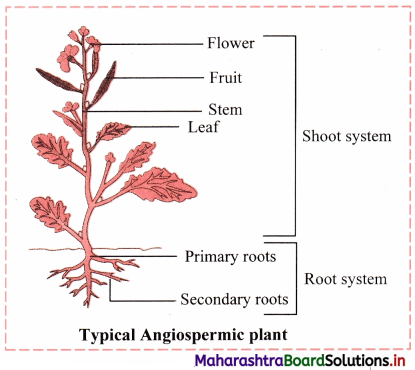
Maharashtra Board Class 11 Biology Important Questions Chapter 9 Morphology of Flowering Plants 1

Vegetative structures in angiospermic plantReproductive structures in angiospermic plant
Root, Stem, LeafFlowers, Fruits, Seeds

Question 3.
Label the various regions of a typical root in the given figure and explain them in detail.
Answer:
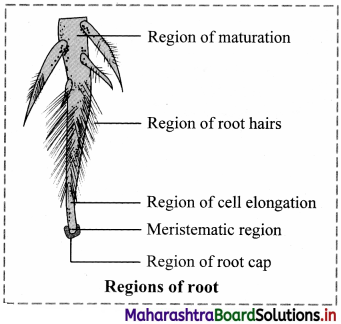
Maharashtra Board Class 11 Biology Important Questions Chapter 9 Morphology of Flowering Plants 2
A typical root possesses the following regions:
1. Root cap:
a. A parenchymatous multicellular structure in the form of cap, present over young growing root apex is known as root cap.
b. Cell of root cap secrete mucilage for lubricating passage of root through the soil.
c. Cells of root cap show presence of starch granules which help in graviperception and geotropic movement of root.
d. Usually single root cap is present in plants. But in plants like Pandanus or screw pine multiple root caps are present.
e. In hydrophytes, root caps are replaced by root pocket e.g. Pistia, Eichhornia etc.
f. Due to presence of root cap the growing apex of root.

2. Meristematic region or region of cell division:
a. The apex of the root is a growing point about 1 mm in length protected by root cap. This region is called as region of cell division or meristematic region.
b. The structure is developed by compactly arranged thin walled actively dividing meristematic cells.
c. These cells bring about longitudinal growth of root.

3. Region of elongation:
a. This region of cells is present just above zone of cell division.
b. The cells are newly formed and show rapid elongation to bring about increase in length of the root.
c. The cells help in absorption of mineral salts.

4. Region of root hair or region of absorption:
a. A region of root hair / absorption/piliferous zone is made up of numerous hair like outgrowths.
b. The epiblema or piliferous layer produces tubular elongated unicellular structures known as root hair.
c. They are in close contact with soil particles and increase surface area for absorption of water.
d. Root hair are short lived or ephimeral and are replaced after every 10 to 15 days.

5. Region of maturation/region of differentiation:
a. It is the uppermost major part of the root.
b. The cells of this region are quite impermeable to water due to thick wall.
c. The cells show differentiation and form different types of tissues.
d. This region helps in fixation of plant and conduction of absorbed substances.
e. Development of lateral roots also takes place from this region.

Maharashtra Board Class 11 Biology Important Questions Chapter 9 Morphology of Flowering Plants

Question 4.
What are the primary functions of root?
Answer:
Primary functions of root are, fixation or anchorage of plant body in the soil, absorption of water and minerals from soil and conduction of absorbed materials up to the stem base, etc.

Question 5.
Which type of root system is found in plants like maize, wheat and sugarcane? Explain in detail.
Answer:

  1. Adventitious root system is found in plants like maize, wheat and sugarcane.
  2. Adventitious root develops from any part other than radicle.
  3. Such roots may develop from the base of the stem, nodes or from leaves.
  4. In monocots, radicle is short lived.
  5. A thick cluster of equal sized roots arise from the base of a stem. It is also known as fibrous root system as they look like fibre. The growth of roots is superficial.
  6. Adventitious roots in some plants are used for vegetative propagation. E.g. Euphorbia, Carapichea ipecacuanha (Ipecac) etc.

Question 6.
What are metamorphosed roots?
Answer:
When roots have to perform some special type of function in addition to or instead of their normal function they develop some structural changes. Such roots are called as metamorphosed roots.

Question 7.
Complete the given chart and explain the modification of tap root for storage of food.
Answer:
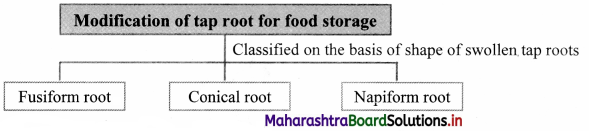
Maharashtra Board Class 11 Biology Important Questions Chapter 9 Morphology of Flowering Plants 3
1. Modification of tap root for storage of food:
a. WTien tap root stores food it becomes swollen, fleshy and also develops definite shape.
b. Main or primary root is the main storage organ but sometimes hypocotyl part of embryo axis also joins the main root. Secondary roots remain thin.
c. On the basis of shape, swollen tap roots are classified as Fusiform, Conical and Napiform.
2. Fusiform root:
The fusiform root is swollen in the middle and tapering towards both ends forming spindle shaped structure, e.g. Radish (Raphanus sativus)
3. Conical root:
The conical root is broad at its morphological base and narrows down towards its apex. e.g. Carrot (Daucus car ota)
4. Napiform root:
In napiform root, base of root is highly swollen, almost spherical in shape and abruptly narrows down towards its apex. e.g. Beet (Beta vulgaris)

Question 8.
Identify the type of swollen tap root in the figures given below.
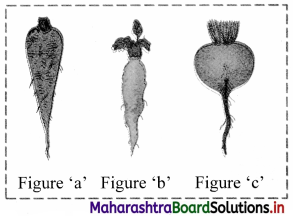
Maharashtra Board Class 11 Biology Important Questions Chapter 9 Morphology of Flowering Plants 4
Answer:
Figure ‘a’: Conical root;
Figure ‘b’: Fusiform root;
Figure ‘c’: Napiform root

Question 9.
Answer the following questions:
1. Identify the label ‘X’ in the given figure of respiratory roots. Give its function.
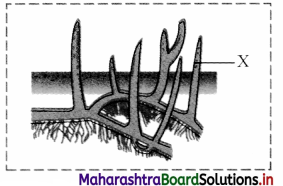
Maharashtra Board Class 11 Biology Important Questions Chapter 9 Morphology of Flowering Plants 5
2. Give any tw o examples of plants in which respiratory roots are present.
Answer:
1. X: Lenticels
In respiratory roots or pneumatophores, gaseous exchange occurs through lenticels.
2. Examples of plants in which respiratory roots are present:
Rhizophora, Avicennia, Sormeratia, Heritiera fames (sundri), etc.

Question 10.
Identify the types of modified adventitious roots in the figures given below and explain in detail.
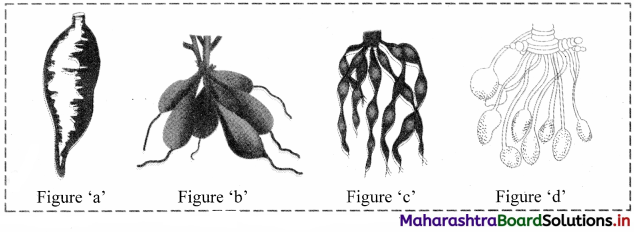
Maharashtra Board Class 11 Biology Important Questions Chapter 9 Morphology of Flowering Plants 6
Answer:
1. Figure ‘a’ indicates simple tuberous root.
a. Simple tuberous roots become swollen and do not show definite shape.
b. They are produced singly.
c. The roots arise from nodes over the stem and penetrate into the soil, e.g. sweet potato or shakarkand (Ipomoea batatas).

2. Figure ‘b’ indicates fasciculated tuberous roots.
a. A cluster of roots arising from one point which becomes thick and fleshy due to storage of food is known as fasciculated tuberous root.
b. These clusters are seen at the base of the stem, e.g. Dahlia, Asparagus, etc.

3. Figure ‘c’ indicates Moniliform roots.
a. Some adventitious roots get swollen at regular intervals.
b. These gives them the appearance of beads of a necklace. Such roots are called as Moniliform roots, e.g. Spinacia oleracea (Indian Spinach).

4. Figure ‘d’ indicates Nodulose roots.
The cluster of long slender roots become enlarged at the tips forming nodules is known as nodulose roots, e.g. Arrow root (Maranta), Amhaldi or mango ginger (Curcuma amada).

Maharashtra Board Class 11 Biology Important Questions Chapter 9 Morphology of Flowering Plants

Question 11.
Explain various types of adventitious roots which are modified for mechanical support.
Answer:
1. Prop roots / Columnar roots:
a. These roots arise from horizontal branches of tree like Banyan tree (Ficus benghalensis) and grow vertically downwards till they penetrate the soil.
b. These prop roots show secondary growth, become thick, act like pillars to provide mechanical support to the heavy branches.

2. Stilt roots:
a. These roots normally arise from a few lower nodes of a weak stem in some monocots, shrubs and small trees.
b. They show obliquely downward growth penetrating soil and provide mechanical support to the plant.
c. In the members of family Poaceae, the plants like Maize, Jowar, Sugarcane etc. produce stilt root in whorl around the node.
d. These roots provide additional support to the plant body.
e. In Screw pine or Pandanus (Kewada), stilt roots arise only from the lower surface of obliquely growing stem for additional support. These roots show multiple root caps.

3. Climbing roots:
Different climbers with weak stem produce roots at their nodes by means of which they attach themselves to support and thereby raise themselves above the ground.
e.g. Betel leaf or Pan, black pepper or Piper nigrum (Kali Mirch), Pothos or money plant.

4. Clinging roots:
a. These tiny roots develop along intemodes, show disc at tips, which exude sticky substance.
b. This substance enables plant to get attached with walls of buildings.
c. They do not damage substratum, e.g. English Ivy (Hedera helix).

5. Plank roots/Buttress:
a. These roots often develop at the base of large trees and form plank like extensions around stem.
b. These roots provide additional support, e.g. Silk cotton, Peepal, etc.

6. Buoyant roots:
Roots developed at the nodes of aquatic herbs like (Jussiaea repens), become highly inflated and spongy providing buoyancy and helping the plant to float.

Question 12.
What are sucking roots? Explain with the help of examples.
Answer:
Sucking roots or Haustoria:
1. These are the specialised microscopic sucking roots developed by parasitic plants to absorb nourishment from the host.
2. Viscum album is a partial parasite. It develops haustoria which penetrate into xylem of host plant for absorption of food.
3. In Cuscuta reflexa or Dodder (Amarvel) haustoria penetrates vascular strand and suck food from phloem, water and minerals from xylem. Cuscuta is leafless plant with yellow stem. It is a total parasite.

Question 13.
Enlist the important characteristics of stem.
Answer:
Characteristics of stem:

  1. Stem is the ascending part of the plant body which develops from plumule and reproductive units.
  2. It is usually positively phototropic, negatively geotropic and negatively hydrotropic.
  3. It shows different types of buds (axillary, apical, accessory, etc.).
  4. It is differentiated into nodes and intemodes.
  5. At nodes it produces dissimilar organs such as leaves and flowers and similar organs such as branches.
  6. Young stem is green and capable of photosynthesis.

Question 14.
Sketch and label a typical stem structure and write its primary functions.
Answer:
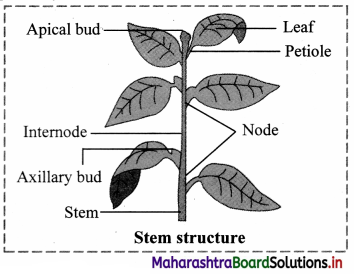
Maharashtra Board Class 11 Biology Important Questions Chapter 9 Morphology of Flowering Plants 7
The primary functions of the stem are to produce and support branches, leaves, flowers and fruits; conduction of water and minerals and transportation of food to plant parts.

Maharashtra Board Class 11 Biology Important Questions Chapter 9 Morphology of Flowering Plants

Question 15.
What is underground stem? When does it produce aerial shoots?
Answer:
In some herbaceous plants the stem which develops below soil surface is called underground stem. The underground stem remains dormant during unfavourable condition and on the advent of favourable condition produces aerial shoots.

Question 16.
Draw neat and labelled diagram of rhizome of ginger.
Answer:
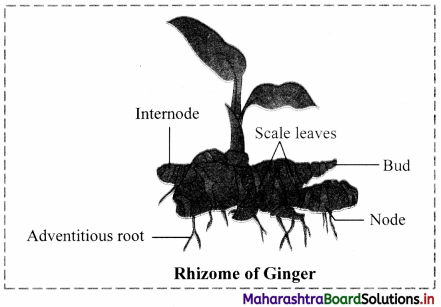
Maharashtra Board Class 11 Biology Important Questions Chapter 9 Morphology of Flowering Plants 8

Question 17.
Potato which we eat is an underground part of a plant, however it can not be considered as root. Justify the given statement.
Answer:

  1. Potato is a stem tuber.
  2. It is an underground stem, modified for storage of food material.
  3. Special underground branches of stem at their tips becomes swollen due to storage of food which is mostly starch.
  4. Stem tuber shows distinct nodes, but not intemodes hence it is classified as stem.
  5. At nodal part, it shows scale leaves with axillary buds, which are commonly called as ‘eyes’.
  6. Under favourable conditions, ‘eyes’ can produce aerial shoots.
  7. Potato tuber can be propagated vegetatively. [Note: In stem tuber, internodes are present but they are not very distinct.]

Question 18.
What are tunicated and compound tunicated bulbs?
Answer:
1. Tunicated bulb:
When fleshy scale leaves are arranged on stem in concentric manner, bulb is called as tunicated bulb or layered bulb. E.g. Onion
2. Compound tunicated bulb:
When fleshy scale leaves arranged on stem, partially overlap each other by their margins only, such bulb is called compound tunicated or scaly bulb. e.g. Garlic

Question 19.
Which type of modified stem is present in Colocasia and Amorphophallus? Explain with the help of neat and labelled diagram.
Answer:
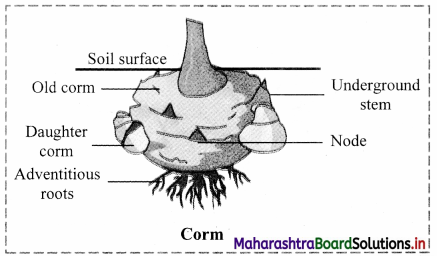
Maharashtra Board Class 11 Biology Important Questions Chapter 9 Morphology of Flowering Plants 9

  1. In Colocasia and Amorphophallus corm is present, which is an underground stem modified for storage of food.
  2. Corm is swollen underground spherical or subspherical vertically growing stem.
  3. It is condensed structure with circular or ring like nodes.
  4. It shows presence of axillary buds and scales.
  5. Adventitious buds are produced which help in vegetative propagation.
  6. Adventitious roots are produced at lower part of the stem.

Maharashtra Board Class 11 Biology Important Questions Chapter 9 Morphology of Flowering Plants

Question 20.
1. What are sub aerial stems?
2. Explain the different types of sub aerial stems. Give atleast one example of each.
Answer:
1. Subaerial stems:
a. These are generally weak or straggling stems growing over the ground and need support for perpetuation.
b. Sometimes these stems are found to grow beneath the soil surface also. Thus, they show contact with both air and soil.
c. Subaerial stems are meant for perennation and vegetative propagation.
d. Scale leaves and axillary buds are present over stem surface. Axillary buds develop into aerial shoots.

2. Types of subaerial stems:
a. Trailer:
1. The shoot spreads over the ground without striking adventitious roots.
The branches are either flat i.e. procumbent or partly vertical i.e. decumbent.
e. g. Euphorbia, Tridax etc. [Any one example]

b. Runner:
1. They are special narrow, prostrate or horizontal green branches which develop at the base of erect shoots known as crown.
2. Runners spread in all directions to produce new crowns with bunch of adventitious roots.
3. Presence of nodes with scale leaves and axillary buds is observed.
e.g. Cynodon (Lawn grass) Centella (Hydrocotyl / Brahmi), Oxalis etc. [Any one example]

c. Stolons:
1. The slender lateral branch arising from the base of main axis is known as stolon.
2. In some plants it is above ground (wild strawberry).
3. Primarily stolon shows upward growth in the form of ordinary branch, but when it bends and touches the ground terminal bud grows into new shoot and develops adventitious roots.
e.g. Wild Strawberry, Jasmine, Mentha, etc. [Any one example]

d. Sucker:
1. It is non-green, runner like branch of stem.
2. It grows horizontally below soil initially and then comes above the soil surface obliquely to produce a new plant.
3. Sucker can be termed as underground runner.
e. g. Chrysanthemum, Banana etc. [Any one example]

e. Offset:
1. These are one intemode long runners in rosette plants at ground or water level.
2. Offset helps in vegetative propagation.
e.g. Water hyacinth or Jal kumbhi (Eichhornia) and Pistia. [Any one example]

Question 21.
Observe the given figures and identify P, Q, R and S representing the different types of sub aerial shoot.
Maharashtra Board Class 11 Biology Important Questions Chapter 9 Morphology of Flowering Plants 10Answer:
‘P’: Trailer ‘Q’: Runner ‘R’: Stolon ‘S’: Offset

Question 22.
Draw neat and labelled diagram of Eichhornia showing offset.
Answer:
Maharashtra Board Class 11 Biology Important Questions Chapter 9 Morphology of Flowering Plants 11

Maharashtra Board Class 11 Biology Important Questions Chapter 9 Morphology of Flowering Plants

Question 23.
What are metamorphosed stems?
Answer:
Stem or its vegetative part develops various modifications to carry out specialized functions. Such modified stems are called as metamorphosed stems.

Question 24.
Describe the aerial modifications of stem.
Answer:
Different aerial modifications shown by stem are as follows:
1. Stem tendrils:
a. Tendrils are thin, wiry, photosynthetic, leafless coiled structures.
b. They give additional support to developing plant.
c. Tendrils have adhesive glands for fixation.
d. Apical bud in Vitis quadrangularis gets modified into tendril. The further growth is carried out by axillary bud.
e. In Passiflora axillary bud gets modified in tendril.
f. Extra axillary bud is the one which grows outside the axil. This bud in cucurbita gets modified into tendril.
g. Normally floral buds are destined to produce flowers. But in plants like Antigonon they produce tendrils.

2. Thorn:
a. It is modification of apical or axillary bud.
b. Thom is hard pointed and mostly straight structure (except Bougainvillea where it is curved and useful for climbing).
c. It provides protection against browsing animals and also helps in reducing transpiration.
d. Apical bud develops into thorn in Carrisa whereas axillary bud develops into thorn in Duranta, Citrus, Bougainvillea, etc.

3. Phylloclade:
a. Modification of stem into leaf like photosynthetic organ is known as phylloclade.
b. Being stem it possesses nodes and internodes.
c. It is thick, fleshy and succulent, contains mucilage for retaining water e.g. Opuntia, Casuarina (Cylindrical shaped phylloclade) and Muehlenbeckia (ribbon like phylloclade).

4. Cladodes:
a. The branches of limited growth i.e. one intemode long and performing photosynthetic function are called as cladodes.
b. True leaves are reduced to spine or scales to reduce rate of transpiration, e.g. Asparagus.

5. Cladophylls:
These are leaf like structures bore in the axil of scale leaf. It has floral bud and scale leaf in the middle i.e. upper half is leaf and lower half is stem. e.g. Ruscus.

6. Bulbils:
a. In plants like Dioscorea, etc. axillary bud becomes fleshy and rounded due to storage of food called as bulbil.
b. When it falls off it produces new plant and help in vegetative propagation.

Question 25.
Observe the given figures oi Asparagus, Vitis quadrangularis and Passiflora. Which of the following is labelled incorrectly?
Answer:
Figure ‘a’ is incorrectly labelled.
It represents Cladode oi Asparagus.

Question 26.
How does thorn in Carissa differ from that of Duranta?
Answer:
In Carrisa, apical bud develops into thorn, whereas in Duranta, axillary bud develops into thorn.

Question 27.
Enlist the general characteristics of a leaf.
Answer:
General characteristics of a leaf:

  1. Leaves are the most important appendages as they carry out photosynthesis and also help to remove excess amount of water from plant body through transpiration.
  2. Leaves are exogenous in origin and develops from leaf primordium.
  3. Leaf is dorsiventrally flattened lateral appendage of stem, produced at nodal region.
  4. Leaf is thin, expanded and green due to presence of photosynthetic pigments, i.e. chlorophyll.
  5. Axil of leaf shows presence of axillary bud.
  6. Leaf shows limited growth, does not show apical bud or a growing point.

Question 28.
Give an account of various parts of a typical dicot leaf.
Answer:
A typical dicot leaf shows presence of three main parts Leaf base or Hypopodium, Petiole or Mesopodium and Leaf lamina/blade or Epipodium.
1. Leaf base or Hypopodium:
a. The point by which leaf remains attached to the stem is known as leaf base.
b. The nature of leaf base varies in different plants. It may be pulvinus (swollen), sheathing or ligulate, etc.

Question 29.
How simple leaf differs from a compound leaf?
Answer:
The leaf with entire lamina is called simple leaf, whereas leaf in which leaf lamina is divided into many leaflets is called as compound leaf.

Maharashtra Board Class 11 Biology Important Questions Chapter 9 Morphology of Flowering Plants

Question 30.
Identify the type of pinnately compound leaves in the figures given below and give one example of each.
Answer:
Maharashtra Board Class 11 Biology Important Questions Chapter 9 Morphology of Flowering Plants 12
Figure ‘a’: Paripinnately compound leaves (e.g. Cassia)
Figure ‘b’: Imparipinnately compound leaves (e.g. Rosa)
Figure ‘c’: Bipinnately compound leaves (e.g. Caesalpinia)
Figure ‘d’: Tripinnately compound leaves (e.g. Moringa)
Figure ‘e’: Decompound leaves (e.g. Coriandrum)

Question 31.
Explain how leaves modify to perform different functions other than photosynthesis and gaseous exchange.
Answer:
Leaves show different types of modification as follows:
1. Leaf spines:
Sometimes entire leaf is modified into spines (Opuntia) or margin of leaf becomes spiny (Agave) or stipule modifies into spine (Acacia, Zizyphus) to check the rate of transpiration and to protect plant from grazing.

2. Leaf tendril:
In some weak stems, leaf, leaflet or other part modifies to produce thin, green, wiry, coiled structure called as leaf tendril. It helps in climbing and provides additional support.

3. Leaf hooks:
In plants like Bignonia unguis-cati (Cat’s nail) the terminal three leaflet get modified into three! stiff curve and pointed hooks used to cling over the bark of tree.

4. Phyllode:
When petiole of leaf becomes flat, green and leaf like it is called as phyllode. In Acacia auriculoformis the normal leaf is bipinnately compound and falls off soon. The petiole modifies itself into phyllode. It is a xerophytic adaptation.

Question 32.
Identify different types of tendril in the figures given below and give one example of each.
Maharashtra Board Class 11 Biology Important Questions Chapter 9 Morphology of Flowering Plants 13
Answer:
Figure ‘a’: Whole leaf tendril (e.g. Lathyrus)
Figure ‘b’: Leaflet tendril (e.g. Pisum sativum)
Figure ‘c’: Leaf tip tendril (e.g. Gloriosa)
Figure ‘d’: Stipular tendril (e.g. Smilax)

Question 33.
Define phyllotaxy. Why do leaves show phyllotaxy?
Answer:
Phyllotaxy:
1. Arrangement of leaves on the stem and branches in a specific manner is known as phyllotaxy.
2. It enables leaf to get sufficient light for photosynthesis.

Maharashtra Board Class 11 Biology Important Questions Chapter 9 Morphology of Flowering Plants

Question 34.
Which type of phyllotaxy is show n by leaves of Mango, Nerium and Jamun?
Answer:

  1. Phyllotaxy shown by leaves of Mango is alternate phyllotaxy. In this type, single leaf from each node.
  2. Phyllotaxy shown by leaves of Nerium is whorled phyllotaxy. In this type, many leaves arise from each node
    and form a whorl.
  3. Phyllotaxy shown by leaves of Jamun is opposite superposed phyllotaxy. In this type, a pair of opposite leaves are arranged one above the other in the same plane.

Question 35.
What are pinnately compound and palmately compound leaves? Give any two examples of each.
Answer:
1. Pinnately compound: Leaflets are present laterally on a common axis called rachis, which represents the midrib of the leaf. e.g. Cassia, Rose, Caesalpinia, Moringa, Coriandrum, etc. [Any two examples]
2. Palmately compound: In this all the leaflets are attached at the tip of petiole.
e.g. Citrus, Zorina, Oxalis, Marsilea, Bombax [Any two examples] [Note: Another example of palmately compound leaf (Bifoliate) is Balanites roxburghii.]

Question 36.
Define inflorescence.
Answer:
A specialised axis or branch over which flowers are produced or borne in definite manner is known inflorescence.

Question 37.
Write significance of inflorescence.
Answer:
Significance of inflorescence:

  1. Inflorescence makes a flower more conspicuous to attract the insects and birds for pollination.
  2. It provides more chances for cross pollination.
  3. An insect can pollinate many flowers in inflorescence in a single visit.
  4. In an inflorescence, flowers open successively and not simultaneously. This improves chances of pollination as flowering period is longer.

Question 38.
Define flower.
Answer:
Flower is highly modified and condensed shoot meant for sexual reproduction.

Maharashtra Board Class 11 Biology Important Questions Chapter 9 Morphology of Flowering Plants

Question 39.
Complete the table by giving the meaning of following terminologies related to flower.
Answer:

1. Complete flower: Presence of all four floral whorlsIncomplete flower: Absence of any one of the floral whorls.
2. Pedicellate flower: Flower with pedicelSessile flower: Flower without pedicel
3. Bracteate flower: Flower with bract at the base of pedicelEbracteate flower: Flower without bract
4. Perfect flower: Both androecium and gynoecium are present, also called as dicliny or bisexual flower.Imperfect flower: Any one reproductive whorl is present also called as monocliny or unisexual flower.
5. Actinomorphic flower: The flower can be cut in any plane passing through the centre in order to obtain two identical halves. Flowers show radial symmetry, e.g. SunflowerZygomorphic flower: The flower can be cut only along one plane passing through the centre in order to obtain two identical halves. Flowers show bilateral symmetry e.g. Sweet Pea flower.
6. Unisexual flower: It can be either staminate (male)/ pistillate (female) flowerNeuter flower: When both reproductive whorls are absent, it is said to be neuter flower
7. Monoecious plant: Male and female reproductive flowers are borne on same plant, e.g. MaizeDioecious plant: Only one type of unisexual flowers are present on plant, e.g. Ray floret of sunflower

Question 40.
Mango is called as polygamous plant. Why?
Answer:
Mango produces all types of flowers like staminate, bisexual and neuter, hence it is called as polygamous plant.

Question 41.
What is insertion of floral whorls?
Answer:
The position and arrangement of rest of the floral whorls (calyx, corolla, androecium) with respect to gynoecium on the thalamus is known as insertion of floral whorls. .

Question 42.
With help of neat and labelled diagrams explain the classification of flowers based on the position of ovary on the thalamus.
Answer:
Classification of flowers based on the position of ovary on the thalamus.
Maharashtra Board Class 11 Biology Important Questions Chapter 9 Morphology of Flowering Plants 14
1. Hypogynous flower:
When the convex or conical thalamus is present in flower, ovary occupies the highest position while other floral parts are below ovary. Ovary is said to be superior and flower is called as hypogynous flower, e.g. Brinjal, Mustard, China rose etc. It is denoted as G in floral formula.

2. Perigynous flower:
When cup shaped or saucer shaped thalamus is present in a flower, ovary and other floral parts occupy about same position. Such an ovary is said to be semi- superior or semi-inferior. All floral whorls are at the rim of thalamus. Flower is called as perigynous. e.g. Rose, etc. It is denoted as G- in floral formula.

3. Epigynous flower:
When thalamus completely encloses ovary and may show fusion with wall; the other floral parts occupy superior position and ovary becomes inferior. Such flower is called as epigynous flower, e.g. Ray florets of Sunflower, Guava, Cucumber etc. It is denoted as G in floral formula.

Question 43.
What is thalamus?
Answer:
Thalamus:
1. The upper, swollen, condensed, knob-like part of the pedicel is called thalamus. It is also called receptacle or torus.
2. In a typical flower, the thalamus consists of four compactly arranged nodes and three highly condensed intemodes.
3. From each node of thalamus, whorl of modified leaves is produced.

Maharashtra Board Class 11 Biology Important Questions Chapter 9 Morphology of Flowering Plants

Question 44.
With the help of a diagram explain the floral parts of a typical flower.
Answer:
Maharashtra Board Class 11 Biology Important Questions Chapter 9 Morphology of Flowering Plants 15
Floral parts of a typical flower:
1. Calyx (K):
a. It is outermost floral whorl and individual members are known as
sepals.
b. Sepals are usually green in colour and perform photosynthesis.
c. If all the sepals are united, the condition is gamosepalous and if they are free, the condition is called as polysepalous.
d. Gamosepalous calyx is found in China rose and polysepalous calyx is found in Brassica.
e. The main function of sepals is to protect inner floral parts in bud condition.
f. Sometimes sepals become brightly coloured (petaloid sepals) and attract insects for pollination,
e.g. Mussaenda etc.
g. Sepals modify into hairy structures called as pappus. Such calyx helps in dispersal of fruit, e.g. Tridex.

2. Corolla (C):
a. It is second floral whorl from outer side and variously coloured.
b. The individual member is called as petal.
c. Petals may be sweet to taste, possess scent, odour, aroma or fragrance etc.
d. The condition in which petals are free is said to be polypetalous (e.g. Rose) and if they are fused it is called as gamopetalous (e.g. Datura).
e. The main function of corolla is to attract different agencies for pollination.

3. Perianth (P):
a. Many times, calyx and corolla remain undifferentiated. Such member is known as tepal.
b. The whorl of tepals is known as Perianth.
c. It protects other floral whorls.
d. If all the tepals are free the condition is called as polyphyllous and if they are fused the condition is called as gamophyllous.
e. Sepaloid perianth shows green tepals, while petaloid perianth shows brightly coloured tepals. e.g. Lily, Amaranthus, Celosia, etc.
f. Petaloid tepal helps in pollination and sepaloid tepals can perform photosynthesis.

4. Androecium (A):
a. It is third floral whorl from outer side.
b. Androecium is male reproductive part of a flower.
c. The individual member is known as stamen.
d. If all the stamens are free the condition is polyandrous and synandrous if they are fused.
e. Typical stamen shows three different parts:
1. Anther: It is terminal in position. Anther produces pollen grains. It is usually dithecous (two anther lobes), tetralocular/tetra sporangiate (four pollen sacs) structure, e.g. Datura.
In some plants it is monothecous (single lobed), bilocular or bisporangiate structure e.g. Hibiscus.
2. Filament: It is a stalk of stamen and bears anther at its tip. It raises anther to a proper height for easy dispersal of pollen grains.
3. Connective: It is in continuation with the filament. It is similar to mid rib and connects two anther lobes together and also with the filament.

5. Gynoecium (G):
a. It is the female reproductive part of a flower and innermost in position.
b. It is also known as pistil.
c. The individual member of gynoecium is known as carpel.
d. The number of carpels may be one to many.
e. If all the carpels are fused the condition is described as syncarpous and if they are free the condition is described as apocarpous.
f. The polycarpellary gynoecium can be bicarpellary (two carpels e.g. Datura), tricarpellary (three carpels e.g. Cucurbita), pentacarpellery (five carpels e.g. Hibiscus) and so on.
g. A typical carpel consists of three parts stigma, style and ovary.
1. Stigma is a terminal part of carpel which receives pollen grains during pollination. It helps in
germination of pollen grain. Stigma shows variation in structure to suit the pollinating agent.
2. Style is narrow thread like structure that connects ovary with stigma.
3. Ovary is basal swollen fertile part of the carpel. Ovules are produced in ovary on a soft fertile tissue called placenta.

Maharashtra Board Class 11 Biology Important Questions Chapter 9 Morphology of Flowering Plants

Question 45.
Explain the term Epicalyx.
Answer:
Epicalyx:

  1. Epicalyx is an additional whorl of sepal like structures formed by bracteole which occurs on the outside of calyx.
  2. These are 5-8 in number.
  3. It is a characteristic feature of family Malvaceae.
  4. They are protective in function, e.g. Ladies finger

Question 46.
Match the columns.

Column I (Tvpe of calyx)Column II (Nature of sepals)Column III (Example)
1. Caducous(a) Sepals remain even after fruit formation1. Brinjal, Pea
2. Deciduous(b) Sepals fall off as soon as the flower bud opens2. Lotus, Mustard
3. Persistent(c) Sepals survive till (withering of petals) fruit formation3. Argemone (Poppy)

Answer:

Column I (Type of calyx)Column II (Nature of sepals)Column III (Example)
1. Caducous(b) Sepals fall off as soon as the flower bud open3. Argemone (Poppy)
2. Deciduous(c) Sepals survive till (withering of petals) fruit formation2. Lotus, Mustard
3. Persistent(a) Sepals remain even after fruit formation1. Brinjal, Pea

Question 47.
Define aestivation and explain its different types.
Answer:
Aestivation:
1. The mode of arrangement of sepals, petals or tepals in a flower with respect to the members of same whorl is known as aestivation.
2. Different types of aestivation are as follows:
a. Valvate: Margins of sepals or petals remain either in contact or lie close to each other but do not overlap, e.g. Calyx of Datura, Calotropis.
b. Twisted: Margins of each sepal or petal is directed inwards and is overlapped. While the other margin is directed outwards and overlap the margin of adjacent, e.g. Corolla of China rose, Cotton etc.
c. Imbricate: One of the sepals or petals is internal and is overlapped at both the margins. One is external i.e. both of its margin overlap adjacent member. Rest of the sepals / petals have one inner or overlapped margin and outer or overlapping margin, e.g. Cassia, Bauhinia, etc.
d. Vexillary: Corolla is butterfly shaped and consists of five petals. Outermost and largest is known as standard or vexillum, two lateral petals are wings and two smaller fused forming boat shaped structures keel. e.g. Pisum sativum
Maharashtra Board Class 11 Biology Important Questions Chapter 9 Morphology of Flowering Plants 16

Question 48.
Answer the following:
1. Define the term Adelphy.
2. Give three types of stamens based on adelphy. Draw a diagram of each type.
Answer:
Adelphy:
1. When stamens are united by filaments and anthers are free, the condition is called adelphy.
2. Three types of stamens based on adelphy:
Monadelphous stamens, Diadelphous stamens, Polyadelphous stamens.
Maharashtra Board Class 11 Biology Important Questions Chapter 9 Morphology of Flowering Plants 17

Maharashtra Board Class 11 Biology Important Questions Chapter 9 Morphology of Flowering Plants

Question 49.
Define the following terms and give one example of each:

  1. Epipetalous stamens
  2. Epiphyllous stamens
  3. Syngenesious stamens
  4. Synandrous stamens

Answer:

  1. Epipetalous stamens: When the stamens are united to petals they are described as epipetalous stamen. E.g. Datura
  2. Epiphyllous stamens: When the stamens are united to tepals they are described as epiphyllous stamens. E.g. Lily
  3. Syngenesious stamens: When anthers are united and filaments are free, such stamens are called as syngenesious stamens. E.g. Sunflower
  4. Synandrous stamens: When both anthers and filaments are fused, such stamens are called as synandrous stamens. E.g. Cucurbita

Question 50.
Define placentation. Explain its types.
Answer:
1. Placentation: The mode of arrangement of ovules on the placenta within the ovary is called placentation.
2. Types of placentation:
a. Marginal: Ovules are placed on the fused margins of unilocular ovary, e.g. Pea, Bean etc.
b. Axile: Ovules are placed on the central axis of a multilocular ovary, e.g. China rose, Cotton, etc.
c. Parietal: Ovules are placed on the inner wall of unilocular ovary of multicarpellary syncarpus ovary,
e. g. Papaya, Cucumber, etc.
d. Basal: Single ovule is present at the base of unilocular ovary, e.g. Sunflower, Rice, Wheat.
e. Free central: Ovules are borne on central axis which is not attached to ovary wall, e.g.Argemone, Dianthus.

Question 51.
What are parthenocarpic fruits? Give any two examples.
Answer:
Fruits which are produced from ovary without fertilization are called as parthenocarpic fruits, e.g. Cultivated Banana and Grapes.

Question 52.
How true fruit differs from false fruit or pseudofruit? Give one example of each.
Answer:
The fruit which develops only from ovary is called as true fruit or eucarp. e.g. Mango. The fruit which develops from other than ovary floral part is called as false fruit or pseudocarp

Question 53.
Identify the parts of mango and apple fruit in the given figures.
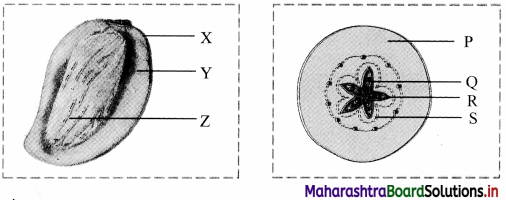
Maharashtra Board Class 11 Biology Important Questions Chapter 9 Morphology of Flowering Plants 18Answer:
1. parts of mango fruit:
X: Epicarp
Y: Mesocarp
Z: Endocarp

2. Part of apple fruit:
P: Thalamus
Q: Seed
R: Endocarp
S: Mesocarp

Maharashtra Board Class 11 Biology Important Questions Chapter 9 Morphology of Flowering Plants

Question 54.
Identify terms a,b,and c in the given chart.
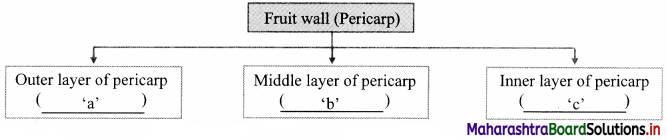
Maharashtra Board Class 11 Biology Important Questions Chapter 9 Morphology of Flowering Plants 19
Answer:
a: Epicarp
b: Mesocarp
c: Endocarp

Question 55.
What are simple fruits? Explain its different types.
Answer:
1. Fruits which develop from one ovary of one flower are called as simple fruits.
2. Types of simple fruits on the basis of their pericarp:
a. Dry fruits: These fruits have thin pericarp. It is further divided into two types:
1. Dehiscent dry fruits: Pericarp becomes dry, thin and fruit opens at maturity, e.g. Capsule (Lady’s finger) and legume (Pea)
2. Indehiscent dry fruits: Fruit does not open.
e.g. Achene (Mirabilis), Caryopsis (Maize) and Cypsela (Sunflower)

b. Fleshy fruits: These fruits have thick pericarp. It is further divided into two types based on nature endocarp:
1. Drupe: In these fruits, endocarp is hard and stony, e.g. Mango
2. Berry: In these fruits, endocarp is fleshy and fruit is many seeded, e.g. Tomato

Question 56.
What are aggregate fruits? Enlist the types of aggregate fruits.
Answer:
The fruit which develops from a single flower with many ovaries of polycarpellary, apocarpous gynoecium is known as aggregate fruit or etaerio.
Types of aggregate fruits:
Etario of achenes (e.g. Strawberry), etario of berries (e.g. Custard apple), etario of follicles (e.g. Calotropis)

Question 57.
Write a short note on composite fruits.
Answer:
1. The fruits which develop from many ovaries of many flowers of a complete inflorescence are called composite fruits, (e.g. fig) and from catkin inflorescence are called sorosis (e.g. Pineapple).
2. Fruits which develops from hypanthodium inflorescence are called syconus.

Question 58.
Match the columns with column II.

Column IColumn II
1. Composite fruit(a) Custard apple
2. Parthenocarpic fruit(b) Cultivated Banana
3. Aggregate fruit(c) Mango
(d) Pineapple

Answer:

Column IColumn II
1. Composite fruit(d) Pineapple
2. Parthenocarpic fruit(b) Cultivated Banana
3. Aggregate fruit(a) Custard apple

Maharashtra Board Class 11 Biology Important Questions Chapter 9 Morphology of Flowering Plants

Question 59.
Describe the structure of a seed.
Answer:
Structure of a seed:

  1. Seed is a reproductive unit that developed from fertilized mature ovule.
  2. The seed is made up of seed coat, embryo with or without endosperm and one or two cotyledons.
  3. Outer most covering of a seed is called seed coat.
  4. It shows outer layer called as testa and inner layer called as tegmen.
  5. Hilum is a scar on the seed coat through which seed attach to the fruit.
  6. Embryo of a seed is enclosed within seed coat.
  7. Embryonal axis consists of radicle and plumule.
  8. The part of embryonal axis between cotyledon and plumule is epicotyl, while the part between cotyledons and radicle is hypocotyl.
  9. The nutritive tissue in a seed called endosperm.

[Note: Dicotyledonous seed is a non-endospermic or exalbuminous, as it lacks endosperm at maturity.]
[Note: Students can scan the given Q.R code to study the structure of dicotyledonous and monocotyledonous seed.]

Question 60.
Describe the family Fabaceae with suitable floral diagram.
Answer:
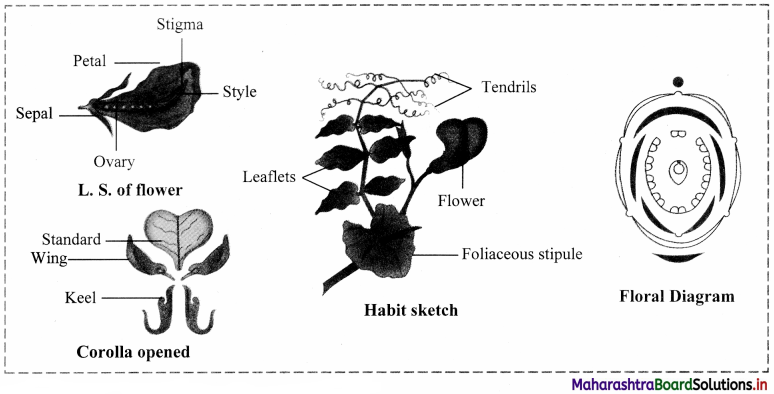
Maharashtra Board Class 11 Biology Important Questions Chapter 9 Morphology of Flowering Plants 20

  • Example: Pea plant (Pisum sativum)
  • Habit: Tree, shrubs, herbs.
  • Root: Root with root nodules.
  • Stem: Erect or climber.
  • Leaves: Alternate phyllotaxy, Pinnately compound leaves.
  • Inflorescence: Racemose
  • Flower: Zygomorphic, bisexual, complete.
  • Calyx: Sepals five, gamosepalous, imbricate aestivation.
  • Corolla: Petals five, polypetalous, consisting of a larger posterior petal vexillum, two lateral petals wings and two anterior ones forming a keel, vexillary aestivation.
  • Androecium: Stamens ten, diadelphous.
  • Gynoecium: Ovary superior, monocarpellary, unilocular with many ovules, marginal placentation. Fruit: Legume.
  • Seed: Non-endospermic

Question 61.
Apply your knowledge

Question 1.
Tendrils are seen in the following plants. Identify whether they are stem tendrils or leaf tendrils,

  1. Vitis
  2. Smilax
  3. Lathyrus
  4. Passiflora
  5. Cucurbita
  6. Gloriosa

Answer:
Stem tendrils → Vitis, Passiflora, Cucurbita
Leaf tendrils → Smilax, Lathyrus, Gloriosa

Maharashtra Board Class 11 Biology Important Questions Chapter 9 Morphology of Flowering Plants

Question 2.
Which type of roots are shown by halophytes growing in Sundarbans in West Bengal?
Answer:
Pneumatophores

Question 3.
Find out from internet the state flower of Sikkim. Write about the type of roots shown by this plant.
Answer:
Dendrobium is the state flower of Sikkim. It shows epiphytic roots.
Epiphytic roots:

  1. Epiphytic plants like Vanda, Dendrobium grow on branches of trees in dense rain forests and are unable to obtain moisture from soil.
  2. Such plants produce epiphytic roots which hang in the air.
  3. The roots are provided with a spongy membranous absorbent covering of the velamen tissue.
  4. The cells of velamen tissue are hygroscopic and have porous walls, thus they can absorb moisture from air.
  5. Epiphytic roots can be silvery white or green and are without root cap.

Question 62.
Quick Review:
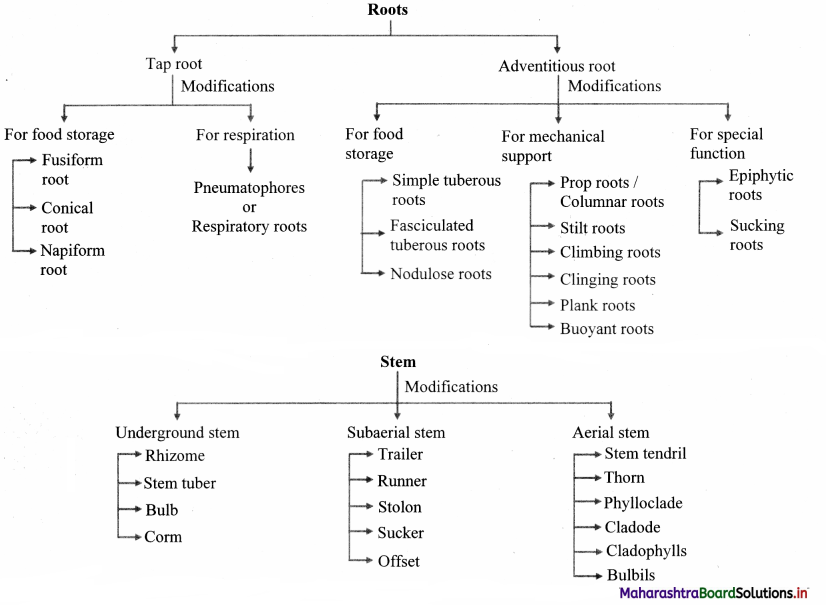
Maharashtra Board Class 11 Biology Important Questions Chapter 9 Morphology of Flowering Plants 21
Maharashtra Board Class 11 Biology Important Questions Chapter 9 Morphology of Flowering Plants 22
Maharashtra Board Class 11 Biology Important Questions Chapter 9 Morphology of Flowering Plants 23

Maharashtra Board Class 11 Biology Important Questions Chapter 9 Morphology of Flowering Plants

Question 63.
Exercise:

Question 1.
Draw neat and labelled diagram of tap root showing different regions.
Answer:
A typical root possesses the following regions:
1. Root cap:
a. A parenchymatous multicellular structure in the form of cap, present over young growing root apex is known as root cap.
b. Cell of root cap secrete mucilage for lubricating passage of root through the soil.
c. Cells of root cap show presence of starch granules which help in graviperception and geotropic movement of root.
d. Usually single root cap is present in plants. But in plants like Pandanus or screw pine multiple root caps are present.
e. In hydrophytes, root caps are replaced by root pocket e.g. Pistia, Eichhornia etc.
f. Due to presence of root cap the growing apex of root is

2. Meristematic region or region of cell division:
a. The apex of the root is a growing point about 1 mm in length protected by root cap. This region is called as region of cell division or meristematic region.
b. The structure is developed by compactly arranged thin walled actively dividing meristematic cells.
c. These cells bring about longitudinal growth of root.

3. Region of elongation:
a. This region of cells is present just above zone of cell division.
b. The cells are newly formed and show rapid elongation to bring about increase in length of the root.
c. The cells help in absorption of mineral salts.

4. Region of root hair or region of absorption:
a. A region of root hair / absorption/piliferous zone is made up of numerous hair like outgrowths.
b. The epiblema or piliferous layer produces tubular elongated unicellular structures known as root hair.
c. They are in close contact with soil particles and increase surface area for absorption of water.
d. Root hair are short lived or ephimeral and are replaced after every 10 to 15 days.

5. Region of maturation/region of differentiation:
a. It is the uppermost major part of the root.
b. The cells of this region are quite impermeable to water due to thick wall.
c. The cells show differentiation and form different types of tissues.
d. This region helps in fixation of plant and conduction of absorbed substances.
e. Development of lateral roots also takes place from this region.

Question 2.
Write a short note on root cap.
Answer:
Root cap:
a. A parenchymatous multicellular structure in the form of cap, present over young growing root apex is known as root cap.
b. Cell of root cap secrete mucilage for lubricating passage of root through the soil.
c. Cells of root cap show presence of starch granules which help in graviperception and geotropic movement of root.
d. Usually single root cap is present in plants. But in plants like Pandanus or screw pine multiple root caps are present.
e. In hydrophytes, root caps are replaced by root pocket e.g. Pistia, Eichhornia etc.
f. Due to presence of root cap the growing apex of root.

Question 3.
Name the region of a root which is located just above the zone of a cell division.
Answer:
Region of elongation:
a. This region of cells is present just above zone of cell division.
b. The cells are newly formed and show rapid elongation to bring about increase in length of the root.
c. The cells help in absorption of mineral salts.

Question 4.
Name any two plants in which root caps are replaced by root pockets.
Answer:
In hydrophytes, root caps are replaced by root pocket e.g. Pistia, Eichhornia etc.

Maharashtra Board Class 11 Biology Important Questions Chapter 9 Morphology of Flowering Plants

Question 5.
Write a short note on pneumatophores.
Answer:
1. a. Plants growing in marshy region (halophytes) produce upwardly growing roots called as
pneumatophores or respiratory roots.
b. The main root system of these plants does not get sufficient air for respiration as soil is water logged.
c. Due to this, mineral absorption of plant also gets affected.
d. To overcome this problem underground roots, develop special roots which are negatively geotropic; growing vertically upward.
e. These roots are conical projections present around main trunk of plant.
f. Respiratory roots show presence of lenticels which helps in gaseous exchange.
2. Examples of plants in which respiratory roots are present:
Rhizophora, Avicennia, Sormeratia, Heritiera fames (sundri), etc.

Question 6.
Name the four types of adventitious roots modified for food storage.
Answer:
1. Figure ‘a’ indicates simple tuberous root.
a. Simple tuberous roots become swollen and do not show definite shape.
b. They are produced singly.
c. The roots arise from nodes over the stem and penetrate into the soil, e.g. sweet potato or shakarkand (Ipomoea batatas).

2. Figure ‘b’ indicates fasciculated tuberous roots.
a. A cluster of roots arising from one point which becomes thick and fleshy due to storage of food is known as fasciculated tuberous root.
b. These clusters are seen at the base of the stem, e.g. Dahlia, Asparagus, etc.

3. Figure ‘c’ indicates Moniliform roots.
a. Some adventitious roots get swollen at regular intervals.
b. These gives them the appearance of beads of a necklace. Such roots are called as Moniliform roots, e.g. Spinacia oleracea (Indian Spinach).

4. Figure ‘d’ indicates Nodulose roots.
The cluster of long slender roots become enlarged at the tips forming nodules is known as nodulose roots, e.g. Arrow root (Maranta), Amhaldi or mango ginger (Curcuma amada).

Question 7.
Explain in detail modification of tap roots for food storage.
Answer:
1. Modification of tap root for storage of food:
a. WTien tap root stores food it becomes swollen, fleshy and also develops definite shape.
b. Main or primary root is the main storage organ but sometimes hypocotyl part of embryo axis also joins the main root. Secondary roots remain thin.
c. On the basis of shape, swollen tap roots are classified as Fusiform, Conical and Napiform.
2. Fusiform root:
The fusiform root is swollen in the middle and tapering towards both ends forming spindle shaped structure, e.g. Radish (Raphanus sativus)
3. Conical root:
The conical root is broad at its morphological base and narrows down towards its apex. e.g. Carrot (Daucus car ota)
4. Napiform root:
In napiform root, base of root is highly swollen, almost spherical in shape and abruptly narrows down towards its apex. e.g. Beet (Beta vulgaris)

Question 8.
Write a short note on:
1. Stilt root
2. Climbing roots
Answer:
1. Stilt roots:
a. These roots normally arise from a few lower nodes of a weak stem in some monocots, shrubs and small trees.
b. They show obliquely downward growth penetrating soil and provide mechanical support to the plant.
c. In the members of family Poaceae, the plants like Maize, Jowar, Sugarcane etc. produce stilt root in whorl around the node.
d. These roots provide additional support to the plant body.
e. In Screw pine or Pandanus (Kewada), stilt roots arise only from the lower surface of obliquely growing stem for additional support. These roots show multiple root caps.

2. Climbing roots:
Different climbers with weak stem produce roots at their nodes by means of which they attach themselves to support and thereby raise themselves above the ground.
e.g. Betel leaf or Pan, black pepper or Piper nigrum (Kali Mirch), Pothos or money plant.

Maharashtra Board Class 11 Biology Important Questions Chapter 9 Morphology of Flowering Plants

Question 9.
What is the function of prop roots in banyan tree?
Answer:
These prop roots show secondary growth, become thick, act like pillars to provide mechanical support to the heavy branches.

Question 10.
Name any two plants which show climbing roots.
Answer:
Climbing roots:
Different climbers with weak stem produce roots at their nodes by means of which they attach themselves to support and thereby raise themselves above the ground.
e.g. Betel leaf or Pan, black pepper or Piper nigrum (Kali Mirch), Pothos or money plant.

Question 11.
Identify the type of modified roots shown in the picture given below.
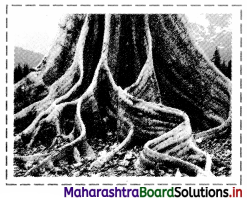
Maharashtra Board Class 11 Biology Important Questions Chapter 9 Morphology of Flowering Plants 24
Answer:
Plank roots/Buttress:
a. These roots often develop at the base of large trees and form plank like extensions around stem.
b. These roots provide additional support, e.g. Silk cotton, Peepal, etc.

Question 12.
Identify the type of root marked as ‘X’ in the given picture and write a short note on it.
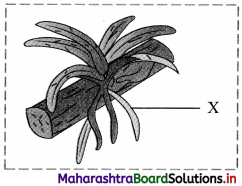
Maharashtra Board Class 11 Biology Important Questions Chapter 9 Morphology of Flowering Plants 25
Answer:
Epiphytic roots:
1. Epiphytic plants like Vanda, Dendrobium grow on branches of trees in dense rain forests and are unable to obtain moisture from soil.
2. Such plants produce epiphytic roots which hang in the air.
3. The roots are provided with a spongy membranous absorbent covering of the velamen tissue.
4. The cells of velamen tissue are hygroscopic and have porous walls, thus they can absorb moisture from air.
5. Epiphytic roots can be silvery white or green and are without root cap.

Question 13.
Identify the type of aerial modification of stem in the given figure.
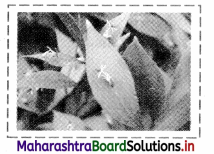
Maharashtra Board Class 11 Biology Important Questions Chapter 9 Morphology of Flowering Plants 26
Answer:
Cladophylls:
These are leaf like structures bore in the axil of scale leaf. It has floral bud and scale leaf in the middle i.e. upper half is leaf and lower half is stem. e.g. Ruscus.

Maharashtra Board Class 11 Biology Important Questions Chapter 9 Morphology of Flowering Plants

Question 14.
Write a short note on corm.
Answer:

  1. In Colocasia and Amorphophallus corm is present, which is an underground stem modified for storage of food.
  2. Corm is swollen underground spherical or subspherical vertically growing stem.
  3. It is condensed structure with circular or ring like nodes.
  4. It shows presence of axillary buds and scales.
  5. Adventitious buds are produced which help in vegetative propagation.
  6. Adventitious roots are produced at lower part of the stem.

Question 15.
Observe the type of sub aerial stem in the given picture of Eichhornia and explain it.
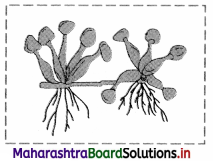
Maharashtra Board Class 11 Biology Important Questions Chapter 9 Morphology of Flowering Plants 27
Answer:
Offset:
1. These are one intemode long runners in rosette plants at ground or water level.
2. Offset helps in vegetative propagation.
e.g. Water hyacinth or Jal kumbhi (Eichhornia) and Pistia. [Any one example]

Question 16.
Explain the type of stem modification in Opuntia.
Answer:
Phylloclade:
a. Modification of stem into leaf like photosynthetic organ is known as phylloclade.
b. Being stem it possesses nodes and internodes.
c. It is thick, fleshy and succulent, contains mucilage for retaining water e.g. Opuntia, Casuarina (Cylindrical shaped phylloclade) and Muehlenbeckia (ribbon like phylloclade).

Question 17.
Identify the structure ‘X’ in the given figure and explain it.
Maharashtra Board Class 11 Biology Important Questions Chapter 9 Morphology of Flowering Plants 28
Answer:
Bulbils:
a. In plants like Dioscorea, etc. axillary bud becomes fleshy and rounded due to storage of food called as bulbil.
b. When it falls off it produces new plant and help in vegetative propagation.

Maharashtra Board Class 11 Biology Important Questions Chapter 9 Morphology of Flowering Plants

Question 18.
Describe the types of stem tendrils present in different plants.
Answer:
1. Stem tendrils:
a. Tendrils are thin, wiry, photosynthetic, leafless coiled structures.
b. They give additional support to developing plant.
c. Tendrils have adhesive glands for fixation.
d. Apical bud in Vitis quadrangularis gets modified into tendril. The further growth is carried out by axillary bud.
e. In Passiflora axillary bud gets modified in tendril.
f. Extra axillary bud is the one which grows outside the axil. This bud in cucurbita gets modified into tendril.
g. Normally floral buds are destined to produce flowers. But in plants like Antigonon they produce tendrils.

Question 19.
What are cladodes?
Answer:
Cladodes:
a. The branches of limited growth i.e. one intemode long and performing photosynthetic function are called as cladodes.
b. True leaves are reduced to spine or scales to reduce rate of transpiration, e.g. Asparagus.

Question 20.
What are tendrils?
Answer:
Tendrils are thin, wiry, photosynthetic, leafless coiled structures.

Question 21.
What is sympodial growth in ginger rhizome and monopodial growth in lotus rhizome?
Answer:
1. Growth of rhizome takes place with lateral buds, such growth is known as sympodial growth, e.g. Ginger (Zingiber officinale), Turmeric (Curcuma domestica), Canna etc.
2. In plants where rhizomes grow obliquely, terminal bud brings about growth of rhizomes. This is known as monopodial growth, e.g. Nymphea, Nelumbo (Lotus), Pteris (Fern) etc.

Question 22.
In xerophytic plant like Opuntia, the stem becomes photosynthetic. Give reason.
Answer:
1. Xerophytes are the plants which grow in regions with scanty or no rainfall like desert.
2. In Xerophytes, leaves get modified into spines or get reduced in size to check the loss of water due to transpiration.
3. As the leaves are modified into spines, the stem becomes green in colour to do the function of photosynthesis.

Question 23.
Define compound leaves. Explain its two types.
Answer:
The leaf with entire lamina is called simple leaf, whereas leaf in which leaf lamina is divided into many leaflets is called as compound leaf.
1. Pinnately compound: Leaflets are present laterally on a common axis called rachis, which represents the midrib of the leaf. e.g. Cassia, Rose, Caesalpinia, Moringa, Coriandrum, etc. [Any two examples]
2. Palmately compound: In this all the leaflets are attached at the tip of petiole.
e.g. Citrus, Zorina, Oxalis, Marsilea, Bombax [Any two examples] [Note: Another example of palmately compound leaf (Bifoliate) is Balanites roxburghii.]

Maharashtra Board Class 11 Biology Important Questions Chapter 9 Morphology of Flowering Plants

Question 24.
Define leaf venation. What are its two types?
Answer:
Leaf venation:
1. Arrangement of veins and veinlets in leaf lamina is known as venation.
2. There are two types of leaf venation: parallel venation which is found in monocot leaves and reticulate venation which is found in dicot leaves.

Question 25.
Draw neat and labelled diagram of structure of a typical leaf.
Answer:
A typical dicot leaf shows presence of three main parts Leaf base or Hypopodium, Petiole or Mesopodium and Leaf lamina/blade or Epipodium.
1. Leaf base or Hypopodium:
a. The point by which leaf remains attached to the stem is known as leaf base.
b. The nature of leaf base varies in different plants. It may be pulvinus (swollen), sheathing or ligulate, etc.

Question 26.
Which type of venation can be observed in monocot leaf?
Answer:
There are two types of leaf venation: parallel venation which is found in monocot leaves and reticulate venation which is found in dicot leaves.

Question 27.
Enlist the types of pinnately compound leaves and give one example of each.
Answer:
Figure ‘a’: Paripinnately compound leaves (e.g. Cassia)
Figure ‘b’: Imparipinnately compound leaves (e.g. Rosa)
Figure ‘c’: Bipinnately compound leaves (e.g. Caesalpinia)
Figure ‘d’: Tripinnately compound leaves (e.g. Moringa)
Figure ‘e’: Decompound leaves (e.g. Coriandrum)

Question 28.
What is opposite decussate phyllotaxy? Give one example.
Answer:
Figure ‘c’ represents opposite decussate phyllotaxy. In this type of phyllotaxy, a pair of leaf arise from each node and the consecutive pair at right angle to the previous one. e.g. Calotropis.

Question 29.
Explain in detail androecium of an angiospermic flower.
Answer:
Androecium (A):
a. It is third floral whorl from outer side.
b. Androecium is male reproductive part of a flower.
c. The individual member is known as stamen.
d. If all the stamens are free the condition is polyandrous and synandrous if they are fused.
e. Typical stamen shows three different parts:
1. Anther: It is terminal in position. Anther produces pollen grains. It is usually dithecous (two anther lobes), tetralocular/tetra sporangiate (four pollen sacs) structure, e.g. Datura.
In some plants it is monothecous (single lobed), bilocular or bisporangiate structure e.g. Hibiscus.

2. Filament: It is a stalk of stamen and bears anther at its tip. It raises anther to a proper height for easy dispersal of pollen grains.

3. Connective: It is in continuation with the filament. It is similar to mid rib and connects two anther lobes together and also with the filament.

4. Gynoecium (G):
a. It is the female reproductive part of a flower and innermost in position.
b. It is also known as pistil.
c. The individual member of gynoecium is known as carpel.
d. The number of carpels may be one to many.
e. If all the carpels are fused the condition is described as syncarpous and if they are free the condition is described as apocarpous.
f. The polycarpellary gynoecium can be bicarpellary (two carpels e.g. Datura), tricarpellary (three carpels e.g. Cucurbita), pentacarpellery (five carpels e.g. Hibiscus) and so on.
g. A typical carpel consists of three parts stigma, style and ovary.

1. Stigma is a terminal part of carpel which receives pollen grains during pollination. It helps in
germination of pollen grain. Stigma shows variation in structure to suit the pollinating agent.
2. Style is narrow thread like structure that connects ovary with stigma.
3. Ovary is basal swollen fertile part of the carpel. Ovules are produced in ovary on a soft fertile tissue called placenta.

Question 30.
Draw neat and labelled diagram of a typical flower.
Answer:
Floral parts of a typical flower:
1. Calyx (K):
a. It is outermost floral whorl and individual members are known as
sepals.
b. Sepals are usually green in colour and perform photosynthesis.
c. If all the sepals are united, the condition is gamosepalous and if they are free, the condition is called as polysepalous.
d. Gamosepalous calyx is found in China rose and polysepalous calyx is found in Brassica.
e. The main function of sepals is to protect inner floral parts in bud condition.
f. Sometimes sepals become brightly coloured (petaloid sepals) and attract insects for pollination,
e.g. Mussaenda etc.
g. Sepals modify into hairy structures called as pappus. Such calyx helps in dispersal of fruit, e.g. Tridex.

2. Corolla (C):
a. It is second floral whorl from outer side and variously coloured.
b. The individual member is called as petal.
c. Petals may be sweet to taste, possess scent, odour, aroma or fragrance etc.
d. The condition in which petals are free is said to be polypetalous (e.g. Rose) and if they are fused it is called as gamopetalous (e.g. Datura).
e. The main function of corolla is to attract different agencies for pollination.

3. Perianth (P):
a. Many times, calyx and corolla remain undifferentiated. Such member is known as tepal.
b. The whorl of tepals is known as Perianth.
c. It protects other floral whorls.
d. If all the tepals are free the condition is called as polyphyllous and if they are fused the condition is called as gamophyllous.
e. Sepaloid perianth shows green tepals, while petaloid perianth shows brightly coloured tepals. e.g. Lily, Amaranthus, Celosia, etc.
f. Petaloid tepal helps in pollination and sepaloid tepals can perform photosynthesis.

4. Androecium (A):
a. It is third floral whorl from outer side.
b. Androecium is male reproductive part of a flower.
c. The individual member is known as stamen.
d. If all the stamens are free the condition is polyandrous and synandrous if they are fused.
e. Typical stamen shows three different parts:
1. Anther: It is terminal in position. Anther produces pollen grains. It is usually dithecous (two anther lobes), tetralocular/tetra sporangiate (four pollen sacs) structure, e.g. Datura.
In some plants it is monothecous (single lobed), bilocular or bisporangiate structure e.g. Hibiscus.
2. Filament: It is a stalk of stamen and bears anther at its tip. It raises anther to a proper height for easy dispersal of pollen grains.
3. Connective: It is in continuation with the filament. It is similar to mid rib and connects two anther lobes together and also with the filament.
4. Gynoecium (G):
a. It is the female reproductive part of a flower and innermost in position.
b. It is also known as pistil.
c. The individual member of gynoecium is known as carpel.
d. The number of carpels may be one to many.
e. If all the carpels are fused the condition is described as syncarpous and if they are free the condition is described as apocarpous.
f. The polycarpellary gynoecium can be bicarpellary (two carpels e.g. Datura), tricarpellary (three carpels e.g. Cucurbita), pentacarpellery (five carpels e.g. Hibiscus) and so on.
g. A typical carpel consists of three parts stigma, style and ovary.
1. Stigma is a terminal part of carpel which receives pollen grains during pollination. It helps in
germination of pollen grain. Stigma shows variation in structure to suit the pollinating agent.
2. Style is narrow thread like structure that connects ovary with stigma.
3. Ovary is basal swollen fertile part of the carpel. Ovules are produced in ovary on a soft fertile tissue called placenta.

Maharashtra Board Class 11 Biology Important Questions Chapter 9 Morphology of Flowering Plants

Question 37.
How many carpels are present in gynoecium of Cucurbita and Hibiscus flower?
Answer:
The polycarpellary gynoecium can be bicarpellary (two carpels e.g. Datura), tricarpellary (three carpels e.g. Cucurbita), pentacarpellery (five carpels e.g. Hibiscus) and so on.

Question 38.
Enlist the different types of aestivation and placentation in a flower.
Answer:
Different types of aestivation are as follows:
a. Valvate: Margins of sepals or petals remain either in contact or lie close to each other but do not overlap, e.g. Calyx of Datura, Calotropis.
b. Twisted: Margins of each sepal or petal is directed inwards and is overlapped. While the other margin is directed outwards and overlap the margin of adjacent, e.g. Corolla of China rose, Cotton etc.
c. Imbricate: One of the sepals or petals is internal and is overlapped at both the margins. One is external i.e. both of its margin overlap adjacent member. Rest of the sepals / petals have one inner or overlapped margin and outer or overlapping margin, e.g. Cassia, Bauhinia, etc.
d. Vexillary: Corolla is butterfly shaped and consists of five petals. Outermost and largest is known as standard or vexillum, two lateral petals are wings and two smaller fused forming boat shaped structures keel. e.g. Pisum sativum

2. Types of placentation:
a. Marginal: Ovules are placed on the fused margins of unilocular ovary, e.g. Pea, Bean etc.
b. Axile: Ovules are placed on the central axis of a multilocular ovary, e.g. China rose, Cotton, etc.
c. Parietal: Ovules are placed on the inner wall of unilocular ovary of multicarpellary syncarpus ovary,
e. g. Papaya, Cucumber, etc.
d. Basal: Single ovule is present at the base of unilocular ovary, e.g. Sunflower, Rice, Wheat.
e. Free central: Ovules are borne on central axis which is not attached to ovary wall, e.g.Argemone, Dianthus.

Question 39.
Explain in detail types of fruits.
Answer:
1. Fruits which develop from one ovary of one flower are called as simple fruits.
2. Types of simple fruits on the basis of their pericarp:
a. Dry fruits: These fruits have thin pericarp. It is further divided into two types:
1. Dehiscent dry fruits: Pericarp becomes dry, thin and fruit opens at maturity, e.g. Capsule (Lady’s finger) and legume (Pea)
2. Indehiscent dry fruits: Fruit does not open.
e.g. Achene (Mirabilis), Caryopsis (Maize) and Cypsela (Sunflower)

b. Fleshy fruits: These fruits have thick pericarp. It is further divided into two types based on nature endocarp:
1. Drupe: In these fruits, endocarp is hard and stony, e.g. Mango
2. Berry: In these fruits, endocarp is fleshy and fruit is many seeded, e.g. Tomato
The fruit which develops from a single flower with many ovaries of polycarpellary, apocarpous gynoecium is known as aggregate fruit or etaerio.
Types of aggregate fruits:
Etario of achenes (e.g. Strawberry), etario of berries (e.g. Custard apple), etario of follicles (e.g. Calotropis)
1. The fruits which develop from many ovaries of many flowers of a complete inflorescence are called composite fruits, (e.g. fig) and from catkin inflorescence are called sorosis (e.g. Pineapple).
2. Fruits which develops from hypanthodium inflorescence are called syconus.

Maharashtra Board Class 11 Biology Important Questions Chapter 9 Morphology of Flowering Plants

Question 40.
Give one example of each type of fruit given below:
1. Etario of berries
2. Berry
3. Etario of follicles
4. Cypsela
5. Sorosis
Answer:
The fruit which develops from a single flower with many ovaries of polycarpellary, apocarpous gynoecium is known as aggregate fruit or etaerio.
Types of aggregate fruits:
Etario of achenes (e.g. Strawberry), etario of berries (e.g. Custard apple), etario of follicles (e.g. Calotropis)
2. Berry: In these fruits, endocarp is fleshy and fruit is many seeded, e.g. Tomato
The fruit which develops from a single flower with many ovaries of polycarpellary, apocarpous gynoecium is known as aggregate fruit or etaerio.
Types of aggregate fruits:
Etario of achenes (e.g. Strawberry), etario of berries (e.g. Custard apple), etario of follicles (e.g. Calotropis)
2. Types of simple fruits on the basis of their pericarp:
a. Dry fruits: These fruits have thin pericarp. It is further divided into two types:
3. Dehiscent dry fruits: Pericarp becomes dry, thin and fruit opens at maturity, e.g. Capsule (Lady’s finger) and legume (Pea)
4. Indehiscent dry fruits: Fruit does not open.
e.g. Achene (Mirabilis), Caryopsis (Maize) and Cypsela (Sunflower)
5. The fruits which develop from many ovaries of many flowers of a complete inflorescence are called composite fruits, (e.g. fig) and from catkin inflorescence are called sorosis (e.g. Pineapple).

Question 41.
Define parthenocarpic fruit and give one example.
Answer:
Fruits which are produced from ovary without fertilization are called as parthenocarpic fruits, e.g. Cultivated Banana and Grapes.

Question 42.
Write a short note on simple fruits.
Answer:
1. Fruits which develop from one ovary of one flower are called as simple fruits.
2. Types of simple fruits on the basis of their pericarp:
a. Dry fruits: These fruits have thin pericarp. It is further divided into two types:
1. Dehiscent dry fruits: Pericarp becomes dry, thin and fruit opens at maturity, e.g. Capsule (Lady’s finger) and legume (Pea)
2. Indehiscent dry fruits: Fruit does not open.
e.g. Achene (Mirabilis), Caryopsis (Maize) and Cypsela (Sunflower)

b. Fleshy fruits: These fruits have thick pericarp. It is further divided into two types based on nature endocarp:
1. Drupe: In these fruits, endocarp is hard and stony, e.g. Mango
2. Berry: In these fruits, endocarp is fleshy and fruit is many seeded, e.g. Tomato

Question 43.
Give examples of any two types of aggregate fruits.
Answer:
The fruit which develops from a single flower with many ovaries of polycarpellary, apocarpous gynoecium is known as aggregate fruit or etaerio.
Types of aggregate fruits:
Etario of achenes (e.g. Strawberry), etario of berries (e.g. Custard apple), etario of follicles (e.g. Calotropis)

Question 44.
Complete the given chart.
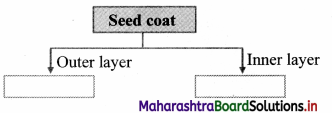
Maharashtra Board Class 11 Biology Important Questions Chapter 9 Morphology of Flowering Plant 29
Answer:
It shows outer layer called as testa and inner layer called as tegmen.

Question 45.
Explain the family of pea plant in detail with suitable floral diagram.
Answer:

  • Example: Pea plant (Pisum sativum)
  • Habit: Tree, shrubs, herbs.
  • Root: Root with root nodules.
  • Stem: Erect or climber.
  • Leaves: Alternate phyllotaxy, Pinnately compound leaves.
  • Inflorescence: Racemose
  • Flower: Zygomorphic, bisexual, complete.
  • Calyx: Sepals five, gamosepalous, imbricate aestivation.
  • Corolla: Petals five, polypetalous, consisting of a larger posterior petal vexillum, two lateral petals wings and two anterior ones forming a keel, vexillary aestivation.
  • Androecium: Stamens ten, diadelphous.
  • Gynoecium: Ovary superior, monocarpellary, unilocular with many ovules, marginal placentation. Fruit: Legume.
  • Seed: Non-endospermic

Question 46.
Answer the following.
1. Explain the family Solanaceae with the help of floral diagram.
2. Give examples of economically important plants from family Liliaceae.
Answer:

  • Example: Thom apple (Datura stramonium)
  • Habit: Mostly herbs, shmbs and rarely small trees.
  • Root: Tap root system
  • Stem: Herbaceous, woody, erect, branched, hairy, sometimes it may be underground like in potato.
  • Leaves: Alternate phyllotaxy, simple, reticulate venation.
  • Inflorescence: Solitary, cymose.
  • Flower: Actinomorphic, bisexual, complete.
  • Calyx: Sepals five, gamosepalous, persistent, valvate aestivation.
  • Corolla: Petals five, gamopetalous, valvate aestivation.
  • Androecium: Stamens five, free epipetalous (adhesion).
  • Gynoecium: Bicarpellary, syncarpous, superior ovary, bilocular, placenta swollen with many ovules, axile placentation.
  • Fruits: Berry or capsule.
  • Seeds: Many, endospermic.

2. Economically important plant from family Liliaceae:
Family Liliaceae includes many ornamental plants like tulip, Gloriosa, Medicinal plants like Aloe vera. Asparagus and source of colchicine, e.g. Colchicum autumnale.

Question 64.
Multiple Choice Questions:

Question 1.
Root is descending axis of plant body which is
(A) negatively geotropic
(B) hydrophobic
(C) negatively phototropic
(D) green and with intemodes
Answer:
(C) negatively phototropic

Maharashtra Board Class 11 Biology Important Questions Chapter 9 Morphology of Flowering Plants

Question 2.
The root system grow out from the
(A) plumule of the embryo
(B) radicle of the embryo
(C) embryo of the seed
(D) all of these
Answer:
(B) radicle of the embryo

Question 3.
Adventitious roots develop from
(A) radicle
(B) any part of the plant body except the radicle
(C) flower
(D) embryo
Answer:
(B) any part of the plant body except the radicle

Question 4.
A fibrous root system is best adapted to perform which of the following functions?
(A) Storage of food
(B) Transport of water and organic food
(C) Absorption of water and minerals from the soil
(D) Anchorage of the plant into the soil
Answer:
(D) Anchorage of the plant into the soil

Question 5.
When the root is swollen in the middle and tapers at both ends, it will be called as root.
(A) tuberous
(B) fusiform
(C) conical
(D) napiform
Answer:
(B) fusiform

Question 6.
Pneumatophores are helpful in
(A) protein synthesis
(B) respiration
(C) transpiration
(D) carbohydrate metabolism
Answer:
(B) respiration

Question 7.
Sweet potato is a modification of
(A) leaf
(B) adventitious root
(C) tap root
(D) stem
Answer:
(B) adventitious root

Question 8.
Stilt roots are roots.
(A) primary
(B) adventitious
(C) secondary
(D) tap
Answer:
(B) adventitious

Question 9.
A spongy tissue called velamen is present in
(A) breathing roots
(B) parasitic roots
(C) tuberous roots
(D) epiphytic roots
Answer:
(D) epiphytic roots

Question 10.
Which of the following is NOT a type of adventitious root modified for storage of food?
(A) Fasciculated tuberous roots
(B) Simple tuberous root
(C) Napiform root
(D) Moniliform roots
Answer:
(C) Napiform root

Question 11.
In which of the following plants, root cap is replaced by root pocket?
(A) Pistia
(B) Pandanus
(C) Screw pine
(D) Hibiscus
Answer:
(A) Pistia

Question 12.
Which of the following is an example of stem tuber?
(A) Helianthus tuberosus
(B) Zingiber officinale
(C) Cynodon
(D) Chrysanthemum
Answer:
(A) Helianthus tuberosus

Maharashtra Board Class 11 Biology Important Questions Chapter 9 Morphology of Flowering Plants

Question 13.
In stem tuber, the number of nodes and eyes is more towards
(A) rose end
(B) basal end
(C) heel
(D) both (B) and (C)
Answer:
(A) rose end

Question 14.
A rhizome differs from corm in its
(A) thickness
(B) basic organization
(C) direction of growth
(D) nature of leaves
Answer:
(C) direction of growth

Question 15.
The reduced stem of onion produces.
(A) Adventitious roots
(B) Prop roots
(C) Fusiform roots
(D) Fasciculated roots
Answer:
(A) Adventitious roots

Question 16.
Corm is ____________
(A) a horizontal underground stem.
(B) an underground root.
(C) an underground vertical stem.
(D) an aerial stem modification.
Answer:
(C) an underground vertical stem.

Question 17.
The stem modified to perform the function of leaf and with many internodes is called
(A) phylloclade
(B) cladode
(C) offset
(D) phyllode
Answer:
(A) phylloclade

Question 18.
_______ is a non-green runner like branch of stem, which develops from underground base of roots and found in Chrysanthemum.
(A) Corn
(B) Sucker
(C) Offset
(D) Tendril
Answer:
(B) Sucker

Question 19.
Ribbon shaped phylloclades are found in
(A) Ruscus
(B) Duranta
(C) Muehlenbeckia
(D) Bougainvillea
Answer:
(C) Muehlenbeckia

Question 20.
Axillary buds in Dioscorea becomes fleshy and rounded due to storage of food called as
(A) Stiphles
(B) Bulbils
(C) Offset
(D) Cladophylls
Answer:
(B) Bulbils

Maharashtra Board Class 11 Biology Important Questions Chapter 9 Morphology of Flowering Plants

Question 21.
The leaves without petiole are called
(A) sessile
(B) petiolate
(C) rachis
(D) lamina
Answer:
(A) sessile

Question 22.
The type of leaves observed is mango plant is
(A) Compound leaves
(B) Bipinnately compound leaves
(C) Simple leaves with reticulate venation
(D) Simple leaves with parallel venation
Answer:
(C) Simple leaves with reticulate venation

Question 23.
In _________ , the terminal three leaflet get modified into three stiff leaf hooks.
(A) Lathyrus
(B) Pisum sativum
(C) Smilax
(D) Bignonia unguisi-cati
Answer:
(D) Bignonia unguisi-cati

Question 24.
Leaf apex is modified into tendril in
(A) Gloriosa
(B) Pea
(C) Smilax
(D) Lathyrus
Answer:
(A) Gloriosa

Question 25.
Modification of petiole into leaf-like structure is called ________ .
(A) cladode
(B) phylloclade
(C) phyllode
(D) pistillode
Answer:
(C) phyllode

Question 26.
The mode of arrangement of leaves on the stem and the branch is known as _______ .
(A) vernalization
(B) vernation
(C) venation
(D) phyllotaxy
Answer:
(D) phyllotaxy

Question 27.
Bipinnately compound leaves can be observed in
(A) Citrus
(B) Hibiscus
(C) Caesalpinia
(D) Coriandrum
Answer:
(C) Caesalpinia

Question 28.
The axis of the inflorescence is known as
(A) Thalamus
(B) Peduncle
(C) Pedicel
(D) Petiole
Answer:
(B) Peduncle

Question 29.
In racemose inflorescence
(A) growth of peduncle is infinite
(B) apical bud always terminates into flower
(C) growth of peduncle is finite.
(D) order of opening of flower is centrifugal.
Answer:
(A) growth of peduncle is infinite

Maharashtra Board Class 11 Biology Important Questions Chapter 9 Morphology of Flowering Plants

Question 30.
In a typical flower thalamus consists of compactly arranged nodes and intemodes.
(A) three, two
(B) four, three
(C) three, four
(D) two, three
Answer:
(B) four, three

Question 31.
When the flower is epigynous, the ovary is said to be
(A) inferior
(B) superior
(C) semi-inferior
(D) semi-superior
Answer:
(A) inferior

Question 32.
When the gynoecium is present at the topmost position of the thalamus, the flower is known as
(A) inferior
(B) epigynous
(C) perigynous
(D) hypogynous
Answer:
(D) hypogynous

Question 33.
When all sepals are united, the condition is called as
(A) polysepalous
(B) gamosepalous
(C) polypetalous
(D) gamopetalous
Answer:
(B) gamosepalous

Question 34.
When sepals fall just after opening of the flower, they are termed as
(A) persistent
(B) caducous
(C) remnant
(D) deciduous
Answer:
(B) caducous

Question 35.
Fusion between members of a similar whorl is known as
(A) succession
(B) adhesion
(C) cohesion
(D) inflorescence
Answer:
(C) cohesion

Maharashtra Board Class 11 Biology Important Questions Chapter 9 Morphology of Flowering Plants

Question 36.
Complete the analogy. Seed:ovule::Fruit:
(A) pericarp
(B) ovary
(C) embryo
(D) cotyledons
Answer:
(B) ovary

Question 37.
Which one of the following is not a fruit?
(A) Tomato
(B) Cucumber
(C) Pumpkin
(D) Potato
Answer:
(D) Potato

Question 38.
Pineapple is an example of _________ .
(A) simple dry fruit
(B) composite fruit
(C) aggregate fruit
(D) simple-fleshy fruit
Answer:
(B) composite fruit

Question 39.
Outer seed coat is called _______ .
(A) testa
(B) tegmen
(C) raphe
(D) micropyle
Answer:
(A) testa

Question 40.
Vexillum wings and keel corolla are found in family
(A) Solanaceae
(B) Fabaceae
(C) Liliaceae
(D) Malvaceae
Answer:
(B) Fabaceae

Question 65.
Competitive Corner:

Question 1.
Match the placental types (Column-I) with their examples (Column-II).

Column-IColumn-II
1. Basal(p) Mustard
2. Axile(q) China rose
3. Parietal(r) Dianthus
4. Free central(s) Sunflower

Choose the correct answer from the following option: [NEET (ODISHA) – 2019J
(A) i – r, ii – s, iii – p, iv – q
(B) i – q, ii – r, iii – s, iv – p
(C) i – p, ii – q, iii – r, iv – s
(D) i – s, ii – q, iii – p, iv – r
Answer:
(D) i – s, ii – q, iii – p, iv – r

Question 2.
Placentation in which ovules develop on the inner wall of the ovary or in peripheral part is:
(A) Parietal
(B) Free central
(C) Basal
(D) Axile
Answer:
(A) Parietal

Question 3.
Pneumatophores occur in
(A) Carnivorous plants
(B) Free-floating hydrophytes
(C) Halophytes
(D) Submerged hydrophytes
Answer:
(C) Halophytes

Question 4.
Sweet potato is a modified
(A) Tap root
(B) Adventitious root
(C) Stem
(D) Rhizome
Answer:
(B) Adventitious root

Maharashtra Board Class 11 Biology Important Questions Chapter 9 Morphology of Flowering Plants

Question 5.
Root hairs develop from the region of
(A) Maturation
(B) Elongation
(C) Root cap
(D) Meristematic activity
Hint: Epidermal cells from the region of maturation form very fine and delicate, thread like structures called root hairs. These root hairs absorb water and minerals from the soil.
Answer:
(A) Maturation

Question 6.
Plants which produce characteristic pneumatophores and show vivipary belong to
(A) Mesophytes
(B) Halophytes
(C) Psammophytes
(D) Elydrophytes
Hint: Plants growing in swampy areas, marshy places and salt lakes are called halophytes. Many halophytes develop respiratory roots or pneumatophores. Pneumatophores are negatively geotropic and are provided with pores called lenticels. Since they grow in oxygen-deficient soil, their seeds germinate inside the fruit, when it is still attached with the parents, exhibiting vivipary.
Answer:
(B) Halophytes

Question 7.
In Bougainvillea thorns are the modifications of
(A) Stipules
(B) Adventitious root
(C) Stem
(D) Leaf
Hint: Thom is a hard, pointed, woody and usually straight structure produced by modification of axillary bud. It provides protection against browsing animals. In Bougainvillea, thorns are modified stems.
Answer:
(C) Stem

Maharashtra Board Class 11 Biology Important Questions Chapter 9 Morphology of Flowering Plants

Question 8.
Coconut fruit is a
(A) Drupe
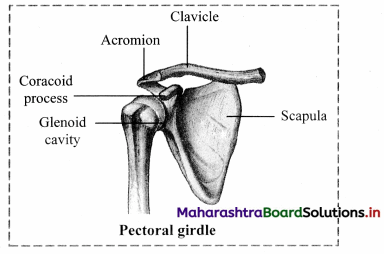
(B) Berry
(C) Nut
(D) Capsule
Hint: Dmpe is the simple, fleshy fruit developing from the monocarpellary superior ovary. It is generally one seeded. Coconut fruit is a dmpe with fibrous mesocarp and hard endocarp
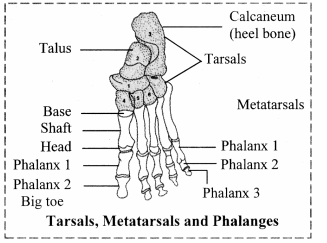
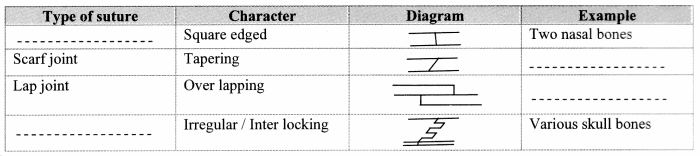
Answer:
(A) Drupe