Maharashtra Board Class 11 Biology Solutions Chapter 11 Study of Animal Type

Balbharti Maharashtra State Board 11th Biology Textbook Solutions Chapter 11 Study of Animal Type: Cockroach Textbook Exercise Questions and Answers.

Maharashtra State Board 11th Biology Solutions Chapter 11 Study of Animal Type: Cockroach

Question (A)
Chemical nature of chitin is ____________ .
(A) protein
(B) carbohydrate
(C) lipid
(D) glycoprotein
Answer:
(B) carbohydrate & (D) glycoprotein

Maharashtra Board Class 11 Biology Solutions Chapter 11 Study of Animal Type: Cockroach

Question (B)
Cockroach has ___________ type of mouthparts.
(A) sponging
(B) chewing and biting
(C) piercing and sucking
(D) lapping
Answer:
(B) chewing and biting

Question (C)
Spiracle is a part of ________ system of cockroach.
(A) circulatory
(B) respiration
(C) reproductive
(D) nervous
Answer:
(B) respiration

Question (D)
________ is a part of digestive system.
(A) Trachea
(B) Hypopharynx
(C) Haemocyte
(D) Seminal vesicle
Answer:
(B) Hypopharynx

Question (E)
_________ is also called as brain of cockroach.
(A) Supra-oesophageal ganglion
(B) Sub-oesophageal ganglion
(C) Hypo-cerebral ganglion
(D) Thoracic ganglion
Answer:
(A) Supra-oesophageal ganglion

Maharashtra Board Class 11 Biology Solutions Chapter 11 Study of Animal Type: Cockroach

2. Answer the following questions

Question (A)
Describe the digestive system of cockroach.
OR
With the help of neat and labelled diagram, describe the digestive system of cockroach.
Answer:
1. Digestive system of cockroach consists of mouthparts, alimentary canal and salivary glands.
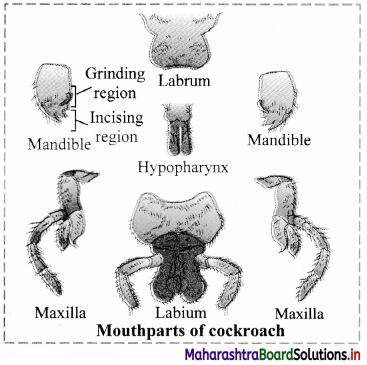
2. Mouthparts: Pre-oral cavity present in front of the mouth receives food. It is bounded by chewing and biting type of mouth parts.
These are movable, segmented appendages that help in ingestion of food. The mouthparts of cockroach comprises of:
(a) Labrum: It forms the upper lip. It is a single flap-like movable part which covers the mouth from upper side. It forms an anterior wall of pre¬oral cavity.
Function: It is useful in holding the food during feeding.

(b) Mandibles: These are two dark, hard, chitinous structures with serrated median margins.They are true jaws present on either side, behind the labrum.
Function: They perform co-ordinated side-wise movements with the help of adductor and abductor muscles to cut and crush the food.

(c) Maxillae: These are the accesssory jaws. They are also called as first pair of maxillae. These are situated on the either side of mouth behind the mandibles. Each maxilla consists of sclerites like cardo, stipes, galea, lacinia and maxillary palps.
Functions: Maxillae hold food, help mandibles for mastication. They are also used for cleaning the antennae and front legs. Maxillary palps act as tactile organs.

(d) Labium: It forms the lower lip. Labium is also known as second maxilla which covers the pre-oral cavity from the ventral side. It is firmly attached to the posterior part of head. It has three jointed labial palps which are sensory in function.
Function: It is useful in pushing the chewed food in the pre-oral cavity. It prevents the loss of food falling from the mandibles, while chewing.

(e) Hypopharynx: Hypopharynx is also known as lingua. It is a somewhat cylindrical single structure, located in front of the labium and between first maxillae. The salivary duct opens at the base of hypopharynx. Hypopharynx bears comb-like plates called super-lingua on either side. Hypopharynx is present at the centre of the mouth.
Function: It is useful in the process of feeding and mixing saliva with food.

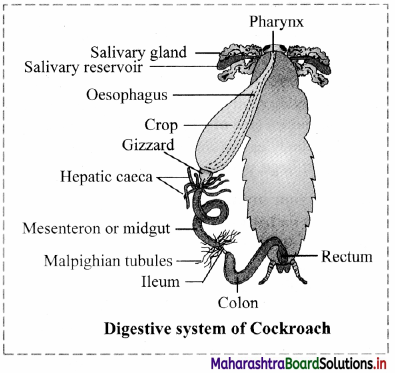
3. Alimentary canal: It is long a (6 – 7cm) tube of different diameters with two openings.
Maharashtra Board Class 11 Biology Solutions Chapter 11 Study of Animal Type Cockroach 1

4. The alimentary canal is divisible into three parts: foregut, midgut and hindgut
(a) Foregut or stomodaeum: It consists of pharynx, oesophagus, crop and gizzard.
1. Pharynx: It is very short, narrow but muscular tube that opens into oesophagus.
Function: Conduction of food into the oesophagus.
2. Oesophagus: It is slightly long and narrow tube which opens into crop.
3. Crop: Crop is a large, pear shaped and sac- like organ.
Function: It temporarily stores the food and then sends it to gizzard.
4. Gizzard: Gizzard or proventricuius is a small spherical organ. It is provided internally with a circlet of six chitinous teeth and backwardly directed bristles.The foregut ends with gizzard.
Function: The chitinous teeth present in gizzard are responsible for crushing the food and the bristles help to filter the food.
Maharashtra Board Class 11 Biology Solutions Chapter 11 Study of Animal Type Cockroach 2

(b) Midgut or mesenteron: It consists of stomach and hepatic caeca.
1. Ventriculus or stomach: It is straight, short and narrow. Stomach is lined by glandular epithelium which secretes digestive enzymes.
Function: It is mainly responsible for digestion and absorption.
2. Hepatic caeca: These are thin, transparent, short, blind (closed) and hollow tubules.
Function: They secrete digestive enzymes.

(c) Hindgut or proctodaeum : It consists of ileum, colon and rectum.
1 Ileum: It is short and narrow part of hindgut. Malpighian tubules open in the anterior lumen of ileum, near the junction of midgut and hindgut. Posterior region of ileum contains sphincter.
Ileum directs the nitrogenous wastes and undigested food towards colon.
2. Colon: It is a longer and wider part of the hindgut. It directs waste material towards the rectum. It reabsorbs water from wastes as per the need.
3. Rectum: It is oval or spindle-shaped, terminal part of the hindgut. It contains six rectal pads along the internal surface for absorption of water. Rectum opens into anus. Anus is present on the ventral side of the 10th segment. It is the last or posterior opening of the digestive system. The undigested food is released out of the body through anus.

5. Salivary glands:
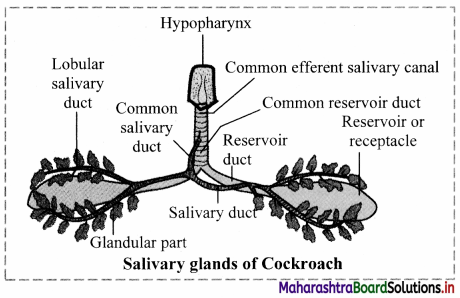
a. Cockroach has a pair of salivary glands which secrete saliva.
b. Each salivary gland has two glandular lobes and a receptacle or reservoir.
c. The glandular lobes consists of several irregular-shaped white coloured lobules which secrete saliva.
d. Each gland has a salivary duct.
Both the ducts unite to form a common salivary duct.
e. Receptacle of each salivary gland is thin-walled, elongated, sac-like structure. Each receptacle has a duct. These ducts unite to form common reservoir duct.
f. Common salivary duct and common reservoir duct unite together to form a common efferent salivary duct. The efferent salivary duct opens at the base of tongue or hypopharynx.
Maharashtra Board Class 11 Biology Solutions Chapter 11 Study of Animal Type Cockroach 3

Question (B)
Give an account on tracheal system of cockroach.
Answer:
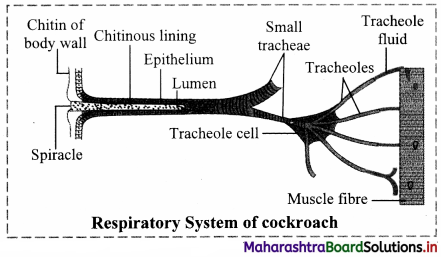
1. Cockroach has an internal respiratory system of air tubes called tracheal system by which the air is brought into the body and is in contact with every part of the body. It allows the exchange of gases directly between the air and tissues without the need of blood.
These air tubes of internal respiratory system begin at the opening on body surface called spiracles.
Maharashtra Board Class 11 Biology Solutions Chapter 11 Study of Animal Type Cockroach 4
2. Spiracles: They are paired respiratory openings. Spiracles are present on the ventro-lateral side of the body, in pleural membrane. Cockroaches have two pairs of thoracic and eight pairs of abdominal spiracles.The spiracles open into a series of air sacs from which arise the tubes called trachea. The spiracles let the air into and out of trachea.

3. Trachea: The trachea form a definite pattern of branching tubes arranged transversely as well as longitudinally. They are about 1mm thick and have spiral or annular thickening of chitin. The inner lining of chitin prevents the trachea from collapsing. Each trachea further branches into smaller tubes called tracheoles.

4. Tracheoles: These are fine intracellular tubes that penetrate deep into tissues. They are thin and not lined by chitin. They end blindly in the cells. Each tracheole at the blind end is filled with a watery fluid through which exchange of gases takes place. The content of this fluid keeps changing. At high muscular activity, part of fluid part is drawn into the tissues to enable more and rapid oxygen intake.

Maharashtra Board Class 11 Biology Solutions Chapter 11 Study of Animal Type: Cockroach

Question (C)
Describe the nervous system of cockroach.
Answer:
Nervous system in cockroach:
Nervous system of cockroach is ventral, solid and ganglionated. It consists of central nervous system (CNS), peripheral nervous system (PNS) and autonomous nervous system (ANS).
Central nervous system (CNS): Central nerv ous system consists of nerve ring and ventral nerve cord.
1. Nerve ring consists of:
a. a pair of supra-oesophageal ganglia
b. a pair of circum-oesophageal connectives
c. a pair of sub-oesophageal ganglia
(a) Supra-oesophageal ganglia or cerebral ganglia: A pair of supra-oesophageal ganglia is collectively known as the brain. Brain is present in head, above the oesophagus and between antennal bases. Each supra-oesophageal ganglion is formed by the fusion of three small ganglia – protocerebram, deutocerebrum and tritocerebrum.
(b) Circum-oesophageal connectives: Supra-oesophageal ganglia are connected to sub-oesophageal ganglion by a pair of lateral nerves called as circum-oesophageal connectives. Connectives arise from supra-oesophagial ganglia.
(c) Sub-oesophageal ganglia: It is a bilobed and present below the oesophagus, in head. It is also formed by the fusion of three pairs of ganglia.

2. Ventral nerve cord:
a. It arises from the sub-oesophageal ganglion. It is present along mid-ventral position, in perineural sinus.
b. It is double ventral nerve cord and consists of nine segmental, paired ganglia.
c. First three pairs of segmental ganglia are large and known as thoracic ganglia. The other six pairs of segmental ganglia are in abdomen (abdominal ganglia).
d. 6th abdominal ganglion is the largest and it is present in 7th abdominal segment.
e. There is no ganglion in 6th segment.

Peripheral nervous system (PNS):

  1. The peripheral nervous system comprises of nerves that arise from various ganglia of CNS.
  2. Six pairs of nerves arise from the supra-oesophageal ganglia.They supply to the eyes, antenna and labrum.
  3. Nerves arising from the sub-oesophageal ganglion supply to the mandibles, maxillae and labium.
  4. Nerves arising from the thoracic ganglia supply to the wings, legs and internal thoracic organs.
  5. Nerves from abdominal ganglia go to the abdominal organs of respective abdominal segments.
  6. Autonomic nervous system (ANS): It consists of four ganglia and a retrocerebral complex.

The ganglia are as follows:

  1. Frontal ganglion: It is present above the pharynx and in front of brain.
  2. Hypocerebral ganglion: It is present on the anterior region of oesophagus.
  3. Ingluvial ganglion: It is present on crop. It is also called as visceral ganglion.
  4. Ventricular ganglion: It is present on gizzard.

Question (D)
With the help of neat labelled diagram, describe female reproductive system of cockroach.
Answer:
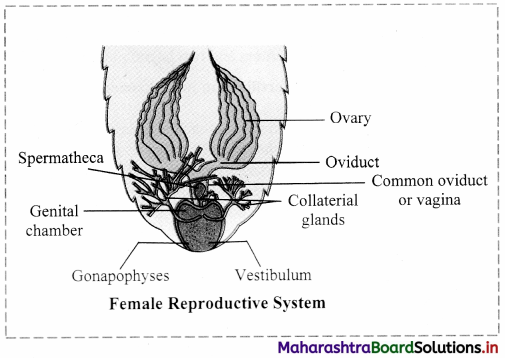
Maharashtra Board Class 11 Biology Solutions Chapter 11 Study of Animal Type Cockroach 5

  1. Female reproductive system of cockroach consists a pair of ovaries, a pair of oviducts, vagina, spermatheca and accessory glands.
  2. Ovaries are primary reproductive organs. They are paired and lie lateral in position in 2nd – 6lh abdominal segments. Each ovary is formed of a group of 8 ovarian tubules or ovarioles, containing a chain of developing ova. All ovarioles of an ovary open in lateral oviduct of respective side.
  3. The lateral oviducts unite to form a common oviduct or vagina.
    Common oviduct or vagina opens into the Bursa copulatrix (genital chamber), the female organ of copulation.
  4. Spermatheca, is a sperm storing structure present in the 6th segment opens into genital chamber. It receives the sperms during copulation and store them for fertilization.
  5. Collaterial glands are accessory paired glands that open in genital chamber.
  6. Female gonapophyses consists of six chitinous plates surrounding the genital pore.
  7. In males, genital pouch or genital chamber lies at the hind end of abdomen which is bounded dorsally by 9th and 10th terga and ventrally b; male genital pore and gonapophysis.

Maharashtra Board Class 11 Biology Solutions Chapter 11 Study of Animal Type: Cockroach

Question (E)
Draw a labelled diagram of digestive system of a cockroach.
Answer:
1. Digestive system of cockroach consists of mouthparts, alimentary canal and salivary glands.
2. Mouthparts: Pre-oral cavity present in front of the mouth receives food. It is bounded by chewing and biting type of mouth parts.
These are movable, segmented appendages that help in ingestion of food. The mouthparts of cockroach comprises of:
(a) Labrum: It forms the upper lip. It is a single flap-like movable part which covers the mouth from upper side. It forms an anterior wall of pre¬oral cavity.
Function: It is useful in holding the food during feeding.
(b) Mandibles: These are two dark, hard, chitinous structures with serrated median margins.They are true jaws present on either side, behind the labrum.
Function: They perform co-ordinated side-wise movements with the help of adductor and abductor muscles to cut and crush the food.
(c) Maxillae: These are the accesssory jaws. They are also called as first pair of maxillae. These are situated on the either side of mouth behind the mandibles. Each maxilla consists of sclerites like cardo, stipes, galea, lacinia and maxillary palps.
Functions: Maxillae hold food, help mandibles for mastication. They are also used for cleaning the antennae and front legs. Maxillary palps act as tactile organs.
(d) Labium: It forms the lower lip. Labium is also known as second maxilla which covers the pre-oral cavity from the ventral side. It is firmly attached to the posterior part of head. It has three jointed labial palps which are sensory in function.
Function: It is useful in pushing the chewed food in the pre-oral cavity. It prevents the loss of food falling from the mandibles, while chewing.
(e) Hypopharynx: Hypopharynx is also known as lingua. It is a somewhat cylindrical single structure, located in front of the labium and between first maxillae. The salivary duct opens at the base of hypopharynx. Hypopharynx bears comb-like plates called super-lingua on either side. Hypopharynx is present at the centre of the mouth.
Function: It is useful in the process of feeding and mixing saliva with food,

3. Alimentary canal: It is long a (6 – 7cm) tube of different diameters with two openings.

4. The alimentary canal is into three parts: foregut, midgut and hindgut
(a) Foregut or stomodaeum: It consists of pharynx, oesophagus, crop and gizzard.
1. Pharynx: It is very short, narrow but muscular tube that opens into oesophagus.
Function: Conduction of food into the oesophagus.
2. Oesophagus: It is slightly long and narrow tube which opens into crop.
3. Crop: Crop is a large, pear shaped and sac- like organ.
Function: It temporarily stores the food and then sends it to gizzard.
4. Gizzard: Gizzard or proventricuius is a small spherical organ. It is provided internally with a circlet of six chitinous teeth and backwardly directed bristles.The foregut ends with gizzard.
Function: The chitinous teeth present in gizzard are responsible for crushing the food and the bristles help to filter the food.

(b) Midgut or mesenteron: It consists of stomach and hepatic caeca.
1. Ventriculus or stomach: It is straight, short and narrow. Stomach is lined by glandular epithelium which secretes digestive enzymes.
Function: It is mainly responsible for digestion and absorption.
2. Hepatic caeca: These are thin, transparent, short, blind (closed) and hollow tubules.
Function: They secrete digestive enzymes.

(c) Hindgut or proctodaeum : It consists of ileum, colon and rectum.
1 Ileum: It is short and narrow part of hindgut. Malpighian tubules open in the anterior lumen of ileum, near the junction of midgut and hindgut. Posterior region of ileum contains sphincter.
Ileum directs the nitrogenous wastes and undigested food towards colon.
2. Colon: It is a longer and wider part of the hindgut. It directs waste material towards the rectum. It reabsorbs water from wastes as per the need.
3. Rectum: It is oval or spindle-shaped, terminal part of the hindgut. It contains six rectal pads along the internal surface for absorption of water. Rectum opens into anus. Anus is present on the ventral side of the 10th segment. It is the last or posterior opening of the digestive system. The undigested food is released out of the body through anus.

5. Salivary glands:
a. Cockroach has a pair of salivary glands which secrete saliva.
b. Each salivary gland has two glandular lobes and a receptacle or reservoir.
c. The glandular lobes consists of several irregular-shaped white coloured lobules which secrete saliva.
d. Each gland has a salivary duct.
Both the ducts unite to form a common salivary duct.
e. Receptacle of each salivary gland is thin-walled, elongated, sac-like structure. Each receptacle has a duct. These ducts unite to form common reservoir duct.
f. Common salivary duct and common reservoir duct unite together to form a common efferent salivary duct. The efferent salivary duct opens at the base of tongue or hypopharynx.

Maharashtra Board Class 11 Biology Solutions Chapter 11 Study of Animal Type: Cockroach

Question (F)
A student observed that the cockroaches are killed for dissection by simply putting them in soap water. He inquired whether soap is so poisonous. Teacher said it is due to its peculiar respiratory system. How?
Answer:
Cockroaches when put in soap solution, the solution enters into their body through the small respiratory openings called spiracles. The spiracles lead to trachea which further branches into smaller tubes called tracheoles. Each of these tracheoles has body fluid which acts as a stationary medium for diffusion. The soap solution rapidly diffuses through the entire respiratory system which may result in suffocation and eventually lead to the death of cockroach.

Question (G)
Describe the circulatory system of cockroach.
Answer:
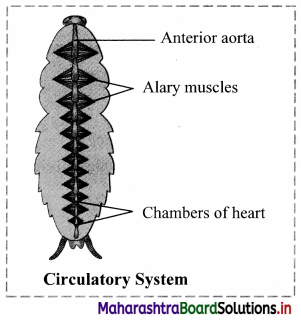
Maharashtra Board Class 11 Biology Solutions Chapter 11 Study of Animal Type Cockroach 6
1. Haemolymph: Haemolymph is colourless as it is without any pigment. It consists of plasma and seven types of blood cells/haemocytes. Plasma consists of water with some dissolved organic and inorganic solutes. It is rich in nutrients and nitrogenous wastes like uric acid.Cockroach has open circulatory system. It consists of colourless blood (haemolymph), a dorsal blood vessel (heart and dorsal aorta) and haemocoel.

2. Haemocoel: The body cavity of cockroach (haemocoel) can be divided into three sinuses due to two diaphragms i.e. dorsal and ventral diaphragm. These diaphragms are thin, fibromuscular septa (sing.septum)
which remain attached to terga along lateral sides at intermittent points.
(a) Dorsal diaphragm: It has 12 pairs (10 abdominal and 2 thoracic) of fan-like alary muscles. Alary muscles are triangular with pointed end attached to terga at lateral side and broad end lies between the heart and dorsal diaphragm.
(b) Ventral diaphragm: It is flat and present just above the ventral nerve cord. Laterally, it is attached to sterna at intermittent points.
(e) Sinuses: The coelom of cockroach is divided into three sinuses – pericardial sinus, perivisceral sinus and perineural sinus.

1. Pericardial sinus: It is dorsal, very small and contains dorsal vessel.
2. Perivisceral sinus: It is middle and largest sinus. It contains fat bodies and almost all major visceral organs of alimentary canal and reproductive system.
3. Perineural sinus: It is ventral, small and contains ventral nerve cord. It is continuous into legs. All the three sinuses communicate with each other through the pores present between two successive points of attachments of diaphragms.
4. Dorsal blood vessel: This is present in pericardial sinus, just below the tergum. It is divisible into posterior heart and anterior aorta (dorsal aorta/cephalic vessel).
(a) Heart: It is about 2.5 cm long, narrow, muscular tube that is open anteriorly and closed posteriorly. It starts from 9th abdominal segment and extends anteriorly upto 1st thoracic segment. Heart of cockroach is 13 chambered, out of which 10 chambers are in abdominal region and 3 chambers are in thoracic region. Each chamber has a pair of vertical slit-like incurrent aperture or opening called ostium (plural: ostia). Ostia are present along lateral side in the posterior region of first 12 chambers. Each ostium has lip-like valves that allow the flow of blood from sinus to heart only.
(b) Anterior aorta: Heart is continued by a short, thin-walled vessel called dorsal aorta. It lies in head region and opens in haemocoel.

Maharashtra Board Class 11 Biology Solutions Chapter 11 Study of Animal Type: Cockroach

3. Answer the following questions

Question (A)
How will you identify male or female cockroach?
Answer:
Male and female cockroach can be identified with the help of following differences:

Male cockroachFemale cockroach
1. Abdomen is relatively long and narrow.Abdomen is short and broad.
2. 7th tergum covers 8,h tergum.7th tergum covers 8th and 9th terga.
3. Antennae are longer in size.Antennae are shorter in size.
4. Anal styles are present.Anal styles are absent.
5. Brood pouch is absent.Brood pouch is present.
6. All 9 sterna visible.Only 7 sterna visible.

Question (B)
Write a note on: Gizzard of cockroach.
Answer:
Gizzard: Gizzard or proventricuius is a small spherical organ. It is provided internally with a circlet of six chitinous teeth and backwardly directed bristles.The foregut ends with gizzard.
Function: The chitinous teeth present in gizzard are responsible for crushing the food and the bristles help to filter the food.

Question (C)
Give the systematic position of cockroach.
Answer:
Systematic position of cockroach:

ClassificationReasons
KingdomAnimaliaCell wall absent, heterotrophic nutrition.
PhylumArthropodaThey have jointed appendages. Body is chitinous and segmented.
ClassInsectaThey possess two pairs of wings and three pairs of walking legs.
GenusPeriplanetaStraight wings and nocturnal.
SpeciesamericanaOriginated in the continent of America.

Question (D)
What would have happened if cockroach did not have gizzard?
Answer:
1. The gizzard in cockroach is a spherical organ which has chitinous teeth and bristles.
2. The chitinous teeth present in gizzard are responsible for crushing the food and the bristles help to filter the food.
3. If the cockroach did not have gizzard, the food will not be crushed into small particles and unfiltered food will enter the hindgut. Thus, digestion will be affected in the absence of gizzard.

Question (E)
What is the functional difference between eyes of cockroach and human being?
Answer:
1. Cockroaches have compound eyes whereas humans have simple eyes.
2. Eyes of cockroach possess several ommatidia that collectively form an image and help them to detect even the slightest movement of its predator. They provide mosaic or hazy vision.
3. Human eyes contain single lens and a clear image is formed on the retina. Humans have binocular vision which provides an improved perception of depth and gives a three-dimensional image of their surroundings.

Question (F)
What is the functional difference between respiratory systems of cockroach and human being?
Answer:
The functional difference between the respiratory systems of cockroach and human being is that in respiratory system of cockroach transport of gases does not occur via. blood whereas in human respiratory system transport of gases takes place via blood. In cockroach, the circulatory system has no role in respiratory process whereas in humans, circulatory system plays an important in respiratory process.

Maharashtra Board Class 11 Biology Solutions Chapter 11 Study of Animal Type: Cockroach

4. Explain the following in short.

Question (A)
What are anal cerci?
Answer:
1. Anal cerci are a pair of appendages at the end of the abdomen that arise from the 10th segment of the body of both male and female cockroach.
2. They are sensitive to wind movements and detect vibrations.

Question (B)
What is ganglion?
Answer:
1. Ganglion is a group of nerve cell bodies.
2. It represents the brain in advanced invertebrates.

Question (C)
Write a short note on hypopharynx.
Answer:
Hypopharynx: Hypopharynx is also known as lingua. It is a somewhat cylindrical single structure, located in front of the labium and between first maxillae. The salivary duct opens at the base of hypopharynx. Hypopharynx bears comb-like plates called super-lingua on either side. Hypopharynx is present at the centre of the mouth.
Function: It is useful in the process of feeding and mixing saliva with food.

Question (D)
What is mesentron?
Answer:
Midgut or mesenteron: It consists of stomach and hepatic caeca.
1. Ventriculus or stomach: It is straight, short and narrow. Stomach is lined by glandular epithelium which secretes digestive enzymes.
Function: It is mainly responsible for digestion and absorption.
2. Hepatic caeca: These are thin, transparent, short, blind (closed) and hollow tubules.
Function: They secrete digestive enzymes.

Maharashtra Board Class 11 Biology Solutions Chapter 11 Study of Animal Type: Cockroach

Question (E)
Location of tergum.
Answer:
1. Tergum is a chitinous plate located in the abdomen of cockroach.
2. The abdomen is elongated and made up of ten segments. Each segment has a dorsal tergum and ventral sternum. Tergum is jointed to the sternum laterally by a soft cuticle called pleura.

Question (F)
What is ootheca?
Answer:
1. The secretion of collaterial glands forms a capsule around them is called as ootheca or egg case.
2. It is about 8 mm long and ranges from dark reddish to blackish brown.
3. Ootheca contains 14 to 16 fertilized eggs in two rows.
4. They are dropped or glued to a suitable surface, like a crack or crevice with good humidity near a food source.
5. A female cockroach on an average, produces 9 to 10 oothecae during its lifespan.

Question (G)
How many chambers are present in heart of a cockroach?
Answer:
13 chambers are present in heart of a cockroach, out of which 10 chambers are in abdominal region and 3 are in thoracic region.

Practical/Project:

Question 1.
Visit to nearest sericulture farm and study the life cycle of silk worm.
Answer:

  1. The life cycle of the silk moth consists of four stages namely, egg, larva, pupa and adult.
  2. Thousands of eggs deposited by female moths are incubated artificially to reduce the incubation period.
  3. Larvae hatching out of eggs are released on mulberry plants to obtain nourishment from mulberry leaves.
  4. After feeding for 3 – 4 weeks, larvae move to branches of mulberry plant.
  5. The silk thread is formed from the secretion of salivary glands of larvae.
  6. Larvae spin this thread around themselves forming a cocoon, which may be spherical in shape.
  7. Ten days before the pupa turns into an adult, all the cocoons are transferred into boiling water.
  8. Due to the boiling water, the pupa dies in the cocoon and silk fibres become loose.
  9. These fibres are then unwound, processed and reeled.
  10. Different kinds of fabric are woven from silk threads.

[The life cycle of silkworm is given for reference. Students are expected to visit the nearest sericulture farm and attempt this activity on their own.]

11th Biology Digest Chapter 11 Study of Animal Type: Cockroach Intext Questions and Answers

Can you recall? (Textbook Page No. 127)

How many different types of animals are present around us?
Answer:
Animals on earth show great diversity. The different types of animals present around us are;
a. Unicellular and multicellular
b. Prokaryotic and eukaryotic
c. Vertebrates and invertebrates
d. Unisexual and hermaphrodite
e. Aquatic, terrestrial, amphibian, reptilian, aerial, etc.

Maharashtra Board Class 11 Biology Solutions Chapter 11 Study of Animal Type: Cockroach

Can a person do a complete detailed study of each of those animals?
Answer:
Yes, a person can do a complete detailed study of each of those animals. Classification of animals based on characteristics into various groups has made it easier to study them.

Which phylum is most diverse and populous?
Answer:
Phylum Arthropoda is most diverse and populous.

Curiosity box: (Textbook Page No. 127)

Why do insects need moulting?
Answer:
a. Insects undergo metamorphosis (change of form or structure in an individual after hatching or birth). Each time an insect enters the next growth stage it has to molt.
b. Moulting is the process in which formation of new chitinous exoskeleton and subsequent shedding of the old one occurs.
c. The insects need moulting as their exoskeleton is rigid unlike the skin and does not allow the body to grow.

What is the difference between simple and compound eyes?
Answer:

Simple eyesCompound eyes
1. Simple eyes contain single lens and several sensory cells.Compound eyes contain several lenses (around 2000) called ommatidia (sing. Ommatidium).
2. Single lens collect light and focuses onto retina to form a single imageEach ommatidium forms an image of an object thereby forming several images of an ob ject.
3. Simple eye does not form a complex image but can detect movement of the object.Compound eye forms a complex image of an object 1 and detects even a slightest movement of the object.

Maharashtra Board Class 11 Biology Solutions Chapter 11 Study of Animal Type: Cockroach

Use your brainpower. (Textbook Page No. 131)

Why do body cavity of cockroach is called as haemocoel?
Answer:
The body cavity of cockroach is known as haemocoel as it is filled with haemolymph (blood). Cockroaches have open type of circulation thus; the body cavity is filled with haemolymph.

Internet my friend. (Textbook Page No. 136)

Collect the information about techniques and objectives of rearing the cockroaches in countries like China and make a Powerpoint presentation including video clips.
Answer:
1. Cockroach rearing industry is a booming industry in China. Cockroaches are reared in more than hundred farms in China. A giant farm in China produces around 6 billion cockroaches.
2. It is believed that cockroaches can be used to prepare a medicine that can prevent stomach cancer. They are also used to treat compost waste.
[Students can search on internet for more information about the techniques and objectives of rearing the cockroaches]
Maharashtra Board Class 11 Biology Solutions Chapter 10 Animal Tissue

Balbharti Maharashtra State Board 11th Biology Textbook Solutions Chapter 10 Animal Tissue Textbook Exercise Questions and Answers.

Maharashtra State Board 11th Biology Solutions Chapter 10 Animal Tissue

1. Choose the correct option

Question (A)
The study of structure and arrangement of tissue is called _______.
(a) anatomy
(b) histology
(c) microbiology
(d) morphology
Answer:
(b) histology

Maharashtra Board Class 11 Biology Solutions Chapter 10 Animal Tissue

Question (B)
_______ is a gland which is both exocrine and endocrine.
(a) Sebaceous
(b) Mammary
(c) Pancreas
(d) Pituitary
Answer:
(c) Pancreas

Question (C)
_______ cell junction is mediated by integrin.
(a) Gap
(b) Hemidesmosomes
(c) Desmosomes
(d) Adherens
Answer:
(b) Hemidesmosomes

Question (D)
The protein found in cartilage is _______ .
(a) ossein
(b) haemoglobin
(c) chondrin
(d) renin
Answer:
(c) chondrin

Question (E)
Find the odd one out.
(a) Thyroid gland
(b) Pituitary gland
(c) Adrenal gland
(d) Salivary gland
Answer:
(d) Salivary gland

2. Answer the following questions

Question (A)
Identify and name the type of tissues in the following:

  1. Inner lining of the intestine
  2. Heart wall
  3. Skin
  4. Nerve cord
  5. Inner lining of the buccal cavity

Answer:

  1. Epithelial tissue (Columnar epithelium)
  2. Cardiac muscles (Muscular tissue)
  3. Epithelial tissue (Stratified epithelium)
  4. Nervous tissue
  5. Epithelial tissue (Ciliated epithelium)

Maharashtra Board Class 11 Biology Solutions Chapter 10 Animal Tissue

Question (B)
Why do animals in cold regions have a layer of fat below their skin?
Answer:
1. In adipose tissues, fats are stored in the form of droplets.
2. The adipose tissue acts as good insulator and helps retain heat in the body. This helps in survival of animals in the colder regions. Hence, animals in cold regions have a layer of fat below their skin.

Question (C)
What enables the ear pinna to be folded and twisted while the nose tip can’t be twisted?
Answer:
1. The ear pinna (outer ear) is made up of a thin plate of elastic cartilage and is connected to the surrounding.
2. The nose tip is made up of elastic cartilage. However, several bones and cartilage make up the bony- cartilaginous framework of the nose.
Hence, even though the tip of the nose is made up of elastic cartilage, it cannot be twisted like the ear pinna due to presence of bony-cartilaginous framework.

Question (D)
Sharad touched a hot plate by mistake and took away his hand quickly. Can you recognize the tissue and its type responsible for it?
Answer:
1. Nervous and muscular tissues are responsible for this action
2. Nervous tissue recognizes the stimuli whereas muscular tissue allows responding to the stimuli.

Question (E)
Priya got injured in an accident and hurt her long bone and later on she was also diagnosed with anaemia. What could be the probable reason?
Answer:
1. The centre of long bones (diaphysis) contains bone marrow, which is a site of production of blood cells (red blood cells).
2. Any severe injury to the bone marrow can affect rate of haematopoiesis (formation of blood cells).
3. A low count of erythrocytes (red blood cells) is characterised as anaemia. Hence, an injury to Priya’s long bone might have resulted in anaemia.

Question (F)
Supriya stepped out into the bright street from a cinema theatre. In response, her eye pupil shrunk. Identify the muscle responsible for the same.
Answer:
Smooth muscles (Involuntary muscles) are responsible for shrinking of eye pupil.

3. Answer the following questions

Question (A)
What is cell junction? Describe different types of cell junctions.
Answer:
1. Cell junctions: The epithelial cells are connected to each other laterally as well as to the basement
membrane by junctional complexes called cell junctions.
2. The different types of cell junctions are as follows:
a. Gap Junctions (GJs): These are intercellular connections that allow the passage of ions and small molecules between cells as well as exchange of chemical messages between cells.
b. Adherens Junctions (AJs): They are involved in various signalling pathways and transcriptional regulations.
c. Desmosomes (Ds): They provide mechanical strength to epithelial tissue, cardiac muscles and meninges.
d. Hemidesmosomes (HDs): They allow the cells to strongly adhere to the underlying basement membrane. These junctions help maintain tissue homeostasis by signalling.
e. Tight junctions (TJs): These junctions maintain cell polarity, prevent lateral diffusion of proteins and ions.

Maharashtra Board Class 11 Biology Solutions Chapter 10 Animal Tissue

Question (B)
Describe in brief about areolar connective tissue with the help of suitable diagram.
Answer:
Areolar tissue is a loose connective tissue found under the skin, between muscles, bones, around organs, blood vessels and peritoneum. It is composed of fibres and cells.
The matrix of areolar tissues contains two types of fibres i.e. white fibres and yellow fibres.
a. White fibres: They are made up of collagen and give tensile strength to the tissue.
b. Yellow fibres: They are made up of elastin and are elastic in nature.
The four different types of cells present in this tissue are as follows:
a. Fibroblast: Large flat cells having branching processes. They produce fibres as well as polysaccharides that form the ground substance or matrix of the tissue.
b. Mast cells: Oval cells that secrete heparin and histamine.
c. Macrophages: Amoeboid, phagocytic cells.
d. Adipocytes (Fat cells): These cells store fat and have eccentric nucleus.

Question (C)
Describe the structure of multipolar neuron.
Answer:
A neuron is the structural and functional unit of the nervous tissue. A neuron is made up of cyton or cell body and cytoplasmic extensions or processes.
1. Cyton:
The cyton or cell body contains granular cytoplasm called neuroplasm and a centrally placed nucleus. The neuroplasm contains mitochondria, Golgi apparatus, RER and Nissl’s granules.
2. Cytoplasmic extensions or processes:
(a) Dendron: They are short, unbranched processes.
The fine branches of a dendron are called dendrites.
Dendrites carry an impulse towards the cyton.

(b) Axon: It is a single, elongated and cylindrical process.

  1. The axon is bound by the axolemma.
  2. The protoplasm or axoplasm contains large number of mitochondria and neurofibrils.
  3. The axon is enclosed in a fatty sheath called the myelin sheath and the outer covering of the myelin sheath is the neurilemma. Both the myelin sheath and the neurilemma are parts of the Schwann cell.
  4. The myelin sheath is absent at intervals along the axon at the Node of Ranvier.
  5. The fine branching structure at the end of the axon (terminal arborization) is called telodendron.

Maharashtra Board Class 11 Biology Solutions Chapter 10 Animal Tissue

Question (D)
How to differentiate the skeletal and the smooth muscles based on their nucleus?
Answer:
Skeletal muscles contain nucleus arranged at periphery. Striated or smooth muscles are with centrally placed single large oval nucleus therefore, skeletal and smooth muscle fibres can be identified.

Question 4.
Complete the following table.
Answer:

Cell / Tissue / MusclesFunctions
1. Cardiac musclesCardiac muscles bring about contraction and relaxation of heart
2. TendonsConnect skeletal muscles to bones
3. Chondroblast cellsProduce and maintain cartilage matrix
4. Mast cellsSecrete heparin and histamine

Question 5.
Match the following.

‘A’ GroupB’ Group
1. Muscle(a) Perichondrium
2. Bone(b) Sarcolemma
3. Nerve cell(c) Periosteum
4. Cartilage(d) Neurilemma

Answer:

‘A’ GroupB’ Group
1. Muscle(c) Periosteum
2. Bone(a) Perichondrium
3. Nerve cell(b) Sarcolemma
4. Cartilage(d) Neurilemma

Maharashtra Board Class 11 Biology Solutions Chapter 10 Animal Tissue

Practical / Project:

Question 1.
To study the different tissues with the help of permanent slides in your college laboratory.
Answer:
Students may observe permanent slides of different tissues like epithelial tissue, connective tissue, muscular tissue and nervous tissue slides in laboratory.
[Students are expected to perform this activity on their own.]

Question 2.
Collect the information about the exercise to keep muscles healthy and strong.
Answer:

  1. Muscles become stronger when we are physically active.
  2. Physical activities like walking, jogging, lifting weights, playing tennis, climbing stairs, jumping, and dancing are good ways to exercise our muscles.
  3. Apart from this, swimming and biking can also be considered as good workouts for muscles.
  4. Different kinds of activities, work different muscles. Hence, it is essential to perform various types of physical activities.
  5. Also, activities that increase our breath rate, help in exercising our heart muscle as well.
    [Students are expected to collect more information on their own.]

11th Biology Digest Chapter 10 Animal Tissue Intext Questions and Answers

Can you recall? (Textbook Page No. 116)

What is tissue?
Answer:
A group of cells having the same origin, same structure and same function is called ‘tissue’.

Maharashtra Board Class 11 Biology Solutions Chapter 10 Animal Tissue

Do you know? (Textbook Page No. 116)

Number of cells in human body.
Answer:
There are about 100 trillion of 200 different types of cells in the human body.

Can you tell? (Textbook Page No. 119)

Explain basic structure of epithelial tissue and mention its types.
Answer:
The characteristics of epithelial tissues are as follows:

  1. Epithelial tissue forms a covering on inner and outer surface of body and organs.
  2. The cells of this tissue are compactly arranged with little intercellular matrix.
  3. The cells rest on a non-cellular basement membrane.
  4. The epithelial cells are polygonal, cuboidal or columnar in shape.
  5. A single nucleus is present at the centre or at the base of the cell.
  6. The tissue is avascular and has a good regeneration capacity.
  7. The major function of the epithelial tissue is protection. It also helps in absorption, transport, filtration and secretion.

The different types of epithelial tissues are as follows:
1. Simple epithelium: Epithelial tissue made up of single layer of cells is known as simple epithelium. Simple epithelium is further classified into:
a. Squamous Epithelium
b. Cuboidal Epithelium
c. Columnar Epithelium
d. Ciliated Epithelium
e. Glandular Epithelium
f. Sensory epithelium
g- Germinal epithelium

2. Compound epithelium: Epithelium composed of several layers is called compound epithelium. Compound epithelium is further classified into:
a. Stratified epithelium
b. Transitional epithelium

Epithelial tissue has good capacity of regeneration. Give reason.
Answer:
Epithelial tissue rests on a basement membrane which acts as a scaffolding on which epithelium can grow and regenerate after injuries.

Maharashtra Board Class 11 Biology Solutions Chapter 10 Animal Tissue

Can you recall? (Textbook Page No. 116)

Where is squamous epithelium located?
Answer:
Location: It is present in blood vessels, alveoli, coelom, etc.

Can you tell? (Textbook Page No. 119)

Write a note on glandular epithelium.
Answer:
Structure:
1. The cells of the glandular epithelium can be columnar, cuboidal or pyramidal in shape.
2. The nucleus of these cells is large and situated towards the base.
3. Secretory granules are present in the cell cytoplasm.
4. Glands consist of glandular epithelium. The glands may be either unicellular (goblet cells of intestine) or multicellular (salivary gland), depending on the number of cells.
5. Types: Depending on the mode of secretion, multicellular glands can be further classified as duct bearing glands (exocrine glands) ad ductless glands (endocrine glands).
a. Exocrine glands: These glands pour their secretions at a specific site. e.g. salivary gland, sweat gland, etc.
b. Endocrine glands: These glands release their secretions directly into the blood stream, e.g. thyroid gland, pituitary gland, etc.
6. Function: Glandular epithelium secretes mucus to trap the dust particles, lubricate the inner surface of respiratory and digestive tracts, secrete enzymes and hormones, etc.
Heterocrine glands
1. Heterocrine glands or composite glands have both exocrine and endocrine function.
2. Pancreas is called a heterocrine gland because it secretes the hormone insulin into blood which is an endocrine function and enzymes into digestive tract which is an exocrine function.

Maharashtra Board Class 11 Biology Solutions Chapter 10 Animal Tissue

Use your brain power? (Textbook Page No. 118)

When do the transitional cells change their shape?
Answer:
Transitional cells change their shape depending on the degree of distention (stretch) needed. As the tissue stretches, the transitional cells start changing shape from round and globular to thin and flat.

Can you tell? (Textbook Page No. 119)

How do cell junctions help in functioning of epithelial tissue?
Answer:
1. Cell junctions: The epithelial cells are connected to each other laterally as well as to the basement
membrane by junctional complexes called cell junctions.
2. The different types of cell junctions are as follows:
a. Gap Junctions (GJs): These are intercellular connections that allow the passage of ions and small molecules between cells as well as exchange of chemical messages between cells.
b. Adherens Junctions (AJs): They are involved in various signalling pathways and transcriptional regulations.
c. Desmosomes (Ds): They provide mechanical strength to epithelial tissue, cardiac muscles and meninges.
d. Hemidesmosomes (HDs): They allow the cells to strongly adhere to the underlying basement membrane. These junctions help maintain tissue homeostasis by signalling.
e. Tight junctions (TJs): These junctions maintain cell polarity, prevent lateral diffusion of proteins and junctions.

Can you tell? (Textbook Page No. 122)

Give reason.
As we grow old, cartilage becomes rigid.
Answer:
Calcified cartilage is a type of cartilage that becomes rigid due to deposition of salts in the matrix. This reduces the flexibility of joints in old age and cartilage becomes rigid.

Can you recall? (Textbook Page No. 116)

Enlist functions of bone.
Answer:
Bones support and protect different organs and help in movement.

Maharashtra Board Class 11 Biology Solutions Chapter 10 Animal Tissue

Can you tell? (Textbook Page No. 122)

(i) Give reason. Bone is stronger than cartilage.
Answer:
a. Bone is rigid, non-pliable, dense connective tissue characterised by the hard matrix called ossein (made up of calcium salt hydroxyapatite). An outer tough membrane called periosteum encloses the matrix. The matrix is arranged in the form of concentric layers called lamellae. Bones are well vascularized and possess blood vessels and nerves that pierce through the periosteum,
b. Cartilage is a pliable supportive connective tissue. On comparison with bones, cartilage is thin, avascular and flexible. In cartilage, a sheath of collagenous fibres called perichondrium encloses the matrix.
Hence, a bone is stronger than a cartilage.

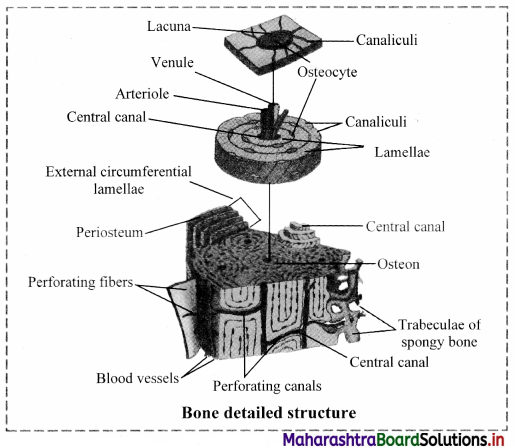
(ii) Explain histological structure of mammalian bone.
Answer:
a. The bone is characterised by hard matrix called ossein which is made up of mineral salt hydroxy apatite (Ca10 (P04)6 (OH)2).
b. An outer tough membrane called periosteum encloses the matrix.
c. Blood vessels and nerves pierce through the periosteum.
d. The matrix is arranged in the form of concentric layers called lamellae.
e. Each lamella contains fluid filled cavities called lacunae from which fine canals called canaliculi radiate.
f. The canaliculi of adjacent lamellae connect with each other as they traverse through the matrix.
g. Active bone cells called osteoblasts and inactive bone cells called osteocytes are present in the
lacunae.
h. The mammalian bone shows the peculiar haversian system.
i. The haversian canal encloses an artery, vein and nerves.
Maharashtra Board Class 11 Biology Solutions Chapter 10 Animal Tissue 1

Can you recall? (Textbook Page No. 122)

How can exercise improve your muscular system?
Answer:
1. Exercise can improve both muscular strength and stamina endurance.
2. Exercises are commonly grouped into two types depending on the effect they have on the body:
a. Aerobic exercises: such as cycling, walking, and running. They increase muscular endurance and cardiovascular health, etc.
b. Anaerobic exercises: such as weight training or sprinting, increase muscle strength, etc.
3. Anaerobic exercies: It comprises brief periods of physical exertion and high-intensity, strength-training activities.
Anaerobic exercise is a physical exercise intense enough to cause lactate to form.
It is used by athletes to promote strength, speed and power; and by body builders to build muscle mass.

Maharashtra Board Class 11 Biology Solutions Chapter 10 Animal Tissue

Can you recall? (Textbook Page No. 122)

How many skeletal muscles are present in human body?
Answer:
There are over 650 named skeletal muscles in the human body.

Can you tell? (Textbook Page No. 125)

Differentiate between medullated and non-medullated fibre.
Answer:

Medullated fibreNon – Medullated fibre
1. Medullary sheath is present around the axon hence also known as Myelinated nerve fibre.Medullary sheath is absent hence also known as Non-myelinated nerve fibre.
2. They have nodes of Ranvier at regular intervals.They do not have nodes of Ranvier.
3. Saltatory conduction takes place in medullated nerve fibres.Saltatory conduction is not seen in non-medullated nerve fibre.
4. These nerve fibres conduct the nerve impulse faster.These nerve fibres conduct nerve impulse at slow rate.
5. These fibres appear white in colour due to an insulating fatty layer (myelin sheath).These fibres appear grey in colour due to absence of fatty layer.
6. Schwann cell of this nerve fibre secrete myelin sheath.Schwann cell of this nerve fibre does not secrete myelin sheath.
7. Cranial nerves of vertebrates are medullated.Nerves of autonomous nervous system are non-

Internet is my friend. (Textbook Page No. 125)

Learn about transmission of impulse from one neuron to another.
Answer:

  1. A nerve impulse is transmitted from one neuron to another through junctions called synapses.
  2. A synapse is formed by the membranes of a pre-synaptic neuron and a post-synaptic neuron, which may or may not be separated by a gap called synaptic cleft.
  3. There are two types of synapses, namely, electrical synapses and chemical synapses.
  4. Electrical synapses: The membranes of pre- and post-synaptic neurons are in very close proximity.
    Thus, electrical current can flow directly from one neuron into the other across these synapses.
    Impulse transmission across an electrical synapse is faster.
  5. Chemical synapse: The membranes of the pre- and post-synaptic neurons are separated by a fluid- filled space called synaptic cleft.
  6. Chemicals called neurotransmitters are involved in the transmission of impulses at these synapses.
  7. The axon terminals contain vesicles filled with these neurotransmitters.
  8. When an impulse arrives at the axon terminal, it stimulates the movement of the synaptic vesicles towards the membrane where they fuse with the plasma membrane and release their neurotransmitters into the synaptic cleft.
  9. The released neurotransmitters bind to their specific receptors, present on the post-synaptic membrane.
  10. This binding opens ion channels and allows the entry of ions which can generate a new potential in the post-synaptic neuron.

[Students are expected to refer the given information and collect more information from the internet.]
[Note: Students can scan the adjacent QR code to get conceptual clarity with the aid of a relevant video ]

Maharashtra Board Class 11 Biology Solutions Chapter 10 Animal Tissue

Observe and Discuss (Textbook Page No. 125)

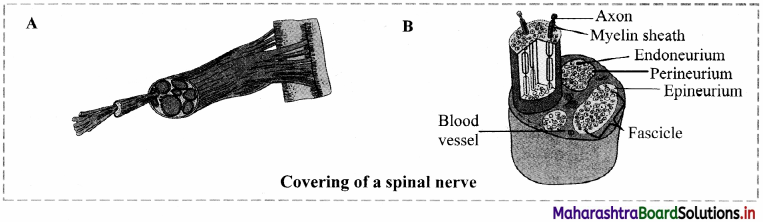
Explain the structure of nerve.
Maharashtra Board Class 11 Biology Solutions Chapter 10 Animal Tissue 2
Answer:

  1. Each spinal nerve consists of many axons and contains layers of protective connective tissue coverings.
  2. Axons are enclosed in a fatty sheath called myelin sheath.
  3. Individual axons within a nerve are wrapped in an endoneurium (innermost layer).
  4. Groups of axons with their endoneurium are arranged in bundles called fascicles.
  5. Each fascicle is wrapped in perineurium (middle layer).
  6. The outermost covering over the entire nerve is the epineurium. The epineurium extends between fascicles.
  7. Many blood vessels nourish the nerve and are present within the perineurium and epineurium.
    [Source: Tortora. G, Derrickson. B. Principles of Anatomy and Physiology. 11th Edition.]

Maharashtra Board Class 11 Biology Solutions Chapter 9 Morphology of Flowering Plants

Balbharti Maharashtra State Board 11th Biology Textbook Solutions Chapter 9 Morphology of Flowering Plants Textbook Exercise Questions and Answers.

Maharashtra State Board 11th Biology Solutions Chapter 9 Morphology of Flowering Plants

1. Choose the correct option

Question (A)
Which one of the following will grow better in the moist and shady regions?
(a) Opuntia
(b) Orchid
(c) Mangrove
(d) Lotus
Answer:
(b) Orchid

Maharashtra Board Class 11 Biology Solutions Chapter 9 Morphology of Flowering Plants

Question (B)
A particular plant had a pair of leaves at each node arranged in one plane. What is the arrangement called?
(a) Alternate phyllotaxy
(b) Decussate phyllotaxy
(c) Superposed phyllotaxy
(d) Whorled phyllotaxy
Answer:
(c) Superposed phyllotaxy

Question (C)
In a particular flower the insertion of floral whorls was in such a manner, so the ovary was below other three whorls, but its stigma was taller than other three whorls. What will you call such flower?
(a) Hypogynous
(b) Perigynous
(c) Inferior ovary
(d) Half superior – half inferior
Answer:
(c) Inferior ovary

Question (D)
Beet and Arum both store food for perennation.
Are the examples for two different types?
(a) Beet is a stem but Arum is a root
(b) Beet is a root but Arum is a stem
(c) Beet is a stem but Arum is a leaf
(d) Beet is a stem but Arum is an inflorescence
Answer:
(b) Beet is a root but Arum is a stem

2. Answer the following questions

Question (A)
Two of the vegetables we consume are nothing but leaf bases. Which are they?
Answer:
Onion, Garlic

Maharashtra Board Class 11 Biology Solutions Chapter 9 Morphology of Flowering Plants

Question (B)
Opuntia has spines but Carissa has thorns. What is the difference?
Answer:

  1. In Opuntia, stem is modified into leaf like photosynthetic organ known as phylloclade.
  2. Spines growing on phylloclade of Opuntia are leaves, modified to reduce the loss of water through transpiration.
  3. Thoms in Carissa are modified apical buds. They provide protection against browsing animals.
  4. Thus, spines in Opuntia and thorns in Carissa have different origin and function.

Question (C)
Teacher described Hibiscus as solitary Cyme. What it means?
Answer:
1. In Cymose inflorescence, growth of peduncle is finite and it terminates into flower.
2. In Hibiscus, flower is borne singly at the tip of peduncle. Hence, teacher described Hibiscus as solitary cyme.

3. Write notes on

Question (A)
Fusiform root.
Answer:
Fusiform root:
1. Fusiform root is the modification of tap root for food storage.
2. Fusiform root:
The fusiform root is swollen in the middle and tapering towards both ends forming spindle shaped structure, e.g. Radish (Raphanus sativus)

Maharashtra Board Class 11 Biology Solutions Chapter 9 Morphology of Flowering Plants

Question (B)
Racemose inflorescence.
Answer:
Racemose inflorescence

Question (C)
Fasciculated tuberous root.
Answer:
Fasciculated tuberous root:
1. Fasciculated tuberous roots are modification of adventitious roots for storage of food.
2. Fasciculated tuberous roots do not develop any definite shape like modified tap roots.
3. a. A cluster of roots arising from one point which becomes thick and fleshy due to storage of food is known as fasciculated tuberous root.
b. These clusters are seen at the base of the stem, e.g. Dahlia, Asparagus, etc.

Question (D)
Region of cell maturation.
Answer:
Region of maturation/region of differentiation:
a. It is the uppermost major part of the root.
b. The cells of this region are quite impermeable to water due to thick wall.
c. The cells show differentiation and form different types of tissues.
d. This region helps in fixation of plant and conduction of absorbed substances.
e. Development of lateral roots also takes place from this region.

Question (E)
Rhizome.
Answer:
Rhizome:

  1. Rhizome is a modification of underground stem for storage of food.
  2. It is prostrate, dorsiventrally thickened and brownish in colour.
  3. It grows either horizontally or obliquely beneath the soil.
  4. Rhizome shows nodes and intemodes. It bears terminal and axillary buds at nodes.
  5. Terminal bud under favourable conditions produces aerial shoot which degenerates at the end of favourable condition.
  6. Growth of rhizome takes place with lateral buds, such growth is known as sympodial growth, e.g. Ginger (Zingiber officinale), Turmeric {Curcuma domestica), Canna etc.
  7. In plants where rhizomes grow obliquely, terminal bud brings about growth of rhizomes. This is known as monopodial growth, e.g. Nymphea, Nelumbo (Lotus), Pteris (Fern) etc.
  8. Rhizomes perform functions like storage of food, vegetative propagation and perennation.

Maharashtra Board Class 11 Biology Solutions Chapter 9 Morphology of Flowering Plants

Question (F)
Stolon.
Answer:
Stolons:
1. The slender lateral branch arising from the base of main axis is known as stolon.
2. In some plants it is above ground (wild strawberry).
3. Primarily stolon shows upward growth in the form of ordinary branch, but when it bends and touches the ground terminal bud grows into new shoot and develops adventitious roots.
e.g. Wild Strawberry, Jasmine, Mentha, etc. [Any one example]

Question (G)
Leaf venation.
Answer:
Leaf venation:

  1. Arrangement of veins and veinlets in leaf lamina is known as venation.
  2. Veins are responsible for conduction of water and minerals as well as food.
  3. The structural framework of the lamina is developed by veins.
  4. There are two types of leaf venation: parallel venation which is found in monocot leaves and reticulate venation which is found in dicot leaves.

Question (H)
Cymose inflorescence.
Answer:
Cymose inflorescence.

Question (I)
Perianth.
Answer:
Perianth (P):
a. Many times, calyx and corolla remain undifferentiated. Such member is known as tepal.
b. The whorl of tepals is known as Perianth.
c. It protects other floral whorls.
d. If all the tepals are free the condition is called as polyphyllous and if they are fused the condition is called as gamophyllous.
e. Sepaloid perianth shows green tepals, while petaloid perianth shows brightly coloured tepals. e.g. Lily, Amaranthus, Celosia, etc.
f. Petaloid tepal helps in pollination and sepaloid tepals can perform photosynthesis.

Maharashtra Board Class 11 Biology Solutions Chapter 9 Morphology of Flowering Plants

Question (J)
Write a short note on vexillary aestivation.
Answer:
Vexillary: Corolla is butterfly shaped and consists of five petals. Outermost and largest is known as standard or vexillum, two lateral petals are wings and two smaller fused forming boat shaped structures keel. e.g. Pisum sativum

Question (K)
Write a short note on axile placentation.
Answer:
Axile placentation: Placentation: The mode of arrangement of ovules on the placenta within the ovary is called placentation.
Axile: Ovules are placed on the central axis of a multilocular ovary, e.g. China rose, Cotton, etc.

Question 4.
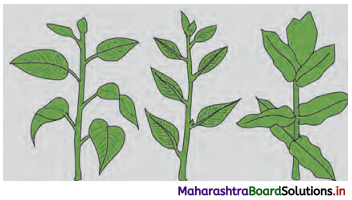
Identify the following figures and write down the types of leaves arrangement.
Maharashtra Board Class 11 Biology Solutions Chapter 9 Morphology of Flowering Plants 1
Answer:
1. The given figures represent phyllotaxy. It is the arrangement of leaves on the stem and branches in a specific manner.
2. Figure ‘a’ and ‘b’ represents, alternate phyllotaxy. In this type of phyllotaxy, single leaf arises from each node of a stem. e.g. Mango
3. Figure ‘c’ represents opposite decussate phyllotaxy. In this type of phyllotaxy, a pair of leaf arise from each node and the consecutive pair at right angle to the previous one. e.g. Calotropis.

5. Students were on the excursion to a botanical garden. They noted following observation. Will you be able to help them in understanding those conditions?

Question (A)
A wiry outgrowth was seen on a plant arising from in between the leaf and stem.
Answer:
A wiry outgrowth on a plant arising from in between the leaf and stem can be an axillary stem tendril. Stem tendrils:
a. Tendrils are thin, wiry, photosynthetic, leafless coiled structures.
b. They give additional support to developing plant.
c. Tendrils have adhesive glands for fixation.

Maharashtra Board Class 11 Biology Solutions Chapter 9 Morphology of Flowering Plants

Question (B)
There was a green plant with flat stem, but no leaves. The entire plant was covered by soft spines.
Answer:
Student must have observed phylloclade, which is a modification of stem.
Phylloclade:
a. Modification of stem into leaf like photosynthetic organ is known as phylloclade.
b. Being stem it possesses nodes and internodes.
c. It is thick, fleshy and succulent, contains mucilage for retaining water e.g. Opuntia, Casuarina (Cylindrical shaped phylloclade) and Muehlenbeckia (ribbon like phylloclade).

Question (C)
Many oblique roots were given out from the lower nodes, apparently for extra support.
Answer:
a. Students must have observed adventitious roots in monocotyledonous plants like maize, sugarcane, wheat, etc.
b. Adventitious roots develop from any part of a plant other than radicle.
c. In such plants, adventitious roots arise from the lower node of a stem and provide extra support to the plant. These roots are also called as stilt roots.

Question (D)
Many plants in the marshy region had upwardly growing roots. They could be better seen during low tide.
Answer:
a. Plants growing in marshy region (halophytes) produce upwardly growing roots called as
pneumatophores or respiratory roots.
b. The main root system of these plants does not get sufficient air for respiration as soil is water logged.
c. Due to this, mineral absorption of plant also gets affected.
d. To overcome this problem underground roots, develop special roots which are negatively geotropic; growing vertically upward.
e. These roots are conical projections present around main trunk of plant.
f. Respiratory roots show presence of lenticels which helps in gaseous exchange.

Question (E)
A plant had leaves with long leaf apex, which was curling around a support.
Answer:
a. Students must have observed leaf tip tendril.
b. In some weak stems, leaf apex modifies into thin, green, wiry, coiled structure called as leaf tendril.
c. Such leaf tendrils, help in climbing by curling around a support.

Maharashtra Board Class 11 Biology Solutions Chapter 9 Morphology of Flowering Plants

Question (F)
A plant was found growing on other plant. Teacher said it is not a parasite. It exhibited two types of roots.
Answer:
a. Student must have observed an epiphytic plants like Dendrobium, Vanda growing on other plant.
b. The two types of roots exhibited by this plant must be clinging roots and epiphytic roots.
c. Clinging roots:
1. Clinging roots are tiny roots develop along intemodes, show disc at tips.
2. It exudes sticky substance which enables plant to get attached to the substratum without damaging it.

d. Epiphytic roots:
1. Epiphytic plants like Vanda, Dendrobium grow on branches of trees in dense rain forests and are unable to obtain moisture from soil.
2. Such plants produce epiphytic roots which hang in the air.
3. The roots are provided with a spongy membranous absorbent covering of the velamen tissue.
4. The cells of velamen tissue are hygroscopic and have porous walls, thus they can absorb moisture from air.
5. Epiphytic roots can be silvery white or green and are without root cap.

Question (G)
While having lunch onion slices were served to them. Teacher asked which part of the plant are you eating?
Answer:
a. The edible part of an onion is fleshy leaves.
b. Onion is a bulb, in which stem is highly reduced, discoid and possesses adventitious roots at the base.
c. This stem bears a whorl of fleshy leaves which store food material.
d. The scale leaves or fleshy leaves are arranged in concentric manner over the stem. Some outer scale leaves become thin and dry. Thus, it is also called as tunicated or layered bulb.

Question (H)
Students observed large leaves of coconut and small leaves of Mimosa. Teacher asked it what way they are similar?
Answer:
a. Both large leaves of coconut and small leaves of Mimosa show pinnately compound leaves.
b. In both plants, leaf lamina is divided into number of leaflets.
c. Leaflets are present laterally on a common axis called rachis, which represents the midrib of the leaf.

Question (I)
Teacher showed them Marigold flower and said it is not one flower. What the teacher meant?
Answer:
a. Marigold flower is an inflorescence in which flowers are produced in a definite manner on a peduncle.
b. In Marigold, racemose type of inflorescence can be observed.
c. In this, peduncle condenses to form a flat rounded structure called receptacle.
d. Opening of flower centripetal i.e. younger flowers are towards the centre and open later, while older flowers towards the periphery and open first.

Question (J)
Students cut open a Papaya fruit and found all the seeds attached to the sides. Teacher inquired about the possible placentation of Papaya ovary.
Answer:
a. In Papaya, seeds are attached to the sides of a fruit. Thus, parietal placentation is possible in papaya ovary,
b. In parietal placentation, ovules are placed on the inner wall of unil unilocular ovary of multicarpellary, syncarpus gynoecium.

Maharashtra Board Class 11 Biology Solutions Chapter 9 Morphology of Flowering Plants

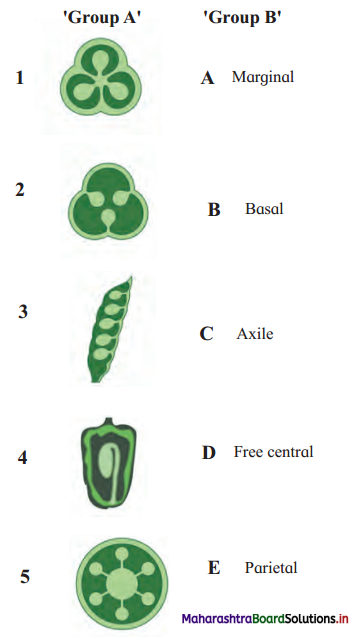
Question 6.
Match the following.
Maharashtra Board Class 11 Biology Solutions Chapter 9 Morphology of Flowering Plants 2
Answer:
(i-c-1), (ii-e-3), (iii-a-4), (iv-b-5), (v-d-2)
[Note: Another example of palmately compound leaf (Bifoliate) is Balanites roxburghii.]

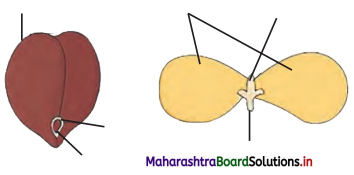
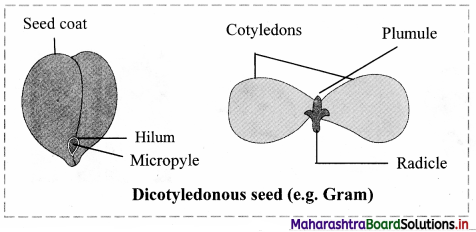
Question 7.
Observe the following figures and label the different parts.
Maharashtra Board Class 11 Biology Solutions Chapter 9 Morphology of Flowering Plants 3
Answer:
Maharashtra Board Class 11 Biology Solutions Chapter 9 Morphology of Flowering Plants 4

8. Differentiate with diagrammatic representation.

Question (A)
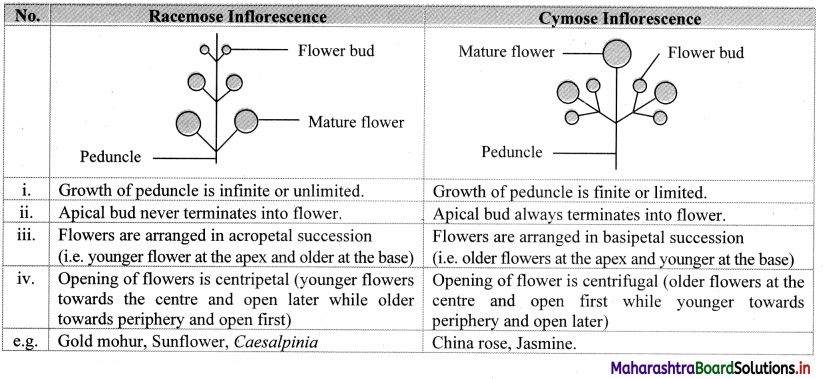
Differentiate with diagrammatic representation: Racemose and cymose inflorescence.
Answer:
Maharashtra Board Class 11 Biology Solutions Chapter 9 Morphology of Flowering Plants 5

Maharashtra Board Class 11 Biology Solutions Chapter 9 Morphology of Flowering Plants

Question (B)
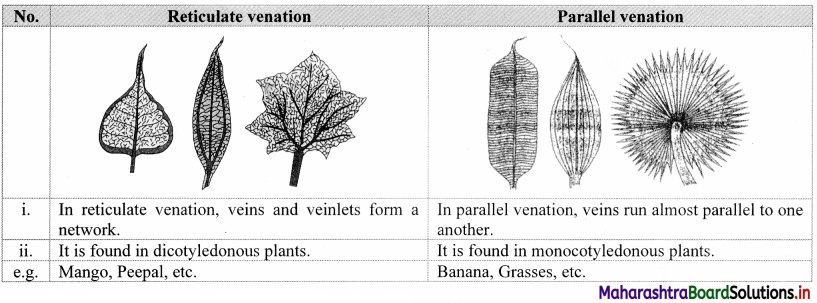
Differentiate with diagrammatic representation: Reticulate and parallel venation
Answer:
Maharashtra Board Class 11 Biology Solutions Chapter 9 Morphology of Flowering Plants 6

Question (C)
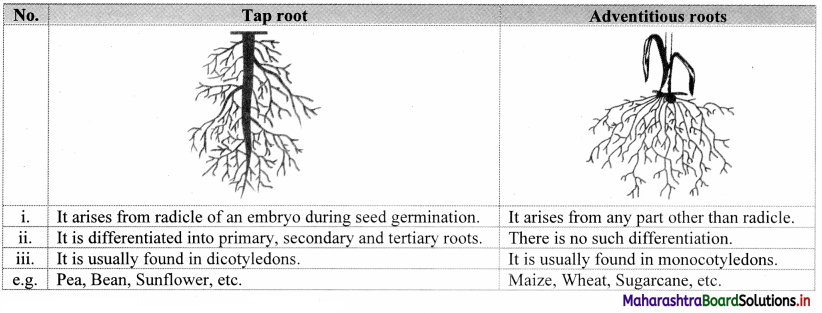
Differentiate with diagrammatic representation: Taproot and Adventitious roots
Answer:
Maharashtra Board Class 11 Biology Solutions Chapter 9 Morphology of Flowering Plants 7

Practical / Project:

Question 1.
Collect different leaves from nearby region and observe variation in margin, leaf base, apex etc.
[Note: Students can scan the given Q.R code to study the different le
af margin, leaf base and apex.]

Maharashtra Board Class 11 Biology Solutions Chapter 9 Morphology of Flowering Plants

Question 2.
Find out and make a note of economically important plant from family Fabaceae, Solanaceae and Liliaceae.
Answer:
1. Economically important plant from family Fabaceae:
Family Fabaceae includes many pulses like gram, arhar, moong, soybean; edible oil seeds like soybean, groundnut; dye (lndigofera); fibres which can be obtained from Sun hemp, Sesbania trifolium which can be used as fodder; some plants are ornamental like lupin, sweet pea; some medicinal plants like muliathi.

2. Economically important plant from family Solanaceae:
Family Solanaceae includes many plants which are good source of food e.g. tomato, brinjal, potato; Spice e.g. chilli; Medicine e.g. belladonna, ashwagandha; Ornamental plants like Petunia.

3. Economically important plant from family Liliaceae:
Family Liliaceae includes many ornamental plants like tulip, Gloriosa, Medicinal plants like Aloe vera. Asparagus and source of colchicine, e.g. Colchicum autumnale.

Question 3.
Collect different leaves from garden and observe their veins and classify it.

11th Biology Digest Chapter 9 Morphology of Flowering Plants Intext Questions and Answers

Use your brainpower. (Textbook Page No. 102)

Why underground stem is different from roots?
Answer:
Underground stems are modified to perform different functions like storage of food, perennation and vegetative propagation. However, they differ from root in having nodes and intemodes.

Maharashtra Board Class 11 Biology Solutions Chapter 9 Morphology of Flowering Plants

Use your brainpower. (Textbook Page No. 104)

Why the stem has to perform photosynthesis in xerophytes?
Answer:
1. Xerophytes are the plants which grow in regions with scanty or no rainfall like desert.
2. In Xerophytes, leaves get modified into spines or get reduced in size to check the loss of water due to transpiration.
3. As the leaves are modified into spines, the stem becomes green in colour to do the function of photosynthesis.

Internet My Friend. (Textbook Page No. 106)

Collect information of types of leaf venation.
Answer:
1. Figure ‘R’ shows types of reticulate venation. WTien the veins and veinlets form a network, it is called
reticulate venation.
On the basis of number of mid-veins, reticulate venation is of two types:
a. Pinnate or unicostate: It is with single midrib e.g. Peepal, Mango.
b. Palmate or multicostate: It is with two or more prominent veins. It is further divided into convergent or divergent.
1. Multicostate convergent reticulate: Many prominent veins appear from the base of leaf lamina and converged in a curved manner towards the leaf apex. e.g. Zizyphus
2. Multicostate divergent reticulate: Prominent veins arise from the single point at the base of leaf lamina
and then diverge from one another towards the leaf margin, e.g. Cucurbita

2. Figure ‘P’ shows types of parallel venation. When veins run almost parallel to one another it is called parallel venation. It is of two types:
a. Unicostate: In this, lamina has single prominent mid vein from which many lateral parallel veins arise at regular intervals, e.g. Banana
b. Multicostate: In this, two or more mid veins run parallel to each other. It is further divided into convergent or divergent.

1. Multicostate convergent parallel:
Many prominent veins arise from the leaf base and then converge at leaf apex. e.g. Grasses
2. Multicostate divergent parallel:
Many prominent veins arise from the leaf base and then diverge towards margin, e.g. Borassus flabellifer (Toddy palm)

Maharashtra Board Class 11 Biology Solutions Chapter 9 Morphology of Flowering Plants

Observe and Discuss. (Textbook Page No. 112)

Observe and Discuss.
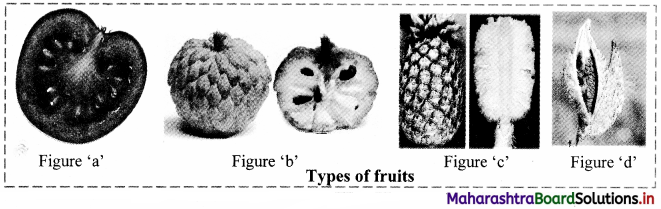
Maharashtra Board Class 11 Biology Solutions Chapter 9 Morphology of Flowering Plants 8Answer:
1. Figure ‘a’ shows fruit of tomato.

  • It is a simple fruit as it develops from a single flower with bicarpellary syncarpous gynoecium.
  • It is a berry, because it has fleshy endocarp and many seeds.

2. Figure ‘b’ shows fruit of Custard apple.

  • It is an aggregate fruit, because it develops from a single flower with polycarpellary, apocarpous gynoecium.
  • Here, the ovary of each carpel gives rise to a part of the fruit called fruitlet. Hence, it is called an aggregation of fruitlets.
  • Custard apple can be further described as Etaerio of berries.

3. Figure ‘c’ shows fruit of pineapple.

  • It is a composite fruit, because it develops from a complete inflorescence.
  • Pineapple can be further described as Sorosis, as it develops from catkin type of inflorescence.

4. Figure ‘d’ shows fruit of milkweed.

  • It is a simple dehiscent dry fruit.
  • It has many seeds. When pericarp becomes dry and thin, it breaks open by one ventral suture.

Maharashtra Board Class 11 Biology Solutions Chapter 9 Morphology of Flowering Plants

Activity. (Textbook Page No. 113)

Study the family Liliaceae, prepare a table of following characteristics.
Answer:

Symmetry of flowerActinomorphic
Bisexual/ UnisexualBisexual
CalyxAbsent
CorollaAbsent
AndroeciumStamens six, arranged in two whorls of 3 each, epiphyllous
GynoeciumTricarpellary, syncarpous, trilocular ovary with many ovules
AestivationValvate
a. CalyxAbsent
b. CorollaAbsent
PlacentationAxile
Position of ovarySuperior ovary
Types of fruitCapsule, rarely berry

Maharashtra Board Class 11 Biology Solutions Chapter 8 Plant Tissues and Anatomy

Balbharti Maharashtra State Board 11th Biology Textbook Solutions Chapter 8 Plant Tissues and Anatomy Textbook Exercise Questions and Answers.

Maharashtra State Board 11th Biology Solutions Chapter 8 Plant Tissues and Anatomy

1. Choose the correct option.

Question (A)
Location or position of meristematic regions is divided into _______ types.
(A) one
(B) two
(C) three
(D) none of the above
Answer:
(C) three

Maharashtra Board Class 11 Biology Solutions Chapter 8 Plant Tissues and Anatomy

Question (B)
Cambium is also called
(A) apical meristem
(B) intercalary meristem
(C) lateral meristem
(D) none of the above
Answer:
(C) lateral meristem

Question (C)
Collenchyma is a type of ________ tissue.
(A) living
(B) dead
(C) living and dead
(D) none of the above
Answer:
(A) living

Question (D)
_______ is a complex permanent tissue.
(A) Parenchyma
(B) Sclerenchyma
(C) Chlorenchyma
(D) Xylem
Answer:
(D) Xylem

Question (E)
Mesophyll tissue is present in ________ .
(A) root
(B) stem
(C) leaf
(D) flower
Answer:
(C) leaf

Maharashtra Board Class 11 Biology Solutions Chapter 8 Plant Tissues and Anatomy

2. Answer the following questions

Question (A)
A fresh section was taken by a student but he was very disappointed because there were only few green and most colourless cells. Teacher provided a pink colour solution. The section was immersed in this solution and when observed it was much clearer. What is the magic?
Answer:
1. The pink coloured solution given by teacher must be a saffanin stain.
2. Saffanin is used to stain plant tissues, especially lignified tissues such as cell wall and xylem.

Question (B)
While observing a section, many scattered vascular bundles could be seen. Teacher said, in spite of this large number the stem cannot grow in girth. Why?
Answer:

  1. Students must have observed monocot stems.
  2. It is because, monocot stem shows scattered vascular bundles.
  3. In monocot stem, vascular bundles are closed i.e. without cambium.
  4. Thus, secondary growth does not occur which is required for increase in girth. Hence, in spite of having large number of scattered vascular bundles, monocot stems do not grow in girth.

Question (C)
A section of the stem had vascular bundles, where one tissue was wrapped around the other. How will you technically describe it?
Answer:
Concentric vascular bundle:
a. When one vascular tissue is completely encircling the other, it is called as concentric vascular bundle.
b. When phloem is encircled by xylem, it is called as leptocentric vascular bundle, whereas when xylem is encircled by phloem, it is called as hadrocentric vascular bundle.
c. When xylem is encircled by phloem on both faces, it is called as amphicribral vascular bundle. When phloem is encircled by xylem on both faces it is called as amphivasal vascular bundle.

Question (D)
There were two cut logs of wood lying in the campus. One had growth rings and other didn’t. Teacher said it is due to differences in their pattern of grow th which is dependent on season. How?
Answer:
1. It is possible that one of the cut logs was of a tropical tree, whereas the other was of a temperate tree. Since tropical trees grow in a similar manner all year, growth rings are not apparent. Another explanation for this could be that the log which had growth rings must be of an old tree which has experience many seasons, whereas the log without growth rings must be of younger tree, that has not been subjected to seasonal changes and hence not developed prominent growth rings.

2. Growth rings are formed due cambial activity during favourable and non-favourable climatic conditions.

3. During favourable conditions, spring wood (early wood) is formed which has broader xylem bands, lighter colour, tracheids with thin wall and wide lumen, fibres are less in number, low density. Whereas, during unfavourable conditions, autumn wood (late wood) is formed which has narrow xylem band, darker in colour, lumen is narrow and walls are thick with abundant fibres, high density.

4. Spring wood and autumn wood that appear as alternate light and dark concentric rings, constitute an annual ring or growth ring.

5. These growth rings can be used to estimate the age of the tree. These are found more in older trees as compare to younger tree.

Question (E)
While on the trip to Kashmir, Pintoo observed that cut portions of large trees show distinct rings, which he never found in Maharashtra. Why is so?
Answer:
1. Cut portions of large tress show distinct rings which are annual rings formed due to activity of cambium during favourable and non-favourable climatic conditions.
2. Kashmir falls under temperate region where the climatic conditions are not uniform through the year. In the spring season, conditions are favourable due to which cambium is active, whereas in autumn season, conditions are unfavourable due to which cambium is less active. This leads to formation of spring wood and autumn wood that appear as alternate light and dark concentric rings, constitute an annual ring or growth ring.
3. Maharashtra falls under tropical region where climatic conditions are favourable throughout the year. In tropical areas, continuous growth of secondary xylem occurs. Thus, trees growing in tropical regions show less or no annual rings as compared to trees in temperate region.

Maharashtra Board Class 11 Biology Solutions Chapter 8 Plant Tissues and Anatomy

Question (F)
A student was observing a slide with no label under microscope. The section had some vascular bundles scattered in the ground tissue. It is section of a monocot stem! He exclaimed. No! it is section of fern rachis, said the teacher. Teacher told to observe vascular bundle again. Student agreed, Why?
Answer:

  1. In fern rachis, the number of vascular bundles is less as compared to number of vascular bundles in monocot stem. In monocot stem, vascular bundles are numerous.
  2. In fern rachis, xylem consists of only tracheids whereas in monocot stem, xylem consists of vessels (protoxylem and metaxylem) as well as tracheids. Monocot stem shows presence of lysigenous cavity just below protoxylem.
  3. In fern rachis, phloem consists of only sieve cells whereas in monocot stem, phloem consists of sieve tubes and companion cells. Thus, a student must hav e observed these differences in the given section and agreed to teacher’s statement that the given section is of fern rachis and not of monocot stem.

Question (G)
Student found a wooden stopper in lab. He was told by an old lab attendant that it is there for many years. He kept thinking how it did not rot?
Answer:
1. Wooden stopper or cork is obtained from the phellem (cork) part of a bark.
2. Phellem (cork) is impervious in nature and does not allow entry of water due to suberized walls.
3. Due to this it does not rot and remains as it is for many years.

Question (H)
Student while observing a slide of leaf section observed many stomata on the upper surface. He thought he has placed slide upside down. Teacher confirmed it is rightly placed. Explain.
Answer:
1. In a dicot leaf, stomata are generally absent on upper epidermis but are present on lower epidermis. Thus, the student must have thought that he has placed slide upside down.
2. According to teacher, the section was placed rightly, thus the given section must be of monocot leaf.
3. It is because, in monocot leaf stomata are present on both upper and lower epidermis.

Maharashtra Board Class 11 Biology Solutions Chapter 8 Plant Tissues and Anatomy

3. Write short notes on the following points.

Question (A)
Structure of stomata.
Answer:

  1. Small gateways in the epidermal cells are called as stomata.
  2. Stoma is controlled or guarded by specially modified cells called guard cells.
  3. These guard cells may be kidney-shaped (dicot) or dumbbell-shaped (monocot), collectively called as stomata.
  4. Guard cells have chloroplasts to carry out photosynthesis.
  5. Change in turgor pressure of guard cells causes opening and closing of stomata, which enables exchange of gases and water vapour.
  6. Stomata are further covered by subsidiary cells.
  7. Stoma, guard cells and subsidiary cells form a unit called stomatal apparatus.

Question (B)
Write a short note on secondary growth.
OR
With the help of neat and labelled diagram explain the secondary growth in dicot stem.
Answer:
Secondary growth:

  1. Dicotyledonous plants and gymnosperms exhibit increase in girth of root and stem.
  2. In dicot stem, secondary growth begins with the formation of a continuous cambium ring.
  3. The cambium present between the primary xylem and primary phloem of a vascular bundle is called intrafascicular cambium.
  4. The cells of medullary rays adjoining these intrafascicular cambium strips become meristematic (regain the capacity to divide) and form the interfascicular cambium.
  5. Thus, a complete and continuous ring of vascular cambium is formed.
  6. The cambium ring cuts off new cells, towards both inner and outer sides.
  7. The cells that are cut-off towards pith (inner side) mature into secondary xylem and cells that are cut-off towards periphery mature into secondary phloem.
  8. Generally, amount of secondary xylem is more than the secondary phloem.

Maharashtra Board Class 11 Biology Solutions Chapter 8 Plant Tissues and Anatomy

Question (C)
Write a short note on peculiarity of a sclerenchyma cell wall.
Answer:
Peculiarity of a sclerenchyma cell wall:
1. Cell wall of sclerenchyma is evenly thickened due to uniform deposition of lignin.
2. Cell wall of sclereids is extremely thick and strongly lignified.

4. Differentiate

Question (A)
Differentiate between vascular bundles of monocot and dicot.
Answer:

  1. Vascular bundle of monocot and dicot root.
  2. Vascular bundle of monocot and dicot stem.
  3. Vascular bundle of monocot and dicot leaf.

Question (B)
Differentiate between xylem and phloem.
Answer:

XylemPhloem
1. It is a dead complex tissue.It is a living complex tissue.
2. It is composed of xylem, tracheids, vessels, xylem fibres and xylem parenchyma.It is composed of sieve tubes, sieve cells, companion cells, phloem parenchyma and phloem fibres.
3. It is also known as wood.It is also known as bast.
4. The cell walls are thick due to lignin.The cell walls are thin.
5. Xylem conducts water and minerals from roots to the stem and leaves. It also provides mechanical strength to the plant parts.It is the chief food conducting tissue of vascular plants responsible for translocation of food from leaves to other plant parts.

Maharashtra Board Class 11 Biology Solutions Chapter 8 Plant Tissues and Anatomy

5. Draw neat labelled diagrams

Question (A)
T.S. of dicot leaf.
Answer:
1. Structure of dorsiventral leaf: The mesophyll tissue is differentiated into palisade and spongy parenchyma in a dorsiventral leaf. This type is very common in dicot leaf. The different parts of this leaf are as follows:
2. Upper epidermis: It consists of a single layer of tightly packed rectangular, barrel shaped, parenchymatous cells which are devoid of chloroplast. A distinct layer of cuticle lies on the outside of the epidermis. Stomata are generally absent.
3. Mesophyll: Between upper and lower epidermis, there is chloroplast-containing photosynthetic tissue called mesophyll It is differentiated into Palisade parenchyma and Spongy parenchyma.
a. Palisade parenchyma:
Palisade parenchyma is present below upper epidermis and consists of closely packed elongated cells. The cells contain abundant chloroplasts and help in photosynthesis.
b. Spongy parenchyma:
Spongy parenchyma is present below palisade tissue and consists of loosely arranged irregularly shaped cells with intercellular spaces. The spongy parenchyma cells contain chloroplast and are in contact with the atmosphere through stomata.
Maharashtra Board Class 11 Biology Solutions Chapter 8 Plant Tissues and Anatomy 1
4. Vascular system: It is made up of a number of vascular bundles of varying size depending upon the venation. Each one is surrounded by a thin layer of parenchymatous cells called bundle sheath. Vascular bundles are closed. Xylem lies towards upper epidermis and phloem towards lower epidermis. Cambium is absent, hence there is no secondary growth in the leaf.
5. Lower epidermis: It consists of a single layer of compactly arranged rectangular, parenchymatous cells. A thin layer of cuticle is also present. The lower epidermis contains a large number of microscopic pores called stomata. There is an air-space called substomatal chamber at each stoma.

Maharashtra Board Class 11 Biology Solutions Chapter 8 Plant Tissues and Anatomy

Question (B)
T.S. of Monocot root.
Answer:
Maharashtra Board Class 11 Biology Solutions Chapter 8 Plant Tissues and Anatomy 2

Question (C)
Draw neat labelled diagrams of T.S. of dicot stem.
Answer:
Maharashtra Board Class 11 Biology Solutions Chapter 8 Plant Tissues and Anatomy 3

Question 6.
Write the information related to diagram given below.
Maharashtra Board Class 11 Biology Solutions Chapter 8 Plant Tissues and Anatomy 4
Answer:
Maharashtra Board Class 11 Biology Solutions Chapter 8 Plant Tissues and Anatomy 5
Maharashtra Board Class 11 Biology Solutions Chapter 8 Plant Tissues and Anatomy 6
[Note: The labelled part can be considered as the ‘region of maturation ’ of root apical however, the region of maturation does not contain meristematic tissue ]
Classification of meristematic tissue based on its position:
1. Apical meristem:
a. It is produced from promeristem and forms growing point of apices of root, shoot and their lateral branches.
b. It brings about increase in length of plant body and is called as apical initials.
c. Shoot apical meristem is terminal in position whereas in root it is subterminal i.e. located behind the root cap.

2. Intercalary meristem:
a. Intercalary meristematic tissue is present in the top or base area of node.
b. Their activity is mainly seen in monocots.
c. These are short lived.

3. Lateral meristem:
a. It is present along the sides of central axis of organs.
b. It takes part in increasing girth of stem or root, e.g. Intrafascicular cambium.
c. It is found in vascular bundles of gymnosperms and dicot angiosperms.

Maharashtra Board Class 11 Biology Solutions Chapter 8 Plant Tissues and Anatomy

Question 7.
Identify the following diagrams, label it and prepare a chart of characteristics.
Maharashtra Board Class 11 Biology Solutions Chapter 8 Plant Tissues and Anatomy 7Answer:
1. Figure ‘c’
Maharashtra Board Class 11 Biology Solutions Chapter 8 Plant Tissues and Anatomy 8

Question 8.
Distinguish between dicot and monocot leaf on the basis of following characters.
Answer:

            CharactersDicot leaf            Monocot leaf
StomataStomata are restricted to lower epidermis. Guard cells of stoma are kidney shaped.Stomata occur on both epidermis. Guard cells of stoma are dumbbell shaped.
Intercellular spaceMore intercellular spaces due to presence of spongy parenchyma.Less intercellular spaces as mesophyll is not differentiated into spongy and palisade tissue.
VenationReticulate venationParallel venation
Vascular bundleVascular bundles of varying size. The size of the vascular bundles is dependent on the size of the veins which vary in thickness in dicot leaf.Vascular bundles are nearly of similar size (Except in main veins).
Mesophyll cellsMesophyll tissue is differentiated into palisade parenchyma and spongy parenchyma.Mesophyll tissue is not differentiated into palisade parenchyma and spongy parenchyma.

Maharashtra Board Class 11 Biology Solutions Chapter 8 Plant Tissues and Anatomy

Practical/ Project:

Question 1.
Prepare detail anatomical charts with diagrammatic representation of dicot and monocot plants.
Answer:
Anatomy of dicot root: The transverse section of a typical dicotyledonous root shows following anatomical features:
1. Epiblema: It is the outermost single layer of cells without cuticle. Some epidermal cells prolong to form unicellular root hairs.
2. Cortex: It is made up of many layers of thin walled parenchyma cells. Cortical cells store food and water.
3. Exodermis: After the death of epiblema, outer layer of cortex become cutinized and is called Exodermis.

4. Endodermis:
The innermost layer of cortex is called Endodermis.
The cells are barrel-shaped and their radial walls bear Casparian strip or Casparian bands composed of suberin. Near the protoxylem, there are unthickened passage cells.

5. Stele: It consists of pericycle, vascular bundles and pith.
a. Pericycle: Next to the endodermis, there is a single layer of thin walled parenchyma cells called pericycle. It forms outermost layer of stele or vascular cylinder.
b. Vascular bundle: Vascular bundles are radial. Xylem and Phloem occur in separate patches arranged on alternate radii. Xylem is exarch in root that means protoxylem vessels are towards periphery and metaxylem elements are towards centre. Xylem bundles vary from two to six number, i.e. they may be diarch, triarch, tetrarch, etc.
Connective tissue: A parenchymatous tissue is present in between xylem and phloem.
c. Pith: The central part of stele is called pith. It is narrow and made up of parenchymatous cells, with or without intercellular spaces.
6. At a later stage cambium ring develops between the xylem and phloem causing secondary growth.

Anatomy of monocot stem: A transverse section of maize (monocot) stem shows the following structures:

  1. Epidermis: It is single-layered and without trichomes.
  2. Hypodermis: It is sclerenchymatous.
  3. Ground tissue: It consists of thin walled parenchyma cells. It extends from hypodermis to the centre. It is not differentiated into cortex, endodermis, pericycle and pith.
  4. Vascular bundles: Vascular bundles are numerous and are scattered in ground tissue. Each vascular bundle is surrounded by a sclerenchymatous bundle sheath. Vascular bundles are conjoint, collateral and closed (without cambium). Xylem is endarch and shows lysigenous cavity.
  5. Pith: Pith is absent.

Anatomy of dicot leaf:

1. Structure of dorsiventral leaf: The mesophyll tissue is differentiated into palisade and spongy parenchyma in a dorsiventral leaf. This type is very common in dicot leaf. The different parts of this leaf are as follows:
2. Upper epidermis: It consists of a single layer of tightly packed rectangular, barrel shaped, parenchymatous cells which are devoid of chloroplast. A distinct layer of cuticle lies on the outside of the epidermis. Stomata are generally absent.
3. Mesophyll: Between upper and lower epidermis, there is chloroplast-containing photosynthetic tissue called mesophyll It is differentiated into Palisade parenchyma and Spongy parenchyma.
a. Palisade parenchyma:
Palisade parenchyma is present below upper epidermis and consists of closely packed elongated cells. The cells contain abundant chloroplasts and help in photosynthesis.
b. Spongy parenchyma:
Spongy parenchyma is present below palisade tissue and consists of loosely arranged irregularly shaped cells with intercellular spaces. The spongy parenchyma cells contain chloroplast and are in contact with the atmosphere through stomata.
4. Vascular system: It is made up of a number of vascular bundles of varying size depending upon the venation. Each one is surrounded by a thin layer of parenchymatous cells called bundle sheath. Vascular bundles are closed. Xylem lies towards upper epidermis and phloem towards lower epidermis. Cambium is absent, hence there is no secondary growth in the leaf.
5. Lower epidermis: It consists of a single layer of compactly arranged rectangular, parenchymatous cells. A thin layer of cuticle is also present. The lower epidermis contains a large number of microscopic pores called stomata. There is an air-space called substomatal chamber at each stoma.

Anatomy of monocot leaf:

1.It is single layered, present on both sides of the leaf.
It consists of compactly arranged rectangular transparent parenchymatous cells.
Both the surfaces contain stomata.
Both the surfaces have a distinct layer of cuticle.
2. Mesophyll:
Mesophyll is not differentiated into palisade and spongy tissue.
3. Vascular bundle:
These are conjoint, collateral and closed.

Maharashtra Board Class 11 Biology Solutions Chapter 8 Plant Tissues and Anatomy

Question 2.
Observe different slides related to anatomy of flowering plants under the guidance of teacher.
[Students are expected to perform this practical own their own.]

11th Biology Digest Chapter 8 Plant Tissues and Anatomy Intext Questions and Answers

Can you recall? (Textbook Page No. 85)

(i) Which component brings about important processes in the living organisms?
Answer:
Cell is the component that brings about important processes in the living organisms.

(ii) What is tissue?
Answer:
A group of cells having essentially a common function and origin is called as tissue.

Maharashtra Board Class 11 Biology Solutions Chapter 8 Plant Tissues and Anatomy

(iii) Explain simple and complex tissue.
Answer:
a. Simple tissue:
1. They are made up of only one type of cells.
2. They are found in all the plant parts.
3. They perform many functions.
4. Simple tissues in plants are Parenchyma, Collenchyma, Sclerenchyma.

b. Complex tissue:
1. They are made up of many types of cells.
2. They are found only in the vascular regions of the plant.
3. They mainly perform the function of conduction of food and water.
4. Complex tissues in plants are Xylem and Phloem.

(iv) Complete the flow chart.
Organisms → Organs → Cells
Answer:
Organism → Organ system → Organs → Tissue system → Tissue → Cells

Can you tell? (Textbook Page No. 86)

Enlist the characteristics of meristematic tissue.
Answer:
Characteristics of meristematic tissue:

  1. It is a group of young, immature cells.
  2. These are living cells with ability to divide in the regions where they are present.
  3. These are polyhedral or isodiametric in shape without intercellular spaces.
  4. Cell wall is thin, elastic and mainly composed of cellulose.
  5. Protoplasm is dense with distinct nucleus at the centre and vacuoles if present, are very small.
  6. Cells show high rate of metabolism.

Can you tell? (Textbook Page No. 86)

Classify meristematic tissue on the basis of origin.
Answer:
Classification of meristematic tissue on the basis of origin:
1. Promeristem / Primordial meristem:
a. It is also called as embryonic meristem.
b. It usually occupies very minute area at the tip of root and shoot.

2. Primary meristem:
a. It originates from the primordial meristem and occurs in the plant body from the beginning, at the root and shoot apices.
b. Cells are always in active state of division and give rise to permanent tissues.

3. Secondary meristem:
a. These tissues develop from living permanent tissues during later stages of plant growth hence are called as secondary meristems.
b. This tissue occurs in the mature regions of root and shoot of many plants.
c. Secondary meristem is always lateral (to the central axis) in position e.g. Fascicular cambium, inter fascicular cambium, cork cambium.

Maharashtra Board Class 11 Biology Solutions Chapter 8 Plant Tissues and Anatomy

Can you tell? (Textbook Page No. 89)

Write a note on parenchyma.
Answer:
Parenchyma:

  1. It is a type of simple permanent tissue.
  2. Cells in this tissue are thin walled, isodiametric, round, oval to polygonal or elongated in shape.
  3. Cell wall is composed of cellulose.
  4. Cells are living with prominent nucleus and cytoplasm with large vacuole.
  5. Parenchyma has distinct intercellular spaces. Sometimes, cells may show compact arrangement.
  6. The cytoplasm of adjacent cells is interconnected through plasmodesmata and thus forms a continuous tissue.
  7. This is less specialized permanent tissue.
  8. Occurrence:
    These cells are distributed in all the parts of a plant body viz. epidermis, cortex, pericycle, pith, mesophyll cells, endosperm, xylem and phloem.
  9. Functions:
    These cells store food, water, help in gaseous exchange, increase buoyancy, perform photosynthesis and different functions in plant body.
  10. Dedifferentiation in parenchyma cells develops vascular cambium and cork cambium at the time of
    secondary growth.

Can you tell? (Textbook Page No. 89)

Describe sclerenchyma fibres.
Answer:
Sclerenchyma fibres:
1. Fibres are thread-like, elongated and narrow structures with tapering and interlocking end walls.
2. Fibres are mostly in bundles. Pits are narrow, unbranched and oblique.
They provide mechanical strength.

Maharashtra Board Class 11 Biology Solutions Chapter 8 Plant Tissues and Anatomy

Can you tell? (Textbook Page No. 89)

Sketch and label T.S. of phloem tissue.
Answer:
T.S. of phloem tissue: Structure of phloem:
1. Phloem is a living tissue. It is also called as bast.
2. It is responsible for conduction of organic food material from source (generally leaf) to a sink (other plant parts).
3. On the basis of origin, it can be protophloem (first formed) and metaphloem (latterly formed).
4. It is composed of sieve elements (sieve cells and sieve tubes), companion cells, phloem parenchyma and phloem fibres.

2. Sieve elements:
a. Sieve tubes are long tubular conducting channel of phloem.
b. These are placed end to end with bulging at end walls.
c. The sieve tube has sieve plate formed by septa with small pores.
d. The sieve plates connect protoplast of adjacent sieve tube cells.
e. The sieve tube cell is a living cell with a thin layer of cytoplasm, but loses its nucleus at maturity.
f. The sieve tube cell is connected to companion cell through phloem parenchyma by plasmodesmata.
g. Sieve cells are found in lower plants like pteridophytes and gymnosperms and sieve tubes are found in angiosperms.
h. The cells are narrow, elongated with tapering ends and sieve area located laterally.

3. Companion cells:
a. These are narrow elongated and living.
b. Companion cells are laterally associated with sieve tube elements.
c. Companion cells have dense cytoplasm and prominent nucleus.
d. Nucleus of companion cell regulates functions of sieve tube cells through simple pits.
e. From origin point of view, sieve tube cells and companion cell are derived from same cell. Death of the one result in death of the other type.

4. Phloem parenchyma:
a. Cells of phloem parenchyma are living, elongated found associated with sieve tube and companion cells.
b. Their chief function is to store food, latex, resins, mucilage, etc.
c. The cells carry out lateral conduction of food material.
d. These cells are absent in most of the monocots.

5. Phloem fibres (Bast fibres):
a. Phloem fibres are the only dead tissue among this unit.
b. They are sclerenchymatous.
c. They are generally absent in primary phloem, but present in secondary phloem.
d. These cells have with lignified walls and provide mechanical support.
e. They are used in making ropes and rough clothes.

Can you tell? (Textbook Page No. 92)

Concentric vascular bundles are always closed. Describe.
Answer:

  1. When one vascular tissue is completely encircling the other, it is called as concentric vascular bundle.
  2. When cambium is not present between xylem and phloem, it is known as closed vascular bundle.
  3. Due to absence of cambium between xylem and phloem, concentric vascular bundles are always closed.

Maharashtra Board Class 11 Biology Solutions Chapter 8 Plant Tissues and Anatomy

Can you tell? (Textbook Page No. 92)

How is the structure of vascular bundles of the root?
Answer:

  1. Vascular bundles of the root are radial.
  2. In radial vascular bundles, complex tissues are situated separately on separate radius as separate bundle.
  3. The xylem and phloem bundles are arranged alternating with each other.

Can you tell? (Textbook Page No. 92)

Why vascular bundles of dicot stem are described as conjoint collateral and open?
Answer:
Vascular bundles of dicot stem are described as conjoint collateral and open because;
1. In dicot stem, the complex tissue is collectively present as neighbours of each other on the same radius in the form of xylem inside and phloem outside. Such type of vascular bundles are called as conjoint and collateral.
2. In dicot stem, a strip of cambium is present between xylem and phloem. Hence, it is called as open vascular bundle.

Maharashtra Board Class 11 Biology Solutions Chapter 8 Plant Tissues and Anatomy

Can you tell? (Textbook Page No. 92)

How is the arrangement of vascular bundles in dicot and monocot stem?
Answer:
1. Vascular bundle in dicot stem: Vascular bundles are conjoint, collateral, open, and are arranged in a ring. Each one is composed of xylem, phloem and cambium. Xylem is endarch. A strip of cambium is present between xylem and phloem.
2. Vascular bundle in monocot stem: Vascular bundles are numerous and are scattered in ground tissue. Each vascular bundle is surrounded by a sclerenchymatous bundle sheath. Vascular bundles are conjoint, collateral and cloused (without cambium). Xylem is endarch and shows lysigenous cavity.

Maharashtra Board Class 11 Biology Solutions Chapter 7 Cell Division

Balbharti Maharashtra State Board 11th Biology Textbook Solutions Chapter 7 Cell Division Textbook Exercise Questions and Answers.

Maharashtra State Board 11th Biology Solutions Chapter 7 Cell Division

1. Choose the correct option

Question (A)
The connecting link between Meiosis – I and Meiosis – II is …………
(a) interphase – I
(b) interphase – II
(c) interkinesis – III
(d) anaphase – IV
Answer:
(c) interkinesis – III

Maharashtra Board Class 11 Biology Solutions Chapter 7 Cell Division

Question (B)
Synapsis is pairing of ………………. .
(a) any two chromosomes
(b) non – homologous chromosomes
(c) sister chromatids
(d) homologous chromosomes
Answer:
(d) homologous chromosomes

Question (C)
Spindle apparatus is formed during which stage of mitosis?
(a) Prophase
(b) Metaphase
(c) Anaphase
(d) Telophase
Answer:
(b) S-phase

Question (D)
Chromosome number of a cell is almost doubled up during _______ .
(a) G1 – phase
(b) S – phase
(c) G2-phase
(d) G0-phase
[Note: Due to DNA replication the DNA content of cell doubles during S-phase. But the number of chromosomes remain the same.]
Answer:
(b) S – phase

Maharashtra Board Class 11 Biology Solutions Chapter 7 Cell Division

Question (E)
How many meiotic divisions are necessary for formation of 80 sperms?
(a) 80
(b) 40
(c) 20
(d) 10
Answer:
(c) 20

Question (F)
How many chromatids are present in anaphase – I of meiosis – I of a diploid cell having 20 chromosomes?
(a) 4
(b) 6
(c) 20
(d) 40
Answer:
(d) 40

Question (G)
In which of the following phase of mitosis chromosomes are arranged at equatorial plane?
(a) Prophase
(b) Metaphase
(c) Anaphase
(d) Telophase
Answer:
(b) Metaphase

Question (H)
Find incorrect statement.
(a) Condensation of chromatin material occurs in prophase.
(b) Daughter chromatids are formed in anaphase.
(c) Daughter nuclei are formed at metaphase.
(d) Nuclear membrane reappears in telophase.
Answer:
(c) Daughter nuclei are formed at metaphase.

Question (I)
Histone proteins are synthesized during
(a) G1 phase
(b) S – phase
(c) G2 – phase
(d) Interphase
Answer:
(b) S – phase

2. Answer the following questions

Question (A)
While observing a slide, student observed many cells with nuclei. But some of the nuclei were bigger as compared to others but their nuclear membrane was not so clear. Teacher inferred it as one of the phase in the cell division. Which phase may be inferred by teacher?
Answer:
Prophase.

Maharashtra Board Class 11 Biology Solutions Chapter 7 Cell Division

Question (B)
Students prepared a slide of onion root tip. There were many cells seen under microscope. There was a cell seen under microscope. There was a cell with two groups of chromosomes at opposite ends of the cell. This cell is in which phase of mitosis?
Answer:
Anaphase.

Question (C)
Students were shown some slides of cancerous cells. Teacher made a comment as if there would have been a control at one of its cell cycle phase, there wouldn’t have been a condition like this. Which phase the teacher was referring to?
Answer:
The phase teacher was referring would be Gi phase.

Question (D)
Some Mendelian crossing experimental results were shown to the students. Teacher informed that there are two genes located on the same chromosome. He enquired if they will be ever separated from each other?
Answer:

  1. Genes are located on chromosomes at specific distance and position.
  2. The greater this distance, the greater the chance that a crossover can occur between the genes and the greater the chances of recombination.
  3. The chances of recombination are less between the genes that are placed closed to each other on the chromosome.
  4. Therefore, due to recombination the two genes located on the same chromosome have possibility of separating from each other.

Question (E)
Students were observing a film on Paramoecium. It underwent a process of reproduction. Teacher said it is due to cell division. But students objected and said that there was no disappearance of nuclear membrane and no spindle formation, how can it be cell division? Can you clarify?
Answer:

  1. Paramoecium is a unicellular organism. The division in Paramoecium occurs by amitosis.
  2. It is the simplest mode of cell division.
  3. In amitosis, nucleus elongates and a constriction appears. This constriction deepens and divides the nucleus in two daughter nuclei followed by the division of cytoplasm.

Question (F)
Is the meiosis responsible for evolution? Justify your answer.
Answer:

  1. Meiosis ensures that organisms produced by sexual reproduction contain correct number of chromosomes.
  2. Meiosis exhibits genetic variation by the process of recombination.
  3. Variations increase further after union of gametes during fertilization creating offspring with unique characteristics. Thus, it creates diversity of life and is responsible for evolution.

Maharashtra Board Class 11 Biology Solutions Chapter 7 Cell Division

Question (G)
Why mitosis and meiosis – II are called as homotypic division?
Answer:
1. In mitosis, the chromosome number and genetic material of daughter cells remain same as that of the parent cell.
2. In meiosis – II, two haploid cells formed during first meiotic division divide further into four haploid cells. This division is identical to mitosis. The daughter cells formed in second meiotic division are similar to their parent cells with respect to the chromosome number formed in meiosis -1. Hence mitosis and meiosis – II are called homotypic division.

Question (H)
Write the significance of mitosis.
Answer:

  1. As mitosis is equational division, the chromosome number is maintained constant.
  2. It ensures equal distribution of the nuclear and the cytoplasmic content between the daughter cells, both quantitatively and qualitatively. Therefore, the process of mitosis also maintains the nucleo-cytoplasmic ratio.
  3. The DNA is also equally distributed.
  4. It helps in growth and development of organisms.
  5. Old and worn-out cells are replaced through mitosis.
  6. It helps in the asexual reproduction of organisms and vegetative propagation in plants.

Question (I)
Enlist the different stages of prophase – I.
Answer:
1. Prophase -I:
It is the most complicated and longest phase of meiotic division.
It is further divided into five sub-phases viz. leptotene, zygotene, pachytene, diplotene and diakinesis.

a. Leptotene:
The volume of the nucleus increases.
The chromosomes become long distinct and coiled.
They orient themselves in a specific fonn known as bouquet stage. This is characterized with the ends of chromosomes converged towards the side of nucleus where the centrosome lies. j Lep
The centriole duplicates into two and migrates to opposite poles. [Note: Centrioles divide during Gj phase of interphase.]
Maharashtra Board Class 11 Biology Solutions Chapter 7 Cell Division 1

b. Zygotene:
Pairing of non-sister chromatids of homologous chromosomes takes place by formation of synaptonemal complex. This pairing is called synapsis.
Each pair consists of a maternal chromosome and a paternal chromosome. Chromosomal pairs are called bivalents or tetrads.
Maharashtra Board Class 11 Biology Solutions Chapter 7 Cell Division 2

c. Pachytene:
Each individual chromosome begins to split longitudinally into two similar chromatids. Therefore, each bivalent now appears as a tetrad consisting of four chromatids.
The homologous chromosomes begin to separate but they do not separate completely and remain attached to one or more points. These points are called chiasmata (Appear like a cross-X).
Chromatids break at these points and broken segments are exchanged between non-sister chromatids of homologous chromosomes resulting in recombination.
Maharashtra Board Class 11 Biology Solutions Chapter 7 Cell Division 3

d. Diplotene:
The chiasma becomes clearly visible in diplotene due to beginning of repulsion between synapsed homologous chromosomes. This is known as desynapsis. Synaptonemal complex also starts to disappear.
Maharashtra Board Class 11 Biology Solutions Chapter 7 Cell Division 4

e. Diakinesis:
The chiasmata begin to move along the length of chromosomes from the centromere towards the ends of chromosomes. The displacement of chiasmata is termed as terminalization.
The terminal chiasmata exist till the metaphase.
The nucleolus and nuclear membrane completely disappear and spindle fibres begin to appear.
Maharashtra Board Class 11 Biology Solutions Chapter 7 Cell Division 5

Maharashtra Board Class 11 Biology Solutions Chapter 7 Cell Division

3. Draw labelled diagrams and write explanation

Question (A)
With the help of suitable diagram, describe the cell cycle.
Answer:
1. Series of events occurring in the life of a cell is called cell cycle. Interphase and M – phase are the two phases of cell cycle.
2. Interphase: It is the stage between two successive cell divisions. It is the longest phase of a cell cycle during which the cell is highly active and prepares itself for cell division.
The interphase is subdivided into three sub-phases as G1 – phase, S-phase and G2-phase.
a. G1 – phase (First gap period/First Gap Phase):
It begins immediately after cell division.
RNA (mRNA, rRNA and tRNA) synthesis, protein synthesis and synthesis of membranes take place during this phase.
b. S – phase (Synthesis phase):
In this phase DNA is synthesized (replicated), so that amount of DNA per cell doubles.
Synthesis of histone proteins takes place in this phase.
c. G2 – phase (Second growth phase/Second Gap Phase):
Metabolic activities essential for cell division occur during this phase.
Various proteins which are necessary for the cell division are also synthesized in this phase.
Apart from this, RNA synthesis also occurs during this phase.
In animal cells, a daughter pair of centrioles appears near the pre-existing pair.
Maharashtra Board Class 11 Biology Solutions Chapter 7 Cell Division 6

Question (B)
Distinguish between mitosis and meiosis.
Answer:

MitosisMeiosis
(a) It occurs in somatic cells and stem cells.It occurs in germ cells.
(b) In this nucleus divides only once.In this nucleus divides twice (Meiosis I and Meiosis II)
(c) In these two daughter cells are formed.In these four daughter cells are formed.
(d) Daughter cells formed by mitotic division are diploid (2n).Daughter cells formed by meiotic division are haploid (n)•
(e) In mitosis, crossing over does not take place.In meiosis, crossing over takes place.
(f) Mitosis plays an important role in growth, repair, healing and development.Meiosis is important for formation of haploid gametes and spores.

Maharashtra Board Class 11 Biology Solutions Chapter 7 Cell Division

Question (C)
Draw labelled diagrams and write explanation Draw the diagram of metaphase.
Answer:
Metaphase:
a. Chromosomes are completely condensed and appear short.
b. Centromere and sister chromatids become very prominent.
c. All the chromosomes are arranged at equatorial plane of cell. This is called metaphase plate.
d. Mitotic spindle is fully formed in this phase.
e. Centromere of each chromosome divides horizontally into two, each being associated with a chromatid. [Note: The centromeres divide at the beginning of anaphase so that the two chromatids of each chromosome become separated from each other.
Source: Cell Division, Donald B. McMillan, Richard J. Harris, in An Atlas of Comparative Vertebrate Histology, 2018.]

Question 4.
Match the following column – A with column – B

Column I (Phases)Column II (Their events)
1. Leptotene(a) Crossing over
2. Zygotene(b) Desynapsis
3. Pachytene(c) Synapsis
4. Diplotene(d) Bouquet stage

Answer:

Column I (Phases)Column II (Their events)
1. Leptotene(d) Bouquet stage
2. Zygotene(c) Synapsis
3. Pachytene(a) Crossing over
4. Diplotene(b) Desynapsis

Question 5.
Is the given figure correct? Why?
Maharashtra Board Class 11 Biology Solutions Chapter 7 Cell Division 7
Answer:
1. The given figure is incorrect as the spindle fibres are not attached to centromere of the chromosomes.
2. During metaphase, chromosomes are attached to spindle fibres with the help of centromeres.

Maharashtra Board Class 11 Biology Solutions Chapter 7 Cell Division

Question 6.
If an onion has 16 chromosomes in its leaf cell, how many chromosomes will be there in its root cell and pollen grain.
Answer:
1. The chromosomes in root cell will be 16 as root cell is a diploid cell.
2. The chromosomes in pollen grain will be 8 as pollen grain is a haploid cell.

7. Identify the following phases of mitosis and label the ‘A’ and ‘B’ given in diagrams.

Question (i)
Maharashtra Board Class 11 Biology Solutions Chapter 7 Cell Division 8
Answer:
The diagram shown is of Metaphase.
A: Chromosomes arranged on metaphase plate

Question (ii)
Maharashtra Board Class 11 Biology Solutions Chapter 7 Cell Division 9
Answer:
The diagram shown is of Anaphase.
B: Chromatids moving to opposite poles.

Maharashtra Board Class 11 Biology Solutions Chapter 7 Cell Division

Practical / Project:

Question 1.
Fix the onion root tips at different durations of the day starting from 6am up to 9am at the intervals of half an hour. Prepare the slide of each fixed root tip and analyse the relation between time and phase of mitosis.
Answer:
Mitotic division is an equational division in which one parent cell give rise to two daughter cells with equal number of chromosomes in daughter cells and mother cell. It has four sub phases: prophase, metaphase, anaphase, telophase.

Mitosis is affected by temperature and time. Mitotic index is high in morning so the mitosis is observed clearly in the morning. (Mitotic index is defined as the ratio between the number of cells in a population undergoing mitosis to the total number of cells in a population. )
[Note: Students catt use above information for reference and perform this activity on their own.]

11th Biology Digest Chapter 7 Cell Division Intext Questions and Answers

Can you recall? (Textbook Page No. 76)

How do your wounds heal?
Answer:
a. A wound is an injury to living tissue.
b. Healing of wound take place by mitosis.
c. Repetitive mitotic divisions near the site of injury results in healing of wound.

Can you tell? (Textbook Page No. 79)

What is cell cycle?
Answer:

  1. Sequential events occurring in the life of a cell is called cell cycle.
  2. Interphase and M – phase are the two phases of cell cycle.
  3. Cell undergoes growth or rest during interphase and divides during M – phase.

Maharashtra Board Class 11 Biology Solutions Chapter 7 Cell Division

Discuss with teacher (Textbook Page No. 76)

Some cells do not have gap phase in their cell cycle whereas some cells spend maximum part of their life in gap phase. Search for such cells. Some cells are said to be in G0 phase. What is this G0 phase?
Answer:

  1. G0 is the phase of the cell cycle in eukaryotes in which many cell types stop dividing. It is also called a quiescent stage.
  2. If cells are deprived of appropriate growth factors, they stop at the Gi checkpoint of the cell cycle. Their growth and division are arrested and they remain in G0 phase.
  3. Mature neurons and muscle cells remain in G0 phase.

Question 5.
Can you tell? (Textbook Page No. 79)
Answer:
1. Series of events occurring in the life of a cell is called cell cycle. Interphase and M – phase are the two phases of cell cycle.
2. Interphase: It is the stage between two successive cell divisions. It is the longest phase of a cell cycle during which the cell is highly active and prepares itself for cell division.
The interphase is subdivided into three sub-phases as G1 – phase, S-phase and G2-phase.
a. G1 – phase (First gap period/First Gap Phase):
It begins immediately after cell division.
RNA (mRNA, rRNA and tRNA) synthesis, protein synthesis and synthesis of membranes take place during this phase.
b. S – phase (Synthesis phase):
In this phase DNA is synthesized (replicated), so that amount of DNA per cell doubles.
Synthesis of histone proteins takes place in this phase.
c. G2 – phase (Second growth phase/Second Gap Phase):

  1. Metabolic activities essential for cell division occur during this phase.
  2. Various proteins which are necessary for the cell division are also synthesized in this phase.
  3. Apart from this, RNA synthesis also occurs during this phase.
  4. In animal cells, a daughter pair of centrioles appears near the pre-existing pair.

Maharashtra Board Class 11 Biology Solutions Chapter 7 Cell Division

Internet my friend (Textbook Page No. 77)

What is Karyogram or Karyotype?
Answer:
1. A karyotype is a representation of condensed chromosomes arranged in pairs.
2. Analysis of the karyotype of a particular individual indicates whether the individual has a normal set of chromosomes or whether there are abnormalities in number or appearance of individual chromosomes.

Can you tell? (Textbook Page No. 79)

Which are the steps of mitosis?
Answer:
Steps in mitosis are Karyokinesis and Cytokinesis. Karyokinesis includes four stages – Prophase, Metaphase, Anaphase and Telophase.

Internet my friend (Textbook Page No. 79)

How the life span of a cell is decided?
Answer:

  1. Life span of different cells vary greatly.
  2. Life span of a cell is decided by its growth rate, metabolic activities and cell size.
  3. The life span of a cell can be analysed in laboratory by applying carbon-14 technique to DNA.
  4. This method is commonly used in archaeology and paleontology to find the age of fossils. Same can be applied to determine the life span of a cell.

Do yourself (Textbook Page No. 80)

Write down the explanation of prophase I in your own words.
Answer:
1. Prophase -I:
It is the most complicated and longest phas0e of meiotic division.
It is further divided into five sub-phases viz. leptotene, zygotene, pachytene, diplotene and diakinesis.

a. Leptotene:

  1. The volume of the nucleus increases.
  2. The chromosomes become long distinct and coiled.
  3. They orient themselves in a specific fonn known as bouquet stage. This is characterized with the ends of chromosomes converged towards the side of nucleus where the centrosome lies.
  4. The centriole duplicates into two and migrates to opposite poles. [Note: Centrioles divide during Gj phase of interphase.]

b. Zygotene:

  1. Pairing of non-sister chromatids of homologous chromosomes takes place by formation of synaptonemal complex. This pairing is called synapsis.
  2. Each pair consists of a maternal chromosome and a paternal chromosome. Chromosomal pairs are called bivalents or tetrads.

c. Pachytene:

  1. Each individual chromosome begins to split longitudinally into two similar chromatids. Therefore, each bivalent now appears as a tetrad consisting of four chromatids.
  2. The homologous chromosomes begin to separate but they do not separate completely and remain attached to one or more points.
  3. These points are called chiasmata (Appear like a cross-X).
  4. Chromatids break at these points and broken segments are exchanged between non-sister chromatids of homologous chromosomes resulting in recombination.

d. Diplotene:
The chiasma becomes clearly visible in diplotene due to beginning of repulsion between synapsed homologous chromosomes. This is known as desynapsis. Synaptonemal complex also starts to disappear.

e. Diakinesis:

  1. The chiasmata begin to move along the length of chromosomes from the centromere towards the ends of chromosomes. The displacement of chiasmata is termed as terminalization.
  2. The terminal chiasmata exist till the metaphase.
  3. The nucleolus and nuclear membrane completely disappear and spindle fibres begin to appear.

Maharashtra Board Class 11 Biology Solutions Chapter 7 Cell Division

Curiosity Box: (Textbook Page No. 81)

(i) What is exact structure of synaptonemal complex?
Answer:
Synaptonemal complexes are zipper like structures assembled between homologous chromosomes during the prophase of first meiotic division.
[Source: ncbi.nlm. nih.gov/pubmed/8743892]

(ii) What is structure of chiasma?
Answer:
Chiasma is a X-shaped point of attachment between two non-sister chromatids of a homologous chromosomes.

(iii) Which type of proteins are involved in formation of spindle fibres?
Answer:
Spindle fibres are formed from microtubules with many accessory proteins.

(iv) Why and how spindle fibres elongate and some contract?
Answer:
a. Spindle fibres elongate for assembly of chromosomes at equatorial plane of the cell during metaphase and spindle fibres contract for pulling chromosomes towards opposite poles during anaphase.
b. The spindle fibres elongate (polymerize) by incorporating subunits of the protein tubulin and contract

(v) What is the role of centrioles in formation of spindle apparatus?
Answer:
Centriole plays an important role in cell division. Centrioles help organize microtubule assembly and forms spindle apparatus that separate the chromosomes during cell division.

Curiosity box (Textbook Page No. 81)

What would have happened in absence of meiosis?
Answer:

  1.  Gametes are produced by the process of meiosis which are essential for sexual reproduction.
  2. Diploid organisms have two set of chromosomes (one paternal and one maternal).
  3. For a diploid organism to undergo sexual reproduction it needs to create gametes that contain only one set of chromosomes so the number of chromosomes remains same in the next generation.
  4. In absence of meiosis, the chromosome number of parents and their offsprings will differ in every generation; hence no species will hold its characters.
  5. Also, there will be no crossing over of homologous chromosomes. Thus, there will be no variations with respect to the changing environment in progeny to maintain their existence, which may lead to extinction of species.

Maharashtra Board Class 11 Biology Solutions Chapter 7 Cell Division

Can you tell? (Textbook Page No. 82)

(i) What is the difference between mitosis and meiosis?
Answer:

MitosisMeiosis
(a) It occurs in somatic cells and stem cells.It occurs in germ cells.
(b) In this nucleus divides only once.In this nucleus divides twice (Meiosis I and Meiosis II)
(c) In these two daughter cells are formed.In these four daughter cells are formed.
(d) Daughter cells formed by mitotic division are diploid (2n).Daughter cells formed by meiotic division are haploid (n) •
(e) In mitosis, crossing over does not take place.In meiosis, crossing over takes place.
(f) Mitosis plays an important role in growth, repair, healing and development.Meiosis is important for formation of haploid gametes and spores.

(ii) What is difference between meiosis – I and meiosis – II?
Answer:

Meiosis IMeiosis II
(a) Diploid cell is divided into two haploid cells.Two haploid cells formed in meiosis I divides further into four haploid cells.
(b) This division is called heterotypic division.This division is called homotypic (equational) division.
(c) It consists of prophase – I, metaphase – I, anaphase -1, telophase -1 and cytokinesis.It consists of prophase – II, metaphase – II, anaphase – II, telophase – II and cytokinesis.
(d) Number of chromosomes is reduced to half, i.e. from diploid to haploid state.In meiosis II number of chromosomes remain the same.
(e) It is complicated and long duration division.It is simple and short duration division.
(f) Telophase I results into 2 daughter cells.Telophase II results in 4 daughter cells.

Maharashtra Board Class 11 Biology Solutions Chapter 7 Cell Division

(iii) Elaborate the process of recombination.
Answer:
a. Recombination is exchange of genetic material between paternal and maternal chromosomes during gamete formation.
b. The points where crossing over takes place is known as chiasmata.
c. Chromatids acquire new combinations of alleles by physically exchanging segments in crossing-over.
d. The exchange of genetic material between homologous chromosomes involves accurate breakage and joining of DNA molecules through a complex mechanism.
e. It is catalyzed by enzymes.

Do Yourself (Textbook Page No. 82)

Prepare a concept map on cell division in following box.
Answer:
Refer Quick Review

Maharashtra Board Class 11 Biology Solutions Chapter 7 Cell Division

Internet My Friend (Textbook Page No. 82)

Different types of proteins like cyclins, maturation promoting factor (MPF), cyclosomes, enzymes like cyclin dependent kinases (CDK) play important role in control of cell cycle. Collect more information about these proteins and enzymes from internet, prepare a power-point presentation and present it in the class.
Answer:

  1. The regulation of the cell cycle involves an internal control system consisting of proteins called cyclins and enzymes called cyclin-dependent kinases.
  2. A Cdk is a protein kinase. When the kinase of the Cdk is activated upon binding to a cyclin, it phosphorylates target proteins in the cell, regulating their activities.
  3. Those proteins play important roles in initiating or regulating significant events of the cell cycle, such as DNA replication, mitosis, and cytokinesis.
  4. Maturation Promoting Factor (MPF) triggers the cell’s passage into the mitotic phase.
    [Note: Students are expected to perform the above activity by their own with the help of information provided in the answer.]

Maharashtra Board Class 11 Biology Solutions Chapter 6 Biomolecules

Balbharti Maharashtra State Board 11th Biology Textbook Solutions Chapter 6 Biomolecules Textbook Exercise Questions and Answers.

Maharashtra State Board 11th Biology Solutions Chapter 6 Biomolecules

1. Choose the correct option

Question (A)
Sugar, amino acids, and nucleotides unite to their respective subunits to form ________
(a) bioelements
(b) micromolecules
(c) macromolecules
(d) all of these
Answer:
(c) macromolecules

Maharashtra Board Class 11 Biology Solutions Chapter 6 Biomolecules

Question (B)
Glycosidic bond is found in __________ .
(a) Disaccharide
(b) Nucleosides
(c) Polysaccharide
(d) all of these
Answer:
(d) all of these

Question (C)
Amino acids in a polypeptide are joined by _______ bond.
(a) Disulphide
(b) glycosidic
(c) hydrogen bond
(d) none of these
Answer:
(d) none of these

Question (D)
Lipids associated with cell membrane are _________ .
(a) Sphingomyelin
(b) Isoprenoids
(c) Phospholipids
(d) Cholesterol
Answer:
(c) Phospholipids

Question (E)
Linoleic, Linolenic and ________ acids are referred as essential fatty acids since they cannot be synthesized by the body and hence must be included in daily diet.
(a) Arachidonic
(b) Oleic
(c) Steric
(d) Palmitic
Answer:
(a) Arachidonic

Maharashtra Board Class 11 Biology Solutions Chapter 6 Biomolecules

Question (F)
Hemoglobin is a type of ________ protein, which plays indispensable part in respiration.
(a) simple
(b) derived
(c) conjugated
(d) complex
Answer:
(c) conjugated

Question (G)
When inorganic ions or metallo-organic molecules bind to apoenzyme, they together form
(a) isoenzyme
(b) holoenzyme
(c) denatured enzyme
(d) none of these
Answer:
(b) holoenzyme

Question (H)
In enzyme kinetics, Km = Vmax/2. If Km value is lower, it indicates _______
(a) Enzyme has less affinity for substrate
(b) Enzyme has higher affinity towards substrate
(c) There will be no product formation
(d) All active sites of enzyme are saturated
Answer:
(b) Enzyme has higher affinity towards substrate

2. Solve the following questions

Question (A)
Observe the following figures and write the differences between them.
Maharashtra Board Class 11 Biology Solutions Chapter 6 Biomolecules 1
Answer:

Saturated fatsUnsaturated fats
1. They contain single chain of carbon atoms with single bonds.They contain chain of carbon atoms with one or more double bonds.
2. They are solid at room temperature.They are liquid at room temperature.
3. They increase blood cholesterol level by depositing it in the inner wall of arteries.They lower the blood cholesterol level and have many health benefits.
4. They do not get spoiled.They get spoiled easily.
5. Saturated fats are obtained from animal fats, palm oil, etc.Unsaturated fatty acids are obtained from plant and vegetable oil, etc.

Maharashtra Board Class 11 Biology Solutions Chapter 6 Biomolecules

3. Answer the following questions

Question (A)
What are building blocks of life?
Answer:
Life is composed of four main building blocks: Carbohydrates, proteins, lipids and nucleic acids.

Question (B)
Explain the peptide bond.
Answer:
1. The covalent bond that links the two amino acids is called a peptide bond.
2. Peptide bond is formed by condensation reaction.

Question (C)
How many types of polysaccharides you know?
Answer:
There are two types of polysaccharides:
1. Homopolysaccharides: It contains same type of monosaccharides. E.g. Starch, glycogen, cellulose.
2. Heteropolysaccharides: It contains two or more different monosaccharides. E.g. Hyaluronic acid, heparin, hemicellulose.

Question (D)
Enlist the significance of carbohydrates.
Answer:
Significances of carbohydrates are as follows:

  1. Carbohydrates provide energy for metabolism.
  2. Glucose is the main substrate for ATP synthesis.
  3. Lactose, a disaccharide present in the milk provides energy to babies.
  4. Polysaccharide serves as a structural component of cell membrane, cell wall and reserved food as starch and glycogen.

Question (E)
What is reducing sugar?
Answer:
1. A sugar that serves as a reducing agent due to presence of free aldehyde or ketone group is called a reducing sugar.
2. These sugars reduce the Benedict’s reagent (Cu2+ to Cu+) since they are capable of transferring hydrogens (electrons) to other compounds, a process called reduction.
3. All monosaccharides are reducing sugars.

Maharashtra Board Class 11 Biology Solutions Chapter 6 Biomolecules

Question (F)
Enlist the examples of simple proteins and their significance.
Answer:
Examples of simple proteins are: E.g.: Albumins and histones.
Significance:
1. Albumin:
a. % It is the main protein in the blood.
b. It maintains the pressure in the blood vessels.
c. It helps in transportation of substances like hormone and drugs in the body.
2. Histones:
a. It is the chief protein of chromatin.
b. They are involved in packaging of DNA into structural units called nucleosomes.

Question (G)
Describe the secondary structure of protein with examples.
Answer:

  1. There are two types of secondary structure of protein: a-helix and P-pleated sheets.
  2. The polypeptide chain is arranged in a spiral helix. These spiral helices are of two types: a-helix (right handed) and P-helix (left handed).
  3. This spiral configuration is held together by hydrogen bonds.
  4. The sequence of amino acids in the polypeptide chain determines the location of its bend or fold and the position of formation of hydrogen bonds between different portions of the chain or between different chains. Thus, peptide chains form an a-helix structure.
  5. Example of a-helix structure is keratin.
  6. In some proteins two or more peptide chains are linked together by intermolecular hydrogen bonds. Such structures are called P-pleated sheets.
  7. Example of P-pleated sheet is silk fibres.
  8. Due to formation of hydrogen bonds peptide chains assume a secondary structure.

Question (H)
Explain the induced fit model for mode of enzyme action.
Answer:
1. The induced fit model shows that enzymes are flexible structures in which the active site continually reshapes by its interactions with the substrate until the time the substrate is completely bound to it. It is also the point at which the final form and shape of the enzyme is determined.
2. Three-Dimensional conformation:
a. All enzymes have specific 3-dimensional conformation.
b. They have one or more active sites to which substrate (reactant) combines.
c. The points of active site where the substrate joins with the enzyme is called substrate binding site.

Question (I)
What is RNA? Enlist types of RNA.
Answer:
1. RNA stands for Ribonucleic Acid. It is a long single stranded polynucleotide chain which helps in protein synthesis, functions as a messenger and translates messages coded in DNA into protein.
2. There are three types of RNA:
mRNA (messenger RNA), rRNA (ribosomal RNA) and tRNA (transfer RNA)

Question (J)
Describe the concept of metabolic pool.
Answer:
1. Metabolic pool is the reservoir of biomolecules in the cell on which enzymes can act to produce useful products as per the need of the cell.
2. The concept of metabolic pool is significant in cell biology because it allows one type of molecule to change into another type E.g. Carbohydrates can be converted to fats and vice-versa.

Maharashtra Board Class 11 Biology Solutions Chapter 6 Biomolecules

Question (K)
How do secondary metabolites useful for mankind?
Answer:
1. Drugs developed from secondary metabolites have been used to treat infectious diseases, cancer, hypertension and inflammation.
2. Morphine, the first alkaloid isolated from Papaver somniferum is used as pain reliver and cough suppressant.
3. Secondary metabolites like alkaloids, nicotine, cocaine and the terpenes, cannabinol are widely used for recreation and stimulation.
4. Flavours of secondary metabolites improve our food preferences.
5. Tannins are added to wines and chocolate for improving astringency.
6. Since most secondary metabolites have antibiotic property, they are also used as food preservatives.
7. Glucosinolates is a secondary metabolite which is naturally present in cabbage imparts a characteristic flavour and aroma because of nitrogen and sulphur-containing chemicals. It also offers protection to these plants from many pests.

4. Solve the following questions

Question (A)
Complete the following chart.

ProteinPhysiological role
Collagen(i)
(ii)Responsible for muscle contraction
Immunoglobulin(iii)
(iv)Significant in Respiration
Fibrinogen(v)

Answer:

ProteinPhysiological role
1. CollagenProvides strength and plays structural role
2. Myosin & ActinResponsible for muscle contraction
3. ImmunoglobulinProtects the body from infection
4. HaemoglobinSignificant in Respiration
5. FibrinogenResponsible for normal clotting of blood.

Maharashtra Board Class 11 Biology Solutions Chapter 6 Biomolecules

Question (B)
Answer the following with reference
Maharashtra Board Class 11 Biology Solutions Chapter 6 Biomolecules 2
i. Name the type of bond formed between two polypeptides.
ii. Which amino acid is involved in the formation of such bond?
iii. Amongst I, II, III and IV structural level of protein, which level of structure includes such bond? Answer:
i. Disulfide bond.
ii. Cysteine
iii. Tertiary structure.
[Note: Quaternary structure of protein also have disulfide bond, for stabilization of protein structure.!

Question (C)
Match the following items given in column I and II.

Column IColumn 11
1. RNA(a) Induced fit model
2. Yam plant(b) Flax seeds
3. Koshland(c) Hydrolase
4. Omega – 3 – fatty acid(d) Uracil
5. Sucrase(e) Anti-fertility pills

Answer:

Column IColumn 11
1. RNA(d) Uracil
2. Yam plant(e) Anti-fertility pills
3. Koshland(a) Induced fit model
4. Omega – 3 – fatty acid(b) Flax seeds
5. Sucrase(c) Hydrolase

Maharashtra Board Class 11 Biology Solutions Chapter 6 Biomolecules

5. Long answer questions

Question (A)
What are biomolecules? Explain the building blocks of life.
Answer:
Biomolecules are essential substances produced by our body which are necessary for life.
The building blocks of life are carbohydrates, lipids, proteins and nucleic acids.
1. Carbohydrates:
a. Carbohydrates are biomolecules made from carbon, hydrogen and oxygen.
b. The general formula of carbohydrates is (CH20) n.
c. They contain hydrogen and oxygen in the same ratio as in water (2:1).
d. Carbohydrates can be broken down to release energy.
e. Based on sugar units, carbohydrates are classified into three types: Monosaccharides, disaccharides and polysaccharides.

2. Lipids:
a. These are group of substances with greasy consistency with long hydrocarbon chain containing carbon, hydrogen and oxygen.
b. In lipids hydrogen to oxygen ration is greater than 2:1.
c. Lipid is a broader term used for fatty acids and their derivatives.
d. They are soluble in organic solvents (non-polar solvents).
e. Fatty acids are organic acids which are composed of hydrocarbon chain ending in carboxyl group (COOH) ….
f. These are divided into: Saturated fatty acids and unsaturated fatty acids.
g. Fatty acids are basic molecules which form different kinds of lipids.
h. Lipids are classified into three types:
Simple lipids, Compound lipids, Derived lipids.

3. Proteins:
a. Proteins are large molecules containing amino acid units ranging from 100 to 3000.
b. They have higher molecular weight.
c. In proteins, amino acids are linked together by peptide bonds which join the carboxyl group of one amino acid residue to the amino group of another residue.
d. A protein molecule consists of one or more polypeptide chains.
e. Proteins contain any or all twenty naturally occurring amino acid types.
f. Proteins have different structures like primary structure, secondary structure, tertiary structure and quaternary structure.
g. Proteins are classified into three types:
Simple proteins: Simple proteins on hydrolysis yield only amino acids. E.g. Histones and albumins. Conjugated proteins: It consists of a simple protein united with some non-protein substance. E.g. Haemoglobin.
Derived proteins: These proteins are not found in nature as such but are derived from native protein molecules on hydrolysis. E.g. Metaproteins, peptones.

4. Nucleic Acids:
a. Nucleic acids are macromolecules composed of many small units or monomers called nucleotides.
b. Each nucleotide is formed of three components i.e. pentose sugar, a nitrogen base and a phosphate (phosphoric acid).
c. When sugar combine with nitrogenous base it forms nucleoside. Nucleotides can be called as nucleoside phosphate.
d. There are two types of nucleic acids, i.e. DNA and RNA.
DNA (Deoxyribonucleic acid) is a genetic material of a cell. It is double stranded helix. Each strand of helix is made up of deoxyribose nucleotides.
RNA (Ribonucleic Acid) is a single stranded structure having fewer nucleotides as compared to DNA. The strands may be straight or variously folded upon itself. It is made up of nucleotides.

Maharashtra Board Class 11 Biology Solutions Chapter 6 Biomolecules

Question (B)
Explain the classes of carbohydrates with examples.
Answer:
Based on number of sugar units, carbohydrates are classified into three types namely, monosaccharides, disaccharides and polysaccharides.
1. Monosaccharides:
a. Monosaccharides are the simplest sugars having crystalline structure, sweet taste and soluble in water.
b. They cannot be further hydrolyzed into smaller molecules.
c. They are the building blocks or monomers of complex carbohydrates.
d. They have the general molecular formula (CH20)n, where n can be 3, 4, 5, 6 and 7.
e. They can be classified as triose, tetrose, pentose, etc.
f. Monosaccharides containing the aldehyde (-CHO) group are classified as aldoses e.g. glucose, xylose, and those with a ketone(-C=0) group are classified as ketoses. E.g. ribulose, fructose.

2. Disaccharides:
a. Disaccharide is formed when two monosaccharide react by condensation reaction releasing a water molecule. This process requires energy.
b. A glycosidic bond forms and holds the two monosaccharide units together.
c. Sucrose, lactose and maltose are examples of disaccharides.
d. Sucrose is a nonreducing sugar since it lacks free aldehyde or ketone group.
e. Lactose and maltose are reducing sugars.
f. Lactose also exists in beta form, which is made from P-galactose and p-glucose.
g. Disaccharides are soluble in water, but they are too big to pass through the cell membrane by diffusion.

3. Polysaccharides:
a. Monosaccharides can undergo a series of condensation reactions, adding one unit after the other to the chain till a very large molecule (polysaccharide) is formed. This is called polymerization.
b. Polysaccharides are broken down by hydrolysis into monosaccharides.
c. The properties of a polysaccharide molecule depends on its length, branching, folding and coiling.
d. Examples: Starch, glycogen, cellulose.

Question (C)
Describe the types of lipids and mention their biological significance.
Answer:
Lipids are classified into three main types:
1. Simple lipids:
a. These are esters of fatty acids with various alcohols. Fats and waxes are simple lipids.
b. Fats are esters of fatty acids with glycerol (CH2OH-CHOH-CH2OH).
c. Triglycerides are three molecules of fatty acids and one molecule of glycerol.
d. Unsaturated fats are liquid at room temperature and are called oils. Unsaturated fatty acids are hydrogenated to produce fats e.g. Vanaspati ghee.

Biological significance:
a. Fats are a nutritional source with high calorific value and they act as reserved food materials.
b. In plants, fat is stored in seeds to nourish embryo during germination.
c. In animals, fat is stored in the adipocytes of the adipose tissue.
d. Fats deposited in subcutaneous tissue act as an insulator and minimize loss of body heat.
e. Fats deposited around the internal organs act as cushions to absorb mechanical shocks.
f. Wax is another example of simple lipid. They are esters of long chain fatty acids with long chain alcohols.
g. They are found in the blood, gonads and sebaceous glands of the skin.
h. Waxes are not as readily hydrolyzed as fats.
i. They are solid at ordinary temperature.
j. Waxes form water insoluble coating on hair and skin in animals, waxes form an outer coating on stems, leaves and fruits.

2. Compound lipids:
a. These are ester of fatty acids containing other groups like phosphate (Phospholipids), sugar (glycolipids), etc.
b. They contain a molecule of glycerol, two molecules of fatty acids and a phosphate group or simple sugar.
c. Some phospholipids such as lecithin also have a nitrogenous compound attached to the phosphate group.
d. Phospholipids have both hydrophilic polar groups (phosphate and nitrogenous group) and hydrophobic non-polar groups (hydrocarbon chains of fatty acids).
e. Glycolipids contain glycerol, fatty acids, simple sugars such as galactose. They are also called cerebrosides.
Biological significance:
a. Phospholipids contribute in the formation of cell membrane.
b. Large amounts of glycolipids are found in the brain white matter and myelin sheath.

3. Derived Lipids:
a. They are composed of fused hydrocarbon rings (steroid nucleus) and a long hydrocarbon side chain.
b. One of the most common sterols is cholesterol.
Biological significance:
a. It is widely distributed in all cells of the animal body, but particularly in nervous tissue.
b. Cholesterol exists either free or as cholesterol ester.
c. Adrenocorticoids, sex hormones (progesterone, testosterone) and vitamin D are synthesized from cholesterol.
d. Cholesterol is not found in plants.
e. Sterols exist as phytosterols in plants.
f. Yam Plant (Dioscorea) produces a steroid compound called diosgenin. It is used in the manufacture of antifertility pills, i.e. birth control pills.

Maharashtra Board Class 11 Biology Solutions Chapter 6 Biomolecules

Question (D)
Explain the chemical nature, structure and role of phospholipids in biological membrane.
Answer:
Chemical nature: Phospholipids are amphiphilic in nature. As they have hydrophilic head and hydrophobic tail.
Structure: It contains an alcohol, two fatty acid chains and a phosphate group.
Role: Phospholipids forms the membranes around the cells and cellular organelles. They form a lipid bilayer membrane. The phospholipids are arranged tail to tail. It serves as a barrier against movement of any ions or polar compounds into and out of the cell.

Question (E)
Describe classes of proteins with their importance.
Answer:
On the basis of structure, proteins are classified into three categories:
1. Simple proteins:
a. Simple proteins on hydrolysis yield only amino acids.
b. These are soluble in one or more solvents.
c. Simple proteins may be soluble in water.
d. Histones of nucleoproteins are soluble in water.
e. Globular molecules of histones are not coagulated by heat.
f. Albumins are also soluble in water but they get coagulated on heating.
g. Albumins are widely distributed e.g. egg albumin, serum albumin and legumelin of pulses are albumins.
Importance: They are involved in structural components; they also act as a storage kind of protein.
Some are associated with nucleic acids in nucleoproteins of cell.

2. Conjugated proteins:
a. Conjugated proteins consist of a simple protein united with some non-protein substance.
b. The non-protein group is called prosthetic group e.g. haemoglobin.
c. Globin is the protein and the iron containing pigment haem is the prosthetic group.
d. Similarly, nucleoproteins have nucleic acids.
e. Proteins are classified as glycoproteins and mucoproteins.
f. Mucoproteins are carbohydrate-protein complexes e.g. mucin of saliva and heparin of blood.
g. Lipoproteins are lipid-protein complexes e.g. conjugate protein found in brain, plasma membrane, milk etc. Importance: They are involved in structural components of cell membranes and organelles.
They also act as a transporter.
Some conjugated proteins are important in electron transport chain in respiration.

3. Derived proteins:
a. These proteins are not found in nature as such.
b. These proteins are derived from native protein molecules on hydrolysis.
c. Metaproteins, peptones are derived proteins.
Importance: They act as a precursor for many molecules which are essential for life.

Question (F)
What are enzymes? How are they classified? Mention example of each class.
Answer:
1. Enzymes are biological macromolecules which act as a catalyst and accelerates the reaction in the body.
2. Enzymes are classified into six classes:
a. Oxidoreductases: These enzymes catalyze oxidation and reduction reactions by the transfer of hydrogen and/or oxygen, e.g. alcohol dehydrogenase
Maharashtra Board Class 11 Biology Solutions Chapter 6 Biomolecules 3
b. Transferases: These enzymes catalyse the transfer of certain groups between two molecules, e.g. glucokinase
Maharashtra Board Class 11 Biology Solutions Chapter 6 Biomolecules 4
c. Hydrolases: These enzymes catalyse hydrolytic reactions. This class includes amylases, proteases, lipases etc. e.g. Sucrase
Maharashtra Board Class 11 Biology Solutions Chapter 6 Biomolecules 5
d. Lyases: These enzymes are involved in elimination reactions resulting in the removal of a group of atoms from substrate molecule to leave a double bond. It includes aldolases, decarboxylases, and dehydratases, e.g. fumarate hydratase.
Maharashtra Board Class 11 Biology Solutions Chapter 6 Biomolecules 6
e. Isomerases: These enzymes catalyze structural rearrangements within a molecule. Their nomenclature is based on the type of isomerism. Thus, these enzymes are identified as racemases, epimerases, isomerases, mutases, e.g. xylose isomerase.
Maharashtra Board Class 11 Biology Solutions Chapter 6 Biomolecules 7
f. Ligases or Synthetases: These are the enzymes which catalyze the covalent linkage of the molecules utilizing the energy obtained from hydrolysis of an energy-rich compound like ATP, GTP e.g. glutathione synthetase, Pyruvate carboxylase.
Maharashtra Board Class 11 Biology Solutions Chapter 6 Biomolecules 8

Maharashtra Board Class 11 Biology Solutions Chapter 6 Biomolecules

Question (G)
Explain the properties of enzyme? Describe the models for enzyme actions.
Answer:
1. Proteinaceous Nature:
All enzymes are basically made up of protein.

2. Three-Dimensional conformation:
a. All enzymes have specific 3-dimensional conformation.
b. They have one or more active sites to which substrate (reactant) combines.
c. The points of active site where the substrate joins with the enzyme is called substrate binding site.

3. Catalytic property:
a. Enzymes are like inorganic catalysts and influence the speed of biochemical reactions but themselves remain unchanged.
b. After completion of the reaction and release of the product they remain active to catalyze again.
c. A small quantity of enzymes can catalyze the transformation of a very large quantity of the substrate
into an end product.
d. For example, sucrase can hydrolyze 100000 times of sucrose as compared with its own weight.

4. Specificity of action:
a. The ability of an enzyme to catalyze one specific reaction and essentially no other is perhaps its most significant property. Each enzyme acts upon a specific substrate or a specific group of substrates.
b. Enzymes are very sensitive to temperature and pH.
c. Each enzyme exhibits its highest activity at a specific pH i.e. optimum pH.
d. Any increase or decrease in pH causes decline in enzyme activity e.g. enzyme pepsin (secreted in stomach)shows highest activity at an optimum pH of 2 (acidic)

5. Temperature:
a. Enzymes are destroyed at higher temperature of 60-70°C or below, they are not destroyed but become inactive.
b. This inactive state is temporary and the enzyme can become active at suitable temperature.
c. Most of the enzymes work at an optimum temperature between 20°C and 35°C.

There are two types of models:
1. Lock and Key model:
a. Lock and Key model was first postulated in 1894 by Emil Fischer.
b. This model explains the specific action of an enzyme with a single substrate.
c. In this model, lock is the enzyme and key is the substrate.
d. The correctly sized key (substrate) fits into the key hole (active site) of the lock (enzyme).
Maharashtra Board Class 11 Biology Solutions Chapter 6 Biomolecules 9

2. Induced Fit model (Flexible Model):
a. Induced Fit model was first proposed in 1959 by Koshland.
b. This model states that approach of a substrate induces a conformational change in the enzyme.
c. It is the more accepted model to understand mode of action of enzyme.
d. The induced fit model shows that enzymes are rather flexible structures in which the active site continually reshapes by its interactions with the substrate until the time the substrate is completely bound to it.
e. It is also the point at which the final form and shape of the enzyme is determined.
[Note: Temperature is a factor affecting enzyme activity and not a property of enzyme.]
Maharashtra Board Class 11 Biology Solutions Chapter 6 Biomolecules 10

Maharashtra Board Class 11 Biology Solutions Chapter 6 Biomolecules

Question (H)
Describe the factors affecting enzyme action.
Answer:
The factors affecting the enzyme activity are as follows:
1. Concentration of substrate:
a. Increase in the substrate concentration gradually increases the velocity of enzyme activity within the limited range of substrate levels.
b. A rectangular hyperbola is obtained when velocity is plotted against the substrate concentration.
c. Three distinct phases (A, B and C) of the reaction are observed in the graph.
Where V = Measured velocity, Vmax = Maximum velocity, S = Substrate concentration,
Km = Michaelis-Menten constant.
d. Km or the Michaelis-Menten constant is defined as the substrate concentration (expressed in moles/lit) to produce half of maximum velocity in an enzyme catalyzed reaction.
e. It indicates that half of the enzyme molecules (i.e. 50%) are bound with the substrate molecules when the substrate concentration equals the Km value.
f. Km value is a constant and a characteristic feature of a given enzyme.
g. It is a representative for measuring the strength of ES complex.
h. A low Km value indicates a strong affinity between enzyme and substrate, whereas a high Km value reflects a weak affinity between them.
1. For majority of enzymes, the Km values are in the range of 10-5 to 10-2 moles.
Maharashtra Board Class 11 Biology Solutions Chapter 6 Biomolecules 11

2. Enzyme Concentration:
Maharashtra Board Class 11 Biology Solutions Chapter 6 Biomolecules 12
a. The rate of an enzymatic reaction is directly proportional to the concentration of the substrate.
b. The rate of reaction is also directly proportional to the square root of the concentration of enzymes.
c. It means that the rate of reaction also increases with the increasing concentration of enzyme and the rate of reaction can also decrease by decreasing the concentration of enzyme.

3. Temperature:
Maharashtra Board Class 11 Biology Solutions Chapter 6 Biomolecules 13
a. The temperature at which the enzymes show maximum activity is called Optimum temperature.
b. The rate of chemical reaction is increased by a rise in temperature but this is true only over a limited range of temperature.
c. Enzymes rapidly denature at temperature above 40°C.
d. The activity of enzymes is reduced at low temperature.
e. The enzymatic reaction occurs best at or around 37°C which is the average normal body temperature in homeotherms.

4. Effect of pH:
Maharashtra Board Class 11 Biology Solutions Chapter 6 Biomolecules 14
a. The pH at which an enzyme catalyzes the reaction at the maximum rate is known as optimum pH.
b. The enzyme cannot perform its function beyond the range of its pH value.

5. Other substances:
a. The enzyme action is also increased or decreased in the presence of some other substances such as co-enzymes, activators and inhibitors.
b. Most of the enzymes are combination of a co-enzyme and an apo-enzyme.
c. Activators are the inorganic substances which increase the enzyme activity.
d. Inhibitor is the substance which reduces the enzyme activity.

Maharashtra Board Class 11 Biology Solutions Chapter 6 Biomolecules

Question (I)
What are the types of RNA? Mention the role of each class of RNA.
Answer:
There are three types of cellular RNAs:
1. messenger RNA (mRNA),
2. ribosomal RNA (rRNA),
3. transfer RNA (tRNA). ‘

1. Messenger RNA (mRNA):
a. It is a linear polynucleotide.
b. It accounts 3% of cellular RNA.
c. Its molecular weight is several million. , d. mRNA molecule carrying information to form a complete polypeptide chain is called cistron.
e. Size of mRNA is related to the size of message it contains.
f. Synthesis of mRNA begins at 5’ end of DNA strand and terminates at 3’ end.

Role of messenger RNA:
It carries genetic information from DNA to ribosomes, which are the sites of protein synthesis.
Maharashtra Board Class 11 Biology Solutions Chapter 6 Biomolecules 15

2. Ribosomal RNA (rRNA):
a. rRNA was discovered by Kurland in 1960.
b. It forms 50-60% part of ribosomes.
c. It accounts 80-90% of the cellular RNA.
d. It is synthesized in nucleus.
e. It gets coiled at various places due to intrachain complementary base pairing.
Role of ribosomal RNA: It provides proper binding site for m-RNA during protein synthesis.
Maharashtra Board Class 11 Biology Solutions Chapter 6 Biomolecules 16

3. Transfer RNA (tRNA):
a. These molecules are much smaller consisting of 70-80 nucleotides.
b. Due to presence of complementary base pairing at various places, it is shaped like clover-leaf.
c. Each tRNA can pick up particular amino acid.
d. Following four parts can be recognized on tRNA
1. DHU arm (Dihydroxyuracil loop/ amino acid recognition site
2. Amino acid binding site
3. Anticodon loop / codon recognition site
4. Ribosome recognition site.
e. In the anticodon loop of tRNA, three unpaired nucleotides are present called as anticodon which pair with codon present on mRNA.
f. The specific amino acids are attached at the 3′ end in acceptor stem of clover leaf of tRNA.
Role of transfer RNA: It helps in elongation of polypeptide chain during the process called translation.
Maharashtra Board Class 11 Biology Solutions Chapter 6 Biomolecules 17

Question (J)
What is metabolism? How metabolic pool is formed in the cell.
Answer:

  1. Metabolism is the sum of the chemical reactions that take place within each cell of a living organism and provide energy for vital processes and for synthesizing new’ organic material.
  2. Metabolic pool in the cell is formed due to glycolysis and Krebs cycle.
  3. The catabolic chemical reaction of glycolysis and Krebs cycle provides ATP and biomolecules. These biomolecules form the metabolic pool of the cell.
  4. These biomolecules can be utilized for synthesis of many important cellular components.
  5. The metabolites can be added or withdrawn from the pool according to the need of the cell.

Maharashtra Board Class 11 Biology Solutions Chapter 6 Biomolecules

Question 6.
If double stranded DNA has 14% C (cytosine) what percent A (adenine), T (thymine) and G (guanine) would you expect?
Answer:
A purine always pairs with pyrimidine.
Adenine pairs with thymine and cytosine pairs with guanine.
Therefore, as per the given data If cytosine = 14% then guanine = 14%.
According to Chargaff s rule,
(C+G) = 14+ 14 = 28%
Therefore, (A+T) = 72%
So, A= 36%, T= 36%, G = 14%.

Question 7.
Name
1. The reagent used for testing for reducing sugar.
2. The form in which carbohydrate is transported in a plant.
3. The term that describes all the chemical reactions taking place in an organism.
Answer:
1. Benedict’s reagent
2. Sucrose
3. Metabolism

Practical / Project:

Question 1.
Perform an experiment to study starch granules isolated from potato.
Answer:
Isolation of starch granules from potato:

  1. Peal the potato with a clean knife.
  2. Grind the potato till the homogenous mixture is formed.
  3. Then strain the mixture through a cheese cloth into a beaker.
  4. Keep it standing for some time.
  5. Throw the supernatant and fill the beaker containing starch with water.
  6. Stir it well and again allow the starch to settle.
  7. After sometime, again through the supernatant.
  8. Repeat this for 2-3 times.
  9. Collect the white starch in the watch glass and keep it in the oven for drying.

To study the isolated starch granules:
1. Examination under microscope:
Examine starch granules under microscope by using a mixture of equal volumes of glycerol and distilled water.
Result: The potato starch granules appears transparent granules. They are irregularly shaped.
2. Using Iodine solution:
Boil a little amount of starch with water. Cool it. Add iodine solution to it.
Result: The solution changes colour to blue. This indicates the presence of starch.

Question 2.
Study the action of enzyme urease on urea.
Answer:
Urease is an enzyme which exists in a dimer form. It has two active sites which are highly specific and only bind to urea or hydroxy urea. The active sites of urease contain nickel atoms. Urease catalyzes the hydrolysis of substrate urea into carbon dioxide and ammonia. It attacks the nitrogen and carbon bond in amide compounds and forms alkaline product like ammonia.
Maharashtra Board Class 11 Biology Solutions Chapter 6 Biomolecules 18

11th Biology Digest Chapter 6 Biomolecules Intext Questions and Answers

Can you recall? (Textbook Page No. 59)

(i) Which are different cell components?
Answer:
a. The three main components of any cell are: Cell membrane, Cytoplasm, Nucleus.
b. The components present in both plant and animal cells are: Endoplasmic reticulum, ribosomes, golgi apparatus, lysosomes, mitochondria, vacuoles.
c. The components present in plant cell and not in animal cell: Cell wall and plastids.
d. The components present in animal cell and not in plant cell: Cilia and flagella.

Maharashtra Board Class 11 Biology Solutions Chapter 6 Biomolecules

(ii) What is the role of each component of cell?
Answer:
The role of each component of a cell is as follows:
a. Cell membrane: Cell membrane separates the cytoplasmic contents from external environment.
b. Cytoplasm: Site for metabolic activities and organelles.
c. Nucleus: It is the control center of the cell. Genetic material is present in the nucleus.
d. Endoplasmic reticulum: It produces, processes and transports proteins and lipids.
e. Ribosomes: Ribosome is the site for protein synthesis.
f. Golgi apparatus: It is involved in modifying, sorting and packing of proteins for secretion. It also transports lipids around the cell.
g. Lysosomes: It is involved in digestion of worn out organelles and waste removal.
h. Mitochondria: It is responsible for production of energy.
i. Vacuoles: It has various functions like storage, waste disposal, protection and growth.
j. Cell wall: It provides strength and support to the cell.
k. Plastids: They are responsible for production and storage of food. It also contains photosynthetic pigments (Chloroplasts).
l. Cilia and flagella: Help in motility.

Can you tell? (Textbook Page No. 62)

What are carbohydrates?
Answer:

  1. The word carbohydrates mean ‘hydrates of carbon’.
  2. They are also called saccharides.
  3. They are biomolecules made from just three elements: carbon, hydrogen and oxygen with the general formula Cx(H20)y.
  4. They contain hydrogen and oxygen in the same ratio as in water (2:1).
  5. Carbohydrates can be broken down (oxidized) to release energy.

Can you tell? (Textbook Page No. 62)

(i) Enlist the natural sources, structural units and functions of the following polysaccharides.
a. Starch
b. Cellulose
c. Glycogen
Answer:
a. Starch:
1. Natural Sources: Cereals (wheat, maize, rice), root vegetables (potato, cassava etc.)
2. Structural units: Starch consist of two types of molecules – Amylose and amylopectin.
3. Functions: It acts as a reserve food and supply energy.

b. Cellulose:
1. Natural sources: Plant fibers (cotton, flax, hemp, jute, etc.), wood.
2. Structural units: It is made from p glucose molecules.
3. Functions: It in a major component of cell wall. It provides structural support.

c. Glycogen:
1. Natural sources: Fruits, starchy vegetables, whole grain foods.
2. Structural units: It consists of linear chains of glucose residues. The glucose is linked linearly by a (1 → 4) glycosidic bonds and branches are linked to the linear chain by a (1 → 6) glycosidic bonds.
3. Functions: It is stored in liver and muscles and it readily provides energy when the blood glucose level decreases.

Maharashtra Board Class 11 Biology Solutions Chapter 6 Biomolecules

(ii) The exoskeleton of insects is made up of chitin. This is a ________.
(A) mucoprotein
(B) lipid
(C) lipoprotein
(D) polysaccharide
Answer:
polysaccharide

(iii) List names of structural polysaccharides.
Answer:
Arabinoxylans, cellulose, chitin, pectin.

(iv) Write a note on oligosaccharide and glycosidic bond.
Answer:
Oligosaccharides:
a. A carbohydrate polymer comprising of two to six monosaccharide molecules is called oligosaccharide.
b. They are linked together by glycosidic bond.
c. They are classified on the basis of monosaccharide units:
Disaccharides: These are the sugars containing two monosaccharide units and can be further hydrolysed into smaller components. E.g.: Sucrose, maltose, lactose, etc.
Trisaccharides: These contain three monomers. E.g. Raffmose.
Tetrasaccharides: These contain four monomers. E.g.: Stachyose.

Glycosidic bond:
a. Glycosidic bond is a covalent bond that forms a linkage between two monosaccharides by a dehydration reaction.
b. It is formed when a hydroxyl group of one sugar reacts with the anomeric carbon of the other.
c. Glycosidic bonds are readily hydrolyzed by acid but resist cleavage by base.
d. There are two types of glycosidic bonds: a-glycosidic bond and P-glycosidic bond.

Can you tell? (Textbook Page No. 63)

What are lipids? Classify them and give at least one example of each.
Answer:
Lipids:
Lipids are a group of heterogeneous compounds like fats, oils, steroids, waxes, etc.
They are macro-biomolecules.
These are group of substances with greasy consistency with long hydrocarbon chain containing carbon, hydrogen and oxygen.

Lipids are classified into:
1. Saturated fatty acids: They contain single chain of carbon atoms with single bonds.
E.g. Palmitic acid, stearic acid
2. Unsaturated fatty acids: They contain one or more double bonds between the carbon atoms of the hydrocarbon chain.
a. Simple lipids: These are esters of fatty acids with various alcohols.
E.g. Fats, wax.
b. Compound lipids: These are ester of fatty acids containing other groups like phosphate (Phospholipids), sugar (glycolipids), etc.
E.g. Lecithin
c. Sterols: They are derived lipids. They are composed of fused hydrocarbon rings (steroid nucleus) and a long hydrocarbon side chain.
E.g. Cholesterol, phytosterols.

Maharashtra Board Class 11 Biology Solutions Chapter 6 Biomolecules

Find out (Textbook Page No. 63)

(i) Why do high cholesterol level in the blood cause heart diseases?
Answer:
a. When there is high level of cholesterol in the blood, the cholesterol builds up on the walls of arteries causing a condition called atherosclerosis (a form of heart disease).
b. Because of this the arteries are narrowed and the blood flow to the heart is slowed down.
c. The blood carries oxygen to the heart, but because of this condition enough blood and oxygen does not reach to the heart and causes heart diseases.
d. If the condition increases, the supply of oxygen and blood is completely cut off to the heart and this can lead to heart attack.

(ii) Polyunsaturated fatty acids are believed to decrease blood cholesterol level. How?
Answer:
a. The liver converts polyunsaturated fatty acids into ketones instead of cholesterol.
b. Therefore, polyunsaturated fatty acids are transported directly to tissues for oxidation without leaving behind any lipoprotein in the form of cholesterol as it is seen in the case of saturated fatty acids.
c. Thus, polyunsaturated fatty acids are believed to decrease blood cholesterol level.

Can you tell? (Textbook Page No. 64)

Which of the following is a simple protein?
(A) nucleoprotein
(B) mucoprotein
(C) chromoprotein
(D) globulin
Answer:
Globulin

Can you tell? Textbook Page No. 64)

What are conjugated proteins? How do they differ from simple ones? Give one example of each.
Answer:
1. Conjugated proteins consist of a simple protein attached with some non-protein substance. The non-protein group is called prosthetic group.
2. The conjugated protein functions in interaction with other chemical group whereas simple proteins contain only amino acids and no other chemical group attached to it.
3. Example of conjugated protein is haemoglobin. Globin is the protein and iron containing pigment and haem is the prosthetic group.

Can you tell? (Textbook Page No. 64)

All Proteins are made up of the same amino acids; then how proteins found in human beings and animals may be different from those of other?
Answer:
The proteins found in human beings and animals may be different from those of others because the ratio of amino acids present in the protein differs.

Maharashtra Board Class 11 Biology Solutions Chapter 6 Biomolecules

Can you tell? (Textbook Page No. 67)

What is a nucleotide? How is it formed? Mention the names of all nucleotides.
Answer:
1. Nucleotide is a unit which consists of a sugar, phosphate and a base. Nucleotides are basic units of nucleic acids.
2. The nitrogen base and a sugar form a nucleoside. In a nucleoside, nitrogenous base is attached to the first carbon atom (C-1) of the sugar and when a phosphate group gets attached with that of the carbon (C-5) atom of the sugar molecule a nucleotide molecule is formed.
3. The names of all nucleotides are:

BaseNucleotides of RNANucleotides of DNA
AdenineAdenylateDeoxydenylate
GuanineGuanylateDeoxyguanylate
CytosineCytidylateDeoxy cytidylate
ThymineDeoxythymidylate
UracilUridylate

Can you tell? (Textbook Page No. 67)

Describe the structure of DNA molecule as proposed by Watson and Crick.
Answer:

  1. According to Watson and Crick, DNA molecule consists of two strands twisted around each other in the form of a double helix.
  2. The two strands i.e. polynucleotide chains are supposed to be in opposite direction so end of one chain having 3′ lies beside the 5′ end of the other.
  3. One turn of the double helix of the DNA measures about 34A.
  4. It consists paired nucleotides and the distance between two neighboring pair nucleotides is 3.4A.
  5. The diameter of the DNA molecule has been found be 20A.

Can you tell (Textbook Page No. 70)

Name the chemical found in the living cell which has necessary message for the production of all enzymes required by it.
Answer:
DNA found in the nucleus of a living cell has necessary message for the production of all enzymes required by it. DNA forms mRNA through the process of transcription. This mRNA through the process of translation forms proteins.

Maharashtra Board Class 11 Biology Solutions Chapter 6 Biomolecules

Can you tell? (Textbook Page No. 67)

Difference between DNA and RNA is because of
(A) sugar and base
(B) sugar and phosphate
(C) phosphate and base
(D) sugar only
Answer:
Sugar and base

Can you tell? (Textbook Page No. 67)

Differentiate between DNA and RNA.
Answer:

DNARNA
1. It is a genetic material of majority of the organisms.It is a genetic material only of some viruses.
2. It is double stranded.It is single stranded.
3. Deoxyribose sugar is present.Ribose sugar is present.
4. Nitrogen bases like Adenine, Guanine, Cytosine, Thymine are present.Nitrogen bases like Adenine, Guanine, Cytosine, Uracil are present.
5. Specific base pairing is observed.Nitrogen bases do not form pair.
6. Total number of purines is equal to total number of pyrimidine. Thus, purine to pyrimidine ratio is 1:1.Amount of purine and pyrimidine may or may not be equal.
7. It is present in nucleus.It is present in nucleus and cytoplasm.
8 It is responsible for determining hereditary characters and for formation of RNA.It takes part in protein synthesis.

Can you tell? (Textbook Page No. 70)

Co-enzyme is ________
(A) often a metal
(B) often a vitamin
(C) always as organic molecule
(D) always an inorganic molecule
Answer:
Always as organic molecule

Maharashtra Board Class 11 Biology Solutions Chapter 6 Biomolecules

Can you tell? (Textbook Page No. 70)

(i) Which enzyme is needed to digest food reserve in castor seed?
(A) Amylase
(B) Diastase
(C) Lipase
(D) Protease
Answer:
Lipase

(ii) List the important properties of enzymes.
Answer:
a. Proteinaceous Nature
b. Three-Dimensional conformation
c. Catalytic property
d. Specificity of action
e. Temperature

Try this: (Textbook Page No. 70)

To demonstrate the effect of heat on the activities of inorganic catalysts and enzymes.
Answer:
1. Using MnO2 and Enzymes without any heat treatment:
Mn02 and cellular enzymes (catalase/peroxidase) causes breakdown of H202 and evolution of oxygen.
2. Using Mn02 and Enzymes after heat treatment:
Oxygen evolves in the H202 solution containing boiled and cooled Mn02. But oxygen does not evolve in the tube containing the enzyme.
3. This confirms that heat affects the enzyme and inactivates it whereas heat does not have any effect on inorganic catalyst.

Maharashtra Board Class 11 Biology Solutions Chapter 5 Cell Structure and Organization

Balbharti Maharashtra State Board 11th Biology Textbook Solutions Chapter 5 Cell Structure and Organization Textbook Exercise Questions and Answers.

Maharashtra State Board 11th Biology Solutions Chapter 5 Cell Structure and Organization

1. Choose the correct option

Question (A)
Growth of cell wall during cell elongation takes place by ………….
(a) Apposition
(b) Intussusception
(c) Both a & b
(d) Superposition

Maharashtra Board Class 11 Biology Solutions Chapter 5 Cell Structure and Organization

Question (B)
Cell Membrane is composed of
(a) Proteins and cellulose
(b) Proteins and Phospholipid
(c) Proteins and carbohydrates
(d) Proteins, Phospholipid and some carbohydrates
Answer:
(d) Proteins, Phospholipid and some carbohydrates

Question (C)
Plasma membrane is Fluid structure due to presence of
(A) Carbohydrates
(B) Lipid
(C) Glycoprotein
(D) Polysaccharide
Answer:
(B) Lipid

Question (D)
Cell Wall is present in
(a) Plant cell
(b) Prokaryotic cell
(c) Algal cell
(d) All of the above
Answer:
(d) All of the above

Question (E)
Plasma membrane is
(a) Selectively permeable
(b) Permeable
(c) Impermeable
(d) Semipermeable
Answer:
(a) Selectively permeable

Maharashtra Board Class 11 Biology Solutions Chapter 5 Cell Structure and Organization

Question (F)
Mitochondria DNA is
(a) Naked
(b) Circular
(c) Double stranded
(d) All of the above
Answer:
(d) All of the above

Question (G)
Which of the following set of organelles contain DNA?
(a) Mitochondria, Peroxysome
(b) Plasma membrane, ribosome
(c) Mitochondria, chloroplast
(d) Chloroplast, dictyosome
Answer:
(c) Mitochondria, chloroplast

2. Answer the following questions

Question (A)
Plants have no circulatory system? Then how cells manage intercellular transport?
Answer:
1. Plant cells show presence of plasmodesmata which are cytoplasmic bridges between neighbouring cells.
2. This open channel through the cell wall connects the cytoplasm of adjacent plant cells and allows water, small solutes, and some larger molecules to pass between the cells.
In this way, though plants have no circulatory system, plant cells manage intercellular transport.

Maharashtra Board Class 11 Biology Solutions Chapter 5 Cell Structure and Organization

Question (B)
Is nucleolus covered by membrane?
Answer:
A nucleolus is specialized structure present in the nucleus which is not covered by the membrane.

Question (C)
Fluid mosaic model proposed by Singer and Nicolson replaced Sandwich model proposed by Danielli and Davson? Why?
Answer:

  1. The Davson-Danielli model of the plasma membrane of a cell, was proposed in 1935 by Hugh Davson and James Danielli.
  2. The model describes a phospholipid bilayer that lies between two layers of globular proteins.
  3. This model was also known as a Tipo-protein sandwich’, as the lipid layer was sandwiched between two protein layers.
  4. But through experimental studies membrane proteins were discovered to be insoluble in water (representing hydrophobic surfaces) and varied in size. Such type of proteins would not be able to form an even and continuous layer around the outer surface of a cell membrane.
  5. In case of Fluid-mosaic model, the experimental evidence from research supports every major hypothesis proposed by Singer and Nicolson.

This hypothesis stated that membrane lipids are arranged in a bilayer; the lipid bilayer is fluid; proteins are suspended individually in the bilayer; and the arrangement of both membrane lipids and proteins is asymmetric. Therefore, Fluid mosaic model proposed by Singer and Nicolson replaced Sandwich model proposed by Danielli and Davson.

Question (D)
The RBC surface normally shows glycoprotein molecules. When determining blood group do they
play any role?
Answer:

  1. Glycoproteins are protein molecules modified within the Golgi complex by having a short sugar chain (polysaccharide) attached to them.
  2. The polysaccharide part of glycoproteins located on the surfaces of red blood cells acts as the antigen responsible for determining the blood group of an individual.
  3. Different polysaccharide part of glycoproteins act as different type of antigens that determine the blood groups.
  4. Four types of blood groups A, B, AB, and O are recognized on the basis of presence or absence of these antigens.

Maharashtra Board Class 11 Biology Solutions Chapter 5 Cell Structure and Organization

Question (E)
How cytoplasm differs from nucleoplasm in chemical composition?
Answer:

  1. A thick liquid enclosed by cell membrane which surrounds the central nucleus in eukaryotes or nucleoid region in prokaryotes is known as cytoplasm.
  2. The cytoplasm shows presence of minerals, sugars, amino acids, t-RNA, nucleotides, vitamins, proteins and enzymes.
  3. The liquid or semiliquid substance within the nucleus is called the nucleoplasm.
  4. Nucleoplasm shows presence of various substances like nucleic acid, protein molecules, minerals and salts.

3. Answer the following questions

Question (A)
Distinguish between smooth and rough endoplasmic reticulum.
Answer:
Smooth endoplasmic reticulum (SER):
1. Depending on cell type, it helps in synthesis of lipids for e.g. Steroid secreting cells of cortical region of adrenal gland, testes and ovaries.
2. Smooth endoplasmic reticulum plays a role in detoxification in the liver and storage of calcium ions (muscle cells).

Rough Endoplasmic Reticulum (RER):

  1. Rough ER is primarily involved in protein synthesis. For e.g. Pancreatic cells synthesize the protein insulin in the ER.
  2. These proteins are secreted by ribosomes attached to rough ER and are called secretory proteins. These proteins get wrapped in membrane that buds off from transitional region of ER. Such membrane bound proteins depart from ER as transport vesicles.
  3. Rough ER is also involved in formation of membrane for the cell.

The ER membrane grows in place by addition of membrane proteins and phospholipids to its own membrane. Portions of this expanded membrane are transferred to other components of endomembrane system.

Question (B)
Why do we call mitochondria as power house of cell? Explain in detail.
(Hint: Refer chapter Cellular Respiration.)
OR
Mitochondria are power house of the cell. Give reasons.
Answer:
a. Mitochondria possess oxysomes on its inner membrane. These oxysomes take active part in synthesis of ATP molecules.
b. During cellular respiration, ATP molecules are produced and get accumulated in the mitochondria. They play an important role in cellular activities.
c. only mitochondria can convert pyruvic acid to carbon dioxide and water during cell respiration. Therefore, mitochondria are called ‘power house of the cell’.

Maharashtra Board Class 11 Biology Solutions Chapter 5 Cell Structure and Organization

Question (C)
What are the types of plastids?
Answer:
1. Plastids are classified according to the pigments present in it. Three main types of plastids are – leucoplasts, chromoplasts and chloroplasts.
2. Leucoplasts do not contain any photosynthetic pigments they are of various shapes and sizes. These are meant for storage of nutrients:
a. Amyloplasts store starch.
b. Elaioplasts store oils.
c. Aleuroplasts store proteins.

3. Chromoplasts contain pigments like carotene and xanthophyll etc.
a. They impart yellow, orange or red colour to flowers and fruits.
b. These plastids are found in the coloured parts of flowers and fruits.

4. Chloroplasts are plastids containing green pigment chlorophyll along with other enzymes that help in production of sugar by photosynthesis. They are present in plants, algae and few protists like Euglena.

Question 4.
Label the diagrams and write down the details of concept in your words.
Maharashtra Board Class 11 Biology Solutions Chapter 5 Cell Structure and Organization 1
Maharashtra Board Class 11 Biology Solutions Chapter 5 Cell Structure and Organization 2
Answer:
A.
Maharashtra Board Class 11 Biology Solutions Chapter 5 Cell Structure and Organization 3

B.
Maharashtra Board Class 11 Biology Solutions Chapter 5 Cell Structure and Organization 4

Maharashtra Board Class 11 Biology Solutions Chapter 5 Cell Structure and Organization

C.
Maharashtra Board Class 11 Biology Solutions Chapter 5 Cell Structure and Organization 5

D.
Maharashtra Board Class 11 Biology Solutions Chapter 5 Cell Structure and Organization 6
Structure of chloroplast:

  1. In plants, chloroplast is found mainly in mesophyll of leaf.
  2. Chloroplast is lens shaped but it can also be oval, spherical, discoid or ribbon like.
  3. A cell may contain single large chloroplast as in Chlamydomonas or there can be 20 to 40 chloroplasts per cell as seen in mesophyll cells.
  4. Chloroplasts contain green pigment called chlorophyll along with other enzymes that help in production of sugar by photosynthesis.
  5. Inner membrane of double membraned chloroplast is comparatively less permeable.
  6. Inside the cavity of inner membrane, there is another set of membranous sacs called thylakoids.
  7. Thylakoids are arranged in the form of stacks called grana (singular: granum).
  8. The grana are connected to each other by means of membranous tubules called stroma lamellae.
  9. Space outside thylakoids is filled with stroma.
  10. The stroma and the space inside thylakoids contain various enzymes essential for photosynthesis.
  11. Stroma of chloroplast contains DNA and ribosomes (70S).

Question 5.
Complete the flow chart.
Maharashtra Board Class 11 Biology Solutions Chapter 5 Cell Structure and Organization 7
Answer:
Maharashtra Board Class 11 Biology Solutions Chapter 5 Cell Structure and Organization 8

Maharashtra Board Class 11 Biology Solutions Chapter 5 Cell Structure and Organization

Question 6.
Identify labels A, B, C in the given diagram. Explain how lysosomes perform intracellular and extracellular digestion.
Maharashtra Board Class 11 Biology Solutions Chapter 5 Cell Structure and Organization 9
Answer:
1. A: Food vacuole
B: Golgi complex
C: Lysosome

2. Intracellular digestion:
The intracellular digestion is brought about by autophagic vesicle or secondary lysosomes which contain foreign materials brought in by processes like phagocytosis. E.g. Food vacuole in amoeba or macrophages in human blood that engulf and destroy harmful microbes that enter the body.

3. Extracellular digestion:
Extracellular digestion is brought about by release of lysosomal enzymes outside the cell. E.g. acrosome, a cap like structure in human sperm is a modified lysosome which contain various enzymes like Hyaluronidase. These enzymes bring about fertilization by dissolving protective layers of ovum.

Question 7.
Identify each cell structures or organelle from its description below.

  1. Manufactures ribosomes
  2. Carries out photosynthesis
  3. Manufactures ATP in animal and plant cells.
  4. Selectively permeable.

Answer:

  1. Nucleolus
  2. Chloroplast
  3. Mitochondria
  4. Plasma membrane

Maharashtra Board Class 11 Biology Solutions Chapter 5 Cell Structure and Organization

Question 8.
Onion cells have no chloroplast. How can we tell they are plants?
Answer:

  1. The bulb of an onion is a modified form of leaves.
  2. While photosynthesis takes place in the leaves (present above the ground) of an onion containing chloroplast, the little glucose that is produced from this process is converted in to starch (starch granules) and stored in the bulb.
  3. Starch act as reserved food material in plants.
  4. Using an iodine solution, we can test for the presence of starch in onion cells. If starch is present, the iodine changes from brown to blue-black or purple. Hence, we can say that though onion cells have no chloroplast they are considered as plants.

Project/ Practical:

Question 1.
Observe the cells of onion root tip under microscope.
Answer:
The cells of onion root tip will show various stages of cell division when observed under micrscope.
Maharashtra Board Class 11 Biology Solutions Chapter 5 Cell Structure and Organization 10

Question 2.
Observe the cells from buccal epithelium stained with Giemsa under microscope.
Answer:
The following observations are made when cells from buccal epithelium stained with Giemsa:
1. Cheek cells are flat and irregular in shape.
2. These cells lack cell wall. A distinct blue nucleus can be observed on viewing the cells under the microscope after Geimsa staining.

11th Biology Digest Chapter 5 Cell Structure and Organization Intext Questions and Answers

Can You Recall? (Textbook Page No. 44)

(i) Who observed cells under the microscope for the first time?
Answer:
Robert Hooke observed cells under the microscope for the first time.
[Note. Cell walls were first observed by Robert Hooke (1665) as he looked through a microscope at dead cells from the bark of an oak tree. But Anton van Leeuwenhoek was first to visualize living cells using a single-lens microscope of his own construction.]

Maharashtra Board Class 11 Biology Solutions Chapter 5 Cell Structure and Organization

(ii) Who made the first microscope?
Answer:
The first microscope was made by two Dutch spectacle makers Hans and Zacharias Janssen.
[Note: The Dutch scientist Anton van Leeuwenhoek made microscopes capable of magnifying single-celled organisms in a drop of pond water.]

Find Out (Textbook Page No. 44)

(i) How do a combination of lenses help in higher magnification?
Answer:
a. In a light microscope, visible light is passed through the specimen and then through two glass lenses.
b. The first lens focuses the magnified image of the object on the second lens, which magnifies it again and focuses it on the back of the eye.
c. The glass lenses bend (refract) the light in such a way that the image of the specimen is magnified.
In this way, a combination of lenses helps in higher magnification.

(ii) When do we use plane and concave mirror and diaphragm?
Answer:
a. Concave mirror is used when low-power objective lenses (useful for examining large specimens or many smaller specimens) or high-power objective lenses (useful for observing fine detail) are used, whereas plane mirror is used when oil immersion objective lens is used.
b. The amount of light passing on to the specimen from the condenser (which concentrates and controls the light that passes through the specimen) is regulated by using iris diaphragm.
c. Light is reduced by closing the diaphragm partially for use with dry objectives.
d. Oil immersion objectives require maximum light and this can be achieved by keeping the iris diaphragm fully open.

(iii) What is the difference between magnification and resolution?
Answer:
a. Magnification is the ratio of an object’s image size to its actual size.
b. Resolution is a measure of the clarity of the image; it is the minimum distance two points can be
separated and still be distinguished as separate points.

Can You Recall? (Textbook Page No. 44)

(i) Why bacterial nucleus is said to be primitive?

Maharashtra Board Class 11 Biology Solutions Chapter 5 Cell Structure and Organization

(ii) Draw neat and labelled diagram of Prokaryotic cell.
Answer:
1. The DNA-containing central region of bacterial nucleus (prokaryotic cells) i.e. nucleoid, has no nuclear membrane separating it from the cytoplasm. Therefore, bacterial nucleus is said to be primitive.
2. Prokaryotic cell:
Maharashtra Board Class 11 Biology Solutions Chapter 5 Cell Structure and Organization 11

Find Out (Textbook Page No. 46)

Why do basal body of bacterial flagella considered as smallest motor in the world?
Answer:
1. The bacterial flagellum is an organelle for motility made up of three parts:
a. The basal body that spans the cell envelope and works as a rotary motor;
b. The helical fdament that acts as a propeller;
c. The hook that acts as a universal joint connecting these two to transmit motor torque to the propeller.
2. The motor i.e. basal body drives the rotation of the long, helical filamentous propeller at hundreds of hertz to produce thrust that allows bacteria to swim in liquid environments.
Therefore, basal body of bacterial flagella considered as smallest motor in the world.

Use your Brainpower (Textbook Page No. 46)

Describe major differences between prokaryotic and eukaryotic cells.
Answer:

Prokaryotic cellEukaryotic cell
1. It is a primitive type of cell.It is an evolved type of cell.
2. Nuclear membrane is absent.Nuclear membrane is present.
3. Genetic material is in the form of circular coil of DNA without histone proteins.Genetic material is in the form of a double helix DNA with histone proteins.
4. Membrane-bound cell organelles are absent.Membrane-bound cell organelles are present.
5. Plasmids are many in number.Plasmids are absent.
6. Cytoplasm does not show streaming movement.Cytoplasm shows streaming movement.
7. Ribosomes are smaller and of 70S type.Ribosomes are larger and of 80S type.
8. Respiratory enzymes are present on the infoldings of the plasma membrane called mesosomes.Respiratory enzymes are present within mitochondria.
e.g Cyanobacteria (Blue-green algae) and bacteria.Algae, fungi, plants and animals.

Maharashtra Board Class 11 Biology Solutions Chapter 5 Cell Structure and Organization

Use Your Brain Power! (Textbook Page No. 52)

Are mitochondria present in all eukaryotic cells?
Answer:
a. Mitochondria are found in nearly all eukaryotic cells, including plants, animals, fungi, and most unicellular eukaryotes.
b. Some of the cells have a single large mitochondrion, but frequently a cell has hundreds of mitochondria.
c. The number of mitochondria correlates with the cell’s level of metabolic activity. For e.g. cells that move or contract have proportionally more mitochondria than metabolically less active cells.
d. However, mature red blood cells in humans lack mitochondria.

Can You Recall? (Textbook Page No. 54)

(i) Consider the following cells and comment about the position, shape and number of nuclei in a eukaryotic cell. Add more examples from your previous knowledge about cell and nucleus. Cuboidal epithelial cell, different types of blood corpuscles, skeletal muscle fibre, adipocyte.
Answer:

Type of cellsPosition of nucleusShape of NucleusNumber of nuclei
Cuboidal epithelial cellCentralRound or spherical1
NeutrophilsCentralMultilobed/Segmented1
BasophilsCentralS Shaped / Twisted1
EosinophilsCentralBilobed1
MonocytesCentralKidney Shaped1
LymphocytesCentralSpherical1
Skeletal Muscle FibrePeripheralOvalMultinucleate
AdipocytesShifted towards peripheryEccentric1
Simple squamous epitheliumCentralFlat1
Ciliated simple columnar epitheliumNear baseOval1

(ii) Why nucleus is considered as control unit of a cell?
Answer:
a. Nucleus contains the genetic material of an organism.
b. This genetic material is present in the form of Deoxyribonucleic Acid (DNA) which is responsible for synthesis of various proteins and enzymes.
c. These proteins and enzymes in turn regulate metabolic activities of the cells.
Therefore, nucleus is considered as control unit of a cell.

Maharashtra Board Class 11 Biology Solutions Chapter 5 Cell Structure and Organization

(iii) Can cells like Xylem or mature human RBCs called living?
Answer:
a. Xylem is a complex tissue consists of tracheids, vessels, xylem parenchyma and xylem fibres. From these components of xylem, tracheids are dead cells and xylem parenchyma is the only living tissue,
b. RBCs do not possess nuclei once they reach maturity as they have to accommodate haemoglobin in them. They do not require a nucleus to function as they do not reproduce but only serve as a vehicle for the transport of oxygen and carbon dioxide in the blood.

(iv) What is a syncytium and coenocyte?
Answer:
Syncytium: It refers to mass of cells formed by fusion of multiple uninuclear cells and followed by dissolution of the cell membrane.
Coenocyte: It is a multinucleate cell resulted from multiple nuclear divisions without undergoing cytokinesis.

Maharashtra Board Class 11 Biology Solutions Chapter 5 Cell Structure and Organization

Can You Recall? (Textbook Page No. 44)

How do onion peel cells and our body cells differ?
Answer:
1 – (a, b, d, e,f g)

Maharashtra Board Class 11 Biology Solutions Chapter 4 Kingdom Animalia

Balbharti Maharashtra State Board 11th Biology Textbook Solutions Chapter 4 Kingdom Animalia Textbook Exercise Questions and Answers.

Maharashtra State Board 11th Biology Solutions Chapter 4 Kingdom Animalia

1. Choose the correct option

Question (A)
Which of the following belongs to a minor phylum?
(a) Comb jelly
(b) Jellyfish
(c) Herdmania
(d) Salpa
Answer:
(a) Comb jelly

Maharashtra Board Class 11 Biology Solutions Chapter 4 Kingdom Animalia

Question (B)
Select the animal having venous heart.
(a) Crocodile
(b) Salamander
(c) Rohu
(d) Toad
Answer:
(c) Rohu

Question (C)
In Ascaris, _______ .
(a) mesoglea is present
(b) endoderm is a discontinuous layer
(c) mesoderm is present in patches
(d) body cavity is absent
Answer:
(c) mesoderm is present in patches

Question (D)
Which of the following is INCORRECT in case of birds?
(a) Presence of teeth
(b) Presence of scales
(c) Nucleated RBCs
(d) Hollow bones
Answer:
(a) Presence of teeth

Question (E)
Chitinous exoskeleton is a characteristic of ________ .
(a) Dentalium
(b) Antedon
(c) Millipede
(d) Sea urchin
Answer:
(c) Millipede

Maharashtra Board Class 11 Biology Solutions Chapter 4 Kingdom Animalia

2. Answer the following questions.

Question (A)
Reptiles are known for having three chambered heart. Which animal shows a near four chambered condition in reptiles?
Answer:
Crocodiles have a four chambered heart.

Question (B)
The circulatory system has evolved from open to closed type in Animal Kingdom. Which Phylum can be called first to represent closed circulation?
Answer:
Phylum Annelida is the first phylum to represent closed circulation.

Question (C)
Pinna is part of external ear and it is found in mammals. Do Aves and Reptiles show external ear in any form?
Answer:
No, Aves and Reptiles do not show external ear in any form. They possess tympanum which represents the ear.

Question (D)
Fish and frog can respire in water. Can they respire through their skin? If yes, why do they have gills?
Answer:
1. Yes, fishes and frogs can respire through their skin.
2. The larval stage of frog i. e. tadpole respires through gills. During metamorphosis, tadpoles lose their gills and develop lungs.
3. Frogs do not have scales and breathe through their skin underwater.
4. Fishes respire primarily via gills. The body of fishes is covered with scales which limits cutaneous respiration in them.

Question (E)
Birds need to keep their body light to help in flying. Hence, they show presence of some organs only on one side. How their skeleton helps in reducing their weight?
Answer:

  1. In birds, the forelimbs are modified into wings for flying.
  2. They possess stream-lined body to reduce resistance during flight.
  3. Bones are hollow or pneumatic to reduce body weight.
  4. In order to reduce body weight, urinary bladder is absent. Also, females possess only left ovary and oviduct.
  5. Body is covered by feathers to facilitate flying.

Question (F)
Cnidarians and Ctenophorans are both diploblastic. Which other character do they have in common, which is not found in other phyla?
Answer:
Cnidarians and ctenophorans show tissue level of body organization. They have blind sac body plan and radially symmetrical body.

Question (G)
Crab and Snail both have a protective covering. Is it made up of the same material?
Answer:
No, the protective covering is not made up of same material in crab and snail. The protective covering of crabs is made up of chitin and that of snails is made up of calcium carbonate.

Maharashtra Board Class 11 Biology Solutions Chapter 4 Kingdom Animalia

Question (H)
Sponge and sea star show calcareous protective material. Do they belong to the same Phylum?
Answer:
No, they do not belong to same phylum. Sponges belong to phylum Porifera and sea star belongs to phylum Echinodermata.
1. Adult echinoderms are radially symmetrical but larval forms are bilaterally symmetrical.
2. Larvae of echinoderms are free-swimming.

Question (I)
Fish and snake both have scales. How do these scales differ from each other?
Answer:
Fishes have dermal scales covering the body surface whereas snakes have epidermal scales or scutes.

Question (J)
Lower Phyla like Arthropods and Cnidarians show metamorphosis. Is it also found in any class of Phylum Chordata?
Answer:
Yes, it is also found in class Amphibia of phylum Chordata.

Question 3.
Draw neat labelled diagram.
A. Sycon
B. Aurelia
C. Amphioxus
D. Catla
E. Balanoglossus
F. Scolidon
Answer:
A. Sycon
Maharashtra Board Class 11 Biology Solutions Chapter 4 Kingdom Animalia 1

B. Aurelia
Maharashtra Board Class 11 Biology Solutions Chapter 4 Kingdom Animalia 2

C. Amphioxus
Maharashtra Board Class 11 Biology Solutions Chapter 4 Kingdom Animalia 3

D. Catla
Maharashtra Board Class 11 Biology Solutions Chapter 4 Kingdom Animalia 4

E. Balanoglossus
Maharashtra Board Class 11 Biology Solutions Chapter 4 Kingdom Animalia 5

F. Scolidon
Maharashtra Board Class 11 Biology Solutions Chapter 4 Kingdom Animalia 6

Maharashtra Board Class 11 Biology Solutions Chapter 4 Kingdom Animalia

Question 4.
Match the following.

PhylumCharacters
1. Annelida(a) Tube feet
2. Mollusca(b) Ostia
3. Ctenophora(c) Radula
4. Porifera(d) Parapodia
5. Echinodermata(e) Comb plates

Answer:

PhylumCharacters
1. Annelida(d) Parapodia
2. Mollusca(c) Radula
3. Ctenophora(e) Comb plates
4. Porifera(b) Ostia
5. Echinodermata(a) Tube feet

5. Identify the animals given in pictures and write features of its phylum/class.

Question 1.
Maharashtra Board Class 11 Biology Solutions Chapter 4 Kingdom Animalia 7
Answer:
The organism in the given picture is Comb jelly (Red midwater Comb jelly) and it belongs to phylum Ctenophora.

Question 2.
Maharashtra Board Class 11 Biology Solutions Chapter 4 Kingdom Animalia 8
Answer:
The organism in the given picture is Eel and it belongs to phylum Chordata.

Question 3.
Maharashtra Board Class 11 Biology Solutions Chapter 4 Kingdom Animalia 9
Answer:
The given organism in the given picture is Dolphin and it belongs to class Mammalia.

Maharashtra Board Class 11 Biology Solutions Chapter 4 Kingdom Animalia

Question 4.
Maharashtra Board Class 11 Biology Solutions Chapter 4 Kingdom Animalia 10
Answer:
The given organism is Snake and it belongs to class Reptilia

Question 5.
Maharashtra Board Class 11 Biology Solutions Chapter 4 Kingdom Animalia 11
Answer:
The given organism is Sea urchin and belongs to phylum Echinodermata.

Question 6.
Maharashtra Board Class 11 Biology Solutions Chapter 4 Kingdom Animalia 12
Answer:
The given organism is flying lizard and belongs to class Reptilia.

Question 7.
Maharashtra Board Class 11 Biology Solutions Chapter 4 Kingdom Animalia 13
Answer:
The organism is Herdmania and belongs to Phylum Chordata (Subphylum Urochordata).

Maharashtra Board Class 11 Biology Solutions Chapter 4 Kingdom Animalia

Question 8.
Maharashtra Board Class 11 Biology Solutions Chapter 4 Kingdom Animalia 14
Answer:
The organism in the given picture is Nautilus and it belongs to phylum Mollusca.

Question 9.
Maharashtra Board Class 11 Biology Solutions Chapter 4 Kingdom Animalia 15
Answer:
The organism in the given picture is Amphioxus and it belongs to Phylum Chordata (Subphylum Cephalochordata).

6. Observe and identify body symmetry of given animals.

Question 1.
Observe and identify body symmetry of given animals.
Maharashtra Board Class 11 Biology Solutions Chapter 4 Kingdom Animalia 16
Answer:
Fig i. represents asymmetry
Fig ii. represents radial symmetry
Fig iii. represents bilateral symmetry

Maharashtra Board Class 11 Biology Solutions Chapter 4 Kingdom Animalia

Practical/Project:

Question 1.
Study different animals in kingdom Animalia and prepare the chart with detail scientific information.
Answer:
Phylum Porifera (Pori = Pores: feron = bearing): Members of the phylum Porifera are also called sponges. Characteristic features of the phylum:

  1. Habitat: They are aquatic, mostly marine but few species are found in fresh water.
  2. Forms: They are sedentary animals (attached to substratum or rock).
  3. Body shape: They have asymmetrical body. Body of these animals consists of many cells with minimal
    division of labour among cells. Hence, their body is considered as a colony of different types of cells.
  4. Body surface: Their body bears minute pores called ‘ostia’ through which water enters the spongocoel (body cavity). Water leaves the body through a large opening called ‘osculum’. Beating of flagella creates water current.
  5. Circulation: Water is circulated in the body through the ‘canal system’. When the water enters the body of poriferans, cells absorb the food, exchange respiratory gases and release excretory products.
  6. Digestive system: The body cavity of sponges (spongocoel) is lined by unique type of flagellated cells called choanocytes or collar cells for digestion.
  7. Endoskeleton: The body of sponges consists of calcareous / siliceous spicules and proteinaceous ‘spongin fibres’.
  8. Reproduction: Sponges reproduce asexually as well as sexually. Asexual reproduction takes place by fragmentation and gemmule formation. Sexual reproduction is by formation of gametes. Fertilization is internal and development is indirect through larval stage.
  9. Sponges have great power of regeneration.
    e.g. Scypha, Euspongia (Bath sponge), Euplectella (Venus’ flower basket).

Characteristics of members belonging to phylum Cnidaria:

  1. Habitat: They are aquatic, mostly marine and few of them are fresh – water forms.
  2. Forms: They are sessile or free swimming.
  3. Cnidoblasts: Presence of cnidoblasts or stinging cells are present on the tentacles for anchorage, offence and defence.
  4. Body Symmetry: They have radially symmetrical body.
  5. Germ layer: They are diploblastic.
  6. Body cavity: Cnidarians have a central cavity called coelenteron or gastrovascular cavity, which helps in digestion and circulation. They have blind-sac body plan i.e., single pore opening to the exterior in the digestive system.
  7. Body form: Members of this phylum exhibit two body forms. The cylindrical form, known as polyp e.g. Hydra and the umbrella – like form (.Aurelia – jelly fish) is known as medusa.
  8. Digestion: They have extracellular and intracellular digestion.
  9. Reproduction: Cnidarians reproduce asexually and sexually.

Asexual reproduction takes place by budding and regeneration. Sexual reproduction takes place gamete formation. They exhibit metagenesis i.e. alternation of polypoid generation with medusoid generation. Polyps produce medusae asexually and medusae produce polyps sexually, e.g. Obelia
e.g. Hydra, Aurelia (Jellyfish), Physalia (Portuguese man-of-war), Adamsia (Sea anemone), Diploria (Brain coral), Gorgonia (sea fan).

The members of this phylum are commonly known as comb jellies and sea walnuts. They are also known as acnidarians as they lack cnidoblasts. The phylum is considered as one of the minor phyla as it is represented by very few members.

Salient features of phylum Ctenophora:

  1. Habitat: They are exclusively marine.
  2. Forms: They are free swimming animals.
  3. Germ layers: Members of this phylum are diploblastic.
  4. Body Symmetry: They are radially symmetrical.
  5. Body plan: The animals of this phylum show blind-sac body plan.
  6. Body organization: They show tissue level organization.
  7. Locomotion: It is earned out by eight rows of ciliated comb plates.
  8. Bioluminescence: It is the characteristic feature of the members of this phylum.
  9. Digestion: It is extracellular and intracellular.
  10. Reproduction: Reproduction is sexual with indirect development.
  11. Colloblasts: These sticky cells are used to capture prey, e.g. Pleurobrachia, Ctenoplana

11th Biology Digest Chapter 4 Kingdom Animalia Intext Questions and Answers

Can you recall? (Textbook Page No. 29)

(i) What is the basis for classification?
Answer:
Grades of organization, body symmetry, body cavity, germ layers and segmentation form the basis for classification.

Maharashtra Board Class 11 Biology Solutions Chapter 4 Kingdom Animalia

(ii) Who proposed Five kingdom classification system?
Answer:
Robert Whittaker proposed the five kingdom system of classification.

(iii) What is the need and importance of classification?
Answer:
Need and importance for classification:
a. Classification facilitates the identification of animals with great accuracy.
b. The study of animals becomes convenient.
c. It helps in understanding the relationship of animals with other living organisms.
d. It helps to understand the habitat of each animal along with its role in nature.
e. By studying few animals from a group, we can gain a better understanding about the entire group.
f. It helps in understanding different adaptations shown by animals.
g. It gives an idea about evolution of animals.

Observe and discuss. (Textbook Page No. 29)

Discuss the criteria of classification.
Answer:
1. The given diagrams represents the number of germ layers and body symmetry used as criteria for animal classification.
2. Number of germ layers:
(a) When an organism shows only two germ layers, they are called diploblastic animals. In this case, the outer ectoderm is separated from the inner endoderm by a non-living substance called mesoglea.
(b) When an organism shows three germinal layers, they are called triploblastic animals. The three layers are namely – outer ectoderm, middle mesoderm and inner endoderm.
3. Body symmetry:
Body symmetry implies to the similarity in shape, size and number of parts on the opposite sides of a median line when body is divided into two halves by an imaginary line along different plane. Animals may be asymmetrical, radially symmetrical or bilaterally symmetrical.
(a) Asymmetrical animals:
An animal is said to be asymmetrical when its body cannot be divided into two identical halves in any plane.
(b) Radially symmetrical animals:
In certain animals, body can be cut or divided into two similar halves in a number of planes wherein, all the cuts (planes) pass through the centre. This type of symmetry is called radial symmetry.
(c) Bilaterally symmetrical animals:
In this type, the body of the animal can be bisected or divided in two equal or identical halves by a single median or vertical plane.

Maharashtra Board Class 11 Biology Solutions Chapter 4 Kingdom Animalia

Internet my friend. (Textbook Page No. 30)

Which are the larval stages of Porifera.
Answer:
Larval stages of Porifera:
Parenchymula – Flagellate larvae of calcinean sponges
Amphiblastula – Free swimming larval stage of Sycon and many other calcareous sponges. Rhagon— Larval stage which give rise to the leuconoid condition in demospongiae.
[Students are expected to find more information about the larval stages of Porifera on internet.]

Find out. (Textbook Page No. 31)

Information about coral reefs and sea fan.
Answer:
Coral reefs:

  1. A coral reef is an underwater ecosystem characterized by reef building corals.
  2. Coral reefs constitute 25% of all marine species on the planet.
  3. They belong to phylum Cnidaria.
  4. There are three main types of coral reefs – fringing, barrier and atoll. Coral reefs provide ecosystem services for tourism, fisheries and shoreline protection.
  5. They cannot survive in high temperatures, thus due to climate change there is a sharp decline in their population.

Sea fan or Gorgonia:

1. It is a soft coral composed of numerous polyps – cylindrical, sessile (attached) forms that grow together in a flat, fan-like pattern.
2. It belongs to phylum Cnidaria.
3. It does not produce calcium carbonate skeletons.
[Students can find out more information about coral reefs and sea fan using internet ]

Maharashtra Board Class 11 Biology Solutions Chapter 4 Kingdom Animalia

Can you tell? (Textbook Page No. 32)

(i) State the parasitic adaptations in Liver fluke and Ascaris.
Answer:
Parasitic adaptations in Liver fluke:
a. Presence of hooks and suckers
b. Body covered with cuticle
c. Lacks digestive system
d. They are hermaphrodites

Parasitic adaptations in Ascaris:
a. Presence of muscular pharynx for sucking the food.
b. Body covered by tough, thick and resistant cuticle.
c. Secretes enzymes against the enzymes secreted by the host.
d. Respiration is anaerobic.
e. Reproductive system is highly developed.

(ii) Give example of free living platyhelminth.
Answer:
Planaria

Find out. (Textbook Page No. 33)

What are the merits and demerits of hermaphroditism?
Answer:
Hermaphroditism is the condition in which an organism possesses reproductive organs of both the sexes.

Merits of hermaphroditism:
a. Assured fertilization which reduces the risk of a species to become extinct due to unavailability of mating partner.
b. Energy required for searching out mating partner is conserved.
c. Frequency of mating is maximized.

Demerits of hermaphroditism:
a. More energy is required to maintain both the reproductive systems.
b. Limited gene diversity.
[Source: http://floydbiology. blogspot. com/2012/06/httpmattc-thinks. html]
[Students are expected to find more information using the internet.]

Why are leeches used in Ayurveda?
Answer:
a. Leeches are used in blood purification therapy to treat many diseases as they suck impure blood from the affected site of the patient’s body.
b. The anticoagulant – hirudin present in saliva of leech, inhibits the coagulation of blood and makes blood thinner. This dissolves the clots found in vessels and facilitates the blood supply.

What is the role of earthworms in agriculture? What is vermicompost?
Answer:
Role of earthworms in agriculture:
a. Earthworms loosen the soil by burrowing deep into it, thus they help to aerate the soil.
b. This continuous digging of soil also helps the water to reach the roots quickly.
c. Earthworms can decompose the organic matter from the soil and convert it into rich manure.
d. This helps in increasing the fertility of soil which ultimately increases the crop production.
e. Earthworm castings are rich in nutrients which act as natural fertilizer.
Vermicompost:
Vermicompost is the product of vermicomposting. It is organic manure produced as vermicast by earthworm feeding on biological waste material and plant residues.

Maharashtra Board Class 11 Biology Solutions Chapter 4 Kingdom Animalia

Can you tell? (Textbook Page No. 34)

(i) Explain the term metameric segmentation.
Answer:
In some animals, body consists of many segments arranged along the length of the body. When the external segmentation coincides with the internal segmentation, it is called as metameric segmentation and the phenomenon is called metamerism.

(ii) Give characteristics of Arthropoda.
Answer:
Arthropoda (Arthros: Joint, Podos: leg): Arthropoda forms the largest phylum of kingdom Animalia. Characteristics of Arthropoda:
a. Habitat: Arthropods are omnipresent.
b. Forms: Solitary or colonial, most of them are free-living. Barnacles are sedentary. Few are parasitic and sanguivorous, (e.g. Female mosquito, bed bug.)
c. Body symmetry: Body is bilaterally symmetrical.
d. Germ layers: They are triploblastic.
e. Body cavity: Arthropods are eucoelomates.
f. Body plan: They show tube within tube body plan.
g. Level of body organization: They show organ system level of organization.
h. Special features: The members of this phylum have jointed appendages. Hence, they are known as arthropods. Some insects like honey bee, ants, termites, etc. exhibit polymorphism.
i. Exoskeleton: Body is covered by a tough, non – living chitinous exoskeleton. As the exoskeleton does not allow body growth, arthropods shed off their exoskeleton periodically during growth. This process is called moulting or ecdysis.
j. Body division: Body is divided into head, thorax and abdomen.
k. Segmentation: Body shows metameric segmentation.
l. Digestion: Digestive system is complete and divided into foregut, midgut and hindgut.
m. Circulation: Circulatory system is of open type wherein, blood flows through body cavity called haemocoel.
n. Respiration: Respiration occurs through respiratory organs like gills, trachea, book lungs or book
gills.
o. Excretion: Excretion takes place by green glands, Malpighian tubules or coxal glands.
p. Nervous system: Nervous system consists of nerve ring and double, ventral ganglionated nerve cord.
q. Sense organs:Arthropods have well developed sense organs in the form of antennae, simple or compound eye and various receptors.
r. Sexual reproduction: Sexes are generally separate in arthropods with distinct sexual dimorphism.
s. Significance:
Beneficial arthropods: Some arthropods are of economic importance. For example, Honey bees (Apis) are important for their honey and wax, silk worms for the production of silk. Lobsters, prawns, crabs are edible. Harmful arthropods: Some arthropods are harmful and act as vectors to spread various diseases, e.g., Mosquitoes. Locusta (locust) is a gregarious pest. Limulus (King crab) is a living fossil.
Other examples: Cockroach (Periplaneta), butterfly, scorpion (Hottentotta) and millipede (Archispirostreptus) prawn.

Maharashtra Board Class 11 Biology Solutions Chapter 4 Kingdom Animalia

(iii) Enlist the harmful Arthropods.
Answer:
Significance:
Beneficial arthropods: Some arthropods are of economic importance. For example, Honey bees (Apis) are important for their honey and wax, silkworms for the production of silk. Lobsters, prawns, crabs are edible. Harmful arthropods: Some arthropods are harmful and act as vectors to spread various diseases, e.g., Mosquitoes. Locusta (locust) is a gregarious pest. Limulus (King crab) is a living fossil.
Other examples: Cockroach (Periplaneta), butterfly, scorpion (Hottentotta) and millipede (Archispirostreptus) prawn.

Find out. (Textbook Page No. 34)

(i) Why is phylum Arthropoda considered as most successful phylum?
Answer:
Phylum Arthropoda is considered as most successful phylum because of the following reasons:
a. Phylum Arthropoda is the largest phylum of kingdom Animalia. It includes various forms like lobsters, prawns, crabs, insects, millipedes, locust, honeybees, etc.
b. They are omnipresent (present everywhere). Arthropods show great variety of adaptations as their habitat varies from terrestrial to aquatic habitat.
c. Several others factors also contribute to the success of the phylum which includes:
1. The exoskeleton of arthropods is made up of tough chitinous exoskeleton. This enables them to survive on lands in almost all environment and is a great defense against predators.
2. They possess jointed appendages which allow complex movements.
3. They exhibit moulting or eedysis.
4. They have metamerically segmented body helping in movement around diverse environments.

(ii) What do we mean by parthenogenesis?
Answer:
Development of an egg into a complete individual without fertilization is known parthenogenesis. It is found in many non-vertebrates such as bees, rotifers and even some lizards and birds (turkey).

(iii) What do we mean by living fossil?
Answer:
A member of a living animal or plant species that is almost identical to species known from the fossil record (not the recent fossil record), i.e. they have changed very little over a long period.
[Source:https://www. encyclopedia, com/earth-and-environment/ecology-and- environmentalism/environmental-studies/living-fossil]

Maharashtra Board Class 11 Biology Solutions Chapter 4 Kingdom Animalia

(iv) How the bees produce honey?
Answer:
a. Bees produce honey using the nectar of flowering plants. A bee sucks the nectar and stores it in a honey sac until it returns to the hive.
b. The nectar is then transferred to worker bees in the hive who suck the nectar from the honey sac through their proboscis. This nectar contains 70% water and 20% honey. Honeybees get rid of excess water by swallowing and regurgitating the nectar again and again. They also fan their wings over filled cells of honeycomb.

When most of the water has evaporated from the honeycomb, the bee seals the comb with a secretion of liquid from its abdomen which eventually hardens into beeswax. This is how the honey bees use nectar to produce a thick, sticky and sweet honey.

(v) What will happen if arthropods do not moult?
Answer:
a. Moulting or eedysis is a periodic shedding of the outer cuticle layer of body in arthropods.
b. The outer layer of body of arthropods is formed of tough, non-living chitinous substance.
c. If arthropods do not moult, they cannot grow and mature into adult forms

Can you tell? (Textbook Page No. 34)

Why do Molluscs have shell?
Answer:
Molluscs are soft-bodied animals. Thus, the calcareous shell provides supports and protects the organisms from predators.

Maharashtra Board Class 11 Biology Solutions Chapter 4 Kingdom Animalia

Can you tell? (Textbook Page No. 36)

Give salient features of phylum Echinodermata.
Answer:
Salient features of phylum Echinodermata (Echinus – spines, derma – skin)

  1. Habitat: These are exclusively marine.
  2. Forms: Members of this phylum are solitary, sedentary or free-living and gregarious, benthic.
  3. Body symmetry: These animals are radially symmetrical with pentamerous symmetry.
  4. Shape: Members of Echinodermata are spherical, elongated or star-shaped.
  5. Body: The endoskeleton is made up of calcareous ossicles. Spines are formed on the body. Hence, they are known as echinoderms. The body has two sides oral and aboral and lacks definite divisions. Mouth is ventrally present on oral surface and anus on aboral surface.
  6. Water vascular system: Presence of water vascular system is the peculiar character of echinoderms. The madrepOrite is the opening of water vascular system through which water enters. Water vascular system is useful in locomotion, food capturing, respiration.
  7. Digestion: Digestive system is complete.
  8. Respiration: Peristomial gills, papillae, respiratory tree, etc. are used for respiration.
  9. Circulatory and excretory systems: Absent in echinoderms.
  10. Nervous system: Nervous system is simple with a nerve ring around the mouth and radial nerves in arms.
  11. Reproduction and development: Sexes are separate (sometimes bisexual). Fertilization is external.
  12. Development is indirect, i.e. through larval stages. They show high power of regeneration.

e.g. Sea lily (Antedon), Sea star (Asterias), Sea cucumber (Cucumaria), Brittle star (Ophiothrix), Sea urchin (Echinus).

Can you tell? (Textbook Page No. 36)

Can you tell? (Textbook Page No. 36)
Answer:
1. Hemiehordata was earlier considered as sub phylum of Chordata because the buccal diverticulum was considered as notochord. It is now placed as a separate phylum under Non-Chordata.
2. It possesses certain characteristics of both Chordates and Non-chordates.
3. Absence of notochord worm-like body, heart located on the dorsal side are the Non-chordate like characteristics seen in Hemiehordata.
4. Presence of nerve chord, pharyngeal gill slits are some of the Chordate-like characters seen in Hemiehordata. Hence, Hemiehordata is considered as a connecting link between Non-chordata and Chordata.

Find out. (Textbook Page No. 36)

Why Balanoglossus is considered as connecting link between Non-chordates and chordates?
Answer:
Balanoglossus belongs to phylum Hemiehordata. For Explanation:

  1. Hemiehordata was earlier considered as sub phylum of Chordata because the buccal diverticulum was considered as notochord. It is now placed as a separate phylum under Non-Chordata.
  2. It possesses certain characteristics of both Chordates and Non-chordates.
  3. Absence of notochord worm-like body, heart located on the dorsal side are the Non-chordate like characteristics seen in Hemiehordata.
  4. Presence of nerve chord, pharyngeal gill slits are some of the Chordate-like characters seen in Hemiehordata. Hence, Hemiehordata is considered as a connecting link between Non-chordata and Chordata.

Maharashtra Board Class 11 Biology Solutions Chapter 4 Kingdom Animalia

Observe and discuss. (Textbook Page No. 36)

Compare and contrast between Non-Chordates and Chordates.
Maharashtra Board Class 11 Biology Solutions Chapter 4 Kingdom Animalia 17
Answer:

Non-chordatesenoraates
1. Notochord is absent.Notochord present at least in the early embryonic life.
2. Nerve cord is ventral, paired and ganglionated.Nerve cord is single, dorsal and non-ganglionated.
3. The heart, if present is dorsal.The heart is ventral in position.
4. Pharyngeal gill slits are absent.Pharyngeal gill slits are present at least in embryonic stage.
5. Post-anal tail is absent.Post-anal tail is present at least in embryonic stage.

Can you tell? (Textbook Page No. 37)

Herdmania is called a Chordate. Explain.
Answer:
1. Herdmania belongs to phylum Urochordata.
2. It is called a chordate as it shows the following features:
a. Presence of notochord at least in early embryonic life. (In Herdmania, notochord is present in the tail of the larval forms).
b. Presence of hollow, dorsal nerve chord, running throughout the length of the body.
c. Presence of pharyngeal gill slits.
d. Presence of post-anal tail.

Maharashtra Board Class 11 Biology Solutions Chapter 4 Kingdom Animalia

Can you tell? (Textbook Page No. 37)

Give characteristics of Petromyzon. Comment on its mode of nutrition.
Answer:
Characteristic features of class Cyclostomata (Cyclos: Circular, stoma-mouth) Lat/Grk

  1. Members of class Cyclostomata are jaw-less and eel like organisms.
  2. Their skin is devoid of scales, soft and smooth, containing unicellular mucus glands.
  3. Median fms are present but paired fins are absent.
  4. They are ectoparasites on fishes.
  5. They have sucking circular mouth, without jaws.
  6. Cranium and vertebral column are made up of cartilage.
  7. Their digestive system lacks stomach.
  8. Respiration occurs by 6 – 15 pairs of gill slits. Gills slits are without operculum.
  9. Heart is two chambered with one auricle and one ventricle.
  10. Gonad is single, large and without gonoduct.
  11. Fertilization is external. They are anadromous as they migrate for spawning to fresh – water from marine habitat.
  12. After spawning, they die within few days. Larvae metamorphosize and migrate to ocean.
    e.g Petromyzon (Lamprey), Myxine (Hagfish).

Can you tell? (Textbook Page No. 38)

(i) What is the lateral line system?
Answer:
a. Lateral line system is the system with mechanoreceptors called neuromasts, for the detection of watei current.
b. These neuromasts are arranged in an interconnected network along the head and body.
c. Lateral line system also known as lateralis system.

(ii) Why Piscian heart is called a venous heart?
Answer:
a. Pisces have two-chambered heart. They have single and closed circulation.
b. Heart of Pisces receives blood only from veins and thus always shows presence of deoxygenated blood which it pumps directly to the gills for oxygenation.
Thus, the heart of Pisces is called a venous heart.

Maharashtra Board Class 11 Biology Solutions Chapter 4 Kingdom Animalia

Can you tell? (Textbook Page No. 40)

Amphibians do not have exoskeleton. Give reason.
Answer:
1. Amphibians live in both water and on land.
2. They perform cutaneous respiration (i. e. gaseous exchange across the skin or outer integument.) under water and when on land, they respire through lungs.
Thus, to facilitate cutaneous respiration, amphibians do not have exoskeleton.

Can you tell? (Textbook Page No. 40)

Why are amphibians and reptilians called poikilotherms?
Answer:
Amphibians and reptilians are called poikilotherms as they cannot maintain a constant body temperature. Their body temperature changes according to the change in surrounding temperature.

Can you tell? (Textbook Page No. 41)

Give adaptations in Aves for flying.
Answer:

  1. In birds, the forelimbs are modified into wings for flying.
  2. They possess stream-lined body to reduce resistance during flight.
  3. Bones are hollow or pneumatic to reduce body weight.
  4. In order to reduce body weight, urinary bladder is absent. Also, females possess only left ovary and oviduct.
  5. Body is covered by feathers to facilitate flying.

Can you tell? (Textbook Page No. 41)

(i) Aves and mammals are homeotherms. Give reason.
Answer:
a. Aves and mammals can generate heat to maintain their body temperature.
b. They keep their body temperature constant, irrespective of fluctuations in environmental temperature. Thus, Aves and mammals are homeotherms.

(ii) How mammals differ from other groups of animals?
Answer:
Features of class Mammalia (mammae: breasts, nipple):

  1. Special feature: Presence of mammary glands (milk-producing glands) for the nourishment of young ones. Mammary glands are modified sweat glands.
  2. Habitat: Mammals are omnipresent (present everywhere). These are mostly terrestrial, some are aquatic and few are aerial and arboreal (living on trees).
  3. Locomotion: Limbs are the organs of locomotion and are modified for walking, climbing, burrowing, swimming, etc.
  4. Body division: Body is differentiated into head, neck, trunk and tail. They have external ear (pinna).
  5. Body temperature: Mammals are homeotherms or warm-blooded animals.
  6. Exoskeleton: It is in the form of hair, fur, nails, hooves, horns, etc.
  7. Skin: Skin is glandular and has sweat glands and sebaceous (oil) glands.
  8. Mouth cavity: Mammals show heterodont dentition (various types of teeth like incisors, canines, premolars and molars).
  9. Circulation: Heart is ventral in position, four chambered with two auricles and two ventricles. RBCs are biconcave and enucleated (except camel). Blood is red in colour.
  10. Respiration: Respiration takes place by lungs.
  11. Nervous system: Brain is highly developed. Cerebrum shows a transverse band called corpus callosum.
  12. Reproduction and development: Only few mammals are oviparous, e.g. Duck billed platypus. Some have pouches for development of immature young ones. These are called marsupials, e.g. Kangaroo. Most of the mammals are placental and viviparous.

Maharashtra Board Class 11 Biology Solutions Chapter 4 Kingdom Animalia

Do yourself. (Textbook Page No. 41)

Observe different animals in your surrounding, write a detailed classification and write down the characteristics of animals in the following format.
Answer:
Maharashtra Board Class 11 Biology Solutions Chapter 4 Kingdom Animalia 18

Maharashtra Board Class 11 Biology Solutions Chapter 3 Kingdom Plantae

Balbharti Maharashtra State Board 11th Biology Textbook Solutions Chapter 3 Kingdom Plantae Textbook Exercise Questions and Answers.

Maharashtra State Board 11th Biology Solutions Chapter 3 Kingdom Plantae

1. Choose the correct option.

Question (A)
Which is the dominant phase in Pteridophytes?
(a) Capsule
(b) Gametophyte
(c) Sporophyte
(d) Embryo
Answer:
(c) Sporophyte

Maharashtra Board Class 11 Biology Solutions Chapter 3 Kingdom Plantae

Question (B)
The tallest living gymnosperm among the following is
(a) Sequoia sempervirens
(b) Taxodium mucronatum
(c) Zamia pygmaea
(d) Ginkgo biloba
Answer:
(a) Sequoia sempervirens

Question (C)
In Bryophytes
(a) sporophyte and gametophyte generation are independent
(b) sporophyte is partially dependent upon gametophyte
(c) gametophyte is dependent upon sporophyte
(d) inconspicuous gametophyte
Answer:
(b) sporophyte is partially dependent upon gametophyte

Question (D)
A characteristic of Angiosperm is
(a) Collateral vascular bundles
(b) Radial vascular bundles
(c) Seed formation
(d) Double fertilization
Answer:
(d) Double fertilization

Question (E)
Angiosperms differ from gymnosperms in having
(a) Vessels in wood
(b) Mode of nutrition
(c) Siphonogamy
(d) Enclosed seed
Answer:
Both (a) Monocotyledons and (d) Enclosed seed

Maharashtra Board Class 11 Biology Solutions Chapter 3 Kingdom Plantae

Question 2.
How you place the pea, jowar and fern at its proper systematic position? Draw a flow chart.
Answer:
Maharashtra Board Class 11 Biology Solutions Chapter 3 Kingdom Plantae 1

Question 3.
Complete the following table.

Groups of algaeChlorophyceaePhaeophyccacRhodophyceae
1. Stored foodStarch
2. Cell wallCellulose and algin
3. Major pigmentsChl-a, d and phycoerythrin

Answer:

Groups of algaeChlorophyceaePhaeophyccacRhodophyceae
1. Stored foodStarchMannitol, laminarinFloridean starch
2. Cell wallCelluloseCellulose and alginCellulose, pectin
3. Major pigmentsChl-a, bChl-a, c, fucoxanthinChl-a, d and phycoerythrin

Question 4.
Differentiate between Dicotyledonae and Monocotyledonae based on the following characters:
a. Type of roots
b. Venation in the leaves
c. Symmetry of flower
Answer:

CharactersDicotyledonaeMonocotyledonae
1. Type of rootsTaprootsFibrous roots
2. Venation in the leavesReticulate venationParallel venation
3. Symmetry of flowerTetramerous or Pentamerous symmetryTrimerous symmetry

Characters Dicotyledonae Monocotyledonae
1. Type of roots Tap roots Fibrous roots
2. V enation in the leaves Reticulate venation Parallel venation
3. Symmetry of flower Tetramerous or Pentamerous symmetry Trimerous symmetry

Maharashtra Board Class 11 Biology Solutions Chapter 3 Kingdom Plantae

5. Answer the following questions.

Question (A)
We observe that land becomes barren soon after monsoon. But in the next monsoon it flourishes again with varieties we observed in season earlier. How you think it takes place?
Answer:

  1. After monsoon, plants like mosses (bryophytes), ferns (pteridophytes), small herbaceous plants, etc become dry, due to which land becomes barren.
  2. However, spores of bryophytes, pteridophytes and seeds of herbaceous plants, grass remain in barren land.
  3. During next monsoon, these spores and seeds germinate due to availability of water and other favourable conditions.
  4. Bryophytes and pteridophytes require water for reproduction. Hence they flourish during monsoon season.
  5. Along with bryophytes and pteridophytes varieties of higher plants like grasses, some seasonal herbs or shrubs grow on barren land during monsoon due to favourable conditions.

Question (B)
Fern is a vascular plant. Yet it is not considered a Phanerogams. Why?
Answer:

  1. Fern belongs to sub-kingdom Cryptogamae.
  2. Cryptogams produce spores but do not produce seeds.
  3. Also, in cryptogams the sex organs are concealed.
  4. Phanerogams are seed producing plants and their sex organs are visible.
  5. Hence, fern is a vascular plant. Yet it is not considered a Phanerogams.

Question (C)
Chlamydomonas is microscopic whereas Sargassum is macroscopic; both are algae. Which characters of these plants includes them in one group?
Answer:

  1.  Both Chlamydomonas and Sargassum belong to division Thallophyta.
  2. Members of Thallophyta range from unicellular (e.g. Chlamydomonas) to multicellular (e.g. Sargassum).
  3. Both are aquatic plants containing photosynthetic pigments.
  4. In both Chlamydomonas and Sargassum plant body is not differentiated into root, stem and leaves.
  5. The stored food is mainly in the form of starch and its other forms.
  6. Cell wall is made up of cellulose and other components. Due to these characters, both Chlamydomonas and Sargassum are included in one group i.e. Thallophyta.

Question 6.
Girth of a maize plant does not increase over a period of time. Justify.
Answer:

  1. Maize plant belongs to class monocotyledonae.
  2. In monocotyledonous plants, vascular bundles are closed type.
  3. Thus, cambium is absent between xylem and phloem, due to which secondary growth does not occur in these plants.
  4. Increase in girth of a stem occurs by secondary growth. Thus, girth of a maize plant does not increase over a period of time.

Question 7.
Radha observed a plant in rainy season on the compound wall of her school. The plant did not have true roots but root like structures were present. Vascular tissue was absent. To which group the plant may belong?
Answer:
The plant observed by Radha belongs may belong to division Bryophyta, as it shows root like structures i.e. rhizoids and absence of vascular tissue.

Maharashtra Board Class 11 Biology Solutions Chapter 3 Kingdom Plantae

8. Draw neat labelled diagrams

Question 1.
Draw neat and labelled diagram of:
(A) Spirogyra
(B) Chlamydomonas
Answer:
Maharashtra Board Class 11 Biology Solutions Chapter 3 Kingdom Plantae 2

Question (C)
Draw neat and labelled diagram of Funaria.
Answer:
Maharashtra Board Class 11 Biology Solutions Chapter 3 Kingdom Plantae 3

Question (D)
Draw neat and labelled diagram of Nephrolepis.
Answer:
Maharashtra Board Class 11 Biology Solutions Chapter 3 Kingdom Plantae 4
[Note: Frond: Fern leaf, originating from rhizome. It consists of blade and petiole, Blade: Main part of the frond which is rich in chlorophyll]

Question (E)
Draw neat and labelled diagram of Haplontic and Haplo-diplontic life cycle.
Answer:
Maharashtra Board Class 11 Biology Solutions Chapter 3 Kingdom Plantae 5

Question 9.
Identify the plant groups on the basis of following features:
A. Seed producing plants
B. Spore producing plants
C. Plant body undifferentiated into root, stem and leaves
D. Plant needs water for fertilization
E. First vascular plants
Answer:
1. Phanerogams (Angiospermae and Gymnospermae)
2. Cryptogams (Thallophyta, Bryophyta and Pteridophyta)
3. Thallophyta, Bryophyta
4. Thallophyta, Bryophyta, Pteridophyta
5. Pteridophytes

Practical/Project:

Question 1.
Study the Nephrolepis plant in detail.
Answer:

  1. Nephrolepis belongs to division pteridophyta.
  2. They grow abundantly in cool, shady, moist places.
  3. Roots are adventitious (fibrous) growing from the underground stem.
  4. Leaves are well developed on the stem (Rhizome).
  5. They show presence of well-developed conducting system for transportation of water and food.
  6. They reproduce asexually by spores produced within sporangia, which are present in sori. These sori are located along the posterior surface of leaflets.
  7. These plants have neither fruits nor flowers.
  8. Some ferms are used as food, medicine or as ornamental plants.

Maharashtra Board Class 11 Biology Solutions Chapter 3 Kingdom Plantae

Question 2.
Study the coralloid roots, scale leaf and megasporophyll of Cycas in detail.
Answer:
1. Coralloid roots of Cycas:
Coralloid roots of Cycas show association with blue green algae for nitrogen fixation.
Coralloid roots are coral-like, dichotomously branched and fleshy. They grow upward toward the surface of the soil. These roots arise from the lateral branches of normal roots.
2. Scale leaf of Cycas:
In Cycas leaves are dimorphic i.e. foliage leaves and scale leaves. Scale leaves are minute, membranous and brown. These are non- photosynthetic and provide protection to the stem apex.
3. Megasporophyll of Cycas:
Megasporophylls are usually arranged in compact structures called female cones or female strobili. Megasporophyll contains megasporangia (ovule) which produce megaspores.
[Students are expected to collect more information about coralloid roots, scale leaf and megasporophyll of Cycas.]

Question 10.
Observe the following diagram. Correct it and write the information in your words.
Maharashtra Board Class 11 Biology Solutions Chapter 3 Kingdom Plantae 6
Answer:
Maharashtra Board Class 11 Biology Solutions Chapter 3 Kingdom Plantae 7

  1. The given figure indicates alternation of generation.
  2. The life cycle of a plant includes two generations, sporophytic (diploid = 2n) and gametophytic (haploid = n)
  3. Some special diploid cells of sporophyte divide by meiosis to produce haploid cells.
  4. These haploid cells divide mitotically to produce gametophyte.
  5. On maturation, gametophyte produces male and female gametes which fuse during fertilization and produce diploid zygote.
  6. Diploid zygote divides by mitosis and forms diploid sporophyte.

11th Biology Digest Chapter 3 Kingdom Plantae Intext Questions and Answers

Can you recall? (Textbook Page No. 19)

Why do we call plants as producers on land?
Answer:
Plants can prepare their own food by the process of photosynthesis. Hence, they are called as producers on land.

Can you recall? (Textbook Page No. 19)

What are differences between sub-kingdoms cryptogamae and Phanerogamae?
Answer:

CryptogamaePhanerogamae
1. Plants belonging to this sub-kingdom are non­flowering.Plants belonging to this sub-kingdom are flowering.
2. Sex organs are concealed.Sex organs are visible.
3. These plants do not produce seeds.These plants produce fruits and seeds.
4. An ovule is not formed.An ovule is formed.
5. It is further divided into three divisions, viz.It is further divided into two divisions, viz.
6. Thallophyta, Bryophyta and Pteridophyta.Gymnospermae and Angiospermae.

Maharashtra Board Class 11 Biology Solutions Chapter 3 Kingdom Plantae

Observe and Discuss (Textbook Page No. 19)

Collect different water samples of fresh water. Mount them on a glass slide and observe under a compound microscope. Try to identify the organisms which are visible under it.
Answer:
Micro-organisms like Paramoecium, Amoeba, blue-green algae, unicellular algae, filamentous algae can be observed under compound microscope.
[Students are expected to observe different water samples of fresh water under compound microscope and identify the organisms.]

Can you tell? (Textbook Page No. 21)

Give salient features of algae.
Answer:
Algae belongs to division Thallophyta.
Salient features of algae:
1. Habitat: Algae are mostly aquatic, few grow on other plants as epiphytes and some grow symbiotically. Some algae are epizoic i.e. growing or living non-parasitically on the exterior of living organisms.
Aquatic algae grow in marine or fresh water. Most of them are free-living while some are symbiotic.

2. Structure: Plant body is thalloid i.e. undifferentiated into root, stem and leaves. They may be small, unicellular, microscopic like Cblorella (non-motile), Chlamydomonas (motile). They can be multicellular, unbranched, filamentous like Spirogyra or branched and filamentous like Chara. Sargassum is a huge macroscopic sea weed which measures more than 60 meters in length.

3. Cell wall: The algal cell wall contains either polysaccharides like cellulose / glucose or a variety of proteins or both.
Reserve food material: Reserve food is in the form of starch and its other forms.

4. Photosynthetic pigments: Photosynthetic pigments like chlorophyll – a, chlorophyll – b, chlorophyll – c, chlorophyll – d, carotenes, xanthophylls, phycobilins are found in algae.

5. Reproduction: Reproduction takes place by vegetative, asexual and sexual method.

6. Life cycle: The life cycle shows phenomenon of alternation of generation, dominant haploid and reduced diploid phases.

Internet my friend (Textbook Page No. 20)

Write different pigments found in algae.
Answer:
Various types of photosynthetic pigments are found in algae.
1. Chlorophyll-a (Essential photosynthetic pigment) is present in all groups of algae.
2. The accessory pigments are chlorophyll-b, chlorophyll-c, chlorophyll-d, carotenes, xanthophylls and phycobilins. Phycobilins are of two types, i.e. phycocyanin and phycoerythrin.
[Students are expected to collect more information about pigments found in algae from internet.]

Can you tell? (Textbook Page No. 21)

Name the accessory pigments of algae.
Answer:
The accessory pigments are chlorophyll-b, chlorophyll-c, chlorophyll-d, carotenes, xanthophylls and phycobilins. Phycobilins are of two types, i.e. phycocyanin and phycoerythrin.
[Students are expected to collect more information about pigments found in algae from internet.]

Can you tell? (Textbook Page No. 21)

Differentiate between Chlorophyceae and Phaeophyceae.
Answer:

Chlorophyceae (Green algae)Phaeophyceae (Brown algae)
1. Photosynthetic pigments are chlorophyll-a, chlorophyll-b.Photosynthetic pigments are chlorophyll-a, chlorophyll-c and fucoxanthin.
2. Reserve food is in the form of starch.Reserve food is mannitol and laminarin.
3. e.g. Chlorella, Chlamydomonas, Spirogyra, Chara, I Volvox, UlothrixEctocarpus, Sargassum, Fucus, Laminaria, etc.

Maharashtra Board Class 11 Biology Solutions Chapter 3 Kingdom Plantae

Can you tell? (Textbook Page No.21)

Enlist examples of Chlorophyceae and Rhodophvceae.
Answer:
1. Examples of Chlorophyceae:
Chlorella, Chlamydomonas, Spirogyra, Char a, Volvox, Ulothrix, etc.
2. Examples of Rhodophyceae:
Chondrus, Batrachospermum, Porphyra, Gelidium, Gracillaria, Polysiphonia, etc.

Internet my friend (Textbook Page No. 21)

Different forms of green, red, brown and blue green algae.
Answer:
1. Forms of green algae:
Unicellular motile: e.g. Chlamydomonas Unicellular non-motile: E.g. Chlorella Colonial forms: e.g. Volvox Filamentous branched: e.g. Cladophora, Chara Filamentous unbranched: e.g. Ulothrix, Spirogyra

2. Forms of red algae:
The red thalli of most of the red algae are multicellular, macroscopic, e.g. Gracilaria, Gelidium, Porphyra, Polysiphonia, etc. .

3. Forms of brown algae:
Simple, branched and filamentous: Sargassum, Fucus, Ectocarpus Profusely branched: Laminaria, Dictyota, Kelps (Seaweed)

4. Forms of blue-green algae:
Unicellular, colonial or filamentous, freshwater or marine water or terrestrial algae.
[Note: Blue-green algae are cyanobacteria which are photosynthetic autotrophs.]
[Students are expected to collect more information from internet.]

Internet my friend (Textbook Page No. 20)
Enlist the forms of filamentous algae.
Answer: The forms of filamentous algae:
1. Filamentous branched: e.g. Cladophora, Chara, Ectocarpus, Dictyota, etc.
2. Filamentous unbranched: e.g. Ulothrix, Spirogyra, etc.

Internet my friend (Textbook Page No. 21)

Economic importance of algae.
Answer:
(a) Many species of algae are used as food. For e.g. Chlorella (rich in cell proteins hence used as food supplement, even by space travelers), Sargassum, Laminaria, Porphyra, etc.
(b) Alginic acid is produced commercially from Kelps.
(c) Hydrocolloids like algin and carrageen are obtained from brown algae and red algae respectively.
(d) ‘Agar’ which is used as solidifying agent in tissue culture is obtained from red algae like Gelidium and Gracilaria.
(e) Brown algae like sea weeds are used a fodder for sheep, goat, etc.
[Students are expected to collect more information about the economic importance of algae.]
(f) Role of algae in environment.
Answer:
(a) Being photosynthetic, algae help in increasing the level of dissolved oxygen in their immediate environment.
(b) Algae are primary producers of energy rich compounds which forms the basis of food cycles in aquatic animals.
[Students are expected to find out more information about the role of algae in environment on internet.]

Can you recall? (Textbook Page No. 19)

Differentiate between Thallophytes and Bryophytes.
Answer:

ThallophytesBryophytes
1. Mostly aquatic in habitat.Mostly terrestrial, occurs on moist and shady places.
2. Thallus may be unicellular or multicellular.Thallus is multicellular.
3. Motile and non-motile forms are present.Non-motile forms present, except male gametes.
4. Rhizoids are absent.Rhizoids are present.

Maharashtra Board Class 11 Biology Solutions Chapter 3 Kingdom Plantae

Can you tell? (Textbook Page No. 23)

Why Bryophyta are called amphibians of Plant Kingdom?
Answer:
Members of Bryophyta are mostly terrestrial plants which depend on water for fertilization and completion of their life cycle. Hence, they are called ‘amphibians of Plant Kingdom’.

Observe and Discuss (Textbook Page No. 21)

You may have seen Funaria plant in rainy season. Why is it called amphibious plant?
Answer:
Funaria belongs to division Bryophyta.
It is a terrestrial plant but requires water for fertilization and completion of its life cycle. Hence, it is called as an amphibious plant.

Observe and Discuss (Textbook Page No. 23)

You may have seen the various plants which do not bear flowers, fruits and seeds but they have well developed root, stem and leaves. Discuss.
Answer:
1. The plants which do not bear flowers, fruits and seeds, but have true roots, stem and leaves belong to division Pteridophyta.
2. These plants are cryptogams as they do not produce seeds and flowers.
3. They have primitive conducting system.

Can you tell? (Textbook Page No. 23)

Pteridophytes are also known as vascular Cryptogams – Justify.
Answer:
1. The reproductive organs of pteridophytes are hidden.
2. Pteridophytes do not produce flowers, fruits and seeds. They reproduce asexually by forming spores and sexually by forming gametes, hence they belong to Cryptogamae.
3. These plants possess a primitive conducting system. Thus, conduction of water and food occurs through vascular tissue.
Hence, Pteridophytes are also known as vascular Cryptogams.

Can you tell? (Textbook Page No. 23)

Give one example of aquatic and xerophytic Pteridophytes.
Answer:
Habitat: Pteridophytes grow in moist and shady places, e.g. Ferns, Horsetail. Some are aquatic (Azolla, Marsilea), xerophytic (Equisetum) and epiphytic (Lycopodium).

Maharashtra Board Class 11 Biology Solutions Chapter 3 Kingdom Plantae

Can you recall? (Textbook Page No. 19)

Give any two examples of Pteridophyta.
Answer:
Nephrolepis, Selaginella, Azolla, Marsilea, Equisetum, Lycopodium, Psilotum, Dryopteris, Pteris, Adiantum.

Can you tell? (Textbook Page No. 25)

Give general characters of Gymnosperms and Angiosperms.
Answer:
1. General characters of Gymnosperms:
(a) Types: Most of the gymnosperms are evergreen, shrubs or woody trees.
(b) Vascular tissues: They are vascular plants having xylem with tracheids and phloem with sieve cells.
(c) Flower: These are primitive group of flowering plants producing naked seeds.
(d) Body: The plant body is sporophyte. It is differentiated into root, stem and leaves.
(e) Roots: The root system is tap root type. In some gymnosperms, the roots form symbiotic association with other life forms. Coralloid roots of Cycas show association with blue green algae and roots of Pinus show association with endophytic fungi called mycorrhizae.
(f) Stem: In gymnosperms, stem is mostly erect, aerial, solid and cylindrical. Secondary growth is seen in Gymnosperms due to the presence of cambium. In Cycas it is usually unbranched, while in conifers it is branched, (e.g. Pinus, Cedrus).
(g) Leaves: The leaves are dimorphic. The foliage leaves are green, simple needle like or pinnately compound, whereas scale leaves are small, membranous and brown.
(h) Spores: Spores are produced by microsporophyll (Male) and megasporophyll (Female).

(ii) General characters of angiosperms:
(a) Habitat: Angiosperms is a group of highly evolved plants, primarily adapted to terrestrial habitat.
(b) Alternation of generations: Angiosperms show heteromorphic alternation of generation in which the sporophyte is diploid, dominant, autotrophic and independent. The gametophytes (male or female) are haploid, reduced and concealed.
(c) Spores and Sporophylls: Angiosperms are heterosporous. Microspores (commonly called pollens) are formed in microsporangia (or anthers). They develop in highly specialized microsporophyll or stamens while megaspores are formed in megasporangia (or ovules) borne on highly specialized megasporophyll called carpel.
(d) Flower: Besides the essential whorls of microsporophylls (androecium) and megasporophylls (gynoecium), there are accessory whorls namely, calyx (sepals) and corolla (petals) arranged together to form flowers.

Observe and Discuss (Textbook Page No. 23)

Observe all garden plants like Cycas, Thuja, Pinus, Sunflower, Canna and compare them. Note similarities and dissimilarities among them.
Answer:
1. When we observe garden plants like Cycas, Thuja, Pinus, Sunflower, Canna, following similarities can be observed:
Plant body is divided into root, stem and leaves.
2. When we observe garden plants like Cycas, Thuja, Pinus, Sunflower, Canna, following dissimilarities can be observed:
(a) In Cycas, Thuja and Pinus seeds are not enclosed within a fruit, whereas in Sunflower and Canna seeds are enclosed within a fruit.
(b) Plants like Cycas, Thuja, Pinus show cones bearing microsporophylls and megasporophylls, whereas sunflower and Canna plant bear flowers.
(c) In Cycas, Thuja and Pinus green, simple needle like or pinnately compound foliage leaves and brown, membranous scaly leaves can be observed, whereas in Sunflower, Canna green foliage leaves can be observed.

Maharashtra Board Class 11 Biology Solutions Chapter 3 Kingdom Plantae

Can you recall? (Textbook Page No. 24)

What are the salient features of angiosperms?
Answer:
(ii) General characters of angiosperms:
(a) Habitat: Angiosperms is a group of highly evolved plants, primarily adapted to terrestrial habitat.
(b) Alternation of generations: Angiosperms show heteromorphic alternation of generation in which the sporophyte is diploid, dominant, autotrophic and independent. The gametophytes (male or female) are haploid, reduced and concealed.
(c) Spores and Sporophylls: Angiosperms are heterosporous. Microspores (commonly called pollens) are formed in microsporangia (or anthers). They develop in highly specialized microsporophyll or stamens while megaspores are formed in megasporangia (or ovules) borne on highly specialized megasporophyll called carpel.
(d) Flower: Besides the essential whorls of microsporophylls (androecium) and megasporophylls (gynoecium), there are accessory whorls namely, calyx (sepals) and corolla (petals) arranged together to form flowers.

Can you recall? (Textbook Page No. 24)

What is double fertilization?
Answer:
(a) Double fertilization is a characteristic feature of angiosperms.
(b) In this process one male gamete fuses with egg cell and another male gamete fuses with secondary nucleus, to form an embryo and endosperm respectively.

Can you recall? (Textbook Page No. 24)

Explain in brief the two classes of Angiosperms? Draw and label one example of each class.
Answer:
Two classes of Angiosperms are Dicotyledonae and Monocotyledonae.
а. Dicotyledonae:

  1. These plants have two cotyledons in their embryo.
  2. They have a tap root system and the stem is branched.
  3. Leaves show reticulate venation.
  4. Flowers show tetramerous or pentamerous symmetry.
  5. Vascular bundles are conjoint, collateral and open type.
  6. Cambium is present between xylem and phloem for secondary growth.
  7. In dicots, secondary growth is commonly found. e. g. Helianthus annuus (Sunflower)

b. Monocotyledonae:

  1. These plants have single cotyledon in their embryo.
  2. They have adventitious root system and stem is rarely branched.
  3. Leaves generally have sheathing leaf base and parallel venation.
  4. Flowers show trimerous symmetry.
  5. The vascular bundles are conjoint, collateral and closed type.
  6. Cambium is absent between xylem and phloem.
  7. In Monocots, except few plants secondary growth is absent, e.g. Zea mays (Maize)

Maharashtra Board Class 11 Biology Solutions Chapter 3 Kingdom Plantae

Try This (Textbook Page No. 24)

Study the leaves of Hibiscus, Peepal, Canna, Grass and Tulsi. Classify them as Monocot and Dicot.
Answer:

Monocot leavesDicot leaves
Canna. Grass (Parallel venation)Hibiscus, Peepal, Tulsi (Reticulate venation)

Can you tell? (Textbook Page No. 25)

(i) Distinguish between Dicotyledonae and Monocotyledonae.
Answer:
Spores and Sporophylls: Angiosperms are heterosporous. Microspores (commonly called pollens) are formed in microsporangia (or anthers). They develop in highly specialized microsporophyll or stamens while megaspores are formed in megasporangia (or ovules) borne on highly specialized megasporophyll called carpel.

(ii) Why do Dicots show secondary growth while Monocots don’t?
Answer:
(a) In dicots, vascular bundles are conjoint, collateral and open type. Cambium is present between xylem and phloem for secondary growth.
(b) Whereas in monocots, vascular bundles are conjoint, collateral and closed type. Thus, due to absence of cambium, secondary growth does not occur in majority of monocots.

Observe and Discuss (Textbook Page No. 23)

Which differences did you notice between Gymnosperms and Angiosperms?
Answer:

GymnospermsAngiosperms
1. In gymnosperms, the seeds arc naked.In angiosperms, the seeds are enclosed within the fruit.
2. Plants are evergreen, shrubs or woody trees.Plants are annual, biennial or perennial herbs, shrubs or trees, either woody or herbaceous.
3. Xylem is made up of tracheids only.Xylem is made up of vessels and tracheids.
4. Phloem is with sieve cells only.Phloem is with sieve tubes and companion cells.
5. Usually two types of leaves are present, i.e. green foliage leaves and scale leaves.Leaves are of usually one type only, such as green foliage leaves.
6. Double fertilization absent.Double fertilization occurs.

Can you tell? (Textbook Page No. 26)

What is alternation of generations?
Answer:
The sporophytic and gametophytic generations generally occur alternately in the life cycle of a plant. This phenomenon is called alternation of generations.

Maharashtra Board Class 11 Biology Solutions Chapter 3 Kingdom Plantae

Can you tell? (Textbook Page No. 26)

Which phase is dominant in the life cycle of Bryophyta and Pteridophyta?
Answer:
In the life cycle of Bryophyta, gametophyte is the dominant phase whereas in the life cycle of Pteridophyta, sporophyte is the dominant phase.

Maharashtra Board Class 11 Biology Solutions Chapter 2 Systematics of Living Organisms

Balbharti Maharashtra State Board 11th Biology Textbook Solutions Chapter 2 Systematics of Living Organisms Textbook Exercise Questions and Answers.

Maharashtra State Board 11th Biology Solutions Chapter 2 Systematics of Living Organisms

1. Choose the correct option.

Question (A)
Which of the following shows single-stranded RNA and lacks protein coat?
(a) Bacteriophage
(b) Plant virus
(c) Viroid
(d) Animal virus
Answer:
(c) Viroid

Maharashtra Board Class 11 Biology Solutions Chapter 2 Systematics of Living Organisms

Question (B)
Causative agent of red tide is ________ .
(a) Dinoflagellate
(b) Euglenoid
(c) Chrysophyte
(d) Lichen
Answer:
(A) Dinoflagellate

Question (C)
Select the odd one out for Heterotrophic bacteria.
(a) Nitrogen-fixing bacteria
(b) Lactobacilli
(c) Methanogens
(d) Cyanobacteria
Answer:
(c) Methanogens or (d) Cyanobacteria

Question (D)
Paramoecium: Ciliated Protist :: Plasmodium: _______ .
(a) Amoeboid protozoan
(b) Ciliophora
(c) Flagellate protozoan
(d) Sporozoan
Answer:
(d) Sporozoan

Maharashtra Board Class 11 Biology Solutions Chapter 2 Systematics of Living Organisms

2. Answer the following

Question (A)
What are the salient features of Monera?
Answer:
Salient features of Kingdom Monera:

  1. Size: The organisms included in this kingdom are microscopic, unicellular and prokaryotic.
  2. Occurrence: These are omnipresent. They are found in all types of environment which are not generally inhabited by other living beings.
  3. Nucleus: These organisms do not have well-defined nucleus. DNA exists as a simple double-stranded circular single chromosome called as nucleoid. Apart from the nucleoid they often show presence of extrachromosomal DNA which is small circular called plasmids.
  4. Cell wall: Cell wall is made up of peptidoglycan (also called murein) which is a polymer of sugars and amino acids.
  5. Membrane-bound cell organelles: Membrane-bound cell organelles like mitochondria, chloroplast, endoplasmic reticulum are absent. Ribosomes are present, which are smaller in size (70S) than in eukaryotic cells.
  6. Nutrition: Majority are heterotrophic, parasitic or saprophytic in nutrition. Few are autotrophic that can be either photoautotrophs or chemoautotrophs.
  7. Reproduction: The mode of reproduction is asexual or with the help of binary fission or budding. Very rarely, sexual reproduction occurs by conjugation method.
  8. Examples:
    Archaebacteria: e.g. Methanobacillus, Thiobacillus, etc.
    Eubacteria: e.g. Chlorobium, Chromatium, and Cyanobacteria e.g. Nostoc, Azotobacter, etc.

Question (B)
What will be the shape of a bacillus and coccus type of bacteria?
Answer:
The shape of bacillus type of bacteria is rod-shaped and coccus is spherical.

Question (C)
Why is binomial nomenclature important?
Answer:
Binomial nomenclature is important because:

  1. The binomials are simple, meaningful and precise.
  2. They are standard since they do not change from place to place.
  3. These names avoid confusion and uncertainty created by local or vernacular names. The organisms are known by the same name throughout the world.
  4. The binomials are easy to understand and remember.
  5. It indicates phylogeny (evolutionary history) of organisms.
  6. It helps to understand inter-relationship between organisms.

Maharashtra Board Class 11 Biology Solutions Chapter 2 Systematics of Living Organisms

3. Write short notes

Question (A)
Write a note on useful and harmful bacteria.
Answer:
(i) Useful bacteria:
Most of the bacteria act as a decomposer. They breakdown large molecules in simple molecules or minerals. Examples of some useful bacteria:
Lactobacillus’. It helps in curdling of milk.
Azotobacter. It helps to fix nitrogen for plants.
Streptomyces: It is used in antibiotic production such as streptomycin.
Methanogens: These are used for production of methane (biogas) gas from dung.
Pseudomonas spp. and Alcanovorax borkumensis: These bacteria have the ability to destroy the pyridines and other chemicals. Hence, used to clear the oil spills.

(ii)Harmful bacteria:
This includes disease causing bacteria. They cause various diseases like typhoid, cholera, tuberculosis, tetanus, etc. Examples of some harmful bacteria:
Salmonella typhi: It is a causative organism of typhoid.
Vibrio cholerae: It causes cholera.
Mycobacterium tuberculosis’. It causes tuberculosis.
Clostridium tetani: It causes tetanus.
Clostridium spp.: It causes food poisoning.
Many forms of mycoplasma are pathogenic.
Agrobacterium , Erwinia, etc are the pathogenic bacteria causing plant diseases.
Animals and pets also suffer from bacterial infections caused by Brucella, Pastrurella, etc.

Question (B)
Write short note on five kingdom system.
Answer:
Five kingdom system of classification was proposed by R.H. Whittaker in 1969. This system shows the phylogenetic relationship between the organisms.
The five kingdoms are:

  1. Kingdom Monera
  2. Kingdom Protista
  3. Kingdom Plantae
  4. Kingdom Fungi
  5. Kingdom Animalia

Question (C)
Write short note on useful fungi.
Answer:
Economic importances of fungi are as follows:
1. Role of fungi in medicine:
(a) Antibiotic penicillin is obtained from Penicillium.
(b) Drugs like cyclosporine, immunosuppressant drugs, precursors of steroid hormones, etc are isolated from fungi.

2. Role of fungi in industries:
(a) Yeast is used in bread making. It causes dough to rise and make the bread light and spongy. It is also used in breweries or wine making industries. Sugars present in grapes are fermented by using yeast. This results in production of alcohol which is used for making wine.
(b) Lichen is a symbiotic association of algae and fungi are used in preparation of litmus paper which is used as acid-base indicator.

3. Role of fungi in food:
(a) Fungi like mushrooms are consumed as a food. These are rich source of protein.
(b) Fungi genus Penicillium helps in ripening of cheese.

4. Role of fungi as biocontrol agents:
(a) Fungi help to control growth of weeds.
(b) Pathogenic fungi like Fusarium sp., Phytophthorapalmivora, Alternaria crassa, etc act as mycoherbicides.

Maharashtra Board Class 11 Biology Solutions Chapter 2 Systematics of Living Organisms

Question 4.
Complete tree diagram in detail.
Maharashtra Board Class 11 Biology Solutions Chapter 2 Systematics of Living Organisms 1
Answer:
Maharashtra Board Class 11 Biology Solutions Chapter 2 Systematics of Living Organisms 2

5. Draw neat labelled diagrams

Question (A)
Draw neat and labelled diagram of Paramoecium.
Answer:
Characteristics:

  1. It belongs to kingdom Protista. It is further classified as animal like protist.
  2. It lacks cell wall.
  3. It shows heterotrophic and holozoic nutrition.
  4. It is a ciliated protozoan where locomotion is due to cilia.
  5. It has gullet (a cavity) which opens on the cell surface.

Quesiton (B)
Draw neat and labelled diagram of Euglena.
Answer:
Characteristics:
It belongs to kingdom Protista. It is further classified into euglenoids.

1. Dinoflagellates:

  1. They are aquatic (mostly marine) and autotrophic (photosynthetic).
  2. They have wide range of photosynthetic pigments which can be yellow, green, brown, blue and red.
  3. The cell wall is made up of cellulosic stiff plates.
  4. A pair of flagella is present, hence they are motile.
  5. They are responsible for famous ‘red tide’. E.g. Gonyaulax. It makes sea appear red.

2. Euglenoids:

  1. They lack cell wall but have a tough covering of proteinaceous pellicle.
  2. Pellicle covering provides flexibility and contractibility to Euglena.
  3. They possess two flagella, one short and other long.
  4. They behave as heterotrophs in absence of light but possess pigments, similar to that of higher plants, for photosynthesis.

Maharashtra Board Class 11 Biology Solutions Chapter 2 Systematics of Living Organisms

Question (C)
Draw a neat labelled diagram of TMV.
Answer:
Maharashtra Board Class 11 Biology Solutions Chapter 2 Systematics of Living Organisms 2.1

Question 6.
Complete chart and explain in your word.
Maharashtra Board Class 11 Biology Solutions Chapter 2 Systematics of Living Organisms 3
Answer:
Maharashtra Board Class 11 Biology Solutions Chapter 2 Systematics of Living Organisms 4
Depending upon the host, viruses are classified into three types as:
1. Plant virus
2. Animal virus
3. Bacterial virus (Bacteriophage)

1. Plant virus:
(a) Generally, they are rod shaped or cylindrical with helical symmetry.
(b) Majority of plant viruses have RNA as their genetic material. (Exception: Cauliflower Mosaic Virus has double stranded DNA as genetic material)
(c) Plant viruses cause disease in plants, e.g. Tobacco Mosaic Virus (TMV).

2. Animal virus:
(a) Generally, they are polyhedral in shape with radial symmetry.
(b) They have either DNA or RNA as genetic material.
(c) It causes disease to majority of animals including human beings, e.g. Influenza virus.

3. Bacteriophage:
(a) They have tadpole-like shape.
(b) They infect bacteria and hence are called as bacteriophage.
(c) Bacteriophages were discovered by Twort.
(d) Bacteriophages have double stranded DNA as the genetic material.
(e) Its body consists of head, collar and tail.

Maharashtra Board Class 11 Biology Solutions Chapter 2 Systematics of Living Organisms

Question 7.
Identify the following diagram, label it and write detail information in your words.
Maharashtra Board Class 11 Biology Solutions Chapter 2 Systematics of Living Organisms 5
Maharashtra Board Class 11 Biology Solutions Chapter 2 Systematics of Living Organisms 6
Maharashtra Board Class 11 Biology Solutions Chapter 2 Systematics of Living Organisms 7
Answer:
The given figure represents Bacteriophage.

A.
Maharashtra Board Class 11 Biology Solutions Chapter 2 Systematics of Living Organisms 8

B.
Maharashtra Board Class 11 Biology Solutions Chapter 2 Systematics of Living Organisms 9

c.
Maharashtra Board Class 11 Biology Solutions Chapter 2 Systematics of Living Organisms 10

D.
Maharashtra Board Class 11 Biology Solutions Chapter 2 Systematics of Living Organisms 11

E.
Maharashtra Board Class 11 Biology Solutions Chapter 2 Systematics of Living Organisms 12

F.
Maharashtra Board Class 11 Biology Solutions Chapter 2 Systematics of Living Organisms 13

Maharashtra Board Class 11 Biology Solutions Chapter 2 Systematics of Living Organisms

Question 8.
The scientific name of sunflower is given below. Identify the correctly written name.
(A) Helianthus annus
(B) Helianthus Annus
(C) Helianthus annuus L.
(D) Helianthus annuus l.
Answer:
The correctly written scientific name of sunflower is Helianthus annuus L.

Question 9.
Match the following.

KingdomExamples
1. Moneraa. Riccia
2. Protistab. Cyanobacteria
3. Plantaec. Rhizopus
4. Fungid. Diatoms

Answer:

KingdomExamples
1. Monerab. Cyanobacteria
2. Protistad. Diatoms
3. Plantaea. Riccia
4. Fungic. Rhizopus

Question 10.
Complete the following.
1. Plant-like Protista – [ ]
2. [ ] – Entamoeba

Practical /Project:

Question 1.
Make a group of students. Observe living organisms in your school/college campus and try to write their characters with respect to habit, habitat, mode of nutrition, growth- determinate or indeterminate, type of reproduction – vegetative reproduction, asexual reproduction, sexual reproduction. With the help of similarity and dissimilarity, try to classify organisms into different categories. Similar work should implement for animal group.
Answer:
The common living organisms observed near school/college are:
1. Plants
Habit: Herb, shrub, tree, etc.
Habitat: Terrestrial or aquatic
Mode of nutrition: Autotrophic
Growth: Indeterminate
Types of reproduction: Vegetative, asexual and sexual reproduction.

2. Animal e.g. dog, cats, cow, etc.
Habitat: Terrestrial
Mode of nutrition: Heterotrophs
Growth: Determinate
Types of reproduction: Only sexual reproduction

3. Birds e.g. Crow, sparrow, etc.
Habitat: Aviary (shows diverse habitat)
Mode of nutrition: Heterotrophs Growth: Determinate
Types of reproduction: Only sexual reproduction
[Note: Students are expected to collect more information about characteristics of living organisms and classify them into different categories]

Maharashtra Board Class 11 Biology Solutions Chapter 2 Systematics of Living Organisms

Question 2.
Find out types of lichens and its economic importance.
Answer:
Types of lichens are:
1. Based on fungal components:
(a) Ascolichens:
In this category, the fungal partner belongs to Ascomycetes group of fungi.
(b) Basidiolichens:
Here, the fungal partner belongs to Basidiomycetes group of fungi.
(c) Deuterolichens:
In this category, the fungal partner belongs to Deuteromycetes group of fungi.

2. Based on their forms:
(a) Crustose lichen:
These lichens show crust-like growth.
These lichens grow on rocks and bark of the trees,
e. g. Graphis, Lecanora, Haematomma, etc.
(b) Foliose lichen:
These lichens grow on trees in the hilly regions.
The thallus is like a dry forked leaf,
e. g. Parmelia, Collema, Peltigera
(c) Fruticose lichen:
These lichens are seen on the branches of trees hanging down.
They are cylindrical, well branched and pendulous, with hair-like outgrowths,
e. g. Usnea, Cladonia, Alectoria, etc.

3. Economic importance of lichens:

(a) Lichen as food and fodder:
Many species of lichens are used as food by animals including man. Lichens contain a substance lichenin which is similar to carbohydrate making them edible. Parmelia is used in curry powder in India. Lichens like Cladonia, Citraria, Evernia, Parmelia are used as fodder as they form a favourite food for reindeers and cattles.

(b) Lichens in medicine:
Lichens contain usnic acid due to which they are used in medicines. Usnea and Cladonia species are used as an antibiotic against Gram positive bacteria.
Species like Lobaria, Citraria are useful in respiratory disease like T.B., Peltigera is useful in hydrophobia, Parmelia is used in treatment of epilepsy, whereas Usnea is used in urinary disease. Some lichens are also used in medicine due to their anticarcinogenic property.

(c) Industrial use of lichens:
1. Lichens are used in various dyes for colouring fabrics.
2. Species like Rocella and Lasallia are used in preparation of litmus paper which is acid-base indicator.
3. In Sweden and Russia, lichens are used for production of alcohol.
4. Orcein is a biological stain obtained from Orchrolechia androgyna and O. tortaria.
5. Some lichens are also used in tanning process in leather industry.
6. Evernia and Ramalina are the sources of essential oils which are used in preparation of soaps and other cosmetics.

(d) Other uses of lichens:
1. Lichens are used in cosmetics.
2. Some lichens like Everniaprunastri also known as oakmoss is used in making perfumes.
3. Lichen is also used as a preservative for beer.

11th Biology Digest Chapter 2 Systematics of Living Organisms Intext Questions and Answers

Can you tell? (Textbook Page No. 7)

Enlist uses of taxonomy?
Answer:
Uses of taxonomy are as follows:

  1. It is used to assign each organism an appropriate place in a systematic framework of classification.
  2. It is used to group animals and plants by their characteristics and relationships.
  3. It is used to classify organisms based upon their similarities and differences.
  4. It is used for nomenclature of an organism. Assigning a name to an organism is essential for its identification without confusion throughout the scientific world.
  5. It is used to serve as an instrument for identification of an organisms. A newly isolated organism can be placed to its nearest relative or can be identified as a new organism with unknown characteristics.
  6. It becomes easier to understand the evolutionary trends in different groups of organisms.

Maharashtra Board Class 11 Biology Solutions Chapter 2 Systematics of Living Organisms

Can you tell? (Textbook Page No. 7)

Which characters of organisms are visible characters?
Answer:
The visible characters of organisms include habit, colour, mode of respiration, growth, reproduction, etc.

Can you tell? (Textbook Page No. 7)

What is evolution?
Answer:

  1. It is believed that the life originated on earth in its very simple form.
  2. Constant struggle of the early living beings gave rise to more and more perfect forms of life.
  3. This struggle and progress are evolution which led to formation of diverse life forms.

Can you tell? (Textbook Page No. 7)

What is DNA barcoding?
Answer:
DNA barcoding is a new method for identification of any species based on its DNA sequence, which is obtained from a tiny tissue sample of the organism under study.

Can you tell? (Textbook Page No. 7)

Name the recent approaches in taxonomy.
Answer:
The recent approaches in taxonomy includes:

  1. Morphological Approach
  2. Embryological Approach
  3. Ecological Approach
  4. Behavioral Approach / Ethological Approach
  5. Genetical Approach / Cytological Approach
  6. Biochemical Approch
  7. Numerical Taxonomy

Maharashtra Board Class 11 Biology Solutions Chapter 2 Systematics of Living Organisms

Can you tell? (Textbook Page No. 9)

Make a flow chart showing taxonomic hierarchy.
Answer:
Kingdom → Sub-kingdom → Division / Phylum → Class → Cohort / Order → Family Genus → Species

Do Yourself (Textbook Page No. 16)

Complete the table (given on textbook Page No.16) through collecting information about sunflower, tiger with characteristic features.
(i) Sunflower:

CategoryTaxonCharacteristics
KingdomPlantaeAutotrophic, photosynthetic, cell wall present.
Sub-kingdomPhanerogamaeSeed producing plants, reproductive structures are visible.
DivisionAngiospermaeSeeds are enclosed within the fruit.
ClassDicotyledonaeTwo cotyledons, tap root system, reticulate venation, pentamerous symmetry of flower, vascular bundle open.
OrderAsteralesCapitulum inflorescence, showing ray florets and disc florets.
FamilyAsteraceaeAster family
GenusHelianthus
Speciesannuus

(ii) Tiger:

CategoryTaxonCharacteristics
KingdomAnimaliaMulticellular eukaryotes, cell wall absent, heterotrophic nutrition.
PhylumChordataNotochord present
ClassMammaliaPresence of mammary gland
OrderCarnivoraCarnivorous in nature
FamilyFelidaeCat-like mammals
GenusPantheraLarge cats
Speciestigris

Can you tell? (Textbook Page No. 9)

Why horse and ass are considered to be two different species or animals?
Answer:
1. Species is a group of organisms that can interbreed under natural conditions to produce fertile offsprings.
2. Horse and ass (donkey) are considered to be two different species or animals, because they cannot interbreed under natural condition to produce fertile offspring.

Maharashtra Board Class 11 Biology Solutions Chapter 2 Systematics of Living Organisms

Internet my friend: (Textbook Page No. 9)

(i) Collect the information about most recent system of classification of living organisms and Kingdom System of Classification, e.g. Search for APG system of classification for Plants.
Answer:
[Note: Students are expected to collect more information about most recent system of classification of living organisms and Kingdom System of Classification from internet on their own.]

(ii) Collect the information about classification systems for all types of organisms.
Answer:
[Note: Students are expected to collect more information about classification systems for all types of organisms from internet on their own.]

Can you recall? (Textbook Page No. 6)

What is Five Kingdom system of classification?
Answer:
Five kingdom system of classification was proposed by R.H. Whittaker in 1969. This system shows the phylogenetic relationship between the organisms.
The five kingdoms are:

  1. Kingdom Monera
  2. Kingdom Protista
  3. Kingdom Plantae
  4. Kingdom Fungi
  5. Kingdom Animalia

Can you tell (Textbook Page No. 14)

Classify fungi into their types.
Answer:
Fungi are classified into four types on the basis of their structure, mode of spore formation and fruiting bodies as follows:
1. Phycomycetes:
Members of this class are commonly called as algal fungi.
These are consisting of aseptate coenocytic hyphae.
They grow well in moist and damp places on decaying organic matter as well as in aquatic habitats or as parasites on plants.
e.g. Mucor, Rhizopus (bread mold), Albugo (parasitic fungus on mustard).

2. Ascomycetes:
These are commonly called as sac fungi.
These are multicellular. Rarely they are unicellular (e.g. Yeast).
Hyphae are branched and septate.
They can be decomposers, parasites or coprophilous (grow on dung).
Some varieties of this class are consumed as delicacies such as morels and truffles.
Neurospora is useful in genetic and biochemical assays.
e.g. Aspergillus, Penicillium, Neurospora, Claviceps, Saccharomyces (unicellular ascomycetes).

3. Basidiomycetes:
These are commonly called as club fungi.
They have branched septate hyphae.
e.g. Agaricus (mushrooms), Ganoderma (bracket fungi), Ustilago (smuts), Puccinia (rusts), etc.

4. Deuteromycetes:
It is a group of fungi which are known to reproduce only asexually.
They are commonly called imperfect fungi.
They are mainly decomposers, while few are parasitic, e.g. Alternaria.

Maharashtra Board Class 11 Biology Solutions Chapter 2 Systematics of Living Organisms

Can you tell? (Textbook Page No. 14)

Write a note on economic importance of fungi.
Answer:
Economic importances of fungi are as follows:
1. Role of fungi in medicine:
(a) Antibiotic penicillin is obtained from Penicillium.
(b) Drugs like cyclosporine, immunosuppressant drugs, precursors of steroid hormones, etc are isolated from fungi.

2. Role of fungi in industries:
(a) Yeast is used in bread making. It causes dough to rise and make the bread light and spongy. It is also used in breweries or wine making industries. Sugars present in grapes are fermented by using yeast. This results in production of alcohol which is used for making wine.
(b) Lichen is a symbiotic association of algae and fungi are used in preparation of litmus paper which is used as acid-base indicator.

3. Role of fungi in food:
(a) Fungi like mushrooms are consumed as a food. These are rich source of protein.
(b) Fungi genus Penicillium helps in ripening of cheese.

4. Role of fungi as biocontrol agents:
(a) Fungi help to control growth of weeds.
(b) Pathogenic fungi like Fusarium sp., Phytophthorapalmivora, Alternaria crassa, etc act as mycoherbicides.

Can you tell? (Textbook Page No. 14)

Why are fungi considered as heterotrophic organisms?
Answer:
In fungi, chloroplast is absent, thus they cannot synthesize their own food by photosynthesis. Fungi decompose the organic matter by breaking down with the help of enzymes from which they absorb nutrients. Thus, exhibiting heterotrophic mode of nutrition.

Maharashtra Board Class 11 Biology Solutions Chapter 2 Systematics of Living Organisms

Can you tell? (Textbook Page No. 14)

What are coenocytic hyphae?
Answer:
1. In filamentous fungi, body consists of mycelium which is formed by a network of hyphae.
2. When these hyphae are non-septate, multinucleated, they are known as coenocytic hyphae.

Can you tell? (Textbook Page No. 14)

(i) How are fungi different from plants?
Answer:
Fungi are different from plants because:
(a) They lack chloroplast hence, do not perform photosynthesis and are heterotrophic in nutrition. Whereas plants are autotrophic and prepare their own food by photosynthesis.
(b) They are separated from Plantae based on their saprophytic mode of nutrition.
(c) Fungi are decomposers of ecosystem whereas plants are producers of ecosystem.
(d) In fungi, cell wall is made up of fungal cellulose or chitin. Whereas in plants, cell wall is made up of cellulose and pectic compounds.

(ii) Have you seen any diseased plant in your farm?
Answer:
Yes, I have seen some diseased plants in our farm.
There are different pathogens like fungi, bacteria, viruses that cause diseases in plants.
The common plant diseases are:
(a) Leaf rust disease: It is caused by fungus Puccinia triticina. It is the most common rust disease of wheat.
(b) Blight disease in rice: It is caused by harmful bacteria Xanthomonas oryzae. It causes wilting of seedlings and yellowing and drying of leaves.
(c) Early blight of potato: It is caused by fungi Alternaria solani. It causes ‘bulls eye’ patterned leaf spots and tuber blight on potato.
(d) Crown gall disease: It is caused by Agrobacterium tumefaciens. This pathogen infects the plant and forms rough surfaced galls on stem and roots.
[Students are expected to write their observations about diseased plants found informs]

Maharashtra Board Class 11 Biology Solutions Chapter 2 Systematics of Living Organisms

Can you tell? (Textbook Page No. 14)

Complete the following table:
Answer:
PlantaeAnimalia
1. Autotrophic mode of nutrition.Heterotrophic mode of nutrition.
2. They do not show locomotion.They show locomotion.
3. Cell wall is present.Cell wall is absent.
4. Chloroplast present.Chloroplast absent.
5. They do not possess nervous system.They possess well developed nervous system, i
6. Reproduction can be both sexual and asexual.Mainly shows sexual reproduction.

Can you tell? (Textbook Page No. 15)

Why are viruses called infectious nucleoproteins?
Answer:
1. Viruses are acellular, highly infectious and ultramicroscopic.
2. Viruses possess their own genetic material in the form of either DNA or RNA, but never both. The genetic material in viruses is covered by a protein coat (capsid), hence called nucleoprotein.
3. They do not show any activity outside the body of host but once they enter their specific host cell, they start multiplying within the living host cells.
4. Viruses lack their own metabolic machinery, they make use of the cellular machinery of the host i.e. ribosome for the synthesis of protein during their reproduction and therefore, they cause severe infection. Thus, they are called infectious nucleoproteins.

Can you tell? (Textbook Page No. 15)

Describe genetic material in plant and animal viruses as well as in bacteriophages.
Answer:
The genetic material in different viruses is as given below:
1. Plant virus: (b) Majority of plant viruses have RNA as their genetic material. (Exception: Cauliflower Mosaic Virus has double-stranded DNA as genetic material)
2. Animal virus: (b) They have either DNA or RNA as genetic material.
3. Bacteriophage: (d) Bacteriophages have double-stranded DNA as the genetic material.

Maharashtra Board Class 11 Biology Solutions Chapter 2 Systematics of Living Organisms

Can you tell? (Textbook Page No. 15)

Differentiate between viruses and viroids.
Answer:
VirusesViroids
1. They have high molecular weight.They have low molecular weight.
2. They are larger in size.They are smaller in size.
3. They can infect plant, animals and bacteria.They mainly infect plants.
4. The genetic material can be ss-RNA, ds-RNA or DNA.The genetic material is single stranded circular RNA.
5. Protein coat is present.Protein coat is absent.
6. mosaic disease is a plant disease caused by viruses.Tomato chloric dwarf is a plant disease caused by viroids.

Internet my friend. (Textbook Page No. 15)

In modern medicine, certain infectious neurological diseases were found to be transmitted by abnormally folded proteins. These proteins are called prions. The word prion comes from ‘proteinaceous infectious particle’, e.g. mad cow disease in cattle, Jacob’s disease in human.
Find more information about prions.
Answer:
Prions:
1. A prion is a misfolded form of a protein generally present in brain cells.
2. When the prion gets into a cell containing the normal form of the protein, the prion somehow converts normal protein molecules to the misfolded prion versions.
3. Several prions then aggregate into a complex that can convert other normal proteins to prions.
4. Prions can be transmitted through blood, surgical instruments and contaminated food.
5. Diseases caused by prions are Bovine Spongiform Encephalopathy in cattles, Kuru and Creutzfeldt – Jakob disease in humans.
[Note: Students are expected to search for more information about Prions on internet]