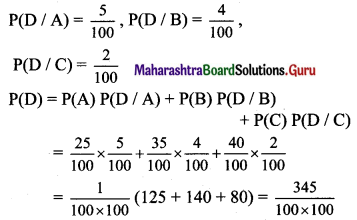
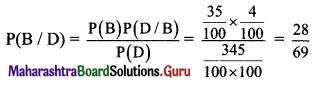
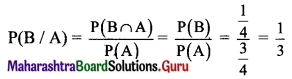
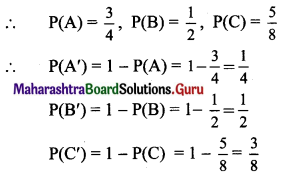
Maharashtra Board 11th Maths Solutions Chapter 8 Measures of Dispersion Ex 8.3

Balbharti Maharashtra State Board Class 11 Maths Solutions Pdf Chapter 8 Measures of Dispersion Ex 8.3 Questions and Answers.

Maharashtra State Board 11th Maths Solutions Chapter 8 Measures of Dispersion Ex 8.3

Question 1.
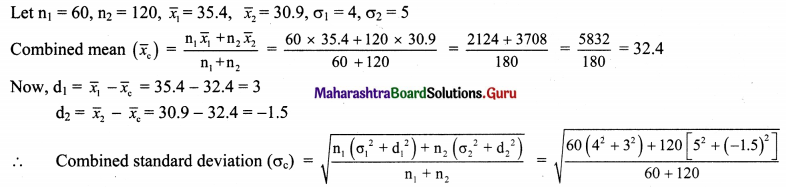
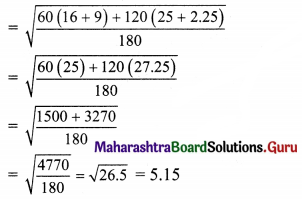
The means of two samples of sizes 60 and 120 respectively are 35.4 and 30.9 and the standard deviations are 4 and 5. Obtain the standard deviation of the sample of size 180 obtained by combining the two samples.
Solution:
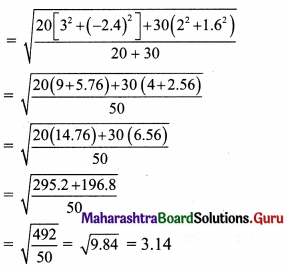
Maharashtra Board 11th Maths Solutions Chapter 8 Measures of Dispersion Ex 8.3 Q1
Maharashtra Board 11th Maths Solutions Chapter 8 Measures of Dispersion Ex 8.3 Q1.1

Maharashtra Board 11th Maths Solutions Chapter 8 Measures of Dispersion Ex 8.3

Question 2.
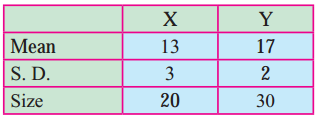
For certain data, the following information is available.
Maharashtra Board 11th Maths Solutions Chapter 8 Measures of Dispersion Ex 8.3 Q2
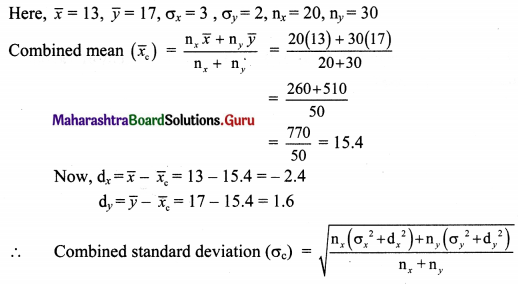
Obtain the combined standard deviation.
Solution:
Maharashtra Board 11th Maths Solutions Chapter 8 Measures of Dispersion Ex 8.3 Q2.1
Maharashtra Board 11th Maths Solutions Chapter 8 Measures of Dispersion Ex 8.3 Q2.2

Question 3.
Calculate the coefficient of variation of marks secured by a student in the exam, where the marks are:
85, 91, 96, 88, 98, 82
Solution:
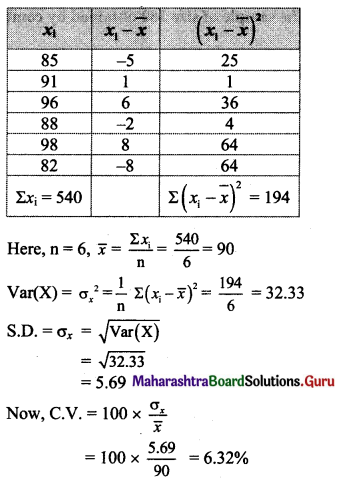
Maharashtra Board 11th Maths Solutions Chapter 8 Measures of Dispersion Ex 8.3 Q3

Question 4.
Find the coefficient of variation of a sample that has a mean equal to 25 and a standard deviation of 5.
Solution:
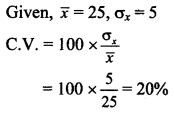
Maharashtra Board 11th Maths Solutions Chapter 8 Measures of Dispersion Ex 8.3 Q4

Maharashtra Board 11th Maths Solutions Chapter 8 Measures of Dispersion Ex 8.3

Question 5.
A group of 65 students of class XI has their average height as 150.4 cm with a coefficient of variance of 2.5%. What is the standard deviation of their heights?
Solution:
Given, n = 65, \(\bar{x}\) = 150.4, C.V. = 2.5%
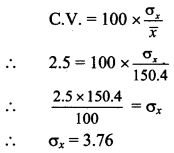
Maharashtra Board 11th Maths Solutions Chapter 8 Measures of Dispersion Ex 8.3 Q5
∴ The standard deviation of students’ height is 3.76 cm.

Question 6.
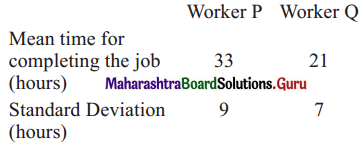
Two workers on the same job show the following results:
Maharashtra Board 11th Maths Solutions Chapter 8 Measures of Dispersion Ex 8.3 Q6
(i) Regarding the time required to complete the job, which worker is more consistent?
(ii) Which worker seems to be faster in completing the job?
Solution:
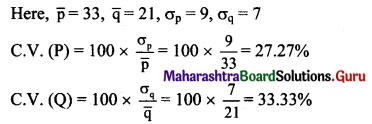
Maharashtra Board 11th Maths Solutions Chapter 8 Measures of Dispersion Ex 8.3 Q6.1
(i) Since C.V. (P) < C.V.(Q), Worker P is more consistent regarding the time required to complete the job. (ii) Since \(\overline{\mathrm{p}}>\overline{\mathrm{q}}\),
i.e., the expected time for completing the job is less for worker Q.
∴ Worker Q seems to be faster in completing the job.

Question 7.
A company has two departments with 42 and 60 employees respectively. Their average weekly wages are ₹ 750 and ₹ 400. The standard deviations are 8 and 10 respectively.
(i) Which department has a larger bill?
(ii) Which department has larger variability in wages?
Solution:
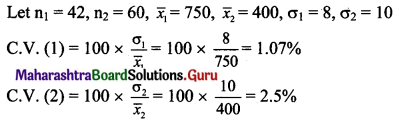
Maharashtra Board 11th Maths Solutions Chapter 8 Measures of Dispersion Ex 8.3 Q7
(i) Since \(\bar{x}_{1}>\bar{x}_{2}\),
i.e., average weekly wages are more for the first department.
∴ The first department has a larger bill.

(ii) Since C.V. (1) < C.V. (2),
second department is less consistent.
∴ The second department has larger variability in wages.

Maharashtra Board 11th Maths Solutions Chapter 8 Measures of Dispersion Ex 8.3

Question 8.
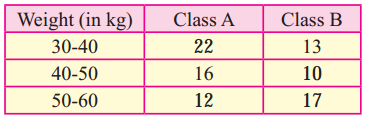
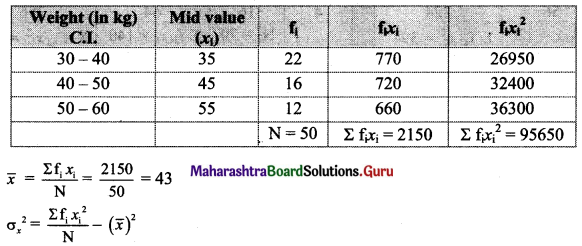
The following table gives the weights of the students of two classes. Calculate the coefficient of variation of the two distributions. Which series is more variable?
Maharashtra Board 11th Maths Solutions Chapter 8 Measures of Dispersion Ex 8.3 Q8
Solution:
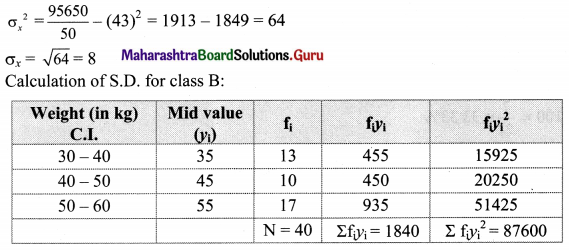
Let x denote the data of class A and y denote the data of class B.
Calculation of S.D. for class A:
Maharashtra Board 11th Maths Solutions Chapter 8 Measures of Dispersion Ex 8.3 Q8.1
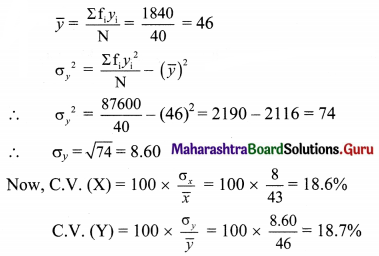
Maharashtra Board 11th Maths Solutions Chapter 8 Measures of Dispersion Ex 8.3 Q8.2
Maharashtra Board 11th Maths Solutions Chapter 8 Measures of Dispersion Ex 8.3 Q8.3
Since C.V. (Y) > C.V.(X),
C.V. (B) > C.V. (A)
∴ Series B is more variable.

Question 9.
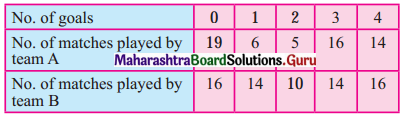
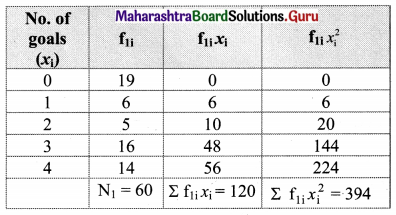
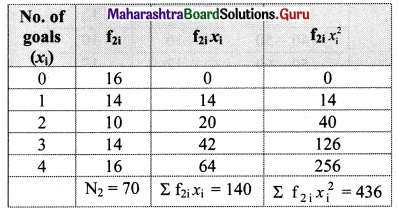
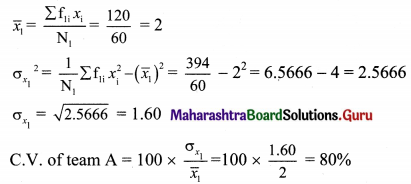
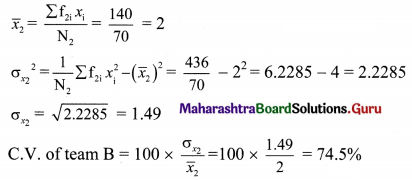
Compute the coefficient of variation for team A and team B.
Maharashtra Board 11th Maths Solutions Chapter 8 Measures of Dispersion Ex 8.3 Q9
Which team is more consistent?
Solution:
Let f1 denote no. of goals of team A and f2 denote no. of goals of team B.
Maharashtra Board 11th Maths Solutions Chapter 8 Measures of Dispersion Ex 8.3 Q9.1
Maharashtra Board 11th Maths Solutions Chapter 8 Measures of Dispersion Ex 8.3 Q9.2
Maharashtra Board 11th Maths Solutions Chapter 8 Measures of Dispersion Ex 8.3 Q9.3
Maharashtra Board 11th Maths Solutions Chapter 8 Measures of Dispersion Ex 8.3 Q9.4
Since C.V. of team A > C.V. of team B,
Team B is more consistent.

Maharashtra Board 11th Maths Solutions Chapter 8 Measures of Dispersion Ex 8.3

Question 10.
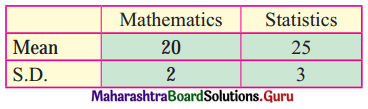
Given below is the information about marks obtained in Mathematics and Statistics by 100 students in a class. Which subject shows the highest variability in marks?
Maharashtra Board 11th Maths Solutions Chapter 8 Measures of Dispersion Ex 8.3 Q10
Solution:
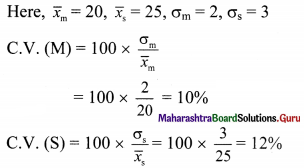
Maharashtra Board 11th Maths Solutions Chapter 8 Measures of Dispersion Ex 8.3 Q10.1
Since C.V. (S) > C.V. (M),
The subject statistics show higher variability in marks.

Maharashtra Board 11th Maths Solutions Chapter 9 Probability Ex 9.4

Balbharti Maharashtra State Board Class 11 Maths Solutions Pdf Chapter 9 Probability Ex 9.4 Questions and Answers.

Maharashtra State Board 11th Maths Solutions Chapter 9 Probability Ex 9.4

Question 1.
There are three bags, each containing 100 marbles. Bag 1 has 75 red and 25 blue marbles. Bag 2 has 60 red and 40 blue marbles and Bag 3 has 45 red and 55 blue marbles. One of the bags is chosen at random and marble is picked from the chosen bag. What is the probability that the chosen marble is red?
Solution:
Let event R: Chosen marble is red.
Let event Bi: ith bag is chosen.
∴ P(Bi) = \(\frac{1}{3}\)
If Bag 1 is chosen, it has 75 red and 25 blue marbles.
∴ Probability that the chosen marble is red under the condition that it is from Bag 1 = P(R/B1)
= \(\frac{{ }^{75} \mathrm{C}_{1}}{{ }^{100} \mathrm{C}_{1}}\)
= \(\frac{75}{100}\)
= 0.75
Similarly we get,
P(R/B2) = \(\frac{60}{100}\) = 0.60
P(R/B3) = \(\frac{45}{100}\) = 0.45
∴ Required probability
P(R) = P(B1) P(R/B1) + P(B2) P(R/B2) + P(B3) P(R/B3)
= \(\frac{1}{3}\)(0.75) + \(\frac{1}{3}\)(0.60) + \(\frac{1}{3}\)(0.45)
= \(\frac{1}{3}\)(1.8)
= 0.60

Maharashtra Board 11th Maths Solutions Chapter 9 Probability Ex 9.4

Question 2.
A box contains 2 blue and 3 pink balls and another box contains 4 blue and 5 pink balls. One ball is drawn at random from one of the two boxes and it is found to be pink. Find the probability that it was drawn from
(i) first box
(ii) second box
Solution:
Let event A1: The ball is drawn from 1st box and
event A2: The ball is drawn from the 2nd box.
∴ P(A1) = \(\frac{1}{2}\), P(A2) = \(\frac{1}{2}\)
Let event B: The ball drawn is pink.
There are 5 balls in the 1st box, of which 3 are pink.
∴ P(B/A1) = \(\frac{3}{5}\)
There are 9 balls in the 2nd box, of which 5 are pink.
∴ P(B/A2) = \(\frac{5}{9}\)
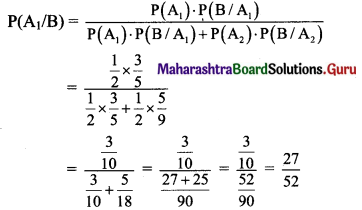
(i) By Bayes’ theorem,
the probability that a pink ball is drawn from the first box, is given by
Maharashtra Board 11th Maths Solutions Chapter 9 Probability Ex 9.4 Q2

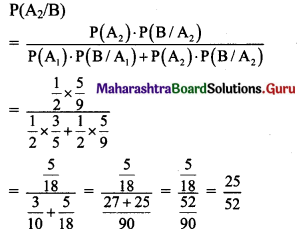
(ii) By Bayes’ theorem,
the probability that a pink ball is drawn from the second box, is given by
Maharashtra Board 11th Maths Solutions Chapter 9 Probability Ex 9.4 Q2.1

Question 3.
There is a working women’s hostel in a town, where 75% are from neighbouring town. The rest all are from the same town. 48% of women who hail from the same town are graduates and 83% of the women who have come from the neighbouring town are also graduates. Find the probability that a woman selected at random is a graduate from the same town.
Solution:
Let the total number of women be 100.
∴ n(S) = 100
Let event N: Women are from neighbouring town,
event W: Women are from same town and
event G: Women are graduates.
Number of women from neighbouring town,
n(N) = 75
Number of women from same town,
n(W) = 25
∴ P(N) = \(\frac{n(N)}{n(S)}=\frac{75}{100}\) and
P(W) = \(\frac{n(W)}{n(S)}=\frac{25}{100}\)
P(G/N), P(G/W) represent probabilities that woman is graduate given that she is from neighbouring town or same town respectively.
∴ P(G/N) = \(\frac{\mathrm{n}(\mathrm{G} / \mathrm{N})}{\mathrm{n}(\mathrm{S})}=\frac{83}{100}\) and
P(G/W) = \(\frac{\mathrm{n}(\mathrm{G} / \mathrm{W})}{\mathrm{n}(\mathrm{S})}=\frac{48}{100}\)
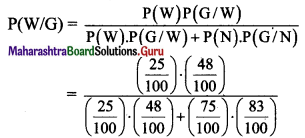
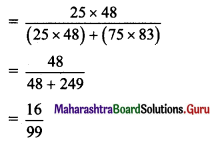
By Bayes’ theorem, the probability that a women selected at random is a graduate from the same town, is given by
Maharashtra Board 11th Maths Solutions Chapter 9 Probability Ex 9.4 Q3
Maharashtra Board 11th Maths Solutions Chapter 9 Probability Ex 9.4 Q3.1

Maharashtra Board 11th Maths Solutions Chapter 9 Probability Ex 9.4

Question 4.
If E1 and E2 are equally likely, mutually exclusive and exhaustive events and P(A/E1) = 0.2, P(A/E2) = 0.3. Find P(E1/A).
Solution:
E1 and E2 are equally likely, mutually exclusive and exhaustive events.
∴ P(E1) = P(E2) = \(\frac{1}{2}\)
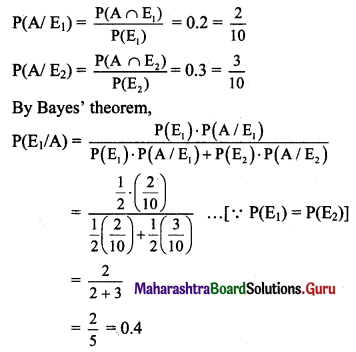
Maharashtra Board 11th Maths Solutions Chapter 9 Probability Ex 9.4 Q4

Question 5.
Jar I contains 5 white and 7 black balls. Jar II contains 3 white and 12 black balls. A fair coin is flipped; if it is Head, a ball is drawn from Jar I, and if it is Tail, a ball is drawn from Jar II. Suppose that this experiment is done and a white ball was drawn. What is the probability that this ball was in fact taken from Jar II?
Solution:
Let event J1: Ball drawn from jar I,
event J2: Ball drawn from jar II.
P(J1) = P(head) = \(\frac{1}{2}\)
P(J2) = P(tail) = \(\frac{1}{2}\)
Let event W: Ball drawn is white.
In Jar I, there are total 12 balls, out of which 5 balls are white.
∴ Probability that the ball drawn is white under the condtion that it is drawn from Jar I.
P(W/J1) = \(\frac{{ }^{5} C_{1}}{{ }^{12} C_{1}}=\frac{5}{12}\)
Similarly, P(W/J2) = \(\frac{{ }^{3} C_{1}}{{ }^{15} C_{1}}=\frac{3}{15}=\frac{1}{5}\)
Required probability = P(J2/W)
By Bayes’ theorem,
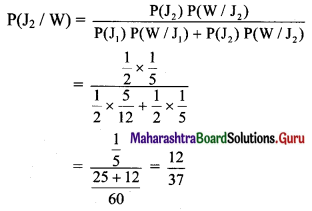
Maharashtra Board 11th Maths Solutions Chapter 9 Probability Ex 9.4 Q5

Question 6.
A diagnostic test has a probability 0.95 of giving a positive result when applied to a person suffering from a certain disease, and a probability 0.10 of giving a (false) positive result when applied to a non-sufferer. It is estimated that 0.5% of the population are sufferers. Suppose that the test is now administered to a person about whom we have no relevant information relating to the disease (apart from the fact that he/she comes from this population). Calculate the probability that:
(i) given a positive result, the person is a sufferer.
(ii) given a negative result, the person is a non-sufferer.
Solution:
Let event T: Test positive
event S: Sufferer
P(S) = \(\frac{0.5}{100}\) = 0.005
∴ P(S’) = 1 – P(S) = 1 – 0.005 = 0.995
Since a probability of getting a positive result when applied to a person suffering from a disease is 0.95 and probability of getting positive result when applied to a non sufferer is 0.10.
∴ P(T/S) = 0.95 and P(T/S’) = 0.10
∴ P(T) = P(S) P(T/S) + P(S’) P(T/S’)
= 0.005 × 0.95 + 0.995 × 0.10
= 0.10425
∴ P(T’) = 1 – P(T) = 1 – 0.10425 = 0.8958
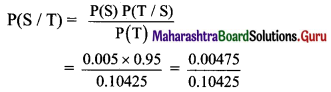
(i) Required probability = P(S/T)
By Bayes’ theorem,
Maharashtra Board 11th Maths Solutions Chapter 9 Probability Ex 9.4 Q6

(ii) P(T’/S’) = 1 – 0.1 = 0.9
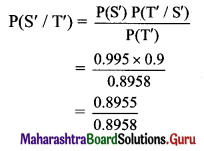
Required probability = P(S’/T’)
By Bayes’ theorem
Maharashtra Board 11th Maths Solutions Chapter 9 Probability Ex 9.4 Q6.1

Maharashtra Board 11th Maths Solutions Chapter 9 Probability Ex 9.4

Question 7.
A doctor is called to see a sick child. The doctor has prior information that 80% of the sick children in that area have the flu, while the other 20% are sick with measles. Assume that there is no other disease in that area. A well-known symptom of measles is rash. From the past records, it is known that, chances of having rashes given that sick child is suffering from measles is 0.95. However occasionally children with flu also develop rash, whose chance are 0.08. Upon examining the child, the doctor finds a rash. What is the probability that child is suffering from measles?
Solution:
Let the total number of sick children be 100.
∴ n(S) = 100.
Let event A: The child is sick with flu,
event B: The child is sick with measles,
event C: The child is sick with rash.
∴ n(A) = 80 and n(B) = 20
∴ P(A) = \(\frac{n(A)}{n(S)}=\frac{80}{100}=\frac{4}{5}\)
P(B) = \(\frac{n(B)}{n(S)}=\frac{20}{100}=\frac{1}{5}\)
Since the chances of having rashes, if the child is suffering from measles is 0.95 and the chances of having rashes if the child has flu is 0.08,
P(C/B) = 0.95 = \(\frac{95}{100}\) and
P(C/A) = 0.08 = \(\frac{8}{100}\)
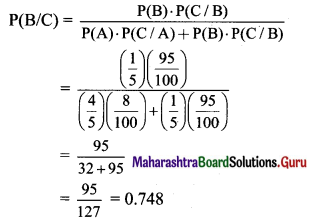
Required probability = P(B/C)
By Bayes’ theorem,
Maharashtra Board 11th Maths Solutions Chapter 9 Probability Ex 9.4 Q7

Question 8.
2% of the population have a certain blood disease of a serious form: 10% have it in a mild form; and 88% don’t have it at all. A new blood test is developed; the probability of testing positive is \(\frac{9}{10}\) if the subject has the
serious form, \(\frac{6}{10}\) if the subject has the mild form, and \(\frac{1}{10}\) if the subject doesn’t have the disease. A subject is tested positive. What is the probability that the subject has serious form of the disease?
Solution:
Let event A1: Disease in serious form,
event A2: Disease in mild form,
event A3: Subject does not have disease,
event B: Subject tests positive.
P(A1) = 0.02, P(A2) = 0.1, P(A3) = 0.88
The probability of testing positive is \(\frac{9}{10}\) if the subject has the serious form, \(\frac{6}{10}\) if the subject has the mild form, and \(\frac{1}{10}\) if the subject doesn’t have the disease.
∴ P(B/A1) = 0.9, P(B/A2) = 0.6, P(B/A3) = 0.1
P(B) = P(A1) P(B/A1) + P(A2) P(B/A2) + P(A3) P(B/A3)
= 0.02 × 0.9 + 0.1 × 0.6 + 0.88 × 0.1
= 0.166
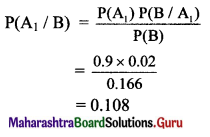
Required probability = P(A1/B)
By Baye’s theorem
Maharashtra Board 11th Maths Solutions Chapter 9 Probability Ex 9.4 Q8

Question 9.
A box contains three coins: two fair coins and one fake two-headed coin. A coin is picked randomly from the box and tossed.
(i) What is the probability that it lands head up?
(ii) If happens to be head, what is the probability that it is the two-headed coin?
Solution:
Let event A: Fair coin is tossed,
event B: Fake coin is tossed
and event H: Head occur.
Clearly, a fair coin has one head.
∴ Probability that head occur under the condition that the fair coin is tossed = P(H/A) = \(\frac{1}{2}\)
Fake coin has two heads.
∴ Probability that head occur under the condition that the fake coin is tossed = P(H/B) = 1
n(A) = 2, n(B) = 1, n(S) = 3
∴ P(A) = \(\frac{n(A)}{n(S)}=\frac{2}{3}\)
P(B) = \(\frac{n(B)}{n(S)}=\frac{1}{3}\)
(i) Required probability
P(H) = P(A) P(H/A) + P(B) P(H/B)
= \(\frac{2}{3} \times \frac{1}{2}+\frac{1}{3} \times 1\)
= \(\frac{1}{3}+\frac{1}{3}\)
= \(\frac{2}{3}\)

Maharashtra Board 11th Maths Solutions Chapter 9 Probability Ex 9.4

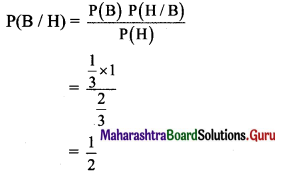
(ii) Required probability = P(B/H)
By Baye’s theorem
Maharashtra Board 11th Maths Solutions Chapter 9 Probability Ex 9.4 Q9

Question 10.
There are three social media groups on a mobile: Group I, Group II and Group III. The probabilities that Group I, Group II and Group III sending the messages on sports are \(\frac{2}{5}\), \(\frac{1}{2}\) and \(\frac{2}{3}\) respectively. The probability of opening the messages by Group I, Group II and Group III are \(\frac{1}{2}\), \(\frac{1}{4}\) and \(\frac{1}{4}\) respectively. Randomly one of the messages is opened and found a message on sports. What is the probability that the message was from Group III.
Solution:
Let event A: Message sent on sports by group I,
event B: Message sent on sports by group II,
event C: Message sent on sports by group III,
event E: Message is opened.
Given that the probabilities that Group I, Group II and Group III sending the messages on sports are \(\frac{2}{5}\), \(\frac{1}{2}\) and \(\frac{2}{3}\) respectively and the probability of opening the messages by Group I, Group II and Group III are \(\frac{1}{2}\), \(\frac{1}{4}\) and \(\frac{1}{4}\) respectively.
∴ P(A) = \(\frac{2}{5}\)
P(B) = \(\frac{1}{2}\)
P(C) = \(\frac{2}{3}\)
P(E/A) = \(\frac{1}{2}\)
P(E/B) = \(\frac{1}{4}\)
P(E/C) = \(\frac{1}{4}\)
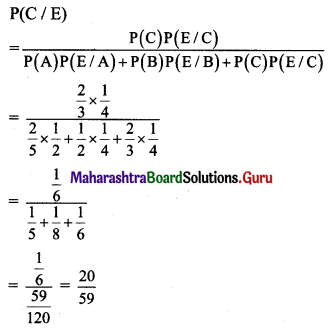
Required probability = P(C/E)
By Baye’s theorem
Maharashtra Board 11th Maths Solutions Chapter 9 Probability Ex 9.4 Q10

Maharashtra Board 11th Maths Solutions Chapter 9 Probability Ex 9.4

Question 11.
Mr. X goes to office by Auto, Car and train. The probabilities of him travelling by these modes are \(\frac{2}{7}\), \(\frac{3}{7}\), \(\frac{2}{7}\) respectively. The chances of him being late to the office are \(\frac{1}{2}\), \(\frac{1}{4}\), \(\frac{1}{4}\) respectively by Auto, Car and train. On one particular day he was late to the office. Find the probability that he travelled by car.
Solution:
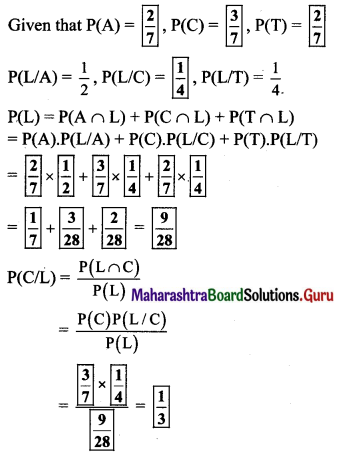
Let A, C and T be the events that Mr. X goes to office by Auto, Car and Train respectively.
Let L be event that he is late.
Maharashtra Board 11th Maths Solutions Chapter 9 Probability Ex 9.4 Q11

Maharashtra Board 11th Maths Solutions Chapter 7 Conic Sections Ex 7.1

Balbharti Maharashtra State Board Class 11 Maths Solutions Pdf Chapter 7 Conic Sections Ex 7.1 Questions and Answers.

Maharashtra State Board 11th Maths Solutions Chapter 7 Conic Sections Ex 7.1

Question 1.
Find co-ordinates of focus, equation of directrix, length of latus rectum and the co-ordinates of end points of latus rectum of the parabola:
(i) 5y2 = 24x
(ii) y2 = -20x
(iii) 3x2 = 8y
(iv) x2 = -8y
(v) 3y2 = -16x
Solution:
(i) Given equation of the parabola is 5y2 = 24x.
⇒ y2 = \(\frac{24}{5}\)x
Comparing this equation with y2 = 4ax, we get
⇒ 4a = \(\frac{24}{5}\)
⇒ a = \(\frac{6}{5}\)
Co-ordinates of focus are S(a, 0), i.e., S(\(\frac{6}{5}\), 0)
Equation of the directrix is x + a = 0.
⇒ x + \(\frac{6}{5}\) = 0
⇒ 5x + 6 = 0
Length of latus rectum = 4a
= 4(\(\frac{6}{5}\))
= \(\frac{24}{5}\)
Co-ordinates of end points of latus rectum are (a, 2a) and (a, -2a),
⇒ \(\left(\frac{6}{5}, \frac{12}{5}\right)\) and \(\left(\frac{6}{5}, \frac{-12}{5}\right)\)

(ii) Given equation of the parabola is y2 = -20x.
Comparing this equation with y2 = -4ax, we get
⇒ 4a = 20
⇒ a = 5
Co-ordinates of focus are S(-a, 0), i.e., S(-5, 0)
Equation of the directrix is x – a = 0
⇒ x – 5 = 0
Length of latus rectum = 4a = 4(5) = 20
Co-ordinates of end points of latus rectum are (-a, 2a) and (-a, -2a),
⇒ (-5, 10) and (-5, -10).

Maharashtra Board 11th Maths Solutions Chapter 7 Conic Sections Ex 7.1

(iii) Given equation of the parabola is 3x2 = 8y
⇒ x2 = \(\frac{8}{3}\) y
Comparing this equation with x2 = 4by, we get
⇒ 4b = \(\frac{8}{3}\)
⇒ b = \(\frac{2}{3}\)
Co-ordinates of focus are S(0, b), i.e., S(0, \(\frac{2}{3}\))
Equation of the directrix is y + b = 0,
⇒ y + \(\frac{2}{3}\) = 0
⇒ 3y + 2 = 0
Length of latus rectum = 4b = 4(\(\frac{2}{3}\)) = \(\frac{8}{3}\)
Co-ordinates of end points of latus rectum are (2b, b) and (-2b, b),
⇒ \(\left(\frac{4}{3}, \frac{2}{3}\right)\) and \(\left(-\frac{4}{3}, \frac{2}{3}\right)\).

(iv) Given equation of the parabola is x2 = -8y.
Comparing this equation with x2 = -4by, we get
⇒ 4b = 8
⇒ b = 2
Co-ordinates of focus are S(0, -b), i.e., S(0, – 2)
Equation of the directrix is y – b = 0, i.e., y – 2 = 0
Length of latus rectum = 4b = 4(2) = 8
∴ Co-ordinates of end points of latus rectum are (2b, -b) and (-2b, -b), i.e., (4, -2) and (-4, -2).

(v) Given equation of the parabola is 3y2 = -16x.
⇒ y2 = \(-\frac{16}{3}\)x
Comparing this equation withy = -4ax, we get
⇒ 4a = \(\frac{16}{3}\)
⇒ a = \(\frac{4}{3}\)
Co-ordinates of focus are S(-a, 0), i.e., (\(-\frac{4}{3}\), 0)
Equation of the directrix is x – a = 0,
⇒ x – \(-\frac{4}{3}\) = 0
⇒ 3x – 4 = 0
Length of latus rectum = 4a = 4(\(\frac{4}{3}\)) = \(\frac{16}{3}\)
Co-ordinates of end points of latus rectum are (-a, 2a) and (-a, -2a),
i.e., \(\left(-\frac{4}{3}, \frac{8}{3}\right)\) and \(\left(-\frac{4}{3},-\frac{8}{3}\right)\)

Maharashtra Board 11th Maths Solutions Chapter 7 Conic Sections Ex 7.1

Question 2.
Find the equation of the parabola with vertex at the origin, the axis along the Y-axis, and passing through the point (-10, -5).
Solution:
Vertex of the parabola is at origin (0, 0) and its axis is along Y-axis.
Equation of the parabola can be either x2 = 4by or x2 = -4by
Since the parabola passes through (-10, -5), it lies in 3rd quadrant.
Required parabola is x2 = -4by.
Substituting x = -10 and y = -5 in x2 = -4by, we get
⇒ (-10)2 = -4b(-5)
⇒ b = \(\frac{100}{20}\) = 5
∴ The required equation of the parabola is x2 = -4(5)y, i.e., x2 = -20y.

Question 3.
Find the equation of the parabola with vertex at the origin, the axis along the X-axis, and passing through the point (3, 4).
Solution:
Vertex of the parabola is at the origin (0, 0) and its axis is along X-axis.
Equation of the parabola can be either y2 = 4ax or y2 = -4ax.
Since the parabola passes through (3, 4), it lies in the 1st quadrant.
Required parabola is y2 = 4ax.
Substituting x = 3 and y = 4 in y2 = 4ax, we get
⇒ (4)2 = 4a(3)
⇒ a = \(\frac{16}{12}=\frac{4}{3}\)
The required equation of the parabola is
y2 = 4(\(\frac{4}{3}\))x
⇒ 3y2 = 16x

Question 4.
Find the equation of the parabola whose vertex is O(0, 0) and focus at (-7, 0).
Solution:
Focus of the parabola is S(-7, 0) and vertex is O(0, 0).
Since focus lies on X-axis, it is the axis of the parabola.
Focus S(-7, 0) lies on the left-hand side of the origin.
It is a left-handed parabola.
Required parabola is y = -4ax.
Focus is S(-a, 0).
a = 7
∴ The required equation of the parabola is y2 =-4(7)x, i.e., y2 = -28x.

Maharashtra Board 11th Maths Solutions Chapter 7 Conic Sections Ex 7.1

Question 5.
Find the equation of the parabola with vertex at the origin, the axis along X-axis, and passing through the point
(i) (1, -6)
(ii) (2, 3)
Solution:
(i) Vertex of the parabola is at origin (0, 0) and its axis is along X-axis.
Equation of the parabola can be either y2 = 4ax or y2 = -4ax.
Since the parabola passes through (1, -6), it lies in the 4th quadrant.
Required parabola is y2 = 4ax.
Substituting x = 1 and y = -6 in y2 = 4ax, we get
⇒ (-6)2 = 4a(1)
⇒ 36 = 4a
⇒ a = 9
∴ The required equation of the parabola is y2 = 4(9)x, i.e., y2 = 36x.

(ii) Vertex of the parabola is at origin (0, 0) and its axis is along X-axis.
Equation of the parabola can be either y2 = 4ax or y2 = -4ax.
Since the parabola passes through (2, 3), it lies in 1st quadrant.
∴ Required parabola is y2 = 4ax.
Substituting x = 2 and y = 3 in y2 = 4ax, we get
⇒ (3)2 = 4a(2)
⇒ 9 = 8a
⇒ a = \(\frac{9}{8}\)
The required equation of the parabola is
y2 = 4(\(\frac{9}{8}\))x
⇒ y2 = \(\frac{9}{2}\) x
⇒ 2y2 = 9x.

Question 6.
For the parabola 3y2 = 16x, find the parameter of the point:
(i) (3, -4)
(ii) (27, -12)
Solution:
Given the equation of the parabola is 3y2 = 16x.
⇒ y2 = \(\frac{16}{3}\)x
Comparing this equation with y2 = 4ax, we get
⇒ 4a = \(\frac{16}{3}\)
⇒ a = \(\frac{4}{3}\)
If t is the parameter of the point P on the parabola, then
P(t) = (at2, 2at)
i.e., x = at2 and y = 2at ………(i)
(i) Given point is (3, -4)
Substituting x = 3, y = -4 and a = \(\frac{4}{3}\) in (i), we get
3 = \(\frac{4}{3}\) t2 and -4 = 2(\(\frac{4}{3}\)) t
Maharashtra Board 11th Maths Solutions Chapter 7 Conic Sections Ex 7.1 Q6
∴ The parameter of the given point is \(\frac{-3}{2}\)

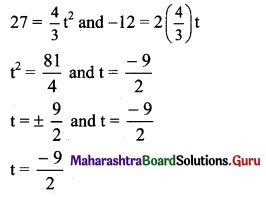
(ii) Given point is (27, -12)
Substituting x = 27, y = -12 and a = \(\frac{4}{3}\) in (i), we get
Maharashtra Board 11th Maths Solutions Chapter 7 Conic Sections Ex 7.1 Q6.1
∴ The parameter of the given point is \(\frac{-9}{2}\)

Maharashtra Board 11th Maths Solutions Chapter 7 Conic Sections Ex 7.1

Question 7.
Find the focal distance of a point on the parabola y2 = 16x whose ordinate is 2 times the abscissa.
Solution:
Given the equation of the parabola is y2 = 16x.
Comparing this equation with y2 = 4ax, we get
⇒ 4a = 16
⇒ a = 4
Since ordinate is 2 times the abscissa,
y = 2x
Substituting y = 2x in y2 = 16x, we get
⇒ (2x)2 = 16x
⇒ 4x2 = 16x
⇒ 4x2 – 16x = 0
⇒ 4x(x – 4) = 0
⇒ x = 0 or x = 4
When x = 4,
focal distance = x + a = 4 + 4 = 8
When x = 0,
focal distance = a = 4
∴ Focal distance is 4 or 8.

Question 8.
Find coordinates of the point on the parabola. Also, find focal distance.
(i) y2 = 12x whose parameter is \(\frac{1}{3}\)
(ii) 2y2 = 7x whose parameter is -2
Solution:
(i) Given equation of the parabola is y2 = 12x.
Comparing this equation with y2 = 4ax, we get
⇒ 4a = 12
⇒ a = 3
If t is the parameter of the point P on the parabola, then
P(t) = (at2, 2at)
i.e., x = at2 and y = 2at ……..(i)
Given, t = \(\frac{1}{3}\)
Substituting a = 3 and t = \(\frac{1}{3}\) in (i), we get
x = 3(\(\frac{1}{3}\))2 and y = 2(3)(\(\frac{1}{3}\))
x = \(\frac{1}{3}\) and y = 2
The co-ordinates of the point on the parabola are (\(\frac{1}{3}\), 2)
∴ Focal distance = x + a
= \(\frac{1}{3}\) + 3
= \(\frac{10}{3}\)

(ii) Given equation of the parabola is 2y2 = 7x.
⇒ y2 = \(\frac{7}{2}\)x
Comparing this equation with y2 = 4ax, we get
⇒ 4a = \(\frac{7}{2}\)
⇒ a = \(\frac{7}{8}\)
If t is the parameter of the point P on the parabola, then
P(t) = (at2, 2at)
i.e., x = at2 and y = 2at …..(i)
Given, t = -2
Substituting a = \(\frac{7}{8}\) and t = -2 in (i), we get
x = \(\frac{7}{8}\)(-2)2 and y = 2(\(\frac{7}{8}\))(-2)
x = \(\frac{7}{2}\) and y = \(\frac{-7}{2}\)
The co-ordinates of the point on the parabola are (\(\frac{7}{2}\), \(\frac{-7}{2}\))
∴ Focal distance = x + a
= \(\frac{7}{2}\) + \(\frac{7}{8}\)
= \(\frac{35}{8}\)

Maharashtra Board 11th Maths Solutions Chapter 7 Conic Sections Ex 7.1

Question 9.
For the parabola y2 = 4x, find the coordinates of the point whose focal distance is 17.
Solution:
Given the equation of the parabola is y2 = 4x.
Comparing this equation with y2 = 4ax, we get
⇒ 4a = 4
⇒ a = 1
Focal distance of a point = x + a
Given, focal distance = 17
⇒ x + 1 = 17
⇒ x = 16
Substituting x = 16 in y2 = 4x, we get
⇒ y2 = 4(16)
⇒ y2 = 64
⇒ y = ±8
∴ The co-ordinates of the point on the parabola are (16, 8) or (16, -8).

Question 10.
Find the length of the latus rectum of the parabola y2 = 4ax passing through the point (2, -6).
Solution:
Given equation of the parabola is y2 = 4ax and it passes through point (2, -6).
Substituting x = 2 and y = -6 in y2 = 4ax, we get
⇒ (-6)2 = 4a(2)
⇒ 4a = 18
∴ Length of latus rectum = 4a = 18 units

Question 11.
Find the area of the triangle formed by the line joining the vertex of the parabola x2 = 12y to the endpoints of the latus rectum.
Solution:
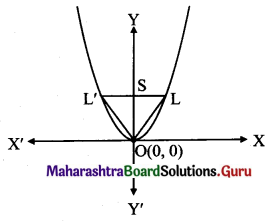
Maharashtra Board 11th Maths Solutions Chapter 7 Conic Sections Ex 7.1 Q11
Given the equation of the parabola is x2 = 12y.
Comparing this equation with x2 = 4by, we get
⇒ 4b = 12
⇒ b = 3
The co-ordinates of focus are S(0, b), i.e., S(0, 3)
End points of the latus-rectum are L(2b, b) and L'(-2b, b),
i.e., L(6, 3) and L'(-6, 3)
Also l(LL’) = length of latus-rectum = 4b = 12
l(OS) = b = 3
Area of ∆OLL’ = \(\frac{1}{2}\) × l(LL’) × l(OS)
= \(\frac{1}{2}\) × 12 × 3
Area of ∆OLL’ = 18 sq. units

Maharashtra Board 11th Maths Solutions Chapter 7 Conic Sections Ex 7.1

Question 12.
If a parabolic reflector is 20 cm in diameter and 5 cm deep, find its focus.
Solution:
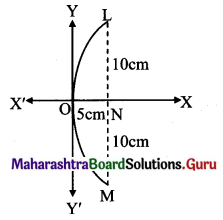
Maharashtra Board 11th Maths Solutions Chapter 7 Conic Sections Ex 7.1 Q12
Let LOM be the parabolic reflector such that LM is the diameter and ON is its depth.
It is given that ON = 5 cm and LM = 20 cm.
LN = 10 cm
Taking O as the origin, ON along X-axis and a line through O ⊥ ON as Y-axis.
Let the equation of the reflector be y2 = 4ax ……(i)
The point L has the co-ordinates (5, 10) and lies on parabola given by (i).
Substituting x = 5 and y = 10 in (i), we get
⇒ 102 = 4a(5)
⇒ 100 = 20a
⇒ a = 5
Focus is at (a, 0), i.e., (5, 0)

Question 13.
Find co-ordinates of focus, vertex, and equation of directrix and the axis of the parabola y = x2 – 2x + 3.
Solution:
Given equation of the parabola is y = x2 – 2x + 3
⇒ y = x2 – 2x + 1 + 2
⇒ y – 2 = (x – 1)2
⇒ (x – 1)2 = y – 2
Comparing this equation with X2 = 4bY, we get
X = x – 1, Y = y – 2
⇒ 4b = 1
⇒ b = \(\frac{1}{4}\)
The co-ordinates of vertex are (X = 0, Y = 0)
⇒ x – 1 = 0 and y – 2 = 0
⇒ x = 1 and y = 2
The co-ordinates of vertex are (1, 2).
The co-ordinates of focus are S(X = 0, Y = b)
⇒ x – 1 = 0 and y – 2 = \(\frac{1}{4}\)
⇒ x = 1 and y = \(\frac{9}{4}\)
The co-ordinates of focus are (1, \(\frac{9}{4}\))
Equation of the axis is X = 0
x – 1 = 0, i.e., x = 1
Equation of directrix is Y + b = 0
⇒ y – 2 + \(\frac{1}{4}\) = 0
⇒ y – \(\frac{7}{4}\) = 0
⇒ 4y – 7 = 0

Question 14.
Find the equation of tangent to the parabola
(i) y2 = 12x from the point (2, 5)
(ii) y2 = 36x from the point (2, 9)
Solution:
(i) Given equation of the parabola is y2 = 12x.
Comparing this equation with y2 = 4ax, we get
⇒ 4a = 12
⇒ a = 3
Equation of tangent to the parabola y2 = 4ax having slope m is
y = mx + \(\frac{a}{m}\)
Since the tangent passes through the point (2, 5)
⇒ 5 = 2m + \(\frac{3}{m}\)
⇒ 5m = 2m2 + 3
⇒ 2m2 – 5m + 3 = 0
⇒ 2m2 – 2m – 3m + 3 = 0
⇒ 2m(m – 1) – 3(m – 1) = 0
⇒ (m- 1)(2m – 3) = 0
⇒ m = 1 or m = \(\frac{3}{2}\)
These are the slopes of the required tangents.
By slope point form, y – y1 = m(x – x1), the equations of the tangents are
⇒ y – 5 = 1(x – 2) and y – 5 = \(\frac{3}{2}\) (x – 2)
⇒ y – 5 = x – 2 and 2y – 10 = 3x – 6
⇒ x – y + 3 = 0 and 3x – 2y + 4 = 0

Maharashtra Board 11th Maths Solutions Chapter 7 Conic Sections Ex 7.1

(ii) Given equation of the parabola is y2 = 36x.
Comparing this equation with y2 = 4ax, we get
⇒ 4a = 36
⇒ a = 9
Equation of tangent to the parabola y2 = 4ax having slope m is
y = mx + \(\frac{a}{m}\)
Since the tangent passes through the point (2, 9),
⇒ 9 = 2m + \(\frac{9}{m}\)
⇒ 9m = 2m2 + 9
⇒ 2m2 – 9m + 9 = 0
⇒ 2m2 – 6m – 3m + 9 = 0
⇒ 2m(m – 3) – 3(m – 3) = 0
⇒ (m – 3)(2m – 3) = 0
⇒ m = 3 or m = \(\frac{3}{2}\)
These are the slopes of the required tangents.
By slope point form, y – y1 = m(x – x1), the equations of the tangents are
⇒ y – 9 = 3(x – 2) and y – 9 = \(\frac{3}{2}\) (x – 2)
⇒ y – 9 = 3x – 6 and 2y – 18 = 3x – 6
⇒ 3x – y + 3 = 0 and 3x – 2y + 12 = 0

Question 15.
If the tangents drawn from the point (-6, 9) to the parabola y2 = kx are perpendicular to each other, find k.
Solution:
Given equation of the parabola is y2 = kx
Comparing this equation with y2 = 4ax, we get
⇒ 4a = k
⇒ a = \(\frac{\mathrm{k}}{4}\)
Equation of tangent to the parabola y2 = 4ax having slope m is
y = mx + \(\frac{a}{m}\)
Since the tangent passes through the point (-6, 9),
⇒ 9 = -6m + \(\frac{k}{4m}\)
⇒ 36m = -24m2 + k
⇒ 24m2 + 36m – k = 0
The roots m1 and m2 of this quadratic equation are the slopes of the tangents.
m1m2 = \(\frac{-\mathrm{k}}{24}\)
Since the tangents are perpendicular to each other,
m1m2 = -1
⇒ \(\frac{-\mathrm{k}}{24}\) = -1
⇒ k = 24

Alternate method:
We know that, tangents drawn from a point on directrix are perpendicular.
(-6, 9) lies on the directrix x = -a.
⇒ -6 = -a
⇒ a = 6
Since 4a = k
⇒ k = 4(6) = 24

Maharashtra Board 11th Maths Solutions Chapter 7 Conic Sections Ex 7.1

Question 16.
Two tangents to the parabola y2 = 8x meet the tangents at the vertex in the points P and Q. If PQ = 4, prove that the equation of the locus of the point of intersection of two tangents is y2 = 8(x + 2).
Solution:
Given equation of the parabola is y2 = 8x
Comparing this equation with y2 = 4ax, we get
⇒ 4a = 8
⇒ a = 2
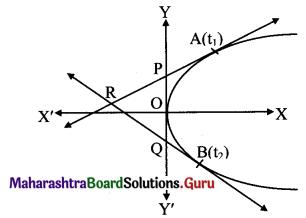
Equation of tangent to given parabola at A(t1) is y
t1 = x + 2\(\mathrm{t}_{1}^{2}\) …….(i)
Equation of tangent to given parabola at B(t2) is y
t2 = x + 2\(\mathrm{t}_{2}^{2}\) …..(ii)
Maharashtra Board 11th Maths Solutions Chapter 7 Conic Sections Ex 7.1 Q16
A tangent at the vertex is Y-axis whose equation is x = 0.
x-coordinate of points P and Q is 0.
Let P be(0, k1) and Q be (0, k2).
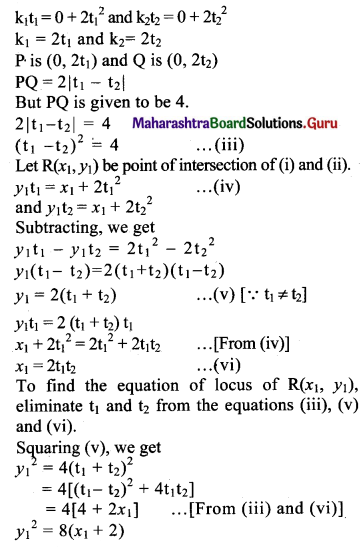
Then, from (i) and (ii), we get
Maharashtra Board 11th Maths Solutions Chapter 7 Conic Sections Ex 7.1 Q16.1
∴ Equation of locus of R is y2 = 8(x + 2).

Question 17.
Find the equation of common tangent to the parabolas y2 = 4x and x2 = 32y.
Solution:
Given equation of the parabola is y2 = 4x
Comparing this equation with y2 = 4ax, we get
⇒ 4a = 4
⇒ a = 1
Let the equation of common tangent be
y = mx + \(\frac{1}{m}\) …..(i)
Substituting y = mx + \(\frac{1}{m}\) in x2 = 32y, we get
⇒ x2 = 32(mx + \(\frac{1}{m}\)) = 32 mx + \(\frac{32}{m}\)
⇒ mx2 = 32 m2x + 32
⇒ mx2 – 32 m2x – 32 = 0 ……..(ii)
Line (i) touches the parabola x2 = 32y.
The quadratic equation (ii) in x has equal roots.
Discriminant = 0
⇒ (-32m2)2 – 4(m)(-32) = 0
⇒ 1024 m4 + 128m = 0
⇒ 128m (8m3 + 1) = 0
⇒ 8m3 + 1 = 0 …..[∵ m ≠ 0]
⇒ m3 = \(-\frac{1}{8}\)
⇒ m = \(-\frac{1}{2}\)
Substituting m = \(-\frac{1}{2}\) in (i), we get
⇒ \(y=-\frac{1}{2} x+\frac{1}{\left(-\frac{1}{2}\right)}\)
⇒ \(y=-\frac{1}{2} x-2\)
⇒ x + 2y + 4 = 0, which is the equation of the common tangent.

Question 18.
Find the equation of the locus of a point, the tangents from which to the parabola y2 = 18x are such that sum of their slopes is -3.
Solution:
Given equation of the parabola is y2 = 18x
Comparing this equation with y2 = 4ax, we get
⇒ 4a = 18
⇒ a = \(\frac{9}{2}\)
Equation of tangent to the parabola y2 = 4ax having slope m is
⇒ y = mx + \(\frac{a}{m}\)
⇒ y = mx + \(\frac{9}{2m}\)
⇒ 2ym = 2xm2 + 9
⇒ 2xm2 – 2ym + 9 = 0
The roots m1 and m2 of this quadratic equation are the slopes of the tangents.
m1 + m2 = \(-\frac{(-2 y)}{2 x}=\frac{y}{x}\)
But, m1 + m2 = -3
\(\frac{y}{x}\) = -3
y = -3x, which is the required equation of locus.

Maharashtra Board 11th Maths Solutions Chapter 7 Conic Sections Ex 7.1

Question 19.
The towers of a bridge, hung in the form of a parabola, have their tops 30 metres above the roadway and are 200 metres apart. If the cable is 5 metres above the roadway at the centre of the bridge, find the length of the vertical supporting cable 30 metres from the centre.
Solution:
Let CAB be the cable of the bridge and X’OX be the roadway.
Let A be the centre of the bridge.
From the figure, vertex of parabola is at A(0, 5).
Let the equation of parabola be
x2 = 4b(y – 5) …..(i)
Since the parabola passes through (100, 30).
Substituting x = 100 and y = 30 in (i), we get
⇒ 1002 = 4b (30 – 5)
⇒ 1002 = 4b(25)
⇒ 1002 = 100b
⇒ b = 100
Substituting the value of b in (i), we get
x2 = 400(y – 5) …..(ii)
Let l metres be the length of vertical supporting cable.
Then P(30, l) lies on (ii).
⇒ 302 = 400(l – 5)
⇒ 900 = 400(l – 5)
⇒ \(\frac{9}{4}\) = l – 5
⇒ l = \(\frac{9}{4}\) + 5
⇒ l = \(\frac{9}{4}\) m = 7.25 m
The length of the vertical supporting cable is 7.25 m.

Question 20.
A circle whose centre is (4, -1) passes through the focus of the parabola x2 + 16y = 0. Show that the circle touches the directrix of the parabola.
Solution:
Given equation of the parabola is x2 + 16y = 0.
⇒ x2 = -16y
Comparing this equation with x2 = -4by, we get
⇒ 4b = 16
⇒ b = 4
Focus = S(0, -b) = (0, -4)
Centre of the circle is C(4, -1) and it passes through focus S of the parabola.
Radius = CS
= \(\sqrt{(4-0)^{2}+(-1+4)^{2}}\)
= \(\sqrt{16+9}\)
= 5
Equation of the directrix is y – b = 0, i.e.,y – 4 = 0
Length of the perpendicular from centre C(4, -1) to the directrix
= \(\left|\frac{0(4)+1(-1)-4}{\sqrt{(0)^{2}+(1)^{2}}}\right|\)
= \(\left|\frac{-1-4}{1}\right|\)
= 5
= radius
∴ The circle touches the directrix of the parabola.

Maharashtra Board 11th Maths Solutions Chapter 7 Conic Sections Ex 7.3

Balbharti Maharashtra State Board Class 11 Maths Solutions Pdf Chapter 7 Conic Sections Ex 7.3 Questions and Answers.

Maharashtra State Board 11th Maths Solutions Chapter 7 Conic Sections Ex 7.3

Question 1.
Find the length of the transverse axis, length of conjugate axis, the eccentricity, the co-ordinates of foci, equations of directrices, and the length of the latus rectum of the hyperbolae.
(i) \(\frac{x^{2}}{25}-\frac{y^{2}}{16}=1\)
(ii) \(\frac{x^{2}}{25}-\frac{y^{2}}{16}=-1\)
(iii) 16x2 – 9y2 = 144
(iv) 21x2 – 4y2 = 84
(v) 3x2 – y2 = 4
(vi) x2 – y2 = 16
(vii) \(\frac{y^{2}}{25}-\frac{x^{2}}{9}=1\)
(viii) \(\frac{y^{2}}{25}-\frac{x^{2}}{144}=1\)
(ix) \(\frac{x^{2}}{100}-\frac{y^{2}}{25}=1\)
(x) x = 2 sec θ, y = 2√3 tan θ
Solution:
(i) Given equation of the hyperbola is \(\frac{x^{2}}{25}-\frac{y^{2}}{16}=1\)
Comparing this equation with \(\frac{x^{2}}{a^{2}}-\frac{y^{2}}{b^{2}}=1\), we get
a2 = 25 and b2 = 16
⇒ a = 5 and b = 4
Length of transverse axis = 2a = 2(5) = 10
Length of conjugate axis = 2b = 2(4) = 8
We know that
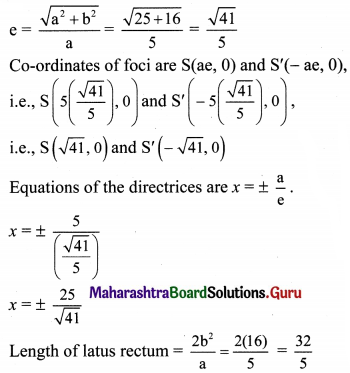
Maharashtra Board 11th Maths Solutions Chapter 7 Conic Sections Ex 7.3 Q1 (i)

(ii) Given equation of the hyperbola is \(\frac{x^{2}}{25}-\frac{y^{2}}{16}=-1\)
\(\frac{y^{2}}{16}-\frac{x^{2}}{25}=1\)
Comparing this equation with \(\frac{y^{2}}{b^{2}}-\frac{x^{2}}{a^{2}}=1\), we get
b2 = 16 and a2 = 25
⇒ b = 4 and a = 5
Length of transverse axis = 2b = 2(4) = 8
Length of conjugate axis = 2a = 2(5) = 10
Co-ordinates of vertices are B(0, b) and B’ (0, -b)
i.e., B(0, 4) and B'(0, -4)
We know that
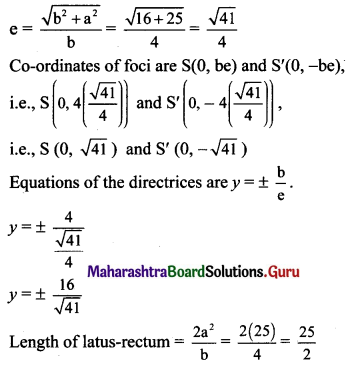
Maharashtra Board 11th Maths Solutions Chapter 7 Conic Sections Ex 7.3 Q1 (ii)

Maharashtra Board 11th Maths Solutions Chapter 7 Conic Sections Ex 7.3

(iii) Given equation of the hyperbola is 16x2 – 9y2 = 144.
\(\frac{x^{2}}{9}-\frac{y^{2}}{16}=1\)
Comparing this equation with \(\frac{x^{2}}{a^{2}}-\frac{y^{2}}{b^{2}}=1\), we get
a2 = 9 and b2 = 16
⇒ a = 3 and b = 4
Length of transverse axis = 2a = 2(3) = 6
Length of conjugate axis = 2b = 2(4) = 8
We know that
e = \(\frac{\sqrt{a^{2}+b^{2}}}{a}=\frac{\sqrt{9+16}}{3}=\frac{\sqrt{25}}{3}=\frac{5}{3}\)
Co-ordinates of foci are S(ae, 0) and S'(-ae, 0),
i.e., S(3(\(\frac{5}{3}\)), 0) and S'(-3(\(\frac{5}{3}\)), 0)
i.e., S(5, 0) and S'(-5, 0)
Equations of the directrices are x = ±\(\frac{a}{e}\)
= \(\pm \frac{3}{\left(\frac{5}{3}\right)}\)
= \(\pm \frac{9}{5}\)
Length of latus rectum = \(\frac{2 b^{2}}{a}=\frac{2(16)}{3}=\frac{32}{3}\)

(iv) Given equation of the hyperbola is 21x2 – 4y2 = 84.
\(\frac{x^{2}}{4}-\frac{y^{2}}{21}=1\)
Comparing this equation with \(\frac{x^{2}}{a^{2}}-\frac{y^{2}}{b^{2}}=1\), we get
a2 = 4 and b2 = 21
⇒ a = 2 and b = √21
Length of transverse axis = 2a = 2(2) = 4
Length of conjugate axis = 2b = 2√21
We know that
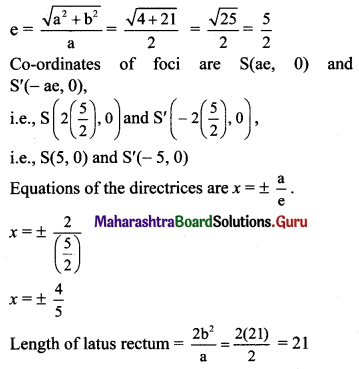
Maharashtra Board 11th Maths Solutions Chapter 7 Conic Sections Ex 7.3 Q1 (iv)

(v) Given equation of the hyperbola is 3x2 – y2 = 4.
\(\frac{x^{2}}{\left(\frac{4}{3}\right)}-\frac{y^{2}}{4}=1\)
Comparing this equation with \(\frac{x^{2}}{a^{2}}-\frac{y^{2}}{b^{2}}=1\), we get
a2 = \(\frac{4}{3}\) and b2 = 4
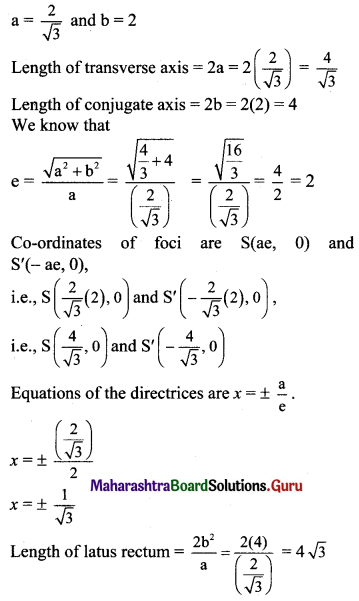
Maharashtra Board 11th Maths Solutions Chapter 7 Conic Sections Ex 7.3 Q1 (v)

(vi) Given equation of the hyperbola is x2 – y2 = 16.
\(\frac{x^{2}}{16}-\frac{y^{2}}{16}=1\)
Comparing this equation with \(\frac{x^{2}}{a^{2}}-\frac{y^{2}}{b^{2}}=1\), we get
a2 = 16 and b2 = 16
⇒ a = 4 and b = 4
Length of transverse axis = 2a = 2(4) = 8
Length of conjugate axis = 2b = 2(4) = 8
We know that
e = \(\frac{\sqrt{a^{2}+b^{2}}}{a}=\frac{\sqrt{16+16}}{4}=\frac{\sqrt{32}}{4}=\frac{4 \sqrt{2}}{4}=\sqrt{2}\)
Co-ordinates of foci are S(ae, 0) and S'(-ae, 0),
i.e., S (4√2, 0) and S’ (-4√2, 0)
Equations of the directrices are x = ±\(\frac{a}{e}\)
⇒ x = \(\pm \frac{4}{\sqrt{2}}\)
⇒ x = ± 2√2
Length of latus rectum = \(\frac{2 b^{2}}{a}=\frac{2(16)}{4}\) = 8

Maharashtra Board 11th Maths Solutions Chapter 7 Conic Sections Ex 7.3

(vii) Given equation of the hyperbola is \(\frac{y^{2}}{25}-\frac{x^{2}}{9}=1\).
Comparing this equation with \(\frac{y^{2}}{b^{2}}-\frac{x^{2}}{a^{2}}=1\), we get
b2 = 25 and a2 = 9
⇒ b = 5 and a = 3
Length of transverse axis = 2b = 2(5) = 10
Length of conjugate axis = 2a = 2(3) = 6
Co-ordinates of vertices are B(0, b) and B’ (0, -b),
i.e., B(0, 5) and B’ (0, -5)
We know that
Maharashtra Board 11th Maths Solutions Chapter 7 Conic Sections Ex 7.3 Q1 (vii)

(viii) Given equation of the hyperbola is \(\frac{y^{2}}{25}-\frac{x^{2}}{144}=1\).
Comparing this equation with \(\frac{y^{2}}{b^{2}}-\frac{x^{2}}{a^{2}}=1\), we get
b2 = 25 and a2 = 144
⇒ b = 5 and a = 12
Length of transverse axis = 2b = 2(5) = 10
Length of conjugate axis = 2a = 2(12) = 24
Co-ordinates of vertices are B(0, b) and B’ (0, -b),
i.e., B(0, 5) and B’ (0, -5)
We know that
Maharashtra Board 11th Maths Solutions Chapter 7 Conic Sections Ex 7.3 Q1 (viii)

(ix) Given equation of the hyperbola is \(\frac{x^{2}}{100}-\frac{y^{2}}{25}=1\)
Comparing this equation with \(\frac{x^{2}}{a^{2}}-\frac{y^{2}}{b^{2}}=1\), we get
a2 = 100 and b2 = 25
⇒ a = 10 and b = 5
Length of transverse axis = 2a = 2(10) = 20
Length of conjugate axis = 2b = 2(5) = 10
We know that
Maharashtra Board 11th Maths Solutions Chapter 7 Conic Sections Ex 7.3 Q1 (ix)

(x) Given equation of the hyperbola is x = 2 sec θ, y = 2√3 tan θ.
Since sec2 θ – tan2 θ = 1,
\(\left(\frac{x}{2}\right)^{2}-\left(\frac{y}{2 \sqrt{3}}\right)^{2}=1\)
\(\frac{x^{2}}{4}-\frac{y^{2}}{12}=1\)
Comparing this equation with \(\frac{x^{2}}{\mathrm{a}^{2}}-\frac{y^{2}}{\mathrm{~b}^{2}}=1\), we get
a2 = 4 and b2 = 12
⇒ a = 2 and b = 2√3
Length of transverse axis = 2a = 2(2) = 4
Length of conjugate axis = 2b = 2(2√3) = 4√3
We know that
e = \(\frac{\sqrt{a^{2}+b^{2}}}{a}\) = \(\frac{\sqrt{4+12}}{2}\) = 2
Co-ordinates of foci are S(ae, 0) and S'(-ae, 0),
i.e., S(2(2), 0) and S'(-2(2), 0),
i.e., S(4, 0) and S'(-4, 0)
Equations of the directrices are x = ±\(\frac{a}{e}\).
⇒ x = ±\(\frac{2}{2}\)
⇒ x = ±1
Length of latus rectum = \(\frac{2 b^{2}}{a}=\frac{2(12)}{2}\) = 12

Maharashtra Board 11th Maths Solutions Chapter 7 Conic Sections Ex 7.3

Question 2.
Find the equation of the hyperbola with centre at the origin, length of the conjugate axis as 10, and one of the foci as (-7, 0).
Solution:
Given, one of the foci of the hyperbola is (-7, 0).
Since this focus lies on the X-axis, it is a standard hyperbola.
Let the required equation of hyperbola be \(\frac{x^{2}}{a^{2}}-\frac{y^{2}}{b^{2}}=1\)
Length of conjugate axis = 2b
Given, length of conjugate axis = 10
⇒ 2b = 10
⇒ b = 5
⇒ b2 = 25
Co-ordinates of focus are (-ae, 0)
ae = 7
⇒ a2e2 = 49
Now, b2 = a2(e2 – 1)
⇒ 25 = 49 – a2
⇒ a2 = 49 – 25 = 24
The required equation of hyperbola is \(\frac{x^{2}}{24}-\frac{y^{2}}{25}=1\)

Question 3.
Find the eccentricity of the hyperbola, which is conjugate to the hyperbola x2 – 3y2 = 3
Solution:
Given, equation of hyperbola is x2 – 3y2 = 3.
\(\frac{x^{2}}{3}-\frac{y^{2}}{1}=1\)
Equation of the hyperbola conjugate to the above hyperbola is \(\frac{y^{2}}{1}-\frac{x^{2}}{3}=1\)
Comparing this equation with \(\frac{y^{2}}{b^{2}}-\frac{x^{2}}{a^{2}}=1\), we get
b2 = 1 and a2 = 3
Now, a2 = b2(e2 – 1)
⇒ 3 = 1(e2 – 1)
⇒ 3 = e – 1
⇒ e2 = 4
⇒ e = 2 …..[∵ e > 1]

Maharashtra Board 11th Maths Solutions Chapter 7 Conic Sections Ex 7.3

Question 4.
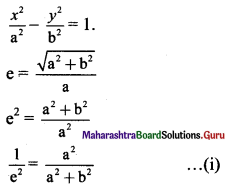
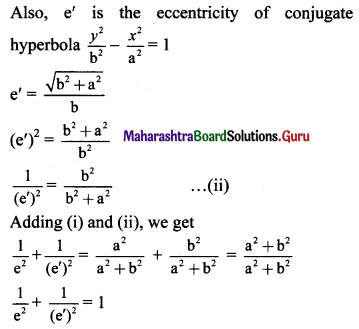
If e and e’ are the eccentricities of a hyperbola and its conjugate hyperbola respectively, prove that \(\frac{1}{e^{2}}+\frac{1}{\left(e^{\prime}\right)^{2}}=1\).
Solution:
Let e be the eccentricity of a hyperbola
Maharashtra Board 11th Maths Solutions Chapter 7 Conic Sections Ex 7.3 Q4
Maharashtra Board 11th Maths Solutions Chapter 7 Conic Sections Ex 7.3 Q4.1

Question 5.
Find the equation of the hyperbola referred to its principal axes:
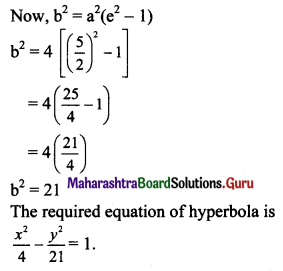
(i) whose distance between foci is 10 and eccentricity is \(\frac{5}{2}\)
(ii) whose distance between foci is 10 and length of the conjugate axis is 6.
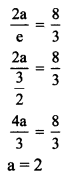
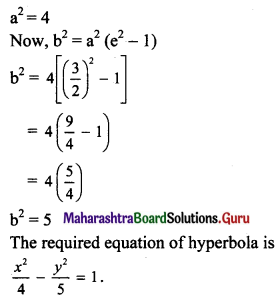
(iii) whose distance between directrices is \(\frac{8}{3}\) and eccentricity is \(\frac{3}{2}\).
(iv) whose length of conjugate axis = 12 and passing through (1, -2).
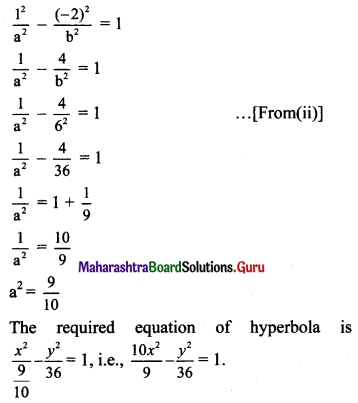
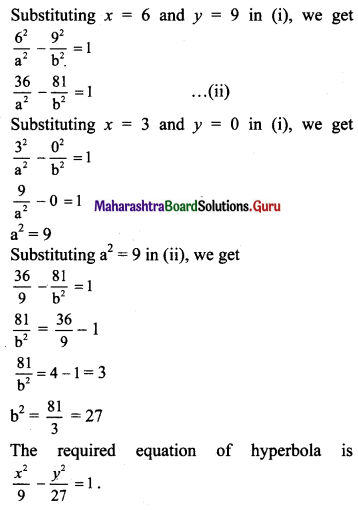
(v) which passes through the points (6, 9) and (3, 0).
(vi) whose vertices are (±7, 0) and endpoints of the conjugate axis are (0, ±3).
(vii) whose foci are at (±2, 0) and eccentricity is \(\frac{3}{2}\).
(viii) whose lengths of transverse and conjugate axes are 6 and 9 respectively.
(ix) whose length of transverse axis is 8 and distance between foci is 10.
Solution:
(i) Let the required equation of hyperbola be \(\frac{x^{2}}{a^{2}}-\frac{y^{2}}{b^{2}}=1\)
Given, eccentricity (e) = \(\frac{5}{2}\)
Distance between foci = 2ae
Given, distance between foci = 10
⇒ 2ae = 10
⇒ ae = 5
⇒ a(\(\frac{5}{2}\)) = 5
⇒ a = 2
⇒ a2 = 4
Maharashtra Board 11th Maths Solutions Chapter 7 Conic Sections Ex 7.3 Q5 (i)

Maharashtra Board 11th Maths Solutions Chapter 7 Conic Sections Ex 7.3

(ii) Let the required equation of hyperbola be \(\frac{x^{2}}{a^{2}}-\frac{y^{2}}{b^{2}}=1\)
Length of conjugate axis = 2b
Given, length of conjugate axis = 6
⇒ 2b = 6
⇒ b = 3
⇒ b2 = 9
Distance between foci = 2ae
Given, distance between foci = 10
⇒ 2ae = 10
⇒ ae = 5
⇒ a2e2 = 25
Now, b2 = a2 (e2 – 1)
⇒ b2 = a2 e2 – a2
⇒ 9 = 25 – a2
⇒ a2 = 25 – 9
⇒ a2 = 16
The required equation of hyperbola is \(\frac{x^{2}}{16}-\frac{y^{2}}{9}=1\)

(iii) Let the required equation of hyperbola be \(\frac{x^{2}}{\mathrm{a}^{2}}-\frac{y^{2}}{\mathrm{~b}^{2}}=1\)
Given, eccentricity (e) = \(\frac{3}{2}\)
Distance between directrices = \(\frac{2a}{e}\)
Given, distance between directrices = \(\frac{8}{3}\)
Maharashtra Board 11th Maths Solutions Chapter 7 Conic Sections Ex 7.3 Q5 (iii)
Maharashtra Board 11th Maths Solutions Chapter 7 Conic Sections Ex 7.3 Q5 (iii).1

(iv) Let the required equation of hyperbola be
\(\frac{x^{2}}{\mathrm{a}^{2}}-\frac{y^{2}}{\mathrm{~b}^{2}}=1\) ……(i)
Length of conjugate axis = 2b
Given, length of conjugate axis = 12
⇒ 2b = 12
⇒ b = 6 …..(ii)
⇒ b2 = 36
The hyperbola passes through (1, -2)
Substituting x = 1 and y = -2 in (i), we get
Maharashtra Board 11th Maths Solutions Chapter 7 Conic Sections Ex 7.3 Q5 (iv)

Maharashtra Board 11th Maths Solutions Chapter 7 Conic Sections Ex 7.3

(v) Let the required equation of hyperbola be
\(\frac{x^{2}}{a^{2}}-\frac{y^{2}}{b^{2}}=1\) ……(i)
The hyperbola passes through the points (6, 9) and (3, 0).
Maharashtra Board 11th Maths Solutions Chapter 7 Conic Sections Ex 7.3 Q5 (v)

(vi) Let the required equation of hyperbola be
\(\frac{x^{2}}{a^{2}}-\frac{y^{2}}{b^{2}}=1\)
Co-ordinates of vertices are (±a, 0).
Given that, co-ordinates of vertices are (±7, 0)
∴ a = 7
Endpoints of the conjugate axis are (0, b) and (0, -b).
Given, the endpoints of the conjugate axis are (0, ±3).
∴ b = 3
The required equation of hyperbola is \(\frac{x^{2}}{7^{2}}-\frac{y^{2}}{3^{2}}=1\)
i.e., \(\frac{x^{2}}{49}-\frac{y^{2}}{9}=1\)

(vii) Let the required equation of hyperbola be
\(\frac{x^{2}}{a^{2}}-\frac{y^{2}}{b^{2}}=1\) ……(i)
Given, eccentricity (e) = \(\frac{3}{2}\)
Co-ordinates of foci are (±ae, 0).
Given co-ordinates of foci are (±2, 0)
ae = 2
⇒ a(\(\frac{3}{2}\)) = 2
⇒ a = \(\frac{4}{3}\)
⇒ a2 = \(\frac{16}{9}\)

(viii) Let the required equation of hyperbola be
\(\frac{x^{2}}{a^{2}}-\frac{y^{2}}{b^{2}}=1\)
Length of transverse axis = 2a
Given, length of transverse axis = 6
⇒ 2a = 6
⇒ a = 3
⇒ a2 = 9
Length of conjugate axis = 2b
Given, length of conjugate axis = 9
⇒ 2b = 9
⇒ b = \(\frac{9}{2}\)
⇒ b2 = \(\frac{81}{4}\)
The required equation of hyperbola is
\(\frac{x^{2}}{9}-\frac{y^{2}}{\left(\frac{81}{4}\right)}=1\)
i.e., \(\frac{x^{2}}{9}-\frac{4 y^{2}}{81}=1\)

Maharashtra Board 11th Maths Solutions Chapter 7 Conic Sections Ex 7.3

(ix) Let the required equation of hyperbola be
\(\frac{x^{2}}{a^{2}}-\frac{y^{2}}{b^{2}}=1\)
Length of transverse axis = 2a
Given, length of transverse axis = 8
⇒ 2a = 8
⇒ a = 4
⇒ a2 = 16
Distance between foci = 2ae
Given, distance between foci = 10
⇒ 2ae = 10
⇒ ae = 5
⇒ a2e2 = 25
Now, b2 = a2 (e2 – 1)
⇒ b2 = a2 e2 – a2
⇒ b2 = 25 – 16 = 9
The required equation of hyperbola is \(\frac{x^{2}}{16}-\frac{y^{2}}{9}=1\)

Question 6.
Find the equation of the tangent to the hyperbola.
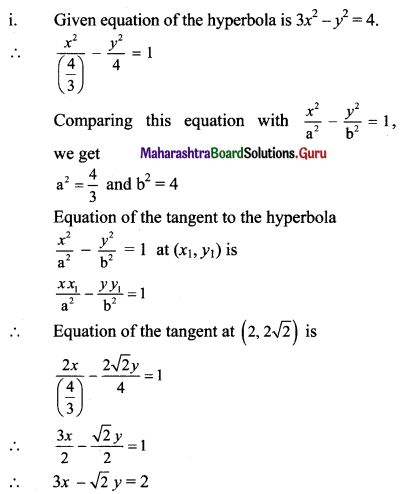
(i) 3x2 – y2 = 4 at the point (2, 2√2).
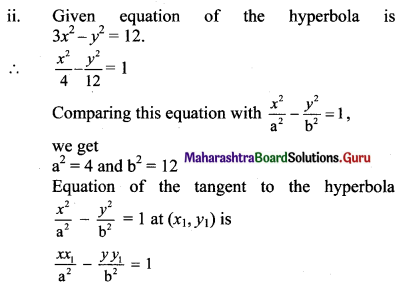
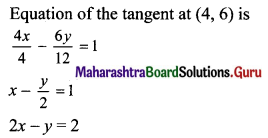
(ii) 3x2 – y2 = 12 at the point (4, 6)
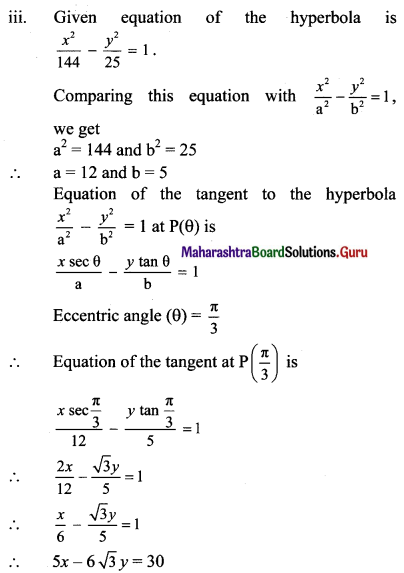
(iii) \(\frac{x^{2}}{144}-\frac{y^{2}}{25}=1\) at the point whose eccentric angle is \(\frac{\pi}{3}\).
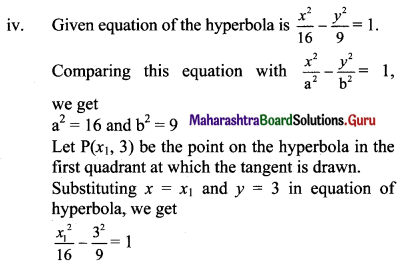
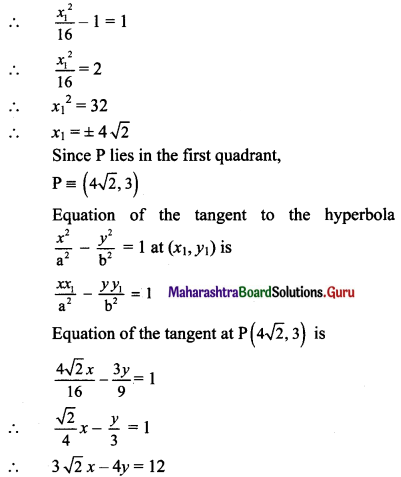
(iv) \(\frac{x^{2}}{16}-\frac{y^{2}}{9}=1\) at the point in a first quadrant whose ordinate is 3.
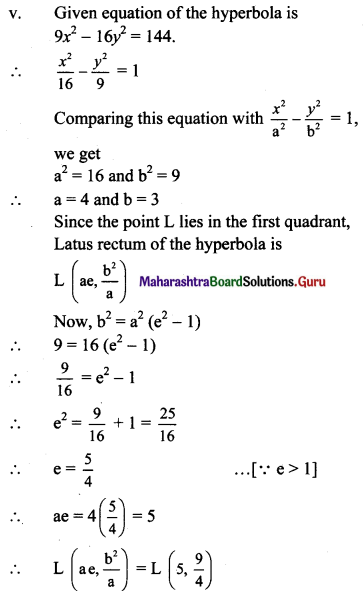
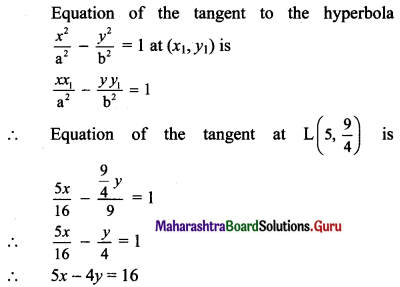
(v) 9x2 – 16y2 = 144 at the point L of the latus rectum in the first quadrant.
Solution:
Maharashtra Board 11th Maths Solutions Chapter 7 Conic Sections Ex 7.3 Q6
Maharashtra Board 11th Maths Solutions Chapter 7 Conic Sections Ex 7.3 Q6.1
Maharashtra Board 11th Maths Solutions Chapter 7 Conic Sections Ex 7.3 Q6.2
Maharashtra Board 11th Maths Solutions Chapter 7 Conic Sections Ex 7.3 Q6.3
Maharashtra Board 11th Maths Solutions Chapter 7 Conic Sections Ex 7.3 Q6.4
Maharashtra Board 11th Maths Solutions Chapter 7 Conic Sections Ex 7.3 Q6.5
Maharashtra Board 11th Maths Solutions Chapter 7 Conic Sections Ex 7.3 Q6.6
Maharashtra Board 11th Maths Solutions Chapter 7 Conic Sections Ex 7.3 Q6.7

Question 7.
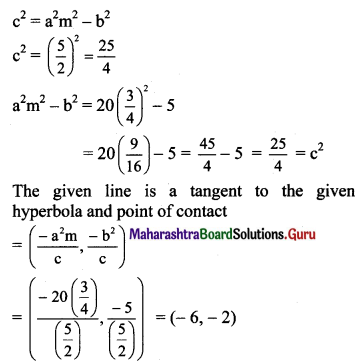
Show that the line 3x – 4y + 10 = 0 is a tangent to the hyperbola x2 – 4y2 = 20. Also, find the point of contact.
Solution:
Given equation of the hyperbola is x2 – 4y2 = 20
\(\frac{x^{2}}{20}-\frac{y^{2}}{5}=1\)
Comparing this equation with \(\frac{x^{2}}{\mathrm{a}^{2}}-\frac{y^{2}}{\mathrm{~b}^{2}}=1\), we get
a2 = 20 and b2 = 5
Given equation of line is 3x – 4y + 10 = 0.
y = \(\frac{3 x}{4}+\frac{5}{2}\)
Comparing this equation with y = mx + c, we get
m = \(\frac{3}{4}\) and c = \(\frac{5}{2}\)
For the line y = mx + c to be a tangent to the hyperbola \(\frac{x^{2}}{a^{2}}-\frac{y^{2}}{b^{2}}=1\), we must have
Maharashtra Board 11th Maths Solutions Chapter 7 Conic Sections Ex 7.3 Q7

Maharashtra Board 11th Maths Solutions Chapter 7 Conic Sections Ex 7.3

Question 8.
If the line 3x – 4y = k touches the hyperbola \(\frac{x^{2}}{5}-\frac{4 y^{2}}{5}=1\), then find the value of k.
Solution:
Given equation of the hyperbola is
\(\frac{x^{2}}{5}-\frac{4 y^{2}}{5}=1\)
\(\frac{x^{2}}{5}-\frac{y^{2}}{\frac{5}{4}}=1\)
Comparing this equation with \(\frac{x^{2}}{a^{2}}-\frac{y^{2}}{b^{2}}=1\), we get
a2 = 5, b2 = \(\frac{5}{4}\)
Given equation of line is 3x – 4y = k
y = \(\frac{3}{4} x-\frac{\mathrm{k}}{4}\)
Comparing this equation with y = mx + c, we get
m = \(\frac{3}{4}\), c = \(-\frac{\mathrm{k}}{4}\)
For the line y = mx + c to be a tangent to the hyperbola \(\frac{x^{2}}{a^{2}}-\frac{y^{2}}{b^{2}}=1\), we must have
c2 = a2 m2 – b2
⇒ \(\left(\frac{-\mathrm{k}}{4}\right)^{2}=5\left(\frac{3}{4}\right)^{2}-\frac{5}{4}\)
⇒ \(\frac{\mathrm{k}^{2}}{16}=\frac{5}{16}(9-4)\)
⇒ \(\frac{\mathrm{k}^{2}}{16}=\frac{5}{16}(5)\)
⇒ k2 = 25
⇒ k = ±5

Alternate method:
Given equation of the hyperbola is
\(\frac{x^{2}}{5}-\frac{4 y^{2}}{5}=1\) …….(i)
Given equation of the line is 3x – 4y = k
y = \(\frac{3 x-\mathrm{k}}{4}\)
Substituting this value ofy in (i), we get
\(\frac{x^{2}}{5}-\frac{4}{5}\left(\frac{3 x-\mathrm{k}}{4}\right)^{2}=1\)
⇒ \(\frac{x^{2}}{5}-\frac{4}{5}\left(\frac{9 x^{2}-6 k x+k^{2}}{16}\right)=1\)
⇒ 4x2 – (9x2 – 6kx + k2) = 20
⇒ 4x2 – 9x2 + 6kx – k2 = 20
⇒ -5x2 + 6kx – k2 = 20
⇒ 5x2 – 6kx + (k2 + 20) = 0 …..(ii)
Since, the given line touches the given hyperbola.
The quadratic equation (ii) in x has equal roots.
(-6k)2 – 4(5)(k2 + 20) = 0
⇒ 36k2 – 20k2 – 400 = 0
⇒ 16k2 = 400
⇒ k2 = 25
⇒ k = ±5

Question 9.
Find the equations of the tangents to the hyperbola \(\frac{x^{2}}{25}-\frac{y^{2}}{9}=1\) making equal intercepts on the co-ordinate axes.
Solution:
Given equation of the hyperbola is \(\frac{x^{2}}{25}-\frac{y^{2}}{9}=1\).
Comparing this equation with \(\frac{x^{2}}{\mathrm{a}^{2}}-\frac{y^{2}}{\mathrm{~b}^{2}}=1\), we get
a2 = 25 and b2 = 9
Since the tangents make equal intercepts on the co-ordinate axes,
∴ m = -1
Equations of tangents to the hyperbola \(\frac{x^{2}}{\mathrm{a}^{2}}-\frac{y^{2}}{\mathrm{~b}^{2}}=1\) having slope m are
y = mx ± \(\sqrt{a^{2} m^{2}-b^{2}}\)
⇒ y = -x ± \(\sqrt{25(-1)^{2}-9}\)
⇒ y = -x ± √16
⇒ x + y = ±4

Maharashtra Board 11th Maths Solutions Chapter 7 Conic Sections Ex 7.3

Question 10.
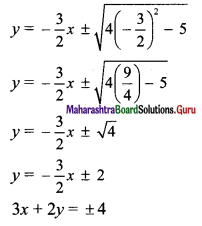
Find the equations of the tangents to the hyperbola 5x2 – 4y2 = 20 which are parallel to the line 3x + 2y + 12 = 0.
Solution:
Given equation of the hyperbola is 5x2 – 4y2 = 20
\(\frac{x^{2}}{4}-\frac{y^{2}}{5}=1\)
Comparing this equation with \(\frac{x^{2}}{a^{2}}-\frac{y^{2}}{b^{2}}=1\), we get
a2 = 4 and b2 = 5
Slope of the line 3x + 2y + 12 = 0 is \(-\frac{3}{2}\)
Since the given line is parallel to the tangents,
Slope of the required tangents (m) = \(-\frac{3}{2}\)
Equations of tangents to the hyperbola \(\frac{x^{2}}{a^{2}}-\frac{y^{2}}{b^{2}}=1\) having slope m are
y = mx ± \(\sqrt{a^{2} m^{2}-b^{2}}\)
Maharashtra Board 11th Maths Solutions Chapter 7 Conic Sections Ex 7.3 Q10

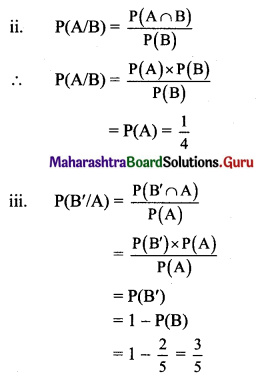
Maharashtra Board 11th Maths Solutions Chapter 9 Probability Miscellaneous Exercise 9

Balbharti Maharashtra State Board Class 11 Maths Solutions Pdf Chapter 9 Probability Miscellaneous Exercise 9 Questions and Answers.

Maharashtra State Board 11th Maths Solutions Chapter 9 Probability Miscellaneous Exercise 9

(I) Select the correct answer from the given four alternatives.

Question 1.
There are 5 girls and 2 boys, then the probability that no two boys are sitting together for a photograph is
(A) \(\frac{1}{21}\)
(B) \(\frac{4}{7}\)
(C) \(\frac{2}{7}\)
(D) \(\frac{5}{7}\)
Answer:
(D) \(\frac{5}{7}\)
Hint:
There are 5 girls and 2 boys.
They can be arranged among themselves in \({ }^{7} \mathrm{P}_{7}\) = 7! ways.
∴ Girls can be arranged among themselves in \({ }^{5} \mathrm{P}_{5}\) = 5! ways.
No two boys should sit together.
Let girls be denoted by the letter G.
– G – G – G – G – G –
There are 6 places, marked by ‘-’ where boys can sit.
∴ Boys can be arranged in
\({ }^{6} \mathrm{P}_{2}=\frac{6 !}{(6-2) !}\)
= \(\frac{6 \times 5 \times 4 !}{4 !}\)
= 30 ways.
∴ Required probability = \(\frac{5 ! \times 30}{7 !}=\frac{5 ! \times 30}{7 \times 6 \times 5 !}=\frac{5}{7}\)

Question 2.
In a jar, there are 5 black marbles and 3 green marbles. Two marbles are picked randomly one after the other without replacement. What is the possibility that both the marbles are black?
(A) \(\frac{5}{14}\)
(B) \(\frac{5}{8}\)
(C) \(\frac{5}{7}\)
(D) \(\frac{5}{16}\)
Answer:
(A) \(\frac{5}{14}\)

Maharashtra Board 11th Maths Solutions Chapter 9 Probability Miscellaneous Exercise 9

Question 3.
Two dice are thrown simultaneously. Then the probability of getting two numbers whose product is even is
(A) \(\frac{3}{4}\)
(B) \(\frac{1}{4}\)
(C) \(\frac{5}{7}\)
(D) \(\frac{1}{2}\)
Answer:
(A) \(\frac{3}{4}\)
Hint:
Two dice are thrown.
∴ n(S) = 36
Getting two numbers whose product is even, i.e., one of the two numbers must be even.
Let event A: Getting even number on first dice,
event B: Getting even number on second dice.
n(A) = 18, n(B) = 18, n(A ∩ B) = 9
Required probability = P(A ∩ B)
= \(\frac{n(A)+n(B)-n(A \cap B)}{n(S)}\)
= \(\frac{18+18-9}{36}\)
= \(\frac{3}{4}\)

Question 4.
In a set of 30 shirts, 17 are white and the rest are black. 4 white and 5 black shirts are tagged as ‘PARTY WEAR’. If a shirt is chosen at random from this set, the possibility of choosing a black shirt or a ‘PARTY WEAR’ shirt is
(A) \(\frac{11}{15}\)
(B) \(\frac{13}{30}\)
(C) \(\frac{9}{13}\)
(D) \(\frac{17}{30}\)
Answer:
(D) \(\frac{17}{30}\)
Hint:
17 white + 13 black = 30 shirts
4 white and 5 black are ‘PARTY WEAR’
A: Choosing a black shirt
∴ P(A) = \(\frac{{ }^{13} C_{1}}{{ }^{30} C_{1}}=\frac{13}{30}\)
B: Choosing a ‘PARTY WEAR’ shirt.
∴ P(B) = \(\frac{{ }^{9} \mathrm{C}_{1}}{{ }^{30} \mathrm{C}_{1}}=\frac{9}{30}\)
There are 5 black ‘PARTY WEAR’ shirts.
∴ P(A ∩ B) = \(\frac{{ }^{5} \mathrm{C}_{1}}{{ }^{30} \mathrm{C}_{1}}=\frac{5}{30}\)
∴ Required probability
P(A ∪ B) = P(A) + P(B) – P(A ∩ B)
= \(\frac{13}{30}\) + \(\frac{9}{30}\) – \(\frac{5}{30}\)
= \(\frac{17}{30}\)

Question 5.
There are 2 shelves. One shelf has 5 Physics and 3 Biology books and the other has 4 Physics and 2 Biology books. The probability of drawing a Physics book is
(A) \(\frac{9}{14}\)
(B) \(\frac{31}{48}\)
(C) \(\frac{9}{38}\)
(D) \(\frac{1}{2}\)
Answer:
(B) \(\frac{31}{48}\)
Hint:
Let event S1: First shelve is selected,
event S2: Second shelve is selected,
event P: Drawing a physics book.
∴ P(S1) = \(\frac{1}{2}\) and P(S2) = \(\frac{1}{2}\)
First shelve has 5 physics and 3 biology books, i.e., total 8 books.
∴ P(P/S1) = \(\frac{{ }^{5} C_{1}}{{ }^{8} C_{1}}=\frac{5}{8}\)
Similarly, P(P/S2) = \(\frac{{ }^{4} C_{1}}{{ }^{6} C_{1}}=\frac{4}{6}=\frac{2}{3}\)
∴ P(P) = P(S1) . P(P/S1) + P(S2) . P(P/S2)
= \(\frac{1}{2} \times \frac{5}{8}+\frac{1}{2} \times \frac{2}{3}\)
= \(\frac{31}{48}\)

Maharashtra Board 11th Maths Solutions Chapter 9 Probability Miscellaneous Exercise 9

Question 6.
Two friends A and B apply for a job in the same company. The chances of A getting selected is 2/5 and that of B is 4/7. The probability that both of them get selected is
(A) \(\frac{34}{35}\)
(B) \(\frac{1}{35}\)
(C) \(\frac{8}{35}\)
(D) \(\frac{27}{35}\)
Answer:
(C) \(\frac{8}{35}\)

Question 7.
The probability that a student knows the correct answer to a multiple-choice question is \(\frac{2}{3}\). If the student does not know the answer, then the student guesses the answer. The probability of the guessed answer being correct is \(\frac{1}{4}\). Given that the student has answered the question correctly, the probability that the student knows the correct answer is
(A) \(\frac{5}{6}\)
(B) \(\frac{6}{7}\)
(C) \(\frac{7}{8}\)
(D) \(\frac{8}{9}\)
Answer:
(D) \(\frac{8}{9}\)
Hint:
Let event A: Student knows the correct answer,
event A’: Student guesses the answer,
event B: Answer is correct.
∴ P(A) = \(\frac{2}{3}\), P(A’) = \(\frac{1}{3}\), P(B/A’) = \(\frac{1}{4}\)
Clearly, P(B/A) = 1
Required probability = P(A/B)
= \(\frac{\mathrm{P}(\mathrm{A}) \cdot \mathrm{P}(\mathrm{B} / \mathrm{A})}{\mathrm{P}(\mathrm{A}) \cdot \mathrm{P}(\mathrm{B} / \mathrm{A})+\mathrm{P}\left(\mathrm{A}^{\prime}\right) \mathrm{P}\left(\mathrm{B} / \mathrm{A}^{\prime}\right)}\)
= \(\frac{\frac{2}{3} \times 1}{\frac{2}{3} \times 1+\frac{1}{3} \times \frac{1}{4}}\)
= \(\frac{8}{9}\)

Question 8.
The bag I contain 3 red and 4 black balls while Bag II contains 5 red and 6 black balls. One ball is drawn at random from one of the bags and it is found to be red. The probability that it was drawn from Bag II is
(A) \(\frac{33}{68}\)
(B) \(\frac{35}{69}\)
(C) \(\frac{34}{67}\)
(D) \(\frac{35}{68}\)
Answer:
(D) \(\frac{35}{68}\)

Question 9.
A fair die is tossed twice. What are the odds in favour of getting 4, 5, or 6 on the first toss and 1, 2, 3, or 4 on the second toss?
(A) 1 : 3
(B) 3 : 1
(C) 1 : 2
(D) 2 : 1
Answer:
(C) 1 : 2
Hint:
A fair dice is tossed twice.
∴ n(S) = 36
A: Getting 4, 5, or 6 on the first toss and Getting 1, 2, 3, or 4 on the second toss.
∴ A = {(4, 1), (4, 2), (4, 3), (4, 4), (5, 1), (5, 2), (5, 3), (5, 4), (6, 1), (6, 2), (6, 3), (6, 4)}
∴ P(A) = \(\frac{n(A)}{n(S)}=\frac{12}{36}=\frac{1}{3}\)
∴ Required answer = P(A) : P(A’) = 1 : 2

Maharashtra Board 11th Maths Solutions Chapter 9 Probability Miscellaneous Exercise 9

Question 10.
The odds against an event are 5 : 3 and the odds in favour of another independent event are 7 : 5. The probability that at least one of the two events will occur is
(A) \(\frac{52}{96}\)
(B) \(\frac{71}{96}\)
(C) \(\frac{69}{96}\)
(D) \(\frac{13}{96}\)
Answer:
(B) \(\frac{71}{96}\)

(II) Solve the following.

Question 1.
The letters of the word ‘EQUATION’ are arranged in a row. Find the probability that
(i) all the vowels are together
(ii) arrangement starts with a vowel and ends with a consonant.
Solution:
The letters of the word EQUATION can be arranged in 8! ways.
∴ n(S) = 8!
There are 5 vowels and 3 consonants.
(i) A: all vowels are together we need to arrange (E, U, A, I, O), Q, T, N
Let us consider all vowels as one unit.
So, there are 4 units, which can be arranged in 4! ways.
Also, 5 vowels can be arranged among themselves in 5! ways.
∴ n(A) = 4! × 5!
Required probability = P(A)
= \(\frac{n(A)}{n(S)}\)
= \(\frac{4 ! \times 5 !}{8 !}\)
= \(\frac{1}{14}\)

(ii) B: arrangement start with a vowel and ends with a consonant.
First and last places can be filled in 5 and 3 ways respectively.
Remaining 6 letters are arranged in 6! Ways.
∴ n(B) = 5 × 3 × 6!
Required probability = P(B)
= \(\frac{n(B)}{n(S)}\)
= \(\frac{5 \times 3 \times 6 !}{8 !}\)
= \(\frac{15}{56}\)

Maharashtra Board 11th Maths Solutions Chapter 9 Probability Miscellaneous Exercise 9

Question 2.
There are 6 positive and 8 negative numbers. Four numbers are chosen at random, without replacement, and multiplied. Find the probability that the product is a positive number.
Solution:
Let event A: Four positive numbers are chosen,
event B: Four negative numbers are chosen,
event C: Two positive and two negative numbers are chosen.
Since four numbers are chosen without replacement,
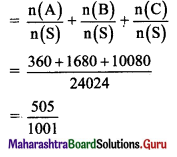
n(A) = 6 × 5 × 4 × 3 = 360
n(B) = 8 × 7 × 6 × 5 = 1680
In event C, four numbers are to be chosen without replacement such that two numbers are positive and two numbers ate negative. This can be done in following ways:
+ + – – OR + – + – OR + – – + OR – + – + OR – – + + OR – + + –
∴ n(C) = 6 × 5 × 8 × 7 + 6 × 8 × 5 × 7 + 6 × 8 × 7 × 5 + 8 × 6 × 7 × 5 + 6 × 5 × 8 × 7 + 8 × 6 × 5 × 7
= 6 × (8 × 7 × 6 × 5)
=10080
Here, total number of numbers = 14
∴ n(S) = 14 × 13 × 12 × 11 = 24024
Since A, B, C are mutually exclusive events,
Required probability = P(A) + P(B) + P(C)
Maharashtra Board 11th Maths Solutions Chapter 9 Probability Miscellaneous Exercise 9 II Q2

Question 3.
Ten cards numbered 1 to 10 are placed in a box, mixed up thoroughly, and then one card is drawn randomly. If it is known that the number on the drawn card is more than 3, what is the probability that it is an even number?
Solution:
S = {1, 2,…., 10}
∴ n(S) = 10
A: Number is more than 3.
A = {4, 5, 6, 7, 8, 9, 10}
∴ n(A) = 7
∴ P(A) = \(\frac{n(A)}{n(S)}=\frac{7}{10}\)
B: Number is even.
B = {2, 4, 6, 8, 10}
∴ A ∩ B = {4, 6, 8, 10}
∴ n(A ∩ B) = 4
∴ P(A ∩ B) = \(\frac{\mathrm{n}(\mathrm{A} \cap \mathrm{B})}{\mathrm{n}(\mathrm{S})}=\frac{4}{10}\)
Required probability = P(B/A)
= \(\frac{P(A \cap B)}{P(A)}\)
= \(\frac{\left(\frac{4}{10}\right)}{\left(\frac{7}{10}\right)}\)
= \(\frac{4}{7}\)

Maharashtra Board 11th Maths Solutions Chapter 9 Probability Miscellaneous Exercise 9

Question 4.
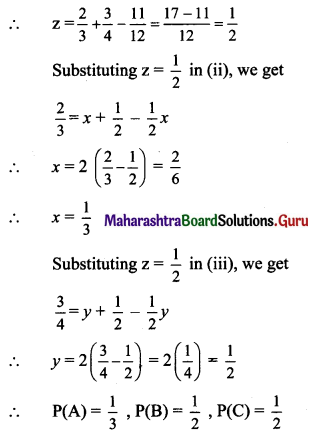
If A, B and C are independent events, P(A ∩ B) = \(\frac{1}{2}\), P(B ∩ C) = \(\frac{1}{3}\), P(C ∩ A) = \(\frac{1}{6}\), then find P(A), P(B) and P(C).
Solution:
Since A and B are independent events,
P(A ∩ B) = P(A) . P(B)
∴ P(A) . P(B) = \(\frac{1}{2}\) ……(i)
B and C are independent events.
∴ P(B ∩ C) = P(B) . P(C)
∴ P(B) . P(C) = \(\frac{1}{3}\) ……(ii)
A and C are independent events.
∴ P(A ∩ C) = P(A) . P(C)
∴ P(A) . P(C) = \(\frac{1}{6}\) ……(iii)
Dividing (i) by (ii), we get
\(\frac{\mathrm{P}(\mathrm{A}) \mathrm{P}(\mathrm{B})}{\mathrm{P}(\mathrm{B}) \mathrm{P}(\mathrm{C})}=\frac{\frac{1}{2}}{\frac{1}{3}}\)
P(A) = \(\frac{3}{2}\) P(C) ……(iv)
Substituting equation (iv) in (iii), we get
\(\frac{3}{2}\) P(C) . P(C) = \(\frac{1}{6}\)
[P(C)]2 = \(\frac{1}{9}\)
∴ P(C) = \(\frac{1}{3}\)
Substituting P(C) = \(\frac{1}{3}\) in equation (ii), we get P(B) = 1
Substituting P(B) = 1 in equation (i), we get P(A) = \(\frac{1}{2}\)

Question 5.
If the letters of the word ‘REGULATIONS’ be arranged at random, what is the probability that there will be exactly 4 letters between R and E?
Solution:
There are 11 letters in the word ‘REGULATIONS’ which can be arranged among themselves in 11! ways.
∴ n(S) = 11!
Let event A: There will be exactly 4 letters between R and E.
R, E can occur at (1, 6), (2, 7), ….,(6, 11) positions. So, there are 6 possibilities.
Also, R and E can interchange their positions.
So, R, E can be arranged in 2 × 6 = 12 ways.
Remaining 9 letters can be arranged in 9! ways.
∴ n(A) = 12 × 9!
∴ P(A) = \(\frac{\mathrm{n}(\mathrm{A})}{\mathrm{n}(\mathrm{S})}=\frac{12 \times 9 !}{11 !}=\frac{12 \times 9 !}{11 \times 10 \times 9 !}=\frac{6}{55}\)

Question 6.
In how many ways can the letters of the word ARRANGEMENTS be arranged?
(i) Find the chance that an arrangement chosen at random begins with the letters EE.
(ii) Find the probability that the consonants are together.
Solution:
The word ‘ARRANGEMENTS’ has 12 letters in which 2A, 2E, 2N, 2R, G, M, T, S are there.
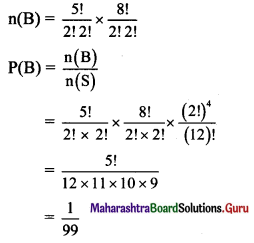
n(S) = Total number of arrangements = \(\frac{12 !}{2 ! 2 ! 2 ! 2 !}=\frac{12 !}{(2 !)^{4}}\)
(i) A: Arrangement chosen at random begins with the letters EE.
If the first and second places are filled with EE, there are 10 letters left in which 2A, 2N, 2R, G, M, T, S are there.
∴ n(A) = \(\frac{10 !}{2 ! 2 ! 2 !}=\frac{10 !}{(2 !)^{3}}\)

(ii) B: Consonants (G, M, T, S, 2N, 2R) are together.
2A, 2E, and the group containing consonants form total 5 units. Which can be arranged in \(\frac{5 !}{2 ! 2 !}\) ways.
Also, 8 consonants can be arranged among themselves in \(\frac{8 !}{2 ! 2 !}\) ways.
Maharashtra Board 11th Maths Solutions Chapter 9 Probability Miscellaneous Exercise 9 II Q6

Maharashtra Board 11th Maths Solutions Chapter 9 Probability Miscellaneous Exercise 9

Question 7.
A letter is taken at random from the letters of the word ‘ASSISTANT’ and another letter is taken at random from the letters of the word ‘STATISTICS’. Find the probability that the selected letters are the same.
Solution:
Word ASSISTANT has 2A, I, N, 3S, 2T, and word STATISTICS has A, C, 2I, 3S, 3T.
C and N are uncommon letters.
In the words ASSISTANT, there are 9 letters out of which 2 letters are ‘A’, and in the word STATISTICS, there are 10 letters, out of which 1 letter is A.
∴ Probability of choosing A from both the letters = \(\frac{{ }^{2} C_{1}}{{ }^{9} C_{1}} \times \frac{{ }^{1} C_{1}}{{ }^{10} C_{1}}=\frac{2}{9} \times \frac{1}{10}=\frac{1}{45}\)
Similarly,
Probability of choosing I from both the letters = \(\frac{{ }^{1} \mathrm{C}_{1}}{{ }^{9} \mathrm{C}_{1}} \times \frac{{ }^{2} \mathrm{C}_{1}}{{ }^{10} \mathrm{C}_{1}}=\frac{1}{9} \times \frac{2}{10}=\frac{1}{45}\)
Probability of choosing S from both the letters = \(\frac{{ }^{3} \mathrm{C}_{1}}{{ }^{9} \mathrm{C}_{1}} \times \frac{{ }^{3} \mathrm{C}_{1}}{{ }^{10} \mathrm{C}_{1}}=\frac{3}{9} \times \frac{3}{10}=\frac{1}{10}\)
Probability of choosing T from both the letters = \(\frac{{ }^{2} C_{1}}{{ }^{9} C_{1}} \times \frac{{ }^{3} C_{1}}{{ }^{10} C_{1}}=\frac{2}{9} \times \frac{3}{10}=\frac{1}{15}\)
Required probability = \(\frac{1}{45}+\frac{1}{45}+\frac{1}{10}+\frac{1}{15}\) = \(\frac{19}{90}\)

Question 8.
A die is loaded in such a way that the probability of the face with j dots turning up is proportional to j for j = 1, 2,….., 6. What is the probability, in one roil of the die, that an odd number of dots will turn up?
Solution:
According to the given condition, the probability of the face with 1, 2, 3, 4, 5, 6 dots turning up is proportional to 1, 2, 3, 4, 5, 6.
Let k be the common ration of proportionality.
∴ The probabilities of the faces with 1, 2, 3, 4, 5, 6 dots turning up are 1k , 2k, 3k, 4k, 5k, 6k respectively.
Since sum of the probabilities = 1,
k(1 + 2+ ….. + 6) = 1
k(\(\frac{6 \times 7}{2}\)) = 1
k = \(\frac{1}{21}\)
Required probability = P(1) + P(3) + P(5)
= \(\frac{1}{21}+\frac{3}{21}+\frac{5}{21}\)
= \(\frac{9}{21}\)
= \(\frac{3}{7}\)

Question 9.
An urn contains 5 red balls and 2 green balls. A ball is drawn. If it’s green, a red ball is added to the urn, and if it’s red, a green ball is added to the urn. (The original ball is not returned to the urn). Then a second ball is drawn. What is the probability that the second ball is red?
Solution:
A: Event of drawing a red ball and placing a green ball in the urn
B: Event of drawing a green ball and placing a red ball
C: Event of drawing a red ball in the second draw
P(A) = \(\frac{5}{7}\)
P(B) = \(\frac{2}{7}\)
P(C/A) = \(\frac{4}{7}\)
P(C/B) = \(\frac{6}{7}\)
Required probability
P(C) = P(A) P(C/A) + P(B) P(C/B)
= \(\frac{5}{7} \times \frac{4}{7}+\frac{2}{7} \times \frac{6}{7}\)
= \(\frac{32}{49}\)

Maharashtra Board 11th Maths Solutions Chapter 9 Probability Miscellaneous Exercise 9

Question 10.
The odds against A solving a certain problem are 4 to 3 and the odds in favour of B solving the same problem are 7 to 5, find the probability that the problem will be solved.
Solution:
The odds against A solving the problems are 4 : 3.
Let P(A’) = P(A does not solve the problem) = \(\frac{4}{4+3}=\frac{4}{7}\)
So, the probability that A solves the problem = P(A) = 1 – P(A’)
= 1 – \(\frac{4}{7}\)
= \(\frac{3}{7}\)
Similarly, let P(B) = P(B solves the problem)
Since odds in favour of B solving the problem are 7 : 5.
∴ P(B) = \(\frac{7}{7+5}=\frac{7}{12}\)
Required probability
P(A ∪ B) = P(A) + P(B) – P(A ∩ B)
Since A and B are independent events.
∴ P(A ∩ B) = P(A) . P(B)
∴ Required probability = P(A) + P(B) – P(A) . P(B)
= \(\frac{3}{7}+\frac{7}{12}-\frac{3}{7} \times \frac{7}{12}\)
= \(\frac{16}{21}\)

Question 11.
If P(A) = P(A/B) = \(\frac{1}{5}\), P(B/A) = \(\frac{1}{3}\), then find
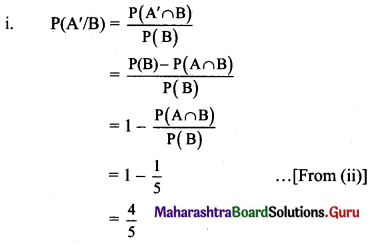
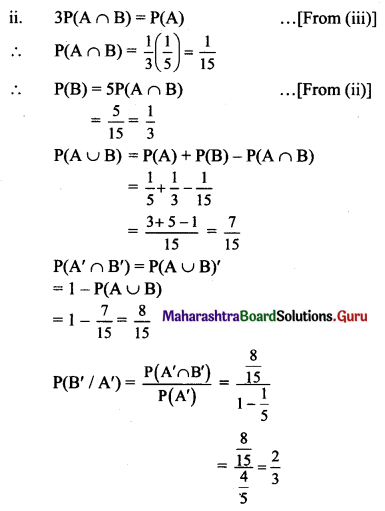
(i) P(A’/B)
(ii) P(B’/A’)
Solution:
Since P(A) = P(A/B) = \(\frac{1}{5}\)
P(A) = \(\frac{1}{5}\)
and \(\frac{P(A \cap B)}{P(B)}=\frac{1}{5}\)
∴ P(A) = \(\frac{1}{5}\) ……(i)
P(B) = 5 P(A ∩ B) ……..(ii)
Since P(B/A) = \(\frac{1}{3}\)
\(\frac{P(A \cap B)}{P(A)}=\frac{1}{3}\)
∴ P(A) = 3 P(A ∩ B) ………(iii)
Maharashtra Board 11th Maths Solutions Chapter 9 Probability Miscellaneous Exercise 9 II Q11
Maharashtra Board 11th Maths Solutions Chapter 9 Probability Miscellaneous Exercise 9 II Q11.1

Question 12.
Let A and B be independent events with P(A) = \(\frac{1}{4}\) and P(A ∪ B) = 2P(B) – P(A). Find
(i) P(B)
(ii) P(A/B)
(iii) P(B’/A)
Solution:
A and B are independent events. .
∴ P(A ∩ B) = P(A) × P(B)
(i) P(A ∪ B) = P(A) + P(B) – P(A ∩ B)
∴ P(A ∪ B) = P(A) + P(B) – P(A) × P(B)
∴ 2P(B) – P(A) = P(A) + P(B) – P(A) × P(B) ……[∵ P(A ∪ B) = 2P(B) – P(A)]
∴ 2P(B) – \(\frac{1}{4}\) = \(\frac{1}{4}\) + P(B) – \(\frac{1}{4}\) × P(B)
∴ 2P(B) – P(B) + \(\frac{1}{4}\) P(B) = \(\frac{1}{4}\) + \(\frac{1}{4}\)
Maharashtra Board 11th Maths Solutions Chapter 9 Probability Miscellaneous Exercise 9 II Q12

Maharashtra Board 11th Maths Solutions Chapter 9 Probability Miscellaneous Exercise 9

Question 13.
Find the probability that a year selected will have 53 Wednesdays.
Solution:
A leap year comes after 3 years.
∴ The probability of a year being a leap year = \(\frac{1}{4}\)
∴ Probability of a year being a non-leap year = 1 – \(\frac{1}{4}\) = \(\frac{3}{4}\)
In a non-leap year, there are 52 weeks and one extra day, whereas a leap year has 52 weeks and 2 extra days.
∴ 53rd Wednesday’s chance in a non-leap year = \(\frac{1}{7}\)
Two extra days of a leap year can be
(Mon, Tue), (Tue, Wed), (Wed, Thu), (Thu, Fri), (Fri, Sat), (Sat, Sun), (Sun, Mon)
∴ There are 2 possibilities of 53rd Wednesday in a leap year.
∴ 53rd Wednesday’s chance in a leap year = \(\frac{2}{7}\)
Required probability = P(a non-leap year and Wednesday) + P(a leap year and Wednesday)
= \(\frac{3}{4} \times \frac{1}{7}+\frac{1}{4} \times \frac{2}{7}\)
= \(\frac{5}{28}\)

Question 14.
The chances of P, Q and R, getting selected as principal of a college are \(\frac{2}{5}\), \(\frac{2}{5}\), \(\frac{1}{5}\) respectively. Their chances of introducing IT in the college are \(\frac{1}{2}\), \(\frac{1}{3}\), \(\frac{1}{4}\) respectively. Find the probability that
(a) IT is introduced in the college after one of them is selected as a principal.
(b) IT is introduced by Q.
Solution:
Let event P: P become principal,
event Q: Q become principal,
event R: R become principal,
event E: Subject IT is introduced.
Given, P(P) = \(\frac{2}{5}\)
P(Q) = \(\frac{2}{5}\)
P(R) = \(\frac{1}{5}\)
P(E/P) = \(\frac{1}{2}\)
P(E/Q) = \(\frac{1}{3}\)
P(E/R) = \(\frac{1}{4}\)
(a) Required probability
P(E) = P(P) P(E/P) + P(Q) P(E/Q) + P(R) P(E/R)
= \(\frac{2}{5} \times \frac{1}{2}+\frac{2}{5} \times \frac{1}{3}+\frac{1}{5} \times \frac{1}{4}\)
= \(\frac{1}{5}+\frac{2}{15}+\frac{1}{20}\)
= \(\frac{12+8+3}{60}\)
= \(\frac{23}{60}\)

(b) Required probability = P(Q/E)
By Bayes’ theorem,
P(Q/E) = \(\frac{P(Q) P(E / Q)}{P(E)}\)
= \(\frac{\frac{2}{5} \times \frac{1}{3}}{\frac{23}{60}}\)
= \(\frac{8}{23}\)

Maharashtra Board 11th Maths Solutions Chapter 9 Probability Miscellaneous Exercise 9

Question 15.
Suppose that five good fuses and two defective ones have been mixed up. To find the defective fuses, we test them one-by-one, at random and without replacement What is the probability that we are lucky and find both of the defective fuses in the first two tests?
Solution:
Number of fuses = 5 + 2 = 7
Testing two fuses one-by-one at random, without replacement from 7 can be done in \({ }^{7} \mathrm{C}_{1} \times{ }^{6} \mathrm{C}_{1}\) ways.
∴ n(S) = \({ }^{7} \mathrm{C}_{1} \times{ }^{6} \mathrm{C}_{1}\) = 7 × 6 = 42
Let event A: Getting defective fuses in the first two tests without replacement.
There are two defective fuses.
∴ n(A) = \({ }^{2} \mathrm{C}_{1} \times{ }^{1} \mathrm{C}_{1}\) = 2 × 1 = 2
∴ P(A) = \(\frac{n(A)}{n(S)}=\frac{2}{42}=\frac{1}{21}\)

Question 16.
For three events A, B and C, we know that A and C are independent, B and C are independent, A and B are disjoint, P(A ∪ C) = \(\frac{2}{3}\), P(B ∪ C) = \(\frac{3}{4}\), P(A ∪ B ∪ C) = \(\frac{11}{12}\). Find P(A), P(B) and P(C).
Solution:
Let P(A) = x, P(B) = y, P(C) = z
Since A, B are disjoint,
A ∩ B = Φ and A ∩ B ∩ C = Φ
∴ P(A ∩ B) = 0, P(A ∩ B ∩ C) = 0 ……(i)
Since A and C are independent,
P(A ∩ C) = P(A) P(C) = xz
Since B and C are independent,
P(B ∩ C) = P(B) P(C) = yz
P(A ∪ C) = P(A) + P(C) – P(A ∩ C)
∴ \(\frac{2}{3}\) = x + z – xz ……..(ii)
P(B ∪ C) = P(B) + P(C) – P(B ∩ C)
∴ \(\frac{3}{4}\) = y + z – yz ………(iii)
P(A ∪ B ∪ C) = P(A) + P(B) + P(C) – P(A ∩ B) – P(B ∩ C) – P(C ∩ A) + P(A ∩ B ∩ C)
\(\frac{11}{12}\) = x + y + z – 0 – yz – zx + 0 …… [From(i)]
= (x + z – xz) + (y + z – yz) – z
= \(\frac{2}{3}+\frac{3}{4}\) – z ……. [From (ii) and (iii)]
Maharashtra Board 11th Maths Solutions Chapter 9 Probability Miscellaneous Exercise 9 II Q16

Question 17.
The ratio of boys to girls in a college is 3 : 2 and 3 girls out of 500 and 2 boys out of 50 of that college are good singers. A good singer is chosen. What is the probability that the chosen singer is a girl?
Solution:
Let event S: The student is a good singer,
event B: The student is a boy,
event G: The student is a girl.
Since the ratio of boys to girls is 3 : 2 and 3 girls out of 500 and 2 boys out of 50 are good singers.
Maharashtra Board 11th Maths Solutions Chapter 9 Probability Miscellaneous Exercise 9 II Q17

Maharashtra Board 11th Maths Solutions Chapter 9 Probability Miscellaneous Exercise 9

Question 18.
A and B throw a die alternatively till one of them gets a 3 and wins the game. Find the respective probabilities of winning. (Assuming A begins the game).
Solution:
Since P(getting 3) = \(\frac{1}{6}\),
P(not getting 3) = 1 – \(\frac{1}{6}\) = \(\frac{5}{6}\)
In 1st throw if A gets 3, A wins
∴ P(A win) = \(\frac{1}{6}\)
In 2nd throw by B (i.e., A does not get 3),
∴ P(B wins) = \(\frac{5}{6} \times \frac{1}{6}\)
In 3rd throw by A, P(A wins) = \(\frac{5}{6} \times \frac{5}{6} \times \frac{1}{6}\)
(3rd throw by A shows that B has lost in 2nd throw) and so on.
Maharashtra Board 11th Maths Solutions Chapter 9 Probability Miscellaneous Exercise 9 II Q18

Question 19.
Consider independent trials consisting of rolling a pair of fair dice, over and over. What is the probability that a sum of 5 appears before a sum of 7?
Solution:
When two dice are thrown, the sample space is
S = {(1, 1), (1, 2), (1, 3), (1, 4), (1, 5), (1, 6), (2, 1), (2, 2), (2, 3), (2, 4), (2, 5), (2, 6), (3, 1), (3, 2), (3, 3), (3, 4), (3, 5), (3, 6), (4, 1), (4, 2), (4, 3), (4, 4), (4, 5), (4, 6), (5, 1), (5, 2), (5, 3), (5, 4), (5, 5), (5, 6), (6, 1), (6, 2), (6, 3), (6, 4), (6, 5), (6, 6)}
∴ n(S) = 36
Let event A: The sum is 5 in a trial.
A = {(2, 3), (3, 2), (1, 4), (4, 1)}
∴ P(A) = \(\frac{4}{36}=\frac{1}{9}\)
Let event B: The sum is 7 in a trial.
B = {(2, 5), (5, 2), (3, 4), (4, 3), (1, 6), (6, 1)}
∴ P(B) = \(\frac{6}{36}=\frac{1}{6}\)
Let event C: Neither sum is 5 nor 7.
P(C) = 1 – P(A) – P(B)
= 1 – \(\frac{1}{9}\) – \(\frac{1}{6}\)
= \(\frac{26}{36}\)
Let the sum of 5 appear in the nth trial for the first time and the sum of 7 has not occurred in the first (n – 1) trials.
Maharashtra Board 11th Maths Solutions Chapter 9 Probability Miscellaneous Exercise 9 II Q19

Question 20.
A machine produces parts that are either good (90%), slightly defective (2%), or obviously defective (8%). Produced parts get passed through an automatic inspection machine, which is able to detect any part that is obviously defective and discard it. What is the probability that the quality of the parts that make it through the inspection machine and get shipped?
Solution:
Let event G: The event that machine produces a good part,
event S: The event that machine produces a slightly defective part,
event D: The event that machine produces an obviously defective part.
Maharashtra Board 11th Maths Solutions Chapter 9 Probability Miscellaneous Exercise 9 II Q20

Maharashtra Board 11th Maths Solutions Chapter 9 Probability Miscellaneous Exercise 9

Question 21.
Given three identical boxes, I, II, and III, each containing two coins. In box I, both coins are gold coins, in box II, both are silver coins and in box III, there is one gold and one silver coin. A person chooses a box at random and takes out a coin. If the coin is of gold, what is the probability that the other coin in the box is also of gold?
Solution:
Let event B1: Select box I having two gold coins.
event B2: Selecting box II having two silver coins,
event B3: Selecting box III having one silver and one gold coin,
event G: Coin is gold.
Maharashtra Board 11th Maths Solutions Chapter 9 Probability Miscellaneous Exercise 9 II Q21
To find the probability that the other can in the box is also gold. Which is possible only when it is drawn from the box I.
∴ Required probability = P(B1/G)
By Bayes’ theorem,
Maharashtra Board 11th Maths Solutions Chapter 9 Probability Miscellaneous Exercise 9 II Q21.1

Question 22.
In a factory which manufactures bulbs, machines A, B, and C manufacture respectively 25%, 35% and 40% of the bulbs. Of their outputs, 5, 4, and 2 percent are respectively defective bulbs. A bulb is drawn at random from the product and is found to be defective. What is the probability that it is manufactured by machine B?
Solution:
Let event A: Bulb manufactured by machine A
event B: Bulb manufactured by machine B
event C: Bulb manufactured by machine C
event D: Bulb defective
∴ P(A) = \(\frac{25}{100}\)
P(B) = \(\frac{35}{100}\)
P(C) = \(\frac{40}{100}\)
Machines A, B and C manufacture respectively 25%, 35% and 40% of the bulbs.
Of their outputs, 5, 4, and 2 percent are respectively defective bulbs.
Maharashtra Board 11th Maths Solutions Chapter 9 Probability Miscellaneous Exercise 9 II Q22
Required probability = P(B/D)
By Bayes’ theorem,
Maharashtra Board 11th Maths Solutions Chapter 9 Probability Miscellaneous Exercise 9 II Q22.1

Maharashtra Board 11th Maths Solutions Chapter 9 Probability Miscellaneous Exercise 9

Question 23.
A family has two children. One of them is chosen at random and found that the child is a girl. Find the probability that
(i) both the children are girls.
(ii) both the children are girls given that at least one of them is a girl.
Solution:
A family has two children.
∴ Sample space S = {BB, BG, GB, GG}
(i) A: First child is a girl.
∴ A = {GB, GG}
∴ P(A) = \(\frac{2}{4}=\frac{1}{2}\)
B: Second child is a girl.
∴ B = {BG, GG}
∴ A ∩ B = {GG}
∴ P(A ∩ B) = \(\frac{1}{4}\)
Required probability
P(B/A) = \(\frac{\mathrm{P}(\mathrm{A} \cap \mathrm{B})}{\mathrm{P}(\mathrm{A})}=\frac{\frac{1}{4}}{\frac{1}{2}}=\frac{1}{2}\)

(ii) A: At least one of the children is a girl.
∴ A = {GG, GB, BG}
∴ P(A) = \(\frac{3}{4}\)
B: both children are girls.
B = {GG}
∴ P(B) = \(\frac{1}{4}\)
Also, A ∩ B = B
Maharashtra Board 11th Maths Solutions Chapter 9 Probability Miscellaneous Exercise 9 II Q23

Maharashtra Board 11th Maths Solutions Chapter 9 Probability Ex 9.3

Balbharti Maharashtra State Board Class 11 Maths Solutions Pdf Chapter 9 Probability Ex 9.3 Questions and Answers.

Maharashtra State Board 11th Maths Solutions Chapter 9 Probability Ex 9.3

Question 1.
A bag contains 3 red marbles and 4 blue marbles. Two marbles are drawn at random without replacement. If the first marble drawn is red, what is the probability that the second marble is blue?
Solution:
Total number of marbles = 3 + 4 = 7
Let event A: The first marble drawn is red.
∴ P(A) = \(\frac{{ }^{3} \mathrm{C}_{1}}{{ }^{7} \mathrm{C}_{1}}=\frac{3}{7}\)
Let event B: The second marble drawn is blue.
Since the first red marble is not replaced in the bag, we now have 6 marbles out of which 4 are blue.
∴ Probability that the second marble is blue under the condition that the first red marble is not replaced in the bag = P(B/A) = \(\frac{{ }^{4} \mathrm{C}_{1}}{{ }^{6} \mathrm{C}_{1}}=\frac{4}{6}=\frac{2}{3}\)
∴ Required probability = P(A ∩ B) = P(B/A) . P(A)
= \(\frac{2}{3} \times \frac{3}{7}\)
= \(\frac{2}{7}\)

Alternate Method:
Total number of marbles = 3 + 4 = 7
Two marbles are drawn at random without replacement.
∴ n(S) = \({ }^{7} \mathrm{C}_{1} \times{ }^{6} \mathrm{C}_{1}\) = 7 × 6 = 42
Let event A: The first marble is red and second marble is blue.
First red marble can be drawn from 3 red marbles in \({ }^{3} \mathrm{C}_{1}\) ways and second blue marble can be drawn from 4 blue marbles in \({ }^{4} \mathrm{C}_{1}\) ways.
∴ n(A) = \({ }^{3} \mathrm{C}_{1} \times{ }^{4} \mathrm{C}_{1}\) = 3 × 4 = 12
∴ P(A) = \(\frac{n(A)}{n(S)}=\frac{12}{42}=\frac{2}{7}\)

Maharashtra Board 11th Maths Solutions Chapter 9 Probability Ex 9.3

Question 2.
A box contains 5 green pencils and 7 yellow pencils. Two pencils are chosen at random from the box without replacement. What is the probability that both are yellow?
Solution:
Total number of pencils = 5 + 7 = 12
Let event A: The first pencil chosen is yellow.
∴ P(A) = \(\frac{{ }^{7} \mathrm{C}_{1}}{{ }^{12} \mathrm{C}_{1}}=\frac{7}{12}\)
Let event B: The second pencil chosen is yellow.
Since the first yellow pencil is not replaced in the box, we now have 11 pencils, out of which 6 are yellow.
∴ Probability that the second pencil is yellow under the condition that the first yellow pencil is not replaced in the box = P(B/A)
= \(\frac{{ }^{6} C_{1}}{{ }^{11} C_{1}}\)
= \(\frac{6}{11}\)
Required probability = P(A ∩ B)
= P(B/A) . P(A)
= \(\frac{6}{11} \times \frac{7}{12}\)
= \(\frac{7}{22}\)

Question 3.
In a sample of 40 vehicles, 18 are red, 6 are trucks, of which 2 are red. Suppose that a randomly selected vehicle is red. What is the probability it is a truck?
Solution:
One vehicle is selected from 40 vehicles.
Let event A: The selected vehicle is red.
There are total of 18 red vehicles.
∴ P(A) = \(\frac{{ }^{18} \mathrm{C}_{1}}{{ }^{40} \mathrm{C}_{1}}=\frac{18}{40}=\frac{9}{20}\)
Let event B: The selected vehicle is a truck.
There are total of 6 trucks.
Since 2 trucks are red, they are common between A and B.
∴ P(A ∩ B) = \(\frac{{ }^{2} \mathrm{C}_{1}}{{ }^{40} \mathrm{C}_{1}}=\frac{2}{40}=\frac{1}{20}\)
∴ Probability that the selected vehicle is a truck under the condition that it is red = P(B/A)
= \(\frac{P(A \cap B)}{P(A)}\)
= \(\frac{\frac{1}{20}}{\frac{9}{20}}\)
= \(\frac{1}{9}\)

Maharashtra Board 11th Maths Solutions Chapter 9 Probability Ex 9.3

Question 4.
From a pack of well-shuffled cards, two cards are drawn at random. Find the probability that both the cards are diamonds when
(i) the first card drawn is kept aside.
(ii) the first card drawn is replaced in the pack.
Solution:
In a pack of 52 cards, there are 13 diamond cards.
Let event A: The first card drawn is a diamond card.
∴ P(A) = \(\frac{{ }^{13} \mathrm{C}_{1}}{{ }^{52} \mathrm{C}_{1}}=\frac{13}{52}=\frac{1}{4}\)
(i) Let event B: The second card drawn is a diamond card.
Since the first diamond card is kept aside, we now have 51 cards, out of which 12 are diamond cards.
Probability that the second card is a diamond card under the condition that the first diamond card is kept aside in the pack = P(B/A) = \(\frac{{ }^{12} \mathrm{C}_{1}}{{ }^{51} \mathrm{C}_{1}}=\frac{12}{51}=\frac{4}{17}\)
∴ Required probability = P(A ∩ B)
= P(B/A) . P(A)
= \(\frac{1}{4} \times \frac{4}{17}\)
= \(\frac{1}{17}\)

(ii) Let event B: The second card drawn is a diamond card.
Since the first diamond card is replaced in the pack, we now again have 52 cards, out of which 13 are diamond cards.
∴ Probability that the second card is a diamond card under the condition that the first diamond card is replaced in the pack = P(B/A) = \(\frac{{ }^{13} \mathrm{C}_{1}}{{ }^{52} \mathrm{C}_{1}}=\frac{13}{52}=\frac{1}{4}\)
Required probability = P(A ∩ B)
= P(B/A) . P(A)
= \(\frac{1}{4} \times \frac{1}{4}\)
= \(\frac{1}{16}\)

Question 5.
A, B, and C try to hit a target simultaneously but independently. Their respective probabilities of hitting the target are \(\frac{3}{4}\), \(\frac{1}{2}\) and \(\frac{5}{8}\). Find the probability that the target
(a) is hit exactly by one of them.
(b) is not hit by any one of them.
(c) is hit.
(d) is exactly hit by two of them.
Solution:
Let event A: A can hit the target,
event B: B can hit the target,
event C: C can hit the target.
Maharashtra Board 11th Maths Solutions Chapter 9 Probability Ex 9.3 Q5
Since A, B, C are independent events,
A’, B’, C’ are also independent events.
(a) Let event W: Target is hit exactly by one of them.
Maharashtra Board 11th Maths Solutions Chapter 9 Probability Ex 9.3 Q5.1

(b) Let event X: Target is not hit by any one of them.
∴ P(X) = P(A’ ∩ B’ ∩ C’)
= P(A’) P(B’) P(C’)
= \(\frac{1}{4} \times \frac{1}{2} \times \frac{3}{8}\)
= \(\frac{3}{64}\)

Maharashtra Board 11th Maths Solutions Chapter 9 Probability Ex 9.3

(c) Let event Y: Target is hit.
∴ P(Y) = 1 – P(target is not hit by any one of them)
= 1 – \(\frac{3}{64}\)
= \(\frac{61}{64}\)

(d) Let event Z: Target is hit by exactly two of them.
Maharashtra Board 11th Maths Solutions Chapter 9 Probability Ex 9.3 Q5.2

Question 6.
The probability that a student X solves a problem in dynamics is \(\frac{2}{5}\) and the probability that student Y solves the same problem is \(\frac{1}{4}\). What is the probability that
(i) the problem is not solved?
(ii) the problem is solved?
(iii) the problem is solved exactly by one of them?
Solution:
Let event A: Student X solves the problem in dynamics,
event B: Student Y solves the problem in dynamics.
∴ P(A) = \(\frac{2}{5}\), P(B) = \(\frac{1}{4}\)
∴ P(A’) = 1 – P(A) = 1 – \(\frac{2}{5}\) = \(\frac{3}{5}\)
P(B’) = 1 – P(B) = 1 – \(\frac{1}{4}\) = \(\frac{3}{4}\)
Since A and B are independent events,
A’ and B’ are also independent events.
(i) Let event C: Problem is not solved.
∴ P(C) = P(A’ ∩ B’)
= P(A’) . P(B’)
= \(\frac{3}{5} \times \frac{3}{4}\)
= \(\frac{9}{20}\)

(ii) Let event D: Problem is solved.
Problem can be solved if at least one of the two students solves the problem.
∴ P(D) = P(at least one student solves the problem)
= 1 – P(no student solves the problem)
= 1 – P(A’ ∩ B’)
= 1 – P(A’) P(B’)
= 1 – \(\frac{3}{5} \times \frac{3}{4}\)
= 1 – \(\frac{9}{20}\)
= \(\frac{11}{20}\)

(iii) Let event E: The problem is solved exactly by one of them.
∴ P(E) = P(A’ ∩ B) ∪ P(A ∩ B’)
= P(A’) . P(B) + P(A) . P(B’)
= \(\left(\frac{3}{5} \times \frac{1}{4}\right)+\left(\frac{2}{5} \times \frac{3}{4}\right)\)
= \(\frac{3}{20}+\frac{6}{20}\)
= \(\frac{9}{20}\)

Question 7.
A speaks truth in 80% of the cases and B speaks truth in 60% of the cases. Find the probability that they contradict each other in narrating an incident.
Solution:
Let event A : A speaks the truth,
event B : B speaks the truth.
∴ P(A) = \(\frac{80}{100}=\frac{4}{5}\)
and P(B) = \(\frac{60}{100}=\frac{3}{5}\)
P(A’) = 1 – P(A) = 1 – \(\frac{4}{5}\) = \(\frac{1}{5}\)
and P(B’) = 1 – P(B) = 1 – \(\frac{3}{5}\) = \(\frac{2}{5}\)
∴ P(A and B contradict each other) = P(A speaks the truth and B lies) + P (A lies and B speaks the truth)
= P(A ∩ B’) + P(A’ ∩ B)
= P(A) P(B’) + P(A’) P(B)
= \(\left(\frac{4}{5} \times \frac{2}{5}\right)+\left(\frac{1}{5} \times \frac{3}{5}\right)\)
= \(\frac{8}{25}+\frac{3}{25}\)
= \(\frac{11}{25}\)

Maharashtra Board 11th Maths Solutions Chapter 9 Probability Ex 9.3

Question 8.
Two hundred patients who had either Eye surgery or Throat surgery were asked whether they were satisfied or unsatisfied regarding the result of their surgery. The following table summarizes their response.
Maharashtra Board 11th Maths Solutions Chapter 9 Probability Ex 9.3 Q8
If one person from the 200 patients is selected at random, determine the probability
(a) that the person was satisfied given that the person had Throat surgery.
(b) that person was unsatisfied given that the person had eye surgery.
(c) the person had Throat surgery given that the person was unsatisfied.
Solution:
(a) Let event A: The patient was satisfied,
event B: The patient had throat surgery.
Given, n(S) = 200
n(A ∩ B) = 70
∴ P(A ∩ B) = \(\frac{\mathrm{n}(\mathrm{A} \cap \mathrm{B})}{\mathrm{n}(\mathrm{S})}=\frac{70}{200}\)
n(B) = 95
∴ P(B) = \(\frac{n(B)}{n(S)}=\frac{95}{200}\)
∴ Required probability = P(A / B)
= \(\frac{P(A \cap B)}{P(B)}\)
= \(\frac{\left(\frac{70}{200}\right)}{\left(\frac{95}{200}\right)}\)
= \(\frac{70}{95}\)
= \(\frac{14}{19}\)

Check:
Reduce the sample space to the set of throat patients only.
n(S) = 95
Let E : Patient had satisfactory throat surgery.
n(E) = 70
∴ P(E) = \(\frac{n(E)}{n(S)}=\frac{70}{95}=\frac{14}{19}\)

(b) Let event C : The patient was unsatisfied,
event D : The patient had a eye surgery.
Given, n(S) = 200
n(C ∩ D) = 15
∴ P(C ∩ D) = \(\frac{n(C \cap D)}{n(S)}=\frac{15}{200}\)
n(D) = 105
∴ P(D) = \(\frac{105}{200}\)
Required probability = P(C / D)
= \(\frac{P(C \cap D)}{P(D)}\)
= \(\frac{\left(\frac{15}{200}\right)}{\left(\frac{105}{200}\right)}\)
= \(\frac{1}{7}\)

(c) Let event F : The patient had a throat surgery,
event G : The patient was unsatisfied.
Given, n(S) = 200
n(F ∩ G) = 25
∴ P(F ∩ G) = \(\frac{n(F \cap G)}{n(S)}=\frac{25}{200}\)
n(G) = 40
∴ P(G) = \(\frac{n(G)}{n(S)}=\frac{40}{200}\)
∴ Required probability = P(F / G)
= \(\frac{P(F \cap G)}{P(G)}\)
= \(\frac{\left(\frac{25}{200}\right)}{\left(\frac{40}{200}\right)}\)
= \(\frac{5}{8}\)

Maharashtra Board 11th Maths Solutions Chapter 9 Probability Ex 9.3

Question 9.
Two dice are thrown together. Let A be the event ‘getting 6 on the first die’ and B be the event ‘getting 2 on the second die’. Are events A and B independent?
Solution:
When two dice are thrown, the sample space is
S = {(1, 1), (1, 2), (1, 3), (1, 4), (1, 5), (1, 6), (2, 1), (2, 2), (2, 3), (2, 4), (2, 5), (2, 6), (3, 1), (3, 2), (3, 3), (3, 4), (3, 5), (3, 6), (4, 1), (4, 2), (4, 3), (4, 4), (4, 5), (4, 6), (5, 1), (5, 2), (5, 3), (5, 4), (5, 5), (5, 6), (6, 1), (6, 2), (6, 3), (6, 4), (6, 5), (6, 6)}
∴ n(S) = 36
Let event A: Getting 6 on the first die.
∴ A = {(6, 1), (6, 2), (6, 3), (6, 4), (6, 5), (6, 6)}
∴ n(A) = 6
∴ P(A) = \(\frac{n(A)}{n(S)}=\frac{6}{36}=\frac{1}{6}\)
Let event B : Gettting 2 on the second die.
∴ B = {(1, 2), (2, 2), (3, 2), (4, 2), (5, 2), (6, 2)}
∴ n(B) = 6
∴ P(B) = \(\frac{n(B)}{n(S)}=\frac{6}{36}=\frac{1}{6}\)
Now, A ∩ B = {(6, 2)}
∴ n(A ∩ B) = 1
∴ P(A ∩ B) = \(\frac{\mathrm{n}(\mathrm{A} \cap \mathrm{B})}{\mathrm{n}(\mathrm{S})}=\frac{1}{36}\) …..(i)
P(A) × P(B) = \(\frac{1}{6} \times \frac{1}{6}=\frac{1}{36}\) ……..(ii)
From (i) and (ii), we get
P(A ∩ B) = P(A) × P(B)
∴ A and B are independent events.

Question 10.
The probability that a man who is 45 years old will be alive till he becomes 70 is \(\frac{5}{12}\). The probability that his wife who is 40 years old will be alive till she becomes 65 is \(\frac{3}{8}\). What is the probability that, 25 years hence,
(a) the couple will be alive?
(b) exactly one of them will be alive?
(c) none of them will be alive?
(d) at least one of them will be alive?
Solution:
Let event A: The man will be alive till 70.
∴ P(A) = \(\frac{5}{12}\)
Let event B: The wife will be alive till 65.
∴ P(B) = \(\frac{3}{8}\)
∴ P(A’) = 1 – P(A) = 1 – \(\frac{5}{12}\) = \(\frac{7}{12}\)
P(B’) = 1 – P(B) = 1 – \(\frac{3}{8}\) = \(\frac{5}{8}\)
Since A and B are independent events,
A’ and B’ are also independent events.
(a) Let event C : Both man and his wife will be alive.
∴ P(C) = P(A ∩ B) = P(A) . P(B)
= \(\frac{5}{12} \times \frac{3}{8}\)
= \(\frac{5}{32}\)

(b) Let event D: Exactly one of them will be alive.
∴ P(D) = P(A’ ∩ B) + P(A ∩ B’)
= P(A’) . P(B) + P(A) . P(B’)
= \(\left(\frac{7}{12} \times \frac{3}{8}\right)+\left(\frac{5}{12} \times \frac{5}{8}\right)\)
= \(\frac{21}{96}+\frac{25}{96}\)
= \(\frac{23}{48}\)

(c) Let event E: None of them will be alive.
∴ P(E) = P(A’ ∩ B’) = P(A’) . P(B’)
= \(\frac{7}{12} \times \frac{5}{8}\)
= \(\frac{35}{96}\)

(d) Let event F: At least one of them will be alive.
∴ P(F) = 1 – P(none of them will be alive)
= 1 – \(\frac{35}{96}\)
= \(\frac{61}{96}\)

Maharashtra Board 11th Maths Solutions Chapter 9 Probability Ex 9.3

Question 11.
A box contains 10 red balls and 15 green balls. Two balls are drawn in succession without replacement. What is the probability that,
(a) the first is red and the second is green?
(b) one is red and the other is green?
Solution:
Total number of balls = 10 + 15 = 25
(a) Let event A: First ball drawn is red.
∴ P(A) = \(\frac{{ }^{10} \mathrm{C}_{1}}{{ }^{25} \mathrm{C}_{1}}=\frac{10}{25}=\frac{2}{5}\)
Let event B: Second ball drawn is green.
Since the first red ball is not replaced in the box, we now have 24 balls, out of which 15 are green.
∴ Probability that the second ball is green under the condition that the first red ball is not replaced in the box = P(B/A) = \(\frac{{ }^{15} \mathrm{C}_{1}}{{ }^{24} \mathrm{C}_{1}}=\frac{15}{24}=\frac{5}{8}\)
∴ Required probability = P(A ∩ B) = P(B/A) . P(A)
= \(\frac{2}{5} \times \frac{5}{8}\)
= \(\frac{1}{4}\)

(b) To find the probability that one ball is red and the other is green, there are two possibilities:
First ball is red and second ball is green.
OR
The first ball is the green and the second ball is red.
From above, we get
P(First ball is red and second ball is green) = \(\frac{1}{4}\)
Similarly,
P(First ball is green and second ball is red) = \(\frac{{ }^{15} \mathrm{C}_{1}}{{ }^{25} \mathrm{C}_{1}} \times \frac{{ }^{10} \mathrm{C}_{1}}{{ }^{24} \mathrm{C}_{1}}=\frac{15}{25} \times \frac{10}{24}=\frac{1}{4}\)
∴ Required probability = P(First ball is red and second ball is green) + P(First ball is green and second ball is red)
= \(\frac{1}{4}\) + \(\frac{1}{4}\)
= \(\frac{1}{2}\)

Question 12.
A bag contains 3 yellow and 5 brown balls. Another bag contains 4 yellow and 6 brown balls. If one ball is drawn from each bag, what is the probability that,
(a) both the balls are of the same colour?
(b) the balls are of a different colours?
Solution:
(a) Let event A: A yellow ball is drawn from each bag.
Probability of drawing one yellow ball from total 8 balls of first bag and that of drawing one yellow ball out of total 10 balls of second bag is
P(A) = \(\frac{{ }^{3} \mathrm{C}_{1}}{{ }^{8} \mathrm{C}_{1}} \times \frac{{ }^{4} \mathrm{C}_{1}}{{ }^{10} \mathrm{C}_{1}}\) = \(\frac{3}{8} \times \frac{4}{10}=\frac{3}{20}\)
Let event B: A brown ball is drawn from each bag.
Probability of drawing one brown ball out of total 8 balls of first bag and that of drawing one brown ball out of total 10 balls of second bag is
P(B) = \(\frac{{ }^{5} \mathrm{C}_{1}}{{ }^{8} \mathrm{C}_{1}} \times \frac{{ }^{6} \mathrm{C}_{1}}{{ }^{10} \mathrm{C}_{1}}\) = \(\frac{5}{8} \times \frac{6}{10}=\frac{3}{8}\)
Since both the events are mutually exclusive events,
P(A ∩ B) = 0
∴ P(both the balls are of the same colour) = P(both are of yellow colour) or P(both are of brown colour)
= P(A) + P(B)
= \(\frac{3}{20}+\frac{3}{8}\)
= \(\frac{21}{40}\)

(b) P(both the balls are of different colour) = 1 – P(both the balls are of the same colour)
= 1 – \(\frac{21}{40}\)
= \(\frac{19}{40}\)

Maharashtra Board 11th Maths Solutions Chapter 9 Probability Ex 9.3

Question 13.
An urn contains 4 black, 5 white, and 6 red balls. Two balls are drawn one after the other without replacement. What is the probability that at least one of them is black?
Solution:
Total number of balls in the um = 4 + 5 + 6 = 15
Two balls are drawn from 15 balls without replacement.
∴ n(S) = \({ }^{15} \mathrm{C}_{1} \times{ }^{14} \mathrm{C}_{1}\) = 15 × 14 = 210
Let event A: At least one ball is black.
i.e., the first ball is black, and the second ball is non-black or the first ball is non-black and the second ball is black, or both the first and second balls are black.
∴ n(A) = \({ }^{4} \mathrm{C}_{1} \times{ }^{11} \mathrm{C}_{1}+{ }^{11} \mathrm{C}_{1} \times{ }^{4} \mathrm{C}_{1}+{ }^{4} \mathrm{C}_{1} \times{ }^{3} \mathrm{C}_{1}\)
= 4 × 11 + 11 × 4 + 4 × 3
= 100
∴ P(A) = \(\frac{n(A)}{n(S)}\) = \(\frac{100}{210}=\frac{10}{21}\)

Check:
Required probability = 1 – P(no black ball in two balls)
= 1 – \(\frac{{ }^{11} C_{2}}{{ }^{15} C_{2}}=1-\frac{11 \times 10}{15 \times 14}=1-\frac{11}{21}=\frac{10}{21}\)

Question 14.
Three fair coins are tossed. What is the probability of getting three heads given that at least two coins show heads?
Solution:
When three fair coins are tossed, the sample space is
S = {HHH, HHT, HTH, HTT, THH, THT, TTH, TTT}
∴ n(S) = 8
Let event A: Getting three heads.
∴ A = {HHH}
Let event B: Getting at least two heads.
∴ B = {HHT, HTH, THH, HHH}
∴ n(B) = 4
∴ P(B) = \(\frac{n(B)}{n(S)}=\frac{4}{8}\)
Now, A ∩ B = {HHH}
∴ n(A ∩ B) = 1
∴ P(A ∩ B) = \(\frac{n(A \cap B)}{n(S)}=\frac{1}{8}\)
∴ Probability of getting three heads, given that at least two coins show heads, is given by
P(A/B) = \(\frac{\mathrm{P}(\mathrm{A} \cap \mathrm{B})}{\mathrm{P}(\mathrm{B})}\)
= \(\frac{\frac{1}{8}}{\frac{4}{8}}\)
= \(\frac{1}{4}\)

Question 15.
Two cards are drawn one after the other from a pack of 52 cards without replacement. What is the probability that both the cards are drawn are face cards?
Solution:
In a pack of52 cards, there are 12 face cards.
Let event A: The first card drawn is a face card.
∴ P(A) = \(\frac{{ }^{12} C_{1}}{{ }^{52} C_{1}}=\frac{12}{52}=\frac{3}{13}\)
Let event B: The second card drawn is a face card.
Since the first card is not replaced in the pack, we now have 51 cards, out of which 11 are face cards.
∴ Probability that the second card is a face card under the condition that the first card is not replaced in the pack = P(B/A) = \(\frac{{ }^{11} C_{1}}{{ }^{51} C_{1}}=\frac{11}{51}\)
∴ Required probability = P(A ∩ B) = P(B/A) . P(A)
= \(\frac{11}{51} \times \frac{3}{13}\)
= \(\frac{11}{221}\)

Maharashtra Board 11th Maths Solutions Chapter 9 Probability Ex 9.3

Question 16.
Bag A contains 3 red and 2 white balls and bag B contains 2 red and 5 white balls. A bag is selected at random, a ball is drawn and put into the other bag, and then a ball is drawn from that bag. Find the probability that both the balls are drawn are of the same colour.
Solution:
Let event C1: The first ball drawn is red and from bag A,
event D1: The first ball drawn is white and from bag A,
event E1: The first ball drawn is red and from bag B,
event F1: The first ball drawn is white and from bag B,
event C2: Second ball drawn is red and from bag B,
event D2: Second ball drawn is white and from bag B,
event E2: Second ball drawn is red and from bag A,
event F2: Second ball drawn is white and from bag A,
event G: Selecting bag A in the first place,
event H: Selecting bag B in the first place.
P(G) = P(H) = \(\frac{1}{2}\)
Let event X: Both the balls drawn are of same colour.
∴ P(X) = P(G) × P (X/G) + P(H) × P(X/H) …….(i)
If bag A is selected in first place, then In bag A, we have 5 balls, out of which 3 are red.
Probability of getting first red ball from bag A = P(C1) = \(\frac{{ }^{3} \mathrm{C}_{1}}{{ }^{5} \mathrm{C}_{1}}=\frac{3}{5}\)
Since first red ball is put into the bag B, we now have 8 balls in bag B, out of which 3 are red.
∴ Probability of getting second red ball from bag B.
P(C2/C1) = \(\frac{{ }^{3} C_{1}}{{ }^{8} C_{1}}=\frac{3}{8}\)
Similarly, probability of getting first white ball from bag A = P(D1) = \(\frac{{ }^{2} C_{1}}{{ }^{5} C_{1}}=\frac{2}{5}\)
and probability of getting second white ball form bag B = P(D2/D1) = \(\frac{{ }^{6} C_{1}}{{ }^{8} C_{1}}=\frac{6}{8}\)
∴ P(X/G) = P(C1) P(C2/C1) + P(D1) P(D2/D1)
= \(\frac{3}{5} \times \frac{3}{8}+\frac{2}{5} \times \frac{6}{8}\)
= \(\frac{21}{40}\) …..(ii)
Similarly, P(X/H) = P(E1) P(E2/E1) + P(F1) P(F2/F1)
= \(\frac{2}{7} \times \frac{4}{6}+\frac{5}{7} \times \frac{3}{6}\)
= \(\frac{23}{42}\) ………(iii)
From (i), (ii), (iii),
Required probability = \(\frac{1}{2} \times \frac{21}{40}+\frac{1}{2} \times \frac{23}{42}\)
= \(\frac{3604}{6720}\)
= \(\frac{901}{1680}\)

Question 17.
Activity: A bag contains 3 red and 5 white balls. Two balls are drawn at random one after the other without replacement. Find the probability that both the balls are white.
Solution:
Let, event A: The first ball drawn is white
event B: Second ball drawn is white.
P(A) = \(\frac{5}{8}\)
After drawing the first ball, without replacing it into the bag a second ball is drawn from the remaining 7 balls.
∴ P(B/A) = \(\frac{4}{7}\)
∴ P(Both balls are white) = P(A ∩ B)
= P(A) . P(B/A)
= \(\frac{5}{8}\) × \(\frac{4}{7}\)
= \(\frac{5}{14}\)

Maharashtra Board 11th Maths Solutions Chapter 9 Probability Ex 9.3

Question 18.
A family has two children. Find the probability that both the children are girls, given that at least one of them is a girl.
Solution:
A family has two children.
∴ Sample space S = {BB, BG, GB, GG}
∴ n(S) = 4
Let event A: At least one of the children is a girl.
∴ A = {GG, GB, BG}
∴ n(A) = 3
∴ P(A) = \(\frac{n(A)}{n(S)}=\frac{3}{4}\)
Let event B: Both children are girls.
∴ B = {GG}
∴ n(B) = 1
∴ P(B) = \(\frac{n(B)}{n(S)}=\frac{1}{4}\)
Also, A ∩ B = B
∴ P(A ∩ B) = P(B) = \(\frac{1}{4}\)
∴ Required probability = P(B/A)
= \(\frac{P(B \cap A)}{P(A)}\)
= \(\frac{\frac{1}{4}}{\frac{3}{4}}\)
= \(\frac{1}{3}\)

Maharashtra Board Class 11 Chemistry Important Questions Chapter 16 Chemistry in Everyday Life

Balbharti Maharashtra State Board 11th Chemistry Important Questions Chapter 16 Chemistry in Everyday Life Important Questions and Answers.

Maharashtra State Board 11th Chemistry Important Questions Chapter 16 Chemistry in Everyday Life

Question 1.
Write a note on nutrients.
Answer:
Nutrients:

  • Nutrients are obtained from food and are used as a source of energy by the body.
  • The main nutrients obtained from food are carbohydrates, lipids, proteins, vitamins, minerals and water. Most nutrients are organic macromolecules.
  • Along with providing energy, these nutrients also regulate various body functions like growth, repair of damaged body tissues, etc.

The following table consists of different types of nutrients and their major sources.

Type of nutrientSources
CarbohydratesGrains, fruits, vegetables, etc.
ProteinsMeat, fish. eggs, dairy products, pulses, etc.
LipidsDairy products, vegetable oil, animal fats, etc.
VitaminsGrains, fruits, vegetables, meat, fish, eggs, dairy products, pulses, etc.

Question 2.
What happens when proteins and carbohydrates present in foods are digested in presence of enzymes?
Answer:

  • Proteins and carbohydrates are organic polymeric macromolecules.
  • When food is digested in presence of enzymes, the polymeric carbohydrates and proteins break down into monomers, i.e., glucose and α-amino acids, respectively.

Question 3.
Quality of food changes on shelving. Explain.
Answer:

  • Enzymes are naturally present in all food materials.
  • Quality of food changes on shelving mostly due to enzyme action, chemical reactions with the environment, and the action of microorganisms.

Question 4.
Give two beneficial effects of shelving of food in day-to-day life.
Answer:

  • The setting of milk into curd.
  • Raising flour dough to make bread.

[Note: These changes are brought about by the action of microorganisms.]

Maharashtra Board Class 11 Chemistry Important Questions Chapter 16 Chemistry in Everyday Life

Question 5.
How are the chemical reactions of foodstuff with the environment controlled during storage?
Answer:

  • Primarily the oxygen and microorganisms in the air are responsible for adverse effects on stored food.
  • The exposure of stored food to the atmosphere is minimized by storing them in an airtight container, evacuating or filling the container with N2 gas.
  • The rate of a chemical reaction decreases with the lowering of temperature. Thus, refrigeration is useful for controlling the chemical reaction of foodstuff with the environment.
  • The reactions of foodstuff with the environment are catalyzed by enzymes. Due to boiling, the enzymes become denatured and the reactions are controlled.

Question 6.
What is the main aim of food preservation and food processing methods?
Answer:
Food preservation and food processing methods aim at the prevention of undesirable changes and attempt to bring about desirable changes in food.

Question 7.
The melting points of unsaturated fats are lower. Give reason.
Answer:

  • The long carbon chains of unsaturated fatty acids contain one or more C=C double bonds which produces one or more ‘kinks’ in the chain. This prevents the molecules from packing closely together.
  • Also, the van der Waals forces between the unsaturated chains are weak.

Hence, the melting points of unsaturated fats are lower.

Question 8.
i. What are natural fats? Comment on their melting points.
ii. Explain how unsaturation affects the melting point and crystalline nature of fats.
Answer:
i. Natural fats are mixtures of triglycerides. They do not have sharp melting points and melt over a range of temperatures.

ii. Effect of unsaturation:

  • The more unsaturated the fat (i.e., the presence of C=C bonds), lower is its melting point.
  • Also, they will be less crystalline in nature.

Note: Naturals fats and their physical states

Mainly saturated fatsMainly monounsaturated fatsMainly polyunsaturated fats
Coconut fat/oil, butterfat, lard, margarine, Vanaspati gheeOlive oil, peanut oil, canola oilSafflower oil, sunflower oil, soybean oil, com oil, fish oil
SolidLiquidLiquid

Note: Molecular shapes of fats (A schematic representation):
Maharashtra Board Class 11 Chemistry Important Questions Chapter 16 Chemistry in Everyday Life 1

Question 9.
Write a note on cis and trans form of unsaturated fats.
Answer:
Due to the presence of C=C double bonds, unsaturated fats can have two geometrical isomers, i.e., cis form and transform.
i. Cis form:

  • In the cis form of an unsaturated fatty acid, the two hydrogens on the two double bonded carbons are on the same side of the double bond.
  • It is the most common form of unsaturated fats.
  • Cis fats do not cause deposition of cholesterol in blood vessels and thus, decrease the chance of developing coronary heart disease.

ii. Transform:

  • In the transform of an unsaturated fatty acid, the two hydrogens on the two double bonded carbons are on the opposite sides of the double bond.
  • Trans fats are difficult to metabolize and may get deposited to dangerous levels in fatty tissues.
  • Large amount of trans unsaturated fats, increase the tendency of cholesterol getting deposited in the blood vessels leading to increased risk of cardiovascular disease.

[Note: Transform occurs only in animal fats and processed unsaturated fats.]

Maharashtra Board Class 11 Chemistry Important Questions Chapter 16 Chemistry in Everyday Life

Question 10.
In which form, fats are used to transport cholesterol in the body?
Answer:
Fats in the form of lipoprotein are used to transport cholesterol in the body.

Question 11.
Give reason: Excessive low-density lipoprotein (LDL) increases the risk of cardio vascular diseases.
Answer:
Excessive low-density lipoprotein (LDL) increases the risk of cardio vascular diseases because it causes deposition of cholesterol in blood vessels.

Question 12.
What does the term omega represent in unsaturated fatty acids? Explain with the help of an example.
Answer:
i. Omega denotes the last carbon of the carbon chain in unsaturated fatty acids.
ii. Depending upon the position of the double bond, there are several omega fatty acids such as omega-3 and omega-6 fatty acids.
iii. These names are given for the position of the double bond in a long carbon chain of the unsaturated fatty acid.
iv. Omega-3 fatty acids have C = C bond between the third and fourth carbon from the end of a carbon chain.
e.g. Linolenic acid (9,12,15-octadecatrienoic acid).
Maharashtra Board Class 11 Chemistry Important Questions Chapter 16 Chemistry in Everyday Life 2

Question 13.
Do omega-3 and omega-6 fats have same effect on the body? Discuss the effects.
Answer:
No, omega-3 and omega-6 fats have different effects on the body.
Omega-3 fats are found to raise the high density lipoprotein, HDL (good cholesterol) level of blood whereas omega-6 fats are considered to increase the risk of high blood pressure.

Question 14.
State TRUE or FALSE. Correct the false statement.
i. Fats are triglycerides of fatty acids.
ii. Linolenic acid is an omega-3 fatty acid having four C = C double bonds in its structure.
iii. Omega-6 fats are considered to increase the risk of high blood pressure.
Answer:
i. True
ii. False
Linolenic acid is an omega-3 fatty acid having three C = C double bonds in its structure.
iii. True

Maharashtra Board Class 11 Chemistry Important Questions Chapter 16 Chemistry in Everyday Life

Question 15.
Name few sources of omega-3 fatty acids.
Answer:
Foods like walnuts, flaxseeds, chia seeds, soybean, cod liver oil are rich source of omega-3 fatty acids.

Question 16.
Draw the structure of vitamin E (tocopherol).
Answer:
Structure of vitamin E (tocopherol):
Maharashtra Board Class 11 Chemistry Important Questions Chapter 16 Chemistry in Everyday Life 3

Question 17.
Give the sources of vitamin E.
Answer:
Vitamin E can be obtained from foods such as wheat germ, nuts, seeds, green leafy vegetables and oils like safflower oil.

Question 18.
What are synthetic antioxidants? Give an example.
Answer:
Synthetic antioxidant:

  • Synthetic antioxidants are chemicals that are synthesized in the laboratory and used as a substitute for natural antioxidants.
  • They delay the onset of oxidant or slow down the rate of oxidation of foodstuff.
  • They are added as additives to increase the shelf life of packed foods.
  • Common structural units found in synthetic antioxidants are phenolic -OH group and tertiary butyl group.
    e.g. BHT, which is 3,5-di-tert-butyl-4-hydroxytoluene.

Question 19.
Write a short note on BHT.
Answer:
1. BHT (butylated hydroxytoluene) is a synthetic antioxidant.
2. It is used as an additive to increase the shelf life of packed foods.
3. Structure of BHT contains a phenolic – OH group (which is responsible for its antioxidant properties) and tertiary butyl group.
Maharashtra Board Class 11 Chemistry Important Questions Chapter 16 Chemistry in Everyday Life 4
IUPAC name: 3,5-Di-tert-butyl-4-hydroxytoluene

Maharashtra Board Class 11 Chemistry Important Questions Chapter 16 Chemistry in Everyday Life

Question 20.
Define the term: Drug
Answer:
A chemical which interacts with biomolecules such as carbohydrates, lipids, proteins and nuclei acids and produces a biological response is called drug.

Question 21.
i. Which type of drug is used as medicine?
ii. What does a medicine contain?
iii. What are medicines used for?
Answer:
i. A drug having therapeutic and useful biological response is used as medicine.
ii. A medicine contains a drug as its active ingredient. Besides, it contains some additional chemicals which make the drug suitable for its use as medicine.
iii. Medicines are used in diagnosis, prevention and treatment of a disease.
[Note: Drugs being foreign substances in a body, often give rise to undesirable, adverse side effects.]

Question 22.
Explain the following terms:
i. Drug design
ii. Generic medicines
Answer:
i. Drug design is an important branch of medicinal chemistry which aims at synthesis of new molecules having better biological response. Now-a-days, there is an increasing trend in drug design to take cognizance of traditional medical knowledge such as Ayurvedic medicine or natural materials to discover new drugs.

ii. The drug manufacturing companies usually have a patent for drugs which are sold with the brand name. After the expiry of patent, the drug can be sold in the name of its active ingredient. These are called generic medicines.

Question 23.
What are analgesics? Explain their mode of action.
Answer:
Analgesics:

  • Drugs which give relief from pain are called analgesics.
    e.g. Aspirin, paracetamol
  • Most of the analgesics are anti-inflammatory drugs, which kill pain by reducing inflammation or swelling.

Question 24.
Mention the medicinal properties of salicylic acid.
Answer:
Salicylic acid has pain-killing and fever reducing properties.

Question 25.
i. What is aspirin? Write its use.
ii. Mention its side effect.
Answer:
i. Aspirin is acetyl derivative of salicylic acid.
It is widely used as an analgesic.
ii. It has a fewer side effects than salicylic acid. However, it retains stomach irritating side effects of salicylic acid.

Maharashtra Board Class 11 Chemistry Important Questions Chapter 16 Chemistry in Everyday Life

Question 26.
Draw the structure of salicylic acid and write its IUPAC name.
Answer:
Structure of salicylic acid:
Maharashtra Board Class 11 Chemistry Important Questions Chapter 16 Chemistry in Everyday Life 5
IUPAC name: 2-Hydroxybenzoic acid

Question 27.
Draw structures of following analgesics and write their molecular formula,
i. Aspirin
ii. Paracetamol
Answer:
i. Structure and molecular formula of aspirin:
Maharashtra Board Class 11 Chemistry Important Questions Chapter 16 Chemistry in Everyday Life 6

ii. Structure and molecular formula of paracetamol:
Maharashtra Board Class 11 Chemistry Important Questions Chapter 16 Chemistry in Everyday Life 7

Question 28.
What are antimicrobial drugs?
Answer:
Any drug that inhibits or kills microbial cells that include bacteria, fungi and viruses, are called antimicrobial drugs.

Question 29.
Give a brief classification of antimicrobials.
Answer:
Antimicrobials are classified into the following three categories:
i. Disinfectants:

  • Disinfectants are non-selective antimicrobials, which kill a wide range of microorganisms including bacteria.
  • Disinfectants are used on non-living surfaces. For example, floors, instruments, sanitary ware, etc.

ii. Antiseptics:
Antiseptics are used to sterilise surfaces of living tissue when the risk of infection is very high, such as during surgery or on wounds.

iii. Antibiotics:
Antibiotics are a type of antimicrobial designed to target bacterial infections within or on the body.

Question 30.
Name the ingredients present in dettol.
Answer:
Chloroxylenol is the active ingredient of dettol. The other ingredients of dettol are isopropyl alcohol, pine oil, castor oil soap, caramel and water.

Maharashtra Board Class 11 Chemistry Important Questions Chapter 16 Chemistry in Everyday Life

Question 31.
State whether the following statements are TRUE or FALSE. Correct the statement, if false.
i. A concentrated solution of boric acid is used as an antiseptic for eyes.
ii. Iodoform is a powerful antiseptic.
iii. The active ingredient present in dettol is chloroxylenol.
Answer:
i. False
A dilute aqueous solution of boric acid is used as an antiseptic for eyes.
ii. True
iii. True

Question 32.
Instead of phenol, it’s chloro derivatives are used as antiseptics. Explain.
Answer:

  • A dilute aqueous solution of phenol has antiseptic properties but it is found to be corrosive in nature.
  • Many chloro derivatives of phenol are more potent antiseptic and have less corrosive effects than phenol, if used in lower concentrations.

Thus, instead of phenol it’s chloro derivatives are used as antiseptics.

Question 33.
Draw the structures of the following compounds and name the class of antimicrobials to which they belong.
i. Thymol
ii. p-Chloro-o-benzylphenol
iii. 2,4,6-Trichlorophenol
Answer:
i. Thymol: It is an antiseptic.
Maharashtra Board Class 11 Chemistry Important Questions Chapter 16 Chemistry in Everyday Life 8
ii. p-Chloro-o-benzylphenol: It is a disinfectant. OH
Maharashtra Board Class 11 Chemistry Important Questions Chapter 16 Chemistry in Everyday Life 9
iii. 2,4,6-Trichlorophenol: It is an antiseptic.
Maharashtra Board Class 11 Chemistry Important Questions Chapter 16 Chemistry in Everyday Life 10

Question 34.
What are antibiotics?
Answer:
Antibiotics are drugs which are purely synthetic or obtained from microorganisms like bacteria, fungi or moulds.
e.g. Salvarsan, Prontosil

Question 35.
Name the first effective drug used in treatment of syphilis.
Answer:
Salvarsan was the first effective drug used in treatment of syphilis.

Maharashtra Board Class 11 Chemistry Important Questions Chapter 16 Chemistry in Everyday Life

Question 36.
Name the following:
i. An effective diazo antibacterial drug.
ii. One example of a sulpha drug.
Answer:
i. Prontosil
ii. Sulphapyridine

Question 37.
Name the diazo antibacterial, which gets converted to sulphanilamide in the body.
Answer:
Prontosil is an effective diazo antibacterial, which gets converted to a simpler compound, sulphanilamide, in the body.

Question 38.
Draw the structure of the following:
i. An azodye
ii. Prontosil
iii. Sulphapyridine
iv. Sulphanilamide
Answer:
Maharashtra Board Class 11 Chemistry Important Questions Chapter 16 Chemistry in Everyday Life 11
Maharashtra Board Class 11 Chemistry Important Questions Chapter 16 Chemistry in Everyday Life 12

Question 39.
Draw the general structure of penicillin.
Answer:
General structure of penicillin:
Maharashtra Board Class 11 Chemistry Important Questions Chapter 16 Chemistry in Everyday Life 13

Question 40.
Draw the structure of chloramphenicol.
Answer:
Structure of chloramphenicol:
Maharashtra Board Class 11 Chemistry Important Questions Chapter 16 Chemistry in Everyday Life 14

Question 41.
Give classification of antibiotics.
Answer:
Antibiotics can be of three types, which are as given below:

  • Broad spectrum antibiotics: They are effective against wide range of bacteria.
  • Narrow spectrum antibiotics: They are effective against one group of bacteria.
  • Limited spectrum antibiotics: They are effective against a single organism.

[Note: Antibiotics can be synthetic, semisynthetic or of microbial origin.]

Maharashtra Board Class 11 Chemistry Important Questions Chapter 16 Chemistry in Everyday Life

Question 42.
State the disadvantage of broad spectrum antibiotics.
Answer:
The disadvantage of broad spectrum antibiotics is that they also kill the useful bacteria in the alimentary canal.

Question 43.
Complete the following table.

PlantMedicinal propertyActive ingredient
CinnamonAntimicrobial for cold————
————————Eugenol
Citrus fruitsAntioxidant————
Wintergreen————————
Indian gooseberry (amla)Antidiabetic, antimicrobial, antioxidantVitamin C, Gallic acid

Answer:

PlantMedicinal propertyActive ingredient
CinnamonAntimicrobial for coldCinnamaldehyde
CloveAntimicrobial and analgesicEugenol
Citrus fruitsAntioxidantVitamin C (ascorbic acid)
WintergreenAnalgesicMethyl salicylate
Indian gooseberry (amla)Antidiabetic, antimicrobial, antioxidantVitamin C, Gallic acid

Question 44.
Draw the structures of following:
i. Curcumin
ii. Methyl salicylate
iii. Cinnamaldehyde
iv. Eugenol
v. Vitamin C
vi. Gallic acid
Answer:
Maharashtra Board Class 11 Chemistry Important Questions Chapter 16 Chemistry in Everyday Life 15
Maharashtra Board Class 11 Chemistry Important Questions Chapter 16 Chemistry in Everyday Life 16
Maharashtra Board Class 11 Chemistry Important Questions Chapter 16 Chemistry in Everyday Life 17

Question 45.
What are cleansing agents?
Answer:
Cleansing agents are substances which are used to remove stain, dirt or clutter on surfaces.

Question 46.
What are the different types of cleansing agents?
Answer:
Commercially cleansing agents are of the following two main types, depending on their chemical composition:

  • Soaps
  • Synthetic detergents

[Note: Cleansing agents may be natural or synthetically developed.]

Maharashtra Board Class 11 Chemistry Important Questions Chapter 16 Chemistry in Everyday Life

Question 47.
What are soaps? How soaps are prepared?
Answer:
Soaps:
i. Soaps are sodium or potassium salts of long chain fatty acids.
ii. They are obtained by alkaline hydrolysis of natural oils and fats with NaOH or KOH. This is called saponification reaction.
iii. Chemically, oils are triesters of long chain fatty acids and propane-1,2,3-triol (commonly known as glycerol or glycerin).
iv. Saponification of oil produces soap and glycerol as shown in the reaction below:
Maharashtra Board Class 11 Chemistry Important Questions Chapter 16 Chemistry in Everyday Life 18

Question 48.
Give reason: Potassium soaps can be used for bathing purpose.
Answer:

  • The quality of soap depends upon the nature of oil and alkali used.
  • Potassium soaps (toilet soaps) are prepared by using better grades of oil and KOH. Therefore, they are soft to skin.
  • Also, care is taken to remove excess of alkali which may otherwise cause skin irritation.

Hence, potassium soaps can be used for bathing purpose.

Question 49.
Laundry soaps are made using which alkali?
Answer:
Laundry soaps are made using alkali NaOH (sodium hydroxide).

Question 50.
Give examples of fillers used in making of laundry soaps.
Answer:
Laundry soaps contain fillers like sodium rosinate (a lathering agent), sodium silicate, borax, sodium and trisodium phosphate.

Question 51.
Explain why soaps become inactive in hard water.
Answer:
i. Soaps form scum in hard water and become inactive.
ii. This is because, hard water contains dissolved salts of calcium and magnesium. Soaps react with these salts to form insoluble calcium and magnesium salts of fatty acids.
iii. This insoluble substance is termed as scum which sticks to the fabric.
iv. Reaction of soap with calcium salt (CaCl2) from hard water is given below:
Maharashtra Board Class 11 Chemistry Important Questions Chapter 16 Chemistry in Everyday Life 19

Question 52.
Which chemical can be used for softening of hard water? Why?
Answer:

  • Washing soda (Na2CO3) can be used for softening of hard water.
  • This is because, washing soda precipitates the dissolved calcium salts as carbonate and helps the soap action by softening of water.

Maharashtra Board Class 11 Chemistry Important Questions Chapter 16 Chemistry in Everyday Life

Question 53.
i. What are synthetic detergents?
ii. Mention their different types.
Answer:
i. Synthetic detergents are manmade cleansing agents designed to use in soft water as well as in hard water.
ii. There are three types of synthetic detergents which are as follows:

  • Anionic detergents
  • Cationic detergents
  • Nonionic detergents

Question 54.
Complete the following table:
Maharashtra Board Class 11 Chemistry Important Questions Chapter 16 Chemistry in Everyday Life 20
Answer:
Maharashtra Board Class 11 Chemistry Important Questions Chapter 16 Chemistry in Everyday Life 21

Question 55.
Give an example of detergent used as:
i. Additive in toothpaste
ii. Used as germicide
Answer:
i. Additive in toothpaste: Sodium lauryl sulphate, CH3(CH2)10CH2O\(\mathrm{SO}_{3}^{-}\)Na+
ii. Used as germicide: Ethyltrimethylammonium bromide, [CH3(CH5)15 – N+(CH3)3]Br.

Question 56.
Explain cleansing mechanism of soaps and detergents.
Answer:
i. Soaps and detergents bring about cleansing of dirty, greasy surfaces by the same mechanism.
ii. Dirt is held at the surface by means of oily matter, and therefore cannot get washed with water.
iii. The molecules of soaps and detergent have two parts. One part is polar called head and the other part is long nonpolar chain of carbons called tail.
iv. The hydrophilic polar head can dissolve in water which is a polar solvent, while the hydrophobic nonpolar tail dissolve in oil/fat/grease.
v. The molecules of soap/detergent are arranged around the oily droplet such that the nonpolar tail points towards the central oily drop while the polar head is directed towards the water.
vi. Thus, micelles of soap/detergent are formed surrounding the oil drops, which are removed in the washing process.
Maharashtra Board Class 11 Chemistry Important Questions Chapter 16 Chemistry in Everyday Life 22

Question 57.
Compound “X” having the following structure is used as synthetic antioxidant to increase the shelf life of packed foods.
Maharashtra Board Class 11 Chemistry Important Questions Chapter 16 Chemistry in Everyday Life 23
i. What is the molecular formula of compound “X”?
ii. Identify the structural unit responsible for antioxidant activity of “X”.
iii. Give one example of a compound with structure, similar to compound “X”, which is commonly used as synthetic antioxidant.
iv. Give the IUPAC name of compound “X”.
Answer:
i. Molecular formula: C11H16O2
ii. Structural unit responsible for antioxidant activity of compound “X” is phenolic -OH group.
iii. Butylated hydroxytoluene (BHT) is commonly used synthetic antioxidant similar to compound “X”.
Maharashtra Board Class 11 Chemistry Important Questions Chapter 16 Chemistry in Everyday Life 24
iv. The IUPAC name of compound “X” is 2-tert-butyl-4-methoxyphenol.

Maharashtra Board Class 11 Chemistry Important Questions Chapter 16 Chemistry in Everyday Life

Multiple Choice Questions

1. BHT as a food additive act as …………….
(A) antioxidant
(B) flavouring agent
(C) colouring agent
(D) emulsifier
Answer:
(A) antioxidant

2. The structure of antioxidant BHT is …………….
Maharashtra Board Class 11 Chemistry Important Questions Chapter 16 Chemistry in Everyday Life 25
Maharashtra Board Class 11 Chemistry Important Questions Chapter 16 Chemistry in Everyday Life 26
Answer:
Maharashtra Board Class 11 Chemistry Important Questions Chapter 16 Chemistry in Everyday Life 27

3. The molecular formula of aspirin is …………….
(A) C8H8O3
(B) C9H8O4
(C) C9H10O4
(D) C9H8O3
Answer:
(B) C9H8O4

4. Aspirin is a/an …………….
(A) antibiotic
(B) analgesic
(C) antimicrobial
(D) disinfectant
Answer:
(B) analgesic

Maharashtra Board Class 11 Chemistry Important Questions Chapter 16 Chemistry in Everyday Life

5. The CORRECT structure of the drug paracetamol is …………….
Maharashtra Board Class 11 Chemistry Important Questions Chapter 16 Chemistry in Everyday Life 28
Answer:
Maharashtra Board Class 11 Chemistry Important Questions Chapter 16 Chemistry in Everyday Life 29

6. Which of the following is used as a weak antiseptic for eyes?
(A) Tincture of iodine
(B) Dilute solution of dettol
(C) Iodoform
(D) Dilute aqueous solution of boric acid
Answer:
(D) Dilute aqueous solution of boric acid

7. The structure of thymol is …………….
Maharashtra Board Class 11 Chemistry Important Questions Chapter 16 Chemistry in Everyday Life 30
Answer:
Maharashtra Board Class 11 Chemistry Important Questions Chapter 16 Chemistry in Everyday Life 31

8. Salvarsan is arsenic containing drug which was first used for the treatment of …………….
(A) syphilis
(B) typhoid
(C) ulcer
(D) dysentery
Answer:
(A) syphilis

Maharashtra Board Class 11 Chemistry Important Questions Chapter 16 Chemistry in Everyday Life

9. The linkage present in salvarsan is …………….
(A) -N = N –
(B) – As = As –
(C) -S – S –
(D) – O – O –
Answer:
(B) – As = As –

10. Which of following contains – N = N – in its structure?
(A) Chloramphenicol
(B) Sulphapyridine
(C) Salvarsan
(D) Prontosil
Answer:
(D) Prontosil

11. Which of the following contains – As = As – linkage?
(A) Salvarsan
(B) Prontosil
(C) Sulphanilamide
(D) Sulphapyridine
Answer:
(A) Salvarsan

12. Which of the following element is NOT present in penicillin?
(A) O
(B) S
(C) P
(D) N
Answer:
(C) P

13. Methyl salicylate having analgesic properties is obtained from which of the following plant?
(A) Clove
(B) Indian gooseberry
(C) Wintergreen
(D) Cinnamon
Answer:
(C) Wintergreen

Maharashtra Board Class 11 Chemistry Important Questions Chapter 16 Chemistry in Everyday Life

14. Hydrolysis of oil by aqueous alkali is called …………….
(A) esterification
(B) saponification
(C) acetylation
(D) carboxylation
Answer:
(B) saponification

15. Sodium lauryl sulphate is an example of …………….
(A) soap
(B) cationic detergent
(C) anionic detergent
(D) nonionic detergent
Answer:
(C) anionic detergent

Maharashtra Board Class 11 Chemistry Important Questions Chapter 15 Hydrocarbons

Balbharti Maharashtra State Board 11th Chemistry Important Questions Chapter 15 Hydrocarbons Important Questions and Answers.

Maharashtra State Board 11th Chemistry Important Questions Chapter 15 Hydrocarbons

Question 1.
What are unsaturated and saturated hydrocarbons?
Answer:
Hydrocarbons that contain carbon-carbon multiple bonds (C=C or C≡C) are called unsaturated hydrocarbons, whereas those which contain carbon-carbon single bond (C-C) are called saturated hydrocarbons.

Question 2.
How are hydrocarbons classified?
Answer:
Maharashtra Board Class 11 Chemistry Important Questions Chapter 15 Hydrocarbons 1

Question 3.
Define alkanes. Write general formula of alkanes.
Answer:

  1. Alkanes are aliphatic saturated hydrocarbons containing carbon-carbon and carbon-hydrogen single
    covalent bonds.
  2. They have a general formula CnH2n+2 where, ‘n’ stands for number of carbon atoms in the alkane molecule.

Maharashtra Board Class 11 Chemistry Important Questions Chapter 15 Hydrocarbons

Question 4.
Give information about isomerism in alkanes. Write the all possible structural isomers of a saturated hydrocarbon containing four carbon atoms along with their IUPAC names.

Answer:
i. Alkanes with more than three carbon atoms generally exhibit, structural isomerism and in particular, the chain isomerism.
ii. The number of possible structural isomers increase rapidly with the number of carbon atoms.
iii. Structural isomers of a saturated hydrocarbon containing four carbon atoms along with their IUPAC names.
Maharashtra Board Class 11 Chemistry Important Questions Chapter 15 Hydrocarbons 2

Question 5.
Write all the possible structural isomers of a saturated hydrocarbon having molecular formula C5H12.
Answer:

Maharashtra Board Class 11 Chemistry Important Questions Chapter 15 Hydrocarbons 3

Question 6.
Define sigma bond.
Answer:
A single covalent bond formed by the coaxial overlap of orbitals is called sigma (σ) bond.

Question 7.
i. Why do C – C bonds in alkanes undergo rotation?
ii. What are conformations?
Answer:
i. a. Alkanes have single covalent bonds (sigma bonds) formed by the coaxial overlap of orbitals.
b. As a direct consequence of coaxial overlap of orbitals, a sigma bond is cylindrically symmetrical and the extent of orbital overlap is unaffected by rotation about the single bond and therefore, C – C bonds undergo rotation.

ii. a. In alkanes, the atoms bonded to one carbon of a C – C single bond change their relative position with reference to the atoms on the other carbon of that bond on rotation of that C – C single bond.
b. The resulting arrangements of the atoms in space about the C – C single bond are called conformations or conformational isomers. Innumerable conformations result on complete rotation of a C – C single bond through 360°.

Question 8.
i. What is conformational isomerism?
ii. Name the two extreme conformations shown by ethane molecule.
Answer:
i. The phenomenon of existence of conformation is a type of stereoisomerism and is known as conformational isomerism.
ii. Ethane molecule shows the following two extreme conformations:

  • Staggered conformation
  • Eclipsed conformation

Maharashtra Board Class 11 Chemistry Important Questions Chapter 15 Hydrocarbons

Question 9.
Draw structures representing staggered and eclipsed conformations of ethane using:
i. Sawhorse projection
ii. Newman projection
Answer:
i. Sawhorse projection of ethane:
Maharashtra Board Class 11 Chemistry Important Questions Chapter 15 Hydrocarbons 4

ii. Newman projection of ethane:
Maharashtra Board Class 11 Chemistry Important Questions Chapter 15 Hydrocarbons 5

Question 10.
How are alkanes obtained from crude oil?
Answer:
Alkanes are obtained by fractional distillation of crude oil in oil refineries.

Question 11.
How are alkanes obtained from alkenes and alkynes?
OR
How are alkanes obtained from catalytic hydrogenation of alkenes and alkynes?
Answer:
i. Catalytic hydrogenation of alkenes or alkynes with dihydrogen gas gives corresponding alkanes.
ii. Finely divided powder of platinum (Pt) or palladium (Pd) catalyse the hydrogenation of alkenes and alkynes at room temperature.
iii. Relatively high temperature and pressure are required with finely divided nickel as the catalyst.
e.g. a. Propene to propane:
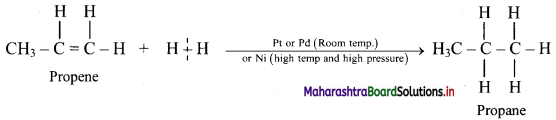
Maharashtra Board Class 11 Chemistry Important Questions Chapter 15 Hydrocarbons 6
b. Ethyne to ethane:
Maharashtra Board Class 11 Chemistry Important Questions Chapter 15 Hydrocarbons 7

Question 12.
Write the general reactions for the catalytic hydrogenation of alkenes and alkynes.
Answer:
General reaction for catalytic hydrogenation of alkenes:

Maharashtra Board Class 11 Chemistry Important Questions Chapter 15 Hydrocarbons 8
General reaction for catalytic hydrogenation of alkynes:

Maharashtra Board Class 11 Chemistry Important Questions Chapter 15 Hydrocarbons 9

Question 13.
Write the structures of alkenes that on catalytic hydrogenation give n-butane.
Answer:

Maharashtra Board Class 11 Chemistry Important Questions Chapter 15 Hydrocarbons 10

Question 14.
Explain the preparation of alkanes by reduction of alkyl halides with the help of an example.
Answer:
i. Alkanes can be prepared by reduction of alkyl halides using zinc and dilute hydrochloric acid.
ii. The reduction of alkyl halides is due to nascent hydrogen obtained from the reaction between reducing agent Zn and dilute HCl.
e.g. Reduction of methyl iodide to methane.
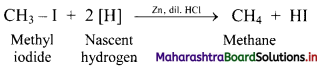
Maharashtra Board Class 11 Chemistry Important Questions Chapter 15 Hydrocarbons 11

Maharashtra Board Class 11 Chemistry Important Questions Chapter 15 Hydrocarbons

Question 15.
How are alkanes obtained by Wurtz reaction?
Answer:
Alkyl halides on treatment with reactive sodium metal in dry ether, gives higher alkanes having double the number of carbon atoms. This is called as Wurtz coupling reaction.

Maharashtra Board Class 11 Chemistry Important Questions Chapter 15 Hydrocarbons 12

Question 16.
How will you convert ethyl chloride into n-butane?
Answer:
Ethyl chloride on heating with sodium metal in presence of dry ether gives n-butane.

Maharashtra Board Class 11 Chemistry Important Questions Chapter 15 Hydrocarbons 13

Question 17.
Write chemical equations for reactions that take place on treating ethereal solutions of:
i. Methyl iodide with sodium metal
ii. Ethyl iodide with sodium metal
Answer:
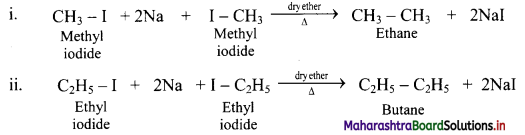
Maharashtra Board Class 11 Chemistry Important Questions Chapter 15 Hydrocarbons 14

Question 18.
Explain the preparation of Grignard reagents.
OR
What is Grignard reagent? Explain its preparation.
Answer:
Grignard reagent are alkyl magnesium halides obtained by treating alkyl halides with dry magnesium metal in the presence of dry ether.

General Reaction:

Maharashtra Board Class 11 Chemistry Important Questions Chapter 15 Hydrocarbons 15

Question 19.
State the action of water on methyl magnesium bromide in dry ether with the help of a chemical reaction.
Answer:

Maharashtra Board Class 11 Chemistry Important Questions Chapter 15 Hydrocarbons 16

Question 20.
Write the reagents involved in the following conversions.

Maharashtra Board Class 11 Chemistry Important Questions Chapter 15 Hydrocarbons 17
Answer:
Maharashtra Board Class 11 Chemistry Important Questions Chapter 15 Hydrocarbons 18

Question 21.
Straight chain alkanes have higher melting and boiling points as compared to branched isomeric alkanes. Give reason.
Answer:
i. The electronegativity of carbon and hydrogen is nearly the same. Therefore, C-H and C-C bonds are nonpolar covalent bonds and hence, alkanes are nonpolar.
ii. Alkane molecules are held together by weak intermolecular van der Waals forces.
iii. Larger the surface area of molecules, stronger are such intermolecular van der Waals forces.
iv. In straight chain alkane molecules, surface area is relatively larger as compared to branched chain alkanes and as a result, the intermolecular forces are relatively stronger in straight chain alkanes than in branched chain alkanes.

Maharashtra Board Class 11 Chemistry Important Questions Chapter 15 Hydrocarbons 19
Hence, straight chain alkanes have higher melting and boiling points as compared to branched alkanes.

Maharashtra Board Class 11 Chemistry Important Questions Chapter 15 Hydrocarbons

Question 22.
State physical properties of alkanes.
Answer:

  • Alkanes are colourless and odourless.
  • At room temperature, the first four alkanes are gases, alkanes having 5 to 17 carbon atoms are liquids while the rest all are solids.
  • Alkanes are readily soluble in organic solvents such as chloroform, ether or ethanol while they are insoluble in water.
  • Alkanes have low melting and boiling points which increases with an increase in the number of carbon atoms for straight chain molecules. But for branched chain molecules, more the number of branches, lower is the boiling/melting point.

Note: [Melting and boiling points of alkanes]
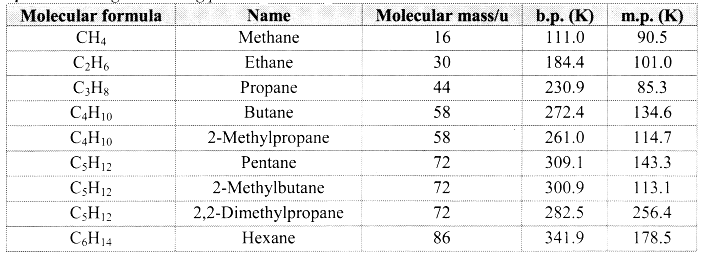
Maharashtra Board Class 11 Chemistry Important Questions Chapter 15 Hydrocarbons 20

Question 23.
Define substitution reactions.
Answer:
The reactions in which an atom or group of atoms in a molecule is replaced by another atom or group of atoms is called as substitution reactions.
e.g. Halogenation of alkanes.

Question 24.
i. What is halogenation of alkanes?
ii. Write the order of reactivity of halogens towards alkanes.
Answer:
i. Substitution of H atoms of alkanes by X (halogen, X = Cl, Br, I and F) atom is called halogenation of alkanes.
ii. The reactivity of halogens toward alkanes follows the order: F2 > Cl2 > Br2 > I2
[Note: The ease of replacement of hydrogen atoms from the carbon in alkanes is in the order: 3 > 2 > 1.]

Question 25.
Explain reactions involved in chlorination of methane.
Answer:
Alkanes react with chlorine gas in presence of UV light or diffused sunlight or at a high temperature (573-773 K) to give a mixture of alkyl halides.

Chlorination of methane:
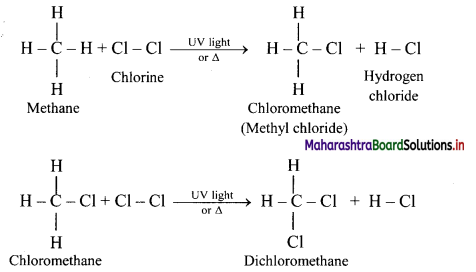
Maharashtra Board Class 11 Chemistry Important Questions Chapter 15 Hydrocarbons 21
Maharashtra Board Class 11 Chemistry Important Questions Chapter 15 Hydrocarbons 22
Tetrachloromethane is a major product when excess of chlorine is used. Chloromethane is obtained as major product when excess of methane is employed.

Question 26.
Predict the products in the following set of reactions.

Maharashtra Board Class 11 Chemistry Important Questions Chapter 15 Hydrocarbons 23
Answer:
Maharashtra Board Class 11 Chemistry Important Questions Chapter 15 Hydrocarbons 24

Question 27.
What is the action of Cl2 and Br2 on 2-methylpropane?
Answer:
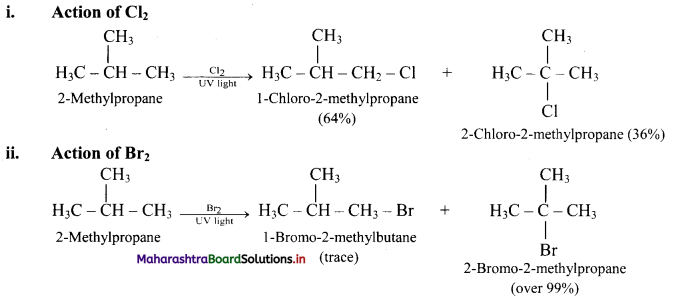
Maharashtra Board Class 11 Chemistry Important Questions Chapter 15 Hydrocarbons 25
[Note: In bromination, there is high degree of selectivity as to which hydrogen atoms are replaced.]

Maharashtra Board Class 11 Chemistry Important Questions Chapter 15 Hydrocarbons

Question 28.
Explain mechanism of halogenation of alkanes.
Answer:
i. Halogenation of alkanes follows the free radical mechanism.
ii. Homolysis of halogen molecule (X2) generates halogen atoms, i.e., halogen free radicals.
iii. The mechanism of the first step of chlorination of methane is shown below:
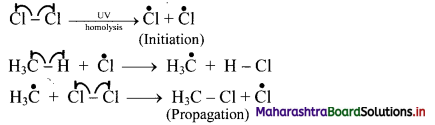
Maharashtra Board Class 11 Chemistry Important Questions Chapter 15 Hydrocarbons 26

Question 29.
Why are alkanes used as fuels?
Answer:
On heating in the presence of air or dioxygen, alkanes are completely oxidized to carbon dioxide and water with the evolution of a large amount of heat. Hence, alkanes are used as fuels.

Question 30.
What is combustion of alkanes? Write a general equation for alkane combustion.
Answer:
On heating in the presence of air or dioxygen, alkanes are completely oxidized to carbon dioxide and water with the evolution of a large amount of heat. This is known as combustion reaction of alkanes.

General representative equation for combustion is:

Maharashtra Board Class 11 Chemistry Important Questions Chapter 15 Hydrocarbons 27

Question 31.
Write chemical equations for combustion of butane and methane.
Answer:
i. Combustion of butane:

Maharashtra Board Class 11 Chemistry Important Questions Chapter 15 Hydrocarbons 28
ii. Combustion of methane:
Maharashtra Board Class 11 Chemistry Important Questions Chapter 15 Hydrocarbons 29

Question 32.
Write a short note on pyrolysis of alkanes.
Answer:
Alkanes on heating at higher temperature in absence of air decompose to lower alkanes, alkenes and hydrogen, etc. This is known as pyrolysis or cracking.
e.g. Pyrolysis of hexane
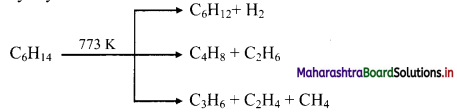
Maharashtra Board Class 11 Chemistry Important Questions Chapter 15 Hydrocarbons 30

Question 33.
Explain aromatization reaction of alkanes. Give its one application.
Answer:
i. Straight chain alkanes containing 6 to 10 carbon atoms are converted to benzene and its homologues, on heating under 10 to 20 atm pressure at about 773 K in the presence of V2O5, Cr2O3, MO2O3, etc. supported over alumina.

ii. The reaction involves simultaneous dehydrogenation and cyclization. This reaction is known as aromatization or reforming.

Maharashtra Board Class 11 Chemistry Important Questions Chapter 15 Hydrocarbons 31
This process is used in refineries to produce high quality gasoline which is used in automobiles as fuel.

Maharashtra Board Class 11 Chemistry Important Questions Chapter 15 Hydrocarbons

Question 34.
Collect the information on CNG and LPG with reference to the constituents and the advantages of CNG over LPG.
Answer:
Constituents of CNG (Compressed Natural Gas):
It mainly consists of methane compressed at a pressure of 200-248 bar.
Constituents of LPG (Liquefied Petroleum Gas):
It contains a mixture of propane and butane liquefied at 15°C and a pressure of 1.7 – 7.5 bar.

Advantages of CNG over LPG:

  • CNG is cheaper and cleaner than LPG.
  • CNG produces less pollutants than LPG.
  • It does not evolve gases containing sulphur and nitrogen.
  • Octane rating of CNG is high, hence thermal efficiency is more.
  • Vehicles powered by CNG produces less carbon monoxide and hydrocarbon emission.

[Note: Students are expected to collect additional information on their own.]

Question 35.
Write the uses of alkane.
Answer:
Uses of alkanes:

  • First four alkanes are used as a fuel mainly for heating and cooking purpose. For example, LPG and CNG.
  • CNG, petrol and diesel are used as fuel for automobiles.
  • Lower liquid alkanes are used as solvent.
  • Alkanes with more than 35 C atoms (tar) are used for road surfacing.
  • Waxes are high molecular weight alkanes. They are used as lubricants. They are also used for the preparation of candles and carbon black that is used in manufacture of printing ink, shoe polish, etc.

Question 36.
i. Write the general molecular formula of alkenes.
ii. Why are alkenes also known as olefins?
Answer:
i. Alkenes have general formula CnH2n, where, n = 2,3,4… etc.
ii. Alkenes are also known as olefins because the first member ethene/ethylene reacts with chlorine to form oily substance.
[Note: Alkenes with one carbon-carbon double bond, contain two hydrogen atoms less than the corresponding alkanes.]

Question 37.
Define alkadienes and alkatrienes. Give one example for each.
Answer:
i. The aliphatic unsaturated hydrocarbons containing two carbon-carbon double bonds are called as alkadienes.
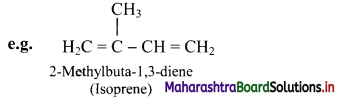
Maharashtra Board Class 11 Chemistry Important Questions Chapter 15 Hydrocarbons 32

ii. The aliphatic unsaturated hydrocarbons containing three carbon-carbon double bonds are called as alkatrienes.
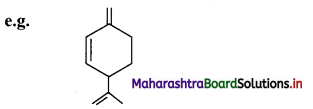
Maharashtra Board Class 11 Chemistry Important Questions Chapter 15 Hydrocarbons 33

Question 38.
Explain structural isomerism in alkenes by giving an example.
Answer:
Alkenes with more than three carbon atoms show structural isomerism.
e.g. Alkene with molecular formula C4H8 is butene. The structural formulae for C4H8 can be drawn in three different ways:

Maharashtra Board Class 11 Chemistry Important Questions Chapter 15 Hydrocarbons 34

Maharashtra Board Class 11 Chemistry Important Questions Chapter 15 Hydrocarbons

Question 39.
Draw structures of chain isomers of butene.
Answer:

Maharashtra Board Class 11 Chemistry Important Questions Chapter 15 Hydrocarbons 35

Question 40.
Draw structures of position isomers of butene.
Answer:

Maharashtra Board Class 11 Chemistry Important Questions Chapter 15 Hydrocarbons 36

Question 41.
Define geometrical isomerism.
Answer:
The isomerism which arises due to the difference in spatial arrangement of atoms or groups about doubly bonded carbon (C=C) atoms is called geometrical isomerism.

Question 42.
Explain geometrical isomerism using a general example.
Answer:
i. If the two atoms or groups bonded to each end of the C=C double bond are different, then the molecule can be represented by two different special arrangements of the groups as follows:

Maharashtra Board Class 11 Chemistry Important Questions Chapter 15 Hydrocarbons 37
ii. In structure (A), two identical atoms or groups lie on the same side of the double bond.
The geometrical isomer in which two identical or similar atoms or groups lie on the same side of the double bond is called cis-isomer.
iii. In structure (B), two identical atoms or groups lie on the opposite side of the double bond.
The geometrical isomer in which two identical or similar atoms or groups lie on the opposite side of the double bond is called trans-isomer.
iv. Due to different arrangement of atoms or groups in space, these isomers differ in their physical properties like melting point, boiling point, solubility, etc.

Question 43.
i. Define cis- and trans-isomer.
ii. Draw geometrical isomers of but-2-ene.
Answer:
i. a. Cis isomer: The geometrical isomer in which two identical or similar atoms or groups lie on the same side of the double bond is called a cis-isomer.
b. Trans isomer: The geometrical isomer in which two identical or similar atoms or groups lie on the opposite side of the double bond is called a trans-isomer.

ii. Geometrical or cis-trans isomers of but-2-ene are represented as:
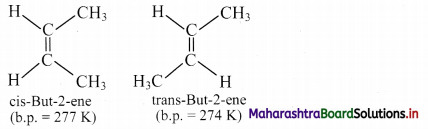
Maharashtra Board Class 11 Chemistry Important Questions Chapter 15 Hydrocarbons 38

Question 44.
State whether the following alkenes can exhibit geometrical (or cis-trans) isomerism or not. Give reason for the answer.
i. CH3 – CH2 – CH2 – CH = CH2
ii. CH3 – CH2 – CH = C(CH3)2
Answer:
Both the alkenes (i) and (ii) cannot exhibit geometrical isomerism, since 1 alkene is a terminal alkene (containing two H-atoms on the same side of the double bond) while the 2nd alkene is a 1,1-disubstituted alkene (containing two identical alkyl groups on the same side of the double bond).

Maharashtra Board Class 11 Chemistry Important Questions Chapter 15 Hydrocarbons

Question 45.
Write the general formulae of alkenes which exhibit cis-trans isomerism.
Answer:
Alkenes having the following general formulae exhibit cis-trans isomerism:
RCH=CHR, R1R2C=CR1R3, R1CH=CR1R2, R1CH=CR2R3, R1CH=CHR2 and R1R2C=CR3R4

Question 46.
Draw structures of cis-trans isomers for the following:

Maharashtra Board Class 11 Chemistry Important Questions Chapter 15 Hydrocarbons 39
Answer:
Maharashtra Board Class 11 Chemistry Important Questions Chapter 15 Hydrocarbons 40
Maharashtra Board Class 11 Chemistry Important Questions Chapter 15 Hydrocarbons 41

Question 47.
Which of the following compounds will show geometrical isomerism?

Maharashtra Board Class 11 Chemistry Important Questions Chapter 15 Hydrocarbons 42
Answer:
Compounds (III), (IV) and (V) will show geometrical isomerism as they have each of the doubly bonded carbon atoms in their structures, attached to different atoms/groups of atoms.

Question 48.
Alkenes can be obtained from which industrial sources?
Answer:

  1. The most important alkenes for chemical industry are ethene, propene and buta-1,3-diene.
  2. Alkenes containing up to four carbon atoms can be obtained in pure form from the petroleum products.
  3. Ethene is produced from natural gas and crude oil by cracking.

Question 49.
What is β-elimination reaction? Explain in brief.
Answer:
The reactions in which two atoms or groups are eliminated from adjacent carbon atoms are called 1,2-elimination reactions. Since the atom/group is removed from β-carbon atom (β to the leaving group) it is called as β-elimination reaction.
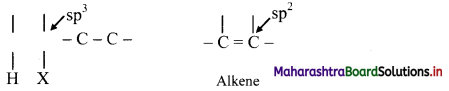
Maharashtra Board Class 11 Chemistry Important Questions Chapter 15 Hydrocarbons 43
The hybridization of each C in the reactant is sp3 while that in the product is sp2. This means elimination reactions cause change in hybridization state while forming multiple bonds from single bond.

Maharashtra Board Class 11 Chemistry Important Questions Chapter 15 Hydrocarbons

Question 50.
i. What is dehydrohalogenation reaction?
ii. How is it carried out. Explain with an example.
Answer:
i. a. The reactions in which there is removal of hydrogen (H) atom and halogen (X) atom from adjacent carbon atoms are known as dehydrohalogenation reactions.
b. The carbon carrying X is called α-carbon atom. The hydrogen atom from adjacent carbon called β-carbon atom, is removed and hence, the reaction is known as β-elimination.

ii. When an alkyl halide is boiled with a hot concentrated alcoholic solution of a strong base like KOH or NaOH, alkene is formed with removal of water molecule.
Maharashtra Board Class 11 Chemistry Important Questions Chapter 15 Hydrocarbons 44
[Note: The ease of dehydrohalogenation of alkyl halides is in the order 3 > 2 > 1.]

Question 51.
State Saytzeff rule.
Answer:
In dehydrohalogenation the preferred product is the alkene that has the greater number of alkyl groups attached to doubly bonded carbon atoms.

Question 52.
Write and explain dehydrohalogenation reaction of 2-chlorobutane.
Answer:

Maharashtra Board Class 11 Chemistry Important Questions Chapter 15 Hydrocarbons 45
In dehydrohalogenation of 2-chlorobutane, but-2-ene (disubstituted alkene) is the preferred product because it is formed faster than but-1-ene (monosubstituted alkene) which is in accordance with Saytzeff rule.

Question 53.
Write the CORRECT order of stability of alkenes with respect to Saytzeff rule.
R CH = CH2, CH2 = CH2, R2C = CH2, R2C = CR2, RCH = CHR, R2C = CHR
Answer:
R2C = CR2 > R2C = CHR > R2C = CH2, RCH = CHR > RCH = CH2 > CH2 = CH2

Question 54.
Explain dehydration reaction of alcohols.
Answer:
i. Alcohols on heating with sulphuric acid form alkenes with elimination of water molecule. The reaction is known as catalysed dehydration of alcohols.
ii. The exact conditions of dehydration depend upon the alcohol.
iii. Dehydration of alcohol is an example of β-elimination since -OH group from α-carbon along with H-atom from β-carbon is removed.
Maharashtra Board Class 11 Chemistry Important Questions Chapter 15 Hydrocarbons 46
The ease of dehydration of alcohol is in the order 3° > 2° > 1°.

Maharashtra Board Class 11 Chemistry Important Questions Chapter 15 Hydrocarbons

Question 55.
Write dehydration reaction of 1°, 2° and 3° alcohols giving one example for each.
Answer:
The ease of dehydration of alcohols is in the order 3° > 2° > 1°.
Maharashtra Board Class 11 Chemistry Important Questions Chapter 15 Hydrocarbons 47
Maharashtra Board Class 11 Chemistry Important Questions Chapter 15 Hydrocarbons 48

Question 56.
Explain isomerism with structure in the product obtained by acid catalysed dehydration of pentan-2-ol.
Answer:
i. Pentan-2-ol on acid catalysed dehydration, forms the following isomers.

Maharashtra Board Class 11 Chemistry Important Questions Chapter 15 Hydrocarbons 49
ii. A and B are position isomers.
iii. Pent-2-ene has the following geometrical isomers:

Maharashtra Board Class 11 Chemistry Important Questions Chapter 15 Hydrocarbons 50

Question 57.
What is dehalogenation? Write the general reaction for dehalogenation of vicinal dihalides.
Answer:
i. Removal of two halogen atoms from adjacent carbon atoms is called dehalogenation.
ii. The dihalides of alkane in which two halogen atoms are attached to adjacent carbon atoms are called vicinal dihalides.
iii. Vicinal dihalides on heating with zinc metal form an alkene.
Maharashtra Board Class 11 Chemistry Important Questions Chapter 15 Hydrocarbons 51

Question 58.
How is propene obtained by dehalogenation reaction?
Answer:

Maharashtra Board Class 11 Chemistry Important Questions Chapter 15 Hydrocarbons 52

Question 59.
How are geometrical isomers of alkenes obtained from alkynes?
Answer:
Alkenes are obtained by partial reduction of alkynes wherein C = C triple bond of alkynes is reduced to a C = C double bond by:
i. using calculated quantity of dihydrogen in presence of Lindlar’s catalyst (palladised charcoal deactivated partially with quinoline or sulphur compound) to give the cis-isomer of alkene.
Maharashtra Board Class 11 Chemistry Important Questions Chapter 15 Hydrocarbons 53
ii. using sodium in liquid ammonia to give trans-isomer of alkene.
Maharashtra Board Class 11 Chemistry Important Questions Chapter 15 Hydrocarbons 54

Question 60.
Write physical properties of alkenes.
Answer:

  • Alkenes are nonpolar or weakly polar compounds that are insoluble in water, and soluble in nonpolar solvents like benzene, ether, chloroform.
  • They are less dense than water.
  • The boiling point of alkene rises with increasing number of carbons.
  • Branched alkenes have lower boiling points than straight chain alkenes.
  • The boiling point of alkene is very nearly the same as that of alkane with the same carbon skeleton.

Maharashtra Board Class 11 Chemistry Important Questions Chapter 15 Hydrocarbons

Question 61.
Arrange the following alkenes in increasing order of their boiling points.
But-1-ene, 2,3-dimethylbut-2-ene, 2-methylpropene, propene, 2-methylbut-2-ene.
Answer:
Propene < 2-methylpropene < but-1-ene < 2-methylbut-2-ene < 2,3-dimethylbut-2-ene.
Note: Melting points and boiling points of alkenes.
Maharashtra Board Class 11 Chemistry Important Questions Chapter 15 Hydrocarbons 55

Question 62.
What kind of reactions do alkenes undergo? Give reason.
Answer:
Alkenes undergo electrophilic addition reactions since they are unsaturated and contain pi (π) electrons.

Question 63.
Write a note on halogenation of alkenes.
OR
Explain the formation of vicinal dihalides from alkenes with the help of examples.
Answer:
Alkenes are converted into the corresponding vicinal dihalides by addition of halogens (X2 = Cl2 or Br2).
Maharashtra Board Class 11 Chemistry Important Questions Chapter 15 Hydrocarbons 56
Maharashtra Board Class 11 Chemistry Important Questions Chapter 15 Hydrocarbons 57

Question 64.
How is carbon-carbon double bond in a compound detected by bromination?
Answer:
When an alkene like ethene is treated with bromine in presence of CCl4, the red-brown colour of bromine disappears due to following reaction.
Maharashtra Board Class 11 Chemistry Important Questions Chapter 15 Hydrocarbons 58
Hence, decolourisation of bromine is used to detect the presence of C = C bond in unknown compounds.

Maharashtra Board Class 11 Chemistry Important Questions Chapter 15 Hydrocarbons

Question 65.
Explain the formation of alkyl halides from alkenes.
Answer:
i. Alkenes react with hydrogen halides (HX) like hydrogen chloride, hydrogen bromide and hydrogen iodide to give corresponding alkyl halides (haloalkanes). This reaction is known as hydrohalogenation of alkenes.

Maharashtra Board Class 11 Chemistry Important Questions Chapter 15 Hydrocarbons 59
Maharashtra Board Class 11 Chemistry Important Questions Chapter 15 Hydrocarbons 60
ii. The order of reactivity of halogen acids is HI > HBr > HCl.

Question 66.
State Markovnikov’s rule and explain it with the help of an example.
Answer:
i. Markovnikov’s rule: When an unsymmetrical reagent is added to an unsymmetrical alkene, the negative part (X-) of the reagent gets attached to the carbon atom which carries less number of hydrogen atoms.
ii. For example, addition of HBr to unsymmetrical alkenes yield two isomeric products.
Maharashtra Board Class 11 Chemistry Important Questions Chapter 15 Hydrocarbons 61
iii. Experimentally it has been found that 2-Bromopropane is the major product.
[Note: Addition of HBr to symmetrical alkenes yields only one product.]

Question 67.
Explain Anti-Markovnikov’s addition or peroxide effect or Kharasch-Mayo effect.
Answer:
In 1933, M. S. Kharasch and F. R. Mayo discovered that the addition of HBr to unsymmetrical alkene in the presence of organic peroxide (R-O-O-R) takes place in the opposite orientation to that suggested by Markovnikov’s rule.

Maharashtra Board Class 11 Chemistry Important Questions Chapter 15 Hydrocarbons 62
Maharashtra Board Class 11 Chemistry Important Questions Chapter 15 Hydrocarbons 63

Question 68.
Write the structure of major alkyl halide obtained by the action of HCl on pent-1-ene
i. in presence of peroxide
ii. in absence of peroxide.
Answer:
The structures of alkyl halides obtained by the action of hydrogen bromide on pent-1-ene are as follows:
i. In presence of peroxide:
Maharashtra Board Class 11 Chemistry Important Questions Chapter 15 Hydrocarbons 64
ii. In absence of peroxide:
Maharashtra Board Class 11 Chemistry Important Questions Chapter 15 Hydrocarbons 65
[Note: Presence/absence of peroxide has no effect on addition of HCl or HI.]

Question 69.
Explain the formation of alcohols from alkenes using conc. sulphuric acid with the help of an example.
Answer:
i. Alkenes react with cold concentrated sulphuric acid to form alkyl hydrogen sulphate (ROSO3H). The addition takes place according to Markovnikov’s rule as shown in the following steps.
Maharashtra Board Class 11 Chemistry Important Questions Chapter 15 Hydrocarbons 66
Maharashtra Board Class 11 Chemistry Important Questions Chapter 15 Hydrocarbons 67
ii. If alkyl hydrogen sulphate is diluted with water and heated, then an alcohol having the same alkyl group as the original alkyl hydrogen sulphate is obtained.
Maharashtra Board Class 11 Chemistry Important Questions Chapter 15 Hydrocarbons 68
iii. This is an excellent method for the large-scale manufacture of alcohols.

Maharashtra Board Class 11 Chemistry Important Questions Chapter 15 Hydrocarbons

Question 70.
What is hydration of alkenes?
Answer:
i. Reactive alkenes on adding water molecules in the presence of concentrated sulphuric acid, form alcohol.
ii. The addition of water takes place according to Markovnikov’s rule. This reaction is known as hydration of alkenes.
Maharashtra Board Class 11 Chemistry Important Questions Chapter 15 Hydrocarbons 69

Question 71.
Complete the following conversion.
Maharashtra Board Class 11 Chemistry Important Questions Chapter 15 Hydrocarbons 70
Answer:
Maharashtra Board Class 11 Chemistry Important Questions Chapter 15 Hydrocarbons 71

Question 72.
But-1-ene and 2-methylpropene are separately treated with following reagents. Predict the product/products. Indicate major/minor product,
i. HBr
ii. H2SO4 / H2O
Answer:
i. HBr:
Maharashtra Board Class 11 Chemistry Important Questions Chapter 15 Hydrocarbons 72
ii. H2SO4 / H2O:
Maharashtra Board Class 11 Chemistry Important Questions Chapter 15 Hydrocarbons 73

Question 73.
Explain: Ozonolysis
Answer:
i. The C = C double bond in alkenes, gets cleaved on reaction with ozone followed by reduction.
ii. The overall process of formation of ozonide by reaction of ozone with alkene in the first step and then decomposing it to the carbonyl compounds by reduction in the second step is called ozonolysis.
iii. When ozone gas is passed into solution of the alkene in an inert solvent like carbon tetrachloride, unstable alkene ozonide is obtained.
iv. This is subsequently treated with water in the presence of a reducing agent zinc dust to form carbonyl compounds, namely, aldehydes and/or ketones.
Maharashtra Board Class 11 Chemistry Important Questions Chapter 15 Hydrocarbons 74

Question 74.
Write reactions for the ozonolysis of the following alkenes:
i. Ethene
ii. Propene
Answer:
Maharashtra Board Class 11 Chemistry Important Questions Chapter 15 Hydrocarbons 75

Question 75.
What is the role of zinc dust, in ozonolysis reaction?
Answer:
In ozonolysis, the role of zinc dust is to prevent the formation of hydrogen peroxide which oxidizes aldehydes to corresponding acids.

Maharashtra Board Class 11 Chemistry Important Questions Chapter 15 Hydrocarbons

Question 76.
State TRUE or FALSE. If false, correct the statement.
i. In the cleavage products of ozonide, a carbonyl group (C=O) is formed at each of the original doubly bonded carbon atoms.
ii. In ozonolysis, the structure of original alkene reactant cannot be identified by knowing the number and arrangement of carbon atoms in aldehydes and ketones produced.
iii. Ozonolysis reaction is used to locate the position and determine the number of double bonds in alkenes.
Answer:
i. True
ii. False
In ozonolysis, knowing the number and arrangement of carbon atoms in aldehydes and ketones produced, we can identify the structure of original alkene.
iii. True

Question 77.
Identify the alkene which produces a mixture of methanal and propanone on ozonolysis. Write the reactions involved.
Answer:
i. The structure of alkene which produces a mixture of methanol and propanone on ozonolysis is
Maharashtra Board Class 11 Chemistry Important Questions Chapter 15 Hydrocarbons 76

ii. Reactions:
Maharashtra Board Class 11 Chemistry Important Questions Chapter 15 Hydrocarbons 77

Question 78.
Explain the process of hydroboration-oxidation of alkenes.
Answer:
i. Alkenes with diborane in tetrahydrofuran (THF) solvent undergo hydroboration to form trialkylborane, which on oxidation with alkaline peroxide forms primary alcohol.
ii. The overall reaction gives anti-Markovnikov’s product from unsymmetrical alkenes.
Maharashtra Board Class 11 Chemistry Important Questions Chapter 15 Hydrocarbons 78

Question 79.
Write reactions for the following conversion by hydroboration-oxidation reaction.
Ethene to ethanol
Answer:
Ethene to ethanol:
Maharashtra Board Class 11 Chemistry Important Questions Chapter 15 Hydrocarbons 79

Question 80.
Define: Polymerization
Answer:
The process in which large number of small molecules join together and form very large molecules with repeating units is called polymerization.

Question 81.
What is the difference between monomer and polymer?
Answer:
The compound having very large molecules made of large number of repeating small units is called polymer while the simple compound forming the repeating units in the polymer is called monomer.

Maharashtra Board Class 11 Chemistry Important Questions Chapter 15 Hydrocarbons

Question 82.
How is ethene converted to polyethene?
Answer:
Ethene at high temperature and under high pressure interacts with oxygen, and undergoes polymerization giving high molecular weight polymer called polyethene.
Maharashtra Board Class 11 Chemistry Important Questions Chapter 15 Hydrocarbons 80
Here, n represents the number of repeating units and is a large number.

Question 83.
Explain the process of hydroxylation of alkenes.
OR
What is the action of alkaline KMnO4 on alkenes?
Answer:
Alkenes react with cold and dilute alkaline potassium permanganate to form glycols.
Maharashtra Board Class 11 Chemistry Important Questions Chapter 15 Hydrocarbons 81

Question 84.
Explain Baeyer’s test giving one example.
Answer:
i. During hydroxylation of alkenes the purple colour of KMnO4 disappears.
ii. Hence, such reaction serves as a qualitative test for detecting the presence of double bond in the sample compound. This is known as Baeyer’s test.
e.g. As propene contains a double bond, it reacts with alkaline KMnO4 to give colourless propane-1,2-diol as product. Therefore, the purple colour of alkaline KMnO4 disappears.
Maharashtra Board Class 11 Chemistry Important Questions Chapter 15 Hydrocarbons 82

Question 85.
What is the action of following reagents on but-1-ene and but-2-ene?
i. Bromine
ii. Cold and dilute alkaline KMnO4.
Answer:
i. Action of Br2:
Maharashtra Board Class 11 Chemistry Important Questions Chapter 15 Hydrocarbons 83
ii. Action of cold and dilute alkaline KMnO4:
Maharashtra Board Class 11 Chemistry Important Questions Chapter 15 Hydrocarbons 84

Question 86.
Describe the action of acidic potassium permanganate on alkenes.
Answer:
Acidic potassium permanganate or acidic potassium dichromate oxidizes alkenes to ketones or acids depending upon the nature of the alkene and the experimental conditions. This is called oxidative cleavage of alkenes.
e.g.
Maharashtra Board Class 11 Chemistry Important Questions Chapter 15 Hydrocarbons 85

Question 87.
Complete the following conversions.
Maharashtra Board Class 11 Chemistry Important Questions Chapter 15 Hydrocarbons 86
Answer:
Maharashtra Board Class 11 Chemistry Important Questions Chapter 15 Hydrocarbons 87

Question 88.
State some important uses of alkenes.
Answer:

  • Alkenes are used as starting materials for preparation of alkyl halides, alcohols, aldehydes, ketones, acids, etc.
  • Ethene and propene are used to manufacture polythene, polypropylene which are used in polyethene bags, toys, bottles, etc.
  • Ethene is used for artificial ripening of fruits, such as mangoes.

Maharashtra Board Class 11 Chemistry Important Questions Chapter 15 Hydrocarbons

Question 89.
What are alkynes? Write their general formula.
Answer:

  • Alkynes are aliphatic unsaturated hydrocarbons containing at least one C = C.
  • Their general formula is CnH2n-2.

Question 90.
Explain position isomerism in alkyne.
Answer:
Alkynes show position isomerism which is a type of structural isomerism.
e.g. But-1-yne and but-2-yne, both are represented by C4H6, however, both of them differ in position of triple bond in them.
Maharashtra Board Class 11 Chemistry Important Questions Chapter 15 Hydrocarbons 88
[Note: 1-Alkynes are also called terminal alkynes.]

Question 91.
Draw the structural isomers of isomers of C5H8. Identify position isomers amongst them.
Answer:
i. Structural isomers of C5H10 (fourth member of homologous series of alkynes):
Maharashtra Board Class 11 Chemistry Important Questions Chapter 15 Hydrocarbons 89
ii. The compounds pent-1-yne and pent-2-yne are position isomers of each other.

Question 92.
What are alkadiynes and alkatriynes? Give one example of each.
Answer:
The aliphatic unsaturated hydrocarbons containing two and three carbon-carbon triple bonds in their structure are called alkadiynes and alkatriynes, respectively.
e.g. CH ≡ C – CH2 – C ≡ CH
Alkadiyne (Penta-1,4-diyne)

HC ≡ C- C ≡ C- C ≡ CH
Alkatriyne (Hexa-1,3,5-triyne)

Question 93.
Complete the following table:
Maharashtra Board Class 11 Chemistry Important Questions Chapter 15 Hydrocarbons 90
Answer:
Maharashtra Board Class 11 Chemistry Important Questions Chapter 15 Hydrocarbons 91

Maharashtra Board Class 11 Chemistry Important Questions Chapter 15 Hydrocarbons

Question 94.
How is acetylene prepared from the following compounds?
i. Methane
ii. Calcium carbide
Answer:
i. From methane: Ethyne is industrially prepared by controlled, high temperature, partial oxidation of methane.
Maharashtra Board Class 11 Chemistry Important Questions Chapter 15 Hydrocarbons 92
ii. From calcium carbide: Industrially, ethyne is prepared by reaction of calcium carbide with water.
Maharashtra Board Class 11 Chemistry Important Questions Chapter 15 Hydrocarbons 93

Question 95.
How are alkynes prepared by dehydrohalogenation of vicinal dihalides? Write general reaction and explain it using an example.
Answer:
Vicinal dihalides react with alcoholic solution of potassium hydroxide to form alkenyl halide which on further treatment with sodamide forms alkyne.
Maharashtra Board Class 11 Chemistry Important Questions Chapter 15 Hydrocarbons 94

Question 96.
Convert 1,2-dichloropropane to propyne.
Answer:
Maharashtra Board Class 11 Chemistry Important Questions Chapter 15 Hydrocarbons 95

Question 97.
i. What are terminal alkynes?
ii. How are they converted to higher nonterminal alkynes? Give one example.
Answer:
i. Terminal alkynes are the compounds in which hydrogen atom is directly attached to triply bonded carbon atom.
ii. a. A smaller terminal alkyne first reacts with a very strong base like lithium amide to form metal acetylide (lithium amide is easier to handle than sodamide).
b. Higher alkynes are obtained by reacting metal acetylides (alkyn-1-yl lithium) with primary alkyl halides.
Maharashtra Board Class 11 Chemistry Important Questions Chapter 15 Hydrocarbons 96
Maharashtra Board Class 11 Chemistry Important Questions Chapter 15 Hydrocarbons 97

Question 98.
How is pent-2-yne prepared from propyne?
Answer:
Maharashtra Board Class 11 Chemistry Important Questions Chapter 15 Hydrocarbons 98

Maharashtra Board Class 11 Chemistry Important Questions Chapter 15 Hydrocarbons

Question 99.
Enlist physical properties of alkenes.
Answer:
The physical properties of alkynes are similar to those of alkanes and alkenes.

  • They are less dense than water.
  • They are insoluble in water and quite soluble in less polar organic solvents like ether, benzene, carbon tetrachloride.
  • The melting points and boiling points of alkynes increase with an increase in molecular mass.

Question 100.
Lithium amide (LiNH2) is very strong base and it reacts with terminal alkynes to form lithium acetylides with the liberation of hydrogen indicating acidic nature of terminal alkynes. Why is it so?
Answer:

  • The hydrogen bonded to C ≡ C triple bond has acidic character.
  • In terminal alkynes, hydrogen atom is directly attached to sp hybridized carbon atom.
  • In sp hybrid orbital, the percentage of s-character is 50%. An electron in s-orbital is very close to the nucleus and is held tightly.
  • The sp hybrid carbon atom in terminal alkynes is more electronegative than the sp2 carbon in ethene or the sp3 carbon in ethane.
  • Due to high electronegative character of carbon in terminal alkynes, hydrogen atom can be given away as proton (H+) to very strong base.

Question 101.
Give reason: Acidic nature of alkynes is used to distinguish between terminal and non-terminal alkynes.
Answer:

  • Acidic alkynes react with certain heavy metal ions like Ag+ and Cu+ and form insoluble acetylides.
  • On addition of acidic alkyne to the solution of AgNO3 in alcohol, it forms a precipitate, which indicates that the hydrogen atom is attached to triply bonded carbon.

Hence, this reaction is used to differentiate terminal alkynes and non-terminal alkynes.

Question 102.
Predict the product in the following reactions.
\(\mathbf{H C} \equiv \mathbf{C H}+\mathbf{2 B r}_{2} \stackrel{\mathrm{CCl}_{4}}{\longrightarrow} ?\)
Answer:
Ethyne reacts with bromine in inert solvent such as carbon tetrachloride to give tetrabromoethane.
Maharashtra Board Class 11 Chemistry Important Questions Chapter 15 Hydrocarbons 99

Question 103.
Write the general reaction for addition of halogens to alkynes.
Answer:
Maharashtra Board Class 11 Chemistry Important Questions Chapter 15 Hydrocarbons 100

Question 104.
Explain the addition of hydrogen halides to alkynes using a general reaction.
Answer:
i. Hydrogen halides (HCl, HBr and HI) add to alkynes across carbon-carbon triple bond in two steps to form geminal dihalides (in which two halogen atoms are attached to the same carbon atom).
ii. The addition of HX in both the steps takes place according to Markovnikov’s rule as shown in below.
General reaction:
Maharashtra Board Class 11 Chemistry Important Questions Chapter 15 Hydrocarbons 101
iii. The order of reactivity of hydrogen halides is HI > HBr > HCl.

Maharashtra Board Class 11 Chemistry Important Questions Chapter 15 Hydrocarbons

Question 105.
State the action of HBr on acetylene and methyl acetylene.
Answer:
Maharashtra Board Class 11 Chemistry Important Questions Chapter 15 Hydrocarbons 102

Question 106.
Explain reactions of alkynes with water using general reaction.
Answer:
Alkynes react with water in presence of 40% sulphuric acid and 1% mercuric sulphate to form aldehydes or ketones, i.e., carbonyl compounds.
General reaction:
Maharashtra Board Class 11 Chemistry Important Questions Chapter 15 Hydrocarbons 103

Question 107.
Predict the products when ethyne and propyne are treated with 1% mercuric sulphate in H2SO4.
Answer:
i. Ethyne:
Maharashtra Board Class 11 Chemistry Important Questions Chapter 15 Hydrocarbons 104
ii. Propyne:
Maharashtra Board Class 11 Chemistry Important Questions Chapter 15 Hydrocarbons 105a

Question 108.
Convert:
i. But-1-yne to butan-2-one
ii. Hex-3-yne to hexan-3-one
Answer:
i. But-l-yne to butan-2-one:
Maharashtra Board Class 11 Chemistry Important Questions Chapter 15 Hydrocarbons 106
ii. Hex-3-yne to hexan-3-one:
Maharashtra Board Class 11 Chemistry Important Questions Chapter 15 Hydrocarbons 107

Question 109.
What are products obtained on hydration of but-1-yne and but-2-yne? Are they same or different? Explain.
Answer:
i. Hydration of but-1-yne:
Maharashtra Board Class 11 Chemistry Important Questions Chapter 15 Hydrocarbons 108
Hydration of but-2-yne:
Maharashtra Board Class 11 Chemistry Important Questions Chapter 15 Hydrocarbons 109
The products obtained on hydration of but-1-yne and but-2-yne are same i.e., butan-2-onc since the addition of water to alkyncs takes place according to Markovnikovs rule.

Maharashtra Board Class 11 Chemistry Important Questions Chapter 15 Hydrocarbons

Question 110.
How is ethylene converted into ethylidene dichloride?
Answer:
Maharashtra Board Class 11 Chemistry Important Questions Chapter 15 Hydrocarbons 110

Question 111.
Write some important uses of acetylene.
Answer:

  • Ethyne (acetylene) is used in preparation of ethanal (acetaldehyde), propanone (acetone), ethanoic acid (acetic acid).
  • It is used in the manufacture of polymers, synthetic rubber, synthetic fibre, plastic, etc.
  • For artificial ripening of fruits.
  • In oxy-acetylene (mixture of oxygen and acetylene) flame for welding and cutting of metals.

Question 112.
Many organic compounds obtained from natural sources such as resins, balsams, oil of wintergreen, etc. have pleasant fragrance or aroma. Such compounds are named as aromatic compounds.
i. Name the simplest aromatic compound.
ii. Write the names of any two aromatic compounds.
Answer:
i. Benzene is the simplest aromatic hydrocarbon.
ii. Toluene and naphthalene

Question 113.
Draw structures of any four aromatic hydrocarbons.
Answer:
Maharashtra Board Class 11 Chemistry Important Questions Chapter 15 Hydrocarbons 111

Question 114.
Write the molecular formula of benzene. Give its boiling point.
Answer:
The molecular formula for benzene is C6H6. Its boiling point is 353 K.

Question 115.
State TRUE or FALSE. Correct the false statement.
i. Aromatic hydrocarbons are also called as arenes.
ii. Toluene is a non-aromatic hydrocarbon.
iii. Benzene is colourless liquid having characteristic odour.
Answer:
i. True
ii. False
Toluene is an aromatic hydrocarbon.
iii. True

Maharashtra Board Class 11 Chemistry Important Questions Chapter 15 Hydrocarbons

Question 116.
Name any two large-scale sources of benzene.
Answer:
Coal-tar and petroleum are the two large-scale sources of benzene.
[Note: Other aromatic compounds like toluene, phenol, naphthalene, etc. are also obtained from coal-tar and petroleum.]

Question 117.
Draw the structure of an aromatic compound that resembles benzene but does not have pleasant odour.
Answer:
Maharashtra Board Class 11 Chemistry Important Questions Chapter 15 Hydrocarbons 112

Question 118.
Name and draw the structures of any three compounds that have pleasant odour but do not resemble benzene.
Answer:
Maharashtra Board Class 11 Chemistry Important Questions Chapter 15 Hydrocarbons 113

Question 119.
Differentiate between aromatic and aliphatic compounds.
Answer:
Aromatic compounds:

  • Aromatic compounds contain higher percentage of carbon.
  • They bum with sooty flame.
  • They are cyclic compounds with alternate single and double bonds.
  • They are not attacked by normal oxidizing and reducing agents.
  • They do not undergo addition reactions easily. They do not decolourise dilute alkaline aqueous KMnO4 and Br2 in CCl4, though double bonds appear in their structure.
  • They prefer substitution reactions.

Aliphatic compounds:

  • Aliphatic compounds contain lower percentage of carbon.
  • They bum with non-sooty flame.
  • They are open chain compounds.
  • They are easily attacked by oxidizing and reducing agents.
  • Unsaturated aliphatic compounds undergo addition reactions easily. They decolourise dilute aqueous alkaline KMnO4 and Br2 in CCl4.
  • The saturated aliphatic compounds give substitution reactions.

Question 120.
Benzene cannot have open chain structure. Explain this statement.
Answer:

  • The molecular formula of benzene is C6H6. This indicates high degree of unsaturation.
  • Open chain or cyclic structure having double and triple bonds can be written for C6H6.
  • However, benzene does not behave like alkenes or alkynes. This indicates that benzene cannot have the open chain structure.

Maharashtra Board Class 11 Chemistry Important Questions Chapter 15 Hydrocarbons

Question 121.
Compare the reactivity of benzene and alkenes with the following reagents:
i. Dilute alkaline KMnO4
ii. Br6 in CCl4
iii. H6O in acidic medium
Answer:

ReagentAlkenesBenzene
Dilute alkaline aqueous KMnO4Decolourisation of KMnO4No decolourisation
Br2 in CCl4Decolourisation of red brown colour of bromineNo decolourisation
H2O in acidic mediumAddition of H2O moleculeNo reaction

Question 122.
Give the evidence for the cyclic structure of benzene.
Answer:
Evidence for the cyclic structure of benzene:
i. Benzene yields only one and no isomeric monosubstituted bromobenzene (C6H5Br) when treated with equimolar bromine in FeBr3. This indicates that all six hydrogen atoms in benzene are identical.
Maharashtra Board Class 11 Chemistry Important Questions Chapter 15 Hydrocarbons 114
ii. This is possible only if benzene has cyclic structure of six carbons bound to one hydrogen atom each.
iii. Benzene on catalytic hydrogenation gives cyclohexane.
Maharashtra Board Class 11 Chemistry Important Questions Chapter 15 Hydrocarbons 115
This confirms the cyclic structure of benzene and three C = C in it.

Question 123.
Write a short note on the Kekule structure of benzene.
Answer:
Kekule structure of benzene:
i. August Kekule in 1865 suggested the structure for benzene having a cyclic planar ring of six carbon atoms with alternate single and double bonds and hydrogen atom attached to each carbon atom.
Maharashtra Board Class 11 Chemistry Important Questions Chapter 15 Hydrocarbons 116
ii. The Kekule structure indicates the possibility of two isomeric 1,2-dibromobenzenes. In one of the isomers, the bromine atoms would be attached to the doubly bonded carbon atoms whereas in the other, they would be attached to single bonded carbons.
Maharashtra Board Class 11 Chemistry Important Questions Chapter 15 Hydrocarbons 117
iii. However, benzene was found to form only one ortho-disubstituted benzene. This problem was overcome by Kekule by suggesting the concept of oscillating nature of double bonds in benzene as given below.
Maharashtra Board Class 11 Chemistry Important Questions Chapter 15 Hydrocarbons 118
iv. Even with this modification, Kekule structure of benzene failed to explain unusual stability and preference to substitution reactions rather than addition reactions, which was later explained by resonance.

Question 124.
Explain the resonance phenomenon with respect to benzene.
OR
Explain the resonance hybrid structure of benzene.
Answer:

  • Benzene is a hybrid of various resonance structures. The two structures, (A) and (B) given by Kekule are the main contributing structures.
  • The resonance hybrid is represented by inserting a circle or a dotted circle inscribed in the hexagon as shown in (C).
  • The circle represents six electrons delocalized over the six carbon atoms of benzene ring.
  • A double headed arrow between the resonance structures is used to represent the resonance phenomenon.

Maharashtra Board Class 11 Chemistry Important Questions Chapter 15 Hydrocarbons 119

Question 125.
Why does benzene not prefer to undergo addition reactions?
Answer:

  • Benzene is highly unsaturated molecule but despite of this feature, it does not give addition reaction.
  • The actual structure of benzene is represented by the resonance hybrid which is the most stable form of benzene than any of its resonance structures.
  • This stability due to resonance (delocalization of π electrons) is so high that π-bonds of the molecule becomes strong and thus, resist breaking.

Thus, benzene does not prefer to undergo addition reactions.

Maharashtra Board Class 11 Chemistry Important Questions Chapter 15 Hydrocarbons

Question 126.
Explain the resonance structures of benzene using the orbital overlap concept.
Answer:
The structure of benzene can be better explained by the orbital overlap concept,
i. All six carbon atoms in benzene are sp2 hybridized. Two sp2 hybrid orbitals of each carbon atom overlap and form carbon-carbon sigma (σ) bond and the remaining third sp2 hybrid orbital of each carbon overlaps with s orbital of a hydrogen atom to form six C – H sigma bonds.
Maharashtra Board Class 11 Chemistry Important Questions Chapter 15 Hydrocarbons 120

ii. The unhybridized p orbitals of carbon atoms overlap laterally forming π bonds. There are two possibilities of forming three π bonds by overlap of p orbitals of C1 – C2, C3 – C4, C5 – C6 or C2 – C3, C4 – C5, C6 – C1, respectively, as shown in the following figure. Both the structures are equally probable.

According to resonance theory, these are two resonance structures of benzene.
Maharashtra Board Class 11 Chemistry Important Questions Chapter 15 Hydrocarbons 121

Question 127.
Explain the structure of benzene with respect to molecular orbital theory.
Answer:
i. According to molecular orbital (MO) theory, the six p orbitals of six carbons give rise to six molecular orbitals of benzene.
ii. Shape of the most stable MO is as show in the figure below. Three of these π molecular orbitals lie above and the other below those of free carbon atom energies.
Maharashtra Board Class 11 Chemistry Important Questions Chapter 15 Hydrocarbons 122
iii. The six electrons of the p orbitals cover all the six carbon atoms and are said to be delocalized. Delocalization of π electrons results in stability of benzene molecule.

Question 128.
Give the carbon-carbon bond length in benzene. Explain why benzene shows unusual behaviour.
Answer:
i. X-ray diffraction data indicate that all C – C bond lengths in benzene are equal (139 pm) which is an intermediate between C – C (154 pm) and C = C bond (133 pm).

ii. Thus, absence of pure double bond in benzene accounts for its reluctance to addition reactions under normal conditions, which explains unusual behaviour of benzene.
Maharashtra Board Class 11 Chemistry Important Questions Chapter 15 Hydrocarbons 123

Question 129.
Write a short note on aromaticity.
Answer:
i. All aromatic compounds undergoes substitution reactions rather than addition reactions and this property is referred to as aromaticity or aromatic character.
ii. The aromatic character of benzene is correlated to its structure.
iii. Aromaticity is due to extensive cyclic delocalization of p electrons in the planar ring structure.
iv. Three rules of aromaticity that is used for predicting whether a particular compound is aromatic or non-aromatic are as follows:

  • Aromatic compounds are cyclic and planar (all atoms in ring are sp2 hybridized).
  • Each atom in aromatic ring has a p orbital. The p orbitals must be parallel so that continuous overlap is possible around the ring.
  • Huckel rule: The cyclic π molecular orbital formed by overlap of p orbitals must contain (4n + 2) p electrons, where n = integer 0, 1, 2, 3, … etc.

Question 130.
State and explain the Huckel rule of aromaticity.
Answer:
Huckel rule: The cyclic π molecular orbital formed by overlap of p orbitals must contain (4n + 2) p electrons, where n = integer 0, 1,2,3, … etc.

Explanation:
According to Huckel rule, a cyclic and planar compound is aromatic if it the number of π electrons is equal to (4n + 2), where n = integer 0, 1, 2, 3, … etc.

nNumber of π electrons
n = 0(4 × 0) – 2 = 2
n = 1(4 × 1) + 2 = 6
n = 2(4 × 2) + 2 = 10

e.g. Consider benzene molecule:
Maharashtra Board Class 11 Chemistry Important Questions Chapter 15 Hydrocarbons 124
Benzene has 6π electrons. According to Huckel rule, if n = 1, then (4n + 2)π = 6π electrons. Hence, benzene is aromatic.

Maharashtra Board Class 11 Chemistry Important Questions Chapter 15 Hydrocarbons

Question 131.
By using the rules of aromaticity, explain whether the following compounds are aromatic or non-aromatic.
i. Benzene
ii. Naphthalene
iii. Cycloheptatriene
Answer:
i. Benzene:
a. It is cyclic and planar.
b. It has three double bonds and six π electrons.
c. It has a p orbital on each carbon of the hexagonal ring. Hence, a continuous overlap above and below the ring is possible.
Maharashtra Board Class 11 Chemistry Important Questions Chapter 15 Hydrocarbons 125
d. According to Huckcl rule, this compound is aromatic if, 4n + 2 = Number of π electrons.
4n + 2 = 6,
∴ 4n = 6 – 2 = 4
n = 4/4 = 1, here, ‘n’ comes out to be an integer.
Hence, benzene is aromatic.

ii. Naphthalene:
a. It is cyclic and planar.
b. It has 5 double bonds and 10 n electrons.
Maharashtra Board Class 11 Chemistry Important Questions Chapter 15 Hydrocarbons 126
c. It has a p orbital on each carbon atom of the ring. Hence, a continuous overlap around the ring is possible.
d. According to Huckel rule, this compound is aromatic if, 4n + 2 = Number of π electrons.
4n + 2 = 10,
∴ 4n = 10 – 2 = 8
n = 8/4 = 2, Here ‘n’ comes out to be an integer.
Hence, naphthalene is aromatic.

iii. Cycloheptatriene:
a. It is cyclic and planar.
b. It has three double bonds and 6 π electrons.
Maharashtra Board Class 11 Chemistry Important Questions Chapter 15 Hydrocarbons 127
c. But one of the carbon atoms is saturated (sp3 hybridized) and it does not have a p orbital.
d. Hence, a continuous overlap around the ring is not possible in cycloheptatriene. Hence, it is non-aromatic.

Question 132.
How does Huckel rule help in determining the aromaticity of pyridine?
Answer:
i. Pyridine has three double bonds and 6 π electrons.
ii. The six p orbitals containing six electrons form delocalized π molecular orbital.
iii. The unused sp2 hybrid orbital of nitrogen containing two non-bonding electrons is as it is.
Maharashtra Board Class 11 Chemistry Important Questions Chapter 15 Hydrocarbons 128
iv. According to Huckel rule, this compound is aromatic if, 4n + 2 = Number of π electrons
4n + 2 = 6,
∴ 4n = 6 – 2 = 4
n = 4/4 = 1, here ‘n’ comes out to be an integer. Hence, pyridine is aromatic.

Question 133.
How is benzene prepared from ethyne/acetylene?
Answer:
From ethyne (By trimerization): Alkynes when passed through a red hot iron tube at 873 K, polymerize to form aromatic hydrocarbons. Ethyne when passed through a red hot iron tube at 873 K undergoes trimerization to form benzene.
Maharashtra Board Class 11 Chemistry Important Questions Chapter 15 Hydrocarbons 129

Question 134.
How is benzene prepared from sodium benzoate?
OR
Explain preparation of benzene by decarboxylation.
Answer:
From sodium benzoate (by decarboxylation): When anhydrous sodium benzoate is heated with soda lime, it undergoes decarboxylation and gives benzene.
Maharashtra Board Class 11 Chemistry Important Questions Chapter 15 Hydrocarbons 130
[Note: This reaction is useful for decreasing the length of a carbon chain by one C-atom]

Question 135.
How will you convert phenol to benzene?
Answer:
From phenol (By reduction): When vapours of phenol are passed over heated zinc dust, it undergoes reduction and gives benzene.
Maharashtra Board Class 11 Chemistry Important Questions Chapter 15 Hydrocarbons 131

Question 136.
Enlist physical properties of benzene.
Answer:
Physical properties of benzene:

  • Benzene is a colourless liquid.
  • Its boiling point is 353 K and melting point is 278.5 K.
  • It is insoluble in water. It forms upper layer when mixed with water.
  • It is soluble in alcohol, ether and chloroform.
  • Its vapours are highly toxic which on inhalation lead to unconsciousness.

Maharashtra Board Class 11 Chemistry Important Questions Chapter 15 Hydrocarbons

Question 137.
What is the action of chlorine on benzene in the presence of UV light?
Answer:
Addition of chlorine: When benzene is treated with chlorine in the presence of bright sunlight or UV light, three molecules of chlorine gets added to benzene to give benzene hexachloride.
Maharashtra Board Class 11 Chemistry Important Questions Chapter 15 Hydrocarbons 132

Question 138.
Name the γ-isomer of benzene hexachloride which is used as insecticide.
Answer:
The γ-isomer of benzene hexachloride which is used as insecticide is called as gammaxene or lindane.

Question 139.
How will you convert benzene to cyclohexane?
Answer:
Addition of hydrogen: When a mixture of benzene and hydrogen gas is passed over heated catalyst nickel at 453 K to 473 K, cyclohexane is formed.
Maharashtra Board Class 11 Chemistry Important Questions Chapter 15 Hydrocarbons 133

Question 140.
What is the action of ozone on benzene?
Answer:
Addition of ozone: When benzene is treated with ozone in the presence of an inert solvent carbon tetrachloride, benzene triozonide is formed, which is then decomposed by zinc dust and water to give glyoxal.
Maharashtra Board Class 11 Chemistry Important Questions Chapter 15 Hydrocarbons 134

Question 141.
What are the different types of electrophilic substitution reactions of benzene?
Answer:
i. Benzene shows electrophilic substitution reactions, in which one or more hydrogen atoms of benzene ring are replaced by groups like – Cl, – Br, – NO2, – SO3H, -R, -COR, etc.
ii. Different types of electrophilic substitution reactions of benzene are as follows:

  • Halogenation (chlorination and bromination)
  • Nitration
  • Sulphonation
  • Friedel-Craft’s alkylation and
  • Friedel-Craft’s acylation

Question 142.
Write a short note on chlorination reaction of benzene.
Answer:
Chlorination of benzene:
i. In chlorination reaction, hydrogen atom of benzene is replaced by chlorine atom.
ii. Chlorine reacts with benzene in dark in the presence of iron or ferric chloride or anhydrous aluminium chloride or red phosphorus as catalyst to give chlorobenzene (C6H5Cl).
Maharashtra Board Class 11 Chemistry Important Questions Chapter 15 Hydrocarbons 135
iii. Electrophile involved in the reaction: Cl+, chloronium ion,
Formation of the electrophile: Cl – Cl + FeCl3 → Cl+ + [FeCl4]

Maharashtra Board Class 11 Chemistry Important Questions Chapter 15 Hydrocarbons

Question 143.
Write a short note on bromination reaction of benzene.
Answer:
Bromination of benzene:
i. In bromination reaction, hydrogen atom of benzene is replaced by bromine atom.
ii. Bromine reacts with benzene in dark in presence of iron or ferric bromide or anhydrous aluminium bromide or red phosphorus as catalyst to give bromobenzene (C6H5Br).
Maharashtra Board Class 11 Chemistry Important Questions Chapter 15 Hydrocarbons 136
iii. Electrophile involved in the reaction: Br+
Formation of the electrophile: Br – Br + FeBr3 → Br+ + [FeBr4]

Question 144.
Why direct iodination of benzene is not possible?
Answer:
Direct iodination of benzene is not possible as the reaction is reversible.
Maharashtra Board Class 11 Chemistry Important Questions Chapter 15 Hydrocarbons 137
[Note: Iodination of benzene can be carried out in the presence of oxidising agents like HIO3 or HNO3.]

Question 145.
How will you convert benzene to hexachlorobenzene?
Answer:
When benzene is treated with excess of chlorine in presence of anhydrous aluminium chloride, it gives hexachlorobenzene.
Maharashtra Board Class 11 Chemistry Important Questions Chapter 15 Hydrocarbons 138

Question 146.
State true or false. Correct the false statement.
i. In halogenation reaction, hydrogen atom of benzene ring is replaced by halogen atom.
ii. The molecular formula of hexachlorobenzene is C6H6Cl6.
iii. Benzene forms the lower layer when mixed with water.
Answer:
i. True
ii. False
The molecular formula of hexachlorobenzene is C6Cl6
iii. False
Benzene forms the upper layer when mixed with water.

Maharashtra Board Class 11 Chemistry Important Questions Chapter 15 Hydrocarbons

Question 147.
Explain the nitration reaction of benzene.
Answer:
Nitration of benzene:
i. When benzene is heated with a mixture of concentrated nitric acid and concentrated sulphuric acid (nitrating mixture) at about 313 K to 333 K, it gives nitrobenzene.
Maharashtra Board Class 11 Chemistry Important Questions Chapter 15 Hydrocarbons 139
ii. Electrophile involved in the reaction: \(\mathrm{NO}_{2}^{+}\), nitronium ion
Formation of the electrophile: HO – NO2 + 2H2SO4 ⇌ \(2 \mathrm{HSO}_{4}^{-}\) + H3O+ + \(\mathrm{NO}_{2}^{-}\)

Question 148.
Write a short note on sulphonation of benzene.
Answer:
Sulphonation of benzene:
i. When benzene is heated with fuming sulfuric acid (oleum) at 373 K, it gives benzene sulfonic acid.
Maharashtra Board Class 11 Chemistry Important Questions Chapter 15 Hydrocarbons 140
ii. Electrophile involved in the reaction: SO3, free sulphur trioxide
Formation of the electrophile: 2H2SO4 → H3O+ + \(\mathrm{HSO}_{4}^{-}\) + SO3

Question 149.
Write a short note on Friedel-Craft’s alkylation reaction of benzene.
Answer:
Friedel-Craft’s alkylation reaction of benzene:
i. When benzene is treated with an alkyl halide like methyl chloride in the presence of anhydrous aluminium chloride, it gives toluene.
Maharashtra Board Class 11 Chemistry Important Questions Chapter 15 Hydrocarbons 141
ii. Electrophile involved in the reaction: R+
Formation of the electrophile: R – Cl + AlCl3 → R+ + \(\mathrm{AlCl}_{4}^{-}\)
iii. Friedel-Craft’s alkylation reaction is used to extend the chain outside the benzene ring.

Question 150.
Explain Friedel-Craft’s acylation reaction of benzene. Give example reactions.
Answer:
Friedel-craft’s acylation reaction of benzene:
i. When benzene is heated with an acyl halide or acid anhydride in the presence of anhydrous aluminium chloride, it gives corresponding acyl benzene.
Maharashtra Board Class 11 Chemistry Important Questions Chapter 15 Hydrocarbons 142
ii. Electrophile involved in the reaction: R – C- = O, acylium ion
Formation of the electrophile: R – COCl + AlCl3 → R – C+ = O + \(\mathrm{AlCl}_{4}^{-}\)

Question 151.
Write the general combustion reaction for hydrocarbons.
Answer:
General combustion reaction for any hydrocarbon (CxHy) can be represented as follows:
Maharashtra Board Class 11 Chemistry Important Questions Chapter 15 Hydrocarbons 143

Maharashtra Board Class 11 Chemistry Important Questions Chapter 15 Hydrocarbons

Question 152.
Write the combustion reaction of benzene.
Answer:
When benzene is heated in air, it bums with sooty flame forming carbon dioxide and water.
C6H6 + \(\frac {15}{2}\)O2 → 6CO2 + 3H2O

Question 153.
Write a note on the directive influence of substituents (functional groups) in monosubstituted benzene.
Answer:
i. In benzene, all hydrogen atoms are equivalent and so, when it undergoes electrophilic substitution reactions, only one monosubstituted product is possible.
Monosubstituted benzene:
Maharashtra Board Class 11 Chemistry Important Questions Chapter 15 Hydrocarbons 144
ii. When monosubstituted benzene undergoes further electrophilic substitution, the second substituent (electrophile, E) can occupy any of the five positions available and give three disubstituted products.
But these disubstituted products are not formed in equal amounts.
Maharashtra Board Class 11 Chemistry Important Questions Chapter 15 Hydrocarbons 145
iii. The position of second substituent (E) is determined by the nature of substituent (S) already present in the benzene ring and not on the nature of second substituent (E).
iv. The groups which direct the incoming group to ortho and para positions are called ortho and para directing groups. The groups which direct the incoming group to meta positions are called meta directing groups. Thus, depending on the nature of the substituent (S) either ortho and para products or meta products are formed as major products.

Question 154.
What are ortho and para directing groups? Enlist few ortho and para directing groups.
Answer:
The groups which direct the incoming group to ortho and para positions are called ortho and para directing groups.
Ortho and para directing groups:
Maharashtra Board Class 11 Chemistry Important Questions Chapter 15 Hydrocarbons 146

Question 155.
Explain the directive influence of ortho, para directing groups in monosubstituted benzene using suitable example.
OR
Explain the directive influence of -OH group in benzene.
Answer:
i. The directive influence of ortho, para directing groups can be explained with the help of inductive and resonance effects.
ii. phenol has the following resonating structures:
Maharashtra Board Class 11 Chemistry Important Questions Chapter 15 Hydrocarbons 147
iii. It can be seen from the above resonating structures, that the ortho (o-) and para (p-) positions have a greater electron density than the meta positions.
iv. Therefore, -OH group activates the benzene ring for the attack of second substituent (E) at these electron rich centres. Thus, phenolic -OH group is activating and ortho, para-directing group.
v. In phenol, -OH group has electron withdrawing inductive (-I) effect which slightly decreases the electron density at ortho positions in benzene ring. Thus, resonance effect and inductive effect of -OH group act opposite to each other. However, the strong resonance effect dominates over inductive effect.

Maharashtra Board Class 11 Chemistry Important Questions Chapter 15 Hydrocarbons

Question 156.
Explain the o, p-directive effect of methyl group.
Answer:

  • All ortho and para directing groups possess nonbonding electron pair on the atom which is directly attached to the aromatic ring; however, methyl group is an exception.
    Methyl (or alkyl groups) is ortho and para directing, although it has no nonbonding electron pair on the key atom. This is explained on the basis of special type of resonance called hyperconjugation or no bond resonance.

Question 157.
Explain why halide group is an ortho and para directing group.
Answer:
i. In aryl halides, halogens are moderately deactivating. Because of their strong -I effect, overall electron density on the benzene ring decreases, which makes the electrophilic substitution difficult.
ii. However, halogens are ortho and para directing. This can be explained by considering resonance structures.
iii. e.g. Chlorobenzene has the following resonating structures:
Maharashtra Board Class 11 Chemistry Important Questions Chapter 15 Hydrocarbons 148
iv. Due to resonance, the electron density on ortho and para positions is greater than meta positions and hence, -Cl is ortho and para directing.

Question 158.
What are meta directing groups? Enlist few of them.
Answer:
The groups which direct the incoming group to meta positions are called meta directing groups.
Maharashtra Board Class 11 Chemistry Important Questions Chapter 15 Hydrocarbons 149
[Note: All meta directing groups have positive (or partial positive) charge on the atom which is directly attached to an aromatic ring.]

Question 159.
Explain the directive influence of nitro group in nitrobenzene.
OR
Explain why nitro group is a meta-directing group.
Answer:
i. Meta directing group withdraws electrons from the aromatic ring by resonance, making the ring electron-deficient. Therefore, meta groups are ring deactivating groups.
ii. Due to -I effect, -NO2 group reduces electron density in benzene ring on ortho and para positions. So, the attack of incoming group becomes difficult at ortho and para positions. The incoming group can attack on meta positions more easily.
iii. The various resonance structures of nitrobenzene are as shown below:
Maharashtra Board Class 11 Chemistry Important Questions Chapter 15 Hydrocarbons 150
iv. It is clear from the above resonance structures that the ortho and para positions have comparatively less electron density than at meta positions. Hence, the incoming group/electrophile attacks on meta positions.

Question 160.
What are polycyclic aromatic compounds? How are they produced?
Answer:

  • Polycyclic aromatic compounds are the hydrocarbons containing more than two benzene rings fused together.
  • They are produced by incomplete combustion of tobacco, coal and petroleum.

Question 161.
Write the harmful effects of benzene.
Answer:

  • Benzene is both, toxic and carcinogenic (cancer causing).
  • In fact, it might be considered “the mother of all carcinogens” as a large number of carcinogens have structures that include benzene rings.
  • In liver, benzene is oxidized to an epoxide and benzopyrene is converted into an epoxy diol. These substances are carcinogenic and can react with DNA and thus, can induce mutation leading to uncontrolled growth of cancer cells.

Maharashtra Board Class 11 Chemistry Important Questions Chapter 15 Hydrocarbons

Multiple Choice Questions

1. Alkanes are represented by the general formula ………….
(A) CnH2n-2
(B) CnH2n+2
(C) CnH2n
(D) CnHn
Answer:
(B) CnH2n+2

2. Which of the following compound is alkanes?
(A) C5H10
(B) C10H22
(C) C15H28
(D) C9H16
Answer:
(B) C10H22

3. Alkanes are commonly called …………
(A) arenes
(B) paraffins
(C) olefins
(D) acetylenes
Answer:
(B) paraffins

4. Every carbon atom in alkanes is …………..
(A) sp hybridized
(B) sp2 hybridized
(C) sp3 hybridized
(D) sp3d hybridized
Answer:
(C) sp3 hybridized

5. Isomerism is the phenomenon in which two or more organic compounds have ………….
(A) same molecular formula but different structural formula
(B) same structural formula but different molecular formula
(C) same general formula, but different structural formula
(D) same empirical formula, same structural formula
Answer:
(A) same molecular formula but different structural formula

Maharashtra Board Class 11 Chemistry Important Questions Chapter 15 Hydrocarbons

6. Pentane exhibits …………. chain isomers.
(A) two
(B) three
(C) four
(D) five
Answer:
(B) three

7. Which of the following is NOT an isomer of hexane?
(A) 2-Methylpentane
(B) 2,2-Dimethylbutane
(C) 2,2-Dimethylpentane
(D) 3-Methylpentane
Answer:
(C) 2,2-Dimethylpentane

8. Alkanes can be prepared by ………… of unsaturated hydrocarbons.
(A) hydrogenation
(B) oxidation
(C) hydrolysis
(D) cracking
Answer:
(A) hydrogenation

9. Catalytic hydrogenation of ethene or acetylene gives …………..
(A) ethane
(B) propylene
(C) methane
(D) propane
Answer:
(A) ethane

10. Ethyl iodide when reduced by zinc and dilute HCl, leads to the formation of …………..
(A) Methane
(B) Ethane
(C) Ethylene
(D) Butane
Answer:
(B) Ethane

Maharashtra Board Class 11 Chemistry Important Questions Chapter 15 Hydrocarbons

11. The reaction of alkyl halides with sodium in dry ether to give higher alkanes is called ………..
(A) Wurtz reaction
(B) Kolbe’s reaction
(C) Frankland’s reaction
(D) Williamson’s reaction
Answer:
(A) Wurtz reaction

12. Methane is ………… molecule.
(A) polar
(B) nonpolar
(C) highly polar
(D) none of these
Answer:
(B) nonpolar

13. Alkanes are ………… in water.
(A) soluble
(B) sparingly soluble
(C) insoluble
(D) none of these
Answer:
(C) insoluble

14. As branching increases, boiling point of alkanes ………….
(A) increases
(B) decreases
(C) remains same
(D) None of these
Answer:
(B) decreases

15. Halogenation of alkane is an example of …………. reaction.
(A) dehydration
(B) substitution
(C) addition
(D) elimination
Answer:
(B) substitution

Maharashtra Board Class 11 Chemistry Important Questions Chapter 15 Hydrocarbons

16. Order of reactivity of halogens in halogenation of alkanes is ………….
(A) F2 > Cl2 > Br2 > I2
(B) I2 > Br2 > Cl2 > F2
(C) Br2 < I2 < F2 < Cl2
(D) Cl2 < I2 < Br2 < F2
Answer:
(A) F2 > Cl2 > Br2 > I2

17. The thermal decomposition of alkanes in absence of air to give lower alkanes, alkenes and hydrogen is called ………….
(A) vapour phase nitration
(B) pyrolysis
(C) polymerisation
(D) combustion
Answer:
(B) pyrolysis

18. But-1-ene and But-2-ene are …………
(A) chain isomers
(B) position isomers
(C) geometrical isomers
(D) metamers
Answer:
(B) position isomers

19. Hex-2-ene and 2-Methylpent-2-ene exhibit …………
(A) chain isomerism
(B) position isomerism
(C) geometrical isomerism
(D) optical isomerism
Answer:
(A) chain isomerism

20. Which of the following shows position isomerism?
(A) Propene
(B) Ethene
(C) 2-Methylpropene
(D) Pent-2-ene
Answer:
(D) Pent-2-ene

Maharashtra Board Class 11 Chemistry Important Questions Chapter 15 Hydrocarbons

21. When identical atoms or group of atoms are attached to the two carbon atoms on the same side of the double bond, the isomer is called ………… isomer.
(A) cis
(B) trans
(C) position
(D) chain
Answer:
(A) cis

22. Which of the following does NOT exhibit geometrical isomers?
(A) But-2-ene
(B) Pent-2-ene
(C) But-1-ene
(D) Hex-2-ene
Answer:
(C) But-1-ene

23. When ethyl bromide is heated with alcoholic KOH, ………… is formed.
(A) ethane
(B) ethanol
(C) ethene
(D) acetylene
Answer:
(C) ethene

24. Alkenes are insoluble in …………
(A) benzene
(B) water
(C) ether
(D) chloroform
Answer:
(B) water

25. Markownikov’s rule is applicable to …………
(A) symmetrical alkenes
(B) alkanes
(C) unsymmetrical alkenes
(D) alkynes
Answer:
(C) unsymmetrical alkenes

Maharashtra Board Class 11 Chemistry Important Questions Chapter 15 Hydrocarbons

26. When propene is treated with HBr in the dark and in absence of peroxide, then the main product formed is …………
(A) 1-bromopropane
(B) 2-bromopropane
(C) 1,2-dibromopropane
(D) 1,3-dibromopropane
Answer:
(B) 2-bromopropane

27. The product formed by the addition of HCl to propene in presence of peroxide is …………..
Maharashtra Board Class 11 Chemistry Important Questions Chapter 15 Hydrocarbons 151
Answer:
Maharashtra Board Class 11 Chemistry Important Questions Chapter 15 Hydrocarbons 153

28. Propene reacts with HBr in presence of peroxide, to form …………..
(A) 2-bromopropane
(B) 1-bromopropane
(C) 3-bromopropane
(D) 1,2-dibromopropane
Answer:
(B) 1-bromopropane

29. Markovnikov’s rule is applicable for …………..
(A) CH2 = CH2
(B) CH3CH = CHCH3
(C) CH3CH2CH = CHCH2CH3
(D) (CH3)2C = CH2
Answer:
(D) (CH3)2C = CH2

30. The addition of HCl in presence of peroxide does not follow anti-Markownikov’s rule because …………..
(A) HCl bond is too strong to be broken homolytically
(B) Cl atom is not reactive enough to add on to a double bond
(C) Cl atom combines with H atom to form HCl
(D) HCl is a reducing agent
Answer:
(A) HCl bond is too strong to be broken homolytically

Maharashtra Board Class 11 Chemistry Important Questions Chapter 15 Hydrocarbons

31. An alkene on ozonolysis produces a mixture of acetaldehyde and acetone. Identify the alkene.
(A) But-1-ene
(B) But-2-ene
(C) 2-Methylbut-1-ene
(D) 2-Methylbut-2-ene
Answer:
(D) 2-Methylbut-2-ene

32. The ozonolysis of (CH3)2C = C(CH3)2 followed by treatment with zinc and water will give ……………
(A) acetone
(B) acetone and acetaldehyde
(C) formaldehyde and acetone
(D) acetaldehyde
Answer:
(A) acetone

33. The compound which forms only acetaldehyde on ozonolysis is …………..
(A) ethene
(B) propyne
(C) but-1-ene
(D) but-2-ene
Answer:
(D) but-2-ene

34. Treatment of ethylene with ozone followed by decomposition of the product with Zn/H2O gives two moles of ………….
(A) formaldehyde
(B) acetaldehyde
(C) formic acid
(D) acetic acid
Answer:
(A) formaldehyde

35. Ozonolysis of 2,3-Dimethylbut-1-ene followed by reduction with zinc and water gives ………….
(A) methanoic acid and 3-methylbutan-2-one
(B) methanal and 2-methylbutan-2-one
(C) methanal and 3-methylbutan-2-one
(D) methanoic acid and 2-methylbutan-2-one
Answer:
(C) methanal and 3-methylbutan-2-one

Maharashtra Board Class 11 Chemistry Important Questions Chapter 15 Hydrocarbons

36. The reaction, CH2 = CH2 + H2O + [O]
Maharashtra Board Class 11 Chemistry Important Questions Chapter 15 Hydrocarbons 152
is called ……………
(A) hydroxylation
(B) decarboxylation
(C) hydration
(D) dehydration
Answer:
(A) hydroxylation

37. An alkene on vigorous oxidation with KMnO4 gives only acetic acid. The alkene is …………..
(A) CH3CH2CH = CH2
(B) CH3CH = CHCH3
(C) (CH3)2C = CH2
(D) CH3CH = CH2
Answer:
(B) CH3CH = CHCH3

38. Ethylene reacts with Baeyer’s reagent to give a/an ………….
(A) glycol
(B) aldehyde
(C) acid
(D) alcohol
Answer:
(A) glycol

39. Baeyer’s reagent is ………….
(A) aqueous KMnO4
(B) neutral KMnO4
(C) alkaline KMnO4
(D) aqueous bromine water
Answer:
(C) alkaline KMnO4

40. Alkynes have general formula ………….
(A) CnH2n-2
(B) CnH2n
(C) CnH2n+2
(D) CnH2n+1
Answer:
(A) CnH2n-2

Maharashtra Board Class 11 Chemistry Important Questions Chapter 15 Hydrocarbons

41. Aliphatic unsaturated hydrocarbons containing two carbon-carbon triple bonds in their structure are called as ………….
(A) alkadiynes
(B) alkatriynes
(C) alkynes
(D) alkanes
Answer:
(A) alkadiynes

42. Acetylene is prepared in the industry by the action of water on ………….
(A) calcium carbonate
(B) calcium carbide
(C) mercuric chloride
(D) calcium oxide
Answer:
(B) calcium carbide

43. The dihalogen derivatives of alkanes when heated with …………. form corresponding alkynes.
(A) alcoholic water
(B) sodamide
(C) zinc
(D) acids
Answer:
(B) sodamide

44. Alkynes readily undergo …………. reaction.
(A) addition
(B) substitution
(C) elimination
(D) rearrangement
Answer:
(A) addition

45. Liquid bromine reacts with acetylene to form ………….
(A) 1,2-dibromoethene
(B) 1,1,2,2-tetrabromoethane
(C) 1,1-dibromoethene
(D) methyl chloride
Answer:
(B) 1,1,2,2-tetrabromoethane

Maharashtra Board Class 11 Chemistry Important Questions Chapter 15 Hydrocarbons

46. When acetylene is passed through dil H2SO4 in the presence of 1% mercuric sulphate, the compound formed is ………….
(A) ethanol
(B) acetone
(C) acetaldehyde
(D) acetic acid
Answer:
(C) acetaldehyde

47. The compounds which contain at least one benzene ring are ………….
(A) aliphatic compounds
(B) aromatic compounds
(C) cycloalkanes
(D) both (A) and (B)
Answer:
(B) aromatic compounds

48. Which of the following compounds does NOT contain any benzene rings in their structure?
(A) Benzaldehyde
(B) Benzoic acid
(C) Naphthalene
(D) Furan
Answer:
(D) Furan

49. Benzene undergoes ………….
(A) only addition reaction
(B) only substitution reaction
(C) both addition and substitution reactions
(D) nucleophilic substitution reactions
Answer:
(C) both addition and substitution reactions

50. If the substituents are on the adjacent carbon atoms in the benzene ring, it is called ………….
(A) meta
(B) para
(C) ortho
(D) beta
Answer:
(C) ortho

Maharashtra Board Class 11 Chemistry Important Questions Chapter 15 Hydrocarbons

51. How many molecules of acetylene are required to form benzene?
(A) 2
(B) 3
(C) 4
(D) 5
Answer:
(B) 3

52. Which of the following compound on reduction gives benzene?
(A) Sodium benzoate
(B) Acetylene
(C) Cyclohexane
(D) Phenol
Answer:
(D) Phenol

53. X-Ray diffraction reveals that benzene is a …………. structure.
(A) triangular
(B) planar
(C) co-planar
(D) 3D
Answer:
(B) planar

54. γ-isomer of BHC is known as ………….
(A) gammene
(B) gammaxane
(C) chlorobenzene
(D) hexachlorobenzene
Answer:
(B) gammaxane

55. Benzene when treated with ozone forms ………….
(A) glyoxal
(B) acetic acid
(C) formaldehyde
(D) benzaldehyde
Answer:
(A) glyoxal

Maharashtra Board Class 11 Chemistry Important Questions Chapter 15 Hydrocarbons

56. …………. is formed as intermediate product in ozonolysis of benzene.
(A) Benzaldehyde
(B) Phenol
(C) Benzene triozonide
(D) Cyclohexane
Answer:
(C) Benzene triozonide

57. Electrophile in chlorination of benzene is ………….
(A) Cl
(B) Cl+
(C) Cl
(D) Cl2
Answer:
(B) Cl+

58. Benzene when treated with fuming. H2SO4 at 373 K forms ………….
(A) ethylbenzene
(B) toluene
(C) benzene sulphonic acid
(D) acetophenone sulphonic acid
Answer:
(C) benzene sulphonic acid

59. Ethyl chloride reacts with benzene in presence of anhydrous aluminium chloride to form ………….
(A) ethyl benzene
(B) chlorobenzene
(C) toluene
(D) acetophenone
Answer:
(A) ethyl benzene

60. The electrophile in Friedel-Craft’s alkylation reaction is ………….
(A) R+
(B) R
(C) Cl+
(D) RCO+
Answer:
(A) R+

Maharashtra Board Class 11 Chemistry Solutions Chapter 16 Chemistry in Everyday Life

Balbharti Maharashtra State Board 11th Chemistry Textbook Solutions Chapter 16 Chemistry in Everyday Life Textbook Exercise Questions and Answers.

Maharashtra State Board 11th Chemistry Solutions Chapter 16 Chemistry in Everyday Life

1. Choose the correct option

Question A.
Oxidative Rancidity is …………….. reaction
a. addition
b. substitution
c. Free radical
d. combination
Answer:
c. Free radical

Question B.
Saponification is carried out by ……………..
a. oxidation
b. alkaline hydrolysis
c. polymerisation
d. Free radical formation
Answer:
b. alkaline hydrolysis

Question C.
Aspirin is chemically named as ……………..
a. Salicylic acid
b. acetyl salicylic acid
c. chloroxylenol
d. thymol
Answer:
b. acetyl salicylic acid

Question D.
Find odd one out from the following
a. dettol
b. chloroxylenol
c. paracetamol
d. trichlorophenol
Answer:
c. paracetamol

Question E.
Arsenic based antibiotic is
a. Azodye
b. prontosil
c. salvarsan
d. sulphapyridine
Answer:
c. salvarsan

Maharashtra Board Class 11 Chemistry Solutions Chapter 16 Chemistry in Everyday Life

Question F.
The chemical used to slow down the browning action of cut fruit is
a. SO3
b. SO2
c. H2SO4
d. Na2CO3
Answer:
b. SO2

Question G.
The chemical is responsible for the rancid flavour of fats is
a. Butyric acid
b. Glycerol
c. Protein
d. Saturated fat
Answer:
a. Butyric acid

Question H.
Health benefits are obtained by consumption of
a. Saturated fats
b. trans fats
c. monounsaturated fats
d. all of these
Answer:
c. monounsaturated fats

2. Explain the following :

Question A.
Cooking makes food easy to digest.
Answer:

  • During the cooking process, high polymers of carbohydrates or proteins are hydrolysed to smaller polymeric units.
  • The uncooked food mixture is a heterogeneous suspension which becomes a colloidal matter on cooking.
  • As a result, the constituent nutrient molecules present in cooked food are smaller in size and hence, easier to digest, than the uncooked food.

Hence, cooking makes food easy to digest.

Maharashtra Board Class 11 Chemistry Solutions Chapter 16 Chemistry in Everyday Life

Question B.
On cutting some fruits and vegetables turn brown.
Answer:
i. Cutting of fruits and vegetables damage the cells, resulting in release of chemicals.
ii. Depending on the pH of fruits/vegetables, polyphenols are released.
iii. Due to the action of an enzyme, these polyphenols react with oxygen present in the air and get oxidised to form quinones.
Maharashtra Board Class 11 Chemistry Solutions Chapter 16 Chemistry in Everyday Life 1
iv. Quinones further undergo reactions including polymerization, which results in the formation of brown coloured products called as tannins.
Thus, on cutting, some fruits and vegetables turn brown.

Question C.
Vitmin E is added to packed edible oil.
Answer:

  • Vitamin E is a very effective natural antioxidant.
  • The phenolic – OH group present in the structure of vitamin E is responsible for its antioxidant activity.
  • Also, the long chain of saturated carbon atoms makes it fat soluble.

Therefore, when vitamin E is added to packed edible oil, it prevents the oxidative rancidity of the oil.

Question D.
Browning of cut apple can be prolonged by applying lemon juice.
Answer:

  • Browning of cut apple is due to the oxidation of polyphenols at a particular pH to quinones, which further undergoes polymerization to form brown coloured tannins.
  • This browning reaction can be prolonged or slowed down by using reducing agents or by changing the pH.
  • Applying lemon juice (i.e., citric acid) on the cut apple, lowers the pH at the surface of the apple. This prevents the oxidation reaction. Thus, browning of cut apple can be prolonged by applying lemon juice.

Question E.
A diluted solution (4.8 % w/v) of 2,4,6-trichlorophenol is employed as antiseptic.
Answer:

  • 2,4,6-Trichlorophenol (TCP) is more potent antiseptic than phenol.
  • It has low corrosive effects as compared to phenol, if used in lower concentrations.

Hence, diluted solution (4.8% w/v) of 2,4,6-trichlorophenol is used as antiseptic.

Maharashtra Board Class 11 Chemistry Solutions Chapter 16 Chemistry in Everyday Life

Question F.
Turmeric powder can be used as antiseptic.
Answer:

  • Turmeric powder contains an active ingredient called curcumin.
  • Curcumin has antiseptic properties; thus, it is used for wound healing or applied on bruise.

Hence, turmeric powder can be used as antiseptic.

3. Identify the functional groups in the following molecule :

Maharashtra Board Class 11 Chemistry Solutions Chapter 16 Chemistry in Everyday Life 2
Maharashtra Board Class 11 Chemistry Solutions Chapter 16 Chemistry in Everyday Life 3
Answer:
Maharashtra Board Class 11 Chemistry Solutions Chapter 16 Chemistry in Everyday Life 4
Maharashtra Board Class 11 Chemistry Solutions Chapter 16 Chemistry in Everyday Life 5

4. Give two differences between the following

Question A.
Disinfectant and antiseptic
Answer:

DisinfectantAntiseptic
1. Disinfectants are applied on non-living surfaces like floors, instruments, sanitary ware, etc. to kill wide range of microorganisms.1. Antiseptics are applied on the surface of living tissues in order to sterilise them.
2. Disinfectants cannot be applied on wounds.2. Antiseptics can be directly applied on wounds.
3. p-chloro-o-benzyl phenol3. Iodine, boric acid, iodoform, dettol, etc.

Maharashtra Board Class 11 Chemistry Solutions Chapter 16 Chemistry in Everyday Life

Question B.
Soap and synthetic detergent
Answer:

SoapSynthetic detergent
1. Soaps can be broadly classified into two types, i.e., toilet soaps (prepared using KOH) and laundry soaps (prepared using NaOH).1. Synthetic detergents are of three types, i.e., anionic, cationic and nonionic detergents.
2. Soaps cannot be used in hard water.2. Synthetic detergents can be used in soft water as well as in hard water.

Question C.
Saturated and unsaturated fats
Answer:

Saturated fatsUnsaturated fats
1. In saturated fat, long chains of tetrahedral carbon atoms in the fatty acid get closely packed together.1. In unsaturated fats, the presence of one or more C = C bond in long chains of fatty acids, prevent molecules from packing closely together.
2. In saturated fats, the van der Waals forces between long saturated chains are strong. Hence, their melting points are higher than unsaturated fats.2. In unsaturated fats, the van der Waals forces between long unsaturated chains are weak. Hence, their melting points are lower than saturated fats.

Question D.
Rice flour and cooked rice
Answer:

Rice flourCooked rice
1. Rice flour can be stored for a long period of time. It has a long shelf life.1. Cooked rice cannot be stored for a longer period of time. It has very short shelf life.
2. Rice flour is uncooked food and hence, it is difficult to digest.2. Cooked rice is easier to digest.

5. Match the pairs.

A groupB group
A. Paracetamola. Antibiotic
B. Chloramphenicolb. Synthetic detergent
C. BHTc. Soap
D. Sodium stearated. Antioxidant
e. Analgesic

Answer:
A – e,
B – a,
C – d,
D – c

Maharashtra Board Class 11 Chemistry Solutions Chapter 16 Chemistry in Everyday Life

6. Name two drugs which reduce body pain.
Answer:
Aspirin and paracetamol are the two drugs that reduce body pain.

7. Explain with examples

Question A.
Antiseptics
Answer:
i. Antiseptics are used to sterilise surfaces of living tissue when the risk of infection is very high, such as during surgery or on wounds.
ii. Commonly used antiseptics include inorganics like iodine and boric acid or organics like iodoform and some phenolic compounds.

e.g.

  • Tincture of iodine (2-3% solution of iodine in alcohol-water mixture) and iodoform serve as powerful antiseptics and is used to apply on wounds.
  • A dilute aqueous solution of boric acid is a weak antiseptic used for eyes.
  • Various phenols are used as antiseptics. A dilute aqueous solution of phenol (carbolic acid) is used as antiseptic; however, phenol is found to be corrosive in nature. Many chloro derivatives of phenols are more potent antiseptics than the phenol itself. They can be used with much lower concentrations, which reduce their corrosive effects.
  • Two of the most common phenol derivatives in use are trichlorophenol (TCP) and chloroxylenol (which is an active ingredient of antiseptic dettol).
  • Thymol obtained from oil of thyme (a spice plant) has excellent non-toxic antiseptic properties.

Question B.
Disinfectant
Answer:

  • Disinfectants are non-selective antimicrobials.
  • They kill a wide range of microorganisms including bacteria.
  • They are used on non-living surfaces for example, floors, instruments, sanitary ware, etc.
  • Various phenols can be used as disinfectants.
    e.g. p-Chloro-o-benzyl phenol is used as a disinfectant in all-purpose cleaners.

Question C.
Cationic detergents
Answer:
Cationic detergents: These are quaternary ammonium salts having one long chain alkyl group.
e.g. Ethyltrimethylammonium bromide: [CH3(CH2)15 – N+(CH3)3]Br

Question D.
Anionic detergents
Answer:
Anionic detergents: These are sodium salts of long chain alkyl sulphonic acids or long chain alkyl substituted benzene sulphonic acids.
e.g. Sodium lauryl sulphate: CH3(CH2)10CH3O\(\mathrm{SO}_{3}^{-}\)Na+

Question E.
Non-ionic detergents
Answer:
Nonionic detergents: These are ethers of polyethylene glycol with alkyl phenol or esters of polyethylene glycol with long chain fatty acid.
e.g. a. Nonionic detergent containing ether linkage:
Maharashtra Board Class 11 Chemistry Solutions Chapter 16 Chemistry in Everyday Life 6
b. Nonionic detergent containing ester linkage: CH3(CH2)16 – COO(CH2CH2O)nCH2CH2OH

Maharashtra Board Class 11 Chemistry Solutions Chapter 16 Chemistry in Everyday Life

8. Explain : mechnism of cleansing Action of soap with flow chart.
Answer:
The following flow chart shows mechanism of cleansing action of soap:
Maharashtra Board Class 11 Chemistry Solutions Chapter 16 Chemistry in Everyday Life 7

9. What is meant by broad spectrum antibiotic and narrow spectrum antibiotics?
Answer:
Antibiotics which are effective against wide range of bacteria are known as broad spectrum antibiotics, while antibiotics which are effective against one group of bacteria are known as narrow spectrum antibiotics.

10. Answer in one senetence

Question A.
Name the painkiller obtained from acetylation of salicyclic acid.
Answer:
Aspirin is the pain killer obtained from acetylation of salicylic acid.

Question B.
Name the class of drug often called as painkiller.
Answer:
Analgesics are the class of drug often called as painkiller.

Question C.
Who discovered penicillin?
Answer:
Alexander Fleming discovered penicillin.

Maharashtra Board Class 11 Chemistry Solutions Chapter 16 Chemistry in Everyday Life

Question D.
Draw the structure of chloroxylenol and salvarsan.
Answer:
Structure of chloroxylenol:
Maharashtra Board Class 11 Chemistry Solutions Chapter 16 Chemistry in Everyday Life 8

Structure of salvarsan:
Maharashtra Board Class 11 Chemistry Solutions Chapter 16 Chemistry in Everyday Life 9

Question E.
Write molecular formula of Butylated hydroxy toulene.
Answer:
Molecular formula of butylated hydroxytoluene is C15H24O.

Question F.
What is the tincture of iodine ?
Answer:
Tincture of iodine is a 2-3% solution of iodine in alcohol-water mixture.

Question G.
Draw the structure of BHT.
Answer:
Maharashtra Board Class 11 Chemistry Solutions Chapter 16 Chemistry in Everyday Life 10

Question I.
Write a chemical equation for saponification.
Answer:
Maharashtra Board Class 11 Chemistry Solutions Chapter 16 Chemistry in Everyday Life 11

Question J.
Write the molecular formula and name of
Maharashtra Board Class 11 Chemistry Solutions Chapter 16 Chemistry in Everyday Life 12
Answer:
Molecular formula: C9H8O4
Name: Aspirin

Maharashtra Board Class 11 Chemistry Solutions Chapter 16 Chemistry in Everyday Life

11. Answer the following

Question A.
Write two examples of the following.
a. Analgesics
c. Antiseptics
d. Antibiotics
e. Disinfectant
Answer:

No.Drug typeExamples
i.AnalgesicsAspirin, paracetamol
ii.AntisepticsDettol, thymol
iii.AntibioticsPenicillin, sulphapyridine
iv.DisinfectantPhenol, p-Chloro-o-benzyl phenol

Question B.
What do you understand by antioxidant ?
Answer:

  • An antioxidant is a substance that delays the onset of oxidant or slows down the rate of oxidation of foodstuff.
  • It is used to extend the shelf life of food.
  • Antioxidants react with oxygen-containing free radicals and thereby prevent oxidative rancidity.
    e.g. Vitamin E is a very effective natural antioxidant.

Activity :

Collect information about different chemical compounds as per their applications in day-to-day life.
Answer:

No.Chemical compoundApplications
i.Vinegar(CH3COOH)Preservation of food, salad dressing, sauces, etc.
ii.Magnesium hydroxide [Mg(OH)2]Common component of antacids (used to relieve heartburn, acid indigestion and stomach upset.)
iii.Baking soda (NaHCO3)Cooking, antacid, toothpaste, etc.
iv.Sodium benzoate (C6H5COONa)Used as food preservative

[Note: Students can use the above information as reference and collect additional information on their own.]

Maharashtra Board Class 11 Chemistry Solutions Chapter 16 Chemistry in Everyday Life

11th Chemistry Digest Chapter 16 Chemistry in Everyday Life Intext Questions and Answers

Can you recall? (Textbook Page No. 261)

Question i.
What are the components of balanced diet?
Answer:
Carbohydrates, proteins, lipids (fats and oil), vitamins, minerals and water are the components of balanced diet.

Question ii.
Why is food cooked? What is the difference in the physical states of uncooked and cooked food?
Answer:

  • Food is cooked in order to make it easy to digest.
  • Also, the raw or uncooked food may contain harmful microorganisms which may cause illness. Cooking of food at high temperature kills most of these microorganisms.
  • Raw/uncooked food materials like dried pulses, vegetables, meat, etc. are hard and thus, not easily chewable while cooked food is soft and tender, therefore, easily chewable.

Question iii.
What are the chemicals that we come across in everyday life?
Answer:
Detergents, shampoos, medicines, various food flavours, food colours, etc. are different types of chemicals that we come across in everyday life.

Just think (Textbook Page No. 261)

Question i.
Why is food stored for a long time?
Answer:
Food (like various cereals, pulses, pickles) is stored for a long time to make it available in all seasons.

Question ii.
What methods are used for preservation of food?
Answer:
Various physical and chemical methods are used for preservations of food.

  • Physical methods like, addition of heat, removal of heat, removal of water, irradiation, etc., are used in order to preserve food.
  • Chemical methods like, addition of sugar, salt, vinegar, etc. are employed for preservation of food.

Question iii.
What is meant by quality of food?
Answer:
Food quality can be described in terms of parameters such as flavour, smell, texture, colour and microbial spoilage.

Can you recall? (Textbook Page No. 263)

Question i.
How is Vanaspati ghee made?
Answer:
Vanaspati ghee is prepared by hydrogenation of oils. Hydrogen gas is passed through the oils at about 450 K in the presence of nickel catalyst to form solid edible fats like vanaspati ghee.
Maharashtra Board Class 11 Chemistry Solutions Chapter 16 Chemistry in Everyday Life 13

Question ii.
What are the physical states of peanut oil, butter, animal fat, Vanaspati ghee at room temperature?
Answer:

ExamplePhysical state
Peanut oilLiquid
ButterSemi-solid
Animal fatSolid/semi-solid
Vanaspati gheeSolid/semi-solid

Maharashtra Board Class 11 Chemistry Solutions Chapter 16 Chemistry in Everyday Life

Can you tell? (Textbook Page No. 264)

Question 1.
When is an antipyretic drug used?
Answer:
An antipyretic drug is used to reduce fever (that is, it lowers body temperature when a fever is present).

Question 2.
What type of medicine is applied to a bruise?
Answer:
Antiseptic such as tincture of iodine is applied on a bruise in order to prevent the exposed living tissue from getting infected.

Question 3.
What is meant by a broad spectrum antibiotic?
Answer:
Antibiotics which are effective against wide range of bacteria are known as broad spectrum antibiotic.

Question 4.
What is the active principle ingredient of cinnamon bark?
Answer:
Cinnamaldehyde is the principle active ingredient of cinnamon bark.

Can you tell? (Textbook Page No. 268)

Question i.
Can we use the same soap for bathing as well as cleaning utensils or washing clothes? Why?
Answer:
No, we cannot use the same soap for bathing as well as cleaning utensils or washing clothes due to the following reasons:

  • Chemical composition of each type of soap or cleansing material is different.
  • Nature, acidity, texture, reactivity towards water (i.e., hard water or soft water), reactivity towards microorganisms, stains are different for each type of soap.
  • Depending on these qualities, soaps are classified and used accordingly.
    e.g. pH of soaps used for bathing purpose is different than that of the soap which is used for cleaning utensils.

Thus, we cannot use the same soap for bathing as well as cleaning utensils or washing clothes.

Question ii.
How will you differentiate between soaps and synthetic detergent using borewell water?
Answer:
Borewell water is hard water. Soaps and synthetic detergents react differently with hard water.

  1. Soap: Soaps are insoluble in hard water. Borewell water (hard water) contains Ca2+ and Mg2+ ions. Soaps react with these ions to form insoluble magnesium and calcium salts of fatty acids. These salts precipitate out as gummy substance or form scum.
  2. Synthetic detergents: Synthetic detergents can be used in hard water as well. They contain molecules (components) which form soluble calcium and magnesium salts.

Thus, soaps will form scum in borewell water but synthetic detergents will not.

Maharashtra Board Class 11 Chemistry Solutions Chapter 15 Hydrocarbons

Balbharti Maharashtra State Board 11th Chemistry Textbook Solutions Chapter 15 Hydrocarbons Textbook Exercise Questions and Answers.

Maharashtra State Board 11th Chemistry Solutions Chapter 15 Hydrocarbons

1. Choose correct options

Question A.
Which of the following compound has the highest boiling point?
a. n-pentane
b. iso-butane
c. butane
d. neopentane
Answer:
a. n-pentane

Question B.
Acidic hydrogen is present in :
a. acetylene
b. ethane
c. ethylene
d. dimethyl acetylene
Answer:
a. acetylene

Question C.
Identify ‘A’ in the following reaction:
Maharashtra Board Class 11 Chemistry Solutions Chapter 15 Hydrocarbons 1
a. KMnO4/H+
b. alkaline KMnO4
c. dil. H2SO4/1% HgSO4
d. NaOH/H2O2
Answer:
a. KMnO4/H+

Question D.
Major product of chlorination of ethyl benzene is :
a. m-chlorethyl benzene
b. p-chloroethyl benzene
c. chlorobenzene
d. o-chloroethylbenzene
Answer:
b. p-chloroethyl benzene

Question E.
1 – chloropropane on treatment with alc. KOH produces :
a. propane
b. propene
c. propyne
d. propyl alcohol
Answer:
b. propene

Maharashtra Board Class 11 Chemistry Solutions Chapter 15 Hydrocarbons

2. Name the following :

Question A.
The type of hydrocarbon that is used as lubricant.
Answer:
Waxes

Question B.
Alkene used in the manufacture of polythene bags.
Answer:
Ethene

Question C.
The hydrocarbon said to possess carcinogenic property.
Answer:
Benzene

Question D.
What are the main natural sources of alkane?
Answer:
Crude petroleum and natural gas.

Question E.
Arrange the three isomers of alkane with malecular formula C5H12 in increasing order of boiling points and write their IUPAC names.
Answer:
The three isomers of alkane with molecular formula C5H12 are as follows:
Maharashtra Board Class 11 Chemistry Solutions Chapter 15 Hydrocarbons 2
The increasing order of their boiling point is I > II > III.

Maharashtra Board Class 11 Chemistry Solutions Chapter 15 Hydrocarbons

Question F.
Write IUPAC names of the products obtained by the reaction of cold concentrated sulphuric acid followed by water with the following compounds.
a. propene
b. but-1-ene
Answer:
a. propene:
Maharashtra Board Class 11 Chemistry Solutions Chapter 15 Hydrocarbons 3

b. but-1-ene:
Maharashtra Board Class 11 Chemistry Solutions Chapter 15 Hydrocarbons 4

Question G.
Write the balanced chemical reaction for preparation of ethane from
a. Ethyl bromide
b. Ethyl magnesium iodide
Answer:
a. Preparation of ethane from ethyl bromide:
Maharashtra Board Class 11 Chemistry Solutions Chapter 15 Hydrocarbons 5
b. Preparation of ethane from ethyl magnesium iodide:
Maharashtra Board Class 11 Chemistry Solutions Chapter 15 Hydrocarbons 6

Question H.
How many monochlorination products are possible for
a. 2-methylpropane ?
b. 2-methylbutane ?
Draw their structures and write their IUPAC names.
Answer:
a. Possible monochlorination products for 2-methylpropane:
Maharashtra Board Class 11 Chemistry Solutions Chapter 15 Hydrocarbons 7

b. Possible monochlorination products for 2-methylbutane:
Maharashtra Board Class 11 Chemistry Solutions Chapter 15 Hydrocarbons 8

Question I.
Write all the possible products for pyrolysis of butane.
Answer:
Possible products for pyrolysis of butane are:
Maharashtra Board Class 11 Chemistry Solutions Chapter 15 Hydrocarbons 9

Question J.
Which of the following will exhibit geometical isomerism ?
Maharashtra Board Class 11 Chemistry Solutions Chapter 15 Hydrocarbons 10
Answer:
Compound (c) will exhibit geometrical isomerism.

Maharashtra Board Class 11 Chemistry Solutions Chapter 15 Hydrocarbons

Question K.
What is the action of following on ethyl iodide ?
a. alc. KOH
b. Zn, HCl
Answer:
a. Action of alc. KOH on ethyl iodide:
Maharashtra Board Class 11 Chemistry Solutions Chapter 15 Hydrocarbons 11

b. Action of Zn/HCl on ethyl iodide:
Maharashtra Board Class 11 Chemistry Solutions Chapter 15 Hydrocarbons 12

Question L.
An alkene ‘A’ an ozonolysis gives 2 moles of ethanal. Write the structure and IUPAC name of ‘A’.
Answer:
Structure of A: CH3 – CH = CH – CH3
IUPAC name of A: But-2-ene

Question M.
Acetone and acetaldehyde are the ozonolysis products of an alkene. Write the structural formula of an alkene and give IUPAC name of it.
Answer:
The structural formula of alkene:
Maharashtra Board Class 11 Chemistry Solutions Chapter 15 Hydrocarbons 13
IUPAC name is 2-methylbut-2-ene.

Question N.
Write the reaction to convert
a. propene to n-propyl alcohol.
b. propene to isoproyl alcohol.
Answer:
a.
Maharashtra Board Class 11 Chemistry Solutions Chapter 15 Hydrocarbons 14
b.
Maharashtra Board Class 11 Chemistry Solutions Chapter 15 Hydrocarbons 15

Question O.
What is the action of following on but-2-ene ?
a. dil alkaline KMnO4
b. acidic KMnO4
Answer:
a. Action of dil. alkaline KMnO4 on but-2-ene:
Maharashtra Board Class 11 Chemistry Solutions Chapter 15 Hydrocarbons 16
b. Action of acidic KMnO4 on but-2-ene:
Maharashtra Board Class 11 Chemistry Solutions Chapter 15 Hydrocarbons 17

Question P.
Complete the following reaction sequence :
Maharashtra Board Class 11 Chemistry Solutions Chapter 15 Hydrocarbons 18
Answer:
Maharashtra Board Class 11 Chemistry Solutions Chapter 15 Hydrocarbons 19

Maharashtra Board Class 11 Chemistry Solutions Chapter 15 Hydrocarbons

Question Q.
Write the balanced chemical reactions to get benzene from
a. Sodium benzoate.
b. Phenol.
Answer:
a. Sodium benzoate:
When anhydrous sodium benzoate is heated with soda lime, it undergoes decarboxylation and gives benzene.
Maharashtra Board Class 11 Chemistry Solutions Chapter 15 Hydrocarbons 20

b. Phenol:
When vapours of phenol are passed over heated zinc dust, it undergoes reduction and gives benzene.
Maharashtra Board Class 11 Chemistry Solutions Chapter 15 Hydrocarbons 21

Question R.
Predict the possible products of the following reaction.
a. chlorination of nitrobenzene,
b. sulfonation of chlorobenzene,
c. bromination of phenol,
d. nitration of toluene.
Answer:
a. Nitro group is meta directing group. So, chlorination of nitrobenzene gives m-chloronitrobenzene.
Maharashtra Board Class 11 Chemistry Solutions Chapter 15 Hydrocarbons 22

b. Chloro group is ortho and para directing group. So, sulphonation of chlorobenzene gives p-chlorobenzene sulphonic acid and o- chlorobenzene sulphonic acid.
Maharashtra Board Class 11 Chemistry Solutions Chapter 15 Hydrocarbons 23

c. Phenolic -OH group is ortho and para directing group. So, bromination of phenol gives p-bromophenol and o-bromophenol.
Maharashtra Board Class 11 Chemistry Solutions Chapter 15 Hydrocarbons 24

d. Methyl group is ortho and para directing group. So, nitration of toluene gives p-nitrotoluene and o-nitrotoluene.
Maharashtra Board Class 11 Chemistry Solutions Chapter 15 Hydrocarbons 25

3. Identify the main product of the reaction
Maharashtra Board Class 11 Chemistry Solutions Chapter 15 Hydrocarbons 26
Answer:
a.
Maharashtra Board Class 11 Chemistry Solutions Chapter 15 Hydrocarbons 27

b.
Maharashtra Board Class 11 Chemistry Solutions Chapter 15 Hydrocarbons 28

c.
Maharashtra Board Class 11 Chemistry Solutions Chapter 15 Hydrocarbons 29

d.
Maharashtra Board Class 11 Chemistry Solutions Chapter 15 Hydrocarbons 30

4. Read the following reaction and answer the questions given below.
Maharashtra Board Class 11 Chemistry Solutions Chapter 15 Hydrocarbons 31
a. Write IUPAC name of the product.
b. State the rule that governs formation of this product.
Answer:
a. IUPAC name of the product: 1 -Bromo-2-methylpropane
b. Anti-Markownikov’s rule/Kharasch effect/peroxide effect: It states that, the addition of HBr to unsymmetrical alkene in the presence of organic peroxide (R-O-O-R) takes place in the opposite orientation to that suggested by Markovnikov’s rule.

Maharashtra Board Class 11 Chemistry Solutions Chapter 15 Hydrocarbons

5. Identify A, B, C in the following reaction sequence :
Maharashtra Board Class 11 Chemistry Solutions Chapter 15 Hydrocarbons 32
Answer:
Maharashtra Board Class 11 Chemistry Solutions Chapter 15 Hydrocarbons 33

6. Identify giving reason whether the following compounds are aromatic or not.
Maharashtra Board Class 11 Chemistry Solutions Chapter 15 Hydrocarbons 34
Answer:
A.
Maharashtra Board Class 11 Chemistry Solutions Chapter 15 Hydrocarbons 35
Compound is non-aromatic since it has 4π electrons and hence, does not obey Huckel rule of aromaticity.

B.
Maharashtra Board Class 11 Chemistry Solutions Chapter 15 Hydrocarbons 36
Compound is non-aromatic since it has 4π electrons and hence, does not obey Huckel rule of aromaticity.

C.
Maharashtra Board Class 11 Chemistry Solutions Chapter 15 Hydrocarbons 37
Compound is aromatic since it has 6π electrons and hence, obeys Huckel rule of aromaticity.

D.
Maharashtra Board Class 11 Chemistry Solutions Chapter 15 Hydrocarbons 38
Compound is aromatic since it has 6n electrons and hence, obeys Huckel rule of aromaticity.

7. Name two reagents used for acylation of benzene.
Answer:
The two reagents used for acylation of benzene are:
i. CH3COCl (acetyl chloride) and anhydrous AlCl3
ii. (CH3CO)2O (acetic anhydride) and anhydrous AlCl3

8. Read the following reaction and answer the questions given below.
Maharashtra Board Class 11 Chemistry Solutions Chapter 15 Hydrocarbons 39
A. Write the name of the reaction.
B. Identify the electrophile in it.
C. How is this electrophile generated?
Answer:
A. The name of the reaction is Friedel-Craft’s alkylation reaction.
B. The electrophile in the reaction is +CH3.
C. The electrophile +CH3 is generated as follows:
Maharashtra Board Class 11 Chemistry Solutions Chapter 15 Hydrocarbons 40

Activity:

Prepare chart of hydrocarbons and note down the characteristics.
Answer:
Maharashtra Board Class 11 Chemistry Solutions Chapter 15 Hydrocarbons 41
Characteristics of hydrocarbons:

  • They are chemical compounds that are formed from only hydrogen and carbon atoms.
  • Both ‘C’ and ‘H’ share an electron pair forming covalent bonds.
  • One of the special properties of carbon is its ability to form double and triple bonds (unsaturation). Saturated hydrocarbons are alkanes and cycloalkanes while the unsaturated hydrocarbons are the aromatics, alkenes and alkynes.
  • All hydrocarbons are insoluble in water, their boiling point increases as the size of alkane increases.
  • All hydrocarbons can reach complete oxidation.
  • Hydrocarbons are mainly used as fuel for transport and industry.

[Note: Students are expected to collect additional information on hydrocarbons on their own.]

Maharashtra Board Class 11 Chemistry Solutions Chapter 15 Hydrocarbons

11th Chemistry Digest Chapter 15 Hydrocarbons Intext Questions and Answers

Can you recall? (Textbook Page No. 233)

Question i.
What are hydrocarbons?
Answer:
The compounds which contain carbon and hydrogen as the only elements are called hydrocarbons.

Question ii.
Write structural formulae of the following compounds: propane, ethyne, cyclobutane, ethene, benzene.
Answer:
Maharashtra Board Class 11 Chemistry Solutions Chapter 15 Hydrocarbons 42

Do you know? (Textbook Page No. 233)

Question 1.
Why are alkanes called paraffins?
Answer:
i. Alkanes contain only carbon-carbon and carbon-hydrogen single covalent bonds.
ii. They are chemically less reactive and do not have much affinity for other chemicals.
Hence, they are called paraffins.

Internet my friend. (Textbook Page No. 233)

Question 1.
Collect information about hydrocarbon.
Answer:

  • In organic chemistry, a hydrocarbon is an organic compound consisting of carbon and hydrogen as the only elements.
  • They are examples of group 14 hydrides.
  • Alkanes, cycloalkanes, aromatic hydrocarbons are different types of hydrocarbons.
  • Most of the hydrocarbons found on earth occur naturally in crude oil.
  • They mainly undergo substitution, addition or combustion reactions.
  • Most hydrocarbons are flammable and toxic.
  • They are the primary energy source in the form of combustible fuel source.

[Note: Students are expected to collect additional information on their own]

Maharashtra Board Class 11 Chemistry Solutions Chapter 15 Hydrocarbons

Use your brain power! (Textbook Page No. 234)

Question 1.
i. Write the structures of all the chain isomers of the saturated hydrocarbon containing six carbon atoms.
ii. Write IUPAC names of all the above structures.
Answer:
The structural formulae and names of all possible isomers having molecular formula C6H14 are as follows:
Maharashtra Board Class 11 Chemistry Solutions Chapter 15 Hydrocarbons 43
Maharashtra Board Class 11 Chemistry Solutions Chapter 15 Hydrocarbons 44

Note:
Alkanes and isomer number

Number of CarbonAlkaneNumber of isomers
1MethaneNo structural isomer
2EthaneNo structural isomer
3PropaneNo structural isomer
4ButaneTwo
5PentaneThree
6HexaneFive

Can you recall? (Textbook Page No. 235)

Question i.
What is a catalyst?
Answer:
A catalyst is a substance that can be added to a reaction to increase the reaction rate without getting consumed in the process.
e.g. Ni is used as a catalyst in the catalytic hydrogenation of alkenes or alkynes.

Question ii.
What is addition reaction?
Answer:
When a compound combines with another compound to form a product that contain all the atoms in both the reactants, it is called an addition reaction.
Maharashtra Board Class 11 Chemistry Solutions Chapter 15 Hydrocarbons 45

Try this (Textbook Page No. 235)

Question 1.
Transform the following word equation into balanced chemical equation and write at least 3 changes that occur at molecular level during this chemical change.
\(\text { 2-Methylpropene + Hydrogen } \stackrel{\text { catalyst }}{\longrightarrow} \text { Isobutane }\)
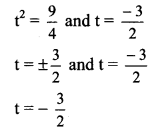
Answer:
Maharashtra Board Class 11 Chemistry Solutions Chapter 15 Hydrocarbons 46
Three changes which occur at molecular level include:
Step 1: Adsorption of reactants: Reactants (alkene and hydrogen) get adsorbed on the catalytic surface.
Step 2: Formation of a product: Hydrogen atoms are added across the double bond of 2-methylpropene which results in the formation of product isobutane.
Step 3: Desorption: Product formed on the catalytic surface is readily desorbed making catalytic surface available for other molecules.

Use your brain power! (Textbook Page No. 236)

Question 1.
Why are alkanes insoluble in water and readily soluble in organic solvents like chloroform or ether?
Answer:

  • The solubility of any substance is governed by the principle of like dissolves like. This means polar compounds are soluble in polar solvents while nonpolar compounds are soluble in nonpolar solvents.
  • Alkanes consist of C – C and C – H nonpolar covalent bonds and thus, they are nonpolar in nature, whereas water is a polar solvent.
  • The dipole-dipole forces that exist between water molecules is much stronger than the forces of attraction between alkane and water molecules.

Hence, alkanes are insoluble in water and readily soluble in organic solvents like chloroform or ether.

Maharashtra Board Class 11 Chemistry Solutions Chapter 15 Hydrocarbons

Can you recall? (Textbook Page No. 238)

Question 1.
What is the product which is poisonous and causes air pollution formed by incomplete combustion of alkane?
Answer:
When alkanes are subjected to incomplete combustion, it forms carbon monoxide and carbon (soot).
i. 2CH4(g) + 3O2(g) → 2CO(g) + 4H2O(g)
ii. CH4(g) + O2(g) → C(s) + 2H2O(l)

Can you recall? (Textbook Page No. 238)

Question i.
What are alkenes?
Answer:
Alkenes are unsaturated hydrocarbons containing at least one carbon-carbon double bond.

Question ii.
Calculate the number of sigma (σ) and pi (π) bonds in 2-methylpropene.
Answer:
Maharashtra Board Class 11 Chemistry Solutions Chapter 15 Hydrocarbons 47

Question iii.
Write the structural formula of pent-2-ene.
Answer:
Maharashtra Board Class 11 Chemistry Solutions Chapter 15 Hydrocarbons 48

Can you tell? (Textbook Page No. 241)

Question i.
Explain by writing a reaction, the main product formed on heating 2-methylbutan-2-ol with concentrated sulphuric acid.
Answer:
Maharashtra Board Class 11 Chemistry Solutions Chapter 15 Hydrocarbons 49

Question ii.
Will the main product in the above reaction show geometrical isomerism?
Answer:
No, the major product, i.e., 2-methylbut-2-ene does not show geometrical (or cis-trans) isomerism.

Can you tell? (Textbook Page No. 244)

Question 1.
Propan-1-ol and 2-methypropan-1-ol are not prepared by hydration method. Why?
Answer:
Propan-1-ol and 2-methylpropan-1-ol cannot be prepared by hydration of propene and 2-methylprop-1-ene because the addition reaction follows Markovnikov’s rule.

Maharashtra Board Class 11 Chemistry Solutions Chapter 15 Hydrocarbons

Use your brainpower. (Textbook Page No. 244)

Question 1.
On ozonolysis, an alkene forms the following carbonyl compounds. Draw the structure of unknown alkene from which these compounds are formed: HCHO and CH3COCH2CH3
Answer:
The structure of alkene which produces a mixture of HCHO and CH3COCH2CH3 on ozonolysis is
Maharashtra Board Class 11 Chemistry Solutions Chapter 15 Hydrocarbons 50

Use your brain power! (Textbook Page No. 245)

Question 1.
Write the structure of monomer from which each of the following polymers are obtained.
Maharashtra Board Class 11 Chemistry Solutions Chapter 15 Hydrocarbons 51
Answer:

PolymerMonomeric unit
i.TeflonCF2 – CF2
Tetrafluoroethene
ii.PolypropeneH3C – CH = CH2
Propene
iii.Polyvinyl chlorideH2C = CHCl
Vinyl chloride

Can you tell? (Textbook Page No. 246)

Question i.
What are aliphatic hydrocarbons?
Answer:
Aliphatic hydrocarbons are hydrocarbons containing carbon and hydrogen joined together in straight chain or branched chain. They may be saturated (alkanes) or unsaturated (alkenes or alkynes).

Question ii.
Compare the proportion of carbon and hydrogen atoms in ethane, ethene and ethyne. Which compound is most unsaturated with hydrogen?
Answer:
Ethane
C : H = 2 : 6 = 1 : 3
Ethene
C : H = 2 : 4 = 1 : 2
Ethyne
C : H = 2 : 2 = 1 : 1
From the above proportion it is clear that ethyne with 1 : 1 ratio of C : H is most unsaturated with hydrogen (50%) as compared to ethane (25%) and ethene (33.33%).

Can you tell? (Textbook Page No. 247)

Question 1.
Why is sodamide used in dehydrohalogenation of vicinal dihalides to remove HX from alkenyl halide in place of alcoholic KOH?
Answer:

  • Sodamide (NaNH2) is a strong base and hence, helps in complete conversion of alkenyl halide formed in the first step to form alkynes.
  • The base (KOH or NaOH) used in first step gives alkynes in poor yield and hence, stronger bases such as NaNH2 on KNH2 are used in second step.

Use your brainpower! (Textbook Page No. 247)

Question 1.
Convert: 1-Bromobutane to hex-1-yne
Answer:
Maharashtra Board Class 11 Chemistry Solutions Chapter 15 Hydrocarbons 52

Can you tell? (Textbook Page No. 248)

Question 1.
Alkanes and alkenes do not react with lithium amide. Give reason.
Answer:
i. The sp hybrid carbon atom in terminal alkynes is more electronegative than the sp2 carbon in ethene or the sp3 carbon in ethane.
ii. Due to high electronegative character of carbon in terminal alkynes, hydrogen atom can be given away as proton (H+) to very strong base as shown in the reactions below.
Maharashtra Board Class 11 Chemistry Solutions Chapter 15 Hydrocarbons 53
iii. Further, since s-character decreases from sp to sp2 to sp3 carbon atom, the relative acidity of alkanes, alkenes and alkynes is in the following order: H – C = C – H > H2C = CH2 > H3C – CH3
Hence, alkenes and alkanes do not react with lithium amide.

Maharashtra Board Class 11 Chemistry Solutions Chapter 15 Hydrocarbons

Use your brain power! (Textbook Page No. 248)

Question 1.
Arrange following hydrocarbons in the increasing order of acidic character: propane, propyne, propene.
Answer:
Propyne > propene > propane

Use your brain power! (Textbook Page No. 249)

Question 1.
Convert: 3-Methylbut-l-yne into 3-methylbutan-2-one
Answer:
Maharashtra Board Class 11 Chemistry Solutions Chapter 15 Hydrocarbons 54

Can you recall? (Textbook Page No. 249)

Question i.
What are aromatic hydrocarbons?
Answer:
Benzene and all compounds that have structures and chemical properties resembling benzene are called as aromatic hydrocarbons.

Question ii.
What are benzenoid and non-benzenoid aromatics?
Answer:
Benzenoid aromatics are compounds having at least one benzene ring in the structure.
e.g. Benzene, naphthalene, anthracene, phenol, etc.,
Non-benzenoid aromatics are compounds that contain an aromatic ring, other than benzene. e.g. Tropone, etc.

Can you recall? (Textbook Page No. 254)

Question 1.
What is decarboxylation?
Answer:
The reaction which involves removal of a carboxyl group (-COOH) in the form of carbon dioxide (CO2) is known as decarboxylation reaction.
R – COOH → R – H + CO2