Maharashtra Board Class 10 Geography Solutions Chapter 4 Climate

Balbharti Maharashtra State Board Class 10 Geography Solutions Chapter 4 Climate Notes, Textbook Exercise Important Questions and Answers.

Maharashtra State Board Class 10 Geography Solutions Chapter 4 Climate

Class 10 Geography Chapter 4 Climate Textbook Questions and Answers

Question 1.
Write names of the States/Regions in appropriate columns.
Bihar, Tocantins, Pernambuco, Alagoas, Eastern Maharashtra, Western part of Rajasthan, Gujarat, Rio Grande Do Norte, Paraiba, Western Ghats, Eastern Himalayas, Western Andhra Pradesh, Roroima, Amazonas, West Bengal, Rio Grande Do Sul, Santa Catarina, Goa
Answer:

States/RegionsIndiaBrazil
High rainfallWestern Ghats, Eastern Himalayas, GoaTocantins, Rio Grande Do Sul, Roraima
Moderate rainfallBihar, Eastern Maharashtra West BengalSanta Catarina, Amazonas, Alagoas
Low rainfallWestern part of Rajasthan, Gujarat, Western Andhra PradeshPernambuco, Paraiba,

Rio Grande Do Norte, Alagoas

Maharashtra Board Class 10 Geography Solutions Chapter 4 Climate

2. State whether right or wrong. Rewrite the wrong sentences

Question a.
The fact that Brazil lies on the equator affects its climate in a big way.
Answer:
Right.

Question b.
India and Brazil have the same seasons at the same time.
Answer:
Wrong – India and Brazil have different seasons at the same time.

Question c.
India faces tropical cyclones frequently.
Answer:
Right.

Question d.
Brazil gets a lot of rainfall because of the southwest monsoon winds.
Answer:
Wrong – Brazil gets rainfall from South-East Trade Winds and North-East Trade Winds.

3. Give geographical reasons:

Question a.
The north-eastern part of Brazilian Highlands receives very less rainfall.
Answer:
(i) Brazil gets rainfall from the South-East Trade Winds and the North-East Trade Winds.
(ii) Parts of the Brazilian Highlands extend upto the northern coast.
(iii) The Escarpments act as an obstruction to the winds blowing from the sea and cause orographic type of rainfall in the coastal region.
(iv) Beyond the Highlands, the effect of these winds gets reduced. As a result, the rainfall is minimal.
(v) Thus the North Eastern part of Brazilian highlands receives less rainfall. This rain shadow region is also called the ‘Drought Quadrilateral’.

Question b.
Snowfall doesn’t always occur in Brazil.
Answer:
(i) Because of the vast latitudinal extent of Brazil, it experiences a wide range of climatic variations. Near the Equator it is hot, while tropical type of climate is found near the Tropic of Capricorn.

(ii) Considering the temperatures in Brazil, the northern part of Brazil is hot while the temperatures in the southern part are comparatively lower.

(iii) It generally snows in those areas lying in the temperate or polar regions or in the mountainous regions of very high altitude.

(iv) Snowfall does occur but is only confined to higher elevations in the southern states of Rio Grande Do Sul, Parana and Santa Catarina.

(v) Most part of the country lies in the tropical zone which experiences a hot and humid climate.

So snowfall doesn’t always occur in Brazil and is considered a rare phenomenon.

Question c.
Convectional type of rainfall is not prominent in India.
Answer:
(i) Convectional rains are a feature of the equatorial regions and the equator passes through the northern part of Brazil.
(ii) Due to the intense heat here the air expands and rises upwards. As the air goes upwards it cools down, condensation occurs and clouds are formed. This leads to convectional rains every day.
(iii) As such conditions do not exist in India, convection rainfall is not prominent here.

Question d.
Tropical cyclones occur rarely in Brazil.
Answer:
(i) In the coastal regions of Brazil near the Equator, differences in temperatures are negligible.
(ii) The winds move in the vertical direction in this equatorial region.
(iii) Similarly, the convergence zone of the trade winds is weak here. As a result, cyclones are not formed.
(iv) As a result tropical cyclones occur rarely in Brazil.

Question e.
There is not much difference in the range of temperature in Manaus.
Answer:
(i) Manaus is located to the north of Brazil and close to the Equator.
(ii) This region receives perpendicular rays of the sun throughout the year.
(iii) It also receives convectional type of rainfall every day.
(iv) So the climate is hot and humid throughout the year.
(v) As, there is not much difference in the maximum and minimum temperatures there is not much difference in the range of temperature in Manaus.

Maharashtra Board Class 10 Geography Solutions Chapter 4 Climate

Question f.
India receives precipitation from the North East Monsoon Winds too.
Answer:
(i) In the winter season, India is influenced by the North East Monsoon Winds.
(ii) These winds bring cool breeze to the country.
(iii) While blowing over Bay of Bengal the North East Monsoon Winds pick up moisture and give rain to the eastern coast of Andhra Pradesh and Tamil Nadu in India.
So, it is said that India receives precipitation from the North East Monsoon Winds too.

4. Answer the following questions:

Question a.
Describe in brief the changes occurring in the climatic conditions of India while going from south to north.
Answer:
(i) India’s Climate is of monsoon type. But there is diversity in climatic conditions of India due to the latitudinal location and altitude of the place.

(ii) As the Tropic of Cancer passes through middle of India, it divides the country into tropical region and sub tropical region.

(iii) The tropical region receives nearly vertical rays of the Sun and the temperature increases as we move towards the south.

(iv) In the sub tropical region of the north, summers are very hot and winters are very cool and dry.

(v) The Himalayas lie in the northern part of India. They protects us from the cold winds that blow from the north, obstructs the South West Monsoon Winds which results in orographic rainfall in its southern slopes.

(vi) In major parts of India precipitation is in the form of rainfall, but in the Himalayas it is in the form of snowfall.

Question b.
Explain the importance of the Himalayas and the Indian Ocean with respect to the climate of India.
Answer:
(i) The Indian Ocean and the Himalayan ranges exert a great influence on the climate of India and the origin of monsoons.

(ii) Because of high temperatures in summers, a low pressure area develops in the Punjab Plains and the Thar Desert of Rajasthan.

(iii) At the same time a high pressure region develops over the Indian Ocean.

(iv) This attracts winds and they start blowing from the Indian Ocean towards the mainland India.

(v) These are moisture-laden winds which bring rainfall to India.

(vi) These winds move towards the Himalayas and due to the natural obstruction of the Himalayas, orographic rain occurs.

(vii) Later these winds retreat from the Himalayas and move from the north-east towards the Indian Ocean and brings rain to some parts of the Peninsula.

(viii) Also the severe cold winds blowing from the north are obstructed by the Himalayas and it saves India from severe winters.

Question c.
Discuss the factors affecting the climate of Brazil.
Answer:
(i) Brazil experiences wide range of climatic variations due to its vast latitudinal extent, proximity to the Equator, presence of the Atlantic Ocean and the Great Escarpment.

(ii) The northern part of Brazil near the Equator is hot, while temperate type of climate is found near the Tropic of Capricorn.

(iii) Brazil gets rainfall from the South-East Trade Winds and the North-East Trade Winds blowing from the Atlantic Ocean.

(iv) Convectional rainfall occurs in places near the equator. Whereas, the Escarpment act as an obstruction to the winds blowing from the sea and cause orographic type of rainfall in the coastal region.

(v) Beyond the Highlands the effects of these winds gets reduced, as a result the rainfall is minimal. This region is a rain-shadow region and is called ‘The Drought Quadrilateral.’

(vi) The Equator passes through the northern part of Brazil so the temperature here is high. Average temperature of Amazon valley is 25°-28°C. Climate is cooler in the highlands. While the temperatures in the southern part are comparatively lower.

(vii) In the coastal regions near the Equator in Brazil, differences in temperatures are negligible. Because of the proximity to the sea, the coast experiences mild and humid climate.

(viii) The winds move in the vertical direction in this region. Similarly, the convergence zone of the trade winds is weak here. So the tropical cyclones are a rare phenomena here.

Maharashtra Board Class 10 Geography Solutions Chapter 4 Climate

Question d.
Compare the climates of brazil and India?
Answer:

Climate of IndiaClimate of Brazil
(i) India has a monsoon type of climate.(i) Brazil has a tropical climate to the north and temperate climate to the south.
(ii) The southern part of India lies in the tropical region so the temperature is high in the south and comparatively low in the north, i.e., the temperature decreases from south to north.(ii) The northern part of Brazil lies in the tropical region so the temperature is high in the north and comparatively low in the south, i.e., the temperature decreases from north to south.
(iii) India receives rain from the South West and the North East Monsoon Winds.(iii) Brazil receives rain from the South East and North East Trade Winds.
(iv) India receives orographic rainfall.(iv) Brazil receives convectional and orographic type of rainfall.
(v) The western part of Rajasthan, Gujarat and eastern side of the Western Ghats receive less rain.(v) The north eastern part of the Brazilian highlands is a rain shadow region.
(vi)     Tropical cyclones are a frequent phenomena.(vi) Tropical cyclones are a rare phenomena

Maharashtra Board Class 10 Geography Solutions Chapter 4 Climate

Class 10 Geography Chapter 4 Climate Intext Questions and Answers

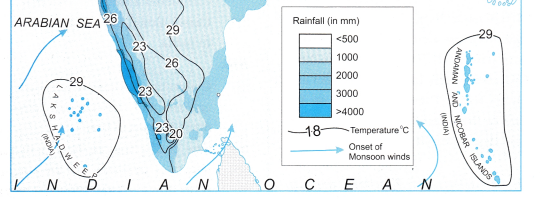
Observe the given map below and answer the following questions
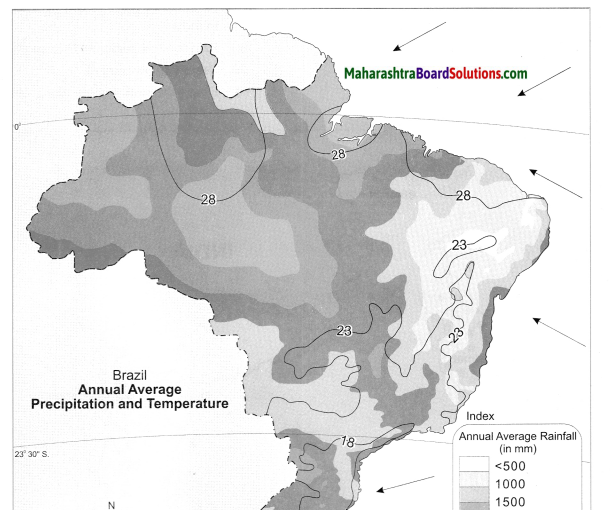
Maharashtra Board Class 10 Geography Solutions Chapter 4 Climate 1
Maharashtra Board Class 10 Geography Solutions Chapter 4 Climate 2

Question 1.
Considering the isotherms of Brazil, what is the average range of temperature in Brazil?
Answer:
Considering the isotherms of Brazil, the average range of temperature of Brazil is 10°C (28°C-18°C).

Question 2.
In which area does it rain more?
Answer:
It rains more in the northern and central part of Brazil. E.g., Amazon Valley.

Question 3.
From which directions are winds blowing towards Brazil?
Answer:
The winds are blowing from North East and South East directions.

Question 4.
What could be the reason behind that?
Answer:
These are permanent trade winds which blow from high pressure belt to the equatorial low pressure belt. Brazil being in the tropical zone, a low pressure area is created and wind start blowing from the ocean to the land.

Question 5.
What could be the obstruction in the way of these winds?
The Escarpment acts as obstruction in the way of the South East Trade Winds coming from the sea.

Question 6.
Which type of rainfall will occur because of these winds?
Answer:
Orographic rainfall will occur because of these winds.

Question 7.
Correlate these winds and rainfall.
Answer:
The escarpments act as an obstruction to the winds blowing from the sea and cause an orographic type of rainfall in the coastal region. Beyond the Highlands, the effect of these winds gets reduced. As a result, the rainfall is minimal.

Question 8.
In which part of Brazil are the average temperatures low?
Answer:
The average temperatures are low in the southern part of Brazil.

Question 9.
Identify the rain-shadow area in Brazil. Describe its climatic characteristics.
Answer:
The north-eastern part of the Brazilian highlands is a rain shadow region. Beyond the highlands, the effect of the South East Trade Winds gets reduced and the rainfall is minimal. Also, the temperature here is quite high. This rain shadow region is referred to as the ’Drought Quadrilateral’.

Question 10.
In which region do you find a higher temperature?
Answer:
The northern part of Brazil has higher temperature.

Question 11.
Considering the latitudinal extent of Brazil, where will you find a temperate climate in Brazil?
Answer:
The southern part of Brazil lying below 23 V4°S latitude (Tropic of Capricorn) experiences temperate climate.

Maharashtra Board Class 10 Geography Solutions Chapter 4 Climate

Question 12.
Describe the winds blowing between 0° to 5° N and S zones.
Answer:
The winds blowing between 0° to 5° N and S zones move in the vertical direction leading to convectional type of rain. The North East and South East Trade winds are very weak in this region.

Question 13.
Which method has been used to show distribution in this map?
Answer:
The Isopleth method has been used to show distribution in this map.

Observe the given map and answer the following questions
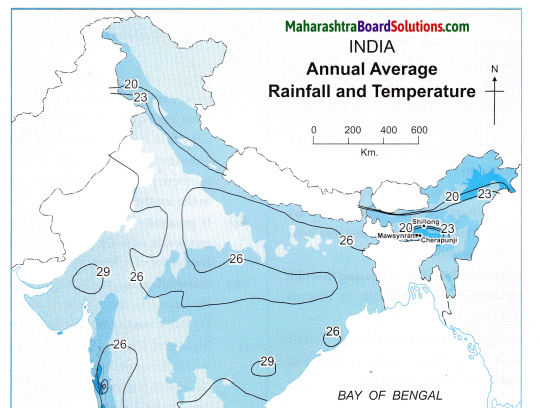
Maharashtra Board Class 10 Geography Solutions Chapter 4 Climate 16
Maharashtra Board Class 10 Geography Solutions Chapter 4 Climate 17

Question 1.
Which region gets more than 4000mm of rainfall?
Answer:
Western Ghats, Western Coasts of India and the northeastern region comprising of Mawsynram, Cherrapunji and parts of Assam and Arunachal Pradesh gets more than 4000 mm of rainfall.

Question 2.
Identify the regions with maximum and minimum temperatures?
Answer:
Central and North Western parts of Peninsular Plateau and islands have high temperature. Hilly regions of north, northeast and south India have low temperature.

Maharashtra Board Class 10 Geography Solutions Chapter 4 Climate

Question 3.
In which direction is the temperature increasing?
Answer:
The temperature is increasing towards the south.

Question 4.
Identify the direction of the winds shown. What are they known as?
Answer:
The winds shown are blowing from the south west to north east direction. These winds are called Southwest Monsoon Winds.

Question 5.
Which winds are responsible for the rainfall in India ?
Answer:
South-West Monsoon Winds are responsible for rainfall in India.

Question 6.
Some part of Rajasthan is under desert? What could be the reason for it?
Answer:
The South West Monsoon Winds blow parallel to the Aravallis. As these moisture laden winds are not obstructed by the Aravallis it rains less here. Hence, Rajasthan is under desert.

Question 7.
Draw the main parallel latitude passing through India which affects its climate.
Answer:
Students are expected to draw the Tropic of Cancer.

Question 8.
In which part of Peninsular India is semi-arid climatic conditions found and why?
Answer:
(i) The part of peninsular India which has semi-arid climatic conditions are central part of Peninsula Plateau comprising parts of Central Maharashtra, Western Andhra Pradesh, Eastern Karnataka and Western Tamil Nadu. These regions lie on the leeward side of the Western Ghats and Eastern Ghats. It rains less here and a rain shadow region is formed.
(ii) Some parts of Gujarat and Rajasthan are also semi-arid as the Aravallis lie parallel and do not obstruct the South-west Monsoon winds.

Give geographical reasons:

Question 1.
Shillong gets less than 1000 mm of rainfall annually, whereas Cherrapunji/Mawsynram which is nearby get’s over 11000 mm, of rainfall annually.
Answer:
(i) Cherrapunji/Mawsynram lies in the higher altitude on the windward side of the Khasi Hills and receives rainfall from the South West Monsoon Winds.
(ii) While Shillong lies in the lower altitude on the leeward side of the Khasi Hills, so it receives less rainfall being in the rain shadow area.

Maharashtra Board Class 10 Geography Solutions Chapter 4 Climate

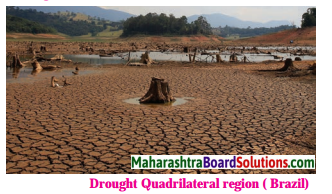
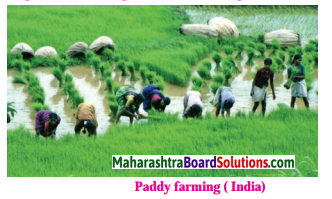
Observe the pictures given below and write brief description about them.

Question 1.
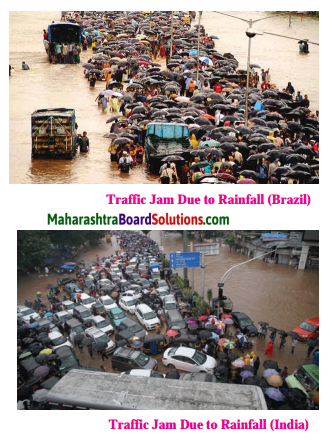
Maharashtra Board Class 10 Geography Solutions Chapter 4 Climate 31
Answer:
Both the figures shows the traffic congestion during heavy rains. Due to lack of proper drainage and heavy downpour the water gets accumulated disturbing the commuting system.

Question 2.
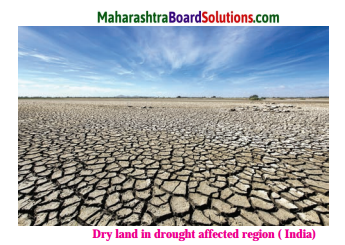
Maharashtra Board Class 10 Geography Solutions Chapter 4 Climate 37
Maharashtra Board Class 10 Geography Solutions Chapter 4 Climate 35
Answer:
Both the figures show the drought affected regions of India and Brazil respectively. Due to scarce amount of rainfall received in these regions the land has became dry and cannot be cultivated.

Question 3.
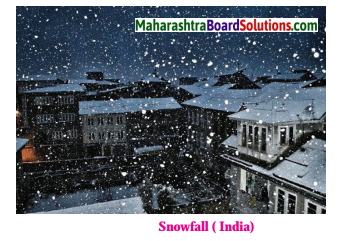
Maharashtra Board Class 10 Geography Solutions Chapter 4 Climate 38
Answer:
figure shows snow fall during winter season in the northern parts of India.

Question 4.
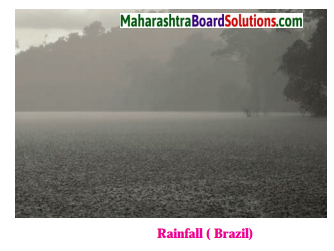
Maharashtra Board Class 10 Geography Solutions Chapter 4 Climate 32
Answer:
figure shows heavy rainfall in the Brazilian rainforest region.

Question 5.
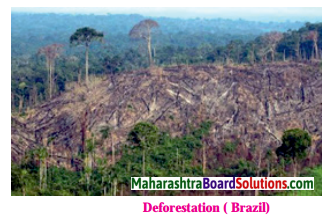
Maharashtra Board Class 10 Geography Solutions Chapter 4 Climate 33
Answer:
figure shows the trees being cut down to bring land under cultivation. Deforestation is a major issue in Brazil.

Question 6.
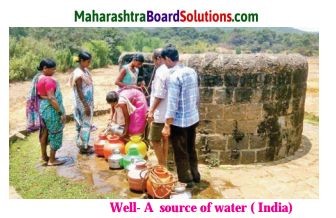
Maharashtra Board Class 10 Geography Solutions Chapter 4 Climate 34
Answer:
figure shows a well from which water is used for domestic purpose.

Maharashtra Board Class 10 Geography Solutions Chapter 4 Climate

Question 7.
Maharashtra Board Class 10 Geography Solutions Chapter 4 Climate 36
Answer:
figure shows paddy fanning in India. The farmers are planting paddy. The water logged fields are shown.

Study the graphs given below and answer the following questions:
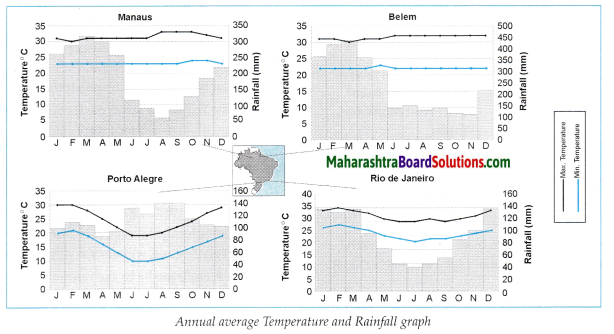
Maharashtra Board Class 10 Geography Solutions Chapter 4 Climate 14

Question 1.
In which month is the highest temperature found in all the four cities?
Answer:
The highest temperature is found in the month of January.

Question 2.
In which month does it rain the most in the given cities?
Answer:
It rains the most in the month of march.

Question 3.
When does Brazil have its rainy season?
Answer:
Brazil has its rainy season from December to march.

Question 4.
Which city has the maximum range of temperature? How much is it?
Answer:
Porto Alegre has the maximum range of temperature. It is 20°C (30° C -10° C).

Question 5.
What type of climate will be found in Rio de Janeiro?
Answer:
Rio de Janeiro has mild & humid climate.
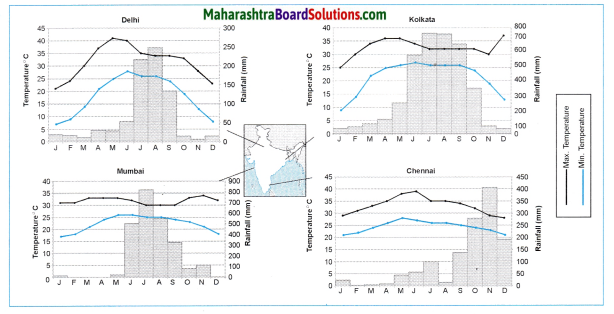
Maharashtra Board Class 10 Geography Solutions Chapter 4 Climate 15

Question 1.
What difference do you find in the rainy seasons of Chennai and other cities of India? Why?

Rainy Season of ChennaiRainy Seasons of Other Indian Cities
(i) Chennai mainly receives rain from October to December.Other cities of India receive rainfall from June to September.
(ii) Chennai receives rainfall from North East Monsoon Winds.The other cities receive rainfall mainly from South-West Monsoon Winds.

Maharashtra Board Class 10 Geography Solutions Chapter 4 Climate

Question 2.
What similarities do you see in the temperature curves of Delhi and Kolkata?
Answer:
The following similarities can be seen in the temperature curves of Delhi and Kolkata:

  • The temperature rises from January to March.
  • From March till June high temperatures are experienced.
  • The temperature drops till July and remain stable in August and September.
  • Thereafter the temperatures decreases.

Question 3.
Calculate the average range of minimum and maximum temperatures of all the four cities.

CitiesAverage range of minimum and maximum temperatures
Delhi34°C (41°-7°)
Kolkata28°C (37°-9°)
Mumbai17°C (34° -17°)
Chennai18°C (39° – 21°)

Question 4.
In which city is the range minimum? What can you infer about its climate?
Answer:
The range is minimum in Mumbai due to its proximity to the sea.

Question 5.
In which city is the range maximum? What can you infer from this about its climate?
Answer:
The range is maximum in Delhi. It indicates that Delhi has an extreme climate.

Question 6.
Based on the temperature and rainfall of Mumbai, comment upon its climate.
Answer:
Mumbai has an equable climate, with less variation in summer and winter temperature.

Question 7.
Classify the cites as cities with equable and extreme climates.
Answer:
Equable climates – Mumbai, Chennai, Kolkata. Extreme climate – Delhi.

Give it a try

Question 1.
Considering the various factors affecting Brazil’s climate, complete the table.
Answer:

RegionsClimatic characteristics
(1) Amazon ValleyThe climate is generally hot and humid. It receives around 2000mm of rainfall. The average range of temperature here is 25°C – 28°C.
(2) HighlandsHot and dry climate, low rainfall.
(3) PantanalWarm and humid.
(4) North Coastal regionHot and humid climate. Rainfall between 1000 to 1200 mm.
(5) South Coastal regionMild and humid climate.
(6) Southernmost region of BrazilHot summers, cool winters and snowfall.

Question 2.
In which part of India are crops grown in a year? How is this related to the rainfall over there?
Answer:
(i) Coastal areas of Tamil Nadu in India grow rice three times a year.
(ii) This crop is taken during the retreating monsoon season.
While blowing over Bay of Bengal, the North East Monsoon winds pick up moisture and give rain to eastern coast of Tamil Nadu.

Maharashtra Board Class 10 Geography Solutions Chapter 4 Climate

Use your brain power!

Question 1.
Group the months into seasons for a whole year according to the charts given.

SeasonsIndiaBrazil
SummerMarch to MayDecember to March
WinterDecember to FebruaryJune to September

Answer:

Colours of Both!

Question 1.
Considering the location extent and climatic conditions of both the countries, write months according to the seasons.
Answer:

SeasonsIndiaBrazil
SummerMarch to MayDecember to March
WinterDecember to FebruaryJune to September

Class 10 Geography Chapter 4 Climate Additional Important Questions and Answers

Choose the correct option and rewrite the statements:

Question 1.
The climate found near the Equatorial region is
(a) hot
(b) dry
(c) humid
(d) cold
Answer:
(a) hot

Question 2.
The climate found near the Tropic of Capricorn is
(a) tropical
(b) hot
(c) temperate
(d) tundra
Answer:
(c) temperate

Question 3.
Brazil gets rainfall from
(a) North-West and South-West trade winds
(b) Westerly winds
(c) South-West and North-East
(d) North-East and South-East trade winds
Answer:
(d) North-East and South-East trade winds

Maharashtra Board Class 10 Geography Solutions Chapter 4 Climate

Question 4.
The act as an obstruction to the winds blowing from the sea in Brazil.
(a) Himalayas
(b) Escarpments
(c) Andes
(d) Western Ghats
Answer:
(b) Escarpments

Question 5.
The coastal region of Brazil receives a type of rainfall.
(a) orographic
(b) cyclonic
(c) convectional
(d) frontal
Answer:
(a) orographic

Question 6.
Since the convergence of trade winds are weak near the equator, are not formed.
(a) clouds
(b) ocean currents
(c) cyclones
(d) tides
Answer:
(c) cyclones

Question 7.
The average temperature in the Amazon valley is
(a) 15°-20°C
(b) 13°-15°C
(c) 30°-32°C
(d) 25°-28°C
Answer:
(d) 25°-28°C

Question 8.
The Amazon valley receives around mm of rainfall
(a) 2000
(b) 1800
(c) 1500
(d) 1000-1200
Answer:
(a) 2000

Question 9.
India’s climate is of type.
(a) humid
(b) monsoon
(c) equatorial
(d) cold
Answer:
(b) monsoon

Maharashtra Board Class 10 Geography Solutions Chapter 4 Climate

Question 10.
The diversity in the climatic conditions of India is due to the location and altitude of the place.
(a) longitudinal
(b) latitudinal
(c) equatorial
(d) tropical
Answer:
(b) latitudinal

Question 11.
The Ocean and the Himalayan ranges exert a great influence on the climate of India.
(a) Atlantic
(b) Arctic
(c) Pacific
(d) Indian
Answer:
(d) Indian

Question 12.
Orographic type of rainfall occurs in India because of the natural obstruction of
(a) Himalayas
(b) Escarpments
(c) Highlands
(d) Satpuda
Answer:
(a) Himalayas

Question 13.
As the passes through the middle of India, it is considered to be a tropical region.
(a) Tropic of Capricorn
(b) Equator
(c) Tropic of Cancer
(d) 60°S latitude
Answer:
(c) Tropic of Cancer

Question 14.
Most part of Brazil lies in the zone.
(а) polar
(b) tropical
(c) sub-tropical
(d) temperate
Answer:
(b) tropical

Maharashtra Board Class 10 Geography Solutions Chapter 4 Climate

Match the columns:

Question 1.

Column ‘A’Column ‘B’
(1) Wettest places in the world(a) Tamil Nadu
(2) Driest place in India(b) Cherrapunji and Mawsynram
(3) Rainshadow region in Brazil(c) Jaisalmer, Rajasthan
(4) Climate of India(d)    Drought Quadrilateral

(e)    Monsoon type

(f)     Dry type

Answer:
1 – b
2 – c
3 – d
4 – e

Answer in one sentence each.

Question 1.
Which natural disasters does India face frequently?
Answer:
India frequently faces natural disasters like erratic rainfall, droughts, cyclones, floods, etc.

Question 2.
Why does Brazil experience wide climatic variations?
Answer:
Brazil has vast latitudinal extent because of which it experiences wide climatic variations.

Question 3.
Which winds bring rainfall to Brazil?
Answer:
Brazil receives rainfall from the South East and North-East Trade Winds.

Question 4.
What acts as an obstruction to the winds blowing from sea in Brazil?
Answer:
The Escarpments act as an obstruction to the winds blowing from the sea in Brazil.

Question 5.
Which region is called the Drought Quadrilateral’?
Answer:
The northern part of Brazil beyond the Highlands is called ‘Drought Quadrilateral’.

Question 6.
Where is the difference in temperature negligible in Brazil?
Answer:
In Brazil the difference in temperature is negligible in the coastal regions near the equator.

Question 7.
In which zone does most of Brazil and India lie?
Answer: Most part of Brazil and India lies in the Tropical zone.

Question 8.
Which important latitude passes through the northern part of Brazil?
Answer:
The equator passes through the northern part of Brazil.

Maharashtra Board Class 10 Geography Solutions Chapter 4 Climate

Question 9.
What is the average temperature in Amazon valley?
Answer:
The average temperature in Amazon valley is 25°-28°C.

Question 10.
Which part of Brazil has cooler climate?
Answer:
The climate is cooler in the Highlands.

Question 11.
Why do the Brazilian coasts experience mild and humid climate?
Answer:
The Brazilian coasts experience mild and humid- climate because of its proximity to sea.

Question 12.
Which type of climate is found in India?
Answer:
Monsoon type of climate is found in India.

Question 13.
Which important latitude passes through the middle of India?
Answer:
The Tropic of Cancer passes through the middle of India.

Question 14.
What diversifies the climatic conditions of India?
Answer:
The diversity in the climatic conditions of India are due to the latitudinal location and altitude of India.

Question 15.
What exerts a great influence on the climate of India and the origins of the monsoon?
Answer:
The Indian Ocean and the Himalayan ranges exert a great influence on the climate of India and the origin of monsoons.

Question 16.
In India, what obstructs the cold winds blowing from the North?
Answer:
In India, the Himalayas obstruct the cold winds blowing from the north.

Question 17.
What brings more rain in the coastal regions of India?
Answer:
The obstruction caused by the Eastern and Western Ghats brings more rain in the coastal regions of India.

Maharashtra Board Class 10 Geography Solutions Chapter 4 Climate

Question 18.
Find out more about the different ways of classification of the seasons. For example, what is summer?
Answer:
The hot weather season is called summer. The season where the rain begins is called the monsoon. The cold weather season is called winter.

Name the following:

Question 1.
The two places in India which are considered as the wettest places in the world.
Answer:
Cherrapunji and Mawsynram.

Question 2.
Years in which Brazil has experienced snowfall.
Answer:
1879,1957and 1985.

Question 3.
The driest part of India.
Answer:
Jaisalmer, Rajasthan.

Question 4.
The state in India which receives maximum rainfall during the retreating monsoon season.
Answer:
Tamil Nadu.

Question 5.
Temperature in Kargil in winter.
Answer:
-48°C.

Question 6.
Temperature in Ganganagar, Rajasthan in the month of June.
Answer:
50°C.

Question 7.
The hills responsible for heavy rainfall in Cherrapunji and Mawsynram.
Answer:
Garo, Khasi and Jaintia Hills.

Question 8.
The winds which provide rainfall to the Tamil Nadu coast.
Answer:
North East Monsoon winds.
Question 9.
The state to receive rain foremost in India.
Answer:
Kerala.

Maharashtra Board Class 10 Geography Solutions Chapter 4 Climate

Question 10.
The four seasons of India as per Indian meteorological department.
Answer:
The hot weather season (Summer), the season

Are the sentences right ot wrong? Rewrite the wrong ones.

Question 1.
Brazil experiences wide climatic variation due to its vast longitudinal extent.
Answer:
Wrong – Brazil experiences wide climatic variation due to its vast latitudinal extent.

Question 2.
The winds move in the vertical direction in northern Brazil.
Answer:
Right.

Question 3.
The rainfall reduces on the windward side of the Great Escarpment.
Answer:
Wrong – The rainfall increases on the windward side of the Great Escarpment.

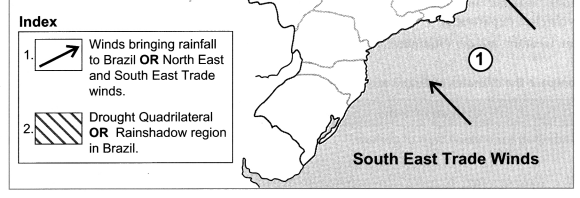
Mark the following on the map with the given information and make an index.

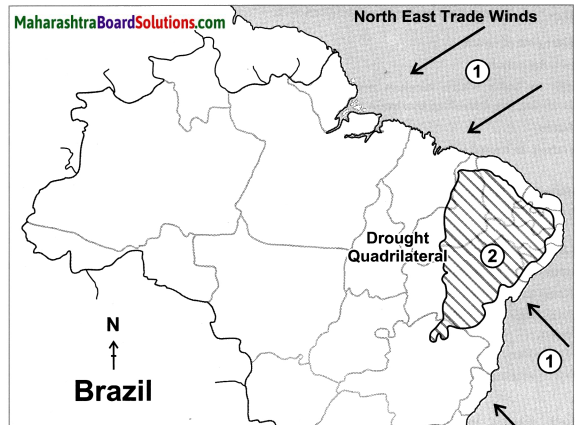
Question 1.
Outline Map of Brazil.

  1. Winds bringing rainfall to Brazil or North East and South East Trade winds.
  2. Drought Quadrilateral or Rainshadow region in Brazil.

Answer:
Maharashtra Board Class 10 Geography Solutions Chapter 4 Climate 18
Maharashtra Board Class 10 Geography Solutions Chapter 4 Climate 19

Maharashtra Board Class 10 Geography Solutions Chapter 4 Climate

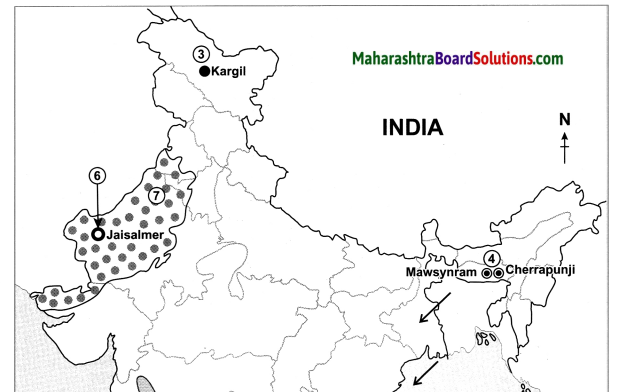
Question 2.
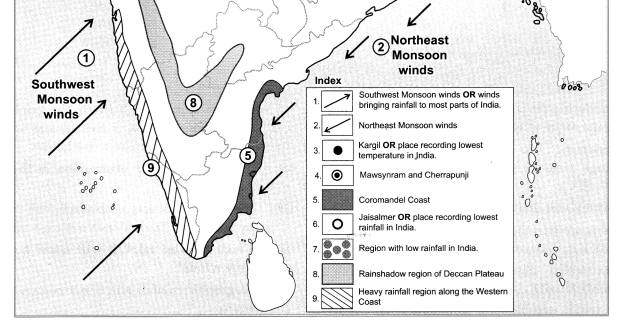
Outline Map of India.

  1. Southwest Monsoon winds or winds bringing rainfall to most parts of India.
  2. Northeast monsoon winds.
  3. Kargil or place recording lowest temperature in India.
  4. Cherrapunji and Mawsynram.
  5. Coromandel coast or the coast receiving rainfall from North East monsoon winds.
  6. Jaisalmer or place recording lowest rainfall in India.
  7. Rain shadow region of Deccan plateau.
  8. Region of low rainfall.
  9. Heavy rainfall region along the western coast.

Answer:
Maharashtra Board Class 10 Geography Solutions Chapter 4 Climate 20
Maharashtra Board Class 10 Geography Solutions Chapter 4 Climate 22

Maharashtra Board Class 8 Geography Solutions Chapter 5 Ocean Currents

Balbharti Maharashtra State Board Class 8 Geography Solutions Chapter 5 Ocean Currents Notes, Textbook Exercise Important Questions and Answers.

Maharashtra State Board Class 8 Geography Solutions Chapter 5 Ocean Currents

Class 8 Geography Chapter 5 Ocean Currents Textbook Questions and Answers

1. Choose the correct option:

Question a.
In which ocean does the Labrador current flow?
(a) Pacific
(b) South Atlantic
(c) North Atlantic
(d) Indian
Answer:
(c) North Atlantic

Maharashtra Board Class 8 Geography Solutions Chapter 5 Ocean Currents

Question b.
Which current out of the following flows in the Indian Ocean?
(a) East Australian current
(b) Peru current
(c) South Polar current
(d) Somali current
Answer:
(d) Somali current

Question c.
Which factor out of the following does not affect the region along the coast?
(a) Precipitation
(b) Temperature
(c) Land breeze
(d) Salinity
Answer:
(c) Land breeze

Question d.
Which of the following occurs in the area where the cold and warm currents meet?
(a) High temperature
(b) Snow
(c) Low temperature
(d) Thick fog
Answer:
(d) Thick fog

Question e.
Which of these following currents flow from the northern polar regiorTup to Antarctica?
(a) Warm ocean currents
(b) Surface ocean currents
(c) Cold ocean currents
(d) Deep ocean currents
Answer:
(d) Deep ocean currents

2. Examine the given statements and correct the wrong ones:

Question a.
Ocean currents give specific direction and velocity to the water.
Answer:
Correct.

Maharashtra Board Class 8 Geography Solutions Chapter 5 Ocean Currents

Question b.
The deep ocean currents flow with high velocity.
Answer:
Correct.

Question c.
Generally, surface ocean currents are formed in the equatorial regions.
Answer:
Incorrect.
Correct statement: Generally, surface ocean currents are formed in the equatorial region as well as polar region.

Question d.
Ocean currents hold great importance for human life.
Answer:
Correct.

Question e.
The movement of icebergs is not dangerous for water transport.
Answer:
Incorrect.
Correct statement: The movement of icebergs is dangerous for water transport.

Question f.
Water becomes warm near Brazil due to ocean currents. On the other hand, it becomes cold near African coast.
Answer:
Incorrect.
Correct statement: Water becomes warm near Brazil due to ocean currents. Similarly, it also becomes warm near African coast.

3. Explain the effect of-

Question a.
Warm ocean currents on climate.
Answer:

  1. The amount of precipitation increases in the coastal region along with which the warm ocean currents flow.
  2. Similarly, the temperature increases in the coastal region along with which the warm ocean currents flow.

Question b.
Cold ocean currents on the movement of icebergs.
Answer:

  1. Due to cold ocean currents, icebergs are moved away from the polar regions.
  2. These icebergs come along the marine routes and prove hazardous to the ships.

Maharashtra Board Class 8 Geography Solutions Chapter 5 Ocean Currents

Question c.
The shape of the coastline on ocean currents.
Answer:

  1. The extended parts of coastline acts as an obstacle for ocean currents.
  2. The extended parts of coastline alters the direction and velocity of ocean currents.

Question d.
Meeting of warm and cold ocean currents.
Answer:

  1. Dense fog is found in the meeting point of warm and cold ocean currents. Algae, plankton, etc. fish food grow on a large scale in these areas.
  2. Fish come in these areas on a large scale and breed. Therefore, extensive fishing grounds are found in the areas where warm and cold ocean currents meet.

Question e.
The transportation capacity of ocean currents.
Answer:

  1. The transportation capacity of ocean currents alters the amount of precipitation and temperature in the coastal regions along with which they flow.
  2. The transportation capacity of ocean currents leads to transfer of warm water to the bottom from the surface and cold water to the surface from the bottom.

Question f.
Deep ocean currents.
Answer:

  1. Deep ocean currents leads to transfer of warm water to the bottom from the surface and cold water to the surface from the bottom.
  2. Deep ocean currents thus leads to redistribution of sea water.

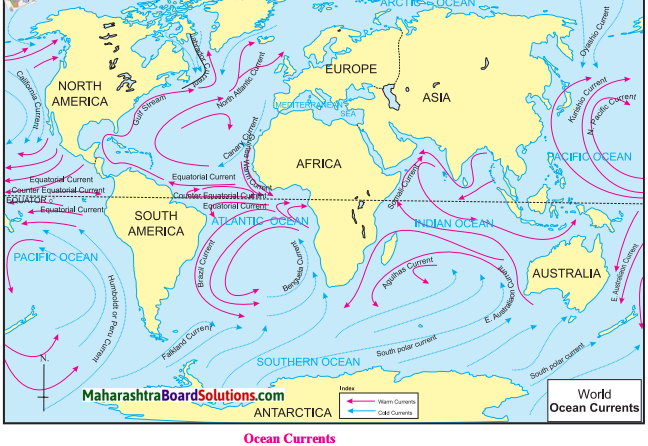
4. Look at the map of ocean currents and answer the following:

Maharashtra Board Class 8 Geography Solutions Chapter 5 Ocean Currents 3

Question a.
How does the Humboldt current affect the climate of the South America?
Answer:
Humboldt current is a cold ocean current and so it decreases the amount of precipitation and temperature on the western coastal region of the South America.

Maharashtra Board Class 8 Geography Solutions Chapter 5 Ocean Currents

Question b.
In which oceans are counter equatorial currents not observed and why?
Answer:
Counter equatorial currents are not observed in Arctic Ocean and Southern Ocean. These oceans are located near the polar regions. Therefore, the effects of trade winds is found to be less in these oceans Therefore, counter equatorial currents are not observed in these oceans.

Question c.
Which currents are absent in the northern part of the Indian Ocean and why?
Answer:
Cold currents are absent in the northern part of the Indian Ocean. The northern part of Indian Ocean is included in the temperate zone. So cold currents are absent in the northern part of the Indian Ocean.

Question d.
In which regions do the cold and warm ocean currents meet?
Answer:
The cold and warm ocean currents S meet in the following regions:

  1. North Atlantic Ocean (cold Labrador current and warm Gulf stream current)
  2. North Pacific Ocean (cold Oyashio current and warm ! Kurishio current)
  3. South Atlantic Ocean ! (cold Falkland current and warm Brazil current)
  4. South Pacific Ocean (cold South Polar current and warm East Australian current)
  5. Indian Ocean (cold South Polar i current and Agulhas Current)

5. Answer the following questions:

Question a.
What are the reasons responsible for the formation of deep ocean currents?
Answer:

  1. The temperature varies in various parts of ocean.
  2. Similarly, the density of water in various parts of ocean is also found to be different.
  3. The difference in the temperature and density of seawater leads to its circulation and the deep ocean currents are formed. This circulation is known as thermohaline circulation.

Thus, the difference in temperature and density of water in various parts of ocean are the reasons responsible for the formation of deep ocean currents.

Maharashtra Board Class 8 Geography Solutions Chapter 5 Ocean Currents

Question b.
What is the reason behind the dynamics of the ocean water?
Answer:
Planetary winds is the reason behind the dynamics of the ocean water.

Question c.
How do winds give direction to the ocean currents?
Answer:
Winds give clockwise direction to the ocean currents in the northern hemisphere and anti-clockwise direction to the ocean currents in the southern hemisphere.

Question d.
Why do the ports in the eastern coast of Canada freeze in winter?
Answer:

  1. Labrador cold current flows along the eastern coast of Canada.
  2. Due to Labrador cold current, the temperature of sea water near the eastern coast of Canada decreases.
  3. Due to fall in temperature, the sea water along the eastern coast of Canada start freezing. As its effect, the ports in the eastern coast of Canada freeze in winter.

Activity:

Question a.
Look for more funny and interesting information related to ocean currents.

Class 8 Geography Chapter 5 Ocean Currents Additional Important Questions and Answers

Examine the following statements and correct the incorrect ones:

Question a.
Labrador is a warm ocean current.
Answer:
Incorrect.
Correct statement: Labrador is a cold ocean current.

Maharashtra Board Class 8 Geography Solutions Chapter 5 Ocean Currents

Question b.
Surface ocean currents flow with high velocity.
Answer:
Incorrect.
Correct statement: Surface ocean currents flow with slow velocity.

Question c.
Even though the velocity of ocean currents is less, the water carried by them is immense.
Answer:
Correct.

Question d.
The ocean currents flow near the lower boundary of the continental shelf.
Answer:
Correct.

Answer the following questions in one sentence each:

Question a.
What are the main types of ocean currents?
Answer:
Cold ocean currents and warm ocean currents are the main types of ocean currents.

Question b.
In which region are the warm ocean currents formed?
Answer:
The warm ocean currents are formed in the equatorial region.

Maharashtra Board Class 8 Geography Solutions Chapter 5 Ocean Currents

Question c.
In which regions are the cold ocean currents formed?
Answer:
The cold ocean currents are formed in the polar regions.

Question d.
Which factors are responsible for the formation of ocean currents?
Answer:
Difference in temperature of seawater, difference in density of seawater and planetary winds are the factors responsible for the formation of ocean currents.

Question e.
Which factors are responsible for the direction of flow and velocity of ocean currents?
Answer:
Rotation of the earth and continental structure are the factors responsible for the direction of flow and velocity of ocean currents.

Question f.
In which unit is the discharge of water in the oceans measured?
Answer:
The discharge of water in the oceans is measured in the Sverdrup unit.

Question g.
What is meant by 1 Sverdrup discharge?
Answer:
1 Sverdrup discharge means 1 million cu.m./second discharge of ocean water.

Maharashtra Board Class 8 Geography Solutions Chapter 5 Ocean Currents

Question h.
Which two ocean currents meet near Newfoundland Island?
Answer:
Gulf warm ocean current and Labrador cold ocean current meet near Newfoundland Island.

Match the columns and complete the chain:

Question a.

‘A’ Column‘B’ Column‘C’ Column
1. California Currenti. South Atlantic Oceana. Near the eastern coast of the continent of North America
2. Hamboldt Currentii. North Pacific Oceanb. Near the eastern coast of the continent of South America
3. Brazil Currentiii. North Atlantic Oceanc. Near the western coast of the continent of South America
4. Gulf Currentiv. South Pacific Oceand. Near the western coast of the continent of North America

Answer:

‘A’ Column‘B’ Column‘C’ Column
1. California Currentii. North Pacific Oceand. Near the western coast of the continent of North America
2. Hamboldt Currentiv. South Pacific Oceanc. Near the western coast of the continent of South America
3. Brazil Currenti. South Atlantic Ocean b. Near the eastern coast of the continent of South America
4. Gulf Currentiii. North Atlantic Oceana. Near the eastern coast of the continent of North America

Answer the following questions in brief:

Question a.
Write in brief about warm ocean currents.
Answer:
1. Ocean currents that move water away from the Equator to the poles are called warm ocean currents.
2. Warm ocean currents are formed in the equatorial region and they flow towards the poles.

3. The warm currents increase the temperature and precipitation in the coastal areas along with which they flow. For example, the warm ocean currents flowing along with the coastal areas of Western Europe, Southern Alaska and Japan increases the temperature in the coastal areas along with which they flow. As its effect, the ports in the coastal areas of Western Europe, Southern Alaska and Japan do not freeze in winter.

4. Gulf stream, Agulhas, Somali, etc. are some of the warm ocean currents.

Maharashtra Board Class 8 Geography Solutions Chapter 5 Ocean Currents

Question b.
Write in brief about cold ocean currents.
Answer:
1. Ocean currents that move water away from the poles to the Equator are called cold ocean currents.
2. Cold ocean currents are formed in the polar region and they flow towards the equatorial region.

3. The cold currents decrease the temperature and precipitation in the coastal areas along with which they flow. For example, the cold ocean currents flowing along with the coastal areas of Peru, Chile, and southeastern Africa, decreases the amount of precipitation in the coastal areas along with which they flow. As its effect, arid desert areas are formed in Peru, Chile, and southwestern Africa.

4. Falkland, Labrador, Canary, Oyashio, Benguela, etc. are some of the cold ocean currents.

Question c.
Write in brief about conveyor belt.
Answer:

  1. Due to deep ocean currents, the warm water goes down and the cold water comes to the surface of the earth.
  2. Thus, deep ocean currents redistribute the ocean water.
  3. This redistribution of ocean water takes around 500 years to complete.
  4. This redistribution (movement) of sea water is known as conveyor belt.

Question d.
Write in brief about relation between ocean currents and fishing.
Answer:

  1. Algae, plankton, etc. fish food grow on a large scale in the areas where warm ocean current and cold ocean current meet.
  2. Fish come in these areas on a large scale and breed. Therefore, extensive fishing
    grounds are found in the meeting point of warm and cold ocean currents.
  3. For example, Grand Bank in Atlantic Ocean near the coastal region of North America, Dogger Bank near the continent of Europe, etc.

Explain the effect of the following:

Question a.
Cold ocean currents on climate.
Answer:

  1. The amount of precipitation decreases in the coastal region along with which the cold ocean currents flow.
  2. Similarly, the temperature decreases in the coastal region along with which the cold ocean currents flow.

Give geographical reasons:

Question a.
Fog is found near Newfoundland island.
Answer:

  1. Fog is found at the meeting point of warm and cold ocean currents.
  2. Warm Gulf Stream ocean current and cold Labrador ocean current meet near Newfoundland island. Therefore, fog is found near Newfoundland island.

Maharashtra Board Class 8 Geography Solutions Chapter 5 Ocean Currents

Question b.
Ocean transport is carried out along with ocean currents.
Answer:

  1. Ocean transport carried out along with ocean currents increases the speed of ocean transport and so saves the time.
  2. Ocean transport carried out along with ocean currents decreases the cost of fuel. Therefore, ocean transport is carried out along with ocean currents.

Question c.
Extensive fishing ground is found near Newfoundland island.
Answer:

  1. Warm Gulf Stream ocean current and cold Labrador ocean current meet near Newfoundland island.
  2. Algae, plankton, etc. fish food grow on a large scale in the meeting point of warm Gulf Stream ocean current and cold Labrador ocean current.
  3. Fish come in this area on a large scale and breed. Therefore, extensive fishing ground is found near Newfoundland island.

Differentiate between the following:

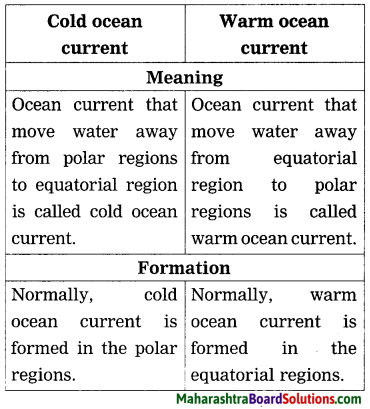
Question a.
Cold ocean current and Warm ocean current:
Answer:
Maharashtra Board Class 8 Geography Solutions Chapter 5 Ocean Currents 1

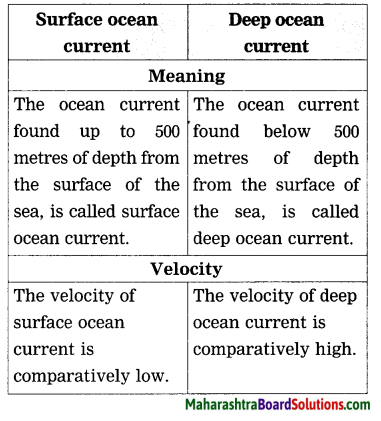
Question b.
Surface ocean current and Deep ocean current:
Answer:
Maharashtra Board Class 8 Geography Solutions Chapter 5 Ocean Currents 2

Study the following map/figure /graph and answer the following questions:

Make friends with maps!

Study the Figure and answer the following questions:

Maharashtra Board Class 8 Geography Solutions Chapter 5 Ocean Currents 3

Question a.
What are the major types of ocean currents?
Answer:
Warm ocean currents and cold ocean currents are the major types of ocean currents.

Question b.
What do you call the currents flowing from the equator to the poles?
Answer:
The currents flowing from the equator to the poles are called warm currents.

Maharashtra Board Class 8 Geography Solutions Chapter 5 Ocean Currents

Question c.
What do you call the currents flowing from the poles to the equator?
Answer:
The currents flowing from the poles to the equator are called cold currents.

Question d.
When the currents are moving in a circular manner, what difference is visible in their direction in Northern and Southern Hemisphere respectively?
Answer:
When the currents are moving in a circular manner, they will move in clockwise in Northern Hemisphere and anti-clockwise in the Southern Hemisphere.

Question e.
What might happen at the places where these two currents meet?
Answer:
Dense fog will get formed at the places where these two currents meet.

Question f.
When two different types of currents meet along the coast then what type of human settlements and occupations are seen?
Answer:
When two different types of currents meet along the coast then dense human settlements and fishing occupation are seen there.

Make friends with maps!

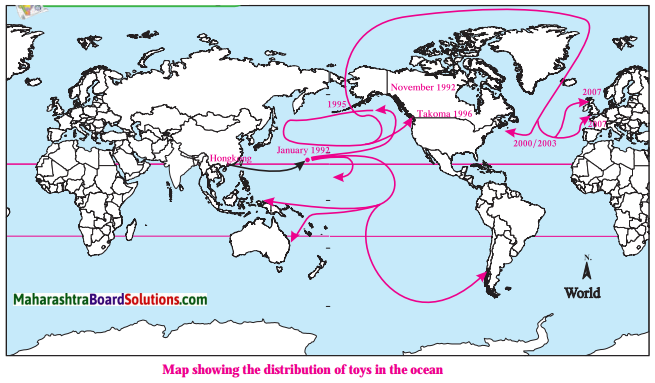
Maharashtra Board Class 8 Geography Solutions Chapter 5 Ocean Currents 4

Question a.
Where did a container full of toys fall on 10th January, 1992?
Answer:
A container full of toys fell near the Hawaii Island on 10th January, 1992.

Maharashtra Board Class 8 Geography Solutions Chapter 5 Ocean Currents

Question b.
Where did some of the toys reach on 16th November, 1992?
Answer:
Some of the toys reached the coast of Alaska on 16th November, 1992.

Question c.
Where did some of the toys reach by the year 2000?
Answer:
Some of the toys crossed the Bering Strait and reached the Arctic Ocean by the year 2000.

Question d.
Where did some of the toys reach by the year 2003?
Answer:
Some of the toys reached the eastern coast of America by the year 2003.

Question e.
Where did some of the toys reach by the year 2007?
Answer:
Some of the toys reached the western coast of continent of Europe by the year 2007.

Maharashtra Board Class 8 Geography Solutions Chapter 5 Ocean Currents

Question f.
Why did the toys travel in this way?
Answer:
The toys travelled in this way due to surface ocean currents and mostly due to deep ocean currents.

Thought Provoking Question:

Question a.
What will be the effect of Westerlies on the ocean currents?
Answer:

  1. Due to the influence of the Westerlies, the ocean currents will flow from west to east in the mid-latitudes.
  2. Due to the influence of Westerlies, the ocean currents will flow from east to west in equatorial region. This in turn, will lead to a circular pattern of sea currents.

Open-Ended Question:

Question a.
With which points will you explain the effects of ocean currents?
Answer:
The effects of ocean currents can be explained with the help of the following points:

1. Temperature: Ocean currents brings change in the temperature of the coastal areas along with which they flow. For example, the warm ocean current flowing along the coastal areas of Japan increases the temperature in the coastal areas.

2. Precipitation: Ocean currents brings change in amount of precipitation in the coastal areas along with which they flow. For example, the cold ocean current flowing along the coastal areas of Chile decreases the precipitation in the coastal areas leading to formation of desert areas.

3. Occupation: Ocean currents also supports the growth of fishing occupation. The extensive fishing grounds redeveloped the meeting point of warm and cold ocean currents. For example, Grand Bank near the continent of North America.

4. Transportation: Sea transport carried out along with ocean currents increases the speed and reduces the cost of fuel.

Maharashtra Board Class 7 Geography Solutions Chapter 1 How Seasons Occur Part 1

Balbharti Maharashtra State Board Class 7 Geography Solutions Part 1 Chapter 1 How Seasons Occur Part 1 Notes, Textbook Exercise Important Questions and Answers.

Maharashtra State Board Class 7 Geography Solutions Chapter 1 How Seasons Occur Part 1

Class 7 Geography Chapter 1 How Seasons Occur Part 1 InText Questions and Answers

1. Answer the following questions in one sentence:

Question 1.
How do day and nigbt occur on the earth?
Answer:
Day and night occur on the earth because of the earths rotation.

Question 2.
What term is used to describe the earth’s revolution around the sun?
Answer:
The term orbital motion is used to describe the earth’s revolution around the sun.

Maharashtra Board Class 7 Geography Solutions Chapter 1 How Seasons Occur Part 1

Question 3.
How long does the earth take to do so?
Answer:
The earth takes 365 days and 6 hours to complete one revolution.

Question 4.
In which hemispheres is our country located?
Answer:
Our country lies in the northeastern hemisphere.

Question 5.
Why don’t the sun’s rays fall perpendicularly at all places on the earth?
Answer:
The sun’s rays do not fall perpendicularly at all the places on the earth because the earth is not flat but spherical in shape.

2. Can you tell?

Records of the entries of sunrise and sunset for the month of June are given below. Answer the questions, that follow.

DateSunriseSunset Day NightSource of Information
19th June06.0119:1813 Hrs. 16 Min.10 Hrs. 44 Min.Time and date
20th June06.0219:1813 Hrs. 16 Min.10 Hrs. 44 Min.Time and date
21st June06.0219:1813 Hrs. 16 Min.10 Hrs. 44 Min.Time and date
22nd June06.0219:1813 Hrs. 16 Min.10 Hrs. 44 Min.Time and date
23rd June06.0219:1913 Hrs. 16 Min.10 Hrs. 44 Min.Time and date
24th June06.0219:1913 Hrs. 16 Min.10 Hrs. 44 Min.Time and date
25th June06.0319:1913 Hrs. 16 Min.10 Hrs. 44 Min.Time and date
26th June06.0319:1913 Hrs. 16 Min.10 Hrs. 44 Min.Time and date
27th June06.0319:1913 Hrs. 15 Min.10 Hrs. 45 Min.Time and date
28th June06.0419:1913 Hrs. 15 Min.10 Hrs. 45 Min.Time and date

Question 1.
Refer to the table above and state which are the longest days?
Answer:
The longest days are from 19th June to 26th June.

Maharashtra Board Class 7 Geography Solutions Chapter 1 How Seasons Occur Part 1

Question 2.
What difference do you notice in the duration of the nights from 19th June to 28th June?
Answer:
The duration of the nights keeps on increasing day by day.

Question 3.
What is the reason behind it?
Answer:
The sun is now moving southwards.

Question 4.
How did you find out the duration of the night?
Answer:
The duration of the day is subtracted from 24 hours to get the duration of the night.

Question 5.
Which two dates have days and nights of the same duration?
Answer:
March 22 and September 23 have the same duration of days and nights.

Question 6.
With the help of the table, you saw how the duration of the day and the night changes. Do you think such a change occurs everywhere on the earth?
Answer:
Yes, duration of day and night changes everywhere on the earth.

Question 7.
Use the above format to record the duration of daytime from 19th to 28th of every month from September to December.
Answer:
Students should expected to attempt the activity & answer on their own.

3. Think about it:

Question 1.
If the position of the shadow on the wall moves towards the north, in which direction does the location of sunrise or sunset appear to shift?
Answer:
If the position of the shadow on the wall moves towards the north, the location of sunrise or sunset will shift southwards.

Class 7 Geography Chapter 1 How Seasons Occur Part 1 Additional Important Questions and Answers

Fill in the blanks choosing the correct options from the brackets:

Question 1.
The earth’s _______ has enabled us to measure time in terms of days. (revolution, rotation, orbital motion)
Answer:
rotation

Question 2.
The earth rotates from _________ (north to south, east to west, west to east)
Answer:
west to east

Maharashtra Board Class 7 Geography Solutions Chapter 1 How Seasons Occur Part 1

Question 3.
The Earth takes _______ hours to rotate around itself. (365,144, 24)
Answer:
24

Question 4.
India lies in the ____ hemisphere. (northeastern, northwestern, southeastern)
Answer:
northeastern

Question 5.
The ________of sunrise and the sunset on the horizon³ for the whole year keep on changing. (position, shadow, rotation)
Answer:
position

Maharashtra Board Class 8 Geography Solutions Chapter 2 Interior of the Earth

Balbharti Maharashtra State Board Class 8 Geography Solutions Chapter 2 Interior of the Earth Notes, Textbook Exercise Important Questions and Answers.

Maharashtra State Board Class 8 Geography Solutions Chapter 2 Interior of the Earth

Class 8 Geography Chapter 2 Interior of the Earth Textbook Questions and Answers

1. Tick [✓] the correct options in the box:

Question A.
There are two layers in the crust.
(a) Inner and outer crust [ ]
(b) Continental and oceanic crust [ ]
(c) Surface and oceanic crust [ ]
(d) Mantle and core [ ]
Answer:
(b) Continental and oceanic crust [✓]

Question B.
Which element is found in both mantle and crust?
(a) Silica [ ]
(b) Magnesium [ ]
(c) Aluminium [ ]
(d) Iron [ ]
Answer:
(b) Magnesium [✓]

Maharashtra Board Class 8 Geography Solutions Chapter 2 Interior of the Earth

Question C.
Which of these minerals are found in the core of the earth?
(a) Iron – magnesium [ ]
(b) Magnesium – nickel [ ]
(c) Aluminium – iron [ ]
(d) Iron – nickel [ ]
Answer:
(d) Iron – nickel [✓]

Question D.
The inner core is in which state?
(a) Gaseous [ ]
(b) Solid [ ]
(c) Liquid [ ]
(d) Semi-solid [ ]
Answer:
(a) Gaseous [✓]

Question E.
The outer core is made up of
(a) Iron [ ]
(b) Gold [ ]
(c) Hydrogen [ ]
(d) Oxygen [ ]
Answer:
(a) Iron [✓]

Question F.
The layer of the earth on which we live…
(a) Mantle [ ]
(b) Core [ ]
(c) Crust [ ]
(d) Continental crust [ ]
Answer:
(d) Continental crust [✓]

Maharashtra Board Class 8 Geography Solutions Chapter 2 Interior of the Earth

2. Tell whether right or wrong. Correct the wrong statement

Question A.
The density of various materials is not the same in the interior of the earth.
Answer:
Correct.

Question B.
The core of the earth’s interior is made up of hard rocks.
Answer:
Incorrect.
Correct statement: The core of the earth’s interior is made up of elements, viz. iron and nickel.

Question C.
Secondary waves cannot pass through outer core.
Answer:
Correct.

Maharashtra Board Class 8 Geography Solutions Chapter 2 Interior of the Earth

Question D.
Continental crust is made up of silica and magnesium.
Answer:
Incorrect.
Correct statement: Continental crust is made up of silica and aluminum.

3. Answer the following

Question A.
What are the two parts of the crust? What is the basis of classification?
Answer:

  1. Continental crust and the Oceanic crust are the two parts of the crust.
  2. The crust is classified on the basis of whether it lies below the land or the ocean.
  3. The part of the crust lying below the continent is known as the continental crust.
  4. The part of the crust lying below the ocean is known as the oceanic crust.

Question B.
Why is the upper layer of the mantle known as the asthenosphere?
Answer:

  1. The upper layer of the mantle is in liquid state.
  2. The rocks in the upper 100 to 200 km of the mantle melt due to the heat and magma is created. Magma chambers are found in this layer of the earth.
  3. Due to the heat and pressure, the energy waves are created in mantle. These energy waves move in vertical direction and magma comes out on the surface of the earth by volcanic eruptions.
  4. These endogenitic movements continuously occur in the upper layer of the mantle. Therefore, the upper layer of the mantle is known as the asthenosphere.

Maharashtra Board Class 8 Geography Solutions Chapter 2 Interior of the Earth

Question C.
Magnetosphere of the earth is a result of rotation. Explain.
Answer:
1. The average temperature of the outer core of the earth is around 5000° C. The average temperature of the inner core of the earth is around 6000° C. This difference between the temperature results in formation of vertical currents.

2. The rotation of the earth gives eddy (circular) motion to these currents.

3. Electric currents develop in these spiral eddies of liquid iron leading to generation of the magnetic field of the earth. This magnetic field is called magnetosphere. In this way, the magnetosphere is formed due to the rotation of the earth.

4 Draw neat diagrams. label them and explain.

Question A.
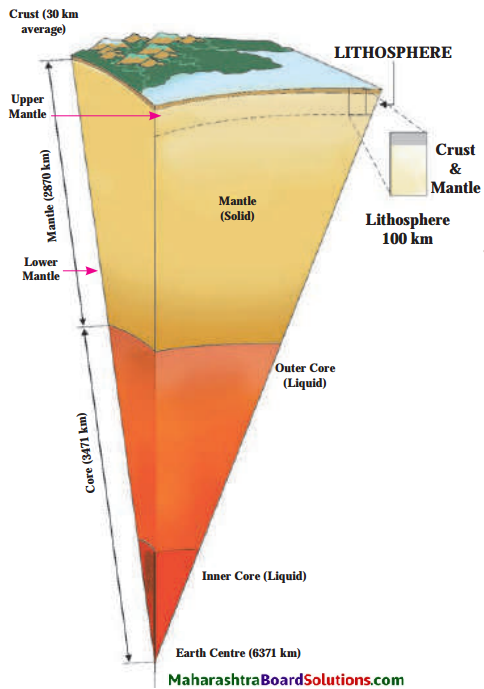
The interior of the earth
Answer:
Maharashtra Board Class 8 Geography Solutions Chapter 2 Interior of the Earth 1
Explanation:

  1. Inner Core: It is the center and the hottest layer of the Earth. The inner core is solid and made up of iron and nickel.
  2. Outer Core: The outer core of the Earth is similar to a very hot ball of metals. It is composed of metals such as iron and nickel. The outer core surrounds the inner core.
  3. Mantle: Mantle is the widest section of the Earth. Mantle is mainly made up of semi-molten rock known as magma. The rock is hard in the upper part of the mantle, but lower down the rock is softer and begins to melt. The mantle consists of very hot and dense rock.
  4. Crust: The crust is the outer layer where we live. It’s a solid rock layer divided into two types: Continental crust covers the land and Oceanic crust covers water.

Maharashtra Board Class 8 Geography Solutions Chapter 2 Interior of the Earth

Question B.
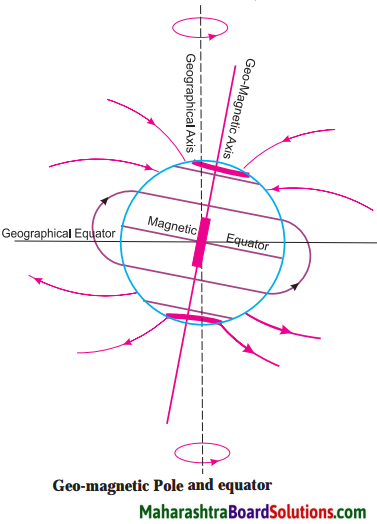
Magnetic pole and equator
Answer:
Maharashtra Board Class 8 Geography Solutions Chapter 2 Interior of the Earth 2

5. Give geographical reasons:

Question A.
There are discontinuities in the interior of the earth.
Answer:
1. There is a difference between the elements, temperatures and the pressure found in the three parts of the interior of the earth, viz, crust, mantle and core.

2. In the interiors of the earth, the transitional areas are found between (a) continental crust and oceanic crust (b) crust and mantle (c) upper mantle and lower mantle (d) mantle and core and (e) outer core and inner core. Therefore, there are discontinuities in the interior of the earth.

Maharashtra Board Class 8 Geography Solutions Chapter 2 Interior of the Earth

Question B.
There is correlation between the density of metals and their location in the interior of the earth.
Answer:
1. The rocks found in the crust have predominance of the compounds of silicon, aluminium, magnesium, etc. These compounds are lighter in weight. Therefore, they are found in the upper layer of the interior of the earth.

2. The elements like iron, nickel are found in the core of the earth. These elements are heavier in weight. Thus, metals with low density are found in upper level in the interior of the earth and the metals with high density are found in the lower level in the interior of the earth. Thus, there is correlation between the density of metals and their location in the interior of the earth.

Question C.
Mantle is the centre of earthquake and volcanic eruptions.
Answer:
1. The rocks in the upper 100 to 200 km of the mantle melt due to the heat and the magma is created.
2. Magma chambers are found in this layer of the earth.

3. Due to the heat and pressure, the energy waves are created in mantle. These energy waves move in vertical direction and magma comes out on the surface of the earth by volcanic eruptions. Thus, mantle is the centre of earthquake and volcanic eruptions.

Question D.
The thickness of the crust below the continents is more as compared to oceans.
Answer:
1. The density of the crust below the continents is 2.65 to 2.90 gm/cm3 The density of the crust below the oceans is 2.90 to 3.3 gm/cm3

2. As the density of the crust below the continents is comparatively low, it keeps floating on the mantle. It does not subduct into mantle. As its effect, the thickness of the crust below the continents is found to be high.

3. As the density of the crust below the ocean is comparatively high, it subducts into mantle leading to its low thickness. Thus, the thickness of the crust below the continents is more as compared to oceans.

Maharashtra Board Class 8 Geography Solutions Chapter 2 Interior of the Earth

Question E.
Earth is protected because of the magnetosphere.
Answer:

  1. The ozone layer protects the earth from ultraviolet radiation.
  2. The earth’s magnetosphere serves to deflect most of the solar wind, whose charged particles would otherwise strip away the ozone layer. In this way, the earth is protected because of the magnetosphere.

Know this too:

  1. The average density of the earth is 5.5 gm/cm3.
  2. The rocks in the upper 100 to 200 km of. the mantle melt due to heat.
  3. The mixture of molten rocks, volatiles, etc. found beneath the surface of the earth is called magma.
  4. The mixture of molten rocks, volatiles, etc. erupted from volcano or fissure on the surface of the earth is called lava.

Activity:

Question 1.
Prepare a model of the earth’s interior.
Answer:

  1. The density of the earth goes on increasing from its surface to the centre.
  2. The average density of the crust of the earth is approximately 2.98 gm/cm3.
  3. The average density of the mantle of the earth is approximately 5.7gm/cm3.
  4. The average density of the outer core of the earth is approximately 9.8 gm/cm3.
  5. The density of the inner core at the centre of the earth is approximately 13 gm/cm3.

Class 8 Geography Chapter 2 Interior of the Earth Additional Important Questions and Answers

Tick [✓] the correct options in the box:

Question A.
Which seismic waves can travel through liquid medium?
(a) Primary waves [ ]
(b) Secondary waves [ ]
(c) Surface waves [ ]
(d) Oceanic waves [ ]
Answer:
(a) Primary waves [✓]

Question B.
Which of the following layers of the earth has the highest density?
(a) Crust [ ]
(b) Mantle [ ]
(c) Outer core [ ]
(d) Inner core [ ]
Answer:
(d) Inner core [✓]

Maharashtra Board Class 8 Geography Solutions Chapter 2 Interior of the Earth

Question C.
Which of the following waves can travel through all the layers of the interior of the earth?
(a) Primary [ ]
(b) Secondary [ ]
(c) Tertiary [ ]
(d) Surface [ ]
Answer:
(a) Primary [✓]

Question D.
Which of the following layers of the interior of the earth is in solid form and cool?
(a) Crust [ ]
(b) Mantle [ ]
(C) Outer core [ ]
(d) Inner core [ ]
Answer:
(a) Crust [✓]

Examine the statements and incorrect ones :

Question A.
As we move deeper the surface, temperature keeps decreasing.
Answer:
Incorrect.
Correct statement: As we move deeper the surface, temperature keeps increasing.

Maharashtra Board Class 8 Geography Solutions Chapter 2 Interior of the Earth

Question B.
Magma chambers are found in lower mantle.
Answer:
Incorrect.
Correct statement: Magma chambers are found in upper mantle.

Question C.
The discontinuity is found between the crust, mantle and core.
Answer:
Correct.

Answer the following questions in one sentence each:

Question A.
In which of the layers of the interior of the earth is magma formed?
Answer:
Magma is formed in the mantle (upper mantle) of the earth.

Maharashtra Board Class 8 Geography Solutions Chapter 2 Interior of the Earth

Question B.
What are the two parts of the core?
Answer:
Outer core and inner core are the two parts of the core.

Match the columns and complete the chain :

Question A.

‘A’ Column (The layer of the interior of the earth)‘B’ Column (Density)‘C’ Column (Elements found)
1. Sial(i) 13.3 gm/cm3(a) Silica and Magnesium
2. Sima(ii) 2.65 to 2.90 gm/cm3(b) Nickel and Iron
3. Inner core(iii) 2.90 to 3.3 gm/cm3(c) Silica and Aluminium

Answer:

‘A’ Column (The layer of the interior of the earth)‘B’ Column (Density)‘C’ Column (Elements found)
1. Sial(ii) 2.65 to 2.90 gm/cm3(c) Silica and Aluminium
2. Sima(iii) 2.90 to 3.3 gm/cm3(a) Silica and Magnesium
3. Inner core(i) 13.3 gm/cm3(b) Nickel and Iron

Maharashtra Board Class 8 Geography Solutions Chapter 2 Interior of the Earth

Answer the following questions in brief:

Question A.
Describe the changes that take place in the temperatures from the surface of the earth to its centre.
Answer:

  1. The process of cooling of the earth started from the surface. The temperature goes on increasing from the surface towards the core.
  2. The surface of the earth is cool and solid.
  3. The centre of the earth is extremely hot. The temperature at the centre of the earth is around 5500° to 6000° C.

Question B.
Describe the changes that take place in the density of the earth from its surface to the centre.
Answer:

  1. The density of the earth goes on increasing from its surface to the centre.
  2. The average density of the crust of the earth is approximately 2.98 gm/cm3.
  3. The average density of the mantle of the earth is approximately 5.7gm/cm3.
  4. The average density of the outer core of the earth is approximately 9.8 gm/cm3.
  5. The density of the inner core at the centre of the earth is approximately 13 gm/cm3.

Maharashtra Board Class 8 Geography Solutions Chapter 2 Interior of the Earth

Question C.
Write in brief about the travelling of various types of earthquake waves through the layers of interior of the earth.
Answer:

  1. The primary earthquake waves travel through the mantle as well as the core of the earth.
  2. While travelling through the core of the earth, the direction of the primary earthquake waves gets altered.
  3. While travelling through the core, the speed of the primary earthquake waves decreases.
  4. The secondary earthquake waves can travel only through the mantle of the earth. These waves get absorbed in the core of the earth. Thus, these waves cannot travel through the core of the earth.

Write short notes on the following:

Question A.
The crust.
Answer:
1. The uppermost layer of the interior of the earth is called the crust. Continental crust and the oceanic crust are the two parts of the crust.

2.The thickness of the continental crust is approximately 16 km to 45 km. On the other hand, the thickness of the oceanic crust is approximately 7 km to 10 km

3. The density of the continental crust is approximately 2.65 to 2.90 gm/cm. On the other hand, the density of the oceanic crust is approximately 2.65 to 2.90 gm/cm3.

4. Silica and aluminium are the main elements found in the continental crust. Therefore, it is also called Sial. On the other hand, Silica and Magnesium are the main elements found in the oceanic crust. Therefore, it is also called Sima.

Maharashtra Board Class 8 Geography Solutions Chapter 2 Interior of the Earth

Question B.
The mantle.
Answer:
1. The mantle is located below the crust of the earth. The mantle is divided into the upper mantle and the lower mantle.

2. The thickness of the mantle is approximately 2870 km. The average density of mantle is approximately 4.5 gm/cm3.

3. The rocks in the upper 100 to 200 km of the mantle melt due to the heat and magma is created. Magma chambers are found in this layer of the earth. Due to the heat and pressure, the energy waves are created in mantle. These energy waves move in vertical direction and magma comes out on the surface of the earth by volcanic eruptions.

4. These endogenitic movements continuously occur in the upper layer of the mantle. Therefore, the upper layer of the mantle is known as the asthenosphere.

5. The average thickness of mantle is approximately 2870 km. Its average density is approximately 4.5 gm/cm3. The temperature at the depth of 2400 to 2900 km is around 2200° to 2500° C. The density of the lower mantle is approximately 5.7 gm / cm3.

Question B.
The outer core.
Answer:
1. The outer core is located below the lower mantle.
2. It is located at the depth from 2900 km to 5100 km from the surface of the earth.
3. The average temperature of the outer core of the earth is around 5000° C. The density of the outer core of the earth is approximately 9.8 gm/cm.

4. The secondary earthquake waves cannot travel from the core of the earth. Therefore, it is inferred that the outer core of the earth must be in liquid or semi-liquid form. The primary earthquake waves can travel from the outer core of the earth.
5. The vertical currents originate in the outer core of the earth.

Maharashtra Board Class 8 Geography Solutions Chapter 2 Interior of the Earth

Question C.
The inner core.
Answer:

  1. The inner core is located below the upper core.
  2. It is located at the depth from 5150 km to 6371 km from the surface of the earth.
  3. The average temperature of the inner core of the earth is around 6000° C. The density of the inner core of the earth is approximately 13.3 gm/cm3.
  4. The elements, viz. Iron (Ferrous) and Nickel (Ni) are mainly found in the inner core of the earth. Therefore, it is also called Nife.
  5. The temperature at the centre of the earth is almost equivalent to the surface temperature of the sun.

Give geographical reasons for the following:

Question A.
The secondary waves of earthquake cannot travel through the core of the earth.
Answer:

  1. The secondary waves of earthquake can travel only through the solid state of the interior of the earth.
  2. The outer core of the centre of the earth is in liquid state. Therefore, the secondary waves of earthquake cannot travel through the core of the earth.

Question B.
The inner core is called Nife.
Answer:

  1. The inner core predominantly comprises iron and nickel.
  2. The word Nife is derived from the word Nickel (Ni) and Iron (Ferrous) (Fe). Therefore, the inner core is called (Ni + Fe) Nife.

Maharashtra Board Class 8 Geography Solutions Chapter 2 Interior of the Earth

Question C.
The upper layer of the crust is called Sial.
Answer:

  1. The rocks in the upper layer of the crust have predominance of the compounds of silicon and aluminium.
  2. The word Sial is derived from the word Silica (Si) and Aluminium (Al). Therefore, the upper layer of the crust is called (Si + Al) Sial.

Question D.
The lower layer of the crust is called Sima.
Answer:

  1. The rocks in the lower layer of the crust have predominance of the compounds of silicon and magnesium.
  2. The word Sima is derived from the word Silica (Si) and Magnesium. (Ma). Therefore, the lower layer of the crust is called (Si + Ma) Sima.

Study the following map/ figure /graph and answer the following questions : 

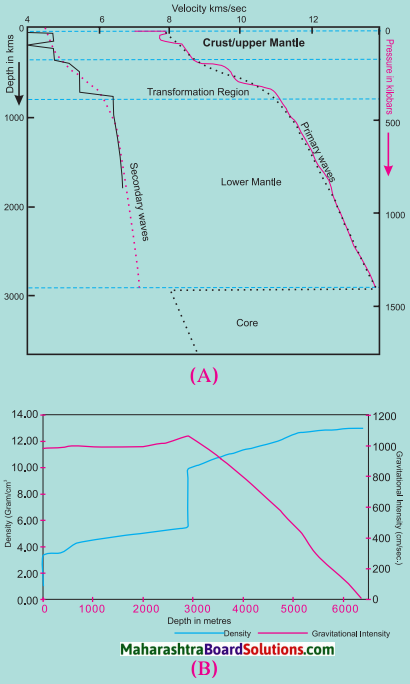
Maharashtra Board Class 8 Geography Solutions Chapter 2 Interior of the Earth 3

Question A.
At what depth does the curve of the secondary waves seem to have ended in figure (A)?
Answer:
The curve of the secondary waves seems to have ended around the depth of 2900 km in figure (A).

Question B.
What is the velocity of the secondary waves around the boundary of the outer core shown in figure (A)?
Answer:
The velocity of the secondary waves is 6 to 8 km/sec around the boundary of the outer core shown in figure (A).

Question C.
What conclusion can be drawn on the basis of the curve of the secondary waves stopping around the depth of 2900 km?
Answer:
On the basis of the curve of the secondary waves stopping around the depth of2900 km, it can be concluded that secondary waves do not enter the core.

Maharashtra Board Class 8 Geography Solutions Chapter 2 Interior of the Earth

Question D.
What is the velocity of the primary waves at the time of entering the outer core shown in figure (A)?
Answer:
The velocity of the primary waves at the time of entering the outer core shown in figure (A) is 8 km/sec.

Question E.
What conclusions can be drawn about the intensity of the gravitational force shown in Figure (B)?
Answer:
The following conclusions can be drawn about the intensity of the gravitational force shown in Figure (B):

  1. Gravitational force increases at certain depth from the surface of the earth and then it reduces according to the depth.
  2. At the centre of the earth, the gravitational force is zero.

Thought-Provoking Question:

Think about it:

Question 1.
Imagine about the earth’s interior and- write 10-12 sentences on it.
Answer:

  1. The interior of the earth will be very hot.
  2. Huge sized rocks will be present I in the upper layers of the interior of the earth.
  3. Due to extreme heat and pressure, the rocks must be melting in the interior of the earth.
  4. Due to the melting of the rocks, magma will be created in the interior of the earth.
  5. Due to endogenous movements in the interior of the earth, volcanic eruptions will occur on the surface of the earth.
  6. The primary earthquake waves will be travelling through the mantle and the core of the earth.
  7. The secondary earthquake waves will be travelling only through the mantle of the earth.
  8. The temperature in the interior of the earth will get increased with the depth.
  9. The highest temperature will be found at the centre of the earth.
  10. The elements like silica, aluminium, magnesium, iron and nickel will be found in the various layers of the interior of the earth.

Maharashtra Board Class 8 Geography Solutions Chapter 2 Interior of the Earth

Open-Ended Question:

Question A.
What precautions can be taken to reduce the damage caused by earthquakes?
Answer:
The following precautions can be taken to reduce the damage caused by earthquakes:

  1. Taking cover under a desk or a table or sturdy piece of furniture to protect oneself.
  2. Finding clear spot away from buildings, trees and power lines. Dropping to the ground and staying there until the shaking stops.
  3. Switching off the power supply, gas in-home/office, etc.
  4. Helping the victims at the earliest.

Maharashtra Board Class 8 History Solutions Chapter 9 Last Phase of Struggle for Independence

Balbharti Maharashtra State Board Class 8 History Solutions Chapter 9 Last Phase of Struggle for Independence Notes, Textbook Exercise Important Questions and Answers.

Maharashtra State Board Class 8 History Solutions Chapter 9 Last Phase of Struggle for Independence

Class 8 History Chapter 9 Last Phase of Struggle for Independence Textbook Questions and Answers

1. Rewrite the statements by choosing the appropriate options :
(Andaman and Nicobar, August Kranti, Vinoba Bhave, Sane Guruji, Indian National Congress)

Question 1.
……………….. was the first satyagrahi of individual satyagraha.
Answer:
Vinoba Bhave

Maharashtra Board Class 8 History Solutions Chapter 9 Last Phase of Struggle for Independence

Question 2.
The nation wide movement of 1942 is also called ……….. .
Answer:
August Kranti

Question 3.
In November 1943, Japan conquered ………. islands and handed them over to Azad Hind Government.
Answer:
Andaman and Nicobar

2. Explain the following statements with reasons:

Question 1.
In November 1939, provincial ministers of Indian National Congress gave their resignations.
Answer:

  1. Viceroy Lord Linlithgo declared in 1939 that India had joined the Second World War on the side of England, without consulting the Indian leaders.
  2. England claimed that it was fighting to save democracy in Europe.
  3. Thereupon, the Congress claimed that if that claim is true then England should grant Independence to India immediately. ’
  4. So the provincial ministries of the Indian National Congress resigned in November 1939 as England did not accept this demand.

Question 2.
The Indian National Army had to lay down their arms.
Answer:

  1. The Indian National Army fought against the British in adverse circumstances under the leadership of Subhash Chandra Bose.
  2. The Imphal Campaign of Indian National Army remained incomplete as the Japanese stopped helping the Indian National Army.
  3. In the same period, Japan accepted defeat in the Second World War.
  4. On 18 August 1945, Subhash Chandra Bose died in a plane crash.

Under these circumstances, the soldiers of the Indian National Army had to lay down their arms.

Maharashtra Board Class 8 History Solutions Chapter 9 Last Phase of Struggle for Independence

Question 3.
The Parallel Government became a source of inspiration to the people.
Answer:
1. During the Quit India Movement, parallel governments were established in many parts of India.
2. It rendered great service by doing work like :

  • Opposition to money lenders
  • Prohibition of liquor
  • Spread of literacy

3. Opposition to caste distinctions, etc. Due to this, the Parallel Government became a source of inspiration for the public.

3. Complete the following table.

Question 1.
Maharashtra Board Class 8 History Solutions Chapter 9 Last Phase of Struggle for Independence 1
Answer:

OrganisationFounder
Forward BlocSubhash Chandra Bose
Indian Independence LeagueRash Behari Bose
Toofan SenaKrantiagrani G.D. alias Bapu Lad

4. Answer the following questions in brief:

Question 1.
Why did the British Prime Minister send Sir Stafford Cripps to India?
Answer:

  1. During the Second World War, England sided with America against Japan.
  2. As England was ruling India, there was possibility of Japan attacking India.
  3. The Japanese forces came closer to the eastern border of India.
  4. It was necessary to have co-operation of India to resist Japanese invasion.

Therefore, the British Prime Minister, Winston Churchill sent Sir Stafford Cripps to India in March 1942.

Maharashtra Board Class 8 History Solutions Chapter 9 Last Phase of Struggle for Independence

Question 2.
What kind of reaction was seen during the spread of news of arrest of main leaders of the Indian National Congress?
Answer:

  1. Quit India Resolution moved by Pandit Jawaharlal Nehru, was passed on 8th August with an overwhelming majority.
  2. On the same night, the leaders of the Indian National Congress were arrested.
  3. The news of these arrest aroused strong resentment.
  4. The angry people took out processions, tried to take control of government offices and attacked jails, police stations and railway stations.
  5. School children took out processions and shouted slogan “Vande Mataram”.
  6. Even though the police resorted to lathi charge and firing, the people were not afraid. The young and old showed determination and courage.

Question 3.
What appeal did Mahatma Gandhi make in the Quit India session of Indian National Congress?
Answer:
Gandhiji made the following appeal to the people of India during the Quit India session of Indian National Congress at Mumbai:

  1. Everyone of you, should from this moment onwards, consider yourself a free man or woman.
  2. Everyone should behave like a citizen of free India.
  3. Either we shall free India or die in the attempt.
  4. Through the appeal he stated that Indians should be ready to make a sacrifice with the feeling of ‘Do or Die’.

Do you Know?

Maharashtra Board Class 8 History Solutions Chapter 9 Last Phase of Struggle for Independence 2
Inspirational account of brave children:

  1. Under the leadership of Shirishkumar, school children carried out procession holding the tricolour at Nandurbar in Maharashtra.
  2. The slogan of Vande Mcrtaram was given.
  3. In the police firing, along with Shirishkumar, Dhansukhlal, Shashidhar, Ghanashyam, Laldas became martyrs.

Maharashtra Board Class 8 History Solutions Chapter 9 Last Phase of Struggle for Independence

Let us Know….:

Maharashtra Board Class 8 History Solutions Chapter 9 Last Phase of Struggle for Independence 3.1
Individual Satyagraha:

  1. As the British government was constantly neglecting the demands, the Indian National Congress decided to start anti war propaganda.
  2. Instead of a collective movement every person should individually disobey the law. This is called Individual Satyagraha.
  3. Acharya Vinoba Bhave was the first individual Satyagrahi.
  4. After him, nearly 25,000 Satyagrahis participated in individual Satyagraha and were imprisoned.

Project:

Question 1.
Prepare a timeline of the events of the struggle of Indian National Army.

Question 2.
With the help of internet collect the pictures of Quit India Movement of 1942 and organise an exhibition on occasion of a national day.

Class 8 History Chapter 9 Last Phase of Struggle for Independence Additional Important Questions and Answers

1. Rewrite the statements by choosing the appropriate options :

Question 1.
Provincial Ministers of …………… resigned in November, 1939.
Answer:
Indian National Congress

Question 2.
Songs of ……………. inspiration during the movement.
Answer:
Sane Guruji

Maharashtra Board Class 8 History Solutions Chapter 9 Last Phase of Struggle for Independence

Identify the wrong pair :

Organisation – Founder
1. Azad Dasta – Bhai Kotwal
2. Lai Sena – General Awari
3. Azad Radio – Aruna Asaf Ali
4. Azad Hind Government – Subhash Chandra Bose
Answer:
Wrong pair: Azad Radio
– Aruna Asaf Ali

Corrected pair: Azad Radio
– Usha Mehta.

Rewrite the statements by choosing the appropriate options :

Question 1.
In 1937 elections, the Indian National Congress gained a majority in ……………
provinces and came to power.
(a) seven
(b) two
(c) eight
(d) three
Answer:
(c) eight

Question 2.
Parallel government was formed by …………… in Satara.
(a) Krantisinh Nana Patil
(b) N.G. Gore
(c) Rashtrasant Tukdoji Maharaj
(d) S.M. Joshi
Answer:
(a) Krantisinh Nana Patil

Question 3.
Netaji founded the …………… in 1943 in Singapore.
(a) Free India Centre
(b) Azad Hind Sena
(c) Parallel Government
(d) Azad Hind Government
Answer:
(d) Azad Hind Government

Question 4.
…………… tried to destroy the railway along with his campaigners in Sindh.
(a) Khudiram Bose
(b) Ashfaqulla Khan
(c) Hemu Kalani
(d) Maganlal Bagdi
Answer:
(c) Hemu Kalani

Maharashtra Board Class 8 History Solutions Chapter 9 Last Phase of Struggle for Independence

Question 5.
…………… had formed the Azad Hind Sena with the help of Captain Mohan Singh.
(a) Rash Behari Bose
(b) Subash Chandra Bose
(c) Anand Mohan Bose
(d) S.M. Gore
Answer:
(a) Rash Behari Bose

Name the following:

Question 1.
Viceroy who announced India’s involvement in Second World War.
Answer:
Lord Linlithgo

Question 2.
President of Mumbai session of Indian National Congress.
Answer:
Maulana Abul Kalam Azad

Question 3.
Leader who put forth Quit India Movement resolution at the Mumbai session of the Congress.
Answer:
Pandit Jawaharlal Nehru

Question 4.
The outburst of Navy and Air Force on this British warship.
Answer:
Talwar

Question 5.
His songs inspired the National Movement.
Answer:
Rashtrasant Tukdcji Maharaj.

Answer the following in one sentence each:

Question 1.
State the resolution passed by the Congress Working Committee in the Wardha session.
Answer:
The Congress Working Committee at its Wardha session passed the resolution that

  • the British rule in India should be ended immediately and
  • India be given independence.

Question 2.
What was the warning given by the Congress Working Committee in the Wardha session?
Answer:
The Congress Working Committee had given the warning that if the demand for complete independence was not met, it would launch a non-violent movement for the freedom of India.

Maharashtra Board Class 8 History Solutions Chapter 9 Last Phase of Struggle for Independence

Question 3.
Why did the British Government imprison Subhash Chandra Bose?
Answer:
The British Government imprisoned Subhash Chandra Bose because through his speeches he made appeal to the people of India to revolt against the British rule.

Question 4.
What did the British Government realise after the Navy and Air Force revolted?
Answer:
After the revolt of Navy and Air Force, the British Government realised that their rule in India was about to end.

Do as Directed:

Complete the graphical presentation:

Question 1.
Maharashtra Board Class 8 History Solutions Chapter 9 Last Phase of Struggle for Independence 4
Answer:
Maharashtra Board Class 8 History Solutions Chapter 9 Last Phase of Struggle for Independence 5

Question 2.
Maharashtra Board Class 8 History Solutions Chapter 9 Last Phase of Struggle for Independence 6
Answer:
Maharashtra Board Class 8 History Solutions Chapter 9 Last Phase of Struggle for Independence 7

Question 3.
Maharashtra Board Class 8 History Solutions Chapter 9 Last Phase of Struggle for Independence 8
Answer:
Maharashtra Board Class 8 History Solutions Chapter 9 Last Phase of Struggle for Independence 9

Question 4.
Maharashtra Board Class 8 History Solutions Chapter 9 Last Phase of Struggle for Independence 10
Answer:
Maharashtra Board Class 8 History Solutions Chapter 9 Last Phase of Struggle for Independence 11

Prepare a Timeline of the events of the struggle of Azad Hind Sena:

Question 1.
Maharashtra Board Class 8 History Solutions Chapter 9 Last Phase of Struggle for Independence 12
Answer:
Maharashtra Board Class 8 History Solutions Chapter 9 Last Phase of Struggle for Independence 13

Write short notes :

Question 1.
Provincial Cabinets :
Answer:

  1. According to the Act of 1935, working of the British administered provinces were transferred to the elected representatives.
  2. Although not satisfied with the act. Congress contested elections to the Provincial Legislatures of eleven provinces in 1937.
  3. Indian National Congress gained a majority in eight provinces.
  4. Congress ministries did a lot of useful work for the benefit of the people.
  5. As the British government refused their demand of Independence the Congress ministries resigned in November 1939.

Maharashtra Board Class 8 History Solutions Chapter 9 Last Phase of Struggle for Independence

Question 2.
Individual Satyagraha :
Answer:

  1. As the British government was constantly neglecting the demands the Indian National Congress decided to start anti-war propaganda.
  2. Instead of a collective movement they decided every person should individually disobey the law. This is known as Individual Satyagraha.
  3. Acharya Vinoba Bhave was the first Individual Satyagrahi.
  4. After him nearly 25,000 satyagrahis participated in individual satyagraha and were imprisoned.

Question 3.
Rash Behari Bose :
Answer:

  1. Rash Behari Bose was living in Japan since 1915.
  2. He had established the ‘Indian Independence League’ by organizing the Indian patriots living in the South East Asia.
  3. Japan conquered the territories of South-East Asia controlled by the British.
  4. Rash Behari Bose, with the help of Captain Mohan Singh, formed the Indian

National Army or Azad Hind Sena from the Indian prisoners of war captured by Japan.

Question 4.
Revolt of Indian Navy and Air Force :
Answer:

  1. Inspired by the heroics of the Indian National Army, the soldiers on the British warship ‘Talwar’ revolted on 8th February 1946.
  2. They hoisted the tricolour flag on the ship and raised slogans against the British Government.
  3. The exchange of fire between the rebels and the British army took place.
  4. The workers and common people extended their support.
  5. To support this uprising, the Air Force from Delhi, Lahore, Karachi, Ambala, Meerut went on strike.
  6. The naval soldiers laid down their arms after the mediation by Sardar Vallabhbhai Patel.

Answer the following questions in brief:

Question 1.
What work did the Azad Radio Centre do during the 1942 underground movement?
Answer:
During the 1942 underground movement Vitthal Zaveri, Usha Mehta and her companions established a secret transmission centre, ‘Azad Radio’.
The work done:

  • News of agitations in the country were broadcast on it.
  • Patriotic songs were sung.
  • Patriotic speeches were telecast.

This gave inspiration to the agitators during the Quit India Movement.

Maharashtra Board Class 8 History Solutions Chapter 9 Last Phase of Struggle for Independence

Question 2.
Explain the significance of the Quit India Movement.
Answer:
1. On 8th August 1942, in the Mumbai session, the Indian National Congress gave the order of ‘Quit India’ to the British government. This was the beginning of a nationwide agitation.
2. To fulfill the objective of independence, lakhs of Indians sacrificed their lives in this movement.
3. The number of people who participated were so large that even all prisons in the country were not enough to contain them.
4. The movement shook the foundation of British rule in India.

Question 3.
State the impact of the events from 1942 to 1946 on the British rule.
Answer:
Many important events took place between 1942 to 1946. The following effects were seen on the British rule :

  1. It shook the foundation of British rule in India.
  2. The Quit India agitation manifested the strong anti-British feeling of the Indian people.
  3. The Army, Navy and Air Force considered to be backbone of the British power revolted against it.
  4. The British rulers realised that now their rule will not last long in India.

Explain the following statements with reasons:

Question 1.
The plan of federation mentioned in 1935 Act did not materialise.
Answer:

  1. The Act of 1935 provided for the formation of a federation of the British administered provinces and the Indian princely states.
  2. The working of the British administered provinces were transferred to the Indian representatives.
  3. On joining the federation, the princely states would lose their autonomy.
  4. So, the proposal of federation did not materialise as the rulers of the princely states refused to join the federation.

Question 2.
The Cripps proposal was rejected.
Answer:

  1. The Indian National Congress rejected the Cripps’ proposal because there was no clear mention of the grant of complete independence to India.
  2. The Muslim League rejected the Cripps’ proposal as it had no mention of creation of Pakistan.

Maharashtra Board Class 8 History Solutions Chapter 9 Last Phase of Struggle for Independence

Question 3.
Subhash Chandra Bose resigned from the office of Congress President.
Answer:
1. Subhash Chandra Bose became the President of Indian National Congress twice.
2. He became the President of Congress when Second World War had commenced. He was of the opinion that as England was engaged in war, the Congress should intensify the agitation by taking advantage of this situation.
3. If needed, India should seek the help of the enemies of England.
4. Other senior leaders of the Congress did not agree with this view.
As a result, Subhash Chandra Bose resigned from the office of the Congress President.

Question 4.
The British government suspended the punishment of INA officers.
Answer:

  1. After surrender of the soldiers of the Indian National Army, the British government charged them with treason.
  2. Expert lawyers like Pandit Nehru, Bhulabhai Desai and Tej Bahadur Sapre defended the INA officers.
  3. But the military tribunal held them guilty and sentenced them to life imprisonment.
  4. There was severe unrest in the minds of the Indian people against the British Government.

So, they had to suspend the punishment given by the military tribunal.

Answer the following in detail:

Question 1.
Write about the Session of Indian National Congress held in Mumbai in August 1942.
Answer:

  1. On 14th July, 1942 the Congress Working Committee passed the Quit India Resolution at Wardha.
  2. It warned the British government of launch of a non-violent struggle for India’s independence.
  3. With this background, Quit India Session of the Indian National Congress began at Gowalia Tank (Kranti Maidan) in Mumbai on 7th August, 1942.
  4. Maulana Abul Kalam Azad presided over this session.
  5. The resolution passed at Wardha § session was finally approved in the Mumbai session.
  6. On 8th August, Quit India Resolution, moved by Pandit Jawaharlal Nehru was passed with an overwhelming majority.
  7. Congress decided to launch a nationwide non-violent movement under the leadership of Gandhiji.
  8. Gandhiji gave inspiring message of ‘Do or Die’ to the people and appealed them to be ready to sacrifice for the nation.

Maharashtra Board Class 8 History Solutions Chapter 9 Last Phase of Struggle for Independence

Question 2.
Give detailed information about Underground Movement.
Answer:

  1. At the end of 1942, the young socialist leaders started the Underground Movement.
  2. S. M. Joshi, Dr. Ram Manohar Lohia, Jayprakash Narayan were among the many leaders who led the movement.
  3. Aruna Asaf Ali, Usha Mehta, Sucheta Kriplani were the women leaders who led the movement.
  4. The activists disrupted transport and communication by breakdown of railway routes, cutting telephone lines, blowing up 8 bridges, etc.
  5. Hemu Kalani tried to destroy railway carrying British troops and supply, in Sindh province.
  6. Groups like Azad Dasta of Bhai Kotwal in Karjat and Lai Sena of General Awari in Nagpur made the government helpless and witless for months.
  7. Usha Mehta and Vitthal Zaveri started a secret transmission centre of Azad Radio in Mumbai.
  8. Many such centres operated at Kolkata, Delhi and Pune.
  9. Krantisinh Nana Patil formed parallel government in Satara.
  10. Parallel governments were formed in Midnapore in Bengal, Ballia and Azamgrah in Uttar Pradesh and Purnia in Bihar.
  11. Krantiagrani GD (Bapu Lad) established ‘Toofan sena’ at Kundal.

Question 3.
Identify the given picture and write information about the work done by him.
Maharashtra Board Class 8 History Solutions Chapter 9 Last Phase of Struggle for Independence 14
Answer:
The given picture is of Netaji Subhash Chandra Bose.

  1. Subhash Chandra Bose became the President of Indian National Congress twice.
  2. He was of the view to intensify the agitation and seek help from the enemies of England during the Second World War.
  3. He had difference of opinion with other senior leaders on these points.
  4. Therefore, he resigned from the office of the Congress President and formed a party, ‘Forward Bloc’.
  5. Subhash Chandra Bose was imprisoned by the British because he made an appeal to the people of India to revolt against the British.
  6. He was interned in his house by the British but he managed to escape in disguise and reached Germany in April 1941.
  7. He founded the ‘Free India Centre’ in Germany.
  8. He made an appeal to the people of India to join in the armed struggle for the independence of India from Berlin radio station.
  9. On the invitation of Rash Behari Bose, he went to Japan and led the Indian National Army.
  10. He formed the Azad Hind Government in Singapore in 1943.
  11. Under his leadership, Azad Hind Army captured the Aarakan province in Myanmar and posts on the eastern border of Assam.
  12. Netaji appealed to the people of India : ‘You give me blood and I will give you independence’.
  13. On 18 August, 1945 Netaji died in a plane crash.

Maharashtra Board Class 8 History Solutions Chapter 9 Last Phase of Struggle for Independence

Question 4.
How do you find the contribution of Shirishkumar to be inspirational?
Answer:

  1. Under the leadership of Shirishkumar, the school children took out a procession holding the tricolour flag at Nandurbar.
  2. ‘Vande Mataram’ was the slogan given to them.
  3. The police fired on them. In the firing Shirishkumar and many other children became martyrs.
  4. His sacrifice gives inspiration to us to do work for the society and country.
  5. Gaining independence is no more our objective but to keep the environment clean, to maintain unity among people, and collectively solve the problems is our responsibility.
  6. As all this is equally challenging we get inspiration from courage and determination of Shirishkumar.
  7. Shirishkumar inspires us to do our work fearlessly without being a victim of injustice and oppression.
  8. He also inspires us to make sacrifice, have faith in work and determination. 1


Maharashtra Board Class 9 History Solutions Chapter 2 India: Events After 1960

Balbharti Maharashtra State Board Class 9 History Solutions Chapter 2 India: Events After 1960 Notes, Textbook Exercise Important Questions and Answers.

Maharashtra State Board Class 9 History Solutions Chapter 2 India: Events After 1960

Class 9 History Chapter 2 India: Events After 1960 Textbook Questions and Answers

1. A. Choose the correct option from the given option and rewrite the statements:
Question 1.
The Prime Minister of India who took an initiative in resolving the question of the Tamil minority in Sri Lanka was
(a) Rajiv Gandhi
(b) Indira Gandhi
(c) H. D. Deve Gowda
(d) P. V. Narasimha Rao
Answer:
(a) Rajiv Gandhi

Maharashtra Board Class 9 History Solutions Chapter 2 India: Events After 1960

Question 2.
is the father of the Green Revolution in India.
(a) Dr. Verghese Kurien
(b) Homi Bhabha
(c) Dr. M. S. Swaminathan
(d) Dr. Norman Borlaug
Answer:
(c) Dr. M. S. Swaminathan

B. Identify and write the wrong pair in the following sets:

Question 1.
(1) Indira Gandhi – Emergency
(2) Rajiv Gandhi – Developments of Science and Technology
(3) P. V. Narasimha Rao – Economic improvements
(4) Chandrashekhar – Mandal Commission
Answer:
Chandrashekhar – Mandal Commission

Question 2A.
Based on the information in the chapter, prepare a chronological chart of Prime Ministers and their tenure.
Answer:

  1. Pandit Jawaharlal Nehru -1947 to 1964
  2. Lai Bahadur Shastri -1964 to 1966
  3. Indira Gandhi -1966 to 1977
  4. Morarji Desai -1977 to 1979
  5. Charan Singh -1979 to 1980
  6. Indira Gandhi -1980 to 1984
  7. Rajiv Gandhi -1984 to 1989
  8. Vishwanath Pratap Singh – 1989 to 1990
  9. Chandra Shekhar -1990 to 1991
  10. P. V. Narasimha Rao -1991 to 1996
  11. Atal Bihari Vajpayee -1996
  12. H.D. Deve Gowda -1996 to 1997
  13. Inder Kumar Gujral -1997 to 1998
  14. Atal Bihari Vajpayee – 1998 to 2004

Maharashtra Board Class 9 History Solutions Chapter 2 India: Events After 1960

2B. Write Short Notes on:

Question 1.
Globalisation
Answer:
(i) Globalisation brought about many changes in different fields like economy, politics, science and technology, society and culture.
(ii) India has emerged as an important country on the global scene in different spheres.
(iii) India is an important member of international organisations like G-20 and ‘BRICS’ (Brazil, Russia, India, China, South Africa).
(iv) India has experienced an important revolution in the field of telecommunication technology.
(v) Mobile phones, internet and the communication facilities based on satellite have spread all across the country.
(vi) It has resulted in a total transformation in the lifestyle of Indians and especially the youth.
(vii) These changes are visible from their dietary habits, clothing, language and beliefs.

Question 2.
White Revolution
Answer:
(i) White Revolution is a major event of India’s efforts towards self-reliance.
(ii) The experiment in co-operative dairy movement by Dr. Verghese Kurien led to the increase of milk production in India.
(iii) This is called as ‘White Revolution’.

3A. Give reasons:

Question 1.
The Morarji Desai government lasted for a short while.
Answer:
(i) On the backdrop of the emergency, many opposition parties came together and formed a party called the Janata Party.
(ii) The Congress party led by Indira Gandhi was roundly defeated by this newly formed ‘Janata Party’.
(iii) Morarji Desai became the Prime Minister, but under his leadership the Janata Party government couldn’t last long due to its internal differences.
(iv) Hence, the Morarji Desai government lasted for a short while.

Question 2.
The army had to be sent into the Golden Temple in Amritsar.
Answer:
(i) The Sikhs in Punjab demanded an independent state of Khalistan and began a movement which went on to become violent and destructive.
(ii) Pakistan had lent its support to this movement.
(iii) Some terrorists had allegedly taken shelter inside the Golden Temple at Amritsar, a holy shrine of the Sikhs in 1984.
(iv) Hence, the Indian army was sent into the Golden Temple in Amritsar to evict the terrorists who had taken shelter there.

Question 3.
The National Planning Commission was set up in India.
Answer:
(i) India wanted to acquire modernity and self-reliance by establishing industries.
(ii) India wanted to establish an economy based on social justice through planning.
(iii) For this, the National Planning Commission was established. This would coordinate development through the policy of Five Year Plans.

B. Answer the following questions in 25 to 30 words.

Question 1.
How was 1991 a year of important changes in the history of the world and of India?
Answer:
(i) The year 1991 is held to be very important in the history of the world as well as India.
(ii) The Soviet Union disintegrated into several different small countries and the Cold War came to an end.
(iii) During this period, the Ram Janmabhumi and Babri Mosque issue at Ayodhya came to the forefront.
(iv) In India, the Government under the leadership of Prime Minister P. V. Narasimha Rao initiated many changes in the Indian economy.
(v) These economic reforms are called as economic liberalisation. The Indian economy flourished as a result of the implementation of this policy.
(vi) Skilled Indian professionals helped reform the Indian economy. The field of information technology opened several avenues of employment in the country.
(vii) The changes after 1991 are also described as ‘globalisation’.

Maharashtra Board Class 9 History Solutions Chapter 2 India: Events After 1960

Question 2.
What are the characteristics of the Indian economy?
Answer:
(i) Right from independence, the modernisation of economy, economic self-sufficiency and social justice have been the characteristics of Indian economy.
(ii) India wanted to acquire modernity and self-reliance by establishing industries.
(iii) It wanted to establish an economy based on social justice through planning.
(iv) For this, the National Planning Commission was established that would coordinate development through the policy of Five Year Plans.

4. With the help of the information in the chapter, complete the list of the challenges before India and the strengths of India.
Question 1.

The Challenges In Front of IndiaStrengths
For Example: India-Pakistan warUnity in diversity
…………………………..……………………..
…………………………….Nuclear preparedness
Separatism……………………………..

Answer:

The Challenges In Front of IndiaStrengths
India-Pakistan warUnity in diversity
Cross – Border TerrorismMembership in G20 and BRICS
CorruptionNuclear preparedness
SeparatismEstablishment of National Planning Commission

Class 9 History Chapter 2 India: Events After 1960 Additional Important Questions and Answers

Choose the correct option from the given option and rewrite the statements:

Question 1.
The war between India and China took place in the year ________.
(a) 1952
(b) 1962
(c) 1972
(d) 1982
Answer:
(b) 1962

Question 2.
The Indo – China war was fought in the region of the _______ line.
(a)
MacMahon
(b) Kashmir
(c) St Lawrence
(d) Me Kinley
Answer:
MacMahon

Question 3.
Jawaharlal Nehru passed away in _________.
(a) 1944
(b) 1974
(c) 1984
(d) 1964
Answer:
(d) 1964

Question 4.
After Jawaharlal Nehru _______ became Prime Minister of India.
(a) Indira Gandhi
(b) Rajiv Gandhi
(c) Lal Bahadur Shastri
(d) Morarji Desai
Answer:
(c) Lal Bahadur Shastri

Maharashtra Board Class 9 History Solutions Chapter 2 India: Events After 1960

Question 5.
India and Pakistan went to war over the ________ issue in 1965.
(a) Kashmir
(b) Goa
(c) Hyderabad
(d) Kerala
Answer:
(a) Kashmir

Question 6.
The ______ mediated between the conflicting countries of India and Pakistan.
(a) Soviet Union
(b) USA
(c) Japan
(d) China
Answer:
(a) Soviet Union
(a) Soviet Union

Question 7.
_____ gave the slogan ‘Jai Jawan Jai Kisan’.
(a) Indira Gandhi
(b) Lai Bahadur Shastri
(c) Morarji Desai
(d) Rajiv Gandhi
Answer:
(b) Lai Bahadur Shastri

Question 8.
Lai Bahadur Shastri breathed his last at ______in 1966.
(a) Gorakhpur
(b) Kuala Lumpur
(c) Tashkent
(d) Varanasi
Answer:
(c) Tashkent

Question 9.
A Freedom Movement was led by Sheikh Mujibur Rahman and his organisation, ______.
(a) Mukti Bahini
(b) Bangla Bahini
(c) Aamar Sonar Bangla
(d) East Bengal Front
Answer:
(a) Mukti Bahini

Question 10.
The 1971 war between India and Pakistan led to the creation of an independent country called _______.
(a) Bangladesh
(b) Sri Lanka
(c) Sikkim
(d) Telangana
Answer:
(a) Bangladesh

Question 11.
India successfully carried out an underground test of an atomic device at ______ in Rajasthan.
(a) Dispur
(b) Mannapattam
(c) Sriharikota
(d) Pokhran
Answer:
(d) Pokhran

Question 12.
The ______ High Court gave the verdict in 1974 that Indira Gandhi the then Prime Minister had misused the government machinery during her election campaign.
(a) Allahabad
(b) Bombay
(c) Delhi
(d) Panaji
Answer:
(a) Allahabad

Question 13.
The situation set against Indira Gandhi became more complicated due to the movement led by _________.
(a) Dadabhai Naoroji
(b) Jayprakash Narayan
(c) G. D. Agarkar
(d) Ramanand Tirth
Answer:
(b) Jayprakash Narayan

Question 14.
The period of National Emergency lasted from _______ and after that general elections were conducted.
(a) 1922-24
(b) 1984-87
(c) 1975 – 77
(d) 1987-99
Answer:
(c) 1975 – 77

Maharashtra Board Class 9 History Solutions Chapter 2 India: Events After 1960

Question 15.
On the backdrop of the emergency, many opposition parties came together and formed a party called the _______.
(a) Republican Party
(b) Congress Party
(c) Janata Party
(d) Samaj Party
Answer:
(c) Janata Party

Question 16.
________ became Prime Minister on behalf of the Janata Party.
(a) Morarji Desai
(b) Indira Gandhi
(c) Rajiv Gandhi
(d) Lai Bahadur Shastri
Answer:
(a) Morarji Desai

Question 17.
The Sikhs in Punjab demanded an independent state of ______.
(a) Khalistan
(b) Pakistan
(c) Kazakhstan
(d) Baluchistan
Answer:
(a) Khalistan

Question 18.
______ had lent its support to the Khalistan movement.
(a) China
(b) Pakistan
(c) England
(d) Baluchistan
Answer:
(b) Pakistan

Question 19.
An organisation called ________ carried on a major movement in north-east India.
(a) United Liberation Front of Assam
(b) United Communist Group
(c) United India Front
(d) United Assam Federation
Answer:
(a) United Liberation Front of Assam

Question 20.
______ laid the foundation of Indian atomic power programme.
(a) Satish Dhawan
(b) Homi Bhabha
(c) A.P.J. Kalam
(d) Vikram Sarabhai
Answer:
(b) Homi Bhabha

Question 21.
______, a terrorist organisation assassinated Rajiv Gandhi.
(a) LTTE
(b) ASEAN
(c) LTEN
(d) LTTA
Answer:
(a) LTTE

Question 22.
India wanted to acquire modernity and self-reliance by establishing _______.
(a) Nuclear reactor
(b) Industries
(c) Electricity grids
(d) Telephonic infrastructure
Answer:
(b) Industries

Question 23.
The _______ government started economic reforms from 1991.
(a) Moraq’i Desai
(b) Indira Gandhi
(c) Narasimha Rao
(d) Lai Bahadur Shastri
Answer:
(c) Narasimha Rao

Question 24.
In 1999, ________ came to power under the flag of Bharatiya Janata Party.
(a) United Progressive Alliance
(b) League of Indian Politics
(c) India’s Administrative Assemblage
(d) National Democratic Alliance
Answer:
(d) National Democratic Alliance

Question 25.
________ is known as the father of the White Revolution.
(a) Dr. Verghese Kurien
(b) Dr. Dayaram Sahni
(c) Dr. Homi Bhabha
(d) Dr. M. S. Swaminathan
Answer:
(a) Dr. Verghese Kurien

Question 26.
In 1975, the first satellite, ________ was launched by India.
(a) Sputnik 1
(b) Apollo 1
(c) Aryabhatta
(d) Agni
Answer:
(c) Aryabhatta

Question 27.
The _________ Commission was set up in 1953 to make recommendations, so as to improve condition of the lower castes.
(a) Ganesh Agarkar
(b) Appasaheb Mayekar
(c) Tarabai Shinde
(d) Kakasaheb Kalelkar
Answer:
(d) Kakasaheb Kalelkar

Maharashtra Board Class 9 History Solutions Chapter 2 India: Events After 1960

Write Short Notes on:

Question 1.
Atomic Energy and Space Research.
Answer:
(i) Dr. Homi Bhabha laid the foundation of the Indian atomic power programme.
(ii) India insisted on using atomic energy for peaceful purposes like generation of electricity, pharmaceuticals and defence.
(iii) India has achieved considerable success in space technology as well. In 1975, the first satellite ‘Aryabhatta’ was launched.
(iv) Today, India has a successful space programme and many satellites have been launched under this programme. India has also made considerable advancement in the telecom sector.

Explain the statements with reason:

Question 1.
Globalisation brought about many changes in different fields.
Answer:
(i) India has emerged as an important country on the global scene in different spheres.
(ii) India is an important member of international organisations like G-20 and ‘BRICS’ (Brazil, Russia, India, China, and South Africa).
(iii) India has experienced an important revolution in the field of telecommunication technology.
(iv) Mobile phones, internet and the communication facilities based on satellite have spread all across the country.
(v) In the political field, India has demonstrated to the world how a stable democracy can function successfully.
(vi) All this has resulted in a total transformation in the lifestyle of Indians, especially the youth. These changes are visible from their dietary habits, clothing, language and beliefs.

Question 2.
There were several major changes in the social field in India for upliftment of women.
Answer:
(i) To promote the all-round development of women and children many constructive steps were taken.
(ii) A separate ‘Department of Women and. Child Development’ was created in 1985 under the Ministry of Human Resource Development.
(iii) Some laws were made to ensure social justice to women and to help the implementation of various schemes in this direction.
(iv) They include the Prohibition of Dowry Act, Equal Remuneration Act. As per the 73rd and 74th Constitution Amendments, seats are reserved for women in the local self¬government bodies.

Read the passage and answer the questions.

As a part of India’s policy to use atomic energy for peaceful purposes, India successfully carried out an underground test of an atomic device at Pokharan in Rajasthan in 1974. In 1975, the people of Sikkim voted for joining the Indian republic and Sikkim became a full-fledged State in the Indian federation. During this decade, the political situation in India grew unstable. The Allahabad High Court gave the verdict in 1974 that Indira Gandhi; the then Prime Minister had misused the government machinery during her election campaign. It led to nationwide strikes and protest. During this period, the situation became more complicated due to the movement led by Jayprakash Narayan. The situation of law and order in the country worsened and the government declared a state of National Emergency on the basis of the constitutional provisions relating to Emergency. During this turbulent period, the fundamental rights of Indian citizens were suspended. Due to the emergency, the Indian administration became disciplined, but the human rights were restricted. The period of national emergency lasted from 1975 to 1977 and after that general elections were conducted. On the backdrop of the emergency, many opposition parties came together and formed a party called the Janata Party. The Congress party led by Indira Gandhi was roundly defeated by this newly formed ‘Janata Party’. Morarji Desai became the Prime Minister, but under his leadership the Janata Party government couldn’t last long due to internal differences. Charan Singh succeeded him, but even his government was a short-lived one. Elections were conducted once again in 1980 and the Congress party under the leadership of Indira Gandhi came to power again.

Question 1.
Enlist incidents that culminated in Indira Gandhi’s rise to power post the verdict of Allahabad High Court.
Answer:
Following incidents paved the way of Indira Gandhi back to power:

  • Allahabad High Court verdict against Indira Gandhi
  • Nation – wide strikes and protest led by Jai Prakash Narayan
  • Imposition of National Emergency (1975-77) fundamental rights suspended
  • Opposition parties came together to form Janata Party.
  • Short lived governments of Morarji Desai and Charan Singh.
  • Elections conducted in 1980 – Congress back to power.

Maharashtra Board Class 9 History Solutions Chapter 2 India: Events After 1960

Question 2.
Which state became a constituent state of India in 1975?
Answer:
Sikkim voted to join the Indian Republic and it became a full – fledged state of Indian Republic in 1975.

Question 3.
Why do you think India conducted a nuclear test in Pokhran in 1974?
Answer:
India conducted Nuclear tests for two reasons:
(i) to keep Pakistan’s aggression under check post 1971 war.
(ii) To initiate peaceful and constructive use of atomic energy.

Answer the following questions in detail:

Question 1.
What were the contributions of Lai Bahadur Shastri?
Answer:
(i) Lai Bahadur Shastri succeeded Pandit Jawaharlal Nehru and became the next Prime Minister of India.
(ii) During his tenure, India and Pakistan went to war over the Kashmir issue in 1965.
(iii) The Soviet Union tried to mediate between the two countries.
(iv) Lai Bahadur Shastri gave the slogan ‘Jai Jawan Jai Kisan’ with which he highlighted the importance of Indian soldiers and Indian farmers.
(v) Lai Bahadur Shastri breathed his last at Tashkent in 1966.

Question 2.
Write a note on Rajiv Gandhi.
Answer:
(i) Right after Indira Gandhi’s assassination in 1984, Rajiv Gandhi became the Prime Minister of India.
(ii) He tried to make several reforms in the field of Indian economy and that of science and technology.
(iii) He took the lead in solving the issues of the Tamil minority in Sri Lanka. He promoted the idea of a united Sri Lanka with internal autonomy to the Tamil community, but his efforts in this regard proved to be in vain.
(iv) He faced a lot of criticism in the context of corruption that took place during a defence equipment deal, especially the purchase of long-range canons from a foreign company called Bofors.
(v) Political corruption became a crucial issue in the general elections that followed and the Congress party was defeated.
(vi) In 1991, during the election campaign, the terrorist organisation in Sri Lanka, Liberation Tigers of Tamil Eelam (LTTE), assassinated Rajiv Gandhi.

Question 3.
Write a note on Atal Bihari Vajpayee.
Answer:
(i) In 1999 the ‘National Democratic Alliance’ came to power under the flag of Bharatiya Janata Party and Atal Bihari Vajpayee became India’s Prime Minister (1998-2004).
(ii) Atal Bihari Vajpayee tried to establish a dialogue with Pakistan but was not successful.
(iii) India conducted a number of nuclear tests in 1998 and declared herself as an atomic power.
(iv) In 1999, there was another war between India and Pakistan in Kargil region over the Kashmir issue
(v) India defeated Pakistan in this war as well.

Question 4.
What is economic liberalisation? What are its benefits?
Answer:
(i) The Narasimha Rao Government started economic reforms from 1991. These economic reforms are known as economic liberalisation.
(ii) The Indian economy flourished as a result of the implementation of this policy.
(iii) The foreign investment in India increased. Skilled Indian professionals helped reform the Indian economy.
(iv) The field of information technology opened several avenues of employment in the country.
(v) The changes after 1991 are also described as ‘globalisation’.

Maharashtra Board Class 9 History Solutions Chapter 2 India: Events After 1960

Question 5.
What do you mean by
(i) Green Revolution and
(ii) White revolution?
Answer:
(i) Dr. M. S. Swaminathan is known as the father of the Green Revolution in 1965. He implemented new scientific agricultural techniques and increased the production of foodgrains.
(ii) The experiment in co-operative dairy movement by Dr. Verghese Kurien led to increase of milk production in India. This is called as ‘White Revolution’.

Question 6.
What is the progress of India in the fields of atomic energy and space research?
Answer:
(i) India had also made a lot of progress in the fields of atomic energy and space research.
(ii) Dr. Homi Bhabha laid the foundation of the Indian atomic power programme.
(iii) India insisted on using atomic energy for peaceful purposes like generation of electricity, pharmaceuticals and defence.
(iv) India has achieved considerable success in space technology as well. In 1975, the first satellite ‘Aryabhatta’ was launched.
(v) Today, India has a successful space programme and many satellites have been launched under this programme.
(vi) India has also made considerable advancement in the telecom sector.

Question 7.
Describe the changes in India due to globalisation.
Answer:
(i) Globalisation brought about many changes in different fields like economy, politics, science and technology and society and culture.
(ii) India has emerged as an important country on the global scene in different spheres. India is an important member of international organisations like G-20 and ‘BRICS’ (Brazil, Russia, India, China, and South Africa).
(iii) India has experienced an important revolution in the field of telecommunication technology. Mobile phones, internet and the communication facilities based on satellite have spread all across the country.
(iv) In the political field, India has demonstrated to the world how a stable democracy can function successfully.
(v) All this has resulted in a total transformation in the lifestyle of Indians and especially the
youth. These changes are visible from their dietary habits, clothing, language and beliefs.

Question 8.
How was an independent country of Bangladesh created?
Answer:
(i) Indira Gandhi became the Prime Minister of India in 1966.
(ii) During her tenure, Pakistan’s oppressive I policies in East Pakistan resulted in a big movement there. This movement was led by Sheikh Mujibur Rahman and his organisation, ‘Mukti Bahini.’
(iii) This crisis in East Pakistan affected India as well, because millions of refugees came to India.
(iv) The 1971 war between India and Pakistan led to the creation of an independent country called Bangladesh.

Question 9.
What policies were made to uplift the deprived sections of the society?
Answer:
(i) The ‘Kakasaheb Kalelkar Commission’ was set up in 1953 to make recommendations so as to improve their condition.
(ii) In 1978, a Commission was constituted under the chairmanship of B. P. Mandal to study the issue of the backward classes.
(iii) The policy of reservation was adopted in order to strengthen the representation of backward sections in various services and institutions.
(iv) The Government passed the Prevention of Atrocities Act in 1989 to enable those belonging to the Scheduled Castes and Tribes to live with dignity and respect, free from fear, violence and oppression of the upper classes.

Maharashtra Board Class 9 History Solutions Chapter 2 India: Events After 1960

Question 10.
Identify the picture and give relevant information.
Maharashtra Board Class 9 History Solutions Chapter 2 India Events After 1960 1
Indira Gandhi became the Prime Minister of India in the year 1966.
Indira Gandhi’s strong leadership was prominent in the war between India and Pakistan in 1971.
The first atomic test at Pokharan was carried out under her leadership.
The Allahabad High Court gave the verdict in 1974, that Indira Gandhi had misused the government machinery during her election campaign.
She declared a’state of National Emergency in 1975.

Maharashtra Board Class 9 History Solutions Chapter 6 Empowerment of Women and Other Weaker Sections

Balbharti Maharashtra State Board Class 9 History Solutions Chapter 6 Empowerment of Women and Other Weaker Sections Notes, Textbook Exercise Important Questions and Answers.

Maharashtra State Board Class 9 History Solutions Chapter 6 Empowerment of Women and Other Weaker Sections

Class 9 History Chapter 6 Empowerment of Women and Other Weaker Sections Textbook Questions and Answers

1. Complete the statements by choosing the proper option:

Question 1.
In 1992, a movement against drinking alcohol was started in _________.
(a) Maharashtra
(b) Gujarat
(c) Andhra Pradesh
(d) Uttarakhand
Answer:
(c) Andhra Pradesh

Maharashtra Board Class 9 History Solutions Chapter 6 Empowerment of Women and Other Weaker Sections

Question 2.
In 1975, the government of India formed the Committee on the status of women under chairmanship of ______.
(a) Dr Phulrenu Guha
(b) Uma Bharati
(c) Vasundhara Raje
(d) Pramila Dandavate
Answer:
(a) Dr Phulrenu Guha

2.B Identify the wrong pair and rewrite the corrected one:

Question 1.
(i) Saudamini Rao – Stree-Mukti Andolan Samiti
(ii) Vidya Bal – Nari Samata Manch
(iii) Pramila Dandavate – Mahila Dakshata Samiti
(iv) Jyoti Mhapsekar – Committee on the Status of Women
Answer:
Wrong Pair : Jyoti Mhapsekar – Committee on the Status of Women

3. Make a concept chart:

Question 1.
Laws related to women:
Answer:
Maharashtra Board Class 9 History Solutions Chapter 6 Empowerment of Women and Other Weaker Sections 5

Maharashtra Board Class 9 History Solutions Chapter 6 Empowerment of Women and Other Weaker Sections

4. Explain the concepts:

Question 1.
Alimony
Answer:
(i) A fixed amount paid to a married woman for her upkeep by the husband who has divorced her, is called alimony.
(ii) The law enacted in 1952, recognizes women’s right to alimony and their share in the father’s property. Her right to Sreedharan was recognized.

Question 2.
Minority
Answer:
(i) In any society, a group of people of a particular religion, language or race who are few in number are termed as a minority.
(ii) As there are various religions, sects, and languages in our country, we see great cultural diversity. There is variation in cultural traditions, too.

5. Explain the following statements with reasons:

Question 1.
The evolution of the women’s liberation movement.
Answer:
(i) The United Nations had declared 1975 as the International Women’s Year.

(ii) In 1975, the government of India constituted the Committee on the Status of Women and appointed Dr Phulrenu Guha as its Chairman.

(iii) A comprehensive survey was conducted on several issues such as the social position of women, their status, the consequences of the constitutional provisions made for women as also education of women and its percentage, their progress due to education, difficulties faced by working women, the position of women with respect to work /livelihood, their wages , the female-male ratio, birth and mortality rate and the role of women.

(iv) Taking into consideration this entire background, a State-wide conference for women was held in 1975 organised by the Stree-mukti Sangharsha Samiti. Women from all walks of life / regions participated in it.

(v) The Samiti published its manifesto in 1978. The policy of a struggle against discrimination on the basis of gender, caste and vama was adopted.

(vi) In 1977, groups like the Streemukti Andolan Samiti established by Soudamini Rao in Pune, Bayaja a fortnightly, as also Stree Uvach, Maitrin and Stree Anyayavirodhi Manch in Aurangabad, Mahila Dakshata Samiti in Kolhapur, Mahila Hakka in Nashik and Nari Prabodhan Manch in Latur were formed.

(vii) Anti-dowry protection committees were formed all over Maharashtra. A conference to protest against oppression of women was organised in Dhule city.

Question 2.
The Prohibition of Dowry (Amendment) Act was enacted in 1984.
Answer:
(i) Even after the enactment of the anti-dowry law, incidents like ‘Woman bums to death as sari pallu catches fire while cooking’ and ‘Woman slips into well while washing clothes, drowns and dies’ continued to be reported.
(ii) Investigations still revealed dowry to be the most frequent cause of such deaths.
(iii) The role of the police, the administration and judiciary were highlighted. This created greater awareness.
(iv) As a result, the Dowry Prohibition (Amendment) Act came into force in 1984.

Question 3.
The practice of untouchability was banned by law.
Answer:
(i) In the post-independence period, our Constitution adopted the values of freedom, equality, fraternity and social justice.
(ii) In accordance with this, the practice of untouchability was banned by law.
(iii) Untouchability was removed by the 17th paragraph of the Constitution and this class was included in the Scheduled Castes.

Question 4.
The Constitution gives cultural and educational rights to minorities.
Answer:
(i) In any society, a group of people of a particular religion, language or race who are few in number are termed a minority.

(ii) As there are various religions, sects and languages in our country, we see great cultural diversity. There is variation in cultural traditions, too.

(iii) In order to preserve their cultural traditions and develop their own language, the Constitution gives the citizens certain educational and cultural rights.

(iv) Minorities have the right to protect and conserve their language, culture and traditions.

(v) For this purpose they have the right to set up separate educational institutions.

Maharashtra Board Class 9 History Solutions Chapter 6 Empowerment of Women and Other Weaker Sections

6. Answer the following questions in 25 to 30 words:

Question 1.
Describe the Chipko movement.
Answer:
(i) The show of constructive woman power was seen during the Chipko movement in 1973.
(ii) Trees from the forests in the foothills of the Himalayas were to be cut down for commercial purposes.
(iii) Chandiprasad Bhat and Sunderlal Bahuguna had started a movement to prevent this.
(iv) Women followed the strategy of holding hands and encircling each tree.
(v) As their method consisted of protecting the tree by embracing it, the movement came to be known as the Chipko movement.
(vi) Women took part in it in large numbers. Women had a big role to play in the agricultural economy of this region.
(vii) Gaura Devi was the activist who created this awareness among the women with the help of Sudesha Devi and Bachani Devi.

Question 2.
Write a note on the Protection of Human Rights Act.
Answer:
(i) In 1993, the Protection of Human Rights Act law was enacted to prevent injustice to men and women.
(ii) The National Human Rights Commission was also formed for this purpose.
(iii) In some States, the State Human Rights Commission was also formed on the same lines.
(iv) This law which deals with collective oppression, the social conditions of divorced women, women and secure work places, played an effective role in mitigating injustices to women.

7. Answer the following question in detail:

Question 1.
Explain with examples how the united strength of women can bring about constructive changes in various fields.
Answer:
(i) Women, who have to face the brunt of scarcity of supplies and rising prices, gave a show of their strength as an organised entity in 1972.

(ii) Under the leadership of the socialist leader Mrinal Gore, women in Mumbai participated in a demonstration which came to be known as the laatne morcha (the rolling pin demonstration).

(iii) Commodities like oil, ghee, rava, maida, would become scarce just as Diwali was near at hand. Kerosene had become very expensive.

(iv) Women came together brandishing their rolling pins and took part in the demonstration.

(v) This movement met with success and the public got a glimpse of the united power of women.

(vi) Another show of constructive woman power was seen during the Chipko movement in 1973. Gaura Devi was the activist who created awareness among the women with the help of Sudesha Devi and Bachani Devi.

(vii) In 1992, three youths of Dubuganta village of Nellore district in Andhra Pradesh drowned in a lake, in a state of inebriation, and died.

(viii) At this instance, the women of the village came together and forced the closure of arrack shops.

(ix) The movement spread to the entire State and the government had to adopt a strict policy against the sale of alcohol.

(x) On 4th September 1987, Roop Kanwar, a married woman, committed sati. She did not do this of her own free will; she was coerced into doing so. Committing sati, glorifying the practice of sati were all illegal acts.

(xi) The women activists and journalists, Meena Menon, Geeta Seshu, Sujata Anandan, Anu Joseph and Kalpana Sharma investigated the case. In 1998, the government passed the Sati (Prevention) Act with very stringent provisions.

Class 9 History Chapter 6 Empowerment of Women and Other Weaker Sections Additional Important Questions and Answers

Choose the correct option from the given options and rewrite the statements:

Question 1.
Under the leadership of the socialist leader ______ women in Mumbai participated in a demonstration which came to be known as the Laatne Morcha.
(a) GauraDevi
(b) Dr Phulrenu Guha
(c) Meena Menon
(d) Mrinal Gore
Answer:
(d) Mrinal Gore

Question 2.
Vinoba Bhave made use of women power in the _____.
(a) Bhoodan Movement
(b) Chipko Movement
(c) Laatne Morcha
(d) Anti-liquor movement
Answer:
(a) Bhoodan Movement

Question 3.
Women activists associated with the Chipko movement ________.
(a) Sucheta Kripalani, Nandini Satpathy and Jayalalitha
(b) Dr Phulrenu Guha, Uma Bharati and Vasundhara Raje
(c) Gaura Devi, Sudesha Devi and Bachani Devi
(d) Dr Phulrenu Guha, Meena Menon and Mrinal Gore
Answer:
(c) Gaura Devi, Sudesha Devi and Bachani Devi

Maharashtra Board Class 9 History Solutions Chapter 6 Empowerment of Women and Other Weaker Sections

Question 4.
The Chipko movement was started by ______.
(a) Chandiprasad Bhat and Sunderlal Bahuguna
(b) Sudesha Devi and Bachani Devi
(c) Vinoba Bhave and Mahatma Gandhi
(d) Meena Menon and Mrinal Gore
Answer:
(a) Chandiprasad Bhat and Sunderlal Bahuguna

Question 5.
The United Nations had declared as _____ the International Women’s Year.
(a) 1992
(b) 2000
(c) 1975
(d) 1988
Answer:
(c) 1975

Question 6.
A collection of songs called Streemuktichi Lalkari, a street play called Mulgi Jhaali Ho are written by ______.
(a) Vidya Bal
(b) Pramila Dandavate
(c) Sujata Anandan
(d) Jyoti Mhapsekar
Answer:
(d) Jyoti Mhapsekar

Question 7.
A State-wide conference for women was held in 1975 organised by the _______.
(a) Samajwadi Mahila Sabha.
(b) Stree-mukti Sangharsha Samiti.
(c) Nari Prabodhan Manch.
(d) Stree Anyayavirodhi Manch.
Answer:
(b) Stree-mukti Sangharsha Samiti.

Question 8.
Census is conducted in India every _______.
(a) 5 years
(b) 10 years
(c) 15 years
(d) 20 years
Answer:
(b) 10 years

Identify and write the wrong pair in the following sets:

Question 1.
(i) Vinoba Bhave – Bhoodan Movement
(ii) Chandiprasad Bhat and Sunderlal Bahuguna – Chipko movement
(iii) Dr Phulrenu Guha – Laatne Morcha
(iv) Shah Bano Begum – Right to alimony
Answer:
Wrong Pair: Dr Phulrenu Guha – Laatne Morcha

Question 2.
(i) Stree Anyayavirodhi Manch – Aurangabad
(ii) Mahila Dakshata Samiti – Pune
(iii) Mahila Hakka – Nashik
(iv) Nari Prabodhan Manch – Latur
Answer:
Wrong Pair : Mahila Dakshata Samiti – Pune

Question 3.
(i) Stree-mukti Andolan Samiti – Soudamini Rao
(ii) Mahila Dakshata Samiti – Phulrenu Guha
(iii) Milun Saryajani – Vidya Bal
(iv) Laatne Morcha – Mrinal Gore
Answer:
Wrong Pair: Mahila Dakshata Samiti – Phulrenu Guha

Question 4.
(i) Streemuktichi Lalkari – Collection of songs
(ii) Mulgi Jhaali Ho – Periodical
(iii) Bayaja – fortmighty
(iv) Sitama Katha – Story
Answer:
Wrong Pair : Mulgi Jhaali Ho – Periodical

Maharashtra Board Class 9 History Solutions Chapter 6 Empowerment of Women and Other Weaker Sections

Do as directed
Make a concept chart:

Question 1.
Roop Kanwar Sati Case.
Answer:
Maharashtra Board Class 9 History Solutions Chapter 6 Empowerment of Women and Other Weaker Sections 6

Question 2.
List at least five Women Chief Ministers in India:
Answer:

  • Sucheta Kriplani (Uttar Pradesh)
  • Nandini Satpathy (Odisha)
  • Jayalalitha (Tamil Nadu)
  • Mayawati (Uttar Pradesh)
  • Vasundhara Raje (Rajasthan)
  • Mamata Banerjee (West Bengal)
  • Rabdi Devi (Bihar)
  • Anandiben Patel (Gujarat)
  • Sheila Dixit (Delhi)
  • Mehbooba Mufti Sayeed (Jammu & Kashmir)
  • Uma Bharati (Madhya Pradesh)
  • Rajendra Kaur Bhattal (Punjab)
  • Sushma Swaraj (Delhi)
  • Shashikala Kakodkar (Goa)
  • Sayeeda Anwar Taimur (Assam)
  • Janaki Ramachandran (Tamil Nadu), are all women who have led their States as Chief Ministers.

Complete the following chart:

Question 1.

WomenContribution
Dr. Phulrenu Guha………………….
………………Streemukti Andolan Samiti
Vidya Bal………………..
………………..Mahila Dakshata Samiti

Answer:

WomenContribution
Dr. Phulrenu GuhaChairman Committee on Status for Women
Soudamini RaoStreemukti Andolan Samiti
Vidya BalNari Samata Manch
Pramila DandavateMahila Dakshata Samiti

Write short notes on:

Question 1.
International Women’s Day
Answer:
(i) A demonstration was held in New York on 8 March 1857.

(ii) It was the first demonstration by working women and its demands were for fewer working hours, proper remuneration, provision of creches, etc.

(iii) On 8 March 1909 women went on strike for the very same demands. That is why, this day was declared as the Women’s Struggle Day at the Women’s Socialist International, a conference held in Denmark.

(iv) The year 1975 was observed as the International Women’s Year and in 1977, 8 March was declared as International Women’s Day by a resolution passed in the General Assembly of the United Nations.

(v) The three aspects of this programme were peace, development and equality between men and women.

Question 2.
Family Courts
Answer:
(i) Family courts were established to resolve conflicts arising out of differences within marriage and domestic problems as well as issues such as alimony, single parenthood, separation, care of children and ownership which are all related to the family situation.
(ii) These family courts give priority to mutual understanding over witnesses and evidence and to counsellors over lawyers.
(iii) Emphasis is on resolving issues quickly but justly.

Maharashtra Board Class 9 History Solutions Chapter 6 Empowerment of Women and Other Weaker Sections

Question 3.
Reservation for Women
Answer:
(i) The 73rd and 74th amendments to the Constitution provide for reservation of one-third of the seats for women in Gram Panchayats, Panchayat Samitis, Zilla Parishads, municipalities and municipal corporations as well as for the posts of Sarpanch, Chairman and Mayor.
(ii) Maharashtra and 15 other states have reserved 50% seats for women.
(iii) This provision provides women the opportunity to participate in the business of the community.

Question 4.
Scheduled Tribes
Answer:
(i) The Scheduled Tribes or Adivasis who live in remote parts of the country face several difficulties.

(ii) As they have lived far away from the progress made in modem times, they are economically and socially backward.

(iii) Even though their conditions have seen some improvement in recent times, they do not have any means of livelihood other than agriculture and forest produce.

(iv) Modem farming implements have not yet reached them. Hence, their income from agriculture is very small. Besides, their fields are on hillsides and not fertile.

(v) They are malnourished due to insufficient and poor quality of diet.

(vi) Adivasis in remote areas find it difficult to get medical attention in time. For all these reasons, there is a need to give special protection to Adivasis.

(vii) In the Indian Constitution, Adivasis have been enumerated as Scheduled Tribes. They are given representation in law boards, education, government service, etc.

Question 5.
8th March was declared as International Women’s Day.
Answer:
(i) A demonstration was held in New York on 8 March, 1857. It was the first demonstration by working women and its demands were for fewer working hours, proper remuneration, provision of creches, etc.

(ii) On 8 March 1909 women went on strike for the very same demands. That is why, this day was declared as the Women’s Struggle Day at the Women’s Socialist International, a conference held in Denmark.

(iii) The year 1975 was observed as the International Women’s Year and in 1977, 8 March was declared as International Women’s Day by a resolution passed in the General Assembly of the United Nations.

Question 6.
The ‘Muslim Women’s Act’ (Protection of rights on divorce) was passed by Parliament.
Answer:
(i) A fixed amount paid to a married woman for her upkeep by the husband who has divorced her, is called alimony.

(ii) In the case of Mohammad Ahmed Khan vs Shah Bano Begum, the Supreme Court gave the verdict that Shah Bano Begum had the right to alimony.

(iii) However, religious organisations protested vociferously against the verdict.

(iv) As a result, the ‘Muslim Women’s Act’ (Protection of rights on divorce) was passed by Parliament.

Question 7.
In 1998, the government passed the Sati (Prevention) Act with very stringent provisions.
Answer:
(i) On 4th September 1987, Roop Kanwar, a married woman, committed sati. She did not do this of her own free will; she was coerced into doing so.

(ii) Committing Sati, glorifying the practice of Sati were all illegal acts.

(iii) The women activists and journalists, Meena Menon, Geeta Seshu, Sujata Anandan, Anu Joseph and Kalpana Sharma investigated the case.

(iv) So in 1998, the government passed the Sati (Prevention) Act with very stringent provisions.

Read the passage and answer the questions:

Passage I

International Women’s year: The United Nations ! had declared 1975 as the International Women’s Year. The three aspects of this programme were peace, development and equality between men and women. In 1975, the government of India constituted the Committee on the Status of Women and appointed Dr Phulrenu Guha as its Chairman. A comprehensive survey was conducted of several issues such as the social position of women, their status, the consequences of the constitutional provisions made for Women as also education of women and its percentage, their progress due to education, difficulties faced by working women, the position of women with respect to work/livelihood, their wages (relative to men’s wages), the female-male ratio, birth and mortality rates and the role of women.
Taking into consideration this entire background, State-wide conference for women was held in 1975 organised by the stree-mukti Sangharsha Samiti. Women from all walks of life/regions participated in it. The Samiti published its manifesto in 1978. The Samiti published its manifesto discrimination on the basis of gender, caste and vama was adopted.
This gave rise to a collection of songs called Streemuktichi Lalkari, a street play called Mulgi Jhali Ho by Jyoti Mhapsekar and a periodical called Prerak Lalkari which became their mouthpiece and other such programmes. In 1977, groups like the Streemukti Andolan Samiti established by Soudamini Rao in Pune, Bayaja a fortnightly, as also Stree Uvach, Maitrin and Stree Anyayavirodhi Manch in Aurangabad, Mahila Dakshata Samiti in Kolhapur, Mahila Hakka in Nashik and Nari Prabodhan Manch in Latur were formed. Anti-dowry protection committees were formed all over Maharashtra. A conference to protest against oppression of women was organised in Dhule City.

Maharashtra Board Class 9 History Solutions Chapter 6 Empowerment of Women and Other Weaker Sections

Question 1.
Prepare a time line of the highlights mentioned in the passages.
Ans:
Timeline of the Highlights of the passage

  • 1975 – UN declared International Women’s Day Committee on the Status of women was appointed.
  • 1975 – Stree Mukti Sangharsha Samiti was organised.
  • 1978 – Stree Mukti Sangharsha Samiti published a Manifesto
  • 1977 – Stree Mukti Andolan Samiti was established by Soudamini Rao.

Question 2.
State the issues on which a survey was conducted by the committee on the status of women.
Ans:
The Committee on Status of Women appointed under the chairmanship of Dr. Phulrenu Guha made a comprehensive survey over several issues:

  • Social position of women and their status.
  • Consequences of the constitutional provision made for women.
  • Education of women and it’s a percentage.
  • Their progress due to education.
  • Difficulties faced by working women with respect to work, livelihood, and wages.
  • Female – male ratio.
  • Birth and mortality rates.
  • Role of women.

Question 3.
Name any two women who according to you managed to break the norms of the Indian Society and came up as icons of woman power.
Ans:
(i) Mrinal Gore
(ii) Gaura Devi

Passage II

Vidya Bal’s periodicals, Nari Samata Manch, and Milun Saryajani, as also the work ofthe Samajwadi Mahila Sabha and the Krantikari Mahila Sanghatana were of great help in dealling with women’s issues. The Employment Guarantee Scheme in Maharashtra also helped to empower women. Pramila Dandavate established the Mahila Dakshata Samiti in Delhi in 1976. Branches of the Samiti came up in the States of Andhra Pradesh, Tamil Nadu, Kerala, Odisha, Madhya Pradesh, Uttar Pradesh and Punjab. The Communist Party established the Akhil Bharatiya Janavadi Mahila Sanghatana in 1980. Efforts were made to start branches of this Organisation in all parts of India. The Sanghatana started a struggle against issues like dowry, female foeticide, domestic abuse, Research on women’s issues was undertaken at various levels. Women’s Studies Centres were started at the first women’s university, Mumbai and at Tata Institute of Social Sciences, Mumbai, Savitribai Phule Pune University and Shivaji University, Kolhapur. These Centres played an important role in critical analysis and in developing a vision on women’s issues.

Question 1.
State the role of Pramila Dandavate and Vidhya Bal in women’s upliftment.
Answer:
(i) Pramila Dandavate established Mahila Dakshata Samiti in Delhi in 1976.
(ii) Vidya Bal published periodicals like ’Nari Samata Manch’ and ‘Milun Saryajani’.

Question 2.
Where are the women’s study centers located in Maharashtra?
Answer:
Women study centers are located at:

  • Shrimati Nathibai Damodar Thakersey Women’s University – Mumbai.
  • Tata Institute of Social Sciences – Mumbai.
  • Savitribai Phule University – Pune
  • Shivaji University – Kolhapur.

Question 3.
Do you think International Beauty Pageants can help in creating awareness about women’s issues? why?
Answer:
Yes, International Beauty Pageants can help in creating global awareness on women’s issues world wide.
The participants in these events come from different cultures and backgrounds, they speak on many subjects affecting women which is covered by international media. Concerns pertaining to women’s political rights have been brought to the notice of the world through these pageants.

Maharashtra Board Class 9 History Solutions Chapter 6 Empowerment of Women and Other Weaker Sections

Answer the following questions in detail:

Question 1.
Explain, in detail, the Anti-liquor movement.
Answer:
(i) In 1992, in Andhra Pradesh, a movement was started against the drinking of alcohol. It received a good response in other States too.

(ii) When the head of the household dies an untimely death due to addiction to alcohol, the family faces a serious crisis which affects women the most.

(iii) Due to alcoholism, they have to deal with extreme sorrow and poverty. This movement got the support of the anti-arrack movement in Andhra Pradesh.

(iv) As a result of a government policy, arrack (a locally produced alcohol) dealers set up shop in every town and village.The poor labouring people began to get addicted to alcohol.

(v) At the same time, a literacy programme was being run in the villages of the State. The Sitama Katha (Sita’s story) was narrated as a part of this programme.

(vi) It was a story about Sita who creates awareness among the people of a village and gets alcohol to be banned from the village.

(vii) In 1992, three youths of Dubuganta village of Nellore district in Andhra Pradesh drowned in a lake, in a state of inebriation, and died.

(viii) At this instance, the women of the village came together and forced the closure of arrack shops.

(ix) The report of this news in the local newspapers had its effect on many other villages.

(x) The movement spread to the entire State and the government had to adopt a strict policy against the sale of alcohol.

Question 2.
Explain the term ‘Nomadic’ and ‘De-notified’ Tribes.
Answer:
(i) Castes and tribes that move from place to place for a livelihood, are included under Nomadic Tribes.
(ii) They live by rearing animals and engaging in some other occupations.
(iii) The British had declared some of them as criminal tribes.
(iv) In the Law of 1871 to curb crimes, some of the main groups were mentioned as criminal tribes and their occupations and movements were banned.
(v) This unjust law was repealed in the post¬independence period.
(vi) And the curbs on these tribes were lifted. They were included under De-notified Tribes.
(vii) Special efforts are made by the government for the purpose of their social and economic development.
(viii) These tribes have been given representation in educational institutions and the government sector.

Question 3.
What do you mean by Scheduled Castes?
Answer:
(i) In the post-independence period, our Constitution adopted the values of freedom, equality, fraternity and social justice.
(ii) In accordance with this, the practice of untouchability was banned by law.
(iii) Untouchability was removed by the 17th paragraph of the Constitution and this class was included in the Scheduled Castes.
(iv) In view of the educational and social backwardness of these castes, they were given reservations in education as well as jobs to facilitate their development.

Question 4.
Write a note on the manifestation of woman power.
Answer:
(i) Women, who have to face the brunt of scarcity of supplies and rising prices, gave a show of their strength as an organised entity in 1972.
(ii) Under the leadership of the socialist leader Mrinal Gore, women in Mumbai participated in a demonstration which came to be known as the laatne morcha (the rolling pin demonstration).
(iii) Commodities like oil, ghee, rava, maida, would become scarce just as Diwali was near at hand. Kerosene would become very expensive.
(iv) Women came together brandishing their rolling pins and took part in the demonstration.
(v) This movement met with success and the public got a glimpse of the united power of women.

Maharashtra Board Class 9 History Solutions Chapter 6 Empowerment of Women and Other Weaker Sections

Observe the pictures and write relevant information about them:

Question 1.
Maharashtra Board Class 9 History Solutions Chapter 6 Empowerment of Women and Other Weaker Sections 1
Answer:
(i) A show of constructive women power was seen during the Chipko Movement in 1973. The trees from the forests in the foothills of Himalayas were to be cut down for commercial purposes.
(ii) The important leaders of the Chipko Movement were: Chandiprasad Bhat, Sunderlal Bahuguna, Gaura Devi, Sudesha Devi and Bachani Devi.

Question 2.
Maharashtra Board Class 9 History Solutions Chapter 6 Empowerment of Women and Other Weaker Sections 2
Answer:
(i) In 1992, in Andhra Pradesh a movement was started against the drinking of alcohol.
(ii) In 1992, three youths of Dubuganta village of Nellore district in Andhra Pradesh drowned in lake, in a state of inebriation and died. At this instance, the women of the village came together and forced the closure of arrack shops.
(iii) Arrack is a locally produced alcohol. As a result of a government policy arrack dealers set up shop in every town and village.

Maharashtra Board Class 9 History Solutions Chapter 6 Empowerment of Women and Other Weaker Sections

Question 3.
Maharashtra Board Class 9 History Solutions Chapter 6 Empowerment of Women and Other Weaker Sections 3
Answer:
(i) In 1998, the govt passed the Sati (Prevention) Act with very stringent provisions.
(ii) On 4th Sept. 1987, Roop Kanwar a married woman, committed sati. She did not do this of her own free will, she was coerced into doing so.
The women activists and journalists, Meena Menon, Geeta Seshu, Sujata Anandan, Anu Joseph and Kalpana Sharma investigated the case.

Question 4.
Maharashtra Board Class 9 History Solutions Chapter 6 Empowerment of Women and Other Weaker Sections 4
Answer:
(i) The Dowry Prohibition Act of 1961 made both giving and taking of dowry a cognizable criminal offence.
(ii) Even after the enactment of the anti-dowry law investigations still revealed dowry to be the most frequent cause of deaths. This created greater awareness. Thus, Dowry Prohibition (Amendment) Act came into force in 1984.

Maharashtra Board Class 7 Geography Solutions Chapter 4 Air Pressure

Balbharti Maharashtra State Board Class 7 Geography Solutions Chapter 4 Air Pressure Notes, Textbook Exercise Important Questions and Answers.

Maharashtra State Board Class 7 Geography Solutions Chapter 4 Air Pressure

Class 7 Geography Chapter 4 Air Pressure Textbook Questions and Answers

1. Give reasons:

Question 1.
Air pressure decreases with increasing altitude.
Answer:

  • The proportion of dust in the air, water vapour, heavy gases, etc. is higher in the air and closer to the surface of the earth.
  • This proportion decreases with increasing altitude.
  • As one moves higher and higher from the surface of the earth, the air becomes thinner and thinner.
  • As a result, the air pressure decreases with increasing altitude.

Maharashtra Board Class 7 Geography Solutions Chapter 4 Air Pressure

Question 2.
Pressure belts oscillate.
Answer:

  • The duration and the intensity of sunrays varies during particular periods of the year in both the hemispheres.
  • So, the locations of the temperature zones and the pressure belts dependent on the sun’s heat also vary.
  • This change is of the order of 5° to 7° towards the north in Uttarayan1 and 5° to 7° south in Dakshinayan2.
  • In this way pressure belts oscillate.

2. Give short answers to the following questions.

Question 1.
What effect does temperature have on air pressure?
Answer:

  • Temperature and air pressure are closely related. Wherever the temperature is high, the air pressure is low.
  • As the temperature rises, the air gets heated, expands, and becomes lighter.
  • This lighter air in the vicinity of the earth’s surface starts moving up towards the sky
  • As a result, the air pressure in such areas decreases.

Question 2.
Why is the subpolar low pressure belt formed?
Answer:

  • Due to earth’s curvature, the area between two parallels gets reduced as we move towards the poles.
  • This results in lesser friction1 of the air with the earth’s surface.
  • Air in this region is thrown out because of this reduced friction and also because of the earth’s rotational motion.
  • This leads to the development of a low pressure belt in the sub polar region i.e. in area between 55° & 65° parallels in both the hemispheres.

3. Write notes on:

Question 1.
Mid-latitudinal high pressure belts.
Answer:

  • The heated air from the equatorial region becomes lighter, starts ascending and after reaching higher altitudes, moves towards the polar region, i.e., towards the North and the South Pole.
  • Due to low temperatures at the higher altitudes, the air cools down and becomes heavier.
  • This heavier air descends down in both the hemispheres in the region between 25° to 35° parallels.
  • This leads to the formation of high pressures, belts in these parallels of latitudes in both the hemispheres.
  • This air is dry, hence the region does not get rainfall.
  • Consequently, most of the hot deserts on the earth are found in these regions.

Maharashtra Board Class 7 Geography Solutions Chapter 4 Air Pressure

Question 2.
Horizontal distribution of air pressure.
Answer:

  • The heat received from the sun is uneven in different regions.
  • The distribution of temperature is uneven from the equator to the poles.
  • This difference can lead to difference in air pressure.
  • There are four air pressure belts formed on the earth surface.
  • Equatorial low-pressure belt between 5°N and 5°S parallels as the temperature is high here.
  • Mid latitudinal high-pressure belt between 25° and 35° parallels due to descending heavier air.
  • Subpolar low-pressure belt formed between 55° and 65° parallels due to friction and rotation.
  • Polar high-pressure belt formed between 80° and 90° parallels due to low temperatures.

4. Fill in the gaps with the appropriate option.

Question 1.
At higher altitudes air becomes ________. (thicker, thinner, hotter, more humid)
Answer:
thinner

Question 2.
Air pressure is expressed in _______ .(millibars, millimeters, milliliters, milligrams)
Answer:
millibars

Question 3.
On the earth, air pressure is _______.(uniform, uneven, high, low)
Answer:
uneven

Question 4.
The ______ pressure belt spreads between 5° North and 5° South parallel. (equatorial low, polar high, subpolar low, mid-latitudinal high)
Answer:
equatorial low

5. How does a high-pressure belt get formed near 30 ° parallel? Why does this region have hot deserts?
Answer:
(i) The heated air from the equatorial region becomes lighter, starts ascending and after reaching higher altitudes, moves towards the polar region, i.e., towards the North and the South Pole.

(ii) Due to low temperatures at the higher altitudes, the air cools down and becomes heavier. This heavier air descends down in both the hemispheres in the region between 25° to 35° parallels.

(iii) This leads to the formation of high pressures belts in these parallels of latitudes in both the hemispheres.

(iv) This air is dry, hence the region does not get rainfall. Consequently, most of the hot deserts on the earth are found in these regions.

6. Draw a neat diagram showing pressure belts. Label the diagram.
Answer:
Maharashtra Board Class 7 Geography Solutions Chapter 4 Air Pressure 4

Class 7 Geography Chapter 4 Air Pressure InText Questions and Answers

Formative Assessment
Can you tell?

Observe the diagram Fig. (a) and (b) carefully and answer the following questions:
Maharashtra Board Class 7 Geography Solutions Chapter 4 Air Pressure 2
Question 1.
Which pressure belt is mainly found in the Tropics?
Answer:
Equatorial low pressure belt is mainly found in the tropics.

Question 2.
With which pressure belt are the polar winds associated? In which temperature zone are they observed?
Answer:
The polar winds are associated with polar high pressure belt and sub polar low pressure belt. It is observed in the frigid zone.

Maharashtra Board Class 7 Geography Solutions Chapter 4 Air Pressure

Question 3.
What could be the reason behind a low pressure belt in the Tropics?
Answer:
Low pressure belt is formed in the tropics because the temperature is high.

Question 4.
With which pressure belts are the winds in the Temperate zone associated?
Answer:
The winds in temperate zone are associated with mid latitudinal high pressure belt.

Question 5.
Write the latitudinal extent of the low pressure belts.
Answer:
The latitudinal extent of Equatorial low pressure belt is between 50°N & 50°S parallel & the latitudinal extent of the sub polar low pressure belt is between 55° & 65° parallel in both the hemispheres.

Observe the map given above and study the distribution of air pressure and answer the following
Maharashtra Board Class 7 Geography Solutions Chapter 4 Air Pressure 3
Question 1.
The nature of the isobars.
Answer:
The isobars are joining places of equal air pressure on the map.

Question 2.
High and low pressure belts and their latitudinal position.
Answer:
(i) The latitudinal position of high pressure belt is between 25° & 35° parallels and between 80° & 90° parallels in both the hemisphere
(ii) The latitudinal position of low pressure belt is between 0° & 5° parallels and between 55° & 65° parallels in both the hemispheres.

Question 3.
The direction of the isobars and the distance between successive isobars over the oceans and continents.
Answer:
(i) In the northern hemisphere most of the isobars are in southwest to north east direction over the continents. Also the distance between the isobars varies.

(ii) Closely spaced isobars indicate large pressure changes over a small area. Widely spaced isobars indicate gentle or gradual pressure change.

(iii) In the southern hemisphere, the isobars extend  in east-west direction. The distance between the isobars is fairly constant over the oceans & so the isobars are fairly parallel to each other.

Maharashtra Board Class 7 Geography Solutions Chapter 4 Air Pressure

Question 4.
Comparison of the isobars in the northern and the southern hemispheres.
Answer:
In the northern hemisphere the isobars are far spaced and uneven, whereas in the southern hemispheres it is closely spaced and parallel.

Use your brainpower !

Question 1.
If there is low pressure at the equator, what will be the condition of air pressure in the Arctic Zone?
Answer:
The Arctic zone will experience high pressure as the temperature is lower than 0°C.

Try this:

Question 1.

  • Take a flying lantern.
  • Tie an approximately 5m long thread to the flying lantern so that you can bring the lantern down whenever required.
  • After carefully reading the instructions given on the package of the lantern open it and light the candle placed in it.
  • After some time, bring the lantern down with the help of the thread and put off the candle.

Question 2.
Did the flying lantern start ascending immediately after the candle was lit?
Answer:
Yes

Question 2.
What would have happened to the flying lantern had the candle got extinguished after the lantern had gone up in the air?
Answer:
The lantern would have fallen back on the earth.

Give it a try: 

Question 1.
Study the temperative distribution map given in your std VI textbook and the pressure distribution map in this lesson to find the correlation between air temperature and air pressure.
Answer:

  • The temperature deceases continuously from the equator to the poles but the air pressure varies alternately.
  • In the equatorial region the average temperature is high. Hence, the air pressure is low.
  • In the polar regions, the temperature is low & hence the air pressure is comparative high.

Class 7 Geography Chapter 4 Air Pressure Additional Important Questions and Answers

Fill in the blanks choosing the correct option from the bracket:

Question 1.
Pressure belts oscillates between ______ parallels. (5° to 7°, 10° to 20°, 80° and 90°, 25° to 30°)
Answer:
5° to 7°

Maharashtra Board Class 7 Geography Solutions Chapter 4 Air Pressure

Question 2.
The instrument used to measure air pressure is ______ .(barometer, thermometer, hygrometer, seismometer)
Answer:
barometer

Question 3.
In both the polar regions, the temperature is below ________ throughout the year. (5°C, 0°C, 7°C, 6°C)
Answer:
0°C

Question 4.
The line that joins the places of equal pressure on the map is called an _______. (isotherm, isohytes, millibars, isobar)
Answer:
isobar

Match the following:

Question 1.

A (Pressure Belt)B (Parallels)
(1) Sub Polar low pressure

(2) Mid latitudinal high pressure

(3) Polar high pressure

(4) Equatorial low pressure

(a) 25° to 35°

(b) 5°N and 5°S

(c) 55° to 65°

(d) 80° to 90°

Answer:
1 – c
2 – a
3 – d
4 – b

Fill in the blanks:

Question 1.
The latitudinal extent of the temperate zones is much _____ while belts are narrower.
Answer:
Larger

Question 2.
The extent of air pressure belt is upto ______ parallel.
Answer:
10°

Question 3.
Pressure belts are formed between the _______ and the pole.
Answer:
Equator

Question 4.
The sun rays fall perpendicular between the ______and ________.
Answer:
Tropic of Cancer, Tropic of Capricorn

Question 5.
Due to the earths curvature, the area betweentwo parallels gets ______ as we move towards the poles.
Answer:
reduced

Question 6.
The air pressure at sea level is ______ millibars.
Answer:
1013.2

Maharashtra Board Class 7 Geography Solutions Chapter 4 Air Pressure

State whether the following statements are true or false:

Question 1.
Air pressure is uniform on all places on the earth’s surface.
Answer:
false

Question 2.
Whenever the temperature is high, the air pressure is also high.
Answer:
false

Question 3.
The heat received from the sun, is uneven in different regions.
Answer:
true

Question 4.
In both the polar regions, the temperature is low throughout the year.
Answer:
true

Question 5.
Air pressure is measured in units of millimetres.
Answer:
false

Answer the following questions in one to two sentence:

Question 1.
Which factors influence air pressure?
Answer:
The altitude of a region, temperature of the air and the amount of water vapour in the air are some factors influencing air pressure.

Question 2.
What is the extent of air pressure belt?
Answer:
The extent of air pressure belt is generally upto 10° parallel.

Question 3.
What is the latitudinal extent of temperate zone?
Answer:
The latitudinal extent of temperate zone is from 23°30’N to 66°30’N and 23° 30’S to 66° 30’S.

Question 4.
What is the temperature in the polar region?
Answer:
In both the polar regions, the temperature is below 0°C throughout the year.

Question 5.
Why do all things in and on the earth stay earth bound?
Answer:
All things in and on the earth stay bound due to the earth’s gravity.

Question 6.
Why are temperature zones created on the surface of the earth?
Answer:
The heat received from the sun is uneven in different regions. Hence the distribution of the temperature is uneven from the equator to the poles. As a result, temperature zones are created.

Question 7.
Most of the hot deserts on the earth are found in which region?
Answer:
Most of the hot deserts on the earth are found in the mid latitudinal high pressure belt ie; between 25° to 30° parallels in both hemispheres.

Maharashtra Board Class 7 Geography Solutions Chapter 4 Air Pressure

Give reasons:

Question 1.
Air pressure is maximum at sea level.
Answer:

  • All things in and on the earth stay earthbound because of the earth’s gravity. This includes air which is in the gaseous form.
  • Due to the earth’s gravity, air is pulled to the earth’s surface.
  • Also as one moves higher & higher from the earth’s surface the air becomes thinner & thinner.
  • Therefore, the air pressure is maximum at sea- level.

Question 2.
A low pressure belt is formed near the equator.
Answer:

  • The sunrays can be perpendicular between the Tropic of Cancer and the Tropic of Capricorn.
  • The temperature is higher in this region.
  • Hence air in this region gets heated, expands and becomes lighter and moves towards the sky.
  • As this process operates continuously, a low pressure belt gets formed in the central part of this region between the parallels 5° N and 5° S, near the equator.

Question 3.
High pressure belt is formed near the polar region.
Answer:

  • In both the polar regions, the temperature is below 0° throughout the year.
  • The air is cold.
  • Hence, high pressure belt is formed in the polar region.

Question 4.
Low pressure belt is observed between 55° and 65° parallels in both the hemispheres.
Answer:

  • Due to the earth’s curvature, the area between two parallels gets reduced as we move towards the poles. This results in lesser friction of the air with the earth’s surface.
  • The air between 55° and 65° parallels is thrown out because of the reduced friction and also due to the earth’s rotation.
  • Therefore, a low pressure belt is observed between 55° and 65° parallels in both the hemispheres.

Question 5.
Temperature and air pressure are closely related.
Answer:

  • Wherever the temperature is high, the air pressure is low. As the temperature rises the air gets heated, expands, and become lighter.
  • Thin, lighter air in the vicinity3 of the earth’s surface starts moving up towards the sky. As a result the air pressure in such area decreases.
  • Hence, temperature and air pressure are closely related.

Question 6.
Most of the hot deserts on the earth are found in mid-latitudinal high pressure belts.
Answer:

  • The air in mid-latitudinal high pressure belt (between 25° to 35° parallels in both hemisphere) is found to be dry.
  • The amount of water vapour is very low & hence this region gets extremely scarce or no rainfall.
  • Consequently, most of the hot deserts on the earth are found in mid latitudinal high pressure belts.

Give short answers to the following questions:

Question 1.
What are the effects of air pressure?
Answer:
Air pressure has the following effects.

  • Origin of winds.
  • Generation of storms
  • Convectional type of rain.

Maharashtra Board Class 7 Geography Solutions Chapter 4 Air Pressure

Question 2.
What is the difference between the temperature zones and pressure belts?
Answer:
(i) The difference between the temperature zones & pressure belts is that the latitudinal extent of temperature zones is much larger while pressure belts are narrower.

(ii) For example, the Temperate zone extends from 23°30′ to 66°30′ in both hemisphere. Compared to this the pressure belt has limited extent which is generally upto 10° parallel.

(iii) Also the temperature zones are continuous & spread from the equator to the poles from Torrid to Frigid.

(iv) Pressure belts are not continuous & areas of high & low pressure are found in different regions from the equator to the poles.

Question 3.
How does a high pressure belt get formed near 30° parallel? Why does this region have hot deserts?
Answer:
(i) The heated air from the equatorial region becomes lighter, starts ascending and after reaching higher altitudes, moves towards the polar region, i.e., towards the North and the South Pole.

(ii) Due to low temperatures at the higher altitudes, the air cools down and becomes heavier. This heavier air descends down in both the hemispheres in the region between 25° to 35° parallels.

(iii) This leads to the formation of high pressures belts in these parallels of latitudes in both the hemispheres.

(iv) This air is dry, hence the region does not get rainfall. Consequently, most of the hot deserts on the earth are found in these regions.

Think about it:

Question 1.
What will be the effect on air pressure if the temperature drops? Why?
Answer:
If the temperature drops, the air pressure will increase as the air becomes heavy.

Maharashtra Board Class 8 Geography Solutions Chapter 4 Structure of Ocean Floor

Balbharti Maharashtra State Board Class 8 Geography Solutions Chapter 4 Structure of Ocean Floor Notes, Textbook Exercise Important Questions and Answers.

Maharashtra State Board Class 8 Geography Solutions Chapter 4 Structure of Ocean Floor

Class 8 Geography Chapter 4 Structure of Ocean Floor Textbook Questions and Answers

1. Choose the correct option:

Question a.
Like there are landforms on land, ocean floor also has submerged landforms because ………….
(i) there is land under water
(ii) there are volcanoes under water
(iii) land is continuous and there is water in deeper parts
(iv) though land is continuous, its level is not the same everywhere like that of water
Answer:
(iv) though land is continuous, its level is not the same everywhere like that of water

Maharashtra Board Class 8 Geography Solutions Chapter 4 Structure of Ocean Floor

Question b.
Which part of the ocean floor is most useful to the man?
(i) Continental shelf
(ii) Continental slope
(iii) Abyssal plains
(iv) Marine deeps
Answer:
(i) Continental shelf

Question c.
Which one of the following option is related to marine deposits?
(i) Rivers, glaciers, continental shelf, remains of plants and animals
(ii) Volcanic ash, continental shelf, remains of plants and animals
(iii) Volcanic ash, lava, fine particles of soil
(iv) Volcanic ash, remains of plants and animals, abyssal plants
Answer:
(iii) Volcanic ash, lava, fine particles of soil

2. Question a.
Name the landforms shown in the following figure.
(Note: The answer is given directly.)
Maharashtra Board Class 8 Geography Solutions Chapter 4 Structure of Ocean Floor 2.2
Answer:
Maharashtra Board Class 8 Geography Solutions Chapter 4 Structure of Ocean Floor 3

Question b.
Which of these landforms are useful for deep sea research?
Answer:
Submarine plateau and marine trench are the landforms useful for deep sea research.

Question c.
Which of these are appropriate to be used for the protection of marine borders and naval base building?
Answer:
Continental shelf is appropriate to be used for the protection of marine borders and naval base building.

Maharashtra Board Class 8 Geography Solutions Chapter 4 Structure of Ocean Floor

3. Give geographical reasons:

Question a.
The study of ocean floor is useful to man.
Answer:

  1. Various minerals, rocks, fine I soil particles are found on the sea floor.
  2. Remains of marine plants and animals are also found on the ocean floor.
  3. To study the marine life, mineral wealth as well as the process of volcanic eruption, the study of ocean floor is useful to man. ‘

Question b.
The continental shelf is a paradise for fishing activity.
Answer:

  1. Being a shallowest part of the ocean bed, sunlight reaches up to continental shelf easily.
  2. As its effect, algae, plankton, etc. grows on a large scale on continental shelf.
  3. Algae, plankton, etc. is food for fish. Therefore, fish are found on a large scale on continental shelf. Therefore, the continental shelf is paradise for fishing activity.

Maharashtra Board Class 8 Geography Solutions Chapter 4 Structure of Ocean Floor

Question c.
Some marine islands are actually the peaks of sea mountains.
Answer:

  1. The hundreds of kilometres wide and thousands of kilometres long hills found on the ocean bed are called submerged hills.
  2. Peaks of some of the submerged hills come above the sea level.
  3. These peaks are the visible land areas surrounded from all sides by water. These peaks are called islands. Thus, some marine islands are actually the peaks of sea mountains.

Question d.
The continental slope is considered to be the boundary of continents.
Answer:

  1. Continental slope lies beyond the continental shelf.
  2. The deep abyssal plain begins beyond the continental slope. Therefore, the continental slope is considered to be the boundary of continents.

Question e.
The disposal of waste materials in the oceans by man is harmful to the 1 environment.
Answer:

  1. The disposal of waste materials in the oceans by man increases the pollution of sea water.
  2. This disposed waste materials harm the life of marine animal life and marine plant. Thus, the disposal of waste materials in the oceans by man is harmful to the environment.

4. Observe the map on Pg 27 in ‘Give it a try’ and answer the following questions:

Question a.
Madagascar and Sri Lanka are related to which landform of the ocean floor?
Answer:
Madagascar and Sri Lanka are related to island of the ocean floor.

Question b.
Near which continent are these landforms located?
Answer:
Madagascar is located near the continent of Africa and Sri Lanka is located near the continent of Asia.

Maharashtra Board Class 8 Geography Solutions Chapter 4 Structure of Ocean Floor

Question c.
Which islands in our country are examples of peaks of submerged mountains?
Answer:
Andaman and Nicobar islands in our country are examples of peaks of submerged mountains.

Activity:

Question a.
prepare a model of the ocean floor.
Answer:
Maharashtra Board Class 8 Geography Solutions Chapter 4 Structure of Ocean Floor 4

1. While studying the ocean floor, we must keep in mind the age of the ocean bed. By studying the deposits on the ocean bed, it occurred to the scientists that the deposits at the ocean floor are not older than 200 million years.

2. The maximum age of the rocks on the continents is supposed to be 3200 million years. Then where have the deposits on the sea bed which are older than 200 million years gone? This made the scientists restless. Then they started the study of the rocks along with the deposits.

3. This made them realize that the rocks are also not older than 200 million years. It was inferred that the ocean floor is very young as compared to the earth’s surface. Now this is unanimously accepted. This research was then used in the study of the concept of plate tectonics.

Class 8 Geography Chapter 4 Structure of Ocean Floor Additional Important Questions and Answers

Choose the correct answer and complete the sentences:

Question a.
Continental slope has slope.
(a) flatter
(b) broader
(c) steeper
(d) lower
Answer:
(c) steeper

Maharashtra Board Class 8 Geography Solutions Chapter 4 Structure of Ocean Floor

Question b.
The average depth of the oceans is around metres.
(a) 7300
(b) 3700
(c) 3900
(d) 3300
Answer:
(b) 3700

Examine the following statements and correct the incorrect ones:

Question a.
Abyssal plain lies beyond the continental shelf.
Answer:
Incorrect.
Correct statement: Abyssal plain lies beyond the continental slope.

Question b.
Around 51 per cent of the surface of the earth is covered by water.
Answer:
Incorrect.
Correct statement: Around 71 per cent of the surface of the earth is covered by water.

Question c.
Natural gas and mineral oil can be obtained from the continental shelf.
Answer:
Correct.

Maharashtra Board Class 8 Geography Solutions Chapter 4 Structure of Ocean Floor

Question d.
For survey purpose in India, the height of sea level at Kanyakumari is considered to be zero.
Answer:
Incorrect.
Correct statement: For survey purpose in India, the height of sea level at Chennai is considered to be zero.

Question e.
Active volcanoes are mostly seen in marine trenches.
Answer:
Correct.

Answer the following questions in one sentence each:

Question a.
What is called continental shelf?
Answer:
The land near the coast and submerged under the sea is called continental shelf.

Question b.
What is called continental slope?
Answer:
The steeper slope of the sea bed beyond the extent of continental shelf is called continental slope.

Maharashtra Board Class 8 Geography Solutions Chapter 4 Structure of Ocean Floor

Question c.
What is called abyssal plain?
Answer:
The flat part of the sea bed that lies
beyond the continental slope is called abyssal plain.

Question d.
What is called submerged hills?
Answer:
The hundreds of kilometres wide and thousands of kilometres long hills found on the ocean bed are called submerged hills.

Question e.
What is called marine islands?
Answer:
Peaks of some of the submerged hills that come above the sea level are called marine islands.

Question f.
What is called submarine plateau?
Answer:
The flat and extensive summit of marine island is called submarine plateau.

Question g.
What is called marine deep?
Answer:
The landforms on the ocean bed that are comparatively less extending and shallower ones are called marine deep.

Maharashtra Board Class 8 Geography Solutions Chapter 4 Structure of Ocean Floor

Question h.
What is called marine trench?
Answer:
The landforms on the ocean bed that are comparatively more extending and deeper ones are called marine trench.

Match the columns and complete the chain:

Question a.

‘A’ Column‘B’ Column‘C’ Column
1. Andaman – Nicobar(i) Submarine plateau(a) Pacific Ocean
2. Chagos(ii) Located on continental shelf(b) Bay of Bengal
3. Mariana(iii) Islands(c) Arabian Sea
4. Mumbai High(iv) Marine deep(d) Indian Ocean

Answer:

‘A’ Column‘B’ Column‘C’ Column
1. Andaman – Nicobar(iii) Islands(b) Bay of Bengal
2. Chagos(i) Submarine plateau(d) Indian Ocean
3. Mariana(iv) Marine deep(a) Pacific Ocean
4. Mumbai High(ii) Located on continental shelf(c) Arabian Sea

Answer the following questions in brief:

Question a.
What is marine deposits?
Answer:

  1. Marine deposit is a type of marine deposition.
  2. The rivers and glaciers flowing from the continent bring pebbles, clay, soil, etc. with them when they meet sea or ocean.
  3. These materials get deposited on the continental shelf. The deposits are known as marine deposits.
  4. Due to pressure of sea water and deposition of layers over layers of sediments, sedimentary rocks are formed.
  5. Marine life and the availability of minerals in the sea bed can be studied with the help of marine deposits.

Maharashtra Board Class 8 Geography Solutions Chapter 4 Structure of Ocean Floor

Question b.
What is marine oozes?
Answer:

  1. Marine oozes is a type of marine deposit.
  2. Lava and ash erupting out of volcano, fine soil particles, remains of plants and animals, etc. get deposited on marine abyssal plains. Deposits of these materials on the abyssal plains are known as marine oozes.
  3. Marine oozes are in the form of fine clay. The percentage of remains of plants and animals in marine oozes is up to 30 per cent.
  4. Marine oozes are also useful to study marine life and the availability of minerals in the sea bed.

Question c.
Write in brief about the continental shelf.
Answer:
1. The land near the seacoast and submerged under the sea is called continental shelf. The depth of continental shelf is about 200 metres below the sea level.

2. Continental shelf is found to be narrow along the coasts of some continents and broad along the coasts of some other continents.

3. Being a shallowest part of the ocean bed, sunlight reaches up to continental shelf easily. As its effect, the food for fish like algae, plankton, etc. grows on a large scale on continental shelf. Therefore, continental shelf is useful for fishing occupation.

4. Various minerals, natural gas and mineral oil, etc. can also be obtained from mining the continental shelf. For example, Mumbai High located on the continental shelf of the Arabian Sea is a source from where the mineral oil and natural gas is obtained.

Maharashtra Board Class 8 Geography Solutions Chapter 4 Structure of Ocean Floor

Question d.
Write in brief about the continental slope.
Answer:

  1. The steep slope of the sea bed beyond the extent of continental shelf is called continental slope.
  2. The depth of the continental slope is from 200 metres to 3600 metres below the sea level.
  3. The continental slope is found to be comparatively narrower.
  4. The lower boundary of the continental slope is considered as the boundary of I continent.

Question f.
Write in brief about the abyssal plains.
Answer:

  1. The flat part of the sea bed that lies beyond the continental slope is called abyssal plains.
  2. Various submerged landforms like
    submerged hills, submerged mountains, etc. are seen on abyssal plains.
  3. Submarine plateaus are also found on the abyssal plains.

Question g.
Write in brief about mean sea level.
Answer:

  1. The average of the highest high tide and the lowest low tide is considered to calculate the mean sea level.
  2. This average is considered to be zero sea level.
  3. The altitude of any place above the sea level is measured and expressed in positive value. (For example, Mount Everest is 8848 metres high.)
  4. The depth of any place below the sea level is measured and expressed in negative value. (For example, Mariana Trench is 11034 metres below sea level.)

Study the following map/figure/graph and answer the following questions:

Can you tell?

Maharashtra Board Class 8 Geography Solutions Chapter 4 Structure of Ocean Floor 3

Question a.
What parameters were used for classifying the landforms on the earth?
Answer:
Altitude and the shape of the land were the parameters used for classifying the landforms on the earth.

Maharashtra Board Class 8 Geography Solutions Chapter 4 Structure of Ocean Floor

Question b.
What parameters were used for naming the landforms below water?
Answer:
Depth from the seafloor and the shape of the land were the parameters used for naming the landforms below water.

Give it a try.

Question a.
Name the submerged landforms shown in the diagram.
(Note: The answer is given directly.)
Maharashtra Board Class 8 Geography Solutions Chapter 4 Structure of Ocean Floor 5
Answer:
Maharashtra Board Class 8 Geography Solutions Chapter 4 Structure of Ocean Floor 6

Question b.
Identify the ocean shown in the map of the ocean floor.
Answer:
The ocean shown in the map of the ocean floor is Indian Ocean.

Maharashtra Board Class 8 Geography Solutions Chapter 4 Structure of Ocean Floor

Question c.
Which region would be ideal for fishing and why?
Answer:
The region near Madagascar island would be ideal for fishing. Madagascar island has a shallow continental shelf. The warm stream and cold stream also meet near Madagascar island. Therefore, the region near Madagascar island would be ideal for fishing.

2. Name the landforms shown in the following figure and answer the following questions:
(Note: The answer is given directly.)

Question a.
Maharashtra Board Class 8 Geography Solutions Chapter 4 Structure of Ocean Floor 1
Answer:
Maharashtra Board Class 8 Geography Solutions Chapter 4 Structure of Ocean Floor 7

Thought-Provoking Questions

Think about it.

Question a.
If the classification of landforms on land can be done on the basis of altitude and size, then how can the landforms submerged underwater are classified?
Answer:
If the classification of landforms on land can be done on the basis of altitude and size, then the landforms submerged underwater are classified on the basis of the depth from the seafloor and the shape of the land there.

Maharashtra Board Class 8 Geography Solutions Chapter 4 Structure of Ocean Floor

Use your brainpower!

Do this activity when you go to the seashore with your parents or teachers. Observe the materials which have come with the waves. Classify them as per the flowchart given below:
Maharashtra Board Class 8 Geography Solutions Chapter 4 Structure of Ocean Floor 8

Question a.
Which of these are perishable items?
Answer:
Plants, conches and shells, aquatic animals of these are perishable items.

Question b.
Which are non-perishable?
Answer:
Chemicals, metals and plastic/glass are non-perishable.

Question c.
What will happen because of perishable items?
Answer:
Perishable items will not create pollution of seacoast and seawater on a large scale. The remains of perishable items will get deposited in the form of marine oozes on the ocean bed.

Question d.
What will happen because of non-perishable items?
Answer:
Non-perishable items will create pollution of seacoast and seawater on a large scale.

Question f.
Suggest measures to control deposition of non-perishable items on the coast.
Answer:
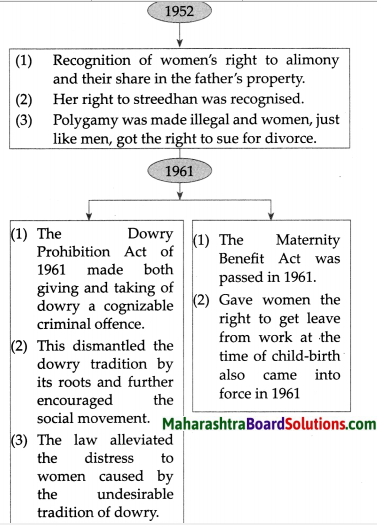
The following measures can be taken to control deposition of non-perishable items on the coast:

  1. Plastic bags, plastic or glass containers must be prohibited on the seacoasts.
  2. Strict action must be taken against offenders carrying the banned products on the seacoasts.
  3. Hoardings explaining the importance of clean seacoasts must be displayed on all the seacoast.

Maharashtra Board Class 8 Geography Solutions Chapter 4 Structure of Ocean Floor

Question g.
How will you run a campaign of environmental conservation to keep the coasts clean?
Answer:
We will run a campaign of environmental conservation to keep the coasts clean as follows:

  1. We will display hoardings explaining the importance of clean seacoasts on the seacoasts.
  2. We will arrange street plays, dramas, etc. highlighting the importance of clean seacoasts.
  3. We will arrange special programmes during the festivals like Ganeshotsav, Diwali, Christmas, etc. to keep the seacoasts clean.

Open-Ended Questions:

Question a.
Suggest measures to control deposition of non-perishable items on the coast.
Answer:
The following measures can be taken to control deposition of non-perishable items on the coast:

  1. Plastic bags, plastic or glass containers must be prohibited on the seacoasts.
  2. Strict action must be taken against offenders carrying the banned products on the seacoasts.
  3. Hoardings explaining the importance of clean seacoasts must be displayed on all the seacoasts.

Maharashtra Board Class 8 Geography Solutions Chapter 4 Structure of Ocean Floor

Question b.
How will you run a campaign of environmental conservation to keep the coasts clean?
Answer:
We will run a campaign of environmental conservation to keep the coasts clean as follows:

  1. We will display hoardings explaining the importance of clean seacoasts on the seacoasts.
  2. We will arrange street plays, dramas, etc. highlighting the importance of clean seacoasts.
  3. We will arrange special programmes during the festivals like Ganeshotsav, Diwali, Christmas, etc. to keep the seacoasts clean.

Maharashtra Board Class 9 Political Science Solutions Chapter 6 International Problems

Balbharti Maharashtra State Board Class 9 Political Science Solutions Chapter 6 International Problems Notes, Textbook Exercise Important Questions and Answers.

Maharashtra State Board Class 9 Political Science Solutions Chapter 6 International Problems

Class 9 Political Science Chapter 6 International Problems Textbook Questions and Answers

1. Choose the right option and rewrite the sentence:

Question 1.
Which among the following is an International problem?
(a) Border dispute between Maharashtra and Karnataka
(b) Kaveri water sharing question
(c) Problems of refugees
(d) Naxalism in Andhra Pradesh
Answer:
(c) Problems of refugees

Maharashtra Board Class 9 Political Science Solutions Chapter 6 International Problems

Question 2.
Which among the following rights are not included in human rights?
(a) Right to work
(b) Right to information
(c) Children’s rights
(d) Equal pay for equal work
Answer:
(b) Right to information

Question 3.
Which among the following days is observed at an international level?
(a) Teachers’ Day
(b) Children’s Day
(c) Earth Day
(d) Flag Day
Answer:
(c) Earth Day

2. Explain with reasons whether the following statements are true or false:

Question 1.
It is necessary that all the nations should cooperate in order to find remedies of environmental degradation.
Answer:
True.

  • The threat to the environment caused by pollution or by leakage of oil or gas does not remain restricted to one nation.
  • Its effects are long term so it becomes necessary for nations to act with each other’s consent and cooperation in order to deal with these effects.

Question 2.
Sino-Indian relations are friendly.
Answer:
False.
The conflict between India and China is connected to two issues

  • Border issue and
  • Status of Tibet. India made several efforts to sort this border dispute by means of dialogue. But it has not met with much success.

Maharashtra Board Class 9 Political Science Solutions Chapter 6 International Problems

3. Complete the following chart:

Question 1.
Human Rights
Maharashtra Board Class 9 Political Science Solutions Chapter 6 International Problems 6
Answer:
Maharashtra Board Class 9 Political Science Solutions Chapter 6 International Problems 5

Question 2.
Degradation of the Environment
Maharashtra Board Class 9 Political Science Solutions Chapter 6 International Problems 8
Answer:
Maharashtra Board Class 9 Political Science Solutions Chapter 6 International Problems 7

Question 3.
Terrorism
Maharashtra Board Class 9 Political Science Solutions Chapter 6 International Problems 10
Answer:
Maharashtra Board Class 9 Political Science Solutions Chapter 6 International Problems 11

Maharashtra Board Class 9 Political Science Solutions Chapter 6 International Problems

4. Prepare the following concept map:

Question 1.
Maharashtra Board Class 9 Political Science Solutions Chapter 6 International Problems 13
Answer:
Maharashtra Board Class 9 Political Science Solutions Chapter 6 International Problems 7

5. Write your own opinion about :

Question 1.
Explain India’s position in establishing human rights.
Answer:
(i) The Preamble of the Indian Constitution contains the objectives of the Constitution.

(ii) It secures to its citizens: justice, social, economic and political; Liberty of thought, expression, belief, faith and worship; Equality of status and opportunity; and Fraternity assuring the dignity of the individual and unity and integrity of the Nation.

(iii) Fundamental Rights are assured to all the citizens of India.

(iv) In order to make these objectives effective, Fundamental Rights and Directive Principles of State Policy were incorporated in Part III and Part IV of our Constitution.

(v) The Supreme Court of India and the High Courts of all states issue Writs, such as:

  • Habeas Corpus
  • Mandamus
  • Prohibition
  • Certiorari
  • Quo Warranto to protect human rights.

Question 2.
Narrate the effects of terrorism and suggest remedies to control it.
Answer:
(i) The 21st century terrorism is an organised system of violence and intimidation. There is a need to empathise, understand, cooperate and coordinate our efforts in dealing with terrorism at the national and international level.

(ii) Terrorism includes taking hostages; firing or bombing civilian localities that are undefended such as hospitals or schools, inhuman treatment to prisoners and destruction of property.

(iii) This leads to feeling of insecurity and helplessness among the people who are prone to terrorism. Their faith in social security and police protection is lowered and they may be psychologically affected.

(iv) Terrorism affects economic growth, political stability and social welfare of the people. It burdens our defence and police system as well. Hence the government cannot focus on its constructive programmes.

(v) Citizens should be alert about unattended luggage or bags at public places and be vigilant about suspicious men around them. They must immediately report to the authorities about the same.

(vi) The youth of the nation should volunteer in police and armed forces. The civilians must always cooperate with the police and government authorities to nab the terrorists.

Class 9 Political Science Chapter 6 International Problems Additional Important Questions and Answers

Choose the correct option from the given options and rewrite the statements:

Question 1.
United Nations Conference on human environment was called at Stockholm from ________.
(a) 5th to 16th June, 1972
(b) 5th to 16th July, 1972
(c) 5th to 16th June, 1971
(d) 5th to 16th July 1971
Answer:
5th to 16th June, 1972

Question 2.
The United Nations General Assembly adopted the International Covenant on Civil and Political Rights (ICCPR) in ______.
(a) 1948
(b) 1966
(c) 1964
(d) 1962
Answer:
1966

Maharashtra Board Class 9 Political Science Solutions Chapter 6 International Problems

Question 3.
In 1997, the conference at Kyoto laid down the protocols for the developed countries for preventing climate change. For how many years did it come to be applied?
(a) 10 years
(b) 12 years
(c) 15 years
(d) 16 years
Answer:
15 years

Question 4.
How many Articles are there in the United Nations Declaration of Human Rights?
(a) 30
(b) 20
(c) 40
(d) 50
Answer:
30

Question 5.
When was the Declaration of the Rights of Child proclaimed?
(a) 30th November 1959
(b) 20th November 1959
(c) 20th December 1959
(d) 30th December 1959
Answer:
20th November 1959

Question 6.
When was the first Earth Day celebrated?
(a) 21st April, 1970
(b) 22nd April, 1970
(c) 23rd April, 1970
(d) 20th April, 1970
Answer:
22nd April, 1970

Question 7.
What led to the boycott of the regime in South Africa?
(a) Expatriation of Prisoners of War
(b) Racial Segregation
(c) Disobedience of the UN
(d) Asylum to international terrorists
Answer:
Racial Segregation

Question 8.
Which conference in 1997 laid down the protocols for developed countries for prevention of climatic changes?
(a) Conference at Copenhagen
(b) Conference at Amsterdam
(c) Conference at Kyoto
(d) Conference at Shimla
Answer:
Conference at Kyoto

Question 9.
Which institute/organisation is responsible for taking action against violation of human rights?
(a) Self Help Groups and NGOs
(b) Human Rights Commission
(c) Corporate bodies
(d) National Investigation Agency
Answer:
Human Rights Commission

Maharashtra Board Class 9 Political Science Solutions Chapter 6 International Problems

State whether the following statements are true or false with reasons:

Question 1.
Human rights are necessary for living as a human being.
Answer:
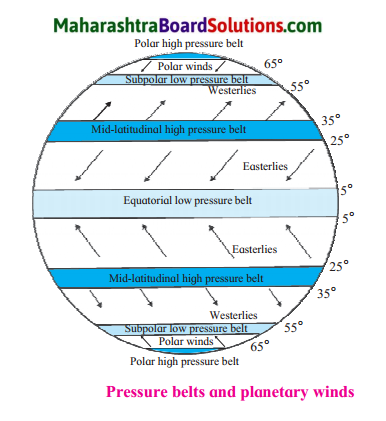
True.
The concept of human rights has emerged from the concept of natural rights. Natural rights are those rights that we are endowed with because we are bom as human beings. In the same vein, human rights are those rights that are necessary for living as a human being.

Question 2.
The scope of human rights is limited.
Answer:
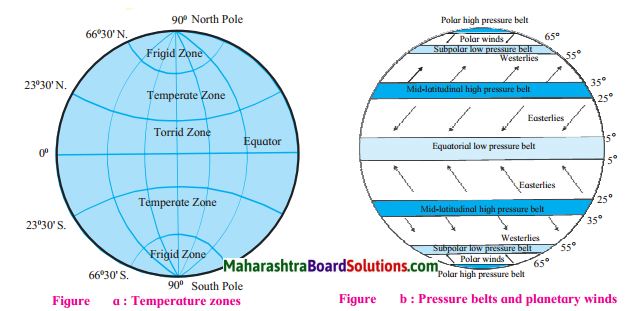
False.
The scope of human rights has in fact, broadened due to several issues of global nature like contagious diseases, the threat to environment, natural disasters, etc. Human rights today also include goals like protection of the environment and sustainable development.

Question 3.
Only internal security is threatened due to terrorist attacks.
Answer:
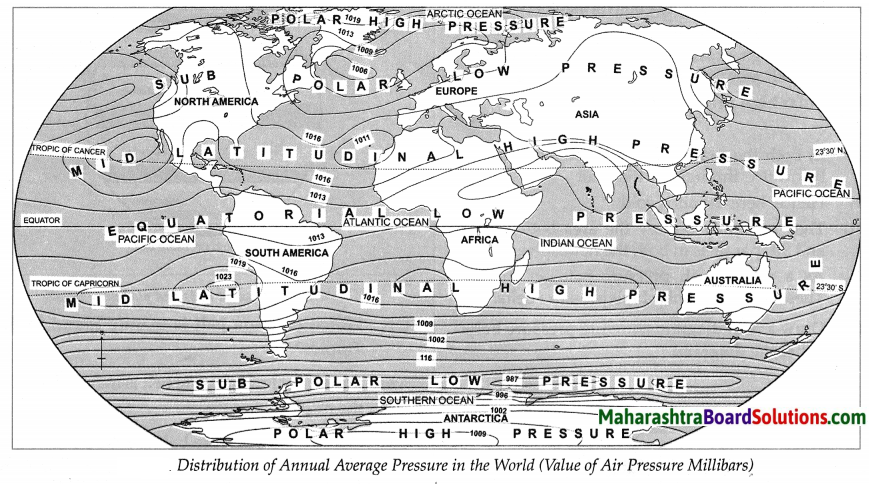
False.
The aim of a terrorist attack is not to endanger the geographical boundaries, but to challenge a regime in a country or refuse to acknowledge the existence of the State. This means that due to increasing terrorism, the internal security of a country is threatened in addition to its external security.

Question 4.
Once the refugees reach a safe place, they have new challenges.
Answer:
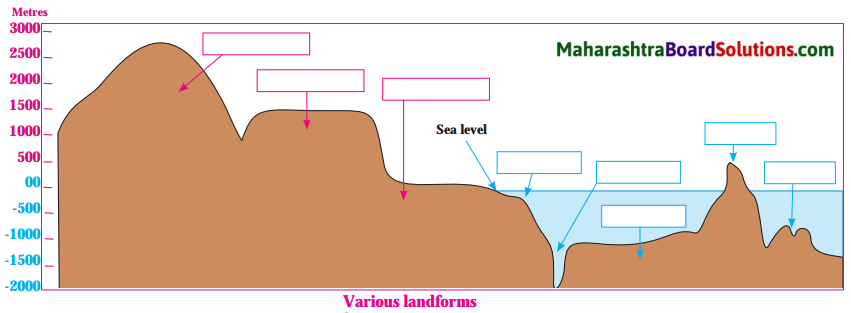
True.
Once the refugees reach a safe place, they need to find work, a place to live and other problems of a day to day nature. If the language and culture in the other nation are different, then adjusting to that poses difficulties. There is also no assurance that the people of a nation which gives shelter to the refugees will accept them.

Maharashtra Board Class 9 Political Science Solutions Chapter 6 International Problems

Explain the concept:

Question 1.
Human Rights
Answer:
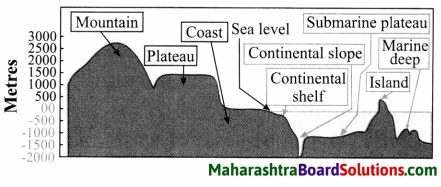
The concept of human rights has emerged from the concept of natural rights. Natural rights are those rights that we are endowed with because we are born as human beings. Human rights are those rights that are necessary for living as a human being and as a constituent of society.

Question 2.
Refugees
Answer:
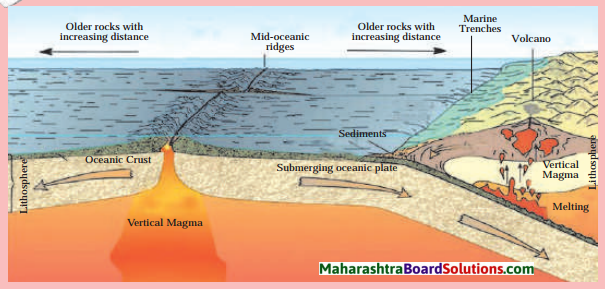
People who have to leave their motherland against their wishes or are forced to go to other nations, seeking refuge or for security are called as refugees. People become refugees due to torture or persecution for belonging to a particular race or religion, due to war or a disaster, etc. In such situations people are forced to leave their own country and seek shelter in another country.

Question 3.
Terrorism
Answer:
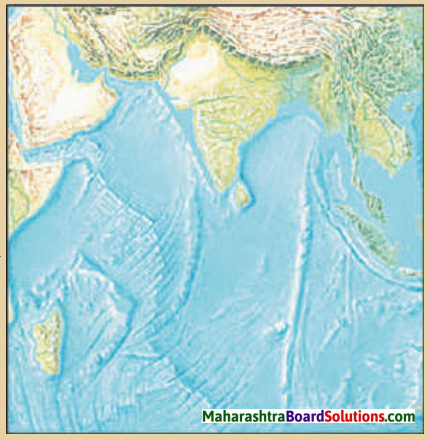
Terrorism is spreading fear and terror in a society by using or threatening to use violence against common and innocent people for achieving political goals. Terrorism can be described as organised and planned violence.

Question 4.
Traditional War
Answer:
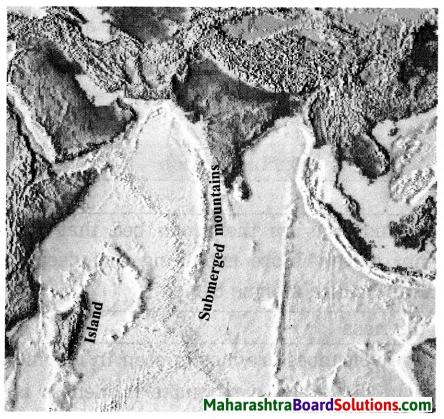
Traditional war is a conflict between two or more sovereign states. In such wars, the geographical boundaries between nations acquire importance, i.e. national security is connected with geographical boundaries.

Question 5.
Stockholm Conference 1972.
Answer:
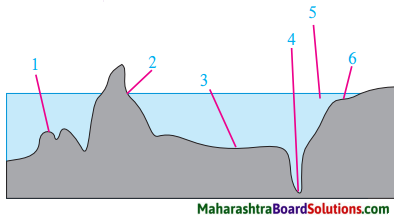
(i) In order to discuss the immediate and long term problems related to the environment and to find solutions on them, a United Nations Conference on human environment was called at Stockholm from 5th to 16th June, 1972.

(ii) It was stressed that it is the responsibility of all nations to cooperate to overcome pollution.

(iii) The developing nations feel that the developed nations are more responsible for the decline of the environment and they should take the responsibility for stopping the decline.

(iv) Non-governmental organisations working in the field of environmental protection were also present and assumed a bigger role in the decision making process at international conferences regarding the environment.

(v) The issue of the protection of the common global wealth was raised.

(vi) A consensus emerged that it was the responsibility of all the nations to protect these resources.

(vii) It was after this conference that the United Nations created the United Nations Environment Programme (UNEP).

(viii) Many international treaties about environment were signed after this conference.

(ix) Several rules were made about the protection of environment. Environmental movements started on a large scale at national as well as at the international level.

Complete the following Chart/Concept Maps:

Question 1.
Maharashtra Board Class 9 Political Science Solutions Chapter 6 International Problems 2
Answer:
Maharashtra Board Class 9 Political Science Solutions Chapter 6 International Problems 2

Maharashtra Board Class 9 Political Science Solutions Chapter 6 International Problems

Question 2.
Maharashtra Board Class 9 Political Science Solutions Chapter 6 International Problems 4
Answer:
Maharashtra Board Class 9 Political Science Solutions Chapter 6 International Problems 3

Answer the following questions in brief:

Question 1.
Which difficulties are faced by people who are forced to leave their own country?
Answer:
(i) When people of any country are forced to leave their own country as refugees, they have to face many problems.

(ii) The most important problem is to decide where to go. They have questions like will that nation give us shelter.

(iii) Secondly, they have to also take along with them other members of their family. It involves a lot of physical and emotional stress.

(iv) Apart from this, there are problems caused by natural elements like heat, rain, storms, as well as shortages of food, sickness, an enemy in pursuit, etc. In this process, many people lose their lives.

Question 2.
What was the Stockholm Conference of 1972 about?
Answer:
In order to discuss the immediate and long-term problems related to the environment and to find solutions to them, a United Nations Conference on human-environment was called at Stockholm from 5th to 16th June 1972.

Question 3.
What are the new challenges faced by refugees on reaching a safe place?
Answer:
(i) Once the refugees reach a safe place, they have new challenges. They need to find work, a place to live and other problems of a day to day nature.

(ii) If the language and culture in the other nation are different, then adjusting to that poses difficulties. There is no assurance that the people in the nation which gives shelter to the refugees will accept them.

Question 4.
What did the Environmental Conference of Rio (1992) emphasise on?
Answer:
(i) In this conference, the idea of sustainable development was stressed upon.

(ii) Different treaties regarding bio-diversity, climate change due to greenhouse gases, protection of forests, etc. were signed.

Question 5.
State the highlights of the conference on climatic change at Paris (2015).
Answer:
(i) A conference on climate change was held at Paris in November 2015.

(ii) An appeal was made in this conference that all nations should make concerted efforts to stop climate change and global warming and that the developed countries should help the developing countries to acquire the technology to achieve these goals.

Maharashtra Board Class 9 Political Science Solutions Chapter 6 International Problems

Question 6.
What measures have been taken so far to save the refugees?
Answer:
(i) In 1951, some provisions were made regarding the question of refugees at the international level. One such provision was that the refugees will not be forcefully sent back to their country against their wishes.

(ii) Similarly an office of the High Commissioner of the United Nations has been established to solve their problems.

Question 7.
Give some examples of refugees.
Answer:
(i) Before the Second World War, the Jews were tortured in Germany.

(ii) Their citizenships and properties were confiscated. Due to this, the Jews became refugees.

(iii) In 1971, the people in East Pakistan turned refugees and came to India seeking refuge due to political and religious persecution.

(iv) In the last few years due to the war-like situation in Iraq and Syria, a lot of people are leaving Syria as refugees. We can cite many such example of refugees.

Question 8.
Which problems are faced by the host nation that agrees to provide shelter to the refugees?
Answer:
(i) As the number of refugees increases, the strain on the economy of the host nation increases. A shortage of essential goods is created; there may be an increase in crime or even inflation.

(ii) The locals may lose their jobs; a problem of law and order may crop up. Many such problems may emerge.

(iii) Due to these problems, many nations are not ready to give shelter to refugees and to resettle them.

Question 9.
Which steps can be taken for preservation of human rights?
Answer:
(i) If all nations safeguarded and fostered human rights, exploitation and violence would reduce. All people would be able to achieve their own development safely and securely.

(ii) Human rights could be more effectively implemented if the environment is safeguarded and if terrorism is completely wiped out.

(iii) No group of people will have to become refugees. For this, all nations have to come together, cooperate with each other, take concrete action and bring about actual change.

Question 10.
Many nations are not ready to give shelter to refugees. Why?
Answer:
Many nations are not prepared to give shelter to refugees because:

  • As the number of refugees increases, the strain on the economy of the host nation increases.
  • A shortage of essential goods is created; there may be an increase in crime or even inflation.
  • The locals may lose their jobs; a problem of law and order may crop up.
  • Many such problems may emerge.

Question 11.
The problems relating to the environment are inherently of a global nature. How?
Answer:
(i) The threat to the environment caused by pollution or by leakage of oil or gas does not remain restricted to one nation.

(ii) The visible effects of the decline of environment are extinction of species of plants and animals, decrease in the fertility of soil, water shortage, fluctuation in the proportion of rainfall, global warming, drying up of rivers and lakes, pollution of rivers and seas, incidence of newer diseases, acid rain, thinning of the ozone layer, etc.

(iii) Even if some of the effects are restricted to particular nations, these problems reach global proportions due to their long term effects, while some problems are inherently of a global nature.

Maharashtra Board Class 9 Political Science Solutions Chapter 6 International Problems

Question 12.
How is terrorist war different from traditional war?
Answer:
(i) Terrorist conflict is different from traditional war.

(ii) Traditional war is a conflict between two or more sovereign states.

(iii) In such wars, the geographical boundaries between nations acquire importance, i.e. national security is connected with geographical boundaries.

(iv) On the other hand, in the case of terrorism, terrorist groups can cause violence in any part of the world from anywhere in the world.

(v) The aim of a terrorist attack is not to endanger the geographical boundaries, but to challenge a regime in a country or refuse to acknowledge the existence of the state.