Maharashtra Board Class 8 History Solutions Chapter 12 India Gains Independence

Balbharti Maharashtra State Board Class 8 History Solutions Chapter 12 India Gains Independence Notes, Textbook Exercise Important Questions and Answers.

Maharashtra State Board Class 8 History Solutions Chapter 12 India Gains Independence

Class 8 History Chapter 12 India Gains Independence Textbook Questions and Answers

1. Rewrite the statements by choosing the appropriate options :

Question 1.
………………. was the head of the interim Government.
(a) Vallabhbhai Patel
(b) Mahatma Gandhi
(c) Pandit Jawaharlal Nehru
(d) Barrister Jinnah
Answer:
(c) Pandit Jawaharlal Nehru

Question 2.
The plan of creation of two independent nations, India and Pakistan, was made by ………………… .
(a) Lord Wavell
(b) Stafford Cripps
(c) Lord Mountbatten
(d) Pethick Lawrence
Answer:
(c) Lord Mountbatten

2. Answer the following in one sentence:

Question 1.
Which demand was advocated by Barrister Jinnah?
Answer:
The two nation theory and demand of separate Muslim nation named Pakistan was advocated by Barrister Jinnah.

Maharashtra Board Class 8 History Solutions Chapter 12 India Gains Independence

Question 2.
Write the names of the ministers participating in Cabinet Mission.
Answer:
Pethick Lawrence, Stafford Cripps and A.V. Ale ander were the ministers participating in the Cabinet Mission.

3. Explain the following statements with reasons:

Question 1
The Indian National Congress approved the partition.
Answer:

  1. Lord Mountbatten prepared a plan of creation of India and Pakistan as two independent nations.
  2. Indian National Congress opposed the plan of partition as unity of the Nation was its basic stand.
  3. However, the Muslim League remained adamant on the creation of Pakistan.
  4. So, the Indian National Congress was left with no option but to accept the partition with complete helplessness.

Question 2.
The working of Interim Government could not run smoothly.
Answer:

  1. Muslim League demanded a separate Muslim nation of Pakistan.
  2. The followers of the Muslim League resorted to violent ways.
  3. Though the Muslim League declined to participate initially, they later participated in it.
  4. However, the leaders of the Muslim League adopted the policy of obstruction and therefore the Interim Government could not run smoothly.

Maharashtra Board Class 8 History Solutions Chapter 12 India Gains Independence

Question 3.
The Wavell Plan could not succeed.
Answer:
The Wavell Plan could not succeed because

  1. Barrister Jinnah insisted that only Muslim League should have the right to suggest the names of Muslim representatives to the Viceroy’s Executive Council.
  2. The Congress opposed this and as a result, no consensus could be arrived at the meeting called by Lord Wavell.

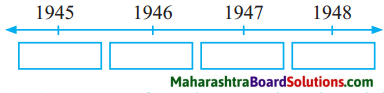
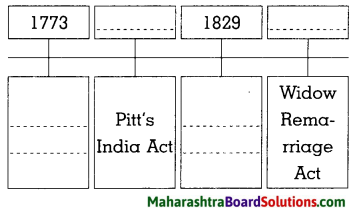
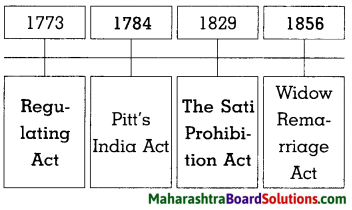
4. Write the events on the following timeline:

Question 1.
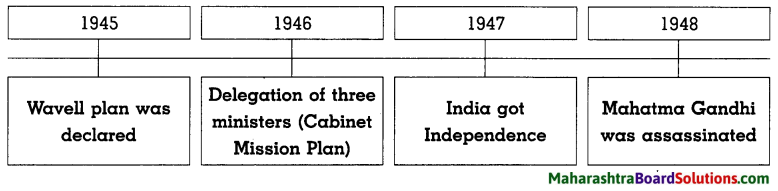
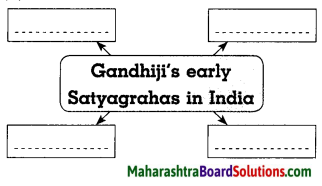
Maharashtra Board Class 8 History Solutions Chapter 12 India Gains Independence 1
Answer:
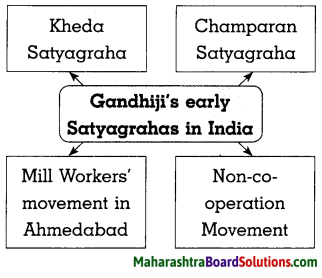
Maharashtra Board Class 8 History Solutions Chapter 12 India Gains Independence 2

5. Answer the following questions in brief:

Question 1.
Why did the British took steps towards granting freedom to India?
Answer:

  1. The Indian freedom struggle had become very intense during the period of Second World War. The revolt of Navy and Air Force shook the foundation of the British empire.
  2. The demand for independence of India was gaining its strength.
  3. The Muslim League had demanded a separate Muslim nation.
  4. The followers of the Muslim League resorted to violence.
  5. The British government realised that it was necessary to take a serious note of it. They realised that their rule in India will not last long.

Accordingly, the British government started preparing plans for granting Independence to India.

Maharashtra Board Class 8 History Solutions Chapter 12 India Gains Independence

Question 2.
Write information about the Mountbatten Plan.
Answer:

  1. England’s Prime Minister Atlee announced the transfer of power would be before June 1948.
  2. He appointed Lord Mountbatten as the Viceroy of India who was to arrange the transfer of power.
  3. He held discussions with the leaders of India.
  4. Mountbatten prepared a plan for partition of India i.e., creation of two independent nations, India and Pakistan.
  5. The Indian National Congress opposed the plan.
  6. But, due to the adamant behaviour of the Muslim League, the Indian National Congress accepted the Plan, with complete helplessness.
  7. On the basis of Mountbatten Plan, Indian Independence Act was passed.

Question 3.
Why did Muslim League declare to observe 16 August as Direct Action Day? What were its effects?
Answer:

  1. The Muslim League was adamant on the demand of Pakistan.
  2. It was not satisfied with Cabinet Mission plan as it had no provision for a separate Muslim state.
  3. 16th August 1946 was observed as Direct Action Day. ‘
  4. The followers of Muslim League resorted to violent ways.
  5. There were Hindu-Muslim riots in various parts of the country.
  6. There were massacres in the Noakhali region in the province of Bengal.

Project:

Collect information about the response of common people after gaining independence, with the help of various reference books as well as the internet.

Class 8 History Chapter 12 India Gains Independence Additional Important Questions and Answers

Rewrite the statements by choosing the appropriate options:

Question 1.
……………… put forth the two Nation theory and demanded a separate Muslim nation.
(a) Barrister Muhammad Ali Jinnah
(b) Chaudhary Rahmat Ali
(c) Dr. Muhammad Iqbal
(d) Lord Mountbatten
Answer:
(a) Barrister Muhammad Ali Jinnah

Question 2.
……………., Prime Minister of England, declared that England would leave its dominion on India before June 194 .
(a) Winston Churchill
(b) Linlithgo
(c) Atlee
(d) Mountbatten
Answer:
(c) Atlee

Question 3.
The ……………. initially refused to participate in the Interim Government.
(a) Indian National Congress
(b) Muslim League
(c) Hindu Mahasabha
(d) Kisan Sabha
Answer:
(b) Muslim League

Question 4.
The Muslim League decided to observe 16th August as ……………. Day.
(a) Non Violence
(b) Pakistan
(c) Direct Action
(d) Independence
Answer:
(c) Direct Action

Question 5.
As per ………………, India got independence.
(a) Mountbatten Plan
(b) Wctvell Plan
(c) Indian Independence Act
(d) Cabinet Mission
Answer:
(c) Indian Independence Act

Maharashtra Board Class 8 History Solutions Chapter 12 India Gains Independence

Question 6.
Gandhiji was assassinated on ………………….. .
(a) 30 December 1947
(b) 30 January 194
(c) 30 March 194
(d) 2 October 194
Answer:
(b) 30 January 194

Name the following:

Question 1.
First person to present idea of free Muslim nation.
Answer:
Dr. Muhammad Iqbal

Question 2.
Last Viceroy of India.
Answer:
Lord Mountbatten

Question 3.
One who presented idea of Pakistan.
Answer:
Chaudhary Rahmat Ali

Question 4.
Went to Noakhali to stop violence
Answer:
Mahatma Gandhi.

Answer the following in one sentence:

Question 1.
What did Prime Minister Atlee declare in the British Parliament of England?
Answer:
Prime Minister Atlee declared in the British Parliament that England would transfer all of its government responsibility to Indians not later than June 1948.

Maharashtra Board Class 8 History Solutions Chapter 12 India Gains Independence

Question 2.
Why did the Interim Government not work smoothly?
Answer:
The Interim Government could not work smoothly because the Muslim League followed the policy of obstruction.

Answer the following questions in brief:

Question 1.
Which were the important provisions :
of the Wavell Plan?
Answer:

  1. The Wavell Plan provided a proper representation to Muslims, Dalits and minorities in the Central and Provincial Legislatures.
  2. It provided for an equal number of Hindu and Muslim members in Viceroy’s Executive Council.

Question 2.
State the provisions of the Indian Independence Act.
Answer:
The Indian Independence Act was passed on the basis of Mountbatten Plan on 18th July, 1947.
According to the plan :

  1. Two Independent nations of India and Pakistan will come into existence on 15th August, 1947.
  2. Thereafter, the British Parliament would not retain any control over them.
  3. The British supremacy over the princely states would come to an end.
  4. They would be free to join either India or Pakistan or remain independent.

Maharashtra Board Class 8 History Solutions Chapter 12 India Gains Independence

Question 3.
Write about the attainment of independence by India.
Answer:

  1. As per the Indian Independence Act, India was granted Independence on 15th August, 1947.
  2. A meeting of the Constituent Assembly was going on in the hall of Parliament House in Delhi in the midnight of 14th August.
  3. At the stroke of midnight, the Union Jack of Britain was lowered and in its place the Indian tricolour flag was unfurled.

Explain the following statements with reasons:

Question 1.
The Cabinet Mission Plan could not satisfy the political parties in India.
Answer:
The Cabinet Mission Plan could not satisfy the political parties in India because,

  1. The Indian National Congress was not happy with some of its provisions.
  2. The Muslim League was also dissatisfied with the plan as it did not provide for the creation of a separate Muslim state of Pakistan.

Question 2.
The joy of attainment of freedom was not untinted:
Answer:

  1. India attained Independence from the slavery of 150 years.
  2. But, the people were grieved due to the partition of the country and the terrible violence during that period.

So, the joy of attainment of freedom was not untinted.

Maharashtra Board Class 8 History Solutions Chapter 12 India Gains Independence

Answer the following in detail:

Question 1.
State the genesis of Pakistan.
Answer:

  1. To weaken the national movement, the British adopted the policy of ‘divide and rule’. Its consequence was the establishment of ‘Muslim League’.
  2. Famous poet, Dr. Muhammad Iqbal put forth the idea of an independent Muslim state.
  3. Later Chaudhary Rahmat Ali coined the name Pakistan.
  4. Barrister Muhammad Ali Jinnah put forth the two nation theory and demanded a separate state for the Muslims naming Pakistan.
  5. Barrister Jinnah and the Muslim League started the propaganda that Indian National Congress was only a Hindu organisation and the Muslims have no benefit of it.
  6. Since their demand was not fulfilled, they observed ‘Direct Action Day’ and resorted to violence.
  7. The nation witnessed Hindu-Muslim riots in various parts.
  8. After the consent of the Indian National Congress to the Mountbatten Plan, the Indian Independence Act provided for the partition.

Question 2.
Why do you think everyone needs freedom?
Answer:

  1. Freedom is liberation from any kind of bondage.
  2. The rights of people are denied under foreign rule.
  3. Lot of restrictions are imposed by a foreign power.
  4. Under a foreign rule or dictatorship, power is not used for the welfare of the people but for the benefit of few.
  5. All round development of the citizens take place in an independent free state.
  6. Equality, Fraternity, Justice, Humanity are values which are cherished in freedom. Therefore, everyone needs freedom.

Maharashtra Board Class 8 History Solutions Chapter 8 Civil Disobedience Movement

Balbharti Maharashtra State Board Class 8 History Solutions Chapter 8 Civil Disobedience Movement Notes, Textbook Exercise Important Questions and Answers.

Maharashtra State Board Class 8 History Solutions Chapter 8 Civil Disobedience Movement

Class 8 History Chapter 8 Civil Disobedience Movement Textbook Questions and Answers

1. Rewrite the statements by choosing the appropriate options :

(Mahatma Gandhi, Khuda-i-Khidmatgar, [ Ramsay Mac Donald, Sarojini Naidu)

Question 1.
……………. organised the Round Table Conference in London.
Answer:
Ramsay Mac Donald

Maharashtra Board Class 8 History Solutions Chapter 8 Civil Disobedience Movement

Question 2.
Khan Abdul Gafar Khan established the organisation named …………….
Answer:
Khuda-i-Khidmatgar

Question 3.
……………. led the Dharasana Satyagraha.
Answer:
Sarojini Naidu

Question 4.
In the Second Round Table Conference ……………. participated as a representative of Indian National Congress.
Answer:
Mahatma Gandhi.

2. Explain the following statements with reasons :

Question 1.
Chandrasing Thakur was court martialled and severely punished.
Answer:

  1. Khan Abdul Gaffar Khan began Satyagraha at Peshawar on 23rd April, 1930. His organisation Khuda-i Khidmatgar led the satyagraha.
  2. They kept Peshawar town in their control for a week.
  3. The British government ordered Garhwal regiment to fire on the satyagrahis.
  4. Chandrasing Thakur an officer of the Garhwal Regiment refused to fire on the satyagrahis.

Therefore, he was court-martialled and severely punished.

Question 2.
The Government declared Martial Law at Solapur.
Answer:

  1. After the Salt Satyagraha many movements which were integral of Civil Disobedience Movement started.
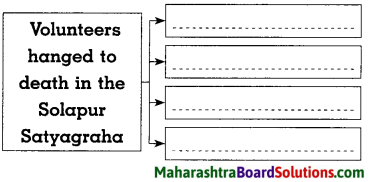
  2. The mill workers in Solapur observed hartal and organised a huge procession on 6th May 1930.
  3. The District Collector ordered firing on procession. Many volunteers including Shankar Shivdare died in the firing.
  4. People got enraged and attacked railway stations, police stations, courts, municipal buildings, etc.

Therefore, Martial law was imposed in Solapur by the government.

Maharashtra Board Class 8 History Solutions Chapter 8 Civil Disobedience Movement

Question 3.
The deliberation in the First Round Table Conference proved to be meaningless.
Answer:

  1. The Civil Disobedience Movement intensified in India in 1930.
  2. The British Prime Minister, Ramsay Mac Donald organised Round Table Conference at London to discuss constitutional issues related to India.
  3. The representatives of many political parties and princely states participated in the conference. Indian National Congress did not participate in it.
  4. Without the participation of the Congress which was a body that represented the country deliberations were meaningless.

Thus, the deliberation in the First Round Table Conference proved to be meaningless.

Question 4.
Gandhiji began fast unto death in the Yerwada jail.
Answer:

  1. The Communal Award declared by the British Prime Minister Ramsay Mac Donald provided separate electorates for the Dalits.
  2. This division of the society on the basis of caste was not acceptable to Gandhiji.
  3. Therefore, to protest against the Award, Gandhiji began fast unto death in the Yerawada jail.

3. Answer the following questions in 25 to 30 words :

Question 1.
Why did Gandhiji decide to break the Salt Act to begin the Satyagraha?
Answer:
1. Before launching the Civil Disobedience Movement Gandhiji demanded cancellation of salt tax and end the monopoly of the British government to manufacture it.
2. Being an important ingredient in the food of the common people, it was unjust to impose a tax on salt.
3. Gandhiji decided to launch the Salt Satyagraha by a violation of the Salt Act, which was symbolic in breaking all unjust and oppressive laws of the British.

Maharashtra Board Class 8 History Solutions Chapter 8 Civil Disobedience Movement

Question 2.
Why did the Indian National Congress withdraw the Civil Disobedience Movement?
Answer:
1. After the failure of the First Round Table Conference, Prime Minister Ramsay Mac Donald hoped that Indian National Congress would participate in the Second Round Table Conference.
2. In order to create a conducive atmosphere Gandhiji and other political leaders were released from jail.
3. A pact was signed after discussion between Gandhiji and Viceroy Irwin.
4. According to the pact, the British Government gave an assurance of providing Responsible Government in the proposed constitution of India.
5. So, the congress agreed to suspend the Civil Disobedience Movement and participate in the Second Round Table Conference.

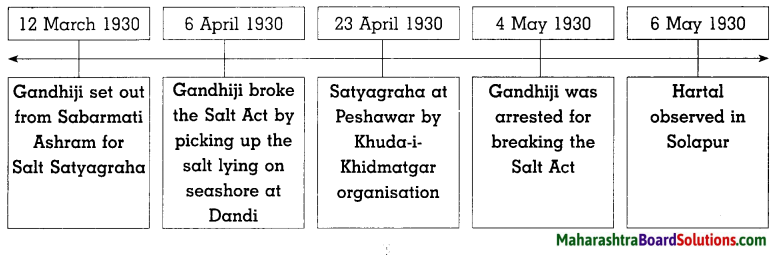
4. Complete the following timeline of Civil Disobedience Movement:

Question 1.
Maharashtra Board Class 8 History Solutions Chapter 8 Civil Disobedience Movement 7
Answer:
Maharashtra Board Class 8 History Solutions Chapter 8 Civil Disobedience Movement 8

Maharashtra Board Class 8 History Solutions Chapter 8 Civil Disobedience Movement

Do you Know?

Features of the Civil Disobedience Movement :
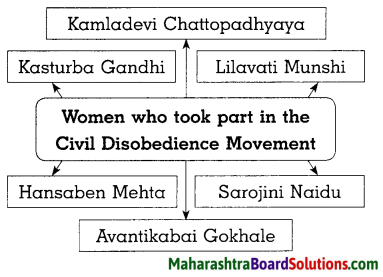
1. All the movements, till now, were limited only to urban areas. But this movement became a nationwide movement. People from rural areas registered their participation. Women also took part in large numbers. Kasturba Gandhi, Kamladevi Chattopadhyay, Ayantikaba I Gokha le, Lilavati Munshi, Hansaben Mehta led the satyagraha.

2. This movement was based on complete nonviolence. The British Government was trying to greatly suppress the movement, but the people protested unarmed. Due to this, the Indian people became fearless.

project:

Question 1.
Gather additional information along with photographs about the work of the following personalities in the Civil Disobedience Movement and exhibit it in the class. (a) Sarojini Naidu (b) Khan Abdul Gafar Khan (c) Babu Genu Said.

Maharashtra Board Class 8 History Solutions Chapter 8 Civil Disobedience Movement

Question 2.
The plot on an outline map of India, the places mentioned in the chapter where the Civil Disobedience Movement took place.

Class 8 History Chapter 8 Civil Disobedience Movement Additional Important Questions and Answers

Rewrite the statements by choosing the appropriate options :

Question 1.
After the resolution of Complete Independence was passed in Lahore session, Gandhiji decided to launch ……………. Movement.
(a) Home Rule
(b) Non-co-operation
(c) Quit India
(d) Civil Disobedience
Answer:
(d) Civil Disobedience

Question 2.
During Civil Disobedience Movement, government imposed Martial law in ……………. .
(a) Peshawar
(b) Solapur
(c) Pune
(d) Mumbai
Answer:
(b) Solapur

Question 3.
Gandhiji withdrew the Civil Disobedience Movement in ……………. .
(a) April 1934
(b) March 1930
(c) November 1932
(d) May 1933
Answer:
(a) April 1934

Maharashtra Board Class 8 History Solutions Chapter 8 Civil Disobedience Movement

Question 4.
Gandhiji broke the Salt Act at ……………. .
(a) Dandi
(b) Peshawar
(c) Dharasana
(d) Yerwada
Answer:
(a) Dandi

Question 5.
The British government gave orders to regiment in Peshawar to ……………. open fire on the satyagrahis.
(a) Garhwal
(b) Sikh
(c) Maratha
(d) Rajput
Answer:
(a) Garhwal

Name the following :

Question 1.
Follower of Gandhiji known as Frontier Gandhi.
Answer:
Khan Abdul Gafar Khan

Question 2.
Volunteer who died in firing at Solapur satyagraha.
Answer:
Shankar Shivdare

Question 3.
Laid down his life in front of the truck boycotting foreign goods in Mumbai.
Answer:
Babu Genu Said

Question 4.
Attended the Second Round Table Conference as representative of Dalits.
Answer:
Dr. Babasaheb Ambedkar.

Answer the following questions in one sentence :

Question 1.
What was the objective of Gandhiji in starting the Civil Disobedience?
Answer:
The objective of Gandhiji was to break the oppressive and unjust laws of the British Government through peace and Satyagraha.

Maharashtra Board Class 8 History Solutions Chapter 8 Civil Disobedience Movement

Question 2.
From which place and when did the Dandi March start?
Answer:
The Dandi March started from Sabarmati Ashram in Ahmedabad on 12 March, 1930.

Question 3.
Name the leaders present at the First Round Table Conference.
Answer:
Dr. Babasaheb Ambedkar, Sir Tej Bahadur Sapru, Barrister Jinnah were the leaders present at the First Round Table Conference.

Question 4.
Which issues were discussed in the First Round Table Conference?
Answer:
The issues like Responsible Government at centre and establishment of Federal State in India were discussed.

Question 5.
What decision was made in the Poona Pact?
Answer:
According to the Poona Pact, separate electorates for the Dalits was cancelled and a provision for reserved seats was made.

Do as Directed :

Complete the graphical presentation :

Question 1.
Maharashtra Board Class 8 History Solutions Chapter 8 Civil Disobedience Movement 1
Answer:
Maharashtra Board Class 8 History Solutions Chapter 8 Civil Disobedience Movement 2

Maharashtra Board Class 8 History Solutions Chapter 8 Civil Disobedience Movement

Question 2.
Maharashtra Board Class 8 History Solutions Chapter 8 Civil Disobedience Movement 3
Answer:
Maharashtra Board Class 8 History Solutions Chapter 8 Civil Disobedience Movement 4

Question 3.
Maharashtra Board Class 8 History Solutions Chapter 8 Civil Disobedience Movement 5
Answer:
Maharashtra Board Class 8 History Solutions Chapter 8 Civil Disobedience Movement 6

Write short notes :

Question 1.
Gandhi-Irwin Pact :
Answer:
1. On the appeal of the Prime Minister, the Viceroy released Gandhiji and other political leaders from prison.
2. In this conducive atmosphere, a pact was signed between Gandhiji and Viceroy Irwin. It is known as Gandhi-Irwin Pact.

  • According to the pact, the British Government gave an assurance of providing Responsible Government in the proposed constitution of India.
  • Congress decided to withdraw the Civil Disobedience Movement.
  • Agreed to participate in the Second Round Table Conference.

Maharashtra Board Class 8 History Solutions Chapter 8 Civil Disobedience Movement

Question 2.
Second Round Table Conference :
Answer:

  1. The Second Round Table Conference was held in 1931.
  2. Gandhiji participated as the sole representative of the Indian National Congress.
  3. Dr. Babasaheb Ambedkar represented the Dalits. The representatives of the various castes and communities, political parties and the princely states also participated.
  4. The issues of minority representation and nature of proposed federal constitution were discussed.
  5. Dr. Babasaheb Ambedkar demanded separate electorates for the Dalits.
  6. Gandhiji tried to bring unanimity but he was unsuccessful. ‘
  7. So, he was disappointed and returned to India.

Question 3.
Poona Pact :
Answer:

  1. After the Second Round Table Conference, the British Prime Minister Ramsay Mac Donald declared Communal Awards.
  2. Communal Awards granted separate electorates to the Dalits as demanded by Dr. Ambedkar.
  3. Gandhiji was against the division on the basis of caste. He started fast unto death in Yerwada jail.
  4. The leaders of Indian National Congress requested Dr. Ambedkar to reconsider his demand in the interest of the nation.
  5. So, Dr. Babasaheb Ambedkar signed the. Poona Pact with Gandhiji in 1932.
  6. It provided reserved seats instead of separate electorates for the Dalits.

Question 4.
The Round Table Conference :
Answer:

  1. The British Prime Minister, Ramsay Mac Donald wanted to discuss constitutional issues related to India.
  2. For this purpose, he organised Three Round Table Conferences at London between 1930 and 1932.
  3. Representatives of various communities, castes, political parties and princely states attended the conferences.
  4. Gandhiji attended the Second Round Table Conference as the representative of Indian National Congress.
  5. As no important decision was taken in them, all these conferences proved to be futile.

Answer the following questions in 25 to 30 words :

Question 1.
Write about the sacrifice of Babu Genu.
Answer:

  1. There was agitation against foreign goods in Mumbai.
  2. Babu Genu Said, a mill worker, was at the forefront in this Satyagraha.
  3. He threw himself in front of a truck carrying foreign goods in order to stop it.
  4. He did not budge even after the police threatened him.
  5. In the end, he was crushed under the truck.
  6. His martyrdom was a source of inspiration for the national movement.

Maharashtra Board Class 8 History Solutions Chapter 8 Civil Disobedience Movement

Question 2.
Write features of Civil Disobedience Movement.
Answer:
The Civil Disobedience Movement launched in 1930 had the following features :

  1. All the movements launched till then were limited to urban areas.
  2. But this movement became nationwide as the people from rural areas also participated.
  3. Women participated in large numbers in the movement and even led it at many places.
  4. The movement was based on non-violence. People faced the suppressive measures of the government unarmed and fearlessly.

Question 3.
What suppressive measures were adopted by the British government after the Second Round Table Conference?
Answer:

  1. Gandhiji resumed the Civil Disobedience Movement after he failed and returned from the Second Round Table Conference.
  2. The government responded by resorting to inhuman oppressive measures.
  3. Civic rights were strangled.
  4. The Indian National Congress and associated institutions were declared illegal.
  5. Restrictions were imposed on national newspapers and literature.

Explain the following statements with reasons :

Question 1.
Gandhiji was arrested on 4th May 1930.
Answer:

  1. Gandhiji started Salt Satyagraha on 6th April 1930 at Dandi by breaking the Salt act.
  2. With this the Civil Disobedience Movement started all over India.
  3. In spite of suppressive measures undertaken by the British Government, they could not suppress the movement.

The British government found itself in a difficult situation. So, Gandhiji was arrested on 4th May 1930.

Maharashtra Board Class 8 History Solutions Chapter 8 Civil Disobedience Movement

Question 2.
Gandhiji returned disappointed from the Second Round Table Conference.
Answer:

  1. The British Government raised the issue of representation of the minorities and the nature of the federal constitution.
  2. There were differences of opinion among the representatives.
  3. Moreover, the efforts of Gandhiji to arrive at a consensus did not succeed.
  4. This disappointed Gandhiji and he returned from the Second Round Table Conference.

Read the passage and answer the questions given below:

Passage:
The satyagraha at …………….
………………… Malavan and Shiroda.

Question 1.
Who led the Dharasana Satyagraha?
Answer:
Sarojini Naidu led the Dharasana Satyagraha in Gujarat.

Question 2.
At which places in Maharashtra did Salt Satyagraha take place?
Answer:
The Salt Satyagraha in Maharashtra took place at Wadala, Malvan and Shiroda.

Question 3.
Give a brief account of the Dharasana Satyagraha.
Answer:

  1. The leadership of salt satyagraha was taken over by Sarojini Naidu at Dharasana in Gujarat after the arrest of Gandhiji.
  2. The police lathi-charged the batches of the satyagrahis who came forward to break the Salt Act.
  3. They silently tolerated the blows of the lathis.
  4. The injured were provided medical aid and another batch of satyagrahis would replace them.
  5. This chain of satyagrahis continued endlessly at Dharasana.

Answer the following in detail:

Question 1.
Explain the extensive nature of Civil Disobedience Movement.
Answer:

  1. After the resolution of complete independence was passed, Mahatma Gandhi decided to launch the Civil Disobedience Movement.
  2. he Salt Satyagraha was launched on 6th April 1930 at Dandi. It was a symbolic act by Gandhiji.
  3. The main objective was to break all unjust and oppressive laws of the British through peace and Satyagraha.
  4. Salt Satyagraha took place at Dharasana in Gujarat and at Wadala, Malvan and Shiroda in Maharashtra.
  5. The mill workers were on the forefront in the Solapur Satyagraha.
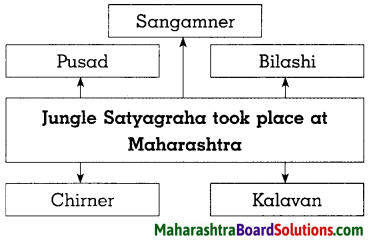
  6. The forest Satyagraha was undertaken at Bilashi, Sangamner, Kalavan, Chirner and Pusad by tribals in Maharashtra.
  7. In the Northwest Frontier Province, the Satyagraha was organised under the leadership of Khan Abdul Gafar Khan.
  8. The satyagrahis in Mumbai obstructed the trucks loaded with foreign goods.
  9. Women also participated in large numbers.
  10. This movement reached urban as well as the rural areas, thus making it a national movement.

Maharashtra Board Class 8 History Solutions Chapter 8 Civil Disobedience Movement

Question 2.
Write information of Dandi March.
Answer:

  1. Gandhiji decided to launch Civil Disobedience Movement to cancel unjust tax on salt and to end the monopoly of the British Government to manufacture of salt.
  2. Salt, an important ingredient in the food of common people, was chosen by Gandhiji.
  3. On 12th March 1930 he set out from Sabarmati ashram with his 7 followers.
  4. Gandhiji delivered speeches in the villages on his way to Dandi.
  5. Due to Gandhiji’s speech the message of Civil Disobedience spread everywhere and a favorable atmosphere was created.
  6. He appealed to the people to join the movement fearlessly.
  7. Covering a distance of 35 km, Gandhiji reached Dandi, a seashore, on 5th April 1930.
  8. On 6th April, he broke the salt act by picking up the salt lying on the seashore.
  9. With this, the Civil Disobedience Movement started all over the country.

Question 3.
Do you feel Gandhiji’s Civil Disobedience technique can be used in present times?
Answer:

  1. Gandhiji opposed the unjust and oppressive laws of the British and broke them through peace and Satyagraha.
  2. I strongly feel India needs such ways in present times. Political parties and organisations call for strike or start a movement against decisions of government.
  3. They resort to unconstitutional acts such as stopping the vehicles, vandalising public property, setting objects on fire and starting riots.
  4. They destroy property of the nation by involving in all this anti-social activities. Innocent people get killed.
  5. It brings development to a halt, creates a divide in society.
  6. The feeling of unity, co-operation and tolerance remains no more. Society becomes unsafe.
  7. Therefore, I feel that even today the nation requires technique of Civil Disobedience.

Maharashtra Board Class 10 Geography Solutions Chapter 5 Natural Vegetation and Wildlife

Balbharti Maharashtra State Board Class 10 Geography Solutions Chapter 5 Natural Vegetation and Wildlife Notes, Textbook Exercise Important Questions and Answers.

Maharashtra State Board Class 10 Geography Solutions Chapter 5 Natural Vegetation and Wildlife

Class 10 Geography Chapter 5 Natural Vegetation and Wildlife Textbook Questions and Answers

Question 1.
On the basis of the information given in the chapter, figures and maps, complete the table below:

S.NoType of forestCharacteristicsRegions in IndiaRegions in Brazil
1Tropical ForestsBroad-leaved evergreen trees.
2Semi arid thorny vegetation1.
2.
3SavannahScanty bushes and shrub like trees and rain resistant grass.
4Tropical
semi-deciduous
Mixed type vegetation.
5GrasslandsGrassland region like the Pampas of Argentina.

Answer:

S. No.Type of forestCharacteristicsRegions in IndiaRegions in Brazil
(1)Tropical ForestsBroad-leaved evergreen trees.Andaman and Nicobar Islands, the Western Ghats. Some parts of North East India.Amazon Basin, Guyana Highlands.
(2)Semi arid thorny vegetation(a)     Thorny and shrub type vegetation.
(b)   Leaves are small in size. Leaves are modified into thorns to minimise evaporation.
Gujarat, Rajasthan, Parts of Madhya Pradesh and Uttar Pradesh.North-Eastern part of Brazil.
(3)SavannahScanty bushes and shrub like trees and rain resistant grass.Brazilian Highland.
(4)Tropical

semi-deciduous

Mixed type vegetation.Central India and South India.Parana Basin and South Eastern part of Brazil.
(5)GrasslandsGrassland region like the Pampas of Argentina.Foothills of Shiwalik hills and Assam.Southern Brazil.

Maharashtra Board Class 10 Geography Solutions Chapter 5 Natural Vegetation and Wildlife

2. Identify the odd man out:

Question a.
Forest type of Brazil ______.
(a) Thorny bush type vegetation
(b) Evergreen forests
(c) The Himalayan Forests
(d) Deciduous forests
Answer:
(c) The Himalayan Forests

Question b.
With reference to India
(a) Mangrove forests
(b) Mediterranean forests
(c) Thorny bush-type vegetation
(d) Equatorial forests
Answer:
(b) Mediterranean forests

Question c.
With reference to Fauna of Brazil.
(a) Anaconda
(b) Tamairin
(c) Red Panda
(d) Lion
Answer:
(c) Red Panda

Question d.
With reference to flora in India.
(a Deodar
(b) Anjan
(c) Orchid
(d) Banyan
Answer:
(c) Orchid

Maharashtra Board Class 10 Geography Solutions Chapter 5 Natural Vegetation and Wildlife

3. Match the Column:

Column ‘A’Column ‘B’
Evergreen Forests(a) Sundari trees
Deciduous forests(b) Pine
Coastal forests(c) Pau Brasil
Himalayan forests(d) Khejari
Thorny and bush type vegetation(e) Teak
(f) Orchid

Answer:
1 – c
2 – e
3 – a
4 – b
5 – d

4. Answer in short:

Question a.
Differentiate between the forest types of Brazil and India.
Answer:

Forest type of BrazilForest type of India
1. The northern part of Brazil lies in the equatorial region. It receives ample sunshine and heavy rainfall. So dense evergreen forests are seen here.1. The location of India is far away from the Equator. Heavy rainfall occurs only in the Western Ghats and North Eastern hilly areas. So evergreen forests are seen in these regions.
2. The Highland region of Brazil receives low rainfall. So tropical grasslands are seen in this region.2. The Peninsula region of India receives rainfall between 1000 mm to 2000 mm, so they are covered by deciduous forests.
3. As there are no tall and long extending mountains in Brazil, Himalayan type forests are not found here.3. Owing to presence of Himalayas, Himalayan type forests are found in North and North-East of India that are classified on the basis of altitude.
4. Thorny shrubs are found to the North Eastern part of Brazilian Highlands which is also considered to be a Drought Quadrilateral.4. Thorny shrubs are found in India receiving less than 500 mm of rainfall. It is majorly found in Gujarat, Rajasthan and rain shadow regions of the Western Ghats.

Question b.
Correlate wildlife and natural vegetation in India and Brazil.
Answer:
(i) Depending upon favourable geographical conditions, we find a variety of natural vegetation in India and Brazil. Also depending upon the vegetation we find a variety of wildlife in different regions.

(ii) Grasslands of Brazil like the Savannah and the deciduous forest of India have a large number of herbivores and carnivores.

(iii) The dense evergreen forests of India in the west, north east India and the Amazon Basin of Brazil are a home to a large variety of birds, insects, reptiles along with the herbivores and the carnivores.

(iv) Coastal forests and swampy areas of Pantanal and Sunderbans have mangroves, a variety of birds, fishes and reptiles like crocodiles, alligators and the anacondas in Brazil.

(v) Vegetation provides food and shelter to wildlife but if vegetation is limited like in the Thar desert or the Caatinga it will also limit the variety of animals species.

Question c.
What environmental issues are faced by Brazil and India?
Answer:

  • Degradation of environment is happening in Brazil due to illegal smuggling of wild animals, slash and burn agriculture (roca), deforestation, pollution, etc.
  • Due to these problems, many endemic species are on the verge of extinction.
  • India too faces environmental issues such as poaching, pollution and the fast spreading deforestation.
  • Many species of wildlife are on the verge of extinction in India.

Question d.
What are the major causes of degradation of forest in Brazil and India?
Answer:
(i) Forests are being cut down as more area is required to expand the cities. Hence rapid urbanisation is one of the reasons for degradation of forest.

(ii) To ensure continuous food supply to meet the needs of the ever increasing population, more and more area needs to be brought under agriculture. For the expansion of agricultural land, forest areas are being cut down.

(iii) In both India and Brazil, forests are being cut down for firewood and for other domestic needs.

(iv) Slash and Burn agriculture which is also known as Roca in Brazil and Jhum in India is responsible for deforestation.

(v) Apart from all the above reasons, forest fire, pollution, overgrazing, etc. are also responsible for the degradation of forests.

Maharashtra Board Class 10 Geography Solutions Chapter 5 Natural Vegetation and Wildlife

Question e.
Why does the deciduous type vegetation occupy most of India?
Answer:

  • Vegetation in a region is affected by the climate and rainfall of the region.
  • In dia lies in the tropical zone and it has a monsoon type climate throughout the year.
  • Also, a major portion of India receives seasonal rainfall between 1000-2000 mm.
  • Deciduous forests thrive well in this condition and these forests shed their leaves during the hot and dry summer so that water is not lost due to evaporation.
  • Teak, bamboo, banyan, peepal, etc. are the trees found in deciduous forest of India.

5. Give geographical reasons:

Question a.
The northern part of Brazil is covered with dense forests.
Answer:

  • The northern part of Brazil lies in the equatorial region.
  • It receives ample sunlight and about 2000 mm of rainfall throughout the year.
  • In this region, the growth of vegetation is very rapid.
  • So, the northern part of Brazil is covered with dense and evergreen forests.

Question b.
Vegetation is scarce in the high altitude of the Himalayas.
Answer:

  • As the altitude increases, the temperature decreases.
  • The climate is very cold in the high altitudes. In Jammu and Kashmir and parts of Himalayas temperature drops to -40fiC.
  • Also this region is snow-covered for most part of the year.
  • Very few species of plants can survive in such extreme conditions. Only seasonally flowering trees are found at higher altitudes.
  • Hence, vegetation is scarce in the high altitude of the Himalayas.

Question c.
A wide variety of insect species is found in Brazil.
Answer:

  • Insects are mostly found in forests, grasslands and swampy lands.
  • Many insects eat leaves, grass and nectar from the plant.
  • The evergreen rainforests are seen in the northern parts of Brazil. The grasslands are found in the central parts and Paraguay-Parana river basin. Similarly, swampy lands are found in Pantanal region in Brazil. .
  • Therefore, a wide variety of insect’s species is found in Brazil.

Question d.
Wild life in India is decreasing day by day.
Answer:
(i) Wildlife in India is decreasing day by day because of rapidly occurring deforestation, poaching, pollution.

(ii) Expansion of cities to accommodate the growing population is leading to cutting down of the valuable forest which leads to the loss of the habitat of wildlife.

(iii) Also the problem of pollution has become severe due to urbanisation. Various types of pollution have threatened the lives of many of the species.

(iv) Poaching of wildlife species have also led to the loss of wildlife in India.

(v) Agricultural practices like shifting cultivation has also reduced the forest cover leading to loss of wildlife habitat.

Question e.
Like India, there is a need for conservation of forests in Brazil too.
Answer:
(i) Like India, Brazil is facing the problem of degradation of environment due to deforestation, pollution, slash and burn agriculture, illegal smuggling of wild animals, etc.

(ii) Trees are being cut down to obtain wood, leading to large scale deforestation in both countries.

(iii) Also the problem of pollution has become severe due to urbanisation. Various types of pollution have threatened the lives of many of the species.

(iv) Agricultural practices like slash and burn agriculture (roca) has reduced the forest cover in Brazil.

(v) Like India, the problem of illegal smuggling of animals has affected Brazil too.

(vi) Hence there is a need for conservation of forests in both Brazil and India.

Class 10 Geography Chapter 5 Natural Vegetation and Wildlife Intext Questions and Answers

Observe the images given below and discuss on the basis of the following points and answer the following questions:
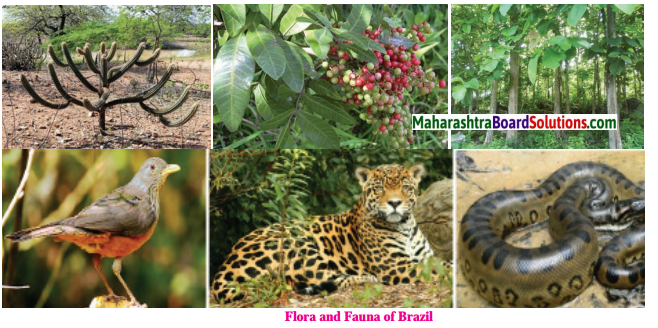
Maharashtra Board Class 10 Geography Solutions Chapter 5 Natural Vegetation and Wildlife 20
Question 1.
Can you tell the names of the plants/trees shown in the image?
Answer:
Coffee, cactus, rubber.

Question 2.
Where have you seen these plants before?
Answer:
Brazil.

Question 3.
Name the fauna shown in the image.
Answer:
Rufous bellied thrush, leopard, green anaconda.

Question 4.
Where have you seen them before?
Answer:
On the internet and in movies.

Maharashtra Board Class 10 Geography Solutions Chapter 5 Natural Vegetation and Wildlife

Question 5.
In which country do you find a greater diversity of vegetation? What is the reason behind it?
Answer:
Brazil has a greater diversity of vegetation because of the variation in climatic conditions.

Colours Of Both

Question 1.
In which country do equatorial forests occupy a greater area? What could be the reason behind it?
Answer:
Equatorial forests occupy a greater area in Brazil. This is because the Equator passes through northern part of Brazil. Hence, the climate is generally hot throughout the year. Moreover, this region receives heavy rainfall throughout the year.

Question 2.
Which type of forests found in India are not found in Brazil?
Answer:
Himalayan forests are found in India and not in Brazil.

Question 3.
Which type of forests found in Brazil are found in India too?
Answer:
Evergreen forests, deciduous forests, and thorny shrub type vegetation are found in both Brazil and India.

Question 4.
In which country a greater diversity of vegetation is found? What is the reason behind it?
Answer:
Brazil has a greater diversity of vegetation because of the equatorial climate, ample sunlight, heavy rainfall, and vast forest expanse.

Question 5.
Considering the climate and vegetation types, in which country will forest-based occupations flourish?
Answer:
Forest-based occupations will flourish more in Brazil.

Activity

Question 1.
Correlate geographical conditions and the flora and fauna there? (India)
Answer:
Depending upon favourable geographical conditions, we find a variety of flora and fauna in India.

(i) In the snow-capped regions of Himalayas where precipitation occurs in the form of snow, we find alpine vegetation. Animals like snow leopards and yaks are found who can sustain the extreme cold of the Himalayas.

(ii) The evergreen forest in the Western Ghats have hot and humid conditions with a temperature of 28°C and annual rainfall more than 2000mm. In such are as animals like lions, tigers, elephants, and a variety of birds are seen.

(iii) The coastal forest are home to many turtles, crocodiles, and gavials, etc. One-horned rhinoceroses are found in the swampy, marshy lands of Assam. Mangrove vegetation is found in the saline waters.

(iv) In areas where the climate is hot and dry and the rainfall is low, thorny scrub vegetation is found. Animals like wild ass and camels are common here.

(v) In the regions of medium rainfall. We find deciduous forest, wide variety of animals and birds.

Question 2.
Do you know some other animals too ?
Answer:
Four-horned antelope, black buck, Tibetan yak, giant squirrel (shekaru).

Use your Brain:

Question 1.
Find out in which parts of India agricultural practices like the ‘Roca’ is found? By what names are they called?
Answer:

Slash and Burn Farming in India
NameRegions
JhummingAssam, Meghalaya, Mizoram and Nagaland
PamlouManipur
DipaBastar (Chhattisgarh) and Andaman & Nicobar Islands
Bewar or DahiyaMadhya Pradesh
Podu or PendaAndhra Pradesh
Pama Dabi or Koman or BringaOdisha
KumaraWestern Ghats
Valre or WaltreSouth Eastern Rajasthan
KhiHimalayan belt
KuruwaJharkhand

Maharashtra Board Class 10 Geography Solutions Chapter 5 Natural Vegetation and Wildlife

Answer the following questions on the basis of map given:
Maharashtra Board Class 10 Geography Solutions Chapter 5 Natural Vegetation and Wildlife 21
Question 1.
How many mm of rainfall does Tropical forests have?
Answer:
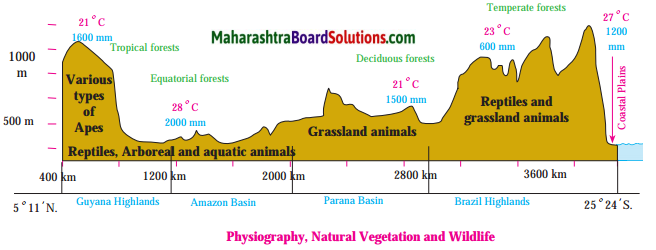
Tropical forests receives rainfall of 1600 mm.

Question 2.
How much rainfall does equatorial forests receive?
Answer:
Equatorial forests receive 2000 mm of rainfall.

Question 3.
Name the types of forests shown in figure.
Answer:
Tropical forests, Equatorial forests, Deciduous forests and Temperate forests are shown in the above figure.

Question 4.
Where are tropical and equatorial forests found in Brazil?
Answer:Tropical and equatorial forests are found in Guyana Highlands and Amazon basin respectively.

Question 5.
Where are deciduous forests and temperate forests found in Brazil?
Answer:
Deciduous forests and Temperate forests are found in Parana Basin and Brazilian Highlands respectively.

Question 6.
What kind of wildlife is seen in Brazilian Highlands?
Answer:
Reptiles and grassland animals are seen in Brazilian Highlands.

Maharashtra Board Class 10 Geography Solutions Chapter 5 Natural Vegetation and Wildlife 6

Question 1.
Which forests are found in western snow¬capped regions?
Answer:
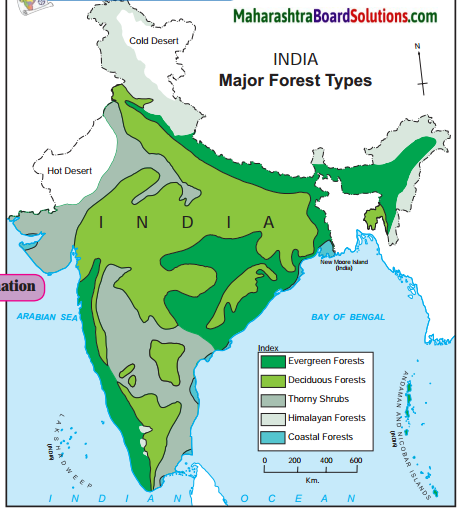
Himalayan Forests are found in western snow-capped regions.

Question 2.
On which coast do you mainly find the coastal vegetation?
Answer:
The coastal vegetation is mainly found along the Eastern Coast.

Question 3.
Which type of forests occupy maximum area in India ? Why?
Answer:
Deciduous forests are found in the regions receiving rainfall between 1000 mm to 2000 mm Since most of India has rainfall in that range, deciduous forests dominate the Indian subcontinent.

Question 4.
Where do you find thorny and shrub vegetation in India and why?
Answer:
Semi arid areas of Gujarat, Rajasthan, Madhya Pradesh, Chhattisgarh, Uttar Pradesh Maharashtra, Karnataka, Andhra Pradesh, Tamil Nadu and Haryana are the places where thorny and shrub vegetation are found. The thorny forests are found in these regions as the rainfall is less than 500 mm.

Maharashtra Board Class 10 Geography Solutions Chapter 5 Natural Vegetation and Wildlife 7

Maharashtra Board Class 10 Geography Solutions Chapter 5 Natural Vegetation and Wildlife

Question 1.
Name the species shown on the map.
Answer:
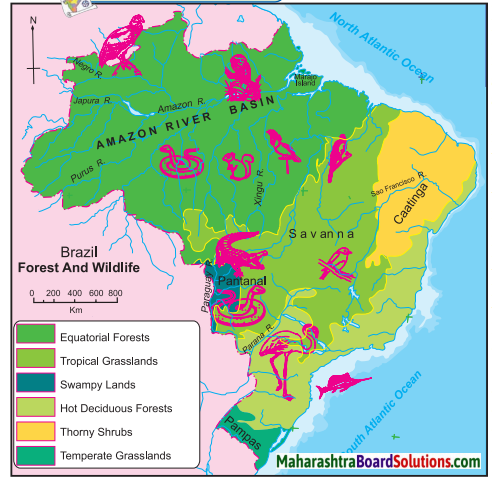
Some of the major species shown on the map are condor, golden lion tamarin, anaconda, crocodile, sword fish, flamingoes, macaw, parrots, rufous bellied thrush.

Question 2.
In which regions are these animals found? Why are their habitats found in these forests?
Answer:

  • The dense equatorial forest region is home to golden lion tamarin, condor, anaconda, etc. This is because these forest lie near the Amazon River and receive rainfall throughout the year.
  • Swampy lands of Pantanal is home to anacondas and crocodiles because these conditions are favourable for their habitation.
  • Sword fish thrives near the South Atlantic Coast due to the extensive continental shelf.

Question 3.
Classify the forest regions in Brazil with reference to their extent.
Answer:

  • Equatorial forests are found in the northern part of Brazil and it covers an extensive area.
  • Tropical Grasslands (Savanna) is the next major forest type occupying central part of Brazil.
  • Hot deciduous forests occupy the southern Brazil whereas swampy lands of Pantanal occupy a small part of Brazil in the south west.
  • Thorny shrubs occupy the north western part of Brazil owing to low rainfall whereas Temperate Grasslands (Pampas) occupy south Brazil.

Mark the following on the map of India with the given information:
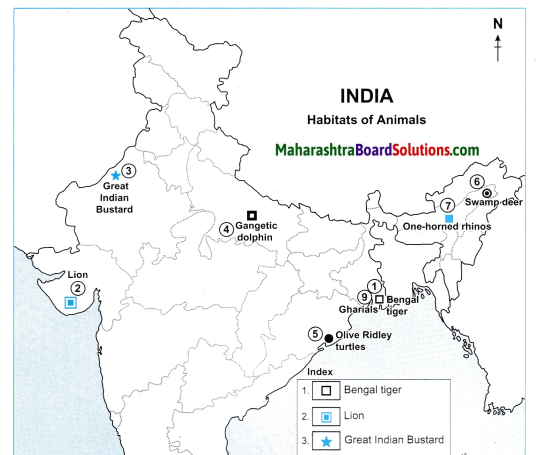
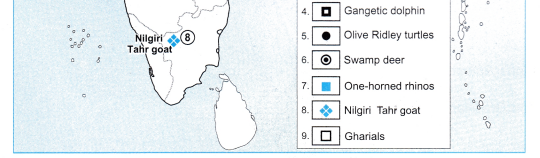
Question 1.

  1. Bengal Tiger
  2. Lion
  3. Great Indian Bustard
  4. Gangetic Dolphin
  5. Olive Ridley turtles
  6. Swamp deers
  7. One-horned rhinos
  8. Nilgiri Tahr goat
  9. Gharials

Answer:
Maharashtra Board Class 10 Geography Solutions Chapter 5 Natural Vegetation and Wildlife 4
Maharashtra Board Class 10 Geography Solutions Chapter 5 Natural Vegetation and Wildlife 5

Class 10 Geography Chapter 5 Natural Vegetation and Wildlife Additional Important Questions and Answers

Choose the correct option and rewrite the statements:

Question 1.
In Brazil, _____ varies due to physiography.
(a) soil
(b) rainfall
(c) agriculture
(d) mineral availability
Answer:
(b) rainfall

Question 2.
In most parts of the _____ region, it rains throughout the year.
(a) temperate
(b) tropical
(c) grasslands
(d) equatorial
Answer:
(d) equatorial

Question 3.
As one moves away from the Equator, _______ decreases.
(a) altitude
(b) forest
(c) rainfall
(d) snowfall
Answer:
(c) rainfall

Maharashtra Board Class 10 Geography Solutions Chapter 5 Natural Vegetation and Wildlife

Question 4.
The _______ forests are found where there is rainfall throughout the year.
(a) tropical
(b) thorny
(c) evergreen
(d) temperate
Answer:
(c) evergreen

Question 5.
Brazil has the/a ______ number of vegetation species in the world.
(a) moderate
(b) largest
(c) low
(d) smallest
Answer:
(b) largest

Question 6.
The rainforests are rightly called the _______.
(a) lungs of the world’
(b) ’limbs of the world’
(c) ’heart of the world’
(d) ’veins of the world’
Answer:
(a) lungs of the world’

Question 7.
Highest biodiversity is found in _____ forests.
(a) thorny
(b) deciduous
(c) evergreen
(d) coastal
Answer:
(c) evergreen

Question 8.
In regions receiving rainfall between 1000 mm to 2000 mm in India, ______ forests are found.
(a) thorny
(b) evergreen
(c) deciduous
(d) tropical
Answer:
(c) deciduous

Question 9.
In regions receiving less than 500 mm of rainfall that experience dry summers for a long time in India, ______ and shrub like vegetation are found.
(a) equatorial
(b) evergreen
(c) grasslands
(d) thorny
Answer:
(d) thorny

Question 10.
In _____ areas, coastal type of vegetation is found.
(a) peninsular
(b) mountainous
(c) rocky
(d) swampy
Answer:
(d) swampy

Question 11.
Coastal type of vegetation is called ____ in India.
(a) Bangar
(b) Sunderbans
(c) Pantanal
(d) Terai
Answer:
(b) Sunderbans

Maharashtra Board Class 10 Geography Solutions Chapter 5 Natural Vegetation and Wildlife

Question 12.
The wood found in Sunderbans is _____ light and durable.
(a) dry
(b) fragile
(c) oily
(d) soft
Answer:
(c) oily

Question 13.
In areas located in the ____ altitude of Himalayas, seasonly flowering trees are found.
(a) highest
(b) lowest
(c) plains
(d) medium
Answer:
(a) highest

Question 14.
In regions with medium altitude of Himalayas, ______ trees are found.
(a) rubber
(b) evergreen
(c) rose wood
(d) coniferous
Answer:
(d) coniferous

Question 15.
At foothills of the Himalayas _____ forests are found.
(a) mixed
(b) teak –
(c) coniferous
(d) pine
Answer:
(a) mixed

Question 16.
The proportion of ________ trees is higher at the foothills of the Himalayas.
(a) sal
(b) deodar
(c) rosewood
(d) pine
Answer:
(a) sal

Question 17.
Teak is mainly found in the _______ type of forest.
(a) Coastal
(b) Thorny and bush
(c) Coniferous
(d) Deciduous
Answer:
(d) Deciduous

Question 18.
A greater diversity of wildlife is found in ________ than any other country in the
world.
(a) India
(b) Russia
(c) Australia
(d) Brazil
Answer:
(d) Brazil

Question 19.
In the swampy areas of Pantanal, _______ are found.
(a) cobras
(b) vipers
(c) huge anacondas
(d) Indian pythons
Answer:
(c) huge anacondas

Question 20.
Among fish varieties, ______ is found in seas of Brazil
(a) mackerel
(b) king fish
(c) sword fish
(d) pink dolphins
Answer:
(c) sword fish

Question 21.
In Brazilian rivers, pink dolphins and ______ are found.
(a) gold fish
(b) piranhas
(c) king fish
(d) mackrels
Answer:
(b) piranhas

Maharashtra Board Class 10 Geography Solutions Chapter 5 Natural Vegetation and Wildlife

Question 22.
One of the major bird species found in Brazil includes _______.
(a) ostrich
(b) flamingoes
(c) kiwi
(d) duck
Answer:
(b) flamingoes

Question 23.
Slash and bum agriculture is also called ______ in Brazil.
(a) kumri
(b) roka (roca)
(c) dry farming
(d) bewar
Answer:
(b) roka (roca)

Question 24.
Hot and humid forests are a home for _______
(a) tiger
(b) elephants
(c) dogs
(d) leopard
Answer:
(b) elephants

Question 25.
One horned rhinoceroses are found in swampy and marshy lands of ______.
(a) Assam
(b) Madhya Pradesh
(c) Telangana
(d) Tamil Nadu
Answer:
(a) Assam

Question 26.
Indian bisons, deers, monkeys are found in the _____ region.
(a) Himalayan
(b) Western Ghats
(c) Peninsular
(d) Deccan
Answer:
(c) Peninsular

Question 27.
The only country where both lions and tigers are found is ______.
(a) Brazil
(b) India
(c) Australia
(d) America
Answer:
(b) India

Question 28.
______ which are huge in size fly high in the Brazilian sky.
(a) Macaws
(b) Kingfishers
(c) Condors
(d) Pheasants
Answer:
(c) Condors

Match the Column:

Question 1.

Column ’A’Column ‘B’
1. Evergreen Forests(a) Major portion of Madhya Pradesh
2. Deciduous forests(b) Arunachal Pradesh
3. Thorny shrubs(c) Sundarbans
4. Himalayan forests(d) Western Ghats
5. Coastal forests(e) Gujarat
(f) Cold desert in Jammu and Kashmir
(g) Hot desert in Rajasthan

Answer:
1 – d
2 – a
3 – e
4 – b
5 – c

Question 2.

Column ’A’Column ‘B’
1. Equatorial forests(a) Caatinga
2. Grasslands(b) Pantanal
3. Swampy Lands(c) Pampas
4. Hot deciduous forests(d) Amazon river basin
5. Thorny shrubs(e) Escarpment
(f) Savanna
(g) Parana basin

Answer:
1 – d
2 – c
3 – b
4 – e
5 – a

Maharashtra Board Class 10 Geography Solutions Chapter 5 Natural Vegetation and Wildlife

Identify the odd man out:

Question 1.
With reference to Fauna in India.
(a) Anaconda
(b) Elephants
(c) Lion
(d) Tiger
Answer:
(a) Anaconda

Question 2.
With reference to Flora of Brazil.
(a) Pau Brazil
(b) Rubber
(c) Mahogany
(d) Deodar
Answer:
(d) Deodar

Question 3.
With reference to Himalayan Forests.
(a) Seasonal flowering plants
(b) Orchids
(c) Pine
(d) Mixed Forests
Answer:
(b) Orchids

Question 4.
With reference to birds found in Brazil.
(a) Condors
(b) Flamingoes
(c) Macaws
(d) Peacocks
Answer:
(d) Peacocks

Question 5.
With reference to birds found in India.
(a) Peacock
(b) Kingfisher
(c) Duck
(d) Condors.
Answer:
(d) Condors.

Question 6.
With reference to protection of wildlife, Government of India has setup.
(a) Museums
(b) Biosphere reserves
(c) National Parks
(d) Wildlife sanctuaries
Answer:
(a) Museums

Answer the following questions in one sentence:

Question 1.
Where does it rain throughout the year?
Answer:
It rains throughout the year, in most parts of the equatorial region.

Question 2.
As one moves away from the Equator, does the rainfall increase?
Answer:
No, the rainfall decreases as one moves away from the Equator.

Question 3.
Where are evergreen forests found?
Answer:
Evergreen forests are found in the area where it rains throughout the year.

Question 4.
What effect does rainfall have on vegetation?
Answer:
As the rainfall decreases, the density of the vegetation also decreases.

Question 5.
What kind of vegetation is found in places of less rainfall?
Answer:
Various types of grass, short shrubs and thorny vegetation is found in places of less rainfall.

Maharashtra Board Class 10 Geography Solutions Chapter 5 Natural Vegetation and Wildlife

Question 6.
Where are the largest number of vegetation species found in the world?
Answer:
Brazil has the largest number of vegetation species in the world.

Question 7.
What kind of trees are found in Brazil?
Answer:
Trees like Pau Brasil, rubber, mahogany, rosewood and a variety of orchids are found in Brazil.

Question 8.
Why are the evergreen forests called the ‘lungs of the world’?
Answer:
Evergreen forests are called the lungs of the world because they release large amount of oxygen in the environment which helps to reduce the carbon dioxide levels.

Question 9.
Describe the leaves of trees found in evergreen forests.
Answer:
The leaves of trees found in evergreen forests are broad and green.

Question 10.
What quality of wood is found in evergreen forests?
Answer:
The wood found in evergreen forests is hard, heavy and durable.

Question 11.
In which regions are deciduous forests found?
Answer:
Deciduous forests are found in the regions receiving an average amount of rainfall ranging between 1000mm to 2000mm in India.

Question 12.
Which trees are found in deciduous forests?
Answer:
Trees like teak, bamboo, banyan, peepal, etc. are found in deciduous forest.

Question 13.
Which regions experience dry summers for a long time in India?
Answer:
Regions that receive less than 500 mm of rainfall experience dry summers for a long time in India.

Question 14.
Which kind of vegetation is found in regions receiving less than 500 mm of rainfall?
Answer:
Thorny or shrub like vegetation is found in regions receiving less than 500 mm of rainfall.

Question 15.
How are the leaves of trees in the region where there is less than 500 mm of rainfall?
Answer:
The leaves of trees are small in the region where there is less than 500 mm of rainfall.

Question 16.
Where is coastal vegetation found?
Answer:
Coastal vegetation is found in swampy areas, estuaries and lagoons near coastal areas.

Question 17.
What is coastal vegetation called in India?
Answer:
Coastal vegetation is called mangroves or Sunderbans in India.

Question 18.
How is the wood of trees found in coastal vegetation?
Answer:
The wood of trees found in coastal vegetation is oily, light and durable.

Maharashtra Board Class 10 Geography Solutions Chapter 5 Natural Vegetation and Wildlife

Question 19.
How many types of forests are there in the Himalayas?
Answer:
There are three types of forests in the Himalayas based on their altitude.

Question 20.
Which kind of trees are found in regions of high altitude in the Himalayas?
Answer:
Seasonally flowering trees are found in regions of high altitude.

Question 21.
Which type of trees are found in regions with medium altitude in the Himalayas?
Answer:
In regions with medium altitude, coniferous trees like pine, deodar and fir are found.

Question 22.
Where are mixed forests found in India?
Answer:
Mixed forest are found at the foothills of the Himalayas.

Question 23.
Where is greater diversity in wildlife found in the world?
Answer:
A greater diversity in wildlife is found in Brazil than any other country in the world.

Question 24.
Which animal is found in the swampy areas of the Pantanal?
Answer:
Huge anacondas are found in the swampy areas of Pantanal.

Question 25.
Which are the other animals found in Brazil?
Answer:
Animals like guinea pigs, crocodiles, alligators, monkeys, pumas, leopards, etc. are found in Brazil.

Question 26.
Which is the main variety of fish found in the Brazilian sea?
Answer:
Sword fish is mainly found in the Brazilian sea.

Question 27.
Which varieties of fish are found in the rivers of Brazil?
Answer:
Piranhas are found in the rivers of Brazil.

Question 28.
What kind of birds are seen in the Brazilian sky?
Answer:
Condors, parrots, macaws, and flamingoes are found in the Brazilian skies.

Question 29.
Why is degradation of environment happening in Brazil?
Answer:
Degradation of environment is happening in Brazil due to illegal smuggling of wild animals, slash and bum agriculture (roka), deforestation, and pollution.

Question 30.
Where are elephants found in India?
Answer:
Elephants are found in hot and humid forests of India.

Question 31.
Where are one homed rhinoceroses found?
Answer:
One homed rhinoceroses are found in the swampy and marshy lands of Assam.

Question 32.
Which animals are found in the arid lands of India?
Answer:
Wild ass and camels are found in the arid lands of India.

Question 33.
Which animal is found in the snow capped regions of Himalayas?
Answer:
Snow leopards are found in the snow capped regions of the Himalayas.

Question 34.
Which animals are found in the peninsular region of India?
Answer:
Indian Bisons, deer, antelopes, and monkeys are found in the Peninsular region of India.

Question 35.
Which is the only country where both lions and tigers are found?
Answer:
India is the only country where both lions and tigers are found.

Question 36.
Where are turtles, crocodiles and gharials found in India?
Answer:
Turtles, crocodiles and gharials are found in rivers, estuaries, and coastal areas of India.

Maharashtra Board Class 10 Geography Solutions Chapter 5 Natural Vegetation and Wildlife

Question 37.
Which birds are found in the forests and wetlands of India?
Answer:
Birds like peacocks, Indian bustard, kingfishers, peasants, ducks, parakeet, cranes, and pigeons are found in the forests and wetlands of India.

Question 38.
What measures are taken by the Government of India for the protection of wildlife and forests of India?
Answer:
The Government of India has set up a number of national parks, wildlife sanctuaries, bird sanctuaries, and biosphere reserves for the protection of wildlife and forests in India.

Question 39.
Name some plants found in regions having less than 500 mm of rainfall in India.
Answer:
Catechu, acacia, khejri and a variety of cactus like aloevera and agave are found in regions having less than 500 mm of rainfall in India.

Name the following:

Question 1.
The region where it rains throughout the year.
Answer:
Equatorial region.

Question 2.
The forests which are found where it rains throughout the year.
Answer:
Evergreen forests.

Question 3.
Kind of vegetation found in places of less rainfall.
Answer:
Grass, short shrubs, thorny vegetation.

Question 4.
Country where the largest number of vegetation species in the world is located.
Answer:
Brazil.

Question 5.
The types of trees found in Brazil.
Answer:
Pau Brasil, rubber, mahogany, rosewood and variety of orchids.

Question 6.
Other name for rain forests.
Answer:
‘The lungs of the world.’

Question 7.
Trees found in deciduous forests.
Answer:
Teak, bamboo, banyan, peepal.

Question 8.
Type of vegetation found in regions having less than 500 mm of rainfall.
Answer:
Thorny and shrub-like.

Question 9.
Plants found in regions having less than 500 mm of rainfall.
Answer:
Catechu, acacia, khejri and varieties of cactus.

Question 10.
Kind of vegetation found in swampy areas.
Answer:
Coastal type.

Question 11.
Another name of coastal type of vegetation in India.
Answer:
Mangroves or sunderbans.

Maharashtra Board Class 10 Geography Solutions Chapter 5 Natural Vegetation and Wildlife

Question 12.
Kind of trees found in forests located on higher altitudes in the Himalayas.
Answer:
Seasonally flowering trees.

Question 13.
Kind of trees which have grown in forests located on medium altitudes in Himalayas. Coniferous trees like Pine, Deodar and Fir.
Answer:
Region where mixed forests are found in Himalayas.

Question 14.
Foothills of Himalayas.
Answer:
Animal found in the swampy areas of Pantanal.

Question 15.
Huge anacondas.
Answer:
Any two varieties of animals found in Brazil. Guinea pigs and crocodiles.

Question 16.
Kind of fishes found in seas of Brazil.
Answer:
Sword fish.

Question 17.
Fish varieties found in the rivers of Brazil.
Answer:
Pink dolphins and Piranhas.

Question 18.
Any two species of birds found in Brazil.
Answer:
Condors and macaws.

Question 19.
Causes for degradation of environment.
Answer:
Illegal smuggling of wild animals, roka, deforestation and pollution

Question 20.
Region where elephants are found in India.
Answer:
Hot and humid forests.

Question 21.
Animal which is found in the swampy and marshy lands of Assam.
Answer:
One horned rhinoceroses.

Question 22.
Animals which are found in arid lands of India.
Answer:
Wild ass and camels.

Question 23.
Animals which are found in the snowcapped mountain of Himalayas.
Answer:
Yaks and snow leopards.

Question 24.
Animals found in the Peninsular region of India.
Answer:
Indian bisons, deer, antelopes and monkeys.

Question 25.
Country where both lion and tigers are found.
Answer:
India.

Question 26.
Animals found in rivers, estuaries and coastal areas of India.
Answer:
Turtles, crocodiles and garials.

Question 27.
Measures taken by the Government of India to protect wildlife.
Answer:
Setting up of National parks, bird sanctuaries, wildlife sanctuaries and biosphere reserves.

Question 28.
National animal of India.
Answer:
Tiger.

Maharashtra Board Class 10 Geography Solutions Chapter 5 Natural Vegetation and Wildlife

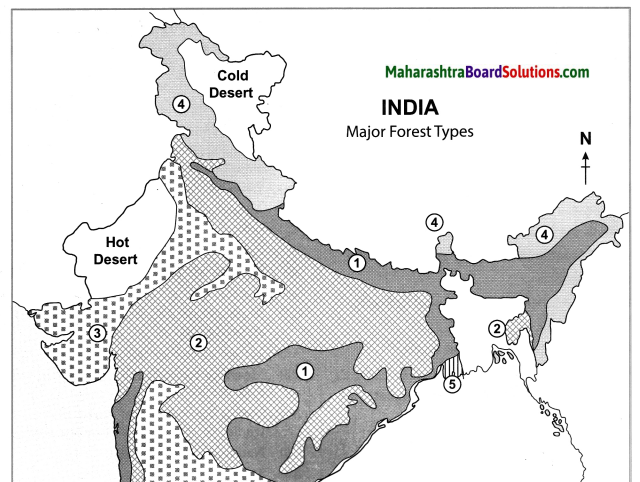
Mark the following on the map of India with the given information:

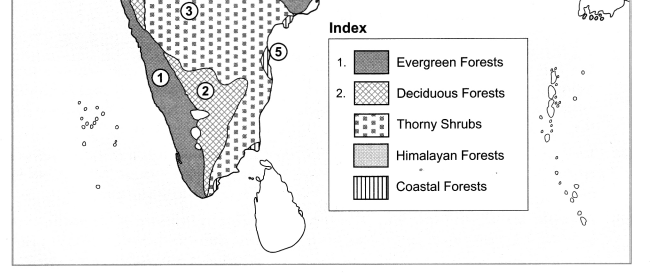
  1. Evergreen forests
  2. Deciduous forest
  3. Thorny shrubs
  4. Himalayan Forests
  5. Coastal Forests

Answer:
Maharashtra Board Class 10 Geography Solutions Chapter 5 Natural Vegetation and Wildlife 13
Maharashtra Board Class 10 Geography Solutions Chapter 5 Natural Vegetation and Wildlife 9

Mark the following on the map of Brazil with the given information:

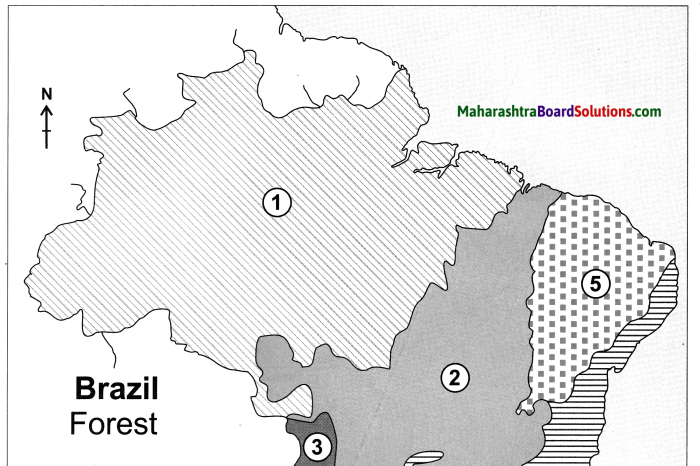
  1. Equatorial forests
  2. Tropical grasslands
  3. Swampy lands
  4. Hot deciduous forest
  5. Caatinga
  6. Temperate grasslands

Answer:

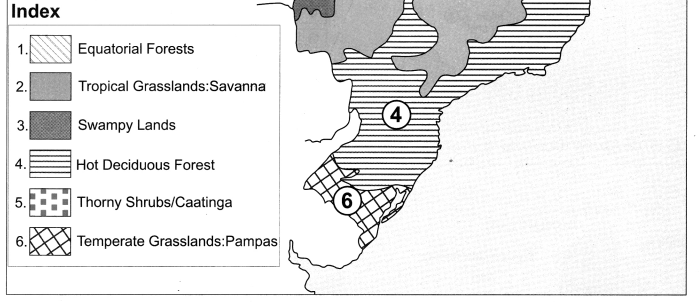
Maharashtra Board Class 10 Geography Solutions Chapter 5 Natural Vegetation and Wildlife 12
Maharashtra Board Class 10 Geography Solutions Chapter 5 Natural Vegetation and Wildlife 11
Equatorial Forests Tropical Grasslands:Savanna Swampy Lands Hot Deciduous Forest Thorny Shrubs/Caatinga Temperate Grasslands:Pampas

Maharashtra Board Class 10 Geography Solutions Chapter 5 Natural Vegetation and Wildlife

Question 1.
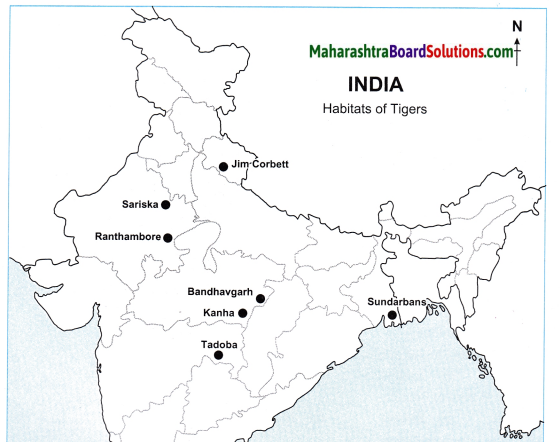
Show the habitats of tigers in India with their names on a map.
Answer:
Maharashtra Board Class 10 Geography Solutions Chapter 5 Natural Vegetation and Wildlife 14
Maharashtra Board Class 10 Geography Solutions Chapter 5 Natural Vegetation and Wildlife 15

Question 2.
Why is their habitat found in these regions?
Answer:
Tiger’s habitats are found in these regions because here there are various types of forest areas with different types of herbivorous animals.

Answer the Questions Briefly:

Question 1.
Thorny and shrub-like vegetation is found in regions where there is less or no rainfall.
Answer:

  • The regions where there is less or no rainfall have a hot and dry climate.
  • The soils in these regions are also rocky and dry.
  • Water evaporation in leaves is more since the surface area of exposure is more than that of thorns
  • Hence, thorny and shrub-like vegetation is found in regions where there is less or no rainfall to conserve water.

Question 2.
The evergreen rainforests in Brazil are rightly called the ‘Lungs of the world’.
Answer:

  • The northern Part of Brazil has dense evergreen forests. .
  • These forests release a large amount of oxygen in the environment.
  • This helps to reduce carbon dioxide levels.
  • Therefore, these rainforests are rightly called the Tungs of the world’.

Question 3.
The largest variety of flora is found in Brazil.
Answer:

  • The flora of any region depends upon the amount of rainfall and its physiography.
  • Brazil has equatorial forests in high rainfall areas, tropical grasslands and deciduous forests in moderate rainfall areas.
  • Western part of Brazil has swampy lands, whereas low rainfall regions have thorny shrubs.
  • Temperate grasslands are found in temperate regions.
  • Thus, the largest variety of flora is found in Brazil.

Question 4.
Suggest measures for the conservation of wildlife and forest in India?
Answer:
Measures for the conservation of wildlife and forest in India are as follows:

  • Restricting wildlife trading and hunting.
  • Declaring more national parks and sanctuaries.
  • Giving more importance to the protection of endangered animals.
  • Controlling felling of trees.
  • Implementing afforestation and social forestry programmes.

Maharashtra Board Class 10 Geography Solutions Chapter 5 Natural Vegetation and Wildlife

Write short notes on:

Question 1.
Brazilian Vegetation:
Answer:
(i) In Brazil, rainfall varies due to physiography. In most parts of the Equatorial region, it rains throughout the year.
(ii) As one moves away from the equator, the number of rainy days as well as amount of rainfall reduces.
(iii) This affects the life cycle of the vegetation too.
(iv) Evergreen forests are found in the areas where it rains throughout the year.
(v) In regions which receive rainfall only during certain seasons, the density of the vegetation reduces.
(vi) Instead of forests, various types of grass, short shrubs,,thorny vegetation, etc. are found.
(vii) Brazil has the largest number of vegetation species in the world.
(viii) This includes evergreen vegetation, semi-evergreen, arid, etc.
(ix) One finds trees like Pau Brasil, rubber, mahogany, rosewood and a variety of orchids.

Question 2.
wildlife of Brazil:
Answer:
(i) A greater diversity in wildlife is found in Brazil compared to any other country in the world.
(ii) In the swampy areas of the Pantanal, huge anacondas are found.
Animals, such as guinea pigs, crocodiles,
alligators, monkeys, pumas, leopards, etc. are found.
(iv) Among the fish varieties, mainly swordfish are found in the seas, while pink dolphins and piranhas are found in the rivers .
(v) Condors which are huge in size and fly high in the sky, various types of parrots, macaws, and flamingoes are the major birds found here.
(vi) Millions of insect varieties are also found here.

Question 3.
The wildlife of India:
Answer:
(i) India is also a mega-diverse country in terms of wildlife. There are many species of wildlife in Irdia.
(ii) Elephants are found in hot and humid forests. One-horned rhinoceroses are found in swampy and marshy lands of Assam.
(iii) Wild ass and camels are found in arid lands. Snow leopards and yaks are found in the snow-capped regions of the Himalayas.
(iv) Indian Bisons, deer, antelopes, and monkeys are found in the Peninsular region.
(v) India is the only country in the world where both tigers and lions are found.
(vi) Rivers, estuaries and coastal areas are homes to many turtles, crocodiles, and gavials (gharials).
(vii) The forests and wetlands are the shelters of variety of birds like peacocks, Indian bustard, kingfishers, pheasants, ducks, parakeets, cranes, and pigeons.

Maharashtra Board Class 8 History Solutions Chapter 11 Struggle for Equality

Balbharti Maharashtra State Board Class 8 History Solutions Chapter 11 Struggle for Equality Notes, Textbook Exercise Important Questions and Answers.

Maharashtra State Board Class 8 History Solutions Chapter 11 Struggle for Equality

Class 8 History Chapter 11 Struggle for Equality Textbook Questions and Answers

1. Rewrite the statements by- choosing the appropriate options:
(Lala Lajpat Rai, Sane Guruji, Dr. Rakhmabai Janardan Save, Deenbandhu Mitra, Babasaheb Bole)

Question 1.
…………….. founded the Red Cross Society at Rajkot.
Answer:
Dr. Rakhmabai Janardan Save

Question 2.
…………….. was the president of mill workers union at Ammalner.
Answer:
Sane Guruji

Question 3.
The president of the first session of AITUC was ……………..
Answer:
Lala Lajpat Rai

2. Write short notes:

Question 1.
Social Work of Maharshi Vitthal Ramji Shinde :
Answer:

  1. The goal of Maharshi Vitthal Ramji Shinde was to make the Dalits self respectful, well educated and engaged in work.
  2. He worked to destroy the delusive ideas regarding Dalits in the minds of the upper caste.
  3. He founded the ‘Depressed Classes Mission’ for the progress of Dalits in 1906.
  4. To achieve this, he started Marathi schools and work schools in parts of Parel, Deonar in Mumbai.
  5. He actively took part in various movement which were related to the welfare of the Dalits like Satyagraha for entry in Parvati temple at Pune, Shetkari Parishad of Dalits and Federal Electorates.

Maharashtra Board Class 8 History Solutions Chapter 11 Struggle for Equality

Question 2.
Reforms of Rajarshi Shahu Maharaj in the state of Kolhapur :
Answer:

  1. Rajarshi Shahu Maharaj worked for abolishing of caste discrimination.
  2. He made revolutionary declaration for reservation in the state of Kolhapur.
  3. He made law for free and compulsory primary education.
  4. He worked to remove restrictions on inter dining, intermarriage and change of occupation in the caste system.
  5. He passed the Act of inter-caste marriage and made it legal in state.
  6. He abolished ‘Balutedari System’, by publishing a declaration in the Government Gazette of the state of Kolhapur on 22 February, 1918.
  7. This allowed people to practice any occupation and freed them from type of social slavery.

3. Explain the following statements with reasons:

Question 1.
The Government decided to crush down the Communist movement.
Answer:

  1. The Communist Party was formed in India in 1925.
  2. The young communist leaders started building militant organisations of workers and peasants.
  3. The British government started feeling the danger of Communist movement and hence decide to crush it.

Question 2.
Dr. Babasaheb Ambedkar started newspapers like ‘Muknayak’, ‘Bahishkrut Bharat’, etc.
Answer:

  1. Dr. Babasaheb Ambedkar wanted to establish a society based on principles of Liberty, Equality and Fraternity.
  2. He intended to carry out movement to establish self-respect and social equality for Dalits.
  3. It was necessary to create awakening in society in this respect and to voice their grief.
  4. The newspaper was an integral part of Dr. Babasaheb Ambedkar’s movement.
  5. Hence, he started many newspapers so that his ideas and thoughts reach the society.

Maharashtra Board Class 8 History Solutions Chapter 11 Struggle for Equality

Question 3.
There aroused a need of a nationwide workers union.
Answer:

  1. In the later half of the 19th century, textile mills, railway companies and such other industries were started in India.
  2. The workers group were not aroused on large scale.
  3. As there were no unions, the workers were not organised.
  4. After the First World War, there was rise of worker class in India due to industrialisation.

Therefore, a necessity was felt for a nationwide worker union.

4. Answer the following questions in brief:

Question 1.
Why was the struggle for equality important in the making of Modern India?
Answer:

  1. India achieved freedom because of freedom struggle.
  2. The scope of this struggle was not limited to achieve political freedom but emancipation of man from all types of bondages.
  3. Therefore in the course of this struggle, there was opposition to feudalism, social inequality and economic exploitation.
  4. The principle of equality was given equal importance.
  5. Various groups such as farmers, workers, women and Dalits came forward and started movements in order to get justice and bring about reforms.

This proves that the struggle for equality has great significance in the making of Modern India.

Question 2.
Write about the work of Sane Guruji in eastern Khandesh.
Answer:

  1. In 1938, due to heavy rains crops were destroyed in eastern Khandesh.
  2. He organised the farmers who were in miserable state.
  3. Sane Guruji organised meetings and processions at many places in eastern Khandesh to have land revenue waived for the farmers.
  4. He took out marches on the Collector office.
  5. He tried to create a strong centre of workers union at Dhule-Ammalner.

Maharashtra Board Class 8 History Solutions Chapter 11 Struggle for Equality

Question 3.
How was the struggle built up by the workers decisive for the national movement?
Answer:

  1. The beginning of the 19th century witnessed the emergence of working-class due to industrialisation. They made efforts to solve their problems.
  2. During the anti-partition movement, workers carried out strikes from time to time to pressurise the British government.
  3. The tea plantation workers in Assam launched an agitation against their wretched condition.
  4. During the anti-partition movement, workers carried out strikes from time to time in support of Swadeshi.
  5. In 1928, the Mill Workers Union went on strike for six months. Many such strikes were organised by the Railway workers, jute mill workers, etc.

Question 4.
Discuss the nature of reform movement related to women.
Answer:

  1. Women had a secondary position in the Indian social system.
  2. They were subjected to many injustices because of evil practices.
  3. In the 20th century, many reforms were initiated for the betterment of women.
  4. The reform movement was led by women and institutions formed by them.
  5. They fought for issues such as the right to inheritance, right to vote through the medium of these institutions.
  6. The involvement of women went on increasing. They played an active role in the national movement and in the revolutionary movement.
  7. Due to the reform movement, women were included in the Provincial Ministries.

Do you Know?

Narayan Meghaji Lokhande:

Maharashtra Board Class 8 History Solutions Chapter 11 Struggle for Equality 1

The native place of Narayan Meghaji Lokhande was Kanhesar near Saswad in Pune district.

  1. He formed the mill workers un ion known as ‘Bombay Mill Hands Association’ in 1890.
  2. This workers union is believed to be the beginning of organised movement in India.
  3. He was also the chairman of Mumbai branch of Satyashodhak Samaj founded by Mahatma Phule.
  4. Due to his efforts, from 10 June 1890, the workers started getting weekly holiday on Sunday.

Maharashtra Board Class 8 History Solutions Chapter 11 Struggle for Equality

Dr. Anandibai Joshi:

Maharashtra Board Class 8 History Solutions Chapter 11 Struggle for Equality 2

  1. She was the first Indian Female Doctor.
  2. The death of her 10 days old son inspired her to study medicine and acquired M. D. degree in 1886.
  3. She died of tuberculosis on February 1887 at Pune.

Project:

Question 1.
Read the biography of Dr. Anandibai Joshi.

Question 2.
Read the biography of Rajarshi Shahu Maharaj.

Class 8 History Chapter 11 Struggle for Equality Additional Important Questions and Answers

Rewrite the statements by- choosing the appropriate options :

Question 1.
……………. got a bill passed in the Bombay Provincial Assembly for the public water reservoirs to be opened to the untouchable.
Answer:
Babasaheb Bole

Question 2.
Neel Darpan written by …………….. brought to notice of the society wretched conditions of the peasants.
Answer:
Deenbandhu Mitra.

Name the following:

Question 1.
Through the magazine ‘Somavanshiya Mitra’ raised voice regarding issues of Muralis and Jogtins.
Answer:
Shivram Janbci Kamble

Question 2.
Chairman of Mumbai branch of Satyashodhak Samaj.
Answer:
Narayan Meghaji Lokhande

Question 3.
Movement of eradication of untouchability in Tamil Nadu
Answer:
Perriyar Ramaswamy

Question 4.
Active in international Communist Movement.
Answer:
Manavendranath Roy

Maharashtra Board Class 8 History Solutions Chapter 11 Struggle for Equality

Question 5.
Baba Ramachandra.
Answer:
Baba Ramchandra.

Rewrite the statements by choosing the appropriate options:

Question 1.
…………….. was the president of ‘Akhil Bharatiya Kisan Sabha’
(a) Sane Guruji
(b) Swami Sahajananda Saraswati
(c) Maharshi Vitthal Ramji Shinde
(d) Manavendranath Roy
Answer:
(b) Swami Sahajananda Saraswati

Question 2.
The session of the Congress was held in the rural part of …………… in Maharashtra.
(a) Nagpur
(b) Baramati
(c) Faizpur
(d) Miraj
Answer:
(c) Faizpur

Question 3.
……………… went on fast unto death to open the doors of Vitthal temple at Pandharpur for the Dalits,
(a) Sane Guruji
(b) Dr. Babasaheb Ambedkar
(c) Karmaveer Dadasaheb Gaikwad
(d) Babasaheb Bole
Answer:
(a) Sane Guruji

Maharashtra Board Class 8 History Solutions Chapter 11 Struggle for Equality

Question 4.
Due to efforts of …………….., the workers started getting weekly holiday on Sunday from 10 June, 1890.
(a) Shripad Amrut Dange
(b) Shashipad Banerjee
(c) Lala Lajpat Rai
(d) Narayan Meghaji Lokhande
Answer:
(d) Narayan Meghaji Lokhande

Question 5.
In 1881, …………….. wrote an article on Marx.
(a) Dr. Rammanohar Lohia
(b) Lokmanya Tilak
(c) Mahatma Gandhi
(d) Shripad Amrut Dange
Answer:
(b) Lokmanya Tilak

Question 6.
Condemned untouchability through his book ‘Vital Vidhwansan’
(a) Gopal Baba Walangkar
(b) Shivram Janba Kamble
(c) Thakkar Bappa
(d) Appasaheb Patwardhan
Answer:
(a) Gopal Baba Walangkar

Question 7.
Karmaveer Dadasaheb Gaikwad led Satyagraha for entry of Dalits in
(a) Kalaram temple
(b) Vitthal temple
(c) Parvati temple
(d) Bhavani temple
Answer:
(a) Kalaram temple

Maharashtra Board Class 8 History Solutions Chapter 11 Struggle for Equality

Question 8.
…………….. passed the Act of inter-caste marriage and gave it a legal acceptance in the state of Kolhapur.
(a) Mahatma Jyotirao Phule
(b) Rajarshi Shahu Maharaj
(c) Rajaram Maharaj
(d) Maharshi Vitthal Ramji Shinde
Answer:
(b) Rajarshi Shahu Maharaj

Answer the following questions in one sentence:

Question 1.
State the significance of ‘Neel Darpan’
Answer:
Deenbandhu Mitra in his play ‘Neel Darpan’ brought to the notice of the society the wretched conditions of the peasants who were forced to cultivate indigo.

Question 2.
What was the important work done by ‘Akhil Bharatiya Kisan Sabha’?
Answer:
The Akhil Bharatiya Kisan Sabha’ presented a declaration of peasants’ rights to the Indian National Congress.

Question 3.
What message did Lala Lajpat Rai give to the workers in the first session of AITUC?
Answer:
At the first session of AITUC Lala Lajpat Rai asked the workers to actively participate in the national movement.

Question 4.
Why did Dr. Ambedkar and his followers embrace Buddhism?
Answer:
Dr. Ambedkar and his followers embraced Buddhism as it advocated humanity and equality. ‘

Question 5.
Which institutions were founded by Pandita Ramabai?
Answer:
Pandita Ramabai had founded the ‘Arya Mahila Samaj’ and ‘Sharda Sadan’.

Maharashtra Board Class 8 History Solutions Chapter 11 Struggle for Equality

Question 6.
What message did Dr. Babasaheb Ambedkar give his followers?
Answer:
Dr. Babasaheb Ambedkar gave the inspirational message,’Be Educated, Be Organised and Be Agitated’ to his followers.

Do as Directed:

Complete the Concept Map:

Question 1.
Maharashtra Board Class 8 History Solutions Chapter 11 Struggle for Equality 3
Answer:
Maharashtra Board Class 8 History Solutions Chapter 11 Struggle for Equality 4

Question 2.
Maharashtra Board Class 8 History Solutions Chapter 11 Struggle for Equality 5
Answer:
Maharashtra Board Class 8 History Solutions Chapter 11 Struggle for Equality 6

Question 3.
Maharashtra Board Class 8 History Solutions Chapter 11 Struggle for Equality 7
Answer:
Maharashtra Board Class 8 History Solutions Chapter 11 Struggle for Equality 8

Complete the following table:

Question 1.

FounderOrganisation/ Institution
1. Maharshi Vitthal Ramji Shinde…………………………………………
2. ……………………………….Akhil Bharatiya Kisan Sabha
3. Ramabai Ranade…………………………………………
4. ………………………………..Independent Labour Party

Answer:

FounderOrganisation/ Institution
1. Maharshi Vitthal Ramji ShindeDepressed Classes Mission
2. Prof. N.G. RangaAkhil Bharatiya Kisan Sabha
3. Ramabai RanadeSeva Sadan institution
4. Dr. Babasaheb AmbedkarIndependent Labour Party

Write short notes:

Question 1.
The Meerut Conspiracy Case:
Answer:

  1. The young communist leaders built militant organisations of workers and peasants.
  2. The growing influence of Communism on Indian youth became a matter of concern for the British and they felt it was a danger.
  3. The communist leaders Shripad Amrut Dange, Muzaffar Ahmed, Keshav Neelkanth Joglekar, etc. were arrested.
  4. They were falsely charged with planning of a conspiracy to overthrow the British rule.
  5. The trial took place at Meerut. So it was called as ‘Meerut Conspiracy Case’.
  6. They were given different punishments.

Maharashtra Board Class 8 History Solutions Chapter 11 Struggle for Equality

Question 2.
Work of Rakhmabai Janardan Save:
Answer:

  1. Dr. Rakhmabai Janardhan Save was the first practicing woman doctor in India.
  2. She delivered lectures on health related issues of women.
  3. She opened a branch of Red Cross Society at Rajkot.

Explain the following statements with reasons:

Question 1.
Narayan Meghaji Lokhande is described as ‘Father of Indian Workers Movement’.
Answer:

  1. Industrialisation of India had started during the second half of the 19th century.
  2. Shashipad Banerjee and Narayan Meghaji Lokhande organised workers at local level and made efforts to solve their problems.
  3. Narayan Meghaji Lokhande formed the mill workers union known as ‘Bombay Mill Hands Association’ in 1890.
  4. Due to his efforts, the workers started getting weekly holiday on Sunday from 10 June, 1890.
  5. This was the beginning of organised movement in India.

Thus, his contribution to the working-class movement was so valuable that he is described as ‘Father of Indian Workers Movement’.

Question 2.
The Congress Socialist Party was formed in 1934.
Answer:

  1. Many young activists of the Indian National Congress believed that the society should be built on the principles of economic and social equality.
  2. Due to this, there was spread of socialist ideas and thoughts.
  3. They believed that to protect interests of the people it was necessary to overthrow the British rule.
  4. So, they decided to set up a Socialist Party within the Congress fold while they were in Nashik jail. Accordingly, the Congress Socialist Party was formed in 1934.

Answer the following questions in brief:

Question 1.
Write about the work of Rajarshi Shahu Maharaj for abolition of caste distinction.
Answer:
The following work was done by Rajarshi Shahu Maharaj in his state of Kolhapur for abolition of caste distinction:

  1. He made revolutionary declaration for reservation in state of Kolhapur.
  2. There were three restrictions in the caste system: inter dining, inter marriage and change of occupation.
  3. Shahu Maharaj ate food from the hands of Dalit people and overthrew the restriction on inter dining.
  4. He passed the Act of inter caste marriage and gave it a legal acceptance in his state.
  5. He abolished ‘Balutedari System’ on 22 February, 1918 and granted permission to practice any occupation by anyone.

Maharashtra Board Class 8 History Solutions Chapter 11 Struggle for Equality

Question 2.
Explain the objectives of Dr. Babasaheb Ambedkar in launching the Dalit movement.
Answer:
The objectives of Dr. Babasaheb Ambedkar in launching the Dalit movement 5 is as follows:

  1. Dr. Babasaheb Ambedkar aimed at building a society on the principles of Liberty, Equality and Fraternity.
  2. He was of the view that unless the caste system is completely uprooted, the x injustice to the Dalits and inequality would x not end.
  3. According to him, social equality is the right of Dalits.
  4. He intended to carry out the movement based on self-respect.

Question 3.
Write about the work done by Mahatma Gandhi for eradication of untouchability.
Answer:

  1. Mahatma Gandhi took up the issue of eradication of untouchability in his hands and put it up on the platform of Indian National Congress.
  2. When in Yerwada jail, he debated with rigid Hindu Pandits stating that the religious texts of the Hindus do not support untouchability.
  3. He gave inspiration to Harijan Sevak Sangh.
  4. Many took inspiration from him and dedicated themselves to the work for 8 eradication of untouchability.

Answer the following in detail:

Question 1.
Give a brief account of the peasant’s movement during the pre-independence movement.
Answer:

  1. The economic policies of the British protected the landlords and the moneylenders and adversely affected the farmers. The peasants revolted against the injustice in different parts of India.
  2. The peasants in Bengal formed union and revolted against the compulsion to cultivate indigo.
  3. The peasants in Maharashtra revolted in 1875 against the atrocities of the landlords and moneylenders.
  4. In 1918, ‘Kisan Sabha’ was formed by the farmers in Uttar Pradesh.
  5. The Mopla peasants in Kerala rose in great revolt.
  6. With the initiative of Prof N.G. Ranga Akhil Bharatiya Kisan Sabha’ was established.
  7. It presented a declaration of peasants rights to the Indian National Congress.
  8. Thousands of peasants attended the session of Indian National Congress which was held in rural part of Faizpur.
  9. In 1938, due to heavy rains crops were destroyed in eastern Khandesh. Sane Guruji organised the farmers who were in a miserable state and took out procession.
  10. The peasants participated in large numbers in the revolutionary period of 1942.

Maharashtra Board Class 8 History Solutions Chapter 11 Struggle for Equality

Question 2.
Write information about the workers’ movement in the pre-independence movement.
Answer:

  1. The beginning of the 19th century witnessed the emergence of the working-class due to industrialisation. They made efforts to solve their problems.
  2. Shashipad Banerjee and Narayan Meghaji Lokhande organised workers at local level and made efforts to solve their problems.
  3. Narayan Meghaji Lokhande described as ‘Father of Indian Workers Movement’ formed ‘Bombay Mill Hands Association’ in 1890. This was the beginning of organised movement in India.
  4. The workers on the tea plantations in Assam launched an agitation against their wretched conditions.
  5. In 1899, the workers of the Great Indian Peninsular Railway (GIP) called for a strike for their demands.
  6. During the anti-partition movement, workers carried out strikes from time to time in support of Swadeshi.
  7. In 1920, ‘All India Trade Union Congress’ (AITUC) was established.
  8. In 1928, the Mumbai Mill workers went on strike for six months.
  9. Many such strikes were carried out: by the railway workers, jute mill workers, etc.

Question 3.
Write about the development in the Dalit movement.
Answer:

  1. The Dalit movement was launched to remove the injustice done to Dalits due to Indian social structure.
  2. Mahatma Phule and Narayan Guru brought about awakening among the people regarding social inequality.
  3. Gopal Baba Walangkar condemned untouchability through his book ‘Vital Vidhwansan’.
  4. Periyar Ramaswamy started a movement for the eradication of untouchability in Tamil Nadu.
  5. Maharshi Vitthal Ramji Shinde founded the ‘Depressed Classes Mission’ for the progress of the Dalits.
  6. Rajarshi Shahu Maharaj worked to remove restrictions on inter dining, intermarriage and change of occupation.
  7. Mahatma Gandhi presented the issue of untouchability before the Indian National Congress.
  8. Dr. Babasaheb Ambedkar dedicated his entire life for the Dalit movement and gave it broader perspective.

Question 4.
What work was done for development of workers and Dalits by Dr. Babasaheb Ambedkar?
Answer:
The following work was done by Dr. Babasaheb Ambedkar for the development of workers and Dalits:

  1. He founded the ‘Bahishkrut Hitkarni Sabha’ to establish social equality.
  2. He led the Chavdar Lake Satyagraha in Mahad to make the water reservoir accessible to Dalits.
  3. He burnt ‘Manusmriti’ that advocated social inequality.
  4. In 1930, he started Satyagraha for the entry of Dalits in the Kalaram temple at Nashik.
  5. He started periodicals such as ‘Muknayak’, ‘Bahishkrut Bharat’, Janata’, ‘Samata’ etc. to voice the grievances of the Dalits.
  6. He established ‘All India Scheduled Caste Federation’ to put forth issues of the Dalits in effective manner.
  7. He established ‘Independent Labour Party’ to oppose the laws that went against the interest of the workers.
  8. Through the Constitution of India he made a significant contribution to the creation of a social structure based on equality in Modern India.

Maharashtra Board Class 8 History Solutions Chapter 11 Struggle for Equality

Question 5.
Identify the given incident depicted in the picture and write information on it.
image
Answer:

  1. This picture is of the Satyagraha carried out by Dr. Babasaheb Ambedkar and his followers at Chavdar Lake in Mahad.
  2. Though the bill regarding opening of public water reservoirs to the Dalits was passed they were denied access.
  3. He believed that social equality was the right of Dalits.
  4. Dr. Babasaheb Ambedkar and his 8 followers went to Chavdar lake and started a Satyagraha to make the lake water accessible to Dalits.

Question 6.
Why do you feel the structure of the society should be based on equality?
Answer:

  1. I believe that it is the right of every human being to have society based on equality.
  2. Due to inequality, rights of some groups are denied. They do not get opportunities for their development.
  3. They face injustice in several forms. They do not get self-respect.
  4. Farmers, workers, women and Dalits suffer due to inequality. So, it is important to have structure of the society based on equality.

Maharashtra Board Class 10 Geography Solutions Chapter 2 Location and Extent

Balbharti Maharashtra State Board Class 10 Geography Solutions Chapter 2 Location and Extent Notes, Textbook Exercise Important Questions and Answers.

Maharashtra State Board Class 10 Geography Solutions Chapter 2 Location and Extent

Class 10 Geography Chapter 2 Location and Extent Textbook Questions and Answers

1. Are the sentences right or wrong. ? Rewrite the wrong ones

Question a.
Brazil is mainly located in the Southern Hemisphere.
Answer:
Right

Maharashtra Board Class 10 Geography Solutions Chapter 2 Location and Extent

Question b.
Tropic of Capricorn passes through the middle of India.
Answer:
Wrong. Tropic of Cancer passes through the middle of India.

Question c.
The longitudinal extent of Brazil is less than India.
Answer:
Wrong. The longitudinal extent of Brazil is more than India.

Question d.
Equator passes through the northern part of Brazil.
Answer:
Right

Question e.
Brazil has a coastline along the Pacific Ocean.
Answer:
Wrong. Brazil has a coastline along the Atlantic. Ocean.

Question f.
Pakistan is a neighbouring country to the south east of India.
Answer:
Wrong. Pakistan is neighbouring a country to the north west of India.

Question g.
The southern part of India is called Peninsula.
Answer:
Right.

2. Answer in brief:

Question a.
What problems did Brazil and India face after independence?
Answer:
(i) India was under the British rule for almost one- and-a-half centuries and it got its independence in the year 1947.
(ii) It faced several problems like three wars, famine situations in various parts and similar issues after independence.
(iii) Brazil gained its independence in 1822 after more than three centuries of Portuguese rule.
(iv) From 1930 to 1985, for more than a half century, it was under a populist military government and it faced global financial difficulties in the late 20th century.
Thus, both India and Brazil faced many problems post-independence.

Maharashtra Board Class 10 Geography Solutions Chapter 2 Location and Extent

Question b.
How are Brazil and India different from each other in terms of location?
Answer:
(i) India is located in the northern hemisphere of the earth whereas some part of Brazil lies in the northern hemisphere and most of it lies in the southern hemisphere.
(ii) India entirely lies in the eastern hemisphere whereas, Brazil lies in the western hemisphere.
(iii) India lies in the continent of Asia whereas Brazil lies in the continent of South America.
(iv) India lies in the southern part of the continent of Asia whereas Brazil lies in the northern part of South American continent.

Question c.
Describe the latitudinal and longitudinal extent of India and Brazil.
Answer:
(i) The extent of the mainland India is 8°4’N to 37°6’N latitudes and between 68°7’E to 97°25’E longitudes.
(ii) Indira Point is the southernmost tip of India.
(iii) It is located on 6°45’N parallel.
(iv) The extent of the mainland Brazil is 5°15’N to 33°45′ S latitudes and between to 34°47’W to 73°48’W longitude.

Select the correct option

Question a.
India’s southernmost point is known as __________.
(a) Lakshadweep
(b) Kanyakumari
(c) Indira Point
(d) Port Blair
Answer:
(c) Indira Point

Question b.
These two countries in South America do not share their border with Brazil?
(a) Chile – Ecuador
(b) Argentina – Bolivia
(c) Columbia – French Guiana
(d) Surinam – Uruguay
Answer:
(a) Chile – Ecuador

Question c.
Both the countries have _________ type of government.
Military
(b) Republic
Communist
(d) Presidential
Answer:
(b) Republic

Question d.
Which of the following shapes show the coastal part of Brazil correctly?
Maharashtra Board Class 10 Geography Solutions Chapter 2 Location and Extent 1
Answer:
Maharashtra Board Class 10 Geography Solutions Chapter 2 Location and Extent 2

Question e.
Which of the following shapes show the coastal part of India Correctly?
Maharashtra Board Class 10 Geography Solutions Chapter 2 Location and Extent 3
Answer:
Maharashtra Board Class 10 Geography Solutions Chapter 2 Location and Extent 4

Question f.
Considering hemisphere, which shape correctly represents the hemisphere in which India lies?
Maharashtra Board Class 10 Geography Solutions Chapter 2 Location and Extent 5
Answer:
Maharashtra Board Class 10 Geography Solutions Chapter 2 Location and Extent 6

Question g.
Considering the hemisphere, which correctly represents the hemisphere in which Brazil mainly lies?
Maharashtra Board Class 10 Geography Solutions Chapter 2 Location and Extent 7
Answer:
Maharashtra Board Class 10 Geography Solutions Chapter 2 Location and Extent 8

Class 10 Geography Chapter 2 Location and Extent Intext Questions and Answers

Colours of both
Answer the following questions with respect to the countries that you have studied.

Question 1.
Out of the countries that you have coloured, which country is larger in size?
Answer:
Brazil is larger in size.

Question 2.
Which country has a larger latitudinal extent?
Answer:
Brazil has a larger latitudinal extent.

Question 3.
How do the locations of Brazil and India differ in terms of their positions in their respective continents?
Answer:
Brazil lies in the northern part of the continent of South America, whereas India lies in the southern part of the continent of Asia.

Question 4.
How many states does each of the two countries have?
Answer:
Brazil has 26 states and one federal district. India has 28 states and 8 union territories.

Maharashtra Board Class 10 Geography Solutions Chapter 2 Location and Extent

Question 5.
Obtain information regarding the emblems of both the countries, i.e. India and Brazil.
Answer:
India:
The national emblem of India is an adaptation of the Lion capital of Ashoka at Sarnath. The emblem has three lions visible, the fourth being hidden from the view. The four lions symbolise power, courage, confidence and pride. At the bottom is a horse and a bull, and its centre is a wheel (Dharma Chakra). Forming an integral part of the emblem is the motto inscribed in Devanagari Script: Satyameva Jayate (Truth Alone Triumphs)

Brazil:
The national emblem of Brazil is coat of arms shows the Southern cross in a blue circle. The ring of 27 stars around it represents Brazil’s 26 states and the Federal District. The whole is placed on a star and surrounded by coffee (at the left) and tobacco (at the right), which are the important crops in Brazil. The blue ribbon contains the official name of Brazil (Republica Federativa Do Brazil – Federative Republic of Brazil) in the first line. In the second, the date of the federative republic’s establishment (November 15, 1889) is written.

Give it a try.

Question 1.
The imperial power which ruled Brazil also ruled a part of India. Find out when that part of India achieved independence?
Answer:
Answer: In India, Goa, Diu and Daman, Dadra and Nagar Haveli were under Portuguese rule. These regions got independence on 19th December 1961.

Match the column:

Question 1.

Column ‘A’Column ‘B’
(1)      Dance form of Brazil

(2)      Capital of India

(3)      Capital of Brazil

(4)      Coffee pot of world

(a)     Brazil

(b)     Samba

(c)     New Delhi

(d)     Brasilia

(e)     Bangladesh

(f)     Myanmar

Answer:
1 – b
2 – c
3 – d
4 – a

Question 2.

Column ‘A’Column ‘B’
(1) Country to the south of Brazil(a) China
(2) Sea to the west of India(b) Uruguay
(3) Second largest populated country(c) Arabian sea
(4) Coffee pot of the world Imperial power ruled Brazil(d) India
(e) Portuguese
(f) Japan

Answer:
1 – b
2 – c
3 – d
4 – e

Answer the following questions in one sentence:

Question 1.
Which is the second largest populated country in the world?
Answer:
India is the second-largest populated country in the world.

Question 2.
Which country is called the ‘coffee pot’ of the world’?
Answer:
Brazil is called the coffee pot of the world.

Question 3.
Which dance form is famous in Brazil?
Answer:
Samba is the famous dance form of Brazil.

Question 4.
Name the capital of India?
Answer:
The capital of India is New Delhi.

Question 5.
When did India gain Independence?
Answer:
India got independence on 15th August 1947.

Question 6.
When did Brazil gain independence?
Answer:
Brazil gained its independence on 7th September 1822.

Question 7.
Which countries are located to the north of Brazil?
Answer:
Venezuela, Guyana, Suriname and French Guiana are situated to the north of Brazil

Question 8.
Which countries are located to the west of Brazil?
Answer:
Colombia, Peru, Bolivia, Paraguay and Argentina are situated to the west of Brazil.

Question 9.
Which country is situated to the south of Brazil?
Answer:
Uruguay is situated to the south of Brazil.

Maharashtra Board Class 10 Geography Solutions Chapter 2 Location and Extent

Question 10.
Which ocean lies to the east of Brazil?
Answer:
The North and South Atlantic Ocean lies to the east of Brazil.

Question 11.
Which countries are situated to the east of India?
Answer:
Myanmar and Bangladesh are situated to the east of India.

Question 12.
Which countries are situated to the north of India?
Answer:
China, Bhutan and Nepal are situated to the north of India.

Question 13.
Which sea lies to the west of India?
Answer:
Arabian sea lies to the west of India.

Question 14.
Which countries lie to the south of India?
Answer:
Srilanka, Maldives and Indonesia lie to the south of India.

Question 15.
What is the location of the southernmost tip of India?
Answer:
The location of the southernmost tip of India (Indira Point) is 6°45′ N parallel.

Question 16.
According to the equator, in which hemisphere is Brazil located?
Answer:
Some part of Brazil lies in the northern hemisphere, while most of it lies in the southern hemisphere.

Question 17.
In which hemispheres is India located?
Answer:
India is located in the northern and eastern hemispheres.

Question 18.
What type of government does Brazil have today?
Answer:
Today, Brazil has Federal Presidential Republic type of government.

Question 19.
What type of government does India have today?
Answer:
Today, India has Federal Parliamentary Republic type of government.

Question 20.
Where does the name Brazil come from?
Answer:
The name Brazil comes from ‘Pau Brasil’, a local wooded tree.

Question 21.
Who established the early settlement in Brazil?
Answer:
The Portuguese settlers established the early settlement in Brazil.

Question 22.
Distinguish between: Location of India and Brazil
Answer:

IndiaBrazil
(i) India is located at 8°4’N to 37°6’N latitude and between 68°7’E to 97°25’E longitudes.(i) Brazil is located at 5°15’N to 33°45’S latitudes and between 34°47’W to 73°48’W.
(ii) It is located in the northern and eastern hemispheres.(ii) Some part of Brazil lies in the northern hemisphere, while most of it lies in the southern hemisphere. Brazil also lies in the western hemisphere.
(iii) India is located in the southern part of the Asian continent.(iii) Brazil is located in the northern part of South American continent.

Question 23.
Find the difference between the post-independence characteristics of India and Brazil.
Answer:

BrazilIndia
(i) Brazil gained its independence in 1822. From 1930 to 1985, for more than half a century, it was under a populist military government. Presently, Brazil has Federal Presidential Republic type of government(i) India got its independence in the year 1947. It has Federal Parliamentary Republic type of government.
(ii) The proportion of older people that is non – working population is high.


(ii) The proportion of youth, i.e. working population is high.


(iii )It has overcome global financial difficulties in the late 20th century(iii) It has faced several problems like three wars, famine situations in various parts and similar issues after independence.


(iv) Sex ratio and literacy rate is high in Brazil.


(iv) Sex ratio and literacy rate is low in India.


Maharashtra Board Class 10 Geography Solutions Chapter 2 Location and Extent

Observe the map and answer the following questions.

Question 1.
Identify the countries and water bodies around India and complete the following table.
Maharashtra Board Class 10 Geography Solutions Chapter 2 Location and Extent 9
Maharashtra Board Class 10 Geography Solutions Chapter 2 Location and Extent 10
To the North
To the East
To the South
To the West
Answer:

No.DirectionsNeighbouring Countries/ Oceans
(1)NorthChina, Bhutan, Nepal
(2)SouthIndian Ocean, Sri Lanka, Maldives, Indonesia
(3)EastMyanmar, Bangladesh, Bay of Bengal
(4)WestArabian Sea, Pakistan, Afghanistan

Question 2.
Identify Brazil’s neighbouring countries and oceans. Complete the following table.
Maharashtra Board Class 10 Geography Solutions Chapter 2 Location and Extent 11
Maharashtra Board Class 10 Geography Solutions Chapter 2 Location and Extent 12
(a) To the North
(b) To the South
(c) To the East
(d) To the West
Answer:

No.DirectionsNeighbouring CountriesOceans
(1)NorthVenezuela, Guyana, Suriname, French GuianaNorth Atlantic Ocean
(2)SouthUruguaySouth Atlantic Ocean
(3)EastSouth Atlantic Ocean
(4)WestPeru, Bolivia, Paraguay, Colombia, Argentina

Question 3.
Show the following on an outline of the world map.
(a) Name all the continents and oceans of the world.
(b) Colour Brazil and India using different colours and name them.
(c) Draw equator on the map and write its value in degrees.
(d) Show the symbol for direction.
Answer:
Maharashtra Board Class 10 Geography Solutions Chapter 2 Location and Extent 13

Give geographical reasons:

Question 1.
Brazil is called the ‘coffee pot of the world’.
Answer:
(i) Brazil ranks first in the world in the terms of production of coffee.
(ii) It produces nearly 40% of the total coffee production in the world.
(iii) It is the largest exporter of coffee.
Therefore, Brazil is called the ‘coffee pot of the world’.

Maharashtra Board Class 10 Geography Solutions Chapter 2 Location and Extent

Question 2.
Brazil is known as the country having third longest land border.
Answer:
(i) Brazil has the world’s third longest land border, after China and Russia.
(ii) It shares its boundaries with all South American countries, except Chile and Ecuador, totalling 16,885 Kilometers.
(iii) Brazil has borders with 10 different countries, which are Argentina, Bolivia, Colombia, French Guiana, Guyana, Paraguay, Peru, Suriname, Uruguay and Venezuela.
(iv) Hence, Brazil is called the country having third longest land borders.

Question 3.
India is looked upon as a young country.
Answer:
(i) The proportion of youth in India’s population is high.
(ii) This forms a major part of the working population.
(iii) According to 2011 census the percentage of working population is more than 50 %.
(iv) Hence, India is looked upon as a young country.

Question 4.
India’s economic development has paced up. OR India is considered as a major global market.
Answer:
(i) Despite facing several problems after independence, today India is a major developing country of the world.
(ii) It is because of various reforms from time to time, that India’s economic development has paced up.
(iii) So, it is considered to be a global market.

Answer in brief:

Question 1.
What problems did Brazil and India face after independence?
Answer:
(i) India was under the British rule for almost one-and-a-half centuries and it got its independence in the year 1947.
(ii) It faced several problems like three wars, famine situations in various parts and similar issues after independence.
(iii) Brazil gained its independence in 1822 after more than three centuries of Portuguese rule.
(iv) From 1930 to 1985, for more than a half century, it was under a populist military government and it faced global financial difficulties in the late 20th century.
Thus, both India and Brazil faced many problems post-independence.

Question 2.
How are Brazil and India different from each other in terms of location?
Answer:
(i) India is located in the northern hemisphere of the earth whereas some part of Brazil lies in the northern hemisphere and most of it lies in the southern hemisphere.
(ii) India entirely lies in the eastern hemisphere whereas, Brazil lies in the western hemisphere.
(iii) India lies in the continent of Asia whereas Brazil lies in the continent of South America.
(iv) India lies in the southern part of the continent of Asia whereas Brazil lies in the northern part of South American continent.

Question 3.
Describe the latitudinal and longitudinal extent of India and Brazil.
Answer:
(i) The extent of the mainland India is 8°4’N to 37°6’N latitudes and between 68°7’E to 97°25’E longitudes.
(ii) Indira Point is the southernmost tip of India.
(iii) It is located on 6°45’N parallel.
(iv) The extent of the mainland Brazil is 5°15’N to 33°45′ S latitudes and between to 34°47’W to 73°48’W longitude.

Class 10 Geography Chapter 2 Location and Extent Additional Important Questions and Answers

Name the following:
Question 1.
The second-largest populated country in the world.
Answer:
India

Question 2.
The country is famous for its spices in the world.
Answer:
India

Question 3.
The country is known as the ‘coffee pot’ of the world.
Answer:
Brazil

Question 4.
The famous dance form of Brazil.
Answer:
Samba

Question 5.
Hemispheres in which India is located.
Answer:
Northern and eastern hemispheres.

Question 6.
A continent in which India is located.
Answer:
Asia

Question 7.
The latitudinal extent of India.
Answer:
8°4’N to 37°6’N

Question 8.
The longitudinal extent of India.
Answer:
68°7’E to 97°25’E

Question 8.
Foreign power which ruled Brazil for more than three centuries.
Answer:
Portuguese.

Question 9.
Independence day of Brazil.
Answer:
7th September 1822.

Question 10.
Type of Government in Brazil from 1930 to 1985.
Answer:
Populist Military Government.

Maharashtra Board Class 10 Geography Solutions Chapter 2 Location and Extent

Question 11.
The latitudinal extent of Brazil.
Answer:
5°15’N to 33°45’S.

Question 12.
The longitudinal extent of Brazil.
Answer:
34°47’W to 73°48’W

Choose the correct option and rewrite the statements:

Question 1.
The second largest populated country in the world is _________.
(a) China
(b) Brazil
(c) India
(d) Russia
Answer:
(c) India

Question 2.
Brazil is famous for ________ type of dance form.
(a) Salsa
(b) Samba
(c) Ballet
(d) Tango
Answer:
(b) Samba

Question 3.
The country known as the ‘coffee pot’ of the world is _______.
(a) Brazil
(b) India
(c) China
(d) Pakistan
Answer:
(a) Brazil

Question 4.
India is located in the ________ part of the Asian continent.
(a) southern
(b) northern
(c) northeastern
(d) western
Answer:
(a) southern

Question 5.
Brazil gained independence in _______.
(a) 1890
(b) 1980
(c) 1822
(d) 1820
Answer:
(c) 1822

Question 6.
Capital of Brazil is _______.
(a) Kabul
(b) Kaula Lumpur
(c) Brasilia
(d) Monaco
Answer:
(c) Brasilia

Question 7.
Capital of India is _____.
(a) Patna
(b) New Delhi
(c) Dispur
(d) Chandigarh
Answer:
(b) New Delhi

Question 8.
India was under ___ rule for almost one and a half-century.
(a) Portuguese
(b) African
(c) Russian
(d) British
Answer:
(d) British

Question 9.
For more than a half-century, Brazil was under a _____ government.
(a) Populist military
(b) Monarchy
(c) Constitutional government
(d) Dictatorial
(a) Populist military

Question 10.
Most part of the of mainland Brazil lies in the ______ hemisphere.
(a) northern
(b) southern
(c) eastern
(d) northwestern
Answer:
(b) southern

Question 11.
Brazil was ruled by ______ imperial power which also ruled a part of India.
(a) Portuguese
(b) British
(c) Indonesia
(d) Pakistan
Answer:
(a) Portuguese

Maharashtra Board Class 8 History Solutions Chapter 7 Non-co-operation Movement

Balbharti Maharashtra State Board Class 8 History Solutions Chapter 7 Non-co-operation Movement Notes, Textbook Exercise Important Questions and Answers.

Maharashtra State Board Class 8 History Solutions Chapter 7 Non-co-operation Movement

Class 8 History Chapter 7 Non-co-operation Movement Textbook Questions and Answers

1. Rewrite the statements by choosing the appropriate options :

Question 1.
Gandhiji began his career from the country of …………. .
(a) India
(b) England
(c) South Africa
(d) Myanmar
Answer:
(c) South Africa

Question 2.
The farmers started the no-tax movement in the district of ………….
(a) Gorakhpur
(b) Kheda
(c) Solapur
(d) Amravati
Answer:
(b) Kheda

Maharashtra Board Class 8 History Solutions Chapter 7 Non-co-operation Movement

Question 3.
As a protest to Jallianwala Baug massacre, Rabindranath Tagore returned the title of ………… bestowed upon him by the British government.
(a) Lord
(b) Sir
(c) Raobahadur
(d) Raosaheb
Answer:
(b) Sir

2. Answer the following questions in one sentence :

Question 1.
Which restriction were put up on the Blacks in South Africa according to the declaration of 1906?
Answer:
In 1906, the government declared that the Blacks in South Africa should compulsorily carry an identity card. This was the restriction imposed on their freedom.

Question 2.
Where did Gandhiji launch the first Satyagraha in India?
Answer:
The first Satyagraha in India was launched by Gandhiji at Champaran at Bihar in 1917.

Question 3.
Which officer gave orders of firing in the Jallianwala Baug?
Answer:
General Dyer gave orders of firing in the Jallianwala Baug.

3. Answer the following questions in 25-30 words :

Question 1.
Explain the philosophy of Satyagraha.
Answer:

  1. Satyagraha, a novel technique, means insistence of truth.
  2. The aim of Satyagraha was to make the unjust person aware of truth and justice and also to transform his views.
  3. A Satyagrahi should never use violence and untruth meAnswer:

Maharashtra Board Class 8 History Solutions Chapter 7 Non-co-operation Movement

Question 2.
Why was the Swaraj Party formed?
Answer:
1. The members of the Indian National Congress like Motilal Nehru and Chittaranjan Das put an idea to contest elections and enter the Legislative Assembly and Provincial Legislative Council to obstruct the working of the government and oppose the unjust policies.
2. Therefore, they formed the Swaraj Party in 1922.

4. Explain the following statements with reasons :

Question 1.
Rowlatt Act was opposed by the people of India.
Answer:

  1. The Rowlatt Act was enacted to suppress the growing discontent among the Indians and suggest measures about it.
  2. This Act authorised the government to arrest any Indian and imprison him without trial or warrant.
  3. There was no provision for appeal against the punishment given under the Act.
  4. Due to such unjust provisions in the Rowlatt Act it was opposed by the people of India and called ‘Black Act’.

Question 2.
Gandhiji suspended the Non-co-operation Movement.
Answer:

  1. In February, 1922 the police opened fire on a peaceful procession at Chauri-Chaura in Gorakhpur district of Uttar Pradesh.
  2. In retaliation to this, the enraged mob set fire the police station in Chauri- Chaura.
  3. Twenty-two policemen including one officer were killed in this incident.
  4. Gandhiji was hurt by this incident. So he decided to suspend the Non-co-operation Movement on 12 February, 1922.

Question 3.
The Indians boycotted the Simon Commission.
Answer:

  1. The reforms introduced by Montague Chelmsford Act of 1919 was unsatisfactory.
  2. It created discontent among IndiAnswer: The British Government appointed the Simon Commission under the chairmanship of Sir John Simon in 1927.’
  3. There was not a single Indian member on the commission. In protest of this, the Congress boycotted the Simon Commission.

Maharashtra Board Class 8 History Solutions Chapter 7 Non-co-operation Movement

Question 4.
Khilafat movement was started in India.
Answer:

  1. The ruler of Turkey was regarded as the Khalifa or religious head of the Muslims all over the world.
  2. To get the support of Indian Muslims, in the First World War, the British gave false assurance of not harming the Khalifa’s empire after the war.
  3. But they did not keep their word. It caused resentment among the Indian Muslims. So, they started the Khilafat Movement.

Do you Know?
Mulshi Satyagraha (1920-1924):
Muishi Pethcz was a small viilage,with hilly terrain, approximately 40-45 kms away from Pune. The Tata Company decided to set up hydro-electricity project in this part. It was given permission by the British government. The dam would have displaced 52 villages and 11000 people. There was no consent taken from the people nor was there any programme for their rehabilitation. The farmers started their struggle against a mighty power and influential capitalists. Senapa’ti Pandurcing Mahadev Bapat led the struggle. People started caffing him Senapati Bapat. In spite of resisting it for four years, they were unsuccessful. The Satyagraha became inspirational not only in India but all over the world wherever the issue of rehabilitation came up.

Project:

Trace out the pledge of independence that was taken on 26th January 1930 and read it aloud collectively in the classroom.

Class 8 History Chapter 7 Non-co-operation Movement Additional Important Questions and Answers

Rewrite the statements by choosing the appropriate options :

Question 1.
The period between 1920-1947 in the Indian national movement is known as ………….
(a) Moderate Phase
(b) Extremist Phase
(c) Revolutionary Period
(d) Gandhian Era
Answer:
(d) Gandhian Era

Question 2.
…………. suggested Gandhiji to tour the entire nation when he returned from South Africa.
(a) Dadabhai Nowrojee
(b) Surendranath Banerjee
(c) Gopal Krishna Gokhale
(d) Lokmanya Tilak
Answer:
(c) Gopal Krishna Gokhale

Maharashtra Board Class 8 History Solutions Chapter 7 Non-co-operation Movement

Question 3.
After the death of Lokmanya Tilak in 1920, the reins of freedom movement went into the hands of ………….
(a) Lala Lajpat Rai
(b) Subash Chandra Bose
(c) Mahatma Gandhi
(d) Pandit Jawaharlal Nehru
Answer:
(c) Mahatma Gandhi

Question 4.
…………. Commission was appointed to enquire about Jallianwala Baug massacre.
(a) Hunter
(b) Simon
(c) Minto
(d) Rowlatt
Answer:
(a) Hunter

Question 5.
The Resolution of Non-co-operation Movement was put forth by Chittaranjan Das in ………. session of Indian National Congress.
(a) Lahore
(b) Nagpur
(c) Mumbai
(d) Amritsar
Answer:
(b) Nagpur

Question 6.
An officer named attacked Lalaji with a lathi at Lahore.
(a) Dyer
(b) Hunter
(c) Odwire
(d) Saunders
Answer:
(d) Saunders

Maharashtra Board Class 8 History Solutions Chapter 7 Non-co-operation Movement

Question 7.
……………., Secretary of State, criticised that Indians were incapable of drafting a constitution.
(a) Morley
(b) Minto
(c) Berkenhead
(d) Montague
Answer:
(c) Berkenhead

Identify the wrong pair and correct it:

Work – Leader

(1) President of the Lahore session of
Congress – Motilal Nehru

(2) Demonstrated against Simon
commission at Lahore – Lala Lajpat Rai

(3) Held satyagraha
in South Africa – Mahatma Gandhi

(4) Led the Mulshi
Satyagraha – Senapati Bapat
Answer:
Wrong pair : President of the Lahore session of Congress
– Motilal Nehru.
Corrected pair : President of the Lahore session of Congress
– Jawaharlal Nehru.

Name the following:

Question 1.
Leaders in other countries who were influenced by Satyagraha technique of Mahatma Gandhi.
(1) …………………………………….
(2) …………………………………….
Answer:
(1) Martin Luther King in USA
(2) Nelson Mandela in South Africa

Question 2.
Young Congress leaders who demanded Poorna Swaraj.
(1) …………………………………….
(2) …………………………………….
Answer:
(1) Pandit Jawaharlal Nehru
(2) Subash Chandra Bose

Maharashtra Board Class 8 History Solutions Chapter 7 Non-co-operation Movement

Question 3.
Eminent lawyers who boycotted court by giving up their practice
(1) …………………………………….
(2) …………………………………….
Answer:
(1) Pandit Motilal Nehru
(2) Chittaranjan Das.

Complete the graphical presentation :

Question 1.
Maharashtra Board Class 8 History Solutions Chapter 7 Non-co-operation Movement 1
Answer:
Maharashtra Board Class 8 History Solutions Chapter 7 Non-co-operation Movement 2

Question 2.
Maharashtra Board Class 8 History Solutions Chapter 7 Non-co-operation Movement 3
Answer:
Maharashtra Board Class 8 History Solutions Chapter 7 Non-co-operation Movement 4

Question 3.
Maharashtra Board Class 8 History Solutions Chapter 7 Non-co-operation Movement 5
Answer:
Maharashtra Board Class 8 History Solutions Chapter 7 Non-co-operation Movement 6

Answer the following questions in one sentence :

Question 1.
Which principles gave a new direction to the freedom movement?
Answer:
The principles of truth and non-violence gave new direction to the freedom movement.

Maharashtra Board Class 8 History Solutions Chapter 7 Non-co-operation Movement

Question 2.
How was the constructive programme beneficial?
Answer:
Due to the constructive programme, the national movement became more comprehensive in rural areas.

Question 3.
How did Lala Lajpat Rai react after he was attacked by the British officer?
Answer:
Lala Lajpat Rai said that Every blow on my body will prove a nail in the coffin of the British Empire, when he was attacked by the British officer.

Write short note :

Question 1.
Gandhiji’s work in South Africa :
Answer:

  1. In 1893, Gandhiji went to South Africa for some legal work where he began his political work.
  2. Many Indians had settled in South Africa for the purpose of trade and business.
  3. They were treated as criminals and humiliating treatment was given to them.
  4. Many restrictions were imposed on their freedom like it was compulsory for them to carry an identity card.
  5. Gandhiji adopted the path of Satyagraha and gained justice for them.

Question 2.
Champaran Satyagraha :
Answer:

  1. The farmers in Champaran region in Bihar were forced to cultivate indigo.
  2. The cultivators suffered as they received a fixed amount as price from the plantation owners.
  3. In 1917, Gandhiji went to Champaran and organized the farmers.
  4. He launched agitation by adopting the technique of Satyagraha.
  5. The farmers were given justice and thus Gandhiji was successful in his first satyagraha in India.

Maharashtra Board Class 8 History Solutions Chapter 7 Non-co-operation Movement

Question 3.
Work of Swaraj Party :
Answer:

  1. The leaders of the Swaraj Party put up an idea of contesting elections and obstructing the work of the government.
  2. They severely opposed unjust policies of the government.
  3. They demanded that a Responsible Government should be given to India.
  4. They demanded for Round Table Conference.
  5. They made a resolution in Assembly which demanded the release of political leaders taken as prisoners.
  6. Many resolutions were passed in the Central Legislative Assembly but were rejected by the government.

Question 4.
Nehru Report :
Answer:
1. Berkenhead, the Secretary of State of India, criticised that Indian leaders were incapable of drafting a unanimously accepted constitution for India.
2. This challenge was taken up by all party committee under the chairmanship of Pandit Motilal Nehru.
3. The proposals of the Nehru Report were :

  • implement Adult Franchise system in India,
  • establish self government colonies of India, and
  • division of provinces on linguistic division.

Explain the following statements with reasons :

Question 1.
No-tax campaign in Kheda district was successful.
Answer:

  1. Due to continuous famines the crops had failed in Kheda district of Gujarat.
  2. But the farmers were forced to pay land tax by the government.
  3. Gandhiji suggested to the farmers that they should refuse to pay tax.
  4. The farmers started the campaign to scrap the tax in 1918.
  5. The tax was suspended by the British Government which made the movement successful.

Maharashtra Board Class 8 History Solutions Chapter 7 Non-co-operation Movement

Question 2.
The movement started by Mill workers at Ahmedabad was successful.
Answer:

  1. During the First World War the inflation was very high.
  2. The mill workers demanded for rise in salary which was refused by the mill owners.
  3. Gandhiji advised the workers to go on hunger strike.
  4. In the end, the mill owners had to back off and the salary of workers was increased.

Question 3.
The British government passed the Rowlatt Act in 1919.
Answer:

  1. Indians extended help to the British government in the First World War.
  2. The Indians expected that after the war is over there will be a system of governance for taking decision for the well-being of the IndiAnswer:
  3. Moreover, the rising prices, increased taxes led to growing unrest among the Indians.
  4. To suppress this discontent and suggest measures about it Rowlatt Act was passed in 1919.

Answer the following questions in 25-30 words :

Question 1.
Why was the Hunter Commission appointed?
Answer:

  1. General Dyer ordered an unrestrained firing on the unarmed people who gathered for a meeting on 13th April 1919, at Jallianwala Baug.
  2. About 400 people were killed and injured. The injured did not receive any medical help.
  3. There was nationwide protest against this act.
  4. Rabindranath Tagore gave up the title of Sir given by the British government.
  5. The Indians demanded an enquiry against this massacre. So the British government appointed Hunter commission.

Maharashtra Board Class 8 History Solutions Chapter 7 Non-co-operation Movement

Question 2.
Why did Gandhiji support the Khilafat movement?
Answer:

  1. Indian Muslims started a movement to support Khalifa known as the Khilafat Movement.
  2. Gandhiji felt that if Hindus and Muslims unitedly start a national movement then the government can be brought to its senses.
  3. Therefore, Gandhiji supported the Khilafat movement.
  4. The Khilafat committee accepted Gandhiji’s proposal and extended support to the Non-co-operation movement.

Question 3.
How was Simon Commission opposed in India?
Answer:

  1. The Indian National Congress boycotted the Simon Commission because there was not a single Indian in it.
  2. In 1928, when the commission arrived in India, people strongly protested against it shouting ‘Simon go back’.
  3. The police lathi charged the demonstrators. Lala Lajpat Rai himself led the demonstrators in Lahore.
  4. He was injured in lathi charge and succumbed to his injuries.

Question 4.
Why was Gandhiji sent to six years of imprisonment?
Answer:

  1. Gandhiji was arrested in March 1922 for writing three anti-national articles in ‘Young India’.
  2. His trial was conducted in a special court set up in Ahmedabad.
  3. The charges were levied against him. He was imprisoned for six years.

Read the passage and answer the questions given below :

Maharashtra Board Class 8 History Solutions Chapter 7 Non-co-operation Movement 7

Question 1.
What was the pledge taken by Indians on 26th January 1930?
Answer:
On 26th January 1930, people all over the country took the pledge for carrying out of freedom movement with non-violent means for attainment of independence of India.

Maharashtra Board Class 8 History Solutions Chapter 7 Non-co-operation Movement

Question 2.
Why was the demand of Poorna Swaraj passed in Lahore session?
Answer:
1. The objective of Dominion Status was not acceptable to Pandit Nehru, Subash Chandra Bose and other young leaders.
2. Due to their influence, the resolution of demanding complete independence i.e. ‘Poorna Swaraj’ was passed in the Lahore session.

Question 3
Why was the Lahore session historic?
Answer:

  1. The Indian National Congress gave up the objective of Dominion Status.
  2. A resolution of complete independence was passed and it became the objective of the national movement.
  3. A resolution was passed to observe 26th January as the Independence Day.

Answer the following in detail :

Question 1.
Give an account of the Jallianwala Baug Massacre.
Answer:
Points :
(a) Preceding events
(b) Massacre
(c) Reactions

(a) Preceding events :

  1. The British government resorted to suppressive measures as the protest was more intense in Punjab province.
  2. Amritsar became the centre of this movement.
  3. Gandhiji was prohibited from entering the province of Punjab.
  4. General Dyer had banned public meetings in Amritsar.
  5. Dr. Satyapal and Dr. Kitchelu were arrested for their involvement in Amritsar Hartal case.

(b) Massacre :

  1. Despite the ban, a public meeting was held at Jallianwala Baug in Amritsar on 13th April 1919 on the occasion of Baisakhi.
  2. General Dyer deployed troops around the single gate that led to the ground. .
  3. Without giving any warning, he ordered unrestrained firing on the unarmed people who had assembled for the meeting.
  4. 1660 rounds were fired. The firing continued until the ammunition was over.
  5. About 400 men and women were killed.
  6. Curfew was announced after the firing which made it impossible for medical help to reach.

Maharashtra Board Class 8 History Solutions Chapter 7 Non-co-operation Movement

(c) Reactions :

  1. Military law was imposed in entire Punjab. Many were imprisoned.
  2. This led to discontent among the IndiAnswer:
  3. Rabindranath Tagore gave away the title of ‘Sir’ given by the British.
  4. As Indians demanded the enquiry, the British government appointed the Hunter Commission.

Question 2.
Give an account of the Non-co-operation.
Answer:

  1. According to Gandhiji, the British rule lasted in India only because of the co-operation extended by the IndiAnswer:
  2. If the Indians withdraw this co-operation and adopt complete non co-operation then the British government will collapse.
  3. With this intention, Gandhiji devised and executed Non-co-operation Movement.
  4. The Indian National Congress passed the resolution of Non-co-operation Movement at its Nagpur session in 1920.
  5. The reins of the movement was given in the hands of Gandhiji.
  6. According to this resolution there would be : (i) Boycott of government offices and courts, (ii) Boycott of government schools and colleges, (iii) Boycott of foreign goods and clothes.
  7. Boycott and bonfire of foreign clothes was seen at several places and demonstration in front of shops selling such goods.
  8. Motilal Nehru, Chittaranjan Das, etc. boycotted court by giving up their practice.
  9. Schools and colleges imparting national education were started.
  10. Elections were boycotted.
  11. The movement spread from the planters in Assam to rail workers in Bengal.

Maharashtra Board Class 8 History Solutions Chapter 7 Non-co-operation Movement

Question 3.
Do you feel that the nation still needs the constructive programme started by Mahatma Gandhi? Why?
Answer:

  • Gandhiji implemented the constructive programme along with Non¬co-operation Movement.
  • It included Hindu-Muslim unity, prohibition of alcohol, removal of untouchability, etc.
  • In spite of completion of 70 years of independence, these problems still exist.
  • Communal and religious riots take place. It causes great loss of life and property.

Therefore it is necessary to implement constructive programme in present times.

Maharashtra Board Class 10 Science Solutions Part 2 Chapter 3 Life Processes in Living Organisms Part – 2

Balbharti Maharashtra State Board Class 10 Science Solutions Part 2 Chapter 3 Life Processes in Living Organisms Part – 2 Notes, Textbook Exercise Important Questions and Answers.

Maharashtra State Board Class 10 Science Solutions Part 2 Chapter 3 Life Processes in Living Organisms Part – 2

Question 1.
Complete the following chart.

Asexual reproductionSexual reproduction
1. Reproduction that occurs with the help of somatic cells is called asexual reproduction.1. __________________________________________
____________________________________________
2. __________________________________________
____________________________________________
2. Male and female parent are necessary for sexual reproduction.
3. This reproduction occurs with the help of mitosis only.3. __________________________________________
____________________________________________
4. __________________________________________
____________________________________________
4. New individual formed by this method is genetically different from parents.
5. Asexual reproduction occurs in different individuals by various methods like binary fission, multiple fission, budding, fragmentation, regeneration, vegetative propagation, spore production, etc.5. __________________________________________
_____________________________________________
_____________________________________________
_____________________________________________

Answer:

Asexual reproductionSexual reproduction
1. Reproduction that occurs with the help of somatic cells is called asexual reproduction.1. Reproduction that occurs due to fertilization of gametes is called sexual reproduction.
2. For asexual reproduction only one parent is necessary.2. Male and female parents are necessary for sexual reproduction.
3. This reproduction occurs with the help of mitosis only.3. This reproduction occurs with the help of both mitosis and meiosis.
4. New individual formed by this method is genetically identical with parents.4. New individual formed by this method is genetically different from parents.
5. Asexual reproduction occurs in different individuals by various methods like binary fission, multiple fission, budding, fragmentation, regeneration, vegetative propagation, spore production, etc.5. Sexual reproduction occurs in two steps: First formation of haploid gametes by meiosis and then fertilization of these haploid gametes to form diploid zygote. There are no subtypes in the sexual reproduction.

Maharashtra Board Class 10 Science Solutions Part 2 Chapter 3 Life Processes in Living Organisms Part - 2

Question 2.
Fill in the blanks.
a. In humans, sperm production occurs in the organ …………
(a) prostate gland
(b) testis
(c) ovaries
(d) Cowper’s gland
Answer:
(b) testis

b. In humans, …………. chromosome is responsible for maleness.
(a) X
(b) Y
(c) Z
(d) O
Answer:
(b) Y

c. In male and female reproductive system of human, …………. gland is same.
Answer:
There is no similar gland in male and female reproductive system. There may be some homologies but there is no similarity.

d. Implantation of embryo occurs in …………
(a) ovaries
(b) fallopian duct
(c) uterus
(d) vagina
Answer:
(c) uterus

e. …………type of reproduction occurs without fusion of gametes.
(a) Asexual
(b) sexual
(c) Fertilization
(d) Gamete formation
Answer:
(a) Asexual

f. Body breaks up into several fragments and each fragment begins to live as a new individual.
This is ………. type of reproduction.
(a) regeneration
(b) fragmentation
(c) binary fission
(d) budding
Answer:
(b) fragmentation

g. Pollen grains are formed by division in locules of anthers.
(a) meiosis
(b) mitosis
(c) amitosis
(d) binary
Answer:
(a) meiosis

Question 3.
Complete the paragraph with the help of words given in the bracket:
(Luteinizing hormone, endometrium of uterus, follicle stimulating hormone, estrogen, progesterone, corpus luteum)
Growth of follicles present in the ovary occurs under the effect of ………….. This follicle secretes estrogen. Ovarian follicle along with oocyte grows/regenerates under the effect of estrogen. Under the effect of ………….., fully grown up follicle bursts, ovulation occurs and …………….. is formed from remaining part of follicle. It secretes ……………. and ………. Under the effect of these hormones, glands of ……….. are activated and it becomes ready for implantation.
Answer:
Growth of follicles present in the ovary occurs under the effect of follicle stimulating hormone. This follicle secretes estrogen. Ovarian follicle along with oocyte grows/regenerates under the effect of estrogen. Under the effect of Luteinizing hormone, fully grown up follicle bursts, ovulation occurs and corpus luteum is formed from remaining part of follicle. It secretes estrogen and progesterone. Under the effect of these hormones, glands of endometrium of uterus are activated and it becomes ready for implantation.

Maharashtra Board Class 10 Science Solutions Part 2 Chapter 3 Life Processes in Living Organisms Part - 2

Question 4.
Answer the following questions short.
a. Explain with examples types of asexual reproduction in unicellular organism.
Answer:
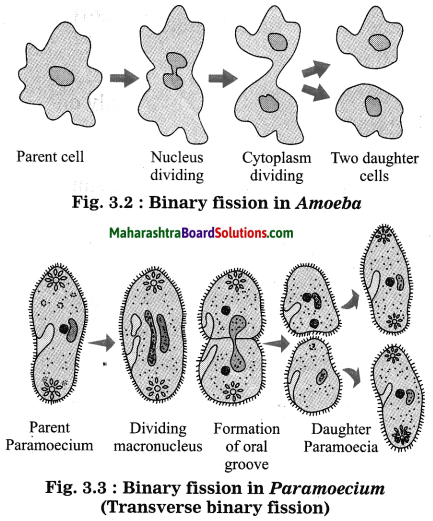
Maharashtra Board Class 10 Science Solutions Part 2 Chapter 2 Life Processes in Living Organisms Part - 2, 1
Maharashtra Board Class 10 Science Solutions Part 2 Chapter 2 Life Processes in Living Organisms Part - 2, 2
There are different methods of asexual reproduction in different unicellular animals.
(1) Binary fission: The process in which the parent cell divides to form two similar daughter cells
is binary fission. It takes place either by mitosis or amitosis. When there are favourable conditions and abundant food supply then the organisms undergo binary fission. Prokaryotes, Protists and eukaryotic 5 cell-organelle like mitochondria and chloroplasts perform binary fission.

Based on axis of fission there are three subtypes of binary fission.
(a) Simple binary fission: The plane of division is not definite, it can be in any direction due to lack of specific shape as in Amoeba.
(b) Transverse binary fission: The plane of J division is transverse, as in Paramoecium.
(c) Longitudinal binary fission: The plane of division is in length-wise direction as in Euglena.

(2) Multiple fission:
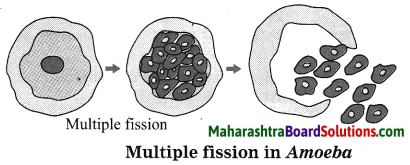
Maharashtra Board Class 10 Science Solutions Part 2 Chapter 2 Life Processes in Living Organisms Part - 2, 3
During unfavourable conditions when there is lack of food, multiple fission is shown by amoeba. Amoeba forms protective covering and becomes encysted. Inside the cyst, amoeba undergoes repeated nuclear division. This is followed by cytoplasmic divisions. Many amoebulae are formed which remain dormant inside the cyst. When favourable conditions reappear, they come out by breaking the cyst.

(3) Budding in yeast:
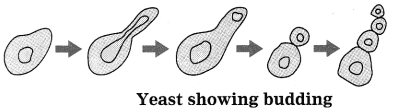
Maharashtra Board Class 10 Science Solutions Part 2 Chapter 2 Life Processes in Living Organisms Part - 2, 4
Yeast is unicellular fungus that performs budding. The parent cell produces two daughter nuclei by mitotic division. This results in a small bulgingbud on the surface of parent cell. One daughter nucleus enters the bud. It then grows and upon becoming big it separates from the parent cell to have independent life as new yeast cell.

b. Explain the concept of IVF.
Answer:
(1) IVF means In Vitro Fertilization (IVF)
(2) This is the technique in the modern medical field where childless couples can be blessed by their own child.
(3) IVF technique is used for childless couples who are faced with problems such as less sperm count, obstacles in oviduct, etc.
(4) The IVF technique is done by removing the oocyte from the mother and artificially fertilizing by the sperms collected from father. This fertilization is done in a test-tube. Thus it is also called test tube baby. The embryo formed is implanted in uterus of real mother or a surrogate mother at appropriate time.

c. Which precautions will you follow to maintain the reproductive health?
Answer:
About reproductive health one should have scientific and authentic information. The cleanliness of body is very essential but keeping the mind clean is also important to maintain good reproductive health. One should be careful about sexual relationships. These things should not be experimented in young age. Mistakes committed like these can change the sexual health forever. The cleanliness and hygiene during menstruation, the cleanliness of genitals and other private parts are the aspects of personal hygiene. When living in a society, one should always be away from cross-infections of venereal type.

d. What is menstrual cycle? Describe it in brief.
Answer:

  • Menstrual cycle is the events of cyclic changes that takes place with the interval of 28 to 30 days in mature woman.
  • Hormones from pituitary, FSH (Follicle Stimulating Hormone) and LH (Luteinizing Hormone) and hormones from ovary, estrogen and progesterone control the menstrual cycle.
  • Due to influence of FSH, the ovarian follicle grows along with the oocyte that is present in it.
  • This growing follicle produces estrogen.
  • Under the influence of estrogen, the uterine inner layer called endometrium grows or regenerates. In the meantime the development of follicle is completed.
  • LH from pituitary stimulates the bursting of ovarian follicle and releases the mature oocyte out of the follicle and the ovarian wall. This process is called ovulation.
  • The empty ovarian follicle after the ovulation becomes corpus luteum. Corpus luteum produces hormone progesterone.
  • Under the influence of progesterone, the glands from uterine endometrium start secreting. The oocyte if fertilized is implanted over this endometrium.
  • If oocyte is not fertilized, the corpus luteum becomes a degenerate body called corpus albicans. The corpus albicans cannot secrete estrogen and progesterone.
  • Due to lack of these hormones, the endometrial layer of the uterus collapses. The tissue debris, along with unfertilized egg is given out through the vagina as menstrual flow. This results in bleeding for about 5 days.
  • If woman is not pregnant, then this menstrual cycle keeps on repeating with regularity.

Question 5.
In case of sexual reproduction, newborn show similarities about characters. Explain this statement with suitable examples.
Answer:
(1) Sexual reproduction occurs due to two different gametes. One male gamete is from father while the other female gamete is from mother.
(2) Both the gametes are produced by meiosis.
(3) When the gametes unite it is called process of fertilization which produces diploid zygote.
(4) Due to the chromosomes of parents, their DNA pass to the next generation through such fertilization. Therefore, the characters of newborn show similarities with parents.

Question 6.
Sketch the labelled diagrams.
a. Human male reproductive system.
Answer:
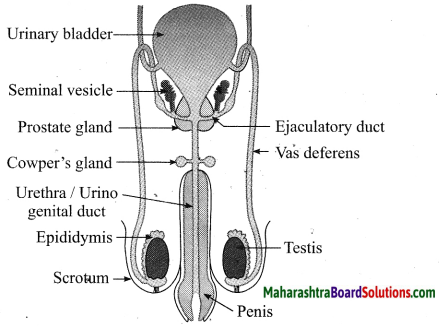
Maharashtra Board Class 10 Science Solutions Part 2 Chapter 2 Life Processes in Living Organisms Part - 2, 5

b. Human female reproductive system.
Answer:
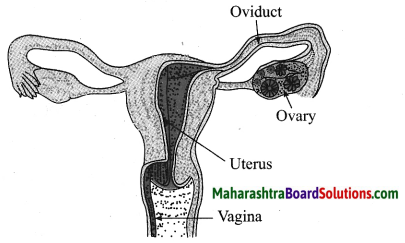
Maharashtra Board Class 10 Science Solutions Part 2 Chapter 2 Life Processes in Living Organisms Part - 2, 6

c. Flower with its reproductive organs.
Answer:
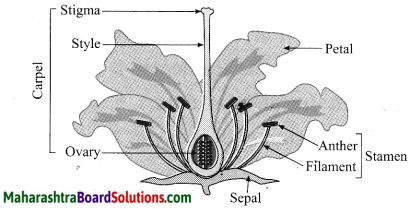
Maharashtra Board Class 10 Science Solutions Part 2 Chapter 2 Life Processes in Living Organisms Part - 2, 7

d. Menstrual cycle.
Answer:
Maharashtra Board Class 10 Science Solutions Part 2 Chapter 2 Life Processes in Living Organisms Part - 2, 8

Maharashtra Board Class 10 Science Solutions Part 2 Chapter 3 Life Processes in Living Organisms Part - 2

Question 7.
Give the names.
a. Hormones related with male reproductive system.
Answer:
Follicle stimulating hormone and ICSH or Luteinizing hormone secreted by pituitary gland, testosterone secreted by testis.

b. Hormones secreted by ovary of female reproductive system.
Answer:
Estrogen and progesterone.

c. Types of twins.
Answer:
Monozygotic twins, Siamese twins and Dizygotic twins.

d. Any two sexual diseases.
Answer:
Gonorrhea and Syphilis.

e. Methods of family planning.
Answer:
Copper T, condoms, oral contraceptive pills.

Question 8.
Gender of child is determined by the male? partner of couple. Explain with reasons whether this statement is true or false.
(OR)
“A couple shall have a male child or female child totally depends upon husband”. Prove truthfulness of this statement with scientific reason.
Answer:
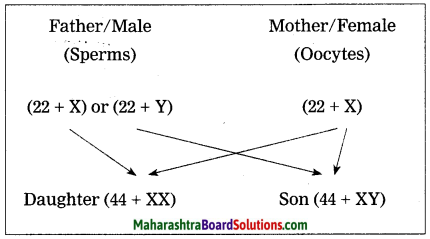
Maharashtra Board Class 10 Science Solutions Part 2 Chapter 2 Life Processes in Living Organisms Part - 2, 9
Sex determination in Human being
(1) The statement Gender of child is determined by the male partner of couple is true.
(2) It is clearly seen from the diagram that there are two types of sperms produced by males. One sperm has a X chromosome while the other has a Y chromosome, apart from autosomes. The mother on the other hand has all X bearing oocytes. Thus the sperm that fertilizes the oocyte decides the sex of the child.
(3) If X bearing sperm fertilizes the oocyte, daughter is born and when Y bearing sperm fertilizes the oocyte, son is born.
(4) Thus father or male partner is responsible for the determination of the sex.

Question 9.
Explain asexual reproduction in plants.
Answer:
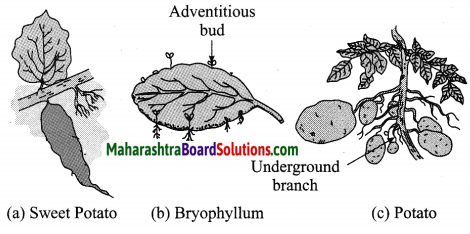
Maharashtra Board Class 10 Science Solutions Part 2 Chapter 2 Life Processes in Living Organisms Part - 2, 10

  • Vegetative propagation is the method of asexual reproduction in plants.
  • It takes place with the help of vegetative parts like root, stem, leaf and bud.
  • Potato, suran (Amorphophallus) and other tubes propagate with the help of ‘eyes’ which are buds. These eyes are present on the stem tubers.
  • In case of plants like sugarcane and grasses, buds present on nodes perform vegetative propagation.
  • Plants like Bryophyllum performs vegetative propagation with the help of buds present on leaf margin.

Maharashtra Board Class 10 Science Solutions Part 2 Chapter 3 Life Processes in Living Organisms Part - 2

Question 10.
Modern techniques like surrogate mother, sperm bank and IVF technique will help the human beings. Justify this statement.
OR
Despite various diagnostic tests, a couple could not have a child. In this situation, which remedies will you suggest? (July 2019)
Answer:
(1) Some couples want a child but they are not able to bear one due to various problems either in mother or in father. In such cases modern techniques such as IVF, surrogacy and sperm bank are useful in conceiving a child.

(2) These methods are as follows:
(i) Surrogacy: In woman if there is problem regarding the implantation of embryo in uterus, then help of another women is taken. This women is called surrogate mother.

Oocyte from real mother is taken out and fertilized with sperms collected from her husband. These gametes are fertilized outside in a test-tube and then the fertilized zygote is implanted in the surrogate mother.

(ii) In Vitro Fertilization (IVF) is done when there are problems like less sperm count or obstacles in oviduct. In IVF, fertilization is done in the test-tube. The embryo formed is implanted in uterus of woman for further growth.

(iii) Sperm bank: If man has problems with the sperm production, then the sperms are collected from the sperm bank. Sperm bank is the place where the donor’s donate the sperms and such sperms are kept stored. The donor’s identity is kept secret and he should also be physically and medically fit person.

Question 11.
Explain sexual reproduction in plants.
(OR)
Explain double fertilization in plants.
Answer:
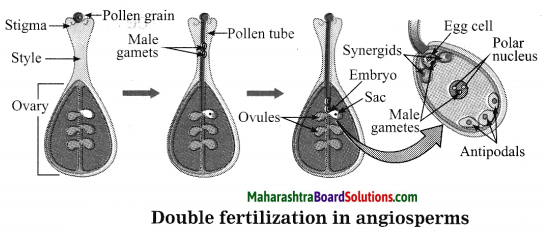
Maharashtra Board Class 10 Science Solutions Part 2 Chapter 2 Life Processes in Living Organisms Part - 2, 11

  • Plants reproduce sexually with the help of flowers.
  • Androecium and gynoecium are male and female parts of the flowers respectively.
  • In the carpel, the ovule undergoes meiosis and forms embryo sac.
  • A haploid egg cell and two haploid polar nuclei are present in each embryo sac.
  • The pollen grains from the anther reach the stigma of flower by the process of pollination. They germinate here on the stigma.
  • As a result of germination, long pollen tube and two male gametes are formed.
  • The pollen tube travels through the style of flower and the male gametes present in the pollen tube are transferred till the embryo sac in ovary. Upon reaching there, tip of the pollen tube bursts releasing two male gametes in embryo sac.
  • One male gamete unites with the egg cell and forms zygote. While other male gamete unites with two polar nuclei forming the endosperm.
  • Because there are two nuclei participating in this process, therefore it is called double fertilization.
  • After fertilization ovule develops into seed and ovary forms a fruit. When the seed again gets favourable conditions, it can produce a new plant.

Activities: (Do it your self)

Question 1.
Collect the official data about present and a decade old population of various Asian countries and plot a graph of that data. With the help of it, draw your conclusions about demographic changes.

Question 2.
With the help of your teacher, compose and present a road show to increase the awareness about prenatal gender detection and gender bias.

Maharashtra Board Class 10 Science Solutions Part 2 Chapter 3 Life Processes in Living Organisms Part - 2

Can you recall? (Text Book Page No. 22)

Question 1.
Which are the important life processes in living organisms?
Answer:
The important life processes in living organisms are respiration, circulation, nutrition, excretion, sensation and response through nervous system.

Question 2.
Which life processes are essential for production of energy required by body?
Answer:
The oxidation of nutrients that are absorbed in body is done because of oxygen supplied to cells by respiratory and circulatory system. This helps in liberation of energy. Thus respiration, circulation and nutrition are the life processes that are essential for production of energy required by body.

Question 3.
Which are main types of cell division? What are the differences?
Answer:
The main types of cell division are mitosis and meiosis. In mitosis, the chromosome number remains the same. 2 daughter cells are obtained from one cell. In meiosis, the chromosome number is reduced to half. From one cell, four daughter cells are obtained.

Question 4.
What is the role of chromosomes in cell division?
Answer:
Due to chromosomes, the DNA from parental cells enter into daughter cells. The hereditary, characters are transmitted to next generation by cell division.

Can you recall? (Text Book Page No. 22)

Question 1.
What do we mean by maintenance of species?
Answer:
Maintenance of species means a species undertakes successful reproduction and produces individuals of its own kind. This keeps the species existing on the earth.

Question 2.
Whether the new organism is genetically exactly similar to earlier one that has produced it?
Answer:
No. The new organism produced from the old one is not genetically exactly similar to the parents. In meiotic cell division there is crossing over in the homologous chromosomes. This produces genetic recombination. Thus the new organism is different from the earlier one. However, if the reproduction is of asexual type, then the young one is exactly similar to the parents.

Maharashtra Board Class 10 Science Solutions Part 2 Chapter 3 Life Processes in Living Organisms Part - 2

Question 3.
Who determines whether the two organisms of a species will be exactly similar or not?
Answer:
The type of reproduction, whether it is asexual or sexual, the type of crossing over, the extent of genetic recombination, etc. determine the similarity among the parent organisms and their, offspring. Based on this genetic recombination the two organisms of a species do not show exact similarity. However, in case of monozygotic twins there is exact similarity. In asexual reproduction to there is similarity.

Question 4.
What is the relationship between the cell division and formation of new organism of same species by earlier existing organism?
Answer:
In the process of reproduction, there is division of chromosomes. Due to cell division, the gametes are formed. The union of gametes produce new offspring. In sexual reproduction, all these processes take place due to cell division. In asexual reproduction too there is cell division. Growth of new organism also occurs due to cell division.

Let’s Think: (Text Book Page No. 26)

Question 1.
What would have been happened if the male and female gametes had been diploid?
Answer:
Diploid (2n) gametes if united, they will form 4n, i.e. tetraploid variety. Such zygote will show severe abnormality. The chromosome number will not be maintained.

Question 2.
What would have been happened if any of the cells in nature had not been divided by meiosis?
Answer:
If meiosis does not happen the gametes produced will be diploid. This will create abnormality.

Can you recall? (Text Book Page No. 28)

Question 1.
Which different hormones control the functions of human reproductive system through chemical coordination?
Answer:
Pituitary gland secretes FSH and LH. LH is known as ICSH in males, as its function in the male body is different. From the gonads of male and female, hormones are secreted which are essential for male and female reproductive functions respectively. These hormones are testosterone secreted from testis in males and estrogen and progesterone secreted from the ovaries in females. Testosterone is essential for masculinity as well as for sperm production while female hormones are essential for changes in the female body leading to motherhood.

Question 2.
Which hormones are responsible for changes in human body occurring during onset of sexual maturity?
Answer:
Testosterone in male body and estrogen in female body are responsible for maturity onset changes in human body.

Maharashtra Board Class 10 Science Solutions Part 2 Chapter 3 Life Processes in Living Organisms Part - 2

Question 3.
Why has the Government of India enacted the law to fix the minimum age of marriage as 18 in girls and 21 in boys?
Answer:
The full growth of female body is not completed till the age of 18. Till 18 years of age the physical and emotional maturity is not attained. Therefore, she is not suitable for marriage, sexual relationship and pregnancy. Similarly, boy attains complete growth only the age of 21. Therefore, to keep individuals and their progeny safe and healthy the Government of India enacted the law to fix the minimum age of marriage as 18 in girls and 21 in boys.

Can you recall? (Text Book Page No. 31)

Question 1.
Which hormone is released from pituitary of mother once the foetal development is completed?
Answer:
The hormone oxytocin is released from the posterior pituitary of mother once the foetal development is completed.

Question 2.
Under the effect of that hormone, which organ of the female reproductive system starts to contract and thereby birth process (parturition) is facilitated?
Answer:
Due to oxytocin, uterus contracts involuntarily and the baby is expelled out. Thus initiation of birth process is possible due to contractions of uterus.

Use your brain power. (Text Book Page No. 24)

Question 1.
Does the parent cell exist after asexual reproduction-fission?
Answer:
In fission, the parent cell divides into two. This nucleus and cytoplasm, both are divided. Thus, parent cell does not exist any longer, it is converted into new cells.

Choose the correct alternative and write that alphabet against the sub-question number:

Question 1.
Pranav and Pritee are twins in your class. They belong to ……….. twins type.
(a) monozygotic
(b) dizyotic
(c) siamese
(d) none of the above
Answer:
(b) dizyotic

Question 2.
Longitudinal binary fission is seen in …………..
(a) Paramoecium
(b) Euglena
(c) Amoeba
(d) Spirogyra
Answer:
(b) Euglena

Question 3.
Yeast cell performs asexual reproduction by ……………..
(a) fragmentation
(b) budding
(c) binary fission
(d) regeneration
Answer:
(b) budding

Question 4.
Carrot and raddish undergoes …………. with the help of their roots.
(a) vegetative propagation
(b) fragmentation
(c) budding
(d) regeneration
Answer:
(a) vegetative propagation

Question 5.
Androecium and gynoecium are ……….. whorl of the flower.
(a) accessory
(b) essential
(c) external
(d) internal
Answer:
(b) essential

Question 6.
Flowers without stalk are called ……….. flowers.
(a) stalkless
(b) sessile
(c) incomplete
(d) complete
Answer:
(b) sessile

Question 7.
………….. on the inner surface of fallopian ducts (oviducts) push the egg towards uterus.
(a) Cilia
(b) Tentacles
(c) Flagella
(d) Fibres
Answer:
(a) Cilia

Question 8.
Pregnant mother supplies nourishment to her foetus through …………..
(a) breasts
(b) uterus
(c) placenta
(d) ovaries
Answer:
(c) placenta

Maharashtra Board Class 10 Science Solutions Part 2 Chapter 3 Life Processes in Living Organisms Part - 2

Question 9.
The length of a sperm is about …………. micrometers.
(a) 400
(b) 5
(c) 60
(d) 600 (July ’19)
Answer:
(c) 60

Question 10.
Vegetative propagation is performed with the help of ……….. in sweet potato.
(a) root
(b) stem
(c) leaf
(d) flower
Answer:
(a) root

Question 11.
Which of the following is not a unisexual flower?
(a) Coconut
(b) Papaya
(c) Gulmohar
(d) Maize
Answer:
(c) Gulmohar

Write whether the following statements are true or false, with the suitable reason:

Question 1.
Absence of genetic recombination is an advantage whereas fast process is drawback of asexual reproductive method.
Answer:
False. (Absence of genetic recombination is a drawback whereas fast process is advantage of asexual reproductive method.)

Question 2.
Prokaryotes show fission which occurs either by mitosis or amitosis.
Answer:
True. (Prokaryotes show fission by both the methods, i.e. mitosis and amitosis.)

Question 3.
During favourable conditions multiple fission is performed by amoeba.
Answer:
False. (During unfavourable conditions multiple fission is performed by amoeba.)

Question 4.
Any encysted Amoeba or any other protist is called ‘Cyst’.
Answer:
True. (Cyst is the tough capsule like structure which keeps the protists dormant inside it. This helps the organisms to tide over unfavourable conditions.)

Question 5.
If the body of Sycon breaks up accidentally into only large and few fragments, then only each fragment develops into new Sycon.
Answer:
False. (If the body of Sycon breaks up accidentally into many fragments, each fragment develops into new Sycon. Because the capacity to regenerate is very strong in poriferan Sycon, even a small piece of parent Sycon can give rise to entire new individual.)

Question 6.
Pollen tube reaches the zygote via style.
Answer:
False. (Pollen tube reaches the embryo sac via style. Later, double fertilization takes place and the zygote and endosperm are formed.)

Question 7.
There is glucose sugar in the semen.
Answer:
False. (There is fructose sugar in the semen. Glucose is not present in semen.)

Question 8.
Out of 2 – 4 million ova, approximately only 400 oocytes are released up to the age of menopause.
Answer:
True. (During the reproductive span of the woman, from menarche to menopause only one oocyte per one month is released in the span of 30 to 35 years.)

Question 9.
If the oocyte is fertilized, secretion of estrogen and progesterone stops completely.
Answer:
False. (If the oocyte is not fertilized, there is no need of corpus luteum which secretes progesterone. In absence of conception, the progesterone is not needed, thus corpus luteum degenerates and forms corpus albicans.)

Maharashtra Board Class 10 Science Solutions Part 2 Chapter 3 Life Processes in Living Organisms Part - 2

Question 10.
During menstruation there is need of rest along with special personal hygiene.
Answer:
True. (During phase of menstruation there is pain and bleeding in woman. Her body is also susceptible for infections. There is weakness and hence she needs rest along with special personal hygiene.)

Find the odd one out:

Question 1.
Circulation, Excretion, Sensation, Reproduction.
Answer:
Reproduction. (All others are processes necessary for survival of the individual.)

Question 2.
Budding in hydra, Regeneration, Binary fission, Fragmentation
Answer:
Binary fission. (All others are processes of asexual reproduction in multicellular organisms.)

Question 3.
Carrot, Radish, Potato, Sweet potato.
Answer:
Potato. (All others are edible roots.)

Question 4.
Vas eferens, vas deferens, prostate gland, epididymis.
Answer:
Prostate gland. (All others are duct systems in male reproductive system.)

Question 5.
Prostate gland, Bartholin’s gland, Cowper’s gland, Epididymis.
Answer:
Bartholin’s glands. (All others are parts of male reproductive system.)

Question 6.
Stigma, style, pollen, ovary.
Answer:
Pollen. (All others are parts of gynoecium.)

Identify the correlation between the first two words and suggest the suitable words in the fourth place:

Question 1.
Amoeba : Fission : : Hydra : ………….
Answer:
Amoeba : Fission : : Hydra : Budding

Question 2.
Transverse binary fission : Paramoecium : : Longitudinal binary fission : ………… (July ‘19)
Answer:
Transverse binary fission : Paramoecium : : Longitudinal binary fission : Euglena

Question 3.
Calyx : Sepals : : Corolla : ………….
Answer:
Calyx : Sepals : : Corolla : Petals

Question 4.
Accessory whorls : Calyx and corolla : : Essential whorls : ………..
Answer:
Accessory whorls : Calyx and corolla : : Essential whorls : Androecium and gynoeciuin

Question 5.
Bisexual flower : Hibiscus : : Unisexual flower : ………….
Answer:
Bisexual flower : Hibiscus : : Unisexual flower : Papaya

Question 6.
FSH : Development of qocyte : : LH : ………….
Answer:
FSH : Development of qocyte : : LH : Ovulation

Maharashtra Board Class 10 Science Solutions Part 2 Chapter 3 Life Processes in Living Organisms Part - 2

Define the following/Give meanings of the following:

Question 1.
Budding in yeast.
Answer:
Budding in yeast: Budding is the asexual reproductive process in which a! small bulge or bud appears on the surface of parent cell as seen in unicellular yeast.

Question 2.
Budding in hydra.
Answer:
Budding in hydra: Budding in hydra is asexual reproductive process in which an outgrowth is formed by repeated divisions of regenerative cells of body wall called bud.

Question 3.
Regeneration.
Answer:
Regeneration: Regeneration is the asexual reproduction in Planaria in which the body is broken up into two parts and resulting each part regenerates remaining part of the body.

Question 4.
Fragmentation.
Answer:
Fragmentation: Fragmentation is the asexual type of reproduction in which the body of parent organism breaks up into many fragments. Each fragment can start living independently.

Question 5.
Vegetative propagation.
Answer:
Vegetative propagation: Vegetative propagation is a type of asexual reproduction in plants that takes place with the help of vegetative parts like root, stem, leaf and bud.

Question 6.
Fertilization.
Answer:
Fertilization: The process by which two haploid gametes unite to form a diploid zygote is called fertilization.

Question 7.
Pedicel.
Answer:
Pedicel: The stalk of the flower which is for the support is called pedicel.

Question 8.
Pollination.
Answer:
Pollination: Transfer of pollen grains from anther to the stigma is called pollination.

Question 9.
Self-Pollination.
Answer:
Self-Pollination: Pollination involving only one flower or two flowers borne on same plant is called self-pollination.

Question 10.
Cross-Pollination.
Answer:
Cross-Pollination: Pollination involving two flowers borne on two plants of same species is cross-pollination.

Question 11.
Endosperm.
Answer:
Endosperm: Endosperm is the nourishing substance formed by the union of second male gamete with two polar nuclei at the time of fertilization in plants.

Question 12.
Embryo sac.
Answer:
Embryo sac: There are many ovules in the ovary, the structure formed in each of the ovule by meiosis is called embryo sac.

Question 13.
Menopause.
Answer:
Menopause: Stoppage of functioning of female reproductive system due to lack of synthesis of hormones due to advancing age is called menopause.

Question 14.
Placenta.
Answer:
Placenta: An organ developed in the uterus of the pregnant mother, through which the embryo is given nourishment is called placenta.

Maharashtra Board Class 10 Science Solutions Part 2 Chapter 3 Life Processes in Living Organisms Part - 2

Question 15.
Menstrual cycle.
Answer:
Menstrual cycle: The repetitive changes at the interval of every 28-30 days in female reproductive system that take place after puberty, form menstrual cycle.

Question 16.
Corpus luteum.
Answer:
Corpus luteum: Corpus luteum is the secondary structure that is formed from empty ovarian follicle after ovulation. This corpus luteum produces progesterone and thereby maintains pregnancy.

Question 17.
Corpus albicans.
Answer:
Corpus albicans: Corpus albicans is the degenerate body which is formed from corpus luteum, if the ovum is not fertilized.

Question 18.
Ovulation.
Answer:
Ovulation: Bursting of mature ovarian follicle under the influence of hormones to release the oocyte is called ovulation.

Question 19.
IVF.
Answer:
IVF: In Vitro Fertilization is the technique in which fertilization is brought about outside the female body but in the test-tube and the embryo is implanted in uterus of woman.

Question 20.
Sperm bank.
Answer:
Sperm bank: Sperm bank is the place where semen donated by the desired men is collected after their thorough physical and medical check-up and stored at sub-zero temperatures in sterile conditions.

Name the following/Give the names:

Question 1.
Different glands associated with male reproductive system.
Answer:
Seminal vesicles, Prostate gland, Cowper’s or bulbourethral glands.

Question 2.
Agents of pollination.
Answer:
Biotic: Insects, birds, few animals.
Abiotic: Water and wind.

Question 3.
Components of semen.
Answer:
Secretion of prostate gland seminal vesicles and Cowper’s glands along with sperms.

Question 4.
Two accessory whorls in flower.
Answer:
Calyx and corolla.

Maharashtra Board Class 10 Science Solutions Part 2 Chapter 3 Life Processes in Living Organisms Part - 2

Question 5.
Two essential whorls in flower.
Answer:
Androecium and gynoecium.

Question 6.
The modern techniques in reproduction.
Answer:
In Vitro Fertilization, Surrogate mother, Sperm bank.

Question 7.
Symptoms of gonorrhea.
Answer:
Painful and burning sensation during urination, oozing of pus through penis and vagina, inflammation of urinary tract, anus, throat, eyes, etc.

Question 8.
Symptoms of syphilis.
Answer:
Occurrence of chancre (patches) on various parts of body including genitals, rash, fever, inflammation of joints, alopecia, etc.

Write the functions of the following organs:

Question 1.
Sporangium.
Answer:
Storing the spores and releasing them by bursting.

Question 2.
Calyx.
Answer:
Protection of inner whorls of the flower.

Question 3.
Corolla.
Answer:
Attracting insects for pollination. Protecting inner whorls.

Question 4.
Androecium.
Answer:
Production of pollen grains, the male gametes of flower.

Question 5.
Gynoecium.
Answer:
Production of female gametes of flower. Participating in production of fruits.

Question 6.
Endosperm.
Answer:
Nourishment of the growing embryo.

Question 7.
Testis.
Answer:
Production of sperms and male hormone-testosterone.

Question 8.
Scrotum.
Answer:
Protection and temperature control of testis.

Question 9.
Seminal vesicles.
Answer:
Secretion of seminal fluid which forms major portion of semen. Nourishment of sperms.

Question 10.
Penis.
Answer:
Transferring of sperms to vagina at the time of intercourse. Release of urine at the time of urination.

Question 11.
Ovary.
Answer:
Production of oocytes and female hormones – estrogen and progesterone.

Question 12.
Uterus.
Answer:
Growth and development of foetus during pregnancy. Helping in parturition (childbirth) by contractions.

Question 13.
Fallopian tubes/ducts.
Answer:
Transporting the released oocyte after ovulation to the uterus. Providing space for fertilization of oocyte by sperm. Conception is possible only when sperm and oocyte meet in the fallopian tube.

Question 14.
Vagina.
Answer:
Passage for copulation/intercourse. Birth canal. Passage for menstrual flow.

Question 15.
Placenta.
Answer:
Supplying nourishment to the growing foetus.

Distinguish between:

Question 1.
Binary fission and Multiple fission.
Answer:
Binary fission:

  1. Two new individuals are formed from one old individual at one time.
  2. The division of nucleus and cytoplasm takes place initially.
  3. The axis of division can be transverse, longitudinal or any one axis as it is in simple binary fission.
  4. Formation of protective cyst does not take place.
  5. Binary fission can be done during favourable period.

Multiple fission:

  1. Many new individuals are formed from one old individual at one time.
  2. Only nucleus divides initially followed by division of cytoplasm.
  3. There is no exact axis for the fission.
  4. Protective covering is formed around dividing amoebulae which is called cyst.
  5. Multiple fission takes place only at the time of unfavourable period.

Question 2.
Human male and Human female reproduction system.
Answer:
Human male reproductive system:

  1. Testis are essential organs which are located outside the abdomen in the scrotal sacs.
  2. There is common urethra through which urine and semen, are passed out.
  3. Reproductive system of male continues to work even in old age.
  4. Sperms or male gametes are produced by meiosis in the testis.
  5. Sperms are produced in millions at one time.
  6. Three accessory glands are associated with the male reproductive system.
  7. Testis secrete testosterone which is essential male hormone.

Human female reproductive system:

  1. Ovaries are essential organs which are located along with all other organs inside the lower abdomen.
  2. Urethra and vagina are two separate openings that open to outside.
  3. Reproductive system works only till menopause.
  4. Oocytes or ova are produced by meiosis in the ovaries.
  5. Only single oocyte is produced per month.
  6. Only one gland is associated with female reproductive system.
  7. Ovaries produce estrogen and progesterone which are essential female hormones.

Maharashtra Board Class 10 Science Solutions Part 2 Chapter 3 Life Processes in Living Organisms Part - 2

Question 3.
Monozygotic twins and Dizygotic twins.
Answer:
Monozygotic twins:

  1. Two children developing from only one zygote are called monozygotic twins.
  2. Monozygotic twins develop from same oocyte.
  3. Gender of both the twins is same.
  4. The monozygotic twins are genetically exactly alike.

Dizygotic twins:

  1. Two children developing from two different zygotes are called dizygotic twins.
  2. Dizygotic twins develop from two different oocytes.
  3. Gender of both the twins can be same or can be different.
  4. The dizygotic twins are genetically not exactly alike.

Give scientific reasons:

Question 1.
Individual developed by sexual reproduction always carry recombined genes of both the parents.
Answer:

  • In sexual reproduction, the haploid male and female gametes are united to form diploid zygote.
  • The zygote thus carries chromosomes of both parents which are transferred via male and female gametes.
  • While producing gametes, there is meiosis in which genetic recombination takes place.
  • Therefore, the individual developed by sexual reproduction always carry recombined genes of both the parents.

Question 2.
Flower is the structural unit of sexual reproduction in plant.
Answer:

  • Flower produces male and female gametes.
  • For this purpose there are essential whorls of androecium and gynoecium.
  • The double fertilization also takes place in flower.
  • Therefore, flower is called the structural unit of sexual reproduction in plants.

Question 3.
Fertilization in plants is called double fertilization.
Answer:

  • After pollination the pollen grains drop on the sticky stigma of the flower.
  • They germinate here producing two male gametes and a long pollen tube.
  • The male gametes travel through the pollen tube till they reach the embryo sac.
  • Here the male gametes are released by bursting the pollen tube. One male gamete unites with the egg cell to form zygote while the second male gamete unites with two polar nuclei forming endosperm.
  • In this way because two nuclei participate in the fertilization process, therefore it is called double fertilization.

Question 4.
By the age of 45 – 50 women gets menopause.
Answer:

  • By the age of 45-50, the secretion of hormones which control the functioning of the reproductive system is reduced gradually and then it stops.
  • This causes end of menstrual cycle. This results into menopause.

Question 5.
Older mothers have greater chance of conceiving abnormal children.
Answer:

  • In older women the menopausal age approaches.
  • The oocytes, released from ovaries during this phase are not normal.
  • Their meiotic cell division is abnormal and thus oocyte becomes abnormal too.
  • If such abnormal oocytes are fertilized, the baby is born with many genetic problems, e.g. Down’s syndrome or Turner’s syndrome.

Question 6.
Indians should follow family planning for controlling the population.
Answer:

  • There is severe population explosion in India. It has almost reached to 121 crores.
  • This results into unemployment, decreasing per capita income and increasing loan, stress on natural resources, etc.
  • Only by controlling population, the quality of life can be restored.
  • Therefore, Indians should follow family planning for controlling the population.

Answer the following questions in short:

Question 1.
How does reproduction take place in fungus Mucor?
Answer:
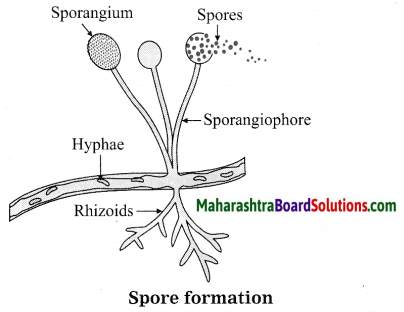
Maharashtra Board Class 10 Science Solutions Part 2 Chapter 2 Life Processes in Living Organisms Part - 2, 12

  • Mucor reproduces asexually by spore formation.
  • It has filamentous body that possess sporangia.
  • When the spores are formed, the sporangia burst. The spores are released which settle down at suitable Places.
  • They germinate in moist and warm place forming a new fungal colony.

Question 2.
What is the type of asexual reproduction shown in the diagram below? (Board’s Model Activity Sheet)
Answer:
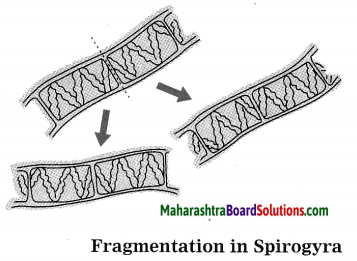
Maharashtra Board Class 10 Science Solutions Part 2 Chapter 2 Life Processes in Living Organisms Part - 2, 13
Type of asexual reproduction shown in the diagram above is fragmentation in Spirogyra.

Maharashtra Board Class 10 Science Solutions Part 2 Chapter 3 Life Processes in Living Organisms Part - 2

Question 3.
Describe the structure of a flower.
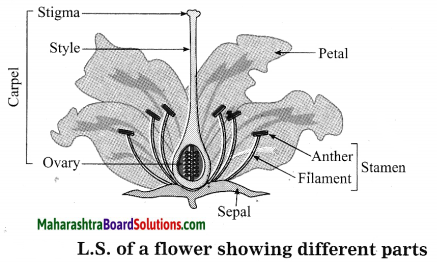
Maharashtra Board Class 10 Science Solutions Part 2 Chapter 2 Life Processes in Living Organisms Part - 2, 14
Answer:
(1) The structural unit of sexual reproduction in plants is flower. There are total four floral whorls. Of these, two are accessory floral whorls while two are essential floral whorls.
(2) Calyx and corolla are accessory whorls. They are protective in nature.
(3) Members of calyx are known as sepals. They are usually green in colour. They protect the inner whorls.
(4) The members of corolla are called petals. They can be of different colours.
(5) Androecium and gynoecium are essential whorls as they participate in sexual reproduction.
(6) The male whorl androecium is made up of stamens. Each stamen has a filament with anther located at the upper end. In the anther there are four locules. Inside the locules the meiosis takes place forming pollen grains. During suitable time, the pollen grains are released from anther lobes.
(7) Gynoecium is made up of carpels, either in separate form or are united. Each carpel is formed of ovary at the basal end hollow ‘style’ and the stigma at the tip of style. There are one or many ovules inside the ovary.
(8) In bisexual flowers both androecium and gynoecium are located in the same flower, e.g. Hibiscus.
(9) In unisexual flowers, androecium is present in male flowers and gynoecium is present in the female flowers, e.g. Papaya.

Question 4.
Describe the human male reproductive system.
Answer:
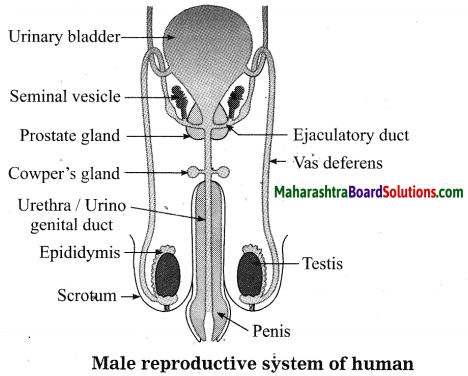
Maharashtra Board Class 10 Science Solutions Part 2 Chapter 2 Life Processes in Living Organisms Part - 2, 15
In human male reproductive system, the reproductive organs are as follows:

  • Testes, different types of duct systems and glands.
  • Testes are in pair. Each testis lies in the scrotum which lies outside to abdominal cavity.
  • Testes -consist of numerous seminiferous tubules. The germinal epithelium of seminiferous tubules form sperms by undergoing meiosis.
  • These sperm cells are immature.
  • They are pushed gradually through various duct systems till the penis.
  • This path is as follows:
    Rete testis → vas efferentia → epididymis → vasa deferentia → Ejaculatory duct → urethra
  • As the sperms are travelling, they gradually become mature. They are made capable to perform process of fertilization.
  • Seminal vesicles (in pairs), Single prostate gland and a pair of Cowper’s glands secrete their secretions. These secretions and the sperms together form semen.
  • This semen is deposited in the vagina with help of penis.

Question 5.
Describe the human female reproductive system.
Answer:
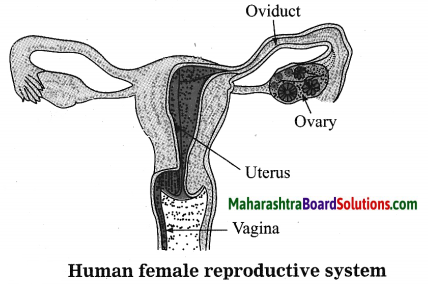
Maharashtra Board Class 10 Science Solutions Part 2 Chapter 2 Life Processes in Living Organisms Part - 2, 16

  • All the organs of the human female reproductive system are located inside the lower abdomen.
  • There are pair of ovaries, pair of fallopian ducts and a single median uterus.
  • The uterus opens out by vagina. In vaginal walls there are Bartholin’s glands.
  • The urethra in female body is separate and not a common passage as in male body.
  • The free end of fallopian duct is funnel-like having an opening in the centre. The oocyte released from the ovary due to ovulation is picked up by this funnel.
  • The other end of fallopian duct opens into uterus. There are cilia on inner surface of oviduct. With the help of the cilia the oocyte is pushed to the uterus through the fallopian duct.
  • The fertilization of oocyte can take place only in the middle’part of the fallopian duct.
  • The lower end of uterus opens into vagina. The contractions of uterus help in the process of parturition.
  • Vagina is the birth canal as well as copulatory passage. It is also a passage for menstrual flow.

Question 6.
What problems cause infertility in couple?
Answer:

  • In woman if there are problems like irregularity in menstrual cycle, difficulties in oocyte production or implantation in uterus, obstacles in the oviduct, etc.
  • In man if there are no sperms in the semen, slow movement of sperms, or anomalies in the sperms then he becomes sterile.
  • But now with the help of advanced medical techniques these problems can be overcome and a childless couple can be parents.

Question 7.
Answer the following questions: (July 2019)
(a) In our country, there seems to be lack of awareness regarding reproductive health. Why?
(b) Write the symptoms of disease gonorrhea.
(c) What precautions will you take to maintain reproductive health?
Answer:
(a) There is lack of awareness about reproductive health among majority of people of our country. This is due to social customs, traditions, illiteracy, social taboo and shyness.

(b) Symptoms of gonorrhea are as follows:

  1. Painful burning during urination.
  2. Oozing of pus through penis or vagina.
  3. Inflammation of urinary tract, anus, throat, eyes, etc.

(c) Precautions to maintain reproductive health are cleanliness and personal hygiene. Guarding against any sexual infections.

Question 8.
If a piece of bread is kept in a container in moist place for 2-3 days, (1) What will you see? (2) Write scientific name and a character of the organism you may observe.
Answer:
(1) If a piece of bread is kept in moist container we can see growth of fungus on it.
(2) Fungi belonging to species Mucor is seen. It has filamentous body and sporangia. Sporangia burst open to spread spores. It has saprophytic mode of nutrition as it devoid of chlorophyll.

Write short notes on:

Question 1.
Multiple fission.
Answer:
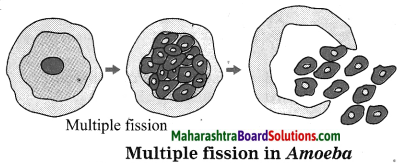
Maharashtra Board Class 10 Science Solutions Part 2 Chapter 2 Life Processes in Living Organisms Part - 2, 17
During unfavourable conditions when there is lack of food. multiple fission is shown by amoeba. Amoeba forms protective covering and becomes encysted. Inside the cyst, amoeba undergoes repeated nuclear division. This is followed by cytoplasmic divisions. Many amoebulae are formed which remain dormant inside the cyst. When favourable conditions reappear, they come out by breaking the cyst.

Question 2.
Regeneration.
Answer:
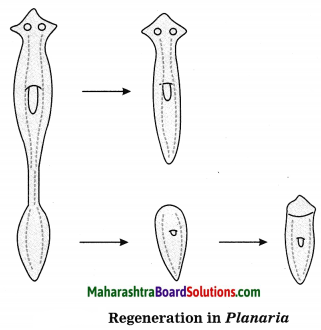
Maharashtra Board Class 10 Science Solutions Part 2 Chapter 2 Life Processes in Living Organisms Part - 2, 18
In developed animals like wall lizard the process of regeneration is used to restore the lost parts like tail or limbs. As the reproductive system is one of the fullfledged system in the body, the process of regeneration cannot be called type of reproduction.

But some primitive organisms such as Plarfaria use this method for procreation. Planaria breaks up its body into two parts. Each part has the ability to develop the lost part by process of regeneration. This forms two new Planaria.

Question 3.
Seed germination.
Answer:
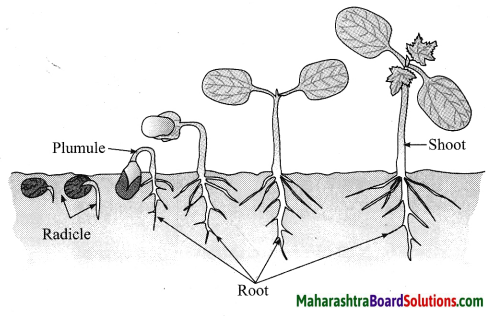
Maharashtra Board Class 10 Science Solutions Part 2 Chapter 2 Life Processes in Living Organisms Part - 2, 19
Seed germination is the process in which the seed develops into a new plantlet. In the plants, after fertilization the ovule develops into seed and ovary turns into fruit. Seeds fallen on the ground due to bursting of the fruits start germinating. Only under favourable conditions in the soil, this germination takes place. The zygote present inside the seed uses food stored in endosperm of seed and hence develops further to produce a new plantlet.

Maharashtra Board Class 10 Science Solutions Part 2 Chapter 3 Life Processes in Living Organisms Part - 2

Question 4.
Budding in hydra.
Answer:
Maharashtra Board Class 10 Science Solutions Part 2 Chapter 2 Life Processes in Living Organisms Part - 2, 20
In multicellular organisms asexual reproduction by budding is shown by hydra. In fully grown Hydra, at specific part of its body there is development of bud.

This development is only during favourable period. The bud is an outgrowth developed due to repeated divisions of regenerative cells of body wall. It grows up gradually to form a small hydra. Parent hydra’s dermal layers and digestive cavity are in continuity with those of the budding hydra. It receives all the nutrition from parent hydra.When the budding hydra grows sufficiently, it detaches from parent hydra. Then it leads an independent life.

Question 5.
Fragmantation.
Answer:
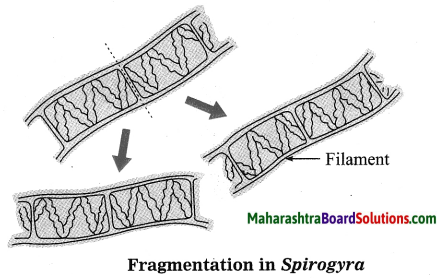
Maharashtra Board Class 10 Science Solutions Part 2 Chapter 2 Life Processes in Living Organisms Part - 2, 21
Fragmentation is one of the type of asexual reproduction in multicellular organisms. During fragmentation, the body of parent organism breaks up into many fragments. All the resulting fragments start to develop as an independent new organism. In alga Spirogyra, and sponge like Sycon asexual reproduction takes place by fragmentation. Spirogyra grow up very fast and break up into many small fragments when there are favourable conditions. Each newly formed fragment lives independently as a new Spirogyra. Similarly the body of Sycon if accidentally broken into many fragments, develops into new Sycon from each old fragment.

Question 6.
Monozygotic twins.
Answer:
The twins developed from a single embryo are called monozygotic twins. If within 8 days of zygote formation i.e. in early embryonic development cells of that embryo divide into two groups. Each one develop as two separate embryos forming two monozygotic twins. Monozygotic twins are genetically exactly similar to each other. The gender of the twins is also same.

The Siamese twins develop from monozygotic twins, if the embryonic cells are divided into two groups 8 days after the zygote formation. These are conjoined twins where some parts of body are joined to each other. Also some organs are common in Siamese twins.

Read the paragraph and answer the questions given below:

Reproduction is the process by which the living species continues its existence. Lower organisms carry out asexual reproduction while higher plants and animals always show sexual reproduction. Plants reproduce asexually by methods such as fragmentation, vegetative propagation, budding, spore formation. For sexual reproduction they form gametes. In animal kingdom, budding, fission of different types and parthenogenesis are some of the methods that do not require both the sexes. Though regeneration also forms new individual, it is not considered to be a reproductive process because, basically it is a repair process. The ability to regenerate is lost in higher phyla. In human beings | it is restricted only to wound healing. Sexual reproduction is also undergoing lots of experimentation such as cloning which may make females capable of producing their own baby without intervention of any male.

Questions and Answers:

Question 1.
How do living species continue their existence?
Answer:
Through the process of reproduction, living species continue their existence.

Question 2.
Which are asexual methods of reproduction in kingdom Animalia?
Answer:
Fission, budding and parthenogenesis are the asexual methods of reproduction in Kingdom Animalia.

Question 3.
Why is regeneration not true method of reproduction?
Answer:
Regeneration is the repair process than a reproductive process. It is not done with the intention of producing offspring, but is for healing or repairing the lost part.

Question 4.
What are methods of reproduction in plants?
Answer:
Plants reproduce by asexual as well as sexual methods. Asexual reproduction is by fragmentation, vegetative propagation, budding, spore formation, while by formation of gametes, sexual reproduction is done.

Question 5.
What is the modern method of reproduction aimed at in higher organisms?
Answer:
Cloning is the modern method of reproduction by which production of young one can be aimed at.

Diagram-based Questions:

Question 1.
Observe the figure 3.18 and answer the questions below: (Board’s Model Activity Sheet)
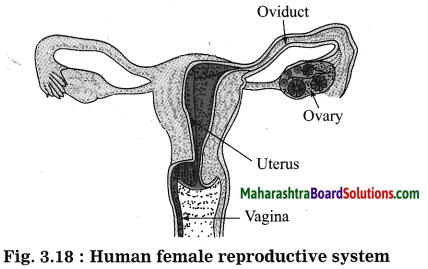
Maharashtra Board Class 10 Science Solutions Part 2 Chapter 2 Life Processes in Living Organisms Part - 2, 22
(a) What does the figure 3.18 indicate?
Answer:
The figure indicates the menstrual cycle in human female.

(b) Which human organs are involved in this process?
Answer:
The ovary and uterus are primarily involved in this process. But the pituitary gland also controls this cycle.

(c) Which hormones take part in this process?
Answer:
Following hormones regulate this menstrual cycle.
Pituitary hormones: Follicle Stimulating Hormone (FSH) and Luteinizing Hormone (LH).
Ovarian hormones: Estrogen and progesterone.

(d) What is the periodicity for these changes?
Answer:
The menstrual cycle shows repetitive changes every 28 to 30 days.

(e) The body of woman undergoing this process is impure, she should remain away from other people. What is your opinion about this statement? Give justification for your opinion.
Answer:
A menstruating woman is not at all with impure body. It is a natural process in which the endometrium of the uterus is sloughed off and repaired.

She should get enough rest and nutrition during this period. It is painful period in which there is a possibility of infections. Therefore, she should take ! hygienic care and rest till the bleeding persists. But blind faith and superstition to keep her away from others should not be followed.

Maharashtra Board Class 10 Science Solutions Part 2 Chapter 3 Life Processes in Living Organisms Part - 2

Question 2.
Observe the diagram (Fig. 3.19) of menstrual cycle and answer the following questions:
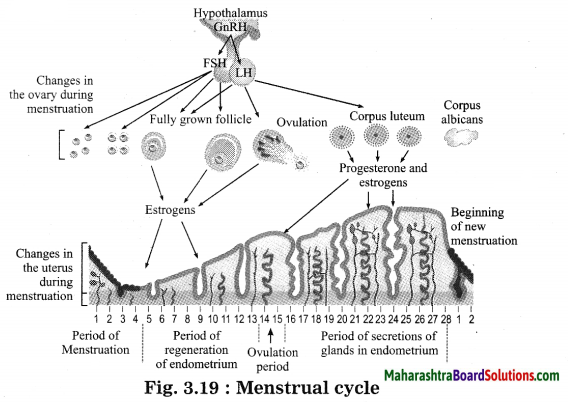
Maharashtra Board Class 10 Science Solutions Part 2 Chapter 2 Life Processes in Living Organisms Part - 2, 23
(1) What is the period of menstruation?
Answer:
1 to 5 days is the period of menstruation.

(2) On which day does ovulation occur during menstrual cycle?
Answer:
Ovulation occurs on 14th or 15th day.

(3) During which period is corpus luteum active during menstrual cycle? Which hormones are secreted by corpus luteum ?
Answer:
Corpus luteum is active till the 28th day of menstrual cycle. During this time if there is no union of sperm and ovum, then corpus luteum degenerates. Corpus luteum secretes estrogen and progesterone.

(4) In menstrual cycle which reproductive organs undergo changes?
Answer:
Ovary and uterus undergo changes during menstrual cycle.

(5) Which period is said to be period of regeneration of endometrium?
Answer:
In menstrual cycle, days 5 to 14 are period of regeneration of endometrium.

(6) Which period is said to be period of secretions of glands in endometrium?
Answer:
Period of secretions of glands in endometrium is 15 to 28 days.

Question 3.
Observe the following picture and describe the type of reproduction shown in.
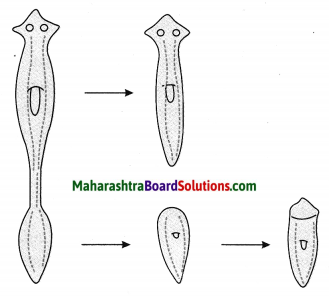
Maharashtra Board Class 10 Science Solutions Part 2 Chapter 2 Life Processes in Living Organisms Part - 2, 24
Answer:
In developed animals like wall lizard the process of regeneration is used to restore the lost parts like tail or limbs. As the reproductive system is one of the fullfledged system in the body. the process of regeneration cannot be called type of reproduction.

But some primitive organisms such as Planaria use this method for procreation. Planaria breaks up its body into two parts. Each part has the ability to develop the lost part by process of regeneration. This forms two new Planaria.

Question 4.
Answer the following questions: (March 2019)
(a) “Gender of child is determined by the male partner of couple.” Draw a diagram explaining the above statement.
Answer:
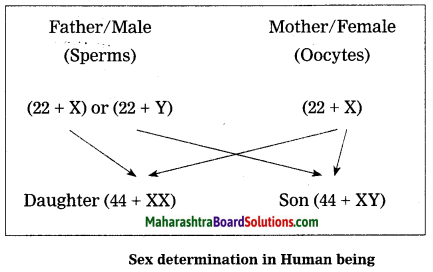
Maharashtra Board Class 10 Science Solutions Part 2 Chapter 2 Life Processes in Living Organisms Part - 2, 25

(b) Prepare a slogan for campaign against female foeticide.
Answer:

  • Save the girl child.
  • Daughters give lot of joy, it is not only the boy.

(c) In the following figure, explain how new fungal colonies of mucor are formed:
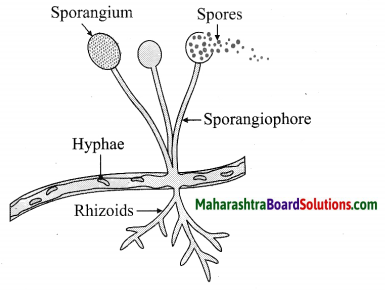
Maharashtra Board Class 10 Science Solutions Part 2 Chapter 2 Life Processes in Living Organisms Part - 2, 26
Answer:
Mucor is a fungus having filamentous body. The filaments bear sporangia. Mature sporangia burst and release spores. Spores germinate to form new hyphae upon getting favourable moist and warm place.

(d) Identify and state the type of reproduction represented in the above figure.
Ans. The spore formation is asexual type of reproduction seen in Mucor.

Question 5.
Write the type of asexual reproduction shown in the figure.
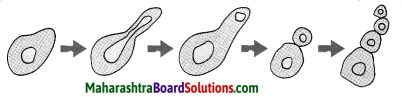
Maharashtra Board Class 10 Science Solutions Part 2 Chapter 2 Life Processes in Living Organisms Part - 2, 27
Answer:
The figure shows budding in yeast. Budding is the type of asexual reproduction.

Experiments:
(Try this: Text Book Pages 23 and 24)

(1) Observation of Paramoecia.
(2) Observation of yeast.
(3) Study of Hibiscus.
[For detailed information on practicals, refer to Vikas Science and Technology Experiment Book: Standard X]

Maharashtra Board Class 10 Science Solutions Part 2 Chapter 3 Life Processes in Living Organisms Part - 2

Projects:

Project 1.
Use of ICT. (Textbook page no. 27)
Make an video album of pollination and show it in the class.

Project 2.
Internet is my friend. (Textbook page no. 33)
You may have read that sometimes a woman may deliver more than two offspring at a time. Collect more information from internet about reasons for such incidences.

Project 3.
Get information. (Textbook page no. 34)
Visit a public health centre nearby your place and collect the information through an interview of health officer about meaning and various methods of family planning.

Maharashtra Board Class 8 History Solutions Chapter 3 Effects of British Rule

Balbharti Maharashtra State Board Class 8 History Solutions Chapter 3 Effects of British Rule Notes, Textbook Exercise Important Questions and Answers.

Maharashtra State Board Class 8 History Solutions Chapter 3 Effects of British Rule

Class 8 History Chapter 3 Effects of British Rule Textbook Questions and Answers

1. Rewrite the statements by choosing the appropriate options:

Question 1.
Portuguese, ………….., French, British participated in the competition of capturing Indian market.
(a) Austrian
(b) Dutch
(c) German
(d) Swedish
Answer:
(b) Dutch

Question 2.
In 1802, Peshwa ………….. signed the Subsidiary Alliance with the British.
(a) Bajirao I
(b) Sawai Madhavrao
(c) Peshwa Nanasaheb
(d) Bajirao II
Answer:
(d) Bajirao II

Question 3.
Jamshedjee Tata started the manufacturing of steel at Tata Iron and Steel Industry established in ………….. .
(a) Mumbai
(b) Kolkata
(c) Jamshedpur
(d) Delhi
Answer:
(c) Jamshedpur

Maharashtra Board Class 8 History Solutions Chapter 3 Effects of British Rule

2. Explain the following concept:

Question 1.
Civil Services :
Answer:

  1. There was a need of bureaucrats to strengthen the British rule in India.
  2. Lord Cornwallis introduced Civil Services which became an important part of the British government.
  3. The territories occupied by the British were divided into districts for administrative convenience. The district administration was headed by Collector.
  4. The officers appointed through the Civil Services (ICS) were taken into administrative services.

Question 2.
Commercialisation of Agriculture :
Answer:

  1. In the pre-British period, farmers used to cultivate food grains to fulfill domestic need as well as need of the village.
  2. The British government gave encouragements to the cultivation of cash crops like indigo, cotton, tobacco, tea, etc.
  3. The shift from cultivation of foodgrains to profit-yielding cash crops is known as Commercialisation of Agriculture.

Question 3.
Economic Policy of British :
Answer:

  1. Capitalist economy prevailed in England due to the Industrial Revolution.
  2. This system was brought to India to nurture the British economy.
  3. It resulted in the economic gains for England but exploitation and impoverishment of India.

3. Explain the following statements with reasons:

Question 1.
Farmers in India became bankrupt.
Answer:
The British made number of changes in the existing system to increase the revenue.

  1. The payment of revenue was made compulsory in cash and within the prescribed time limit.
  2. Land was confiscated if the revenue was not paid in time.
  3. The land revenue collection differed from place to place which resulted in the exploitation of the farmers.
  4. Farmers were forced to sell their produce to the merchants and middlemen at a low price in order to pay revenue.
  5. Farmers mortgaged land to pay tax and became indebted to moneylenders.

In this way, the farmers became bankrupt in India.

Maharashtra Board Class 8 History Solutions Chapter 3 Effects of British Rule

Question 2.
There was decline of traditional industries in India.
Answer:

  1. The British government levied heavy duty on the goods exported from India to England.
  2. The goods imported from England were produced in factories on a large scale and at minimum cost.
  3. The duty levied on them by British was far too less.
  4. So, these goods were cheap as compared to traditional goods.
  5. The Indian artisans found it difficult to compete with low priced British goods.
  6. Eventually, this led to closing down of traditional industries in India.

4. Complete the following table:

Question.
Maharashtra Board Class 8 History Solutions Chapter 3 Effects of British Rule 1
Answer:
Maharashtra Board Class 8 History Solutions Chapter 3 Effects of British Rule 2

Do You Know?

Work done by Chhatrapati Pratapsingh :
Maharashtra Board Class 8 History Solutions Chapter 3 Effects of British Rule 3

  1. Water tank was built on back side of Yevteshwar temple and Mahadara which supplied water to Satara city.
  2. He built roads and planted trees on both the sides.
  3. Sanskrit, Marathi and English was taught to girls and boys in schools.
  4. Printing press was set up and many books were published.
  5. A book titled ‘Sabhaniti’ was printed on polity in 1827.
  6. A road connecting Satara to Mahabaleshwar to Pratapgad was built by him which was further extended to Mahad.aqs

Maharashtra Board Class 8 History Solutions Chapter 3 Effects of British Rule

Project:

Prepare detailed information with pictures about the development by British in administration, education, transport and communication in India.

Class 8 History Chapter 3 Effects of British Rule Additional Important Questions and Answers

Rewrite the statements by choosing the appropriate options:

Question 1.
………….. was the main centre of British in western India.
(a) Surat
(b) Cochin
(c) Goa
(d) Mumbai
Answer:
(d) Mumbai

Question 2.
With the treaty of ……………. in 1782 the first Anglo-Maratha war came to an end.
(a) Wadgaon
(b) Vasai
(c) Salbai
(d) Ahmednagar
Answer:
(c) Salbai

Question 3.
In 1848, Lord Dalhousie rejected the adoption policy and annexed the state of ………… .
(a) Pune
(b) Kolhapur
(c) Sangli
(d) Satara
Answer:
(d) Satara

Question 4.
A committee was set up to create a Code of Law, under the leadership of ………… .
(a) Lord Cornwallis
(b) Lord Macaulay
(c) Lord Warren Hastings
(d) Lord Robert Clive
Answer:
(b) Lord Macaulay

Question 5.
……………. started the first textile mill in 1853 at Mumbai.
(a) Jamshedji Tata
(b) Ratan Tata
(c) Kawasjee Nanabhoy Davar
(d) Jamshedji Jeejibhoy
Answer:
(c) Kawasjee Nanabhoy Davar

Question 6.
The first jute mill was set up at in Bengal.
(a) Kolkata
(b) Rishra
(c) Hooghli
(d) Dhakka
Answer:
(b) Rishra

Maharashtra Board Class 8 History Solutions Chapter 3 Effects of British Rule

Question 7.
The territory under the control of the English was divided into ………… for the convenience of administration.
(a) Subhas
(b) districts
(c) Paraganas
(d) mahajanpadas
Answer:
(b) districts

Question 8.
The process of giving stress on cultivation of cash crops instead of food grains is known as …………. of agriculture.
(a) Commercialisation
(b) Liberalisation
(c) Globalisation
(d) Rotation
Answer:
(a) Commercialisation

Question 9.
…………… wrote the book ‘Sabhaniti’ in 1827.
(a) Bajirao II
(b) Rango Bapuji Gupte
(c) Chhatrapati Shivaji Maharaj
(d) Chhatrapati Pratapsingh
Answer:
(d) Chhatrapati Pratapsingh

Question 10.
A German thinker …………… was a devout scholar of Indian religion, language and history.
(a) Max Mueller
(b) Lord Macaulay
(c) John Stuart Elphistone
(d) William Jones
Answer:
(a) Max Mueller

Name the following:

Question 1.
He started Subsidiary Alliance.
Answer:
Lord Wellesley

Question 2.
First Governor General according to the Regulating Act.
Answer:
Lord Warren Hastings

Question 3.
He started Dual Government system in Bengal.
Answer:
Robert Clive

Question 4.
Recommended English education in India.
Answer:
Lord Macaulay

Maharashtra Board Class 8 History Solutions Chapter 3 Effects of British Rule

Question 5.
Loyal officer of Chhatrapati Pratapsingh.
Answer:
Rango Bapuji Gupte.

Answer the following questions in one sentence each:

Question 1.
How were the officers in administrative services appointed?
Answer:
The officers in the administrative services were appointed through competitive examination known as Indian Civil Services (ICS).

Question 2.
Which principle was introduced by the British in the administration of Justice?
Answer:
The British introduced the principle of ‘equality before law’ in the administration of justice all over British India.

Question 3.
Which factors hindered the growth of new industries in India?
Answer:
The growth of new industries in India was hindered by the lack of British support, capital and experience of management.

Question 4.
Which cash crops were encouraged by the British Government?
Answer:
The British Government gave more encouragement to cash crops like cotton, indigo, tobacco, tea, etc.

Question 5.
Where were the universities established in 1857?
Answer:
The universities were established in Mumbai, Kolkata and Madras (Chennai) in 1857.

Maharashtra Board Class 8 History Solutions Chapter 3 Effects of British Rule

Question 6.
What was the effect of development of modern means of transport and communication ?
Answer:
The development of modern means of transport and communication helped to improve communication between the people and strengthened their sense of unity between Indians.

Question 7.
Which values shaped the new era in the 19th century Europe?
Answer:
The new era in the 19th century Europe was shaped on the values humanitarianism, democracy, nationalism and liberalism.

Do as Directed:

1. Complete the concept map:

Question 1.
Maharashtra Board Class 8 History Solutions Chapter 3 Effects of British Rule 4
Answer:
Maharashtra Board Class 8 History Solutions Chapter 3 Effects of British Rule 5

Question 2.
Maharashtra Board Class 8 History Solutions Chapter 3 Effects of British Rule 6
Answer:
Maharashtra Board Class 8 History Solutions Chapter 3 Effects of British Rule 7

Question 3.
Maharashtra Board Class 8 History Solutions Chapter 3 Effects of British Rule 8
Answer:
Maharashtra Board Class 8 History Solutions Chapter 3 Effects of British Rule 9

Maharashtra Board Class 8 History Solutions Chapter 3 Effects of British Rule

Question 4.
Maharashtra Board Class 8 History Solutions Chapter 3 Effects of British Rule 10
Answer:
Maharashtra Board Class 8 History Solutions Chapter 3 Effects of British Rule 11

2. Complete the following table:

Question 1.
Maharashtra Board Class 8 History Solutions Chapter 3 Effects of British Rule 12
Answer:
Maharashtra Board Class 8 History Solutions Chapter 3 Effects of British Rule 13

3. Complete the timeline:

Question 1.
Maharashtra Board Class 8 History Solutions Chapter 3 Effects of British Rule 14
Answer:
Maharashtra Board Class 8 History Solutions Chapter 3 Effects of British Rule 15

Explain the following concept:

Question 1.
Dual Government :
Answer:
1. The British East India Company in order to consolidate rule introduced new system of governance in India known as Dual Government.
2. It was introduced by Robert Clive in Bengal in 1765 wherein the East India Company took over the revenue collection. The maintenance of law and order was the responsibility of the Nawab of Bengal.

Answer the following in 25-30 words:

Question 1.
What were the conditions laid in Subsidiary Alliance?
Answer:
Lord Wellesley signed Subsidiary Alliance with many Indian rulers in 1798.
Its conditions were :

  1. Indian rulers should keep the British army in their Court.
  2. They have to pay the company towards the maintenance of these forces in cash or a part of their territory of equivalent amount of revenue.
  3. Without the intervention of the British, they would not have any alliance or declare war with any power.
  4. They should keep the British resident in their court.

Maharashtra Board Class 8 History Solutions Chapter 3 Effects of British Rule

Question 2.
What were the provisions in Regulating Act of 1773?
Answer:
According to Regulating Act of 1773:

  1. The Governor of Bengal was designated as the Governor General. Lord Warren Hastings became the first Governor General of India.
  2. It gave the Governor General controlling powers over the Bombay and Madras Presidencies.
  3. It provided a committee of four members to assist the Governor General.

Question 3.
Write about the Pitt’s India Act of 1784.
Answer:

1. The Pitt’s India Act of 1784 established a permanent Board of Control to regulate and manage administration of Company in India.
2. The Board was authorized to issue directives to the Company regarding the governance of India.

Question 4.
Write about the Judicial system introduced by the British in India.
Answer:

  1. The new Judicial system was introduced in India on the basis of the Judicial system in England.
  2. Accordingly, each district had a Civil and Criminal Court for the respective cases.
  3. High Courts were established to reconsider the judgements delivered by the District courts.

Question 5.
What were the functions of the military?
Answer:

  1. The functions of the military were to defend the Indian territories under the control of the British.
  2. It was expected to acquire new territories and quell any uprising/revolt against the British India.

Question 6.
What were the defects in the British Judicial System?
Answer:
The defects in the British Judicial System were as follows :

  1. There were different laws and separate courts for the Europeans.
  2. It was difficult for the Common people to understand the new laws.
  3. It was very expensive to fight a legal case.
  4. The cases got delayed and remained pending for years.

Maharashtra Board Class 8 History Solutions Chapter 3 Effects of British Rule

Question 7.
What reforms were introduced in the Judicial System by the British in India?
Answer:

  1. In the pre-British period, laws were different from place to place.
  2. There was difference in judgement on the basis of casteism.
  3. A committee was set up to create a uniform code of law under the leadership of Lord Macaulay.
  4. The Indian Penal Code was enforced all over British India with British principle of Equality before Law.

Question 8.
Write about introduction of the English education system?
Answer:

  1. The British were in need of Indians who had received English education in order to run the administration.
  2. English education was imparted in India according to the recommendations of Lord Macaulay in 1835.
  3. Indians were introduced to western thoughts, modem reforms, science and technology.
  4. They realised the need to study their history, culture, religions and also realised the drawbacks.
  5. The western educated Indian middle class was responsible for initiating social reforms in later period.

Explain the following statements with reasons:

Question 1.
Britishers entered into Maratha politics.
Answer:
1. Marathas had a strong hold on the areas in and around Mumbai which was prime centre of British in western India.
2. British tried to acquire nearby territories but the Marathas checked their expansion.
3. It was only after the death of Peshwa Madhavrao, that they got entry in Maratha politics. Raghunathrao in his greed for Peshwaship sought their help.
This led to the entry of the British in Maratha politics.

Maharashtra Board Class 8 History Solutions Chapter 3 Effects of British Rule

Question 2.
The British Parliament introduced some laws to keep control over the affairs of the company.
Answer:

  1. The ‘Dual Government’ system was introduced by Robert Clive in Bengal in 1765.
  2. But, sometimes, the officers of the company pocketed money.
  3. As monopoly of trade was given to East India Company, many trading companies in England envied them.
  4. The working system of the company was criticised in the British Parliament. So, to keep control on the affairs of the company, the British Parliament introduced some laws.

Question 3.
Salary of company officers were increased.
Answer:

  1. Lord Cornwallis introduced bureaucracy in India to strengthen the British rule in India.
  2. He restricted the private trade carried out by the company officers. For this reason, he increased the salary of the company officers.

Answer the following in detail:

Question 1.
Give an account of the Anglo- Maratha war.
Answer:

  1. Raghunathrao in his greed for the seat of Peshwa sought help of the British which facilitated their entry into Maratha politics.
  2. Three wars were fought between Marathas and the British between 1774 to 1818.
  3. As the Marathas fought unitedly, the Britishers were defeated in the first Anglo- Maratha War in 1782.
  4. In 1802, Bajirao II entered into Subsidiary Alliance with the British known as the Treaty of Vasai.
  5. The second Anglo-Maratha War took place as some Maratha Sardars opposed this treaty.
  6. Marathas were defeated in the second Anglo-Maratha War.
  7. The defeat of the Marathas led to the increase in interference of the British in the Maratha state.
  8. Bajirao II declared war against the British as he could not tolerate their interference.
  9. He lost the war and surrendered to the British in 1818.

Question 2.
Write about the public work done by Chhatrapati Pratapsingh.
Answer:
Chhatrapati Pratapsingh did the following public work :

  1. Water tank was built by him on the back side of Yevteshwar temple and Mahadara which supplied water to Satara city.
  2. He built roads and planted trees on both the sides.
  3. Sanskrit, Marathi and English was taught to girls and boys in schools built by him.
  4. Printing press was set up and many books were published.
  5. A book titled ‘Sabhaniti’ was printed on polity in 1827.
  6. A road connecting Satara – Mahabaleshwar – Pratapgad was built by him. This road was further extended to Mahad.

Question 3.
Compare the Land Revenue Policy in the pre-British period and during the British period.
Answer:
Maharashtra Board Class 8 History Solutions Chapter 3 Effects of British Rule 16

Question 4.
How did the British administrative system benefit India?
Answer:
There were many benefits of British administrative system in India.

  1. The British introduced railways in India.
  2. Telegraph system connected major cities and military stations got connected.
  3. Postal system was also introduced.
  4. These improved communication generated a sense of unity among the people of India.
  5. Coal, metal, sugar, cement and chemical industries also developed gradually.
  6. The western educated Indians learnt the values of humanism, rationalism, democracy, nationalism and liberalism.
  7. Indians felt the need to study Indian history, religion and traditions.
  8. Universities were established at Kolkata, Mumbai and Madras (Chennai).
  9. The newly educated Indian led the social reform movement in later period.

Maharashtra Board Class 8 History Solutions Chapter 3 Effects of British Rule

Question 5.
According to you, what were the two positive and two negative effects of British rule on India?
Answer:
The positive effects were :

  • English education laid the foundation of future progress in India.
  • Indian adopted the principles of freedom, equality and humanity.

The negative effects were :

  • The British policy of ‘Divide and Rule’ deepened its roots.
  • Regional languages got neglected as English got importance.

Maharashtra Board Class 10 Science Solutions Part 2 Chapter 7 Introduction to Microbiology

Balbharti Maharashtra State Board Class 10 Science Solutions Part 2 Chapter 7 Introduction to Microbiology Notes, Textbook Exercise Important Questions and Answers.

Maharashtra State Board Class 10 Science Solutions Part 2 Chapter 7 Introduction to Microbiology

Question 1.
Rewrite the following statements using correct of the options and explain the completed statements.
(gluconic acid, coagulation, amino acid, 4% acetic acid, clostridium, lactobacilli)

a. Process of ……. of milk proteins occurs due to lactic acid.
Answer:
Process of Coagulation of milk proteins occurs due to lactic acid.
Explanation: The lactobacilli are the bacteria carrying out fermentation of the milk. In this process, the lactose sugar in the milk is converted into lactic acid. This lactic acid causes coagulation of the proteins present in the milk.

b. Harmful bacteria like ………. in the intestine are destroyed due to probiotics.
Answer:
Harmful bacteria like Clostridium in the intestine are destroyed due to probiotics.
Explanation: In probiotics, there are lactobacilli which are useful. They control other bacteria present in the alimentary canal and also their metabolism. These bacteria thus stop the action of Clostridium which is a harmful bacteria.

c. Chemically, vinegar is …………
Answer:
Chemically, vinegar is 4% Acetic acid.
Explanation: Chemically vinegar is 4% acetic acid. It is a good preservative of the food and thus while using it as additive to the food, it is called vinegar.

d. Salts which can be used as supplement of calcium and iron are obtained from ……………. acid.
Answer:
Salts which can be used as supplement of calcium and iron are obtained from Gluconic acid.
Explanation: The microbe Aspergillus niger is used on the source material of glucose and corn steep liquor to produce amino acid called Gluconic acid. Gluconic acid is used for the production of minerals used as supplement for calcium and iron.

Maharashtra Board Class 10 Science Solutions Part 2 Chapter 7 Introduction to Microbiology

Question 2.
Match the pairs.

‘A’ group‘B’ group
(1) Xylitol(a) Pigment
(2) Citric acid(b) To impart sweetness
(3) Lycopene(c) Microbial restrictor
(4) Nycin(d) Protein binding emulsifier
(e) To impart acidity

[Note: In examination match the column question will ham 2 components in Column ‘A’ with 4 alternatives in Column ‘B’.]
Answer:
(1) Xylitol – To impart sweetness
(2) Citric acid – To impart acidity
(3) Lycopene – Pigment
(4) Nycin – Microbial restrictor.

Question 3.
Answer the following:
a. Which fuels can be obtained by microbial processes? Why is it necessary to increase the use of such fuels?
Answer:

  • Microbial anaerobic decomposition of urban agricultural and industrial waste forms the gaseous fuel in the form of methane gas.
  • Alcohol is another clean form of energy which is used in the form of ethanol. It is obtained by the fermentation of molasses by treating it with Saccharomyces-yeast.
  • By photoreduction of water with the help of bacteria, hydrogen gas is released in the process of bio-photolysis of water. This hydrogen gas is said to be the fuel of the future.
  • The conventional fuels are exhaustible. After few hundred years, they will be over completely. Moreover, these fossil fuels cause lot of air pollution due to emission of carbon dioxide. The fuels obtained by the microbial processes are not polluting. Therefore, it is necessary to increase the use of eco-friendly fuels.

b. How can the oil spills of rivers and oceans be cleaned?
Answer:

  • The oil spills in rivers or oceans are caused by crude oil or petroleum hydrocarbons.
  • This crude oil is highly toxic to the flora and fauna of the aquatic environment.
  • By using mechanical means the oil spill can be removed, but this is very difficult.
  • The biological way to remove this pollution is done by using culture of microbes like Pseudomonas spp. and Alcanovorax borkumensis.
  • They have the ability to destroy the pyridines and other chemicals present in the hydrocarbons.
  • These bacteria are called as hydrocarbono-clastic bacteria (HCB) which decompose the hydrocarbons and bring about the reaction of carbon with oxygen.
  • In the process CO2 and water are formed. In this way the oil spills are cleaned, by releasing HCB at the place of oil spills.

c. How can the soil polluted by acid rain be made fertile again?
Answer:

  • The soil polluted by the acid rain is made fertile again by using bacteria.
  • Acidophillium spp. and Acidobacillus ferroxidens are the bacteria which have the capacity to use sulphuric acid as their energy source.
  • Since this sulphuric acid present in the acid rain, can be controlled by these bacteria.
  • In this way, bacteria can control the soil pollution occurring due to acid rain, making the soil fertile again.

d. Explain the importance of bio pesticides in organic farming.
Answer:

  • By using bio pesticides, soil pollution is minimized. Otherwise by using chemical pesticides and fertilizers there is large scale soil pollution.
  • When chemical pesticides are used in agriculture, there is contamination of soil by fluoroacetamide – like chemicals.
  • These are harmful to other plants, animals as well as for-human beings. They may cause skin diseases in humans.
  • By using bacterial and fungal toxins the pests and pathogens can be destroyed. Such toxins are directly incorporated in the plant materials.
    E.g. Spinosad is a biopesticide produced as a by-product of fermentation.

e. What are the reasons for increasing the popularity of probiotic products?
Answer:

  • Probiotic substances are mostly milk products containing live bacteria. Such probiotics are very good for health.
  • The useful colonies of bacteria are produced in the alimentary canal of human beings due to the probiotics.
  • Probiotics decrease the population of harmful microbes like. Clostridium from our digestive tract.
  • The immunity is enhanced due to regular intake of probiotics in the diet.
  • The ill-effects of harmful substances formed during metabolic activities are reduced by the probiotics.
  • If someone takes the antibiotic treatment, then his or her useful intestinal bacterial flora becomes inactive or is eradicated. In such cases, probiotics restore the bacterial flora and make the person well again.

All these facts have made probiotics a popular choice for people.

f. How the bread and other products produced using baker’s yeast are nutritious?
Answer:

  • In order to make the bread the baker’s yeast – Saccharomyces cerevisiae is added to the flour for the fermentation process.
  • In commercial bakery, compressed yeast is used while in domestic settings dry, granular form of yeast is used.
  • The flour prepared by using commercial yeast contains various useful contents like carbohydrates, fats, proteins, various vitamins, and minerals.
  • The anaerobic fermentation also increases the nutritive content of the flour.
  • Due to this, bread and other products produced with the help of yeast become nutritive.

g. Which precautions are necessary for proper decomposition of domestic waste?
Answer:
The domestic waste should be properly segregated into biodegradable (wet waste) and non-biodegradable (dry waste). After segregation, these wastes should be stored separately into two different containers. The non-biodegradable substances should he either reused or sent for recycling. The biodegradable substances are decomposed naturally.

The decomposition process can be done at house-hold level too in a pot or a tank. This decomposition will yield a rich manure. The pot should be covered by a thin layer of soil and it should be kept in a dark but airy place.

The non-biodegradable things such as plastic articles, glass pieces, metal objects, unused 5 medicines, e-waste should never be thrown in wet wastes. The toxic substances and the insecticides if added to wet waste, will never allow the natural decomposition process. Therefore, only after taking proper precautions we can aim at proper decomposition of domestic wastes.

h. Why is it necessary to ban the use of plastic bags?
Answer:
Plastic is a non-biodegradable substance. It cannot be degraded back into its original constituents. It remains just like that for many hundreds of years. It causes solid waste pollution in any environment wherever it is thrown indiscriminately. If burnt, it releases very toxic gases. If dumped in landfills it obstructs the other decomposition processes.

If thrown in water bodies, it causes harm to aquatic life. Cattle graze on plastic unknowingly and are killed by it as it clogs inside their alimentary canal. The gutters and rain water drains get clogged due to plastic bags and this causes cities to submerge in water during heavy rains. Nowadays, the fishermen get more than half of plastic if they cast their net in the sea.

People use the plastic bags indiscriminately without any thought towards their environmental impact. There are better alternatives for plastic bags such as cloth bags which can be reused again and again. Therefore, it is absolutely necessary to ban the use of plastic bag.

Maharashtra Board Class 10 Science Solutions Part 2 Chapter 7 Introduction to Microbiology

Question 4.
Complete the following conceptual picture.
Maharashtra Board Class 10 Science Solutions Part 2 Chapter 7 Introduction to Microbiology 1
Answer:
Maharashtra Board Class 10 Science Solutions Part 2 Chapter 7 Introduction to Microbiology 2

Question 5.
Give scientific reasons.
a. Use of mutant strains has been increased in industrial microbiology.
Answer:

  • By using industrial microbiology, the commercial use of microbes is done.
  • In such experiments, various economic, social and environment related processes and products are included.
  • In this, fermentation processes are used to make bread, cheese, wines, enzymes, nutrients, etc.
  • Different types of antibiotics are also made by using processes of industrial microbiology.
  • In pollution control and solid waste management, the industrial microbiology becomes helpful.
  • In farming too biotechnology is used to produce BT crops.

b. Enzymes obtained by microbial process are mixed with detergents.
Answer:

  • When detergents are mixed with microbial enzymes, they start working more efficiently.
  • The cleaning process takes place at lesser temperatures.
  • Therefore, for better results, enzymes obtained by microbial process are mixed with detergents.

c. Microbial enzymes are used instead of chemical catalysts in chemical industry. (March 2019)
(OR)
Microbial enzymes are said to be eco-friendly.
Answer:

  • Microbial enzymes are active at low temperature, pH and pressure.
  • Due to this property, the energy is saved. The costlier erosion-proof instruments need not be used.
  • In enzymatic reactions, the unnecessary byproducts are not formed as the reactions are highly specific.
  • The expenses on purification of the product are minimized as no unnecessary products are formed.
  • The elimination and decomposition of waste material is avoided and enzymes can be reused again. Hence, microbial enzymes which are eco¬friendly are used in chemical industry.

Question 6.
Complete the following conceptual picture with respect to its uses. (Board’s Model Activity Sheet)
Maharashtra Board Class 10 Science Solutions Part 2 Chapter 7 Introduction to Microbiology 3
Answer:
Maharashtra Board Class 10 Science Solutions Part 2 Chapter 7 Introduction to Microbiology 4

Question 7.
Complete the following conceptual picture related to environmental management.
Maharashtra Board Class 10 Science Solutions Part 2 Chapter 7 Introduction to Microbiology 5
Answer:
Maharashtra Board Class 10 Science Solutions Part 2 Chapter 7 Introduction to Microbiology 6

Maharashtra Board Class 10 Science Solutions Part 2 Chapter 7 Introduction to Microbiology

Question 8.
Answer the following questions.
a. What is the role of microbes in compost production?
Answer:

  • Microbes can bring about natural decomposition of the organic compounds.
  • During the biodegradation, some bacteria andmfungi bring about such decomposition and release the inorganic constituents back into the nature.
  • Compost is formed in such a way by recycling process.

b. What are the benefits of mixing ethanol with petrol and diesel?
Answer:
When only diesel or petrol is used as fuel, there is increased air pollution. Morevoer, since these are non-renewable and exhaustible fuels, they will be finished in next some years. When petrol and diesel is mixed with ethanol, the proportion of CO2, CO, and hydrocarbons which are emitted in the atmosphere becomes lesser.

The particulate pollutants which otherwise are emitted through combustion of petrol and diesel are not formed when fuels are mixed with ethanol. By adding ethanol to the fuels, the cost of expensive petrol or diesel also becomes less. The ethanol burns more efficiently hence ethanol is mixed with petrol and diesel.

c. Which plants are cultivated to obtain the fuel?
Answer:

  • The ethanol is obtained from wheat, maize, beet, sugarcane and molasses of sugarcane.
  • For biodiesel, the soybean, rapeseed, jatropa, mahua, flaxseed, mustard, sunflower, palm, jute and some types of algae are cultivated.

d. Which fuels are obtained from biomass?
Answer:
From biomass, the biogas and biodiesel are mainly obtained. The biogas is obtained from dung of cattle. The fermentation of cattle dung gives rise to methane. From methane, methanol is obtained. Ethanol is obtained from molasses of sugarcane and some other crops. In some countries, special crops are cultivated for the biodiesel.

e. How does the bread become spongy?
Answer:

  • When the dough for bread is prepared, the baker’s yeast – Saccharomyces cerevisiae is added to it.
  • This yeast carries out anaerobic fermentation.
  • This results in formation of CO2 and ethanol.
  • The CO2 formed tries to escape out of the flour and thus the dough rise. When such dough is baked, it produces spongy bread.

Project: (Do it your self)

Project 1.
Find the ways to implement the zero garbage system at domestic level.

Project 2.
Which are the microbes that destroy the chemical pesticides in soil?

Project 3.
Collect more information about reasons for avoiding the use of chemical pesticides.

Maharashtra Board Class 10 Science Solutions Part 2 Chapter 7 Introduction to Microbiology

Can you recall? (Text Book Page No. 77)

Question 1.
Which different microbes are useful to us?
Answer:
Many microbes are useful to us, such as bacteria which are used for making curds from milk, yeast used to ferment the batter of bread, bacteria used for making other milk products, bacteria and fungi used for making antibiotics. The bacteria are even used for pollution control.

Question 2.
Which different products can he produced with the help of Microbes?
Answer:
Milk products, cheese, cocoa, pickles made from vegetables, wine and other beverages, bread, probiotic substances and cattle feed are produced with the help of microbes.

Use your brain power. (Text Book Page No. 79)

Question 1.
In the earlier class, you had prepared the solution of dry yeast for observation of yeast. Which substance is prepared by its use on commercial basis?
Answer:
The commercial production of bread and other bakery products need yeast. In wine and beer making also solution of yeast is required.

(Use your brain power. (Text Book Page No. 81)

Question 1.
Food materials like cold drinks, ice creams, cakes, juices are available in various colours and flavours. Whether these colours and flavours are really derived from fruits?
Answer:
The eatables can be made directly from fruits or essence of fruits. But most of the food products purchased from markets use these colours and flavours which are derived from synthetic chemicals.

Let’s Think: (Text Book Page No. 83)

Question .1
Why is it asked to segregate wet and dry waste in each home?
Answer:
The wet waste decomposes on its own as most of the matter therein is biodegradable. This waste can be converted into manure by composting. The dry waste can be picked up by the bhangarwala or kabadiwala. This waste can be reused or recycled. Therefore, if dry and wet wastes are kept separately, the solid waste management becomes much easier.

On the contrary if everything is dumped indiscriminately, it adds to the total volume of the solid wastes. This becomes unmanageable. Therefore, to reduce the problems of solid waste management, the dry and wet waste segregation must be done at every point source. This also could fetch wealth from waste.

Question 2.
What is done with the segregated waste?
Answer:
In big cities, there is a mechanism to pick up the solid waste every day or even twice a day at some places. The segregated garbage is taken by the municipal garbage trucks at the land filling sites. Here it is buried deep in the ground. The dry waste that can be reused or recycled, is sold to the recycling units.

Maharashtra Board Class 10 Science Solutions Part 2 Chapter 7 Introduction to Microbiology

Question 3.
Which is most appropriate method of disposal of dry waste?
Answer:
Reuse and recycle is the most appropriate method of disposal of dry waste.

Choose the correct alternative and write its alphabet against the sub-question number:

Question 1.
Enzyme ……….. obtained from fungi is used to produce vegetarian cheese.
(a) lipase
(b) protease
(c) amylase
(d) trypsin
Answer:
(b) protease

Question 2.
Milk is subjected to ………… at the beginning to destroy unwanted microbes.
(a) pasteurization
(b) fermentation
(c) coagulation
(d) decomposition
Answer:
(a) pasteurization

Question 3.
………….. like compounds are formed due to lactobacilli that gives characteristic taste to the yoghurt.
(a) Lactose
(b) Caesin
(c) Acetyldehyde
(d) All the above
Answer:
(c) Acetyldehyde

Question 4.
Methane can be obtained by …………. decomposition of urban agricultural and industrial waste.
(a) aerobic
(b) anaerobic
(c) microbial anaerobic
(d) chemical
Answer:
(c) microbial anaerobic

Question 5.
……….. gas is considered to be the fuel of future.
(a) Hydrogen
(b) Nitrogen
(c) Methane
(d) Butane
Answer:
(a) Hydrogen

Question 6.
………. are mixed with waste materials at land-filling sites for quicker decomposition.
(a) Microbes
(b) Bioreactors
(c) Fungi
(d) Worms
Answer:
(b) Bioreactors

Question 7.
…………. bacteria decompose the xenobiotic chemicals present in sewage.
(a) Hydrocarbonoclastic
(b) Decomposing
(c) E.coli
(d) Phenol oxidizing
Answer:
(d) Phenol oxidizing

Maharashtra Board Class 10 Science Solutions Part 2 Chapter 7 Introduction to Microbiology

Question 8.
Microbes are used for ………… of environment polluted due to sewage.
(a) protection
(b) conservation.
(c) bioremediaiion
(d) decomposition
Answer:
(c) bioremediaiion

Question 9.
……….. is a powerful antibiotic against tuberculosis.
(a) Streptomycin
(b) Tetracycline
(c) Rifamycin
(d) Bacitracin
Answer:
(c) Rifamycin

Question 10.
Bacteria are used to clear the oil spills are called ………….. bacteria.
(a) phenol oxidizing
(b) electrolytic
(c) hydrocarbonoclastic
(d) decomposing
Answer:
(c) hydrocarbonoclastic

Question 11.
………… convert these salts of uranium into insoluble salts.
(a) Saccharomyces
(b) Thiobacillus
(c) Acidobacillus
(d) Geobacter
Answer:
(d) Geobacter

Question 12.
………….., a byproduct of fermentation is a biopesticide.
(a) Fluoroacetamide
(b) Vanillin
(c) Aspertame
(d) Spinosad
Answer:
(d) Spinosad

Question 13.
…………. beverage is obtained by fermentation of apple juice. (July ’19)
(a) Cider
(b) Wine
(c) Coffee
(d) Cocoa
Answer:
(a) Cider

Question 14.
Vinegar is the chemically ………… acid. (Board’s Model Activity Sheet)
(a) Citric
(b) Gluconic
(c) Glutamic
(d) Acetic
Answer:
(d) Acetic

Question 15.
In which of the following industries microbial enzymes are not used?
(a) Glass industry
(b) Cheese industry
(c) Tanning industry
(d) Paper industry
Answer:
(a) Glass industry

Maharashtra Board Class 10 Science Solutions Part 2 Chapter 7 Introduction to Microbiology

Question 16.
Citric acid used in production of beverages, toffees, chocolates is obtained by fermentation of …….. by Aspergillus niger.
(a) grapes
(b) sugar molasses
(c) apple
(d) coffee nuts
Answer:
(b) sugar molasses

Match the pairs:

Question 1.

Column ‘A’Column ‘B’
(1) Vinegar(a) Polylactic acid
(2) Xanthan gum(b) Molasses
(c) Icecreams and puddings
(d) Acetic acid

Answer:
(1) Vinegar – Acetic acid
(2) Xanthan gum – Icecreams and puddings

Find the odd one out:

Question 1.
Lactobacillus acidophilus, Lactobacillus casei, Bifidobacterium bifidum, Streptococcus thermophilus
Answer:
Streptococcus thermophilus. (All others are bacteria producing probiotics.)

Question 2.
Lactobacillus lactis, Bifidobacterium bifidtim, Lactobacillus cremoris, Streptococcus thermophilus
Answer:
Bifidobacterium bifidum. (All others are bacteria used in cheese production.)

Question 3.
Dark chocolate, Miso soup, Wafers, Corn syrup
Answer:
Wafers. (All others are probiotic products.)

Question 4.
Vinegar, Soya sauce, Ketchup, Monosodium glutamate
Answer:
Ketchup. (All others are products prepared by microbial fermentation.)

Question 5.
Actinomycetes, Streptomyces, Nocardia, yeast
Answer:
Yeast. (All others have ability of decomposing rubber from garbage.)

Maharashtra Board Class 10 Science Solutions Part 2 Chapter 7 Introduction to Microbiology

Find the correlation:

Question 1.
Bread Baker’s yeast : : Soya sauce : ……….
Answer:
Bread Baker’s yeast : : Soya sauce : Aspergillus oryzae

Question 2.
Coffee : Caffea arabica : : Cocoa : …………
Answer:
Coffee : Coffea arabica : : Cocoa : Theobroma cacao

Question 3.
Oil slick : Alcanovorax : Rubber from garbage : …………
Answer:
Oil slick : Alcanovorax : Rubber from garbage : Actinomycetes

Question 4.
Conversion of metals into comounds : Thiobacilli : : Conversion of uranium salts …………
Answer:
Conversion of metals into comounds : Thiobacilli : : Conversion of uranium salts Geobacter.

Name the following:

Question 1.
Microbial enzymes.
Answer:
Oxidoreductases, transferases, hydrolases, lyases, isomerases, ligases.

Question 2.
Emulsifiers.
Answer:
Polysaccharides and glycolipids.

Question 3.
Microbe used in preparation of wine and cider.
Answer:
Saccharomyces cerevisiae.

Question 4.
Effective antibiotic against tuberculosis.
Answer:
Rifamycin.

Question 5.
Antibiotics.
Answer:
Penicillin, cephalosporins, monobactam, erythromycin, gentamycin, neomycin, streptomycin, tetracyclins, vancomycin.

Maharashtra Board Class 10 Science Solutions Part 2 Chapter 7 Introduction to Microbiology

Question 6.
Bacteria that use sulphuric acid as source of energy.
Answer:
Acidobacillus ferroxidens, Acidophillium spp.

Question 7.
Substance that makes biodegradable plastic.
Answer:
Polylactic acid.

Question 8.
Curd like food product made from sheep milk.
Answer:
Kefir.

Question 9.
Enzyme used to make vegetarian cheese.
Answer:
Protease.

Question 10.
Fungus used for making soya sauce.
Answer:
Aspergillus oryzae.

Complete the charts:

Question 1.

FruitMicrobe usedName of beverage
______________________________________________________Coffee
Theobroma cacaoCandida, Hansenula, Pichia, Saccharomyces___________________________
Grapes______________________________________________________
AppleSaccharomyces cerevisiae___________________________

Answer:

FruitMicrobe usedName of beverage
Caffea arabicaLactobacillus  brevisCoffee
Theobroma cacaoCandida, Hansenula, Pichia, SaccharomycesCocoa
GrapesSaccharomyces  cerevisiaeWine
AppleSaccharomyces cerevisiaeCider

Maharashtra Board Class 10 Science Solutions Part 2 Chapter 7 Introduction to Microbiology

Question 2.

SourceMicrobeAmino acidUse
Sugar and beet molasses, ammonia salt______________________________________Production of monosodium glutamate (Ajinomoto).
___________________Aspergillus niger___________________Drinks, toffees, chocolate production.
Glucose, corn steep liquor___________________Gluconic acid___________________
Molasses, corn steep liquorLactobacillus delbrueckii______________________________________
___________________Aspergillus itaconiusItaconic acid___________________

Answer:

SourceMicrobeAmino acidUse
Sugar and beet molasses, ammonia saltBrevibacterium, CorynobacteriumL-glutamic acidProduction of monosodium glutamate (Ajinomoto).
Sugar molasses, saltAspergillus nigerCitric acidDrinks, toffees, chocolate production.
Glucose, corn steep liquorAspergillus nigerGluconic acidProduction of minerals used as  supplement for calcium and iron. 
Molasses, corn steep liquorLactobacillus delbrueckiiLactic acidSource of nitrogen, production of vitamins.
Molasses, corn steep liquorAspergillus itaconiusItaconic acidPaper, textile, plastic industry, gum production

Question 3.

SourceMicrobeAmino acid
(1) Sugar molasses and salt___________________Citric acid
(2) ___________________Lactobacillus delbrueckii___________________
(3) Corn steep liquorAspergillus itaconius___________________

Answer:

SourceMicrobeAmino acid
(1) Sugar molasses and saltAspergillus nigerCitric acid
(2) Molasses, corn steep liquorLactobacillus delbrueckiiLactic acid
(3) Corn steep liquorAspergillus itaconiusItaconic acid

Maharashtra Board Class 10 Science Solutions Part 2 Chapter 7 Introduction to Microbiology

Answer the following questions:

Question 1.
Which microbes are used in the baking industries? (Board’s Model Activity Sheet)
Answer:
Yeast i.e. Saccharomyces cerevisiae is used in the baking industries.

Question 2.
There is an oil layer on the water surface of river in your area. What will you do? (March 2019)
Answer:
If there is an oil layer on the water surface, we shall use hydrocarbonoclastic bacteria like Pseudomonas to clean up the oil spill.

Question 3.
(a) How are microbes used in sewage management?
(b) How is the sludge produced in this process utilized? (Board’s Model Activity Sheet)
Answer:
(a)

  • In cities, the sewage is sent to processing plant and is treated with microbes.
  • Microbes that carry out decomposition, are mixed with sewage. Such microbes are able to destroy, pathogens as well as decompose any compounds.
  • Some microbes bring about bioremediation of environment, that are used for treating sewage pollution.
  • Upon decomposition of the carbon compounds present in sewage, microbes release methane and CO2.

(b) The sludge formed in this process, is used as fertilizer.

Question 4.
Answer the following questions:
(a) What is clean technology?
Answer:
Clean technology is the method to use microbes for controlling air, soil and water pollution. These microbes can degrade the manmade chemicals.

(b) Why is it essential to ban plastic bags?
Answer:
Plastic is a non-biodegradable substance. It cannot be degraded back into its original constituents. It remains just like that for many hundreds of years. It causes solid waste pollution in any environment wherever it is thrown indiscriminately. If burnt, it releases very toxic gases. If dumped in landfills it obstructs the other decomposition processes.

If thrown in water bodies, it causes harm to aquatic life. Cattle graze on plastic unknowingly and are killed by it as it clogs inside their alimentary canal. The gutters and rain water drains get clogged due to plastic bags and this causes cities to submerge in water during heavy rains. Nowadays, the fishermen get more than half of plastic if they cast their net in the sea.

People use the plastic bags indiscriminately without any thought towards their environmental impact. There are better alternatives for plastic bags such as cloth bags which can be reused again and again. Therefore, it is absolutely necessary to ban the use of plastic bag.

Write short notes on the following:

Question 1.
Production of Yoghurt.
Answer:

  • Yoghurt is one of the milk product produced from milk with the help of lactobacilli (inoculant).
  • In the industrial production of yoghurt, the milk is added with condensed milk powder. This increases the protein content of the milk. Then this milk is subjected to fermentation.
  • Milk is boiled and then it is cooled till it becomes lukewarm.
  • Then the bacterial strains of Streptococcus thermophiles and Lactobacillus delbrueckii are added to this lukewarm milk in 1:1 proportion.
  • The Streptococcus bacteria convert the milk into solution containing lactic acid. This makes the proteins to gel out. It makes the yoghurt dense.
  • The lactobacilli help in the formation of acetaldehyde like compounds giving a characteristic taste to the yoghurt.
  • For commercial reasons, various fruit juices are mixed with yoghurt to impart different flavours forming strawberry yoghurt, banana yoghurt, etc.
  • The pasteurization is carried out to increase the shelf life of yoghurt and improve its probiotic properties.

Maharashtra Board Class 10 Science Solutions Part 2 Chapter 7 Introduction to Microbiology

Question 2.
Production of cheese.
Answer:
Cheese is made from cow’s milk throughout the world. The steps in the process of cheese manufacture are as follows:

  • Chemical and microbiological testing of milk is done.
  • Three types of bacteria, viz. Lactobacillus lactis, Lactobacillus cremoris and Streptococcus thermophilus along with some colour is added to the milk.
  • It imparts sourness to the milk and it is converted into yoghurt like substance.
  • The water from this yoghurt, i.e. whey is not removed to make the yoghurt denser.
  • Enzyme, rennet or protease is added to the mixture to make it more denser.
  • Later cutting the solid yoghurt into pieces, washing, rubbing, salting, land mixing of essential microbes, pigments and flavours is done in suitable steps.
  • The pressed cheese is then cut in to pieces and stored for ripening.
Question 3.
Land-filling sites.
Answer:

  • In the land-filling sites the degradable wastes are transferred. Usually such sites are in urban areas.
  • The land-filling sites are away from the residential areas for the hygienic reasons. Here large pits arb dug in open spaces.
  • These pits are lined with plastic sheets. Therefore, the leaching of toxic and harmful materials is avoided to reduce the chance of soil pollution due to leachates.
  • Compressed waste is put in the pit and is covered with layers of soil, saw dust, leafy waste.
  • Specific biochemical substances are added for speedy decomposition.
  • Bioreactors which are mixtures of bacteria are mixed at some places.
  • Soil microbes and other top layers decompose the waste.
  • Soil slurry is used to seal the pits completely.
  • After a certain period, best quality compost is formed. Such land filling sites can be reused after removal of compost.

Complete the paragraph by choosing the appropriate words given in the brackets:

Question 1.
(Nocardia, Geobacter, Ideonella sakaiensis, Pseudomonas, Alcanovorax borkumensis, hydrocarbonoclastic, Acidophillium, streptomyces)
Bacteria like ………… spp. and ………. have the ability to destroy the pyridines and other chemicals. Hence, these bacteria are used to clear the oil spills. These are called ………. bacteria. It has been observed that species like Vibrio, …………… can decompose the PET. Similarly, species of fungi like ………… have ability of decomposing rubber from garbage. Sulphuric acid is source of energy for some species of bacteria like ………… Hence, these bacteria can control the soil pollution occurring due to acid rain. …………..convert the salts of uranium into insoluble salts.
Answer:
Bacteria like Pseudomonas spp. and Alcanovorax borkumensis have the ability to destroy the pyridines and other chemicals. Hence, these bacteria are used to clear the oil spills. These are called hydrocarbonoclastic bacteria. It has been observed that species like Vibrio, Ideonella sakaiensis can decompose the PET. Similarly, species of fungi like Nocardia have ability of decomposing rubber from garbage. Sulphuric acid is source of energy for some species of bacteria like Acidophillium. Hence, these bacteria can control the soil pollution occurring due to acid rain. Geobacter convert the salts of uranium into insoluble salts.

Read the paragraph and answer the questions given below:

Remediation is the process of removing dangerous or poisonous substances from the environment, or limiting the effect that they have on it. When any biological organism is used for remediation, it is called bioremediation. When plant species are used for the purpose of remediation, it is called phytoremediation. When any microbes are used then it is named as microbial remediation. The methods of such remediation have helped to clean the environment from toxic effluents, especially sewage and crude oil. Dr. Anand Chakraborty, a scientist of Indian origin, has worked on Pseudomonas aeruginosa which have reduced the crude oil films into carbon dioxide and water.

Questions and Answers:

Question 1.
What is the meaning of remediation?
Answer:
Remediation is the process by which dangerous or toxic substances are removed from the environment.

Question 2.
What is the difference between phytoremediation and microbial remediation?
Answer:
When any plant species are used for remediation process, then it is called phytoremediation, whereas when any microbe species used for remediation then it is called microbial remediation.

Question 3.
Which environmental pollutant is mainly removed through bioremediation processes?
Answer:
Toxicants released through sewage and crude oil are removed by bioremediation processes.

Question 4.
What is the role of Pseudomonas aeruginosa?
Answer:
Pseudomonas aeruginosa helps in bioremediation by acting on film of crude oil and reduces it to carbon dioxide and water.

Question 5.
Why Dr. Anand Chakraborty’s work phenomenal?
Answer:
Dr. Anand Chakraborty discovered that Pseudomonas aeruginosa bacteria can act on oil film which is toxic and reduce it to nontoxic products. This helps in controlling the oil pollution of marine waters which otherwise is very difficult to control.

Maharashtra Board Class 10 Science Solutions Part 2 Chapter 7 Introduction to Microbiology

Diagram based questions:

Question 1.
Observe the diagram and answer the following questions:
Maharashtra Board Class 10 Science Solutions Part 2 Chapter 7 Introduction to Microbiology 7
(a) Name the following method of solid waste management.
Answer:
The above diagram shows modern landfill site. This method is used for solid waste management.

(b) What type of waste is used in this method?
Answer:
In this method only degradable waste matter collected in cities can be used. Such solid waste can undergo biodegradation and hence can be managed in an eco-friendly way.

(c) What kind of useful substances can be obtained from such methods?
Answer:
From such decomposition, organic fertilizers and manure formed through composting are obtained. Methane gas is also obtained which is used as fuel.

Question 2.
Observe the Figure 7.1 and answer the following questions: (March 2019)
Maharashtra Board Class 10 Science Solutions Part 2 Chapter 7 Introduction to Microbiology 8
(a) Identify the process shown in the figure.
Answer:
The figure shows modern land fill site where microbial biodegradation process is carried out.

(b) Explain the process in short.
Answer:
Land-filling sites:

  • In the land-filling sites the degradable wastes are transferred. Usually such sites are in urban areas.
  • The land-filling sites are away from the residential areas for the hygienic reasons. Here large pits arb dug in open spaces.
  • These pits are lined with plastic sheets. Therefore, the leaching of toxic and harmful materials is avoided to reduce the chance of soil pollution due to leachates.
  • Compressed waste is put in the pit and is covered with layers of soil, saw dust, leafy waste.
  • Specific biochemical substances are added for speedy decomposition.
  • Bioreactors which are mixtures of bacteria are mixed at some places.
  • Soil microbes and other top layers decompose the waste.
  • Soil slurry is used to seal the pits completely.
  • After a certain period, best quality compost is formed. Such land filling sites can be reused after removal of compost.

Maharashtra Board Class 10 Science Solutions Part 2 Chapter 7 Introduction to Microbiology

Activity based questions:

Question 1.
Collect Information Search : (Textbook page no. 84)
(i) Which materials should not be present in garbage for its proper microbial decomposition?
Answer:
If there are non-biodegradable materials in the garbage, they will not decompose. The plastic, glass, metals etc. will not undergo microbial decomposition, therefore, such items should not be- there in the garbage. The toxic matter, hazardous chemicals and e-waste should also be removed. If such materials are present in the garbage, the microbes will be killed and the entire process of decomposition will be suffered.

(ii) How the sewage generated in your house or apartment is disposed off ?
Answer:
The sewage generated in our house is carried by the drainage pipes to municipal sewage treatment plants. Here, primary, secondary and tertiary treatment is done on the sewage. The safe water is then released into the ocean.

Question 2.
Observe: (Textbook page no. 83)
Observe the garbage vans of gram panchayat and municipality. Nowadays, there is facility of decreasing the volume of garbage by compaction in those vans. Explain the advantages of this activity.
Answer:
When the garbage is compressed, its volume is reduced. The trips of the vans that pick up the garbage can be reduced due to such measures. The land filling sites can also accommodate more garbage if it is compacted.

Question 3.
Observe the figure and answer the following:
Maharashtra Board Class 10 Science Solutions Part 2 Chapter 7 Introduction to Microbiology 9
(i) Lack of management of which factor is shown in the picture?
Answer:
The above picture shows the lack of management of sewage resulting in waste water being dumped carelessly.

(ii) How can that factor be managed with the help of microbes?
Answer:
Microbes which can destroy the pathogens of cholera, typhoid, etc. are mixed with sewage. They release methane and CO2 by decomposition of the carbon compounds present in sewage. Other microbes that decompose chemical compounds are also released. Phenol oxidizing bacteria decompose the xenobiotic chemicals present in sewage.

(iii) How are the oil spills in oceans cleared?
Answer:
Hydrocarbonoclastic bacteria like
Alcanivorax borkumensis and Pseudomonas are used to clear the oil spillage from ocean water. These bacteria decompose the hydrocarbons. They bring about the reaction of released carbon with oxygen to produced CO2 and water.

Maharashtra Board Class 10 Science Solutions Part 2 Chapter 7 Introduction to Microbiology

Projects: (Do it your self)

Project 1.
Search: (Textbook page no. 81)
Read the ingredients and their proportion printed on bottles of cold drinks and juices and wrappers of ice creams. Find out the natural and artificial ingredients.

Project 2.
Internet is My Friend: (Textbook page no. 85)
Collect pictures of various useful microbes. Display chart of their information in the classroom.

Project 3.
Observe the figure given on Textbook page no. 82. Discuss about bio-fuel?

Maharashtra Board Class 10 Science Solutions Part 2 Chapter 9 Social Health

Balbharti Maharashtra State Board Class 10 Science Solutions Part 2 Chapter 9 Social Health Notes, Textbook Exercise Important Questions and Answers.

Maharashtra State Board Class 10 Science Solutions Part 2 Chapter 9 Social Health

Question 1.
Fill in the blanks with appropriate word.
a. Laughter club is a remedy to drive away …………..
(a) stress
(b) addictions
(c) lethargy
(d) epidemics
Answer:
(a) stress

b. Alcohol consumption mainly affects …………. system.
(a) digestive
(b) respiratory
(c) nervous
(d) excretory
Answer:
(c) nervous

c. IT Act 2000 is to control the ……….
(a) housebreaking
(b) cybercrimes
(c) cheating
(d) pickpocketing
Answer:
(b) cybercrimes

Maharashtra Board Class 10 Science Solutions Part 2 Chapter 9 Social Health

Question 2.
Answer the following.
a. Which factors affect the social health?
Answer:
(1) In order to maintain the social health of any community there should be good amenities for the people. E.g. food, water, shelter, clothing, medicines and medical help, equal opportunities for education, cleanliness of the surroundings, transport facilities etc. should be properly provided.

(2) The social and political conditions of the surrounding should be such that there should not be any connections with world of criminals. The presence of such criminal ties can affect the social health to a great extent.

(3) The gardens, playgrounds, the empty plots for outdoor games, sports clubs, etc. are important criteria for overall development of the society. This results into personality development and make people happy and strong.

(4) Addictions, criminal tendencies, pervert behaviour and perverse thinking affects other people in the society and this reflects negatively on the social health.

(5) Having large number of friends and relatives, proper use of time when alone and when along the peer group, trust in others, respect and acceptance for others build stronger social health.

b. Which changes occur in persons continuously using the internet and mobile phones?
Answer:

  • When a person continuously remains in contact with mobile phones, many physical problems can arise.
  • Tiredness, headache, insomnia, forgetfulness, tinnitus, joint pains and problems in vision occur due to radiation emanating from the cell phones. For young children this is more disastrous as these radiations can penetrate through their bones.
  • By logging into the internet for a long time, persons become solitary. Such individuals are unable to establish harmonious relations with relatives and other people around.
  • They tend to become self-centred and selfish, They lose sensitivity towards others.
  • Such people never take any social responsibility and the social health is thus disturbed.

c. Which problems does the common man face due to incidences of cybercrime?
Answer:

  • The numbers of Aadhaar card, PAN card, credit or debit card are obtained by the cheaters. This is a cybercrime. The PIN number can be misused and the money can be withdrawn from the bank accounts. The looters withdraw cash from our accounts in this way.
  • People can be cheated during online shopping.
  • Fake account on Facebook is opened and false information is displayed on it. Through such accounts the girls are emotionally and financially exploited.
  • Electronic media are misused for sending derogatory and vulgar messages, obscene pictxfres and provocative statements.
  • Through the internet, hackers can send virus to crash someone’s computer or even mobile phones.
    In all such different ways, common people can be victimized by cybercrime.

d. Explain the importance of good communication with others.
Answer:

  • Nowadays, there is fierce competition, insecurity and criminal tendencies in the society.
  • This kind of atmosphere is increasing mental and emotional stress.
  • If the stress remains buried in the mind, persons are depressed or frustrated. This causes, mental disorders if not treated in time. Depression can lead to addictions. The suicidal thoughts hover in the mind. If at that phase we can open our heart by good communication, many problems can be solved.
  • Help from counsellors can be taken to relieve the stress.
  • By good communication with parents or family members harmonious relations can be re-established.

Question 3.
Solve the following crossword.
Maharashtra Board Class 10 Science Solutions Part 2 Chapter 9 Social Health 1a
1. Continuous consumption of alcoholic and tobacco materials.
Answer:
Addiction

2. This app may cause the cybercrimes
Answer:
Facebook

3. A remedy to resolve stress.
Answer:
Singing

4. Requirement for stress free life.
Answer:
Goodfood

5. Various factors affect ……….. health.
Answer:
Social

6. Art of preparing food items.
Answer:
Cooking.

Maharashtra Board Class 10 Science Solutions Part 2 Chapter 9 Social Health

Question 4.
What are the various ways to minimize mental stress?
Answer:
The ways of stress-bursting are as follows:
(1) Laughter club: People gather together and laugh collectively to reduce stress.

(2) Good communication: One should establish good communication with friends, siblings, cousins, teachers, parents or anybody in whom we can confide and express our feelings.

(3) Writing: By writing and noting the thoughts we feel relieved. We can confess and analyse about our mistakes through writing to reduce our stress.

(4) Hobbies: Collecting curios, photography, reading good literature, music, cooking, gardening, bird watching, keeping a pet, sculpturing, drawing, rangoli, dancing, etc. are such hobbies which are necessary for utilizing our spare time by creativity. Persuading hobby is the best way to be stress-free. Music in particular is said to change the negative thoughts, therefore, listening to music, learning the music and singing helps to fight stress. By admiring nature too, stress is relieved.

(5) Outdoor games and physical exercise: By participating in the sports, there are various benefits such as physical exercise, improving discipline, interaction with others and creating the tendency of unity, becoming more social and reduce stress.

Question 5.
Give three examples of each.
a. Hobbies to reduce stress.
Answer:

  1. To listen to music
  2. Bird watching and nature trails
  3. Reading good books.

b. Diseases endangering the social health.
Answer:

  1. AIDS
  2. Tuberculosis
  3. Leprosy.

c. Physical problems arising due to excessive use of mobile phones.
Answer:

  1. Headache
  2. Vision problems
  3. Joint pains.

d. Activities under the jurisdiction of cybercrime laws.
Answer:

  1. To do bank transactions by procuring PIN number of somebody.
  2. Misuse of written material of someone or illegal sale of the same.
  3. Hacking the information of government institutes and companies.

Maharashtra Board Class 10 Science Solutions Part 2 Chapter 9 Social Health

Question 6.
What will you do? Why?
a. You are spending more time in internet/mobile games, phone, etc.
Answer:
In life, the time once spent never returns back. We therefore must use our time for studies, exercise or outdoor games and some entertainment. In the free time, we must also help our parents in house hold work. But if we are spending hours together on surfing the net without any perfect aim or playing the computer or cell phone games it is total waste of time.

There are many inappropriate sites on the internet, which should not be watched. This causes stress. Continuous use of mobile phone and being hooked to the social media slowly becomes an addiction. If these bad habits are creeping in us, we must try to leave the habits by conscious change.

b. Child of your neighbour is addicted to tobacco chewing. (July 2019)
Answer:
The hazards of tobacco chewing will be explained to this child. Different photographs and videos showing the conditions of oral cancer will be shown to this child to persuade him, so that he can stay away from tobacco. This addiction has to be removed, so help of his parents will be taken. They will be told about the child’s habit and asked to help ? him free from his addiction.

c. Your sister has become incommunicative. She prefers to remain alone. (July 2019)
Answer:
The individual who prefers to be incommunicative has lots of thoughts in his/her mind. If this is the case with sister, she will be taken into confidence and the reason behind this lack of communication will be found out. Most often such persons have depression. So she will not be left alone. Her friends will be invited at home, so that she can converse with them. She should be motivated to mix with her favourite people. She should be encouraged to pursue her hobbies. She should be helped in selecting such work, If nothing changes her, then the help of counsellor should be taken.

d. You have to use free space around your home for good purpose.
Answer:
The free space around our home can be used to make a small garden. The garden-soil can be bought and spread in this free space. Small saplings can be planted here and nurtured for further growth. Nursery of saplings can also be started in this free space.

The space can also be used for outdoor games. The net for Badminton can be fixed and evening times can be spent in playing the game. Also care will be taken to keep the space clean and without any garbage.

e. Your Mend has developed the hobby of snapping selfies. (July 2019)
Answer:
The habit of continuously taking selfie is bad. It shows that the friend is constantly thinking of himself only. His self-centredness is to be removed by counselling him. The reason behind this behaviour should also be understood. He should be diverted and motivated to take some other tasks so that his habit can be lessened. Taking selfies is not a hobby. It is a bad habit if someone is repeatedly engaged in it.

f. Your brother studying in XII has developed the stress.
Answer:
The syllabus for class XII is vast. If the studies are not taken seriously from the beginning of the academic year, then the stress develops due to the fear of examination and result. Therefore, instead of being stressed, he should practise time management and study schedule. He should think of only one subject at a time. The atmosphere in the house should be maintained happy and tension-free. Everybody in the house should interact with him so that he gets a feeling that he is not alone. He should be convinced, “study is for you and you are not for study”.

Question 7.
What type of changes occur in a home having chronically ill old person? How will you help to maintain good atmosphere?
Answer:
If there is a chronically ill old person in the house, the entire atmosphere of the house changes. There is tension and grief in the house. Doctor’s visits to the house become routine. The ill person’s diet and medicines are strictly followed.

In such times, everybody in the family should contribute to the work of taking care of the patient. We can help in bringing medicines. We can sit beside the patient during night time. We should maintain pleasant atmosphere in the house. We should help the person who is burdened by the duties towards the sick patient by helping in whatever little ways that we can.

Project: (Do it your self)

Project 1.
Enlist various factors affecting the social health in your residential area. Decide the necessary changes to correct the situation and implement those changes.

Maharashtra Board Class 10 Science Solutions Part 2 Chapter 9 Social Health

Let’s Think: (Text Book Page No. 101)

Question 1.
Elders always instruct you to get out of the home to interact with relatives and others and play outdoor games but not to spend time continuously with television, phone and internet. Why the children of your age are instructed same in each home?
Answer:
When we interact with the relative, it becomes easier to mix with other strangers later. The personality moulds when we talk and interact with different people. We can exchange the thoughts. We learn to converse in a rightful way. When we go to playground and take part in outdoor games, we get health benefits. Sitting at home and spending productive time in just mobile or computer games, does not benefit in any way.

Most of the serials on the television are of no use for any kind of personality development, instead they push us in a virtual world. Except for few channels like National Geographic and Animal Kingdom, we do not get any knowledge by television viewing.

The elders in the house are experienced people. They understand ‘what is good’ and ‘what is to be avoided’. They are also genuinely concerned about bright future of the youngsters in the house. By giving instructions to the youngsters, they never get benefitted but it is our generation that gets proper guidance. These instructions should be followed for a perfect personality and bright future.

Think: (Text Book Page No. 103)

Question 1.
Whether the incidence shown in the following picture is rational? Express your opinion.
Maharashtra Board Class 10 Science Solutions Part 2 Chapter 9 Social Health 2
Answer:
In the picture is seen a woman asking the beggar to move away. The beggar looks dirty and sick. In one way, the picture looks proper as the beggar may be causing inconvenience to the people in that house. He is unhygienic and may spread the- infection. But from the humanitarian point of view, he may be needing help. He may be starving. He may be sick. In such a case, Jie should be given food and help.

However, if he is a drug addict the police should be called and person should be transferred immediately. From the picture, the exact condition of the man is not clearly understood and hence, the exact opinion about the rationality of the incidence cannot be made.

Observe: (Text Book Page No. 103)

Question 1.
Two caricatures presenting the situations of the year 1998 and 2017 about playing on playground are given below. Observe those caricatures. Express your opinion about arising of such different situations.
Maharashtra Board Class 10 Science Solutions Part 2 Chapter 9 Social Health 3
Answer:
In 1998, the technology was not so much advanced as it is today. In every house, there were no computers or laptops. Mobile phones were not popular then. The children used to play games which were outdoor and physical. They used to spend quality time on the playground. They always wanted to rush to the playground after their school hours. Therefore, mothers of that time had the task to get back their children from the playground.

By 2017, the situations and the social and technological change became enormous. The constant growth of the cities also experienced the rising construction. This too resulted in loss of playgrounds. After school time, children started spending their time in mobile and computer games. The parents also became financially well-off and started providing all the amenities to the children.

Due to the internet and the computer at home, the children got hooked to these electronic media. They started spending all the available time in virtual games, Facebook, what’s app and other social media. Thus mothers, of recent times had to force their children out of the house, at least for some time, so that they can play physical games.

Two caricatures presenting the situations of the year 1998 and 2017 about playing on playground show the tremendous social change that has undergone in our society.

Maharashtra Board Class 10 Science Solutions Part 2 Chapter 9 Social Health

Observe: (Text Book Page No. 104)

Question 1.
Observe the images below. Is it rational? Why?
Maharashtra Board Class 10 Science Solutions Part 2 Chapter 9 Social Health 4
Maharashtra Board Class 10 Science Solutions Part 2 Chapter 9 Social Health 5
Maharashtra Board Class 10 Science Solutions Part 2 Chapter 9 Social Health 6
Answer:
In the above three pictures three incidences are shown. In the first picture (Fig. 9.3), the boy who is taking his lunch is shown. He is busy with his mobile while having his food. In second picture (Fig. 9.4), a young man is taking selfie while standing in the busy road. He is not aware of the approaching car too. In the third picture (Fig. 9.5), some men are taking pictures of the accident that has recently happened. The person is injured and bleeding. But these men-are busy in photographing him.

All the three pictures are showing irrational and improper behaviour. We should respect the food while eating. We should eat in a disciplined way. Standing in the middle of the road and taking selfie is like inviting the mishap. Selfie taken in such circumstances usually results in an accident. In the last picture, the sensitivity and the humanity to save the victim is lacking. If the victim is immediately rushed to hospital, his life can be saved. Instead of helping the victim if people are engrossed in taking pictures, then it is absolutely wrong.

Choose the correct alternative and write its alphabet against the sub-question number:

Question 1.
Our ……… has been changed to some extent in the age of technology.
(a) lifestyle
(b) habit
(c) circumstance
(d) passion
Answer:
(a) lifestyle

Question 2.
………… influence is stronger in case of adolescents.
(a) Teacher’s
(b) Father’s
(c) Relative’s
(d) Peer group
Answer:
(d) Peer group

Question 3.
Tobacco containing substances has ……….. effect on mouth and lungs.
(a) acidic
(b) alkaline
(c) carcinogenic
(d) neutral
Answer:
(c) carcinogenic

Question 4.
Persons continuously using computers and the internet become …………..
(a) courageous
(b) timid
(c) solitary
(d) criminal
Answer:
(c) solitary

Maharashtra Board Class 10 Science Solutions Part 2 Chapter 9 Social Health

Question 5.
…………. has been newly launched in Police Department.
(a) Cybercrime unit
(b) Women protection unit
(c) Senior citizen care unit
(d) Forensic unit
Answer:
(a) Cybercrime unit

Question 6.
…………. helps to improve concentration in the studies.
(a) Eatables
(b) Meditation
(c) Hobbies
(d) Sports
Answer:
(b) Meditation

Question 7.
Hobbies like rearing pet animal helps to create a …………..
(a) positive mindset
(b) negative attitude
(c) wealth
(d) concentration
Answer:
(a) positive mindset

Find the odd one out:

Question 1.
Transport facilities, Social security, Counselling, Toilets.
Answer:
Counselling. (All others are factors affecting social health. Counselling is the positive measure for mental health.)

Question 2.
Aadhaar card, PAN card, Greeting card, Credit card.
Answer:
Greeting card. (All others are important cards of personal use.)

Question 3.
What’s app, Instagram, Facebook, Textbook.
Answer:
Textbook. (All others are social media.)

Question 4.
Tobacco, Laughter club, Alcoholism, Drug abuse.
Answer:
Laughter club. (All others are addictions.)

Find out the correlation:

Question 1.
Movement against tobacco : Tata trust : : Education of slum children : …………..
Answer:
Movement against tobacco : Tata trust : : Education of slum children : Salaam Mumbai Foundation

Question 2.
Addictive substances : Drugs : : Carcinogenic (Cancer causing) substances : ………..
Answer:
Addictive substances : Drugs : : Carcinogenic (Cancer causing) substances : Tobacco

Question 3.
Radiations from cell phones : Headache : : ………….. : Hindrance to the brain development.
Answer:
Radiations from cell phones : Headache : : Alcoholism : Hindrance to the brain development.

Maharashtra Board Class 10 Science Solutions Part 2 Chapter 9 Social Health

Select the two options in the ‘B’ group related to ‘A’ group:

Question 1.

‘A’ Group‘B’ Group
(1) Salaam Mumbai Foundation(a) Work against alcoholism
(b) Freedom from tobacco
(c) Laughter club
(d) Help to improve student’s lifestyle

Answer:
(1) Salaam Mumbai Foundation – (b) Freedom from tobacco (d) Help to improve student’s lifestyle.

Give scientific reasons:

Question 1.
Nowadays school going children suffer from mental stress.
Answer:

  • These days children stay in nuclear families. Due to need for earning and also due to her career choices, mother of the house is also away for long period of time.
  • The grandparents or other elders are not in the home. This makes the children alone in the house.
  • At school and during studies, there is fierce competition. The modern technology like internet or mobile phones are luring the children away from their regular exercises or outdoor games.
  • The wrong kind of peer pressure introduces addictive substances at the young age.
  • There is insecurity in the outside world for the young children.

These facts create emotional burden on the young minds and thus they suffer from mental stress.

Question 2.
Girls are facing the problem of stress due to such gender inequality.
Answer:

  • In most of the households there are many bindings on girls and excessive freedom for boys.
  • Boys do not participate in the domestic duties whereas girls have compulsion for the same.
  • In society too, girls have to face the problems like teasing and molestation.
  • This creates insecurity among the minds of girls.
  • The social change has made women independent and equal but still the male dominated society and the gender inequality persists causing more stress for young girls.

Question 3.
Consuming liquor is always bad.
Answer:

  • When the liquor is produced from alcohol wrong processes can be carried out which makes the liquor highly toxic.
  • It may cost the life too. Due to alcohol in the liquor, there is directly effect on the nervous system and especially on the brain.
  • Other vital organs such as liver and kidneys are harmed due to alcohol.
  • The lifespan of person decreases due to alcoholism.
  • In students, the brain functioning is affected and the ability to memorize and think rationally is lost. The learning process becomes slow.
  • Due to all these effects, there is social, mental and familial problems in the society. Therefore, consuming liquor is always bad.

Question 4.
We need to keep the PIN number of the debit card secret.
Answer:

  • Debit card is used to withdraw our money from the bank account.
  • During withdrawal, we have to use our PIN number.
  • If this PIN number is known to anybody, he or she can withdraw all our money and loot us.
  • Therefore, to prevent such financial loss, we have to keep the PIN number of the debit card secret.

Question 5.
Importance of outdoor games is unparalleled.
Answer:

  • Outdoor games give good physical exercise. These games give many physical benefits.
  • It improves personal discipline, interaction with fellow players and created sense of unity.
  • Through play by driving away the loneliness, mental stress and depression is reduced.
  • The person becomes more social.
  • Therefore, it is said that the importance of outdoor games is unparalleled.

Answer the following questions:

Question 1.
What is alcoholism? What are its effects?
Answer:

  • Alcoholism is the addiction to have alcohol in the form of different types of liquor. Liquor is produced from alcohol. Alcohol is in turn obtained by fermentation of different substances.
  • Consuming liquor becomes an addiction for a long-term. Due to alcohol, the efficiency of nervous system and especially the brain is affected.
  • Other vital organs such as kidneys and liver are adversely affected.
  • Lifespan of an alcoholic decreases due to constant drinking and malnourishment.
  • Especially in adolescent age if alcohol is consumed the brain functioning does not take place properly. The mental ability of memorization and learning becomes slow. There is lack of concentration in studies.
  • The alcoholic person lacks the rational thinking and hence faces with social, mental and familial problems along with physical illness.

Maharashtra Board Class 10 Science Solutions Part 2 Chapter 9 Social Health

Question 2.
How the excessive use of social media and technology is proving harmful?
Answer:
Excessive use of social media and modem technology is disturbing the social health. It is also affecting physical and mental health. Increase in cybercrime take place. People waste their time by watching useless and obscene material. Violence develops by watching few weird cartoon serials. Dependency on machine rises and persons lose self-reliance.

Question 3.
Explain the importance of exercise, yoga and meditation.
Answer:

  • Exercise, yoga and meditation are the ways to reduce mental and physical stress.
  • In yoga various asanas and pranayama are performed. It also includes good food and discipline of the body and mind.
  • Deep breathing, yogic sleep can help in the building up health.
  • Meditation helps in concentration and brings positivity to the mind. Especially, the students increase the concentration in the studies.

Write short notes on the following:

Question 1.
Cybercrimes.
Answer:

  • No personal information should be shared on the phone, especially the details of bank account, Aadhaar card, PAN card, credit card or debit card number, etc. Cheating persons by using this information is a greatest cybercrime.
  • If PIN of any debit or credit card is known to a stranger, he or she can make fraudulent transactions.
  • The PIN number and CVV number should be kept total secret. Otherwise, the bank transactions, are done using PIN without the knowledge of consumers.
  • In on-line purchases, many a times consumers are cheated. In this, the consumers are shown superior items on websites but actually the inferior ones are sold to them.
  • ‘Hacking of information’ is done by some programmers in which the confidential information about government, institutes and companies is obtained from internet with the help of computer programs.
  • Fake Facebook accounts are opened and false information is displayed there. This is for harassing girls or financially exploiting others.
  • In internet piracy, written literature, software, photos, videos, music, etc. of other persons are misused or illegally used.

Misuse of electronic media sending derogatory messages, spreading vulgar pictures and provocative statements is also a cybercrime. Very rapid exchange of information through media like email, Facebook and Whatsapp takes place these days. But we have to take care about leaking of our own important information.

However, when our personal information and phone numbers are automatically spread and reached to fraudulent people, then they commit malpractices which can hinder the function or shut of the cell phones or computers. All these are cybercrimes which are also indicative of mental health.

Question 2.
Addiction.
Answer:
(1) In adolescent age group, there is tremendous pressure of peers. This peer-group influence can be at times wrong, if the friends are not good. Instead of following advice of parents, the adolescent girls and boys tend to listen to the wrong advices of their friends.
(2) Due to lack of parental supervision, children in their early age start using tobacco, cigarette, gutkha, alcoholic drinks, drugs, etc. This may be due to peer-pressure.
(3) The children fall into the trap of addictions either due to peer-group pressure or due to false
symbol of high standard living. Sometimes they try to imitate their elders.
(4) The addictive substances are hazardous, and they cause long term effects. Some are temporarily intoxicating substances obtained from the plants. While some of the chemical ingredients in them can permanently damage the human nervous system, muscular system, heart, etc. Some tobacco like substances Eire carcinogenic in action especially on the mouth and lungs.

Complete the paragraph by choosing the appropriate words given in the bracket:

Question 1.
(lungs, heart, carcinogenic, nervous, intoxicating, hazardous, addictions, peer-group)
The children fall into the trap of …………. either due to ……….. pressure or due to false symbol of high standard living. Sometimes they try to imitate their elders. The addictive substances are ………….., and they cause long term effects. Some are temporarily ………… substances obtained from the plants. While some of the chemical ingredients in them can permanently damage the human ……… system, muscular system, …………, etc. Some tobacco like substances are ………. in action especially on the mouth and ………….
Answer:
The children fall into the trap of addictions either due to peer-group pressure or due to false symbol of high standard living. Sometimes they try to imitate their elders. The addictive substances are hazardous, and they cause long term effects. Some are temporarily intoxicating substances obtained from the plants. While some of the chemical ingredients in them can permanently damage the human nervous system, muscular system, heart, etc. Some tobacco like substances are Carcinogenic in action especiailly on the mouth and lungs.

Paragraph based questions:

1. Read the paragraph and answer the questions given below:
Social health involves your ability to form satisfying interpersonal relationships with others.
It also relates to your ability to adapt comfortably to different social situations and act appropriately in a variety of settings. Spouses, co-workers and acquaintances can all have healthy relationships with one another. Each of these relationships should include strong communication skills, empathy for others and a sense of accountability. In contrast, traits like being withdrawn, vindictive or selfish can have a negative impact on your social health. Overall, stress can be one of the most significant threats to a healthy relationship. Stress should be managed through proven techniques such as regular physical activity, deep breathing and positive self-talk.

Questions and Answers:

Question 1.
How can you be socially healthy?
Answer:
If one has ability to form satisfying interpersonal relationships with others, he or she can be socially healthy. In all social situations and settings there should be appropriate behaviour.

Question 2.
Which qualities are needed for having good social contacts?
Answer:
Strong communication skills, empathy for others and sense of accountability are the qualities needed for having good social contacts.

Question 3.
Which traits have negative impacts on social health?
Answer:
Being withdrawn, vindictive or selfish, and stressed out personality has negative impacts on the social health.

Maharashtra Board Class 10 Science Solutions Part 2 Chapter 9 Social Health

Question 4.
What are the stress management techniques?
Answer:
Regular physical activity, deep breathing and positive self-talk can be the simple stress management techniques.

Question 5.
What is the significant threat to social health of an adolescent in your opinion?
Answer:
General stress, addictions, wrong peer pressure, too much screen time, lack of parental care are threats to social health of an adolescent.

Activity based questions:

Question 1.
Fill in the boxes with the help of the given clue: (March ’19)
Continuous consumption of alcohol and tobacco material …………
Maharashtra Board Class 10 Science Solutions Part 2 Chapter 9 Social Health 7
Answer:
ADDICTION

Question 2.
Observe the pictures and answer the questions. (March’19)
(a) Playing games on mobile while eating is right or wrong. Justify.
Maharashtra Board Class 10 Science Solutions Part 2 Chapter 9 Social Health 8
Answer:
The boy taking his lunch is shown in the adjoining picture. He is busy with his mobile while having his food. His nutrition may affect due to such behavior.

(b) What do you conclude from the following picture?
Maharashtra Board Class 10 Science Solutions Part 2 Chapter 9 Social Health 9
Answer:
Cigarette contains carcinogenic nicotine. It should never be smoked. Similarly, always stay away from addictions such as drugs, alcohol, gutkha, etc. The pictures give message for control of addictions.

(c) Observe the following picture and state what can be the outcome?
Maharashtra Board Class 10 Science Solutions Part 2 Chapter 9 Social Health 10
Answer:
In picture, a young man is taking selfie while standing in the busy road. He is not aware of the approaching car too. This may cause an accident.

Question 3.
Complete the following:
Concept-diagram using factors harming the social health and based on it, answer the following questions :
(i) Tobacco products can be included in which of those factors?
(ii) How the tobacco products are harming the social health?
Answer:
(Answers are given in bold.)
Maharashtra Board Class 10 Science Solutions Part 2 Chapter 9 Social Health 11
(i) Tobacco products are included under addiction.
(ii) Tobacco is carcinogenic product. By its consumption personal and social health is affected on a large scale. Spitting tobacco anywhere is also common practice among tobacco chewers. This too affects public hygiene and cleanliness.

Question 4.
(9) Observe the following figure and answer the given questions: (Board’s Model Activity Sheet)
Maharashtra Board Class 10 Science Solutions Part 2 Chapter 9 Social Health 12
(a) What does this picture given in the textbook indicate?
(b) Explain any two causes for this problem.
(c) Describe any two measures to eradicate this problem.
Answer:
(a) Given picture indicates that person is suffering from mental problem. He is under sever depression and frustration. Person may be using the drugs.

(b) Causes of this problems are as under:

  1. Nuclear families and working parents.
  2. Poverty, divided family and unemployment. Addiction is major cause of this problem.

(c) Measures to eradicate this problem:

  • By good communication with parents or family members harmonious relation can be re-established.
  • Help from counsellors can be helpful to minimize the problem.

Maharashtra Board Class 10 Science Solutions Part 2 Chapter 9 Social Health

Question 5.
(i) Which mental illness is shown in the picture 9.5?
Maharashtra Board Class 10 Science Solutions Part 2 Chapter 9 Social Health 13
(ii) Which social message would you like to give through it.
Answer:
(i) The picture (figure 9.5) shows ‘insensitivity’, which is a type of human nature.
(ii)

  • Instead of shooting the accident the victim should be given first aid.
  • Call on 100 and 108 and seek immediate help from police and ambulance.
  • Disperse the crowd and try to save life of victim by giving CPR.

Question 6.
Write, which is an inappropriate action in the picture 9.5? (Board’s Model Activity Sheet)
Answer:
The picture shows lack of sensitivity and responsibility.

Question 7.
Observe the figure and answer the questions given below.
Maharashtra Board Class 10 Science Solutions Part 2 Chapter 9 Social Health 14
(a) What do these figures indicate?
(b) Which gadgets can be misused for these?
(c) Give two examples of such events.
(d) Name the act amended by Government of Maharashtra to control such events.
(e) What care should be taken by a person to avoid such events?
Answer:
(a) The above figures indicate different types of cybercrime.

(b) The gadgets that are usually used for cybercrime are internet connected computers, cell phones, ATM machines, debit and credit cards, etc. Also using aadhar and PAN cards of others.

(c) (1) Bank transactions are done without the knowledge of the account holder by stealing necessary numbers or pass codes. (2) By opening the fake accounts of social media and deceiving girls, harming them psychologically by teasing them. (3) Deceiving customers by showing superior options on the internet and providing inferior ones when bought. In online shopping many may be cheated in this way.

(d) IT Act-2000 is the act enacted since 17th Oct. 2000 and amended in 2008 that has been imposed by Government of Maharashtra to control cybercrimes.

(e) To prevent cybercrimes, one has to keep vigil over bank transactions. Never reveal any details on the phone. The ATM pin number and PAN or AADHAR details should not be revealed to anyone. While at ATM machines, the pin number should be covered. Always log out from the internet after the work is over.

Maharashtra Board Class 10 Science Solutions Part 2 Chapter 9 Social Health

Projects:

Project 1.
Observe and Discuss: Observe the chart given on textbook page 101. Discuss about the relationship of various factors shown therein with the social health. (Textbook page no. 101)

Project 2.
Try This! (Textbook page no. 101) Classify your classmates into following groups depending upon the observation for a week.
1. Highly interactive.
2. Occasionally interactive.
3. Non-interactive
Make a list of the friends of each of the above three group members and also mention the group to which you belong.

Project 3.
Compare: (Textbook page no. 103) Distribute the 24 hours of your daily routine as per various duties you have observed. Make two categories as time spent on your health and time spent on other responsibilities and compare both the categories.

Project 4.
Internet is my friend: Visit the website www.cyberswachhtakendra.gov.in