Maharashtra Board Class 10 Hindi Lokvani Solutions Chapter 8 कर्मवीर

Balbharti Maharashtra State Board Class 10 Hindi Solutions Hindi Lokvani Chapter 8 कर्मवीर Notes, Textbook Exercise Important Questions and Answers.

Maharashtra State Board Class 10 Hindi Lokvani Solutions Chapter 8 कर्मवीर

Hindi Lokvani 10th Std Digest Chapter 8 कर्मवीर Textbook Questions and Answers

स्वाध्याय :

सूचना के अनुसार कृतियाँ कीजिए :

प्रश्न 1.
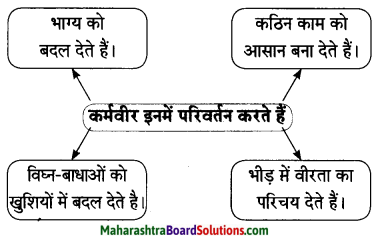
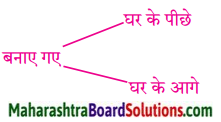
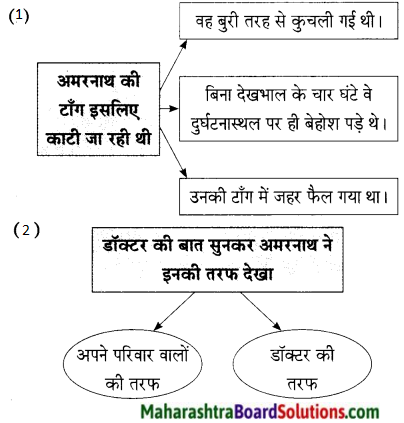
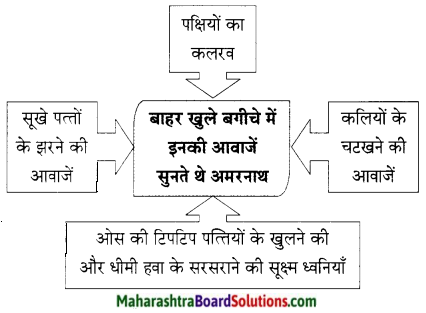
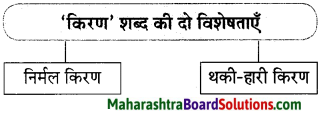
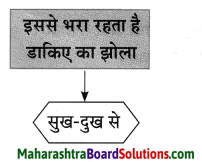
संजाल पूर्ण कीजिए।
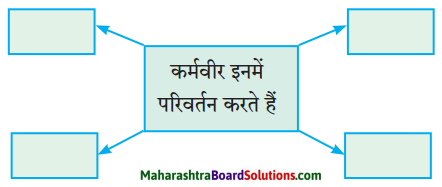
Maharashtra Board Class 10 Hindi Lokvani Solutions Chapter 8 कर्मवीर 1
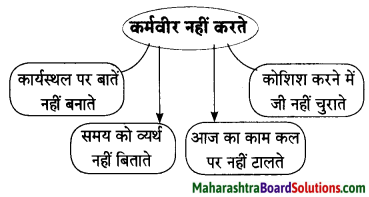
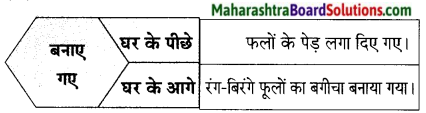
उत्तर:
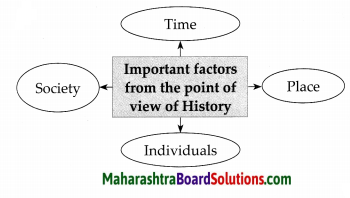
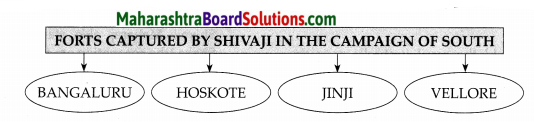
Maharashtra Board Class 10 Hindi Lokvani Solutions Chapter 8 कर्मवीर 2

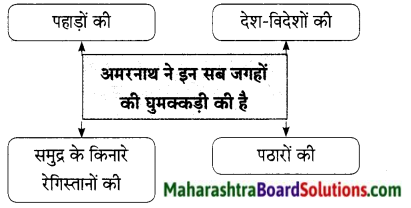
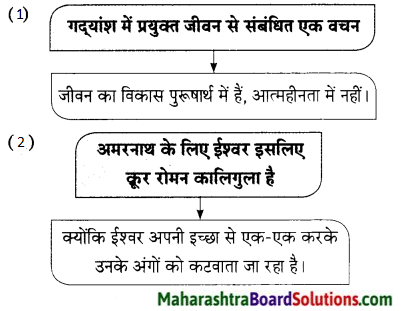
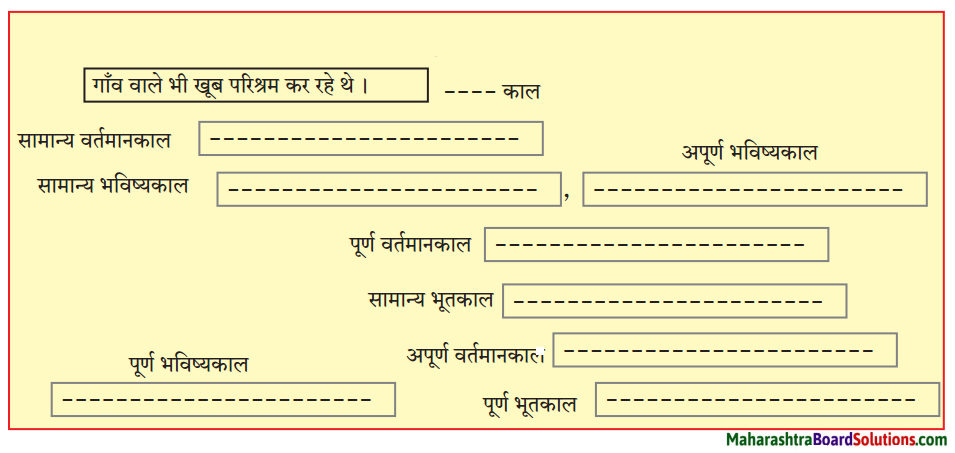
2. कृति पूर्ण कीजिए।

प्रश्न 1.
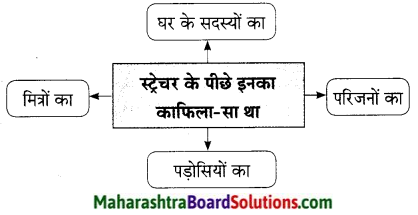
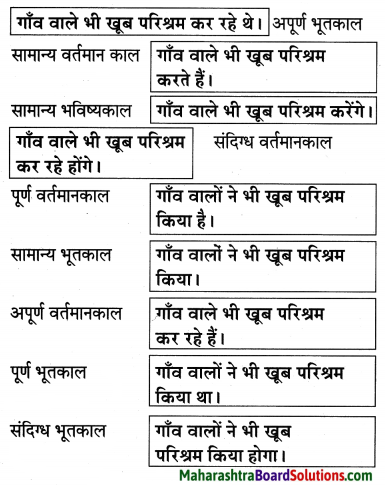
कृति पूर्ण कीजिए।
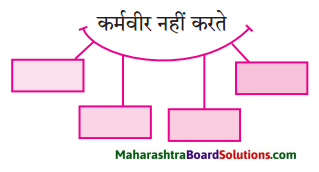
Maharashtra Board Class 10 Hindi Lokvani Solutions Chapter 8 कर्मवीर 3
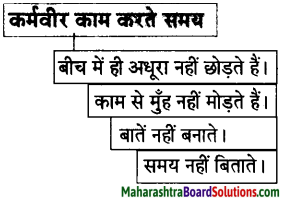
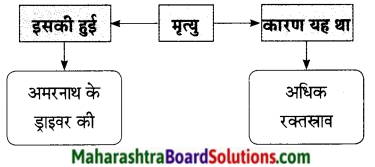
उत्तर:
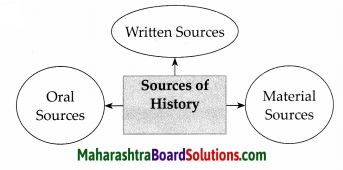
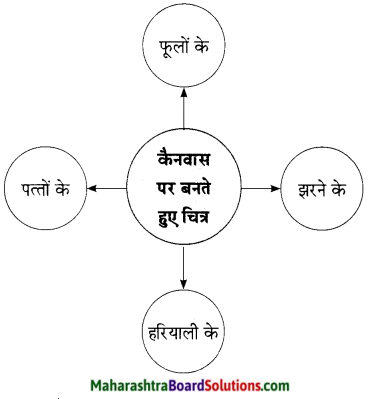
Maharashtra Board Class 10 Hindi Lokvani Solutions Chapter 8 कर्मवीर 4

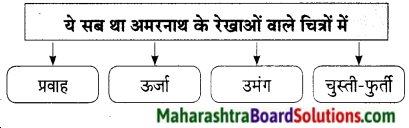
3. विशेषताएँ लिखिए :

प्रश्न 1.
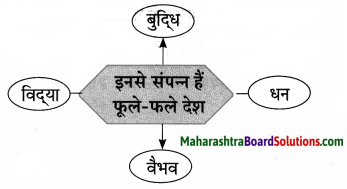
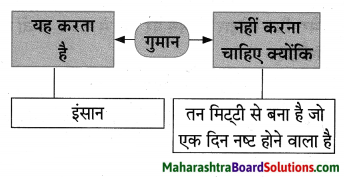
विशेषताएँ लिखिए :
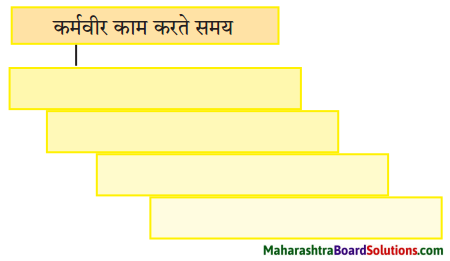
Maharashtra Board Class 10 Hindi Lokvani Solutions Chapter 8 कर्मवीर 5
उत्तर:
Maharashtra Board Class 10 Hindi Lokvani Solutions Chapter 8 कर्मवीर 6

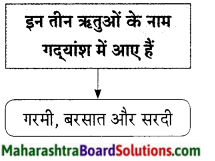
4. कविता में इस अर्थ में आए शब्द लिखिए 

प्रश्न 1.
कविता में इस अर्थ में आए शब्द लिखिए

  1. कर्मभूमि : ………………
  2. अकारण : ………………
  3. आकाश : ………………
  4. विशवास : ………………

उत्तर:

  1. कार्यस्थल
  2. वृथा
  3. गगन
  4. विशवास

Maharashtra Board Class 10 Hindi Lokvani Solutions Chapter 8 कर्मवीर

5. कविता की अपनी पसंदीदा चार पंक्तियों का सरल अर्थ लिखिए। 

प्रश्न 1.
कविता की अपनी पसंदीदा चार पंक्तियों का सरल अर्थ लिखिए।
उत्तर:
जो कभी अपने ……………………..चुराते हैं नहीं।
प्रस्तुत पंक्तियों के माध्यम से कवि ‘हरिऔध’ जी कहते हैं कि कर्मवीरों के लिए समय बहुत महत्त्वपूर्ण होता है। इसलिए वे समय को कभी व्यर्थ नहीं गवाते। जिस काम को जिस समय करना है उसे उसी समय करते हैं। वे काम को कल पर नहीं छोड़ते हैं। जहाँ काम करना हो वहाँ कोई बहानेबाजी और आनाकानी नहीं करते। आज का काम कल पर टालकर वे अपने दिनों को व्यर्थ नहीं गवाते। समय का सदुपयोग करना यही उनका कर्तव्य होता है। कोशिश अथवा मेहनत करने से वे कभी भी पीछे नहीं हटते ।

उपयोजित लेखन :

प्रश्न 1.
मुद्दों के आधार पर कहानी लेखन कीजिए।
एक हंस और एक कौए में मित्रता – हंस का कौए के साथ उड़ते जाना – कौए का दधिपात्र लेकर जाने वाले ग्वाले को देखना – ललचाना – कौए का दही खाने का आग्रह – हंस का इनकार – कौए का घसीटकर ले जाना – कौए का चोंच नचा – नचाकर दही खाना – हंस का बिलकुल न खाना – आहट पाकर कौए का उड़ जाना -हंस का पकड़ा जाना – परिणाम – शीर्षक।
उत्तर:
कुसंगति का फल एक जंगल था। उस जंगल में तरह-तरह के पक्षी एवं जानवर रहते थे। उस जंगल में एक बरगद के पेड़ पर एक हंस व एक कौआ भी रहता था। दोनों में गहरी मित्रता थी। एक दिन वे दोनों खुले आसमान में विचरण कर रहे थे। उस वक्त कौए की नजर सिर पर दधिपात्र लेकर जाने वाले एक ग्वाले पर गई।

दधिपात्र देखकर कौए के मुँह में पानी भर आया। उसने तपाक से हंस से कहा, “क्यों न हम दोनों मिलकर दधिपात्र से थोड़ा-थोड़ा दही खा लें।” हंस ने कहा, “नहीं भाई ! इस प्रकार चोरी या छिपकर खाने से आफत आ सकती है। हम पकड़े जा सकते हैं। फिर भी कौए ने हंस की एक न सुनी।

वह जबरन हंस को घसीटकर दधिपात्र के पास ले आया। वह बड़े मजे से दही को खाने लगा। ढेर सारा दही देखकर वह अपनी चोंच नचा-नचाकर दही खाने लगा। हंस सिर्फ उसके साथ था, लेकिन उसने दही को छुआ तक नहीं। दधिपात्र लेकर जाने वाले ग्वाले को एहसास हुआ कि दधिपात्र में से कौआ या अन्य पक्षी दही खाने की चेष्टा कर रहे हैं।

ग्वाले ने आव देखा न ताव तुरंत अपना दाहिना हाथ ऊपर कर उसने हंस को पकड़ लिया। तब तक आहट पाकर कौआ वहाँ से उड़ गया। बेचारा हंस! उसका बुरा हाल हुआ। ग्वाले ने उसे मार डाला। सीख : बुरे लोगों के साथ रहने से बुरा होता है। इसलिए हमें अच्छे लोगों के साथ रहना चाहिए।

Maharashtra Board Class 10 Hindi Lokvani Solutions Chapter 8 कर्मवीर

Hindi Lokvani 10th Std Textbook Solutions Chapter 8 कर्मवीर Additional Important Questions and Answers

(अ) निम्नलिखित पद्यांश पढ़कर दी गई सूचनाओं के अनुसार कृतियाँ कीजिए।

कृति अ (1): आकलन कृति

प्रश्न 1.
संजाल पूर्ण कीजिए।
उत्तर:

Maharashtra Board Class 10 Hindi Lokvani Solutions Chapter 8 कर्मवीर 7
Maharashtra Board Class 10 Hindi Lokvani Solutions Chapter 8 कर्मवीर 8

प्रश्न 2.
‘कर्मवीर दूसरों का मुँह नहीं ताकते’ इसका तात्पर्य है कि –
उत्तर:
वे स्वावलंबी होते हैं। अत: वे दूसरों पर निर्भर नहीं होते।

कति अ (2) : शब्द संपदा

प्रश्न 1.
निम्नलिखित शब्दों के अर्थ लिखिए।

  1. विघ्न
  2. बाधा
  3. भाग्य
  4. चंचल

उत्तर:

  1. संकट
  2. रुकावट
  3. नसीब
  4. अस्थिर

Maharashtra Board Class 10 Hindi Lokvani Solutions Chapter 8 कर्मवीर

प्रश्न 2.
विलोम शब्द लिखिए।
i. कठिन × …….
ii. निर्मल × …….
उत्तर
i. सरल
i. मलीन

प्रश्न 3.
निम्नलिखित अनेक शब्दों के लिए एक शब्द लिखिए –
i. अस्थिर स्वभाव का –
उत्तर :
i. चंचल

प्रश्न 4.
निम्नलिखित तद्भव शब्द का तत्सम शब्द लिखिए।
i. मुँह
ii. काम
उत्तर:
i. मुख
ii. कार्य

प्रश्न 5.
निम्नलिखित शब्द के वचन बदलिए।
i. बाधा
ii. काम
उत्तर:
i. बाधाएँ
ii. काम

Maharashtra Board Class 10 Hindi Lokvani Solutions Chapter 8 कर्मवीर

प्रश्न 6.
निम्नलिखित शब्द के समश्रुतभिन्नार्थक शब्द लिखिए।
i. मान
ii. भाग्य
उत्तर:
i. मन
i. भाग

कृति अ (3) : स्वमत अभिव्यक्ति

प्रश्न 1.
‘जो विघ्न-बाधाओं का सामना करता है वही सफल होता है।’ अपने विचार लिखिए।
उत्तर:
जीवन में सुख व दुख दोनों हैं। व्यक्ति के जीवन में अनुकूल व प्रतिकूल ये दोनों परिस्थितियाँ आती हैं। व्यक्ति को प्रतिकूल परिस्थिति का डरकर नहीं बल्कि डटकर सामना करना चाहिए। जो व्यक्ति जीवन में आने वाले संघर्षों का सामना करता है वह अंत में सफल हो जाता है। संघर्षों के साथ लड़ते समय उसमें अदम्य शक्ति निर्माण हो जाती है नई ऊर्जा का संचार हो जाता है। परिस्थितियाँ मनुष्य को जीवन अनुभवों से समृद्ध बनाती हैं। जिसके जीवन में संघर्ष नहीं; जो विघ्न-बाधाओं का सामना नहीं करता है, उस व्यक्ति का जीवन नीरस हो जाता है। जो व्यक्ति विघ्न-बाधाओं का सामना करता है वही अंत में अपनी मंजिल पाता है। ऐसा पुरुष ही जीवन का सच्चा कर्मवीर कहलाता है।

(आ) निम्नलिखित पद्यांश पढ़कर दी गई सूचनाओं के अनुसार कृतियाँ कीजिए।

कृति आ (1) : आकलन त

प्रश्न 1.
सही विकल्प चुनकर लिखिए।
i. कार्य कितना भी कठिन हो ………….
(अ) कर्मवीर उसे पूरा करने की ठान नहीं लेते हैं।
(आ) कर्मवीर उसे पूरा करने की ठान लेते हैं।
(इ) उसे पूरा करने की जिम्मेदारी दूसरों पर सौंपते हैं।
उत्तर:
(आ) कर्मवीर उसे पूरा करने की ठान लेते हैं।

Maharashtra Board Class 10 Hindi Lokvani Solutions Chapter 8 कर्मवीर

ii. कर्मवीर आसमान के फूलों को व्यर्थ बातों से नहीं तोड़ते अर्थात
(अ) वे अपनी प्रशंसा के लिए बड़ी-बड़ी बातें नहीं बनाते।
(आ) वे अपनी प्रशंसा के लिए बड़ी-बड़ी बातें बनाते हैं।
(इ) वे अपनी प्रशंसा के लिए किसी भी हद तक जा सकते हैं।
उत्तर:
(अ) वे अपनी प्रशंसा के लिए बड़ी-बड़ी बातें नहीं बनाते।

कृति आ (2) : शब्द संपदा

प्रश्न 1.
कविता में इस अर्थ में आए शब्द लिखिए।
i. सहायता : ………………
ii. दिवस : ……………….
उत्तर:
i. मदद
ii. दिन

प्रश्न 2.
निम्नलिखित शब्द में उचित उपसर्ग व प्रत्यय लगाकर शब्द लिखिए।
i. समय
उत्तरः
उपसर्गयुक्त शब्द : असमय
प्रत्यययुक्त शब्द : सामयिक

Maharashtra Board Class 10 Hindi Lokvani Solutions Chapter 8 कर्मवीर

प्रश्न 3.
निम्नलिखित शब्दों में उचित उपसर्ग लगाइए।
i. यत्न
ii. मन
उत्तर:
i. प्र + यत्न = प्रयत्न
ii. बे + मन = बेमन

प्रश्न 4.
पद्यांश में प्रयुक्त विलोम शब्द की जोड़ी लिखिए।
उत्तर:
i. आज × कल

प्रश्न 5.
निम्नलिखित तत्सम शब्द का तद्भव रूप लिखिए।
i. संपदा
ii. वृथा
उत्तर:
i. संपत्ति
ii. व्यर्थ

कृति अ (3) : स्वमत अभिव्यक्ति

प्रश्न 1.
‘समय का सदुपयोग करने से व्यक्ति जीवन में ऊँचा उठ सकता है।’ अपने विचार लिखिए।
उत्तरः
मानव जीवन में समय का सदुपयोग अत्यंत महत्त्वपूर्ण है। जो व्यक्ति समय के साथ चलता है वह प्रगति की सीढ़ी हासिल कर लेता है। समय का सदुपयोग करने वाले व्यक्ति को सभी सुखों की प्राप्ति होती है। समय पर कार्य करने वाले व्यक्ति के कारण समाज व राष्ट्र का भी भला होता है। विश्व के सभी महापुरुष समय की कीमत जानते थे।

इसलिए वे जीवन में महान बन सके। समय का सदुपयोग करने वाला व्यक्ति समय का सही विभाजन कर अध्ययन, खेलकूद, समाज सेवा, मनोरंजन आदि जैसे अनेक कार्य सरलतापूर्वक कर सकता है। समय का सदुपयोग करने वाला व्यक्ति समय के साथ कदम से कदम मिला कर चलता है और जीवन में अनेक सफलताओं को प्राप्त करता है।

Maharashtra Board Class 10 Hindi Lokvani Solutions Chapter 8 कर्मवीर

(इ) पद्यांश पढ़कर दी गई सूचनाओं के अनुसार कृतियाँ कीजिए।

कृति इ (1) : आकलन कृति

प्रश्न 1.
सही विकल्प चुनकर वाक्य फिर से लिखिए।
i. कर्मवीरों का नया उत्साह देखने को मिलता है –
(अ) जब उन्हें उलझनें आकर घेर लेती हैं।
(आ) जब वे अपना काम पूरा कर लेते हैं।
(इ) जब वे कार्यस्थल से दूर चले जाते हैं।
उत्तरः
(अ) जब उन्हें उलझनें आकर घेर लेती हैं।

प्रश्न 2.
संजाल पूर्ण कीजिए।
उत्तरः
Maharashtra Board Class 10 Hindi Lokvani Solutions Chapter 8 कर्मवीर 9

प्रश्न 3.
निम्नलिखित शब्द पढ़कर ऐसे दो प्रश्न तैयार कीजिए जिनके उत्तर निम्न शब्द हों –
i. कर्मवीर
ii. कार्यस्थल
उत्तर:
i. असंभव को संभव कौन बनाते हैं?
ii. कर्मवीर किसके बारे में पूछते नहीं है?

Maharashtra Board Class 10 Hindi Lokvani Solutions Chapter 8 कर्मवीर

कृति इ (3) : शब्द संपदा.

प्रश्न 1.
निम्नलिखित शब्दों में उचित प्रत्यय लगाकर नए शब्द तैयार कीजिए।
i. बुद्धि
ii. देश
उत्तर:
i. बुद्धि + मान = बुद्धिमान
ii. देश + ई = देशी

प्रश्न 2.
निम्नलिखित तत्सम शब्द का तद्भव रूप लिखिए।

  1. सपूत
  2. हस्त
  3. नव

उत्तरः

  1. सुपुत्र
  2. हाथ
  3. नया

प्रश्न 3.
समानार्थी शब्द लिखिए।
i. उत्साह
ii. बुद्धि
उत्तर:
i. उमंग
ii. मति

Maharashtra Board Class 10 Hindi Lokvani Solutions Chapter 8 कर्मवीर

प्रश्न 4.
कविता में इस अर्थ में आए शब्द लिखिए।
i. अच्छे पुत्र
उत्तर:
i. सपूत

प्रश्न 5.
पद्यांश में से विलोम शब्द की जोड़ी ढूँढकर लिखिए।
उत्तर:
i. असंभव × संभव
ii. यहाँ × वहाँ

प्रश्न 6.
‘सपूत’ इस शब्द में से उपसर्ग पहचानकर संबंधित उपसर्ग को लगाकर अन्य दो शब्द बनाइए।
उत्तरः
सपूत : उपसर्ग – स
अन्य शब्द : सकारण, सप्रमाण

Maharashtra Board Class 10 Hindi Lokvani Solutions Chapter 8 कर्मवीर

कृति ग (4) : अभिव्यक्ति

प्रश्न 1.
‘कर्म ही पूजा है, कर्म ही श्रेष्ठ है।’ विषय पर अपने विचार लिखिए।
उत्तर:
गीता में लिखा है कि कर्म ही पूजा है। कर्म से बढ़कर व्यक्ति का अन्य कोई धर्म नहीं है। इसलिए कर्म करना मनुष्य का पहला लक्ष्य होना चाहिए। कर्म करने से व्यक्ति को आनंद मिलता है। सच्चे मन से किया गया कर्म सफल होता है। मनुष्य के कर्म को ही संसार में याद किया जाता है। उसकी मृत्यु के उपरांत वह सिर्फ अपने कर्मों के कारण ही याद किया जाता है। इसलिए सभी को आलस्य त्यागकर कर्म में लीन हो जाना चाहिए। कर्म सफलता का आधार है। कर्म ही श्रेष्ठ है। कर्म करने से ही व्यक्ति के जीवन को सुख की अनुभूति प्राप्त होती है। सबकी भलाई के लिए कर्म करते हुए जीना ही जीवन का मूलमंत्र है।

कर्मवीर Summary in Hindi

जीवन-परिचय :

अयोध्यासिंह उपाध्याय ‘हरिऔध’ जी का जन्म उत्तर प्रदेश राज्य के आजमगढ़ जिले में हुआ था। ये हिंदी साहित्य के एक प्रमुख हस्ताक्षर थे तथा हिंदी साहित्य सम्मेलन के सभापति भी रह चुके हैं। हिंदी साहित्य सम्मेलन समिति के द्वारा इन्हें विद्यावाचस्पति की उपाधि से सम्मानित किया जा चुका है। खड़ी बोली हिंदी साहित्य के विकास में इनका विशेष योगदान रहा है। वियोग तथा वात्सल्य वर्णन, लोक सेवा की भावना व प्रकृति चित्रण इनके काव्य की विशेषता है।
प्रमुख कृतियाँ : ‘वैदेही वनवास’, ‘प्रिय-प्रवास’ (महाकाव्य), ‘ठाठ’, ‘अधखिला फूल’ (उपन्यास), ‘रुक्मणी परिणय’, ‘विजय व्यायोग’ (नाटक) आदि।

पद्य-परिचय :

आधुनिक पद्य : सन 1900 से आधुनिक पद्य की शुरुआत हुई। महावीर प्रसाद द्विवेदी जी के प्रभाव से ब्रज भाषा से हिंदी कविता हटकर खड़ी बोली हिंदी में लिखी जाने लगी। भारत का उज्ज्वल अतीत, देशभक्ति, सामाजिक सुधार, स्वभाषा प्रेम, मानवीय गुण आदि का खड़ी बोली हिंदी में प्रयोग होने लगा। मधुरता एवं सरलता ने हिंदी कविता में प्रवेश कर लिया।
प्रस्तावना : ‘कर्मवीर’ इस कविता के माध्यम से कवि ‘हरिऔध’ जी ने यह बताने का प्रयास किया है कि कर्मवीरों के लिए कर्म ही पूजा होती है, वे कर्म करने के लिए सदैव तत्पर रहते हैं, वे असंभव को संभव बना देते हैं, तथा देश और समाज को उन्नति के मार्ग पर ले जाते हैं।

Maharashtra Board Class 10 Hindi Lokvani Solutions Chapter 8 कर्मवीर

सारांश :

‘कर्मवीर’ यह एक आधुनिक पद्य है। इस कविता के माध्यम से कवि ने मानवीय गुणों का संचय करने की प्रेरणा दी है। कवि ने कर्मवीरों के पास जो महान गुण होते हैं उनका अनुसरण करने के लिए पाठकों को प्रेरित किया है। कवि कहते हैं, “मनुष्य को विघ्न-बाधाओं का डटकर मुकाबला करना चाहिए। काम के प्रति उकताहट नहीं करनी चाहिए। मनुष्य को स्वावलंबी होना चाहिए। उसे कभी भी किसी पर आश्रित नहीं होना चाहिए।

मनुष्य को समय का सदुपयोग करना चाहिए। कार्य कितना भी कठिन हो फिर भी उसे पूरा करने की ठान लेनी चाहिए। मनुष्य को मुसीबतों का सामना करते हुए असंभव कार्य को संभव कर दिखाना चाहिए। मनुष्य की कर्मनिष्ठा मनुष्य का विकास करेगी पर इसके साथ वह जिस समाज व राष्ट्र में रहता है उसका भी विकास होता है। अत: प्रत्येक मनुष्य का कर्तव्य है कि वह कर्म को श्रेष्ठ मानकर देश और समाज को उन्नति के मार्ग पर ले जाए।

भावार्थ :

देखकर जो ………………………………. वीर दिखलाते नहीं।
कवि ‘हरिऔध’ जी कहते हैं कि कर्मवीर विघ्न बाधाओं को देखकर घबराते नहीं। वे कभी भाग्य के भरोसे नहीं बैठते हैं। इसलिए भाग्य द्वारा दुख मिलने पर उन्हें पछतावा नहीं होता। काम कितना भी कठिन हो फिर भी उन्हें काम के प्रति कोई उकताहट नहीं होती। उनके लिए कर्म ही पूजा होती है। भीड़ अथवा मुश्किलों को देखकर भी उन पर उसका कुछ भी प्रभाव नहीं पड़ता है। वे सच्चे वीर होते हैं। वे किसी भी स्थिति में डरते नहीं हैं।

मानत जी की हैं ………………………….. जिसे सकते नहीं।
‘कवि ‘हरिऔध’ जी कहते हैं कि कर्मवीर सबकी बात सुनते हैं लेकिन, कार्य करते समय अपने मन की बात मानते हैं। वे स्वावलंबी होते हैं। वे कभी भी किसी पर आश्रित नहीं होते। वे स्वयं का काम स्वयं पूरा करते हैं। वे कभी भी किसी भी चीज के लिए दूसरों का मुँह नहीं ताकते। अर्थात किसी भी वस्तु के लिए वे दूसरों पर आश्रित नहीं होते हैं। इस दुनिया में भला ऐसा कौन-सा काम है जिसे वे पूरा नहीं कर सकते? अर्थात वे सारे काम करने में सक्षम होते हैं।

जो कभी अपने ………………………………..चुराते हैं नही।
कवि ‘हरिऔध’ जी कहते हैं कि कर्मवीरों के लिए समय बहुत ही महत्त्वपूर्ण होता है। इसलिए वे समय को कभी व्यर्थ नहीं गँवाते। जिस काम को जिस समय करना है उसे उसी समय करते हैं। उसे कल पर नहीं छोड़ते हैं। जहाँ काम करना हो वहाँ कोई बहानेबाजी और आनाकानी नहीं करते। आज का काम कल पर टालकर वे अपने दिनों को व्यर्थ नहीं गँवाते। समय का सदुपयोग करना यही उनका कर्तव्य होता है। कोशिश या मेहनत से वे कभी भी पीछे नहीं हटते ।

काम को आरंभ ……………………………………. नहीं जो जोड़ते।।
कवि ‘हरिऔध’ जी कहते हैं कि कर्मवीर कार्य को कभी भी बीच में छोड़ते नहीं हैं। कार्य कितना भी कठिन हो फिर भी वे उसे पूरा करने की ठान लेते हैं। काम को पूरा करते समय यदि कोई मुसीबत आ जाए तो भी पीछे नहीं हटते; वे काम से मुँह नहीं मोड़ते। कर्मवीर आसमान के फूलों को व्यर्थ बातों से नहीं तोड़ते अर्थात वे अपनी प्रशंसा के लिए बड़ी-बड़ी बातें नहीं बनाते। जिस कार्य को करना है बस उसी पर अपना : ध्यान केंद्रित करते हैं। वे मन से करोड़ों की संपदा नहीं जोडते।

कार्य थल ……………………………… उतना ही वहाँ।
कवि ‘हरिऔध’ जी कहते हैं कि कर्मवीर कार्यस्थल की तलाश में यहाँ-वहाँ खोजने के लिए भटकते नहीं। वे जहाँ होते हैं वहीं उनका कार्यस्थल होता है। कर्मवीर मुसीबतों का सामना करते हुए असंभव कार्य को भी संभव कर दिखाते हैं। आने वाली उलझनों और मुसीबतों से वे डरते नहीं बल्कि उनका वे उतने ही उत्साह से सामना करते हैं। उलझनों को देखकर उनमें नया जोश और नई चेतना आ जाती है और वे अपना कार्य उत्साह से करते हैं।

सब तरह से ……………………………. सूपतों के पले।
कवि ‘हरिऔध’ जी के अनुसार, आज विश्व में कई ऐसे देश हैं; ‘जो समृद्ध व संपन्न हैं’ प्रगत एवं विकसित हैं। वहाँ पर विद्या, धन, बुद्धि व ऐश्वर्य का भंडार है। इसका कारण है कि वहाँ पर रहने वाले लोगों ने कर्म को ही अपना लक्ष्य मान लिया है। कर्मवीरों के पुरुषार्थ से ही देश संपन्न हुए हैं। कर्मवीरों के कारण ही सबका भला हुआ है। उनके कारण ही चारों ओर प्रगति की लहर छाई हुई है। ऐसे महान सपूतों के कारण ही सभी का जीवन खुशहाल बना है।

Maharashtra Board Class 10 Hindi Lokvani Solutions Chapter 8 कर्मवीर

शब्दाथ :

  1. विघ्न – संकट
  2. बाधा – रुकावट
  3. भाग्य – नसीब
  4. चंचल – अस्थिर
  5. वृथा – अकारण, व्यर्थ
  6. गगन – आकाश
  7. मदद – सहायता
  8. दिन – दिवस
  9. उत्साह – उमंग
  10. संपदा – धन, दौलत
  11. बुद्धि – मति
  12. वैभव – ऐश्वर्य
  13. उकताना – ऊबना
  14. यत्न – प्रयत्न

मुहावरे :

  1. असंभव को संभव बनाना – कठिन काम को सरल बनाना।
  2. मुँह ताकना – दूसरों पर आश्रित होना।
  3. जी चुराना – आलस करना।
  4. बातें बनाना – बहाने बनाना।

Maharashtra Board Class 8 English Solutions Chapter 3.2 The Kite Festival

Balbharti Maharashtra State Board Class 8 English Solutions Chapter 3.2 The Kite Festival Notes, Textbook Exercise Important Questions and Answers.

Maharashtra State Board Class 8 English Solutions Chapter 3.2 The Kite Festival

Class 8 English Chapter 3.2 The Kite Festival Textbook Questions and Answers

The Kite Festival Std 8 Warming Up:

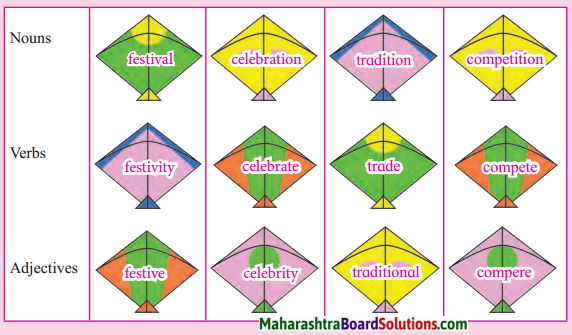
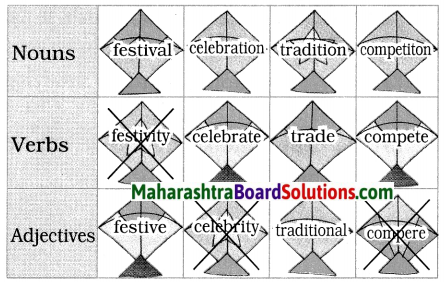
1. Cut out the wrong kites:
Maharashtra Board Class 8 English Solutions Chapter 3.1 The Plate of Gold 8
Answer:
Maharashtra Board Class 8 English Solutions Chapter 3.1 The Plate of Gold 9

Maharashtra Board Class 8 English Solutions Chapter 3.2 The Kite Festival

2. Name the festival that you enjoy the most of all. Fill in the facts about that festival.
(a) Name of the festival:_______.
(b) When it is celebrated: _______.
(c) Why it is celebrated: ______.
(d) How it is celebrated: _______.
(e) Special cuisine: _______.
(f) Other special features: _______.
Answer:
Students can discuss and write down details about their favourite festival. They can consult their parents/friends / the internet, etc.

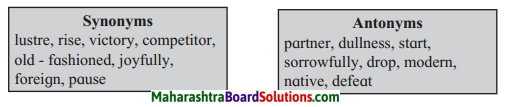
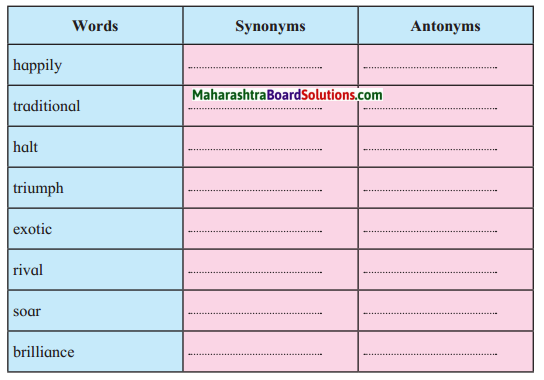
1. Give the Antonyms und Synonyms of the words below, choosing from those given:

Maharashtra Board Class 8 English Solutions Chapter 3.1 The Plate of Gold 10

Maharashtra Board Class 8 English Solutions Chapter 3.1 The Plate of Gold 11
Answer:

WordsSynonymsAntonyms
HappilyJoyfullySorrowfully
TraditionalOld-fashionedModern
Haltpausestart
Triumphvictorydefeat
Exoticforeignnative
Rivalcompetitorpartner
Soarrisedrop
Brilliancelustredullness

Maharashtra Board Class 8 English Solutions Chapter 3.2 The Kite Festival

2. Say whether the following statements are true or false:

Question a.
Fibreglass kites led to creating power – driven aeroplanes.
Answer:
False

Question b.
In Gujarat, the kite – festival is celebrated to welcome the Spring.
Answer:
False

Question c.
Uttarayana’ starts from Makar Sankranti onwards.
Answer:
True

Question d.
Kite – flying in Gujarat, is a competitive sport – cum – festival.
Answer:
True

Question e.
The kite – Bazar in Ahmedabad, is open day and night for a week.
Answer:
True

Question f.
The special thread for kite – flying is sharpened by adding sugar and glass pieces.
Answer:
False

3. Using points from the lesson, give the details of the following in a short paragraph for each topic:

Question a.
Different types of kites.
Answer:
Traditional kites are made of kite paper and have thin wooden frames. The modern kites may be motorized or made of fibreglass. Exotic kites have marvellous shapes such as that of eagles and snakes. There are also illuminated box-kites called tukals.

Maharashtra Board Class 8 English Solutions Chapter 3.2 The Kite Festival

Question b.
International Kite Festival at Ahmedabad.
Answer:
The International Kite Festival at Ahmedabad is held either at the Sardar Patel Stadium or the Police Stadium. It attracts international kite-flyers as well as local champions. Little Indian paper kites compete with those from Japan, USA, UK and other countries. Exotic kites with marvellous shapes such as eagles and snakes soar in the sky. The Patang or Kite Bazar, in the heart of Ahmedabad, is open 24 hours a day for a whole week, and people crowd the streets through the night. Skilled craftsmen demonstrate age- old kite-making skills and how to prepare special thread. At night, illuminated box- kites are sent into the sky.

Question c.
The kite Bazar of Ahmedabad.
Answer:
During the Kite Festival at Ahmedabad, the Patang or Kite Bazar, in the heart of Ahmedabad, is open 24 hours a day for a whole week. People crowd the streets and buy their stocks, haggling through the night. Skilled craftsmen demonstrate age-old kite-making skills and how to prepare special thread covered with a mixture of glue and ground glass.

4. You hue just returned after your first experience of the kite – festival in Gujarat/Ahmedabad. You were thrilled with the festivities.

Write a short report about the kite – festival for your local newspaper. Give an attractive headline, a dateline and an account of the kite – festive. Write the report in third person with more use of Passive voice.
You have a friend who lives abroad. Write a letter to your friend describing how you enjoyed the kite-festival.

Maharashtra Board Class 8 English Solutions Chapter 3.2 The Kite Festival

5.A. Verb forms show both, Tense (Present, Past, Future) and Aspect (Progressive, Perfect,Perfect Progressive):

Progressive (Continuous): be + verb-ing
Present Progressive: He is playing.
Past Progressive: He was playing.
Future Progressive: He will be playing.

Perfect: have / has / hod verb – en / cd
Present Perfect: They have played.
Past Perfect: They had played.
Future Perfect: They will have played.

Perfect Progressive: have/has/had + been + verb – ing
Present Perfect Progressive: We have been playing.
Past Perfect Progressive: We had been playing.
Future Perfect Progressive: We shall have been playing.

5. B. Underline the verb forms in the following sentences and state their Tense and Aspect:

(i) They are waiting for the right winds.
(ii) People were haggling over the price of kites.
(iii) Vendors had been selling kites all through the week.
(iv) Skilled craftsmen had demonstrated age-old skills.
(v) State Tourism Corporation will be organising the International Kite Festival.
(vi) Kite – flyers have demonstrated their skills with exotic kites.
Answer:

SentencesTenseAspect
i. They are waiting for the right winds.presentprogressive
ii. People were haggling over the price of kites.pastprogressive
iii. Vendors had been selling kites all through the week.pastperfect  progressive
iv. Skilled craftsmen had demonstrated age-old skills.pastperfect
v. State Tourism Corporation will be organizing the International Kite Festival.futureprogressive
vi. Kite-flyers have demonstrated their skills with exotic kites.presentperfect

Maharashtra Board Class 8 English Solutions Chapter 3.2 The Kite Festival

Class 8 English Chapter 3.2 The Kite Festival Additional Important Questions and Answers

Complete the table showing how modern ones:

The Kite Festival Std 8 Question 1.

Kites of the pastModem kites

Answer:

Kites of the pastModem kites
(1) made of kite paper
(2) had thin wooden frames
(3) box kites
(1) motorized kites
(2) kites made of fibreglass

The Kite Festival Std 8 Questions And Answers Question 2.
When is kite-flying at its peak in India?
Answer:
Kite-flying is at its peak in India during the coming of Spring and during the festival of Makar Sankranti, which coincides with the festival of Uttarayan.

3.2 The Kite Festival Questions And Answers Question 3.
Write how they celebrate the kite-flying festival in Gujarat.
Answer:
During the kite-flying festival, people of all ages go out into the open to fly kites and to cut’ each others’ kites. In towns and cities, where open spaces are difficult to find, terraces and rooftops are often used to fly the kites.

Activities based on Contextual Grammar:

The Kite Festival Questions And Answers Question 1.
People of all ages go out into the open to try their luck with their kites.
(Pick out the finite verbs and the infinitives.)
Answer:
finite verb – go; infinitive – to try

The Kite Festival Std 8 Question Answer Question 2.
It is also a celebration to mark the end of winter. (Rewrite using ‘which’.)
Answer:
It is also a celebration which marks the end of winter.

Maharashtra Board Class 8 English Solutions Chapter 3.2 The Kite Festival

Personal Response:

The Kite Festival Std 8 Question Answer Question 1.
Do you like flying kites? Why?
Answer:
I am not a very big fan of kites. I do not like to fly them, but I like to watch other people do so. I used to fly kites earlier; but once I came to know that birds died because of the glass-covered thread, and there were injuries to people too, I stopped this sport.

List the reasons:

The Kite Festival Answers Question 1.
The kite-festival at Ahmedabad is very special.
Answer:
The kite-festival at Ahmedabad is very special because:

  • An International Kite Festival is held either at the Sardar Patel Stadium or the Police Stadium.
  • It attracts international kite-flyers as well as local champions.
  • Little Indian paper kites compete with those from Japan, the USA, UK and other countries.
  • Exotic kites with marvellous shapes such as eagles and snakes soar in the sky.
  • The Patang or Kite Bazar in the heart of Ahmedabad is open 24 hours a day for a whole week, and people
  • crowd the streets through the night.
  • Skilled craftsmen demonstrate kite-making age-old skills and how to prepare a special thread.
  • At night, illuminated box-kites are sent into the sky.

3.2 The Kite Festival Question 2.
How do they celebrate the kite-flying festival in Gujarat?
Answer:
The kite-flying begins at dawn and continues throughout the day. People of all ages gather in the open, on rooftops and terraces. They compete with each other and are triumphant when someone cuts the thread of a rival. Some people prepare special lines for their kites. There is music in the air and traditional delicacies are specially prepared. An International Kite Festival is organized by the Gujarat State Tourism Corporation.

Complete the following:

Class 8 English Chapter 3.2 Question Answer Question 1.
A visit to the Patang Bazar proves that _______.
Answer:
the entire city of Ahmedabad is obsessed with kites

Question 2.
The special thread for kite-flying is prepared by ________.
Answer:
covering the thread with a mixture of glue and ground glass and allowing it to dry

Maharashtra Board Class 8 English Solutions Chapter 3.2 The Kite Festival

Answer the following:

Question 1.
Different types of kites:
Answer:
Traditional kites are made of kite paper and have thin wooden frames. The modern kites may be motorized or made of fibreglass. Exotic kites have marvellous shapes such as that eagles and snakes. There are also illuminated box-kites called tukuls.

Question 2.
International Kite Festival at Ahmedabad:
Answer:
The International Kite Festival at Ahmedabad is held either at the Sardar Patel Stadium or the Police Stadium. It attracts international kite-flyers as well as local champions. Little Indian paper kites compete with those from Japan, USA, UK and other countries. Exotic kites with marvellous shapes such as eagles and snakes soar in the sky. The Patang or Kite Bazar, in the heart of Ahmedabad, is open 24 hours a day for a whole week, and people crowd the streets through the night. Skilled craftsmen demonstrate age-old kite-making skills and how to prepare a special thread. At night, illuminated box- kites are sent into the sky.

Question 3.
The Kite-Bazar of Ahmedabad:
Answer:
During the Kite Festival at Ahmedabad, the Patang or Kite Bazar, in the heart of Ahmedabad, is open 24 hours a day for a whole week. People crowd the streets and buy their stocks, haggling through the night. Skilled craftsmen demonstrate age-old kite-making skills and how to prepare special thread covered with a mixture of glue and ground glass.

Question 4.
One of the highlights of this festival is the Patang Bazar, which is open twenty-four hours a day, for a whole week.
(Underline the clauses in the sentence.)
Answer:
One of the highlights of this festival is the Patang Bazar, which is open twenty-four hours a day, for a whole week.

Maharashtra Board Class 8 English Solutions Chapter 3.2 The Kite Festival

Question 5.
They add a grand beauty to the dark sky and compete with the brilliance of the stars.
(Rewrite as two separate sentences.)
Answer:
They add a grand beauty to the dark sky. They compete with the brilliance of the stars.

Personal Response:

Question 1.
What is the care to be taken by children while flying kites?
Answer:
Children should not run after kites on the road or try to rescue them from trees. This could lead to accidents. They should be careful if they are flying kites from terraces and rooftops. The thread should be handled with care, and there should be no injuries to animals or human beings because of it.

Do as directed:

Question 1.
Pick out two compounds, words from the lesson.
Answer:
Two compound words: kiteflying, power-driven

Question 2.
Use the following phrase in your own sentence: in the middle of the night.
Answer:
The baby woke up in the middle of the night and began to play.

Question 3.
Build a word chain of five adjectives :
Answer:
long → green → naughty → young → grateful → lovely.

Question 4.
Find out four hidden words from the given word:
traditional (Each word should have at least 3 letters.)
Answer:
traditional: tradition, train, drain, trait

Question 5.
Use the following word in two separate sentences, the word having different meanings (homographs):
watch
Answer:
(i) The policemen watched the house the whole day.
(ii) I was very upset as I had lost my watch.

Maharashtra Board Class 8 English Solutions Chapter 3.2 The Kite Festival

Question 6.
Underline the clauses in the following sentence:
There is music in the air and traditional delicacies are specially prepared for the day
Answer:
There is music in the air and traditional delicacies are specially prepared for the day.

Question 7.
Identify the type of sentence:
The little boy would happily pick up his kite and run out into the field.
Answer:
Assertive sentence.

Question 8.
Rewrite as an affirmative sentence:
In India, however, the tradition of kite-flying has not changed.
Answer:
In India, however, the tradition of kite-flying has remained the same.

Question 9.
Rewrite in indirect speech:
The harassed mother would often say
to her restless son, “Why don’t you go fly a kite ?”
Answer:
The harassed mother would often ask her restless son why he did not go fly a kite.

Question 10.
Use the following word as a noun and a verb in two separate sentences:
cut
Answer:

  • The cut on my hand healed soon, (noun)
  • I cut my finger when I was slicing a mango, (verb)

Maharashtra Board Class 8 English Solutions Chapter 3.2 The Kite Festival

Writing Skills:

Question 1.
You have just returned after your first experience of the kite-festival in Gujarat/Ahmedabad. You were thrilled with the festivities.
Write a short report about the kite festival for your local newspaper. Give an attractive headline, a dateline, and an account of the kite-festival. Write the report in the third person with more use of Passive Voice.
Answer:

High-Flying Kites Adorn The Sky

Ahmedabad, 17 January: A variety of colourful kites adorned the sky this year during the International Kite Festival here. A record number of countries participated in this annual festival. The famous International Kite Festival, organized by the Gujarat State Tourism Corporation, was held at the Sardar Patel Stadium. 14 countries, including India, participated. The kites were very colourful and in a variety of shapes. There were dragons, eagles, snakes, crocodiles, etc. Some had tiny lights in them, while j some were studded with stones. Excited spectators watched in awe as the kites; soared in the sky, free as birds.

This year, the first prize, a gold-plated cup in the shape of a kite, went to Korea. The Korean team succeeded in keeping their kite in the sky for the longest time. Last year’s winner and the host country, India, J did not stand a chance this year and were ; out of the competition at an early stage. “We will double our efforts for the next year and come out with flying colours,” said Rakesh ) Pandya, captain of the home team. We wish them all the best for the next year, Harsh Mehta.

Question 2.
You have a friend who lives abroad.
Write a letter to him/her describing how you enjoyed the kite-festival,
Answer:
‘Gulmohar’
Ahmedabad
17 January 2019

Hi Dominic,
How are you? You have hardly written j to me since you went to London. Why the silence?
Yes, I know you are busy, but you can spare some time for an old friend, can’t you?

Here in Ahmedabad, the kite festival is just over. We had a wonderful time flying kites and cheering others. The school was closed for two days, and my friends and I spent one j day watching the competition at the Police Stadium and the other day at the ground near our house, flying an assortment of kites. Our kites were ordinary ones, but you should have seen the exotic kites being flown at the Police Stadium! They were from Japan, the U.S., U.K., Thailand, Korea and other places. They were in the shape of eagles, snakes, crocodiles, dragons, etc. Some had shining tails while some had bejewelled bodies. The competition was very stiff-but guess what! The first prize was won by the Indian team!
Our own competition too was very thrilling. We cut so many kites! We were also awake the whole night shopping for kites and eating. It was really a wonderful time.

Well, I hope that next year you will be back in India and maybe you can come to Ahmedabad during this time. You will certainly enjoy the festival-and the eats! Hope you find time to reply.
Your friend,
Harsh.
Maharashtra Board Class 8 English Solutions Chapter 3.2 The Kite Festival

Maharashtra Board Class 8 English Solutions Chapter 3.3 The Last Leaf

Balbharti Maharashtra State Board Class 8 English Solutions Chapter 3.3 The Last Leaf Notes, Textbook Exercise Important Questions, and Answers.

Maharashtra State Board Class 8 English Solutions Chapter 3.3 The Last Leaf

Class 8 English Chapter 3.3 The Last Leaf Textbook Questions and Answers

3.3 The Last Leaf Warming Up:

1. Suppose you suffer from a long – term illness (one or two weeks), what should you do and what should you avoid? Fill up the table of Do’s and Don’ts:

Do’sDon’ts
(1) Go to a doctor for a diagnosis.(1) Do not …………..
(2) …………(2) Do not avoid medication on time.
(3) Take a suitable diet.(3) Avoid …………..
(4) Take rest.(4) Avoid physical stress and exertion.
(5) Rest in a properly ventilated room.(5) Do not …………….
(6) Have cheerful thoughts, courage, a positive attitude.(6) Do not lose …….. and ………….

Answer:

Do’sDon’ts
(1) Go to a doctor for diagnosis.(1) Do not try any medication on your own.
(2) Take medicines on time.(2) Do not avoid medication on time.
(3) Take a suitable diet.(3) Avoid junk food.
(4) Take rest.(4) Avoid physical stress and exertion.
(5) Rest in a properly ventilated room.(5) Do not close doors and windows.
(6) Have cheerful thoughts, courage, a positive attitude.(6) Do not lose hope and courage.

Maharashtra Board Class 8 English Solutions Chapter 3.3 The Last Leaf

2. You already know that Homophones are pairs of words that sound the same but differ in spellings and meanings:
For example sum and some
There are some words that even have the same spelling and pronunciations, but have different meanings in different situations or contexts.
For example: bat (a bird) and ki (sports / games equipment)
Such words are called Homographs.
Make pairs of sentences of your own to point out the different meanings of the following Homographs

The Last Leaf Class 8 Questions And Answers Maharashtra Board Question 1.
fine:
Answer:
(i) The new driver had to pay a fine for breaking the signal.
(ii) We decided to go for a picnic only if the day was fine.

The Last Leaf Class 8 Questions And Answers Question 2.
wave:
Answer:
(i) Ronny waved to his father before going for the picnic.
(ii) The waves in the sea before the tsunami were huge.

The Last Leaf Question Answer Class 8 Question 3.
bear:
Answer:
(i) The grizzly bear hibernates during winter.
(ii) Simi could not bear to see the two cats fighting.

3.3 The Last Leaf Question 4.
rose:
Answer:
(i) The rose is a beautiful flower.
(ii) The teacher rose from her chair to explain the sum.

Maharashtra Board Class 8 English Solutions Chapter 3.3 The Last Leaf

3.3 The Last Leaf Questions And Answers Question 5.
lead:
Answer:
(i) Lead is used in pencils.
(ii) A good king leads his country to prosperity.

Class 8 English Chapter 3.3 The Last Leaf Question Answer Question 6.
match:
Answer:
(i) Though we lost the match, we were not upset,
(ii) “Buy the shoes only if they match the dress,” said mother to Madhu.

The Last Leaf Class 8 Questions And Answers Pdf Question 7.
second:
Answer:
(i) Every second counts when we are writing an examination paper.
(ii) “Take the second turn on the right,” directed the policeman.

The Last Leaf 8th Standard Question 8.
object:
Answer:
(i) The lawyer objected to what the witness said.
(ii) The objects on the table were taken away before the girl could see them properly.

1. Read the story and choose the appropriate meanings:

Question a.
Struggling artists:
(i) artists fighting with one another
(ii) artists trying hard to earn a living
(iii) artists painting war scenes
Answer:
(ii) artists trying hard to earn a living

Question b.
Skeleton branches:
(i) bones branching out from joints
(ii) leafy branches
(iii) bare branches
Answer:
(iii) bare branches

Question c.
Wielded the brush:
(i) painted skillfully
(ii) broke the brush
(iii) joined the broken brush
Answer:
(i) painted skillfully

Maharashtra Board Class 8 English Solutions Chapter 3.3 The Last Leaf

Question d.
Palette:
(i) the tip of the brush
(ii) a board used by artists to mix colours
(iii) a fancy dinner plate
Answer:
(ii) a board used by artists to mix colours

Question e.
Masterpiece:
(i) a master who promotes peace
(ii) the very first creation of on artist
(iii) an exceptionally beautiful work of art
Answer:
(iii) an exceptionally beautiful work of art

2. Make pairs of sentences to show the difference between the meanings of the following Homographs from the story:

Question a.
interest
Answer:
(i) The bank promised a high rate of interest to its customers.
(ii) The audience soon lost interest in the boring match.

Question b.
well
Answer:
(i) The well was so deep that one could not see the water.
(ii) The Principal sent Sumeet home as he was not feeling well.

Question c.
left
Answer:
(i) When Roma turned to her left, she saw a long line of taxis.
(ii) The Mayor had left before it begem to rain.

Maharashtra Board Class 8 English Solutions Chapter 3.3 The Last Leaf

Question d.
just
Answer:
(i) The children had just left when the magician arrived.
(ii) It is the duty of a judge to be just.

Question e.
mind
Answer:
(i) “Mind your language!” said the man to the rude young boy angrily.
(ii) We should try not to have any negative thoughts in our mind.

3. State the facts about the story:

Main characters:
Problem:
Attempts made to solve it:
Climax / Turning point:
Problem solved:
End:
Answer:
Main characters: Sue, Johnsy, the doctor and Behrman
Problem: Johnsy’s negative attitude, her lack of will to live and the fancy that she would die when the last leaf fell from the ivy vine.
Attempts made to solve it: The doctor informed Sue that Johnsy would recover only if she had the wish to live. Sue looked after her well and tried to make her think positively. Finally, Behrman painted a leaf on the wall so that the last leaf would never fall, and Johnsy would live.
Climax/Tuming point:
(i) When Johnsy sees the last leaf still clinging to the vine, and realizes that she has been given a message that she was wicked to want to die.
(ii) The sweeper finding Behrman in very wet clothes and shoes, with scattered brushes and a palette with yellow and green colors mixed on it.
Problem solved: Johnsy realizes her mistake and begins to look forward to life again.
End: Though Johnsy lives, Behrman, who painted the last leaf, contracts pneumonia due to exposure to rain and snow. He dies due to his efforts. He dies so that Johnsy lives.

Maharashtra Board Class 8 English Solutions Chapter 3.3 The Last Leaf

4. Say whether the following statements are right or wrong:

Question a.
Sue and Johnsy were very close friends.
Answer:
Right

Question b.
Sue was a rich girl.
Answer:
Wrong

Question c.
Johnsy was hopeful that she will live.
Answer:
Wrong

Question d.
Behrman was a hard-hearted person.
Answer:
Wrong

Question e.
The last leaf fell off during the rain.
Answer:
Right

Question f.
Johnsy realized that her thinking was wrong.
Answer:
Right

Question g.
Behrman did not know anything about the last leaf on the ivy.
Answer:
Wrong

5. Correct the following statements:

Question a.
Sue and Johnsy were good neighbours.
Answer:
Sue and Johnsy were very good friends.

Maharashtra Board Class 8 English Solutions Chapter 3.3 The Last Leaf

Question b.
Johnsy was eager to recover from her illness.
Answer:
Johnsy had made up her mind that she was not going to recover.

Question c.
Sue ignored Johnsy completely.
Answer:
Sue looked after Johnsy well.

Question d.
Behrman was a very heartless person.
Answer:
Behrman was a very kind-hearted person.

Question e.
The real ivy leaf did not fall off at all.
Answer:
The real ivy leaf fell off the night it rained and snowed.

Question f.
The last leaf was a real leaf that survived.
Answer:
The last leaf was a leaf painted on the wall by Behrman.

6. Read the descriptions of the following from the story and describe any one of them using your own words:

Question 1.
The ivy vine
Answer:
Outside the window there was an old ivy vine, gnarled and decayed at the roots. It had climbed half way up the brick wall. It had lost most of its leaves due to the cold autumn. Only a few bare branches were left, clinging to the bricks.

Maharashtra Board Class 8 English Solutions Chapter 3.3 The Last Leaf

Question 2.
Behrman
Answer:
Behrman was a struggling painter who lived on the ground floor of the building where Sue and Johnsy lived. He was a failure in art, for though he had been painting for forty years, he had not made any money. He always dreamt about painting a masterpiece, and often spoke about it, but had never got round to doing it. He served as a model for the young artists in the colony, who could not afford other models.

He was shocked when he heard about Johnsy’s fancy and thought that the place was not good for her. He was a generous, compassionate and kind- hearted man. Even though he was old, he braved the wind, rain and snow to go out and paint the last leaf on the wall. He died in order that Johnsy could live.

Question 3.
The last leaf that Johnsy saw
Answer:
The last leaf that Johnsy saw was not a real leaf but a leaf painted on the wall by Behrman. It was dark green near its stem, but its edges were tinted with yellow. It hung from a branch some twenty feet above the ground. Naturally it never fluttered or moved when the wind blew. It was Behrman’s masterpiece and had been painted the night when the real last leaf had fallen.

7. You have learnt that a Clause is a group of words that has a Subject and a Verb, and is a part of a larger sentence:
In the sentence, ‘We returned home, when school was over’ there are two clauses.
(i) We returned home and
(ii) When school was over’.
The first one makes complete sense, so it is called Main I Principal Clause. The second one is not complete by itself. It depends on the Main Clause to convey proper sense. So it is called Dependant or Subordinate Clause. ‘When’ is the joining word, and it is called o Subordinator.

In the following sentences, point out the Main Clause and Subordinate Clause. Encircle the Subordinator.

Question a.
There was a colony, where many struggling artists lived.
Answer:
Main Clause: There was a colony
Subordinate Clause: where many struggling artists lived
Subordlnator: where

Maharashtra Board Class 8 English Solutions Chapter 3.3 The Last Leaf

Question b.
Though Sue looked after her well, Johnsy showed no signs of improvement.
Answer:
Main Clause: Johnsy showed no signs of improvement
Subordinate Clause: Though Sue looked after her very well
Subordlnator: Though

Question c.
Sue thought that she had fallen asleep.
Answer:
Main Clause: Sue thought
Subordinate Clause: that she had fallen asleep
Subordinator: that

Question d.
Old Behrman was a painter, who lived on the ground floor.
Answer:
Main Clause: Old Behrman was a painter
Subordinate Clause: who lived on the ground floor
Subordlnator: who

Question e.
Johnsy was sleeping when the two went upstairs.
Answer:
Main Clause: Johnsy was sleeping
Subordinate Clause: when the two went upstairs
Subordlnator: when

Question f.
I want to see the last one before it falls.
Answer:
Main Clause: I want to see the last one
Subordinate Clause: before It falls
Subordlnator: before

Maharashtra Board Class 8 English Solutions Chapter 3.3 The Last Leaf

8. Compose an imaginary dialogue between Sue and Johns, when I realise what Behrman had done for Johnsy:
Answer:
Johnsy: Sue, did you know that Mr. Behrman had painted that last leaf?
Sue: No, I knew it just now, too.
Johnsy: Sue, that means that he got wet that night painting the last leaf!
Sue: And got pneumonia after that!
Johnsy: Yes, because of my stupid fancy that I would die when the last leaf fell.
Sue: It certainly was a stupid idea.
Johnsy: I feel so guilty now! Sue, it is as if …. as if …. he died for me!
Sue: Yes, so that you may live.
Johnsy: Oh, what a wonderful, compassionate man! To go out in that cold, wintry, snowy night just to paint that leaf!
Sue: And develop pneumonia ….
Johnsy: What can I do now? How can I ever thank him?
Sue: I know what you can do!
Johnsy: What? What?
Sue: Paint your masterpiece of the Bay of Naples and dedicate it to him.
Johnsy: Yes, I think that’s a good idea.Yes, I’ll do that. Thanks, Sue.

Class 8 English Chapter 3.3 The Last Leaf Additional Important Questions and Answers

Complex Factual Activities:

Question 1.
What did the doctor tell Sue about Johnsy?
Answer:
The doctor told Sue that Johnsy had one chance in ten. That chance was for Johnsy to want to live, and Johnsy had made up her mind that she was not going to get well. He also told Sue that medicines alone would not help if the patient did not want to live.

Question 2.
Describe the ivy vine outside the window.
Answer:
Outside the window, there was an old ivy vine, gnarled and decayed at the roots. It had climbed half way up the brick wall. It had lost most of its leaves due to the cold autumn. Only a few bare branches were left, clinging to the bricks.

Question 3.
Explain the false belief that Johnsy had about the ivy vine.
Answer:
Johnsy felt that when the last leaf fell off from the ivy vine, she too would die.

Maharashtra Board Class 8 English Solutions Chapter 3.3 The Last Leaf

Question 4.
Who was Behrman? Explain why Sue called Him to their flat.
Answer:
Behrman was a struggling painter who lived on the ground floor of the building where Sue and Johnsy lived. He served as a model for the young artists in the colony. Sue called him to their flat to act as a model for the old man that she was drawing.

Question 5.
What happened that night and what did the two friends see when the window was open?
Answer:
That night it rained and snowed. A fierce wind blew. When the window was open, the two friends saw one ivy leaf still clinging to the vine. It was dark green near the stem, but its edges were tinted with yellow. It hung from a branch some twenty feet above the ground.

Question 6.
What did Johnsy declare when she saw the last ivy leaf?
Answer:
When Johnsy saw the last ivy leaf, she declared that it would fall that day and she would die at the same time.

Question 7.
What change came over Johnsy the next day? Why?
Answer:
Johnsy now felt that she had been wicked earlier and it was a sin to want to die. She wanted to sit up in bed and was ready to have broth and milk. She looked forward to the future and hoped to paint the Bay of Naples some day. It was the sight of the last leaf staying on the vine that was the reason for her change.

Question 8.
Explain what happened to Mr. Behrman.
Answer:
Mr. Behrman had gone out in the rain and snow to paint the last leaf on the wall. He had got thoroughly wet and became ill with pneumonia. He died in a hospital two days later.

Question 9.
Who had saved Johnsy’s life and how?
Answer:
Mr. Behrman had saved Johnsy’s life. He had realized that Johnsy had a fancy that she would die after the last leaf; fell. He wanted to make certain that the last J leaf never fell, and hence he painted a false leaf on the wall. The sight of the persistent leaf, which Johnsy thought was real, made her come to her senses and want to live.

Maharashtra Board Class 8 English Solutions Chapter 3.3 The Last Leaf

Personal Response:

Question 1.
What type of attitude should a person have when he/she is ill?
Answer:
When a person is ill, he/she should have a positive attitude. He/She should have cheerful thoughts and courage and try to keep the mind occupied. Only then will medication help.

Question 2.
Do you think that Johnsy was talking nonsense? Or did she have some forewarning that she would die?
Answer:
I think that Johnsy was talking nonsense. How can the number of leaves on an ivy vine indicate when she was going to die? This is just having negative thoughts when the mind is idle and frightened.

Write who said the given words and to whom:

Question 1.

The wordsWho saidTo whom
(1) Open the window
(2) She is very ill and weak
(3) I have not heard of such a thing.
(4) It is the last one.

Answer:

The wordsWho saidTo whom
(1) Open the windowJohnsySue
(2) She is very ill and weakSueBehrman
(3) I have not heard of such a thing.BehrmanSue
(4) It is the last one.JohnsySue

Maharashtra Board Class 8 English Solutions Chapter 3.3 The Last Leaf

Write the words given below in the proper columns:

Question 1.
idiotic, fancy, foolish, weak, place, away, upstairs, work, rain, continuously,closed, window, fierce, bravely, branch,surely
Answer:

NounsAdjectivesAdverbs
fancy, place,idiotic,away,
work, rain,foolish,upstairs,
window,weak,continuously,
branchclosed,bravely,
fiercesurely

Do as directed:

Pick out two words from the lesson whose first letter is silent.
Answer:
pneumonia, gnarled.

Question 2.
Use the following phrase in your own sentence : above the ground
Answer:
During monsoon, the clouds are just a few feet above the ground in Ooty.

Question 3.
Add two letters before the given word to form three separate words:
own
Answer:
brown, crown, drown

Maharashtra Board Class 8 English Solutions Chapter 3.3 The Last Leaf

Question 4.
Find out four hidden words from the given word:
twilight (Each word should have at least 3 letters.)
Answer:
twilight: light, tight, wilt, tilt

Question 5.
Use the following word and its homophone in two separate sentences: earn
Answer:
(i) It is difficult to earn a living if you are illiterate.
(ii) I placed the flowers in an urn and poured water into it.

Question 6.
Pick out the main clause and subordinate clause from the following sentence:
Medicines alone did not help if the patient did not wish to live.
Answer:
Medicines alone did not help- the main clause if the patient did not wish to live-subordinate clause.

Question 7.
Rewrite in indirect speech :
“Open the window; I want to see,” she
ordered. Sue obeyed.
Answer:
She ordered Sue to open the window as she wanted to see. Sue obeyed.

Question 8.
Pick out the non-finite verb and state what it is:
He always talked of his coming masterpiece.
Answer:
coming – present participle

Question 9.
Rewrite as an affirmative sentence:
In those days, it was not easy to cure pneumonia patients.
Answer:
In those days, it was difficult to cure pneumonia patients.

Maharashtra Board Class 8 English Solutions Chapter 3.3 The Last Leaf

Question 10.
Rewrite using the positive form of the adjective:
They are falling faster now.
Answer:
They were not falling as fast as before.

Maharashtra Board Class 8 English Solutions Chapter 2.5 The Happy Prince

Balbharti Maharashtra State Board Class 8 English Solutions Chapter 2.5 The Happy Prince Notes, Textbook Exercise Important Questions and Answers.

Maharashtra State Board Class 8 English Solutions Chapter 2.5 The Happy Prince

Class 8 English Chapter 2.5 The Happy Prince Textbook Questions and Answers

2.5 The Happy Prince Warming Up:

1. There are different types of short stories. Use a dictionary/the Internet and find out what each of the following types refers to:

(a) fable :
(b) anecdote :
(c) fairy tale :
(d) parable :
(e) tragedy :
(f) humorous story :
(g) detective story :
(h) myth :
Answer:
(a) fable: moral bearing story with animal characters.
(b) anecdote: short amusing account of an incident.
(c) fairy tale: having supernatural characters/a moral for children.
(d) parable: having religious base and a message or moral.
(e) tragedy: serious and ends in a tragedy.
(f) humorous story: causing laughter and amusement; comic.
(g) detective story: the plot revolves around the investigation and solving of a crime/s.
(h) myth: originated in ancient times, authorship unknown.

Maharashtra Board Class 8 English Solutions Chapter 2.5 The Happy Prince

2. Have you heard of birds that fly from one part of the world to another in small or large flocks?
They are called Migratory birds. Discuss and write down two reasons why they migrate and return.
Answer:
Migratory birds’ migrate for food and for warmth. They return when the food supplies in their home area stabilize and winter changes to summer again.

3. Speech or dialogues can be reported in two ways Direct and Indirect.
When the exact words of the speaker are reported we call it Direct Speech. When the exact words of the speaker are not reported, but just its contents we call it Indirect Speech.
Direct Speech: Amar said, “I shall come to meet you, tomorrow, Sanket.”
Indirect Speech: Amar told Sanket that he would go to meet him, the next day.
Note down the changes you observe in the Indirect Speech.
Answer:

  • There are no inverted commas in j Indirect Speech.
  • The verb changes in Indirect ) Speech.
  • There is a change in the adverb in Indirect Speech.
  • The word‘that’is added in Indirect Speech.

1. Say whether these sentences are true or false and correct the false ones.

Question a.
The writer of the story is Wiiliam Blake.
Answer:
False
The writer of the story is Oscar wilde

Question b.
Everyone admired the statue of the Happy Prince.
Answer:
True

Maharashtra Board Class 8 English Solutions Chapter 2.5 The Happy Prince

Question c.
The mother was working, when the Swallow brought the yellow jewel.
Answer:
False
The mother was sleeping when the Swallow brought the yellow jewel.

Question d.
The two best things the servants brought to God were gold and jewel stones.
Answer:
False
The two best things the servants brought to God were broken heart and dead bird.

2. Find from the story the Homophones of the following words:
(Words that sound, the same, but differ in spellings and meanings.)
a. weak
b. their
c. blew
d. seo
e. read
f. waste
g. know
h. knot
i. threw
j. right
Answer:
a. weak – week
b. their – there
c. blew – blue
d. sea – see
e. read – – red
f. waste – waist
g. know – no
h. knot – not
i. threw – through
j. right – write

3. Answer the given questions in your own words:

Question a.
Where was the Happy Prince’s statue located?
Answer:
The Happy Prince statue located high above the city.

Question b.
Why did the swallow decide to stay under the statue of the Happy Prince at night?
Answer:
The Swallow decided to stay under the statue of the Happy Prince at night because it was high up, and so there was plenty of fresh air.

Maharashtra Board Class 8 English Solutions Chapter 2.5 The Happy Prince

Question c.
Why was the Prince sad?
Answer:
The Prince was sad to see all unhappiess of the city.

Question d.
What was the first task given to the Swallow?
Answer:
The Happy Prince asked the Swallow to take the great red jewel from his waist and give it to a poor woman whose son was ill and hungry. This was the Swallow’s first task.

Question e.
To whom did the Prince gift the two gemstones of his eyes?
Answer:
The prince gave one of the two gemstones of his eyes to a Door little girl whose eggs had fallen to the ground and broken.

Question f.
What decision did the Swallow finally make? Was it a wise one? Comment.
Answer:
The Swallow finally decided not to go to Egypt but to remain with the Happy Prince, whom he loved very much. It may not have been a wise decision because it led to the death of the Swallow, but it was a decision made from the heart and was an emotional decision that was rewarded in heaven.

Question g.
Why did the Swallow finally decide not to leave the Prince?
Answer:
The Swallow finally decided not to leave the prince because he loved him very much.

Maharashtra Board Class 8 English Solutions Chapter 2.5 The Happy Prince

Question h.
What message do you get from this story?
Answer:
The message that we get from this story is that we should be loyal, generous, and compassionate. We will not only get peace when on earth but will also get appreciation and reward in heaven.

4. inflnitives, Participles, Gerunds:

(a) Infinitives
In the sentences ‘1 have to study’ and ‘ I must study’, ‘study’ is in the infinitive form, because it does not take -s, -es or -cd aller it even if the number or person of the Subject changes.
Infinitives are generally preceded by ‘to’ or sometimes by a modal auxiliary.

(b) Participles
In the sentences ‘She dived into the swimming pool’ and ‘The writing table is in a mess’ ‘Swimming’ and ‘writing’ are in the verb + ing form and function as Adjectives. These are Present Pcirticiples. In the sentences, ‘The police recovered the stolen jewels’ and ‘He bandaged his
bruised arm’, stolen and bruised are in the verb + en I ed form and function as Adjectives.

(c) Gerunds
In the sentences, ‘I love swimming’ and ‘Reading is a good habit’, the verb + ing form fuction as Nouns (as the Subject or Object). These are called Verbal Nouns or Gerunds.

Say whether the underlined are Infinitives/Participles (Present or Past) Gerunds.

2.5 The Happy Prince 8 Question 1.
I wish to go to Egypt.
Answer:
Infinitive

The Happy Prince Question Answer Question 2.
They liked his written stories.
Answer:
Participle(past)

The Happy Prince Class 8 Question Answer Question 3.
He is trying to finish a story.
Answer:
Infinitive

Maharashtra Board Class 8 English Solutions Chapter 2.5 The Happy Prince

The Happy Prince Questions And Answers Class 8 Question 4.
Suffering is stranger than anything.
Answer:
Gerund

The Happy Prince Story Questions And Answers Question 5.
The dying swallow fell at his feet.
Answer:
Participle(Present)

The Happy Prince Class 8 Solutions Question 6.
He began to cry.
Answer:
Infinitive

Happy Prince Question And Answer Question 7.
He watched the working seamen
Answer:
Participle(Present)

5. Write the following dialogues from the story in the Indirect Speech:

(a) ‘Who are you?’ asked the bird. ‘I am the Happy Prince.’
‘Then why are you crying? I am wet with your tears.’

(b) The Happy Prince looked very sad, and the little Swallow was sorry for him. ‘It is very cold here,’ he said ‘but I will stay with you for one night. Tomorrow I will take the jewel.’
‘Thank you, little bird,’ said the prince.

(c) ‘Little bird, little bird,’ said the prince, ‘please will you stay with me for one more night?’
‘My friends arc waiting for me.’ answered the bird.

(d) Under a bridge, two little boys were lying close together to keep warm.
‘We are so hungry!’ they said. ‘You cannot lie there!’ shouted a guard.

(e) ‘Goodbye, dear prince!’ he said.
‘I urn glad that you are going to Egypt,’ said the prince. ‘You have stayed too long.’I am not going to Egypt,’ said the Swallow. ‘I am going to the House of God’

6. Divide the story into parts. Make 4 groups in your class. Each group should take one of the 4 parts to convert the story into a play and enact your part.

Maharashtra Board Class 8 English Solutions Chapter 2.5 The Happy Prince

7. If you could change the end of the story i.e. after the Swallow refused to fly to Egypt. how would you change it? Summarise your idea in 10 to 12 lines.
Answer:

Summary of the idea : A MIRACLE

The Swallow, battling the bitter cold, refuses to fly to Egypt and continues to live with the prince to support him in his time of need. God sees this love and friendship among the two and decides to do something. He restores the prince to his glory. The Happy Prince becomes golden and beautiful once again and is admired by all. The little Swallow develops extra layers of feathers to protect him from the cold, and the two continue to live with each other. The prince continues to be generous, but his wealth never diminishes. The Swallow is his messenger and informant. They become immortal. The two realize that these miracles are the work of God and they look towards heaven to thank God.

8. Think of one of your favorite stories. Fill in the following facts about the story:

  • Name of the story:
  • Type of story:
  • Setting (time and place):
  • ImportQnt characters:
  • Theme/Plot:
    Conflict/Dilemmu:
  • Solution:
  • End:

Answer:

  • Name of the story: Pride and Prejudice
  • Type of story: Romantic/Social
  • Setting (time and place): the early 1800s in England
  • Important characters: Elizabeth and Jane Bennet, Mrs. Bennet, Darcy.
  • Theme/Plot: The emotional development of the main characters.
  • Conflict/Dilemma: Darcy is rich and proud Elizabeth is strongly prejudiced against him. Their status and
  • lifestyles differ. However, they are attracted to each other.
  • Solution: How they overcome their prejudices and come together forms the main story of the novel.
  • End: Darcy and Elizabeth overcome their prejudices and their true emotions come through. The end is a happy one with everything ending well.

Class 8 English Chapter 2.5 The Happy Prince Additional Important Questions and Answers

Say whether the following sentences are True or False and correct the false ones:

Question 1.
One night a little swallow flew over the city with his friends.
Answer:
False
Corrected Sentence: One night a little l swallow flew alone over the city

Maharashtra Board Class 8 English Solutions Chapter 2.5 The Happy Prince

Question 2.
The Happy Prince saw that the Swallow was crying.
Answer:
False
Corrected Sentence: The Swallow saw that the Happy Prince was crying.

Question 3.
The Swallow felt sorry for the Happy Prince.
Answer:
True

Complete the following:

Question 1.
The Happy Prince’s statue was located ______.
Answer:
high above the city

Question 2.
The drops that fell on the swallow were ______.
Answer:
the tears from the eyes of the Happy Prince

Question 3.
The Swallow decided to stay under the statue of the Happy Prince at night ; because ______.
Answer:
it was high up, and so there was ; plenty of fresh air

Question 4.
The Prince was sad _________.
Answer:
to see all the unhappiness of the city

Question 5.
The first gift from the Happy Prince was _______.
Answer:
a great red jewel from his waist

Question 6.
he Swallow felt warm because ______.
Answer:
he had done a good thing

Maharashtra Board Class 8 English Solutions Chapter 2.5 The Happy Prince

Question 7.
The clever man was surprised _____.
Answer:
to see a swallow in the city in winter

Question 8.
The prince gave a _____ one of the two gemstones of his eyes.
Answer:
poor writer

Question 9.
The writer was trying hard ________.
Answer:
to complete the story

Question 10.
It was easy to get into the young man’s room because __________.
Answer:
there was a hole in the roof

Question 11.
The Swallow refused to take off the other eye because _______.
Answer:
then the prince would not be able to see

Question 11.
The prince gave one of the two gemstones of his eyes to _______.
Answer:
a poor little girl whose eggs had fallen to the ground and broken

Question 13.
Use the word ‘see’ and its ’ homophones in a single sentence of your own.
Answer:
sea-see: The children went all the way from Indore to Mumbai to see the sea.

Pick out the finite and non-finite verbs in the following sentence:

And he decided to fly away.
Answer:
decided-finite verb;
to fly-non- finite verb.

Maharashtra Board Class 8 English Solutions Chapter 2.5 The Happy Prince

Personal Response:

Have you ever observed statues and admired them? Name some.
Answer:
I admire statues which Eire artistic or tell us a story. For example, some of the statues of Shivaji are very well carved, with all the details. However, most of the time j statues in India are neglected, and only ! serve as resting places for birds.

Give reasons:

Question 1.
The mother was forced to ignore her ailing son.
Answer:
The mother was forced to ignore her ailing son as she did not have money to buy food, and could only give him water from the river. She was busy making a ; dress for one of the queen’s ladies. After doing this, she was so tired that she fell asleep.

Question 2.
What was the first task given to the Swallow?
Answer:
The Happy Prince asked the Swallow to take the great red jewel from his waist and give it to a poor woman whose son was ill and hungry. This was the Swallow’s first task.

Question 3.
The Swallow wished to go to Egypt.
Answer:
It was winter, and it would soon begin snowing. The Swallow would not be able to bear this cold weather. So, he wished to go to Egypt where the sun was warm and the leaves were green.

Find from the passage the Homophones of the following words:

  1. read
  2. threw

Answer:

  1. read-red
  2. threw-through

Write the noun forms of the following words:

  1. poor
  2. flew
  3. warm
  4. ill

Answer:

  1. poverty
  2. flight
  3. warmth
  4. illness

Maharashtra Board Class 8 English Solutions Chapter 2.5 The Happy Prince

Complex Factual Activities:

Question 1.
Why was the writer unable to complete his story?
Answer:
The writer was very cold, weak and hungry. There was no fire in his room. Due to all these reasons, he was unable to complete his story.

Question 2.
What did the writer conclude when he saw the blue jewel?
Answer:
When the writer saw the blue jewel, he concluded that it was a gift from someone who had read and liked his books.

Rewrite as an affirmative sentence:

But he is very cold and he cannot write.
Answer:
But he is very cold and he is unable to write.

Personal Response:

Have you seen birds migrating/flying in groups or information?
Answer:
Yes, I have. I did not realize what it meant in the beginning, but later I saw a documentary film about migratory birds. I like the way they fly in a formation, all of them flying at the same speed. I often wonder how they know where to go and what to do.

Complete the table and write who said the given words and to whom:

Question 1.

The wordsWho said themTo whom
(1) You cannot see now
(2) She has no money to take home.
(3) This is a beautiful piece of glass!
(4) You must go to Egypt

Answer:

The wordsWho said themTo whom
(1) You cannot see nowThe SwallowThe prince
(2) She has no money to take home.The princeThe Swallow
(3) This is a beautiful piece of glass!The little girlThe Swallow
(4) You must go to EgyptThe princeThe Swallow

Maharashtra Board Class 8 English Solutions Chapter 2.5 The Happy Prince

Complete the table:

Question 1.

PositiveComparativeSuperlative
strange
beautiful
dear
wonderful

Answer:

PositiveComparativeSuperlative
strangestrangerstrangest
beautifulmore beautifulmost beautiful
deardearerdearest
wonderfulmore wonderfulmost wonderful

Underline the pronouns in the following sentences:

Question 1.
She is selling eggs. her eggs have fallen on the ground and they are broken.
Answer:
She is selling eggs. Her eggs have fallen on the ground and they are broken.

Question 2.
“I will stay with you,” repeated the Swallow, and he slept at the Prince’s feet.
Answer:
“I will stay with you,” repeated the Swallow, and he slept at the Prince’s feet.

Personal Response:

How does the suffering of other people affect you?
Answer:
I feel very bad when I see someone suffering. I don’t like to see even animals suffer, and I often have fights with boys who are cruel to animals. If I see someone suffering, I try to help them if it is possible. I plan to become a doctor when I grow up so that I can help those who are in pain.

Maharashtra Board Class 8 English Solutions Chapter 2.5 The Happy Prince

Complete the table and write who said the given words to whom:

Question 1.

The wordsWho said themTo whom
(1) You cannot lie there!
(2) Yes, you have brought the right things.

Answer:

The wordsWho said themTo whom
(1) You cannot lie there!A guardTwo little boys
(2) Yes, you have brought the right things.GodHis servants

Complex Factual Activities:

Question 1.
Describe the sufferings that the Swallow discovered and reported to the prince.
Answer:
The Swallow saw poor people sitting at the gate. He flew into the dark streets, where he saw hungry and sad children. Many children were cold and were treated badly by the guards in the city. These were the sufferings that the Swallow discovered and reported to the prince.

Question 2.
In what state did the important man in the city find the statue?
Answer:
The important man in the city found the statue looking dull. The red stone and the gemstones of the eyes had disappeared. The statue was not golden any longer, and looked like that of a beggar. There was also a dead swallow at the feet of the statue.

Question 3.
Why did the servants of God take the broken heart and the dead bird to God?
Answer:
The servants of God took the broken heart and the dead bird to God because they were the two best things in the city.

Maharashtra Board Class 8 English Solutions Chapter 2.5 The Happy Prince

Question 4.
Why did the Swallow finally decide not to leave the prince?
Answer:
The Swallow finally decided not to leave the prince because he loved him very much.

Question 5.
What decision did the Swallow ; finally make? Was it a wise one? Comment.
Answer:
The Swallow finally decided not to go to Egypt but to remain with the Happy Prince, whom he loved very much. It may not have been a wise decision because it led to the death of the Swallow but it was a decision made from the heart, and was an emotional decision which was rewarded in heaven.

Question 6.
What, do you think, was the part of the statue which did not melt?
Answer:
The part of the statue which did not melt was the heart of the Happy Prince.

Question 7.
What message do you get from this story?
Answer:
The message that we get from this story is that we should be loyal,generous and compassionate. We will not only get peace when on earth but will also get appreciation and reward in heaven.

Do as directed:

Question 1.
Pick out two compound words from the lesson.
Answer:
bedroom, daytime

Question 2.
Use the following phrase in your own sentence : to get in
Answer:
The thief found it difficult to get in through the narrow opening.

Question 3.
Underline the non-finite verb and say what type it is :
The boy is crying and his mother is so unhappy.
Answer:
The boy is crying and his mother is so unhappy.
crying – present participle

Question 4.
Find out four hidden words from the given word : (Each word should have at least 3 letters.)
flower
Answer:
flower: lower, flow, wolf, wore

Maharashtra Board Class 8 English Solutions Chapter 2.5 The Happy Prince

Question 5.
Use the following word and its homophone in a single sentence : heard
Answer:
The lion heard the herd of buffaloes chasing him.

Question 6.
Rewrite using a clause in place of | the underlined phrase :
I played with my friends in a very beautiful garden.
Answer:
I played with my friends in a garden which was very beautiful.

Question 7.
Rewrite as an affirmative \ sentence :
I did not know what lay on the other l side.
Answer:
I was unaware of what lay on the j other side.

Question 8. Punctuate :
I will stay here he thought it is high up so there is plenty of fresh air :
Answer:
“I will stay here,” he thought. “It is high up, so there is plenty of fresh air.”

Question 9.
Pick out the modal auxiliary and state its function :
I  must find another place.
Answer:
I must find another place, (must- indicates compulsion.)

Question 10.
Identify the type of sentence:
Tell me what you see there.
Answer:
Imperative sentence

Maharashtra Board Class 8 English Solutions Chapter 2.1 Vocation

Balbharti Maharashtra State Board Class 8 English Solutions Chapter 2.1 Vocation Notes, Textbook Exercise Important Questions and Answers.

Maharashtra State Board Class 8 English Solutions Chapter 2.1 Vocation

Class 8 English Chapter 2.1 Vocation Textbook Questions and Answers

Warming Up

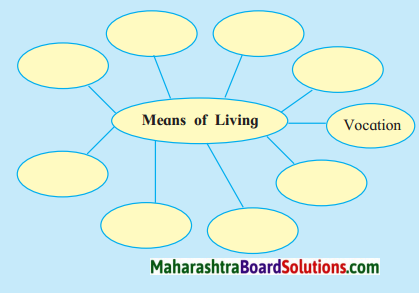
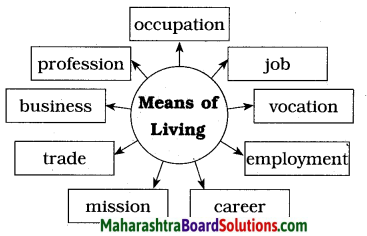
1. Pick out the words that refer to ‘means of living’ and fill them in the web:
(profession / recreation / occupation /job / pastime / employment / hobby / career / entertainment /mission/ trade / business / sports / retirement / placement)
Maharashtra Board Class 8 English Solutions Chapter 2.1 Vocation 1
Answer:
Maharashtra Board Class 8 English Solutions Chapter 2.1 Vocation 2

Maharashtra Board Class 8 English Solutions Chapter 2.1 Vocation

2. Using a good dictionary. find the shades of difference in the following:

2.1 Vocation Questions And Answers Question 1.
Profession
Answer:
‘Profession’ refers to a paid occupation, especially one that involves pro-longed training and a formal qualification.

Vocation Poem Class 8 Questions And Answers Maharashtra Board Question 2.
Vocation
Answer:
‘Vocation’ refers to an occupation for which a person is specially drawn or suited.

Vocation Poem Class 8 Questions And Answers Question 3.
Business
Answer:
‘Business’ refers to the activity of buying or selling goods or services; a commercial activity done by a person at his own risk.

Vocation Poem Class 8 Question 4.
Occupation
Answer:
‘Occupation’ refers to a person’s usual or principal work or business, especially as a means of earning a living.

Maharashtra Board Class 8 English Solutions Chapter 2.1 Vocation

3. When a word is formed from a sound associated with it, it is called an Onomatopoetic Word.

For example : bang, tap, tinkle. crash, whistle etc.
If an Onomatopoetic word occurs in the lines of a poem, the Figure of Speech in that line is Onomatopoeia.
Write down eight to ten Onomatopoetic words on your own.
Answer:

  1. buzz
  2. whoosh
  3. clang
  4. chirp
  5. clap
  6. howl
  7. hiss
  8. grunt
  9. purr
  10. quack

1. Which of the following words / phrases match in meaning to the underlined ones?
(a) deserted
(b) exposed to heat
(c) dirties the clothings
(d) no particular route
(e) following imaginary goals
(f) scolds and corrects

Maharashtra Board Class 8 English Solutions Chapter 2.1 Vocation

Vocation Poem Class 8 Questions And Answers State Board Question 1.
nobody takes him to task ………..
Answer:
scolds and corrects

Vocation Question Answer Class 8 Question 2.
………. if he gets baked in the sun …………..
Answer:
exposed to heat

Vocation Chapter 2.1 Question Answer Question 3.
………….chasing the shadows with my lantern ……………..
Answer:
following imaginary goals

Class 6 English Vocation Questions And Answers Question 4.
The lane is dark and lonely ……………..
Answer:
deserted

Class 6 English Vocation Question Answer Question 5.
………….. he soils his clothes with dust ………….
Answer:
dirties the clothings

Question 6.
…………. There is no road he must take ………….
Answer:
no particular route

Maharashtra Board Class 8 English Solutions Chapter 2.1 Vocation

2. Read the poem and fill in the table.

Time of the dayLocationPoet’s ActivityHawker’s ActivitiesGardener’s ActivitiesWatchman’s Activities
Morning
Afternoon
Night

Answer:

Time of the dayLocationPoet’s ActivityHawker’s ActivitiesGardener’s ActivitiesWatchman’s Activities
MorningIn the laneWalking to schoolSelling Bangles
AfternoonNear the poet’s houseWalking home from schoolDigging the ground
NightThe poet’s homeWatching thr watchman from his bed.Walking up and down the street.Swinging his latern.

3. Think and answer in your own words:

Question a.
What could be the age group of the speaker in the poem?
Answer:
The speaker in the poem is a young school-going boy.

Question b.
What is the difference between a hawker and a shopkeeper?
Answer:
The difference between a hawker and a shopkeeper is that a hawker does not have a fixed shop. He goes from street to street selling his wares. A shopkeeper has a fixed shop and people who want to buy his goods must go to his shop.

Maharashtra Board Class 8 English Solutions Chapter 2.1 Vocation

Question c.
How do parents react when they see children soil their clothes in dust and heat?
Answer:
When parents see their children exposed to heat or soil their clothes in the dust, they scold them and stop them from doing it.

Question d.
Why is the street light compared to a one-red-eyed-giant?
Answer:
The street light is very tall and has a single red light at the top. Hence it is compared to a giant with one red eye.

Question e.
What exactly does the speaker in the poem crave for?
Answer:
The speaker in the poem, who is a young school-going boy, craves for complete freedom to do whatever he wants and whenever he wants. He wants freedom from authority. He wants to lead a carefree life.

Maharashtra Board Class 8 English Solutions Chapter 2.1 Vocation

Question f.
Does the poet really wish to become a hawker/gardener/watchman? Justify your response.
Answer:
The poet does not really wish to become a hawker/gardener/watchman. He is childish and sees only what he thinks is their ‘carefree’ life. He does not see the difficulties. He actually only craves for complete freedom from authority.

4. Say why the speaker of the poem wishes to be:

Question a.
Hawker:
Answer:
The speaker in the poem feels that there is nothing to hurry the hawker. There is no fixed road he must travel by, no place that he must go to and no time when he must get back home. The speaker feels he is lucky and hence he wishes to be a hawker. It means that the speaker wants to be free to do what he wants and go where he wants to, without any restrictions.

Question b.
Gardener:
Answer:
The speaker in the poem sees that the gardener in the nearby house is digging the ground. He does what he likes with his spade. He is free to get his clothes soiled with mud, get baked in the sun or get wet. No one scolds him. Hence the speaker wishes to be a gardener so that he is able to enjoy freedom in the open without any restrictions.

Question c.
Watchman:
Answer:
The speaker is in his bed Through the open window, he can see the watchman walking up and down the dark and lonely street with a lantern in his hand. The speaker is resentful that he has to go to bed. He thinks that the watchman never goes to bed in his life. Hence he wishes to become a watchman and walk up and down in the dark street at night, having fun chasing the shadows with his lantern

5. Pick outlines that contain Alliteration. Simile, Repetition, Onomatopoeia:

(a) Alliteration:
(i) ‘I can see through the gate the gardener digging the ground.’ Repetition of the sound of the letter ‘t’ and ‘g’.
(ii) ‘He does what he likes with his spade, he soils his clothes…’ Repetition of the sound of the letter ‘h’.
(iii) ‘nobody takes him to task’ Repetition of the sound of the letter ‘t’.

Maharashtra Board Class 8 English Solutions Chapter 2.1 Vocation

(b) Simile:
‘The street lamp stands like a giant with one red eye in its head.’ The street lamp is directly compared to a giant, using the word ‘like’.

(c) Repetition:
(i) The words ‘Bangles, crystal bangles’ are repeated to create images in our mind of the hawker.
(ii) The words ‘no’ and ‘nobody’ are repeated for emphasis.

(d) Onomatopoeia:
‘the gong sounds ten’ : the word ‘gong’ is an onomatopoeic word formed from the sound associated with it.

6. Some poets do not use uniformity in rhyming words, nor a steady rhythm. Such poems with no uniformity in rhyme, rhythm, length of lines, or stanzas are called Free Verse. Walt Whitman, Ezra Pound, T.S. Eliot, Rabindranath Tagore are some famous poets who have composed poems in Free Verse.
A quick glance at the poem Vocution’ reveals that the style used by Tagore is Free Verse.
Now turn the pages of your textbook and see if you can find other poems in Free Verse.

7. ‘occupation/profession/business would you like to take up in the future?
Prepare a fact file for the same using the following points.

  1. Name of the vocation / profession / business ……….
  2. Educational qualifications required ………..
  3. Work profile/description………..
  4. Opportunities for advancement …………..
  5. our personal skills/talents for the choice …………..

Maharashtra Board Class 8 English Solutions Chapter 2.1 Vocation

Answer:

  1. Name of the vocation/profession/business: Engineering
  2. Educational qualifications required: B.E/B.Tech
  3. Work profile/description: Setting up of projects/setting up plants/inventing new instruments and machines
  4. Opportunities for advancement: Excellent in a developing country like India
  5. Your personal skills/talents for the choice: My interest in seeing how various machines work and my talent in repairing simple instruments.

8. Read and understand the following poem paper Boats’ and write its paraphrase in your own simple language. (You may take the help of a dictionary or the internet.) The first line is done for you.
(Day after day. one after another. I sail paper boats on the stream of flowing water.)
Answer:

Paper Boats

Day after day, one after another, I sail paper boats on the stream of flowing water. I write my name and the name of my village on the boats in big black letters. I hope that someone in some strange land will find them and know who I am. I fill my little boats with ‘shiuli’ flowers and hope that these flowers which I have picked at dawn will be carried safely to land in the night.

I set my paper boats in motion and look up at the sky. The little clouds have white bulging tails behind them that look like the sails of a boat. I do not know if there is a young child like me up in the sky, who wants to play with me, and sends his boats down through the air to race with my boats.
When it is night, I bury my face in my arms and dream that my paper boats are floating in the air under the stars at midnight. The fairies who bring sleep are sailing in them, and they are filling their baskets with dreams.

Maharashtra Board Class 8 English Solutions Chapter 2.1 Vocation

Class 8 English Chapter 2.1 Vocation Additional Important Questions and Answers

Choose the correct alternative and rewrite the complete sentence:

Vocation Question Answer Question 1.
The hawker is advertising aloud for selling metal bangles/crystal bangles.
Answer:
The hawker is advertising aloud for selling crystal bangles.

Vocation Poem Class 6 Question 2.
The narrator/The gardener is scolded if he gets dirty.
Answer:
The narrator is scolded if he gets dirty.

Vocation Std 8 Questions And Answers Question 3.
The speaker in the poem is a young school-going boy/an adult going to work.
Answer:
The speaker in the poem is a young school-going boy.

Complete the following:

Question 1.
The difference between a hawker and a shopkeeper is _____.
Answer:
that a hawker does not have a fixed shop. He goes from street to street selling his wares. A shopkeeper has a fixed shop and people who want to buy his goods must go to his shop

Maharashtra Board Class 8 English Solutions Chapter 2.1 Vocation

Question 2.
When parents see their children exposed to heat or soil their clothes in the dust, they ________.
Answer:
scold them and stop them from doing it.

Question 3.
The watchman is accompanied by _______.
Answer:
his lantern and his shadow.

Question 4.
The street lamp appears to be _______.
Answer:
a giant with one red eye in its head.

Question 5.
Analysis/Appreciation Of The Poem
Answer:

  1. Poem and poet: ‘Vocation’ by Rabindranath Tagore
  2. Theme: The longing of a young boy for freedom.
  3. Tone: direct; full of craving
  4. Structure and stanzas: Stanzas of unequal length; the number and length of lines vary.
  5. Rhyme and Rhythm: No rhymes or rhythm; the poem is in Free Verse.
  6. Language and Imagery: Simple and direct; vivid images of the hawker, the j gardener and the watchman.
  7. Figures of Speech: Alliteration, Simile, Repetition, Onomatopoeia.

Maharashtra Board Class 7 History Solutions Chapter 1 Sources of History

Balbharti Maharashtra State Board Class 7 History Solutions Chapter 1 Sources of History Notes, Textbook Exercise Important Questions and Answers.

Maharashtra State Board Class 7 History Solutions Chapter 1 Sources of History

Class 7 History Chapter 1 Sources of History Textbook Questions and Answers

1. Complete the names of the following sources of history:

Class 7 History Chapter 1 Sources Of History Questions And Answers Question 1.
l _ _ _ _ d
Answer:
legend

Sources Of History Class 7 Question 2.
t _ _ _ _ h
Answer:
tarikh

Maharashtra Board Class 7 History Solutions Chapter 1 Sources of History

Class 9 History Chapter 1 Sources Of History Questions And Answers Question 3.
b _ _ _ _ r
Answer:
bakhar

Sources Of History Class 7 Question Answer Question 4.
p _ _ _ _a
Answer:
Powada

Maharashtra Board Class 7 History Solutions Question 5.
i _ _ _ _ i _ _ i _ n
Answer:
inscription

Class 7 History Chapter 1 Questions And Answers Question 6.
m _ _ u _ _ _ t
Answer:
monument

2. Let’s write:

Maharashtra State Board Class 7 History Solutions  Question 1.
What do monuments include?
Answer:
Monuments include samadhis, graves and veergalas and buildings.

Class 8 History Chapter 1 Sources Of History Questions And Answers Question 2.
What is a Tarikh?
Answer:
Tarikh or Tavarikh means the sequence of events.

Sources Of History Question And Answer  Question 3.
What qualities of the author are important in the writing of history?
Answer:
The author’s integrity, impartiality and neutrality are very important in writing history.

3. Find the odd man out:

Bakhar Is A Source Of History  Question 1.
Material sources, written sources, unwritten sources, oral sources.
Answer:
unwritten sources

Chapter 1 Class 7 History Question 2.
Monuments, coins, cave sculptures, stories.
Answer:
stories

Maharashtra Board Class 7 History Solutions Chapter 1 Sources of History

Class 7 History Chapter Question 3.
Bhurjapatra, temples, treatises, paintings.
Answer:
temples

Question 4.
Owis, tarikhs, folk tales, myths.
Answer:
tarikhs

4. Explain the following concepts:

Question 1.
Material sources
Answer:
Those authentic material evidences or proofs of the ancient period which support our study of historical events are called material sources of history, e.g. memorials, buildings, cave sculptures, inscription, coins, copper, plates, forts, etc.

Question 2.
Written sources
Answer:
Those authentic evidences or proof of the ancient period which are in written form are called written sources of history, e.g. Documents of proceedings in Courts of kings, genealogies, Shakavali, correspondence, dispatches, treatises, biographies, travelogues, chronicles, Tavarikh, etc.

Question 3.
Oral sources
Answer:
We understand various aspects of folk life through folk literature traditionally passed from generation to generation and they are known as oral sources of history, e.g. Myths, Folk songs, Gatha, Shlokas, Abhangas, Powadas Proverbs, Legends, etc.

5. Is it necessary to evaluate sources of history ? Give your opinion.
Answer:
(i) Yes, it is necessary to evaluate the sources of history.
(ii) Just because a source is old does not mean it is reliable or true. We should examine their authenticity and see which sources are genuine and which are fake.
(iii) We must evaluate its quality with the help of different methods and through critical analysis.
(iv) It is necessary to determine the integrity, impartiality and neutrality of the authors by knowing their personal interests, the period during which they lived and political pressures on them.

6. Write why in your words:

Question 1.
A stone inscription is considered to be an authentic source of history.
Answer:
A stone inscription, i.e. a carving on the stone is a very authentic source of history as it throws light on different features of the ancient time like the language of communication which existed, script used and the social, political and economic life of a period, etc.

Maharashtra Board Class 7 History Solutions Chapter 1 Sources of History

Question 2.
Oral sources reveal various aspects of people’s lives.
Answer:
(i) Various aspects of folk life through folk literature passed on to us by our ancestors.
(ii) They are pearls of wisdom and they hold a wealth of knowledge about the past.
(iii) It throws light on the rich cultural life of the past and different art forms which were practised in those times.

Activity:

Visit any museum that is nearby. Gather information about the sources of history from the period that you are studying and record it in your activity book.

Class 7 History Chapter 1 Sources of History InText Questions and Answers

Formative Evaluation

Can you tell?

Question 1.
How do coins narrate history?
Answer:
(i) The coins made by different rulers using metals like gold, silver, copper are important sources of history.
(ii) From these coins we learn about the rulers, the period they ruled in, governance, religious ideas, personal details and use of language in that period.
(iii) Similarly, we also learn about the financial transactions and economic conditions, the advancement in metallurgy prevailing at that time.
(iv) From the images of Ram-Sita on the coins of Emperor Akbar or Shiva Parvati on the coins of Hyder Ali we see religious co-ordination of those days.

Speak your thoughts:

Question 1.
Suggest measures for preserving sources of history.
Answer:
(i) Written documents can be digitized and at the same time the original source should be preserved.
(ii) Controlling moisture by storing artefacts in an encasement which is oxygen free can help in their preservation.
(iii) Museums and other institutions must put in place steps and measures to preserve material sources of history in a scientific manner.
(iv) Handling, storage and display of artefacts must be done with care.
(v) Artefacts and other sources must be kept locked and continuous monitoring must be ensured to avoid any loss.
If any artefacts show signs of deterioration, conservationist must be called in for restoration of the same.

Class 7 History Chapter 1 Sources of History Additional Important Questions and Answers

Complete the sentence by choosing the appropriate words from the options given below:

Question 1.
The period from the ninth century CE till the end of the eighteenth century is considered to be the _____ period of Indian history. (Ancient, Medieval, Modern)
Answer:
Medieval

Maharashtra Board Class 7 History Solutions Chapter 1 Sources of History

Question 2.
History gives us a chronological, scientific and systematic account of ______ events. (past, present, future)
Answer:
past

Question 3.
Historical sources should be used judiciously and only after a ______. (thorough reading, indepth study, critical analysis)
Answer:
critical analysis

Question 4.
Veergala is a ________. (fort, monument, palace)
Answer:
monument

Question 5.
The Peshwas used the _______ language on their coins. (Arabic or Persian, Hindi or Sanskrit, Pali)
Answer:
Arabic or Persian

Question 6.
Travellers of other countries who came to India have written ______ or accounts of their travels, (biography, autobiography, travelogues)
Answer:
travelogues

Question 7.
Tavarikh or Tarikh means the ______. (information about past, sequence of events, dates)
Answer:
sequence of events

Question 8.
The author’s ______ is very important in writing history. (viexvpoint, perspective, impartiality and neu trality)
Answer:
impartiality and neutrality

Question 9.
An, _____ is a carving on a stone, or a wall. (metal plate, inscription, edict)
Answer:
inscription

Question 10.
______ is a type of chronicle that originated in Maharashtra. (Bakhar, Myths, Travelogues)
Answer:
Bakhar

Find the odd man out:

Question 1.
Genealogies, Travelogue, Chronicles, Inscription.
Answer:
Inscription

Question 2.
Churches, Temples, Mosques, Myths
Answer:
Myths

Maharashtra Board Class 7 History Solutions Chapter 1 Sources of History

Name the following:

Question 1.
The subject which gives us a chronological, scientific and systematic account of past events.
Answer:
History.

Question 2.
Any two metals used by different rulers in the past to make coins.
Answer:
Gold, Silver

Question 3.
One place in Tanjavur where inscriptions are found.
Answer:
Brihadishwara temple premises.

Question 4.
Two things inscribed on copper plates.
Answer:
(a) Royal edicts
(b) Verdicts

Question 5.
Any two scripts used in the Medieval period.
Answer:
(a) Devanagari
(b) Arabic

Question 6.
Written accounts of the travels by the travellers from other countries.
Answer:
Travelogues.

Question 7.
Any two travellers who visited India in the Medieval period.
Answer:
(a) A1 Biruni
(b) Ibn Batuta

Maharashtra Board Class 7 History Solutions Chapter 1 Sources of History

Question 8.
Sanskrit biography of Shivaji Maharaj was composed by this poet.
Answer:
Paramanand.

Question 9.
A source of history which means the sequence of events.
Answer:
Tavarikh or Tarikh.

Question 10.
Two people who compiled Tavarikh.
Answer:
(a) A1 Biruni
(b) Ziauddin Barani.

Question 11.
A type of chronicle that originated in Maharashtra.
Answer:
Bakhar.

Question 12.
Any two chronicles written in Marathi.
Answer:
(a) Mahikavatichi Bakhar
(b) Sabhasad Bakhar

Question 13.
Any two contemporary western historians.
Answer:
(a) Robert Arm
(b) Grant Duff

Question 14.
Any two oral sources of history.
Answer:
(a) Owis
(b) Folk songs

Answer in one sentence:

Question 1.
What information does history give us?
Answer:
History gives us a chronological and systematic account of past events.

Question 2.
What must history be based on?
Answer:
History must be based on authentic evidence or proofs which are known as sources of history.

Question 3.
What are the different sources of history?
Answer:
Material sources, written sources and oral sources are the three different sources of history.

Maharashtra Board Class 7 History Solutions Chapter 1 Sources of History

Question 4.
How should we use different sources of history?
Answer:
We have to use the different sources of history judiciously and only after critical analysis.

Question 5.
What do we learn when we look at forts and monuments built in the past?
Answer:
When we look at the forts and monuments we come to know about the development of architecture, the economic conditions, the quality of art, style of the building construction and people’s standard of living in that particular period.

Question 6.
Why is an inscription considered to be a very important and reliable source of history?
Answer:
An inscription is considered to be a very important and reliable source of history because it helps us to understand features like the language, script, social life of a period etc.

Question 7.
What are known as copper plates?
Answer:
Inscriptions carved on sheets of copper are known as ‘copper plates’.

Question 8.
How do we understand various aspects of folk life?
Answer:
We understand various aspects of folk life through folk literature traditionally passed from generation to generation.

Explain the following terms:

Question 1.
History
Answer:
History is a chronological, scientific and systematic account of past events.

Question 2.
An inscription
Answer:
An inscription is a carving on a stone or a wall.

Question 3.
Tavarikh or Tarikh
Answer:
Tavarikh or Tarikh means the sequence of events.

Maharashtra Board Class 7 History Solutions Chapter 1 Sources of History

Question 4.
Bakhar
Answer:
Bakhar is a type of chronicle that originated in Maharashtra.

Question 5.
Chronicles
Answer:
Chronicles are written sources of history which help in understanding aspects like the contemporary political happenings, linguistic transaction, cultural life, social conditions, etc.

Classify the following into Material sources, Written sources and Oral sources of history:

Question 1.
Ornaments, Fort, Owis, Myths, Utensils, Folk songs, Weapons, Travelogue, Well, Biographies, Clothing, Powada, Copper plate, Folk tales, Coins, Shloka, Temples, Books
Answer:

Written SourcesMaterial SourcesOral Sources
Books, Travelogue, Copper plate, Coins, TemplesOrnaments, Forts, Utensils, Weapons, Well, ClothingOwis, Myths, Folk songs, Hearsays, Powada, Folk tales, Shloka

Complete the following diagrams:

Question 1.

Maharashtra Board Class 7 History Solutions Chapter 1 Sources of History 2
Answer:

Maharashtra Board Class 7 History Solutions Chapter 1 Sources of History 1

Question 2.

Maharashtra Board Class 7 History Solutions Chapter 1 Sources of History 4
Answer:

Maharashtra Board Class 7 History Solutions Chapter 1 Sources of History 3

Maharashtra Board Class 7 History Solutions Chapter 1 Sources of History

Question 3.

Maharashtra Board Class 7 History Solutions Chapter 1 Sources of History 6
Answer:

Maharashtra Board Class 7 History Solutions Chapter 1 Sources of History 5

Maharashtra Board Class 7 History Solutions Chapter 6 Conflict with the Mughals

Balbharti Maharashtra State Board Class 7 History Solutions Chapter 6 Conflict with the Mughals Notes, Textbook Exercise Important Questions and Answers.

Maharashtra State Board Class 7 History Solutions Chapter 6 Conflict with the Mughals

Class 7 History Chapter 6 Conflict with the Mughals Textbook Questions and Answers

1. Arrange in chornological order:

Conflict With The Mughals Std 7 Answers Question 1.
(i) Southern campaign of Shivaji Maharaj
(ii) Raid on Lai Mahal
(iii) Escape from Agra
(iv) Coronation
(v) Treaty of Purandar
(vi) Shaistakhan’s invasion
Answer:
(i) Shaistakhan’s invasion
(ii) Raid on Lai Mahal
(iii) Treaty of Purandar
(iv) Escape from Agra
(v) Coronation
(vi) Southern campaign of Shivaji Maharaj

2. Find the names from the chapter:

Conflict With The Mughals Std 7 Question Answer Question 1.
A dictionary containing Sanskrit alternatives.
Answer: Rajya – vyavahara – kosha

Maharashtra Board Class 7 History Solutions Chapter 6 Conflict with the Mughals

Conflict With The Mughals Std 7 Question 2.
He won Trimbakgad.
Answer:
Moropant Pingale

Class 7 History Chapter Question 3.
This Sardar was defeated at Vani-Dindori.
Answer:
Sardar Daudkhan

Conflict With The Mughals Questions And Answers Question 4.
A place where the British, Dutch and French had their factories.
Answer:
Surat

3. Write about these in your own words:

Conflict With Mughals Question 1.
Shivaji Maharaj’s preparation for the > coronation.
Answer:
(i) The famous learned Pandit Gagabhatt was invited to conduct the coronation of Shivaji Maharaj.

(ii) Invitations were sent to learned Brahmans of all parts of India.

(iii) Shivaji visited the famous temples in Maharashtra and distributed clothes and other things among the Brahmans.

(iv) A gold plated steel/stool was prepared with precious ornaments was brought for Shivaji Maharaj.

(v) Holy water from seven sacred rivers Yamuna, Indus, Ganga, Godavari, Kaveri and Krishna was brought and kept in a gold vessel.

(vi) A special royal umbrella of cloth with gold fringes and pearls was prepared.

(vii) Special scarlet robes for Shivaji Maharaj was prepared.

Maharashtra Board Class 7 History Solutions Chapter 6 Conflict with the Mughals

Question 2.
The Coronation of Shivaji Maharaj.
Answer:
(i) Shivaji Maharaj felt that it was necessary to entitle himself as a king.

(ii) A formal coronation ceremony was organized.

(iii) Many learned Brahmans from all parts of India came. Even Ambassadors from all over India came to witness the ceremony.

(iv) On 6th June, 1674, Shivaji got up early in the morning, worshipped the gods and took blessing from the priests.

(v) He was dressed up in a special scarlet robe and precious ornaments

(vi) The Brahmans chanted Mantras and blessed Shivaji.

(vii) Gagabhatt held the royal umbrella over the Maharaj’s head, and poured the holy water from seven rivers.

(viii) Special coins were minted-a gold coin called Hon and a copper coin called Shivrai.

(ix) A dictionary showing Sanskrit meaning for Persian words was prepared. It is called Rajya- vyavahara-kosha.

Question 3.
Escape from Agra.
Answer:
(i) Shivaji Maharaj pretended to be ill.

(ii) He complained of severe pain in the stomach. Doctors were called. They started treating the patient, Shivaji.

(iii) He started sending out huge baskets of sweets to Sadhus and Maulavis for his quick recovery. In the beginning, the guard outside would examine the baskets.

(iv) In the course of time, they got tired of this daily routine and stopped it.

(v) One evening, Shivaji made Hiroji sleep in his bed and asked Madari to manage his feat.

(vi) Then Shivaji Maharaj and Sambhaji Raje hid themselves in two of the many baskets that were going out.

(vii) The baskets were supposed to contain sweets and allowed to pass unchecked.

(viii) At a place previously fixed, Shivaji Maharaj and Sambhaji Raje got out of the baskets and adroitly escaped from Agra and reached Maharashtra safely after a few days.

Question 4.
Shivaji Maharaj’s Campaign of the South.
Answer:
(i) After the coronation ceremony, Shivaji went to the South at Golconda.
(ii) He made friendship with Qutubshah.
(iii) He captured the forts like Bangalore, Hoskote, Jinji, Vellore, etc. and some territories of Adilshah.
(iv) He appointed Raghunath Narayan Hanamante the chief officer to look after these territories.

Maharashtra Board Class 7 History Solutions Chapter 6 Conflict with the Mughals

4. Give reasons:

Question 1.
Shivaji Maharaj entered into the ‘Treaty of Purandar’.
Answer:
(i) Aurangzeb sent a powerful Sardar, Jaisingh to defeat Shivaji Maharaj.
(ii) He started a naval campaign against Maharaj.
(iii) Jaisingh and Dilerkhan siege the fort of Purandar.
(iv) The Mughals siege the Fort of Purandar.
(v) Murarbaji Deshpande fought with courage but died a hero’s death.

Question 2.
Shivaji Maharaj took an aggressive stand against the Mughals.
Answer:
(i) The Treaty of Purandar meant a great loss of wealth and humiliation for the Marathas.
(ii) Shivaji Maharaj wanted to recapture the forts and territories given to the Mughals as per the Purandar treaty.
(iii) In order to earn the reputation, Shivaji Maharaj took an aggressive stand against the Mughals.

Activities:

How do you prepare for the special programmes on Independence Day/ Republic Day ? Make a list with help of your teacher.
Visit a historical place in your neighbourhood and write a report on your visit.

Class 7 History Chapter 6 Conflict with the Mughals InText Questions and Answers

Do you remember?

Question 1.
Which Indian king started a new calendar?
Answer:
King Vikramaditya started the Vikrama Sam vat Era after defeating the Shakas in 57-58 BC and Shivaji Maharaj also started Rajyabhisheka Shaka (the coronation era in 1674).

Gather information:

Question 1.
Find out how Shivaji Maharaj escaped from his house arrest at Agra.
Answer:
(i) In 1666, Aurangzeb invited Shivaji to Agra, along with his nine-year-old son Sambhaji and a few of his trusted people.

(ii) Aurangzeb’s plan was to send Shivaji to Kandahar, now in Afghanistan, to consolidate the Mughal empire’s north-western frontier.

(iii) However, in the court, on 12th May 1666, Aurangzeb made Shivaji stand behind military commanders of his court.

(iv) Shivaji took offence and stormed out of court, and was promptly placed under house arrest under the watch of Faulad Khan, Kotwal of Agra.

(v) Shivaji pretended severe illness and requested to send most of his group back to the Deccan and conveyed his wish to distribute some sweets to the poor as offerings for getting well.

(vi) Thereafter, on his request, he was allowed to send daily shipments of sweets and gifts to saints, fakirs, and temples in Agra as offerings for his health.

(vii) The Kotwal was requested that the boxes of sweets should be touched by Maharaj himself as a custom and hence all the boxes were strictly checked.

(viii) According to the Mughal documents, after several days and weeks of sending out boxes containing sweets, Shivaji, disguised as labourer carrying sweet basket escaped on 17 August 1666.

(ix) Sambhaji, being a child had no restrictions and was sent out of the prison camp before Shivaji escaped.

(x) After escaping Shivaji and his son fled to the Deccan disguised as sadhus.

Maharashtra Board Class 7 History Solutions Chapter 6 Conflict with the Mughals

Class 7 History Chapter 6 Conflict with the Mughals Additional Important Questions and Answers

Complete the sentence by choosing the appropriate words from the options given below:

Question 1.
The Killedar of the fort of Chakan was ____ (Vyankoji, Firangoji Narsala, Murarbaji Deshpande)
Answer:
Firangoji Narsala

Question 2.
Shaistakhan set up his camp at Lalmahal in ________ (Pune, Satara, Agra)
Answer:
Pune

Question 3.
The treaty of ______ was signed between Jaisingh and Shivaji. (Pune, Bengal, Purandar)
Answer:
Purandar

Question 4.
Shivaji helped Jaisingh against _______ (Adilshah, Aurangzeb, Qutubshah)
Answer:
Adilshah

Question 5.
The Mughals captured the fort of _________ (Jinji, Chakan, Raigad)
Answer:
Chakan

Question 6.
In the raid, ________ lost his fingers (Shaistakhan, Jaisingh, Afzalkhan)
Answer:
Shaistakhan

Maharashtra Board Class 7 History Solutions Chapter 6 Conflict with the Mughals

Question 7.
_______ was the Subhedar of Surat. (Dilerkhan, Inayat Khan, Shaistakhan)
Answer:
Inayat Khan

Question 8.
______died a heroic death, while defending the Purandar fort. (Firangoji Narsala, Raghunath Narayan, Murarbaji Deshpande)
Answer:
Murarbaji

Question 9.
Shivaji Maharaj passed away at Fort ______ on 3rd April, 1680. (Purandar, Chakan, Raigad)
Answer:
Raigad

Question 10.
______, a learned Pandit crowned Shivaji Maharaj on his first coronation. (Pandit Gagabhatt, Nischalpuri Gosavi, Firangoji Narsala)
Answer:
Gagabhatt

Question 11.
Shivaji Maharaj had his second coronation performed under the guidance of ______. (Krishnaji Anant Sabhasad, Nischalpuri Gosavi, Pandit Gagabhatt)
Answer:
Nischalpuri Gosavi

Match the columns:

Question 1.

Column ‘A’Column ‘B’
(1) Treaty of Purandar

(2) Shivaji’s coronation

(3) Karnataka campaign

(4) Shivaji raided Lai Mahal

(a) April 1663

(b)  October 1677

(c) June, 1674

(d)  June 1651

Answer:
1 – d
2 – c
3 – b
4 – a

Question 2.

Column ‘A’Column ‘B’
(1) Mann(a) A monument
(2) Hon(b) Unit of measurement
(3) Shivrai(c) a gold coin
(4) Samadhi(d) a copper coin

Answer:
1 – b
2 – c
3 – d
4 – a

Maharashtra Board Class 7 History Solutions Chapter 6 Conflict with the Mughals

Arrange in chronological order:

Question 1.
(i) Shivaji Maharaj’s campaign to the South
(ii) The treaty of Purandar
(iii) Shivaji Maharaj’s death in Raigad
(iv) Shivaji Maharaj’s coronation
Answer:
(i) The treaty of Purandar
(ii) Shivaji Maharaj’s coronation
(iii) Shivaji Maharaj’s campaign to the South
(iv) Shivaji Maharaj’s death in Raigad

Find the names from the chapter:

Question 1.
A learned Pandit who crowned Shivaji Maharaj at Raigad.
Answer:
Gagabhatt

Question 2.
This treaty was signed between Jaisingh and Shivaji Maharaj.
Answer:
The Treaty of Purandar

Question 3.
It was a rich city. Shivaji Maharaj raided it and obtained plenty of wealth.
Answer:
Surat

Question 4.
He took shelter in the southern part of Jinji.
Answer:
Chhatrapati Rajaram Maharaj.

Question 5.
It is a world famous library.
Answer:
The Saraswati Mahal

Maharashtra Board Class 7 History Solutions Chapter 6 Conflict with the Mughals

Answer in one or two sentences:

Question 1.
Whom did Aurangzeb send to curb Shivaji Maharaj?
Answer:
Aurangzeb sent Jaisingh, an experienced and powerful Rajput Sardar against Shivaji Maharaj.

Question 2.
What were the terms of the ‘Treaty of Purandar’?
Answer:
According to the terms of the treaty, Shivaji Maharaj gave twenty-three of his forts along with adjoining territories yielding an annual revenue of four lakh hons. He also assured the Mughals, of help against Adilshah.

Question 3.
How did Aurangzeb treat Shivaji Maharaj at his Darbar in Agra?
Answer:
Aurangzeb did not treat Shivaji Maharaj with due honour at his court and gave vent to his anger.

Question 4.
When and where was Shivaji Maharaj coronated? Who crowned him?
Answer:
On 6th June, 1674, Gagabhatt a learned Pandit crowned Shivaji Maharaj at Raigad.

Question 5.
What was inscribed on the special coins minted on the occasion of the coronation?
Answer:
Shri Raja Shiva Chhatrapati was inscribed on . the special coins minted on the occasion of the coronation.

Question 6.
Which dictionary was prepared on the special occasion of coronation?
Answer:
A dictionary showing Sanskrit alternatives for Persian words was prepared. It is called ‘Rajya- vyavahara-kosha’.

Question 7.
What did Sabhasad, a chronicler, write about Shivaji Maharaj?
Answer:
Sabhasad wrote “It was no mean achievement for a Maratha King to become such a great Chhatrapati”.

Maharashtra Board Class 7 History Solutions Chapter 6 Conflict with the Mughals

Question 8.
What was the objective of Jaisingh’s invasion?
Answer:
The objective of Jaisingh’s invasion was to curb the increasing activities of Shivaji Maharaj and then to turn to Adilshahi.

Question 9.
Under whose guidance was the second coronation performed?
Answer:
Shivaji Maharaj’s second coronation was performed under the guidance of Nischalpuri Gosavi.

Question 10.
What was encouraged by rulers of Tanjavur?
Answer:
Rulers of Tanjavur encouraged art and learning.
The Saraswati Mahal Library in Tanjavur is world famous.

Give reasons:

Question 1.
Shaistakhan suffered great humiliation.
Answer:
(i) Shaistakhan invaded Pune and set up his camp at Lai Mahal in Pune, where Shivaji Maharaj lived in his childhood.
(ii) His forces looted the people.
(iii) Shivaji Maharaj decided to raid Lai Mahal.
(iv) On the night of 5th April, 1663, along with his band of soldiers, Shivaji Maharaj raided Lai Mahal.
(v) In this raid, Shaistakhan lost his fingers hence suffered great humiliation.

Question 2.
Shivaji Maharaj decided to attack/raid Surat.
Answer:
(i) Shivaji Maharaj wanted to teach the Mughals a lesson as Shaistakhan had ravaged large territories of the Swaraj.
(ii) Surat was a big trade centre and a port under Mughal control.
(iii) The British, Dutch and French laid their factories in Surat.
(iv) Maximum revenue was being generated by this city for the emperor.
(v) It was a rich city.
(vi) Maharaj marched to Surat.
(vii) The Subhedar of Surat could not put up any resistance.
(viii) Maharaj obtained plenty of wealth from Surat without bothering the common people.
(ix) This campaign was a stunning blow to Emperor Aurangzeb’s prestige.
(x) This campaign of Surat was completely successful.

Maharashtra Board Class 7 History Solutions Chapter 6 Conflict with the Mughals

Question 3.
Shivaji Maharaj raided Lai MahaL
Answer:
(i) Shaistakhan had set up his camp at Lai Mahal ,in Pune where Shivaji Maharaj had lived in his childhood.
(ii) Shaistakhan’s army looted the people in the Pune region for two years.
(iii) This had an adverse effect on the morale of people.
(iv) Therefore Shivaji Maharaj raided Lai Mahal.

Complete the following:

Question 1.
Maharashtra Board Class 7 History Solutions Chapter 6 Conflict with the Mughals 1
Answer:
Maharashtra Board Class 7 History Solutions Chapter 6 Conflict with the Mughals 3

Question 2.
Maharashtra Board Class 7 History Solutions Chapter 6 Conflict with the Mughals 2
Answer:
Maharashtra Board Class 7 History Solutions Chapter 6 Conflict with the Mughals 4

Maharashtra Board Class 9 Hindi Lokbharti Solutions Chapter 10 अपराजेय

Balbharti Maharashtra State Board Class 9 Hindi Solutions Lokbharti Chapter 10 अपराजेय Notes, Textbook Exercise Important Questions and Answers.

Maharashtra State Board Class 9 Hindi Lokbharti Solutions Chapter 10 अपराजेय (पूरक पठन)

Hindi Lokbharti 9th Std Digest Chapter 10 अपराजेय Textbook Questions and Answers

श्रवणीय:

प्रश्न 1.
हेलन केलर की जीवनी का अंश सुनिए और मुख्य मुद्दे सुनाइए।

Maharashtra Board Class 9 Hindi Lokbharti Solutions Chapter 9 10 अपराजेय

लेखनीय:

प्रश्न 1.
कला की साधना जीवन के दुखमय क्षणों को भुला देती है। इस विषय पर अपने विचार लिखिए।
उत्तरः
कृति (ग) की स्वमत अभिव्यक्ति देखिए।

पठनीय:

प्रश्न 1.
सुदर्शन की ‘हार की जीत’ कहानी पढ़िए।

1. सुचना के अनुसार कृतियाँ कीजिए:

प्रश्न 1.
संजाल पूर्ण कीजिए।
Maharashtra Board Class 9 Hindi Lokbharti Solutions Chapter 10 अपराजेय 1
उत्तरः
Maharashtra Board Class 9 Hindi Lokbharti Solutions Chapter 10 अपराजेय 2

Maharashtra Board Class 9 Hindi Lokbharti Solutions Chapter 9 10 अपराजेय

प्रश्न 2.
कृति पूर्ण कीजिए।
Maharashtra Board Class 9 Hindi Lokbharti Solutions Chapter 10 अपराजेय 3
उत्तरः
Maharashtra Board Class 9 Hindi Lokbharti Solutions Chapter 10 अपराजेय 4

प्रश्न 3.
परिच्छेद से ऐसे दो शब्द ढूँढ़कर लिखिए कि जिनका वचन परिवर्तन नहीं होता।
उत्तर:
1. घर
2. पेड़

प्रश्न 4.
‘कला में अभिरूचि होने से जीवन का आनंद बढ़ता है।’ अपने विचार लिखिए।
उत्तर:
कला जीवन का प्रतिरूप है। वह जीवन का आनंद है। प्रत्येक व्यक्ति को कला का शौक होता है। कला में अभिरूचि होने से व्यक्ति उसकी साधना में लगा रहता है। ऐसे में वह स्वयं को भी भूल जाता है। सिर्फ कला के अलावा उसे अन्य चीज़ की याद नहीं आती है। वह अपनी मनचाही कला के सौंदर्य एवं माधुर्य में मशगुल हो जाता है। कला का लुत्फ़ उठाते समय उसका चित्त आनंदविभोर हो जाता है।

वह कला को ही अपने जीवन का आधार मानकर स्वयं के जीवन को सुंदर बनाता है। निरंतर कला के सान्निध्य में रहने के कारण वह मन से तरोताजा रहता है। ऐसे व्यक्ति को फिर संपूर्ण विश्व सुंदर एवं खिला हुआ दिखाई देता है। इस प्रकार कला में अभिरूचि होने से जीवन का आनंद बढ़ता है।

आसपास:

प्रश्न 1.
कलाक्षेत्र में ‘भारतरत्न’ उपाधि से अलंकृत महान विभूतियों के नाम, क्षेत्र, वर्षानुसार सूची बनाइए।

Maharashtra Board Class 9 Hindi Lokbharti Solutions Chapter 9 10 अपराजेय

मौलिक सृजन:

प्रश्न 1.
‘समाज के जरूरतमंद लोगों की मैं सहायता करूँगा।’ इस विषय पर अपने विचार प्रकट कीजिए।
उत्तरः
मानव होने का सही अर्थ यही है कि मनुष्य को अपने जीवन में दूसरों की सेवा करनी चाहिए। मानव का जन्म लोगों की सेवा करने के लिए हुआ है। सेवा ऐसा भाव है जिससे सेवा करने वाला भी सुख पाता है और जिसकी सेवा की जाती है वह भी सुख पाता है। जो मनुष्य दूसरों के दुख दूर करने के लिए प्रयास करता है, ऐसा ही मनुष्य सच्चा मनुष्य कहलाने का अधिकारी होता है। कवि गुप्त जी ने लिखा ही है

वही मनुष्य है कि जो मनुष्य के लिए मरे।

मैं भी समाज के जरुरतमंदों की सहायता करना चाहता हूँ। समाज में सर्वत्र दीन-दुखी, पीड़ित एवं व्यथित लोग हैं। उनकी सहायता करने से मुझे आत्मिक तृप्ति मिलेगी। आखिर मानव सेवा ही ईश्वर की पूजा के समान होती है।

आज हमारे समाज में ऊँच-नीच का भेदभाव दिखाई दे रहा है। कई ऐसे गरीब बच्चे हैं जो फुटपाथ पर ही रहते हैं। वे स्कूल नहीं जाते हैं। मैं ऐसे बच्चों को पढ़ाने के लिए आगे आऊँगा। उन्हें सही राह दिखाने का प्रयास करूंगा। मैं अनाथ आश्रम में जाकर वहाँ रहने वाले बच्चों के लिए खेल एवं शैक्षिक गतिविधियों का आयोजन करूंगा; ताकि उन्हें आनंद की प्राप्ति हो।

समाजसेवा के इस पुनीत कार्य में मैं अपने मित्रों को भी सम्मिलित करवाऊँगा क्योंकि मिल-जुलकर अच्छा काम करने में जो मजा है वह अन्य किसी काम में नहीं। अपने मित्रों के साथ मिलकर मैं गरीब बच्चों एवं लोगों के लिए चंदा इकट्ठा करूँगा। उनके लिए कपड़े व अनाज आदि सामग्री का संग्रह करूँगा। मुझे आशा है कि मेरे इन कार्यों से प्रेरणा लेकर अन्य लोग मेरा अनुकरण करेंगे। उस वक्त मेरी खुशी का ठिकाना नहीं रहेगा। अंत में सिर्फ इतना ही कहूँगा:

चाह यही, आस यही, कामना यही, भावना यही; कर सकूँ अपनी जिंदगी में जरूरतमंदों की सेवा यही।

पाठ से आगे:

प्रश्न 1.
दिव्यांग महिला खिलाड़ियों के बारे में जानकारी प्राप्त करके टिपणी तैयार कीजिए।

Maharashtra Board Class 9 Hindi Lokbharti Solutions Chapter 9 10 अपराजेय

पाठ के आँगन में……..

1. सूचना के अनुसार कृतियाँ कीजिए।

प्रश्न (क)
केवल एक शब्द में उत्तर लिखिए।

  1. जिनमें चलने-फिरने की क्षमता का अभाव हो:
  2. जिनमें सुनने की क्षमता का अभाव हो:
  3. जिनमें बोलने की क्षमता का अभाव हो:
  4. स्वस्थ शरीर में किसी भी एक क्षमता का अभाव होना:

उत्तरः

  1. अपाहिज, अपंग
  2. बधिर
  3. गूंगा
  4. दिव्यांग

प्रश्न 2.
‘हीन’ शब्द का प्रयोग करके कोई तीन अर्थपूर्ण शब्द तैयार करके लिखिए।
Maharashtra Board Class 9 Hindi Lokbharti Solutions Chapter 10 अपराजेय 5
उत्तरः
जैसे: आत्म + हीन = आत्महीन

  1. संवेदन + हीन = संवेदनहीन
  2. चरित्र + हीन = चरित्रहीन
  3. स्नेह + हीन = स्नेहहीन

प्रश्न 3.
परिस्थिति के सामने हार न मानकर उसे सहर्ष स्वीकार करने में ही जीवन की सार्थकता है। स्पष्ट कीजिए।
उत्तरः
कृति (ख) की स्वमत अभिव्यक्ति देखिए।

Maharashtra Board Class 9 Hindi Lokbharti Solutions Chapter 9 10 अपराजेय

प्रश्न (ख)
पाठ में प्रयुक्त वाक्य पढ़कर व्यक्ति में निहित भाव लिखिए।
1. ‘टाँग ही तो काटनी है, तो काट दो।’
2. ‘मैं जानता हूँ कि जीवन का विकास पुरुषार्थ में है, आत्महीनता में नहीं।’
उत्तर:
1. हास्य व सहज भाव, निडरता, सकारात्मकता, दृढ़ निश्चय
2. शांत भाव, संघर्ष शीलता, दृढ़ निश्चय

Hindi Lokbharti 9th Answers Chapter 10 अपराजेय Additional Important Questions and Answers

(क) गद्यांश पढ़कर दी गई सूचना के अनुसार कृतियाँ कीजिए।

कृति (1) आकलन कृति

प्रश्न 1.
समझकर लिखिए।
उत्तर:
Maharashtra Board Class 9 Hindi Lokbharti Solutions Chapter 10 अपराजेय 6

कारण लिखिए।

प्रश्न 1.
सभी के चेहरे पर अकुलाहट थीं।
उत्तरः
दुर्घटना में अमरनाथ घायल हो गए थे। उनके बचने की कोई उम्मीद नहीं थी। इसीलिए सभी के चेहरे पर अकुलाहट थीं।

प्रश्न 2.
अमरनाथ के परिवार वाले रात को एक बजे पुलिस स्टेशन गए थे।
उत्तरः
अमरनाथ शाम तक घर पहुँचने वाले थे लेकिन रात के नौ बज गए फिर भी वे घर नहीं पहुंचे। उनके मोबाइल की घंटी बज रही थी लेकिन वे मोबाइल उठा नहीं रहे थे। इसीलिए अमरनाथ के परिवार वाले रात को एक बजे पुलिस स्टेशन गए थे।

Maharashtra Board Class 9 Hindi Lokbharti Solutions Chapter 9 10 अपराजेय

कृति (2) आकलन कृति

किसने, किससे कहा?

प्रश्न 1.
‘पर हुआ कैसे?’
उत्तरः
यह वाक्य चोपड़ा ने अनिल से पूछा।

प्रश्न 2.
‘ट्रकवाला जरूर पिया होगा।’
उत्तर:
यह वाक्य अनिल ने चोपड़ा से कहा।

प्रश्न 3.
समझकर लिखिए।
उत्तर:
Maharashtra Board Class 9 Hindi Lokbharti Solutions Chapter 10 अपराजेय 7

कृति (3) शब्द संपदा

प्रश्न 1.
निम्नलिखित शब्दों के अर्थ गद्यांश से ढूँढ़कर लिखिए।

  1. सर्जरी
  2. डरावना
  3. निशा
  4. संध्या

उत्तर:

  1. ऑपरेशन
  2. भयावह
  3. रात
  4. शाम

Maharashtra Board Class 9 Hindi Lokbharti Solutions Chapter 9 10 अपराजेय

प्रश्न 2.
गद्यांश में प्रयुक्त ऐसे अंग्रेजी शब्द लिखिए जिनका हिंदी में प्रयोग होने लगा है।
उत्तर:

  1. ऑपरेशन
  2. मोबाइल
  3. स्ट्रेचर
  4. नर्स

प्रश्न 3.
गद्यांश से ऐसे दो शब्द ढूँढ़कर लिखिए कि जिनके वचन परिवर्तित नहीं होते हैं।
उत्तर:
1. फोन
2. पुलिस

प्रश्न 4.
‘अकुलाहट’ इस शब्द में प्रयुक्त प्रत्यय पहचानकर लिखिए और उस संबंधित प्रत्यय से अन्य दो शब्द तैयार कीजिए।
उत्तर:
‘आहट’ प्रत्यय; अन्य शब्द:
1. कड़वाहट
2. घबराहट

कृति (4) स्वमत अभिव्यक्ति

प्रश्न 1.
‘अपनी देखी हुई एक दुर्घटना।’ इस विषय पर अपने विचार लिखिए।
उत्तरः
ग्रीष्मावकाश में हम सब नैनिताल जा रहे थे। दोनों ओर पहाड़ियाँ ही पहाड़ियाँ थीं। रास्ते के दोनों ओर से गाडियाँ आ-जा रही थीं। अचानक सामने से एक बड़ा ट्रक आया और उसने हमारी गाड़ी के आगे जो एक गाड़ी थी उसे जोर से धक्का दे दिया। जिस कारण आगे वाली गाड़ी दुर्घटनाग्रस्त हो गई। हमारे ड्राइवर ने तुरंत गाड़ी को ब्रेक लगा दिया। हम तुरंत अपनी गाड़ी से बाहर आकर दुर्घटनाग्रस्त गाड़ी के पास पहुँचे।

ट्रकवाले के पास भी इंसानियत थी। उसने भी बाहर आकर घायल लोगों की सेवा करना अपना धर्म समझा। गाड़ी में दो लोग थे जिनमें से एक को हल्की चोट आई थी परंतु दूसरे के सिर से रक्तस्राव हो रहा था। हमने आव देखा न ताव, उसे अपनी गाड़ी में बिठाकर नज़दीकी अस्पताल लेकर गए। तुरंत किए गए उपचारों के कारण वह स्वस्थ हो गया। उसकी जान बचाकर हमें बहुत खुशी हुई।

(ख) गद्यांश पढ़कर दी गई सूचना के अनुसार कृतियाँ कीजिए।

कृति (1) आकलन कृति

सही विकल्प चुनकर वाक्य फिर से लिखिए।

प्रश्न 1.
अगर अमरनाथ बेहोश न हुए होते तो …………….
उत्तरः
(क) अपनी टाँग को कटने से जरूर बचा लेते।
(ख) ड्राइवर को जरूर बचा लेते।
(ग) ट्रक वाले को भागने नहीं देते।

Maharashtra Board Class 9 Hindi Lokbharti Solutions Chapter 9 10 अपराजेय

प्रश्न 2.
यदि अमरनाथ की टाँग काटी न गई तो ……………
(क) उनके शरीर में जहर फैल जाएगा।
(ख) उनकी मृत्यु हो जाएगी।
(ग) उनके लिए चलना मुश्किल हो जाएगा।
उत्तर:
1. अगर अमरनाथ बेहोश न हुए होते तो ड्राइवर को जरूर बचा लेते।
2. यदि अमरनाथ की टाँग काँटी न गई तो उनके शरीर में जहर फैल जाएगा।

प्रश्न 3.
उपर्युक्त गद्यांश को पढ़कर ऐसे दो प्रश्न तैयार कीजिए कि जिनके उत्तर निम्न शब्द हों।
1. ड्राइवर
2. अमरनाथ
उत्तर:
1. दुर्घटना में किसकी मृत्यु हो गई थी?
2. दुर्घटना में कौन बच गए थे?

कृति (2) आकलन कृति

प्रश्न 1.
कृति पूर्ण कीजिए।
उत्तर:
Maharashtra Board Class 9 Hindi Lokbharti Solutions Chapter 10 अपराजेय 8

कृति (3) शब्द संपदा

प्रश्न 1.
निम्नलिखित शब्दों में उचित प्रत्यय लगाकर नए शब्द तैयार कीजिए।

  1. जहर
  2. हिम्मत
  3. परिवार
  4. समझ

उत्तर:

  1. जहर + ईला = जहरीला
  2. हिम्मत + वान = हिम्मतवान
  3. परिवार + इक = पारिवारिक
  4. समझ + दार = समझदार

Maharashtra Board Class 9 Hindi Lokbharti Solutions Chapter 9 10 अपराजेय

प्रश्न 2.
निम्नलिखित शब्दों के विलोम शब्द लिखिए।
1. जहर × …………
2. भाग्यशाली × …………..
उत्तर:
1. अमृत
2. दुर्भाग्यशाली

प्रश्न 3.
निम्नलिखित वाक्यों में विरामचिह्नों का उचित प्रयोग कीजिए।
1. डॉक्टर ने कहा अमरनाथ जी आप दुर्घटना से बच गए हैं यह एक चमत्कार है
2. कितना भाग्यशाली हूँ मैं आखिर दुर्घटना से बच गया
उत्तरः
1. डॉक्टर ने कहा, “अमरनाथ जी, आप दुर्घटना से बच गए हैं, यह एक चमत्कार है।”
2. ‘कितना भाग्यशाली हूँ मैं! आखिर दुर्घटना से बच गया।’

कृति (4) स्वमत अभिव्यक्ति

प्रश्न 1.
‘परिस्थिति के सामने हार न मानकर उसे सहर्ष स्वीकार करने में ही जीवन की सार्थकता है।’ स्पष्ट कीजिए।
उत्तरः
इंसान के जीवन में परिस्थितियाँ आती ही रहती हैं। उसे जीवन में आने वाली प्रत्येक परिस्थिति का सामना करना चाहिए। उनसे डरना नहीं चाहिए। जब व्यक्ति परिस्थितियों को सहर्ष स्वीकार कर लेगा; तब उसका हौंसला दुगुना हो जाएगा और इससे परिस्थितियों से लड़ने की ताकत उसमें अपने आप निर्माण हो जाएगी। यदि व्यक्ति परिस्थितियों के सामने अपनी हार स्वीकार कर लेगा; तो परिस्थितियाँ उस पर हावी हो जाएगी, जिससे इंसान का जीवन नरक-सा बन जाएगा। अत: जीवन को सुंदर एवं जिंदादिल बनाए रखने के लिए व्यक्ति को परिस्थिति के सामने हार न मानकर उसे सहर्ष स्वीकार करना चाहिए। आखिर इसी में जीवन की सार्थकता है।

(ग) गद्यांश पढ़कर दी गई सूचना के अनुसार कृतियाँ कीजिए।

कृति (1) आकलन कृति

प्रश्न 1.
निम्नलिखित वाक्य गद्यांश के क्रम के अनुसार लिखिए।

  1. घर में कैनवस, रंग, ब्रश और ईजल, सब सामान आ गया था।
  2. अनिल पिता के गले लग गया।
  3. अमरनाथ के लिए एक स्वचालित व्हीलचेयर आ गई थी।
  4. डॉक्टर ने चैन की साँस ली।

उत्तरः

  1. डॉक्टर ने चैन की साँस ली।
  2. अनिल पिता के गले लग गया।
  3. अमरनाथ के लिए एक स्वचालित व्हीलचेयर आ गई थी।
  4. घर में कैनवस, रंग, ब्रश और ईजल, सब सामान आ गया था।

Maharashtra Board Class 9 Hindi Lokbharti Solutions Chapter 9 10 अपराजेय

प्रश्न 2.
संजाल पूर्ण कीजिए।
उत्तरः
Maharashtra Board Class 9 Hindi Lokbharti Solutions Chapter 10 अपराजेय 9

कृति (2) आकलन कृति

प्रश्न 1.
निम्नलिखित विधान सत्य है या असत्य लिखिए।
1. अमरनाथ के लिए उनका जीवन तीन फीट की टाँग से छोटा न था।
2. अमरनाथ के अनुसार जीवन जीने के लिए टाँगों की जरूरत होती है।
उत्तर:
1. सत्य
2. असत्य

प्रश्न 2.
उपर्युक्त गद्यांश को पढ़कर ऐसे दो प्रश्न तैयार कीजिए कि जिनके उत्तर निम्न शब्द हों।
1. साठ
2. मूर्तिशिल्प
उत्तर:
1. अमरनाथ अपने जीवन के कितने वर्षों तक टाँगों के साथ जिए हैं?
2. मानव आकृतियों के चित्रों में किसका समन्वय था?

प्रश्न 3.
कृति पूर्ण कीजिए।
उत्तर:
Maharashtra Board Class 9 Hindi Lokbharti Solutions Chapter 10 अपराजेय 10

कृति (3) शब्द संपदा

प्रश्न 1.
वचन बदलिए।

  1. अस्थियाँ
  2. मूर्ति
  3. रेखा
  4. साँस

उत्तर:

  1. अस्थि
  2. मूर्तियाँ
  3. रेखाएँ
  4. साँसें

Maharashtra Board Class 9 Hindi Lokbharti Solutions Chapter 9 10 अपराजेय

प्रश्न 2.
गद्यांश में से शब्द-युग्म ढूँढ़कर लिखिए।
उत्तर:
1. चुस्ती-फुर्ती
2. रंग-रेखा

प्रश्न 3.
निम्नलिखित शब्दों के पर्यायवाची शब्द लिखिए।
1. विश्व
2. शरीर
उत्तर:
1. संसार
2. देह, तन

प्रश्न 4.
गद्यांश में प्रयुक्त एक उपसर्ग युक्त शब्द व एक प्रत्यय युक्त शब्द ढूँढ़कर लिखिए।
उत्तर:
1. उपसर्गयुक्त शब्दः परिदृश्य – ‘परि’ उपसर्ग
2. प्रत्यय युक्त शब्दः जीवंतता – ‘ता’ प्रत्यय

प्रश्न 5.
‘राहत मिलना।’ इस अर्थ के लिए गद्यांश में प्रयुक्त मुहावरा लिखिए।
उत्तरः
चैन की साँस लेना।

प्रश्न 6.
निम्नलिखित शब्दों के शुद्ध रूप लिखिए।
1. व्हीलचेअर
2. रेगिस्थान
उत्तर:
1. व्हीलचेयर
2. रेगिस्तान

कृति (4) स्वमत अभिव्यक्ति

प्रश्न 1.
‘कला की साधना जीवन के दुखमय क्षणों को भुला देती है।’ इस विषय पर अपने विचार लिखिए।
उत्तरः
कला मनुष्य जीवन का आधार है। व्यक्ति को जिस कला में रूचि होती है; उस कला में व्यस्त हो जाना उसे अच्छा लगता है। व्यक्ति अपनी कला की साधना के लिए अपने जीवन के दुखमय क्षणों को भूल जाता है। अपनी सारी यातना एवं पीड़ा सब कुछ भूल जाता है। यहाँ तक कि उसे खाने-पीने का भी होश नहीं रहता। कब उठना है या कब सोना है, इसके बारे में भी उसे पता नहीं रहता।

वह सिर्फ अपनी कला के बारे में ही सोचता रहता है। अपनी मनचाही कला में निपुण होने के लिए वह दिन रात एक कर देता है। उसके जीवन का सिर्फ एक ही लक्ष्य बन जाता है। वह है कला की साधना। इसके आगे उसे किसी से भी किसी भी प्रकार का सरोकार नहीं रहता। सिर्फ जीवन जीने के लिए कला और उसका आनंद लेना यही उसके जीवन का ध्येय हो जाता है।

Maharashtra Board Class 9 Hindi Lokbharti Solutions Chapter 9 10 अपराजेय

(घ) गद्यांश पढ़कर दी गई सूचना के अनुसार कृतियाँ कीजिए।

कृति (2) आकलन कृति

प्रश्न 1.
उपर्युक्त गद्यांश को पढ़कर ऐसे दो प्रश्न तैयार कीजिए कि जिनके उत्तर निम्न शब्द हों।
1. बगीचा
2. क्यारियों
उत्तर:
1. घर के सामने की जमीन में क्या बनाया था?
2. रंग-बिरंगे मौसम के फूल किसमें लगाए थे?

प्रश्न 2.
समझकर लिखिए।
उत्तर:
Maharashtra Board Class 9 Hindi Lokbharti Solutions Chapter 10 अपराजेय 11

कृति (3) शब्द संपदा

प्रश्न 1.
लिंग बदलिए।
1. माली
2. घर
उत्तरः
1. मालिन
2. घर

प्रश्न 2.
परिच्छेद से विलोम शब्द की जोड़ी ढूँढ़कर लिखिए।
उत्तर:
भीतर × बाहर

Maharashtra Board Class 9 Hindi Lokbharti Solutions Chapter 9 10 अपराजेय

(ङ) गद्यांश पढ़कर दी गई सूचना के अनुसार कृतियाँ कीजिए।

कृति (1) आकलन कृति

कारण लिखिए।

प्रश्न 1.
डॉक्टर परेशान हो गया।
उत्तरः
डॉक्टर ने खून की जाँच फिर से करवाई तो उसे पता चला कि अमरनाथ जी के शरीर में बीमारी दुबारा फैल रही है। इसलिए वह परेशान हो गया।

प्रश्न 2.
घर के लोग सन्न हो गए।
उत्तर:
अमरनाथ जी के शरीर में जहर फैल जाने के कारण उनकी बाँह काटनी पड़ेगी ऐसा डॉक्टर के कहने पर घर के लोग सन्न हो गए।

कृति (2) आकलन कृति

प्रश्न 1.
निम्नलिखित विधान सत्य है या असत्य लिखिए।
1. अमरनाथ के बाईं बाँह में खून की गर्दिश बंद हो गई थी।
2. अमरनाथ के लिए खुले कमीज सिलवाए गए।
उत्तर:
1. असत्य
2. सत्य

प्रश्न 2.
उपर्युक्त गद्यांश को पढ़कर ऐसे दो प्रश्न तैयार कीजिए कि जिनके उत्तर निम्न शब्द हों।
1. शास्त्री जी
2. काठ-सी
उत्तर:
1. अमरनाथ जी किससे शास्त्रीय संगीत सीखना चाहते थे?
2. बाँह निर्जीव होकर कैसी हो गई थी?

कृति (3) शब्द संपदा

प्रश्न 1.
निम्नलिखित शब्दों के लिए एक शब्द लिखिए।
1. सात दिनों का समूह
2. ऐसा संगीत जो भाव व रागों का खूबसूरत सरगम हो
उत्तर:
1. सप्ताह
2. शास्त्रीय संगीत

Maharashtra Board Class 9 Hindi Lokbharti Solutions Chapter 9 10 अपराजेय

प्रश्न 2.
निम्नलिखित शब्दों के पर्यायवाची शब्द लिखिए।
1. बचपन
2. नर्स
उत्तर:
1. बाल्यकाल
2. परिचारिका

प्रश्न 3.
निम्नलिखित वाक्य सूचना के आधार पर परिवर्तित कीजिए।
1. खून की जाँच की रिपोर्ट आई तो वह परेशान हो गया।
2. दाईं बाँह में खून की गर्दिश बंद हो जाने पर उसे हिलाना भी मुश्किल हो गया। (मिश्र वाक्य)
उत्तर:
1. खून की जाँच की रिपोर्ट आने पर वह परेशान हो गया।
2. जैसे ही दाईं बाँह में खून की गर्दिश बंद हो गई; वैसे ही उसे हिलाना भी मुश्किल हो गया।

प्रश्न 4.
निम्नलिखित रेखांकित शब्दों के भेद लिखिए।
1. बीमारी फिर से पसर रही है।
2. उनकी दाईं बाँह काट दी गई थी।
उत्तर:
1. अकर्मक क्रिया
2. गुणवाचक विशेषण

कृति (4) स्वमत अभिव्यक्ति

प्रश्न 1.
‘प्रतिकूल परिस्थितियों में भी जिंदादिल रहने वाले कभी दुखी नहीं होते।’ कथन के संदर्भ में अपने विचार लिखिए।
उत्तर:
“जिंदगी जिंदादिली का नाम है। मुर्दादिल क्या खाक जिया करते है?” ऐसा ही कहा गया है। यह सत प्रतिशत सच है। चार दिन की जिंदगी होती है। इस छोटी-सी जिंदगी में इंसान को हर पल खुश रहना चाहिए। परिस्थिति अनुकूल हो या प्रतिकूल उसे हमेशा प्रसन्न रहना चाहिए। जो व्यक्ति इस तथ्य को जान लेता है; वह अपने जीवन में कभी-भी दुखी नहीं होता। वह प्रतिकूल परिस्थिति में भी अपना दैनिक जीवन सुचारू रूप से शुरू रखता है। उसे खंडित नहीं होने देता। वह अपने मनचाहे कार्य एवं शौक में मशगुल हो जाता है। यदि वह किसी कला का उपासक है तो वह अपना समय उसकी साधना में लगा देता है। अपने सारे दुख-दर्द एवं प्रतिकूल परिस्थितियों को भूलकर वह अपने जीवन में हमेशा प्रसन्न रहता है।

(च) परिच्छेद पढ़कर दी गई सूचना के अनुसार कृतियाँ कीजिए।

कृति (1) आकलन कृति

सही विकल्प चुनकर वाक्य फिर से लिखिए।

प्रश्न 1.
घर के लोग दुख से व्याकुल हो गए थे, क्योंकि ……….
(क) अमरनाथ फिर से बीमार पड़े थे और फिर से तेज बुखार आ गया था।
(ख) अमरनाथ अब कोई नई कला सीखना चाहते थे।
(ग) अमरनाथ दुख एवं दर्द के कारण व्यथित हो गए थे।
उत्तर:
घर के लोग दुख से व्याकुल हो गए थे क्योंकि अमरनाथ फिर से बीमार पड़े थे और फिर से तेज बुखार आ गया था।

Maharashtra Board Class 9 Hindi Lokbharti Solutions Chapter 9 10 अपराजेय

प्रश्न 2.
कृति पूर्ण कीजिए।
उत्तर:
Maharashtra Board Class 9 Hindi Lokbharti Solutions Chapter 10 अपराजेय 12

कृति (2) आकलन कृति

प्रश्न 1.
संजाल पूर्ण कीजिए।
उत्तर:
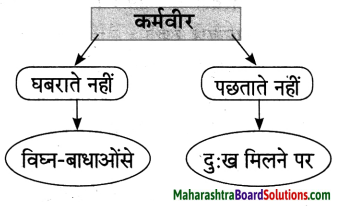
Maharashtra Board Class 9 Hindi Lokbharti Solutions Chapter 10 अपराजेय 13

प्रश्न 2.
कृति पूर्ण कीजिए।
उत्तर:
Maharashtra Board Class 9 Hindi Lokbharti Solutions Chapter 10 अपराजेय 14

कृति (3) शब्द संपदा

प्रश्न 1.
गद्यांश से विलोम शब्द की जोड़ी ढूँढ़कर लिखिए।
उत्तर:
लौकिक × अलौकिक

Maharashtra Board Class 9 Hindi Lokbharti Solutions Chapter 9 10 अपराजेय

प्रश्न 2.
निम्नलिखित शब्दों के पर्यायवाची लिखिए।
1. रियाज
2. आँख
उत्तर:
1. अभ्यास
2. नयन

प्रश्न 3.
गद्यांश में से कोई भी दो ऐसे शब्द ढूँढ़कर लिखिए कि जो बहुवचन में प्रयुक्त हुए हों।
उत्तरः
1. रेखाएँ
2. लहरियाँ

प्रश्न 4.
अनेक शब्दों के लिए एक शब्द लिखिए।
1. आत्मा से संबंधित
2. सांसारिक पदार्थों एवं वस्तुओं से संबंधित
उत्तर:
1. आत्मिक
2. भौतिक

प्रश्न 5.
गद्यांश में से ‘इक’ प्रत्यय वाले शब्द ढूँढ़कर लिखिए।
उत्तर:

  1. लौकिक
  2. अलौकिक
  3. भौतिक
  4. आत्मिक

प्रश्न 6.
निम्नलिखित वाक्य शुद्ध करके फिर से लिखिए।
1. वे अस्पताल ले जाया गए।
2. उनकी आँख हँस रही थी।
उत्तर:
1. उन्हें अस्पताल ले जाया गया।
2. उनकी आँखें हँस रही थीं।

Maharashtra Board Class 9 Hindi Lokbharti Solutions Chapter 9 10 अपराजेय

कृति (4) स्वमत अभिव्यक्ति

प्रश्न 1.
‘शास्त्रीय संगीत इंसान के जीवन में आनंद की अनुभूति कराने में प्रभावी साधन होता है।’ इस कथन पर अपने विचार लिखिए।
उत्तरः
शास्त्रीय संगीत भावों और रागों का खूबसूरत सरगम होता है। कहा जाता है कि ध्वनि ही ईश्वर का दूसरा रूप है और इसी ध्वनि से शास्त्रीय संगीत का जन्म हुआ है। मानव शरीर और मन को शास्त्रीय संगीत प्रभावित करता है। शास्त्रीय संगीत सुनते समय अगर आप अपने भीतर-ही-भीतर एक खास अवस्था में पहुँच जाए तो पूरा जगत आपके लिए ध्वनि हो जाता है। शास्त्रीय संगीत एक प्रकार की आध्यात्मिक प्रक्रिया है और आध्यात्मिक प्रक्रिया से मनुष्य को आनंद एवं सुख की प्राप्ति होती है। इसीलिए शास्त्रीय संगीत इंसान के जीवन में आनंद की अनुभूति कराने में प्रभावी साधन होता है।

(छ) परिच्छेद पढ़कर सूचना के अनुसार कृतियाँ कीजिए।

कृति (1) आकलन कृति

प्रश्न 1.
समझकर लिखिए।
उत्तरः
Maharashtra Board Class 9 Hindi Lokbharti Solutions Chapter 10 अपराजेय 15

प्रश्न 2.
संजाल पूर्ण कीजिए।
उत्तरः
Maharashtra Board Class 9 Hindi Lokbharti Solutions Chapter 10 अपराजेय 16

कृति (2) आकलन कृति

प्रश्न 1.
उपर्युक्त गद्यांश पढ़कर ऐसे दो प्रश्न तैयार कीजिए कि जिनके उत्तर निम्न शब्द हों।
1. कालिगुला
2. कजरी
उत्तर:
1. गद्यांश में कौन से नाटक का जिक्र किया गया है?
2. अमरनाथ आँखें बंद करके किसकी तान सुनते थे?

Maharashtra Board Class 9 Hindi Lokbharti Solutions Chapter 9 10 अपराजेय

प्रश्न 2.
कृति पूर्ण कीजिए।
उत्तर:
Maharashtra Board Class 9 Hindi Lokbharti Solutions Chapter 10 अपराजेय 17

कृति (3): शब्द संपदा

प्रश्न 1.
निम्नलिखित शब्द के अनेकार्थी शब्द लिखिए।
उत्तरः
जीवन – पानी, जिंदगी

प्रश्न 2.
गद्यांश में से उपसर्गयुक्त व प्रत्यययुक्त शब्द ढूँढ़कर लिखिए और उनके उपसर्ग व प्रत्यय भी अलग करके लिखिए।
उत्तरः

शब्दउपसर्गप्रत्यय
अनुकूलताता
आत्महीनताता
अद्वितीय
अपराजेय

Maharashtra Board Class 9 Hindi Lokbharti Solutions Chapter 9 10 अपराजेय

प्रश्न 3.
निम्नलिखित अनेक शब्दों के लिए एक शब्द लिखिए।

  1. जिसे संगीत की जानकारी हो:
  2. जिसकी कभी पराजय नहीं होती:
  3. जिसके समान अन्य कोई न हो:

उत्तरः

  1. संगीतज्ञ
  2. अपराजेय
  3. अद्वितीय

प्रश्न 4.
निम्नलिखित शब्दों के शुद्ध रूप लिखिए।
1. कॅसेट
2. अन्तिम
उत्तरः
1. कैसेट
2. अंतिम

कृति (4): स्वमत अभिव्यक्ति

प्रश्न 1.
‘जीवन का विकास पुरुषार्थ में हैं, आत्महीनता में नहीं।’ स्पष्ट कीजिए।
उत्तरः
पुरुषार्थ का तात्पर्य मनुष्य के लक्ष्य या उद्देश्य को प्राप्त करने से है और आत्महीनता का तात्पर्य मनुष्य की मानसिक कमज़ोरी से है। यदि मनुष्य अपने जीवन में अपना विकास करना चाहता है तो उसे अपने लक्ष्य की ओर अग्रसर होना पड़ेगा। उसे अपने मन में आने वाले विकार एवं मानसिक दुर्बल भावों को दूर भगाना होगा।

भले ही जीवन में कितनी भी बड़ी संकट की स्थिति निर्माण हो जाए फिर भी मनुष्य को अपनी आत्मिक शक्ति को नहीं खोना चाहिए। उसकी आत्मिक शक्तियाँ इतनी सशक्त होनी चाहिए कि वह जीवन में निर्माण होने वाली स्थितियों का सामना कर सके। यदि व्यक्ति के मन में दृढ़ संकल्प एवं दैदीप्यमान इच्छाशक्ति है, तो वह असंभव को भी संभव बना सकता है। इससे व्यक्ति का विकास होता है। इसीलिए कहा गया है कि जीवन का विकास पुरुषार्थ में हैं, आत्महीनता में नहीं।

Maharashtra Board Class 9 Hindi Lokbharti Solutions Chapter 9 10 अपराजेय

भाषाई कौशल पर आधारित पाठगत कृतियाँ।

भाषा बिंदू

प्रश्न 1.
काल परिवर्तन कीजिए।

  1. आसपास कई जगह फोन किया। (अपूर्ण वर्तमानकाल)
  2. सुबह पाँच बजे फोन आया था। (सामान्य भविष्यकाल)
  3. शास्त्री जी आ गए थे। (सामान्य भविष्यकाल)
  4. दिन में शास्त्री जी आते थे। (सामान्य वर्तमानकाल)
  5. मैं जीवन का व्याकरण बना रहा हूँ। (पूर्ण भूतकाल)
  6. उन्होंने सामने की जमीन में बगीचा बनाया था। (सामान्य वर्तमानकाल)

उत्तर:

  1. आसपास कई जगह फोन कर रहे हैं।
  2. सुबह पाँच बजे फोन आएगा।
  3. शास्त्री जी आएँगे।
  4. दिन में शास्त्री जी आते हैं।
  5. मैंने जीवन का व्याकरण बनाया था।
  6. वे सामने की जमीन में बगीचा बनवाते हैं।

प्रश्न 2.
निम्नलिखित रेखांकित विकारी शब्दों के भेद पहचानिए।
1. दुर्घटनास्थल पर भयावह दृश्य था।
2. रात के एक बजे हम पुलिस स्टेशन पहुंचे।
उत्तर:
1. गुणवाचक विशेषण
2. उत्तम पुरूषवाचक सर्वनाम

प्रश्न 3.
निम्नलिखित वाक्यों में से रेखांकित अव्ययों के भेद पहचानिए।
1. मुझे अभी मरना ही नहीं था।
2. अनिल ने डॉक्टर की तरफ देखकर कहा था।
उत्तर:
1. क्रियाविशेषण अव्यय
2. संबंधसूचक अव्यय

Maharashtra Board Class 9 Hindi Lokbharti Solutions Chapter 9 10 अपराजेय

प्रश्न 4.
निम्नलिखित वाक्यों के रचना की दृष्टि से प्रकार पहचनाकर लिखिए।
1. आपकी टाँग काटनी पड़ेगी।
2. अगर मैं उस वक्त बेहोश न हुआ होता तो उसे बचा लेता कभी भी मरने न देता।
उत्तर:
1. साधारण वाक्य
2. मिश्र वाक्य

प्रश्न 5.
निम्नलिखित वाक्यों के अर्थ की दृष्टि से प्रकार पहचानकर लिखिए।

  1. इसमें ऐसा क्या है?
  2. चित्र निकालने की मुझे फुरसत ही नहीं मिली।
  3. आपको अस्पताल में जाना ही पड़ेगा।
  4. ‘अब क्या होगा डॉक्टर?’

उत्तर:

  1. प्रश्नार्थक वाक्य
  2. निषेधार्थक वाक्य
  3. आज्ञार्थक वाक्य
  4. प्रश्नार्थक वाक्य

प्रश्न 6.
निम्नलिखित अव्यय शब्दों का वाक्य में प्रयोग कीजिए।

  1. साथ
  2. और
  3. तो
  4. के बिना

उत्तर:

  1. मैं राम के साथ घूमने जाऊँगा।
  2. राधा और मीना बाज़ार जा रही हैं।
  3. तुम मेरे साथ चलो नहीं तो मैं अकेला नहीं जाऊँगा।
  4. ईश्वर के बिना जीवन की कल्पना करना व्यर्थ है।

Maharashtra Board Class 9 Hindi Lokbharti Solutions Chapter 9 10 अपराजेय

संभाषणीय:

प्रश्न 1.
विद्यालय में आते समय आपको रास्ते में दुर्घटनाग्रस्त महिला दिखी। आपने उसकी सहायता की। इस घटना का वर्णन कीजिए।
उत्तर:

  1. अध्यापक – विजय, आज स्कूल आने में तुम्हें देर हो गई। क्या कारण है?
  2. विजय – जी हाँ, अध्यापक महोदय। मैं जब स्कूल आ रहा था तब गांधी रोड हाइवे पर एक दुर्घटना हुई। एक महिला दुर्घटना में घायल हो गई।
  3. अध्यापक – क्या कह रहे हो तुम? दुर्घटना हुई! महिला कैसे घायल हुई?
  4. विजय – हमारी गाड़ी महिला की गाड़ी से बिल्कुल पीछे थी। सामने से एक बड़ा ट्रक आ गया और वह महिला की गाड़ी से टकरा गया। जिस कारण महिला घायल हो गई। मैंने अपने माता-पिता के साथ मिलकर उस महिला को गाड़ी से बाहर निकाला और उसे तुरंत अस्पताल की ओर लेकर चले गए। ट्रक वाले ने अपनी गलती स्वीकार कर ली। वह भी हमारे साथ अस्पताल पहुंचा।
  5. अध्यापक – पर तुमने अब तक यह नहीं बताया कि अब उस महिला की हालत कैसी है और उसे कहाँ चोट आई?
  6. विजय – महिला के दाहिने हाथ को चोट आई है। डॉक्टर ने उसके घावों पर मरहम पट्टी लगा दी। उसके बाद हमने उस महिला से उसके घर वालों का फोन नंबर लेकर उन्हें सूचित भी कर दिया। उसके घर वाले अब उसके पास अस्पताल में हैं। परिस्थिति अनुकूल होने के पश्चात ही हम वहाँ से निकले और मेरे माता-पिता मुझे सीधे स्कूल लेकर आए। इसी कारण मुझे स्कूल आने में लगभग एक घंटे की देरी हो गई है।
  7. अध्यापक – विजय तुमने बहुत ही बड़ा मानवता का कार्य किया है। इसके लिए मैं तुम्हें धन्यवाद देता हूँ।

अपराजेय Summary in Hindi

लेखिका-परिचय:

जीवन-परिचय: लेखिका कमल कुमार आधुनिक युग की प्रमुख कहानीकार हैं। इनका जन्म हरियाणा के अंबाला जिले में हुआ था। उपन्यास के क्षेत्र में इन्होंने अपना अमूल्य योगदान दिया है। इन्होंने व्यक्ति के जीवन अनुभवों को अपनी कहानी के द्वारा अभिव्यक्त करने का कार्य किया है। इन्होंने आसक्ति, आशा, आस्था एवं जीवन के स्पंदन को अपनी कहानियों के द्वारा चित्रित किया है।

प्रमुख कृतियाँ: कहानी संग्रह – ‘पहचान’, ‘क्रमशः’, ‘फिर से शुरू’ आदि उपन्यास – ‘अपार्थ’, ‘आवर्तन’, ‘हैमबरगर’, ‘पासवर्ड’ आदि।

गद्य-परिचय:

वर्णनात्मक कहानी: वर्णनात्मक कहानी हिंदी साहित्य विधा का एक प्रमुख अंग है। जीवन की किसी घटना का रोचक़, सुंदर एवं प्रवाही वर्णन ही ‘वर्णनात्मक कहानी’ कहलाता है।

प्रस्तावना: प्रस्तुत कहानी के माध्यम से लेखिका कहना चाहती हैं कि व्यक्ति को अपने जीवन में प्रत्येक परिस्थितियों का सामना करने के लिए सदैव तत्पर रहना चाहिए क्योंकि परिस्थितियाँ निमंत्रण देकर नहीं आती हैं। वे कभी-भी व्यक्ति के जीवन में निर्माण हो सकती हैं। व्यक्ति को सिर्फ उनसे लड़ने के लिए तैयार रहना चाहिए।

Maharashtra Board Class 9 Hindi Lokbharti Solutions Chapter 9 10 अपराजेय

सारांश:

अमरनाथ कहानी के प्रमुख पात्र हैं। वे दूसरे शहर में कुछ काम के सिलसिले में गए थे। वहाँ से लौटते समय अलवर के रास्ते में उनकी गाड़ी दुर्घटनाग्रस्त हो जाती है। जिस कारण उनके ड्राइवर की मृत्यु हो जाती है। चार घंटे तक वे बेहोशी के हालत में दुर्घटनास्थल पर घायल होकर पड़े रहते है। इस कारण उनके शरीर में जहर फैल जाता है और डॉक्टर को उनकी एक टाँग काटनी पड़ती है। वे सहर्ष अपनी टाँग कटवाने के लिए तैयार हो जाते हैं। टाँग कट जाने का उन्हें तनिक भी दुख नहीं होता है। इसके बाद वह स्वचालित व्हीलचेयर पर विराजमान हो जाते हैं और अपनी चित्रकारी को पूरा कराने के लिए कैनवस रंग, ब्रश और ईजल मँगवाते हैं। कुछ दिनों के पश्चात डॉक्टर फिर से उनके खून की जाँच करते हैं।

तब उन्हें पता चलता है कि बीमारी फिर से फैल रही है। जिस कारण उनकी दाईं बाँह डॉक्टर को काटनी पड़ती है। फिर भी अमरनाथ प्रसन्न रहते हैं। उन्हें अपनी बाँह कटने का रत्ती भर भी दुख नहीं होता है। अस्पताल से घर आने के पश्चात वह शास्त्रीय संगीत सीखना शुरू कर देते हैं। वे दिन-रात संगीत साधना में व्यस्त रहते हैं। वे स्वयं दिव्यांग हैं; इस बात को भी वे भूल जाते हैं। फिर से डॉक्टर उनके खून की जाँच करते हैं। अबकी बार उनकी आवाज चली जाती है। फिर भी अमरनाथ परिस्थितियों से हार मानने वाले नहीं थे।

अस्पताल से घर आकर संगीतज्ञों की कैसेट डिस्क म्यूजिक सिस्टम उनके कमरे में साइन बोर्ड पर रख दिया जाता है। संगीत सुनना पक्षियों का कलरव सुनना, सूखे पत्ते व कलियों की आवाज सुनने का उनका शौक बढ़ता ही जाता है। वे जानते हैं कि ईश्वर उनके एक-एक अंग को उनसे अलग कर रहा है। फिर भी वे टससे-मस नहीं होते हैं। वे ईश्वर के विरुद्ध शांत संघर्ष करते हैं। वे हार मानने वालों में से नहीं हैं। वे हमेशा अपराजेय ही रहेंगे। जीवन के हर पल, हर स्थिति एवं हर वस्तु में अद्वितीय ही रहेंगे। आखिर वे मानते हैं कि मनुष्य के जीवन का विकास पुरूषार्थ में हैं, आत्महीनता में नहीं।

शब्दार्थ:

  1. अकुलाहट – व्याकुलता, बेचैनी
  2. घुमक्कड़ी – घूमने की क्रिया
  3. परिदृश्य – चारों ओर के दृश्य
  4. उजास – प्रकाश, उजाला
  5. दुर्घटना – हादसा
  6. रक्तस्राव – रक्त का शरीर से बहना।
  7. स्वचालित – स्वयं चलने वाली
  8. अलवैर काम् – एक पाश्चात्य नाटककार
  9. अद्वितीय – जिसके समान कोई न हो।
  10. अपराजेय – जिसकी कभी पराजय न हो।

Maharashtra Board Class 6 English Solutions Chapter 1.3 Autobiography of a Great Indian Bustard

Balbharti Maharashtra State Board Class 6 English Solutions Chapter 1.3 Autobiography of a Great Indian Bustard Notes, Textbook Exercise Important Questions and Answers.

Maharashtra State Board Class 6 English Solutions Chapter 1.3 Autobiography of a Great Indian Bustard

Class 6 English Chapter 1.3 Autobiography of a Great Indian Bustard Textbook Questions and Answers

1. Read the passage aloud.

World Heritage English Workshop Question 1.
Read the passage aloud.

2. You are going to meet a Great Indian Bustard very soon. Prepare at least 10 questions to interview him.

World Heritage Question And Answer 10th Class Question 1.
You are going to meet a Great Indian Bustard very soon. Prepare at least 10 questions to interview him.
Answer:
Hello! It is nice to meet you! Please answer a few questions:

  1. What can you tell us about yourself?
  2. Where are you and your friends found in India?
  3. When are you the most happiest?
  4. Why are your numbers on a decline across the globe?
  5. Which are the organisations which are supporting you in your struggle for survival?
  6. How can the government play a role to help birds and animals on the verge of extinction?
  7. Whose initiatives have led to increased awareness about the plight of the Great Indian Bustard?
  8. How can media help you in creating awareness about the problems faced by you?
  9. What would you like the children to do to support you in order to survive?
  10. Do you have any message for human beings?

Maharashtra Board Class 6 English Solutions Chapter 1.2 Who’s the Greatest?

3. Play the roles of an interviewer and a Great Indian Bustard and write the interview.

World Heritage Class 10 Question 1.
Play the roles of an interviewer and a Great Indian Bustard and write the interview.
Answer:
(Students to attempt)

4. Write u letter to your friend about the Great Indian Bustard. You may use the following points:
Why we need to protect the bird.
What you plan to do to help the bird.

World Heritage 10th Class Lesson Question 1.
Write u letter to your friend about the Great Indian Bustard. You may use the following points:
Why we need to protect the bird.
What you plan to do to help the bird.
Answer:

A/18 Deep Mahal,
Sahar Road,
Vile Parle (E),
Mumbai – 400 057,
15th August, 2016.

Dear Rajani,
Hi! Hope this letter finds you in good health and happiness. I am writing this . letter to express my concern about the fact that only the last 200 of the Great Indian Bustards are left in this world.

The animals, birds, insects, trees, rivers, seas and other elements of nature including man are all the part of a link which binds us together, and which keeps us going. It is high time we protect the Great Indian Bustard and other species which are on the verge of extinction.

How right are the words, “Let’s preserve nature, if not for anything else, For the beauty and strength it inspires!”
We can protect the birds by creating awareness through our school magazine. We can write letters to the government officials too. We can discuss this issue with the elders. We can ask our teacher to take us to sanctuaries to have a better understanding of the life of the Great Indian Bustard.

Let us remember: ‘The future lies in our hands. Let us conserve, preserve and protect all the elements of nature.’
Please think about the issue I shared with you.

Yours lovingly,
XYZ

Maharashtra Board Class 6 English Solutions Chapter 1.2 Who’s the Greatest?

5. Form pairs and decide whether the following statements are those of a Great Indian Bustard or not.

World Heritage Question And Answer Question 1.
Form pairs and decide whether the following statements are those of a Great Indian Bustard or not.
Maharashtra Board Class 6 English Solutions Chapter 1.3 Autobiography of a Great Indian Bustard 1
Answer:

StatementsGreat Indian BustardSome Other Bird
a. I am the heaviest flying bird in India.
b. I am known as Maldhok or Hoom in Marathi.
c. I live in mountainous regions.
d. I don’t like grasshoppers or beetles.
e. We don’t believe in building nests.
f. Our chick stays with the mother for a period of nearly one year.
g. I am the State Bird of Maharashtra.
h. We have been pushed away from more than 90 per cent of our home regions.

Maharashtra Board Class 6 English Solutions Chapter 1.2 Who’s the Greatest?

6. With the help of the internet and other sources, obtain more information about the critically endangered birds and animals in India. Find the names of their sanctuaries.

Some critically endangered birds and animals in India:
‘CR’ or critically endangered birds or animals are those that are likely to become extinct in the wild. We may never see them again.

  • Forest Owlet
  • Indian Vulture
  • Siberian Crane
  • Deoluli Minnow (fish)
  • Asiatic Cheetah
  • Himalayan Wolf
  • Amboli Toad

Maharashtra Board Class 6 English Solutions Chapter 1.2 Who’s the Greatest?

7. Prepare a poster on the need for the conservation of the Great Indian Bustard.

World Heritage English Workshop 10th Standard Question 1.
Maharashtra Board Class 6 English Solutions Chapter 1.3 Autobiography of a Great Indian Bustard
Answer:
Maharashtra Board Class 6 English Solutions Chapter 1.3 Autobiography of a Great Indian Bustard 2

8. Write a short autobiography of any bird or animal of your choice.

English Workshop Of World Heritage Question 1.
Write a short autobiography of any bird or animal of your choice.
Answer:
Hello friends! I reside in a dense jungle. I love rains and I express my joy by dancing in the rain. People say watching me dance is indeed a beautiful sight. Yes, I am a peacock. I long to fly in the high blue sky like the pigeon. I wish I could fly above the clouds and beyond. Alas! It is not possible.

But I count my blessings. My beauty and the fact that I am the National Bird of India gives me reasons to rejoice and celebrate. Next time you see a graceful bird with a bright shining tail, dancing to its heart’s content in the rainy seasons, you can be rest assured, it’s me.

I have a humble request. Please preserve and protect us. Many of us – my fellow beings are on the verge of extinction. Please save us else we will soon become a part of history.
Remember: Harmony between man and wild life is the only way to solve all the problems faced by the world.
Come, together let us co-exist.

9. Make a list of the channels available on your TV under the following categories:
News, entertainment, sports, movies, music, etc.
Which are the channels on which you can watch programmes on animals, wildlife, conservation of environment, etc.?

Maharashtra Board Class 6 English Solutions Chapter 1.2 Who’s the Greatest?

10. Ask your parents to show you TV programmes on animals, wildlife and conservation of environment on channels like the following:
DD National, National Geographic, Discovery and Animal Planet.

11. You have won a prize to visit a wildlife sanctuary or National Park in Africa or Australia. Choose a location, read about it. Imagine that you are visiting it and write a letter to your friend about it.

12. Language Study: Identify the following from the list given in the box below :
4 nouns, 4 verbs, 4 adjectives, 4 adverbs, 4 pronouns.

Question 1.
Identify the following from the list given in the box below :
Maharashtra Board Class 6 English Solutions Chapter 1.3 Autobiography of a Great Indian Bustard 3
Answer:

NounsVerbsAdjectivesAdverbsPronouns
1. bird1. gather1. wonderful1. directly1. we
2. friends2. helps2. healthy2. together2. I
3. humans3. protect3. happy3. away3. you
4. grasslands4. arrive4. afraid4. slowly4. us

Class 6 English Chapter 1.3 Autobiography of a Great Indian Bustard Additional Important Questions and Answers

Answer in one sentence.

4.3 World Heritage Question 1.
Which is the heaviest flying bird in India?
Answer:
The Great Indian Bustard is the heaviest flying bird in India.

Maharashtra Board Class 6 English Solutions Chapter 1.2 Who’s the Greatest?

World Heritage 10th Class Lesson Workshop Question 2.
How is the female Indian Bustard different from the male one?
Answer:
The female Indian Bustards are smaller and slimmer than their male counterparts, and their neck is not white.

10th Class World Heritage English Workshop Question 3.
Where do the Great Indian Bustards live?
Answer:
The Great Indian Bustards live on grasslands and deserts.

Question 4.
Name any two things which are favourite food items of a Great Indian Bustards.
Answer:
Grasshoppers and beetles.

Question 5.
Rains usher happiness into the lives of the Great Indian Bustards. Pick out proof from the lesson for this statement.
Answer:
“I dance in joy with puffed feathers and cocked up tail and dropped down wings.”

Maharashtra Board Class 6 English Solutions Chapter 1.2 Who’s the Greatest?

Question 6.
Who are the enemies of the Great Indian Bustard’s eggs and chicks?
Answer:
Monitor lizards, foxes, dogs, pigs, snakes and eagles are the enemies of the Great Indian Bustard’s eggs and chicks.

Question 7.
What is the difference between the young ones of other birds and the Great Indian Bustards?
Answer:
The difference between the young ones of other birds and the young ones of Great Indian Bustards is that unlike the young ones of other birds which soon fly away from the nest, the Great Indian Bustard’s mother and chick stay together for nearly a year.

Reading Skills, Vocabulary and Grammar

Read the following extract and complete the activities that follow.

Question 1.
Complete the list of things we can do to extend our love and support to help the Great Indian Bustard survive.
Answer:

  1. Write letters to our leaders and make appeals.
  2. Make drawings and submit it to your teacher.
  3. Discuss with your parents.
  4. Visit a sanctuary.

Maharashtra Board Class 6 English Solutions Chapter 1.2 Who’s the Greatest?

Question 2.
Which environmental problem is highlighted in the extract?
Answer:
The decline of the population of the Great Indian Bustard, driving them to the verge of extinction is highlighted in the passage.

Question 3.
Who suggested that the Great Indian Bustard should be given the status of the ‘National Bird?
Answer:
Dr. Salim Ali, a friend of Great Indian Bustards suggested that the Great Indian Bustard should be given the status of the ‘National Bird’.

Question 4.
What is the consequence of the growing population of man on the Great Indian Bustard?
Answer:
The growing population of man has pushed the Great Indian Bustard from more than 90 per cent of their home regions.

Question 5.
Two causes which has led to the decline in the number of the Great Indian Bustard.
Answer:
Hunting, Electric power-line

Maharashtra Board Class 6 English Solutions Chapter 1.2 Who’s the Greatest?

Question 6.
We used to live in all parts of India. (State the word class of the underlined part.)
Answer:
all – adjective

Question 7.
We are losing our homes. (Add a question tag.)
Answer:
We are losing our homes, aren’t we?

Question 8.
We need your support and love in order to survive. (Use not only … but also.)
Answer:
We need not only your support but also love in order to survive.

Question 9.
Give the verb forms of:
Answer:
population: populate electric: electrify/electrocute

Maharashtra Board Class 6 English Solutions Chapter 1.2 Who’s the Greatest?

Question 10.
Why should we save animals from extinction?
Answer:
Animals are also an important element of the food chain. Many species of animals have become extinct. The animals are invaluable. Our existence depends on them, so to stop the links of food chains from breaking, we should save the animals from extinction.

Language Study

Do as directed.

Question 1.
I have got a long white neck, brown wings, tall yellow legs and a black cap on my head.
Fill in the chart with Nouns and Adjectives.
Answer:

NounsAdjectives
neckslong
wingswhite
legsbrown
captall
headyellow
black

Maharashtra Board Class 6 English Solutions Chapter 1.2 Who’s the Greatest?

Question 2.
Mrs. Bustard is smaller and slimmer than I am. (Pick out the adjectives and state the degree of comparison used.)
Answer:
Adjective: Smaller
Slimmer: Degree of comparison: Comparative

Question 3.
That’s a very healthy habit! (Pick out the adverb.)
Answer:
Adverb: very

Question 4.
It helps me to impress my soulmate. (Rewrite the sentence using the underlined word as noun.)
Answer:
It helps me create an impression on my soulmate.

Question 5.
I dance in joy. (Make it exclamatory.)
Answer:
How I dance in joy!

Question 6.
The egg looks like a stone. (Pick out the articles.)
Answer:
Articles: The, a

Maharashtra Board Class 6 English Solutions Chapter 1.2 Who’s the Greatest?

Question 7.
We need your support and love in order to survive. (Pick out the noun and state their kind.)
Answer:
support and love: Abstract Noun

Question 8.
You can discuss this with your parents. (Pick out the modal and state its function.)
Answer:
can: possibility

Question 9.
Come to see us at a sanctuary. (Pick out the preposition.)
Answer:
at: preposition

Question 10.
You will only see us in pictures. (Pick out the adverb.)
Answer:
only – Adverb

Maharashtra Board Class 6 English Solutions Chapter 1.2 Who’s the Greatest?

Word building.

Complete the table:

NounAdjectiveVerb
impressionimpressiveimpress
healthhealthyheal
specialityspecialspecialise
beautybeautifulbeautify
electricityelectricelectrify/electrocute
picturepictorialpicture

Do you know?

Penguins arrive in Mumbai Zoo. Three male and four female humboldt penguins have been brought in from Seoul, Korea. They have been kept in the quarantine section of the Veermata Jijabhai Bhosale Zoo. While the penguins need to be kept in a temperature between 4° and 25° Celsius, the temperature in the quarantine is between 16° and 18° Celsius. The humboldt penguins are between one and three years of age and have a life expectancy of around 20-25 years.

Autobiography of a Great Indian Bustard Summary in English

In this lesson, the author acquaints us with the different physical characteristics of the Great Indian Bustard. He also talks about their habitat, their eating habits and other details, apart from providing information about their young ones.

He further elaborates that though it is the State Bird of Rajasthan and despite having ten sanctuaries for their protection, their number is on a decline.

Due to uncontrolled population explosion created by man, the Indian Bustards were being pushed away from more than 90 percent of their home regions.

There are other reasons for their decline in number like hunting, electric shock, loss of habitat etc. With the last 200 of the birds left in the world, the lesson reminds us that the birds need our love and support for their survival. The lesson also enlists various ways in which we can do our part to stop the birds from becoming extinct.

Introduction:

Autobiography is a history of a person’s life as narrated by that person, which could be written or oral. Dr. Pramod Patil has used this method of writing to drive home the plight of the Great Indian Bustards who are on the verge of extinction.

Maharashtra Board Class 6 English Solutions Chapter 1.2 Who’s the Greatest?

Glossary:

  1. impressive (adj) – one which evokes admiration
  2. grasslands (n) – open area in a region covered with grass
  3. deserts (n) – a large, dry, barren region
  4. gulp (v) – swallow quickly
  5. pouch (n) – a sac-like structure in animals, a pocket-like space (here)
  6. resonating (y) – producing a loud, deep sound
  7. swarming (v) – moving in large numbers
  8. sanctuaries (n) – a reserved area for birds and animals to provide them protection
  9. power-lines (n) – used for electric power transmission
  10. predators (n) – animals that hunt, kill and eat other animals

Maharashtra Board Class 10 Hindi Lokvani Solutions Chapter 6 ऐसा भी होता है

Balbharti Maharashtra State Board Class 10 Hindi Solutions Hindi Lokvani Chapter 6 ऐसा भी होता है Notes, Textbook Exercise Important Questions and Answers.

Maharashtra State Board Class 10 Hindi Lokvani Solutions Chapter 6 ऐसा भी होता है (पठनार्थ)

Hindi Lokvani 10th Std Digest Chapter 6 ऐसा भी होता है Textbook Questions and Answers

स्वाध्याय :

सूचना के अनुसार कृतियाँ कीजिए

प्रश्न 1.
कृति पूर्ण कीजिए
Maharashtra Board Class 10 Hindi Lokvani Solutions Chapter 6 ऐसा भी होता है 1
उत्तर:
Maharashtra Board Class 10 Hindi Lokvani Solutions Chapter 6 ऐसा भी होता है 2

2. उचित शब्द लिखिए। 

प्रश्न 1.
उचित शब्द लिखिए।

  1. सहमकर काँपने वाली –
  2. घोंसला उजड़ने पर रोने वाला –
  3. सुख-दुख बाँटने वाला –
  4. वृद्धाश्रम से चिट्ठी भेजने वाली –

उत्तर :

  1. कच्ची दीवार
  2. पखेरू या पंछी
  3. डाकिया
  4. बूढी माँ

Maharashtra Board Class 10 Hindi Lokvani Solutions Chapter 6 ऐसा भी होता है

3. किरण शब्द की विशेषताएँ : 

प्रश्न 1.
किरण शब्द की विशेषताएँ :
Maharashtra Board Class 10 Hindi Lokvani Solutions Chapter 6 ऐसा भी होता है 3
उत्तर :
Maharashtra Board Class 10 Hindi Lokvani Solutions Chapter 6 ऐसा भी होता है 4

भाषा बिंदु :

प्रश्न 1.
आकृति में दिए गए वाक्य का काल पहचानकर निर्देशानुसार काल परिवर्तन कीजिए।
Maharashtra Board Class 10 Hindi Lokvani Solutions Chapter 6 ऐसा भी होता है 5
उत्तरः
Maharashtra Board Class 10 Hindi Lokvani Solutions Chapter 6 ऐसा भी होता है 6.1

उपयोजित लेखन :

प्रश्न 1.
‘मेरा प्रिय त्योहार’ विषय पर 80 से 100 शब्दों में निबंध लिखिए।
उत्तरः
मेरा प्रिय त्योहार हमारा भारत देश त्योहारों का देश है। भारत में दीपावली, होली, नवरात्रि, गणेशचतुर्थी आदि तरह-तरह के त्योहार मनाए जाते हैं। प्रत्येक त्योहार की अपनी सांस्कृतिक एवं आध्यात्मिक विशेषता होती है। इस प्रकार प्रत्येक त्योहार का अपना महत्त्व होता है। सभी को त्योहार अच्छे लगते हैं। मैं भी इसका अपवाद नहीं हूँ। मेरा प्रिय त्योहार दीपावली है। इसे दीवाली भी कहते हैं। दीपावली दीपों का त्योहार है।

यह त्योहार पाँच दिनों तक मनाया जाता है। धन त्रयोदशी, नरक चतुर्दशी, दीपावली, गोवर्धन पूजा और भैयादूज ये पाँच पर्व पाँच दिन मनाए जाते है। अमावस्या की अंधेरी रात जगमग दीपों से जममगाने लगती है। यह दृश्य बहुत ही मनोरम व अद्भुत होता है। इस दिन भगवान श्रीराम, माता सीता व भाई लक्ष्मण के साथ चौदह वर्ष का वनवास पूरा करके अयोध्या वापस पधारे थे। इसी कारण लोगों ने खुश होकर अपने घरों के द्वार पर भगवान के स्वागत हेतु दीप जलाए थे।

तब से यह शुभ दिन दीपावली के रूप में मनाया जाता है। यह त्योहार बुराई पर अच्छाई की जीत का प्रतीक है। दीपावली की शाम को लोग देवी लक्ष्मी और गणेश जी की पूजा करते हैं। बच्चे पटाखे छोड़ते हैं। इस दिन लोग अपने परिवार वालों के पास जाकर उनसे मिलते हैं और खुशियाँ बाँटते हैं, एकदूसरे को मिठाइयाँ बाँटते हैं। यह त्योहार शांति, भाईचारा व एकता का संदेश देता है। हमें एक-दूसरे के साथ प्रेम से रहना और एक-दूसरे के जीवन में खुशियाँ निर्माण करने का संदेश दीपावली से मिलता है। इसलिए हर्षित होकर मैं कहता हूँ –

“त्योहार है दीपावली का
सुख-समृद्धि और खुशहाली का।
बुराई के राक्षस को मन से भगाएँ
हृदय में शांति का दीपक जलाएँ।”

Maharashtra Board Class 10 Hindi Lokvani Solutions Chapter 6 ऐसा भी होता है

Hindi Lokvani 10th Std Textbook Solutions Chapter 6 ऐसा भी होता है Additional Important Questions and Answers

(अ) निम्नलिखित पद्यांश पढ़कर दी गई सूचनाओं के अनुसार कृतियाँ कीजिए।

कृति अ (1) आकलन कृति

प्रश्न 1.
उचित शब्द लिखिए।
i. थकी हारी
उत्तर :
i. सूरज की किरण

प्रश्न 2.
समझकर लिखिए।
i. कच्ची दीवार सहमी क्योंकि –
उत्तरः
मेघ गरजने लगे।

Maharashtra Board Class 10 Hindi Lokvani Solutions Chapter 6 ऐसा भी होता है

ii. किरण ने धरती की गोद का सहारा लिया क्योंकि –
उत्तर:
सुबह से शाम तक प्रकाश देने की कार्य करने के बाद शाम को वह थक गई।

कृति अ (2) : शब्द संपदा

प्रश्न 1.
निम्नलिखित शब्दों के अर्थ पद्यांश में से ढूँढ़कर लिखिए।

  1. बादल
  2. सूर्य
  3. पवित्र
  4. धरती

उत्तर :

  1. मेघ
  2. रवि
  3. निर्मल
  4. धरा

प्रश्न 2.
विलोम शब्द लिखिए।
i. कच्ची × …….
ii. निर्मल × …….
उत्तर:
i. पक्की
i. मलिन

प्रश्न 3.
निम्नलिखित शब्द के अनेकार्थी शब्द लिखिए।
i. गोद
उत्तर:
i. पहलू, आँचल

Maharashtra Board Class 10 Hindi Lokvani Solutions Chapter 6 ऐसा भी होता है

प्रश्न 4.
निम्नलिखित शब्द के वचन बदलिए।
i. दीवार
ii. किरण
उत्तर:
i. दीवारें
ii. किरणें

प्रश्न 5.
निम्नलिखित शब्द के श्रुतिसम भिन्नार्थक शब्द लिखिए।
i. काँपी
उत्तर:
i. कॉपी

कृति अ (3) : स्वमत अभिव्यक्ति

प्रश्न 1.
समाज के कमजोर वर्गों के उत्थान और उनकी प्रगति हेतु आप क्या कर सकते हैं? अपने विचार लिखिए।
उत्तरः
समाज के कमजोर वर्गों के उत्थान और उनकी प्रगति हेतु हम विशिष्ट अभियान चला सकते हैं। उस अभियान के अंतर्गत हम दुर्बल घटकों में जागरूकता निर्माण करने का प्रयास करेंगे। ग्रामीण क्षेत्रों में इनकी संख्या अधिक होती है। अत: ग्रामीण क्षेत्रों का विकास करने हेतु हम अभियान चलाएंगे; ताकि सरकार ग्रामीण क्षेत्रों का विकास करने हेतु ठोस कदम उठाए। आज हमारे समाज में वंचित वर्गों को अच्छी शिक्षा नहीं मिल पा रही है। अत: उन्हें शिक्षा मिले इसके लिए हम प्रशासन का ध्यान उनकी ओर आकर्षित करने हेतु अभियान चलाएँगे। समाज में सामाजिक न्याय प्रस्थापित हो इसलिए व्यक्तिगत स्वार्थ से ऊपर उठकर हम आपसी प्रेम, भाईचारा, मानवता आदि नौतियों का पालन करेंगे।

Maharashtra Board Class 10 Hindi Lokvani Solutions Chapter 6 ऐसा भी होता है

(आ) निम्नलिखित पद्यांश पढ़कर दी गई सूचनाओं के अनुसार कृतियाँ कीजिए।

कृति आ (1) : आकलन कृति

प्रश्न 1.
सही विकल्प चुनकर लिखिए।
i. खुली आँखों ने जीवन भर देखे –
(अ) खुले सपने
(आ) बंद सपने
(इ) मनचाहे सपने
उत्तर:
(आ) बंद सपने

ii.बच्चों की जीवनरूपी पतंग माँ-बाप ने थाम ली इसलिए –
(अ) उन्होंने आसमान को छू लिया।
(आ) उन्होंने स्वर्ग को छू लिया।
(इ) उन्होंने अंतरिक्ष को छू लिया।
उत्तर:
(अ) उन्होंने आसमान को छू लिया।

Maharashtra Board Class 10 Hindi Lokvani Solutions Chapter 6 ऐसा भी होता है

प्रश्न 2.
समझकर लिखिए।
i. वृक्षों के कटने का परिणाम –
उत्तर:
पंछियों का आशियाना उजड़ गया और वे रोने लगे।

प्रश्न 3.
उचित जोड़ियाँ लगाइए।

‘अ’‘ब’
1. तन(क) बंद
2. कद(ख) माटी
3. आशियाना(ग) काठी
4. सपने(घ) उजड़ा

उत्तर:

‘अ’‘ब’
1. तन(ख) माटी
2. कद(ग) काठी
3. आशियाना(घ) उजड़ा
4. सपने(क) बंद

प्रश्न 4.
कृति पूर्ण कीजिए।
उत्तर:
Maharashtra Board Class 10 Hindi Lokvani Solutions Chapter 6 ऐसा भी होता है 7

प्रश्न 5.
उचित शब्द लिखिए।
i. स्वयं पर गुमान करने वाला –
उत्तर:
i. इंसान

Maharashtra Board Class 10 Hindi Lokvani Solutions Chapter 6 ऐसा भी होता है

कृति आ (2) : शब्द संपदा

प्रश्न 1.
निम्नलिखित शब्द के अनेकार्थी शब्द लिखिए।

  1. पतंग
  2. जीवन
  3. गुमान

उत्तर:

  1. फतिका, सूर्य
  2. पानी, जिंदगी
  3. अभिमान, अनुमान

प्रश्न 2.
निम्नलिखित तद्भव शब्द का तत्सम शब्द लिखिए।
i. माटी
ii. सपना
उत्तर:
i. मृदा
ii. स्वप्न

प्रश्न 3.
उपसर्ग व प्रत्यय लगाकर शब्द लिखिए।
i. जीवन
उत्तरः
उपसर्गयुक्त शब्द – आजीवन, प्रत्यय
युक्त शब्द – जीवनभर

Maharashtra Board Class 10 Hindi Lokvani Solutions Chapter 6 ऐसा भी होता है

प्रश्न 4.
पर्यायवाची शब्द लिखिए।

  1. पखेरू
  2. तन
  3. आशियाना
  4. डोर

उत्तर:

  1. पक्षी
  2. शरीर
  3. घोंसला
  4. रस्सी

कृति आ (3) : स्वमत अभिव्यक्ति

प्रश्न 1.
वक्षों के कटने के दुष्परिणाम अपने शब्दों बताइए।
उत्तरः
आजकल शहरों को बसाने के लिए बड़े स्तर पर वृक्षों की कटाई हो रही है। इसके कई दुष्परिणाम सामने आ रहे हैं। अंधाधुंध पेड़ काटे जाने के कारण ऑक्सीजन की मात्रा कम हो रही है तथा हवा प्रदूषित होती जा रही है। शहरों में वायु-प्रदूषण की समस्या सबसे ज्यादा बढ़ गई है। लोगों को अस्थमा जैसी साँस लेने की समस्या, हृदय रोग आदि हो रहे हैं। पेड़ों की कटाई करने के कारण वन्यजीवों का अस्तित्व भी खतरे में पड़ गया है। कई प्रजातियाँ विलुप्त हो गई हैं और कुछ विलुप्त होने के कगार पर हैं।

पेड़ों की कटाई का प्राकृतिक जलवायु परिवर्तन पर प्रभाव पड़ रहा है। जिस कारण ग्लोबल वार्मिग जैसी समस्या उत्पन्न हो रही है। तापमान में वृद्धि हो रही है। पेड़ों की कटाई की वजह से भूमि का क्षरण हो रहा है। इंसान हरी-भरी जिंदगी से वंचित हो गया है। उसका जीवन परेशानी से भर रहा है।

Maharashtra Board Class 10 Hindi Lokvani Solutions Chapter 6 ऐसा भी होता है

(इ) निम्नलिखित पद्यांश पढ़कर दी गई सूचनाओं के अनुसार कृतियाँ कीजिए।

कृति इ (1) : आकलन कृति

प्रश्न 1.
उचित शब्द लिखिए –
i. ठसा-सा रहने वाला –
ii. आसमान में उड़ने वाला –
उत्तर:
i.तरू
ii. पखेरू

प्रश्न 2.
समझकर लिखिए –
उत्तर:
Maharashtra Board Class 10 Hindi Lokvani Solutions Chapter 6 ऐसा भी होता है 8

प्रश्न 3.
निम्नलिखित शब्द पढ़कर ऐसे दो प्रश्न तैयार कीजिए जिनके उत्तर निम्न शब्द हों –
i. वृद्धाश्रम
ii. संस्कारों
उत्तर:
i. मैया कहाँ रहती है?
ii. तिजोरी किससे भरी थी?

Maharashtra Board Class 10 Hindi Lokvani Solutions Chapter 6 ऐसा भी होता है

कृति इ (2) : शब्द संपदा

प्रश्न 1.
पद्यांश में से देशज शब्द ढूंढकर लिखिए।
उत्तर:
i. देशज शब्द : मैया, पखेरू, चिट्ठी
ii. तत्सम शब्द : तरू, वृद्ध

Maharashtra Board Class 10 Hindi Lokvani Solutions Chapter 6 ऐसा भी होता है

प्रश्न 2.
निम्नलिखित तद्भव शब्द का तत्सम रूप लिखिए।
i. दुख
उत्तर:
i. दुःख

प्रश्न 3.
निम्नलिखित शब्दों के पर्यायवाची शब्द लिखिए।
i. चिट्ठी
i. झोला
उत्तर:
i. खत
ii. थैला

प्रश्न 4.
पद्यांश में से विलोम शब्द की जोड़ी ढूंढकर लिखिए।
उत्तर:
i. सुख × दुख

Maharashtra Board Class 10 Hindi Lokvani Solutions Chapter 6 ऐसा भी होता है

कृति इ (3) : स्वमत अभिव्यक्ति

प्रश्न 1.
‘बढ़ती संस्कारहीनता’ विषय पर अपने विचार लिखिए।
उत्तरः
समाज की सबसे छोटी इकाई परिवार होती है। परिवार में बच्चों को अच्छे संस्कार में डालकर सभ्य मनुष्य बनाया जाता है और इसी से सभ्य समाज का निर्माण होता है; परंतु संस्काररहित व्यक्तियों के कारण समाज में कई दुष्परिणाम देखने को मिल रहे हैं। संस्कारहीनता के प्रभाव से परिवार भी एक-दूसरे से अलग हो रहे है। एकाकी परिवार में बच्चे अपना समय कंप्यूटर या टी. वी. के साथ बिताते हैं।

टेलीविजन व वीडियो गेम ने पाश्चात्य संस्कृति को जन्म दिया है; जो सिर्फ उपभोक्तावाद को बढ़ावा दे रही है। इस कारण आज की पीढ़ी का जीवन मूल्यहीन हो गया है। आज की पीढ़ी धीरे-धीरे स्वार्थ के दलदल में फंसती जा रही है। कुछ लोग बुड़े माता-पिता को बोझ मानकर उन्हें वृद्धाश्रम भेज देते हैं। उन्हें उपेक्षित किया जाता हैं। आज व्यक्तिगत और सामाजिक सरोकार अलग-अलग हो गए है। समाज में चोरी, डकैती, लूटमार, दंगे-फसाद आदि कुरीतियों का बोलबाला है। संस्कारहीनता के कारण समाज की दुर्गति होती जा रही है। समाज में अनुशासनहीनता व अराजकता बढ़ रही है।’

ऐसा भी होता है Summary in Hindi

कवि-परिचय :

जीवन-परिचय : अभिषेक जैन जी आधुनिक साहित्यकार के रूप में हिंदी जगत में प्रसिद्ध हैं। कविता, कहानी, निबंध आदि विधाओं में इन्होंने लेखन किया है। जीवन के अनुभवों पर आधारित इनकी विविध रचनाएँ हिंदी पत्र-पत्रिकाओं में प्रकाशित होती रहती हैं। इन्होंने हाइकु काव्य विधा में भी लेखन किया है। इनकी हाइकु रचनाएँ जीवन के समृद्ध अनुभवों का भंडार है।
प्रमुख कृतियाँ : अभिषेक जैन जी ने कविता, कहानी, निबंध आदि विविध विधाओं में लेखन किया है। अनुभवों पर आधारित इनकी रचनाएँ विविध पत्र-पत्रिकाओं में नियमित प्रकाशित होती हैं।

Maharashtra Board Class 10 Hindi Lokvani Solutions Chapter 6 ऐसा भी होता है

पद्य-परिचय :

हाइकु काव्य : हाइकु एक जापानी काव्य विधा है। हाइकु यानी तीन पंक्तियों की कविता। यह विश्व की एक सबसे लघु कविता कही जाती है। हाइकु कविता 5 + 7 + 5 = 17 वर्ण के ढाँचे में लिखी जाती है। यह कविता आज भारत में सिर्फ हिंदी में ही नहीं, बल्कि मराठी, गुजराती, बंगाली, मलयालम आदि भाषाओं में भी लिखी जाती है।
प्रस्तावना : ‘ऐस भी होता है’ इस हाइकु में कवि अभिषेक जैन जी ने समाज में सबल घटकों द्वारा दुर्बलों पर होने वाले अत्याचार, गरीबी, थकान, वृक्षों के कटने के दुष्परिणाम, अनावश्यक अहं, वृद्धाश्रम के दर्द, संस्कारहीनता आदि विविध विषयों पर प्रकाश डाला है।

सारांश :

‘ऐसा भी होता है’ यह हाइकु काव्य है। कवि ने इस हाइकु के द्वारा विविध विषयों को अभिव्यक्त करने की कोशिश की है। समाज के सबल वर्ग दुर्बलों पर अपना रोब या अधिकार जमाते रहते हैं। उनके द्वारा किए गए अन्याय एवं शोषण से समाज के दुर्बल घटक सहम जाते हैं। सूरज प्रतिदिन अपने निर्मल किरणों से धरती को प्रकाशित करता रहता है। इसके बदले में वह धरती से किसी भी चीज की अपेक्षा नहीं करता।

ठीक उसी प्रकार सज्जन व्यक्ति दीन-दुखी लोगों के लिए अपना सर्वस्व अर्पण कर देते हैं। दिनभर सभी को रोशनी देने वाली किरण शाम होते ही थक जाती है और वह धरा की गोद में आकर विश्राम करती है। गरीब व्यक्ति की आशा-आकांक्षाएँ कभी भी पूर्ण नहीं होती। वह जीवनभर सपने देखते रहता है; फिर भी उसके सपने पूर्ण नहीं होते। वृक्षों को काटने से पंछियों का आशियाना यानी घोसला उजड़ जाता है। उनके आशियाने उजड़ने पर पक्षी रोने लगते हैं। माँ-बाप के अथक परिश्रम और सुसंस्कारों के कारण ही बच्चे आसमान को छूते हैं। व्यक्ति को अपने जीवन से अभिमान का त्याग कर अपने जीवन को सुंदर बनाना चाहिए।

संस्कारहीनता के कारण कई बच्चे बड़े हो जाने के बाद अपने माता-पिता को छोड़कर दूर जाकर अपने लिए अलग से बसेरा बना लेते हैं। डाकिए की तरह सभी को जीवन में आने वाली सुख-दुख की भावनाओं से प्रभावित न होकर अपना कार्य करते रहना चाहिए। अनेक तिरस्कारों के बावजूद माँ की ममता अपने बच्चों के लिए कम नहीं होती। संस्कारहीनता के कारण सामाजिक पतन हो रहा है। जिस कारण चारों ओर लूटमार और भगदड़ मची हुई है।

Maharashtra Board Class 10 Hindi Lokvani Solutions Chapter 6 ऐसा भी होता है

भावार्थ :

गरजे मेघ ………………………………………. कच्ची दीवार।
प्रस्तुत हाइकु में कवि ने बताया है कि आसमान में मेघों के गरजने पर एक कच्ची दीवार सहमकर काँपने लगी; वह बहुत डर गई। यहाँ गरजने वाले मेघ समाज के सबल वर्ग का प्रतिनिधित्व करते हैं और कच्ची दीवार समाज के दुर्बल वर्ग का प्रतिनिधित्व करती है। इसका अर्थ यह है कि समाज के सबल वर्ग दुर्बल वर्गों पर अपना रोब या अधिकार जमाते रहते हैं। उनके द्वारा किए गए अन्याय एवं शोषण से समाज के दुर्बल घटक सहम जाते हैं।

रवि चढ़ाए ………………………………………. धरा को अर्ध्व !
प्रस्तुत हाइकु में रवि यानी सूरज एक सज्जन व्यक्ति का प्रतीक है। सूरज प्रतिदिन अपने निर्मल किरणों से धरती को प्रकाशित करता है। बदले में वह धरती से किसी भी चीज की अपेक्षा नहीं करता। उसका कार्य निःस्वार्थ एवं मानवता के लिए होता है। ठीक उसी प्रकार सज्जन व्यक्ति दीन-दुखियों के लिए अपना सर्वस्व अर्पण कर देते हैं। इसके बदले में वे किसी भी प्रकार की चाह नहीं रखते हैं।

आ के पसरी ………………………………………. धरा की गोद।
प्रस्तुत हाइकु में बताया गया है कि दिनभर सभी को रोशनी देने वाली किरण शाम होते ही थक जाती है और वह धरा की गोद में आकर । विश्राम करती है। प्रकृति का यही नियम है। जो श्रम करता है; वह दिन ढलने के उपरांत थक जाता है। व्यक्ति दिनभर मेहनत करता है और फिर शाम होते ही वह थककर अपने घर आकर आराम करने लगता है।

खुली आँखो ने ………………………………………. बंद सपने।
प्रस्तुत हाइकु द्वारा समाज में व्याप्त गरीबों की स्थिति का चित्रण किया गया है। गरीब व्यक्ति की आशा-आकांक्षाएँ कभी भी पूर्ण नहीं । होती। वह जीवनभर सपने देखते रहता है; परंतु उसके सपने कभी भी पूर्ण नहीं होते।

कटते तरु ………………………………………. रोए पखेरू।
प्रस्तुत हाइकु में वृक्षों के कटने के दुष्परिणाम दिखाए गए हैं। वृक्षों को काटने से पंछियों का आशियाना यानी घोंसला उजड़ जाता है। वे । बेघर हो जाते हैं; जिस कारण वे दुखी होकर रोने लगते हैं।

बच्चे पतंग ………………………………………. छ्ते गगन।
बच्चों के जीवनरूपी पतंग की डोर माँ-बाप के हाथ में होती है। वे अपने बच्चों को अच्छी शिक्षा और संस्कार देकर उनका जीवन संवारने की कोशिश करते हैं। माँ-बाप के अथक परिश्रम और सुसंस्कारों के कारण ही बच्चे आसमान को छूते हैं यानी जीवन में ऊँचा उठकर सफलता की मंजिल हासिल करते हैं।

तन माटी का ………………………………………. कद काठी का।
प्रस्तुत हाइकु में कवि अनावश्यक अहं पर अपने विचार व्यक्त करते हैं। व्यक्ति का शरीर मिट्टी से बना है; जो एक दिन नष्ट होने वाला है। फिर भी व्यक्ति को अपनी इस छोटी-सी जिंदगी पर बहुत बड़ा अभिमान होता है। मनुष्य को अपने जीवन से अभिमान का त्याग कर अपने जीवन को सुंदर बनाना चाहिए। उसे अनावश्यक अहं नहीं करना चाहिए।

उड़ा पखेरू ………………………………………. ठगा-सा तम्।
प्रस्तुत हाइकु मनुष्य की कृतघ्नता पर करारा व्यंग्य करती है। पक्षी का बच्चा जब तक छोटा होता है यानी उसके पंखों में जब तक उड़ने की शक्ति नहीं आती है, तब तक वह वृक्ष पर ही रहता है। लेकिन जब उसके पंखों में उड़ने की शक्ति आ जाती है; तब वह उस वृक्ष को छोड़कर अनंत आकाश में विचरण करने के लिए उड़ जाता है। उसे जाते देखकर पेड़ विस्मित, सा रह जाता है। उसी प्रकार संस्कारहीनता के कारण कई बच्चे बड़े हो जाने के बाद अपने माता-पिता को छोड़कर दूर जाकर अपने लिए अलग बसेरा बना लेते हैं। इससे माता-पिता किंकर्तव्यविमूढ हो जाते हैं।

हाकिया चला ………………………………………. भर के झोला।
प्रस्तुत हायक में लोगों के आने वाले खत बाँटने वाला डाकिया के बारे में है। कुछ पत्रों से खशी झलकती है तो कछ पत्र दुखद गहराई का अहसास दिलाते हैं। फिर भी किसी की भी भावना से सरोकार न रखते हुए डाकिया अपनी झोली भरकर पत्र बाँटने का काम करता रहता है। डाकिए की तरह हमें भी जीवन में आने वाले सुख-दुख की भावनाओं से प्रभावित न होकर अपना कार्य करते रहना चाहिए।

मैया की आई ………………………………………. कैसे हो बेटा।
माता-पिता अपनी संतान पर अपना सर्वस्व लुटाकर उसका लालन-पोषण करके उसे कामयाब इंसान बनाते हैं। वही संतान बाद में अपने माता-पिता को वृद्धाश्रम में भेज देते हैं। फिर भी उसकी इस निर्दयता को माँ भूल जाती है और वह उसे वृद्धाश्रम से खत लिखकर उसका हाल जानना चाहती है। माँ आखिर माँ ही होती है। वह अपने बेटे द्वारा किए गए अत्याचारों को भूलकर मन ही मन में याद करती रहती है।

हो गई चोरी ………………………………………. लुट गया मैं।
प्रस्तुत हाइकु में बताया गया है कि आज हमारे समाज में संस्कारों का अभाव है। समाज से जीवन-मूल्यों का पतन हो रहा है। संस्काररूपी तिजोरी का समाज से हनन हो गया है। आज समाज में संस्कारों का धीरे-धीरे लोप होता आ रहा है। इस कारण समाज में समस्याएँ उभरकर सामने आ रही हैं। संस्कारहीनता के कारण सामाजिक पतन हो रहा है। जिस कारण चारों ओर लूटमार और भगदड़ मची हुई है।

Maharashtra Board Class 10 Hindi Lokvani Solutions Chapter 6 ऐसा भी होता है

शब्दार्थ :

  1. डाकिया – चिट्ठी बाँटनेवाला
  2. तरू – वृक्ष, पेड़
  3. पखेरू – पंछी, पक्षी
  4. गुमान – अभिमान, गर्व, घमंड
  5. कद – काठी, शरीर की बनावट
  6. रवि – सूर्य
  7. निर्मल – पवित्र
  8. धरा – धरती
  9. तन – शरीर
  10. आशियाना – घोंसला
  11. डोर – रस्सी
  12. चिट्ठी – खत
  13. झोला – थैला

मुहावरे :

ठगा-सा रह जाना – किंकर्तव्यविमूढ़ हो जाना या विस्मित हो जाना।
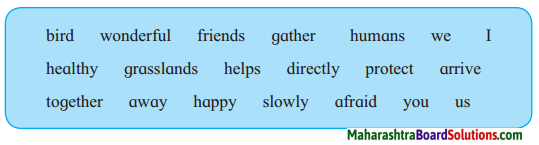
ऐसा भी होता है Summary in Hindi

ऐसा भी होता है कवि-परिचय

जीवन-परिचय : अभिषेक जैन जी आधुनिक साहित्यकार के रूप में हिंदी जगत में प्रसिद्ध हैं। कविता, कहानी, निबंध आदि विधाओं में इन्होंने लेखन किया है। जीवन के अनुभवों पर आधारित इनकी विविध रचनाएँ हिंदी पत्र-पत्रिकाओं में प्रकाशित होती रहती हैं। इन्होंने हाइकु काव्य विधा में भी लेखन किया है। इनकी हाइकु रचनाएँ जीवन के समृद्ध अनुभवों का भंडार है।

प्रमुख कृतियाँ : अभिषेक जैन जी ने कविता, कहानी, निबंध आदि विविध विधाओं में लेखन किया है। अनुभवों पर आधारित इनकी रचनाएँ विविध पत्र-पत्रिकाओं में नियमित प्रकाशित होती हैं।

ऐसा भी होता है पद्य-परिचय

हाइकु काव्य : हाइकु एक जापानी काव्य विधा है। हाइकु यानी तीन पंक्तियों की कविता। यह विश्व की एक सबसे लघु कविता कही जाती है। हाइकु कविता ५ + ७ + ५ = १७ वर्ण के ढाँचे में लिखी जाती है। यह कविता आज भारत में सिर्फ हिंदी में ही नहीं, बल्कि मराठी, गुजराती, बंगाली, मलयालम आदि भाषाओं में भी लिखी जाती है।

प्रस्तावना : ‘ऐस भी होता है’ इस हाइकु में कवि अभिषेक जैन जी ने समाज में सबल घटकों द्वारा दुर्बलों पर होने वाले अत्याचार, गरीबी, थकान, वृक्षों के कटने के दुष्परिणाम, अनावश्यक अहं, वृद्धाश्रम के दर्द, संस्कारहीनता आदि विविध विषयों पर प्रकाश डाला है।

ऐसा भी होता है सारांश

‘ऐसा भी होता है’ यह हाइकु काव्य है। कवि ने इस हाइकु के द्वारा विविध विषयों को अभिव्यक्त करने की कोशिश की है। समाज के सबल वर्ग दुर्बलों पर अपना रोब या अधिकार जमाते रहते हैं। उनके द्वारा किए गए अन्याय एवं शोषण से समाज के दुर्बल घटक सहम जाते हैं। सूरज प्रतिदिन अपने निर्मल किरणों से धरती को प्रकाशित करता रहता है। इसके बदले में वह धरती से किसी भी चीज की अपेक्षा नहीं करता।

ठीक उसी प्रकार सज्जन व्यक्ति दीन-दुखी लोगों के लिए अपना सर्वस्व अर्पण कर देते हैं। दिनभर सभी को रोशनी देने वाली किरण शाम होते ही थक जाती है और वह धरा की गोद में आकर विश्राम करती है। गरीब व्यक्ति की आशा-आकांक्षाएँ कभी भी पूर्ण नहीं होती। वह जीवनभर सपने देखते रहता है; फिर भी उसके सपने पूर्ण नहीं होते। वृक्षों को काटने से पंछियों का आशियाना यानी घोसला उजड़ जाता है।

उनके आशियाने उजड़ने पर पक्षी रोने लगते हैं। माँ-बाप के अथक परिश्रम और सुसंस्कारों के कारण ही बच्चे आसमान को छूते हैं। व्यक्ति को अपने जीवन से अभिमान का त्याग कर अपने जीवन को सुंदर बनाना चाहिए। संस्कारहीनता के कारण कई बच्चे बड़े हो जाने के बाद अपने माता-पिता को छोड़कर दूर जाकर अपने लिए अलग से बसेरा बना लेते हैं।

डाकिए की तरह सभी को जीवन में आने वाली सुख-दुख की भावनाओं से प्रभावित न होकर अपना कार्य करते रहना चाहिए। अनेक तिरस्कारों के बावजूद माँ की ममता अपने बच्चों के लिए कम नहीं होती। संस्कारहीनता के कारण सामाजिक पतन हो रहा है। जिस कारण चारों ओर लूटमार और भगदड़ मची हुई है।

ऐसा भी होता है शब्दार्थ

  • डाकिया – चिट्ठी बाँटनेवाला
  • तरू – वृक्ष, पेड़
  • पखेरू – पंछी, पक्षी
  • गुमान – अभिमान, गर्व, घमंड
  • कद – काठी, शरीर की बनावट
  • निर्मल – पवित्र
  • धरा – धरती
  • तन – शरीर
  • आशियाना – घोंसला
  • डोर – रस्सी
  • चिट्ठी – खत
  • झोला – थैला

ऐसा भी होता है मुहावरे

  • ठगा-सा रह जाना – किंकर्तव्यविमूढ़ हो जाना या विस्मित हो जाना।
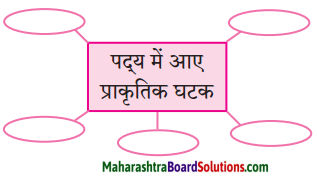
ऐसा भी होता है भावार्थ

गरजे मेघ ……………………. कच्ची दीवार।

प्रस्तुत हाइकु में कवि ने बताया है कि आसमान में मेघों के गरजने पर एक कच्ची दीवार सहमकर काँपने लगीं; वह बहुत डर गई। यहाँ । गरजने वाले मेघ समाज के सबल वर्ग का प्रतिनिधित्व करते हैं और कच्ची दीवार समाज के दुर्बल वर्ग का प्रतिनिधित्व करती है। इसका अर्थ यह है कि समाज के सबल वर्ग दुर्बल वर्गों पर अपना रोब या अधिकार जमाते रहते हैं। उनके द्वारा किए गए अन्याय एवं शोषण से समाज के दुर्बल घटक सहम जाते हैं।

रवि चढ़ाए ……………………. धरा को अर्य।

प्रस्तुत हाइकु में रवि यानी सूरज एक सज्जन व्यक्ति का प्रतीक है। सूरज प्रतिदिन अपने निर्मल किरणों से धरती को प्रकाशित करता है। बदले में वह धरती से किसी भी चीज की अपेक्षा नहीं करता। उसका कार्य निःस्वार्थ एवं मानवता के लिए होता है। ठीक उसी प्रकार सज्जन। व्यक्ति दीन-दुखियों के लिए अपना सर्वस्व अर्पण कर देते हैं। इसके बदले में वे किसी भी प्रकार की चाह नहीं रखते हैं।
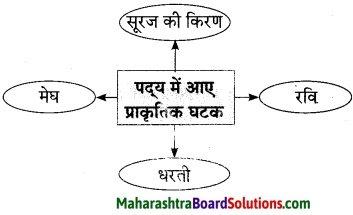

आ के पसरी ……………………. धरा की गोद।

प्रस्तुत हाइकु में बताया गया है कि दिनभर सभी को रोशनी देने वाली किरण शाम होते ही थक जाती है और वह धरा की गोद में आकर। विश्राम करती है। प्रकृति का यही नियम है। जो श्रम करता है; वह दिन ढलने के उपरांत थक जाता है। व्यक्ति दिनभर मेहनत करता है और फिर शाम होते ही वह थककर अपने घर आकर आराम करने लगता है।

खुली आँखो ने ……………………. बंद सपने।

प्रस्तुत हाइकु द्वारा समाज में व्याप्त गरीबों की स्थिति का चित्रण किया गया है। गरीब व्यक्ति की आशा-आकांक्षाएँ कभी भी पूर्ण नहीं। होती। वह जीवनभर सपने देखते रहता है; परंतु उसके सपने कभी भी पूर्ण नहीं होते।

कटते तरु ……………………. रोए पखेरू।

प्रस्तुत हाइकु में वृक्षों के कटने के दुष्परिणाम दिखाए गए हैं। वृक्षों को काटने से पंछियों का आशियाना यानी घोंसला उजड़ जाता है। वे बेघर हो जाते हैं; जिस कारण वे दुखी होकर रोने लगते हैं।

बच्चे पतंग ……………………. छूते गगन।

बच्चों के जीवनरूपी पतंग की डोर माँ-बाप के हाथ में होती है। वे अपने बच्चों को अच्छी शिक्षा और संस्कार देकर उनका जीवन सँवारने की कोशिश करते हैं। माँ-बाप के अथक परिश्रम और सुसंस्कारों के कारण ही बच्चे आसमान को छूते हैं यानी जीवन में ऊँचा उठकर सफलता की मंजिल हासिल करते हैं।

तन माटी का ……………………. कद काठी का।

प्रस्तुत हाइकु में कवि अनावश्यक अहं पर अपने विचार व्यक्त करते हैं। व्यक्ति का शरीर मिट्टी से बना है; जो एक दिन नष्ट होने । वाला है। फिर भी व्यक्ति को अपनी इस छोटी-सी जिंदगी पर बहुत बड़ा अभिमान होता है। मनुष्य को अपने जीवन से अभिमान का त्याग कर अपने जीवन को सुंदर बनाना चाहिए। उसे अनावश्यक अहं नहीं करना चाहिए।

उड़ा पखेरू ……………………. ठगा – सा तरू

प्रस्तुत हाइकु मनुष्य की कृतघ्नता पर करारा व्यंग्य करती है। पक्षी का बच्चा जब तक छोटा होता है यानी उसके पंखों में जब तक उड़ने की शक्ति नहीं आती है, तब तक वह वृक्ष पर ही रहता है। लेकिन जब उसके पंखों में उड़ने की शक्ति आ जाती है; तब वह उस वृक्ष को छोड़कर अनंत आकाश में विचरण करने के लिए उड़ जाता है। उसे जाते देखकर पेड़ विस्मित, सा रह जाता है। उसी प्रकार संस्कारहीनता के कारण कई बच्चे बड़े हो जाने के बाद अपने माता-पिता को छोड़कर दूर जाकर अपने लिए अलग बसेरा बना लेते हैं। इससे माता-पिता किंकर्तव्यविमूढ हो जाते हैं।

डाकिया चला ……………………. भर के झोला।

प्रस्तुत हायकु में लोगों के आने वाले खत बाँटने वाला डाकिया के बारे में है। कुछ पत्रों से खुशी झलकती है तो कुछ पत्र दुखद गहराई । का अहसास दिलाते हैं। फिर भी किसी की भी भावना से सरोकार न रखते हुए डाकिया अपनी झोली भरकर पत्र बॉटने का काम करता रहता है। डाकिए की तरह हमें भी जीवन में आने वाले सुख-दुख की भावनाओं से प्रभावित न होकर अपना कार्य करते रहना चाहिए।

मैया की आई ……………………. कैसे हो बेटा।

माता-पिता अपनी संतान पर अपना सर्वस्व लुटाकर उसका लालन-पोषण करके उसे कामयाब इंसान बनाते हैं; वही संतान बाद में अपने माता-पिता को वृद्धाश्रम में भेज देते हैं। फिर भी उसकी इस निर्दयता को माँ भूल जाती है और वह उसे वृद्धाश्रम से खत लिखकर उसका हाल जानना चाहती है। माँ आखिर माँ ही होती है। वह अपने बेटे द्वारा किए गए अत्याचारों को भूलकर मन ही मन में याद करती रहती है।

हो गई चोरी ……………………. लुट गया मैं।

प्रस्तुत हाइकु में बताया गया है कि आज हमारे समाज में संस्कारों का अभाव है। समाज से जीवन-मूल्यों का पतन हो रहा है। संस्काररूपी तिजोरी का समाज से हनन हो गया है। आज समाज में संस्कारों का धीरे-धीरे लोप होता जा रहा है। इस कारण समाज में समस्याएँ उभरकर सामने आ रही हैं। संस्कारहीनता के कारण सामाजिक पतन हो रहा है; जिस कारण चारों ओर लूटमार और भगदड़ मची हुई है।