Maharashtra Board Class 10 History Solutions Chapter 7 Sports and History

Balbharti Maharashtra State Board Class 10 History Solutions Chapter 7 Sports and History Notes, Textbook Exercise Important Questions and Answers.

Maharashtra State Board Class 10 History Solutions Chapter 7 Sports and History

Question 1.
(A) Choose the correct option from the given options and complete the statement.
(1) The ancient event of Olympic competitions used to be held at ………………………… .
(a) Olympia, Greece
(b) Rome
(c) India
(d) China
Answer:
(a) Greece

Maharashtra Board Solutions

(2) The wooden dolls made in Maharashtra are known as ………………………… .
(a) Thaki
(b) Kalichandika
(c) Gangavati
(d) Champavati
Answer:
(a) Thaki

(B) Identify and write the wrong pair in the following set.
(1) Mallakhamb – Outdoor game based on physical skills
(2) Water polo – Water sport
(3) Skating – Adventurous ice sport
(4) Chess – Outdoor game
Answer:
(4) Chess – Outdoor game

Question 2.
Write notes :
(1) Toys and Festivals
Answer:

  • Toys and festivals are inter-related since ancient times.
  • Toys are used for decoration in different cultures and religions during festivals.
  • In some cultures toys are distributed as gifts. Santa Claus gifts children toys during Christmas.
  • As part of Diwali celebration in Maharashtra, model forts are made displaying images of Chhatrapati Shivaji Maharaj, his soldiers and animals which are toys.
  • Clay images of snakes and bullocks are- sold during festivals like Bail pola and Nagpanchami.

(2) Sports and movies
Answer:

  • The presence of sports was limited to a scene in the movies made earlier.
  • In recent times, biographical movies are made on sportspersons and on sports.
  • Movies like Lagaan and Dangal are made related to cricket and wrestling respectively.
  • Biographical movies are made on Mary Kom, and the Phogat sisters.
  • Movies are made on careers of famous sprinter Milkha Singh.
  • Bharat Ratna Sachin Tendulkar and Cricketer Mahendra Singh Dhoni.
  • Overall, movies and sports are related from the silent era till date.

Question 3.
Explain the following statements with reasons.
(1) Currently the structure of sports economy has been significantly affected.
Answer:

  • The process of globalisation has influenced the field of sports in the 20th-21st century.
  • International matches of various sports like Cricket, Football, etc. are*telecast in every corner of the world.
  • Fans watch these matches for entertainment,r and aspiring players to learn more.
  • The citizens of the non-participating countries also watch these matches.
  • Retired players get a chance on television channels as commentators.
  • Matches garner a large audience, hence the commercial companies look at it as an opportunity to advertise and sell their products.
  • All these factors have led to change in the structure of sports economy.

Maharashtra Board Solutions

(2) Toys can tell us about cultural history.
Answer:
A tradition of making different type of toys for entertainment is going on since ancient time.

  • Toys give us an idea about the cultural and religious development of that period.
  • Clay models of forts and the images of Chhatrapati Shivaji Maharaj placed on fort gives us an idea about the structures of forts during that period.
  • An ivory doll found at Pompeii, an ancient city in Italy, sheds light on Indo-Roman trade and cultural relations.
  • The mention of games, toys and flying and dancing dolls in Kathasaritsagara give us an idea about cultural history of toys. In this way, we come to know about cultural history from toys.

Question 4.
Write detailed answers to the following questions.
(1) Write about the history of sports equipment and toys in ancient India.
Answer:

  1. The history of sports equipment and toys dates back to epic age. The ancient Indian literature and epics mention various games such as games of dice, wrestling, horse and chariot race.
  2. Sports are of two types ‘Indoor Games’ and ‘Outdoor Games’. Indoor games such as chess, card games, dice, carrom, kachkavadya or Indian ludo, Bhatukli were very popular. It can be noted that all of them required equipment to play.
  3. Cards to play card games, dice to play game of dice, a board and pieces to play chess, bunch of seeds or stones to play sagargote; (playing house) to play Bhatukli.
  4. Likewise, Outdoor games like marbles, lagori (seven stones), vitti-dandu, bhavare (tops) all require material like marbles, stones, tops, a small and large stick to play.
  5. A Sanskrit play by Shudraka is named as Mrichchhakatika. It means a clay cart. A clay cart was a toy used to play during Harappan period.
  6. Kathasaritsagara has very interesting descriptions of games and toys. There are descriptions of flying dolls. There is a mention that on pressing a key some dolls used to fly, some used to dance and some used to make sounds.

(2) Explain the close tie between sports and history.
Answer:
Sports and history are closely related with each other.

  1. It is a must for a sports writer to know the history of the game he chooses to write on.
  2. In order to write a review on any sport competition, the critic should have knowledge of competitions held in the past.
  3. A comparative study of the skills, techniques and strategies used in the past and developments or improvements in the present makes the review comprehensive.
  4. The writer has to resort to history while writing columns or articles on sports events like Olympics or Asiad or any national or international matches.
  5. While commentating on Akashvani and Doordarshan, an expert commentator needs to have good knowledge of the history of the game, previous records of illustrious and eminent players, statistical analysis and historical anecdotes related to the game and players.
  6. Coaches, special experts, selection committee should have information of the players, their strength and weakness and also history of the players in the opposing team. Even players should know history of their competitors.
    In short, it is essential to know the history of all the aspects related to sports.

(3) Explain the difference between indoor and outdoor games.
Answer:

Indoor gamesOutdoor games
1. Most of the indoor games are played by sitting at one place. They are played in a closed environment.1. Outdoor games are played on a field.
2. Indoor games require skills but physical exercise is negligible.2. Outdoor games need more physical exercise and skill.
3. As there is no exertion in indoor games, so it is not essential to develop stamina.3. Outdoor games require stamina and strength.
4. Indoor games do not involve adventure.
Maharashtra Board Solutions
4. Outdoor games involve adventures at times, e.g.. Auto racing
5. Indoor games includes Chess, Indian Ludo (Playing house) Bhatukli and many more.5. Outdoor games involve national and international games like Kabaddi, Kho-kho, Hockey, Cricket, etc.
6. With the exception of chess and carrom no competitions are held for rest of the Indoor games.6. National and international competitions are held of almost all outdoor games.

Project
(1) Collect information about your favorite sports and its players.
(2) Discuss the hardships the sportspersons have to face while training for the sport with the help of information gathered through movies and literature.

Question 5.
Complete the sentences by choosing the correct option:
(a) The activity which combines physical exercise and entertainment is ……………………….. .
(a) Show
(b) Attitude
(c) Sports
(d) Competition
Answer:
(c) Sports

(b) ……………………….. was looked upon as a game and entertainment by ancient people.
(a) Dancing
(b) Playing
(c) Singing
(d) Hunting
Answer:
(d) Hunting

(c) ……………………….. and its various tactics were devised by Balambhat Deodhar, the physical trainer of Peshwa Bajirao II.
(a) Kabaddi
(b) Atyapatya
(c) Khokho
(d) Mallakhamb
Answer:
(d) Mallakhamb.

(d) The Indian Government has honoured Sachin, Tendulkar with ……………………… for his illustrious achievements in the field of cricket.
(a) Padma Shri
(b) Khel Ratna
(c) Arjuna Award
(d) Bharat Ratna
Answer:
(d) Bharat Ratna

(e) ……………………… is the national game of India.
(a) Hockey
(b) Cricket
(c) Football
(d) Kabaddi
Answer:
(a) Hockey

Maharashtra Board Solutions

(f) The National Sports Day of India is celebrated on 29th August which is the birth date of …………………….. .
(a) Khashaba Jadhav
(b) Sachin Tendulkar
(c) Major Dhyan Chand
(d) Bal J. Pandit
Answer:
(c) Major Dhyan Chand

(g) Vishnubhat Godse in his book Maza Pravas wrote that sports and physical activity had great importance in the daily schedule of ………………………
(a) Tatya Tope
(b) Queen of Jhansi Lakshmibai
(c) Bahadur Shah Jaffar
(d) Nanasaheb Peshwa
Answer:
(b) Queen of Jhansi Lakshmibai

(g) Maruti Mane is known for …………………….. .
(a) Hockey
(b) Kabaddi
(c) Marathon
(d) Wrestling
Answer:
(d) Wrestling.

(h) …………………….. wrote the play Mrichchhakatika which means a clay cart.
(a) Harshvardhan
(b) Shudraka
(c) Bhavbhuti
(4) Kalidas
Answer:
(b) Shudraka

(i) The findings in the excavations of …………………….., an ancient city in Italy includes an ivory doll made by Indian craftsmen.
(a) Rome
(b) Athens
(c) Sparta
(d) Pompeii
Answer:
(d) Pompeii

(j) An interesting description of games and toys is found in ……………………. .
(a) Shakuntal
(b) Panchatantra
(c) Mrichchhakatika
(d) Kathasaritsagara
Answer:
(d) Kathasaritsagara

(k) Major Dhyan Chand was honoured in 1956 with …………………….. for his marvellous achievements in hockey.
(a) Padma Shri
(b) Padma Bhushan
(c) Padma Vibhushan
(d) Bharat Ratna
Answer:
(c) Padma Bhushan

Maharashtra Board Solutions

(l) …………………….. was the first Indian female boxer to win a bronze medal in the Olympics.
(a) P 7 Sindhu
(b) Mary Kom
(c) Geeta Phoghat
(d) Saina Nehwal
Answer:
(b) Mary Kom.

Question 6.
Identify the wrong pair in the following and write it:
(1)

(1) MallakhambOutdoor game based on physical skills
(2) Water PoloWater sport
(3) SkatingAdventure ice sports
(4) ChessOutdoor game

Answer:
Wrong pair: Chess – Outdoor game

(2)

(1) Mallakhamb trainerBalambhat Deodhar
(2) Wizard of HockeyMilkha Singh
(3) First Indian female boxerMary Kom
(4) First Indian female wrestlersPhogat sisters

Answer:
Wrong pair: Wizard of Hockey – Milkha Singh

Question 7.
Do as directed
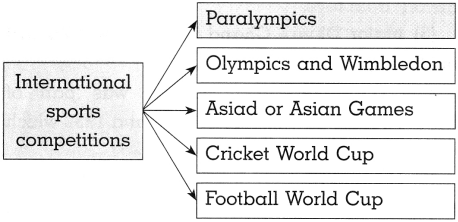
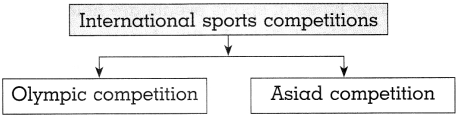
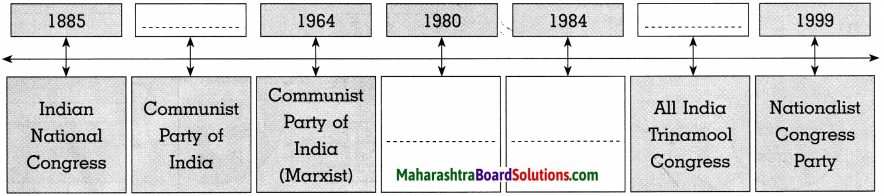
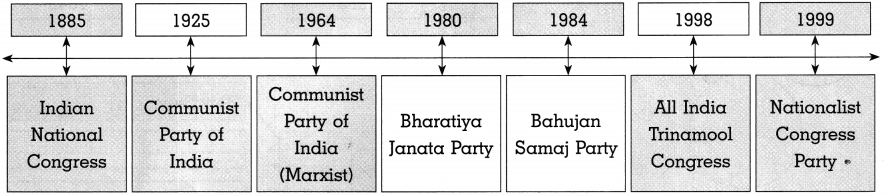
(A) Complete the graphical description:
(1)
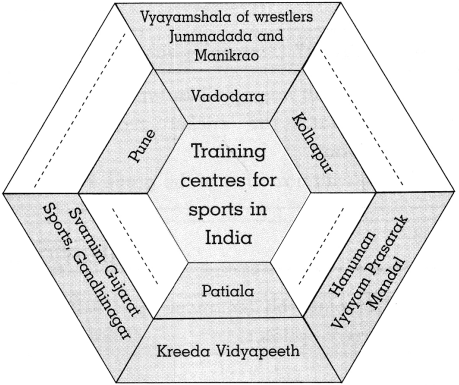
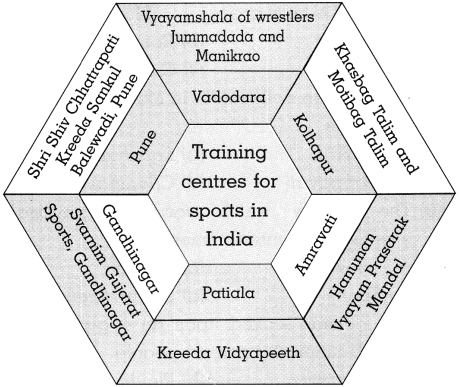
Maharashtra Board Class 10 History Solutions Chapter 7 Sports and History 1
Answer:
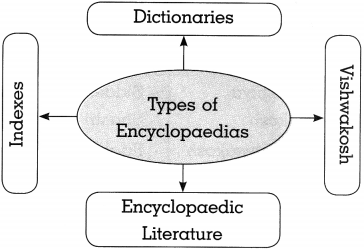
Maharashtra Board Class 10 History Solutions Chapter 7 Sports and History 2

Maharashtra Board Solutions

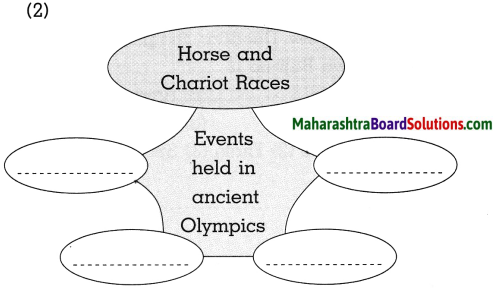
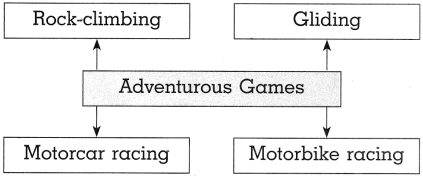
Maharashtra Board Class 10 History Solutions Chapter 7 Sports and History 3
Answer:
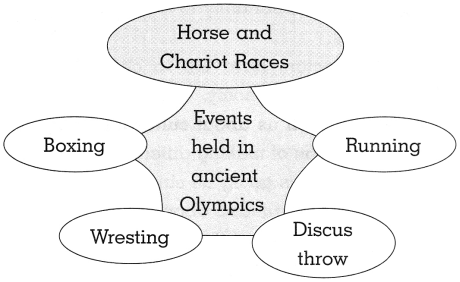
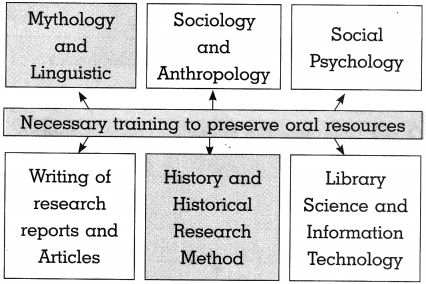
Maharashtra Board Class 10 History Solutions Chapter 7 Sports and History 4

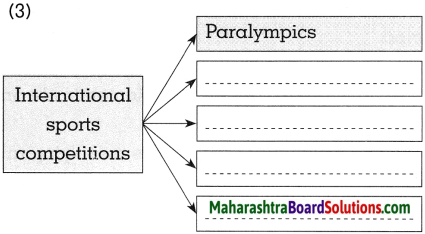
Maharashtra Board Class 10 History Solutions Chapter 7 Sports and History 5
Answer:
Maharashtra Board Class 10 History Solutions Chapter 7 Sports and History 6

Maharashtra Board Class 10 History Solutions Chapter 7 Sports and History 7
Answer:
Maharashtra Board Class 10 History Solutions Chapter 7 Sports and History 8

Maharashtra Board Solutions

(B) Prepare a Tree-Diagram on typs of games:
Answer:
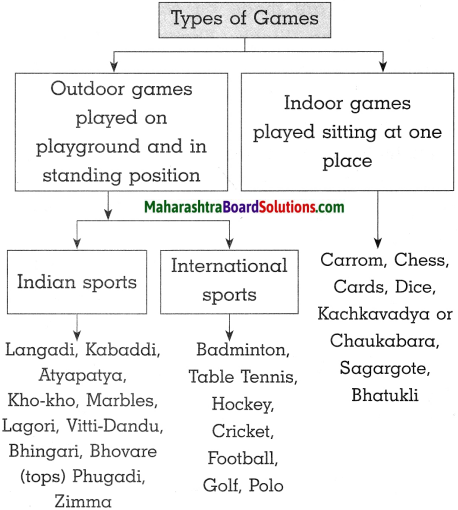
Maharashtra Board Class 10 History Solutions Chapter 7 Sports and History 9

Question 8.
Write short notes:

(a) Indigenous Games:
Answer:

  1. The games which have their origin in India and are an important part of Indian culture are indigenous games.
  2. They are of two types – ‘Indoor Games’ and ‘Outdoor Games’. Indoor Games are played within a closed environment and a number of them are played by sitting at one place. Chess, card games, dice, carrom, etc. are indigenous indoor games.
  3. An open space or preferably a playground is required to play outdoor games. Kabaddi, Atyapatya, Kho-kho etc. are indigenous outdoor games.
  4. The special feature of indigenous games is that they do not require high cost material and hence are less expensive. Phugadi, Zimma, Bhatukali are some of the indigenous games played by girls. In modern times, all national and international games are played by both girls and boys.

Question 9.
Explain the following statements with reasons:

(a) Major Dhyan Chand is called the Wizard of Hockey.
Answer:

  • Major Dhyan Chand was part of hockey teams as a player in 1928 and 1932 which won gold medal at Olympics.
  • He was also captain of the Indian Hockey team which won a Gold Medal at the Berlin Olympics in 1936.
  • He shot 25 goals against America and Japan in the 1932 Olympics.
  • He shot more than 400 goals in his entire career which include national and international matches. Owing to his brilliant achievement he is called the ‘Wizard of Hockey’.

(b) Globalisation has influenced sports.
Answer:

  1. No sport is limited to any one country. Television and other media channels telecast matches widening the reach of sports in all comejcs, of the world.
  2. International competition Asiad, Paralympics, Cricket Wc watched by people irrespective r
    part of the world.
  3. World Cup matches of cricket, hockey and football are held.
  4. No country has a monopoly on any sport which means that globalisation has influenced sports.

(c) A commentator should know the history of the game.
Answer:

  • The mere description of a live match is not enough for commentators.
  • A commentator should have good knowledge of the history of the game, previous records (who made or who broke) and eminent players in the past as well as events related to different competitions.
  • Along with the history and information of the playground, commentator should narrate records made by the players in different matches.
  • It will make his commentary interesting. Therefore, it is essential for the commentator to know the history of the game.

Maharashtra Board Solutions

Question 10.
Answer the following questions in 25-30 words:
(a) Explain the importance of sports.
Answer:
Sports has gained great importance for the following reasons:

  • Sports helps us to overcome our pains, worries and sufferings. We feel relaxed and refreshed by playing games.
  • Games which involve a lot of physical activity not only provide good exercise but also help in building a tenacious and strong body.
  • One. can develop courage; determination and sportsmanship playing games. A sense of cooperation and teamspirit develops when we participate in games which require collective participation.
  • Team games also help in developing a leadership! quality.

(b) Write about the history of sports.
Answer:

  • It is a natural instinct in human beings to play. From beginning of civilisation till date man has played different types of games for his entertainment.
  • Hunting was a way of obtaining food for the ancient people as well as considered a game.
  • Horse and chariot races, wrestling, game of dice (dyut) are mentioned in ancient Indian literary texts and epics.
  • Dolls, whistles, toy carts were discovered in the excavations at Harappa. So, it can be said that the history of sports is as old as the history of man.

(c) Write about the importance of sports in education field.
Answer:

  • Sports are an integral part „ of education. The making of a player begins at school level.
  • Many types of sports events are held at the international level. To make the players competent they are given opportunity to play at district, state and national level.
  • They are promoted and sponsored by the government and private sectors. Talented and ranking players get State scholarship or National scholarship.
  • Seats are reserved for them in colleges and Universities. It has been observed that the foundation of successful players is laid in school life.

(d) What do we need to know while making movies on sports?
Answer:
While making a movie on sports the makers should have complete information of the. sport as well as its history.

  1. Nowadays special research teams are appointed by production houses which do thorough research on the subject of the movie.
  2. In order to gather information on the sportsperson or the sport it is essential to study books, articles, columns written by eminent sports writers.
  3. If the movie is on a sportsperson, all interviews published in national and international magazines and newspapers should be read.
  4. Factors such as period, type of equipment used, sports wear, dressing style, social life needs to be studied.
  5. General understanding of the people about the game, practises and famous sportspersons is required.

Question 11.
Read the following passage and answer the following questions:

Maharashtra Board Solutions

(a) Complete the Concept Map:
Maharashtra Board Class 10 History Solutions Chapter 7 Sports and History 10
Answer:
Maharashtra Board Class 10 History Solutions Chapter 7 Sports and History 11

(b) How are the experts in history helpful regarding international sports competition?
Answer:
Experts in history are helpful to write and critically analyse the game.

(c) How are professional opportunities available in field of sports?
Answer:
There are many professional opportunities available in the field of sports.

  • Writers are in demand who can write on sports and critics to write reviews are in demand.
  • Commentators are in demand on Television, radio and various other private channels. Experts and assistants are needed to provide information regularly.
  • Coaches train the players, playground staff to maintain the field, umpires, etc.
  • Cameramen, computer experts and team of assistants to have uninterrupted transmission. Trained and qualified referees are required to work at district, national and international levels.
  • Overall, a great number of job opportunities are available in the field of sports.

Question 12.
Write a detailed answer to the following:

(a) Write about the history of sports literature and toys in ancient India.
Answer:
A new enterprise is developing in publishing related to sports in India. There is extensive written work on various sports.

  • Many books related to sports and biographies are published. Encylopaedias are being written on sports.
  • An independent encyclopaedia is written on exercise. The History of Mallakhamb is recently published.
  • Sports magazines are published fortnightly and monthly.
  • Many newspapers have allotted a separate section or last pages for news related to sports.
  • ‘Shatkar’ was a sports magazine published some years ago. There is ample of literature available on sports.

(b) Trace the development of toys and their importance.
Answer:

  • Toys and games have been essentially part of entertainment from ancient times. Every I developing society has made toys for the 8 entertainment and education of their children.
  • Toys were found at archaeological sites at various places. The toys were made of clay, baked clay, terracotta and ivory.
  • Either a mould was used to make the toy or it was fashioned by hand.
  • Toys and the material used to make them were indicators of the development and advancement of civilisations.
  • An interesting description of flying dolls is found in Kathasaritsagara. The dolls used to fly, made some sound and some danced when a key was pressed.
  • Toys give us information about the period it was made, how they were made, religious and 8 cultural practices and technical know-how of the 8 people. ’

Question 13.
Observe the picture and write information about the event it is related to:

Maharashtra Board Class 10 History Solutions Chapter 7 Sports and History 12
Answer:

  1. This picture is the logo of the modern Olympic Games. The five interlocked rings represent the five continents of the world.
  2. The rings coloured blue, yellow, black, green and red on a white field are known as the ‘Olympic rings’. The symbol was originally designed in 1912 by Pierre de Coubertin.
  3. Olympic rings are the symbol of games which were first played in the ancient city of Olympia. They were held after every four years.
  4. The ancient Olympics had fewer events than the modern games and only Greek men were allowed to participate. Events such as Horse and Chariot race, Footrace, Wrestling, Boxing, Discus Throw, Pentathlon were held.
  5. The Greeks standardised rules of the sports were laid which was helpful to organise the games systematically.
  6. The modern Olympic games are also held every four years. It is a great honour for sportspersons to participate and win the Olympic medals.

Maharashtra Board Solutions

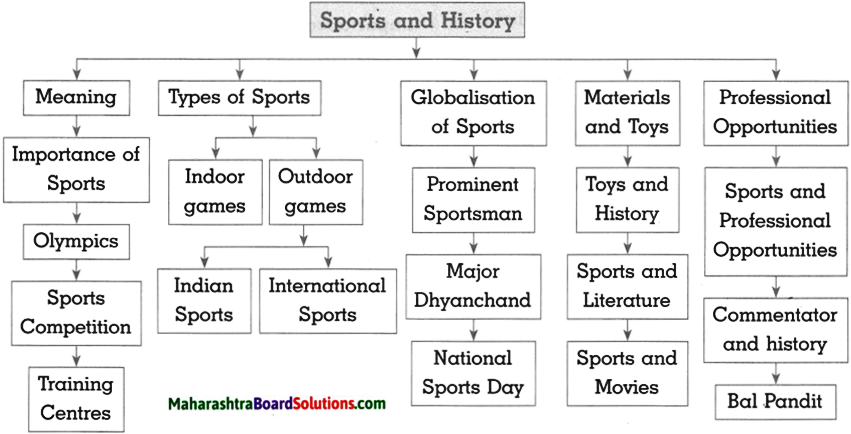
Memory Map
Maharashtra Board Class 10 History Solutions Chapter 7 Sports and History 13

Maharashtra Board Class 10 Political Science Solutions Chapter 2 The Electoral Process

Balbharti Maharashtra State Board Class 10 Political Science Solutions Chapter 2 The Electoral Process Notes, Textbook Exercise Important Questions and Answers.

Maharashtra State Board Class 10 Political Science Solutions Chapter 2 The Electoral Process

Question 1.
Choose the correct option from the given options and complete the sentences.
(1) The Election Commissioner is appointed by the …………………………. .
(a) President
(b) Prime Minister
(c) Speaker of Loksabha
(d) Vice President
Answer:
(a) President

Maharashtra Board Solutions

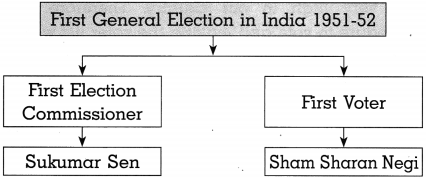
(2) …………………………. was appointed as the first Chief Election Commissioner of independent India.
(a) Dr. Rajendra Prasad
(b) T.N. Sheshan
(c) Sukumar Sen
(d) Neela Satyanarayan
Answer:
(c) Sukumar Sen

(3) Constituencies are created by …………………………. committee of the Election Commission.
(a) Selection
(b) Delimitation
(c) Voting
(d) Timetable
Answer:
(b) Delimitation

Question 2.
State whether the following statements are true or false. Give reasons for your answer.
(1) The Elections Commission lays down the code of conduct during elections.
Answer:
The above statement is True. Reasons:

  • It ensures free and fair elections.
  • Maipractices during the election come under control.
  • Due to the strict observance of the code of conduct in the last few’ elections, the common voters have become confident.

(2) Under special circumstances the Election Commission holds re-elections in a particular constituency for a second time.
Answer:
The above statement is True. Reasons :

  • Sometimes, the representative of Lok Sabha, Vidhan Sabha or the local self governmènt resigns from his/her constituençy.
  • In some cases, death of the representative occurs.
  • In such special situations, the Election Commission has to conduct an election for a second time. It is called By-elections.

Maharashtra Board Solutions

(3) The state government decides as to when and in how many stages the elections would be held in a particular State.
Answer:
The above statement is False. Reasons :

  • The entire process of conducting elections is entrusted upon and managed by the Election Commission.
  • If this responsibility is given to the state government it may adopt a biased approach.
  • Hence, the Constitution has formed the Election Commission an independent body to carry out the responsibility.

Therefore, it is decided by the Election Commission as to when and in how many stages it will conduct elections.

Question 3.
Explain the concept.
(1) Reorganising the constituencies
Answer:
(1) The Election Commission of India formed constituencies for Lok Sabha and Legislative Assembly.
(2) The Election Commission had decided upon the constituencies before the first election. As the years passed, there was a lot of migration of the people for business and other activities from the villages to cities.
(3) This changed the demography to large extent. Number of voters in some constituencies reduced while in some it increased to a very great extent. This disturbed the ratio of- seats allotted as compared to population in those constituencies.
(4) Hence, the need to readjust the constituencies arose. The Delimitation Commission of the election commission does the work of reorganising or restructuring of constituencies.

(2) Midterm Elections

Question 4.
Complete the following picture.
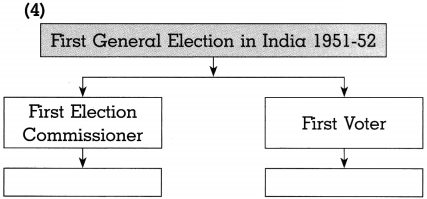
Maharashtra Board Class 10 Political Science Solutions Chapter 2 The Electoral Process 1
Answer:
Maharashtra Board Class 10 Political Science Solutions Chapter 2 The Electoral Process 2
Maharashtra Board Class 10 Political Science Solutions Chapter 2 The Electoral Process 3
Answer:
Maharashtra Board Class 10 Political Science Solutions Chapter 2 The Electoral Process 4

Maharashtra Board Solutions

Maharashtra Board Class 10 Political Science Solutions Chapter 2 The Electoral Process 5
Answer:
Maharashtra Board Class 10 Political Science Solutions Chapter 2 The Electoral Process 6

Maharashtra Board Class 10 Political Science Solutions Chapter 2 The Electoral Process 7
Answer:
Maharashtra Board Class 10 Political Science Solutions Chapter 2 The Electoral Process 8

Question 5.
Answer in brief.
(1) Explain the functions of the Election Commission.
Answer:
The functions of the Election Commissipn are:
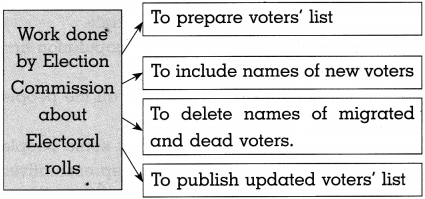
(1) Prepare the voters’ list.
(2) Decide election timetable and decide the entire process of holding elections.
(3) Scrutinize the applications of the candidates.
(4) Conduct free and fair elections and do all the work related to it.
(5) Give recognition and also de-recognize political parties.
(6) Resolve all the disputes and complaints regarding elections.

Maharashtra Board Solutions

(2) Write some additional information about post of the Election Commissioner.
Answer:
(1) The Election Commission in India has one Chief Election Commissioner and two other Chief Commissioners.
(2) All the commissioners are appointed by the President.
(3) The Chief Election Commissioner of India is usually a member of the Indian Civil Service or. Indian Administrative Service.
(4) The responsibility of conducting free and fair elections to the Parliament and State Legislatures lies with the Election Commissioner.
(5) In order do safeguard the independence of the Election Commissioner, he cannot be easily removed from the post for any political reasons.

(3) Explain the meaning of Code of Conduct.
Answer:
(1) After the announcement of elections till the declaration of results, the Election Commission enforces the Code of Conduct.
(2) It explains the rules to be followed by the government, political parties candidates and voters before and during elections.
(3) Code of conduct is adopted to control malpractices during elections. It ensure free and fair ecections.

Project
Organise a mock poll in the school to understand the process of voting.
Answer:

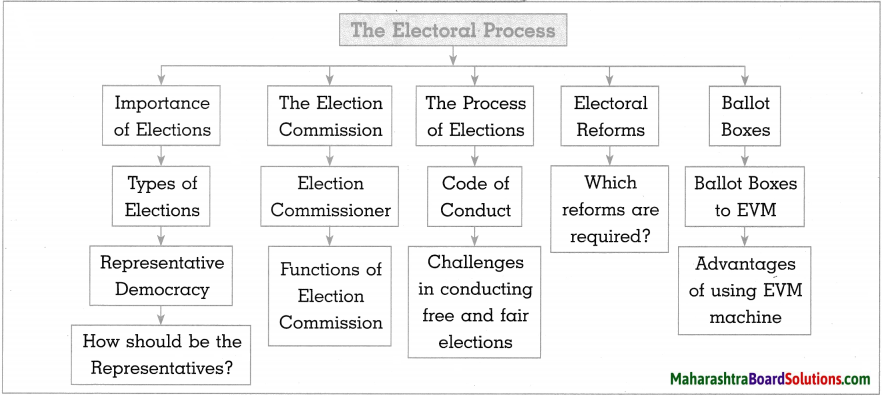
Memory Map
Maharashtra Board Class 10 Political Science Solutions Chapter 2 The Electoral Process 10

Question 6.
Choose the correct option from the given options and complete the sentences:
(a) Article of Indian Constitution created the independent body of Election Commisšion.

(a) 351
(b) 370
(c) 324
(d) 301
Answer:
(c) 324

Maharashtra Board Solutions

(b) system exists in India.
(a) Single-party
(b) Two-party
(c) Multi-party
(d) No-party
Answer:
(c) Multi-party.

(c) The right to give recognition or de-recognize a political party lies with ……………….. .
(a) President
(b) Election Commission
(c) Parliament
(d) Vice-President
Answer:
(b) Election Commission

(d) There are constituencies of Lok Sabha at present.
(a) 288
(b) 350
(c) 500
(d) 543
Answer:
(d) 543

(e) from the present state of Himachal Pradesh was the first voter.
(a) Sukumar Sen
(b) Sham Sharan Negi
(c) Prem Kumar Ghumal
(d) P N. Chadda
Answer:
(b) Sham Sharan Negi

(f) Due to EVM, people can also vote easily.
(a) elder
(b) salaried
(c) Divyanga
(d) Transgender
Answer:
(c) Divyanga

Maharashtra Board Solutions

(g) The first elections in India were held in
(a) 1948-49
(b) 1949-50
(c) 1950-51
(d) 1951-52
Answer:
(d) 1951-52.

Question 7.
State whether following statements are True or False. Give reasons for your answer :
(a) There should be secrecy in Election process.
Answer:
The above statement is False. Reasons :

  • Election should be conducted in a free and fair environment.
  • If the elections are not held in free environment then there are chances of malpractices and corruption.
  • Then, it will be impossible to elect the honest and efficient candidates.

(b) The Election Commission has started awareness campaign for registration of voters.
Answer:
The above statement is True. Reasons :

  • The responsibility of preparing and updating electoral roll lies with the Election Commission.
  • The Election Commission starts an awareness campaign to create awareness among new eligible voters so that they register themselves in the voter’s list.
  • The Indian voter is not -much aware about the election process.
  • Special voter’s awareness campaign is run for voter’s registration.
  • For their awareness National Voter’s Day is celebrated every year.

(c) Every candidate who fills the nomination form can contest election.
Answer:
The above statement is False. Reasons :

  • Every candidate of a party or independent candidate has to be personally present to fill the nomination form.
  • It is necessary for him or her to give complete information in the nomination form as decided by the Election Commission.
  • The nomination forms are then scrutinized. If there are irregularities in a nomination paper and if the information is found to be false the nomination forms are rejected.

Therefore, it is not possible for every candidate who fills the nomination form to contest election.

Maharashtra Board Solutions

(d) Sometimes, the Election Commission has to conduct mid-term elections. OR Explain the concept : Mid-Term Elections.
Answer:
The above statement is True. Reasons :

  • If the elected government in power loses its majority before completing its term.
  • If no party gets complete majority, then two or more parties come together and form a coalition government.
  • Such coalition government collapses if any party withdraws the given support.
  • In such situations, the government is left with no option other than resigning.
  • If there is no alternative available to form government then the Parliament or Vidhan Sabha is dissolved before completing its term. In such a scenario, the Election Commission has to conduct mid-term elections.

Question 8.
Explain the following concepts :

(a) What is representation?
Answer:
Modern democracy is a representative democracy. In a democracy it is not possible to involve the entire population in the ecision-making process. This resulted in the starting of the practice of electing some people on behalf of entire population
as representatives who would run the government. The representatives who form the government are expected to be responsible to the people and give preference to the welfare of the people.

  • Direct and Indirect or representative democracy rire two types of democracy.
  • In modem nation-states; the population has increased to a great èxtent.
  • So it is impossible to involve all the people in decision-making process.
  • Thus, th practice of electing some people on behalf of entire population as representatives started.
  • The elected representatives form government and work for the welfare of the people.

(b) Election Commission :
Answer:
In India, the Election Commission is central to the process of elections. Art. 324 of the Indian Constitution has established this autonomous body which consists of one Chief Election Commissioner and two other commissioners.

  1. One of the most important features of a democratic nation is elections at regular intervals. Holding free and fair elections at regular intervals is essential for a democratic system.
  2. Under the Article 324 of the Constitution, Election Commission was formed in 1950. The President appoints one Chief Election Commissioner and two additional commissioners. It is an autonomous body.
  3. The rank and powers of all the three commissioners are the same. The declaration of dates of the elections to the announcement of the results the entire procedure is monitored by the Election Commission.
  4. The Election Commission does not have its own staff to carry out this procedure. So they carry out the work with help of government employees and teachers. Special provisions are made for all finances incurred by the Election Commission.

Maharashtra Board Solutions

Question 9.
Write short notes :
(a) Journey from Ballot box to EVM machine :
Answer:

  1. From the first election in 1951-52 till 1999, elections were held using ballot box. Twenty lakh ballot boxes were used in the first election. Voters used to cast his or her vote by stamping in front of the candidate’s name and put them in the metal boxes.
  2. Electronic Voting Machines (EVMs) were first used for 5 seats in Rajasthan, 5 seats in Madhya Pradesh and 6 seats in New Delhi 1998 in Legislative Assembly.
  3. EVM machines were used at all polling booths in the general elections held in 2004. It proved to be a very useful device.
  4. It has been improvised since its first use. Due to the use of EVMs the results are declared early and at a very fast rate.

(b) Recognition to Political Parties :
Answer:

  • India has a multi-party system with recognition accorded to national, state and regional level parties by the Election Commission.
  • Their recognition depends on the voting percentage received by them in the assembly elections and number of elected representatives of their party.
  • If any party does not fulfill these criteria, its recognition is cancelled.
  • The Election Commission allots appropriate symbols to parties and independent candidates. All political parties should have recognition of the Election Commission.

Question 10.
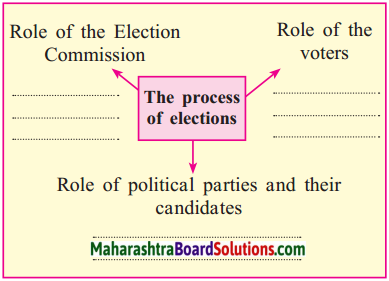
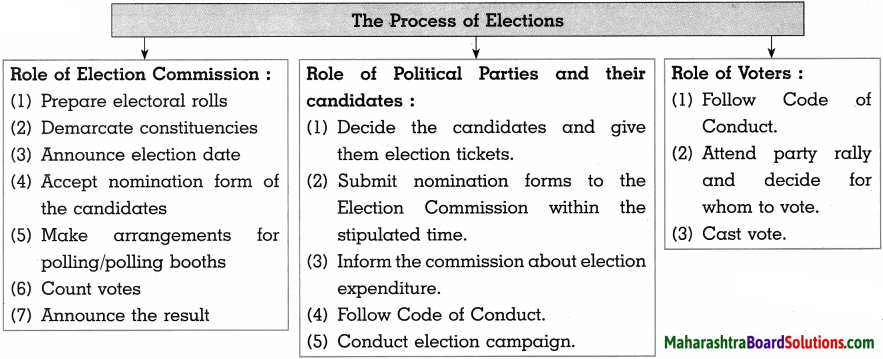
Complete the concept map :

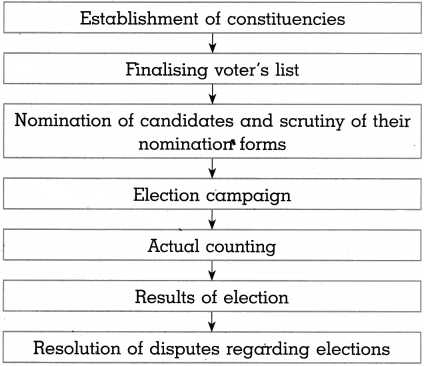
(a) Prepare a flow chart on the process of election.
Answer:
Maharashtra Board Class 10 Political Science Solutions Chapter 2 The Electoral Process 9

Maharashtra Board Solutions

(b) Which two conditions among following is the violation of code of conduct?
(1) The candidate distributes items of household use. –
(2) Promises made to resolve the water problem if elected.
(3) To go from door to door to meet voters and request them to vote.
(4) To appeal on the basis of caste and religion to get support.
Answer:
(1) The candidate distributes items of household use.
(2) To appeal on the basis of caste and religion to get support.

Question 11.
Answer in brief :
(a) Why is it important to conduct elections?
Answer:
It is important to conduct elections because of the following reasons :

  • The existence and working of democracy depends on elections.
  • All political parties get a chance to rule.
  • Elections help to bring a change in power through peaceful meAnswer:
  • It not only changes government policies but also society.

(b) What are the conditions for voting?
Answer:
The following are the conditions for voting:

  • The person should be a citizen of India.
  • He should have completed 18 years of age.
  • His name should appear in voters’ list.
  • The person should have photo identity card issued by the Election Commission of India.

(c) What action is taken by the Election Commission if disputes arise regarding elections?
Answer:

  • If any disputes arise regarding the elections, the Election Commission is empowered to take final decisions.
  • The Election Commission conducts a thorough inquiry about the said dispute.
  • If there is evidence of any malpractices during elections, in any constituency, it declares the elections invalid and announces re-polls.
  • If any candidate breaks the code of conduct and contests elections, he/she is barred by the Election Commission from contesting elections.

(d) What challenges are faced by the Election Commission to conduct free and fair elections?
Answer:
The following challenges are faced by the Election Commission tcx conduct free and fair elections :

  • Managing the large geographical landscape and huge electoral population.
  • To stop misuse of money and muscle power during elections.
  • Barring candidates with criminal background from contesting elections.
  • Conducting elections successfully in politically criminalised environment.
  • Conducting elections in spite of increasing instances of violence and making them a success.

Maharashtra Board Solutions

(e) What are the advantages of EVM machines?
Answer:
The battery operated Electronic Voting Machine (EVM) has more advantages than the ballot box. They are as follows :

  • It saves tonnes of paper used to make ballot paper.
  • So, it conserves the environment as it stops the reckless cutting of trees required to make paper.
  • If the voter does not wish to cast his vote in favour of any candidate contesting, he can make use of NOTA (None Of The Above).
  • It makes counting of the votes much faster which enables the election officer to declare result in a short time.
  • It is helpful for disabled (Divyanga) people to cast vote.

(f) Explain the features of procedures of voting during the first Lok Sabha Election.
Answer:

  • It was a challenge to prepare voters’ list at the time of the first election. Illiteracy rate was very high in our country. Therefore, the procedure to vote and making the voter list was a challenge.
  • 20 lac steel boxes were made and election symbols of political parties were stuck on it.
  • Blank ballot papers were given to the voters and they were supposed to drop in the box having the election symbols of the party they decide to vote for.
  • Even the illiterate people could vote because of this system.

Question 12.
Give your opinion :
(a) When candidates have only the condition of age, why should they give other information to Election Commission? Answer:

  • While filling the form candidates should reveal information about his property assets and if there are any criminal charges against him.
  • When candidates have only the condition of age as eligibility, why should they give other information to election commission?
  • Why are the candidates required to give the information of their property to Election Commission?
  • Such candidates if elected can misuse power and amass wealth with corrupt practices.
  • With criminal background they can even threaten voters to vote for him.
  • His nomination could get cancelled based on the information.

(b) Why is it so?
(A) Some constituencies are reserved for scheduled castes and scheduled tribes.
Answer:

  • It is difficult for the people of scheduled castes and scheduled tribes to get representation as they are scattered in different parts.
  • Without a representative it is difficult to discuss their problems in Parliament.
  • Lack of representative will hinder their progress. Hence some constituencies are reserved for scheduled castes and scheduled tribes.
  • Some constituencies are kept reserved for Scheduled caste and Scheduled tribes.
  • Every political party has an election symbol.
  • At the time of voting and counting of votes, the official representatives of political parties remain present.
  • Recognised parties have equal opportunity to present their side before media such as television and radio.

Maharashtra Board Solutions

(B) Why every political party has an election symbol?
Answer:

  • After independence, the literacy rate was quite low in India.
  • It was not possible for the voters to read the name of the candidate and vote.
  • Therefore, the Election Commission gave symbols to political parties and independent candidates which helped the voters to identify and decide whom to vote for.

(C) At the time of voting and counting of votes, the official representatives of political parties remain present.
Answer:

  • There are incidences of duplicate voters who register in multiple constituencies.
  • There are cases of rigging of EVM or booth capturing.
  • Such incidences are brought to light by representatives who are present at polling centres.
  • During the counting process, if the EVM machine looks tampered, the representative can raise an objection.

(D) All recognised parties should get an equal opportunity to express their opinion on media such as television and radio.
Answer:

  • All political parties should get a fair chance to express their agenda.
  • Their ideas and philosophy should reach the people.
  • Television and radio are owned by the government.
  • Political parties have equal right on both.
  • Hence, all the recognised parties can express their opinion on Doordarshan and Radio.

(c) Think!
(A) How political parties suffer due to family monopoly in the party? OR What are the disadvantages of dynasty rule?
Answer:

  1. If only one family has domination on the political party because of dynasty rule then others are not given leadership opportunity.
  2. It is impossible to have all the members of the family efficient. An inefficient heir can cause damage to the party.
  3. The growth and expansion of party comes to a halt because of such heir. His faults seep into the party making it weak in the long term.
  4. The nature of such a party become dictatorial. Opposing views are suppressed and the internal democracy in the party vanishes.
  5. If the heir does not have progressive thoughts then the party becomes regressive and of obsolete ideology.
  6. How political parties suffer due to family monopoly in the party?
  7. What do you understand by the system of ‘one vote one value’?

(B) What do you understand by the system ‘One Vote One Value’?
Answer:

  • There is great importance in political and social equality in democracy.
  • According to this ideology, ‘One Vote One Value’ is very important.
  • In a democracy, each vote has the same value. The value of the vote of a Prime Minister and a common man is same.
  • Under military rule or dictatorship or during monarchy the value of a vote for privileged classes was more. There was no importance given to the vote of the common man.
  • ‘One Man One Vote’ indicates all the people in the country have same status. This is the gift of democracy.

Maharashtra Board Solutions

(d) Voting is our duty as well as responsibility to vote.
Answer:

  • It is enshrined in the fundamental principles of our Constitution to vote.
  • It is not only our duty but also responsibility.
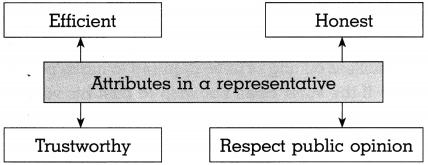
  • Democracy exists because of elections. People should elect honest and efficient representatives through election.
  • If voters show no interest in voting then the government will ignore people’s welfare.
  • Hence I feel it is not only the duty of every citizen to vote but also his responsibility.
  • Government has to observe the code of conduct declared by the Election commission.

(e) What measures should be taken to increase the credibility of elections?
Answer:
To increase the credibility of elections the following measures should be taken :

  • 50% seats should be reserved for women candidates by every party.
  • Candidates with a criminal background should be permanently barred from contesting any elections.
  • The misuse of money should be stopped during elections. The government should incur the expenditure.
  • Candidates who resort to malpractices should be immediately booked. A strict inquiry and action should be taken against them by the court.
  • Laws and regulations should be followed strictly by the political parties before giving election tickets.
  • If the political parties do not co-operate with the above terms, the Election Commission should cancel their recognition.

Maharashtra Board Solutions

(f) Which rules would you include in Code of Conduct for voters?
Answer:
The following rules should be included in Code of Conduct for voters :

  • The voters who abstain from voting should be fined and government should suspend all the facilities given to them.
  • If it is proved that the voter has accepted money or any kind of gifts, he should be punished.
  • The action of voters should not instigate common people.
  • They should not involve in bogus voting.
  • They should not resort to illegal means for voting.
  • The candidate distributes items of household use.
  • Promise made to resolve the water problem if elected.
  • To go from door to door to meet voters and request them to vote.
  • To appeal on the basis of caste and religion to get support.


Maharashtra Board Class 10 Political Science Solutions Chapter 5 Challenges faced by Indian Democracy

Balbharti Maharashtra State Board Class 10 Political Science Solutions Chapter 5 Challenges faced by Indian Democracy Notes, Textbook Exercise Important Questions and Answers.

Maharashtra State Board Class 10 Political Science Solutions Chapter 5 Challenges faced by Indian Democracy

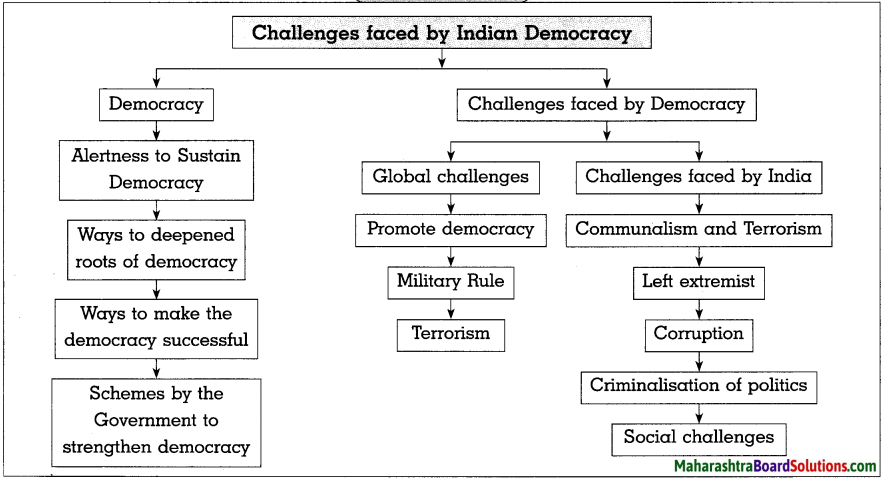
Question 1. Choose the correct option from the given options and complete the sentences. (1) In a democracy …………………….. participate in elections and get political power. (a) political parties (b) courts (c) social organisations (d) none of the above Answer: (a) political party Maharashtra Board Solutions (2) The major challenge faced by all democratic nations in the world is ……………………. . (a) Religious conflicts (b) Naxal activities (c) Deepening the roots of democracy (d) Importance to muscle power Answer: (c) Deepening the roots of democracy Question 2. State whether following statements are true or false. Give reasons for your answer. (1) Alertness is required to sustain democracy. Answer: The above statement is True.

  1. In order to make democracy successful it should be practised by people in all aspects of their life. It should not remain limited at the government level.
  2. Conscious effort should be taken to keep the rights of the people intact.
  3. The different challenges faced by democracy like corruption,violence and criminalisation should be tackled timely and strictly. It is necessary that people and the government should remain alert for the sustenance of democracy.

(2) Importance of the problems of farmers and tribals has increased in the left extremist movement. Answer: The above statement is False.

  • Landlords confiscated lands of farmers and tribals.
  • Naxalite movement was started to remove injustice against the landless farmers and tribals.
  • But later the problems of farmers and tribals lost its focus and became violent.
  • They adopted violent ways like to attack army, police and oppose the government.
  • The importance of farmers and tribals decreased in the leftist movement.

(3) People may lose confidence in the democratic process due to corruption during elections. Answer: The above statement is True.

  • In order to strengthen democracy, it is important to conduct elections in a free and fair atmosphere.
  • There are instances of .the election process getting affected by corruption.
  • Bogus voting, bribing the voters, abducting voters and ballot boxes, distributing articles to lure voters and other such things take place.
  • All these things make people lose faith in the democratic process.

Maharashtra Board Solutions Question 3. Explain the concept. (1) Left-extremism (2) Corruption Answer:

  • It is a form of dishonest or unethical conduct for personal gain by people at influential position.
  • It is found at all levels economic, political, social and at government levels. The misuse power is also corruption.
  • Bogus voting, giving bribe to voters, are examples of corruption in the election process.
  • Hoarding of goods and then selling them at price more than the market yalue is also a way of corruption.
  • Corruption in the public and private sector is the biggest problem in India.
  • People develop distrust and dissatisfaction about the entire system. They lose trust in democracy because of corruption.

Question 4. Answer the following questions in brief. (1) Which factors are required for the success of democracy in India? Answer: The following factors are required for the success of democracy in India:

  • Though democracy is the government of majority the opinions of minorities, religious, ethnic and lingustic should be included in the decision-making process.
  • Stringent laws must be implemented to stop criminalisation of politics.
  • Efforts should be made not only at the level of the government but also at social and personal level.
  • Decisions about important public policies should be taken after interaction with the people.. Participation of people should increase in all government undertakings.

(2) What are the effects of criminalisation of politics? Answer: The following effects are seen due to criminalisation of politics:

  • Money and muscle power gets undue importance.
  • Violence increases during elections and it becomes difficult to hold elections in free and fair environment.
  • Terror seizes the mind of people and their participation becomes less in administration.
  • People lose their tolerance and the development of democracy does not take place.

(3) What efforts are undertaken to bring transparency in political process? Answer: The following efforts are made to bring transparency in political process:

  • An independent Election Commission is appointed to hold free and fair elections.
  • Stringent laws are made to stop criminalisation of politics.
  • Laws are formed to stop corruption in politics and elections.
  • Courts have banned people who are corrupt and those having criminal background or criminal allegations from taking part in political process.

Maharashtra Board Solutions Project (1) What measures will you suggest to control corruption? Make a list of it. (2) Organise a group discussion in your class on the problem of terrorism in India. (3) Present a street play on ‘how to get rid of addiction? Answer:

Memory Map Maharashtra Board Class 10 Political Science Solutions Chapter 5 Challenges faced by Indian Democracy 1

Question 5. Choose the correct option from the given options and complete the sentences: (a) ………………….. is a continuous and living process. (a) Military rule (b) Democracy (c) Dictatorship (d) Monarchy Answer: (b) Democracy (b) The main objective of democracy is ………………….. . (a) to hold elections (b) public welfare (c) public campaigns (d) social work Answer: (b) public welfare (c) Voting, elections, government structure, etc. is only ………………….. form of democracy. (a) economic (b) political (c) social (d) all-inclusive Answer: (b) political Maharashtra Board Solutions (d) In order to make democracy meaningful the Government of India adopted …………………. . (a) internal party elections (b) public welfare schemes (c) decentralisation of power (d) protection of democratic values. Answer: (c) decentralisation of power (e) Naxalite movement began to remove injustice done to …………………. . (a) workers and dalits (b) middle and lower class (c) poor and common class (d) landless farmers and tribals Answer: (d) landless farmers and tribals (f) The …………………. in India is making conscious efforts to make political process transparent, (a) Parliament (b) Government (c) Judiciary (d) Political parties Answer: (c) Judiciary (g) Due to increase in ………………….., there is increase in religious conflict. (a) communalism (b) terrorism (c) corruption (d) casteism Answer: (a) communalism Maharashtra Board Solutions (h) In order to make democracy successful in India, participation of …………………. should increase. (a) government (b) people (c) political parties (d) social organization Answer: (b) people Question 6. Explain with reasons whether the following statements are true or false: (a) Communalism does not cause much harm to the nation. Answer: The above statement is False.

  • Increase in communalism leads to religious conflict in the country.
  • Increasing conflicts in turn create frictions in society and destroy social unity.
  • It creates division in society resulting in terrorist activities.
  • People’s participation also reduces in the democratic process.
  • This ultimately creates instability in society and democracy comes in danger.

Hence communalism harms the nation to a great extent. (b) The opinion of the minorities should not be taken into consideration. Answer: The above statement is False.

  1. Even though the government of the majority community comes to power, it should adhere to the democratic principle that government should work for the welfare of all communities.
  2. In democracy, opinion of all the communities should be valued instead of giving importance only to the majority community.
  3. All religious, linguistics, ethnic and caste groups should be part of the decision-making process of the government. Hence, to avoid injustice to minorities their opinion should also be taken into consideration.

(c) Democracy is the best form of governance. Answer: The above statement is True.

  • The freedom and rights of the people remain intact in democracy.
  • In democracy, values like liberty, equality, social justice, secularism and fraternity are nurtured in the real sense.
  • Welfare of the people is the main aim of’ democracy.
  • People do not enjoy so much freedom in any other form of government. Hence, democracy is the best form of governance.

Maharashtra Board Solutions (d) Majority opinion has a lot of importance in Democracy. Answer: The above statement is True.

  • In a democracy, the political party getting majority of votes comes to power.
  • Parliament takes all the decisions by majority.
  • Democracy aims at the welfare of the majority of the people.

Therefore, majority opinion has a lot of importance in Democracy. Question 7. Explain the concept: (a) Decentralisation: Answer:

  • If complete power rests in the hands of government it gives rise to dictatorship.
  • Therefore division of power between legislature, executive and judiciary is essential.
  • This division of power is known as Decentralisation.
  • Decentralisation safeguards the freedom of the people.
  • People participate in the functioning of the government.
  • With increased participation, people become aware of their responsibilities.
  • Decentralisation has great importance in democracy.

(b) Criminalisation of politics: Answer:

  • Participation of criminals in political process is criminalisation of politics. It is a serious problem and a threat to our democratic system.
  • Political parties or candidates spread terror among people using money and muscle power.
  • Political parties who give candidature to people with criminal background are responsible for violence during elections.
  • Such candidates after coming to power continue their criminal activities.

They create financial scams and trouble the opponents. Criminalisation of politics weakens democracy. Question 8. Write short notes: (a) Communalism and Terrorism: Answer:

  • Communalism and Terrorism causes great harm to nation. Communalism emerges out of narrow religious pride.
  • Increasing communalism triggers religious conflict in the country. Religious conflict hampers social stability.
  • Society gets divided on communal lines. Communalism gives rise to terrorism.
  • People’s participation in democratic process in reduced to a great extent due to terrorism.
  • It causes great damage to our nation.

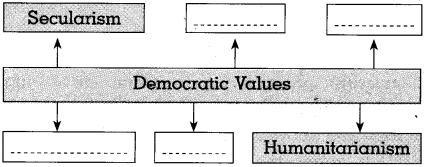
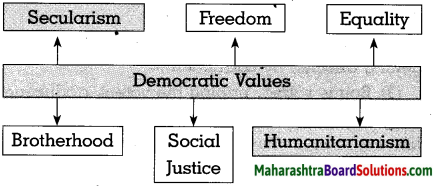
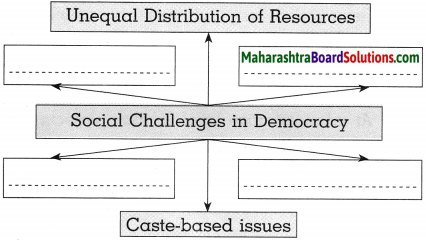
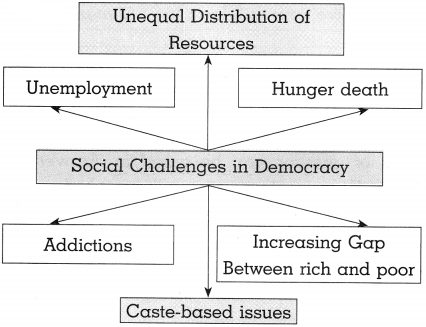
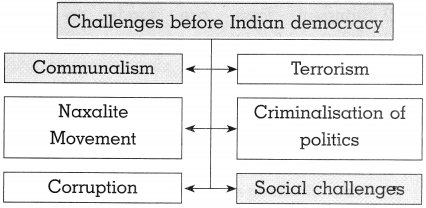
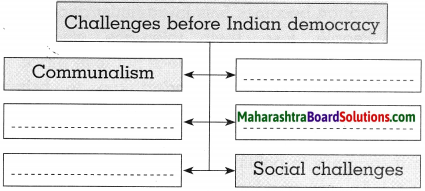
Maharashtra Board Solutions Question 9. Do as directed: (1) Maharashtra Board Class 10 Political Science Solutions Chapter 5 Challenges faced by Indian Democracy 2 Answer: Maharashtra Board Class 10 Political Science Solutions Chapter 5 Challenges faced by Indian Democracy 3 (2) Maharashtra Board Class 10 Political Science Solutions Chapter 5 Challenges faced by Indian Democracy 4 Answer: Maharashtra Board Class 10 Political Science Solutions Chapter 5 Challenges faced by Indian Democracy 5 Maharashtra Board Solutions (3) Maharashtra Board Class 10 Political Science Solutions Chapter 5 Challenges faced by Indian Democracy 6 Asnwer: Maharashtra Board Class 10 Political Science Solutions Chapter 5 Challenges faced by Indian Democracy 7 (4) Maharashtra Board Class 10 Political Science Solutions Chapter 5 Challenges faced by Indian Democracy 8 Answer: Maharashtra Board Class 10 Political Science Solutions Chapter 5 Challenges faced by Indian Democracy 9 Maharashtra Board Solutions Question 10. Answer the following questions in brief: (a) What challenges are faced at global level by democracy? Answer: The following challenges are faced by democracy at global level:

  • Many democratic countries in the world face the threat of military regime.
  • It becomes important to propagate democracy which safeguards people’s rights and freedom.
  • All-inclusive democracy is real democracy which should be adopted and practised instead of adopting just political form of democracy.

(b) What improvements are required for democracy to be deep rooted? Answer: The following improvements are required for democracy to be deep rooted:

  • Values like freedom, equality, fraternity, justice, peace and humanitarianism should be practised and nurtured by all sections in the society.
  • Autonomy should be given to various social organisation and assimilqje all the sections of the society.
  • Empowerment to the citizens, free and fair elections and independent judiciary is necessary.
  • Adoption of a form of democracy which gives preference to public welfare.

(c) What measures are adopted by India to strengthen democracy? Answer: In order to strengthen democracy following measures are adopted by India:

  • Decentralisation of power.
  • Reservation for minorities and women so that they get a share in power.
  • The values of liberty, equality, secularism and social justice adopted by our Constitution.
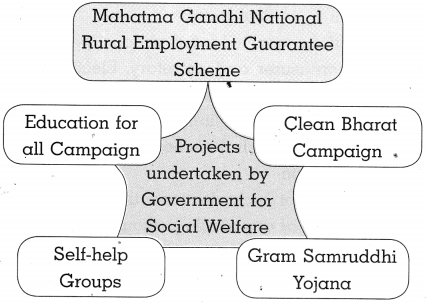
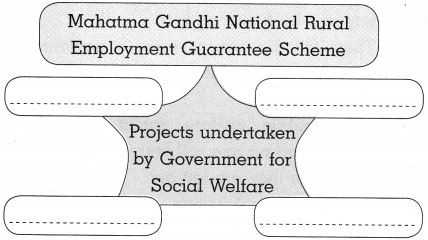
  • At administrative level various projects like Education for all, Clean Bharat campaign.
  • Gram Samruddhi Yojana, Mahatma Gandhi National Rural Employment Guarantee Scheme are undertaken.

Question 11. Give your opinion: (a) What is your opinion about participation of people in various undertakings of the government? Answer:

  • There will be change in the public policies of the government.
  • There will be interaction between all sections of society and exchange of ideas.
  • There will be transparency in government administration and problems like corruption will be tackled.
  • More public welfare schemes will get implemented and no one will feel that injustice is done to them or they are left out.

Maharashtra Board Solutions (b) Are internal elections held by political parties? Answer:

  • It is mandatory to hold internal elections in a political party.
  • Elections are held for various posts like president, treasurer and secretary.
  • Elections are held after every 3 years as per the niles laid down by the Election Commission of Itdia.
  • The paity which does not abide by the rule loses recognition.
  • Because of such elections, there can never be dominance of any single person on a party.
  • Democracy sustains within the party. In Indian democracy the internal elections are held by all the parties regularly.
  • Another challenge before democratic nations is to ensure that democracy becomes deep rooted.
  • Freedom, equality, fraternity and justice, peace, development and humanitarianism are the values that should be practiced at all levels of the society.
  • The mass support for this purpose can be gathered only through democratic means.

(c) In spite of economic reforms China accepted dominance of only one party. Is China a democratic nation? Answer:

  • After the Communist revolution in 1948 China became a republic.
  • After the formation of the republic, the Communist party of China became a dominant party.
  • All the offices in the party are elected through internal elections.
  • But in practice, there is dictatorship of the Communist party. Democracy is for namesake in China.
  • In such a situation, the people do not enjoy freedom as in true democracy.
  • However, China accepted economic reforms and became part of World Trade Organization.
  • Another challenge before democratic nations is to ensure that democracy becomes deep rooted.
  • Freedom, equality, fraternity and justice, peace, development and humanitarianism are the values that should be practiced at all levels of the society.
  • The mass support for this purpose can be gathered only through democratic means.

(d) Do you think there should be family monopoly in politics? Answer:

  • There is no place for family monopoly in politics.
  • The elected representatives serve the people till their term lasts.
  • People vote out the inefficient representatives out of power in next election.
  • If there is monopoly of one family, the perspective of democracy becomes narrow, common people cannot share power.
  • If any inefficient heir comes to power, he or she could be a great loss for the party, people as well as the nation.
  • Family monopoly in politics is a major problem before democracy in India.
  • Monopoly of just one family in politics reduces democratic space. Common people cannot participate in the public sector.

Maharashtra Board Solutions Hence there should be no family monopoly in politics.

Maharashtra Board Class 10 Political Science Solutions Chapter 4 Social and Political Movements

Balbharti Maharashtra State Board Class 10 Political Science Solutions Chapter 4 Social and Political Movements Notes, Textbook Exercise Important Questions and Answers.

Maharashtra State Board Class 10 Political Science Solutions Chapter 4 Social and Political Movements

Question 1.
Choose the correct option from the given options and complete the sentences.
(1) ………………………….. is the main demand of farmers movement.
(a) Right to cultivate on the forest land
(b) To get the right price for agricultural product
(c) Protection of consumers
(d) Building of dams
Answer:
(b) To get the right price for agricultural products

Maharashtra Board Solutions

(2) To increase agricultural production and become self-sufficient with regard to food grains ………………………….. was initiated.
(a) Water revolution
(b) Green revolution
(c) Industrial revolution
(d) White revolution
Answer:
(b) Green revolution

Question 2.
Explain the concepts.
(1) Tribal movement
Answer:

  • Tribal community was always dependent on forest wealth for their living.
  • The British had prohibited the tribals from making use of forest wealth to earn their livelihõod
  • Kolam, Gond, Santhal, Koli, Bhilla, Munda Tribals of different parts of India revolted against the British.
  • Even after independence their problem to earn a livelihood is not solved. Their right on the forest land, to gather forest products and to cultivate on forest land is not yet recognised.

Therefore, for these demands, Tribal Movement is active in many parts.

(2) Labour movement
Answer:

  • Industries in public and private sector like textile mills, railway companies started in India in the latter part of the nineteenth century.
  • Due to industrialisction, a large number’ of labour force came into existence.
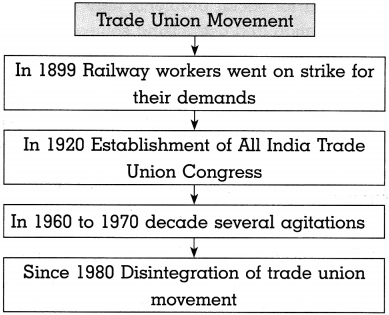
  • Thiš led to lot of labour issues. In 1920, All India Trade Union. Congress was established to solve their problems.
  • Many unions were formed after independence. The Trade Union Movement was very effective from 1960 tifi 1980s.
  • After 1980s trade union movement lost its momentum and slowly disintegrated. Globalization gave a final blow to the movement.

Question 3.
Answer the following questions in brief.
(1) Explain the activities/role/functions of environmental movement.
Answer:
(i) Role : The environment movement rias played a key role in –

  • Creating public awareness about the importance of balance in environment through television, newspapers, and other mediums.
  • Opposing developmental projects with environmental concerns.

Maharashtra Board Solutions

(ii) Functions : The function of the environment movement is to make efforts silently or rigorously to protect natural areas through afforestation, recycling or pollution control. Forest department and the pollution board are actively involved and extend support by making stringent laws to book the culprits.

(iii) Activities : Different activities are conducted to promote the environment movement:

  • Environmental degradation has become a serious issue not only in India but also in the world.
  • The issues of degradation was discussed at. Rio-de-Janeiro, Paris and Kyoto Conferences.
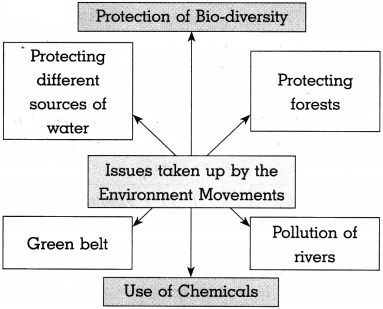
  • Even in India many movements are active for conservation of the environment like the Chipko movement, Appiko movement ana Vanmahatsov.

(2) Explain the nature of farmers movement in India.
Answer:

  1. The Indian farmers organised themselves in pre-independence era to fight against the anti-agricultural policies of the colonial British rulers.
  2. The farmers were inspired by the thoughts of Mahatma Phule, Justice Ranade and Mahatma Gandhi. They organised satyagraha against revenue collection in Bardoli and Champaranya.
  3. Farmers’ movement slowed down because of tenancy laws under land reforms. Green revolution failed to improve conditions of the poor farmers.
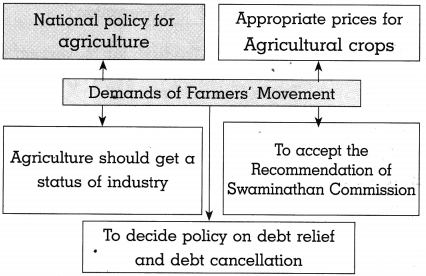
  4. Farmers’ movement gained momentum with demands like, appropriate price for agricultural products, debt relief and debt cancellation after recommendations from Swaminathan Commission.

(3) For which reforms were the women’s movement in the pre-independence period fighting?
Answer:
In the pre-independence period women’s movement were working for the following reforms :

  • Eliminating injustice against women.
  • To put an end to the exploitation of women and help them lead a respectful and dignified life.
  • They should be able to participate actively in social life.
  • To end the practices like Sati, child marriage, polygamy and bring about reforms such as widow remarriage and women’s education.

Question 4.
State wheather the following statements are true or false. Give reasons for your answer.
(1) Movements are important in a democracy.
Answer:
The above statement is True.

  • People organise themselves and start a movement to solve social issues.
  • Leaders and activists provide all the information regarding those issues to the government.
  • The government takes, notice of the problems because of the movement.
  • Some movements aim at opposing some policies of the government and certain decisions. This is the most recognised method of protest in democracy.

Hence, movements have great importance in democracy

Maharashtra Board Solutions

(2) Movements do not need a strong leadership.
Answer:
The above statement is False.

  • The success of any movement depends on leadership. The movement remains active because of the strong leader.
  • The decisions regarding the objective of the movement, programme of action, strategy of agitation are decided and taken by the leader.
  • Firm leadership has a wide reach. They can get public support making the movement very effective. So, the need of a strong leadership is utmost essential.

(3) Consumer movement came into existence.
Answer:
The above statement is True.

  • The consumers faced different problems because of changing economy and social system.
  • Adulteration increased the cost of products and faulty weights and measures are some of the problems faced by the consumers.
  • To protect the consumers from such frauds the Consumer Protection Act was passed in 1986.
  • The Consumer Protection movement was started to create awareness among the consumers about their rights and their safety.

Project
(1) Collect the news in the newspapers about various activities of social movements.
(2) Write a report on movements in your area which are working to resolve general problems.
(3) Prepare a format of a complaint you will submit under consumer protection act if you are cheated in purchase of vegetables or grains
Answer:

Memory Map
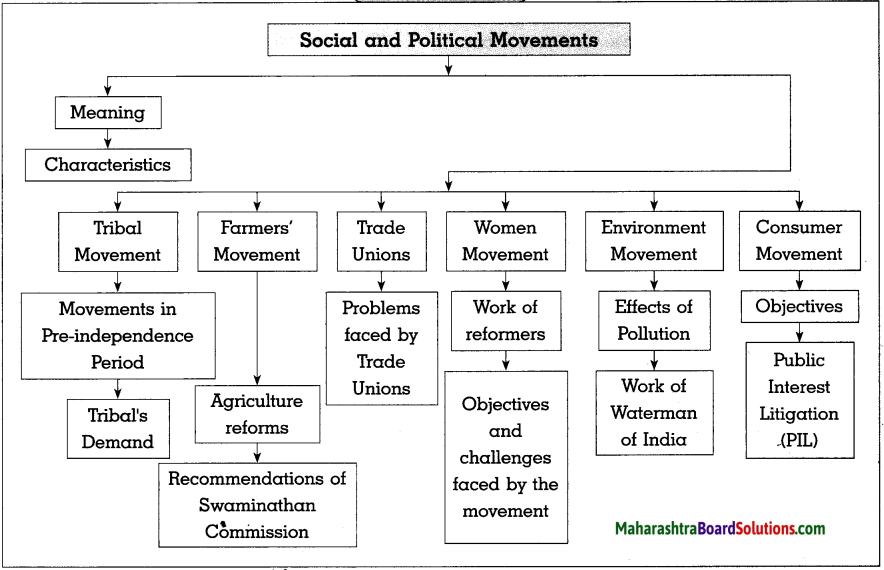
Maharashtra Board Class 10 Political Science Solutions Chapter 4 Social and Political Movements 1

Maharashtra Board Solutions

Question 5.
Choose the correct option from the given options and complete the sentences :
(a) In …………………., movements have more importance.
(a) socialist rule
(b) dictatorship
(c) democracy
(d) communist rule
Answer:
(c) democracy

(b) In democracy, Right to …………………. is considered an important right.
(a) rehabilitate
(b) pursue questions
(c) behave with control and responsibility
(d) protest
Answer:
(d) protest

(c) is the objective of Green Revolution.
(a) To stop degradation of environment
(b) Protection of the forests
(c) Increase in agricultural output
(d) To stop the felling of trees.
Answer:
(c) Increase in agricultural output.

(d) The trade union movement in India has background of ………………… .
(a) freedom struggle
(b) globalisation
(c) prestigious past
(d) industrialisation
Answer:
(d) industrialisation

(e) In 1899, …………………. workers called for a strike.
(a) railway
(b) mill
(c) handloom
(d) rice mill
Answer:
(a) railway

Maharashtra Board Solutions

(f) Dr. Rajendrasinh Rana had brought about …………………. in Rajasthan.
(a) White Revolution
(b) Water Revolution
(c) Green Revolution
(d) Consumer Revolution
Answer:
(b) Water Revolution

(g) Dr. Rajendrasinh Rana is known as the …………………. of India.
(a) Farmer man
(b) environment affectionate
(c) Man of the Millennium
(d) Waterman
Answer:
(d) Waterman

(h) Tribals in Bihar revolted against the British under the leadership of ………………… .
(a) Rajendrasinh Rana
(b) Birsa Munda
(c) Umaji Naik
(d) Kajarsingh
Answer:
(b) Birsa Munda.

(i) Swadeshi movement is an important …………………. movement.
(a) political
(b) social
(c) economic
(d) cultural
Answer:
(c) economic

(j) …………………. is one of the problems faced by consumers.
(a) Cancellation
(b) Malnutrition
(c) Adulteration
(d) Transportation
Answer:
(c) Adulteration

(k) The main demand of the farmer’s movement was to accept suggestions of the …………………. Commission.
(a) Sunderlal Bahuguna
(b) Verghese Kurien
(c) Swaminathan
(d) Kothari
Answer:
(c) Swaminathan

(l) In 1986, …………………. Act came into force.
(a) Consumer Protection
(b) Women Empowerment
(c) Child Marriage
(d) Environment Protection
Answer:
(a) Consumer Protection

Maharashtra Board Solutions

(m) The post-1980 movements are called ………………… .
(a) New
(b) Neo-social
(c) Broad
(d) Globalisation
Answer:
(b) Neo-social

(n) …………………. was established in 1920.
(a) Farmer’s Organization
(b) Bhartiya Kisan Union
(c) All India Trade Union Congress
(d) All India Kisan Sabha
Answer:
(d) All India Trade Union Congress.

Question 6.
Explain the following statements by giving reasons :
(a) Political parties can concentrate on one particular issue.
Answer:
The above statement is False.

  • Political parties contest elections to solve problems of common people.
  • Parties have to take into consideration all matters from public cleanliness to roads to space research. They have to have a national perspective and take decisions.
  • Political parties should have programmes for the development of all the sections of society like youth, senior citizens, businessmen, women, farmers and labourers.
  • This – means that political parties cannot concentrate on just one particular issue.

(b) People’s active participation is expected in the movement.
Answer:
The above statement is True.

  • A. movement is started to solve issues of public interest.
  • People offer support to the movements which are related to their cause or a particular issue.
  • Deciding upon the issues of the people a programme is decided and a group is formed.

(c) Dr. Rajendrasinh Rana is called the Waterman of India.
Answer:
The above statement is True.

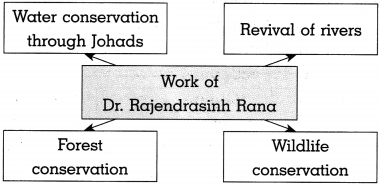
  • Dr. Rajendrashinh Rana built thousands of ‘Johads’ in Rajasthan.
  • He revived many rivers in the desert region of Rajasthan.
  • He formed an organisation – “Tarun Bharat Sangh” which built eleven thousand Johads to harvest water. .
  • He started a campaign for Water conservation, revival of rivers, forest conservation and wildlife conservation.
  • He worked continuously for this cause for 31 years building 11 thousand johads bringing about water revolution in Rajasthan. Therefore, is called the Waterman of India.

Question 7.
Explain the concept :
(a) Movement:
Answer:

  1. When people organise themselves to resolve a certain issue it is called a movement.
  2. Movements increase the participation of people in social life.
  3. Movements are for public welfare and to solve issues. The aim of any movement is not only to pressurize the government but also to oppose its decision or policies.
  4. A movement is started for different reasons like religious, social, cúltural, protection of the environment, ill practices and traditions.

Maharashtra Board Solutions

(b) Public Interest Litigation:
Answer:

  1. A litigation is filed if an individual or group feels that fundamental rights which are enshrined in the Constitution are undermined by the government.
  2. To safeguard human rights, citizens can file a litigation in High Court or Supreme Court. Such a litigation is known as Public Interest Litigation.
  3. Public Interest Litigation is filed for problems such as pollution, government avoiding public works and for social problems such as violence, discrimination and ostracising someone.
  4. It is the most effective way of seeking justice.

(c) Environment Movement :
Answer:

  • Different activities are conducted to promote the environment movement in India.
  • Environment degradation has become a serious issue not only in India but also all over the world.
  • The issues of degradation were discussed at Rio-de-Janeiro, Paris and Kyoto Conferences.
  • Even in India many movements are active for conservation of the environment like the Chipko movement, Appika movement and Vanmahatsov.

Question 8.
(A) Complete the graphical representation :

(1)
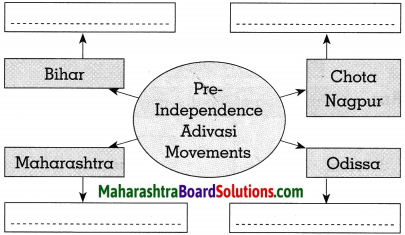
Maharashtra Board Class 10 Political Science Solutions Chapter 4 Social and Political Movements 2
Answer:
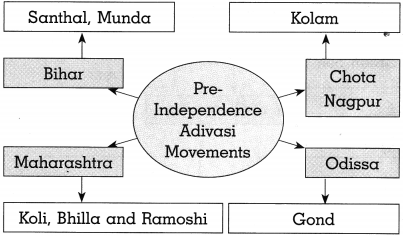
Maharashtra Board Class 10 Political Science Solutions Chapter 4 Social and Political Movements 3

(2)
Maharashtra Board Class 10 Political Science Solutions Chapter 4 Social and Political Movements 4
Answer:
Maharashtra Board Class 10 Political Science Solutions Chapter 4 Social and Political Movements 5

Maharashtra Board Solutions

(3)
Maharashtra Board Class 10 Political Science Solutions Chapter 4 Social and Political Movements 6
Answer:
Maharashtra Board Class 10 Political Science Solutions Chapter 4 Social and Political Movements 7

(4)
Maharashtra Board Class 10 Political Science Solutions Chapter 4 Social and Political Movements 8
Answer:
Maharashtra Board Class 10 Political Science Solutions Chapter 4 Social and Political Movements 9

(B) Explain the events in Trade Union Movement:

Maharashtra Board Class 10 Political Science Solutions Chapter 4 Social and Political Movements 10
Answer:
Maharashtra Board Class 10 Political Science Solutions Chapter 4 Social and Political Movements 11

Maharashtra Board Solutions

Question 9.
Answer the following questions in brief:
(a) Explain the features of a movement.
Answer:

  • A movement is a collective action which has active participation or support of the people.
  • People take up a particular issue and organise themselves.
  • A movement requires strong leadership. A strong leader makes the movement effective.
  • If people feel connected to the issue, then they extend their support to the movement.

(b) What are the demands of Trade Union Movement?
Answer:
The Trade Uniin Movement makes demands regarding following issues :

  • Contract labour and unstable employment..
  • financial insecurity and unfavourable conditions at workplace.
  • Unlimited working hours and health hazards.
  • No protection of labour laws.

(c) How did the objectives of women’s movement change after independence?
Answer:

  1. In the pre-independence era the aim of the women’s movement was to put an end to the unjust practices against women and end their exploitation.
  2. After independence, the aim of their movement changed because they realised that though the Constitution had given equal rights both to men and women in practice they were never considered equal.
  3. The objective of the women’s movement was to achieve freedom in real sense, i.e. they should be treated as human beings and should get equal rights and to live a dignified life.

(d) Which issues were taken up by the women’s movement after independence?
Answer:
Many issues were taken up by the women’s movement for welfare of the women after independence. Some are:

  • Health and education of women
  • financial independence
  • Social security
  • To be treated as human beings and have a status and prestige.

(e) Which issues are handled through movements?
Answer:
Movements arise out of public issues, which could be social, political, economic and religious.

  1. To protect the rights of the citizens like voting, freedom and for similar issues, political movements are organised.
  2. financial security, minimum wages, employment, insistence on an indigenous product are the reasons for economic movement.
  3. Social and religious movements are organized to eliminate ill practices like untouchability, entry of women in temples,’ discrimination and social issues.
  4. Movements are organised to raise voice against injustice done to a particular region, language and for issues like cleanliness, environment and movements for development like Green revolution and White resolution.

Maharashtra Board Solutions

(f) Which movements started in India are actively working for rehabilitation of the displaced and to secure their livelihood?
Answer:
People who got displaced started this movement for different reasons. Some movements lasted for short time while some lasted long.

  • “Narmada Bachao Andolan” was a popular movement.
  • People living in Maharashtra and Gujarat continued it for 28 years.
  • People in the Sindhudurg district who got displaced due to the Talamba dam started movement for rehabilitation. It lasted for 32 years.
  • Farmers who got displaced because of Pune-Nagpur highway or for the planned Purandar airport launched movements on a large scale. Such movements are going on all over India.

(g) Name the policies started by the government for the welfare of farmers and landless labourers?
Answer:
The government has started the following policies for the welfare of the farmers and landless labourers :

  • National agriculture policy
  • Crop insurance scheme (FASAL Bima Yojana)
  • Jalyukt Shivar
  • Indira Gandhi Niradhar (old), landless, destitute women farm labour scheme.
  • Neem Coated Urea.
  • Name the policies started by the government for the welfare of farmers and landless labourers.

(h) Name the movements started by Mahatma Gandhi, Mahatma Phule, Sant Gadge Maharaj and Dr. Babasaheb Ambedkar.
Answer:

  • Mahatma Phule laid the foundation of the movement for education of women and social equality.
  • To stop the practice of widow tonsure he called for a strike of barbers in Mumbai.
  • Mahatma Gandhi adopted the technique of satyagraha and started the movement for farmers in Champaranya and Kheda.
  • He also started the Non-cooperation Movement and Civil Disobedience Movement..
  • Sant Gadge Maharaj started the cleanliness campaign.
  • Dr. Babashaeb Ambedkar launched satyagraha to allow untouchables to use water from a public tank in Mahad..
  • He also led the movement in Nashik for Dalits so that they could get entry into the Kalaram temple.

(i) All movements have ideologies. (Discuss : Textbook page 92)
Answer:

  • Even though movements are launched for social welfare there is always an ideology behind every movement.
  • The scope of movements against child marriage or dowry prohibition is not limited to oppose the social evil practice but have wider aim of social reformation.
  • The movements started against female foeticide ‘Beti Bachao Beti Padhav’, violence against women and to empower women had objectives to achieve equal social status for women and their protection.
  • Movements like cleanliness campaign, Chipko Andolan, Save Trees aim not only at environment protection but also aim at saving humanity.
  • These movements have faith in democratic values like equality and brotherhood and humanity. This shows all movements have ideologies.
  • Generally the movements are devoted to one particular issue but have an ideology behind them.
  • For example movements against child marriage, dowry believe in values of democracy, women empowerment and social equality.
  • Sometimes some movements gradually get transformed into political parties.

Maharashtra Board Solutions

Question 10.
Give your opinion :
(a) Do you think, if all the movements co-ordinate with each other, the result will be more effective?
Answer:

  • Our society has witnessed many movements from pre-independence times.
  • If all these movements co-ordinate with each other they will be definitely, effective.
  • With each other’s cooperation they can work together to find the root cause of the problem and also find a solution.
  • The manpower will not get divided. The work will get divided and that would save time and energy to a great extent.
  • The movement will be more effective.

(a) On which issues does the ‘Sons of the Soil’ movement in India insist? (Discuss : Textbook page 93)
Answer:
People migrate for various reasons within the country. They create lot of problems in their newly adopted homeland which give rise to the ‘Sons of the Soil’ movement. The main reasons for the movement are :

  • Sons of the Soil, i.e. local people lose out on employment opportunities.
  • They are deprived of their jobs.
  • Their land is confiscated.
  • Housing becomes expensive.
  • The migrants pose a threat to the language and culture of local people.
  • Sons of the Soil lose economic monopoly as well as political influence.

Maharashtra Board Class 10 History Solutions Chapter 9 Heritage Management

Balbharti Maharashtra State Board Class 10 History Solutions Chapter 9 Heritage Management Notes, Textbook Exercise Important Questions and Answers.

Maharashtra State Board Class 10 History Solutions Chapter 9 Heritage Management

Question 1.
(A) Choose the correct option from the given options and complete the statement.
(1) Lovre Museum has in its collection the much-acclaimed painting of …………..…….. by Leonardo da Vinci.
(a) Napoleon
(b) Mona Lisa
(c) Hans Sloan
(d) George II
Answer:
(b) Mona Lisa

Maharashtra Board Solutions

(2) …………..…….. at Kolkata is the first museum in India.
(a) Government Museum
(b) National Museum
(c) Chhatrapati Shivaji Maharaj Vastusangrahalay
(d) Indian Museum
Answer:
(d) Indian Museum

(B) Identify and write the wrong pair in the following set.
(1) Maharaja Sayajirao University – Delhi
(2) Banaras Hindu University – Varanasi
(3) Aligarh Muslim University – Aligarh
(4) Jivaji University – Gwalior
Answer:
(1) Wrong Pair: Maharaja Sayajirao University – Delhi

Question 2.
Explain the following statements with reasons.
(1) Archives and libraries publish research journals, informative pamphlets, leaflets, posters, etc.
Answer:

  • Libraries preserve and conserve old’ books and artefacts discovered during excavation.
  • If these documents and artefacts are not exhibited then they are kept in archives.
  • All the historical sources are our assets and they should reach the people.
  • Libraries not only preserve these documents but also carry out research, to know the authenticity.

In order to make the historical events, personalities, and historical research known to the people, archives and libraries publish research journals, informative pamphlets and leaflets.

(2) Only trained persons, who are duly qualified can take up the tasks involved in the work of conservation and preservation.
Answer:

  1. While conducting historical research, one has to do the different tasks carefully like collecting sources, preserving, exhibiting, etc.
  2. The skill required for every task is different. The procedure followed for each task is different as well as the preliminary preparations.
  3. It is essential to know about precautions to be taken.
  4. Hence only trained persons who are duly qualified can take up the tasks involved in the work of conservation and preservation.

Maharashtra Board Solutions

Question 3.
Write notes:
(1) Sthalakosh
Answer:

  • History does not shape itself in oblivion. It takes place at some place.
  • Geographic information is essential to study history.
  • Chakradhar Swami, of Mahanubav sect, visited many villages and details of those villages were noted by Muni Vyas.
  • Siddheshwarshastri Chitrav wrote Prachin Bharatiya Sthalkosh. It gives us information on various places mentioned in Vedic literature, Kautiliya’s Arthashastra, Panini’s Grammar, Ramayana.
  • Mahabharata and also in Buddhist Jain Greek, Chinese and Persian literature.
  • Sthalakosh gives us information on ancient cities and history of those cities. It serves as an important written source of history.

(2) Vishwakosh
Answer:

  • The first Chief Minister of Maharashtra, Shri Yashwantrao Chavan, established the ‘Maharashtra Rajya Sahitya Samskruti Mandal.
  • The objective of making Vishwakosh was to develop and enhance Marathi language and literature.
  • Tarkteerth Lakshmanshastri Joshi was appointed as the chief editor. 20 volumes of Vishwakosh are published till date.
  • Marathi Vishwakosh contains knowledge about all possible subjects which exist in the world. It has important entries about history.

(3) Samdnya Kosh
Answer:

  1. While studying any subject we come across many new words. If their exact meaning is not understood, it can create a lot of confusion.
  2. Terms in history like colonialism, imperialism, liberalisation, globalisation, socialism, communism need explanation and clarity. In order to avoid such confusions, this kosh is prepared.
  3. In Samdnya Kosh, all subject related concepts are collected and explained. Information on what led to the development of concepts is provided.
  4. Samdnya Kosh is very helpful for research students, teachers of history as well as common people.

(4) Saraswati Mahal Granthalay
Answer:

  • The Saraswati Mahal Granthalay was built in 16-17th century in Tanjavur, Tamil Nadu during the reign of Nayak Dynasty.
  • In 1675, Maharaj Vyankojiraje Bhosale conquered ‘ Thanjavur and established his independent rule. He and his successors contributed to the expansion of this library. ‘
  • Sarfojiraje Bhosale contributed the most in expanding and enriching the library. Because of his contribution, to honour him, the library was renamed as ‘The Thanjavur Maharaj Sarfoji’s Saraswati Mahal Library’.

Maharashtra Board Solutions

Question 4.
Give elaborate answers to the following.
(1) Why is library management important?
Answer:
Library is not just about a collection of books but managing it is equally important.

  • Readers can easily get the books they want if the library is properly organised.
  • The location of the book should be easily traced. It saves the time and efforts of readers as well as the librarian.
  • Preservation and conservation of books is done effectively with proper management. It prolongs life of books and causes less damage.
  • If the management is well acquainted, they will have good collection that will make available good quality books to reader.
  • Instead of collecting books on one subject there should be variety in the collection so as to cater of different readers who are very selective in their choices.
  • Facilities like proper catalogues, indexes, computerised systems and modern facilities are provided by effective management of library.
  • If the management is creative it will organise exhibitions, advertise, have seasonal offers for vacations, conduct competitions to increase membership.

(2) Which tasks are important in archives management?
Answer:
The following tasks are important in archives’ management:

  • Important documents to be preserved and care should be taken that document with important contents are preserved in their original condition. Confidentiality of important papers should be maintained.
  • To classify the documents by preparing indexes and to create accurate systems of retrieval of documents.
  • Documents from the archives are supposed to be very reliable.
  • Therefore, it is important to safeguard the papers from humidity, fungus and other environmental factors.
  • It is important to remain updated with latest technology in archive management.
  • Computerise/Digitalse all systems. To make use of information technology in managing libraries and archives.
  • To establish regional and local archives*.
  • To preserve national, cultural and historical heritage.
  • To create a hasslefree system.

Question 5.
Complete the following Concept chart.
Maharashtra Board Class 10 History Solutions Chapter 9 Heritage Management 1
Answer:
Maharashtra Board Class 10 History Solutions Chapter 9 Heritage Management 2

Maharashtra Board Solutions

Project
Obtain information about the important libraries in Maharashtra. Visit the library in your vicinity and learn about its functioning.

Question 6.
Complete the sentences by choosing the correct option:
(a) Documents and artefacts which are not exhibited are kept in …………………… .
(a) Museum
(b) Library
(c) Archives
(d) Government office
Answer:
(c) Archives

(b) ……………………. was the 16th century artist who worked under the patronage of French King Francis I.
(a) Leonardo-da-Vinci
(b) Michaelangelo
(c) Raphael
(d) Dante
Answer:
(a) Leonardo-da-Vinci

(c) The collection in ……………………. increased to a great extent because of the antiquities brought by Napoleon Bonaparte.
(a) National Museum of Natural History
(b) British Museum
(c) Louvre Museum
(d) The Calico Museum
Answer:
(c) Louvre Museum.

(d) ……………………., a natural scientist handed over about 71 thousand objects in his collection to the British Museum.
(a) Sir Hans Sloan
(b) King George II
(c) Napoleon Bonaparte
(d) King Francis I
Answer:
(a) Sir Hans Sloan

(e) The Museum of Natural History which 8 houses more than 12 crore specimens of fossils is in ……………………. .
(a) England
(b) France
(c) Switzerland
(d) USA.
Answer:
(d) USA

(f) Chhatrapati Shivaji Maharaj Vastu-sangrahalay was built to commemorate the visit of ……………………. .
(a) King George I
(b) Queen Elizabeth
(c) Prince Charles
(d) Prince of Wales
Answer:
(c) Prince of Wales

(g) The building of Chhatrapati Shivaji Maharaj Vastusangrahalay is built in ……………………. style.
(a) Mughal
(b) Indo-Greek
(c) Indo-Gothic
(d) Indo-Persian
Answer:
(c) Indo-Gothic

Maharashtra Board Solutions

(h) ……………………. is given status of Grade I heritage building in Mumbai.
(a) Chhatrapati Shivaji Maharaj Railway Terminus
(b) Chhatrapati Shivaji Maharaj Vastusangrahalay
(c) Reserve Bank of India
(d) Jehangir Art Gallery
Answer:
(b) Chhatrapati Shivaji Maharaj Vastusangrahalay.

(i) The Royal Library of Ashurbanipal, the ……………………….. Emperor in Mesopotamia is one of the earliest libraries in the world.
(a) Hispanic
(b) Assyrian
(c) Mongol
(d) Akkadian
Answer:
(b) Assyrian

(j) The ……………………….. in Thanjavur, Tamil Nadu was built in 16th-17th century during the times of Nayak dynasty.
(a) Vyankojiraje Bhosale
(b) Sarfojiraje Bhosale
(c) Saraswati Mahal Granthalay
(d) Vidya Niketan
Answer:
(c) Saraswati Mahal Granthalay

(k) The first official archives of India, the ……………………….. was established in 1891 C.E. in Kolkata.
(a) National Archive
(b) Federal Record of Nation
(c) Archive National
(d) Imperial Record Department
Answer:
(d) Imperial Record Department

(l) There are about five crore Modi documents related to Maratha history in the Pune branch which are referred as ………………………. .
(a) Peshwa Daftar
(b) Bhosale Daftar
(c) British Daftar
(d) Maratha Daftar
Answer:
(a) Peshwa Daftar

(m) ……………………….. prepared during the reign of Chhatrapati Shivaji Maharaj is considered as an important encyclopaedia.
(a) Bharatiya Vyavahar Kosh
(b) Rajavyavaharkosh
(c) Vyavaharik Kosh
(d) Bharatiya Prachin Charitrakosh
Answer:
(b) Rajavyavaharkosh.

Maharashtra Board Solutions

Question 7.
Identify the wrong pair in the following and write it:
(1)

(1) Maharaj Sayajirao UniversityDelhi
(2) Banaras Hindu UniversityVaranasi
(3) Aligarh Muslim UniversityAligarh
(4) Jivaji UniversityGwalior

Answer:
Wrong Pair: Maharaj Sayajirao University – Delhi.

(2)

(1) Sangeetshastrakar va Kalavant Yancha Itiha£Lakshman Dattatray Joshi
(2) Krantikarakancha CharitrakoshS. R. Date
(3) Svantantryasainik CharitrakoshN. R. Phatak
(4) Bharatvarshiya Prachin Aitihasik KoshShridhar Vyankatesh Ketkar

Answer:
Wrong Pair: Bharatvarshiya Prachin Aitihasik Kosh – Shridhar Vyankatesh Ketkar

(3)

(1) Bharatvarshiya CharitrakoshSiddeshwar Shastri Chitral
(2) Marathi VishwakoshRaghunath Bhaskar Godbole
(3) Bharatiya Samskruti KoshPandit Mahadevshastri Joshi
(4) Maharashtriya DnyankoshShridhar Vyankatesh Ketkar

Answer:
Wrong Pair: Marathi Vishwakosh – Raghunath Bhaskar Godbole

(4)

(1) SthanapothiMuni Vyas
(2) Index of Marathi PeriodicalsS. G. Date
(3) First Encyclopaedia of Natural HistoryDenis Diderot
(4) Asiatic Society of BengalFirst museum in India

Answer:
Wrong Pair: First Encyclopaedia of Natural History – Denis Diderot

Maharashtra Board Solutions

Question 8.
Complete the following concept chart:
(1)
Maharashtra Board Class 10 History Solutions Chapter 9 Heritage Management 3
Answer:
Maharashtra Board Class 10 History Solutions Chapter 9 Heritage Management 4

(2)
Maharashtra Board Class 10 History Solutions Chapter 9 Heritage Management 5
Answer:
Maharashtra Board Class 10 History Solutions Chapter 9 Heritage Management 7
(3)
Maharashtra Board Class 10 History Solutions Chapter 9 Heritage Management 8
Answer:
Maharashtra Board Class 10 History Solutions Chapter 9 Heritage Management 9

Maharashtra Board Solutions

Question 9.
Explain the concept :

(a) Archives:
Answer:

  1. An archive is a place where documents with important content in their original conditions are preserved in a scientific manner.
  2. Artefacts and documents which are not exhibited in museums or libraries but have historical importance are kept in archives.
  3. Archives provide documents to the § government, research students and local public when required. Technically, the management of archives is akin to library management.
  4. The documents in the archives are preserved in their original condition and hence no changes can be made to it. Documents from archives are very reliable.

(b) Encyclopaedia:
Answer:

  1. Encyclopaedia can be defined as a systematic compilation of words with meaning, information or knowledge on various topics.
  2. A specific method is adopted to compile the information or to organise the available knowledge. g
  3. Accuracy, meticulousness, objectivity, standardised format of presentation and updated information are the special features of good encyclopaedia.
  4. The objective of making an encyclopaedia is to make the available knowledge easily accessible to the readers.

(c) Dictionaries:
Answer:

  • A type of encyclopaedia giving word meaning arranged in alphabetical order is a Dictionary.
  • Dictionaries help the readers to know meaning of the words and enrich their vocabulary.
  • Dictionaries have word meanings, synonyms and etymology.
  • Dictionaries are of various type like comprehensive dictionaries, dictionaries of terminology, etymology, thesaurus and dictionaries of idioms and proverbs.

(d) Comprehensive Encyclopaedia (Vishwakosh):
Answer:

  • Comprehensive Encyclopaedia (Vishwakosh) means a book which has information on all subjects known, i.e. all subjects under the sun.
  • Vishwakosh is an important medium” of documenting and disseminating information.
  • The information is included in encyclopaedia after thorough research and study.
  • (a) There are two types of encydopaedias – one that includes all subjects like ‘Encyclopaedia Britannica’, Maharashtriya Dnyankosh, Marathi Vishvakosh.
    (b) The other type of encyclopaedia includes comprehensive information on one chosen subject, e.g. Bharatiya Samskruti Kosh, ‘Vyayam Dnyankosh1.

(e) Index:
Answer:

  • Index means a list.
  • Index is at the end of a book which includes alphabetical lists of individuals, subjects, key words, reference books, etc.
  • As the list is in alphabetical order, the reader finds it easy to access required information.
  • The index of Marathi periodicals prepared by S. G. Date and index of ‘Marathyancha Itihasachi Sadhane1 is well-known.

Maharashtra Board Solutions

(f) Charitrakosh (Encyclopaedia of Biographies):
Answer:

  1. Charitrakosh contained biographies of individuals who lived in a particular period and their work which inspired and motivated all the people in the society.
  2. Charitrakosh enables the researcher and scholars to know about the historic period, with regard to social structure and social life.
  3. Bharatvarshiya Prachin Aitihasik Kosh written by Raghunath Bhaskar Godbole is the earliest encyclopaedia of this kind.

(g) Bharatiya Samskruti Kosh:
Answer:

  • It contains the description of Indian history, geography, religions, sects, culture, traditions, beliefs, ethnic and lingual groups residing in our country.
  • Bharatiya Samskruti Kosh throws light on, people living in a particular region, festivals and their culture.
  • Mahadevshastri Joshi edited and published 10 volumes of this Kosh.
  • Chakradhar Swami, of Mahanubav sect, visited many villages and details of those villages were noted by Muni Vyas.

Question 10.
Write short notes:
(a) Louvre Museum:
Answer:

  • The Louvre Museum in Paris was established in the 18th century.
  • It has antiquities collected by the royal family of France.
  • The world famous painting of Mona Lisa by Leonardo-Da-Vinci is kept in this museum.
  • The antiquities brought back by Napoleon Bonaparte on his return from conquests are exhibited in this museum.
  • Presently, the museum has more than 3 lakh and 80 thousand artefacts.

(b) British Museum:
Answer:

  • The British Museum was established in the 18th century in London.
  • It has a collection of 71 thousand objects given by natural scientist Sir Hans Sloan to King George. II.
  • Several books, pictures, specimens of preserved plants are included in it.
  • The ancient objects and artefacts which the Britishers have collected from their colonies are exhibited in this museum.
  • At present, it has about 80 lakh objects in its collection.

(c) National Museum of Natural History:
Answer:

  • The National Museum of Natural History was established in Washington DC in 1846.
  • The Smithsonian Institute managed the museum from its inception. This is a museum of natural history.
  • Remains of animals, plants, organisms and thousands of specimens of fossils are kept in it.
  • It also has human fossils, minerals, rocks, shells, artefacts. All together it has a collection of more than 12 crore (120 million).

(d) Chhatrapati Shivaji Maharaj Vastusangrahalay:
Answer:

  1. Chhatrapati Shivaji Maharaj Vastusangrahalay was built to commemorate the visit of Prince of Wales to India. Some influential residents in Mumbai decided to establish a museum in 1904.
  2. The foundation of the building was laid on 2nd November 1905 and the construction was completed in 1922. The museum was named as ‘Prince of Wales of Western India’. In 1998 C.E. it was renamed as ‘Chhatrapati Shivaji Maharaj Vastusangrahalay.’
  3. The museum building is constructed in Indo-Gothic style and has been awarded the status of Grade I heritage building.
  4. The museum has about 50 thousand antiquities which are divided into three categories, viz.. Arts, Archaeology and Natural History.

Maharashtra Board Solutions

(e) Bharatvarshiya Prachin Aitihasik Kosh:
Answer:

  • Raghunath Bhaskar Godbole wrote Bharatvarshiya Prachin Aitihasik Kosh.
  • It is the first dictionary of Biography in Indian regional language.
  • We get information on Manu and many ancient personalities from Mahabharat.
  • We come to know about legendary people who lived in Bharatvarsha and were renowned.
  • Information about their women, their sons, religions, lands, capitals, mountains and rivers.
  • Which flowed in their land their entire history is given in this encyclopaedia.

(f) Bharatiya Samskruti Kosh:
Answer:

  • Pandit Mahadevshastri Joshi edited and published 10 volumes of Bharatiya Samskruti Kosh.
  • He wrote about Indian history, geography, about people speaking different languages and how they created history.
  • Detailed information on culture of India and festivals, geography, traditions, ideas, is taken into consideration.

Therefore these koshs are useful for readers and research scholars.

Question 11.
Explain the following statements with reasons:

(a) Encyclopaedias should be created in as many languages as possible.
Answer:
Encyclopaedias symbolise the richness and vast gamut of words a language has.

  • It fulfils the curiosity of readers and solves the confusion of a layman.
  • Encyclopaedias inspire to carry out more research as one gets information, knowledge and references.
  • Encyclopaedias provide complete information and knowledge to researchers and students which enriches their previous knowledge.
  • Encyclopaedias represent intellectual and cultural development of a society.
  • Many languages in India and the world are rich and resourceful and hence encyclopaedias should be created in as many languages as possible to raise intellectual level of society.

(b) Encyclopaedia and history are related.
Answer:

  • Encyclopaedias contain information about personalities, events and ancient cultures.
  • In order to gather information it is essential to take the help of history,
  • The common factors between an encyclopaedia and history are objectivity and authenticity.
  • Research scholars of history need to refer to encyclopaedias to find information on events, personalities, concept, places, etc. as encyclopaedias are created with the help of history. Hence encyclopaedia and history are related.

(c) Improved versions of Encyclopaedia or supplements to original editions need to be published.
Answer:

  1. Encyclopaedia is a systematic compilation of information or knowledge on various topics ranging from people, places and events to concepts, word meanings, etc.
  2. With the passage of time the spectrum of knowledge has widened.
  3. With the advent of new technology new words are added. Latest or updated information, knowledge, concepts enrich the language.
  4. The references of the past events change in context of the new research. If all these changes are not incorporated in the encyclopaedias, they will become outdated.

Therefore, encyclopaedia or supplements to original editions need to be published.

Question 12.
Answer the following questions in 25-30 words:
(a) What are the ways to preserve and conserve oral resources?
Answer:

  • Folk songs ancl folk tales are collected and compiled.
  • Collected material is classified. It is interpreted and analysed after compilation.
  • The result of research conducted is then published.

Maharashtra Board Solutions

(b) What steps are taken to preserve written sources?
Answer:
Written sources have great importance in the writing of history. To preserve written sources we need –

  • To collect old books, historical books, pictures, photographs, copper plates, manuscripts and official records and edit them.
  • To decide upon the historical values of collected documents.
  • To exhibit the selected documents.
  • To publish edited documents and research reports.
  • To complete necessary chemical and mechanical process of cleaning for conserving and preserving the documents.

(c) What methods should be followed while studying material source?
Answer:
The following methods should be followed by research scholars while studying material source:

  • To collect the artefacts and classify them according to their historical date and type and prepare indexes.
  • To arrange exhibitions of selected artefacts or their replicas.
  • To write and publish research articles about artefacts.
  • To complete required mechanical and chemical processes of cleaning for conservation and preservation of the collected documents.

(d) Write about the earliest libraries in the world.
Answer:
Libraries were established in different parts of the world in ancient times:

  • The Royal Library of Ashurbanipal is the earliest library dating back to the 7th century B.C.E. in Mesopotamia. The library was owned by the Assyrian emperor.
  • A library was discovered at Alexandria in Egypt which was built in 4th century C.E.
  • The library at Takshashila university in 5th century B.C.E. – 5th century C.E. as it was a noted centre of learning.

(e) Write about format of Encyclopaedias.
Answer:
Format of Encyclopaedias:

  • Encyclopaedias are made according to selected subjects; therefore encyclopaedias are classified according to the subjects.
  • Encyclopaedias are framed according to alphabetical order or as per the order of topics.
  • They provide the exact meaning of words and give information on concepts.
  • The type of order is kept according to the convenience of the readers. An index is provided at the end of the encyclopaedia for this purpose.

(f) Write about Encyclopaedic Literature.
Answer:

  • It appears similar to an encyclopaedia but differs in composition.
  • Information and scholarly articles on all possible aspects of a subject is covered.
  • Experts are called to write on different topics which are compiled to create encyclopaedia
  • ‘Maharashtra Jeevan’ Volume I and II; ‘Shahar Pune’ Volume I and II; Yearbook like Manorama, etc. are the examples of Encyclpaedic Literature.

Maharashtra Board Solutions

(g) Give information on early encyclopaedias made in the west.
Answer:

  • The process of making encyclopaedias started in before 1st century C.E. in the west. Pliny wrote the first encyclopaedia on natural history between 23 C.E.-79 C.E.
  • In the 8th and 9th century, encyclopaedias were written in England, France and in Arab countries.
  • French Philosopher Denis Diderot wrote Encyclopaedia in the 18th century C.E.
  • The important milestone in this process was ‘Encyclopaedia Britannica’ published in 1767 C.E.
  • Wikipedia is considered equivalent to encyclopaedia. The information given in this encyclopaedia is highly reliable and updated.

(h) Write about ancient Indian encyclopaedias.
Answer:

  • In the 7th century C.E., Nighantu, a dictionary (information on ancient medicine) in Sanskrit language was written. Dictionaries like Dhatupath were written.
  • In tjie medieval times, encyclopaedic text was composed by Mahanubhav sect.
  • Amarsimha wrote a thesaurus in Sanskrit ‘Amarkosha’.
  • Raghunath Pandit prepared Rajavyavaharkosh as directed by Chhatrapati Shivaji Maharaj.

Question 13.
Read the following passage and answer the following questions:
(a) Which factors influence Encyclopaedia?
Answer:
The influence of national policies, ethical values and ideals, philosophy and traditions is seen in an encyclopaedia.

(b) What is the common factor between history and encyclopaedia?
Answer:
History and encyclopaedia both are objective.

(c) Explain the statement: Encyclopaedias are looked upon as outstanding achievements of a society.
Answer:

  • The knowledge in all the spheres of society is made accessible to everyone is the major reason behind making an encyclopaedia.
  • What inspires people to create encyclopaedias is the instinct to gain knowledge and spread it.
  • Encyclopaedias reflect the collective intellect and creativity of society.
  • One develops a sense of pride after knowing about nation’s progress through it.

Hence encyclopaedias are looked upon as outstanding achievements of a society.

Question 14.
Give elaborate answers to the following: (3 marks each)

(a) What kind of training is required to study written sources?
Answer:
While studying and handling written sources the following training is required:

  • The students should have knowledge of scripts like Brahmi, Modi, Persian and their development.
  • They should know ways to obtain information about the social organisations and traditions.
  • They should know about the literature and writing style in past societies.
  • They should have basic knowledge about administrative systems, dynasties and cultures of the past.
  • They should study prevalent schools of painting and sculpture.
  • They should be able to collect information on types of paper, know about ink and colour of ancient document and ways to handle.
  • They should be well acquainted with properties of stones and metals used for inscriptions.
  • Articles published earlier on case study should be read.
  • They should know the chemicals and equipment used in various processes of cleaning and preserving the documents.
  • Modern know-how of approaches of managing exhibitions in museums, galleries and information technology.

Maharashtra Board Solutions

(b) What kind of training is required to study material sources?
Answer:
Student should have following knowledge to study material resource:

  • They should have basic knowledge of archaeological method and theory.
  • They should be acquainted with the history of ancient civilisations.
  • They should have knowledge of various techniques of excavation.
  • Stones, minerals and clay used to make artefacts and their characteristics to be studied.
  • They should be well-acquainted with the sources of the material used and their chemical properties.
  • They should also know about various styles of making artefacts and development in their making process.
  • They should have the knowledge and skills of making replicas of artefacts and fossils.
  • They should read research papers previously published on his case study.
  • They should acquire information about the approaches of arranging exhibitions and administrations.
  • They should know about the equipment and chemicals necessary for the cleaning of artefacts.
  • They should be able to write research reports and articles.

(c) Write information about museums in India.
Answer:

  • ‘Indian Museum’ established by the Asiatic Society of Bengal in Kolkata was the first museum in India in 1814.
  • The ‘Government Museum’ established in Chennai in 1851 C.E. was the second museum in India. The National Museum was established in Delhi in 1949.
  • The foundation of the Prince of Wales Museum was laid in Mumbai in 1905. Its construction was completed in 1922. It was renamed as Chhatrapati Shivaji Maharaj Vastusangrahalay in 1998 C.E.
  • At present, there are many museums in various states of India.
  • Many museums are connected to libraries and archives. Some are connected to Universities.
  • Such museums offer courses in Museology also.

(d) Give information on “National Archives of India.
Answer:

  • The first official archive of India was established m Kolkata in 1891 C.E. as the ‘Imperial Record Department’.
  • It was moved to Delhi in 1911 C.E.
  • In 1998 C.E. it was made accessible to the public by the then President of India K.R. Narayanan.
  • It was renamed as ‘National Archive’ (National Archive of India). Archives come under the Ministry of Culture of the Indian Government.
  • This archive has papers, maps, books and micro films preserved in chronological order since 1748.
  • Records in English, Arabic, Hindi, Persian, Sanskrit, Devanagari and Modi languages are preserved.
  • Papers kept in archives are classified into public, oriental, manuscripts and private papers.
  • The National Archives of India is the largest in Asia and technologically advanced.

(e) Explain the statement: A nation should have museums and libraries.
Answer:
Museums and libraries mirror the history of the country and that is the reason they are very valuable for a nation.

  • Museums and Libraries make it easy for the research scholar to write history.
  • Historical events and life stories of important people reach the masses.
  • People get an idea about past social, political and cultural conditions.
  • A visit to museums increases one’s interest.
  • A change in a prejudiced view about history is seen.
  • Information on animals, microorganisms, birds and elements of nature.
  • Museums contribute to the process of gaining and dissemination of knowledge.
  • Ancient historical sources are preserved.
  • Tourism is promoted.
  • It creates opportunities for employment.

Maharashtra Board Solutions

Hence it can be said that it is important for a nation to have museums and libraries as they both are symbols of nation’s progress and glory.

Memory Map
Maharashtra Board Class 10 History Solutions Chapter 9 Heritage Management 9

Maharashtra Board Class 10 History Solutions Chapter 2 Historiography Indian Tradition

Balbharti Maharashtra State Board Class 10 History Solutions Chapter 2 Historiography Indian Tradition Notes, Textbook Exercise Important Questions and Answers.

Maharashtra State Board Class 10 History Solutions Chapter 2 Historiography Indian Tradition

Question 1.
(A) Choose the correct option from the given options and complete the statement.
(1) …………………..…….. was the first Director-General of the Archaeological Survey of India.
(a) Alexander Cunningham
(b) William Jones
(c) John Marshall
(d) Friedrich Max Muller
Answer:
(a) Sir Alexander Cunningham

Maharashtra Board Solutions

(2) …………………..…….. translated the Sanskrit text of ‘Hitopadesh’ in the German language.
(a) James Mill
(b) Friedrich Max Muller
(c) Mountstuart Elphinstone
(d) Sir John Marshall
Answer:
(b) Friedrich Max Muller

(B) Identify and write the wrong pair in the following set.
(1) ‘Who were the Shudras’ – subaltern History
(2) ‘Stri-Purush Tulana’ – Feminist writing
(3) ‘The Indian War of Independence 1857’ – Marxist History
(4) Grant Duff – Colonial History.
Answer:
(1) Right Pair: ‘Who were the Shudras’ – subaltern History
(2) Right Pair: ‘Stri-Purush Tulana’ – Feminist writing
(3) Wrong Pair: ‘The Indian War of Independence 1857’ – Marxist History
(4) Right Pair: Grant Duff – Colonial History.

Question 2.
Explain the following with its reason.
(1) Writing of the regional history received a momentum.
Answer:

  • Indian historians trained in the British educational system showed an inclination to restore the self-esteem of Indians They started writing Nationalistic historiography.
  • Historians from the different regions of India criticised the prejudiced history of India written by the British officers.
  • Their attention was drawn towards geographic conditions and history of different regions of India.
  • The nationalistic historiography helped in triggering the independence movement.
  • It provided a momentum to the writing of regional histories for e.g.
  • Nationalistic writings in Maharashtra were inspired by Vishnu Shastri Chiplunkar.

Hence, writing of the regional history received momentum.

(2) Bakhar is an important type of historical documents.
Answer:

  • Bakhars are important source of history like coins, inscriptions, texts, copper plates and travelogues.
  • Bakhars contain eulogies of the heroes, historic events, stories of lives of great men and description of battles.
  • It portrays a picture of prevalent society, religions and economic life.
  • Bakhars are of various types which contain biographies of kings, dynastic history, description of events, sects, autobiographies, mythologies, administration of kings, etc.
  • These descriptions are helpful for writing historiography.
  • Among well-known Marathi. Bakhars ‘Sabhasad Bakhar’ written by Krishnaji Anant Sabhasad requires a special mention Bhausahebanchi Bakhar and Panipatachi Bakhar describe the ‘Battle of Panipat’.

Hence, Bakhars are important type of historical document.

Maharashtra Board Solutions

Question 3.
Write detailed Answers the following questions in detail.
(1) What is Marxist History?
Answer:

  1. In the post-independence era, new trends emerged in writing Indian historiography. Marxist historiography is prominent among them.
  2. Historiography which is based on ideas of Karl Marx is known as Marxist Historiography. In Marxist Historiography, more importance was given to class struggles.
  3. Marxist Historiography reflects concerns for means and modes of production as well as the industrial relations. These became centre of writings of the Marxist historians.
  4. How every social event affects the life of people was analysed and it became the theme of Marxist historians Marxist historians studied the transitions that took place in the caste system.
  5. Notable Indian historians who adopted Marxist ideologies were Damodar Kosambi, Comrade Shripad Dange, Sharad Patil and Ram Sharan Sharma.
  6. Their writings reflected Marxist ideology. Comrade Dange was the founder member of the Indian Communist Party

(2) What is the contribution of Itihasacharya V.K. Rajwade to historiography?
Answer:

  1. V.K. Rajwade is well-known for his writings in Marathi on subjects like history, linguistics, etymology and grammar. His contributions are as follows:
  2. He compiled and edited 22 volumes of Marathyanchya Itihasachi Sadhane.
  3. He stated that history is the all-inclusive image of the past societies.
  4. V. K. Rajwade was of the view that history does not include only the stories of political images, conspiracies and Wars for seizing power.
  5. He was of the firm opinion that we should write our own history and insisted that history . should be written only using the authentic sources.
  6. He was of the opinion that description of any human event in historiography should have balanced combination of three factors namely – Time, Space and Personalities.

Question 4.
(a) Complete the following chart.

HistorianName of the Book
James Mill‘The History of British India’
James Grant Duff……………………………………………
……………………………………………‘The History of India’
S.A. Dange……………………………………………
……………………………………………‘Who were the Shudras’

Answer:

HistorianName of the Book
James MillThe History of British India
James Grant DuffA History of Mahrattas
Mountstuart ElphinstoneThe History of India
S. A. DangePrimitive Communism to Slavery
Dr. Babasaheb AmbedkarWho Were the Shudras

Maharashtra Board Solutions

(b) Complete the following concept chart.
Maharashtra Board Class 10 History Solutions Chapter 2 Historiography Indian Tradition 1
Answer:
Maharashtra Board Class 10 History Solutions Chapter 2 Historiography Indian Tradition 2

Question 5.
Explain the following concepts.
(1) Orientalist historiography.
Answer:

  1. In the later part of the eighteenth century many European scholars felt curious to know about civilisations and countries of the East.
  2. These scholars who studied the Indian Civilization had respect and admiration for it. They were known as ‘Orientalists’.
  3. They studied similarities between Sanskrit and some of the European languages, focussing more on Vedic traditions and Sanskrit literature.
  4. It resulted in the notion that an ancient language could be the mother of all Indo-European languages.
  5. Notable Orientalist scholars are Friedrich Max Muller and William Jones.

(2) Nationalistic historiography.
Answer:

  1. English education started in India in the nineteenth century. The Indian historians who were trained in English education system realised the glory of their past.
  2. They showed an inclination to restore the pride in the ancient glory of India and the self-esteem of the Indian readers.
  3. They laid the foundation of Nationalistic writing. Nationalistic writings in Maharashtra were inspired by ‘Vishnushastri Chiplunkar’.
  4. Nationalistic historians opposed the prejudiced history written by the British officers.
  5. Mahadev Govind Ranade, Vinayak Damodar Savarkar, Ramesh Chandra Majumdar are renowned Nationalistic historians.
  6. Nationalistic historiography inspired freedom struggle against the Britishers and gave momentum to write about regional history. While glorifying the past, at times they are blamed for ignoring to critically analyse the truth.

Maharashtra Board Solutions

(3) Subaltern history.
Answer:

  • History of deprived classes or communities who were deprived of all rights is known as subaltern history.
  • The seeds of subaltern history can be traced in the Marxist history. Italian historian Antonio Gramsci has special importance in writing the subaltern history.
  • He presented the idea that history should be written starting from the bottommost ranks of people in the society.
  • Ranjit Guha, an Indian historian, has given prominence to subaltern history and played a major role in establishing it as an important academic school of historiography.
  • Similar thoughts were expressed by Mahatma Phule and Dr. Babasaheb Ambedkar which can be found in their writings.

Project
Prepare an illustrated manuscript with the help of the internet giving more information about the historians mentioned in this lesson.
Answer:

Memory Map
Maharashtra Board Class 10 History Solutions Chapter 2 Historiography Indian Tradition 3

Question 6.
Complete the sentences by choosing a correct option:
(a) The first written document found in India was inscribed during the rule of Emperor ……………….. .
(a) Akbar
(b) Harshavardhan
(c) Ashoka Maurya
(d) Aurangzeb
Answer:
(c) Ashoka Maurya

(b) Banabhatta wrote King Harsha’s biography titled ………………… in the 7th century CE.
(a) Meghdoot
(b) Rajtarangini
(c) Rasratnakar
(d) Harshacharit
Answer:
(d) Harshacharit

Maharashtra Board Solutions

(c) In the 12th century C.E., ………………… wrote a book ‘Rajtarangini’ about history of Kashmir.
(a) Banabhatta
(b) Kalhana
(c) Ziquddin Barani
(d) Patanjali
Answer:
(b) Kalhana.

(d) The historians in the courts of Muslim rulers were influenced by ………………… historiography.
(a) Greek and Roman
(b) Arabic and Persian
(c) English and French
(d) Arabic and Urdu
Answer:
(b) Arabic and Persian

(e) We get information about the rule of Chhatrapati Shivaji Maharaj from ……………….. .
(a) Bhausahebanchi Bakhar
(b) Panipatachi Bakhar
(c) Sabhasad Bakhar
(d) Holkaranchi Bakhar
Answer:
(c) Sabhasad Bakhar

(f) ‘Bhausahebanchi Bakhar’ describes Battle of ……………….. .
(a) Raigad
(b) Panipat
(c) Plassey
(d) Vasai
Answer:
(b) Panipat

(g) The first book written by a British historian on Indian history is ……………….. .
(a) The History of India
(b) The History of Maharaj
(c) The History of British India
(d) The Sacred Books of the East
Answer:
(c) The History of British India

(h) Nilkanth Janardan Kirtane and V.K. Rajwade exposed the limitations in writings of ……………….. .
(a) Friedrich Max Muller
(b) Colonel Todd
(c) Grant Duff
(d) William Wilson Hunter
Answer:
(c) Grant Duff

(i) …………………, an Indian historian played a major role in establishing subaltern history as an important academic school of historiography.
(a) Comrade Sharad Patil
(b) Ranjit Guha
(c) Dharmanand Kosambi
(d) Ram Sharan Sharma
Answer:
(b) Ranjit Guha.

Maharashtra Board Solutions

(j) The writings of British officials on India display strong influence of ……………….. .
(a) Marxism
(b) Colonalism
(c) Feminism
(d) Capitalism
Answer:
(b) Colonalism

(k) The Nationalistic Historiography in Maharashtra was inspired by works of ……………….. .
(a) Vinayak Damotfar Savarkar
(b) Ramkrishna Gopal Bhandarkar
(c) Vishnushastri Chiplunkar
(d) Justice Mahadev Govind Ranade
Answer:
(c) Vishnushastri Chiplunkar

(l) The two volumes written by ……………….. on Indian history show impartial treatment of the subject.
(a) Colonel Todd
(b) William Wilson Hunter
(c) Grant Duff
(d) James Mill
Answer:
(b) William Wilson Hunter

(m) ‘Primitive Communism to Slavery’, represents ……………….. the historiography.
(a) Colonial
(b) Orientalist
(c) Nationalistic
(d) Marxist
Answer:
(d) Marxist

(n) ‘Stripurush Tulana’ was written by ……………….. is acknowledged as first feminist book in India.
(a) Meera Kosambi
(b) Dr. Sharmila Rege
(c) Tarabai Shinde
(d) Pandita Ramabai
Answer:
(c) Tarabai Shinde.

Question 7.
Identify the wrong pair and write it:
(1)

Name of the BookTypes of Historiography
(1) Who were the(a) Subaltern history
Shudras(July ’19)
(2) Stripurush Tulana(b) Feminist writing
(3) The Indian War of Independence(c) Marxist History
(4) Grant Duff(d) Colonial History

Answer:
Wrong pair: The Indian War of Independence – Marxist History.

(2)

Name of the BookHistorian
(1) The Rise of the Maratha Power(a) Justice Mahadev Govind Ranade
(2) Marathyanchya Itihasachi Sadhane(b) Vishnushastri Chiplunkar
(3) Maratha Riyasat(c) Govind Sakharam Sardesai
(4) Gulamgiri(d) Mahatma Phule

Answer:
Wrong pair: Marathyanchya Itihasachi Sadhane- Vishnushastri Chiplunkar.

Maharashtra Board Solutions

(3)

WorkScholars
(1)  Bharat Itihas Samshodhak Manda(a)   V. K. Rajwade
(2)  Asiatic Society(b)   Sir William Jones
(3)  Inspiration for Nationalistic historiography(c)  Vishnushastri Chiplunkar
(4)  Discovery of Harappan Civilization(d)  James Mill

Answer:
Wrong pair: Discovery of Harappan CIvilization – James Mill.

(4)

HistoriographyHistorian
(1) Nationalistic Historiography(a) V. D. Savarkar
(2) Marxist Historiography(b) Damodar Kosambi
(3) Subaltern Historiography(c) Ramchandra Guha
(4) Feminist Historiography(d) Sharmila Rege

Answer:
Wrong pair: Subaltern Historiography – Bamchandra Guha.

Question 8.
Do as directed:
(1)

Answer:

(2)

Answer:

(3) Prepare a flow chart on Literary work of Max Muller:
Answer:
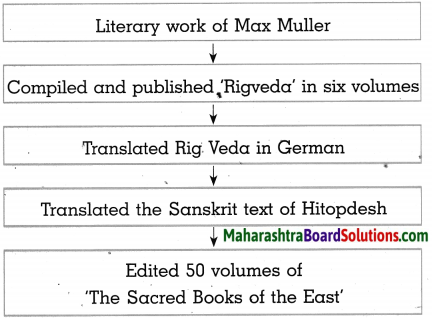
Maharashtra Board Class 10 History Solutions Chapter 2 Historiography Indian Tradition 8

Maharashtra Board Solutions

Question 9.
Explain the concepts:
(a) Colonial Historiography:
Answer:
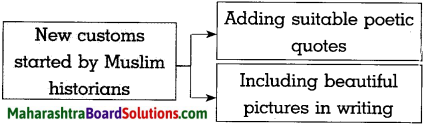
  • The history written by British officers and Christian missionaries in support of British rule and colonialism is known as Colonial historiography.
  • It reflected their prejudiced mindset about Indian culture. They ridiculed the Indian culture as being primitive.
  • Their writings justified the colonial British rule.
  • The distinct example of colonial historiography is ‘Cambridge History of India’ in five volumes published during 1922-1937.

Question 10.
Write short notes:
(a) Alexander Cunningham:
Answer:
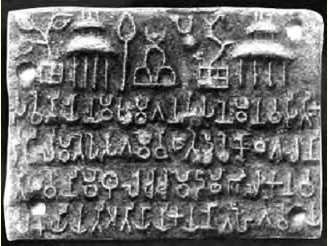
  • British rulers started archaeological exploration and research in India in the 20th century.
  • They established the Archaeological Survey of India and appointed Sir Alexander Cunningham as its first Director General.
  • He mainly chose the sites mentioned in the Buddhist texts for excavations.
  • Many other ancient sites were excavated under his supervision.

(b) James Mill:
Answer:
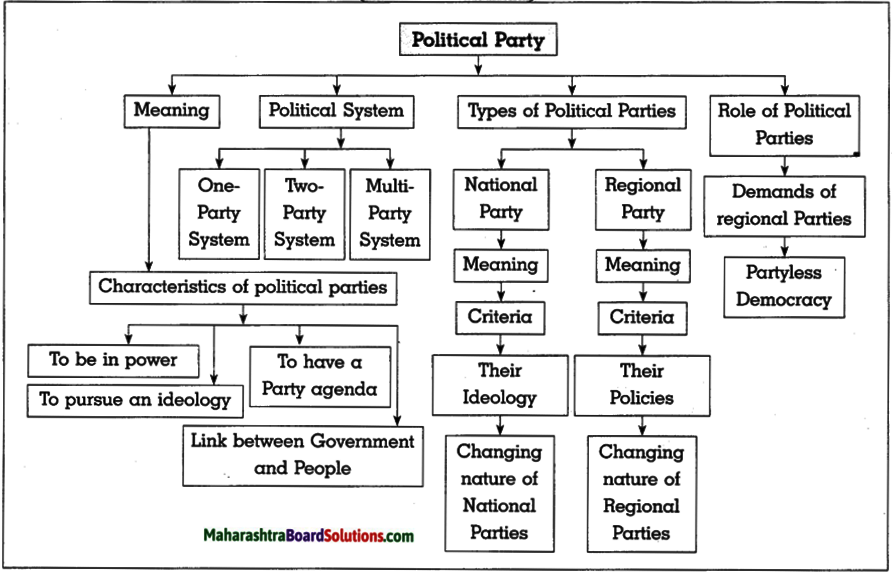
  • James Mill, a‘British historian, had written the monumental book ‘The History of British India’. He published it in three volumes in 1817.
  • The book is important as it was the first book written by a British officer on Indian history.
  • The book: lacks objective perspective and is prejudiced about various aspects of the Indian culture.

(c) Grant Duff:
Answer:
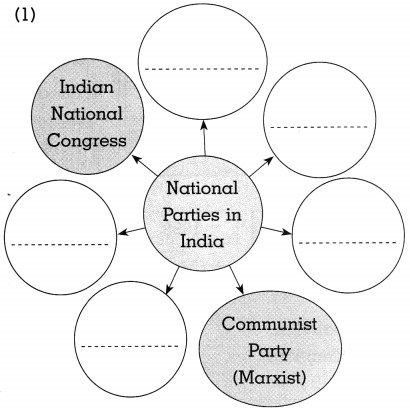
  • Grant Duff, a British officer, wrote the book ‘A History of Mahrattas’, in three volumes.
  • His name stands out among the British officers who wrote about Maratha history.
  • The tendency of the British historians to condemn Indian culture and history is found in Grant Duff’s writing.
  • Historians Nilkanth Janardan Kirtane and Vishwanath Kashinath Rajwade exposed the limitations of Grant Duff’s writings.

(d) Indian Feminist Historiography:
Answer:
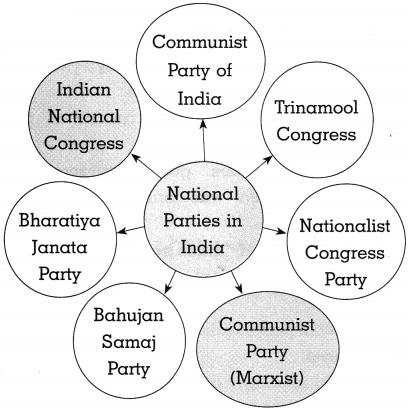
  1. Tarabai Shinde, Pandita Ramabai and Dr. Rukhamabai were feminist historians before independence.
  2. They wrote about employment of women, their right to political equality, treatment meted out to women at their workplace and gender discrimination.
  3. A lot of literature is available unfolding the viewpoint of Dalit women on problems like social class, caste, etc. In the post-independence era.
  4. Dr. Sharmila Rege included her essays on the autobiographies of Dalit women in her book, ‘Writing Caste, Writing Gender: Reading Dalit Women’s Testimonies.’
  5. Meera Kosambi’s book, ‘Crossing Thresholds: Feminist Essays in Social History’ contains essays on the life stories of women like Pandita Ramabai and Dr. Rukhamabai, the first practising lady Doctor of India.

Maharashtra Board Solutions

Question 11.
Explain the following with reasons:
(a) The history of Indian civilization dates back to 3rd millennium BCE.
Answer:
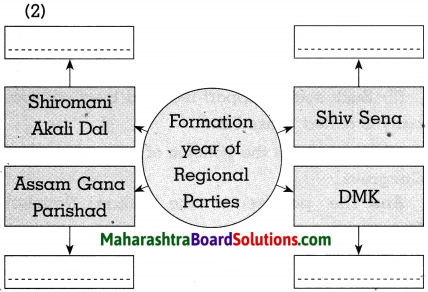
  • Indian civilisation is among the various ancient civilisations in the world.
  • Excavations at Harappa took place in 1920 under the supervision of Sir John Marshall, then Director General of Archaeological Survey of India (ASI). This led to the discovery of Harappan Civilization.
  • This discovery prqved helpful to trace the antiquity of Indian history which dates back 3rd millennium BCE or earlier.

(b) It became necessary to rethink of women’s position in history.
Answer:
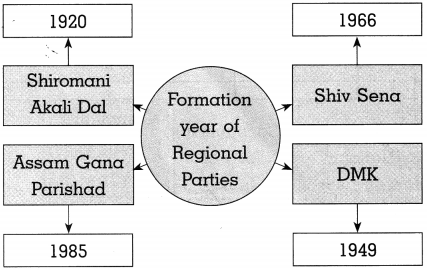
  • For a considerable period of time, mainly male scholars were involved in the writing of Indian history.
  • It was obvious that the perspective was male-dominated.
  • The work of the women historians was neglected for long. So it became important to highlight this fact.
  • It was a huge challenge in front of the women: historians to compile the work and do research which would prove to be a medium to put forth their status in society.

Hence, it became necessary to rethink about the position of women in history.

(c) Govind Sakharam Sardesai was addressed as ‘Riyasatkar’.
Answer:
  • Govind Sakharam Sardesai had a momentous achievement to his credit by publishing ‘Maratha Riyasat’.
  • He published several volumes of Maratha history.
  • His work became so popular that people began to address him as ‘Riyasatkar’.

Question 12.
Answer the following in 25-30 words:
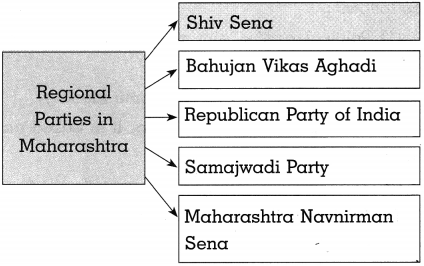
(a) Which things are included in the description by Emperor Babur in bis autobiography?
Answer:
Babur, the founder of the Mughal empire, in his autobiography entitled Tuzuk-i-Babari describes:

  • The battles fought by him.
  • Recordings of minute observations of various regions and cities visited by him noting minute observations.
  • Observation of the local customs, economy, fauna and flora of the region travelled by him.

(b) What is the contribution of Swatantryaveer Savarkar to nationalistic historiography?
Answer:

  1. The writings of Swatantryaveer Savarkar were infused with nationalistic ideas. He looked at the revolt of 1857 as the First War of Independence and wrote the ‘book ‘The Indian War of Independence, 1857’.
  2. His book gave inspiration to Nationalistic historiography which helped in triggering independence movement of the Indian people against the British. Even the writing of regional history got momentum.
  3. The attention of historians was drawn towards the history and geographic conditions and variations in the South Indian region.

(c) Write about the contribution of Banabhatta in writing historiographies.
Answer:

  • It was considered an important step in the Indian historiography to write biographies of kings and dynastic histories.
  • Banabhatta wrote Harshacharit, King Harsha’s biography, in the 7th century C.E.
  • It portrays a realistic picture of the social, economic, political, religious and cultural life during the period when King Harsha ruled.

Maharashtra Board Solutions

(d) Write information on ‘Rajtarangini’.
Answer:

  • Rajtarangini was written by Kalhana in the 12th century C.E. It traces the history of Kashmir.
  • These eight books contain records of dynasties which ruled Kashmir, local traditions, coins, remains of monuments and inscriptions. Kalhana wrote the text after critically examining the various sources.
  • The book is a good example to show how scientific technique is applied in writing history.

(e) Write about historiography in the post-independence period.
Answer:

  • In the post-independence period, along with dynastic history, cultural, social and economic histories were also written.
  • New schools of thought like Marxist, Subaltern and Feminist History were included in historiography.
  • The scholars in this era began to feel the need of writing histories of various communities, sciences, economic systems, political ideologies, cultural aspects, etc.
  • They presented the new schools of ideologies. These changes increased the scope of writing historiography.

(f) What are the objectives of writing history according to Ziauddin Barani?
Answer:

  • Ziauddin Barani explained the ’ objectives of historiography. According to him, the duty of a historian does not end with recording the ruler’s valour and welfare policies.
  • He should also write about the ruler’s failings and incorrect policies.
  • He further adds that a historian should also take into account the impact of the teachings of the wise, the learned and the saints on the cultural life of people.

Thus, Ziauddin Barani holds important place as he expanded the scope of historiography.

(g) What are the salient features of writings of historians in the courts of Mughal emperors?
Answer:
The salient features of writings of historians in the courts of Mughal emperors are:

  • Historians praised the Mughal emperors in their writings.
  • Their loyalty towards the rulers is exhibited.
  • The custom of adding suitable poetic quotes was introduced. The historians started to include beautiful pictures as well.

(h) Write about the importance of Tarabai Shinde in writing feminist historiography. *
Answer:

  • Tarabai Shinde has a prominent place among the feminist historians who wrote about women in the nineteenth century, i.e. pre-independence era.
  • She wrote a book Stripurush Tulana which was published in 1882. It is acknowledged as the first feminist book published in India.
  • Her writings attacked the male-dominated social system and the caste system.

Question 13.
Read the given passage and answer the questions given below:
(a) Complete the graphical presentation:

Answer:

(b) What was considered more important by the historians in the Mughal Court?
Answer:
Praising the Mughal emperor and exhibition of loyalty was considered more 8 important by the historians in the Mughal Court.

(c) Why is Abbul Fazl’s writing considered realistic?
Answer:

  • Abul Fazl’s Akbarnama reflects his critical viewpoint.
  • He collected authentic historical documents for this book.
  • He scrutinized these documents to affirm their reliability. Therefore, his method is looked upon as devoid of bias and hence realistic.

Maharashtra Board Solutions

Question 14.
Write detailed answers to the following questions:
(a) Write information about historiography in the ancient period of India.
Answer:

  • In the ancient period, stories of great deeds of ancestors, mythological lore, memories of social transitions were preserved through oral traditions.
  • The art of writing was mastered by Indians as early as 3rd millennium B.C.E. But Harappan script is not deciphered yet.
  • The earliest written documents found in India were in the form of inscriptions that are as old as 3rd century B.C.E. during the period of Emperor Ashok. His edicts are inscribed on natural rocks and stone pillars.
  • Inscriptions started to occur on coins, metal images and sculptures and also on copper plates from the 1st century B.C.E.
  • Epics like Ramayana, Mahabharat, Puranas, Jain and Buddhist texts are important sources of ancient Indian literature.
  • Historical accounts by Indian authors and travelogues by foreign travellers are also important sources of history.

(b) Explain the works of Dr. Babasaheb Ambedkar and Mahatma Phule in Subaltern History.
Answer:

  • History of the deprived classes expressed in folklore was known as ‘Subaltern History’.
  • Similar thoughts were expressed by Mahatma Jotirao Phule and Dr. Babasaheb Ambedkar.
  • Mahatma Phule unfolded the history of the Shudratishudra communities in his book ‘Gulamgiri’.
  • He drew attention to show how women, Shudras and Atishudras were exploited under the name of religion.
  • Dr. Ambedkar focused on the idea that in spite of having a significant role in shaping the cultural and political aspects of India, the role of Dalits was not duly acknowledged in colonial and nationalistic historiography.
  • Injustice done to the Dalits was mostly written by him. ‘Who Were the Shudras’ and ‘The Untouchables’ are his books which can be cited as examples of subaltern history.

Question 15.
Observe the given picture and answer the question given below:

Maharashtra Board Solutions

(a) Write a short note on Copper-plate inscriptions.
Maharashtra Board Class 10 History Solutions Chapter 2 Historiography Indian Tradition 11
Answer:

  • The copper-plate shown in the picture was found at Sohagaura in Gorakhpur district in Uttar Pradesh.
  • It is supposed to be from the Mauryan period and the inscription on it is in Brahmi script.
  • Many symbols are inscribed on it ‘Tree-in-railing’ and ‘Mountain’ at the beginning of inscription occur on punch marked coins.
  • A structure created on four pillars is indicative of a granary.
  • The inscriptions have a record of royal order that the grains stored in the granary should be distributed carefully.
  • This order is suggestive of precautionary measures taken during famine.

Maharashtra Board Class 10 Political Science Solutions Chapter 3 Political Parties

Balbharti Maharashtra State Board Class 10 Political Science Solutions Chapter 3 Political Parties Notes, Textbook Exercise Important Questions and Answers.

Maharashtra State Board Class 10 Political Science Solutions Chapter 3 Political Parties

Question 1.
Choose the correct option from the given options and complete the sentences.
(1) When people come together and participate in electoral process, to acquire political power, such organisations are called ………………………….. .
(a) Government
(b) Society
(c) Political parties
(d) Social organisations
Answer:
(c) Political parties

Maharashtra Board Solutions

(2) National Conference is a party in ………………………….. this region.
(a) Odisha
(b) Assam
(c) Bihar
(d) Jammu and Kashmir
Answer:
(d) Jammu and Kashmir

(3) Justice Party- a non-Brahmin movement was transformed into ………………………….. Political Party.
(a) Assam Gan Parishad
(b) Shivsena
(c) Dravid Munnetra Kazhagam
(d) Jammu and Kashmir National Conference
Answer:
(c) Dravid Munnetra Kazhagam

Question 2.
State whether the following statements are true or false. Give reasons for your answer.
(1) Political parties act as a link between government and people.
Answer:
The above statement is True.

  • The political parties convey the demands and complaints of the people to the government.
  • Information about various government policies and schemes are conveyed to the people by the political parties.
  • People’s reaction to the policies and their expectations are conveyed to the government too by the parties. In this way, political parties act as a link between government and the people.

(2) Political parties are social organisations.
Answer:
The above statement is True.

  • People who have similar views come together voluntarily and form a party, so it can be said that political parties are an integral part of our society.
  • The political parties try to solve the problems of the people.
  • Some political parties represent the role of a particular community in society, its ideology and work to achieve it. Hence it can be said that political parties are social organizations.

Maharashtra Board Solutions

(3) Coalition politics leads to instability.
Answer:
The above statement is False.

  • As no single party got majority after the elections held in 1989, coalition government came to power at the centre and many states.
  • Parties had to set aside their policies and programmes and concentrate on a common agenda to run the government.
  • Both Congress Party and the Bharatiya Janata Party made an experiment of establishing a coalition government.
  • The National Democratic Alliance formed by BJP and its partners and the Democratic Front government formed by Congress and its partners ruled at the centre and state level effectively.

Therefore, the belief that the coalition government brings instability was proved wrong.

(4) Shiromani Akali Dal is a national party.
Answer:
The above statement is False.
The Election Commission of India recognises a political party as National or Regional party on the basis of specific criteria namely:

  • The number of seats secured in Parliament and Legislative Assembly or percentage of votes secured.
  • Shiromani Akali Dal does not meet the criteria listed above.
  • As its influence is limited to the state of Punjab and not in any other state.
  • The Election Commission has given recognition to it as regional party.

Question 3.
Explain the following concepts.
(1) Regionalism
Answer:

  • India is a vast country with great physical diversity. People belonging to different regions have their own language, culture and traditions.
  • Along with the physical diversity, we find diversity in literature, education, history and movements.
  • Each one feels an affinity for his language, traditions and history of social reforms. This gives rise to linguistic identity.
  • This affinity towards all the above-mentioned aspects develops into identity consciousness and gives rise to excessive regional pride.
  • People start giving preference only to the development of their language and region.
  • This is known as Regionalism.

Maharashtra Board Solutions

(2) National Parties
Answer:
A party which functions at the national level is known as National Party.

  1. The Election Commission has laid certain criteria for a party to get recognised as a Political party. The political party should secure at least f 6% valid votes in four or more states in the earlier Lok Sabha. OR
  2. State Assembly elections and minimum four members should be elected in the Lok Sabha from any state or states in the earlier elections. OR
  3. The candidates of a party should be elected from a minimum three states or should be elected from a minimum 2% constituencies of the total Lok Sabha constituencies. OR
  4. It is important to get recognition as a state party in at least four states.

Question 4.
Answer the following questions in brief.
(1) What are the major characteristics of political parties?
Answer:
The main features of political parties are as follows:

  • Political parties aim at securing power by contesting elections.
  • Every political party has some ideology.
  • Every party has an agenda. It is based on the party’s ideology.
  • The party that gets majority seats in election forms the government and the one that does not secure the majority act as opposition parties.
  • Political parties are a link between the people and the government and work to gain the support of the people.

(2) What changes have taken place in the nature of political parties in India?
Answer:
The following changes were seen in the party system in India:

  • Indian- National Congress was the only dominant party in states and at the centre after independence.
  • All other parties came together and formed a coalition in 1977 and defeated the Congress.
  • For the first time in history, the two-party system got importance over one-party system.
  • The one-party system came to an end after the 1989 elections.
  • Regional parties got importance and the coalition government was formed at the centre and in the states.

Project
(1) In a map of Maharashtra, point out the Loksabha constituency that includes the names of your parents.
(2) In a map of India, point out the places where national political parties have their influence.
Answer:

Memory Map
Maharashtra Board Class 10 Political Science Solutions Chapter 3 Political Parties 1

Maharashtra Board Solutions

Question 5.
Choose the correct option from the given options and complete the sentences:
(a) The party which fails to secure majority is known as ………………………. party.
(a) Ruling
(b) Opposition
(c) Independent
(c) Coalition
Answer:
(b) Opposition

(b) ‘Bharatiya Janata Party’ which was formed in 1980 after a split with ………………………. a component of Janata Party.
(a) Jan Sangh
(b) Lok Dal
(c) Independent party
(b) Janata Dal
Answer:
(a) Jan Sangh.

(c) Social support received by a political party is called ………………………. .
(a) Democracy
(b) People’s rule
(c) Mass base
(d) Public relation
Answer:
(c) Mass base

(d) Promotion of the Marathi language is the objective of the ………………………. .
(a) Dravida Munnetra Kazhagam
(b) Shiromani Akali Dal
(c) Shiv Sena
(d) Assam Gana Parishad
Answer:
(c) Shiv Sena

(e) There are ………………………. recognised parties in India.
(a) five
(b) seven
(c) nine
(d) six
Answer:
(b) seven

(f) The main objective of the political party is to capture ………………………. and retain it.
(a) publicity
(b) victory
(c) power
(d) information
Answer:
(c) power

Maharashtra Board Solutions

(g) The ideology of the Communist Party of India is based on ………………………. Philosophy.
(a) Capitalist
(b) Marxist
(c) Democracy
(d) Imperialist
Answer:
(b) Marxist

(h) Shiromani Akali Dal is a prominent regional party in ………………………. state.
(a) Odisha
(b) Assam
(c) Punjab
(d) Jammu and Kashmir
Answer:
(c) Punjab

Question 6.
State whether the following statements are true or false. Give reasons for your answer:

(a) Political parties do not need support of the people.
Answer:
The above statement is False.

  • To secure power is the main aim of political parties.
  • Political parties have to implement various policies and programmes for the welfare of people and to gain the support of the people.
  • The party which solves the issues related to the welfare of the people get support.
  • Without the support of the people they can never get a mandate.

Hence, all political parties require support of the people.

(b) The Communist Party of India was split.
Answer:
The above statement is True.

  • The Communist Party of- India was established in 1925. The Communist Parties follow Marxist ideology.
  • In 1962, due to differences in the leadership a rift was created in the party.
  • The main reason for the split was about which political line to follow.

(c) Sometimes the sentiments of regionalism gets strengthened in the country.
Answer:
The above statement is True.

  1. A country like India has diversity of government language, region and culture. This diversity creates affinity towards a region.
  2. This affinity gives rise to excessive regional S pride and initiating movements to save it. The significance of such movements is claimed to be for preserving culture.
  3. Asserting to be rightful claimant of material resources, job opportunities and development of the region these movements strengthen the regional pride.
  4. Thus, this excessive regional pride turns morbid taking the form of regionalism.

Maharashtra Board Solutions

(d) Regional parties have no influence on National Politics.
Answer:
The above statement is False.

  • No single party got majority in the elections to Lok Sabha held in 1989.
  • The national parties formed coalition government at the centre taking help of regional parties.
  • As regional parties share power at the centre they have influence on national politics.

Question 7.
Explain the concept:
(a) Regional Parties:
Answer:

  1. The groups having a proud feeling about the different identity of their region and who compete to capture power to bring about regional development are ‘Regional Parties’.
  2. The influence of such parties are limited to their region. They give importance to regional problems. Development of one’s own region is the prime objective of these parties.
  3. Sometimes they demand for independent state or autonomy. They influence the national politics because of their dominance in the region.
  4. They have passed through various phases, from separatism to autonomy and have then merged with mainstream national politics.

(b) Political Party:
Answer:

  1. A Political Party is a kind of social organisation of like-minded people. The main aim of any political party is to contest election and secure power.
  2. The stand taken by various political parties on issues becomes their political ideology.
  3. In democracy, political parties are at the centre of all political activities. They are a link that connects common people, democracy, representation and elections.
  4. The party that secures a majority becomes the ruling party and the rest are known as the. opposition.

Question 8.
Write short note:
(a) Party System:
Answer:

  1. If one party remains in power in a country for a long period and no other party has any kind of influence the party system it is called ‘One- Party System’.
  2. When there are two equally strong parties which alternatively come to power. It is called ‘Two-Party System’.
  3. In a country where many political parties exist and compete with each other to capture power and have more or less influence in different states is called ‘Multi-Party System’.
  4. Democracy develops in Multi-Party System.

(b) Indian National Congress:
Answer:

  • The Indian National Congress was established in 1885.
  • The party represented the hopes and aspirations of Indians and led the freedom struggle.
  • Groups having diverse ideologies became part of the Congress to fight for freedom.
  • It believes in democratic socialism, social equality and international peace.
  • After independence, the Congress Party was a dominant party for almost four decades and ruled at the centre and in the states.

Maharashtra Board Solutions

(c) Communist Party of India:
Answer:

  • The Communist Party of India was established in 1925. The Communist Party follows the Marxist ideology.
  • The party aims at working to protect the interests of workers and labourers.
  • The main objective of this party is to oppose capitalism and protect the interests of workers.
  • The party split due to ideological differences in 1964. Those who walked out of the party formed Communist Party (Marxist).

(d) Nationalist Congress Party:
Answer:

  • Nationalist Congress Party (NCP) is the splinter or breakaway party from the Congress Party.
  • It considers the values like democracy, equality and secularism important.
  • It became part of United Progressive Alliance (UPA) and came to power in Maharashtra.
  • It was in power in Maharashtra from 1999 to 2014 and at the centre from 2004 to 2014.

(e) Trinamool Congress:
Answer:

  • All India Trinamool Congress was established in 1998.
  • The Election Commission of India gave it recognition in 2016.
  • Democracy, Secularism and protection of the weaker sections of the society are some of the policies of the party.
  • Presently (April 2019), this party is in power in the state of West Bengal.

(f) Shiv Sena:
Answer:

  1. The Shiv Sena was founded in 1966.
  2. The main objective of the party was to fight for the cause of Marathi-speaking people and preservation of Marathi language.
  3. They resisted the people from other regions.
  4. In 1995, it became the ruling party with BJP in Maharashtra and its strategic tie-up with BJP helped it to enter national politics.
  5. It was in power at the centre with BJP from 1998 to 2004. Again it has shared power with the BJP at the centre and state since 2014.

(g) Shiromani Akali Dal:
Answer:

  • Shiromani Akali Dal was formed in 1920.
  • It is a dominating party in Punjab.
  • It gives preference to nurture religious and for the regional pride.
  • The party has retained power in Punjab for many years.

(h) Dravid Munnetra Kazhagam:
Answer:

  • Justice party, a non-Brahmin movement, started in 1920. In 1944, it transformed into a political party called Dravid Kazhagam.
  • In 1949, a group within the party got split and formed Dravid Munnetra Kazhagam (DMK).
  • The party works for the protection of Tamil identity.
  • This party implemented many policies for welfare of the people and therefore has support from all the sections of society.
  • Another group separated from it in 1972 and formed All India Dravid Munnetra Kazhagham.
  • It remained in power for a long time in Tamil Nadu and for sometime at the centre.

Maharashtra Board Solutions

Question 9.
Do as directed
(a) Complete the concept map:
Maharashtra Board Class 10 Political Science Solutions Chapter 3 Political Parties 2
Answer:
Maharashtra Board Class 10 Political Science Solutions Chapter 3 Political Parties 3

Maharashtra Board Class 10 Political Science Solutions Chapter 3 Political Parties 4
Answer:
Maharashtra Board Class 10 Political Science Solutions Chapter 3 Political Parties 5

Maharashtra Board Solutions

(3)
Maharashtra Board Class 10 Political Science Solutions Chapter 3 Political Parties 6
Answer:
Maharashtra Board Class 10 Political Science Solutions Chapter 3 Political Parties 7

(b) Complete the Time-line writing the name of the party or the year of establishment:
Maharashtra Board Class 10 Political Science Solutions Chapter 3 Political Parties 8
Answer:
Maharashtra Board Class 10 Political Science Solutions Chapter 3 Political Parties 9

Question 10.
Answer the following questions in brief:

(a) What is called “mass base”?
Answer:

  • Every political party is formed with some ideology.
  • Political parties take a certain stand towards public issues.
  • Their ideology and their stand towards public issues are conveyed to the people through various programmes.
  • If the people agree with their role and ideology, they get the support of the people.
  • Such social support received by a political – party is called ‘mass base’.

(b) Write about the policies of Indian National Congress.
Answer:
The policies of the Indian National: Congress are as follows:

  • Equal rights for the minorities and weaker sections of society.
  • Secularism, all-round development and social welfare are its objectives.
  • Introduction of socialist democracy.
  • Belief in values like international peace and social equality.

Maharashtra Board Solutions

(c) Explain the role of Bharatiya Janata Party.
Answer:
Bharatiya Janata Party was formed in 1980 with the following objectives:

  • To preserve Indian culture and traditions.
  • To create a strong and rich India.
  • To give importance to economic reforms for development of India.

(d) Write about the policies of Communist Party of India (Marxist).
Answer:
Communist Party of India (Marxist) was formed in 1964 with the following objectives:

  • The party advocates socialism, secularism and democracy.
  • The main policy of the party is to work for the welfare of farmers, landless labourers and workers.
  • The party opposes imperialism.

(e) Why was Bahujan Samaj Party formed?
Answer:
The Bahujan Samaj Party was formed in 1984 to achieve the following objectives:

  • To bring socialist ideology into practice.
  • To secure power for ‘majority’ comprising of scheduled castes, scheduled tribes and other backward classes.
  • To give power in the hands of ‘majority’.

(f) What do the regional parties give preference for?
Answer:
The regional parties give preference to the following issues:

  • Importance should be given to regional issues and bring about development.
  • Regional issues should be handled* at regional level.
  • The power rests in the hands of regional people. ‘
  • People living in that region should get preference in administration and jobs. .

(g) What changes are seen in the nature and role of regional parties?
Answer:
The role of regional parties changed over period of time. The changes are as follows:

  • After independence, regional identity gave rise to separatists movements and demands were put up by regional parties for separate state.
  • They wanted to break away from the Indian union and form a separate state.
  • The demands of the regional parties changed gradually and these parties started asking for autonomy.
  • In the later period, for the development of their region and people the parties demanded representation of their people in the state and central government.
  • Regional parties in the north eastern region also started demanding more autonomy after split up.
  • The journey of the regional parties began with a split up and then a demand for autonomy going on to share power in federation and then entry into mainstream national politics.

Maharashtra Board Solutions

(h) What are the objectives of Assam Gana Parishad?
Answer:
Assam Gana Parishad was formed in 1985 with the following objectives:

  • To preserve the uniqueness of Assam’s culture, language and social identity.
  • To make efforts for economical development of Assam.
  • To resolve problems of displaced people.

(i) What are the criteria for a regional party to get recognition?
Answer:

  • In the last general .elections to the State Assembly, the party should not secure less than 6% of the total number of valid votes polled.
  • At least 2 members to be elected to the Legislative Assembly (Vidhan Sabha).
  • 3% seats of the total seats of Legislative Assembly or at least 3 seats in Legislative Assembly.

(j) What work is done by political parties?
Answer:
The following work is done by political parties:

  • To propagate policies and programmes of the party and contest elections.
  • They implement various policies when they come to power.
  • If they fail to secure power, they act as opposition party and try to gain support of the people.
  • They communicate the demands and complaints of the people to the government and the policies and programmes of the government to the people.

Question 11.
Give your opinion:

(a) Imagine you are opposition party leader and you have observed that the ruling party has not done good work in the field of health. What will you do as a leader of opposition?
Answer:
As opposition leader, I will do the following to make the government realise its negligence in the health field:

  • I will question the government in Parliament and point out their shortcomings and ask about the prolonged projects.
  • I will create awareness among the people by writing articles in newspapers.
  • I will give interviews,on radio and television and criticize the government.
  • I will organise rallies and meetings to sensitize among the people.

(b) Think and write
What has to be done to bring partyless democracy in modern times?
Answer:

  • The recognition of all the parties should be cancelled. ‘
  • People should be given the right to make decisions.
  • In order to improve the decision-making power, people should be educated on political issues.
  • To improve the moral character of the people who want to take the leadership.
  • To initiate direct democracy and prepare the people for the same.
  • Stress should be given for decentralization.
  • Mahatma Gandhi, Vinoba Bhave and Jayprakash Narayan put forth the idea of partyless democracy.
  • What has to be done to bring such democracy in modern times?

Maharashtra Board Solutions

Question 12.
What do you understand by the following news in newspapers? Explain in brief.

(a) Opposition parties held a meeting in Mumbai to resist the Ruling party. Will take up the issue of farmers?
Answer:

  • The ruling party did not undertake any work for the welfare of farmers. Therefore all the opposition parties decided to trap the government on this issue.
  • The opposition parties have kept aside their differences and come together for this cause.
  • It is the duty of the opposition party to question the negligence of the government.
  • This news makes us aware of the line of action taken by the opposition.
  • Opposition parties held a meeting in Mumbai to resist the Ruling party. Will take up the issue of farmers?
  • Ruling party organised ‘Samvad Yatra’ in rural areas.

(b) Ruling party has organised ‘Samvad Yatra’ in rural areas.
Answer:

  • Political parties adopt different ways to popularise their party and influence the people.
  • As the means of communication are limited in rural areas they organise the Yatra.
  • It shows the efforts of the government to understand problems of people in rural areas.
  • It is essential to have dialogue with people to know their problems and opinions.
  • As the initiative is taken by the government, people will develop faith in government.
  • The news conveys to us that the ruling party is carrying out its duties properly.
  • The faith in government becomes profound when people feel that government is sensitive towards them.

Maharashtra Board 8th Class Maths Practice Set 9.1 Solutions Chapter 9 Discount and Commission

Balbharti Maharashtra State Board Class 8 Maths Solutions covers the Practice Set 9.1 8th Std Maths Answers Solutions Chapter 9 Discount and Commission.

Practice Set 9.1 8th Std Maths Answers Chapter 9 Discount and Commission

8th Standard Maths Practice Set 9.1 Question 1. If marked price = Rs 1700, selling price = Rs 1540, then find the discount.
Solution:
Here, Marked price = Rs 1700,
selling price = Rs 1540
Selling price = Marked price – Discount
∴ 1540 = 1700 – Discount
∴ Discount = 1700 – 1540
= Rs 160
∴ The amount of discount is Rs 160.

Discount and Commission Practice Set 9.1 Question 2. If marked price Rs 990 and percentage of discount is 10, then find the selling price.
Solution:
Here, marked price = Rs 990,
discount = 10%
Let the percentage of discount be x
∴ x = 10%
i. Discount
Maharashtra Board Class 8 Maths Solutions Chapter 9 Discount and Commission Practice Set 9.1 1
= Rs 99

ii. Selling price = Marked price – Discount
= 990 – 99
= Rs 891
∴ The selling price is Rs 891.

Practice Set 9.1 Question 3. If selling price Rs 900, discount is 20%, then find the marked price.
Solution:
Here, selling price = Rs 900, discount = 20%
Let the marked price be Rs 100
Since, the discount given = 20%
∴ Amount of discount = Rs 20
∴ Selling price = 100 – 20 – Rs 80
Let actual marked price be Rs x
∴ For marked price of Rs x, selling price is Rs 900
\(\frac{80}{100}=\frac{900}{x}\)
∴ 80 × x = 100 × 900
∴ \(x=\frac{100 \times 900}{80}\)
∴ x = Rs 1125
∴ The marked price is Rs 1125.

Discount and Commission Std 8 Question 4. The marked price of the fan is Rs 3000. Shopkeeper gave 12% discount on it. Find the total discount and selling price of the fan.
Solution:
Here, Marked price = Rs 3000, discount = 12%
Let the percentage of discount be x.
∴ x = 12%
i. Discount
Maharashtra Board Class 8 Maths Solutions Chapter 9 Discount and Commission Practice Set 9.1 2
= 30 × 12
= Rs 360

ii. Selling price = Marked price – Discount
= 3000 – 360
= Rs 2640
∴ The total discount is Rs 360 and the selling price of the fan is Rs 2640.

Discount and Commission 8th Standard Question 5. The marked price of a mixer is Rs 2300. A customer purchased it for Rs 1955. Find percentage of discount offered to the customer.
Solution:
Here, marked price = Rs 2300,
selling price = Rs 1955
i. Selling price = Marked price – Discount
∴ 1955 = 2300 – Discount
∴ Discount = 2300 – 1955
= Rs 345

ii. Let the percentage of discount be x
Maharashtra Board Class 8 Maths Solutions Chapter 9 Discount and Commission Practice Set 9.1 3
Maharashtra Board Class 8 Maths Solutions Chapter 9 Discount and Commission Practice Set 9.1 4
∴ x = 15%
∴ The percentage of discount offered to the customer is 15%.

Question 6.
A shopkeeper gives 11% discount on a television set, hence the cost price of it is Rs 22,250. Then find the marked price of the television set.
Solution:
Here, selling price = Rs 22,250, discount = 11%
Let marked price be Rs 100
Since, the discount given = 11%
∴ Amount of discount = Rs 11
∴ Selling price = 100 – 11 = Rs 89
∴ Let actual marked price be Rs x
∴ For marked price of Rs x, selling price is Rs 22,250
Maharashtra Board Class 8 Maths Solutions Chapter 9 Discount and Commission Practice Set 9.1 5
∴ x = Rs 25,000
∴ The marked price of the television set is Rs 25,000.

8th Std Maths Discount and Commission Question 7. After offering discount of 10% on marked price, a customer gets total discount of Rs 17. To find the cost price for the customer, fill in the following boxes with appropriate numbers and complete the activity.
Solution:
Suppose, marked price of the item = 100 rupees Therefore, for customer that item costs 100 – 10 = 90 rupees.
Hence, when the discount is [10] then the selling price is [90] rupees.
Suppose when the discount is [17] rupees, the selling price is x rupees.
Maharashtra Board Class 8 Maths Solutions Chapter 9 Discount and Commission Practice Set 9.1 6
∴ The customer will get the item for Rs 153.

Question 8.
A shopkeeper decides to sell a certain item at a certain price. He tags the price on the item by increasing the decided price by 25%. While selling the item, he offers 20% discount. Find how many more or less percent he gets on the decided price.
Solution:
Here, price increase = 25%,
discount offered = 20%
Let the decided price be Rs 100
∴ Increase in price = Rs 25
∴ Shopkeeper marks the price = 100 + 25
= Rs 125
∴ marked price = Rs 125
Let the percentage of discount be x
∴ x = 20%
Maharashtra Board Class 8 Maths Solutions Chapter 9 Discount and Commission Practice Set 9.1 7
∴ Selling price = Marked price – Discount
= 125 – 25
= Rs 100
∴ If the decided price is Rs 100, then shopkeeper gets Rs 100.
∴ The shopkeeper gets neither more nor less than the decided price i.e. he gets 0% more / less.

Maharashtra Board Class 8 Maths Chapter 9 Discount and Commission Practice Set 9.1 Intext Questions and Activities

Question 1.
Write the appropriate numbers in the following boxes. (Textbook pg. no. 51)

  1. \(\frac { 12 }{ 100 }=\) __ percent = __%
  2. 47% = __
  3. 86% = __
  4. 4% of 300 = 300 × __ = __
  5. 15% of 1700 = 1700 × __= __

Solution:

  1. \(\frac { 12 }{ 100 }=\) 12 percent = 12%
  2. 47% = \(\frac { 47 }{ 100 }\)
  3. 86% = \(\frac { 86 }{ 100 }\)
  4. 4% of 300 = 300 × \(\frac { 4 }{ 100 }\) = 12
  5. 15% of 1700 = 1700 × \(\frac { 15 }{ 100 }\) = 255

Question 2.
You may have seen advertisements like ‘Monsoon Sale’, ‘Stock Clearance Sale’ etc offering different discount. In such a sale, a discount is offered on various goods. Generally in the month of July, sales of clothes are declared. Find and discuss the purpose of such sales. (Textbook pg. no. 51)
Solution:
(Students should attempt the above activity on their own)

Maharashtra Board Class 8 Maths Solutions

Maharashtra Board 9th Class Maths Part 2 Practice Set 9.3 Solutions Chapter 9 Surface Area and Volume

Balbharti Maharashtra State Board Class 9 Maths Solutions covers the Practice Set 9.3 Geometry 9th Class Maths Part 2 Answers Solutions Chapter 9 Surface Area and Volume.

Practice Set 9.3 Geometry 9th Std Maths Part 2 Answers Chapter 9 Surface Area and Volume

Question 1.
Find the surface areas and volumes of spheres of the following radii
i. 4 cm
ii. 9 cm
iii. 3.5 cm (π = 3.14)
i. Given: Radius (r) = 4 cm
To find: Surface area and volume of sphere
Solution:
Surface area of sphere = 4πr2
= 4 x 3.14 x 42
∴ Surface area of sphere = 200.96 sq.cm
Volume of sphere = \(\frac { 4 }{ 3 }\)πr3
= \(\frac { 4 }{ 3 }\) x 3.14 x 42
∴ Volume of sphere = 267.95 cubic cm

ii. Given: Radius (r) = 9 cm
To find: Surface area and volume of sphere
Solution:
Surface area of sphere = 4πr2
= 4 x 3.14 x 92
∴ Surface area of sphere = 1017.36 sq.cm
Maharashtra Board Class 9 Maths Solutions Chapter 9 Surface Area and Volume Practice Set 9.3 1
∴ Volume of sphere = 3052.08 cubic cm

iii. Given: Radius (r) = 3.5 cm
To find: Surface area and volume of sphere
Solution:
Surface area of sphere = 4πr2
= 4 x 3.14 x (3.5)2
∴ Surface area of sphere = 153.86 sq.cm
Volume of sphere = \(\frac { 4 }{ 3 }\) πr3
= \(\frac { 4 }{ 3 }\) x 3.14 x (3.5)3
∴ Volume of sphere = 179.50 cubic cm

Question 2.
If the radius of a solid hemisphere is 5 cm, then find its curved surface area and total surface area, (π = 3.14)
Given: Radius (r) = 5 cm
To find: Curved surface area and total surface area of hemisphere
Solution:
i. Curved surface area of hemisphere = 2πr2
= 2 x 3.14 x 52
= 2 x 3.14 x 25
= 50 x 3.14
= 157 sq.cm.

ii. Total surface area of hemisphere = 3πr2
= 3 x 3.14 x 52
= 235.5 sq.cm.
∴ The curved surface area and totai surface area of hemisphere are 157 sq.cm, and 235.5 sq.cm, respectively.

Question 3.
If the surface area of a sphere is 2826 cm2 then find its volume. (π = 3.14)
Given: Surface area of sphere = 2826 sq.cm.
To find: Volume of sphere
Solution:
i. Surface area of sphere = 4πr2
∴ 2826 = 4 x 3.14 x r2
2826 = 282600 = 900
∴ \( r^{2}=\frac{2826}{4 \times 3.14}=\frac{282600}{4 \times 314}=\frac{900}{4}\)
∴ r2 = 225
∴ r = \(\sqrt { 225 }\) … [Taking square root on both sides]
= 15 cm

ii. Volume of sphere = \(\frac { 4 }{ 3 }\) πr3
= \(\frac { 4 }{ 3 }\) x 3.14 x 153
= \(\frac { 4 }{ 3 }\) x 3.14 x 15 x 15 x 15
= 4 x 3.14 x 5 x 15 x 15
= 14130 cubic cm.
∴ The volume of the sphere is 14130 cubic cm.

Question 4.
Find the surface area of a sphere, if its volume is 38808 cubic cm. (π = \(\frac { 22 }{ 7 }\))
Given: Volume of sphere = 38808 cubic cm.
To find: Surface area of sphere
Solution:
Maharashtra Board Class 9 Maths Solutions Chapter 9 Surface Area and Volume Practice Set 9.3 2
∴ r3 = 441 x 21 = 21 x 21 x 21
∴ r = 21 cm … [Taking cube root on both sides]
ii. Surface area of sphere = 4πr2
= 4 x \(\frac { 22 }{ 7 }\) x 21
= 4 x \(\frac { 22 }{ 7 }\) x 21 x 21
= 4 x 22 x 3 x 21
= 5544 sq.cm.
∴ The surface area of sphere is 5544 sq.cm.

Question 5.
Volume of a hemisphere is 18000π cubic cm. Find its diameter.
Given: Volume of hemisphere = 1 8000π cubic cm.
To find: Diameter of the hemisphere
Solution:
i. Volume of hemisphere = \(\frac { 2 }{ 3 }\) πr3
Maharashtra Board Class 9 Maths Solutions Chapter 9 Surface Area and Volume Practice Set 9.3 3
= 9000 x 3
∴ r3 = 27000
∴ r = \(\sqrt [ 3 ]{ 27000 }\) … [Taking cube root on both sides]
= 30 cm

ii. Diameter = 2r
= 2 x 30 = 60 cm
∴ The diameter of the hemisphere is 60 cm.

Maharashtra Board Class 9 Maths Solutions

Maharashtra Board 8th Class Maths Practice Set 10.2 Solutions Chapter 10 Division of Polynomials

Balbharti Maharashtra State Board Class 8 Maths Solutions covers the Practice Set 10.2 8th Std Maths Answers Solutions Chapter 10 Division of Polynomials.

Practice Set 10.2 8th Std Maths Answers Chapter 10 Division of Polynomials

Division of Polynomials Class 8 Practice Set 10.2 Question 1. Divide and write the quotient and the remainder.
i. (y2 + 10y + 24) ÷ (y + 4)
ii. (p2 + 7p – 5) ÷ (p + 3)
iii. (3x + 2x2 + 4x3) ÷ (x – 4)
iv. (2m3 + m2 + m + 9) ÷ (2m – 1)
v. (3x – 3x2 – 12 + x4 + x3) ÷ (2 + x2)
vi. (a4 – a3 + a2 – a + 1) ÷ (a3 – 2)
vii. (4x4 – 5x3 – 7x + 1) ÷ (4x – 1)
Solution:
i. (y2 + 10y + 24) ÷ (y + 4)
Maharashtra Board Class 8 Maths Solutions Chapter 10 Division of Polynomials Practice Set 10.2 1
∴ Quotient = y + 6
Remainder = 0

ii. (p2 + 7p – 5) ÷ (p + 3)
Maharashtra Board Class 8 Maths Solutions Chapter 10 Division of Polynomials Practice Set 10.2 2
∴ Quotient = p + 4
Remainder = -17

iii. (3x + 2x2 + 4x3) ÷ (x – 4)
Write the dividend in descending order of their indices.
3x + 2x² + 4x³ = 4x³ + 2x² + 3x
Maharashtra Board Class 8 Maths Solutions Chapter 10 Division of Polynomials Practice Set 10.2 3
∴ Quotient = 4x² + 18x + 75
Remainder = 300

iv. (2m3 + m2 + m + 9) ÷ (2m – 1)
Maharashtra Board Class 8 Maths Solutions Chapter 10 Division of Polynomials Practice Set 10.2 4
∴ Quotient = m² + m + 1
Remainder = 10

v. (3x – 3x2 – 12 + x4 + x3) ÷ (2 + x2)
Write the dividend in descending order of their indices.
(x4 + x3 – 3x2 + 3x – 12) ÷ (x2 + 2)
Maharashtra Board Class 8 Maths Solutions Chapter 10 Division of Polynomials Practice Set 10.2 5
∴ Quotient = x² + x – 5
Remainder = x – 2

vi. (a4 – a3 + a2 – a + 1) ÷ (a3 – 2)
Maharashtra Board Class 8 Maths Solutions Chapter 10 Division of Polynomials Practice Set 10.2 6
∴ Quotient = a – 1
Remainder = a² + a – 1

vii. (4x4 – 5x3 – 7x + 1) ÷ (4x – 1)
Write the dividend in descending order of their indices.
(4x4 – 5x3 – 7x + 1) = (4x4 – 5x3 + 0x2 – 7x + 1)
Maharashtra Board Class 8 Maths Solutions Chapter 10 Division of Polynomials Practice Set 10.2 7
∴ Quotient = \(x^{3}-x^{2}-\frac{x}{4}-\frac{29}{16}\)
Remainder = \(\frac { -13 }{ 16 }\)