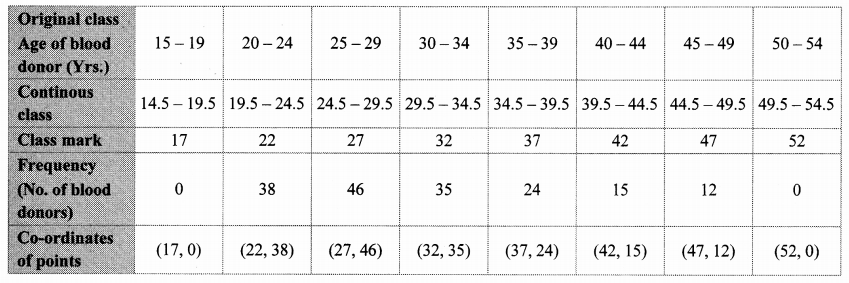
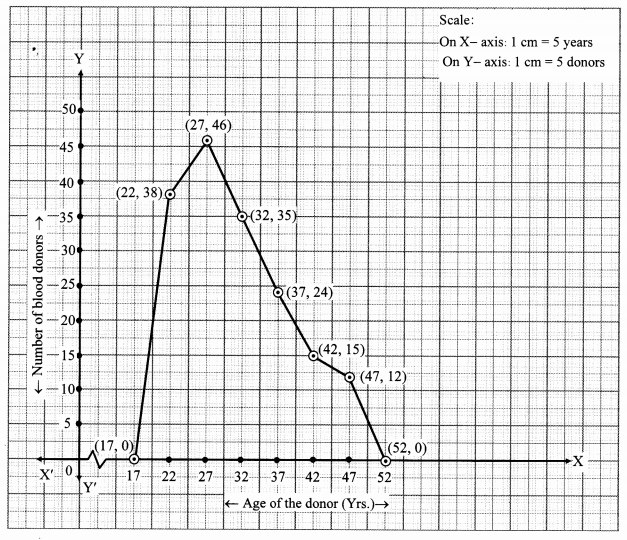
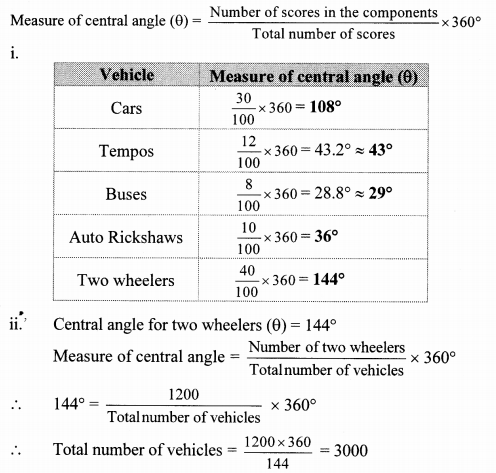
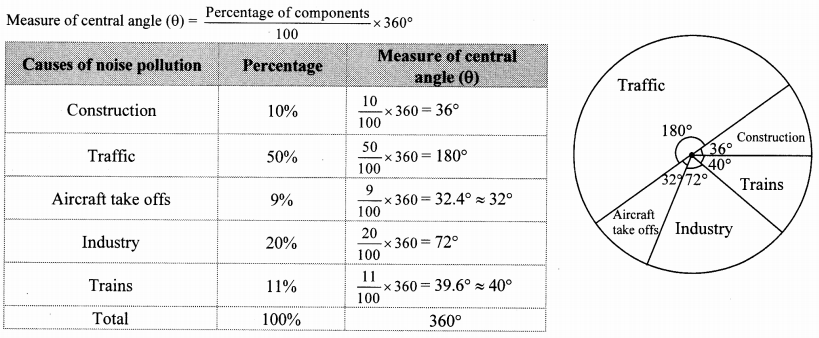
Maharashtra Board 10th Class Maths Part 1 Problem Set 6 Solutions Chapter 6 Statistics

Balbharti Maharashtra State Board Class 10 Maths Solutions covers the Problem Set 6 Algebra 10th Class Maths Part 1 Answers Solutions Chapter 6 Statistics.

Problem Set 6 Algebra 10th Std Maths Part 1 Answers Chapter 6 Statistics

10th Geometry Problem Set 6 Question 1.
Find the correct answer from the alternatives given.

i. The persons of O – blood group are 40%. The classification of persons based on blood groups is to be shown by a pie diagram. What should be the measures of angle for the persons of O – blood group?
(A) 114°
(B) 140°
(C) 104°
(D) 144°
Answer:
Measure of the central angle = \(\frac { 40 }{ 100 } \) × 360° = 144°
(D)

ii. Different expenditures incurred on the construction of a building were shown by a pie diagram. The expenditure of ₹ 45,000 on cement was shown by a sector of central angle of 75°. What was the total expenditure of the construction?
(A) 2,16,000
(B) 3,60,000
(C) 4,50,000
(D) 7,50,000
Answer:
Measure of the central angle = \(\frac{\text { Expenditure of cement }}{\text { Total expenditure }} \times 360^{\circ}\)
Maharashtra Board Class 10 Maths Solutions Chapter 6 Statistics Problem Set 6 1
(A)

iii. Cumulative frequencies in a grouped frequency table are useful to find.
(A) Mean
(B) Median
(C) Mode
(D) All of these
Answer:
(B)

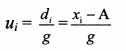
iv. The formula to find mean from a grouped frequency table is \(\overline{\mathrm{X}}=\mathrm{A}+\frac{\sum f_{i} u_{i}}{\sum f_{i}} \times g\)
in the formula ui = _________.
Maharashtra Board Class 10 Maths Solutions Chapter 6 Statistics Problem Set 6 2
Answer:
Maharashtra Board Class 10 Maths Solutions Chapter 6 Statistics Problem Set 6 3
(C)

v.
Maharashtra Board Class 10 Maths Solutions Chapter 6 Statistics Problem Set 6 4
The median of the distances covered per litre shown in the above data is in the group
(A) 12 – 14
(B) 14 – 16
(C) 16 – 18
(D) 18 – 20
Answer:
(C)

vi.
Maharashtra Board Class 10 Maths Solutions Chapter 6 Statistics Problem Set 6 5
The above data is to be shown by a frequency polygon. The coordinates of the points to show number of students in the class 4 – 6 are.
(A) (4, 8)
(B) (3,5)
(C) (5,8)
(D) (8,4)
Answer:
Class mark = 5
Frequency = 8
∴ Co-ordinates of the point = (5, 8)
(C)

Statistics Problem Set 6 Question 2.
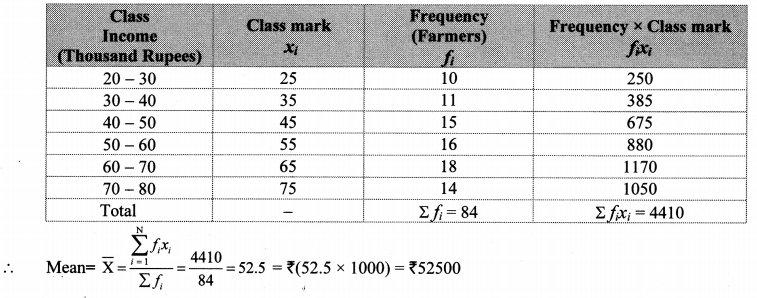
The following table shows the income of farmers in a grape season. Find the mean of their income.
Maharashtra Board Class 10 Maths Solutions Chapter 6 Statistics Problem Set 6 6
Solution:
Maharashtra Board Class 10 Maths Solutions Chapter 6 Statistics Problem Set 6 7
∴ The mean of the income of the farmers is ₹ 52,500.

Statistics Problem Set Question 3.
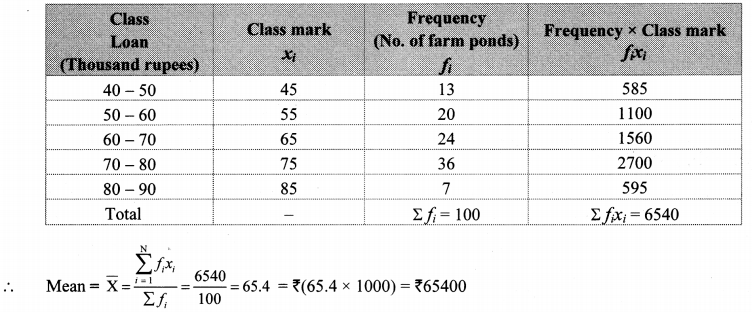
The loans sanctioned by a bank for construction of farm ponds are shown in the following table. Find the mean of the loans.
Maharashtra Board Class 10 Maths Solutions Chapter 6 Statistics Problem Set 6 8
Solution:
Maharashtra Board Class 10 Maths Solutions Chapter 6 Statistics Problem Set 6 9
∴ The mean of the loans given by the bank is ₹ 65,400.

Question 4.
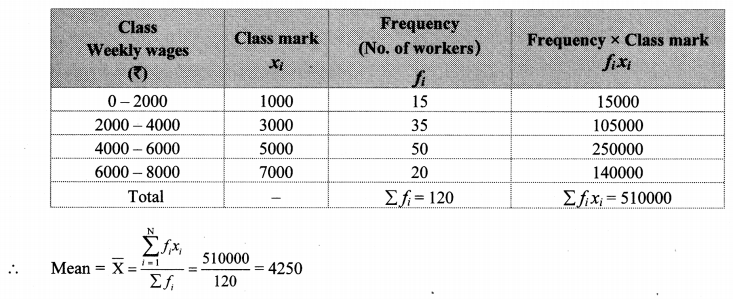
The weekly wages of 120 workers in a factory are shown in the following frequency distribution table. Find the mean of the weekly wages.
Maharashtra Board Class 10 Maths Solutions Chapter 6 Statistics Problem Set 6 10
Solution:
Maharashtra Board Class 10 Maths Solutions Chapter 6 Statistics Problem Set 6 11
∴ The mean of the weekly wages of the workers is ₹ 4250.

Problem Set 6 Algebra Class 9 Question 5.
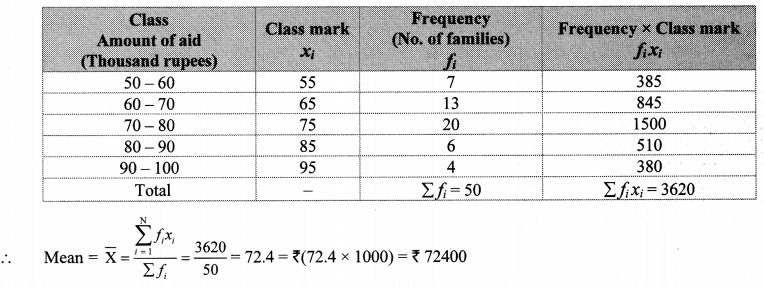
The following frequency distribution table shows the amount of aid given to 50 flood affected families. Find the mean of the amount of aid.
Maharashtra Board Class 10 Maths Solutions Chapter 6 Statistics Problem Set 6 12
Solution:
Maharashtra Board Class 10 Maths Solutions Chapter 6 Statistics Problem Set 6 13
∴ The mean of the amount of aid given to families is ₹ 72,400.
[Note: The above problems are solved using direct method. Students can solve these problems by using other method.]

Problem Set 6 Algebra Class 10 Question 6.
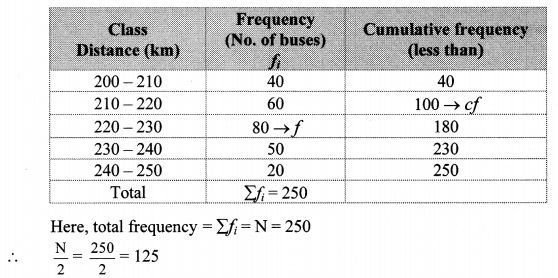
The distances covered by 250 public transport buses in a day is shown in the following frequency distribution table. Find the median of the distances.
Maharashtra Board Class 10 Maths Solutions Chapter 6 Statistics Problem Set 6 14
Solution:
Maharashtra Board Class 10 Maths Solutions Chapter 6 Statistics Problem Set 6 15
Cumulative frequency which is just greater than (or equal) to 125 is 180.
∴ The median class is 220 – 230.
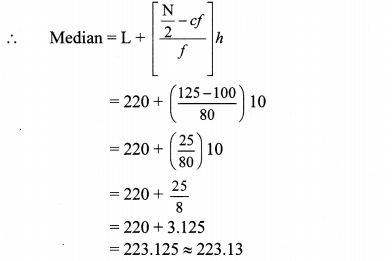
Now, L = 220, f = 80, cf = 100, h = 10
Maharashtra Board Class 10 Maths Solutions Chapter 6 Statistics Problem Set 6 16
∴ The median of the distances is 223.13 km (approx.).

Algebra 10th Class Problem Set 6 Question 7.
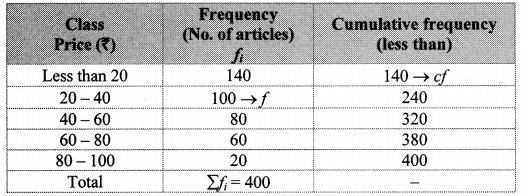
The prices of different articles and demand for them is shown in the following frequency distribution table. Find the median of the prices.
Maharashtra Board Class 10 Maths Solutions Chapter 6 Statistics Problem Set 6 17
Solution:
Maharashtra Board Class 10 Maths Solutions Chapter 6 Statistics Problem Set 6 18
Cumulative frequency which is just greater than (or equal) to 200 is 240.
∴ The median class is 20 – 40.
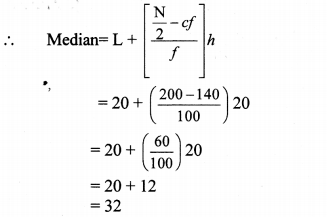
Now,L = 20, f = 100,cf = 140, h = 20
Maharashtra Board Class 10 Maths Solutions Chapter 6 Statistics Problem Set 6 19
∴ The median of the prices of different articles is ₹ 32.

10th Algebra Problem Set 6 Question 8.
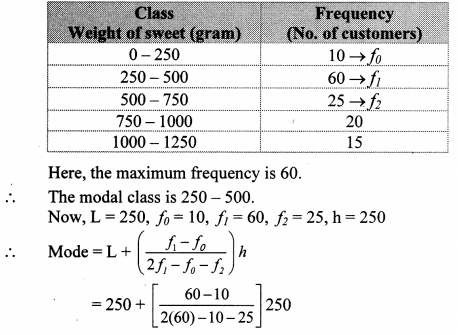
The following frequency table shows the demand for a sweet and the number of customers. Find the mode of demand of sweet.
Maharashtra Board Class 10 Maths Solutions Chapter 6 Statistics Problem Set 6 20
Solution:
Maharashtra Board Class 10 Maths Solutions Chapter 6 Statistics Problem Set 6 21
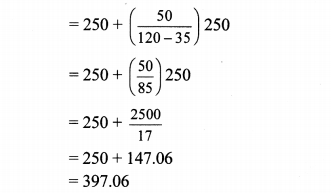
Maharashtra Board Class 10 Maths Solutions Chapter 6 Statistics Problem Set 6 22
∴ The mode of the demand of sweet is 397.06 grams.

Question 9.
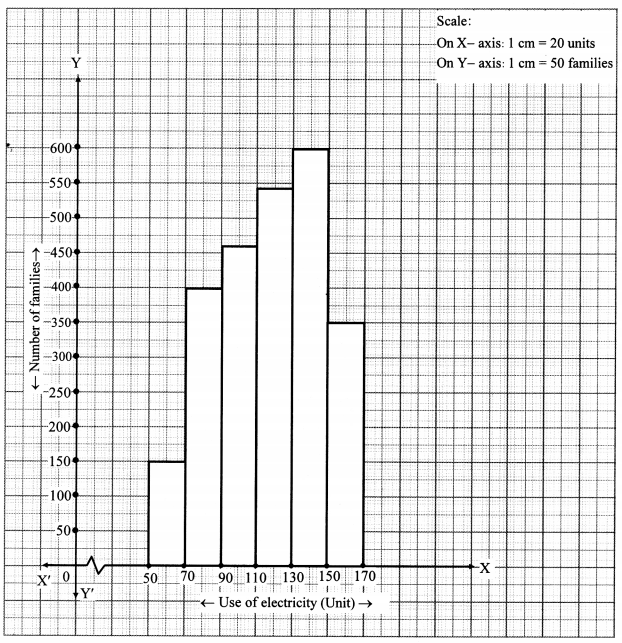
Draw a histogram for the following frequency distribution.
Maharashtra Board Class 10 Maths Solutions Chapter 6 Statistics Problem Set 6 23
Solution:
Maharashtra Board Class 10 Maths Solutions Chapter 6 Statistics Problem Set 6 24

Question 10.
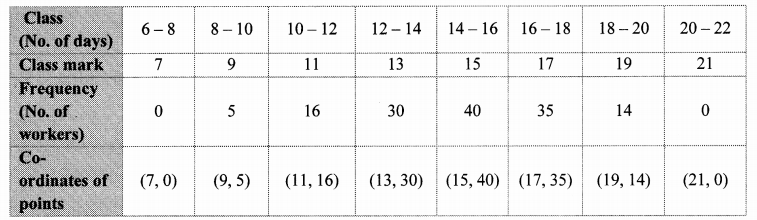
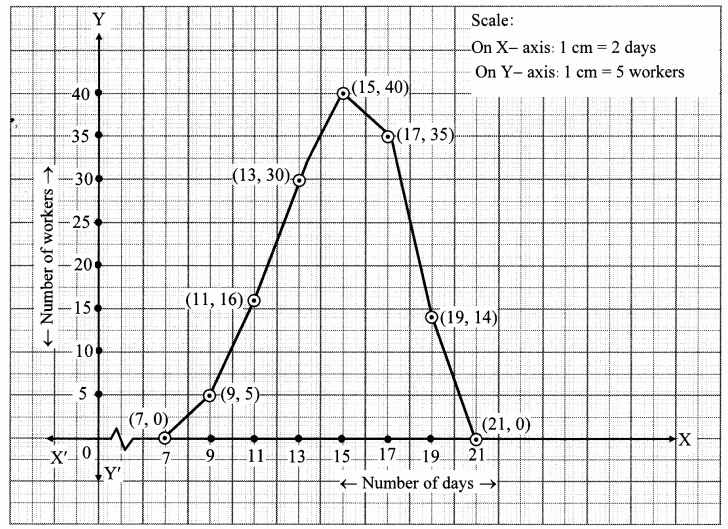
In a handloom factory different workers take different periods of time to weave a saree. The number of workers and their required periods are given below. Present the information by a frequency polygon.
Maharashtra Board Class 10 Maths Solutions Chapter 6 Statistics Problem Set 6 25
Solution:
Maharashtra Board Class 10 Maths Solutions Chapter 6 Statistics Problem Set 6 26 Maharashtra Board Class 10 Maths Solutions Chapter 6 Statistics Problem Set 6 27

Problem Set 6 Question 11.
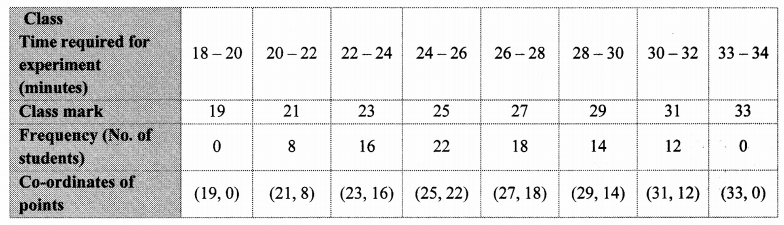
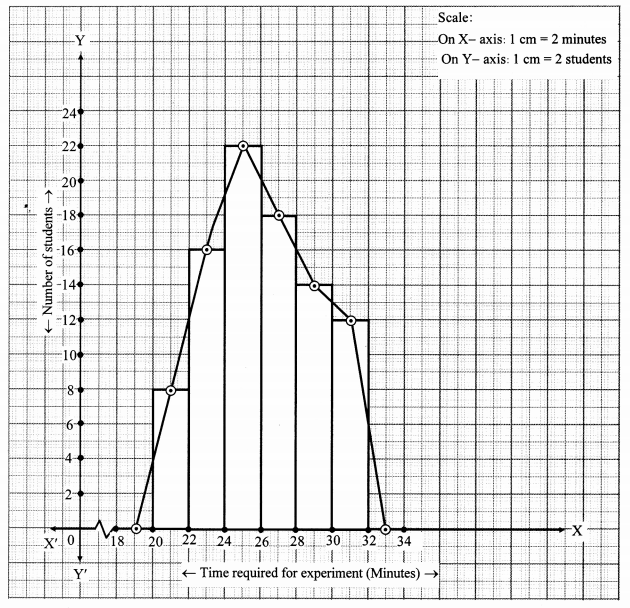
The time required for students to do a science experiment and the number of students is shown in the following grouped frequency distribution table. Show the information by a histogram and also by a frequency polygon.
Maharashtra Board Class 10 Maths Solutions Chapter 6 Statistics Problem Set 6 28
Solution:
Maharashtra Board Class 10 Maths Solutions Chapter 6 Statistics Problem Set 6 29 Maharashtra Board Class 10 Maths Solutions Chapter 6 Statistics Problem Set 6 30

Question 12.
Draw a frequency polygon for the following grouped frequency distribution table.
Maharashtra Board Class 10 Maths Solutions Chapter 6 Statistics Problem Set 6 31
Solution:
Maharashtra Board Class 10 Maths Solutions Chapter 6 Statistics Problem Set 6 32
Maharashtra Board Class 10 Maths Solutions Chapter 6 Statistics Problem Set 6 34

Question 13.
The following table shows the average rainfall in 150 towns. Show the information by a frequency polygon.
Maharashtra Board Class 10 Maths Solutions Chapter 6 Statistics Problem Set 6 35
Solution:
Maharashtra Board Class 10 Maths Solutions Chapter 6 Statistics Problem Set 6 36
Maharashtra Board Class 10 Maths Solutions Chapter 6 Statistics Problem Set 6 33

Question 14.
Observe the given pie diagram. It shows the percentages of number of vehicles passing a signal in a town between 8 am and 10 am.
i. Find the central angle for each type of vehicle.
ii. If the number of two-wheelers is 1200, find the number of all vehicles.
Maharashtra Board Class 10 Maths Solutions Chapter 6 Statistics Problem Set 6 37
Solution:
Maharashtra Board Class 10 Maths Solutions Chapter 6 Statistics Problem Set 6 38
∴ The total number of vehicles is 3000.

Problem Set 6 Geometry Class 10 Question 15.
The following table shows causes of noise pollution. Show it by a pie diagram.
Maharashtra Board Class 10 Maths Solutions Chapter 6 Statistics Problem Set 6 39
Solution:
Maharashtra Board Class 10 Maths Solutions Chapter 6 Statistics Problem Set 6 40

Question 16.
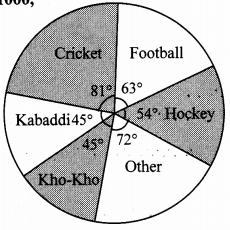
A survey of students was made to know which game they like. The data obtained in the survey is
presented in the given pie diagram. If the total number of students are 1000,
i. how many students like cricket?
ii. how many students like football?
iii. how many students prefer other games?
Maharashtra Board Class 10 Maths Solutions Chapter 6 Statistics Problem Set 6 41
Solution:
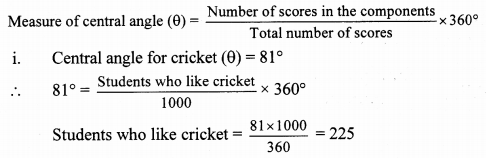
Maharashtra Board Class 10 Maths Solutions Chapter 6 Statistics Problem Set 6 42
∴ 225 students like cricket.

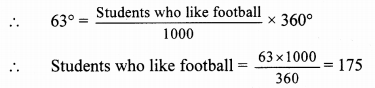
ii. Central angle for football (θ) = 63°
Maharashtra Board Class 10 Maths Solutions Chapter 6 Statistics Problem Set 6 43
∴ 175 students like football.

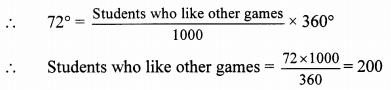
iii. Central angle for other games (θ) = 72°
Maharashtra Board Class 10 Maths Solutions Chapter 6 Statistics Problem Set 6 44
∴ 200 students like other games.

Question 17.
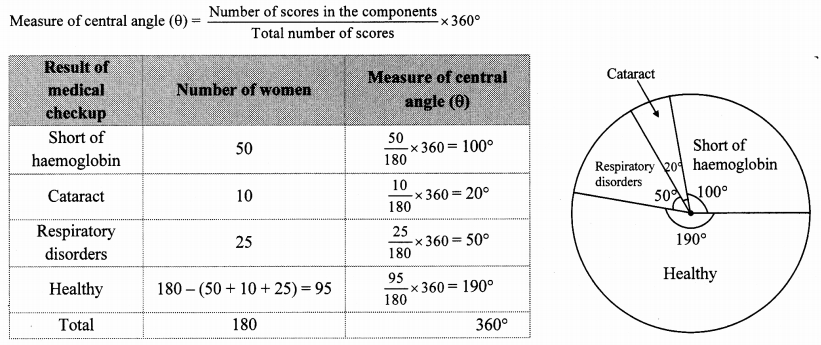
Medical check up of 180 women was conducted in a health centre in a village. 50 of them were short of hemoglobin, 10 suffered from cataract and 25 had respiratory disorders. The remaining women were healthy. Show the information by a pie diagram.
Solution:
Total number of women = 180
Maharashtra Board Class 10 Maths Solutions Chapter 6 Statistics Problem Set 6 45

Question 18.
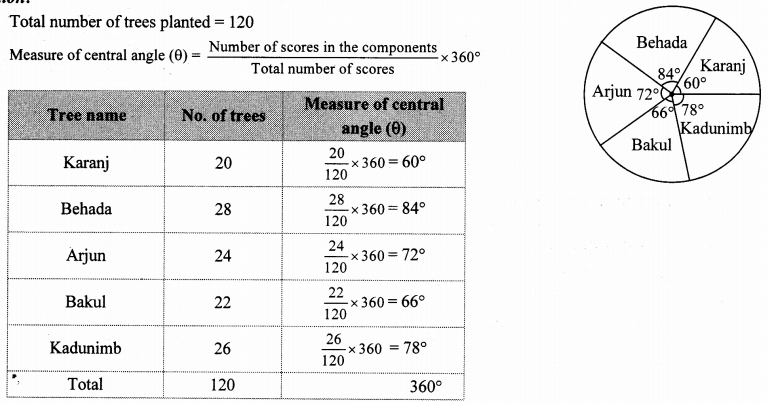
On an environment day, students in a school planted 120 trees under plantation project. The information regarding the project is shown in the following table. Show it by a pie diagram.
Maharashtra Board Class 10 Maths Solutions Chapter 6 Statistics Problem Set 6 46
Solution:
Total number of trees planted = 120
Maharashtra Board Class 10 Maths Solutions Chapter 6 Statistics Problem Set 6 47

Maharashtra Board Class 10 Maths Solutions

Maharashtra Board Class 10 English Solutions Unit 1.4 All the World’s a Stage

Balbharti Maharashtra State Board Class 10 English Solutions Unit 1.4 All the World’s a Stage Notes, Textbook Exercise Important Questions and Answers.

Maharashtra State Board Class 10 English Solutions Unit 1.4 All the World’s a Stage

Maharashtra State Board Class 10 English Solutions Unit 1.4 Warming Up Questions and Answers

Question 1.
Pair work

  • Talk to your friend about all the things related to ‘Seven.’
    For example Seven wonders of the world.
  • Pair up with your partner and name those given below all of the under :

(a) The seven wonders of the world
………………………………………………………
(b) The seven continents
………………………………………………………
(c) The seven colours of the rainbow
………………………………………………………
(d) The seven notes of the music
………………………………………………………
(e) The seven seas of the world
………………………………………………………
Answer:
(a) The Seven wonders of the world : The Great Wall of China, Christ the Redeemer Statue, Machu Picchu, Chichen Itza, The Roman Colosseum, The Taj Mahal and Petra.
(b) The Seven continents : Asia, Europe, Australia, Africa, North America, South America, Antarctica.
(c) The Seven colours of the rainbow : violet, indigo, blue, green, yellow, orange, red
(d) The Seven notes of the musical scale : sa-re-ga-ma-pa-da-ni./doh-re-me-fa-so-la-ti
(e) The Seven seas of the world : Arctic Ocean, Antarctic Ocean, North Atlantic Ocean, South Atlantic Ocean, Indian Ocean, North Pacific Ocean, South Pacific Ocean.

Maharashtra Board Solutions

Question 2.
Life is often compared to many things. Write down 7 things that life can be compared to and justify the comparison. For example,
(a) Life is a keyboard, because if you press the right keys you have typed a good destiny.
(b) ………………………………………………………
(c) ………………………………………………………
(d) ………………………………………………………
(e) ………………………………………………………
(f) ………………………………………………………
(g) ………………………………………………………
Answer:
(a) Life is a keyboard; if you press the right keys, you have typed out a good destiny.
(b) Life is a river-always flowing.
(c) Life is like a seed; it will never grow unless planted, nourished and nurtured.
(d) Life is like an elevator, with lots of ups and downs. ‘
(e) Life is like an onion. You peel off layer after layer. Sometimes it makes you weep.
(f) Life is like a jigsaw puzzle. You have all the pieces, but you have to put them together correctly.
(g) Life is like a jack-in-the-box. You never know : when you are going to get a box on your chin.

Question 3.
Match the approximate ages with the stages.

No.Age-groupStages
1Birth to 2 yearsateenage/adolescence
23 years to 12 yearsbold age/second childhood
313 years to 17 yearscmiddle-age
418 years to about 44 yearsdbabyhood/infancy
5About 45 years to 60 yearsesenior citizen/elderly person
665 years up to 75 to 80 yearsfadulthood
7Above 80 yearsgchildhood

Answer:

No.Age-groupStages
(1)Birth to 2 years(d) babyhood/infancy
(2)3 years to 12 years(g) childhood
(3)13 years to 17 years(a) teenage/adolescence
(4)18 years to about 44 years(f) adulthood
(5)About 45 years to 60 years(c) middle-age
(6)65 years up to 75 to 80 years(e) senior citizen/ elderly person
(7)Above 80 years(b) old age/second childhood

Maharashtra Board Solutions

Maharashtra Board Class 10 English Kumarbharati Unit 1.4 Questions and Answers

Question 1.
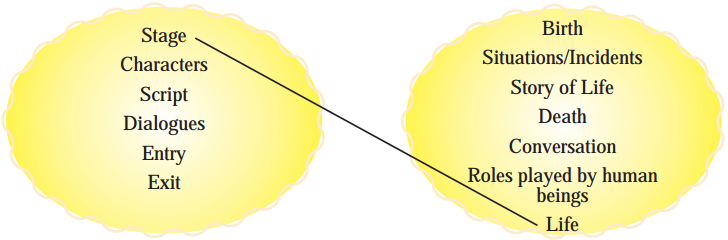
Read the words in given clouds. Match them with what they signify.
Maharashtra Board Class 10 English Solutions Unit 1.4 All the World’s a Stage 1
Answer:
(1) Stage – Life
(2) Characters – Roles played by human beings
(3) Script – Story of life
(4) Dialogues – Conversation
(5) Entry – Birth
(6) Exit – Death

Question 2.
Read the poem carefully and complete the following table.

Ages of ManRoleQualities/Actions
11.
2.
21.
2.
31.
2.
41.
2.
5Maharashtra Board Solutions1.
2.
61.
2.
71.
2.

Answer:

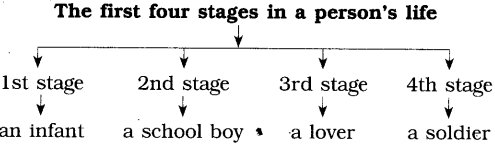
Firstinfant(1)   frightened
(2)   crying, puking
Secondschoolboy(1)   unhappy
(2)   whining, creeping unwillingly to school
Thirdlover(1)   woeful
(2)   sighing, singing sad ballads
Fourthsoldier(1)  jealous in honor, ambitious
(2)   quarreling, facing danger

Question 3.
Write down in your own words the differences between the following stages of a man’s life.
2nd stage and 4th stage …………………………………
……………………………………………………………………
……………………………………………………………………

3rd stage and 5th stage …………………………………
……………………………………………………………………
……………………………………………………………………

1 st stage and 7th (last) stage …………………………………
……………………………………………………………………
……………………………………………………………………
Answer:
2nd stage and 4th stage:
The second stage is that of a school boy, complaining and crying. He goes to school early in the morning, with a well-scrubbed, shining face. He carries his school bag and creeps slowly, like a snail, unwillingly to school.

‘Full of strange oaths and bearded like the pard, Jealous in honour, sudden and quick in quarrel.’

3rd stage and 5th stage:
The third stage is that of a lover, who is’ breathless and sighing with passion. He sings sad Songs dedicated to the beauty of his lover.

The fifth stage is that of , a mature middle-aged man with a round belly. He is stern and formal and full of wisdom. He is full of wise sayings and gives modern examples.

1 st stage and 7th (last) stage:
The first stage is that of an infant, crying weakly and throwing up in his nurse’s arms. He is unaware of what is happening around him.The baby, at this stage, is without teeth, without vision, without taste and without anything.

The last stage of all, which ends one’s eventful life, is when man becomes senile and enters his second childhood. He is again unaware of what is happening around him. This final stage is when he is once more without teeth, without vision, without taste and without anything.

Maharashtra Board Solutions

Question 4.
Pick out lines that contain Imagery (a picture created in the mind by using words) of the following people.
(a) School boy …………………………………
(2nd stage) …………………………………
(b) Soldier …………………………………
(4th stage) …………………………………
(c) Judge …………………………………
(5th stage) …………………………………
(d) Senior citizen …………………………………
(6th stage) …………………………………
Answer:
(a) a snail
‘The whining schoolboy, with his satchel and shining morning face, creeping like a snail unwillingly to school.’

(b) acts like the pard
‘Full of strange oaths and bearded like the pard, Jealous in honour, sudden and quick in quarrel.’

(c) In fair round belly with good capon lined
With eyes “severe and beard of formal cut

(d) His youthful hose, well-saved, a world too wide
For his shrunk shank

Question 5.
You will notice that there is no Rhyme-scheme in the poem. It appears similar to the poem 1.1 ‘Where the Mind is Without Fear by Tagore.

However Tagore’s poem has no steady rhythm/meter either it is called Free Verse. Shakespeare uses lines with a steady rhythm of 5 beats in each. It is termed as Blank Verse. (No rhyme-scheme but uniformity in rhythm) Copy the lines from “Ánd all the men and women merely players” to “sudden and quick in quarrel”. Put a stress mark on each of the syllables stressed in the lines as for example, And all the men and women merely players;
Answer:
The poem is written in free verse without any rhyme scheme or consistent metre. There are many figures of speech e.g. Repetition. Metaphor, Alliteration, etc. An Important figure of speech is Personification. ‘Where tireless striving stretches its arms towards perfection’. Here, we can actually visualize ‘tireless striv1ng stretching Its arms to reach its goal.

The poem is a prayer to God. Tagore addresses God as ‘my Father’ and asks Him to awaken his country Into a heaven of freedom, where there is total freedom of good thoughts, good words and good actions. He wishes for a country where people would be free from fear, where knowledge would be free to all individuals and people from all castes and religions would be united.

Maharashtra Board Solutions

Question 6.
Think and write on your own.
(a) What is the theme/central idea of this poem?
(b) Which two stages of man, described by Shakespeare sound humorous? Say why.
(c) The last (7th) stage of life sounds very sad and miserable. How can you make old age also cheerful and happy?
Answer:
(a) The theme of this poem is the cycle of life.
It tells us how one starts out an infant, helpless and unaware of the surroundings, and ends the same way, i without being aware of what is happening around one.

(b) The second and third stages are humorous. One can just imagine the school boy, complaining and whining, creeping to school slowly with a well-scrubbed and shining face. The third stage, where the lover sighs loudly and sings sad poems and songs, is also humorous.

(c) We can make the last stage joyful by preparing for it beforehand. We know that most of us will reach this stage before our final exit. Hence, we must maintain good health, and keep good relations with our family and the people around us. We must save enough money to get us through this stage without any stress on ourselves or others.

Question 7.
(A) The poem is entirely metaphorical. Pick out the comparisons from the poem.
(a) world …………………………………
(b) actors …………………………………
(c) birth and death …………………………………
(d) school boy …………………………………
(e) the lover’s sigh …………………………………
(f) spotted leopard …………………………………
(g) last stage (old age) …………………………………
Answer:
(a) stage
(b) –
(c) entrances and exits
(d) a snail
(e) a furnace
(f) bearded soldier

(B) Pick out from the poem two examples of each.
(a) Simile
(1) …………………………………
(2) …………………………………
Answer:
Simile. Two dissimilar objects are compared using the word ‘like’.

(b) Onomatopoeia
(1) …………………………………
(2) …………………………………

(c) Alliteration
(1) …………………………………
(2) …………………………………

(d) Metaphor
(1) …………………………………
(2) …………………………………

(e) Inversion
(1) …………………………………
(2) …………………………………

(f) Transferred Epithet
(1) …………………………………
(2) …………………………………
Answer:

(a) Simile(1)   Creeping like a snail
(2)   Soldier bearded like the pard
(b) Onomatopoeia(1)   And then the whining schoolboy
(2)   Sighing like a furnace
(c) Alliteration(1) They have -their exits and their entrances
(2) His youthful hose, well- saved, a world too wide
(d) Metaphor(1)   They have their exits and their entrances
(2)   men and women merely players
(e) Inversion(1)   His acts being seven ages.
(2)   With eyes severe and beard of formal cut
(f) Transferred Epithet(1)   with a woeful ballad Maharashtra Board Solutions
(2)   Into the lean and slippered pantaloon

Question 8.
Read the summary of the play ‘As You Like It’ by William Shakespeare using the Internet. Find out which character has narrated the above poem and on what occasion. Also, make a list of all the characters of the play.
Answer:
The character who has narrated the above poem in the play ‘As You Like It’ by William Shakespeare is Jacques. He narrates it in Act II, Scene VII.

Some of the other characters in the play are Celia, Rosalind, Orlando, Oliver, Duke Senior, Duke Frederick, Touchstone, etc.

Question 9.
Read the poem again and write an appreciation of the poem in a paragraph format. (Refer to page no. 5)
Answer:
Point Format
(for understanding)
The title of the poem : All the World’s a Stage’
The poet : WIlliam Shakespeare
Rhyme scheme : blank verse I.e. no rhyme scheme, but there is a steady rhythm of five beats In each line.
Figures of speech : Metaphor, Simile, Alliteration, Repetition. etc.
Theme/Central idea : The theme of the poem Is the cycle of life.

Paragraph Format
The poem ‘All the World’s a Stage’ is by William Shakespeare. It is taken from Shakespeare’s play ‘As you like It’. It is a monologue by one of the characters in the play.

The poem is written in blank verse i.e. there is no rhyme scheme, but there Is a steady rhythm of five beats i.e. iambic pentameter in each line. There are many figures of speech, like Simile. Alliteration and Repetition. but the one that stands out Is Metaphor. In the lines ‘All the world’s a stage, And all men and women are merely players’, there is an implied comparison between two different things.

In this poem, Shakespeare compares life to a stage. He has divided life Into seven stages. each having its own varied qualities and features. The theme of the poem is the cycle of life. It tells us how one starts out as an Infant, helpless. without understanding. and ends the same way, without being aware of what Is happening around one.

Maharashtra Board Solutions

Question 10.
Complete the following diagram:
Answer:
Maharashtra Board Class 10 English Solutions Unit 1.4 All the World’s a Stage 2

Question 11.
Match the following :

AB
(1) Infant(a) acts like the pard
(2) School boy(b) mewling and puking
(3) Lover(c) whining,
(4) Soldier ‘(d) sighing like furnace

Answer:

(1) Infant (b) mewling arjd puking
(2) School boy (c) whining
(3) Lover (d) sighing like furnace
(4) Soldier (a) acts like the pard

Question 12.
Complete the following : (The answers are given directly and underlined.)
Answer:
(1) ‘Exits’ and ‘entrances’ refer to deaths and births.
(2) Reputation is like a bubble because one does useless things for one’s reputation, which can burst like a bubble in one instant.

Question 13.
Name and explain the poetic devices used in the following lines:
(a) Soldier bearded like the pard
Answer:
Simile. Two dissimilar objects are compared using the word ‘like’,

(b) Sighing like a furnace
Answer:
Simile. Two dissimilar objects are compared using the word ‘like’.

(c) men and women merely players
Answer:
Metaphor. Implicit comparison between two different things.

(d) They have their exits and their entrances
Answer:
Alliteration. Repetition of the sound of ‘t’ and ‘e’.
Metaphor. Implicit comparison between two different things.

Maharashtra Board Solutions

(f) With a woeful ballad
Answer:
Alliteration. Repetition of the sound of ‘w’.
Transferred Epithet. It is not the ballad that is woeful but the lover.

Question 14.
Complete the following diagram :
Answer:
Maharashtra Board Class 10 English Solutions Unit 1.4 All the World’s a Stage 3

Question 15.
Write if the following statements are True or False :
Answer:

  • Man in the fifth stage of life is full of wisdom. (True)
  • Man in the sixth stage has a fair, round belly. (False)
  • The last few lines are full of melancholy. (True)
  • In the last stage, man is unaware of his surroundings. (True)

Question 16.
Write down in your own words the differences between the following stages of a man’s life :
(a) 5th and 6th stage :
Answer:
The fifth stage is that of a mature middle-aged man with a round belly. He is stern and formal and full of wisdom. He is full of wise sayings and gives modern examples.

In the sixth stage, man has become old, with thin legs in slippers and loose pants. He has spectacles on his nose and a pouch by his side. The close-fitting stockings, which he had saved from his younger days, are now too big for his thin legs, which have shrunk with age. His loud voice, which was once manly, has now become childish and shrill. There are whistling sounds when he talks.

Question 17.
Complete the following table based on the extract. (The answers are given directly.)
Answer:

Stages of ManRolequalities/Actions
Fifthadult man(1)   fat, serious and wise
(2)   giving advice
Sixthmiddle-aged man(1)   thin and shrunken
(2)   talking in a shrill-voice
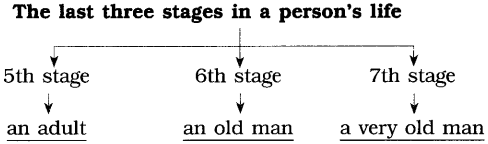
Seventhvery old man(1)   senile, child-like
(2)   oblivious to his surroundings

Question 18.
The poem is entirely metaphorical. Pick out the comparison from the extract: last stage (old age)

Answer:
last scene

Maharashtra Board Solutions

Question 19.
Name and explain the figures of speech used in the following lines :
(a) His youthful hose, well-saved, a world too wide
Answer:
Alliteration. Repetition of the sound of ‘w’.

(b) For his shrunk shank
Answer:
Alliteration. Repetition of the sound of ‘s’.

(c) Turning again towards childish treble
Answer:
Alliteration. Repetition of the sound of ‘t’.

(d) Sans teeth, sans eyes, sans taste, sans everything.
Answer:
Repetition. The word ‘sans’ is repeated for emphasis.

Maharashtra Board 10th Class Maths Part 2 Problem Set 7 Solutions Chapter 7 Mensuration

Balbharti Maharashtra State Board Class 10 Maths Solutions covers the Problem Set 7 Geometry 10th Class Maths Part 2 Answers Solutions Chapter 7 Mensuration.

Problem Set 7 Geometry 10th Std Maths Part 2 Answers Chapter 7 Mensuration

Problem Set 7 Question 1. Choose the correct alternative answer for each of the following questions.

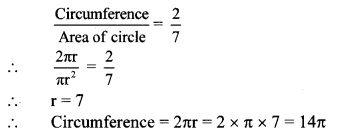
i. The ratio of circumference and area of a circle is 2 : 7. Find its circumference.
(A) 14 π
(B) \(\frac{7}{\pi}\)
(C) 7π
(D) \(\frac{14}{\pi}\)
Answer:
Problem Set 7 Geometry 10th
(A)

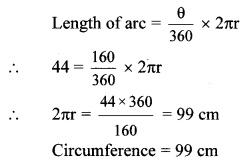
ii. If measure of an arc of a circle is 160° and its length is 44 cm, find the circumference of the circle.
(A) 66 cm
(B) 44 cm
(C) 160 cm
(D) 99 cm
Answer:

(D)

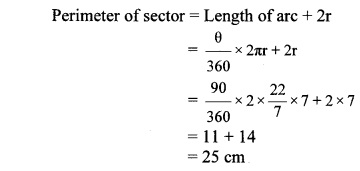
iii. Find the perimeter of a sector of a circle if its measure is 90° and radius is 7 cm.
(A) 44 cm
(B) 25 cm
(C) 36 cm
(D) 56 cm
Answer:

(B)

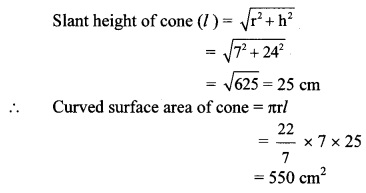
iv. Find the curved surface area of a cone of radius 7 cm and height 24 cm.
(A) 440 cm2
(B) 550 cm2
(C) 330 cm2
(D) 110 cm2
Answer:

(B)

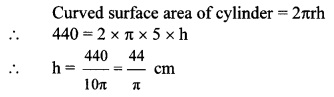
v. The curved surface area of a cylinder is 440 cm2 and its radius is 5 cm. Find its height.
(A) \(\frac{44}{\pi}\) cm
(B) 22π cm
(C) 44π cm
(D) \(\frac{22}{\pi}\)
Answer:

(A)

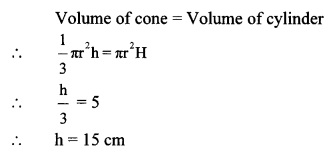
vi. A cone was melted and cast into a cylinder of the same radius as that of the base of the cone. If the height of the cylinder is 5 cm, find the height of the cone.
(A) 15 cm
(B) 10 cm
(C) 18 cm
(D) 5 cm
Answer:
Maharashtra Board Class 10 Maths Solutions Chapter 7 Mensuration Problem Set 7
(A)

vii. Find the volume of a cube of side 0.01 cm.
(A) 1 cm
(B) 0.001 cm3
(C) 0.0001 cm3
(D) 0.000001 cm3
Answer:
Volume of cube = (side)3
= (0.01)3 = 0.000001 cm3
(D)

viii. Find the side of a cube of volume 1 m3
(A) 1 cm
(B) 10 cm
(C) 100 cm
(D) 1000 cm
Answer:
Volume of cube = (side)3
∴ 1 = (side)3
∴ Side = 1 m
= 100 cm
(C)

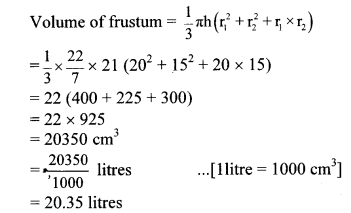
Problem Set 7 Geometry Class 10 Question 2. A washing tub in the shape of a frustum of a cone has height 21 cm. The radii of the circular top and bottom are 20 cm and 15 cm respectively. What is the capacity of the tub? = (π = \(\frac { 22 }{ 7 } \))
Given: For the frustum shaped tub,
height (h) = 21 cm,
radii (r1) = 20 cm, and (r2) = 15 cm
To find: Capacity (volume) of the tub.
Solution:
Volume of frustum = \(\frac { 1 }{ 3 } \) πh (r12 + r22 + r1 × r2)
Maharashtra Board Class 10 Maths Solutions Chapter 7 Mensuration Problem Set 7 7
∴ The capacity of the tub is 20.35 litres.

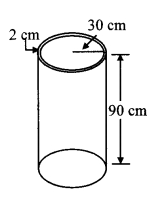
10th Geometry Problem Set 7 Question 3. Some plastic balls of radius 1 cm were melted and cast into a tube. The thickness, length and outer radius of the tube were 2 cm, 90 cm and 30 cm respectively. How many balls were melted to make the tube?
Given: For the cylindrical tube,
height (h) = 90 cm,
outer radius (R) = 30 cm,
thickness = 2 cm
For the plastic spherical ball,
radius (r1) = 1 cm
To find: Number of balls melted.
Solution:
Maharashtra Board Class 10 Maths Solutions Chapter 7 Mensuration Problem Set 7 8
Inner radius of tube (r)
= outer radius – thickness of tube
= 30 – 2
= 28 cm
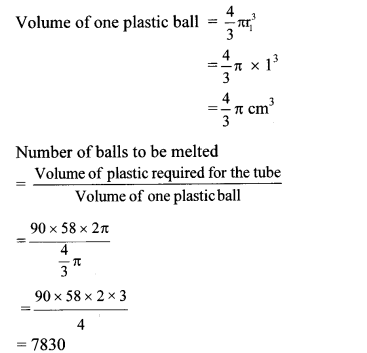
Volume of plastic required for the tube = Outer volume of tube – Inner volume of hollow tube
= πR2h – πr2h
= πh(R2 – r2)
= π × 90 (302 – 282)
= π × 90 (30 + 28) (30 – 28) …[∵ a2 – b2 = (a + b)(a – b)]
= 90 × 58 × 2π cm3
Maharashtra Board Class 10 Maths Solutions Chapter 7 Mensuration Problem Set 7 9
∴ 7830 plastic balls were melted to make the tube.

Problem Set 7 Geometry Question 4.
A metal parallelopiped of measures 16 cm × 11cm × 10cm was melted to make coins. How many coins were made if the thickness and diameter of each coin was 2 mm and 2 cm respectively?
Given: For the parallelopiped.,
length (l) = 16 cm, breadth (b) = 11 cm,
height (h) = 10 cm
For the cylindrical coin,
thickness (H) = 2 mm,
diameter (D) 2 cm
To find: Number of coins made.
Solution:
Volume of parallelopiped = l × b × h
= 16 × 11 × 10
= 1760 cm3
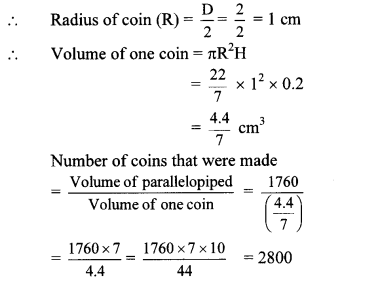
Thickness of coin (H) = 2 mm
= 0.2 cm …[∵ 1 cm = 10 mm]
Diameter of coin (D) = 2 cm
Maharashtra Board Class 10 Maths Solutions Chapter 7 Mensuration Problem Set 7 10
∴ 2800 coins were made by melting the parallelopiped.

Mensuration Problem Question 5.  The diameter and length of a roller is 120 cm and 84 cm respectively. To level the ground, 200 rotations of the roller are required. Find the expenditure to level the ground at the rate of ₹ 10 per sq.m.
Given: For the cylindrical roller,
diameter (d) =120 cm,
length = height (h) = 84 cm
To find: Expenditure of levelling the ground.
Solution:
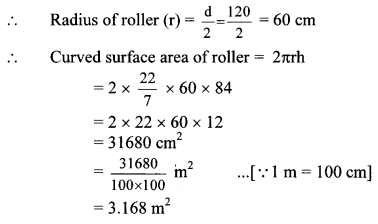
Diameter of roller (d) = 120 cm
Maharashtra Board Class 10 Maths Solutions Chapter 7 Mensuration Problem Set 7 11
Now, area of ground levelled in one rotation = curved surface area of roller
= 3.168 m2
∴ Area of ground levelled in 200 rotations
= 3.168 × 200 =
633.6 m2
Rate of levelling = ₹ 10 per m2
∴ Expenditure of levelling the ground
= 633.6 × 10 = ₹ 6336
∴ The expenditure of levelling the ground is ₹ 6336.

Question 6.
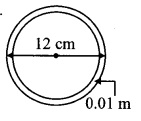
The diameter and thickness of a hollow metal sphere are 12 cm and 0.01 m respectively. The density of the metal is 8.88 gm per cm3. Find the outer surface area and mass of the sphere, [π = 3.14]
Given: For the hollow sphere,
diameter (D) =12 cm, thickness = 0.01 m
density of the metal = 8.88 gm per cm3
To find: i. Outer surface area of the sphere
ii. Mass of the sphere.
Maharashtra Board Class 10 Maths Solutions Chapter 7 Mensuration Problem Set 7 12
Solution:
Diameter of the sphere (D)
= 12 cm
∴ Radius of sphere (R)
= \(\frac { d }{ 2 } \) = \(\frac { 12 }{ 2 } \) = 6 cm
∴ Surface area of sphere = 4πR2
= 4 × 3.14 × 62
= 452.16 cm2
Thickness of sphere = 0.01 m
= 0.01 × 100 cm …[∵ 1 m = 100 cm]
= 1 cm
∴ Inner radius of the sphere (r)
= Outer radius – thickness of sphere
= 6 – 1 = 5 cm
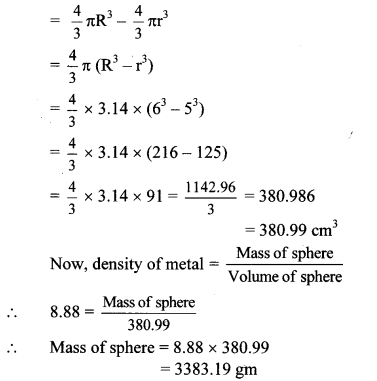
∴ Volume of hollow sphere
= Volume of outer sphere – Volume of inner sphere
Maharashtra Board Class 10 Maths Solutions Chapter 7 Mensuration Problem Set 7 13
∴ The outer surface area and the mass of the sphere are 452.16 cm2 and 3383.19 gm respectively.

Question 7.
A cylindrical bucket of diameter 28 cm and height 20 cm was full of sand. When the sand in the bucket was poured on the ground, the sand got converted into a shape of a cone. If the height of the cone was 14 cm, what was the base area of the cone?
Given: For the cylindrical bucket,
diameter (d) = 28 cm, height (h) = 20 cm
For the conical heap of sand,
height (H) = 14 cm
To find: Base area of the cone (πR2).
Solution:
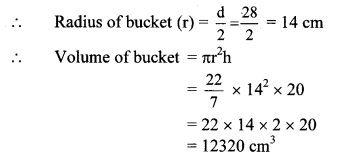
Diameter of the bucket (d) = 28 cm
Maharashtra Board Class 10 Maths Solutions Chapter 7 Mensuration Problem Set 7 14
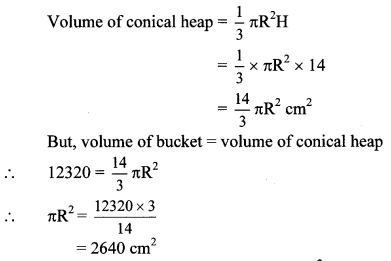
Maharashtra Board Class 10 Maths Solutions Chapter 7 Mensuration Problem Set 7 15
The base area of the cone is 2640 cm2.

Question 8.
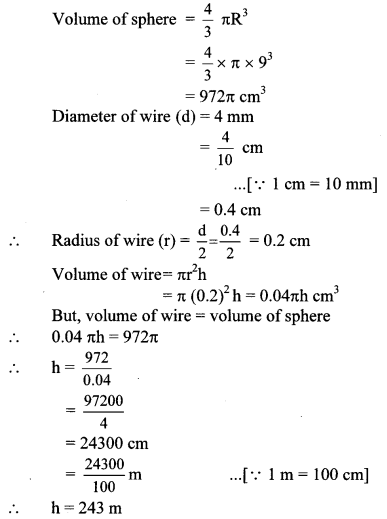
The radius of a metallic sphere is 9 cm. It was melted to make a wire of diameter 4 mm. Find the length of the wire.
Given: For metallic sphere,
radius (R) = 9 cm
For the cylindrical wire,
diameter (d) = 4 mm
To find: Length of wire (h).
Solution:
Maharashtra Board Class 10 Maths Solutions Chapter 7 Mensuration Problem Set 7 16
∴ The length of the wire is 243 m.

Question 9.
The area of a sector of a circle of 6 cm radius is 157t sq.cm. Find the measure of the arc and length of the arc corresponding to the sector.
Given: Radius (r) = 6 cm,
area of sector = 15 π cm2
To find: i. Measure of the arc (θ),
ii. Length of the arc (l)
Solution:
Maharashtra Board Class 10 Maths Solutions Chapter 7 Mensuration Problem Set 7 17
∴ The measure of the arc and the length of the arc are 150° and 5π cm respectively.

Question 10.
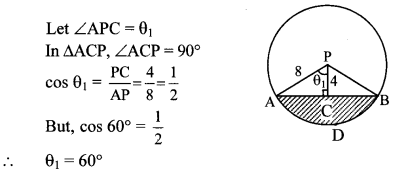
In the adjoining figure, seg AB is a chord of a circle with centre P. If PA = 8 cm and distance of chord AB from the centre P is 4 cm, find the area of the shaded portion.
Maharashtra Board Class 10 Maths Solutions Chapter 7 Mensuration Problem Set 7
(π = 3.14, \(\sqrt { 3 }\) = 1.73)
Given: Radius (r) = PA = 8 cm,
PC = 4 cm
To find: Area of shaded region.
Solution:
Maharashtra Board Class 10 Maths Solutions Chapter 7 Mensuration Problem Set 7 18
Similarly, we can show that, ∠BPC = 60°
∠APB = ∠APC + ∠BPC …[Angle sum property]
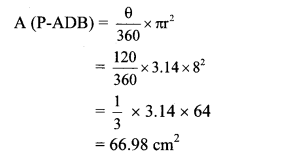
∴ θ = 60° + 60° = 120°
Maharashtra Board Class 10 Maths Solutions Chapter 7 Mensuration Problem Set 7 19
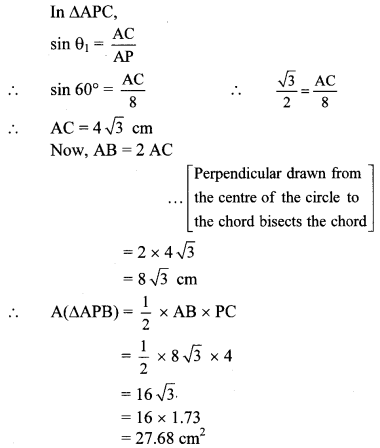
Maharashtra Board Class 10 Maths Solutions Chapter 7 Mensuration Problem Set 7 20
Area of shaded region = A(P-ADB) – A(∆APB)
= 66.98 – 27.68
= 39.30 cm2
∴ The area of the shaded region is 39.30 cm2.

Question 11.
In the adjoining figure, square ABCD is inscribed in the sector A-PCQ. The radius of sector C-BXD is 20 cm. Complete the following activity to find the area of shaded region.
Maharashtra Board Class 10 Maths Solutions Chapter 7 Mensuration Problem Set 7 21
Solution:
Side of square ABCD
= radius of sector C-BXD = [20] cm
Area of square = (side)2 = 202 = 400 cm2 ….(i)
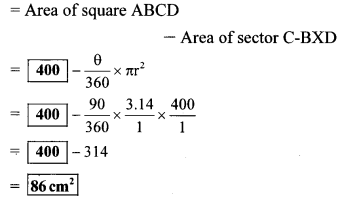
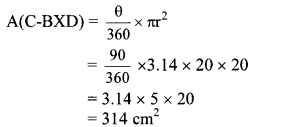
Area of shaded region inside the square = Area of square ABCD – Area of sector C-BXD
Maharashtra Board Class 10 Maths Solutions Chapter 7 Mensuration Problem Set 7 22
Radius of bigger sector
= Length of diagonal of square ABCD
= \(\sqrt { 2 }\) × side
= 20 \(\sqrt { 2 }\) cm
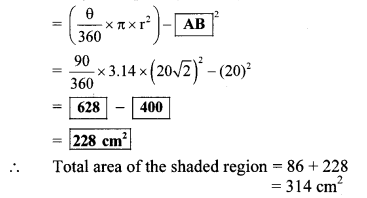
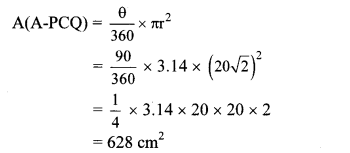
Area of the shaded regions outside the square
= Area of sector A-PCQ – Area of square ABCD
= A(A – PCQ) – A(꠸ABCD)
Maharashtra Board Class 10 Maths Solutions Chapter 7 Mensuration Problem Set 7 23
Alternate method:
Maharashtra Board Class 10 Maths Solutions Chapter 7 Mensuration Problem Set 7 24
□ABCD is a square. … [Given]
Side of □ABCD = radius of sector (C-BXD)
= 20 cm
Radius of sector (A-PCQ) = Diagonal
= \(\sqrt { 2 }\) × side
= \(\sqrt { 2 }\) × 20
= 20 \(\sqrt { 2 }\) cm
Maharashtra Board Class 10 Maths Solutions Chapter 7 Mensuration Problem Set 7 25
Now, Area of shaded region
= A(A-PCQ) – A(C-BXD)
= 628 – 314
= 314 cm2
∴ The area of the shaded region is 314 cm2.

Question 12.
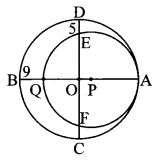
In the adjoining figure, two circles with centres O and P are touching internally at point A. If BQ = 9, DE = 5, complete the following activity to find the radii of the circles.
Maharashtra Board Class 10 Maths Solutions Chapter 7 Mensuration Problem Set 7 26
Solution:
Let the radius of the bigger circle be R and that of smaller circle be r.
OA, OB, OC and OD are the radii of the bigger circle.
∴ OA = OB = OC = OD = R
PQ = PA = r
OQ + BQ = OB … [B – Q – O]
OQ = OB – BQ = R – 9
OE + DE = OD ….[D – E – O]
OE = OD – DE = [R – 5]
As the chords QA and EF of the circle with centre P intersect in the interior of the circle, so by the property of internal division of two chords of a circle,
OQ × OA = OE × OF
∴ (R – 9) × R = (R – 5) × (R – 5) …[∵ OE = OF]
∴ R2 – 9R = R2 – 10R + 25
∴ -9R + 10R = 25
∴ R = [25units]
AQ = AB – BQ = 2r ….[B-Q-A]
∴ 2r = 50 – 9 = 41
∴ r = \(\frac { 41 }{ 2 } \) = 20.5 units

Maharashtra Board Class 10 History Solutions Chapter 6 Entertainment and History

Balbharti Maharashtra State Board Class 10 History Solutions Chapter 6 Entertainment and History Notes, Textbook Exercise Important Questions and Answers.

Maharashtra State Board Class 10 History Solutions Chapter 6 Entertainment and History

Question 1.
(A) Choose the correct option from the given options and complete the statement.
(1) ……… are supposed to be the first keertankar in Maharashtra.
(a) Saint Dnyanehshwar
(b) Saint Tukaram
(c) Saint Namdev
(d) Saint Eknath
Answer:
(c) Saint Namdev

Maharashtra Board Solutions

(2) Baburao painter made the movie, …………………….. .
(a) Pundalik
(b) Raja Harischandra
(c) Sairandhri
(d) Bajirao-Mastani
Answer:
(c) Sairandhri

(B) Identify and write the wrong pair in the following set.
(1) Raigadala Jevha Jag Yete – Vasant Kanetkar
(2) Tilak Ani Agarkar – Vishram Bedekar
(3) Sashtang Namaskar – Acharya Atre
(4) Ekach Pyala – Annasaheb Kirloskar
Answer:
(4) Wrong Pair: Ekach Pyala – Annasaheb Kirloskar

Question 2.
Complete the following chart.

BhajanKeertanLalitBharud
Characteristics
Examples

Answer:

Sr.No.PointBhajanKeertanLalitBharud
1CharacteristicsSinging songs in praise of God and chanting his name accompanied by Taal (Cymbals), Pakhvaj and Mridangam(1) Naman and Nirupanacha Abhang and Nirupan comprise the Poorvarang
(2) Narration of a story to illustrate main theme is Uttarrang
(1) Deity is invoked during festival to fulfill desire
(2) It is performed in a theatrical style. Stories of Krishna, Rama and great devotees are presented during performances
It is a metaphorical song with spiritual and ethical teachings.
2ExamplesBhajans of Saint Tulsidas, Saint Tukadoji Maharaj and Saint NamdevNaraadiya Keertan and Mahatma Phule’s KeertanPopular in Konkan and GoaBharuds of Saints Eknath, Namdev and Dnyaneshwar.

Maharashtra Board Solutions

Question 3.
Write short notes:
(1) Need of entertainment
Answer:

  • Entertainment of excellent quality is essential for healthy growth of a person as it is an integral part of one’s life?
  • To break the boredom of routine life and keep the mind lively and fresh we need gome entertainment.
  • It makes us feel more energetic and our efficiency at- work improves.
  • Hobbies and games are pursued for entertainment which eventually develops personality.
  • Entertainment refreshes our mind and helps to distress.
  • Lack of entertainment in one’s life will lead to monotonous life and boredom.

(2) Marathi Theatre
Answer:

  • Theatre is a place devoted to performances either solo or collective, of performing arts.
  • The 19th century saw a great development of the Marathi Theatre.
  • Vishnudas Bhave was known as the father of the Marathi Theatre.
  • In the initial years historical, mythological plays were performed along with light farcical plays.
  • The plays had no written script.
  • The tradition of having a complete written script began with the play ‘Thorale Madhavrao Peshwe’ in 1861.
  • At the end of 19th century,„ the tradition of musical plays started.
  • Historical themes and social problems were presented through these plays.
  • The popular plays by Acharya Atre like Udyacha Sansar, Gharabaher helped the Marathi theatre to sustain through a temporary decline. Vasant Kanetkar, Vishram Bedekar, Acharya Atre, enriched the Marathi theatre.

(3) Entertainment and professional opportunities
Answer:

  • There are many professions associated with theatre and cinema.
  • Professional hairstylists, costume designers, make-up artists, art directors who put up stage backdrops are required in theatre.
  • Directors, technicians, actors, lightmen, costume and jewellery designers and assistants are required too. Experts in music and script writers, singers are required.
  • Cinema requires all of them along with dance directors, singers, cameramen, dialogue writers and story writers. Scholars of history can work in this field as art directors.

Question 4.
Explain the following statements with reasons.
(1) Expertise in history is important in the film industry.
Answer:
It is essential to have knowledge of history while making films on historical’ events or a person. .

  • If the movie has a historical theme then art directors are required to create backdrop designs showcasing the atmosphere of that period.
  • To write movie dialogues, the knowledge of the culture and language as spoken in that period is necessary.
  • It is important to have knowledge of appropriate hairstyles, costumes, jewellery make¬up of that era.
  • Scholars of history are required who can work as art directors or as consultants to the art director.
  • Experts in field of history can find many professional opportunities.

(2) Bharuds composed by Saint Eknath are popular in Maharashtra.
Answer:

  • Saint Eknath composed Bharuds with the purpose of educating people on various aspects of life.
  • Bharuds composed by Saint Eknath had a wide range of subjects, dramatic quality, easy rhythm and humour.
  • People liked the way it was performed.
  • A message was given in a humorous way.

Maharashtra Board Solutions

Question 5.
Answer the following questions in detail.
(1) Why is Maharashtra known as the land that nurtured the Indian film industry?
Answer:

  1. The contribution of Madanrao Madhavrao Pitale, the Patwardhan family of Kalyan and Harishchandra Sakharam Bhatvadekar is very important in the development of Indian movies.
  2. Dadasaheb Torane, A. E Karandikar, S. N. Patankar, V. E Divekar sought help from foreign technicians and made a movie entitled Pundalik. It was released in Mumbai in 1912.
  3. ‘Raja Harischandra’ was the first movie to be processed completely in India. It was released in Mumbai in 1913.
  4. The credit of making a full-length movie goes to Maharashtra.
    Therefore Maharashtra is known as the land that nurtured the Indian film industry.

(2) What is Powada?
Answer:

  1. Powada is a dramatic narration by altematingly reciting poetry and prosaic extracts. Powada narrates great deeds of heroic men and women in a very forceful and inspiring style.
  2. The Powada composed by – Adnyandas, a contemporary poet of Chhatrapati Shivaji Maharaj which narrated the incident of Afzal Khan’s death and battle of Simhgarh composed by Tulsidas are very famous.
  3. In the British period, Powadas narrating the stories of Umaji Naik, Chaphekar brothers and Mahatma Gandhi were composed.
  4. During the Samyukta Maharashtra Movement the Powadas were used as medium of creating public awareness.

Project
Get the lyrics of any one of Saint Eknath’s Bharud, and enact it in the cultural programme of your school.

Question 6.
Complete the sentences by choosing the correct option:
(a) In the 18th century, ………………………. started a Phad of Dashavatara artists which used to perform all over Maharashtra.
(a) Saint Gadge Maharaj
(b) Adnyandas
(c) Tulsidas
(d) Shyamiji Naik Kale
Answer:
(d) Shyamji Naik Kale

(b) Traditionally, ………………………. is supposed to be the founder of keertan tradition.
(a) Saint Namdev
(b) Saint Eknath
(c) Naradmuni
(d) Saint Gadge Maharaj
Answer:
(c) Naradmuni

(c) The Powada composed by the poet ………………………. on the incident of the killing of Afzal Khan is well-known.
(a) Adnyandas
(b) Tulsidas
(c) Ramdas
(d) Surdas
Answer:
(a) Adnyandas.

(d) Compositions of ………………………. are not part of Bhajans sung in Karnataka.
(a) Purandardas
(b) Surdah
(c) Bodhendraguruswami
(d) Thyagraj
Answer:
(b) Surdas

Maharashtra Board Solutions

(e) Varkari sect has developed a glorious tradition of ………………………. by chanting God’s name.
(a) Powada
(b) Dashavatari Natak
(c) Bhajan-Keertan
(d) Bharud
Answer:
(c) Bhajan-Keertan

(f) Powada composed by Tulsidas on the battle of ………………………. is very well known.
(a) Panhala
(b) Raigarh
(c) Pratapgad
(d) Simhgarh
Answer:
(d) Simhgarh

(g) Powadas composed by ………………………. were not the part of Samyukta Maharashtra Movement.
(a) Amarsheikh
(b) Patthe Bapurao
(c) Annabhau Sathe
(d) Gawankar
Answer:
(b) Patthe Bapurao

(h) ………………………. is known as the Father of Marathi theatre.
(a) V. J. Kirtane
(b) Dattopant Patwardhan
(c) Vishnudas Bhave
(d) Annasaheb Kirloskar
Answer:
(c) Vishnudas Bhave.

(i) started the tradition of having a complete written script.
(a) V. J. Kirtane
(b) Vishnudas Bhave
(c) Shripad Krishna Kolhatkar
(d) Govind Ballal Deval
Answer:
(a) V. J. Kirtane

(j) In the latter half of the 19th century, made special efforts to introduce classical khyal music in Maharashtra.
(a) Bhimsen Joshi
(b) Kumar Gandharva
(c) Kishori Amonkar
(d) Balkrishnabuva Ichalkaranjikar
Answer:
(d) Balkrishnabuva Ichalkaranjikar

(k) In India, is the first one to make a cine camera.
(a) Anandrao Painter
(b) Baburao Painter
(c) Dadasaheb Torne
(d) Dadasaheb Phalke
Answer:
(a) Anandrao Painter

(l) In 1925, made a movie Bajirao Mastani, which was later on banned by the British Government under the suspicion of spreading nationalistic sentiments.
(a) Sanjay Leela Bhansali
(b) Dadasaheb Phalke
(c) Baburao Painter
(d) Bhalaji Pendharkar
Answer:
(d) Bhalaji Pendharkar

(m) was the first woman producer of: Marathi movies.
(a) Kamalabai Mangarulkar
(b) Devika Rani
(c) Amirbai Karnataki
(d) Kanandevi
Answer:
(a) Kamalabai Mangalurkar.

Maharashtra Board Solutions

Question 7.
Identify the wrong pair in the following and write it:
(1)

Name of the PlayPlaywright
(1) Raygadala Jevha Jag YeteVasant Kanetkar
(2) Tilak Ani AgarkarVishram Bedekar
(3) Sashtang NamaskarAcharya Atre
(4) Ekach PyalaAnnasaheb Kirloskar

Answer:
Wrong pair: Ekach Pyala – Annasaheb Kirloskar

(2)

First releaseMovie
(1) First full length movie released in IndiaRaja Harishchandra
(2) First historical film in IndiaSimhgarh
(3) Movie dealing with real social issuesSavkari Pash
(4) Indian movie which got international acclaimSaint Dnyaneshwar

Answer:
Wrong pair: Indian movie which got international acclaim — Saint Dnyaneshwar

(3)

Film producerProduced Biographical Movies on
(1) Acharya AtreRam Shastri
(2) Vishram BedekarVasudev Balwant Phadke
(3) Dinakar D. PatilDhanya te Santaji Dhanaji
(4) Prabhakar PendharkarBal Shivaji

Answer:
Wrong Pair: Acharya Atre – Ram Shashtri

(4)

(1) KeechakvadhKrishnaji Prabhakar Khadilkar
(2) Ekach PyalaRam Ganesh Gadkari
(3) Ithe Oshalala MrutyuVasant Kanetkar
(4) NatasamratVijay Tendulkar

Answer:
Wrong Pair: Natasamrcrt -Vijay Tendulkar

Maharashtra Board Solutions

(5)

WorkSaint
(1) Gave momentum to the Bhakti movement in GujaratSaint Kabir
(2) First Keertankar of MaharashtraSaint Namdev
(3) Popularised Khanjiri BhajanSaint Tukdoji Maharaj
(4) Tradition of Rashtriya Keertan was startedDattopant Patwardhan

Answer:
Wrong Pair: Gave momentum to Bhakti movement in Gujarat — Saint Kabir

(6)

(1) The first play in MarathiSeetaswayamvar
(2) First play having  complete written scriptThorale  Madhavrao
(3) Metaphorical DramaUdyacha Sanskar
(4) Play based on

Shakespeare’s King Lear

Natasamrat

Answer:
Metaphorical Drama-Udyacha Sanskar.

(7)

Name of the PlayPlaywright
(1) Thorale Madhavrao PeshweV. J. Kirtane
(2) Ekach PyalaAnnasaheb Kirloskar
(3) Sangeet SharadaShripad Krishna Kolhatkar
(4) Sangeet ManapamanKrishnaji Prabhakar Khadilkar

Answer:
Wrong Pair: Sangeet Sharada – Shripad Krishna Kolhatkar

Question 8.
Complete the graphical presentation:
(a) Prepare concept map on:
(1) Types of Puppets:
Maharashtra Board Class 10 History Solutions Chapter 6 Entertainment and History 1
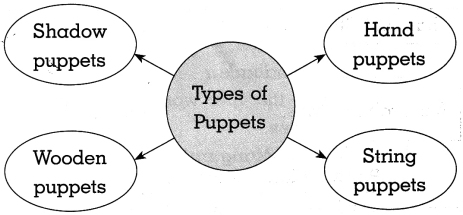
Answer:
Maharashtra Board Class 10 History Solutions Chapter 6 Entertainment and History 2

Maharashtra Board Solutions

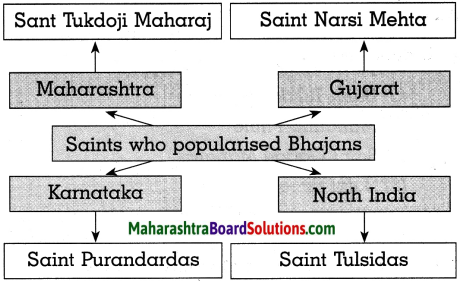
(2) Saints who popularised Bhajans:
Maharashtra Board Class 10 History Solutions Chapter 6 Entertainment and History 3
Answer:
Maharashtra Board Class 10 History Solutions Chapter 6 Entertainment and History 4

(3) Plays by famous Playwrights:
Maharashtra Board Class 10 History Solutions Chapter 6 Entertainment and History 5
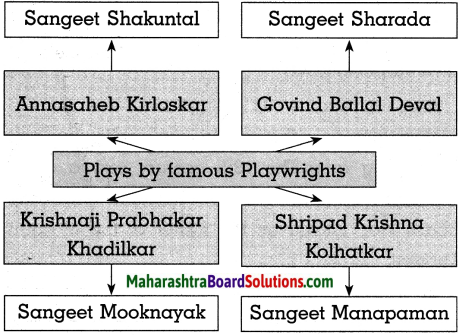
Answer:
Maharashtra Board Class 10 History Solutions Chapter 6 Entertainment and History 6

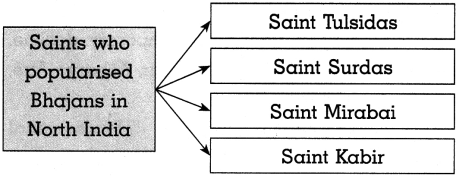
(4) Saints who popularised Bhajans in North India:
Maharashtra Board Class 10 History Solutions Chapter 6 Entertainment and History 7
Answer:
Maharashtra Board Class 10 History Solutions Chapter 6 Entertainment and History 8

Maharashtra Board Solutions

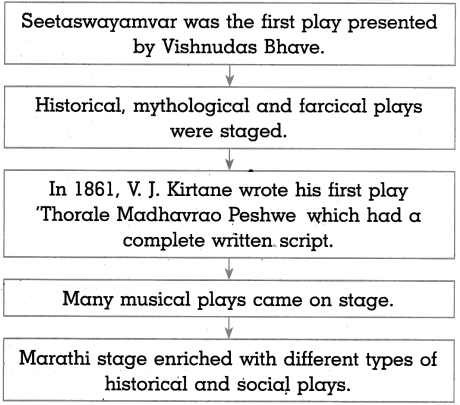
(b) Prepare a flow chart on the development of Marathi Theatre:
Answer:
Development of Marathi Theatre:
Maharashtra Board Class 10 History Solutions Chapter 6 Entertainment and History 9

Question 9.
Explain the concept:
(1) Dashavatara Theatre:
Answer:

  • The stories presented in Dashavatara shows are based on the ten incarnations of Vishnu.
  • The method of acting, make-up, costumes in Dashavatara show is set by the tradition.
  • It is mostly a musical show but there may be a few spontaneous dialogues.
  • At the beginning of the show, Sutradhar, the narrator invokes Lord Ganesha, for its successful run.
  • Dashavatara is part of the folk theatre in Maharashtra which has its origin in mythological plays.

(2) Bhajan:
Answer:

  • Singing songs in praise of God and chanting God’s name accompanied by instruments like taal (cymbals), mridangam, pakhavaj is known as Bhajan.
  • Bhajan is an important element of devotional music for those who are on the path of devotion.
  • Varkari sect made Bhajans accessible to all.
  • There are two types of Bhajans, Chakri and Songi BhajAnswer:
  • Devotees keep moving in circular fashion and without break in Chakri Bhajan.
  • In Songi Bhajan, singer-actors act as devotees and deliver dialogues in the form of devotional songs.

(3) Bharud:
Answer:

  • Bharud can be described as a metaphorical song that has spiritual and ethical lessons. Bharud is similar to road show.
  • Bharud is popular because of its wide range of subjects, humorous presentation, dramatic quality and easy rhythm.
  • Bharuds are composed with the purpose of educating people on various aspects of life.
  • Even though Bharuds of Saint Eknath are famous, bharuds were composed by many saints including Saint Dnyaneshwar.

(4) Keertan.
Answer:

  • Keertan involves oratory, singing, acting, dancing and story telling.
  • Naradmuni is assumed to be the founder of Keertan tradition.
  • It is pure glorification of god. It is also a medium to educate the masses about good values of life and very purpose of human life.
  • There are two parts in Naraadiya keertan Poorvarang and Uttarrang. Poorvarang comprises of Naman.
  • Nirupanacha Abhang and Nirupan; Uttarrang comprises of narration of a story to illustrate the main theme.
  • Keertan has two traditions in Maharashtra – Naraadiya and Varakari.

Maharashtra Board Solutions

(5) Documentaries: (You would like to know this: Textbook page 44)
Answer:

  • A film which gives information, inspires and educates people and is a short film is a documentary.
  • Documentaries were made on freedom struggle, national leaders, social issues and superstitions, forts, animal species, sports, etc.
  • They were aimed at creating public awareness about various issues.
  • They are shown in the cinema theatres before the start of the main movie.

Question 10.
Write short notes:
(a) Means of Entertainment:
Answer:

  • Entertainment is an integral part of man’s life. Man has developed many means of entertainment since ancient times.
  • Ancient times saw the rise of festivals, fairs, sports, dance-music, etc.
  • The means of entertainment changed with times.
  • Television, mobiles, video games and movies and such other modem means of entertainment were introduced.
  • Folk music, classical music, plays, books, newspapers, magazines are some mediums of entertainment which are available. Different types of sports, hobbies and travel too are means of entertainment.

(b) Lalit:
Answer:

  1. Lalit is an old form of entertainment popular in Konkan, Maharashtra and Goa. It belongs to the tradition of Naaradiya Keertan.
  2. It is presumed that the presiding deity is present on the throne. It is invoked by the people as it is widely believed that the deity fulfils all the wishes.
  3. Stories of Krishna, Rama and of great devotees are presented during the performance.
  4. Lalit forms a part of the backdrop of modem Marathi theatre.

(c) Keechakvadh: (Do You Know? Textbook page 43)
Answer:

  • Krishnaji Prabhakar Khadilkar wrote Keechakvadh in the pre-independence era. It was a metaphorical drama.
  • It was based on the incident of Keechakvadh described in the epic, Mahabharata.
  • Draupadi represented helpless Mother India, while Yudhishthira represented the moderates and Bheem the extremists.
  • Keechak represented the insolent Viceroy Lord Curzon.
  • The audience used to perceive characters in this fashion and feel* enraged about the imperialistic British rule.

(d) Natashmrat: (Do You .Know? Textbook page 43)
Answer:

  • The renowned author-poet Vishnu Waman Shirwadkar, also knpwn as Kusumagraj wrote Natasctmrat.
  • It is styled after Shakespeare’s well known play ‘King Lear’.
  • Ganpatrao Belvalkar, the tragic protagonist of Natasamrat represents a blend of two well-known personalities of early Marathi stage Ganpatrao Joshi and Nanasaheb.
  • The traits of both great actors are found in the main character of Natasamrat.
  • Natasamrat is a tragic story of an aging actor who gives his entire wealth to his sons and is humiliated by them.
  • This play was very popular and created history on stage performance and in playwriting.

Maharashtra Board Solutions

(e) Tamasha (Folk theatre):
Answer:

  1. Tamasha is a Persian word which means a pleasing sight. Tamasha emerged as an independent form in the 18th century absorbing the traits of folk theatre and classical arts.
  2. Tamasha is classified into ‘Sangeet Bari’ and ‘Dholakicha Phad’. Dance and music are more important than drama in Sangeet Bari. Tamasha with drama as main part was developed later. It included Vag, the dramatic part a little later.
  3. The show begins by singing the praise of Lord Ganesha, known as Gana. It is followed with the presentation of Gavalan.
  4. The second part of Tamasha presents the Vag. The plays like ‘Vichchha Mazi Puri Kara’ or ‘Gadhavache Lagna’ were very popular.

Question 11.
Explain the following statements with reasons:
(a) Puppetry is an oldest form of entertainment.
Answer:

  • Puppet show was an important form of entertainment.
  • The remains of clay dolls have been found in the excavations at the archaeological sites of Harappa, Egypt and Greece civilisations.
  • Information on puppets is found in the texts like Mahabharata and in Panchatrantra stories.
  • The ancient text Mahabharat has a mention that puppetry was one of the 64 arts.

(b) Vishnudas Bhave is known as the Father of Marathi Theatre.
Answer:

  • The origins of the Marathi theatre can be traced to Dashavatara tradition. Lalit forms a backdrop of Marathi theatre.
  • Seetaswayamvar, the first play, written and presented by Vishnudas Bhave was very successful.
  • The movement of stage plays started by Vishnudas Bhave was followed in Maharashtra by historical, mythological and also light farcical stage plays.
  • The farcical plays dealt with social issues in a humorous way. Therefore, he is known as the Father of Marathi theatre.

Question 12.
Answer the following questions in 25 – 30 words:
(a) Make a list of various types of entertainment and classify them into different categories. (Try to do it: Textbook Page 39)
Answer:

  • Entertainment can be classified into two categories, active and passive.
  • Active entertainment means an individual’s mental-physical participation. In passive entertain-ment, a person may not be an actual participant.
  • To play cricket is active form of entertainment but to watch a cricket match is passive entertainment.
  • To participate in festivals, fairs, celebrations is active entertainment but to watch as audience is passive entertainment.

(b) Write about Dashavatara form of folk theatre.
Answer:

  • The stories presented in Dashavatara are based on the 10 incarnations of Lord Vishnu.
  • The method of acting, make-up, costumes in Dashavatara shows is set by the tradition.
  • The show is mostly musical but sometimes there may be a few spontaneous dialogues.
  • The characters representing gods use wooden masks. At the start of the show, the sutradhara invokes Lord Ganesha.
  • The show ends by breaking dahihandi, followed by aarati, praising the God.
  • This is part of folk theatre in Maharashtra.
  • Dashavatara shows are presented in the regions of Konkan and Goa after the harvesting season is over.

Maharashtra Board Solutions

(c) What is required to be a Keertankar?
Answer:
The following qualities are required to be a Keertankar:

  • A Keertankar also known as Haridas or Kathekaribuva needs to be very well informed.
  • He should have wide experience and knowledge of the world.
  • He should be well-versed in mythological and social subjects.
  • He needs to train himself in qratory, singing, musical instruments, dance and humour. .
  • He should dress in a traditional way.

(d) Write about the contributions of Bhosale family to drama.
Answer:

  • The Bhosale family of Tanjore were successors of Chhatrapati- Shivaji Maharaj. They were patrons of arts.
  • The rulers of the Bhosale family encouraged dramas in Marathi and in southern languages.
  • Some of them have written a few plays and also translated Sanskrit plays.

(e) What is the contribution of Vishnudas Bhave and V. J. Kirtane to Marathi theatre?
Answer:

  1. Vishnudas Bhave presented the first play, Seetaswyamwar, on stage. Initially no written scripts were used for plays. Only the lyrics were written and dialogues were spontaneous.
  2. The movement started by him was followed in Maharashtra by historical, mythological and also light farcical stage plays. He is known as the Father of the Marathi theatre.
  3. V. J. Kirtane was the first author who wrote the script of Thorale Madhavrao Peshwe in 1861 and its printed copy was made available.
  4. It was the beginning of the tradition of having a complete written script ready before staging the play.

(f) Explain the nature of Rashtriya Keertan.
Answer:

  • During the independence movement, a new type of Keertan was developed known as Rashtriya Keertan.
  • It is performed in the same way as Naradiya Keertan.
  • It placed more importance on creating awareness by narrating the life stories of great leaders of the Indian independence movement, scientists, social reforms, etc.
  • Dattopant Patwardhan of Wai started Rashtriya Keertan.

Question 13.
Read the following passage and answer the questions:
(a) Who presented the play ‘Seetaswayamvar’?
Answer:
‘Seetaswayamvar’ was the first play presented by Vishnudas Bhave.

(b) Who wrote the musical play ‘Sharada’?
Answer:
Govind Ballal Deval wrote the musical play Sharada.

(c) How can plays bring about social awakening?
Answer:

  • As theatre is an audio-visual medium, it creates a strong impact on the audience.
  • They commented on evil customs, traditions, superstitions in our society. This started the reformation process.
  • Sharada, a musical play, written by Govind Ballal Deval shed light on the evil custom of marrying young girls to aged men in a humorous style.
  • ‘Ekach Pyala’ by Ram Ganesh Gadkari made the society aware about the evil effects of drinking.

Maharashtra Board Solutions

Question 14.
Answer the following questions in detail:
(a) Write about the art of Puppetry.
Answer:

  • The Kathputali is a traditional art of puppetry which has two styles.
  • One that developed in Rajasthan and the other in South India.
  • In ancient India, materials like wood, wool, leather, horns and ivory were used to make puppets.
  • The role of the narrator known as Sutradhar is very crucial in stage show.
  • The stage for this puppetry show is very small but the puppeteers use light and sound effects in an ingenious way.
  • Shadow puppets, hand puppets, string puppets and wooden puppets are used in Kathputali shows.
  • The artists who perform Kathputali shows are found in Uttar Pradesh, Maharashtra, Rajasthan, Telangana, Karnataka and Kerala.

(b) Write about the development of Indian film industry.
Answer:

  1. Cinema is a medium that brings together art and technology. With the advent of the technology of motion pictures the film industry came into being. It gave rise to the era of silent movies.
  2. The technology of sound recording paved the way for talkies. Dadasaheb Torane, A. P Karandikar, S. N. Patankar and V. E Divekar made the movie Pundalik with help from foreign techniciAnswer: This was a great step in the development of the art.
  3. Dadasaheb Phalke made a full length movie, completely processed in India. He made silent movies and documentaries also.
  4. Baburao Painter’s cousin, Anandrao Painter made the first cine-camera. Baburao Painter made many historical movies and a movie on realistic social issues. Bhalaji Pendharkar made movies invoking nationalist sentiments.
  5. Kamalabai Mangarulkar was the first woman producer, who made movies in Marathi as well as Hindi.
  6. Prabhat Film Company made many religious, historical, mythological and social movies. Production studios like Bombay Talkies, Rajkamal Productions, R. K. Studios, Navketan played significant role in development of the Indian film Industry. Period from 1961 to 1981 is the golden period of Indian film industry.

Question 15.
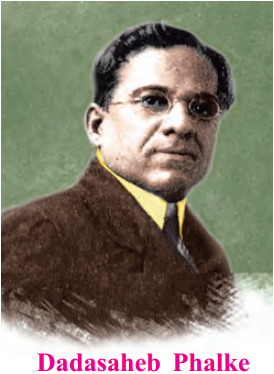
Identify the given picture and write about his contribution:
Maharashtra Board Class 10 History Solutions Chapter 6 Entertainment and History 10
Answer:

  1. The given picture is of Dadasaheb Phalke who is known as the Father of Indian Film Industry.
  2. He released the first movie ‘Raja Harishchandra’ in Mumbai in 1913. He directed the movie which was entirely processed in India for the first time.
  3. He made silent movies named as Mohini- Bhasmasur, Savitri-Satyavana.
  4. He also made documentaries on the rock cut caves of Verul and pilgrim centres of Nashik and Tryambakeshwar. Later, he made historical and mythological movies. Maharashtra Board Solutions
  5. The Government of India has honoured him by instituting Dadasaheb Phalke Award given for lifetime contribution to cinema, which is considered one of the most prestigious awards.

Maharashtra Board Class 10 Political Science Solutions Chapter 1 Working of the Constitution

Balbharti Maharashtra State Board Class 10 Political Science Solutions Chapter 1 Working of the Constitution Notes, Textbook Exercise Important Questions and Answers.

Maharashtra State Board Class 10 Political Science Solutions Chapter 1 Working of the Constitution

Question 1.
Choose the correct option from the given options and complete the sentences.
(1) In Maharashtra …………………… seats are reserved for women in local self-governing institutions.
(a) 25%
(b) 30%
(c) 40%
(d) 50%
Answer:
(d) 50%

Maharashtra Board Solutions

(2) Which of the following laws created a favorable environment for women to secure freedom and self-development?
(a) Right to Information Act
(b) Dowry Prohibition Act
(c) Food Security Act
(d) None of the above
Answer:
(b) Dowry Prohibition Act

(3) The essence of democracy is ……………………
(a) universal adult franchise.
(b) decentralisation of power.
(c) policy of reservation of seats.
(d) judicial decisions.
(d) Judicial decisions
Answer:
(b) decentralization of power

Question 2.
State whether the following statements are true or false. Give reasons for your answer.

(1) Indian democracy is considered the largest democracy in the world.
Answer:
The above statement is True.

  • Indian Constitution cancelled all the conditions which were put for voting before independence thereby increasing the number of voters.
  • The Constitution adopted adult suffrage which has facilitated all adult men and women to cast their vote.
  • The age limit to vote was reduced to 18 years from 21 years which gave opportunity of political participation to the young generation. No other democratic country in the world has voters- in such large numbers.

Hence, Indian democracy is the largest democracy in the world.

(2) Secrecy in the working of Government has increased due to the Right to Information.
Answer:
The above statement is False.

  • To strengthen democracy and increase mutual trust between the government and the people, it is very important that the people should know about ‘the functioning of the government.
  • Transparency and accountability are the hallmarks of good governance.
  • With Right to Information given to the citizens, Government became more transparent. Thus, the Right to Information has reduced element of secrecy in administration.

Maharashtra Board Solutions

(3) The nature of the Constitution is seen as a living document.
Answer:
The above statement is True.

  • Parliament has the powers to make changes in the Constitution according to the changing circumstances and conditions.
  • However, it should be done without tampering or changing the basic structure of the Constitution.
  • As it has kept itself abreast with the changes, S the Constitution became a live and dynamic document instead of a rigid one

Question 3.
Explain the following concepts.

(1) Right based approach
Answer:

  • India adopted democracy after independence. Each government which came to power took efforts to make the democratisation process more profound.
  • In the initial stages, these governments considered citizens as ‘beneficiaries’.
  • After the year 2000, the approach towards citizens changed. Democratic reforms were considered as ‘rights’ of citizens.
  • Hence, the Right to Information, Education and Food Security was granted not as beneficiaries but as rights of the citizens. This approach is known as Rights Based Approach.

(2) Right to information
Answer:

  • In order to bring transparency in the administration and make it accountable, Indian citizens are given Right to Information.
  • Right to Information helped in promoting harmony between government and people and empowered the citizens.
  • It brought transparency in administration, made the government realise that they are answerable to people.
  • It has helped to reduce the element of secrecy which surrounded the functioning of the government. It made the government open and transparent.

Maharashtra Board Solutions

(3) Women representation in the Loksabha.
Answer:

  • The Constitution of India empowers women by granting them equal status with men and equal political rights.
  • 22 women were elected in the Lok Sabha elections held in 1951-52. Their number increased to 66 in 2014 elections.
  • Reservation has been increased to 50% in local self-governing institutions in Maharashtra and in many other states.
  • If the number of women representative increased in Lok Sabha, it will help in reducing incidents of violence against women and increase their involvement in the decision-making process.

Question 4.
Answer in brief.
(1) What are the effects of reducing the voting age from 21 years to 18 years?
Answer:

  • Earlier the Indian Constitution had fixed the voting age of 21 years.
  • The voting age was lowered to 18 years.
  • The young voters secured the right to vote and the increased number of voters was unparalleled. ‘
  • They got the right to decide how their representative should be. ,
  • Moreover, it provided to the unrepresented youth an opportunity to become part of political process being literate and politically conscious.
  • It increased the scope of democracy by including the youth of the country thus making it the largest democracy in the world.

(2) What is meant by establishment of social justice?
Answer:
Establishing social justice means:

  • To eliminate the practices and beliefs which are responsible for injustice towards a person or a community and which hampers collective progress of society should be eliminated.
  • Government policies should be all inclusive which means it should aim at accommodating different sections of society.
  • There should not be any discrimination based on caste, creed, religion, gender, language, property, region or place of birth.
  • All should get equal opportunities for development.

(3) Which decision of the Court has resulted in protection of honour and dignity of women?
Answer:

  • The apex court has given several judgments which have helped in protection of honour and prestige of women.
  • Court gave judgement on Right to alimony as well as Right to equal remuneration.
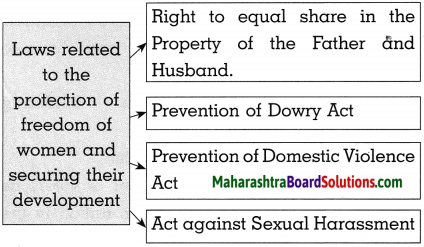
  • Women have an equal share in the property of husband and father. This gave them financial security. Dowry prohibition Act was a measure for women empowerment.
  • The Act against sexual harrassment. Domestic Violence Prohibition Act are also very important in the direction of women empowerment.
  • All these acts emphasised the need to protect women and protect their self-esteem and dignity rejecting the traditional forms of domination and authoritarianism.

Maharashtra Board Solutions

Project
(1) Which information can be secured with the help of the right to information? Find out with the help of your teachers.
(2) Make a list of concessions given by the Government for the students of minority communities?
(3) Visit the official website of the National election commission and collect more information about it.
(4) Take an interview of women representations from local self-governing institutions from your area.

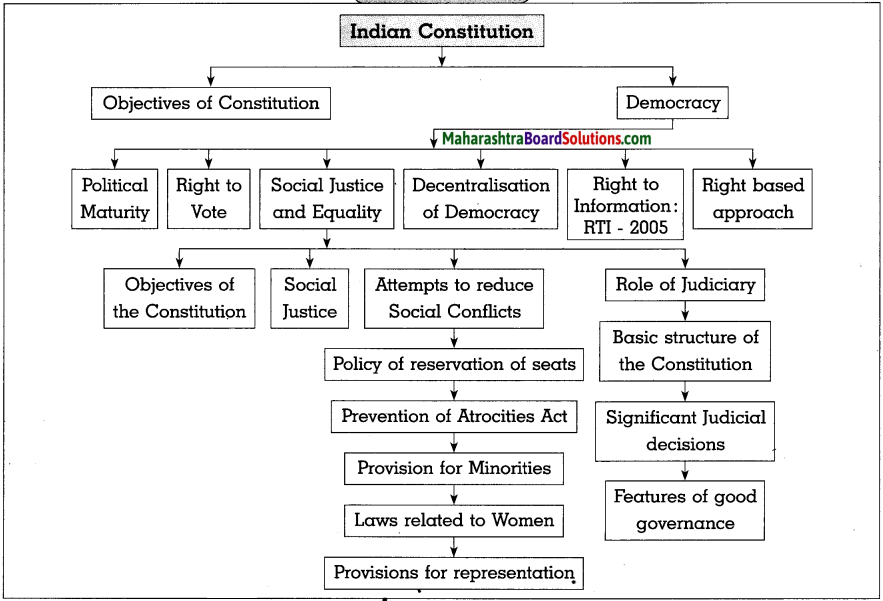
Memory Map
Maharashtra Board Class 10 Political Science Solutions Chapter 1 Working of the Constitution. 7

Q. Complete the sentences by choosing the correct option:

1. Right to Information came into force from
(a) 2002
(b) 2004
(c) 2005
(d) 2006
Answer:
(c) 2005

2. The Indian government has been working in accordance with principle of the
(a) Parliament
(b) President
(c) Constitution
(d) Party
Answer:
(c) Constitution

3. Men and women above years of age can vote in India.
(a) 15
(b) 18
(c) 21
(d) 25
Answer:
(b) 18

4. can make amendments to the Constitution.
(a) President
(b) Prime Minister
(c) Council of Ministers
(d) Parliament
Answer:
(d) Parliament

Maharashtra Board Solutions

5. got recognition because of 73rd and 74th Amendments to the Constitution.
(a) Parliament
(b) Local self-governing institutions
(c) Legislative council
(d) Cooperative societies
Answer:
(b) Local self- governing institutions

6. ………………….. has made the government more transparent.
(a) Equality
(b) Freedom
(c) Right to Information
(d) Social Justice
Answer:
(c) Right to Information

7. and are two features of good governance.
(a) Popular, populist
(b) Efficient, democratic
(c) Transparent, responsible
(d) Equality, decentralization
Answer:
(c) Transparency, responsible.

Q. State whether the following statements are true or false:

1. Indian democracy is evidently unsuccessful.
Answer:
The above statement is False.

  • India has the largest number of voters as compared to any other democratic nation in the world.
  • Free and fair elections which are held regularly is the key for successful democracy.
  • Recurring elections have helped in understanding the political process. As the voting age was reduced from 21 to 18 years, the political participation has increased.
  • Increasing participation of the people in the political process and political contest shows that Indian democracy is successful.

2. There is less friction in all inclusive democracy.
Answer:
The above statement is True.

  • To establish social justice and equality is the aim of democracy. .
  • If all the sections of society are given equal opportunities without any discrimination then all 8 components come into the main stream.
  • In fact, democracy is the process of accommodating different sections of society which ultimately reduces the social conflict.

Maharashtra Board Solutions

Q. Explain the following concepts:

1. Decentralisation:
Answer:

  • Division of power within, a country is known as Decentralisation.
  • Under dictatorship and military rule, the power is centred around one person or a group of individuals.
  • But in democracy the power is divided among Centre, State and Local Self-governing institutions. Decentralisation is the core of democracy.
  • Decentralisation can stop the misuse of power and facilitate common people to participate in democracy.

2. Provisions regarding Minorities:
Answer:

  • Constitution has adopted several measures for the protection of the rights of minorities.
  • Several policies have been adopted by the government to provide them the opportunities in education and employment.
  • The Constitution has prohibited any form of discrimination on the basis of caste, creed, religion, language and region.
  • The Constitution provided rights to the minorities to protect and conserve their language, culture and establish educational institutions

3. Policy of Reservation of Seats:
Answer:

  • Some sections of Indian society were denied social justice.
  • They were deprived of educational and employment opportunities. It was essential to bring them in the main stream of society.
  • The policy was adopted to give reservation to Scheduled Castes and Scheduled Tribes in educational institutions and public employment.
  • Seats were also reserved for Other Backward Classes. Reservation policy gave the deprived classes justice and opportunities for development.

Q. Complete the Concept Map:

1. Complete the Concept Map:
Maharashtra Board Class 10 Political Science Solutions Chapter 1 Working of the Constitution. 1
Answer:
Maharashtra Board Class 10 Political Science Solutions Chapter 1 Working of the Constitution. 2

Maharashtra Board Solutions

2. important to understand:
Maharashtra Board Class 10 Political Science Solutions Chapter 1 Working of the Constitution. 3
Answer:
Maharashtra Board Class 10 Political Science Solutions Chapter 1 Working of the Constitution. 4

3. please understand:
Maharashtra Board Class 10 Political Science Solutions Chapter 1 Working of the Constitution. 5
Answer:
Maharashtra Board Class 10 Political Science Solutions Chapter 1 Working of the Constitution. 6

Q. Answer the following questions in brief:

1. What are the provisions made in the Directive Principles regarding decentralization?
Answer:
The Directive Principles of the Indian Constitution has made provisions for decentralization of power. It means:

  • Indian Constitution has divided the power between the centre, state and local self-governing institutions.
  • The guidelines about empowering the local self-governing bodies are given in the Constitution.
  • After independence, 73rd and 74th Amendment to the Constitution in 1992 has given constitutional status to the local self-governing bodies.
  • Due to this, there is increase in the participation by the people at grass root level. Democracy was put into practice which eventually got strengthened. Decentralisation curbed the misuse of power.

Maharashtra Board Solutions

2. What were the measures taken to increase the number of women in politics?
Answer:

  • The 73rd and 74th Constitutional Amendment provided reservation of 33% seats for women in local self governing institutions.
  • This reservation has been increased to 50% in Maharashtra and many other states.
  • One-third seats and the offices (posts) of Sarpanch, Mayor, etc. are reserved for women. Several policies have been adopted to remove illiteracy among women and to make available opportunities for their development.
  • A bill is tabled in the house to reserve 50% seats in Legislative Assembly and Parliament.

3. The Judiciary in India has played an important role in strengthening democracy. Explain.
Answer:

  • The Judiciary has always taken into consideration the fundamental objectives of the Constitution and also the intention of its framers.
  • While interpreting the Constitution, it has taken care that its basic structure is not altered as Constitution is foundation of our democracy.
  • The important role played by judiciary is in strengthening and helping democracy to achieve the objectives of social justice and equality.

4. Which particular Laws/Acts created a favourable environment for the protection of freedom of women and secure their development?
Answer:

  1. Several policies have been adopted in the post-independence period for empowering women.
  2. Provisions were made in the Constitution to provide opportunities for progress.
  3. Many laws were passed to empower them. They are:
    • Right to have equal share in the property of father and husband.
    • Dowry Prohibition Act.
    • Act against Sexual Harassment.
    • Domestic Violence Prohibition Act.

Q. Give your opinion:

1. What measures should be adopted to increase the number of women in representative democracy?
Answer:
Several restrictions were imposed in the name of traditions and practices, making’ the workspace of women limited to home.

  • To curb injustice the representation of women should increase in all institutions. The 73rd and 74th Amendment reserved 33% of seats for women in local self governing institutions.
  • Access to more and more social and political fields should be made available for women. They should be involved in the decision-making process and work for their betterment.
  • This would ultimately lead to eliminating injustice done to them and will enhance their self respect and status.

Maharashtra Board Solutions

2. Do you agree that Indian democracy has become profound?
Answer:
I entirely agree that Indian democracy has become profound.

  • The Indian Constitution has laid down representative structure of democracy.
  • The actual practice of the principles of democracy is the essence of representative system.
  • People have direct representation in Lok Sabha, Rajya Sabha and Local Self-Government Institutions.
  • Free and fair elections are held at regular intervals to elect representatives.
  • Citizens cast their votes weighing the public issues and policies related to it. All the above factors show that Indian democracy has become profound.

3. Do you think that citizens in India should 8 have the right to employment? (Discuss – Textbook page 70)
Answer:
I agree that all Indian citizens should get I employment.

  • If they are deprived of employment opportunities their families would face hunger and starvation.
  • Incident of crime will increase in society.
  • Democracy will collapse leading to chaos.
  • More and more employment opportunities S should be generated for their progress.

4. According to you, if everyone gets the right to shelter, how will it affect democracy in 8 India?
Answer:

  • Food, clothing and shelter are the basic necessities of a man.
  • Shelter is not only his necessity but also his right.
  • A permanent need is to get settled in life. 8 If a man gets a home, a large part of his struggle 8 in life will come to an end.
  • The financial burden will be low and he will x work with honesty and will contribute in nation’s X progress.
  • Home for all creates a healthy society. It has an all-round social, economical and psychological effect to strengthen democracy and make it 8 profound.

5. What steps should be taken to stop injustice done to the Backward Classes? OR What efforts should be made to prevent x atrocities?
Answer:
The backward classes have suffered for thousands of years. I feel the following measures x will remove injustice done to the backward classes:

  • Atrocities laws should be made stringent.
  • Fast courts should be set up to handle such cases.
  • Stringent punishment should be given if 8 found guilty.
  • Efforts should be made to improve economic 8 status of the backward classes.
  • The Government should make efforts to establish social justice and equality. .

6. What efforts should be made to bring in all the features of good governance in democracy?
Answer:
For the successful functioning of democracy, good governance is very essential.

  • People should elect good and professional candidates.
  • People should keep watch on the work done by them.
  • Corrupt candidates should not be elected or re-elected.
  • People should respond to various policies which are beneficial for society.
  • People should pressurise the government to start various developmental policies for country’s progress.

Maharashtra Board Solutions

Q. B Can you tell the reasons for the following changes?

1. Some seats were reserved for women to increase their participation in political process.
Answer:

  • Women empowerment movement started after independence.
  • All the countries in the world started increasing number of women representatives.
  • The 73rd and 74th constitutional amendment reserved 33% seats for women in local self- governing institutions.
  • Some seats are kept reserved for women to increase their participation in political process.
  • Some seats are kept reserved for weaker sections of the society so that they can get a share in political power.
  • The State Election Commission has been established. The 11th and 12th schedule was added to the constitution.

2. Some seats are kept reserved for weaker sections of the society so that they can get a share in political power.
Answer:

  • The weaker sections suffered injustice for thousand of years.
  • The opportunities of education and employment had been denied to them.
  • In order to establish social justice and equality, reservations are now given to the weaker sections.

3. The State Election Commissions were set up.
Answer:

  • Elections for the Parliament and State Assemblies are conducted by the National Election Commission.
  • It was impossible to put upon the local self government bodies the responsibility of conducting elections. Hence the State Election Commissions were formed.

Maharashtra Board Solutions

4. 11th and 12th Schedule was added to the Constitution.
Answer:

  • The 11th schedule of Indian Constitution was added in 1992 by the 73rd Constitution Amendment Act. This schedule contains 29 subjects related to panchayat.
  • The 74th Amendment to the Constitution added 12th schedule and covered 18 subjects related to the Municipalities.
  • ”It gave constitutional status to Municipalities and Panchayats and aimed to strengthen rural and urban governments so that they can function efficiently.

Maharashtra Board 10th Class Maths Part 2 Problem Set 5 Solutions Chapter 5 Co-ordinate Geometry

Balbharti Maharashtra State Board Class 10 Maths Solutions covers the Problem Set 5 Geometry 10th Class Maths Part 2 Answers Solutions Chapter 5 Co-ordinate Geometry.

Problem Set 5 Geometry 10th Std Maths Part 2 Answers Chapter 5 Co-ordinate Geometry

Question 1.
Fill in the blanks using correct alternatives.

i. Seg AB is parallel to Y-axis and co-ordinates of point A are (1, 3), then co-ordinates of point B can be _______.
(A) (3,1)
(B) (5,3)
(C) (3,0)
(D) (1,-3)
Answer: (D)
Since, seg AB || Y-axis.
∴ x co-ordinate of all points on seg AB
will be the same,
x co-ordinate of A (1, 3) = 1
x co-ordinate of B (1, – 3) = 1
∴ Option (D) is correct.

ii. Out of the following, point lies to the right of the origin on X-axis.
(A) (-2,0)
(B) (0,2)
(C) (2,3)
(D) (2,0)
Answer: (D)

iii. Distance of point (-3, 4) from the origin is _________.
(A) 7
(B) 1
(C) 5
(D) -5
Answer: (C)
Distance of (-3, 4) from origin
\(\begin{array}{l}{=\sqrt{(-3)^{2}+(4)^{2}}} \\ {=\sqrt{9+16}} \\ {=\sqrt{25}=5}\end{array}\)

iv. A line makes an angle of 30° with the positive direction of X-axis. So the slope of the line is ________.
(A) \(\frac { 1 }{ 2 } \)
(B) \(\frac{\sqrt{3}}{2}\)
(C) \(\frac{1}{\sqrt{3}}\)
(D) \(\sqrt { 3 }\)
Answer: (C)

Question 2.
Determine whether the given points are collinear.
i. A (0, 2), B (1, -0.5), C (2, -3)
ii. P(1,2), Q(2,\(\frac { 8 }{ 5 } \)),R(3,\(\frac { 6 }{ 5 } \))
iii L (1, 2), M (5, 3), N (8, 6)
Solution:
Maharashtra Board Class 10 Maths Solutions Chapter 5 Co-ordinate Geometry Problem Set 5 1
∴ slope of line AB = slope of line BC
∴ line AB || line BC
Also, point B is common to both the lines.
∴ Both lines are the same.
∴ Points A, B and C are collinear.

Maharashtra Board Class 10 Maths Solutions Chapter 5 Co-ordinate Geometry Problem Set 5 2
∴ slope of line PQ = slope of line QR
∴ line PQ || line QR
Also, point Q is common to both the lines.
∴ Both lines are the same.
∴ Points P, Q and R are collinear.

Maharashtra Board Class 10 Maths Solutions Chapter 5 Co-ordinate Geometry Problem Set 5 3
∴ slope of line LM ≠ slope of line MN
∴ Points L, M and N are not collinear.
[Note: Students can solve the above problems by using distance formula.]

Question 3.
Find the co-ordinates of the midpoint of the line segment joining P (0,6) and Q (12,20).
Solution:
P(x1,y1) = P (0, 6), Q(x2, y2) = Q (12, 20)
Here, x1 = 0, y1 = 6, x2 = 12, y2 = 20
∴ Co-ordinates of the midpoint of seg PQ
Maharashtra Board Class 10 Maths Solutions Chapter 5 Co-ordinate Geometry Problem Set 5 4
∴ The co-ordinates of the midpoint of seg PQ are (6,13).

Question 4.
Find the ratio in which the line segment joining the points A (3, 8) and B (-9, 3) is divided by the Y-axis.
Solution:
Let C be a point on Y-axis which divides seg AB in the ratio m : n.
Point C lies on the Y-axis
∴ its x co-ordinate is 0.
Let C = (0, y)
Here A (x1,y1) = A(3, 8)
B (x2, y2) = B (-9, 3)
∴ By section formula,
Maharashtra Board Class 10 Maths Solutions Chapter 5 Co-ordinate Geometry Problem Set 5 5
Maharashtra Board Class 10 Maths Solutions Chapter 5 Co-ordinate Geometry Problem Set 5 6
∴ Y-axis divides the seg AB in the ratio 1 : 3.

Question 5.
Find the point on X-axis which is equidistant from P (2, -5) and Q (-2,9).
Solution:
Let point R be on the X-axis which is equidistant from points P and Q.
Point R lies on X-axis.
∴ its y co-ordinate is 0.
Let R = (x, 0)
R is equidistant from points P and Q.
∴ PR = QR
Maharashtra Board Class 10 Maths Solutions Chapter 5 Co-ordinate Geometry Problem Set 5 7
∴ (x – 2)2 + [0 – (-5)]2 = [x – (- 2)]2 + (0 – 9)2 …[Squaring both sides]
∴ (x – 2)2 + (5)2 = (x + 2)2 + (-9)2
∴ 4 – 4x + x2 + 25 = 4 + 4x + x2 + 81
∴ – 8x = 56
∴ x = -7
∴ The point on X-axis which is equidistant from points P and Q is (-7,0).

Question 6.
Find the distances between the following points.
i. A (a, 0), B (0, a)
ii. P (-6, -3), Q (-1, 9)
iii. R (-3a, a), S (a, -2a)
Solution:
i. Let A (x1, y1) and B (x2, y2) be the given points.
∴ x1 = a, y1 = 0, x2 = 0, y2 = a
By distance formula,
Maharashtra Board Class 10 Maths Solutions Chapter 5 Co-ordinate Geometry Problem Set 5 8
∴ d(A, B) = a\(\sqrt { 2 }\) units

ii. Let P (x1, y1) and Q (x2, y2) be the given points.
∴ x1 = -6, y1 = -3, x2 = -1, y2 = 9
By distance formula,
Maharashtra Board Class 10 Maths Solutions Chapter 5 Co-ordinate Geometry Problem Set 5 9
∴ d(P, Q) = 13 units

iii. Let R (x1, y1) and S (x2, y2) be the given points.
∴ x1 = -3a, y1 = a, x2 = a, y2 = -2a
By distance formula,
Maharashtra Board Class 10 Maths Solutions Chapter 5 Co-ordinate Geometry Problem Set 5 10
∴ d(R, S) = 5a units

Question 7.
Find the co-ordinates of the circumcentre of a triangle whose vertices are (-3,1), (0, -2) and (1,3).
Solution:
Let A (-3, 1), B (0, -2) and C (1, 3) be the vertices of the triangle.
Suppose O (h, k) is the circumcentre of ∆ABC.
Maharashtra Board Class 10 Maths Solutions Chapter 5 Co-ordinate Geometry Problem Set 5 11
∴ (h + 3)2 + (k – 1)2 = h2 + (k + 2)2
∴ h2 + 6h + 9 + k2 – 2k + 1 = h2 + k2 + 4k + 4
∴ 6h – 2k + 10 = 4k + 4
∴ 6h – 2k – 4k = 4 – 10
∴ 6h – 6k = – 6
∴ h – k = -1 ,..(i)[Dividing both sides by 6]
OB = OC …[Radii of the same circle]
Maharashtra Board Class 10 Maths Solutions Chapter 5 Co-ordinate Geometry Problem Set 5 12
∴ h2 + (k + 2)2 = (h – 1)2 + (k – 3)2
∴ h2 + k2 + 4k + 4 = h2 – 2h + 1 + k2 – 6k + 9
∴ 4k + 4 = -2h + 1 – 6k + 9
∴ 2h+ 10k = 6
∴ h + 5k = 3 …(ii)
Subtracting equation (ii) from (i), we get
Maharashtra Board Class 10 Maths Solutions Chapter 5 Co-ordinate Geometry Problem Set 5 13
∴ The co-ordinates of the circumcentre of the triangle are (\(\frac { -1 }{ 3 } \),\(\frac { 2 }{ 3 } \))

Question 8.
In the following examples, can the segment joining the given points form a triangle? If triangle is formed, state the type of the triangle considering sides of the triangle.
i. L (6, 4), M (-5, -3), N (-6, 8)
ii. P (-2, -6), Q (-4, -2), R (-5, 0)
iii. A(\(\sqrt { 2 }\),\(\sqrt { 2 }\)),B(-\(\sqrt { 2 }\),-\(\sqrt { 2 }\)),C(\(\sqrt { 6 }\),\(\sqrt { 6 }\))
Solution:
i. By distance formula,
Maharashtra Board Class 10 Maths Solutions Chapter 5 Co-ordinate Geometry Problem Set 5 14
∴ d(M, N) + d (L, N) > d (L, M)
∴ Points L, M, N are non collinear points.
We can construct a triangle through 3 non collinear points.
∴ The segment joining the given points form a triangle.
Since MN ≠ LN ≠ LM
∴ ∆LMN is a scalene triangle.
∴ The segments joining the points L, M and N will form a scalene triangle.

ii. By distance formula,
Maharashtra Board Class 10 Maths Solutions Chapter 5 Co-ordinate Geometry Problem Set 5 15
Maharashtra Board Class 10 Maths Solutions Chapter 5 Co-ordinate Geometry Problem Set 5 16
∴ d(P, Q) + d(Q, R) = d (P, R) …[From (iii)]
∴ Points P, Q, R are collinear points.
We cannot construct a triangle through 3 collinear points.
∴ The segments joining the points P, Q and R will not form a triangle.

iii. By distance formula,
Maharashtra Board Class 10 Maths Solutions Chapter 5 Co-ordinate Geometry Problem Set 5 17
∴ d(A, B) + d(B, C) + d(A, C) … [From (iii)]
∴ Points A, B, C are non collinear points.
We can construct a triangle through 3 non collinear points.
∴ The segment joining the given points form a triangle.
Since, AB = BC = AC
∴ ∆ABC is an equilateral triangle.
∴ The segments joining the points A, B and C will form an equilateral triangle.

Question 9.
Find k, if the line passing through points P (-12, -3) and Q (4, k) has slope \(\frac { 1 }{ 2 } \).
Solution:
P(x1,y1) = P(-12,-3),
Q(X2,T2) = Q(4, k)
Here, x1 = -12, x2 = 4, y1 = -3, y2 = k
Maharashtra Board Class 10 Maths Solutions Chapter 5 Co-ordinate Geometry Problem Set 5 18
But, slope of line PQ (m) is \(\frac { 1 }{ 2 } \) ….[Given]
∴ \(\frac { 1 }{ 2 } \) = \(\frac { k+3 }{ 16 } \)
∴ \(\frac { 16 }{ 2 } \) = k + 3
∴ 8 = k + 3
∴ k = 5
The value of k is 5.

Question 10.
Show that the line joining the points A (4,8) and B (5, 5) is parallel to the line joining the points C (2, 4) and D (1 ,7).
Proof:
Maharashtra Board Class 10 Maths Solutions Chapter 5 Co-ordinate Geometry Problem Set 5 19
∴ Slope of line AB = Slope of line CD
Parallel lines have equal slope.
∴ line AB || line CD

Question 11.
Show that points P (1, -2), Q (5, 2), R (3, -1), S (-1, -5) are the vertices of a parallelogram.
Proof:
By distance formula,
Maharashtra Board Class 10 Maths Solutions Chapter 5 Co-ordinate Geometry Problem Set 5 20
In ꠸PQRS,
PQ = RS … [From (i) and (iii)]
QR = PS … [From (ii) and (iv)]
∴ ꠸ PQRS is a parallelogram.
[A quadrilateral is a parallelogram, if both the pairs of its opposite sides are congruent]
∴ Points P, Q, R and S are the vertices of a parallelogram.

Question 12.
Show that the ꠸PQRS formed by P (2, 1), Q (-1, 3), R (-5, -3) and S (-2, -5) is a rectangle.
Proof:
By distance formula,
Maharashtra Board Class 10 Maths Solutions Chapter 5 Co-ordinate Geometry Problem Set 5 21
Maharashtra Board Class 10 Maths Solutions Chapter 5 Co-ordinate Geometry Problem Set 5 22
In ꠸PQRS,
PQ = RS …[From (i) and (iii)]
QR = PS …[From (ii) and (iv)]
꠸PQRS is a parallelogram.
[A quadrilateral is a parallelogram, if both the pairs of its opposite sides are congruent]
Maharashtra Board Class 10 Maths Solutions Chapter 5 Co-ordinate Geometry Problem Set 5 23
In parallelogram PQRS,
PR = QS … [From (v) and (vi)]
∴ ꠸PQRS is a rectangle.
[A parallelogram is a rectangle if its diagonals are equal]

Question 13.
Find the lengths of the medians of a triangle whose vertices are A (-1, 1), B (5, -3) and C (3,5).
Solution:
Maharashtra Board Class 10 Maths Solutions Chapter 5 Co-ordinate Geometry Problem Set 5 24
Suppose AD, BE and CF are the medians.
∴ Points D, E and F are the midpoints of sides BC, AC and AB respectively.
∴ By midpoint formula,
Maharashtra Board Class 10 Maths Solutions Chapter 5 Co-ordinate Geometry Problem Set 5 25
Maharashtra Board Class 10 Maths Solutions Chapter 5 Co-ordinate Geometry Problem Set 5 26
∴ The lengths of the medians of the triangle 5 units, 2\(\sqrt { 13 }\) units and \(\sqrt { 37 }\) units.

Question 14.
Find the co-ordinates of centroid of the triangle if points D (-7, 6), E (8, 5) and F (2, -2) are the mid points of the sides of that triangle.
Solution:
Maharashtra Board Class 10 Maths Solutions Chapter 5 Co-ordinate Geometry Problem Set 5 27
Suppose A (x1, y1), B (x2, y2) and C (x3, y3) are the vertices of the triangle.
D (-7, 6), E (8, 5) and F (2, -2) are the midpoints of sides BC, AC and AB respectively.
Let G be the centroid of ∆ABC.
D is the midpoint of seg BC.
By midpoint formula,
Maharashtra Board Class 10 Maths Solutions Chapter 5 Co-ordinate Geometry Problem Set 5 28
E is the midpoint of seg AC.
By midpoint formula,
Maharashtra Board Class 10 Maths Solutions Chapter 5 Co-ordinate Geometry Problem Set 5 29
Adding (i), (iii) and (v),
x2 + x3 + x1 + x3 + x1 + x2 = -14 + 16 + 4
∴ 2x1 + 2x2 + 2x3 = 6
∴ x1 + x2 + x3 = 3 …(vii)
Adding (ii), (iv) and (vi),
y2 + y3 + y1 + y3 + y1 +y2 = 12 + 10 – 4
∴ 2y1 + 2y2 + 2y3 = 18
∴ y1 + y2 + y3 = 9 …(viii)
G is the centroid of ∆ABC.
By centroid formula,
Maharashtra Board Class 10 Maths Solutions Chapter 5 Co-ordinate Geometry Problem Set 5 30
∴ The co-ordinates of the centroid of the triangle are (1,3).

Question 15.
Show that A (4, -1), B (6, 0), C (7, -2) and D (5, -3) are vertices of a square.
Proof:
By distance formula,
Maharashtra Board Class 10 Maths Solutions Chapter 5 Co-ordinate Geometry Problem Set 5 31
Maharashtra Board Class 10 Maths Solutions Chapter 5 Co-ordinate Geometry Problem Set 5 32
∴ □ABCD is a square.
[A rhombus is a square if its diagonals are equal]

Question 16.
Find the co-ordinates of circumcentre and radius of circumcircle of AABC if A (7, 1), B (3,5) and C (2,0) are given.
Solution:
Suppose, O (h, k) is the circumcentre of ∆ABC
Maharashtra Board Class 10 Maths Solutions Chapter 5 Co-ordinate Geometry Problem Set 5 33
Maharashtra Board Class 10 Maths Solutions Chapter 5 Co-ordinate Geometry Problem Set 5 34
∴ h2 – 6h + 9 + k2 – 10k + 25 = h2 – 4h + 4 + k2
∴ 2h + 10k = 30
∴ h + 5k = 15 … (ii)[Dividing both sides by 2]
Multiplying equation (i) by 5, we get
25h + 5k = 115 …(iii)
Subtracting equation (ii) from (iii), we get
Maharashtra Board Class 10 Maths Solutions Chapter 5 Co-ordinate Geometry Problem Set 5 35
Substituting the value of h in equation (i), we get
Maharashtra Board Class 10 Maths Solutions Chapter 5 Co-ordinate Geometry Problem Set 5 36
∴ The co-ordinates of the circumcentre of the triangle are (\(\frac { 25 }{ 6 } \),\(\frac { 13 }{ 6 } \)) and radius of circumcircle is \(\frac{13 \sqrt{2}}{6}\) units.

Question 17.
Given A (4, -3), B (8, 5). Find the co-ordinates of the point that divides segment AB in the ratio 3:1.
Solution:
Suppose point C divides seg AB in the ratio 3:1.
Here; A(x1, y1) = A (4, -3)
B (x2, y2) = B (8, 5)
By section formula,
Maharashtra Board Class 10 Maths Solutions Chapter 5 Co-ordinate Geometry Problem Set 5 37
∴ The co-ordinates of point dividing seg AB in ratio 3 : 1 are (7, 3).

Question 18.
Find the type of the quadrilateral if points A (-4, -2), B (-3, -7), C (3, -2) and D (2, 3) are joined serially.
Solution:
Maharashtra Board Class 10 Maths Solutions Chapter 5 Co-ordinate Geometry Problem Set 5 38
Slope of AB = slope of CD
∴ line AB || line CD
slope of BC = slope of AD
∴ line BC || line AD
Both the pairs of opposite sides of ∆ABCD are parallel.
∴ ꠸ ABCD is a parallelogram.
∴ The quadrilateral formed by joining the points A, B, C and D is a parallelogram.

Question 19.
The line segment AB is divided into five congruent parts at P, Q, R and S such that A-P-Q-R-S-B. If point Q (12, 14) and S (4, 18) are given, find the co-ordinates of A, P, R, B.
Solution:
Maharashtra Board Class 10 Maths Solutions Chapter 5 Co-ordinate Geometry Problem Set 5 39
Points P, Q, R and S divide seg AB in five congruent parts.
Let A (x1, y1), B (x2, y2), P (x3, y3) and
R (x4, y4) be the given points.
Point R is the midpoint of seg QS.
By midpoint formula,
x co-ordinate of R = \(\frac { 12+4 }{ 2 } \) = \(\frac { 16 }{ 2 } \) = 8
y co-ordinate of R = \(\frac { 14+18 }{ 2 } \) = \(\frac { 32 }{ 2 } \) = 16
∴ co-ordinates of R are (8, 16).
Point Q is the midpoint of seg PR.
By midpoint formula,
Maharashtra Board Class 10 Maths Solutions Chapter 5 Co-ordinate Geometry Problem Set 5 40
∴ 28 = y3 + 16
∴ y3 = 12
∴ P(x3,y3) = (16, 12)
∴ co-ordinates of P are (16, 12).
Point P is the midpoint of seg AQ.
By midpoint formula,
Maharashtra Board Class 10 Maths Solutions Chapter 5 Co-ordinate Geometry Problem Set 5 41
∴ co-ordinates of A are (20, 10).
Point S is the midpoint of seg RB.
By midpoint formula,
Maharashtra Board Class 10 Maths Solutions Chapter 5 Co-ordinate Geometry Problem Set 5 42
∴ 36 = y2 + 16
∴ y2 = 20
∴ B(x2, y2) = (0, 20)
∴ co-ordinates of B are (0, 20).
∴ The co-ordinates of points A, P, R and B are (20, 10), (16, 12), (8, 16) and (0, 20) respectively.

Question 20.
Find the co-ordinates of the centre of the circle passing through the points P (6, -6), Q (3, -7) and R (3,3).
Solution:
Suppose O (h, k) is the centre of the circle passing through the points P, Q and R.
Maharashtra Board Class 10 Maths Solutions Chapter 5 Co-ordinate Geometry Problem Set 5 43
∴ (h – 6)2 + (k + 6)2 = (h – 3)2 + (k + 7)2
∴ h2 – 12h + 36 + k2 + 12k + 36
= h2 – 6h + 9 + k2 + 14k + 49
∴ 6h + 2k = 14
∴ 3h + k = 7 …(i)[Dividing both sides by 2]
OP = OR …[Radii of the same circle]
Maharashtra Board Class 10 Maths Solutions Chapter 5 Co-ordinate Geometry Problem Set 5 44
∴ (h – 6)2 + (k + 6)2 = (h – 3)2 + (k – 3)2
∴ h2 – 12h + 36 + k2 + 12k + 36
= h2 – 6h + 9 + k2 – 6k + 9
∴ 6h – 18k = 54
∴ 3h – 9k = 27 …(ii)[Dividing both sides by 2]
Subtracting equation (ii) from (i), we get
Maharashtra Board Class 10 Maths Solutions Chapter 5 Co-ordinate Geometry Problem Set 5 45
Substituting the value of k in equation (i), we get
3h – 2 = 7
∴ 3h = 9
∴ h = \(\frac { 9 }{ 3 } \) = 3
∴ The co-ordinates of the centre of the circle are (3, -2).

Question 21.
Find the possible pairs of co-ordinates of the fourth vertex D of the parallelogram, if three of its vertices are A (5, 6), B (1, -2) and C (3, -2).
Solution:
Maharashtra Board Class 10 Maths Solutions Chapter 5 Co-ordinate Geometry Problem Set 5 46
Let the points A (5, 6), B (1, -2) and C (3, -2) be the three vertices of a parallelogram.
The fourth vertex can be point D or point Di or point D2 as shown in the figure.
Let D(x1,y1), D, (x2, y2) and D2 (x3,y3).
Consider the parallelogram ACBD.
The diagonals of a parallelogram bisect each other.
∴ midpoint of DC = midpoint of AB
Maharashtra Board Class 10 Maths Solutions Chapter 5 Co-ordinate Geometry Problem Set 5 47
Maharashtra Board Class 10 Maths Solutions Chapter 5 Co-ordinate Geometry Problem Set 5 48
Co-ordinates of point D(x1, y1) are (3, 6).
Consider the parallelogram ABD1C.
The diagonals of a parallelogram bisect each other.
∴ midpoint of AD1 = midpoint of BC
Maharashtra Board Class 10 Maths Solutions Chapter 5 Co-ordinate Geometry Problem Set 5 49
∴ Co-ordinates of D1(x2,y2) are (-1,-10).
Consider the parallelogram ABCD2.
The diagonals of a parallelogram bisect each other.
∴ midpoint of BD2 = midpoint of AC
Maharashtra Board Class 10 Maths Solutions Chapter 5 Co-ordinate Geometry Problem Set 5 50
∴ co-ordinates of point D2 (x3, y3) are (7, 6).
∴ The possible pairs of co-ordinates of the fourth vertex D of the parallelogram are (3, 6), (-1,-10) and (7,6).

Question 22.
Find the slope of the diagonals of a quadrilateral with vertices A (1, 7), B (6,3), C (0, -3) and D (-3,3).
Solution:
Suppose ABCD is the given quadrilateral.
Maharashtra Board Class 10 Maths Solutions Chapter 5 Co-ordinate Geometry Problem Set 5 51
∴ The slopes of the diagonals of the quadrilateral are 10 and 0.

Maharashtra Board Class 10 History Solutions Chapter 3 Applied History

Balbharti Maharashtra State Board Class 10 History Solutions Chapter 3 Applied History Notes, Textbook Exercise Important Questions and Answers.

Maharashtra State Board Class 10 History Solutions Chapter 3 Applied History

Question 1.
(a) Choose the correct option from the given options and complete the statement.
(1) The earliest museum in the world was discovered in the excavations at the city of ……………..………. .
(a) Delhi
(b) Harappa
(c) Ur
(d) Kolkata
Answer:
(c) Ur

Maharashtra Board Solutions

(2) The National Archives of India is in ……………..………. .
(a) New Delhi
(b) Kolkata
(c) Mumbai
(d) Chennai
Answer:
(a) New Delhi

(b) Identify and write the wrong pair in the following set.
(1) Kootiyattam- Sanskrit theatre, Kerala
(2) Ramman- Dance form in West Bengal
(3) Ramlila- Traditional Performance of the Ramayana in Uttar Pradesh
(4) Kalbelia- Folk songs and dances of Rajasthan.
Answer:
(2) Wrong pair: Ramman – Dance form in West Bengal

Question 2.
Explain the following concepts :
(1) Applied History
Answer:

  •  When one subject is applied to different fields and conclusions are derived, it is known as application of that subject.
  • When objectives of History are applied to other subjects; new conclusions are obtained.
  • This is known as ‘Applied History’. It is also known as Public History.
  • We get insights of the events that took place in the past through history.
  • Applied History is concerned with application of knowledge of history to provide guidance in finding solutions.
  • Contemporary social issues and include them in social planning.
  • Thus Applied History’ is a field of study concerned with the application of history for the benefit of people in contemporary and future times.

Maharashtra Board Solutions

(2) Archives
Answer:

  •  A place where historical documents are preserved is called an ‘Archive’.
  • Many old documents, official records, old films, records of treaties are kept at this place.
  • We get references of original documents because of Archives.
  • A study of historical events of a particular period is possible.
  • We come to know about language, script used in a particular period/era.
  • The National Archives of India is in Delhi. It is the largest Archive in Asia.
  • Every state in India maintains its archives independently.

Question 3.
Complete the following concept chart.
Maharashtra Board Class 10 History Solutions Chapter 3 Applied History 1
Answer:
Maharashtra Board Class 10 History Solutions Chapter 3 Applied History 2

Question 4.
Explain the following statements with reasons.
(1) It is essential to study the history of technology.
Answer:

  • Man acquired different skills at various stages in his evolution process.
  • From mxking stone tools to developing new techniques of agriculture production, he learnt many skills and entered in the age of science.
  • Agricultural production, commodity production, architecture, engineering, etc.
  • underwent several changes. Production increased manifold bcause of technology.
  • Hence, it is necessary to know the history of technology in order to understand the development in mechanisation and mutual dependence between science and technology.

Maharashtra Board Solutions

(2) The list of world Heritage Sites is announced by UNESCO.
Answer:

  • Cultural heritage is a form of human creation. It is a cultural treasure that has been inherited from our ancestors.
  • We feel connected to it and hence preserve and conserve it.
  • This heritage is our asset that binds us to our past and hence we should preserve it for the benefit of future generations.
  • In order to save this heritage, UNESCO has announced some directives.
  • On the basis of those directives, list of sites, and traditions are declared as ‘World Heritage’.
  • It has helped us in promoting these sites as tourist places.

Question 5.
Write elaborate answers
(1) How is the method of history useful in the research of
(a) Science
(b) Arts
(c) Management Studies
Answer:
Each field has its own history of building’ knowledge. The direction of development in every field is dependent on the stcrte of available knowledge in that field. The method of history has proved valuable in the research of various fields.

(a) Science: Scientific discoveries /invenfions take place because of humdn efforts to satisfy needs and curiosity. These efforts are based on scientific knowledge that already existed. Knowledge of the history of science helps in understanding the reasons, chronology and factors that facilitated a scientific invention/discovery. Knowledge of history of science helps in every field.

(b) Art: Development of any style of art lies in their expression through intellectual, emotional and cultural traditions. While studying any art form we have to understand the history of its traditions, the key to the expressions in it, and emotional temperament of the artist. Prevalent art style in the given period can be understood with the help of cultural history.

(c) Management Studies: All components like means of production, human resources, processes of production, the chain of market and sales, etc. are interrelated and require management.

Different social and economic institutions are involved in these industrial and commercial processes. Knowledge of similar functional systems of the past is essential to bring about changes, improvements and make the management smooth and efficient. It becomes necessary to know its history.

(2) How can we correlate applied history with our present?
Answer:
History gives us knowledge about the events that happened in past. Applied history helps us in understanding how the knowledge can be put to use for our benefit as well as for the benefit of future generations. Applied history is correlated with our present in the following ways:

(1) Knowledge of our past helps us in deciding our course of action in present. The.heritage of our ancestors exists in tangible and intangible- form. We have the curiosity to know more about our part because they represent the creative thoughts and traditions of that period.

(2) With the help of applied history we can not only come to know about the heritage but also conserve and preserve it.

(3) We can be better equipped to face social challenges in the present because the knowledge of history can provide guidance in finding solutions to contemporary social issues and incorporate them in the ’social planning.

(4) The direction of future development is S decided when we rightly analyse our present with our knowledge of the past acquired through applied history.

Maharashtra Board Solutions

(3) Suggest at least 10 solutions for the preservation of the sources of history.
Answer:
There are three types of sources which are used to study history. They are written, oral and material sources. These sources are preserved in different ways. According to me, the following measures should be taken to preserve the sources:

  1. A regular repair and maintenance work of forts, memorials and palaces should be carried out. Timely action should be taken to avoid vandalisation of historic and public places.
  2. Historical coins, weapons should be handled with precaution and utmost care. They should be kept in a safe place to avoid the possibility of theft.
  3. Social awareness regarding the conservation and preservation of our cultural and natural heritage should be created. People will develop affinity towards the heritage and feel connected.
  4. Variations in environment and climatic conditions pose a threat to monumental structures. Humidity, dampness, moulds and pollution cause irrevocable damage to manuscripts, rare artefacts, statues, coins, etc.
  5. To protect them, special arrangements have to be made like rooms with controlled temperature or sanitising and detoxing the rooms.
  6. Oral literature like owis, folk songs should be compiled and written down.
  7. Public training programmes should be conducted for understanding the importance of history.
  8. Experts from different fields should be involved in preservation and conservation projects. S Stringent laws should be enacted to protect the monuments.
  9. Above all, people’s participation in conservation and preservation process is paramount.

(4) What objectives can be fulfilled through the heritage projects.
Answer:
The following objectives can be fulfilled through the heritage projects:

  • Preservation, conservation and development of heritage sites can be done without any change in its original state/ structure.
  • The local social structure and psychology of the local people, challenges they face in the present situations and their expectations can be surveyed.
  • In the process of completing the project of conservation, preservation and development of a heritage site due precaution should be taken to avoid hurting the sentiments of the local people.
  • Participation of the local people in the proposed project can be facilitated.
  • In order to engage and employ the local skills in a creative way and create better opportunities of livelihood, it becomes easier to design systematic plans.

Project
Show the Indian heritage sites on the map of India.
Answer:

Memory Map
Maharashtra Board Class 10 History Solutions Chapter 3 Applied History 3

Question 6.
Complete the sentences by choosing the correct option:
(a) ……………………… Institute of Art, Design and Technology at Bengaluru has an independent department named ‘Centre for Public History’.
(a) Pitch
(b) INTACH
(c) Shrushti
(d) AIMS
Answer:
(c) Shrushti

Maharashtra Board Solutions

(b) ……………………… is the mother of science and all other branches of knowledge.
(a) Philosophy
(b) History
(c) Technology
(d) Mythology
Answer:
(a) Philosophy

(c) In order to preserve and conserve cultural and natural heritage for the benefit of future generations ……………………… has given directives.
(a) UNICEF
(b) UN
(c) UNESCO
(d) INTACH
Answer:
(c) UNESCO

(d) The ……………………… in the Satara District of the Western Ghats is included in the list of World Natural Heritage.
(a) Balaghat Mountain
(b) Melghat
(c) Masai Plateau
(d) Kas Plateau
Answer:
(d) Kas Plateau

(e) The main office of the National Film Archives of India is situated at ……………………… .
(a) Delhi
(b) Mumbai
(c) Pune
(d) Nagpur
Answer:
(c) Pune

(f) Excavations at the city of ‘Ur’ in Mesopotamia were conducted by ……………………… .
(a) Nathaniel Wallick
(b) Ennigaldi
(c) Leonard Wolley
(d) Sir John Marshall
Answer:
(c) Leonard Wolley.

Question 7.
Identify the wrong pair in the following, and write it:

(1) Kootiyattam(a) Sanskrit theatre, Kerala
(2) Ramman(b) Dance form in West Bengal
(3) Ramlila(c) Traditional performance of Ramayana in Uttar Pradesh
(4) Kalbelia(d) Folk songs and dances of Rajasthan

Answer:
Wrong pair: Ramman – Dance form in West Bengal

Maharashtra Board Solutions

(2)

Cultural HeritagePlace
(1) Red Fort(a) Udaipur
(2) Jantar Mantar(b) Jaipur
(3) Brihadeeshvara Temple(c) Thanjavur
(4) Capital Complex(d) Chandigarh

Answer:
Wrong pair: Red Fort – Udaipur

Question 8.
Complete the graphical presentation:
(1)

Answer:

(2)

Answer:

Maharashtra Board Solutions

(3)

Answer:

Question 9.
Explain the following concept:
(a) Natural Heritage:
Answer:

  • In Cultural heritage what we inherit is man-made but Natural heritage is bestowed upon us by Nature.
  • The concept of natural heritage gives importance to the thought of biodiversity.
  • The following things are included in natural heritage:
    • Fauna
    • Flora
    • Ecology required for sustaining animal and plant life, flora and fauna of a particular region.
    • Geomorphic characteristics, sanctuaries, mountain ranges, river valleys, lakes and dams are all part of natural heritage.

Question 10.
Write short notes:
(a) Importance of Applied History:
Answer:

  • Applied History is a field of study which helps us understand our ancient heritage.
  • We realise the importance of preserving our heritage.
  • The process of preservation and conservation of tangible and intangible heritage sites generate employment opportunities.
  • The study of Applied History help us to get a better understanding of the present and can provide guidance for the future.

Maharashtra Board Solutions

(b) Preservation of cultural heritage of India:
Answer:
Conservation and preservation of India’s cultural heritage is done at different levels:

  1. Archaeological Survey of India (ASI) is an important body of Indian government which mainly does the work of conservation and preservation along with State Departments of Archaeology.
  2. INTACH (Indiqn National Trust for Art and Cultural Heritage) is actively working in this field.
  3. Local self-government bodies, social institutions all over India, people who have love for history are seen involved in the work of preservation of our heritage.
  4. The work of conservation and preservation of cultural and natural heritage requires participation of experts from various fields as well as local people.

(c) Indian Museum:
Answer:

  • The Indian Museum at Kolkata is the oldest museum and one of the important heritage sites of India.
  • Nathaniel Wallich, a Danish botanist, founded the museum in 1814 C.E. He was also its first curator.
  • The museum has three main departments Arts, Archaeology and Anthropology.
  • Other affiliated departments are conservation, publication, photography, exhibition- presentation, model-making, training, library and security.

(d) National Film Archives:
Answer:

  • The main office of the National Rim Archives of India is located at Pune and was established in 1964.
  • It functions as the Media Unit of the Ministry of Information and Broadcasting of the Indian Government.
  • It was established with the view of three objectives. They are:
    • To search and obtain the rare Indian films and preserve our heritage for the benefit of future generations.
    • To categorise important aspects of films, create documentation and do research.
    • To establish a centre for dissemination of ‘films culture’.

Question 11.
Explain the following statements giving reasons:
(a) It is essential to study the history of philosophy.
Answer:

  • With the passage of time, many schools of thought came into existence with different ideologies.
  • These ideologies had their effect on people and society as a whole.
  • What led to the origin of various ideologies, the intellectual tradition giving rise to those ideologies and their historical development needs to be researched.
  • To know about the progress of those ideologies, their development and expansion or downfall we need to have knowledge of the history of philosophy.

(b) It is important to know the history of Industry and Commerce.
Answer:

  • With the growth of industry and trade, the field of mutual social transactions also expand.
  • It promoted development of the network of cultural interactions.
  • As the nature of market and commerce changed sp did the nature of human relationships and the social organisation.
  • This series of changes is influenced by prevalent culture, social structure and economic system.
  • All this is an integral part of the industrial and commercial management.

Therefore, it becomes important to know the history of Industry and Commerce.

Maharashtra Board Solutions

(c) It is necessary to preserve and conserve our natural and cultural heritage.
Answer:

  • The visible and invisible relics of the past exist in the present.
  • They represent the thought and traditions of our ancestors.
  • We nurture some kind of curiosity and attraction towards them.
  • The history of our heritage links us with our origin.

Therefore, it becomes necessary to preserve and conserve for our future benefit as well as for the benefit of future generations.

Question 12.
Answer the following in 25-30 words:
(a) Explain the concept of ‘Public History’.
Answer:

  • Public History also known as ‘Applied History’ is a field of study concerned with the application of history for the benefit of people in the contemporary and future life.
  • It provides solutions to the contemporary social issues and incorporate them in social planning.
  • It helps to overcome misgivings about history and makes history meaningful in everyday life connecting people to history.

(b) What is the role of UNESCO in the context of heritage sites?
Answer:
The role of UNESCO, the global agency of United Nations, is as follows:

  • For preservation and conservation of natural and cultural heritage which is in a ruined state because of years of neglect, UNESCO has announced some directive principles.
  • The organisation announces list which includes the names of sites and traditions which meet the criteria.
  • On the basis of those directives it declares a list of site and traditions of world heritage.

(c) Find out the cultural heritage sites located in Maharashtra and write their names.
Answer:
The following places in Maharashtra are included in the list of cultural heritage sites declared by UNESCO:

  • Ajanta Caves
  • Verul (Ellora) Caves and Kailas Temple
  • Elephanta Caves
  • Chhatrapati Shivaji Maharaj Terminus, Mumbai.

Many forts like the Raigad, Devgiri, Janjira and Sindhudurg are part of the cultural heritage Of Maharashtra though they are not included in the list.

(d) What are the misgivings about history among the people?
Answer:
There are many misgivings about history among the people:

  • History is a subject only for historians and students who pursue higher studies in history.
  • It has no relevance or applicability in our day-to-day life.
  • History is nothing but piece of information about the battles fought by kings and politics.
  • History cannot be connected to an economically productive field.

Maharashtra Board Solutions

(e) Where can we trace the roots of philosophy?
Answer:

  • Ancient people all over the world tried to speculate the relationship between the universe and human existence.
  • This gave rise to various myths about origin of this world, universal order, human life.
  • Imagination about gods and goddesses, rituals to please them and philosophical explanation of rituals.
  • Thus, the roots of philosophy can be traced in these speculations and ponderings of mythological stories.

(f) What are the opportunities created by affiliated professional fields of Applied History?
Answer:
Affiliated fields of Applied History which include museums, archives, tourism ‘and hospitality, entertainment, mass media, etc. needs the following professionals:

  • Experts like Historians, Archaeologists, Sociologists, legal experts, etc. are assigned new projects.
  • Officers like Managers, Secretaries and Directors are taken into service.
  • Technicians like engineers, architects, skilled photographers, laboratory assistants, archive management professionals are hired.
  • Tourist guides, boarding and lodging, food services, entertainment and related business get a wide scope for flourishing.

(g) What are the main objectives of ‘National Film Archives’?
Answer:
The main objectives of ‘National Rim Archives’ are as follows:

  • To research and obtain the rare Indian films.
  • To preserve such films for the benefit of future generations.
  • To categorise the important aspects of films to create documentation, catalogue them -and carry out research in the field.
  • To establish a centre for dissemination of films culture.

(h) How can we increase people’s participation in the field of applied history?
Answer:

  • The field of applied history includes museums, archives, collection and maintenance of artefacts.
  • Tourism creates interest in history.
  • Awareness is created among people to preserve ancient monuments and sites in their vicinity.
  • This realisation increases people’s participation in the field of applied history.

(i) Write information on World Heritage sites in Maharashtra.
Answer:
Maharashtra is endowed with many natural and historical sites. Among them the prominent ones are Ajanta caves, Verul caves, Gharapuri/Elephanta caves and Chhatrapati Shivaji Maharaj Terminus Railway Station at Mumbai.

Chhatrapati Shivaji Maharaj Terminus is finest example of Indo-Gothic architecture emerged in India during British rule. It stands witness to the British empire, freedom struggle and transformation of our country into a modern nation. It needs conservation as it a architectural marvel which stood the test of times recently when there was a terror attack on Mumbai city.

Maharashtra Board Solutions

(j) What is the role of Applied History?
Answer:
The role of Applied History is as follows:

  • In public training programmes for understanding the importance of history.
  • Using knowledge of history, to create awareness regarding the conservation and preservation of our cultural and natural heritage.
  • To facilitate participation of people in various projects and programmes related to applied history even in their capacity as tourists.
  • To enhance professional skills of people and to develop industrial commercial field.
  • To carry out preparatory work and plan for effective implementation of heritage projects.

Question 13.
Read the given passage carefully and answer the questions given below:
(a) Who built this museum?
Answer:
This museum was built by Ennigaldi, the princess of Mesopotamia.

(b) Where was the earliest museum in the world discovered? Who discovered it?
Answer:
The earliest museum in the world was discovered in the city of ‘Ur’ in Mesopotamia. It was discovered by Leonard Woolley.

(c) What is a noteworthy feature of this museum?
Answer:
A noteworthy feature of this museum is the clay tablets inscribed with the descriptions of exhibited artefacts.

Question 14.
Write elaborate answers: OR Answer in detail:
(a) Who does the work of conservation and preservation of the cultural heritage of Indian?
Answer:
The preservation and conservation of Indian cultural heritage is done at various stages:

  • The work of preservation and conservation primarily falls under jurisdiction of the Archaeological Survey of India.
  • In addition, INTACH (Indian National Trust for Art and Cultural Heritage) is also actively working .in this field.
  • Experts from various fields and local people too participate in the work of conservation and preservation of natural and cultural heritage.

Question 15.
Observe the picture and write information about it:
Maharashtra Board Class 10 History Solutions Chapter 3 Applied History 5
Answer:

  • This picture is of the largest Indian rock-cut ancient Hindu temple located in the Ellora cave.
  • This famous rock-cut Shiva temple was constructed during the reign of Rashtrakuta king Krishna I.
  • It is regarded as a marvel of architecture.
  • It bears an eloquent testimony to the high level skill attained by India in the arts of sculpture and architecture under the Rashtrakuta patronage.
  • A sculpture of an elephant and a pillar can be seen in the picture.
  • The famous rock cut temple in Maharashtra was declared as a world heritage site by UNESCO in 1983.

Maharashtra Board Solutions

Brain Teaser

Hints:
Across:
(1) Queen’s stepwell at Patan
(2) Dancing, singing, drumming ritual of Manipur
(3) Religious festival and ritual theatre of Garhwal
(4) Archaeological site of Nalanda University
(5) World famous monument at Agra
(6) Famous city built by emperor Akbar marking his victory
(7) Sanskrit Theatre: Kerala

Down:
(1) The traditional performance of Ramayan in Uttar Pradesh
(2) Ellora caves also known as caves
(3) Observatory at Jaipur, Rajasthan
(4) Group of monuments at (place) in Karnataka
(5) Archaeological park at Pavagadh
(6) Folk songs and dances of Rajasthan
(7) A ritual theatre of Kerala
Maharashtra Board Class 10 History Solutions Chapter 3 Applied History 6

Maharashtra Board 10th Class Maths Part 1 Practice Set 3.4 Solutions Chapter 3 Arithmetic Progression

Balbharti Maharashtra State Board Class 10 Maths Solutions covers the Practice Set 3.4 Algebra 10th Class Maths Part 1 Answers Solutions Chapter 3 Arithmetic Progression.

Practice Set 3.4 Algebra 10th Std Maths Part 1 Answers Chapter 3 Arithmetic Progression

Question 1.
On 1st Jan 2016, Sanika decides to save ₹ 10, ₹ 11 on second day, ₹ 12 on third day. If she decides to save like this, then on 31st Dec 2016 what would be her total saving?
Solution:
Maharashtra Board Class 10 Maths Solutions Chapter 3 Arithmetic Progression Practice Set 3.4 1
∴ Sanika’s total saving on 31st December 2016 would be ₹ 70455.

Question 2.
A man borrows ₹ 8000 and agrees to repay with a total interest of ₹ 1360 in 12 monthly instalments. Each instalment being less than the preceding one by ₹ 40. Find the amount of the first and last instalment.
Solution:
i. The instalments are in A.P.
Amount repaid in 12 instalments (S12)
= Amount borrowed + total interest
= 8000 + 1360
∴ S12 = 9360
Number of instalments (n) = 12
Each instalment is less than the preceding one by ₹ 40.
∴ d = -40
Maharashtra Board Class 10 Maths Solutions Chapter 3 Arithmetic Progression Practice Set 3.4 2
∴ Amount of the first instalment is ₹ 1000 and that of the last instalment is ₹ 560.

Question 3.
Sachin invested in a national saving certificate scheme. In the first year he invested ₹ 5000, in the second year ₹ 7000, in the third year ₹ 9000 and so on. Find the total amount that he invested in 12 years.
Solution:
i. Amount invested by Sachin in each year are as follows:
5000, 7000, 9000, …
The above sequence is an A.P.
∴ a = 5000, d = 7000 – 5000 = 2000, n = 12

Maharashtra Board Class 10 Maths Solutions Chapter 3 Arithmetic Progression Practice Set 3.4 3
∴ The total amount invested by Sachin in 12 years is ₹ 1,92,000.

Question 4.
There is an auditorium with 27 rows of seats. There are 20 seats in the first row, 22 seats in the second row, 24 seats in the third row and so on. Find the number of seats in the 15th row and also find how many total seats are there in the auditorium?
Solution:
i. The number of seats arranged row-wise are as follows:
20, 22, 24,
The above sequence is an A.P.
∴ a = 20, d = 22 – 20 = 2, n = 27

ii. tn = a + (n – 1)d
∴ t15 = 20 + (15 – 1)2
= 20 + 14 × 2
= 20 + 28
∴ t15 = 48
∴ The number of seats in the 15th row is 48.
Maharashtra Board Class 10 Maths Solutions Chapter 3 Arithmetic Progression Practice Set 3.4 4
∴ Total seats in the auditorium are 1242.

Question 5.
Kargil’s temperature was recorded in a week from Monday to Saturday. All readings were in A.P. The sum of temperatures of Monday and Saturday was 5°C more than sum of temperatures of Tuesday and Saturday. If temperature of Wednesday was -30° Celsius then find the temperature on the other five days.
Solution:
Let the temperatures from Monday to Saturday in A.P. be
a, a + d, a + 2d, a + 3d, a + 4d, a + 5d.
According to the first condition,
(a) + (a + 5d) = (a + d) + (a + 5d) + 5°
∴ d = -5°
According to the second condition,
a + 2d = -30°
∴ a + 2(-5°) = -30°
∴ a – 10° = -30°
∴ a = -30° + 10° = -20°
∴ a + d = -20° – 5° = – 25°
a + 3d = -20° + 3(- 5°) = -20° – 15° = -35°
a + 4d = -20° + 4(-5°) = -20° – 20° = -40°
a + 5d = -20° + 5(-5°) = -20° – 25° = -45°
∴ The temperatures on the other five days are
-20°C, -25° C, -35° C, -40° C and -45° C.

Question 6.
On the world environment day tree plantation programme was arranged on a land which is triangular in shape. Trees are planted such that in the first row there is one tree, in the second row there are two trees, in the third row three trees and so on. Find the total number of trees in the 25 rows.
Solution:
i. The number of frees planted row-wise are as follows:
1,2,3,…
The above sequence is an A.P.
∴ a = 1, d = 2 – 1 = 1,n = 25
Maharashtra Board Class 10 Maths Solutions Chapter 3 Arithmetic Progression Practice Set 3.4 5
∴ The total number of trees in 25 rows are 325.

Maharashtra Board Class 10 English Solutions Unit 2.3 Connecting the Dots

Balbharti Maharashtra State Board Class 10 English Solutions Unit 2.3 Connecting the Dots Notes, Textbook Exercise Important Questions and Answers.

Maharashtra State Board Class 10 English Kumarbharati Textbook Solutions Unit 2.3 Connecting the Dots

Maharashtra Board Class 10 English Solutions Unit 2.3 Warming Up Questions and Answers

Question 1.
(A) Connect the dots to get what means a lot to you.
Maharashtra Board Class 10 English Solutions Unit 2.3 Connecting the Dots 1
The word is ……………………………… .
Answer:
Maharashtra Board Class 10 English Solutions Unit 2.3 Connecting the Dots 6
The word is SUN

Maharashtra Board Solutions

(B) With your benchmark, use the letters given above to make a word register of ‘computers’. Set a time -limit of 5 minutes and compare your list with that of other classmates.
Answer:
AI, adobe, android, arithmetic, binary, browser, byte, bit, download, document, data, database, disk, format, http, hardware, homepage, java, keyboard, key, Microsoft, malware, memory, network, netscape, program, reboot, spam, spreadsheet, software, virus, web, windows, update, zip.

Question 2.
You are quite familiar with computers, especially the personal computer. Form pairs and make a list of famous computer manufacturing companies. One is given to you.
(a) Apple
(b) ……………………….
(c) ……………………….
(d) ……………………….
(e) ……………………….
(f) ……………………….
Answer:
(a) Apple
(b) Samsung
(c) IBM
(d) Lenovo
(e) Foxconn
(f) HP Inc.

Question 3.
Complete the web by filling the various benefits of computers.

Maharashtra Board Class 10 English Solutions Unit 2.3 Connecting the Dots 2
Answer:
Maharashtra Board Class 10 English Solutions Unit 2.3 Connecting the Dots 5

Question 4.
(A) Expand the following into their full forms.
(a) that’s
(b) didn’t
(c) here’s
(d) can’t
(e) I’ve
Answer:
(a) that’s – that is
(b) didn’t – did not
(c) here’s – here is
(d) can’t – cannot
(e) I’ve – I have

(B) Write the shortened forms of the following.
(a) You have ……………………….
(b) I would ……………………….
(c) It is ……………………….
(d) You are ……………………….
(e) He will ……………………….
(f) I had ……………………….
(g) will not ……………………….
(h) shall not ……………………….
(i) are not ……………………….
(j) need not ……………………….
(k) must not ……………………….
(l) ought not ……………………….
Answer:
(a) you have – you’ve
(b) I would – I’d
(c) it is – it’s
(d) you are – you’re
(e) he will – he’ll
(f) I had – rd
(g) will not – won’t
(h) shall not – shan’t
(i) arc not – aren’t
(j) need not – needn’t
(k) must not – mustn’t
(l) ought not – oughtn’t

Maharashtra Board Solutions

Connecting the Dots Class 10 English Workshop Questions and Answers Maharashtra Board

Question 1.
(A) Rearrange the incidents in the life of Steve Jobs in chronological order.
(a) Steve Jobs started Next.
(b) Jobs underwent a surgery.
(c) Jobs learned about serif and sans serif type faces.
(d) Jobs returned to Apple Inc.
(e) Jobs married Laurene.
(f) Jobs was diagnosed with cancer.
(g) Jobs dropped out of Reed College.
Answer:
(a) Jobs started Next.
(b) Jobs underwent surgery.
(c) Jobs learned about serif and san serif typefaces.
(d) Jobs returned to Apple Inc.
(e) Jobs married Laurene.
(f) Jobs was diagnosed with cancer.
(g) Jobs dropped out of Reed College.

(B) Read the third story again. Complete the flow-chart given below.
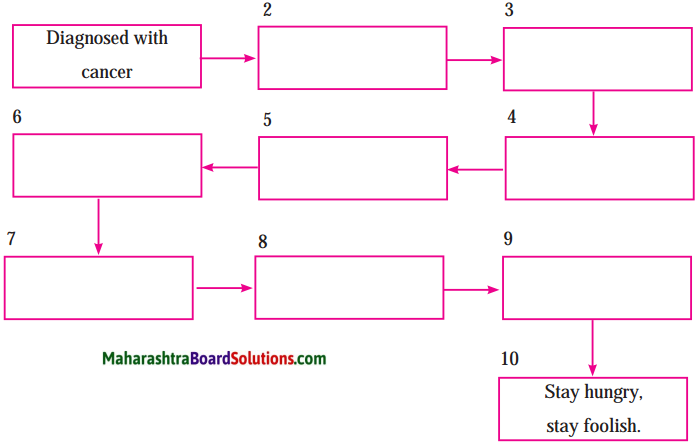
Maharashtra Board Class 10 English Solutions Unit 2.3 Connecting the Dots 3
Answer:
Maharashtra Board Class 10 English Solutions Unit 2.3 Connecting the Dots 7

Maharashtra Board Solutions

Question 2.
Read the lesson. Refer to a dictionary and match the words in column ‘A’ with their meanings in column ‘B’.

No‘A’‘B’
(a)diagnosis(i)the power believed to control events
(b)devastating(ii)complete list of items especially in a special order and description.
(c)intuition(iii)act of identifying the nature of a problem or illness.
(d)calligraphy(iv)power of understanding situations or people’s feelings before hand.
(e)destiny(v)causing great destruction
(f)catalogue(vi)beautiful handwriting done with a special pen or brush.

Answer:

No‘A’‘B’
(a)diagnosis(iii)act of identifying the nature of a problem or illness.
(b)devastating(v)causing great destruction
(c)intuition(iv)power of understanding situations or people’s feelings before hand.
(d)calligraphy(vi)beautiful handwriting done with a special pen or brush.
(e)destiny(a)the power believed to control events
(f)catalogue(ii)complete list of items especially in a special order and description.

Question 3.
Go through all the three stories. Identify some qualities of Steve Jobs and complete the web chart.
Maharashtra Board Class 10 English Solutions Unit 2.3 Connecting the Dots 4
Answer:
Maharashtra Board Class 10 English Solutions Unit 2.3 Connecting the Dots 8

Maharashtra Board Solutions

Question 4.
Complete the following table.
‘The Three Stories in the Life of Steve Jobs’

AboutSetbacksReactionsAchievements and benefits
First story
Second story
Third story

Answer:

AboutSetbacksReac­tionsAchieve­ments and benefits
First storyCollege daysno boarding and lodgingmanaged with friends and at a templelearnt calligraphy
Second storystarting ’Apple’fired from the companystarted a new company ‘Next’most creative period; renaissance’ of ‘Apple’
Third storydeathdiagnosed with cancersurgery, curelearnt not to waste time living someone else’s life

Question 5.
Say HOW?
→ the calligraphy classes helped Steve Jobs after 10 years.
Answer:
10 years later when Steve Jobs was designing the first Macintosh computer, he recalled what he had learned in the calligraphy classes about serif and san serif typefaces as well as other elements that go into great typography. He designed all this into the Macintosh computer.

→ You can connect dots.
Answer:
We can’t connect dots by looking forward; we can only connect them looking backwards. We have to trust that the dots will somehow connect in our destiny.

→ Jobs reacted later on, after the shock of being fired from Apple.
Answer:
After he overcame the shock of being fired from Apple, Jobs felt the lightness of being a beginner again. He felt free to enter one of the most creative periods of his life. He started two companies – Next and Pixar.

Maharashtra Board Solutions

→ Jobs was cured of a rare cancer.
Answer:
Jobs was diagnosed with a very rare form of pancreatic cancer. It was curable by surgery. Jobs had the surgery and he was cured.

→ Jobs acquired the famous words ‘Stay Hungry. Stay Foolish’
Answer:
When Jobs was young, he used to read an amazing publication called The Whole Earth Catalogue’. In the final issue was a photograph of an early morning country road beneath which were the words ‘Stay Hungry, Stay Foolish’. Steve acquired these words from the magazine.

Question 6.
Besides those given at the end of the talk by Steve Jobs, pick out other pieces of advice that Jobs gives in his speech.
Answer:
(a) Learn to connect the dots.
(b) Learn whatever you can whenever you can.
(c) We can learn even from negative experiences.
(d) Have trust that somehow the dots will connect in your future.
(e) Have trust in your gut. destiny, life, karma, whatever …
(f) Love what you do.
(g) Keep looking for what you love and don’t ever settle for less.
(h) Even under the most devastating circumstances, you can start all over again.
(i) Don’t lose faith.
(j) Your time is limited, so don’t waste it lining someone else’s life.

Question 7.
(A) Use the following idioms/phrases in sentences of your own.
(a) drop in …………………..
(b) drop out …………………..
(c) stumble on …………………..
(d) look backwards …………………..
(e) look forward …………………..
(f) let (someone) down …………………..
(g) sign off …………………..
(h) begin anew …………………..
Answer:
(a) Though I am not a member of the club, I often play tennis there as a drop in.
(b) I decided to drop out of karate classes as it was taking too much of my time.
(c) While surfing the net, he stumbled into a portal that showed only horror movies.
(d) After his terrible experience in his native place, he went to the city and never looked backwards.
(e) He tried to forget his terrible experience in his native place and looked forward.
(f) He placed great trust in his secretary, and she never let him down.
(g) I would like to sign off by telling you a short story with a beautiful message.
(h) It is never too late to forget past mistakes and begin anew.

Maharashtra Board Solutions

(B) Fill in the gaps in choosing the appropriate idioms.
(drown out, hits in the head with a brick, get one’s affairs in order, connect the dots, begin to dawn, stay hungry)
(a) The wealthy landlord made a will before he could die.
(b) Those who aspire for success should always to learn more.
(c) If you you will realise that crime ultimately leads to poverty.
(d) The siren of the ambulance all other traffic noise.
(e) When the father learned about his son’s misdeeds, it
(f) On reading exactly same essays in both answer sheets, it the examiner, that the students had cheated during exams.
Answer:
(a) Getting his affairs in order
(b) Stay hungry
(c) Connect the dots
(d) Drowned out
(e) It hit him on the head with a brick.
(f) Began to dawn on

Question 8.
(A) Name the Tense of the Verbs underlined to include Time (Past/Present/Future) and Aspect (Simple/Continuous/Perfect/Perfect Continuous)
(1) I slept on the floor
(2) We were designing the first Macintosh computer
(3) It had made all the difference
(4) I am fine, now
(5) I have been facing death
(6) I shall be telling you three stories
Answer:
(1) Time – Past; Aspect – Simple.
(2) Time – Past Tense; Aspect – Progressive (continuous).
(3) Time – Past tense Aspect – Perfect
(4) Time – Present; Aspect – Simple.
(5) Time – Present; Aspect – Perfect.
(6) Time – Future; Aspect – Progressive (continuous).

(B) Change the Tense as instructed.
(1) I got fired. (Future Perfect)
(2) Life hits you in the head. (Present Perfect Continuous)
(3) The dots will somehow connect. (Past Perfect)
(4) I started a company. (Present Continuous)
(5) My doctor advised me. (Past Perfect Continuous)
Answer:
(1) Jobs got fired.
(2) Life hits you in the head.
(3) The dots had somehow connected.
(4) I started a company.
(5) My doctor had been advising me.

Maharashtra Board Solutions

Question 9.
Read the News item and write an application for a suitable job in the same company. Attach a seperate CV/Resume.
May 19, 2016
Apple Opens Development Office in Hyderabad
(A) The new office in Hyderabad will focus on development of maps, Apple products, like iPhone, iPad, Mac. etc. This will create upto 4000 jobs
Answer:

Answer:
Ratan Shah
11 Salsa Apts.
Hafeczpeth
Hyderabad
Telangana – 500 049.
27th May, 2020

The HR Manager
Apple Development Office
18-23, Rd Number 2
Financial District
Nanakram Guda
Hydcrabad
Telangana — 500 032.

Subject : Application for post of Systems Analyst ‘
Sir,
I read the news item in the Times of India’ dated May 20, which stated that Apple has opened a Development office in Hyderabad, which is likely to create up to 4000 jobs. I am interested in applying for the post of Systems Analyst.

I have a bachelor’s degree In Computer Information Systems (CIS) and 6 months experience in Cornputronic& Ltd. as Systems Analyst. I am well-versed in analyzing, designing and implementing Information Systems. I wish to further my prospects and hence am applying to your company.

I do hope that you will give me the opportunity to prove my mettle.

Yours truly,
Ratan Shah

Maharashtra Board Solutions

Attachments: CV, photocopies of Academic and Professional Certificates
Resume:
Name: Ratan Shah
Age: 24 years
Educational Qualification: B.Com (1st class); B.Computer Science (CIS)
Experience: 6 months experience in Computronics Ltd. as Systems Analyst
Marital Status: Single
Special Interests: Chess, Football, Cycling
Contact information: Address as above
Mobile no.: 097

(B) Imagine you are already working as an Engineer in Apple Development Office, Hyderabad. Write an application for 2 weeks leave to the HR Manager as you have to undergo an urgent surgery.
Answer:
Ms. Sara Kanchwala
11 Salsa Apts.
Hafeezpeth
Hyderabad
Telangana 500 049.
3 September, 2020

The HR Manager,
Apple Development Office
18-23, Rd. Number 2
Financial District
Nanakram Guda
Hyderabad
Telangana – 500 032.

Subject : ApplicatIon’ for leave of absence due to Imminent surgery (4th September to 17th September)

Dear Sir,
I had a bad fall a couple of days back and tore a ligament ‘In my knee. The pain is Intense and my doctor has advised me that immediate surgery is necessary.

Please grant me 2 weeks medical leave as the doctor has advised a fortnight’s complete bed rest post-op. Thanking you in advance,

I remain,
Yours truly,
Sara Kanchwala

Question 10.
Prepare a speech on the title “The Will to Win” to be delivered before the class during a competition.
Hints –

  • Title
  • Introduction
  • Objective and Illustrations
  • Specific examples
  • Purpose of the title.
  • Sources/Resourses for implementation.
  • Usefulness/Benefits
  • Conclusion.

Answer:
The Will to Win

Friends,
The topic before us today is The Will to Win’. This title brings to my mind the story of the hare and the tortoise. When the hare challenged the tortoise to a race, the tortoise knew very well that its speed was in no way comparable to that of the hare. Yet this little animal agreed to the race. And why, may I ask you? Only because it had the will to win. Come what may, the tortoise had to prove to the hare that it could win if it wanted to. And finally it won!

This, in fact, is the driving force behind all great ventures and achievements. The Will to Win!

I remember the time when I went to Std. V. My father had been transferred from Agra to Bhusaval. A subject that I had trouble mastering was the language Marathi. Needless to say in the first term I flunked very badly. But I was a student who usually scored high marks in all subjects. This failure was devastating.

However, I did not let it faze me. I took great interest in class lessons. Read my Marathi textbook over and over. Made friends who spoke fluently in Marathi and ventured speaking to them. At first they poked fun at me. But within a month I had picked up the basic structure of the language and began writing answers to questions on my own. Believe it or not, at the end of the term I topped the class in Marathi. ; Today I can speak in the language as if it is my mother tongue.

Friends, my message to you today is that you can do anything. All you require is the will. If you have the will, the skill will follow. So set your goals, define your objectives and I wish all of you the very best in ; whatever you decide to do in life.

Be sure of one thing: If you have the will, You Will Win!

Thank you.

Maharashtra Board Solutions

Question 11.
Project :
Collect more information about Steve Jobs with the help of Internet. Complete it with images into a file.

Question 12.
Do you remember doing some activities in your childhood that you didn’t like it. Form pairs and make a list of all those activities. Do you think, any one of these activities have helped you in solving your problems? Share your experience with the class.

  • chopping vegetables:
  • cleaning the home; sweeping and dusting
  • hanging out clothes to dry
  • looking after my little brother
  • helping dad to repair the bicycle

Answer:
Once while driving home from school, the chain of my bicycle got dislodged and I almost fell off. There was no bicycle repair shop nearby and no passers-by were able to help me. Since I had experience helping dad to repair his bicycle, somehow I managed to get the chain fixed and wobbled back home. My hands were black and dirty with grease and oil, but at least I didn’t have to walk back home, pushing my bicycle along.

Question 13.
Write True or False for these statements: (The answers are given directly and underlined.)
Answer:
(1) Steve Jobs slept in his dorm room. False
(2) Steve took his required courses as a registered student of Reed College. False
(3) During Steve’s College days, one had to pay 5 cents deposit for a Coke bdttle. True
(4) Steve ha’d comfortable college experiences. False

Question 14.
What basic course in Reed College helped while designing the Mac?
Answer:
The basic course of calligraphy in Reed College helped while designing the Mac.

Question 15.
Arrange the following incidents in Steve Jobs’ life in proper sequence based on this passage:
(a) Jobs stayed as a drop-in for 18 months.
(b) Jobs used to sleep on the floor in his friend’s house.
Answer:
(a) Jobs stayed as a drop-in for 18 months.
(b) Jobs used to sleep on the floor in his friend’s house.

Question 16.
Complete the following: (The answers are given directly and underlined.)
(1) Steve’s first story is about connecting the dots.
(2) Steve got one good meal every Sunday night at the Hare Krishna temple.
Answer:
Connecting the dots.
Hare Krishna temple.

Question 17.
What did Steve Jobs do for two years after he joined Reed College?
Answer:
After joining Reed College, for two years Steve would stop taking the required classes that didn’t interest him. Instead he began dropping in on the ones that looked interesting.

Question 18.
List the hardships that Steve faced.
Answer:

  • Steve didn’t have a dorm room and so had to sleep on the floor in friends’ rooms.
  • Steve returned Coke bottles for the 5 cent deposits to buy food with.
  • Steve would walk seven miles across town every Sunday night to get one good meal a week at the Hare Krishna temple.

Maharashtra Board Solutions

Question 19.
Write from the passage a phrase that means ‘Apart from this, I have nothing more to tell.’
Answer:
That’s it.

Question 20.
Choose the correct contextual meaning of the phrase: connecting the dots.
(a) making a pattern with the help of dots
(b) associating one previous idea with other ideas that follow
(c) joining dots in a puzzle to get the correct picture
(d) understanding a procedure
Answer:
(b) associating one previous idea with other ideas that follow

Question 21.
Match the words in column A with their meanings in column B:

AB
(i) intuition (a) a set of characters like letters, symbols, etc. in one design
(ii) calligraphy (b) the style and appearance of printed matter
(iii) typography (c) power of understanding the feelings of people
(iv) typeface (d) beautiful handwriting done with a special pen or brush

Answer:

(i)intuition (c) power of understanding the feelings of people
(ii)calligraphy (d) beautiful handwriting done with a special pen or brush
(iii)ypography (b) the style and appearance of printed matter
(iv)typeface (a) a set of characters like letters, symbols, etc. in one design

Question 22.
It was one of the best decisions I ever made. (Rewrite using ‘better than’.)
Answer:
It was better than most other decisions I ever made.

Question 23.
Personal Response: What impression of Steve Jobs do you get from this passage?
Answer:
In this passage, it appears that Steve Jobs is a student who goes by his impulses. He has a thirst for knowledge, but prefers subjects that he finds interesting and avoids those that he finds uninteresting, even though he has enrolled for them. He is ready to face all kinds of hardships in order to study what he wants to. Steve Jobs had a natural curiosity and intuition. He also had an instinct about what makes something really great and the habit of storing it away in his mind for future use.

Question 24.
Fill in the blanks: (The answers are given directly and underlined.)
(1) Steve designed the Macintosh computer.
(2) Windows copied the Macintosh computer.
(3) It was impossible to connect the dots looking forward when Steve was in college.
(4) You can only connect the dots looking backward.
Answer:
(1) Macintosh
(2) Windows
(3) forward
(4) backward

Maharashtra Board Solutions

Question 25.
Complete the following: (The answers are given directly and underlined.)

(1) The Mac ‘computer which he designed would not have had multiple typefaces or proportionally spaced fonts.
(2) Since Windows just copied Mac, it was likely no personal computer would have had them.
Answer:
(1) not have had multiple typefaces or proportionally spaced fonts.
(2) no personal computer would have had them.

Question 26.
Complete the following: (The answers are given directly and underlined.)
Words connected with typography from the passage are: typeface and font.
Answer:
typeface and font.

Question 27.
Match the words /phrases in column A with their meanings in column B:

(A)(B)
(i) gut (a) Macintosh computer.
(ii) destiny (b) having several parts.
(iii) Mac (c) the power believed to control events.
(iv)multiple (d) courage and determination.

Answer:

AB
(i)gut(d)courage and determination
(ii)destiny(c) the power believed to control events
(iii)Mac(a) Macintosh computer
(iv)multiple(b) having several parts

Question 28.
It was impossible to connect the dots looking forward. (Pick out the verbs and say if they are finite or non-finite.)

Answer:
was – finite; to connect, looking – non-finites

Question 29.
It was very clear. (Rewrite as an exclamatory sentence.)
Answer:
How clear it was!

Question 30.
Mac would never have had multiple typefaces. (Rewrite as an interrogative sentence.)
Answer:
Would Mac ever have had multiple typefaces?

Maharashtra Board Solutions

Question 31.
Personal Response: Write about something which you learned in the past and which has helped you in the present.
Answer:
When I was in Std. V, mother enrol led me for dancing classes, I had to stop when I reached Std. IX. However, now whenever I need a break or I am feeling stressed, I put on some music and dance. That gives me relief from stress.

Question 32.
Name the following: (The answers are given directly and underlined.)
Answer:
(1) The world’s most successful animation studio. Pixar
(2) The company that Steve Jobs took five years to establish. Next
(3) The company that bought Next. Apple
(4) Steve Jobs’ wife. Laurene

Question 33.
What setback did Jobs suffer when he was thirty?
Answer:
When Jobs was thirty, he was fired from the company which he himself had started. This was devastating and a major setback in his life.

Question 34.
Match the words/phrases in column A with their meanings in column B:

AB
(i) renaissance (a) causing great destruction
(ii) to start over (b) lost one’s job
(iii) fired (c) revival
(iv) devastating (d) to begin again

Answer:

AB
(i) renaissance (c) revival
(ii) to start over (d) to begin again
(iii) fired (b) lost one’s job
(iv) devastating (a) causing great destruction

Question 35.
Fill in the blanks choosing the appropriate idioms: (at the heart of, hit him on the head with brick, begin to dawn, lose faith)
(1) Even if you don’t succeed at first, don’t lose faith in yourself.
(2) It is corruption in high places that lies at the heart of the non-development of this locality.
Answer:
(1) Lose faith
(2) At the heart of

Maharashtra Board Solutions

Question 36.
Personal Response: What does this second story of Jobs convey to you?
Answer:
The second story of Jobs – about love and loss – conveys to us that even if our efforts result in complete disaster, we should continue believing in ourselves. It tells us that we should love our work. If we haven’t yet found it, we should keep on searching. We should never accept less than what we aim for in life.

Question 37.
Which quality of Steve Jobs impresses you the most? How would you apply it in your life?
Answer:
I admire Steve’s quality of not giving up even after facing a terribly shocking loss. It inspires me never to be disheartened by failure, but to always keep trying. Even if one loses everything, one has to have the courage to start all over again.

Question 38.
Arrange the following incidents in Steve Jobs’ life in proper sequence based on this passage:
(a) Jobs was advised to get his affairs in order.
(b) Jobs was cured of a rare form of cancer.
Answer:
(a) Jobs was advised to get his affairs in order.
(b) Jobs was cured of a rare form of cancer.

Question 39.
Fill in the blanks: (The answers are given directly and underlined.)
(1) Steve’s third story is about death.
(2) The doctor describes the last stage of cancer as the ‘prepare to die’ stage.
(3) Steve ‘says that you should follow your heart and intuition.
(4) We should not waste time.
Answer:
(1) death
(2) ‘prepare to die’
(3) heart and intuition.
(4) time.

Question 40.
What does Jobs warn you about life and dogma?
Answer:
Jobs warns us not be trapped by dogma. Dogma is living with the results of other people’s thinking. The overpowering influence of other’s opinions should not drown out our own inner voice.

Question 41.
How does Jobs close his address to the graduate students?
Answer:
Steve Jobs closes his address to the graduate students by telling them about an amazing publication called The Whole Earth Catalogue’. In the final issue on the back cover there was a photograph of an early morning country road. Beneath it were the words ‘Stay Hungry, Stay Foolish’. Jobs wishes the students the same words as his farewell message to them.

Question 42.
Write from the passage four medical words / phrases / terms.
Answer:
pancreatic cancer, diagnosis, biopsy, surgery

Maharashtra Board Solutions

Question 43.
Match the words in column ‘A’ with their meanings in column ‘B’:

AB
(a) diagnosis (1) a set of beliefs held by an organisation which others are expected to accept without argument.
(b) catalogue (2) act of identifying the nature of a problem or illness.
(c) dogma (3) in a new or different way.
(d) anew (4) complete list of items especially in a special order and description.

Answer:

AB
(a)diagnosis(2) act of identifying the nature of a problem or illness.
(b)catalogue(4) complete list, of items especially in a special order and description.
(c)dogma(1) a set of beliefs held by an organisation which others are expected to accept without argument
(d)anew(3) in a new or different way.

Question 44.
Choose correct question tags for the sentences and rewrite: wasn’t it? isn’t it? aren’t I? will you?
(a) Don’t be trapped by dogma.
(b) It was their farewell message.
(c) Your time is limited.
(d) I’m fine now.
Answer:
(a) Don’t be trapped by dogma, will you?
(b) It was their farewell message, wasn’t it?
(c) Your time is limited, isn’t it?
(d) I’m fine now, aren’t I?

Question 45.
Don’t waste it. (Rewrite without ‘don’t’.)
Answer:
Avoid wasting it.

Question 46.
Personal Response: “Your time is limited. So don’t waste it living someone else’s life.” What are your views about these statements?
Answer:
These are the conclusions that Steve Jobs came to when he discovered that he was suffering from pancreatic cancer. Coming face to face with death, he realized how very little time we have on earth to realize our true potential. Most of our lives are spent following the dictates of others. By this statement, Steve Jobs means that we should spend every moment of our lives trying to discover our own potential and determine our own purpose and path in life.

Question 47.
(1) Pick out the compound words from the given words: dropping, calligraphy, backwards, graduate, photograph
(2) Pick out the gerund and use it in your own sentence: I could begin dropping in on the ones that looked interesting.
(3) Punctuate the sentence: heres one ekample reed college offered perhaps the best calligraphy instruction in the country
(4) Spot the error and rewrite the correct sentence: At the calligraphy class, I learn about what make great typography great.
(5) Identify the type of sentence: Don’t settle.
(6) Find out two hidden words of at least 4 letters each from the word ‘devastating’.
(7) Form present participles in which the last letter is doubled: drop, quit
(8) Arrange these words in alphabetical order: friend, follow, found, freed.
Answer:
(1) backwards = back + wards; photograph = photo + graph
(2) Gerund: dropping Sentence: Stop dropping in here without any warning.
(3) Here’s one example: Reed College offered perhaps the best calligraphy instruction in the country.
(4) At the calligraphy class, I learned about what makes great typography great.
(5) Imperative Sentence in the Negative.
(6) devastating-vast, taste (gate, stain.)
(7) dropping, quitting
(8) follow, found, freed, friend

Maharashtra Board Solutions

Question 48.
(1) Write the homophone for the word ‘story’ and frame a sentence.
(2) Rewrite the sentence using the past perfect continuous tense: We were designing the first Macintosh computer.
(3) Rewrite beginning with underlined part: The heaviness of being successful was replaced by the lightness of being a beginner again.
(4) Write a word register for the word: ‘doctor’ (4 words).
Answer:
(1) Homophones: story – storey Sentence: I live in a seven-storys building.
(2) We had been designing the first Macintosh computer.
(3) The lightness of being a beginner again replaced the heaviness of being successful.
(4) physician, surgeon, medico, healer, practitioner. (MD, medic, scientist, specialist)

Question 49.
(1) Use the word,‘trust’ in sentences as a noun as well as a verb.
(2) Underline the modal auxiliary and state its function: I had to take a calligraphy class.
Answer:
(1) (a) I have great trust in my teacher, (noun)
(b) Trust in God. (verb)
(2) I had to take a calligraphy class, (necessity/ obligation/compulsion)

Maharashtra Board Class 10 History Solutions Chapter 4 History of Indian Arts

Balbharti Maharashtra State Board Class 10 History Solutions Chapter 4 History of Indian Arts Notes, Textbook Exercise Important Questions and Answers.

Maharashtra State Board Class 10 History Solutions Chapter 4 History of Indian Arts

Question 1.
(A) Choose the correct option from the given options and complete the statement.
(1) The arts of painting and sculpting are …………….……. .
(a) visual arts
(b) performing arts
(c) folk arts
(d) classical arts
Answer:
(a) visual arts

Maharashtra Board Solutions

(2) The …………….……. saw the rise of Mathura school.
(a) Kushana period
(b) Gupta period
(c) Rashtrakuta period
(d) Maurya period
Answer:
(a) Kushana period

(B) Identify and write the wrong pair in the following set.
(1) Qutub Minar – Mehrauli
(2) Gol Gumbaz – Vijapur
(3) Chhatrapati Shivaji Maharaj Railway Terminus – Delhi
(4) Taj Mahal – Agra
Answer:
(3) Wrong Pair: Chhatrapati Shivaji Maharaj Railway Terminus – Delhi

Question 2.
Write short notes.
(1) Art
Answer:

  • It is a natural instinct in humans to share their emotions, experience, wisdom acquired with others.
  • This act of sharing, results in beautiful creation, called an ‘Art’.
  • Art gives us an experience of different elements.
  • These elements are expressed through sculpture, singing, painting and dance.
  • The crucial factors which are at the root of artistic creation are the imagination power of the artist.
  • The sensibility state of his emotions and skills.

(2) Hemadpanti style
Answer:

  1. Hemadpanti temples were primarily built in 12th- 13th century.
  2. The main feature of this style is its masonry. The walls are built without mortar, by locking stones, using the tenon and mortise joints technique.
  3. Hemadpanti temples are built in square¬shaped and star-shaped designs. In the star¬shaped plan, the outer walls of a temple has a zigzag design which gives interesting effect of alternating light and shadow.
  4. Tourists are attracted to see these beautiful designs. Hemadpanti temples are found at several places in Maharashtra.

(3) Maratha style of painting
Answer:

  • The Maratha style of paintings began to develop in the later half of the 17th century.
  • This style consists of coloured paintings which are in form of murals and miniatures used in manuscripts.
  • Murals of Maratha style can be seen at the entrance of old wadas, in drawing rooms and on the ceilings of the temples.
  • The Maratha style was influenced by the Rajput and European style of paintings.
  • The Maratha style of paintings helps us to understand various things about the times in which it was developed such as lifestyle, attires, customs, etc.

Question 3.
Explain the following statements with reasons.
(1) An expert with deep understanding of art history is required in the art market.
Answer:

  • There is an independent market for purchase and sale of art objects.
  • The authenticity of the object, its standards can only be assessed by an expert.
  • Only an artist can know the exact value of an art object or ensure if it is genuine or not.
  • So, when art objects are assessed all the above points are considered.
  • This requires special expertise. Hence an expert with deep understanding of art history is required for this task.

(2) It is necessary to preserve the tradition like Chitrakathi, which is on the verge of extinction.
Answer:

  1. The stories from Ramayana or Mahabharata narrated with the help of wooden puppets and paintings is known as Chitrakathi or Pinguli tradition.
  2. It is preserved by the Thakur community.
  3. As the Chitrakathi pictures are drawn on papers and painted using col9urs made from natural substances, they deteriorate rapidly if not maintained.
  4. Therefore it is necessarý to preserve the tradition like Chitrakathi as it is part of our glorious cultural heritage and is on the verge of extinction.

Question 4.
Complete the following table.

Temple Architecture NaagaraNaagaraDraavidaHemadpanti
Characteristics
Examples

Answer:

Styles of Temple ArchitectureNagaraDravidHemadpanti
Characteristics(1) Series of miniature towers are arranged
(2) Towers taper towards the top
(3) Tower appears to be continuously rising from the base of the temple to the top.
(1) Temple towers resembled pyramid shape.
(2) Gopura (main entrance) was large and magnificent than the tower.
(3) Mythological stories were carved on walls and ceilings.
(1) The temple structure was star-shaped with outer walls having zigzag design.
(2) The walls were built without using any mortar.
(3) The stones were locked by using the technique of tenon and mortise joints.
Examples(1) Konark Sun Temple
(2) Lingraj Temple of Bhubaneshwar
(3) Kandariya Mahadev temple at Khajuraho
(1) Meenakshi Temple at Madurai
(2) Chariot Temple at Mahabalipuram
(3) Brihadeeshvara temple at Thanjavur
(4) Tirupati Temple
(1) Gondeshwar temple at Sinnar
(2) Ambreshwar temple at Ambarnath
(3) Aundha Nagnath temple at Hingoli
(4) Kopeshwar temple at Khidrapur

Question 5.
Answer the following questions in detail.
(1) Write in detail about folk styles of painting.
Answer:

  • The art of rock painting dates back to Stone Age. These rock paintings have preserved the style of folk painting.
  • Rock paintings usually depict humans, animals and geometric figures.
  • The style of rock paintings seems to be changing according to the cultural changes from Stone age to the beginning of agriculture.
  • Man started depicting flora and fauna in a different style and also figures.
  • There was difference in colours too. Black and Red were used in rock paintings.
  • Colours extracted from natural substances were used.
  • The man started using the knowledge he got from the surroundings and nature and depicted it in the pictures.
  • In the later stage of development, man started customs such as decorating the walls and courtyards (Rangawali).
  • By drawing various figures and symbols or using panels of painting to narrate stories. It helped in the development of folk paintings.

(2) Explain the characteristics of the Islamic architecture in India by giving examples.
Answer:
A blend of Persian, Central Asian, Arabic and pre Islamic native Indian styles created the Islamic architecture of India.
Following are the characteristics of Islamic architecture developed in the medieval period under the patronage of Muslim sultanates:

  • Built in Islamic style, the Kutub Minor is the highest minaret in the world. It is 73 metres (240 ft) in height.
  • The Taj Mahal built by the Mughal emperor Shah Jah’an is looked’ upon as the paramount* example of Islamic’architecture.
  • The Gol Gumbaz at Bijapur in Karnataka built in 17th century is known for its echo which can be heard many times.
  • The forts at Agra and Delhi are known for their massive walls of redstone.
  • The walls are interrupted by graceful curves and lofty bastions. Red sandstone, domes, arches, minarets, magnificance all combined form characteristics of Islamic architecture.

(3) What kind of professional opportunities are available in the field of arts?
Answer:
Various opportunities are available in different fields of art:

  1. Art historian can work in field of journalism. Art students can work in museums, archives, libraries. Information Technology, archaeological research and Indology contribute to recently developed fields like Heritage Management and Cultural Tourism.
  2. An expert in art is required to assess the exact value of an art object and also in its sale and purchase. Experts are required in the field of manufacturing of objects for home decoration.
  3. Ornaments, artistic creations of metals, earthen pots with colourful designs, objects made from cane and bamboo, beautiful glass objects, attractive textiles and clothing all come are under applied arts.
  4. These fields require experts in manufacturing and sales. Hence many opportunities of employment are available in the field of arts.

(4) Observe the illustration of Warli painting on p. 23 and write about:
(a) Depiction of nature
(b) Drawings of human figures
(c) Depiction of occupations
(d) Houses
Answer:
Maharashtra Board Class 10 History Solutions Chapter 4 History of Indian Arts 1
The traditions of Warli painting and Pingul or Chitra Katha in Maharashtra are among the finest examples of folk style of paintings. Divya Somya Mashe, the artist in Thane district has played a great role in making the Warli style of paintings very popular. He has been honored with a number of national and international awards for his paintings. In the year 2011, he was awarded ‘Padmashree’.

Name of the painting tradition:
This picture is from Warli tradition.

Nature’s description:
Artist has sketched trees, leaves and shrubs in the picture. A fish is also drawn.

Sketch of human activities:
Women dancing in a circular pattern is also sketched in the picture.

Designing features:
Pictures of men, women and children are sketched. Warli paintings do not portray the exact objects but only a sketch. Human figures are drawn with the help of a triangle, circle and square which are placed at the tip.

Project
(1) Collect additional information of the World Heritage sites in India.
(2) Observe the sculptors or image-makers at work in your locality and interview them.
Answer:

Memory Map
Maharashtra Board Class 10 History Solutions Chapter 4 History of Indian Arts 2

Question 6.
Complete the sentences by choosing a correct option:
(a) Lalit Kala is also known as …………………… .
(a) Folk art
(b) Aangik Kala
(c) Drik Kala
(d) Nagara art
Answer:
(b) Aangik Kala

(b) Jivya Somya Mashe, an artist in the Thane district played a great role in making the …………………… style of painting very popular.
(a) Chitrakathi
(b) Maratha
(c) Warli
(d) Classical
Answer:
(c) Warli

(c) The Chalukya King, Someshvara, mentioned in …………………… book the tradition of Chitrakathi.
(a) Natyashastra
(b) Kitab-e-Navras
(c) Paintings of Ajanta
(d) Manasollas
Answer:
(d) Manasollas.

(d) The ancient Indian texts mentioned …………………………. styles of Classical Art.
(a) Nine
(b) Thirty-six
(c) Sixty-four
(d) Eighty-four
Answer:
(c) Sixty-four

(e) During the reign, of Mughal Emperor …………………………., the Mughal miniature style showing a blend of Indian and Persian was developed.
(a) Akbar
(b) Aurangzeb
(c) Jahangir
(d) Babur
Answer:
(a) Akbar

(f) Some of the drawings of Gangaram Tambat are preserved in …………………………. university.
(a) Stanford
(b) Cambridge
(c) Oxford
(d) Yale
Answer:
(d) Yale

(g) …………………………. is the characteristic of European style of painting.
(a) Sketching
(b) Exact portrayal of object
(c) Natural colours
(d) Landscape
Answer:
(b) Exact portrayal of object

(h) Replicas of Ajanta paintings was made by
(a) Pestonji Bomanji
(b) Gangaram Tambat
(c) Raja Ravi Verma
(d) James Wales
Answer:
(a) Pestonji Bomanji.

(i) The lion capital of the Ashoka pillar found at …………………………. is the national emblem of India.
(a) Bodhgaya
(b) Patliputra
(c) Sanchi
(d) Sarnath
Answer:
(d) Sarnath

(j) The stupa at …………………………. in Indonesia is the largest stupa in the world.
(a) Ubud
(b) Sigiran
(c) Borobudur
(d) Palembang
Answer:
(c) Borobudur

(k) The …………………………. school of art laid the foundation of Indian iconography.
(a) Gandhar
(b) Nagara
(c) Dravid
(d) Mathura
Answer:
(d) Mathura

(l) The temple architecture developed in India around 4th century C.E. during the …………………………. period.
(a) Kushana
(b) Rashtrakuta
(c) Gupta
(d) Chola
Answer:
(c) Gupta

(m) …………………………. is a blend of Nagara style of architecture of North India and Dravid style of South India.
(a) Gandhar
(b) Mathura
(c) Bhoomija
(d) Vesara
Answer:
(d) Vesara.

(n) The two main branches of the Indian classical music are ………………………… .
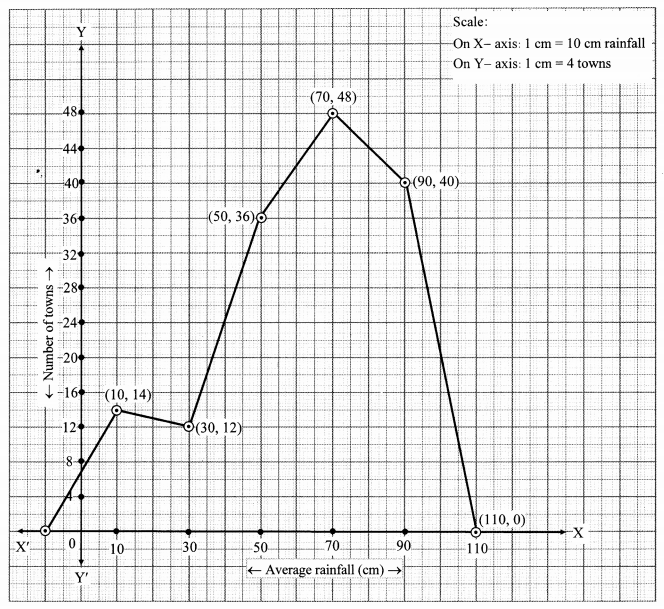
(a) Folk music and Vocal
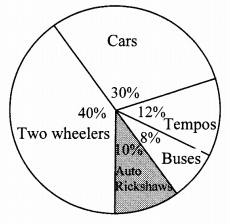
(b) Dadraa and Thumri
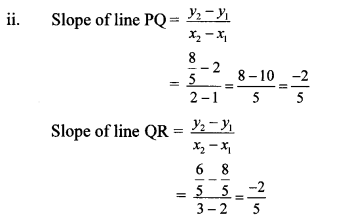
(c) Bhajans and Qawwalis
(d) Hindustani music and Carnatic music
Answer:
(d) Hindustani music and Carnatic music

(o) The text of …………………………. written by Bharatmuni is supposed to be the earliest one discussing music and theatre.
(a) Manasollas
(b) Abhilasha Chintamani
(c) Natyashastra
(d) Rasratnakar
Answer:
(c) Natyashastra

(p) Every year the …………………………. festival is held in Pune.
(a) Kala Ghoda
(b) Gunidas
(c) Savai Gandharva
(d) Gharapuri
Answer:
(c) Savai Gandharva

(q) The ruler of Bijapur, Ibrahim Adilshah wrote …………………………. text in Persian language.
(a) Tuzuk-i-Babari
(b) Padmavat
(c) Akbarnama
(d) Kitab-e-Navras
Answer:
(d) Kitab- e-Navras

(r) …………………………. is a prominent name among artists who created a new style of fusion of Indian and Western dance.
(a) Pandit Shivkumar Sharma
(b) Pandit Hariprasad Chaurasia
(c) Pandit Uday Shankar
(d) Ustad Zakir Hussain
Answer:
(a) Pandit Uday Shankar.

Question 7.
Identify the wrong pair in the following and write it:
(1)

Architectural structurePlace
(1) Kutub Minar(a) Mehrauli
(2) Gol Gumbaz(b) Bijapur
(3) Chhatrapati Shivaji Maharaj Railway Terminus(c) Delhi
(4) Taj Mahal(d) Agra

Answer:
Wrong pair: Chhatrapati Shivaji Maharaj Railway Terminus – Delhi

(2)

PictureStyle
(1) Murals seen in the old wadas at Wai, Menavali(a) Miniature style
(2) Bhimbetka(b) Folk painting
(3) Pictures narrating Ramayana and Mahabharata story(c) Chitrakathi
(4) Painting style in Thane district(d) Warli painting

Answer:
Wrong pair: Murals seen in the old wadas at Wai, Menavali – Miniature style

(3)

Architectural structureStyle
(1) Chhatrapati Shivaji Maharaj Railway Terminus(a) Gothic architecture
(2) Gol Gumbaz(b) Muslim architecture
(3) Temples in South India(c) Nagara architecture
(4) Gondeshwar Temple(d) Hemadpanti architecture

Answer:
Wrong pair: Temples in South India – Nagara architecture

(4)

MonumentEmperors
(1) Completed Kutub Minar(a) Altmash
(2) Construction of Taj Mahal(b) Emperor Akbar
(3) Gol Gumbaz(c) Mohammed Adilshah
(4) Built Sanchi Stupa(d) Emperor Ashoka

Answer:
Wrong pair: Construction of Taj Mahal – Emperor Akbar

Question 3.
Do as directed:
(A) Complete the following concept chart:
(1)
Maharashtra Board Class 10 History Solutions Chapter 4 History of Indian Arts 3
Answer:
Maharashtra Board Class 10 History Solutions Chapter 4 History of Indian Arts 4

(2)
Maharashtra Board Class 10 History Solutions Chapter 4 History of Indian Arts 5
Answer:
Maharashtra Board Class 10 History Solutions Chapter 4 History of Indian Arts 6

(3)
Maharashtra Board Class 10 History Solutions Chapter 4 History of Indian Arts 7
Answer:

Maharashtra Board Class 10 History Solutions Chapter 4 History of Indian Arts 8

(4)
Maharashtra Board Class 10 History Solutions Chapter 4 History of Indian Arts 9
Answer:
Maharashtra Board Class 10 History Solutions Chapter 4 History of Indian Arts 10

(5)
Maharashtra Board Class 10 History Solutions Chapter 4 History of Indian Arts 11
Answer:
Maharashtra Board Class 10 History Solutions Chapter 4 History of Indian Arts 12

(6)
Maharashtra Board Class 10 History Solutions Chapter 4 History of Indian Arts 13
Answer:
Maharashtra Board Class 10 History Solutions Chapter 4 History of Indian Arts 14

(B) Prepare a flow chart on the Development of Indian Iconography.
Answer:
Maharashtra Board Class 10 History Solutions Chapter 4 History of Indian Arts 15

Question 8.
Explain the following concepts:
(a) Style in Art:
Answer:

  • Every artist has its own method of working which becomes his style.
  • When this style is repeated by several artists over a prolonged period of time it becomes a tradition.
  • This tradition is known as an art ‘style’.
  • Such traditions are established in every art style. Various art styles are developed over the years in every culture.
  • The specific art styles indicate the characteristic of a certain region and period.
  • They help us to learn the history of arts of these civilizations.

(b) Classical Style of Paintings:
Answer:

  • Art which is expressed within an established frame of consistent rules is known as classical art. The ancient Indian texts mentioned altogether 64 arts.
  • The aft of painting is mentioned as alekhyam or alekhya vidya in these texts.
  • This alekhya vidya has six main aspects of paintings (Shadange).
  • They are shapes and forms (Roopbheda), expressions (Bhava).
  • Proportionate depiction of various features of an image (Pramana).
  • Aesthetics (Lavanyayojana), resemblance to reality (Sadrushyata) and colour composition (Varnikabhang).
  • Agama text of Jainism and in Puranas various arts like painting, sculpting are explained in context of temple architecture.

Question 9.
Write short notes:
(a) Chitrakathi:
Answer:

  1. The tradition of narrating stones from Ramayana and Mahabharata with the help of wooden puppets and paintings is known as Chitrakathi. It is also known as Pinguli.
  2. This tradition is mentioned in Manasollas, a book written by the Chalukya King Someshvara in the 12th century. People belonging to Thakur community stifi practise this art They are frm village, Pinguli near Kudal in Maharashtra.
  3. The Chitrakathi pictures are drawn on paper and painted with natural substances. To complete the narration of a single story it takes around 30 to 50 pictures.
  4. These pictures are preserved and are passed on from one generation to another. The artists and government are trying to preserve this tradition which is on the verge of extinction.

(b) Miniature Painting:
Answer:

  • Painting in a small size square is called Miniature painting.
  • The miniature reached people through manuscripts. The earlier period of miniature painting shows the influence of Persian style.
  • The Deccan miniature style was developed under the patronage of the Deccan Sultanate.
  • Mughal miniature painting style of painting’ was developed during the reign of Mughal Emperor Akbar. ¡t shows a blend of Indian and Persian style.

(c) Western style of painting:
Answer:

  • Indian artists came under the influence of European style of painting during the British period.
  • An art school at Shaniwar Wada at Pune was established under the leadership of Scottish artist James Wales.
  • J. J. School of art and industry was established in 1857 to offer the courses in European style of painting.
  • Pestonji Bomanji made replicas of Ajanta paintings.
  • lames Wales had done a portrait of Savai Madhavrao and Nana Phadnavis.
  • Exact portrayal of the object of the painting is a characteristic of European style.

(d) Gangaram Tambat:
Answer:

  • An art school was established under the leadership of Scottish artist James Wales at Shanivar Wada in Pune.
  • Marathi artist Gangaram Tambat worked with James Wales.
  • He made drawings of rock-cut caves at Verul and Karle.
  • Some of his drawings are preserved in the Yale Centre of British Art of Yale University.

(e) Temple architecture:
Answer:

  1. Temple architecture began to develop in India around 4th century C.E. during the Gupta period. In the initial stage of the Gupta period, the temples had only the Sanctum Sanctorum (Garbhagriha) and a Veranda with four columns.
  2. Temple architecture reached its peak by the 8th century C. E. and its example is the Kailas temple of Verul. By medieval period various types of temple architecture had developed in India.
  3. The styles of tower (Shikar) determined various styles of temple architecture in India. The Nagara style of North India and Dravid style of South India are two prominent styles of Indian temple architecture. A blend of Nagara and Dravid is known as Vesara style.
  4. Bhoomija style seen in temples of Maharashtra and Madhya Pradesh has very close resemblance to ‘Nagara’ style.

(f) Indo-Gothic Architecture:
Answer:

  1. During the British period, a new architectural style arose in India which was a blend of Indian and Gothic known as Indo-Gothic style of architecture.
  2. During the British period, buildings like churches, government offices, residences of top officials, railway stations were built in Indo-Gothic style of architecture.
  3. Chhatrapati Shivaji Maharaj Railway Terminus in Mumbai is the finest example of Indo- Gothic style of architecture.

(g) Ttitab-e-Navras:
Answer:

  1. Ibrahim Adilshah II, the ruler of Bijapur, wrote a book in Persian language entitled ‘Kitab- e-Navras’. This text is about Indian classical music.
  2. It includes the verses suitable for singing. It is a composition of excellent poetry expressed through Dhrupad style giving the experience of ecstasy to the interested audience.
  3. The Ncrvras mentioned in Sanskrit literature are explained in this text.

Question 10.
Explain the following sentences with reasons:
(a) Indian performing arts were enriched over time.
Answer:

  • A constant stream of rulers like the Greeks, Arabs, Mughals and the British came to India.
  • During their rule, Indian people came into contact with their styles of folk art.
  • The culture which they brought along lasted and blended with existing streams of Indian performing arts.
  • As a result, many styles of classical vocal music, instrumental music and dance came into existence.
  • Therefore Indian performing arts enriched over time.

(b) The field of Applied Arts needs professionals.
Answer:

  • An artistic creation is combined with utilitarian purpose to make it economically viable in applied arts.
  • Many stages of production are reached before the concept of creation becomes a reality.
  • Each field in applied arts requires detailed planning and meticulous management at each stage of production.
  • Ornaments, earthen pots with colourful designs, objects made from Cane and Bamboo, beautiful glass objects.
  • Attractive textiles and clothing all listed under applied arts essentially require trained and skilled individuals at every stage.
  • Some of the production processes of artistic objects have a history of certain traditions. It is important to have knowledge of those traditions.

Hence, it is essential to have trained and skilled professionals at every stage.

Question 11.
Answer the following question in 25-30 words:
(a) Write about follk traditions of sculptural art.
Answer:

  • The tradition of folk art dates back to the Stone Ages.
  • The custom of making clay images for rituals has been prevalent in India since Harappcin times.
  • It has continued even today in many regions of Bengal, Bihar, Gujarat and Rajasthan.
  • During the festivals, Ganesh idols are made along with the masks of Goddess Gauri.
  • Bull figurines are made for the festival of Bailpola.
  • Wooden memorials, Veergals (memorial stones), the decorated clay storage bins, etc.
  • Are examples of folk tradition of sculptural art.
  • The sculptures made for religious and festival reasons became masterpieces of artists’ creation.

(b) Write about Gandhara School of Art.
Answer:

  • The regions around Afghanistan showed great influence of Greeks and Persians from 2nd century B.C.E.
  • Gandhara style of art was a fusion of Greek- Roman and Indian style.
  • Gandhara school was heavily influenced by Greek methodologies.
  • The materials used to make sculptures were Grey sandstone. Mud, Lime and Stucco.
  • Grey sandstone is more prominently used in Gandhara School of Art.
  • The Gandhara school images are known for their anatomical accuracy, spatial depth and foreshortening.
  • The sculptures in Gandhara style are found in Taxila, Peshawar and on the North West Frontier.

(c) Write about development of Indian Iconography.
Answer:

  • The Kushana period from the 1st – 3rd century C.E. saw the rise of Mathura School of Art.
  • The Mathura School of Art laid the foundation of Indian iconography style.
  • The Kushana Kings made use of images of various deities on their coins.
  • During the Gupta period, the ieonographic rules were formulated and standards for sculptural- art were set.
  • The art of making bronze images was developed under the patronage of Chola Kings during 9th-13tji century.
  • Bronze idols of gods and goddesses like Siva-Parvati, Natraj, Lakshmi, Vishnu, etc. were made.

(d) Give information about the rock-cut caves in India.
Answer:

  • The tradition of rock-cut caves originated in India in the 3rd century B.C.E.
  • The entire composition of a rock-cut cave represents a union of architecture and sculptural art.
  • The entrances of such rock-cut caves, interiors with its carved columns and images are excellent specimens of sculptural art.
  • The paintings on the walls and ceilings have survived till today.
  • The rock-cut caves at Ajanta and Verul in Maharashtra were declared as World Heritage Sites in 1983.

(e) Elaborate on the development of temple architecture.
Answer:

  • The temple architecture began to develop in India during the Gupta period in 4th century C.E.
  • The temples built at the beginning of the Gupta period had only the sanctum sanctorum (Garbhagriha) and a veranda with four columns.
  • The magnificent structure of the Kailas temple of Verul gives testimony that temple architecture had reached its peak by the 8th century C.E.
  • Different styles of temple architecture were developed by the medieval period. Some of them are Nagara, Dravid, Vesara and Bhoomija.

(f) What efforts were taken in India to make dance and classical music easily accessible to common people?
Answer:
The following efforts were taken to make dance and music easily accessible to people:

  • Dance programmes and musical festivals were organised at various places.
  • Many people attend these festivals including Indians and foreigners.
  • The Savai Gandharva festival of Pune is very famous.

(g) Write about the work of Pandit Uday Shankar.
Answer:

  • Pandit Uday .Shankar created a fusion of Indian classical dance and European operti.
  • New styles of dancing were developed.
  • He also included various folk dances in his style of fusion.

Thus, the scope of Indian performing arts seems to be constantly expanding.

(h) Which fields are related to applied arts ?
Answer:

  1. An artistic creation with a utilitarian purpose is called applied arts. Industry and advertisement. Interior Design and production of ornamental objects, Art Design of stage backdrops, Art Direction for films and television are the fields of applied arts.
  2. Layout of books, magazines, production of greeting cards, invitation cards, gift objects, calligraphy are also related to applied arts.
  3. Still and animated graphics, created with the help of computers are used for various purposes. This field needs experts with technical knowledge.
  4. In short, whichever art is known and is applied to create something new becomes applied art.

Question 12.
Read the following passage and answer the questions:
(a) In which states of India are the sites of rock paintings found?
Answer:
The sites of rock paintings are found in the states of Madhya Pradesh, Uttar Pradesh, Bihar, Uttarakhand, Karnataka, Andhra Pradesh and Telangana.

(b) How old is the tradition of rock paintings?
Answer:
The tradition of rock painting dates back to the Stone Age.

(c) What are the features of rock paintings?
Answer:

  • Rock paintings depict humans, animals, geometric figures, flora and fauna in various figures and also in colour.
  • Natural colours in black and fed are used in them which are extracted from natural substances.
  • The style of rock paintings seems to be changing according to the cultural changes from Stone Age to the beginning of agriculture.
  • We get to know about ancient people, their natural surroundings and also the way they exploited available natural resources.

Question 13.
Answer the following questions in detail:

(a) Give information on Indian classical sculptural art.
Answer:
The development of folk styles of sculptural art led to the formation of rules for classical sculptural art and it evolved.

  1. The folk style of sculpture-making began during the Harappan period. Seals, stones and bronze statues that were made, gives a testimony that the art of sculpture was known to the Indians.
  2. It is about 5000 years old or even older tradition.
  3. The tradition of the erected stupa started in the times of Ashoka. The stupa at Borobudur in Indonesia is the largest stupa in the world.
  4. Gandhara style of sculptural art came to being in the 2nd century B.C.E. and has Greek and Persian influences.
  5. During the Kushana reign, Mathura School of art evolved which was a blend of Gandhara School of Art and indigenous art.
  6. The rules of Indian iconography was laid during the rule of the Gupta empire. Thus, Indian sculptural tradition has developed into a rich classical sculptural art.

(b) Differentiate between Classical and Folk: art.:
Answer:
Some differences are noted between Classical and Folk art. They are as follows: Classical Art Folk Art

Classical ArtFolk Art
1. Classical art does not have such a long tradition.1. The tradition of folk art has continued from the prehistoric times.
2. Classical art is not connected to everyday life.2. Folk art is an integral part of everyday life.
3. It takes a very long time period to master classical art.3. The creation of folk art has taken place naturally because of people’s involvement.
4. Classical art developed within the established frame of rules.4. Folk art developed as an integral part of the religious festivals and social life.
5. As classical art follows set rules, different types of styles, methods and schools are developed.5. Folk art is not bound by any rules.

Brain Teaser

Across:

  • Temples built in Maharashtra in 12-13th centuries in this style
  • The text written by the ruler of Bijapur, Ibrahim Adilshah II
  • Artist who created a fusion of Indian classical dance and European opera
  • His drawings are preserved in the Yale Centre of British Art of Yale University

Down:

  • The temple of Kailas at Verul
  • An art school was established under his leadership in the times of Savai Madhavrao Peshwe
  • The art of painting is mentioned as … in ancient Indian text
  • Murals of Maratha style of painting can be seen at this place