Maharashtra Board Class 5 Maths Solutions Chapter 16 Preparation for Algebra Problem Set 56

Balbharti Maharashtra Board Class 5 Maths Solutions Chapter 16 Preparation for Algebra Problem Set 56 Textbook Exercise Important Questions and Answers.

Maharashtra State Board Class 5 Maths Solutions Chapter 16 Preparation for Algebra Problem Set 56

Question 1.
Use a letter for ‘any number’ and write the following properties in short.

(1) The sum of any number and zero is the number itself.
Answer:
a + 0 = a

Maharashtra Board Class 5 Maths Solutions Chapter 16 Preparation for Algebra Problem Set 56

(2) The product of any two numbers and the product obtained after changing the order of those numbers is the same.
Answer:
a x b = b x a

(3) The product of any number and zero is zero.
Answer:
a x 0 = 0

Question 2.
Write the following properties in words :

(1) m – 0 = m
Answer:
Subtracting zero from any number, gives the number itself.

(2) n ÷ 1 = n
Answer:
Dividing any number by 1, gives the number itself.

Preparation for Algebra Problem Set 56 Additional Important Questions and Answers

Use a letter for any number and write the following properties in short.

Question 1.
The product of any number and 1 is the number itself.
Answer:
a x 1 = a

Maharashtra Board Class 5 Maths Solutions Chapter 16 Preparation for Algebra Problem Set 56

Question 2.
The division of any two different numbers and the divisions obtained after changing the order of those numbers is not the same.
Answer:
a ÷ b ≠ b + a

Write the following properties in words:

Question 1.
p x 0 = 0
Answer:
The product of any number and zero is zero.

(4) a + b = b + a
Answer:
The sum of any two numbers and the sum obtained after changing the order of these numbers is the same.

Using brackets write three pairs of numbers whose

(1) Sum is 9
Answer:
5 + 4 = 9,
7 + 2 = 9,
8 + 1 = 9

Maharashtra Board Class 5 Maths Solutions Chapter 16 Preparation for Algebra Problem Set 56

(2) difference is 9
Answer:
12 – 3 = 9,
11 – 2 = 9,
10 – 1 = 9

(3) multiplication is 16 and
Answer:
4 x 4 = 16,
8 x 2 = 16,
16 x 1 = 16

(4) division is 16.
Answer:
32 ÷ 2 = 16,
48 ÷ 3 = 16,
64 ÷ 4 = 16,

Fill in the blanks.

(1) 4 + 2 = 7 – ……….
(2) 4 + 2 = 3 x ……….
(3) 4 + 2 = 12 ÷ ……….
Answer:
(1) 1
(2) 2
(3) 2

Maharashtra Board Class 5 Maths Solutions Chapter 16 Preparation for Algebra Problem Set 56

Match the columns:

(A)

AB
(i)8 + 6(a)6 x 2
(2)9 + 3(b)6 + 2
(3)5 + 1(c)16 – 2
(4)10 – 2(d)12 + 2

Answer:
(1 – c),
(2 – a),
(3-d),
(4-b)

(B)

AB
(1) a – b and b – a(a) 0
(2) a x b and b x a(b) 1
(3) a x 0(c) =
(4) a + a(d) ≠

Answer:
(1-d),
(2 – c),
(3 – a),
(4 – b)

Maharashtra Board Class 5 Maths Solutions Chapter 16 Preparation for Algebra Problem Set 56

Say whether right or wrong.

(1) (6 + 5) = (5 + 6)
(2) (8 + 5) > 10
(3) (8 + 5) < 10
(4) 108 > 108
(5) 108 = 108
(6) 108 < 108
(7) (6 x 3) = (20 – 2)
(8) 40 + 8 > 5
(9) (3 x 7) = (7 x 3)
(10) (5 + 0) = (5 x 1)
(11) (6 + 5) = 10
(12) (30 + 5) < (30 – 25)
Answer:
Right : (1), (2), (5), (7), (9), (10)
Wrong : (3), (4), (6), (8), (11), (12)

Fill in the blanks with the right symbol from <, > or =

(1) (24 ÷ 5) ……… (9 – 5)
(2) (4 + 2) ……… (5 x 1)
(3) (7 x 3) ……… (20 + 2)
(4) (8 x 2) (5 x 3)
(5) (5 x 6) ……… (25 + 5)
(6) (6 x 7) (9 x 5)
Answer:
(1) =
(2) >
(3) <
(4) >
(5) =
(6) <

Maharashtra Board Class 5 Maths Solutions Chapter 16 Preparation for Algebra Problem Set 56

Fill in the blanks in the expressions with the proper numbers.

(1) (4 x 4) = (………. x 2)
(2) (2 x 7) > (4 x ……….)
(3) (30 + 5) < ( x 3)
(4) (5 + 0)> (4 x ……….)
(5) (36 +3) = ( + )
(6) (9 – ……….) < (4 + 1)
(7) (8 + 9) < (3 x ……….)
(8) (0 + 3) > (4 x ……….)
(9) (28 ÷ 2) = (7 x ……….)
Answer:
(1) 8
(2) 3
(3) 9
(4) 1
(5) 7 + 5
(6) 5,
(7) 6
(8) 0
(9) 2

Use a letter for any number and write the following properties in short:

(1) Dividing zero by any non zero number is zero.
Answer:
0 + a = 0

Maharashtra Board Class 5 Maths Solutions Chapter 16 Preparation for Algebra Problem Set 56

(2) The difference of any two different numbers and the difference obtained after changing the order of those numbers is not same.
Answer:
a – b ≠ b – a

(3) Dividing non zero number by itself gives us 1.
Answer:
a ÷ a = 1

Write the followîng properties in words:

(1) a x 1 = a
Answer:
The product of any number and 1 is the number itself.

(2) a – a = 0
Answer:
Difference of the same two numbers is zero.

Maharashtra Board 9th Class Maths Part 2 Practice Set 9.1 Solutions Chapter 9 Surface Area and Volume

Balbharti Maharashtra State Board Class 9 Maths Solutions covers the Practice Set 9.1 Geometry 9th Class Maths Part 2 Answers Solutions Chapter 9 Surface Area and Volume.

Practice Set 9.1 Geometry 9th Std Maths Part 2 Answers Chapter 9 Surface Area and Volume

Question 1.
Length, breadth and height of a cuboid shape box of medicine is 20 cm, 12 cm and 10 cm respectively. Find the surface area of vertical faces and total surface area of this box.
Given: For cuboid shape box of medicine,
length (l) = 20 cm, breadth (b) = 12 cm and height (h) = 10 cm.
To find: Surface area of vertical faces and total surface area of the box
Solution:
i. Surface area of vertical faces of the box
= 2(l + b) x h
= 2(20+ 12) x 10
= 2 x 32 x 10
= 640 sq.cm.

ii. Total surface area of the box
= 2 (lb + bh + lh)
= 2(20 x 12+ 12 x 10 + 20 x 10)
= 2(240 + 120 + 200)
= 2 x 560
= 1120 sq.cm.
∴ The surface area of vertical faces and total surface area of the box are 640 sq.cm, and 1120 sq.cm, respectively.

Question 2.
Total surface area of a box of cuboid shape is 500 sq.unit. Its breadth and height is 6 unit and 5 unit respectively. What is the length of that box?
Given: For cuboid shape box,
breadth (b) = 6 unit, height (h) = 5 unit Total surface area = 500 sq. unit.
To find: Length of the box (l)
Solution:
Total surface area of the box = 2 (lb + bh + lh)
∴ 500 = 2 (6l + 6 x 5 + 5l)
∴ \(\frac { 500 }{ 2 }\) = (11l + 30)
∴ 250= 11l + 30
∴ 250 – 30= 11l
∴ 220 = 11l
∴ 220 = l
∴ \(\frac { 220 }{ 11 }\) = l
∴ l = 20 units
∴ The length of the box is 20 units.

Question 3.
Side of a cube is 4.5 cm. Find the surface area of all vertical faces and total surface area of the cube.
Given: Side of cube (l) = 4.5 cm
To find: Surface area of all vertical faces and the total surface area of the cube
Solution:
i. Area of vertical faces of cube = 4l2
= 4 (4.5)2 = 4 x 20.25 = 81 sq.cm.
ii. Total surface area of the cube = 6l2
= 6 (4.5)2
= 6 x 20.25
= 121.5 sq.cm.
∴ The surface area of all vertical faces and the total surface area of the cube are 81 sq.cm, and 121.5 sq.cm, respectively.

Question 4.
Total surface area of a cube is 5400 sq. cm. Find the surface area of all vertical faces of the cube.
Given: Total surface area of cube = 5400 sq.cm.
To find: Surface area of all vertical faces of the cube
Solution:
i. Total surface area of cube = 6l2
∴ 5400 = 6l2
∴ \(\frac { 5400 }{ 6 }\) = l2
∴ l2 = 900
ii. Area of vertical faces of cube = 4l2
= 4 x 900 = 3600 sq.cm.
∴ The surface area of all vertical faces of the cube is 3600 sq.cm.

Question 5.
Volume of a cuboid is 34.50 cubic metre. Breadth and height of the cuboid is 1.5 m and 1.15 m respectively. Find its length.
Given: Breadth (b) = 1.5 m, height (h) = 1.15 m
Volume of cuboid = 34.50 cubic metre
To find: Length of the cuboid (l)
Solution:
Volume of cuboid = l x b x h
∴ 34.50 = l x b x h
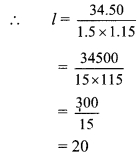
∴ 34.50 = l x 1.5 x 1.15
Maharashtra Board Class 9 Maths Solutions Chapter 9 Surface Area and Volume Practice Set 9.1 1
= 20
∴ The length of the cuboid is 20 m.

Question 6.
What will be the volume of a cube having length of edge 7.5 cm ?
Given: Length of edge of cube (l) = 7.5 cm
To find: Volume of a cube
Solution:
Volume of a cube = l2
= (7.5)3
= 421.875 ≈ 421.88 cubic cm
∴The volume of the cube is 421.88 cubic cm.

Question 7.
Radius of base of a cylinder is 20 cm and its height is 13 cm, find its curved surface area and total surface area, (π = 3.14)
Given: Radius (r) = 20 cm, height (h) = 13 cm
To find: Curved surface area and
the total surface area of the cylinder
Solution:
i. Curved surface area of cylinder = 2πrh
= 2 x 3.14 x 20 x 13
= 1632.8 sq.cm

ii. Total surface area of cylinder = 2πr(r + h)
= 2 x 3.14 x 20(20 + 13)
= 2 x 3.14 x 20 x 33 = 4144.8 sq.cm
∴ The curved surface area and the total surface area of the cylinder are 1632.8 sq.cm and 4144.8 sq.cm respectively.

Question 8.
Curved surface area of a cylinder is 1980 cm2 and radius of its base is 15 cm. Find the height of the cylinder. (π = \(\frac { 22 }{ 7 }\))
Given: Curved surface area of cylinder = 1980 sq.cm., radius (r) = 15 cm
To find: Height of the cylinder (h)
Solution:
Curved surface area of cylinder = 2πrh
∴ 1980 = 2 x \(\frac { 22 }{ 7 }\) x 15 x h
∴ \(h=\frac{1980 \times 7}{2 \times 22 \times 15}\)
∴ h = 21 cm
∴ The height of the cylinder is 21 cm.

Maharashtra Board 10th Class Maths Part 2 Practice Set 7.4 Solutions Chapter 7 Mensuration

Balbharti Maharashtra State Board Class 10 Maths Solutions covers the Practice Set 7.4 Geometry 10th Class Maths Part 2 Answers Solutions Chapter 7 Mensuration.

Practice Set 7.4 Geometry 10th Std Maths Part 2 Answers Chapter 7 Mensuration

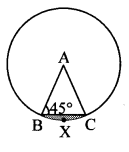
Practice Set 7.4 Geometry Class 10 Question 1. In the adjoining figure, A is the centre of the circle. ∠ABC = 45° and AC = 7\(\sqrt { 2 }\) cm. Find the area of segment BXC, (π = 3.14)
Maharashtra Board Class 10 Maths Solutions Chapter 7 Mensuration Practice Set 7.4 1
Solution:
In ∆ABC,
AC = AB … [Radii of same circle]
∴ ∠ABC = ∠ACB …[Isosceles triangle theorem]
∴ ∠ABC = ∠ACB = 45°
In ∆ABC,
∠ABC + ∠ACB + ∠BAC = 180° … [Sum of the measures of angles of a triangle is 180° ]
∴ 45° + 45° + ∠BAC = 180°
∴ 90° + ∠BAC = 180°
∴ ∠BAC = 90°
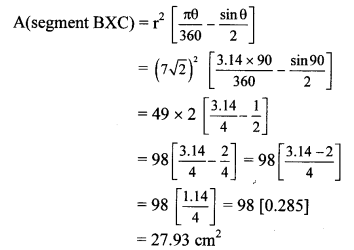
Let ∠BAC = θ = 90°
Maharashtra Board Class 10 Maths Solutions Chapter 7 Mensuration Practice Set 7.4 2
∴ The area of segment BXC is 27.93 cm2.

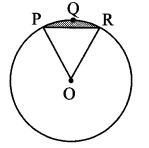
10th Class Geometry Practice Set 7.4 Question 2. In the adjoining figure, O is the centre of the circle.
m(arc PQR) = 60°, OP = 10 cm. Find the area of the shaded region.
(π = 3.14, \(\sqrt { 3 }\) = 1.73)
Maharashtra Board Class 10 Maths Solutions Chapter 7 Mensuration Practice Set 7.4 3
Given: m(arc PQR) = 60°, radius (r) = OP = 10 cm
To find: Area of shaded region.
Solution:
∠POR = m (arc PQR) …[Measure of central angle]
∴ ∠POR = θ = 60°
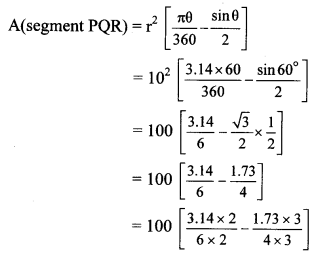
Maharashtra Board Class 10 Maths Solutions Chapter 7 Mensuration Practice Set 7.4 4
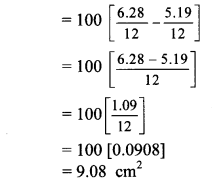
Maharashtra Board Class 10 Maths Solutions Chapter 7 Mensuration Practice Set 7.4 5
∴ The area of the shaded region is 9.08 cm2.

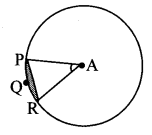
7.4 Class 10 Question 3. In the adjoining figure, if A is the centre of the circle, ∠PAR = 30°, AP = 7.5, find the area of the segment PQR. (π = 3.14)
Maharashtra Board Class 10 Maths Solutions Chapter 7 Mensuration Practice Set 7.4 6
Given: Central angle (θ) = ∠PAR = 30°,
radius (r) = AP = 7.5
To find: Area of segment PQR.
Solution:
Let ∠PAR = θ = 30°
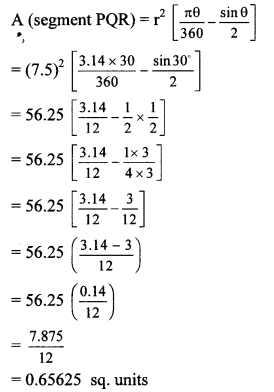
Maharashtra Board Class 10 Maths Solutions Chapter 7 Mensuration Practice Set 7.4 7
∴ The area of segment PQR is 0.65625 sq. units.

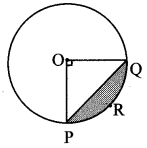
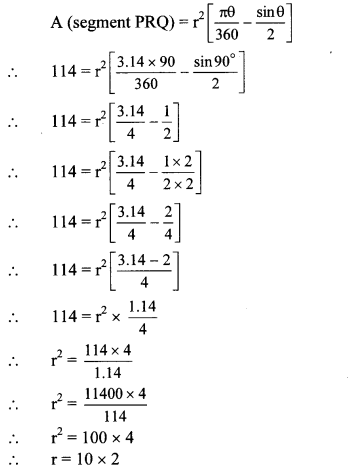
Chapter 7 Maths Class 10 Question 4. In the adjoining figure, if O is the centre of the circle, PQ is a chord, ∠POQ = 90°, area of shaded region is 114 cm2, find the radius of the circle, (π = 3.14)
Maharashtra Board Class 10 Maths Solutions Chapter 7 Mensuration Practice Set 7.4 8
Given: Central angle (θ) = ∠POQ= 90°,
A (segment PRQ) = 114 cm2
To find: Radius (r).
Solution:
Maharashtra Board Class 10 Maths Solutions Chapter 7 Mensuration Practice Set 7.4 9
…[Taking square root of both sides]
∴ r = 20 cm
∴ The radius of the circle is 20 cm.

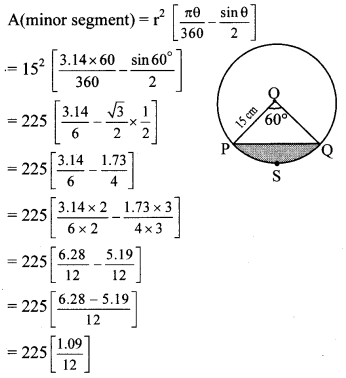
Mensuration Questions for Class 10 Question 5. A chord PQ of a circle with radius 15 cm subtends an angle of 60° with the centre of the circle. Find the area of the minor as well as the major segment. (π = 3.14, \(\sqrt { 3 }\) = 1.73)
Given: Radius (r) =15 cm, central angle (θ) = 60°
To find: Areas of major and minor segments.
Solution:
Let chord PQ subtend ∠POQ = 60° at centre.
∴ θ = 60°
Maharashtra Board Class 10 Maths Solutions Chapter 7 Mensuration Practice Set 7.4 10
= 225 [0.0908]
= 20.43 cm2
∴ area of minor segment = 20.43 cm2
Area of circle = πr2
= 3.14 × 15 × 15
= 3.14 × 225
= 706.5 cm2
Area of major segment
= Area of circle – area of minor segment
= 706.5 – 20.43
= 686.07 cm2
Area of major segment 686.07 cm2
∴ The area of minor segment Is 20.43 cm2 and the area of major segment is 686.07 cm2.

Maharashtra Board Practice Set 41 Class 6 Maths Solutions Chapter 18 Three Dimensional Shapes

Balbharti Maharashtra State Board Class 6 Maths Solutions covers the Std 6 Maths Chapter 18 Three Dimensional Shapes Class 6 Practice Set 41 Answers Solutions.

6th Standard Maths Practice Set 41 Answers Chapter 18 Three Dimensional Shapes

Question 1.
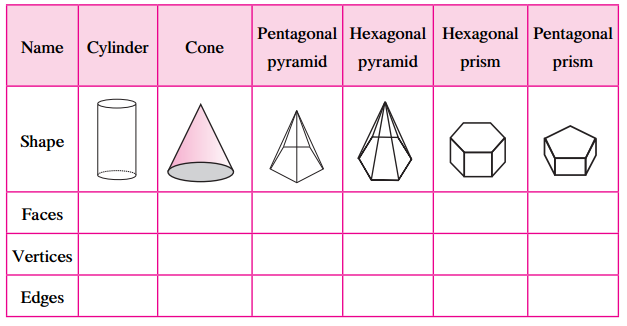
Write the number of faces, edges and vertices of each shape in the table.
Maharashtra Board Class 6 Maths Solutions Chapter 18 Three Dimensional Shapes Practice Set 41 1
Solution:

NameCylinderConePentagonal pyramidHexagonal pyramidHexagonal prismPentagonal prism
Faces3 (2 flat + 1 curved)2 (1 flat + 1 curved)6 (5 triangles + 1 pentagon)7 (6 triangles + 1 hexagon)8 (6 rectangles + 2 hexagons)7 (5 rectangles + 2 pentagons)
Vertices01671210
Edges2 (circular)1 (circular)101218 15

Maharashtra Board Class 6 Maths Chapter 18 Three Dimensional Shapes Practice Set 41 Questions and Activities

Question 1.

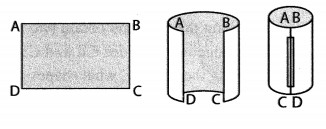
  1. Take a rectangular sheet.
  2. Bring together its opposite sides. What shape does it form? (Textbook pg. no. 94)

Maharashtra Board Class 6 Maths Solutions Chapter 18 Three Dimensional Shapes Practice Set 41 2
Solution:
It forms a hollow cylinder.

Question 2.

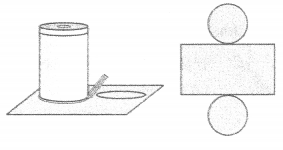
  1. Take a cylindrical tin.
  2. Take a rectangular sheet with one side equal to the height of the tin.
  3. Wrap it around the tin to cover it completely and cut away the extra paper.
  4. Then unfold it and spread it out on a table.
  5. Take another sheet. Place the tin on it and draw its circular outline.
  6. Cut away the paper around it. Cut out another circle like this one.
  7. Place these discs next to the rectangular paper as shown in the given figure. Which figure is obtained? (Textbook pg. no. 94)

Maharashtra Board Class 6 Maths Solutions Chapter 18 Three Dimensional Shapes Practice Set 41 3
Solution:
The figure obtained is the net of the closed cylinder.

Question 3.
Can you tell? (Textbook pg. no. 95)
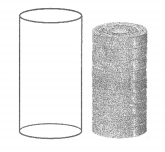
When playing carom, you make a pile of the pieces as shown in the picture. What is the shape of this pile?
If you place a number of CD’s or round biscuits one on top of the other, what shape do you get?
Maharashtra Board Class 6 Maths Solutions Chapter 18 Three Dimensional Shapes Practice Set 41 4
Solution:
In all the cases, it will form a cylindrical shape (2 circular faces and 1 curved surface).

Question 4.

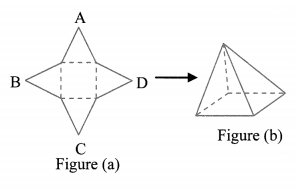
  1. Draw a net as shown in figure (a) on a card sheet and cut it out.
  2. Fold along the dotted lines of the square and bring the sides together so that the vertices A, B, C and D meet at a point.

What shape does it form? (Textbook pg. no. 95)
Maharashtra Board Class 6 Maths Solutions Chapter 18 Three Dimensional Shapes Practice Set 41 5
Solution:
The given net forms a quadrangular pyramid.

Question 5.

  1. Draw a net as shown in figure (a) on a card sheet and cut it out.
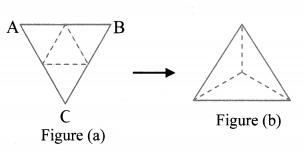
  2. Fold along the dotted lines of the triangle and bring the sides together so that the vertices A, B and C meet at a point.

What shape does it form? (Textbook pg. no. 95)
Maharashtra Board Class 6 Maths Solutions Chapter 18 Three Dimensional Shapes Practice Set 41 6
Solution:
The given net forms a triangular pyramid.

Question 6.

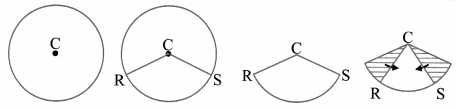
  1. Using a compass draw a circle with centre C on a paper.
  2. Draw two radii CR and CS.
  3. Cut out the circle.
  4. Cut along the radii and obtain two pieces of the circle.
  5. Bring together the sides CR and CS of each piece.

On completing the activity, what shapes did you get? (Textbook pg. no. 95)
Maharashtra Board Class 6 Maths Solutions Chapter 18 Three Dimensional Shapes Practice Set 41 7
Solution:
On completing the activity, we get an open cone.

Read Also:

Maharashtra Board Class 5 Maths Solutions Chapter 15 Patterns Problem Set 53

Balbharti Maharashtra Board Class 5 Maths Solutions Chapter 15 Patterns Problem Set 53 Textbook Exercise Important Questions and Answers.

Maharashtra State Board Class 5 Maths Solutions Chapter 15 Patterns Problem Set 53

Question 1.
Find the square numbers from the list given below.
5, 9, 12, 16, 50, 60, 64, 72, 80, 81
Answer:
9,16, 64, 81, 4, 25, 49 are square numbers.

Maharashtra Board Class 5 Maths Solutions Chapter 15 Patterns Problem Set 53

Question 2.
Which are the triangular numbers in the given list?
3, 6, 8, 9, 12, 15, 16, 20, 21, 42
Answer:
3, 6, 15, 21, 28, 10, 45, 55 are triangular numbers.

Question 3.
Name a number which is square as well as triangular.
Answer:
36 is square as well as triangular number.

Question 4.
If 4 is the first square number, which is the tenth one?
Answer:
121 is the tenth square number.

Maharashtra Board Class 5 Maths Solutions Chapter 15 Patterns Problem Set 53

Question 5.
If 3 is the first triangular number, which is the tenth one?
Answer:
66 is the tenth triangular number.

Think about it.

  • How will you decide if a given number is a square number?
  • How will you decide if a given number is a triangular number?
  • How many square numbers do you think there are?
  • How many triangular numbers do you think there are?

Activity

Make a collection of pictures in which you can see square or triangular numbers.

Patterns in floor tiles

The tiles in each picture below form a specific pattern. Observe that there is no gap or open ground between two tiles.
Maharashtra Board Class 5 Maths Solutions Chapter 15 Patterns Problem Set 53 1

Maharashtra Board Class 5 Maths Solutions Chapter 15 Patterns Problem Set 53

On a large piece of card sheet, draw several shapes like the one shown alongside. Colour half of them. Cut them all out and separate them.
Maharashtra Board Class 5 Maths Solutions Chapter 15 Patterns Problem Set 53 2

One pattern made of these shapes is shown alongside. Make some other patterns of your own.
Maharashtra Board Class 5 Maths Solutions Chapter 15 Patterns Problem Set 53 3

Cut out many pieces of each of the shapes shown alongside. Join them in a pattern like floor tiles.
Maharashtra Board Class 5 Maths Solutions Chapter 15 Patterns Problem Set 53 4

Maharashtra Board Class 5 Maths Solutions Chapter 15 Patterns Problem Set 53

Note the pattern and complete the design.
Maharashtra Board Class 5 Maths Solutions Chapter 15 Patterns Problem Set 53 5

Make your own shapes and use them to make patterns for sari and shawl borders, etc.

Perimeter and Area Problem Set 49 Additional Important Questions and Answers

Solve the following :

Question 1.
If 4 is the first square number which is the eighth one?
Answer:
81 is the eighth square number.

Maharashtra Board Class 5 Maths Solutions Chapter 15 Patterns Problem Set 53

Question 2.
If 3 is the first triangular number which is the eighth one?
Answer:
45 is the eighth triangular number.

Question 3.
Classify the following into square numbers and triangular numbers.
3, 4, 9,10,15,16; 45, 49, 64, 66, 81, 91
Answer:
Square Numbers : 4, 9,16, 49, 64, 81
Triangular Numbers : 3, 10, 15, 45, 66, 91

Question 4.
Find out the numbers which are neither square nor triangular numbers from the following.
4, 5, 6, 8, 9, 10, 14, 15, 16, 25, 26, 27, 28.
Answer:
5, 8 14, 26 and 27

Maharashtra Board Class 5 Maths Solutions Chapter 15 Patterns Problem Set 53

Question 5.
(1) If 4 is the first square number, which is the fifth one?
(2) If 3 is the first triangular number, which is the sixth one?
(3) Write all the square numbers between 20 and 80.
(4) Write all the triangular numbers between 20 and 80.
(5) Write the greatest two-digit square numbers as well as triangular numbers.
(6) Write the next three square numbers, 36, 49, 64,…….,
(7) Write the next three triangular numbers 36, 45, 55,
Answer:
(1) 36
(2) 28
(3) 25, 36, 49, 64
(4) 21, 28, 36, 45, 55, 66, 78
(5) 81, 91
(6) 81, 100, 121
(7) 66, 78, 91

Maharashtra Board Class 5 Maths Solutions Chapter 15 Patterns Problem Set 53

Question 6.
Match the columns

AB
(1) Third square number(a) 15
(2) Fourth triangular number(b) 36
(3) Number neither square nor triangular(c) 16
(4) Number is both square as well as triangular number(d) 35

Answer:
(1 – c),
(2 – a),
(3 – d),
(4 – b).

Maharashtra Board Class 5 Maths Solutions Chapter 16 Preparation for Algebra Problem Set 54

Balbharti Maharashtra Board Class 5 Maths Solutions Chapter 16 Preparation for Algebra Problem Set 54 Textbook Exercise Important Questions and Answers.

Maharashtra State Board Class 5 Maths Solutions Chapter 16 Preparation for Algebra Problem Set 54

Question 1.
Using brackets, write three pairs of numbers whose sum is 13. Use them to write three equalities.
Answer:
(7 + 6), (8 + 5), (9 + 4). since 7 + 6
= 13,8 + 5
= 13, 9 + 4
= 13.

(7 + 6)
= (8 + 5), (7 + 6)
= (9 + 4) or (8 + 5)
= (9 + 4).

Maharashtra Board Class 5 Maths Solutions Chapter 16 Preparation for Algebra Problem Set 54

Question 2.
Find four pairs of numbers, one for each of addition, subtraction, multiplication and division that make the number 18. Write the equalities for each of them.
Answer:
(9 + 9), (20 – 2), (9 x 2), (36 ÷ 2).
since 9 + 9
= 18, 20 – 2
= 18, 9 x 2
= 18 and 36 + 2
= 18, so (9 + 9)
= (20 – 2)
= (9 x 2)
= (36 ÷ 2).

Inequality
The values of 7 + 5 and 7 × 5 are 12 and 35 respectively. It means that they are not equal. To represent ‘not equal’, the symbol ‘≠’ is used.

To show that (7 + 5) and (7 × 5) are not equal, we write (7 + 5) ≠ (7 × 5) in short.

This kind of representation is called an ‘inequality’.

(9 – 5) ≠ (15 ÷ 3) means that the expressions (9 – 5) and (15 ÷ 3) are not equal.

If two expressions are not equal, one of them is greater or smaller than the other.

To show greater or lesser values, we use the symbols ‘<’ and ‘>’. Therefore, these symbols can also be used to show inequalities.

Maharashtra Board Class 5 Maths Solutions Chapter 16 Preparation for Algebra Problem Set 54

The value of (9 – 5) is 4 and the value of (15 ÷ 3) is 5. 4 < 5, so the relation between (9 – 5) and (15 ÷ 3) can be shown as (9 – 5) < (15 ÷ 3) or (15 ÷ 3) > (9 – 5).

Fill in the boxes between the expressions with <, = or > as required.

(1) (9 + 8) [ ] (30 ÷ 2)
9 + 8 = 17,
30 ÷ 2 = 15
17 > 15
Therefore (9 + 8) [ > ] (30 ÷ 2)

(2) (16 × 3) (4 × 12)
16 × 3 = 48,
4 × 12 = 48,
48 = 48
Therefore (16 × 3) [ = ] (4 × 12)

(3) (16 – 5) [ ] (2 × 7)
16 – 5 = 11,
2 × 7 = 14,
11 < 14
Therefore (16 – 5) [ < ] (2 × 7)

Maharashtra Board Class 5 Maths Solutions Chapter 16 Preparation for Algebra Problem Set 54

Write a number in the box that will make this statement correct.
(1) (7 × 2) = ( [ ] – 6)

The value of the expression 7 × 2 is 14, so the number in the box has to be one that gives 14 when 6 is subtracted from it. Subtracting 6 from 20 gives us 14.

Therefore (7 × 2) = ( [ 20 ] – 6 )
(2) (24 ÷ 3) < (5 + [ ] )
The value of the expression 24 ÷ 3 is 8, so the number in the box has to be such that when it is added to 5, the sum is greater than 8.

Now, 5 + 1 = 6, 5 + 2 = 7, 5 + 3 = 8. So the number in the box has to be greater than 3.

Therefore, writing any number like 4, 5, 6 … onwards will do. It means that this problem has several answers. (24 ÷ 3) < (5 + [ 4 ] ) is one among many answers. Even if that is true, writing only one answer will be enough to complete this statement.

Preparation for Algebra Problem Set 54 Additional Important Questions and Answers

Question 1.
Fill in the blanks.
(1) 7 + 3 = …………….. – ……………..
(2) 7 + 3 = …………….. x ……………..
(3) 7 + 3 = …………….. + ……………..
Answer:
(1) 7 + 3 = 10 and 12 – 2 = 10 or 15 – 5 = 10
(2) 7 + 3 = 10 and 10 x 1 = 10 or 5 x 2 = 10
(3) 7 + 3 = 10 and 20 + 2 = 10 or 30 + 3 = 10

Maharashtra Board Class 5 Maths Solutions Chapter 16 Preparation for Algebra Problem Set 54

Question 2.
Write the proper number in the box.
(1) 7 + 8 = 10 + [ ]
(2) 7 + 8 = 20 – [ ]
(3) 7 + 8 = 30 + [ ]
(4) 7 + 8 = 5 x [ ]
Answer:
(1) 7 + 8 = 15 so, 10 + [ ] = 15.
∴ [ ] = 15 – 10 = 5

(2) 7 + 8 = 15 s0, 20 – [ ] = 15.
∴[ ] = 20 – 15 = 5

(3) 7 + 8 = 15 so, 30 + [ ] = 15.
∴ [ ] = 30 + 15 = 2

(4) 7 + 8 = 15 so, 5 x [ ] = 15.
∴[ ] = 15 + 5 = 3

Maharashtra Board Class 5 Maths Solutions Chapter 14 Pictographs Problem Set 52

Balbharti Maharashtra Board Class 5 Maths Solutions Chapter 14 Pictographs Problem Set 52 Textbook Exercise Important Questions and Answers.

Maharashtra State Board Class 5 Maths Solutions Chapter 14 Pictographs Problem Set 52

Question 1.
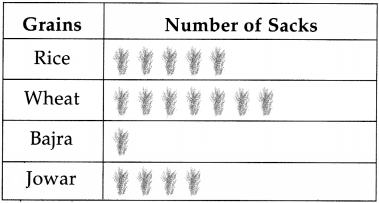
Stocks of various types of grains stored in a warehouse are as given below. Make a pictograph based on the information given.

Grain Sacks
Rice 40
Wheat 56
Bajra 8
Jowar 32

Answer:
Scale :1 picture = 8 sacks

Maharashtra Board Class 5 Maths Solutions Chapter 13 Three Dimensional Objects and Nets Problem Set 51 19

Maharashtra Board Class 5 Maths Solutions Chapter 14 Pictographs Problem Set 52

Question 2.
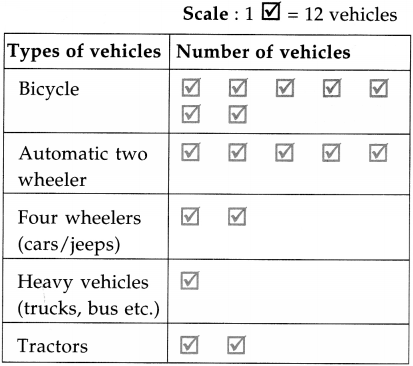
Information about the various types of vehicles in Wadgaon is given below. Make a pictograph for this data.

Types of vehicles Number
Bicycles 84
Automatic two-wheelers 60
Four-wheelers (cars/jeeps) 24
Heavy vehicles (truck, bus, etc.) 12
Tractors 24

Answer:
Maharashtra Board Class 5 Maths Solutions Chapter 13 Three Dimensional Objects and Nets Problem Set 51 20

Maharashtra Board Class 5 Maths Solutions Chapter 14 Pictographs Problem Set 52

Question 3.
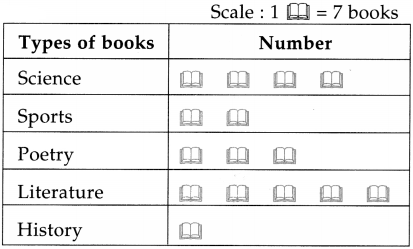
The numbers of the various books kept in a cupboard in the school library are given below. Make a pictograph showing the information given.

Type of book Number
Science 28
Sports 14
Poetry 21
Literature 35
History 7

Answer:
Maharashtra Board Class 5 Maths Solutions Chapter 13 Three Dimensional Objects and Nets Problem Set 51 21

Maharashtra Board Class 5 Maths Solutions Chapter 14 Pictographs Problem Set 52

Activity
Collect information based on the points given below and make a pictograph for each.

  • Which crops are grown on the farms owned by students in your class? (Vegetables, grains, pulses, fruits, etc.)
  • Which storybooks do your classmates like? (fairytales, stories about kings and queens, historical stories, stories about saints, picture stories, etc.)
  • What do your classmates want to be when they grow up ? (doctor, teacher, farmer, engineer, officer, etc.)

Perimeter and Area Problem Set 49 Additional Important Questions and Answers

Solve the following

Question 1.
Information regarding the number of pages of novel book read in different days by Rosi are as follows. Make a pictograph showing the information given.

Days1st day2nd day3rd day4th day
Pages60403020

Maharashtra Board Class 5 Maths Solutions Chapter 14 Pictographs Problem Set 52

Question 2.
Different types of currency notes had with Shamin are as follows. Make a pictograph showing the information given.

Types of Notes₹ 500₹ 100₹ 50₹ 10
Number of Notes81064

Question 3.
Different types of colour of scooters sold by a merchant are as follows. Make a pictograph showing the data given.

ColourWhiteRedBlackYellow
No, of scooters sold69123

Question 4.
Ajhount of sales of goods in rupees for the first four days of a week are as follows. Make a pictograph from the information given below.

DaysMarks
Monday₹ 150
Tuesday₹ 200
Wednesday₹ 250
Thursday₹ 100

Answer:
(1) All the given numbers can be divided by 2, 5, and 10. 1 picture of 10 pages will be convenient scale so 6 pictures for 60 pages. 4 pictures for 40, 3 for 30 and 2 for 20. Maharashtra Board Class 5 Maths Solutions Chapter 14 Pictographs Problem Set 52
(2) All the given numbers can divided by 2 only, so 1 picture for 2 notes will be the scale. So, 4 pictures for notes of ? 500, 5 for ? 100 notes, 3 for ? 50 and 2 for ? 10.
(3) All given numbers are divisible by 3, so 1 picture for 3 scooters will be the scale. So, 2 pictures for white, 3 for Red, 4 for Black and 1 pictures for Yellow.
(4) All the given numbers can be divided by 2, 5,10, 25 and 50. So, 1 picture for 50 rupees will be convenient scale. So, draw 3 pictures for Monday, 4 for Tuesday, 5 for Wednesday and 2 for Thursday.
(5) Number of books are multiples of 50. Therefore Take number of pictures = 5,4,2, 1, 3 respectively.

Maharashtra Board Class 5 Maths Solutions Chapter 13 Three Dimensional Objects and Nets Problem Set 51

Balbharti Maharashtra Board Class 5 Maths Solutions Chapter 13 Three Dimensional Objects and Nets Problem Set 51 Textbook Exercise Important Questions and Answers.

Maharashtra State Board Class 5 Maths Solutions Chapter 13 Three Dimensional Objects and Nets Problem Set 51

Question 1.
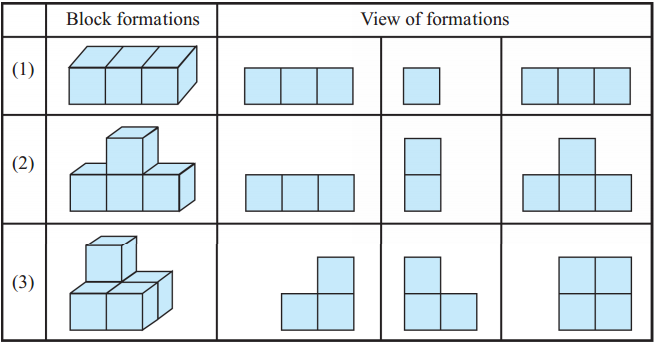
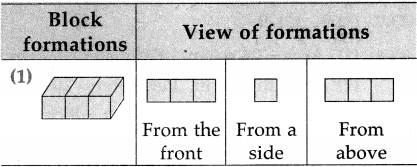
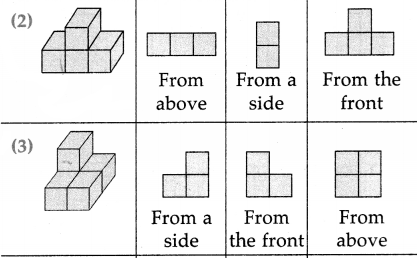
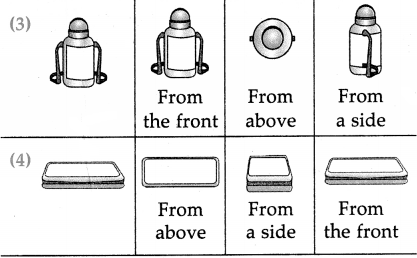
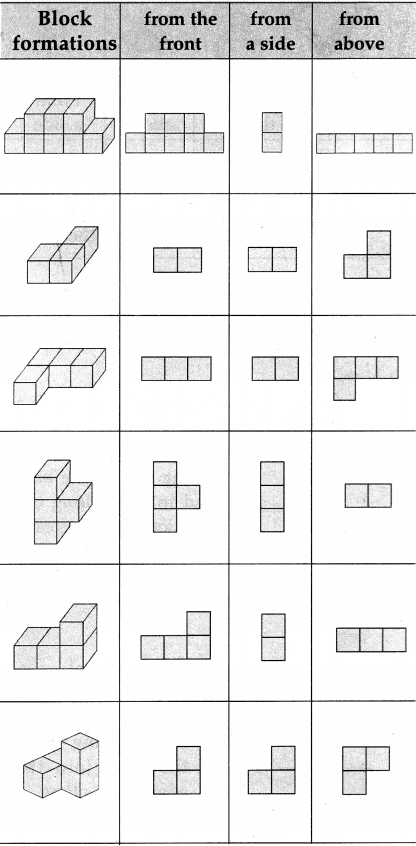
The first column shows a structure made of blocks. The other columns show different views of the structure in two dimensions. Say whether each view is from the front, from a side or from above.
Maharashtra Board Class 5 Maths Solutions Chapter 13 Three Dimensional Objects and Nets Problem Set 51 1
Answer:
Maharashtra Board Class 5 Maths Solutions Chapter 13 Three Dimensional Objects and Nets Problem Set 51 10
Maharashtra Board Class 5 Maths Solutions Chapter 13 Three Dimensional Objects and Nets Problem Set 51 18

Maharashtra Board Class 5 Maths Solutions Chapter 13 Three Dimensional Objects and Nets Problem Set 51

Question 2.
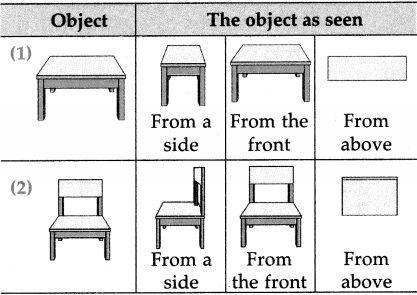
Draw three pictures of each of these three-dimensional objects – a table, a chair and a water bottle as viewed from the front, from a side and from above.
Answer:
Maharashtra Board Class 5 Maths Solutions Chapter 13 Three Dimensional Objects and Nets Problem Set 51 12
Maharashtra Board Class 5 Maths Solutions Chapter 13 Three Dimensional Objects and Nets Problem Set 51 13

Maharashtra Board Class 5 Maths Solutions Chapter 13 Three Dimensional Objects and Nets Problem Set 51

Nets
Last year we saw that cutting some edges of a box and laying it out flat gives us the net from which it was made.
The two dimensional shape from which a three dimensional object can be made by folding is called the ‘net’ of that object.

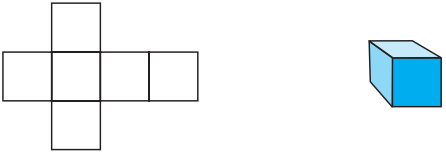
  1. By folding the cardboard shown below, along the lines shown in it, we get a three dimensional object (box). In this shape, all surfaces are square.
    An object of this shape is called a cube.
    Maharashtra Board Class 5 Maths Solutions Chapter 13 Three Dimensional Objects and Nets Problem Set 51 2
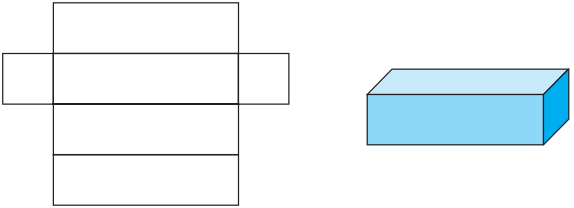
  2. The net of another cardboard box is shown in the figure below. By folding along the lines in this net and joining the edges to each other, we can see that a three dimensional box is formed. The surfaces of this box are rectangular in shape.
    An object of this shape is called a cuboid.
    Maharashtra Board Class 5 Maths Solutions Chapter 13 Three Dimensional Objects and Nets Problem Set 51 3

Maharashtra Board Class 5 Maths Solutions Chapter 13 Three Dimensional Objects and Nets Problem Set 51

Activity :
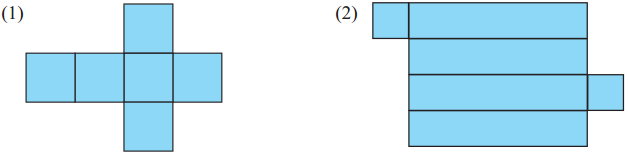
Draw the nets shown below on card sheet. Cut out the shapes and find out the shapes of the boxes they form.
Maharashtra Board Class 5 Maths Solutions Chapter 13 Three Dimensional Objects and Nets Problem Set 51 4

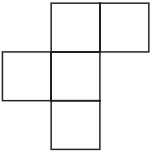
A five-square net (Pentomino)

In the figure alongside, five squares of the same size are placed together with their sides joined.
Maharashtra Board Class 5 Maths Solutions Chapter 13 Three Dimensional Objects and Nets Problem Set 51 5
Such an arrangement of five squares is called a ‘five-square net’ or a ‘pentomino’.

By folding along the edges of such a five-square net, an open box is formed.

Maharashtra Board Class 5 Maths Solutions Chapter 13 Three Dimensional Objects and Nets Problem Set 51 6

Activity :
Some five-square nets are given below. Draw these nets on a card sheet. Make open boxes from these nets.
Maharashtra Board Class 5 Maths Solutions Chapter 13 Three Dimensional Objects and Nets Problem Set 51 7
Try to find out other five-square nets that can be used to make open boxes.

Maharashtra Board Class 5 Maths Solutions Chapter 13 Three Dimensional Objects and Nets Problem Set 51

A riddle
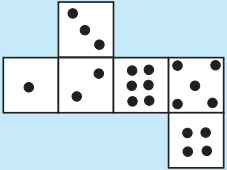
Maharashtra Board Class 5 Maths Solutions Chapter 13 Three Dimensional Objects and Nets Problem Set 51 8
The net of a cube-shaped dice is given alongside. If a dice is made of this net, which of the following shapes will it definitely not resemble?
Maharashtra Board Class 5 Maths Solutions Chapter 13 Three Dimensional Objects and Nets Problem Set 51 9

Chapter 12 Perimeter and Area Problem Set 49 Additional Important Questions and Answers

Question 1.
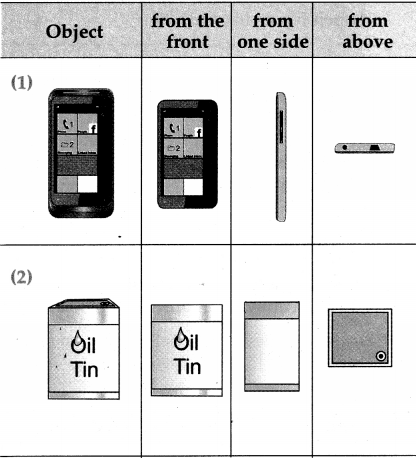
Draw the pictures of each of these three dimensional objects – Mobile, Oil tin as viewed from the front, from a side and from above.
Answer:
Maharashtra Board Class 5 Maths Solutions Chapter 13 Three Dimensional Objects and Nets Problem Set 51 16

Maharashtra Board Class 5 Maths Solutions Chapter 13 Three Dimensional Objects and Nets Problem Set 51

Question 2.
The three dimensional figure of block formation is shown in the figure along side. Draw as view from the front, from a side and from above (fig. drawn in answer part)
Answer:
Maharashtra Board Class 5 Maths Solutions Chapter 13 Three Dimensional Objects and Nets Problem Set 51 17

Maharashtra Board Class 5 Maths Solutions Chapter 13 Three Dimensional Objects and Nets Problem Set 51

Question 3.
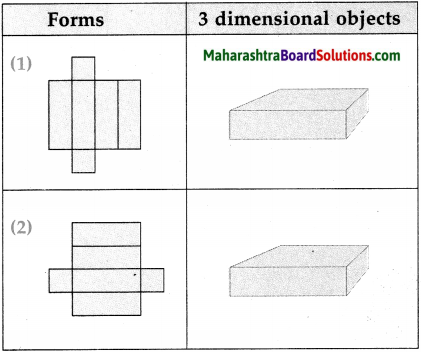
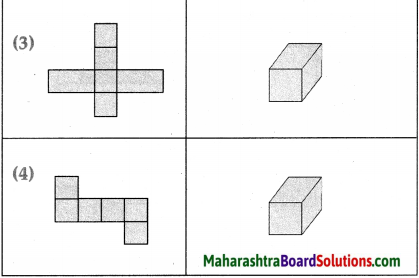
Draw the nets shown below on card sheet. Cut out the shapes and find out the shapes of the boxes they form.
Answer:
Maharashtra Board Class 5 Maths Solutions Chapter 13 Three Dimensional Objects and Nets Problem Set 51 14
Maharashtra Board Class 5 Maths Solutions Chapter 13 Three Dimensional Objects and Nets Problem Set 51 15

Maharashtra Board Class 5 Maths Solutions Chapter 11 Problems on Measurement Problem Set 46

Balbharti Maharashtra Board Class 5 Maths Solutions Chapter 11 Problems on Measurement Problem Set 46 Textbook Exercise Important Questions and Answers.

Maharashtra State Board Class 5 Maths Solutions Chapter 11 Problems on Measurement Problem Set 46

Question 1.
Add :

(1) ₹ 9, 50 paise + ₹ 14, 60 paise
Solution:

Paise
1
9
+ 14
5 0
6 0
2 41 0

50 paise + 60 paise
= 110 paise
= 1 ₹ 10 paise
∴ ₹ 24, 10 paise

Maharashtra Board Class 5 Maths Solutions Chapter 11 Problems on Measurement Problem Set 46

(2) 6 cm 5 mm + 7 cm 9 mm
Solution:

cmmm
1
6
+ 7
5
9
1 44

5 mm + 9 mm
= 14 mm 14 mm
= 1 cm 4 mm
∴ 14 cm 4 mm

(3) 22 m 50 cm + 25 m 75 cm
Solution:

mcm
1
2 2
+ 2 5
5 0
7 5
4 82 5

50 cm + 75 cm
= 125 cm
= 1 m 25 cm
∴ 48 m 25 cm

Maharashtra Board Class 5 Maths Solutions Chapter 11 Problems on Measurement Problem Set 46

(4) 15 km 740 m + 13 km 950 m
Solution:

kmm
1
1 5
+ 13
7 4 0
9 5 0
2 96 9 0

740 m + 950 m
= 1690 m 1690 m
= 1km 690 m
∴ 29 km 690 m

(5) 25 kg 650 g + 29 kg 770 g
Solution:

kggm
1
2 5
+ 29
6 5 0
7 7 0
5 54 2 0

650 gm + 770 gm
= 1420 gm
= 1 kg 420 gm
∴ 55 kg 420 gm

Maharashtra Board Class 5 Maths Solutions Chapter 11 Problems on Measurement Problem Set 46

(6) 19l 840ml + 25l 250ml
Solution:

lml
1 1
1 9
+ 2 5
8 4 0
2 5 0
4 50 9 0

840 ml + 250 ml
= 1090 ml
= 11 + 90 ml
∴ 45 l 90 ml

Question 2.
Subtract :

(1) ₹ 19, 50 paise – ₹ 12, 60 paise
Solution:

Paise
1 81 5 0
1 9
– 1 2
5 0
6 0
69 0

We cannot subtract 60 paise from 50 paise. So convert 1 ₹ into 100 paise.
₹ 6, 90 paise

∴ ₹ 6, 90 paise

Maharashtra Board Class 5 Maths Solutions Chapter 11 Problems on Measurement Problem Set 46

(2) 24 cm 2 mm – 3 cm 8 mm
Solution:

cmmm
2 31 2
2 4
– 3
2
8
2 04

We cannot subtract 8 mm from 2 mm. So, convert 1 cm = 10 mm

∴ 20 cm 4 mm

(3) 20 m 30 cm – 17 m 60 cm
Solution:

mcm
1 91 3 0
2 0
– 1 7
3 0
6 0
2. 7 0

We cannot subtract 60 cm from 30 cm. So, convert 1 m = 100 cm

∴ 2 m 70 cm

Maharashtra Board Class 5 Maths Solutions Chapter 11 Problems on Measurement Problem Set 46

(4) 40 km 255 m – 17 km 960 m
Solution:

kmm
3 912 2 5
4 0
-1 7
2 2 5
9 6 0
2 22 6 5

We cannot subtract 960 m from 225 m. So, convert 1 km = 1000 m

∴ 22 km 265 m

(5) 35 kg 150 g – 26 kg 470 g
Solution:

kggm
3 41 1 5 0
3 5
– 2 6
1 5 0
4 7 0
86 8 0

We cannot subtract 470 gm from 150 gm. So, convert I kg= 1000gm

∴ 8 kg 680 gm

(6) 46 l 200 ml – 38 l 750 ml
Solution:

lml
4 51 2 0 0
4 6
– 3 8
2 0 0
7 5 0
74 5 0

We cannot subtract 750 ml from 200 ml. So, convert 1 l = 1000 ml

∴ 7 l 450 ml

Maharashtra Board Class 5 Maths Solutions Chapter 11 Problems on Measurement Problem Set 46

Word problems

Study the following examples.

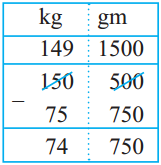
Example (1) If a shopkeeper has 150 kg 500 g of rice and sells 75 kg 750 g, how much rice will be left?
Maharashtra Board Class 5 Maths Solutions Chapter 11 Problems on Measurement Problem Set 46 1

74 kg 750 g of rice is left.

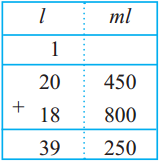
Example (2) A can of milk has 20 l 450 ml of milk. Another can has 18 l 800 ml. How much milk is there in the two cans altogether?
Maharashtra Board Class 5 Maths Solutions Chapter 11 Problems on Measurement Problem Set 46 2

The total quantity of milk is 39l 250ml.

Example (3) At a speed of 90 km per hour, what distance will a train cover in two and a half hours?

The speed of the train is 90 kmph. That is, it travels 90 km in one hour. It travels 90 more km in the second hour.
In the next half an hour, 90 ÷ 2 = 45 km
The total distance travelled is 90 + 90 + 45 = 225 km.

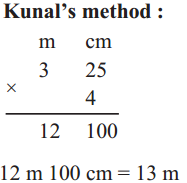
Example (4) If one dress requires 3 m 25 cm of cloth, how much do 4 dresses need?

Manju’s method :
3 m 25 cm for the 1st dress
+ 3 m 25 cm for the 2nd dress
+ 3 m 25 cm for the 3rd dress
3 m 25 cm for the 4th dress
_________
12 m 100 cm
1 m is 100 cm, therefore 12 + 1 = 13 m

Maharashtra Board Class 5 Maths Solutions Chapter 11 Problems on Measurement Problem Set 46

Maharashtra Board Class 5 Maths Solutions Chapter 11 Problems on Measurement Problem Set 46 3

Example (5)
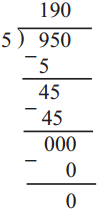
If a wire that is 9 m 50 cm long is cut into pieces of 5 cm each, how many pieces will be made?
9 m 50 cm = (900 + 50) cm
To find out how many pieces of 5 cm can be made from a wire 950 cm long, let us use division.
190 pieces will be made.
Maharashtra Board Class 5 Maths Solutions Chapter 11 Problems on Measurement Problem Set 46 4

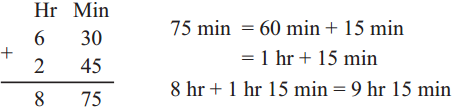
Example (6) A play started at 30 minutes past 6 in the evening and finished two and three quarter hours later. What time did the play get over?
Maharashtra Board Class 5 Maths Solutions Chapter 11 Problems on Measurement Problem Set 46 5

The play got over at 15 minutes past 9 at night.

Note : The units for length, mass and capacity are written in decimal form. This makes it easy to carry out addition and subtraction of length, mass and capacity.

Units of measuring time are not in decimal form. It is a little more difficult to carry out additions and subtractions of those quantities.

Maharashtra Board Class 5 Maths Solutions Chapter 11 Problems on Measurement Problem Set 46

Problems on Measurement Problem Set 46 Additional Important Questions and Answers

Add the following:

(1) 12 km 880 m + 7 km 620 m
Solution:

kmm
1
1 2
+ 7
8 8 O
6 2 0
2 05 0 0

880m + 620 m = 1500 m
= 1km 500 m
∴ 20 km 500 m

(2) ₹ 62, 45 paise + ₹ 37, 55 paise
Solution:

Paise
1
6 2
+ 3 7
4 5
5 5
1 0 00 0

45 paise + 55 paise
100 paise = 1 ₹
∴ 100 rupees

Maharashtra Board Class 5 Maths Solutions Chapter 11 Problems on Measurement Problem Set 46

Subtract the following:

(1) 15 m 15 cm – 4 m 65 cm
Solution:

kggm
1 41 1 5
1 5
– 4
1 5
6 5
1 05 0

We cannot subtract 65 cm from 15 cm. So, convert l m = 100 cm
∴ 10 m 50 cm

(2) 29 kg 880 gm – 8 kg 900 gm
Solution:

kggm
2 81 8 8 0
2 9
– 8
8 8 0
9 0 0
2 09 8 0

We cannot subtract 900 gin from 880 gm. So, convert 1 kg = 1000 gm
∴ 20 kg 980 gm

Maharashtra Board Class 5 Maths Solutions Chapter 12 Perimeter and Area Problem Set 49

Balbharti Maharashtra Board Class 5 Maths Solutions Chapter 12 Perimeter and Area Problem Set 49 Textbook Exercise Important Questions and Answers.

Maharashtra State Board Class 5 Maths Solutions Chapter 12 Perimeter and Area Problem Set 49

Question 1.
How much wire will be needed to make a rectangle 7 cm long and 4 cm wide?
Solution:
Perimeter of a rectangle
= 2 x length + 2 x breadth
= 2 x 7 + 2 x 4
= 14 + 8
= 22 cm

∴ 22 cm wire will be needed to make a rectangle

Maharashtra Board Class 5 Maths Solutions Chapter 12 Perimeter and Area Problem Set 49

Question 2.
If the length of a rectangle is 20 m and its width is 12m, what is its perimeter?
Solution:
Perimeter of a rectangle
= 2 x length + 2 x breadth
= 2×20 + 2×12
= 40 + 24
= 64 m
∴ Perimeter is 64 m

Question 3.
Each side of a square is 9 m long. Find its perimeter.
Solution:
Perimeter of a square
= 4 x length of one side
= 4 x 9
= 36 m
∴ Perimeter is 36 m

Question 4.
If we take 4 rounds around a field that is 160 m long and 90 m wide, what is the distance we walk in kilometres?
Solution:
Perimeter of a rectangular field
= 2 x length + 2 x breadth
= 2 x 160 + 2 x 90
= 320 + 180
= 500 m

In one round distance walked is 500 m, hence, distance walked in 4 rounds
= 500 x 4
= 2000 m
= 2km
∴ The distance walked in 4 rounds is 2 km

Maharashtra Board Class 5 Maths Solutions Chapter 12 Perimeter and Area Problem Set 49

Question 5.
Sanju completes 12 rounds around a square park every day. If one side of the park is 120 m, find out in kilometres and metres the distance that Sanju covers daily.
Solution:
Perimeter of a square
= 4 x length of one side
= 4 x 120
= 480 m

So, in one round the distance can be covered is 480 m, hence in 12 rounds the distance can be covered is
= 480 x 12
= 5760 m
= 5000 m + 760 m

∴ Sanju covers 5 km 760 m daily

Question 6.
The length of a rectangular plot of land is 50 m and its width is 30 m. A triple fence has to be put along its edges. If the wire costs 60 rupees permetre, what will be the total cost of the wire needed for the fence?
Solution:
Perimeter of a rectangular plot
= 2 x length + 2 x breadth
= 2 x 50 + 2 x 30
= 100 + 60 – 160 m
For a triple fence, wire needed
= 3 x 160 = 480 m

Cost of the wire needed
= wire needed x rate
= 480 x 60
= 28800 rupees
∴ The total cost of the wire needed for the fence is ₹ 28,800

Maharashtra Board Class 5 Maths Solutions Chapter 12 Perimeter and Area Problem Set 49

Question 7.
A game requires its players to run around a square playground. Each side of the playground is 20 m long. One player took 5 rounds around the playground. How many metres did he run altogether?
Solution:
Perimeter of a square
= 4 x length of one side
= 4 x 20
= 80 m

In one round 80 m.
So in 5 round
= 80 x 5
= 400
= 400 m

∴ He runs altogether = 400 m

Question 8.
Four rounds of wire fence have to be put around a field. If the field is 60 m long and 40 m wide, how much wire will be needed?
Solution:
Perimeter of rectangular field
= 2 x length + 2 x breadth
= 2 x 60 + 2 x 40
= 120 + 80
= 200 m
Hence, wire required for 4 rounds
= 200 x 4
= 800 m

∴ Wire required for 4 rounds
= 800 m

Maharashtra Board Class 5 Maths Solutions Chapter 12 Perimeter and Area Problem Set 49

Question 9.
The sides of a triangle are 24.7cm, 20.4 cm and 10.5 cm respectively. What is the perimeter of the triangle?
Solution:
Perimeter of triangle
= 24.7 + 20.4 + 10.5
= 55.6

∴ The perimeter of a triangle
= 55.6 cm

Question 10.
Look at the figures on the sheet of graph paper. Measure their sides with the help of the lines on the graph paper. Write the perimeter of each in the right box.
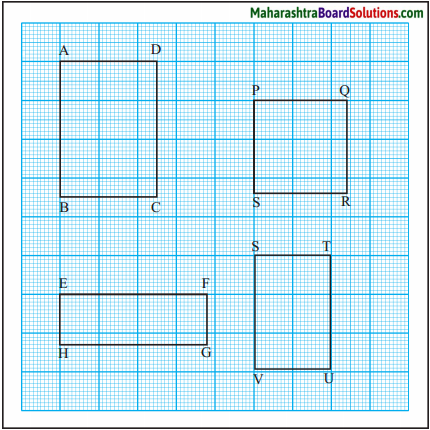
Maharashtra Board Class 5 Maths Solutions Chapter 12 Perimeter and Area Problem Set 49 1

(1) Perimeter of
rectangle ABCD
= [ ] cm
(2) Perimeter of
rectangle EFGH
= [ ] cm
(3) Perimeter of
square PQRS
= [ ] cm
(4) Perimeter of
rectangle STUV
= [ ] cm
Solution:
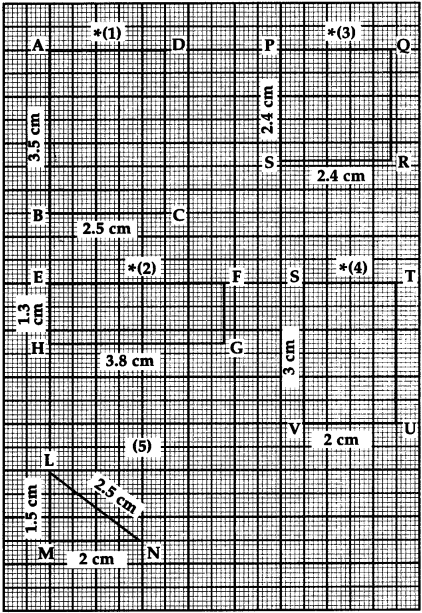
Maharashtra Board Class 5 Maths Solutions Chapter 12 Perimeter and Area Problem Set 49 6

Maharashtra Board Class 5 Maths Solutions Chapter 12 Perimeter and Area Problem Set 49

(1) Perimeter of a rectangle ABCD
= 2 x length + 2 x breadth
= 2 x 3.5 + 2 x 2.5
= 7 + 5
= 12 cm

∴ 12 cm

(2) Perimeter of a rectangle EFGH
= 2 x length + 2 x breadth
= 2 x 3.8 + 2 x 1.3
= 7.6 + 2.6
= 10.2 cm

∴ 10.2 cm

(3) Perimeter of a rectangle PQRS
= 2 x length + 2 x breadth
= 2 x 2.4 + 2 x 2.4
= 4.8+ 4.8
= 9.6 cm

∴ 9.6 cm

Maharashtra Board Class 5 Maths Solutions Chapter 12 Perimeter and Area Problem Set 49

(4) Perimeter of a rectangle STUV
= 2 x length + 2 x breadth
= 2 x 3 + 2 x 2
= 6 + 4
= 10 cm

∴ 10 cm

(5) Perimeter of a triangle LMN
= 1.5 + 2.5 + 2
= 6 cm

∴ 6 cm

Area : Revision
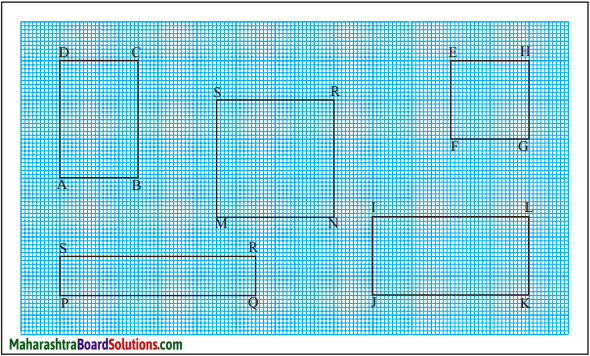
Maharashtra Board Class 5 Maths Solutions Chapter 12 Perimeter and Area Problem Set 49 2

Of the figures given above, figure ABCD has six squares of 1 cm each inside it. It means that its area is 6 sq cm.

In the same way, count the squares in each figure and write its area.
(1) Area of MNRS = [ ] sq cm
(2) Area of EFGH = [ ] sq cm
(3) Area of PQRS = [ ] sq cm
(4) Area of IJKL = [ ] sq cm

Atul : Sir, why is the unit for area written as sq cm? We measure the sides in centimetres.

Teacher : Centimetre is a standard unit of length. In order to measure area, we need a standard unit of area. For this, a square with a side 1 cm is taken as the standard unit. The area of this square is 1 square centimetre. That is why this unit is written as sq cm, in short.

To measure large areas like fields, parks and playgrounds, a square with side 1 m, that is, an area of 1 sq m, is taken as the standard unit.

Maharashtra Board Class 5 Maths Solutions Chapter 12 Perimeter and Area Problem Set 49

To measure the areas oftalukas or districts, a square with side 1km, or 1sq km is the standard unit used.

Formula for the area of a rectangle
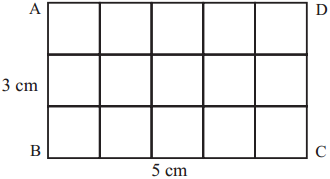
Maharashtra Board Class 5 Maths Solutions Chapter 12 Perimeter and Area Problem Set 49 3

(1) In the rectangle ABCD given alongside, 1 cm divisions were marked off on each side. The points on opposite sides were joined as shown in the figure. The length of the sides of each square thus created is 1cm. Therefore, the area of each square is 1 sq cm.

In ABCD, 3 rows with 5 squares each have been created.
The number of squares in rectangle ABCD is 3 × 5 = 15.
Therefore, the area of rectangle ABCD is 15 sq cm.
Here, the length of the figure is 5 cm and its breadth is 3 cm.
Note that the product of 3 and 5 is 15.

(2) In the rectangle with sides 4 cm and 2 cm, make squares of 1 sq cm each as shown above. Count the number of squares.
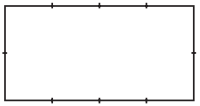
Maharashtra Board Class 5 Maths Solutions Chapter 12 Perimeter and Area Problem Set 49 4

Note that here too, the number of squares formed are the same as the product of the length and width of the rectangle.

Therefore, The area of a rectangle = length × breadth

Formula for the area of a square
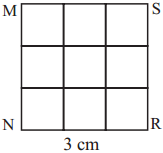
Maharashtra Board Class 5 Maths Solutions Chapter 12 Perimeter and Area Problem Set 49 5

(1) Look at the square given alongside. The side of the square is 3 cm long. 9 squares of 1 cm each are formed within this square.

Maharashtra Board Class 5 Maths Solutions Chapter 12 Perimeter and Area Problem Set 49

Therefore, the area of this square is 9 sq cm.

Here, there are 3 rows with 3 squares each, i.e., there are 3 × 3 = 9 squares.
The length of each side of the square is 3 cm.
The product of two sides of the square is 3 × 3 = 9.

(2) Measure the area of a square with side 5 cm, in the same way.
The answer will be 25 sq cm.
Note that 5 × 5 = 25

Therefore, The area of a square = length of a side × length of a side

It is not necessary to divide a square or rectangle into small squares every time you calculate their area. The advantage of a formula is that you can calculate the area simply by substituting the appropriate values.

Word problems
Example (1) What is the area of a rectangle of length 20 cm and width 15 cm?
Area of a rectangle = length × breadth
= 20 × 15 = 300.
Therefore, the area of the rectangle is 300 sq cm.

Example (2) A wall that is 4 m long and 3 m wide has to be painted. If the labour charges are ₹ 25 per sq m, what is the cost of labour for painting this wall?

First let us calculate the area of the wall to be painted.
Area of the wall = length of the wall × breadth of the wall = 4 × 3 = 12
Thus, the area of the wall is 12 sq m.
Labour cost of 1 sq m is 25 rupees.
So the labour cost for 12 sq m will be = 12 × 25 = 300
The cost of labour for painting the wall will be 300 rupees.

Example (3) What will be the area of a square with sides 15 cm?
Area of a square = length of side × length of side
= 15 × 15 = 225
The area of the square is 225 sq cm.

Maharashtra Board Class 5 Maths Solutions Chapter 12 Perimeter and Area Problem Set 49

Example (4) One side of a square room is 4 m. If the cost of labour for laying 1 sq m of the floor is 35 rupees, what will be the total cost of labour?
First we must find the area of the square room.
Area of the square room = length of side × length of side = 4 × 4 = 16
Therefore, the area of the square room is 16 sq m.
The labour cost of laying 1 sq m of flooring is 35 rupees.
Therefore, the cost of laying 16 sq m of flooring is 16 × 35 = 560 rupees.

Perimeter and Area Problem Set 49 Additional Important Questions and Answers
Question 1.
Devendra walks five rounds of a square garden everyday. If the side of the garden is 150 m, how many kilometres does Devendra walk every morning?
Solution:
Perimeter of a square garden
= 4 x one side of the garden
= 4 x 150
= 600 m

In 5 rounds walking
= 5 x 600
= 3000 m
= 3 km
3 km

Question 2.
The length of a rectangular play ground is 75 m and its breadth is 50 m. Rupali walks four rounds. How many kilometres did she walk?
Solution:
Perimeter of rectangle
= 2 x length + 2 x breadth
= 2 x 75 + 2 x 50
= 150 + 100
= 250 m

In 4 rounds walking
= 4 x 250
= 1000 m
= 1 km

∴ 1 km

Maharashtra Board Class 5 Maths Solutions Chapter 12 Perimeter and Area Problem Set 49

Question 3.
Length of the rectangle is 10 cm and its breadth is 8 cm and one square is side 9 cm. Whose perimetre is more? By how much?
Solution:
Perimeter of a rectangle
= 2 x length + 2 x breadth
= 2 x 10 + 2 x 8
= 20 + 16
= 36 cm ……………….. (i)

Perimeter of a square
= 4 x length of side
= 4 x 9
36 cm ……………….. (ii)
From (i) and (ii) perimeter of both is equal.

∴ perimeter of both is equal