Maharashtra Board Class 12 Psychology Solutions Chapter 6 Psychological Disorders

Balbharti Maharashtra State Board Class 12 Psychology Solutions Chapter 6 Psychological Disorders Textbook Exercise Questions and Answers.

Maharashtra State Board Class 12 Psychology Solutions Chapter 6 Psychological Disorders

1. (A) Choose the correct option and complete the following statements.

Question 1.
………………… is the present system for the classification of mental disorders.
(a) DSM-5
(b) WHO
(c) APA
Answer:
(a) DSM-5

Question 2.
Term Schizophrenia was first used by ………………
(a) Albert Ellis
(b) Eugene Bleuler
(c) John Travis
Answer:
(b) Eugene Bleuler

Maharashtra Board Class 12 Psychology Solutions Chapter 6 Psychological Disorders

Question 3.
World Health Organization has developed …………….. for classification of all types of disorders.
(a) ICD
(b) DSM
(c) MCA
Answer:
(a) ICD

Question 4.
We find alternate phases of depression and mania in …………………. disorders.
(a) depressive
(b) bipolar
(c) anxiety
Answer:
(b) bipolar

(B). Match the pairs.

Question 1.

Group AGroup B
(1) Phobia(a) 2013
(2) DSM-5(b) Wellness
(3) ICD – 11(c) Schizophrenia
(4) Eugen Bleuler(d) 2019
(5) John Travis(e) Illogical fear
(6) Depressive disorders(f) Sad feelings for a long period of time

Answer:

Group AGroup B
(1) Phobia(e) Illogical fear
(2) DSM-5(a) 2013
(3) ICD – 11(d) 2019
(4) Eugen Bleuler(c) Schizophrenia
(5) John Travis(b) Wellness
(6) Depressive disorders(f) Sad feelings for a long period of time

(C) State whether the following statements are true or false.

Question 1.
Socially or culturally deviant behaviours are signs of psychological disorders.
Answer:
False

Maharashtra Board Class 12 Psychology Solutions Chapter 6 Psychological Disorders

Question 2.
Schizophrenia is a serious psychological disorder.
Answer:
True

Question 3.
Feeling of hopelessness is one of the symptoms seen in depressive disorders.
Answer:
True

(D) Answer the following in one sentence each.

Question 1.
From which Latin word is the term anxiety derived?
Answer:
The word ‘anxiety’ is derived from the Latin word ‘Anxietas’ which means ‘uneasy or troubled mind’.

Question 2.
In which disorder does the person experience sadness and guilt for a long period of time?
Answer:
In a depressive disorder the person experiences sadness and guilt for a long period of time.

Question 3.
What do you call the fear that you experience unnecessarily in a non threatening situation?
Answer:
The fear that is experienced unnecessarily in a non threatening situation is called a phobia.

2. Answer the following questions Briefly.

Question 1.
Explain the nature of psychological disorder.
Answer:
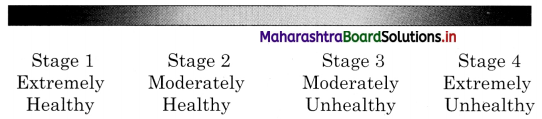
The major criteria of abnormality or psychological disorders are deviance, personal distress and impaired functioning. Illness and absence of illness are not distinct categories but are on opposite poles of the continuum sequence as explained below.
Maharashtra Board Class 12 Psychology Solutions Chapter 6 Psychological Disorders 1
Stage 1 – The person is physically and psychologically healthy. They are motivated and emotionally stable.
Stage 2 – The person may get affected by life stressors, feel anxious, lack energy, etc. For e.g., before an examination. It is possible to push oneself back towards positive health by adopting a healthy lifestyle.
Stage 3 – The person shows signs of psychological damage and experience negative feelings like sadness, lack of motivation, fear and may even indulge in addictive behaviour. However, even this stage is not irreversible.
Stage 4 – The person exhibits extreme distress, impairment in mental, emotional and social functioning. He/She needs professional treatment.

Maharashtra Board Class 12 Psychology Solutions Chapter 6 Psychological Disorders

Question 2.
What is meant by Anxiety disorders?
Answer:
The word ‘anxiety’ is derived from the Latin word ‘Anxietas’ which means ‘uneasy or troubled mind’. Anxiety refers to a condition in which the person feels worried and uneasy for a long time for no obvious reasons. Anxiety disorders include disorders in which anxiety is the main symptom or is experienced when an attempt is made to modify some maladjustment. The main anxiety disorder are Generalised Anxiety disorder, Phobic disorder. Panic disorder, O. C. D, etc.

Question 3.
Narrate indicators of psychological disorders.
Answer:
According to DSM-5, there are five criteria (indicators) for psychological disorders.

  1. Clinically significant syndrome – In psychological disorders, there should be a cluster of symptoms together i.e., a syndrome.
  2. Distress and Impairment – There should be distress, i.e., psychological pain due to negative feelings and stress, as well as impairment, i.e., inability to perform appropriate roles in personal and social situations.
  3. Dysfunction – If the symptoms lead to developmental or psychological dysfunctions, it signifies mental disorders.
  4. Responses to stressors that are normally accepted responses e.g., sadness experienced at the loss of a loved one or culturally sanctioned responses are not considered as signs of mental disorders.
  5. Behaviour which is only deviant but does not produce any disability/ distress/ dysfunction
    does not become a sign of mental disorder.

Question 4.
What is meant by bipolar disorder?
Answer:
Bipolar Disorder is also known as Manic Depressive disorder. The person experiences alternate phases of two states viz. mania and depression. Mania includes symptoms such as high energy, excitement, reduced need for sleep and loss of touch with reality, impulsivity, delusion, etc. Depressive state symptoms include low energy and motivation, loss of interest in daily activities, extreme sadness, apathy, feeling of hopelessness, fatigue, guilt, etc. Main causative factors are genetic factors, imbalance in neurotransmitters such as dopamine and epinephrine; environmental factors such as traumatic event.

Question 5.
Describe Post Traumatic Stress Disorders?
Answer:
If the symptoms of Acute Stress Disorder (ASD) continue for more than one month with the same intensity, the person is diagnosed with PTSD. A person who has suffered trauma goes through three stages viz-

  1. Shock stage – the individual is in shock, i.e., extremely disturbed.
  2. Suggestible stage – he/she may seek guidance from others and may either accept these suggestions unquestioningly or may get extra sensitive.
  3. Recovery stage – the person shows signs of recovery.

However, some persons still show signs of mental illness i.e., PTSD.
The symptoms of PTSD include

  1. nightmares, flashbacks, severe anxiety
  2. hyper vigilance and avoidance of situations that bring back the trauma
  3. irritability, social isolation
  4. survivour’s guilt

Maharashtra Board Class 12 Psychology Solutions Chapter 6 Psychological Disorders

3. Explain the Following concepts.

Question 1.
DSM-5
Answer:
Presently, the two major systems of classifying psychological disorders are DSM and ICD. Diagnostic and Statistical Manual for Mental Disorders (DSM) was published in its first version by the APA in 1952, i.e., DSM-I. In 2013, the DSM-5 was introduced which contains 22 broad categories of mental disorders with subcategories. It is the classification of officially recognized psychiatric disorders, for e.g., categories in DSM-5 include anxiety disorders, obsessive-compulsive and related disorders and personality disorders.

Question 2.
ICD 11
Answer:
Presently, the two major systems of classifying psychological disorders are DSM and ICD. The International Classification of Diseases and Related Health Problems (ICD) was created by the WHO for documenting all types of diagnoses, diseases, signs and symptoms and social circumstances. It contains a section on psychological disorders. The latest, 11th version of ICD was presented in 2019. According to the ICD-11, there are 19 broad categories of mental disorders, most of which overlap with DSM-5.

Question 3.
Phobia
Answer:
The main anxiety disorders include phobic disorders and generalized anxiety disorders. The word ‘phobia’ is derived from the Greek word ‘phobos’ which was used to refer to the God of Fear. A phobia is an intense, persistent but irrational and disproportionate fear of a specific object or situation. DSM classifies phobias as simple phobias, e.g., Acrophobia, Claustrophobia etc., and social phobias, e.g., fear of speaking or eating in public. The phobic object e.g., animals or situations e.g., elevators, almost always provide immediate anxiety.

Question 4.
Syndrome
Answer:
A syndrome refers to a cluster or collection of symptoms and signs that are characteristic of a diseases or disorder, e.g., Down’s syndrome. It is a group of symptoms which consistently occur together and indicate a particular condition. A syndrome refers to a set of symptoms that tend to occur together and can be associated with a particular physical or mental disorder. In psychological disorders, one of the criteria as suggested by DSM-5 is clinically significant syndrome.

Question 5.
Hallucination
Answer:
Hallucinations are false perceptions in the absence of appropriate stimuli. Hallucinations are a symptom of schizophrenia and other mental disorders. Commonly occurring hallucinations are visual, auditory, tactile, gustatory and olfactory in nature. For e.g., the person may hear voices telling him to do something. Hallucinations are also noticed due to substance abuse, medications, epilepsy, etc.

Maharashtra Board Class 12 Psychology Solutions Chapter 6 Psychological Disorders

4. Write short notes on the following.

Question 1.
Nature of mental wellness
Answer:
According to the WHO, mental wellness refers to “a state of well-being in which the individual realizes his or her own abilities, can cope up with the normal stresses of life, can work productively and fruitfully, and is able to make a contribution to his or her community.”
The important aspects of mental wellness are –

  1. Emotional aspect – There is a sense of well-being and contentment
  2. Psychological aspect – There is high self esteem and tendency of self actualization.
  3. Life philosophy – There are clear goals and objectives in life.

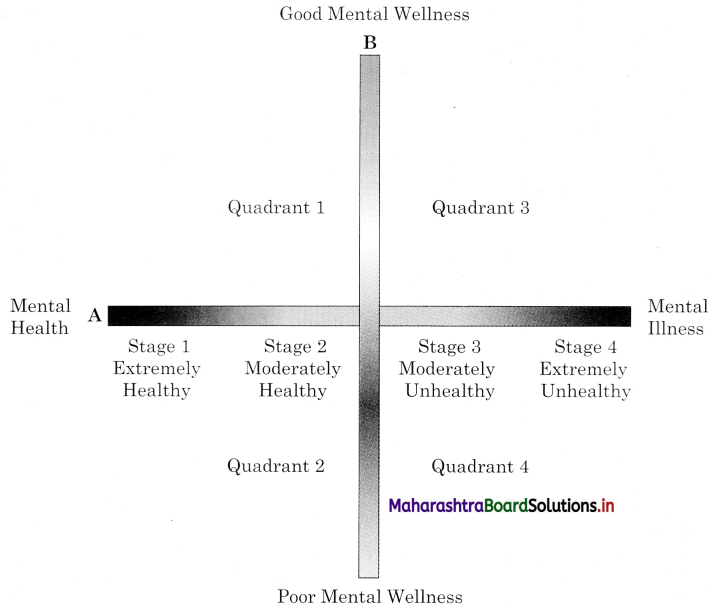
The Illness Wellness Continuum Model by John Travis
Maharashtra Board Class 12 Psychology Solutions Chapter 6 Psychological Disorders 2
Quadrant 1 – The person is in an ideal state of functioning.
Quadrant 2 – Thepersonhasnomentalillnessbutexperiencessubjectivefeelingofunhappiness.
Quadrant 3 – The person suffers from mental illness yet he/she experiences a high sense of subjective well-being.
Quadrant 4 – This is the lowest level of functioning. The person has mental illness and also experiences distress.

Question 2.
Drug addiction
Answer:
Addictive disorders refer to the physical and psychological inability to stop consuming some substance or indulging in some activity although it is harmful. This includes dependence on drugs, nicotine, alcohol, etc., or activities like gambling, eating, gaming etc. Drug addiction refers to an inability to control the use of alcohol, nicotine, narcotics, marijuana, medications, etc.
Symptoms of addiction are-

  1. Excessive consumption of drugs or alcohol and inability to reduce the dosage.
  2. In case the person tries to stop the drug use, then withdrawal symptoms occur which include sweating, tremors, muscle pain, goosebumps, etc.
  3. Physical and psychological dependence may lead to drug abuse or overdose of the addictive substance and even death of the person.
  4. The person’s physical, emotional, social and financial well-being break down.

Alcoholics Anonymous (AA), Narcotics Anonymous (NA) are organizations that help addicts to overcome dependence.

Maharashtra Board Class 12 Psychology Solutions Chapter 6 Psychological Disorders

Question 3.
Depressive disorders
Answer:
Depression is an emotional state typically marked by sadness and guilt, feelings of anxiety and hopelessness. Other symptoms include loss of appetite, interest and sleep, fatigue, sexual dysfunction and suicidal thoughts. Depression is associated with distractability, memory loss, neglect of personal hygiene, panic attacks and even substance abuse. Children may experience symptoms such as irritability, feelings of incompetence, difficulty in concentration, difficulty in sleeping, digestive problems etc.

Question 4.
Anxiety disorders
Answer:
The word ‘anxiety’ is derived from the Latin word ‘Anxietas’ which means ‘uneasy or troubled mind’. Anxiety refers to a condition in which the person feels worried and uneasy for a long time for no obvious reasons. The main anxiety disorders are.
(i) Generalized Anxiety Disorder – The person frequently experiences anxiety more intensely so that it starts interfering with the ability to perform daily tasks. Symptoms include irritability, headaches, insomnia, dizziness, breathlessness, etc.

(ii) Phobic disorders – The word ‘phobia’ is derived form the Greek word ‘phobos’ which was used to refer to the God of Fear. A phobia is an intense, persistent but irrational and disproportionate fear of a specific object or situation. DSM classifies phobias as simple phobias, e.g., Acrophobia, Claustrophobia etc., and social phobias, e.g., fear of speaking or eating in public.

5. Answer the following questions in 150 – 200 words.

Question 1.
Describe the criteria of psychological disorders.
Answer:
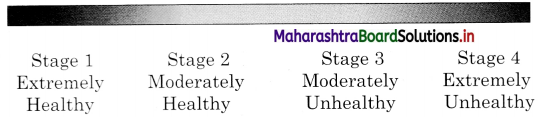
The major criteria of abnormality are deviance, personal distress and impaired functioning. Illness and absence of illness are not distinct categories but are on opposite poles of the continuum sequence as explained below.
Maharashtra Board Class 12 Psychology Solutions Chapter 6 Psychological Disorders 3
Stage – 1: The person is physically and psychologically healthy. He/She are motivated and emotionally stable.
Stage – 2: The person may get affected by life stressors, feel anxious, lack energy, etc., for e.g., most students are tense before the exams. It is possible to push oneself back towards positive health by adopting a healthy lifestyle.
Stage – 3: The person shows signs of psychological damage and may experience negative feelings like sadness, lack of motivation, fear and may even indulge in addictive behaviour. However, even this stage is not irreversible.
Stage – 4: The person exhibits extreme distress, impairment in mental, emotional and social functioning. He/She needs professional treatment.

Psychological disorders are also called mental disorders. These are patterns of behavioural or psychological symptoms that impact multiple areas of life and create distress for the person.

According to DSM-5, there are five criteria for psychological disorders.

  1. Clinically significant syndrome – In psychological disorders, there should be a cluster of symptoms together i.e., a syndrome.
  2. Distress and Impairment – There should be distress, i.e., psychological pain due to negative feelings and stress, as well as impairment, i.e., inability to perform appropriate roles in personal and social situations.
  3. Dysfunction – If the symptoms lead to developmental or psychological dysfunctions, it signifies mental disorders.
  4. Responses to stressors that are normally accepted responses e.g., sadness experienced at the loss of a loved one or culturally sanctioned responses are not considered as signs of mental disorders.
  5. Behaviour which is only deviant but does not produce any disability/ distress/ dysfunction does not become a sign of mental disorder.

Maharashtra Board Class 12 Psychology Solutions Chapter 6 Psychological Disorders

Question 2.
Narrate any two psychological disorders in detail.
Answer:
Psychological disorders are also called mental disorders. These are patterns of behavioural or psychological symptoms that impact multiple areas of life and create distress for the person.
According to DSM-5, there are five criteria for psychological disorders are:

  1. Clinically significant syndrome – In psychological disorders, there should be a cluster of symptoms together i.e., a syndrome.
  2. Distress and Impairment – There should be distress, i.e., psychological pain due to negative feelings and stress, as well as impairment, i.e., inability to perform appropriate roles in personal and social situations.
  3. Dysfunction – If the symptoms lead to developmental or psychological dysfunctions, it signifies mental disorders.
  4. Responses to stressors that are normally accepted responses e.g., sadness experienced at the loss of a loved one or culturally sanctioned responses are not considered as signs of mental disorders.
  5. Behaviour which is only deviant but does not produce any disability/ distress/ dysfunction does not become a sign of mental disorder.

(A) Anxiety Disorders – The word ‘anxiety’ is derived from the Latin word ‘Anxietas’ which means ‘uneasy or troubled mind’. Anxiety refers to a condition in which the person feels worried and uneasy for a long time for no obvious reasons.
The main anxiety disorders are-
(i) Generalized Anxiety Disorder – The person frequently experiences anxiety more intensely so that it starts interfering with the ability to perform daily tasks. Symptoms include irritability, headaches, insomnia, dizziness, breathlessness, etc.

(ii) Phobic disorders – The word ‘photjia’ is derived form the Greek word ‘phobos’ which was used to refer to the God of Fear. A phobia is an intense, persistent but irrational and disproportionate fear of a specific object or situation. DSM classifies phobias as simple phobias, e.g., Acrophobia, Claustrophobia etc., and social phobias, e.g., fear of speaking or eating in public.

(B) Trauma Trauma and Stress-Related Disorders
Stress is inevitable in life. Daily hassles, relationship issue, frustration, chronic illness, etc., lead to stress. If stress is in moderate intensity, it acts as a motivation. However, intense prolonged stress impairs normal functioning of the individual and may lead to stress disorders.
The two types of stress disorders are-
1. Acute Stress Disorder (ASD)
If a person (aged 6 years and above) has experienced extremely stressful situations like death of a loved one, serious disease or injury, sexual abuse, natural disasters, etc., then he/she may experience ASD. The symptoms of ASD include-

  • emotional numbness and instability
  • nightmares and sleep disturbances
  • insomnia, lack of concentration, irritability and guilt feelings
  • depression

2. Post Traumatic Stress Disorder (PTSD)
If symptoms of ASD continue for more than one month with the same intensity, the person is diagnosed with PTSD. A person who has suffered trauma goes through three stages viz.

  • Shock stage – the individual is in shock, i.e., extremely disturbed.
  • Suggestible stage – he/she may seek guidance from others and may either accept these suggestions unquestioningly or may get extra sensitive.
  • Recovery stage – the person shows signs of recovery.

However, some persons still show signs of mental illness i.e., PTSD.

Question 3.
What is Schizophrenia? Describe the major symptoms of it.
Answer:
The term ‘Schizophrenia’ is derived from Greek words Schizein (to split) and phren (mind). Thus, the literal meaning of the word ‘schizophrenia’ is split mind. The term ‘schizophrenia’ was coined in 1911 by a Swiss psychologist, Paul Eugene Bleuler. Schizophrenia is a psychotic disorder.
According to DSM-5 the two types of symptoms for schizophrenia are-
(a) Positive symptoms are an excess addition to normal thoughts or behaviour of the period. Such symptoms are-

  1. hallucinations – mainly auditory and visual hallucination
  2. delusions – mainly of grandeur, reference and persecution
  3. disorganized thought and speech
  4. bizarre body movements and disorganized behaviour
  5. incongruent affect.

(b) Negative symptoms are deficits of normal emotional responses or of thought processes. They lead to low level of functioning and may not improve much even with treatment. This includes-

  1. emotional blunting – diminished emotional expression
  2. anhedonia – inability to experience deep positive emotions
  3. alogia – diminished speed
  4. asociality – lack of desire to form relationships
  5. avolition – lack of motivation
  6. apathy.

Sometimes, a schizophrenic exhibits positive as well as negative symptoms.

Maharashtra Board Class 12 Psychology Solutions Chapter 6 Psychological Disorders

Class 12 Psychology Chapter 6 Psychological Disorders Intext Questions and Answers

ACTIVITIES (Textbook Page. No. 62)

Activity 1

On the basis of your understanding of various criteria for abnormality, which of these would you consider as normal or abnormal behavior?

  1. Hemant wears the same lucky blue shirt for all his major competitive exams.
  2. Seema is not able to fall asleep easily.
  3. Rakesh throws pillows and pounding fists on the wall during arguments if he finds himself losing ground.
  4. Reena always experiences fear but is not able to specify what is so scary.

Answer:
All the stated examples show at least one of the five criteria for abnormality.

  1. Hemant seems superstitious and lacks confidence. He appears moderately healthy.
  2. Seema exhibits personal distress and signs of sleep disorders.
  3. Rakesh exhibits clear symptoms of abnormal behaviour and seems extremely unhealthy mentally.
  4. Reena seems to have anxiety disorder and may need professional help.

Activity 3 (Textbook Page. No. 67)

In which Quadrants of wellness illness continuum will you place Karan, Lalita, Pramila and Santosh?
Answer:
Karan – Quadrant 2, Pramila – Quadrant 3, Lalita – Quadrant 4, Santosh – Quadrant 3.

Activity 5 (Textbook Page. No. 68)

Collect information about Anxiety disorders and discuss this with your friends or parents.
Answer:
Anxiety disorders are characterised by feelings of worry and restlessness that tend to interfere with daily activities. Besides generalized anxiety disorder and phobia which are explained in the chapter, anxiety disorders includes Panic disorder, Obsessive-Compulsive disorder (OCD) and Social Anxiety disorders include disorders in which anxiety is the main symptom or is experienced. When an attempt is made to modify maladjustment.

Maharashtra Board Class 12 Psychology Solutions Chapter 6 Psychological Disorders

Activity 6 (Textbook Page. No. 69)

Collect information about other types of phobia.
Answer:
A phobia is a persistent, irrational fear of a situation or object. Phobias are of three types viz. Social phobia (fear of social situations); specific phobias (fear of particular situations) and agoraphobia (fear of being alone in public places from which there is no easy escape). Some phobias are:

  1. Claustrophobia (fear of enclose spaces)
  2. Acrophobia (fear of heights)
  3. Homophobia (fear of blood)
  4. Zoophobia (fear of animals)
  5. Arachnophobia (fear of spiders)
  6. Pyrophobia (fear of fire)
  7. Trypanophobia (fear of needles and injections)
  8. Xenophobia (fear of foreigners or strangers)

Activity 7 (Textbook Page. No. 71)

We make use of various strategies to reduce our stress. Speak to five of your friends and make a list of atleast ten different strategies used by them to reduce stress. Share it with your group and discuss which are healthy and which are unhealthy.
Answer:
Some strategies to reduce stress are-

  1. Negative coping such as use of alcohol/drugs, over eating, agression, etc.
  2. Exercise
  3. Developing a hobby
  4. Indulging in some constructive activity
  5. Following relaxation/meditation techniques
  6. Seeking social support, i.e., of friends/ family, etc.
  7. Having proper time management
  8. Developing rational thinking and positive attitude
  9. Indulging in self care, e.g., proper diet, rest, etc.
  10. Seeking professional help if needed

Maharashtra Board Class 12 Psychology Solutions Chapter 6 Psychological Disorders

Activity 9 (Textbook Page. No. 74)

Identify from the internet the red flags (signaling symptoms) for various disorders that you have already studied.
Answer:
Red flags for the following disorders.
(1) Phobias

  • Displaying extreme nervousness or distress when in the presence of the source of the phobia
  • Avoidance behaviour
  • Refusal to face certain situations

(2) Depression

  • Irritability, moodiness and agitation.
  • Inability to concentrate
  • Unexplained aches and pains
  • Disruptions in sleep habits
  • Changes in appetite and eating habits
  • Suicidal thoughts.

(3) Bipolar disorder

  • Change in thought processes, and concentration
  • Change in sleep patterns
  • Change is social interaction
  • Uncharacteristic moodiness

(4) PTSD

  • Persistent negative thoughts
  • Trouble in concentration
  • Irritability and aggression
  • Engaging in reckless behaviour
  • Changes in sleep and appetite
  • Loss of interest in friends/family/favourite activities.
Maharashtra Board Class 12 Psychology Important Questions Chapter 3 Personality

Balbharti Maharashtra State Board Class 12 Psychology Important Questions Chapter 3 Personality Important Questions and Answers.

Maharashtra State Board 12th Psychology Important Questions Chapter 3 Personality

Choose the correct option and complete the following statements.

Question 1.
………………… are outgoing, friendly and talkative individuals.
(a) Introverts
(b) Extroverts
(c) Ambiverts
Answer:
(b) Extroverts

Question 2.
In the ……………. interview, the direction of the interview is predetermined.
(a) structured
(b) unstructured
(c) projective
Answer:
(a) structured

Maharashtra Board Class 12 Psychology Important Questions Chapter 3 Personality

Question 3.
Rorschach’s Ink-Blots are a …………… test of personality.
(a) self-report
(b) situational
(c) projective
Answer:
(c) projective

Question 4.
……………….. is a self-report technique of personality assessment.
(a) TAT
(b) MBTI
(c) WAIS
Answer:
(b) MBTI

Question 5.
Projective techniques are based on the ………………… perspective.
(a) Behavioural
(b) Psychoanalytic
(c) Trait
Answer:
(b) Psychoanalytic

Match the Pair

Question 1.

Group AGroup B
1. S.R. Hathaway(a) TAT
2. Hermann Rorschach(b) Trait theory of personality
3. Morgan and Murray(c) Type perspective of personality
4. McCrae and Costa(d) MMPI
5. Gordon Allport(e) Humanistic perspective of personality
6. Carl Jung(f) Ink-blot test
(g) Five factor model

Answer:

Group AGroup B
1. S.R. Hathaway(d) MMPI
2. Hermann Rorschach(f) Ink-blot test
3. Morgan and Murray(a) TAT
4. McCrae and Costa(g) Five factor model
5. Gordon Allport(b) Trait theory of personality
6. Carl Jung(c) Type perspective of personality

Maharashtra Board Class 12 Psychology Important Questions Chapter 3 Personality

State whether the following statements are true or false.

Question 1.
Mass media plays a major role in personality development.
Answer:
True

Question 2.
A person who is high on conscientiousness will be hardworking, punctual and responsible.
Answer:
True

Question 3.
Peer group influence on personality is always positive.
Answer:
False

Question 4.
According to the social cognitive perspective, observational learning plays an important role in personality development.
Answer:
True

Question 5.
Cardinal traits are the building blocks of personality.
Answer:
False

Question 6.
Individuals who are high on openness to experience tend to be sensitive and sometimes nonconforming.
Answer:
True

Maharashtra Board Class 12 Psychology Important Questions Chapter 3 Personality

Question 7.
Sentence Completion Test is a self-report technique.
Answer:
False

Answer the following in one sentence each.

Question 1.
What is a trait?
Answer:
A trait is a relatively enduring and consistent way of thinking, feeling and acting.

Question 2.
Name the two types of interviews.
Answer:
The two types of interviews are Structured interview and Unstructured interview.

Question 3.
According to Allport, what are the categories of traits ?
Answer:
According to Allport, the three categories of traits are Cardinal traits, Central trails and Secondary traits.

Question 4.
Who developed the Thematic Apperception Test (TAT)?
Answer:
C.D. Morgan and Henry Murray developed the Thematic Apperception Test (TAT).

Question 5.
What was the early interpretation of personality?
Answer:
Personality was earlier interpreted as “projected behaviour” of an individual.

Maharashtra Board Class 12 Psychology Important Questions Chapter 3 Personality

Question 6.
How do endocrine glands affect our personality?
Answer:
Over secretion or under secretion of hormones produced by the endocrine glands can adversely affect our personality.

Question 7.
What are some undesirable effects of excessive dependence on mass media by any person?
Answer:
Excessive dependence on mass media may lead to egocentrism, poor academic performance, sleep disturbances, etc.

Question 8.
What is the assumption of the type perspective of personality?
Answer:
The assumption of the type perspective of personality is that every individual has an unique personality type based on his/her physique, temperament and mental characteristics.

Question 9.
What does ambiverts refer to?
Answer:
In real life, most individuals tend to exhibit a blend of traits of introverts and extroverts, i.e., ambiverts.

Question 10.
Why do secondary traits play a minor role in personality?
Answer:
Secondary traits play a minor role in personality as they appear only in specific situations or under specific circumstances.

Question 11.
What does conscientiousness refer to?
Answer:
Conscientiousness concerns the way in which people control, regulate and direct their impulses.

Maharashtra Board Class 12 Psychology Important Questions Chapter 3 Personality

Question 12.
What does neuroticism refer to?
Answer:
Neuroticism refers to a tendency to experience negative emotions such as anger, anxiety or depression more intensely and for longer periods than most people.

Define / Explain the concepts in 25 – 30 words each.

Question 1.
Introverts
Answer:
Carl Jung classified individuals into introverts and extroverts, based on the characteristics exhibited by them. Characteristics of introverts are:

  1. Introverts tend to look within themselves for stimulation
  2. they are shy, reserved, avoid social interactions
  3. they choose careers and hobbies that do not involve much social contact
  4. they may be sensitive to criticism.

Question 2.
Extroverts
Answer:
Carl Jung classified individuals into introverts and extroverts, based on the characteristics exhibited by them. Characteristics of extroverts are:

  1. Extroverts depend on external stimulation and evaluate themselves based on impressions of others
  2. they tend to be outgoing, cheerful, optimistic
  3. they choose careers and hobbies that bring them in contact with others.
  4. they tend to be enthusiastic, and full of energy.

Question 3.
Cardinal trait
Answer:
A trait is a relatively enduring and consistent way of thinking, feeling and acting. It is some distinctive characteristic of the person that leads him/her to behave in more or less consistent ways across situations and over a period of time. According to Gordon Allport, the categories of traits are Cardinal traits, Central traits and Secondary traits.

Cardinal trait is a single trait that dominates the individual’s personality. Every action of the person can be traced to the influence of this trait, for e.g., in case of Gandhiji honesty was the cardinal trait, in case of Napoleon, the cardinal trait was ambition.

Maharashtra Board Class 12 Psychology Important Questions Chapter 3 Personality

Question 4.
Neuroticism
Answer:
Five factor model of personality is based on the trait perspective. It was proposed by Robert McCrae and Paul Costa. The five broad trait factors are-

  1. Openness to Experience
  2. Conscientiousness
  3. Extroversion
  4. Agreeableness
  5. Neuroticism.

Neuroticism refers to a tendency to experience negative emotions such as anger, anxiety or depression more intensely and for longer periods than experienced by other people. Those who score high on neuroticism tend to be irritable, fearful, emotionally unstable and interpret ordinary situations as threatening and hopeless. Individuals who score low on neuroticism tend to be more emotionally stable and less likely to be frustrated or experience loneliness, guilt and anger.

Question 5.
Self-report inventories
Answer:
Personality can be assessed using techniques such as Self Report Measures (Inventories), Behavioural Analysis Techniques and Projective Techniques. In self-report inventories such as Minnesota Multiphasic Personality Inventory (MMPI) 16 Personality Factor Questionaire (16 PFQ), etc., the individual provides information of his/ her personality by responding to statements/questions on the inventory. Responses are scored in quantitative terms and interpreted on the basis of norms that are developed for the test.

Answer the following questions in 35 – 40 words each.

Question 1.
How does the peer group influence personality of an individual?
Answer:
Peer groups refers to individuals of the same age group, e.g., classmates or sharing the same interests, e.g., members of a sports club. Influence of the peer group is most noticed in adolescence since it serves as a reference group. The influence of peer group on the person may be positive such as developing healthy gender attitudes, skills of communication, etc., or it may be negative e.g., developing aggressive tendencies, prejudices, etc.

Question 2.
Explain openness to experience as a factor in personality.
Answer:
According to the Five Factor Model proposed by Robert McCrae and Paul Costa, the five broad trait factors are:

  1. Openness to Experience
  2. Conscientiousness
  3. Extroversion
  4. Agreeableness
  5. Neuroticism

People who are open to experience are intellectually curious imaginative, appreciative of art, sensitive to beauty. They sometimes tend to think and act in nonconforming, adventurous ways. Those with low openness to experience tend to be cautious, pragmatic, consistent and some times may be dogmatic.

Maharashtra Board Class 12 Psychology Important Questions Chapter 3 Personality

Question 3.
Explain the psychoanalytic perspective of personality.
Answer:
The word personality is derived from the Latin word ‘persona’. According to Gordon Allport, “Personality is the dynamic organization within-the individual of those psychophysical systems that determines his unique adjustments to the environment.” The main perspectives of studying personality are Psychoanalytic, Humanistic, Social Cognitive, Trait perspective, etc.

The Psychoanalytic perspective explains that early childhood experiences and the unconscious mind play a role in personality development. Sigmund Freud is the main proponent of the psychoanalytic perspective.

Question 4.
Elaborate on central traits
Answer:
A trait is a relatively enduring and consistent way of thinking, feeling and acting. It is some distinctive characteristic of the person that leads him/her to behave in more or less consistent ways across situations and over a period of time. According to Gordon Allport, the categories of traits are Cardinal traits, Central traits and Secondary traits.

Central traits are a ‘core’ or ‘basic’ characteristics that form the building blocks of personality. There are about 5-10 traits such as sensitivity, sociability, diligence, etc., that can best describe an individual’s personality.

Write short notes on the following in 50 – 60 words each.

Question 1.
Carl Jung’s Theory of Personality.
Answer:
The word personality is derived from the Latin word ‘persona’ which was used to refer to masks worn by actors during a stage performance, Thus, the meaning of personality was interpreted as ‘projected behaviour’ of an individual.

According to Gordon Allport, “Personality is the dynamic organization within the individual of those psychophysical systems that determines his unique adjustments to the environment.” Carl Jung classified individuals into introverts and extroverts, based on the characteristics exhibited by them.
(a) The characteristics of introverts are:

  1. they tend to look within themselves for stimulation
  2. they are shy, reserved, avoid social interactions
  3. they choose careers and hobbies that do not involve much social contact
  4. they may be sensitive to criticism.

(b) The characteristics of extroverts are:

  1. they depend on external stimulation and evaluate themselves based on impressions of others
  2. they tend to be outgoing, cheerful, optimistic
  3. they choose careers and hobbies that bring them in contact with others.
  4. they tend to be enthusiastic, and full of energy.

In real life, most individuals tend to exhibit a blend of traits of introverts and extroverts i.e. ambiverts.

Maharashtra Board Class 12 Psychology Important Questions Chapter 3 Personality

Question 2.
Interview as an assessment tool of personality.
Answer:
The word personality is derived from the Latin word ‘persona’ which was used to refer to masks worn by actors during a stage performance, Thus, the meaning of personality was interpreted as ‘projected behaviour’ of an individual.

According to Gordon Allport, “Personality is the dynamic organization within the individual of those psychophysical systems that determines his unique adjustments to the environment.” Personality can be assessed using techniques such as Self Report Measures (Inventories), Behavioural Analysis Techniques and Projective Techniques. Behavioural Analysis techniques include Interview and Observation.

Interview – It is a process in which the interviewer collects information about the personality of an interviewee by asking him/her specific questions. The main types of interview, depending on the purpose of assessment are – structured interview and unstructured interview.

(i) Structured interview – The number, type and sequence of questions to be asked in the interview are pre-determined. The answers expected are also specific. This type of interview is used where exact quantification is required, for e.g., industrial psychologists use structured interviews to select employees for a job.

(ii) Unstructured interview – The type and sequence of questions to be asked by the interviewer are not pre-determined. Detailed answers can be given and scoring is often subjective. It is employed by clinical psychologists, counsellors, etc.

Question 3.
Projective techniques.
Answer:
Projective techniques emerged from the psychoanalytic perspective. The individual responds freely to relatively unstructured or ambiguous stimuli/material. It is assumed that individuals project their own personality onto these stimuli, often revealing personal conflicts, hidden urges, coping styles, etc. Projective techniques cannot be scored in an objective manner. They use various materials like ink-blots, ambiguous pictures, incomplete sentences, word associations, etc. Main projective techniques include Rorschach’s The Ink-Blot Test, Tests, Thematic Apperception Test (TAT), Sentence Completion Test, etc.

Question 4.
Rorschach’s Ink-Blots
Answer:
Projective Techniques are a method of personality assessment. Projective techniques emerged from the psychoanalytic perspective. The individual responds freely to relatively unstructured . or ambiguous stimuli/material. It is assumed that individuals project their own personality onto these stimuli, often revealing personal conflicts, coping styles, etc. Projective techniques cannot be scored in an objective manner. They use various materials like ink-blots, ambiguous pictures, incomplete sentences, word associations, etc.

This test was developed by Hermann Rorschach in 1921. It uses ten irregular-ink-blots (five in black and white, five in colour.) standing against a white background. Each ink-blot is shown in a fixed number of ways and the subjects are asked to describe what they see in each card. The subjects are allowed to hold the card in any position they want, whether it’s upside down or sideways. Analysis of this test requires trained and skilful examiner.

Maharashtra Board Class 12 Psychology Important Questions Chapter 3 Personality

Answer the following questions with given points in 80 – 100 words each.

Question 1.
Elaborate on the various projective techniques.
Points:
(i) Rorschach’s Ink-Blots
(ii) Thematic Apperception Test
(iii) Sentence Completion Test
Answer:
The word personality is derived from the Latin word ‘persona’ which was used to refer to masks worn by actors during a stage performance, Thus, the meaning of personality was interpreted as ‘projected behaviour’ of an individual.

According to Gordon Allport, “Personality is the dynamic organization within the individual of those psychophysical systems that determines his unique adjustments to the environment.”

The main assessment methods of personality are Self Report Inventories, Behavioural Analysis techniques and Projective Techniques. Projective techniques emerged from the psychoanalytic perspective. The individual responds freely to relatively unstructured or ambiguous stimuli/material. It is assumed that individuals project their own personality onto these stimuli, often revealing personal conflicts, coping styles, etc. Projective techniques cannot be scored in an objective manner. They use various materials like ink-blots, ambiguous pictures, incomplete sentences, word dissociations, etc. Main projective techniques include Rorschach’s Ink-Blot Tests, Thematic Apperception Test (TAT), Sentence Completion test, etc.

(i) Rorschach’s Ink-Blot Test:
This test was developed by Hermann Rorschach in 1921. It uses ten irregular-inkblots (five in black and white, five in colour.) standing against a white background. Each inkblot is shown in a fixed number of ways and the subjects are asked to describe what they see in each card. The subjects are allowed to hold the card in any position they want, whether it’s upside down or sideways. Analysis of this test requires trained and skilful examiner.

(ii) Thematic Apperception Test (TAT) :
The TAT was developed by Morgan and Murray in 1935. It requires the individual to look at the picture and to interpret it by telling a story. The individual is invited to say what led up to the scene in the picture, why such events occurred, what is currently happening and what the consequences will be?

(iii) Sentence-completion test:
Sentence completion test (SCT) is a type of projective technique used to assess personality. The individual is given a series of incomplete sentences and is asked to complete them in his/her own words, for e.g., My mother …………., My greatest fear is ………….. It is assumed that the
endings provided by the person will reflect their motivation, urges, internal conflicts etc.

Maharashtra Board Class 12 Psychology Important Questions Chapter 3 Personality

Answer the following questions in 150 – 200 words each.

Question 1.
Define personality. Explain the factors that affect personality.
Answer:
The word personality is derived from the Latin word ‘persona’ which was used to refer to masks worn by actors during a stage performance, Thus, the meaning of personality was interpreted as ‘projected behaviour’ of an individual.

According to Norman Munn, “Personality is a unique combination of individual’s physical structure, needs, interests, abilities and aptitudes.” According to Gordon Allport, “Personality is the dynamic organization within the individual of those psychophysical systems that determines his unique adjustments to the environment.” Personality is shaped by biological factors like heredity and endocrine glands and by psychosocial factors like family, peer groups, school and culture.

(i) Heredity – It implies the genetic inheritance of an individual. Heredity affects the physical characteristics, for e.g., height, physique, etc. It also influences the self-concept which in turn influences personality.

(ii) Endocrine glands – Personality is shaped by endocrine glands like pituitary, thyroid, adrenals, pancreas, gonads, etc. Over secretion or under secretion of hormones produced by these glands can adversely affect our personality, for e.g., over secretion of growth hormone by the pituitary gland leads to gigantism (very tall).

(iii) F amily – As the first agency of socialization, the fqmily exerts a strong influence on personality. Aspects of family such as family structure, atmosphere, and relationships, family interactions and childrearing practices influence personality, for e.g., if parents show rejection or over protection, etc., towards the child, it leads to low self-esteem and has adverse effects on the personality.

(iv) Peer group – It refers to individuals of the same age group, e.g., classmates or sharing the same interests, e.g., members of a sports club. Influence of the peer group is most noticed in adolescence since it serves as a reference group. The influence of peer group on the person may be positive such as developing healthy gender attitudes, skills of communication, etc., or it may be negative e.g., developing aggressive tendencies, prejudices, etc.

(v) School – Various aspects of school such as teaching-learning process, academic and co-curricular facilities, role of the teachers, school location, management and discipline, etc., influence the child’s personality, for e.g., teachers who are well qualified, creative, build a rapport which the students, tend to motivate students and help to develop a good personality.

(vi) Mass media – It includes print media e.g., newspapers; audio-visual media e.g., T.V. and new media e.g., internet. Media is a source of information, education, entertainment and even socialization. It has a considerable effect on our value system, behaviour patterns and personality. However, excessive dependence on media may lead to egocentrism, poor academic performance, difficult in concentration, sleep disturbance, etc.

(vii) Cultural factors – Culture refers to the customs, values and social behaviour of a particular society. Every culture has its own set of beliefs, norms, expectations, etc., which influence the thoughts, feelings and behaviour of its members.

Maharashtra Board Class 12 Psychology Important Questions Chapter 3 Personality

Question 2.
Discuss the various methods of personality measurement.
Answer:
The word personality is derived from the Latin word ‘persona’ which was used to refer to masks worn by actors during a stage performance, Thus, the meaning of personality was interpreted as ‘projected behaviour’ of an individual.

According to Gordon Allport, “Personality is the dynamic organization within the individual of those psychophysical systems that determines his unique adjustments to the environment.” According to Norman Munn, “Personality is a unique combination of individual’s physical structure, needs, interests, abilities and aptitudes

The main methods to assess personality include Behavioural Analysis techniques, Projective techniques and Self-Report Measures (Personality inventories).

(i) Behavioural Analysis
Behavioural Analysis techniques such as Interview and Observation can provide information about an individual’s personality in a variety of situations.
(a) Interview – It is a process in which the interviewer collects information about the personality of an interviewee by asking him/her specific questions. The main types of interview depending on the purpose of assessment are: structured interview and unstructured interview

1. Structured interview – The number, type and sequence of questions to be asked are pre-determined. The answers expected are also specific. This type of interview is used where exact quantification is required, for e.g., industrial psychologists use structured interviews to select employees for a job.

2. Unstructured interview – The type and sequence of questions to be asked by the interviewer are not pre-determined. Detailed answers can be given and scoring is often subjective. It is employed by clinical psychologists, counsellors, etc.

(b) Observation – The types of observation include Naturalistic observation, Laboratory observation, Participant observation, Non-participant observation, etc. This method is useful only when there is a trained observer, clear objectives and adequate guidelines for observations.

(ii) Self-Report Techniques (Inventories)
The individual provides information about his/her personality by responding to statements/ questions on the inventory, for e.g., Minnesota Multiphasic Personality Inventory (MMPI), Cattell’s 16 Personality Factor Questionnaire, etc. Responses are scored in quantitative terms and interpreted on the basis of norms that are developed for the test.

(a) Rorschach’s Ink-Blot Test: This test was developed by Hermann Rorschach in 1921. It uses ten irregular-inkblots (five in black and white, five in colour.) standing against a white background. Each inkblot is shown in a fixed number of ways and the subjects are asked to describe what they see in each card. The subjects are allowed to hold the card in any position they want, whether it’s upside down or sideways. Analysis of this test requires trained and skilful examiner.

(b) Thematic Apperception Test (TAT): The TAT was developed by Morgan and Murray in 1935. It requires the individual to look at the picture and to interpret it by telling a story. The individual is invited to say what led up to the scene in the picture, why such events occurred, what is currently happening and what the consequences will be?

(c) Sentence-completion test: Sentence completion test (SCT) is a type of projective technique used to assess personality. The individual is given a series of incomplete sentences and is asked to complete them in his/her own words, for e.g., My mother …………., My greatest fear is ………. It is assumed that the endings provided by the person will reflect their motivation, urges, internal conflicts etc.

(iii) Projective Techniques
Projective techniques emerged from the psychoanalytic perspective. The individual responds freely to relatively unstructured or ambiguous stimuli/material. It is assumed that individuals project their own personality onto these stimuli, often revealing urges/desires, personal conflicts, coping styles, etc. Projective techniques cannot be scored in an objective manner. They use various materials like ink-blots, ambiguous pictures, incomplete sentences, word , dissociations, etc.

Main projective techniques include Rorschach’s Ink-Blot Tests, Thematic Apperception Test (TAT), Sentence Completion Test, etc.

Maharashtra Board Class 12 Psychology Important Questions Chapter 2 Intelligence

Balbharti Maharashtra State Board Class 12 Psychology Important Questions Chapter 2 Intelligence Important Questions and Answers.

Maharashtra State Board 12th Psychology Important Questions Chapter 2 Intelligence

Choose the correct option and complete the following statements.

Question 1.
Self-driving cars function on ………………… intelligence.
(a) artificial
(b) general
(c) alternate
Answer:
(a) artificial

Question 2.
…………………. revised the Binet-Simon Intelligence Scales in 1916.
(a) Terman
(b) Spearman
(c) Stern
Answer:
(a) Terman

Maharashtra Board Class 12 Psychology Important Questions Chapter 2 Intelligence

Question 3.
Raj is generally impatient, apathetic and restless. He exhibits ……………… emotional intelligence.
(a) high
(b) satisfactory
(c) low
Answer:
(c) low

Question 4.
Army Alpha is a ……………….. test of intelligences.
(a) verbal-individual
(b) verbal-group
(c) performance-group
Answer:
(b) verbal-group

Question 5.
Toxic behaviour indicates a low level of ……………….. intelligence.
(a) social
(b) cognitive
(c) artificial
Answer:
(a) social

Question 6.
If MA is greater than CA then the child has ………………. intelligence.
(a) average
(b) below average
(c) above average
Answer:
(c) above average

Maharashtra Board Class 12 Psychology Important Questions Chapter 2 Intelligence

Question 7.
According to ……………….., intelligence is composed of seven primary mental abilities.
(a) Thorndike
(b) Gardner
(c) Thurstone
Answer:
(c) Thurstone

Match the pairs.

Group AGroup B
(1) Alfred Binet(a) concept of IQ
(2) Lewis Terman(b) concept of emotional intelligence
(3) William Stern(c) concept of multiple intelligence
(4) Mayer and Salovey(d) concept of Mental Age
(5) Howard Gardner(e) Two Factor Theory of intelligence
(6) Charles Spearman(f) Stanford-Binet Scale

Answer:

Group AGroup B
(1) Alfred Binet(d) concept of Mental Age
(2) Lewis Terman(f) Stanford-Binet Scale
(3) William Stern(a) concept of IQ
(4) Mayer and Salovey(b) concept of emotional intelligence
(5) Howard Gardner(c) concept of multiple intelligence
(6) Charles Spearman(e) Two Factor Theory of intelligence

State whether the following statements are true or false.

Question 1.
Paper pencil tests are non-verbal tests of intelligence.
Answer:
True

Question 2.
According to the modern notion of intelligence, distinct types of intelligences exist.
Answer:
True

Maharashtra Board Class 12 Psychology Important Questions Chapter 2 Intelligence

Question 3.
If MA = CA, then the individual has average intelligence.
Answer:
True

Question 4.
Performance tests are more efficient to measure higher mental abilities.
Answer:
False

Question 5.
Verbal tests are culture free tests.
Answer:
False

Question 6.
Artificial Intelligence can take decisions independently.
Answer:
False

Answer the following in one sentence each.

Question 1.
What type of tests is Army Beta test?
Answer:
Army Beta test is a group non-verbal test.

Question 2.
What was the classical notion of intelligence?
Answer:
The classical notion of intelligence explains it as an unitary ability and only the functions of intelligence may take different forms.

Maharashtra Board Class 12 Psychology Important Questions Chapter 2 Intelligence

Question 3.
Which two tests were developed in 1917 for recruitment of soldiers?
Answer:
Army Alpha test and Army Beta test were the two tests developed in 1917 for recruitment of soldiers during First World War.

Question 4.
What is meant by Social Intelligence?
Answer:
According to Karl Albrecht, “Social intelligence is the ability to get along well with others and to get them to cooperate with oneself’.

Question 5.
What are the two factors of intelligence according to Charles Spearman?
Answer:
According to Charles Spearman the factors of intelligence are General factor and Specific factor.

Question 6.
What are the two types of intelligence according to Cattell and Horn?
Answer:
According to Cattell and Horn the two types of intelligence are Fluid intelligence and Crystallized intelligence.

Explain the concepts in 25 – 30 words each.

Question 1.
Intelligence
Answer:
Intelligence is the highest attribute of human beings. Different psychologists have defined intelligence differently. Lewis Terman explains intelligence as, “An ability to think on an abstract level.” David Wechsler defines intelligence as, ‘The aggregate or global capacity of an individual to act purposefully, to think rationally and to deal effectively with his environment.”
The two main perspectives on intelligence are-

  1. Intelligence as a single, general ability
  2. Intelligence as a set of multiple abilities

Maharashtra Board Class 12 Psychology Important Questions Chapter 2 Intelligence

Question 2.
Multiple Intelligences
Answer:
The modern view of intelligence as explained by psychologists like Charles Spearman (Two Factor Theory), E. L. Thorndike, Louis Thurstone (7 Primary Mental Abilities) Howard Gardner, etc. states that multiple abilities are involved in intelligence. They believe that distinct types of intelligences exist. Howard Gardner in his theory of multiple intelligence asserted that there are nine independent types of intelligence that grow and develop differently in different people, depending upon the individual’s heredity characteristics or environmental experiences for e.g., linguistic intelligence, musical intelligence, etc.
These nine types of intelligences are-

  1. Linguistic intelligence,
  2. Logical-mathematical intelligence
  3. Spatial intelligence
  4. Musical intelligence
  5. Bodily-kinesthetic intelligence
  6. Interpersonal intelligence
  7. Intra-personal intelligence
  8. Naturalistic intelligence and
  9. Existential intelligence.

Answer the following questions in 35 – 40 words each.

Question 1.
What is the application of tests of intelligences.
Answer:
Intelligence tests are of great significance today.

  1. Effective Schooling – On the basis of intelligence test scores, teachers can classify students into intellectual categories and devise special instructional programmes suited to their mental development.
  2. Aids Mental Health Personnel – Intelligence tests are helpful to Mental Health personnel such as psychologists etc., for diagnosis purposes and therapy.
  3. Effective Parenting – Parents can provide appropriate educational facilities to their children based on their IQ scores.
  4. Career Counselling – Scores obtained on intelligence tests help the student to select the right educational options/ courses.
  5. Vocational Counselling – Individuals can choose a suitable career and achieve job satisfaction when they make a realistic choice a vocation based on IQ scores.

Question 2.
Write the characteristics of people with high emotional intelligence.
Answer:
The term emotional intelligence was used for the first time by John Mayer and Peter Salovey. It is defined as ‘the ability to perceive and monitor one’s own and others emotions, to discriminate among them and to use this information to guide one’s thinking and actions.’ Persons with high emotional intelligence have the following characteristics:

  1. They tend to be patient and emotionally stable.
  2. They tend to be satisfied, enthusiastic and happy.
  3. They tend to show independence and optimism.
  4. They exhibit the ability to understand and regulate emotions of themselves and others.

Maharashtra Board Class 12 Psychology Important Questions Chapter 2 Intelligence

Question 3.
Write the applications of Artificial Intelligence.
Answer:
The term Artificial intelligence was suggested by John McCarthy. Artificial intelligence is an innovation created by human intelligence. It refers to enabling software programmes and computer systems to perform tasks that normally require human intelligence.

Today, Artificial Intelligence is used on a large scale to perform various daily routine tasks as well as to solve various critical problems. For example, it is used for:

  1. Speech recognition
  2. Natural language processing
  3. Spam filtering from emails
  4. Medical diagnosing
  5. Detecting frauds in economic transactions
  6. Weather forecasting, etc.

Question 4.
Explain E.L. Thorndike’s view about intelligence.
Answer:
Intelligence is the highest attribute of human beings. Different psychologists have defined intelligence differently.
Lewis Terman explains intelligence as, “an ability to think on an abstract level.”
David Wechsler defines intelligence as, “the aggregate or global capacity of an individual to act purposefully, to think rationally and to deal effectively with his environment.”
E. L. Thorndike put forth three independent abilities that can be called intelligence.

  1. Abstract intelligence – It refers to the ability to engage in verbal and symbolic thinking.
  2. Social intelligence – It refers to the ability to communicate with people, understand and perform social relations.
  3. Concrete (mechanical) intelligence – It refers to the ability to effectively control one’s body and to manipulate objects.

Question 5.
Explain Cattell and Horn’s theory of intelligence.
Answer:
Intelligence is the highest attribute of human beings. Different psychologists have defined intelligence differently.
Lewis Terman explains intelligence as, “an ability to think on an abstract level.”
David Wechsler defines intelligence as, “the aggregate or global capacity of an individual to act purposefully, to think rationally and to deal effectively with his environment.”
Raymond Cattell with his student John Horn proposed a theory of intelligence explaining two types of intelligence viz.

  1. Fluid intelligence is dependent on neurological development and it is relatively free from the influences of learning and experiences.
  2. Crystallized intelligence is not dependent on one’s neurological development and it is a function of one’s educational attainment, acquired experiences and stock of knowledge.

Maharashtra Board Class 12 Psychology Important Questions Chapter 2 Intelligence

Write short notes on the following in 50 – 60 words.

Question 1.
Howard Gardner’s theory of Multiple Intelligences.
Answer:
Intelligence is the highest attribute of human beings. Different psychologists have defined intelligence differently.
David Wechsler defines intelligence as, ‘the aggregate or global capacity of an individual to act purposefully, to think rationally and to deal effectively with his environment.’
The two main perspectives on intelligence are-
(i) Intelligence as a single, general ability – The classical notion of intelligence explains it as an unitary ability and only the functions of intelligence may take different forms. Psychologists like Alfred Binet, David Wechsler, William Stern and Lewis Terman believed that intelligence is a single index of cognitive abilities.

(ii) Intelligence as a set of multiple abilities – The modern view of intelligence as explained by psychologists like Charles Spearman, E.L. Thorndike, Howard Gardner, etc., states that multiple abilities are involved in intelligence.

Howard Gardner in his theory of multiple intelligence asserted that there are nine independent types of intelligence that grow and develop differently in different people, depending upon the individuals heredity characteristics or environmental experiences. These nine types of intelligences are-

  1. Linguistic intelligence
  2. Logical-mathematical intelligence
  3. Spatial intelligence
  4. Musical intelligence
  5. Bodily-kinesthetic intelligence
  6. Interpersonal intelligence and
  7. Intra-personal intelligence
  8. Naturalistic intelligence and
  9. Existential intelligence

Maharashtra Board Class 12 Psychology Important Questions Chapter 1 Psychology: A Scientific Discipline

Balbharti Maharashtra State Board Class 12 Psychology Important Questions Chapter 1 Psychology: A Scientific Discipline Important Questions and Answers.

Maharashtra State Board 12th Psychology Important Questions Chapter 1 Psychology: A Scientific Discipline

Choose the correct option and complete the following statements.

Question 1.
……………………. was the school of thought in psychology that focused on the power of free will towards self-actualisation.
(a) Humanistic Psychology
(b) Behaviourism
(c) Structuralism
Answer:
(a) Humanistic Psychology

Question 2.
………………….. method is the most objective and scientific method used in Psychology.
(a) Correlation
(b) Experimental
(c) Survey
Answer:
(b) Experimental

Maharashtra Board Class 12 Psychology Important Questions Chapter 1 Psychology: A Scientific Discipline

Question 3.
A pre-determined set of respondents on whom the survey is conducted is called the ……………..
(a) variable
(b) coefficient
(c) sample
Answer:
(c) sample

Question 4.
………………… is the qualitative research method extensively used by clinical psychologists.
(a) Observation
(b) Survey Method
(c) Case study method
Answer:
(c) Case study method

Question 5.
Correlation between Urbanization and Pollution will be ………………
(a) positive
(b) negative
(c) zero
Answer:
(a) positive

Question 6.
The value of negative correlation is …………………..
(a) 0.00 to-0.50
(b)-1.00 to 0.00
(c) 0.00 to-1.00
Answer:
(c) 0.00 to-1.00

Question 7.
Reactions of commuters stuck in heavy traffic can be best studied using the ………………. method.
(a) experimental
(b) case study
(c) observation
Answer:
(c) observation

Maharashtra Board Class 12 Psychology Important Questions Chapter 1 Psychology: A Scientific Discipline

Question 8.
An experiment is conducted to study the effect of practice on memory. In this, the Independent Variable (I.V)
(a) practice
(b) experiment
(c) memory
Answer:
(a) practice

Question 9.
The method of Introspection was advocated by ……………….
(a) William James
(b) Sigmund Freud
(c) Wilhelm Wundt
Answer:
(c) Wilhelm Wundt

Match the pair

Question 1.

Group ‘P’Group ‘Q’
Rational Emotive Behavioural Therapy(a) Jean Piaget
Psychoanalysis(b) Ivan Pavlov
Humanistic Psychology(c) Albert Ellis
Case Study Method(d) Sigmund Freud
(e) Carl Rogers

Answer:

Group ‘P’Group ‘Q’
Rational Emotive Behavioural Therapy(c) Albert Ellis
Psychoanalysis(d) Sigmund Freud
Humanistic Psychology(e) Carl Rogers
Case Study Method(a) Jean Piaget

Maharashtra Board Class 12 Psychology Important Questions Chapter 1 Psychology: A Scientific Discipline

State whether the following statements are true or false.

Question 1.
Functionalism focused on the study of human consciousness.
Answer:
True

Question 2.
A sample is a tentative supposition which attempts to explain some facts.
Answer:
False

Question 3.
Experiments in psychology cannot be repeated.
Answer:
False

Question 4.
The Dependent Variable is manipulated by the experimenter.
Answer:
False

Maharashtra Board Class 12 Psychology Important Questions Chapter 1 Psychology: A Scientific Discipline

Question 5.
Rational individuals are more likely to be tolerant and show flexibility.
Answer:
True

Answer the following in one sentence each.

Question 1.
What is meant by Dependent Variable?
Answer:
Dependent Variable is the change in behaviour that occurs in the participants as a result of the Independent Variable introduced by the experimenter.

Question 2.
Write the tools employed in the survey method.
Answer:
Survey method employs tools like questionnaires, check lists, interview, inventories and rating scales.

Question 3.
Write the types of correlation.
Answer:
There are three types of correlation, i.e., positive correlation, negative correlation and zero correlation.

Question 4.
What is the focus of Humanistic Psychology?
Answer:
According to Rogers, the focus of Humanistic Psychology is the power of free will, self-determination and self-actualization.

Maharashtra Board Class 12 Psychology Important Questions Chapter 1 Psychology: A Scientific Discipline

Question 5.
What sources does case study rely on?
Answer:
Case study provides descriptive information about the person from sources such as family, peers, neighbours, teachers, academic records, health records and results of psychological tests.

Question 6.
What does rationality mean?
Answer:
According to Stanovich, “Rationality involves adaptive reasoning, good judgment and good decision making.”

Question 7.
Which two schools of thought in Psychology were replaced by Cognitivism during the 1950’s and 1960’s?
Answer:
Psychoanalysis and Behaviourism were the two schools of thought in psychology replaced by Cognitivism during the 1950’s and 1960’s.

Write short notes on the following in 50 – 60 words each.

Question 1.
Elaborate the key features of a science.
Answer:
The word science is derived from the Latin word ‘Scientia’ which means ‘Knowledge’. Science is the pursuit and application of knowledge and understanding of the natural and social world, following a systematic methodology based on evidence.
The key features of a science are:

  1. Empirical evidence – It refers to acquiring information through direct observation or experiments. Scientific knowledge is based on verifiable evidence.
  2. Objectivity – This refers to the ability to observe and accept facts as they exist, setting aside all sources of expectations, values, prejudices, etc.
  3. Scientific causality – Science aims to establish cause-effect between the variables under consideration, i.e., the effect of the Independent Variable on the Dependent Variable.
  4. Systematic exploration – Science adopts a sequential procedure for studying various phenomena. It includes scientific steps like formulating a hypothesis, collection of facts, scientific generalization, etc.
  5. Replication – Scientific knowledge can be replicated under the same circumstances as the original experiment. This ensures reliability of results towards establishing a scientific theory.
  6. Predictability – Science involves describing and explaining phenomena as well as to make predictions accordingly.

Maharashtra Board Class 12 Psychology Important Questions Chapter 1 Psychology: A Scientific Discipline

Question 2.
Explain the correlation method.
Answer:
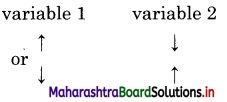
A correlation refers to a statistical tool used to measure the relationship between two or more variables. If the change in one variable is accompanied by a change in the other variable, this interdependence is called correlation. It is measured by correlation coefficient which extends between -1.00 to +1.00. Direction of correlation can be positive or negative.
The types of correlation are:

  1. Positive – Both variables move in the same direction i.e., both increase or both decrease. It extends 0.00 to +1.00 for e.g., identical twins reared together showed IQ correlation of +.88.
  2. Negative – Variables move in the opposite direction i.e., increase in one variable is associated with a decrease in the other variable. The value of negative correlation is 0.00 to -1.00 for e.g., high level of job satisfaction and low level of absenteeism.
  3. Zero – Any change in one variable brings about no significant change in the other variable. Value of coefficient is 0 for e.g., height and intelligence.

Maharashtra Board Class 12 Psychology Solutions Chapter 5 Emotions

Balbharti Maharashtra State Board Class 12 Psychology Solutions Chapter 5 Emotions Textbook Exercise Questions and Answers.

Maharashtra State Board Class 12 Psychology Solutions Chapter 5 Emotions

1. Choose the correct option and complete the following statements.

Question 1.
…………… is a combination of bodily arousal, expressive behaviour, thoughts, and feelings.
(a) Response
(b) Reaction
(c) Emotions
Answer:
(c) Emotions

Question 2.
According to James Lange we first experience ……………….. then emotions.
(a) physical arousal
(b) feelings
(c) thoughts
Answer:
(a) physical arousal

Maharashtra Board Class 12 Psychology Solutions Chapter 5 Emotions

Question 3.
Emotion is used as a …………….. to control others.
(a) weapon
(b) measure
(c) opportunity
Answer:
(a) weapon

Question 4.
When you allow another person to exploit you, you are a victim of ………….. abuse.
(a) physical
(b) emotional
(c) social
Answer:
(b) emotional

Question 5.
Exercising releases ………………… which makes you feel good as a stress buster.
(a) endorphins
(b) thyroxin
(c) insulin
Answer:
(a) endorphins

2. Identify the odd items from the following and write a suitable reason for your choice

Question 1.
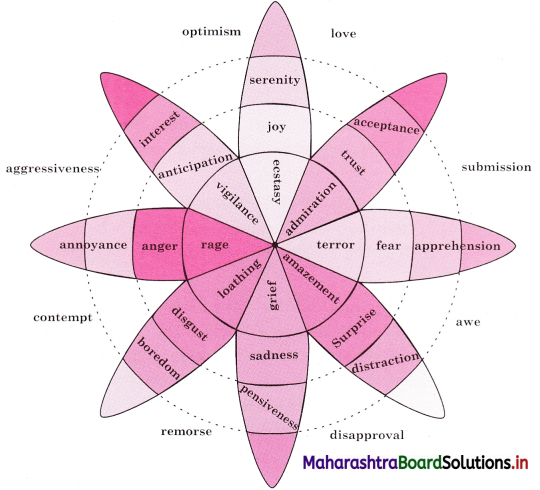
admiration, disgust, acceptance, trust

Question 2.
kicking, ignoring, shoving, screaming

Question 3.
Reassess, React, Respond, Relax

Maharashtra Board Class 12 Psychology Solutions Chapter 5 Emotions

Question 4.
meditation, social work, compassion, engage in hobbies

3. Match the pair.

Question 1.

Group AGroup B
(1) Happiness(a) basic emotion
(2) Paul Ekman(b) fight and flight
(3) Anger(c) surprise
(4) Fear(d) sadness
(5) Grief(e) triggers
(6) Anger management technique(f) powerful emotion

Answer:

Group AGroup B
(1) Happiness(c) surprise
(2) Paul Ekman(a) basic emotion
(3) Anger(f) powerful emotion
(4) Fear(b) fight and flight
(5) Grief(d) sadness
(6) Anger management technique(e) triggers

4. State whether the following statements are true or false.

Question 1.
Emotional well-being is not easily observable.
Answer:
True

Question 2.
Positive emotions energise you.
Answer:
True

Maharashtra Board Class 12 Psychology Solutions Chapter 5 Emotions

Question 3.
You should feel guilty for standing up for yourself.
Answer:
false

Question 4.
Anger is a basic negative emotion.
Answer:
True

5. Answer the following questions in 35 – 40 words each.

Question 1.
Explain the term facial feedback hypothesis.
Answer:
According to the facial feedback hypothesis, our facial expressions provide feedback to our brain about our emotions. Facial expressions are not only the result of our emotions, e.g., smiling in happiness, but they are also capable of influencing emotions, e.g. laughter can actually make us feel happier. The same might hold true for other emotions as well. In the 1840’s, William James presented the idea that awareness of our bodily experiences is the basis of emotion.

Question 2.
When does an individual face social rejection?
Answer:
Social rejection occurs when an individual is deliberately excluded from a social relationship or interaction. This can be done by a person or a group. It includes rejection of the person by family/ peers/ colleagues or even in intimate relationships. Rejection may be active, i.e., by ridiculing, bullying, etc., or passive, i.e., ‘silent treatment’. Social rejection may be faced due to individual differences e.g., attractiveness, shyness or due to intergroup exclusion on the basis of prejudice, e.g., in case of Dalits or ethnic minorities.

Question 3.
With the help of an example write the non-verbal triggers of anger.
Answer:
Anger is a common emotion that everybody experiences in life from time to time. Anger is a normal response to some real or perceived threat. It is a protective emotion that help us to defend ourselves against physical or psychological harm.

Triggers of Anger refer to any event that signals the brain to activate the body’s anger system. The triggers of anger may be (i) verbal, for e.g., being blamed, disrespected or abused (ii) non¬verbal, for e.g., being ignored unappreciated or rejected, (iii) physical such as physical threats, sexual/ physical assault, etc.

Non-verbal triggers of anger are feelings of being neglected, disregarded, disappointed, unloved or frequently spurned. It is expressed through gestures such as pointing a finger, shrugging the shoulders; by facial expressions such as sneering, frowning and also by behaviours such as groaning/sighing/whining or speaking in a mocking tone.

There are three factors involved in the experience of anger : A trigger (causes of anger) → individual’s personality → particular interpretation of that situation.

Maharashtra Board Class 12 Psychology Solutions Chapter 5 Emotions

Question 4.
What are the aspects of emotional well-being?
Answer:
Emotional well-being means managing our emotions, both positive and negative ones, so that we can lead a healthy and productive life. It is the absence of negative affect as well as general satisfaction with life. A person who experiences emotional well-being is positively engaged with the world.
The aspects of emotional well-being are at three levels viz. physical, emotional and social.

  1. Physical level, i.e., well balanced diet, exercise.
  2. Emotional level, i.e., practise mindfulness, raising levels of motivation and optimism.
  3. Social level, i.e., engaging in prosocial behaviour, meaningful relationships.

6. Compare and Contrast

Question 1.
Happiness and Sadness

Question 2.
James Lange theory and Cannon Bard’s Theory

7. Write short notes on the following in 50 – 60 words each.

Question 1.
Measures of dealing with Emotional Abuse
Answer:
Emotional abuse is any kind of abuse that is emotional rather than physical in nature. It occurs when one person subjects or exposes another person to intentionally harmful behaviour that may result in anxiety, depression and psychological trauma to the victim.
The types of emotional abuse may be-

  1. verbal abuse such as blaming, insulting, labeling, threatening, swearing, etc.
  2. non verbal abuse such as ignoring, rejection, bullying, spying, etc.

The most important technique is to break the silence and stand up for yourself.

  1. Accept that emotional abuse is not because of you, i.e., don’t justify the actions of the abuser.
  2. Respond assertively to the abuser but seek distance from him.
  3. Give yourself time to heal.
  4. Prioritize your self-care, e.g., eating right, exercise, etc.
  5. Mobilise support from family and friends. If needed, seek professional help.

Maharashtra Board Class 12 Psychology Solutions Chapter 5 Emotions

Question 2.
Plutchiks’s Model of Emotions
Answer:
Maharashtra Board Class 12 Psychology Solutions Chapter 5 Emotions 1
Robert Plutchik presented the wheel of emotions,

  1. there are 8 basic emotions viz. joy, trust, fear, surprise, sadness, anticipation, anger and disgust.
  2. each primary emotion has its polar opposite such as fear is opposite of anger.
  3. primary emotions combine to produce complex emotions, for e.g., love (complex) is a combination of joy and trust.
  4. intensity of emotions increases as we move toward the centre and decreases as we move outward. For e.g., apprehension (weak) → fear (basic) → terror (strongest).

This model is important from the perspective of emotional literacy, i.e., understanding emotional levels, complexity and change as well as appropriate emotional labelling

Question 3.
Anger -A powerful emotion
Answer:
Anger is a common emotion that everybody experiences in life from time to time. Anger is a normal response to some threat. It is a protective emotion that helps us to defend ourselves against physical/ psychological harm. However, anger may also be unwanted, irrational and destructive. When we experience anger, our amygdala goes into action and overrides the cerebral cortex which is in control of thinking and evaluation. Triggers of anger refer to any event that signals the brain to activate the body’s anger system. The triggers may be (i) verbal, for e.g., being blamed, disrespected or abused (ii) non-verbal, for e.g., being ignored unappreciated or rejected, (iii) physical such as physical threats, sexual/ physical assault, etc.

There are three factors involved in the experience of anger: A trigger (causes of anger) → individual’s personality → particular interpretation of that situation. As the experience of anger is subjective, it can be controlled too. If we understand the triggers of anger, we can anticipate potential anger episodes and provide an intentional/ acceptable response such as it may energize us towards solving problems. As anger is a powerful emotion, it must be kept in check to avoid it’s destructive out comes.

Question 4.
Managing Emotions
Answer:
The word emotion is derived from the latin word ‘emovere’, which means to stir up or to move. An emotion refers to an involuntary, aroused state of an organism involving physical, cognitive and behavioural components. It is described as a combination of bodily arousal, e.g., increased heartrate, thoughts and feelings, i.e. emotional tone and expressive behaviour, i.e., facial expression.

Managing of emotions is an important life skill. Managing emotions can be defined as, ‘the ability to be open to feelings and modulate them in oneself and in others, so as to promote personal understanding and growth. It is the ability to be aware and constructively handle both positive and challenging emotions.

Sometimes, our emotions hijack our thinking due to which we act impulsively. This is because the limbic system (emotional section) developed before the prefrontal cortex (thinking part) and is hence, an extremely strong part of the brain. Emotional management is an art as it is a form of expression as well as a science as it is a skill that needs to be learnt and practiced If a person ignores of suppresses his/her emotions it leads to anxiety. The best way of manage emotions is to acknowledge the emotions, find out what is the cause of that emotion in you, chose how to respond in that situation.

Maharashtra Board Class 12 Psychology Solutions Chapter 5 Emotions

Question 5.
Benefits of Emotional Well-being
Answer:
Emotional well-being means managing our emotions, both positive and negative ones, so that we can lead a healthy and productive life.
Persons who have high emotional well-being experience benefits such as- (i) better able to deal with stress (ii) better self-regulation (iii) increased productivity in tasks undertaken (iv) increased creativity (v) life satisfaction due to meaningful activities and relationship.

  1. Coping with stress – It helps to deal with stress using healthy methods such as exercise, social support, etc.
  2. Better self-regulation – It enables the person to label how they feel and accept negative emotions life fear, anger, etc.
  3. Increases productivity in tasks undertaken – The ability to focus is enhanced, the person feels positive and energized.
  4. Increases creativity – The person indulges in divergent thinking, shows curiosity is open to new experiences.
  5. Life satisfaction – The individual is able to have meaningful interactions and relationships, show empathy, altruism and engage in activities like volunteer work.

8. Answer the following 50 – 60 words.

Question 1.
Using the 3 R model of Anger Management present a case study of your own experience.
Answer:
Anger management is an intervention programme to prevent anger from turning into a habit or obstacle. It enables the person to create an awareness of and responsibility for his/her emotions. This involves two aspects (i) managing one’s own anger (ii) learning to respond effectively to anger in others.

The 3 R’s in anger management a Relax, Reassess and Respond.
1. Relaxation – Relaxation and connection with the inner self helps to enhance thinking and concentration so that we ‘respond’ rather than ‘react’ impulsively.
2. Reassess – This helps the person to revisit the situation objectively. It involves

  • taking complete responsibility for your emotion
  • developing empathy for the person you perceive has wronged you
  • conduct a reality check e.g., is your anger justified given the facts of what happened.

The feeling’s thermometer helps to focus on the extent of anger we are experiencing and helps in the process of reassessment.
Maharashtra Board Class 12 Psychology Solutions Chapter 5 Emotions 2

3. Respond – It entails re-engaging with the other person/situation. Responding involves

  • consulting a trustworthy person to get another perspective
  • engage in talks with the other party in a calm respectful manner with a willingness to sort out the situation.
  • active listening and assertive speaking – Allow the person to express their viewpoint. However, we should stand up for our feeling while exhibiting the same for the other person. The right approach is a practical, positive communication style.
  • cage your rage i.e. establish boundaries and moderate your anger – We must guard against escalation of our own anger which may lead us to provoke the other person. Moderation of anger and establishing clear boundaries of interaction with each other is essential.

CASE STUDY – 1 was in the passenger seat and my brother was driving the car. Suddenly, a cyclist swerved right in front after he had failed to observe the red light. This led me to get enraged at this uncalled-for action. Using the 3R technique. I tried to breathe for a few seconds to give me recovery time, i.e. Relaxation. I revisited the situation – Is my anger justified? Was it a genuine error? Is the cyclist hurt? Did the incident cause injury to us or damage to the car.? Is the anger worth my time/effort? Reassess. I allowed my elder brother to handle the situation but also assertively cautioned the teenage cyclist about the dangers of riding in a rash manner, i.e. Respond.

Maharashtra Board Class 12 Psychology Solutions Chapter 5 Emotions

Question 2.
How does the brain work when angry?
Answer:
Anger is a common emotion that everybody experiences in life from time to time. Anger is a normal response to some threat. It is a protective emotion that help us to defend ourselves against physical/ psychological harm. However, anger may also be unwanted, irrational and destructive. When we experience anger, our amygdala goes into action and overrides the cerebral cortex which is in control of thinking and evaluation.

Triggers of anger refer to any event that signals the brain to activate the body’s anger system. The triggers may be (i) verbal, for e.g., being blamed, disrespected or abused (ii) non-verbal, for e.g., being ignored unappreciated or rejected, (iii) physical such as physical threats, sexual/ physical assault, etc.

There are three factors involved in the experience of anger: A trigger (causes of anger) → individual’s personality → particular interpretation of that situation. As the experience of anger is subjective, it can be controlled too. If we understand the triggers of anger, we can anticipate potential anger episodes and provide an intentional / acceptable response.

The emotional center of the brain is the Limbic system and is more primitive than the cerebral cortex. It is located in the lower section of the brain. Hence when a person is experiencing and expressing anger, he or she is not using the cortex (thinking section) but primarily functioning from the limbic system. In the limbic system, a small structure called Amygdala which is a storehouse of emotional memories plays an important role in the emotional outbursts. The data coming in from the world around us passes through the amygdala where the decision is made whether to send the data to the limbic or cortex area of the brain.

If the incoming data triggers enough of an emotional charge, the amygdala can override the cortex, which means the data will be sent to the limbic system causing the person to react using the lower part of the brain. During an overriding event, the amygdala goes into action without much regard for the consequences (since this area of the brain is not involved in judging, thinking, or evaluating).

Eg. You are waiting patiently in the queue at the bank, a person comes and cuts the line and moves ahead of you, you scream at them and ask them to go back. On an average, it can take 20 minutes for a person who has experienced an angry state of arousal to calm, to move from functioning from the emotional area to the thinking area of the brain.

Question 3.
After having realised you are emotionally abused by your best friend, write the steps you will take to deal with it.
Answer:
Emotional abuse is any kind of abuse that is emotional rather than physical in nature. It occurs when one person subjects or exposes another person to intentionally harmful behaviour that may result in anxiety, depression and psychological trauma.
The types of emotional abuse may be (i) verbal abuse such as blaming, insulting, labeling, threatening, swearing, etc. (ii) non verbal abuse such as ignoring, rejection, bullying, spying, etc. Some of the techniques to deal with emotional abuse are-

  1. Accept that emotional abuse is not because of you i.e. don’t justify the actions of the abuser.
  2. Respond assertively to the abuser but seek distance from him/her.
  3. Give yourself time to heal.
  4. Prioritize your self-care, e.g., eating right, exercise, etc.
  5. Mobilise support from family and friends. If needed, seek professional help.

If I realize that I have been emotionally abused by my good friend I will adopt the following steps-

  1. Disengage from the friendship and set personal boundaries
  2. Understand that I am not the cause of abuse and so respond assertively to the abuser
  3. Practice self care and give myself time to heal
  4. If necessary seek guidance from other friends or my family / teachers.

Maharashtra Board Class 12 Psychology Solutions Chapter 5 Emotions

9. Analyse the situations presented below and
a. Write the Emotion/s you experience.
b. What will be your response to this situation?

Question 1.
Anish was scolded by his boss. He came home and in a fit of rage hit his son. You are Anish’s friend who witnessed this outburst.
Answer:
I will feel anger as well as disgusted on witnessing this outbust. I will try to calm Anish and make him realise the harm that his anger can cause.

Question 2.
You helped your friend with study notes during his illness. But when your friend got better he did not respond nor show any sense of appreciation.
Answer:
I will feel disappointment as well as sadness. I will meet the friend and tell him that his lack of courtesy has hurt me.

Question 3.
Though you are a good friend of Anushka, she has not invited you to her new year’s party.
Answer:
I will feel disappointed and hurt. I will (if possible) try to find out if the action was deliberate or an oversight.

Question 4.
It’s your Birthday and you wake up that morning to find yourself surrounded with beautiful gifts.
Answer:
I will obviously feel immense happiness.

Question 5.
You have had a hectic day at college when you come home you find the door locked. You forgot your keys at home that day and your parents have not informed you of their plans.
Answer:
I will be angry at my at myself and my parents also. But since I forgot the keys, I will take full responsibility and wait it out some family member returns.

Question 6.
You have planned a surprise day out for your best friend and she tells you she is not interested and has other plans
Answer:
I will be a little sad and disappointed but will accept my friend’s decision sportingly.

Class 12 Psychology Chapter 5 Emotions Intext Questions and Answers

ACTIVITIES (Textbook Page. No. 44)

Activity 1

THINK AND ANALYSE
Think of the following situations and note down what will be the experience of each person in that situation.

  1. It’s Mira’s Std. 12th result today. She comes to know that she has topped in the college.
  2. Rahul’s mother passed away just few days before his 18th birthday.
  3. Suchita was ridiculed by her classmate for wearing old fashioned clothes.
  4. Yash had a fight at home because his parents were not allowing him to go for a late night party.

Answer:

  1. Mira will experience happiness due to her success.
  2. Rahul will experience grief and loneliness.
  3. Suchita will experience a sense of helplessness and shame.
  4. Yash will be angry with his parents and feel they are doing him an injustice.

Maharashtra Board Class 12 Psychology Solutions Chapter 5 Emotions

Activity 2 (Textbook Page. No. 46)

Observe each figure carefully and write the emotion that corresponds to each in the blank spaces provided below. Can you identify which among these is a positive and negative emotion?
Maharashtra Board Class 12 Psychology Solutions Chapter 5 Emotions 3
Answer:
(A) = Surprise (positive), (B) = Anger (negative), (C) = Disgust (negative), (D) = Sadness (negative),
(E) = Joy (positive), (F) = Fear (negative).

Activity 3 (Textbook Page. No. 46, 47)

Check whether you can name the emotions accurately from the following examples-

  1. It’s Riya’s 18th birthday today and her friends have given her a surprise party.
  2. Rohan recently had a break up with his long time girlfriend with whom he was in love deeply.
  3. Sameer had a disagreement with his best friend over where to go for a picnic and the situation got heated up.
  4. Sumi has come to know that she has failed in her exam and she is figuring out how she will convey this to her parents.
  5. Ashmeet suddenly saw his school best friend across the street after many years.
  6. Amy opened today’s newspaper and read the news of a 5 year old getting gang raped.

Answer:

  1. Happiness
  2. Surprise
  3. Anger
  4. Fear
  5. Surprise
  6. Disgust

Activity 4 (Textbook Page. No. 48)

THINK, REFLECT, ANALYSE AND DISCUSS
State what will you feel and how will /did you behave in the given following situations:-

  1. You are crossing the road and suddenly find a car breaking the signal and speeding up towards you.
  2. You reach home and find the table laid with your favourite dish cooked by your mother.
  3. You receive a phone call telling you that your best friend is undergoing an operation and needs blood.
  4. Recall an incident in your childhood when you were insulted by an adult.

Answer:

  1. I will feel angry but also afraid. I will jump out of the way
  2. I will feel happy and surprised.
  3. I will fear but feel concerned and be motivated to arrange for the blood.
  4. Students are expected to answer this question by themselves.

Maharashtra Board Class 12 Psychology Solutions Chapter 5 Emotions

Activity 5 (Textbook Page. No. 49)

THINK, ANALYSE AND ACT
Maharashtra Board Class 12 Psychology Solutions Chapter 5 Emotions 4
You see a snake ….. with reference to the above given components fill the process with your interpretations, feelings and actions.
Answer:
Maharashtra Board Class 12 Psychology Solutions Chapter 5 Emotions 5

Maharashtra Board Class 12 Psychology Solutions Chapter 4 Cognitive Processes

Balbharti Maharashtra State Board Class 12 Psychology Solutions Chapter 4 Cognitive Processes Textbook Exercise Questions and Answers.

Maharashtra State Board Class 12 Psychology Solutions Chapter 4 Cognitive Processes

1. Choose the correct option and complete the following statements.

Question 1.
When we select few stimuli from the environment and bring them into the center of our awareness, it is called ……………
(a) attention
(b) perception
(c) thinking
Answer:
(a) attention

Question 2.
Ivan Pavlov is known for explaining learning by …………..
(a) classical conditioning
(b) operant conditioning
(c) observation
Answer:
(a) classical conditioning

Maharashtra Board Class 12 Psychology Solutions Chapter 4 Cognitive Processes

Question 3.
When we organise the information from the environment, group them and give some meaning, that process is called ……………..
(a) attention
(b) perception
(c) thinking
Answer:
(b) perception

Question 4.
In operant conditioning the experiment was conducted on ……………
(a) dog
(b) rat
(c) monkey
Answer:
(b) rat

Question 5.
The change in behaviour due to practice or experience is known as ……………
(a) perception
(b) thinking
(c) learning
Answer:
(c) learning

2. Answer the following questions in 35 – 40 words each.

Question 1.
What is fluctuation of attention?
Answer:
Attention is the mental process of bringing few stimuli into the centre of awareness out of the many stimuli present. It is difficult to attend to a single stimulus for a long period of time. Our attention shifts from the original stimulus to another stimulus for a fraction of time and then comes back to the original stimulus. This may be due to factors like fatigue, decreased interest, etc. In most cases, attention fluctuates due to the limitations of human attention and hence cannot be totally eliminated.

Question 2.
Give three examples of top-down processing in perception.
Answer:
Perception is defined as the process of assigning meaning to information received about the environment based on the past experiences. We make use of both top-down processing and bottom- up processing while perceiving a stimulus. When we utilize top-down processing, our ability to understand information is influenced by the context in which it appears.

Some examples of top-down processes in perception are-
(a) Mr. Kumar lives in Flat A not in Flat Maharashtra Board Class 12 Psychology Solutions Chapter 4 Cognitive Processes 1
The circled item will be perceived as the letter B as the brain has used the context of the sentence.
Maharashtra Board Class 12 Psychology Solutions Chapter 4 Cognitive Processes 2
(b) If you are asked to identify (a) the rat (b) the man, your perception will be likewise.
(c) the huamn mnid deos not raed ervey lteter by istlef but the wrod as a whole.

Most of you would be able to correctly read the above sentence as “The human mind does not read every letter by itself but the word as a whole”.

Maharashtra Board Class 12 Psychology Solutions Chapter 4 Cognitive Processes

Question 3.
What is meant by thinking?
Answer:
Thinking is the mental activity that uses various cognitive elements and processes that involves the manipulation of information.
The core elements of thinking are-

  1. Mental representation – It is a coded internal sensation acquired by direct experiences through the sense organs or by indirect experiences such as narrations, pictures, etc.
  2. Concepts – They form the basis for all cognitive processes, acting as building blocks by connecting with each other to form more complex concepts.
  3. Schema – It is an internal representation that organizes knowledge about related concepts and relationships among them.
  4. Language – Mental representations, concept and schema are represented by language, for e.g., the word ‘cat’ is a symbol for a ‘cat’.

Question 4.
Describe any two processes of learning.
Answer:
Learning is defined as a relatively permanent change in behaviour that occurs due to experience or practice. The characteristics of learning are : (i) It involves some relatively permanent change in behaviour, (ii) The change in behaviour is due to experience or practice, (iii) Change in behaviour may be in knowledge or in skill or in muscular movements, (iv) Learning is an inferred process. The main processes of learning are:
(i) Learning by classical conditioning – It was first explained by Ivan Pavlov. It is learning by forming associations and stimulus substitution. In daily life, we learn many things by classical conditioning for e.g. a child is given an injection by the doctor and begins to cry in pain. He soon makes the connection between ‘doctor’, ‘injection’ and ‘pain’ and begins crying as soon as he is taken to a doctor.

(ii) Learning by operant conditioning – Learning by operant conditioning was first explained by B. F. Skinner. He said that learning takes place to gain positive consequences or to avoid negative consequences.

3. Classify the following into Mental Representation, Concepts and Schemata.

(1) Image of your mother in your mind
(2) Building
(3) Tree
(4) School
(5) Theater
(6) Table
(7) Neil Armstrong
Answer:

Mental RepresentationConceptsSchemata
Image of your mother in your mindBuildingSchool
Neil ArmstrongTreeTheatre
Table

Maharashtra Board Class 12 Psychology Solutions Chapter 4 Cognitive Processes

4. Find the odd one out.

Question 1.
Schema, Perception, Attention, Thinking
Answer:
Schema

Question 2.
Searching solution, Defining problem, Incubation, Implementation of the solution
Answer:
Incubation

Question 3.
Reasoning, Judgement, Decision making, Relaxing
Answer:
Relaxing

Question 4.
Concept, Schema, Solution, Mental Representation
Answer:
Solution

5. Identify if the following behaviours are due to learning or not. Give reasons for your answers.

Question 1.
After much hard work you are able to perform a dance step properly.
Answer:
It is due to learning as it involves a relatively permanent behavioural change due to practice.

Question 2.
In spite of getting hurt, Shayana, a five year old child, continues to play with knife.
Answer:
It is not learning as in spite of an unpleasant experience, there is no change in behaviour.

Maharashtra Board Class 12 Psychology Solutions Chapter 4 Cognitive Processes

Question 3.
Once Hanif had to pay fine for breaking the signal while driving a car. Now he makes sure to stop the car at red signal.
Answer:
It is due to learning as Hanif has made an association between breaking the signal and paying a fine, i.e., negative consequences.

6. Answer the following questions with the help of given points.

Question 1.
Explain the stages of problem solving.
Points:
(i) Defining problem
(ii) Generating alternative solutions
(iii) Selecting a solution
(iv) Implementing and taking follow up of the solution.
Answer:
Problem solving is a type of thinking. It refers to the process of finding appropriate solutions to problems encountered in life. The main steps in problem solving are:
(i) Defining the problem – We need to identify and define the problem correctly. Otherwise, it will be difficult to reach a solution, for e.g., when a baby cries due to colic/stomach ache and if the mother interprets it as due to hungry, the problem will remain unresolved.

(ii) Generation alternative solutions – The person searches for possible solutions to the problem. Some solutions may be effective while other solutions have to be discarded, for e.g., Sunil finds maths difficult. He may think of solving more sums or of taking tuitions or of dropping the subject, etc.

(iii) Selecting a solution – The person selects what he considers the most effective solution, based on reasoning. This helps to resolve the problem in a realistic manner.

(iv) Implementing the solution and follow up on the solution – The person tries out the selected solution and evaluates the outcome i.e. whether it has helped to solve the problems. If the problem remains unresolved, the person may need to carry out the problem – solving procedure all over again.

Maharashtra Board Class 12 Psychology Solutions Chapter 4 Cognitive Processes

Question 2.
Explain the stages of creative thinking.
Points:
(i) Preparation
(ii) Incubation
(iii) Illumination
(iv) Verification
Answer:
Creative thinking is characterised by the ability to perceive the world in new ways, to find hidden patterns, etc. It is a way of looking at problems or situations from a fresh/novel perspective. In involves divergent thinking that focuses on exploration of ideas and generating many possibilities. It is referred to as “thinking outside of the box.” Researchers, poets, designers, film makers always think in a creative way.

The four stages in creative thinking are-
(i) Preparation – This involves formulating the problem and gathering information about it. Many tentative solutions are tried out and discarded. No progress seems to be made by the person.

(ii) Incubation – If the person does not get the required results, he/she may focus on things unrelated to that problem. The period helps to work out the problem without consciously thinking about it. Incubation period appears to be non-fruitful.

(iii) Illumination – After incubation, suddenly the correct solution appears to the person, due to which he/she experiences excitement. It seems that a solution has fallen into place.

(iv) Verification – The new solution may need to be evaluated a number of times. In most cases, minor changes will be required but sometimes it may demand a major overhaul of the entire process.

For e.g., A teacher asks the students to think of unusual uses for a bottle.

  • The students will begin brainstorming.
  • The students will come up with many uses for e.g., to store liquids, to hold plants, etc. But these are not unusual uses. They will give up and focus on something else.
  • The students will suddenly find novel uses for the bottle e.g., in juggling etc.
  • The students will verify these solutions with their teacher.

Maharashtra Board Class 12 Psychology Solutions Chapter 4 Cognitive Processes

7. Answer the following questions in detail.

Question 1.
Explain the laws of perceptual organization.
Answer:
Perception is defined as the process of assigning meaning to information received about the environment based on the past experiences. Our brain has the tendency to organize our sensations as a meaningful whole. Max Wertheimer first explained this tendency in the form of laws of perceptual organization.

Some laws of perceptual organization are as follows:
(i) Law of proximity – Stimuli that are near to each other are perceived as together, rather than stimuli that are far away from each other.
Maharashtra Board Class 12 Psychology Solutions Chapter 4 Cognitive Processes 3
In the above figure, we perceive pairs of dots in each line because the dots which are near to each other are perceived together. So instead of perceiving a line of 8 dots, generally a line of four pairs of dots is perceived.

(ii) Law of similarity – Stimuli that are similar to each other are perceived together than stimuli that are distinct from each other.
Maharashtra Board Class 12 Psychology Solutions Chapter 4 Cognitive Processes 4
In the above figure, we perceive 4 alternate vertical lines each of circles and crosses as similar stimuli are perceived together. Generally, we do not perceive 4 horizontal lines each having circles and crosses in alternate sequence.

(iii) Law of continuity – There is a tendency to perceive a stimulus in continuation according to its established direction.
Maharashtra Board Class 12 Psychology Solutions Chapter 4 Cognitive Processes 5
In the above figure, a straight vertical line and a straight horizontal line are perceived together as a letter ‘L’ and a cutting line is perceived separately as a line following the smoothest path. Generally, we do not perceive here four different lines going in different directions.

(iv) Law of closure – There is a tendency to fill in the gaps in an incomplete stimulus so as to perceive it as a meaningful figure.
Maharashtra Board Class 12 Psychology Solutions Chapter 4 Cognitive Processes 6
In the above figure, we fill in the gaps and perceive it as a triangle and square. Generally, we do not perceive here the three or four separate lines going in different directions.

Maharashtra Board Class 12 Psychology Solutions Chapter 4 Cognitive Processes

Question 2.
Explain the core elements of thinking.
Answer:
Thinking is the mental activity that makes use of ideas or symbols instead of overt activity. The types of thinking are (i) Perceptual (concrete) thinking, (ii) Conceptual (abstract) thinking (iii) Reflective thinking, (iv) Creative thinking.
The core elements in thinking are-
(i) Mental representation – It is a coded internal sensation acquired by direct experiences through the sense organs or by indirect experiences such as narrations, pictures, etc. Mental representation is the mental imagery with the help of which the brain codes and stores the information. It is like a hypothetical internal cognitive symbol used by the brain to represent external reality. Example: a child is asked to imagine a peacock. The visual image of a peacock with its colouful plumage immediately comes to mind. This refers to “mental imagery” of an object.

(ii) Concepts – They form the basis for all cognitive processes, acting as building blocks by connecting with each other to form more complex concepts. Concepts involve extraction of some ‘idea’ on the basis of similarities and differences among the sensations. A concept is an idea which represents a class of objects, situations, etc which differentiates it from other classes of objects, situations, etc., for e.g. a child forms a mental image of a ‘dog’. He derives an idea of something similar in all examples of ‘dog’ that he has seen i.e. tail, fur, barking, etc. Thus, he has formed concept of dog. If he mistakenly identifies as a cat as a dog. he is corrected by others. So he tries to compare the mental images of dogs and cats. He has now learned and refined two concepts viz. dog and cat.

(iii) Schema – It is an internal representation that organizes knowledge about related concepts and relationships among them. Schema involves arranging many concepts in a particular system or organisation. It describes a pattern of thought or behavior that organises categories of information and the relationships among them. A child tries to organise the concepts that he has learned in a systematic way to generate a higher order understanding of patterns about information collected, for e.g. when a child visits a ‘zoo’ for the first time, images and concepts such as of different animals, caves/cages, etc., are activated in the brain simultaneously. Thus, he is forming the schema of ‘zoo’.

Conclusion:- Mental representation is sensory experiences in the form of mental images in the brain. Many similar mental representations denote concepts while many concepts put in a particular relationship to each other is schema.

Question 3.
With the help of your own examples explain the difference between distraction of attention and fluctuation of attention.
Answer:
Attention is the selective process by which we focus on only a few stimuli from among the various stimuli that are present in our environment. According to Norman Munn, “Attention is the mental process of bringing few stimuli into the center of awareness out of the many stimuli present”. Attention is influenced by objective factors such as intensity, size, movement, etc., of stimuli as well as subjective factors like interest, mindset, etc.

The distraction of attention refers to the drifting of attention from a specific stimulus to another stimulus. This occurs due to external factors such as intensity, novelty, movement, etc., of stimuli or internal factors like physical state, lack of interest, mental set, etc.

It is difficult to attend to a single stimulus for a long period of time. Our attention shifts from the original stimulus to another stimulus for a fraction of time and then come back to the original stimulus. This is called fluctuation of attention. It may be due to factors like fatigue, decreased interest, etc.

In most cases, fluctuation of attention is due to the limitations of human attention whereas distraction of attention is due to an external powerful stimulus that has drawn our attention. When attention fluctuates, it is for a very short period of time and then it returns to the original stimulus, i.e., it is a temporary shift in attention, e.g., look at the below figure. Attention fluctuates on observing the figure as a closed book or open book.
Maharashtra Board Class 12 Psychology Solutions Chapter 4 Cognitive Processes 7
The distraction of attention arises when you are studying and the doorbell suddenly rings, you get up to answer the door. You may or may not be able to return to the original stimulus. Fluctuation of attention cannot be controlled totally but the distraction of attention should be avoided.

Maharashtra Board Class 12 Psychology Solutions Chapter 4 Cognitive Processes

Class 12 Psychology Chapter 4 Cognitive Processes Intext Questions and Answers

ACTIVITIES (Textbook Page. No. 33)

Activity 1
Read the following examples and try to name the cognitive process described in each of them:

  1. Reena immediately sensed the burning smell of pizza put in the oven.
  2. Mahesh always pays attention to what the psychology teacher teaches in class.
  3. Professor Mr. Patil met one of his former students all of a sudden. He tried to recall the name of his student.
  4. Saif was reading a storybook and so he forgot to complete his homework.
  5. After considering all pros and cons, Dinesh took the decision of changing his business.

Answer:

  1. Sensation
  2. Attention
  3. Perception, Memory
  4. Forgetting
  5. Reasoning, Decision making.

Maharashtra Board Class 12 Psychology Solutions Chapter 2 Intelligence

Balbharti Maharashtra State Board Class 12 Psychology Solutions Chapter 2 Intelligence Textbook Exercise Questions and Answers.

Maharashtra State Board Class 12 Psychology Solutions Chapter 2 Intelligence

1. Choose the correct option and complete the following statements.

Question 1.
……………………. has given formula of I.Q.
(a) Binet
(b) Stern
(c) Wechsler
Answer:
(b) Stern

Question 2.
…………………. has given the concepts of fluid intelligence and crystallized intelligence.
(a) Cattell
(b) Thorndike
(c) Salovey
Answer:
(a) Cattell

Maharashtra Board Class 12 Psychology Solutions Chapter 2 Intelligence

Question 3.
…………………. is an individual test of intelligence.
(a) Army Alpha Test
(b) Army Beta Test
(c) Block Building Test
Answer:
(c) Block Building Test

2. State whether the following statements are true or false.

Question 1.
Verbal tests of intelligence can be given easily to illiterate people.
Answer:
False

Question 2.
It is possible to increase emotional intelligence.
Answer:
True

Question 3.
There are certain limitations to Artificial Intelligence.
Answer:
True

Question 4.
Group tests of intelligence are less expensive.
Answer:
True

3. Answer the following in one sentence each.

Question 1.
What is meant by intelligence?
Answer:
David Wechsler defines intelligence as, “the aggregate or global capacity of an individual to act purposefully, to think rationally and to deal effectively with his environment.”

Maharashtra Board Class 12 Psychology Solutions Chapter 2 Intelligence

Question 2.
Who is considered as the father of intelligence test?
Answer:
Alfred Binet is considered as the father of intelligence tests.

Question 3.
What is meant by verbal tests of intelligence?
Answer:
Verbal tests of intelligence make use of words and numbers to measure intelligence and subjects respond verbally to the test items, for e.g., WAIS, Army Alpha Test, etc.

Question 4.
What is meant by individual test of intelligence?
Answer:
Individual tests of intelligence are tests which can be administered to a single person at a time, for e.g., Stanford Binet Scales, WAIS, Koh’s Block Design Test, etc.

4. Define / Explain the concepts in 25 – 30 words each.

Question 1.
Mental Age
Answer:
Alfred Binet introduced the concept of Mental Age. It is defined as the age at which the person successfully performs on all items of the test prepared for that age level. Mental Age need not correspond to Chronological Age. If Mental Age (MA) is the same as Chronological Age (CA), the person has average intelligence. For e.g., Sumit aged 10 years has successfully performed all items on the test for age 12. Hence, his Mental Age will be 12 years, i.e., he has above average intelligence.

Question 2.
Social Intelligence
Answer:
E.L. Thorndike proposed the term Social Intelligence. Howard Gardner included ‘interpersonal intelligence’in the Multiple Intelligences Theory. According to Karl Albrecht, ‘Social intelligence . is the ability to get along well with others and to get them to cooperate with oneself.’

A continued pattern of nourishing behaviour indicates a high level of social intelligence. Such persons are skilled at interacting with and understanding people around them. They respect and encourage others. They effectively comprehend social dynamics.

Maharashtra Board Class 12 Psychology Solutions Chapter 2 Intelligence

Question 3.
Emotional Intelligence
Answer:
The term Emotional Intelligence was used for the first time by John Mayer and Peter Salovey. The concept of emotional intelligence was popularized by Daniel Goleman. It is defined as “the ability to perceive and monitor one’s own and others emotions, to discriminate among them and to use this information to guide one’s thinking and actions.” Emotional Intelligence refers to a set of cognitive abilities such as perceiving emotions, using emotions to facilitate thought, understanding emotions and managing (regulating) emotions. Persons with high emotional intelligence tend to be emotionally stable, patient, optimistic, enthusiastic and calm.

5. Write short notes on the following.

Question 1.
Intelligence Quotient
Answer:
Intelligence is the highest attribute of human beings. Different psychologists have defined intelligence differently. Lewis Terman explains intelligence as, “an ability to think on an abstract level.”

David Wechsler defines intelligence as, “the aggregate or global capacity of an individual to act purposefully, to think rationally and to deal effectively with his environment.”

Intelligence Quotient refers to a measurement of intelligence.. In 1912, William Stern introduced the concept of intelligence quotient (IQ). Terman, refined the formula for calculating IQ, which is as stated below-
IQ = \(\frac {MA}{CA}\) × 100
Example: Ankush who is 10 years old has a Mental Age of 11 years. Let us calculate his IQ.
MA = 11 years CA = 10 years IQ = ?
IQ = \(\frac {MA}{CA}\) × 100 = \(\frac {11}{10}\) × 100 = 110
Ankush has an IQ of 110.

Question 2.
Charles Spearman’s theory of intelligence
Answer:
Intelligence is the highest attribute of human beings. Different psychologists have defined intelligence differently. Lewis Terman explains intelligence as, “an ability to think on an abstract level.”
David Wechsler defines intelligence as, “the aggregate or global capacity of an individual to act purposefully, to think rationally and to deal effectively with his environment.”
In 1927, Charles Spearman with the help of a statistical method called factor analysis separated and identified two different factors of intelligence viz. General factor (g) and Specific factor (s).

  1. General factor is the minimum competence required to carry out daily work.
  2. Specific factor includes abilities which are required to solve problems in specific areas.

Maharashtra Board Class 12 Psychology Solutions Chapter 2 Intelligence

Question 3.
Verbal tests of intelligence
Answer:
Intelligence is the highest attribute of human beings. Different psychologists have defined intelligence differently. Lewis Terman explains intelligence as, “an ability to think on an abstract level.”
David Wechsler defines intelligence as, “the aggregate or global capacity of an individual to act purposefully, to think rationally and to deal effectively with his environment.”

On the basis of material used in the tests, intelligence tests can be classified as Verbal tests and Non-verbal tests of intelligence. Intelligence tests that use language (words or numbers) for measuring intelligence are called verbal tests of intelligence. In these tests subjects are required to respond verbally to test items. Army Alpha Test, Wechsler’s Adult Intelligence Scale (WAIS), etc., are some of the examples of verbal tests of intelligence. These tests are language and culture bound and hence cannot be used with children, illiterates etc. However, they are useful in measuring higher mental abilities.

Question 4.
Non-verbal tests of intelligence
Answer:
Intelligence is the highest attribute of human beings. Different psychologists have defined intelligence differently. Lewis Terman explains intelligence as, “an ability to think on an abstract level.”
David Wechsler defines intelligence as, “the aggregate or global capacity of an individual to act purposefully, to think rationally and to deal effectively with his environment.”
On the basis of material used in the tests, intelligence tests can be classified as Verbal tests and Non-verbal tests of intelligence.

Intelligence tests that use pictures, designs, material objects, etc., to measure intelligence are called non-verbal tests of intelligence. In these tests language is not used to measure intelligence. In these tests subjects are not required to respond verbally to test items. Non-verbal tests are of two types viz.

  1. Performance tests for e.g., Koh’s Block Design test, Dr. Bhatia’s Non Verbal test, Alexander’s Pass-along test, etc. and
  2. Paper-pencil tests for e.g., Raven’s Standard Progressive Matrices.

Question 5.
Artificial Intelligence
Answer:
The term Artificial Intelligence was suggested by John McCarthy. Artificial intelligence is an innovation created by human intelligence. It is a field of study that combines computer science, algorithms, psychology, etc. It refers to enabling software programmes and computer systems to perform tasks that normally require human intelligence, such as visual perception, speech recognition, weather forecasting, language translation, etc.

Artificial intelligence can take decisions only on the basis of stored information and so cannot be an alternative to human intelligence. Artificial intelligence has immense applications in daily life as well as to solve critical problems. Artificial intelligence is used in devices like robots, computers, self-driving cars, automatic missiles, smart phones, medical diagnostic tools, etc.

6. Answer the following questions with the help of the given points.

Question 1.
Write in brief about individual tests of intelligence
(i) Meaning
(ii) Advantages
(iii) Disadvantages
Answer:
Maharashtra Board Class 12 Psychology Solutions Chapter 2 Intelligence 1
(i) Meaning – Intelligence tests that can be administered to a single person at a time are called individual tests of intelligence, for e.g., Stanford Binet Scales, Koh’s Block Design Test, etc.

(ii) Advantages-

  1. The test administrator can establish a rapport with the client.
  2. The test administrator can get additional information about the client’s feelings, moods and expressions during testing.
  3. Individual tests are more capable of measuring creative thinking, compared to group tests.

(iii) Disadvantages-

  1. Individual tests are time consuming and costly to administer.
  2. Individual tests require a trained and skillful examiner to administer, score and interpret them.
  3. These tests cannot be used for mass testing.

Maharashtra Board Class 12 Psychology Solutions Chapter 2 Intelligence

Question 2.
Write in brief about group tests of intelligence
(i) Meaning
(ii) Advantages
(iii) Disadvantages
Answer:
Maharashtra Board Class 12 Psychology Solutions Chapter 2 Intelligence 2
(i) Meaning – Group test of intelligence are tests that can be administered to more than one person at a time, i.e., for mass testing, for e.g., Army Alpha and Army Beta Test, OTIS self¬administrating tests, etc.

(ii) Advantages-

  1. Group tests are less time consuming and more economical to administer.
  2. In administrating of group tests, the role of the examiner is minimal. So, he/she need not go through any specialised training.
  3. These tests can be used in cases where mass testing is needed.

(iii) Disadvantages-

  1. The test administrator has much less opportunity to establish rapport, obtain cooperation and maintain interest of the clients.
  2. Compared to individual tests, group tests are less capable of measuring the creative aspect of intelligence.

7. Answer the following questions in Detail.

Question 1.
Write in detail about the history of intelligence testing.
Answer:
Intelligence is the highest attribute of human beings. Different psychologists have defined intelligence differently. Lewis Terman explains intelligence as, “an ability to think on an abstract level.”

David Wechsler defines intelligence as, ‘the aggregate or global capacity of an individual to act purposefully, to think rationally and to deal effectively with his environment’. Many psychologists have contributed to the measurement of Intelligence.

Sir Francis Galton thought that he could determine intelligence by measuring the size of the human skull. He administered a battery of tests to measure variables such as head size, reaction time, visual acuity, etc. However, these tests did not prove useful to measure intelligence.

Raymond Cattell, used the term ‘mental test’ for the first time. Like his mentor, Sir Galton, Cattell also believed that intelligence is best measured by sensory tasks. However, be emphasized that test administration must be standardized.

In 1905, Alfied Binet in collaboration with Theodor Simon, published the First Scale of Intelligence. This scale was revised in 1908 and 1911. In 1916, Lewis Terman revised the scale, i.e., adapted few items, established new age norms etc. This came to be called ‘Stanford Binet Test’. Binet also introduced the concept of Mental Age. It is defined as the age at which the person successfully performs on all items of the test prepared for that age level.

In 1917, Robert Yerkes and his colleagues developed the Army Alpha (verbal test) and Army Beta (performance test) intelligence tests. These two tests were used to recruit soldiers. In 1939, during World War II also, to recruit army personnel, the Army General Classification Test was used.

In 1939, David Wechsler published the Wechsler-Bellevue Intelligence Test. In 1955, the test was revised and then called Wechsler Adult Intelligence Scale (WAIS). It has a verbal scale and performance scale. Wechsler also developed a test to measure intelligence of children, i.e., Wechsler Intelligence Scale for Children (WISC).

Mental Age – Alfred Binet introduced the concept of Mental Age. It is defined as the age at which the person successfully performs on all items of the test prepared for that age level. Mental Age need not correspond to Chronological Age. It Mental Age (MA) is the same as Chronological Age (CA), the person has average intelligence.

Intelligence Quotient – In 1912, William Stern introduced the concept of Intelligence Quotient (IQ). Terman, refined the formula for calculating IQ which is as stated below-
IQ = \(\frac {MA}{CA}\) × 100 IQ made it possible to compare the intelligence of individuals of different age CA groups.

Maharashtra Board Class 12 Psychology Solutions Chapter 2 Intelligence

Question 2.
‘Intelligence testing has a wide usage in various areas’. Justify with examples.
Answer:
David Wechsler defines intelligence as, ‘the aggregate or global capacity of an individual to act purposefully, to think rationally and to deal effectively with his environment.’
Types of Intelligence Tests-
(i) Individual tests of intelligence-
Individual tests of intelligence are tests which can be administered to a single person at a time, for e.g., Stanford Binet Scales, WAIS, Koh’s Block Design Test, etc.

(ii) Group tests of intelligence-
Group test of intelligence are tests that can be administered to more than one person at a time, i.e., for mass testing, for e.g., Army Alpha and Army Beta Test, OTIS self-administrating tests, etc.

(iii) Verbal tests of intelligence-
Verbal tests of intelligence make use of words and numbers to measure intelligence and subjects respond verbally to the test items, for e.g., WAIS, Army Alpha Test, etc.

(vi) Non-verbal tests of intelligence-
Non-verbal tests of intelligence do not use language to measure intelligence. They make use of pictures, designs, objects, etc. Such tests may be (i) Performance tests, e.g., Koh’s Block Design Test or (ii) Paper-pencil test e.g., Raven’s Standard Progressive Matrices.

Application of Intelligence Testing

  1. Effective Schooling – On the basis of intelligence test scores, teachers can classify students into intellectual categories and devise special instructional programmes suited to their mental development.
  2. Aids Mental Health Personnel – Intelligence tests are helpful to Mental Health personnel such as psychologists, etc., for diagnosis purposes and therapy.
  3. Effective Parenting – Parents can provide appropriate educational facilities to their children based on their IQ scores.
  4. Career Counselling – Scores obtained on intelligence tests help the student to select the right educational options/ courses.
  5. Vocational Counselling – Individuals can choose a suitable career and achieve job satisfaction when they make a realistic choice of vocation based on IQ scores.

Question 3.
Explain the characteristics of people having high social intelligence.
Answer:
E.L. Thorndike proposed the term Social Intelligence. Howard Gardner included ‘interpersonal intelligence’ in the Multiple Intelligences Theory. According to Karl Albrecht, “Social intelligence is the ability to get along well with others and to get them to cooperate with oneself’.

According to Karl Albrecht our behaviour towards others falls somewhere on a spectrum between toxic behaviour and nourishing behaviour. Devaluing others, refusing cooperation to others, negative talking, discouraging others, etc., are some of the examples of toxic behaviours. A continued pattern of toxic behaviour indicates a low level of social intelligence. Respecting others, cooperating with others, positive talking, encouraging others, etc., are some of the examples of nourishing behaviour. A continued pattern of nourishing behaviour indicates a high level of social intelligence.

The following are some of the characteristics of people having high social intelligence:

  1. They are good at understanding and interacting with other people.
  2. They have ability to monitor their verbal and non-verbal expressions while communicating with others.
  3. They are good speakers and good listeners.
  4. They are skilled at assessing the emotions, motivations, desires, and intentions of those around them.
  5. They understand social dynamics in an effective way.
  6. They are flexible in their approach while dealing with others.
  7. They are goal orientated, persistent and self- confident.
  8. They can resolve conflicts in social contexts.
  9. They are successful negotiators.
  10. They enhance personal and professional relationships with others.

Maharashtra Board Class 12 Psychology Solutions Chapter 2 Intelligence

Class 12 Psychology Chapter 2 Intelligence Intext Questions and Answers

ACTIVITY (Textbook Page. No. 12)

Activity 1
Read the following sentences and decide whether the given sentences are the facts or just beliefs about intelligence :
(i) Intelligence is something that is inborn.
(ii) Students who are intelligent can get good marks in examinations.
(iii) Students who do not get good marks in examinations are less intelligent.
(iv) People who are intelligent are very smart.
(v) Intelligent people can impress anyone by their talk.
Answer:
[All the statements are just beliefs, not facts.]

Activity 2 (Textbook Page. No. 15)
Read the following examples. Using the formula, calculate the I.Q. of the following students:
(i) Aabha is a genius girl. Her chronological age is 8 years and her mental age is 14 years. Find out her I.Q.
(ii) Mayur has learning disabilities. His chronological age is 8 years and his mental age is 6 years. Find out his I.Q.
Answer:
(i) In case of Aabha – Mental Age (MA) = 14 years
Chronological Age (CA) = 8 years, IQ = ?
IQ = \(\frac {MA}{CA}\) × 100 = \(\frac {14}{10}\) × 100 = 175
IQ = 175.

(ii) In case of Mayur – Mental Age (MA) = 6 years.
Chronological Age (CA) = 8 years, IQ = ?
MA 6
IQ = \(\frac {MA}{CA}\) × 100 = \(\frac {6}{10}\) × 100 = 75
IQ = 75.

Activity 3 (Textbook Page. No. 16)

Make a chart listing the advantages and disadvantages of individual tests of intelligence.
Answer:
(i) Advantages-

  1. The test administrator can establish a rapport with the client.
  2. The test administrator can get additional information about the client’s feelings, moods and expressions during testing.
  3. Individual tests are more capable of measuring creative thinking, compared to group tests.

(ii) Disadvantages-

  1. Individual tests are time consuming and costly to administer.
  2. Individual tests require a trained and skillful examiner to administer, score and interpret them.
  3. These tests cannot be used for mass testing.

Maharashtra Board Class 12 Psychology Solutions Chapter 2 Intelligence

Activity 4 (Textbook Page. No. 16)

Make a chart listing the advantages and disadvantages of group tests of intelligence.
Answer:
(i) Advantages-

  1. Group tests are less time consuming and economical to administer.
  2. In administrating group tests, the role of the examiner is minimal. So, he/she need not go through any specialized training.
  3. These tests can be used in cases where mass testing is needed.

(ii) Disadvantages-

  1. The test administrator has much less opportunity to establish rapport, obtain cooperation and maintain interest of the clients.
  2. Compared to individual tests, group tests are less capable of measuring creative aspect of intelligence.

Activity 5 (Textbook Page. No. 17)

Verbal test of intelligence Choose the correct option:
(i) Shoe – Foot : : Hat – ……………..
(a) Kitten
(b) Head
(c) Knife
Answer:
Shoe – Foot: : Hat – Head

(ii) Eye – Head : : Window – ………………
(a) Key
(b) Floor
(c) Room
Answer:
Eye – Head : : Window – Room

Activity 6 (Textbook Page. No. 19)

Read the examples given in Activity 6 on textbook page no. 18 and decide the positions of Chetan, Sagar and Anil on the following spectrum of behaviour:
Maharashtra Board Class 12 Psychology Solutions Chapter 2 Intelligence 3
Answer:
Maharashtra Board Class 12 Psychology Solutions Chapter 2 Intelligence 4

Activity 7 (Textbook Page. No. 20)

Study the differences between the characteristics of people having high emotional intelligence and low emotional intelligence and think about what you can do to develop your emotional intelligence?

Characteristics of people having high emotional intelligenceCharacteristics of people having low emotional intelligence
Emotionally stable, PatientEmotionally unstable, Impatient
Optimistic, IndependentPessimistic, Dependent
Happy, EnthusiasticSad, Apathetic
Calm, SatisfiedRestless, Dissatisfied

Answer:
I will try to develop emotional intelligence by adopting the following ways-

  1. active listening skills .and effective style of communication.
  2. practice self-evaluation and self-awareness.
  3. respond instead of reacting in conflict situations.
  4. stay motivated, rational and have a positive outlook.
  5. show empathy, be approachable.
  6. adopt effective stress management techniques.

Maharashtra Board Class 12 Psychology Solutions Chapter 2 Intelligence

Activity 8 (Textbook Page. No. 20)

Discuss how the following devices use Artificial Intelligence:
(i) Computers
(ii) Self-driving cars
(iii) Robots
(iv) Medical diagnostic tools
(v) Translation devices
(vi) Automatic Missiles
(vii) Chatbots, etc.
Answer:
(i) Computers – AI is the ability of a computer programme to think and learn. It makes computers smart, i.e., work without being encoded with commands.

(ii) Self-driving cars – Autonomous driving is a key application of AI. Self-driving cars are equipped with multiple sensors such as cameras, radars, etc., which generate massive amount of data and simulate human perceptual and decision making processes in driving.

(iii) Robots – AI gives robots the computer vision to navigate, sense and calculate their reaction accordingly. Robots learn to perform tasks from humans through machine learning which is a part of computer programming and AI.

(iv) Medical diagnostic tools – Abnormalities in body fluids and tissue can be automatically detected using AI in medical diagnosis solutions. AI can help to speed up process of diagnosis, i.e., biomarkers.

(v) Translation devices-AI uses Neural Machine Translation (NMT), i.e., an electronic, neural network trained to recognize patterns in the input data set and translate it into desired output data, for e.g., a sentence in Japanese into English. It is more accurate than simple machine translation.

(vi) Automatic Missiles – AI is leading the world towards a battlefield that has no boundaries, may not even have humans involved and will be impossible to control across the human ecosystem in Cyberspace, Geospace and Space (CGS). It refers to the weaponisation of AI, i.e., a weapon system that can select human/ non-human targets without further intervention by a human operator.

(vii) Chatbots – AI makes it possible for chatbots to ‘learn’ by discovering patterns in data. A chatbot is a computer programme that imitates spoken and written conversation, i.e., voice commands and texts, for e.g., Siri.

Maharashtra Board Class 12 Psychology Solutions Chapter 1 Psychology: A Scientific Discipline

Balbharti Maharashtra State Board Class 12 Psychology Solutions Chapter 1 Psychology: A Scientific Discipline Textbook Exercise Questions and Answers.

Maharashtra State Board Class 12 Psychology Solutions Chapter 1 Psychology: A Scientific Discipline

1. Choose the correct option and complete the following statements.

Question 1.
Till 1879, psychology was a branch of ……….
(a) physics
(b) philosophy
(c) physiology
Answer:
(b) philosophy

Question 2.
Psychology is a science.
(a) natural
(b) social
(c) biological
Answer:
(b) social

Maharashtra Board Class 12 Psychology Solutions Chapter 1 Psychology: A Scientific Discipline

Question 3.
…………………. is considered as founder of Psychoanalysis.
(a) Wilhelm Wundt
(b) Carl Rogers
(c) Sigmund Freud
Answer:
(c) Sigmund Freud

2. Match the pair

Group AGroup B
(1) Structuralism(a) John Watson
(2) Functionalism(b) Carl Rogers
(3) Behaviourism(c) Ulric Neisser
(4) Cognitivism(d) William James
(e) Wilhelm Wundt

Answer:

Group AGroup B
(1) Structuralism(e) Wilhelm Wundt
(2) Functionalism(d) William James
(3) Behaviourism(a) John Watson
(4) Cognitivism(c) Ulric Neisser

3. State whether the following statements are true or false.

Question 1.
Psychology is a study of mental processes.
Answer:
True

Maharashtra Board Class 12 Psychology Solutions Chapter 1 Psychology: A Scientific Discipline

Question 2.
Case study method is quite often used by clinical psychologists.
Answer:
True

Question 3.
An experimenter is a person on whom the experiment is conducted.
Answer:
False

4. Answer the following in one sentence each.

Question 1.
In which year was the first psychology laboratory established?
Answer:
The first psychology laboratory was established in 1879 by Wilhelm Wundt, at the University of Leipzig in Germany.

Question 2.
Who is considered as the ‘Father of American Psychology’?
Answer:
William James, founder of Functionalism school of thought of psychology is considered ‘Father of American Psychology’.

Maharashtra Board Class 12 Psychology Solutions Chapter 1 Psychology: A Scientific Discipline

Question 3.
What is meant by an experimenter?
Answer:
The person who conducts the experiment is called the experimenter.

5. Define / Explain the concepts in 25 – 30 words each.

Question 1.
Replicability
Answer:
Replicability is one of the key features of science. Scientific knowledge can be replicated under the same circumstances as the original experiment. This ensures reliability of results towards establishing a scientific theory.

Question 2.
Correlation coefficient.
Answer:
Correlation coefficient is the measurement of the correlation between two or more variables. Its value extends between -1.00 to +1.00. The concept was first introduced by Sir Francis Galton. The Pearson product-moment correlation coefficient is the most commonly used type of correlation coefficient.

6. Write short notes on the following in 50 – 60 words each.

Question 1.
Observation method
Answer:
Observation method is a research method that is employed in conditions where experiments may not be possible or even necessary. Observation is used by child psychologists and social psychologists. It may be carried out in a natural setting, for e.g., observing candidates waiting their turn for an interview. It may also be carried out in controlled conditions.
The following factors should be kept in mind while carrying out the observation

  1. it should be done systematically.
  2. a comprehensive list of behaviours to be observed must be prepared.
  3. the persons should not be aware of being observed.

The disadvantages of observation are:

  1. it is a time consuming method.
  2. objectivity is difficult to maintain during observation.
  3. it is difficult to establish cause-effect relationships.

Maharashtra Board Class 12 Psychology Solutions Chapter 1 Psychology: A Scientific Discipline

Question 2.
Survey method
Answer:
A survey is a research method used to collect data from a pre-determined group of respondents, i.e., a sample. It is used to obtain information about the preferences, opinions, etc., of the ‘sample’ population. It makes use of tools like questionnaire, checklist, interviews, etc. Survey method is employed by social psychologists, industrial psychologists, etc. The researcher must ensure that-

  1. sample of respondents is representative of the population.
  2. questions should not be ambiguous.

The disadvantages of survey method are:

  1. it is a very subjective method,
  2. it lacks reliability.

Question 3.
Case study method
Answer:
Case study method is a qualitative research method employed by clinical psychologists. It provides intensive, descriptive information about an individual from multiple sources such as family, peers, school, academic and health records, etc. This helps to assess the person’s level of psychological and social functioning. Researchers may employ techniques like observation, interview, psychological tests, etc. Psychologist such as Sigmund Freud and Jean Piaget made extensive use of case study method. However, this method is very time consuming and subjective.

Question 4.
Importance of rationality
Answer:
Rationality implies being agreeable to reason. According to Stanovich, “Rationality involves adaptive reasoning, good judgement and good decision making.”
According to Dr. Albert Ellis, rationality helps a person to successfully attain goals and be happy. He proposed Rational Emotive Behavioural Therapy (REBT), which is a popular intervention method in counselling psychology.
Rationality is important because:

  1. It allows us to make decisions in new or unfamiliar situations by helping us to gather and process relevant information.
  2. It enables the person to exhibit tolerance and flexibility.
  3. A rational person accepts oneself unconditionally and assumes responsibility for their own behaviour.
  4. Rationality helps to understand and respect the views and interests of others.

7. Define / Explain the concepts in 25 – 30 words each.

Question 1.
Science
Answer:
The word science is derived from the Latin word ‘Scientia’ which means ‘knowledge’. Science is the pursuit and application of knowledge and understanding of the natural and social world, following a systematic methodology based on evidence. The key features of science are empirical evidence, objectivity, scientific causality, systematic exploration and replication.

Maharashtra Board Class 12 Psychology Solutions Chapter 1 Psychology: A Scientific Discipline

Question 2.
Objectivity
Answer:
Objectivity is one of the key features of science. It refers to the ability to observe and accept facts as they exist setting aside all sources of expectations, values, prejudices, etc. Science objectively studies some particular phenomenon.

8. Answer the following questions in detail.

Question 1.
Explain the types of correlation.
Answer:
A correlation refers to a statistical tool used to measure the relationship between two or more variables.
If the change in one variable is accompanied by a change in the other variable, this interdependence is called correlation. It is measured by correlation coefficient which extends between -1.00 to + 1.00.
The types of correlation are:
(i) Positive correlation – Both variables either increase or decrease at the same time, for e.g., extent of rehearsal (revision)↑ and recall score↑.
The value of positive correlation from 0.00 to + 1.00. It is represented as: variable 1 variable 2
Maharashtra Board Class 12 Psychology Solutions Chapter 1 Psychology A Scientific Discipline 1

(ii) Negative correlation – An increase in one variable is associated with a decrease in the other and vice-versa. The value of the correlation is between 0.00 to -1.00, for e.g., bunking of lectures (↑) and score in exams (↓).
Maharashtra Board Class 12 Psychology Solutions Chapter 1 Psychology A Scientific Discipline 2

(iii) Zero correlation – A change in one variable leads to no significant change in the other variable, for e.g., height and intelligence.

Question 2.
Explain some of the challenges in establishing psychology as a science.
Answer:
Many criticisms of psychology as a science have been made on practical, philosophical and ethical grounds. The challenges in establishing psychology as a science are:
(i) It is in preparadigmatic state – According to American philosopher, Thomas Kuhn, psychology is still in a preparadigmatic state as it has not succeeded in producing a cumulative body of knowledge that has a clear conceptual cove.

(ii) Issues related to objectivity and validity – Methods used in psychology such as introspection, surveys and questionnaires are subjective. Due to this, psychology lacks two criteria of science, i.e., objectivity and validity.

(iii) Issues related to predictability and replicability – In psychology it is difficult to make exact predictions as people respond differently in different situations. Test result are more varied and hence difficult to replicate.

(iv) Objectifying humans – According to some psychologists, subjecting human behaviour to experimentation amounts to objectifying individuals.

Maharashtra Board Class 12 Psychology Solutions Chapter 1 Psychology: A Scientific Discipline

Question 3.
Explain the key features of science.
Answer:
The word science is derived from the Latin word ‘Scientia’ which means ‘knowledge’. Science is the pursuit and application of knowledge and understanding of the natural and social world, following a systematic methodology based on evidence.
They key features of science are:

  1. Empirical evidence – It refers to acquiring information through direct observation or experiments. Scientific knowledge is based on verifiable evidence.
  2. Objectivity – This refers to the ability to observe and accept facts as they exist, setting aside all sources of expectations, values, prejudices, etc.
  3. Scientific causality – Science aims to establish a cause-effect relationship between the variables under consideration, i.e., the effect of the Independent Variable on the Dependent Variable.
  4. Systematic exploration – Science adopts a sequential procedure for studying various phenomena. It includes scientific steps like formulating a hypothesis, collection of facts, scientific generalisation etc.
  5. Replication – Scientific knowledge can be replicated under the same circumstances as the original experiment. This ensures reliability of results towards establishing a scientific theory.
  6. Predictability – Science involves describing and explaining phenomena as well as to make predictions accordingly.

Question 4.
Write detailed information of the experimental method in psychology.
Answer:
The systematic observation about a certain problem under controlled laboratory conditions is called an experiment.
For example, Albert Bandura conducted experiment to investigate if social behaviours i.e., aggression can be acquired by observation and imitation. The steps involved in an experiment are:

  1. identifying the problem
  2. formulation a hypothesis
  3. selecting an experimental design
  4. conducting the experiment and data collection
  5. data analysis
  6. drawing conclusions

The key terms of experimental method with examples are:

  1. Problem: To study the effect of music on the level of blood Pressure.
  2. Hypothesis: The music will help in regulating the level of blood pressure.
  3. Independent variable: Music.
  4. Dependent variable: Level of blood pressure.
  5. Intervening variables: Age, gender, all other sounds other than music, etc.
  6. Experimenter : A person who will be conducting this experiment. (May be you or your psychology teacher.)
  7. Participant : A person on whom this experiment will be conducted. (May be your family member/ friend.)

The two variables in an experiment are:

  1. Independent Variable (I.V.) – It is the variable that the experimenter manipulates or changes systematically to study it’s effect on the D.V. (Cause).
  2. Dependent Variable (D.V.) – the variable that may change due to manipulation of the I.V. (effect).

The features of the method are:

  1. it is the most objective and scientific method of studying behaviour
  2. it helps to establish cause-effect relationship between two or more variables
  3. the findings of an experiment are verifiable

The limitations of the method are:

  1. it may not be possible to control all intervening variables
  2. it has a limited scope, i.e., there may be ethical constraints or risk factors
  3. experimenter’s expectations or participant attitude may influence the conclusions

Maharashtra Board Class 12 Psychology Solutions Chapter 1 Psychology: A Scientific Discipline

Question 5.
Explain the characteristics of a rational individual.
Answer:
One of the significant aims of individuals is attainment of happiness. However, in the pursuit of happiness, one should not be driven by irrational influences or compromise on social norms and ethics. Psychology helps to improving life quality by applying the concept of rationality in daily life. According to Stanovich, “Rationality involves adaptive reasoning, good judgement and good decision making.”
According to Dr. Albert Ellis, rationality helps a person to successfully attain goals and be happy. He proposed Rational Emotive Behavioural Therapy (REBT), which is a popular intervention method in counselling Psychology.

According to Ellis, rational people possess characteristics such as:

  1. Understanding both self-interest and social interest – Rational people understand what choices help them to grow and take responsibility for their actions. They are also careful not to violate other’s rights.
  2. Self-direction – The person does not demand excessive attention or support from others as he/she assumes the responsibility for his/her own life.
  3. Tolerance – It is the willingness to accept beliefs and behaviour patterns of others that may differ from our own way of thinking.
  4. Flexibility – Rational people tend to be flexible and unbiased in their thoughts and actions.
  5. Self-acceptance and self-responsibility – A rational person accepts him/herself unconditionally as well as responsibility for his/her thoughts, emotions and behaviour.

The concept of rationality can be explained as:

B (Balance)Balance between self-interest and interest of others
E (Estimate)Estimate the time, efforts, gains and losses
R (Respect)Respect oneself and others
A (Affiliate)Affiliate with others
T (Tolerate)Tolerate oneself and others
I (Intergrate)Integrate personal wellbeing with social wellbeing
0 (Optimize)Optimize potential fully
N (Navigate)Navigate path of success
A (Accept)Accept the limitations and overcome them
L (Live)Live life fully

How Rational Am I?

Question 1.
Identify the strongest and the weakest characteristics in you from those explained by Dr. Albert Ellis.
Answer:
Rational people are psychologically healthy and show adaptive reasoning and good decision making.
According to Dr. Albert Ellis, some characteristics of rational persons are:

  1. Understanding self-interest and social interest
  2. Self-direction
  3. Tolerance
  4. Flexibility
  5. Self-acceptance and self-responsibility.

The strongest characteristic in me is self-direction. The weakest characteristic in me is flexibility.

Maharashtra Board Class 12 Psychology Solutions Chapter 1 Psychology: A Scientific Discipline

Question 2.
How will you work on your weakest characteristic? Write two strategies.
Answer:
Two strategies that I can use to improve the flexibility in my life is:

  1. Adopt an unbiased perspective and non-judgmental thinking
  2. Practicing meditation and mindfulness.

(A) Identify the Independent Variable and Dependent Variable.

  1. To study the effect of colour on moods.
  2. To study the effect of positive feedback on self-confidence.
  3. To study the effect of loud noise on concentration levels.
  4. To study the effect of exposure to classical music on reading skills.
  5. To study the effect of a type of diet on weight loss.
  6. To study the effect of a fertilizer on crop growth.
  7. To study the effect of solving previous years exam papers on scores in the exam.
  8. To study the effect of worker’s participation in decision making on job satisfaction.

Answer:

Independent VariableDependent Variable
1. ColourMoods
2. Positive feedbackSelf confidence
3. Loud noiseConcentration levels
4. Classical musicReading skills
5. Type of dietWeight loss
6. FertilizerCrop Growth
7. Previous year question papersScores in the exam
8. Workers participation in decision makingJob satisfaction

(B) Identify the type of correlation.

  1. Gender and Intelligence.
  2. Cold weather and sales of air conditioners.
  3. Low income and standard of living.
  4. Consuming foods with antioxidants and immune system.
  5. Speed and time taken to cover a distance.
  6. Heads/tails,on flipping a coin and result when you flip another time.
  7. Colour of the hair and learning a dance form.
  8. Average temperature in a city and ice cream sales in it.
  9. Chain smoking and lifespan.
  10. Intelligence and language development.
  11. Increasing age after 60 years and physical agility.
  12. Level of water in a fish tank and area of fish habitat.
  13. Large number of trees felled and probability of soil erosion.
  14.  More hours spent at work and available leisure time.

Answer:

Positive Correlation3, 4, 8, 10, 12, 13.
Negative Correlation2, 5, 9, 11, 14.
Zero Correlation1, 6, 7.

Maharashtra Board Class 12 Psychology Solutions Chapter 1 Psychology: A Scientific Discipline

Class 12 Psychology Chapter 1 Psychology: A Scientific Discipline Intext Questions and Answers

ACTIVITIES (Textbook Page. No. 1)

Activity 1

Read the following statements. Think and discuss whether the given statements are facts or myths and misconceptions about psychology:
(i) Psychology is just common sense and not a real science.
(ii) Psychology is simply a pseudoscience.
(iii) Psychologists are simply mind readers or the face readers.
(iv) Psychology is related only to the study of crazy people who are in need of therapy.
(v) Psychologists, psychiatrists and counsellors have the same professional qualifications and their jobs are almost of the same nature.
(vi) Anyone with a degree in psychology can provide counselling to a need person. Answer:
Answer:
All the statements are misconceptions.
Statement 1, 2 are misconceptions because Psychology is a social science that fulfils the criteria of a science, e.g., it employs the scientific method.

Statement 3 is a misconception. Psychologists are trained professionals in some field of psychology, e.g., counselling psychology. They employ tools like observation, case study, experiments, etc.

Statement 4 is a misconception. There are numerous branches of psychology such as Social Psychology, Developmental Psychology, Abnormal Psychology, Environmental Psychology, etc.

Statement 5 is a misconception. Psychiatrists are trained medical doctors and focus on medication management. Psychologists employ psychotherapy such as CBT, REBT, etc.

Statement 6 is a misconception. A counsellor is a person who has academic qualifications as well as professional training in counselling techniques.

Maharashtra Board Class 12 Psychology Solutions Chapter 1 Psychology: A Scientific Discipline

Activity 2 (Textbook Page. No. 3)

Read the following statements and discuss about the same in the classroom:
(i) Psychology is a science because it fulfils many conditions of science.
(ii) Psychology is not an exact science like physics or chemistry.
(iii) Psychology is a social science that studies human (and animal) behaviour and mental processes.
(iv) Psychology uses some objective research methods, it examines cause-and-effect relationships to produce laws governing human behaviour and its findings can be verified.
(v) Psychology can be distinguished from pseudoscience and folk wisdom as psychology has evidence against its theories.
(vi) The subject matter of psychology is complex as human behaviour is dynamic and the mental processes are abstract. Therefore, the theories of psychology are not as universal, exact and precise as those in physics and chemistry.
Answer:

  1. Psychology fulfils conditions of science such as acquiring empirical evidence, objectivity, predictability, scientific causality, etc.
  2. Psychology is a social science which deals with human beings. It is not a physical science.
  3. Psychology is defined as the scientific study of human behaviour and mental processes.
  4. Psychology uses objective methods like controlled laboratory experiments and aims to establish scientific causality and verifiable theories.
  5. Psychology is not based on folk wisdom, pseudo knowledge or myths. It is based on systematic exploration and acquisition of empirical evidence.
  6. Psychology is a social science so its theories cannot be universal or exact as in the physical science. Human behaviour is constantly evolving and unpredictable.

Activity 3 (Textbook Page. No. 4)

Visit the website given below and collect information about various schools of thought of psychology: https://www. verywellmind.com/psychology-schools-of-thought-2795247
Answer:

  1. Structuralism – Focused on breaking down mental processes into the basic elements using techniques like introspection.
  2. Functionalism – Focused on the mind’s functions and adaptations.
  3. Gestalt school – Focused on looking at the ‘whole’ rather than individual elements.
  4. Behavioural school – Focused on study of observable behaviour.
  5. Psychoanalytic school – Emphasized the influence of the ‘unconscious’ on behaviour.
  6. Humanistic school – It developed as a response to psychoanalysis and behaviourism. It focused on individual free will, personal growth and concept of self-actualization (achieving one’s full potential).
  7. Cognitive school (Cognitivism) – Focused on the study of mental processes like learning, perception, memory etc.

In recent times, Behavioural school, Cognitive school and Humanistic school remain influential. Most psychologists adopt an eclectic approach drawing upon different perspectives.

Activity 5 (Textbook Page. No. 5)

Find out the Independent Variable and Dependent Variable from the experiment ideas given below:
(i) To study the effect of practice on memory.
(ii) To study the effect of mental set on problem solving.
(iii) To study the effect of noise pollution on the speed of writing.
(iv) To study the effect of colour on perception.
(v) To study the effect of feedback on decision making.
Answer:

Independent VariableDependent Variable
(1) PracticeEfficient memory
(2) Mental setProblem solving
(3) Noise pollutionSpeed of writing
(4) ColourPerception
(5) FeedbackEfficient decision making

Maharashtra Board Class 12 Psychology Solutions Chapter 1 Psychology: A Scientific Discipline

Activity 6 (Textbook Page. No. 8)

Discuss about the following topics that can be studied using correlation study method:
(i) Bunking lectures and score in exams
(ii) Weight and intelligence
(iii) Amount of salary and level of job satisfaction
(iv) Rehearsal and forgetting
(v) Height and aptitude in music
(vi) Urbanization and pollution
(vii) Speed of vehicles and road accidents
Answer:
(a) Positive correlation

  1. Urbanization and pollution
  2. Speed of vehicles and road accidents

(b) Negative correlation

  1. Bunking lectures and score in exams
  2. Rehearsal and forgetting

(c) Zero correlation

  1. Weight and intelligence
  2. Height and aptitude in music

Maharashtra Board Class 12 Psychology Solutions Chapter 3 Personality

Balbharti Maharashtra State Board Class 12 Psychology Solutions Chapter 3 Personality Textbook Exercise Questions and Answers.

Maharashtra State Board Class 12 Psychology Solutions Chapter 3 Personality

1. Choose the correct option and complete the following statements.

Question 1.
A person who is shy and reserved is called an ……………..
(a) introvert
(b) extrovert
(c) ambivert
Answer:
(a) introvert

Question 2.
The Ink-Blot test was developed by psychologist ………………….
(a) Murray
(b) Rorschach
(c) Morgan
Answer:
(b) Rorschach

Maharashtra Board Class 12 Psychology Solutions Chapter 3 Personality

Question 3.
……………….. traits are the dominant characteristics of a person.
(a) Cardinal
(b) Secondary
(c) Central
Answer:
(a) Cardinal

2. Match the Pair

Question 1.

Group AGroup B
(1) Self-report technique(a) Interview
(2) Behavioural analysis(b) MMPI
(3) Projective methods(c) Permanent characteristics
(d) TAT

Answer:

Group AGroup B
(1) Self-report technique(b) MMPI
(2) Behavioural analysis(a) Interview
(3) Projective methods(d) TAT

3. State whether the following statements are true or false.

Question 1.
Personality is merely related to external appearance.
Answer:
False

Question 2.
People with high neuroticism are emotionally reactive.
Answer:
True

Maharashtra Board Class 12 Psychology Solutions Chapter 3 Personality

Question 3.
Children from families having a warm emotional atmosphere are well adjusted.
Answer:
True

4. Explain the concepts in 25 – 30 words each.

Question 1.
Personality
Answer:
The word personality is derived from the Latin word ‘persona’ which was used to refer to masks worn by actors during a stage performance, Thus, the meaning of personality was interpreted as ‘projected behaviour’ of an individual.

According to Gordon Allport, “Personality is the dynamic organization within the individual of those psychophysical systems that determines his unique adjustments to the environment.” According to Norman Munn, “Personality is a unique combination of individual’s physical structure, needs, interests, abilities and aptitudes.”

Question 2.
Trait
Answer:
A trait is a relatively enduring and consistent way of thinking, feeling and acting. It is some distinctive characteristic of the person that leads him/her to behave in more or less consistent ways across situations and over a period of time. Allport categorised traits as: (i) Cardinal Traits (single, dominant trait) (ii) Central Traits (core or basic traits) (iii) Secondary Traits

Question 3.
Sentence Completion Test
Answer:
Sentence Completion Test (SCT) is a type of projective technique used to assess personality. The individual is given a series of incomplete sentences and is asked to complete them in his/her own words, for e.g., My mother, My greatest fear is It is assumed that the endings provided by the person will reflect their motivation, urges, internal conflicts etc.

Question 4.
Structured interview
Answer:
Interview is a process in which the interviewer collects information about the personality of an interviewee by asking him/her specific questions. The main types of interview depending on the purpose of assessment are – structured and unstructured interview.

In structured interview, the number, type and sequence of questions to be asked are pre-determined. The answers expected from the interviewee are also specific. This type of interview is used where exact quantification is required, for e.g., industrial psychologists use structured interviews to select employees for a job.

Maharashtra Board Class 12 Psychology Solutions Chapter 3 Personality

Question 5.
Unstructured interview
Answer:
Interview is a process in which the interviewer collects information about the personality of an interviewee by asking him/her specific questions. The main types of interview depending on the purpose of assessment are – structured and unstructured interview.

In unstructured interview, the type and sequence of questions to be asked by the interviewee are not pre-determined. Detailed answers can be given and scoring is often subjective. It is employed by clinical psychologists, counsellors, etc.

5. Write short notes on the following in 50 – 60 words each.

Question 1.
Gordon Allport’s trait theory of personality.
Answer:
The word personality is derived from the Latin word ‘persona’. According to Gordon Allport, “Personality is the dynamic organization within the individual of those psychophysical systems that determines his unique adjustments to the environment.”

A trait is a relatively enduring and consistent way of thinking, feeling and acting. It is some distinctive characteristic of the person that leads him/her to behave in more or less consistent ways across situations and over a period of time. Allport categorised traits as Cardinal traits, Central traits and Secondary traits.
(i) Cardinal Traits – It is a single trait that dominates the individual’s personality. Every action of the person can be traced to the influence of this trait, for e.g., in case of Gandhiji honesty is the cardinal trait, in case of Napoleon, the cardinal trait was ambition.

(ii) Central Traits – These traits are ‘core’ traits or ‘basic’ characteristics that form the building blocks of personality. There are about 5-10 traits such as sensitivity, sociability, diligence, etc., that can best describe an individual’s personality.

(iii) Secondary Traits – These traits play a minor role in personality as they appear only in specific situations or under specific circumstances. They are sometimes related to preferences or attitudes.

Question 2.
Effect of mass media on personality development.
Answer:
The word personality is derived from the Latin word ‘persona’ which was used to refer to masks worn by actors during a stage performance, Thus, the meaning of personality was interpreted as ‘projected behaviour’ of an individual.

According to Gordon Allport, “Personality is the dynamic organization within the individual of those psychophysical systems that determines his unique adjustments to the environment.”

The psycho-social factors that have an effect on personality include heredity, family, peer group, culture and mass media. Mass media includes print media e.g., newspapers; audio-visual media e.g., T.V. and new media e.g., internet. Media is a source of information, education, entertainment and even socialization. It has a considerable effect on our value system, behaviour patterns and personality. However, excessive dependence on media may lead to egocentrism, poor academic performance, difficult in concentration, sleep disturbance, etc.

Maharashtra Board Class 12 Psychology Solutions Chapter 3 Personality

6. Answer the following questions with given points in 100 – 150 words each.

Question 1.
Explain the Big Five Factors model of Personality.
Points:
(i) Openness to experience
(ii) Conscientiousness
(iii) Extroversion
(iv) Agreeableness
(v) Neuroticism
Answer:
The word personality is derived from the Latin word ‘persona’ which was used to refer to masks worn by actors during a stage performance, Thus, the meaning of personality was interpreted as ‘projected behaviour’ of an individual.

According to Gordon Allport, “Personality is the dynamic organization within the individual of those psychophysical systems that determines his unique adjustments to the environment.” According to Norman Munn, “Personality is a unique combination of individual’s physical structure, needs, interests, abilities and aptitudes

The Five Factor Model of or Big Five Personality theory, based on the trait perspective proposed by Robert McCrae and Paul Costa. The five broad trait factors are-

  1. Openness to Experience
  2. Conscientiousness
  3. Extroversion
  4. Agreeableness
  5. Neuroticism.

1. Openness to Experience – People who are open to experience are intellectually curious imaginative, appreciative of art, sensitive to beauty. They sometimes tend to think and act in nonconforming, adventurous ways. Individuals who score low on openness to experience tend to be conventional, resistant to change and prefer familiarity and routine. They may lack creativity and aesthetic sense.

2. Conscientiousness – It concerns the way in which people control, regulate and direct their impulses. People high in conscientiousness are hardworking, disciplined, responsible, dependable, etc, while those low on conscientiousness tend to be careless, unorganised, spontaneous, undisciplined, etc.

3. Extroversion – Extroversion is marked by pronounced engagement with the external world. People high on this trait are assertive, talkative, sociable, enthusiastic, etc. Individuals showing low extroversion tend to be shy, reserved, lack the activity levels of extroverts. They are low-key and disengaged from the social world.

4. Agreeableness – It refers to the ability of a person to get along with others and show a concern for social harmony. People high on this trait tend to be friendly, cooperative, generous and believe that people are basically decent and trustworthy. Persons low on agreeableness tend to be uncooperative, suspicious, even hostile and jealous.

5. Neuroticism – It refers to a tendency to experience negative emotions such as anger, anxiety or depression more intensely and for longer periods than normally experienced by others. Those who score high on neuroticism tend to be irritable, fearful, emotionally unstable and interpret ordinary situations as threatening and hopeless. People who score low in neuroticism are less emotionally reactive and hence tend to be calmer, emotionally stable and experience more of positive feelings.

Maharashtra Board Class 12 Psychology Solutions Chapter 3 Personality

Question 2.
Explain the factors influencing personality.
Points:
(i) Family
(ii) School
(iii) Peer group
(iv) Culture
Answer:
The word personality is derived from the Latin word ‘persona’ which was used to refer to masks worn by actors during a stage performance, Thus, the meaning of personality was interpreted as ‘projected behaviour’ of an individual.

According to Gordon Allport, “Personality is the dynamic organization within the individual of those psychophysical systems that determines his unique adjustments to the environment.” According to Norman Munn, “Personality is a unique combination of individual’s physical structure, needs, interests, abilities and aptitudes

Personality is shaped by biological factors such as heredity and hormones secreted by endocrine glands as well as psychosocial factors such as family, school, peer group, culture, mass media, etc.

(i) Family – As the first agency of socialization, the family exerts a strong influence on personality. Aspects of family such as family structure, atmosphere, and relationships, family interactions and childrearing practices influence personality, for e.g., if parents show rejection or over protection, etc., towards the child it leads to low self-esteem and adverse effects on the personality. A family with a warm emotional atmosphere and where parents adopt democratic discipline and show love, respect and concern for the children will positively influence the child’s personality, i.e., boost self-esteem.

(ii) School – Various aspects of school such as teaching-learning process, academic and co- curricular facilities, role of the teachers, school location, management and discipline, etc., influence the child’s personality, for e.g., teachers who are well qualified, creative, build a rapport which the students, tend to motivate students and help them to develop a good personality.

(iii) Peer group – It refers to individuals of the same age group, e.g., classmates or sharing the same interests, e.g., members of a sports club. Influence of the peer group is most noticed in adolescence since it serves as a reference group. The influence of peer group on the person may be positive such as developing healthy gender attitudes, skills of communication, etc., or it may be negative e.g., developing aggressive tendencies, prejudices, etc.

(iv) Cultural factors – Culture refers to the customs, values and social behaviour of a particular society. Every culture has its own set of beliefs, norms, expectations, etc., which influence the thoughts, feelings and behaviour of its members.

Question 3.
Explain the various methods of personality measurement.
Points:
(i) Behavioural analysis
(ii) Self-report technique
(iii) Projective method
Answer:
The word personality is derived from the Latin word ‘persona’ which was used to refer to masks worn by actors during a stage performance, Thus, the meaning of personality was interpreted as ‘projected behaviour’ of an individual.

According to Gordon Allport, “Personality is the dynamic organization within the individual of those psychophysical systems that determines his unique adjustments to the environment.”

According to Norman Munn, “Personality is a unique combination of individual’s physical structure, needs, interests, abilities and aptitudes. Personality can be assessed using techniques such as Self Report measures (inventories), Behavioural Analysis Techniques and Projective techniques.

(i) Behavioural Analysis Techniques
Behavioural Analysis techniques such as Interview and Observation can provide information about an individual’s personality in a variety of situations.
(a) Interview – It is a process in which the interviewer collects information about the personality of an interviewee by asking him/her specific questions. The main types of interview depending on the purpose of assessment are- Structured and unstructured interview.

  • Structured interview – The number, type and sequence of questions to be asked in the interview are pre-determined. The answers expected are also specific. This type of interview is used where exact quantification is required, for e.g., industrial psychologists use structured interviews to select employees for a job.
  • Unstructured interview – The type and sequence of questions to be asked by the interviewer are not pre-determined. Detailed answers can be given and scoring is often subjective. It is employed by clinical psychologists, counsellors, etc.

(ii) Self-Report Technique (Inventories)
The individual provides information about his/her personality by responding to statements/ questions on the inventory, for e.g., Minnesota Multiphasic Personality Inventory (MMPI), 16 Personality Factor Questionnaire (16 PFQ), etc. Responses are scored in quantitative terms and interpreted on the basis of norms that are developed for the test.

(iii) Projective Techniques
Projective techniques emerged from the psychoanalytic perspective. The individual responds freely to relatively unstructured or ambiguous stimuli/material. It is assumed that individuals project their own personality onto these stimuli, often revealing personal conflicts, coping styles, etc. Projective techniques cannot be scored in an objective manner. They use various materials like ink-blots, ambiguous pictures, incomplete sentences, word associations, etc. Main projective techniques include Rorschach’s Ink-Blot Tests, Thematic Apperception Test (TAT), Sentence Completion Test, etc.

Maharashtra Board Class 12 Psychology Solutions Chapter 3 Personality

Class 12 Psychology Chapter 3 Personality Intext Questions and Answers

ACTIVITIES (Textbook Page. No. 23)

Activity 1

Read the following examples and express your opinion about the concept of personality:
(i) Rohan is a good looking boy. He is a genius, but extremely arrogant. He always shouts at his friends. He always talks very rudely to his parents.
(ii) Ruchi is a girl with ordinary looks. She is poor in her studies but always gets along nicely with her friends. She always talks in a polite manner to everyone.
Answer:
[Information based question – refer textbook page no. 23 (3.1)]

Activity 2 (Textbook Page. No. 24)

Look at the list given below and discuss which of these factors have a stronger influence in shaping personality :
(i) Nutritious diet (ii) Junk food (iii) Physique (iv) Exercise (v) Technology (vi) Peer group (vii) Parents (vii) Neighbours (ix) Relatives (x) Childhood experiences.
Answer:
All the given factors tend to shape our personality. However, parents, peer group, physique, childhood experiences tend to exert greater influence.

Activity 3 (Textbook Page. No. 25)

Think how the peer group may influence you with respect to factors given below:
(i)Hairstyle (ii) Dressing style (iii) Eating habits (iv) Study habits (v) Communication skills (vi) Attitudes (vii) Decision making (viii) Likes and dislikes, etc
Answer:
The peer group refers to individuals who are of the same age or who tend to share similar interests. Peer group influences personality tremendously in late childhood and in adolescence. This may be in regard to physical appearance like hairstyle and dressing style. Peer group also influences how we interact with others i.e., interpersonal aspects like communication skills, decision-making, attitudes as well as personal preferences eating habits, study habits, like/dislikes, etc.

Maharashtra Board Class 12 Psychology Solutions Chapter 3 Personality

Activity 4 (Textbook Page. No. 27)

Make two separate lists of jobs requiring more need of talking and jobs requiring less need of talking. Try to find out which of your friends will be suitable for these two types of jobs.
Answer:
Jobs requiring more need of talking.

  1. Teacher
  2. Salesperson
  3. Human resource manager
  4. Lawyer
  5. Event planner

Jobs requiring less need of talking.

  1. Writer
  2. Computer programmer
  3. Librarian
  4. Accountant
  5. Researchers.

Maharashtra Board Class 12 Psychology Solutions Chapter 3 Personality

Activity 5 (Textbook Page. No. 29)

Use observation method and try to get few ideas of the personalities of the following individuals:

  1. Traffic controller
  2. News reporter
  3. Private detective
  4. Interior designer
  5. Nurse
  6. Teacher

Answer:

  1. Traffic controller – He/she must have physical stamina, mental agility, negotiation skills, organizational skills.
  2. News reporter – He/she must have curiosity, alertness, courage, language skills, empathy.
  3. Private detective – He/she must be trustworthy, persistent, sociability, technological skills.
  4. Interior designer – He/she must have creativity, interpersonal skills, aesthetic skills, communication skills.
  5. Nurse – He/she must show empathy, stamina, communication skills, diligence, interpersonal skills.
  6. Teacher – He/she must have good interpersonal and communication skills, be patient, creative.

Maharashtra Board Class 12 Political Science Important Questions Chapter 6 India and the World

Balbharti Maharashtra State Board Class 12 Political Science Important Questions Chapter 6 India and the World Important Questions and Answers.

Maharashtra State Board 12th Political Science Important Questions Chapter 6 India and the World

Complete the following statements by selecting the appropriate option.

Question 1.
The core of nonalignment was
(a) Independent understanding of world affairs
(b) Participation in cold war
(c) Democratic socialism as policy
(d) Policy of regionalism
Answer:
(a) Independent understanding of world affairs

Question 2.
Farakka Agreement about sharing of river waters is between India and
(a) Bangladesh
(b) Pakistan
(c) China
(d) Nepal
Answer:
(a) Bangladesh

Maharashtra Board Class 12 Political Science Important Questions Chapter 6 India and the World

Question 3.
The vision for India Ocean Rim Association (IORA) originated in 1995 during the visit of to India.
(a) Nelson Mandela
(b) Yasser Arafat
(c) Pervez- Musharraf
(d) President Jayewardene
Answer:
(a) Nelson Mandela

Question 4.
The main building at NDA, Pune is named to reflect cooperation between India and
(a) Indonesia
(b) Russia
(c) Sudan
(d) Nepal
Answer:
(c) Sudan

Question 5.
Objective of India Foreign Policy is incorporated in DPSP as Article
(a) 44
(b) 356
(c) 370
(d) 51
Answer:
(d) 51

Question 6.
The First Summit meeting of NAM in 1961 was held at
(a) Bandung
(b) Belgrade
(c) Dhaka
(d) Jakarta
Answer:
(b) Belgrade

Question 7.
After India’s nuclear test in 1998, took the lead in imposing sanctions on India.
(a) USA
(b) France
(c) China
(d) Russia
Answer:
(a) USA

Maharashtra Board Class 12 Political Science Important Questions Chapter 6 India and the World

Question 8.
In 2008, India signed a Civil Nuclear Cooperation Agreement with
(a) Russia
(b) France
(c) USA
(d) Canada
Answer:
(c) USA

Question 9.
In 1971, India signed a Friendship Treaty with
(a) USA
(b) Soviet Union
(c) China
(d) Pakistan
Answer:
(b) Soviet Union

Question 10.
The war in 1962 was between India and
(a) China
(b) Pakistan
(c) Sri Lanka
(d) Bangladesh
Answer:
(a) China

Question 11.
In the late 1990s, Foreign Minister Primakov mooted the idea of a Trilateral Summit between Russia, India and
(a) USA
(b) Pakistan
(c) China
(d) Vietnam
Answer:
(c) China

Question 12.
Status of Kashmir has been a cause of tension between India and
(a) Bangladesh
(b) China
(c) Afghanistan
(d) Pakistan
Answer:
(d) Pakistan

Maharashtra Board Class 12 Political Science Important Questions Chapter 6 India and the World

Question 13.
In 1972, Shimla Agreement was signed between India and
(a) USA
(b) Russia
(c) Pakistan
(d) China
Answer:
(c) Pakistan

Question 14.
In 1975, the Himalayan Kingdom of opted to integrate with India.
(a) Nepal
(b) NEFA
(c) Sikkim
(d) Bhutan
Answer:
(c) Sikkim

Identify the incorrect pair in every set and correct it.

Question 1.
(a) Myanmar – Aung San Suu Kyi
(b) Bangladesh – Mujibur Rahman
(c) Pakistan – Jayewardene
Answer:
(b) ANZUS – Australia, New Zealand, USA

Question 2.
(a) Lahore Agreement (1999) – Pakistan
(b) Friendship Treaty (1971) – Bangladesh
(c) Nuclear Cooperation Agreement (2008) – USA
Answer:
(b) Friendship Treaty (1971) – Soviet Union

Complete the following sentences by selecting the appropriate reason.

Question 1.
Relations with West Asian countries are important for India because ……………..
(a) they work as a counter against Pakistan.
(b) they are important trade partners.
(c) they are important dialogue partners in SAARC.
Answer:
(a) they work as a counter against Pakistan.

Maharashtra Board Class 12 Political Science Important Questions Chapter 6 India and the World

Question 2.
Jawaharlal Nehru is called ‘architect of India’s foreign policy’ because ……………….
(a) he was the first Foreign Minister of India.
(b) his speech in September 1946 spelt out core features of India’s foreign policy.
(c) he was instrumental in signing of treaties with China.
Answer:
(b) his speech in September 1946 spelt out core features of India’s foreign policy.

Question 3.
Relations between India and China have been strained due to …………………
(i) border disputes such as Aksai Chin.
(ii) China’s support to Pakistan.
(iii) India has given political asylum to the Dalai Lama.
(a) none of the above.
(b) only (i) and (ii)
(c) all of the above.
Answer:
(c) all of the above.

Question 4.
The Sagarmala project is aimed at ………………….
(a) countering piracy and securing trade routes.
(b) promoting port-led development in India.
(c) promoting exclusive economic zone in the India Ocean.
Answer:
(b) promoting port-led development in India.

State the appropriate concept for the given statements.

Question 1.
2008, India-US Agreement.
Answer:
Civil Nuclear Cooperation Agreement

Question 2.
Rebel, militant Tamil group in Sri Lanka.
Answer:
LTTE

Question 3.
Policy due to which India began significant relations with South-East Asian nations.
Answer:
Look East, Act East

Maharashtra Board Class 12 Political Science Important Questions Chapter 6 India and the World

Question 4.
It was created in March 1997 to promote balanced and sustained development in India Ocean region.
Answer:
Indian Ocean Rim Association.

Find the odd word.

Question 1.
Sukhoi fighter aircraft, Brahmos missiles, Sakhalin-1 oil fields, BIMSTEC.
Answer:
BIMSTEC (not included in Indo-Russia relations)

Question 2.
NEFA, Nepal, Tibet, BRI.
Answer:
Nepal (not an issue in China-India relations)

Question 3.
PLO, ARF, SCO, SAARC.
Answer:
P. L. O (India is not associated)

Maharashtra Board Class 12 Political Science Important Questions Chapter 6 India and the World

Question 4.
Nepal, Sikkim, Myanmar, Bhutan.
Answer:
Myanmar (not a Himalayan kingdom)

Expand the following abbreviations.

(1) SEATO
(2) IAEA
(3) NEFA
(4) LTTE
(5) PLO
(6) ARF
(7) IORA
(8) ONGC
(9) LAC
(10) AFRICA Fund
Answer:
(1) SEATO – South East Asia Treaty Organisation
(2) IAEA – International Atomic Energy Agency
(3) NEFA – North East Frontier Agency
(4) LTTE – Liberation Tigers of Tamil Eelam
(5) PLO – Palestine Liberation Organisation
(6) ARF – ASEAN Regional Forum
(7) IORA – The Indian Ocean Rim Association for Regional Cooperation
(8) ONGC – Oil and Natural Gas Commission
(9) LAC – Line of Actual Control
(10) AFRICA Fund – The Action for Resisting Invasion, Colonialism and Apartheid Fund

Complete the concept maps.

Question 1.
Maharashtra Board Class 12 Political Science Important Questions Chapter 6 India and the World 1
Answer:
Maharashtra Board Class 12 Political Science Important Questions Chapter 6 India and the World 2

Question 2.
Maharashtra Board Class 12 Political Science Important Questions Chapter 6 India and the World 3
Answer:
Maharashtra Board Class 12 Political Science Important Questions Chapter 6 India and the World 4

Maharashtra Board Class 12 Political Science Important Questions Chapter 6 India and the World

Question 3.
Maharashtra Board Class 12 Political Science Important Questions Chapter 6 India and the World 5
Answer:
Maharashtra Board Class 12 Political Science Important Questions Chapter 6 India and the World 6

Observe the maps in textbook and answer the following questions.

1.
Maharashtra Board Class 12 Political Science Important Questions Chapter 6 India and the World 7
Question 1.
Name the three water bodies bordering India.
Answer:
Bay of Bengal, Indian Ocean, Arabian Sea.

Question 2.
Name three countries bordering India to the North.
Answer:
China, Nepal, Bhutan.

Question 3.
Name three countries bordering Afghanistan.
Answer:
Pakistan, Iran, Uzbekistan, Turkmenistan

Question 4.
Name three countries lying in the Indian Ocean.
Answer:
Sri Lanka, Indonesia, Maldives

Maharashtra Board Class 12 Political Science Important Questions Chapter 6 India and the World

2.
Maharashtra Board Class 12 Political Science Important Questions Chapter 6 India and the World 8
Question 1.
Name three countries around South China Sea.
Answer:
Philippines, Vietnam, China, Taiwan.

Question 2.
Name three African countries bordered by Indian Ocean.
Answer:
Somalia, Mozambique, Tanzania.

Question 3.
Name two West Asian countries bordered by water on the east.
Answer:
Yemen, Oman bordered by waterbody on the east.

State whether the following statements are true or false with reason.

Question 1.
In the past two decades Indo-US relations have improved considerably.
Answer:
This statement is True.

  1. During the Cold War and even immediately after that, Indo-US relations were strained mainly due to India’s nonaligned policy and US support to Pakistan.
  2. However, India supported US war on terrorism and later the signing of India-US Civil Nuclear Cooperation Agreement (2008) led to bettering of ties between USA and India. US regards India as a major trade and defence partner.

Maharashtra Board Class 12 Political Science Important Questions Chapter 6 India and the World

Question 2.
International situation has played a significant role in determining India’s Foreign Policy.
Answer:
This statement is True.

  1. Factors like geography, history, economy, political leadership have impacted India’s foreign policy. During the Cold War, superpower politics impacted India’s policy.
  2. There were many significant changes in India’s foreign policy when the Cold War ended.
  3. India’s relations with world powers like USA and with its own neighbours like China and Pakistan have influenced its foreign policy.

Question 3.
Indian foreign policy has undergone a change post 1990s
Answer:
This statement is True.

  1. During the Cold War era, Indian foreign policy had evolved around three pillars viz. nonalignment in international relations, preservation of autonomy in domestic affairs and solidarity among developing nations.
  2. After 1991, Indian economy opened under economic liberalisation. India developed relations with different nations based on realistic understanding of national interest. Thus, India emerged as a significant economic and technological power post 1990s.

Explain the correlation between the following.

Question 1.
Political leadership – India’s foreign policy.
Answer:
The principles of India’s foreign policy include respect for the sovereignty and territorial integrity of all nations, belief in peaceful coexistence and peaceful resolution of international disputes. One of the main factors influencing foreign policy is the political leadership of the country. India’s first Prime Minister Jawaharlal Nehru’s speech spelt out the core feature of India’s foreign policy i.e., friendly relations with England, USA and Soviet Union.

He was a co-founder of the Non- Aligned Movement and opted not to be a part of any military alliance. Prime Ministers who have played an important role in India’s foreign policy include Lai Bahadur Shastri (Indo-Pak war 1965 and Tashkent Agreement) Indira Gandhi (Indo-Pak war, 1971 and Shimla Agreement) Rajiv Gandhi (peacekeeping force to Sri Lanka, 1987), Atal Bihari Vajpayee, Dr. Manmohan Singh and Narendra Modi.

Maharashtra Board Class 12 Political Science Important Questions Chapter 6 India and the World

Express your opinion of the following.

Question 1.
India-US relations.
Answer:
During the Cold War, relations between India and US were strained due to several reasons

  1. India kept out of US led military alliances like CENTO, etc., and co-founded Non-Aligned Movement.
  2. India’s criticism of US intervention in Vietnam.
  3. US position on the Kashmir issue and constant support to Pakistan.

Even after end of the Cold War, Indo-US relations did not immediately improve. The US brought pressure on the new State of Russia to stop supply of space technology to India. After India carried out its second nuclear testing in 1998 at Pokhran, the US not only imposed economic sanctions on India but also pressurized other nations like Canada, Japan, etc. to impose sanctions as well. However, towards the end of the last century Indo-US ties have improved due to the following reasons-
1. Anti-terrorism stance – India supported President George W. Bush’s “war on terrorism” similarly, after the 2001, terrorist attack on Indian Parliament by Pakistan supported terrorist groups, US demanded that Pakistan should stop sponsoring cross-border terrorism.

2. Partnership apd Agreements – The US regards India as a major partner in the Indo- Pacific region. India regards the USA as a major source of investment and partner in trade and defence as well as in multilateral fora like India-US-Japan forum. In 2008, the India-US Civil Nuclear Cooperation Agreement was signed by which India became the only country outside NPT that has nuclear capabilities.

Answer the following questions in 80 to 100 words.

Question 1.
Elaborate on India’s “Look East, Act East” policy.
Answer:
After independence, Jawaharlal Nehru attempted to weave unity among countries of Asia. One of the major partners in this effort was Indonesia. During the Cold War period, India’s relations with most of the South-East Asian nations was nominal. In 1991, India under Prime Minister P. V. Narsimha Rao propounded the “Look East” Policy as an effort to cultivate extensive economic and strategic relations with the South-East Asian countries and bolster it’s standing as a regional power. Subsequent Prime Ministers such as Atal Bihari Vajpayee and Dr. Manmohan Singh also pursued this policy.

In 2014, under Prime Minister Narendra Modi a more outcome-based policy of Act East was announced to focus more on relations with ASEAN and other East Asian countries especially Vietnam and Japan. India has particularly good relations with Singapore which is a major investor in India. Relations with Thailand, Malaysia, Indonesia have also improved. India has a Free Trade Agreement with the ASEAN and is a partner in ASEAN Regional Forum (ARF) a regional security group. India has promoted regional cooperation groups like BIMSTEC.

Maharashtra Board Class 12 Political Science Important Questions Chapter 6 India and the World

Question 2.
Describe India-Pakistan relations.
Answer:
1. There have been tensions and military standoffs between India and Pakistan since 1947 for e.g., Conflict of 1947-48, Kargil conflict (1999) as well as two-wars (1965, 1971). The main problem areas between India and Pakistan is over the Kashmir issue. India has accused Pakistan of sponsoring cross border terrorism in Indian territory.

2. China-Pakistan Economic Corridor is a route for Chinese investments in Pakistan. China has extended support to Pakistan on the Kashmir issue while Pakistan recognizes China’s claims to Aksaichin.

3. Disputes over sharing of the Indus river waters and Baglihar Dam issue. Efforts have been made to improve bilateral relations between India and Pakistan such as the Shimla Agreement (1972) signed between Prime Minister Indira Gandhi and President Z. A. Bhutto. In 1999, Prime Ministers of India and Pakistan signed three agreements. Both countries have launched several mutual confidence building measures such as the Delhi-Lahore bus service, hotlines between Prime Ministers of India and Pakistan, etc.

Answer the following question with reference to the given points.

Question 1.
Elaborate on India’s relations with
(a) USA
(b) Russia / Soviet Union
(c) China
Answer:
India has played an active role in international relations even before independence for e.g., as a signatory at the San Francisco Conference that gave shape to the United Nations Charter.
The primary objectives of India’s Foreign Policy are:

  1. Maintenance of international peace and security.
  2. Protection of the sovereignty and integrity of the country.
  3. Maintaining good relations with neighbouring countries and with regional groups such as ASEAN.
  4. Greater integration with the world economy in order to sustain a high growth rate.

(a) USA – During the Cold War, relations between India and US were strained due to a number of reasons:

  1. India kept out of US led military alliances like CENTO, etc., and co-founded Non- Aligned Movement.
  2. India’s criticism of US intervention in Vietnam.
  3. US position on the Kashmir issue and constant support to Pakistan.

Even after end of the Cold War, Indo-US relations did not immediately improve. The US brought pressure on the new State of Russia to stop supply of space technology to India. After India carried out its second nuclear testing in 1998 at Pokhran, the US not only imposed economic sanctions on India but also pressurized other nations like Canada, Japan, etc. to impose sanctions as well.

(b) Russia / Soviet Union – During the Cold War era, Soviet Union provided aid to India in the form of technology, weapons and low-interest credit to India’s heavy industry projects in the public sector. Indo-Soviet Friendship Treaty (1971) is considered a milestone in their bilateral relations. After the disintegration of the Soviet Union, Russia agreed to provide reactors for India’s Kudankulam nuclear power plant and for joint ventures to produce Sukhoi fighter aircraft and Brahmos missiles. Both India and Russia have major Stakes in Russia oil fields such as Sakhalin-1 highlighting the importance of energy security.

(c) China – In 1949, the Communist revolution took place in China. India was among the first nations to recognize the People’s Republic of China. In 1954, India and China signed the Panchsheel Agreement and India also recognised Chinese Suzerainty on Tibet. The main hindrances in Sino-Indian relations are-

  1. 1962 Indo-China war and 2017 Dokhlam skirmish.
  2. Border disputes in AksaiChin and NEFA region.
  3. China has been critical of India offering political asylum to the Dalai Lama.
  4. Chinese support to Pakistan.
  5. India’s apprehensions about China’s Belt and Road Initiative.

On the positive side India-China relationship has improved

  1. Agreement on maintenance of peace and tranquility along the LOC.
  2. China has become among the largest trading partners of India.
  3. India and China are part of BRICS and SCO.
  4. In the late 1990s, Russia mooted the idea of a Trilateral Summit of Russia, China, India which was a recognition of India’s status as a major regional power.

Maharashtra Board Class 12 Political Science Important Questions Chapter 6 India and the World

Question 2.
Elaborate on India’s relations with
(a) Pakistan
(b) Bangladesh
(c) Sri Lanka
Answer:
India has played an active role in international relations even before independence for e.g., as a signatory at the San Francisco Conference that gave shape to the United Nations Charter. The primary objectives of India’s Foreign Policy are:

  1. Maintenance of international peace and security.
  2. Protection of the sovereignty and integrity of the country.
  3. Maintaining good relations with neighbouring countries and with regional groups such as ASEAN.
  4. Greater integration with the world economy to sustain a high growth rate.

(a) Pakistan-
1. There have been tensions and military standoffs between India and Pakistan since 1947 for e.g., Conflict of 1947-48, Kargil conflict (1999) as well as two wars (1965, 1971). The main problem areas between India and Pakistan is over the Kashmir issue. India has accused Pakistan of sponsoring cross border terrorism in Indian territory.

2. China-Pakistan Economic Corridor is a route for Chinese investments in Pakistan. China has extended support to Pakistan on the Kashmir issue while Pakistan recognizes China’s claims to Aksai Chin.

3. Disputes over sharing of the Indus river waters and Baglihar Dam issue.

Efforts have been made to improve bilateral relations between India and Pakistan such as the Shimla Agreement (1972) signed between Prime Minister Indira Gandhi and President Z. A. Bhutto. In 1999, Prime Ministers of India and Pakistan signed three agreements. Both countries have launched several mutual confidence building measures such as the Delhi-Lahore bus service, Samjhauta Express, hotlines between Prime Ministers of India and Pakistan, etc.

(b) Bangladesh – India played a major role in securing independence for Bangladesh in 1971. Major issues in Indo-Bangladesh relations were about distribution of waters of Teesta river, land and maritime boundaries, Chakma refugees, etc. Cross border terrorism is a concern for both countries.

(c) Sri Lanka – India is the only neighbour of Sri Lanka, separated by the Palk Strait. They share deep racial and cultural links. For most of Tamils in Sri Lanka (earlier Ceylon) their ancestors were from India. Ties between the two countries have been tested by the Civil War in Sri Lanka and Indian intervention during the war (1983-2009). It was caused by insurgency against the government by the Liberation Tigers of Tamil Eelam (LTTE) which aimed to create an independent Tamil State in the north and east of Sri Lanka.

The LTTE was formed in 1976 under leadership of V. Prabhakaran as Tamils began to feel alienated in Sri Lanka due to Sinhala being made official language and Tamil migrant plantation workers being disenfranchised. Indian Prime Minister Rajiv Gandhi deployed the Indian Peace Keeping Force (IPKF) under Operation Pawan to disarm different militant groups in Sri Lanka. The Indo-Sri Lanka Accord (1987) was signed to provide a political solution to Sri Lanka’s conflict.

Today, India is Sri Lanka’s largest trading partner. Both India and Sri Lanka are members of SAARC and BIMSTEC. Sri Lanka’s leaning towards China e.g., Hamabantota port being built in Sri Lanka by China is a major concern for India.