Maharashtra Board Class 12 Political Science Important Questions Chapter 5 Contemporary India: Good Governance

Balbharti Maharashtra State Board Class 12 Political Science Important Questions Chapter 5 Contemporary India: Good Governance Important Questions and Answers.

Maharashtra State Board 12th Political Science Important Questions Chapter 5 Contemporary India: Good Governance

Complete the following statements by selecting the appropriate option.

Question 1.
The concept of ‘citizens charter’ is part of
(a) POSDCORB
(b) development administration
(c) good governance
(d) NGO activity
Answer:
(c) good governance

Question 2.
The good governance model looks at inter-linkages between the government and
(a) civil society
(b) political parties
(c) public administration
(d) human rights
Answer:
(a) civil society

Maharashtra Board Class 12 Political Science Important Questions Chapter 5 Contemporary India: Good Governance

Question 3.
The culture of ‘secrecy’ in administration has been challenged by the good governance value of
(a) effectiveness
(b) transparency
(c) accountability
(d) equity
Answer:
(b) transparency

Question 4.
The Consumer Protection Act was passed in the year
(a) 1986
(b) 1990
(c) 2000
(d) 2012
Answer:
(a) 1986

Identify the incorrect pair in every set and correct it.

Question 1.
(a) Lokayuktas – States
(b) Fundamental duties – good governance
(c) E-governance – Digitisation of records
(b) Directive Principles of State Policy – good governance
Answer:
(b) Fundamental duties – good governance

Complete the following sentences by selecting the appropriate reason.

Question 1.
Governance is a broader view of public administration because ………………
(a) it includes not only formal institutions of government but also informal institutions.
(b) it is based on e-governance.
(c) it was introduced after the second ARC.
Answer:
(a) it includes not only formal institutions of government but also informal institutions.

Maharashtra Board Class 12 Political Science Important Questions Chapter 5 Contemporary India: Good Governance

State the appropriate concept for the given statements.

Question 1.
Wide range of organisations such as labour unions, NGO’s etc.
Answer:
Civil Society

Question 2.
Institution created in India in 2013 to inquire into allegations of corruption against officials at union level.
Answer:
Lokpal

Question 3.
Governance facilitated by I.C.T.
Answer:
e-governance

Question 4.
Act of 2005 that enables citizens to seek important public information from the government.
Answer:
Right to Information Act

Find the odd word.

Question 1.
Religious groups, Bur6aucracy, Professional groups, NGO’s.
Answer:
Bureaucracy (not included in civil society / non-state actors)

Maharashtra Board Class 12 Political Science Important Questions Chapter 5 Contemporary India: Good Governance

Question 2.
Buddhists, Christians, Hindus, Jains.
Answer:
Hindus (not included in religious minorities in India)

Question 3.
Secrecy, Efficiency, Responsiveness, Inclusiveness.
Answer:
Secrecy (not a core value of good governance)

Question 4.
Policy framework, Funding framework, Institutional framework, Redressal and grievances framework
Answer:
Redressal and grievances framework (not a pillar of e-governance)

Complete the concept maps

Question 1.
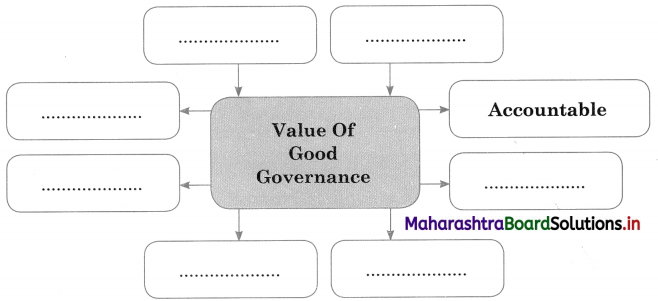
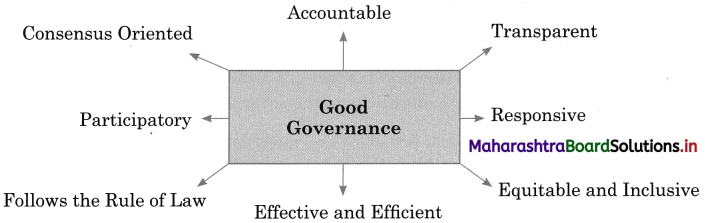
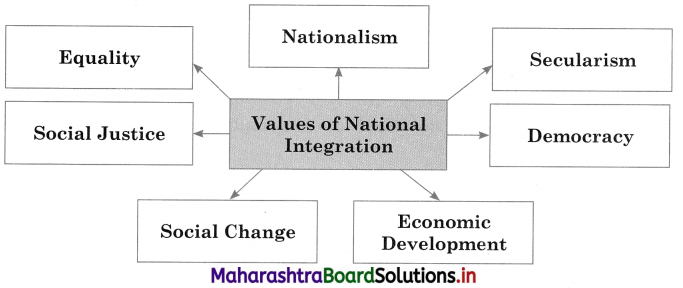
Maharashtra Board Class 12 Political Science Important Questions Chapter 5 Contemporary India Good Governance 1
Answer:
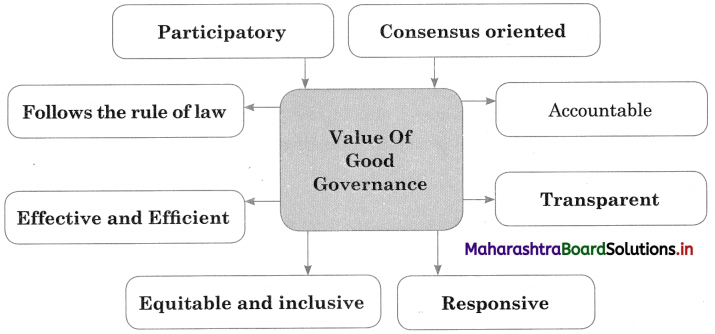
Maharashtra Board Class 12 Political Science Important Questions Chapter 5 Contemporary India Good Governance 2

State whether the following statements are true or false with reason.

Question 1.
Good governance approach is a break from the traditional model of public administration.
Answer:
This statement is True.

  1. Good governance approach aims to improve the performance of public institutions by making administration citizen-centered and not merely rule-bound.
  2. It aims to replace traditional administration that was archaic and riddled with red tapism and corruption with participative, responsive, equitable and transparent administration.

Maharashtra Board Class 12 Political Science Important Questions Chapter 5 Contemporary India: Good Governance

Question 2.
E-governance has brought administration closer to people.
Answer:
This statement is True.

  1. E-governance refers to good governance which is facilitated using Information and Communications Technology (ICT) This helps in the instantaneous transmission, processing, storage and retrieval of data.
  2. The objective of the National e-governance Plan of Government of India is to bring public service closer home to citizens. This can be done by building a countrywide infrastructure and large scale digitisation of records to enable easy, reliable access over the Internet for e.g., passport application can be done online.

Question 3.
Right to Information is the key to strengthening participatory democracy.
Answer:
This statement is True.

  1. Right to Information Act, 2005 has enabled citizens to seek important public information from the government and helps to usher in people-centered governance.
  2. R.T.I is a basic necessity of good governance as it helps to bring transparency in government organisations and makes them function in an efficient, responsive manner.

Explain the correlation between the following.

Question 1.
Good Governance – Traditional model of administration.
Answer:
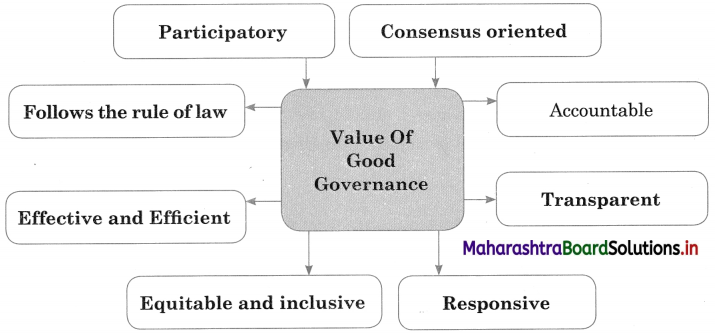
The concept of development administration brought in changes in the traditional role of administration. Governance refers to the cooperative effort of government as well as non¬government bodies in public administration. Since the traditional approach of public administration was archaic, riddled with red tapism and corruption it would not satisfy the requirements of the citizens. The good governance model is based on core values of efficient, effective, responsible, responsive, transparent and accountable public administration.

Question 2.
Citizen participation – Good governance.
Answer:
In development administration, not only the government but also citizens and NGO’s play a vital role. The term ‘governance’ is used to describe this cooperative effort of the government and non¬governmental bodies in public administration.
The Good Governance approach aims at the following-

  1. to reform the traditional, huge-sized public administration which was riddled with red tape and corruption
  2. to replace the archaic systems with responsible, participative and equitable systems
  3. to look at interlinkages between government and civil society
  4. to make the administration citizen-centered and not rule bound.

Citizen participation refers to the following aspects-

  1. the development process is a ‘bottom-up’ approach in which citizens are not recipients but participants in this process
  2. citizens have a right in making decisions pertaining to themselves
  3. there are modalities by which citizens can take control of resources and influence decision making
  4. it contributes to a responsive, participative democracy.

Maharashtra Board Class 12 Political Science Important Questions Chapter 5 Contemporary India: Good Governance

Question 3.
Good Governance – Right to Information. (RTI)
Answer:
In development administration, not only the government but also citizens and NGO’s play a vital role. The term ‘governance’ is used to describe this cooperative effort of the government and non¬governmental bodies in public administration.
The Good Governance approach aims at the following-

  1. to reform the traditional, huge-sized public administration which was riddled with red tape and corruption.
  2. to replace the archaic systems with responsible, participative and equitable systems.
  3. to look at interlinkages between government and civil society.
  4. to make the administration citizen-centered and not rule bound.

The R. T. I became operative w.e.f. 12th October 2005. The main objectives of the R.T.I is for citizens to secure access to information under control of public authorities so as to increase citizens awareness and ability to exercise their other rights. It is a basic necessity of good governance which enables citizens to seek important public information from the government i.e., about public policies and actions Transparency in government institutions makes them function more objectively and enables citizens to participate effectively in the governance process.

R.T.I. is an implied fundamental right under the constitution i.e., a part of Article 19 (1) (a) as well as of Article 21. It grants access to information held by a public authority so as to promote openness, transparency and accountability in administration. According to the UN Commission on Human Rights, “Good governance creates an enabling environment conducive to the enjoyment of human rights and prompts growth and sustainable development”. Thus R.T.I. helps in good governance.

Express your opinion of the following.

Question 1.
The National Commission for Minorities (NCM) is an important institutional mechanism towards good governance.
Answer:
I agree with this statement.
The NCM was set up by the Union Government under National Commission for Minorities Act (1992). It monitors the working of safeguards for religious minorities (i.e. Muslim, Christian, Sikh, Buddhist, Zoroastrian (Parsis) and Jain). It looks into specific complaints regarding deprivation of rights of the minorities and takes up such matters with the appropriate authorities. The NCM enables that benefits of good governance must be available to all sections of society, especially to minorities.

Answer the following question in 80 to 100 words.

Question 1.
Elaborate on e-Governance.
Answer:
In the last few decades, governance has become more complex and varied. Citizens expectations from the government have also increased. Information and Communications Technology (ICT) is used in governance. This is called ‘e-governance’. It helps in-

  1. instant transmission and processing information and efficient storing and retrieval of data.
  2. increasing the reach of government both geographically and demographically.
  3. speeding up decision making and increasing transparency and accountability of government processes. E-governance in India has evolved from computerisation of departments to initiatives which are citizen centric and service oriented.
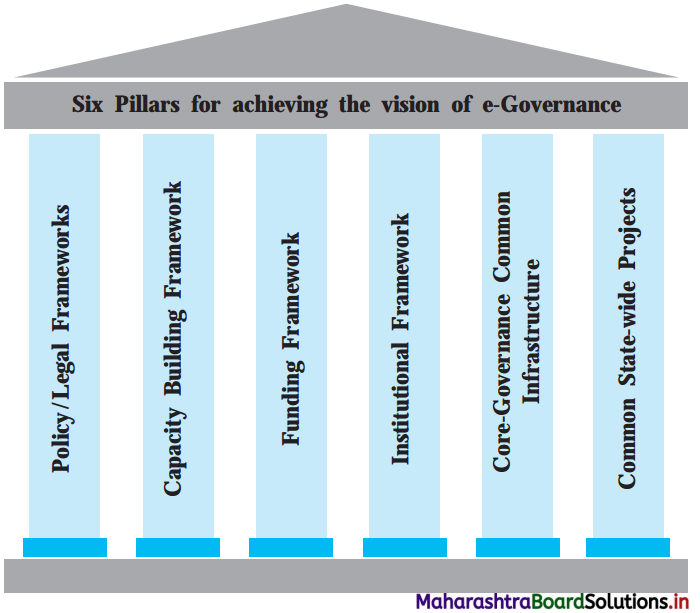
Maharashtra Board Class 12 Political Science Important Questions Chapter 5 Contemporary India Good Governance Q 3

The Government of Maharashtra has identified six priority pillars to use e-governance so as to become proactive and responsive to its citizens’ needs.
Pillar – 1: Establishment of Policy/Legal Frameworks: Legal Framework has to be updated regularly with changing times and technologies.
Pillar – 2: Develop Strong Capacity Building Framework: Capacity Building of employees is necessary.
Pillar – 3: Facilitate abundant Funding: Ensure mechanisms for provision of adequate and timely funds.
Pillar – 4: Institutional Framework: Develop administrative structures that are capable of envisioning and guiding the e-Governance programs.
Pillar 5 – Build Core e-Governance Common Infrastructure: Develop the core e-Governance infrastructure like Data Centre, Common Service Centres and State Wide Area Network etc.
Pillar 6 – Develop Common Statewide Projects: Develop applications like e-Tendering, e-Office, SMS gateway, payment gateway etc. that are common to majority of State departments to ensure coordination.

Maharashtra Board Class 12 Political Science Important Questions Chapter 5 Contemporary India: Good Governance

Question 2.
Discuss the initiatives for good governance in India.
Answer:
After independence, India adopted a socialist model of development aimed at achieving a Welfare State. The Department of Administrative Reforms and Public Grievances looks after administrative reforms in India. It’s objectives are-

  1. to promote administrative reforms in government policies and processes.
  2. to promote citizen-centric governance.
  3. to conduct innovations in e-governance.

The Second Administrative Reforms Commission (ARC) was set up in 2005 to prepare a blueprint for revamping the public administration system in India. It looked at the following issues.

  1. To make public administration accountable, transparent, efficient, responsive and result- oriented.
  2. Citizen centric, participative administration.

There have been a large number of reform measures which have sought to bring administration closer to the people. Broadly these initiatives include :

  1. Enacting laws giving certain rights to people.
  2. Setting up of new institutional mechanisms to redress citizens’ grievances.
  3. Improving accessibility to citizens by setting up units closer to people.
  4. Simplifying procedures to reduce bureaucratic delays.
  5. Using technology to improve internal efficiency.
  6. Reducing regulatory control.
  7. Holding public contact programmes etc.

Question 3.
Find out examples of the reforms that have been initiated for each of the measures stated below.
Answer:

  1. Enacting laws giving rights to people – Reform initiated – Right to Information (2005).
  2. Setting up of new institutional mechanisms to redress citizens’ grievances – Reform initiated: Creating commissions like NHRC, NCW, NCM, etc.
  3. Improving accessibility to citizens by setting up units closer to people – Reform initiated: Building a countrywide infrastructure reaching down to the remotes areas.
  4. Simplifying procedures to reduce bureaucratic delays – Reform initiated: Formulation of Citizen’s Charters to specify service standards.
  5. Using technology to improve internal efficiency – Reform initiated: e-governance i.e., use of Information and Communications Technology (I.C.T) to enable easy access over the internet.
  6. Improving discipline within the organisation – Reform initiated: Establishing body of Lokpal for the Union and Lokayukta for States.

Maharashtra Board Class 12 Political Science Important Questions Chapter 5 Contemporary India: Good Governance

Answer the following question with reference to the given points.

Question 1.
Discuss in detail the following specific programmes aimed at bringing good governance in India.
(a) Lokpal and Lokayukta
(b) Right to Information
(c) E-Governance
(d) Citizen’s Charters
Answer:
After independence, India adopted a socialist model of development aimed at achieving a Welfare State. The Department of Administrative Reforms and Public Grievances looks after administrative reforms in India. Its objectives are-

  1. to promote administrative reforms in government policies and processes.
  2. to promote citizen-centric governance.
  3. to conduct innovations in e-governance.

The Second Administrative Reforms Commission (ARC) was set up in 2005 to prepare a blueprint for revamping the public administration system in India. It looked at the following issues.

  1. to make public administration accountable, transparent, efficient, responsive, and result-oriented.
  2. citizen-centric, participative administration.

(a) Lokpal and Lokayukta – The Lokpal and Lokayuktas Act (2013) provides for the establishment of Lokpal (central government) and Lokayuktas (States) to inquire into allegations of corruption against public officials in a commitment to responsive, clean governance. The Maharashtra Lokayukta Institution came into being in 1972.

(b) Right to Information – It is a basic necessity of good governance which enables citizens to seek important public information from the government i.e., about public policies and actions. Transparency in government institutions makes them function more objectively and enables citizens to participate effectively in the governance process.

(c) E-Governance In the last few decades, governance has become more complex and varied. Citizens’ expectations from the government have also increased. Information and Communications Technology (ICT) is used in governance. This is called ‘e-governance’. It helps in-

  1. instant transmission and processing information and efficiently storing and retrieval of data.
  2. increasing the reach of government both geographically and demographically.
  3. speeding up decision-making and increasing transparency and accountability of government processes. E-governance in India has evolved from the computerization of departments to initiatives that are citizen-centric and service-oriented.

(d) Citizen’s Charters – The exercise to formulate citizen’s charters began in 1996. Each organization must spell out the services it has to perform and the standards/norms for these services. If these standards are not met then that agency can be held accountable.
Maharashtra Board Class 12 Political Science Important Questions Chapter 4 Contemporary India: Challenges to Peace, Stability and National Integration

Balbharti Maharashtra State Board Class 12 Political Science Important Questions Chapter 4 Contemporary India: Challenges to Peace, Stability and National Integration Important Questions and Answers.

Maharashtra State Board 12th Political Science Important Questions Chapter 4 Contemporary India: Challenges to Peace, Stability and National Integration

Complete the following statements by selecting the appropriate option.

Question 1.
‘Unity in diversity is one of the important Indian values associated with
(a) Panchayati Raj
(b) National integration
(c) Concept of a nation
(d) Concept of ‘melting pot’
Answer:
(b) National integration

Question 2.
Charu Majumdar is associated with the
(a) JKLF
(b) Naxal movement
(c) Hizb-ul-Mujahideen
(d) Assam Oil Blockage
Answer:
(b) Naxal movement

Maharashtra Board Class 12 Political Science Important Questions Chapter 4 Contemporary India: Challenges to Peace, Stability and National Integration

Question 3.
States in India were reorganised in 1956 on the basis of
(a) language
(b) religion
(c) region
(d) caste
Answer:
(a) language

Question 4.
In 1947-48, India had a conflict with
(a) Jammu and Kashmir
(b) England
(c) Pakistan
(d) China
Answer:
(c) Pakistan

Question 5.
In 1980, an oil blockade agitation was in to focus on the demand for economic development.
(a) Jharkhand
(b) Nagaland
(c) Kashmir
(d) Assam
Answer:
(d) Assam

Question 6.
………………. signed the Instrument of Accession with India in 1947.
(a) Maharaja Hari Singh
(b) Amanullah Khan
(c) Kanu Sanyal
(d) Hafiz Saeed
Answer:
(a) Maharaja Hari Singh

Maharashtra Board Class 12 Political Science Important Questions Chapter 4 Contemporary India: Challenges to Peace, Stability and National Integration

Identify the incorrect pair in every set and correct it.

Question 1.
(a) Jawaharlal Nehru – Discovery of India
(b) Struggle for rights of Tamil – LTTE
(c) National Integration Council – Article 370
Answer:
(c) ‘Special status’ for State of Jammu and Kashmir – Article 370

Complete the following sentences by selecting the appropriate reason.

Question 1.
In 1962, the N. I. C was created in India to ……………….
(a) review all matters pertaining to national integration.
(b) oversee the integration of Princely States into India.
(c) deal with insurgency in North-East India.
Answer:
(a) review all matters pertaining to national integration.

Question 2.
The freedom movement played an important role in national integration because …………….
(a) it provided a platform to express democratic views.
(b) it brought Indians together in a common framework of political identity and loyalty.
(c) it provided nationalistic symbols like the National Flag and common citizenship.
Answer:
(b) it brought Indians together in a common framework of political identity and loyalty.

Maharashtra Board Class 12 Political Science Important Questions Chapter 4 Contemporary India: Challenges to Peace, Stability and National Integration

Question 3.
India can be described as the ‘Salad bowl’ identity because ………………….
(a) it recognizes every culture, religion, etc., of a pluralistic society and it’s importance in national integration.
(b) it stresses on a system of assimilation towards a homogeneous society.
(c) it recognizes the right to self-determination of diverse groups in the country.
Answer:
(a) it recognizes every culture, religion, etc., of a pluralistic society and it’s importance in national integration.

State the appropriate concept for the given statements.

Question 1.
A sense of political identity.
Answer:
Nationalism

Question 2.
Concept used to describe American society based on a process of assimilation.
Answer:
Melting pot

Question 3.
The concept that argues that all aspects of diversity should be maintained in a pluralistic society.
Answer:
Salad bowl

Maharashtra Board Class 12 Political Science Important Questions Chapter 4 Contemporary India: Challenges to Peace, Stability and National Integration

Question 4.
Secessionist movement in the Punjab in 1980s.
Answer:
Khalistani movement

Question 5.
A militant movement that originated in the communist ideology
Answer:
Naxalism or Left Wing Extremism

Find the odd word.

Question 1.
CPI (M-L), PWG, MCCI, NIC.
Answer:
NIC (not a Naxal organisation)

Question 2.
Lashkar-e-Taiba, JKLF, IRA, Jaish-e-Mohammed.
Answer:
IRA (not a terrorist group operating in India)

Question 3.
Kerala, Jharkhand, Telangana, Chhattisgarh.
Answer:
Kerala (not affected by Naxalism)

Observe the maps in the textbook and answer the following questions.

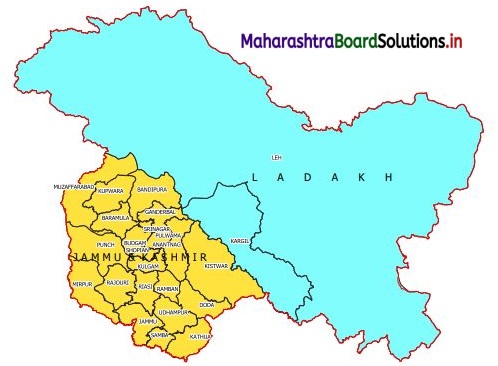
Maharashtra Board Class 12 Political Science Important Questions Chapter 4 Contemporary India Challenges to Peace, Stability and National Integration 1
Question 1.
Which two union territories have been created due to the bifurcation of the State of Jammu and Kashmir (2019)?
Answer:

  1. Jammu and Kashmir
  2. Ladakh

Maharashtra Board Class 12 Political Science Important Questions Chapter 4 Contemporary India: Challenges to Peace, Stability and National Integration

Question 2.
Name two Indian States that border Jammu and Kashmir.
Answer:

  1. Punjab
  2. Himachal Pradesh

Question 3.
Name two districts in the Union Territory of Ladakh.
Answer:

  1. Kargil
  2. Leh

Question 4.
Name two district in the Union Territory of Jammu and Kashmir.
Answer:

  1. Udhampur
  2. Kupwara

Question 5.
Name two countries that were neighbours of the erstwhile State of Jammu and Kashmir.
Answer:

  1. China
  2. Pakistan

State whether the following statements are true or false with reason.

Question 1.
Cross Border terrorism in Jammu and Kashmir is a major threat to nation building in India.
Answer:
This statement is True.

  1. There are many terrorist outfits operating out of Pakistan Occupied Kashmir (POK) or Pakistan such as LET, Hizbul. This has led to frequent terrorist violence in the region since the last two and half decades.
  2. Terrorists indulge in acts like bombings, assassinations, etc. They try to radicalise people through ‘fake news’ and vested social groups as well as to encourage local insurgent groups. Terrorists have even indoctrinated children to hate the country and indulge in criminal acts like stone throwing and arson.

Maharashtra Board Class 12 Political Science Important Questions Chapter 4 Contemporary India: Challenges to Peace, Stability and National Integration

Question 2.
Left-Wing Extremism has spread over many States in India.
Answer:
This statement is True.

  1. Left-Wing Extremism or Naxalism has it’s ideological foundations in communism and the writings of Charu Majumdar. It’s main purpose is to show existing government structures and process as being ineffective.
  2. Maoist operations are primarily in rural underdeveloped areas with support base among landless and dalits across the Red Corridor i.e., States like Bihar, Andhra Pradesh, Telangana, Jharkhand, Chhattisgarh, etc.

Question 3.
The Khalistan movement occurred in the State of Kashmir
Answer:
This statement is False.

  1. The Khalistan movement occurred in the State of Punjab as a separatist movement for an independent homeland for Sikhs i.e., The Khalistan or the Land of the Khalsa.
  2. The Jammu and Kashmir region has been subjected to terrorism due to local militant outfits as well as cross border terrorism.

Question 4.
Modern day terrorism is State-centric.
Answer:
This statement is False.

  1. Modern day terrorism is not State-centric but is a global abstract fight for religious or ideological goals e.g., 2001 attacks by the A1 Qaeda in USA.
  2. Traditional form of terrorism was State-centric i.e., a specific section of people fighting for their rights against the State e.g., LTTE in Sri Lanka.

Explain the correlation between the following.

Question 1.
Insurgency in North East India and Neglect of the region
Answer:
North-East India comprises of eight States which are ethnically and culturally very diverse. Many of these States share boundaries with other countries like China, Nepal, Bhutan, Myanmar, Bangladesh. Many of these States are not well connected with mainland India. Some regions of the states in North-East India are not well developed. Ensuring industrial and economic development has been a major issue. Various insurgent groups have created havoc in States like Nagaland, Mizoram, Tripura, etc., In Assam, the ‘anti-foreigner’ movement was about it’s resources being diverted elsewhere, leading to lack of development.

Maharashtra Board Class 12 Political Science Important Questions Chapter 4 Contemporary India: Challenges to Peace, Stability and National Integration

Express your opinion of the following.

Question 1.
Naxal operations are primarily prevalent in underdeveloped areas of the country.
Answer:
Naxalism is a movement based on Maoist ideology that began in 1967 at Naxalbari (West Bengal) as a protest against the feudal order and oppression by the landlords. Naxalites target existing infrastructure and aim to show government programmes as ineffective. Naxalites find support amongst landless agricultural labour, tribals and dalits. They are based in inaccessible, underdeveloped areas of India which lack communication facilities, are heavily forested or have difficult terrain where the security forces find it difficult to operate.

Question 2.
National unity is not homogeneity.
Answer:
National unity refers to solidarity among citizens of a country. It advocates a ‘community of communities’ with respect to diversity, shared values and experiences. It is ethnic, religious, linguistic acceptance towards peace and stability. National unity is a major step towards social peace i.e., it is essential in maintaining a stable, functional and harmonious society. National unity in India reflects the ‘salad bowl’ concept i.e., it is not an assimilation of diverse groups but the maintenance of distinctive beliefs in a plural society.

Question 3.
India went into an economic transformation in the 1990s.
Answer:
After independence, India adopted a socialistic pattern of society with mixed economy and Five Year Plans. However, keeping in view, socio-political changes in the world such as the collapse of the Soviet Union, India went into an economic transformation in the 1990s. It opted for economic liberalisation to tackle the problem of economic stagnation. This led to economic recovery of the country.

Maharashtra Board Class 12 Political Science Important Questions Chapter 4 Contemporary India: Challenges to Peace, Stability and National Integration

Question 4.
The National Integration Council (N. I. C) plays an important role in nation building.
Answer:
In 1961, the first National Integration Conference was held to find ways to combat evils like casteism, communalism, regionalism, etc. Based on it’s recommendations, National Integration Council was set up in 1962, to review all matters pertaining to national integration. It dedicates itself to achieving values like equality, justice, fraternity, secularism and unity in diversity.

Answer the following question in 80 to 100 words.

Question 1.
Trace the changes that have taken place in Article 370.
Answer:
Article 370 gave special status to Jammu and Kashmir (J & IQ conferring it with the authority to have a separate constitution, separate State flag and autonomy over it’s internal administration. The article was drafted in Part XXI of the Indian constitution : Temporary, Transitional and special provisions. Along with Article 35A, this article defined that residents of Jammu and Kashmir had separate laws related to citizenship, ownership of property, etc. The Constituent Assembly of Jammu and Kashmir was empowered to recommend articles of the India constitution that should be applied to the State and a subsequent. Presidential Order (1954) was issued.

On 5th August 2019, the Government of India revoked the special status granted to Jammu and Kashmir under Art. 370. President Ramnath Kovind issued an order nullifying all provisions of autonomy granted to the State. Both houses of Parliament passed the Reorganisation of Jammu and Kashmir bill. As of now the following changes are apparent;

  1. People of the State have access to all government schemes like Reservations, RTE, RTI, etc.
  2. The State was bifurcated into the Union Territories of Jammu and Kashmir and Ladakh.

Maharashtra Board Class 12 Political Science Important Questions Chapter 4 Contemporary India: Challenges to Peace, Stability and National Integration

Answer the following question with reference to the given point in 150 to 200 words.

Question 1.
Challenges to nation building in India.
(a) Terrorism
(b) Communalism
(c) Left Wing Extremism
Answer:
Nation building means constructing a national identity which aims at uniting the people within a country so that it remains politically stable. It is closely related to the concept of national integration. It demands a democratic government and participative civil society. Nation building in India faces several challenges such as casteism, regionalism, communalism, insurgency, extremism and terrorism.

(a) Terrorism – It is the actual use or threat to use violence with an intention to disrupt life and create panic. It is called ‘asymmetric’ or ‘indirect’ warfare. It may take the form of assassination of political figures, hijackings, bombings and attacks on civilians etc. Earlier, terrorism was State-centric e.g., LTTE in Sri Lanka. However, modern day terrorism aims for abstract ideological or religious goals at the global level e.g., Taliban, Boko Haram. India has been the target of numerous terrorist attacks e.g., bomb blasts in Mumbai (1993, 2006) and LET attack on 26th November 2008 in Mumbai, attack on Parliament (2001), attacks on security forces at Uri (2016) and Pulwama (2019).

(b) Communalism refers to excessive pride in and attachment to one’s own religion/sect that leads to religious orthodoxy or fundamentalism and promotes intolerance and hatred of other religious groups. In India, roots of communalism can be traced to-

  1. British policy of ‘Divide and Rule’.
  2. Hindu and Muslim revivalist movements.
  3. Rise of communal, fundamentalist parties and other vested interests that aim to radicalise members of their communities.
  4. Politics of appeasement by various political parties.
  5. psychological factors – history of communal violence has led to lack of trust between Hindus and Muslims.
  6. Role of media and ‘fake news’ which may indulge in sensationalism aimed to incite communal hatred.

Some of the prominent cases of communal violence in India are:

  1. 1947-49 there was mass bloodshed in the wake of the Partition of India.
  2. 1969 Ahmedabad riots.
  3. 1983 in Assam against Muslim immigrants from Bangladesh.
  4. 1984 Anti-Sikh riots broke out after the assassination of Mrs. Indira Gandhi especially in Delhi.
  5. 1992-93 saw the worst riots post independence following demolition of the Babri Masjid especially in Mumbai, Surat, etc.
  6. 2002 Gujarat riots especially in Godhra.
  7. 2013 Muzaffarnagar riots in UP.

(c) Left Wing Extremism – Left Wing Extremism (also called Maoist movement or Naxalism) has major support base among landless labourers, dalits and tribals who experience a sense of oppression, injustice and neglect. The first attempt to promote a peasant struggle was the Telangana Movement (1946-51). The Naxal Movement originated in 1967 in Naxalbari (West Bengal) led by Kanu Sanyal and writings of Charu Majumdar.

Since 1980s the movement has taken a militant turn. In 2004 CPI (M-L), People’s War Group (PWG) and Maoist Communist Centre of India merged to form CPI (Maoist) which aims to overthrow the government, Naxal activities aim to and destroy public property and attack police and officials. The Red Corridor of Naxal activities extends across States like Bihar, Jharkhand, Chhattisgarh, Maharashtra, Telangana, Andhra Pradesh, etc.

Maharashtra Board Class 12 Political Science Important Questions Chapter 1 The World Since 1991

Balbharti Maharashtra State Board Class 12 Political Science Important Questions Chapter 1 The World Since 1991 Important Questions and Answers.

Maharashtra State Board 12th Political Science Important Questions Chapter 1 The World Since 1991

Complete the following statements by selecting the appropriate option.

Question 1.
The world order was dominated by the in the early part of the post-cold war area.
(a) UK
(b) Soviet Union
(c) USA
(d) EU
Answer:
(c) USA

Question 2.
The term ‘New World Order’ was first used by
(a) Woodrow Wilson
(b) Jawaharlal Nehru
(c) Joseph Nye
(d) George H. Bush
Answer:
(d) George H. Bush

Maharashtra Board Class 12 Political Science Important Questions Chapter 1 The World Since 1991

Question 3.
In 1993, the World Conference on Human Rights was held in
(a) Vienna
(b) Belgrade
(c) Paris
(d) New York
Answer:
(a) Vienna

Question 4.
Market reforms were introduced in People’s Republic of China in the mid 1970s under leadership of
(a) Mao-Tse-Tung
(b) Deng Xiaoping
(c) Jinping
(d) Chou-en-Lai
Answer:
(b) Deng Xiaoping

Question 5.
Shenzhen Area is related to the region.
(a) Asia
(b) South Asia
(c) European Union
(d) South America
Answer:
(c) European Union

Question 6.
In 2007, became a member of SAARC.
(a) China
(b) Maldives
(c) India
(d) Afghanistan
Answer:
(d) Afghanistan

Question 7.
…………………. acts as a bridge between South Asia and South East Asia.
(a) BIMSTEC
(b) BRICS
(c) ASEAN
(d) SAARC
Answer:
(a) BIMSTEC

Maharashtra Board Class 12 Political Science Important Questions Chapter 1 The World Since 1991

Identify the incorrect pair in every set and correct it.

Question 1.
(a) Kosovo – Serbia
(b) Catalonia – France
(c) Chechnya – Russia
Answer:
(b) Catalonia – Spain

Question 2.
(a) Nepal – SAARC
(b) Myanmar – BIMSTEC
(c) SCO – Afghanistan
Answer:
(c) SAARC – Afghanistan

Complete the following sentences by selecting the appropriate reason.

Question 1.
There were revolutions in East European States because ………………….
(a) they desired more freedom and economic wellbeing
(b) they were now aligned to the USA.
(c) of the rise of multipolarity.
Answer:
(a) they desired more freedom and economic wellbeing

Question 2.
Schengen Visa in significant because ………………….
(a) it is a kind of trade bloc.
(b) it allows individuals to travel freely in 26 Schengen area countries.
(c) it allows all European Union States free trade and travel.
Answer:
(b) it allows individuals to travel freely in 26 Schengen area countries.

Maharashtra Board Class 12 Political Science Important Questions Chapter 1 The World Since 1991

State the appropriate concept for the given statements.

Question 1.
When a State gets other countries to act in ways contrary to their preferences, using coercion.
Answer:
Hard power

Question 2.
The use of violence or threat of violence with an intention to create panic in society.
Answer:
Terrorism

Question 3.
The military campaign launched by then US President, George W. Bush in response to the 9/11 terrorist attacks.
Answer:
War on Terror

Question 4.
The agreement which resulted in abolition of internal borders between five European nations in 1985.
Answer:
Schengen Agreement

Question 5.
The executive-bureaucratic arm of the EU.
Answer:
European Commission

Maharashtra Board Class 12 Political Science Important Questions Chapter 1 The World Since 1991

Question 6.
This forum acts as a platform for discussion between developed and developing nations.
Answer:
G-20

Question 7.
Group of nations make special agreements regarding their economic relationships.
Answer:
Trade Bloc.

Find the odd word.

(1) Croatia, Montenegro, Serbia, Latvia
(2) Belgium, France, Spain, Germany.
(3) China, Russia, Tajikistan, Ukraine.
(4) Cambodia, Thailand, Nepal, India.
Answer:
(1) Latvia (was not created due to disintegration of Yugoslavia)
(2) Spain (not a signatory to Schengen Agreement in 1985)
(3) Ukraine (not a member of SCO)
(4) Cambodia (not a member of BIMSTEC)

Expand the following abbreviations.

BIMSTEC
SAARC
SAFTA
NATO
UNTAC
ASEAN
EEC
ECSC
Answer:
BIMSTEC – The Bay of Bengal Initiative for Multi Sectoral Technical and Economic Cooperation.
SAARC – South Asian Association for Regional Cooperation.
SAFTA – South Asian Association Free Trade Area.
NATO – North Atlantic Treaty Organisation.
UNTAC – United Nations Transitional Authority in Cambodia.
ASEAN – Association of South East Asian Nations.
EEC – European Economic Community.
ECSC – European Coal and Steel Community.

Maharashtra Board Class 12 Political Science Important Questions Chapter 1 The World Since 1991

Complete the concept maps.

Question 1.
Maharashtra Board Class 12 Political Science Important Questions Chapter 1 The World Since 1991 1
Answer:
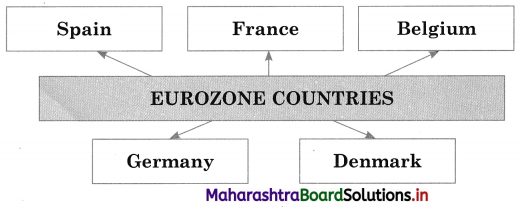
Maharashtra Board Class 12 Political Science Important Questions Chapter 1 The World Since 1991 2

Question 2.
Maharashtra Board Class 12 Political Science Important Questions Chapter 1 The World Since 1991 3
Answer:
Maharashtra Board Class 12 Political Science Important Questions Chapter 1 The World Since 1991 4

Question 3.
Maharashtra Board Class 12 Political Science Important Questions Chapter 1 The World Since 1991 5
Answer:
Maharashtra Board Class 12 Political Science Important Questions Chapter 1 The World Since 1991 6

Observe the maps in the textbook and answer the following questions.

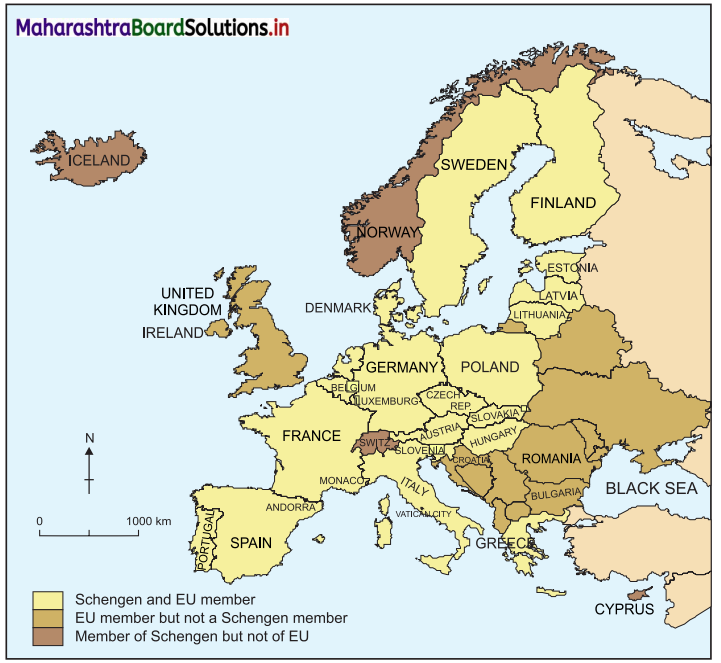
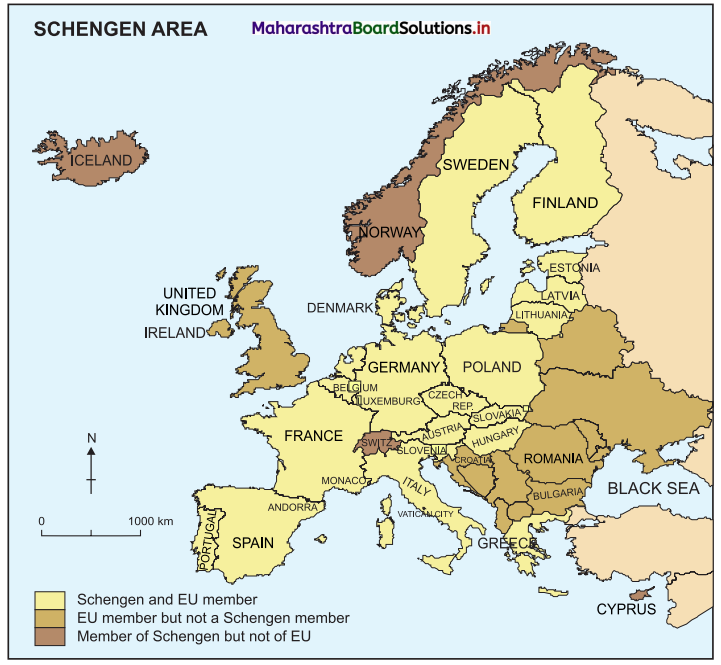
Maharashtra Board Class 12 Political Science Important Questions Chapter 1 The World Since 1991 7
Question 1.
Name any four countries in the Schengen area.
Answer:
Sweden, Denmark, Germany, Belgium, France.
Question 2.
Name any two non-European Union countries within Schengen area.
Answer:
Norway, Romania, Bulgaria, Croatia.

Question 3.
Name any two countries who are EU members but not Schengen member.
Answer:
Belarus, Ukraine Serbia

Maharashtra Board Class 12 Political Science Important Questions Chapter 1 The World Since 1991

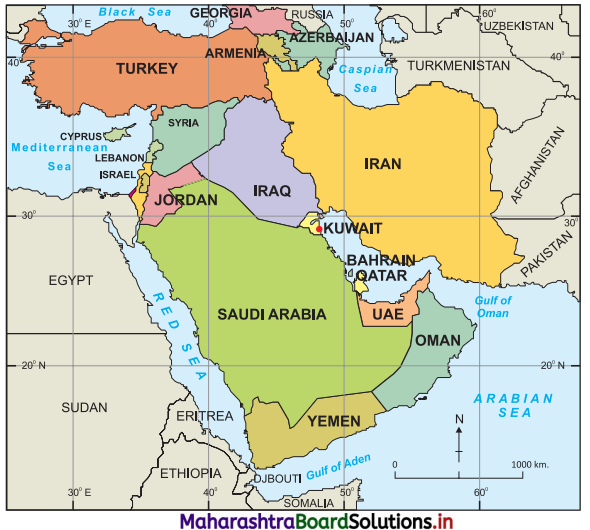
Maharashtra Board Class 12 Political Science Important Questions Chapter 1 The World Since 1991 8
Question 1.
Write two neighbouring countries of Iraq.
Answer:
Syria, Jordan, Iran, Kuwait.

Question 2.
Write two African nations bordered by the Red Sea
Answer:
Sudan, Eritrea

Question 3.
Write two countries bordered by the Gulf of Aden.
Answer:
Yemen, Somalia, Djbouti.

Maharashtra Board Class 12 Political Science Important Questions Chapter 1 The World Since 1991

Question 4.
Write two ‘seas’ bordering Turkey.
Answer:
Black Sea, Mediterranean Sea.

State whether the following statements are true or false with reason.

Question 1.
‘New World Order’ described by US President George H. Bush was the first expression of the unipolar world order.
Answer:
This statement is True.

  1. During the Gulf war (Iraq invasion of Kuwait), the USA led a multinational force to free Kuwait from Iraqi control. Countries of the NATO, Arab States, as well as Israel, China, Soviet Union, etc., supported the US in this action.
  2. Eventually, the meaning of the term ‘New World Order’ came to imply US dominance in matters of security at the global level i.e. unipolarity.

Question 2.
Terrorism in the world today is different from traditional forms of terrorism.
Answer:
This statement is True.

  1. Traditional forms of terrorist activity included hijackings, bombings, assassinations of political leaders, etc. This mainly targeted institutions of the government and was associated with separatist movements or struggles for the rights of some specific people e.g., I.R.A.
  2. Modern day terrorism is motivated by an abstract ideology towards abstract goals and the operations are global in nature e.g., 9/11 attacks in the USA were carried out by Osama Bin Laden led Al-Qaeda based in Afghanistan.

Question 3.
There has been a shift from unipolar to multipolar world order in recent times.
Answer:
This statement is True.

  1. In the post Cold War era, due to it’s military, technological and economic might, the USA was the only superpower.
  2. However, in recent times, the dominant position of USA has been directly or indirectly challenged by factors such as
    (a) European Union, (b) military resurgence of Russia (c) rise of Asia through the presence of China, Japan and India in the global world order, (d) new regional organisations like BRICS, BIMSTEC, etc.

Maharashtra Board Class 12 Political Science Important Questions Chapter 1 The World Since 1991

Explain the correlation between the following.

Question 1.
Rise of China and Russia and Multipolarity
Answer:
After the end of the Cold War, USA emerged as the only super power due to it’s technological and military superiority and the use of‘Soft Power’. However, this dominant position of the USA has been challenged in recent times by China and Russia.

China’s rise to global prominence began in the mid 1970s due to market reforms introduced by Deng Xiaoping. China aims to create a sphere of influence in Central and East Asian regions through ambitious projects like One Belt One Road and China Pakistan Economic Corridor. China is also building up it’s naval and air power in order to back up it’s claims in the South China Sea.

Russia has emerged as an energy superpower due to its progress in oil and gas production and military assertiveness. It continues to influence Central and Eastern Europe. Both China and Russia are founding members of the Shanghai Cooperation Organisation. Thus, China and Russia have also become significant centres of power, challenging US dominance.

Question 2.
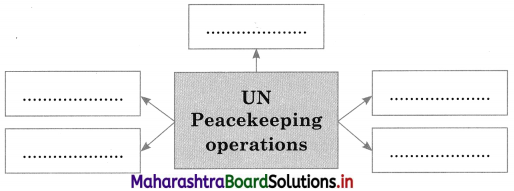
UN Peacekeeping – Conflict zones.
Answer:
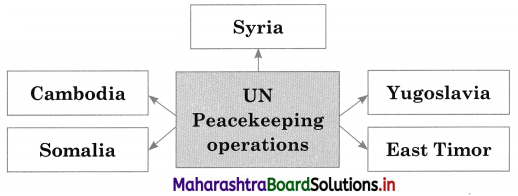
One of the main tasks of the UN Peacekeeping is to prevent conflicts from escalating or recurring, to maintain peace and to protect human rights of the affected people. The UN thus intervened in Cambodia, Somalia, Yugoslavia, Afghanistan, Syria, etc.

The United Nations does not have its own army. But in order to maintain international peaee and security, member States of the United Nations, have created a peacekeeping force out of their own military resources. This force known as UN Peacekeeping Force. The Peacekeepers are sent to conflict-prone or war zones, based upon UN Security Council recommendations, often when ceasefires are established.

Answer the following

Question 1.
Elaborate on ‘Self determination based on ethnic identity’ that arose after the end of the cold war.
Answer:
In 1991, the Soviet Union disintegrated leading to the creation of many new States. The revolutions in the East European countries also led to many new countries being formed. All this was against communist regimes, as the people within these regions desired freedom and economic progress. Ethnic identity of various people in the region became stronger, leading to the demand for creation of new States based on ethnic identity. Some examples of this trend are-

  1. Yugoslavia split into Croatia, Serbia, Bosnia, Slovenia, etc.
  2. Czechoslovakia split into Czech Republic and Slovakia in 1993.
  3. Former Soviet Union disintegrated into fifteen States such as Russia, Armenia, Belarus, Ukraine, Estonia, etc.

Creation of new States based on ethnic nationalism was also seen in other parts of the world for e.g.

  1. East Timor (became independent from Indonesia).
  2. Eretria (became independent from Ethiopia).
  3. South Sudan (became independent from Sudan).
  4. Chechnya (wants independence from Russia).

Maharashtra Board Class 12 Political Science Important Questions Chapter 1 The World Since 1991

Question 2.
Describe how USA became the only superpower after the end of the cold war.
Answer:
In 1991, the Soviet Union disintegrated and the Cold War ended. This led to the end of an international order dominated by the two superpowers i.e., USA and Soviet Union. Bipolarity gave rise to unipolarity. During the invasion of Kuwait by Iraq, the USA took the initiative and led a multinational force to free Kuwait. The US President, George H. Bush used the term ‘New World Order’ to describe the existing global situation. The US initiative was supported by China, Israel, Arab States, Soviet Union and countries of the NATO. Soviet Union was facing internal problems so not much opposition was possible against the USA. Thus, the term ‘New World Order’ implied American dominance and it’s leadership in matters of security was accepted at the global level. This was the first expression of the unipolar world order.

Answer the following question in detail with help of given points.

Question 1.
Discuss the European Union with help of given points.
(a) History
(b) European Commission
(c) European Parliament
(d) European Council
(e) European Court of Justice
Answer:
(a) History – The European Coal and Steel Community (ECSC) and European Economic Community (EEC) were created to foster economic interdependence. On 7th February 1992, the Maastricht Treaty was signed to create the European Union. This led to expansion of spheres of cooperation to include internal affairs, judicial matters, foreign policy, etc. The Euro (€) is the official currency of 19 out of 28 countries of the EU. These nations are collectively called ‘Eurozone’.

(b) European Commission – The Commission is the executive bureaucratic arm of the EU. It is mainly responsible for drawing up proposals for new European legislation,and it implements the policy decisions of the European Parliament and the Council of the EU.

(c) European Parliament – The European Parliament is composed of 751 Members, who are directly elected every five years. It is a body entrusted with legislative, supervisory, and budgetary responsibilities.

(d) European Council – The structure of the European Council consists of the Presidents or Prime Ministers of each member State, accompanied by their foreign ministers, and a full¬time President of the European Council. The European Council meets four times a year and provides strategic leadership for the EU.

(e) European Court of Justice (ECJ) – The ECJ interprets, and adjudicates on, EU law and treaties. As EU law has primacy over the national law of EU member States.

Maharashtra Board Class 12 Political Science Important Questions Chapter 1 The World Since 1991

Question 2.
Elaborate on developments in the post-cold war period.
(a) Rise of new States
(b) Emergence of unipolarity
(c) Humanitarian intervention
(d) Terrorism
(e) Multipolarity and Regionalism
Answer:
The disintegration of the Soviet Union ended the era of the Cold War as well as the East-West division of the world. Developments in the post-Cold War period can be analyzed through five dimensions.
(a) Rise of new States – The East European revolution of 1989, led to assertion of ethnic nationalism based on the right to self determination. It was an expression of the middle class for freedom and economic well being as well as for autonomy and eventually for independence. Many new States were created based on ethnic identity for e.g., Yugoslavia split into States like Croatia, Serbia, Bosnia-Herzegovina, etc. Similarly, 15 new States were created after the collapse of the Soviet Union.

(b) Emergence of unipolarity – In 1990, Iraq invaded Kuwait. The USA led a multinational force to free Kuwait from Iraqi control. The US President, George H. Bush had described this victory as ‘New World Order’ as the multinational support to the USA came from NATO, Israel, Soviet Union, China and many Arab countries. After the collapse of the Soviet Union in 1991, the world became unipolar and the New World Order implied US dominance and leadership in matters of global security. They had political and economic dimensions. The US employed “Soft Power” method i.e., without use of coercion or military force but through socio-cultural and economic influence.

(c) Humanitarian intervention – There have been many instances of ethnic conflicts and bloodshed in the creation of new States particularly in Bosnia, East Timor, Somalia, Cambodia, etc. The UN Peacekeeping Force has intervened in a number of conflict situations to bring about peaceful resolution of the conflict as well as to maintain peace and protect human rights. Humanitarian intervention refers to an increasing awareness about the significance of human rights and the need for their protection.

(d) Terrorism – Terrorism is defined as the use of violence, or the threat to use violence with an intention to create panic in society, in the pursuit of political/religious/ideological goals. Terrorist groups indulge in hijackings, bombings, etc., and are usually associated with separatist movements. Modern day terrorist operations are global in nature. Some instances of terrorist attacks post 1991, include Al-Qaeda attacks on 11th September 2001 in Washington D.C, Bali (2002), Mumbai (2008), etc.

(e) Multipolarity and Regionalism – In the post cold war era, the USA emerged as the only superpower. However, in recent times, the dominant position of the USA has been challenged due to the rise of Asian nations like China, Japan and India creation of the European Union; military resurgence of Russia and growing importance of regional organisations like SAARC, etc.

Regionalism refers to creation of regional organisations based on geographical proximity or on common ideological, political, economic concerns in areas like communication, health, energy, education, etc. In the 1960s organisations like ASEAN focused on economic issues.

Maharashtra Board Class 12 Political Science Important Questions Chapter 1 The World Since 1991

Question 3.
Describe the following regional organisations in the post cold war era.
(a) European Union
(b) SAARC
(c) BIMSTEC
(d) Shanghai Cooperation Organisation
(e) G-20
Answer:
(a) EuropeanUnion-The European CoalandSteel Community (ECSC) and European Economic Community (EEC) were created to foster economic interdependence. On 7thFebruary 1992, the Maastricht Treaty was signed to create the European Union. This led to expansion of spheres of cooperation to include internal affairs, judicial matters, foreign policy, etc. The Euro (€) is the official currency of 19 out of 28 countries of the EU. These nations are collectively called Eurozone.

The Schengen Agreement (1985) was signed by France, Germany, Belgium, Netherlands and Luxembourg. Today 22 countries are part of the Schengen Area which is an area without internal borders. The EU functions on four key institutions viz. European Commission, European Parliament, European council and European court of Justice. The UK formally ended it’s membership of the EU on 31st January 2020.

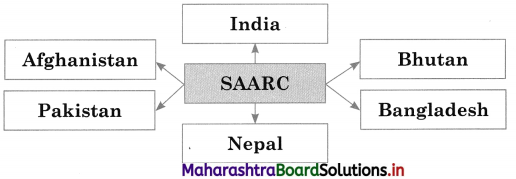
(b) SAARC – It was formed in 1985 at Dhaka with seven members viz. Bangladesh, Bhutan, India, Maldives, Nepal, Pakistan and Sri Lanka. In 2006, SAFTA was activated. Afghanistan joined SAARC in 2007. There are also nine observers such as EU, China, UK, USA, etc.

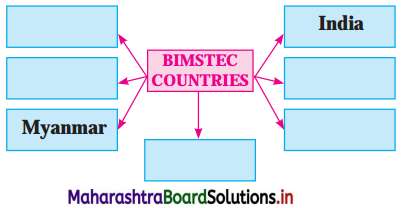
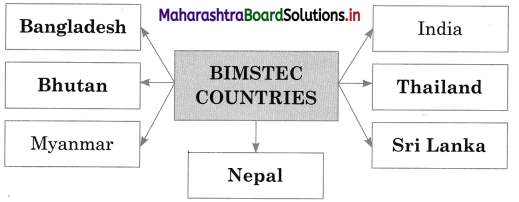
(c) BIMSTEC – The Bay of Bengal Initiative for Multi Sectoral Technical and Economic Cooperation was established in 1997. It comprises of five countries from South Asia viz. Bangladesh, Bhutan, India, Nepal, Sri Lanka and two countries from South-East Asia viz. Myanmar, Thailand. BIMSTEC aims to facilitate collaboration and rapid economic development among countries lying in adjacent areas of the Bay of Bengal.

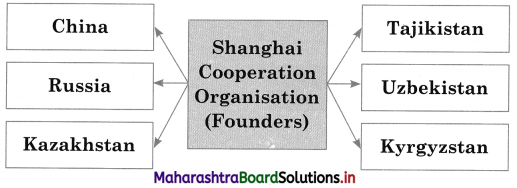
(d) Shanghai Cooperation Organisation (SCO) – It was founded in 2001 in Shanghai by the leaders of China, Russia, Kazakhstan, Kyrgyzstan, Tajikistan and Uzbekistan. In 2016, India and Pakistan joined the SCO. The focus of SCO is to bring about peace, stability and cooperation in the Eurasian region.

(e) G-20 – This forum was created in 1999 with the aim to discuss policies relating to financial stability. It includes developed countries like USA, UK, France, Germany the EU as well as developing countries like Argentina, Brazil, India.

Maharashtra Board Class 12 Political Science Important Questions Chapter 3 Key Concepts and Issues Since 1991: Humanitarian Issues

Balbharti Maharashtra State Board Class 12 Political Science Important Questions Chapter 3 Key Concepts and Issues Since 1991: Humanitarian Issues Important Questions and Answers.

Maharashtra State Board 12th Political Science Important Questions Chapter 3 Key Concepts and Issues Since 1991: Humanitarian Issues

Complete the following statements by selecting the appropriate option.

Question 1.
The Rio de Janeiro Earth Summit (1992) focused on
(a) Environment and development
(b) Nuclear non-proliferation
(c) International trade
(d) Gender issues
Answer:
(a) Environment and development

Question 2.
The 2002 Earth Summit recognised as the most important goal at all level.
(a) poverty
(b) socio-economic develop
(c) sustainable development
(d) gender issues
Answer:
(c) sustainable development

Maharashtra Board Class 12 Political Science Important Questions Chapter 3 Key Concepts and Issues Since 1991: Humanitarian Issues

Question 3.
The 2030 Agenda for sustainable Development was adopted in the year
(a) 2015
(b) 2002
(c) 1992
(d) 2019
Answer:
(a) 2015

Question 4.
The Second UN Decade for poverty eradication was in
(a) 1997-2006
(b) 1971-1980
(c) 2008-2017
(d) 1992-2003
Answer:
(c) 2008-2017

Question 5.
The Revolution aimed to make India self-sufficient in food grains.
(a) Import substitution
(b) Green
(c) White
(d) Infrastructural
Answer:
(b) Green

Question 6.
The is a scheme introduced in 1978-79 to create opportunities for self-employment in
the rural sector.
(a) MGNREGA
(b) JRY
(c) IRDP
(d) KVY
Answer:
(c) IRDP

Maharashtra Board Class 12 Political Science Important Questions Chapter 3 Key Concepts and Issues Since 1991: Humanitarian Issues

Complete the following sentences by selecting the appropriate reason.

Question 1.
Green Revolution was introduced in India in the 1960’s to ………………
(a) make India self sufficient in food grains.
(b) generate employment and tackle poverty.
(c) to combine economic growth with social justice.
Answer:
(a) make India self sufficient in food grain

Question 2.
The Department of Women and Child Development was set up as a separate Ministry in 2006 to …………..
(a) facilitate health and education programmes for women.
(b) provided political representation to women
(c) empower women to live with dignity and contribute as equal partners in development.
Answer:
(c) make India self sufficient in food grains.

State the appropriate concept for the given statements.

Question 1.
Introduction of high yielding variety of seeds and irrigation methods.
Answer:
Green Revolution

Question 2.
Think tank of the Government of India, providing both directional and policy inputs.
Answer:
NITI Aayog

Question 3.
The responsible interaction with the environment to avoid depletion or degradation of natural resources.
Answer:
Sustainable development

Question 4.
Deprivation of common necessities that determine the quality of life.
Answer:
Poverty

Maharashtra Board Class 12 Political Science Important Questions Chapter 3 Key Concepts and Issues Since 1991: Humanitarian Issues

Question 5.
A view that free market economy promotes development.
Answer:
Capitalism

Question 6.
Blueprint for prosperity for people and planet adopted by the UN in 2015.
Answer:
2030 Agenda for Sustainable Development

Question 7.
Agency set up in 1950 to formulate a plan for effective and balanced utilisation of India’s resources.
Answer:
Planning Commission

Question 8.
India’s policy towards poverty and development.
Answer:
Growth with Social Justice and Equity

Question 9.
The process by which oppressed persons gain control over their own lives.
Answer:
Empowerment

Question 10.
Socially constructed characteristics of women and men such as behaviour, norms, roles and relationships.
Answer:
Gender

Maharashtra Board Class 12 Political Science Important Questions Chapter 3 Key Concepts and Issues Since 1991: Humanitarian Issues

Find the odd word.

Question 2.
Pollution, Deforestation, Poverty, Water Scarcity.
Answer:
Poverty (not a direct environment concern)

Question 2.
Brundtland Commission, Rio+20 Summit, Johannesburg Earth Summit, United Nations Development Programme (UNDP).
Answer:
UNDP (not a commission/ summit associated with sustainable development)

Expand the following abbreviations.

(1) UNCED
(2) ECOSOC
(3) UNDP
(4) IRDP
(5) JGSY
(6) MPI
Answer:
(1) UNCED – United Nations Conference on Environment and Development
(2) ECOSOC – Economic and Social Council of the UN.
(3) UNDP – United Nations Development Programme
(4) IRDP – Integrated Rural Development Programme
(5) JGSY – Jawahar Gram Samridhi Yojana
(6) MPI – Multidimensional Poverty Index

Maharashtra Board Class 12 Political Science Important Questions Chapter 3 Key Concepts and Issues Since 1991: Humanitarian Issues

Complete the concept maps.

Question 1.
Maharashtra Board Class 12 Political Science Important Questions Chapter 3 Key Concepts and Issues Since 1991 Humanitarian Issues 1
Answer:
Maharashtra Board Class 12 Political Science Important Questions Chapter 3 Key Concepts and Issues Since 1991 Humanitarian Issues 2

Question 2.
Maharashtra Board Class 12 Political Science Important Questions Chapter 3 Key Concepts and Issues Since 1991 Humanitarian Issues 3
Answer:
Maharashtra Board Class 12 Political Science Important Questions Chapter 3 Key Concepts and Issues Since 1991 Humanitarian Issues 4

Question 3.
Maharashtra Board Class 12 Political Science Important Questions Chapter 3 Key Concepts and Issues Since 1991 Humanitarian Issues 5
Answer:
Maharashtra Board Class 12 Political Science Important Questions Chapter 3 Key Concepts and Issues Since 1991 Humanitarian Issues 6

State whether the following statements are true or false with reason.

Question 1.
Rio Earth Summit (1992) was a landmark in environment issues.
Answer:
This statement is True.

  1. Rio de Janeiro Earth Summit (1992) sought to raise public awareness on the need to integrate environment and development.
  2. It’s objective was to create a partnership between developing and more industrialized nations to ensure a healthy future for the planet.

Maharashtra Board Class 12 Political Science Important Questions Chapter 3 Key Concepts and Issues Since 1991: Humanitarian Issues

Question 2.
The perception of poverty has undergone a change in recent times.
Answer:
This statement is True.

  1. The traditional perception of poverty focused on the deprivation of the basic necessities of life such as food, shelter, etc.
  2. The new perception of poverty as expressed by the ECOSOC, considers poverty as lack of basic capacity to participate effectively in society.
  3. It is perceived as a denial of choices, opportunities and human dignity.

Question 3.
The 2030 Agenda for Sustainable Development (2015) is a significant document.
Answer:
This statement is True.

  1. The 2030 Agenda for Sustainable Development (2015) adopted by the UN, provides a blueprint for prosperity of the people and planet for now and in the future
  2. It mentions seventeen Sustainable Development Goals for action by all countries in a global partnership for e.g., No Poverty, Climate action, Gender equality, etc.

Question 4.
The economic reforms initiated in India after 1991 had far-reaching implications.
Answer:
This statement is True.

  1. After 1991, India introduced the policies of economic liberalisation and privatisation of the public sector and brought an increase in economic and industrial growth rate.
  2. These reforms changed the role of the State to focus more on social development such as in heath care, sanitation, education, etc.

Explain the correlation between the following.

Question 1.
Department of Women and Child Development – Women’s empowerment.
Answer:
The Department of Women and Child Development, Government of India came into existence as separate ministry in 2006. Before this, it was a department under HRD ministry: The Department of Women and Child Development was constituted with the intention of addressing gaps in State action for women and children and to create gender equitable and child-centered legislations, policies and programmes.

It aims to achieve the empowerment of women i.e., to live in dignity and to contribute as equal partners in development in an environment free from discrimination, injustice and violence. The Ministry has prepared the National Policy for the Empowerment of Women (2001). The Draft of the National Policy for women (2016) aims at women’s empowerment by following a socially inclusive rights-based approach.

Maharashtra Board Class 12 Political Science Important Questions Chapter 3 Key Concepts and Issues Since 1991: Humanitarian Issues

Express your opinion of the following.

Question 1.
There is a need to protect the environment.
Answer:
I agree with this statement.
The environment refers to all living and non-living things that make up our surroundings. Many environmental problems result due to unplanned management, human activities and technological development that interfere with the environment. Protection of environment refers to conservation and preservation of environment by reducing pollution, soil erosion, global warming, deforestation etc.

Main environmental concerns hence are climate change, water scarcity, pollution, loss of biodiversity, etc. Environmental degradation and depletion of resources will result in spread of pests and vector diseases, extinction of species, natural disasters like floods; acid rain, melting of glaciers, etc. Life on this earth cannot exist unless we restore environmental balance.

Question 2.
Poor political representation of women is a major concern.
Answer:
I agree with this statement.
Poor political representation of women is a significant gender concern in India. The first Lok Sabha had only 24 women of total 489 members i.e., 5%, and the 17th Lok Sabha (2019) has 78 women (14%). This is the highest representation of women in Lok Sabha till date. The Women’s Reservation Bill which proposes to reserve 33% of all seats in Lok Sabha and in State Assemblies for women is pending in the Lok Sabha. This bill was first introduced in Parliament in 1996, by the United Front government of Prime Minister H.D. Deve Gowda.

As per the bill, seats will be reserved for women on a rotational basis. The UPA-I government (2004-2009) again introduced the bill in May 2008 and it was passed in May 2010 by the Rajya Sabha. Currently, the bill is still pending in Lok Sabha. However, there exists 33% reservation for women in rural and urban local bodies (as per 73rd and 74th Amendment Acts).

Maharashtra Board Class 12 Political Science Important Questions Chapter 3 Key Concepts and Issues Since 1991: Humanitarian Issues

Answer the following question in 80 to 100 words.

Question 1.
What is the Green Revolution?
Answer:
Green Revolution refers to a large increase in crop production that is achieved by the use of high yielding crop varieties, pesticides, artificial fertilizers, machines and better management of agricultural resources. Norman Borlaug, an agricultural scientist of USA is considered as ‘Father of the Green Revolution’ for which he was awarded the Nobel Peace Prize (1970). In India, M.S. Swaminathan is credited with introducing the Green Revolution in 1965 especially in Punjab, Haryana and Uttar Pradesh.

This was necessitated due to famine and acute food shortages due to low productivity in food production. Green Revolution was mainly in wheat, maize and gram production. During it’s early years, the Green Revolution yielded great economic prosperity leading to significant increases in agricultural output and farmers incomes. However, this did not benefit marginal farmers who could not afford expensive inputs.

Question 2.
What is empowerment? Suggest measures for empowerment of women.
Answer:
Empowerment refers to the process by which oppressed or marginalized sections of the population become stronger, especially in controlling their own life and claiming their own rights. This may happen socially, economically, politically or nationally. The approach to women’s issues has progressed from ‘welfare’ to ‘development’ to ‘empowerment’.

Some of the measures for empowerment of women include-

  1. Political empowerment – giving women better representation in legislative bodies and in the decision making process.
  2. Economic empowerment – such as strengthening women’s access to property inheritance and land rights, skill training, work opportunities, micro-credit, increased right to economic resources and power.
  3. Social empowerment – through literacy/education, training and raising awareness, freedom from domestic violence, access to information, health services and sanitation.

In India, schemes to empower women include Beti Bachao Beti Padhao Yojana (2015), Support to Training and Employment Programme for Women (STEP), Mahila Shakti Kendras (2017) etc.

Question 3.
Describe international efforts to deal with environmental concerns.
Answer:
There have been many international efforts to deal with environmental concerns as well as about the relationship between economic development and environmental degradation.
1. UN Conference on Human Environment (Stockholm, 1972) The purpose was to encourage and provide guidelines for protection of the environment.

2. World Commission on Environment and Development (1983) also called Brundtland commission put forward the concept of sustainable growth.

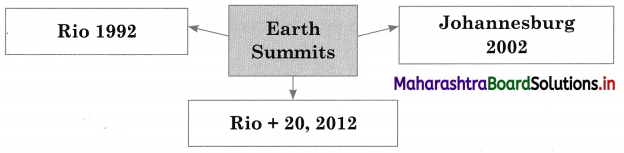
3. Rio de Janeiro Earth Summit (1992) sought to raise public awareness on the need to integrate environment and development and to create a partnership between developing and more industrialized nations to ensure a healthy future for the planet.

4. Earth Summit at Johannesburg (2002) recognized sustainable development as the most important goal for institutions at the national, regional and international levels

5. UN Conference on sustainable development (Rio-2012) is also called Rio Earth Summit or Rio+20. Environmental sustainability is defined as responsible interaction with the environment to avoid depletion or degradation of natural resources and allow for long¬term environmental quality. It’s goal is to conserve natural resources, to reduce pollution, to develop alternate sources of power, etc.

Maharashtra Board Class 12 Political Science Important Questions Chapter 3 Key Concepts and Issues Since 1991: Humanitarian Issues

Question 4.
Elaborate on the aspects of development in India.
Answer:
The purpose of development is to ensure welfare of the people and is associated with economic growth. The traditional approaches to development focus on the predominant role of the State in promoting economic growth (Socialist) or role of free market economy (Capitalist). Since the 1990s, the alternative view of development that focuses on both material and non-material aspects has become acceptable. The focus today is development based on equity, participation, empowerment and sustainability.

  1. Modernisation of the economy – During the Nehruvian period, the focus was on land reforms, irrigation and large-scale industrialisation to provide employment and increase productivity.
  2. Self – reliance – This included ‘import substitution’ strategy to develop indigenous industry.
  3. Socialist pattern of society – It was based on promotion of the Welfare State, employment generation and importance ,to the public sector. The Planning Commission (March 1950 to 31st December 2014) was created to chalk out Five Year Plans for development.

“Growth with Social Justice and Equity’ has been India’s policy towards poverty and development. Its development strategy has evolved over the years. In the early stages, government played a dominant role through the public sector.

Question 5.
Describe the 2030 Agenda for Sustainable Development adopted in 2015 by the UN.
Answer:
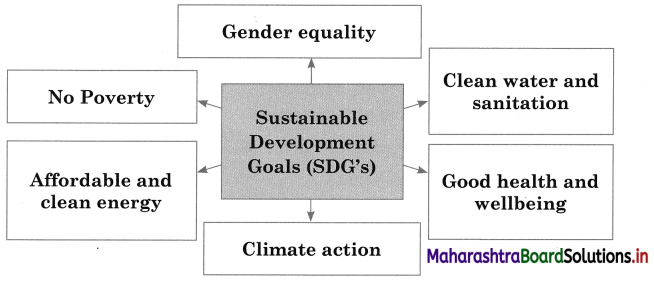
In 2015, the United Nations adopted the ‘2030 Agenda for Sustainable Development. It provides a blueprint for peace and prosperity for people and the planet for now and into the future. The Agenda mentions 17 Sustainable Development Goals (SDGs) for action by all developed and developing countries in a global partnership.

The Sustainable Development Goals are:

  1. No Poverty
  2. Zero hunger
  3. Good health and well being
  4. Quality
  5. Gender equality
  6. Clean water and sanitation
  7. Affordable and clean energy
  8. Decent work and economic growth
  9. Industry, innovation and infrastructure
  10. Reduced inequalities
  11. Sustainable cities and communities
  12. Responsible consumption and production
  13. Climate action
  14. Life below water
  15. Life on land
  16. Peace, justice and strong institutions
  17. Partnership goals

Maharashtra Board Class 12 Political Science Important Questions Chapter 3 Key Concepts and Issues Since 1991: Humanitarian Issues

Answer the following question with reference to the given points.

Question 1.
Explain condition of women in India.
(a) Economic inequality
(b) Trafficking and exploitation
(c) Literacy rate
(d) Political representation
Answer:
All over the world, women have to face serious problems such as discrimination and violence, under representation in economic and political decision-making, inequalities in education, health care, landholdings and workplaces and even in human rights.

Some of the important gender issues:
(a) Economic inequality – Participation of women in the labour market is about 28% only. There is also income inequality due to wide gender wage gaps as well as inequality of opportunities to women e.g., unequal access to education and finance. In many countries, women are either not encouraged to work or employed in the informal sector. Women continue to be underrepresented in high-level, highly paid positions and experience gender discrimination and sexual harassment in the workplace. Women experience high levels of poverty, unemployment and other economic hardships.

(b) Trafficking and exploitation – Women are often exploited and denied basic rights. They are trafficked for purpose of sexual and economic exploitation particularly prostitution, ‘sold’ as brides, subjected to sexual crimes, forced labour, street begging, etc. Trafficking in women means that they are deceived or forced/sold, physically confined, abused with no access to protection or health care.

(c) Literacy rate – low literacy among women is acute in India. As per 2011 census report, female literacy rate is only 65.46% while for males it is 82.14%. The reasons for the low female literacy are-

  1. traditional patriarchal notions that do not consider female education as economically advantageous
  2. Schools in rural areas are not easily accessible and travel may not safe or easy.
  3. Benefits of schemes like R.T.E have not reached many rural females.
  4. Social evils like child marriage, female foeticide, dowry, etc.

(d) Political Representation – Poor political representation of women is a significant gender concern in India. The First Lok Sabha had only 24 women of total 489 members i.e., 5% and the 17th Lok Sabha (2019) has 78 women (14%). This is the highest representation of women in Lok Sabha till date. The Women’s Reservation Bill which proposes to reserve 33% of all seats in Lok Sabha and in State Assemblies for women is pending in the Lok Sabha. However, there exists 33% reservation for women in rural and urban local bodies.

Maharashtra Board Class 12 Political Science Important Questions Chapter 3 Key Concepts and Issues Since 1991: Humanitarian Issues

Question 2.
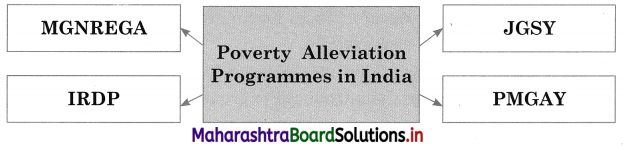
Describe the following poverty alleviation programmes in India.
(a) Integrated Rural Development Programme (IRDP)
(b) Jawahar Gram Samridhi Yojana (JGSY)
(c) Pradhan Mantri Gramin Awaas Yojana (PMGAY)
(d) Mahatma Gandhi National Rural Employment Guarantee Act. (MGNREGA)
(e) Saansad Adarsh Gram Yojana.
Answer:
The poverty alleviation programmes in India have been designed for both rural areas and urban areas. Most of the programmes are designed to target the rural poverty as prevalence of poverty is high in rural areas.
(a) Integrated Rural Development Programme (IRDP) – It was first introduced in 1978¬79. The main objective of IRDP is to create sustainable opportunities for self-employment in the rural sector.

(b) Jawahar Gram Samridhi Yojana (JGSY) – It is the revised version of the Jawahar Rozgar Yojana (JRY). It was started in 1999. The main aim of this programme was development infrastructure like roads to connect the villages to different areas and other social, education (schools) and infrastructure like hospitals in the rural areas.

(c) Pradhan Mantri Gramin Awaas Yojana – It was started in 1985. This scheme aimed at creating housing for everyone.

(d) Mahatma Gandhi National Rural Employment Guarantee Act. (MGNREGA) – It was launched in 2005. It provides 100 days assured employment every year to every rural household.

(e) Saansad Adarsh Gram Yojana – It was started in 2014. According to this yojana, each Member of Parliament will take the responsibility of developing three villages by 2019. The idea is to make India’s villages to be fully developed with physical and institutional infrastructure.

Question 3.
Discuss the following humanitarian issues.
(a) Environmental degradation
(b) Poverty
(c) Gender issues
Answer:
Humanitarian issues refer to concerns about issues affecting human welfare with the aim of alleviation of sufferings. Examples of humanitarian issues include natural disasters, famine, epidemics, armed conflicts, poverty, inequalities and injustice, environmental problems, etc.

(a) Environmental degradation – Indiscriminate exploitation of natural resources had resulted in environmental depletion and degradation. This results in significant environmental concerns such as deforestation, soil erosion,loss of biodiversity, climate change, endangerment of species, water scarcity, acid rain, pollution, spread of diseases etc. The relationship between economic development and environmental degradation has been considered at various international conferences like Rio Earth Summit, etc.

Environmental degradation has serious consequences for humans, animals, plants as well as the ecological balance. The causes of degradation include resource depletion due to overuse, landfills and illegal dumping, waste production, overpopulation and consumption behaviour, etc.

(b) Poverty – The traditional perception of poverty is where people are unable to provide for their basic necessities of life. It is the deprivation of common necessities that determine the quality of life including food, clothing, shelter and safe drinking water. The alternative view of poverty focuses on both material and non-material aspects i.e., focus on community ties, values and availability of common resources, participatory decision making and political and economic decentralisation.

The purpose of development is to ensure welfare of the people and is associated with economic growth. The traditional approaches to development focus on the predominant role of the State in promoting economic growth (socialist) or role of free market economy (capitalist). Since the 1990s, the alternate view of development that focuses on both material and non material aspects has become acceptable. The focus today is development based on equity, participation, empowerment and sustainability.

(c) Gender issues – There is a distinct link between poverty and unsatisfactory conditions of women. In most parts of the world women are poor due to cultural norms, unequal power equations between men and women. In the 1970s, women empowerment came to be accepted as an important philosophy to bring about gender justice. The UN ‘Decade for Women’ began in 1976 to-

  1. link women’s issues with developmental issues
  2. promote equal rights and opportunities for women across the globe.

Maharashtra Board Class 12 Political Science Important Questions Chapter 3 Key Concepts and Issues Since 1991: Humanitarian Issues

Question 4.
Discuss the vision of the development process in India.
(a) Modernisation of the economy
(b) Self-reliance
(c) Socialist pattern of society
Answer:
The purpose of development is to ensure welfare of the people and is associated with economic growth. The traditional approaches to development focus on the predominant role of the State in promoting economic growth (Socialist) or role of free market economy (Capitalist). Since the 1990s, the alternative view of development that focuses on both material and non material aspects has become acceptable. The focus today is development based on equity, participation, empowerment and sustainability. India’s vision of development had three aspects:

(a) Modernisation of the economy – This implied industrialization to provide employment to a growing labour force and to increase productivity During the Nehruvian period, the focus was on large scale industrialization and factory production. Land reforms and irrigation were looked at as the means to achieve agricultural growth and productivity.

(b) Self-reliance – This included ‘import substitution’ strategy to develop indigenous industry. Aid taken from Soviet Union, France, etc. was utilised mainly in the public sector and for infrastructure.

(c) Socialist pattern of society – The approach of planning for development was based on promotion of the welfare State, employment generation and importance to the public sector. The Planning Commission (March 1950 31st December 2014) was created to chalk out Five Year Plans for development.

“Growth with Social Justice and Equity” has been India’s policy towards poverty and development. Its development strategy has evolved over the years. In the early stages, government played a dominant role through the public sector.

Maharashtra Board Class 12 Political Science Important Questions Chapter 2 Key Concepts and Issues Since 1991: Globalisation

Balbharti Maharashtra State Board Class 12 Political Science Important Questions Chapter 2 Key Concepts and Issues Since 1991: Globalisation Important Questions and Answers.

Maharashtra State Board 12th Political Science Important Questions Chapter 2 Key Concepts and Issues Since 1991: Globalisation

Complete the following statements by selecting the appropriate option.

Question 1.
Some of the important changes that occurred in the economic sphere in the age of globalization are
(a) Free flow of finance capital
(b) Creation of GATT
(c) Rise of Transnational Companies
(d) Focus on intellectual property rights
Answer:
(c) Rise of Transnational Companies

Question 2.
The term ‘socialist market economy’ is used to describe the system in
(a) India
(b) China
(c) France
(d) United States
Answer:
(b) China

Maharashtra Board Class 12 Political Science Important Questions Chapter 2 Key Concepts and Issues Since 1991: Globalisation

Question 3.
Activities like farming, fishing, etc., are included in the ……….. sector.
(a) primary
(b) secondary
(c) service
(d) tertiary
Answer:
(d) tertiary

Question 4.
The Indus Waters Treaty is signed between India and
(a) Bangladesh
(b) Nepal
(c) China
(d) Pakistan
Answer:
(d) Pakistan

Question 5.
At Kundankulam there is opposition to building of the
(a) airport
(b) special economic Zone
(c) nuclear power plant
(d) oil refinery
Answer:
(c) nuclear power plant

Complete the following sentences by selecting the appropriate reason.

Question 1.
Investment in the infrastructure sector is more important than that in the consumer sector because ………………….
(a) there is greater extent of profit in it.
(b) real development will take place only when infrastructure is prevalent.
(c) foreign investments are mostly in the consumer sector.
Answer:
(b) real development will take place only when infrastructure is prevalent.

Maharashtra Board Class 12 Political Science Important Questions Chapter 2 Key Concepts and Issues Since 1991: Globalisation

Question 2.
Prior to the 1990s, foreign investments in India were rare because ………………
(a) government regulations made investments difficult.
(b) cold war was in progress.
(c) India was self reliant and did not need any investments.
Answer:
(a) government regulations made investments difficult..

Question 3.
TRIPs by WTO is a significant treaty because ………………
(a) it has replaced the GATT.
(b) it has extended the multilateral trading systems to services.
(c) it sets down minimum standards for most forms of intellectual property regulation.
Answer:
(c) it sets down minimum standards for most forms of intellectual property regulation.

Question 4.
During the Cold War, India had a mixed economy as ………………….
(a) it was nonaligned.
(b) both public sector and private sector played an important role.
(c) it had adopted the economic pattern of Soviet Union.
Answer:
(b) both public sector and private sector played an important role.

State the appropriate concept for the given statements.

Question 1.
Changes that occurred in the post cold war era due to advanced interconnectedness and technology.
Answer:
Globalisation

Question 2.
A category of property that refers to intangible creations of human intellect such as patents.
Answer:
Intellectual property

Maharashtra Board Class 12 Political Science Important Questions Chapter 2 Key Concepts and Issues Since 1991: Globalisation

Find the odd word.

Question 1.
Wipro, Dabur, Burger King, ONGC.
Answer:
Burger King (not an Indian MNC)

Question 2.
Manufacturing, Farming, Mining, Fishing
Answer:
Manufacturing (not from primary sector)

Question 3.
Copyrights, Insurance, Trademarks, Patents.
Answer:
Insurance (not intellectual property)

Question 4.
Green Peace, Amnesty International, Red Cross, Taliban.
Answer:
Taliban (terrorist outfit)

Expand the following abbreviations.

Question 1.
WTO
NGO
GATT
TRIPs
Answer:
WTO – World Trade Organisation
NGO – Non-Governmental Organisation
GATT – General Agreement on Tariffs and Trade
TRIPs – Trade Related Aspects of Intellectual Property Rights

Maharashtra Board Class 12 Political Science Important Questions Chapter 2 Key Concepts and Issues Since 1991: Globalisation

State whether the following statements are true or false with reason.

Question 1.
Position of the State is being challenged externally as well as internally.
Answer:
This statement is True.

  1. Some analysts argue that in the age of globalisation, the State has become less important. It’s sovereignty is being challenged from both, outside and within.
  2. External challenges come from rise of regional organisations, international laws, growing humanitarian concerns, etc. Internal challenges come from growth of ethnic nationalism, relevance of non State actors and a decline of national consensus.

Question 2.
Countries should have the right to interpret human rights according to their situation.
Answer:
This statement is True.

  1. In the age of globalisation, protection and promotion of human rights is very significant. The western approach to human rights focuses on civil and political rights while developing countries maintain that economic development must precede full enjoyment of individual rights.
  2. Countries have to interpret human rights in accordance to their history, culture, economic and political needs.

Question 3.
In a globalised world, the State has become irrelevant.
Answer:
This statement is False.

  1. Many analysts explain that the role of the State is slowly reducing in the economic as well as political sphere. Some of the State’s powers may have reduced due to international treaty obligations but the State’s authority remains the same.
  2. The State still remains the key actor in the domestic as well as international sphere. The State remains relevant inspite of the emergence of global civil society and increasing levels of cross border trade and investment.

Maharashtra Board Class 12 Political Science Important Questions Chapter 2 Key Concepts and Issues Since 1991: Globalisation

Question 4.
All countries in the world follow almost the same type of economic system today.
Answer:
This statement is False.

  1. Today, in a globalised world, there appears to be only one dominant ideological and economic , system i.e. ‘Market Economy.’ However, the nature of the market economy is determined by the ideology of that country.
  2. The USA has a ‘capitalist market’ economy which combines capitalist system with market economics. In most West European nations, the political system is a ‘welfare State’, so they adhere to welfare market economies. China has a socialist market economy and Indian system is described as economic liberalism.

Explain the correlation between the following.

Question 1.
Transnational Corporations – Globalisation
Answer:
Transnational Corporations are a type of Multi National Companies e.g., General Electric, Walmart, Nike etc. It is a borderless entity as it does not consider any particular country as it’s homebase. Globalisation has led to many private sector companies expanding their area of operations in foreign lands. Due to globalisation traditional companies can now spread out their operations in many countries to sustain high levels of responsiveness to the local markets. Transnational Corporations (TNCs) try to make decisions from a global perspective rather than from one centralised base. Actions taken by TNC’s can help in better relationships between nations as well as in the spread of resources.

Express your opinion of the following.

Question 1.
Multi National Companies are both beneficial as well as disadvantageous to developing nations.
Answer:
Multi National Companies (MNC’s) refer to organizations that own or control production of goods or services in at least two or more countries other than it’s home country e.g., Amazon, Coca-Cola Company, eBay, Honda, etc.

The advantages of MNC’s are they improve local infrastructure, provide local employment, diversify local economies, encourage innovation and better standards of production. They provide an inflow of capital and help to utilise the developing nation’s resources.

Disadvantages of MNC’s in developing countries are that natural resources may be overexploited, environment may be damaged, local laws may be ignored, MNC’s import skilled labour and so may not really lead to better employment but may put local outfits out -of business.

Maharashtra Board Class 12 Political Science Important Questions Chapter 2 Key Concepts and Issues Since 1991: Globalisation

Question 2.
The Arab spring in Egypt is sometimes called the ‘Facebook revolution’ in Egypt.
Answer:
The Arab Spring refers to a series of anti-government protests and uprisings that spread across much of the Arab world in the early 2010s. It began in Tunisia and spread to Libya, Egypt, Yemen, Syria and to a smaller extent to Iraq, Lebanon, Sudan, Morocco, etc. It’s main goals were regime change, economic progress and human rights. In Egypt, it began on 25th January 2011 when millions of protestors all over Egypt protested against President Hosni Mubarak’s regime. This was in response to a ‘Day of Revolution’ organized on Facebook on 25th January. It lasted till 11th February 2020.

Answer the following question in 80 to 100 words.

Question 1.
Discuss the political issues in the context of globalisation.
Answer:
Globalisation refers to the rapid spread of goods and services, technology and information, ideas and culture, trade and interactions across the world. It is the connection of different parts of the world resulting in the expansion of international cultural, informational, economic and political activities. In the early 1990s, the term globalisation was used to include economic, political, socio¬cultural, technological and ideological changes that occurred in the world in the post cold war era. The world has become more interconnected due to advances in technology and communication. Events in one part of the world have an impact on other parts of the world. Changes have taken place economically and culturally.

The political issues in the context of globalisation are-
1. Importance of Democracy – Disintegration of the Soviet Union and the revolutions in East European countries was an expression of end of communism and a move towards democratic systems. Today, concepts like ‘Participatory State’, ‘Good governance’, etc., have become important. A participatory State indicates that all sections of society participate in policy making and in the democratic process. Good governance focuses on the role of civil society in the functioning of an accountable, responsible and responsive government.

2. Position of the State – Under globalisation, sovereignty of the State which is closely linked to it’s jurisdiction appears to be challenged internally and externally. Internal challenges include activism of nonstate actors, rise of divisive factors, decline of national consensus, etc while external challenges include rise of regional economic organisations, growing humanitarian concerns, etc.

3. Nonstate actors – Today, not only States but also non-state actors like NGO’s play a significant role in international affairs and in promoting humanitarian issues.

4. Human Rights – Protection and promotion of human rights is an important issue in the age of globalisation. Countries interpret human rights in accordance with their history, culture, economy and polity, Many nations including India lay stress on social justice before full enjoyment of civil and political rights.
It is often argued that the role and importance of the State is slowly reducing, However, the State is still pivot in domestic and international spheres.

Maharashtra Board Class 12 Political Science Important Questions Chapter 2 Key Concepts and Issues Since 1991: Globalisation

Question 2.
Discuss the economic issues in the context of globalisation.
Answer:
Globalisation refers to the rapid spread of goods and services, technology and information, ideas and culture, trade and interactions across the world. It is the connection of different parts of the world resulting in the expansion of international cultural, informational, economic and political activities. In the early 1990s, the term globalisation was used to include economic, political, socio-cultural, technological and ideological changes that occurred in the world in the post cold war era. The world has become more interconnected due to advances in technology and communication. Events in one part of the world have an impact on other parts of the world. Changes have taken place economically and culturally.

The economic issues in the context of globalisation are-
1. Free flow of finance and capital – Investments provide finance and help to build industries. Indian companies both private for e.g., Tatas and government e.g., ONGC have invested in many countries in Asia, Africa and Europe. Foreign companies have also invested in India in sectors like power plants, infrastructure projects, consumer food chains, etc. This free flow of capital is both ways i.e., India to foreign countries and vice-versa. Foreign investment especially in the infrastructure sector is essential.

2. Change in the concept of trade

  • WTO – It was established in 1995 to replace GATT. The WTO is the only agency that oversees the rules of international trade, settles trade disputes and organises trade negotiations and agreements.
  • The scope of the term ‘trade’ has widened to include not only traditional commodities like fruits, grains, minerals, oil, etc., but also services like banking, insurance and intellectual property like trademarks.
  • Use of container cargo ships to carry huge amount of goods all over the world.

3. Rise of Transnational companies for e.g., Nestle, Unilever, etc., operate in India. Even Indian multinational companies like Wipro, Bajaj, etc are doing well. This affects the economy as follows-

  • Labour market – MNC’s recruit skilled and semi-skilled employees for eg Indian labour is employed in West Asia, Europe, USA, etc in industrial and service sectors.
  • Small shops and industries – Those stores which are efficient, continue to thrive while some industries either sell out to MNC’s or shut down.
  • Agricultural sector- Many MNC’s have introduced new technology and opened up direct markets for Indian agricultural products for eg India exports spices, fish, etc. to many nations.

Maharashtra Board Class 12 Political Science Important Questions Chapter 2 Key Concepts and Issues Since 1991: Globalisation

Answer the following question with reference to the given point in 150 to 200 words.

Question 1.
Discuss the following issues in the context of globalisation.
(a) Economic issues
(b) Ideological issues
(c) Socio-cultural issues
(d) Technological issues
Answer:
Globalisation refers to the rapid spread of goods and services, technology and information, ideas and culture, trade and interactions across the world. It is the connection of different parts of the world resulting in the expansion of international cultural, informational, economic and political activities. In the early 1990s, the term globalisation was used to include economic, political, socio¬cultural, technological and ideological changes that occurred in the world in the post cold war era. The world has become more interconnected due to advances in technology and communication. Events in one part of the world have an impact on other parts of the world. Changes have taken place economically and culturally.
(a) Economic Issues
Some economic changes that have occurred due to globalisation.
1. Free flow of finance and capital – Investments provide finance and help to build industries. Indian companies both private for e.g., Tatas and government e.g., ONGC have invested in many countries in Asia, Africa and Europe. Foreign companies have also invested in India in sectors like power plants, infrastructure projects, consumer food chains, etc. This free flow of capital is both ways i.e., India to foreign countries and vice- versa. Foreign investment especially in the infrastructure sector is essential.

2. Change in the concept of trade

  • WTO – It was established in 1995 to replace GATT. The WTO is the only agency that oversees the rules of international trade settles trade disputes and organises trade negotiations and agreements
  • The scope of the term ‘trade’ has widened to include not only traditional commodities like fruits, grains, minerals, oil, etc., but also services like banking, insurance and intellectual property like trademarks.
  • Use of container cargo ships to carry huge amount of goods all over the world.

3. Rise of Transnational companies for e.g., Nestle, Unilever, etc., are operate in India. Even Indian multinational companies like Wipro, Bajaj, etc., are doing well. This affects the economy as follows-

  • Labour market – MNC’s recruit skilled and semi-skilled employees for e.g., Indian labour is employed in West Asia, Europe, USA, etc., in industrial and service sectors.
  • Small shops and industries – Those stores which are efficient, continue to thrive while some industries either sell out to MNC’s or shut down.
  • Agricultural Sector – Many MNC’s have introduced new technology and opened up direct markets for Indian agricultural products for e.g., India exports spices, fish, etc., to many nations.

Maharashtra Board Class 12 Political Science Important Questions Chapter 2 Key Concepts and Issues Since 1991: Globalisation

(b) Ideological Issues – During the Cold War, East European nations, Soviet Union and China followed socialist ideology where the public sector was important. USA and West European countries were capitalist and so the private sector was important. India followed Democratic Socialism and a ‘Mixed Economy’ where both public and private sector coexisted in the economic system.

Today, there is only one dominant ideological and economic system i.e., Market Economy. However, the nature of the market economy is determined by the ideology of that country for e.g., USA has ‘capitalist market economy’, many west European countries have ‘Welfare market economy’, China has ‘socialist market economy’. The Indian system is based on ‘economic liberalism’.

(c) Social and Cultural Issues – Today a ‘global cosmopolitan culture’ has emerged i.e movement of people across the world and public awareness of global issues. This is noticed in matters like values e.g., secularism, clothing, food choices, ways of celebrating festivals, etc. There is international awareness of India’s rich cultural and historical heritage. Similarly, westernisation and urbanisation have influenced Indian society eg breakup of the traditional joint family and rise of individualism and materialism in the country.

(d) Technological issues – Rapid advances in global communication such as Internet, satellite communication etc brought in revolutionary changes in our lives. The internet has provided search engines like ‘Google’ to find out information and has enabled social networking through micro media like Instagram, Skype, etc. All these technologies are transnational and may be positively inclined e.g., NGO’s working for humanitarian issues or negatively inclined such as terrorist organisations.

Maharashtra Board Class 12 Political Science Solutions Chapter 5 Contemporary India: Good Governance

Balbharti Maharashtra State Board Class 12 Political Science Solutions Chapter 5 Contemporary India: Good Governance Textbook Exercise Questions and Answers.

Maharashtra State Board Class 12 Political Science Solutions Chapter 5 Contemporary India: Good Governance

1. (A) Complete the following statements by selecting the appropriate option.

Question 1.
The concept of Lokpal is taken from
(a) United States
(b) United Kingdom
(c) Sweden
(d) Russia
Answer:
(c) Sweden

Maharashtra Board Class 12 Political Science Solutions Chapter 5 Contemporary India: Good Governance

Question 2.
The Right to Information was passed in the year
(a) 1950
(b) 1976
(c) 2016
(d) 2005
Answer:
(d) 2005

(B) State the appropriate concept for the given statements.

Question 1.
Person investigating complaints against government officials.
Answer:
Ombudsman

2. (A) Complete the concept map.

Question 1.
Maharashtra Board Class 12 Political Science Solutions Chapter 5 Contemporary India Good Governance 1
Answer:
Maharashtra Board Class 12 Political Science Solutions Chapter 5 Contemporary India Good Governance 2

(B) State whether the following statements are true or false with reason.

Question 1.
Lokayukta can investigate complaints against political executives.
Answer:
This statement is True.

  1. Lokayuktas were created by the Lokpal and Lokayuktas Act, 2013 to look into allegations of corruption against public functionaries in the States.
  2. A member of the public can file specific allegations with the Lokayukta for inquiry against any public servant including legislators, political executives, local bodies, public enterprises.

Maharashtra Board Class 12 Political Science Solutions Chapter 5 Contemporary India: Good Governance

Question 2.
Good Governance aims at efficient use of natural resources.
Answer:
This statement is True.

  1. One of the core values of good governance is effectiveness and efficiency.
  2. It refers to sustainable human development in the context of efficient use of natural resources and the protection of the environment.

3. Explain the correlation between the following.

Question 1.
Good Governance and E-Governance.
Answer:
Good Governance aims to replace traditional public administration riddled with corruption and redtapism and to make it more citizen-centric, responsible and responsive. The core values of good governance include efficiency, inclusiveness, being consensus-oriented, transparency, accountability, etc. Specific programmes aimed at good governance include setting up of Lokpal and Lokayuktas, Creating of Citizen’s Charters, Right to Information Act, institutional mechanisms like NHRC, NCW, etc.

E-Governance is one of the most important aspects of good governance. It involves the employment of Information and Communications Technology (I.C.T) to facilitate efficient and instant transmission and processing of information as well as storing and retrieval of data. Thus, e-governance helps to implement core values of good governance such as transparency, effectiveness, accountability and participation of citizens.

Maharashtra Board Class 12 Political Science Solutions Chapter 5 Contemporary India: Good Governance

4. Express your opinion of the following.

Question 1.
E-governance speeds up governmental processes.
Answer:
I agree with this statement.
E-governance refers to the use of Information and Communications Technology (I.C.T) to carry out the varied and complex aspects of governance and of citizen’s expectations. E-governance facilitates instantaneous transmission and processing of information as well as efficient storing and retrieval of data. This helps in speeding up governmental processes and taking decisions expeditiously. Large scale digitisation of records enables easy and reliable access over the internet.

Question 2.
E-governance brought administration closer to people.
Answer:
I agree with this statement.
E-governance refers to the use of Information and Communications Technology (I.C.T) to carry out the varied and complex aspects of governance and of citizen’s expectations. Large scale digitisation of records enables easy and reliable access over the internet.

E-governance helps in increasing the geographical and demographical reach of the government. Efforts have been made at various levels to improve the delivery of public services and simplify the process of accessing them. The objective of National e-Governance Plan is to bring public services closer to the people i.e., make them citizen centric.

Maharashtra Board Class 12 Political Science Solutions Chapter 5 Contemporary India: Good Governance

5. Answer the following question in 80 to 100 words.

Question 1.
Explain various institutions protecting rights of different sections in India.
Answer:
The core values of good governance include administration being consensus-oriented based on principles of inclusiveness and equity as well as responsiveness to the needs of citizens.

The benefits of good governance must be available to all the sections of the society. The constitution provides for socio-economic and political safeguards to certain disadvantaged sections of the society. Besides the safeguards, provided for them the government has created several commissions to safeguard the rights of different sections of the society. These include the following:
1. National Commission for Scheduled Castes – Deals with matters related to the safeguards provided in the constitution for the Scheduled Castes and inquire into specific complaints relating to deprivation of rights of the Schedule Castes.

2. National Commission for Scheduled Tribes – Deals with matters related to the safeguards provided in the constitution for the Scheduled Tribes and inquire into specific complaints relating to deprivation of rights of the Schedule Tribes.

3. National Human Rights Commission – It deals with protection of rights relating to life, liberty, equality and dignity guaranteed by the constitution.

4. National Commission for Women – This was created to facilitate the redressal of grievances and accelerate socio-economic development of women.

5. National Commission for the Protection of Child Rights – It seeks to protect, promote and defend child rights in the country. The Commission defines a child as a person in the 0 to 18 years of age group.

6. National Commission for Backward Classes – The focus is welfare of socially and economically backward classes.

7. National Commission for Minorities – It monitors the working of the safeguards for minorities provided in the Constitution and by laws enacted by the Parliament and the State Legislatures. The National Commission for Minorities recognises the following religious communities as minority communities: Muslim, Sikh, Christian, Buddhist, Parsis and Jain.

8. National Consumer Disputes Redressal Commission – This provides for a consumer disputes redressal mechanism e.g.,consumer courts are set up.

Maharashtra Board Class 12 Political Science Solutions Chapter 5 Contemporary India: Good Governance

6. Answer the following question with reference to the given points.

Question 1.
Explain in detail the following values of Good Governance.
(a) participation
(b) transparency
(c) responsiveness
(d) accountability
Answer:
In development administration, not only the government but also citizens and NGO’s play a vital role. The term ‘governance’ is used to describe this cooperative effort of the government and non-governmental bodies in public administration. Governance is broader than government as

  1. it includes formal institutions of government e.g., legislature, bureaucracy as well as informal institutions e.g., NGO’s.
  2. it aims to improve the performance of public institutions with focus on values like accountability, transparency, citizen feedback, etc.

The Good Governance approach aims at the following-

  1. to reform the traditional, huge-sized public administration which was riddled with red tape and corruption.
  2. to replace the archaic systems with responsible, participative and equitable systems.
  3. to look at interlinkages between government and civil society.
  4. to make the administration citizen-centered and not rule bound.

Maharashtra Board Class 12 Political Science Solutions Chapter 5 Contemporary India Good Governance 3

a. Participation – The effective functioning of any democratic system requires that people get an opportunity to participate in the process of decision making and its implementation.

b. Transparency – This value of good governance enables people to keep the government under scrutiny for e.g., Right to Information Act (2005) provides citizens access to information about public policies and actions.

c. Responsiveness – The government must be prompt and sensitive while designing policies to serve all stake holders within a reasonable time frame.

d. Accountability – This cannot be enforced without the rule of law and transparency. Any organization is accountable to those who will be affected by it’s decisions and actions, i.e. to stakeholders. Governmental institutions, private sector and civil society institutions must be accountable.

Maharashtra Board Class 12 Political Science Solutions Chapter 5 Contemporary India: Good Governance

Activity

Question 1.
Find out the information regarding State level commissions working for safeguarding rights of various sections of society (Text Book Page No. 58)
Answer:
The State Level Commissions are-
1. State Information Commission was constituted with the objective to fulfill the mandate assigned in the RTI Act 2005. It consists of State Information Commissioners headed by the State Chief Information Commissioner.

2. State Commission for Women was constituted on 25th January 1993. It consists of a chair person, 6 nonofficial members, a member secretary and a DGP as ex-officio member. It aims to investigate into practices derogatory to women and suggest remedial measures. It also advises the government on matters related to upliftment to the status of women.

3. State Commission for Scheduled Castes and Scheduled Tribes was established by the Social Justice and Special Assistance Department dated 1st March 2005. It’s role is to study existing socio-economic, political and educational situation of Scheduled Castes and Tribes and to suggest measures to improve the same. It also investigates grievances raised by members of Scheduled Castes and Schedules Tribes.

4. State Human Rights Commission (MSHRC) was established on 6th March 2001 to protect, promote and enforce human rights. It can inquire suo motu (of its own accord) or on petition presented to it, into complaints of violation of human rights.

5. State Commission for Protection of Child’s Rights was set up in July 2007 to protect and defend child rights in the State.

6. State Commission for Minorities – was set up to safeguard the interests of religious and linguistic minorities.

Question 2.
Find out information about Ombudsman. (Text Book Page No. 58)
Answer:
Ombudsman is a Swedish term. In general, it means “a legal representative” or an official appointed to investigate complaints especially against public officials. The first country to set up ombudsman institution in 1809 was Sweden. In India, the Lokpal (for centre) and Lokayuktas (for States) are the ombudsman. The ARC (1966-70) headed by Morarji Desai recommended the institution of Lokpal and the Bill was first introduced in Parliament in 1968. Orissa was the first State to constitute institution of Lokayukta.

After the India Against Corruption Movement led by Anna Hazare, the Lokpal and Lokayuktas Bill, 2013 was passed in Parliament and came into force on 16th January 2014. The Lokpal is a multimember body, consisting of a chairperson and a maximum of 8 members. The Lokpal and Lokayuktas inquire into allegations of corruption / maladministration against public functionaries.

Maharashtra Board Class 12 Political Science Solutions Chapter 5 Contemporary India: Good Governance

Class 12 Political Science Chapter 5 Contemporary India: Good Governance Intext Questions and Answers

ACTIVITY (Text Book Page No. 48)

Question 1.
Identify NGO’s that are working in your Area/City/State. Look at the issues and work done by them. In which NGO would you like to work?
Answer:
1. For environmental causes

  • Bombay Natural History Society (BNHS)
  • Vanshakti
  • Earth5R
  • Bombay Environmental Action Group (BEAG)
  • Vasundhara
  • PETA

2. For child welfare

  • Child Right and You (CRY)
  • Prerana
  • Helen Keller Institute
  • Bal Asha Trust
  • Salaam Baalak Trust
  • Akansha Foundation
  • Apnalaya

3. For educational purposes

  • Teach for India
  • Door step School
  • Magic Bus India Foundation
  • Pratham Education Foundation
  • VIDYA .
  • Abhilasha Foundation

4. For women’s welfare

  • Society for Nutrition, Education and Health Action (SNEHA)
  • Apne Aap Women’s Collective (AAWC)
  • Women’s India Trust (WIT)
  • MAJLIS

5. For the disabled/ill/aged

  • AASRA
  • National Association for the Blind (NAB)
  • ALERT-India (leprosy patients)
  • Cancer Patients Aid Association (CPAA)
  • Committed Action for Relief and Education (CARE)
  • Cheshire Homes India

Question 2.
Find out E-governance initiatives of Government of Maharashtra (Text Book Page No. 54)
Answer:
Maharashtra is a pioneer in citizen centric e-governance initiatives such as

  1. SARITA (Stamps and Registration Information Technology based Administration) for registration of 67 different types of documents over the entire State.
  2. SETU (Integrated Citizen Facilitation Centres) act as one stop service centre for people who have to visit government offices for permits/affidavits, etc. The Society for promotion of Excellence and Transparency for better Understanding of the requirements of citizen in interface with government.
  3. E-validity for caste/minority status certificates.
  4. Online Disability certificates.
  5. SEVARTH – integrated system to provide electronic salary payment to all government personnel.
  6. SARTHI – Computerisation of driving license and vehicle registration.
  7. Rojgar Wahini – to provide free services like vocational guidance, job opportunities, self employment guidance, etc.

Maharashtra Board Class 12 Political Science Solutions Chapter 5 Contemporary India: Good Governance

Question 3.
Consumer Protection Act (1986) (Text Book Page No. 56)
Answer:
The Consumer Protection Act was enacted by Parliament in 1986 to protect the interests of consumers in India. It is replaced by the Consumer Protection Act 2019.
It aims to check unfair trade practices, ‘defects in goods’ and ‘deficiencies in services’ and has led to a widespread network of consumer fora and appellate courts all over the country. The Act provided six rights to consumers:

  • Right to seek redressal against unfair trade practices.
  • Right to be heard and be assured that their interests receive due consideration at an appropriate forum.
  • Right to be assured wherever possible, access to a variety of goods and services at competitive . prices.
  • Right to be informed about the quality, standard, price of goods and services.
  • Right to be protected against marketing of goods and services which are hazardous to life and property.
  • Right to consumer education.

To ensure consumer rights, Consumer Disputes Redressal System included a three-tier level i.e.,

  • National Consumer Commission (set up by central government).
  • State Consumer Commission (set up by each State).
  • District Consumer Forum (in each district of the State).

The redressal agencies (consumer courts) set up were. Central Consumer Protection Council and State Consumer Councils. Consumer courts are special purpose courts dealing with cases involving consumer disputes, conflicts and grievances.

Maharashtra Board Class 12 Political Science Solutions Chapter 4 Contemporary India: Challenges to Peace, Stability and National Integration

Balbharti Maharashtra State Board Class 12 Political Science Solutions Chapter 4 Contemporary India: Challenges to Peace, Stability and National Integration Textbook Exercise Questions and Answers.

Maharashtra State Board Class 12 Political Science Solutions Chapter 4 Contemporary India: Challenges to Peace, Stability and National Integration

1. (A) Complete the following statements by selecting the appropriate option.

Question 1.
Article had granted a ‘special status’ to Jammu and Kashmir.
(a) 352
(b) 360
(c) 370
(d) 110
Answer:
(c) 370

Maharashtra Board Class 12 Political Science Solutions Chapter 4 Contemporary India: Challenges to Peace, Stability and National Integration

Question 2.
Left wing Extremism originated in 1967 in
(a) Nagaland
(b) Jharkhand
(c) Gadchiroli
(d) Naxalbari
Answer:
(d) Naxalbari

(B) Identify the incorrect pair in every set and correct it.

Question 1.
(a) Naxalism – Red Corridor
(b) CPI (Maoist) – Uri attacks
(c) Assam – Sons-of-soil movement
Answer:
(b) Jaish-e-Mohammed – Uri attacks

Question 2.
(a) Boko Haram – Ireland
(b) LTTE – Sri Lanka
(c) ETA – Spain
Answer:
(a) Boko Haram – Nigeria
OR
IRA – Ireland

(C) Complete the following statements by using appropriate reason.

Question 1.
The left wing extemists prevent execution and implementation of developmental work, because ……………..
(i) they are against government.
(ii) the opposition parties ask them to do so.
(iii) they want to show that the government structure at field level is ineffective.
Answer:
(ii) the opposition parties ask them to do so.

Maharashtra Board Class 12 Political Science Solutions Chapter 4 Contemporary India: Challenges to Peace, Stability and National Integration

Question 2.
In 1990’s Kashmiri Pandits migrated from Kashmir valley, because …………………..
(i) they weren’t from Kashmir.
(ii) there was growth in Islamic militancy.
(iii) there were no job opportunities for them.
Answer:
(i) they weren’t from Kashmir.

2. (A) Find the odd word.

Question 1.
Terrorism, Naxalism, Nationalism, Extremism.
Answer:
Nationalism (not a violent activity)

(B) State the appropriate concept for the given statements.

Question 1.
Threat use violence with an intention to create panic in the society.
Answer:
Terrorism

Question 2.
Involvement of people in decision making process of State.
Answer:
Good Governance

3. (A) Complete the concept maps.

Question 1.
Maharashtra Board Class 12 Political Science Solutions Chapter 4 Contemporary India Challenges to Peace, Stability and National Integration 1
Answer:
Maharashtra Board Class 12 Political Science Solutions Chapter 4 Contemporary India Challenges to Peace, Stability and National Integration 2

Maharashtra Board Class 12 Political Science Solutions Chapter 4 Contemporary India: Challenges to Peace, Stability and National Integration

(B) State whether the following statements are true or false with reason.

Question 1.
Democracy is required to establish national integration and social transformation.
Answer:
This statement is True.

  1. Democracy and national integration are complementary, since the core of the structural aspect of national consolidation is the democratic system of governance.
  2. Participation of diverse socio-cultural groups in the process of governance is possible only through a representative democratic system. Democracy helps in political participation and social transformation by removing ethnic, caste and gender inequality.

Question 2.
National movement in India played an important role in national integration.
Answer:
This statement is True.

  1. The national freedom movement extended across the length and breadth of the country and involved people of different religions, regions and cultures.
  2. It played a vital role in bringing Indians together emotionally and politically into a nation and integrating them in a common frame work of political identity and loyalty.

Maharashtra Board Class 12 Political Science Solutions Chapter 4 Contemporary India: Challenges to Peace, Stability and National Integration

4. Explain the correlation between the following.

Question 1.
National Unity and Regional Aspirations
Answer:
National Unity is possible when citizens of that State exhibit psychological oneness, solidarity and shared values. It is not homogeneity but a form of ethnic, religious and linguistic acceptance. Regional aspirations occur in forms like demand for separate States, language issues, etc., Regional aspirations have their roots in historical/linguistic/cultural issues or may be a product of regional political outfits. Sometimes, regional aspirations may even become secessionist as in case of Khalistan movement. India has tried to reconcile regional aspirations with national unity by creating a federation with a strong centre, creating of smaller States as well as the linguistic reorganisation of States.

5. Express your opinion of the following.

Question 1.
Peace and stability are necessary for the nation’s progress.
Answer:
Peace, stability and public order are necessary for nation’s progress and good life of citizens. An unruly society will lead to violence, loss of life, destruction of property, economic and political instability. Conflict resolution is linked to maintenance of law, order and peace. In the absence of order and stability, divisive tendencies will prevail, infrastructure will be targeted, investments will be discouraged thus becoming a barrier to economic growth. At a basic level, political stability is ensured using constitutional machinery and socio-economic development. In case of any problem occurring, the State tries to resolve it peacefully. In case the issue escalates or becomes violent, the State may employ force if necessary.

Maharashtra Board Class 12 Political Science Solutions Chapter 4 Contemporary India: Challenges to Peace, Stability and National Integration

6. Answer the following question in 80 to 100 words.

Question 1.
What is Left Wing Extremism in India?
Answer:
Left Wing Extremism (also called Maoist movement or Naxalism) has major support base among landless labourers, dalits and tribals who experience a sense of oppression, injustice and neglect. The first attempt to promote a peasant struggle was the Telangana Movement (1946-51). The Naxal Movement originated in 1967 in Naxalbari (West Bengal) led by Kanu Sanyal and writings of Charu Majumdar.

Since 1980s the movement has taken a militant turn. In 2004 CPI (M-L), People’s War Group (PWG) and Maoist Communist Centre (MCC) of India merged to form CPI (Maoist) which aims to overthrow the government, Naxal activities aim to destroy public property and attack police and officials. The Red Corridor of naxal activities extends across States like Bihar, Jharkhand, Chhattisgarh, Maharashtra, Telangana, Andhra Pradesh, etc.

Some of their broad tactics are as follows:

  1. Use of propaganda slogans
  2. Establishment of mass movements
  3. Mobilisation of women, tribals and minorities into the revolution
  4. Mobilisation of urban population on mass issues
  5. Develop appropriate forms of military organisation

Maharashtra Board Class 12 Political Science Solutions Chapter 4 Contemporary India: Challenges to Peace, Stability and National Integration

Question 2.
Explain cross border terrorism in Jammu and Kashmir.
Answer:
The India Independence Act (1947) provided that princely States (562 existed then) could decide to join either Pakistan or remain independent. Maharaja Hari Singh of the Dogra dynasty delayed such a decision. In 1947, Kashmir’s population was 77% Muslim and 20% Hindu. The problem in
the region began when Pakistan sent Pashtun tribal raiders in October 1947 to force Hari Singh to join Pakistan. However, the Maharaja appealed to India for help and signed the Instrument of Accession making the State as a part of India.

The Government of India sent troops to the region to drive away the infiltrators. This led to the first India-Pakistan conflict (1947-48). In 1965, Pakistan attacked India but the local Kashmiri population did not support Pakistan. In 1965, Amanullah Khan created the Plebiscite Front in Pakistan Occupied Kashmir. It’s militant wing i.e., National Liberation Front carried out sabotage activities in Jammu and Kashmir.

In 1977, the Plebiscite Front was renamed Jammu and Kashmir Liberation Front (JKLF). Similarly, Pakistan lent support to guerilla outfits in the region like Hizb-ul-Mujahideen. In the 1990s, as instances of militancy increased, the minority Pandit population was forced to flee from Kashmir. At this time, local insurgency grew into terrorism sponsored by Pakistan and having training camps in Pakistan Occupied Kashmir. Pan-Islamic terrorist groups like Lashkar-e-Taiba, Hizbul, etc., and several Pakistan based persons like Hafeez Sayed have promoted terror activities and radicalisation of the local population. In recent years stone pelting by young protestors has increased.

7. Answer the following in 150 to 200 words.

Explain the role of the State with help of given points.
(a) Peace and order
(b) Economic development
(c) National Building
(d) Governance
(e) Welfare

Activity

Trace the changes that have taken place in Art 370 of the Indian constitution.

Maharashtra Board Class 12 Political Science Solutions Chapter 4 Contemporary India: Challenges to Peace, Stability and National Integration

Class 12 Political Science Chapter 4 Contemporary India: Challenges to Peace, Stability and National Integration Intext Questions and Answers

Activity (Text Book Page No. 39)

Question 1.
What are the Fundamental Duties enshrined in the Indian constitution?
Answer:
To spread awareness about them, fundamental duties were inserted in the Part IV Article 51(A) of the Constitution by the 42nd Constitutional Amendment, 1976.
The fundamental duties include:

  1. To abide by the Constitution and respect the National Flag and National Anthem.
  2. To cherish and follow the noble ideas which inspired our national struggle for freedom.
  3. To respect and protect the sovereignty, integrity and unity of India.
  4. To defend and serve the country.
  5. To promote harmony and the spirit of common brotherhood amongst all the people of India and to abolish evils hampering women’s dignity.
  6. To value and preserve the rich heritage of our composite culture.
  7. To protect and improve the natural environment including forests, rivers, trees, lakes and to show kindness towards animals.
  8. To develop scientific temper and spirit of inquiry.
  9. To protect public property and prevent violence.
  10. To strive towards excellence in all spheres of individual and collective activity.
  11. A parent or guardian should provide opportunities for education to his child, between the age of 6 to 14 years. (This has been added by 86th Constitutional Amendment)

Maharashtra Board Class 12 Political Science Solutions Chapter 4 Contemporary India: Challenges to Peace, Stability and National Integration

Question 2.
Find out the details of the following events and discuss them in the classroom:
(i) Assam Oil Blockade (1980)
(ii) Assassination of Rajiv Gandhi (1991) (Text Book Page No.41)
Answer:
(i) Assam Oil Blockade (1980)
The Assam Movement (1979-1985) led by the All Assam Students Union (AASU) and All Assam Gana Sangram Parishad (AAGSP) was against the illegal immigrants in Assam. There were a series of protests to compel the government to identify and expel illegal immigrants (mostly Bangladeshi) and to provide safeguards to the indigenous Assamese. Some of the protests were violent e.g., the Nellie massacre (1983). On 15th August 1985, the Assam Accord was signed between the Rajiv Gandhi Government and leaders of the Assam movement by which all migrants who had entered the State prior to January 1, 1966 were accepted.

The Oil Blockade was part of the Assam agitation. Crude oil from Assam was pumped to a refinery at Barauni (Bihari). However, AASU protested and blockaded oil supply in 1980. A committee was appointed to suggest a new location for refinery within Assam. They suggested Bongaigaon near West Bengal border. The oil blockade resulted in huge losses to the petroleum industry.

(ii) Assassination of Rajiv Gandhi (1991)
Assassination of Rajiv Gandhi, former Prime Minister of India (1984-1989) occurred as a result of suicide bombing in Sriperumbudur, Chennai on 21st May 1991. It was carried out by a member of LTTE (Sri Lanka) known as Thenmozhi Rajaratnam (Dhanu) At least 14 others were killed in the explosion of the RDX laden belt by Dhanu. The assassination was attributed to LTTE being antagonised by Mr. Rajiv Gandhi’s sending of Indian Peace Keeping Force (IPKF) to Sri Lanka and the signing of the Indo-Sri Lanka Peace Accord with President J. Jayewardene in 1987.

Maharashtra Board Class 12 Political Science Solutions Chapter 3 Key Concepts and Issues Since 1991: Humanitarian Issues

Balbharti Maharashtra State Board Class 12 Political Science Solutions Chapter 3 Key Concepts and Issues Since 1991: Humanitarian Issues Textbook Exercise Questions and Answers.

Maharashtra State Board Class 12 Political Science Solutions Chapter 3 Key Concepts and Issues Since 1991: Humanitarian Issues

1. (A) Complete the following statements by selecting the appropriate option.

Question 2.
Today the Indian approach to gender issues focuses on
(a) Education
(b) Welfare
(c) Development
(d) Empowerment
Answer:
(d) Empowerment

Maharashtra Board Class 12 Political Science Solutions Chapter 3 Key Concepts and Issues Since 1991: Humanitarian Issues

Question 3.
The first UN Conference on Human Environment was held in 1972 in
(a) Johannesburg
(b) Stockholm
(c) Rio
(d) New Delhi
Answer:
(b) Stockholm

(B) Identify the incorrect pair in every set and correct it.

Question 1.
(a) JGSY – Infrastructure development in rural areas
(b) PMKVY – Skill training to youth
(c) MGNREGA – Housing for everyone
Answer:
(c) MGNREGA – assured employment every year for every rural household

Question 2.
(a) National Commission for Women – 1992
(b) Planning Commission – 2015
(c) Rio+20 summit – 2012
Answer:
(b) Planning Commission – 1950

(C) Find the odd word in the given set.

Question 1.
National policy for empowerment of women, protection of women from domestic violence act, Muslim women (protection and right on marriage) Act, the secual harassment at workplace (prohibition prevention and readressal) Act.

Maharashtra Board Class 12 Political Science Solutions Chapter 3 Key Concepts and Issues Since 1991: Humanitarian Issues

Question 2.
Climate change, waste management, water scarity, deforestation.

2. State whether the following statements are true or false with reason.

Question 1.
Planning Commission was created to promote agriculture in India.
Answer:
This statement is False.

  1. The Planning Commission was set up in 1950 to formulate a plan for the effective and balanced utilisation of the country’s resources.
  2. It’s function was to prepare Five Year Plans to tackle poverty, employment and promote the Welfare State. The Green Revolution was introduced to promote agriculture in India.

Question 2.
National Commission for Women was set up to protect rights for women in India.
Answer:
This statement is True.

  1. National Commission for Women was set up to facilitate the redressal of grievances of women.
  2. It aimed to safeguard the rights and legal entitlements of women and accelerate their socio¬economic development.

Maharashtra Board Class 12 Political Science Solutions Chapter 3 Key Concepts and Issues Since 1991: Humanitarian Issues

3. Explain the correlation between the following.

Question 1.
Women Empowerment and Sustainable Development.
Answer:
Empowerment is a process by which any category of oppressed persons gain control over their own lives by developing self esteem and courage to fight against injustice. Sustainable development refers to development using resources in a way that allows for them to renew or to continue to exist for other e.g., recycling materials. This seems almost impossible without gender equality and women’s empowerment. Women are empowered when they are able to access opportunities without restrictions such as in education, career, etc.,

Women’s economic empowerment refers to the ability of women to enjoy their right to control and benefit from resources, income etc as well as the ability to improve their economic status and well-being. Political empowerment includes affirmative action policies to increase participation of women in parliamentary / government positions and policymaking. Thus, women’s empowerment is a key factor for sustainable economic growth, social development and environmental sustainability.

Question 2.
Poverty and Development
Answer:
Poverty refers to deprivation of the basic necessities such as food, clothing, health services, education, etc., that determine quality of life. In economic terms, it is expressed as the poverty line. Development means some measurable improvement in some particular area. Alleviation or even eradication of poverty is the most important aim of developmental work.

Poverty is related to other problems of underdevelopment such as unemployment and inequalities. It hinders economic development as well as leads to issues of health, sanitation and disease, housing, crime, etc. Poverty alleviation i.e., set of economic and humanitarian measures, such as good governance, economic growth, government support in health education etc., are important for development.

Maharashtra Board Class 12 Political Science Solutions Chapter 3 Key Concepts and Issues Since 1991: Humanitarian Issues

4. Answer the following questions in 80 to 100 words.

Question 1.
Explain the traditional and non-traditional perception of poverty.

Question 2.
From 1960’s to 21 century what efforts has India taken to achieve development?

5. Answer the following question with reference to the given points.

Question 1.
Explain condition of women in India.
(a) Economic inequality
(b) Trafficking and exploitation
(c) Literacy rate
(d) Political representation
Answer:
All over the world, women have to face serious problems such as discrimination and violence, under-representation in economic and political decision-making, inequalities in education, health care, landholdings and workplaces and even in human rights.

Some of the important gender issues:
(a) Economic inequality – Participation of women in the labour market is about 28% only.
There is also income inequality due to wide gender wage gaps as well as inequality of opportunities to women e.g., unequal access to education and finance. In many countries, women are either not encouraged to work or employed in the informal sector. Women continue to be underrepresented in high-level, highly paid positions and experience gender discrimination and sexual harassment in the workplace. Women experience high levels of poverty, unemployment and other economic hardships.

(b) Trafficking and exploitation – Women are often exploited and denied basic rights. They are trafficked for purpose of sexual and economic exploitation particularly prostitution, ‘sold’ as brides, subjected to sexual crimes, forced labour, street begging, etc. Trafficking in women means that they are deceived or forced/sold, physically confined, abused with no access to protection or health care.

(c) Literacy rate – low literacy among women is acute in India. As per 2011 census report, female literacy rate is only 65.46% while for males it is 82.14%. The reasons for the low female literacy are-

  1. traditional patriarchal notions that do not consider female education as economically advantageous
  2. Schools in rural areas are not easily accessible and travel may not safe or easy.
  3. Benefits of schemes like R.T.E have not reached many rural females.
  4. Social evils like child marriage, female foeticide, dowry, etc.

(d) Political Representation – Poor political representation of women is a significant gender concern in India. The First Lok Sabha had only 24 women of total 489 members i.e., 5% and the 17th Lok Sabha (2019) has 78 women (14%). This is the highest representation of women in Lok Sabha till date. The Women’s Reservation Bill which proposes to reserve 33% of all seats in Lok Sabha and in State Assemblies for women is pending in the Lok Sabha. However, there exists 33% reservation for women in rural and urban local bodies.

Maharashtra Board Class 12 Political Science Solutions Chapter 3 Key Concepts and Issues Since 1991: Humanitarian Issues

Activity

Question 1.
Find out information on international agreements on environmental balance. (Text Book Page No. 34)
Answer:
1. Stockholm conference (Declaration of UN Conference on Human Environment, 1972) led to a 109 point Environmental Action Plan and establishment of the UN Environmental programme (UNEP).

2. Convention on International Trade in Endangered Species of Wild Flora and Faura (CITES) (1973) – grouped almost 30,000 plant and animal species into three levels of protection depending on the degree of regulation required.

3. Montreal Protocol (1987) – For protection of the ozone layer. It phases out production and use of ozone depleting chemicals.

4. Convention on Biological Diversity (CBD) (1992) – The aim was to promote conservation and sustainable use of biodiversity.

5. Kyoto Protocol (1997) – It supplements the 1992 UN Framework Convention on Climate change (UNFCCC) to limit six greenhouse gas emissions. It involved 37 countries and the UN.

6. Paris Agreement (2016) – It is an agreement within the UNFCCC, dealing with greenhouse gas emissions and strengthening global response to the threat of climate change.

Maharashtra Board Class 12 Political Science Solutions Chapter 3 Key Concepts and Issues Since 1991: Humanitarian Issues

Question 2.
Find out percentage of handicapped voters in 17th Lok Sabha suggest measures to increase their percentage.

Class 12 Political Science Chapter 3 Key Concepts and Issues Since 1991: Humanitarian Issues Intext Questions and Answers

ACTIVITY (Text Book Page No.26)

Question 1.
What are the different initiatives taken by the Indian Government to protect the environment?
Answer:
1. Swachh Bharat Abhiyan was launched on October 2, 2014 to achieve the mission of a clean India in both rural and urban areas. It was implemented by the Ministry of Drinking water and sanitation and the Ministry of Urban Development respectively. Swachh Bharat Mission (Gramin) aims to make India Open Defecation Free (ODF) For Urban Areas, it includes elimination of ODF, eradication of manual scavenging and proper solid waste management.

2. Namami Gange Programme (Clean Ganga Project) is implemented by the National Mission for Clean Ganga to conserve and rejuvenate the river Ganga. The centre allocated a total of Rs 20000 crore for the project. The key achievements include sewerage treatment capacity, river front development and surface cleaning of the river.

3. Green Skill Development Programme was launched in June 2017 by the MoEF and CC. It refers to skills that contribute to preserve and restore the environment, thus enabling youth to be employed or self-employment. Green skills include Pollution Monitoring, Waste Management, Forest and Wildlife Management, etc.

4. Constitutional Provisions – Article 48 (DPSP) says the State shall endeavour to protect and improve the environment. Article 51-A States that it shall be the duty of every citizen of India to protect and improve the natural environment.

5. Legislation – (i) Indian Wild Life Protection Act (1972) Forest Conservation Act (1980) and Environment (Protection) Act (1986)
(ii) National Environmental Policy (2006) Ministry of Environment, Forest and Climate change (MoEF and CC) along with Pollution Control Boards administer and enforce environmental laws. There is also the National Green Tribunal.

Maharashtra Board Class 12 Political Science Solutions Chapter 3 Key Concepts and Issues Since 1991: Humanitarian Issues

Question 2.
Salient Features of National Policy for Women (2016). (Text Book Page No.33)
Answer:
National Policy for Women was unveiled by Union WCD Minister, Smt Maneka Gandhi on 17th May 2016. It will replace National Policy for Empowerment of Women (2001). It shifts the focus from entitlements to rights and from mere empowerment to creating an enabling environment for women. It seeks to create conducive socio-cultural, economic and political environment to enable women to enjoy fundamental rights and realize their full potential. It’s priority areas include health, food security and nutrition, education, involving women in governance and decision making, encouraging entrepreneurship, facilitating women in the workplace and dealing with violence against women.

Question 3.
Find out information on international agreements on environmental balance. (Text Book Page No. 34)
Answer:
1. Stockholm conference (Declaration of UN Conference on Human Environment, 1972) led to a 109 point Environmental Action Plan and establishment of the UN Environmental programme (UNEP).

2. Convention on International Trade in Endangered Species of Wild Flora and Faura (CITES) (1973) – grouped almost 30,000 plant and animal species into three levels of protection depending on the degree of regulation required.

3. Montreal Protocol (1987) – For protection of the ozone layer. It phases out production and use of ozone depleting chemicals.

4. Convention on Biological Diversity (CBD) (1992) – The aim was to promote conservation and sustainable use of biodiversity.

5. Kyoto Protocol (1997) – It supplements the 1992 UN Framework Convention on Climate change (UNFCCC) to limit six greenhouse gas emissions. It involved 37 countries and the UN.

6. Paris Agreement (2016) – It is an agreement within the UNFCCC, dealing with greenhouse gas emissions and strengthening global response to the threat of climate change.

Maharashtra Board Class 12 Political Science Solutions Chapter 1 The World Since 1991

Balbharti Maharashtra State Board Class 12 Political Science Solutions Chapter 1 The World Since 1991 Textbook Exercise Questions and Answers.

Maharashtra State Board Class 12 Political Science Solutions Chapter 1 The World Since 1991

1. (A) Complete the following statements by selecting the appropriate option.

Question 1.
One of the important trends in the post-1989 international relations was
(a) End of bipolarity
(b) Rise of regionalism in Asia
(c) End of non-alignment
(d) Demand for a new international economic order
Answer:
(a) End of bipolarity

Maharashtra Board Class 12 Political Science Solutions Chapter 1 The World Since 1991

Question 2.
The ‘Maastricht’ Treaty is with reference to
(a) United Nations Peace Keeping Force
(b) European Union
(c) American interventions in Kuwait
(d) Creation of BRICS
Answer:
(b) European Union

1. (B) State the appropriate concept for the given statements.

Question 1.
When a State influences other States without the use of military force.
Answer:
Soft power

Question 2.
A State with a leading position in international politics with abilities to influence global politics and fulfill its own interest.
Answer:
Super power

2. (A) Complete the concept maps.

Question 1.
Maharashtra Board Class 12 Political Science Solutions Chapter 1 The World Since 1991 1
Answer:
Maharashtra Board Class 12 Political Science Solutions Chapter 1 The World Since 1991 2

Question 2.
Maharashtra Board Class 12 Political Science Solutions Chapter 1 The World Since 1991 3
Answer:
Maharashtra Board Class 12 Political Science Solutions Chapter 1 The World Since 1991 4

2. (B) Observe the maps in the textbook and answer the following questions.

Maharashtra Board Class 12 Political Science Solutions Chapter 1 The World Since 1991 5
Question 1.
Name any four countries in the Schengen area.
Answer:
Sweden, Denmark, Germany, Belgium, France.

Maharashtra Board Class 12 Political Science Solutions Chapter 1 The World Since 1991

Question 2.
Name any two non-European Union countries within Schengen area.
Answer:
Norway, Romania, Bulgaria, Croatia.

3. State whether the following statements are true or false with reason.

Question 1.
SAARC is important for trade in South Asia.
Answer:
This statement is True.
(i) SAARC has eight member States from South Asia. It aims to accelerate economic growth and promote the welfare of the people of South Asia.
(ii) In 1993, South Asian Association for Preferential Trade Agreement (SAPTA) came into existence. It was replaced in 2006 by South Asian Association Free Trade Area (SAFTA). This helps in trade and economic activity in the region.

Question 2.
‘Maastricht’ Treaty was signed for the defence of Europe.
Answer:
This statement is False.
(i) On 7th February 1992, the Maastricht Treaty was signed to create the European Union.
(ii) This treaty led to the expansion of spheres of cooperation in internal affairs, foreign policies and defence policies.

Question 3.
The decade of 1980s is seen as the golden age of humanitarian intervention.
Answer:
This statement is False.
(i) The 1990s are seen as the ‘golden age of humanitarian intervention.’ In 1993, the World Conference on Human Rights was held in Vienna, which led to the creation of the office of UN High Commissioner for Human Rights.
(ii) Increasing awareness about human rights and their protection in international law gave rise to the phenomenon for protection of rights in the form of ‘humanitarian intervention’.

Maharashtra Board Class 12 Political Science Solutions Chapter 1 The World Since 1991

4. Express your opinion of the following.

Question 1.
Humanitarian intervention
Answer:
One of the main purposes of the UN is maintenance of international peace, security and cooperation. UN Peacekeeping Force comprises of military personnel and resources sent by member States. In the post-cold war era, the UN rationale for intervention was not just to stop ongoing wars but also to prevent reoccurrence of conflicts and protect the human rights of the affected people. The UN intervened in Cambodia, Somalia, Yugoslavia, East Timor, Eritrea, Syria, etc., for this purpose.

In 1993, over 170 nations participated in the World Conference on Human Rights, held in Vienna to reaffirm their commitment to protect human rights. The office of the UN High Commissioner for Human Rights was created to coordinate human rights initiatives. The increasing awareness about human rights protection in international law gave rise to humanitarian intervention especially in conflict zones. NGO’s have contributed significantly in the spread of humanitarian intervention for e.g. ICRC, Oxfam, etc. The 1990s are described as “golden age” of humanitarian intervention.

Maharashtra Board Class 12 Political Science Solutions Chapter 1 The World Since 1991

Question 2.
Regionalism in international politics.
Answer:
Countries which lie in geographical proximity create or join regional organisations which are based on common political, ideological, economic and infrastructural concerns. Some nations make special agreements regarding trade and economic cooperation. This is called a trade bloc.

(i) European Union (EU) was created in 1992 by Maastricht Treaty. It led to increased spheres of cooperation between European nations e.g. foreign affairs, defense, trade and creation of Euro as a common currency. Creation of Schengen Area is one of the achievements of the EU since the Schengen visa allows eligible individuals to travel freely within the 26 nations of the Schengen area.

(ii) ASEAN created in 1967 with headquarters at Jakarta comprises of 10 South-East Asian nations such as Brunei, Indonesia, Malaysia, Singapore, etc. It aims to promote political economic and security cooperation among it’s members.

(iii) SAARC formed in 1985 at Dhaka with 7 members. Today, it has 8 member countries of South Asia like India, Bhutan, Pakistan, etc. It aims to promote regional integration and economic development. It’s main achievement is the SAFTA.

(iv) BIMSTEC – is a regional organisation founded in 1997 comprising of 7 member countries lying around Bay of Bengal for e.g. Bangladesh, India, Thailand, Myanmar. It aims to facilitate collaboration in economic, security and other concerns between member States.

(v) Shanghai Cooperation Organisation (SCO) is an Eurasian political, economic and security organisation formed in 2001 with 6 member states. In 2016, India and Pakistan joined SCO. It’s focus is on maintaining peace and stability in the region, cooperation in trade, technology, etc.

Regional organisations play an important role in international politics. Due to this, unipolarity (US as the only superpower) ended leading to multipolarity.

5. Answer the Following.

Question 1.
Explain the term soft power with examples.
Answer:
According to American academic, Joseph Nye there are two types of power viz. hard power and soft power.
(i) Hard power is the ability to get others to act in ways that are contrary to their preferences and wills. It is the ability to coerce through threats and inducements for e.g.,Iraq invasion of Kuwait.

(ii) Soft power is when a country influences other countries without the use of military force. It is the ability to get others to want the outcomes that you want i.e. through attraction rather than coercion. Such influence is spread through economic, socio-cultural means.

Soft power was an important aspect of US domination. It implied the use of monetary aid, cooperative programmes, cultural exchanges, strong relations with allies. Examples of US soft power are cultural exports like fast food chains, movies, educational exchange programmes as well as disaster assistance programmes such as tsunami relief (Japan), flood control (Pakistan).

Maharashtra Board Class 12 Political Science Solutions Chapter 1 The World Since 1991

6. Answer the following question in detail with help of given points.

Question 1.
Discuss the European Union with help of given points.
(a) History
(b) European Commission
(c) European Parliament
(d) European Council
(e) European Court of Justice
Answer:
(a) History – The European Coal and Steel Community (ECSC) and European Economic Community (EEC) were created to foster economic interdependence. On 7th February 1992, the Maastricht Treaty was signed to create the European Union. This led to expansion of spheres of cooperation to include internal affairs, judicial matters, foreign policy, etc. The Euro (€) is the official currency of 19 out of 28 countries of the EU. These nations are collectively called ‘Eurozone’.

(b) European Commission – The Commission is the executive bureaucratic arm of the EU. It is mainly responsible for drawing up proposals for new European legislation,and it implements the policy decisions of the European Parliament and the Council of the EU.

(c) European Parliament – The European Parliament is composed of 751 Members, who are directly elected every five years. It is a body entrusted with legislative, supervisory, and budgetary responsibilities.

(d) European Council – The structure of the European Council consists of the Presidents or Prime Ministers of each member State, accompanied by their foreign ministers, and a full¬time President of the European Council. The European Council meets four times a year and provides strategic leadership for the EU.

(e) European Court of Justice (ECJ) – The ECJ interprets, and adjudicates on, EU law and treaties. As EU law has primacy over the national law of EU member States.

Maharashtra Board Class 12 Political Science Solutions Chapter 1 The World Since 1991

ACTIVITY

Find out the role played by India in BRICS (Text Book Page No. 13)
Answer:
BRICS refers to five major emerging national economies, i.e., Brazil, Russia, India, China and South Africa. It accounts for about 40% of the world’s population and 20% of the GDP. It is an emerging investment market and global power bloc. India serves a multi faceted role on the economic and political fronts.

(i) New Development Bank (NDB) was proposed by India during the BRICS summit in New Delhi. It was established in 2014 and intends to provide non conditional financing. India has contributed $ 10 billion to the NDB to refurbish industrial bases in Brazil and South Africa. There is a regional office of NDB in India.

(ii) In 2012, India introduced “security” on the agenda, as the theme of the summit in New Delhi was BRICS Partnership for Global Stability, Security and Prosperity.

(iii) India has also highlighted climate governance at BRICS meeting.

(iv) BRICS membership elevates India’s global profile for e.g., India has assumed the role of a trade facilitator in Africa and South Asia. It aims to promote intra-BRICS trade, which means urging member nations to import goods mainly from each other.

(v) India is seen as a strong voice at BRICS and the UN against proposals and actions that could harms any member’s interests for e.g., India turned down China’s proposal to invite Pakistan, Sri Lanka and Mexico into the BRICS to focus only on development within current members.

Class 12 Political Science Chapter 1 The World Since 1991 Intext Questions and Answers

ACTIVITY (Text Book Page No. 7)

Question 1.
What is One Belt One Road and China Pakistan Economic Corridor policy of China?
Answer:
One Belt One Road also called OBOR or Belt and Road Initiative (BRI) since 2016, is a global development strategy adopted by the Chinese government in 2013 involving infrastructure development and investments in nearly 70 countries in Asia, Europe and Africa. It is an ambitious economic development and commercial project that focuses on improving cooperation among multiple countries.

BRI involves building a network of roadways, railways, power grids, maritime ports, oil and gas pipelines and associated infrastructure projects. The project covers two parts i.e., Silk Road Economic Belt (land based) and expects to connect China with Central Asia, East and West Europe to connect China with Central Asia, East and West Europe) and 21st Century Maritime Silk Road (sea based and connects China to Africa, South East Asia, Mediterranean) BRI consists of six economic corridors such as China-Pakistan corridor, China- Indochina Peninsula corridor etc.

China-Pakistan Economic Corridor (CPEC) launched in 2015 is a part of the greater OBOR. It is a collection of infrastructure projects that are currently under construction throughout Pakistan for e.g., special economic zones, ports, energy projects, etc. The Gwadar Port (Balochistan province of Pakistan) which is considered the deepest seaport in the world is considered to be significant in the BRI. India has objected to the CPEC as upgrade works to the Karakoram Highway are taking place in Gilgit Baltistan (which is Indian territory) and will undermine India’s security and position in the region.

Maharashtra Board Class 12 Political Science Solutions Chapter 1 The World Since 1991

Question 2.
Who are the members of the European Union? (Text Book Page No.9)
Answer:
There are 27 countries who are members of European Union. These are Austria, Belgium, Bulgaria, Croatia, Cyprus, Czech Republic, Denmark, Estonia, Finland, France, Germany, Greece, Hungary, Ireland, Italy, Latvia, Lithuania, Luxembourg, Malta, Netherlands, Poland, Portugal, Romania, Slovakia, Slovenia, Spain, Sweden. UK was a member but left in January 2020.

The following countries are part of Eurozone.
Austria, Belgium, Cyprus, Estonia, Finland, France, Greece, Germany, Ireland, Italy, Latvia, Lithuania, Luxembourg, Malta, the Netherlands, Portugal, Slovakia, Slovenia and Spain. The Eurozone is the monetary union of 19 out of 27 countries of the EU i.e., those who have Euro (€) as their common currency. The other 8 EU countries continue to use their national currencies.

Maharashtra Board Class 12 Political Science Solutions Chapter 1 The World Since 1991

Question 3.
Discuss the case of Brexit. (Text Book Page No. 11)
Answer:
British Exit i.e., Brexit is the withdrawal of the United Kingdom from the European Union. In June 2016, 52% voted to leave the EU following a UK wide referendum. The UK finally left the EU on 31st January 2020.
The main reasons for Brexit were-
(i) EU threatens British sovereignty and prevents radical reforms.
(ii) The Euro has been a disaster and caused the Greek economic crisis.
(iii) UK could have a more rational immigration system outside the EU as the EU allows too many immigrants.

Brexit is a rejection of globalisation. The European Union signified a move from a single market to a single currency, a single banking system and eventually a single political entity. Many persons argue that Brexit goes against the concept of globalisation, i.e., it symbolizes a protest against the economic model that has been in place since 1992.

Many voters feel that globalisation has benefited only a small elite and hanker for a return to the security provided by the nation-States i.e., jobs, living standards, welfare facilities seemed better protected in the nation-States prior to globalisation for e.g., unemployment across the Eurozone is more than 10% and Italy, Greece, etc., are facing economic crisis.

Maharashtra Board Class 12 Political Science Solutions Chapter 2 Key Concepts and Issues Since 1991: Globalisation

Balbharti Maharashtra State Board Class 12 Political Science Solutions Chapter 2 Key Concepts and Issues Since 1991: Globalisation Textbook Exercise Questions and Answers.

Maharashtra State Board Class 12 Political Science Solutions Chapter 2 Key Concepts and Issues Since 1991: Globalisation

1. (A) Choose the correct alternative and complete the following statements

Question 1.
In 1995, GATT was replaced by the
(a) WTO
(b) ECOSOC
(c) UNDP
(d) TRIPS
Answer:
(a) WTO

Maharashtra Board Class 12 Political Science Solutions Chapter 2 Key Concepts and Issues Since 1991: Globalisation

Question 2.
……………… refers to a company that operates in several countries but has a distinct home base
(a) Transnational Corporation
(b) Mixed Economy
(c) Multinational Company
(d) Liberalism
Answer:
(c) Multinational Company

(B) Find the odd word.

Question 1.
Mobile, Satellite, Internet, Gramophone.
Answer:
Gramophone (not functioning on modern technology)

(C) State the appropriate concept for the given statements.

Question 1.
The international agency dealing with international trade.
Answer:
World Trade Organization (WTO)

Question 2.
The companies that operate in several countries.
Answer:
Multi National Companies

Maharashtra Board Class 12 Political Science Solutions Chapter 2 Key Concepts and Issues Since 1991: Globalisation

(D) Identify the incorrect pair in every set and correct it.

Question 1.
(a) Nestle – Trans National Corporation
(b) Copyrights – Intellectual Property
(c) India – Capitalist Market Economy
Answer:
(c) USA – Capitalist Market Economy
OR India – Economic Liberalism (Mixed economy)

Question 2.
(a) Amnesty International – Human Rights
(b) Green Peace – Environmental Issues
(c) Chernobyl – Trade Agreement
Answer:
(c) Chernobyl – Nuclear disaster

2. State whether the following statements are true or false with reason.

Question 1.
Globalisation brought in the concept of market economy.
Answer:
This statement is True.
(i) During the Cold War, the economic systems followed by countries, depended upon their ideology. For e.g., most West European nations and the USA were free democracies and followed capitalist economy.

(ii) In the era of globalisation there is only ‘market economy’. However, the nature of market economy is determined by the countries ideology for e.g., China has a socialist market economy, West European nations are described as ‘welfare market economies’ and USA is considered as ‘capitalist market economy’.

(iii) In most countries, the State has with draws from economic activities and the private sector and profit motive has propelled the economy.

Maharashtra Board Class 12 Political Science Solutions Chapter 2 Key Concepts and Issues Since 1991: Globalisation

Question 2.
Non-state actors have become irrelevant in the age of globalisation.
Answer:
This statement is False.
(i) Good governance and the participatory State focus on the role of the civil society which includes non-state actors such as NGO’s.

(ii) International relations today, are not only between States but also include non-state actors. These sometimes also pose a challenge to the position of the State. Globalisation has made non-state actors relevant. This includes organisations which are beneficial e.g., NGO’s working for humanitarian issues as well as threatening organisations e.g., terrorist outfits.

3. Explain the correlation between the following.

Question 1.
Globalisation and culture
Answer:
Globalisation refers to the rapid spread of goods and services, technology and information, ideas and culture, trade and interactions across the world. It is the connection of different parts of the world resulting in the expansion of international cultural, informational, economic and political activities. Events in one part of the world have an impact on other parts of the world. Changes have taken place economically and culturally.

Today a ‘global cosmopolitan culture’ has emerged i.e movement of people across the world and public awareness of global issues. This is noticed in matters like values eg secularism, clothing food choices, ways of celebrating festivals, etc. There is international awareness of India’s rich cultural and historical heritage. Similarly, westernisation and urbanisation have influenced Indian society eg breakup of the traditional joint family and rise of individualism and materialism in the country.

Maharashtra Board Class 12 Political Science Solutions Chapter 2 Key Concepts and Issues Since 1991: Globalisation

Question 2.
GATT and WTO
Answer:
The General Agreement on Tariffs and Trade (GATT) was signed on 30th October 1947 by 23 countries with the purpose to promote international trade by reducing/eliminating trade barriers such as tariffs or quotas. It came into force on 1st January 1948. It aimed to boost economic recovery after World War II through reconstructing and liberalizing global trade. It introduced the most favoured nation principle. GATT was refined over 8 rounds of negotiations, leading to creation of World Trade Organization (WTO) which replaced GATT on 1st January 1995.

WTO covers services and intellectual property also. It is the international agency overseeing the rules of international trade i.e., it promotes free trade agreements, organizes trade negotiations, settles trade disputes, etc. It’s headquarters is in Geneva. It has 123 member States. The WTO dispute settlement system is faster, more automatic than the GATT system and it’s rulings cannot be blocked.

4. Express your opinion of the following.

Question 1.
Participatory State is beneficial to the society.
Answer:
Participatory State advocates more involved forms of citizen participation and greater political representation than traditional representative democracy. It goes beyond traditional democratic practices wherein decisions are made by the majority. In a participatory State, all sections of the society are involved in the making of policy. Participatory State is beneficial as it gives citizens a central role in public policy through public discussion, negotiations, voting, etc. It emphasizes the importance of making citizens aware and providing for a form of communication which promotes political dialogue.

Maharashtra Board Class 12 Political Science Solutions Chapter 2 Key Concepts and Issues Since 1991: Globalisation

5. Answer the following question in 80 to 100 words.

Question 1.
What are the positive and negative aspects of Globalisation?
Answer:
Globalisation refers to the rapid spread of goods and services, technology and information, ideas and culture, trade and interactions across the world. It is the connection of different parts of the world resulting in the expansion of international cultural, informational, economic and political activities. In the early 1990s, the term globalisation was used to include economic, political, socio¬cultural, technological and ideological changes that occurred in the world in the post cold war era. The world has become more interconnected due to advances in technology and communication. Events in one part of the world have an impact on other parts of the world. Changes have taken place economically and culturally.

The Positive aspects of globalisation are-

  1. It creates more employment opportunities.
  2. It encourages free trade.
  3. It leads to better choice of goods and services to the consumer.
  4. It leads to wider investments in developing countries.
  5. It enhances efficiency of the tertiary sector i.e., banking and finance.
  6. It increases purchasing power of citizens and enhances their standard of living.
  7. It increases labour productivity and reduces capital-output ratio.
  8. It helps to increase efficiency in the production system.

The negative aspects of globalisation are-

  1. Globalization promotes technological adaption to increase productivity but has also resulted in loss of jobs.
  2. Local/small scale industries cannot withstand competition from the MNC’s and may be bought off or shut down.
  3. Less developed countries may become dependent on the technologically superior countries.
  4. It has caused specialization of labour and so there are few employment opportunities for unskilled labour.
  5. It has led to increased gap between rich and poor nations.
  6. It may lead to overexploitation of resources and negatively impact the environment.
  7. It leads to the harmful effects of consumerism.
  8. It may lead to reduction in social welfare schemes in both developed and developing countries.

Activity

Talk to people of the older generation to find out what changes have taken place in the age of globalisation.

Maharashtra Board Class 12 Political Science Solutions Chapter 2 Key Concepts and Issues Since 1991: Globalisation

Class 12 Political Science Chapter 2 Key Concepts and Issues Since 1991: Globalisation Intext Questions and Answers

Activity (Text Book Page No. 18)

Question 1.
What has been the impact of globalisation on the Indian agricultural sector, especially the small farmer?
Answer:
Globalisation has both positive and negative consequences on Indian agriculture.
The positive consequences are-
(i) Availability of modern agro technologies in pesticides / herbicides, fertilizers, new varieties of high yield seeds to increase food production.
(ii) There are new markets for agricultural products.
(iii) Farmers can sell their goods directly to companies and eliminate the role of middlemen.

The negative effects of globalisation on agriculture are-

  1. Farmers are shifting from traditional / mixed cropping to unsustainable cropping practices mainly for cash crops.
  2. MNC’s have captured the India market, making farmers dependent on expensive HYV seeds, fertilizers, etc.
  3. Small and marginal farmers may not be able to avail of the advantages of globalisation. They may be pushed into debt leading to tragic consequences like farmer suicides.

Maharashtra Board Class 12 Political Science Solutions Chapter 2 Key Concepts and Issues Since 1991: Globalisation

Question 2.
Find out what the Arab Spring movement was and how social networking was used during that movement. (Text Book Page No. 21)
Answer:
Arab Spring was a series of protests and uprisings against the governments that spread across large parts of the Arab world in the early 2010s. (i.e. December 2010 to December 2012). It began with protests in Tunisia and spread quickly to other countries like Libya, Egypt, Yemen, Syria and Bahrain. There were riots, civil wars and the main slogan of protestors was “the people want to bring down the regime”.

There were sustained street demonstrations in Iraq, Algeria, Morocco, Jordan, Lebanon, etc. The social media i.e. facebook, etc. was the driving force behind the swift spread of the revolutions. The results of these movements were that regimes of Tunisia (Abidine Ben Ali), Egypt (Hosni Mubarak) Libya (Gaddafi), Yemen (Abdullah Saleh) were ousted while in Syria, Iraq, etc., a full scale civil war resulted. Only in Tunisia, there was a transition to constitutional democratic government.

Question 3.
Find out cases where agitations have used social networking to highlight their demands. (Text Book Page No. 21)
Answer:
Social networking and micro media have aided many protests and agitations. Some examples are:
(i) Arab Spring movements (2010-2012) used media power eg., Facebook to over throw despotic rulers e.g., Gaddafi in Libya or Hosni Mubarak in Egypt.

(ii) In India, the Anti-Corruption Movement led by Anna Hazare (2011) was helped by extensive media coverage and social media posts specially among the youth and students.

(iii) Social networking played a vital role in the “Me Too” movement all over the world to expose workplace sexual harassment especially in the glamour industry.

(iv) Social networking played a major role in galvanising support during the pro-democracy demonstrations in Hong Kong.

(v) Various social media handles fuelled the protests against NRC, CAA, etc., in various States of India.

Maharashtra Board Class 12 Political Science Solutions Chapter 2 Key Concepts and Issues Since 1991: Globalisation

Question 4.
Can the cooperative movement of India be an answer to the domination of multinational and transnational companies? The philosophy of the cooperative movement is to provide both, empowerment and finance to the members while that of the corporations work on profit motive. Give your opinion on this. (Text Book Page No. 17)
Answer:
Cooperative Movement in India can be traced to the Cooperative Credit Societies Act (1904). India’s first Prime Minister, Jawaharlal Nehru had strong faith in the cooperative movement. Hence, cooperatives became an integral part of Five Year Plans in India. In 1958, National Development council recommended setting up of Cooperative Marketing Societies. The major sectors where cooperatives dominate are in dairy, agriculture, banking and rural credit, etc. Article 43, Part IV (DPSP) of the constitution, mentions about promotion of cooperatives mainly in rural areas.

The importance of the cooperative sector.

  • it provides agricultural credits where the State and private sectors have not been able to do so.
  • it helps to overcome the constraints of agricultural development.
  • it provides empowerment to the members.
  • it can be an answer to the domination by the MNC’s which work solely on the profit motive. If the problems of cooperatives are overcome, they can strengthen the financial sector and lessen our reliance on MNC’s.