Maharashtra Board Class 11 Geography Solutions Chapter 5 Global Climate Change

Balbharti Maharashtra State Board Class 11 Geography Solutions Chapter 5 Global Climate Change Textbook Exercise Questions and Answers.

Maharashtra State Board Class 11 Geography Solutions Chapter 5 Global Climate Change

1. Complete the chain.

Question 1.

ABC
(1) Melting of snow(1) Increase in sea level(1) Flooding
(2) Effects of insolation(2) Erratic rains(2) Increase in frequency of cyclones
(3) Greenhouse gases(3) Methane(3) Agriculture
(4) Climate change(4) Average temperature of the earth(4) Existence of life on Earth

Answer:

ABC
(1) Melting of snow(1) Methane(1) Flooding
(2) Effects of insolation(2) Average temperature of the earth(2) Agriculture
(3) Greenhouse gases(3) Erratic rains(3) Existence of life on Earth
(4) Climate change(4) Increase in sea level(4) Increase in frequency on cyclones

Maharashtra Board Class 11 Geography Solutions Chapter 5 Global Climate Change

2. Identify the incorrect factor.

Question 1.
The causes of global warming-
(a) Emission of greenhouse gases
(b) Deforestation
(c) Apparent movement of the sun
(d) Industrialization
Answer:
(c) Apparent movement of the sun

Question 2.
The indicators of climate change-
(a) Retreat of glaciers
(b) Increase in the frequency of floods
(c) Increase in frequency of cyclones
(d) Increase in the minimum and maximum temperature
Answer:
(d) Increase in the minimum and maximum temperature

Question 3.
The tools for studying climate change
(a) Ice cores
(b) Coral reef
(c) Tree rings
(d) Ancient forts
Answer:
(d) Ancient forts

Question 4.
Measures to combat climate change –
(a) Banning the use of pesticides and insecticides
(b) Promoting afforestation and banning deforestation
(c) Banning public transport
(d) Banning fossil fuels
Answer:
(c) Banning public transport

3. Give geographical reasons.

Question 1.
It is important to study climate change.
Answer:
It is important to study climate change because –

  1. The earth’s climate is changing faster primarily as a result of human activities.
  2. Number of flash floods are increasing, especially in urban areas.
  3. Due to warming of oceans the rate of evaporation is high, which is the root cause of both flooding and droughts.
  4. Due to increase in temperature, there is melting of snow on mountains and sea level is rising.
  5. Human activities, especially emissions of heat-trapping greenhouse gases from fossil fuel combustion, deforestation and land use changes are the primary drivers of the climate changes observed in the industrial era.

Maharashtra Board Class 11 Geography Solutions Chapter 5 Global Climate Change

Question 2.
There is a great possibility that we may not see Maldives on the world map in the future.
Answer:
There is a great possibility that we may not see Maldives on the world map in the future because-

  1. Sea level continues to rise at a rate of about 3 mm/ per year, leaving no ground surface higher than 3 m.
  2. Due to global warming the rising of sea level is likely to worsen.
  3. Higher sea levels may lead to severe cyclones and periodic flooding of coastal areas.
  4. Since, Maldives is a flat country there is possibility that it may be submerged under sea water if the rise in sea level continues.

Question 3.
The snowline is retreating.
Answer:
The snowline is retreating because –

  1. A snowline is a boundary between a snow-covered and snow-free surface. Above the snowline there is permanent snow cover.
  2. When glaciers and icebergs melt at an alarming rate, it is a cause of concern. This is known as retreating glaciers.
  3. Due to changes in the climate there is less snowfall as compared to the previous years.
  4. This means that there is lesser ice formation each year than its rate of melting.
  5. Thus, due to melting of glaciers and icebergs as well as less snowfall the snowline is retreating.

Question 4.
There is an increase in the frequency of droughts and cyclones.
Answer:
There is an increase in the frequency of droughts and cyclones because-

  1. In addition to triggering more rainfall, global warming could also increase the occurrence of drought.
  2. The roots of both flooding and drought lie in the physical process known as evaporation.
  3. As global warming heats the world’s oceans, the water molecules near the sea surface become more energetic and tend to evaporate into the atmosphere more readily. Thus, water vapour is formed.
  4. Similarly, due to global warming, the number of cyclones in a year and their intensities have also increased in the tropical regions.

4. Write short notes on.

Question 1.
Bleaching of coral reefs
Answer:

  1. When temperature changes, corals throw out the algae living in their tissues.
  2. These algae are responsible for their colour.
  3. An increase of 1°C – 2°C in ocean temperatures for a long time can lead to bleaching, turning corals white.
  4. If corals are bleached for prolonged periods, they eventually die.
  5. Coral bleaching leads to death of large amounts of corals.

Maharashtra Board Class 11 Geography Solutions Chapter 5 Global Climate Change

Question 2.
Flash floods
Answer:

  1. A flash flood is a term that describes floods, which is usually observed in the low-lying areas.
  2. Floods are caused due to extremely heavy rainfall.
  3. Flash floods generally occur after the collapse of natural ice, debris dam or a man-made dam, etc.
  4. Flash foods also occur due to very high precipitation in one day (Mumbai in 2005, Kedarnath in 2013) or because of changed weather conditions like cyclones (Chennai, 2015).
  5. Flash foods are different from the regular floods by having a time scale of fewer than six hours between rainfall and the onset of flooding.

Question 3.
Tools to study Paleoclimatology
Answer:
Paleoclimatology is the study of the weather and climate of the earth’s past. Scientists and meteorologists have been using instruments to measure climate and weather for the past 140 years. However, millions of years ago historical evidence called proxy data, which includes coral reefs, tree rings, ice cores, etc., were used to tell about the climate.

Coral reefs:

  1. Coral reefs are very sensitive to changes in climate. –
  2. Corals form skeletons by extracting calcium carbonate from the ocean waters.
  3. When the water temperature changes, densities of calcium carbonate in the skeletons also change.
  4. Coral formed in the summer has a different density than coral formed in the winter.
  5. This creates seasonal growth rings on the corals.
  6. Scientists can study these rings to determine the temperature of the water and the season in which the coral grew.

Tree rings:

  1. There are rings on the stem of the tree.
  2. Variation in these rings is due to variation in the environmental conditions when they were formed.
  3. Thus, studying this variation leads to improved understanding of past environmental conditions.

Ice cores:

  1. These are samples of ice taken from the inner sides of the ice sheets.
  2. Throughout each year, layers of snow fall over the ice sheets in Greenland and Antarctica.
  3. Each layer of snow is different.
  4. Summer snow differs from winter snow.
  5. Each layer gives scientists a lot of information about the climate each year.

Question 4.
Greenhouse gases
Answer:

  1. Greenhouse gases are the primary gases, such as, water vapour carbon dioxide, nitrous oxide, methane and ozone in the earth’s atmosphere that absorbs and traps energy from the sun.
  2. Of all greenhouse gases, carbon dioxide absorbs more heat.
  3. Without greenhouse gases, the average temperature of the earth’s surface would be about -18°C rather than the present average of 14°C.
  4. Carbon dioxide emissions comes from many human activities such as combustion of fossil fuels, oil and natural gas, with additional contributions coming from deforestation, changes in land use, soil erosion and agriculture (including live stock).

Maharashtra Board Class 11 Geography Solutions Chapter 5 Global Climate Change

5. Answer in detail.

Question 1.
Climate change has not always been anthropogenic in nature. Explain.
Answer:
Though the human activities are a major cause behind climate change, there are some natural causes for climate change. They are as follows:
Amount of energy output by the sun:

  1. Low energy output by the sun can reduce amount of insolation received by the earth.
  2. This can lead to cooling of the earth.

Milankovitch Oscillation:

  1. The earth’s rotation around its own axis and revolution around the sun is responsible for the changes in climate.
  2. Their changes alter the amount of insolation received from the sun, which in turn might affect its climate.
  3. It can cause the earth to be closer to the sun (warmer) and farther from the sun (colder).
  4. The ice ages can occur when we are farther from the sun.

Volcanism:

  1. Volcanic eruptions throw lots of particulates and aerosols into the atmosphere.
  2. These aerosols remain in the atmosphere for a considerable period of time.
  3. The winds spread it around the world, thus reducing the sun’s radiation reaching the earth’s surface.

Goldilocks Zone:

  1. The earth lies in the habitable zone called the Goldilocks Zone.
  2. Earth experiences cooler climate, when it was located in the outer reaches of this zone.
  3. As the size of the sun increases the zone moves outward over time.
  4. Such changes in the zone causes earth to warm or cool.

Maharashtra Board Class 11 Geography Solutions Chapter 5 Global Climate Change

Question 2.
What measures will you suggest to combat climate change in your village/city.
Answer:
Following measures can be taken to combat climate change in our village / city.

  1. Afforestation should be encouraged in and around play areas, hill sides, schools, etc.
  2. Deforestation should be avoided strictly.
  3. The use of public transport should be enabled to lessen the vehicular pollution. Thus, emission of harmful gases such as CO2, etc., can be prevented.
  4. Use of natural manure can be encouraged instead of using fertilizers.
  5. In villages, Liquefied Petroleum Gas (LPG) should be used instead of using coal or wood as fuel.

11th Geography Digest Chapter 5 Global Climate Change Intext Questions and Answers

Can you tell? (Textbook Page No. 58)

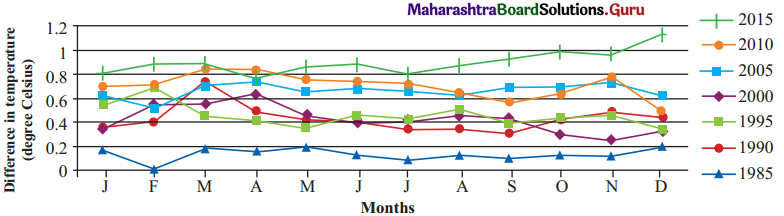
1. The graph in the figure shows the difference between the global average temperature of the twentieth century and global monthly temperatures from 1985 to 2015. Answer the questions given below.
Maharashtra Board Class 11 Geography Solutions Chapter 5 Global Climate Change 1

Question 1.
In which year is the difference the least?
Ans.
Difference in the temperature is least in the year 1985.

Question 2.
What is the difference between the mean temperatures of the twentieth century and temperature in 2015?
Answer:
The difference between the mean temperature of twentieth century (1995-2000) and 2015 is 0.8°C.

Question 3.
Why do the temperatures differ in different months?
Answer:
The temperature differs in different months because of the occurrence of different seasons.

Maharashtra Board Class 11 Geography Solutions Chapter 5 Global Climate Change

2. Look at the graph and answer the questions. (Textbook Page No. 63)
Maharashtra Board Class 11 Geography Solutions Chapter 5 Global Climate Change 2

Question 1.
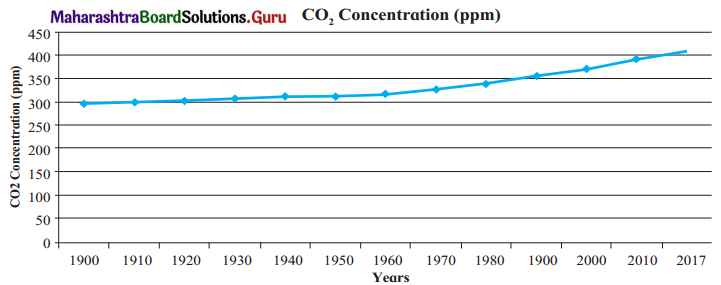
What does this graph show?
Ans.
The graph shows CO2 concentration (ppm) and its increased level over the period of time from 1900 to 2017.

Question 2.
What does ppm mean?
Answer:
The abbreviation ppm means ‘parts per million’ of carbon concentration in the atmosphere.

Question 3.
Since which year has the increase been phenomenal?
Answer:
After 1980, there has been a phenomenal increase observed.

Question 4.
Can you think of the reasons behind the increase in carbon dioxide?
Answer:
The reasons behind the increase in carbon dioxide is due to combustion of fossil fuels and large- scale deforestation.

Try this. (Textbook Page No. 59)

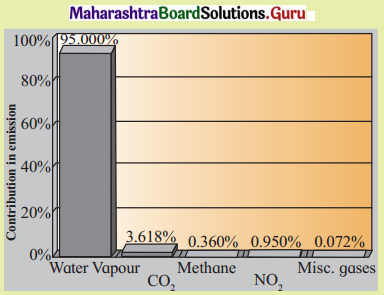
1. Look at the following graph. Answer the following question.
Maharashtra Board Class 11 Geography Solutions Chapter 5 Global Climate Change 3

Question 1.
Which of these gases has the highest contribution?
Answer:
Water vapour, shows the highest contribution.

Maharashtra Board Class 11 Geography Solutions Chapter 5 Global Climate Change

Question 2.
Which of these gases came from natural and man-made sources?
Answer:
Water vapour, methane, NO2 and miscellaneous gases are naturally occurring gases while CO2 is man-made.

Question 3.
Which activities are responsible for their emission?
Answer:
Burning of fossil fuels like coal, etc., and deforestation are responsible for emission of CO2.

Question 4.
Out of these, whose emission can be controlled by humans?
Ans.
The emission of CO2 can be controlled by humans.

Question 2.
Make a list of things you need to change in your lifestyle. (Textbook Page No. 67)
Answer:

  1. Use of public transport.
  2. Less use of wood but more use of alternatives to wood.
  3. Regular maintenance of vehicles.
  4. Avoid wastage of water.
  5. Use of energy efficient devices.
  6. Ban on plastic goods.
  7. Minimum use of paper in home and office.
  8. Purchase of only required goods.
  9. Use of Eco-friendly goods.
  10. Celebration of festivals without harming the environment.

Find out! (Textbook Page No. 62)

Question 1.
Use internet and reference books on climate change and make a list of species vulnerable to climate change.
Answer:
Species vulnerable to climate change are: corals, polar bear and frogs.

Maharashtra Board Class 11 Geography Solutions Chapter 5 Global Climate Change

Question 2.
Make a list of movies based on ice age and climate change. (Textbook Page No. 65)
Answer:

  1. Interstellar
  2. Beasts of the Southern Wild
  3. Chasing Coral
  4. Snowpiercer
  5. An Inconvenient Truth
  6. Are you ready to fight? (Vattaram)

Question 3.
With the help of internet, find out the details of the National Action Plan on Climate Change (NAPCC), 2008 and its missions. (Textbook Page No. 66)
Answer:
NAPCC is a government document that includes eight ambitious goals set for the country to achieve.

  1. National Solar Mission
  2. National Mission for Enhanced Energy Efficiency
  3. National Mission on Sustainable Habitat
  4. National Water Mission
  5. National Mission for Sustaining the Himalayan Ecosystem
  6. National Mission for a “Green India”
  7. National Mission for Sustainable Agriculture
  8. National Mission on Strategic Knowledge for Climate Change

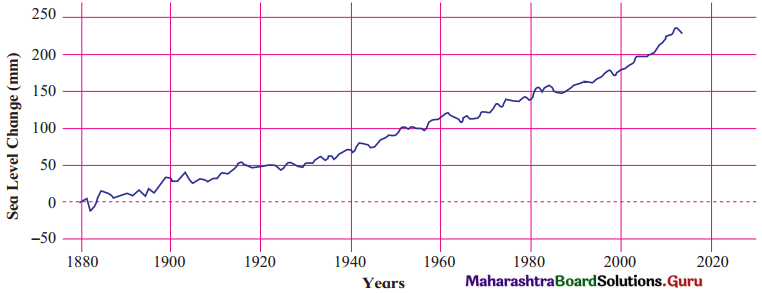
1. Look at the graph and answer the following questions. (Textbook Page No. 60)
Maharashtra Board Class 11 Geography Solutions Chapter 5 Global Climate Change 4
Question 1.
What does the graph show?
Answer:
The graph shows an increase in the global sea level from 1880 till date.

Question 2.
In which year is the change around 225 mm?
Answer:
The change around 225 mm is observed is the year 2018.

Question 3.
What conclusions can you draw by seeing the graph?
Answer:
With the continued global warming the sea levels are likely to rise.

Maharashtra Board Class 11 Geography Solutions Chapter 5 Global Climate Change

Question 4.
What correlation can be seen in this graph and the graph of rising temperature?
Answer:
With the rising temperature the sea level is rising. We can conclude this from both the graphs.

Question 2.
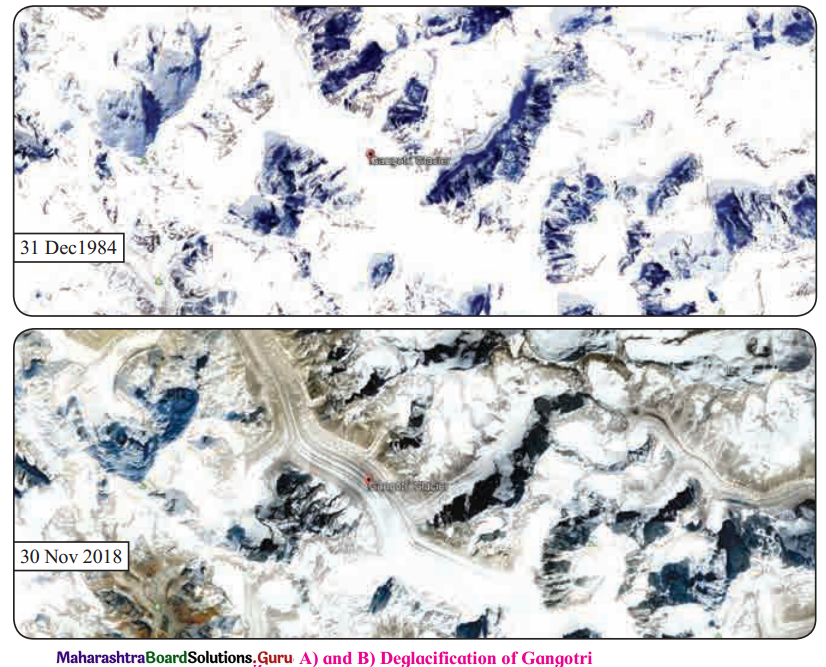
Compare both the satellite images in fig 5.3 (A) and (B). (Textbook Page No. 61)
Maharashtra Board Class 11 Geography Solutions Chapter 5 Global Climate Change 5
Answer:
Fig. 5.3 (A) shows the snow-covered Gangotri glacier area in Dec. 1984, whereas in Fig. 5.3 (B) the snow-covered region of the Gangotri glacier has retreated by 2018.
Maharashtra Board Class 11 Geography Solutions Chapter 1 Earth Movements

Balbharti Maharashtra State Board Class 11 Geography Solutions Chapter 1 Earth Movements Textbook Exercise Questions and Answers.

Maharashtra State Board Class 11 Geography Solutions Chapter 1 Earth Movements

1. Complete the chain.

Question 1.

ABC
(1) Widespread volcanic eruption(1) Zone V(1) I to XII
(2) Andaman and Nicobar Islands(2) Fissure eruption(2) Block Mountain
(3) Mercalli scale(3) Intensity(3) Very high seismic vulnerability
(4) Slow movements(4) Faulting(4) Solid
(5) Philippines(5) Volcanic bombs(5) Deccan Trap
(6) Volcanic material(6) Circum Pacific belt(6) Mayon

Answer:

ABC
(1) Widespread volcanic eruption(1) Fissure eruption(1) Deccan Trap
(2) Andaman and Nicobar Islands(2) Zone V(2) Very high seismic vulnerability
(3) Mercalli scale(3) Intensity(3) I to XII
(4) Slow movements(4) Faulting(4) Block Mountain
(5) Philippines(5) Circum Pacific belt(5) Mayon
(6) Volcanic material(6) Volcanic bombs(6) Solid

Maharashtra Board Class 11 Geography Solutions Chapter 1 Earth Movements

2. Identify the correct correlation.

A : Assertion R : Reasoning
Question 1.
A – Faulting leads to development of fold mountains.
R – Faulting occurs when tensional forces move away from each other.
(a) Only A is correct.
(b) Only R is correct.
(c) Both A and R are correct and R is the correct explanation of A.
(d) Both A and R are correct but R is not the correct explanation of A.
Answer:
(b) Only R is correct.

Question 2.
A – Intensity of an earthquake is a measurement of the energy released during an earthquake.
R – Mercallis scale is used to measure intensity of an earthquake.
(a) Only A is correct.
(b) Only R is correct.
(c) Both A and R are correct and R is the correct explanation of A.
(d) Both A and R are correct but R is not the correct explanation of A.
Answer:
(c) Both A and R are correct and R is the correct explanation of A.

Question 3.
A – South-East Asia, Japan and islands in the Pacific Ocean are most vulnerable to earthquakes and volcanic eruptions.
R – They are located in ‘Ring of Fire’.
(a) Only A is correct.
(b) Only R is correct.
(c) Both A and R are correct and R is the correct explanation of A.
(d) Both A and R are correct but R is not the correct explanation of A.
Answer:
(c) Both A and R are correct and R is the correct explanation of A.

3. Identify the correct group.

Question 1.

ABCD
(1) Symmetrical Fold(1) Black Forest(1) Narmada Valley(1) Caldera
(2) Isoclinal Fold(2) Vosges(2) African Valley(2) Crater Lake
(3) Overturned Fold(3) Himalayas(3) Tapi Valley(3) Cinder Cone
(4) Recumbent Fault(4) Satpuras(4) Rhine Valley(4) Lava Plateau

Answer:
C

Maharashtra Board Class 11 Geography Solutions Chapter 1 Earth Movements

4. Give geographical reasons.

Question 1.
Extinct conical volcanoes often form crater lakes.
Answer:
Extinct conical volcanoes often form crater lakes because-

  1. An extinct volcano had no volcanic eruption for at least 10,000 years and is not expected to erupt again in future.
  2. After the eruption a large and deep depression remains in that area. Smaller depressions are called craters.
  3. This crater eventually gets filled with water and crater lakes are formed.
  4. The water may come from precipitation, ground water circulation or melted ice.

Question 2.
People living in the Himalayas are more vulnerable to earthquakes.
Answer:
People living in the Himalayas are more vulnerable to earthquakes because-

  1. Himalayan mountain ranges are formed as a result of collision of Indo-Australian plate and Eurasian plate.
  2. According to plate tectonic theory, Indo-Australian plate (on which India lies) is moving towards north and is subducting under Eurasian plate.
  3. This movement obviously cause friction between two plates.
  4. Thus, these regions are more prone to earthquakes.

Question 3.
L-waves do not have a shadow zone.
Answer:
L-waves do not have a shadow zone because-

  1. The shadow zone is the area of the earth from angular distance of 105° to 140° from a given earthquake for both P-waves as well as S-waves.
  2. Generally, seismographs located at any distance withinl05° from epicentre record the arrival of S-waves and beyond 140° from epicentre record the arrival of P-waves.
  3. L-waves are typically generated when the source of the earthquake is close to the earth’s surface.

Question 4.
Soft rocks form folds while hard rocks form faults.
Answer:
Soft rocks form folds while hard rocks form faults because –

  1. Soft and elastic rocks are affected by compressional forces.
  2. Rocks that lie deep within the crust and are therefore under high pressure are generally ductile and particularly susceptible to folding without breaking.
  3. Whereas rock layers that are near the earth’s surface are too rigid to bend into folds.
  4. If the tectonic force is large enough, these rocks will break rather than bend and faulting on rupture occur.

Maharashtra Board Class 11 Geography Solutions Chapter 1 Earth Movements

Question 5.
Folds depend on the strength of rocks and intensity of forces.
Answer:
Folds depend on the strength of rocks and intensity of forces because-

  1. The elasticity of rocks largely affects the nature and magnitude of folding process.
  2. The softer and more elastic rocks are subjected to intense folding while rigid and less elastic rocks are only moderately folded.
  3. The compressional forces push two portions of the crustal rocks together and tend to shorten and thicken the crust.
  4. Rocks that lie deep within the crust and are therefore under high pressure are generally ductile and particularly, susceptible to folding without breaking

5. Answer in detail.

Question 1.
Explain different types of faults.
Answer:
A fault is a fracture in the crustal rock, formed when the crustal rocks are displaced due to tensional movement caused by endogenic forces. The displacement of rock can occur in upward, downward or horizontal direction.
The different types of faults determined by the direction of motion are:
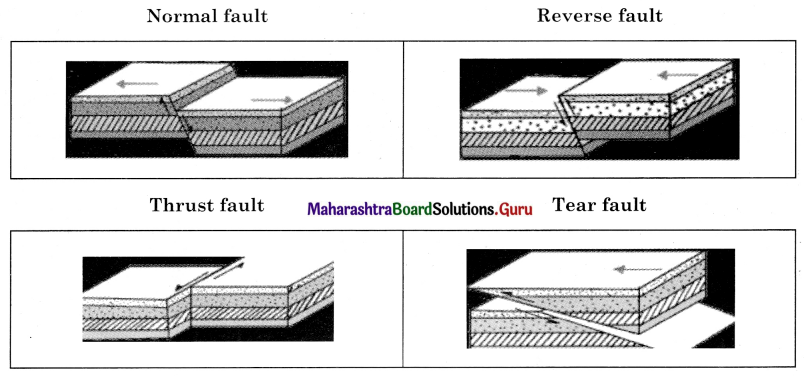
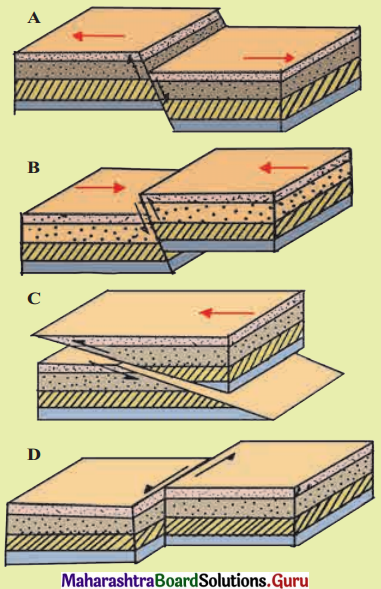
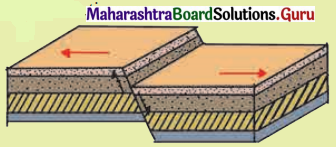
Normal fault: It results when a portion of land slide down along the fault plane and when the exposed portion of the plane faces the sky
Maharashtra Board Class 11 Geography Solutions Chapter 1 Earth Movements 1

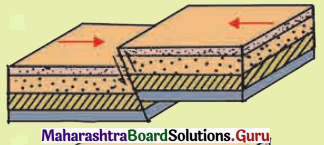
Reverse fault: It results when a portion of the land is thrown upward relative to other side of the land. In such situation, the fault plane faces the ground.
Maharashtra Board Class 11 Geography Solutions Chapter 1 Earth Movements 2

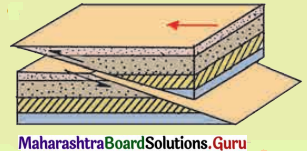
Tear fault: At times, the rock strata on either side of the fault plane do not have vertical displacement. Instead, movement occurs along the plane in horizontal direction.
Maharashtra Board Class 11 Geography Solutions Chapter 1 Earth Movements 3

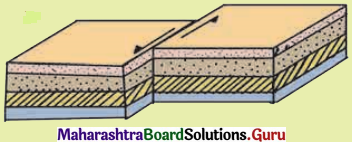
Thrust fault: When the portion of the land on one side of the fault plane gets detached and moves over the land on the other side. The angle of fault plane is generally less than 45°.
Maharashtra Board Class 11 Geography Solutions Chapter 1 Earth Movements 4

Maharashtra Board Class 11 Geography Solutions Chapter 1 Earth Movements

Question 2.
Explain with examples, different types of landforms produced by volcanic eruption.
Answer:
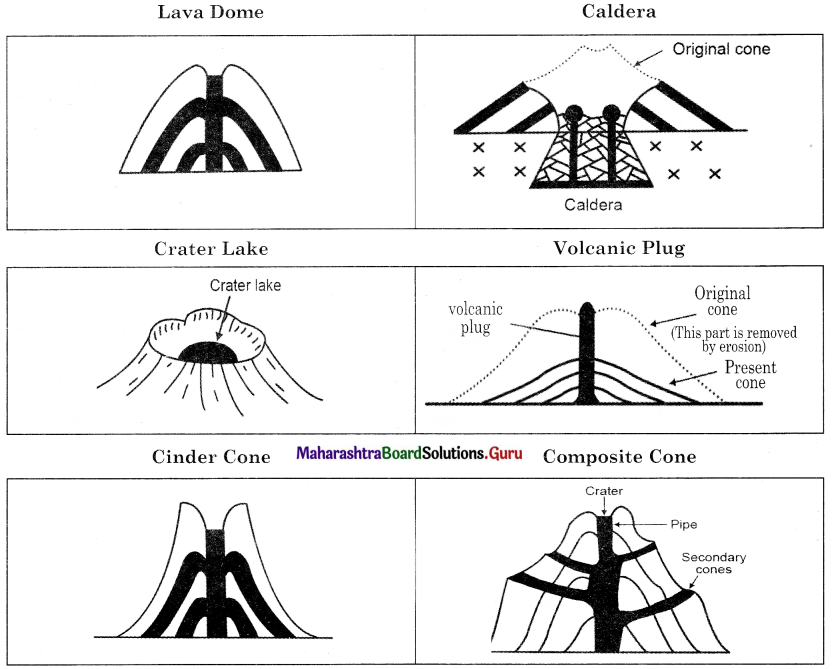
A number of landforms are formed due to cooling and solidification of magma. Some important landforms are:
Lava domes:

  1. Domes are developed when magma comes out and solidifies around its mouth.
  2. The shape of the dome depends upon the fluidity of lava.
  3. High dome with steep slopes is developed by acidic lava.
  4. Due to basic lava, broad – based low domes are developed.

Lava plateaus:

  1. Due to spread of lava in huge quantity from fissure volcano, it covers large areas and plateaus are formed.
  2. The Deccan Trap in India has developed from volcanic eruptions millions of years ago.

Caldera:

  1. At times, the eruption of volcano brings about large quantity of material and relieves lot of pressure.
  2. After the eruption, a large and deep depression remains in that area. This large depression is called caldera.
  3. These can be around 10 km wide and hundreds of metres deep.
  4. They may later turn into lakes. Smaller calderas are known as craters.

Crater lake:
When the funnel shaped crater of an extinct volcano gets filled with rain water, it forms a crater lake.

Volcanic plug:

  1. It is formed when the lava solidifies in the volcanic neck.
  2. The surrounding rock material is removed by different agents of erosion; the vent stands predominantly. It is called as volcanic plug.
  3. The diameter of a plug varies between 300 and 600 metres.
  4. The Devil’s Tower in Wyoming, United States of America is the best example.

Cinder cone:

  1. Solid material is ejected in large quantity.
  2. This material consists of ash, cinder and breccias.
  3. Cinders are half burnt pieces of solid material.
  4. The solid material is deposited around the mouth until a conical hill with steep slopes is formed.
  5. For example, cone of Mt. Nuovo in Italy.

Composite cone:

  1. Composite cones are built up of alternate layers of lave and cinder.
  2. This cone is composed of two materials and therefore it is called a composite cone.
  3. It is symmetrical in shape.
  4. For example, Mt. St. Helens, USA.

Maharashtra Board Class 11 Geography Solutions Chapter 1 Earth Movements

Question 3.
Explain the concept of shadow zone.
Answer:

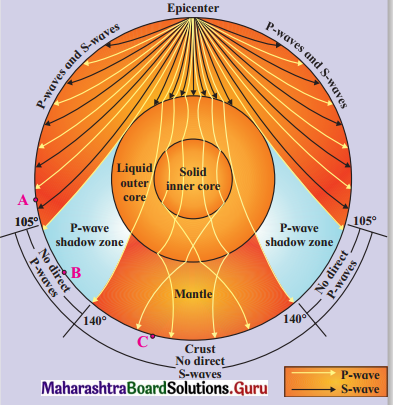
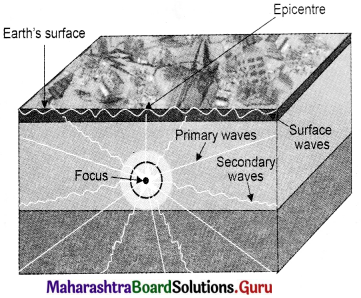
  1. The waves which are caused by earthquake are called seismic waves. There are three types of waves: P-waves, S-waves and longitudinal waves.
  2. P-waves can pass through all the mediums while S-wave can pass only through solid medium.
  3. Even though P-waves pass through all mediums, they experience refraction as they pass from one medium to the other.
  4. However, there exist some specific areas where the waves of that earthquake are not reported. Such zone is called ‘shadow zone’.
  5. Generally, seismographs located at any distance within 105° from the epicentre, record both P-waves and S-wave. However, beyond 140° P-wave are recorded but not S-waves.
  6. Thus, the zone between 105° and 140° is identified as the shadow zone for both types of waves.
  7. The entire zone beyond 105° does not receive S-waves. The shadow zone of S-waves is much larger than that of P-waves.
  8. The shadow zone of P-waves appears as a band round the earth between 105° and 140° away from the epicentre.

Question 4.
Write a note on volcanic materials.
Answer:
There are three main types of material which come out in volcanic eruptions namely liquid, solid and gaseous form.
Liquid material:

  1. It is the molten rock material. When the molten rock material is below the earth’s surface, it is called ‘Magma’.
  2. When it appears on the surface it is called ‘lava’. On the basic of percentage of silica, it is classified as:
  3. Acidic lava : (a) It contains higher percentage of silica, (b) It has high melting point, (c) It is thick, fluid and moves slowly.
  4. Basic lava : (a) It contains less percentage of silica, (b) It has low melting point, (c) It’s thicker, fluid and can flow over longer distance.

Solid material:

  1. It consists of dust particles and rock fragments.
  2. When the material is very fine, it is called volcanic dust.
  3. The small sized solid particles are called ash.
  4. The solid angular fragments are known breccias.
  5. Sometimes, the lava material thrown into the air solidifies into small fragments before falling on the earth’s surface; it is called volcanic bombs.

Gaseous material:

  1. At the time of volcanic eruption, a dark cloud of smoke can be seen over the crater.
  2. On the basis of shape, cloud is called cauliflower cloud.
  3. Various inflammable gases are found in these clouds.
  4. These gases produce flames.

Maharashtra Board Class 11 Geography Solutions Chapter 1 Earth Movements

6. Differentiate between.

Question 1.
Folding and Faulting.
Answer:

FoldingFaulting
(i) Folds are bends in the rocks that are due to compressional forces.(i) Faults are formed due to tensional forces along which displacement of rock takes place.
(ii) Folding occurs when compressional forces are applied to rocks that are ductile or flexible.(ii) Faults occurs when force operating in opposite direction lead to tension and as a result rocks develops cracks on fissure.
(iii) Rocks that lie deep within the crust and are therefore under high pressure are generally ductile and particularly susceptible to folding without breaking.(iii) Rock layers that are near the earth’s surface and not under high confining pressures are too rigid to bend into folds, but if tectonic forces are large, rocks break.
(iv) Folding leads to development of fold mountain. For e.g., the Himalayas, the Alps, etc.(iv) Faulting results in the formation of block mountains like black forest mountain etc., and right valleys like the Narmada, Tapi, etc.

Question 2.
Normal fault and Reverse fault.
Answer:

Normal faultReverse fault
(i) It results when a portion of landslides down along the fault plane.(i) It results when a portion of land is thrown upward relative to other side of the land.
(ii) The exposed portion of plane faces the sky.(ii) The fault plane faces the ground.

Question 3.
Syncline and Anticline.
Answer:

SynclineAnticline
(i) As and when limbs slopes towards each other and the central part located at lower elevation forms synclines.(i) As and when limbs slopes downward with central position getting raised up, it is called anticline.
(ii) They form valleys.(ii) They form the top / peak of the mountain.
(iii) They have a greater depth.(iii) They are of a greater height.

Maharashtra Board Class 11 Geography Solutions Chapter 1 Earth Movements

Question 4.
Asymmetrical fold and Symmetrical fold.
Answer:

Asymmetrical foldSymmetrical fold
(i) The axial plane is inclined.(i) The axial plane is vertical.
(ii) Limbs are inclined at different angles.(ii) Limbs are inclined at same angles.
(iii) The height and shape of limbs is not same.(iii) The height and shape of limbs is same.

Question 5.
Mercalli scale and Richter scale.
Answer:

Mercalli scaleRichter scale
(i) It measures the intensity of earthquake.(i) It measures the energy released during an earthquake.
(ii) The measurement is based on observed effects.(ii) The measurement is done with the help of seismograph.
(iii) Quantified from observation of the effects on earth’s surface, human beings, objects and man- made structures.(iii) Quantified from logarithmic scale obtained by calculating logarithm of the amplitude of waves.
(iv) Unit of measurement I (not felt) to XII (total destruction)(iv) Unit of measurement from <2.0 to 10.0 + (never recorded) 3.0 earthquake releases 32 times more energy than a 2.0 earthquake.

Question 6.
Slow movements and Sudden movements.
Answer:

Slow movementsSudden movements
(i) Slow movement include both vertical and horizontal movement which are caused due to forces deep within the earth.(i) Sudden movements are caused by sudden endogenic forces coming from deep within the earth.
(ii) These movements are occurring continuously.(ii) These movement occurs in the form of events.
(iii) Slow movements include formation of mountains and continents.(iii) Sudden movements include event such as earthquakes and volcanoes.

Maharashtra Board Class 11 Geography Solutions Chapter 1 Earth Movements

7. Draw a neat and labelled diagram.

Question 1.
Types of folds
Answer:
Maharashtra Board Class 11 Geography Solutions Chapter 1 Earth Movements 5

Question 2.
Types of Faults
Answer:
Maharashtra Board Class 11 Geography Solutions Chapter 1 Earth Movements 6

Question 3.
Shadow zone
Answer:
Maharashtra Board Class 11 Geography Solutions Chapter 1 Earth Movements 7

Maharashtra Board Class 11 Geography Solutions Chapter 1 Earth Movements

Question 4.
Volcanic landforms
Answer:
Maharashtra Board Class 11 Geography Solutions Chapter 1 Earth Movements 8

11th Geography Digest Chapter 1 Earth Movements Intext Questions and Answers

Let’s recall (Textbook Page No. 1)

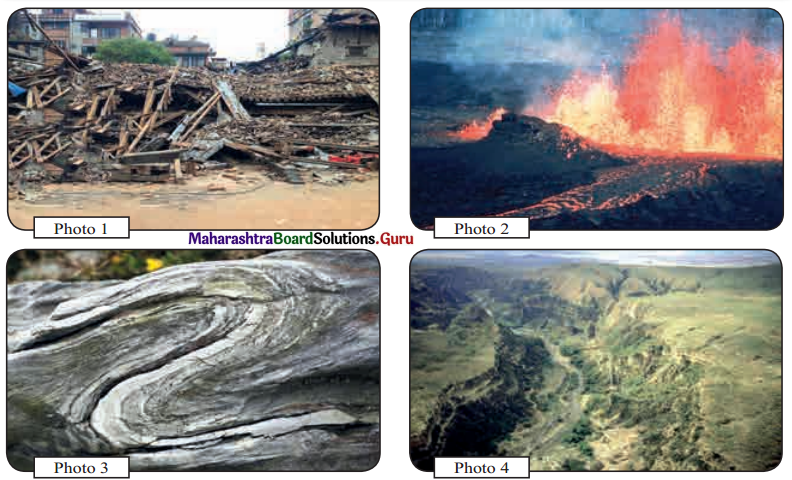
1. Observe the following pictures in fig 1.1 and discuss the questions.
Maharashtra Board Class 11 Geography Solutions Chapter 1 Earth Movements 9

Question 1.
What might be the reasons behind buildings collapsing in photo 1?
Answer:
The major reason behind the buildings collapsing in photo 1 is the occurrence of earthquakes.

Question 2.
Which event in depicted in photo 2? What impact does it bring about in the surroundings?
Answer:
The volcanic eruption and flowing of lava is depicted in photo 2. Heavy loss of life and property is experienced when the lava flows to the surrounding area.

Maharashtra Board Class 11 Geography Solutions Chapter 1 Earth Movements

Question 3.
In photo 3, what could be the reason behind the bend in the rock strata?
Answer:
Due to compression of sediments within the earth’s interior and pressure from overlying layers the rock strata seems to be bended.

Question 4.
What could be the reason behind the difference in altitudes of the land and the steepness of the slope in photo 4?
Answer:
The reason could be displacement of rock due to vertical movement. It may form plateau on block mountains.

Question 5.
Classify the events in the photos into sudden and slow movements.
Answer:
Sudden movements are earthquake and volcanoes in photo 1 and 2. Slow movements are formation of folds and formation of plateaus or block mountains in photo 3 and 4.

Question 6.
Example of which of these movements is not likely to be found in the mainland of Indian sub- continent?
Answer:
The volcanic eruptions are not found in mainland of India sub-continent.

2. On 19th August, 2018, around 300 people died in Indonesia. Many buildings collapsed. Many roads broke apart. A tsunami was generated. (Textbook Page No. 6)

Question 1.
What was the cause behind these events?
Answer:
Collision of tectonic plates was the causes behind the events.

Question 2.
What actually happened during this natural event?
Answer:
A very high intensity earthquake struck north eastern parts of Indonesian coastline, where subsequent landslides into sea triggered tsunamis.

Maharashtra Board Class 11 Geography Solutions Chapter 1 Earth Movements

Question 3.
Name the energy waves involved in this natural event.
Answer:
Tsunamis were involved in this natural event where the tectonic plates moved horizontally.

Question 4.
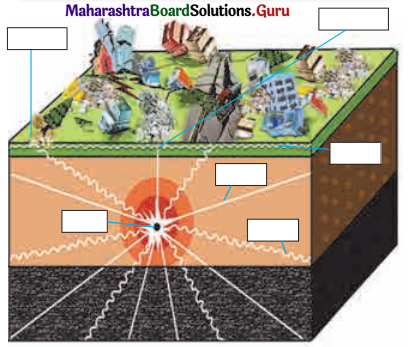
Observe the diagram in fig. 1.9 and label the boxes.
Maharashtra Board Class 11 Geography Solutions Chapter 1 Earth Movements 10
Answer:
Maharashtra Board Class 11 Geography Solutions Chapter 1 Earth Movements 11

Think about it.

Question 1.
How will compressional forces affect brittle rocks? (Textbook Page No. 3)
Answer:
The compressional forces will break the brittle rocks into pieces.

Question 2.
A mountain never remains a mountain’. Can you relate this idiom with the mountain building process? (Textbook Page No. 4)
Answer:
This happens because of continuous erosional activities taking place on the mountain sides. Running water glaciers, wind, volcanic activities keep on changing the surface of a mountain.

Question 3.
When can faults form is fold mountains? (Textbook Page No. 6)
Answer:
If compression takes place along the faults, folds can be formed.

Maharashtra Board Class 11 Geography Solutions Chapter 1 Earth Movements

Question 4.
Can folds form into block mountains? Find the reason and discuss. (Textbook Page No. 6)
Answer:
No, folds cannot form into block mountains because folding takes place due to compression of elastic rocks and block mountains are formed due to displacement of rocks owing to tension.

Question 5.
Look at fig.1.10 and answer following questions. During an earthquake, do you think the seismic waves reach entire portion of the earth. Is there any region on the earth’s surface where a given earthquake will not be reported? (Textbook Page No. 6)
Answer:
It’s the shadow zone of P-waves and S-waves where the seismic waves do not reach. No there is no region on the earth’s surface where a given earthquake is not reported.

Question 6.
Why has the shadow zone for L-waves not been shown in fig 1.10? (Textbook Page No. 7)
Answer:
L-waves travel through the circumference of the earth. Thus, they do not been form shadow zone.

Try this.

Question 1.
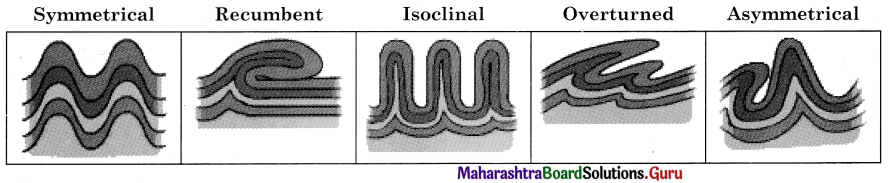
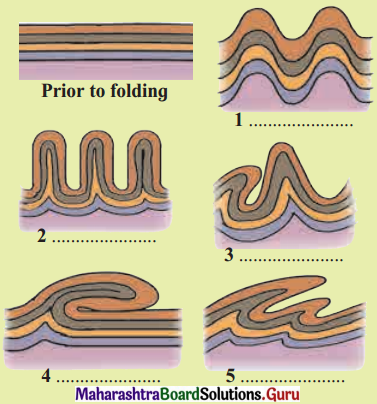
Observe the diagrams in fig. 1.5. Try to understand the different types of fold shown in the diagram. Write the name of the fold. (Textbook Page No. 4)
Maharashtra Board Class 11 Geography Solutions Chapter 1 Earth Movements 12
Answer:

  1. Symmetrical fold.
  2. Isoclinal fold
  3. Asymmetrical fold
  4. Recumbent fold
  5. Overturned fold

Maharashtra Board Class 11 Geography Solutions Chapter 1 Earth Movements

Question 2.
Observe the diagram in fig. 1.6 and read the explanation regarding the characteristics of various faults given. Identify the faults and match each of them with their characteristics. (Textbook Page No. 5)
Maharashtra Board Class 11 Geography Solutions Chapter 1 Earth Movements 13
Answer:
A – Normal fault B – Reverse fault C – Thrust fault D – Tear fault

Can you tell? (Textbook Page No. 7)

In fig 1.10 textbook page 6 A, B, C are three points on the earth’s surface. Analyse their location with respect to epicentre and shadow zones
Answer:
A, B, C are the points on the surface of the earth.
(i) ‘A’ point is located with 105° from the epicentre, therefore P waves and S waves reach at ‘A’ point. The seismograph at !A’ point records both waves, therefore ‘A’ point is not in shadow zone.

(ii) ‘B’ point is in shadow zone because both the waves do not reach there. P waves pass through all mediums, they experience refraction as they pass on one medium to another. The seismograph records P waves, which is located away from ‘B’ point. But P waves are not recorded in an area between 105 and 140° from epicentre. The S waves also do not reach here. Therefore, it is called ‘Shadow zone’ of Earthquake waves.

(iii) ‘C’ point is in the area of the shadow zone of ‘S’ waves, that in within 140°. P waves reach beyond 140°. Since ‘S’ waves do not reach here, it is called ‘Shadow zone of S waves’.

Question 1.
On the basis of the intensity of damage risk, India is classified into five risk zone. Use the given weblink http://www.bmtpc.org/DataFiles/CMS/file/map%20of%20india/eq-india. pdf and complete the table given. (Textbook Page No. 9)
Answer:

ZoneDegree of RiskStates / UTs
ILeast
IILow
IIIModerate
IVHighJammu & Kashmir. Himachal Pradesh, Uttarakhand, Sikkim, Parts of Indo Gangetic plains (North Punjab, Chandigarh, Western Uttar Pradesh) Delhi, Maharashtra, Bihar.
VVery HighRegion of Kashmir, Andaman and Nicobar island.

Maharashtra Board Class 11 Geography Solutions Chapter 1 Earth Movements

Read the following passage about Krakatoa volcanic eruption and answer the following questions. (Textbook Page No. 10)

There is an island known as Krakatoa between the islands of Java and Su matra in Indonesia. There were frequent volcanic eruptions here. From May 1883, massive explosions began. The eruption that took place at about 10 in the morning on 28 August 1883 was the largest ever recorded explosion. As a result of this explosion, the entire island disappeared. During this eruption, rock particles and dust thrown up in the atmosphere was about 25 km³. The column of this dust-ash rose as high as 80 km.

The discharge of Krakatoa threw into the air nearly 21 km3 of rock fragments, and large quantities of ash fell over an area of some 800,000 km². Near the volcano, masses of floating pumice, were so thick that ships had to halt. The surrounding region was plunged into darkness for two and a half days because of ash in the air. For some years after this, cloud kept moving round the earth. About 36,000 people died in these eruptions and the tsunami waves created by it.

In 1927, volcanic eruptions began at the same place and a new island rose in place of the Krakatoa island that had vanished. It was named Anak Krakatoa’ or ‘Child Krakatoa’. The volcano here constantly emits ash and steam. This new island has now become a laboratory for geologists and biologists.

Question 1.
Make a list of materials that came out during eruptions.
Answer:
Rock, particles, dust, ash, floating pumice, steam were the materials that came out during eruption.

Question 2.
Classify them into liquid, solid and gaseous forms.
Answer:

LiquidSolidGaseous
PumiceRock particlesSteam
Dust
Ash

Find out! (Textbook Page No. 9)

Find out examples of active, dormant and extinct volcanoes.
Answer:
Examples of active volcanoes are – Mt. Etna (Italy), Stromboli (Italy), Mt. Merapi (Indonesia), Erta Ale (Ethiopia), Mt. Erebus (Antarctica)
Examples of dormant volcanoes – Mt. Kilimanjaro (Africa), Mt. Katmai (Alaska)
Examples of extinct volcanoes – Mt. Egmont (New Zealand), Chimborazo (Ecuador), Mt. Kulal (Kenya)

Maharashtra Board Class 11 Geography Solutions Chapter 1 Earth Movements

Give it a try (Textbook Page No. 8)

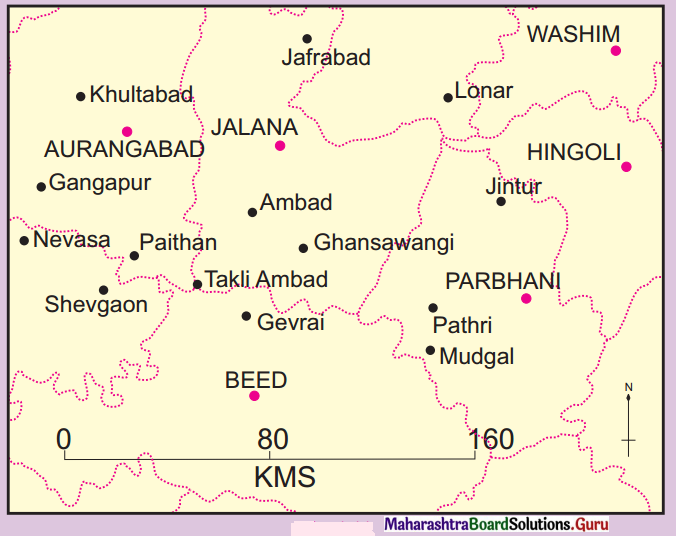
Take the given hypothetical data in the table. The data shows the time of arrival of P-waves and S-waves at 3 seismograph stations. Assume the scale of the map as 1 cm : 18 km. See fig. 1.11.

Recording StationP-wave arrival time (IST)S-wave arrival time
Jalana11 : 06 : 0611 : 06 : 19
Washim11 : 06 : 4611 : 07 : 03
Aurangabad11 : 07 : 0611 : 07 : 24

Answer:
Speed of waves = 08 kms per second
Scale of the map = 1 cm
= 18 kms
First step : Find out the difference in time for waves at Jalana recording centre.
Difference in time of waves = Time of S-wave – Time of P-wave
11 : 06 : 19 (Time of S-wave)
11 : 06 : 06 (Time of P-wave)
= (Time of S-wave) – (Time of P-wave)
= 11 : 06 : 19 – 11 : 06 : 06
= 00 : 00 : 13
Therefore difference in time for waves at Jalana recording centre is 13 seconds.

Second Step : Find out distance on land between Jalana and Epicentre
Distance on land = Difference in time of waves × speed of waves per second
= 13 × 8
= 104
Therefore distance on land between Jalana and Epicentre is 104 km.

Third Step : Find out radius for Jalana Station.
Jalana – Radius of circle = \(\frac {Distance on land}{Scale of the map}\)
= \(\frac {104}{18}\)
= 5.7 cm.
Therefore radius of circle around Jalana station is 5.7 cm.
Now find out radium for remaing stations.
Jalana – 5.7 cm, Washim – 7.5 cm, Aurangabad – 8 cm.

Maharashtra Board Class 11 Geography Solutions Chapter 1 Earth Movements

Fouth step : Now draw circles around Jalana, Washim and Aurangad with the help of radius calculated.
All arcs of circle will intersect one another at a particular point. That point is the location of Epicentre.
In the map given below Epicentre is to the south of Mudgal.
Maharashtra Board Class 11 Geography Solutions Chapter 1 Earth Movements 14

Maharashtra Board Class 11 Geography Solutions Chapter 3 Agents of Erosion

Balbharti Maharashtra State Board Class 11 Geography Solutions Chapter 3 Agents of Erosion Textbook Exercise Questions and Answers.

Maharashtra State Board Class 11 Geography Solutions Chapter 3 Agents of Erosion

1. Compete the Chain.

Question 1.

AgentErosional/Depositional featuresPlaces / Regions
(1) River(1) Caves(1) China
(2) Wind(2) Beach(2) Jog
(3) Sea waves(3) Waterfalls(3) Meghalaya
(4) Glaciers(4) Loess(4) Diveagar
(5) Ground water(5) Matterhorn(5) Swiss Alps

Answer:

AgentErosional/Depositional featuresPlaces / Regions
(1) River(1) Waterfalls(1) Jog
(2) Wind(2) Loess(2) China
(3) Sea waves(3) Beach(3) Diveagar
(4) Glaciers(4) Matterhorn(4) Swiss Alps
(5) Ground water(5) Caves(5) Meghalaya

2. Choose the correct option by identifying the correct correlation in the sentences.

Question 1.
Water or snow enters the cracks in the rocks and makes it weak. When the glacier passes on these rocks, it pulls the rocks at the bottom along with it. This process is called
(a) Plucking
(b) Abrasion
(c) Attrition
(d) Transportation
Answer:
(d) Transportation

Maharashtra Board Class 11 Geography Solutions Chapter 3 Agents of Erosion

Question 2.
Sometimes, the river starts erosion upstream. This happens when the head stream gets a lot of water in the early stages of river’s flow.
(a) Downcutting
(b) Headward erosion
(c) Lateral erosion
(d) Vertical erosion
Answer:
(b) Headward erosion

Question 3.
Soft rock erodes beneath the hard rock due to sea waves. This results into landforms which further develop as sea arches. The landform is
(a) Sea cave
(b) Sea stack
(c) Sea cliff
(d) Wave cut platform
Answer:
(a) Sea cave

Question 4.
This landform develops due to depositional work of wind. The windward slope of this landform is gentle.
(a) Loess plains
(b) Barchans
(c) Seif
(d) Sand hills
Answer:
(b) Barchans

Question 5.
River, glacier, wind, sea waves and groundwater are the agents of erosion. Following work in the correct order is responsible to form various landforms.
(a) Disintegration, picking up, transportation, weathering
(b) Picking up, disintegration, deposition, weathering
(c) Deposition, transportation, picking up, disintegration
(d) Disintegration, picking up, transportation, deposition
Answer:
(d) Disintegration, picking up, transportation, deposition

3. Give geographical reasons.

Question 1.
The Eastern coast of India have deltas formed by the rivers but the Western coast has estuaries.
Answer:
The Eastern coast of India have deltas formed by the rivers but the Western coast has estuaries because-

  1. Deltas can form at the mouth of those rivers where the sediment supply is high. On the other hand, where the rivers do not have load of sediments, estuaries are formed. Deltas can also be formed where the sea is not very deep.
  2. The eastern coast borders the Bay of Bengal.
  3. Because of the gentle slope on the eastern coast, rivers flow with low velocities and deposit the sediments brought with them at the coast. As a result, deltas are formed at the mouth.
  4. The western coast borders with the Arabian Sea, which is by and large a rocky coast.
  5. Its width is also less.
  6. Moreover, rivers are short and swift. Hence, they flow with high velocities and thus, does not deposit the sediments brought by them at the mouth. They form estuaries.

Maharashtra Board Class 11 Geography Solutions Chapter 3 Agents of Erosion

Question 2.
There is direct relationship between the velocity of the agents and process of deposition.
Answer:
There is direct relationship between the velocity of the agents and the process of deposition because-

  1. The velocity at which the agent is moving has a great impact on deposition.
  2. If the stream or wind slows down, the carrying capacity and the particle sizes carried and deposited will decrease.
  3. If a stream flows faster, say during flo’ods or when the river is in the mountains, then the carrying power of the stream and the sizes of particles deposited will increase.
  4. On the other hand, if there is a change in the slope of land or in the direction of flow, deposition may occur there.
  5. If the slope of a region is almost absent like in plain region, the rivers are unable to carry the sediments further and start depositing.

Question 3.
Compared to all the agents, sea waves work ceaselessly.
Answer:
Compared to all the agents, sea waves work ceaselessly because-

  1. The movement of sea water carried out by waves is mainly responsible for marine erosion and deposition.
  2. The sea waves are dashing on the coastline ceaselessly. The erosion in some parts and deposition in the adjoining parts takes place simultaneously.
  3. The beaches and sand bars are formed due to deposition but they are also eroded.
  4. The erosive power of waves depends partly on velocity of winds, as waves derive their energy from them and partly on the distance of open ocean over which they are blown.
  5. Coastal erosion may be caused by hydraulic action, abrasion, impact and corrosion, which work continuously.
  6. Abrasion is the most effective form erosion by waves. The softer rock along the coastline gets eroded first.

Question 4.
One finds many sheep rocks, horns, Aretes and hanging valleys in the Himalayas.
Answer:
One finds many sheep rocks, horns, Aretes and hanging valleys in the Himalayas because-
1. In Himalayas work of glacier is more predominant due to snow covered peaks and slopes. Sheep rock, horns, Aretes and hanging valleys are formed by glacier. Like other agents of erosion, glaciers too carry out erosion, transportation and deposition.

2. In the Himalayas, glaciers remove rock particles from the surface on which they flow by abrasion which leads to formation of sheep rocks.

3. Ice movement, accompanied by weathering and mass wasting has steepened the walls at the head of the glacier. This has deepened into armchair-shaped depression called cirque.

4. In Himalayas, two of more cirques have developed and the area between them is narrowed and formed arete and further the headward erosion of the glaciers has eroded the summit leading to the formation of typical peak called horn.

5. The Himalayan glaciers too have tributaries like rivers. The rate of erosion is different. The main valley gets eroded faster and becomes deeper than the tributary glacial valley. These appear to be hanging when seen from the main valley. Thus, hanging valleys are formed.

Maharashtra Board Class 11 Geography Solutions Chapter 3 Agents of Erosion

Question 5.
Karst landforms are seen concealed under the surface of the earth.
Answer:
Karst landforms are seen concealed under the surface of the earth because-

  1. Warmer humid climate has greater amount of vegetation, which supplies CO2 to sub-surface water.
  2. CO2 is necessary for the acidity of water which makes dissolving easier.
  3. Water saturated with dissolved CO2 should have easy movement.
  4. The greater the permeability of the rock, the faster ground water will flow.
  5. The fractures and joints in the rocks allow passage of water.
  6. In the areas of water-soluble rocks, such as limestone and gypsum the acidic water dissolves the rock and various landform develop underground.
  7. Thus, landforms developed by underground water anywhere in the world are called karst landforms.

Question 6.
Snowline decides the limit of glacier work as an agent of erosion.
Answer:
Snowline decides the limit of glacier work as an agent of erosion because-

  1. Snowline is the lower limit of permanent snow cover; below which snow does not accumulate.
  2. The glacier moves through pre-existing valley and forms erosive action.
  3. The glacier performs plucking and abrasion processes on the rocks on its way.
  4. Below the snowline is the snow frees surface, where the erosional features are not formed.

4. Write short notes on.

Question 1.
Attrition
Answer:

  1. Attrition is when rocks and pebbles bump into each other and break up into smaller fragments.
  2. During transit, materials reduce in size.
  3. Rock particles become more rounded.
  4. It relates to the material that moves.
  5. This process of erosion is observed in river, wind and sea waves.

Question 2.
The work of rivers in hilly areas and human activities :
Answer:
Gorges: River from its source, when it starts flowing the process of erosion starts. In mountainous areas, rivers flow at a higher speed due to steep slope. As a result, bed gets eroded more than banks and gorges are formed with steep banks and narrow beds. Such gorges have also become famous tourist places. For example, Gorge of Narmada river at Jabalpur.

In ‘V’ shaped valleys of river, terraced farming is practiced on valley slopes.

In hilly areas, the river has speed, slope and hence downcutting is on a lower scale. Thus, agriculture, agroforestry, animal husbandry and forestry are the major human occupations in these regions.

Waterfalls: Water flowing over a hilly region comes down a cliff, forming alternate bands of eroded soft and hard rocks, such features are called waterfalls. These waterfalls become a site for tourist attraction. For example, Jog falls on Sharavati river, Chuliya falls on Chambal river and Venna falls in Mahabaleshwar. Hotel industries also developed along these features.

Maharashtra Board Class 11 Geography Solutions Chapter 3 Agents of Erosion

Question 3.
Conditions necessary for work of wind
Answer:
Wind is a significant agent of erosion in the deserts. Following conditions are necessary for wind to become effective:

  1. Arid areas are essential. In such areas, the rate of evaporation is greater than rate of precipitation. Due to dryness the soil becomes loose and is carried by the wind.
  2. Sparse vegetation cover or absence of trees, so that there is no obstacle for wind.
  3. Presence of dry loose materials at the surface which carries out erosion.
  4. A wind velocity high enough to pick up and move sediments.

5. Differentiate between.

Question 1.
Attrition and Abrasion.
Answer:

AttritionAbrasion
(i) Attrition is the process of erosion in which rocks and pebbles bump into each other.(i) Abrasion is the process of erosion which involves scratching and polishing of the surface of bedrock.
(ii) In attrition, the rocks and pebbles break up into smaller fragments.(ii) In abrasion, the rock particles rub against and wear away the surface.
(iii) The eroded bedrock on surface have a smooth side.(iii) The pebbles or rocks become smooth and rounded.
(iv) Attrition relates to the material that moves.(iv) Abrasion affects the surface along which the material moves.

Question 2.
U shaped valley and V shaped valley.
Answer:

U shaped valleyV shaped valley
(i) It is an erosional feature formed by glaciers as an agent of erosion.(i) It is an erosional feature formed by river as an agent of erosion.
(ii) The glacier moves through pre-existing valley to form U-shaped valleys.(ii) The river carves out its own valleys.
(iii) Due to lateral erosion the valley becomes broad at the bottom.(iii) Due to vertical downcutting, the valley deepens.

Maharashtra Board Class 11 Geography Solutions Chapter 3 Agents of Erosion

Question 3.
Stalactite and Stalagmite.
Answer:

StalactiteStalagmite
(i) Water saturated with calcium carbonate drips onto the floor from the ceiling. This dripping water dries and builds massive structures. These structures growing from the ceiling are called stalactites.(i) Water saturated with calcium carbonate drips onto the floor from the ceiling. This dripping water deposited on the floor dries forming structures are called stalagmite.

Question 4.
Tributaries and Distributaries.
Answer:

TributariesDistributaries
(i) When a number of small rivers join the main river, those are called tributaries.(i) When the main river breaks up into smaller streams, those the called distributaries.
(ii) It may originate from glaciers, lakes or springs.(ii) It is formed from the main river.
(iii) Generally, it does not change its course.(iii) It diverts from the main river in the delta region.
(iv) Tributaries add water to the main river.(iv) Distributaries (take away) divert water from the main river.
(v) River Yamuna is a tributary of river Ganga.(v) River Hooghly is the distributary of River Ganga.

6. Answer in detail.

Question 1.
Explain the landforms formed by different agents through the process of abrasion.
Answer:
Abrasion involves the scratching and polishing of the surface or bedrock by the particles which are moving onto it. Let us study different landforms formed by different agents of erosion through the process of abrasion.
Work of Seas Waves:

  1. Sea cliffs : Sea cliffs are carved where waves strike directly against rocks. The softer rock along the coastline gets eroded first.
  2. Caves : Sometimes, waves can erode the softer part and make it hollow enough to be called a cave.
  3. A sea arch : A sea arch forms when waves erode a layer of soft rock underneath a layer of hard rock.
  4. Sea stack : If a sea arch collapses, it creates a sea stack, which looks like a large rock in the middle of water.
  5. Headland : The part of land projecting into the sea is called headland.
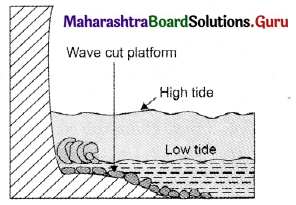
  6. Wave-cut platforms : Surfaces at the base of the cliffs are called wave-cut platforms. Extensive platforms are developed where the rocks are least resistant to wave erosion. They are visible at lower water levels, such as at low tide.

Work of Wind:
(i) Ventifacts:
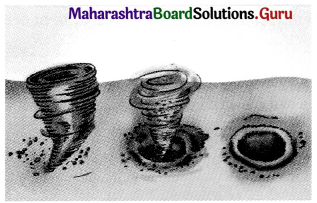
Abrasion carves the windward side of rock into smooth sloping surface. These rocks are called ventifacts.

(ii) Mushroom rocks

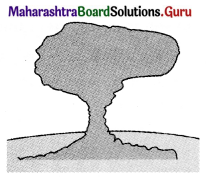
  1. The high rising rocks in the path of the wind are attacked by the sand that moves with the wind.
  2. Winds and the particles they carry attack the base of an individual rock.
  3. The larger top part is not eroded as much as the basal part because the particles are not lifted at a height.
  4. The particles at medium height are smaller but their velocities are high. Hence, their impact is more.
  5. As a result, the portion of rock at medium height is eroded more and the rock as a whole gets the shape of a mushroom.

(iii) Yardang:

  1. In areas where hard and soft rocks are found, the softer rocks get more eroded faster.
  2. The eroded portion of softer rocks appear like elongated ridges and harder rocks appear as elevated portions.
  3. A yardang is the remaining part of a ridge where rocks have been eroded.

Work of Glaciers
(i) Roche moutonnee:
They are bedrock hills that are smoothly rounded on the upper side by abrasion and plucking on the lower side.

(ii) Cirque

  1. An armchair like feature is formed when ice movement accompanied by weathering and mass wasting steepens the wall at the head of the glacier.
  2. It deepens into armchair-shaped depression called cirque.

(iii) Arete

  1. Often two or more cirques develop side by side.
  2. This leaves the area between any two of them into a narrow wall. This is called arete.

(iv) Horn

  1. When three or more cirques are formed, the headward erosion of the glacier erodes the summit.
  2. This leads to formation of a characteristic peak which is called a horn. The Matterhorn in the Swiss Alps is an example.

(v) U-Shaped Valleys
When glaciers move ahead, they erode the sides as well as the bottom of the valleys they flow through. This makes the valley broad at the bottom, forming a ‘U’. This is called a U-shaped valley.

Maharashtra Board Class 11 Geography Solutions Chapter 3 Agents of Erosion

Question 2.
Explain how the depositional work done by River Ganga has been beneficial to human activities.
Answer:
The River Ganga and its tributaries have deposited load of sediments in the northern Ganga region. Features formed are:
Alluvial Plain Region : The River Ganga and its tributaries bring loads of sediments – organic sediments like dead remains of plants and animals, skin, hide, bones etc., and inorganic sediments like sand, silt, clay, gravel, etc., and deposits at the foothills of the Himalayan family, Northern Ganga Plain region. It is a fertile land and agriculture is the major human occupation. Along with agriculture river transportation and fishing is also done on a large scale. Fertile plains are in Uttar Pradesh, Bihar, Punjab and Haryana.

Delta: Ganga-Brahmaputra delta, world’s largest delta has been formed at the mouth of the River Ganga. This delta is known as Sundarbans and is located in West Bengal. It is one of the most fertile regions in the world. Most delta is composed of alluvial soil. Thus, agriculture is the occupation followed in this region too.

Question 3.
Which agents of erosion can you see on the cover page of the textbook? Which landforms can you see there? Write the process of formation of any one.
Answer:

  1. On the cover page of the textbook. We observe the agents of erosion such as rivers, glaciers and sea waves.
  2. We see different landforms like – alluvial fans, meander, oxbow lakes, delta, sea and beach.
  3. The river in the middle stage, picks up more material by bank erosion and gets overloaded. The speed of erosion is reduced. The water moves sluggishly in a bed and turns at every minor change of slope and serpentine bends are formed.

Every bend is made more and more pronounced by dashing of water on outer bank which gets eroded while inner banks have deposition. In due course of time they develop into circular loops, they are called meanders.

7. Draw neat and labelled diagrams for

Question 1.
Deflation
Answer:
Maharashtra Board Class 11 Geography Solutions Chapter 3 Agents of Erosion 1

Question 2.
Wave-cut platform
Answer:
Maharashtra Board Class 11 Geography Solutions Chapter 3 Agents of Erosion 2

Maharashtra Board Class 11 Geography Solutions Chapter 3 Agents of Erosion

Question 3.
Mushroom rocks
Answer:
Maharashtra Board Class 11 Geography Solutions Chapter 3 Agents of Erosion 3

11th Geography Digest Chapter 3 Agents of Erosion Intext Questions and Answers

Can you tell? (Textbook Page No. 27)

1. The names of many places may have some relation with the landforms located there. The names of few of them are given below as example. You are expected to find out the particular landforms to which they are associated. Find about them and try to locate them on a map using an atlas. Make a list of similar examples from India.

Name of the place Landform associated with the nameLocation
RevdandaSand barRaigad, Maharashtra
Ganpati PuleBeachRatnagiri, Maharashtra
Pravara SangamConfluence of riversAhmednagar Maharashtra

Answer:

Name of the place Landform associated with the nameLocation
SundarbansDeltaWest Bengal
Triveni SangamConfluence of Ganga, Yamuna and SaraswatiAllahabad, Uttar Pradesh
Chilika lakeLagoonOrrisa
CalanguteBeachGoa

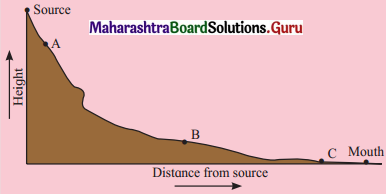
2. Look at the figure below and answer the questions. (Textbook Page No. 32)

Maharashtra Board Class 11 Geography Solutions Chapter 3 Agents of Erosion 4
Question 1.
What features are formed in the upper course of the river? What processes will play an important role?
Answer:
Features formed in the upper course of the river are V-shaped valleys, gorges and canyons, potholes, waterfalls and rapids.
Processes responsible for the formation of these landforms are – downcutting, drilling.

Question 2.
Can you mark the location where waterfall may form?
Answer:
Waterfall may form at location ‘A’

Maharashtra Board Class 11 Geography Solutions Chapter 3 Agents of Erosion

Question 3.
Why is there a change in slope from A to B? How will it influence the flow of the river?
Answer:
There will be a change in slope from A to B when river enters the plains at the foothills of a mountain. The flow of the river decreases, the velocity reduces abruptly.

Question 4.
Which human activities can be conducted in the region around A and B?
Answer:
Around region A terraced farming can be practised. Around region B there is rich with alluvium brough down by the rivers, the plain is extensive and useful for agriculture. As the river widens around the source B, fishing and transportation is also found.

Question 5.
In which area will the process of deposition overtake erosion?
Answer:
Deposition will be found at B and C.

Question 6.
Alluvial fans and deltas are both features formed due to deposition but at different locations. Identify their regions of formation and reason behind their different locations.
Answer:
Alluvial fans will be formed at source ‘B’ at the foothills of the mountains, as there is change in slope and the velocity of the river reduces abruptly. Now the river is unable to carry heavy load. A delta will be formed at the mouth of the river. In this region, which is an extensively flat region, and where the sediments supply is high but velocity is low. So, the river deposits the sediments and branches out to meet ocean or sea.

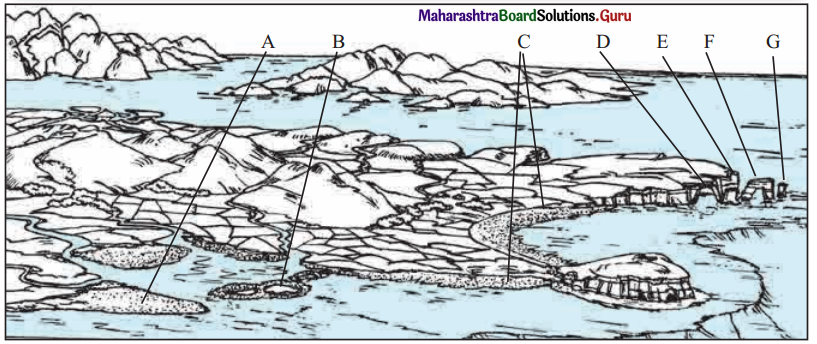
3. Look at the figure and identify landforms at A, B, C, D, E, F, G. (Textbook Page No. 34)

Maharashtra Board Class 11 Geography Solutions Chapter 3 Agents of Erosion 5
Answer:
A – Headland
B – Lagoon
C – Beach
D – Sea Cave
E – Sea Cliff
F – Sea Arch
G – Sea Stack

Let’s recall. (Textbook Page No. 30)

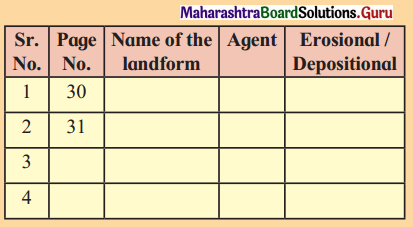
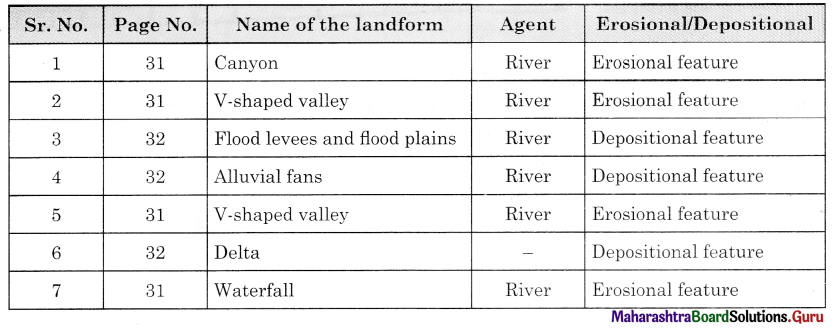
You have already learnt about various landforms formed by the agents of erosion in Class IX. Identify the landforms given in class IX textbook from page no. 30 to 38. Identify the agent which is responsible for their formation. Also, state whether they are erosional or depositional landforms. Complete the table accordingly.
Maharashtra Board Class 11 Geography Solutions Chapter 3 Agents of Erosion 6
Answer:
Maharashtra Board Class 11 Geography Solutions Chapter 3 Agents of Erosion 7

Think about it. (Textbook Page No. 30)

Have you ever been to a river and seen its bed? Discuss in the class about your observation about the river, its banks, its bed and its velocity.
Answer:
[Students will discuss their experiences with teachers.]

Maharashtra Board Class 11 Geography Solutions Chapter 3 Agents of Erosion

Find out! (Textbook Page No. 31)

Find out famous examples of gorges and canyons.
Answer:
Following are the famous examples of gorges and canyons of the world.

  1. Fish River Canyon, Namibia
  2. Grand Canyon, Arizona, USA
  3. Tiger Leaping Gorge, China
  4. Kali Gandaki Gorge, Nepal
  5. Blyden River Canyon, South Africa
  6. Gorges du Verdon, France
  7. Indus Gorge, Pakistan
  8. Antelope Canyon, USA

1. Study figure given below and answer the following questions. (Textbook Page No. 38)

Maharashtra Board Class 11 Geography Solutions Chapter 3 Agents of Erosion 8
Question 1.
Which rocks are mainly found here?
Answer:
Soluble rock like limestone, a sedimentary rock composed of Calcium Carbonate (CaCO3) are found.

Question 2.
Identify the spot where stream disappears.
Answer:
Steam will disappear below the sink hole.

Question 3.
Which major erosional process works in this area?
Answer:
Solution is the major erosional process in this area.

Question 4.
Identify the landforms formed by deposition.
Answer:
Stalactite, Stalagmite, columns or pillars are the landforms formed by deposition.

Question 5.
Why do depositional landforms not form on the surface in areas of Karst terrain?
Answer:
In Karst terrain groundwater dissolves minerals like calcium carbonate present in the rocks. The dripping water leaves behind a deposit of calcium carbonate. The water saturated with calcium carbonate dripping on the floor of a cave deposits calcium carbonate on the floor. Thus, depositional landforms do not form on the surface in the areas of Karst terrain.

Maharashtra Board Class 11 Geography Solutions Chapter 3 Agents of Erosion

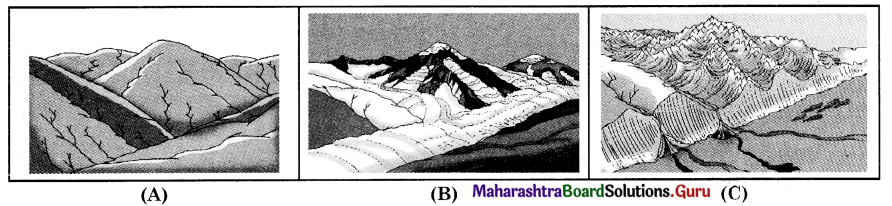
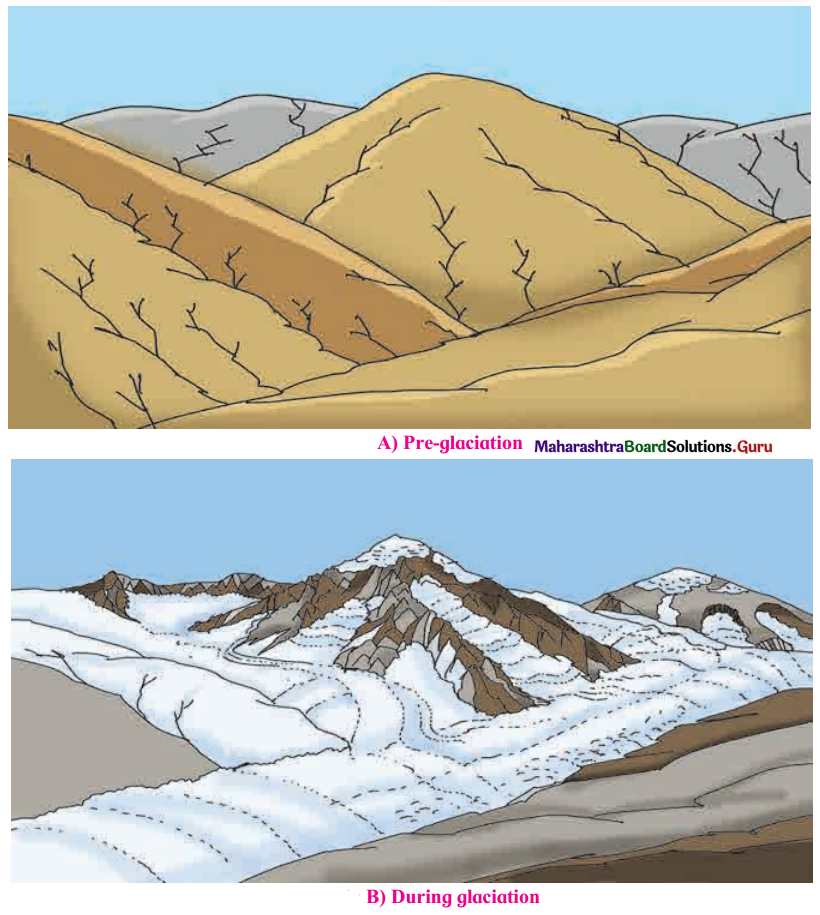
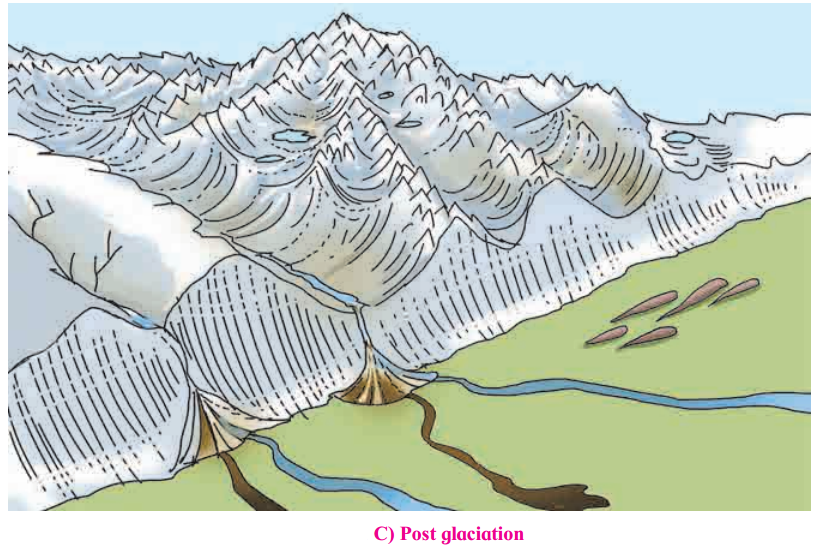
2. See the figure give below A, B, C. Answer the following questions. (Textbook Page No. 40)

Img 8
Question 1.
What difference do you find in the three figures?
Answer:
Fig A shows the regions before glacier formed.
Fig B showed the regions covered by snow during glaciation.
Fig C shows different erosional and depositional features formed by glaciers after glaciation period.

Question 2.
Identify the landforms formed due to erosion by glaciers.
Answer:
Cirques, horn, U-shaped valleys, hanging valleys are formed due to erosion by glaciers.

Question 3.
Where can U-Shaped valleys be formed?
Answer:
U- Shaped valley is formed in the pre-existing valley.

Question 4.
In which region will deposition occur?
Answer:
Deposition starts generally along the side and front of ice.

Question 5.
Identify the landforms formed by deposition by glaciers.
Answer:
Drumlins, eskers, moraines are the depositional features formed by glaciers.

Use your brain power! (Textbook Page No. 41)

In which diagram of the three will you find end moraines? See fig. 3.5 A, B, C.
Maharashtra Board Class 11 Geography Solutions Chapter 3 Agents of Erosion 10 Maharashtra Board Class 11 Geography Solutions Chapter 3 Agents of Erosion 11
Answer:
We will find end moraines in Fig. C

Maharashtra Board Class 12 Psychology Important Questions Chapter 8 Positive Psychology

Balbharti Maharashtra State Board Class 12 Psychology Important Questions Chapter 8 Positive Psychology Important Questions and Answers.

Maharashtra State Board 12th Psychology Important Questions Chapter 8 Positive Psychology

Choose the correct option and complete the following statements.

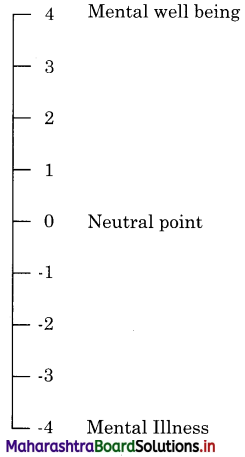
Question 1.
Life …………….. indicates a life full of stress and anxiety.
(a) below zero
(b) at zero
(c) above zero
Answer:
(a) below zero

Question 2.
………………. refers to the ability to handle adverse situations effectively.
(a) Coping
(b) Competence
(c) Confidence
Answer:
(b) Competence

Maharashtra Board Class 12 Psychology Important Questions Chapter 8 Positive Psychology

Question 3.
……………….. helps us to focus on the ‘Here and Now’ effectively.
(a) Mindfulness
(b) Mindlessness
(c) Optimism
Answer:
(a) Mindfulness

Question 4.
………………. is the key to most successful relationships.
(a) Resilience
(b) Mindfulness
(c) Empathy
Answer:
(c) Empathy

Match the pairs.

Question 1.

Group AGroup B
(1) Seligman(a) Broaden and Build theory
(2) Fredrickson(b) empathy
(3) Masten(c) mindfulness
(4) Baron-Cohen(d) resilience
(e) optimism

Answer:

Group AGroup B
(1) Seligman(e) optimism
(2) Fredrickson(a) Broaden and Build theory
(3) Masten(d) resilience
(4) Baron-Cohen(b) empathy

Maharashtra Board Class 12 Psychology Important Questions Chapter 8 Positive Psychology

State whether the following statements are true or false.

Question 1.
Negative events easily attract our attention compared to positive ones.
Answer:
True

Question 2.
Positive psychology focuses on life at and below zero.
Answer:
False

Question 3.
A positive frame of mind effectively builds our social and psychological resources.
Answer:
True

Question 4.
There are subjective differences in the experience of happiness.
Answer:
True

Question 5.
We must always choose very easy goals so we can feel happiness.
Answer:
False

Question 6.
Most pessimists perceive difficulties as challenges/ opportunities.
Answer:
False

Maharashtra Board Class 12 Psychology Important Questions Chapter 8 Positive Psychology

Question 7.
Empathy and sympathy are synonymous.
Answer:

Question 8.
Brain damage can diminish a person’s ability to empathize.
Answer:
True

Answer the following in one sentence each.

Question 1.
What does positive psychology focus on?
Answer:
Positive psychology focuses on building of character strengths such as courage, happiness and perseverance rather than on anxiety, conflict and avoidance.

Question 2.
What does ‘life below zero’ indicate?
Answer:
‘Life below zero’ indicates a life that is full of problems, stress, diseases, etc.

Question 3.
How does an optimist view challenges and difficulties?
Answer:
Optimists have a positive approach towards challenges and difficulties and hence view them as opportunities to progress and become strong.

Question 4.
What does mindlessness mean?
Answer:
Mindlessness means performing a task with less concentration and awareness mainly because we are absorbed in our own thoughts, worries, etc.

Maharashtra Board Class 12 Psychology Important Questions Chapter 8 Positive Psychology

Question 5.
What is psychological resilience?
Answer:
Psychological resilience refers to developing coping strategies that enable one to adapt to uncertainty, challenges and adversity and to move on without prolonged negative consequences.

Explain the concepts in 25 – 30 words each.

Question 1.
Broaden and Build theory.
Answer:
The ‘Broaden and Build theory of positive emotions’ by Barbara Fredrickson explains that when we experience positive emotions, we have more positive thoughts and also indulge in positive behaviours. Experiencing a positive emotion leads to broadening the number of actions that we can think of performing. This will increase and strengthen our psychological and social resources to lead a fulfilling life.

Question 2.
Life above zero.
Answer:
Traditional psychology focused on life at and below zero. Zero is the line that divides illness from health. Hence, life below zero indicates a life that is full of problems, stress, diseases, etc. Positive psychology emphasizes the study of life above zero. Life above zero covers a large area of positive aspects of behaviour such as mindfulness, resilience, happiness, hope, trust and empathy.

Question 3.
Mindfulness meditation
Answer:
Mindfulness means a moment-by-moment awareness of our bodily sensations, thoughts and feelings. In Buddhist philosophy, mindfulness practice is a form of meditation. Mindfulness meditation helps in developing a non-reactive state of mind which is the foundation of a peaceful mind. This helps to reduce anxiety, frustration, etc., and enhances mental well-being.

Maharashtra Board Class 12 Psychology Important Questions Chapter 8 Positive Psychology

Answer the following questions in 35 – 40 words each.

Question 1.
Why is positive psychology considered significant today?
Answer:
Positive psychology is a newly emerging branch of psychology. Martin Seligman officially introduced Positive Psychology as a subfield of psychology. It is the science of happiness, human strength and growth.

Negative events tend to be intense and hence easily attract our attention, e.g., outburst of anger by a person will be quickly noticed. Positive psychology believes that a person can prevent and overcome many psychological problems by adopting a positive approach. Therefore, today, positive psychology is important. Positive psychology is concerned with the “good life” and the factors that contribute the most to a fulfilling, happy life. It can help increase self esteem, improve relationships and greater chances of success.

Question 2.
What are the characteristics of optimists?
Answer:
Optimism is a mental attitude that includes feelings of hopefulness. It is a belief that the future will be positive and favourable and that negative events are merely setbacks that are temporary and can be overcome.
The characteristics of optimists are-

  1. they try to choose the best options available
  2. they tend to be high on self confidence
  3. they face difficulties positively as they view them as a challenge for a person to become strong
  4. they are hopeful about the future and do not generalize present failure to future events.

Question 3.
How can empathy be nurtured?
Answer:
Empathy is the capacity to understand and feel what another person is experiencing from within their frame of reference i.e. capacity to place oneself in another’s position. According to Simon Baron-Cohen there are three components of emotions viz. cognitive empathy emotional reactivity and social skills.

Empathy builds a sense of security and trust. It is closely related to emotional intelligence and is a key to successful relationships. Empathy can be nurtured by employing methods like-

  1. increase social interactions
  2. connecting through similarities
  3. understanding one’s own feelings
  4. challenge your self
  5. cultivate a sense of curiosity
  6. widen the social contact circle.

Maharashtra Board Class 12 Psychology Important Questions Chapter 8 Positive Psychology

Write short notes on the following in 50 – 60 words each.

Question 1.
Components of empathy
Answer:
Empathy is the capacity to understand and feel what another person is experiencing from within their frame of reference, i.e., capacity to place oneself in another’s position.
According to Simon Baron-Cohen, there are three components of empathy viz. cognitive empathy emotional reactivity and social skills.

  1. Cognitive empathy – This is called perspective taking, i.e., knowing how the other thinks and feels. Cognitive empathy responds to a problem using brainpower.
  2. Emotional reactivity – We feel the emotions as intensely as the other person. It involves connecting intimately with another person to form a strong bonds.
  3. Social skills – It involves being moved to help the person using our emotional person to form a strong bonds.

Answer the following questions in 80 – 100 words each.

Question 1.
Types of resilience
Points:
(i) Physical resilience
(ii) Psychological resilience
(iii) Emotional resilience
(iv) Community resilience
Answer:
According to the American Psychological Association, resilience is the process of adapting well in the face of adversity, trauma, tragedy, threats or significant sources of stress such as family, health, etc. It is the act of ‘bouncing back’ inspite of barriers or set backs.
There are three ways in which people face adverse situations viz.

  1. consider oneself as a ‘victim’ and hence indulge in self pity or anger
  2. get overwhelmed by negative emotions like fear, anxiety, etc., which makes them vulnerable to physiological and psychological collapse
  3. become upset about the disruption and experience a sense of loss, pain, grief, etc.

However, they understand that setbacks are a part of life. Hence, they work through these feelings in ways that foster strength and growth. Sometimes, they may emerge stronger than they were prior to the setback. Such persons are called Resilient individuals. The four types of resilience are-
(i) Physical resilience – It is the body’s ability to adapt to challenges, maintain stamina, and quickly recover when faced with illness, injury or other physical demands.

(ii) Psychological resilience – It is developing coping strategies that enable one to adapt to uncertainty, challenges and adversity and to move on without prolonged negative consequence. The person can remain calm and focused during stressful situations.

Maharashtra Board Class 12 Psychology Important Questions Chapter 8 Positive Psychology

(iii) Emotional resilience – It refers to the ability to manage one’s emotions by adequately using one’s resources to cope with adversity and stress. It is the ability to understand what one is feeling and why?

(iv) Community resilience – It is the ability of groups of people to respond to and recover from adverse situations such as natural disasters, epidemics, war, economic hardships and other challenges to their community. This is mainly due to strong connections or bonds that community members have with each other.

Question 2.
Empathy
Points:
(i) Meaning
(ii) Components
(iii) Nurturing empathy
Answer:
(i) Meaning – Empathy is the capacity to understand and feel what another person is experiencing from within their frame of reference, i.e., capacity to place oneself in another’s position. Empathy builds a sense of security and trust. It is closely related to emotional intelligence. It supports social corrections required for communication and shared activities. Empathy is considered the key to successful relationships. Research indicates that there is a neurological foundation of empathy. A broad range of brain areas spanning the sensory motor area, insula and cingulate cortex together form a neural network for empathy processing.

(ii) Components-

  • Cognitive empathy – This is called perspective taking, i.e., knowing how the other thinks and feels. Cognitive empathy responds to a problem using brainpower.
  • Emotional reactivity – We feel the emotions as intensely as the other person. It involves connecting intimately with another person to form a strong bonds.
  • Social skills – It involves being moved to help the person using our emotional intelligence. One should not become overwhelmed by sadness or trying to ‘fix’ things.

Maharashtra Board Class 12 Psychology Important Questions Chapter 8 Positive Psychology

(iii) Nurturing empathy-
A world with empathetic persons will be nurturing and supportive. The methods to nurture empathy are-

  • Increase social interactions – Especially with people who need help in order to understand their perspectives and motives.
  • Connecting through similarities with others, e.g., those having same hobbies/ work/ goals, etc.
  • Understanding what you are feeling – Those who are able to accurately judge their own motives, can empathize better.
  • Challenge yourself – Tasks that are challenging lead to the person struggling to achieve a goal. This lead to humility which enables empathy.
  • Cultivate a sense of curiosity – This leads to open-mindedness and a better understanding of those around us.
  • Widen our social circle – Contact with people of different races, cultures, viewpoints helps to increase empathy towards them at a neurological level.

Maharashtra Board Class 12 Psychology Important Questions Chapter 7 First Aid in Mental Health

Balbharti Maharashtra State Board Class 12 Psychology Important Questions Chapter 7 First Aid in Mental Health Important Questions and Answers.

Maharashtra State Board 12th Psychology Important Questions Chapter 7 First Aid in Mental Health

Choose the correct option and complete the following statements.

Question 1.
According to the NIMHANS study (2014-2016) about …………………. of the population suffers from common mental disorders.
(a) 10%
(b) 13%
(c) 25%
Answer:
(a) 10%

Question 2.
The Indian city that obtained an International license in 2017 to carry out the standard MHFA programme across India is ………………
(a) New Delhi
(b) Bengaluru
(c) Chennai
Answer:
(c) Chennai

Maharashtra Board Class 12 Psychology Important Questions Chapter 7 First Aid in Mental Health

Question 3.
If early signs of mental illness are recognized, it can assist the individual to get help. This is known as …………………
(a) diagnosis
(b) early intervention
(c) rehabilitation
Answer:
(b) early intervention

Question 4.
Imbalance of certain in the brain may be a factor in anxiety.
(a) neurotransmitters
(b) fluids
(c) organs
Answer:
(a) neurotransmitters

Match the pairs.

Question 1.

Group AGroup B
(1) Anthony Jorm(a) technology related mental health issues
(2) Traumatic events(b) depression
(3) SHUT clinic in NIMHANS(c) co-founder of MHFA programme
(4) Red flag in internet usage(d) social phobia
(5) Feeling of worthlessness(e) anxiety
(f) craving and compulsion

Answer:

Group AGroup B
(1) Anthony Jorm(c) co-founder of MHFA programme
(2) Traumatic events(e) anxiety
(3) SHUT clinic in NIMHANS(a) technology related mental health issues
(4) Red flag in internet usage(f) craving and compulsion
(5) Feeling of worthlessness(b) depression

State whether the following statements are true or false.

Question 1.
There is a stigma attached to mental illness.
Answer:
True

Maharashtra Board Class 12 Psychology Important Questions Chapter 7 First Aid in Mental Health

Question 2.
Mental illness is caused due to supernatural forces.
Answer:
False

Question 3.
Mental illness usually does not develop ‘out of the blue’.
Answer:
True

Question 4.
Relapse prevention is important in Mental Health First Aid.
Answer:
True

Question 5.
Any anxiety experienced by a person is a cause for concern.
Answer:
False

Question 6.
DSM-5 considers behaviour addictions as a mental disorder.
Answer:
False

Answer the following in one sentence each.

Question 1.
What is the assumption of First Aid in Mental Health?
Answer:
The assumption of First Aid in Mental Health is the concept of ‘prevention is better than cure’.

Question 2.
What are some non-medical explanations for mental illness?
Answer:
Some non-medical explanations for mental illness are based on myths and superstitions that such behaviour is due to evil spirits and black magic.

Maharashtra Board Class 12 Psychology Important Questions Chapter 7 First Aid in Mental Health

Question 3.
Who developed the Mental Health First Aid (MHFA) programme?
Answer:
Betty Kitchener and Antony Jorm originally developed the Mental Health First Aid (MHFA) programme.

Question 4.
What is the objective of MHFA?
Answer:
MHFA is an internationally recognized training programme whose objective is to teach people how to identify the signs and symptoms of mental health problems and to provide assistance on a first aid basis.

Question 5.
What is the rationale of SHUT clinics by NIMHANS?
Answer:
NIMHANS (Bengaluru) has begun the Service for Healthy Use of Technology (SHUT) to deal exclusively with mental health issues that are technology related.

Answer the following questions in 35 – 40 words each.

Question 1.
What are the main hurdles to receiving treatment in case of mental illness?
Answer:
The main hurdles in receiving treatment for poor mental health are-

  1. Lack of knowledge and awareness.
  2. Stigma attached to mental illness due to which treatment is discontinued.
  3. High cost of treatment.
  4. Reliance on non-medical explanations for mental illness, for e.g., evil spirits.
  5. Shortage of trained mental health professionals.
  6. Slow improvement in the behaviour due to which treatment is discontinued.

Maharashtra Board Class 12 Psychology Important Questions Chapter 7 First Aid in Mental Health

Question 2.
What are the self help strategies in Mental Health First Aid?
Answer:
Self help strategies are tasks that help to increase our resources to deal with stress and to maintain mental health. MHFA is an internationally recognized training programme whose objective is to teach people how to identify the signs and symptoms of mental health problems and to provide assistance on a first aid basis.

  1. Physical activity and exercise like playing a sport, jogging, yoga, etc.
  2. Cultivate a hobby or engage in an enjoyable activity.
  3. Sleep hygiene, i.e., 7 to 8 hours of sleep with a proper routine.
  4. Reduce digital involvement, i.e., disconnect everyday for some time from gadgets.
  5. Build social support and spend time with friends / family.

Question 3.
Enumerate behavioural changes noticed in persons suffering from depression.
Answer:
Individuals who experience depression, commonly have a negative thinking style and feel worthless and helpless. A number of changes are noticed in their behaviour such as-

  1. Complaining of feeling tired or sleepy all the time
  2. avoiding family and friends and spending much time alone
  3. remaining sad and forgetful
  4. bunking class or performing poorly in exams and having difficulty in concentrating.

Question 4.
What are the ‘red flags’ that indicate over dependence on the internet?
Answer:
Signs that help to identify individuals who show deviance or distress and require help in mental health are called red flags.
The ‘red flags’ that indicate over dependence on internet are-

  1. Feelings of euphoria while using the internet.
  2. Physical symptoms like headache, dry eyes, etc.
  3. Inability to keep to schedules and boredom with routine tasks.
  4. Poor personal hygiene and nutrition to remain online.

Maharashtra Board Class 12 Psychology Important Questions Chapter 7 First Aid in Mental Health

Write short notes in 50 – 60 words each.

Question 1.
First Aid in Mental Health.
Answer:
Mental Health First Aid (MHFA) is an internationally recognized training programme designed to teach people how to identify the signs and symptoms of mental health problems and to provide assistance on a first aid basis. MHFA was originally developed by Betty Kitchener and Anthony Jorm.

First Aid in Mental Health is a concept based on the idea of ‘prevention is better than cure’. It teaches one how to identify understand and respond to signs of mental illness as well as substance use disorders. Through role playing and simulations, MHFA demonstrates how to assess a mental health crisis, select interventions, provide initial help and connect the person to self-help resources, social support or professional aid if needed.

If the early signs of mental illness are recognized, it can help in the following ways.

  1. Diagnosis – timely diagnosis at the onset of mental illness helps to prevent it from developing into a more severe form.
  2. Intervention – early intervention helps to get professional help.
  3. Relapse prevention – it prevent reoccurrence of symptom of the mental illness.

Question 2.
Self help strategies in Mental Health First Aid.
Answer:
Mental Health First Aid (MHFA) programme was developed by Betty Kitchener and Anthony Jorm. It is designed to identify the signs and symptoms of mental health and to provide assistance on a first aid basis.
Self help strategies are not luxuries but rather essential things that can be incorporated in your life.

  1. Sleep hygiene – Ensuring that you get 7 to 8 hours of sleep every night. You should try to maintain the same schedule, that is go to sleep every night at the same time and wake up at the same time every day. This will help set a routine and improve your well-being
  2. Reduce screen time and digital involvement – You should disconnect everyday for some time from your gadgets. Try to set a time limit for the number of hours you will surf the internet each day.
  3. Physical activity – Try to add some physical activity in your day to day schedule. This can be playing a sport or just going for a walk every day.
  4. Engage in activity that you enjoy doing, cultivate hobbies – This can be any activity like reading a book or listening to your favourite song.
  5. Build and maintain Social Support – Meeting and spending time with your friends and family. Participating in social gatherings.

Maharashtra Board Class 12 Psychology Important Questions Chapter 7 First Aid in Mental Health

Question 3.
5-4-3-2-1 relaxation technique.
Answer:
There are certain times when you feel tense or anxious. One strategy that we can use to help us calm down is the 5-4-3-2-1 technique. This is a simple technique that you can use whenever you are feeling overwhelmed by the situation and need to relax. First take a few deep breaths and then follow the below instructions.

  1. Think of 5 things that you can see around you. For example, a pen, book etc.
  2. Think of 4 things that you can touch around you. For example, your hair, the ground under your feet etc
  3. Think of 3 things that you can hear around you. For example, the sound of traffic, sound of people who are talking around you etc.
  4. Think of 2 things that you can smell around you. For example, the scent of soap from your hands, the fragrance of your deodorant etc
  5. Think of 1 thing that you can taste. For example the taste of the last meal that you had etc. Performing this exercise will help you focus on the present and stop worrying.

Question 4.
Behavioural changes in persons suffering from anxiety.
Answer:
Anxiety refers to a condition in which the person feels worried/tense and uneasy for a long time for no obvious reasons. Symptoms of anxiety include nervousness, restlessness, feelings of danger, etc.
Individuals who are anxious may-

  1. Not want to go to college or work.
  2. Complain repeatedly of various physiological problems.
  3. Get irritated while interacting with their friends or family.
  4. Spend lot of time worrying about how they look.
  5. Be extremely quiet in the class or at work and get scared of asking questions to the teachers or colleagues.
  6. Sometimes ask the same questions repeatedly.
  7. They visibly show the physical symptoms of anxiety like sweating or excessive body movements.

Maharashtra Board Class 12 Psychology Important Questions Chapter 7 First Aid in Mental Health

Question 5.
Four C’s to identify excessive internet usage.
Answer:
Excessive internet usage is characterised by extensive, problematic addiction to the use of computer and internet. It signifies poorly controlled preoccupations or behaviour regarding such usage. Excessive internet usage leads to personal distress and social impairment.
The four C’s to identify excessive internet usage are as follows-

  1. Craving – Do you have an intense desire to use the internet?
  2. Control – Do you have an inability to control your self using the internet?
  3. Compulsion – Do you find it difficult to stop using the internet? Even though you know you should not spend so much time on it?
  4. Consequence – Have you ever experienced any physical or psychological ill effects as a result of excessive use of the internet?

If you answer a ‘yes’ for at least three of the C’s, it can be a matter of concern.

Maharashtra Board Class 12 Psychology Important Questions Chapter 7 First Aid in Mental Health

Question 6.
Over-dependence on internet.
Answer:
The amount of time as well as reason for using the internet may become a matter of concern for e.g., online gambling, gaming, etc. The person may socialise more online with friends than real life socialising. Spending excess time online may cause the person to neglect family, relationships, work etc. Virtual world enables games/gambling almost continuously.

This leads to the person neglecting personal hygiene, real life relationships and become withdrawn and irresponsible. The person may feel guilty or defensive about internet use. He/she may panic in the absence of internet service. A growing dependence on internet refers to an inability to stop and down down.

Maharashtra Board Class 12 Psychology Important Questions Chapter 6 Psychological Disorders

Balbharti Maharashtra State Board Class 12 Psychology Important Questions Chapter 6 Psychological Disorders Important Questions and Answers.

Maharashtra State Board 12th Psychology Important Questions Chapter 6 Psychological Disorders

Choose the correct option and complete the following statements.

Question 1.
A persistent but disproportionate and irrational fear of a specific object or situation is called ……………….
(a) anxiety
(b) mania
(c) phobia
Answer:
(c) phobia

Question 2.
A cluster of symptoms is called as ……………….
(a) therapy
(b) maladjustment
(c) syndrome
Answer:
(c) syndrome

Maharashtra Board Class 12 Psychology Important Questions Chapter 6 Psychological Disorders

Question 3.
Bipolar disorder is also called ……………… disorder.
(a) manic-depressive
(b) schizophrenia
(c) PTSD
Answer:
(a) manic-depressive

Question 4.
The DSM-5 comprises of …………….. broad categories of mental disorders along with subcategories.
(a) 19
(b) 11
(c) 22
Answer:
(c) 22

Question 5.
Ashok experiences feelings of unhappiness but has no apparent mental illness. According to Illness Wellness Continuum Model, he will be in Quadrant ……………..
(a) 1
(b) 2
(c) 3
Answer:
(b) 2

Question 6.
Mr. X tries to stop his drug usage. He experiences tremors, muscle pains, etc. This indicates, ……………. symptoms.
(a) withdrawal
(b) recovery
(c) negative
Answer:
(a) withdrawal

State whether the following statements are true or false.

Question 1.
Illness and absence of illness are distinct categories.
Answer:
False

Maharashtra Board Class 12 Psychology Important Questions Chapter 6 Psychological Disorders

Question 2.
Individual distress and impairment are criteria for psychological disorders.
Answer:
True

Question 3.
Imbalance in neurotransmitters may cause bipolar disorders.
Answer:
True

Question 4.
Extremely traumatic events may lead to the onset of Acute Stress Disorder.
Answer:
True

Question 5.
Most schizophrenics suffer from delusions and hallucinations.
Answer:
True

Question 6.
Generally, negative symptoms of schizophrenia improve much with proper treatment.
Answer:
False

Question 7.
The same therapy can be applied with equal success to all persons who exhibit similar symptoms.
Answer:
False

Maharashtra Board Class 12 Psychology Important Questions Chapter 6 Psychological Disorders

Answer the following in one sentence each.

Question 1.
What is the literal meaning of word ‘schizophrenia’.
Answer:
The word ‘schizophrenia’ is derived from the Greek words ‘schizein’ (to split) and ‘phren’ (mind). Thus, the literal meaning of the word ‘schizophrenia’ is split mind.

Question 2.
What is meant by delusion?
Answer:
Delusion refers to false belief held by the individual which cannot be shaken off in spite of clear evidence that is contrary to it.

Question 3.
What are the two states of bipolar disorder?
Answer:
The two states of bipolar disorder are mania state and depression state.

Question 4.
When is the person diagnosed with PTSD?
Answer:
The person is said to be diagnosed with PTSD when the symptoms of Acute Stress Disorder (ASD) continue for more than one month with the same intensity.

Question 5.
What are addictive disorders?
Answer:
Addictive disorders refer to the physical and psychological inability to stop consuming some substance or indulging in some activity although it is harmful.

Maharashtra Board Class 12 Psychology Important Questions Chapter 6 Psychological Disorders

Question 6.
What is psychotherapy?
Answer:
Psychotherapy refers to the systematic attempt by a mental health professional to assist a person to overcome some psychological disorders.

Question 7.
What is the suggestible stage of PTSD?
Answer:
Suggestible stage of PTSD refers to a person who may seek guidance from others and may either accept these suggestions unquestioningly or may get extra sensitive.

Explain the following concepts.

Question 1.
Delusions
Answer:
Delusions is a false belief that is strongly held by an individual in spite of the presence of contrary evidence, Delusions are a symptom of mental disorders. Commonly noticed delusions are delusion of grandeur, delusions of persecution, delusion of influence or control, delusion of reference, etc.

Answer the following questions Briefly.

Question 1.
Explain Acute Stress Disorder.
Answer:
If a person (aged 6 years and above) has experienced extremely stressful situations like death of a loved one, serious disease or injury, sexual abuse, natural disasters, etc., then he/she may experience ASD.
The symptoms of ASD include-

  1. emotional numbness and instability
  2. nightmares and sleep disturbances
  3. insomnia, lack of concentration, irritability and guilt feelings
  4. depression

Question 2.
What are the red flags in identifying psychological disorders?
Answer:
Signs that help to identify individuals who require expert (professional) help in mental health are called ‘red flags’.
Symptoms, if present, in any person should satisfy three requirements-

  1. it should be present for a considerably long period of time
  2. symptom has become more severe than before
  3. it has created problems in the person’s life.

Maharashtra Board Class 12 Psychology Important Questions Chapter 6 Psychological Disorders

Question 3.
What is Generalized Anxiety Disorder?
Answer:
Anxiety refers to a condition in which a person feels uneasy for a long time for no obvious reasons. The main anxiety disorders include Generalized Anxiety Disorder, Phobia, Panic attacks etc.

In Generalized Anxiety Disorder the person frequently experiences anxiety more intensely so that it starts interfering with the ability to perform daily tasks. Symptoms include irritability, headaches, insomnia, dizziness, breathlessness, etc.

Write short notes on the following.

Question 1.
Identification and treatment of psychological disorders.
Answer:
Signs that help to identify individuals who require expert (professional) help in mental health are called ‘red flags’. Symptoms, if present, in any person should satisfy three requirements

  1. it should be present for a considerably long period of time
  2. symptom has become more severe than before
  3. it has created problems in the person’s life.

The signals indicating a need for professional help are:

  1. inability to concentrate or to sleep well.
  2. severe confusion and memory loss.
  3. intense and uncontrollable negative feelings.
  4. self-neglect or even self-harm.
  5. loss of interest in friends/ family/ activities.
  6. odd statement or strange use of words.

Treatment strategies range form pharmacotherapy (administering drugs) to psychotherapy such as Rational Emotive Behaviour Therapy, Interpersonal Therapy, Group/Family Therapy, etc. Mental health professionals are qualified to decide the plan of treatment.

Maharashtra Board Class 12 Psychology Important Questions Chapter 6 Psychological Disorders

Answer the following questions in 150 – 200 words.

Question 1.
Discuss the red flags indicating the need for psychological help.
Answer:
Signs that help to identify individuals who require expert (professional) help in mental health are called ‘red flags’.
Symptoms, if present, in any person should satisfy three requirements

  1. it should be present for a considerably long period of time
  2. symptom has become more severe than before
  3. it has created problems in the person’s life.

Signals indicating need for professional help-

  1. Inability to concentrate
  2. Inability to sleep well
  3. Various physical complaints
  4. Uncontrollable and frequent bad thoughts
  5. Too intense uncontrollable negative feelings (fear, anger, sadness, worry, etc.)
  6. Severe confusion
  7. Memory loss
  8. Loss of interest in activities and friends
  9. Odd or irrational statements or strange use of words or way of speaking
  10. Self-harm
  11. Signs of self-neglect

Maharashtra Board Class 12 Psychology Important Questions Chapter 5 Emotions

Balbharti Maharashtra State Board Class 12 Psychology Important Questions Chapter 5 Emotions Important Questions and Answers.

Maharashtra State Board 12th Psychology Important Questions Chapter 5 Emotions

Choose the correct option and complete the following statements.

Question 1.
According to the theory, we experience physiological arousal and feelings simultaneously and independently.
(a) James-Lange
(b) Cannon-Bard
(c) Schachter-Singer
Answer:
(b) Cannon-Bard

Question 2.
According to Ekman, there are basic emotions.
(a) 2
(b) 5
(c) 6
Answer:
(c) 6

Maharashtra Board Class 12 Psychology Important Questions Chapter 5 Emotions

Question 3.
is an emotion that is in response to some threat.
(a) Sadness
(b) Fear
(c) Disgust
Answer:
(b) Fear

Question 4.
Plutchik’s model explains that there are primary emotions.
(a) 8
(b) 6
(c) 12
Answer:
(b) 6

Question 5.
is not a primary/ basic emotion according to Plutchik.
(a) Trust
(b) Anticipation
(c) Jealousy
Answer:
(c) Jealousy

Question 6.
Emotions are controlled by the ……………….. in the brain.
(a) cerebral cortex
(b) limbic system
(c) RAS
Answer:
(b) limbic system

Question 7.
Aniket shows creativity and has meaningful relationships. He has …………. emotional well-being.
(a) high
(b) low
(c) moderate
Answer:
(a) high

Maharashtra Board Class 12 Psychology Important Questions Chapter 5 Emotions

State whether the following statements are true or false.

Question 1.
“I feel sad because I cry”, This is the premise of the Schachter – Singer theory.
Answer:
False

Question 2.
Pride and guilt are considered as higher cognitive emotions.
Answer:
True

Question 3.
The fight or flight reaction is a reaction to sadness.
Answer:
False

Question 4.
Low serotonin levels are associated with clinical depression.
Answer:
True

Answer the following in one sentence each.

Question 1.
What is the premise of the facial feedback hypothesis?
Answer:
According to the facial feedback hypothesis, our facial expressions provide feedback to our brain about our emotions.

Maharashtra Board Class 12 Psychology Important Questions Chapter 5 Emotions

Question 2.
What are complex emotions?
Answer:
Complex emotions are emotions which result form the combination of basic emotions for e.g., surprise and sadness lead to disappointment.

Question 3.
According to Ekman, which are the basic emotions?
Answer:
According to Ekman, there are six basic (universal) types of emotions, i.e., happiness, sadness, anger, fear, surprise, disgust.

Question 4.
When does a person experience disgust?
Answer:
A person usually experiences disgust as a response to some unwanted stimulus.

Question 5.
According to Plutchik, how do emotions result?
Answer:
According to Plutchik, emotions result due to evolving over a period of time for increasing our chances of survival.

Question 6.
Why is Plutchik’s model important?
Answer:
Plutchik’s model is important from the perspective of emotional literacy, i.e., understanding emotional levels, complexity and change as well as appropriate emotional labelling.

Question 7.
What does emotional well-being mean?
Answer:
Emotional well-being means managing both positive and negative emotions, so that we can lead a healthy and productive life.

Maharashtra Board Class 12 Psychology Important Questions Chapter 5 Emotions

Question 8.
What does anger management mean?
Answer:
Anger management is an intervention programme to prevent anger from turning into a habit or obstacle by creating awareness of and responsibility for our emotions.

Explain the concepts in 25 – 30 words each.

Question 1.
Emotions
Answer:
The word emotion is derived from the latin word ‘emovere’, which means to stir up or to move. An emotion refers to an involuntary, aroused state of an organism involving physical, cognitive and behavioural components. It is described as a combination of bodily arousal, e.g., increased heartrate, thoughts and feelings, i.e. emotional tone and expressive behaviour i.e. facial expression.

Question 2.
Emotional well-being.
Answer:
Emotional well-being means managing our emotions, both positive and negative ones, so that we can lead a healthy and productive life. Persons who have high emotional well-being experience benefits such as-

  1. better able to deal with stress
  2. better self-regulation
  3. increased productivity in tasks undertaken
  4. increased creativity and openness to new experiences
  5. life satisfaction due to meaningful activities and relationship.

Question 3.
Emotional Abuse.
Answer:
Emotional abuse is any kind of abuse that is emotional rather than physical in nature. It occurs when one person subjects or exposes another person to intentionally harmful behaviour that may result in anxiety, depression and psychological trauma in the victim.
The types of emotional abuse may be-

  1. verbal abuse such as blaming, insulting, labeling, threatening, swearing, etc.
  2. nonverbal abuse such as ignoring, rejection, bullying, spying, etc.

Maharashtra Board Class 12 Psychology Important Questions Chapter 5 Emotions

Question 4.
Anger Management.
Answer:
Anger management is an intervention programme to prevent anger from turning into a habit or obstacle. It enables the person to create awareness of and responsibility for his/her emotions. Anger management involves two aspects (i) managing one’s own anger (ii) learning to respond effectively to anger in others. The three R’s in anger management are Relax, Reassess and Respond.

Answer the following questions in 35 – 40 words each.

Question 1.
What are the techniques to deal with emotional abuse?
Answer:
Emotional abuse is any kind of abuse that is emotional rather than physical in nature. It occurs when one person subjects or exposes another person to intentionally harmful behaviour that may result in anxiety, depression and psychological trauma for the victim.
The techniques to deal with emotional abuse-

  1. Accept that emotional abuse is not because of you, i.e., don’t justify the actions of the abuser.
  2. Respond assertively to the abuser but seek distance from him/her.
  3. Give yourself time to heal.
  4. Prioritize your self-care, eating right, exercise, etc.
  5. Mobilise support from family and friends. If needed, seek professional help.

Question 2.
What are the benefits of emotional well-being?
Answer:
Emotional well-being means managing our emotions, both positive and negative ones, so that we can lead a healthy and productive life. Persons who have high emotional well-being experience benefits such as-

  1. better able to deal with stress
  2. better self-regulation
  3. increased productivity in tasks undertaken
  4. increased creativity and openness to new experiences
  5. life satisfaction due to meaningful activities and relationship.

Write short notes on the following in 50 – 60 words each.

Question 1
Characteristics of emotions
Answer:
The word emotion is derived from the latin word ‘emovere’, which means to stir up or to move. An emotion refers to an involuntary, aroused state of an organism involving physical, cognitive and behavioural components. It is described as a combination of bodily arousal, e.g., increased heartrate, thoughts and feelings, i.e. emotional tone and expressive behaviour i.e. facial expression.
Some characteristics of emotions are-

  1. Emotions may be positive, e.g., joy or negative, e.g., anger.
  2. Emotions may occur for a brief period or may be long lasting.
  3. Emotions may be important for our survival, e.g., fear or for our psychological well-being, e.g., love.
  4. Emotions differ in intensity in expression for e.g., annoyance-anger-rage.
  5. Complex emotions (higher cognitive level emotions) result from the combination of basic emotions, for e.g., surprise and sadness lead to disappointment.
  6. According to Ekman, there are six basic (universal) types of emotions, i.e., happiness, sadness, anger, fear, surprise, disgust.

Maharashtra Board Class 12 Psychology Important Questions Chapter 5 Emotions

Question 2.
Physiological changes during emotions.
Answer:
Physiological changes refer to automatic reactions that take place in our body in response to some stimulus, for e.g., if you saw a snake, the brain at the cognitive level perceived the stimulus as dangerous. This leads to physiological arousal such as dilated pupils, increased heart rate, increased pulse rate, sweating. At the emotional level you experience fear. The Autonomic Nervous System and Glandular system signal the pituitary gland which activates the adrenal glands to secrete the cortisol hormone. This triggers “the fight or flight” response. At the behavioural level there is an action plan such as running away or calling for help, etc.
Maharashtra Board Class 12 Psychology Important Questions Chapter 5 Emotions 1

Answer the following questions 80 – 100 words each.

Question 1.
Theories of emotions.
Points:
(i) James-Lange theory
(ii) Cannon-Bard theory
(iii) Schachter-Singer theory
Answer:
The word emotion is derived from the latin word ‘emovere’, which means to stir up or to move. An emotion refers to an involuntary, aroused state of an organism involving physical, cognitive and behavioural components. It is described as a combination of bodily arousal, e.g., increased heartrate, thoughts and feelings, i.e. emotional tone and expressive behaviour, i.e., facial expression.
The main theories of emotions are-
(i) James-Lange theory – It was one of the earliest theories to explain emotion. According to William James and Carl Lange, physiological arousal instigates the experience of emotion. It proposes that each specific emotion is attached to a different pattern of physiological arousal. For e.g., we feel sad because we cry. The sequence of events in emotional experience is Emotion Stimulus – Physiological Response Pattern → Affective Experience.

(ii) Cannon-Bard theory – According to Walter Cannon and Philip Bard, we may experience the same physiological arousal but emotions can be different, for e.g., we don’t cry only when we are sad but we also cry when we are angry or extremely happy. We experience physiological arousal and feelings at the same time and independently. For e.g., seeing a man with a gun prompts the feeling of fear as well as a racing heartbeat.

(iii) Schachter and Singer’s Two Factor theory – According to Stanley Schachter and Jerome Singer, emotion is based on two factors, i.e., physiological arousal and cognitive label, for e.g., an environmental stimuli (growling dog) elicits a physiological response (increased heart rate). We cognitively label this response (fear).
Maharashtra Board Class 12 Psychology Important Questions Chapter 5 Emotions 2

Maharashtra Board Class 12 Psychology Important Questions Chapter 5 Emotions

Question 2.
Emotional well-being.
Points:
(i) Meaning
(ii) Aspects
(iii) Benefits
Answer:
The word emotion is derived from the latin word ‘emovere’, which means to stir up or to move. An emotion refers to an involuntary, aroused state of an organism involving physical, cognitive and behavioural components. It is described as a combination of bodily arousal, e.g., increased heart rate, thoughts and feelings, i.e. emotional tone and expressive behaviour i.e. facial expression.

(i) Meaning – Emotional well-being means managing our emotions, both positive and negative ones, so that we can lead a healthy and productive life. Emotional well-being is not easily observable. It can be guaged on the basis of how a person rationally handles a situation involving some stressors or leading to negative emotions. Emotional well-being refers to understanding and managing one’s emotions without getting overwhelmed by negative emotions but instead encouraging positive emotions.

(ii) Aspects – The aspects of emotional well-being are at three levels viz. physical, emotional and social.

  1. Physical level, i.e., well balanced diet, exercise.
  2. Emotional level, i.e., practise mindfulness, raising levels of motivation and optimism.
  3. Social level, i.e., engaging in prosocial behaviour, meaningful relationships.

(iii) Benefits – Persons who have high emotional well-being experience benefits such as-

  1. Coping with stress – It helps to deal with stress using healthy methods such as exercise, social support, etc.
  2. Better self-regulation – It enables the person to label how they feel and accept negative emotions life fear, anger, etc.
  3. Increases productivity in tasks undertaken – The ability to focus is enhanced, the person feels positive and energized.
  4. Increases creativity – The person indulges in divergent thinking, shows curiosity is open to new experiences.
  5. Life satisfaction – The individual is able to have meaningful interactions and relationships, show empathy, altruism and engage in activities like volunteer work.

Maharashtra Board Class 12 Psychology Important Questions Chapter 4 Cognitive Processes

Balbharti Maharashtra State Board Class 12 Psychology Important Questions Chapter 4 Cognitive Processes Important Questions and Answers.

Maharashtra State Board 12th Psychology Important Questions Chapter 4 Cognitive Processes

Choose the correct option and complete the following statements.

Question 1.
Stimuli that are near to each other are perceived as a unit, this refers to the law of……………
(a) proximity
(b) continuity
(c) similarity
Answer:
(a) proximity

Question 2.
The learning process by forming associations or connections is called ………………
(a) assimilation
(b) classical conditioning
(c) operant conditioning
Answer:
(b) classical conditioning

Maharashtra Board Class 12 Psychology Important Questions Chapter 4 Cognitive Processes

Question 3.
…………… is the mental manipulation of information.
(a) Creativity
(b) Learning
(c) Thinking
Answer:
(c) Thinking

Match the pairs.

Question 1.

Group AGroup B
1. Albert Bandura(a) Learning by assimilation and accommodation
2. B.F. Skinner(b) Learning by classical conditioning
3. Max Wertheimer(c) Learning by observation
4. Edward Tolman(d) Learning by operant conditioning
5. Jean Piaget(e) Learning by use of cognitive processes
(f) Laws of perception grouping

Answer:

Group AGroup B
1. Albert Bandura(c) Learning by observation
2. B.F. Skinner(d) Learning by operant conditioning
3. Max Wertheimer(f) Laws of perception grouping
4. Edward Tolman(e) Learning by use of cognitive processes
5. Jean Piaget(a) Learning by assimilation and accommodation

State whether the following statements are true or false.

Question 1.
Size and intensity of the stimulus influences attention.
Answer:
True

Question 2.
It is very easy to divide our attention to two tasks simultaneously.
Answer:
False

Question 3.
Awareness of the stimuli around us is called perception.
Answer:
False

Question 4.
Top-down processing is influenced by the context in which the information occurs.
Answer:
True

Maharashtra Board Class 12 Psychology Important Questions Chapter 4 Cognitive Processes

Question 5.
The tendency to fill in gaps in an incomplete stimulus so as to perceive it as a meaningful figure refers to the law of closure.
Answer:
True

Question 6.
All changes in behaviour can be attributed to learning.
Answer:
False

Answer the following in one sentence each.

Question 1.
What are cognitive process?
Answer:
Cognitive processes are those processes by which we become aware of and understand the world around us such as sensation, attention, perception, learning, memory, thinking, reasoning, problem solving, etc.

Question 2.
What is attention?
Answer:
Attention is the mental process of bringing few stimuli into the centre of awareness out of the many stimuli present.

Question 3.
What is fluctuation of attention?
Answer:
Our attention shifts from the original stimulus to another stimulus for a fraction of time and then comes back to the original stimulus.

Question 4.
What is perception?
Answer:
Perception is defined as the process of assigning meaning to information received about the environment based on the past experiences.

Maharashtra Board Class 12 Psychology Important Questions Chapter 4 Cognitive Processes

Question 5.
What is the perceptual law of similarity?
Answer:
Stimuli that are similar to each other are perceived together compared to stimuli that are distinct from each other.

Question 6.
What is thinking?
Answer:
Thinking is the mental activity that uses various cognitive elements and processes that involves the manipulation of information.

Question 7.
Explain the meaning of schema.
Answer:
Schema is an internal representation that organizes knowledge about related concepts and relationships among them.

Question 8.
What is learning?
Answer:
Learning is a relatively permanent change in behaviour that occurs due to experience or practice.

Question 9.
According to B.F. Skinner, how does learning take place?
Answer:
According to B. F. Skinner, learning takes place to gain positive consequences or to avoid negative consequences.

Question 10.
What is Jean Piaget’s view about the learning process?
Answer:
Jean Piaget explains that we learn by forming and refining our concepts on the basis of similarities and differences between the new and existing information.

Maharashtra Board Class 12 Psychology Important Questions Chapter 4 Cognitive Processes

Explain the concepts in 25 – 30 words each.

Question 1.
Attention
Answer:
Attention is the selective process by which we focus on only a few stimuli from among the various stimuli that are present in our environment. According to Norman Munn, “Attention is the mental process of bringing few stimuli into the centre of awareness out of the many stimuli present”. Attention is influenced by objective factors such as intensity, size, movement, repetition of the stimuli as well as subjective factors like interest, mind-set, experiences of the individual.

Question 2.
Distraction of attention
Answer:
Distraction of attention refers to the drifting of attention from a specific stimulus to another stimulus. This is due to external factors such as intensity, novelty, movement, colour, repetition, etc., of stimuli or internal factors like physical state, lack of interest, mental set of the individual.

Question 3.
Learning
Answer:
Learning is defined as “a relatively permanent change in behaviour that occurs due to experience or practice”. The characteristics of learning are:

  1. It involves some relatively permanent change in behaviour.
  2. The change in behaviour is due to experience or practice.
  3. Change in behaviour may be in knowledge or in skill or in muscular movements.
  4. Learning is an inferred process. The main processes by which learning occurs is by Classical Conditioning,
  5. Operant Conditioning, Observation, Cognitive processes, etc.

Question 4.
Learning by cognitive processes
Answer:
Learning is a relatively permanent change in behaviour as a result of past experience or practice. According to Edward Tolman, learning may take place using cognitive processes like problem solving, reasoning, concept formation, etc. and not only due to the forming of connections (classical conditioning) or due to consequences of behaviour (operant conditioning).

Answer the following questions in 35 – 40 words each.

Question 1.
What does ‘span of attention’ refer to?
Answer:
Attention is the mental process of bringing few stimuli into the centre of awareness out of the many stimuli present.
It is the total number of stimuli that we can become clearly aware of in a single glance. Span of attention refers to the total number of stimuli that we can become clearly aware of in a single . glance. Span of attention is limited i.e., it is about 7 to 8 items only. Factors like age, intelligence, motivation, practice, etc., of the person affect the span of attention.

Maharashtra Board Class 12 Psychology Important Questions Chapter 4 Cognitive Processes

Question 2.
Explain division of attention.
Answer:
Attention is the mental process of bringing few stimuli into the centre of awareness out of the many stimuli present.
It is not possible to divide attention to two tasks simultaneously. We can perform two tasks at the same time only if both of them are too simple or mechanical. If we try to pay attention to two tasks at the same time it may result in decreased efficiency and more confusion. Example: if a person has to read a passage from a book and thread a needle simultaneously, it wouldn’t be possible.

Answer the following question 80 – 100 words each.

Question 1.
Types of perceptual processing.
Points:
(i) Top-down processing
(ii) Bottom-up processing
Answer:
Perception is defined as the process of assigning meaning to information received about the environment based on the past experiences.
The two types of processing and Top-down processing and Bottom-up processing.

(i) Top-down processing – If we pay attention to each of our senses all the time, our senses would be overwhelmed. Therefore, many times, our brain uses the context in which it appears or existing knowledge about it while perceiving a particular stimulus. This process is called as top-down processing. When we utilize top-down processing, our ability to understand information is influenced by cognition and context.

Our brain applies what it knows or expects to perceive to understand the stimulus. Top-down processing happens when we work from the general to the specific. It helps us to quickly make sense of the environment. However, perceptual set (our fixed way of viewing stimuli based on past experience/expectations) can hinder our ability to be creative/open-minded.

(ii) Bottom-up processing – Many times our perceptual experience is based entirely on the sensory stimuli and is not influenced by the context in which it appears. In such situations, we take in energy from the environment and convert it to neural signals (sensation) and then try to interpret it (perception). This process is called as bottom-up processing. Bottom-up processing is a process that starts with an incoming stimulus and works upwards until a representation of the object is formed in our brain. Our perceptual experience is based entirely on the sensory stimuli that we piece together. It is only data based i.e., takes place as it happens and requires no previous knowledge or learning.

For e.g.,
13 may be viewed as letter B or the number 13.
This is bottom-up processing-

  1. 11, 12, 13, 14 – It is perceived as 13 in the number sequence.
  2. ‘I enjoyed the film A13CD’. It is perceived as letter B.

Maharashtra Board Class 12 Psychology Important Questions Chapter 4 Cognitive Processes

Question 2.
Explain the processes of learning.
Points:
(i) learning by classical conditioning
(ii) learning by operant conditioning
(iii) learning by observation
(iv) learning by assimilation and accommodation
Answer:
Learning is defined as a relatively permanent change in behaviour that occurs due to past experience or practice.
The characteristics of learning are:

  1. It involves some relatively permanent change in behaviour,
  2. The change in behaviour is due to experience or practice,
  3. Change in behaviour may be in knowledge, e.g. learning a new formula, or in skill, e.g. learning to ride a cycle, or in muscular movements.
  4. Learning is an inferred process.

The processes of learning are:
(i) Learning by classical conditioning – Classical conditioning was first explained by Ivan Pavlov. It is learning by forming associations and by stimulus substitution. In daily life, we learn many things this way. Example: a child is given an injection by the doctor and begins to cry in pain. He soon makes the connection between ‘doctor’, ‘injection’ and ‘pain’ and begins crying as soon as he is taken to a doctor. Many of our fears, phobias and superstitions are learnt by classical conditioning.

(ii) Learning by operant conditioning – Learning by operant conditioning was first explained by B. F. Skinner. He said that learning takes place to gain positive consequences or to avoid negative consequences. Example: in Skinner’s experiment a rat was put in a special box that had a lever. When the rat pressed the lever, it received a food pellet. Gradually it learnt to press the lever to receive the pellet of food. In daily life, we tend to learn some behaviour either because we are rewarded for it or because we are not punished for it.

Maharashtra Board Class 12 Psychology Important Questions Chapter 4 Cognitive Processes

(iii) Learning by observation – According to Albert Bandura, we learn by observation and imitation of the of behaviour of others, etc. Both desirable behaviour and for e.g., empathy, and undesirable behaviour for e.g., bullying, can be learned this way. This occurs, in respect to skills, for e.g., eating with a fork/spoon as well as in our thinking, decision making, etc.

(iv) Learning by assimilation and accommodation – Jean Piaget explains that we learn by forming and refining our concepts on the basis of similarities and differences between new and existing information. Example: A child forms a concept of cow by extracting some characteristics of the cow. When the child encounters a buffalo he/she notices the differences between cow and buffalo and forms a new concept of buffalo.

Maharashtra Board Class 12 Psychology Solutions Chapter 8 Positive Psychology

Balbharti Maharashtra State Board Class 12 Psychology Solutions Chapter 8 Positive Psychology Textbook Exercise Questions and Answers.

Maharashtra State Board Class 12 Psychology Solutions Chapter 8 Positive Psychology

1. Choose the correct option and complete the following statements.

Question 1.
……………. is the father of positive psychology.
(a) Carver
(b) Masten
(c) Seligman
Answer:
(c) Seligman

Question 2.
Barbara Fredrickson introduced the Broaden and ………………. theory.
(a) Build
(b) Emotion
(c) Learning
Answer:
(a) Build

Maharashtra Board Class 12 Psychology Solutions Chapter 8 Positive Psychology

Question 3.
The belief that good things will happen is called as ………………..
(a) pessimism
(b) resilience
(c) optimism
Answer:
(c) optimism

Question 4.
The capacity to understand what the other person is experiencing is………………
(a) sympathy
(b) empathy
(c) emotion
Answer:
(b) empathy

2. Answer the following questions in 35 – 40 words each.

Question 1.
Explain the theories of happiness
Answer:
Happiness is a positive emotional state that is subjective to each person, for e.g., people feel happy when they are successful or surprised or loved, etc.
The main theories of happiness are-

  1. Need/ goal satisfaction theories – Happiness is experienced when some need or goal is satisfied, e.g., Rohit feels happiness when he clears IIT-JEE exams.
  2. Process/ activity theories – Happiness is experienced when one engages in a particular activity, e.g., Sumit enjoys trekking.
  3. Genetic/ personality theories – Genetic and personality characteristics are involved in the experience of happiness.

Maharashtra Board Class 12 Psychology Solutions Chapter 8 Positive Psychology

Question 2.
What is mindfulness?
Answer:
Mindfulness is the basic human ability to be fully aware of where we are and what we are doing. It means that we should not be overly reactive or overwhelmed by what’s going on around us. Mindfulness refers to mental awareness that helps to focus on the ‘Here and Now’. It helps to increase self-regulation, which results in growth and happiness. Mindfulness is maintaining moment by moment awareness of our bodily sensations, environment, thoughts and feelings.

Question 3.
What is resilience?
Answer:
According to the American Psychological Association, resilience is the process of adapting well in the face of adversity, trauma, tragedy, threats or significant sources of stress such as family and relationships, health, work and finances, etc. It is the act of ‘bouncing back’ inspite of barriers or set backs.

Resilience helps the person to recover form setbacks with the least negative consequences. Individuals high on resilience exhibit the following characteristics-

  1. they regain their confidence after a period of emotional disturbance
  2. they are able to maintain their psychological well-being.

The types of resilience are physical, psychological, emotional and community resilience.

3. Write short notes on the following in 50 – 60 words each.

Question 1.
Life above zero
Answer:
Traditional psychology focused on life at and below zero. Zero is the line that divides illness form
health. Hence, life below zero indicates a life that is full of problems stress, diseases, etc. Positive psychology emphasizes the study of life above zero.
Maharashtra Board Class 12 Psychology Solutions Chapter 8 Positive Psychology 1
-1 to +1 indicates neutral charactristics while below 0 indicates disorders, dysfunction or illness. Life above zero covers a large area of positive aspects of behaviour such as mindfulness, resilience, happiness, hope, trust and empathy. It acknowledges elements of living that enrich and meaningfully sustain what is referred to as “the good life” in positive psychology.

Maharashtra Board Class 12 Psychology Solutions Chapter 8 Positive Psychology

Question 2.
Determinants of happiness
Answer:
Happiness is a positive emotional state. Factors like health, prestige, income, success, etc., contribute to only a small portion of our total happiness.
Some factors are predictors of long lasting happiness-

  1. Strong, intimate social relationships, positive contacts and good support system.
  2. Optimism leads to less of negative emotions like stress.
  3. Self-esteem enhances our confidence level and ability to approach challenges in a constructive manner.
  4. Achieving challenging goals- If the goals are too easy, it leads to boredom and if they are too difficult, it leads to frustration. Moderately challenging goals, increase the chance of success, leading to happiness.
  5. Perceiving meaning and purpose in life, without which we will experience frustration, boredom, etc.
  6. Looking at life’s challenges as an opportunity rather than a threat helps to develop our potential.

Question 3.
Characteristics of an optimist
Answer:
Optimism is a mental attitude that includes feelings of hopefulness and a belief that the future will be positive and favourable. It is the belief that negative events are merely setbacks that are temporary and can be overcome.
The characteristics of optimists are:

  1. they try to choose the best options available
  2. they tend to be high on self confidence
  3. they face difficulties positively as they view them as a challenge for a person to become strong
  4. they are hopeful about the future and do not generalize present failure to future events.

Question 4.
Methods to promote empathy
Answer:
Empathy is the capacity to understand and feel what another person is experiencing from within their frame of reference i.e. capacity to place oneself in another’s position.

According to Simon Baron-Cohen there are three components of empathy viz. cognitive empathy emotional reactivity and social skills. Empathy builds a sense of security and trust. It is closely related to emotional intelligence and is a key to successful relationships.
Empathy can be promoted by using the following methods-

  1. Increase social interactions – Especially with people who need help in order to understand their perspectives and motives.
  2. Connecting through similarities – With others, e.g., those having same hobbies/ work/ goals, etc.
  3. Understanding what you are feeling – Those who are able to accurately judge their own motives, can empathize better.
  4. Challenge yourself – Tasks that are challenging lead to the person struggling to achieve a goal. This lead to humility which enables empathy.
  5. Cultivate a sense of curiosity – This leads to open-mindedness and a better understanding of those around us.
  6. Widen our social circle – Contact with people of different races, cultures, viewpoints helps to increase empathy towards them at a neurological level.

Maharashtra Board Class 12 Psychology Solutions Chapter 8 Positive Psychology

4. Explain the Following concepts.

Question 1.
Positive Psychology
Answer:
Positive Psychology is a newly emerging branch of psychology. Martin Seligman officially introduced Positive Psychology as a subfield of psychology. It is the science of happiness, human strength and growth. Positive Psychology focuses on building of character strengths like courage, happiness, perseverance, etc., rather than on anxiety, conflict, avoidance, etc. According to Seligman, positive psychology is “the scientific study of positive human functioning and flourishing on multiple levels that include the biological, personal, relational, institutional, cultural and global dimensions of life.”

Question 2.
Half glass full and half glass empty.
Answer:
Optimism is a mental attitude that includes feelings of hopefulness. It is a belief that the future will be positive and favourable and that negative events are merely setbacks that are temporary and can be overcome. Seligman explained about optimism in the book ‘Learned Optimism’. Our perspective determines whether or not we will show optimism.

A glass which has water upto its mid level may be perceived as half full (optimism) or as half empty (pessimism). This is described as ‘Half glass full and half glass empty’.

Question 3.
Empathy
Answer:
Empathy is the capacity to understand and feel what another person is experiencing from within their frame of reference, i.e., capacity to place oneself in another’s position. According to Simon Baron-Cohen, there are three components of empathy viz. cognitive empathy i.e., perspective taking, emotional reactivity (connecting in an intimate bond with another person) and social skills (moved to help the other). Empathy builds a sense of security and trust. It is closely related to emotional intelligence and is a key to successful relationships.

Maharashtra Board Class 12 Psychology Solutions Chapter 8 Positive Psychology

Question 4.
Mindfulness
Answer:
Mindfulness is the basic human ability to be fully aware of where we are and what we are doing. It means that we should not be overly reactive or overwhelmed by what’s going on around us. Mindfulness refers to mental awareness that helps to focus on the ‘Here and Now’. It helps to increase self-regulation, which results in growth and happiness. Mindfulness is maintaining moment by moment awareness of our bodily sensations, environment, thoughts and feelings.

Question 5.
Social resilience
Answer:
According to the American Psychological Association, resilience is the process of adapting well in the face of adversity, trauma, tragedy, threats or significant sources of stress such as family, health, etc. It is the act of ‘bouncing back’ inspite of barriers or set backs.

Social resilience is also called community resilience. It is the ability of groups of people to respond to and recover from adverse situations such as natural disasters, epidemics, war and socio-economic challenges to their community. This is mainly due to strong connections or bonds that the community members have with each other.

5. Answer the following question in 150 – 200 words each.

Question 1.
What are the essential building blocks of resilience?
Answer:
According to the American Psychological Association, resilience is the process of adapting well in the face of adversity, trauma, tragedy, threats or significant sources of stress such as family, health, etc. It is the act of ‘bouncing back’ inspite of barriers or set backs. Resilience helps the person to recover form setbacks with the least negative consequences. Individuals who are resilience tend to-

  1. regain their confidence after a period of emotional disturbance
  2. they are able to maintain their psychological well-being.

Maharashtra Board Class 12 Psychology Solutions Chapter 8 Positive Psychology

6. The types of resilience are physical, psychological, emotional and community resilience.

According to Ann Masten, building blocks is ‘ordinary magic’, which involves behaviour that can be easily learnt. The 7 C’s of reilience are-

  1. Competence – Competence is the ability or know-how to handle situations effectively. Competence is acquired through actual experience.
  2. Confidence – True confidence is a strong belief in one’s own abilities. Confidence is gained by demonstrating competence in real life situations.
  3. Connection – Family is the central force in an individual’s life. Connections with other people, schools and communities gives the individual a sense of security that allows him/her to be independent and develop creative solutions.
  4. Character – It refers to a clear sense of right and wrong and a commitment to integrity. An individual with character has a strong sense of self-worth and confidence.
  5. Contribution – An individual who understands the importance of personal contribution develops a sense of purpose that can motivate him/her, further leading to him/her psychological well-being.
  6. Coping – A person who learns to cope effectively with stress is better prepared to overcome life’s challenges.
  7. Control – When an individual realizes that he can control the outcomes of his decisions and actions, he is more likely to know that he has the ability to bounce back.

Question 2.
Recollect the most challenging situation you faced in your life till now and the way you dealt with it. With reference to the 7 C’s of Resilience, which qualities helped you to overcome the challenge? For each of the C’s write the process you adopted to deal with the situation.
Answer:
[Students are expected to answer this question by themselves.]

7. Find out the positive aspects of behaviour from the example given below and answer in one word.

Question 1.
Mahesh studies so attentively that he never gets distracted.
Answer:
Mindfulness

Question 2.
Sujata lost her hands in an accident. Now she has learned to write with her leg.
Answer:
Resilience

Maharashtra Board Class 12 Psychology Solutions Chapter 8 Positive Psychology

Question 3.
Vasanta’s daughter died by cancer. He has opened a rehabilitation center for cancer patients.
Answer:
Empathy

8. Case Study

Anurag was a software engineer working in one of the leading company’s in the USA for almost 5 years. He was in a stable relationship and he had plans to start a family and to settle there. Unfortunately due to the poor economy in USA he lost his job and had to return back to India. He felt distressed as he realized that he had lost everything he had worked so hard to build. This made him feel like a failure.

  1. How do you think Anurag can apply the 7 C’s of resilience to overcome the difficult situation he is in?
  2. As Anurag’s friend how will you empathise with him and help him deal with this challenge?
  3. Anurag has developed a very pessimistic approach after these setbacks, how will you guide him to stay happy and optimistic?

Answer:
According to the American Psychological Association, resilience is the process of adapting well in the face of adversity, trauma, tragedy, threats or significant sources of stress such as family, health, etc. It is the act of ‘bouncing back’ inspite of barriers or set backs. Resilience helps the person to recover form setbacks. Individuals who are resilient tend to-
(i) regain their confidence after a period of emotional disturbance
(ii) maintain their psychological well-being.

Anurag can apply the 7 C’s of resilience as follows-
1. He has already worked in a reputed firm successfully. Hence he has the Competence and Confidence in his own abilities. Although he is feeling a sense of hopelessness and failure, he must live in the ‘Here and Now’ by taking stock of the situation. Character will provide Anurag self worth and provide a sense of purpose and motivation, i.e., Contribution. When he realizes that he can still succeed in life by applying for a similar job here and accepting the situation, i.e., Control he can use effective Coping mechanisms. Besides, he should not forget social support of family and friends, i.e., Connection.

2. As Anurag’s friend, I can understand and feel what he is going through, from his frame of reference. Since, he is feeling distressed and like a failure due to loss of job, I will empathize with him by being encouraging and supportive. I will try to make him understand that with his own competence and experience, he can easily find a well paying job in India. I will also encourage him to improve his professional skills and seek social support from family and friends.

3. It seems natural for a person who was in a good job, stable relationship and successful position to feel pessimistic and like a failure when all of these no longer exist in his life. I will help Anurag to have a positive approach towards the challenges and difficulties in his life, i.e., view all setbacks i.e. loss of job, being sent back from the USA, etc., as opportunities not as obstacles. This will help him to gain a better perspective.

Maharashtra Board Class 12 Psychology Solutions Chapter 8 Positive Psychology

Class 12 Psychology Chapter 8 Positive Psychology Intext Questions and Answers

ACTIVITY (Textbook Page. No. 99)

Activity 4

(a) Meera scored poor marks in the examination.
(b) Suresh’s scholarship application got rejected.
(c) Mahesh lost his job.
Imagine yourself in their position and answer the following questions-
(i) How does being in their situation make you feel?
(ii) What do you think about yourself and your future being in their position?
Answer:
(i) You may feel

  • Hopeless and so you might think that your future is dark.
  • Helpless and so you might think that you cannot do anything to get out of the situation.
  • Worthless and so you might think that you are a failure.

(ii) In contrast you may also feel

  • Hopeful and think that the current adverse situation can change in the future.
  • Challenged and think that you have the ability to overcome the adversity.
  • Confident and think that one failure does not define you

Activity 5 (Textbook Page. No. 100)

What would your feeling be in the following situations?
(i) After a long struggle your friend got a job.
(ii) You see a person who just met with an accident and is bleeding profusely.
(iii) Your cousin is awarded a PhD. degree.
Answer:
In all the above examples I would feel empathy i.e., feel what these persons are experiencing.
(i) I will also feel happy and hopeful.
(ii) I will also feel concerned and helpless,
(iii) I will feel elated and proud.

Maharashtra Board Class 12 Psychology Solutions Chapter 8 Positive Psychology

Activity 8 (Textbook Page. No. 104)

Think of someone you know who has faced a challenging situation in their life and were successfully able to deal with it. This situation may have been emotionally difficult to deal with like death of a loved one, loss of a job, dealing with chronic illness, failure etc. Answer the following questions and discuss the answers in class.

  1. How did they handle the adverse situation?
  2. Which obstacles did they have to overcome?
  3. In your opinion which specific attitudes and skills helped them cope with the situation?
  4. Do you think they received help and support from others?

Answer:
Sundari, a professor in a reputed college was diagnosed with cancer at age 35 years.

  1. Initially, she was overcome by feelings of intense fear and hopelessness. However, she decided that she would not give up the fight against cancer.
  2. She had to overcome obstacles such as intense pain, fear of chemotherapy, pity shown by some ‘well wishers’, financial constraints, etc.
  3. Specific attitudes that helped her to cope with this trauma were Resilience, fighting spirit interacting with other cancer survivors and good coping skills.
  4. Yes, she received immense support from family, colleagues, friends and support groups like CPAA and Cancer Aid Foundation.

Activity 9 (Textbook Page. No. 105)

Read about the life of Indian boxer Mary Kom. Discuss in class the struggles she faced and how she overcame them to win multiple medals for the country.
Answer:
Mary Kom was born in Kangathei in the north-east state of Manipur. She grew up in a humble surroundings in an agricultural family. She is the eldest of three siblings. Her father had been a keen wrestler. Since a young age, Mary exhibited an inclination towards sports, like athletics and football. She was inspired by Dingko Singh, (a fellow Manipur who won a gold medal in 1998 Asian games ) to take up boxing. She was unable to pass her matriculation exam but still cleared X Std., from NIOS, Imphal. When she was 15, she left home to study at the Sports Academy in Imphal.

Her first coach K. K. Meitei recalls her as being hard working, dedicated, a quick learner with a strong will power. She has won many accolades such as 6 World Championships, Bronze medal at London Olympics (2012), 1 gold medal each at Asian Games (2014) and at Commonwealth Games (2018). She has been awarded the Padma Shri, Padma Bhushan and Padam Vibushan.

Her life story exhibits how Mary overcome obstacles of poverty, family opposition, gender bias to become the undisputed Queen of Boxing. Even at age 37, she still has the hunger to compete and win medals for India. Mary showed resilience as she has returned to the very demanding sport of boxing, after the birth of each child and has exceeded all expectations.

Maharashtra Board Class 12 Psychology Solutions Chapter 8 Positive Psychology

Activities 1, 2, 3, and 6
Answer:
[These are personal response questions.]

Maharashtra Board Class 12 Psychology Solutions Chapter 7 First Aid in Mental Health

Balbharti Maharashtra State Board Class 12 Psychology Solutions Chapter 7 First Aid in Mental Health Textbook Exercise Questions and Answers.

Maharashtra State Board Class 12 Psychology Solutions Chapter 7 First Aid in Mental Health

1. Choose the correct option and complete the following statements.

Question 1.
One of the major obstacles to getting help from a mental health professional is the ………………… attached to mental illness.
(a) policy
(b) stigma
(c) society
Answer:
(b) stigma

Question 2.
Friends and family are not a substitute for …………………..
(a) solving problems
(b) giving solutions
(c) professional help
Answer:
(c) professional help

Maharashtra Board Class 12 Psychology Solutions Chapter 7 First Aid in Mental Health

Question 3.
In our culture the ………………….. of an individual is considered to be the reflection of one’s family.
(a) intelligence
(b) behaviour
(c) status
Answer:
(b) behaviour

Question 4.
Individuals who experience ………………… commonly have a negative thinking style.
(a) depression
(b) phobia
(c) acute stress
Answer:
(a) depression

2. Answer the following questions in 35 – 40 words each.

Question 1.
Describe the term Mental Health First Aid?
Answer:
Mental Health First Aid (MHFA) is an internationally recognized training programme designed to teach people how to identify the signs and symptoms of mental health problems and to provide assistance on a first aid basis. MHFA was originally developed by Betty Kitchener and Anthony Jorm.

First Aid in Mental Health is a concept based on the idea of ‘prevention is better than cure’. If the early signs of mental illness are recognized, it can help in the following ways.

  1. Diagnosis – timely diagnosis at the onset of mental illness helps to prevent it from developing into a more severe form.
  2. Intervention – early intervention helps to get professional help.
  3. Relapse prevention – it prevent reoccurrence of symptom of the mental illness.

Maharashtra Board Class 12 Psychology Solutions Chapter 7 First Aid in Mental Health

Question 2.
What are the stigmas attached to mental illness?
Answer:
One of the major obstacles to getting help from a mental health professional is the stigma that is attached to mental illness. We fear things that we do not understand. In the same way, our lack of understanding of mental illness makes us fear it.
This lack of knowledge and awareness makes us-

  1. Blame the individual, i.e., think that mental illness is a personal failing or weakness.
  2. Think that mental illness is caused as punishment for our sins.
  3. Think that the person is intentionally behaving in an inappropriate way.

Question 3.
Anxiety disrupts day to day functioning of an individual : State two predispositional factors contributing to anxiety.
Answer:
Anxiety that is excessive or persists after the anxiety creating situation has subsided leads to anxiety disorders such as phobias, acute stress disorder, etc.
Predispositional factors in anxiety are-

  1. Genetic factors – if anyone in the family has anxiety issues, then the person will be at a higher risk of exhibiting high levels of anxiety as compared to other persons.
  2. Childhood trauma such as physical or mental neglect or abuse, death of a loved one, parental divorce, etc.

Question 4.
Your friend confided in you that he is suffering from anxiety.
Suggest two self- help strategies to help him deal with this issue.
Answer:
The self help strategies that can be suggested to help him deal with excessive anxiety are-

  1. Engage in some activity that he always wanted to pursue for e.g., pottery, writing, sketching or voluntary social service.
  2. Indulge in physical activity like exercise, outdoor games or trekking.
  3. Relaxation techniques like laughter therapy, meditation and breathing techniques.

Maharashtra Board Class 12 Psychology Solutions Chapter 7 First Aid in Mental Health

3. Answer the following in 80 – 100 words based on the given points.

Question 1.
Explain the reasons why First Aid in Mental Health is required.
(a) Stigma associated with mental health
(b) Shame
(c) People do not always know how to respond
(d) People may not always seek professional help
Answer:
MHFA is an internationally recognized training programme whose objective is to teach people how to identify the signs and symptoms of mental health problems and to provide assistance on a first aid basis.
(a) Stigma associated with mental health:
Lack of understanding about mental illness makes us fear it. This lack of awareness leads us to blame the person for behaving inappropriately or showing personal failing.

(b) Shame:
Often, a person who has been diagnosed with a mental illness is ridiculed or blamed. He/she experiences shame, withdraws from social interaction and does not reach out to others or seek help. Hence, it is beneficial to show understanding and provide support.

(c) People do not always know how to respond:
Most people may not respond in an adequate way to a mentally ill person who reaches out to them. Sometimes, their advice/help may do more harm than good. However, MHFA programme can help friends/family to identify early signs of mental illness and help the person to get professional help.

(d) People may not always seek professional help:
The main reasons for this is-

  1. Culture – Stigma attached to mental illness prevents people from seeking professional help as it may hurt the reputation of the family.
  2. Advice from elders – A mentally ill person may incorrectly believe that advice of elders alone is sufficient to cure his illness.
  3. Superstitions – If the person is convinced that his//her mental illness is caused due to sins/curses etc., they will not want to visit a mental health professional. Hence, they will be deprived of the benefits of early intervention.

Question 2.
Explain the ALGEE Model in your own words.
(a) Approach, Assess and Assist in any crisis
(b) Listen non-judgmentally
(c) Give support and information
(d) Encourage the person to get professional help
(e) Encourage self-help and other support strategies
Answer:
ALGEE is an action plan to carry out First Aid in Mental Health.
(a) Approach, Assess and Assist in any crisis – An attempt is made to understand the situation and observe if there are behavioural changes in the person whom we are concerned about.

(b) Listen non-judgmentally – We should listen to the other person without letting our opinions influence us. We should not judge/ criticise but listen with acceptance and empathy. It does not imply that we agree with what the other person is saying but it ensures that the person feels supported.

(c) Give support and information – This helps the person to feel more in control of the situation since they have emotional and informational support.

(d) Encourage the person to get professional help – Persons suffering from mental illness may hesitate to seek help due to lack of knowledge or due to stigma attached. Others may not know how to respond to someone showing ‘red flags’ of mental illness and may do more harm than good. Mental health professionals are trained to help the person to identify the problem and cope with the situation.

(e) Encourage self-help and other support strategies – Self-help strategies are tasks that help to increase our resources to deal with stress and to maintain mental health such as exercise, adequate sleep, having hobbies, etc.

Maharashtra Board Class 12 Psychology Solutions Chapter 7 First Aid in Mental Health

Question 3.
Enumerate the various symptoms that are exhibited by an individual with anxiety disorders.
(a) Physical Symptoms
(b) Psychological Symptoms
(c) Behavioural Symptoms
Answer:
Anxiety is an emotion characterised by feelings of tension, hopelessness, etc. Excessive level of anxiety which persists even after the anxiety producing situation has gone away, can lead to anxiety disorders.
(a) Physical Symptoms

  1. Heart palpitations and rapid heart rate
  2. Shortness of breath
  3. Dizziness or headaches
  4. Restlessness, tremors and shaking

(b) Psychological Symptoms

  1. Mind racing or going blank
  2. Difficulty in concentration
  3. Forgetfulness
  4. Problems in decision making
  5. Irritability, impatience and anger

(c) Behavioural Symptoms

  1. Avoiding people and situations
  2. Repetitive checking
  3. Strong urge to escape the situation

Question 4.
Explain excessive dependence on the internet.
(a) Meaning
(b) Four C’s to identify excessive internet usage
(c) Red flags that indicate internet addiction.
Answer:
(a) Meaning
The amount of time as well as reason for using the internet may become a matter of concern for e.g., online gambling, gaming, etc. The person may socialise more online with friends than real life socialising. Spending excess time online may cause the person to neglect family, relationships, work etc. Virtual world enables games/gambling almost continuously. This leads to the person neglecting personal hygiene, real life relationships and become withdrawn and irresponsible. The person may feel guilty or defensive about internet use. He/ she may panic in the absence of internet service. A growing dependence on internet refers to an inability to stop and down down.

(b) Four C’s to identify excessive internet usage
Excessive internet usage is characterised by extensive, problematic addiction to the use of computer and internet. It signifies poorly controlled preoccupations or behaviour regarding such usage. Excessive internet usage leads to personal distress and social impairment.
The four C’s to identify excessive internet usage are as follows-

  1. Craving – Do you have an intense desire to use the internet?
  2. Control – Do you have an inability to control your self using the internet?
  3. Compulsion – Do you find it difficult to stop using the internet? Even though you know you should not spend so much time on it?
  4. Consequence – Have you ever experienced any physical or psychological ill effects as a result of excessive use of the internet? If you answer a ‘yes’ for at least three of the C’s, it can be a matter of concern.

(c) Red flags that indicate internet addiction
The Red Flags that indicate over dependence on internet are-

  1. Feelings of euphoria while using the internet.
  2. Physical symptoms like headache, dry eyes, etc.
  3. Inability to keep to schedules and boredom with routine tasks.
  4. Poor personal hygiene and nutrition to remain online.

Maharashtra Board Class 12 Psychology Solutions Chapter 7 First Aid in Mental Health

4. Analysis the following case study.

Sujata is now a sad and lonely girl. She has cut off herself from all her relatives and family friends. She doesn’t participate in any college programmes nor family functions. She is mostly found in the library all by herself. She has lost her self-confidence. At home she prefers eating in the bedroom and mostly indulges in television or mobile activities. Apply the ALGEE model and help Sujata to evolve in her mental health.
Answer:
Sujata is showing symptoms of depression and anxiety such as sadness, withdrawing from family/ friends and social activities. The ALGEE model can be used.

  1. Approach, assess and assist in any crisis – Behavioural changes are very noticeable in Sujata. I can voice my concern to the teachers/ counsellor of the school or to her family members.
  2. Listen in a non-judgemental manner -1 will try to meet Sujata in the library or any place where she feels comfortable. I will explain my concerns to her about not interacting with others and overuse of mobile phones. I will listen patiently and compassionately.
  3. Give support and information – Let Sujata know that she has emotional support of her friends. There is nothing to feel guilty or ashamed of. She should hence be forthcoming about her problems.
  4. Encourage her to get professional help – I will encourage her to meet the college counsellor who will be able to help her professionally.
  5. Encourage self-help strategies – This will help Sujata to regain control over her life. Some positive measures include breathing exercises, yoga, laughter therapy, etc.