Maharashtra Board 12th BK Important Questions Chapter 7 Bills of Exchange

Balbharti Maharashtra State Board 12th Commerce Book Keeping & Accountancy Important Questions Chapter 7 Bills of Exchange Important Questions and Answers.

Maharashtra State Board 12th Commerce BK Important Questions Chapter 7 Bills of Exchange

Objective Questions

A. Select the correct option and rewrite the sentence:

Question 1.
A bill of exchange is called a _____________ by one who is entitled to receive the amount due on it.
(a) Bills Payable
(b) Draft
(c) Bills Receivable
(d) Promissory Note
Answer:
(c) Bills Receivable

Question 2.
The person who draws a bill of exchange is called _____________
(a) Payee
(b) Drawee
(c) Endorsee
(d) Drawer
Answer:
(d) Drawer

Maharashtra Board 12th BK Important Questions Chapter 7 Bills of Exchange

Question 3.
A bill of exchange is required to be _____________ by drawee.
(a) drafted
(b) discounted
(c) accepted
(d) endorsed
Answer:
(c) accepted

Question 4.
A person who accepts the bill is called _____________
(a) Drawer
(b) Acceptor
(c) Payee
(d) Creditor
Answer:
(b) Acceptor

Question 5.
The person to whom the amount of the bill is made payable is called _____________
OR
_____________ is a person to whom the amount on a bill is payable.
(a) Endorsee
(b) Drawer
(c) Drawee
(d) Payee
Answer:
(d) Payee

Question 6.
When the acceptor accepts the bill with certain conditions, the acceptance is called _____________ Acceptance.
(a) Qualified
(b) General
(c) Clean
(d) Special
Answer:
(a) Qualified

Question 7.
The drawee becomes an _____________ on acceptance of a bill.
(a) acceptor
(b) owner
(c) endorser
(d) drawer
Answer:
(a) acceptor

Maharashtra Board 12th BK Important Questions Chapter 7 Bills of Exchange

Question 8.
Borrowing money from a bank on the security of a bill of exchange is called _____________
(a) Honouring
(b) Endorsing
(c) Discounting
(d) Retiring
Answer:
(c) Discounting

Question 9.
A bill of exchange is/can be discounted with the _____________
(a) bank
(b) payee
(c) money lenders
(d) government
Answer:
(a) bank

Question 10.
Transferring a bill of exchange before maturity to a third party is called _____________ of a bill of exchange.
(a) honouring
(b) endorsement
(c) retirement
(d) discounting
Answer:
(b) endorsement

Question 11.
The person who endorses the bill of exchange is known as _____________
(a) Drawer
(b) Endorsee
(c) Endorser
(d) Drawee
Answer:
(c) Endorser

Question 12.
A person to whom a bill of exchange is endorsed is called _____________
(a) Endorsee
(b) Drawer
(c) Endorser
(d) Payee
Answer:
(a) Endorsee

Maharashtra Board 12th BK Important Questions Chapter 7 Bills of Exchange

Question 13.
If a bill falls due on 15th August, payment on it must be made on _____________
(a) 14th August
(b) 16th August
(c) 13th August
(d) 17th August
Answer:
(a) 14th August

Question 14.
A bill drawn on 12th June, 2020 at two months would be payable on _____________
(a) 12th August 2020
(b) 14th August 2020
(c) 15th August 2020
(d) 16th August 2020
Answer:
(b) 14th August 2020

Question 15.
If a bill is drawn on 3rd July, 2020 for 40 days, its payment must be made on _____________
(a) 14th August 2020
(b) 15th August 2020
(c) 13th August 2020
(d) 16th August 2020
Answer:
(a) 14th August 2020

Question 16.
A bill is drawn on 23rd September, 2019 at 4 months would be payable on _____________
(a) 24th January 2020
(b) 25th January 2020
(c) 26th January 2020
(d) 25th January 2019
Answer:
(b) 25th January 2020

Question 17.
A bill is drawn on 23rd October 2016 payable after 3 months, the due date of the bill will be _____________
(a) 25th January 2017
(b) 26th January 2017
(c) 24th January 2017
(d) 25th January 2016
Answer:
(a) 25th January 2017

Maharashtra Board 12th BK Important Questions Chapter 7 Bills of Exchange

Question 18.
_____________ means payment of the bill before due date.
(a) Discounting of Bill
(b) Retirement of Bill
(c) Renewal of Bill
(d) Endorsement of Bill
Answer:
(b) Retirement of Bill

Question 19.
A bill of one month duration is accepted on 12th July, 2020, its due date will be _____________
(a) 12th August 2020
(b) 16th August 2020
(c) 14th August 2020
(d) 15th August 2020
Answer:
(c) 14th August 2020

Question 20.
When a bill Is dishonoured, the _____________ is held responsible for the noting charges.
(a) holder
(b) drawee
(c) drawer
(d) endorser
Answer:
(b) drawee

Question 21.
Fees charged by the Notary Public for noting facts or reasons of dishonour of bill are called _____________
(a) Discount
(b) Rebate
(c) Noting Charges
(d) Commission
Answer:
(c) Noting Charges

Maharashtra Board 12th BK Important Questions Chapter 7 Bills of Exchange

Question 22.
Noting charges are paid when a bill is _____________
(a) honoured
(b) dishonoured
(c) renewed
(d) retired
Answer:
(b) dishonoured

Question 23.
_____________ is done in respect of dishonour of foreign bill of exchange.
(a) Discounting
(b) Endorsement
(c) Noting
(d) Protesting
Answer:
(d) Protesting

B. Give one word/phrase/term which can substitute each of the following statements:

Question 1.
A bill of exchange is drawn and accepted for a value received.
Answer:
Trade bill

Question 2.
A person who draws a bill of exchange.
Answer:
Drawer

Question 3.
A person on whom a bill of exchange is drawn.
Answer:
Drawee

Maharashtra Board 12th BK Important Questions Chapter 7 Bills of Exchange

Question 4.
Payment in accordance with the apparent tenor of the bill.
Answer:
Honour

Question 5.
Non-payment in accordance with the apparent tenor of the bill.
Answer:
Dishonour

Question 6.
Acceptance without making any change in the terms of a bill.
Answer:
General acceptance

Question 7.
Acceptance with some changes as regards the terms of a bill.
Answer:
Qualified acceptance

Question 8.
A bill of which payment is to be made after the fixed period.
Answer:
After date bill

Question 9.
The bill is drawn in one country and payable in other countries.
Answer:
Foreign bill

Maharashtra Board 12th BK Important Questions Chapter 7 Bills of Exchange

Question 10.
Encashment of the bill before the due date.
Answer:
Discounting

Question 11.
Transfer of title of the bill from the debtor to the creditor.
Answer:
Endorsement

Question 12.
Payment of the bill before the due date.
Answer:
Retirement of bill

Question 13.
A document consists of a written order signed by the maker, directing a certain person to pay a certain sum of money on-demand or on a certain future date.
Answer:
Bill of Exchange

Question 14.
A person who accepts the bill.
Answer:
Drawee or Acceptor

Question 15.
The period for which a bill is drawn.
Answer:
Term/Tenure of a bill of exchange

Question 16.
A bill of exchange that does not contain the period for its payment.
Answer:
Demand bill/Bill at sight

Maharashtra Board 12th BK Important Questions Chapter 7 Bills of Exchange

Question 17.
The date on which period of the bill gets expired.
Answer:
Nominal due date

Question 18.
The date on which the payment of the bill is to be made.
Answer:
Due date or Date of maturity

Question 19.
Drawee’s signature on the face of the bill to show his consent to pay the amount of the bill.
Answer:
Acceptance of a bill of exchange

Question 20.
A bill of exchange before its acceptance.
Answer:
Draft

Question 21.
A bill is drawn, accepted, and made payable within the territory of one and the same country.
Answer:
Inland bill of exchange

Question 22.
Selling a bill to the bank before its due date for an amount slightly less than its face value.
Answer:
Discounting of a bill of exchange

Question 23.
Act of signing the bill on its back by its holder to transfer its title to a third Person.
Answer:
Endorsement of a bill of exchange

Question 24.
Discount is given by holder to acceptor on the retirement of the bill of exchange.
Answer:
Rebate

Question 25.
Non-payment of the bill on the due date.
Answer:
Dishonour of a bill of exchange

Maharashtra Board 12th BK Important Questions Chapter 7 Bills of Exchange

Question 26.
Recording the facts of dishonour of a bill of exchange by a Notary Public.
Answer:
Noting

Question 27.
The request by the acceptor of the bill to the drawer for issuing a new bill after canceling the old bill.
Answer:
Renewal of the bill of exchange

Question 28.
The account to which the bill is sent for collection is debited.
Answer:
Bill sent for Collection Account

Question 29.
Payment of a bill on the due date.
Answer:
Honouring of a bill of exchange

Question 30.
Drafting a new bill in cancellation of the old bill at the request of drawee.
Answer:
Renewal of the bill of exchange

Question 31.
Certificate is given by Notary Public for the fact of dishonour of the bill.
Answer:
Certificate of protest

Question 32.
The account is to be debited in case of dishonour of bill in the books of the drawer.
Answer:
Drawee’s Account

Maharashtra Board 12th BK Important Questions Chapter 7 Bills of Exchange

Question 33.
A foreign bill accompanied by shipping documents.
Answer:
Documentary bill

C. State True or False with reasons:

Question 1.
Bills payable are a liability.
Answer:
This statement is True.
Bill is always drawn on the debtor by the creditor. The debtor i.e. drawee has to pay the money on a future date. For the drawee or acceptor of the bill, payment of the number of Bills payable is certain and therefore, for drawee, Bills payable is a liability.

Question 2.
Drawee has no right to discount the bill with the bank.
Answer:
This statement is True.
Drawee means acceptor of a bill and for him, it is bills payable. Once he accept it, sign it, and returned it to the drawer he don’t have any bill with him to discount it with the bank. He is not the owner of the bill and hence, he has no right to discount the bill with the bank.

Question 3.
A bill of exchange needs acceptance.
Answer:
This statement is True.
A bill of exchange is drawn by the creditor on the debtor. It is signed by drawer as well as by drawee. The drawee has to give his assent to the terms and conditions of the bill by putting his signature on it. A bill without acceptance is called a draft. It becomes a valid document only when the drawee accepts it.

Question 4.
A bill can’t be deposited into the bank for collection.
Answer:
This statement is False.
When a drawer or holder of the bill needs money on the due date, he has to deposit the bill into the bank for collection purposes. So that bank can collect the amount in time. This means a bill can be deposited into the bank for collection.

Maharashtra Board 12th BK Important Questions Chapter 7 Bills of Exchange

Question 5.
Noting charges are payable to the Notary Public in honour of a bill.
Answer:
This statement is False.
Noting charges are payable to the Notary Public at the time of registration of a dishonoured bill, not at the time of honour of a bill.

Question 6.
A bill of exchange is a negotiable instrument.
Answer:
This statement is True.
Being a negotiable instrument, a bill of exchange is a written acknowledgment of debts and also a promise to pay the debt according to the terms of the bill and can be transferred from one person to another.

Question 7.
A bill of exchange is signed by the person on whom it is drawn.
Answer:
This statement is True.
A bill of exchange is signed by the person who draws or makes it, and the person on whom it is drawn accepts it.

Question 8.
Acceptance with some change as regards the terms of a bill is called general acceptance.
Answer:
This statement is False.
General acceptance means acceptance of a draft without any change or conditions regards the terms of a bill.

Question 9.
Drawee is a person who holds the title of the bill in due course.
Answer:
This statement is False.
A drawer is a person who holds the title of the bill in due course as drawee accepts it and returns it to the drawer.

Maharashtra Board 12th BK Important Questions Chapter 7 Bills of Exchange

Question 10.
A payee is an official person appointed by the Central government for noting of dishonour of the bill.
Answer:
This statement is False.
A notary public is an official person appointed by the Central government for noting of dishonour of the bill and making it legal.

D. Complete the sentences:

Question 1.
A person to whom or as per his order, amount of bill is payable is a _____________
Answer:
Payee

Question 2.
The inland bill is drawn and payable in the _____________ country.
Answer:
same

Question 3.
Discounting means encashment of the bill before its _____________
Answer:
due date

Question 4.
_____________ can transfer the ownership of the bill.
Answer:
Drawer

Question 5.
Noting charges are payable to the Notary public on _____________ of a bill.
Answer:
dishonour

Maharashtra Board 12th BK Important Questions Chapter 7 Bills of Exchange

Question 6.
A bill of exchange is a _____________
Answer:
negotiable instrument

Question 7.
If a discounted bill is honoured, the _____________ does not record this transaction.
Answer:
drawer

Question 8.
Days of grace are not allowed in the case of a _____________
Answer:
demand bill

Question 9.
Noting charges should be borne by _____________
Answer:
drawee

E. Answer in one sentence:

Question 1.
State the types of Bills of Exchange.
Answer:
The bills of exchange may be classified as

  1. Inland bills of exchange
  2. Foreign bills of exchange.

Question 2.
What is the Inland bill of exchange?
Answer:
A bill of exchange that is drafted, accepted, and made payable between the parties from one and the same country is called an Inland bill of exchange.

Question 3.
What is a Foreign bill of exchange?
Answer:
A bill of exchange that is drafted and accepted in one country and made payable in another country is called a Foreign bill of exchange.

Maharashtra Board 12th BK Important Questions Chapter 7 Bills of Exchange

Question 4.
Which are the parties to a bill of exchange?
Answer:
There are three parties to a bill of exchange, viz.,

  1. Drawer
  2. Drawee
  3. Payee

Question 5.
Who is the Drawer?
Answer:
The Drawer of a bill is the person who draws or makes the bill.

Question 6.
Who is the Drawee?
Answer:
The Drawee of a bill is the person on whom the bill is drawn.

Question 7.
What is a Draft?
Answer:
A bill of exchange is called a Draft before its acceptance.

Question 8.
What is an Acceptance of the Bill of Exchange?
Answer:
The act of signing the bill of exchange by the drawee with a date to show his consent to pay the amount of the bill is called an Acceptance of the Bill of Exchange.

Question 9.
What do you mean by Clean or General Acceptance?
Answer:
A Clean or General Acceptance is an acceptance where the drawee does not make any change in the terms of the bill before accepting it.

Maharashtra Board 12th BK Important Questions Chapter 7 Bills of Exchange

Question 10.
What is Qualified Acceptance?
Answer:
If the drawee of a bill of exchange accepts it on condition that the time or amount of the bill is changed or adds some other conditions to the bill, his acceptance is called a Qualified Acceptance.

Question 11.
What is the term of the bill of exchange?
Answer:
The period for which the bill of exchange is drawn and accepted is called the term of the bill of exchange.

Question 12.
What is the Nominal Due Date?
Answer:
The date on which the term i.e. the period of a bill of exchange gets expired is called Nominal Due Date.

Question 13.
What is the Due Date of a Bill?
Answer:
The Due Date of a Bill of Exchange is the date on which it is falling due for payment by the drawee.

Question 14.
What is Endorsing of a Bill?
Answer:
Endorsing of a Bill is the holder’s signing on its back with the intention of transferring its title or ownership to another person.

Maharashtra Board 12th BK Important Questions Chapter 7 Bills of Exchange

Question 15.
Who is an Endorser?
Answer:
The drawer or the holder of a bill of the exchange who transfers or endorses the same in favour of a third party is called Endorser.

Question 16.
Who is an Endorsee?
Answer:
An Endorsee is a person to whom or in whose favour a bill is endorsed or transferred.

Question 17.
What is Retirement of a Bill?
Answer:
A bill of exchange is said to be retired if its acceptor makes payment of it before its due date, usually after deducting some discount or rebate.

Question 18.
When is a bill said to be honoured?
Answer:
A bill of exchange is said to be honoured or met when the acceptor or drawee makes payment on its due date.

Question 19.
When is the bill said to be dishonoured?
Answer:
A bill of exchange is said to be dishonoured if its acceptor or drawee fails to make payment on its due date.

Maharashtra Board 12th BK Important Questions Chapter 7 Bills of Exchange

Question 20.
Which account is credited in the books of the drawer when the discounted bill is dishonoured?
Answer:
Cash/Bank A/c is credited in the books of the drawer when the discounted bill is dishonoured.

Question 21.
Who is a Notary Public?
Answer:
An officer appointed by the Government to certify dishonour of bills of exchange is called Notary Public.

Question 22.
Who bears the noting charges on dishonour of a bill?
Answer:
An acceptor or drawee bears the noting charges on dishonour of a bill of exchange.

Question 23.
Who pays the noting charges?
Answer:
The holder of the bill of exchange pays the noting charges.

Question 24.
What do you mean by Renewal of a Bill?
Answer:
Renewal of a Bill of Exchange means cancellation of the original bill and drafting a new bill in exchange for that by a drawer at the request of drawee.

F. Do you agree or disagree with the following statements:

Question 1.
A bill of which payment to be made after the fixed period is after date bill.
Answer:
Agree

Question 2.
Drawee can transfer the ownership of the bill.
Answer:
Disagree

Question 3.
Endorsee is a person in whose favour the bill is transferred.
Answer:
Agree

Maharashtra Board 12th BK Important Questions Chapter 7 Bills of Exchange

Question 4.
The drawer and payee of a bill of exchange may be one and the same person.
Answer:
Agree

Question 5.
A bill of exchange can be endorsed only once.
Answer:
Disagree

Question 6.
Days of grace are allowed in the case of demand bills.
Answer:
Disagree

Question 7.
The noting of dishonoured bills is compulsory.
Answer:
Disagree

Question 8.
The endorser is a creditor to the endorsee.
Answer:
Disagree

Question 9.
Bills payable are a liability.
Answer:
Agree

Maharashtra Board 12th BK Important Questions Chapter 7 Bills of Exchange

Question 10.
A bill of exchange is a negotiable instrument.
Answer:
Agree

Solved Problems

Question 1.
On 1st April 2019 Parth draws a bill for ₹ 50,000 on Zalak for 4 months period. The bill is accepted and returned to Parth. On the same date, Parth discounted the bill with his bank @ 12% p.a.
Before the due date Zalak finds herself unable to meet the bill, hence requested Parth to renew the bill for a further period of 2 months. Parth agreed and he took the bill back from the bank and received new acceptance for ₹ 52,000 including interest. This new bill is duly honoured by Zalak on the due date.
Write Journal of Parth and Zalak for the above bill transactions.
Solution:
In the books of Parth
Journal Entries
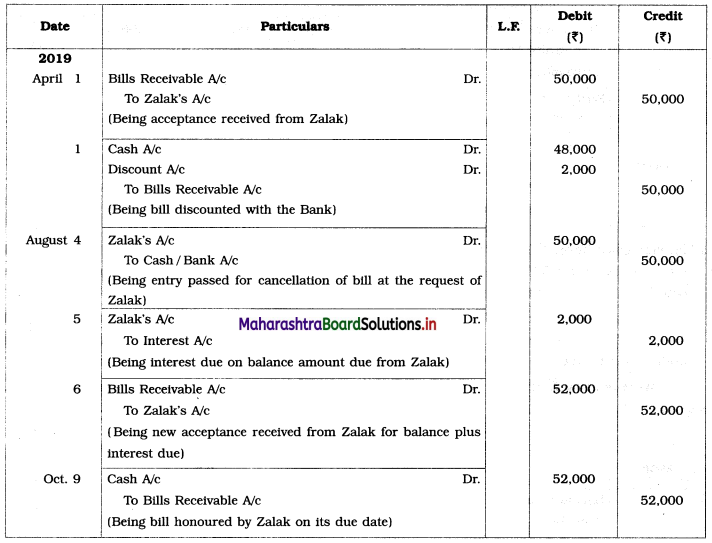
Maharashtra Board 12th BK Important Questions Chapter 7 Bills of Exchange Q1

In the books of Zalak
Journal Entries
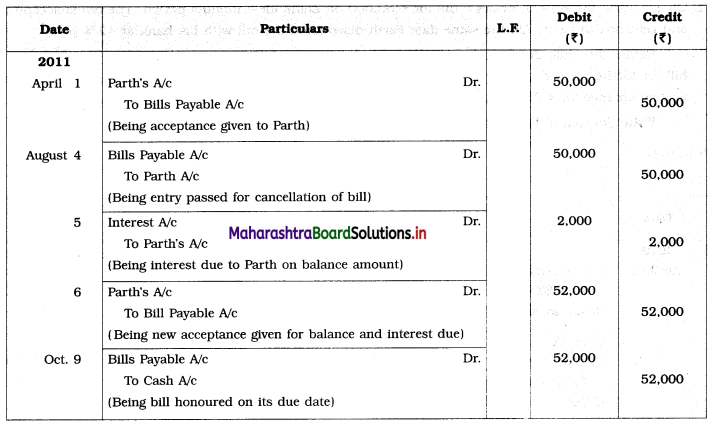
Maharashtra Board 12th BK Important Questions Chapter 7 Bills of Exchange Q1.1

Question 2.
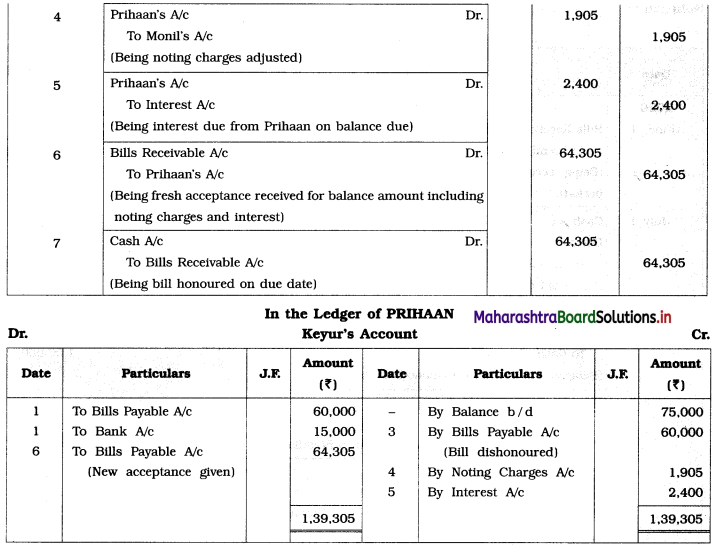
Prahran owes Keyur ₹ 75,000. Keyur draws a bill for ₹ 60,000 on Prihaan for 4 months period and received the cheque for the balance. The bill is duly accepted and returned by Prahran. On the same date, Keyur endorsed Prihaan’s acceptance to Monil.
On the due date, Monil informed Keyur that Prihaan dishonored his acceptance and ₹ 1,905 paid as noting charges. Keyur then drew a new bill for 3 months on Prihaan for the amount due including noting charges and interest of ₹ 2,400. On the due date, the bill was duly honoured by Prihaan.
Write Journal Entries in the books of Keyur and prepare Keyur’s account in the books of Prihaan.
Solution:
In the books of Keyur
Journal Entries
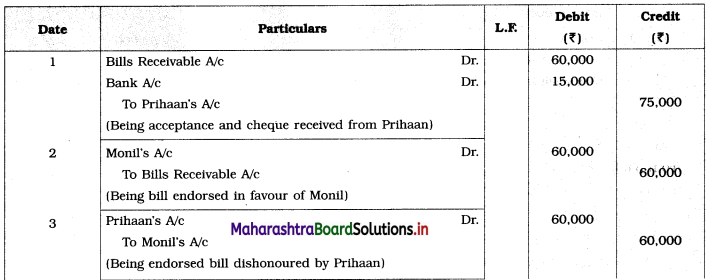
Maharashtra Board 12th BK Important Questions Chapter 7 Bills of Exchange Q2
Maharashtra Board 12th BK Important Questions Chapter 7 Bills of Exchange Q2.1

Working Notes:
1. Amount paid by cheque = Total amount due from Prihaan – the amount of Bill accepted
= 75,000 – 60,000
= ₹ 15,000

2. Amount for which new bill is drawn = Amount of bill dishonoured + Noting charges + Interest
= 60,000 + 1,905 + 2,400
= ₹ 64,305

Note: For easy understanding, the students are advised to draft the journal entries in the journal of Prihaan first. So that they will be able to understand ledger entries of Keyur’s A/c opened in the ledger of Prihaan.

Maharashtra Board 12th BK Important Questions Chapter 7 Bills of Exchange

Question 3.
On 1st June, 2020 Bela draws a bill for ₹ 1,00,000 on Premila for 4 months period. The bill is duly accepted and returned to Bela. One month after the date, Bela discounted the bill with bank @ 18% p.a.
On the due date, Premila dishonoured her acceptance. Bank paid noting charges ₹ 2,250. Premila requested Bela to renew the bill for a further period of 2 months. Bela agreed and took the bill back from the bank and received new acceptance for 40% amount of the bill with the full amount of noting charges and a cheque for 60% balance plus interest @ 12% p.a.
Before the due date, Premila was declared as insolvent and 30% of the amount due could be recovered from her private estate.
Write Journal of Bela and Premila for the above bill transactions.
Solution:
In the books of Bela
Journal Entries
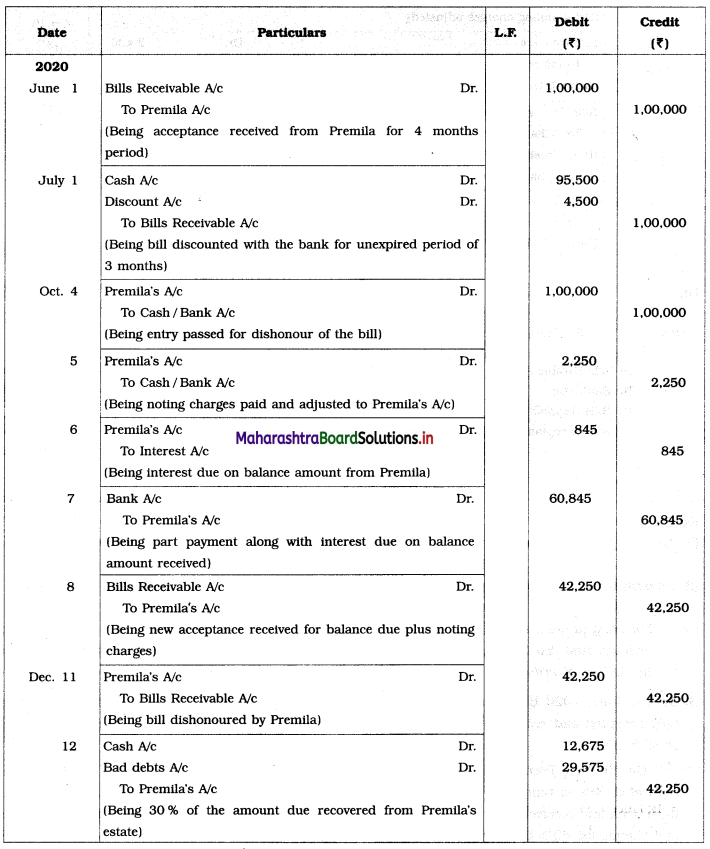
Maharashtra Board 12th BK Important Questions Chapter 7 Bills of Exchange Q3

In the books of Premila
Journal Entries
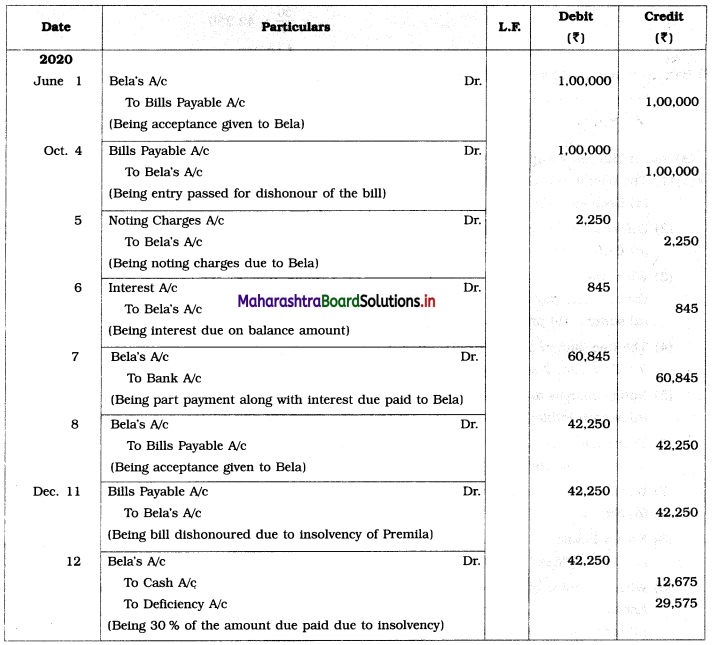
Maharashtra Board 12th BK Important Questions Chapter 7 Bills of Exchange Q3.1

Working Notes:
1. Discount charged by the bank on discounting 1st bill = 1,00,000 × \(\frac{3}{12} \times \frac{18}{100}\) (Period of bill is 4 months, but it is discounted 1 month later) = ₹ 4,500

2. Amount paid by Premila to Bela in Part payment = 60% of Bill amount
= 60% of 1,00,000
= ₹ 60,000

3. Balance amount still due from Premila to Bela = 40% of Bill amount
= 40% of 1,00,000
= ₹ 40,000

4. Interest is to be calculated on total amount due from Premila = Balance due + Unpaid amount noting charges
= 40,000 + 2,250
= ₹ 42,250
Interest due = Balance amount × Unexpired period × Rate of interest
= 42,250 × \(\frac{2}{12} \times \frac{12}{100}\)
= ₹ 845

5. Amount paid by Premila to Bela = 60,000 + 845 = ₹ 60,845.

Maharashtra Board 12th BK Important Questions Chapter 7 Bills of Exchange

6. Amount for which new bill is drafted and accepted = ₹ 42,250.

7. Amount recovered by Bela from the property of Premila = 30% of total amount due
= \(\frac{30}{100}\) × 42,250
= ₹ 12,675

8. Bad debts incurred by Bela = Total Amount due – Amount recovered
= 42,250 – 12,675
= ₹ 29,575
Maharashtra Board 12th BK Important Questions Chapter 6 Dissolution of Partnership Firm

Balbharti Maharashtra State Board 12th Commerce Book Keeping & Accountancy Important Questions Chapter 6 Dissolution of Partnership Firm Important Questions and Answers.

Maharashtra State Board 12th Commerce BK Important Questions Chapter 6 Dissolution of Partnership Firm

1. Objective Questions:

A. Select the most appropriate answer from the alternatives given below and rewrite the sentences.

Question 1.
_____________ means winding up of partnership firm.
(a) Dissolution
(b) Formation
(c) Retirement
(d) Death
Answer:
(a) Dissolution

Question 2.
When a partner takes over a liability, his Capital Account is _____________
(a) debited
(b) credited
(c) deducted
(d) none of these
Answer:
(b) credited

Maharashtra Board 12th BK Important Questions Chapter 6 Dissolution of Partnership Firm

Question 3.
Dissolution expenses are debited to the _____________ Account.
(a) Profit and Loss
(b) Trading
(c) Capital
(d) Realisation
Answer:
(d) Realisation

Question 4.
The debit balance on Realisation A/c indicates _____________
(a) profit
(b) loss
(c) gain
(d) deficiency
Answer:
(b) loss

Question 5.
The partner who is unable to pay his liabilities is called an _____________ partner.
(a) solvent
(b) working
(c) insolvent
(d) sleeping
Answer:
(c) insolvent

Question 6.
Debit balance of insolvent Partner’s Capital Account is known as _____________
(a) capital deficiency
(b) capital surplus
(c) profit
(d) loss
Answer:
(a) capital deficiency

B. Give the word/term/phrase which can substitute each of the following statements.

Question 1.
The account records all realisable assets and external liabilities of the firm on dissolution.
Answer:
Realisation Account

Question 2.
The partner who bears capital deficiency of an insolvent partner.
OR
The person who bears insolvency loss of an insolvent partner.
Answer:
Solvent Partner

Maharashtra Board 12th BK Important Questions Chapter 6 Dissolution of Partnership Firm

Question 3.
Account to which the ultimate unpaid balances on the outside liability accounts are transferred on dissolution.
Answer:
Deficiency Account

C. State whether the following statements are True or False with reasons.

Question 1.
The cash and bank balances are not transferred to the Realisation A/c.
Answer:
This statement is True.
Cash or bank balance are liquid assets. They cannot be sold or realised. The cash and/or bank balances are recorded in the Cash and/or Bank Account. All cash and/or bank transactions, at the time of Realisation, are recorded in the Cash and Bank Accounts. Therefore, Cash and Bank balances are not transferred to Realisation Account.

Question 2.
On dissolution, sundry debtors are transferred to Realisation A/c at their net figure.
Answer:
This statement is False.
On dissolution, sundry debtors are transferred to Realisation A/c at their Gross value book value and not at their net figure. R.D.D. which is deducted from debtors is not an asset and therefore R.D.D. is transferred to the credit side of Realisation A/c and the remaining debtors are transferred to the debit side of Realisation A/c.

Question 3.
On dissolution of the firm, the partner’s wife loan is transferred to Realisation A/c.
Answer:
This statement is True.
A loan taken from the partner’s wife is an external liability and it is a third party’s liability. So, the partner’s wife’s loan is transferred to Realisation A/c at the time of dissolution of the firm.

Question 4.
A liability that is not shown in the Balance Sheet on the date of dissolution cannot be repaid.
Answer:
This statement is False.
Liability of the firm which is not yet recorded in the book of accounts is called unrecorded liability. At the time of dissolution unrecorded liability is supposed to be paid though it is not shown in the Balance Sheet.

Maharashtra Board 12th BK Important Questions Chapter 6 Dissolution of Partnership Firm

Question 5.
A debit balance of Realisation A/c indicates profit on realisation.
Answer:
This statement is False.
A debit balance of Realisation A/c means payment is more than the receipt. When payments exceed receipts there is a loss. Hence, debit balance on realisation account indicates loss on realisation and not profit.

D. Answer in one sentence only.

Question 1.
What is Realisation Account?
Answer:
An account that is opened by the firm at the time of its dissolution to determine profit or loss on realisation of assets and payment of liabilities is known as Realisation Account.

Question 2.
Why is the Realisation Account opened?
Answer:
Realisation Account is opened to find out profit or loss made on the sale of assets and discharge of liabilities of the partnership firm.

Question 3.
What are realisation or dissolution expenses?
Answer:
The expenses incurred by the firm to realise the assets and to liquidate the liabilities of the firm on its dissolution are called realisation or dissolution expenses.

Solved Problem

Question 1.
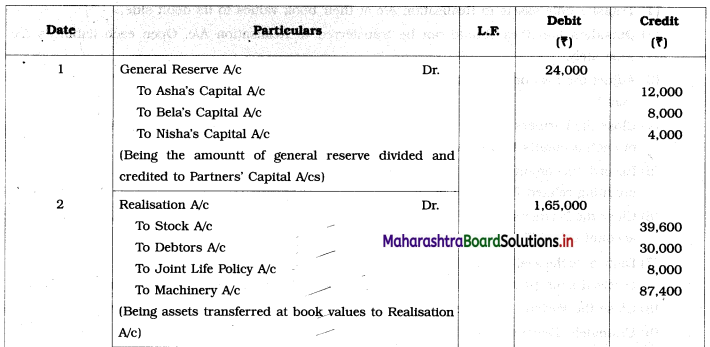
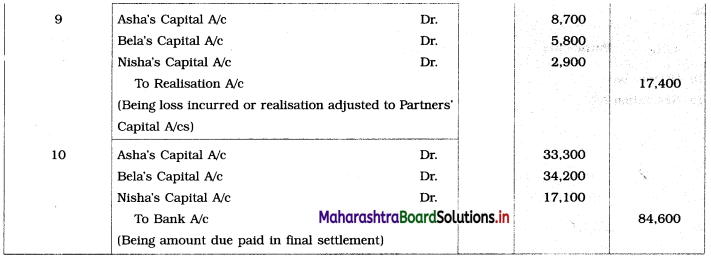
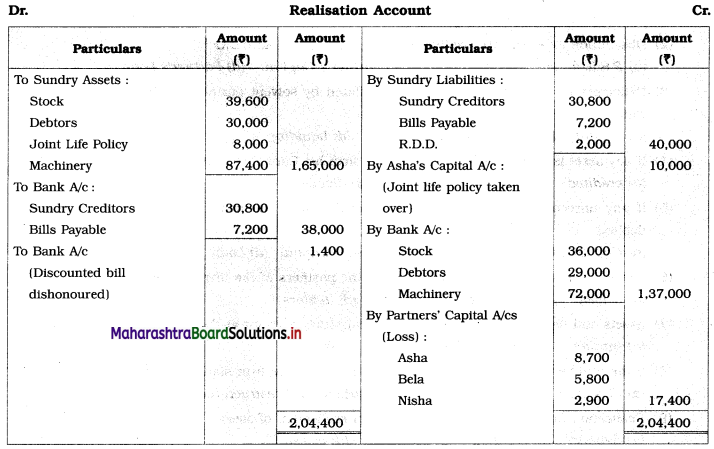
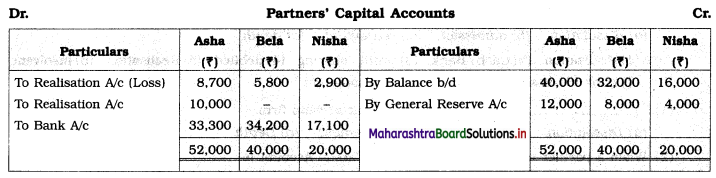
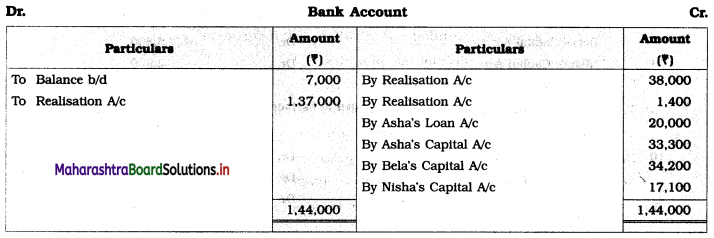
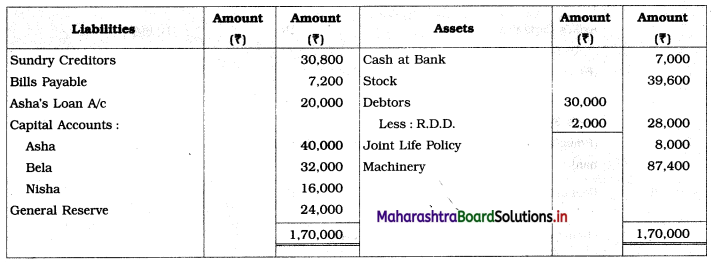
Asha, Bela, and Nisha were partners sharing profits and losses in the ratio of 3 : 2 : 1. On 31st March 2020 their Balance Sheet was as follows:
Balance Sheet as of 31st March 2020
Maharashtra Board 12th BK Important Questions Chapter 6 Dissolution of Partnership Firm Q1
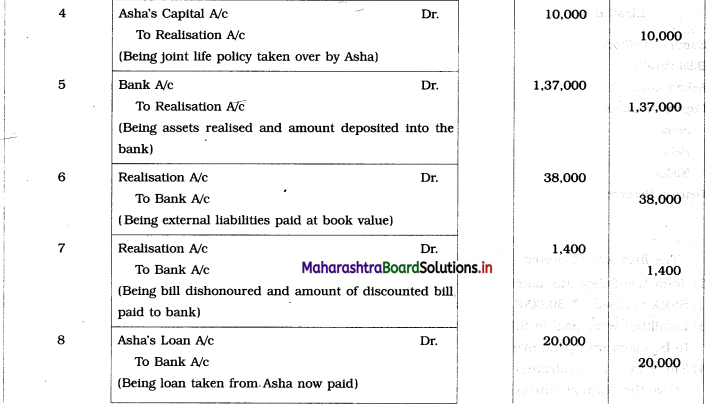
The firm was dissolved on 31st March 2020 and the assets realised as follows:
1. Joint Life Policy was taken over by Asha at ₹ 10,000.
2. Stock realised: ₹ 36,000, Debtors realised: ₹ 29,000, Machinery was sold for ₹ 72,000.
3. Liabilities were paid in full. In addition, one bill for ₹ 700 under discount was dishonoured and had to be taken up by the firm.
4. There were no realisation expenses.
Give the Journal entries and prepare necessary Ledger Accounts to close the books of the firm.
Solution:
In the Journal of Partnership Firm
Maharashtra Board 12th BK Important Questions Chapter 6 Dissolution of Partnership Firm Q1.1
Maharashtra Board 12th BK Important Questions Chapter 6 Dissolution of Partnership Firm Q1.2
Maharashtra Board 12th BK Important Questions Chapter 6 Dissolution of Partnership Firm Q1.3
Ledger Accounts:
In the books of Partnership Firm
Maharashtra Board 12th BK Important Questions Chapter 6 Dissolution of Partnership Firm Q1.4
Maharashtra Board 12th BK Important Questions Chapter 6 Dissolution of Partnership Firm Q1.5
Maharashtra Board 12th BK Important Questions Chapter 6 Dissolution of Partnership Firm Q1.6

Maharashtra Board Class 12 Marathi Yuvakbharati Solutions Bhag 3.2 गढी

Balbharti Maharashtra State Board Marathi Yuvakbharati 12th Digest Bhag 3.2 गढी Notes, Textbook Exercise Important Questions and Answers.

Maharashtra State Board 12th Marathi Yuvakbharati Solutions Bhag 3.2 गढी

12th Marathi Guide Chapter 3.2 गढी Textbook Questions and Answers

कृती 

1. (अ) चौकटी पूर्ण करा.

प्रश्न 1.
गावाचं भरभरून कौतुक पाहणारी
उत्तर :
गावाचे भरभरून कौतुक पाहणारी : वाननदी

Maharashtra Board Class 12 Marathi Yuvakbharati Solutions Bhag 3.2 गढी

प्रश्न 2.
लहानुलं गावाच्या भोवताल झालर असलेला पर्वत
उत्तर :
लहानुलं गावाच्या भोवताल झालर असलेला पर्वत : सातपुडा पर्वत

प्रश्न 3.
बापू गुरुजींना शाळेत पाठवण्याचा आग्रह करणारे
उत्तर :
बापू गुरुजींना शाळेत पाठवण्याचा आग्रह करणारे : पाटील

प्रश्न 4.
गुरुजींच्या समाजकार्याविरुद्ध फळी तयार करणारे
उत्तर :
गुरुजींच्या समाजकार्याविरुद्ध फळी तयार करणारे : उचापती माणसे

(आ) खालील व्यक्तींतील नातेसंबंध स्पष्ट करा.

(a) बापू गुरुजी आणि परबतराव
(b) बापू गुरुजी आणि संपती
(c) लक्ष्मी आणि बापू गुरुजी
(d) बापू गुरुजी आणि पाटील
उत्तर :
(a) बापू गुरुजी आणि परबतराव – बापू गुरुजी हे परबतरावांचे सुपुत्र.
(b) बापू गुरुजी आणि संपती – संपती हा बापू गुरुजींचा मानलेला मुलगा.
(c) लक्ष्मी आणि बापू गुरुजी – लक्ष्मी ही बापू गुरुजींची पत्नी.
(d) बापू गुरुजी आणि पाटील – पाटील हे बापू गुरुजींना मुलाप्रमाणे मानणारे.

2. कृती करा.

प्रश्न 1.
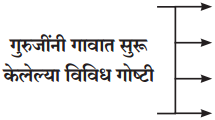
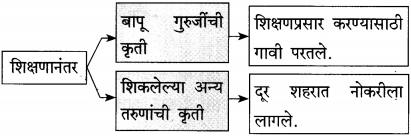
Maharashtra Board Class 12 Marathi Yuvakbharati Solutions Bhag 3.2 गढी 19
उत्तर :
Maharashtra Board Class 12 Marathi Yuvakbharati Solutions Bhag 3.2 गढी 9

प्रश्न 2.
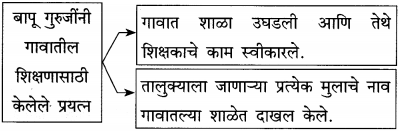
Maharashtra Board Class 12 Marathi Yuvakbharati Solutions Bhag 3.2 गढी 20
उत्तर :
Maharashtra Board Class 12 Marathi Yuvakbharati Solutions Bhag 3.2 गढी 10

Maharashtra Board Class 12 Marathi Yuvakbharati Solutions Bhag 3.2 गढी

3. (अ) खालील शब्दसमूहांचा तुम्हाला समजलेला अर्थ लिहा.

(a) दान्याचा पूर.
(b) मानसानं पयले पानी पावावं आन् मंग पोवावं.
(c) पाखरानं पयले पख पारखावं आन् मंग उळावं.
(d) मले पा आन् फुलं वहा.
उत्तर :
(a) दान्याचा पूर : खूप धान्य पिकत असे.
(b) माणसानं पयले पानी पावावं आन् मंग पोवावं : परिस्थिती समजून घ्यावी, आपला आवाका लक्षात घ्यावा आणि कामाला हात घालावा.
(c) पाखरानं पयले पख पारखावं आन् मंग उळावं : स्वत:ची कुवत पाहून कार्य करायला पुढे व्हावे.
(d) मले पा आन् फुलं वहा : फक्त मलाच चांगले म्हणा.

(आ) वैदर्भी बोलीत वापरलेल्या खालील वाक्प्रचारांचे अर्थ लक्षात घ्या. यासाठी तुमच्या बोलीत किंवा मराठीत वापरले जाणारे वाक्प्रचार लिहा.

(a) मन तिळतिळ दुखने
(b) ठान मांडून उबी रायने
उत्तर :
(a) मन तिळतिळ दुखने : (i) मन तिळतिळ तुटणे., (ii) दुःखाने व्याकूळ होणे.
(b) ठान मांडून उबी रायने : (i) ठाण मांडून बसणे, पाय रोवून उभे राहणे., (ii) कृतीत ठामपणा असणे.

(इ) खालील म्हणींचा अर्थ तुमच्या शब्दांत लिहा.

प्रश्न 1.
हळ्याच्या सरपानं मानसं मरत नसतात.
उत्तर :
हळ्याच्या सरपानं मानसं मरत नसतात.
अर्थ : क्षुद्र व्यक्ती चांगल्या व्यक्तींचे काहीही वाईट करू शकत नाही.

प्रश्न 2.
गायीचे शिंगं गायीले भारी नसतात.
उत्तर :
गायीची शिंगं गायीला भारी नसतात.
अर्थ : आपल्या माणसासाठी खस्ता खाताना कोणालाही त्रास होत नाही.

प्रश्न 3.
चाल व्हयरे पोरा आन् वयरे ढोरा.
उत्तर :
चाल व्हय रे पोरा आन् वय रे ढोरा.
अर्थ : पोरा, चल, पुढे हो आणि ढोरांना ओढून घेऊन जा.

4. कारणे लिहा.

प्रश्न अ.
गावातला जो तो आनंदात होता, कारण…
उत्तर :
गावतला जो तो आनंदात होता; कारण त्या दिवशी गावाला ‘साजरे गाव’ हे पारितोषिक मिळाले होते.

प्रश्न आ.
शिक्षण आटोपल्यावर बापूंना गावाची ओढ लागली, कारण…
उत्तर :
शिक्षण आटोपल्यावर बापूना गावाची ओढ लागली; कारण त्यांना गावात शिक्षणाचा प्रसार करून गाव सुधारायचे होते.

प्रश्न इ.
गाववाले गढी खचण्याची वाट पाहत होते, कारण…
उत्तर :
गाववाले गढी खचण्याची वाट पाहत होते; कारण गढी खचल्यावर गाववाल्यांना पांढरी माती मिळणार होती.

Maharashtra Board Class 12 Marathi Yuvakbharati Solutions Bhag 3.2 गढी

5. थोडक्यात उत्तरे लिहा.

प्रश्न अ.
‘पाखरानं पयले पख पारखावं आन् मंग उळावं’, असे बापू गुरुजी का म्हणत असतील ते स्पष्ट करा.
उत्तर :
आकाशात भरारी मारायची असेल, तर पंख मजबूत असावे लागतात. पंख मजबूत नसतील, तर अर्ध्यावरच पक्षी खाली पडेल, त्या दमलेल्या अवस्थेत त्याला पळताही येणार नाही. उडताही येणार नाही. मग कोणीही त्याला मारतील, खातील. म्हणजेच त्याला स्वत:चे रक्षण करता येणार नाही. स्वत:चे अन्न आणण्यासाठी दूरपर्यंत जाता येणार नाही. हा एक दाखला झाला. हाच सर्वत्र लागू पडतो.

आपण जीवन जगत असताना अनेक गोष्टी करू पाहतो. अशा वेळी आपण कोणती कृती करायची ठरवली आहे; त्या कृतीसाठी कोणते गुण, कोणती कौशल्ये आवश्यक आहेत, ते प्रथम समजून घेतले पाहिजेच. ते गुण, ती कौशल्ये आपल्याजवळ आहेत का, ते तपासून पाहिले पाहिजे. ते गुण कौशल्ये नसतील, तर आपण यशस्वी होणार नाही आणि आपल्याला नैराश्य येण्याचा धोका असतो. म्हणून गुरुजींनी दिलेला दाखला नीट समजून घेतला पाहिजे.

प्रश्न आ.
बोडींगमधला ‘संपती’ नावाचा मुलगा गेल्यानंतर बापू गुरुजींच्या भावना तुमच्या शब्दांत लिहा.
उत्तर :
बोर्डिंगमधल्या संपतीला गुरुजींनी आपला मुलगाच मानले होते. त्याला वडील नव्हते. त्याचे वडील तो लहान असतानाच हे जग सोडून गेले होते. गुरुजींनी त्याला आईबापाची माया दिली होती. पण एक प्रसंग आभाळ कोसळल्यासारखा आला. तालुक्याला शिक्षण समितीची बैठक होती. गुरुजींना बैठकीसाठी जाणे भागच होते. गुरुजी तालुक्याला गेले आणि इकडे संपती पटकीच्या रोगाने त्याच रात्री मरण पावला. या घटनेने गुरुजी व्याकुळले, विव्हळले. याला आपण मुलगा मानला; पण आपण त्याचे रक्षण करू शकलो नाही. गावात दवाखाना असता, तर तो वाचला असता. ते धाय मोकलून रडले. गावात दवाखाना नाही याला जणू आपणच जबाबदार, असे त्यांना वाटू लागले. म्हणून गावातली एक एक उणीव दूर करण्याचा त्यांनी निश्चय केला.

प्रश्न इ.
गुरुजींचा मुलगा वारल्यानंतर बोर्डिंगातल्या मुलांच्या झालेल्या अवस्थेचे वर्णन करा.
उत्तर :
गुरुजी शाळेमध्ये पूर्ण गुंतून पडले होते. त्यांचे त्यांच्या घराकडे, पत्नीकडे, मुलाकडे अजिबात लक्ष नव्हते. एकदा त्यांचा मुलगा खूप आजारी पडला. तापाने फणफणला. पत्नी येऊन रागावून गेली, तेव्हा ते मुलाला घेऊन अकोल्याला डॉक्टरकडे गेले. आपल्या कनवाळू गुरुजींवर फार मोठे संकट आल्याचे मुलांना जाणवले. हे संकट दूर झाले नाही, तर गुरुजी पूर्णपणे कोलमडून पडतील, या भीतीने संपूर्ण बोर्डिंग भकास झाले होते. त्यातले चैतन्यच नष्ट झाले होते. बोर्डिंगातल्या मुलांची जेवणावरची वासना उडाली. कोणीही जेवले नाहीत. सर्वजण निपचीत पडून राहिले होते. तिकडे अकोल्याला डॉक्टरांच्या उपचारांचा काही उपयोग झाला नाही. गुरुजींच्या मुलाने शेवटचा श्वास घेतला. गुरुजी पुरते हादरून गेले. मुले तर त्यांच्यापेक्षाही भेदरून गेले. एकमेकांच्या गळ्यात पडून रडले, गढीसारखे खंबीर गुरुजी सर्व बाजूंनी खचत चाललेले मुलांना पाहवत नव्हते. मुले हादरून गेली होती. अगतिकता, असहायता यांचे दर्शन घडत होते.

6. स्वमत.

प्रश्न अ.
बोर्डिंगात शिकत असलेल्या व शिकून गेलेल्या विदयार्थ्यांचे बापू गुरुजींबद्दल असलेले प्रेम तुमच्या शब्दांत लिहा.
उत्तर :
बोर्डिंगातल्या मुलांवर गुरुजींची खूप माया होती. त्याप्रमाणेच मुलांचेही ते खूप लाडके होते. त्यांच्या शब्दाला विदयार्थ्यांच्या मनात खूप मान होता. त्यांचा शब्द ते कधी खाली पडू देत नसत. गुरुजींच्या मताप्रमाणे वागण्यासाठी सगळेजण धडपडत होते. गुरुजींचाही त्यांच्यावर जीव होता. रोज रात्री मुलांना कंदिलाच्या प्रकाशात घेऊन बसत. त्यांचा अभ्यास घेत; पहाटे उठूनही अभ्यास घेत. गुरुजींचा मुलगा वारला, तेव्हा मुले दुःखाच्या सागरात बुडून गेले.

सातवी पास झाल्यावर विद्यार्थी साहजिकच शाळा सोडत. काही शिकलेल्यांना बापूंनी अन्य गावच्या शाळांत शिक्षक पदावरची नोकरी मिळवून दिली होती. आपली उदरनिर्वाहाची सोय झाली, तरी विद्यार्थी गुरुजींना विसरले नाहीत. गुरुपौर्णिमेच्या दिवशी ते आठवणीने गुरुजींना भेटत. श्रीफळ देऊन त्यांच्या पाया पड़त, त्यांचा आशीर्वाद घेत. आपापल्या गावी जात. त्यांच्या गावी गुरुजींनी यावे, असा ते आग्रहही करीत. अशा प्रकारे आजीमाजी सर्व विदयार्थ्यांचा गुरुजींवर जीव होता.

प्रश्न आ.
गावातल्या उचापती करणाऱ्या लोकांबद्दल तुमचे मत स्पष्ट करा.
उत्तर :
उचापती करणारे लोक सर्वत्र असतात, असे आता माझे मत झालेले आहे. ‘गढी’ या कथेत वर्णन केलेली घटना ग्रामीण भागात घडलेली आहे. शिवाय जुन्या काळात घडलेली आहे. पण असे लोक आताही दिसतात आणि शहरांतसुद्धा आढळतात. हे लोक नेहमी चांगल्या कामात अडथळे आणतात. काही चांगले घडावे, लोक समर्थ व्हावेत, त्यांचे जीवनमान सुधारावे, सर्वांना शिक्षण मिळावे असे त्यांना वाटतच नाही. सर्व समाज उत्तम जीवन जगू लागला, तर त्यांची किंमत नाहीशी होईल, अशी त्यांना भीती वाटते. सगळीकडे सतत काहीतरी वाईट घडत राहिले की, उचापती लोक दांडगाई करून प्रसंगात घुसतात आणि स्वत:चा फायदा करून घेतात. प्रामाणिक कष्ट करून त्यांना जगायचेच नसते. फुकटात पैसा लाटायचा असतो. राजकारणात सध्या अशा लोकांचीच चलती आहे. आपणच या लोकांना ओळखून त्यांना दूर ठेवले पाहिजे. तरच आपला देश सुधारेल.

Maharashtra Board Class 12 Marathi Yuvakbharati Solutions Bhag 3.2 गढी

प्रश्न इ.
‘वान नदीले कदीमधी येनारा पूर आता पटावरल्या आकळ्याइले आला व्हता.’ यातून तुम्हांला समजणारा अर्थ स्पष्ट करा.
उत्तर :
या विधानाचा शब्दशः अर्थ आधी आपण समजून घेऊ, वान नदीला पूर्वी भरपूर पाणी असे. पूर्वी ती भरभरून वाहत होती. अधूनमधून पूरही येई. या नदीच्या पाण्यात जशी वाढ होई, तशी वाढ आता शाळेच्या पटसंख्येत होऊ लागली होती. म्हणजे गुरुजींचे कष्ट फळाला आले होते. ज्या गावात पूर्वी शाळाच नव्हती, त्या गावात आता शाळा आली. इतकेच नव्हे, तर चौथीपर्यंत असलेली शाळा गुरुजींच्या प्रयत्नांमुळे सातवीपर्यंत झाली. मॅट्रिकपर्यंतचे शिक्षण गावातच मिळावे; म्हणून गुरुजींनी गावात हायस्कूल सुरू करण्याचाही प्रयत्न केला. पण उचापती लोकांनी हायस्कूल होऊ दिले नाही. पण नदीला जसा पूर येई, तसा गावातल्या शाळेच्या विद्यार्थी संख्येला पूर येऊ लागला होता. हे मात्र एक सुचिन्ह होते.

7. अभिव्यक्ती.

प्रश्न अ.
‘गढी’, ‘वान नदी’ आणि ‘वटवृक्ष’ या तीन प्रतीकांतून गावातील स्थित्यंतराचे दर्शन कशाप्रकारे घडवले आहे, ते प्रत्येकी एकेका उदाहरणाद्वारे स्पष्ट करा.
उत्तर :
‘गढी’ हे गुरुजींचे प्रतीक आहे. गढी पूर्वी भक्कम होती. गावाला आधार होती. माणुसकीच्या भावनेतून मदत करण्याची गढीची वृत्ती होती. म्हणून गढीच्या पाटलांनी अभ्यासात हुशार असलेल्या बापूंच्या शिक्षणाचा सर्व भार उचलला. तेच गुरुजींनी केले. त्यांनी आपले सर्व आयुष्यच गावाला अर्पण केले. काही काळ गावाला प्रगतीची फळे मिळालीच. ‘साजरे गाव’ हे पारितोषिकही मिळाले. पण कालांतराने गावावर अवकळा आली. प्रगती खुंटली. गढी खचत गेली. बापू गुरुजीही खचत गेले.

‘वाननदी’ हे गावातील जीवनप्रवाहाचे प्रतीक आहे. पूर्वी गरिबी होती, पण गावात निर्मळपणा होता, गावाच्या विकासाची स्वप्नेच जणू काही वाननदी वाहून आणत होती. हळूहळू वाननदीचा प्रवाह आटत गेला, पाणी कमी झाले. शेवटी शेवटी तर नदीने पात्रच बदलले. गावानेही आपला जीवनप्रवाहच बदलून टाकला.

‘वटवृक्ष’ म्हणजे गावच होय. वाननदीच्या काठावर वटवृक्ष अंकुरला, हळूहळू वाढत गेला. मुलांना, वाटसरूंना तो आधार बनला. पण हळूहळू तोही सुकत गेला. गावही बापू गुरुजींच्या प्रयत्नांमुळे अंकुरला, त्याने विकासाची स्वप्ने पाहिली. चांगले दिवस आलेही, पण उचापत्यांमुळे गाव उलट्या दिशेने प्रवास करू लागला. वटवृक्ष सुकत गेला. तसा गावही सुकत गेला.

एकंदरीत, गावाची पडझड झाली. हळूहळू निराशामय गर्तेत गाव अडकत चालला. याचे दर्शन या तिन्ही प्रतीकांमधून घडते.

प्रश्न आ.
पाठाच्या शीर्षकाची समर्पकता पटवून दया.
उत्तर :
‘गढी’ हे गावातील सत्तास्थानाचे प्रतीक आहे. गढीच्या गावावर प्रभाव असायचा. त्याचबरोबर गावाला गढीचा आधारही असायचा, ती गढी स्वातंत्र्यानंतर आपले सत्तास्थान गमावून बसली. तरीही तिचा आधार होता. उन्हापावसाला तोंड देत, त्यांच्याशी झगडत गढी ताठ उभी होती. हळूहळू ती खंगत गेली. चारही बाजूंनी ती कणाकणाने कोसळत होती. उचापती लोकही गढी पडण्याची वाटच बघत होते. गाववाल्यांना गढी कोसळली तर हवीच होती. गढीखालची पांढरी माती त्यांना हवी होती. ते विळ्याने हळूहळू जमीन उकरत होतेच, गाव खरे तर चांगल्या दिशेने चालले होते. पण उचापत्यांनी गावाला वाईट दिशेला ढकलले. गावाची विकासाची दिशा ढळली. जे गढीचे झाले तेच गावाचे झाले. गढी ही कथा त्या लहानशा गावाच्या स्थित्यंतराचे, पडझडीचे चित्रण करते. गावाची जशी पडझड झाली, तशी गढीचीही झाली. तीच गत बापू गुरुजींची झालेली आहे. गाव, बापू गुरुजी यांच्या पतनाची, कोसळण्याची कथा म्हणजे ही गढी होय. म्हणून ‘गढी’ हे शीर्षक अत्यंत समर्पक आहे.

प्रश्न इ.
या कथेतील वैदर्भी बोलीचे तुम्हाला जाणवलेले वेगळेपण लिहा.
उत्तर :
वैदर्भी बोली खरोखरच रसाळ भाषा आहे. ऐकताना मन प्रसन्न होते. कथेतील वर्णने कोरड्या तपशिलाने केली जात नाहीत. हृदय भाषेत ही वर्णने येतात. त्यामुळे भाषा वाचकांच्या मनाची पकड , घेते. कथेत वाक्प्रचार व म्हणींचा मुबलक उपयोग केलेला आहे. किंबहुना बोलीभाषेचे हे वैशिष्ट्यच असते. यामुळे भाषा रसाळ झाली आहे.

Maharashtra Board Class 12 Marathi Yuvakbharati Solutions Bhag 3.2 गढी

भाषा रसाळ होण्याला आणखी एक कारण आहे. ते म्हणजे ध्वनिमाधुर्य हे होय. नामांना, क्रियापदांना लागलेले प्रत्यय पाहा. उदा., गावाले, त्याइच्या, त्याइने, त्याइले हे उदाहरणादाखल दिलेले प्रत्यय लक्षणीय आहेत. त्यांचा उच्चार मृदू, मुलायम आहे. या प्रत्ययांचे प्राबल्य आहे. भाषा वाचताना, ऐकताना मन मृदूमुलायम होऊन जाते.

भाषेची आणखी वैशिष्ट्ये पाहा. ‘वाडा’ हा शब्द वैदर्भीमध्ये ‘वाळा’ होतो. ‘पडल्याने’ या प्रमाण मराठीतील शब्दाचे वैदर्भातील – रूप आहे पळल्याने, याच पाठातील असे खूप शब्द दाखवता येतील. मुद्दा असा की या भाषेची प्रकृतीच मुळी मृदूमुलायम असावी. वैदर्भी भाषेकडून प्रमाण मराठीकडे होणारा प्रवास रसाळतेकडून कोरडेपणाकडे जास्त होतो. प्रमाण भाषेत आखीव-रेखीवपणा जास्त असतो. त्यामुळे औपचारिकपणा जास्त येतो. थोडक्यात, हे आहे वैदर्भी भाषेचे मला जाणवलेले वेगळेपण.

Marathi Yuvakbharati 12th Digest Chapter 3.2 गढी Additional Important Questions and Answers

कृति

1. चौकटी पूर्ण करा :

प्रश्न 1.
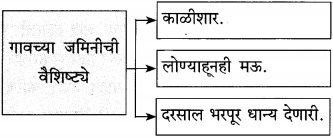
काळीशार, लोण्याहूनही मऊ असलेली
उत्तर :
काळीशार, लोण्याहूनही मऊ असलेली : गावची जमीन

प्रश्न 2.
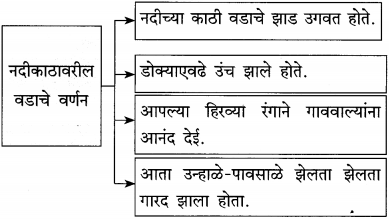
नदीच्या काठी वाढत गेलेले झाड
उत्तर :
नदीच्या काठी वाढत गेलेले झाड : वडाचे झाड

प्रश्न 3.
वाडा पडल्याने उघडी – पडलेली
उत्तर :
वाडा पडल्याने उघडी पडलेली : गढी

प्रश्न 4.
गावाला मिळालेला मान :
उत्तर :
गावाला मिळालेला मान : साजरे गाव

प्रश्न 5.
उभा जन्म गाववाल्यांची सेवा करणारे
उत्तर :
उभा जन्म गाववाल्यांची सेवा करणारे : बापू गुरुजी

प्रश्न 6.
गावात काही सोयी नाहीत म्हणत शहरात जाणारी :
उत्तर :
गावात काही सोयी नाहीत म्हणत शहरात जाणारी : नवी पिढी

Maharashtra Board Class 12 Marathi Yuvakbharati Solutions Bhag 3.2 गढी

प्रश्न 7.
कार्यक्रमापासून दूर जाऊ पाहणारे
उत्तर :
कार्यक्रमापासून दूर जाऊ पाहणारे : बापू गुरुजी

2. कृती करा :

प्रश्न 1.
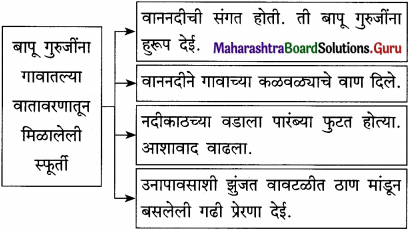
Maharashtra Board Class 12 Marathi Yuvakbharati Solutions Bhag 3.2 गढी 1
उत्तर :
Maharashtra Board Class 12 Marathi Yuvakbharati Solutions Bhag 3.2 गढी 11

प्रश्न 2.
Maharashtra Board Class 12 Marathi Yuvakbharati Solutions Bhag 3.2 गढी 2
उत्तर :
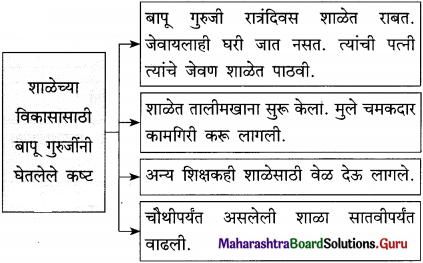
Maharashtra Board Class 12 Marathi Yuvakbharati Solutions Bhag 3.2 गढी 12

प्रश्न 3.
Maharashtra Board Class 12 Marathi Yuvakbharati Solutions Bhag 3.2 गढी 3
उत्तर :
Maharashtra Board Class 12 Marathi Yuvakbharati Solutions Bhag 3.2 गढी 13

Maharashtra Board Class 12 Marathi Yuvakbharati Solutions Bhag 3.2 गढी

प्रश्न 4.
Maharashtra Board Class 12 Marathi Yuvakbharati Solutions Bhag 3.2 गढी 4
उत्तर :

प्रश्न 5.
Maharashtra Board Class 12 Marathi Yuvakbharati Solutions Bhag 3.2 गढी 5
उत्तर :
Maharashtra Board Class 12 Marathi Yuvakbharati Solutions Bhag 3.2 गढी 15

प्रश्न 6.
Maharashtra Board Class 12 Marathi Yuvakbharati Solutions Bhag 3.2 गढी 6
उत्तर :
Maharashtra Board Class 12 Marathi Yuvakbharati Solutions Bhag 3.2 गढी 16

Maharashtra Board Class 12 Marathi Yuvakbharati Solutions Bhag 3.2 गढी

प्रश्न 7.
Maharashtra Board Class 12 Marathi Yuvakbharati Solutions Bhag 3.2 गढी 7
उत्तर :
Maharashtra Board Class 12 Marathi Yuvakbharati Solutions Bhag 3.2 गढी 17

प्रश्न 8.
Maharashtra Board Class 12 Marathi Yuvakbharati Solutions Bhag 3.2 गढी 8
उत्तर :
Maharashtra Board Class 12 Marathi Yuvakbharati Solutions Bhag 3.2 गढी 21

Maharashtra Board Class 12 Marathi Yuvakbharati Solutions Bhag 3.2 गढी

3. वैदर्भी बोलीत वापरलेल्या पुढील वाक्प्रचारांचे अर्थ लक्षात घ्या आणि त्यांसाठी तुमच्या बोलीत किंवा मराठीत वापरले जाणारे वाक्प्रचार लिहा :

(a) रगत आटवने : ……………………..
(b) ऊर भरभरून येते : ……………………..
(c) लाळ करने : ……………………..
(d) चटनीवर तेल न सापळणे : ……………………..
(e) सपन डोयात फुलने : ……………………..
(f) जीव वतने : ……………………..
(g) शाननं उबं व्हने : ……………………..
(h) मायेची वाकय घालने : ……………………..
(i) हिंमत बांदून उटने : ……………………..
(j) लोये तोळने : ……………………..
(k) पोटापान्याला लागने : ……………………..
(l) पदरात पळने : ……………………..
उत्तर :
(a) रगत आटवने : (i) रक्त आटवणे., (ii) खूप कष्ट घेणे.
(b) ऊर भरभरून येणे : (i) ऊर भरून येणे., (ii) मनात अभिमान किंवा कौतुक किंवा आनंद दाटणे.
(c) लाळ करने : (i) लाड करणे., (ii) खूप प्रेमाने वागवणे.
(d) चटनीवर तेल न सापळणे : (i) नेहमी कमतरता असणे., (ii) खूप गरिबी असणे.
(e) सपन डोयात फुलने : (i) मनात स्वप्न फुलणे., (ii) भविष्याविषयी खूप आशावादी चित्र निर्माण होणे.
(f) जीव वतने : (i) जीव ओतणे., (ii) खूप मन:पूर्वक, कष्टपूर्वक काम करणे.
(g) शाननं उबं व्हने : (i) डौलात उभे राहणे., (ii) आनंदाने व आत्मविश्वासाने वागणे.
(h) मायेची वाकय घालने : (i) मायेचे पांघरूण घालणे., मायेची पाखर घालणे.
(i) खूप माया करणे. (११) हिंमत बांदून उटने : (i) धीर एकवटून उठणे., (ii) हिमतीने तोंड देणे. हिमतीने लढायला सिद्ध होणे,
(j) लोये तोळने : (i) लचके तोडणे., (ii) एक एक तुकडा तोडावा तशा वेदना देणे.
(k) पोटापान्याला लागने : (i) पोटापाण्याला लागणे., (ii) कामधंदा मिळणे.
(l) पदरात पळने : (i) पदरात पडणे., (ii) न मागता, फार हवीशी नसताना मिळणे.

4. पुढील म्हणींचा अर्थ तुमच्या शब्दांत लिहा :

प्रश्न 1.
घरी तेल हाये तं मीठ नायी; आन् मीठ हाये त चटनी नायी.
उत्तर :
घरी तेल हाये तं मीठ नायी; आन मीठ हाये त चटणी नायी.
अर्थ : अत्यंत गरिबी असणे.

प्रश्न 2.
नासकुला हळयाई पिंडाला झोम्बते.
उत्तर :
नासकुला हळयाई पिंडाला झोम्बते.
अर्थ : क्षुद्र जीवसुद्धा पोटासाठी धडपडतो.

Maharashtra Board Class 12 Marathi Yuvakbharati Solutions Bhag 3.2 गढी

प्रश्न 3.
खुटे गाळ खुटे उपळ.
उत्तर :
खुटे गाळ खुटे उपळ.
अर्थ : खुंट जमिनीत गाडायचा आणि उपटायचा, अशी निरर्थक रिकामपणची कामे करीत बसणे.

गढी लेखिकांचा परिचय

लेखिकांचे नाव :
डॉ. प्रतिमा इंगोले

साहित्यिक व्यक्तिमत्त्व :
सुप्रसिद्ध ग्रामीण कथाकार, कवयित्री, कथाकथनकार म्हणूनही चांगली ओळख. ललित, विनोदी व वैचारिक स्वरूपाचे लेखनही प्रसिद्ध आहे. बालसाहित्य लेखिका म्हणूनही त्या प्रसिद्ध आहेत. त्यांनी विविध विषय आपल्या साहित्यातून हाताळले आहेत. लोकसाहित्याच्या प्रख्यात अभ्यासक आहेत. ८० हून अधिक पुस्तके प्रसिद्ध. आपल्या काव्यांमधून ग्रामीण जीवनातील जीवघेणा संघर्ष प्राधान्याने चित्रित केला आहे. सामाजिक विषयांवर प्रत्यक्ष संशोधन करून विपुल लेखन केले आहे.

ग्रंथसंपदा :
अकसिदीचे दाने’, ‘अंधारपर्व’, ‘अन् मृगधारा बरसल्या’, ‘अमंगल युग’ वगैरे अनेक कथासंग्रह प्रसिद्ध. ‘आजही स्त्रीचे स्थान दुय्यमच’, ‘आत्मघाताचे दशक’ वगैरे वैचारिक स्वरूपाची पुस्तके. ‘करारी आजी’, ‘उजळ आजोबा’ वगैरे बालसाहित्य क्षेत्रातील पुस्तके प्रसिद्ध. ‘बोडखी’, ‘पार्ट टाईम’ यांसारख्या अनेक कादंबऱ्या प्रसिद्ध

पुरस्कार पारितोषिके :
महाराष्ट्र साहित्य पुरस्कार, संत गोरोबा सामाजिक पुरस्कार, महाराष्ट्र शासनाचा पुरस्कार, जनसंवाद पुरस्कार, करवीर साहित्य परिषदेतर्फे ‘दत्ता डावजेकर स्मृती पुरस्कार’ असे अनेक पुरस्कार प्राप्त.

गढी  कथेचा गोषवारा

  1. सातपुड्याच्या कुशीत वसलेल्या एका लहानशा गावाची ही कथा आहे. गाव तसे खाऊनपिऊन सुखी होते. गावाला निसर्गाची साथ होती.
  2. फ्लॅशबॅक पद्धतीने ही कथा आकार घेते. आज त्या गावात धामधुम होती. गावाला शासनाचा ‘साजरे गाव’ हा पुरस्कार जाहीर झालेला आहे. बापू गुरुजी या आदर्श शिक्षकाचाही त्या समारंभात सत्कार होणार आहे. साजरे गाव या पारितोषिकापर्यंत गावाचा प्रवास होण्यात बापू गुरुजींचा फार मोठा वाटा आहे. मात्र बापू खूप उदासवाणे झालेले आहेत. त्यांना समारंभात व त्यांच्या सत्कारात गोडी वाटत नाही.
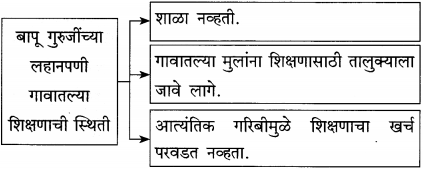
  3. गुरुजींच्या लहानपणी गावात शाळा नव्हती. मुले तालुक्याला शिकायला जात. गुरुजींची घरची गरिबी होती. पण गढीवरच्या पाटलांनी त्यांच्या शिक्षणाचा खर्च केला. गुरुजी शिकले आणि त्यांनी गावाच्या विकासाला वाहून घेतले. गुरुजींच्या बरोबर शिकलेल्यांनी शहरांची वाट धरली.
  4. देश नुकताच स्वतंत्र झाला होता. नव्या प्रेरणांचे वारे सर्वत्र वाहत होते. गुरुजींना गावाच्या विकासाची स्वप्ने पडू लागली. गुरुजींना निवडणुकीच्या राजकारणात रस नव्हता. गुरुजींनी गावाच्या विकासाला वाहून घेतले. पण स्वत:च्या घराकडे दुर्लक्ष केले.
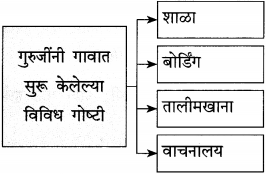
  5. गुरुजी सकाळ–संध्याकाळ, रात्री–बेरात्री शाळेतच दिसू लागले. त्यांनी शाळा नावारूपाला आणली. चौथीपर्यंतची शाळा सातवीपर्यंत झाली. गुरुजींनी शाळेत तालीमखाना सुरू केला.
  6. गावातल्या उचापती लोकांना हे सर्व पाहावले नाही. त्यांनी गुरुजींच्या कार्यात खोडे घालायला सुरुवात केली. दरम्यान गुरुजींना ‘आदर्श शिक्षका’चे पारितोषिक मिळाले. त्यांनी पारितोषिकाच्या रकमेतून वाचनालय सुरू केले. लहानसे बोर्डिंग चालू केले.
  7. बोर्डिंगातील मुलांचे ते लाडके गुरुजी झाले. बोर्डिंगाची पूर्ण काळजी गुरुजी घेत होते. मुलांना ते स्वतःची लेकरेच समजत. बोर्डिंगातला संपती तर त्यांचा मानलेला मुलगा बनला. गावात दवाखाना नव्हता. संपती पटकीच्या रोगाला बळी पडला.
  8. गुरुजींना गावात दवाखाना आणण्याची स्वप्ने पडू लागली. त्यांनी गावात पोस्ट आणले. पण उचापत्या लोकांमुळे पोस्ट गावातून गेले. सडक येऊ घातली, पण त्याच लोकांनी सडक होऊ दिली नाही. या गोष्टीचे गुरुजींना खूप दुःख झाले, त्यांची उमेद खचू लागली. दरम्यान वाननदी सुकत गेली. तिने पात्र बदलले.
  9. गुरुजींचा मुलगा आजारी पडला. तापाने फणफणला, पण गुरुजींनी तिकडे लक्ष दिले नाही. मुलगा आजाराला बळी पडला. गुरुजी गळून गेले. पण बोर्डिंगचे, शाळेतले आजीमाजी विदयार्थी गुरुजींचा खूप आदर करीत.
  10. गाव खचत गेला. गुरुजीसुद्धा खचत गेले. आजच्या कार्यक्रमाचे म्हणूनच त्यांना कौतुक नव्हते. त्यांच्या अंगातले त्राण संपत चालले. पाय लटलट कापत होते. पाय उचलला की भोवळ येई. आपण काय करू पाहत होतो आणि काय घडले? गुरुजींना याचा विषाद वाटला.

Maharashtra Board Class 12 Marathi Yuvakbharati Solutions Bhag 3.2 गढी

गढी शब्दार्थ :

  • दुपटा – दोन रस्ते मिळतात ती जागा; जेथे पारावर गावकरी जमतात,
  • वसेल – वसलेले. व्हतं – होते.
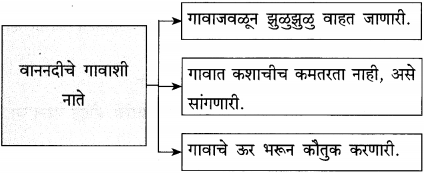
  • गावासेजून – गावाजवळून.
  • झुममूय – झुळुझुळु,
  • वायता वायता – वाहता वाहता.
  • वान नाही – वानवा नाही, कमतरता नाही.
  • कायीशार – काळीशार,
  • लोन्यावानी – लोण्याप्रमाणे,
  • भरूभरू – भरभरून.
  • कवतीक – कौतुक.
  • कराळी – काठावर,
  • झाळ – झाड.
  • पायत – पाहत.
  • उनाये-पावसाये – उन्हाळेपावसाळे,
  • वाळा पळल्यानं – वाडा पडल्यानं.
  • पांढ्ढी पांढ्ढी – पांढरी पांढरी.
  • उघळी पळली – उघडी पडली.
  • कारुन – का म्हणून.
  • गावाले – गावाला,
  • गोठ – गोष्ट.
  • बयठकीतल्या – बैठकीतल्या.
  • त्याइच्या – त्यांच्या.
  • आवतन – आमंत्रण.
  • गाववाल्याइनं – गाववाल्यांनी.
  • कऱ्याचं – करायचे.
  • ठरोल – ठरवले.
  • काइच – काहीच.
  • नोतं – नव्हतं.
  • रावूरावू – राहून राहून.
  • रगत आटोलं – रक्त आटवले.
  • मातर – मात्र.
  • लानपनी – लहानपणी.
  • शाया – शाळा.
  • गळीवरला – गढीवरील.
  • शेजीच – शेजारीच.
  • लाळ – लाड.
  • सापळत – सापडत,
  • गरिबाले – गरिबाला,
  • कोळलंच – कोरडेच.
  • फकत – फक्त. Maharashtra Board Class 12 Marathi Yuvakbharati Solutions Bhag 3.2 गढी
  • इतले – इतके.
  • शिकेल – शिकलेला.
  • गळी – गढी.
  • शयरात – शहरात.
  • नवकरीले – नोकरीला.
  • नासकुल्या – क्षुल्लक, सामान्य.
  • पायनं – पाहणे, हू
  • लागलं – होऊ लागले.
  • डोयात – डोळ्यात.
  • पोयता पोयता – पोहता पोहता.
  • वान देल्लं – वाण दिले.
  • वावटयीत – वावटळीत.
  • सवतंतर – स्वतंत्र.
  • झकास – विकास.
  • पेरमानं – प्रेमाने.
  • व्हयेल गळी – झालेला गडी.
  • पानी पावावं – पाणी पाहावे (किती खोल सुरक्षित आहे, वगैरे).
  • पख पारखावं – पंख पारखावेत,
  • उळावं – उडावं.
  • हे बी तं – हीसुद्धा तर.
  • आंदी – आधी.
  • वतून – ओतून.
  • कई पा – कधीही बघा.
  • लकषुमीच – लक्ष्मीच.
  • पावू पावू – पाहून पाहून,
  • सेल्यासेवटी – सरतेशेवटी.
  • धाळून – धाडून, पाठवून,
  • जियाले – जेवायला.
  • आकळ्याइले – आकड्याला (आकड्याइतका).
  • तसीई – तशीही.
  • पोट्याइची – मुलांची.
  • नोती – नव्हती,
  • जीतून – जिंकून. Maharashtra Board Class 12 Marathi Yuvakbharati Solutions Bhag 3.2 गढी
  • उचापती मानसाइले – उपद्व्यापी.
  • नायी कोई सादलं – काही साधले नाही, जमले नाही.
  • जयताळेपना – जळफळाट.
  • हळ्याच्या सरपानं – गवताच्या सापानं,
  • पयस्याचं – पैशाचे.
  • लानसक – लहानसे.
  • खळकूई – कवडीही.
  • लळले – रडले.
  • धुवारी – धार (पाण्याची).
  • पयलमसुट्ट्या – पहिल्या फटक्यात.
  • गढीलोग – गढीपर्यंत.
  • तपेल फफूटातून – तापलेल्या फुफाटातून.
  • सईन व्हईन – सहन होईल?
  • मऱ्याच्या – मरणाच्या.
  • आताई – आताही, आतासुद्धा.
  • लेकराची गुळी – लेकराचा गोडवा, बाळ जन्मल्याची गोड बातमी.
  • लोये तोळत – गोळे तोडत.
  • काऊन कयत नसीन – का बरे कळत नसेल?
  • इरल्यावानी – विरून गेल्यासारखे.
  • उजिळात – उजेडात.
  • झाकुल्यात – पहाटेला.
  • आखीन – आणखी.
  • इस्त्यावानी – विस्तवासारखा.
  • पालट पळना नाही – फरक पडला नाही.
  • अवकानी – अवकाळी,
  • गढीलेई झोळलं – गढीलाही झोडले.
  • चवूभवताल – चारही बाजूंनी.
  • अखाळीला – आषाढीला (आषाढ पौर्णिमा म्हणजे गुरुपौर्णिमा),
  • सळक – सडक.
  • पळीत – पडीत, पडीक,
  • कायले – कशाला,
  • अथी – इथे.
  • दुकळीत – गंजिफाच्या खेळातील दुक्कलीत.
  • भळकोनारा – भडकवणारा,
  • सवतंतरानई – स्वातंत्र्याने, स्वातंत्र्यात.
  • गाटापान्याचं – चिखल–पाण्याचे.
  • जीव सोळत होते – जीव सोडत होते, मरण पावत होते.
  • इव्यानं – विळ्याने.
  • सारोयाले – सारवायला.
  • पातरच – पात्रच.
  • कोळली पळत – कोरडी पडत.

Maharashtra Board Class 12 Marathi Yuvakbharati Solutions Bhag 3.2 गढी

गढी  वाक्प्रचार व त्यांचे अर्थ

  • मन तिळतिळ दुखने – दु:खाने व्याकूळ होणे.
  • ठान मांडून उबी रायने – पाय रोवून उभे राहणे.
  • रगत आखणे – खूप कष्ट घेणे.
  • ऊर भरभरून येणे – अभिमान/कौतुक/आनंद मनात दाटणे.
  • लाळ करने – खूप प्रेमाने वागवणे.
  • चटणीवर तेल न सापळणे – खूप गरिबी असणे.
  • सपन डोळ्यात फुलने – भविष्याविषयी मनात आशावादी चित्र निर्माण होणे.
  • जीव वतने – खूप मनापासून कष्टपूर्वक काम करणे.
  • शाननं उबं व्हने – आनंदाने व आत्मविश्वासाने वागणे.
  • मायेची वाकय घालने – खूप माया करणे.
  • हिंमत बांदून उटने – हिमतीने लढायला सिद्ध होणे.
  • लोये तोळणे – एक एक तुकडा तोडावा तशा वेदना देणे.
  • पोटापान्याला लागणे – कामधंदा मिळणे.
  • पदरात पळने – (एखादी गोष्ट) न मागता, फार हवीशी नसताना मिळणे.

Maharashtra Board 12th BK Important Questions Chapter 5 Reconstitution of Partnership (Death of Partner)

Balbharti Maharashtra State Board 12th Commerce Book Keeping & Accountancy Important Questions Chapter 5 Reconstitution of Partnership (Death of Partner) Important Questions and Answers.

Maharashtra State Board 12th Commerce BK Important Questions Chapter 5 Reconstitution of Partnership (Death of Partner)

1. Objective questions:

A. Select the most appropriate answer from the alternative given below and rewrite the sentences.

Question 1.
Share of loss of a deceased partner till the date of death is _____________
(a) debited to Profit and Loss-Adjustment A/c
(b) credited to Profit and Loss-Adjustment A/c
(c) debited to Profit and Loss Suspense A/c
(d) credited to Profit and Loss Suspense A/c
Answer:
(d) credited to Profit and Loss Suspense A/c

Question 2.
Gain ratio is calculated on _____________
(a) admission of a partner
(b) retirement of a partner
(c) death of a partner
(d) retirement or death of a partner
Answer:
(d) retirement or death of a partner

Maharashtra Board 12th BK Important Questions Chapter 5 Reconstitution of Partnership (Death of Partner)

Question 3.
Share of profit of a deceased partner till the date of death is _____________
(a) debited to Profit and Loss-Adjustment A/c
(b) credited to Profit and Loss-Adjustment A/c
(c) debited to Profit and Loss Suspense A/c
(d) credited to Profit and Loss Suspense A/c
Answer:
(c) debited to Profit and Loss Suspense A/c

Question 4.
An amount received from the Insurance Company against the joint-life policy is _____________
(a) debited to the deceased partner
(b) credited to the deceased partner
(c) credited to Continuing Partners Capital A/c
(d) credited to All Partners’ Capital A/c’s in their profit sharing ratio
Answer:
(d) credited to All Partners’ Capital A/c’s in their profit sharing ratio

Question 5.
M, N, and S are partners in a firm having joint life policy of ₹ 10,00,000 on which premium has been paid by the firm. M dies and his legal representatives want the whole amount of the policy whereas N and S want to distribute the amount among all the partners.
(a) M’s representatives are correct
(b) N and S are correct
(c) All are wrong
(d) Insurance company will decide
Answer:
(b) N and S are correct

Question 6.
X, Y, and Z share profit as 1/2, 3/10, and 1/5 and Z have expired, the new profit ratio of X and Y will be _____________ respectively.
(a) 5 : 8
(b) 5 : 3
(c) 2 : 1
(d) 5 : 2
Answer:
(b) 5 : 3

Maharashtra Board 12th BK Important Questions Chapter 5 Reconstitution of Partnership (Death of Partner)

Question 7.
The interest on drawings of a deceased partner is credited to _____________
(a) Profit and Loss-Adjustment A/c
(b) Revaluation A/c
(c) Capital A/c
(d) Profit and Loss Suspense A/c
Answer:
(d) Profit and Loss Suspense A/c

Question 8.
In the case of death of a partner, a _____________ is opened for revaluation of the assets and liabilities.
(a) Profit and Loss-Adjustment A/c
(b) Profit and Loss A/c
(c) Profit and Loss Suspense A/c
(d) Executor’s Loan A/c
Answer:
(a) Profit and Loss-Adjustment A/c

Question 9.
A balance on the Deceased Partner’s Executor’s Loan Account is shown in the new Balance Sheet on _____________ side.
(a) assets
(b) credit
(c) liabilities
(d) none of these
Answer:
(c) liabilities

B. Write a word, term, phrase, which can substitute each of the following statements.

Question 1.
The account shows the revaluation of assets and liabilities.
Answer:
Revaluation A/c or Profit and Loss Adjustment A/c

Question 2.
Excess of proportionate capital over actual capital.
Answer:
Deficit

Question 3.
The account to which deceased partners’ capital balance is transferred.
Answer:
Deceased Partner’s Executor’s Loan Account

Maharashtra Board 12th BK Important Questions Chapter 5 Reconstitution of Partnership (Death of Partner)

Question 4.
A person is entitled to receive the amount due to a deceased partner.
Answer:
Legal Heir/Executor/Legal Representative of a deceased partner

Question 5.
The account where the deceased partner’s share in the accrued profit from the date of the last Balance Sheet to the date of his death is adjusted.
Answer:
Profit and Loss Suspense A/c

C. State whether the following statements are True or False with reasons.

Question 1.
The death of a partner is like a compulsory retirement.
Answer:
This statement is True.
After the death of a partner, the business is not able to get any kind of services from the deceased partner and he ceases to be a partner of a firm on natural ground. Hence, we can say that the death of a partner is like a compulsory retirement.

Question 2.
The total amount due to the deceased partner is paid in cash to the executor immediately after his death.
Answer:
This statement is False.
Depending on the availability of sufficient cash or bank balance the total amount due to the deceased partner is paid. However, it is not at all necessary to make immediate payment to the legal heir or representative of the deceased partner.

Question 3.
On the death of a partner, his share in the goodwill is divided equally among continuing partners.
Answer:
This statement is False.
On the death of a partner, his share in the goodwill is divided into the old profit ratio of continuing partners.

Question 4.
The deceased partner’s share in profit up to the date of his death will be debited to his Capital A/c.
Answer:
This statement is False.
The deceased partner’s share in profit up to the date of his death will be credited to his Capital A/c as he is entitled to receive it.

Maharashtra Board 12th BK Important Questions Chapter 5 Reconstitution of Partnership (Death of Partner)

Question 5.
For a decrease in the value of assets, Revolution Account is debited.
Answer:
This statement is True.
A decrease in the value of assets means a loss to the business and in that case, Asset Account will be credited and Revaluation Account will be debited.

Question 6.
An amount due to the deceased partner appears in the Balance Sheet.
Answer:
This statement is False.
An amount due to the deceased partner is transferred to his Executor’s Account and the balance if remains in Executor’s Loan Account then appears in the Balance Sheet.

D. Fill in the blanks and rewrite the following sentence.

Question 1.
An amount due to a deceased partner is transferred to _____________ A/c.
Answer:
Executor’s Loan

Question 2.
Death of a partner is like a _____________ retirement.
Answer:
compulsory

Question 3.
Usually assets and liabilities of the firm are revalued on the _____________ of a partner.
Answer:
death

Question 4.
For increase in the value of assets, Revaluation Account is _____________
Answer:
credited

Maharashtra Board 12th BK Important Questions Chapter 5 Reconstitution of Partnership (Death of Partner)

Question 5.
A partner who died is known as _____________
Answer:
deceased partner

Question 6.
A person who represent a deceased partner is known as _____________
Answer:
Legal Heir or Executor.

E. Answer in one sentence only.

Question 1.
How is the gain ratio calculated?
Answer:
The gain ratio is calculated by using the formula:
Gain Ratio = New Ratio – Old Ratio.

Question 2.
When is the gain ratio required to be calculated?
Answer:
The gain ratio is usually calculated at the time of retirement or death of a partner.

Question 3.
How would you treat general reserve on the death of a partner?
Answer:
On the death of a partner, balance in general reserve is transferred to all Partners’ Capital Accounts or Current Accounts in their old profit sharing ratio.

Maharashtra Board 12th BK Important Questions Chapter 5 Reconstitution of Partnership (Death of Partner)

Question 4.
How is the amount due to a deceased partner calculated?
Answer:
The amount due to a deceased partner is calculated by adding his share in general reserve, past accumulated profit, goodwill, profit on revaluation of assets and liabilities, interest on capital, salary payable, etc. in the opening balance of capital and by deducting the share in the past accumulated loss, revaluation loss, drawings and interest on drawings from his capital balance.

Question 5.
How is an amount due to the deceased partner settled?
Answer:
The amount finally due to the deceased partner is settled by transferring the same amount to his Legal Heir or Representative’s Loan Account and the same is paid to the legal heir or representative or executor after completing all legal formalities.

Question 6.
How is the share of the deceased partner in accrued profit calculated?
Answer:
The share of the deceased partner in accrued profit is calculated on the assumed basis of average profit of the past few years and credited to the Deceased Partner’s Capital Account.

Question 7.
How is a debit balance of Profit and Loss Account dealt with on the death of a partner?
Answer:
On the death of a partner, a debit balance of the Profit and Loss Account is adjusted and transferred to all Partners’ Capital/Current Accounts in their old profit sharing ratio.

Solved Problem

Question 1.
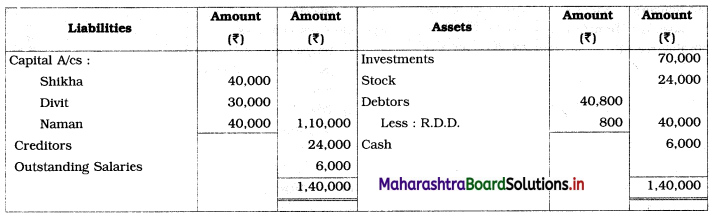
The following is the Balance Sheet of Shikha, Divit, and Naman, who were partners sharing profits and losses in the ratio of 2 : 2 : 1.
Balance Sheet as of 31st March 2020
Maharashtra Board 12th BK Important Questions Chapter 5 Reconstitution of Partnership (Death of Partner) Q1
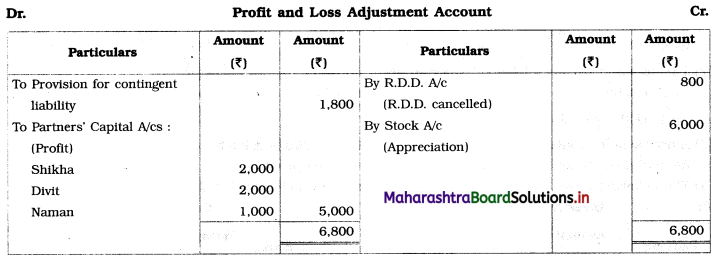
Naman died on 1st July 2020 and the following adjustments were made in the books of the firm:
1. All debtors were considered as good and the Reserve for Doubtful Debts was no longer necessary.
2. A contingent liability for compensation of ₹ 1,800 was to be provided.
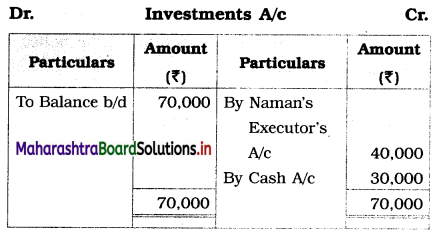
3. Investments worth ₹ 40,000 were taken over by the executor of Naman and the remaining investments were sold for ₹ 30,000.
4. Stock was revalued at ₹ 30,000.
5. The goodwill of the firm was valued at ₹ 20,000 and was to be shown in the books.
6. The deceased partner’s share in profit up to the date of his death was to be calculated on the basis of the preceding year’s profit which was ₹ 16,000.
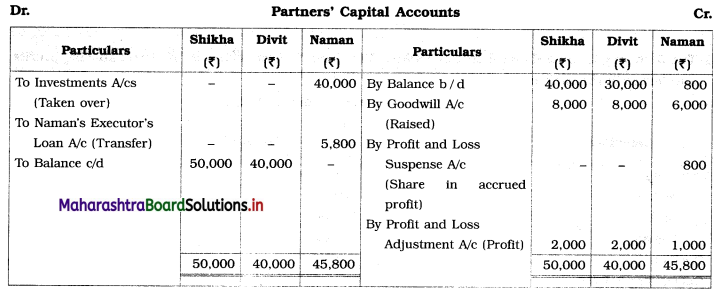
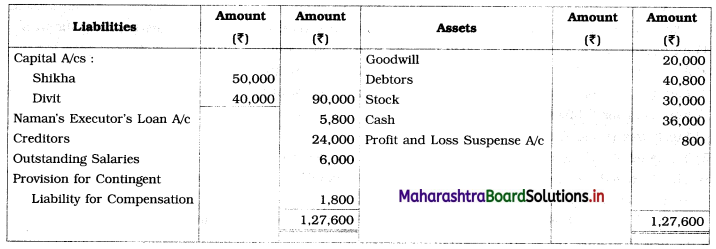
Prepare the Profit and Loss Adjustment Account, Capital Accounts of Partners, and the Balance Sheet of the new firm after the death of Naman.
Solution:
In the books of Partnership Firm
Maharashtra Board 12th BK Important Questions Chapter 5 Reconstitution of Partnership (Death of Partner) Q1.1
Maharashtra Board 12th BK Important Questions Chapter 5 Reconstitution of Partnership (Death of Partner) Q1.2
Balance Sheet as of 1st July 2020
Maharashtra Board 12th BK Important Questions Chapter 5 Reconstitution of Partnership (Death of Partner) Q1.3
Working Notes:
1. Goodwill valued at ₹ 20,000 is debited to Goodwill A/c and credited to all Partners’ Capital A/cs in their profit sharing ratio. Show balance in the Goodwill A/c then transfers to the Assets side of the Balance Sheet.

2. The deceased partner’s (Naman) share in profit up to the date of his death = (Preceding year’s profit) × (Proportionate profit) × Naman’s share in profit
= 16,000 × \(\frac{3}{12} \times \frac{1}{5}\)
= ₹ 800.

Maharashtra Board 12th BK Important Questions Chapter 5 Reconstitution of Partnership (Death of Partner)

3. A provision for contingent liability for compensation ₹ 1,800 is debited to Profit and Loss-Adjustment A/c and then shown at the Liabilities side of the Balance Sheet.

4. The following ledger accounts are prepared to ascertain their closing balances:
Maharashtra Board 12th BK Important Questions Chapter 5 Reconstitution of Partnership (Death of Partner) Q1.4
Maharashtra Board 12th BK Important Questions Chapter 5 Reconstitution of Partnership (Death of Partner) Q1.5

Maharashtra Board 12th BK Important Questions Chapter 4 Reconstitution of Partnership (Retirement of Partner)

Balbharti Maharashtra State Board 12th Commerce Book Keeping & Accountancy Important Questions Chapter 4 Reconstitution of Partnership (Retirement of Partner) Important Questions and Answers.

Maharashtra State Board 12th Commerce BK Important Questions Chapter 4 Reconstitution of Partnership (Retirement of Partner)

A. Select the most appropriate alternatives from those given below and rewrite the sentence.

Question 1.
A, B and C are partners sharing profits in the ratio of 5 : 3 : 2. If B retires then new ratio will be _____________
(a) 5 : 2
(b) 5 : 3
(c) 3 : 2
(d) 1 : 1
Answer:
(a) 5 : 2

Question 2.
When goodwill is raised at its full value and it is written off _____________ Account is to be credited.
(a) Cash
(b) Goodwill
(c) All Partners’ Capital
(d) Loan
Answer:
(b) Goodwill

Maharashtra Board 12th BK Important Questions Chapter 4 Reconstitution of Partnership (Retirement of Partner)

Question 3.
Increase in the value of assets should be _____________ to Profit and Loss Adjsutment Account.
(a) debited
(b) credited
(c) added
(d) none of these
Answer:
(b) credited

Question 4.
If the goodwill is raised to the extent of retiring partner’s share _____________ account is to be debited.
(a) cash
(b) goodwill
(c) partner’s Capital
(d) retiring Partners Capital
Answer:
(b) goodwill

Question 5.
A, B and C are partners, sharing profits and losses in the ratio of \(\frac{1}{2}\), \(\frac{1}{3}\) and \(\frac{1}{6}\) respectively, if B retires, the new ratio will be _____________
(a) 4 : 1
(b) 3 : 1
(c) 3 : 2
(d) 2 : 1
Answer:
(b) 3 : 1

Question 6.
On retirement of a partner the balance on his Current Account is transferred to his _____________ Account.
(a) Drawings
(b) Capital
(c) Wife’s Loan
(d) Son’s
Answer:
(b) Capital

Maharashtra Board 12th BK Important Questions Chapter 4 Reconstitution of Partnership (Retirement of Partner)

Question 7.
_____________ Ratio is a ratio which continuing partners are benefited on retirement of a partner
(a) New
(b) Sacrifice
(c) Gain
(d) Old
Answer:
(c) Gain

Question 8.
If Goodwill Account is raised only to the extent of retiring partner’s share, _____________ A/c is credited.
(a) Cash
(b) Goodwill
(c) All Partners’ Capital
(d) Retiring Partner’s Capital
Answer:
(d) Retiring Partner’s Capital

Question 9.
In the case of retirement of a partner, _____________ Account is opened for revaluation of the assets and liabilities.
(a) Revaluation
(b) Profit and Loss
(c) Current
(d) Trading
Answer:
(a) Revaluation

Question 10.
In the case of retirement of a partner, balance on Revaluation Account is transferred to _____________ Accounts.
(a) Retiring Partner’s Capital
(b) All Partners’ Capital
(c) New Partner’s Capital
(d) Continuing Partners’ Capital
Answer:
(b) All Partners’ Capital

Maharashtra Board 12th BK Important Questions Chapter 4 Reconstitution of Partnership (Retirement of Partner)

Question 11.
Debit balance on Profit and Loss Suspense Account is shown in the new Balance Sheet on _____________ side.
(a) Assets
(b) Liabilities
(c) Debit
(d) None of these
Answer:
(a) Assets

B. Write the word, term, phrase, which can substitute each of the following statements.

Question 1.
The account shows the revaluation of assets and liabilities.
Answer:
Revaluation Account or Profit and Loss Adjustment Account

Question 2.
Excess of actual capital over proportionate capital.
Answer:
Surplus Capital

Question 3.
Process in which a partner leaves the firm permanently on account of old age continued sickness or loss of interest in the firm.
Answer:
Retirement of a Partner

Question 4.
The ratio in which the continuing partners share the profit ratio given up by the retiring partner.
OR
The ratio in which goodwill is credited to the retiring partners is adjusted by the continuing partners.
Answer:
Gain Ratio
OR
Benefit Ratio

Maharashtra Board 12th BK Important Questions Chapter 4 Reconstitution of Partnership (Retirement of Partner)

Question 5.
An account to which the amount due to a partner on his retirement is transferred.
Answer:
Retiring Partner’s Loan A/c

C. State whether the following statements are true or false with reasons.

Question 1.
Amount due to a retiring partner if not paid, appears as his loan in the books of the firm.
Answer:
This statement is True.
If in Cash/Bank account, the firm has sufficient balance then the amount due to a retiring partner is paid by firm immediately. If due to insufficient fund amount due to a retiring partner is not paid and it appears as his loan in the books of the firm.

Question 2.
A revaluation Account is also called Realisation Account.
Answer:
This statement is False.
The changes in the values of assets or liabilities on revaluation are recorded in the Revaluation Account. At the time of dissolution of the firm, when Assets or liabilities are disposed off and whatever amounts are paid or received by the firm are recorded in the Realisation Account. So Revaluation Account and Realisation Account are not the same.

Question 3.
Profit on Revaluation Account is transferred to Continuing Partner’s Capital Account only.
Answer:
This statement is False.
Profit on revaluation of assets and liabilities is to be shared by all the partners, including retiring partners. This is because changes in the value of assets and liabilities take place due to the hard work of all the partners, including retiring partners.

Question 4.
On the retirement of a partner, the partnership deed is not changed.
Answer:
This statement is False.
On the retirement of a partner, profit and loss ratio, capital ratio, etc. may get changed. So the partnership deed is supposed to be changed.

Maharashtra Board 12th BK Important Questions Chapter 4 Reconstitution of Partnership (Retirement of Partner)

Question 5.
A retiring partner is not entitled to share in the goodwill of the firm.
Answer:
This statement is False.
A retiring partner is entitled to get a share in the goodwill of the firm up to the date of retirement as it is his legal right.

Question 6.
If goodwill is written off, Goodwill A/c is credited in the books of the firm.
Answer:
This statement is True.
When goodwill of the firm is written off then there is no question of any balance in the Goodwill Account therefore Goodwill A/c is credited in the books of the firm.

Question 7.
Balance of Retiring Partner’s Capital Account is transferred to his Legal Heir’s Account.
Answer:
This statement is False.
If the financial position of the firm allows, the balance of the Retiring Partner’s Capital Account is given immediately to the retiring partner, otherwise, it will be transferred to Retiring Partner’s Loan Account.

Question 8.
The Capital A/c of the retiring partner always shows a debit balance.
Answer:
This statement is False.
The Capital A/c of the retiring partner may show debit or credit balance depends upon the amount withdrawn by a retiring partner.

Question 9.
Retirement of a partner leads to the dissolution of the firm unless otherwise agreed upon.
Answer:
This statement is True.
At the time of retirement of a partner, continuing partners don’t want to continue the business activities of the firm, then only it leads to the dissolution of the firm.

D. Fill in the blanks and rewrite the following sentences:

Question 1.
On retirement of a partner, partnership deed is _____________ changed.
Answer:
not

Question 2.
A retiring partner is _____________ to get his share in general reserve/accumulated profit.
Answer:
entitled

Question 3.
A _____________ balance of Revaluation Account means loss on revaluation.
Answer:
debit

Maharashtra Board 12th BK Important Questions Chapter 4 Reconstitution of Partnership (Retirement of Partner)

Question 4.
Goodwill A/c is _____________ in the books of the firm when goodwill is written off.
Answer:
credited

Question 5.
Revaluation of Assets and Liabilities is recorded in _____________ Account.
Answer:
Revaluation

Question 6.
The amount due to a partner on his retirement is transferred to _____________ Account.
Answer:
Partner’s Capital

Question 7.
An amount payable to the retiring partner is paid off at a time is known as _____________ Method.
Answer:
Lumpsum

Question 8.
Excess of actual capital over proportional capital is known as _____________
Answer:
Surplus

Question 9.
Credit balance of Revaluation Account means _____________ on revaluation.
Answer:
Profit

Maharashtra Board 12th BK Important Questions Chapter 4 Reconstitution of Partnership (Retirement of Partner)

Question 10.
The credit balance on the Profit and Loss Suspense Account is shown in the Balance Sheet on _____________ side.
Answer:
Liabilities

E. Answer in one sentence.

Question 1.
Who is a retiring partner?
Answer:
A partner who leaves the firm or severs his connection or relationship with other partners on account of old age or continued ill health or loss of interest in the firm or similar other reasons is called a retiring partner.

Question 2.
How would you treat general reserve on the retirement of a partner?
Answer:
General reserve appearing on the liabilities side of the Balance Sheet may be credited to all the partners’ Capital Accounts in their old profit sharing ratio or only the share of retiring partner is credited to his Capital Account, depending on the provisions made in the partnership deed.

Question 3.
When is the gain ratio calculated?
Answer:
The gain ratio is calculated when a firm raises goodwill to the extent of retiring partner’s share and then intends to write off the goodwill so raised.

Question 4.
To which account, increase in the value of assets credited at the time of retirement of a partner?
Answer:
An increase in the values of assets is credited to Profit and Loss-Adjustment A/c or Revaluation A/c at the time of retirement of a partner.

Question 5.
How would you adjust the retiring partner’s share of goodwill without opening Goodwill A/c?
Answer:
Adjustment of retiring partner’s share of goodwill without opening Goodwill Account is done by debiting continuing Partners’ Capital/Current Accounts in their gain ratio and crediting Retiring Partners’ Capital/Current Account with that amount.

Maharashtra Board 12th BK Important Questions Chapter 4 Reconstitution of Partnership (Retirement of Partner)

Question 6.
To which account is the outstanding amount due to the retiring partner transferred?
Answer:
The outstanding amount due to the retiring partner is transferred to the retiring partner’s Loan Account.

Solved Problems

Question 1.
A, B, and C are partners of a firm sharing profit and loss in the 3 : 3 : 2 ratio. Their firm’s Balance Sheet as of 31st March, 2020 is as under:
Balance Sheet as of 31st March 2020
Maharashtra Board 12th BK Important Questions Chapter 4 Reconstitution of Partnership (Retirement of Partner) Q1
On 1st April 2020, C retired from the firm on the following terms:
1. Outstanding amount of retiring partner C be transferred to his loan account.
2. Write off ₹ 2,500 as bad debts.
3. ₹ 500 is now not payable to creditors.
4. Assets are revalued as under:
Furniture ₹ 30,000, Machinery ₹ 40,000, Equipments ₹ 21,000.
Pass necessary journal entries in the books of a firm.
Solution:
Journal Entries in the books of Partnership firm
Maharashtra Board 12th BK Important Questions Chapter 4 Reconstitution of Partnership (Retirement of Partner) Q1.1
Working Note:
Maharashtra Board 12th BK Important Questions Chapter 4 Reconstitution of Partnership (Retirement of Partner) Q1.2
Maharashtra Board 12th BK Important Questions Chapter 4 Reconstitution of Partnership (Retirement of Partner) Q1.3

Maharashtra Board 12th BK Important Questions Chapter 4 Reconstitution of Partnership (Retirement of Partner)

Question 2.
Mukta, Yukta and Sukta were partners sharing profits and losses in the ratio of 5 : 2 : 3. Their Balance Sheet was as follows:
Balance Sheet as of 31st March 2020
Maharashtra Board 12th BK Important Questions Chapter 4 Reconstitution of Partnership (Retirement of Partner) Q2
Yukta retired on that date on the following terms:
1. Machinery is to be depreciated by 10% and Furniture by 20%.
2. Stock is to be appreciated by 10% and Building by 20%.
3. R.D.D. is no longer necessary.
4. Provision is to be made for ₹ 4,000 being compensation to workers.
5. The goodwill of the firm is to be valued at ₹ 20,000 and Yukta’s share in it should be raised.
6. Both the remaining partners decided to write off the goodwill.
7. Amount payable to Yukta is to be kept as her Loan.
Prepare:
1. Profit and Loss Adjustment Account
2. Partners’ Capital Accounts
3. New Balance Sheet.
Solution:
In the books of partnership firm
Maharashtra Board 12th BK Important Questions Chapter 4 Reconstitution of Partnership (Retirement of Partner) Q2.1
Balance Sheet as of 1st April 2020
Maharashtra Board 12th BK Important Questions Chapter 4 Reconstitution of Partnership (Retirement of Partner) Q2.2
Working Notes:
1. Yukta’s share in firm’s Goodwill = \(\frac {2}{10}\) × 20,000 = ₹ 4,000.
Goodwill to the extent of ₹ 4,000 is credited to Yukta’s A/c and then debited to Mukta’s Capital A/c andSukta’s Capital A/c in their gain ratio which is equal to the new ratio i.e. 5 : 3.
Hence, Goodwill debited to Mukta’s Capital A/c = \(\frac {5}{8}\) × 4,000 = ₹ 2,500 and Sukta’s A/c = \(\frac {3}{8}\) × 4,000 = ₹ 1,500.

2. Provision for compensation to workers ₹ 4,000 is first debited to Profit and Loss-Adjustment A/c (as new liability is created) and then it is shown on the Liabilities side of the new Balance Sheet.

Maharashtra Board 12th BK Important Questions Chapter 4 Reconstitution of Partnership (Retirement of Partner)

3. The cancelled R.D.D. ₹ 1,000 is credited to Profit and Loss-Adjustment A/c and Debtors to the extent of ₹ 18,000 are shown on the Assets side of the Balance Sheet.

Maharashtra Board 12th BK Important Questions Chapter 3 Reconstitution of Partnership (Admission of Partner)

Balbharti Maharashtra State Board 12th Commerce Book Keeping & Accountancy Important Questions Chapter 3 Reconstitution of Partnership (Admission of Partner) Important Questions and Answers.

Maharashtra State Board 12th Commerce BK Important Questions Chapter 3 Reconstitution of Partnership (Admission of Partner)

1. Objetive type questions.

A. Select appropriate alternatives from those given below and rewrite the sentences.

Question 1.
If an asset is depreciated, Revalutation Account is ______________
(a) debited
(b) credited
(c) debited and credited
(d) none of these
Answer:
(a) debited

Question 2.
______________ Account is debited when unrecorded liability is brought into business.
(a) Liability
(b) Revaluation
(c) Capital
(d) Current
Answer:
(b) Revaluation

Maharashtra Board 12th BK Important Questions Chapter 3 Reconstitution of Partnership (Admission of Partner)

Question 3.
The proportion in which old partners make a sacrifice is called ______________ Ratio.
(a) Capital
(b) Gaining
(c) Sacrifice
(d) New
Answer:
(c) Sacrifice

Question 4.
The ______________ Ratio is useful for making adjustment for goodwill among the old partners.
(a) New
(b) Sacrifice
(c) Old
(d) Profit and Loss
Answer:
(b) Sacrifice

Question 5.
Krishna and Balram, who are equal partners, admit Arjun into a partnership for 1/4th share, their new profit sharing ratio will be ______________
(a) 3 : 3 : 1
(b) equal
(c) 3 : 3 : 2
(d) 2 : 2 : 1
Answer:
(c) 3 : 3 : 2

Question 6.
In case of admission of a partner, the profit or loss on revaluation of assets and liabilities is shared by ______________ partners.
(a) all
(b) old
(c) new
(d) none of these
Answer:
(b) old

Question 7.
When the reserve funds is distributed to old partners, the ______________ Account is debited.
(a) Capital
(b) Current
(c) Reserve Fund
(d) Profit and Loss
Answer:
(c) Reserve Fund

Maharashtra Board 12th BK Important Questions Chapter 3 Reconstitution of Partnership (Admission of Partner)

Question 8.
Goodwill brought in by a new partner is shared by the old partners in their ______________ Ratio.
(a) New
(b) Gain
(c) Sacrifice
(d) Balance of 1
Answer:
(c) Sacrifice

Question 9.
______________ Ratio is a ratio surrendered by old partners in favour of a new partner.
(a) Sacrifice
(b) Gain
(c) New
(d) Old
Answer:
(a) Sacrifice

Question 10.
When goodwill is written off, partners’ capital accounts are ______________
(a) credited
(b) debited
(c) increase
(d) none of these
Answer:
(b) debited

Question 11.
X and Y are equal partners, admit Z into the partnership. If Z’s share is 1/5th, the new profit sharing ratio of the partners will be ______________
(a) 3 : 2 : 1
(b) 4 : 2 : 1
(c) 3 : 3 : 2
(d) 2 : 2 : 1
Answer:
(d) 2 : 2 : 1

Question 12.
A and B who are equal partners admit C into the partnership for 1/7th share. The new profit sharing ratio of the partners will be ______________
(a) 3 : 3 : 2
(b) 3 : 3 : 1
(c) 1 : 2 : 3
(d) 4 : 2 : 1
Answer:
(b) 3 : 3 : 1

Maharashtra Board 12th BK Important Questions Chapter 3 Reconstitution of Partnership (Admission of Partner)

Question 13.
If prepaid expenses are to be recorded in the books of account, they should be shown on the ______________ side of Revaluation A/c.
(a) debit
(b) credit
(c) liabilities
(d) assets
Answer:
(b) credit

Question 14.
If an asset is appreciated, Revaluation Account is ______________
(a) debited
(b) credited
(c) depreciated
(d) neutralised
Answer:
(b) credited

B. Write a word/phrase/term which can substitute each of the following statements.

Question 1.
The account shows the change in the values of assets.
Answer:
Revaluation Account or Profit and Loss Adjustment Account

Question 2.
The credit balance of the Revaluation Account.
Answer:
Profit on Revaluation Account

Question 3.
Excess of actual capital over proportionate capital.
Answer:
Surplus Capital

Question 4.
Name of an intangible asset having a value.
Answer:
Goodwill

Maharashtra Board 12th BK Important Questions Chapter 3 Reconstitution of Partnership (Admission of Partner)

Question 5.
The account is debited when the new partner brings cash for his share of goodwill.
Answer:
Cash/Bank Account

Question 6.
The account is credited when goodwill is withdrawn by old partners.
Answer:
Cash/Bank Account

Question 7.
Profit and Loss Account appearing on the Asset side of a balance sheet.
Answer:
Undistributed Loss

Question 8.
The account is opened to record the gains and losses on revaluation.
Answer:
Profit and Loss Adjustment Account

Question 9.
Change in the relationship between the partners.
Answer:
Reconstitution of a Partnership

Question 10.
An account is credited when a new partner brings cash for his share of goodwill.
Answer:
Goodwill A/c

Question 11.
A fund created by the partnership firm out of profit as a precautionary measure.
Answer:
General Reserve/Reserve Fund

Maharashtra Board 12th BK Important Questions Chapter 3 Reconstitution of Partnership (Admission of Partner)

Question 12.
The ratio in which the old partners share the amount brought in by the new partner towards goodwill.
Answer:
Sacrifice Ratio

Question 13.
The ratio in which the Goodwill A/c may be written off after admission of a partner.
Answer:
New Profit and Loss Ratio

Question 14.
An account was opened for the Revaluation of Assets and Liabilities.
Answer:
Profit and Loss Adjustment A/c or Revaluation A/c

Question 15.
Debit balance of Revaluation Account.
Answer:
Loss on revaluation of assets and liabilities

Question 16.
An amount by which the actual capital of a partner exceeds his Proportionate capital.
Answer:
Surplus capital/Excess capital

Question 17.
An amount by which the proportionate capital of a partner exceeds his actual capital.
Answer:
Deficit or Deficiency in capital

C. State True or False with reasons.

Question 1.
The credit balance of the Revaluation Account means a loss on revaluation of assets and liabilities.
Answer:
This statement is False.
The credit balance of the Revaluation Account means profit on revaluation of assets and liabilities. Revaluation A/c is nominal A/c. On the credit side of this A/c, all incomes and gains are recorded. The credit balance means the credit amount is more than the debt amount. Hence, the credit balance of the Revaluation Account is profit on the revaluation of assets and liabilities.

Question 2.
If the Goodwill Account is raised up, Goodwill Account is debited.
Answer:
This statement is True.
As per the rules of Accountancy when the value of an asset increases or raises, its account is debited in the books of account. Goodwill is an Asset.

Maharashtra Board 12th BK Important Questions Chapter 3 Reconstitution of Partnership (Admission of Partner)

Question 3.
On admission of a partner, the amount of goodwill brought in cash is credited to Goodwill Account.
Answer:
This statement is True.
When newly admitted partner brought cash for goodwill, Cash/Bank Account is debited as it comes in and Goodwill Account is credited and afterward, Goodwill Account will be debited when benefits of Goodwill are transferred to old partners’ Capital Accounts.

Question 4.
The new partner is entitled to receive a share in the general reserve of the existing partnership firm.
Answer:
This statement is False.
General reserve is the amount kept aside from the part and current profit earned by the business for future business development purposes. Hence on this amount, the new partner has no right. Therefore new partner is not entitled to receive a share in general reserve.

Question 5.
On admission of a partner, the profit or loss on revaluation is distributed among the old partners.
Answer:
This statement is True.
At the time of admission of a new partner, existing assets and liabilities of the business are to be revalued and whatever the profit or loss is there it is to be distributed among old partners only.

Question 6.
The goodwill brought in by a new partner is shared by the old partner.
Answer:
This statement is True.
The reputation of business measured in terms of money is known as goodwill and on this, old partners have right so when goodwill is brought in by a new partner in the business, it is shared by the old partner.

Question 7.
The new ratio minus the old ratio is equal to the gain ratio.
Answer:
This statement is True.
At the time of Retirement or Death of a partner, existing partners may have some gain, which is found out by the Gain ratio = New ratio – Old ratio.

Question 8.
When a partner takes away any asset from the business, his account will be debited.
Answer:
This statement is True.
When a partner takes away any asset from the business, Asset Account will be credited and the Partner’s Account will be debited as it decreases the partner’s capital.

Maharashtra Board 12th BK Important Questions Chapter 3 Reconstitution of Partnership (Admission of Partner)

Question 9.
Average profit means profit that is earned over and above the normal profit.
Answer:
This statement is False.
When a firm earns extra profit over and above the normal profit because of the reputation of the firm then it is known as a super profit and not average profit.

D. Answer in one sentence.

Question 1.
What is meant by the admission of a partner?
Answer:
A process in which a new person is taken into the partnership firm as a partner is called admission of a partner.

Question 2.
In what proportion is general reserve distributed among the old partners?
Answer:
On admission of a new partner, the amount of general reserve is distributed among the old partners in their old profit sharing ratio.

Question 3.
How is the sacrifice ratio calculated?
Answer:
The sacrifice ratio is calculated by deducting the new ratio of the partner from his old ratio.
Formula:
Sacrifice ratio = Old ratio – New ratio.

Question 4.
What does credit balance on Profit and Loss Adjustment A/c or Revaluation A/c show?
Answer:
A credit balance on Profit and Loss Adjustment A/c or Revaluation A/c shows a profit on revaluation of assets and liabilities.

Question 5.
In which ratio do the old partners share the profit or loss made on revaluation of assets and liabilities of the firm?
Answer:
The profit or loss made on revaluation of assets and liabilities of the firm is shared by old partners in their old profit sharing ratio.

Maharashtra Board 12th BK Important Questions Chapter 3 Reconstitution of Partnership (Admission of Partner)

Question 6.
What is General Reserve or Reserve Fund?
Answer:
A fund created by keeping aside a part of profit every year to provide timely finance for unforeseen contingencies like fire, flood, earthquake, change in Government policy, etc. is called General Reserve or Reserve Fund.

Question 7.
Who shares the amount of general reserve on the admission of a new partner?
Answer:
On admission of a new partner, the amount of general reserve is shared by old partners only.

Question 8.
On what single factor does the valuation of goodwill primarily depend?
Answer:
The most important factor of the valuation of goodwill is the profit earning capacity of the firm.

Solved Problems

Question 1.
The Balance Sheet of Anal and Arvind who shared the profits in the ratio of 2 : 1 is as under:
Balance Sheet as of 31st March 2019
Maharashtra Board 12th BK Important Questions Chapter 3 Reconstitution of Partnership (Admission of Partner) Q1
On 1st April 2019 Zalak was admitted as 1/4th partner on the following terms:
1. She brings equipment of ₹ 40,000 as her capital.
2. Firm’s goodwill is valued at ₹ 72,000 and Zalak agreed to bring her share in the firm’s goodwill by cheque.
3. R.D.D. should be maintained at 7.5% on debtors.
4. Increase the value of livestock by ₹ 1,300 and write off loose tools by 20%.
5. Outstanding rent paid ₹ 4,520 in full settlement.
Pass necessary journal entries to record the above scheme of admission.
Solution:
Journal entries in the books of partnership firm
Maharashtra Board 12th BK Important Questions Chapter 3 Reconstitution of Partnership (Admission of Partner) Q1.1
Working Notes:
1. To find out Profit or Loss made on revaluation of assets and liabilities, Profit and Loss Adjustment A/c is prepared:
Maharashtra Board 12th BK Important Questions Chapter 3 Reconstitution of Partnership (Admission of Partner) Q1.2
2. Discount earned on payment of outstanding Rent = 5,000 – 4,520 = ₹ 800.
It is credited to Profit and Loss-Adjustment A/c.

3. Increase in RDD = New RDD – Old RDD
= 7.5% on 24,000 – 1,000.
= 1,800 – 1,000
= ₹ 800.
It is debited to Profit and Loss-Adjustment A/c

Maharashtra Board 12th BK Important Questions Chapter 3 Reconstitution of Partnership (Admission of Partner)

Question 2.
Mahesh and Kamlesh are partners in a business sharing profits and losses in the ratio of 2 : 1 respectively. Their Balance Sheet as of 31st March 2019 is as follows:
Balance Sheet as of 31st March 2019
Maharashtra Board 12th BK Important Questions Chapter 3 Reconstitution of Partnership (Admission of Partner) Q2
They admitted Kiran on 1st April 2019 as a partner on the following terms:
1. Kiran will bring ₹ 60,000 as his capital for 1/4th share in future profit and ₹ 24,000 as goodwill which will be withdrawn by old partners.
2. Stock and Machinery are to be depreciated by 10%.
3. R.D.D. is to be maintained at 5% on debtors.
4. Building is to be appreciated by 20% and Furniture is revalued at ₹ 20,000.
Prepare Profit and Loss Adjustment Account, Partners’ Capital Accounts, and Balance Sheet of the new firm.
Solution:
In the books of partnership firm
Maharashtra Board 12th BK Important Questions Chapter 3 Reconstitution of Partnership (Admission of Partner) Q2.1
Balance Sheet as of 1st April 2019
Maharashtra Board 12th BK Important Questions Chapter 3 Reconstitution of Partnership (Admission of Partner) Q2.2
Working Notes:
Maharashtra Board 12th BK Important Questions Chapter 3 Reconstitution of Partnership (Admission of Partner) Q2.3

Question 3.
Akash and Aman are partners in firm sharing profits and losses in the ratio 3 : 2. Their Balance Sheet as of 31st March 2019 was as follows:
Balance Sheet as of 31st March 2019
Maharashtra Board 12th BK Important Questions Chapter 3 Reconstitution of Partnership (Admission of Partner) Q3
They agreed to admit Raj in their partnership on 1st April 2019, on the following terms:
1. Raj should bring ₹ 2,250, as his share of goodwill in the firm and ₹ 3,000 as his capital.
2. Reserve for doubtful debts is to be provided @ 5% on debtors.
3. Land and building are to be depreciated at 10% p.a.
4. Plant and Machinery is to be depreciated @ 5% and stock is to be depreciated @ 10% p.a.
5. The new profit sharing, the ratio will be 2 : 1 : 1.
Prepare:
(a) Revaluation Account
(b) Partners’ Capital Accounts
(c) New Balance Sheet of the firm.
Solution:
In the books of Partnership Firm
Maharashtra Board 12th BK Important Questions Chapter 3 Reconstitution of Partnership (Admission of Partner) Q3.1
Maharashtra Board 12th BK Important Questions Chapter 3 Reconstitution of Partnership (Admission of Partner) Q3.2
Balance Sheet as of 1st April 2019
Maharashtra Board 12th BK Important Questions Chapter 3 Reconstitution of Partnership (Admission of Partner) Q3.3
Working Notes:
1. Calculation of sacrifice ratio of old partners:
Old ratio: Akash = \(\frac{3}{5}\) and Aman = \(\frac{2}{5}\)
New ratio: Akash = \(\frac{2}{4}\) and Aman = \(\frac{1}{4}\)
Sacrifice ratio = Old ratio – New ratio
Akash’s sacrifice ratio = \(\frac{3}{5}-\frac{2}{4}=\frac{12-10}{20}=\frac{2}{20}\)
Aman’s sacrifice ratio = \(\frac{2}{5}-\frac{1}{4}=\frac{8-5}{20}=\frac{3}{20}\)
Sacrifice ratio of Akash and Aman = \(\frac{2}{20}\) : \(\frac{3}{30}\) i.e. 2 : 3.
Benefits of Goodwill of ₹ 2,250 distributed and transferred to Akash’s Capital A/c and Aman’s Capital A/c in their sacrifice ratio (which is 2 : 3).
Goodwill credited to Akash’s Capital = 2,250 × \(\frac{2}{3+2}\) = ₹ 900
and Aman’s Capital = 2,250 × \(\frac{3}{5}\) = ₹ 1,350.

2. Debit balance of Revaluation of ₹ 17,955 indicates Loss on revaluation.
Division of Revaluation Loss:
Akash = 17,955 × \(\frac{3}{3+2}\) = ₹ 10,773
and Aman = 17,955 × \(\frac{2}{5}\) = ₹ 7,182.

3. Balance in Cash A/c at the end = 13,800 + 3,000 + 2,250 = ₹ 19,050.
It is shown on the Assets side of the Balance sheet.

Maharashtra Board 12th BK Important Questions Chapter 3 Reconstitution of Partnership (Admission of Partner)

4. R.D.D. = 5 % on value of Debtors = \(\frac{5}{100}\) × 94,500 = ₹ 4,725.
Amount of R.D.D. is first debited to Revaluation A/c and then deducted from the value of Debtors on the Assets side of Balance Sheet.

5. Division of General Reserve:
Akash = \(\frac{3}{5}\) × 15,000 = ₹ 9,000
and Aman = \(\frac{2}{5}\) × 15,000 = ₹ 6,000.

Maharashtra Board 12th BK Important Questions Chapter 2 Accounts of ‘Not for Profit’ Concerns

Balbharti Maharashtra State Board 12th Commerce Book Keeping & Accountancy Important Questions Chapter 2 Accounts of ‘Not for Profit’ Concerns Important Questions and Answers.

Maharashtra State Board 12th Commerce BK Important Questions Chapter 2 Accounts of ‘Not for Profit’ Concerns

1. Objective Type Questions:

A. Select the most appropriate alternatives from those given below.

Question 1.
Purchases of stationery is a ______________ expenditure.
(a) capital
(b) revenue
(c) long-term
(d) deferred revenue
Answer:
(b) revenue

Question 2.
Usually ______________ is a major source of revenue income for ‘Not for Profit’ concerns.
(a) subscription
(b) donations
(c) legacies
(d) entrance fees
Answer:
(a) subscription

Maharashtra Board 12th BK Important Questions Chapter 2 Accounts of 'Not for Profit' Concerns

Question 3.
An Income and Expenditure Account and a Balance Sheet are prepared as final accounts by a ______________
(a) ‘Not for Profit’ concern
(b) Trading concern
(c) commercial organisation
(d) Public Limited Company
Answer:
(a) ‘Not for Profit’ concern

Question 4.
Non-cash items are not recorded in ______________
(a) Income and Expenditure Account
(b) Receipts and Payments Account
(c) Balance Sheet
(d) Profit and Loss Account
Answer:
(b) Receipts and Payments Account

Question 5.
The excess of assets over liabilities is termed as ______________
(a) surplus
(b) deficit
(c) capital fund
(d) loan
Answer:
(c) capital fund

Question 6.
For a library, expenditure on the purchase of books is a ______________ Expenditure.
(a) Capital
(b) Revenue
(c) General
(d) Recurring
Answer:
(a) Capital

Maharashtra Board 12th BK Important Questions Chapter 2 Accounts of 'Not for Profit' Concerns

Question 7.
______________ Account starts with the opening Cash Balance.
(a) Income and Expenditure
(b) Receipts and Payments
(c) Capital Fund
(d) Subscriptions
Answer:
(b) Receipts and Payments

Question 8.
Only ______________ incomes and expenses are shown in the Income and Expenditure Account.
(a) revenue
(b) capital
(c) business
(d) non-recurring
Answer:
(a) revenue

Question 9.
A debit balance on the Income and Expenditure Account denotes ______________
(a) deficit
(b) surplus
(c) profit
(d) excess of income over expenditure
Answer:
(a) deficit

Question 10.
Non-trading organisation writes summary of all cash transactions in the ______________ Account.
(a) Cash
(b) Receipts and Payments
(c) Income and Expenditure
(d) Profit and Loss
Answer:
(b) Receipts and Payments

Question 11.
Both capitalised receipts and capital expenditure are shown in the ______________
(a) Profit and Loss A/c
(b) Balance Sheet
(c) Trading A/c
(d) Income and Expenditure A/c
Answer:
(b) Balance Sheet

Maharashtra Board 12th BK Important Questions Chapter 2 Accounts of 'Not for Profit' Concerns

Question 12.
‘Not for Profit’ organisation prepares ______________ to find out its financial position.
(a) Receipts and Payments A/c
(b) Balance Sheet
(c) Trading A/c
(d) Income and Expenditure A/c
Answer:
(b) Balance Sheet

Question 13.
Subscriptions received from the members is considered as ______________ receipts.
(a) capital
(b) revenue
(c) non-recurring
(d) commercial
Answer:
(b) revenue

Question 14.
Fund which provides permanent source of income to non-trading organisation is called ______________ fund.
(a) endowment
(b) general
(c) specific
(d) capital
Answer:
(a) endowment

Question 15.
For a public hospital, expenditure on the purchase of medicines is a ______________ Expenditure.
(a) General
(b) Non-recurring
(c) Capital
(d) Revenue
Answer:
(d) Revenue

Question 16.
Which of the following items will not appear in the Balance Sheet of a club?
(a) Subscriptions received in advance
(b) Special donation received during the year
(c) Subscriptions due for the year
(d) Entrance fees paid by new members
Answer:
(d) Entrance fees paid by new members

Maharashtra Board 12th BK Important Questions Chapter 2 Accounts of 'Not for Profit' Concerns

Question 17.
The main purpose of incurring a ______________ expenditure is to earn an income or to increase the earning capacity of the business.
(a) recurring
(b) capital
(c) revenue
(d) business
Answer:
(b) capital

Question 18.
Excess of Expenditure over Income is termed as ______________
(a) Surplus
(b) Deficit
(c) Capital Fund
(d) Profit
Answer:
(b) Deficit

Question 19.
Receipts and Payments Account is a ______________
(a) Personal Account
(b) Real Account
(c) Nominal Account
(d) Profit and Loss Account
Answer:
(b) Real Account

B. Write the Word/Term/Phrase which can substitute each of the following statements.

Question 1.
Such concerns, which are formed for rendering some useful services to its members without having profit motive.
Answer:
‘Not for Profit’ concern

Question 2.
Excess of expenditure over income of ‘Not for Profit’ concerns.
Answer:
Deficit

Question 3.
A statement showing the financial position of a concern on a particular date.
Answer:
Balance Sheet

Maharashtra Board 12th BK Important Questions Chapter 2 Accounts of 'Not for Profit' Concerns

Question 4.
The debit balance of an Income and Expenditure Account.
Answer:
Deficit

Question 5.
Fees received from the member only once at the time of his entry into the ‘Not for Profit’ concern.
Answer:
Life membership fees

Question 6.
Specific amount paid by the members annually to non-trading organisation to get certain services or benefits.
Answer:
Subscription

Question 7.
Donation or gift received from the members or outsiders for specific purpose.
Answer:
Specific donation

Question 8.
Donation received for general purpose like welfare of the members or society.
Answer:
General donation

Question 9.
The gifts received from legal representatives as per the will of a deceased person.
Answer:
Legacies

Maharashtra Board 12th BK Important Questions Chapter 2 Accounts of 'Not for Profit' Concerns

Question 10.
An expenditure which is incurred for carrying the day-to-day business activities.
Answer:
Revenue Expenditure

Question 11.
Capital resources which are owned and possessed by the ‘Not for Profit’ concern.
Answer:
Capital Fund

Question 12.
An account which is prepared by the ‘ Not for Profit’ concern to record summary of all types of receipts and payments.
Answer:
Receipts and Payments Account

Question 13.
Closing debit balance of Receipts and Payments Account.
Answer:
Cash in Hand and or Cash at Bank

Question 14.
A payment made by the non-trading organisation periodically for consecutive issue of magazines, newspapers, etc.
Answer:
Subscriptions paid

Question 15.
The major source of revenue to a ‘Not for Profit’ concern, from its members.
Answer:
Subscriptions

Question 16.
Fees paid by persons to become members of a ‘Not for Profit’ concern.
Answer:
Entrance Fees or Admission Fees

Maharashtra Board 12th BK Important Questions Chapter 2 Accounts of 'Not for Profit' Concerns

Question 17.
The concerns which prepare Income and Expenditure Account instead of Profit and Loss Account.
Answer:
‘Not for Profit’ concern

Question 18.
The expenditure which is recurring in nature.
Answer:
Revenue Expenditure

Question 19.
The expenditure which is non-recurring in nature.
Answer:
Capital Expenditure

Question 20.
An account opened by non-trading concerns, to find out surplus/deficit during the particular financial year.
Answer:
Income and Expenditure Account

C. State whether the following statements are True or False with reasons.

Question 1.
All receipts are the items of revenue income.
Answer:
This statement is False.
In ‘Not for Profit’ concern receipts includes revenue receipts as well as capital receipts of current year or of previous year or of next year, so we can say that all receipts are not the items of revenue income.

Question 2.
In the Income and Expenditure Account, all incomes received during the year irrespective of the year for which they are received, are to be recorded.
Answer:
This statement is False.
In the Income and Expenditure Account, all revenue incomes, received during the current year, are to be recorded only.

Maharashtra Board 12th BK Important Questions Chapter 2 Accounts of 'Not for Profit' Concerns

Question 3.
Receipts and Payments Account shows the amount of profit earned or loss suffered during a year.
Answer:
This statement is False.
Receipts and Payments Account shows the amount of receipts and payments (in cash or through bank) of any year in the current year and do not shows any profit earned or loss suffered during a year.

Question 4.
Every year ‘Not for Profit’ concerns, prepares Income and Expenditure Account.
Answer:
This statement is True.
To get the idea of sufficient income, other expenditure, for smooth run of concern, every year ‘Not for Profit’ concern prepares Income and Expenditure Account.

Question 5.
‘Deficit’ means excess of income over expenditure in the Income and Expenditure Account.
Answer:
This statement is False.
In the Income and Expenditure Account ‘Deficit’ means excess of expenditure over incomes.

Question 6.
‘Revenue receipts’ means receipts which are not recurring in nature.
Answer:
This statement is False.
Revenue Receipts means receipts which frequently takes place and which are recurring in nature.

D. Fill in the blanks.

Question 1.
An Income and Expenditure Account and a Balance Sheet are prepared as final account by a ______________
Answer:
‘Not for Profit’ concern

Question 2.
______________ is a major source of revenue income for ‘Not for Profit’ concern.
Answer:
Subscription

Maharashtra Board 12th BK Important Questions Chapter 2 Accounts of 'Not for Profit' Concerns

Question 3.
Non-cash items are not recorded in ______________
Answer:
Receipts and Payments Account

Question 4.
______________ concerns have profit motive.
Answer:
Trading

Question 5.
In a Trading concerns ______________ is prepared to know the financial position of the business.
Answer:
Balance Sheet

Question 6.
Excess of Receipts over Payments means ______________
Answer:
Cash or Bank balance

Question 7.
Legacy is received by ‘Not for Profit’ concerns on a ______________ basis.
Answer:
permanent

Maharashtra Board 12th BK Important Questions Chapter 2 Accounts of 'Not for Profit' Concerns

Question 8.
Incomes which are to be capitalised are to be added to ______________
Answer:
Capital Fund

Question 9.
Subscription received in advance, in current year, is to be ______________ from subscription amount.
Answer:
subtracted

Question 10.
Subscription received in advance, in previous year is to be ______________ to subscription amount.
Answer:
added

Question 11.
Locker’s rent is ______________ for ‘Not for Profit’ concern.
Answer:
revenue income

Question 12.
Life membership fees, Legacy, Surplus, etc. are to be ______________ to Capital Fund.
Answer:
added

Question 13.
All revenue incomes and revenue expenses are to be recorded in ______________
Answer:
Income and Expenditure Account

Question 14.
All Receipts and Payments are recorded in the Receipts and Payment Account ______________ of the year.
Answer:
irrespective

Maharashtra Board 12th BK Important Questions Chapter 2 Accounts of 'Not for Profit' Concerns

Question 15.
Incomes or Expenses having recurring nature are known as ______________ incomes or expenses.
Answer:
revenue

E. Answer in one sentence only.

Question 1.
What is deferred revenue expenditure?
Answer:
Expenditure which is basically revenue expenditure but benefits of which accured to the organisation for more than one year is called deferred revenue expenditure.

Question 2.
What is Entrance Fees?
Answer:
The fees which is paid by the persons who wish to become a member of the organisation are called Entrance Fees.

Question 3.
What is Deficit?
Answer:
Excess of expenditure over income shown by Income and Expenditure Account is called Deficit for the financial year.

Question 4.
State the meaning of Revenue Expenditure.
Answer:
An expenditure which is incurred for carrying day-to-day business activities and maintaining fixed assets in working condition is called Revenue Expenditure.

Question 5.
What do you mean by Capital Expenditure?
Answer:
An expenditure which is non recurring is nature and incurred to purchase new fixed assets, to increase earning capacity, efficiency and working life of the existing fixed assets and to achieve economy of operation an existing fixed assets is called Capital Expenditure.

Maharashtra Board 12th BK Important Questions Chapter 2 Accounts of 'Not for Profit' Concerns

Question 6.
Which final accounts do the ‘Not for Profit’ concern prepare?
Answer:
‘Not for Profit’ concern prepare Income and Expenditure Account and Balance Sheet as their final accounts.

Question 7.
Give the examples for ‘Not for Profit’ concerns.
Answer:
Examples of ‘Not for Profit’ concerns are: sports club, charitable hospitals, schools, colleges, universities, welfare association, chamber of commerce, etc.

Question 8.
What do you mean by Recurring Expenses?
Answer:
Recurring expenses are those expenses, benefit of which lasts for a maximum period of one year and is increased on purchase of goods or services, in order to carry out the main activity of the business.

Question 9.
Why Receipts and Payments Account is prepared?
Answer:
To record all cash and Bank transactions taken place in the organisation, Receipt and Payment Account is prepared.

Question 10.
In Income and Expenditure Account, which kind of incomes and expenses are to be recorded?
Answer:
In Income and Expenditure Account, ‘Revenue’ incomes and expenses are to be recorded.

Solved Problems

Question 1.
With the information given below regarding ‘Subscription’ give accounting effects of it in the Final Accounts of a ‘Not for Profit’ concern:
Maharashtra Board 12th BK Important Questions Chapter 2 Accounts of 'Not for Profit' Concerns Q1
Additional Information:
1. Subscriptions received during the year includes:
Subscriptions received for 2018-2019 ₹ 8,750 and for 2020-21 ₹ 7,500.
2. There are 500 members of the concern and each member pays ₹ 500 as annual subscription.
3. During the year 2018-19 subscription received for the year 2019-20 was ₹ 12,500.
Solution:
In the books of _____________________
Maharashtra Board 12th BK Important Questions Chapter 2 Accounts of 'Not for Profit' Concerns Q1.1
Balance Sheet as on 31st March, 2020
Maharashtra Board 12th BK Important Questions Chapter 2 Accounts of 'Not for Profit' Concerns Q1.2
Working Notes:
Amount of subscriptions outstanding for current year 2019-20 is calculated as follows:
Subscriptions outstanding (receivable) = (Subscriptions due from all members) – (Subscriptions received)
= (500 members × ₹ 500 per member) – (Subscriptions received during current year + Subscription received during previous year)
= (500 × 500) – (2,27,500 + 12,500)
= 2,50,000 – 2,40,000
= ₹ 10,000.

Maharashtra Board 12th BK Important Questions Chapter 2 Accounts of 'Not for Profit' Concerns

Question 2.
Show the following items in the Income and Expenditure Account for the year ended 31st March, 2018:
Maharashtra Board 12th BK Important Questions Chapter 2 Accounts of 'Not for Profit' Concerns Q2
Adjustments:
1. Outstanding salaries for 2016-17 is ₹ 11,250 and of 2017 – 18 is ₹ 8,125.
2. Opening stock of stationery is ₹ 5,000 and Closing stock of stationery is ₹ 2,500.
3. There are 70 members paying annual subscription of ₹ 250/- each.
4. Insurance is paid for year ended 30th June, 2018.
Solution:
In the books of _____________________
Maharashtra Board 12th BK Important Questions Chapter 2 Accounts of 'Not for Profit' Concerns Q2.1
Working Notes:
1. Outstanding subscriptions for the current year 2017-18 are calculated as follows:
Outstanding subscriptions = Subscriptions due or receivable – Subscriptions received
= 70 × 250 – 15,250
= 17,500 – 15,250
= ₹ 2,250.
Subscriptions for 2016 – 17 and 2018 – 19 will not appear in the Income and Expenditure Account prepared for 2017 – 18.

2. Prepaid insurance is calculated as follows:
Insurance is paid in advance for 3 months i.e. from 1st April, 2018 to 30th June, 2018.
Prepaid insurance = \(\frac{3}{12}\) × Insurance premium paid
= \(\frac{3}{12}\) × 10,000
= ₹ 2,500.
Prepaid insurance deducted from Insurance on the Debit side of Income and Expenditure Account.

Question 3.
The following is the Receipts and Payments Account for the year ended on 31st March, 2019:
Maharashtra Board 12th BK Important Questions Chapter 2 Accounts of 'Not for Profit' Concerns Q3
Adjustments:
1. Outstanding picnic receipts ₹ 2,550.
2. Furniture was purchased on 01 – 10 – 2018 and it is to be depreciated @ 10% p.a.
3. Outstanding subscriptions for current year ₹ 4,920.
4. Stock of Stationery on 1st April 2018 was ₹ 390 and on 31st March 2019 was ₹ 690.
5. Entire amount of legacies and 50 % of donations are to be capitalized.
With the above information, you are required to prepare Income and Expenditure Account for the year ending on 31st March 2019.
Solution:
In the books of _____________________
Maharashtra Board 12th BK Important Questions Chapter 2 Accounts of 'Not for Profit' Concerns Q3.1

Maharashtra Board 12th BK Important Questions Chapter 2 Accounts of 'Not for Profit' Concerns

Question 4.
From the information given below of Sarthi Education, you are required to prepare Income and Expenditure Account and Balance Sheet for the year ended on 31st March, 2019:
Balance Sheet as on 1st April, 2018
Maharashtra Board 12th BK Important Questions Chapter 2 Accounts of 'Not for Profit' Concerns Q4
Maharashtra Board 12th BK Important Questions Chapter 2 Accounts of 'Not for Profit' Concerns Q4.1
Adjustments:
1. Tuition fees outstanding ₹ 6,750.
2. Outstanding interest on loan ₹ 30,000.
3. Entire admission Fees are to be capitalized.
4. Depreciation is to be written off as under:
Library Books ₹ 25,000, Furniture ₹ 15,000, Laboratory Equipment ₹ 10,000, Building ₹ 15,000.
Solution:
In the books of Sarthi Education
Maharashtra Board 12th BK Important Questions Chapter 2 Accounts of 'Not for Profit' Concerns Q4.2
Balance Sheet as on 31st March, 2019
Maharashtra Board 12th BK Important Questions Chapter 2 Accounts of 'Not for Profit' Concerns Q4.3
Working Notes:
1. Tuition fees outstanding ₹ 6,750 are first added to Tuition Fees on the credit side of Income and Expenditure A/c and then such outstanding tuition fees are shown on the Assets side of the Balance Sheet.
2. Outstanding interest on Loan ₹ 30,000 is first debited to Income and Expenditure A/c and it is added to Loan on the Liabilities side of the Balance Sheet.
3. Government grant (Revenue income) ₹ 1,75,000 is recorded on the credit side of the Income and Expenditure Account.
4. Debit balance of Income and Expenditure Account ₹ 55,850 indicates a deficit. It is deducted from the Capital fund on the Liabilities side of the Balance Sheet.

Maharashtra State Board 12th Book Keeping & Accountancy Important Questions and Answers

Maharashtra State Board HSC 12th Commerce Book Keeping & Accountancy Important Questions and Answers

Maharashtra Board 12th HSC Important Questions

Maharashtra Board 12th BK Important Questions Chapter 1 Introduction to Partnership and Partnership Final Accounts

Balbharti Maharashtra State Board 12th Commerce Book Keeping & Accountancy Important Questions Chapter 1 Introduction to Partnership and Partnership Final Accounts Important Questions and Answers.

Maharashtra State Board 12th Commerce BK Important Questions Chapter 1 Introduction to Partnership and Partnership Final Accounts

I. Objective Questions:

A. Select the most appropriate alternatives from the following & rewrite the sentences:

Question 1.
When dates of drawings are not given, interest on drawings is charged for _____________ months.
(a) three
(b) six
(c) nine
(d) twelve
Answer:
(b) six

Question 2.
A debit balance of the partner’s current account will appear on the _____________ side of the Balance Sheet.
(a) assets
(b) liabilities
(c) debit
(d) credit
Answer:
(a) assets

Maharashtra Board 12th BK Important Questions Chapter 1 Introduction to Partnership and Partnership Final Accounts

Question 3.
The interest on partner’s capital is credited to _____________ Account.
(a) Trading
(b) Profit and Loss
(c) Capital
(d) Cash
Answer:
(c) Capital

Question 4.
Under fixed capital method, salary or commission to partner is credited to _____________ Account.
(a) Partner’s Capital
(b) Partner’s Current
(c) Partner’s Drawings
(d) Partner’s Salary
Answer:
(b) Partner’s Current

Question 5.
If fixed capital method is adopted, net divisible profit is transferred to _____________ Account.
(a) Partner’s Current
(b) Partner’s Capital
(c) Profit and Loss
(d) Trading
Answer:
(a) Partner’s Current

Question 6.
A statement showing financial position of a business is called a _____________
(a) Balance Sheet
(b) Trial Balance
(c) Capital A/c
(d) Trading A/c
Answer:
(a) Balance Sheet

Question 7.
Wages paid for Installation of machinery should be debited to _____________ Account.
(a) Machinery
(b) Wages
(c) Trading
(d) Profit and Loss
Answer:
(a) Machinery

Question 8.
All indirect expenses are debited to _____________ Account.
(a) Trading
(b) Capital
(c) Profit and Loss
(d) Current
Answer:
(c) Profit and Loss

Maharashtra Board 12th BK Important Questions Chapter 1 Introduction to Partnership and Partnership Final Accounts

Question 9.
Return outwards are deducted from _____________
(a) Purchase
(b) Sales
(c) Capital
(d) Debtors
Answer:
(a) Purchase

Question 10.
Debit balance of Trading Account indicates _____________
(a) Gross Profit
(b) Gross Loss
(c) Net Profit
(d) Net Loss
Answer:
(b) Gross Loss

Question 11.
Credit balance of Profit and Loss Account indicates _____________
(a) Gross Profit
(b) Gross Loss
(c) Net Profit
(d) Net Loss
Answer:
(c) Net Profit

Question 12.
Income received in advance is shown on _____________ side of the Balance Sheet.
(a) Debit
(b) Credit
(c) Assets
(d) Liabilities
Answer:
(d) Liabilities

Question 13.
Amount irrecoverable from debtors is known as _____________
(a) discount
(b) bad debts
(c) allowance
(d) none of these
Answer:
(b) bad debts

Question 14.
Trading Account is prepared on the basis of _____________ expenses.
(a) indirect
(b) direct
(c) revenue
(d) capital
Answer:
(b) direct

Maharashtra Board 12th BK Important Questions Chapter 1 Introduction to Partnership and Partnership Final Accounts

Question 15.
Royalty paid on production is shown in the _____________
(a) Balance Sheet
(b) Trading A/c
(c) Profit and Loss A/c
(d) Partner’s Current Account
Answer:
(b) Trading A/c

Question 16.
Prepaid expenses are shown on the _____________ side of the Balance Sheet.
(a) Assets
(b) Liabilities
(c) Debit
(d) Credit
Answer:
(a) Assets

Question 17.
Advertisement expenditure to be written off yet will appear on the _____________ side of Balance Sheet.
(a) Debit
(b) Liabilities
(c) Assets
(d) Credit
Answer:
(c) Assets

Question 18.
_____________ is the list of all ledger balances.
(a) Balance Sheet
(b) Trial Balance
(c) Trading A/c
(d) Profit and Loss A/c
Answer:
(b) Trial balance

Question 19.
Final accounts are prepared on the basis of _____________ and adjustments.
(a) Trial balance
(b) Trading A/c
(c) Profit and Loss A/c
(d) Capital A/c
Answer:
(a) Trial balance

Maharashtra Board 12th BK Important Questions Chapter 1 Introduction to Partnership and Partnership Final Accounts

Question 20.
The personal medical bill of a partner paid from the business is known as _____________ of the partner.
(a) capital
(b) profit
(c) cash
(d) drawings
Answer:
(d) drawings

B. Write the word/phrase/term, which can substitute each of the following sentences.

Question 1.
The capital method in which the partner’s Current Account is opened.
Answer:
Fixed Capital Method

Question 2.
The capital method in which the partner’s Current Account is not opened.
Answer:
Fluctuating Capital Method

Question 3.
Method of Capital Account in which capital balances of partners change every year.
Answer:
Fluctuating Capital Method

Question 4.
Expenses that are due but not paid at the end of the year.
Answer:
Outstanding/Unpaid expenses

Question 5.
A provision that is created on sundry debtors for likely bad debts.
Answer:
Reserve for Doubtful Debts

Maharashtra Board 12th BK Important Questions Chapter 1 Introduction to Partnership and Partnership Final Accounts

Question 6.
Income is received before it is due.
Answer:
Income received in advance

Question 7.
The stock is valued at cost price or market price whichever is less.
Answer:
Closing stock

Question 8.
Reduction in the value of fixed assets due to its continuous use.
Answer:
Depreciation

Question 9.
The transport expenses incurred to carry the goods purchased by the firm.
Answer:
Carriage Inward

Question 10.
Income due but not received.
Answer:
Accrued income

Question 11.
Account prepared on the basis of direct expenses and incomes.
Answer:
Trading Account

Maharashtra Board 12th BK Important Questions Chapter 1 Introduction to Partnership and Partnership Final Accounts

Question 12.
Account prepared on the basis of indirect expenses and incomes.
Answer:
Profit and Loss Account

Question 13.
The transport expenses are paid to Railway, the Airways company, or the Shipping company.
Answer:
Freight

C. State whether the following statements are True or False with reasons:

Question 1.
The partnership agreement must be in written form.
Answer:
This statement is Raise.
A partnership agreement can be in oral or written form. It is advisable to have a partnership agreement in written form, to avoid future conflicts and disputes among the partners. However, it is not compulsory.

Question 2.
There is no limit to a maximum number of partners in a firm.
Answer:
This statement is Raise.
Minimum two persons are required to form the partnership firm. As per the provisions made under the Companies Act 2013 (amended in 2014) the maximum number of partners in a firm is restricted to 50.

Question 3.
Partners are entitled to get a salary or commission.
Answer:
This statement is False.
In Partnership Deed when it is clearly mentioned that all partners or specific partners are entitled to salary or commission then only partners are entitled to get salary or commission. When partnership deed remains silent on salary or commission, then partners are not able to get any salary or commission.

Question 4.
Closing stock is always valued at market price.
Answer:
This statement is False.
As per the conservatism concept, the closing stock is always valued at cost price or market price whichever is less. If the market price of closing stock is greater than its cost then closing stock is recorded at cost.

Maharashtra Board 12th BK Important Questions Chapter 1 Introduction to Partnership and Partnership Final Accounts

Question 5.
The trial balance is the basis of the Final Account.
Answer:
This statement is True.
Based on the Trial balance and other adjustments, one can prepare Final Accounts. So, the Trial balance is the basis of Final Accounts.

Question 6.
Return inward is deducted from purchases.
Answer:
This statement is False.
Return inward means Sales return and it is to be deducted from sales, not from purchase. Return outward is deducted from purchases.

Question 7.
Discount allowed to Debtors is called as Bad debts.
Answer:
This statement is False.
Discount allowed to Debtors is an expense for the business while Bad debts mean irrecoverable amount from debtors and is a loss to the business. Thus, both have different meanings so, we cannot say that discount allowed to debtors is called as Bad debt.

D. Complete the Sentences.

Question 1.
Documentation charges paid for purchasing a building is debited to _____________ Account.
Answer:
Building

Question 2.
Credit balance of Trading Account indicates _____________
Answer:
Gross Profit

Question 3.
Receivable income is shown on _____________ side of the Balance Sheet.
Answer:
Assets

Maharashtra Board 12th BK Important Questions Chapter 1 Introduction to Partnership and Partnership Final Accounts

Question 4.
Trademark, Copyright, Patents are the examples of _____________ asset.
Answer:
intangible

Question 5.
Balance Sheet is a _____________ but it is not an _____________
Answer:
Statement, Account

Question 6.
Profit and Loss Account is a _____________ Account.
Answer:
Nominal

Question 7.
The income which is due but not yet received is called _____________ income.
Answer:
accrued/receivable

Question 8.
The statement showing list of all ledger balances is known as _____________
Answer:
Trial balance

Question 9.
Debit balance of Profit and Loss Account means _____________
Answer:
Net Loss

Maharashtra Board 12th BK Important Questions Chapter 1 Introduction to Partnership and Partnership Final Accounts

Question 10.
Interest on capital is an _____________ for the partner.
Answer:
income

Question 11.
Income accured but not received is _____________ for firm.
Answer:
an asset

Question 12.
Sale of scrap is recorded on _____________ side of _____________ Account.
Answer:
Credit, Profit and Loss

Question 13.
General reserve is recorded in _____________ side of _____________
Answer:
Liability, Balance Sheet

Question 14.
Provision for doubtful debts recorded in _____________ side of _____________ when it is given in the Trial balance only.
Answer:
Liability, Balance Sheet

Question 15.
Provident fund amount is a _____________ for the firm.
Answer:
Liability

Maharashtra Board 12th BK Important Questions Chapter 1 Introduction to Partnership and Partnership Final Accounts

E. Answer in one sentence only:

Question 1.
Define: ‘Partnership’ as per the Indian Partnership Act 1932.
Answer:
As per the Indian Partnership Act 1932, “partnership is the relation between persons who have agreed to share the profits of a business carried on by all or any one of them acting for all”.

Question 2.
State the two-fold capacities of each partner who works in a business.
Answer:
Each partner works in two-fold capacities viz. Principal and Agent in a business.

Question 3.
As per Income Tax Act 1961, write the dates for Financial or Accounting Year.
Answer:
As per Income Tax Act, 1961, the Financial or Accounting year starts from 1st April of the current year to 31st March of next year. [e.g. 01/04/2019 to 31/03/2020].

Question 4.
How many effects for the hidden adjustment given in the Trial balance are to be passed?
Answer:
Two effects for every hidden adjustment, given in the Trial balance are to be passed, though no special instruction is given in the problem.

F. Do you agree/disagree with the following statements.

Question 1.
A profit and Loss Account is a Real Account.
Answer:
Disagree

Question 2.
Carriage outward means carriage on sales.
Answer:
Agree

Maharashtra Board 12th BK Important Questions Chapter 1 Introduction to Partnership and Partnership Final Accounts

Question 3.
Adjustments are recorded in Partners Current Account in Fluctuating Capital method.
Answer:
Disagree

Question 4.
Outstanding incomes are treated as an asset.
Answer:
Agree

Question 5.
The balance Sheet is an account.
Answer:
Disagree

Question 6.
R.D.C. is created on creditors.
Answer:
Agree

Question 7.
Depreciation is calculated on fixed assets.
Answer:
Agree

Question 8.
Copyright is a visible asset.
Answer:
Disagree

Question 9.
Interest on drawings is an income for the firm.
Answer:
Agree

Question 10.
Interest on a Partner’s Loan to the firm is always to be allowed.
Answer:
Agree

Maharashtra Board 12th BK Important Questions Chapter 1 Introduction to Partnership and Partnership Final Accounts

Question 11.
All indirect expenses are debited to Trading Account.
Answer:
Disagree

Question 12.
Capital Account always shows a credit balance.
Answer:
Disagree

Question 13.
Trading Account is prepared to know the profit or loss of the firm.
Answer:
Disagree

Question 14.
Final Accounts are prepared on the basis of Trial Balance and adjustments given.
Answer:
Agree

Question 15.
Royalty paid on production is shown in the Trading Account.
Answer:
Agree

Solved Problems

Question 1.
From the following Trial Balance and Adjustments prepare Trading and Profit and Loss Account and Balance Sheet as on 31st March 2019 for Mr. A and B.
Trial Balance as of 31st March, 2019
Maharashtra Board 12th BK Important Questions Chapter 1 Introduction to Partnership and Partnership Final Accounts Q1
Adjustments:
1. Closing stock: Cost price ₹ 60,000, Market price ₹ 52,500.
2. Interest on fixed deposit ₹ 1800 is still outstanding.
3. Provide R.D.D. at 2.5 % on sundry debtors.
4. Depreciate furniture by 5 %.
5. Goods of ₹ 12,000 were destroyed by fire and the insurance company accepted the claim of ₹ 9,000 only.
Solution:
In the books of Mr. A and Mr. B
Maharashtra Board 12th BK Important Questions Chapter 1 Introduction to Partnership and Partnership Final Accounts Q1.1
Maharashtra Board 12th BK Important Questions Chapter 1 Introduction to Partnership and Partnership Final Accounts Q1.2
Balance Sheet as of 31st March 2019
Maharashtra Board 12th BK Important Questions Chapter 1 Introduction to Partnership and Partnership Final Accounts Q1.3
Working Notes:
1. Closing stock is to be considered at a cost price or market price whichever is less. It is valued at ₹ 52,500.

2. Goods of ₹ 12,000 were destroyed and the insurance company accepted a claim of ₹ 9,000, which means ₹ 3,000 is a loss for the firm. The insurance company accepted the claim, (not yet paid the amount) therefore, it is recorded on the Asset side of the Balance Sheet.

3. Advertisement expense ₹ 45,000 is given for 3 years means for one year, we have to take 45000/3 = ₹ 15,000 as advt. exp. and ₹ 30,000 (45,000 – 15,000) is to be taken as prepaid advt. exp. (Asset side)

Maharashtra Board 12th BK Important Questions Chapter 1 Introduction to Partnership and Partnership Final Accounts

Question 2.
From the following Trial Balance of Parth and Zalak and given Adjustments, prepare Final Accounts for the year ending on 31st March 2019.
Trial Balance as of 31st March 2019
Maharashtra Board 12th BK Important Questions Chapter 1 Introduction to Partnership and Partnership Final Accounts Q2
Adjustments:
1. Closing stock is valued at ₹ 99,000.
2. Write off ₹ 3,000 as further bad debts and maintain 5% R.D.D. on debtors.
3. Depreciate Plant and Machinery by 10%, Motor car by 15%, Patents by 20%.
4. Furniture costing ₹ 12,000 sold for ₹ 7,500 was wrongly included in sales and the remaining furniture is valued at ₹ 33,000.
5. Outstanding expenses are Wages ₹ 8,100, Salaries ₹ 6,750. The insurance premium is paid for the year ended 31st December 2019.
6. Goods worth ₹ 67,500 were destroyed by fire and the insurance company accepted the claim for only ₹ 57,000.
7. Sale of goods of ₹ 15,000 was wrongly considered as the sale of machinery.
Solution:
In the books of Parth and Zalak
Maharashtra Board 12th BK Important Questions Chapter 1 Introduction to Partnership and Partnership Final Accounts Q2.1
Maharashtra Board 12th BK Important Questions Chapter 1 Introduction to Partnership and Partnership Final Accounts Q2.2
Balance Sheet as of 31st March 2019
Maharashtra Board 12th BK Important Questions Chapter 1 Introduction to Partnership and Partnership Final Accounts Q2.3
Working Notes:
1. Interest on loan @18 % is calculated for 3 months, (i.e. 1/1/2019 to 31/3/2019)
I = \(\frac{\text { PRN }}{100}\)
= 30,000 × \(\frac{18}{100} \times \frac{3}{12}\)
= ₹ 1,350

2. Net loss by fire = 67,500 – 57,000 = ₹ 10,500

3. Depreciation on furniture = Book value – Value given in adj.
= 45,000 – 33,000
= ₹ 12,000

4. Rent is paid for 10 months i.e. 2 months rent is outstanding.

5. Insurance premium is paid upto 31st Dec., 2019. i.e. 9 months insurance premium is prepaid.
= 5,400 × \(\frac{9}{12}\)
= ₹ 4,050

6. Loss on sale of furniture = Cost of furniture sold – Sale proceeds of furniture
= 12,000 – 7,500
= ₹ 4,500

Maharashtra Board 12th BK Important Questions Chapter 1 Introduction to Partnership and Partnership Final Accounts

Question 3.
From the following trial balance and adjustments of Rushabh and Yesha, you are required to prepare final accounts as of 31st March 2019. The profit and Loss sharing ratio of partners is their capital ratio.
Trial Balance as of 31st March 2019
Maharashtra Board 12th BK Important Questions Chapter 1 Introduction to Partnership and Partnership Final Accounts Q3
Adjustments:
1. Closing stock is ₹ 1,10,000. Its market value is 20% more than its value.
2. Calculate interest on capital @ 6% p.a.
3. Interest on drawings to be charged from partners: Rushabh ₹ 900, Yesha ₹ 600
4. Provision for doubtful debts is to be kept at 5%.
5. Outstanding expenses at the end of the year: Rent ₹ 300, Salary ₹ 950.
6. Provide depreciation at 10% on machinery and at 5% on furniture.
7. Write off ₹ 4,000 from leasehold building.
Solution:
In the books of Rushabh and Yesha
Maharashtra Board 12th BK Important Questions Chapter 1 Introduction to Partnership and Partnership Final Accounts Q3.1
Balance Sheet as of 31st March 2019
Maharashtra Board 12th BK Important Questions Chapter 1 Introduction to Partnership and Partnership Final Accounts Q3.2
Working Notes:
1. Consider closing stock value ₹ 1,10,000 as its market value is 20% more.

2. Interest in drawings: Record it on the Cr. side of P & L A/c subtract it from the capital. (As shown)

3. Interest on an 8 % loan is calculated for 5 months (i.e. 1/11/18 to 31/3/19)
I = \(\frac{\mathrm{PRN}}{100}\)
= 30,000 × \(\frac{8}{100} \times \frac{5}{12}\)
= ₹ 1,000

4. In the Trial Balance, the following balances have credit balance:
Bills payable, Bank Overdraft, Provision for doubtful debts, 8 % Loan, etc.

5. O/s wages – Cr. bal. – write it on the Liability side of the Balance Sheet.

6. Prepaid insurance – Dr. bal. write it on the Asset side of the Balance Sheet.

Maharashtra Board Class 12 Marathi Yuvakbharati Solutions Chapter 7 विंचू चावला…

Balbharti Maharashtra State Board Marathi Yuvakbharati 12th Digest Chapter 7 विंचू चावला… Notes, Textbook Exercise Important Questions and Answers.

Maharashtra State Board 12th Marathi Yuvakbharati Solutions Chapter 7 विंचू चावला…

12th Marathi Guide Chapter 7 विंचू चावला… Textbook Questions and Answers

कृती

1. अ. योग्य पर्याय निवडा व विधान पूर्ण करा.

प्रश्न 1.
तम घाम अंगासी आला, म्हणजे ……..
अ. संपूर्ण शरीराला घाम आला
आ. घामाने असह्यता आली
इ. घामामुळे मन अस्थिर झाले
ई. शीघ्रकोपी वृत्ती वाढीस लागली
उत्तर :
ई. शीघ्रकोपी वृत्ती वाढीस लागली.

प्रश्न 2.
मनुष्य इंगळी अति दारुण, म्हणजे ………..
अ. माणसातील विकाररूपी इंगळी अतिशय भयंकर असते
आ. मनुष्याला इंगळी चावणे वाईट
इ. इंगळी मनुष्याचा दारुण पराभव करते
ई. मनुष्याला इंगळी नांगा मारते
उत्तर :
अ. माणसातील विकाररूपी इंगळी अतिशय भयंकर असते

प्रश्न 3.
सत्त्व उतारा देऊन, म्हणजे …….
अ. जीवनसत्त्व देऊन
आ. सत्त्वगुणांचा आश्रय घेऊन
इ. सात्त्विक आहार देऊन
ई. सत्त्वाचे महत्त्व सांगून
उत्तर :
आ. सत्त्वगुणांचा आश्रय घेऊन

Maharashtra Board Class 12 Marathi Yuvakbharati Solutions Chapter 7 विंचू चावला...

प्रश्न 4.
‘विंचू चावला वृश्चिक चावला’, शब्दांच्या या द्विरुक्तीमुळे ……..
अ. भारूड उत्तम गाता येते
आ. वेदनांचा असह्यपणा तीव्रतेने जाणवतो
इ. भारूडाला अर्थप्राप्त होतो
ई. भारूड अधिक रंजक बनत
उत्तर :
आ. वेदनांचा असह्यपणा तीव्रतेने जाणवतो

आ. कृती करा.

प्रश्न 1.
Maharashtra Board Class 12 Marathi Yuvakbharati Solutions Chapter 7 विंचू चावला 1
उत्तर :
Maharashtra Board Class 12 Marathi Yuvakbharati Solutions Chapter 7 विंचू चावला 2

इ. खालील शब्दांचे अर्थ लिहा.

प्रश्न 1.

  1. वृश्चिक ………
  2. दाह ………
  3. क्रोध ………
  4. दारुण ………

उत्तर :

  1. वृश्चिक – विंचू
  2. दाह – आग
  3. क्रोध – राग, संताप
  4. दारुण – भयंकर

2. खालील ओळींचा अर्थलिहा.

प्रश्न 1.
ह्या विंचवाला उतारा । तमोगुण मागें सारा ।
सत्त्वगुण लावा अंगारा । विंचू इंगळी उतरे झरझरां ।।
उत्तर :
अर्थ : काम-क्रोधरूपी विंचू चावला, तर त्याचा दाह शमवण्यासाठी उपाय सांगताना संत एकनाथ महाराज म्हणतात – विंचवाच्या दंशाची वेदना कमी करण्याचा उपाय म्हणजे अंगातली तामसी वृत्ती व दुर्गुण टाकून दया. त्यांचा त्याग करा. दुर्गुण नाहीसे करण्यासाठी सात्त्विक गुणांचा अंगारा लावा. म्हणजे विंचू-इंगळीरूपी विकार पटकन दूर होतील.

Maharashtra Board Class 12 Marathi Yuvakbharati Solutions Chapter 7 विंचू चावला...

3. काव्यसौंदर्य.

प्रश्न 1.
सत्त्व उतारा देऊन ।
अवघा सारिला तमोगुण ।
किंचित् राहिली फुणफुण ।
शांत केली जनार्दनें ।।4।।
वरील ओळींतील भावसौंदर्य स्पष्ट करा.
उत्तर :
‘विंचू चावला’ या भारुडामध्ये संत एकनाथ महाराजांनी काम-क्रोधरूपी विंचू चावल्यावर त्यावर उतारा म्हणजेच उपाय काय करावा, याचा ऊहापोह केला आहे.

संत एकनाथ महाराज म्हणतात – काम-क्रोधरूपी विंचू मनुष्याला चावल्यावर पंचप्राण व्याकूळ होतो. त्याचा दाह कमी करायचा असेल, तर त्यावर सत्त्वगुणाचा अंगारा लावावा. मग सत्त्वगुणाच्या उताऱ्याने तमोगुण मागे सारता येतो. या सत्त्वगुणाच्या उताऱ्याने वेदना शमते. पण थोडीशी वेदनेची ठसठस राहिलीच, तर गुरू जनार्दन स्वामींच्या कृपा आशीर्वादाने ती शांत करावी. अशा प्रकारे विंचवावरचा जालीम उपाय संत एकनाथ महाराजांनी सांगितला आहे.

तमोगुण व सात्त्विक गुण यांचा परिणाम या ओळींमध्ये संत एकनाथ महाराजांनी प्रत्ययकारीरीत्या वर्णिला आहे. त्यातील अनोखे नाट्य जनांच्या मनाला उपदेशपर शिकवण देते.

Maharashtra Board Class 12 Marathi Yuvakbharati Solutions Chapter 7 विंचू चावला...

4. रसग्रहण.

खालील ओळींचे रसग्रहण करा.

प्रश्न 1.
विंचू चावला वृश्चिक चावला ।
कामक्रोध विंचू चावला ।
तम घाम अंगासी आला ।।धृ.।।
पंचप्राण व्याकुळ झाला ।
त्याने माझा प्राण चालिला ।
सर्वांगाचा दाह झाला ।।1।।
मनुष्य इंगळी अति दारुण ।
मज नांगा मारिला तिनें ।
सर्वांगी वेदना जाण ।
त्या इंगळीची ।।2।।
उत्तर :
आशयसौंदर्य : संत एकनाथ महाराज यांनी ‘विंचू चावला’ या भारुडामध्ये दुर्गुणांवर कसा विजय मिळवावा व सत्संगाने काम-क्रोधरूपी विंचवाचा दाह कसा शमवावा, याची महत्त्वपूर्ण शिकवण दिली आहे. काम-क्रोधरूपी विंचू चावल्यामुळे झालेला दाह कमी करण्याचा नामी उपाय या भारतात नाट्यमयरीत्या संत एकनाथ महाराजांनी विशद केला आहे.

काव्यसौंदर्य : काम-क्रोधाचा विंचू जेव्हा दंश करतो, तेव्हा दुर्गुणांचा घाम अंगाला येतो. तामसवृत्ती उफाळून येते. त्यामुळे जीव व्याकूळ होऊन प्राणांतिक वेदना होतात. साऱ्या अंगाला दाह होतो; कारण मनुष्यरूपी इंगळी अतिभयंकर आहे. तिचा डंख तापदायक व वेदनेचे आगर असते. असा उपरोक्त ओळींचा भावार्थ नाट्यमय रीतीने लोककथेच्या बाजाने सार्थपणे व्यक्त होतो.

भाषिक वैशिष्ट्ये : लोकशिक्षण देणारे ‘विंचू चावला’ हे आध्यात्मिक रूपक आहे. या भारुडाची भाषा द्विरुक्तपूर्ण असल्यामुळे आशयाची घनता वाढली आहे. यातून सांसारिक माणसांना नीतीची शिकवण मिळते. षड्विकारांवर सद्गुणांनी मात करा, असा मोलाचा संदेश हे भारूड देते. ‘विंचू, वृश्चिक व इंगळी’ अशा चढत्या भाजणीचे शब्द विषाचा विखार दाखवतात. ‘तमघाम, दाह, दारुण, वेदना अशा शब्दबंधामुळे डंखाची गती आवेगाने मनात होते. ही भारूड रचना विलक्षण नाट्यमय आणि मनाचा ठाव घेणारी ठरली आहे.

5. अभिव्यक्ती.

प्रश्न अ.
तुमच्यातील दुर्गुणांचा शोध घ्या. हे दुर्गुण कमी करून सद्गुण अंगी बाणवण्यासाठी तुम्ही काय कराल ते लिहा.
उत्तर :
माझ्यातील दुर्गुण मला आधी मुळीच कळत नव्हते; पण माझ्या आईने एकदा ते मायेने समजावून सांगितले. माझ्यातला पहिला दुर्गुण म्हणजे मी खूप रागावतो. मनासारखे काही झाले नाही की, मी वैतागून समोरच्याला बोलतो. दुसरा असा की, मी वेळेवर जेवण, झोप घेत नाही आणि वेळेवर उठत नाही. त्यामुळे माझा दिनक्रम विस्कटतो. हे दुर्गुण जेव्हा शांतपणे मला माझ्या आईने सांगितले, तेव्हा मी मनस्वी नीट विचार केला. मी हे दुर्गुण सुधारण्यासाठी काही उपाय केले.

पहिले म्हणजे राग हा स्वाभाविक जरी असला, तरी तो नाहक आहे, हे जाणून घेतले. एखादया गोष्टीचा राग जरी आला तरी तो योग्य आहे का, याची शहानिशा मी मनाशी करू लागलो नि माझ्या लक्षात आले की, माझ्या शीघ्रकोपीपणामुळे घरची माणसे दुखावतात. म्हणून मी माझ्या रागावर नियंत्रण केले नि दुसऱ्यांची बाजू समजून घेण्याची सवय केली. तसेच जेवण व झोप वेळेवर घेण्यासाठी मी काटेकोरपणे प्रयत्न केले आणि नेमके कधी झोपेतून उठायचे, ती वेळ निश्चित केली. खूप प्रयत्नांनी मला याही गोष्टीत यश आले. मग मी आईचा लाडका चिरंजीव झालो.

Maharashtra Board Class 12 Marathi Yuvakbharati Solutions Chapter 7 विंचू चावला...

प्रश्न आ.
‘दुर्जनांची संगत इंगळीच्या दंशाइतकी दाहक आहे, त्यावर सत्संग हा सर्व दाह शांत करणारा उपाय आहे’, स्पष्ट करा.
उत्तर :
‘विंचू चावला’ या भारुडामध्ये संत एकनाथ महाराज यांनी दुर्गुणरूपी विंचू चावल्यावर कोणत्या उपायाने त्याचा दाह कमी करावा, यांचा उपदेश मार्मिक प्रतीकांतून केला आहे.

संत एकनाथ महाराज म्हणतात – काम-क्रोधरूपी विंचू महाभयानक आहे. तो एकदा चावला की त्याचा दाह पंचप्राण व्याकूळ करतो. येथे काम-क्रोधरूपी विंचू म्हणजे दुर्गुण होत. म्हणजे दुर्गुण हे दुर्जनांच्या ठायी वसलेले असतात. त्यामुळे दुर्जन माणसांची संगत करणे म्हणजे इंगळीचा दंश घेणे होय. दुर्जनांची संगत ही दंशाइतकी दाहक असते. तुम्ही दुर्जनांच्या संगतीने दुर्जन होता.

म्हणून यावर उपाय एकच आहे. सद्गुणांचा अंगीकार करणे. म्हणून सज्जन व्यक्तींच्या संगतीत राहायला हवे. सत्संग सदा घडायला हवा. म्हणजे दुर्गुणांचा दाह शांत करता येईल. सज्जन माणसाच्या संगतीने आपल्यातले दुर्गुण नाहीसे होतात. दुर्गुणाच्या इंगळीचा दाह शमतो. म्हणून सत्संग हा दाह शांत करणारा एकमेव उपाय आहे, असे संत एकनाथ महाराज म्हणतात.

उपक्रम :

संत एकनाथ महाराज यांची इतर भारुडे मिळवून वाचा.

तोंडी परीक्षा.

‘विंचू चावला’ हे भारूड सादर करा.

Marathi Yuvakbharati 12th Digest Chapter 7 विंचू चावला… Additional Important Questions and Answers

चौकटी पूर्ण करा :

प्रश्न 1.

  1. विंचू या अर्थाची दोन नावे → [ ] व [ ]
  2. घामाचे नाव → [ ]
  3. व्याकूळ झालेला → [ ]
  4. अतिभयंकर असलेली → [ ]
  5. फुणफुण शांत करणारे → [ ]

उत्तर :

  1. विंचू या अर्थाची दोन नावे → वृश्चिक व इंगळी
  2. घामाचे नाव → तम घाम
  3. व्याकूळ झालेला → पंचप्राण
  4. अतिभयंकर असलेली → मनुष्य इंगळी
  5. फुणफुण शांत करणारे → जनार्दन स्वामी

व्याकरण 

वाक्यप्रकार :

क्रियापदाच्या रूपावरून पुढील वाक्यांचे प्रकार लिहा :

प्रश्न 1.

  1. पाऊस पडला असता, तर हवेत गारवा आला असता. → [ ]
  2. मनुष्य-इंगळी अतिदारुण आहे. → [ ]
  3. तुम्ही नक्की परीक्षेत यश मिळवाल. → [ ]
  4. संत एकनाथ महाराजांनी भारुडातून लोकशिक्षण दिले. → [ ]

उत्तर :

  1. संकेतार्थी वाक्य
  2. स्वार्थी वाक्य
  3. स्वार्थी वाक्य
  4. स्वार्थी वाक्य

Maharashtra Board Class 12 Marathi Yuvakbharati Solutions Chapter 7 विंचू चावला...

वाक्यरूपांतर :

कंसातील सूचनेप्रमाणे वाक्यरूपांतर करा :

प्रश्न 1.
1. भारतीय क्रिकेट संघ विजयी झाला. (नकारार्थी करा.)
2. कोणत्याही गोष्टीचे दुःख मानू नये. (होकारार्थी करा.)
उत्तर :
1. भारतीय क्रिकेटसंघ पराभूत झाला नाही.
2. प्रत्येक गोष्टीचे सुख मानावे.

समास :

तक्ता पूर्ण करा :

प्रश्न 1.

सामासिक शब्दसमासाचे नाव
1. नीलकमल………………….
2. ……………..इतरेतर द्वद्व
3. यथाशक्ती………………….
4. ……………..बहुव्रीही

उत्तर :

सामासिक शब्दसमासाचे नाव
1. नीलकमलइतरेतर दवद्व
2. भाऊबहीणइतरेतर द्वद्व
3. यथाशक्तीअव्ययीभाव
4. भालचंद्रबहुव्रीही

Maharashtra Board Class 12 Marathi Yuvakbharati Solutions Chapter 7 विंचू चावला...

प्रयोग :

पुढील प्रयोगांच्या वैशिष्ट्यांवरून प्रयोग ओळखा :

प्रश्न 1.
1. जेव्हा कर्त्याच्या लिंग, वचन, पुरुषाप्रमाणे क्रियापदात कुठलाच बदल होत नाही. → [ ]
2. कर्माच्या लिंग, वचन, पुरुषाप्रमाणे क्रियापदाच्या रूपात बदल होतो. → [ ]
उत्तर :
1. भावे प्रयोग
2. कर्मणी प्रयोग

अलंकार :

पुढील लक्षणांवरून अलंकार ओळखा :

प्रश्न 1.
1. विशेष उदाहरणांवरून एखादा सर्वसामान्य सिद्धांत सांगितला जातो. → [ ]
2. एखादया गोष्टीचे वा प्रसंगाचे वा व्यक्तीचे वर्णन करताना असंभाव्य कल्पना केली जाते. → [ ]
उत्तर :
1. अर्थान्तरन्यास अलंकार
2. अतिशयोक्ती अलंकार

विंचू चावला… Summary in Marathi

कवितेचा (भारुडाचा) भावार्थ :

‘बहुरूङ’ ते भारूड होय. भारुडात ‘आध्यात्मिक रूपक’ वापरलेले असते. प्रतीकांमधून लोकशिक्षण देणारी नाट्यमय रचना म्हणजे भारूड होय. ___ ‘विंचू चावला’ या भारुडामध्ये मनुष्याच्या ठायी असलेल्या दुर्गुणांवर प्रहार करताना संत एकनाथ महाराज म्हणतात – मला (मनुष्याला) विंचू चावला. काम व क्रोध या विकारांचा हा विंचू आहे. या विंचवाचा दंश इतका दाहक आहे की, माझ्या अंगाला दुर्गुणाचा घाम फुटला. ।। धृ ।।

काम-क्रोधरूपी हा विंचू चावल्यामुळे त्याच्या डंखाने माझा जीव व्याकूळ झाला. प्राण कंठाशी आले. प्राण जाईल अशा वेदना मला होत आहेत. माझ्या तनामनाची आग झाली आहे.।।1।।

मनुष्यरूपी ही इंगळी (विंचू) इतकी भयंकर आहे की, तिने नांगी मारताच त्या दंशाने सर्वांगाला वेदना झाली. ठणका लागला. त्या इंगळीचे विष सर्वांगभर पसरले.।।2।।

या विंचवाच्या डंखाची वेदना कमी करण्याचा उपाय म्हणजे अंगातील तमोगुण म्हणजे तामसी वृत्ती व दुर्गुण टाकून दया, त्याचा त्याग करा. हे दुर्गुण नाहीसे करण्याचा उपाय म्हणजे सात्त्विक गुणांचा अंगारा लावा, या सत्त्वगुणाच्या अंगाऱ्याने विंचू-इंगळीरूपी विकार पटकन् दूर होतील.।।3।।

अशा प्रकारे सात्त्विक गुणाचा उतारा घेऊन सगळी तामसवृत्ती, दुर्गुण दूर केले, थोडीशी ठसठस राहिली आहे, ती गुरू जनार्दन स्वामींच्या कृपेने शांत केली.।।4।।

Maharashtra Board Class 12 Marathi Yuvakbharati Solutions Chapter 7 विंचू चावला...

शब्दार्थ :

  1. वृश्चिक – विंचू.
  2. तम – (येथे अर्थ) दुर्गुण.
  3. पंचप्राण – जीव.
  4. सांग – सगळे अंग.
  5. दाह – आग.
  6. इंगळी – (मोठा) विंचू.
  7. अतिदारुण – खूप भयंकर.
  8. मज – मला.
  9. नांगा – दंश.
  10. वेदना – कळ.
  11. सत्त्वगुण – चांगले गुण.
  12. अंगारा – उदी.
  13. झरझरा – पटकन.
  14. अवघा – सगळा.
  15. सारिला – मागे केला.
  16. फुणफुण – ठसठस.