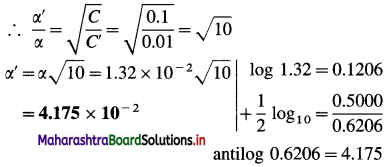
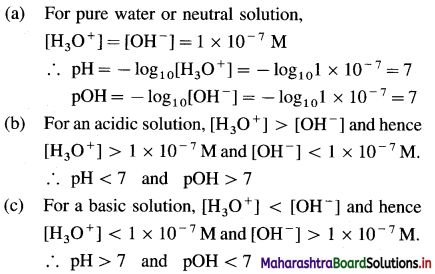
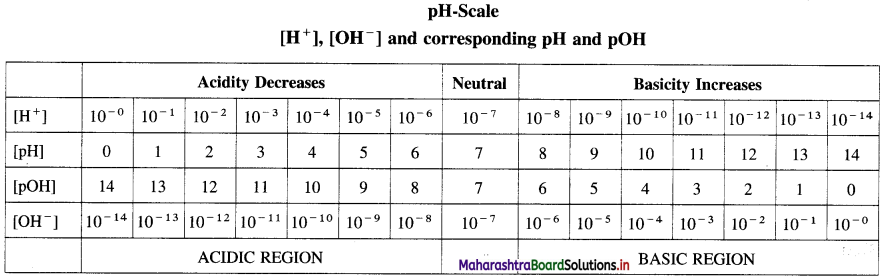
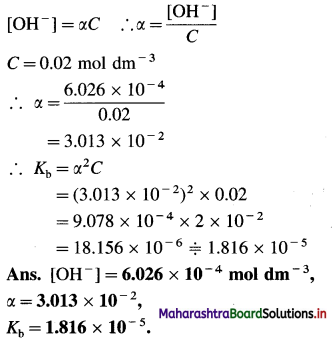
Maharashtra Board Class 12 Chemistry Solutions Chapter 5 Electrochemistry

Balbharti Maharashtra State Board 12th Chemistry Textbook Solutions Chapter 5 Electrochemistry Textbook Exercise Questions and Answers.

Maharashtra State Board Class 12 Chemistry Solutions Chapter 5 Electrochemistry

1. Choose the most correct option.

Question i.
Two solutions have the ratio of their concentrations 0.4 and ratio of their conductivities 0.216. The ratio of their molar conductivities will be
(a) 0.54
(b) 11.574
(c) 0.0864
(d) 1.852
Answer:
(a) 0.54

Question ii.
On diluting the solution of an electrolyte,
(a) both ∧ and κ increase
(b) both ∧ and κ decrease
(c) ∧ increases and κ decreases
(d) ∧ decreases and κ increases
Answer:
(c) ∧ increases and κ decreases

Question iii.
1 S m2 mol-1 is equal to
(a) 10-4 S m2 mol-1
(b) 104 -1 cm2 mol-1
(c) 10-2 S cm2 mol-1
(d) 102-1 cm2 mol-1
Answer:
(b) 104-1 cm2 mol-1

Question iv.
The standard potential of the cell in which the following reaction occurs
H2+ (g, 1 atm) + Cu2+ (1 M) → 2H (1 M) + Cu(s), (\(E_{\mathrm{Cu}}^{0}\) = 0.34 V) is
(a) – 0.34 V
(b) 0.34 V
(c) 0.17 V
(d) -0.17 V
Answer:
(b) 0.34 V

Maharashtra Board Class 12 Chemistry Solutions Chapter 5 Electrochemistry

Question v.
For the cell, Pb(s)|Pb2+ (1 M)|| Ag+ (1 M)|Ag(s), if concentration of an ion in the anode compartment is increased by a factor of 10, the emf of the cell will
(a) increase by 10 V
(b) increase by 0.0296 V
(c) decrease by 10 V
(d) decrease by 0.0296 V
Answer:
(d) decrease by 0.0296 V

Question vi.
Consider the half reactions with standard potentials
Maharashtra Board Class 12 Chemistry Solutions Chapter 5 Electrochemistry 1
The strongest oxidising and reducing agents respectively are
(a) Ag and Fe2+
(b) Ag+ and Fe
(c) Pb2+ and I
(d) I2 and Fe2+
Answer:
(b) Ag+ and Fe

Question vii.
For the reaction
Ni(s) + Cu2+ (1 M) → Ni2+ (1 M) + Cu(s), \(E_{\text {cell }}^{0}\) = 0.57 V. Hence ΔG0 of the reaction is
(a) 110 kJ
(b) -110 kJ
(c) 55 kJ
(d) -55 kJ
Answer:
(b) -110 kJ

Question viii.
Which of the following is not correct ?
(a) Gibbs energy is an extensive property
(b) Electrode potential or cell potential is an intensive property.
(c) Electrical work = -ΔG
(d) If half reaction is multiplied by a numerical factor, the corresponding E0 value is also multiplied by the same factor.
Answer:
(d) If half reaction is multiplied by a numerical factor, the corresponding E0 value is also multiplied by the same factor.

Question ix.
The oxidation reaction that takes place in lead storage battery during discharge is
Maharashtra Board Class 12 Chemistry Solutions Chapter 5 Electrochemistry 2
Answer:
(c) \(\mathrm{Pb}_{(\mathrm{s})}+\mathrm{SO}_{4(\mathrm{aq})}{ }^{2-} \longrightarrow \mathrm{PbSO}_{4(\mathrm{~s})}+2 \mathrm{e}^{-}\)

Question x.
Which of the following expressions represent molar conductivity of Al2(SO4)3 ?
Maharashtra Board Class 12 Chemistry Solutions Chapter 5 Electrochemistry 3
Answer:
(b) \(2 \lambda_{\mathrm{Al}^{3+}}^{0}+3 \lambda_{\mathrm{SO}_{4}^{2-}}^{0}\)

Maharashtra Board Class 12 Chemistry Solutions Chapter 5 Electrochemistry

2. Answer the following in one or two sentences.

Question i.
What is a cell constant ?
Answer:
(A) Cell constant of a conductivity cell is defined as the ratio of the distance between the electrodes divided by the area of cross section of the electrodes.
Maharashtra Board Class 12 Chemistry Solutions Chapter 5 Electrochemistry 4
In SI units it is expressed as m-1.

Question ii.
Write the relationship between conductivity and molar conductivity and hence unit of molar conductivity.
Answer:
If k is conductivity and ∧m is molar conductivity then, ∧m = \(\frac{\kappa \times 1000}{C}\)
Unit of molar conductivity is, Ω-1 cm2 mol-1 or S cm2 mol-1.

Question iii.
Write the electrode reactions during electrolysis of molten KCl.
Answer:
Maharashtra Board Class 12 Chemistry Solutions Chapter 5 Electrochemistry 5

Question iv.
Write any two functions of salt bridge.
Answer:
The functions of a salt bridge are :

  • It maintains the electrical contact between the two electrode solutions of the half cells.
  • It prevents the mixing of electrode solutions.
  • It maintains the electrical neutrality in both the solutions of two half cells by a flow of ions.
  • It eliminates the liquid junction potential.

Maharashtra Board Class 12 Chemistry Solutions Chapter 5 Electrochemistry

Question v.
What is standard cell potential for the reaction
3Ni(s) + 2Al3+ (1M) → 3NI2+ (1M) + 2Al(s)
if \(\boldsymbol{E}_{\mathrm{Ni}}^{0}\) = – 0.25 V and \(\boldsymbol{E}_{\mathrm{Al}}^{0}\) = -1.66V?
Solution :
Given : E0Ni2+/Ni = -0.25 V
E0Al3+/Al = – 1.66 V; E0cell = ?
Since Ni is oxidised and Al3+ is reduced,
\(E_{\text {cell }}^{0}=E_{\mathrm{Al}^{3+} / \mathrm{Al}}^{0}-E_{\mathrm{Ni}^{2+} / \mathrm{Ni}}^{0}\)
= – 1.66 – (-0.25)
= – 1.41 V
Ans. \(E_{\text {cell }}^{0}\) = -1.41 V
[Note : Since \(E_{\text {cell }}^{0}\) is negative, the given reaction is not possible but reverse reaction is possible.]

Question vi.
Write Nerst equation. What part of it represents the correction factor for nonstandard state conditions ?
Answer:
(1) Nernst equation for cell potential is,
Maharashtra Board Class 12 Chemistry Solutions Chapter 5 Electrochemistry 6
(2) The part of equation namely,
Maharashtra Board Class 12 Chemistry Solutions Chapter 5 Electrochemistry 7
represents the correction factor for nonstandard state conditions.

Question vii.
Under what conditions the cell potential is called standard cell potential ?
Answer:
In the standard cell, the active masses of the substances taking part in the electrochemical reaction have unit value, i.e., 1 M solution or ions and 1 atm gas.

Question viii.
Formulate a cell from the following electrode reactions :
\(\mathbf{A u}_{(\mathrm{aq})}^{3+}+\mathbf{3 e}^{-} \longrightarrow \mathbf{A} \mathbf{u}_{(\mathrm{s})}\)
\(\mathbf{M g}_{(\mathbf{s})} \longrightarrow \mathbf{M g}_{(\mathrm{aq})}^{2+}+\mathbf{2 e}^{-}\)
Answer:
An electrochemical cell from above electrode reactions is,
Maharashtra Board Class 12 Chemistry Solutions Chapter 5 Electrochemistry 8

Question ix.
How many electrons would have a total charge of 1 coulomb ?
Answer:
Given : 1 Faraday = charge on 1 mol of electrons
= 6.022 × 10²³ electrons and 1 Faraday = 96500 C
∵ 96500 C = 6.022 × 10²³ electrons 6 022 × 1023
∴ 1 C ≡ \(\frac{6.022 \times 10^{23}}{96500}\) = 6.24 × 10¹⁸ electrons
Ans. Number of electrons = 6.24 × 10¹⁸

Question x.
What is the significance of the single vertical line and double vertical line in the formulation galvanic cell.
Answer:
(i) Consider representation of Daniell cell,
Maharashtra Board Class 12 Chemistry Solutions Chapter 5 Electrochemistry 9
Single vertical line represents separation of two phases, solid Zn(s) and solution of ions.
(ii) Double vertical lines represent a salt bridge.

Maharashtra Board Class 12 Chemistry Solutions Chapter 5 Electrochemistry

3. Answer the following in brief

Question i.
Explain the effect of dilution of solution on conductivity ?
Answer:

  • The conductance of a solution is due to the presence of ions in the solution. More the ions, higher is the conductance of the solution.
  • Conductivity or the specific conductance is the conductance of unit volume (1 cm3) of the electrolytic solution.
  • The conductivity of the electrolytic solution always decreases with the decrease in the concentration of the electrolyte or the increase in dilution of the solution.
  • On dilution, the concentration of the solution decreases, hence the number of (current carrying) ions per unit volume decreases. Therefore the conductivity of the solution decreases, with the decrease concentration or increase in dilution. (It is to be noted here that, molar conductivity increases with dilution.)

Question ii.
What is a salt bridge ?
Answer:
A salt bridge is a U-shaped glass tube containing a saturated solution of a strong electrolyte, like KCl, NH4NO3, Na2SO4 in a solidified agar-agar gel. A hot saturated solution of these electrolytes in 5% agar solution is filled in the U-shaped tube and allowed it to cool and solidify forming a gel.
Maharashtra Board Class 12 Chemistry Solutions Chapter 5 Electrochemistry 10
Fig. 5.9 : Salt bridge
It is used to connect two half cells or electrodes forming a galvanic or voltaic cell.

Question iii.
Write electrode reactions for the electrolysis of aqueous NaCl.
Answer:
Reactions in electrolytic cell :
(i) Reduction half reaction at cathode : There are Na+ and H+ions but since H+ are more reducible than Na+, they undergo reduction liberating hydrogen and Na+ are left in the solution.
2H2O(l) + 2e → H2(g) + 2OH(aq) (reduction) E0 = -0.83 V

(ii) Oxidation half reaction at anode : At anode there are Cl and OH. But Cl ions are preferably oxidised due to less decomposition potential.
Maharashtra Board Class 12 Chemistry Solutions Chapter 5 Electrochemistry 11
Net cell reaction : Since two electrons are gained at cathode and two electrons are released at anode for each redox step, the electrical neutrality is maintained. Hence we can write,
Maharashtra Board Class 12 Chemistry Solutions Chapter 5 Electrochemistry 12
Since Na+ and OH are left in the solution, they form NaOH(aq).

Question iv.
How many moles of electrons are passed when 0.8 ampere current is passed for 1 hour through molten CaCl2 ?
Answer:
Given : I = 0.8 A; t = 1 × 60 × 60 = 3600 s
Number of moles of electrons = ?
Q = I × t
= 0.8 × 3600
= 2880 C
1 Faraday = 1 mol electrons
1 Faraday = 96500 C
∵ 96500 C = 1 mol electrons
∴ 2880 C ≡ \(\frac{2880}{96500}\)
= 0.02984 mol electrons
Ans. Number of moles of electrons = 0.02984

Maharashtra Board Class 12 Chemistry Solutions Chapter 5 Electrochemistry

Question v.
Construct a galvanic cell from the electrodes Co3+|Co and Mn2+|Mn. \(\boldsymbol{E}_{\mathrm{Co}}^{0}\) = 1.82 V,
\(\boldsymbol{E}_{\mathrm{Mn}}^{0}\) = – 1.18V. Calculate \(\boldsymbol{E}_{\text {cell }}^{0}\).
Answer:
Maharashtra Board Class 12 Chemistry Solutions Chapter 5 Electrochemistry 13

Question vi.
Using the relationsip between ∆G0 of cell reaction and the standard potential associated with it, how will you show that the electrical potential is an intensive property ?
Answer:
(1) For an electrochemical cell involving n number of electrons in the overall cell reaction,
ΔG0 = -nF\(E_{\text {cell }}^{0}\)
where ΔG0 is standard Gibbs energy change and \(E_{\text {cell }}^{0}\) is a standard cell potential.
(2) ∴ \(E_{\mathrm{cell}}^{0}=\frac{-\Delta G^{0}}{n F}\)
Since ΔG0 changes according to number of moles of electrons involved in the cell reaction, the ratio, ΔG0/nF remains constant.
(3) Therefore \(E_{\text {cell }}^{0}\) is independent of the amount of substance and it represents the intensive property.

Question vii.
Derive the relationship between standard cell potential and equilibrium constant of cell reaction.
Answer:
For any galvanic cell, the overall cell reaction at equilibrium can be represented as,
Reactants ⇌ Products.
[For example for Daniell cell,
\(\mathrm{Zn}_{(s)}+\mathrm{Cu}_{(\mathrm{aq})}^{2+} \rightleftharpoons \mathrm{Zn}_{(\mathrm{aq})}^{2+}+\mathrm{Cu}_{(\mathrm{s})}\) ]
The equilibrium constant, K for the reversible reaction will be, \(K=\frac{[\text { Products }]}{[\text { Reactants }]}\)
Maharashtra Board Class 12 Chemistry Solutions Chapter 5 Electrochemistry 14
The equilibrium constant is related to the stan-dard free energy change Δ G0, as follows,
ΔG0 = -RTlnK
If \(E_{\text {cell }}^{0}\) is the standard cell potential (or emf) of the galvanic cell, then ΔG0 = -nFE0cell
By comparing above equations,
Maharashtra Board Class 12 Chemistry Solutions Chapter 5 Electrochemistry 15

Question viii.
It is impossible to measure the potential of a single electrode. Comment.
Answer:
(1)
Maharashtra Board Class 12 Chemistry Solutions Chapter 5 Electrochemistry 16
Fig 5.12(a) : Measurement of single electrode potential
Maharashtra Board Class 12 Chemistry Solutions Chapter 5 Electrochemistry 17
Fig 5.12(b) : Measurement of cell potential
According to Nemst theory, electrode potential is the potential difference between the metal and ionic layer around it at equilibrium, i.e. the potential across the electric double layer.

(2) For measuring the single electrode potential, one part of the double layer, that is metallic layer can be connected to the potentiometer but not the ionic layer. Hence, single electrode potential can’t be measured experimentally.

(3) When an electrochemical cell is developed by combining two half cells or electrodes, they can be connected to the potentiometer and the potential difference or cell potential can be measured.
Ecell = E2 – E1
where E1 and E2 are reduction potentials of two electrodes.

Maharashtra Board Class 12 Chemistry Solutions Chapter 5 Electrochemistry

Question ix.
Why do the cell potential of lead accumulators decrease when it generates electricity ? How the cell potential can be increased ?
Answer:
Working of a lead accumulator :
(1) Discharging : When the electric current is withdrawn from lead accumulator, the following reactions take place :
Maharashtra Board Class 12 Chemistry Solutions Chapter 5 Electrochemistry 18

(2) Net cell reaction :
(i) Thus, the overall cell reaction during discharging is
Maharashtra Board Class 12 Chemistry Solutions Chapter 5 Electrochemistry 19
OR
Pb(s) + PbO2(s) + 2H2SO4(aq) → 2PbSO4(s) + 2H2O(l)
The cell potential or emf of the cell depends upon the concentration of sulphuric acid. During the operation, the acid is consumed and its concentration decreases and specific gravity decreases from 1.28 to 1.17. As a result, the emf of the cell decreases. The emf of a fully charged cell is about 2.0 V.

(ii) Recharging of the cell : When the discharged battery is connected to external electric source and a higher external potential is applied the cell reaction gets reversed generating H2SO4.
Reduction at the -ve electrode or cathode :
PbSO4(s) + 2e → Pb(s) + \(\mathrm{SO}_{4(\mathrm{aq})}^{2-}\)
Oxidation at the + ve electrode or anode :
Maharashtra Board Class 12 Chemistry Solutions Chapter 5 Electrochemistry 20
The emf of the accumulator depends only on the concentration of H2SO4.

Question x.
Write the electrode reactions and net cell reaction in NICAD battery.
Answer:
Reactions in the cell :
(i) Oxidation at cadmium anode :
Cd(s) + 2OH(aq) → Cd(OH)2(s) + 2e
(ii) Reduction at NiO2(s) cathode :
NiO2(s) + 2H2O(l) + 2e → Ni(OH)2(s) + 2OH(aq)
The overall cell reaction is the combination of above two reactions.
Cd(s) + NiO2(s) + 2H2O(l) → Cd(OH)2(s) + Ni(OH)2(s)

Maharashtra Board Class 12 Chemistry Solutions Chapter 5 Electrochemistry

4. Answer the following :

Question i.
What is Kohrausch law of independent migration of ions? How is it useful in obtaining molar conductivity at zero concentration of a weak electrolyte ? Explain with an example.
Answer:
(A) Statement of Kohlrausch’s law : This states that at infinite dilution of the solution, each ion of an electrolyte migrates independently of its co-ions and contributes independently to the total molar conductivity of the electrolyte, irrespective of the nature of other ions present in the solution.

(B) Explanation : Both the ions, cation and anion of the electrolyte make a definite contribution to the molar conductivity of the electrolyte at infinite dilution or zero concentration (∧0).
If \(\lambda_{+}^{0}\) and \(\lambda_{-}^{0}\) are the molar ionic conductivities of cation and anion respectively at infinite dilution, then
0 = \(\lambda_{+}^{0}\) + \(\lambda_{-}^{0}\).
This is known as Kohlrausch’s law of independent migration of ions.
For an electrolyte, BxAy giving x number of cations and y number of anions,
0 = x\(\lambda_{+}^{0}\) + y\(\lambda_{-}^{0}\).

(C) Applications of Kohlrausch’s law :
(1) With this law, the molar conductivity of a strong electrolyte at zero concentration can be determined. For example,
\(\wedge_{0(\mathrm{KCl})}=\lambda_{\mathrm{K}^{+}}^{0}-\lambda_{\mathrm{Cl}^{-}}^{0}\)
(2) ∧0 values of weak electrolyte with those of strong electrolytes can be obtained. For example,
Maharashtra Board Class 12 Chemistry Solutions Chapter 5 Electrochemistry 21

Molar conductivity of a weak electrolyte at infinite dilution or zero concentration cannot be measured experimentally.
Consider the molar conductivity (∧0) of a weak acid, CH3COOH at zero concentration. By Kohlrausch s law,
Maharashtra Board Class 12 Chemistry Solutions Chapter 5 Electrochemistry 22
where λ0CH3COO and λ0H+ are the molar ionic conductivities of CH3COO and H+ ions respectively.
If ∧0CH3COONa, ∧0HCl and ∧0NaCl are molar conductivities of CH3COONa, HCl and NaCl respectively at zero concentration, then by
Kohlrausch’s law,
Maharashtra Board Class 12 Chemistry Solutions Chapter 5 Electrochemistry 23
Hence, from ∧0 values of strong electrolytes, ∧0 of a weak electrolyte CH3COOH, at infinite dilution can be calculated.

Question ii.
Explain electrolysis of molten NaCl.
Answer:
(1) Construction of an electrolytic cell : It consists of a vessel containing molten (fused) NaCl. Two graphite (carbon) inert electrodes are dipped in it, and connected to an external source of direct electric current (battery). The electrode connected to a negative terminal of the battery is a cathode and that connected to a positive terminal is an anode.

(2) Working of the cell :
(A) In the external circuit, the electrons flow through the wires from anode to cathode of the cell.
(B) The fused NaCl dissociates to form cations (Na+) and anions (Cl).
\(\mathrm{NaCl}_{\text {(fused) }} \longrightarrow \mathrm{Na}_{(\mathrm{l})}^{+}+\mathrm{Cl}_{(\mathrm{l})}^{-}\)
Na+ migrate towards cathode and Cl migrate towards anode.
Maharashtra Board Class 12 Chemistry Solutions Chapter 5 Electrochemistry 24
Fig. 5.7 : Electrolysis of fused sodium chloride

(C) Reactions in electrolytic cell :
(i) Reduction half reaction at cathode : The Na+ ions get reduced by accepting electrons from a cathode supplied by a battery and form metallic sodium.
\(\mathrm{Na}^{+}+\mathrm{e}^{-} \longrightarrow \mathrm{Na}_{(\mathrm{s})} \text { (reduction) }\)

(ii) Oxidation half reaction at anode : The Cl ions get oxidised by giving up electrons to the anode forming neutral Cl atoms in the primary process, and these Cl atoms combine forming Cl2 gas in the secondary process.
Maharashtra Board Class 12 Chemistry Solutions Chapter 5 Electrochemistry 25
The released electrons in the anodic oxidation half reaction return to battery through the metallic wires.

Net cell reaction : In order to maintain the electrical neutrality, the number of electrons gained at cathode must be equal to the number of electrons released at anode. Hence the reduction half reaction is multiplied by 2 and both reactions, oxidation half reaction and reduction half reaction are added to obtain a net cell reaction.
Maharashtra Board Class 12 Chemistry Solutions Chapter 5 Electrochemistry 26
Results of electrolysis :

  • A molten silvery white Na is formed at cathode which floats on the surface of molten NaCl.
  • A pale green Cl2 gas is liberated at anode.

Maharashtra Board Class 12 Chemistry Solutions Chapter 5 Electrochemistry

Question iii.
What current strength in amperes will be required to produce 2.4g of Cu from CuSO4 solution in 1 hour ? Molar mass of Cu = 63.5 g mol-1.
Answer:
Given : WCu = 2.4 g; t = 1 hr = 1 × 60 × 60 s
MCu = 63.5 g mol-1; I = ?
Maharashtra Board Class 12 Chemistry Solutions Chapter 5 Electrochemistry 27
Ans. Current strength = I = 2.026 A

Question iv.
Equilibrium constant of the reaction,
2Cu+(aq) → Cu2+(aq) + Cu(s)
is 1.2 × 10⁶. What is the standard potential of the cell in which the reaction takes place ?
Answer:
For the cell reaction, n = 1
Maharashtra Board Class 12 Chemistry Solutions Chapter 5 Electrochemistry 28

Question v.
Calculate emf of the cell
Zn(s)|Zn2+ (0.2M)||H+(1.6M)|H2(g, 1.8 atm)|Pt at 25°C.
Answer:
Given : Zn(s)|Zn2+(0.2M)||H+(1.6M)|H2(g, 1.8 atm)|Pt
Maharashtra Board Class 12 Chemistry Solutions Chapter 5 Electrochemistry 29
Maharashtra Board Class 12 Chemistry Solutions Chapter 5 Electrochemistry 30
= 0.763 – 0.0296 × (- 0.8521)
= 0.763 + 0.02522
= 0.7882
Ans. \(E_{\text {cell }}^{0}\) = 0.7882 V

Question vi.
Calculate emf of the following cell at 25°C.
Zn(s)| Zn2+(0.08M)||Cr3+(0.1M)|Cr
E0Zn = – 0.76 V, E0Cr = – 0.74 V
Answer:
Maharashtra Board Class 12 Chemistry Solutions Chapter 5 Electrochemistry 31
Maharashtra Board Class 12 Chemistry Solutions Chapter 5 Electrochemistry 32

Question vii.
What is a cell constant ? What are its units? How is it determined experimentally?
Answer:
(A) Cell constant of a conductivity cell is defined as the ratio of the distance between the electrodes divided by the area of cross section of the electrodes.
Maharashtra Board Class 12 Chemistry Solutions Chapter 5 Electrochemistry 33
In SI units it is expected as m-1.

The resistance of an electrolytic solution is measured by using a conductivity cell and Wheatstone
Maharashtra Board Class 12 Chemistry Solutions Chapter 5 Electrochemistry 52
Fig. 5.6 : Measurement of conductance
The measurement of molar conductivity of a solution involves two steps as follows :
Step I : Determination of cell constant of the conductivity cell :
KCl solution (0.01 M) whose conductivity is accurately known (κ = 0.00141 Ω-1 cm-1) is taken in a beaker and the conductivity cell is dipped. The two electrodes of the cell are connected to one arm while the variable known resistance (R) is placed in another arm of Wheatstone bridge.

A current detector D’ which is a head phone or a magic eye is used. J is the sliding jockey (contact) that slides on the arm AB which is a wire of uniform cross section. A source of A.C. power (alternating power) is used to avoid electrolysis of the solution.

By sliding the jockey on wire AB, a balance point (null point) is obtained at C. Let AC and BC be the lengths of wire.

If Rsolution is the resistance of KCl solution and Rx is the known resistance then by Wheatstone’s bridge principle,
\(\frac{R_{\text {solution }}}{\mathrm{BC}}=\frac{R_{x}}{\mathrm{AC}}\)
∴ \(R_{\text {solution }}=\mathrm{BC} \times \frac{R_{x}}{\mathrm{AC}}\)
Then the cell constant ‘ b ’ of the conductivity cell is obtained by, b = κKcl × Rsolution.

Step II : Determination of conductivity of the given solution :
KCl solution is replaced by the given electrolytic solution and its resistance (Rs) is measured by Wheatstone bridge method by similar manner by obtaining a null point at D.
The conductivity (κ) of the given solution is,
κ = \(\frac{\text { cell constant }}{R_{\mathrm{s}}}=\frac{b}{R_{\mathrm{s}}}\)

Step III: Calculation of molar conductivity :
The molar conductivity (∧m) is given by,
Maharashtra Board Class 12 Chemistry Solutions Chapter 5 Electrochemistry 53
Since the concentration of the solution is known, ∧m can be calculated.

Maharashtra Board Class 12 Chemistry Solutions Chapter 5 Electrochemistry

Question viii.
How will you calculate the moles of electrons passed and mass of the substance produced during electrolysis of a salt solution using reaction stoichiometry.
Answer:
Calculation of moles of electrons passed : The charge carried by one mole of electrons is referred to as one faraday (F). If total charge passed is Q C, then moles of electrons passed = \(\frac{Q(\mathrm{C})}{F\left(\mathrm{C} / \mathrm{mol} \mathrm{e}^{-}\right)}\)

Calculation of mass of product : Mass, W of product formed is given by,
W = moles of product × molar mass of product (M)
= \(\frac{Q}{96500}\) × mole ratio × M
= \(\frac{I \times t}{96500}\) × mole ratio × M 96500
When two electrolytic cells containing different electrolytes are connected in series so that same quantity of electricity is passed through them, then the masses W1 and W2 of products produced are given by,
Maharashtra Board Class 12 Chemistry Solutions Chapter 5 Electrochemistry 34

Question ix.
Write the electrode reactions when lead storage cell generates electricity. What are the anode and cathode and the electrode reactions during its recharging?
Answer:
Recharging of the cell : When the discharged battery is connected to external electric source and a higher external potential is applied the cell reaction gets reversed generating H2SO4.
Reduction at the – ve electrode or cathode :
\(\mathrm{PbSO}_{4(\mathrm{~s})}+2 \mathrm{e}^{-} \rightarrow \mathrm{Pb}^{(s)}+\mathrm{SO}_{4(\mathrm{aq})}^{2-}\)
Oxidation at the + ve electrode or anode :
Maharashtra Board Class 12 Chemistry Solutions Chapter 5 Electrochemistry 35
The emf of the accumulator depends only on the concentration of H2SO4.

Question x.
What are anode and cathode of H2-O2 fuel cell ? Name the electrolyte used in it. Write electrode reactions and net cell reaction taking place in the fuel cell.
Answer:
Construction :
(i) In fuel cell the anode and cathode are porous electrodes with suitable catalyst like finely divided platinum.
Maharashtra Board Class 12 Chemistry Solutions Chapter 5 Electrochemistry 36
(iii) H2 is continuously bubbled through anode while O, gas is bubbled through cathode.

Working (cell reactions) :
(i) Oxidation at anode : At anode, hydrogen gas is oxidised to H2O.
2H2(g) + 4OH(aq) → 4H2O(l) + 4e (oxidation half reaction)
(ii) Reduction at cathode : The electrons released at anode travel to cathode through external circuit and reduce oxygen gas to OH.
O2(g) + 2H2O(l) + 4e → 4OH(aq) (reduction half reaction)

(iii) Net cell reaction: Addition of both the above reactions at anode and cathode gives a net cell reaction.
2H2(g) + O2(g) → 2H2O(l) (overall cell reaction)

Question xi.
What are anode and cathode for Leclanche’ dry cell ? Write electrode reactions and overall cell reaction when it generates electricity.
Answer:
A dry cell has zinc vessel as anode and graphite rod as cathode and moist paste of ZnCl2, MnO2, NH4Cl as electrolytes.
At anode :
Zn(s) → \(\mathrm{Zn}_{(\mathrm{aq})}^{2+}\) + 2e (Oxidation half reaction)
At graphite (c) cathode :
\(2 \mathrm{NH}_{4(\mathrm{e})}^{+}\) + 2e → 2NH3(aq) + H2(g) (Reduction half reaction)
2MnO2(s) + H2 → Mn2O3(s) + H2O(l)
There is a side reaction inside the cell, between Zn2+ ions and aqueous NH3.
\(\mathrm{Zn}_{(\mathrm{aq})}^{2+}+4 \mathrm{NH}_{3(\mathrm{aq})} \longrightarrow\left[\mathrm{Zn}\left(\mathrm{NH}_{3}\right)_{4}\right]_{(\mathrm{aq})}^{2+}\)

Question xii.
Identify oxidising agents and arrange them in order of increasing strength under standard state conditions. The standard potentials are given in parenthesis.
Al(- 1.66 V), Cl2 (1.36 V), Cd2+ (-0.4 V), Fe (-0.44 V), I2 (0.54 V), Br (1.09 V).
Answer:
The oxidising agents are I2, Br and Cl2. The increasing strength is
Maharashtra Board Class 12 Chemistry Solutions Chapter 5 Electrochemistry 37
(Note : Actually Br2 acts as an oxidising agent but not Br.)

Maharashtra Board Class 12 Chemistry Solutions Chapter 5 Electrochemistry

Question xiii.
Which of the following species are reducing agents? Arrange them in order of increasing strength under standard state conditions. The standard potentials are given in parenthesis.
K (-2.93V), Br2(1.09V), Mg(-2.36V), Co3+(1.61V), Ti2+(-0.37V), Ag+(0.8V), Ni (-0.23V).
Answer:
Lower the standard reduction potential, higher is reducing power. The reducing agents are Ni, Mg and K. Their increasing strength is,
Maharashtra Board Class 12 Chemistry Solutions Chapter 5 Electrochemistry 38
(Note : Cations don’t act as reducing agent since they are already in oxidised state.)

Question xiv.
Predict whether the following
reactions would occur spontaneously
under standard state conditions.
a. Ca(s) + Cd2+(aq) → Ca2+(aq) + Cd(s)
b. 2 Br-(s) + Sn2+(aq) → Br2(l) + Sn(s)
c. 2Ag(s) + Ni2+(aq) → 2 Ag+(aq) + Ni(s)
(use information of Table 5.1)
Answer:
Maharashtra Board Class 12 Chemistry Solutions Chapter 5 Electrochemistry 39

12th Chemistry Digest Chapter 5 Electrochemistry Intext Questions and Answers

Question 1.
How does electrical resistance depend on the dimensions of an electronic (metallic) conductor?
Answer:
The electrical resistance of an electronic conductor is linearly proportional to its length (l) and inversely proportional to its cross section area a.
Maharashtra Board Class 12 Chemistry Solutions Chapter 5 Electrochemistry 40
Fig. 5.3 : Electronic conductor
Thus, R ∝ l; R ∝ \(\frac{1}{a}\)
∴ R ∝ \(\frac{l}{a}\) or R = ρ × \(\frac{l}{a}\)
where the proportionality constant p is called specific resistance. IUPAC recommends the term resistivity for specific resistance.

Question 2.
What are the units of resistivity ?
Answer:
For an electronic conductor of length l, and cross section area a, the resistance R is represented as
R = ρ × \(\frac{l}{a}\)
where ρ is the resistivity of the conductor.
∴ ρ = R × \(\frac{a}{l}\)
If l = 1 m, a = 1 m2, ρ = R
Maharashtra Board Class 12 Chemistry Solutions Chapter 5 Electrochemistry 41
Hence, resistivity is the resistance of a conductor of volume of 1 m3.
(In C.G.S. units, the units of ρ are ohm cm. Hence, ρ is the resistance of a conductor of unit volume or 1 cm3.)

Maharashtra Board Class 12 Chemistry Solutions Chapter 5 Electrochemistry

Question 3.
Define resistivity. What are its units ?
Answer:
Resistivity (or specific resistance) : It is the resistance of a conductor that is 1 m in length and 1 m2 in cross section area in SI units. (In C.G.S. units, it is the resistance of a conductor that is 1 cm in length and 1 cm2 in cross section area.) Hence, the resistivity is the resistance of a conductor of unit volume. (In case of electrolytic solution, ρ is the resistivity i.e., resistance of a solution of unit volume.)
It has SI units, ohm m and C.G.S. units, ohm cm.

Question 4.
Why is alternating current used in the measurement of conductivity of the solution ?
Answer:
If direct current (D.C.) by battery is used, there will be electrolysis and the concentration of the solution is changed. Hence alternating current (A.C.) with high frequency is used.

Try this… (Textbook page No. 93)

Question 1.
What must be the concentration of a solution of silver nitrate to have the molar conductivity of 121.4 Ω-1 cm2 mol-1 and the conductivity of 2.428 × 10⁻³-1 cm-1 at 25 °C ?
Answer:
Maharashtra Board Class 12 Chemistry Solutions Chapter 5 Electrochemistry 42
∴ Concentration of a Solution = 0.02 M

Try this… (Textbook page No. 96)

Question 1.
Obtain the expression for dissociation constant in terms of ∧c and ∧0 using Ostwald’s dilution law.
Answer:
Consider a solution of a weak electrolyte, BA having concentration C mol dm-3. If α is the degree of dissociation, then by Ostwald’s theory of weak electrolytes,
Maharashtra Board Class 12 Chemistry Solutions Chapter 5 Electrochemistry 43
If K is the dissociation constant of the weak electrolyte, then by Ostwald’s dilution law,
K = \(\frac{\alpha^{2} C}{(1-\alpha)}\)
If ∧m is the molar conductivity of the electrolyte BA at the concentration C and ∧0 is the molar conductivity at zero concentration or infinite dilution, then
Maharashtra Board Class 12 Chemistry Solutions Chapter 5 Electrochemistry 44
Hence by measuring ∧m at the concentration C and knowing ∧0, the dissociation constant can be calculated.
If \(\lambda_{+}^{0}\) and \(\lambda_{-}^{0}\) are the ionic conductivities, then by Kohlrauseh’s law, ∧0 = \(\lambda_{+}^{0}\) + \(\lambda_{-}^{0}\).

Maharashtra Board Class 12 Chemistry Solutions Chapter 5 Electrochemistry

Learn this as well…

Question 1.
How is the cell constant of a conductivity cell determined?
Answer:
The cell constant of a given conductivity cell is obtained by measuring the resistance (R) (or the conductance) of a standard solution whose conductivity (fc) is accurately known by using Wheatstone’s bridge (discussed in Q. 37). For this purpose, KCl solution of accurately known conductivity is used.
\(\kappa_{\mathrm{KCl}}=\frac{1}{R_{\mathrm{KCl}}} \times \frac{l}{a}\) where \(\frac{l}{a}\) is a cell constant, represented by b.
∴ \(\kappa_{\mathrm{KCl}}=\frac{b}{R_{\mathrm{KCl}}}\)
or b = κKCl × RKCl
For example, the conductivity of 0.01 M KCl is 0.00141 Ω-1 cm-1 (S cm-1). Hence by measuring R KCl the cell constant b can be obtained.

Try this… (Textbook page No. 95)

Question 1.
Calculate ∧0 (CH2ClCOOH) if ∧0 values for HCl, KCl and CH2ClCOOK are respectively, 4.261, 1.499 and 1.132 Ω-1 m2 mol-1.
Solution :
Maharashtra Board Class 12 Chemistry Solutions Chapter 5 Electrochemistry 45
Adding equations (i) and (ii) and subtracting equation (iii) we get equation (I).
Maharashtra Board Class 12 Chemistry Solutions Chapter 5 Electrochemistry 46

Can you tell ? (Textbook page No. 103)

Question 1.
You have learnt Daniel cell in XIth standard. Write notations for anode and cathode. Write the cell formula.
Answer:
Daniel cell is represented as,
Maharashtra Board Class 12 Chemistry Solutions Chapter 5 Electrochemistry 47

Try this… (Textbook page No. 104)

Question 1.
Write electrode reactions and overall cell reaction for Daniel cell you learnt in standard XI.
Answer:
Reactions for Daniell cell:
Maharashtra Board Class 12 Chemistry Solutions Chapter 5 Electrochemistry 48

Question 1.
Describe different types of reversible electrodes with examples. (1 mark for each type)
Answer:
A reversible electrochemical cell or a galvanic cell consists of two reversible half cells or electrodes. There are four types of reversible electrodes according to their compositions.
(1) Metal-metal ion electrode : This electrode is set up by dipping a metal in a solution containing its own ions, e.g. Zn rod dipped into ZnSO4 solution containing Zn++ ions of concentration C.
It is represented as,
\(\mathrm{Zn}^{2+}{ }_{(\mathrm{aq})} \mid \mathrm{Zn}_{(\mathrm{s})}\)
The reduction reaction at the electrode is,
Zn++(aq) + 2e → Zn(s)

(2) Metal-sparingly soluble salt electrode : This electrode consists of a metal coated with one of its sparingly soluble salts and immersed in a solution containing an electrolyte having a common anion as that of the salt. For example, silver electrode coated with sparingly soluble AgCl dipped in KCl solution with common anion Cl. This electrode is represented as,
Cl(aq) | AgCl(s) | Ag(s)
The reduction reaction is,
AgCl(s) + e → Ag(s) + Cl(aq)

(3) Gas electrode : This is developed by bubbling pure and dry gas around a platinised platinum foil dipped in the solution containing ions (of the gas) reversible with respect to the gas bubbled.
The gas is adsorbed on the surface of platinum foil and establishes an equilibrium with its ions in the solution. Pt electrode provides electrical contact and also acts as a catalyst.
Some of the gas electrodes are represented as follows :
(i) Hydrogen gas electrode :
H+(aq) | H2(g, PH2) | Pt
Reduction reaction : H+(aq) + e → \(\frac {1}{2}\)H2(g)
(ii) Chlorine gas electrode :
Cl(aq) | Cl2(g, PCl2) | Pt
Reduction reaction : \(\frac {1}{2}\)Cl2(g) + e- → Cl(aq)

(4) Redox electrode (Oxidation reduction electrode) : This electrode consists of a platinum wire dipped in a solution containing the ions of the same metal (or a substance) in two different oxidation states, like Fe2+ – Fe3+, Sn2+ – Sn4+, Mn++ – MnO4, etc.
A platinum electrode which provides an electrical contact and acts as catalyst aquires an equilibrium between two ions in the solution, due to their tendency to undergo a change from one oxidation state to another. The electrodes are represented as,
Fe2+(aq), Fe3+(aq) | Pt
Reduction reaction : Fe3+(aq) + e → Fe2+(aq)
SnCl2(aq), SnCl4(aq) | Pt
Reduction reaction : Sn4+(aq) + 2e →Sn2+(aq)

Maharashtra Board Class 12 Chemistry Solutions Chapter 5 Electrochemistry

Use your brain power! (Textbook page No. 98)

Question 1.
Distinguish between electrolytic and galvanic cells.
Answer:
Electrolytic cell:

  1. This device is used to bring about a non-spontaneous chemical reaction by passing an electric current.
  2. It is used to bring about a chemical reaction generally for the dissociation (electrolysis) of compounds.
  3. In this cell, electrical energy is converted into chemical energy.
  4. In this cell, the cathode is negative and the anode is positive.
  5. Electrolytic cells are irreversible.
  6. Oxidation takes place at the positive electrode and reduction at the negative electrode.
  7. The electrons are supplied by the external source and enter through cathode and come out through anode.
  8. It is used for electroplating, electrorefining, etc.

Electrochemical cell (Galvanic cell or Voltaic cell):

  1. This device is used to produce electrical energy by a spontaneous chemical reaction.
  2. It is used to generate electricity.
  3. In this cell, chemical energy is converted into electrical energy.
  4. In this cell, the cathode is positive and the anode is negative.
  5. Electrochernical cells are reversible.
  6. Oxidation takes place at the negative electrode and reduction at the positive electrode.
  7. The electrons move from anode to cathode in the external circuit.
  8. It is used as a source of electric current.

Try this… (Textbook page No. 107)

Question 1.
Write expressions to calculate equilibrium constant from
i. Concentration data
ii. Thermochemical data
iii. Electrochemical data
Answer:
(i) Consider following a reversible cell reaction.
aA + bB ⇌ cC + dD
If [A], [B], [C] and [D] represent concentrations of reactants and products then the equilibrium constant K is,
K = \(\frac{[\mathrm{C}]^{c} \times[\mathrm{D}]^{d}}{[\mathrm{~A}]^{a} \times[\mathrm{B}]^{b}}\)
(ii) If ΔG0 is the standard Gibbs free energy change at temperature T then,
ΔG0 = – RTlnK = – 2.303 RTlog10K
(iii) From electrochemical data,
if \(E_{\text {cell }}^{0}\) is the standard cell potential and K is the equilibrium constant for the cell reaction at a temperature T, then,
\(E_{\text {cell }}^{0}=\frac{0.0592}{n} \log _{10} K\)

Maharashtra Board Class 12 Chemistry Solutions Chapter 5 Electrochemistry

Learn this as well…

Question 1.
The construction and working of the calomel electrode.
Answer:
(1) Since standard hydrogen electrode (SHE) is not convenient for experimental use, a secondary reference electrode like calomel electrode is used.
(2) Construction : It consists of a glass vessel with side arm B for dipping in a desired solution of another electrode like, ZnSO4(aq) for an electric contact. The vessel is filled with mercury, a paste of Hg and Hg2Cl2 (calomel) and saturated KCl solution.
Maharashtra Board Class 12 Chemistry Solutions Chapter 5 Electrochemistry 49
Fig. 5.15 : Determination of standard electrode potential using calomel electrode
(3) The potential developed depends upon the concentration of Cl or KCl solution. When saturated KCl solution is used, its reduction potential is 0.242 V.
(4) Consider following cell :
Zn(s) | ZnSO4(aq) || KCl(aq) | Hg2Cl2(s) | Hg
OR Zn(s) | ZnSO4(aq) || Calomel electrode
Reduction reaction for calomel electrode :
Hg2Cl2(s) + 2e → 2Hg(l) + 2Cl(aq)
Hence potential of calomel electrode depends on the concentration of Cl or KCl solution.

Can you tell ? (Textbook page No. 114)

Question 1.
In what ways are fuel cells and galvanic cells similar and in what ways are they different ?
Answer:
Similarity between fuel cells and galvanic cells :

  • In both the cells, there is oxidation at anode and j reduction at cathode.
  • The cell potential is developed due to net redox reactions.
  • Both are galvanic cells.

Difference in fuel cells and galvanic cells :

  • Fuel cells involve electrodes with large surface area while galvanic cells involve electrodes with j compact surface area.
  • Fuel cells involve gaseous materials on a large scale while galvanic cells involve gaseous materials at a definite pressures along with electrolytes or there may not be gases.
  • In fuel cells, the cell potential is developed due to exothermic combustion reactions while in galvanic cell, cell potential is developed due to normal redox reactions.
  • In fuel cells gaseous electrode materials are continuously supplied from outside while in galvanic cells electrode materials have constant concentration or may change due to reactions.

Use your brain power (Textbook page No. 114)

Question 1.
Indentify the strongest and the weakest oxidizing agents from the electrochemical series.
Answer:
From the electrochemical series,
(a) The strongest oxidising agent is fluorine since it has the highest standard reduction potential (\(E_{\mathrm{F}_{2} / \mathrm{F}^{-}}^{0}\) = + 2.87 V).
(b) The weakest oxidising agent (or the strongest reducing agent) is lithium since it has the lowest standard reduction potential, (\(E_{\mathrm{Li}^{+} / \mathrm{Li}}^{0}\) = -3.045 V).

Maharashtra Board Class 12 Chemistry Solutions Chapter 5 Electrochemistry

Use your brainpower (Textbook page No. 115)

Question 1.
Identify the strongest and the weakest reducing agents from the electrochemical series.
Answer:
(a) From the electrochemical series, the strongest reducing agent is lithium since it has the lowest standard reduction potential (\(E_{\mathrm{Li}^{+} / \mathrm{Li}}^{0}\) = -3.045 V).
(b) The weakest reducing agent is fluorine since it has the highest standard reduction potential,
(\(E_{\mathrm{F}_{2} / \mathrm{F}^{-}}^{0}\) = +2.87 V).

Question 2.
From E° values given in Table 5.1, predict whether Sn can reduce I2 or Ni2+.
Answer:
From the electrochemical series,
Maharashtra Board Class 12 Chemistry Solutions Chapter 5 Electrochemistry 50
Maharashtra Board Class 12 Chemistry Solutions Chapter 5 Electrochemistry 51

Maharashtra Board Class 12 Chemistry Solutions Chapter 4 Chemical Thermodynamics

Balbharti Maharashtra State Board 12th Chemistry Textbook Solutions Chapter 4 Chemical Thermodynamics Textbook Exercise Questions and Answers.

Maharashtra State Board Class 12 Chemistry Solutions Chapter 4 Chemical Thermodynamics

1. Select the most appropriate option.

Question 1.
The correct thermodynamic conditions for the spontaneous reaction at all temperatures are
(a) ΔH < 0 and ΔS > 0
(b) ΔH > 0 and ΔS < 0
(c) ΔH < 0 and ΔS < 0
(d) ΔH < 0 and ΔS = 0
Answer:
(a) ΔH < 0 and ΔS > 0

Question ii.
A gas is allowed to expand in a well-insulated container against a constant external pressure of 2.5 bar from an initial volume of 2.5 L to a final volume of 4.5 L. The change in internal energy, ΔU of the gas will be
(a) -500 J
(b) +500J
(c) -1013 J
(d) +1013 J
Answer:
(a) -500 J

Question iii.
In which of the following, entropy of the system decreases ?
(a) Crystallisation of liquid into solid
(b) Temperature of crystalline solid is increased from 0 K to 115 K
(c) H2(g) → 2H(g)
(d) 2NaHCO3(s) → Na2CO3(s) + CO2(g) + H2O(g)
Answer:
(a) Crystallisation of liquid into solid

Question iv.
The enthalpy of formation for all elements in their standard states is
(a) unity
(b) zero
(c) less than zero
(d) different elements
Answer:
(b) zero

Maharashtra Board Class 12 Chemistry Solutions Chapter 4 Chemical Thermodynamics

Question v.
Which of the following reactions is exothermic ?
(a) H2(g) → 2H(g)
(b) C(s) → C(g)
(c) 2Cl(g) → Cl2(g)
(d) H2O(s) → H2O(l)
Answer:
(c) 2Cl(g) → Cl2(g)

Question vi.
6.24 g of ethanol are vaporized by supplying 5.89 kJ of heat. Enthalpy of vaporization of ethanol will be
(a) 43.4 kJ mol-1
(b) 60.2 kJ mol-1
(c) 38.9 kJ mol-1
(d) 20.4 kJ mol-1
Answer:
(a) 43.4 kJ mol-1

Question vii.
If the standard enthalpy of formation of methanol is -238.9 kJ mol-1 then entropy change of the surroundings will be
(a) -801.7 JK-1
(b) 801.7 JK-1
(c) 0.8017 JK-1
(d) -0.8017 JK-1
Answer:
(b) 801.7 JK-1

Question viii.
Which of the following are not state functions ?
1. Q + W 2. Q 3. W 4. H-TS
(a) 1, 2 and 3
(b) 2 and 3
(c) 1 and 4
(d) 2, 3 and 4
Answer:
(b) 2 and 3

Question ix.
For vaporization of water at 1 bar, ΔH = 40.63 kJ mol-1 and ΔS =108.8 JK-1 mol-1. At what temperature, ΔG = 0?
(a) 273.4 K
(b) 393.4 K
(c) 373.4 K
(d) 293.4 K
Answer:
(c) 373.4 K

Question x.
Bond enthalpies of H – H, Cl – Cl and H – Cl bonds are 434 kJ mol-1, 242 kJ mol-2 and 431 kJ mol-1, respectively. Enthalpy of formation of HCl is
(a) 245 kJ mol-1
(b) -93 kJ mol-1
(c) -245 kJ mol-1
(d) 93 kJ mol-1
Answer:
(b) -93 kJ mol-1

Maharashtra Board Class 12 Chemistry Solutions Chapter 4 Chemical Thermodynamics

2. Answer the following in one or two sentences.

Question i.
Comment on the statement: No work is involved in an expansion of a gas in vacuum.
Answer:
(1) When a gas expands against an external pressure Pex, changing the volume from V1 to V2, the work obtained is given by
W = -Pex (V2 – V1).
(2) Hence the work is performed by the system when it experiences the opposing force or pressure.
(3) Greater the opposing force, more is the work.
(4) In free expansion, the gas expands in vaccum where it does not experience opposing force, (P = 0). Since external pressure is zero, no work is obtained.
∴ W = -Pex (V2 – V1)
= -0 × (V2 – V1)
= 0
(5) Since during expansion in vacuum no energy is expended, it is called free expansion.

Question ii.
State the first law of thermodynamics.
Answer:
The first law of thermodynamics is based on the principle of conservation of energy and can be stated in different ways as follows :

  1. Energy can neither be created nor destroyed, however, it may be converted from one form into another.
  2. Whenever, a quantity of one kind of energy is consumed or disappears, an equivalent amount of another kind of energy appears.
  3. The total mass and energy of an isolated system remain constant, although there may be interconservation of energy from one form to another.
  4. The total energy of the universe remains constant.

Question iii.
What is enthalpy of fusion?
Answer:
Enthalpy of fusion (ΔfusH) : The enthalpy change that accompanies the fusion of one mole of a solid into a liquid at constant temperature and pressure is called enthalpy of fusion.
For example,
Maharashtra Board Class 12 Chemistry Solutions Chapter 4 Chemical Thermodynamics 1
This equation describes that when one mole of ice melts (fuses) at 0 °C (273 K) and 1 atmosphere, 6.1 kJ of heat will be absorbed.

Question iv.
What is standard state of a substance?
Answer:
The thermodynamic standard state of a substance (compound) is the most stable physical state of it at 298 K and 1 atmosphere (or 1 bar). The enthalpy of the substance in the standard state is represented as ΔfH0.

Maharashtra Board Class 12 Chemistry Solutions Chapter 4 Chemical Thermodynamics

Question v.
State whether ∆S is positive, negative or zero for the reaction 2H(g) → H2(g). Explain.
Answer:
(i) The given reaction, 2H(g) → H2(g) is the formation of H2(g) from free atoms.
(ii) Since two H atoms form one H2 molecule, ∆n = 1 – 2= -1 and disorder is decreased. Hence entropy change ∆S < 0 (or negative).

Question vi.
State second law of thermodynamics in terms of entropy.
Answer:
The second law of thermodynamics states that the total entropy of the system and its surroundings (universe) increases in a spontaneous process.
OR
Since all the natural processes are spontaneous, the entropy of the universe increases.
It is expressed mathematically as
∆ STotal = ∆ Ssystem + ∆Ssurr > 0
∆ SUniverse = ∆ Ssystem + ∆ Ssurr > 0

Question vii.
If the enthalpy change of a reaction is ∆H how will you calculate entropy of surroundings?
Answer:
(i) For endothermic reaction, ∆H > 0. This shows the system absorbs heat from surroundings.
∴ ∆surr H < 0.
∵ Entropy change = ∆surr S = \(\frac{-\Delta_{\text {surr }} H}{T}\)
There is decrease in entropy of surroundings.
(ii) For exothermic reaction, ∆H < 0, hence for surroundings, ∆surr H > 0

∴ ∆surr > 0.

Question viii.
Comment on spontaneity of reactions for which ∆H is positive and ∆S is negative.
Answer:
Since ∆H is +ve and ∆S is -ve, ∆G will be +ve at all temperatures. Hence reactions will be non-spontaneous at all temperatures.

Maharashtra Board Class 12 Chemistry Solutions Chapter 4 Chemical Thermodynamics

3. Answer in brief.

Question i.
Obtain the relationship between ∆G° of a reaction and the equilibrium constant.
Answer:
Consider following reversible reaction, aA + bB ⇌ cC + dD
The reaction quotient Q is,
Q = \(\frac{[\mathrm{C}]^{c} \times[\mathrm{D}]^{d}}{[\mathrm{~A}]^{a} \times[\mathrm{B}]^{b}}\)
The free energy change ∆G for the reaction is ∆G = ∆G° + RT in Q
Where ∆G° is the standard free energy change.
At equilibrium
Q = \(\frac{[\mathrm{C}]_{e}^{c} \times[\mathrm{D}]_{e}^{d}}{[\mathrm{~A}]_{e}^{a} \times[\mathrm{B}]_{e}^{b}}=\mathrm{K}\)
∴ ∆G = ∆G° + RT In K
∵ at equilibrium ∆G = 0
∴ 0 = AG° + RT In K
∴ ∆G° = -RT In K
∴ ∆G°= -2.303 RT log10K.

Question ii.
What is entropy? Give its units.
Answer:
(i) Entropy : Being a state function and thermodynamic function it is defined as entropy change (∆S) of a system in a process which is equal to the amount of heat transferred in a reversible manner (Qrev) divided by the absolute temperature (T), at which the heat is absorbed. Thus,
Maharashtra Board Class 12 Chemistry Solutions Chapter 4 Chemical Thermodynamics 2
(ii) Units of entropy are JK-1 in SI unit and cal K-1 in c.g.s. units. It is also expressed in terms of entropy unit (e.u.). Hence 1 e.u. = 1 JK-1.
(iii) Entropy is a measure of disorder in the system. Higher the disorder, more is entropy of the system.

Question iii.
How will you calculate reaction enthalpy from data on bond enthalpies?
Answer:
(i) In chemical reactions, bonds are broken in the reactant molecules and bonds are formed in the product molecules.
(ii) Energy is always required to break a chemical bond while energy is always released in the formation of the bond.
(iii) The enthalpy change of a gaseous reactions (ΔfH0) involving substances with covalent bonds can be calculated with the help of bond enthalpies of reactants and products. (In case of solids we need lattice energy or heat of sublimation while in case of liquids we need heat of evaporation.)
Maharashtra Board Class 12 Chemistry Solutions Chapter 4 Chemical Thermodynamics 3
If the energy required to break the bonds of reacting molecules is more than the energy released in the bond formation of the products, then the reaction will be endothermic and ∆H0 reaction will be positive. On the other hand if the energy released in the bond formation of the products is more than the energy required to break the bonds of reacting molecules then the reaction will be exothermic and ∆H0 reaction will be negative.

Question iv.
What is the standard enthalpy of combustion ? Give an example.
Answer:
Standard enthalpy of combustion or standard heat of combustion : it is defined as the enthalpy change when one mole of a substance in the standard state undergoes complete combustion in a sufficient amount of oxygen at constant temperature (298 K) and pressure (1 atmosphere or 1 bar). It is denoted by ∆cH0.
E.g. CH3OH(l) + \(\frac {3}{2}\) O2(g) = CO2(g) + 2H2O
cH0= -726 kJ mol-1
(∆cH0 is always negative.)
[Note : Calorific value : It is the enthalpy change or amount of heat liberated when one gram of a substance undergoes combustion.
Maharashtra Board Class 12 Chemistry Solutions Chapter 4 Chemical Thermodynamics 4

Maharashtra Board Class 12 Chemistry Solutions Chapter 4 Chemical Thermodynamics

Question v.
What is the enthalpy of atomization? Give an example.
Answer:
Enthalpy of atomisation (∆atomH) : it is the enthalpy change accompanying the dissociation of one mole of gaseous substance into its atoms at constant temperature and pressure.
For example : CH4(g) → C(g) + 4H(g)atomH = 1660 kJ mol-1

Question vi.
Obtain the expression for work done in chemical reaction.
Answer:
Consider n1 moles of gaseous reactants A of volume V1 change to n2 moles of gaseous products B of volume V2 at temperature T and pressure P.
Maharashtra Board Class 12 Chemistry Solutions Chapter 4 Chemical Thermodynamics 5
In the initial state, PV1 = n1RT
In the final state, PV2 = n2RT
PV2 – PV1 = n2RT – n1RT = (n2 – n1)RT = ∆nRT
where ∆n is the change in number of moles of gaseous products and gaseous reactants.
Due to net changes in gaseous moles, there arises change in volume against constant pressure resulting in mechanical work, -P∆V.
∴ W = -P∆V = -P(V2 – V1) = – ∆nRT
(i) If n1 – n2, ∆n = 0, W = 0. No work is performed.
(ii) If n2 > n1, ∆n > 0, there is a work of expansion by the system and W is negative.
(iii) If n2 < n1, ∆n < 0, there is a work of compression, hence work is done on the system and W is positive.

Question vii.
Derive the expression for PV work.
Answer:
Consider a certain amount of an ideal gas enclosed in an ideal cylinder fitted with massless, frictionless rigid movable piston at pressure P, occupying volume V1 at temperature T.
Maharashtra Board Class 12 Chemistry Solutions Chapter 4 Chemical Thermodynamics 6
Fig. 4.8 : Work of expansion
As the gas expands, it pushes the piston upward through a distance d against external force F, pushing the surroundings.
The work done by the gas is,
W = opposing force × distance = -F × d
-ve sign indicates the lowering of energy of the system during expansion.
If a is the cross section area of the cylinder or piston, then,
W = \(-\frac{F}{a}\) × d × a
Now the pressure is Pex = \(\frac{F}{a}\)
while volume change is, ΔV = d × a
∴ W = -Pex × ΔV
If during the expansion, the volume changes from V1 and V2 then, ΔV = V2 – V1
∴ W= -Pex(V2 – V1)
During compression, the work W is +ve, since the energy of the system is increased,
W = +Pex(V2 – V1)

Question viii.
What are intensive properties? Explain why density is intensive property.
Answer:
(A) Intensive property : It is defined as a property of a system whose magnitude is independent of the amount of matter present in the system.
Explanation :

  1. Intensive property is characteristic of the system, e.g., refractive index, density, viscosity, temperature, pressure, boiling point, melting point, freezing point of a pure liquid, surface tension, etc.
  2. The intensive properties are not additive.

(B) Density is a ratio of two extensive properties namely, mass and volume. Since the ratio of two extensive properties represents an intensive property, density is an intensive property. It does not depend on the amount of a substance.

Question ix.
How much heat is evolved when 12 g of CO reacts with NO2 ? The reaction is :
4 CO(g) + 2 NO2(g) → 4CO2(g) + N2(g), ∆H0 = -1200 kJ

Maharashtra Board Class 12 Chemistry Solutions Chapter 4 Chemical Thermodynamics

4. Answer the following questions.

Question i.
Derive the expression for the maximum work.
Answer:
Maharashtra Board Class 12 Chemistry Solutions Chapter 4 Chemical Thermodynamics 7
Consider n moles of an ideal gas enclosed in an ideal cylinder fitted with a massless and frictionless movable rigid piston. Let V be the volume of the gas at a pressure P and a temperature T.
If in an infinitesimal change pressure changes from P to P – dP and volume increases from V to V + dV. Then the work obtained is, dW = -(P-dP) dV
= -PdV + dPdV
Since dP.dV is negligibly small relative to PdV
dW= -PdV
Let the state of the system change from A(P1, L1) to B (P2, V2) isothermally and reversibly, at temperature T involving number of infinitesimal steps.
Maharashtra Board Class 12 Chemistry Solutions Chapter 4 Chemical Thermodynamics 8
Then the total work or maximum work in the process is obtained by integrating above equation.
Maharashtra Board Class 12 Chemistry Solutions Chapter 4 Chemical Thermodynamics 9
At constant temperature,
Maharashtra Board Class 12 Chemistry Solutions Chapter 4 Chemical Thermodynamics 10
where n, P, V and T represent number of moles, pressure, volume and temperature respectively. For the process,
ΔU = 0, ΔH = 0.
The heat absorbed in reversible manner
Qrev, is completely converted into work.
Qrev = -Wmax.
Hence work obtained is maximum.

Question ii.
Obtain the relatioship between ∆H and ∆U for gas phase reactions.
Answer:
Consider a reaction in which n1 moles of gaseous reactant in initial state change to n2 moles of gaseous product in the final state.
Let H1, U1, P1, V1 and H2, U2, P2, V2 represent enthalpies, internal energies, pressures and volumes in the initial and final states respectively then,
Maharashtra Board Class 12 Chemistry Solutions Chapter 4 Chemical Thermodynamics 11
The heat of reaction is given by enthalpy change ΔH as,
ΔH = H2 – H1
By definition, H = U + PV
∴ H1 = U1 + P1V1 and H2 = U2+ P2V2
∴ ΔH = (U2 + P2V2) – (U1 + P1V1)
= (U2 – U1) + (P2V2 – P1V1)
Now, ΔU = U2 – U1
Since PV = nRT,
For initial state, P1V1= n1RT
For final state, P2V2 = n2RT
∴ P2V2 – P1V1 = n2RT – n1RT
= (n2 – n1) RT
= ΔnRT
where Δn
Maharashtra Board Class 12 Chemistry Solutions Chapter 4 Chemical Thermodynamics 12
∴ ΔH = ΔU + ΔnRT
If QP and QV are the heats involved in the reaction at constant pressure and constant volume respectively, then since QP = ΔH and QV = ΔU.
∴ QP = QV = ΔnRT

Question iii.
State Hess’s law of constant heat summation. Illustrate with an example. State its applications.
Answer:
Statement of law of constant heat summation : It states that, the heat of a reaction or the enthalpy change in a chemical reaction depends upon initial state of reactants and final state of products and independent of the path by which the reaction is brought about (i.e. in single step or in series of steps).
OR
Heat of reaction is same whether it is carried out in one step or in several steps.
Explanation :
Consider the formation of CO2(g).
Maharashtra Board Class 12 Chemistry Solutions Chapter 4 Chemical Thermodynamics 13
Hess’s law treats thermochemical equations mathematically i.e., they can be added, subtracted or multiplied by numerical factors like algebraic equations.

Applications : Hess’s law is used for :

  1. To calculate heat of formation, combustion, neutralisation, ionization, etc.
  2. To calculate the heat of reactions which may not take place normally or directly.
  3. To calculate heats of extremely slow or fast reactions.
  4. To calculate enthalpies of reactants and products.

Maharashtra Board Class 12 Chemistry Solutions Chapter 4 Chemical Thermodynamics

Question iv.
Although ∆S for the formation of two moles of water from H2 and O2 is -327 JK-1, it is spontaneous. Explain. (Given ∆H for the reaction is -572 kJ).
Answer:
Given : ΔS= -327 JK-1; ΔH = -572 kJ
ΔG = ΔH – TΔS, and ΔH << ΔS
∴ ΔG < 0, and hence the formation of H2O(l) is spontaneous.

Question v.
Obtain the relation between ∆G and ∆STotal. Comment on spontaneity of the reaction.
Answer:
(i) Gibbs free energy, G is defined as,
G = H – TS
where H is the enthalpy, S is the entropy of the system at absolute temperature T.
Since H, T and S are state functions, G is a state function and a thermodynamic function.

(ii) At constant temperature and pressure, change in free energy ΔG for the system is represented as, ∆G = ∆H – T∆S
Maharashtra Board Class 12 Chemistry Solutions Chapter 4 Chemical Thermodynamics 14
This is called Gibbs free energy equation for ∆G. In this ∆S is total entropy change, i.e., ∆STotal.

(iii) The SI units of ∆G are J or kJ (or Jmol-1 or kJmol-1).
The c.g.s. units of ∆G are cal or kcal (or cal mol-1 or kcal mol-1.)

The second law explains the conditions of spontaneity as below :
(i) ∆Stotal > 0 and ∆G < 0, the process is spontaneous.
(ii) ∆Stotal < 0 and ∆G > 0, the process is nonspontaneous.
(iii) ∆Stotal = 0 and ∆G = 0, the process is at equilibrium.

Question vi.
One mole of an ideal gas is compressed from 500 cm3 against a constant external pressure of 1.2 × 10⁵ Pa. The work involved in the process is 36.0 J. Calculate the final volume.
Answer:
Given : V1 = 500 cm3 = 0.5 dm3;
Pex = 1.2 × 10⁵ Pa = 1.2 bar; W= 36 J;
1 dm3 bar = 100 J; V2 = ?
W = -Pex (V2 – V1)
36 J = – 1.2 (V2 – 0.5) dm3 bar
= -1.2 × 100 (V2 – 0.5) J
∴ V2 – 0.5 = \(\frac{-36}{1.2 \times 100}=-0.3\)
∴ V2 = 0.5 -0.3 = 0.2 dm3 = 200 cm3
Ans. Final volume = 200 cm3.

Question vii.
Calculate the maximum work when 24g of O2 are expanded isothermally and reversibly from the pressure of 1.6 bar to 1 bar at 298 K.
Answer:
Given : W02 = 24 g, P1 = 1.6 bar, P2 = 1 bar
T = 298 K, Wmax = ?
Maharashtra Board Class 12 Chemistry Solutions Chapter 4 Chemical Thermodynamics 15

Question viii.
Calculate the work done in the decomposition of 132 g of NH4NO3 at 100 °C.
NH4NO3(s) → N2O(g) + 2 H2O(g)
State whether work is done on the system or by the system.
Answer:
NH44NO3(s) → N2O(g) + 2 H2O(g)
mNH4NO3 = 132 g; MNH4NO3 = 80 g mol-1
T = 273 + 100 = 373 K; Δn = ?
For the reaction,
Δn = Σn2 gaseous products – Σn1 gaseous reactants
= 3 – 0 = 3 mol
Since there is an increase in number of gaseous moles, the work is done by the system.
nNH4NO3 = \(\frac{m_{\mathrm{NH}_{4} \mathrm{NO}_{3}}}{M_{\mathrm{NH}_{4} \mathrm{NO}_{3}}}\)
= \(\frac{132}{80}\)
= 1.65 mol
For 1 mol NH4NO3(s) Δn = 3 mol
∴ For 1.65 mol NH4NO3(s) Δn = 3 × 1.65 = 4.95 mol
W = -ΔnRT = -4.95 × 8.314 × 373
= – 15350 J
= – 15.35 kJ
Ans. Work is done by the system.
Work done = – 15.35 kJ

Maharashtra Board Class 12 Chemistry Solutions Chapter 4 Chemical Thermodynamics

Question ix.
Calculate standard enthalpy of reaction,
Fe2O3(s) + 3CO(g) → 2 Fe(s) + 3CO2(g),
from the following data.
fH0(Fe2O3) = -824 kJ/mol,
fH0(CO) = -110 kJ/mol,
fH0(CO2) = -393 kJ/mol
Answer:
Given : ∆fH0Fe2O3 = -824 kJ/mol-1;
fH0(CO) = – 110 kJ mol-1
fH0(CO2) = – 393 kJ/mol-1; ∆fH0 = ?
Required equation,
Fe2O3(s) + 3CO(g) → 2Fe(s) + 3CO2(g)
∆H1 = ? – (I)
Given equations :
Maharashtra Board Class 12 Chemistry Solutions Chapter 4 Chemical Thermodynamics 16
= -(-824) -3 (-110) + 3(-393)
= 824 + 330 – 1179
fH0 = -25 kJ
Ans. ∆fH0 = -25 kJ

Question x.
For a certain reaction ∆H0 =219 kJ and ∆S0 = -21 J/K. Determine whether the reaction is spontaneous or nonspontaneous.
Answer:
Given : ∆H0 = 219 kJ; ∆S0 = -21 J/K, ∆G0 = ?
For standard state, T = 298 K
∆G0 = ∆H0 – T∆S0
= 219 – 298 × (-21) × 10-3
= 219 + 6.258
= 225.3 kJ
Since ∆S < 0 and ∆G0 > 0, the reaction is non-spontaneous.

Question xi.
Determine whether the following reaction is spontaneous under standard state conditions.
2 H2O(l) + O2(g) → 2H2O2(l)
if ∆H0 = 196 kJ, ∆S0 = -126 J/K
Does it have a cross-over temperature?
Answer:
Given : 2H2O(l) + O2(g) → 2H2O2(l)
∆H0 = +196 kJ
∆S0 = -126 JK-1 =0.126 kj K-1
T= 298 K
∆G0 = ?
Cross over temperature = T = ?
∆G0 = ∆H0 – T∆S0
= 196 – 298 (-0.126)
= 196 + 37.55
= + 233.55 kJ
∵ ∆G0 > 0, the reaction is non-spontaneous.
∆H0 > 0, ∆S0 < 0,
Since at all temperatures, ∆G0 > 0, there is no cross over temperature.
Ans. The reaction is non-spontaneous.
There is no cross-over temperature for the reaction.

Question xii.
Calculate ∆U at 298 K for the reaction,
C2H4(g) + HCl(g) → C2H5Cl(g), ∆H = -72.3 kJ
How much PV work is done?
Answer:
Given : C2H4(g) + HCl(g) → C2H5Cl(g)
T = 298 K; ∆H = -72.3 kJ; PV = ?;
∆U = ?
∆n = Σn2gaseous products – Σn1gaseous reactants
= 1 – (1 + 1)= -1 mol
For PV work :
W = -∆nRT
= – (- 1) × 8.314 × 298
= 2478 J = 2.478 kJ
∆H = ∆U + ∆nRT
∴ ∆U = ∆H – ∆nRT
= – 72.3 – (-2.478)
= – 69.82 kJ
Ans. PV work = 2.478 kJ
∆U = -69.82 kJ

Question xiii.
Calculate the work done during synthesis of NH3 in which volume changes from 8.0 dm3 to 4.0 dm3 at a constant external pressure of 43 bar. In what direction the work energy flows?
Answer:
Given : V1 = 8.0 dm3; V2 = 4.0 dm3; Pex = 43 bar
W = ? What direction work energy flows ?
W = -Pex(V2 – V1)
= -43 (4 – 8)
= 172 dm3 bar
= 172 × 100 J
= 17200 J
= 17.2 kJ
In this compression process, the work is done on the system and work energy flows into the system.

Maharashtra Board Class 12 Chemistry Solutions Chapter 4 Chemical Thermodynamics

Question xiv.
Calculate the amount of work done in the
(a) oxidation of 1 mole HCl(g) at 200 °C according to reaction.
4HCl(g) + O2(g) → 2 Cl2(g) + 2 H2O(g)
(b) decomposition of one mole of NO at 300 °C for the reaction
2 NO(g) → N2(g) + O2
Answer:
Given :
(a) 4HCl(g) + O2(g) → 2Cl2(g) + 2H2O(g)
nHCl = 1 mol; T = 273 + 200 = 473 K, W = ?
For 4 mol HCl ∆n = (2 + 2) – (4 + 1) = – 1 mol
∴ For 1 mol HCl ∆n = –\(\frac {1}{4}\) = -0.25 mol
W = -∆nRT = – (-0.25) × 8.314 × 473 = 983.11
(b) ∆n = (1 + 1) – 2 = 0 mol
W = -∆nRT = -(0) × 8.314 × 473 = 0
Ans. (a) W = 983.1 J
(b) W = 0.0 J

Question xv.
When 6.0 g of O2 reacts with CIF as per
2CIF(g) + O2(g) → Cl2O(g) + OF2(g)
The enthalpy change is 38.55 kJ. What is standard enthalpy of the reaction ?
Answer:
Given : The given reaction is for 1 mol O2 or 32 g O2.
∵ For 6.0 g O2
∆ H0 = 38.55 kJ
∴ For 32 g O2
∆ H0 = \(\frac{32 \times 38.55}{6}\)
= 205.6 kJ
Ans. ∆H0 = 205.6 kJ

Question xvi.
Calculate the standard enthalpy of formation of CH3OH(l) from the following data:
i. CH3OH(l) + \(\frac {3}{2}\) O2(g) → CO2(g) + 2H2O(l), ∆H0 = -726 kJ mol-1
ii. C (Graphite) + O2(g) → CO2(g), ∆cH0 = -393 kJ mol-1
iii. H2(g) + \(\frac {1}{2}\) O2(g) → H2O(l), ∆fH0 = -286 kJ mol-1
Answer:
Maharashtra Board Class 12 Chemistry Solutions Chapter 4 Chemical Thermodynamics 17
Maharashtra Board Class 12 Chemistry Solutions Chapter 4 Chemical Thermodynamics 18
∴ ∆H0
= –\(\Delta H_{2}^{0}\) + \(\Delta H_{3}^{0}\) + 2∆\(\Delta H_{4}^{0}\)
= – (- 726) + (- 393) + 2(- 286)
= 726 – 393 – 572
= – 239 kJ mol-1
Ans. Standard enthalpy of formation = ∆fH0= -239 kJ mol-1

Maharashtra Board Class 12 Chemistry Solutions Chapter 4 Chemical Thermodynamics

Question xvii.
Calculate ∆H0 for the following reaction at 298 K
H2B4O7(s) + H2O(l) → 4HBO2(aq)
i. 2H3BO3(aq) → B2O3(s) + 3H2O(l), ∆H0 = 14.4 kJ mol-1
ii. H3BO3(aq) → HBO2(aq) + H2O(l), ∆H0 = -0.02 kJ mol-1
iii. H2B4O7(s) → 2B2O3(s) + H2O(l), ∆H0 = 17.3 kJ mol-1
Answer:
Given equations :
i. 2H3BO3(aq) → B2O3(s) + 3H2O(l), ……….(i)
∆H0 = 14.4 kJ mol-1
ii. H3BO3(aq) → HBO2(aq) + H2O(l) ……….(ii)
∆H0 = -0.02 kJ mol-1
iii. H2B4O7(s) → 2B2O3(s) + H2O(l), ……….(iii)
∆H0 = 17.3 kJ mol-1
Required equation :
(iv) H2B4O7(s) + H2O(l) → 4HBO2(aq) ……. (iv)
\(\Delta H_{4}^{0}=?\)
To obtain eq. (iv) add 4 times equation (ii) and eq.
(iii) and subtract 2 times equation (i).
∴ eq. (iv) = 4 eq. (ii) + eq. (iii) – 2eq. (i)
∴ \(\Delta H_{4}^{0}=4 \Delta H_{2}^{0}+\Delta H_{3}^{0}-2 \Delta H_{1}^{0}\)
= 4(-0.02) + 17.3 – 2(14.4)
= -0.08 + 17.3 – 28.8
= -11.58 kJ
∴ Enthalpy change for the reaction
= ∆rH0 = -11.58 kJ
Ans. ∆rH0 for the given reaction = -11.58 kJ

Question xviii.
Calculate the total heat required (a) to melt 180 g of ice at 0 °C, (b) heat it to 100 °C and then (c) vapourise it at that temperature. Given ∆fusH(ice) = 6.01 kJ mol-1 at 0 °C, ∆vapH(H2O) = 40.7 kJ mol-1 at 100 °C specific heat of water is 4.18 J g-1 K-1.
Answer:
Given : Mass of ice = m = 180 g
T1 = 273 + 0 °C = 273 K
T2 = 273 + 100 °C = 373 K
fusH(ice) = ∆fusH(H2O)(s) = 6.01 kJ mol-1
vapHH2O(l) = 40.7 kJ mol-1
Specific heat of water = C = 4.18 J g-1 K-1
For converting 180 g ice into vapour, ∆ HTotal = ?
Number of moles of H2O = \(\frac {180}{18}\) = 10 mol
The total process can be represented as,
Maharashtra Board Class 12 Chemistry Solutions Chapter 4 Chemical Thermodynamics 19
(i) ∆H1 = ∆fusH = 10 mol × 6.01 kJ mol-1
= 60.1 kJ
(ii) When the temperature of water is raised from 0 °C to 100 °C (i.e., 273 K to 373 K), then
∆ H2 = m × C × ∆T
= m × C × (T2 – T1)
= 180 g × 4.18 Jg-1K-1 × (373 – 273) × 10-3 kJ = 75.24 kJ
∆ H3 = ∆vapH = 10 mol × 40.7 kJ mol-1 = 407 kJ
Hence total enthalpy change,
∆ HTotal = ∆H1 + ∆H2 + ∆H3
= 60.1 + 75.24 + 407
= 542.34 kJ
Ans. Total heat required = 542.34 kJ

Question xix.
The enthalpy change for the reaction,
C2H4(g) + H2(g) → C2H6(g)
is -620 J when 100 ml of ethylene and 100 mL of H2 react at 1 bar pressure. Calculate the pressure volume type of work and ∆U for the reaction.
Answer:
Given :
\(\begin{aligned}
&\mathrm{C}_{2} \mathrm{H}_{4(\mathrm{~g})}+\mathrm{H}_{2(\mathrm{~g})} \longrightarrow \mathrm{C}_{2} \mathrm{H}_{6(\mathrm{~g})} \\
&100 \mathrm{~mL} \quad 100 \mathrm{ml} \quad 100 \mathrm{ml}
\end{aligned}\)
∆H = – 620 J; VC2H4 = 100 mL; VH2 = 100 mL
Pex= 1 bar; W=?; ∆U = ?
∆V = 100 – (100 + 100) = -100 mL = -0.1 dm3
W = -Pex(V2 – V1)
= -Pex × ∆V
= -1 × (-0.1)
= 0.1 dm3 bar
= 0.1 × 100 J
= +10 J
∆H = ∆U + P∆V
∴ ∆U = ∆H – P∆V = -620 – (+10) = -610 J
Ans. W = +10 J; ∆U = -610 J

Question xx.
Calculate the work done and comment on whether work is done on or by the system for the decomposition of 2 moles of NH4NO3 at 100 °C
NH4NO3(s) → N2O(g) + 2H2O(g)
Answer:
Given : NH4NO3(s) → N2O(g) + 2H2O(g)
nNH4NO3 = 2 mol; T = 273 + 100 = 373 K
W = ? Comment on work = ?
∆nreaction = (1 + 2) – 0 = 3 mol
∵ For 1 mol of NH4NO3 ∆nreaction = 3 mol
∴ For 2 mol of NH4NO3 ∆nreaction = 6 mol
Due to 6 moles of gaseous products from 2 mol NH4NO3, there is work of expansion, hence work is done by the system.
W = -∆nRT
= – 6 × 8.314 × 373 = -18606 J
= -18.606 kJ
Ans. Work is done by the system.
W= -18.606 kJ

Maharashtra Board Class 12 Chemistry Solutions Chapter 4 Chemical Thermodynamics

12th Chemistry Digest Chapter 4 Chemical Thermodynamics Intext Questions and Answers

(Textbook page No. 73)

Question 1.
Under what conditions ∆H = ∆U ?
Answer:
(a) ∆H = ∆U + P∆V
when ∆V = 0, ∆H = ∆U
(b) ∆H = ∆U + ∆nRT
when ∆n = 0, ∆H = ∆U

Try this… (Textbook page No. 71)

Question 1.
25 kJ of work is done on the system and it releases 10 kJ of heat. What is ∆U?
Answer:
W = 25 kJ; Q= -10 kJ
∆U = Q + W = -10 + 25
∆U = + 15 kJ

Try this… (Textbook page No. 75)

Question 1.
For KCl, ∆LH = 699 kJ/mol-1 and ∆hydH = -681.8 kJ/mol-1. What will be its enthalpy of solution?
Answer:
Enthalpy of solution :
solnH = ∆LH + ∆hydH
= 699 + (-681.8)
solnH = +17.2 kJ mol-1

Maharashtra Board Class 12 Chemistry Solutions Chapter 4 Chemical Thermodynamics

Try this… (Textbook page No. 76)

Question 1.
Given the thermochemical equation,
C2H2(g) + \(\frac {5}{2}\) O2(g) → 2CO2(g)+ H2O(l), ∆rH0 = -1300 kJ
Write thermochemical equations when
i. Coefficients of substances are multiplied by 2.
ii. equation is reversed.
Answer:
(i) 2C2H2(g) + 5O2(g) → 4CO2(g) + 2H2O(l)
rH0 = -2 × 1300 kJ
= – 2600 kJ
(ii) 2CO2(g) + H2O(l) → C2H2(g) + \(\frac {5}{2}\)O2(g)
rH0 = +1300 KJ

Try this… (Textbook page No. 78)

Question 1.
(i) Write thermochemical equation for complete oxidation of one mole of H2(g). Standard enthalpy change of the reaction is -286 kJ.
(ii) Is the value -286 kJ, enthalpy of formation or enthalpy of combustion or both? Explain.
Answer:
(i) H2(g) + \(\frac {1}{2}\)O2(g) → H2O(l) ∆cH0 = -286 KJ mol-1
(ii) The value -286 kJ is the standard enthalpy of formation of H2O(l) or standard enthalpy of combustion of H2(g).

Question 2.
Write equation for bond enthalpy of Cl-Cl bond in Cl2 molecule ∆rH0 for dissociation of Cl2 molecule is 242.7 kJ.
Answer:
Equation for bond enthalpy :
Cl2(g) → 2Cl(g)rH0 = 242.7 kJ mol-1
∴ Bond enthalpy of Cl2 = 242.7 kJ mol-1

Maharashtra Board Class 12 Chemistry Solutions Chapter 4 Chemical Thermodynamics

Try this… (Textbook page No. 82)

Question 1.
State whether ∆S is positive, negative or zero for the following reactions.
i. 2H2(g) + O2(g) → 2H2O(l)
ii. CaCO3(s) → CaO(s) + CO2(g)
Answer:
(i) 2H2(g) + O2(g) → 2H2O(l)
Since the system is converted from gaseous state to a liquid state, the disorder is decreased, hence ∆S < O (negative).

(ii) CaCO3(s) → CaO(s) + CO2(g)
Since molecules of solid CaCO3 break giving gaseous CO2, disorder is increased hence ∆S > O (positive).

Maharashtra Board Class 12 Marathi Yuvakbharati Solutions Bhag 4.2 माहितीपत्रक

Balbharti Maharashtra State Board Marathi Yuvakbharati 12th Digest Bhag 4.2 माहितीपत्रक Notes, Textbook Exercise Important Questions and Answers.

Maharashtra State Board 12th Marathi Yuvakbharati Solutions Bhag 4.2 माहितीपत्रक

12th Marathi Guide Chapter 4.2 माहितीपत्रक Textbook Questions and Answers

कृती

1. माहितीपत्रक म्हणजे काय ते सोदाहरण सांगा.
उत्तर :
बदलत्या काळात उत्पादनांची संख्या दिवसेंदिवस वाढत आहे. संस्था/उत्पादन/सेवा यांमध्ये कमालीची स्पर्धा निर्माण झाली आहे. अशा वेळी ग्राहकांपर्यंत आपले उत्पादन पोहोचवण्यासाठी उत्पादकांकडून माहितीपत्रकाचा वापर वाढला आहे. माहितीपत्रक कुठल्याही संस्थेचा/उत्पादनाचा/सेवेचा वैशिष्ट्यपूर्णरीत्या परिचय करून देत असते. जनमत आकर्षित करण्यासाठी एकप्रकारचे लिखित स्वरूपाचे जाहीर आवाहन आहे. माहितीपत्रकामुळे उत्पादकाला नवीन बाजारपेठेत सहज प्रवेश करता येतो. कमी वेळात, कमी खर्चात विश्वासार्ह माहिती ग्राहकाकडे माहितीपत्रकाच्या माध्यमातून पोहोचवता येते. सामान्य भाजी विक्रेत्यापासून ते करोडोंची उलाढाल करणाऱ्या व्यापाऱ्यापर्यंत सर्वांना माहितीपत्रकाची आवश्यकता भासते.

पुस्तके, खेळणी, किराणामाल, दिवाळीअंक, फर्निचर, स्टेशनरी, घरगुती वापराची उपकरणे, वाहने, कारखाने, औषधे, विविध खादयपदार्थ, रेडीमेड साड्या अशा सर्वच बाजारात उपलब्ध होणाऱ्या वस्तूंची माहितीपत्रके पाहावयास मिळतात. यासोबतच सिनेमागृहे, सांस्कृतिक संस्था, शैक्षणिक संस्था, बँका, पतपेढ्या, पर्यटनसंस्था इत्यादींमध्येही समुदाय आकर्षित करण्यासाठी माहितीपत्रकाची आवश्यकता असते. तसेच, कला, संगीत, विविध अभ्यासक्रम, विविध बांधकामे, गृहसंकुल इत्यादी क्षेत्रांतही माहितीपत्रक महत्त्वाची भूमिका निभावत असते. ज्या ज्या क्षेत्रात लोकआकर्षणाची गरज असते तिथे माहितीपत्रक आवश्यक ठरते. माहितीपत्रक हे विशिष्ट संस्था/उत्पादन/सेवा यांचा चेहरा असते, असे म्हटल्यास वावगे ठरणार नाही.

Maharashtra Board Class 12 Marathi Yuvakbharati Solutions Bhag 4.1 मुलाखत

2. माहितीपत्रकाची वैशिष्ट्ये खालील मुद्द्यांना धरून स्पष्ट करा.

(अ) आकर्षक मांडणी
उत्तर :
माहितीपत्रक हे उत्पादनाचे परिचयपत्रक असते. संस्था/ उत्पादन/सेवा यांची सविस्तर माहिती माहितीपत्रकातून मिळत असते. माहितीपत्रकातील छापील मजकूर जेवढा महत्त्वाचा असतो, तेवढीच त्या मजकुराची पानावरची मांडणीही महत्त्वाची असते. माहितीपत्रक दिसताच क्षणी ते ‘वाचावे’से वाटले पाहिजे. पानांवर मजकुराची ठेवण, कागदाचा आकार, रंगीत छपाई, अक्षरांचा आकार, सुलेखन, समर्पक चित्रे इत्यादी गोष्टींचा बारकाईने विचार माहितीपत्रकात करणे आवश्यक असते. माहितीपत्रकावरील शीर्षक, बोधचिन्ह, बोधवाक्य यांचे स्थान नेमके असावे. तंत्रज्ञानाच्या युगात रंगीत छपाई अधिक पसंत केली जात आहे. कागदाचा आकार मजकूर मांडणीला उठाव देण्यास साहाय्य करीत असतो. माहितीपत्रकातील अक्षरे ठळक दिसतील अशी असावीत. माहितीपत्रकाची मांडणी वेधक करण्यासाठी चित्रकार, कौशल्यपूर्ण कलाकार, संगणक तज्ज्ञ मदतीला असल्यास माहितीपत्रकाची मांडणी आकर्षक होण्यास दिशा मिळते.

(आ) भाषाशैली
उत्तर :
आपल्या उत्पादनाची सविस्तर व विश्वासार्ह माहिती ग्राहकांपर्यंत पोहोचवण्याचे माहितीपत्रक हे उत्तम साधन आहे. माहितीपत्रकाच्या दृश्यमांडणीत मजकुराला विशेष महत्त्व आहे. दर्शनी रूपासोबत माहितीपत्रकाच्या मजकुरालाही फार महत्त्व आहे. माहितीपत्रक वाचले जाण्यासाठी त्यातील भाषाशैली ग्राहकाला आकर्षित करणारी असावी. सोपी परंतु परिणामकारक असावी. माहितीपत्रकाची भाषा पाल्हाळीक नसावी. मनाची पकड घेणारी आणि आशय सहज ध्वनित करणारी असावी. माहितीपत्रकाची भाषा उत्पादनाची स्तुती करणारी असावी. परंतु ती अवास्तव असणार नाही याची काळजी घेणे आवश्यक ठरते.

उदा., ‘आमच्या घरगुती पोळीभाजी केंद्रात पोटभर जेवण मिळेल, घरच्या जेवणाचा अनुभव येईल, कमी किमतीत चवदार अन्न मिळेल.’ एवढ्या माहितीसाठी ‘पोटभर जेवण; घरच्या चवीचा स्वाद, किंमतही कमी, दयाल तुम्हीही दाद’ अशा एकाच वाक्यात सांगताना मनाला स्पर्श करणारी भाषाशैली माहितीपत्रकात असणे साहाय्यक ठरते. वाचकमनावर ठसा उमटवणारी भाषाशैली माहितीपत्रकात असणे आवश्यक असते.

3. थोडक्यात माहिती लिहा.

(अ) माहितीपत्रकाची गरज असणारी क्षेत्रे.
उत्तर :
आज स्पर्धेच्या युगात व्यापाराच्या बाबतीत उत्पादक आणि ग्राहक फार चौकस झाले आहेत. उत्पादकांना आपले उत्पादन/सेवा अधिकाधिक लोकांपर्यंत पोहोचवणे अगत्याचे असते; तर घरबसल्या सर्व उत्पादनांची सविस्तर माहिती मिळवणे हे ग्राहकांसाठी महत्त्वाचे असते. अशा वेळी ‘माहितीपत्रक’ या दोहोंत समन्वय साधत असते. आज असे कुठलेच क्षेत्र नाही जिथे माहितीपत्रकाची आवश्यकता नाही. फळे-भाजी विकणाऱ्या सर्वसाधारण विक्रेत्यापासून करोडोंचे आर्थिक व्यवहार करणाऱ्या संस्था, व्यापारी सर्वांनाच माहितीपत्रक आवश्यक असते. शैक्षणिक, सांस्कृतिक संस्था, विविध अभ्यासक्रम चालवणाऱ्या शैक्षणिक संस्था, प्रवासी कंपन्या, शेती अवजारे निर्माण करणाऱ्या कंपन्या, संगीत, कला यांसारख्या क्षेत्रांत माहितीपत्रक महत्त्वाचे ठरते.

उदा., एखादया शैक्षणिक संस्थेच्या नवीन अभ्यासक्रमाची माहिती विदयार्थी आणि पालकांपर्यंत पोहोचवण्यासाठी माहितीपत्रक गरजेचे असते. कारखाने, नाट्यगृहे, सिनेमागृहे, बँका, बचतगट, तसेच, औषधे, विद्युत उपकरणे, वाहने, वगैरेंची निर्मिती करणारे उदयोग, यांसारख्या क्षेत्रांतही माहितीपत्रक महत्त्वाचे असते. उदा., विद्युत उपकरणे खरेदी केल्यावर त्यांच्या जोडणीपासून उपयुक्ततेपर्यंत सर्व बाबी सविस्तर माहितीपत्रकात नमूद केलेल्या असतात.

Maharashtra Board Class 12 Marathi Yuvakbharati Solutions Bhag 4.1 मुलाखत

(आ) माहितीपत्रक म्हणजे अप्रत्यक्षपणे जाहिरातच.
उत्तर :
माहितीपत्रक म्हणजे वैशिष्ट्यपूर्ण माहिती देणारे परिचयात्मक पत्रक होय. वेगवेगळ्या संस्था/कंपन्या आपले उत्पादन लोकांपर्यंत पोहोचवण्यासाठी माहितीपत्रके काढत असतात. माहितीपत्रकामुळे एकावेळी मोठ्या जनसमुदायापर्यंत सविस्तर माहिती पोहोचवता येते. कमी खर्चात, कमी वेळेत अधिकाधिक ग्राहकांपर्यंत पोहोचणे शक्य होते. माहितीपत्रकाचे नीटनेटके स्वरूप ग्राहकाला आकर्षित करीत असते. माहितीपत्रकात ‘माहिती’ला अधिक महत्त्व असते. त्यामुळे माहितीपत्रकाच्या हेतूशी सुसंगत माहिती ग्राहकांपर्यंत पोहोचवली जाते.

जनमत आकर्षित करण्यासाठी माहितीपत्रक म्हणजे पहिली पायरी असते. व्यापारी आणि ग्राहक यांच्यात सुसंवाद माहितीपत्रकाने साधला जातो. माहितीपत्रकामुळे उत्पादकाला नवीन बाजारपेठ उपलब्ध होण्यास मदत होते, तर ग्राहकाला उत्पादनाचा विश्वासार्ह आढावा घेता येतो. माहितीपत्रक उत्पादनाविषयी औत्सुक्य निर्माण करून ग्राहकाला आपलेसे करीत असते. त्यामुळे माहितीपत्रक म्हणजे अप्रत्यक्षपणे जाहिरात असते, असे म्हटल्यास अतिशयोक्ती वाटणार नाही.

4. माहितीपत्रकाची उपयुक्तता तुमच्या शब्दांत स्पष्ट करा.
उत्तर :
माहितीपत्रक वाचून झाल्यावरही लोकांनी ते जपून ठेवणे ही उत्तम माहितीपत्रकाची ओळख असते. माहितीपत्रक नवनवीन योजना/सेवा/उत्पादने यांची सविस्तर माहिती ग्राहकांना देत असते. फळफळावळ आणि भाजीपाला विक्रेते यांपासून करोडो रुपयांचा व्यवसाय करणाऱ्या व्यापाऱ्यांपर्यंत सर्वांना माहितीपत्रकाची आवश्यकता असते. पुस्तके, स्टेशनरी, किराणामाल, दिवाळीअंक, घरगुती वापराची उपकरणे, अलिशान गाड्या अशा सर्वच उत्पादनाची माहिती माहितीपत्रकातून मिळत असते. उत्पादनाच्या सोयी संदर्भातील शंकांचे निरसन माहितीपत्रक करीत असते. माहितीपत्रक योजना/सेवा/उत्पादन यांचा आरसा असते. माहितीपत्रकातील माहिती आकर्षक परंतु विश्वासार्ह असल्यास वाचक असे माहितीपत्रक जपून ठेवतात. त्याचा प्रचार करतात. उत्पादनाचे वैशिष्ट्य, वेगळेपण, ग्राहकाला होणारा फायदा या गोष्टी जिथे अधोरेखित करायच्या असतील, तिथे माहितीपत्रकाची भूमिका महत्त्वाची असते.

5. महाराष्ट्रीय पदधतीचे सुग्रास भोजन उपलब्ध करून देणाऱ्या भोजनगृहाचे माहितीपत्रक तयार करण्यासाठी कोणकोणते मुददे आवश्यक राहतील ते लिहा.
उत्तर :

  • भोजनगृह चालवणाऱ्या संस्थेचे अथवा सदर भोजनगृहाचे नाव, बोधवाक्य, बोधचिन्ह.
  • भोजनगृहाचा पत्ता/ स्थापना वर्ष/ नोंदणीक्रमांक/ दूरध्वनी/मोबाइल क्रमांक/ ई-मेल/ वेबसाईट इत्यादी.
  • भोजनगृह चालवणाऱ्या व्यक्तीचे/सेवा देणाऱ्या व्यक्तीचे नाव/ संपर्क क्रमांक/ ई-मेल इत्यादी.
  • भोजनगृहासंबंधी प्राथमिक माहिती. (महाराष्ट्रीयन पद्धतीचे सुग्रास जेवण, शाकाहारी आणि मांसाहारी जेवण, खादयपदार्थांचे वैशिष्ट्य.)
  • भोजनगृहातील सुविधा. (बैठक व्यवस्था, बैठक संख्या, स्वच्छतागृह, लहान मुलांसाठी बगीचा, खेळणी इत्यादी.)
  • भोजनगृहाची वैशिष्ट्ये. (शाकाहारी आणि मांसाहारी स्वतंत्र शेगडी; मालवणी, वैदर्भीय, मराठवाडी, खानदेशी, कोल्हापुरी, पुणेरी खादयपदार्थ यांचे वैविध्य.)
  • भोजनगृहाची माहिती. (उदा., खादयपदार्थांची यादी, किंमत, भोजनगृहाची वेळ, सुट्टीचा दिवस, घरपोच सेवा.)
  • भोजनगृहाची अन्य वैशिष्ट्ये. (विविध मसाले, लोणची, पापड, सांडगे, कोकम, आवळा सरबत इत्यादी पदार्थ विक्रीसाठी उपलब्ध.)
  • भोजनगृहाची पूरक छायाचित्रे.
  • भोजनगृहापर्यंत जाणाऱ्या रस्त्याची माहिती/जवळील नावाजलेले ठिकाण इत्यादी.

Maharashtra Board Class 12 Marathi Yuvakbharati Solutions Bhag 4.1 मुलाखत

6. एका वस्त्रदालनाचे आकर्षक माहितीपत्रक तयार करा.
उत्तर :
Maharashtra Board Class 12 Marathi Yuvakbharati Solutions Bhag 4.2 माहितीपत्रक 1

माहितीपत्रक प्रस्तावना

आजचे युग हे स्पर्धेचे आहे. रोज नवनव्या संस्था, उदयोग उदयाला येत आहेत. नव्या तंत्रज्ञानाच्या सोबतीने नवनव्या योजना जागतिक बाजारात सर्रास वावरत आहेत. एखादया संस्थेची, योजनांची, उत्पादनाची तपशीलवार माहिती सर्वसामान्य लोकांपर्यंत पोहोचवण्याचे काम माहितीपत्रक करीत असते. जागतिकीकरण आणि व्यापारीकरणामुळे ग्राहकही दिवसेंदिवस जागरूक आणि चौकस होऊ लागला आहे. ग्राहकाला घरबसल्या लिखित स्वरूपात हे तपशील माहितीपत्रकाच्या माध्यमातून उत्पादक उपलब्ध करून देऊ लागले आहेत. माहितीपत्रक हे एकाअर्थी उत्पादनाचे, संस्थेचे प्रसिद्धीपत्रकच असते. माहितीपत्रकास उत्पादक आणि ग्राहक यांतील अप्रत्यक्ष दुवा म्हणता येऊ शकते.

Maharashtra Board Class 12 Marathi Yuvakbharati Solutions Bhag 4.1 मुलाखत

माहितीपत्रकाचे स्वरूप :

  • एखादी संस्था, उद्योग, गृहोदयोग यांत दिवसेंदिवस नवनवीन योजनांची भर पडत असते. जागतिकीकरणाच्या युगात नवनवीन संस्था, बँका, विविध सेवा पुरवणाऱ्या संस्था यांची निर्मिती व वाढ होत आहे.
  • माहितीपत्रकातून विशिष्ट उत्पादन, सेवा यांची तपशीलवार माहिती मिळत असते.
  • माहितीपत्रक म्हणजे वैशिष्ट्यपूर्ण माहिती देणारे लिखित स्वरूपातील परिचयात्मक पत्रक होय.
  • माहितीपत्रक हे एक प्रकारे सेवा, संस्था लोकांपर्यंत पोहोचवण्याचे साधन आहे.
  • माहितीपत्रकामुळे उत्पादक आणि ग्राहक यांच्यात संवाद निर्माण होतो.
  • उत्पादनाला नवीन बाजारपेठ मिळवण्यासाठी माहितीपत्रक पहिली पायरी असते.
  • माहितीपत्रक कमी वेळात, कमी खर्चात सविस्तर माहिती लोकांपर्यंत पोहोचवत असते.
  • माहितीपत्रक उत्पादनाविषयी जनसामान्यांच्या मनात कुतूहल, उत्कंठा निर्माण करण्यात महत्त्वाची भूमिका बजावत असते.

माहितीपत्रकाची आवश्यकता :

  • माहितीपत्रक म्हणजे सर्वसाधारणपणे प्रसिद्धीपत्रक असते.
  • निरनिराळ्या संस्था, व्यापारी कंपन्या, उत्पादक आपल्या योजनांची तसेच उत्पादनांची माहिती लोकांपर्यंत पोहोचवण्यासाठी लिखित स्वरूपाच्या माहितीपत्रकांची निर्मिती करीत असतात.
  • फळे, भाजीपाला विक्रेत्यांपासून ते लक्षावधींची उलाढाल करणाऱ्या व्यापाऱ्यांपर्यंत सर्वांना माहितीपत्रकाची आवश्यकता असते. उदा., पुस्तके, खेळणी, किराणामाल, दिवाळीअंक, फर्निचर, स्टेशनरी, घरगुती वापराची उपकरणे, वाहने, कारखाने, औषधे, विविध खादयपदार्थ, रेडीमेड साड्या अशा बाजारात उपलब्ध होणाऱ्या सर्वच वस्तूंची माहितीपत्रके पाहावयास मिळतात. यासोबतच सिनेमागृहे, सांस्कृतिक संस्था, बँका, शैक्षणिक संस्था, पतपेढ्या, पर्यटनसंस्था इत्यादींमध्येही समुदायाला आकर्षित करण्यासाठी माहितीपत्रकाची आवश्यकता असते.
  • आपली वैशिष्ट्ये, वेगळेपण आणि ग्राहकाला होणारे फायदे अधोरेखित करण्यासाठी माहितीपत्रक उत्तम साधन असते.

Maharashtra Board Class 12 Marathi Yuvakbharati Solutions Bhag 4.1 मुलाखत

माहितीपत्रकाचे वर्गीकरण :

Maharashtra Board Class 12 Marathi Yuvakbharati Solutions Bhag 4.2 माहितीपत्रक 2

लक्षात घ्यावे असे :

बऱ्याचदा ‘माहितीपत्रक’ आणि ‘परिपत्रक’ यांतील भेद समजून घेण्यात चूक होऊ शकते. माहितीपत्रक आणि परिपत्रक यांत पुसटशी सीमारेषा आहे. माहितीपत्रक मोठ्या जनसमुदायासाठी असते, तर परिपत्रक शासकीय कर्मचाऱ्यांसाठी काढले जाते. परिपत्रकात कायदेशीर बाबींचा अवलंब केलेला असतो, माहितीपत्रकाचे स्वरूप मात्र सामान्यजनांना आकलन होण्याजोगे असते. माहितीपत्रकात विश्वासार्ह माहिती असणे अपेक्षित असते. माहितीपत्रक हे विशिष्ट संस्थेचा/ उत्पादनाचा/सेवेचा चेहरा असते.

माहितीपत्रकाची रचना :

1. ‘माहिती’ला प्राधान्य :

  • माहितीपत्रकाच्या शीर्षकावरूनच त्याची प्रकृती लक्षात येते.
  • माहितीपत्रकाचा ‘माहिती’ देणे हा मुख्य हेतू आहे.
  • ज्या विषयाचे माहितीपत्रक आहे, त्याची सुसंगत, सविस्तर आणि अचूक माहिती त्यात असणे आवश्यक असते.
  • संस्थेबद्दल विश्वासार्ह माहिती गरजेची असते. उदा., संस्थेचे कार्यालय, पत्ता, नोंदणीक्रमांक, बोधचिन्ह, संस्थेचे संचालक, अध्यक्ष यांचे संपर्क, ई-मेल, वेबसाईट इत्यादी माहिती अचूक असावी.
  • माहितीपत्रकातील माहिती वस्तुनिष्ठ व सत्य असावी. अतिशयोक्ती तसेच चुकीची माहिती माहितीपत्रकात असू नये. माहितीपत्रकाची भाषा साधी, सोपी असावी. सामान्य लोकांना सहज आकलन होईल अशी भाषिकरचना असणे आवश्यक असते.
  • माहितीचे स्वरूप सुटसुटीत असावे. माहितीचा अतिरेक असता कामा नये.
  • परीक्षेत माहितीपत्रक तयार करताना त्यात चित्रे काढणे अपेक्षित नाही.
  • फक्त भाषिक मजकूर पुरेसा असतो.

Maharashtra Board Class 12 Marathi Yuvakbharati Solutions Bhag 4.1 मुलाखत

2. माहितीपत्रकाची उपयुक्तता :

  • माहितीपत्रक हे उपयुक्त असावे. वाचून झाल्यावर चुरगळून फेकून न देता लोकांनी संग्रही ठेवावे अशा स्वरूपाचे असावे.
  • माहितीपत्रकात ग्राहकाच्या उपयोगाची, जिव्हाळ्याची माहिती असल्यास माहितीपत्रकाची उपयुक्तता नक्कीच वाढते.
  • माहितीपत्रकातील माहिती आकर्षक परंतु विश्वासार्ह असल्यास वाचक असे माहितीपत्रक जपून ठेवतात. त्याचा प्रचार करतात.
  • माहितीपत्रकांची काही क्षेत्रे : ग्राहकाचे दैनंदिन प्रश्न, आरोग्य, शेती, तांत्रिक किंवा वैज्ञानिक स्वरूपाची माहिती देणारे माहितीपत्रक.
  • ग्राहक अशा माहितीपत्रकांकडे लगेच वळतात. उदा., ‘कोरोनावर मात करताना अशी वाढवावी प्रतिकार शक्ती’, ‘फळांची खरी ओळख पटवताना…’, ‘कशी असते अन्नधान्यातील भेसळ?’

3. माहितीपत्रकाचे वेगळेपण :

  • बाजारात रोज नवनवी उत्पादने येत असतात. या स्पर्धेत आपल्या उत्पादनाच्या माहितीपत्रकाचेही वेगळेपण टिकवणे आवश्यक असते. त्यासाठी माहितीची मांडणी वेगळेपणाने केली जाते.
  • अन्य माहितीपत्रकांपेक्षा आपले माहितीपत्रक वेगळे ठरण्यासाठी मजकुराची आकर्षक मांडणी, माहितीची उपयुक्तता सांगणारा आकर्षक मजकूर, आकार, पानांची मांडणी, सुलेखन, अक्षरांची ठेवण इत्यादींद्वारे वेगळेपण आणले जाते.

4. आकर्षक मांडणी (ले-आऊट) :

  • माहितीपत्रक दिसताक्षणी वाचावेसे वाटले पाहिजे. यासाठी माहितीपत्रकाची मांडणी आकर्षक असायला हवी.
  • माहितीपत्रकाचा आकार योग्य असावा. खूप मोठा व लहान असता कामा नये.
  • मध्यम आकारात माहितीच्या मजकुराची मांडणी नीटनेटकी करणे शक्य असते.
  • माहितीपत्रकाचे पहिले पृष्ठ लक्षवेधी असावे. शीर्षक, बोधचिन्ह, बोधवाक्य ठसठशीत असावे.
  • माहितीपत्रकाच्या कागदाची निवडही महत्त्वाची असते.
  • कागद अगदी हलका तसेच अगदी जाड असणेही योग्य नाही.
  • बदलत्या काळात रंगीत माहितीपत्रक ग्राहकाला आकर्षित करीत असतात. त्यांमुळे छपाई रंगीत असल्यास साहाय्य होते.
  • माहितीपत्रकाची मांडणी दर्जेदार करण्यासाठी वेळोवेळी संगणक तज्ज्ञ, कुशल कलाकार, चित्रकार इत्यादींची मदत घेणे आवश्यक ठरते.

Maharashtra Board Class 12 Marathi Yuvakbharati Solutions Bhag 4.1 मुलाखत

भाषाशैली :

  • आपल्या उत्पादनाची सविस्तर व विश्वासार्ह माहिती ग्राहकांपर्यंत पोहोचवण्याचे माहितीपत्रक हे उत्तम साधन आहे. दर्शनी रूपासोबत माहितीपत्रकाच्या मजकुरालाही फार महत्त्व आहे.
  • वाचकांना आकर्षित करण्यासाठी मजकुराची भाषा वेधक असणे आवश्यक आहे.
  • माहितीपत्रकाची भाषा सोपी परंतु परिणामकारक असावी.
  • माहितीपत्रकाची भाषा पाल्हाळीक नसावी. मनाची पकड घेणारी आणि आशय सहज ध्वनित करणारी असावी. उदा., गाण्याच्या नव्या वर्गांची माहिती देताना; ‘सूरांची बैठक पक्की केली जाईल, तज्ज्ञांचे मार्गदर्शन आणि गाण्याच्या सरावाकडे विशेष लक्ष दिले जाईल.’ एवढा आशय एका वाक्यातून सांगण्याऐवजी पुढील मुद्दयांत तो मांडता येईल :

ठळक वैशिष्ट्ये :

  • सुरांची पक्की बैठक.
  • तज्ज्ञांचे मार्गदर्शन.
  • सरावावर खास भर.

व्यावसायिक संधी :

  1. आजच्या स्पर्धेच्या काळात आकर्षक आणि नेमकी माहिती पुरवणारे माहितीपत्रक तयार करणे ही व्यावसायिकांची गरज आहे आणि ती. वेळेवर उपलब्ध होणे ही ग्राहकांसाठी आवश्यक बाब आहे.
  2. आज बहुतांश माहितीपत्रके इंग्रजीतून निर्माण होत असल्याचे दिसते. अशा वेळी मराठीतून परिणामकारक माहितीपत्रके निर्माण करणाऱ्यांचे महत्त्व विशेष वाढताना दिसत आहे.
  3. तंत्रज्ञान, सौंदर्यदृष्टी आणि भाषेचे प्रभुत्व असणाऱ्या युवावर्गाला हे क्षेत्र खुणावत आहे.
  4. माहितीपत्रक तयार करणे या गोष्टीला व्यावसायिक मूल्य प्राप्त होत आहे.
  5. माहितीपत्रक संस्थेचा/उत्पादनाचा/सेवेचा चेहरा असल्याने माहितीपत्रकावरून संबंधित विषयाच्या कामाचा दर्जा लक्षात येत असतो. त्यामुळे व्यावसायिक दृष्टीतून दर्जेदार माहितीपत्रक निर्मात्याला प्रतिष्ठा आणि पैसा मिळू लागला आहे.

नोंद : माहितीपत्रकासाठी आवश्यक मुद्दे समजून घेण्यासाठी पाठ्यपुस्तक पृष्ठ क्र. ९६ वर दिलेला माहितीपत्रकासाठी आवश्यक मुद्द्यांचा नमुना अभ्यासा. तसेच अधिक अभ्यासासाठी पुढील नमुनाही अभ्यासा.

माहितीपत्रकासाठी आवश्यक मुद्द्यांचा नमुना :
महाविद्यालयीन विद्यार्थ्यांसाठी सुलेखनाचे वर्ग नव्याने सुरू करायचे आहेत. अधिकाधिक विद्यार्थी आणि पालकांपर्यंत ही माहिती पोहोचवायची आहे. त्यासाठी –

  • ज्या संस्थेमार्फत सुलेखनाचे वर्ग चालवले जाणार आहेत त्या संस्थेचे बोधचिन्ह/बोधवाक्य, तसेच संस्थेच्या महत्त्वाच्या पदाधिकाऱ्यांची नावे, पदनाम.
  • संस्थेचे नाव/पत्ता/स्थापना वर्ष/नोंदणीक्रमांक/दूरध्वनी/मोबाइल क्रमांक/ई-मेल/वेबसाईट इत्यादी.
  • संस्थेची थोडक्यात माहिती. (संस्थेची स्थापना, स्थापनेचा हेतू, संस्थापक, अन्य उपक्रम इत्यादी.)
  • सुलेखन वर्गाविषयी सविस्तर माहिती. (वर्ग सुरू करण्यामागचा हेतू, वयोगट, कालावधी इत्यादी.)
  • सुलेखन वर्गासाठी असणाऱ्या सुविधा. (पेन, पेन्सिल, कागद, शाई इत्यादी साधनांची उपलब्धी, आवश्यक पुस्तके.)
  • सुलेखन वर्गाची वैशिष्ट्ये. (मर्यादित विदयार्थी संख्या, वैयक्तिक मार्गदर्शन, तज्ज्ञ मार्गदर्शक, सुलेखनाचे प्रदर्शन, सुलेखनाची संधी इत्यादी.)
  • सुलेखन वर्गाचे भविष्यातील महत्त्व. Maharashtra Board Class 12 Marathi Yuvakbharati Solutions Bhag 4.1 मुलाखत
  • आधीच्या सुलेखन वर्गाची पूरक छायाचित्रे. (निवडक माजी विदयार्थ्यांच्या सुलेखनाची छायाचित्रे.)
  • सुलेखन वर्गाच्या इमारतीपर्यंत जाणाऱ्या रस्त्यांची माहिती.
  • प्रवेश प्रक्रिया, प्रवेशासाठी आवश्यक कागदपत्रे, शैक्षणिक पात्रता, फी स्वरूप, फी भरण्याचे टप्पे, सुलेखन वर्गाचा एकूण कालावधी, वेळ, सुट्ट्यांचे नियोजन, संबंधित अधिकाऱ्याचे नाव, संपर्क क्रमांक, सुलेखन वर्ग सुरू होण्याची तारीख इत्यादी.

नोंद : माहितीपत्रक समजून घेण्यासाठी पाठ्यपुस्तक पृष्ठ क्र.९८ व ९९ वर दिलेला माहितीपत्रकाचा नमुना अभ्यासा. तसेच अधिक अभ्यासासाठी पुढे दिलेला माहितीपत्रकाचा नमुनाही अभ्यासा.

माहितीपत्रकाचा नमुना
दर्शनी पृष्ठ :
Maharashtra Board Class 12 Marathi Yuvakbharati Solutions Bhag 4.2 माहितीपत्रक 3

Maharashtra Board Class 12 Marathi Yuvakbharati Solutions Bhag 4.1 मुलाखत

मागील पृष्ठ :
Maharashtra Board Class 12 Marathi Yuvakbharati Solutions Bhag 4.2 माहितीपत्रक 43

Maharashtra Board Class 12 Marathi Yuvakbharati Solutions Bhag 4.1 मुलाखत

Balbharti Maharashtra State Board Marathi Yuvakbharati 12th Digest Bhag 4.1 मुलाखत Notes, Textbook Exercise Important Questions and Answers.

Maharashtra State Board 12th Marathi Yuvakbharati Solutions Bhag 4.1 मुलाखत

12th Marathi Guide Chapter 4.1 मुलाखत Textbook Questions and Answers

कृती

1. खालील मुद्द्यांविषयी माहिती लिहा.

प्रश्न अ.
मुलाखतीची पूर्वतयारी.
उत्तर :
मुलाखत यशस्वी होण्यासाठी मुलाखतीच्या पूर्वतयारीची आवश्यकता असते. पूर्वतयारीमुळे मुलाखतकाराचा आत्मविश्वास ते रसिक-श्रोत्यांची कौतुकाची थाप इथपर्यंतचा मुलाखतीचा प्रवास सुकर होतो. मुलाखतदात्याचे संपूर्ण नाव, जन्मस्थळ, आवडीनिवडी, शिक्षण, कौटुंबिक माहिती, कार्यकर्तृत्व, पुरस्कार, लेखन, वैचारिक भूमिका इत्यादी आवश्यक ती सर्व माहिती मुलाखतकाराला आधीच तयार ठेवावी लागते. मुलाखतीचा विषय, उद्दिष्ट, मुलाखत ऐकणारा, बघणारा, वाचणारा वर्ग आणि मुलाखतीचा कालावधी यांचाही अभ्यास मुलाखत घेणाऱ्या व्यक्तीला करावा लागतो. मुलाखतीतील सर्वांत महत्त्वाची गोष्ट म्हणजे मुलाखतीतील प्रश्नावली. पूर्वतयारीत विषयाला समर्पक अशी प्रश्नावली करणे आवश्यक असते. मुलाखतीचे माध्यम कोणते आहे याचाही मुलाखतीपूर्वी विचार करणे आवश्यक असते. मुलाखतकार आणि मुलाखतदाता यांची मुलाखतीपूर्वीची भेट निश्चितच मुलाखत यशस्वी करण्यात साहाय्यभूत ठरते.

Maharashtra Board Class 12 Marathi Yuvakbharati Solutions Bhag 4.1 मुलाखत

प्रश्न आ.
मुलाखतीचा समारोप.
उत्तर :
बदलत्या काळात व्याख्यानाऐवजी मुलाखतीच्या माध्यमातून व्यक्तीचे विचार ऐकण्यास रसिकांची पसंती मिळू लागली आहे. मुलाखत क्षेत्राला प्रतिष्ठा प्राप्त झाली आहे. मुलाखतकाराला मुलाखतदात्याचे संपूर्ण कार्यकर्तृत्व रसिकांसमोर प्रश्नांच्या आधारे उलगडून दाखवायचे असते. मुलाखतकारासमोर हे मोठे आव्हानच असते असे म्हणता येते. मुलाखतीच्या यशस्वितेसाठी मुलाखतकाराला तीन टप्प्यांवर मुलाखतीचे विभाजन करणे आवश्यक असते. ते असे : मुलाखतीचा आरंभ, मध्य आणि समारोप. हे टप्पे रसिकांना प्रत्यक्ष जाणवू न देणे हे मुलाखतकाराच्या संभाषण कौशल्यावर अवलंबून असते. मुलाखतीचा आरंभ जेवढा आकर्षक अपेक्षित असतो, तेवढाच समारोप परिणामकारक असणे गरजेचे असते.

मुलाखतीच्या समारोपाच्या टप्प्यावर प्रश्नांऐवजी ठळक वक्तव्य अपेक्षित असते. समारोपात मुलाखतकाराने मुलाखतीचा अर्क रसिकांसमोर मांडणे आवश्यक असते. हे करताना समारोपात मुलाखतीचा कालावधी लक्षात घेऊन मुलाखतकाराने मुलाखत सकारात्मक सूत्रावर सादर करणे योग्य ठरते. या टप्प्यावर मुलाखत रेंगाळू न देण्याची खबरदारी मुलाखतकाराला घ्यावी लागते. मुलाखतीच्या उद्दिष्टाचे साफल्य या टप्प्यावर दिसून येते. मुलाखतकाराने या समारोपादरम्यान निवेदनासाठी थोडासा वेळ घेतला तरी चालू शकते. मुलाखतकाराचे रसिकांसोबत अविस्मरणीय संवाद या टप्प्यावर होणे आवश्यक असते. ‘गोडी अपूर्णतेची’ या सूत्रावर मुलाखत संपणे हे मुलाखतीच्या यशाचे श्रेय मानले जाते. ‘या हृदयीचे त्या हृदयी’ पोहोचले ना, हे तपासण्यासाठी मुलाखतीत समारोपाचा टप्पा वैशिष्ट्यपूर्ण असतो.

2. थोडक्यात उत्तरे लिहा.

प्रश्न अ.
मुलाखतीचे प्रमुख हेतू तुमच्या शब्दांत स्पष्ट करा.
उत्तर :
आजचे युग संवादाचे आहे. संवादाची अनेक उद्दिष्टे बघायला मिळतात. मुलाखत हेदेखील असेच विचारविनिमयाचे एक संवादी रूप आहे. विविध क्षेत्रांत आपल्या कार्याचा स्वतंत्र ठसा उमटवणाऱ्या व्यक्तींचा परिचय सर्वांना व्हावा, या हेतूने मुख्यत्वे मुलाखत घेतली जाते. मुलाखतीच्या माध्यमातून अशा व्यक्तींच्या कार्यावर प्रकाश टाकणे हे प्रधान असते. सामान्यांचा असामान्य प्रवास मुलाखतीतून उलगडणे शक्य असते. कितीतरी व्यक्तींचे आयुष्य म्हणजे एक संघर्षपट असतो. हा पट जाणून घेण्याची अनेकांना इच्छा असते.

यासाठी मुलाखत महत्त्वाचा मंच असतो. विचारवंतांची विविध मते, तज्ज्ञांचे विषयज्ञान जाणून घेण्यासाठी विशेषतः मुलाखतीचे आयोजन केले जाते. मुलाखतीतून विशिष्ट व्यक्तीची जडणघडण जाणून घेता येते; यासोबतच काळ, परिसर यांवरही प्रकाश टाकणे शक्य असते. मुलाखतीच्या माध्यमातून कलास्वाद घेता येतो. समाजाचे प्रबोधन करणे, जनजागृती करणे, एखादी घटना सविस्तर समजून घेणे, विविध कलांविषयी जाणून घेणे अशा अनेक हेतुपूर्ततेसाठी मुलाखत घेतली जाऊ शकते.

Maharashtra Board Class 12 Marathi Yuvakbharati Solutions Bhag 4.1 मुलाखत

प्रश्न आ.
व्यक्तीमधील ‘माणूस’ समजून घेण्यासाठी मुलाखत असते, हे स्पष्ट करा.
उत्तर :
मुलाखतीच्या माध्यमातून मुलाखतदात्याचे अंतरंग रसिकश्रोत्यांसमोर उलगडत असते. मुलाखतीत मुलाखतदाता संघर्षमय जीवनाचा कथापट उत्तरांतून मांडत असतो. विशिष्ट ध्येय गाठत असताना वाटेत आलेल्या खाचखळग्यांचा केलेला सामना, त्या त्या वेळी दाखवलेली जिद्द अशा विविध प्रसंगांचे जणू स्मरणच मुलाखतदाता सर्वांसमक्ष करीत असतो. मुलाखतीत आपले अनुभव सांगत असताना आनंद आणि वेदना यांचे मिश्रण शब्दरूपातून अवतरत असते. मुलाखतदाता आपल्या आयुष्यातील महत्त्वाच्या घटना, व्यक्ती, कार्य यांचा आढावा उत्तरांतून घेत असतो. थोडक्यात, व्यक्तीच्या आयुष्याचा काळपट जाणून घेणे म्हणजे व्यक्तीमधील माणूस समजून घेणे होय. मुलाखतीतून हे शक्य होते.

प्रश्न इ.
मुलाखत म्हणजे पूर्वनियोजित संवाद हे स्पष्ट करा.
उत्तर :
मुलाखत म्हणजे संवाद. हा संवाद पूर्वनियोजित असतो. मुलाखतीतील संवाद हेतुपूर्वक घडवून आणला जातो. मुलाखतकार, मुलाखतदाता आणि मुलाखत ऐकणारे, पाहणारे वा वाचणारे रसिकश्रोते यांच्या सहभागातून मुलाखत आकाराला येत असते. स्वतःच्या क्षेत्रात महत्त्वाचा ठसा उमटवणाऱ्या व्यक्तींचा कार्यप्रवास लोकांपर्यंत पोहोचावा हा मुलाखतीचा हेतू असतो. मुलाखतदात्याचा कार्यसंघर्ष आणि जीवनसंघर्ष उलगडून दाखवण्याचे कार्य मुलाखतीत होत असते. मुलाखतकाराला प्रश्नोत्तरांच्या माध्यमातून व्यक्तिमत्त्वाचे पैलू उलगडून दाखवण्याचे कौशल्यपूर्ण काम करायचे असते.

मुलाखतकार आणि मुलाखतदाता या दोन व्यक्तींना ठरवून नियोजनपूर्वक वैचारिक, भावनिक संवाद साधावा लागतो. मुलाखतीसाठी विषय, व्यक्ती, व्यक्तींमधील संवादासाठी प्रश्नावली याचे पूर्वनियोजन करणे आवश्यक असते. यासोबतच मुलाखतीचे औचित्य, दिवस, वेळ, स्थळ, कालावधी, उपस्थित असणारा रसिक वर्ग यांचाही विचार पूर्वनियोजनात महत्त्वाचा असतो. उत्तम पूर्वनियोजन हे मुलाखतीचे अर्धे यश असते.

Maharashtra Board Class 12 Marathi Yuvakbharati Solutions Bhag 4.1 मुलाखत

प्रश्न ई.
मुलाखत घेताना घ्यावयाची काळजी लिहा.
उत्तर :
मुलाखतीच्या माध्यमातून व्यक्तीचा जीवनप्रवास जाणून घेता येतो. दोन व्यक्तींच्या संवादाने मुलाखत फुलत असते. मुलाखतकार मुलाखतीत महत्त्वाची भूमिका पार पाडत असतो. मुलाखतीत रसिकांना गुंगवून ठेवण्याचे कौशल्य मुलाखतकाराकडे असणे अपरिहार्य असते. मुलाखत घेताना काही गोष्टींचा अवलंब करणे आवश्यक असते. मुलाखतदात्याला सहज, सोपे प्रश्न विचारणे गरजेचे असते. मुलाखतदात्याला अधिकाधिक बोलते करण्याचा प्रयत्न मुलाखतकाराने करणे अपेक्षित असते. मुलाखतदात्याचा अवमान होईल, उत्तर देताना संभ्रमाची स्थिती निर्माण होईल असे प्रश्न टाळावेत.

मुलाखतीचा हेतू लक्षात घेऊन प्रश्नावली बनवणे केव्हाही उचित ठरते. अपेक्षित उत्तर सूचित होईल असेच प्रश्नांचे स्वरूप असावे. वेळेची मर्यादा लक्षात घेऊन मुलाखत घेताना प्रश्नांची निवडही तितकीच महत्त्वाची असते. प्रश्नांची पुनरावृत्ती टाळावी. प्रश्नांची निवड करताना उपस्थित श्रोतृवर्ग लक्षात घेणे गरजेचे असते. मूळ विषय सोडून असंबद्ध प्रश्न टाळावे. ज्याद्वारे तणाव, संघर्ष निर्माण होईल असे मुद्दे उपस्थित करू नये. मुलाखत प्रवाही होईल अशा पद्धतीने संवाद साधत राहावे. मुलाखतीदरम्यान मुलाखतकाराने अनावश्यक हातवारे, हालचाली टाळाव्यात. मुलाखत नियोजित वेळेत पूर्ण करणे आवश्यक असते.

प्रश्न उ.
उमेदवार ‘आतून’ जाणून घेणे अत्यंत गरजेचे असते, हे सोदाहरण स्पष्ट करा.
उत्तर :
आधुनिक काळात दिवसेंदिवस स्पर्धा वाढत आहे. स्पर्धा जशी तंत्रज्ञानाची आहे, तशीच ती दोन व्यक्तींमध्येसुद्धा आहे. आज नोकरीसाठी तसेच विशिष्ट अभ्यासक्रमाच्या प्रवेशासाठी मुलाखत हा महत्त्वाचा घटक मानला जातो. बदलत्या काळात मुलाखतीचे स्वरूप बदलू लागले आहे. उमेदवाराची पदवी, विषयज्ञान, भाषिक कौशल्ये यासोबतच उमेदवाराचे व्यक्तिमत्त्व आज केंद्रस्थानी आले आहे. उमेदवार बोलतो कसा, पोशाख कसा आहे यापेक्षा स्पर्धेच्या युगात टिकून राहण्यासाठी आवश्यक कौशल्ये उमेदवाराजवळ आहेत का याची चाचपणी केली जाते.

विविध कंपन्यांमध्ये मुलाखतीदरम्यान उमेदवाराच्या व्यक्तिमत्त्वाचे विविध पैलू जाणून घेण्याचा प्रयत्न प्रथमतः केला जातो. कंपनीचे अपेक्षित उद्दिष्ट, कामाचे तास, सहकाऱ्यांशी असणारे मैत्रीपूर्ण संबंध, गटप्रमुख वा गटकार्याची क्षमता, कामाची विभागणी, वेळेचे बंधन, नियोजित बैठका, समूह सदस्यांचे प्रश्न, प्रसंगी करावे लागणारे समुपदेशन इत्यादी अनेक बाबी नजरेसमोर ठेवून उमेदवाराची मुलाखत घेतली जाते. सहकाऱ्यांच्या भावना, विचार, सूचना, समस्या याबद्दल उमेदवाराकडे असलेली स्वीकारार्हता आणि मार्ग काढण्याची तत्परता, विवेकबुद्धी, प्रसंगावधान अशा गोष्टींना मुलाखतीत महत्त्व दिले जाते.

मुलाखतीला आलेला उमेदवार दिसतो कसा, बोलतो कसा यापेक्षा ‘विचार कसा करतो’ याकडे अधिक लक्ष दिले जाते. उमेदवार भावनिक, वैचारिक, मानसिक पातळीवर जाणून घेण्याचा प्रयत्न केला जातो. उमेदवाराच्या ‘बाह्यरंगा’पेक्षा ‘अंतरंग’ जाणून घेणे आवश्यक असते.

Maharashtra Board Class 12 Marathi Yuvakbharati Solutions Bhag 4.1 मुलाखत

प्रश्न ऊ.
मुलाखत ही व्यक्तीच्या कार्यकर्तृत्वाची ओळख असते, हे स्पष्ट करा.
उत्तर :
सामान्यांत असामान्य कामगिरी करणाऱ्या व्यक्तीचे आयुष्य जाणून घेण्याची इच्छा सर्वांनाच असते. विशिष्ट क्षेत्रात उल्लेखनीय कामगिरी करणाऱ्या व्यक्तींची मुलाखत घेतली जाते. प्रश्नांच्या माध्यमातून अशा व्यक्तिमत्त्वांना बोलते करण्याची जबाबदारी मुलाखतकारावर असते. गृहिणी, विदयार्थ्यांपासून ते डॉक्टर, वकील, सामाजिक कार्यकर्ते, शिक्षक, संपादक, पत्रकार, कवी, लेखक, गिर्यारोहक, समुपदेशक, खेळाडू, तंत्रज्ञ, शेतमजूर, कामगार अशा कोणत्याही क्षेत्रातील व्यक्तीच्या कार्याचा प्रवास मुलाखतीतून जाणून घेता येतो. मुलाखतीत अशा कार्यसिद्ध व्यक्तिमत्त्वांचा जीवनप्रवास त्यांच्याच तोंडून ऐकता येतो.

यशाच्या शिखरावर जाण्यासाठी भोगाव्या लागणाऱ्या यातना, संघर्ष, जिद्द, परिस्थितीशी झुंज, सोबतीचे स्नेहीजन अशा कितीतरी गोष्टींवर मुलाखतीच्या माध्यमातून प्रकाश टाकता येतो. ‘जया अंगी मोठेपण तया यातना कठीण’ ही ओळ काही व्यक्तींच्या बाबतीत तंतोतंत लागू पडते. अशा व्यक्तींचा जीवनप्रवास संघर्षमय असतो. हे जाणून घेण्याची इच्छा जनसामान्यांच्या मनात असते. मुलाखतीतून असा खडतर जीवनप्रवास जाणून घेता येतो. जगावेगळी आव्हाने पेलून स्वतःच्या कार्याने ‘स्व’ सिद्ध केलेल्या व्यक्ती मुलाखतीतून समोर येतात.

3. मुलाखतीची पूर्वतयारी कशी करावी ते खालील मुद्द्यांच्या आधारे लिहा.

प्रश्न अ.
मुलाखतदात्याची वैयक्तिक माहिती
उत्तर :
मुलाखतीत मुलाखतकार आणि मुलाखतदाता यांच्यात संवाद होत असतो. प्रश्नांच्या साहाय्याने मुलाखतदात्याला बोलते करण्याचे कार्य मुलाखतकार करीत असतो. मुलाखतदात्याची वैयक्तिक माहिती मुलाखतकाराला मिळवावी लागते. मुलाखतदात्याचे संपूर्ण नाव, पत्ता, जन्मतारीख, शिक्षण, आवडीनिवडी, कौटुंबिक माहिती, कर्तृत्व, हुद्दा, लेखनकार्य, पुरस्कार, वैचारिक पार्श्वभूमी, वैचारिक भूमिका इत्यादींची सविस्तर माहिती मुलाखतकाराकडे असणे आवश्यक असते. या माहितीमुळे मुलाखतीतील संवाद सहज होऊ शकतो.

प्रश्न आ.
मुलाखतदात्याचे कार्य
उत्तर :
ज्या व्यक्तींनी आपल्या क्षेत्रात अमूल्य ठसा उमटवला आहे अशा व्यक्तींची मुलाखत घेतली जाते. ज्यांच्याजवळ काहीतरी ‘सांगण्यासारखे’ आहे आणि ज्यांच्याकडून ‘ऐकण्यासारखे’ काहीतरी आहे अशा व्यक्तींची मुलाखत ऐकणे लोकांनाही आवडते. मुलाखतदात्याचे कार्य हे मुलाखतीत केंद्रस्थानी असते. मुलाखतीच्या पूर्वतयारीत मुलाखतकाराला मुलाखतदात्याचे कार्यकर्तृत्व पूर्णपणे जाणून घ्यावे लागते. मुलाखतदात्याचे कार्यक्षेत्र, स्वरूप, संघर्ष, कार्यसिद्धीसाठी जिद्द अशा कितीतरी गोष्टींची सखोल माहिती मुलाखतकाराला मिळवावी लागते. संदर्भ लक्षात घेऊन, चिंतन करणे गरजेचे असते. रसिक श्रोत्यांना, प्रेक्षकांना किंवा वाचकांना मुलाखतदात्याचा कार्यप्रवास उलगडून दाखवणे हे मुलाखतीचे प्रमुख कार्य असते. मुलाखतीच्या पूर्वतयारीत ही महत्त्वाची बाब मानली जाते.

Maharashtra Board Class 12 Marathi Yuvakbharati Solutions Bhag 4.1 मुलाखत

प्रश्न इ.
मुलाखतीच्या अनुषंगाने वाचन
उत्तर :
मुलाखत संवाद कौशल्य आहे. मुलाखतकाराचे संभाषण कौशल्यावर प्रभुत्व असणे आवश्यक असते. मुलाखतदात्याच्या लेखनकृती मुलाखतकाराने वाचणे गरजेचे असते. अशा वाचनातून मुलाखतदात्याची वैचारिक भूमिका स्पष्ट होते. मुलाखतकाराला या वाचनाधारे प्रश्नांची तयारी करता येणे सहज शक्य होते. केवळ मुलाखत विषयाच्या अनुषंगाने वाचन न करता मुलाखतकाराचे वाचन चौफेर असावे. साहित्यिक, सामाजिक घडामोडींचे वाचन मुलाखतकाराने सातत्याने करणे गरजेचे असते. मुलाखतीचा उद्देश लक्षात घेऊन मुलाखतकाराने वाचन करणे अपेक्षित असते. मराठी, हिंदी, इंग्रजी साहित्यातील मैलाचा दगड ठरलेल्या साहित्यकृतींचा परिचय मुलाखतकाराला असणे आवश्यक आहे. मुलाखतीच्या पूर्वतयारीत मुलाखतकारासाठी वाचन हा घटक अदृश्य परंतु महत्त्वाचा आहे.

प्रश्न ई.
प्रश्नांची निर्मिती
उत्तर :
मुलाखतीत प्रश्नांचे स्वरूप फार महत्त्वाचे असते. मुलाखतीची पूर्वतयारी हा एकप्रकारे मुलाखतीचा गृहपाठ असतो. त्यामुळे मुलाखतदात्याची सर्व आवश्यक माहिती मुलाखतकाराला मिळवावी लागते. प्रश्नांच्या साहाय्याने मुलाखतकाराकडून कार्यप्रवास अधिकाधिक जाणून घेता येईल, अशी प्रश्नांची तयारी करणे महत्त्वाचे असते. प्रश्नांची निर्मिती उपलब्ध माहितीच्या आधारे करणे गरजेचे असते. मुलाखतीत विचारायचे प्रश्न पूर्वतयारीत मुलाखतकाराला क्रमवार लिहून काढावे लागतात. प्रश्नांच्या ओघावर मुलाखतीतील संवादाचे प्रवाहीपण अवलंबून असते.

मुलाखतीचे हे प्रवाहीपण लक्षात घेऊन प्रश्नांची निर्मिती करणे आवश्यक असते. प्रश्नांचे स्वरूप सहज आकलन होईल असे असावे. चुकीचे, अप्रस्तुत, भावना दुखावणारे, तणाव निर्माण करणारे, विषयाशी असंबद्ध, प्रभावहीन प्रश्न मुलाखतीत नसतील, याची काळजी पूर्वतयारीत घेणे गरजेचे असते. मुलाखतीत प्रश्नांची संख्या लक्षात घ्यावी लागते. प्रश्नांमध्ये वैविध्य असावे. कधीकधी एका प्रश्नातून दुसऱ्या प्रश्नाचे उत्तर मुलाखतदात्याकडून येऊ शकते. अशा प्रसंगी पर्यायी प्रश्नांची तयारी पूर्वतयारीत ठेवणे महत्त्वाचे असते. पूर्वतयारीत तयार केलेल्या प्रश्नावलीतील प्रश्नांची निवड मुलाखतीत महत्त्वाची असते.

4. खालील व्यक्तींची मुलाखत घेण्यासाठी प्रश्नावली तयार करा.

प्रश्न अ.
भाजीवाला
उत्तर :
प्रश्नावली :

  1. भाजीविक्रीचा व्यवसाय किती वर्षांपासून करता?
  2. नोकरीऐवजी भाजीविक्रीचा व्यवसाय करावा, असे तुम्हांला का वाटले?
  3. तुम्ही कोणकोणत्या प्रकारच्या भाज्यांची विक्री करता?
  4. दिवसाचे किती तास या व्यवसायात तुम्ही खर्च करता?
  5. भाजीविक्रीच्या व्यवसायात कुटुंबातील सदस्यांचे कशा प्रकारे सहकार्य मिळते?
  6. लोकांची वर्तणूक कशी असते?
  7. नैसर्गिक आपत्तीच्या प्रसंगी (अतिवृष्टी, दुष्काळ, रोगराई इत्यादी) भाजीविक्रीवर काय परिणाम होतो?
  8. भाजीविक्रीच्या व्यवसायातून दिवसभरात साधारण किती नफा मिळतो?
  9. तुमच्या आयुष्यातील आनंदाचे क्षण कोणते?
  10. भाजीविक्रीदरम्यान स्मरणात राहिलेला अनुभव कोणता?

Maharashtra Board Class 12 Marathi Yuvakbharati Solutions Bhag 4.1 मुलाखत

प्रश्न आ.
पोस्टमन
उत्तर :
प्रश्नावली :

  1. स्थिर जागेऐवजी सतत फिरत राहाव्या लागणाऱ्या नोकरीचा स्वीकार का केलात?
  2. लोकांच्या भावना, सुख-दुःखे बंदिस्त पाकिटातून घेऊन जाताना काय वाटते?
  3. लोक तुमची आतुरतेने वाट बघत असतात अशा वेळी तुमची काय प्रतिक्रिया असते?
  4. कामाचे स्वरूप म्हणून सतत फिरावे लागते तेव्हा शारीरिक, मानसिक थकवा जाणवतो का?
  5. आधुनिक काळात तंत्रज्ञानाने पत्राचे स्वरूप डिजिटल केले आहे, याबद्दल तुम्हांला काय वाटते?
  6. पत्र ही संकल्पना बदलत्या काळात कालबाह्य होऊ लागली आहे, तुम्हांला याचे वाईट वाटते का?
  7. तुम्ही स्वतः ई-मेल, एसएमएस यांसारख्या डिजिटल संवादाच्या साधनांचा वापर करता का?
  8. डिजिटल माध्यमाने तुमच्या कामाचा भार कमी केला असे तुम्हांला वाटते का?
  9. तुम्हांला कामाचे समाधान वाटते का?
  10. या व्यवसायातील तुमचे कटू व सुखावणारे अनुभव कोणते आहेत?

प्रश्न इ.
परिचारिका
उत्तर :
प्रश्नावली :

  1. व्यवसायाचे विविध पर्याय असताना परिचारिकेचा व्यवसाय का निवडला?
  2. परिचारिकेचा व्यवसाय केवळ नोकरी म्हणून स्वीकारला की सेवावृत्ती म्हणून?
  3. या व्यवसायात कार्यरत आहात त्याला किती वर्ष झाली? कामाप्रमाणे मोबदला मिळतो का?
  4. कामाच्या ठिकाणच्या सोयी कशा आहेत?
  5. काम केल्याचे समाधान मिळते का?
  6. लोकांचे सहकार्य मिळते का?
  7. लोक सन्मानाने वागवतात का?
  8. रुग्ण व नातेवाईक यांची वर्तणूक कशी असते?
  9. तुमच्या आयुष्यातील एखादा कटू तसेच आनंददायी प्रसंग कोणता?
  10. या व्यवसायात असलेल्यांना किंवा नव्याने येऊ इच्छिणाऱ्यांना काय सल्ला देऊ इच्छिता?

Maharashtra Board Class 12 Marathi Yuvakbharati Solutions Bhag 4.1 मुलाखत

मुलाखत प्रस्तावना

माणूस हा संवादप्रिय आहे. कुठेही बाहेर असताना अथवा प्रवास करीत असताना आपण एकमेकांशी संवाद साधत असतो. विचारपूस करीतं असतो. नावापासून ते गावापर्यंत, आवडीनिवडीपासून ते व्यवसायापर्यंत कितीतरी विषयांवर आपण बोलत असतो. अशा संभाषणात कधी आपण सहप्रवाशाला प्रश्न विचारून माहिती जाणून घेत असतो, तर कधी आपण स्वतः माहिती देत असतो. म्हणजेच, दैनंदिन जीवनात नकळतपणे का होईना आपण संवादाच्या माध्यमातून मुलाखत या कौशल्याचा अवलंब करीत असतो. मुलाखत या संज्ञेचा हा पारंपरिक अर्थ असला, तरी बदलत्या काळात मुलाखत ही संज्ञा व्यापक अर्थ सांगणारी आहे.

आधुनिक काळात मानवी जीवनाची अनेक क्षेत्रे विकसित झाली आहेत. काही नव्याने निर्माण झाली आहेत. मानवी जीवन अधिक गुंतागुंतीचे बनू लागले आहे. जीवनाचे प्रत्येक क्षेत्र विशेषज्ञाचे बनून गेले आहे. प्रत्येक क्षेत्रात कर्तबगार माणसे होऊ लागली. आजच्या काळात केवळ स्वतःच्या क्षेत्रापुरते मर्यादित राहून विचार करता येत नाही. स्वतःचे क्षेत्र धुंडाळत असताना अन्य क्षेत्रांमध्ये संचार करणेही अपरिहार्य बनले आहे. त्यासाठी सर्वप्रथम त्या क्षेत्राच्या तज्ज्ञांकडून विविक्षित क्षेत्र जाणून घेणे, परिचित करून घेणे अपरिहार्य ठरते. या क्षेत्र माहितीसाठी संबंधित तज्ज्ञ व्यक्तींशी संवाद साधणे म्हणजेच मुलाखत होय.

मुलाखतीचे स्वरूप :

  • मुलाखत म्हणजे संवाद. मात्र हा संवाद पूर्वनियोजित असतो. या संवादात संवाद साधणारी व्यक्ती, संवादाला उत्तर देणारी व्यक्ती आणि संवाद ऐकणारे, पाहणारे वा वाचणारे लोक अशा तीन पातळ्यांवर ‘मुलाखत’ हे भाषिक कौशल्य साकार होत असते.
  • एखादी व्यक्ती, संस्था यांच्या महत्त्वपूर्ण कामाचा आढावा क्रमबद्ध प्रश्नोत्तरांच्या माध्यमातून घेतला जातो. थोडक्यात, दोन व्यक्तींमध्ये नियोजनपूर्वक, हेतुपुरस्सर केलेला भावनिक, वैचारिक संवाद म्हणजे मुलाखत होय.
  • मुलाखत अनेकांगी असू शकते. एकावेळी एक व्यक्ती एका व्यक्तीची वा अनेक व्यक्तींची मुलाखत घेऊ शकते.
  • मुलाखतीसाठी व्यक्ती, विषय, दिवस, वेळ, ठिकाण, कालावधी, मुलाखतीचे उद्दिष्ट, मुलाखत ऐकणारा, पाहणारा रसिक वर्ग इत्यादी गोष्टी पूर्वनियोजनात विचारात घेतल्या जातात. Maharashtra Board Class 12 Marathi Yuvakbharati Solutions Bhag 4.1 मुलाखत
  • लिखित, मौखिक, ध्वनिमुद्रित, प्रकट अशा विविध स्वरूपात मुलाखत घेतली जाऊ शकते.
  • सांगण्यासारखे आणि ऐकण्यासारखे ज्या व्यक्तींजवळ काहीतरी आहे, अशा व्यक्तींना बोलते करण्याचे काम मुलाखतीत असते. लोकप्रतिनिधी, लेखक, कवी, सामाजिक कार्यकर्ते, खेळाडू, शास्त्रज्ञ, गायक, वकील, उदयोजक, शिक्षक, डॉक्टर, संपादक, गिर्यारोहक, कामगार, शेतकरी, सैनिक, पुरस्कार विजेते, अगदी गृहिणी, विदयार्थी असे कोणीही आपल्या क्षेत्रात महत्त्वाची कामगिरी बजावणारे असामान्य लोक मुलाखतीच्या केंद्रभागी येऊ शकतात.

मुलाखत हा शब्द मुलाकात या अरबी शब्दावरून मराठीत आलेला शब्द आहे.

भेट, गाठ, बोलचाली, विचारपूस हे ‘मुलाखत’ या शब्दाचे अर्थ आहेत.

मुलाखतीचे तीन प्रमुख घटक पुढीलप्रमाणे :

  • मुलाखतदाता (Interviewer) असामान्य कर्तृत्वाने ठसा उमटवणारी, प्रश्नांना उत्तरे देणारी म्हणजेच मुलाखत देणारी व्यक्ती
  • मुलाखतकार (Interviewee) प्रश्न विचारणारी म्हणजेच मुलाखत घेणारी व्यक्ती
  • मुलाखतीचे वाचक, श्रोते व प्रेक्षक (Audience)

मुलाखत प्रक्रियेत मुलाखतदाता हे शिखर वाचक, प्रेक्षक पाया तर मुलाखतकार हा या प्रक्रियेचा सुवर्णमध्य मानला जातो.

मुलाखतीचा हेतू :

  • सामान्यांचा असामान्यपर्यंतचा प्रवास जाणून घेणे, हे मुलाखतीचे मुख्य कार्य असते.
  • मुलाखतदात्याच्या व्यक्तिमत्त्वाचे निरनिराळे पैलू मुलाखतीच्या माध्यमातून जाणून घेता येतात.
  • एखादी व्यक्ती अनेक व्यक्तींसाठी किंवा समूहासाठी आदर्श असते. अशा व्यक्तींचा कार्यप्रवास उलगडण्यासाठी मुलाखत साहाय्यभूत ठरते.
  • ‘जया अंगी मोठेपण तया यातना कठीण’ ही ओळ काही व्यक्तींच्या बाबतीत तंतोतंत लागू पडते. अशा व्यक्तींचा जीवनप्रवास संघर्षमय असतो.
  • तो जाणून घेण्याची इच्छा जनसामान्यांच्या मनात असते. त्यांचा असा खडतर जीवनप्रवास मुलाखतीतून जाणून घेता येतो. मुलाखतीच्या माध्यमातून जनसामान्यांची ही जिज्ञासा पूर्ण होते.
  • एखादया घटनेवरील विचारवंतांची मते, अनुभव, दिशा जाणून घेण्यासाठी तज्ज्ञ व्यक्तींशी मुलाखतीच्या माध्यमातून केलेला संवाद , निश्चितच समाज प्रबोधनासाठी, जनजागृतीसाठी उपयुक्त ठरू शकतो.
  • कोणताही विषय, घटना, त्याची सांगोपांग उकल करून समजून घेण्यासाठी मुलाखतीचे आयोजन केले जाते.

मुलाखतीचे प्रकार :

Maharashtra Board Class 12 Marathi Yuvakbharati Solutions Bhag 4.1 मुलाखत 1

मुलाखतीची पूर्वतयारी :

  • मुलाखत प्रभावी होण्यासाठी पूर्वतयारी आवश्यक असते. अभ्यासपूर्ण पूर्वतयारी हा यशस्वी मुलाखतीचा पाया असतो.
  • ज्यांची मुलाखत घ्यायची त्यांची संपूर्ण माहिती मुलाखतकाराकडे असावी लागते.
  • मुलाखतदात्याचे नाव, वय, जन्मदिनांक, जन्मस्थळ, शिक्षण, कौटुंबिक माहिती इत्यादी प्राथमिक माहिती मुलाखतकाराकडे असणे आवश्यक आहे. तसेच मुलाखतदात्याचा हुद्दा, कर्तृत्व, मानसन्मान, पुरस्कार, लेखनकार्य, वैचारिक पार्श्वभूमी इत्यादींची विस्तृत माहितीही मुलाखतकाराकडे असणे महत्त्वाचे असते.
  • मुलाखतीचा विषय, उद्दिष्ट, मुलाखत ऐकणारा, बघणारा, वाचणारा वर्ग आणि मुलाखतीचा कालावधी यांचाही अभ्यास मुलाखत घेणाऱ्या व्यक्तीला करावा लागतो. Maharashtra Board Class 12 Marathi Yuvakbharati Solutions Bhag 4.1 मुलाखत
  • मुलाखतीतील सर्वांत महत्त्वाची गोष्ट म्हणजे मुलाखतीच्या विषयाच्या अनुषंगाने बनवलेली प्रश्नावली. मुलाखतीचा उद्देश लक्षात घेऊन मुलाखतकाराला अपेक्षित आणि समर्पक प्रश्नावली बनवावी लागते.
  • मुलाखतीचा अवधी लक्षात घेऊन प्रश्नांची निवड व क्रम यांचेही नियोजन पूर्वतयारीत गरजेचे असते.
  • मुलाखतकाराचे वाचन चौफेर असावे. केवळ मुलाखतीच्या विषयानुरूप केलेले वाचन पुरेसे नसते, तर व्यापक वाचनाचा व्यासंग असला पाहिजे.
  • मुलाखतीचे माध्यम कोणते आहे याचाही विचार मुलाखतकाराने करणे अगत्याचे ठरते. उदा., मुलाखत वर्तमानपत्रासाठी, नियतकालिकासाठी
  • म्हणजेच लिखित स्वरूपाची आहे की आकाशवाणी, दूरदर्शनसारख्या दृक-श्राव्य माध्यमांसाठी याची माहिती घेणे आवश्यक असते.
  • लिखित मुलाखतीसाठी मुलाखतकाराला लेखनकौशल्य अवगत असणे आवश्यक आहे. आकाशवाणी, दूरदर्शन आणि प्रकट मुलाखतींसाठी मुलाखतकाराला भाषण-संभाषण कौशल्याचा अभ्यास असावा लागतो.
  • मुलाखतीसाठी असलेली बैठक व्यवस्था, ध्वनिक्षेपण व्यवस्था, संदर्भ ग्रंथ, चित्रे, वादये इत्यादी गोष्टीही मुलाखतीच्या पूर्वनियोजनात तपासून घेणे योग्य असते.
  • मुलाखतदाता आणि मुलाखतकार यांची मुलाखतीपूर्वी भेट झाल्यास मुलाखत अतिशय मनमोकळी, सुकर व सुलभ होण्यास मदत होते.

मुलाखतीची विविध माध्यमे :

Maharashtra Board Class 12 Marathi Yuvakbharati Solutions Bhag 4.1 मुलाखत 2

प्रत्यक्ष मुलाखत घेताना :

अलीकडच्या काळात ‘मुलाखत’ हे क्षेत्र वलयांकित क्षेत्र मानले जाते. प्रथितयश व्यक्तीचा कार्यप्रवास व्याख्यान रूपाऐवजी मुलाखतीच्या माध्यमातून संवादरूपाने ऐकायला अधिक पसंती मिळू लागली आहे. आयोजकही बऱ्याचदा अशाच प्रयत्नात असतात. मुलाखतकाराला योग्य मानधन, प्रतिष्ठा आणि प्रसिद्धी मिळते. त्यामुळे ‘मुलाखत घेणे’ या गोष्टीला मोठ्या प्रमाणात व्यावसायिक महत्त्व प्राप्त होत आहे. मुलाखतकाराला मुलाखतीदरम्यान मुलाखतदात्याच्या कर्तृत्वाचा परिचय करून देण्यासोबतच लोकांच्या मनातील प्रश्नांची, कुतूहलाची पूर्तता करणे गरजेचे असते. अशा कौशल्यपूर्ण कामाचे तीन टप्पे लक्षात घेणे आवश्यक आहे.

Maharashtra Board Class 12 Marathi Yuvakbharati Solutions Bhag 4.1 मुलाखत

प्रत्यक्ष मुलाखतीतील तीन टप्पे पुढीलप्रमाणे :
प्रत्यक्ष मुलाखतMaharashtra Board Class 12 Marathi Yuvakbharati Solutions Bhag 4.1 मुलाखत 3
Maharashtra Board Class 12 Marathi Yuvakbharati Solutions Bhag 4.1 मुलाखत 4

मुलाखतीसाठी महत्त्वाचे :

  • मुलाखतकाराने मुलाखतीसाठी प्रश्नावली तयार करावी. प्रश्नावलीचे स्वरूप लिखित असावे.
  • मुलाखतकाराने मर्यादांची जाणीव ठेवून प्रश्न विचारावेत.
  • प्रश्नांबाबत मुलाखतदात्याचे स्वातंत्र्य अबाधित राहील याची काळजी मुलाखतकाराने घ्यावी.
  • मुलाखतीतील प्रश्नांची पुनरावृत्ती टाळावी.
  • मुलाखतीचे सादरीकरण ओघवते, श्रवणीय, उत्स्फूर्त असावे.
  • मुलाखतीदरम्यान सकारात्मक वातावरण निर्माण करावे.
  • ‘हो’, ‘नाही’, ‘माहीत नाही’ अशी उत्तरे येणारे प्रश्न विचारू नयेत.
  • प्रत्येक मुलाखतदाता भरभरून बोलेलच असे नाही. अशा वेळी मुलाखतकाराला उत्स्फूर्तपणे काही किस्से, आठवणी सांगून विषय रंगवता यावा, यासाठी संधी निर्माण करणे.
  • कधी कधी मुलाखतकार प्रश्नाच्या अनुषंगाने बराच वेळ अनुभवकथन करीत असतात. अशा वेळी मुलाखतदात्याला योग्य वेळी नव्या मुद्द्यावर वळवणे हे कौशल्याचे काम मुलाखतकाराने करणे अपेक्षित असते. प्रसंगावधान मुलाखतकाराकडे असावे.
  • संयम, विवेक आणि नैतिकतेचे पालन यांना खुसखुशीतपणाची जोड देऊन मुलाखतीत रंग भरावेत.

मुलाखत घेताना लक्षात ठेवायच्या बाबी :

  • प्रश्नावली मुलाखतीच्या विषयाला अनुसरून असावी.
  • अप्रस्तुत, विषयबाह्य प्रश्न टाळावेत.
  • मुलाखतदात्याचा अवमान होईल असे प्रश्न विचारू नयेत.
  • ताणतणाव, संघर्ष निर्माण होईल असे प्रश्न मुलाखतीत विचारू नयेत.
  • भावना दुखावतील असे प्रश्न मुलाखतीत नसावेत.
  • मुलाखत घेताना पूर्वतयारी आणि पूर्वाभ्यास आवश्यक आहे.
  • मुलाखतकाराचा आत्मविश्वास मुलाखतीत महत्त्वाची भूमिका बजावत असतो.
  • मुलाखतीदरम्यान असणारे मुलाखतकाराचे निवेदन प्रभावी आणि प्रवाही असावे.
  • मुलाखतीदरम्यान अनावश्यक हालचाल, हातवारे टाळावेत.
  • मुलाखतदात्यापेक्षा मुलाखतकाराने अनावश्यक बोलणे टाळावे.
  • मुलाखत नियोजित वेळेत पूर्ण करावी.
  • मुलाखतीदरम्यान रसिकांचा प्रतिसाद लक्षात घेऊन मुलाखतीची दिशा मुलाखतकाराने ठरवणे आवश्यक असते.
  • प्रश्नांतून प्रश्न निर्माण करीत जास्तीतजास्त मुद्द्यांना स्पर्श करावा.

Maharashtra Board Class 12 Marathi Yuvakbharati Solutions Bhag 4.1 मुलाखत

नोकरी, प्रवेशासाठीची मुलाखत :

  • आज स्पर्धेच्या युगात नोकरीसाठी तसेच अभ्यासक्रमाच्या प्रवेशासाठी मुलाखत हा घटक अनिवार्य मानला जातो.
  • उमेदवाराची बुद्धिमत्ता, गुणवत्ता, ज्ञानपातळी, कौशल्ये, कल यांचे मापन या मुलाखतीत केले जाते.
  • उमेदवाराच्या व्यक्तिमत्त्व मूल्यमापनावर अशा मुलाखतीत अधिक भर दिला जातो.
  • नोकरीसाठी मुलाखत घेताना उमेदवाराचे विषयज्ञान, पदवी, सामान्यज्ञान, आकलन क्षमता, तांत्रिक हशारी, भाषेवरील प्रभूत्व हे आजपर्यंत प्राधान्याने विचारात घेतले जात असे. बदलत्या काळात याचे स्वरूप बदलू लागले आहे.
  • उमेदवार बोलतो कसा, पोशाख कसा आहे यापेक्षा स्पर्धेच्या युगात टिकून राहण्यासाठी आवश्यक कौशल्ये उमेदवाराजवळ आहेत का याची चाचपणी केली जाते.
  • आज विविध क्षेत्रातील कंपन्यांमध्ये अपेक्षित उद्दिष्ट साध्य करणे, गटप्रमुख म्हणून गटकार्य करून घेणे, कमी वेळेत कामांची विभागणी करून पूर्तता करणे, अडचणींना तोंड देणे, कामाचे श्रेय वाटून घेणे, नियोजित वेळेत गटबैठकांचे आयोजन करून कामाचा आढावा घेणे, गटसदस्यांच्या समस्यांचे निवारण करून मार्गदर्शन करणे, प्रसंगी समुपदेशन करणे अशा प्रकारच्या कामांचे स्वरूप नजरेसमोर ठेवून उमेदवाराची मुलाखत घेतली जाते.
  • सहकाऱ्यांच्या भावना, विचार, सूचना, समस्या यांबद्दल उमेदवाराकडे असलेली स्वीकारार्हता आणि मार्ग काढण्याची तत्परता, विवेकबुद्धी, प्रसंगावधान अशा गोष्टींना मुलाखतीत महत्त्व दिले जाते.
  • माहिती आणि ज्ञान यांतील भेद उमेदवार जाणू शकतो का, याचे मूल्यमापन आज मुलाखतीत सर्वप्रथम केले जाते. त्यामुळे केवळ पदवी हा निकष आज मागे पडला असून, यासोबत जीवनकौशल्ये मुलाखतीत तपासली जातात.
  • मुलाखतीत पाल्हाळ, थापा, भपकेबाजपणा टाळावा.
  • उमेदवाराचे ‘बाह्यरंग’ कसे आहेत, यापेक्षा ‘अंतरंग’ कितपत विकसित झाले आहेत, हे जाणून घेणे अशा मुलाखतीचे महत्त्वपूर्ण वैशिष्ट्य झाले आहे.

नोंद : मुलाखत समजून घेण्यासाठी पाठ्यपुस्तक पृष्ठ क्र.९२ व ९३ वर दिलेला मुलाखत नमुना अभ्यासा. तसेच अधिक अभ्यासासाठी पुढे दिलेला मुलाखत नमुनाही अभ्यासा.

मुलाखत नमुना

कोरोना या भीषण आजारात रुग्णालयात काम करणाऱ्या डॉक्टरांची मुलाखत घ्या.
मुलाखतकार : नमस्कार डॉक्टर साहेब.
मुलाखतदाता : नमस्कार.

मुलाखतकार : कोरोना या जागतिक पातळीवरील भीषण आजारात तुम्ही अहोरात्र लोकांची सेवा केली, याबद्दल सर्वप्रथम सर्वांच्या वतीने, डॉक्टर, तुम्हांला खूप खूप धन्यवाद!
मुलाखतदाता : धन्यवाद.

मुलाखतकार : कोरोना हा आजार ओळखायचा कसा?
मुलाखतदाता : कोरोना या आजाराची लक्षणे साधारण सर्दी खोकल्याची असल्याने आजाराचे गांभीर्य प्रथमदर्शनी लक्षात येत नाही. परंतु दवाखान्यात चाचणी केल्यावर या आजाराचे निदान करता येते. रोगप्रतिकारकशक्ती आणि औषधे यांच्या साहाय्याने रुग्ण बरा होऊ शकतो.

मुलाखतकार : कोरोना या आजारादरम्यान लोकांनी कोणती सतर्कता बाळगली पाहिजे, असे आपणास वाटते?
मुलाखतदाता : कोरोना हा संसर्गजन्य आजार आहे. शिंकणे, खोकणे याद्वारे कोरोनाबाधित रुग्णाच्या नाकातून-तोंडातून बाहेर पडणाऱ्या शितोंड्यांमार्फत हा आजार पसरतो. त्यामुळे खोकताना, शिंकताना रुमालाचा वापर केला पाहिजे. तसेच कुठल्याही वस्तूला स्पर्श केल्यास हात स्वच्छ धुणे महत्त्वाचे आहे. बाधित रुग्णांनी लोकांशी संपर्क टाळणे हे अत्यंत गरजेचे आहे.

Maharashtra Board Class 12 Marathi Yuvakbharati Solutions Bhag 4.1 मुलाखत

मुलाखतकार : कोरोना या आजारात उपचार करताना तुम्हांला ठळकपणे कोणत्या बाबी जाणवल्या?
मुलाखतदाता : या आजाराचे गांभीर्य सुरुवातीला लोकांमध्ये दिसले नाही; परंतु जसजशी बाधितांची संख्या वाढू लागली तसतसे लोक सतर्क होऊ लागले. दवाखान्यात येणारे कोरोनाबाधित रुग्ण डॉक्टरांच्या आणि नर्सच्या उपचारांना योग्य प्रतिसाद देत होते. त्यामुळे रुग्णाची प्रकृती सुधारण्यास निश्चितच मदत झाली.

मुलाखतकार : मानवी जीवनावर ओढवलेल्या या भीषण आरोग्य समस्येत दवाखान्यात येणाऱ्या रुग्णांचे मनोधैर्य वाढवण्यासाठी काय करता येऊ शकते?
मुलाखतदाता : फार चांगला प्रश्न आहे. दवाखान्यात येणाऱ्या लोकांना औषधे, योग्य आहार दिला पाहिजे. तसेच, मानसिक दृष्टीने सबळ करणे फार आवश्यक असते. आजारात रुग्ण शारीरिकदृष्ट्या खचलेला असतो. अशा वेळी मानसिक आधार देऊन रुग्णांना आजाराशी लढण्याचे बळ नक्कीच देता येते.

मुलाखतकार : दवाखान्यात दिवसरात्र मेहनत करीत असताना स्वतःच्या आरोग्याकडे दुर्लक्ष झाले का?
मुलाखतदाता : दवाखान्यात मेहनत करीत होतो; परंतु थकवा कधी जाणवला नाही. याचे कारण असे की, लोकांना आम्हां डॉक्टरांची नितांत आवश्यकता होती. रुग्ण फार आशेने डॉक्टरांकडे येत असतात. आमच्या व्यवसायात सेवावृत्ती फार महत्त्वाची आहे. स्वत:च्या आरोग्याकडे दुर्लक्ष करून चालणार नव्हते. अशा कठीण प्रसंगी जमेल तसे स्वतःची काळजी घेत होतो.

मुलाखतकार : या व्यवसायात येऊ इच्छिणाऱ्या नव्या पिढीला काय मार्गदर्शन कराल?
मुलाखतदाता : आरोग्यक्षेत्र हे फार आव्हानात्मक क्षेत्र आहे. रोज नवनवीन संकटे समोर असतात. परंतु लोक अंतिमतः विश्वास डॉक्टरांवर ठेवतात. या एका विश्वासाने संकटांना सामोरे जाण्याची ताकद मिळते. उपचार करीत असताना आम्ही प्राण वाचवत असतो, यापेक्षा मोठे मानवतेचे कार्य कुठले असेल! सेवाभावीवृत्ती आणि सकारात्मक विचार घेऊन नव्या पिढीने या क्षेत्रात पदार्पण करावे.

मुलाखतकार : मुलाखतीच्या समारोपात आपल्याप्रती कृतज्ञता व्यक्त करतो. नमस्कार.
मुलाखतदाता : नमस्कार.

Maharashtra Board Class 12 Marathi Yuvakbharati Solutions Chapter 9 समुद्र कोंडून पडलाय

Balbharti Maharashtra State Board Marathi Yuvakbharati 12th Digest Chapter 9 समुद्र कोंडून पडलाय Notes, Textbook Exercise Important Questions and Answers.

Maharashtra State Board 12th Marathi Yuvakbharati Solutions Chapter 9 समुद्र कोंडून पडलाय

12th Marathi Guide Chapter 9 समुद्र कोंडून पडलाय Textbook Questions and Answers

कृती

1. अ. खालील शब्दसमूहांचा अर्थ स्पष्ट करा.

प्रश्न 1.
उंचच उंच पण अरुंद बालपण-
उत्तर :
किनाऱ्यावरच्या टोलेजंग इमारतीच्या बत्तिसाव्या मजल्यावरील मुलाला समुद्र हताशपणे पाहतो. त्याच्या मनात विचार येतो की, शहर उंचच उंच इमारतींनी नटलेय; पण त्यांत बालकांचे बालपण मात्र खुजे झालेय. माती त्याच्यापासून दुरावलेली आहे. त्यामुळे त्याचे बालपण निमुळते, टोकदार आणि अरुंद झालेले आहे.

प्रश्न 2.
डोळ्यांत उतरलेलं थकव्याचं आभाळ-
उत्तर :
समुद्र जेव्हा उत्तुंग इमारतीच्या बत्तिसाव्या मजल्यावर अडकून पडलेल्या एका निरागस बालकाला पाहतो, तेव्हा त्याला बालकाच्या बालपणाची खंत वाटते. त्याचे बालपण खुजे होत चाललेय, याची मनस्वी काळजी वाटते. त्रासून तो हताशपणे बालकाकडे पाहतो नि समुद्राच्या डोळ्यांत आभाळभर थकवा उतरतो.

Maharashtra Board Class 12 Marathi Yuvakbharati Solutions Chapter 9 समुद्र कोंडून पडलाय

प्रश्न 3.
स्टेशनवरल्या बाकाएवढं मुलाचं बालपण-
उत्तर :
महानगरीय जीवनाची झालेली घुसमट पाहून समुद्र संत्रस्त होऊन शहरातून हिंडतो व थकून स्टेशनवरच्या बाकड्यावर बसतो. तेव्हा त्याला शेजारी एक मूल पाय पोटाशी दुमडून झोपलेले आढळते. त्याच्या मनात विचार येतो की, या शहराच्या रहदारीत या बालकाचे बालपण हरवले तर आहेच, पण ते खुंटत चालले आहे. बालपणीचा त्यांचा आनंद आक्रसला आहे. जणू त्याचे बालपण हे स्टेशनवरल्या बाकड्यापुरतेच मर्यादित व बंदिस्त झाले आहे.

आ. कारणे लिहा.

प्रश्न 1.
कवीला समुद्र संत्रस्त वाटतो, कारण ………
उत्तर :
कवीला समुद्र संत्रस्त वाटतो; कारण समुद्र गगनचुंबी इमारतीच्या गजांआड कोंडून पडलाय.

प्रश्न 2.
समुद्र अस्वस्थ होतो, कारण ……..
उत्तर :
समुद्र अस्वस्थ होतो; कारण तो घुसमटलेल्या शहराच्या आयुष्यांचा चिंताग्रस्त होऊन विचार करतो.

Maharashtra Board Class 12 Marathi Yuvakbharati Solutions Chapter 9 समुद्र कोंडून पडलाय

प्रश्न 3.
समुद्र शिणून जातो, कारण ………
उत्तर :
समुद्र शिणून जातो; कारण त्याला शहरातल्या सगळ्यांच्या बालपणाची व वयस्कांची खूप काळजी वाटते.

2. अ. तक्ता पूर्ण करा.

प्रश्न 1.
Maharashtra Board Class 12 Marathi Yuvakbharati Solutions Chapter 9 समुद्र कोंडून पडलाय 1
उत्तर :

कवितेचा विषयकवितेची मध्यवर्ती कल्पनामनाला भिडणारे शब्दसमूह
आक्रसून गेलेल्या महानगरीय जीवनाची शोकांतिकासमुद्र हे जीवनाचे प्रतीक आहे. महानगरीय जीवनाची घुसमट आणि माणसांची होत असलेली नगण्य अवस्था पाहून समुद्र चिंताग्रस्त झालेला आहे.1. समुद्राच्या डोळ्यांत थकव्याचे आभाळ उतरते

2. मुलाचे बालपण स्टेशनवरल्या बाकाएवढे

आ. चौकटी पूर्ण करा.

प्रश्न 1.
Maharashtra Board Class 12 Marathi Yuvakbharati Solutions Chapter 9 समुद्र कोंडून पडलाय 2
उत्तर :
Maharashtra Board Class 12 Marathi Yuvakbharati Solutions Chapter 9 समुद्र कोंडून पडलाय 3

3. खालील ओळींचा अर्थलिहा.

प्रश्न 1.
समुद्र अस्वस्थ होऊन जातो
शहराच्या आयुष्याच्या विचाराने.
तेव्हा तो मनांतल्या मनांतच मुक्त होऊन फिरूं लागतो
शहरांतल्या रस्त्यांवरून, वस्त्यांमधून.
उशिरापर्यंत रात्रीं तो बसलेला असतो
स्टेशनवरल्या बाकावर एकाकी, समोरच्या रुळांवरील रहदारी पाहत,
हातांवर डोकं ठेवून अर्धमिटल्या डोळ्यांनी.
उत्तर :
ओळींचा अर्थ : माणुसकीहीन झालेल्या शहरी जीवनाचा विचार करून समुद्र बेचैन होतो. मनातल्या मनात मुक्तपणे वावरतो. शहरातल्या रस्त्यांवरून विमनस्कपणे हिंडतो, वस्त्यांमधून पायपीट करतो आणि अखेर उशिरा रात्रीपर्यंत स्टेशनवरच्या एकाकी बाकड्यावर बसतो. समोरच्या गाड्यांची रहदारी निमूटपणे पाहत असतो. हातांवर डोके ठेवून हतबल होऊन अर्धमिटल्या डोळ्यांनी हा महानगरीय ह्रास पाहत राहतो.

4. काव्यसौंदर्य.

प्रश्न अ.
‘त्याला आठवतं त्याच्याच शेजारीं
पाय मुडपून कसंबसं झोपलेलं एखादं मूल,
ज्याचं बालपण स्टेशनवरल्या बाकाएवढं,
आणि त्याची त्याला कल्पना असावी किंवा नसावी’
या ओळींमधील विचारसौंदर्य स्पष्ट करा.
उत्तर :
‘समुद्र कोंडून पडलाय’ या कवितेमध्ये कवी वसंत आबाजी डहाके यांनी महानगरीय जीवनातील फोलपणा अधोरेखित करताना उपरोक्त ओळी लिहिलेल्या आहेत.

महानगरीय घुसमट व्यक्त करताना कवी समुद्राचे रूपक वापरतात. समुद्र म्हणजे अफाट जीवन! ते आजमितीला शहरातील उत्तुंग इमारतीच्या गजांआड कोंडून पडले आहे. या विचारांनी अस्वस्थ झालेला समुद्र रात्री थकून स्टेशनवरच्या एकाकी बाकड्यावर हताश होऊन बसतो. त्या वेळी त्याच्याच शेजारी त्याच बाकड्यावर एक मूल पाय छातीशी दुमडून झोपलेले त्याला आढळते. त्याच्या भविष्याने चिंतित झालेल्या समुद्राला त्याचे खुरटलेले बालपण त्या बाकाएवढेच संकुचित असलेले जाणवते. पण झोपी गेलेल्या मुलाला या भयानक वास्तवाची कल्पना असावी की नसावी, ही शंकाही समुद्राच्या मनात डोकावते.

भविष्यकालीन पिढीचे बालपण महानगराच्या भगभगीत संस्कृती उजाड व सिमित झाले आहे, हा विचार हृदय हेलावून टाकणाऱ्या शब्दांत कवीने सशक्तपणे मांडला आहे.

Maharashtra Board Class 12 Marathi Yuvakbharati Solutions Chapter 9 समुद्र कोंडून पडलाय

प्रश्न आ.
‘समुद्र खिन्न हसतो आणि शिणलेल्या पापण्या मिटून घेतो.
त्याला काळजी वाटते साऱ्यांच्याच बालपणाची
वयस्कांच्या शहरांतील.’ या ओळींतील भावसौंदर्य स्पष्ट करा.
उत्तर :
महानगरीय दुरवस्था नि घुसमट ‘समुद्र कोंडून पडलाय’ या कवितेत कवी वसंत आबाजी डहाके यांनी भावपूर्ण शब्दांत चित्रित केली आहे. मूल्यहीन शहरी संस्कृतीच्या विचाराने त्रस्त झालेला समुद्र अपरात्री थेकूनभागून रेल्वे-फलाटावरील एकाकी बाकड्यावर विसावतो. तेव्हा त्याच बाकड्यावर एक मूल पोटाशी पाण्याची मोटकुळी करून झोपलेले त्याला दिसते.

बालपण असे संकुचित झालेले पाहून समुद्र विषादाने उदास होऊन हसतो. जळजळणाऱ्या डोळ्यांवर दमलेल्या पापण्या मिटून घेतो. वयस्क शहरातील साऱ्या माणसाच्या बालपणाची त्याला घोर चिंता वाटू लागते. उगवत्या पिढीचे भविष्यकालीन खुरटलेले संकेत पाहून तो मनात हळहळत राहतो.

स्टेशनवरच्या या चित्रदर्शी दृश्यातून कवीने समुद्राच्या मनातील विवंचना अचूक व भावपूर्ण शब्दांत रेखाटली आहे. भविष्यकालीन निर्मळ जीवन शहरी संस्कृती मुकणार आहे, तिचा भावनिक ऱ्हास डोळ्यांदेखत पाहतानाची वेदना कवीने मूर्त केली.

5. रसग्रहण.

प्रस्तुत कवितेतील खालील पद्यपंक्तींचे रसग्रहण करा.

प्रश्न 1.
समुद्र कोंडून पडलाय गगनचुंबी इमारतींच्या गजांआड.
तो संत्रस्त वाटतो संध्याकाळीं : पिंजारलेली दाढी, झिंज्या.
हताशपणे पाहत असतो समोरच्या बत्तिसाव्या मजल्यावरील मुलाकडे,
ज्याचं बालपण उंचच उंच पण अरुंद झालंय
आणि त्याची त्याला कल्पनाच नाही.
समुद्राच्या डोळ्यांत थकव्याचं आभाळ उतरत येतं
आणि शिणून तो वळवतो डोळे.
इमारतींच्या पलीकडच्या रस्त्यावर थकलेल्या माणसांचे पाय, बसचीं चाकं.
उत्तर :
आशयसौंदर्य : ‘समुद्र कोंडून पडलाय’ या कवितेत कवी वसंत आबाजी डहाके यांनी ‘समुद्र’ हे अथांग जीवनाचे रूपक घेऊन महानगरी जीवनाची मूल्यहीनता आणि संवेदनशीलता प्रकर्षाने दाहक शब्दांत मांडली आहे. या संदर्भात उपरोक्त ओळीत समुद्राची असाहाय्य हतबलता अधोरेखित केली आहे.

काव्यसौंदर्य : किनाऱ्यावरील टोलेजंग, उत्तुंग इमारतीच्या गजांआड समुद्र म्हणजे पर्यायाने निर्मळ अथांग जीवन कैद झालेले आहे. संध्याकाळच्या वेळी अतिशय त्रासलेला समुद्र दाढी व झिंजा पिंजारून हताश झाला आहे. त्याला गगनचुंबी इमारतीच्या बत्तिसाव्या मजल्यावर एक मुलगा दिसतो. त्या मुलाचा विचार करताना समुद्राला हे जाणवते की मुलाचे बालपण निमुळते, टोकदार आणि अरुंद म्हणजे खुजे झालेले आहे, याची त्या बालकाला कल्पनाच नाही.

भौतिक प्रगतीची उंची आणि खुजी झालेली बाल्यावस्था यातील विरोधाभास समुद्राच्या लक्षात येतो. त्याच्या डोळ्यांत अफाट थकवा येतो. म्हणून तो नजर वळवून इमारतींच्या पलीकडच्या रस्त्यावरचे माणसांचे रखडत चाललेय पाय व सुसाट पळणारी बसची चाक पाहतो. तिथेही त्याला गती-अधोगतीचे विचित्र चित्र दिसते.

भाषिक वैशिष्ट्ये : या कवितेत कवीने मुक्तच्छंद योजिला आहे. कवीने मुक्तशैलीतील विधानात्मक मांडणी करून महानगरीय वैफल्यग्रस्तता शब्दांतून दर्शवली आहे. त्यामुळे गिरमिटाने ऊर्ध्वमूल पोखरण जावे, तशी शब्दकळा हृदयाला थेट भिडते व व्याकूळ अनुभवांची प्रचिती येते. समुद्र चलत व गतिमान क्रियापदांमुळे समुद्राचा मानसिक प्रवास दृग्गोचर होतो.

‘पिंजारलेले केस व दाढी’ या शब्दबंधातून समुद्राचे मानवीकरण करून भावनिक पातळीत कविता जाताना दिसते. ‘उंचच उंच व अरुंद बालपण’, ‘डोळ्यांत थकव्याचं आभाळ’ या प्रत्ययकारी प्रतिमांतून आशयाचा विस्तार अधिक गडद झाला आहे. महानगरीय संवेदनेची ही मराठी कविता शहरी संस्कृतीचे दर्शन सार्थपणे घडवते.

Maharashtra Board Class 12 Marathi Yuvakbharati Solutions Chapter 9 समुद्र कोंडून पडलाय

6. अभिव्यक्ती.

प्रश्न अ.
‘समुद्र तुमच्याशी संवाद साधत आहे’, अशी कल्पना करून ते कल्पनाचित्र शब्दबद्ध करा.
उत्तर :
मी समुद्र बोलतोय. आज न राहवून मी माझ्या मनातील वेदना व्यक्त करतोय. पूर्वी ‘समुद्र अथांग आहे, असीम आहे.’ अशी वाक्ये माझ्या कानावर पडायची, तेव्हा मला अफाट आनंद होत असे. स्वातंत्र्यवीर सावरकरांनी ‘सागरा प्राण तळमळला’ अशी जेव्हा मला साद घातली, तेव्हा माझा ऊर भरून आला; कारण भारतीय स्वातंत्र्याची आस मलाही होती.

कुसुमाग्रज यांनी तर ‘कोलंबसाचे गर्वगीत’ या कवितेत “हजार जिव्हा तुझ्या गर्जु दे डळमळू दे तारे, कथा या खुळ्या सागराला / अनंत अमुची ध्येयासक्ती अनंत अन् आशा, किनारा तुला पामराला” असे आव्हान दिले, तेव्हा माणसाच्या ध्येयासक्तीला किनारा नाही, याचा मलाही अभिमान वाटला. पण आजचे निराशाजनक चित्र पाहून मात्र जीव खचतो माझा! पूर्वी माझ्या किनाऱ्यावरून मी अफाट, मैलोनमैल पसरलेली धरती न्याहाळायचो. त्या धरणीमायची साथ मला असायची. तिच्या कुशीत जाण्यासाठी मी लाटा उसळून आतुरतेने तळमळायचो.

पण याच माझ्या किनाऱ्यावर आज मानवाने उत्तुंग, टोलेजंग, उंचच उंच इमारती उभारून धरणीमाय अदृश्य केली आहे. आजचा मानव आकाशाला गवसणी घालायला निघाला; पण जमिनीवरचे पाय विसरला. प्रचंड वेगाने भौतिक सुखे पदरात पाडून घेताना मायेचा पदर त्याला पारखा झाला. लौकिक सुखाच्या हव्यासापोटी त्याने चंगळवादी संस्कृतीला जन्म दिला. प्रगती व यश यांच्या चुकीच्या संकल्पना मनात घोळवू लागला व निसर्गाला पारखा झाला.

पंचमहाभूतांपैकी मी एक ‘भूत’ तुम्हांला सांगत आहे. तुम्ही वेळीच सावध झाला नाहीत, तर तुमच्या भविष्यातील भूत तुमच्याच मानगुटीवर बसेल नि मग प्राण दयायला माझ्याकडे याल, तेव्हा माझी माया आटलेली असेल!

प्रश्न आ.
शहरातील बाल्याची अवस्था कवितेत कशाप्रकारे प्रकट झाली आहे, ते स्पष्ट करा.
उत्तर :
‘समुद्र कोंडून पडलाय’ या कवितेमध्ये कवी वसंत आबाजी डहाके यांनी शहरातील मुलांचे भयाण वास्तव भावपूर्ण शब्दांत ग्रथित केले आहे. किनाऱ्यावरील उभारलेल्या उंचचउंच गगनभेदी इमारतीच्या गजाआड समुद्र कोंडलेला आहे. तो हतबल होऊन इमारतीच्या बत्तिसाव्या मजल्यावर अडकून पडलेल्या निरागस बालकाकडे हताश होऊन पाहत आहे. तो विचार करतो की या मुलाचे बालपण निमुळते टोकदार असले तरी ते अरुंद झाले आहे. त्याला जमिनीवरचे आनंददायी अंगण दिसत नाही, ही त्याच्या बाल्यावस्थेची शोकांतिका आहे.

दुसरीकडे एक, दुसरे निरागस बालक स्टेशनवरच्या एकाकी बाकड्यावर पोटाशी पाय दुमडून आक्रसून झोपले आहे. एक गगनचुंबी इमारतीत दुसरे अनिकेत जमिनीवर हा विरोधाभास वेदनामय आहे. दोघांचेही भविष्य अंधारात असल्याची जाणीव समुद्राला म्हणजेच पर्यायाने निकोप जीवनाला येणे, हे दुःखमय आहे. समुद्र या दोन्ही अवस्थांकडे हताशपणे पाहत बसतो. दाढी व झिंजा पिंजारून अस्वस्थपणे शहरातील वस्ती वस्तीमधून सैरभैर हिंडत राहतो. अशा प्रकारे शहरातील बाल्याची अवस्था कवितेतून कवींनी समर्थपणे चितारली आहे.

Maharashtra Board Class 12 Marathi Yuvakbharati Solutions Chapter 9 समुद्र कोंडून पडलाय

प्रश्न इ.
‘समुद्र कोंडून पडलाय’, या शीर्षकाचा अर्थ तुमच्या शब्दांत उलगडून दाखवा.
उत्तर :
समुद्र म्हणजे अमर्याद असलेले प्रवाही मानवी जीवन होय !समुद्रासारखे सर्जनशील अथांग जीवन जेव्हा महानगरांच्या मर्यादेत बंदिस्त होते, त्या वेळची बेचैन अवस्था, जीवघेणी घुसमट “समुद्र कोंडून पडलाय’ या कवितेच्या शीर्षकातून कवी वसंत आबाजी डहाके यांनी सार्थपणे प्रत्ययास आणली आहे.

शहरांमध्ये उंचचउंच टोलेजंग इमारतीचे तुरुंग उभारले गेले आहेत. त्यात बाल्यावस्था घुसमटते आहे. या उत्तुंग इमारतींच्या गजांआड समुद्र असाहाय्य होऊन अडकला आहे. समुद्राचे अस्तित्व हे विस्तीर्ण, अफाट व विशाल असते. ते सतत उचंबळलेले व जिवंत असते; परंतु भौतिक सुखाच्या हव्यासाने येणाऱ्या महानगरीय चंगळवादाने या विशाल जीवनाला कैद केले आहे. जणू संजीवन पाण्याची कबर बांधली आहे किंवा अमृताचे विषात रूपांतर झाले आहे. समुद्राची ही भावविवशता कवींनी ‘समुद्र कोंडून पडलाय’ या शीर्षकामधून प्रत्ययकारकरीत्या साकारली आहे. त्यामुळे हे शीर्षक या कवितेला अगदी सूचक व सार्थ आहे.

उपक्रम :

‘महानगरातील समस्या’ या विषयावर चर्चा करा.

तोंडी परीक्षा.

अ. शब्द ऐका. त्यांचा वाक्यात उपयोग करा.

  1. गगनचुंबी
  2. संत्रस्त
  3. वयस्क
  4. खिन्न
  5. हताश

आ. ‘वाढत्या शहरीकरणाचा जीवनावर होणारा परिणाम’, या विषयावर भाषण दया.

Marathi Yuvakbharati 12th Digest Chapter 9 समुद्र कोंडून पडलाय Additional Important Questions and Answers

व्याकरण

वाक्यप्रकार :

वाक्यांच्या आशयावरून वाक्यप्रकार ओळखा :

प्रश्न 1.

  1. किती अस्वस्थ झाला समुद्र! → [ ]
  2. लहान मूल काय करीत होते? → [ ]
  3. लहान मूल बाकड्यावर झोपले होते. → [ ]

उत्तर :

  1. उद्गारार्थी वाक्य
  2. प्रश्नार्थी वाक्य
  3. विधानार्थी वाक्य

Maharashtra Board Class 12 Marathi Yuvakbharati Solutions Chapter 9 समुद्र कोंडून पडलाय

क्रियापदांच्या रूपांवरून वाक्यप्रकार ओळखा :

प्रश्न 1.

  1. समुद्र अस्वस्थ होतो. → [ ]
  2. लहान मुलाला कल्पना नसावी. → [ ]
  3. जेव्हा समुद्र खिन्न झाला त्याने पापण्या मिटून घेतल्या. → [ ]
  4. साऱ्या मुलांच्या बालपणाची काळजी घ्या. → [ ]

उत्तर :

  1. स्वार्थी वाक्य
  2. विध्यर्थी वाक्य
  3. संकेतार्थी वाक्य
  4. आज्ञार्थी वाक्य

वाक्यरूपांतर :

कंसांतील सूचनांप्रमाणे बदल करा :

प्रश्न 1.

  1. किती अस्वस्थ झाला समुद्र! (विधानार्थी करा.)
  2. मुलांचे बालपण सावरले पाहिजे. (आज्ञार्थी करा.)
  3. समुद्राने दुःखी होऊ नये. (होकारार्थी करा.)
  4. समुद्र कुठे हिंडला, ते मला सांग. (प्रश्नार्थी करा.)

उत्तर :

  1. समुद्र खूपच अस्वस्थ झाला.
  2. मुलांचे बालपण सावरा.
  3. समुद्राने सुखी व्हावे,
  4. समुद्र कुठे हिंडला?

Maharashtra Board Class 12 Marathi Yuvakbharati Solutions Chapter 9 समुद्र कोंडून पडलाय

समास :

विग्रहावरून समास ओळखा :

प्रश्न 1.

  1. नऊ रात्रींचा समूह → [ ]
  2. महान असे राष्ट्र → [ ]
  3. क्रीडैसाठी अंगण → [ ]
  4. प्रत्येक घरी → [ ]

उत्तर :

  1. द्विगू समास
  2. कर्मधारय समास
  3. विभक्ती तत्पुरुष समास
  4. अव्ययीभाव समास

प्रयोग :

पुढील वाक्यांचा प्रयोग ओळखा :

प्रश्न 1.

  1. समुद्राने मुलाला पाहिले. → [ ]
  2. समुद्र बाकावर बसला. → [ ]
  3. समुद्राने झिंज्या पिंजारल्या. → [ ]

उत्तर :

  1. भावे प्रयोग
  2. कर्तरी प्रयोग
  3. कर्मणी प्रयोग

Maharashtra Board Class 12 Marathi Yuvakbharati Solutions Chapter 9 समुद्र कोंडून पडलाय

अलंकार :

पुढील अलंकार ओळखा :

प्रश्न 1.

  1. ही आई नव्हे प्रत्यक्ष ममता. → [ ]
  2. मुंगीने मेरूपर्वत गिळला. → [ ]
  3. आईसारखी फक्त आईच! → [ ]

उत्तर :

  1. अपन्हुती अलंकार
  2. अतिशयोक्ती अलंकार
  3. अनन्वय अलंकार

समुद्र कोंडून पडलाय Summary in Marathi

कवितेचा भावार्थ :

महानगरीय गदारोळात समुद्र म्हणचे जीवन कसे नगण्य व काडीमोल झाले आहे. याचे चित्रण करताना कवी म्हणतात समुद्रकिनाऱ्यावरील उंचच उंच टोलजंग इमारतीच्या गजांपलीकडे समुद्र बंदिस्त झालेला आहे. अडकलेला आहे. तो संध्याकाळी खूप त्रासलेला वाटतो. आपली पिंजारली दाढी नि विस्कटलेल्या केसांनी हतबल होऊन समोरच्या उत्तुंग इमारतीच्या बत्तिसाव्या मजल्यावरील मुलाकडे पाहत असतो, त्या मुलाचे बालपण उंचच उंच पण अरुंद नि खुजे झाले आहे. बालपण गुदमरलेले व घुसमटलेले आहे, हे त्या मुलांना कळतच नाही, कोंडलेल्या स्थितीत ते मूल बालपणाचा मोकळा आनंद घेऊ शकत नाही. शहराने त्याच्यातल्या कोवळ्या भावना खच्ची केल्या आहेत.

समुद्राच्या डोळ्यांत थकवा आभाळभर भरून येतो. शिणलेले डोळे तो वळवतो इमारतींच्या पलीकडे. तिथे पलीकडच्या रस्त्यावर त्याला थकल्याभागल्या माणसांचे रखडत चालवलेले पाय नि बसची चाके दिसतात, चाकात प्रगतीची गती आहे, पण पावलातला जोर कमकुवत। झाला आहे, हा विरोधाभास समुद्राला व्याकूळ करतो.

शहरी जीवनाचा विचार करून करून समुद्र अस्वस्थ, बेचैन होतो आणि मनातल्या मनात मुक्तपणे वावरतो. शहरातल्या रस्त्यांवरून पायपीट करतो, वस्त्यांमधून हिंडतो नि उशिरा रात्रीपर्यंत तो स्टेशनवरील एकट्या बाकावर समोरच्या रूळांवरील गाड्यांची ये-जा निमूटपणे पाहत बसतो. हताशपणे हातांवर डोके ठेवून तो अर्धमिटल्या डोळ्यांनी हा महानगरीय पसारा पाहत असतो.

त्याच बाकड्यावर त्याच्या शेजारी पाय पोटाशी दुमडून एक निरागस मूल शरीराची मोटकुळी करून झोपलेले असते. त्याचे बालपण स्टेशनवरच्या त्या बाकड्याएवढेच सिमित झालेले आहे. त्याच्या बालपणाची वाढ खुंटलेली आहे, याची त्या बालकाला कल्पना असेल किंवा नसेल, समुद्राला काहीच कळेनासे होते.

समुद्र उदासपणे हसतो. दमलेल्या पापण्या मिटून घेतो. त्याला वयस्कांच्या शहरातल्या साऱ्या माणसांची, त्याच्या बालपणाची चिंता वाटू लागते. त्याचे मन काळजीने आक्रंदते.

Maharashtra Board Class 12 Marathi Yuvakbharati Solutions Chapter 9 समुद्र कोंडून पडलाय

शब्दार्थ :

  1. गगनचुंबी – टोलेजंग, खूप उंच (इमारती).
  2. संत्रस्त – अतिशय त्रासलेला.
  3. हताश – हतबल.
  4. थकवा – दमून जाणे.
  5. शिणून – दमून.
  6. मुक्त – मोकळा.
  7. रहदारी – जा-ये, दळणवळण, गर्दी.
  8. मुडपून – दुमडून.
  9. खिन्न – उदास.
  10. शिणलेल्या – दमलेल्या.
  11. वयस्क – प्रौढ, वयोवृद्ध.

टीप :

झिंज्या – डोक्यावरचे वाढलेले, विस्कटलेले केस.

Maharashtra Board 12th BK Textbook Solutions Chapter 6 Dissolution of Partnership Firm

Balbharti Maharashtra State Board 12th Commerce Book Keeping & Accountancy Solutions Chapter 6 Dissolution of Partnership Firm Textbook Exercise Questions and Answers.

Maharashtra State Board 12th Book Keeping & Accountancy Solutions Chapter 6 Dissolution of Partnership Firm

1. Objective Questions.

A. Select the most appropriate answer from the alternatives given below and rewrite the sentences.

Question 1.
In case of dissolution assets and liabilities cire transferred to ______________ Account.
(a) Bank Account
(b) Partner’s Capital Account
(c) Realisation Account
(d) Partner’s Current Account
Answer:
(c) Realisation Account

Question 2.
Dissolution expenses are credited to ______________ Account.
(a) Realisation Account
(b) Cash/Bank Account
(c) Partner’s Capital Account
(d) Partner’s Loan Account
Answer:
(b) Cash/Bank Account

Question 3.
Deficiency of insolvent partner will be suffered by solvent partners in their ______________ ratio.
(a) capital ratio
(b) profit sharing ratio
(c) sale ratio
(d) liquidity ratio
Answer:
(b) profit sharing ratio

Maharashtra Board 12th BK Textbook Solutions Chapter 6 Dissolution of Partnership Firm

Question 4.
If any asset is taken over by partner from firm his Capital Account will be ______________
(a) credited
(b) debited
(c) added
(d) divided
Answer:
(b) debited

Question 5.
If any unrecorded liability is paid on dissolution of the firm ______________ account is debited.
(a) Cash/Bank Account
(b) Realisation Account
(c) Partner’s Capital Account
(d) Loan Account
Answer:
(b) Realisation Account

Question 6.
Partnership is completely dissolved when the partners of the firm become ______________
(a) solvent
(b) insolvent
(c) creditor
(d) debtors
Answer:
(b) insolvent

Question 7.
Assets and liabilities are transferred to Realisation Account at their ______________ values.
(a) market
(b) purchase
(c) sale
(d) book
Answer:
(d) book

Question 8.
If the number of partners in a firm falls below two, the firm stands ______________
(a) dissolved
(b) established
(c) realisation
(d) restructured
Answer:
(a) dissolved

Maharashtra Board 12th BK Textbook Solutions Chapter 6 Dissolution of Partnership Firm

Question 9.
Realisation Account is ______________ on realisation of asset.
(a) debited
(b) credited
(c) deducted
(d) closed
Answer:
(b) credited

Question 10.
All activities of partnership firm ceases on ______________ of firm.
(a) dissolution
(b) admission
(c) retirement
(d) death
Answer:
(a) dissolution

B. Write a word/phrase/term which can substitute each of the following statements.

Question 1.
Debit balance of Realisation Account.
Answer:
Realization Loss

Question 2.
Winding up of partnership business.
Answer:
Dissolution of Partnership

Question 3.
An account is opened to find out the profit or loss on sale of assets and settlement of liabilities.
Answer:
Realization A/c

Question 4.
Debit balance of an Insolvent Partner’s Capital Account.
Answer:
Capital Deficiency

Maharashtra Board 12th BK Textbook Solutions Chapter 6 Dissolution of Partnership Firm

Question 5.
The credit balance of the Realisation Account.
Answer:
Realization Profit

Question 6.
Conversion of asset into cash on the dissolution of the firm.
Answer:
Realisation

Question 7.
Liability is likely to arise in the future on the happening of certain events.
Answer:
Contingent Liabilities

Question 8.
Assets that are not recorded in the books of accounts.
Answer:
Unrecorded Assets

Question 9.
The account shows the realization of assets and discharge of liabilities.
Answer:
Realization A/c

Maharashtra Board 12th BK Textbook Solutions Chapter 6 Dissolution of Partnership Firm

Question 10.
Expenses incurred on the dissolution of the firm.
Answer:
Dissolution/Realisation Expenses

C. State whether the following statements are True or False with reasons.

Question 1.
The firm must be dissolved on the retirement of a partner.
Answer:
This statement is False.
On the retirement of a partner, if the partnership agreement allows, then the remaining partner can continue the business activities. It means the firm is not to dissolve.

Question 2.
On dissolution Cash/Bank Account is closed automatically.
Answer:
This statement is True.
As the firm is dissolved, there is no question of any business activities to be carried out further and so Cash/Bank Account is also not necessary. Therefore on dissolution Cash/Bank Account is closed automatically.

Question 3.
On dissolution, Bank overdraft is transferred to Realisation Account.
Answer:
This statement is True.
As a sundry liability of the business, bank overdraft is a liability of a firm and hence, it is transferred to Realisation Account at the time of dissolution and paid a third party Liability.

Question 4.
A solvent partner having a debit balance to his Capital Account does not share the deficiency of insolvent partner Capital Account.
Answer:
This statement is False.
In the partnership, the partner’s liability is unlimited so, a solvent partner having a debit balance to his Capital Account should share the deficiency of the insolvent partner capital account.

Question 5.
At the time of dissolution of the partnership, all assets should be transferred to Realisation Account.
Answer:
This statement is False.
At the time of dissolution of the partnership, the cash account and Bank A/c are not transferred to Realisation A/c. Similarly, if an asset is taken over by a partner or by any creditor then that asset is transferred to the concerned person’s account and not to the Realisation Account.

Maharashtra Board 12th BK Textbook Solutions Chapter 6 Dissolution of Partnership Firm

Question 6.
The debit balance of an insolvent partner’s Capital Account is known as a capital deficiency.
Answer:
This statement is True.
Debit balance of Partners’ Capital Account means the excess of drawings than the capital credit balance. In the case of an insolvent partner, the debit balance of the Capital Account means liabilities which he cannot pay. It means capital deficiency.

Question 7.
At the time of dissolution, a loan from a partner will be transferred to Realisation Account.
Answer:
This statement is False.
At the time of dissolution, a loan from a partner will be paid after the payment of liabilities of third parties to the firm. It is not transferred to Realisation Account. Partner’s Loan A/c is separately opened and paid accordingly.

Question 8.
Dissolution takes place when the relationship among the partners comes to an end.
Answer:
This statement is True.
As per definition, Dissolution means to wind up or to close down, and it is possible only when relations among the partners in a partnership firm come to an end.

Question 9.
The insolvency loss at the time of dissolution of the firm is shared by the solvent partners in their profit sharing ratio.
Answer:
This statement is True.
In the partnership, partners’ liability is unlimited and in case of insolvency loss, legally solvent partners are ultimately liable and are suppose to bear the loss of an insolvent partner in their profit sharing ratio.

Question 10.
Realization loss is not transferred to insolvent partner’s Capital Account.
Answer:
This statement is False.
All partners of the firm are responsible for Loss on realization and hence loss on realization is supposed to be transferred to all Partners’ Capital Account, without any discrimination of solvent or insolvent.

D. Calculate the following:

Question 1.
Vinod, Vijay, and Vishal are partners in a firm sharing profit and losses in the ratio of 3 : 2 : 1. Vishal becomes insolvent and his capital deficiency is ₹ 6000. Distribute the capital deficiency among the solvent partner.
Answer:
Here, capital deficiency of ₹ 6000 is to be distributed among continuing partners in their profit and loss sharing ratio, i.e. 3 : 2
Share of deficiency for Vinod = 6,000 × \(\frac{3}{5}\) = ₹ 3,600
Share of deficiency for Vijay = 6,000 × \(\frac{2}{5}\) = ₹ 2,400
Vinod and Vijay will bear ₹ 3,600 and ₹ 2,400 of Vishal’s capital deficiency.

Question 2.
Creditors ₹ 30,000, Bills Payable ₹ 20,000, and Bank Loan ₹ 10,000. Available Bank balance ₹ 40,000. What will be the amount that creditors will get in case of all partner’s insolvency?
Answer:
Ratio of creditors, Bills payable and Bank Loan = 30,000 : 20,000 : 10,000 i.e., 3 : 2 : 1
Amount received by creditors = \(\frac{3}{3+2+1}\) × 40,000
= \(\frac{3}{6}\) × 40,000
= ₹ 20,000.

Maharashtra Board 12th BK Textbook Solutions Chapter 6 Dissolution of Partnership Firm

Question 3.
Insolvent Partner Capital A/c debit side total is ₹ 10,000 and credit side total is ₹ 6,000. Calculate deficiency.
Answer:
Deficiency of insolvent partner = Debit side total – Credit side total
= 10,000 – 6,000
= ₹ 4,000.

Question 4.
Insolvent Partners Capital A/c debit side is ₹ 15,000 and insolvent partner brought cash ₹ 6,000. Calculate the amount of insolvency loss to be distributed among the solvent partners.
Answer:
₹ 9,000 (15,000 – 6,000) is the amount of insolvency loss to be distributed among the solvent partners.

Question 5.
The realization profit of a firm is ₹ 6,000, partners share profit and loss in the ratio of 3 : 2 : 1. Calculate the amount of realization profit to be credited to Partners’ Capital A/c.
Answer:
Distribution of ₹ 6,000 in 3 : 2 : 1 ratio
6,000 × \(\frac{3}{6}\) = ₹ 3,000, 6,000 × \(\frac{2}{6}\) = ₹ 2,000, 6,000 × \(\frac{1}{6}\) = ₹ 1,000
Amount of realisation profit ₹ 3,000, ₹ 2,000 and ₹ 1,000 is to be credited to Partner’s Capital A/c respectively.

E. Answer in one sentence only.

Question 1.
What is the dissolution of the partnership firm?
Answer:
Dissolution of the partnership firm means complete closure of business activities and stoppage of partnership relations among all the partners.

Question 2.
When is Realisation Account opened?
Answer:
Realisation Account is opened at the time of dissolution of the partnership firm.

Question 3.
Which accounts are not transferred to Realisation Account?
Answer:
Cash/Bank balance, Reserve funds, Profit and Loss A/c balance, Partners’ Loan accounts, etc. are not transferred to Realisation Account.

Question 4.
Who is called an insolvent person?
Answer:
Whose capital A/c shows debit balance and who is not in a position to meet his capital deficiency even from his private property is called an insolvent person.

Maharashtra Board 12th BK Textbook Solutions Chapter 6 Dissolution of Partnership Firm

Question 5.
What is capital deficiency?
Answer:
The debit balance of the insolvent partner’s Capital Account which the insolvent partner cannot pay is called a capital deficiency.

Question 6.
In what proportion is the balance on Realisation Account transferred to Partners Capital/Current Accounts?
Answer:
The balance on the Realisation Account is transferred to Partners Capital/Current Accounts in their profit sharing ratio.

Question 7.
Who should bear the capital deficiency of insolvent partners?
Answer:
The capital deficiency of insolvent partners should be borne by the solvent partners.

Question 8.
Which account is debited on repayment of partner’s loan?
Answer:
Partner’s Loan Account is debited on repayment of partner’s loan.

Question 9.
Which account is debited on payment of dissolution expenses?
Answer:
Realisation Account is debited on payment of dissolution expenses.

F. Complete the table.

Question 1.
Maharashtra Board 12th BK Textbook Solutions Chapter 6 Dissolution of Partnership Firm F Q1
Answer:
Maharashtra Board 12th BK Textbook Solutions Chapter 6 Dissolution of Partnership Firm F Q1.1

Practical Problems

(Simple Dissolution)

Question 1.
Ganesh and Kartik are partners sharing profits and losses equally. They decided to dissolve the firm on 31st March 2018. Their Balance Sheet was as under:
Balance Sheet as of 31st March 2018
Maharashtra Board 12th BK Textbook Solutions Chapter 6 Dissolution of Partnership Firm Q1
Assets were realised as under:
Building ₹ 82,000, Debtors ₹ 22,000, Stock ₹ 20,000. Bills Receivable ₹ 3,200 and Ganesh agreed to take over Furniture for ₹ 10,000. Realisation Expenses amounted to ₹ 2,000.
Show Realisation A/c, Partners’ Capital A/c, and Cash A/c.
Solution:
In the books of Ganesh and Kartik
Maharashtra Board 12th BK Textbook Solutions Chapter 6 Dissolution of Partnership Firm Q1.1
Maharashtra Board 12th BK Textbook Solutions Chapter 6 Dissolution of Partnership Firm Q1.2
Working Notes:
1. Amount paid to Ganesh and Kartik are ₹ 27,600 and ₹ 77,600 respectively.
2. Loss on Realisation and Reserve fund amounts are equally distributed.
3. Furniture is taken over by Ganesh so his Capital A/c is debited.

Maharashtra Board 12th BK Textbook Solutions Chapter 6 Dissolution of Partnership Firm

Question 2.
Leela, Manda, and Kunda are partners in the firm ‘Janki Stores’ sharing profits and losses in the ratio of 3 : 2 : 1 respectively. On 31st March 2018, they decided to dissolve the firm when their Balance Sheet was as under.
Balance Sheet as of 31st March 2018
Maharashtra Board 12th BK Textbook Solutions Chapter 6 Dissolution of Partnership Firm Q2
Leela agreed to take over the Building at ₹ 1,23,600. Manda took over Goodwill, Stock, and Debtors at book values and agreed to pay Creditors and Bills payable. Motor car and Machinery realized ₹ 1,51,080 and ₹ 31,680 respectively. Investments were taken by Kunda at an agreed value of ₹ 55,440. Realisation expenses amounted to ₹ 6,800.
Pass necessary entries in the books of ‘Janki Stores’.
Solution:
In the books of ‘Janki Stores’
Journal Entries
Maharashtra Board 12th BK Textbook Solutions Chapter 6 Dissolution of Partnership Firm Q2.1
Maharashtra Board 12th BK Textbook Solutions Chapter 6 Dissolution of Partnership Firm Q2.2
Working Notes:
In the books of Leela, Manda, and Kunda
Maharashtra Board 12th BK Textbook Solutions Chapter 6 Dissolution of Partnership Firm Q2.3
Maharashtra Board 12th BK Textbook Solutions Chapter 6 Dissolution of Partnership Firm Q2.4

Question 3.
Shailesh and Shashank were partners sharing profits and losses in the ratio of 3 : 2. Their Balance Sheet as of 31st March 2019 was as follows:
Balance Sheet as of 31st March 2019
Maharashtra Board 12th BK Textbook Solutions Chapter 6 Dissolution of Partnership Firm Q3
The firm was dissolved on the above date and the assets realised as under:
1. Plant ₹ 8,000, Building ₹ 6,000, Stock ₹ 4,000 and Debtors ₹ 12,000.
2. Shailesh agreed to pay off the Bills Payable.
3. Creditors were paid in full.
4. Dissolution expenses were ₹ 1,400.
Prepare Realisation A/c, Partners’ Current A/c, Partners’ Capital A/c, and Bank A/c.
Solution:
In the books of Shailesh and Shashank
Maharashtra Board 12th BK Textbook Solutions Chapter 6 Dissolution of Partnership Firm Q3.1
Maharashtra Board 12th BK Textbook Solutions Chapter 6 Dissolution of Partnership Firm Q3.2

Maharashtra Board 12th BK Textbook Solutions Chapter 6 Dissolution of Partnership Firm

Question 4.
Asha, Usha, and Nisha were partners sharing profits and losses in the ratio of 2 : 2 : 1. The following is the Balance Sheet as of 31st March 2019.
Balance Sheet as of 31st March 2019
Maharashtra Board 12th BK Textbook Solutions Chapter 6 Dissolution of Partnership Firm Q4
On the above date, the partners decided to dissolve the firm.
1. Assets were realised at: Machinery ₹ 90,000, Stock ₹ 36,000, Investment ₹ 42,000 and Debtors ₹ 90,000.
2. Dissolution expenses were ₹ 6,000.
3. Goodwill of the firm realized ₹ 48,000.
Pass Journal Entries to close the books of the firm.
Solution:
In the books of Asha, Usha, and Nisha
Journal Entries
Maharashtra Board 12th BK Textbook Solutions Chapter 6 Dissolution of Partnership Firm Q4.1
Maharashtra Board 12th BK Textbook Solutions Chapter 6 Dissolution of Partnership Firm Q4.2
Working Notes:
In the books of Asha, Usha, and Nisha
Maharashtra Board 12th BK Textbook Solutions Chapter 6 Dissolution of Partnership Firm Q4.3
Maharashtra Board 12th BK Textbook Solutions Chapter 6 Dissolution of Partnership Firm Q4.4

Question 5.
Seeta and Geeta are partners in the firm sharing profits and losses in the ratio of 4 : 1. They decided to dissolve the partnership on 31st March 2020 on which date their Balance Sheet stood as follows:
Balance Sheet as of 31st March 2020
Maharashtra Board 12th BK Textbook Solutions Chapter 6 Dissolution of Partnership Firm Q5
Additional Information:
1. Plant and Stock took over by Seeta at ₹ 78,000 and ₹ 22,000 respectively.
2. Debtors realised 90% of the book value and Trademark at ₹ 5,000 and Goodwill was realised for ₹ 27,000.
3. Unrecorded assets estimated at ₹ 4,500 were sold for ₹ 1,500.
4. ₹ 1,000 Discounts were allowed by creditors while paying their claim.
5. The Realisation expenses amounted to ₹ 3,500.
You are required to prepare Realisation A/c, Cash A/c, and Partners’ Capital A/c.
Solution:
In the books of Seeta and Geeta
Maharashtra Board 12th BK Textbook Solutions Chapter 6 Dissolution of Partnership Firm Q5.1
Maharashtra Board 12th BK Textbook Solutions Chapter 6 Dissolution of Partnership Firm Q5.2
Working Notes:
1. Bank Loan is an external liability of the firm and therefore it is transferred to Realisation A/c.
2. Amount recovered from Debtors = 90% of Gross Debtors = \(\frac {90}{100}\) × 48,000 = ₹ 43,200.
3. Amount paid to creditors = Value of Creditors – Discount given = 35,000 – 1,000 = ₹ 34,000.
4. Sale of unrecorded assets for ₹ 1,500 is recorded on the credit side of Realisation A/c and debit side of Cash A/c.
5. It is presumed that Furniture realised nothing.

Maharashtra Board 12th BK Textbook Solutions Chapter 6 Dissolution of Partnership Firm

Question 6.
Sangeeta, Anita, and Smita were in partnership sharing profits and losses in the ratio 2 : 2 : 1. Their Balance Sheet as of 31st March 2019 was as under:
Balance Sheet as of 31st March 2019
Maharashtra Board 12th BK Textbook Solutions Chapter 6 Dissolution of Partnership Firm Q6
They decided to dissolve the firm as follows:
1. Assets realised as; Land recovered ₹ 1,80,000; Goodwill for ₹ 75,000; Loans and Advance realised ₹ 12,000; 10% of the Debts proved bad.
2. Sangeeta took Plant at book value.
3. Creditors and Bills payable paid at 5% discount.
4. Sandhya’s loan was discharged along with ₹ 6,000 as interest.
5. There was a contingent liability in respect of bills of ₹ 1,00,000 which was under discount. Out of them, a holder of one bill of ₹ 20,000 became insolvent.
Show Realisation Account, Partners’ Capital Account, and Bank Account.
Solution:
In the books of Sangeeta, Anita, and Smita
Maharashtra Board 12th BK Textbook Solutions Chapter 6 Dissolution of Partnership Firm Q6.1
Maharashtra Board 12th BK Textbook Solutions Chapter 6 Dissolution of Partnership Firm Q6.2
Working Notes:
1. Amount paid towards Sandhya’s Loan = Loan amount + Interest due on loan
= 1,20,000 + 6,000
= ₹ 1,26,000

2. Amount received from Debtors = Debtors – Bad debts
= 1,25,000 – 10% of 1,25,000
= 1,25,000 – 12,500
= ₹ 1,12,500

3. Amount paid to Creditors = Creditor – 5% discount
= 1,20,000 – 5% on 1,20,000
= 1,20,000 – 6,000
= ₹ 1,14,000

4. Amount paid towards Bills payable = Bills payable – 5% discount
= 20,000 – 5% on 20,000
= 20,000 – 1,000
= ₹ 19,000

5. Bill of ₹ 1,00,000 was discounted with the Bank. On the due date, bank could not recover ₹ 20,000 from one bill holder as he was declared insolvent. Therefore, we are required to settle that contingent liability of ₹ 20,000.

Maharashtra Board 12th BK Textbook Solutions Chapter 6 Dissolution of Partnership Firm

Question 7.
Saiesh, Sumit, and Hemant were in partnership sharing Profits and Losses in the ratio 2 : 2 : 1. They decided to dissolve their partnership firm on 31st March 2019 and their Balance Sheet on that date stood as;
Balance Sheet as of 31st March 2019
Maharashtra Board 12th BK Textbook Solutions Chapter 6 Dissolution of Partnership Firm Q7
It was agreed that;
1. Sailesh to discharge Loan and to take Debtors at book value.
2. Plant realised ₹ 1,35,000.
3. Stock realised ₹ 72,000.
4. Creditors were paid off at a discount of ₹ 45.
Show Realisation Account, Partners’ Capital Account, and Bank Account.
Solution:
In the books of Sailesh, Sumit, and Hemant
Maharashtra Board 12th BK Textbook Solutions Chapter 6 Dissolution of Partnership Firm Q7.1
Maharashtra Board 12th BK Textbook Solutions Chapter 6 Dissolution of Partnership Firm Q7.2

(When one partner become Insolvent)

Question 8.
Sitaram, Gangaram, and Rajaram are partners sharing profits and losses in the ratio of 4 : 2 : 3. On 1st April 2019 they agreed to dissolve the partnership, their Balance Sheet was as follows:
Balance Sheet as of 31st March 2019
Maharashtra Board 12th BK Textbook Solutions Chapter 6 Dissolution of Partnership Firm Q8
The assets realised: Building ₹ 46,750; Machinery ₹ 18,550; Furniture ₹ 9,600; Investment ₹ 10,650; Bill Receivable and Debtors ₹ 20,750. All the liabilities were paid off. The cost of realisation was ₹ 800. Rajaram becomes bankrupt and ₹ 1,100 only was recovered from his estate.
Show Realisation Account, Bank Account, and Capital Account of the partners.
Solution:
In the books of Sitaram, Gangaram and Rajaram
Maharashtra Board 12th BK Textbook Solutions Chapter 6 Dissolution of Partnership Firm Q8.1
Maharashtra Board 12th BK Textbook Solutions Chapter 6 Dissolution of Partnership Firm Q8.2
Working Notes:
1. ₹ 1,100 is recovered from Rajaram’s estate which is recorded on the credit side of Rajaram’s Capital Account and on the debit side of Bank A/c.

2. Capital deficiency of Rajaram = Debit total of Capital A/c – Credit total of Capital A/c
= 18,000 – 15,900
= ₹ 2,100
The deficit amount of Rajaram A/c ₹ 2,100 is distributed among continuing partners’ in 2 : 1 ratio.

Maharashtra Board 12th BK Textbook Solutions Chapter 6 Dissolution of Partnership Firm

Question 9.
Following is the Balance Sheet of Vaibhav, Sanjay, and Santosh
Balance Sheet as of 31st March 2019
Maharashtra Board 12th BK Textbook Solutions Chapter 6 Dissolution of Partnership Firm Q9
Santosh is declared insolvent so the firm is dissolved and assets realised as follows:
1. Stock and Debtors ₹ 54,000, Goodwill – NIL, Machinery at book value.
2. Creditors allowed a discount of 10%.
3. Santosh could pay only 25 paise in the rupee of the balance due.
4. Profit sharing ratio was 8 : 4 : 3.
5. A contingent liability against the firm ₹ 9,000 is cleared.
Give Ledger Account to close to books of the firm.
Solution:
In the books of Vaibhav, Sanjay, and Santosh
Maharashtra Board 12th BK Textbook Solutions Chapter 6 Dissolution of Partnership Firm Q9.1
Maharashtra Board 12th BK Textbook Solutions Chapter 6 Dissolution of Partnership Firm Q9.2
Working Notes:
1. Contingent liability paid, so Realisation A/c is debited and Bank A/c is credited.
2. Santosh could pay only 25 paise in a rupee of the balance due i.e.
Balance due from Santosh (Debit side of Partners Capital A/c) = ₹ 10,560
25% of ₹ 10,560 = ₹ 2,640 (Amount recorded on debit side of Bank A/c)
Capital deficiency of Santosh = 10,560 – 2,640 = ₹ 7,920
₹ 7,920 to be distributed among continuing partner in their profit-loss ratio = 8 : 4 i.e. 2 : 1.
7,920 × \(\frac{2}{3}\) = ₹ 5,280
7,920 × \(\frac{1}{3}\) = ₹ 2,640

(When Two Partners become Insolvent)

Question 10.
Shweta, Nupur, and Sanika are partners sharing profits and losses in the ratio of 3 : 2 : 1. Their Balance Sheet as of 31st March 2019 was as follows:
Balance Sheet as of 31st March 2019
Maharashtra Board 12th BK Textbook Solutions Chapter 6 Dissolution of Partnership Firm Q10
The firm is dissolved on 31st March 2019. Sundry assets realised @ 60% of its book value. Realisation expenses ₹ 2,000 paid by Shweta. Nupur and Sanika both are insolvent.
Nupur’s private estate has got a surplus of ₹ 3,000 and that of Sanika ₹ 8,000.
Show necessary Ledger Accounts to close the books of the firm.
Solution:
In the books of Shweta, Nupur and Sanika
Maharashtra Board 12th BK Textbook Solutions Chapter 6 Dissolution of Partnership Firm Q10.1
Maharashtra Board 12th BK Textbook Solutions Chapter 6 Dissolution of Partnership Firm Q10.2

Maharashtra Board 12th BK Textbook Solutions Chapter 6 Dissolution of Partnership Firm

(When All Partners become Insolvent)

Question 11.
Following is the Balance Sheet as of 31st March 2019 of a firm having three partners Priti, Priya, and Prachi.
Balance Sheet as of 31st March 2019
Maharashtra Board 12th BK Textbook Solutions Chapter 6 Dissolution of Partnership Firm Q11
The firm was dissolved due to the insolvency of all the partners. Machinery was sold for ₹ 18,000, while Furniture fetched ₹ 14,000, Stock realized ₹ 35,000. Realisation expenses amounted to ₹ 2,000. Nothing could be recovered from Priya and Prachi, but ₹ 3,400 could be collected from Priti’s private estate.
Close the books of accounts of the firm.
Solution:
In the books of Priti, Priya, and Prachi
Maharashtra Board 12th BK Textbook Solutions Chapter 6 Dissolution of Partnership Firm Q11.1
Maharashtra Board 12th BK Textbook Solutions Chapter 6 Dissolution of Partnership Firm Q11.2
Maharashtra Board 12th BK Textbook Solutions Chapter 6 Dissolution of Partnership Firm Q11.3
Working Notes:
1. Amount paid to loan from sale of machinery = ₹ 18,000
Balance of Loan 30,000 – 18,000 = ₹ 12,000

2. Ratio of Trade creditors and Loan = 50,000 : 12,000
= 50 : 12
= 25 : 6

3. Balance of cash available = 10,000 + 67,000 + 3,400 – 18,000 – 2,000
= 80,400 – 20,000
= ₹ 60,400
Amount paid towards loan = \(\frac{6}{31} \times \frac{60,400}{1}\) = ₹ 11,690
Amount paid to Trade creditors = \(\frac {25}{31}\) × 60,400 = ₹ 48,710
Amount paid towards loan = 18,000 + 11,690 = ₹ 29,690.

Question 12.
Shashwat and Shiv are equal partners. Their Balance Sheet stood as under:
Balance Sheet as of 31st March 2019
Maharashtra Board 12th BK Textbook Solutions Chapter 6 Dissolution of Partnership Firm Q12
Due to weak financial position, all partners were declared bankrupt.
The Assets were realised as follows:
Stock ₹ 3,500, Furniture ₹ 2,000, Debtors ₹ 5,000 and Machinery ₹ 7,000.
The cost of collection and distributing the estate amounted to ₹ 1,500. Shashwat’s private estate is not sufficient even to pay his private debts, whereas in Shiv’s private estate there is a surplus of ₹ 500.
Prepare necessary Ledger Accounts to close the books of the firm.
Solution:
In the books of Shashwat and Shiv
Maharashtra Board 12th BK Textbook Solutions Chapter 6 Dissolution of Partnership Firm Q12.1
Maharashtra Board 12th BK Textbook Solutions Chapter 6 Dissolution of Partnership Firm Q12.2
Working Note:
As partners we’re not able to pay their loss amount, a difference of amount is considered as deficiency of partners.

Maharashtra Board 12th BK Textbook Solutions Chapter 5 Reconstitution of Partnership (Death of Partner)

Balbharti Maharashtra State Board 12th Commerce Book Keeping & Accountancy Solutions Chapter 5 Reconstitution of Partnership (Death of Partner) Textbook Exercise Questions and Answers.

Maharashtra State Board 12th Book Keeping & Accountancy Solutions Chapter 5 Reconstitution of Partnership (Death of Partner)

1. Objective questions:

A. Select the most appropriate answer from the alternative given below and rewrite the sentences.

Question 1.
Benefit Ratio is the ratio in which _______________
(a) The old partner gain on the admission of a new partner
(b) The Goodwill of a new partner on admission is credited to old partners
(c) The continuing partners’ benefits on retirement or death of a partner
(d) All partners are benefitted.
Answer:
(c) The continuing partner’s benefits on retirement or death of a partner

Question 2.
The ratio by which existing partners are benefitted _______________
(a) gain ratio
(b) sacrifice ratio
(c) profit ratio
(d) capital ratio
Answer:
(a) gain ratio

Question 3.
Profit and Loss Suspense Account is shown in the new Balance Sheet on _______________ side.
(a) debit
(b) credit
(c) asset
(d) liabilities
Answer:
(c) asset

Maharashtra Board 12th BK Textbook Solutions Chapter 5 Reconstitution of Partnership (Death of Partner)

Question 4.
Death is a compulsory _______________
(a) Dissolution
(b) Admission
(c) Retirement
(d) Winding up
Answer:
(c) Retirement

Question 5.
The balance on the Capital Account of a partners, on his death is transferred to _______________ Account.
(a) Relatives
(b) Legal Heir’s Loan/Executors Loan
(c) Partners’ Capital
(d) Partners’ Loan
Answer:
(b) Legal Heir’s Loan/Executors Loan.

B. Write a word, term, phrase, which can substitute each of the following statements.

Question 1.
Excess of credit side over the debit side of Profit and Loss Adjustment Account.
Answer:
Profit

Question 2.
A person who represents the deceased partner on the death of the partner.
Answer:
Legal Heir’s or Executor

Question 3.
Accumulated past profit kept in the form of reserve.
Answer:
Reserve fund or General reserve

Question 4.
The partner who died.
Answer:
Deceased partner

Question 5.
The proportion in which the continuing partners benefit due to the death of a partner.
Answer:
Gain/Benefit ratio

C. State whether the following statements are True or False with reasons.

Question 1.
A deceased partner is not entitled to the Goodwill of the firm.
Answer:
This statement is False.
A deceased partner’s contribution was there in the development of business and goodwill is the value of the business in terms of money. Hence, a deceased partner is entitled to receive goodwill from the firm.

Maharashtra Board 12th BK Textbook Solutions Chapter 5 Reconstitution of Partnership (Death of Partner)

Question 2.
A deceased partner is entitled to his share of General Reserve.
Answer:
This statement is True.
General reserve is created out of past undistributed profit. Past profit is earned due to the efforts and hard work of all the partners including the partner who is now dead. Hence a deceased partner has right on it and therefore a deceased partner is entitled to receive his share of General reserve.

Question 3.
If goodwill is written off, a Deceased Partner’s Capital Account is debited.
Answer:
This statement is False.
When the benefits of goodwill are given to the deceased partner, his capital account is credited and when such goodwill is written off, capital accounts of remaining partners are debited.

Question 4.
After the death of a partner, the entire amount due to the deceased partner is paid to the legal representative of the deceased partner.
Answer:
This statement is True.
After the death of a partner, the entire amount due to the deceased partner is paid to the legal representative of the deceased partner as he is the only person who has the legal right to that amount.

Question 5.
For recording the profit or loss up to the death, the Profit and Loss Appropriation Account is operated.
Answer:
This statement is False.
For recording the profit or loss up to the death, the Profit and Loss suspense Account is created and operated. This is because final accounts cannot be prepared on the date of death of a partner. Till that period a separate account called Profit and Loss Suspense A/c is prepared.

D. Fill in the blanks and rewrite the following sentence.

Question 1.
Deceased Partners’ Executors Account is shown on the _______________ side of the Balance Sheet.
Answer:
Liabilities

Question 2.
On the death of a partner, a ratio in which the continuing partners get more share of profits in future is called as _______________ Ratio.
Answer:
Gain

Maharashtra Board 12th BK Textbook Solutions Chapter 5 Reconstitution of Partnership (Death of Partner)

Question 3.
Deceased partners share of profit up to the death is shown on _______________ side of Balance Sheet.
Answer:
Assets

Question 4.
Benefit Ratio = New Ratio – _______________
Answer:
Old Ratio

Question 5.
When Goodwill is raised at its full value and it is written off _______________ Account is to be credited.
Answer:
Goodwill

E. Answer in one sentence only.

Question 1.
What is Gain Ratio?
Answer:
The profit-sharing ratio which is acquired by the surviving or continuing partners on account of the death of any partner is called gain ratio or benefit ratio.

Question 2.
In which ratio general reserve is distributed on the death of a partner?
Answer:
General reserve is distributed on the death of a partner in their old profit sharing ratio.

Question 3.
To whom do you distribute general reserve on the death of a partner?
Answer:
On the death of a partner general reserve is distributed among all partners in their old profit and loss ratio.

Question 4.
How the death of a partner is a compulsory retirement?
Answer:
After the death of a partner, the business is not able to get any kind of services from the deceased partner and so we can say that the death of a partner is like a compulsory retirement.

Maharashtra Board 12th BK Textbook Solutions Chapter 5 Reconstitution of Partnership (Death of Partner)

Question 5.
To which account profit is to be transferred up to the date of his death?
Answer:
Profit of the deceased partner, up to the date of his death, is transferred to his Legal Heir’s/Executor’s Account.

Practical Problems

Question 1.
Rajesh, Rakesh, and Mahesh were equal Partners on 31st March 2019. Their Balance Sheet was as follows 31st March 2019.
Balance Sheet as of 31st March 2019
Maharashtra Board 12th BK Textbook Solutions Chapter 5 Reconstitution of Partnership (Death of Partner) Q1
Mr. Rajesh died on 30th June 2019 and the following adjustment was agreed as:
1. Furniture was to be adjusted to its market price of ₹ 3,40,000.
2. Land and Building were to be depreciated by 10%.
3. Provide R.D.D. @ 5% on debtors.
4. The profit up to the date of death of Mr. Rajesh is to be calculated on the basis of last year’s profit which was ₹ 1,80,000.
Prepare:
1. Profit and Loss Adjustment A/c
2. Partners’ Capital Account
3. Balance Sheet of the continuing firm.
Solution:
In the books of the Partnership Firm
Maharashtra Board 12th BK Textbook Solutions Chapter 5 Reconstitution of Partnership (Death of Partner) Q1.1
Maharashtra Board 12th BK Textbook Solutions Chapter 5 Reconstitution of Partnership (Death of Partner) Q1.2
Balance Sheet as of 1st July 2019
Maharashtra Board 12th BK Textbook Solutions Chapter 5 Reconstitution of Partnership (Death of Partner) Q1.3
Working Note:
The profit of the firm of last year was ₹ 1,80,000.
Proportionate profit up to the date of death for Rajesh is as follows
= 1,80,000 × \(\frac{3}{12} \times \frac{1}{3}\) (Period) (P & L ratio)
= ₹ 15,000 (Profit and Loss Suspense A/c)

Maharashtra Board 12th BK Textbook Solutions Chapter 5 Reconstitution of Partnership (Death of Partner)

Question 2.
Rahul, Rohit, and Ramesh are in a business sharing profits and losses in the ratio of 3 : 2 : 1 respectively. Their Balance Sheet as of 31st March, 2017 was as follows:
Balance Sheet as of 31st March 2017
Maharashtra Board 12th BK Textbook Solutions Chapter 5 Reconstitution of Partnership (Death of Partner) Q2
On 1st October 2017, Ramesh died and the Partnership deed provided that
1. R.D.D. was maintained at 5% on Debtors.
2. Plant and Machinery and Investment were valued at ₹ 80,000 and ₹ 4,10,000 respectively.
3. Of the creditors an item of ₹ 6,000 was no longer a liability and hence was properly adjusted.
4. Profit for 2017-18 was estimated at ₹ 1,20,000 and Ramesh’s share in it up to the date of his death was given to him.
5. Goodwill of the firm was valued at two times the average profit of the last five years, which were
2012-13 – ₹ 1,80,000
2013-14 – ₹ 2,00,000
2014-15 – ₹ 2,50,000
2015-16 – ₹ 1,50,000
2016-17 – ₹ 1,20,000
Ramesh’s share in it was to be given to him.
6. Salary ₹ 5,000 p.m. was payable to him.
7. Interest on capital at 5% i.e. was payable and on Drawings ₹ 2,000 were charged.
8. Drawings made by Ramesh up to September 2017 were ₹ 5,000 p.m.
Prepare Ramesh’s Capital A/c showing the amount payable to his executors.
Give working of Profit and Goodwill.
Ramesh Capital Balance ₹ 3,41,000
Solution:
In the books of the Partnership Firm
Maharashtra Board 12th BK Textbook Solutions Chapter 5 Reconstitution of Partnership (Death of Partner) Q2.1
Working Notes:
1. Calculation of share of Goodwill:
(a) Average profit = \(\frac{Total Profit}{No. of years}\)
= \(\frac{1,80,000+2,00,000+2,50,000+1,50,000+1,20,000}{5}\)
= \(\frac{9,00,000}{5}\)
= ₹ 1,80,000

(b) Goodwill = Average profit × No. of years
= 1,80.000 × 2
= ₹ 3,60,000

(c) Share of Goodwill to Ramesh = Goodwill of the firm × Ramesh’s share
= 3,60,000 × \(\frac{1}{6}\)
= ₹ 60,000

2. Calculation of share of profit due to Ramesh:
Share of profit = Last year profit × Share of profit × Period
= 1,20,000 × \(\frac{1}{6} \times \frac{6}{12}\)
= ₹ 10,000 (Profit and Loss Suspense A/c)

3. Interest on Capital is calculated for six months.
∴ Interest = 2,40,000 × \(\frac{6}{12} \times \frac{5}{100}\) = ₹ 6,000

4.
Maharashtra Board 12th BK Textbook Solutions Chapter 5 Reconstitution of Partnership (Death of Partner) Q2.2

Maharashtra Board 12th BK Textbook Solutions Chapter 5 Reconstitution of Partnership (Death of Partner)

Question 3.
Ram, Madhav, and Keshav are partners sharing profit and losses in the ratio 5 : 3 : 2 respectively. Their Balance Sheet as of 31st March, 2018 was as follows:
Balance Sheet as of 31st March 2018
Maharashtra Board 12th BK Textbook Solutions Chapter 5 Reconstitution of Partnership (Death of Partner) Q3
Keshav died on 31st July 2018 and the following adjustments were agreed by as per the partnership deed.
1. Creditors have increased by ₹ 10,000.
2. Goodwill is to be calculated at 2 years purchase of average profits of 5 years.
3. The profits of the preceding 5 years was
2013-14 – ₹ 90,000
2014-15 – ₹ 1,00,000
2015-16 – ₹ 60,000
2016-17 – ₹ 50,000
2017-18 – ₹ 50,000 (Loss)
Keshav’s share in it was to be given to him.
4. Loose Tools and livestock were valued at ₹ 80,000 and ₹ 1,20,000 respectively.
5. R.D.D. was maintained at ₹ 10,000.
6. Commission ₹ 2,000 p.m. was payable to Keshav. Profit for 2018-19 was estimated at ₹ 45,000 and Keshav’s share in it up to the date of his death was given to him.
Prepare Revaluation A/c, Keshav’s Capital A/c showing the amount payable to his executors.
Solution:
In the books of the Partnership Firm
Maharashtra Board 12th BK Textbook Solutions Chapter 5 Reconstitution of Partnership (Death of Partner) Q3.1
Working Notes:
1. Calculation of share of Goodwill:
(a) Average profit = \(\frac{\text { Total profit }}{\text { No. of years }}\)
= \(\frac{90,000+1,00,000+60,000+50,000-50,000}{5}\)
= \(\frac{2,50,000}{5}\)
= ₹ 50,000

(b) Goodwill = Average profit × No. of years
= 50,000 × 2
= ₹ 1,00,000

(c) Share of Goodwill to Keshav = Goodwill of the firm × Keshav’s share
= 1,00,000 × \(\frac{2}{10}\)
= ₹ 20,000

2. Calculation of share of profit due to Keshav
Share of profit = Last year profit × Share of Keshav × Period
= 45,000 × \(\frac{2}{10} \times \frac{4}{12}\)
= ₹ 3,000 (Profit and Loss Suspense Account)

Maharashtra Board 12th BK Textbook Solutions Chapter 5 Reconstitution of Partnership (Death of Partner)

Question 4.
Virendra, Devendra, and Narendra were partners sharing profit and losses in the ratio of 3 : 2 : 1. Their Balance Sheet as of 31st March 2019 was as follows.
Balance Sheet as of 31st March 2019
Maharashtra Board 12th BK Textbook Solutions Chapter 5 Reconstitution of Partnership (Death of Partner) Q4
Mr. Virendra died on 31st August 2019 and the partnership deed provided that the event of the death of Mr. Virendra his executors be entitled to be paid out.
1. The capital to his credit at the date of death.
2. His proportion of Reserve at the date of last Balance Sheet.
3. His proportion of Profits to date of death is based on the average profits of the last four years.
4. His share of Goodwill should be calculated at two years purchase of the profits of the last four years for the year ended 31st March were as follows:
2016 – ₹ 40,000
2017 – ₹ 60,000
2018 – ₹ 70,000
2019 – ₹ 30,000
5. Mr. Virendra has drawn ₹ 3,000 p.m. to date of death, There is no increase and decrease in the value of assets and liabilities.
Prepare Mr. Virendra Executors A/c.
Solution:
In the books of the Partnership Firm
Maharashtra Board 12th BK Textbook Solutions Chapter 5 Reconstitution of Partnership (Death of Partner) Q4.1
Working Notes:
1. Calculation of share of profit:
(a) Average Profit = \(\frac{\text { Total profit }}{\text { No. of years }}\)
= \(\frac{40,000+60,000+70,000+30,000}{4}\)
= \(\frac{2,00,000}{4}\)
= ₹ 50,000

(b) Goodwill = Average profit × No. of years
= 50,000 × 2
= ₹ 1,00,000

(c) Share of Goodwill to Virendra = Goodwill of the firm × Virendra’s share
= 1,00,000 × \(\frac{3}{6}\)
= ₹ 50,000

2. Share of profit due to Virendra
Share of profit = Last year profit × Share of Virendra × Period
= 50,000 × \(\frac{3}{6} \times \frac{5}{12}\)
= ₹ 10,417 (Profit and Loss Suspense A/c)

Maharashtra Board 12th BK Textbook Solutions Chapter 5 Reconstitution of Partnership (Death of Partner)

Question 5.
The Balance Sheet of Sohan, Rohan, and Mohan who were sharing profits and losses in the ratio of 3 : 2 : 1 is as follows:
Balance Sheet as of 31st March 2019
Maharashtra Board 12th BK Textbook Solutions Chapter 5 Reconstitution of Partnership (Death of Partner) Q5
Mr. Rohan died on 1st October 2019 and the following adjustments were made:
1. Goodwill of the firm is valued at ₹ 30,000.
2. Land and Building and Machinery were found to be undervalued by 20%.
3. Investments are valued at ₹ 60,000.
4. Stock to be undervalued by ₹ 5,000 and a provision of 10% as debtors were required.
5. Patents were valueless.
6. Mr. Rohan was entitled to share in profits up to the date of death and it was decided that he may be allowed to retain his drawings as his share of profit. Rohan’s drawings till the date of death were ₹ 25,000.
Prepare Partners’ Capital Accounts.
Solution:
In the books of the Partnership firm
Maharashtra Board 12th BK Textbook Solutions Chapter 5 Reconstitution of Partnership (Death of Partner) Q5.1
Working Notes:
1.
Maharashtra Board 12th BK Textbook Solutions Chapter 5 Reconstitution of Partnership (Death of Partner) Q5.2

2. Firm’s goodwill = ₹ 30,000.
DistrIbute among partners in their profit and loss ratio 3 : 2 : 1.

3. Revised value of Land & Building = \(\frac{\text { Book value }}{(100-20)} \times 100\)
= \(\frac{40,000}{80} \times 100\)
= ₹ 50,000.
∴ Increase In the value of Land & Building = Revised value – Book value
= 50,000 – 40,000
= ₹ 10,000.

4. Revised value of Machinery = \(\frac{\text { Book value }}{(100-20)} \times 100\)
= \(\frac{80,000}{80} \times 100\)
= ₹ 1 ,00,000.
∴ Increase in the value of Machinery = 1,00,000 – 80,000 = ₹ 20,000.

Maharashtra Board 12th BK Textbook Solutions Chapter 5 Reconstitution of Partnership (Death of Partner)

5. Patents were valueless means it is a loss for the business.

6. Rohan’s share In profit is ₹ 25,000 and his drawings are ₹ 25,000. Rohan is allowed to retain his drawings as his share of profit. Means write ₹ 25,000 as drawings on the debit side and write ₹ 25,000 as Profit and Loss Suspense A/c on the Credit side of Partners’ Capital A/c.

Maharashtra Board 12th BK Textbook Solutions Chapter 4 Reconstitution of Partnership (Retirement of Partner)

Balbharti Maharashtra State Board 12th Commerce Book Keeping & Accountancy Solutions Chapter 4 Reconstitution of Partnership (Retirement of Partner) Textbook Exercise Questions and Answers.

Maharashtra State Board 12th Book Keeping & Accountancy Solutions Chapter 4 Reconstitution of Partnership (Retirement of Partner)

A. Select the most appropriate alternatives from those given below and rewrite the sentence.

Question 1.
The profit or loss from revaluation on retirement of partner is shared by ______________
(a) the remaining partners
(b) all the partners
(c) only retiring partner
(d) bank
Answer:
(b) all the partners

Question 2.
Descrease in the value of assets should be ______________ to Profit and Loss Adjustment Account.
(a) debited
(b) credited
(c) added
(d) equal
Answer:
(a) debited

Maharashtra Board 12th BK Textbook Solutions Chapter 4 Reconstitution of Partnership (Retirement of Partner)

Question 3.
The balance of the capital account of retired partner is transferred to his ______________ account if it is not paid.
(a) loan
(b) personal
(c) current
(d) son’s
Answer:
(a) loan

Question 4.
Gain ratio = ______________ Ratio less Old Ratio.
(a) New
(b) Equal
(c) Capital
(d) Sacrifice
Answer:
(a) New

Question 5.
New Ratio = Old Ratio + ______________ Ratio.
(a) Gain
(b) Capital
(c) Sacrifice
(d) Current
Answer:
(a) Gain

Question 6.
Apte, Bhate and Chitale are sharing 1/2, 3/10, and 1/5 if Apte retire their new ratio will be ______________
(a) 5 : 2
(b) 3 : 2
(c) 5 : 3
(d) 2 : 5
Answer:
(b) 3 : 2

B. Write the word, term, phrase, which can substitute each of the following statement.

Question 1.
Credit balance of Profit and Loss Adjustment Account.
Answer:
Profit on Revaluation Accounts

Question 2.
The ratio in which the continuing partners are benefited due to retirement of partner.
Answer:
Gain Ratio

Question 3.
Debit balance of Revaluation Account.
Answer:
Loss on Revaluation

Maharashtra Board 12th BK Textbook Solutions Chapter 4 Reconstitution of Partnership (Retirement of Partner)

Question 4.
The ratio which is obtained by deducting Old Ratio from New Ratio.
Answer:
Gain Ratio

Question 5.
Money value of business reputation earned by the firm over a number of years.
Answer:
Goodwill

Question 6.
Partner’s Account where Loss or Profit on revaluation is transferred.
Answer:
Capital/Current Account

C. State whether the following statement are true or false with reasons.

Question 1.
Gain ratio means New ratio minus Old ratio.
Answer:
This statement is True.
As per definition, profit sharing ratio which is acquired by the continuing partners from the retiring partner is called gain ratio. If gain ratio added to old ratio we will get New ratio. It means New ratio = Old ratio + Gain ratio by interchanging the terms, we will get Gain ratio = New ratio – Old ratio.

Question 2.
Retiring partner’s share in profit up to the date of his retirement will be debited to Profit and Loss Suspense Account.
Answer:
This statement is True.
If a partner retires from the firm during the accounting year, the profit or loss for the period from the date of last balance sheet to the date of retirement is calculated on the basis of last year’s profit or average profit and it is credited to retiring partner’s capital A/c and for time being it debited to new account called Profit and Loss Expense A/c. This is because final accounts cannot be prepared on any date during the accounting year.

Question 3.
On retirement of a partner, sacrifice ratio is considered.
Answer:
This statement is False.
On retirement of a partner, his share is acquired by continuing partners in certain proportion and it is nothing but gain for them. Therefore, on retirement of a partner instead of sacrifice ratio gain ratio is considered.

Maharashtra Board 12th BK Textbook Solutions Chapter 4 Reconstitution of Partnership (Retirement of Partner)

Question 4.
Retiring partner is called an outgoing partner.
Answer:
This statement is True.
When a person retires from the firm due to health issues, financial issues or personal reasons then it is known as person retires from the business and for the business, he is an outgoing partner.

Question 5.
On retirement of a partner, remaining partner will share the goodwill in their profit sharing ratio.
Answer:
This statement is False.
On retirement of a partner, after giving retiring, partner’s share in goodwill and if goodwill is written off, then remaining partners will adjust the goodwill in their new profit sharing ratio. (If raised to full extent and written off)

Question 6.
Retiring partner is not entitled to share in general reserve and accumulated profit.
Answer:
This statement is False.
General reserve and accumulated profit are created out of past undistributed profit, such profits are the outcome of hard work of all the partners including retiring partner. Hence, retiring partner’s has right to share general reserve and accumulated profit. He is therefore, entitled to get share in general reserve and accumlated profit.

D. Fill in the blanks and rewrite the following sentence:

Question 1.
New Ratio (less) ______________ = Gain ratio.
Answer:
Old ratio

Question 2.
Retiring partner’s share of goodwill is ______________ to remaining Partner’s Capital Account.
Answer:
debited

Question 3.
Revaluation A/c is also known as ______________ Account.
Answer:
Profit and Loss Adjustment

Maharashtra Board 12th BK Textbook Solutions Chapter 4 Reconstitution of Partnership (Retirement of Partner)

Question 4.
On retirement, the balance at a Current Account of a partner is transferred to his ______________ Account.
Answer:
Capital

Question 5.
A proportion in which the continuing partners get the share of retiring partner is known as ______________ Ratio.
Answer:
Gain

E. Answer in one sentence.

Question 1.
What is meant by Retirement of a Partner?
Answer:
Retirement of a partner refers to a process in which a partner leaves the firm or severes his relations with other partners on account of his old age, continued ill health, loss of interest in the firm, misunderstanding amongst the partners, etc.

Question 2.
What is Benefit Ratio?
Answer:
Profit sharing ratio which is acquired by the continuing partners on account of retirement or death of a partner is called Benefit Ratio or Gain Ratio.

Question 3.
What is New Ratio?
Answer:
The ratio in which profits or losses are shared by the continuing partners after retirement of a partner is called New Profit Sharing Ratio.

Question 4.
How is the amount due to the retiring partner settled?
Answer:
The amount due to a retiring partner is settled as per the terms of partnership agreement or otherwise mutually agreed upon either in lumpsum or in instalments.

Maharashtra Board 12th BK Textbook Solutions Chapter 4 Reconstitution of Partnership (Retirement of Partner)

Question 5.
How is Gain Ratio calculated?
Answer:
Gain ratio is calculated at the time of retirement of a partner by deducting old ratio from new ratio.

Question 6.
Why is retiring partner’s capital account credited with goodwill?
Answer:
Goodwill is an intangible assets or benefits accrued to the firm and its benefits are transferred to retiring partner’s Capital A/c by giving credit.

Practical Problems

Question 1.
The Balance Sheet of Mr Mama, Kaka and Mr Baba who shared profits and losses as 4 : 3 : 3 respectively.
Balance Sheet as on 31st March, 2018
Maharashtra Board 12th BK Textbook Solutions Chapter 4 Reconstitution of Partnership (Retirement of Partner) Q1
Kaka retires on 1st April, 2018 on the following terms.
1. The share of Kaka in Goodwill of the firm is valued at ₹ 2,700.
2. Furniture to be depreciated by 10% and Motor car by 12.5%.
3. Live Stock to be appreciated by 10% and Plant by 20%.
4. A provision of ₹ 2,000 to be made for a claim of compensation.
5. R.D.D. is no longer necessary.
6. The amount payable to Kaka should be transferred to his Loan A/c.
Prepare Profit and Loss Adjustment A/c, Partners’ Capital A/cs and Balance Sheet of the new firm.
Solution:
In the books of Partnership Firm
Maharashtra Board 12th BK Textbook Solutions Chapter 4 Reconstitution of Partnership (Retirement of Partner) Q1.1
Balance Sheet as on 1st April, 2018
Maharashtra Board 12th BK Textbook Solutions Chapter 4 Reconstitution of Partnership (Retirement of Partner) Q1.2
Maharashtra Board 12th BK Textbook Solutions Chapter 4 Reconstitution of Partnership (Retirement of Partner) Q1.3
Working Notes:
1. R.D.D. is no longer require means it is a gain for firm.
2. A provision of ₹ 2,000 to be made for a claim of compensation, ₹ 2,000 is recorded on debit side of Profit and Loss Adjustments A/c and then on liability side of Balance Sheet.
3. Total payable amount to Kaka ₹ 20,175 is recorded as Kaka’s Loan A/c.

Maharashtra Board 12th BK Textbook Solutions Chapter 4 Reconstitution of Partnership (Retirement of Partner)

Question 2.
The Balance Sheet of Ram, Shyam and Ghanshyam sharing profits and losses in 3 : 2 : 1 respectively and their position on 31-3-19 were as follows:
Balance Sheet as on 31st March, 2019
Maharashtra Board 12th BK Textbook Solutions Chapter 4 Reconstitution of Partnership (Retirement of Partner) Q2
Ghanshyam retired on 1st April, 2019 on the following terms:
1. Building and Investment to be appreciated by 5% and 10% respectively.
2. Provision for Doubtful Debts to be created at 5% on Debtors.
3. The provision of ₹ 3,000 be made in respect of Outstanding Salary.
4. Goodwill of the firm is valued at ₹ 90,000 and partners decide that goodwill should be written back.
5. The amount payable to the retiring partner be transferred to his Loan A/c.
Prepare: Profit and Loss Adjustment A/c, Partners’ Capital A/c, Balance Sheet of new firm.
Solution:
In the books of Partnership Firm
Maharashtra Board 12th BK Textbook Solutions Chapter 4 Reconstitution of Partnership (Retirement of Partner) Q2.1
Maharashtra Board 12th BK Textbook Solutions Chapter 4 Reconstitution of Partnership (Retirement of Partner) Q2.2
Balance Sheet as on 1st April, 2019
Maharashtra Board 12th BK Textbook Solutions Chapter 4 Reconstitution of Partnership (Retirement of Partner) Q2.3
Working Notes:
1. Provision of ₹ 3,000 for outstanding salary is recorded on debit side of Profit and Loss Adjustment A/c and then on the Liability side of Balance Sheet.
2. Goodwill of the firm is valued at ₹ 90,000 and share of retiring partner in it is ₹ 15,000 (\(\frac{1}{6}\)th part) and it is to be written back means it is to be shared by remaining partners in their profit-loss ratio.

Question 3.
The Balance Sheet of the Anu, Renu and Dinu is as follows, and the partners are sharing profits and losses in the proportion of 2 : 2 : 1 respectively.
Balance Sheet as on 31st March, 2019
Maharashtra Board 12th BK Textbook Solutions Chapter 4 Reconstitution of Partnership (Retirement of Partner) Q3
Dinu retires from the firms on 1st April, 2019 on the following terms:
1. The assets are to be revalued as : freehold property ₹ 30,000, Machinery ₹ 5,000, Furniture ₹ 12,000, All debtors are good.
2. Goodwill of the firm be valued at thrice the average profit for preceding five years. Profits of the firm for the year.
2014-15 – ₹ 14,500
2015-16 – ₹ 10,500
2016-17 – ₹ 10,000
2017-18 – ₹ 16,000
2018-19 – ₹ 10,000
3. Dinu should be paid ₹ 3,000 by cheque.
4. The Balance of Dinu’s Capital A/c should be kept in the business as loan.
Prepare: Profit and Loss Adjustment A/c, Capital Accounts of Partners, Balance Sheet of the new firm.
Solution:
In the books of Partnership Firm
Maharashtra Board 12th BK Textbook Solutions Chapter 4 Reconstitution of Partnership (Retirement of Partner) Q3.1
Balance Sheet as on 1st April 2019
Maharashtra Board 12th BK Textbook Solutions Chapter 4 Reconstitution of Partnership (Retirement of Partner) Q3.2
Working Notes:
1. Average profit = \(\frac{\text { Total Profit }}{\text { No. of years }}\)
= \(\frac{1000+10,500+10,000+16,000+10,000}{5}\)
= \(\frac{47,500}{5}\)
= ₹ 9,500
Goodwill = Avg. profit × No. of years
= 9,500 × 3 years
= ₹ 28,500
Goodwill value given in balance sheet = ₹ 30,000
New value arrived at = ₹ 28,500
Loss due to revaluation = ₹ 1,500
To be recorded in P & L Adj. A/c – Dr. Side.
In asset side of Balance sheet, write ₹ 28,500 for Goodwill.

2. Balance of Bank A/c = Opening Balance – Cheque given to Dinu
= 5,000 – 3,000
= ₹ 2,000

Maharashtra Board 12th BK Textbook Solutions Chapter 4 Reconstitution of Partnership (Retirement of Partner)

Question 4.
Rohan, Rohit and Sachin are partners in a firm sharing profits and losses in the proportion 3 : 1 : 1 respectively. Their balance sheet as on 31st March, 2018 is as shown below:
Balance Sheet as on 31st March, 2018
Maharashtra Board 12th BK Textbook Solutions Chapter 4 Reconstitution of Partnership (Retirement of Partner) Q4
On 1st April, 2018 Sachin retired and the following adjustments have been agreed upon:
1. Goodwill was revalued on ₹ 50,000.
2. Assets and Liabilities were revalued as follows:
Debtors ₹ 50,000, Live stock ₹ 45,000, Building ₹ 1,25,000, Plant and Machinery ₹ 30,000, Motor truck ₹ 95,000 and Creditors ₹ 30,000.
3. Rohan and Rohit contributed additional capital through Net Banking of ₹ 50,000 and ₹ 25,000 respectively.
4. Balance of Sachin’s Capital Account is transferred to his Loan Account.
Give Journal entries in the books of new firm.
Solution:
Journal entries in the books of Partnership Firm
Maharashtra Board 12th BK Textbook Solutions Chapter 4 Reconstitution of Partnership (Retirement of Partner) Q4.1
Working Notes:
1. Calculation of Profit on Revaluation of Assets and Liabilities.
Maharashtra Board 12th BK Textbook Solutions Chapter 4 Reconstitution of Partnership (Retirement of Partner) Q4.2

Question 5.
Shah, Lodha and Dhole were partners sharing profits and losses in the ratio of 4 : 3 : 3. Their Balance Sheet as on 31st March, 2019 is given below:
Balance Sheet as on 31st March, 2019
Maharashtra Board 12th BK Textbook Solutions Chapter 4 Reconstitution of Partnership (Retirement of Partner) Q5
On 1st April, 2019 Mr. Lodha retired from the firm on the following terms:
1. Goodwill is to be valued at an average profits and losses of the last five years which were as follows:
Year – Profit/Loss
2015 – ₹ 35,000
2016 – ₹ 20,000
2017 – ₹ 30,000
2018 – ₹ 20,000
2019 – ₹ 25,000
2. Computers to be depreciated by 10%.
3. Furniture to be revalued at ₹ 27,500.
4. Vehicles appreciated by 20%.
5. R.D.D. was no longer necessary.
6. Shah and Dhole will share the future profits and losses in the ratio of 2 : 1.
7. It was decided that goodwill should not appear in the books of a new firm and amount payable to Lodha is to be transferred to his Loan A/c.
Prepare: Profit and Loss Adjustment A/c, Partners’ Capital Accounts, Balance Sheet of new firm.
Solution:
In the books of Partnership Firm
Maharashtra Board 12th BK Textbook Solutions Chapter 4 Reconstitution of Partnership (Retirement of Partner) Q5.1
Balance Sheet as on 1st April 2019
Maharashtra Board 12th BK Textbook Solutions Chapter 4 Reconstitution of Partnership (Retirement of Partner) Q5.2
Working Note:
Average profit = \(\frac{\text { Total Profit }}{\text { No. of Years }}\)
= \(\frac{35,000+20,000+30,000+20,000+25,000}{5}\)
= \(\frac{1,30,000}{5}\)
= ₹ 26,000
∴ Goodwill = ₹ 26,000
Goodwill should not appear in the books of accounts.
Therefore, ₹ 26,000 credited in Partners’ Capital Account in partners’ old profit and loss ratio. ₹ 26,000 will be debited in Partners’ Capital Account in partners’ new profit-loss ratio.

Maharashtra Board 12th BK Textbook Solutions Chapter 3 Reconstitution of Partnership (Admission of Partner)

Balbharti Maharashtra State Board 12th Commerce Book Keeping & Accountancy Solutions Chapter 3 Reconstitution of Partnership (Admission of Partner) Textbook Exercise Questions and Answers.

Maharashtra State Board 12th Book Keeping & Accountancy Solutions Chapter 3 Reconstitution of Partnership (Admission of Partner)

1. Objetive type questions.

A. Select the most appropriate alternatives from the following and rewrite the sentences.

Question 1.
Anuj and Eeshan are two partners sharing profits and losses in the ratio of 3 : 2. They decided to admit Aaroh for 1/5th share, the new profit sharing ratio will be __________
(a) 12 : 8 : 5
(b) 4 : 3 : 1
(c) 12 : 8 : 1
(d) 12 : 3 : 1
Answer:
(a) 12 : 8 : 5

Question 2.
Excess of proportionate capital over actual capital represents __________
(a) equal capital
(b) surplus capital
(c) deficit capital
(d) gain
Answer:
(c) deficit capital

Maharashtra Board 12th BK Textbook Solutions Chapter 3 Reconstitution of Partnership (Admission of Partner)

Question 3.
__________ is credited when unrecorded asset is brought into business.
(a) Revaluation Account
(b) Balance Sheet
(c) Trading Account
(d) Partners Capital Account
Answer:
(a) Revaluation Account

Question 4.
When goodwill is withdrawn by the partner __________ account is credited.
(a) Revaluation
(b) Cash/Bank
(c) Current
(d) Profit and Loss Adjustment
Answer:
(b) Cash/Bank

Question 5.
If asset is taken over by the partner __________ Account is debited.
(a) Revaluation
(b) Capital
(c) Asset
(d) Balance Sheet
Answer:
(b) Capital

B. Write the word/phrase/term, which can substitute each of the following statements.

Question 1.
The method under which calculation of goodwill is done on the basis of extra profit earned above the normal profit.
Answer:
Super Profit Method

Question 2.
An account is opened to adjust the value of assets and liabilities at the time of admission of a partner.
Answer:
Revaluation A/c or Profit and Loss A/c

Maharashtra Board 12th BK Textbook Solutions Chapter 3 Reconstitution of Partnership (Admission of Partner)

Question 3.
The reputation of a business is measured in terms of money.
Answer:
Goodwill

Question 4.
The ratio in which general reserve is distributed to the old partners.
Answer:
Old Ratio

Question 5.
Name the method of the treatment of goodwill where a new partner will bring his share of goodwill in cash.
Answer:
Premium Method

Question 6.
The proportion in which old partners make a sacrifice.
Answer:
Sacrifice Ratio

Question 7.
Capital employed × NRR/100 = __________
Answer:
Normal Profit

Question 8.
An Account is debited when the partner takes over the asset.
Answer:
Partner’s Capital A/c or Partner’s Current A/c

Maharashtra Board 12th BK Textbook Solutions Chapter 3 Reconstitution of Partnership (Admission of Partner)

Question 9.
Profit and Loss Account balance appearing on the liability side of the Balance Sheet.
Answer:
Undistributed Profit or Accumulated Profit

Question 10.
Old ratio – New ratio = __________
Answer:
Sacrifice Ratio

C. State True or False with reasons:

Question 1.
A new partner can bring capital in cash or kind.
Answer:
This statement is True.
As per the provision of partnership deed, when any person is admitted in the firm, he has to bring some amount as capital which can be in cash or in-kind of assets to get rights in the assets and definite share in the future profit of the firm.

Question 2.
When goodwill is paid privately to the partners, it is not recorded in the books.
Answer:
This statement is True.
When goodwill is paid privately to the partners, by a newly admitted person, then in such case no transaction takes place in the business, and the firm as such is not all benefited. Hence it is not recorded in the books of accounts.

Question 3.
The gain ratio is calculated at the time of admission of a partner.
Answer:
This statement is False.
At the time of admission of a person, in the business, sacrifices are made by the old partners in favour of the new partner. It means there is no question of any gain to the partners, so we can say that the Gain ratio is not calculated at the time of admission of a partner.

Maharashtra Board 12th BK Textbook Solutions Chapter 3 Reconstitution of Partnership (Admission of Partner)

Question 4.
Revaluation profit is distributed among all partners including new partners.
Answer:
This statement is False.
Revaluation profit arises due to efforts and hardworking of the old partners in the past and hence profit earned on revaluation of assets and liabilities at the time of admission of a person as a partner in the business belongs to old partners. So, such profit is not distributed among all partners including the new partners. It is distributed only among old partners.

Question 5.
Change in the relationship between the partners is called as Reconstitution of Partnership.
Answer:
This statement is True.
When any person joins the business as a partner, a change in the relationship takes place. The old agreement is terminated and a new agreement is prepared. There is the change in profit or loss sharing ratio and relationship of the partners which is known as Reconstitution of Partnership.

Question 6.
New partners always bring their share of goodwill in cash.
Answer:
This statement is False.
When a new person is admitted to the partnership firm, the old partners surrender a certain share in profit and give it to a new partner. In exchange for that new partner is required to bring goodwill in cash or in kind. If he is unable to bring cash for goodwill, then Goodwill is raised and adjusted to the new partner’s capital A/c.

Question 7.
When the goodwill is written off, the goodwill account is debited.
Answer:
This statement is False.
To write off goodwill means to decrease or wipe out the value of goodwill. When goodwill as an asset of the business is raised, Goodwill A/c is debited in the books of Account. Conversely, when Goodwill is written off from the business, the Goodwill A/c is credited in the books of business.

Question 8.
The new ratio minus the old ratio is equal to the sacrifice ratio.
Answer:
This statement is False.
When a new partner is admitted, old partners have to sacrifice their profit share in favour of the new partner and their old ratio gets reduced and whatever ratio is left becomes a new ratio. Hence, as per equation:
New Ratio = Old Ratio – Sacrifice Ratio.
By interchanging the terms,
Sacrifice Ratio = Old Ratio – New Ratio.

Maharashtra Board 12th BK Textbook Solutions Chapter 3 Reconstitution of Partnership (Admission of Partner)

Question 9.
Usually, when a new partner is admitted to the firm, there will be an increase in the capital of the firm.
Answer:
This statement is True.
When a new partner is admitted to the firm, he brings his share of capital and goodwill, in cash or in-kind, to enjoy the right of sharing the future profit, and hence there will be an increase in the capital of the firm.

Question 10.
Cash/Bank Account is credited when goodwill is withdrawn by the old partners.
Answer:
This statement is True.
When a new partner brings his share of goodwill, old partners have the right to withdraw it in cash. Therefore, when old partners withdraw the amount of goodwill, cash goes out from the firm and not goodwill. Hence Cash/Bank A/c is credited.

D. Find the odd one.

Question 1.
General reserve, Creditors, Machinery, Capital
Answer:
Machinery

Question 2.
Decrease in Furniture, Patents wrote off, Increase in Bills payable, R.D.D. written off
Answer:
R.D.D. written off

Maharashtra Board 12th BK Textbook Solutions Chapter 3 Reconstitution of Partnership (Admission of Partner)

Question 3.
Super profit method, Valuation method, Average profit method, Fluctuating capital method
Answer:
Fluctuating capital method

E. Calculate the following:

Question 1.
A and B are partners in a firm sharing profit and losses in the ratio of 1 : 1. C is admitted. A surrenders 1/4th share and B surrenders 1/5th of his share in favour of C. Calculate new profit sharing ratio.
Solution:
Old ratio of A and B = 1 : 1 or \(\frac{1}{2}\) : \(\frac{1}{2}\)
A’s sacrifice = \(\frac{1}{4} \times \frac{1}{2}=\frac{1}{8}\)
B’s sacrifice = \(\frac{1}{5} \times \frac{1}{2}=\frac{1}{10}\)
Sacrificing ratio of A and B = \(\frac{1}{8}\) : \(\frac{1}{10}\) = 5 : 4
C’s share = A’s share + B’s share = \(\frac{1}{8}+\frac{1}{10}=\frac{5+4}{40}=\frac{9}{40}\)
A’s new share = Old ratio – Sacrifice ratio = \(\frac{1}{2}-\frac{1}{8}=\frac{4-1}{8}=\frac{3}{8}\)
B’s new share = Old ratio – Sacrifice ratio = \(\frac{1}{2}-\frac{1}{10}=\frac{5-1}{10}=\frac{4}{10}\)
Therefore, New ratio of A, B and C = \(\frac{3}{8}: \frac{4}{10}: \frac{9}{40}\) = 15 : 16 : 9
(Making denominator equal)

Question 2.
Anika and Radhika are partners sharing profit in the ratio of 5 : 1. They decide to admit Sanika to the firm for 1/5th share. Calculate the Sacrifice ratio of Anika and Radhika.
Solution:
Balance = 1 – share of new partner
= 1 – \(\frac{1}{5}\)
= \(\frac{4}{5}\) (Remaining share)
New ratio = Old ratio x Balance of 1
Anika’s New ratio = \(\frac{5}{6} \times \frac{4}{5}=\frac{20}{30}\)
Radhika’s New ratio = \(\frac{1}{6} \times \frac{4}{5}=\frac{4}{30}\)
Sanika’s New ratio = \(\frac{1}{5} \times \frac{6}{6}=\frac{6}{30}\) (Making denominator equal)
∴ New Profit and Loss ratio = \(\frac{20}{30}: \frac{4}{30}: \frac{6}{30}\) = 20 : 4 : 6 i.e. 10 : 2 : 3
Sacrifice ratio = old ratio – New ratio
Anika’s Sacrifice ratio = \(\frac{5}{6}-\frac{20}{30}=\frac{25-20}{30}=\frac{5}{30}\)
Radhika’s Sacrifice ratio = \(\frac{1}{6}-\frac{4}{30}=\frac{5-4}{30}=\frac{1}{30}\)
∴ Sacrifice ratio = \(\frac{5}{30}: \frac{1}{30}\) = 5 : 1

Maharashtra Board 12th BK Textbook Solutions Chapter 3 Reconstitution of Partnership (Admission of Partner)

Question 3.
Pramod and Vinod are partners sharing profits and losses in the ratio of 3 : 2. After the admission of Ramesh the New ratio of Pramod, Vinod and Ramesh are 4 : 3 : 2. Find out the Sacrifice ratio.
Solution:
Sacrifice Ratio = Old ratio – New ratio
Pramod’s Sacrifice ratio = \(\frac{3}{5}-\frac{4}{9}=\frac{27-20}{45}=\frac{7}{45}\)
Vinod’s Sacrifice ratio = \(\frac{2}{5}-\frac{3}{9}=\frac{18-15}{45}=\frac{3}{45}\)
∴ Sacrifice ratio = \(\frac{7}{45}: \frac{3}{45}\) = 7 : 3.

F. Answer in one sentence.

Question 1.
What is Revaluation Account?
Answer:
An account opened and operated by any partnership firm for recording changes in the value of assets and liabilities and to ascertain profit or loss made on revaluation of assets and liabilities is called Revaluation Account.

Question 2.
What is meant by Reconstitution of Partnership?
Answer:
Reconstitution of partnership means a change in the relationship between/among partners and in the form of partnership.

Question 3.
Why is the new partner admitted?
Answer:
A new partner is admitted to the existing partnership firm to increase the capital resources of the firm and to secure advantages of a new entrant’s skill and business connections, i.e. goodwill.

Question 4.
What is the sacrifice ratio?
Answer:
A ratio that is surrendered or given up by the old partners in favour of a newly admitted partner is called the sacrifice ratio.

Maharashtra Board 12th BK Textbook Solutions Chapter 3 Reconstitution of Partnership (Admission of Partner)

Question 5.
What do you mean by raising the goodwill at the time of admission of a new partner?
Answer:
Raising the Goodwill at the time of admission of a new partner means debiting Goodwill Account up to the value it is raised and crediting. Old partners’ Capital Accounts in their old ratio in the books of the firm.

Question 6.
What is the super profit method of calculation of goodwill?
Answer:
Super profit method of calculation of Goodwill is a method in which Goodwill is valued at a certain number of years purchases of the super profit of the partnership firm.

Question 7.
When is the ratio of sacrifice calculated for the distribution of goodwill?
Answer:
The ratio of sacrifice is calculated when the benefits of goodwill contributed by a new partner in cash is to be transferred to existing partners’ Capital/Current Account.

Question 8.
What is the treatment of accumulated profits at the time of admission of a partner?
Answer:
Accumulated profits at the time of admission of a partner are transferred to old partners’ Capital/Current Accounts in their old profit sharing ratio.

Question 9.
State the ratio in which the old partner’s Capital A/c will be credited for goodwill when the new partner does not bring his share of goodwill in cash.
Answer:
When the new partner does not bring his share of goodwill in cash, Goodwill is raised up to a certain value and credited to old partners’ Capital/Current A/cs in their old profit sharing ratio.

Maharashtra Board 12th BK Textbook Solutions Chapter 3 Reconstitution of Partnership (Admission of Partner)

Question 10.
What does the excess of debit over credits in the Profit and Loss Adjustment Account indicate?
Answer:
The excess of debit over credits in the Profit and Loss Adjustment Account indicates loss on revaluation of assets and liabilities.
G. Complete the table.

Question 1.
Maharashtra Board 12th BK Textbook Solutions Chapter 3 Reconstitution of Partnership (Admission of Partner) G Q1
Answer:
Average Profit = \(\frac{Total Profit}{Number of years}\)

Question 2.
Maharashtra Board 12th BK Textbook Solutions Chapter 3 Reconstitution of Partnership (Admission of Partner) G Q2
Answer:
Normal Profit = Capital Employed × \(\frac{NPR}{100}\)

Question 3.
Maharashtra Board 12th BK Textbook Solutions Chapter 3 Reconstitution of Partnership (Admission of Partner) G Q3
Answer:
The stock shown in Balance Sheet → Stock undervalued by 20% → Cost of Stock
₹ 1,60,000 → ₹ 40,000 → ₹ 2,00,000

Practical Problems

Question 1.
Vikram and Pradnya share profits and losses in the ratio 2 : 3 respectively. Their Balance Sheet as of 31st March 2018 was as under.
Balance Sheet as of 31st March 2018
Maharashtra Board 12th BK Textbook Solutions Chapter 3 Reconstitution of Partnership (Admission of Partner) Q1
They agreed to admit Avani as a partner on 1st April 2018 on the following terms:
1. Avani shall have 1/4th share in future profits.
2. He shall bring ₹ 37,500 as his capital and ₹ 30,000 as his share of goodwill.
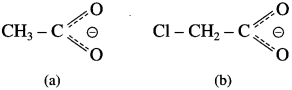
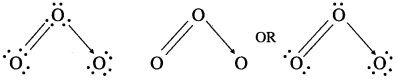
3. Land and building to be valued at ₹ 45,000 and furniture to be depreciated by 10%.
4. Provision for bad and doubtful debts is to be maintained at 5% on the Sundry Debtors.
5. Stock to be valued ₹ 82,500.
The Capital A/c of all partners to be adjusted in their new profit and loss ratio and excess amount be transferred to their loan accounts.
Prepare Profit and Loss Adjustment Account, Capital Accounts, and New Balance Sheet.
Solution:
In the books of Partnership Firm
Maharashtra Board 12th BK Textbook Solutions Chapter 3 Reconstitution of Partnership (Admission of Partner) Q1.1
Balance Sheet as of 1st April 2018
Maharashtra Board 12th BK Textbook Solutions Chapter 3 Reconstitution of Partnership (Admission of Partner) Q1.2
Working Notes:
1. Calculation of new profit ratio = 1 – share of new partner
= 1 – \(\frac{1}{4}\)
= \(\frac{3}{4}\) (Remaining share)
New ratio = old ratio × balance 1 (Remaining share)
Vikram’s new ratio = \(\frac{2}{5} \times \frac{3}{4}=\frac{6}{20}\)
Pradnya’s new ratio = \(\frac{3}{5} \times \frac{3}{4}=\frac{9}{20}\)
Avani’s ratio = \(\frac{1}{4}=\frac{1}{4} \times \frac{5}{5}=\frac{5}{20}\)
∴ New profit sharing ratio = 6 : 9 : 5.
Capital amount adjusted in their new profit and loss ratio:
Total Capital of the Partnership Firm = (Reciprocal of New Partner’s Share) × (Capital of New Partner)
= (Reciprocal of \(\frac{1}{4}\)) × 37,500
= 4 × 37,500
= ₹ 1,50,000
Vikram’s Capital balance = (Vikram’s New Ratio) × (Total Capital of the firm)
= \(\frac{6}{20}\) × 1,50,000 = ₹ 45,000
Pradnya’s Capital balance = \(\frac{9}{20}\) × 1,50,000 = ₹ 67,500

Maharashtra Board 12th BK Textbook Solutions Chapter 3 Reconstitution of Partnership (Admission of Partner)

Question 2.
Amalendu and Sameer share profits and losses in the ratio 3 : 2 respectively. Their Balance Sheet as of 31st March 2017 was as under:
Balance Sheet as of 31st March 2017
Maharashtra Board 12th BK Textbook Solutions Chapter 3 Reconstitution of Partnership (Admission of Partner) Q2
On 1st April 2017 they admit Paresh into partnership. The term being that:
1. He shall pay ₹ 16,000 as his share of Goodwill 50% amount of Goodwill shall be withdrawn by the old partners.
2. He shall have to bring in ₹ 20,000 as his Capital for 1/4 share in future profits.
3. For the purpose of Paresh’s admission it was agreed that the assets would be revalued as follows:
A. Land and Building is to be valued at ₹ 60,000.
B. Plant and Machinery to be valued at ₹ 16,000.
C. Stock valued at ₹ 20,000 and Furniture and Fixtures at ₹ 4,000.
D. A Provision of 5% on Debtors would be made for Doubtful Debts.
Pass the necessary Journal Entries in the books of a new firm.
Solution:
Journal entries in the books of Partnership Firm
Maharashtra Board 12th BK Textbook Solutions Chapter 3 Reconstitution of Partnership (Admission of Partner) Q2.1
Maharashtra Board 12th BK Textbook Solutions Chapter 3 Reconstitution of Partnership (Admission of Partner) Q2.2
Working Notes:
Maharashtra Board 12th BK Textbook Solutions Chapter 3 Reconstitution of Partnership (Admission of Partner) Q2.3
Maharashtra Board 12th BK Textbook Solutions Chapter 3 Reconstitution of Partnership (Admission of Partner) Q2.4

Question 3.
Vasu and Viraj share profits and losses in the ratio of 3 : 2 respectively. Their Balance Sheet as on 31st March, 2019 was as under:
Balance Sheet as on 31st March, 2019
Maharashtra Board 12th BK Textbook Solutions Chapter 3 Reconstitution of Partnership (Admission of Partner) Q3
They admit Hari into partnership on 1-4-2019. The terms being that:
1. He shall have to bring in ₹ 60,000 as his Capital for 1/4 share in future profits.
2. Value of Goodwill of the firm is to be fixed at the average profits for the last three years.
The Profit were:
2015-16 – ₹ 48,000
2016-17 – ₹ 81,000
2017-18 – ₹ 73,500
Hari is unable to bring the value of Goodwill in cash. It is decided to raise Goodwill in the books of accounts.
3. Reserve for Doubtful debts is to be created at ₹ 1,500.
4. Closing stock is valued at ₹ 22,500.
5. Plant and Building are to be depreciated by 5%.
Prepare Profit and Loss-Adjustment A/c, Capital Accounts of Partners and Balance Sheet of the new firm.
Solution:
In the books of the firm __________
Maharashtra Board 12th BK Textbook Solutions Chapter 3 Reconstitution of Partnership (Admission of Partner) Q3.1
Balance Sheet as on 1st April 2019
Maharashtra Board 12th BK Textbook Solutions Chapter 3 Reconstitution of Partnership (Admission of Partner) Q3.2
Working Notes:
1. Average Profit = \(\frac{Total Profit}{No. of years}\)
= \(\frac{48,000+81,000+73,500}{3}\)
= ₹ 67,500
∴ Goodwill value = ₹ 67,500
Vasu’s share in Goodwill = ₹ 40,500 (67,500 × \(\frac{3}{5}\))
Viraj’s share in Goodwill = ₹ 27,000 (67,500 × \(\frac{2}{5}\))

2. Hari is not able to bring a share in goodwill and it is decided to raise the goodwill in the book.
Therefore, Goodwill is recorded in the Asset side ₹ 67,500.

Maharashtra Board 12th BK Textbook Solutions Chapter 3 Reconstitution of Partnership (Admission of Partner)

Question 4.
Mr. Deep & Mr. Karan were in partnership sharing profits & losses in the proportion of 3 : 1 respectively. Their Balance Sheet on 31st March 2018 stood as follows:
Balance Sheet as of 31st March 2018
Maharashtra Board 12th BK Textbook Solutions Chapter 3 Reconstitution of Partnership (Admission of Partner) Q4
They admit Shubham into Partnership on 1 April 2018. The terms being that:
1. He shall have to bring in ₹ 20,000 as his capital for 1/5 share in future profits & ₹ 10,000 as his share of Goodwill.
2. A provision for 5% doubtful debts to be created on sundry debtors.
3. Furniture to be depreciated by 20%.
4. Stock should be appreciated by 5% and Building be appreciated by 20%.
5. Capital A/c of all partners be adjusted in their new profit sharing ratio through cash account.
Prepare Profit and Loss-Adjustment A/c, Partners’ Capital A/c, Balance Sheet of the new firm.
Solution:
In the books of the firm __________
Maharashtra Board 12th BK Textbook Solutions Chapter 3 Reconstitution of Partnership (Admission of Partner) Q4.1
Maharashtra Board 12th BK Textbook Solutions Chapter 3 Reconstitution of Partnership (Admission of Partner) Q4.2
Balance Sheet as of 1st April 2018
Maharashtra Board 12th BK Textbook Solutions Chapter 3 Reconstitution of Partnership (Admission of Partner) Q4.3
Working Note:
Calculation of new ratio : Balance of 1 = 1 – share of new partner
= 1 – \(\frac{1}{5}\)
= \(\frac{4}{5}\) (Remaining share)
New ratio = Old ratio × balance 1 (Remaining share)
Deep’s new ratio = \(\frac{3}{4} \times \frac{4}{5}=\frac{3}{5}\)
Karan’s new ratio = \(\frac{1}{4} \times \frac{4}{5}=\frac{1}{5}\)
Shubham’s new ratio = \(\frac{1}{5}=\frac{1}{5}\)
∴ New profit and loss sharing ratio = 3 : 1 : 1
Capital amount to be adjusted in Partner’s new profit and loss ratio:
Total Capital of the firm = (Reciprocal of New partner’s share) × (New partner’s capital)
= 5 × 20,000
= ₹ 1,00,000
Deep’s capital balance = \(\frac {3}{5}\) × 1,00,000 = ₹ 60,000
Karan’s capital balance = \(\frac {1}{5}\) × 1,00,000 = ₹ 20,000
Maharashtra Board 12th BK Textbook Solutions Chapter 3 Reconstitution of Partnership (Admission of Partner) Q4.4

Question 5.
Mr. Kishor & Mr. Lai were in partnership sharing profits & losses in the proportion of 3/4 and 1/4 respectively.
Maharashtra Board 12th BK Textbook Solutions Chapter 3 Reconstitution of Partnership (Admission of Partner) Q5
They decided to admit Ram on 1 April 2018 on the following terms:
1. He should be given 1/5th share in profit and for that, he brought in ₹ 60,000 as capital through RTGS.
2. Goodwill should be raised at ₹ 60,000.
3. Appreciate Land and Building by 20%.
4. Furniture and Stock are to be depreciated by 10%.
5. The capitals of all partners should be adjusted in their new profit sharing ratio through Bank A/c.
Pass necessary Journal Entries in the books of the partnership firm and a Balance Sheet of the new firm.
Solution:
Journal entries in the books of the firm
Maharashtra Board 12th BK Textbook Solutions Chapter 3 Reconstitution of Partnership (Admission of Partner) Q5.1
Maharashtra Board 12th BK Textbook Solutions Chapter 3 Reconstitution of Partnership (Admission of Partner) Q5.2
Balance Sheet as of 1st April 2018
Maharashtra Board 12th BK Textbook Solutions Chapter 3 Reconstitution of Partnership (Admission of Partner) Q5.3
Working Notes:
1.
Maharashtra Board 12th BK Textbook Solutions Chapter 3 Reconstitution of Partnership (Admission of Partner) Q5.4

2. Calculation of new profit sharing ratio:
New Ratio = (Balance of 1) × (old ratio)
Kishor’s New ratio = \(\left(1-\frac{1}{5}\right) \times \frac{3}{4}=\frac{4}{5} \times \frac{3}{4}=\frac{3}{5}\)
Lal’s New ratio = \(\left(1-\frac{1}{5}\right) \times \frac{1}{4}=\frac{4}{5} \times \frac{1}{4}=\frac{1}{5}\)
Ram’s ratio = \(\frac{1}{5}\)

3. Total capital of the firm = (Reciprocal of Ram’s ratio) × (His capital contribution)
= \(\frac{5}{1}\) × 60,000 = ₹ 3,00,000
Kishor’s new closing capital balance = 3,00,000 × \(\frac{3}{5}\) = ₹ 1,80,000
Lai’s new closing capital balance = 3,00,000 × \(\frac{1}{5}\) = ₹ 60,000
Ram’s new closing capital balance = ₹ 60,000

Maharashtra Board 12th BK Textbook Solutions Chapter 3 Reconstitution of Partnership (Admission of Partner)

Question 6.
Vrushali and Leena are equal partners in the business. Their Balance Sheet as of 31st March 2013 stood as under.
Balance Sheet as of 31st March 2018
Maharashtra Board 12th BK Textbook Solutions Chapter 3 Reconstitution of Partnership (Admission of Partner) Q6
They decided to admit Aparna on 1st April 2018 on the following terms:
1. The Machinery and Building be depreciated by 10%. Reserve for Doubtful Debts to be increased by ₹ 5,000.
2. Bills receivable are taken over by Vrushali at a discount of 10%.
3. Aparna should bring ₹ 60,000 as capital for her 1/4th share in future profits.
4. The Capital accounts of all the partners be adjusted in proportion to the new profit sharing ratio by opening the Current accounts of the partners.
Prepare Profit and Loss-Adjustment A/c, Partners’ Capital A/c, Balance Sheet of the new firm.
Solution:
Maharashtra Board 12th BK Textbook Solutions Chapter 3 Reconstitution of Partnership (Admission of Partner) Q6.1
Balance Sheet as on 1st April 2018
Maharashtra Board 12th BK Textbook Solutions Chapter 3 Reconstitution of Partnership (Admission of Partner) Q6.2
Working Notes:
1. R.D.D. to be increased by ₹ 5,000 means subtract ₹ 5,000 from Debtors.

2. Bills receivable taken by Vrushali at 10 % discount i.e. 12,000 – 1,200 = ₹ 10,800.
Write this amount on the debit side of the partners’ Capital Account in Vrushali’s column.

3. Calculation of new ratio = 1 – share of new partner
= 1 – \(\frac{1}{4}\)
= \(\frac{3}{4}\) (Remaining share)
New ratio = Old ratio × Balance 1 (Remaining Share)
Vrushali’s new ratio = \(\frac{1}{2} \times \frac{3}{4}=\frac{3}{8}\)
Leena’s new ratio = \(\frac{1}{2} \times \frac{3}{4}=\frac{3}{8}\)
Aparna’s ratio = \(\frac{1}{4}\)
∴ Partner’s new profit and loss ratio = \(\frac{3}{8}: \frac{3}{8}: \frac{1}{4}\) = 3 : 3 : 2
Now, capital amount to be adjusted in partners new profit and loss ratio.
Total capital of the firm = (Reciprocal of New Partner’s Share) × (New Partner’s Capital)
= (Reciprocal of \(\frac{1}{4}\)) × 60,000
= 4 × 60,000
= ₹ 2,40,000
Vrushali’s capital balance = \(\frac {3}{8}\) × 2,40,000 = ₹ 90,000
Leela’s capital balance = \(\frac {3}{8}\) × 2,40,000 = ₹ 90,000
The deficit of these capital balances is to be adjusted through the Current account.
To keep the balance of Vrushali’s and Leena’s capital ₹ 90,000 each, deficit of ₹ 53,850 and ₹ 58,050 are incurred which is transferred to the respective Partner’s Current A/cs and recorded on the Asset side of Balance Sheet [As it is to be recovered from Partners].

Question 7.
The balance sheet of Medha and Radha who share profit and loss in the ratio 3 : 1 is as follows:
Balance Sheet as of 31st March 2018
Maharashtra Board 12th BK Textbook Solutions Chapter 3 Reconstitution of Partnership (Admission of Partner) Q7
They decided to admit Krutika on 1st April 2018 on the following terms:
1. Krutika is taken as a partner on 1st April 2017. She will pay 40,000 as her capital for 1/5th share in future profits and ₹ 2,500 as goodwill.
2. 5% provision for bad and doubtful debt be created on debtors.
3. Furniture be depreciated by 20%.
4. Stocks be appreciated by 5% and plant & machinery by 20 %.
5. The Capital accounts of all partners be adjusted in their new profit sharing ratio by adjusting the amount through a loan.
6. The new profit sharing ratio will be 3/5 : 1/5 : 1/5 respectively.
You are required to prepare Profit and Loss-Adjustment A/c, Partners’ Capital A/c, Balance Sheet of the new firm.
Solution:
Maharashtra Board 12th BK Textbook Solutions Chapter 3 Reconstitution of Partnership (Admission of Partner) Q7.1
Maharashtra Board 12th BK Textbook Solutions Chapter 3 Reconstitution of Partnership (Admission of Partner) Q7.2
Balance Sheet as of 1st April 2018
Maharashtra Board 12th BK Textbook Solutions Chapter 3 Reconstitution of Partnership (Admission of Partner) Q7.3
Working Notes:
1. Total capital of the firm = (Reciprocal of New Partner’s Profit Sharing ratio) × (Capital contributed by new partner)
= (Reciprocal of \(\frac{1}{5}\)) × 40,000
= 5 × 40,000
= ₹ 2,00,000
Medha’s closing capital, balance = \(\frac{3}{5}\) × 2,00,000 = ₹ 1,20,000
Radha’s closing capital balance = \(\frac{1}{5}\) × 2,00,000 = ₹ 40,000

2. General reserve is distributed among old partners in their old profit and loss ratio.

3. Cash Balance = 78,000 + 40,000 + 2,500 = ₹ 1,20,500 [Amount brought in by new partner.]

Maharashtra Board 12th BK Textbook Solutions Chapter 3 Reconstitution of Partnership (Admission of Partner)

Question 8.
The Balance Sheet of Sahil and Nikhil who share profits in the ratio of 3 : 2 as of 31st March 2017 is as follows:
Balance Sheet as of 31st March 2017
Maharashtra Board 12th BK Textbook Solutions Chapter 3 Reconstitution of Partnership (Admission of Partner) Q8
Varad admitted on 1st April 2017 on the following terms:
1. Varad was to pay ₹ 1,00,000 for his share of capital.
2. He was also to pay ₹ 40,000 as his share of goodwill.
3. The new profit sharing ratio was 3 : 2 : 3.
4. Old partners decided to revalue the assets as follows:
Building ₹ 1,00,000. Furniture ₹ 48,000, Debtors ₹ 38,000 (in view of likely bad debts)
5. It was found that there was a liability for ₹ 3,000 for goods in March 2017 but recorded on 2nd April 2017.
You are required to prepare:
(a) Profit and Loss-Adjustment account
(b) Capital accounts of the partners
(c) Balance Sheet after the admission of Varad.
Solution:
Maharashtra Board 12th BK Textbook Solutions Chapter 3 Reconstitution of Partnership (Admission of Partner) Q8.1
Maharashtra Board 12th BK Textbook Solutions Chapter 3 Reconstitution of Partnership (Admission of Partner) Q8.2
Balance Sheet as of 1st April 2017
Maharashtra Board 12th BK Textbook Solutions Chapter 3 Reconstitution of Partnership (Admission of Partner) Q8.3
Working Notes:
1. Cash in hand = Opening balance + Varad’s capital + Varad’s goodwill (amount brought in)
= 20,000 + 1,00,000 + 40,000
= ₹ 1,60,000

2. Sacrifice ratio = Old ratio – New ratio
Sahil’s sacrifice = \(\frac{3}{5}-\frac{3}{8}=\frac{24-15}{40}=\frac{9}{40}\)
Nikhil’s sacrifice = \(\frac{2}{5}-\frac{2}{8}=\frac{16-10}{40}=\frac{6}{40}\)
i.e. sacrifice ratio = \(\frac{9}{40}: \frac{6}{40}\) = 9 : 6 = 3 : 2.
Goodwill is distributed among old partners in the sacrifice ratio.

Question 9.
Mr. Amit and Baban share profits and losses in the ratio 2 : 3 respectively. Their Balance Sheet as of 31st March 2018 was as under:
Balance Sheet as of 31st March 2018
Maharashtra Board 12th BK Textbook Solutions Chapter 3 Reconstitution of Partnership (Admission of Partner) Q9
They agreed decided to admit Kamal on 1st April 2018 on the following terms:
1. Kamal shall have 1/4th share in future profits.
2. She shall bring 50,000 as her capital and 40,000 as her share of goodwill.
3. Land and building to be valued at 60,000 and furniture to be depreciated by 10%.
4. Provision for bad and doubtful debts is to be maintained at 5% on the sundry debtors.
5. Stocks to be valued at 1,10,000.
The Capital A/c of all partners to be adjusted in their new profit and loss ratio and excess amount be transferred to their loan accounts.
Prepare Profit and Loss-Adjustment A/c, Capital A/cs, and New Balance Sheet.
Solution:
Maharashtra Board 12th BK Textbook Solutions Chapter 3 Reconstitution of Partnership (Admission of Partner) Q9.1
Balance Sheet as of 1st April 2018
Maharashtra Board 12th BK Textbook Solutions Chapter 3 Reconstitution of Partnership (Admission of Partner) Q9.2
Working Notes:
1. Cash balance = Opening balance + Amount brought in by Kamal
= 1,10,000 + 50,000 + 40,000
= ₹ 2,00,000

2. For calculation of new profit and loss ratio:
Calculation of new profit ratio = 1 – share of new partner
= 1 – \(\frac{1}{4}\)
= \(\frac{3}{4}\) (Remaining share)
New ratio = old ratio × balance 1 (Remaining share)
Amit’s new ratio = \(\frac{2}{5} \times \frac{3}{4}=\frac{6}{20}\)
Baban’s new ratio = \(\frac{3}{5} \times \frac{3}{4}=\frac{9}{20}\)
Kamal’s ratio = \(\frac{1}{4}=\frac{1}{4} \times \frac{5}{5}=\frac{5}{20}\)

3. New profit and loss ratio = 6 : 9 : 5
Capital amount adjusted in their new profit and loss ratio by taking new partner Kamal’s capital (₹ 50,000) as a base.
For part 5 capital = ₹ 50,000 (Kamal’s capital)
For part 6 capital = ₹ 60,000 (Amit’s capital)
For part 9 capital = ₹ 90,000 (Baban’s capital)

4. After keeping these capital balances difference of the amount of Amit’s capital ₹ 63,520 and of Baban’s capital ₹ 45,280 are taken as partner’s loan to the firm and as a liability of the firm it is recorded in the Liabilities side of the Balance Sheet.

Maharashtra Board 12th BK Textbook Solutions Chapter 3 Reconstitution of Partnership (Admission of Partner)

Question 10.
The following is the Balance Sheet of Om and Jay on 31st March 2018, they share profits and losses in the ratio 3 : 2.
Balance Sheet as of 31st March 2018
Maharashtra Board 12th BK Textbook Solutions Chapter 3 Reconstitution of Partnership (Admission of Partner) Q10
They take Jagdish into partnership on 1st April 2018. The terms being:
1. Jagdish should pay ₹ 3,000 as his share of Goodwill. 50% of goodwill withdrawn by partners in cash.
2. He should bring ₹ 9,000 as capital for 1/4th share in future profits.
3. Building to be valued at 18,000, Machinery and Furniture to be reduced by 10 %.
4. A provision of 5% on debtors to be made for doubtful debts.
5. Stock to be taken at the value of ₹ 15,000.
Prepare Profit and Loss A/c, Partners’ Current A/c, Balance Sheet of the new firm.
Solution:
Maharashtra Board 12th BK Textbook Solutions Chapter 3 Reconstitution of Partnership (Admission of Partner) Q10.1
Balance Sheet as of 1st April 2018
Maharashtra Board 12th BK Textbook Solutions Chapter 3 Reconstitution of Partnership (Admission of Partner) Q10.2
Working Notes:
1.
Maharashtra Board 12th BK Textbook Solutions Chapter 3 Reconstitution of Partnership (Admission of Partner) Q10.3

2. Write partner’s capital accounts balance as fixed capital balance in the Balance Sheet and transferred current account balance in the Balance Sheet as Partners Current A/c.

3. As shown in the cash account partners’ withdrew half amount of goodwill amount share.

Maharashtra Board 12th BK Textbook Solutions Chapter 2 Accounts of ‘Not for Profit’ Concerns

Balbharti Maharashtra State Board 12th Commerce Book Keeping & Accountancy Solutions Chapter 2 Accounts of ‘Not for Profit’ Concerns Textbook Exercise Questions and Answers.

Maharashtra State Board 12th Book Keeping & Accountancy Solutions Chapter 2 Accounts of ‘Not for Profit’ Concerns

1. Objective Type Questions:

A. Select the most appropriate alternatives from the following and rewrite the sentences:

Question 1.
Not for Profit concern renders ___________ services to public at large.
(a) commercial
(b) social
(c) individual
(d) group
Answer:
(b) social

Question 2.
Donation for Scholarship Fund is ___________
(a) Capital Receipt
(b) Revenue Receipt
(c) Capital Expenditure
(d) Revenue Expenditure
Answer:
(a) Capital Receipt

Maharashtra Board 12th BK Textbook Solutions Chapter 2 Accounts of ‘Not for Profit’ Concerns

Question 3.
Income and Expenditure Account is a ___________ Account.
(a) Capital
(b) Real
(c) Personal
(d) Nominal
Answer:
(d) Nominal

Question 4.
Outstanding subscription at the end of the Accounting Year represents ___________
(a) Liability
(b) an Expenditure
(c) an Asset
(d) Capital Fund
Answer:
(c) an Asset

Question 5.
Subscription received in advance during the accounting year is ___________
(a) an Income
(b) an Expense
(c) an Asset
(d) a Liability
Answer:
(d) a Liability

Question 6.
Excess of Income over Expenditure is termed as ___________
(a) Deficit
(b) Profit
(c) Surplus
(d) Loss
Answer:
(c) Surplus

Question 7.
Not for Profit concern prepares ___________ Account instead of Profit and Loss Account to know the result.
(a) Trading
(b) Income and Expenditure
(c) Cash
(d) Receipt and Payments
Answer:
(b) Income and Expenditure

Maharashtra Board 12th BK Textbook Solutions Chapter 2 Accounts of ‘Not for Profit’ Concerns

Question 8.
The closing balance of Receipts and Payments Account usually represent ___________
(a) Closing stock
(b) Cash and Bank Balance
(c) Surplus
(d) Deficit
Answer:
(b) Cash and Bank Balance

Question 9.
Not for Profit organization is also called ___________ organization.
(a) service
(b) trading
(c) profit-making
(d) commercial
Answer:
(a) service

Question 10.
Expenditure on Purchase of Building is a ___________ Expenditure.
(a) Capital
(b) Revenue
(c) General
(d) Recurring
Answer:
(a) Capital

B. Write the Word/Phrase/Term, which can substitute each of the following Statements.

Question 1.
The Form of Organization providing services to the society only.
Answer:
Not for Profit concern

Question 2.
An account which is prepared by Not for Profit concern instead of Profit and Loss Account.
Answer:
Income and Expenditure Account

Question 3.
Donations are received for a specific purpose.
Answer:
Specific donation/Capital Receipt

Question 4.
The Receipts are not recurring in nature.
Answer:
Capital Receipt

Maharashtra Board 12th BK Textbook Solutions Chapter 2 Accounts of ‘Not for Profit’ Concerns

Question 5.
An Account that records only revenue items in case of Not a for-profit concern.
Answer:
Income and Expenditure Account

Question 6.
Accounts which records only cash transactions in case of Not for Profit concerns.
Answer:
Receipts and Payments Account

Question 7.
The income is earned during the year but not received during the year.
Answer:
Outstanding income

Question 8.
The credit balance of Income and Expenditure Account.
Answer:
Surplus

Question 9.
To excess of total assets over total liabilities of a Not for Profit concern.
Answer:
Capital Fund

Maharashtra Board 12th BK Textbook Solutions Chapter 2 Accounts of ‘Not for Profit’ Concerns

Question 10.
All such receipts are non-recurring in nature and not forming a part of a regular flow of income.
Answer:
Capital Receipts

C. State whether the following statements are True or False with reasons.

Question 1.
Not for Profit concerns do not have a profit motive.
Answer:
This statement is True.
Not for profit concerns, the main aim is to give services to its members or to the society at large. They do not carry any Trading activity or Manufacturing activity so there is no question of having a profit motive for ‘Not for Profit’ concerns.

Question 2.
Charitable Institutions prepare Profit and Loss Accounts at the end of every financial year.
Answer:
This statement is False.
Charitable Institutions, Not for Profit concerns, do not undertake any trading activities and hence instead of Profit and Loss Account prepare Income-Expenditure Account to record all revenue expenses/losses and revenue incomes/gains of the current year.

Question 3.
There is no difference between Receipts and Payments Account and Income and Expenditure Account.
Answer:
This statement is False.
In the Receipts and Payments Account, all receipts and payments transactions in cash or through the bank are recorded irrespective of the current year, previous year, or next year while in Income-Expenditure Account, only the current year’s incomes and expenses (Revenue) are recorded.

Maharashtra Board 12th BK Textbook Solutions Chapter 2 Accounts of ‘Not for Profit’ Concerns

Question 4.
Income and Expenditure Account represents either surplus or deficit.
Answer:
This statement is True.
In the Income and Expenditure Account, all revenue incomes and expenses are recorded and at the end of the specified period, the difference is found out which is known as ‘Surplus’ (Revenue incomes are more than Revenue expenses) or ‘Deficit’ (Revenue expenses are more than Revenue incomes).

Question 5.
Receipts and Payments Accounts do not have any opening balance.
Answer:
This statement is False.
Receipts and Payments Account is just like a cash book of trading concern and opening balance (Cash or Bank or Cash and Bank) must be there to start recording of transactions.

Question 6.
Not for Profit concerns do not prepare a Balance Sheet.
Answer:
This statement is False.
To know the financial position of the organization, at the end of the particular period, Not for Profit concerns prepare Balance Sheet.

Question 7.
Purchases of Sports Equipments is a Capital Expenditure.
Answer:
This statement is True.
Generally, the life span of sports equipment is more than one year, so the purchase of sports equipment is considered a capital expenditure.

Question 8.
Income and Expenditure Account is a Real Account.
Answer:
This statement is False.
In the Income and Expenditure Account, all the revenue incomes and revenue expenses are recorded and therefore it is a Nominal Account and not a Real Account.

Maharashtra Board 12th BK Textbook Solutions Chapter 2 Accounts of ‘Not for Profit’ Concerns

Question 9.
The Receipts and Payments Account contains only the transactions relating to the current year.
Answer:
This statement is False.
In the Receipts and Payments Account, transactions of not only the current year but of the previous year or of the next year are also recorded.

Question 10.
Excess of Assets over liabilities is called Capital Fund.
Answer:
This statement is True.
For ‘Not for Profit’ concerns in the Balance Sheet, when a total of Assets is more than the total of Liabilities, the difference of amount is considered as ‘Capital Fund’.

D. Fill in the blanks.

Question 1.
Not for Profit organization is never engaged in ___________ activities.
Answer:
trading

Question 2.
Not for Profit organization is called ___________ organization.
Answer:
service

Question 3.
Receipts and Payments Account falls under the category of ___________ Account.
Answer:
Real

Question 4.
In Receipts and Payment Account the summary of ___________ transactions are recorded.
Answer:
cash

Maharashtra Board 12th BK Textbook Solutions Chapter 2 Accounts of ‘Not for Profit’ Concerns

Question 5.
Income and Expenditure Account is similar to the ___________ Account of Trading concern.
Answer:
Profit and Loss

Question 6.
Credit side of Receipts and Payments Account shows cash ___________
Answer:
payments

Question 7.
Income and Expenditure Account is a ___________ Account.
Answer:
Nominal

Question 8.
Mumbai University prepares ___________ Account instead of a Profit and Loss account.
Answer:
Income and Expenditure

Question 9.
Subscription received from the members is considered as ___________ receipts.
Answer:
revenue

Question 10.
The transactions recorded in the Income and Expenditure Account related only to the ___________ year.
Answer:
current

E. Answer in one sentence only.

Question 1.
What do you mean by ‘Not for Profit’ Concern?
Answer:
A concern or organization which is formed and established to serve its members and society or the general public by undertaking various activities without any profit motive is called a ‘Not for Profit’ concern.

Question 2.
Which organizations prepare Income and Expenditure Account?
Answer:
‘Not for profit’ concern prepares Income and Expenditure Account.

Maharashtra Board 12th BK Textbook Solutions Chapter 2 Accounts of ‘Not for Profit’ Concerns

Question 3.
What is Receipts and Payments Account?
Answer:
An account that is prepared by a ‘Not for Profit Concern’ to record a summary of all types of cash receipts and cash payments inclusive of bank transactions is called Receipts and Payments Account.

Question 4.
Why Income and Expenditure Account is prepared?
Answer:
Income and Expenditure Account is prepared to ascertain, whether the concern has sufficient income to meet its expenses, or not.

Question 5.
What is Capital Fund?
Answer:
Excess of Assets over Liabilities is known as Capital Fund which also consists of contributions, subscription, entrance fees, surplus income, etc.

Question 6.
What is a Subscription?
Answer:
Subscription is the periodical payment made by the members to the ‘Not for Profit’ concern for maintaining their membership.

Question 7.
What is ’Legacy’?
Answer:
Any asset, property, or amount of cash which ‘Not for Profit’ concern receives as per the provisions made in the will of the donor after his death is called Legacy.

Maharashtra Board 12th BK Textbook Solutions Chapter 2 Accounts of ‘Not for Profit’ Concerns

Question 8.
What is Surplus?
Answer:
Excess of income over expenditure shown by Income and Expenditure Account represents Surplus for the financial year.

Question 9.
What do you mean by Non-recurring Expenses?
Answer:
Non-recurring expenses are the expenses that are made for the acquisition of fixed assets that gives benefits for a long period.

Question 10.
To which account ‘Surplus’ or ‘Deficit’ is transferred?
Answer:
‘Surplus’ or ‘Deficit’ is transferred to the Balance Sheet by adding it or subtracting it from Capital Fund.

F. I. Complete the Table:

Question 1.

Sr. No.Income (₹)Expenditure (₹)Surplus/Deficit (₹)
110,000?5,000 (Deficit)
28,000?4,000 (Surplus)
3?15,0008,000 (Surplus)
47,5009,000?
515,00011,300?

Solution:

Sr.No.Income (₹)Expenditure (₹)Surplus/Deficit (₹)
110,00015,0005,000 (Deficit)
28,0004,0004,000 (Surplus)
323,00015,0008,000 (Surplus)
47,5009,0001,500 (Deficit)
515,00011,3003,700 (Surplus)

II. Salaries paid during the year:

Question 1.

Sr.No.Total (₹)Prepaid/OutstandingExpenditure for the year
11,100Prepaid100?
22,700Prepaid?2,000
38,250Prepaid?6,650
41,200Outstanding200?
5?Outstanding6005,100
61,800Outstanding?2,200

Solution:

Sr. No.Total (₹)Prepaid/OutstandingExpenditure for the year
11,100Prepaid1001,000
22,700Prepaid7002,000
38,250Prepaid1,6006,650
41,200Outstanding2001,400
54,500Outstanding6005,100
61,800Outstanding4002,200

III. Rent received during the year:

Question 1.

Sr.No.Total Received (₹)Rent Received in Advance/AccruedIncome for the year (₹)
11,300Received in Advance200?
2?Received in Advance4001,400
32,650Received in Advance?2,000
4?Accrued2903,190
51,700Accrued?2,150
62,600Accrued500?

Solution:

Sr.No.Total Received (₹)Rent received in Advance/AccruedIncome for the year (₹)
11,300Received in Advance2001,100
21,800Received in Advance4001,400
32,650Received in Advance6502,000
42,900Accrued2903,190
51,700Accrued4502,150
62,600Accrued5003,100

G. Calculate the following:

Question 1.
10 % p.a. Depreciation on Furniture ₹ 50,000 (for three months)
Solutions:
Depreciation = Cost of Asset × Rate × Period
= 50,000 × \(\frac{10}{100}\) × \(\frac{3}{12}\)
= ₹ 1250 Depr. for 3 months
Thus, Depreciation on furniture @ 10 % on ₹ 50,000 for 3 months = ₹ 1250.

Maharashtra Board 12th BK Textbook Solutions Chapter 2 Accounts of ‘Not for Profit’ Concerns

Question 2.
12 % p.a. Interest on Bank loan ₹ 80,000 for 1 year.
Answer:
I = \(\frac{\mathrm{PRN}}{100}\)
= 80,000 × \(\frac{12}{100}\) × 1
= ₹ 9600.
Thus, interest on a Bank loan ₹ 80,000 for 1 year = ₹ 9600.

Question 3.
Opening stock of stationery ₹ 5,000, purchases of stationery ₹ 7000, outstanding stationery bill ₹ 12,000, closing stock ₹ 1000. What is the amount of stationery consumed?
Answer:
Maharashtra Board 12th BK Textbook Solutions Chapter 2 Accounts of ‘Not for Profit’ Concerns G Q3

Question 4.
Salary ₹ 10,000, outstanding salary ₹ 5,000. Calculate the salary to be debited to the Income and Expenditure Account.
Answer:
Maharashtra Board 12th BK Textbook Solutions Chapter 2 Accounts of ‘Not for Profit’ Concerns G Q4

Question 5.
Library Books ₹ ……………? Less 10% Depreciation ₹ 5,000 = ₹ 45,000.
Answer:
Library books ₹ 50,000. Less 10% Depreciation ₹ 5,000 = ? 45,000
Maharashtra Board 12th BK Textbook Solutions Chapter 2 Accounts of ‘Not for Profit’ Concerns G Q5

H. Find odd one:

Question 1.
Trading Account, Profit and Loss Account, Receipts and Payments Account, Balance Sheet.
Answer:
Receipts and Payments Account

Question 2.
Machinery, Furniture, Computers, Salaries.
Answer:
Salaries

Question 3.
Subscription, Stationery, Interest Received, Locker Rent received.
Answer:
Stationery

Maharashtra Board 12th BK Textbook Solutions Chapter 2 Accounts of ‘Not for Profit’ Concerns

Question 4.
Reliance Industries, Venna Vidya Mandir, Laxmi Hospital, Manoj Sports club.
Answer:
Reliance Industries

Question 5.
Surplus, Deficit, Net Profit, Capital fund.
Answer:
Net Profit

Practical Problems

Question 1.
Calculation of stationery consumed during the year
Maharashtra Board 12th BK Textbook Solutions Chapter 2 Accounts of ‘Not for Profit’ Concerns Practical Problems Q1
Adjustments:
1. ₹ 1,000 outstanding for the stationery bill.
2. Stock of Stationery as of 31 – 03 – 2019 was valued at ₹ 1,800.
With the above information, calculate the amount of Stationery consumed during the year and show its presence in final Accounts of a concern.
Solution:
In the books of ___________________
Maharashtra Board 12th BK Textbook Solutions Chapter 2 Accounts of ‘Not for Profit’ Concerns Practical Problems Q1.1
Balance Sheet as of 31 – 03 – 2019
Maharashtra Board 12th BK Textbook Solutions Chapter 2 Accounts of ‘Not for Profit’ Concerns Practical Problems Q1.2

Question 2.
Presentation of Subscription only
Maharashtra Board 12th BK Textbook Solutions Chapter 2 Accounts of ‘Not for Profit’ Concerns Practical Problems Q2
Adjustments:
The outstanding subscription for 2018-19 is ₹ 32,000.
With the above information, present the item Subscription in Income and Expenditure Account for the year ended 31 -03-2019 and Balance Sheet as on the date.
Solution:
In the books of ___________________
Maharashtra Board 12th BK Textbook Solutions Chapter 2 Accounts of ‘Not for Profit’ Concerns Practical Problems Q2.1
Balance Sheet as of 31st March 2019
Maharashtra Board 12th BK Textbook Solutions Chapter 2 Accounts of ‘Not for Profit’ Concerns Practical Problems Q2.2
Working Note:
Outstanding subs, given in the balance sheet as on 01-04-2018 are ₹ 26,000 (for 2016-17) and ₹ 35,000 (for 2017-18). Against that, as shown in Receipt – Payment A/c ₹ 23,000 and ₹ 30,000 are received respectively. Means ₹ 3,000 and ₹ 5,000 are still outstanding which are known in the current year balance sheet.

Maharashtra Board 12th BK Textbook Solutions Chapter 2 Accounts of ‘Not for Profit’ Concerns

Question 3.
Maharashtra Board 12th BK Textbook Solutions Chapter 2 Accounts of ‘Not for Profit’ Concerns Practical Problems Q3
Adjustments:
Subscription outstanding for the year 2017-18 is ₹ 6,000.
During the previous year subscription received in advance for 2017-18 is ₹ 2,000.
The outstanding subscription of 2016-17 is ₹ 2,500.
With the help of the above information present the item Subscription in Income and Expenditure Account for the year ending 31-03-2018 and Balance Sheet as on that date.
Solution:
In the books of ___________________
Maharashtra Board 12th BK Textbook Solutions Chapter 2 Accounts of ‘Not for Profit’ Concerns Practical Problems Q3.1
Balance Sheet as of 31st March 2018
Maharashtra Board 12th BK Textbook Solutions Chapter 2 Accounts of ‘Not for Profit’ Concerns Practical Problems Q3.2

Question 4.
Preparation of Income and Expenditure Account only
Following is the Receipts and Payments Account of “Satara Sports Club” Satara.
Prepare Income and Expenditure Account for the year ending 31-03-2019.
Maharashtra Board 12th BK Textbook Solutions Chapter 2 Accounts of ‘Not for Profit’ Concerns Practical Problems Q4
Adjustments:
1. Outstanding subscription for the current year is ₹ 4,500.
2. Outstanding rent for the current year amounted to ₹ 1,000.
3. Entrance fees are to be treated as Revenue Income.
4. Stock of sports material as of 01-04-2018 ₹ 6,000 and on 31 – 03 – 2019 ₹ 14,000.
Solution:
In the books of ‘Satara Sports Club’ Satara
Maharashtra Board 12th BK Textbook Solutions Chapter 2 Accounts of ‘Not for Profit’ Concerns Practical Problems Q4.1
Working Notes:
1. Entrance fees are to be treated as Revenue income. Therefore entire amount is recorded on the income side.
2. Since the selling price of Furniture ₹ 4,500 is lower than its cost price of ₹ 8,000, there is a Loss in the sale of furniture.
It is calculated as follows:
Loss on sale of furniture = Book value (cost) – Selling price
= 8,000 – 4,500
= ₹ 3,500
It is debited to Income and Expenditure A/c.

Maharashtra Board 12th BK Textbook Solutions Chapter 2 Accounts of ‘Not for Profit’ Concerns

Question 5.
“Bhartiya Kala Kendra”, Solapur gives you the following information for the year ended on 31-03-2018. Prepare Income and Expenditure Account for the year ending 31-03-2018.
Maharashtra Board 12th BK Textbook Solutions Chapter 2 Accounts of ‘Not for Profit’ Concerns Practical Problems Q5
Additional Information:
1. Legacies are to be capitalized.
2. Outstanding salary ₹ 200.
3. 50% of Entrance fees are to be capitalized.
Solution:
In the books of Bhartiya Kala Kendra, Solapur
Maharashtra Board 12th BK Textbook Solutions Chapter 2 Accounts of ‘Not for Profit’ Concerns Practical Problems Q5.1

Question 6.
Accounts of a Charitable Hospital
From the following particulars relating to “Radha-Krishna Charitable Hospital”, Pune.
Prepare Income and Expenditure Account for the year ending 31-03-2020 and Balance Sheet as of that date.
Maharashtra Board 12th BK Textbook Solutions Chapter 2 Accounts of ‘Not for Profit’ Concerns Practical Problems Q6
Additional Information:
Maharashtra Board 12th BK Textbook Solutions Chapter 2 Accounts of ‘Not for Profit’ Concerns Practical Problems Q6.1
Provide Depreciation on Equipments ₹ 1,900 and on Building ₹ 1,500.
Solution:
In the Books of Radha-Krishna Charitable Hospital, Pune
Maharashtra Board 12th BK Textbook Solutions Chapter 2 Accounts of ‘Not for Profit’ Concerns Practical Problems Q6.2
Balance Sheet as of 31st March 2020
Maharashtra Board 12th BK Textbook Solutions Chapter 2 Accounts of ‘Not for Profit’ Concerns Practical Problems Q6.3
Working Notes:
1. To find medicines consumed, here in the opening stock, purchases are added and the closing stock of medicine is subtracted.
2. For equipment, in opening balance, add equipment purchased during the year and subtract depreciation to get the closing balance of equipment.
3. Interest ₹ 10,000 is received on 10% investments means there is no outstanding interest.

Maharashtra Board 12th BK Textbook Solutions Chapter 2 Accounts of ‘Not for Profit’ Concerns

Question 7.
From the following transactions of Receipts and Payments Account of “Pavan-putra Hanuman Vyayamshala”, Parbhani and the adjustments are given, you are required to prepare Income and Expenditure Account and Balance Sheet as of 31st March 2019.
Maharashtra Board 12th BK Textbook Solutions Chapter 2 Accounts of ‘Not for Profit’ Concerns Practical Problems Q7
Adjustments:
1. There are 500 members paying an annual subscription of ₹ 50 each.
2. Outstanding salary was ₹ 1,200.
3. The Assets on 01-04-2018 were as follows:
Building ₹ 50,000, Furniture ₹ 15,000
4. Provide depreciation on Building and Furniture at 5% and 10% respectively.
5. 50% Entrance fees are to be capitalized.
6. Interest on investment at 5% p.a. has accrued for 6 months.
7. Capital fund ₹ 70,000 on 01-04-2018.
Solution:
In the Books of Pavan-putra Hanuman Vyayamshala, Parbhani
Maharashtra Board 12th BK Textbook Solutions Chapter 2 Accounts of ‘Not for Profit’ Concerns Practical Problems Q7.1
Balance Sheet as of 31st March 2019
Maharashtra Board 12th BK Textbook Solutions Chapter 2 Accounts of ‘Not for Profit’ Concerns Practical Problems Q7.2
Working Notes:
1. Interest on investment is receivable for 6 months:
I = \(\frac{\text { PRN }}{100}\)
= 15,000 × \(\frac{5}{100} \times \frac{6}{12}\)
= ₹ 375 (outstanding interest on investment)
2. 50 % of entrance fees (i.e. \(\frac{6200}{2}\) = ₹ 310o) is to be capitalised means add it to capital fund.
3. Total subscription of current year = 500 members × ₹ 50 = ₹ 25,000
But actual subscription received = ₹ 18,000
means difference (25,000 – 18,000) of ₹ 7,000 is outstanding subscription.

Question 8.
Newly Started Art Circle
“Jeevan Jyoti Art Circle” a newly established concern has presented the following information:
Maharashtra Board 12th BK Textbook Solutions Chapter 2 Accounts of ‘Not for Profit’ Concerns Practical Problems Q8
Adjustments:
1. Subscription outstanding for the year was ₹ 5,000.
2. Depreciate Furniture @ 10% p.a.
3. Full amount of admission fees and 50% donations are to be capitalized.
You are required to prepare an Income and Expenditure Account for the year ending 31-03-2018 and a Balance Sheet as of that date.
Solution:
Maharashtra Board 12th BK Textbook Solutions Chapter 2 Accounts of ‘Not for Profit’ Concerns Practical Problems Q8.1
Balance Sheet as of 31st March 2018
Maharashtra Board 12th BK Textbook Solutions Chapter 2 Accounts of ‘Not for Profit’ Concerns Practical Problems Q8.2
Working Notes:
The full amount of admission fees and 50% of donations are added to the surplus amount to get capital funds. (Opening balance of the capital fund is not given.)

Maharashtra Board 12th BK Textbook Solutions Chapter 2 Accounts of ‘Not for Profit’ Concerns

Question 9.
Given below is the Receipts and Payments Account of “Vithai Mahila Mandat”, Pandharpur for the year ending 31-03-2018. Prepare an Income and Expenditure Account for the year ended 31-03-2018 and Balance Sheet as of that date.
Maharashtra Board 12th BK Textbook Solutions Chapter 2 Accounts of ‘Not for Profit’ Concerns Practical Problems Q9
Adjustments:
1. Capital fund on 01-04-2017 was ₹ 90,000.
2. Outstanding subscription ₹ 4,000.
3. Entrance fees are to be capitalized.
4. Rent paid includes ₹ 800 paid for April 2018.
5. They have the following Assets and Liabilities as of 01-04-2017:
Furniture ₹ 9,000, Building ₹ 70,000, and Outstanding Expenses ₹ 12,000.
Solution:
In the books of Vithai Mahila Mandal, Pandharpur
Maharashtra Board 12th BK Textbook Solutions Chapter 2 Accounts of ‘Not for Profit’ Concerns Practical Problems Q9.1
Balance Sheet as of 31st March 2018
Maharashtra Board 12th BK Textbook Solutions Chapter 2 Accounts of ‘Not for Profit’ Concerns Practical Problems Q9.2
Working Notes:
1. Outstanding subscription of ₹ 4,000 is first added to subscription received on the credit side of Income and Expenditure A/c and then it is shown on the Assets side of Balance Sheet.
2. Entire amount of entrance fees ₹ 3,500 is added to the capital fund.
3. Prepaid ₹ 800 is first deducted from rent paid on the debit side of Income & Expenditure A/c and then shown on the Assets side of the Balance Sheet.
4. Outstanding expenses ₹ 12,000 is directly shown on the Liabilities side of the Balance Sheet.

Question 10.
From the following Receipts and Payments Account “K.B.P. Engineering College”, Nashik for the year ending on 31 – 03 – 2019 and additional information, prepare Income and Expenditure Account for the year ending 31-03-2019 and Balance Sheet as on that date.
Maharashtra Board 12th BK Textbook Solutions Chapter 2 Accounts of ‘Not for Profit’ Concerns Practical Problems Q10
Additional Information:
Maharashtra Board 12th BK Textbook Solutions Chapter 2 Accounts of ‘Not for Profit’ Concerns Practical Problems Q10.1
1. 50% of donations are for the Building funds and the balance is to be treated as Revenue income.
2. Outstanding subscription ₹ 5,300.
3. Life membership fees are to capitalize.
Solution:
In the books of K.B.P. Engineering College, Nashik
Maharashtra Board 12th BK Textbook Solutions Chapter 2 Accounts of ‘Not for Profit’ Concerns Practical Problems Q10.2
Balance Sheet as of 31st March 2019
Maharashtra Board 12th BK Textbook Solutions Chapter 2 Accounts of ‘Not for Profit’ Concerns Practical Problems Q10.3
Working Notes:
1. Life membership fees are to be capitalized, which means add the entire amount to the capital fund.

2. 50% of Donations of ₹ 7,00,000 i.e., ₹ 3,50,000 is to be added to the Building Fund, and the remaining amount of donation i.e., ₹ 3,50,000 is credited to Income and Expenditure A/c.

3. The depreciation on Fixed assets is calculated by using the following formula:
Depreciation = Opening balance + Purchases – Closing value
∴ Depreciation on Books = 6,00,000 + 61,000 – 6,00,000
= 6,61,000 – 6,00,000
= ₹ 61,000
∴ Depreciation on Furniture = 3,19,000 + 51,000 – 3,00,000
= 3,70,000 – 3,00,000
= ₹ 70,000

4. Fixed deposit: Opening balance given = ₹ 9,10,000
Fixed deposit (31-03-2019) = ₹ 8,50,000
(Newly purchased)
∴ Total fixed deposits = ₹ 17,50,000

5. Admission Fees ₹ 60,000 are recorded on the credit side of Income and Expenditure A/c because it is taken as Revenue income.

Maharashtra Board 12th BK Textbook Solutions Chapter 2 Accounts of ‘Not for Profit’ Concerns

Question 11.
Account of a School
From the following Balance Sheet and Receipts and Payments Account of “New English School”, Barshi, prepare Income and Expenditure Account for the year ending 31 – 03 – 2020 and a Balance Sheet as on that date.
Maharashtra Board 12th BK Textbook Solutions Chapter 2 Accounts of ‘Not for Profit’ Concerns Practical Problems Q11
Maharashtra Board 12th BK Textbook Solutions Chapter 2 Accounts of ‘Not for Profit’ Concerns Practical Problems Q11.1
Additional Information:
1. Outstanding salary of ₹ 9,000.
2. Outstanding tuition fees ₹ 15,000.
3. Depreciate library books by ₹ 9,000 and Furniture by ₹ 10,000.
Solution:
In the books of New English School, Barshi
Maharashtra Board 12th BK Textbook Solutions Chapter 2 Accounts of ‘Not for Profit’ Concerns Practical Problems Q11.2
Balance Sheet as of 31st March 2020
Maharashtra Board 12th BK Textbook Solutions Chapter 2 Accounts of ‘Not for Profit’ Concerns Practical Problems Q11.3
Working Notes:
1. Donation (Capital) is added to the Capital fund.
2. Government Grant ₹ 1,20,000 is recorded on the credit side of Income & Expenditure A/c because it is the revenue income of the organization.
3. Outstanding tuition fees ₹ 15,000 and outstanding salary ₹ 9,000 are added to the respective head of Account and then they are shown separately on the Assets side and Liabilities side of the Balance Sheet respectively.

Question 12.
Account of a Library
Following is the Receipts Payments Account of “Dhananjay Library”, Mumbai for the year ending 31-03-2020.
Maharashtra Board 12th BK Textbook Solutions Chapter 2 Accounts of ‘Not for Profit’ Concerns Practical Problems Q12
You are required to prepare an Income and Expenditure Account for the year ended 31-03-2020 and a Balance Sheet as of that day.
The following information is also made available to you.
1. On 31 -03-2019, the library had the following Assets also; Books ₹ 50,000, Furniture ₹ 6,500, and Machinery of ₹ 30,000.
2. Subscription received in advance amounted to ₹ 500.
3. Outstanding salaries ₹ 1300 and Rent ₹ 950.
4. 50% of the admission fees should be capitalized.
5. Furniture to be depreciated at 10% p.a.
6. Library books were purchased on 1st April 2019 charge depreciation at 10% p.a.
7. The Investments were purchased on 01-04-2019 and they carry interest at 20% p.a.
Solution:
In the books of Dhananjay Library, Mumbai
Maharashtra Board 12th BK Textbook Solutions Chapter 2 Accounts of ‘Not for Profit’ Concerns Practical Problems Q12.1
Balance Sheet as of 31st March 2020
Maharashtra Board 12th BK Textbook Solutions Chapter 2 Accounts of ‘Not for Profit’ Concerns Practical Problems Q12.2
Working Notes:
1. Opening Balance Sheet is prepared to find out opening capital fund:
Balance Sheet as of 31st March 2019
Maharashtra Board 12th BK Textbook Solutions Chapter 2 Accounts of ‘Not for Profit’ Concerns Practical Problems Q12.3

2. Outstanding expenses of the previous year, paid in the current year so no entry for outstanding expenses (2018-19)

3. Interest on Investment @ 20% on ₹ 6,000 = ₹ 1,200
Interest on Investment received = ₹ 900
Outstanding interest on investment = ₹ 300

4. Depreciation on library books at 10% p.a.
On opening balance of ₹ 50,000 (for whole year) = ₹ 5,000
On purchases on 01-04-2019 (for whole year) = ₹ 500
Total Depreciation = ₹ 5,500

Maharashtra Board 12th BK Textbook Solutions Chapter 2 Accounts of ‘Not for Profit’ Concerns

5. Subscriptions received in advance ₹ 500 is deducted from subscription received on the credit side of Income and Expenditure A/c and then subscription received in advance is shown separately on the Liabilities side of Balance Sheet.

6. Outstanding salaries and outstanding rent are added to the respective head of Account on the debit side of the Income & Expenditure Account and both the outstanding items are recorded on the Liabilities side of the Balance Sheet.

Question 13.
Outstanding Expenses and Prepaid Expenses
From the following information supplied to you, prepare Income and Expenditure Account for the year ending 31-03-2020 and Balance Sheet as on that date for “Morya Sports Club”, Thane.
Balance Sheet as on 01-04-2019
Maharashtra Board 12th BK Textbook Solutions Chapter 2 Accounts of ‘Not for Profit’ Concerns Practical Problems Q13
Maharashtra Board 12th BK Textbook Solutions Chapter 2 Accounts of ‘Not for Profit’ Concerns Practical Problems Q13.1
Adjustments:
1. Subscription received includes ₹ 3,000 for 2018-19 and outstanding subscription for 2019-20 was ₹ 14,000.
2. On 31-03-2020, the Prepaid insurance premium was ₹ 2,500.
3. Depreciate Furniture by ₹ 3,000.
4. Locker rent outstanding for 2019-20 is ₹ 400.
Answer:
In the books of ‘Morya Sports Club’ Thane
Maharashtra Board 12th BK Textbook Solutions Chapter 2 Accounts of ‘Not for Profit’ Concerns Practical Problems Q13.2
Balance Sheet as of 31st March 2020
Maharashtra Board 12th BK Textbook Solutions Chapter 2 Accounts of ‘Not for Profit’ Concerns Practical Problems Q13.3
Working Notes:
1. Outstanding subscription (2018-19) ₹ 8,000 given in b/s against that ₹ 3,000 received in 2019-20.
Means still receivable subscription = ₹ 5,000 (8,000 – 3,000).

2. Prepaid insurance premium (2018-19) ₹ 2,000 is for the current year. Therefore, in the current year’s insurance premium, ₹ 2,000 is to be added and then subtract the current year’s prepaid insurance premium.

3. Outstanding salary of (2018-19), ₹ 4,000 of the previous year is to be subtracted from current year’s salary.

4. Total amount of donations and entrance fees are to be capitalized so add the entire amount of both the items to Capital fund.

5. Outstanding locker’s rent (2018-19) ₹ 500 is given in the Balance Sheet. It is to be subtracted from the current year’s locker’s rent and then adds the current year’s outstanding locker rent.

Question 14.
Charitable Hospital
Following information has been provided by “Vivekanand Charitable Hospital”, Latur. You are required to prepare an Income and Expenditure Account for the year ending 31-03-2019 and the Balance Sheet as of that date.
Maharashtra Board 12th BK Textbook Solutions Chapter 2 Accounts of ‘Not for Profit’ Concerns Practical Problems Q14
Maharashtra Board 12th BK Textbook Solutions Chapter 2 Accounts of ‘Not for Profit’ Concerns Practical Problems Q14.1
Adjustments:
1. On 31-03-2019 stock of drugs was valued at ₹ 22,000.
2. Depreciation on Building at 5% p.a. and on Ambulance ₹ 30,000.
3. Life membership fees are to be capitalized.
Answer:
In the books of Vivekanand Charitable Hospital, Latur
Maharashtra Board 12th BK Textbook Solutions Chapter 2 Accounts of ‘Not for Profit’ Concerns Practical Problems Q14.2
Balance Sheet as of 31st March 2019
Maharashtra Board 12th BK Textbook Solutions Chapter 2 Accounts of ‘Not for Profit’ Concerns Practical Problems Q14.3
Working Notes:
1. Purchase of drugs ₹ 2,00,000 includes ₹ 40,000 of 2017-18 and in the Balance Sheet of 2017-18, the outstanding bill of drugs is ₹ 50,000 given. So, ₹ 10,000 is still outstanding.

Maharashtra Board 12th BK Textbook Solutions Chapter 2 Accounts of ‘Not for Profit’ Concerns

2. Consumption of drugs:
Opening stock (2017-18) = ₹ 42,000
Add: Purchase of drugs = ₹ 1,60,000
Total = 1,60,000 + 42,000 = ₹ 2,02,000
Less: Closing stock of drugs = ₹ 22,000
Consumption of drugs = 1,80,000