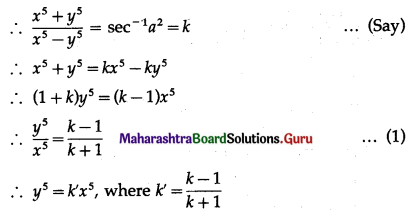
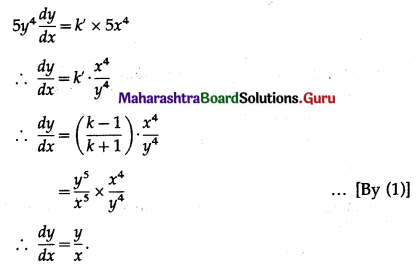
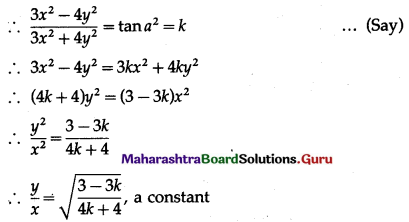
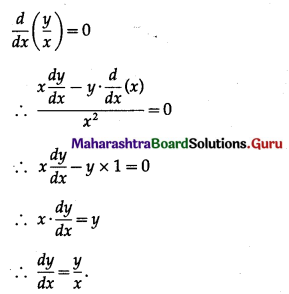
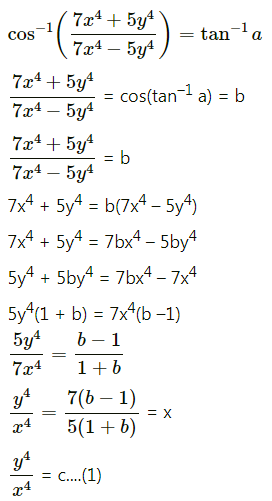
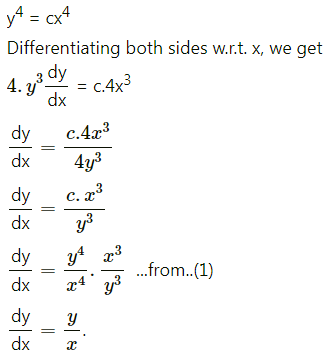
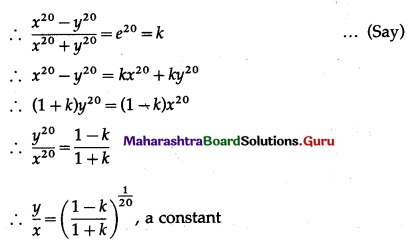
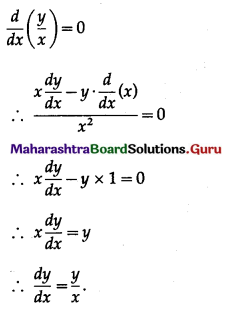
Maharashtra Board Class 11 Hindi रचना वृत्तांत लेखन

Balbharti Maharashtra State Board Hindi Yuvakbharati 11th Digest रचना वृत्तांत लेखन Notes, Questions and Answers.

Maharashtra State Board 11th Hindi रचना वृत्तांत लेखन

वृत्तांत लेखन : किसी भी सभा, बैठक, कार्यक्रम आदि को लिखित रूप में प्रस्तुत करना ही वृत्तांत लेखन है।

  • वृत्तांत संक्षिप्त होना चाहिए और क्रमबद्धता का विशेष ध्यान रखना चाहिए।
  • वृत्तांत लेखन में उत्तम पुरुष वाचक सर्वनाम (मैं, हम) का प्रयोग नहीं करना चाहिए।
  • वृत्तांत में घटना, समय, स्थान आदि का स्पष्ट उल्लेख होना चाहिए।
  • यह सत्य घटना पर आधारित लेखन होता है।

Maharashtra Board Class 11 Hindi रचना विज्ञापन लेखन

1. हिंदी दिवस का वृत्तांत लिखिए।

एक शानदार हिंदी दिवम

15 सितंबर मुंबई : स्वामी विवेकानंद ज्युनियर कॉलेज आफॅ आर्ट्स एंड कॉमर्स के सभागार में दोपहर तीन बजे प्रधानाचार्य महोदय की अध्यक्षता में एक शानदार कार्यक्रम संपन्न हुआ। हिंदी विभागाध्यक्ष डॉ. किशोर सिंह ने राष्ट्रभाषा के रूप में हिंदी तथा बारहवीं कक्षा की छात्रा शिवानी और रुही में हिंदी की आज की स्थिति पर अपने विचार रखे। ग्यारहवी कक्षा के छात्रों ने राष्ट्रभक्ति पर गीत प्रस्तुत किए।

इस अवसर पर दोहों की प्रतियोगिता रखी गई जिसकी वजह से कार्यक्रम में जान आ गई थी। रमा राणे इस प्रतियोगिता में विजयी हुई जिसे पाँच सौ रुपए का पुरस्कार और सर्टीफिकेट प्रदान किया गया।

प्रधानाचार्य ने इस कार्यक्रम में घोषणा की, कि इस वर्ष हिंदी में सर्वाधिक अंक प्राप्त करने वाले ग्यारहवीं तथा बारहवीं के छात्र को एक हजार रूपए का नकद पुरस्कार दिया जाएगा। सभी उपस्थित लोगों को अध्यक्ष महोदय ने धन्यवाद दिया और सभा विसर्जित हुई।

(कार्यालय प्रतिनिधि द्वारा)

2. महाविद्यालय में आयोजित वृक्षारोपण समारोह का वृत्तांत लिखीए।

अध्यापक और छात्रों द्वारा वृक्षारोपण

17 जुलाई, दिल्ली: आज 16 जुलाई को विकास महाविद्यालय हरिनगर, दिल्ली के महाविद्यालय परिसर में वृक्षारोपण समारोह अत्यंत हर्षोल्लास एवं उत्साहपूर्वक मनाया गया। इस कार्यक्रम में शिक्षा निदेशक मुख्य अतिथि के रूप में उपस्थित थे। उन्हें पुष्पगुच्छ एवं एक पौधा देकर स्वागत किया गया।

इसके पश्चात छात्र-छात्राओं ने एक स्वर में, ‘नंगी धरती करे पुकार, वृक्ष लगाकर करो शृंगार’ गीत का समूहगान प्रस्तुत किया। अतिथि महोदय ने अपने भाषण में वृक्षों के महत्त्व पर प्रकाश डाला। उन्होंने स्वयं एक पौधा लगाकर कार्यक्रम का शुभारंभ किया।

फिर प्रधानाचार्य, उपप्रधानाचार्य तथा अध्यापकों ने वृक्षारोपण किया। छात्रों ने भी वृक्षारोपण करते हुए उनके देखभाल की जिम्मेदारी ली। पौधों के चारों ओर जाली लगाकर इनकी सिंचाई का प्रबंध किया गया ताकि पौधे फलें- फूलें और वृक्ष बन सकें। अंत में छात्रों में मिठाई वितरण करते हुए इस समारोह का समापन किया गया।

Maharashtra Board Class 11 Hindi रचना विज्ञापन लेखन

(कार्यालय प्रतिनिधि द्वारा)

3. समता विद्यालय में पुरस्कार वितरण समारोह संपन्न

(कार्यालय प्रतिनिधि द्वारा)

पुणे, 12 फरवरी: कल 11 फरवरी, को समता विद्यालय में वार्षिक पुरस्कार वितरण समारोह संपन्न हुआ। समारोह की अध्यक्षता मशहूर अभिनेता शेखर सेन ने की थी।

ईश – स्तवन और गणेश वंदना से कार्यक्रम आरंभ हुआ। पाँचवी कक्षा के छात्रों ने स्वागत गीत प्रस्तुत किया। तत्पश्चात विद्यालय के निरीक्षक श्री. अशोक कर्वे ने अध्यक्ष महोदय का परिचय और विद्यालय की विभिन्न गतिविधियों का विवरण प्रस्तुत किया।

अध्यक्ष महोदय के करकमलों से आदर्श विद्यार्थी, सर्वश्रेष्ठ खिलाड़ी, अभिनेता, नर्तक, गायक आदि पुरस्कार दिए गए। शालांत परीक्षा में विशेष योग्यता दिखलाने वाले मेधावी छात्रों को सम्मानित किया गया। अध्यक्ष महोदय ने अपने मार्गदर्शन पर भाषण में विद्यार्थियों को अनुशासन का पाठ पढ़ाया और उज्ज्वल भविष्य की कामना की। तत्पश्चात विद्यालय की ज्येष्ठ शिक्षिका श्रीमती चौधरी जी ने धन्यवाद यापन किया और राष्ट्रगीत के साथ समारोह का समापन हुआ।

Maharashtra Board Class 11 Hindi रचना वृत्तांत लेखन 1

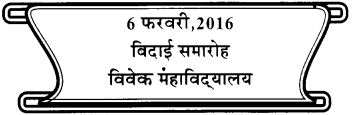
नासिक, 7 फरवरी : विवेक महाविद्यालय के प्रांगण में बारहवीं कक्षा के छात्रों का बिदाई समारोह 6 फरवरी को संपन्न हुआ। अपने महाविद्यालय से विदा लेते समय विद्यार्थियों की आँखें छलक आईं। समारोह की अध्यक्षता महाविद्यालय के प्रधानाचार्य ने की।

Maharashtra Board Class 11 Hindi रचना विज्ञापन लेखन

ग्यारहवीं कक्षा के छात्रों ने बिदाई समारोह के आयोजन में अहं भूमिका निभाई। ठीक तीन बजे छात्र और शिक्षक प्रांगण में उपस्थित हुए थे। महाविद्यालय को रंगीन कागजों से सजाया गया था। एक छोटा सा वृक्ष का चित्र दीवार पर बना था और छात्र उस पर अपनी भावनाओं सरस्वती वंदना से कार्यक्रम की शुरुआत हुई। बारहवीं कक्षा के छात्रों ने अपने महाविद्यालय की यादें बताते हुए अपने शिक्षिकों का आभार प्रकट किया।

प्रधानाचार्य और वर्गशिक्षकों तथा ज्येष्ठ शिक्षकों ने विद्यार्थियों को मार्गदर्शन पर दो शब्द कहे। ग्यारहवीं कक्षा के छात्रों ने नृत्य एवं नाटिका प्रस्तुत कर सबका मनोरंजन किया। प्रधानाचार्य के करकमलों द्वारा आदर्श छात्र एवं छात्रा को पुरस्कृत किया गया। उसके बाद अल्पाहार दिया गया। छात्र अपने प्रिय शिक्षकों के साथ तस्वीरें लेते हुए देखे गए। बड़ा ही भावपूर्ण प्रसंग था यह, जो शाम सात बजे खत्म हुआ।

Maharashtra Board Class 11 Hindi रचना संभाषण लेखन

Balbharti Maharashtra State Board Hindi Yuvakbharati 11th Digest रचना संभाषण लेखन Notes, Questions and Answers.

Maharashtra State Board 11th Hindi रचना संभाषण लेखन

रोजमर्रा के जीवन में हम जो बातचीत या वार्तालाप करते हैं उसके लिखित रूप को संवाद-लेखन कहते हैं। वार्तालाप जितना चतुराई से किया गया है, उतना ही वह प्रभावशाली होता है। संवाद-लेखन करते समय ध्यान रहे –

  • संवाद की भाषा सरल एवं प्रभावशाली हो।
  • संवाद संक्षिप्त होने चाहिए।
  • संवाद विषय और पात्र के अनुकूल होने चाहिए।
  • संवाद लेखन में उचित विराम चिह्नों का प्रयोग किया जाना चाहिए।

Maharashtra Board Class 11 Hindi रचना संभाषण लेखन

प्रश्न 1.
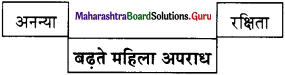
निम्नलिखित जानकारी के आधार पर संवाद-लेखन कीजिए :
Maharashtra Board Class 11 Hindi रचना संभाषण लेखन 1
उत्तर :
अनन्या : हे रक्षिता! आज कितने दिनों बाद दिखाई दे रही हो; कहाँ थी?
रक्षिता : माँ के साथ दुर्घटना हो गई थी, इसलिए इधर आना नहीं हुआ।

अनन्या : ओह! क्या हुआ था?
रक्षिता : किसी बदमाश ने राह चलते उनके गले का मंगलसूत्र खींच लिया था। उनके गले पर जख्म हो गया था।

अनन्या : ओह! यह तो बहुत बुरा हुआ। आजकल दिनदहाड़े ऐसी वारदातें होने लगी हैं।
रक्षिता : काश! पुलिस अपनी जिम्मेदारियाँ ठीक से निभा पाते, तो बदमाशों की ऐसी हिम्मत नहीं होती।

अनन्या : (क्रोधित स्वर में) और हमारी पब्लिक तमाश-बिन की तरह केवल भीड़ इकट्ठा करती है।
रक्षिता : (सहमति प्रकट करते हुए) और नहीं तो क्या! हम लोग कब जिम्मेदार नागरिक बनेंगे?

अनन्या : क्या, बदमाश पकडा गया?
रक्षिता : नहीं तो! वह तो बाइक पर था, झपट्टा मारा और भाग गया।

अनन्या : खैर, तुम अपनी माँ का ख्याल रखो। मुझसे कोई सहायता चाहिए तो बिना हिचकिचाए बताना।
रक्षिता : अवश्य! चलती हूँ। अलविदा!

अनन्या : अलविदा !

Maharashtra Board Class 11 Hindi रचना संभाषण लेखन

प्रश्न 2.
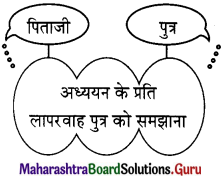
निम्नलिखित जानकारी के आधार पर संवाद-लेखन कीजिए :
Maharashtra Board Class 11 Hindi रचना संभाषण लेखन 2
उत्तर :
पिताजी : बेटा, यहाँ आओ; बैठो। पढ़ाई के क्या हाल है? परीक्षा कब से है?
पुत्र : (घबराते हुए) परीक्षा नजदीक आई है और पढ़ाई अभी चल रही है, पूरी नहीं हुई।

पिताजी : पूरी होगी कैसे? मैं यह नहीं कहता कि दूरदर्शन मत देखो, लेकिन अपने अध्ययन के प्रति लापरवाही उचित नहीं। पूरा दिन दूरदर्शन के सामने बैठोगे तो पढ़ाई होगी ही नहीं।
पुत्र : लेकिन मैं अकेला थोड़े ही देखता हूँ, पापा? घर में सभी दूरदर्शन देखते हैं और आप मुझे ही डाँटते हो।

पिताजी : मैं तुम्हें समझा रहा हूँ। तुम्हारी दीदी को देखो, कक्षा में अव्वल आती है और तुम मात्र 50% अंक ला पाए हो।
पुत्र : (अँगूठे से जमीन कुरेदते हुए) मुझे दीदी अपने साथ पढ़ने को मना करती है।

पिताजी : मैंने दीदी को समझा दिया है, जाओ अब उसके साथ बैठकर पढ़ाई करो।
पुत्र : जी, पापा। अब मैं भी दीदी जैसे अंक लाकर दिखाऊँगा।

पिताजी : बहुत अच्छा! देर आए दुरुस्त आए। मुझे तुम पर विश्वास है। तुम जरूर अच्छे अंक ला पाओगे। भगवान तुम्हें सद्बुद्धि दें।

Maharashtra Board Class 11 Hindi रचना संभाषण लेखन

प्रश्न 3.
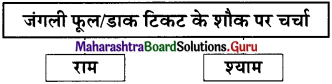
निम्नलिखित जानकारी के आधार पर संवाद-लेखन कीजिए :
Maharashtra Board Class 11 Hindi रचना संभाषण लेखन 3
उत्तर :
राम : नमस्ते श्याम! कैसे हो?
श्याम : नमस्ते! मैं ठीक हूँ। तुम कैसे हो? क्या कर रहे हो आजकल?

राम : मैं ठीक हूँ। आजकल मैं डाक टिकट इकट्ठा कर रहा हूँ।
श्याम : बहुत खूब! क्या तुम इन्हें अलबम में चिपकाओगे?

राम : हाँ! मैंने एक अलबम बना लिया है और टिकट चिपका भी दिए हैं।
श्याम : वाह! क्या, तुम्हारे पास सभी देशों के टिकट हैं?

राम : हाँ! ज्यादातर सभी देशों के टिकट मेरे पास हैं।
श्याम : (जिज्ञासा से) तो क्या इनमें, महँगी टिकटें भी हैं?

राम : मेरे पास बहुत सारी टिकटें है जिनमें कुछ टिकटें महँगी भी है।
श्याम : मेरे दोस्त, यह तो बता इस संग्रह से तुझे क्या लाभ होता है?

राम : यह मेरा शौक है जो मुझे बेहद सुख प्राप्त कराता है और हाँ, मुझे भूगोल पढ़ने में इनकी मदद मिलती है।
श्याम : बहुत अच्छा।

Maharashtra Board Class 11 Hindi रचना संभाषण लेखन

राम : तुम्हारा भी कोई शौक है?
श्याम : है न! मुझे जंगली फूल जमा करने का शौक है।

राम : तुम उनसे क्या करते हो?
श्याम : मैं उन्हें कागज पर चिपकाता हूँ और फिर उनका नाम लिखता हूँ।

राम : इस शौक से तुम्हें क्या लाभ होता है?
श्याम : मेरा शौक मेरा वनस्पति विज्ञान का ज्ञान बढ़ाता है।

राम : तुमसे मिलकर आज बहुत अच्छा लगा। फिर मिलेंगे, अलविदा!
श्याम : अच्छा! अलविदा!

प्रश्न 4.
निम्नलिखित जानकारी के आधार पर संवाद-लेखन कीजिए।
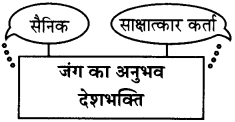
Maharashtra Board Class 11 Hindi रचना संभाषण लेखन 4
उत्तर :
साक्षात्कार कर्ता : जय हिंद, मेरे भाई, मेरे दोस्त!
सैनिक : जय हिंद! कहो कैसे आना हुआ?

साक्षात्कार कर्ता : आप हाल ही में सीमा पर दुश्मनों को लोहे के चने चबवाकर आए हो इसलिए मैं आपसे मिलना चाहता हूँ। आपके बारे में जानना चाहता हूँ।
सैनिक : भाई, मैंने तो सिर्फ अपना कर्तव्य निभाया है।

साक्षात्कार कर्ता : सीमा पर अपने परिवार से दूर आप कैसे रह लेते हो? क्या आपका उनके प्रति कर्तव्य नहीं है?
सैनिक : ऐसा तो नहीं। परिवार अपनी जगह है, देश अपनी जगह और देश की खातिर जो कर्तव्य है उसके आगे हमें निजी सुख-दुख बहुत छोटे नजर आते हैं।

Maharashtra Board Class 11 Hindi रचना संभाषण लेखन

साक्षात्कार कर्ता : धन्य हैं आप! सुना है आपका बेटा छह वर्ष का है!
सैनिक : सही सुना है आपने। मेरा छह वर्ष का बेटा है जो अभी से सैनिक बनने का सपना देख रहा है और हाँ मेरी तीन साल की बेटी भी, शत्रु के साथ युद्ध करने की बातें करती है।

साक्षात्कार कर्ता : बहुत अच्छा लगा सुनकर। आपका पूरापरिवार ही राष्ट्रभक्ति से ओत-प्रोत है। हम देशवासियों को और देश के बालकों को (जोर देते हुए) कुछ संदेश देना चाहेंगे?
सैनिक : जरूर! देश के बालकों आप देश का भविष्य हो। हर काम को सच्चाई, ईमानदारी और खुशी से करो। अपने सपनों को हकीकत में बदलो। ईश्वर तुम्हें सदबुद्धि दे। वंदे मातरम्! जय हिंद!

साक्षात्कार कर्ता : वंदे मातरम्! जय हिंद!

Maharashtra Board Class 11 Hindi रचना गद्य आकलन

Balbharti Maharashtra State Board Hindi Yuvakbharati 11th Digest रचना गद्य आकलन Notes, Questions and Answers.

Maharashtra State Board 11th Hindi रचना गद्य आकलन

अपठित अर्थात जो पहले से पढ़ा / पढ़ाया न गया हो ऐसा परिच्छेद परीक्षा में दिया जाता है। इसे पढ़कर इसका आशय समझना होता है। कोई शब्द परिचित न हो और अर्थ समझ में नहीं आ रहा हो तो उसके अर्थ को वाक्य के प्रसंगानुसार ग्रहण करना चाहिए और सब कुछ समझ में आ जाने पर प्रश्न बनाना आसान हो जाएगा।

Maharashtra Board Class 11 Hindi रचना गद्य आकलन

महत्त्वपूर्ण : छात्रों से अपठित गद्यांश पर आकलन हेतु मात्र प्रश्न निर्माण अपेक्षित है और प्रश्न भी ऐसे बनाने हैं जिनके उत्तर एक वाक्य में हों। हो सके उतना गद्यांश के लिए शीर्षक के बारे में प्रश्न न पूछे। आगे कुछ उदाहरण दिए हैं –

प्रश्न 1.
निम्नलिखित गद्यांश पढ़कर पाँच ऐसे प्रश्न तैयार कीजिए जिनके उत्तर एक-एक वाक्य में हों।

पंडित जवाहरलाल नेहरूजी की अंतिम इच्छा यह थी कि मैं जब मरूँ तब मैं चाहूँगा कि मेरा दाह-संस्कार हो। अगर मैं विदेश में मरूँ तो मुझे वहीं जलाया जाए पर मेरी अस्थियाँ इलाहाबाद लाई जाएँ। मुठ्ठीभर भस्म इलाहबाद की गंगा में प्रवाहित करने की मेरी इच्छा है, किंतु उसके पीछे कुछ धार्मिक भावना नहीं है, क्योंकि गंगा हमारी सदियों से पुरानी सभ्यता और संस्कृति की प्रतीक रही है।

वह मुझे हिमालय के हिमाच्छादित शिखरों और नदियों की याद दिलाती है, जिनमें मेरा लगाव और प्यार बहुत ज्यादा रहा है। गंगा मुझे शस्य-श्यामल फैले हुए मैदानों की याद दिलाती है, यहाँ मेरी जिंदगी और काम ढले हैं। गंगा में कहीं समुद्र जैसी विनाश की भी शक्ति मुझे लगती है और उसकी यह शक्ति मेरे लिए अतीत की प्रतीक व स्मृति है, जो वर्तमान में प्रवाहित है और भविष्य के महासमुद्र में आगे बढ़ते रहने की है।
उत्तर:

  1. मुठ्ठीभर भस्म का विसर्जन लेखक ने कहाँ करने के लिए कहा है?
  2. गंगा की कौन-सी शक्ति लेखक के लिए अतीत की प्रतीक व स्मृति है?
  3. लेखक की जिंदगी और काम कहाँ ढले हैं?
  4. पंडित जवाहरलाल नेहरू जी को गंगा नदी किसकी याद दिलाती है?
  5. विदेश में मरने पर पंडित जवाहरलाल नेहरू जी क्या चाहते हैं?

प्रश्न 2.
निम्नलिखित गद्यांश पढ़कर पाँच ऐसे प्रश्न तैयार कीजिए जिनके उत्तर एक-एक वाक्य में हों।
वर्तमान शासन प्रणालियों में जनतंत्र से बढ़कर उत्तम कोई प्रणाली नहीं हैं, क्योंकि उसमें जनता को स्वयं यह अधिकार प्राप्त रहता है कि वह अपने प्रतिनिधियों को चुनकर विधान सभाओं और संसद में भेजें। ऐसे प्रत्यक्ष चुनाव में प्राय: वही व्यक्ति चुना जाता है, जिसका सार्वजनिक जीवन अच्छा हो और जो जनता की सेवा करता हो। इस प्रणाली में जनता को यह अधिकार है कि यदि वह किसी दल या किसी व्यक्ति के कार्यों से संतुष्ट नहीं है तो दूसरी बार उस दल या व्यक्ति को अपना मत न दें।

निर्वाचन में विरोधी दलों के भी कुछ व्यक्ति चुने जाते हैं, जो अपनी आलोचना से शासक दल के स्वेच्छाचार पर अंकुश रखते हैं। इस प्रकार देश की शासन प्रणाली में विरोधी दलों का भी महत्त्वपूर्ण स्थान होता है।
उत्तर:

  1. जनता अपने प्रतिनिधियों को चुनकर कहाँ भेजती है?
  2. चुनाव में कैसा व्यक्ति चुना जाता है?
  3. विरोधी दल अपनी आलोचना से क्या कर सकता है?
  4. जनतंत्र में जनता को किस बात का अधिकार होता है?
  5. सबसे उत्तम शासन प्रणाली कौन-सी है?

Maharashtra Board Class 11 Hindi रचना गद्य आकलन

प्रश्न 3.
निम्नलिखित गद्यांश पढ़कर पाँच ऐसे प्रश्न तैयार कीजिए जिनके उत्तर एक-एक वाक्य में हों।
दान देने की परिपाटी प्राचीन काल से चली आ रही है। अन्नदान, गोदान, वस्त्रदान, स्वर्णदान, भूमिदान करना भारतीय अपना परम धर्म मानते हैं। धर्म से स्वर्ग की प्राप्ति होती है, ऐसा माना जाता है। प्राचीन काल में विद्यादान को सर्वश्रेष्ठ दान माना जाता था। वर्तमान काल में कुछ नए प्रकार के दान प्रचलित हुए है – नेत्रदान, रक्तदान, किडनीदान । रक्त तो हर व्यक्ति के लिए जरूरी है। पचास वर्ष तक के निरोगी स्त्री-पुरुष रक्त दान कर सकते हैं। दुर्घटनाओं से परिपूर्ण वैज्ञानिक युग में रक्तदान, सर्वश्रेष्ठ दान माना जा रहा है। नेत्रदान करने से घबराना नहीं चाहिए क्योंकि मरणोपरांत ही आँखें निकालकर, अंधों को दी जाती हैं और वे देखने लगते हैं। बीमार के प्राण बचाने के लिए हम अपनी किडनी दान दे सकते हैं।
उत्तर :

  1. प्राचीन काल से लेकर अब तक कौन-कौन से दान प्रचलित हैं?
  2. किन लोगों को रक्तदान करना चाहिए?
  3. वैज्ञानिक युग में कौन-सा दान श्रेष्ठ है?
  4. दान करना भारतीय अपना परम धर्म क्यों मानते हैं?
  5. नेत्रदान करने से घबराने की जरूरत क्यों नहीं?

प्रश्न 4.
निम्नलिखित गद्यांश पढ़कर पाँच ऐसे प्रश्न तैयार कीजिए जिनके उत्तर एक-एक वाक्य में हों।

भारत में प्राचीन काल से दहेज प्रथा चली आ रही है। कन्या के माता-पिता अपनी क्षमता के अनुसार शादी के समय दहेज देते चले आए हैं। वर एवं कन्या के परिवारवालों में आपसी प्रेम था इसलिए वरवाले कन्यावालों से किसी प्रकार की माँग करने में संकोच करते थे।

परंतु पिछले 50 वर्षों से विवाह एक व्यापार बन गया है। इससे समाज दुखी है। लड़कीवाला लड़के की योग्यता के स्थान पर धन को ही सर्वस्व मानता है और वह बड़े अमीर परिवार में अपनी लड़की को देना चाहता है। लड़का लड़कियों को देखता है।

जिस लड़की के पास धन अधिक होता है, उसे चुन लेता है। उसकी योग्यता को नहीं देखता। आज लड़की के विवाह का मूल आधार धन बन गया है। जिस दिन लड़की का जन्म होता है, उसी दिन से माता-पिता को उसके विवाह की चिंता लग जाती है।

इस बुराई को दूर करने के लिए हमें मिलकर इस प्रथा का विरोध करना चाहिए। जो दहेज लेता है, उसके लिए ऐसा कानून बनना चाहिए कि दहेज लेनेवाले को चोरी, जुआ एवं हत्या आदि अपराध करनेवालों के समान देखा जाए और सामाजिक मंच पर उसे बेइज्जत किया जाए।

इस विषय पर मात्र बोलने एवं लिखने से अब काम नहीं चलेगा। हमें एक होकर इस प्रकार के विरोध में कदम बढ़ाने होंगे।

Maharashtra Board Class 11 Hindi रचना गद्य आकलन

प्रश्न :
(1) भारत में प्राचीन काल में दहेज प्रथा का स्वरूप कैसा था?
(2) माता-पिता को लड़की के विवाह की चिंता कब से लग जाती है?
(3) आज लड़की के विवाह का मूल आधार क्या बन गया है?
(4) दहेज लेने वाले के साथ कैसा व्यवहार किया जाना चाहिए?
(5) लड़की के विवाह का मूल आधार क्या बन गया है?

प्रश्न 5.
निम्नलिखित गद्यांश पढ़कर पाँच ऐसे प्रश्न तैयार कीजिए जिनके उत्तर एक-एक वाक्य में हों।
पवन पुत्र हनुमान, भीष्म पितामह, स्वामी दयानंद सरस्वती, स्वामी विवेकानंद जैसे बाल ब्रह्मचारियों ने भारत-भूमि को पावन किया है। संसार के प्राचीन ग्रंथ वेदों में लिखा है: “ब्रह्मचारी मृत्यु को जीत लेते हैं।” ‘ब्रह्म’ शब्द के अर्थ हैं ‘परमेश्वर, विद्या और शरीर-रक्षण। ब्रह्मचर्य के पालन से शरीर स्वस्थ होता है।

जिसका शरीर स्वस्थ उसीका मन स्वस्थ, जिसका मन स्वस्थ उसकी स्मरण-शक्ति बहुत होती है। स्मरण-शक्ति से आकलन शक्ति बढ़ती है । विद्यार्थी जीवन में आकलनशक्ति का अपना विशेष महत्त्व है। ब्रह्मचर्य विद्यार्थी जीवन की कमियाँ पूरी करता है।

प्राचीन भारतीय साहित्य में ब्रह्मचर्य की महिमा लिखी है। इसका पालन करनेवाला विद्यार्थी निरोगी, बुद्धिमान, संपत्तिशाली, महान बनता है। ब्रह्मचर्य की महिमा अपार है।

प्रश्न:
(1) कौन-कौन बाल ब्रह्मचारी थे?
(2) मृत्यु को कौन जीत सकते हैं?
(3) ‘ब्रह्म’ शब्द के कितने और कौन-कौन से अर्थ हैं?
(4) विद्यार्थी जीवन में किसका विशेष महत्त्व है?
(5) ब्रह्मचर्य पालन करने वाला विद्यार्थी कैसा होता है?

Maharashtra Board Class 11 Hindi रचना गद्य आकलन

स्वाध्याय

निम्नलिखित गद्यांश पढ़कर पाँच ऐसे प्रश्न तैयार कीजिए जिनके उत्तर एक वाक्य में हों –

(1) हँसने का एक सामाजिक पक्ष भी होता है। हँसकर हम लोगों को अपने निकट ला सकते हैं और व्यंग्य उन्हें दूरस्थ बना देते हैं। जिसको भगाना हो उसकी थोड़ी देर हँसी खिल्ली उड़ाइए, वह तुरंत बोरिया-बिस्तर गोल कर पलायन करेगा। जितनी मुक्त हँसी होगी, उतना समीप व्यक्ति खींचेगा इसीलिए तो श्रोताओं की सहानुभूति अपनी ओर खींचने के लिए चतुर वक्ता अपना भाषण किसी रोचक कहानी या घटना से आरंभ करते हैं।

जनता यदि हँसी तो चंगुल में फँसी। सामाजिक मूल्यों और नियमों को मान्यता दिलाने और रूढ़ियों को निष्कासित करने में पुलिस या कानून सहायता नहीं करता, किन्तु वहाँ हास्य का चाबुक अचूक बैठता है। हास्य के कोड़े, उपहास-डंक और व्यंग्य-बाण मारकर आदमी को रास्ते पर लाया जा सकता है। इस प्रकार गुमराह बने समाज की रक्षा की जा सकती है।

(2) किसी भी देश या काल के लिए जवान तथा शिक्षक दोनों ही महत्त्वपूर्ण हैं। किसी एक के बिना समाज सुरक्षित नहीं रह सकता। दोनों ही समाज के रक्षक हैं, किन्तु कार्यों में भिन्नता दिखाई पड़ती है। एक शत्रु से रक्षा करता है तो दूसरा उसे (देश को) समृद्ध बनाता है।

फिर भी शिक्षक का उत्तरदायित्व जवान से कहीं बढ़कर है। भावी नागरिक निर्माण करने की जिम्मेदारी शिक्षक के ऊपर है। वह उसके शारीरिक, मानसिक तथा नैतिक विकास का जनक है, जिस पर व्यक्ति, समाज तथा राष्ट्र निर्भर है। शिक्षक के ही द्वारा कोई योग्य सैनिक बन सकता है।

आज शिक्षक ने सैनिक धाराओं में क्रांति पैदा कर दी है। हमारे अहिंसक आंदोलन ने दुनिया को दिखा दिया है कि शिक्षक सैनिक से श्रेष्ठ है। इसे बनावटी-शस्त्रों की जरूरत नहीं है। इसका आत्मिक बल सब शस्त्रों से बड़ा है।

Maharashtra Board Class 11 Hindi रचना गद्य आकलन

अगर आनेवाली दुनिया इसका अनुसरण करे तो शस्त्रीकरण का नामोनिशान भू-पृष्ठ से उठ जाएगा। नैतिक शक्ति का बोल-बाला होगा, सारी दुनिया में एकात्मता की लहर फैलेगी और तब ज्ञान-विज्ञान का निर्माण विकास के लिए होगा, न कि विनाश के लिए।

(3) समाजसुधार आंदोलन को निर्भीक संन्यासी स्वामी श्रद्धानंद से नई दिशा मिली। हरिजन समस्या के समाधान में कई स्थानों पर संघर्ष का भी सामना करना पड़ा। गुरुकुल काँगड़ी के छात्रवासों और भोजनालयों में बिना किसी भेदभाव के हर जाति के विद्यार्थी रहते और खाते-पीते थे।

स्वामी जी का कहना था – मनों से छुआछूत की भावना मिटाने में आवासीय शिक्षण संस्थाओं का अच्छा योगदान हो सकता है। चौबीसों घंटे एक साथ मिलकर जब रहेंगे, खेलेंगे, कूदेंगे और पढ़ेंगे, लिखेंगे तो कहाँ तक छूत-अछूत की दीवार खड़ी रह पाएगी।

आजादी के बाद भी यदि इसी रास्ते को पकड़ा गया होता तो मंजिल बहुत पहले तय हो जाती। आवासीय पद्धति पर आश्रित ऐसे गुरुकुल उन्होंने हरियाणा में झज्जर, इंद्रप्रस्थ और कुरूक्षेत्र, गुजरात में सोनगढ़ और सूपा में भी खोले। देहरादून का कन्या गुरुकुल भी उसी श्रृंखला की कड़ी है।

(4) यश और कीर्ति पैतृक संपत्ति नहीं है। जिसका सुख-भोग संतान कर सके। वास्तविक सम्मान और यश धन के द्वारा भी प्राप्त नहीं हो सकता। ये वे पदार्थ है जो घोर परिश्रम और स्वावलंबन द्वारा ही प्राप्त हो सकते हैं। ईश्वर का वरद हस्त भी उसी के शीश पर है जो स्वत: अपनी सहायता करता है।

यदि तुम अपना जीवन धन्य बनाना चाहते हो तो खड़े हो जाओ अपने पैरों पर और संसार में एक बार शक्ति से अपने कार्यो से सुख और शांति की धारा प्रवाहित कर दो। भाग्य की भाषा पढ़ने के फेरे में जो भी डूबा वह कभी भी ऊपर नहीं आ सकता। अत: यह निश्चित है कि तुम ही अपने भाग्य विधाता हो और जीवन निर्माण करने का संपूर्ण अधिकार भी तुम ही को है।

(5) संसार में कुछ भी असाध्य नहीं है। कुछ भी असम्भव नहीं है। असम्भव, असाध्य, कठिन आदि शब्द कायरों के लिए हैं।

नेपोलियन के लिए ये शब्द उसके कोष में नहीं थे। साहसी पतले बापू ने विश्व को चकित कर दिया। क्या बापू शरीर से शक्तिशाली थे? नहीं। वह तो पतली-सी एक लंगोटी पहने लकड़ी के सहारे चलते थे, परंतु विचार सशक्त थे, भावनाएँ शक्तिशाली थीं, उनके साहस को देखकर करोड़ो भारतीय उनके पीछे थे। ब्रिटिश साम्राज्य उनसे काँप गया। अहिंसा के सहारे बिना रक्त-पात के उन्होंने भारत को स्वतंत्र कराया। यह विश्व का एक अद्वितीय उदाहरण है।

Maharashtra Board Class 11 Hindi रचना गद्य आकलन

जब महात्मा गांधीजी ने अहिंसा का नारा लगाया तो लोग हँसते थे, कहते थे अहिंसा से कहीं ब्रिटिश साम्राज्य से टक्कर ली जा सकती है? परंतु वे डटे रहे, साहस नहीं छोड़ा, अंत में अहिंसा की ही विजय हुई। कहते हैं, अकेला चना क्या भाड़ फोड़ सकता है? हाँ, यदि उसमें साहस हो तो! साहसहीन के लिए सब कुछ असम्भव है। उससे अगर कहा जाए कि भाई जरा वह काम कर देना; तो वह तुरंत कहेगा, अरे! इतनी दूर!

पैदल, एक दिन में! नहीं भाई, मुझसे नहीं हो सकेगा, किसी और से करा लो। भला वह इस काम को कैसे करेगा? करने वाला दूरी और पैदल नहीं देखता! उसके मार्ग में चाहे पर्वत आकर खड़े हो जाएँ, आँधी आए या तूफान, उसको उनसे क्या वास्ता? उसको तो अपने लक्ष्य तक पहुँचना है, उसे कोई नहीं रोक सकता है। वह अपने लक्ष्य तक अवश्य पहुँच जाएगा। साहसी पुरुष दिन-रात नहीं देखा करते, आँधी तूफान, नदी-नाले, पहाड़-समुद्र नहीं देखा करते; वे तो केवल एक ही चीज देखा करते हैं कि उन्हें अपने लक्ष्य तक पहुँचना है।

Maharashtra Board 12th Maths Solutions Chapter 2 Applications of Derivatives Ex 2.4

Balbharti 12th Maharashtra State Board Maths Solutions Book Pdf Chapter 2 Applications of Derivatives Ex 2.4 Questions and Answers.

Maharashtra State Board 12th Maths Solutions Chapter 2 Applications of Derivatives Ex 2.4

Question 1.
Test whether the following functions are increasing or decreasing.
(i) f(x) = x3 – 6x2 + 12x – 16, x ∈ R.
Solution:
f(x) = x3 – 6x2 + 12x – 16
∴ f'(x) = \(\frac{d}{d x}\) (x3 – 6x2 + 12x – 16)
= 3x2 – 6 × 2x + 12 × 1 – 0
= 3x2 – 12x + 12
= 3(x2 – 4x + 4)
= 3(x – 2)2 ≥ 0 for all x ∈ R
∴ f(x) ≥ 0 for all x ∈ R
∴ f is increasing for all x ∈ R.

(ii) f(x) = 2 – 3x + 3x2 – x3, x ∈ R.
Solution:
f(x) = 2 – 3x + 3x2 – x3
∴ f'(x) = \(\frac{d}{d x}\) (2 – 3x + 3x2 – x3)
= 0 – 3 × 1 + 3 × 2x – 3x2
= -3 + 6x – 3x2
= -3(x2 – 2x + 1)
= -3(x – 1)2 ≤ 0 for all x ∈ R
∴ f'(x) ≤ 0 for all x ∈ R
∴ f is decreasing for all x ∈ R.

(iii) f(x) = x – \(\frac{1}{x}\), x ∈ R, x ≠ 0.
Solution:
f(x) = x – \(\frac{1}{x}\)
f'(x) = \(\frac{d}{d x}\left(x-\frac{1}{x}\right)=1-\left(\frac{-1}{x^{2}}\right)\)
= \(1+\frac{1}{x^{2}}\) > 0 for all x ∈ R, x ≠ 0
∴ f'(x) > 0 for all x ∈ R, where x ≠ 0
∴ f is increasing for all x ∈ R, where x ≠ 0.

Maharashtra Board 12th Maths Solutions Chapter 2 Applications of Derivatives Ex 2.4

Question 2.
Find the values of x for which the following functions are strictly increasing:
(i) f(x) = 2x3 – 3x2 – 12x + 6
Solution:
f(x) = 2x3 – 3x2 – 12x + 6
∴ f'(x) = \(\frac{d}{d x}\) (2x3 – 3x2 – 12x + 6)
= 2 × 3x2 – 3 × 2x – 12 × 1 + 0
= 6x2 – 6x – 12
= 6(x2 – x – 2)
f is strictly increasing if f'(x) > 0
i.e. if 6(x2 – x – 2) > 0
i.e. if x2 – x – 2 > 0
i.e. if x2 – x > 2
i.e. if x2 – x + \(\frac{1}{4}\) > 2 + \(\frac{1}{4}\)
i.e. if \(\left(x-\frac{1}{2}\right)^{2}>\frac{9}{4}\)
i.e. if x – \(\frac{1}{2}\) > \(\frac{3}{2}\) or x – \(\frac{1}{2}\) < \(\frac{-3}{2}\) i.e. if x > 2 or x < -1
∴ f is strictly increasing if x < -1 or x > 2.

(ii) f(x) = 3 + 3x – 3x2 + x3
Solution:
f(x) = 3 + 3x – 3x2 + x3
∴ f'(x) = \(\frac{d}{d x}\) (3 + 3x – 3x2 + x3)
= 0 + 3 × 1 – 3 × 2x + 3x2
= 3 – 6x + 3x2
= 3(x2 – 2x + 1)
f is strictly increasing if f'(x) > 0
i.e. if 3(x2 – 2x + 1) > 0
i.e. if x2 – 2x + 1 > 0
i.e. if (x – 1)2 > 0
This is possible if x ∈ R and x ≠ 1
i.e. x ∈ R – {1}
∴ f is strictly increasing if x ∈ R – {1}.

(iii) f(x) = x3 – 6x2 – 36x + 7
Solution:
f(x) = x3 – 6x2 – 36x + 7
∴ f'(x) = \(\frac{d}{d x}\) (x3 – 6x2 – 36x + 7)
= 3x2 – 6 × 2x – 36 × 1 + 0
= 3x2 – 12x – 36
= 3(x2 – 4x – 12)
f is strictly increasing if f'(x) > 0
i.e. if 3(x2 – 4x – 12) > 0
i.e. if x2 – 4x – 12 > 0
i.e. if x2 – 4x > 12
i.e. if x2 – 4x + 4 > 12 + 4
i.e. if (x – 2)2 > 16
i.e. if x – 2 > 4 or x – 2 < -4 i.e. if x > 6 or x < -2
∴ f is strictly increasing if x < -2 or x > 6.

Maharashtra Board 12th Maths Solutions Chapter 2 Applications of Derivatives Ex 2.4

Question 3.
Find the values of x for which the following functions are strictly decreasiong:
(i) f(x) = 2x3 – 3x2 – 12x + 6
Solution:
f(x) = 2x3 – 3x2 – 12x + 6
∴ f'(x) = \(\frac{d}{d x}\) (2x3 – 3x2 – 12x + 6)
= 2 × 3x2 – 3 × 2x – 12 × 1 + 0
= 6x2 – 6x – 12
= 6(x2 – x – 2)
f is strictly decreasing if f'(x) < 0
i.e. if 6(x2 – x – 2) < 0
i.e. if x2 – x – 2 < 0
i.e. if x2 – x < 2
i.e. if x2 – x + \(\frac{1}{4}\) < 2 + \(\frac{1}{4}\)
i.e. if \(\left(x-\frac{1}{2}\right)^{2}<\frac{9}{4}\)
i.e. if \(-\frac{3}{2}<x-\frac{1}{2}<\frac{3}{2}\)
i.e. if \(-\frac{3}{2}+\frac{1}{2}<x-\frac{1}{2}+\frac{1}{2}<\frac{3}{2}+\frac{1}{2}\)
i.e. if -1 < x < 2
∴ f is strictly decreasing if -1 < x < 2.

(ii) f(x) = x + \(\frac{25}{x}\)
Solution:
f(x) = x + \(\frac{25}{x}\), x ≠ 0
∴ f'(x) = \(\frac{d}{d x}\left(x+\frac{25}{x}\right)\)
= 1 + 25(-1) x-2
= 1 – \(\frac{25}{x^{2}}\)
f is is strictly decreasing if f'(x) < 0
i.e. if 1 – \(\frac{25}{x^{2}}\) < 0
i.e. if 1 < \(\frac{25}{x^{2}}\)
i.e. if x2 < 25
i.e. if -5 < x < 5, x ≠ 0
i.e. if x ∈ (-5, 5) – {0}
∴ f is strictly decreasing if x ∈ (-5, 5) – {0}.

(iii) f(x) = x3 – 9x2 + 24x + 12
Solution:
f(x) = x3 – 9x2 + 24x + 12
∴ f'(x) = \(\frac{d}{d x}\) (x3 – 9x2 + 24x + 12)
= 3x2 – 9 × 2x + 24 × 1 + 0
= 3x2 – 18x + 24
= 3(x2 – 6x + 8)
f is strictly decreasing if f'(x) < 0
i.e. if 3(x2 – 6x + 8) < 0
i.e. if x2 – 6x + 8 < 0
i.e. if x2 – 6x < -8
i.e. if x2 – 6x + 9 < -8 + 9
i.e. if (x – 3)2 < 1
i.e. if -1 < x – 3 < 1
i.e. if -1 + 3 < x – 3 + 3 < 1 + 3
i.e. if 2 < x < 4
i.e., if x ∈ (2, 4)
∴ f is strictly decreasing if x ∈ (2, 4)

Maharashtra Board 12th Maths Solutions Chapter 2 Applications of Derivatives Ex 2.4

Question 4.
Find the values of x for which the function f(x) = x3 – 12x2 – 144x + 13
(a) increasing
(b) decreasing.
Solution:
f(x) = x3 – 12x2 – 144x + 13
∴ f'(x) = \(\frac{d}{d x}\) (x3 – 12x2 – 144x + 13)
= 3x2 – 12 × 2x – 144 × 1 + 0
= 3x2 – 24x – 144
= 3(x2 – 8x – 48)

(a) f is increasing if f'(x) ≥ 0
i.e. if 3(x2 – 8x – 48) ≥ 0
i.e. if x2 – 8x – 48 ≥ 0
i.e. if x2 – 8x ≥ 48
i.e. if x2 – 8x + 16 ≥ 48 + 16
i.e. if (x – 4)2 ≥ 64
i.e. if x – 4 ≥ 8 or x – 4 ≤ -8
i.e. if x > 12 or x ≤ -4
∴ f is increasing if x ≤ -4 or x ≥ 12,
i.e. x ∈ (-∞, -4] ∪ [12, ∞).

(b) f is decreasing if f'(x) ≤ 0
i.e. if 3(x2 – 8x – 48) ≤ 0
i.e. if x2 – 8x – 48 ≤ 0
i.e. if x2 – 8x ≤ 48
i.e. if x2 – 8x + 16 ≤ 48 + 16
i.e. if (x – 4)2 ≤ 64
i.e. if -8 ≤ x – 4 ≤ 8
i.e. if -4 ≤ x ≤ 12
∴ f is decreasing if -4 ≤ x ≤ 12, i.e. x ∈ [-4, 12].

Question 5.
Find the values of x for which f(x) = 2x3 – 15x2 – 144x – 7 is
(a) strictly increasing
(b) strictly decreasing.
Solution:
f(x) = 2x3 – 15x2 – 144x – 7
f'(x) = \(\frac{d}{d x}\) (2x3 – 15x2 – 144x – 7)
= 2 × 3x2 – 15 × 2x – 144 × 1 – 0
= 6x2 – 30x – 144
= 6(x2 – 5x – 24)
(a) f is strictly increasing if f'(x) > 0
i.e. if 6(x2 – 5x – 24) > 0
i.e. if x2 – 5x – 24 > 0
i.e. if x2 – 5x > 24
i.e. if x2 – 5x + \(\frac{25}{4}\) > 24 + \(\frac{25}{4}\)
i.e. if \(\left(x-\frac{5}{2}\right)^{2}>\frac{121}{4}\)
i.e. if \(x-\frac{5}{2}>\frac{11}{2} \text { or } x-\frac{5}{2}<-\frac{11}{2}\) i.e. if x > 8 or x < -3
∴ f is strictly increasing, if x < -3 or x > 8.

(b) f is strictly decreasing if f'(x) < 0
i.e. if 6(x2 – 5x – 24) < 0
i.e. if x2 – 5x – 24 < 0
i.e. if x2 – 5x < 24
i.e. if x2 – 5x + \(\frac{25}{4}\) < 24 + \(\frac{25}{4}\)
i.e. if \(\left(x-\frac{5}{2}\right)^{2}<\frac{121}{4}\)
i.e. if \(-\frac{11}{2}<x-\frac{5}{2}<\frac{11}{2}\)
i.e. if \(-\frac{11}{2}+\frac{5}{2}<x-\frac{5}{2}+\frac{5}{2}<\frac{11}{2}+\frac{5}{2}\)
i.e. if -3 < x < 8
∴ f is strictly decreasing, if -3 < x < 8.

Maharashtra Board 12th Maths Solutions Chapter 2 Applications of Derivatives Ex 2.4

Question 6.
Find the values of x for which f(x) = \(\frac{\boldsymbol{x}}{x^{2}+1}\) is
(a) strictly increasing
(b) strictly decreasing.
Solution:
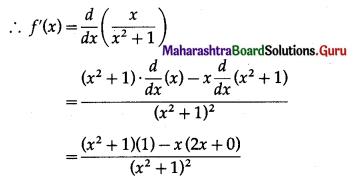
f(x) = \(\frac{\boldsymbol{x}}{x^{2}+1}\)
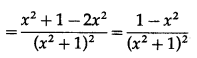
Maharashtra Board 12th Maths Solutions Chapter 2 Applications of Derivatives Ex 2.4 Q6
Maharashtra Board 12th Maths Solutions Chapter 2 Applications of Derivatives Ex 2.4 Q6.1

(a) f is strictly increasing if f'(x) > 0
i.e. if \(\frac{1-x^{2}}{\left(x^{2}+1\right)^{2}}\) > 0
i.e. if 1 – x2 > 0 ……..[∵ (x2 + 1)2 > 0]
i.e. if 1 > x2
i.e. if x2 < 1
i.e. if -1 < x < 1
∴ f is strictly increasing if -1 < x < 1

(b) f is strictly decreasing if f'(x) < 0
i.e. if \(\frac{1-x^{2}}{\left(x^{2}+1\right)^{2}}\) < 0
i.e. if 1 – x2 < 0 ……..[∵ (x2 + 1)2 > 0]
i.e. if 1 < x2 i.e. if x2 > 1
i.e. if x > 1 or x < -1
∴ f is strictly decreasing if x < -1 or x > 1
i.e. x ∈ (-∞, -1) ∪ (1, ∞).

Question 7.
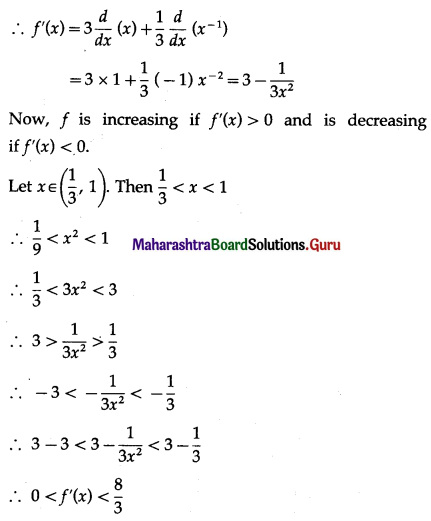
Show that f(x) = 3x + \(\frac{1}{3 x}\) is increasing in (\(\frac{1}{3}\), 1) and decreasing in (\(\frac{1}{9}\), \(\frac{1}{3}\))
Solution:
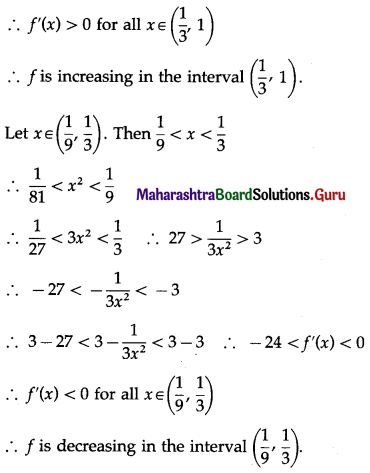
f(x) = 3x + \(\frac{1}{3 x}\)
Maharashtra Board 12th Maths Solutions Chapter 2 Applications of Derivatives Ex 2.4 Q7
Maharashtra Board 12th Maths Solutions Chapter 2 Applications of Derivatives Ex 2.4 Q7.1

Question 8.
Show that f(x) = x – cos x is increasing for all x.
Solution:
f(x) = x – cos x
∴ f'(x) = \(\frac{d}{d x}\) (x – cos x)
= 1 – (-sin x)
= 1 + sin x
Now, -1 ≤ sin x ≤ 1 for all x ∈ R
∴ -1 + 1 ≤ 1 + sin x ≤ 1 for all x ∈ R
∴ 0 ≤ f'(x) ≤ 1 for all x ∈ R
∴ f'(x) ≥ 0 for all x ∈ R
∴ f is increasing for all x.

Maharashtra Board 12th Maths Solutions Chapter 2 Applications of Derivatives Ex 2.4

Question 9.
Find the maximum and minimum of the following functions:
(i) y = 5x3 + 2x2 – 3x
Solution:
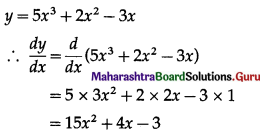
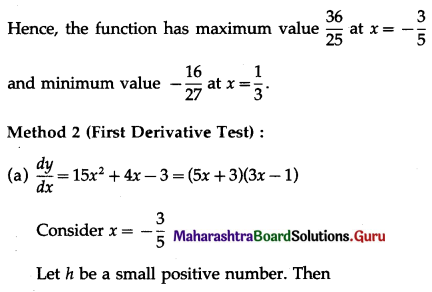
Maharashtra Board 12th Maths Solutions Chapter 2 Applications of Derivatives Ex 2.4 Q9 (i)
Maharashtra Board 12th Maths Solutions Chapter 2 Applications of Derivatives Ex 2.4 Q9 (i).1
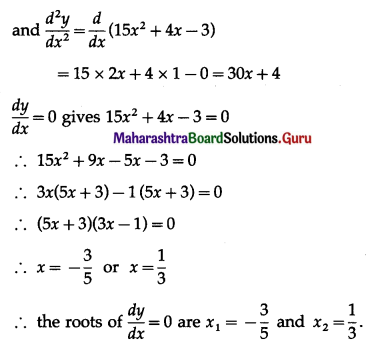
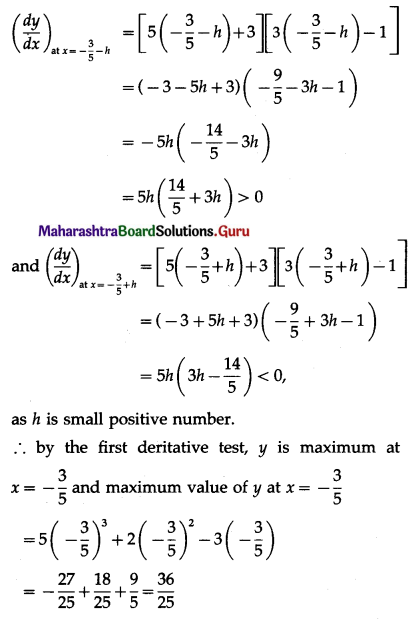
Maharashtra Board 12th Maths Solutions Chapter 2 Applications of Derivatives Ex 2.4 Q9 (i).2
Maharashtra Board 12th Maths Solutions Chapter 2 Applications of Derivatives Ex 2.4 Q9 (i).3
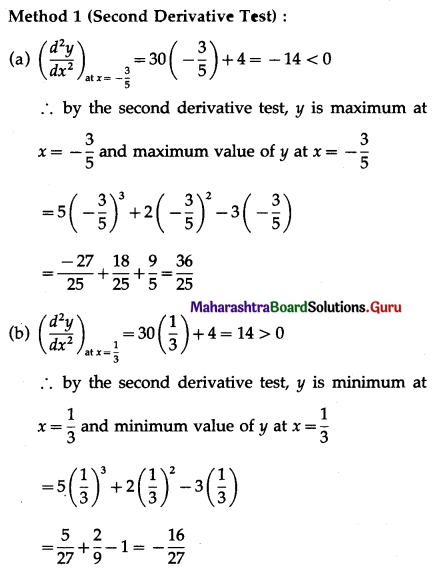
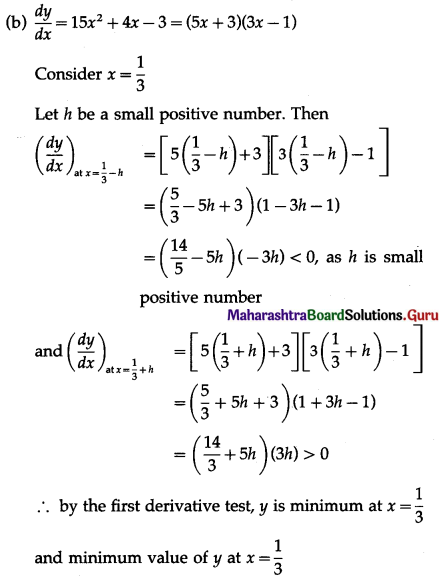
Maharashtra Board 12th Maths Solutions Chapter 2 Applications of Derivatives Ex 2.4 Q9 (i).4
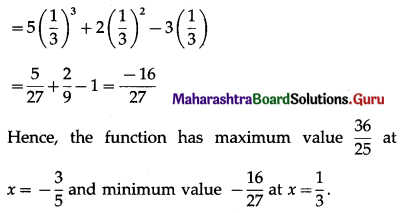
Maharashtra Board 12th Maths Solutions Chapter 2 Applications of Derivatives Ex 2.4 Q9 (i).5
Maharashtra Board 12th Maths Solutions Chapter 2 Applications of Derivatives Ex 2.4 Q9 (i).6

(ii) f(x) = 2x3 – 21x2 + 36x – 20
Solution:
f(x) = 2x3 – 21x2 + 36x – 20
∴ f'(x) = \(\frac{d}{d x}\) (2x3 – 21x2 + 36x – 20)
= 2 × 3x2 – 21 × 2x + 36 × 1 – 0
= 6x2 – 42x + 36
and f”(x) = \(\frac{d}{d x}\) (6x2 – 42x + 36)
= 6 × 2x – 42 × 1 + 0
= 12x – 42
f'(x) = 0 gives 6x2 – 42x + 36 = 0
∴ x2 – 7x + 6 = 0
∴ (x – 1)(x – 6) = 0
the roots of f'(x) = 0 are x1 = 1 and x2 = 6.

Method 1 (Second Derivative Test):
(a) f”(1) = 12(1) – 42 = -30 < 0
∴ by the second derivative test, f has maximum at x = 1
and maximum value of f at x = 1
f(1) = 2(1)3 – 21(1)2 + 36(1) – 20
= 2 – 21 + 36 – 20
= -3

(b) f”(6) = 12(6) – 42 = 30 > 0
∴ by the second derivative test, f has minimum at x = 6
and minimum value of f at x = 6
f(6) = 2(6)3 – 21(6)2 + 36(6) – 20
= 432 – 756 + 216 – 20
= -128.
Hence, the function f has maximum value -3 at x = 1 and minimum value -128 at x = 6.

Method 2 (First Derivative Test):
(a) f'(x) = 6(x – 1)(x – 6)
Consider x = 1
Let h be a small positive number. Then
f'(1 – h) = 6(1 – h – 1)(1 – h – 6)
= 6(-h)(-5 – h)
= 6h(5 + h)> 0
and f'(1 + h) = 6(1 + h – 1)(1 + h – 6)
= 6h(h – 5) < 0, as h is small positive number.
∴ by the first derivative test, f has maximum at x = 1 and maximum value of f at x = 1
f(1) = 2(1)3 – 21(1)2 + 36(1) – 20
= 2 – 21 + 36 – 20
= -3

Maharashtra Board 12th Maths Solutions Chapter 2 Applications of Derivatives Ex 2.4

(b) f'(x) = 6(x – 1)(x – 6)
Consider x = 6
Let h be a small positive number. Then
f'(6 – h) = 6(6 – h – 1)(6 – h – 6)
= 6(5 – h)(-h)
= -6h(5 – h) < 0, as h is small positive number
and f'(6 + h) = 6(6 + h – 1)(6 + h – 6) = 6(5 + h)(h) > 0
∴ by the first derivative test, f has minimum at x = 6
and minimum value of f at x = 6
f(6) = 2(6)3 – 21(6)2 + 36(6) – 20
= 432 – 756 + 216 – 20
= -128
Hence, the function f has maximum value -3 at x = 1
and minimum value -128 at x = 6.

(iii) f(x) = x3 – 9x2 + 24x
Solution:
f(x) = x3 – 9x2 + 24x
∴ f'(x) = \(\frac{d}{d x}\) (x3 – 9x2 + 24x)
= 3x2 – 9 × 2x + 24 × 1
= 3x2 – 18x + 24
and f”(x) = \(\frac{d}{d x}\) (3x2 – 18x + 24)
= 3 × 2x – 18 × 1 + 0
= 6x – 18
f'(x) = 0 gives 3x2 – 18x + 24 = 0
∴ x2 – 6x + 8 = 0
∴ (x – 2)(x – 4) = 0
∴ the roots of f'(x) = 0 are x1 = 2 and x2 = 4.

(a) f”(2) = 6(2) – 18 = -6 < 0
∴ by the second derivative test, f has maximum at x = 2
and maximum value of f at x = 2
f(2) = (2)3 – 9(2)2 + 24(2)
= 8 – 36 + 48
= 20

Maharashtra Board 12th Maths Solutions Chapter 2 Applications of Derivatives Ex 2.4

(b) f”(4) = 6(4) – 18 = 6 > 0
∴ by the second derivative test, f has minimum at x = 4
and minimum value of f at x = 4
f(4) = (4)3 – 9(4)2 + 24(4)
= 64 – 144 + 96
= 16
Hence, the function f has maximum value 20 at x = 2 and minimum value 16 at x = 4.

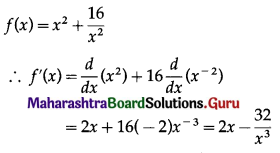
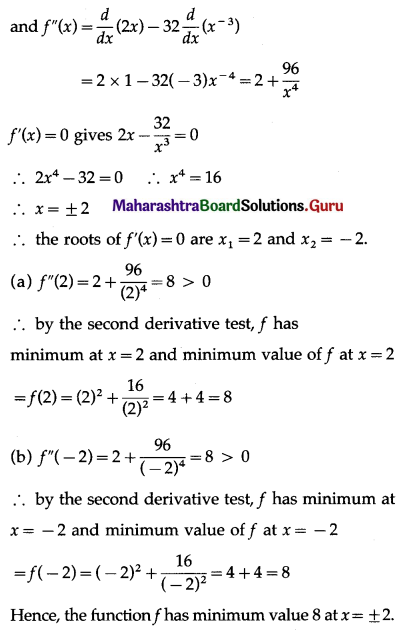
(iv) f(x) = x2 + \(\frac{16}{x^{2}}\)
Solution:
Maharashtra Board 12th Maths Solutions Chapter 2 Applications of Derivatives Ex 2.4 Q9 (iv)
Maharashtra Board 12th Maths Solutions Chapter 2 Applications of Derivatives Ex 2.4 Q9 (iv).1

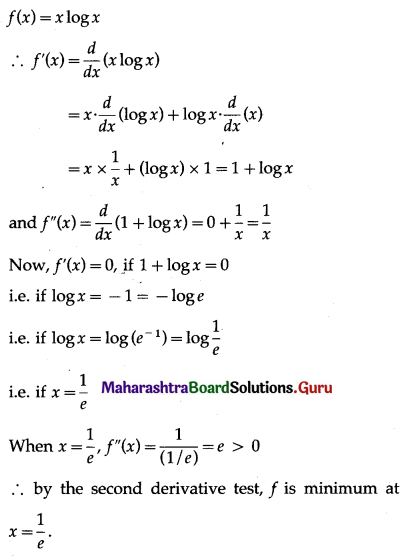
(v) f(x) = x log x
Solution:
Maharashtra Board 12th Maths Solutions Chapter 2 Applications of Derivatives Ex 2.4 Q9 (v)
Maharashtra Board 12th Maths Solutions Chapter 2 Applications of Derivatives Ex 2.4 Q9 (v).1

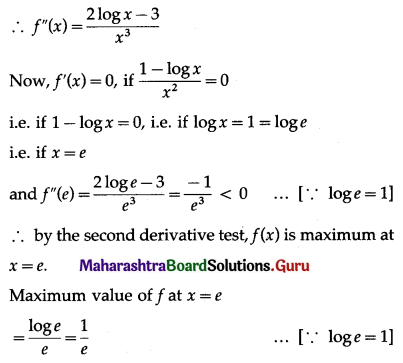
(vi) f(x) = \(\frac{\log x}{x}\)
Solution:
Maharashtra Board 12th Maths Solutions Chapter 2 Applications of Derivatives Ex 2.4 Q9 (vi)
Maharashtra Board 12th Maths Solutions Chapter 2 Applications of Derivatives Ex 2.4 Q9 (vi).1

Question 10.
Divide the number 30 into two parts such that their product is maximum.
Solution:
Let the first part of 30 be x.
Then the second part is 30 – x.
∴ their product = x(30 – x) = 30x – x2 = f(x) ……(Say)
∴ f'(x) = \(\frac{d}{d x}\) (30x – x2)
= 30 × 1 – 2x
= 30 – 2x
and f”(x) = \(\frac{d}{d x}\) (30 – 2x)
= 0 – 2 × 1
= -2
The root of the equation f(x) = 0,
i.e. 30 – 2x = 0 is x = 15 and f”(15) = -2 < 0
∴ by the second derivative test, f is maximum at x = 15.
Hence, the required parts of 30 are 15 and 15.

Maharashtra Board 12th Maths Solutions Chapter 2 Applications of Derivatives Ex 2.4

Question 11.
Divide the number 20 into two parts such that the sum of their squares is minimum.
Solution:
Let the first part of 20 be x.
Then the second part is 20 – x.
∴ sum of their squares = x2 + (20 – x)2 = f(x) …… (Say)
∴ f'(x) = \(\frac{d}{d x}\) [x2 + (20 – x)2]
= 2x + 2(20 – x) . \(\frac{d}{d x}\) (20 – x)
= 2x + 2(20 – x) × (0 – 1)
= 2x – 40 + 2x
= 4x – 40
and f”(x) = \(\frac{d}{d x}\) (4x – 40)
= 4 × 1 – 0
= 4
The root of the equation f'(x) = 0,
i.e. 4x – 40 = 0 is x = 10 and f”(10) = 4 > 0
∴ by the second derivative test, f is minimum at x = 10.
Hence, the required parts of 20 are 10 and 10.

Question 12.
A wire of length 36 meters is bent in the form of a rectangle. Find its dimensions if the area of the rectangle is maximum.
Solution:
Let x metres and y metres be the length and breadth of the rectangle.
Then its perimeter is 2(x + y) = 36
x + y = 18
y = 18 – x
Area of the rectangle = xy = x (18 – x)
Let f(x) = x(18 – x) = 18x – x2
∴ f'(x) = \(\frac{d}{d x}\) (18x – x2) = 18 – 2x
and f”(x) = \(\frac{d}{d x}\) (18 – 2x) = 0 – 2 × 1 = -2
Now, f'(x) = 0, if 18 – 2x = 0
i.e. if x = 9
and f”(9) = -2 < 0
∴ by the second derivative test, f has maximum value at x = 9.
When x = 9, y = 18 – 9 = 9
∴ x = 9 cm, y = 9 cm
∴ the rectangle is a square of side 9 metres.

Maharashtra Board 12th Maths Solutions Chapter 2 Applications of Derivatives Ex 2.4

Question 13.
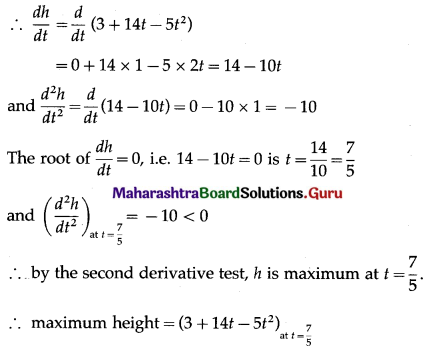
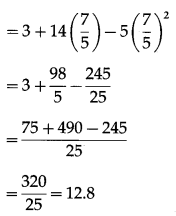
A ball is thrown in the air. Its height at any time t is given by h = 3 + 14t – 5t2. Find the maximum height it can reach.
Solution:
The height h at any t is given by h = 3 + 14t – 5t2
Maharashtra Board 12th Maths Solutions Chapter 2 Applications of Derivatives Ex 2.4 Q13
Maharashtra Board 12th Maths Solutions Chapter 2 Applications of Derivatives Ex 2.4 Q13.1
Hence, the maximum height the ball can reach = 12.8 units.

Question 14.
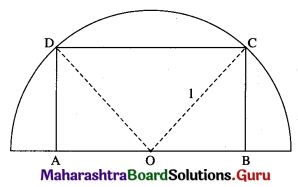
Find the largest size of a rectangle that can be inscribed in a semicircle of radius 1 unit, so that two vertices lie on the diameter.
Solution:
Maharashtra Board 12th Maths Solutions Chapter 2 Applications of Derivatives Ex 2.4 Q14
Let ABCD be the rectangle inscribed in a semicircle of radius 1 unit such that the vertices A and B lie on the diameter.
Let AB = DC = x and BC = AD = y.
Let O be the centre of the semicircle.
Join OC and OD. Then OC = OD = radius = 1.
Also, AD = BC and m∠A = m∠B = 90°.
∴ OA = OB
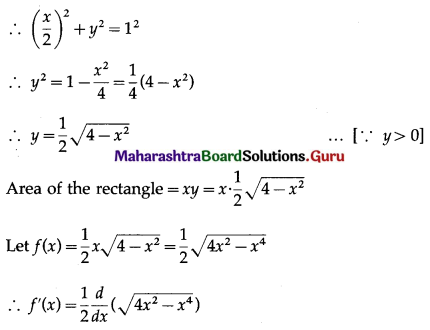
∴ OB = \(\frac{1}{2}\) AB = \(\frac{x}{2}\)
In right angled triangle OBC,
OB2 + BC2 = OC2
Maharashtra Board 12th Maths Solutions Chapter 2 Applications of Derivatives Ex 2.4 Q14.1
Maharashtra Board 12th Maths Solutions Chapter 2 Applications of Derivatives Ex 2.4 Q14.2
Maharashtra Board 12th Maths Solutions Chapter 2 Applications of Derivatives Ex 2.4 Q14.3
Maharashtra Board 12th Maths Solutions Chapter 2 Applications of Derivatives Ex 2.4 Q14.4
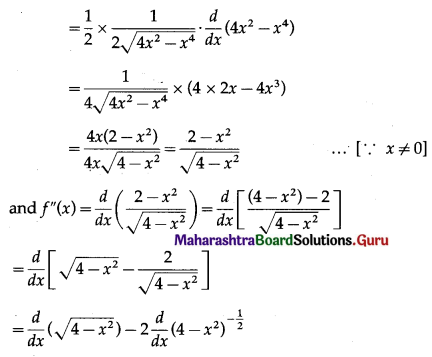
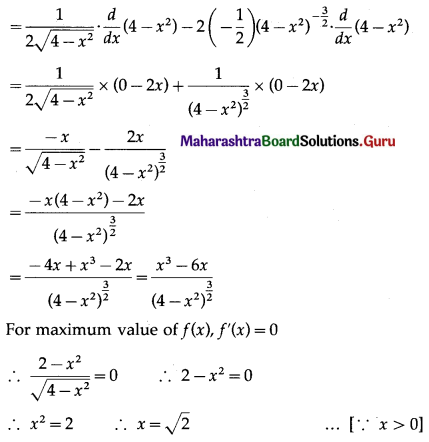
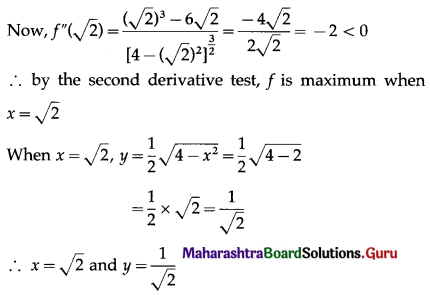
Hence, the area of the rectangle is maximum (i.e. rectangle has the largest size) when its length is √2 units and breadth is \(\frac{1}{\sqrt{2}}\) unit.

Question 15.
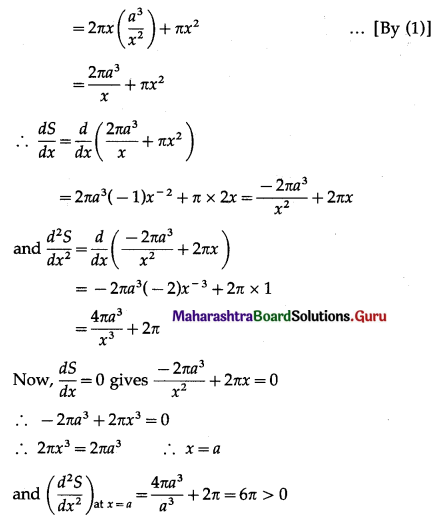
An open cylindrical tank whose base is a circle is to be constructed of metal sheet so as to contain a volume of πa3 cu cm of water. Find the dimensions so that the quantity of the metal sheet required is minimum.
Solution:
Let x be the radius of the base, h be the height, V be the volume and S be the total surface area of the cylindrical tank.
Then V = πa3 … (Given)
∴ πx2h = πa3
∴ h = \(\frac{a^{3}}{x^{2}}\) ……..(1)
Now, S = 2πxh + πx2
Maharashtra Board 12th Maths Solutions Chapter 2 Applications of Derivatives Ex 2.4 Q15
∴ by the second derivative test, S is minimum when x = a
When x = a, from (1)
h = \(\frac{a^{3}}{a^{2}}\) = a
Hence, the quantity of metal sheet is minimum when radius height = a cm.

Maharashtra Board 12th Maths Solutions Chapter 2 Applications of Derivatives Ex 2.4

Question 16.
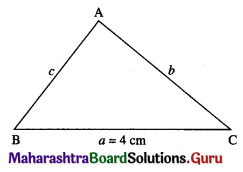
The perimeter of a triangle is 10 cm. If one of the sides is 4 cm. What are the other two sides of the triangle for its maximum area?
Solution:
Maharashtra Board 12th Maths Solutions Chapter 2 Applications of Derivatives Ex 2.4 Q16
Let ABC be the triangle such that the side BC = a = 4 cm.
Also, the perimeter of the triangle is 10 cm.
i.e. a + b + c = 10
∴ 2s = 10
∴ s = 5
Also, 4 + b + c = 10
∴ b + c = 6
∴ b = 6 – c
Let ∆ be the area of the triangle.
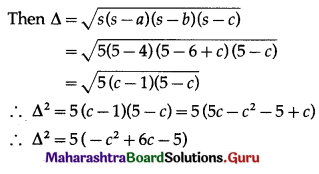
Maharashtra Board 12th Maths Solutions Chapter 2 Applications of Derivatives Ex 2.4 Q16.1
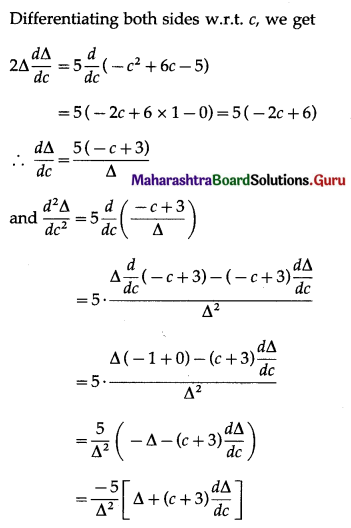
Maharashtra Board 12th Maths Solutions Chapter 2 Applications of Derivatives Ex 2.4 Q16.2
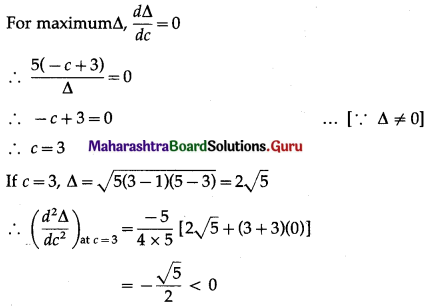
Maharashtra Board 12th Maths Solutions Chapter 2 Applications of Derivatives Ex 2.4 Q16.3
∴ by the second derivative test, ∆ is maximum when c = 3.
When c = 3, b = 6 – c = 6 – 3 = 3
Hence, the area of the triangle is maximum when the other two sides are 3 cm and 3 cm.

Question 17.
A box with a square base is to have an open top. The surface area of the box is 192 sq cm. What should be its dimensions in order that the volume is largest?
Solution:
Let x cm be the side of square base and h cm be its height.
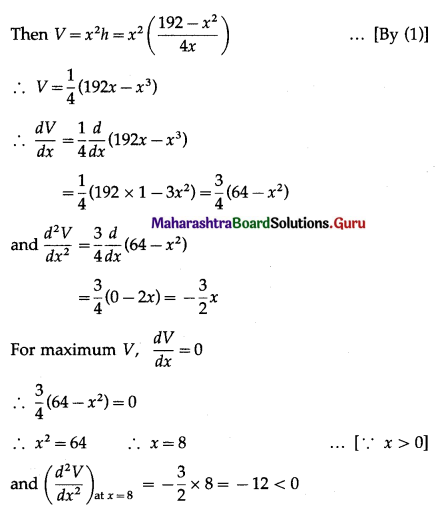
Then x2 + 4xh = 192
∴ h = \(\frac{192-x^{2}}{4 x}\) …… (1)
Let V be the volume of the box.
Maharashtra Board 12th Maths Solutions Chapter 2 Applications of Derivatives Ex 2.4 Q17
∴ by the second derivative test, V is maximum at x = 8.
If x = 8, h = \(\frac{192-64}{4(8)}=\frac{128}{32}\) = 4
Hence, the volume of the box is largest, when the side of square base is 8 cm and its height is 4 cm.

Maharashtra Board 12th Maths Solutions Chapter 2 Applications of Derivatives Ex 2.4

Question 18.
The profit function P (x) of a firm, selling x items per day is given by P(x) = (150 – x)x – 1625. Find the number of items the firm should manufacture to get maximum profit. Find the maximum profit.
Solution:
Profit function P (x) is given by
P(x) = (150 – x)x – 1625 = 150x – x2 -1625
∴ P'(x) = \(\frac{d}{d x}\) (150x – x2 – 1625)
= 150 × 1 – 2x – 0
= 150 – 2x
and P”(x) = \(\frac{d}{d x}\) (150 – 2x)
= 0 – 2 × 1
= -2
Now, P'(x) = 0 gives, 150 – 2x = 0
∴ x = 75
and P”(75) = -2 < 0
∴ by the second derivative test, P(x) is maximum when x = 75
Maximum profit = P(75)
= (150 – 75)75 – 1625
= 75 × 75 – 1625
= 4000
Hence, the profit will be maximum, if the manufacturer manufactures 75 items and the maximum profit is 4000.

Question 19.
Find two numbers whose sum is 15 and when the square of one multiplied by the cube of the other is maximum.
Solution:
Let the two numbers be x and y.
Then x + y = 15
∴ y = 15 – x
Let P is the product of square of y and cube of x.
Then P = x3y2
= x3(15 – x)2
= x3(225 – 30x + x2)
= x5 – 30x4 + 225x3
∴ \(\frac{d P}{d x}\) = \(\frac{d}{d x}\) (x5 – 30x4 + 225x3)
= 5x4 – 30 × 4x3 + 225 × 3x2
= 5x4 – 120x3 + 675x2
and \(\frac{d^{2} P}{d x^{2}}\) = \(\frac{d}{d x}\) (5x4 – 120x3 + 675x2)
= 5 × 4x3 – 120 × 3x2 + 675 × 2x
= 20x3 – 360x2 + 1350x
= 10x(2x2 – 36x + 135)
Now, \(\frac{d P}{d x}\) = 0 gives 5x4 – 120x3 + 675x2 = 0
∴ 5x2(x2 – 24x +135) = 0
∴ 5x2(x2 – 15x – 9x + 135) = 0
∴ 5x2[x(x – 15) – 9(x – 35)] = 0
∴ 5x2(x – 15)(x – 9) = 0
∴ the roots of \(\frac{d P}{d x}\) = 0 are x1 = 0, x2 = 15 and x3 = 9
If x = 0, then y = 15 – 0 = 15
If x = 15, then y = 15 – 15 = 0
In both cases, product x3y2 is zero, which is not maximum.
∴ x ≠ 0 and x ≠ 15
∴ x = 6
Now, \(\left(\frac{d^{2} P}{d x^{2}}\right)_{\text {at } x=6}\) = 10(6)[2(6)2 – 36 × 6 + 135]
= 60[72 – 216 + 135]
= 60(-9)
= -540 < 0
∴ P is maximum when x = 6
If x = 6, then y = 15 – 6 = 9
Hence, the required numbers are 6 and 9.

Maharashtra Board 12th Maths Solutions Chapter 2 Applications of Derivatives Ex 2.4

Question 20.
Show that among rectangles of given area, the square has least perimeter.
Solution:
Let x be the length and y be the breadth of the rectangle whose area is A sq units (which is given as constant).
Then xy = A
∴ y = \(\frac{A}{x}\) ………(1)
Let P be the perimeter of the rectangle.
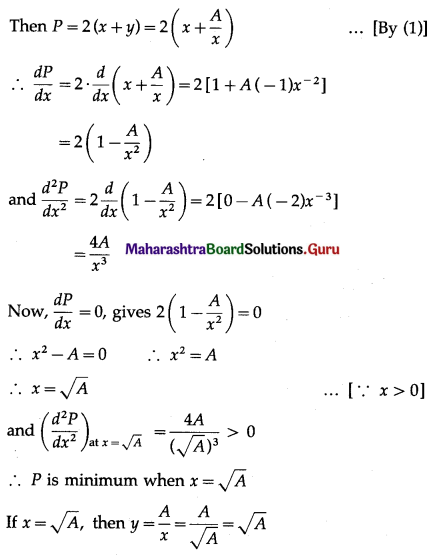
Maharashtra Board 12th Maths Solutions Chapter 2 Applications of Derivatives Ex 2.4 Q20
x = y
∴ rectangle is a square.
Hence, among rectangles of given area, the square has least perimeter.

Question 21.
Show that the height of a closed right circular cylinder of given volume and least surface area is equal to its diameter.
Solution:
Let x be the radius of base, h be the height and S be the surface area of the closed right circular cylinder whose volume is V which is given to be constant.
Then πr2h = V
∴ h = \(\frac{V}{\pi r^{2}}=\frac{A}{x^{2}}\) …….(1)
where A = \(\frac{V}{\pi}\), which is constant.
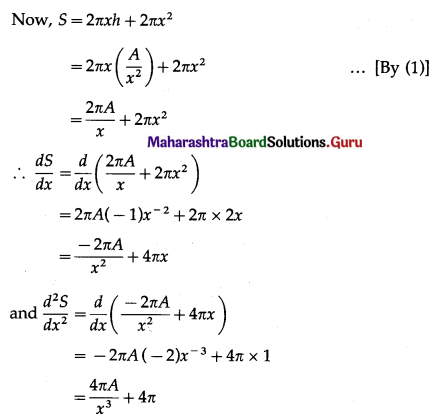
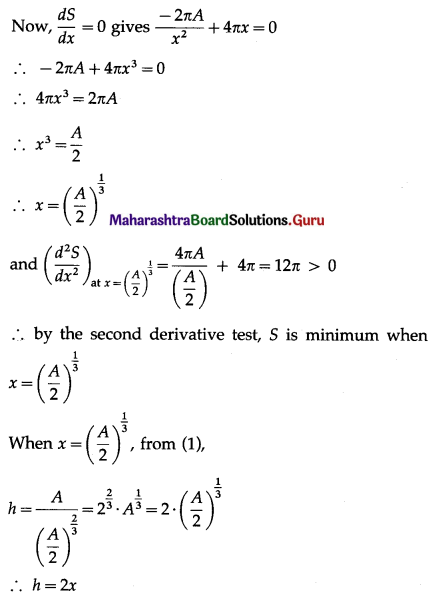
Maharashtra Board 12th Maths Solutions Chapter 2 Applications of Derivatives Ex 2.4 Q21
Maharashtra Board 12th Maths Solutions Chapter 2 Applications of Derivatives Ex 2.4 Q21.1
Hence, the surface area is least when height of the closed right circular cylinder is equal to its diameter.

Question 22.
Find the volume of the largest cylinder that can be inscribed in a sphere of radius ‘r’ cm.
Solution:
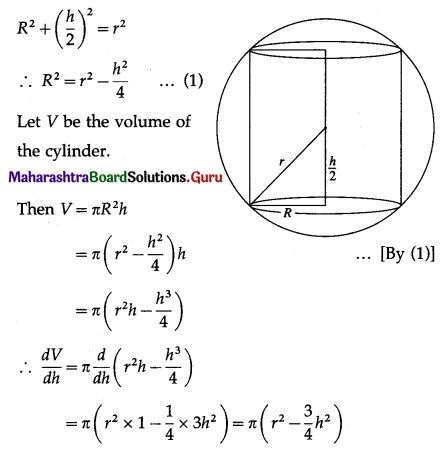
Let R be the radius and h be the height of the cylinder which is inscribed in a sphere of radius r cm.
Then from the figure,
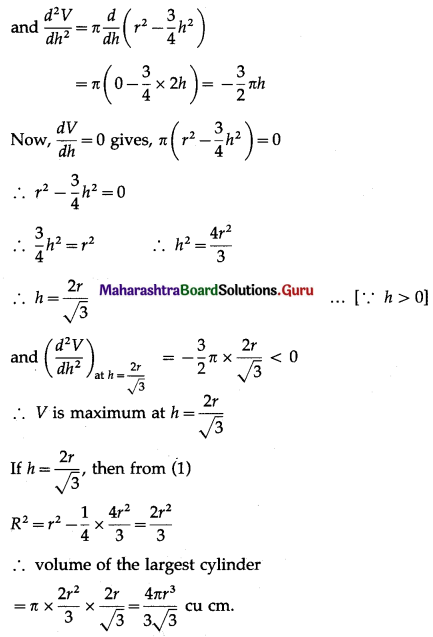
Maharashtra Board 12th Maths Solutions Chapter 2 Applications of Derivatives Ex 2.4 Q22
Maharashtra Board 12th Maths Solutions Chapter 2 Applications of Derivatives Ex 2.4 Q22.1
Hence, the volume of the largest cylinder inscribed in a sphere of radius ‘r’ cm = \(\frac{4 \pi r^{3}}{3 \sqrt{3}}\) cu cm.

Maharashtra Board 12th Maths Solutions Chapter 2 Applications of Derivatives Ex 2.4

Question 23.
Show that y = log(1 + x) – \(\frac{2 x}{2+x}\), x > -1 is an increasing function on its domain.
Solution:
y = log(1 + x) – \(\frac{2 x}{2+x}\), x > -1
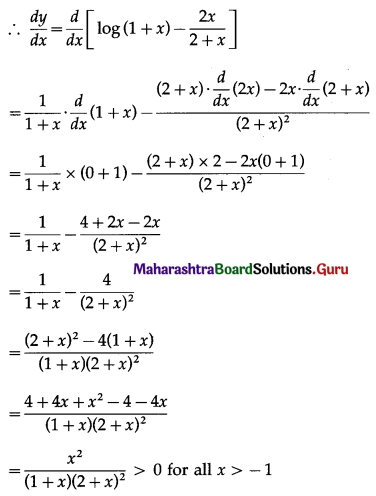
Maharashtra Board 12th Maths Solutions Chapter 2 Applications of Derivatives Ex 2.4 Q23
Hence, the given function is increasing function on its domain.

Question 24.
Prove that y = \(\frac{4 \sin \theta}{2+\cos \theta}\) – θ is an increasing function if θ ∈ [0, \(\frac{\pi}{2}\)]
Solution:
y = \(\frac{4 \sin \theta}{2+\cos \theta}\) – θ
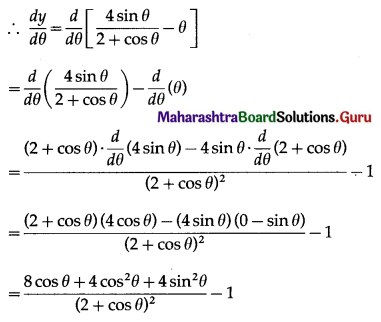
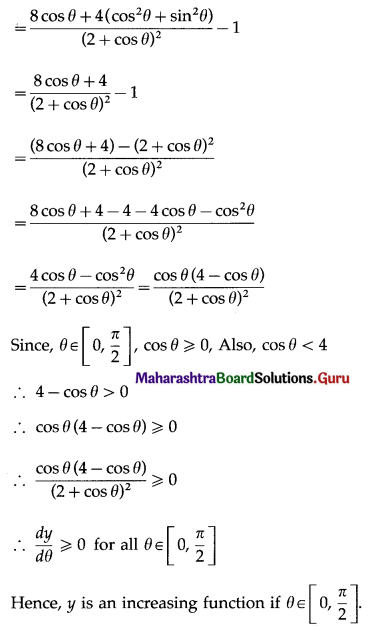
Maharashtra Board 12th Maths Solutions Chapter 2 Applications of Derivatives Ex 2.4 Q24
Maharashtra Board 12th Maths Solutions Chapter 2 Applications of Derivatives Ex 2.4 Q24.1

Maharashtra Board Class 11 Hindi रचना अनुवाद लेखन

Balbharti Maharashtra State Board Hindi Yuvakbharati 11th Digest रचना अनुवाद लेखन Notes, Questions and Answers.

Maharashtra State Board 11th Hindi रचना अनुवाद लेखन

अनुवाद लेखन : किसी भाषा में कही या लिखी गई बात का किसी दूसरी भाषा में सार्थक परिवर्तन अनुवाद कहलाता है। अनुवाद एक कला है। अनुवाद करते समय शब्दों का ही केवल अनुवाद नहीं करना है वाक्य में जो भाव है उसके अनुसार शब्दों का चयन और क्रम रखकर मौलिक भाव को प्रस्तुत करना होता है। आपको अंग्रेजी से हिंदी में अनुवाद करने के लिए पूछा जाएगा।

Maharashtra Board Class 11 Hindi रचना अनुवाद लेखन

उदा.
His dreams became true
अनुवाद – उसके सपने सच हुए।

निम्नलिखित वाक्यों का हिंदी में अनुवाद कीजिए

प्रश्न 1.
Mistakes are always forgivable, if one has the courage to admit them.
उत्तर:
गलतियाँ हमेशा क्षमा की जा सकती हैं, यदि आपके पास उन्हें स्वीकारने का साहस हो।

प्रश्न 2.
As you think, so shall you become.
उत्तर:
जैसा आप सोचते हैं, वैसा आप बन जाएँगे।

प्रश्न 3.
A quick temper will make a fool of you soon enough
उत्तर:
जल्दी गुस्सा करना जल्द ही आपको मूर्ख साबित कर देगा।

Maharashtra Board Class 11 Hindi रचना अनुवाद लेखन

प्रश्न 4.
A man is great by deeds, not by birth.
उत्तर:
व्यक्ति जन्म से नहीं कर्म से महान होता है।

प्रश्न 5.
Success and failure are both part of life and both are not permanent.
उत्तर:
सफलता और असफलता दोनों जीवन के हिस्से हैं और दोनों स्थायी नहीं होते।

प्रश्न 6.
A person who never made a mistake never tried anything new.
उत्तर:
जिस व्यक्ति ने कभी गलती नहीं की उसने कभी कुछ नया करने की कोशिश नहीं की।

प्रश्न 7.
Life should be great rather than long.
उत्तर:
जीवन लंबा होने की बजाय महान होना चाहिए।

Maharashtra Board Class 11 Hindi रचना अनुवाद लेखन

प्रश्न 8.
Failure comes only when we forget our ideals and objectives and principles.
उत्तर:
असफलता तभी आती है जब हम अपने आदर्श, उद्देश्य और सिद्धांत भूल जाते हैं।

प्रश्न 9.
Health is the greatest gift, contentment the greatest wealth, faithfulness the best relationship.
उत्तर.
स्वास्थ्य सबसे बड़ा उपहार है, संतोष सबसे बड़ा धन है, वफादारी सबसे बड़ा संबंध है।

प्रश्न 10.
Never stop believing in hope because miracles happen everyday.
उत्तर:
उम्मीद पर विश्वास करना न छोड़ें क्योंकि चमत्कार हर दिन होते हैं।

Maharashtra Board Class 11 Hindi रचना विज्ञापन लेखन

Balbharti Maharashtra State Board Hindi Yuvakbharati 11th Digest रचना विज्ञापन लेखन Notes, Questions and Answers.

Maharashtra State Board 11th Hindi रचना विज्ञापन लेखन

विज्ञापन का सामान्य अर्थ है सूचना या विशिष्ट ज्ञापन वास्तव में आज की उपभोक्तावादी संस्कृति में यह विशेष महत्त्वपूर्ण है। इसका प्रभाव उपभोक्ता, विक्रेता तथा समाज के सभी वर्गों पर गहरा पड़ता है।

विज्ञापन का मुख्य उद्देश्य है –

  • उत्पाद की बिक्री बढ़ाना।
  • सामाजिक अथवा राजनीतिक अभियान को गति देना।
  • विद्यालयों / महाविद्यालयों में प्रवेश हेतु आवेदन-पत्र की जानकारी प्राप्त करना।
  • नाटक, संवाद, कहानी, सिनेमा आदि की जानकारी देना।
  • नौकरी देने / लेने हेतु जानकारी देना।

Maharashtra Board Class 11 Hindi रचना विज्ञापन लेखन

विज्ञापन के नमूने :

प्रश्न 1.
निम्नलिखित जानकारी के आधार पर विज्ञापन तैयार कीजिए।
Maharashtra Board Class 11 Hindi रचना विज्ञापन लेखन 1
उत्तर:
“घर किराए पर देना है”
500 वर्गफीट, वन बी-एच्.के का फ्लैट गोरेगाँव रेल स्थानक से पाँच मिनट की दूरी पर उपलब्ध है। स्कूल और अस्पताल निकट। जॉगर्स पार्क के बगल/पास में। 24 घंटे पानी की सुविधा।
Maharashtra Board Class 11 Hindi रचना विज्ञापन लेखन 2
संपर्क : अभय पांडेय।
मोबाईल : 98xxxxxxx
समय : सुबह 11 से शाम 6
पता : 203 / गजानन कॉलनी, गोरेगाँव (प.), मुंबई।

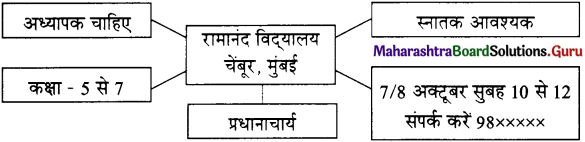
प्रश्न 2.
निम्नलिखित जानकारी के आधार पर विज्ञापन तैयार कीजिए।
Maharashtra Board Class 11 Hindi रचना विज्ञापन लेखन 3
उत्तर:
आवश्यकता है

रामानंद विद्यालय, चेंबूर नाका, चेंबूर, मुंबई 71 के लिए खुले प्रवर्ग के लिए एक हिंदी-मराठी विषय के शिक्षक सेवक की आवश्यकता है। प्रार्थी का प्रशिक्षित एवं हिंदी-मराठी विषय में स्नातक होना अनिवार्य है। अपने शैक्षणिक अनुभव एवं प्रमाणपत्रों की प्रतियों के साथ प्रधानाचार्य से मिले।

दिनांक : 7 और 8 अक्टूबर 2017.
समय : सुबह 10.00 से 3.00 बजे तक
भ्रमणध्वनि : 98xxxxx

Maharashtra Board Class 11 Hindi रचना विज्ञापन लेखन

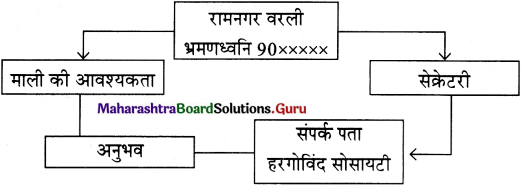
प्रश्न 3.
निम्नलिखित जानकारी के आधार पर विज्ञापन तैयार कीजिए।
Maharashtra Board Class 11 Hindi रचना विज्ञापन लेखन 4
उत्तर :
आवश्यकता है ….
सोसायटी के बगीचे की देखभाल करने हेतु अनुभवी माली की आवश्यकता है।

  • पेड़- पौधों की जानकारी आवश्यक
  • सोसायटी कंपाऊंड में रहने की व्यवस्था
  • 10000 से 15000 प्रतिमाह तनख्वाह
  • निर्व्यसनी, ईमानदार माली अपने दो फोटो और आधार कार्ड के साथ संपर्क करें।

सेक्रेटरी.
हरगोविंद सोसायटी
रामनगर, वरली।
भ्रमणध्वनि: 90xxxxxx
केवल इतवार के दिन शाम 4 से 7 के बीच ही संपर्क कर सकते हैं।

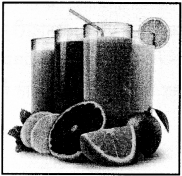
प्रश्न 4.
स्वास्थ्यवर्धक पेय के विक्री हेतु विज्ञापन तैयार कीजिए।
खुशखबर! खुशखबर!! खुशखबर!!!
रोजाना नाश्ते के साथ सेवन करें
स्वास्थ्य की हर समस्या से निजात पाएँ

  • शुगर फ्री, मोटापा घटाए
  • कोई साईड इफेक्ट नहीं
  • त्वचा रखे सदाबहार
  • दाम भी कम

Maharashtra Board Class 11 Hindi रचना विज्ञापन लेखन

पेय एक लाभ अनेक
Maharashtra Board Class 11 Hindi रचना विज्ञापन लेखन 5
प्रथम 100 ग्राहकों को एक पर एक मुफ्त
हमारा पता
विश्वास ग्राहक सेवा, नासिक।
अधिक जानकारी के लिए www.vishwasgrahak.com
हमारी वेबसाइट पर जाए या विजिट करे।

Maharashtra Board 12th Maths Solutions Chapter 2 Applications of Derivatives Ex 2.3

Balbharti 12th Maharashtra State Board Maths Solutions Book Pdf Chapter 2 Applications of Derivatives Ex 2.3 Questions and Answers.

Maharashtra State Board 12th Maths Solutions Chapter 2 Applications of Derivatives Ex 2.3

Question 1.
Check the validity of the Rolle’s theorem for the following functions.
(i) f(x) = x2 – 4x + 3, x ∈ [1, 3]
Solution:
The function f given as f(x) = x2 – 4x + 3 is polynomial function.
Hence, it is continuous on [1, 3] and differentiable on (1, 3).
Now, f(1) = 12 – 4(1) + 3 = 1 – 4 + 3 = 0
and f(3) = 32 – 4(3) + 3 = 9 – 12 + 3 = 0
∴ f(1) = f(3)
Thus, the function f satisfies all the conditions of Rolle’s theorem.

(ii) f(x) = e-x sin x, x ∈ [0, π].
Solution:
The functions e-x and sin x are continuous and differentiable on their domains.
∴ f(x) = e-x sin x is continuous on [0, π] and differentiable on (0, π).
Now, f(0) = e0 sin 0 = 1 × 0 = 0
and f(π) = e sin π = e × 0 = 0
∴ f(0) = f(π)
Thus, the function f satisfies all the conditions of the Rolle’s theorem.

Maharashtra Board 12th Maths Solutions Chapter 2 Applications of Derivatives Ex 2.3

(iii) f(x) = 2x2 – 5x + 3, x ∈ [1, 3].
Solution:
The function f given as f(x) = 2x2 – 5x + 3 is a polynomial function.
Hence, it is continuous on [1, 3] and differentiable on (1, 3).
Now, f(1) = 2(1)2 – 5(1) + 3 = 2 – 5 + 3 = 0
and f(3) = 2(3)2 – 5(3) + 3 = 18 – 15 + 3 = 6
∴ f(1) ≠ f(3)
Hence, the conditions of Rolle’s theorem are not satisfied.

(iv) f(x) = sin x – cos x + 3, x ∈ [0, 2π].
Solution:
The functions sin x, cos x and 3 are continuous and differentiable on their domains.
∴ f(x) = sin x – cos x + 3 is continuous on [0, 2π] and differentiable on (0, 2π).
Now, f(0) = sin 0 – cos 0 + 3 = 0 – 1 + 3 = 2
and f(2π) = sin 2π – cos 2π + 3 = 0 – 1 + 3 = 2
∴ f(0) = f(2π)
Thus, the function f satisfies all the conditions of the Rolle’s theorem.

(v) f(x) = x2, if 0 ≤ x ≤ 2
= 6 – x, if 2 < x ≤ 6.
Solution:
f(x) = x2, if 0 ≤ x ≤ 2
= 6 – x, if 2 < x ≤ 6
∴ f(x) = \(\frac{d}{d x}\left(x^{2}\right)\) = 2x, if 0 ≤ x ≤ 2
= \(\frac{d}{d x}(6-x)\) = -1, if 2 < x ≤ 6
∴ Lf'(2) = 2(2) = 4 and Rf'(2) = -1
∴ Lf'(2) ≠ Rf'(2)
∴ f is not differentiable at x = 2 and 2 ∈ (0, 6).
∴ f is not differentiable at all the points on (0, 6).
Hence, the conditions of Rolle’s theorem are not satisfied.

(vi) f(x) = \(x^{\frac{2}{3}}\), x ∈ [-1, 1].
Solution:
f(x) = \(x^{\frac{2}{3}}\)
∴ \(f^{\prime}(x)=\frac{d}{d x}\left(x^{\frac{2}{3}}\right)=\frac{2}{3} x^{-\frac{1}{3}}\) = \(\frac{2}{3 \sqrt[3]{x}}\)
This does not exist at x = 0 and 0 ∈ (-1, 1)
∴ f is not differentiable on the interval (-1, 1).
Hence, the conditions of Rolle’s theorem are not satisfied.

Maharashtra Board 12th Maths Solutions Chapter 2 Applications of Derivatives Ex 2.3

Question 2.
Given an interval [a, b] that satisfies hypothesis of Rolle’s theorem for the function f(x) = x4 + x2 – 2. It is known that a = -1. Find the value of b.
Solution:
f(x) = x4 + x2 – 2
Since the hypothesis of Rolle’s theorem are satisfied by f in the interval [a, b], we have
f(a) = f(b), where a = -1
Now, f(a) = f(-1) = (-1)4 + (-1)2 – 2 = 1 + 1 – 2 = 0
and f(b) = b4 + b2 – 2
∴ f(a) = f(b) gives
0 = b4 + b2 – 2 i.e. b4 + b2 – 2 = 0.
Since, b = 1 satisfies this equation, b = 1 is one of the roots of this equation.
Hence, b = 1.

Question 3.
Verify Rolle’s theorem for the following functions.
(i) f(x) = sin x + cos x + 7, x ∈ [0, 2π]
Solution:
The functions sin x, cos x and 7 are continuous and differentiable on their domains.
∴ f(x) = sin x + cos x + 7 is continuous on [0, 2π] and differentiable on (0, 2π)
Now, f(0) = sin 0 + cos 0 + 7 = 0 + 1 + 7 = 8
and f(2π) = sin 2π + cos 2π + 7 = 0 + 1 + 7 = 8
∴ f(0) = f(2π)
Thus, the function f satisfies all the conditions of Rolle’s theorem.
∴ there exists c ∈ (0, 2π) such that f'(c) = 0.
Now, f(x) = sin x + cos x + 7
∴ f'(x) = \(\frac{d}{d x}\) (sin x + cos x + 7)
= cos x – sin x + 0
= cos x – sin x
∴ f'(c) = cos c – sin c
∴ f'(c) = 0 gives, cos c – sin c = 0
∴ cos c = sin c
∴ c = \(\frac{\pi}{4}, \frac{5 \pi}{4}, \frac{9 \pi}{4}, \ldots\)
But \(\frac{\pi}{4}, \frac{5 \pi}{4}\) ∈ (0, 2π)
∴ c = \(\frac{\pi}{4} \text { or } \frac{5 \pi}{4}\)
Hence, the Rolle’s theorem is verified.

Maharashtra Board 12th Maths Solutions Chapter 2 Applications of Derivatives Ex 2.3

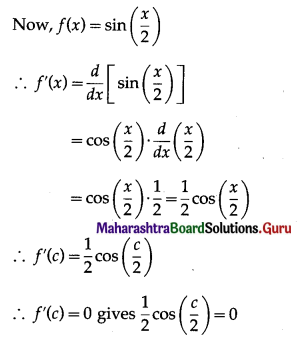
(ii) f(x) = sin(\(\frac{x}{2}\)), x ∈ [0, 2π]
Solution:
The function f(x) = sin(\(\frac{x}{2}\)) is continuous on [0, 2π] and differentiable on (0, 2π).
Now, f(0) = sin 0 = 0
and f(2π) = sin π = 0
∴ f(0) = f(2π)
Thus, the function f satisfies all the conditions of Rolle’s theorem.
∴ there exists c ∈ (0, 2π) such that f'(c) = 0.
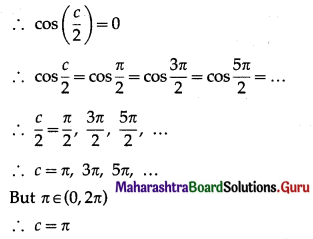
Maharashtra Board 12th Maths Solutions Chapter 2 Applications of Derivatives Ex 2.3 Q3 (ii)
Maharashtra Board 12th Maths Solutions Chapter 2 Applications of Derivatives Ex 2.3 Q3 (ii).1
Hence, Rolle’s theorem is verified.

(iii) f(x) = x2 – 5x + 9, x ∈ [1, 4].
Solution:
The function f given as f(x) = x2 – 5x + 9 is a polynomial function.
Hence it is continuous on [1, 4] and differentiable on (1, 4).
Now, f(1) = 12 – 5(1) + 9 = 1 – 5 + 9 = 5
and f(4) = 42 – 5(4) + 9 = 16 – 20+ 9 = 5
∴ f(1) = f(4)
Thus, the function f satisfies all the conditions of the Rolle’s theorem.
∴ there exists c ∈ (1, 4) such that f'(c) = 0.
Now, f(x) = x2 – 5x + 9
∴ f'(x) = \(\frac{d}{d x}\) (x2 – 5x + 9)
= 2x – 5 × 1 + 0
= 2x – 5
∴ f'(c) = 2c – 5
∴ f'(c) = 0 gives, 2c – 5 = 0
∴ c = 5/2 ∈ (1, 4)
Hence, the Rolle’s theorem is verified.

Question 4.
If Rolle’s theorem holds for the function f(x) = x3 + px2 + qx + 5, x ∈ [1, 3] with c = 2 + \(\frac{1}{\sqrt{3}}\), find the values of p and q.
Solution:
The Rolle’s theorem holds for the function f(x) = x3 + px2 + qx + 5, x ∈ [1, 3]
∴ f(1) = f(3)
∴ 13 + p(1)2 + q(1) + 5 = 33 + p (3)2 + q(3) + 5
∴ 1 + p + q + 5 = 27 + 9p + 3q + 5
∴ 8p + 2q = -26
∴ 4p + q = -13 ….. (1)
Also, there exists at least one point c ∈ (1, 3) such that f'(c) = 0.
Now, f'(x) = \(\frac{d}{d x}\) (x3 + px2 + qx + 5)
= 3x2 + p × 2x + q × 1 + 0
= 3x2 + 2px + q
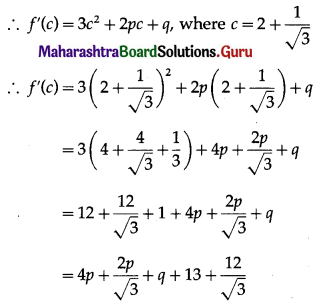
Maharashtra Board 12th Maths Solutions Chapter 2 Applications of Derivatives Ex 2.3 Q4
But f'(c) = 0
∴ \(4 p+\frac{2 p}{\sqrt{3}}+q+13+\frac{12}{\sqrt{3}}=0\)
∴ (4√3 + 2)p + √3q + (13√3 + 12) = 0
∴ (4√3 + 2)p + √3q = -13√3 – 12 ……. (2)
Multiplying equation (1) by √3, we get
4√3p + √3q= -13√3
Subtracting this equation from (2), we get
2p = -12 ⇒ p= -6
∴ from (1), 4(-6) + q = -13 ⇒ q = 11
Hence, p = -6 and q = 11.

Maharashtra Board 12th Maths Solutions Chapter 2 Applications of Derivatives Ex 2.3

Question 5.
If Rolle’s theorem holds for the function f(x) = (x – 2) log x, x ∈ [1, 2], show that the equation x log x = 2 – x is satisfied by at least one value of x in (1, 2).
Solution:
The Rolle’s theorem holds for the function f(x) = (x – 2) log x, x ∈ [1, 2].
∴ there exists at least one real number c ∈ (1, 2) such that f'(c) = 0.
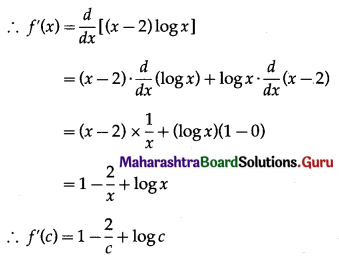
Now, f(x) = (x – 2) log x
Maharashtra Board 12th Maths Solutions Chapter 2 Applications of Derivatives Ex 2.3 Q5
∴ f'(c) = 0 gives 1 – \(\frac{2}{c}\) + log c = 0
∴ c – 2 + c log c = 0
∴ c log c = 2 – c, where c ∈ (1, 2)
∴ c satisfies the equation x log x = 2 – x, c ∈ (1, 2).
Hence, the equation x log x = 2 – x is satisfied by at least one value of x in (1, 2).

Question 6.
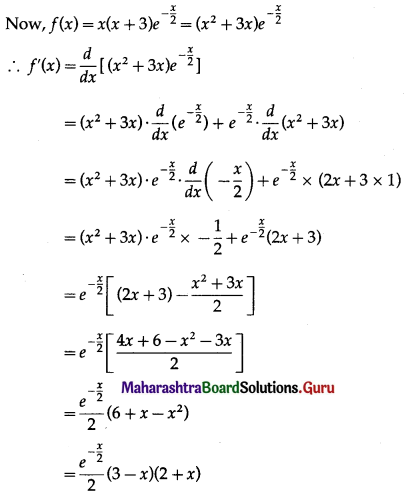
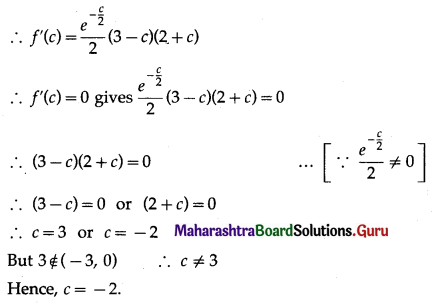
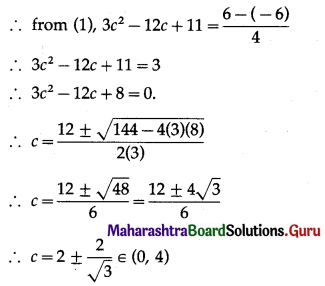
The function f(x) = \(x(x+3) e^{-\frac{x}{2}}\) satisfies all the conditions of Rolle’s theorem on [-3, 0]. Find the value of c such that f'(c) = 0.
Solution:
The function f(x) satisfies all the conditions of Rolle’s theorem, therefore there exist c ∈ (-3, 0) such that f'(c) = 0.
Maharashtra Board 12th Maths Solutions Chapter 2 Applications of Derivatives Ex 2.3 Q6
Maharashtra Board 12th Maths Solutions Chapter 2 Applications of Derivatives Ex 2.3 Q6.1

Question 7.
Verify Lagrange’s mean value theorem for the following functions:
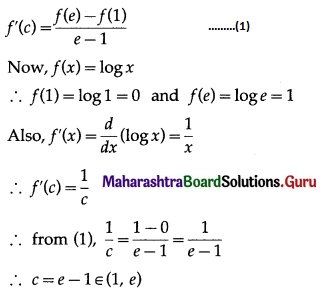
(i) f(x) = log x on [1, e].
Solution:
The function f given as f(x) = log x is a logarithmic function that is continuous for all positive real numbers.
Hence, it is continuous on [1, e] and differentiable on (1, e).
Thus, the function f satisfies the conditions of Lagrange’s mean value theorem.
∴ there exists c ∈ (1, e) such that
Maharashtra Board 12th Maths Solutions Chapter 2 Applications of Derivatives Ex 2.3 Q7 (i)
Hence, Lagrange’s mean value theorem is verified.

Maharashtra Board 12th Maths Solutions Chapter 2 Applications of Derivatives Ex 2.3

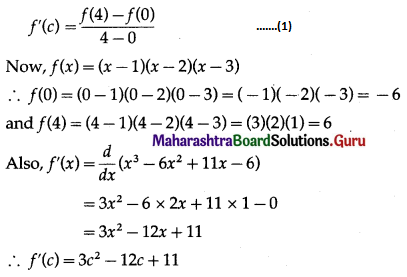
(ii) f(x) = (x – 1)(x – 2)(x – 3) on [0, 4].
Solution:
The function f given as
f(x) = (x – 1)(x – 2)(x – 3)
= (x – 1)(x2 – 5x + 6)
= x3 – 5x2 + 6x – x2 + 5x – 6
= x3 – 6x2 + 11x – 6 is a polynomial function.
Hence, it is continuous on [0, 4] and differentiable on (0, 4).
Thus, the function f satisfies the conditions of Lagrange’s, mean value theorem.
∴ there exists c ∈ (0, 4) such that
Maharashtra Board 12th Maths Solutions Chapter 2 Applications of Derivatives Ex 2.3 Q7 (ii)
Maharashtra Board 12th Maths Solutions Chapter 2 Applications of Derivatives Ex 2.3 Q7 (ii).1
Hence, Lagrange’s mean value theorem is verified.

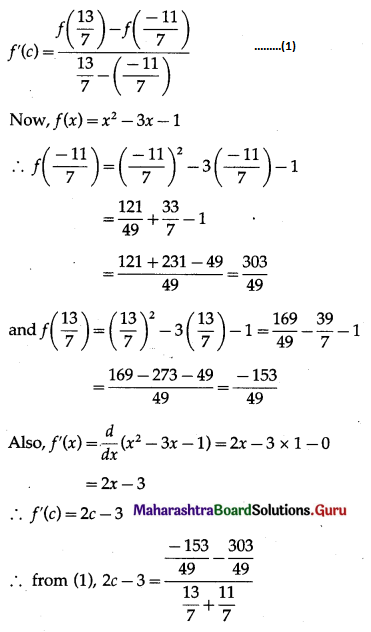
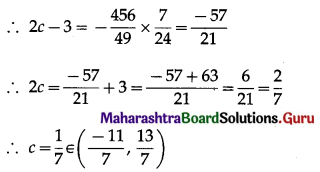
(iii) f(x) = x2 – 3x – 1, x ∈ \(\left[\frac{-11}{7}, \frac{13}{7}\right]\)
Solution:
The function f given as f(x) = x2 – 3x – 1 is a polynomial function.
Hence, it is continuous on \(\left[\frac{-11}{7}, \frac{13}{7}\right]\) and differentiable on \(\left(\frac{-11}{7}, \frac{13}{7}\right)\).
Thus, the function f satisfies the conditions of LMVT.
∴ there exists c ∈ \(\left(\frac{-11}{7}, \frac{13}{7}\right)\) such that
Maharashtra Board 12th Maths Solutions Chapter 2 Applications of Derivatives Ex 2.3 Q7 (iii)
Maharashtra Board 12th Maths Solutions Chapter 2 Applications of Derivatives Ex 2.3 Q7 (iii).1
Hence, Lagrange’s mean value theorem is verified.

Maharashtra Board 12th Maths Solutions Chapter 2 Applications of Derivatives Ex 2.3

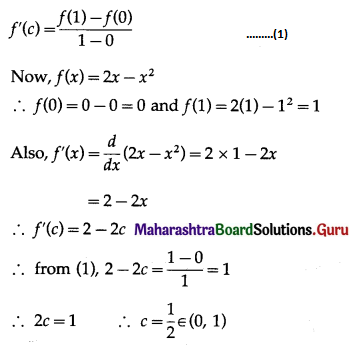
(iv) f(x) = 2x – x2, x ∈ [0, 1].
Solution:
The function f given as f(x) = 2x – x2 is a polynomial function.
Hence, it is continuous on [0, 1] and differentiable on (0, 1).
Thus, the function f satisfies the conditions of Lagrange’s mean value theorem.
∴ there exists c ∈ (0, 1) such that
Maharashtra Board 12th Maths Solutions Chapter 2 Applications of Derivatives Ex 2.3 Q7 (iv)
Hence, Lagrange’s mean value theorem is verified.

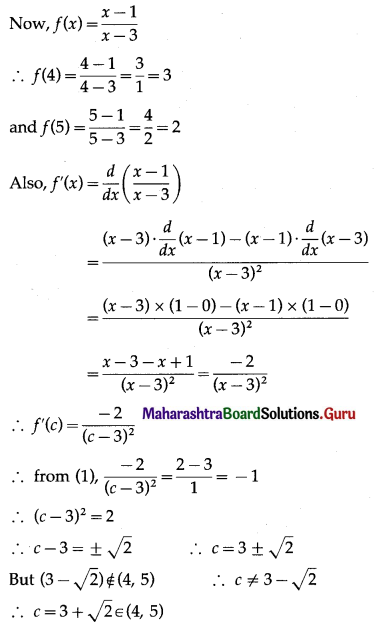
(v) f(x) = \(\frac{x-1}{x-3}\) on [4, 5].
Solution:
The function f given as
f(x) = \(\frac{x-1}{x-3}\) is a rational function which is continuous except at x = 3.
But 3 ∉ [4, 5]
Hence, it is continuous on [4, 5] and differentiable on (4, 5).
Thus, the function f satisfies the conditions of Lagrange’s mean value theorem.
∴ there exists c ∈ (4, 5) such that
f'(c) = \(\frac{f(5)-f(4)}{5-4}\) ……..(1)
Maharashtra Board 12th Maths Solutions Chapter 2 Applications of Derivatives Ex 2.3 Q7 (v)
Hence, Lagrange’s mean value theorem is verified.

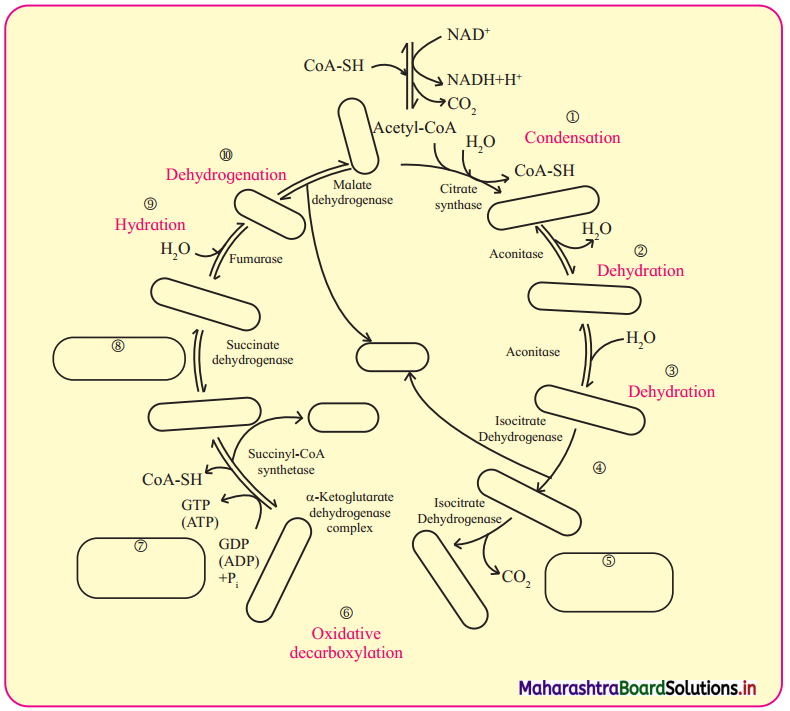
Maharashtra Board Class 11 Biology Solutions Chapter 13 Respiration and Energy Transfer

Balbharti Maharashtra State Board 11th Biology Textbook Solutions Chapter 13 Respiration and Energy Transfer Textbook Exercise Questions and Answers.

Maharashtra State Board 11th Biology Solutions Chapter 13 Respiration and Energy Transfer

1. Choose the Correct option.

Question (A)
The reactions of the TCA cycle occur in
(A) ribosomes
(B) grana
(C) mitochondria
(D) endoplasmic reticulum
Answer:
(C) mitochondria

Maharashtra Board Class 11 Biology Solutions Chapter 13 Respiration and Energy Transfer

Question (B)
In eukaryotes the complete oxidation of a molecule of glucose results in the net gain of
(A) 2 molecules of ATP
(B) 36 molecules of ATP
(C) 4 molecules of ATP
(D) 38 molecules of ATP
Answer:
(D) 38 molecules of ATP

Question (C)
Which step of Krebs cycle operates substrate-level phosphorylation?
(A) ∝-ketoglutarate → succinyl CoA.
(B) Succinyl CoA → succinate
(C) Succinate → fumarate
(D) Fumarate → malate
Answer:
(B) Succinyl CoA → succinate

2. Fill in the blanks with suitable words.

Question 1.
A. Acetyl CoA is formed from __________ and co-enzyme A.
B. In the prokaryotes ________ molecules of ATP are formed per molecule of glucose oxidised.
C. Glycolysis takes place in ________ .
D. F1 – F0 particles participate in the synthesis of _________ .
E. During glycolysis _________ molecules of NADH+H+ are formed.
Answer:
A. pyruvic acid
B. 2/38
C. cytoplasm
D. ATP
E. 2
[Note: ii. In prokaryotes, during anaerobic respiration 2 ATPs are formed per glucose and 38 ATPs are formed during aerobic respiration.]

3. Answer the following questions

Question (A)
When and where does anaerobic respiration occur in man and yeast?
Answer:
1. In absence of oxygen, anaerobic respiration takes place in skeletal muscles of man during vigorous exercise.
2. Anaerobic respiration occurs in the cytoplasm of the yeast cell.

Question (B)
Why is less energy produced during anaerobic respiration than in aerobic respiration?
Answer:
Anaerobic respiration produces less energy because:

  1. Incomplete breakdown of respiratory substrate takes place.
  2. Some of the products of anaerobic respiration can be oxidised further to release energy which shows that anaerobic respiration does not liberate the whole energy contained in the respiratory substrate.
  3. NADH2 does not produce ATP, as electron transport is absent.
  4. Only 2 ATP molecules are generated from one molecule of glucose during anaerobic respiration.

Maharashtra Board Class 11 Biology Solutions Chapter 13 Respiration and Energy Transfer

Question (C)
Which is the site for ETS in mitochondrial respiration?
Answer:
The inner mitochondrial membrane is the site for ETS in mitochondrial respiration.

Question (D)
Which compound is the terminal electron acceptor in aerobic respiration?
Answer:
Molecular oxygen is the terminal electron acceptor in aerobic respiration.

Question (E)
What is RQ.? What is its value for fats?
Answer:
1. Respiratory quotient (R.Q.) or respiratory ratio is the ratio of volume of CO2 released to the volume of O2 consumed in respiration.
2. R.Q. = Volume of CO2 released / Volume of O2 consumed

Question (F)
What are respiratory substrates? Name the most common respiratory substrate.
Answer:
Respiratory substrates are the molecules that are oxidized during respiration to release energy which can be used for ATP synthesis. Carbohydrates, fats and proteins are the common respiratory substrate. Glucose is the most common respiratory substrate.

Question (G)
Write explanatory notes on:

Question (i)
Glycolysis
Answer:
Glycolysis is a process where glucose is broken down into two molecules of pyruvic acid, hence called glycolysis (glucose-breaking). It is common to both aerobic and anaerobic respiration. It occurs in the cytoplasm of the cell. It involves ten steps.
Glycolysis consists of two major phases:
1. Preparatory phase (1-5 steps).
2. Payoff phase (6-10 steps).
1. Preparatory phase:
a. In this phase, glucose is phosphorylated twice by using two ATP molecules and a molecule of fructose 1,6-bisphosphate is formed.
b. It is then cleaved into two molecules of glyceraldehyde-3-phosphate and dihydroxy acetone phosphate. These two molecules are 3-carbon carbohydrates (trioses) and are isomers of each other.
c. Dihydroxy acetone phosphate is isomerised to second molecule of glyceraldehyde-3-phosphate.
d. Therefore, two molecules of glyceraldehyde-3- phosphate are formed.
e. Preparatory phase of glycolysis ends.

2. Payoff phase:
a. In this phase, both molecules of glyceraldehyde-3-phosphate are converted to two molecules of 1,3- bisphoglycerate by oxidation and phosphorylation. Here, the phosphorylation is brought about by inorganic phosphate instead of ATP.
b. Both molecules of 1, 3-bisphosphoglycerate are converted into two molecules of pyruvic acid through series of reactions accompanied with release of energy. This released energy is used to produce ATP (4 molecules) by substrate-level phosphorylation.

Maharashtra Board Class 11 Biology Solutions Chapter 13 Respiration and Energy Transfer

Question (ii)
Write explanatory notes on: Fermentation by yeast
Answer:
Alcoholic fermentation is a type of anaerobic respiration where the pyruvate is decarboxylated to acetaldehyde. The acetaldehyde is then reduced by NADH+H+ to ethanol and Carbon dioxide. Since ethanol is produced during the process, it is termed alcoholic fermentation.

Question (iii)
Write explanatory notes on: Electron transport chain
Answer:

  1. NADH2 and FADH2 produced during glycolysis, connecting link reaction and Krebs cycle are oxidized with the help of various electron carriers and enzymes.
  2. These carriers and enzymes are arranged on inner mitochondrial membrane in the form of various complexes as complex I, II, III, VI and V.
  3. NADH+H+ is oxidised by NADH dehydrogenase (complex I) and it’s electrons are transferred to ubiquinone (coenzyme Q-CoQ) present on inner membrane of mitochondria. Reduced ubiquinone is called as ubiqunol.
  4. FADH2 is oxidised by complex II (Succinate dehydrogenase) and these electrons are also transferred to CoQ.
  5. During oxidation of NADH+H+ and FADH2 , electrons and protons are released but only electrons are canned forward whereas protons are released into outer chamber of mitochondria (intermembrane space).
  6. Ubiquinol is oxidised by complex-III (Cytochrome bcl complex) and it’s electrons are transferred to cytochrome C. Cytochrome C is a small, iron-containing protein, loosely associated with inner membrane. It acts as a mobile electron carrier, transferring the electrons between complex III and IV.
  7. Cytochrome C is oxidised by complex IV or cytochrome C oxidase consisting of cytochrome a and a3. Electrons are transferred by this complex to the molecular oxygen. This is terminal oxidation.
  8. Reduced molecular oxygen reacts with protons to form water molecule called as metabolic water.
  9. Protons necessary for this are channelled from outer chamber of mitochondria into inner chamber by F0 part of oxysome (complex V) present in inner mitochondrial membrane.
  10. This proton channelling by F0 is coupled to catalytic site of F1 which catalyses the synthesis of ATP from ADP and inorganic phosphate. This is oxidative phosphorylation.
  11. As transfer of protons is accompanied with synthesis of ATP, this process is named as ‘Chemiosmosis’ by Peter Mitchell.

Significance of ETS:

  1. Major amount of energy is generated through ETS or terminal oxidation in the form of ATP molecules.
  2. Per glucose molecule 38 ATP molecules are formed, out of which 34 ATP molecules are produced through ETS.
  3. Oxidized coenzymes such as NAD and FAD are regenerated from their reduced forms (NADH+H+ and FADH2) for recycling.
  4. In this process, energy is released in a controlled and stepwise manner to prevent any damage to the cell.
  5. ETS produces water molecules.

Question (H)
How are glycolysis, TCA cycle and electron transport chain-linked? Explain.
Answer:
Glycolysis, TCA cycle and electron transport chain are linked in the following manner:

  1. The coenzymes are initially present in the form of NAD+ and FAD+ which latter get reduced to NADH+H+ and FADH+H+ by accepting the hydrogen from organic substrate during glycolysis, link reaction and Krebs cycle.
  2. During glycolysis, glucose is oxidised to two molecules of pyruvic acid with net gain 2 molecules of NADH+H+.
  3. This pyruvic acid undergoes link reaction to form two molecules of acetyl CoA and two molecules of NADH+H+.
  4. Acetyl CoA, thus formed enters into the Krebs cycle and it gets completely oxidised to C02 and H20; with a net gain of 6 NADH+H+ and 2 FADH+H+ are formed.
  5. During ETS, reduced coenzymes are reoxidized to NAD+ and FAD+ with a net gain of 34 ATPs. The ATPs thus formed are used during glycolysis.
  6. The oxidized NAD+ and FAD+ will again accept the hydrogen from organic substrate. Thus, reduced coenzymes are converted back to their oxidized forms by dehydrogenation to keep the process going.

Maharashtra Board Class 11 Biology Solutions Chapter 13 Respiration and Energy Transfer

Question (I)
How would you demonstrate that yeast can respire both aerobically and anaerobically?
Answer:
Respiration in yeast can be demonstrated with the help of an experiment.
Anaerobic respiration in yeast:

  1. A pinch of dry baker’s yeast suspended in water containing 10ml of 10% glucose in a test tube (test tube A).
  2. The surface of the liquid is covered with oil to prevent entry of air and the test tube is closed tightly with rubber stopper to prevent leakage.
  3. One end of a short-bent glass tube is inserted through it to reach the air inside the tube.
  4. Other end of the glass tube is connected by a polyethylene or rubber tubing to another bent glass tube fitted into a stopper.
  5. The open end of the glass tube (delivery tube) is dipped into lime water containing in a test tube
    (Tube B).
  6. Stoppers of both the tubes are fitted tightly to prevent leakage of gases. First test tube is placed in warm water (37° C-38° C) in a beaker.
  7. Lime water gradually turns milky, indicating the evolution of carbon dioxide from the yeast preparation.
  8. Level of the lime water in the delivery tube does not rise, showing that there is no decline in volume of gas in test tube A and consequently no utilization of oxygen by yeast. Preparation is stored for a day or two.
  9. When we open the stopper of tube A we will notice a smell of alcohol indicating the formation of ethanol.
  10. From this activity it may be inferred that yeast respires anaerobically to ferment glucose to ethanol and carbon dioxide.

Aerobic respiration in yeast: Experiment explained can be carried out for demonstrating aerobic respiration in yeast.

  1. If the level of the lime water in the test tube B rises, indicating intake of oxygen, hence the level of volume of gas rises.
  2. The preparation tube is stored for a day or two, if no smell of alcohol is noticed it indicates that the yeast respires aerobically.

Question (J)
What is the advantage of step wise energy release in respiration?
Answer:
In ETS energy is released in step wise manner to prevent damage of cells.

  1. A stepwise release of the chemical bond energy facilitates the utilization of a relatively higher proportion of that energy in ATP synthesis.
  2. Activities of enzymes for the different steps may be enhanced or inhibited by specific compounds. This provides a means of controlling the rate of the pathway and the energy output according to need of the cell.
  3. The same pathway may be utilized for forming intermediates used in the synthesis of other biomolecules like amino acids.

Question (K)
Explain ETS.
Answer:

  1. NADH2 and FADH2 produced during glycolysis, connecting link reaction and Krebs cycle are oxidized with the help of various electron carriers and enzymes.
  2. These carriers and enzymes are arranged on inner mitochondrial membrane in the form of various complexes as complex I, II, III, VI and V.
  3. NADH+H+ is oxidised by NADH dehydrogenase (complex I) and it’s electrons are transferred to ubiquinone (coenzyme Q-CoQ) present on inner membrane of mitochondria. Reduced ubiquinone is called as ubiqunol.
  4. FADH2 is oxidised by complex II (Succinate dehydrogenase) and these electrons are also transferred to CoQ.
  5. During oxidation of NADH+H+ and FADH2 , electrons and protons are released but only electrons are canned forward whereas protons are released into outer chamber of mitochondria (intermembrane space).
  6. Ubiquinol is oxidised by complex-III (Cytochrome bcl complex) and it’s electrons are transferred to cytochrome C. Cytochrome C is a small, iron-containing protein, loosely associated with inner membrane. It acts as a mobile electron carrier, transferring the electrons between complex III and IV.
  7. Cytochrome C is oxidised by complex IV or cytochrome C oxidase consisting of cytochrome a and a3. Electrons are transferred by this complex to the molecular oxygen. This is terminal oxidation.
  8. Reduced molecular oxygen reacts with protons to form water molecule called as metabolic water.
  9. Protons necessary for this are channelled from outer chamber of mitochondria into inner chamber by F0 part of oxysome (complex V) present in inner mitochondrial membrane.
  10. This proton channelling by F0 is coupled to catalytic site of F1 which catalyses the synthesis of ATP from ADP and inorganic phosphate. This is oxidative phosphorylation.
  11. As transfer of protons is accompanied with synthesis of ATP, this process is named as ‘Chemiosmosis’ by Peter Mitchell.

Maharashtra Board Class 11 Biology Solutions Chapter 13 Respiration and Energy Transfer

Question (L)
Discuss “The respiratory pathway is an amphibolic pathway”.
OR
Question (M)
Why is Krebs cycle referred as amphibolic pathway?
Answer:

  1. Respiration is considered as a catabolic process; however, it is not entirely correct in case of Krebs cycle.
  2. Many reactions of Krebs cycle involve oxidation of acetyl CoA to release energy and C02.
  3. However, the breakdown of respiratory substrates provides intermediates like a-ketoglutarate, oxaloacetate are used as precursors for synthesis of fatty acids, glutamic acid and aspartic acid respectively.
  4. Thus, as the same respiratory process acts as catabolic as well as anabolic pathway for synthesis of various intermediate metabolic products, it is called amphibolic pathway.

Question (N)
The common pathway for both aerobic and anaerobic respiration is
(A) Krebs cycle
(B) Glycolysis
(C) ETS
(D) Terminal oxidation
Answer:
(B) Glycolysis

4. Compare

Question (A)
Photosynthesis and respiration.
Answer:

PhotosynthesisRespiration
(a) It takes place in the cells containing chlomplasts.It takes place in all living cells of higher organisms.
(b) It occurs in chloroplast.It occurs in cytoplasm and mitochondria.
(c) It is an energc trapping process.It is an energy releasing process.
(d) It is an anabolic process.It is a catabolic process.
(e) This process requires C02 and FLO.This process requires sugar and 02.
(f) Light is necessary for photosynthesis.Light is not necessary for aerobic respiration.
(g) End products are carbohydrates and oxygen.End products can be C02 and H20 or ethanol or lactic acid and energy.

Maharashtra Board Class 11 Biology Solutions Chapter 13 Respiration and Energy Transfer

Question (B)
Aerobic respiration and Anaerobic respiration
Answer:

Aerobic respirationAnaerobic respiration
(a) It takes place in higher organisms.It takes place in lower organisms.
(b) It takes place in cytoplasm and mitochondria.It takes place in cytoplasm.
(c) It involves the participation of free molecular oxygen.It does not involve participation of free molecular oxygen.
(d) Oxidation of food is complete.Oxidation of food is incomplete.
(e) It produces C02 and H20.It produces C02 and C2H5OH.
(f) It releases more energy, i.e. 38 ATP.It releases less energy, i.e. 2 ATP.
(g) Overall equation:
C6H1206 + 602 → 6C02 + 6H20 + Energy
Overall equation:
C6H1206 → 2C2H5 OH + 2C02 + Energy

5. Differentiate between

Question (A)
Respiration and combustion.
Answer:

RespirationCombustion
(a) It is a biochemical and stepwise process.It is physiochemical and spontaneous process.
(b) It occurs inside the cells.It is a non-cellular process.
(c) Energy is released in steps.Large amount of energy is released at a time.
(d) No light is produced in respiration.Light may be produced in combustion.
(e) It is controlled by enzymes.It is not controlled by enzymes.
(f) A number of intermediates are produced.No intermediates are produced.

Question (B)
Distinguish between Glycolysis and Krebs cycle.
Answer:

Glycolysis/EMP pathwayKrebs cycle/TCA cycle/ Citric acid cycle
1. Glycolysis is common in both aerobic and anaerobic respiration.Krebs cycle occurs only in aerobic respiration.
2. It takes place in the cytoplasm.It takes place in the mitochondria.
3. C02 is not released.C02 is released.
4. Total amount of energy produced = 8 ATP.Total amount of energy produced = 24 ATP.
5. It is linear pathway.It is cyclic pathway.
6. Pyruvic acid is the end product.C02 and H2Q are the end products.

Maharashtra Board Class 11 Biology Solutions Chapter 13 Respiration and Energy Transfer

Question (C)
Aerobic respiration and fermentation.
Answer:

Aerobic respirationFermentation
1. It takes place in higher organisms.It takes place in both higher and lower organisms.
2. It takes place in cytoplasm and mitochondriaIt takes place in cytoplasm.
3. It involves the participation of free molecular oxygen.It does not involve participation of free molecular oxygen.
4. It involves many steps – glycolysis, link reaction, Krebs cycle and ETS.It involves only glycolysis, decarboxylation and reduction, (alcoholic fermentation)
5. Oxidation of food is complete.Oxidation of food is incomplete.
6. It produces C02 and H20.It produces either ethanol or lactic acid and C02 depending upon the type of fermentation.
7. It releases more energy, i.e. 38 ATP.It releases less energy, i.e. 2 ATP.

Question 6.
Identify the cycle given below. Correct it and fill in the blanks and write description of it in your own
Maharashtra Board Class 11 Biology Solutions Chapter 13 Respiration and Energy Transfer 1Answer:

  1. Krebs cycle or citric acid cycle is the second phase of aerobic respiration which takes place in the matrix of the mitochondria.
  2. The acetyl CoA formed during the link reaction undergoes aerobic oxidation.
  3. This cycle serves a common oxidative pathway for carbohydrates, fats and proteins.
  4. In mitochondria pyruvic acid is decarboxylated and the remaining 2-carbon fragment is combined with a molecule of coenzyme A to form acetyl-CoA.
  5. This reaction is an oxidative decarboxylation process and produces H+ ions and electrons along with carbon dioxide. During the process NAD+ is reduced to NADH+H+.
  6. P-oxidation of fatty acids also produces acetyl-CoA as the end product.
  7. Acetyl-CoA from both sources is condensed with oxaloacetic acid to form citric acid. Citric acid is oxidized step-wise by mitochondrial enzymes, releasing carbon dioxide.
  8. Regeneration of oxaloacetic acid occurs to complete the cycle.
  9. There are four steps of oxidation in this cycle, catalyzed by dehydrogenases (oxidoreductases) using NAD+ or FAD+ as the coenzyme.
  10. The coenzymes are consequently reduced to NADH+H+ and FADH2 respectively. These transfer their electrons to the mitochondrial respiratory chain to get reoxidised.
  11. One molecule of GTP (ATP) is also generated for every molecule of citric acid oxidized.

Maharashtra Board Class 11 Biology Solutions Chapter 13 Respiration and Energy Transfer

Practical / Project:

Question 1.
Make Powerpoint Presentation on Glycolysis, Krebs Cycle and Conduct the group discussion on it in classroom.
[Note: Students are expected to perform above activity on their own.]

11th Biology Digest Chapter 13 Respiration and Energy Transfer Intext Questions and Answers

Can you recall? (Textbook Page No. 151)

(i) Which nutrients are used for energy production?
Answer:
Nutrients like carbohydrates, fats and proteins are used for energy production.

(ii) Why do organisms take up oxygen and release carbon dioxide?
Answer:
a. At cellular level, organisms require energy to carry out different metabolic activities.
b. The energy is made available by oxidizing/breaking the food.
Therefore, oxygen is required by aerobic organisms for breaking the food and carbon dioxide is released as a byproduct of oxidation.

Maharashtra Board Class 11 Biology Solutions Chapter 13 Respiration and Energy Transfer

Use your brainpower (Textbook Page No. 152)

Why is glycolysis considered as biochemical proof of evolution?
Answer:

  1. Glycolysis does not require oxygen. Hence it might have been used by earlier organisms for energy production, as there was no free oxygen in atmosphere of primitive earth.
  2. Glycolysis is the first metabolic pathway, an ancient pathway which is common to both aerobic and anaerobic organisms.
  3. All cells have glycolysis in their metabolic pathway.
  4. Upto pyruvate the pathway is similar to all aerobic and anaerobic organisms. Later, the fate of pyruvic acid can be either C02 or ethanol or lactic acid depending upon the type of organism.
  5. Hence it is considered as a biochemical proof of evolution.

Use your brainpower (Textbook Page No. 152)

(i) What is role of Mg++, Zn++ in various steps of glycolysis?
Answer:
a. Mg++ and Zn++ are the cofactors that are tightly bound to enzymes and helps the enzymes to perform their functions.
b. They regulate the activity of the most important enzymes like Hexokinase, Phosphoffuctokinase, Triose phosphate dehydrogenase, Phosphoglycerate kinase, Enolase, Pyruvate kinase.

(ii) Why some reactions of glycolysis are reversible and some irreversible?
Answer:
Irreversible chemical reactions:
Some chemical reactions can occur in only one direction i.e. these reactions are irreversible reactions. The reactants can change to the products, but the products cannot change back to the reactants.

Reversible chemical reactions:

  1. Some chemical reactions can occur in both directions i.e. these reactions are reversible reactions. In this case the reactants change to the products and the products can change back to the reactants, atleast under specific conditions.
  2. Out of ten, four are irreversible reactions which involves the enzyme kinase that is required for phosphorylation reactions, these reactions involve large negative energy AG, hence the reactions are irreversible.
  3. Other reversible reactions do not involve high negative energy hence are reversible.

Maharashtra Board Class 11 Biology Solutions Chapter 13 Respiration and Energy Transfer

Use your brainpower (Textbook Page No. 152)

Why do athletes like sprinters have higher proportion of white muscle fibers?
Answer:
1. The white muscle fibres produce energy in a very short period of time that is required for fast and severe work. Thus, the energy becomes immediately available to the athletes.
2. On the other hand, the red muscle produce energy over a prolonged period of time, hence athletes have higher proportion of white muscle fibers.

Can you recall? (Textbook Page No. 151)

Which steps are involved in aerobic respiration?
Answer:
It involves glycolysis, acetyl CoA formation (connecting link reaction), Krebs cycle, electron transfer chain reaction and terminal oxidation.

Can you recall? (Textbook Page No. 151)

What is aerobic and anaerobic respiration?
Answer:
For anaerobic respiration: Anaerobic respiration is the cellular respiration that does not involve the atmospheric oxygen. It is also called as fermentation. It involves glycolysis where the product of glycolysis i.e. pyruvate is converted to either lactic acid or ethanol and for aerobic respiration.
1. Aerobic respiration occurs in the presence of free molecular oxygen during oxidation of glucose.
2. In this type of respiration, the glucose is completely oxidized to C02 and H20 with release of large amount of energy. It involves glycolysis, acetyl CoA formation (connecting link reaction), Krebs cycle, electron transfer chain reaction and terminal oxidation.

Use your brainpower (Textbook Page No. 157)

Do the plants breath like animals? If yes, how and why?
Answer:

  1. Yes, plants breath like animals because they also require energy to carry out different metabolic activities. Hence, plants take up oxygen required for respiration and they also give out C02.
  2. Plants take care of their gas exchange needs. The stomata and lenticels are important for this purpose.
  3. Leaves are well adapted for gaseous exchange during photosynthesis.
  4. Large amount of gases is exchanged. In plants, each living cell is located quite close to the surface of the plants.

Maharashtra Board Class 11 Biology Solutions Chapter 13 Respiration and Energy Transfer

Internet my friend (Textbook Page No. 155)

What is effect of carbon monoxide poisoning on cytochromes?
Answer:

  1. At sub-cellular level, carbon monoxide is toxic for mitochondria.
  2. It alters the mitochondrial respiratory chain at the cytochrome c oxidase level (complex IV of the mitochondrial respiratory chain) and causes inhibition of ETS.
  3. This inhibition leads to the development of symptoms observed in acute CO poisoning, and in some diseases related to smoking.
  4. These symptoms include headache, nausea, vomiting, dizziness, weakness, difficulty in concentration or confusion, visual changes, syncope, seizures, abdominal pain and muscle cramping.

Can you recall? (Textbook Page No. 151)

Which is most preferred nutrient among carbohydrate, protein and fat for energy production? Why?
Answer:

  1. The preferred nutrient is carbohydrate because it quickly supplies energy as compared to other nutrients.
  2. Carbohydrates are easy to digest as compared to fats.
  3. The RQ of carbohydrate is 1. Hence allows complete oxidation of food. Thus, the preferred nutrient is carbohydrate.

Internet my friend (Textbook Page No. 158)

Calculate the RQ for different respiratory substrates using appropriate formula.
Answer:
The RQ for different respiratory substrates are:
1. Carbohydrates (R.Q. is 1)
When carbohydrates are used as substrate, equal volumes of C02 and 02 are released and consumed respectively, thus its R.Q. is 1.
C6 H12 O6 + 6O2 → 6 C02 + 6H20
R.Q. = 6C02 / 602 = 1.0

2. Fats (R.Q. is less than 1)
Substrates like fats are poorer in oxygen than carbohydrates. Thus, more oxygen is utilized for its complete oxidation.
2(C51 H98 O6) + 145O2 → 102CO2 + 98H2O + Energy
R.Q. = C02 / 02 = 102 / 145 = 0.7

3. Protein respiration (R.Q. is less than 1)

  1. When proteins serve as respiratory substrate, they are first degraded to amino acids.
  2. Then, amino acids are converted into various intermediates of carbohydrates.
  3. However, amino acids have low proportion of O2 as compared to carbohydrates.
  4. Thus, they require more O2 during their complete oxidation and value of R.Q. becomes less than 1.
  5. In case of proteins, the R.Q. is approximately 0.9.

Maharashtra Board Class 11 Hindi Yuvakbharati Solutions Chapter 12 सहर्ष स्वीकारा है

Balbharti Maharashtra State Board Hindi Yuvakbharati 11th Digest Chapter 12 सहर्ष स्वीकारा है Notes, Textbook Exercise Important Questions and Answers.

Maharashtra State Board 11th Hindi Yuvakbharati Solutions Chapter 12 सहर्ष स्वीकारा है

11th Hindi Digest Chapter 12 सहर्ष स्वीकारा है Textbook Questions and Answers

आकलन

1. सूचनाओं के अनुसार कृतियाँ कीजिए :

प्रश्न अ.
घटनाक्रम के अनुसार लिखिए –
(1) कवि दंड पाना चाहता है।
(2) विधाता का सहारा पाना चाहता है।
(3) कवि का मानना है कि जो होता-सा लगता है, वह विधाता के कारण होता है।
उत्तर :
(1) कवि दंड पाना चाहता है।
उत्तर :
कवि दंड पाना चाहता है।

Maharashtra Board Class 11 Hindi Yuvakbharati Solutions Chapter 12 सहर्ष स्वीकारा है

(2) विधाता का सहारा पाना चाहता है
उत्तर :
विधाता का सहारा पाना चाहता है।

(3) कवि का मानना है कि जो होता-सा लगता है, वह विधाता के कारण होता है।
उत्तर :
कवि मानता है कि जो होता-सा लगता है, वह विधाता के कारण होता है।

प्रश्न आ.
निम्नलिखित असत्य कथनों को कविता के आधार पर सही करके लिखिए –
(a) जो कुछ निद्रित अपलक है, वह तुम्हारा असंवेदन है।
उत्तर :
जो कुछ भी जाग्रत है, अपलक है वह तुम्हारा संवेदन है।

(b) अब यह आत्मा बलवान और सक्षम हो गई है और छटपटाती छाती को वर्तमान में सताती है।
उत्तर :
अब यह आत्मा कमजोर और अक्षम हो गई है और छटपटाती छाती को भवितव्यता सताती है।

काव्य सौंदर्य

2.
प्रश्न अ.
‘जो कुछ भी मेरा है वह तुम्हें प्यारा हैं’, इस पंक्ति से कवि का मंतव्य स्पष्ट कीजिए।
उत्तर :
कवि के जीवन में जो कुछ भी है या जो कारण है उसकी सत्ता स्थितियाँ भविष्य की उन्नति या अवनति की सभी संभावनाएँ प्रियतमा के कारण हैं। कवि का हर्ष-विषाद, उन्नति-अवनति सदा उससे ही संबंधित है। कवि ने हर सुख-दुःख सफलताअसफलता को प्रसन्नतापूर्वक इसलिए स्वीकार किया है क्योंकि प्रियतमा ने उन सबको अपना माना है। वे कवि के जीवन से पूरी तरह जुड़ी हुई हैं।

प्रश्न आ.
‘जाने क्या रिश्ता है, जाने क्या नाता है जितना भी उँडेलता हूँ, भर-भर फिर आता है’, इन पंक्तियों का आशय स्पष्ट कीजिए।
उत्तर :
कवि कहता है कि तुम्हारे हृदय के साथ न जाने कौन-सा संबंध है या न जाने कैसा नाता है कि मैं अपने भीतर समाए हुए तुम्हारे स्नेह रूपी जल को जितना बाहर निकालता हूँ, वह पुन: अंत:करण में चारों ओर से सिमटकर चला आता है। ऐसा लगता है मानो हृदय में कोई झरना बह रहा है।

अभिव्यक्ति

3.
प्रश्न अ.
‘अपनी जिंदगी को सहर्ष स्वीकारना चाहिए’, इस कथन पर अपने विचार लिखिए।
उत्तर :
जीवन सुख-दुःख का चक्र है। यही जीवन का सत्य है। अनुकूल समय में हमें इस पर विचार करने की आवश्यकता नहीं होती। जब कभी हमारे समक्ष विपरीत परिस्थितियाँ आती हैं तो हम किंकर्तव्यविमूढ़ हो जाते हैं। दुःख के प्रमुख कारण बाहरी परिस्थितियाँ, आसपास के व्यक्तियों का व्यवहार, महत्त्वाकांक्षाएँ एवं कामनाएँ हैं। जीवन में आई प्रतिकूल परिस्थितियाँ एवं समस्याओं के लिए कोई दूसरा व्यक्ति या भाग्य दोषी नहीं है।

उसके लिए हम स्वयं ही जिम्मेदार है, हमारे कर्मों और व्यवहार की वजह से ही परिस्थितियाँ निर्मित होती हैं। हमारी ऊर्जा का उपयोग काम में हो परिणाम में नहीं। जो बदला नहीं जा सकता, उसको सहर्ष स्वीकार करें, यही उपाय है।

Maharashtra Board Class 11 Hindi Yuvakbharati Solutions Chapter 12 सहर्ष स्वीकारा है

प्रश्न आ.
‘जीवन में अत्यधिक मोह से अलग होने की आवश्यकता है, इस वाक्य में व्यक्त भाव प्रकट कीजिए।
उत्तर :
आज अगर दुनिया में किसी भी रिश्ते में मोह है, तो वह रिश्ता ज्यादा समय तक नहीं चल पाता। हमें मोह को त्याग देना चाहिए।

जब भी कोई इंसान मोह करता है, तो कहीं ना कहीं उसका ही नुकसान होता है। मोह के कारण हमारी संपत्ति, रिश्ते-नाते सभी बिगड़ जाते हैं इसलिए हमें मोह को अपनी जिंदगी से बिल्कुल पूरी तरह से निकाल देना चाहिए।

एक इंसान अपनी जिंदगी में अगर मोह करता है तो कुछ समय के लिए ही फायदा होगा, बाद में उसका नुकसान होता है। आज हमारे देश में, परिवार में झगड़े होते हैं इसका सबसे बड़ा कारण मोह है। मोह के कारण एक-दूसरे को धोखा देते हैं और उससे हमारे रिश्ते खराब होते हैं। मोह करने से हमें जो कुछ हासिल होता है, वह हमारे रिश्ते-नातों से कीमती नहीं होता इसलिए लालच (मोह) बुरी बला है।

रसास्वादन

4. प्रस्तुत नई कविता का भाव तथा भाषाई विशेषताओं के आधार पर रसास्वादन कीजिए।
उत्तर :
(i) शीर्षक : सहर्ष स्वीकारा है।
(ii) रचनाकार : गजानन माधव मुक्तिबोध’।।
(iii) केंद्रीय कल्पना : प्रस्तुत नई कविता में कवि ने जिंदगी में जो कुछ भी (दुख, संघर्ष, गरीबी, अभाव, अवसाद) मिलें उसे सानंद स्वीकार करने की बात कही है। प्रकृति को जो कुछ भी प्यारा है वह उसने हमें सौंपा है। इसीलिए जो कुछ भी मिला है या मिलने की संभावना है उसे सहजता से अपनाना चाहिए।
(iv) रस / अलंकार : मुक्त छंद में लिखी गई इस कविता में गरबीली गरीबी, विचार-वैभव में अनुप्रास अलंकार की छटा है।
(v) प्रतीक विधान : अंधकार, अमावस्या निराशा के प्रतीक है।

(vi) कल्पना : ‘दिल में क्या झरना है?’ पंक्ति में कवि कल्पना करते हैं कि झरने में जैसे चारों तरफ की पहाड़ियों से पानी इकट्ठा होता है और कभी खाली नहीं होता वैसे ही कवि के हृदय में अपनी प्रियतमा के प्रति प्रेम उमड़ता है और बार बार व्यक्त करने पर भी कम नहीं होता।

(vii) पसंद की पंक्तियाँ तथा प्रभाव : अब तक तो जिंदगी में जो कुछ था, जो कुछ है सहर्ष स्वीकारा है; इसलिए कि जो कुछ भी मेरा है वह तुम्हें प्यारा है।’ ये पंक्तियाँ प्रभावी सिद्ध होती हैं क्योंकि जिसे हम प्यार करते हैं उस प्रिय व्यक्ति को जो कुछ भी अच्छा लगता है वह अस्वीकार करना असंभव होता है।

(viii) कविता पसंद आने के कारण : कविता द्वारा हमें जीवन के सुख-दुख, संघर्ष, अवसाद आदि को सहर्ष स्वीकार करने की प्रेरणा मिलती है। अपने प्रिय व्यक्ति का प्रभाव अँधेरी गुफाओं में भी सहारा बनता है। उसका स्नेह हमें कभी कमजोर भी बनाता है। भविष्य में अनहोनी हो जाने का डर भी इसीलिए अत्यधिक प्रेम के कारण ही सताता है। कविता के ऐसे भाव दिल को छू जाते हैं।

Maharashtra Board Class 11 Hindi Yuvakbharati Solutions Chapter 12 सहर्ष स्वीकारा है

साहित्य संबंधी सामान्य ज्ञान

5. जानकारी दीजिए :

प्रश्न अ.
मुक्तिबोध जी की कविताओं की विशेषताएँ –
…………………………………………………
…………………………………………………
उत्तर :

  • प्रगतिवादी दृष्टिकोण
  • जीवन से जुड़ी कविता के सर्जक
  • शोषितों से गहरा लगाव
  • प्रतीक विधान में नयापन

प्रश्न आ.
मुक्तिबोध जी का साहित्य –
उत्तर :
काव्य कृतियाँ :

  • चाँद का मुँह टेढ़ा है।
  • भूरी – भूरी खाक धूल

आलोचना :

  • तार सप्तक के कवि
  • कामायनी – एक पुनर्विचार
  • भारतीय इतिहास और संस्कृति
  • नई कविता का आत्मसंघर्ष और अन्य निबंध
  • नए साहित्य का सौंदर्य शास्त्र

कहानी संग्रह :

  • विपात्र
  • सतह से उठता आदमी

6.
प्रश्न अ.
निम्नलिखित काव्यांश (पंक्तियों) में उद्धृत अलंकार पहचानकर लिखिए –

(a) कूलन में केलिन में, कछारन में, कुंजों में
क्यारियों में, कलि-कलीन में बगरो बसंत है।
उत्तर :
(‘क’ आवृत्ति) – अनुप्रास अलंकार

Maharashtra Board Class 11 Hindi Yuvakbharati Solutions Chapter 12 सहर्ष स्वीकारा है

(b) केकी-रख की नुपूर-ध्वनि सुन।
जगती-जगती की मूक प्यास।
उत्तर :
यमक अलंकार – जगती – जगती,
(1) जगती – जागना,
(2) जगती – जगत

प्रश्न आ.
निम्नलिखित अलंकारों से युक्त पंक्तियाँ लिखिए –
(a) वक्रोक्ति
…………………………………………………….
…………………………………………………….
उत्तर :
(i) मैं सुकमारिनाथ बन जोगू।
(ii) कौं तुम? है घनश्याम हम।

(b) श्लेष
…………………………………………………….
…………………………………………………….
उत्तर :
(i) रहिमन पानी राखिए, बिन पानी सब सून। – शब्द श्लेष
पानी गए न ऊबरें, मोती मानुष चून।
पानी शब्द का प्रयोग तीन बार लिया गया है। दूसरी पंक्ति में पानी का अर्थ मोती के संदर्भ में चमक या कांति है तो मनुष्य के संदर्भ में इज्जत और ‘चून’ के संदर्भ में जल है।

(ii) जो रहीम गति दीप की कुल कपूत गति सोय।
बारे उजियारे करै, बढे अँधेरा होय – अर्थ श्लेष
बारे का अर्थ – जलाना और बचपन
बढ़े का अर्थ – बुझने पर और बड़े होने पर

Yuvakbharati Hindi 11th Textbook Solutions Chapter 12 सहर्ष स्वीकारा है Additional Important Questions and Answers

कृतिपत्रिका
(अ) पद्यांश पढ़कर दी गई सूचनाओं के अनुसार कृतियाँ कीजिए :

पद्यांश : जिंदगी में जो कुछ है, ………………… खिलता वह चेहरा है ! (पाठ्यपुस्तक पृष्ठ क्र. 61)

प्रश्न 1.
संजाल पूर्ण कीजिए :
Maharashtra Board Class 11 Hindi Yuvakbharati Solutions Chapter 12 सहर्ष स्वीकारा है 1
उत्तर:
Maharashtra Board Class 11 Hindi Yuvakbharati Solutions Chapter 12 सहर्ष स्वीकारा है 2

Maharashtra Board Class 11 Hindi Yuvakbharati Solutions Chapter 12 सहर्ष स्वीकारा है

प्रश्न 2.
आकृति पूर्ण कीजिए :
आकृति पूर्ण कीजिए :
(i) गरीबी के लिए प्रयुक्त विशेषण है :
(ii) कवि अपने उस प्रिय के साथ अपने संबंध इस तरह बताता है :
(iii) कवि अपने दिल की तुलना इससे करता है :
(iv) कवि ने अपने प्रिय की तुलना इससे की है :
उत्तर:
(i) गरवीली
(ii) गहरा
(iii) मीठे पानी के झरने से
(iv) चाँद से

प्रश्न 3.
पद्यांश का भावार्थ अपने शब्दों मे लिखिए।
उत्तर :
कवि कहता है कि मेरे इस जीवन में जो कुछ भी है, जैसा भी है, उसे मैंने पूरी प्रसन्नता के साथ स्वीकार किया है। वह इस कारण से, कि जो कुछ भी मेरा है, चाहे वह अभाव हो या संघर्ष ही क्यों न हो, वह सब तुम्हें प्यारा है और जो तुम्हे प्रिय लगता है, वही मेरे लिए प्रसन्नता का सबसे बड़ा कारण बन गया है।

कवि के जीवन में ऐसी निर्धनता है, जिस पर गर्व किया जा सके। गर्व इसलिए कि स्वाभिमान के साथ जीने का सुख इस में निहित (include) है। अभावों के चलते मिलने वाले जीवन के जो गंभीर अनुभव है, विचारों की जो संपन्नता है, विचारों की संपन्नता के कारण उससे मिली हुई जो आंतरिक मजबूती है और हृदय में उमड़ने वाली प्रेम की जो अविरल नदी है, ये सभी हमारे अपने निजी है।

हमारे जीवन के प्रत्येक क्षण में जो सत्य है, हर दिन हमारे साथ जो घटित होता है, लगातार घटता रहता हैं, उन सब में तुम्हारी ही तरल संवेदना बसी हुई है। तुम मेरे हर सुख-दुःख में आत्मा से सहभागिनी हो इसलिए इन सब चीजों को प्रसन्नता के साथ स्वीकारने की चाहत है।

कवि कहते हैं कि तुम्हारे साथ मेरा न जाने कैसा रिश्ता नाता है कि मैं अपने भीतर समाए हुए तुम्हारे प्रेममय जल को जितना बाहर निकालता हूँ, वह पुन: अंत:करण में भर आता है। ऐसा प्रतीत होता है कि वहाँ पर प्रेम का सतत बहने वाला कोई झरना ही है या मीठे और शीतल जल का कोई स्त्रोत ही बसा हुआ है। वह कभी रीता नहीं होता है। इधर मेरे अंदर तो प्रेम का ऐसा अटूट प्रवाह है और उधर आकाश में जैसे चंद्रमा रातभर अपनी चाँदनी बरसाता रहता है, ठीक वैसे ही तुम्हारा चेहरा मुझपर स्नेह की अखंड वर्षा करता रहता है।

Maharashtra Board Class 11 Hindi Yuvakbharati Solutions Chapter 12 सहर्ष स्वीकारा है

(आ) पद्यांश पढ़कर दी गई सूचनाओं के अनुसार कृतियाँ कीजिए :

पद्यांश : सचमुच मुझे दंड दो कि भूलूँ मैं, …………… आत्मीयता बरदाश्त नहीं होती है !! (पाठ्यपुस्तक पृष्ठ क्र. 62)

प्रश्न 1.
कृति पूर्ण कीजिए :
Maharashtra Board Class 11 Hindi Yuvakbharati Solutions Chapter 12 सहर्ष स्वीकारा है 3
उत्तर :
Maharashtra Board Class 11 Hindi Yuvakbharati Solutions Chapter 12 सहर्ष स्वीकारा है 4

Maharashtra Board Class 11 Hindi Yuvakbharati Solutions Chapter 12 सहर्ष स्वीकारा है 5
उत्तर :
Maharashtra Board Class 11 Hindi Yuvakbharati Solutions Chapter 12 सहर्ष स्वीकारा है 6

प्रश्न 2.
कारण लिखिए :
कवि स्वयं के लिए दंड माँग रहा है क्योंकि
(i) …………………………………….
(ii) …………………………………….
उत्तर :
(i) अपनी प्रियतमा को भूलने का दंड उसे सहर्ष स्वीकार है।
(ii) ममता के भीतर छिपी कोमलता उसे अंदर ही अंदर पीड़ा पहुँचाती है।

Maharashtra Board Class 11 Hindi Yuvakbharati Solutions Chapter 12 सहर्ष स्वीकारा है

प्रश्न 3.
प्रस्तुत पद्यांश का भावार्थ अपने शब्दों में लिखिए:
उत्तर:
प्रस्तुत पद्यांश कवि श्री. गजानन माधव मुक्तिबोध’ द्वारा लिखित कविता ‘सहर्ष स्वीकारा है’ से लिया गया है।

कवि अपने प्रिय स्वरूपा को भूलना चाहता है। आप मुझे सजा दीजिए, श्राप दीजिए कि मैं आपको भूल जाऊँ। अनंत अंधकार वाली अमावस्या में डूब जाऊँ। वह उस अंधकार को अपने शरीर व हृदय पर झेलना चाहता है। इसका कारण यह है कि प्रिय के स्नेह के उजाले ने उसे घेर लिया है।

ममता रूपी बादलों की कोमलता ही अब उनके लिए दर्द बन गई है। मेरे अंतरमन में चुभने लगी है। इसके कारण मेरी अंतरात्मा कमजोर और क्षमताहीन हो गई है। जब मैं भविष्य के बारे में सोचता हूँ तो मुझे डर लगने लगता है कि कभी उनके प्रभाव से अलग होना पड़ा तो वह अपना अस्तित्व कैसे बचाए रख सकेगा। अब उसे उसका बहलाना-सहलाना सहन नहीं होता।

कवि कहता है कि मैं अपनी प्रियतमा के स्नेह से दूर होना चाहता हूँ। वह उसी से दंड की याचना करता है।

वह ऐसा दंड चाहता है कि प्रियतमा के न होने से वह पाताल की अँधेरी गुफाओं व सुरंगों में खो जाए। कवि दोहराते हैं कि मेरे लापता हो जाने पर भी तुम्हारा ही सहारा मेरे पास रहेगा। विस्मृति में भी स्मृति का अंश रहता ही है। वे कहते है कि जो कुछ भी मेरा है, या जो ऐसा प्रतीत होता है कि वह मेरे जैसा ही है। मेरे जैसा होता हुआ संभव लगता है। वह सब तुम्हारे ही कारण है। तुम्हारे कार्यों के घेरे में है। तुम्हारे कार्यों की समृद्धि का फल है।

अब तक जीवन में जो कुछ था और जो कुछ भी है वह सब मैंने प्रसन्नतापूर्वक स्वीकार किया है क्योंकि जो कुछ भी मेरा है, वह तुम्हें प्यारा है।

(इ) पद्यांश पढ़कर दी गई सूचनाओं के अनुसार कृतियाँ कीजिए :

पद्यांश : सचमुच मुझे दंड दो कि हो जाऊँ …………… वह तुम्हें प्यारा है। (पाठ्यपुस्तक पृष्ठ क्र. 62)

प्रश्न 1.
लिखिए :
Maharashtra Board Class 11 Hindi Yuvakbharati Solutions Chapter 12 सहर्ष स्वीकारा है 7
उत्तर :
Maharashtra Board Class 11 Hindi Yuvakbharati Solutions Chapter 12 सहर्ष स्वीकारा है 8

(ii) लापता होने पर भी कवि को यह आशा है –
उत्तर :
लापता होने पर भी कवि को यह आशा है कि उसकी प्रियतमा का सहारा उसे मिलेगा।

Maharashtra Board Class 11 Hindi Yuvakbharati Solutions Chapter 12 सहर्ष स्वीकारा है

प्रश्न 2.
निम्न गलत विधान पद्यांश के आधार पर सही करके लिखिए :
(i) कवि अपनी प्रियतमा को दंड देना चाहता है।
उत्तर :
कवि अपनी प्रियतमा से दंड पाना चाहता है।

(ii) कवि ने जीवन में वही स्वीकारा जो उसे प्रिय था।
उत्तर :
कवि ने जीवन में उसे स्वीकारा जो उसकी प्रियतमा को प्रिय था।

प्रश्न 3.
पद्यांश का भावार्थ अपने शब्दों में लिखिए।
उत्तरः
प्रस्तुत पद्यांश कवि श्री. गजानन माधव मुक्तिबोध’ द्वारा लिखी कविता ‘सहर्ष स्वीकारा है’ से लिया गया है। कवि कहता है कि मैं अपनी प्रियतमा के स्नेह से दूर होना चाहता हूँ। वह उसी से दंड की याचना करता है। वह ऐसा दंड चाहता है कि प्रियतमा के न होने से वह पाताल की अँधेरी गुफाओं व सुरंगों में खो जाए। कवि दोहराते हैं कि मेरे लापता हो जाने पर भी तुम्हारा ही सहारा मेरे पास रहेगा।

विस्मृति में भी स्मृति का अंश रहता ही है। वे कहते हैं कि जो कुछ भी मेरा है, या जो ऐसा प्रतीत होता है कि वह मेरे जैसा ही है, मेरे जैसा होता हुआ संभव लगता है; वह सब तुम्हारे ही कारण है। तुम्हारे कार्यों के घेरे में है। तुम्हारे कार्यों की समृद्धि का फल है। अब तक जीवन में जो कुछ था और जो कुछ भी है वह सब मैंने प्रसन्नतापूर्वक स्वीकार किया है क्योंकि जो कुछ भी मेरा है, वह तुम्हें प्यारा है।

सहर्ष स्वीकारा है Summary in Hindi

सहर्ष स्वीकारा है कवि परिचय :

गजानन माधव मुक्तिबोध’ जी का जन्म 13 नवंबर 1917 को शिवपुरी जिला मुरैना ग्वालियर (मध्य प्रदेश) में हुआ था। आपकी प्रारंभिक शिक्षा उज्जैन में हुई। 1938 में बी.ए. पास करने के पश्चात आप उज्जैन के मॉडर्न स्कूल में अध्यापक हो गए।

1954 में एम.ए. करने पर राजनाँद गाँव के दिग्विजय कॉलेज में प्राध्यापक पद पर नियुक्त हुए। यहाँ रहते हुए उन्होंने अंग्रेजी, फ्रेंच, तथा रुसी उपन्यासों के साथ जासूसी उपन्यासों, वैज्ञानिक उपन्यासों, विभिन्न देशों के इतिहास तथा विज्ञान विषयक साहित्य का गहन अध्ययन किया।

आप नई कविता के सर्वाधिक चर्चित कवि रहे हैं। प्रकृति प्रेम, सौंदर्य, कल्पनाप्रियता के साथ सर्वहारा वर्ग के आक्रोश तथा विद्रोह के विविध रूपों का यथार्थ चित्रण आपके काव्य की विशेषता है। 1962 में उनकी अंतिम रचना ‘भारत : इतिहास और संस्कृति’ प्रकाशित हुई। मुक्तिबोध जी की मृत्यु 1964 में हुई।

Maharashtra Board Class 11 Hindi Yuvakbharati Solutions Chapter 12 सहर्ष स्वीकारा है

प्रमुख रचनाएँ : कविता संग्रह : ‘चाँद का मुँह टेढ़ा है’, ‘भूरी-भूरी खाक धूल’ तथा तारसप्तक में प्रकाशित रचनाएँ।
कहानी संग्रह : काठ का सपना, सतह से उठता आदमी
उपन्यास : विपात्र
आलोचना : कामायनी – एक पुनर्विचार, नई कविता का आत्मसंघर्ष, नए साहित्य का सौंदर्यशास्त्र, समीक्षा की समस्याएँ।
इतिहास : भारत : इतिहास और संस्कृति
रचनावली : मुक्तिबोध रचनावली (सात खंड)

सहर्ष स्वीकारा है काव्य परिचय :

प्रस्तुत नई कविता ‘प्रतिनिधि कविताएँ’ काव्य-संग्रह से ली गई है। एक होता है – स्वीकारना और दूसरा होता है – सहर्ष स्वीकारना यानी खुशी-खुशी स्वीकार करना। यह कविता जीवन के सब सुख-दु:ख, संघर्ष-अवसाद, उठा-पटक को सम्यक भाव से स्वीकार करने की प्रेरणा देती है। कवि को जहाँ से यह प्रेरणा मिली कविता प्रेरणा के उस उत्स (spring) तक भी हमको ले जाती है।

उस विशिष्ट व्यक्ति या सत्ता के इसी ‘सहजता’ के चलते उसको स्वीकार किया था। कुछ इस तरह स्वीकार किया था कि आज तक सामने नहीं भी है तो भी आस-पास उसके होने का एहसास है।

सहर्ष स्वीकारा है सारांश :

कवि कहता है कि मेरे इस जीवन में जो कुछ भी है, उसे मैं खुशी से स्वीकार करता हूँ। इसलिए मेरा जो कुछ भी है, वह उसको (माँ या प्रिया) अच्छा लगता है। मेरी स्वाभिमानयुक्त गरीबी, जीवन के गंभीर अनुभव, विचारों का वैभव, व्यक्तित्व की दृढ़ता, मन में बहती भावनाओं की नदी – ये सब मौलिक हैं तथा नए हैं। इनकी मौलिकता का कारण यह है कि मेरे जीवन में हर क्षण जो कुछ घटता है, जो कुछ जाग्रत है, उपलब्धि है, वह सब कुछ तुम्हारी प्रेरणा से हुआ है।

Maharashtra Board Class 11 Hindi Yuvakbharati Solutions Chapter 12 सहर्ष स्वीकारा है 9

कवि कहता है कि तुम्हारे हृदय के साथ न जाने कौन सा संबंध है या न जाने कैसा नाता है कि मैं अपने भीतर समाए हुए तुम्हारे प्रेममय जल को जितना बाहर निकालता हूँ, वह पुन: अंत:करण में भर आता है। ऐसा लगता है मानो दिल में कोई झरना बह रहा है।

Maharashtra Board Class 11 Hindi Yuvakbharati Solutions Chapter 12 सहर्ष स्वीकारा है

वह स्नेह मीठे पानी के स्रोत के समान है जो मेरे अंतर्मन को तृप्त करता रहता है। इधर मन में प्रेम है और ऊपर से तुम्हारा चाँद जैसा मुस्कराता हुआ सुंदर चेहरा अपने अद्भुत सौंदर्य के प्रकाश से मुझे नहलाता रहता है। यह स्थिति उसी प्रकार की है जिस प्रकार आकाश में मुस्कराता हुआ चंद्रमा पृथ्वी को अपने प्रकाश से नहलाता रहता है।

कवि अपने प्रिय स्वरूपा को भूलना चाहता है। वह चाहता है कि प्रिय उसे भूलने का दंड दे। वह इस दंड को भी सहर्ष स्वीकार करने के लिए तैयार है। प्रिय को भूलने का अंधकार कवि के लिए दक्षिणी ध्रुव पर होने वाली छह मास की रात्रि के समान होगा। वह उस अंधकार में लीन हो जाना चाहता है।

वह उस अंधकार को अपने शरीर व हृदय पर झेलना चाहता है। इसका कारण यह है कि प्रिय के स्नेह के उजाले ने उसे घेर लिया है। प्रिय की ममता या स्नेह रूपी बादल की कोमलता सदैव मेरे मन को अंदर ही – अंदर पीड़ा पहुँचाती है। इसके कारण मेरी अंतरात्मा कमजोर और क्षमताहीन हो गई है।

जब मैं भविष्य के बारे में सोचता हूँ तो मुझे डर लगने लगता है कि कभी उसे अपनी प्रियतमा (माँ या प्रिया) के प्रभाव से अलग होना पड़ा तो वह अपना अस्तित्व कैसे बचाए रख सकेगा। अब उसे उसका बहलाना-सहलाना और रह-रहकर अपनापन जताना सहन नहीं होता। वह आत्मनिर्भर बनना चाहता है। कवि कहता है कि मैं अपनी प्रियतमा (सबसे प्यारी स्त्री) के स्नेह से दूर होना चाहता हूँ। वह उसी से दंड की याचना करता है।

वह ऐसा दंड चाहता है कि प्रियतमा के न होने से वह पाताल की अँधेरी गुफाओं व सुरंगो में खो जाए। ऐसी जगहों पर स्वयं का अस्तित्व भी अनुभव नहीं होता या फिर वह धुएँ के बादलों के समान गहन अंधकार में लापता हो जाए जो उसके न होने से बना हो। ऐसी जगहों पर भी उसे अपनी प्रियतमा का ही सहारा है।

उसके जीवन में जो कुछ भी है या जो कुछ उसे अपना-सा लगता है, वह सब उसके कारण है। उसकी सत्ता, स्थितियाँ भविष्य की उन्नति या अवनति की सभी संभावनाएँ प्रियतमा के कारण है। कवि का हर्ष-विषाद, उन्नति-अवनति सदा उससे ही संबंधित है। कवि ने हर सुख-दु:ख, सफलता-असफलता को प्रसन्नतापूर्वक इसलिए स्वीकार किया है क्योंकि प्रियतमा ने उन सबको अपना माना है। वे कवि के जीवन से पूरी तरह जुड़ी हुई है।

सहर्ष स्वीकारा है शब्दार्थ :

  • सहर्ष = खुशी – खुशी (readily),
  • स्वीकारा = मन से मानना (accept),
  • गरवीली = स्वाभिमानी (self-respect),
  • गंभीर = गहरा (grave),
  • अनुभव = व्यावहारिक ज्ञान (experience),
  • विचार वैभव = अच्छे विचार, विचारों की संपन्नता (glorious thought),
  • दृढ़ता = मजबूती (solidity),
  • सरिता = नदी (river),
  • अभिनव = नया (new),
  • मौलिक = वास्तविक, मूलभूत (basic),
  • जाग्रत = जागा हुआ (awake),
  • अपलक = निरंतर, एकटक (unwinking),
  • संवेदन = अनुभूति (perception),
  • उँडेलना = बाहर निकालना (to outpour),
  • सोता = झरना (spring), Maharashtra Board Class 11 Hindi Yuvakbharati Solutions Chapter 12 सहर्ष स्वीकारा है
  • दंड = सजा (punishment),
  • दक्षिण ध्रुवी अंधकार = दक्षिण ध्रुव पर ढकने से घिरा हुआ (south pole darkness),
  • आच्छादित = छाया हुआ, ढका हुआ (clad),
  • रमणीय = मनोरम (delightful),
  • उजेला = प्रकाश (light),
  • ममता = अपनापन, स्नेह (motherly love),
  • मँडराती = आसपास घूमना (move around),
  • पिराता = दर्द करना (painful),
  • अक्षम = अशक्त (weak),
  • भवितव्यता = भविष्य में घटने वाली घटनाएँ (future),
  • बहलाती = मन को प्रसन्न करती (recreate),
  • सहलाती = दर्द को कम करती हुई (stroke),
  • पाताली अँधेरा = धरती की गहराई में पाई जाने वाली धुंध, गुहा = गुफा (cave),
  • विवर = बिल, गड्ढा (centesis),
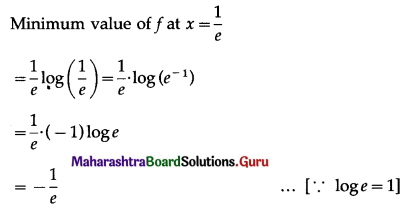
  • लापता = गायब (missing),
  • कारण = मूल प्रेरणा (reason),
  • घेरा = फैलाव (enclosure),
  • वैभव = समृद्ध (splendour)
  • गरबीली = स्वाभिमानी
  • मौलिक = मूलभूत
  • अपलक = एकटक
  • संवेदन = अनुभूति
  • सोता = झरना Maharashtra Board Class 11 Hindi Yuvakbharati Solutions Chapter 12 सहर्ष स्वीकारा है
  • परिवेष्टित = चारों ओर से घिरा हुआ, ढका हुआ
  • पाताली अंधेरा = धरती की गहराई में पाई जाने वाली धुंध
  • विवर = बिल, गड्ढा
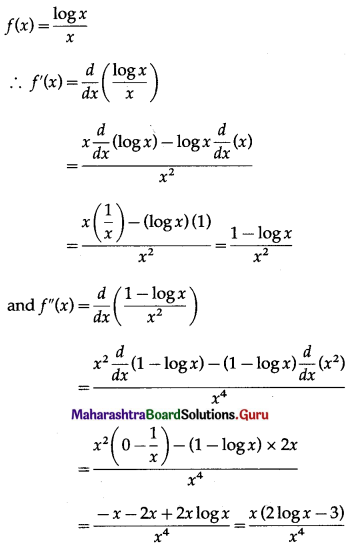
Maharashtra Board 12th Maths Solutions Chapter 1 Differentiation Ex 1.3

Balbharti 12th Maharashtra State Board Maths Solutions Book Pdf Chapter 1 Differentiation Ex 1.3 Questions and Answers.

Maharashtra State Board 12th Maths Solutions Chapter 1 Differentiation Ex 1.3

Question 1.
Differentiate the following w.r.t. x:
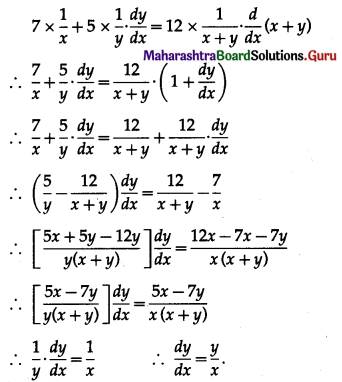
(i) \(\frac{(x+1)^{2}}{(x+2)^{3}(x+3)^{4}}\)
Solution:
Let y = \(\frac{(x+1)^{2}}{(x+2)^{3}(x+3)^{4}}\)
Then, log y = log [latex]\frac{(x+1)^{2}}{(x+2)^{3}(x+3)^{4}}[/latex]
= log (x + 1)2 – log (x + 2)3 – log (x + 3)4
= 2 log (x +1) – 3 log (x + 2) – 4 log (x + 3)
Differentiating both sides w.r.t. x, we get
Maharashtra Board 12th Maths Solutions Chapter 1 Differentiation Ex 1.3 Q1 (i)

(ii) \(\sqrt[3]{\frac{4 x-1}{(2 x+3)(5-2 x)^{2}}}\)
Solution:
Let y = \(\sqrt[3]{\frac{4 x-1}{(2 x+3)(5-2 x)^{2}}}\)
Then log y = log [latex]\sqrt[3]{\frac{4 x-1}{(2 x+3)(5-2 x)^{2}}}[/latex]
Maharashtra Board 12th Maths Solutions Chapter 1 Differentiation Ex 1.3 Q1 (ii)
Differentiating both sides w.r.t. x, we get
Maharashtra Board 12th Maths Solutions Chapter 1 Differentiation Ex 1.3 Q1 (ii).1

Maharashtra Board 12th Maths Solutions Chapter 1 Differentiation Ex 1.3

(iii) \(\left(x^{2}+3\right)^{\frac{3}{2}} \cdot \sin ^{3} 2 x \cdot 2^{x^{2}}\)
Solution:
Let y = \(\left(x^{2}+3\right)^{\frac{3}{2}} \cdot \sin ^{3} 2 x \cdot 2^{x^{2}}\)
Then log y = log [latex]\left(x^{2}+3\right)^{\frac{3}{2}} \cdot \sin ^{3} 2 x \cdot 2^{x^{2}}[/latex]
Maharashtra Board 12th Maths Solutions Chapter 1 Differentiation Ex 1.3 Q1 (iii)
Differentiating both sides w.r.t. x, we get
Maharashtra Board 12th Maths Solutions Chapter 1 Differentiation Ex 1.3 Q1 (iii).1

(iv) \(\frac{\left(x^{2}+2 x+2\right)^{\frac{3}{2}}}{(\sqrt{x}+3)^{3}(\cos x)^{x}}\)
Solution:
Let y = \(\frac{\left(x^{2}+2 x+2\right)^{\frac{3}{2}}}{(\sqrt{x}+3)^{3}(\cos x)^{x}}\)
Then log y = log [latex]\frac{\left(x^{2}+2 x+2\right)^{\frac{3}{2}}}{(\sqrt{x}+3)^{3}(\cos x)^{x}}[/latex]
Maharashtra Board 12th Maths Solutions Chapter 1 Differentiation Ex 1.3 Q1 (iv)
Differentiating both sides w.r.t. x, we get
Maharashtra Board 12th Maths Solutions Chapter 1 Differentiation Ex 1.3 Q1 (iv).1
Maharashtra Board 12th Maths Solutions Chapter 1 Differentiation Ex 1.3 Q1 (iv).2

(v) \(\frac{x^{5} \cdot \tan ^{3} 4 x}{\sin ^{2} 3 x}\)
Solution:
Let y = \(\frac{x^{5} \cdot \tan ^{3} 4 x}{\sin ^{2} 3 x}\)
Then log y = log [latex]\frac{x^{5} \cdot \tan ^{3} 4 x}{\sin ^{2} 3 x}[/latex]
= log x5 + log tan34x – log sin23x
= 5 log x+ 3 log (tan 4x) – 2 log (sin 3x)
Differentiating both sides w.r.t. x, we get
Maharashtra Board 12th Maths Solutions Chapter 1 Differentiation Ex 1.3 Q1 (v)
Maharashtra Board 12th Maths Solutions Chapter 1 Differentiation Ex 1.3 Q1 (v).1

(vi) \(x^{\tan ^{-1} x}\)
Solution:
Let y = \(x^{\tan ^{-1} x}\)
Then log y = log (\(x^{\tan ^{-1} x}\)) = (tan-1 x)(log x)
Differentiating both sides w.r.t. x, we get
Maharashtra Board 12th Maths Solutions Chapter 1 Differentiation Ex 1.3 Q1 (vi)

(vii) (sin x)x
Solution:
Let y = (sin x)x
Then log y = log (sin x)x = x . log (sin x)
Differentiating both sides w.r.t. x, we get
Maharashtra Board 12th Maths Solutions Chapter 1 Differentiation Ex 1.3 Q1 (vii)

(viii) sin xx
Solution:
Let y = (sin xx)
Then \(\frac{d y}{d x}=\frac{d}{d x}\left[\left(\sin x^{x}\right)\right]\)
\(\frac{d y}{d x}=\cos \left(x^{x}\right) \cdot \frac{d}{d x}\left(x^{x}\right)\) ……. (1)
Let u = xx
Then log u = log xx = x . log x
Differentiating both sides w.r.t. x, we get
Maharashtra Board 12th Maths Solutions Chapter 1 Differentiation Ex 1.3 Q1 (viii)

Maharashtra Board 12th Maths Solutions Chapter 1 Differentiation Ex 1.3

Question 2.
Differentiate the following w.r.t. x:
(i) xe + xx + ex + ee
Solution:
Let y = xe + xx + ex + ee
Let u = xx
Then log u = log xx = x log x
Differentiating both sides w.r.t. x, we get
\(\frac{1}{u} \cdot \frac{d u}{d x}=\frac{d}{d x}(x \log x)\)
Maharashtra Board 12th Maths Solutions Chapter 1 Differentiation Ex 1.3 Q2 (i)

(ii) \(x^{x^{x}}+e^{x^{x}}\)
Solution:
Let y = \(x^{x^{x}}+e^{x^{x}}\)
Put u = \(x^{x^{x}}\) and v = \(e^{x^{x}}\)
Then y = u + v
∴ \(\frac{d y}{d x}=\frac{d u}{d x}+\frac{d v}{d x}\)
Take u = \(x^{x^{x}}\)
log u = log \(x^{x^{x}}\) = xx . log x
Differentiating both sides w.r.t. x, we get
Maharashtra Board 12th Maths Solutions Chapter 1 Differentiation Ex 1.3 Q2 (ii)
Maharashtra Board 12th Maths Solutions Chapter 1 Differentiation Ex 1.3 Q2 (ii).1
Maharashtra Board 12th Maths Solutions Chapter 1 Differentiation Ex 1.3 Q2 (ii).2

(iii) (log x)x – (cos x)cot x
Solution:
Let y = (log x)x – (cos x)cot x
Put u = (log x)x and v = (cos x)cot x
Then y = u – v
∴ \(\frac{d y}{d x}=\frac{d u}{d x}-\frac{d v}{d x}\) ……..(1)
Take u = (log x)x
∴ log u = log (log x)x = x . log (log x)
Differentiating both sides w.r.t. x, we get
Maharashtra Board 12th Maths Solutions Chapter 1 Differentiation Ex 1.3 Q2 (iii)
Maharashtra Board 12th Maths Solutions Chapter 1 Differentiation Ex 1.3 Q2 (iii).1

(iv) \(x^{e^{x}}+(\log x)^{\sin x}\)
Solution:
Let y = \(x^{e^{x}}+(\log x)^{\sin x}\)
Put u = \(x^{e^{x}}\) and v = (log x)sin x
Then y = u + v
∴ \(\frac{d y}{d x}=\frac{d u}{d x}+\frac{d v}{d x}\) ……….(1)
Take u = \(x^{e^{x}}\)
∴ log u = log \(x^{e^{x}}\) = ex . log x
Differentiating both sides w.r.t. x, we get
Maharashtra Board 12th Maths Solutions Chapter 1 Differentiation Ex 1.3 Q2 (iv)
Also, v = (log x)sin x
∴ log v = log (log x)sin x = (sin x) . (log log x)
Differentiating both sides w.r.t. x, we get
\(\frac{1}{v} \cdot \frac{d v}{d x}=\frac{d}{d x}[(\sin x) \cdot(\log \log x)]\)
= \((\sin x) \cdot \frac{d}{d x}\left[(\log \log x)+(\log \log x) \cdot \frac{d}{d x}(\sin x)\right]\)
Maharashtra Board 12th Maths Solutions Chapter 1 Differentiation Ex 1.3 Q2 (iv).1

Maharashtra Board 12th Maths Solutions Chapter 1 Differentiation Ex 1.3

(v) \(e^{\tan x}+(\log x)^{\tan x}\)
Solution:
Let y = \(e^{\tan x}+(\log x)^{\tan x}\)
Put u = (log x)tan x
∴ log u =log(log x)tan x = (tan x).(log log x)
Differentiating both sides w.r.t. x, we get
Maharashtra Board 12th Maths Solutions Chapter 1 Differentiation Ex 1.3 Q2 (v)
Maharashtra Board 12th Maths Solutions Chapter 1 Differentiation Ex 1.3 Q2 (v).1

(vi) (sin x)tan x + (cos x)cot x
Solution:
Let y = (sin x)tan x + (cos x)cot x
Put u = (sin x)tan x and v = (cos x)cot x
Then y = u + v
∴ \(\frac{d y}{d x}=\frac{d u}{d x}+\frac{d v}{d x}\) ………(1)
Take u = (sin x)tan x
∴ log u = log (sin x)tan x = (tan x) . (log sin x)
Differentiating both sides w.r.t. x, we get
Maharashtra Board 12th Maths Solutions Chapter 1 Differentiation Ex 1.3 Q2 (vi)
Maharashtra Board 12th Maths Solutions Chapter 1 Differentiation Ex 1.3 Q2 (vi).1

(vii) \(10^{x^{x}}+x^{x^{10}}+x^{10^{x}}\)
Solution:
Let y = \(10^{x^{x}}+x^{x^{10}}+x^{10^{x}}\)
Put u = \(10^{x^{x}}\), v = \(x^{x^{10}}\) and w = \(x^{10^{x}}\)
Then y = u + v + w
∴ \(\frac{d y}{d x}=\frac{d u}{d x}+\frac{d v}{d x}+\frac{d w}{d x}\) ………(1)
Maharashtra Board 12th Maths Solutions Chapter 1 Differentiation Ex 1.3 Q2 (vii)
Maharashtra Board 12th Maths Solutions Chapter 1 Differentiation Ex 1.3 Q2 (vii).1
Maharashtra Board 12th Maths Solutions Chapter 1 Differentiation Ex 1.3 Q2 (vii).2
Maharashtra Board 12th Maths Solutions Chapter 1 Differentiation Ex 1.3 Q2 (vii).3

(viii) \(\left[(\tan x)^{\tan x}\right]^{\tan x}\) at x = \(\frac{\pi}{4}\)
Solution:
Let y = \(\left[(\tan x)^{\tan x}\right]^{\tan x}\)
∴ log y = log [latex]\left[(\tan x)^{\tan x}\right]^{\tan x}[/latex]
= tan x . log(tan x)tan x
= tan x . tan x log (tan x)
= (tan x)2 . log (tan x)
Differentiating both sides w.r.t. x, we get
Maharashtra Board 12th Maths Solutions Chapter 1 Differentiation Ex 1.3 Q2 (viii)

Question 3.
Find \(\frac{d y}{d x}\) if
(i) √x + √y = √a
Solution:
√x + √y = √a
Differentiating both sides w.r.t. x, we get
Maharashtra Board 12th Maths Solutions Chapter 1 Differentiation Ex 1.3 Q3 (i)

(ii) x√x + y√y = a√a
Solution:
x√x + y√y = a√a
∴ \(x^{\frac{3}{2}}+y^{\frac{3}{2}}=a^{\frac{3}{2}}\)
Differentiating both sides w.r.t. x, we get
Maharashtra Board 12th Maths Solutions Chapter 1 Differentiation Ex 1.3 Q3 (ii)

(iii) x + √xy + y = 1
Solution:
x + √xy + y = 1
Differentiating both sides w.r.t. x, we get
Maharashtra Board 12th Maths Solutions Chapter 1 Differentiation Ex 1.3 Q3 (iii)

Maharashtra Board 12th Maths Solutions Chapter 1 Differentiation Ex 1.3

(iv) x3 + x2y + xy2 + y3 = 81
Solution:
x3 + x2y + xy2 + y3 = 81
Differentiating both sides w.r.t. x, we get
Maharashtra Board 12th Maths Solutions Chapter 1 Differentiation Ex 1.3 Q3 (iv)

(v) x2y2 – tan-1(\(\sqrt{x^{2}+y^{2}}\)) = cot-1(\(\sqrt{x^{2}+y^{2}}\))
Solution:
x2y2 – tan-1(\(\sqrt{x^{2}+y^{2}}\)) = cot-1(\(\sqrt{x^{2}+y^{2}}\))
∴ x2y2 = tan-1(\(\sqrt{x^{2}+y^{2}}\)) + cot-1(\(\sqrt{x^{2}+y^{2}}\))
∴ x2y2 = \(\frac{\pi}{2}\) …….[∵ \(\tan ^{-1} x+\cot ^{-1} x=\frac{\pi}{2}\)]
Differentiating both sides w.r.t. x, we get
Maharashtra Board 12th Maths Solutions Chapter 1 Differentiation Ex 1.3 Q3 (v)

(vi) xey + yex = 1
Solution:
xey + yex = 1
Differentiating both sides w.r.t. x, we get
Maharashtra Board 12th Maths Solutions Chapter 1 Differentiation Ex 1.3 Q3 (vi)

(vii) ex+y = cos (x – y)
Solution:
ex+y = cos (x – y)
Differentiating both sides w.r.t. x, we get
Maharashtra Board 12th Maths Solutions Chapter 1 Differentiation Ex 1.3 Q3 (vii)

(viii) cos (xy) = x + y
Solution:
cos (xy) = x + y
Differentiating both sides w.r.t. x, we get
Maharashtra Board 12th Maths Solutions Chapter 1 Differentiation Ex 1.3 Q3 (viii)

(ix) \(e^{e^{x-y}}=\frac{x}{y}\)
Solution:
\(e^{e^{x-y}}=\frac{x}{y}\)
∴ ex-y = log(\(\frac{x}{y}\)) …….[ex = y ⇒ x = log y]
∴ ex-y = log x – log y
Differentiating both sides w.r.t. x, we get
Maharashtra Board 12th Maths Solutions Chapter 1 Differentiation Ex 1.3 Q3 (ix)

Question 4.
Show that \(\frac{d y}{d x}=\frac{y}{x}\) in the following, where a and p are constants.
(i) x7y5 = (x + y)12
Solution:
x7y5 = (x + y)12
(log x7y5) = log(x + y)12
log x7 + log y5 = log(x + y)12
7 log x + 5 log y = 12 log (x + y)
Differentiating both sides w.r.t. x, we get
Maharashtra Board 12th Maths Solutions Chapter 1 Differentiation Ex 1.3 Q4 (i)

Maharashtra Board 12th Maths Solutions Chapter 1 Differentiation Ex 1.3

(ii) xpy4 = (x + y)p+4, p∈N
Solution:
xpy4 = (x + y)p+4
Taking log
log (xpy4) = log(x + y)p+4
log xp + log y4 = (p + 4) log(x + y)
p log x + 4 log y = (p + 4) log(x + y)
Differentiating both sides w.r.t. x, we get
Maharashtra Board 12th Maths Solutions Chapter 1 Differentiation Ex 1.3 Q4 (ii)

(iii) \(\sec \left(\frac{x^{5}+y^{5}}{x^{5}-y^{5}}\right)=a^{2}\)
Solution:
\(\sec \left(\frac{x^{5}+y^{5}}{x^{5}-y^{5}}\right)=a^{2}\)
Maharashtra Board 12th Maths Solutions Chapter 1 Differentiation Ex 1.3 Q4 (iii)
Differentiating both sides w.r.t. x, we get
Maharashtra Board 12th Maths Solutions Chapter 1 Differentiation Ex 1.3 Q4 (iii).1
Maharashtra Board 12th Maths Solutions Chapter 1 Differentiation Ex 1.3 Q4 (iii).2
Differentiating both sides w.r.t. x, we get
Maharashtra Board 12th Maths Solutions Chapter 1 Differentiation Ex 1.3 Q4 (iii).3

(iv) \(\tan ^{-1}\left(\frac{3 x^{2}-4 y^{2}}{3 x^{2}+4 y^{2}}\right)=a^{2}\)
Solution:
\(\tan ^{-1}\left(\frac{3 x^{2}-4 y^{2}}{3 x^{2}+4 y^{2}}\right)=a^{2}\)
Maharashtra Board 12th Maths Solutions Chapter 1 Differentiation Ex 1.3 Q4 (iv)
Differentiating both sides w.r.t. x, we get
Maharashtra Board 12th Maths Solutions Chapter 1 Differentiation Ex 1.3 Q4 (iv).1

(v) \(\cos ^{-1}\left(\frac{7 x^{4}+5 y^{4}}{7 x^{4}-5 y^{4}}\right)=\tan ^{-1} a\)
Solution:
Maharashtra Board 12th Maths Solutions Chapter 1 Differentiation Ex 1.3 Q4 (v)
Maharashtra Board 12th Maths Solutions Chapter 1 Differentiation Ex 1.3 Q4 (v).1

(vi) \(\log \left(\frac{x^{20}-y^{20}}{x^{20}+y^{20}}\right)=20\)
Solution:
\(\log \left(\frac{x^{20}-y^{20}}{x^{20}+y^{20}}\right)=20\)
Maharashtra Board 12th Maths Solutions Chapter 1 Differentiation Ex 1.3 Q4 (vi)
Differentiating both sides w.r.t. x, we get
Maharashtra Board 12th Maths Solutions Chapter 1 Differentiation Ex 1.3 Q4 (vi).1

Maharashtra Board 12th Maths Solutions Chapter 1 Differentiation Ex 1.3

(vii) \(e^{\frac{x^{7}-y^{7}}{x^{7}+y^{7}}}=a\)
Solution:
\(e^{\frac{x^{7}-y^{7}}{x^{7}+y^{7}}}=a\)
Maharashtra Board 12th Maths Solutions Chapter 1 Differentiation Ex 1.3 Q4 (vii)
Differentiating both sides w.r.t. x, we get
Maharashtra Board 12th Maths Solutions Chapter 1 Differentiation Ex 1.3 Q4 (vii).1

(viii) \(\sin \left(\frac{x^{3}-y^{3}}{x^{3}+y^{3}}\right)=a^{3}\)
Solution:
Maharashtra Board 12th Maths Solutions Chapter 1 Differentiation Ex 1.3 Q4 (viii)
Differentiating both sides w.r.t. x, we get
Maharashtra Board 12th Maths Solutions Chapter 1 Differentiation Ex 1.3 Q4 (viii).1

Question 5.
(i) If log (x + y) = log (xy) + p, where p is a constant, then prove that \(\frac{d y}{d x}=-\frac{y^{2}}{x^{2}}\).
Solution:
log (x + y) = log (xy) + p
∴ log (x + y) = log x + log y + p
Differentiating both sides w.r.t. x, we get
Maharashtra Board 12th Maths Solutions Chapter 1 Differentiation Ex 1.3 Q5 (i)

(ii) If \(\log _{10}\left(\frac{x^{3}-y^{3}}{x^{3}+y^{3}}\right)=2\), show that \(\frac{d y}{d x}=-\frac{99 x^{2}}{101 y^{2}}\)
Solution:
\(\log _{10}\left(\frac{x^{3}-y^{3}}{x^{3}+y^{3}}\right)=2\)
Maharashtra Board 12th Maths Solutions Chapter 1 Differentiation Ex 1.3 Q5 (ii)

(iii) If \(\log _{5}\left(\frac{x^{4}+y^{4}}{x^{4}-y^{4}}\right)=2\), show that \(\frac{d y}{d x}=-\frac{12 x^{3}}{13 y^{3}}\)
Solution:
Maharashtra Board 12th Maths Solutions Chapter 1 Differentiation Ex 1.3 Q5 (iii)
Differentiating both sides w.r.t. x, we get
Maharashtra Board 12th Maths Solutions Chapter 1 Differentiation Ex 1.3 Q5 (iii).1

(iv) If ex + ey = ex+y, then show that \(\frac{d y}{d x}=-e^{y-x}\)
Solution:
ex + ey = ex+y ……(1)
Differentiating both sides w.r.t. x, we get
Maharashtra Board 12th Maths Solutions Chapter 1 Differentiation Ex 1.3 Q5 (iv)

Maharashtra Board 12th Maths Solutions Chapter 1 Differentiation Ex 1.3

(v) If \(\sin ^{-1}\left(\frac{x^{5}-y^{5}}{x^{5}+y^{5}}\right)=\frac{\pi}{6}\), show that \(\frac{d y}{d x}=\frac{x^{4}}{3 y^{4}}\)
Solution:
\(\sin ^{-1}\left(\frac{x^{5}-y^{5}}{x^{5}+y^{5}}\right)=\frac{\pi}{6}\)
\(\frac{x^{5}-y^{5}}{x^{5}+y^{5}}=\sin \frac{\pi}{6}=\frac{1}{2}\)
2x5 – 2y5 = x5 + y5
3y5 = x5
Differentiating both sides w.r.t. x, we get
\(3 \times 5 y^{4} \frac{d y}{d x}=5 x^{4}\)
∴ \(\frac{d y}{d x}=\frac{x^{4}}{3 y^{4}}\)

(vi) If xy = ex-y, then show that \(\frac{d y}{d x}=\frac{\log x}{(1+\log x)^{2}}\)
Solution:
xy = ex-y
log xy = log ex-y
y log x = (x – y) log e
y log x = (x – y) ….. [∵ log e = 1]
y + y log x = x – y
y + y log x = x
y(1 + log x) = x
y = \(\frac{x}{1+\log x}\)
Maharashtra Board 12th Maths Solutions Chapter 1 Differentiation Ex 1.3 Q5 (vi)

(vii) If \(y=\sqrt{\cos x+\sqrt{\cos x+\sqrt{\cos x+\ldots \infty}}}\), then show that \(\frac{d y}{d x}=\frac{\sin x}{1-2 y}\)
Solution:
\(y=\sqrt{\cos x+\sqrt{\cos x+\sqrt{\cos x+\ldots \infty}}}\)
y2 = cos x + \(\sqrt{\cos x+\sqrt{\cos x+\ldots \infty}}\)
y2 = cos x + y
Differentiating both sides w.r.t. x, we get
Maharashtra Board 12th Maths Solutions Chapter 1 Differentiation Ex 1.3 Q5 (vii)

(viii) If \(y=\sqrt{\log x+\sqrt{\log x+\sqrt{\log x+\ldots \infty}}}\), then show that \(\frac{d y}{d x}=\frac{1}{x(2 y-1)}\)
Solution:
\(y=\sqrt{\log x+\sqrt{\log x+\sqrt{\log x+\ldots \infty}}}\)
Maharashtra Board 12th Maths Solutions Chapter 1 Differentiation Ex 1.3 Q5 (viii)

(ix) If \(y=x^{x^{x^{-\infty}}}\), then show that \(\frac{d y}{d x}=\frac{y^{2}}{x(1-\log y)}\)
Solution:
\(y=x^{x^{x^{-\infty}}}\)
Maharashtra Board 12th Maths Solutions Chapter 1 Differentiation Ex 1.3 Q5 (ix)

Maharashtra Board 12th Maths Solutions Chapter 1 Differentiation Ex 1.3

(x) If ey = yx, then show that \(\frac{d y}{d x}=\frac{(\log y)^{2}}{\log y-1}\)
Solution:
ey = yx
log ey = log yx
y log e = x log y
y = x log y …… [∵log e = 1] ……….(1)
Differentiating both sides w.r.t. x, we get
\(\frac{d y}{d x}=x \frac{d}{d x}(\log y)+(\log y) \cdot \frac{d}{d x}(x)\)
Maharashtra Board 12th Maths Solutions Chapter 1 Differentiation Ex 1.3 Q5 (x)
Maharashtra Board 12th Maths Solutions Chapter 1 Differentiation Ex 1.3 Q5 (x).1