Maharashtra Board Class 7 Science Solutions Chapter 7 Motion, Force and Work

Balbharti Maharashtra State Board Class 7 Science Solutions Chapter 7 Motion, Force and Work Notes, Textbook Exercise Important Questions and Answers.

Maharashtra State Board Class 7 Science Solutions Chapter 7 Motion, Force and Work

Class 7 Science Chapter 7 Motion, Force and Work Textbook Questions and Answers

1. Fill ¡n the blanks with the proper words from the brackets.
(stationary, zero, changing, constant, displacement, velocity, speed. acceleration, stationary but not zero. inc reuses)

Question a.
If a body traverses a distance in direct proportion to the time, the speed of the body is ……………… .
Answer:
constant

Maharashtra Board Class 7 Science Solutions Chapter 7 Motion, Force and Work

Question b.
If a body is moving with a constant velocity, its acceleration is ……………… .
Answer:
zero

Question c.
……………. is a scalar quantity.
Answer:
Speed

Question d.
…………….. is the distance traversed by a body in a particular direction in unit time.
Answer:
Velocity

2. Observe the figure and answer the questions.

Maharashtra Board Class 7 Science Solutions Chapter 7 Motion, Force and Work 1

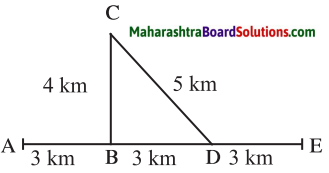
Sachin and Sarneer started on a motorbike from place A, took the turn at 13, did a task at C, travelled by the route CD to D and then went on to E. Altogether, they took one hour for this journey. Find out the actual distance traversed by them and the displacement from A to E. From this, deduce their speed. What was their velocity from A to E in the direction AE’? Can this velocity be called average velocity?

Question a.
Observe the figure and answer the questions
Maharashtra Board Class 7 Science Solutions Chapter 7 Motion, Force and Work 1

Sachin and Sarneer started on a motorbike from place A, took the turn at 13, did a task at C, travelled by the route CD to D and then went on to E. Altogether, they took one hour for this journey. Find out the actual distance traversed by them and the displacement from A to E. From this, deduce their speed. What was their velocity from A to E in the direction AE’? Can this velocity be called average velocity?
Answer:
1. Actual distance = \(\overline{\mathrm{AB}}\) + \(\overline{\mathrm{BC}}\) + \(\overline{\mathrm{CD}}\) + \(\overline{\mathrm{DE}}\) = 3 + 4 + 5 + 3
Actual distance = 15 km

2. Displacement = \(\overline{\mathrm{AB}}\) + \(\overline{\mathrm{BD}}\) + \(\overline{\mathrm{DE}}\)
= 3 + 3 + 3
Displacement = 9 km

3. Speed = \(\frac{\text { Distance travelled }}{\text { Total time }}\)
Distance = 15 km = 15 × 1000 = 15000 m
Time = 1 hr = 1 × 60 × 60 = 3600 sec.
s = \(\frac{15000}{3600}\) or s = \(\frac{15 \mathrm{~km}}{1 \text { hour }}\) = 15km/hour
= 4.16 m/sec. or 15 km/hour

4. Velocity = \(\frac{\text { Distance travelled }}{\text { Total time }}\)
Displacement = 9 km = 9 × 1000 = 9000 m
Time = 1 hr = 1 × 60 × 60 = 3600 sec
V = \(\frac{9000}{3600}\) or V = \(\frac{9 \mathrm{~km}}{1 \text { hour }}\) = 9 km/hour
= 2.5 m/sec. or 9 km/hour

5. Yes, this velocity can be called as average velocity.

Maharashtra Board Class 7 Science Solutions Chapter 7 Motion, Force and Work

3. From the groups B and C, choose the proper words, for each of the words in group A.

Question a.
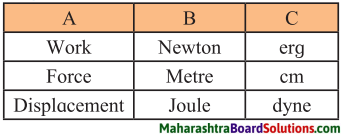
From the groups B and C, choose the proper words, for each of the words in group A.
Maharashtra Board Class 7 Science Solutions Chapter 7 Motion, Force and Work 2
Answer:

Group ‘A’Group B’Group ‘C’
WorkJouleerg
ForceNewtondyne
DisplacementMetrecm

4. A bird sitting on a wire, flies, circles around and comes back to its perch. Explain the total distance it traversed during its flight and its eventual displacement.

Question a.
Answer:
The total distance the bird has traversed is the length of the distance covered by circling, but the eventual displacement are the bird is zero as its initial and final position are one and the same.

Maharashtra Board Class 7 Science Solutions Chapter 7 Motion, Force and Work

5. Explain the following concepts in your own words with everyday examples: force, work, displacement, velocity, acceleration, distance.

Question a.
Explain the following concepts in your own words with everyday examples: force, work, displacement, velocity, acceleration, distance.
Answer:
1. Force: The interaction that brings about the acceleration is called force.
e.g: An ox is pulling a cart, applying brakes to a bicycle, lifting heavy iron object with a crane.

2. Work: When an object is displaced by applying a force on it, work is said to be done.
e.g: A bucketful of water is to be drawn from a well and taken to the home by walking from well to home.

3. Displacement: The minimum distance
traversed by a moving body in one direction from the original point to reach the final point is called displacement.
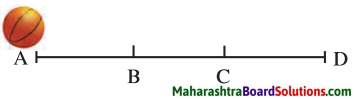
e.g: A rolling of a ball from point A to point B in the same direction.

4. Velocity: Velocity is the distance traversed by a body in a specific direction in unit time.
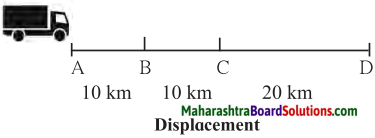
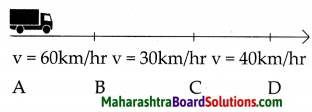
e.g: A truck is covering a distance of 40km from A to D in a straight line in 1 hour.
Maharashtra Board Class 7 Science Solutions Chapter 7 Motion, Force and Work 5

5. Acceleration: It is change in velocity per second. It can be deduced.
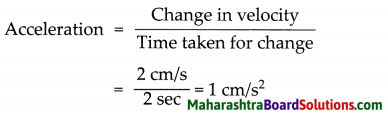
Acceleration = \(\frac{\text { Change in velocity }}{\text { Time taken for change }}\)
e.g:
Maharashtra Board Class 7 Science Solutions Chapter 7 Motion, Force and Work 6

(i) In the above example a truck covered the distance AB at velocity of 60 km/hr, BC at 30 km/hr and CD at 40 km/hr. (ii) It means that the velocity for the distance CD is greater than the velocity for the distance BC. (iii) From the number of seconds required for this change in velocity to take place, the change in velocity per second can be deduced. This is called acceleration (iv) Distance: The length of the route actually traversed by a moving body irrespective of the direction is called distance.
e.g: Ranjit travelled 1km. from his home to school.

6. A ball is rolling from A to D on a flat and smooth surface. Its speed is 2 cm/s. On reaching B, it was pushed continuously up to C. On reaching D from C, its speed had become 4 cm/s. It took 2 seconds for it to go from B to C. What is the acceleration of the ball as it goes from B to C.

Maharashtra Board Class 7 Science Solutions Chapter 7 Motion, Force and Work 3

Question a.
A ball is rolling from A to D on a flat and smooth surface. Its speed is 2 cm/s. On reaching B, it was pushed continuously up to C. On reaching D from C, its speed had become 4 cm/s. It took 2 seconds for it to go from B to C. What is the acceleration of the ball as it goes from B to C.
Maharashtra Board Class 7 Science Solutions Chapter 7 Motion, Force and Work 3
Answer:
As its initial and final positions are one and the same.
Initial Velocity = 2 cm/s.
Final Velocity = 4 cm/s
Time taken for the change in velocity from B to
D = 4 cm/s – 2 cm/s = 2 cm/s
Maharashtra Board Class 7 Science Solutions Chapter 7 Motion, Force and Work 4

7. Solve the following problems.

Question a.
A force of 1000 N was applied to stop a car that was moving with a constant velocity. The car stopped after moving through 10m. How much is the work done?
Answer:
Force (F) = 1000 N
displacement (s) = 10m
work done (W) = ?
W = Fs
= 1000 × 10
W = 10,000 Joule

Maharashtra Board Class 7 Science Solutions Chapter 7 Motion, Force and Work

Question b.
A cart with mass 20 kg went 50 m in a straight line on a plain and smooth road when a force of 2 N was applied to it. How much work was done by the force?
Answer:
Force (F) = 2 N
Displacement (s) = 50 m
Work done (W) = ?
W = Fs
= 2 × 50
W = 100 Joule

Project:

Question a.
Collect information about the study made by Sir Isaac Newton regarding force and acceleration and discuss it with your teacher.

Class 7 Science Chapter 7 Motion, Force and Work Important Questions and Answers

Fill in blanks:

Question 1.
Displacement is a …………. quantity.
Answer:
vector

Question 2.
The …………. of an object can change even while it is moving along a straight line.
Answer:
velocity

Maharashtra Board Class 7 Science Solutions Chapter 7 Motion, Force and Work

Question 3.
The …………. velocity can be different at different times.
Answer:
instantaneous

Question 4.
Change in velocity per second is called …………. .
Answer:
acceleration

Question 5.
The interaction that brings about the acceleration is called …………. .
Answer:
force

Question 6.
The scientist …………. was the first to study force and the resulting acceleration.
Answer:
Sir Isaac Nezvton

Question 7.
Ability to do work is called …………. .
Answer:
Energy

Maharashtra Board Class 7 Science Solutions Chapter 7 Motion, Force and Work

Question 8.
W = …………. × S.
Answer:
F

Question 9.
Unit of work is …………. and …………. .
Answer:
Joule, erg

Question 10.
Unit of force is …………. and …………. .
Answer:
Newton, dyne

Question 11.
Force is a …………. quantity.
Answer:
vector

Question 12.
The velocity at a particular time is called …………. velocity.
Answer:
instantaneous

Maharashtra Board Class 7 Science Solutions Chapter 7 Motion, Force and Work

Question 13.
The …………. of a body is the distance traversed per unit time.
Answer:
speed

Question 14.
Unit of acceleration is …………. and …………. .
Answer:
m/s2 and cm/s2

Question 15.
Force is measured by the …………. that it produces.
Answer:
acceleration

Question 16.
Work done by a body with no displacement will be …………. .
Answer:
zero

Say whether True or False, correct the false 1 statements:

Question 1.
Velocity is distance travelled per unit of time.
Answer:
False. Speed is distance travelled per unit of time

Maharashtra Board Class 7 Science Solutions Chapter 7 Motion, Force and Work

Question 2.
In displacement, both distance and direction are taken into account.
Answer:
True

Question 3.
Speed = Distance/time.
Answer:
True

Question 4.
Change in speed per second is acceleration.
Answer:
False. Change in velocity per second is acceleration

Question 5.
Work done depends on the force and the displacement.
Answer:
True

Question 6.
C.G.S. unit of acceleration is m/s2.
Answer:
False. C.G.S. unit of acceleration is cm/s2.

Question 7.
M.K.S. unit of force is dyne.
Answer:
False. M.K.S. unit of force is Newton

Maharashtra Board Class 7 Science Solutions Chapter 7 Motion, Force and Work

Question 8.
Force is measured by the acceleration that it produces.
Answer:
True

Write the difference between the following:

Question 1.
Speed and Velocity
Answer:

SpeedVelocity
1. Speed is distance travelled per unit of time.1. Velocity is the distance traversed by a body in a specific direction in unit time.
2. It is a scalar quantity.2. It is a vector quantity.
3. Formula:
Speed = \(\frac{\text { Distance traversed }}{\text { Total time }}\)
3. Formula:
Velocity = \(\frac{\text { Displacement }}{\text { Total time }}\)

Question 2.
Distance and Displacement
Answer:

DistanceDisplacement
1. The length of the route actually traversed by a moving body, irrespective of the direction is called distance.1. The minimum distance traversed by a moving body in one direction from the original point to reach the final point is called displacement.
2. It is a scalar quantity.2. It is a vector quantity.

Maharashtra Board Class 7 Science Solutions Chapter 7 Motion, Force and Work

Solve the following problems!

Question 1.
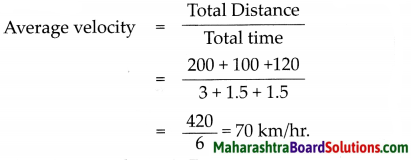
A bus travelled 200 km in the first 3 hours and then 100 kms for the next one and a half hours and then 120 kms for the next one and a half hours. What is the average velocity of the bus if it has moved in a straight line for the whole journey.
Answer:
Maharashtra Board Class 7 Science Solutions Chapter 7 Motion, Force and Work 7

Question 2.
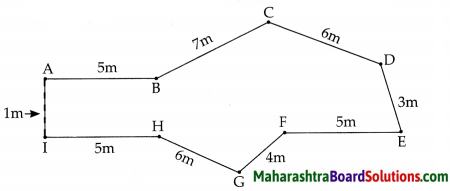
See the diagram and calculate the Distance and Displacement travelled by the body from A to I.
Maharashtra Board Class 7 Science Solutions Chapter 7 Motion, Force and Work 8
Answer:
Distance travelled =
A → B → C → D → E → F → G → H + I
= 5 + 7 + 6 + 3 + 5 + 4 + 6 + 5
= 41 m
Displacement = A → I in a straight line shortest distance
= 1m

Maharashtra Board Class 7 Science Solutions Chapter 7 Motion, Force and Work

Use your brainpower:

Question 1.
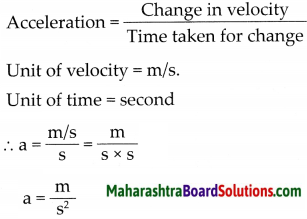
The unit of acceleration is m/s2, verify this.
Answer:
Maharashtra Board Class 7 Science Solutions Chapter 7 Motion, Force and Work 9

Question 2.
Acceleration is a vector quantity. Is force a vector quantity too?
Answer:
Yes, acceleration and force both are vector quantities, because both can be expressed completely only when magnitude and direction are given and the quantity which needs direction and magnitude both is called a vector quantity.

Maharashtra Board Class 8 English Solutions Chapter 2.2 Nature Created Man and Woman as Equals

Balbharti Maharashtra State Board Class 8 English Solutions Chapter 2.2 Nature Created Man and Woman as Equals Notes, Textbook Exercise Important Questions and Answers.

Maharashtra State Board Class 8 English Solutions Chapter 2.2 Nature Created Man and Woman as Equals

Class 8 English Chapter 2.2 Nature Created Man and Woman as Equals Textbook Questions and Answers

Warming Up

A. Study the pictures given on page 30 of the textbook and note the differences :
Maharashtra Board Class 8 English Solutions Chapter 2.2 Nature Created Man and Woman as Equals 1
Answer:
Set (i) In the first panel a boy is going to school while a girl of the same age is doing household chores. In the next panel, both the boy and the girl are going to school.

Maharashtra Board Class 8 English Solutions Chapter 2.2 Nature Created Man and Woman as Equals 2
Answer:
Set (ii) In the first panel, a woman is trudging along balancing pots of water on her head and a baby on her hip. In the next panel, a woman is teaching children at a school.

Maharashtra Board Class 8 English Solutions Chapter 2.2 Nature Created Man and Woman as Equals

B. Now write what you observe in the following two pictures:
Maharashtra Board Class 8 English Solutions Chapter 2.2 Nature Created Man and Woman as Equals 3
Answer:
(i) In the first panel a boy and a man are shown sharing the household chores, leaving the women to do other work.
(ii) In the next panel, men and women are working in an office together at an equal level.

C. Which pictures reflect gender equality? Write their numbers.
Answer:
The pictures on the right-hand side of:
(A) and both the pictures of
(B) reflect gender equality.

D. Write down any two slogans on gender equality.
Answer:
(i) Let’s have peace and unity
For all, give equal opportunity.

(ii) Men and women, Are all the same.
Please stop playing, This discrimination game.

Maharashtra Board Class 8 English Solutions Chapter 2.2 Nature Created Man and Woman as Equals

1. A. Find from the lesson words/phrases that mean the following:

Question a.
colours …………
Answer:
Hues.

Question b.
a person who writes for newspapers/magazines …………
Answer:
Journalist.

Question c.
make a difference between ………
Answer:
Discriminate.

Question d.
cryover ………
Answer:
Lament

Question e.
explain in detail ………
Answer:
Throw light on.

Maharashtra Board Class 8 English Solutions Chapter 2.2 Nature Created Man and Woman as Equals

Question f.
abilities and qualities ……….
Answer:
Potential

Question g.
same availability ……….
Answer:
Equal Access

Question h.
a person who brings about a social/political change …………
Answer:
Activist.

1. B. Pick out five Compound words from the lesson.
Answer:

  • anywhere
  • household crystal-clear
  • courtyard
  • reading room
  • middle-aged

Maharashtra Board Class 8 English Solutions Chapter 2.2 Nature Created Man and Woman as Equals

2. Answer in your own words:

Question a.
Read and write down 5 points which prove that Tomba, (Lanthoi’s father) firmly believes in gender equality.
Answer:
The facts which prove that Tomba firmly believes in gender equality are:

  1. Tomba is supportive of Ashang bis activities as a woman’s rights activist.
  2. He advocates the cause of women.
  3. He does not discriminate between a man’s work and a woman’s work.
  4. He shares equally with Ashangbi in doing the household chores like cooking, washing, etc.
  5. He tells Lanthoi that the world is still full of inequalities and they have to find a way to bring equality between men and women.

Question b.
In what ways is Ashangbi different from other women of her community?
Answer:
Ashangbi is different from other women of her community:

  • she is a woman’s rights activist
  • she is a journalist is different

Question c.
What are the provisions in the Declaration of the United Nations, to ensure equality of men and women?
Answer:
The provisions In the Declaration of the United Nations to ensure equality of men and women are:

  • equal access to basic social services including health and education.
  • equal participation in political and economic decision-making.
  • equal reward for equal work, and
  • elimination of discrimination and violence against women.

Maharashtra Board Class 8 English Solutions Chapter 2.2 Nature Created Man and Woman as Equals

3. Who said to whom and when / why?

Who said?To Whom?When/why?
………the world is full of inequalities
I want to do something interesting
It is against the will of God
Our home is full of love……..
……….we can affirm along with United Nations that men and women are equal.

Answer:

Who said?To Whom?When/why?
………the world is full of inequalitiesTombaLanthoiWhen he is discussing gender equality with his daughter.
I want to do something interestingLanthoiAshangbiWhen she wants to discuss something with her mother.
It is against the will of GodAshangbiLanthoiWhen she is talking about the subjugation of women.
Our home is full of love……..LanthoiAshangbiWhen she is discussing gender equality with her mother.
……….we can affirm along with United Nations that men and women are equal.AshangbiLanthoiWhen Lanthol asked her about the provisions available to enable women to express their potential and set themselves free from suppression.

4. We have studied in previous classes that Pronouns are nords used instead of Nouns.

We also know about Personal Pronouns like I, you, he, she, my, your, his, her, they etc.
There are other words also which are used in place of nouns.
(i) This, that, these, those point to some noun.
For example: ‘Ihi is a kingfisher.’ Those are herons.’ Such Pronouns are called Demonstrative Pronouns.

(ii) Some pronouns not only replace nouns, but also connect two sentences.
For example : Biology is a science. It studies living organisms.’
Biology is a science which / th studies living organisms.
Some other such pronouns are who, whose, whom etc.
They are called Relative Pronouns.

Maharashtra Board Class 8 English Solutions Chapter 2.2 Nature Created Man and Woman as Equals

(iii) Some pronouns are used to ask questions.
For example: What is your name?
Which is your coat?
Who is your coach?
The underlined words are Interrogative Pronouns.

Underline the Pronouns in the following sentences and name their types:

Question 1.
What do you want to do?
Answer:
What do you want to do?
What – Interrogative Pronoun
you – Personal Pronoun

Question 2.
It is because of your father that I feel no inequality.
Answer:
It is because of your father that I feel no inequality.
your, I-Personal Pronoun

Question 3.
This is what your topic means.
Answer:
This is what your topic means.
This – Demonstrative Pronoun;
your-Personal Pronoun

Maharashtra Board Class 8 English Solutions Chapter 2.2 Nature Created Man and Woman as Equals

Question 4.
She is fascinated by the small trail, which winds up the mountain.
Answer:
She is fascinated by the small trail, which winds up the mountain.
She – Personal Pronoun
which – Interrogative Pronoun

5. Read the following lines. Imagine it is the beginning of an instance you have experienced. Complete the incident using your imagination. Give it u positise ending. I had often noticed that in my neighbour’s family, the son was greatly pampered, but the daughter was treated unfairly. I could not bear this. So one day I decided to ………….

Continue the write-ups with your own ideas, in about 12 – 15 lines.
Answer:
I had often noticed that in my neighbour’s family, the son was greatly pampered, but the daughter, Meera, was treated unfairly. I could not bear this. So one day I decided to do something about it. I knew that as a young girl, I could not go in and give them advice. It had to be done diplomatically. I decided to make a folder of stories of successful women who had scaled wonderful heights and were greatly respected. I also made a list of women entrepreneurs and their lives. It took me a long time to do this, but it also became my project at school and I got guidance from my teacher and my mother. They asked me to make a power-point presentation too, in addition to the folder. After about three months of hard work. my project was complete.

One afternoon, when I knew that Meera’s mother would be alone at home, I took my presentation and my folder. Pretending that I wanted her opinion on my school project, I showed her the entire presentation. My plan was successful. At the end of two anxious hours, Meera’s mother turned round and hugged me. “I get your message,” she said through her tears. “We have been unfair to Meera. We will rectify it immediately. Thanks, dear.”
I don’t know the marks I will get in school for my project, but according to me, it is already in the A+ category. It has made a positive impact. And that’s enough reward for me.

Maharashtra Board Class 8 English Solutions Chapter 2.2 Nature Created Man and Woman as Equals

6. Project :
From your school library or internet collect quotations/slogans promoting gender equality. Make decorative posters with pictures of outstanding women or sketches or illustrations of your choice. With permission, put up the posters in your school surroundings.

Class 8 English Chapter 2.2 Nature Created Man and Woman as Equals Additional Important Questions and Answers

Simple Factual Activities:

Question 1.
Make a list of the beautiful natural surroundings of the house.
Answer:

  • A small stream of crystal clear water.
  • The green mountains
  • A stretch of hundreds of acres of fertile land with yellow mustard flowers.
  • A garden in front of the house.
  • Many kinds of trees bearing flowers of different colours and fruits.
  • Fragrant jasmine.

Maharashtra Board Class 8 English Solutions Chapter 2.2 Nature Created Man and Woman as Equals

Question 2.
Write down the ways in which Ashangbi is different from other women of her community.
Answer:
Maharashtra Board Class 8 English Solutions Chapter 2.2 Nature Created Man and Woman as Equals 6

Question 3.
What help did Lanthoi need from her mother?
Answer:
Lanthoi was going to speak on the topic ‘God created men and women as equals’ at her school. She wanted to have some discussion with her mother on the topic.

State what kind of sentences the following are:

Question 1.
Tell me what you want to do.
Answer:
Imperative

Question 2.
Will you spare some time to have a discussion with me ?
Answer:
Interrogative

Personal Response:

Question 1.
Do you think that a woman should have a paid job outside the house or stay at home as a full-time homemaker?
Answer:
I think that depends on the woman and the circumstances. If she is qualified and wants to pursue a career, she should do so. If she wishes to stay at home, she should do that. It is important that she should have the freedom to choose and do as she wishes.

Maharashtra Board Class 8 English Solutions Chapter 2.2 Nature Created Man and Woman as Equals

Answer in brief:

Question 1.
What did Lanthoi’s father work as?
Answer:
Lanthoi’s father Tomba is a lawyer and a social wrorker, who advocates the cause of women.

Question 2.
What does Ashangbi feel about Tomba’s views on gender equality?
Answer:
Ashangbi is appreciative of Tomba’s view on gender equality.

Complex Factual Activities:

Question 1.
List the ways in which Tomba contributes towards Ashangbi’s success.
Answer:
The ways in which Tomba contributes towards Ashangbi’s success are:

  • Tomba is supportive of Ashangbi’s activities.
  • He is always proud of his wife and children.
  • In times of need, he helps his wife and children.
  • He does not discriminate between a man’s work and woman’s work.
  • He shares equally with Ashangbi in doing the household chores like cooking, washing, etc.

Question 2.
Describe how mother explained Lanthoi’s topic for her speech at school.
Answer:
Lanthoi’s topic for her speech was ‘God created men and women as equals.’ Ashangbi explained to Lanthoi that God has sent men and women to our earth to share the joys and sorrows of life equally, to share His blessings and to enjoy the bounty of nature equally. Hence, men and women are equals and should be treated as such.

Question 3.
Write down five points which prove that Tomba firmly believes in gender equality.
Answer:
The facts which prove that Tomba firmly believes in gender equality are:

  • Tomba is supportive of Ashangbi’s activities as a woman’s rights activist.
  • He advocates the cause of women.
  • He does not discriminate between a man’s work and woman’s work.
  • He shares equally with Ashangbi in doing the household chores like cooking, washing, etc.
  • He tells Lanthoi that the world is still full of inequalities and they have to find a way to bring equality between men and women.

Maharashtra Board Class 8 English Solutions Chapter 2.2 Nature Created Man and Woman as Equals

Personal Response:

Question 1.
In olden days, men and women had ‘fixed’ roles to play, and ‘fixed’ jobs to do. Do you think there should be a change in this today?
Answer:
Yes, as society changes and progresses we must change the ‘fixed’ roles and ‘fixed’ jobs too. Today, when women are going out, working and adding to the family income, men too should help in the house. Women have learnt to do many jobs which were earlier done only by men. Men too should learn to do jobs which were earlier done only by women.

Write whether the following statements are True or False:

Question 1.
Lanthoi’s grandmother has narrated many stories about brave queens to her.
Answer:
True

Question 2.
Lanthoi found the topic of pioneer women boring.
Answer:
False

Question 3.
Linthoingambi and Kuranganayani were brave kings.
Answer:
False

Question 4.
Lanthoi has a lot of respect for Ashangbi.
Answer:
True

Complex Factual Activities:

Question 1.
Describe how the role of a mother is honoured and praised.
Answer:
The mother is said to be the fountain of love in the family. This bond of love cannot be compared to anything else in the world. Motherhood has been glorified because of this and therefore women accept the challenges in life to become a mother.

Maharashtra Board Class 8 English Solutions Chapter 2.2 Nature Created Man and Woman as Equals

Question 2.
Complete the web showing the achievements of modern women.
Maharashtra Board Class 8 English Solutions Chapter 2.2 Nature Created Man and Woman as Equals 5
Answer:
Maharashtra Board Class 8 English Solutions Chapter 2.2 Nature Created Man and Woman as Equals 4

Write the noun forms of the following words:

  • know
  • qual
  • narrated
  • brave

Answer:

  • knowledge
  • equality
  • narration/narrator
  • bravery

Activities based on Contextual Grammar:

Question 1.
This bond of love Is beyond comparison with anything else in the world.
(Make the sentence negative.)
Answer:
This bond of love cannot be compared with anything else In the world.

Question 2.
Life is not possible without both women and men.
(Make the sentence affirmative.)
Answer:
Life is impossible without both women and men.

Maharashtra Board Class 8 English Solutions Chapter 2.2 Nature Created Man and Woman as Equals

Personal Response:

Question 1.
Have you read stories/biographies of successful women? Did you like them?
Answer:
Yes, I have. I have read about Rani Laxmlbal. I have also read short stories and articles about women like Marie Curie, Sudha Chandran, Annie Besant, Mother Teresa, etc. like them and find them motivating.

Write ‘Yes’ or ‘No’:

Question 1.
Lanthoi finally understands what the topic of the symposium means.
Answer:
Yes

Question 2.
Ashangbi satisfies her daughter’s curiosity.
Answer:
Yes

Question 3.
Lanthoi is unsure and nervous about her presentation.
Answer:
No

Question 4.
The United Nations has affirmed that men and women are equals.
Answer:
Yes

Maharashtra Board Class 8 English Solutions Chapter 2.2 Nature Created Man and Woman as Equals

Complex Factual Activities:

Question 1.
Write down the provisions in the Declaration of the United Nations to ensure equality of men and women. OR What social justice does the aegis of the United Nations guarantee?
Answer:
The provisions In the Declaration of the United Nations to ensure equality of men and women are:

  • equal access to basic social services including health and education.
  • equal participation in political and economic decision-making.
  • equal reward for equal work, and
  • elimination of discrimination and violence against women.

Question 2.
Describe the vision that meets Lanthoi’s eyes when she rushes outdoor.
Answer:
When Lanthoi rushes outdoors, she is welcomed by the bright morning sun. The blue sky and the range of mountains : appear to meet. Lanthoi is fascinated by a small trail which goes winding up the ; distant purple mountain.

Pick out the subject and predicate:

Question 1.
He extends his helping hand to his wife and children and to the society at large.
Answer:
He-subject
extends his helping hand to his wife and children and to the society at large-predicate

Question 2.
Use the word ‘share’ as a noun and a verb in two separate sentences:
Answer:
(i) The wicked brother wanted his share in the property, (noun)
(ii) The poor woman shared the loaf of bread with her children, (verb)

Writing Skills

Read the following lines. Imagine that it is the beginning of an instance you have experienced. Continue the write-up with your own ideas, in about 12-15 lines and complete the incident using your imagination. Give it a positive ending.
I had often noticed that in my neighbour’s family, the son was greatly pampered, but the daughter was treated unfairly. I could not bear this. So one day I decided to ……………..
Answer:
I had often noticed that in my neighbour’s family, the son was greatly pampered, but the daughter, Meera, was treated unfairly. I could not bear this. So one day I decided to do something about it.

Maharashtra Board Class 8 English Solutions Chapter 2.2 Nature Created Man and Woman as Equals

I knew that as a young girl, I could not go in and give them advice. It had to be done diplomatically. I decided to make a folder of stories of successful women who had scaled wonderful heights and were greatly respected. I also made a list of women entrepreneurs and their lives. It took me a long time to do this, but it also became my project at school and I got j guidance from my teacher and my mother.

They asked me to make a power-point presentation too, in addition to the folder. After about three months of hard work, my project was complete. One afternoon, when I knew that Meera’s mother would be alone at home, I took my presentation and my folder. Pretending that I wanted her opinion on my school project, I showed her the entire presentation.

My plan was successful. At the end of two anxious hours, Meera’s mother turned round and hugged me. “I get your message,” she said through her tears. “We have been unfair to Meera. We will rectify l it immediately. Thanks, dear.” I don’t know the marks I will get in ; school for my project, but according to me, it is already in the A+ category. It has made a positive impact. And that’s enough reward for me.

Maharashtra Board Class 7 Science Solutions Chapter 10 Disaster Management

Balbharti Maharashtra State Board Class 7 Science Solutions Chapter 10 Disaster Management Notes, Textbook Exercise Important Questions and Answers.

Maharashtra State Board Class 7 Science Solutions Chapter 10 Disaster Management

Class 7 Science Chapter 10 Disaster Management Textbook Questions and Answers

1. Find the odd man out:

Question a.
Famine, earthquake, cloudburst, railway accident.
Answer:
Railway accident.

Question b.
Drought, heavy rains/storm, tsunami.
Answer:
Drought.

Question c.
Lava, hot mud, ash, locusts.
Answer:
Locusts.

Maharashtra Board Class 7 Science Solutions Chapter 10 Disaster Management

Question d.
Washing away of crops, attack of pests on crops, volcano, singeing of crops.
Answer:
Volcano.

2. What are the remedial measures for the following calamities?

Question a.
Famine:
Answer:
Following are the remedial measures for famine:

  1. Supply food and water to the people those who are dying due to hunger.
  2. Give medicines to the people those who are suffering from malnutrition.
  3. Government should start helping centres for the people those who are suffering from famine.
  4. Give them temporary shelter in some other places where water and food are available.
  5. Shift the animals to safer places.
  6. Do proper planning so that region doesn’t get famine again and again.
  7. Reuse water
  8. grow more trees.

Question b.
Lightning strike:
Answer:
Following are the remedial measures for lightning strike:

  1. Give immediate treatment to the lightning affected persons so their life can be saved.
  2. Keep the people away from the open ground and swimming pool.
  3. Provide them proper guidelines to cure for the lightning strike.

Maharashtra Board Class 7 Science Solutions Chapter 10 Disaster Management

Question c.
Storm:
Answer:

  1. Supply food, water and medicines to the people
  2. Shift them to safe places.
  3. Maintain peace, and advice the people not to panic.
  4. Give time to time report on T.V. and radio.

Question d.
Cloudburst:
Answer:
Following are the remedial measures for cloudburst:

  1. Shift people to safe places with the help of airplane, helicopter and army.
  2. Supply them food, clothes, water and medicines.
  3. Give time to time weather report.
  4. Open more helpline centres.
  5. Government should immediately send the help in terms of money and army to the people.

3. True or false? Give reasons for your answer.

Question a.
Information about a forthcoming storm is to be kept secret.
Answer:
False. Information about a forthcoming storm is not to be kept secret because, with this information we can take immediate steps for disaster management. Large scale damage of property and loss of life can be avoided.

Maharashtra Board Class 7 Science Solutions Chapter 10 Disaster Management

Question b.
You should not swim when there is lightning in the sky.
Answer:
True. Lightning carries some electric charges which causes electric current in it. Water catches this current so if any person is swimming pool during lightning in the sky, then there are more chances that lightning may strike in water and the person may die due to it.

Question c.
It is possible to prevent the eruption of a volcano.
Answer:
False. It is not possible to prevent the eruption of a volcano because it is a natural event. However, by means of science and technology, it is possible to predict an eruption in advance and to take immediate steps for disaster management.

Maharashtra Board Class 7 Science Solutions Chapter 10 Disaster Management

Question d.
Heavy rains result in famine.
Answer:
True. Heavy rains result in flood so crops get washed away or damaged in the flood and results in famine.

Question e.
A loud crashing sound follows a lightning.
Answer:
True, Friction and brushing happens between two clouds making them charged and lightning is produced between two clouds or one cloud and earth. The temperature increases and air pressure also increases to high amount and produces a loud sound of thunder.

4. Write answers to the following questions in our own words.

Question a.
What is a tsunami? What gives rise to a tsunami?
Answer:

  1. Waves generated by an earthquake or volcano occurring on the ocean floor is called ‘tsunami’. ‘Tsunami’ is a Japanese word which means ‘harbour wave’.
  2. As on land, earthquakes and volcanic eruptions occur, at the bottom of the sea, too.
  3. If an earthquake occurs at the bottom of ocean, the energy released pushes the water upwards. As a result of this particular type of waves are formed.
  4. These waves are not very high near the source, but they start spreading very fast to long distances.
  5. The velocity of these waves is 800 to 900 km/hr. When they reach a coastal area, their velocity is reduced, but their height is found to have increased tremendously even to about 30 m. These are tsunami waves.

Maharashtra Board Class 7 Science Solutions Chapter 10 Disaster Management

Question b.
What is cloudburst?
Answer:

  1. Sometimes the water coming down from rain clouds does not reach the land in the form of rain. Instead, due to very high temperature near the land, it vaporizes and goes back into the same clouds.
  2. As a result the amount of vapour in those clouds becomes very high.
  3. Due to rapid condensation, it rains suddenly over a specific and small region at a rate of 100 mm per hour or more. This is known as a cloudburst.

Question c.
Explain the effects of a volcano.
Answer:
Following are the effects of a volcano:

  1. The chemical substances such as lava, vapour, hot mud, sulphur etc. get collected on the surface of the earth and thereby mountains and hills are created
  2. The atmosphere gets polluted due to the ash and gases ejected by the volcano.
  3. Often, it rains as a result of a volcanic eruption.
  4. The temperature rises due to hot gases.
  5. Forests and settlement get buried under the hot mud.

Maharashtra Board Class 7 Science Solutions Chapter 10 Disaster Management

Question d.
What are the measures to prevent loss of life due to lightning?
Answer:
Following are the measures to prevent loss of life due to lightning:

  1. Do not stand on open ground, below a tree, on high location, near an electric pole, near a telephone pole or a tower etc.
  2. Do not lean on wire fences around a farm, a compound, a garden or a house.
  3. If you are on two-wheeler, a bicycle, a tractor or a boat, get off immediately and go to safe place.
  4. Do not gather all together in one place.
  5. Take care to keep a distance of 15 feet between any two persons.
  6. Do not use plugged in electrical appliances. Do not use a mobile or telephone.
  7. Stand on dry wood, a plastic sheet, sack or jute cloth or dry leaves.
  8. Keeping your feet together support yourself on the soles of your feet placing your hands on your knees and crouch low.
  9. Swimmers and fishermen should immediately come out of the water.
  10. A pucca house is the safest place. Find out if there is a lightning conductor on any tall building near your house. If necessary get a lightning conductor fitted on your house.

Maharashtra Board Class 7 Science Solutions Chapter 10 Disaster Management

5. What measures have been taken to deal with calamities such as floods and landslides under the disaster management programme in Maharashtra?

Question a.
What measures have been taken to deal with calamities such as floods and landslides under the disaster management programme in Maharashtra?
Answer:
In Maharashtra, all districts have their own disaster management plan to deal with calamities such as floods and landslides.

  1. The plan deals extensively with the emergency, and evacuation measures to be taken up in cases of flood and landslide.
  2. The district-level disaster management plan has detailed information about geographical details, population, flood-prone areas, villages and other macro details.
  3. Nearly 14 such key departments are engaged in disaster mitigation measures and each one has been assigned a specific task to do at times of natural disasters.
  4. The administration is now training master trainers at the district level who in turn will train key persons at village and taluka levels to deal with a natural disaster.
  5. The administration through radio jingles, public advertisements and other measures is informing people about how to react at times of flood and landslide.
  6. Currently, the Indian Meteorological Department (IMD) gives weather forecast on daily basis and for the next 5 days with advice to farmers on when to start crop sowing and harvesting etc.

6. With reference to disaster management what are the things in your house that you will check?

Question a.
With reference to disaster management what are the things in your house that you will check?
Answer:
With reference to disaster management, we should keep the following things at home and check regularly.

  1. Keep proper first aid kit at a handy place.
  2. Keep all the electric connections in proper condition.
  3. Keep the gas line or tube connection proper.
  4. Keep self-powered flashlights and self-powered radios.
  5. Keep non-perishable food which will last for a week.
  6. Keep a fire extinguisher handy and in proper condition.
  7. Keep updated telephone diary which should have emergency phone numbers.

Maharashtra Board Class 7 Science Solutions Chapter 10 Disaster Management

Project:

Question 1.
With the help of the Internet, collect information about the places where a calamity has occurred.

Question 2.
Collect information from the Internet about how cyclonic storms are named.

Class 7 Science Chapter 10 Disaster Management Important Questions and Answers

Fill in the blanks:

Question 1.
………… and ………… disasters are related to each other.
Answer:
Natural manmade.

Question 2.
………… implemented a canal scheme for drinking water in Aurangabad.
Answer:
Malik Ambar.

Question 3.
………… has turned out to be the most famine-affected contents of the world.
Answer:
Asia

Maharashtra Board Class 7 Science Solutions Chapter 10 Disaster Management

Question 4.
The government of India established the ………… in 1976.
Answer:
National Flood Commission

Question 5.
The ………… that occurred in Mumbai on 26th August 2005 was extraordinary and unforgettable.
Answer:
cloudburst.

Question 6.
A cloudburst occurred at ………… on 6th August, 2010.
Answer:
Ladakh (Leh)

Question 7.
About ………… lightning flashes occur per second in the atmosphere.
Answer:
40.

Question 8.
The temperature generated by ………… is higher than that of the sun.
Answer:
lightning

Maharashtra Board Class 7 Science Solutions Chapter 10 Disaster Management

Question 9.
When some substances comes out of the earth’s crust in an eruption and start flowing is called a ………… .
Answer:
volcano

Question 10.
Some islands are created due to the eruption, of ………… in the sea.
Answer:
volcano

Question 11.
………… is a Japanese word which means ‘harbour wave’.
Answer:
Tsunami.

Question 12.
About ………… nations from all over the world are members of the UNDP.
Answer:
177.

Maharashtra Board Class 7 Science Solutions Chapter 10 Disaster Management

Question 13.
………… established a standing international organization UNDP in 1965.
Answer:
United Nations.

Question 14.
………… is celebrated as International Day for Disaster Reduction.
Answer:
13th October

Question 15.
The condition that arises due to long term and severe scarcity of food grains and water is called………. .
Answer:
famine

Can you tell?

Question 1.
Is it possible to prevent the loss of life caused by lightning?
Answer:
Yes, it is possible to prevent the loss of life caused by lightning, by taking precautions.

Maharashtra Board Class 7 Science Solutions Chapter 10 Disaster Management

Question 2.
What should be done to prevent the bunds on a farm from getting washed away in the rainy season?
Answer:

  1. Grow more trees near the bunds.
  2. Grow grass strips.
  3. Make stone lines near the bunds.
  4. Use contour ploughing and tillage network method to prevent the bunds on a farm from getting washed away in the rainy season.

Question 3.
Why do we experience water scarcity?
Answer:
Lessor no rain leads to water scarcity.

Maharashtra Board Class 7 Science Solutions Chapter 10 Disaster Management

Question 4.
What causes rain?
Answer:

  1. Due to heat of the sun, water from the sea, lake and river gets evaporated and this water vapour is light in weight so it goes higher and higher and forms the cloud.
  2. At a certain level the amount of vapour in those clouds becomes very heavy and it burst and rain occurs.

Question 5.
Have you seen a flash of lightning in the sky? When?
Answer:
Students will answer this question based on their experience.

Question 6.
What causes lightning?
Answer:

  1. Where air and clouds rub against each other in the sky, the upper part of some clouds on the upper side becomes positively charged and the lower sides become negatively charged.
  2. When this negative charge on the bottom of the cloud becomes much larger than the charge on the ground it starts flowing towards the ground in stages.
  3. This happens very fast, in much less than a second and heat, light and sound energy are produced along with the electric current.

Maharashtra Board Class 7 Science Solutions Chapter 10 Disaster Management

Use your brainpower!

Answer the following questions:

Question 1.
We should not wait at the foothill while it is raining heavily.
Answer:
During heavy rain there are chances of landslide and flood, so we should not wait at the foothill while it is raining heavily.

Maharashtra Board Class 6 Science Solutions Chapter 12 Simple Machines

Balbharti Maharashtra State Board Class 6 Science Solutions Chapter 12 Simple Machines Notes, Textbook Exercise Important Questions and Answers.

Maharashtra State Board Class 6 Science Solutions Chapter 12 Simple Machines

Class 6 Science Chapter 12 Simple Machines Textbook Questions and Answers

1. Classify the following as a lever, a pulley and an inclined plane:
(A wedge, a needle, a staircase, a slide, the wheel of a flagpole, nutcrackers, scissors, an opener, an axe, a crane, a knife)

Question a.
Classify the following as a lever, a pulley and an inclined plane:
(A wedge, a needle, a staircase, a slide, the wheel of a flagpole, nutcrackers, scissors, an opener, an axe, a crane, a knife)
Answer:

Inclined planePulleyLever
WedgeWheel of flagpoleNutcracker
NeedleCraneScissors
StaircaseOpener
Slide
Axe
Knife.

Maharashtra Board Class 6 Science Solutions Chapter 12 Simple Machines

2. Fill in the blanks using the proper word and complete the statements.

Question a.
The ………….. in the centre, the ………….. on one side and the on the ………….. other side make a lever of the first order.
Answer:
Fulcrum, load and effort

Question b.
The ………….. in the centre, the ………….. on one side and the ………….. on the other side make a lever of the second order.
Answer:
Load, fulcrum, effort

Question c.
The ………….. in the centre, the ………….. on one side and the ………….. on the other side make a lever of the third order.
Answer:
Effort, fulcrum, load

3. Which machines will you use to do the following work? Write their types.

Question a.
To remove the lid of a tin. Opener Lever of the second order
Answer:

  • Work: To remove the lid of a tin.
  • Machine: Opener
  • Machine: Lever of the second order

Maharashtra Board Class 6 Science Solutions Chapter 12 Simple Machines

Question b.
To lift bricks to the top of a tall building Crane Complex machine
Answer:

  • Work: To lift bricks to the top of a tall building
  • Machine: Crane
  • Machine: Complex machine

Question c.
To cut vegetable Knife Wedge – Simple machine
Answer:

  • Work: To cut vegetable
  • Machine: Knife
  • Machine: Wedge – Simple machine

Question d.
To draw water from a well Pulley Simple machine
Answer:

  • Work: To draw water from a well
  • Machine: Pulley
  • Machine: Simple machine

Maharashtra Board Class 6 Science Solutions Chapter 12 Simple Machines

Question e.
To hold a papad for roasting it. A pair of tongs Lever of the third order
Answer:

  • Work: To hold a papad for roasting it.
  • Machine: A pair of tongs
  • Machine: Lever of the third order

4. Write the answers to the following questions in your own words. 

Question a.
What is meant by a simple machine?
Answer:

  1. Machines which have only one or two parts and a simple and easy structure are simple machines.
  2. Example: the bottle opener, nail cutter.
  3. Simple machines can be handled easily.
  4. We use many simple machines in our day to day life.

Question b.
Mention the advantages of using a machine.
Answer:

  1. Machines, simple or complex, are used to get more work done in less time and with less effort.
  2. Machines are used to accomplish certain tasks more easily.
  3. Use of simple or complex machines depends upon the task to be carried out and the time and the efforts required to do it.

Question c.
What is meant by a complex machine?
Answer:

  1. Complex machines have many parts which carry out many processes for completing a task.
  2. For this purpose the parts are joined to one another.
  3. Therefore, these machines are called complex machines.
  4. Some of the parts of such complex machines are actually simple machines.
  5. The structure of complex machine is complicated.

Maharashtra Board Class 6 Science Solutions Chapter 12 Simple Machines

Question d.
What is a lever? How is the order of the lever determined?
Answer:

  1. Lever is a simple machine made up of 3 parts: Load, effort and fulcrum.
  2. Order of the lever are determined on the position of the effort, the fulcrum and the load.

5. Why is this so?

Question a.
Traveller’s bags have wheels.
Answer:

  1. Combination of wheel and axle is a simple machine.
  2. When the axle starts rotating due to force applied, the wheel fitted to it also starts rotating.
  3. This makes easier for travellers to carry heavy load.
  4. Instead of lifting heavy bag, to drawing it on wheels require less energy. Therefore, traveller’s bag have wheels.

Question b.
Machines have to be maintained.
Answer:

  1. Parts of machines rub against one another when they are used.
  2. Soiled, dusty parts create more friction. Some parts are affected by the weather, rust and corrosion.
  3. Machines get damaged or become useless due to such wear and tear. Hence to avoid this, machines should be maintained properly to keep them in good working condition.

Maharashtra Board Class 6 Science Solutions Chapter 12 Simple Machines

Question c.
A bicycle is said to be a complex machine.
Answer:

  1. Bicycle has a complicated structure.
  2. Bicycle has many parts which carry out many processes for completing a task.
  3. Many parts of bicycle such as pedals, wheels, axle, handle are actually simple machines.
  4. The parts of a bicycle are joined to one another – making it a complex machine.

6. Name the levers mentioned in the following passage. Identify the fulcrum, load and effort of each and say which type of lever it is.

Ravi and Savita sit on a sea-saw in a garden. In the mean time, a gardener is trimming trees in the garden. He puts the leaves and other garbage in the wheelbarrow. Later, Ravi gets thirsty and he buys lemon sherbet. The sherbet seller cuts the lemon and squeezes it using a lemon squeezer. He puts small pieces of ice in the glass with the help of the tongs.

Question a.
Name the levers mentioned in the following passage. Identify the fulcrum, load and effort of each and say which type of lever it is.

Ravi and Savita sit on a sea-saw in a garden. In the mean time, a gardener is trimming trees in the garden. He puts the leaves and other garbage in the wheelbarrow. Later, Ravi gets thirsty and he buys lemon sherbet. The sherbet seller cuts the lemon and squeezes it using a lemon squeezer. He puts small pieces of ice in the glass with the help of the tongs.
Answer:
Levers:

  1. See – saw – lever of the first order.
    Load – fulcrum – effort.
  2. Wheelbarrow – lever of the second order.
    Fulcrum – load – effort.
  3. Lemon squeezers – lever of the second order.
    Fulcrum – load – effort.
  4. Tongs – lever of the third order.
    Fulcrum – effort – load.

Maharashtra Board Class 6 Science Solutions Chapter 12 Simple Machines

Activity:

Question 1.
Make a list of the various machines used in your home and neighborhood and write their types.

Question 2.
Go to a bicycle repair shop, observe how a bicycle is repaired, and note down the information.

Class 6 Science Chapter 12 Simple Machines Important Questions and Answers

Fill in the blanks.

Question 1.
Simple machines can be handled ………….. .
Answer:
easily

Question 2.
The structure of complex machine is ………….. .
Answer:
complicated

Question 3.
The more gradual the the ………….. lesser is the we bear. But, such an inclined plane is ………….. .
Answer:
slope, weight, longer

Maharashtra Board Class 6 Science Solutions Chapter 12 Simple Machines

Question 4.
The steeper the ………….. , the ………….. is the inclined plane. But we have to bear a …………. weight.
Answer:
slope, shorter, greater

Question 5.
A screw is like a rolled up inclined plane made of an ………….. strip.
Answer:
iron

Question 6.
A wedge is used for ………… an object into two pieces or to ………….. the objects stuck together.
Answer:
breaking, separate

Question 7.
A farmer uses a strong …………. to remove the big stone bogged down in the farm.
Answer:
crow-bar

Question 8.
A device with a grooved wheel and thread designed to lift weights is called a …………. .
Answer:
pulley

Maharashtra Board Class 6 Science Solutions Chapter 12 Simple Machines

Question 9.
When we use a pulley, force is applied in the downward direction for lifting the weight in an …………. direction.
Answer:
upward

Question 10.
Combination of an axle and a wheel is a …………. machine.
Answer:
simple

Question 11.
A needle and a nail are also kind of …………. .
Answer:
wedge

Question 12.
Machines are covered when not in use to prevent …………. settling on them.
Answer:
dust

Maharashtra Board Class 6 Science Solutions Chapter 12 Simple Machines

Question 13.
In Archimedes’ screw, the pipe was placed at an angle of …………. with one end inside the …………. and the rod resting on a …………. .
Answer:
45°, water, flat surface.

Match the columns:

Question 1.

Column ‘A’Column ‘B’
1. Pair of Scissorsa. Third order of lever
2. Tongsb. Second order of lever
3. Openerc. First order of lever

Answer:

Column ‘A’Column ‘B’
1. Pair of Scissorsc. First order of lever
2. Tongsa. Third order of lever
3. Openerb. Second order of lever

Maharashtra Board Class 6 Science Solutions Chapter 12 Simple Machines

Question 2.

Column ‘A’Column ‘B’
1. Inclined planea. Needle
2. Pulleyb. Screw
3. Wedgec. Crane

Answer:

Column ‘A’Column ‘B’
1. Inclined planeb. Screw
2. Pulleyc. Crane
3. Wedgea. Needle

Maharashtra Board Class 6 Science Solutions Chapter 12 Simple Machines

State whether the following statements are ‘true’ or ‘false’.

Question 1.
Lever helps big vehicle to climb up and down the mountain easily.
Answer:
False

Question 2.
Combination of wheel and axle is a simple machine.
Answer:
True

Question 3.
In pulley, force can be applied in upward direction.
Answer:
False

Question 4.
Screw is an example of wedge.
Answer:
False

Maharashtra Board Class 6 Science Solutions Chapter 12 Simple Machines

Question 5.
In Archimedes screw, the rod rests on flat surface.
Answer:
True

Question 6.
A slanting plank is used to lift a weight.
Answer:
True

Question 7.
A winding road or ghat is an example of lever of first order.
Answer:
False

Answer the following questions in one sentence.

Question 1.
What is a machine?
Answer:
Devices which are used to get more work done in less time and less effort are called machines.

Question 2.
What is a simple machine?
Answer:
Machines which have only one or two parts and a simple and easy structure are called simple machines.

Maharashtra Board Class 6 Science Solutions Chapter 12 Simple Machines

Question 3.
What is a complex machine?
Answer:
Some machines have many parts and they carry out many processes for completing a task. For this purpose, the parts are joined to each other. They are called complex machines.

Question 4.
List the properties of simple machines.
Answer:
Properties of simple machine are:

  1. They are made up of only one or two parts.
  2. They have a simple and easy structure.
  3. They can be handled easily.
  4. There are less chances of simple machines breaking down or getting damaged.

Question 5.
List properties of complex machines.
Answer:
Properties of complex machine are:

  1. These machines have many parts to carry out many processes.
  2. The parts are joined to one another.
  3. The structure of complex machines is complicated.
  4. Some parts of complex machines are actually simple machines.

Maharashtra Board Class 6 Science Solutions Chapter 12 Simple Machines

Question 6.
What is an inclined plane?
Answer:
A slanting plank which is used to lift a weight on which we bear less weight and lifting becomes easier is an inclined plane.

Question 7.
What is a screw?
Answer:
A screw is like a rolled up inclined plane made up of iron strip.

Question 8.
What is a wedge?
Answer:
A wedge is used for breaking an object into two pieces or to separate objects stuck together.

Question 9.
State examples of wedges.
Answer:
An axle, a knife, a chisel, a needle and a nail are different kinds of wedges.

Question 10.
What is a lever?
Answer:
A lever is a machine made up of 3 parts: effort, load and fulcrum.

Maharashtra Board Class 6 Science Solutions Chapter 12 Simple Machines

Question 11.
What is a fulcrum?
Answer:
The support at which the rod of a lever is rested is called fulcrum of a lever. The lever rotates about the fulcrum.

Question 12.
What is a load?
Answer:
The weight lifted by a lever or the force against which the lever acts is called a load.

Question 13.
What is a load arm?
Answer:
The arm of the lever from the fulcrum to the load is called a load arm.

Question 14.
What is an effort?
Answer:
The force applied on the other end of the rod to lift the load is called an effort.

Question 15.
What is an effort arm?
Answer:
The part of the lever from the fulcrum to the effort is called an effort arm.

Question 16.
What is lever of the first order?
Answer:
The fulcrum is in the centre, the load is at one end while effort is at other end.

Maharashtra Board Class 6 Science Solutions Chapter 12 Simple Machines

Question 17.
What is lever of the second order?
Answer:
The load is in the centre, the fulcrum on one side, and the effort on the other side.

Question 18.
What is lever of the third order?
Answer:
The effort is in the centre, the fulcrum on one side, and the load on the other side.

Question 19.
What is a pulley?
Answer:
A pulley is a device with a grooved wheel and thread designed to lift weights.

Question 2.
How does a pulley help us?
Answer:
If we use a pulley, force can be applied in the downward direction for lifting the weight in an upward direction. It is convenient and easy.

Give scientific reasons:

Question 1.
We use many simple machines in our day-to-day life.
Answer:
Simple machines can be handled easily and there are less chances of these machines breaking down or getting damaged. Hence, we use many simple machines in our day-to-day life.

Question 2.
Less force is required to fit a screw than to hammer a nail.
Answer:

  1. A screw is like a rolled-up inclined plane of an iron strip.
  2. When a screw is fitted in wood it goes in as if it is going down an inclined plane.
  3. Therefore, less force is required to fit a screw than hammer a nail.

Maharashtra Board Class 6 Science Solutions Chapter 12 Simple Machines

Question 3.
Big vehicles easily climb up and down the mountains than a pathway.
Answer:
A winding road or ghat that goes up a mountain is like an inclined plane wrapped around the mountain. It helps big vehicles to climb, up and down the mountain easily.

Question 4.
Oil or lubricant is released between parts of machine.
Answer:
Oil or lubricant is released between parts that rub against each other so that there is less friction between them and wearing is reduced.

Question 5.
Machines are covered when not in use.
Answer:
Machines are covered when not in use to prevent dust settling on them.

Question 6.
How are machines protected from the effect of weather?
Answer:
To prevent the effect of weather, metallic parts in a machine are painted externally and the machines are always kept dry.

Maharashtra Board Class 6 Science Solutions Chapter 12 Simple Machines

Draw the neat and labelled diagram of following:

Question 1.
The screw as an inclined plane.
Answer:
Maharashtra Board Class 6 Science Solutions Chapter 12 Simple Machines 1

Question 2.
Archimedes’ screw
Answer:
Maharashtra Board Class 6 Science Solutions Chapter 12 Simple Machines 2

Observe the following diagram and identify the order of lever.

Question 1.
Removing the lid.
Answer:
Maharashtra Board Class 6 Science Solutions Chapter 12 Simple Machines 3

Question 2.
Picking up an object.
Answer:
Maharashtra Board Class 6 Science Solutions Chapter 12 Simple Machines 4

Question 3.
Lifting a paper weight.
Maharashtra Board Class 6 Science Solutions Chapter 12 Simple Machines 5
Answer:

  1. Lever of the second order
  2. lever of third order
  3. Level of first order.

Answer each of the question in brief:

Question 1.
With the help of the diagram explain lever of the 1st, 2nd, 3rd order.
Answer:
1. Lever of the First order: The fulcrum is in the centre, the load is at one end, while the effort is at the other end. e.g. scissors
Maharashtra Board Class 6 Science Solutions Chapter 12 Simple Machines 6

2. Lever of the Second order: The load is in the centre, the fulcrum on one side, and the effort on the other side. e.g. lid opener
Maharashtra Board Class 6 Science Solutions Chapter 12 Simple Machines 7

3. Lever of the Third order: The effort is in the centre, the fulcrum on one side, and the load on the other side. e.g. Tongs
Maharashtra Board Class 6 Science Solutions Chapter 12 Simple Machines 8

Question 2.
How can machines be maintained?
Answer:

  1. To maintain machines, all its parts are wiped clean.
  2. Oil or lubricant is released between parts that rub against each other.
  3. Machines are covered, painted externally and always kept dry.

Maharashtra Board Class 6 Science Solutions Chapter 12 Simple Machines

Question 3.
What is an inclined plane? Explain longer and shorter inclined plane.
Answer:

  1. A slanting plank used to lift a weight, is called an inclined plane. Because of inclined plane we will experience less weight and weight lifting become easier.
  2. Longer inclined plane: When the inclined plane is longer, the slope is more gradual and lesser is the weight we bear.
  3. Shorter inclined plane: When the inclined plane is shorter, the slope is steeper and greater is the weight we bear.

Question 6.
Explain the working of a giant wheel.
Answer:

  1. The giant wheel is fitted to a rod at its centre. This rod is called an axle.
  2. When the axle starts rotating with the help of electricity the wheel fitted to it starts rotating.
  3. This combination of an axle and a wheel is a simple machine.

Observe and discuss:

Question 1.
Name the devices and discuss how they help.
Maharashtra Board Class 6 Science Solutions Chapter 12 Simple Machines 9
Answer:

  1. Needle and thread – Stitching of clothes
  2. Wheelbarrow – To carry materials.
  3. Opener – To open the lids of bottles.
  4. Pulley – To lift bucket
  5. Nail cutter – To cut nails
  6. Axe – To cut wood into small pieces

Maharashtra Board Class 6 Science Solutions Chapter 12 Simple Machines

Can you tell?

Question 1.
Observe the machines shown in the following pictures. For what purposes are they used? Can you name some other machines of this kind?
Maharashtra Board Class 6 Science Solutions Chapter 12 Simple Machines 10
Answer:

  1. Mixer grinder – To grind the foodstuffs
  2. Scooter – To ride and reach places
  3. Bicycle – To ride and reach places
  4. Sewing machine – To stitch clothes
  5. Wheel chair – Specially designed for handicapped patients to move around.

Question 2.
Compare the pathway and a road, available to climb the mountain, the time and strength and your convenience, required to reach the mountain top.
Answer:
We can reach the mountain top by climbing the pathway early than by the road. The time required is less but the strength required is more. The road is easy to walk and more time consuming.

Maharashtra Board Class 6 Science Solutions Chapter 12 Simple Machines

Question 3.
If the point of a needle or the edge of a knife become blunt, then the needle does not penetrate the cloth and the knife does not cut into the fruit. Why is this so?
Answer:
The tip of the needle or the edge of a knife becomes blunt due to regular use. Both the knife and the needle lose their sharpness.

Use your brain power!

Question 1.
Which task can be done using a lever?
Answer:
Task such as using a nut cracker, cutting paper with scissors, can be done using a lever.

Question 2.
Some machines we use in our day to day life are shown in picture. What is the type in each of these?
Maharashtra Board Class 6 Science Solutions Chapter 12 Simple Machines 11
Answer:

  • Wheelbarrow – Lever of the third order
  • Pair of tongs – Lever of the first order
  • See – saw – Lever of the first
  • order Cutter – Lever of the second lever
  • Pair of Scissors – Lever of the first order.

Maharashtra Board Class 6 Science Solutions Chapter 12 Simple Machines

Question 3.
When the pedal of the bicycle is rotating, the wheel starts rotating. How does this happen?
Answer:
Pedals of the bicycle are connected to the wheels through the axle, when the axle starts rotating, the wheels also start rotating.

Question 4.
Examples of pulley.
Answer:

  1. A simple pulley is used to hoist a flag, to draw water from a well.
  2. The crane which is used to lift heavy loads is an example of application of pulleys and levers working together.

Maharashtra Board Class 6 Science Solutions Chapter 13 Sound

Balbharti Maharashtra State Board Class 6 Science Solutions Chapter 13 Sound Notes, Textbook Exercise Important Questions and Answers.

Maharashtra State Board Class 6 Science Solutions Chapter 13 Sound

Class 6 Science Chapter 13 Sound Textbook Questions and Answers

1. Fill in the blanks with the proper words.

Question a.
The propagation of sound does not occur through a ………….. .
Answer:
vacuum

Maharashtra Board Class 6 Science Solutions Chapter 13 Sound

Question b.
Noise pollution is a …………… issue.
Answer:
social/serious

Question c.
The sound which is disagreeable to our ears is called …………… .
Answer:
noise

Question d.
Noise has adverse effects on our …………….. .
Answer:
health

2. What should we do?

Question a.
The silencer of a motorcycle is broken.
Answer:

  1. If the silencer of a motorcycle is broken, vehicle should be immediately taken to the garage for repair.
  2. If silencer is not maintained properly, it will continue making loud noise on the road while in motion, resulting in increasing noise pollution.

Maharashtra Board Class 6 Science Solutions Chapter 13 Sound

Question b.
A factory in the surrounding is producing continuous loud noise.
Answer:
Factories should be located at a proper distance away from residential areas. Authorities should be contacted who will control the decibel level.

3. Write the answers in your own words.

Question a.
What is meant by vibration?
Answer:
Vibration of an object is necessary for the production of sound. As long as the object vibrates, the sound is heard. When the vibration stops, the sound also stops.

Question b.
Explain with the help of practical examples how sound is propagated through solids.
Maharashtra Board Class 6 Science Solutions Chapter 13 Sound 1
Answer:

  1. Singing
  2. Chirping of birds
  3. Bursting of crackers
  4. Whispering
  5. Whistling
  6. Flute
  7. Honking
  8. Dog barking

Maharashtra Board Class 6 Science Solutions Chapter 13 Sound

Question c.
What is meant by noise pollution?
Answer:
Continuous noise which has ill effects is called noise pollution.

Question d.
What measures will you take to control noise pollution?
Answer:
Measures for preventing noise pollution:

  1. As far as possible, we should avoid blowing horns.
  2. The volume of the TV or radio in the house should be restricted to those watching the programmes.
  3. Vehicles should be maintained properly to reduce the unnecessary sounds they produce.
  4. Factories, airports, railway stations and bus stands should be located at the proper distance away from residential area.
  5. Planting of trees helps reduce noise as trees act as a natural barrier.

4. Complete the table.

Question a.
Maharashtra Board Class 6 Science Solutions Chapter 13 Sound 2
Answer:

Nature of soundUnpleasantPleasant
1. Speaking
2. Whispering
3. Aeroplane Sounds
4. Horns of Vehicles
5. Railway Engine
6. Rustling of leaves
7. Neighing of a horse
8. Ticking of a clock

Project:

Question 1.
Prepare a list of the harsh sounds mheard near your house. Write about those sounds which produce noise pollution.

Maharashtra Board Class 6 Science Solutions Chapter 13 Sound

Question 2.
Collect information about places where loud noise is prohibited and discuss why it is so.

Class 6 Science Chapter 13 Sound Important Questions and Answers

Fill in the blanks:

Question 1.
Some sounds are ……………… and are heard easily.
Answer:
loud

Question 2.
Some sounds are very ……………… and cannot be heard unless we listen attentively.
Answer:
soft

Question 3.
As long as the object ……………… the sound is heard.
Answer:
vibrates

Question 4.
When the vibration ……………… the sound also stops.
Answer:
stops

Maharashtra Board Class 6 Science Solutions Chapter 13 Sound

Question 5.
The intensity of sound is measured in a unit called ……………… .
Answer:
decibels(dB)

Question 6.
The voice box is located in our ……………… .
Answer:
throat

Question 7.
Sound travels in the form of ……………… through air, water and ……………. .
Answer:
waves, solids

Question 8.
The sound is propagated more clearly through a ……………… than through air.
Answer:
solid

Question 9.
Transmission of sound occurs at a different ……………… through different mediums.
Answer:
speed

Maharashtra Board Class 6 Science Solutions Chapter 13 Sound

Question 10.
Continuous noise which may have ill effects, is called noise ……………… .
Answer:
pollution

Question 11.
Some of the sounds that we enjoy can be a ……………… for others.
Answer:
nuisance

Question 12.
The vibration of an object is necessary for the ……………… of sound.
Answer:
production

Answer in one sentence.

Question 1.
List characteristics of sound.
Answer:
Sounds are soft, loud, pleasant and unpleasant.

Maharashtra Board Class 6 Science Solutions Chapter 13 Sound

Question 2.
What do you mean by unpleasant sounds?
Answer:
The sounds by which we get annoyed are called unpleasant sounds.

Question 3.
What do you mean by loud and soft sounds?
Answer:
The sounds which are heard easily, are loud sounds and the sounds which cannot be heard unless we listen attentively, are soft sounds.

Question 4.
Which movement is exhibited by diaphragm of a speaker and a tabla?
Answer:
Diaphragm of a speaker and a tabla exhibit rapid oscillatory motion which gives rise to vibrations.

Question 6.
What is source of the sound?
Answer:
The object due to which sound is produced is called the source of the sound.

Maharashtra Board Class 6 Science Solutions Chapter 13 Sound

Question 7.
What is acoustics?
Answer:
The science of sound, resonance, production, propagation and effects of sound is called acoustics.

Question 8.
What produces sound in living beings?
Answer:
The vibration of the vocal chords in our larynx or voice box produces sound.

Question 9.
On what does quality of sound depend?
Answer:
Quality of sound produced in the larynx depends upon the tautness of the vocal chords.

Question 10.
How is sound propagated?
Answer:
The sound is propagated in the form of waves through air, water or through a solid.

Question 11.
Why is sound heard more clearly through solids?
Answer:
Transmission of sound occurs at a different speed through different mediums. Transmission of sound is faster through a solid than through a liquid and gas.

Maharashtra Board Class 6 Science Solutions Chapter 13 Sound

Question 12.
What is noise?
Answer:
A loud sound is harsh to ears. Such sounds produce noise.

Question 13.
List the effects of very loud or continuous noise on the people.
Answer:

  1. Very loud or continuous noise can cause hearing impairment.
  2. This can even lead to deafness.
  3. It also causes restlessness, irritability and mental exhaustion.

Question 14.
What is noise pollution?
Answer:
Continuous noise which has ill effects is called noise pollution.

Maharashtra Board Class 6 Science Solutions Chapter 13 Sound

Question 15.
How can we prevent noise pollution with respect to watching TV?
Answer:
The volume of the TV or radio in the house should be restricted to those watching the programmes.

Explain the terms.

Question 1.
Propagation of sound:
Answer:
Sound is said to be propagated when sound waves spread in all directions from a source of sound.

Question 2.
Medium of propagation of sound:
Answer:
The substance around a source of sound through which sound waves spread is called the medium of propagation of sound.

Question 3.
Which sounds do you hear during the recess in the school?
Answer:
During the recess in the school, we hear.

  1. laughing
  2. students running
  3. talking loudly
  4. ringing of the bell
  5. stamping on the staircase
  6. shouting

Maharashtra Board Class 6 Science Solutions Chapter 13 Sound

Question 4.
When there is silence in the classroom, close your eyes and sit quietly. Which sounds in your surroundings can you hear now?
Answer:

  1. Loud: Laughing, running, talking, horn of cars, marriage procession, school band, teacher’s voice in next classroom.
  2. Pleasant: P.T. teacher’s whistle, chirping of birds.
  3. Unpleasant: Shouting, bell ringing, stamping on staircase, dog barking, horns of vehicles.

Question 5.
When a song is being played on a radio or a music system in the house, place your hand on its speaker. What do you feel? Put off the music. What do you feel now?
Answer:

  1. When a hand is placed on the speakers of the music system, we feel vibrations on the hand.
  2. When music is put off, we don’t feel any vibrations on the hand.

Question 6.
When a metal dish falls on the floor; it makes a loud noise. What do we do to stop the noise? What is the effect of that action?
Answer:
To stop the noise of metal dish falling on the floor, quickly put hand on the dish. Vibrations of the metal dish are stopped and the noise stops.

Maharashtra Board Class 6 Science Solutions Chapter 13 Sound

Question 7.
What is it that vibrates when the sounds of sitar, bell, water tap, and breaking of a saucer, etc. are produced?
Answer:
Strings of the sitar, tongs of the bell, water drops hitting the floor of the basin, pieces of saucers that hit the ground vibrate to produce the sounds.

Question 8.
Take a pot full of water. Strike it lightly on the rim. What do you see? Why are waves formed on the water in the pot?
Answer:

  1. We see ripples on the water.
  2. When we strike the rim of the pot, our striking causes vibrations. These vibrations are transferred or moved from the pot to the water. Hence, water waves/ripples are seen on the water in the pot.

Question 9.
On rubbing balloon filled with water and another filled with air, of which balloon do we hear a clear or sound?
Answer:
We hear a clearer sound of the water balloon.

Question 10.
If a bell is rung in a vacuum container, will its sound be heard outside?
Answer:
Its sound will not be heard outside.

Observe and Discuss.

Observe the figure and answer the questions.
Maharashtra Board Class 6 Science Solutions Chapter 13 Sound 3

Question 1.
Which of these sounds is pleasant?
Answer:
The singing of the girl is a pleasant sound.

Maharashtra Board Class 6 Science Solutions Chapter 13 Sound

Question 2.
Which sound is a nuisance to people?
Answer:

  1. Boy shouting/screaming.
  2. Boy moving/ walking with a toy rattle.

Observe the figure and answer the following.

Question 1.
Make a list of all sounds implied in the picture.
Maharashtra Board Class 6 Science Solutions Chapter 13 Sound 4
Answer:

  1. Chirping of bird outside the house on the tree.
  2. Collision of two vehicles – honking of the vehicles.
  3. Baby crying.
  4. Father talking on the phone.
  5. Brother playing in the house – jumping.
  6. Sister playing the drum – hitting the drum.
  7. Sound of TV.
  8. Dog barking.
  9. Mother talking to the neighbour.

Question 2.
How would this atmosphere affect a person who is not feeling well?
Answer:
This atmosphere is not convenient for a patient who is ill. He cannot take rest.

Maharashtra Board Class 6 Science Solutions Chapter 13 Sound

Question 3.
Would you be able to study in these conditions?
Answer:
No, students cannot study in this condition. They cannot concentrate on their study.

Maharashtra Board Class 6 Science Solutions Chapter 7 Nutrition and Diet

Balbharti Maharashtra State Board Class 6 Science Solutions Chapter 7 Nutrition and Diet Notes, Textbook Exercise Important Questions and Answers.

Maharashtra State Board Class 6 Science Solutions Chapter 7 Nutrition and Diet

Class 6 Science Chapter 7 Nutrition and Diet Textbook Questions and Answers

1. Fill in the blanks:

Question a.
The process of intake of food and utilizing it for all life processes is called ……………. .
Answer:
nutrition

Question b.
All the substances in our food which are useful for various body processes are called ………… .
Answer:
nutrients

Question c.
Carbohydrates and …………. provide …………… to our body.
Answer:
fats, energy

Maharashtra Board Class 6 Science Solutions Chapter 7 Nutrition and Diet

Question d.
In a balanced diet, all the nutrients are present in the ……………. proportion.
Answer:
right

Question e.
In the food pyramid, cereals are given the maximum space because they fulfill our …………… requirement.
Answer:
energy

Question f.
Intake of more food than necessary causes ………….. .
Answer:
overnutrition

Maharashtra Board Class 6 Science Solutions Chapter 7 Nutrition and Diet

2. Spot the following in the table of vitamins and minerals.

Question a.
The nutrient present in citrous fruits.
Answer:
Vitamin C

Question b.
Vitamins/minerals present in milk.
Answer:
Vitamin A, Vitamin B, Vitamin D, calcium, phosphorus.

Question c.
Causes and symptoms of night blindness, scurvy, rickets, beriberi.
Answer:

DiseasesCausesSymptoms
1. Night blindnessDeficiency of Vitamin AInability to see in dim light
2. ScurvyDeficiency of Vitamin CBleeding of gums
3. RicketsDeficiency of Vitamin DSoftening of bones
4. Beri-beriDeficiency of Vitamin B1Nerve disorder, muscle weakness

Maharashtra Board Class 6 Science Solutions Chapter 7 Nutrition and Diet

Question d.
Foods required to prevent the above diseases.
Answer:

Diseases*Causes‘SymptomsFood for prevention
1. Night blindnessDeficiency of Vitamin AInability to see in dim lightCarrots, milk, dark green vegetables.
2. ScurvyDeficiency of Vitamin CBleeding of gumsAmla, kiwi, oranges and citrus fruits.
3. RicketsDeficiency of Vitamin DSoftening of bonesExposure to sunlight, milk, fish, egg, butter.
4. Beri-beriDeficiency of Vitamin B1Nerve disorder, muscle weaknessMilk, fish, meat, cereals, nuts, pulses

Question e.
Causes of anaemia.
Answer:
Deficiency of Vitamin B12, iron.

Maharashtra Board Class 6 Science Solutions Chapter 7 Nutrition and Diet

Question f.
Essential mineral for healthy bones and teeth.
Answer:
Calcium, phosphorus.

Question g.
Sensory organ affected due to the deficiency of Vitamin A.
Answer:
Eyes, skin.

3. Choose the correct alternative. 

Question a.
Pulses are a very good source of ……………. .
(1) carbohydrates
(2) proteins
(3) fats
(4) minerals
Answer:
(2) proteins

Maharashtra Board Class 6 Science Solutions Chapter 7 Nutrition and Diet

Question b.
…………. provide maximum energy to our body.
(1) Cereals
(2) Leafy Vegetables
(3) Water
(4) Amla
Answer:
(1) Cereals

Question c.
Goitre is caused by the deficiency of ……….. .
(1) iron
(2) calcium
(3) iodine
(4) potassium
Answer:
(3) iodine

Maharashtra Board Class 6 Science Solutions Chapter 7 Nutrition and Diet

Question d.
……….. is a type of junk food.
(1) Orange
(2) Milk
(3) Bhakri
(4) Chocolate
Answer:
(4) Chocolate

4. Use the food pyramid to select food items of your choice for three days.
Conditions:
1. The diet for all three days should be balanced.
2. There should be variety in the items chosen for the three days.
Answer:
Maharashtra Board Class 6 Science Solutions Chapter 7 Nutrition and Diet 1
Day 1:
Cereal like cornflakes and milk, apple, roti, sabzi and dal.

Day 2:
Bread and butter with milk, rice/ roti and chicken, curd, any one type of fruit, salad.

Day 3:
Poha, green vegetable and dal with rice or roti, raita, one fruit, vegetable sandwich.

Maharashtra Board Class 6 Science Solutions Chapter 7 Nutrition and Diet

Activity:

Question 1.
Obtain information on simple methods of spotting the adulteration in foodstuffs and try them out.

Class 6 Science Chapter 7 Nutrition and Diet Important Questions and Answers

Choose the correct alternative:

Question 1.
Vitamin ……………. and vitamin …………….. dissolve easily in water.
(a) A, B
(b) B, C
(c) B, D
(d) B, E
Answer:
(b) B, C

Question 2.
……………. carries oxygen to all parts of the body.
(a) Calcium
(b) Iron
(c) Iodine
(d) Sodium?
Answer:
(b) Iron

Maharashtra Board Class 6 Science Solutions Chapter 7 Nutrition and Diet

Question 3.
Deficiency of vitamin ……………. causes excessive bleeding after an injury.
(a) A
(b) B
(c) K
(d) D
Answer:
(c) K

Question 4.
In accordance with the food pyramid, the proportion of ……………. should be least in our diet.
(a) cereals
(b) fruits
(c) milk
(d) oil
Answer:
(d) oil

Question 5.
……………. is a rich source of vitamin C.
(a) Carrot
(b) Amla
(c) Meat
(d) Milk
Answer:
(b) Amla

Maharashtra Board Class 6 Science Solutions Chapter 7 Nutrition and Diet

Question 6.
Children of growing age need to get approximately ……………. to ……………. calories from the food they eat.
(a) 1500-2000
(b) 3150-4150
(c) 2000-2500
(d) All of them
Answer:
(c) 2000-2500

Fill in the blanks:

Question 1.
All food that we consume during the day is together called our ………. .
Answer:
diet

Maharashtra Board Class 6 Science Solutions Chapter 7 Nutrition and Diet

Question 2.
………….. convert milk into yogurt.
Answer:
Probiotics.

Match the columns:

Question 1.

Column ‘A’Column ‘B’
1. Carbohydratesa. resistance to diseases
2. Proteinsb. energy
3. Fibrec. growth
4. Vitaminsd. excretion

Answer:

Column ‘A’Column ‘B’
1. Carbohydratesb. energy
2. Proteinsc. growth
3. Fibred. excretion
4. Vitaminsa. resistance to diseases

Maharashtra Board Class 6 Science Solutions Chapter 7 Nutrition and Diet

Question 2.

Column ‘A’Column ‘B’
1. Irona. Goitre
2. Calcium and phosphorousb. Anaemia
3. Iodinec. Inefficiency of muscles
4. Sodium and potassiumd. Weak bones

Answer:

Column ‘A’Column ‘B’
1. Ironb. Anaemia
2. Calcium and phosphorousd. Weak bones
3. Iodinea. Goitre
4. Sodium and potassiumc. Inefficiency of muscles

Maharashtra Board Class 6 Science Solutions Chapter 7 Nutrition and Diet

Question 3.

Column ‘A’Column ‘B’
1. Vitamin Aa. Scurvy
2. Vitamin Cb. Excessive bleeding
3. Vitamin Dc. Skin disorders
4. Vitamin Ed. Nightblindness
5. Vitamin Ke. Rickets

Answer:

Column ‘A’Column ‘B’
1. Vitamin Ad. Nightblindness
2. Vitamin Ca. Scurvy
3. Vitamin De. Rickets
4. Vitamin Ec. Skin disorders
5. Vitamin Kb. Excessive bleeding

Pick out the odd one:

Question 1.
Chocolate, chapatti, banana, milk
Answer:
Chocolate

Question 2.
Rice, chapatti, carrot, dal.
Answer:
Carrot

Maharashtra Board Class 6 Science Solutions Chapter 7 Nutrition and Diet

Question 3.
Scurvy, Rickets, Beriberi, Goitre.
Answer:
Goitre

Question 4.
Vitamin A, Vitamin C, Vitamin D, Vitamin E
Answer:
Vitamin C

Answer the following:

Question 1.
Why do living things need food and water?
Answer:
Living things take food and water and use them for:

  1. Obtaining energy
  2. Growth of the body
  3. Carrying out day to day functions of the body.
  4. Fighting against diseases

Maharashtra Board Class 6 Science Solutions Chapter 7 Nutrition and Diet

Question 2.
Name the main nutrients in our food.
Answer:
There are six main nutrients in our food. They are:

  1. Carbohydrates
  2. Fats
  3. Proteins
  4. Fibres
  5. Vitamins
  6. minerals

Question 3.
How do we get energy from the food?
Answer:

  1. We get energy in the form of heat from the food we eat.
  2. Heat is measured in kilocalories (calories).
  3. Hence, the energy in food items is also measured in kilocalories (calories).

Maharashtra Board Class 6 Science Solutions Chapter 7 Nutrition and Diet

Question 4.
Vitamin C rich food should be eaten raw. Why?
Answer:

  1. Vitamin C is very sensitive to heat and light.
  2. It is destroyed easily during cooking. Hence, Vitamin C rich food should be eaten raw.

Question 5.
What is balanced diet? Give its significance.
Answer:
A diet containing adequate quantities of all nutrients is called as balanced diet. Significance of a balanced diet are:

  1. An increased capacity to work.
  2. Good physical and mental health.
  3. Increased capacity to fight/resist diseases.
  4. Helps in proper growth of the body.

Maharashtra Board Class 6 Science Solutions Chapter 7 Nutrition and Diet

Question 6.
What is obesity? How to avoid obesity?
Answer:

  • Obesity is the state of being overweight.
  • Junk food eaten frequently causes obesity.
  • Obesity is not good for health.

To avoid obesity:

  1. Have a balanced diet.
  2. Eat whole grains, fruits and vegetables with their skins.
  3. Increase use of bicycles.
  4. Play more outdoor games.
  5. Do not eat if you are not hungry.
  6. Do not watch T.V while eating.
  7. Avoid precooked, packaged food.
  8. Exercise regularly.

Write short notes.

Question 1.
Vitamins:
Answer:
1. Vitamins are vital substances required by our body in small quantities. They help to improve the body’s resistance to diseases. Their deficiency can lead to various diseases, e.g.: deficiency of Vitamin A causes night blindness and that of Vitamin D causes rickets. The sources of vitamins are vegetables, fruits, milk, fish, meat etc.
2. There are two kinds of vitamins – water soluble vitamins and water insoluble vitamins.
3. Vitamin B and Vitamin C are water soluble vitamins because they dissolve easily in water. They are thrown out of the body through the water in sweat and urine. Hence, a regular supply of these vitamins is essential. B17B2, B3, B6, B9, and Bp are the types of vitamin B.
4. Vitamins A, D, E and K are insoluble in water but are fat soluble vitamins. They get stored in the body.

Maharashtra Board Class 6 Science Solutions Chapter 7 Nutrition and Diet

Question 2.
Probiotics:
Answer:

  1. The useful microorganisms which convert milk into yoghurt are present in yoghurt and buttermilk are called probiotics.
  2. Lakhs of such useful microorganisms are present in our intestine.
  3. They are essential for our health.
  4. Hence, to maintain them in our body we should include food rich in probiotics in our daily diet.

Question 3.
Junk food:
Answer:

  1. Foods which gives us energy but do not supply the necessary nutrients are called junk food.
  2. Foods like chocolate, pizzas, burgers, noodles, fried foods like pakodas are junk food.
  3. These foods contain refined flour, sugar and oil in large proportion.
  4. If we consume these foods frequently, our body experiences shortage of proteins, vitamins and minerals.
  5. This may lead to malnutrition and obesity.

Maharashtra Board Class 6 Science Solutions Chapter 7 Nutrition and Diet

Question 4.
Adulteration of food:
Answer:
To earn more profits, cheaper substances of low quality called adulterants, are mixed with the foodstuffs. The mixing adulterants to foodstuffs is called adulteration of food. Adulterants may be poisonous or harmful and such food is impure and unfit for consumption.
Some of the adulterants added to foodstuffs are given below:
Maharashtra Board Class 6 Science Solutions Chapter 7 Nutrition and Diet 3

Give scientific reasons:

Question 1.
Deficiency of vitamin B and C are common in our body.
Answer:

  1. Vitamin B and vitamin C are water soluble vitamins.
  2. They are thrown out of the body through the water in sweat and urine.
  3. Hence, a regular supply of these vitamins is essential.
  4. If we don’t intake food rich in these vitamins, deficiency occurs.

Maharashtra Board Class 6 Science Solutions Chapter 7 Nutrition and Diet

Question 2.
Exposure to sunlight is essential.
Answer:

  1. On exposure to sunlight our body synthesizes Vitamin D from substances in milk, fish, eggs and butter.
  2. Its deficiency causes softening of bones (Rickets).
  3. Vitamin D helps in absorbing calcium and phosphorous for healthy bones and teeth.
  4. Hence, exposure to sunlight is essential.

Complete the tables given below:

1.

NutrientsSourceFunction
1. CarbohydratesRice, chapattiProvide energy
2. FatsOil, butterProvide energy
3. ProteinsSprouts, meat, eggsGrowth, repairing wear and tear of the body.
4. VitaminsVegetables, fruitsImprove body’s resistance to diseases
5. FibreSprouts, vegetable, fruitsHelp in excretion

Maharashtra Board Class 6 Science Solutions Chapter 7 Nutrition and Diet

2.

MineralSourceFunction
1. IronSpinach, raisinsCarrying oxygen to all parts of the body
2. Calcium, phosphorousMilk, milk products, meatStrengthen bones and teeth
3. IodineRaisins, fish, sea fishControls growth, speeds up chemical reactions in the body.
4. Sodium and potassiumSalt, leafy vegetables, fruits, pulsesMaintain the body’s water balance and functioning of the muscles and nervous system.

Maharashtra Board Class 6 Science Solutions Chapter 7 Nutrition and Diet

3.

VitaminsSourceFunction
1. ACarrot, milk, vegetablesProtects eyes, helps to keep skin, bones and teeth healthy.
2. B1Milk, fish, cerealsHelps in proper function of nerves and heart.
3. B9Deep green vegetables, papaya, kiwiGrowth of the body
4. B12Meat, milk productsFormation of red blood cells
5. CAmla, citrus fruits, green leafy vegetablesProtects body tissues
6. DOn exposure to sunlight, Vitamin D is made in our bodyFormation of collagen – a protein essential for gums, teeth, bones and skin
7. EGreen  leafy vegetables, vegetable oilMetabolism, reproduction
8. FGreen  leafy vegetables, sprouted pulses, yellow of eggHelps in clotting of blood

Maharashtra Board Class 6 Science Solutions Chapter 7 Nutrition and Diet

Using the food items given below, prepare a balanced diet pyramid.
[Chapatti, banana, carrot, butter, Nan, egg, bread, cheese, dal, spinach, milk]
Answer:
Maharashtra Board Class 6 Science Solutions Chapter 7 Nutrition and Diet 4

Can you recall?

Maharashtra Board Class 6 Science Solutions Chapter 7 Nutrition and Diet 2.1

Question 1.
Which are the various groups of foodstuff? Which main constituents of food do we get?
Answer :
The various groups of foodstuffs are:

  1. Milk and milk products, meat, fish, eggs.
  2. Cereals and pulses
  3. Vegetables and fruits.
  4. Fatty substances oil, butter and ghee.

There are six main nutrients in our food: carbohydrates, fats, proteins, fibres, vitamins and minerals.

NutrientsFoodstuffs
1. CarbohydratesCereals and pulses
2. ProteinMilk product, meat, fish, eggs
3. FatsButter, oil, ghee
4. Fibresfruits and vegetables

Maharashtra Board Class 6 Science Solutions Chapter 7 Nutrition and Diet

Question 2.
What trouble do we have to face if we do not get enough fibre from our daily diet?
Answer:
Fibres help in excretion of food, if we do not get enough fibre we will face indigestion and stomach-ache.

Question 3.
What care must be taken to make sure that fibre is not lost or removed from the food we get?
Answer:
We must not over-cook the foodstuff containing fibres. Fruits should be eaten raw.

Maharashtra Board Class 6 Science Solutions Chapter 14 Light and the Formation of Shadows

Balbharti Maharashtra State Board Class 6 Science Solutions Chapter 14 Light and the Formation of Shadows Notes, Textbook Exercise Important Questions and Answers.

Maharashtra State Board Class 6 Science Solutions Chapter 14 Light and the Formation of Shadows

Class 6 Science Chapter 14 Light and the Formation of Shadows Textbook Questions and Answers

1. Choose an appropriate word and fill in the blanks.

Question a.
A ……………. is a natural source of light.
Answer:
star

Maharashtra Board Class 6 Science Solutions Chapter 14 Light and the Formation of Shadows

Question b.
A ………….. is an artificial source of light.
Answer:
candle

Question c.
When light passes through a prism, it gets separated into ………….. colours.
Answer:
seven

Question d.
The image obtained in the pinhole camera is …………. .
Answer:
inverted

Question e.
A shadow is formed when an …………… object comes in the way of light.
Answer:
opaque

Maharashtra Board Class 6 Science Solutions Chapter 14 Light and the Formation of Shadows

Question f.
When a ………….. object comes in the way of light, light passes …………… it. options : seven, star, through, transparent, opaque, colors, shape, erect, inverted, luminous, candle.
Answer:
transparent, through

2. Write whether the following objects are luminous or non-luminous.

Question a.
Maharashtra Board Class 6 Science Solutions Chapter 14 Light and the Formation of Shadows 1
Answer:

ObjectLuminous /Non-luminous
A bookNon-luminous
A burning candleLuminous
A wax clothNon-luminous
A pencilNon-luminous
A penNon-luminous
A light bulbLuminous
A tyreNon-luminous
A torchLuminous
StarsLuminous
The planetsNon-luminous
A satelliteNon-luminous
The MoonNon-luminous

3. Match the following.

Question a.

Natural sources of lightMan-made sources of light
The SunTubelight
Stars in the night skyLight bulb
FirefliesTorch
AnglerfishBurning candle
Honey mushroomOil lamps

Answer:

TransparentOpaqueTranslucent
Piece of glass WaterWhite plastic
Tea kettle
Note book
Cloth
Wooden
cupboard
Tinted glass
Oil paper
Sheet of notebook
Wax paper

4. Write the answers to the following.

Question a.
What things are necessary for the formation of a shadow?
Answer:
Things necessary for the formation of a shadow are:

  1. A source of light
  2. An object
  3. A surface or screen on which the shadow is formed

Maharashtra Board Class 6 Science Solutions Chapter 14 Light and the Formation of Shadows

Question b.
When can an object be seen?
Answer:
We can see an object when reflected rays reach our eyes.

Question c.
What is a shadow?
Answer:

  1. If an opaque object comes in the way of a light source, light does not pass through it.
  2. As a result the light does not reach a wall or any other surface on the other side of the object.
  3. That part remains dark. This dark part is called the shadow of the object.

Project:

Question 1.
Prepare a Newton’s disc.

Question 2.
Find out how to save electricity with the help of the sunlight we receive during the day.

Maharashtra Board Class 6 Science Solutions Chapter 14 Light and the Formation of Shadows

Question 3.
Read a biography of Sir C. V. Raman and find out about the discoveries he made.

Class 6 Science Chapter 14 Light and the Formation of Shadows Important Questions and Answers

Fill in the blanks.

Question 1.
The ……………. is the main natural source of light.
Answer:
Sun

Question 2.
The light emitted by an electric torch is more …………….. than that obtained from a candle.
Answer:
intense

Question 3.
The left and right sides of the original object appear to be …………….. in the mirror.
Answer:
exchanged

Question 4.
The image is as far behind the mirror as the object is in ……………… of it.
Answer:
front

Maharashtra Board Class 6 Science Solutions Chapter 14 Light and the Formation of Shadows

Question 5.
The …………….. of the image is the same as that of the object.
Answer:
height

Question 6.
The materials through which light passes is said to be …………… .
Answer:
transparent

Question 7.
The materials through which light does not pass is said to be ………….. .
Answer:
opaque

Question 8.
The materials through which light passes partially is said to be ………….. .
Answer:
translucent

Question 9.
If an ………….. object comes in the way of a light source, light does not pass it.
Answer:
opaque, through

Maharashtra Board Class 6 Science Solutions Chapter 14 Light and the Formation of Shadows

Question 10.
The shadow of an object formed due to sunlight is ………….. in the mornings and evenings and ……………. in the afternoon.
Answer:
long, short

Question 11.
The shadow of an object is formed only when ………….. does not pass through the object.
Answer:
light

Question 12.
Stars are ………….. .
Answer:
luminous

Question 13.
Planets, satellites are ………….. .
Answer:
non-luminous

Question 14.
The largest sundial is at ………….., New Delhi.
Answer:
Jantar Mantar

Question 15.
………….. is celebrated as National Science Day.
Answer:
28th February

Maharashtra Board Class 6 Science Solutions Chapter 14 Light and the Formation of Shadows

Question 16.
Light travels in a straight line. This is called ………….. .
Answer:
linear propagation of light

Question 17.
The image formed on the diaphragm of the pinhole camera is ………….. .
Answer:
inverted

Question 18.
The kind of shadow an object forms depends upon the ………….. between the ………….., the object and the ………….. or the ………….. on which the shadow is formed.
Answer:
relative distance, source of light, surface, screen

State whether following statements are True or False.

Question 1.
Light travels in a straight line.
Answer:
True

Maharashtra Board Class 6 Science Solutions Chapter 14 Light and the Formation of Shadows

Question 2.
Stars are luminous.
Answer:
True

Question 3.
Image in a pinhole camera is inverted.
Answer:
True

Question 4.
In the afternoon, shadows are long.
Answer:
False

Question 5.
Fireflies are a natural source of light.
Answer:
True

Question 6.
We see the candle clearly when we bend the tube.
Answer:
False

Question 7.
We can see our image clearly in running water.
Answer:
False

Maharashtra Board Class 6 Science Solutions Chapter 14 Light and the Formation of Shadows

Question 8.
Tracing paper is transparent.
Answer:
False

Question 9.
The light obtained from an electric torch is more intense than that obtained from a candle.
Answer:
True

Question 10.
28tn February is celebrated as “National Science day” since 1987 in India.
Answer:
True

Question 11.
Classify the following into natural and man-made/artificial sources of light. (tubelight, light bulb, torch, burning candle, the sun, fireflies, anglerfish, honey mushroom, stars in the night sky, oil lamps, lanterns)
Answer:

Natural sources of lightMan-made sources of light
The Sun
Stars in the night sky
Fireflies
Anglerfish
Honey mushroom
Tubelight
Light bulb
Torch
Burning candle
Oil lamps
Lanterns

Maharashtra Board Class 6 Science Solutions Chapter 14 Light and the Formation of Shadows

Question 12.
Identify the transparent, opaque and translucent objects from among the following. (piece of glass, wax paper, tinted glass, oil paper, white plastic, a tea kettle, a notebook, cloth, water, a wooden cupboard, sheet of notebook.)
Answer:

TransparentOpaqueTranslucent
Piece of glass
Water
White plastic
Tea kettle
Notebook
Cloth
Wooden
cupboard
Tinted glass
Oil-paper
Sheet of notebook
Wax paper

Question 13.
Classify the following into the type of images they form: Clear image, faint image, no image. (still clear water, cemented wall, wooden surface, new steel dish, flower, glossy granite cladding of a wall, mirror, butter paper).
Answer:

Clear ImageFaint ImageNo Image
Still clear water,
New steel dish,
Glossy granite
cladding of a wall,
Mirror
Butter paperWooden surface
Flower
Cemented wall

Question 14.
Relate images formed with the surfaces.
Answer:

  1. The clear images are formed on plane surfaces.
  2. Faint or no images are formed on rough surfaces.

Answer in one sentence.

Question 1.
What are luminous objects?
Answer:
The objects which emit light i.e. which themselves are a source of light, are called luminous objects.

Maharashtra Board Class 6 Science Solutions Chapter 14 Light and the Formation of Shadows

Question 2.
What determines the intensity of light?
Answer:
The intensity of light is determined by the extent to which the objects emit light.

Question 3.
What are non-luminous objects?
Answer:
The objects that are not sources of light themselves are called as non-luminous objects.

Question 4.
What are artificial sources of light?
Answer:
Man-made objects which emit light are artificial sources of light.

Question 5.
What are natural sources of light?
Answer:
Natural substances, materials which emit light are called natural sources of light.

Question 6.
What is linear propagation of light?
Answer:
Property of light travelling in a straight line is linear propagation of light.

Maharashtra Board Class 6 Science Solutions Chapter 14 Light and the Formation of Shadows

Question 7.
What is reflection of light?
Answer:
The rays of light falling on an object from a source of light are thrown back from the substance of that object. This is reflection of light.

Question 8.
How do we see objects around us?
Answer:
The rays of light falling on an object from a source of light are thrown back from the surface of that object. This is called reflection of light. We see the object when the reflected rays reach our eyes.

Question 9.
What is moonlight?
Answer:
Sunlight reflected from the surface of the moon reaching us, in which we see the moon is called the moonlight.

Question 10.
What type of image is formed in the mirror?
Answer:
The image formed in the mirror is ‘laterally inverted’ i.e. right side appears as left side and left side appears as right side.

Question 11.
What change do you see in the image if you decrease or increase your distance from the mirror?
Answer:
When the distance between object and mirror is increased the size of image decreases where as, when the distance is decreased the image size increases.

Maharashtra Board Class 6 Science Solutions Chapter 14 Light and the Formation of Shadows

Question 12.
What difference do you find in the height of the image in the mirror and yourself?
Answer:
The size of the image in the mirror is the same as that of the object.

Question 13.
What is the image on the diaphragm of the pinhole camera?
Answer:
An inverted or an upside down image of the candle is seen on the diaphragm of the pinhole camera.

Question 14.
What do you mean by transparent object?
Answer:
The objects / materials through which light passes are said to be transparent.

Question 15.
What do you mean by opaque materials?
Answer:
The materials through which light does not pass are said to be opaque.

Question 16.
What do you mean by translucent materials?
Answer:
The materials through which light passes partially are said to be translucent.

Maharashtra Board Class 6 Science Solutions Chapter 14 Light and the Formation of Shadows

Question 17.
How is the shadow in the morning, afternoon and evening?
Answer:
The shadows are long in the mornings and evenings and short in the afternoon.

Question 18.
What is shade of a tree?
Answer:
The shade of a tree is its shadow.

Question 19.
How many colours is sunlight made up of?
Answer:
Sunlight is made up of seven colours.

Give reasons for the following.

Question 1.
When we see in the mirror, we see our image in the mirror.
Answer:
When we see our face in the mirror, the light reflected from our face falls on the mirror and gets reflected back again. Hence, we see our image in the mirror.

Maharashtra Board Class 6 Science Solutions Chapter 14 Light and the Formation of Shadows

Question 2.
Opaque materials cast shadow.
Answer:
An opaque material does not allow light to pass. Hence, it casts a shadow.

Question 3.
Transparent and translucent object do not cast a shadow.
Answer:
Translucent objects cast a faint shadow whereas transparent objects do not cast a shadow at all because they allow light to pass through them.

Use your brain power!

Question 1.
Why is the image on the diaphragm of the pinhole camera inverted?
Answer:
1. The pinhole camera works on the principle of light travelling in a straight line.
2. The rays of light from the candle flame go in all directions.
3. We consider only two rays that pass through the hole and fall on the screen.
Maharashtra Board Class 6 Science Solutions Chapter 14 Light and the Formation of Shadows 2
4. The rays intersect at the pinhole.
5. Since the rays cross over at that point, the top of the object appears at the bottom of the image and the bottom of the image appears at the top. Thus, we see an inverted image of the candle.

Maharashtra Board Class 6 Science Solutions Chapter 14 Light and the Formation of Shadows

Question 2.
How will you light up a dark room using reflected light?
Answer:
Focusing on the wall with torch light. Mirrors or reflectors can be used to get light from outside.

Question 3.
Try to start the TV by operating the remote control from behind it.
Answer:
T.V will not start.

Question 4.
In which step is the flame of the candle seenclearly? Why?
Maharashtra Board Class 6 Science Solutions Chapter 14 Light and the Formation of Shadow 3
Answer:
In step 1 the flame of the candle is seen clearly because light travels in straight line.

Can you tell?

Question 1.
Can we see anything in total darkness?
Answer:
No, we cannot see anything in total darkness.

Maharashtra Board Class 6 Science Solutions Chapter 14 Light and the Formation of Shadows

Question 2.
What helps us to see the objects around us?
Answer:
Reflected light helps us to see objects around us.

Question 3.
What does the light in each one of the pictures originate form?
Answer:
Maharashtra Board Class 6 Science Solutions Chapter 14 Light and the Formation of Shadow 4
1. Bulb
2. Firefly
3. Candle
4. Sun

Question 4.
Name the natural sources of light.
Answer:
Sun, Fireflies

Question 5.
In which objects do we see our reflection?
Answer:
All objects reflect light rays, but the best reflectors of light are mirrors, still water in a lake, new steel dish i.e. smooth shiny surfaces.

Maharashtra Board Class 6 Science Solutions Chapter 14 Light and the Formation of Shadows

Question 6.
What difference do you notice on looking through the windows in the picture? What causes the difference? The picture shows transperant, opaque, translucent window panes. Spot them.
Maharashtra Board Class 6 Science Solutions Chapter 14 Light and the Formation of Shadows 5
Answer:

  1. Through the first window we can see a clear picture of things outside.
  2. Second window gives a faint image.
  3. Through the third window, we can’t see anything
  4. The difference in the image is due to the material of the window panes.
  5. The first window pane is transparent.
  6. The second window pane is translucent.
  7. The third window pane is opaque.

Answer the following questions in brief.

Question 1.
List factors on which shadow depends.
Answer:
Shadow depends on relative distance between the source of light, the object and the surface on which the shadow is formed.

Question 2.
How we can see that light travels in straight line.
Answer:

  1. In the morning or in the afternoon, rays of light enter a slit in a door, window or a small hole in the roof.
  2. As these rays of light from the slit or the hole move towards the floor, the dust particles in their way are clearly seen.
  3. Due to these particles, the path of light becomes visible to us.
  4. Thus we can see that their path is along straight lines.

Maharashtra Board Class 6 Science Solutions Chapter 14 Light and the Formation of Shadows

Question 3.
What is the difference between an object and its reflection? What causes the difference?
Answer:

  1. Object and its reflection result in formation of images.
  2. Reflections taking place from highly polished metals, mirrors, still water etc, form clear images.
  3. Reflections taking place from wooden surface, flower, book form dull, blurred images.
  4. The difference in reflections is caused by the surface of the object.
  5. Regular reflections have smooth, polished surfaces, hence, image is clear.
  6. Diffused reflections have hard, rough surfaces, hence, image is dull.

Question 4.
List characteristics of images in a plane mirror.
Answer:

  1. The left and right sides of the original object appear to be exchanged in the mirror image.
  2. The image is as far behind the mirror as the object is in front of it.
  3. The size of the image is the same as that of the object.

Question 8.
State the characteristics of image formed by a pinhole camera.
Answer:
Characteristics of an image formed by a pinhole camera are as follows:

  1. It is inverted/upside down.
  2. It can be obtained on a screen – real image.

Try this.

Question 1.
Make your friend stand in between the torch and the wall. What happens?
Answer:
Friend’s Shadow forms on the wall.

Maharashtra Board Class 6 Science Solutions Chapter 14 Light and the Formation of Shadows

Question 2.
Place a glass filled with water on a sheet of paper in the window so it receives direct sunlight. What is seen on the paper?
Answer:
We see rainbow colours on the paper.

Question 3.
Can we do the same in a dark room with the help of a prism and a torch? What do we learn from this?
Answer:
yes, we can. Light gets seperated into seven colour. From this we learn that white light contains seven colours.

Question 4.
If you dip the wire loop in the soap water and then blow it, soap bubbles are formed. Are the beautiful colours of the rainbow seen in these bubbles?
Answer:
Yes, splitting of white light into different colours takes place.

Question 5.
What do you see on holding a CD in the sun?
Answer:
CD reflects rainbow colours, and interesting : patterns.

Maharashtra Board Class 6 Science Solutions Chapter 14 Light and the Formation of Shadows

Question 6.
Raise your right hand. In mirror which hand of the mirror image is raised?
Answer:
Left hand of the mirror image is raised.

Question 7.
Is there any difference between your height and height of the mirror image?
Answer:
The height remains the same.

Maharashtra Board Class 7 Science Solutions Chapter 12 The Muscular System and Digestive System in Human Beings

Balbharti Maharashtra State Board Class 7 Science Solutions Chapter 12 The Muscular System and Digestive System in Human Beings Notes, Textbook Exercise Important Questions and Answers.

Maharashtra State Board Class 7 Science Solutions Chapter 12 The Muscular System and Digestive System in Human Beings

Class 7 Science Chapter 12 The Muscular System and Digestive System in Human Beings Textbook Questions and Answers

1. Fill in the blanks with the right word from the brackets:

Question a.
The process of digestion starts from the ………….. (stomach, mouth).
Answer:
mouth

Question b.
Eyelids have …………… muscles. (voluntary, involuntary)
Answer:
involuntary

Question c.
……………. is not a function of muscular system. (production of blood cell, performing movement)
Answer:
Production of blood cells

Maharashtra Board Class 7 Science Solutions Chapter 12 The Muscular System and Digestive System in Human Beings

Question d.
Muscles of the heart are …………….. . (ordinary muscles, cardiac muscles)
Answer:
cardiac muscles

Question e.
Pushing forward the food that has been chewed is the function of the …………… . (stomach, oesophagus)
Answer:
Oesophagus.

2. Find a match for me.

Question a.

Column ‘A’Column B’
1. Cardiac musclea. Always functions in pairs
2. Are brought about by muscleb. We never feel tired
3. Pepsinc. Uncontrolled and painful contraction of muscles
4. Crampsd. Chewing movement of the jaw
5. Skeletal musclese. Enzymes of the gastric juice

Maharashtra Board Class 7 Science Solutions Chapter 12 The Muscular System and Digestive System in Human Beings

3. Who is telling a lie?

Question a.

OrganStatement
1. Tonguea. My taste buds can tell only a sweet taste.
2. Liverb. I am the largest gland in the body.
3. Large intestinec. I am 7.5 metre long.
4. Appendixd. Digestion is impossible without me
5. Lunge. I play an important role in excretion.

Answer:

  1. Lie. My taste buds can tell all tastes – sweet sour, bitter.
  2. Truth.
  3. Lie. It is 1.5 metre long.
  4. Truth.
  5. Lung → Lie. It plays important role in breathing.

4. Give reasons.

Question 1.
Food becomes acidic in the stomach.
Answer:

  1. The gastric glands of stomach secrete gastric juice.
  2. Food that has entered stomach is churned.
  3. Three components of gastric juice namely hydrochloric acid, pepsin and mucus are mixed with food here and the food becomes acidic.

Maharashtra Board Class 7 Science Solutions Chapter 12 The Muscular System and Digestive System in Human Beings

Question 2.
Cardiac muscles are said to be involuntary muscles.
Answer:

  1. Cardiac muscles are found in the heart.
  2. These muscles bring about the contraction and relaxation (beating) of the heart.
  3. Their movement is involuntary.
  4. Cardiac muscles cause our heart to relax and contract continuously at a rate of about 70 times per minute. They do not depend upon our will.
  5. Beating is carried out in their own fixed manner.

So cardiac muscles are said to be involuntary muscles.

Question 3.
Intoxicating substances should not be consumed.
Answer:

  1. Physical health is important for our organ system to function properly.
  2. But harmful habits like smoking, chewing of tobacco, drinking alcohol affect our health adversely.
  3. If we consume any tobacco products, the mouth, pharynx, alimentary canal, and other organs of the digestive system cannot function properly.
  4. It causes problems like vomiting, nausea, and headache.
  5. Tobacco particles stick to teeth, gums, and skin of the mouth cavity and slowly cause injury to those parts resulting in their dysfunction.
  6. This causes swelling of the gums and pain when moving the jaws.
  7. The pharynx and intestine become inflamed it progress into cancer leading to death.

Maharashtra Board Class 7 Science Solutions Chapter 12 The Muscular System and Digestive System in Human Beings

Question 4.
Your muscles should be strong and efficient.
Answer:
Muscles are bundles of fibres that can contract and relax as required.

  1. The action of muscles is necessary for all kinds of movements from the small movements of eyelid to those that demand great strength when chopping wood with an axe.
  2. We use muscles for various movements like talking laughing, walking, jumping, throwing etc.
  3. Therefore our muscles should be strong and efficient to do our day today work well and smooth functioning of life processes.

5. Answer the following. 

Question a.
How many types of muscles are there? Which are those types?
Answer:
Muscles are bundles of fibres that can contract and relax as required. There are three types of muscles.

  • Skeletal muscles.
  • Heart or cardiac muscles.
  • Smooth muscles.

1. Skeletal muscles: (a) Skeletal muscles work with bones, the two ends of each of these muscles are attached to two different bones. (b) They are responsible for holding the bones of the skeleton together and giving shape to our body, (c) Skeletal muscles permits movement of t the body and maintain the posture of the body. (d) Skeletal muscle is voluntary e.g. muscles in our arms and legs are voluntary muscles, their action depends upon our will. That’s why they are called voluntary muscles.

2. Heart or cardiac muscles: (a) Heart or cardiac muscles bring about the contraction and relaxation (beating) of the heart. (b) Their movement is involuntary, (c) Cardiac muscles cause our heart to relax and contract continuously at a rate of about 70 times per minute, (d) Cardiac muscle is found in heart.

3. Smooth muscles: (a) These muscles are present in the internal organs other than the heart, e.g. muscles of the stomach, intestine, blood vessels, uterus etc. (b)Their movements are involuntary and slow, (c) They are not according to our will. (d) Various vital functions of our body such as digestion, respiration and movement of food material of which we remain quite unaware, are carried out by these special muscles.

Maharashtra Board Class 7 Science Solutions Chapter 12 The Muscular System and Digestive System in Human Beings

Question b.
What causes the problem of acidity? What is its effect on the body?
Answer:

  1. Stress is the main cause of acidity.
  2. Hectic lifestyle and stress can lead to unhealthy or irregular meals, not good for digestion process, and this may cause acidity.
  3. Other reasons are eating spicy food, drinking too much alcohol, missing meals, an empty stomach may lead to acidity.
  4. Acidity leads to stomach upset, burning sensation in chest and stomach, constriction of blood vessels, weight gain, obesity, cardiovascular damage.

Question c.
Name the different types of teeth. What is the function of each type?
Answer:
There are four types of teeth, namely incisors, canines, pre-molars, and molars.
Each tooth is covered by a hard substance called enamel. Enamel is made up of calcium salt.
The process of digestion begins with the function of the teeth in the mouth.
1. Incisors: (a) These come in first 6-months of age. Incisors are the eight teeth in the front and centre four on top and four on bottom, (b) They are sharp and blade like for cutting food. e.g. for biting an apple, (c) We use them to take first bite of food.

2. Canines: (a) These are strong and pointed, sharpest of all for tearing food. e.g. to tear off a piece of tough meat, (b) They play important role in digestion of food, (c) They appear between 11 and 20 months of age.

3. Pre-molar: Pre molar share features of both canines and molars. (a) You can use them for grinding and chewing food. So that it becomes semi-liquid helping to gulp down the throat easily, (b) They are situated at each side of your mouth in deep settings, (c) They appear at the age of 10 years.

4. Molar: (a) These are broad and flat on top for crushing and grinding food. e.g. to grind up nutmeats. (b) Two teeth above and two teeth below, they appear at the age 11-13 years. (c) Molars are more prone to germ attack because of their remote location in our mouth.
So we should keep them clean.

Maharashtra Board Class 7 Science Solutions Chapter 12 The Muscular System and Digestive System in Human Beings

6. Sketch and label a diagram of the digestive system and describe it in your own words.

Question a.
Sketch and label a diagram of the digestive system and describe it in your own words.
Answer:

Maharashtra Board Class 7 Science Solutions Chapter 12 The Muscular System and Digestive System in Human Beings 1

  1. Conversion of food into a soluble form and its absorption into the blood is called digestion.
  2. The digestive system consists of the alimentary canal and digestive glands.
  3. The total length of alimentary canal is about 9 metres.
  4. Its main parts are the mouth, pharynx, oesophagus, stomach, small intestine, large intestine, rectum and anus.
  5. The salivary glands, liver, pancreas are the digestive glands connected to the alimentary canal.
  6. Different organs of the digestive system perform the function of digestion.
  7. There are different stages in the process of digestion of food.
  8. The process of digestion begins with the function of the teeth in the mouth, food is chewed into small pieces.
  9. There are four types of teeth, incisors, canines, pre-molars and molars.
  10. Saliva in the mouth contains enzymes, ptyalin, or amylase. It converts starch into maltose.

a. Oesophagus:

  1. It is a tube leading from the pharynx to the stomach,
  2. It pushes the food towards the stomach.

b. Stomach:

  1. The large sac like part of the alimentary canal is called the stomach.
  2. Food that has entered is churned.
  3. The gastric glands of stomach secrete gastric juice which contain hydrochloric acid, pepsin and mucus.
  4. They mix with food and food becomes acidic.
  5. Mainly proteins are digested in stomach.
  6. Due to the churning and actions of gastric juice, food become a semi-solid slurry which is pushed into the small intestine.

c. Small intestine: (6m long)

  1. Bile secreted by liver mixes with food in small intestine,
  2. Most of the digestion and absorption of food takes place here.

d. Large intestine: (1.5m long) only water is absorbed in the large intestine. Undigested remain is thrown out of the body through the anus.

Maharashtra Board Class 7 Science Solutions Chapter 12 The Muscular System and Digestive System in Human Beings

Project:

Question 1.
Make charts about maintaining good health.

Question 2.
Design a power point presentation about the digestive system and present it in the class.

Class 7 Science Chapter 12 The Muscular System and Digestive System in Human Beings Important Questions and Answers

Choose and write the correct word.

Question 1.
The structure that connects bones to the muscles is the ………………….. .
(a) ligament
(b) tendon
(c) fascicle
(d) skin
Answer:
(b) tendon

Question 2.
………………….. is not performed by muscles.
(a) Motion
(b) Excretion
(c) Maintenance of posture
(d) Heat production
Answer:
(d) Heat production

Maharashtra Board Class 7 Science Solutions Chapter 12 The Muscular System and Digestive System in Human Beings

Question 3.
Approximately ………………….. skeletal muscles are there in the human body.
(a) 1000
(b) 600
(c) 100
(d) 60
Answer:
(b) 600

Question 4.
Most of the fat digestion occurs in ………………….. .
(a) rectum
(b) stomach
(c) small intestine
(d) large intestine
Answer:
(c) small intestine

Question 5.
Protein digestion is accomplished in ………………….. .
(a) stomach
(b) ileum
(c) rectum
(d) duodenum
Answer:
(b) ileum

Maharashtra Board Class 7 Science Solutions Chapter 12 The Muscular System and Digestive System in Human Beings

Question 6.
The main function of the muscular system is ………………….. .
(a) excretion
(b) digestion
(c)movement
(d) contraction
Answer:
(c)movement

Question 7.
The largest muscle of our body is in the ………………….. .
(a) arm
(b) face
(c) thigh
(d) None
Answer:
(c) thigh

State whether True or False. Correct the false statement and rewrite:

Question 1.
Saliva is mixed with food in the mouth.
Answer:
True.

Maharashtra Board Class 7 Science Solutions Chapter 12 The Muscular System and Digestive System in Human Beings

Question 2.
Gastric juice makes food alkaline.
Answer:
False. Gastric juice makes food acidic.

Question 3.
Pancreas is the largest gland in the body.
Answer:
False. Liver is the largest gland in the body.

Question 4.
Food becomes acidic in stomach.
Answer:
True

Maharashtra Board Class 7 Science Solutions Chapter 12 The Muscular System and Digestive System in Human Beings

Question 5.
Cardiac muscles are said to be voluntary muscles.
Answer:
False. Cardiac muscles are involuntary.

Question 6.
Muscles contribute 60% of the weight of a healthy adult human body.
Answer:
False. Muscles contribute almost 40% of the weight of a healthy adult human body.

Question 7.
There are about 30 muscles in the human face.
Answer:
True

Question 8.
Muscles in our arms and legs have involuntary muscles.
Answer:
False. Muscles in our arm and legs are voluntary muscles.

Maharashtra Board Class 7 Science Solutions Chapter 12 The Muscular System and Digestive System in Human Beings

Question 9.
Functions of organs like stomach, intestine, heart are carried out by voluntary muscles.
Answer:
False. Functions of these organs are carried out by involuntary muscles.

Question 10.
Smooth muscles are involuntary muscles.
Answer:
True.

Question 11.
The digestive function of the liver is to produce bile.
Answer:
True.

Maharashtra Board Class 7 Science Solutions Chapter 12 The Muscular System and Digestive System in Human Beings

Question 12.
The muscular tissue has the ability to contract or shorten.
Answer:
True.

Find a match for me.

Question 1.

Column A’Column B’
1. Salivary glanda. Making food acidic
2. Liverb. Regulation of sugar level
3. Pancreasc. Digestion of carbohydrates
4. Stomachd. Digestion of protein, fats, carbohydrate

Answer:

Column A’Column B’
1. Salivary glandc. Digestion of carbohydrates
2. Liverd. Digestion of protein, fats, carbohydrate
3. Pancreasb. Regulation of sugar level
4. Stomacha. Making food acidic

Maharashtra Board Class 7 Science Solutions Chapter 12 The Muscular System and Digestive System in Human Beings

Question 2.

Column ‘A’Column B’
1. Salivaa. Gastric juice
2. Juice in mouthb. Bile
3. Juice produced by stomachc. Ptyalin
4. Juice stored by gall bladderd. Lubricates food

Answer:

Column ‘A’Column B’
1. Salivad. Lubricates food
2. Juice in mouthc. Ptyalin
3. Juice produced by stomacha. Gastric juice
4. Juice stored by gall bladderb. Bile

Maharashtra Board Class 7 Science Solutions Chapter 12 The Muscular System and Digestive System in Human Beings

Question 4.

Column ‘A’Column B’
1. Cardiac musclea. Inside of organs like stomach
2. Skeletal muscleb. Found in heart
3. Smooth musclec. Attached to bones

Answer:

Column ‘A’Column B’
1. Cardiac muscleb. Found in heart
2. Skeletal musclec. Attached to bones
3. Smooth musclea. Inside of organs like stomach

Find the odd man out:

Question 1.
Stomach, esophagus, liver, small intestine, rectum
Answer:
Liver which is a gland and others are parts of digestive tract.

Maharashtra Board Class 7 Science Solutions Chapter 12 The Muscular System and Digestive System in Human Beings

Question 2.
Saliva, bile, pancreatic juice, gastric juice chyme
Answer:
Chyme, it is a liquid food others are digestive juices.

Name the following:

Question 1.
Gastric juices in stomach
Answer:
Hydrochloric acid, Pepsin, Mucus.

Question 2.
Juices secreted by liver
Answer:
Bile.

Question 3.
Pancreatic juices.
Answer:
Trypsin, Lipase, Amylase.

Question 4.
Salivary gland secretion.
Answer:
Saliva

Maharashtra Board Class 7 Science Solutions Chapter 12 The Muscular System and Digestive System in Human Beings

Question 5.
Enzyme present in saliva.
Answer:
Ptyalin or Amylase.

Question 6.
Types of muscles.
Answer:
Skeletal, Cardiac and Smooth muscles.

Question 7.
Study of muscles.
Answer:
Myology

Give scientific reason:

Question 1.
Skeletal muscles give shape to our body.
Answer:

  1. Skeletal muscles are voluntary muscles. The two ends of each of these muscles are attached to two different bones.
  2. Muscles of the arms and legs are skeletal muscles.
  3. They are responsible for holding the bones of the skeleton together and giving shape to our body.

Maharashtra Board Class 7 Science Solutions Chapter 12 The Muscular System and Digestive System in Human Beings

Question 2.
The process of digestion begins in the mouth.
Answer:

  1. The process of digestion begins with the function of the teeth.
  2. There are 4 types of teeth – incisors, canines, pre-molar, and molar.
  3. They are responsible for grinding the food.
  4. Saliva present in the mouth mixes with the food and makes it soft.
  5. An enzyme present in saliva called ptyalin amylase converts starch into maltose. Thus, the process of digestion begins in the mouth.

Question 3.
Metabolic processes are impossible without enzymes.
Answer:

  1. Enzymes are substances secreted’ in the body of an organism which bring about specific chemical reactions.
  2. Enzymes are specific type of proteins. They are most active at normal body temperature.
  3. Digestion enzymes of the digestive system bring about changes in the food material.
  4. Food is digested with the help of enzymes and converted into more soluble and simple form.

Maharashtra Board Class 7 Science Solutions Chapter 12 The Muscular System and Digestive System in Human Beings

Write short notes on:

Question 1.
Voluntary muscles
Answer:

  1. Working with our hands, walking, eating are functions that depend upon our will.
  2. Muscles used in these actions are called voluntary muscles, e.g. skeletal muscles are voluntary muscles.

Question 2.
Involuntary muscles
Answer:

  1. Various processes like breathing, blood circulation, digestion are vital function, essential for life.
  2. They do not depend upon our will.
  3. The muscles of organs which carry out these involuntary functions are called involuntary muscles.
  4. Functions of organs like the stomach, intestine, heart are carried out in their own fixed manner by involuntary muscles, e.g. cardiac muscle present in heart, smooth muscles in lining of stomach, small intestine, blood vessel, uterus.

Question 3.
Muscle and its types
Answer:
There are three types of muscles in body

  1. Skeletal Muscles
  2. Cardiac Muscles
  3. Smooth Muscles

Maharashtra Board Class 7 Science Solutions Chapter 12 The Muscular System and Digestive System in Human Beings

Question 4.
Digestive glands
Answer:
The salivary glands, liver and pancreas are the digestive glands connected to the alimentary canal.
1. Salivary glands: (a) Saliva is produced in the salivary glands in the mouth cavity, located in front of the ears, below the tongue, (b) It is carried to the mouth via ducts, (c) It is mixed with food during the process of chewing.

2. Saliva: contains an enzyme called Ptyalin or salivary amylase. Ptyalin convdrtfe starch into a sugar called maltose.

3. Liver: (a) The liver is the largest gland in the body, (b) Main function is storage of glucose, (c) The digestive juice secreted by the liver is bile, (d) Bile is carried into small intestine, it mixes with food and helps in digestion of fats.

4. Pancreas: The pancreas secretes the pancreatic juice that contains various enzymes

  • Trypsin → converts proteins into amino acids.
  • Lipase → converts fats into fatty acids, glycerol
  • Amylase → converts complex carbohydrate into simple sugar

Question 5.
Enzymes
Answer:
Enzymes are substances secreted in the body an organism which bring about specific chemical reactions.

  1. Metabolic processes are impossible without enzymes.
  2. Digestive exzymes of the digestive system bring about changes in the find material.
  3. They break down the food into simple form.
  4. They are a type of protein.
  5. Saliva contain pytalin which converts starch into maltose.
    • Trypsin: Convert proteins into amino acids.
    • Lipase: Convert fats into fatty acid.
    • Amylase: Converts complex carbohydrates into simple sugar.

Maharashtra Board Class 7 Science Solutions Chapter 12 The Muscular System and Digestive System in Human Beings

Question 6.
Draw the structure of the different layers of the tooth.
Answer:
Maharashtra Board Class 7 Science Solutions Chapter 12 The Muscular System and Digestive System in Human Beings 2.2

Differentiate between:

Question 1.
Voluntary and Involuntary muscles.
Answer:

Voluntary muscleInvoluntary muscle
1. Voluntary muscle means you can control it consciously.1. Involuntary muscles are controlled by your subconscious. You have no control over them.
2. Skeletal muscles are voluntary muscles.2. Cardiac muscles and smooth muscles are involuntary muscles.
3. Muscles in our arms and legs are voluntary muscles.3. Muscles in heart, stomach, blood vessel, intestine are involuntary muscles.

Maharashtra Board Class 7 Science Solutions Chapter 12 The Muscular System and Digestive System in Human Beings

Question 2.
Skeletal muscle and Cardiac muscle.
Answer:

Skeletal muscleCardiac muscle
1. Skeletal muscles are voluntary muscles.1. Cardiac muscles are involuntary muscles.
2. Muscles in our arms and legs are voluntary muscles.2. Muscles in heart, stomach, blood vessel, intestine are involuntary muscles.
3. They hold bones of the skeleton together and gives shapes to our body.3. They bring about contraction and relaxation of heart.

Maharashtra Board Class 7 Science Solutions Chapter 12 The Muscular System and Digestive System in Human Beings

Answer the following:

Question 1.
What is meant by organ system?
Answer:

  1. There are different structural organizational levels in living organism.
  2. Cells → tissues → organ → organ system → organism
  3. Different organs together form one organ system.

Question 2.
How are the bones in our body joined to each other?
Answer:
Skeleted muscles join two bones with the help of tendons.

Can you tell?

Answer the following questions:

Question 1.
What is the mutual relationship between muscles and bones?
Answer:

  1. Muscles are firmly attached to bones by means of tendons.
  2. When muscles contract there is movement at the joint and there is pull on tendon which in turn pull on the bones to which they are attached.

Maharashtra Board Class 7 Science Solutions Chapter 12 The Muscular System and Digestive System in Human Beings

Question 2.
Are the muscles of the different organs in our body identical?
Answer:
No, muscles of the different organs are not identical, some are voluntary, some are involuntary.

Question 3.
How do muscles perform their functions?
Answer:

  1. Muscles in our body always work in groups.
  2. When some muscles contract other muscles of the same group relax.
  3. This is how muscles help in proper performance of the various functions of own body.

Answer the following questions:

Question 1.
Which parts of our body are made up only of muscles?
Answer:
Tongue, heart, stomach, liver, pancreas, intestines are made up of only muscles.

Question 2.
What would happen if the cardiac muscles do not move?
Answer:

  1. Cardiac muscles cause our heart to relax and contract continuously at a rate of about 70 times per minute.
  2. These muscles bring about the contraction and relaxation (beating) of the heart.
  3. If the cardiac muscles do not move, heart will stop beating, and will not pump blood to other parts of the body and person will die.

Maharashtra Board Class 7 Science Solutions Chapter 12 The Muscular System and Digestive System in Human Beings

Question 3.
Food enters the stomach and the stomach muscles do not move.
Answer:

  1. Smooth muscles are present in the lining of stomach.
  2. Their movement is responsible for churning of food.
  3. If the muscles do not move, food will not be digested.

Question 4.
During digestion does all the food that we have eaten get converted into useful nutritive substances?
Answer:

  1. During digestion not all the food is converted into useful nutritive substance, only whatever nutrients we obtain by digestion of food gets absorbed into the blood in small intestine.
  2. Undigested remains of the food enters the large intestine and thrown out of the body through the anus.

Maharashtra Board Class 8 English Solutions Chapter 1.4 Revathi’s Musical Plants

Balbharti Maharashtra State Board Class 8 English Solutions Chapter 1.4 Revathi’s Musical Plants Notes, Textbook Exercise Important Questions and Answers.

Maharashtra State Board Class 8 English Solutions Chapter 1.4 Revathi’s Musical Plants

Class 8 English Chapter 1.4 Revathi’s Musical Plants Textbook Questions and Answers

Warming Up

1. Discuss in groups and share your answers with the class:

Question 1.
Can you name the famous musician in Emperor Akbar’s court, who could perform miracles, when he sang different Ragas?
Answer:
Tansen

Maharashtra Board Class 8 English Solutions Chapter 1.4 Revathi’s Musical Plants

Question 2.
What miracles could he perform with his music?
Answer:
It is said that Tansen could create rain and fire just through his music. If he sang the Raga Deepak, the area around ; him would catch fire. If he sang Megha ; Malhar, it would begin to rain. If he sang an evening raga during daytime, the sunlight i would diminish and it would look like it j was dusk already.

Question 3.
What impact does music have on ! human beings?
Answer:
Music can make human beings happy, sad, nostalgic, mournful, etc. It can soothe them when they are stressed. It can also convey a lot of emotions like love, anger, etc. that may not be conveyed easily through words.

Question 4.
Do you think that music can have an impact on animals, birds and even | plants?
Answer:
Yes, definitely. It has already been proved by Jagdish Chandra Bose that plants respond to music. It is said that cows give more milk if they listen to good music. Our folklore is full of instances of snakes swaying to the music played by snake charmers.

2. Affirmative and Negative sentences:

Read the sentences below and spot the difference in their framing:
1. (a) I could not complete the work.
(b) I failed to complete the work.

2. (a) There is no sense in what you say.
(b) There is hardly any sense in what you say.

Maharashtra Board Class 8 English Solutions Chapter 1.4 Revathi’s Musical Plants

3. (a) He said he wouldn’t go.
(b) He refused to go.

You will observe that sentences marked (a) and (b) convey the same meaning. But in all sentences marked (a) there are negative words (no, not, wouldn’t) whereas the ones marked (b) do not have them.
Negative words are those that convey a negative meaning.
For example: never, no, neither, nor, not, cannot, don’t, isn’t, nothing etc.
If a sentence contains Negative words, it is called a Negative Sentence.
If a sentence does not contain any Negative word, it is called Affirmative sentence.

Note: While interchanging Negative and Affirmative sentence, the meaning and tense must not change.
You must use Negative words in the sentence, while transforming from Affirmative to Negative.
You may use words like hardly I fail to I refuse / reject / avoid / prohibit / without / ban etc., while changing Negative sentences to Affirmative.

Say whether the following sentences are Affirmative or Negative ones:

Question 1.
We must avoid hurting others.
Answer:
Affirmative

Question 2.
She didn’t offer me any help.
Answer:
Negative

Question 3.
Never give up hope.
Answer:
Negative

Question 4.
You must keep away from bad company.
Answer:
Affirmative

Maharashtra Board Class 8 English Solutions Chapter 1.4 Revathi’s Musical Plants

Question 5.
There is nothing in the bag.
Answer:
Negative

Question 6.
Entry is prohibited, without permission.
Answer:
Affirmative

1. Read the story and complete the following:

Question a.
At first, Revathi’s plants did not look normal and healthy because of _______.
Answer:
they had pale green leaves and their growth was stunted due to insufficient sunlight.

Question b.
When Revathi played her favourite raga, the plants began to move because _____.
Answer:
they liked the music she was playing.

Question c.
Revathi’s grief knew no bounds because _________.
Answer:
she could not find her pot of balsam plants.

Question d.
Revathi was confident of proving her ownership of her pot of plants because________.
Answer:
she knew that her plants loved music and would respond to her favorite raga. They would bend their stems towards her, proving that they were hers.

Maharashtra Board Class 8 English Solutions Chapter 1.4 Revathi’s Musical Plants

Question e.
Revathi won the prize for the ‘Best Plant’ because of ______.
Answer:
her plants were the best looking and the healthiest.

2. Answer in your own words:

Question a.
What did Revathi discover about her balsam plants?
Answer:
Revathi discovered that her balsam plants were not only taller and healthier than the other balsam plants, but they had started flowering earlier too. The flowers were big and brightly coloured, and one of the plants had an unusual kind of flower. She also discovered that while the plants liked her favourite tune, they did not like the tune with a quick rhythm.

Question b.
Why did Revathi decide to keep her new knowledge ‘a secret’?
Answer:
Revathi decided to keep her new knowledge a secret perhaps because she felt that it was something only between her and her beloved plants, whom she considered her friends. or perhaps she felt that nobody would believe her if she mentioned that her plants were music lovers.

Question c.
How did the plants respond when Revathi played her favourite tune?
Answer:
When Revathi played her favourite tune on her violin, the plants all bent their stems towards her even though there was no breeze.

Maharashtra Board Class 8 English Solutions Chapter 1.4 Revathi’s Musical Plants

Question d.
How did the plants react to the fast rhythmic music?
Answer:
When Revathi played a tune with a quick rhythm, the plants turned away from her as though they did not like what she was playing.

Question e.
How did Revathi prove to the organisers of the competition that the plants truly belonged to her?
Answer:
When Revathi played her favourite tune, the plants bent their stems towards her as though they wanted to touch her in their happiness. This convinced the organisers that the plants were hers.

Question f.
What helped Revathi to claim her plants her belief in magic or the belief in her convictions? Explain your choice.
Answer:
Her belief in her convictions helped Revathi to claim her plants. She was sure that her plants were music lovers and would respond to her favourite raga as they had done before. There was no magic involved. It was a fact.

3. A. An ord chain consists of words of a certain category that begin with the letter, that the previous word has ended with.
Complete the word chain adding Four Nouns from the text.
Music → courtyard → ………
Answer:
music → courtyard → days → surprise → evening → grief.

Maharashtra Board Class 8 English Solutions Chapter 1.4 Revathi’s Musical Plants

3. B. Add the appropriate Prefix to make the following words opposite in meaning.

  1. continue
  2. possible
  3. certain
  4. definite
  5. believe
  6. important
  7. place
  8. known
  9. regular

Answer:

  1. Discontinue
  2. Impossible
  3. Uncertain
  4. Indefinite
  5. Disbelieve
  6. Unimportant
  7. Displace/Misplace
  8. Unknown
  9. Irregular

3. C. Use the following expressions to make sentences of your own:

Question 1.
make up one’s mind
Answer:
make up one’s mind – One should think carefully before one makes up one’s mind about anything important.

Question 2.
struck as odd
Answer:
struck as odd: My friend’s continuous laughter on seeing her marks struck me as odd.

Maharashtra Board Class 8 English Solutions Chapter 1.4 Revathi’s Musical Plants

Question 3.
knew no bounds
Answer:
knew no bounds: My joy knew no bounds when I saw the little puppy on my bed.

Question 4.
flash across one’s mind
Answer:
Flash across one’s mind: When Sonam saw the tears in Dia’s eyes, it flashed across her mind that there was some problem.

Question 5.
to surmise
Answer:
to surmise: When the teacher saw Naomi crying, she surmised that she had failed ¡n the test.

Question 6.
not to deter
Answer:
not to deter: The loss of a leg did not deter Sudha Chandran from dancing.

4. Imagine there is a ‘Best Plant’ Competition in the locality /colony where you live. Frame a Notice about the same, in the form of an attracti’e poster.
Cover the following points.

Name of the organisation.
Name of the Contest.
Day, Date, Venue.
Who can participate.
Prizes.
Contact details for further enquiry.
Answer:
Maharashtra Board Class 8 English Solutions Chapter 1.4 Revathi’s Musical Plants 1

5. Types of sentences:

Study the following sentences.
Set (A)
Revathi was a student of music.
The flowers were big and brightly coloured; indeed.
They were requested to believe her.
All the above sentences are statements or assertions, and called Assertie or Declarative sentences.

Maharashtra Board Class 8 English Solutions Chapter 1.4 Revathi’s Musical Plants

Set (B)
Wasn’t Revathi a student of music?
How can we doubt her?
Do plants have ears?
The above sentences in Set (B) are Questions. They are called Interrogatie sentences.

Set (C)
Please believe me.
Let us rutch the fun.
Sit straight.
Excuse me.
In Set (C) the sentences are either requests, appeals, commands, suggestions etc. Such sentences are called Imperative Sentences.

Set (D)
How big and bright the flowers were!
What a surprise!
Ah, what beautiful music that is!
Set (D) has sentences that express strong feelings. They are called Exclamatory Sentences

State the kinds of the following sentences:

  • How happily she played the violin!
  • They all bent towards her.
  • Don’t play that quick tune.
  • She kept the knowledge a secret.
  • How can plants enjoy music?
  • How proudly did Revathi carry home her prize!
    What could have token my plants?
  • The organisers were not convinced.

6. Make the following Negative using the negative words given:

Question 1.
There were a few potted plants in the courtyard. (not many)
Answer:
There were not many potted plants in the courtyard.

Maharashtra Board Class 8 English Solutions Chapter 1.4 Revathi’s Musical Plants

Question 2.
They looked healthier than the other plants. (not as healthy as)
Answer:
The other plants did not look as healthy as these plants.

Question 3.
She refused to share her secret. (would not)
Answer:
She would not share her secret.

Question 4.
She went around asking everyone about her plants. (No one / did not)
Answer:
She did not omit anyone when she went around asking about her plants.

7. Make the following Affirmutie using the words given:

Question 1.
There was no breeze. (hardly)
Answer:
There was hardly any breeze.

Question 2.
Their ridicule did not deter her. (failed to)
Answer:
Their ridicule failed to deter her.

Question 3.
Her mother knew nothing about it. (denied)
Answer:
Her mother denied knowing anything about it.

Maharashtra Board Class 8 English Solutions Chapter 1.4 Revathi’s Musical Plants

Question 4.
She did not give up. (refuse to)
Answer:
She refused to give up.

8. Imagine that Revathi’s father is abroad on business and she wishes to convey the news of her prize-winning plants. Draft un email for the above subject.
Answer:
Maharashtra Board Class 8 English Solutions Chapter 1.4 Revathi’s Musical Plants 2
Hi Dad,
How are you? How is your trip? Have you done a lot of sightseeing the past weekend? Please don’t forget to send some pics. I wish we could all have been in Paris with you.

I have some excellent news for you. Do you know those potted balsam plants in the corner of our courtyard? Well, I took one pot and gave it a lot of love and care. And guess what! It won the first prize in the ‘Best Plant’ contest in our colony!
But more important than that, Dad, is the fact that I have discovered that my plants love music, especially my favourite raga, Mohanam. They bend towards me when

I play that raga on my violin, and move I away when I play some music with a quick rhythm. No, it is not my imagination; I proved it to the organisers of the contest, and they have praised me for my discovery.I They will certainly talk to you about it when you come back.
Dad, I want to prove my discovery to you too. Please come back soon. Rest everything is fine. Lots of hugs and kisses from all of us.

Revathi.

Class 8 English Chapter 1.4 Revathi’s Musical Plants Additional Important Questions and Answers

Simple Factual Activity:
Fill in the blanks:

Question 1.
The instrument Revathi played was the _____.
Answer:
violin

Question 2.
Revathi’s favourite raga was ______.
Answer:
Mohanam

Maharashtra Board Class 8 English Solutions Chapter 1.4 Revathi’s Musical Plants

Question 3.
One day, she saw that there was a pot of ______ plants near the wall.
Answer:
balsam

Question 4.
Revathi decided to participate in the ______ contest to be held in her colony.
Answer:
Best Plant

Question 5.
Use the expression ‘to surmise’ to make a sentence of your own :
Answer:
When the teacher saw Naomi crying, she surmised that she had failed the test.

Pick out the conjunctions in the following sentences:

Question 1.
Her mother said she knew nothing either about the pot or the plants.
Answer:
either…or

Question 2.
The flowers were big and brightly coloured and one of the plants had an unusual kind of flower.
Answer:
and, and.

Complete the table and write who said the given words and to whom:
Answer:

The WordsWho saidTo whom
(1) Do plants have ears?The organisersRevathi
(2) I know my plants.RevathiThe organisers

Maharashtra Board Class 8 English Solutions Chapter 1.4 Revathi’s Musical Plants

Give reasons:

Question 1.
What shock did Revathi receive on prize distribution day?
Answer:
On prize distribution day, Revathi saw her lost pot of plants on a bench, with the name of a distant neighbour of hers as the competitor. She got a shock when she saw this.

Question 2.
Explain how Revathi planned to convince the organisers that the plants were hers.
Answer:
Revathi knew that her plants were music lovers. She planned to play : the violin and show the organizers how her plants responded to her music and bent their stems towards her. This would convince them that the plants were hers.

Question 3.
The organisers refused to believe that Revathi’s plants were music lovers.
Answer:
The organisers said that plants did not have ears like ours to listen to music. They had never heard of plants enjoying music. Hence, they refused to believe that Revathi’s plants were music lovers.

Punctuate the sentence:

they asked her do plants have ears like ours to enjoy your music
Answer:
They asked her, “Do plants have ears like ours to enjoy your music?”

Maharashtra Board Class 8 English Solutions Chapter 1.4 Revathi’s Musical Plants

Underline the nouns in the following sentence :

There was her pot of plants on a bench, with the name of a distant neighbour written on a small piece of cardboard and placed in the soil.
Answer:
There was her pot of plants on a bench, with the name of a distant neighbour written on a small piece of cardboard and placed in the soil.

Personal Response:

Question 1.
What would have been your reaction if you had been in Revathi’s place, and seen someone else’s name on your pot of plants? What would you have done?
Answer:
I would have been furious. I would have gone up to the person whose name was on my plants and shouted at her and tried to make her admit her theft. I would also have complained loudly to the organisers, hoping to shame her into admitting her guilt.

Rewrite the following sentences in the correct order of occurrence in the passage:

  1. The organisers were stunned.
  2. The neighbour accepted that she had stolen Revathi’s plants.
  3. Revathi started playing her favourite raga.
  4. Everyone applauded Revathi.

Answer:

  1. Revathi started playing her favourite raga.
  2. The organisers were stunned.
  3. Everyone applauded Revathi.
  4. The neighbour accepted that she had stolen Revathi’s plants.

Maharashtra Board Class 8 English Solutions Chapter 1.4 Revathi’s Musical Plants

Complex Factual Activities :

Give reasons :

Question 1.
No one suspected that the neighbour had stolen the plants.
Answer:
The neighbour was a regular participant In the competition. Hence, no one suspected that she had stolen the plants.

Question 2.
What is the happy end?
Answer:
In the end, the neighbour admitted j that she had stolen the plants, and that the plants were actually Revathi’s. The plants got the first prize. Everyone applauded Revathi’s discovery. Thus, the end of the story is a happy one.

Activities based on Vocabulary :

Write the noun forms of the following words :

  • dejected
  • favourite
  • applauded
  • submitted

Answer:

  • dejection
  • favour/ favouritism
  • applause
  • submission

Maharashtra Board Class 8 English Solutions Chapter 1.4 Revathi’s Musical Plants

Write the adjective forms of the following words:

  • argument
  • forgot
  • responding
  • proudly

Answer:

  • argumentative
  • forgettable/forgetful
  • responsive
  • proud

Activities based on Contextual Grammar:

Underline the adverbs in the following sentence:

She felt very dejected but was determined to win her plants back.
Answer:
She felt very dejected but was I determined to win her plants back.

Underline the conjunctions in the following sentence :

The authorities decided that Revathi’s plants deserved the first prize as they were the best-looking and healthy.
Answer:
The authorities decided that Revathi’s plants deserved the first prize as they were the best-looking and healthy.

Maharashtra Board Class 8 English Solutions Chapter 1.4 Revathi’s Musical Plants

Personal Response:

What helped Revathi to claim her plants-her belief in magic or her belief in her convictions? Explain your choice.
Answer:
Her belief in her convictions helped Revathi to claim her plants. She was sure that her plants were music lovers and would respond to her favourite raga as they had done before. There was no magic involved. It was a fact.

Grammar

Say whether the following sentences are Assertive, Interrogative, Imperative or Exclamatory:

Question 1.
How happily she played the violin!
Answer:
Exclamatory

Question 2.
They all bent towards her.
Answer:
Assertive

Question 3.
Don’t play that quick tune.
Answer:
Imperative

Question 4.
She kept the knowledge a secret.
Answer:
Assertive

Maharashtra Board Class 8 English Solutions Chapter 1.4 Revathi’s Musical Plants

Question 5.
How can plants enjoy music?
Answer:
Interrogative

Question 6.
How proudly did Revathi carry home her prize!
Answer:
Exclamatory

Question 7.
Who could have taken my plants?
Answer:
Interrogative

Question 8.
The organisers were not convinced.
Answer:
Assertive

Do as directed:

Question 1.
Prepare a word register of about 4 words from the lesson for ‘music’.
Answer:
Music – rhythm, tune, violin, raga

Question 2.
Use the phrase ‘pulled up’ in your own sentence :
Answer:
The watchman was pulled up for sleeping when he was on duty.

Maharashtra Board Class 8 English Solutions Chapter 1.4 Revathi’s Musical Plants

Question 3.
Spot the error and correct the sentence :That evening, all her friends was going to the prize distribution ceremony.
Answer:
That evening, all her friends were going to the prize distribution ceremony.

Question 4.
Find out four hidden words from the given word : (Each word should have at least 3 letters.) displayed
Answer:
displayed: display, play, plea, leap

Question 5.
Make a pair of sentences to show the difference between two meanings of the following word (homographs) : stem
Answer:
(i) The stem of a plant holds it up to sunlight
(ii) “All your health problems stem from poor eating habits,” said the doctor to Roshan.

Question 6.
Underline the adverbs in the following sentence :
They were slowly moving their stems, bending slightly towards her.
Answer:
They were slowly moving their stems, bending slightly towards her.

Question 7.
Pick out the prepositions in the following sentence :
She had been busy inside the house and had not been to the courtyard.
Answer:
She had been busy inside the house and had not been to the courtyard.

Maharashtra Board Class 8 English Solutions Chapter 1.4 Revathi’s Musical Plants

Question 8.
Rewrite using the verb form of the underlined word :
She kept her knowledge a secret.
Answer:
She kept what she knew a secret.

Question 9.
Rewrite using the word ‘normally’ in the sentence:
Plants need light for normal growth.
Answer:
Plants need light to grow normally.

Question 10.
She saw all her plants turn away from her as though they did not like what she was playing.
(Rewrite as an affirmative sentence.)
Answer:
She saw all her plants turn away from her as though they disliked what she was playing.

Maharashtra Board Class 6 Science Solutions Chapter 6 Substances in Daily Use

Balbharti Maharashtra State Board Class 6 Science Solutions Chapter 6 Substances in Daily Use Notes, Textbook Exercise Important Questions and Answers.

Maharashtra State Board Class 6 Science Solutions Chapter 6 Substances in Daily Use

Class 6 Science Chapter 6 Substances in Daily Use Textbook Questions and Answers

1. Fill in the blanks using proper works:

Question a.
Rubber made by vulcanization is a …………… material.
Answer:
hard

Question b.
Man-made materials are made by …………… natural materials.
Answer:
processing

Maharashtra Board Class 6 Science Solutions Chapter 6 Substances in Daily Use

Question c.
…………… thread was developed simultaneously in New York and London.
Answer:
Nylon

Question d.
Rayon is also known as …………… .
Answer:
synthetic silk

2. Answer the following questions. 

Question a.
Why did the need for man-made materials arise?
Answer:
The need for man-made materials arose due to the following reasons:

  1. To meet the needs of an increasing population.
  2. Human nature to try to make life more comfortable.
  3. They can be made available in plenty at a low cost.
  4. The reserve of natural substances is decreasing.

Maharashtra Board Class 6 Science Solutions Chapter 6 Substances in Daily Usec

Question b.
Which are the natural materials obtained from plants and animals?
Answer:
Leather, jute, wool, cotton, silk are the natural substances obtained from plants and animals.

Question c.
What is vulcanization?
Answer:

  1. Vulcanization is the process in which rubber is heated with sulphur for three to four hours.
  2. Sulphur is mixed to give hardness to rubber.
  3. The proportion of sulphur depends on the purpose for which the rubber is to be used.

Question d.
Which natural materials are used to obtain fibres?
Answer:
Cotton, wood pulp and various hydrocarbons obtained from mineral oils are used to obtain fibres.

3. What are we used for?

Question a.
What are we used for?
Answer:

  1. Soil: It supports plant life and hence indirectly supports all living things. It is used for making clay pot, utensils, bricks etc.
  2. Wood: It is used in paper industry. It is also used to make furniture.
  3. Nylon: It is used to manufacture clothes, fishing nets, ropes, etc.
  4. Paper. It is used in our textbooks, note books, currency notes, etc.
  5. Rubber: It is used in the manufacture of erasers, tyres, rubber toys, rubber bands, etc.

Maharashtra Board Class 6 Science Solutions Chapter 6 Substances in Daily Use

4. How is paper manufactured? Write in your own words.

Question a.
How is paper manufactured? Write in your own words.
Answer:
Coniferous trees like pine trees are used to make paper.

  1. The bark of the logs of these trees is first removed and the wood is broken into small pieces.
  2. The mixture of these pieces with some chemicals is kept soaked for a long time to form pulp.
  3. On completion of chemical process, fibrous substances from wood pulp are separated and some dyes are added.
  4. The pulp is then passed through rollers, dried to form paper and finally wound on reels.

5. Give scientific reasons.

Question a.
We must use cotton clothes during summer.
Answer:

  1. During summer we sweat more due to high temperature.
  2. Cotton clothes absorb sweat.
  3. Synthetic clothes are water repellent. They do not absorb sweat and we feel uncomfortable. Hence we must use cotton clothes in summer.

Maharashtra Board Class 6 Science Solutions Chapter 6 Substances in Daily Use

Question b.
We must observe economy in the use of materials.
Answer:

  1. Due to excessive use of natural substances by human beings to fulfil their needs; they are getting depleted at a faster rate.
  2. At the same time, it takes a very long time for these substances to get naturally formed again.
  3. Hence, we must observe economy in the use of materials so that they are available for the future generation also.

Question c.
Saving paper is the need of the hour.
Answer:

  1. Saving paper means saving trees as wood is used as the raw material to manufacture paper.
  2. Trees are natural habitat for many Living things.
  3. Trees help in increasing rainfall and water availability. Hence, saving paper helps in saving trees which in turn maintains balance in nature.

Question d.
Man-made materials have more demand.
Answer:

  1. Man-made substances are waterproof, lightweight and easy for transportation.
    Substances in Daily Use
  2. They are easier to use and can be made available in plenty at a low cost.
    Hence, there is more demand for man-made materials.

Maharashtra Board Class 6 Science Solutions Chapter 6 Substances in Daily Use

Question e.
Humus is a natural material.
Answer:

  1. Humus is obtained from plant and animal wastes.
  2. Micro-organisms act on these wastes and convert them into humus.
  3. Hence, humus is a natural material.

6. Find out.

Question 1.
How is lac obtained from nature?
Answer:

  1. Lac is a resinous substance secreted from the glands present in the skin of female lac insect.
  2. Lac insects live on the Palash trees. In India lac is mainly produced in the states of Rajasthan and Bihar.

Question 2.
How are pearls obtained?
Answer:

  1. Pearls are formed when a foreign particle such as a grain of sand or a small particle of rock accidentally enters the space between the mantle and shell of an oyster’s body.
  2. Oysters cannot reject the particle, and as a defence mechanism its produces a shining coating called nacre on the particle layer by layer.
  3. As the shiny layers get added, a pearl is formed.
  4. Cultured pearls are artificially formed by inserting a bead in oyster shell and allowed to coat it with nacre over several years.

Maharashtra Board Class 6 Science Solutions Chapter 6 Substances in Daily Use

Activity:

Question 1.
Visit a rubber, paper or textile industry in your area and collect information about it.

Question 2.
Collect various samples of paper and note their uses.

Question 3.
Use blank pages from old note-books and make a new one.

Class 6 Science Chapter 6 Substances in Daily Use Important Questions and Answers

Fill in the blanks using proper works.

Question 1.
Natural rubber is obtained from …………… of trees.
Answer:
latex

Question 2.
Changes where the original constituent substances cannot be obtained again from the new substances are called …………… changes.
Answer:
irreversible

Maharashtra Board Class 6 Science Solutions Chapter 6 Substances in Daily Use

Question 3.
A paper factory in Maharashtra is situated at …………… .
Answer:
Ballarpur

Question 4.
Glass can be made from …………… and …………… .
Answer:
sand, calcium

Question 5.
Botanical name of rubber plant is …………… .
Answer:
Hevea brasiliensis

Question 6.
…………… obtained from mineral oils are used to make polymer chains.
Answer:
Hydrocarbons

Question 7.
The maximum production of rubber in India is in …………… .
Answer:
Kerala

Maharashtra Board Class 6 Science Solutions Chapter 6 Substances in Daily Use

Question 8.
…………… invented the process of vulcanisation.
Answer:
Charles Goodyear

Match the columns:

Question 1.

Column ‘A’Column ‘B’
1. Jutea. Animal origin
2. Airb. Plant origin
3. Leatherc. Man-made
4. Cementd. Abiotic

Answer:

Column ‘A’Column ‘B’
1. Juteb. Plant origin
2. Aird. Abiotic
3. Leathera. Animal origin
4. Cementc. Man-made

Maharashtra Board Class 6 Science Solutions Chapter 6 Substances in Daily Use

State whether the following statements are ‘true’ or ‘false’.

Question 1.
We can find plastic in nature.
Answer:
False

Question 2.
Soap is a man-made substance.
Answer:
True

Question 3.
We should reuse available resources.
Answer:
True

Maharashtra Board Class 6 Science Solutions Chapter 6 Substances in Daily Use

Question 4.
Nylon clothes are good summer wear.
Answer:
False

Question 5.
Glass is a man-made substance.
Answer:
True

Question 6.
In irreversible changes original substances can be obtained again.
Answer:
False

Question 7.
Rayon is made up of cotton and wood pulp.
Answer:
True

Give two examples of each of the following:

Question 1.
Natural fibres
Answer:
cotton, silk

Maharashtra Board Class 6 Science Solutions Chapter 6 Substances in Daily Use

Question 2.
Synthetic fibres
Answer:
terylene, rayon

Question 3.
Biotic natural substances
Answer:
wool, jute

Question 4.
Abiotic natural substances
Answer:
air, water

Question 5.
Man-made substances.
Answer:
paper, glass

Classify the following substances in the table given below.
(iron, wood, brick, paper, terylene, stone, jute, air, silk, utensils, plastic, rayon, water, wool, dacron, lac, nylon, pearl)
Answer:

Natural SubstancesMan-made Substances               Natural FibresSynthetic Fibres
iron, wood, stone, water, lac, pearlbrick, paper, utensils, plasticjute, silk, woolterylene, rayon, dacron, nylon

Maharashtra Board Class 6 Science Solutions Chapter 6 Substances in Daily Use

Define:

Question 1.
Natural substances.
Answer:
Substances available in nature are called natural substances.

Question 2.
Man-made substances.
Answer:
Man-made substances are new substances produced by processing naturally available resources.

Question 3.
Biotic substances.
Answer:
Natural substances obtained from living things are called biotic substances.

Maharashtra Board Class 6 Science Solutions Chapter 6 Substances in Daily Use

Question 4.
Abiotic substances.
Answer:
Natural substances that are not obtained from living things are called abiotic substances.

Question 5.
Plant-originated substance.
Answer:
A substance obtained from a plant is called a plant-originated substance.

Question 6.
Animal-originated substance.
Answer:
A substances obtained from an animal is called an animal-originated substance.

Question 7.
Hydrocarbons.
Answer:
Substances obtained from mineral oil are called hydrocarbons.

Maharashtra Board Class 6 Science Solutions Chapter 6 Substances in Daily Use

Answer the following in one or two sentences.

Question 1.
Why was Rayon named so?
Answer:
The threads of Rayon have shine and strength. They appeared to be shining bright like the sun’s rays. Hence, they were named ‘Rayon.

Question 2.
How are TV sets, refrigerators, etc. packed? Why?
Answer:
To pack TV sets, refrigerators, etc. big cartons and thermocol are used. These man-made substances are water resistant, light weight and easy for transportation.

Question 3.
Give the properties and uses of nylon.
Answer:
Nylon threads have a shine and are strong, transparent and water resistant. They are used to manufacture clothes, fishing nets, ropes, etc.

Maharashtra Board Class 6 Science Solutions Chapter 6 Substances in Daily Use

Question 4.
What is latex?
Answer:
Latex is a milky white natural substance produced in the stems of rubber trees.

Question 5.
Name the basic material used to obtain paper.
Answer:
Wood is the basic material used in the manufacture of paper.

Question 6.
What kind of paper is used for currency notes manufacturing?
Answer:
Flax fibre is used in the manufacture of currency notes.

Question 7.
Where was the process of making paper invented?
Answer:
The process of making paper was invented in China.

Answer in brief:

Question 1.
What are the advantages of synthetic fibre?
Answer:
Advantages of synthetic fibre are:

  1. These fibres can be manufactured on a large scale.
  2. They cost less.
  3. They are strong and durable.
  4. They can be used for a long time.
  5. They are water repellent. They dyy easily.
  6. They are light weight and comfortable to wear.
  7. Clothes made from these threads are wrinkle free and scratch free.

Maharashtra Board Class 6 Science Solutions Chapter 6 Substances in Daily Use

Question 2.
Give the shortcomings of synthetic fibre.
Answer:

  1. They are water repellent. Hence, they do not absorb sweat from the skin.
  2. Continuous use of these clothes keeps the skin moist which may cause skin diseases.
  3. Synthetic clothes are uncomfortable to wear especially in summer.
  4. They catch fire easily.
  5. If they catch fire, they stick to the skin and cause skin injuries.
  6. These fibres are not decomposed by micro-organisms.

Question 3.
Write a short note on natural rubber.
Answer:

  1. Rubber is a natural substance obtained by collecting the latex of certain trees.
  2. The botanical name of this tree is ‘Hevea brasiliensis’
  3. In India, the maximum production of rubber is in Kerala.

Question 4.
What are dacron, terylene and terene?
Answer:

  1. Dacron, terelyne and terene are synthetic fibres prepared from hydrocarbons.
  2. Various hydrocarbons obtained from mineral oil are used to make polymer chains.
  3. A solution of such polymer is pressed through a strainer with fine holes.
  4. The fibre formed after cooling are long and unbroken threads.
  5. These threads have been named as dacron, terylene and terene.

Maharashtra Board Class 6 Science Solutions Chapter 6 Substances in Daily Use

Give scientific reasons:

Question 1.
Natural substances are depleting.
Answer:

  1. Due to increase in population there is an increase in demand. To meet this demand, natural substances are used to a greater extent.
  2. Due to human nature to make his life more comfortable, he learnt to use natural resources and also began to process them to make new substances. Hence natural substances are depleting at an alarming rate.

Can you tell?

Question 1.
Difference between leather, jute, wool, cotton and soil, water, metals.
Answer:

  1. Leather, jute, wool are biotic natural substances.
  2. Soil, water, metals are abiotic natural substances.

Maharashtra Board Class 6 Science Solutions Chapter 6 Substances in Daily Use

Question 2.
How are leather and wool different from jute and cotton?
Answer:
Leather and wool are obtained from animals while jute and cotton are obtained from plants.

Question 3.
Do you find plastic, nylon, brass or cement in nature?
Answer:
No, they are all man-made materials.

Question 4.
Can red chillies become green chillies again?
Answer:
No, the change from green chillies to red chillies is irreversible.

Question 5.
From which substances in nature can we get threads or fibre?
Answer:
Cotton plant, jute, silkworm.

Maharashtra Board Class 6 Science Solutions Chapter 6 Substances in Daily Use

Question 6.
What are clothes made from?
Answer:
Clothes are made from yarn obtained from fibre.

Classify the following substances according to their uses:
sand, soap, wool, window glass, bamboo, cotton, bricks, silk, leafy vegetables, cement, fruits, water, sugar.
Answer:

  • For construction: Sand, window glass, bamboo, bricks, cement.
  • As food: Leafy vegetables, fruits, water, sugar.
  • At home: Soap for cleaning.
  • For clothes: Wool, cotton, silk.

Make a list of objects, each of which can be made from several substances.
Answer:

ObjectsSubstances
TableWood, glass, plastic.
ToysWood, plastic, clay.
UtensilsAluminium, wood, glass, ceramic, plastic.

Maharashtra Board Class 6 Science Solutions Chapter 6 Substances in Daily Use

Use your brain power!

Question 1.
Complete the table below, showing how substance of daily use are classified.
Maharashtra Board Class 6 Science Solutions Chapter 6 Substances in Daily Use 1
Answer:

  1. Natural
  2. Biotic
  3. Cement
  4. Animal Origin
  5. Cotton