Maharashtra Board Class 7 English Solutions Chapter 1.1 Past, Present, Future

Balbharti Maharashtra State Board Class 7 English Solutions Chapter 1.1 Past, Present, Future Notes, Textbook Exercise Important Questions and Answers.

Maharashtra State Board Class 7 English Solutions Chapter 1.1 Past, Present, Future

Class 7 English Chapter 1.1 Past, Present, Future Textbook Questions and Answers

1. Read the poem aloud using proper rhythm and intonation.

Question 1.
Read the poem aloud using proper rhythm and intonation.

Maharashtra Board Class 7 English Solutions Chapter 1.1 Past, Present, Future

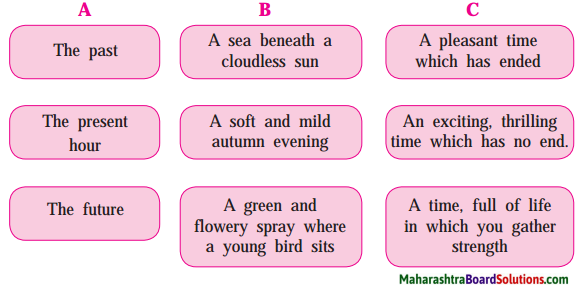
2. Link the items in the three columns properly.

Question 1.
Link the items in the three columns properly.
Maharashtra Board Class 7 English Solutions Chapter 1.1 Past, Present, Future 1
Answer:

ABC
The pastA soft and mild autumn eveningA pleasant time which has ended
The present hourA green and flowery spray where a young bird sitsA time, full of life in which you gather strength
The futureA sea beneath a cloudless sunAn exciting, thrilling time which has no end

Maharashtra Board Class 7 English Solutions Chapter 1.1 Past, Present, Future

3. Find the meaning of the following words.
thee, mournfully, spray, mighty

Question 1.
Find the meaning of the following words.
thee, mournfully, spray, mighty
Answer:

  • thee – you (archaic/old usage)
  • mournfully – sadly
  • spray – a flowering branch
  • might – physical strength

4. WrIte the adjectives that are used to describe the following.
evening, spray, sea

Question 1.
Write the adjectives that are used to describe the following.
Answer:

  • evening – soft, mild
  • spray – green, flowery
  • sea – mighty, glorious, dazzling

5. Write one line about each of the following with the help of the poem.

Question 1.
Wind in the autumn evening
Answer:
It sighs expressing sadness.

Question 2.
Young bird on the spray.
Answer:
Sits on the flowery branch gathering all its physical and mental strength to explore the blue sky.

Maharashtra Board Class 7 English Solutions Chapter 1.1 Past, Present, Future

Question 3.
The Sea.
Answer:
Vast is the sea beneath the cloudless sun and as it stretches endlessly, it displays might, glorious and dazzling beauty.

6. Language Study:
A simile Is an imaginative comparison of two different things which have something in common. A simile always includes the words ‘as’ or ‘like’. For example: as tall as a tree, as lovely as a flower A metaphor is an imaginative expression that refers to someone/something as another person/thing. It shows thai the person or thing has some quality of that other person or thing. The words ‘as’ or ‘like’ are not used in a metaphor. For example : He is a gem of a person. Time is money. Books are our friends. The clouds are white sheep.
There are three metaphors in the poem. Can you find them?
Answer:
The three metaphors are:
Question i.
‘What is the past like to thee?
An autumn evening soft and mild’
Answer:
Here the past is compared to an autumn evening.

Question ii.
’Tell me, what is the present hour?
A green and flowery spray.’
Answer:
Here the present is compared to a green and flowery spray.

Maharashtra Board Class 7 English Solutions Chapter 1.1 Past, Present, Future

Question iii.
’And what is the future, happy one?
A sea beneath a cloudless sun.’
Answer:
Here the present is compared to a sea beneath a cloudless sun.

Class 7 English Chapter 1.1 Past, Present, Future Additional Important Questions and Answers

Answer the following questions:

Question 1.
What is the central idea of the poem?
Answer:
The central idea of the poem is the child’s definition of different periods of time which is presented in the form of a dialogue between the poetess and the child.

Question 2.
What does the past stand for according to the child?
Answer:
According to the child, the past was a pleasant time but they are moments which cannot be revisited as they would never return back.

Maharashtra Board Class 7 English Solutions Chapter 1.1 Past, Present, Future

Question 3.
How does the child define the present time?
Answer:
For the child, the present is a time where he/she
prepares for the future which is unknown, but also exciting so it is the time to gather strength.

Question 4.
How is the present moment viewed with optimism by the child?
Answer:
The child compares the present time to a green and flowery branch on which a bird is all set to take off and explore the unlimited possibilities which awaits it.
This tells us that the present is something which is viewed with optimism by the child as he believes that once we gather strength, nothing is impossible.

Question 5.
How do you define time?
Answer:
According to me, time is the most precious gift we possess. It is up to us to make utmost use of it. We should plan and prioritise to make use of most of the time in hand.
How true is the Estonian proverb!
“Wasting time is robbing oneself”

Maharashtra Board Class 7 English Solutions Chapter 1.1 Past, Present, Future

Reading Skills and Poetic Device

Read the following extract and do the activities.

Simple Factual Questions:

Question 1.
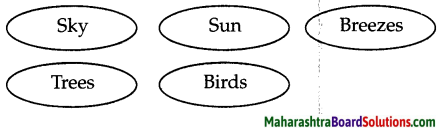
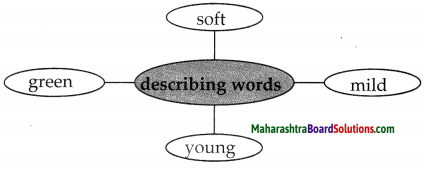
Fill in the blanks with any four describing words from the extract.
Answer:
Maharashtra Board Class 7 English Solutions Chapter 1.1 Past, Present, Future 2

Question 2.
Choose the correct alternative and complete the sentence:
For the child in the poem the past was
i. a pleasant time.
ii. an unpleasant experience.
Answer:
For the child in the poem the past was a pleasant time.

Complex Factual Questions:

Question 1.
What is the theme of the poem?
Answer:
The theme of the poem is about time and the child’s definition about the different periods of time.

Question 2.
How is this poem presented?
Answer:
This poem is presented as a dialogue between the poetess and a happy child.

Maharashtra Board Class 7 English Solutions Chapter 1.1 Past, Present, Future

Question 3.
What is the one characteristic of the past? Which is emphasised in the poem?
Answer:
One characteristic of the past which is emphasised in the poem is that we can never go back to it.

Question 4.
How should we make use of the present time?
Answer:
We should make use of the present time by using it to gather strength and courage to face the future.

Poetic Device:

Rewrite the Metaphors as Similes:

Question 1.
The past is an autumn evening soft and mild.
Answer:
The past is like an autumn evening soft and mild.

Question 2.
The present is a green and flowery spray.
Answer:
The present is like a green and flowery spray.

Question 3.
The future is a sea beneath a cloudless sun.
Answer:
The future is like a sea beneath a cloudless sun.

Question 4.
Give the rhyme scheme of the first stanza.
Answer:
The rhyme scheme of the first stanza is (a b a c).

Maharashtra Board Class 7 English Solutions Chapter 1.1 Past, Present, Future

Question 5.i.
Name and explain the figures of speech.
With a wind that sighs mournfully
Answer:
Personification – Wind is given human qualities,

Question ii.
What the past is like to thee?
‘An Autumn evening soft and mild.
Answer:
Simile – Direct comparison of past with an autumn evening.

Formative Assessment

Question 1.
Complete the following stanza to compose a poem on the topic:
The time gone by…….

Past, Present, Future Introduction:

Past, Present, Future written by Emily Bronte is a dialogue between the poetess and a happy child. They discuss what each period of time means to the child, a child with the ability to see beauty and optimism around it.

Past, Present, Future Summary in English

The poetess Emily Bronte begins the poem by asking a happy child what the past is like to him/ her. In response the child compares the past as an autumn evening which is soft and mild with a sad wind sighing in the background.

In response to the query about the present hour the child compares it to the pleasant green and flowery branch wherein a young bird gathers courage and power to mount and fly above the blue sky. In other words the child finds the present filled with hope, courage and aspiration to scale great heights; the time to gather strength.

On being asked about the future the child compares it with a sea under a cloudless sun, a sea which is mighty, glorious, dazzling and never ending. Through these words the child implies about the thrilling and never ending possibilities which awaits for him/her.

Maharashtra Board Class 7 English Solutions Chapter 1.1 Past, Present, Future

Glossary:

  1. autumn (n) – the season which follows summer when leaves fall from the trees
  2. mild (adj) – not severe or not very harsh
  3. mournfully (adv) – with sad feelings
  4. spray (n) – a flowering branch
  5. mount (n) – to ascend, get ready for take off
  6. glorious (adj) – marvellous
  7. dazzling (adj) – extremely bright
  8. stretching (v) – to be made longer
  9. infinity (n) – endlessness
  10. sighs (v) – to let out a long breath slowly to express sadness
  11. thee (pro) – you
  12. mighty (adj) – possessing great power or strength; very powerful
  13. beneath (prep) – under

Maharashtra Board Class 6 English Solutions Chapter 1.1 Don’t Give Up!

Balbharti Maharashtra State Board Class 6 English Solutions Chapter 1.1 Don’t Give Up! Notes, Textbook Exercise Important Questions and Answers.

Maharashtra State Board Class 6 English Solutions Chapter 1.1 Don’t Give Up!

Class 6 English Chapter 1.1 Don’t Give Up! Textbook Questions and Answers

1. Have you ever given up on something good? Share your story.

Question 1.
Have you ever given up on something good? Share your story.
Answer:
I was a very good cricketer. But on a couple of occasions, I got a feeling that my team failed due to my poor performance. I stopped pursuing the game, but today I regret my decision. I realised very late that: ‘A quitter never wins and a winner never quits’.

Maharashtra Board Class 6 English Solutions Chapter 1.1 Don’t Give Up!

2. Your friend fell down learning to ride a bicycle and now has given it up altogether. What do you think will be the poet’s advice?

Question 1.
Your friend fell down learning to ride a bicycle and now has given it up altogether. What do you think will be the poet’s advice?
Answer:
‘Rise each time you fall, never give up’ would be the advice the poet would give my friend. While riding a bicycle or acquiring any new skills, we are bound to fall or face disappointments. The poet would advise him to be patient and rise stronger and achieve what he has set out to achieve with determination and resilience.

Class 6 English Chapter 1.1 Don’t Give Up! Additional Important Questions and Answers

Answer the following questions.

Question 1.
What should we not do if we have tried but not won?
Answer:
If we have tried but not won, we should never stop for crying or feel dejected about the same.

Question 2.
Name two elements of nature mentioned in the poem which display determination and strength.
Answer:
‘Young birds’ and the ‘oak tree’.

Question 3.
Pick out two describing words used in the poem.
Answer:
Young, sturdy

Maharashtra Board Class 6 English Solutions Chapter 1.1 Don’t Give Up!

Question 4.
Circle the odd word. great good patient (blast)
Answer:
Blast, the rest are describing words.

Question 5.
Name any one personality from the pages of history who didn’t give up till he succeeded. Justify your answer.
Answer:
Our Father of the Nation, Mahatma Gandhi, did not give up or buckle under pressure in our struggle for independence. Finally, due to his relentless efforts and determination, we became free from the British rule and became an independent nation.

Question 6.
Explain the line: “If by easy work you beat, who the more will prize you?”
Answer:
The above lines from the poem ‘Don’t Give Up’ written by Phoebe Cary convey the message that if success comes to us easily it will not be considered as our achievement. Rising above challenges and failures, and emerging a winner is true success, according to the poet.

Maharashtra Board Class 6 English Solutions Chapter 1.1 Don’t Give Up!

Reading Skills, Poetic Device

Read the following stanza and answer the questions that follow.

Question 1.
Pre-reading activity:
Complete the web diagram with action words from the poem.
Answer:
Maharashtra Board Class 6 English Solutions Chapter 1.1 Don’t Give Up! 1

Question 2.
What is the central idea of the poem?
Answer:
The central idea of the poem is that we should never give up and be patient in the face of failures as we continue to keep trying. Failures are bound to occur. We should not lose heart and stop trying but gain victory from defeat with our willpower and our determination.

Question 3.
According to the poet, how has the great and good been done in this world?
Answer:
According to the poet, all that’s great and good is done just by trying, with patience and determination till we achieve our goal.

Question 4.
What happens to the young birds while they try to fly?
Answer:
The young birds fall as they try to fly.

Question 5.
Pick out lines to prove that the oak has survived many blows of stormy winds.
Answer:
‘She has risen again and grown, Loftier and prouder’.

Maharashtra Board Class 6 English Solutions Chapter 1.1 Don’t Give Up!

Question 6.
Pick out a contraction from the extract.
Answer:
You’ve (It stands for you have)

Question 7.
Do you agree with the maxim: ‘Try, try, till you succeed’?
Answer:
Yes. I agree with the maxim: ‘Try, try till you succeed’. We should remember that ‘A quitter never wins and winner never quits’.
People like Mahatma Gandhi, Sachin Tendulkar, A.P.J. Abdul Kalam and others have proved the above maxim to be right, with their life and work.
We should remember that disappointments and failures are bound to occur in our journey to succeed, but we should never lose heart. We should keep trying patiently till we accomplish our goal.

Poetic Device/Appreciation:

Question 1.
Find the meaning of the following expressions.
Answer:

  1. All that’s great and good: All the great achievements and accomplishments we see around us.
  2. Has known many a blast: The tree has survived many blows of stormy weather.
  3. The test that tries: A situation which is challenging, and which tests our endurance, our resilience and our willpower.

Poetic Devices:

Question 1.
Pick out two pairs of rhyming words from the poem.
Answer:

  • won – done
  • stronger – longer
  • known-grown

Maharashtra Board Class 6 English Solutions Chapter 1.1 Don’t Give Up!

Question 2.
Name the rhyme scheme used in the first four lines of the poem.
Answer:
abab

Question 3.
Name and explain the figure of speech used in the line.
‘That’s the test that tries you’.
Answer:
The figure of speech used in the above line is Alliteration as the sound of the alphabet’t’ is repeated for a better poetic effect.

Student’s Activity:

Question 1.
Find real life stories of some indians, abled and disabled, who have beaten all odds to become great achievers. You can also make a power point presentation with the help of your teacher.

Don’t Give Up! Summary in English

‘Don’t Give Up’ written by Phoebe Cary has a beautiful message for each one of us. The poet advises us never to be disheartened or dejected by failures. We are reminded that all the great and good things in this world is done just by patience and relentless efforts of the concerned people.

The poet gives the example of young birds who in their initial flights, fall but rise higher and stronger each time, thus proving that resilience and determination can help scale great heights.

The sturdy oak too has withstood challenges of time before rising up taller, stronger and prouder. Our achievements and our accomplishments may not be celebrated by others if it had come to us easily. But despite all odds, overcoming all challenges, rising above defeats when we achieve our goal and gain victory, that will be our true test, our real victory.

Introduction:

‘Don’t Give Up’ written by Phoebe Cary conveys the message that failures should not discourage us from achieving what we have set out to do. In a nutshell, the poet is conveying the message that we should never quit, however hard the situation and emerge a winner.

Maharashtra Board Class 6 English Solutions Chapter 1.1 Don’t Give Up!

Glossary:

  1. patient (adj) – a person with calm endurance
  2. sturdy (adj) – strong
  3. oak (n) – a deciduous forest tree
  4. victory (n) – success achieved
  5. test that tries (phr) – something done to discover/test our ability
  6. give up (phr) – lose heart and stop trying
  7. has known many a blast (phr) – has survived many blows of stormy winds
  8. loftier (adj) – taller and stronger
  9. you beat (phr) – you win (here)
  10. resilience (n) – able to recover quickly from difficult conditions.

Maharashtra Board Class 7 English Solutions Chapter 2.7 Great Scientists

Balbharti Maharashtra State Board Class 7 English Solutions Chapter 2.7 Great Scientists Notes, Textbook Exercise Important Questions and Answers.

Maharashtra State Board Class 7 English Solutions Chapter 2.7 Great Scientists

Class 7 English Chapter 2.7 Great Scientists Textbook Questions and Answers

1. Write what is implied in the following sentences.

Question a.
But few know his inspirational life story, which is all about courage and fighting against the odds.
(What does it tell you about Faraday’s life?)
Answer:
Faraday was bom into an extremely poor family. He had a speech defect which ended his formal education. He wanted to become a scientist. He came across a lot of difficulties and failures but through courage and determination, he achieved fame and name.

Question b.
Even then Davy did not have much hope for Faraday.
(What do the words ‘even then’ suggest?)
Answer:
Davy hired Faraday as his Secretary. Faraday worked relentlessly and became indespensible to Davy. ‘Even then’ suggests that even though Faraday did everything to prove himself, Davy did not believe that Faraday was capable of doing anything great.

Maharashtra Board Class 7 English Solutions Chapter 2.7 Great Scientists

Question c.
People started telling Davy that of all his discoveries, the best was Faraday himself.
(What does it suggest about Davy’s work?)
Answer:
The line suggests that the people felt that Davy had made discoveries which were good but Faraday’s discoveries stood out in comparison to Davy’s work.

2. Break the passage into convenient smaller sections. Give sub-headings or titles to each section.

Question 1.
Break the passage into convenient smaller sections. Give sub-headings or titles to each section.
Answer:

  • 1st para: Michael Faraday, an inspiration
  • 2nd para: Unhappy childhood
  • 3rd para: Reading, an obsession
  • 4th para: Twist in life
  • 5th para: Magic of Electricity
  • 6th para: Play of destiny
  • 7th para: Fruits of labour
  • 8th para: Revolution for mankind
  • 9th para: A scientist is born
  • 10th para: Challenges in life
  • 11th para: Magic of magnets
  • 12th para: A legend is born
  • 13th para: Failure – a stepping stone to success
  • 14th para: Obstacles – a challenge
  • 15th para: Luck smiles again
  • 16th para: Believe in yourself

Maharashtra Board Class 7 English Solutions Chapter 2.7 Great Scientists

3. List the different gadgets and instruments mentioned in the passage. Find more information about them (at least 3), using the Internet.

Question 1.
List the different gadgets and instruments mentioned in the passage. Find more information about them (at least 3), using the Internet.
Answer:
Gadgets and Instruments:
Fan, air conditioners, sewing machines, power tools, cars, trains, aeroplane engines, induction motors, telescopes, Bavarian glass, microscopes, electrical generators, light bulbs. Now you add to the list of gadgets and instruments. You can add your own too.

1. Microscope: It is an instrument used to see objects that are too small to be seen by the naked eye. Antonie Van Leeuwenhoek (1632-1723), a Dutch scientist, who in the late 17th century became the first man to make and use a real microscope. All microscopes came with a lens that can magnify 40 times the normal size.

2. Electrical generator: It was invented by Michael Faraday in 1831. It is a device that converts mechanical energy into electrical energy. Sources of mechanical energy include steam, turbines, gas turbines, water turbines, etc. It works on the principle of electromagnetic induction.

3. Fan: A fan is a machine used to create flow within a fluid, typically a gas such as air. The fan consists of a rotating arrangement of blades which act on the fluid. The fan was invented by Schuyler Skaats Wheeler in 1882.

Maharashtra Board Class 7 English Solutions Chapter 2.7 Great Scientists

4. Find out more about the following scientists with the help of the internet.
(a) Michael Faraday
(b) Humphry Davy
(c) Thomos Edison
(d) James Maxwell

Question 1.
Find out more about the following scientists with the help of the internet.
Answer:
(a) Michael Faraday: Michael Faraday (1791-1867) was an English (British) Scientist who contributed to the study of electromagnetism and electrochemistry. He was highly influenced by Humphry Davy and William Thomas Brande. He had notable awards to his credit, a few being Royal Medal, Copley Medal, Rumford Medal, Albert Medal.

(b) Humphry Davy: Humphry Davy (1778-1829) was a British scientist. It was he who found out that the inhalation of nitrous oxide produced surprising results, it came to be known as the laughing gas. He was awarded a medal by Napoleon and he identified the element iodine for the first time. He is remembered for his discoveries of sodium, potassium, calcium.

(c) Thomas Alva Edison: Thomas Alva Edison (1847-1931) an American inventor and businessman, has been described as America’s greatest inventor. He invented the photograph in 1877 because of which he came to be known as ‘The Wizard of Monto Park’. Thomas Edison had hearing problems during his childhood which persisted. The phonograph was the first machine that could record the sound of someone’s voice and play it back.

Edison recited the nursery rhyme ‘Mary had a little lamb’ and the phonograph played the words back to him. This was invented by a man whose hearing was poor and thought himself as deaf. It was Edison who designed a system of power plants. He has got 1093 patents to his credit. Many awards to his credit. Some of them are Franklin Medal, Albert Medal, Technical Grammy Award, etc.

(d) James Clerk Maxwell: James Clerk Maxwell (1831-1879) was a Scottish scientist in the field of mathematical physics His most notable work was to formulate the classical theory of electromagnetic radiation. He is known as the Father of Modern Physics. His other contributions included producing the first colour photograph taken in 1861 and many more. He earned an array of awards. To name a few, Rumford Medal, Keith and Hopkins prize, Adams prize, etc.

5. Language Study: Subject and predicate: A word or a phrase in a sentence that shows who or what does the action, is the subject. In the following sentences, the underlined part is the subject.
The baby is laughing.
The glass fell from the table.
The predicate Ls the part of a sentence that tells us something about the subject. The underlined parts of the following sentences show the predicates in them.
The baby is laughing.
The glass fell from the table.

Maharashtra Board Class 7 English Solutions Chapter 2.7 Great Scientists

Class 7 English Chapter 2.7 Great Scientists Additional Important Questions and Answers

Answer the following questions.

Question 1.
What is the meaning of:

Question i.
Reading became his obsession.
Answer:
He could think of nothing else but reading.

Maharashtra Board Class 7 English Solutions Chapter 2.7 Great Scientists

Question ii.
Electricity became a lifelong fascination.
Answer:
Electricity enchanted him throughout his life. Electricity was his passion throughout his life.

Question 2.
Why do you think Faraday’s friend gave him a free ticket to Davy’s programme?
Answer:
Faraday’s friend gave him a free ticket to Davy’s programme because he knew about Faraday’s fascination for electricity and also that he could not afford the ticket.

Question 3.
Give one example each to show that:

Question i.
Faraday was a good pupil.
Answer:
Davy tried to find out how an electric current could be applied continuously, but failed to figure it out. He asked Faraday to try his hand at it. Faraday set to work and within a few days, solved the problem.

Question ii.
Davy was not a good mentor.
Answer:
Davy was not happy at Faraday’s achievement but was jealous of Faraday.

Maharashtra Board Class 7 English Solutions Chapter 2.7 Great Scientists

Question 4.
An induction motor is a commonly used electrical machine. What examples of its uses are given here?
Answer:
The examples of electrical machine in which induction motor is commonly used are:

  1. fans
  2. air conditioning
  3. sewing machines
  4. photographs
  5. power tools
  6. cars
  7. trains
  8. aeroplane engines.

Question 5.
Why were Faraday’s drawings not accepted?
Answer:
Faraday’s drawing were without any mathematical equations as he did not know much about advanced mathematics and lacked formal education. Faraday’s drawing without mathematical equation could not be understood and so his drawings were not accepted.

Question 6.
Does it mean they were wrong?
Answer:
No, Faraday’s drawings were not wrong. It lacked mathematical equations because of which it could not be understood.

Maharashtra Board Class 7 English Solutions Chapter 2.7 Great Scientists

Reading Skills, Vocabulary and Grammar

Read the following passage and do the activities.

Simple Factual Questions:

Question 1.
State whether true or false.
i. Faraday’s Laws are about electricity.
ii. Faraday did not suffer speech defect as an adult.
Answer:
i. True
ii. True.

Complex Factual Questions:

Question 1.
Where was Michael Faraday bom?
Answer:
Michael Faraday was born into a poverty- stricken family in a dirty London suburb.

Question 2.
What came to an end when Michael Faraday was twelve?
Answer:
Michael Faraday’s formal education came to an end when he was twelve.

Question 3.
What were the odds against Faraday in his childhood?
Answer:
Faraday was born into an extremely poor family. He suffered from speech defect as a child. He could not even pronounce his own name. Other children laughed at him and even his teachers did not help him. when he was twelve, his mother was forced to pull him out from school. This put an end to his formal education.

Maharashtra Board Class 7 English Solutions Chapter 2.7 Great Scientists

Vocabulary:

Give the word meaning for.

Question 1.
‘mentor’
Answer:
A wise and trusted counsellor or teacher.

Question 2.
‘reverse engineer it’
Answer:
Taking apart an object and analyzing its components and workings in detail.

Word building.

Question i.
Give the noun form:
(a) inventor
(b) friend
(c) mysterious
(d) agree
Answer:
(a) invention
(b)friendship
(c) mystery
(d) agreement

Maharashtra Board Class 7 English Solutions Chapter 2.7 Great Scientists

Question ii.
Give the verb form:
(a) explosion
(b) comprehensive
(c) revolution
(d) success
(e) inspirational
(f) education
(g) modem
(h) courage
Answer:
(a) explode
(b) comprehend
(c) revolve
(d) succeed
(e) inspire
(f) educate
(g) modernize
(h) encourage

Question iii.
Give the adverb form:
(a) difficult
(b) secret
(c) random
(d) invisible
Answer:
(a) difficulty
(b) secretly
(c) randomly
(d) invisibly

Maharashtra Board Class 7 English Solutions Chapter 2.7 Great Scientists

Question iv.
Give the adjective form:
(a) communicate
(b) education
(c) experiment
(d) succeed
Answer:
(a) communicative
(b) educative
(c) experimental
(d) successful

Grammar:

Question 1.
Michael Faraday is regarded as one of the most distinguished scientists and inventors! (Add question tag)
Answer:
Michael Faraday is regarded as one of the most distinguished scientists and inventors isn’t it?

Personal Response:

Question 1.
Do you like reading inspirational stories?
Answer:
Yes, I do like reading inspirational stories. Reading inspirational stories motivates me to do something in life so that I too can gain fame and name while trying to make the world a better place to live in.

Read the following passage and do the activities.

Simple Factual Questions:

State whether the following statements are true or false.

Question i.
Faraday succeeded Davy as the head of the laboratory after Davy’s death.
Answer:
True

Maharashtra Board Class 7 English Solutions Chapter 2.7 Great Scientists

Question ii.
He was so engrossed in the lecture that he applaud with the rest of the crowd.
Answer:
False

Complex Factual Questions:

Question 1.
What was the subject of Davy’s lecture?
Answer:
The subject of Davy’s lecture was ‘The Mysterious force of Electric Fluid’.

Question 2.
What happens when an electric current is applied to a wire?
Answer:
When an electric current is applied to a wire, it causes that wire to behave like a magnet.

Question 3.
Why did Davy choose Faraday as his assistant?
Answer:
Davy was temporarily blinded by a chemical explosion which took place inside his lab. He needed an assistant with an excellent memory. He was reminded of Faraday and decided to make him his assistant.

Maharashtra Board Class 7 English Solutions Chapter 2.7 Great Scientists

Question 4.
Was Davy fair in his treatment of Faraday?
Answer:
No, Davy was unfair in his treatment of Faraday. He looked down upon Faraday because of his low social status and education. He told Faraday not to aspire for too.much and to stick to book-binding.

Question 5.
How did Faraday respond to that treatment?
Answer:
Davy’s treatment did not dishearten Faraday. Faraday was relentless. He worked day and night and learnt as much as he could and became indispensible to Davy.

Vocabulary:

Question 1.
Give the noun forms of the following.
i. comprehensive
ii. aspire
Answer:
i. comprehension
ii. aspiration.

Maharashtra Board Class 7 English Solutions Chapter 2.7 Great Scientists

Question 2.
Give the adverb form:
i. difficult
ii. invisible
Answer:
i. difficulty
ii. invisibly.

Grammar:

Question 1.
Destiny had a strange plan in store for him. (Use a question tag)
Answer:
Destiny had a strange plan in store for him, didn’t it?

Question 2.
Identify the subject and predicate from the following sentences.

  1. Davy became his role model.
  2. Destiny had a strange plan in store for him. Subject Predicate
SubjectPredicate
a. Davybecame his role model.
b. Destinyhad a strange plan in store for him.

Personal Response:

Question 1.
What actions and thoughts of Faraday show that he was inspired by Davy?
Answer:
The actions and thoughts of Faraday which shows he was inspired by Davy are as follows:

  1. He kept taking notes.
  2. He was so engrossed in the lecture that he forgot to applaud.
  3. He bound the notes he had taken down into a book, hoping to gift it to Davy.
  4. He was inspired to become a great scientist and Davy became his role model.
  5. Faraday thought that it would be wonderful if Davy became his mentor.

Read the following passage and do the activities.

Simple Factual Questions:

Say whether the following statements are true or false.

Question i.
Faraday succeeded Davy in 1829.
Answer:
True

Maharashtra Board Class 7 English Solutions Chapter 2.7 Great Scientists

Question ii.
In 1830 Faraday developed memory loss which continued for the rest of his life.
Answer:
False

Complex Factual Questions:

Question 1.
When did Faraday develop memory loss?
Answer:
Faraday developed memory loss in 1840.

Vocabulary:

Question 1.
Give a sub-heading or title to the extract.
Answer:
‘Faraday – a Legend is born’.

Maharashtra Board Class 7 English Solutions Chapter 2.7 Great Scientists

Grammar:

Question 1.
Find any 4 verbs from the above extract.
Answer:
died, succeeded, made, moved.

Question 2.
Find any 2 proper nouns from the above extract.
Answer:
Faraday and Davy.

Question 3.
Faraday was now a legend. (Add a question tag)
Answer:
Faraday was now a legend, wasn’t he?

Question 4.
Remember that piece of Bavarian glass Faraday had kept on his shelf? (State the Kind of sentence)
Answer:
Interrogative Sentence.

Maharashtra Board Class 7 English Solutions Chapter 2.7 Great Scientists

Personal Response:

Question 1.
Write the idea behind an electrical generator.
Answer:
Faraday noticed that if he moved a magnet, it would produce electrical current, converting motion into electricity. This is how the electrical generator came into being.

Question 2.
How far did Faraday convert the reminder of his first major failure into an instrument of great success?
Answer:
Faraday used the reminder of his first major failure, the Bavarian glass, to show the concept of polarisation. He thus converted it into an instrument of great success.

Question 3.
What complicated experiment did Faraday begin after he developed a memory loss?
Answer:
After developing a memory loss, Faraday began a complicated experiment to prove that light was closely related to electricity and magnetism.

Maharashtra Board Class 7 English Solutions Chapter 2.7 Great Scientists

Language Study

Do as directed.

Question 1.
Pick out the subject and predicate.

Question i.
A wealthy, educated physicist, he met.
Answer:
Subject: He
Predicate: met a wealthy, educated physicist

Question ii.
He was unable to explain.
Answer:
Subject: He
Predicate: was unable to explain

Question iii.
The induction motor spurred a revolution.
Answer:
Subject: The induction motor
Predicate: spurred a revolution

Maharashtra Board Class 7 English Solutions Chapter 2.7 Great Scientists

Question iv.
At thirteen, however, he stated working.
Answer:
Subject: He
Predicate: started working at thirteen

Question v.
One day he came across a book on electricity.
Answer:
Subject: He
Predicate: came across a book on electricity one day.

Question vi.
Other children laughed at him.
Answer:

  • Subject: Other children
  • Predicate: laughed at him
  • Remember: If there is no subject, put a ‘you’ in the subjects place.
  • e.g. Shut the door.
  • Subject: You Predicate: Shut the door

Maharashtra Board Class 7 English Solutions Chapter 2.7 Great Scientists

Question 2.
Other children laughed at him. (Add a question tag)
Answer:
Other children laughed at him. didn’t they?

Question 3.
He started reading it. (State the kind of verb – Transitive/ Intransitive)
Answer:
started – transitive verb reading – transitive verb

Question 4.
Other children laughed at him. (Begin with’He…’)
Answer:
He was laughed at by other children.

Question 5.
Faraday solved the problem. (End with ‘…Faraday’)
Answer:
The problem was solved by Faraday.

Maharashtra Board Class 7 English Solutions Chapter 2.7 Great Scientists

Question 6.
Faraday was now a legend. (Make it interrogative)
Answer:
Wasn’t Faraday now a legend?

Question 7.
James Maxwell was a wealthy, educated physicist. (Frame a ‘Wh’ question so as to get the underlined word as the answer)
Answer:
Who was James Maxwell?

Question 8.
Get me a glass of water. (Separate the subject and predicate)
Answer:
Subject-You
Predicate – Get me a glass of water.

Question 9.
He undertook it as challenges and opportunities. (Identify the part of speech of the underlined words)
Answer:
challenges, opportunities – nouns.
Writing Skills

Maharashtra Board Class 7 English Solutions Chapter 2.7 Great Scientists

Question 10.
Find out from the internet an inspiring story.
Answer:
Lionel Messi, bom in 1987, into a middle-class family who lived in Argentina. He grew up in a football-loving family. He developed a passion for football at an early age. At 5, he showed great skills at a club coached by his father. It was strange to see that he was way too short when compared to the boys of his age. Wherever he went he was the shortest of all.

This did not stop him from playing. At the age of 11, he was diagnosed with growth hormone deficiency and had to take medical assistance. Every night he had to take an injection in his legs for 3 years. His family could not afford the treatment for long. Though he was a great asset for his soccer club, they refused to pay his bills. Lady Luck smiled on him and his family. At 13, he got an offer from F. C. Barcelona that they would pay for his treatment if he played for them.

His family moved to Spain with no money or job, all in the hope that his treatment will make him big enough to play soccer. At 17, despite being injury prone he became the youngest player in F. C. Barcelona to score a goal and became a star performer. Today, Lionel Messi is known as one of the greatest footballers of all time. He has won the most Ballon d’Ors in the world. The FIFA Ballon d’Or (Golden Ball) also known as the European Footballer of the year, was an annual association football award presented to the world’s best male player.
Messi’s story teaches us ‘Never lose hope.
You never know what tomorrow might bring. Keep believing in yourself’.

Great Scientists Summary in English

The lesson ‘Great Scientists’ is an inspirational and motivational lesson. The story about Michael Faraday and his journey through all odds in life to become one of the most distinguished scientists and inventors of modern times is really an eye-opener to all those who give up easily when faced with a difficult situation. Perseverance and a will to win will surely reach you to the height of success is described in this story. This is a story all teens must-read.

Introduction:

The lesson ‘Great Scientists’ is taken from the introduction to ‘Reignited’ by A. P. J. Abdul Kalam and Srijan Pal Singh.

Maharashtra Board Class 7 English Solutions Chapter 2.7 Great Scientists

Glossary:

  1. persevering (v) – to continue doing something in a determined way despite having difficulties ‘
  2. deterred (v) – discouraged
  3. distinguished (adj) – renowned, famous
  4. inspirational (adj) – encouraged or making you feel you want to do something
  5. poverty-stricken (adj) – extremely poor
  6. defect (n) – lack or fault in a person
  7. formal education (n) – classroom based education given by trained teachers
  8. obsession (n) – the state of being preoccupied with someone or something
  9. fascination (n) – passion
  10. renowned (adj) – famous
  11. comprehensive (adj) – exhaustive
  12. dejected (adj) – sad
  13. relentless (adj) – persistent
  14. indispensable (adj) – that one cannot do without
  15. career (n) – profession, occupation
  16. revolution (n) – something that signifies a great change
  17. reverse (v) – to turn something inside out
  18. accomplish (v) – to finish successfully
  19. significant (n) – notable
  20. souvenir (n) – an item of sentimental value
  21. complicated (adj) – difficult
  22. randomly (adj) – without definite direction
  23. filings (n) – particles of something (metal)
  24. invisible (adj) – which cannot be seen
  25. galaxies (n) – milky way
  26. aliens (n) – any life form of extra terrestrial origin
  27. conviction (n) – belief
  28. epitomizes (v) – sums up
  29. mentor (n) – a wise and trusted counsellor or teacher
  30. reverse engineer it – taking apart an object and analyzing its components and working in detail
  31. dynamo – a machine for converting mechanical energy into electrical energy
  32. applaud – clap.
  33. perseverance – hard work.
  34. aspirations (n) – hopes of achieving something.
  35. binding (v) – to join separate pieces of paper and make a book.
  36. chemist (n) – a person who does chemical experiments or research.
  37. consistent (adj) – that does not change over a period of time.
  38. engrossed (v) – engaged with complete attention.
  39. hooked (adj) – being so excited about something that you are unable to leave.
  40. isolated (adj) – alone, separate.
  41. legend (n) – a person who is very famous and admired.
  42. novel (adj) – new and unusual.
  43. pursue (v) – to engage in an activity over a long period of time.

Maharashtra Board Class 7 English Solutions Chapter 3.2 Compere a Programme

Balbharti Maharashtra State Board Class 7 English Solutions Chapter 3.2 Compere a Programme Notes, Textbook Exercise Important Questions and Answers.

Maharashtra State Board Class 7 English Solutions Chapter 3.2 Compere a Programme

Class 7 English Chapter 3.2 Compere a Programme Textbook Questions and Answers

1. The items in the programme below have got mixed up.

Question 1.
Rearrange them in the proper order. Just add the number in the left-hand column.
Maharashtra Board Class 7 English Solutions Chapter 3.2 Compere a Programme 1
Answer:
Balanand Vidyalaya Art Festival Programme

  • Dignitaries arrive
  • Igniting the lamp
  • Welcome and introduction of guests
  • Appraisal of the Art Festival
  • Recital of ‘Taal Kacheri’
  • Koli Dance
  • The Boy Comes Home – A skit by Std. IX
  • Prize distribution
  • Chief Guest speaks
  • Vote of thanks

Maharashtra Board Class 7 English Solutions Chapter 3.2 Compere a Programme

2. Form groups of 5-8. This passage tells us only what the compère says.

Question 1.
Try to visualise and write what the other people on the dais must have said In their speeches (Write only the main points.)
1. The School Principal
2. The Chief Guest
3. The Art teacher who offered vote of thanks
Answer:
1. The compere thanks the Principal, Dr. Ajinkya Parakhi.
2. The compere thanks the Chief Guest- for releasing the book and formally inaugurating the art festival.

3. Choose the appropriate phrase to insert in the gaps to make the sentences meaningful. Use the appropriate form of the verb.

  1. to appraise
  2. to be relieved of
  3. to draw the curtain
  4. to escort
  5. to be likened to
  6. to have butterflies in ones stomach

Question 1.
Before we ………….., let us stand in attention for the National Anthem.
Answer:
draw the curtain

Maharashtra Board Class 7 English Solutions Chapter 3.2 Compere a Programme

Question 2.
I ………….. just as I was to receive my Report Card.
Answer:
had butterflies in my stomach

Question 3.
After I took the medicine, I ………….. ………….. of the pain.
Answer:
was relieved

Question 4.
Before we do the experiment in the laboratory, let me ………….. you all about it.
Answer:
appraise

Question 5.
The Minister ………….. by his personal bodyguards.
Answer:
was escorted

Question 6.
Sorrowful times ………….. to darkness.
Answer:
are likened.

Maharashtra Board Class 7 English Solutions Chapter 3.2 Compere a Programme

4. Prepare a formal invitation card for the Art Festival.

Question 1.
Prepare a formal invitation card for the Art Festival.
Answer:
Maharashtra Board Class 7 English Solutions Chapter 3.2 Compere a Programme 2

5. Prepare a News Report in brief on this Art Festival.

Question 1.
Prepare a News Report in brief on this Art Festival.
Answer:

Art Collage

– by a student reporter

Balanand Vidyalaya, June 26: Balanand Vidyalaya had organised a Art Festival on 25th June, 2017 in the school. Preparations for the same had begun days in advance. Their Art teacher, Ms. Shilpa Sanghani was confident as everything was well planned.

The function began with the lighting of the lamp followed by the welcome speech and introduction of guests. The Chief Guest for the function Shri Charudatta Diwan was welcomed by the Principal with a token of two volumes of Cherished Lives of Great Artists. The Convener of the Art Festival, Ms. Shilpa Sanghani welcomed the President of Balanand Academy, Mr. Avadhoot Pathak. The Principal briefed the audience about the Art Festival after which a special book comprising photographs of unique pieces of art contributed by students was released by the Honourable Chief Guest.

Art in its different forms were then presented by the students. This included Taal Kacheri, Koli dance and a light comedy play. The prize distribution thereafter came as a pat on their back. While Taal Kacheri won the first prize, the Koli dance won the second prize. The Chief Guest Shri Diwan’s speech on various aspects of Art and Culture left the audience with new insights.

In the end a vote of thanks was proposed by Ms. Shilpa Sanghani. When asked one of the parents remarked, “Such activities give an impetus to Art and Culture and encourage students to realize their potential.” The Art Festival was a grand success underlining the importance of co-curricular activities in school.

Maharashtra Board Class 7 English Solutions Chapter 3.2 Compere a Programme

6. Chalk out detailed programmes for the following occasions.

Question 1.
1. The Teacher’s Day programme in your school.
2. An exhibition of science projects arranged in your classroom.
3. A wedding anniversary/birthday celebration for your grandparents that you have arranged with your family.
Answer:
1. Teacher’s Day programme:

  1. Welcome Speech by the Head Boy
  2. Speech on importance of teachers by the Head Girl.
  3. Felicitation of teachers
  4. Address by the Principal
  5. Cultural Programme
  6. Games
  7. Vote of thanks
  8. National Anthem
  9. Snacks

2. Exhibition of Science projects in classroom:

  1. Welcome speech by monitor
  2. Ribbon cutting ceremony
  3. Speech by the Principal
  4. Judging of projects
  5. Prize distribution
  6. Vote of thanks
  7. National Anthem

3. Birthday celebration for grandfather:

  1. Welcome grandparents
  2. Powerpoint show on Grandfather
  3. Talks by relatives and friends
  4. Cake cutting
  5. Snacks and refreshment
  6. Vote of thanks

Maharashtra Board Class 7 English Solutions Chapter 3.2 Compere a Programme

7. Language Study.

Object: Direct and indirect – An object is a word, phrase
or clause that shows the person. thing etc. affected by the action of the verb.
The underlined words or phrases in the following sentences are objects.
1. Mother drives a scooter.
2. He gave me a pen.
There are two types of object: direct and indirect. The direct object Is directly affected by the action. For example, in sentence 2 above, ‘a pen’ Is direct object. An indirect object refers to the person or a thing to whom/for whom the action Is done. In sentence 2 above, ‘me’ is an indirect object.
Answer:

  1. He told the boys a story
  2. Amruta gave me a stern look.
  3. His friend gifted him a kettle
  4. A neighbour gave him a ticket
  5. Davy gave Faraday an impossible task.
  6. Harsh Serves them breakfast
  7. Shweta told me her problems.
Direct objectIndirect object
1. A storythe boys
2. a stern lookme
3. a kettlehim
4. a tickethim
5. an impossible taskFaraday
6. breakfastthem
7. her problemsme

Class 7 English Chapter 3.2 Compere a Programme Additional Important Questions and Answers

Answer the following questions.

Question 1.
Why does the compere request the audience to switch off their mobile phones?
Answer:
The compere requests the audience to switch off their mobile phones so that they can give undivided attention to the creative expressions of the youngsters and not get distracted by their other pre-occupations and ringtone.

Maharashtra Board Class 7 English Solutions Chapter 3.2 Compere a Programme

Question 2.
Why does she request them to be seated?
Answer:
She requests them to take their seats so that she can begin the programme.

Question 3.
At the beginning of the programme, who does the compere address by name?
Answer:
At the beginning of the programme, the compere addresses the Head Girl by her name.

Question 4.
Describe the book that is released.
Answer:
The book is a volume comprising photographs of all the beautiful and unique pieces of art contributed by the skillful students of Balanand Vidyalaya.

Question 5.
Who is taking part in the Taal Kacheri?
Answer:
Sahil of Std. X A, Varsha, Vivek, Zubin and Govind are taking part in the Taal Kacheri.

Question 6.
Guess/Find the meaning of Taal Kacheri.
Answer:
Taal Kacheri, literally translated means rhythmic instrumental musical session.

Maharashtra Board Class 7 English Solutions Chapter 3.2 Compere a Programme

Question 7.
Does the compere say the following at the beginning of the programme or after it has ended?
Answer:
1. What a wonderful presentation!
2. That was indeed a fantastic performance!
The compere says the given statements after the programme has ended.

Question 8.
What is meant by ‘butterflies in the stomach’?
Answer:
‘Butterflies in the stomach’ means to be anxious and nervous.

Question 9.
How is this vocal rendition different from music?
Answer:
Music is the pattern of sounds produced by people singing or playing instruments expressing ideas and emotions. Vocal refers to music human voice, which is singing.

Answer the following in one sentence.

Question 1.
Who was present at the Art Festival?
Answer:
Special invitees, guests, parents, teachers and students were present for the Art Festival.

Maharashtra Board Class 7 English Solutions Chapter 3.2 Compere a Programme

Question 2.
How did the programme begin?
Answer:
The programme began with the lighting of the lamp.

Question 3.
Explain ‘Atithi Devo Bhava!’
Answer:
‘Atithi Devo Bhava!’ means a guest is equivalent to God.

Question 4.
Which amazing quality of the lamp does the compere highlight?
Answer:
The compere highlights that the lamp not only dispels darkness but also leaves way for a thousand other lamps to be lit with its flames.

Question 5.
How are knowledge and lamp similar?
Answer:
Knowledge and lamp are similar in the fact that they both spread light. They only add and multiply.

Maharashtra Board Class 7 English Solutions Chapter 3.2 Compere a Programme

Question 6.
Who gave away the prizes to the prize winners?
Answer:
The Chief Guest, Shri Charudatta Diwan gave away the prizes to the prize winners.

Complex Factual Questions.

Question 1.
Which is the school in question?
Answer:
The school in question is Balanand Vidyalaya.

Question 2.
Why is the lamp said to be having an amazing quality?
Answer:
A lamp can dispel or remove darkness and also help to light a thousand other lamps from its flames. Hence it is said to possess an amazing quality.

Question 3.
What is the lamp compared to? Give reason.
Answer:
The lamp is compared to knowledge because when you share knowledge, it never reduces. One can share knowledge with thousands of people and enlighten their minds.

Maharashtra Board Class 7 English Solutions Chapter 3.2 Compere a Programme

Question 4.
What do we learn about Shri Charudatta Diwan from the compere’s speech?
Answer:
From the compere’s speech, we learn that Shri Charudatta Diwan is a renowned artist, a painter of international repute, proud recipient of many prestigious awards and President of Kala Ranjan Academy.

Question 5.
Who are the following?

  1. Mr. Avadhoot Pathak
  2. Ms. Shubhada Murarka
  3. Mr. Ajinkya Parakhi

Answer:

  1. President of Balanand Education Society
  2. Head Girl of Balanand Vidyalaya
  3. Principal of Balanand Vidhyalaya

Vocabulary.

Question 1.
Give one world for the following.

  1. the formal beginning of an event
  2. one who receives
  3. having high status
  4. noteworthy and important

Answer:

  1. inauguration
  2. recipient
  3. prestigious
  4. eminent

Maharashtra Board Class 7 English Solutions Chapter 3.2 Compere a Programme

Question 2.
Write the antonyms.

  1. gather
  2. auspicious
  3. request
  4. honour

Answer:

  1. disperse
  2. inauspicious
  3. order
  4. dishonour

Question 3.
Form a word chain of verbs.
e.g. announce – extend – deliver – request
1. Break, ……., ……., …….
2. Release, ……., ……., …….
3. Visit, ……., ……., …….
Answer:
1. keep, pick, kick
2. educate, end, dance
3. teach, hide, eliminate

Grammar.

Question 1.
Knowledge, too, spreads light (Rewrite the sentence removing ‘too’)
Answer:
Knowledge also spreads light.

Maharashtra Board Class 7 English Solutions Chapter 3.2 Compere a Programme

Question 2.
It is indeed a proud privilege. (Make exclamatory)
Answer:
What a proud privilege it is!

Personal Response.

Question 1.
Do you have a school song? What does it tell you?
Answer:
Yes, we have a school song by the name ‘The Temple of Learning’. It tells us about how a school acts as a sheltered cocoon for students preparing them to take a flight spreading their wings in the beautiful world outside.

Simple Factual Questions.

Complete the tree diagram on the basis of information given in the extract.
Maharashtra Board Class 7 English Solutions Chapter 3.2 Compere a Programme 3

Complex Factual Questions.

Question 1.
Who were the participants of Taal Kacheri? Which instruments did they play?
Answer:
Varsha played the Mridangam, Vivek was on Dholak, Zubin played the Tabla and Ghatam was played by Govind. Sahil gave the vocal reaction.

Maharashtra Board Class 7 English Solutions Chapter 3.2 Compere a Programme

Question 2.
What kind of play is ‘The Boy Comes Home’?
Answer:
‘The Boy Comes Home’ is a light comedy.

Question 3.
The Art Festival aims at encouraging the students and bringing out their creative best. How do we know this from the extract?
Answer:
The Art Festival included a Book release in which various students had contributed their creative work. Besides students also displayed their talent through music, dance and play. This tells us that the Art Festival aims to be a launching pad for students to reach greater heights in the field of Art and Culture.

Vocabulary.

Give antonyms.

  1. unique
  2. deliver
  3. pleasure
  4. introductory

Answer:

  1. ordinary, common
  2. collect
  3. sadness, pain
  4. conclusive

Maharashtra Board Class 7 English Solutions Chapter 3.2 Compere a Programme

Grammar.

Question 1.
What a wonderful presentation! (Make assertive)
Answer:
It was indeed a wonderful presentation.

Question 2.
Match the question tags.

‘A’‘B’
1.  Let’s enjoy the Taal kacheria. can’t you?
2. After this programme, you can take that pleasureb. should we?
c. shall we?

Answer:

‘A’‘B’
1.  Let’s enjoy the Taal kacheric. shall we?
2. After this programme, you can take that pleasurea. can’t you?

Personal Response.

Question 1.
Do you think such programmes inspire students? Give reasons for your answer.
Answer:
Yes, I think such programmes inspire students. Mark Twain has rightly remarked, “Thousands of geniuses live and die undiscovered – either by themselves or by others. Such programmes help students to get over their fears and also build up their confidence. It also serves as a platform to showcase their hidden talents. Appreciation in the form of award/trophy further encourages them to do even better.

Maharashtra Board Class 7 English Solutions Chapter 3.2 Compere a Programme

Language Study.

Make sentences using the phrases.

Question 1.
To have butterflies in one’s stomach
Answer:
When Ria was about to enter the interview room, she had butterflies in her stomach.

Question 2.
To lend a helping hand
Answer:
Many Mumbaikars lent a helping hand to those who had got stranded due to floods. OR She was always ready to lend a helping hand to the needy.

Do as directed.

Question 1.
Look at the amazing quality of this lamp. (Add a question tag)
Answer:
Look at the amazing quality of this lamp, won’t you?

Maharashtra Board Class 7 English Solutions Chapter 3.2 Compere a Programme

Question 2.
It only adds and multiplies. (Rewrite as negative)
Answer:
It does nothing but adds and multiplies.

Question 3.
Our Indian culture regards guests as gods. (Begin with ‘Guests are … ’)
Answer:
Guests are regarded as gods in our Indian culture.

Question 4.
We have gathered here for the inauguration of our School Art festival. (Frame a Wh- question)
Answer:
What have we gathered here for?

Question 5.
Different states display their unique identity through their respective culture. (Rewrite using Modal auxiliary of possibility)
Answer:
Different states might display their unique identity through their respective culture.

Find words with the given clues.

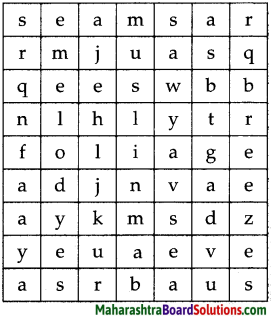
Maharashtra Board Class 7 English Solutions Chapter 3.2 Compere a Programme 4

Clues.

Question 1.

  1. to give information about
  2. famous and respected within a particular sphere
  3. a special right
  4. used for flooring
  5. Joyous

Answer:

  1. Appraise
  2. Eminent
  3. Privelege
  4. Tile
  5. Festive

Compere a Programme Summary in English

The lesson ‘Compere a Programme’ serves as a model for students to compere official, staged events in school or other places. The compere takes charge of the smooth delegation of the events of the itinerary and most importantly, in a planned sequence. Right from instructions to the audience, to inviting dignitaries for the introductory talk, prize distribution, speech etc., the compere takes the programme ahead in a lively manner. The students also need to notice the formal, polite language and vocabulary used during such events. Besides al’l this, the lesson has a message for all schools. It is to encourage our younger generation to preserve and pass on our rich traditions through such events.

Introduction:

A compere is an official presenter of a ceremony, a staged event or programme. Compering a programme holds great importance as the success of a programme largely depends on the way it is compered.

Maharashtra Board Class 7 English Solutions Chapter 3.2 Compere a Programme

Glossary:

  1. festive (adj) – joyous
  2. preoccupation (n) – being engrossed with something
  3. escort (v) (n) – to accompany someone somewhere
  4. dignitaries (n) – important persons due to their rank or office
  5. renown (n) – the condition of being known, fame
  6. hearty (adj) – loudly vigorous and cheerful
  7. auspicious (adj) – favourable, to be of good omen
  8. symbolic (adj) – representing something
  9. potential (n)- having the capacity to develop into something in the future
  10. distinguished (adj) – very successful
  11. eminent (adj) – noteworthy and important
  12. prestigious (adj) – having high status
  13. comprise (v) – consist of
  14. auditorium (n) – the part of a theatre in which the audience sits
  15. display (v) – show, exhibit
  16. vocal (adj) – a part of music that is sung
  17. rendition (n) – performance
  18. demonstration (n) – exhibition, presentation
  19. apprise (adj) – give information about
  20. anxiety (n)- uneasiness
  21. insights (n) – understanding of something
  22. immensely (adj) – extremely
  23. convener (n) – a person who calls people together for meetings of a committee

Maharashtra Board Class 7 English Solutions Chapter 2.6 Chasing the Sea Monster

Balbharti Maharashtra State Board Class 7 English Solutions Chapter 2.6 Chasing the Sea Monster Notes, Textbook Exercise Important Questions and Answers.

Maharashtra State Board Class 7 English Solutions Chapter 2.6 Chasing the Sea Monster

Class 7 English Chapter 2.6 Chasing the Sea Monster Textbook Questions and Answers

1. From the passage, find all the words and phrases used to describe the ‘monster’.

Question 1.
From the passage, find all the words and phrases used to describe the ‘monster’.
Answer:
Unearthly animal, fearsome creature, unknown creature, huge glowworm, infernal beast, motionless animal.

Maharashtra Board Class 7 English Solutions Chapter 2.6 Chasing the Sea Monster

2. Form groups of 4. Find all the references to time given In the passage. Then make a chart to show the events described in the passage along with the time when they occur.
Example:

  • All night long: The crew stayed on their feet
  • Near midnight: …………………………………….
  • At 12.53: …………………………………………….
  • ………….. : …………………………………………….
  • ………….. : …………………………………………….
  • ………….. : …………………………………………….
    (lise as many lines as you need.)

Question 1.
Form groups of 4. Find all the references to time given in the passage. Then make a chart to show the events described in the passage along with the time when they occur. Example:
Answer:

  • All night long: The crew stayed on their feet.
  • Near midnight: The sea animal disappeared.
  • At 12.53: A deafening hiss was heard.
  • Near 2.00 am: The core of a light appeared.
  • At 6.00 am: The animals electric glow disappeared.
  • At 7.00 am: A dense morning mist spread.
  • At 8.00 am: The mist disappeared, the sea animal was seen.
  • A few moments later: The frigate headed for the animal.
  • Three-quarters of an hour later: They were not getting closer to the animal.
  • Next one hour: The frigate gathered speed and so did the sea animal.
  • At 10.50 pm: The electric light reappeared.

Maharashtra Board Class 7 English Solutions Chapter 2.6 Chasing the Sea Monster

3. How long does the whole event described in this passage take? Work it out by reading the passage.

Question 1.
How long does the whole event described in this passage take? Work it out by reading the passage.

4. Observe the picture and the labels carefully. Then match the words and the meanings given in the foliwing table.

Question 1.
Observe the picture and the labels carefully. Then match the words and the meanings given in the foliwing table.
Maharashtra Board Class 7 English Solutions Chapter 2.6 Chasing the Sea Monster 1 Maharashtra Board Class 7 English Solutions Chapter 2.6 Chasing the Sea Monster 2
Answer:

WordsColumn ‘B’
1. Yard(e) A pole slung across a ship’s mast. A sail hangs from a yard
2. Mast(d) Tall, upright pole on a ship
3. Bow(b) The forward part of the main body of a ship
4. Deck(a) A floor, flat area built on a Ship
5. Forecastle(g) The part which is always at the front while the ship is sailing
6. Starboard(h) The right-hand side of a ship as one faces forward
7. Stern(f) The rearmost (back) part of a ship
8. Afterdeck(i) An open deck near the back
9. Fore(c) The forward part of a deck

Maharashtra Board Class 7 English Solutions Chapter 2.6 Chasing the Sea Monster

5. Form groups of 4-5. Read the following sentences aloud. Using your imagination and with the help of group discussion, write other situations in which the sentences can be used.

  • The outcome: disappointment and anger.
  • The hour of battle had sounded
  • What a chase!
  • This was our chance, ……..

Question 1.
Form groups of 4-5. Read the following sentences aloud. Using your imagination and with the help of group discussion, write other situations in which the sentences can be used.
Answer:

  • The outcome: disappointment and anger
  • The hour of battle had sounded
  • What a chase!
  • This was our chance
  • The outcome: happiness and relief
  • The outcome: fun and joy
  • The outcome: misery and poverty
  • The hour of decision had arrived
  • The sound of victory was heard
  • What a book!
  • What a personality!
  • What a movie!
  • This was our victory …
  • This was our last straw …
  • This was our fight…

6. Find the different units of measurement mentioned in the passage and get more information about them from the internet.

Question 1.
Find the different units of measurement mentioned in the passage and get more information about them from the internet.

7. Language Study: Transitive and intransitive verbs : We can classify verbs into two types – transitive and intransitive. Some verbs need on object/objects. When a verb has an object, it is a transitive verb. For example, ‘The boy kicked the football’. Here the verb ‘kick’ has ‘the football’ as its object. ‘Give’, ‘cook’, ‘buy’ are transitive verb.
Some verbs do not need any objects. When a verb does not have an object, it is an intransitive verb. For example, ‘We laughed loudly’. The verb ‘laugh’ in this sentence does not have an object. ‘Laugh’, ‘walk’, ‘dy’ are intransitive verbs.
Some verbs can be transitive or intransitive. For example,
‘Birds fly’. (intransitive) ‘Children fly kites’. (transitive)

Class 7 English Chapter 2.6 Chasing the Sea Monster Additional Important Questions and Answers

Answer the following questions.

Question 1.
Guess what order the commander must have given.
Answer:
The order given by the commander must have been to advance slowly towards the monster and to be ready to attack.

Maharashtra Board Class 7 English Solutions Chapter 2.6 Chasing the Sea Monster

Question 2.
Why did the Abraham Lincoln slow down? Answer: The Abraham Lincoln slowed down because
it was
unable to compete with the monster’s speed.

Question 3.
What is the monster compared to when it disappeared?
Answer:
The monster is compared to a huge glow-worm when it disappeared.

Question 4.
What did the deafening hiss resemble?
Answer:
The deafening hiss resembled the sound made by a water spout expelled with tremendous intensity.

Question 5.
Who would get $ 500?
Answer:
The man who would pierce the infernal beast would get $ 500.

Maharashtra Board Class 7 English Solutions Chapter 2.6 Chasing the Sea Monster

Question 6.
Describe the gunner who accepted the challenge.
Answer:
The gunner who accepted the challenge was a calm, cool, old and gray bearded man.

Question 7.
What was Ned Land doing?
Answer:
Ned Land was brandishing his dreadful weapon.

Reading Skills, Vocabulary and Grammar

Simple Factual Questions:

Fill in the blanks.

Question i.
Let’s wait for daylight and then we’ll play a …………… role.
Answer:
different

Question ii.
Unable to compete with the monster’s speed, our frigate, the ………………. slowed down.
Answer:
Abraham Lincoln

Complex Factual Questions:

Question 1.
What is the name of the narrator?
Answer:
The name of the narrator is Professor Aronnax.

Question 2.
What is the name of the ship?
Answer:
The name of the ship is ‘Abraham Lincoln’.

Maharashtra Board Class 7 English Solutions Chapter 2.6 Chasing the Sea Monster

Question 3.
At what time is this event taking place?
Answer:
This event is taking place sometime near midnight.

Vocabulary:

Question 1.
Give two words as phrases used to describe ‘monster’ in this passage.
Answer:
fear some creature, cetacean

Grammar:

Question 1.
The animal mimicked the frigate. (End with ’… the animal’)
Answer:
The frigate was mimicked by the animal.

Question 2.
No one thought of sleeping. (Make it affirmative)
Answer:
Everyone remained awake.

Question 3.
The animal mimicked the frigate. (Change into interrogative)
Answer:
Didn’t the animal mimic the frigate?

Maharashtra Board Class 7 English Solutions Chapter 2.6 Chasing the Sea Monster

Question 4.
Pick out the verb and state whether it is transitive or intransitive.

  1. Rama rang the bell loudly.
  2. The bell rang loudly.
  3. The baby sleeps on a bed.
  4. The birds fly in the air.
  5. Close the door.
  6. He wrote a letter to his friend.

Answer:

  1. rang – transitive verb
  2. rang – intransitive verb
  3. sleeps – intransitive verb
  4. fly – intransitive verb
  5. dose – transitive verb
  6. wrote – transitive verb

Read the following passage and do the activities.

Simple Factual Questions:

Write whether True or False.

Question i.
We stayed on the alert until night and were getting ready for action.
Answer:
False

Question ii.
The mist was very dense.
Answer:
True.

Complex Factual Questions:

Question 1.
What can the blunderbusses do?
Answer:
The blunderbusses can launch harpoons as far as a mile.

Maharashtra Board Class 7 English Solutions Chapter 2.6 Chasing the Sea Monster

Grammar:

Question 1.
Ned had a dreadful weapon. (Add a question tag)
Answer:
Ned had a dreadful weapon, didn’t he?

Question 2.
Pick out two abstract nouns from the extract.
Answer:
Disappointment, anger.

Personal Response:

Question 1.
Do you like travelling on sea? Why?
Answer:
No, I do not like travelling on sea. I don’t know how to swim and I am very scared of drowning.

Read the following passage and do the activities.

Fill in the blanks.

Question i.
………… stayed at his post, harpoon in hand.
Answer:
Ned Land

Maharashtra Board Class 7 English Solutions Chapter 2.6 Chasing the Sea Monster

Question ii.
The animal is faster than the ………….. .
Answer:
Abraham Lincoln

Complex Factual Questions:

Question 1.
Explain why the author uses the words “what a chase!”.
Answer:
It was an exciting chase no doubt. The author says that the excitement shook his very being. The animal was so smart, it let the frigate get a little closer to it and then picked up speed and kept its distance. The animal was playing tricks with the frigate.

Vocabulary:

Question 1.
Pick out the words from the extract that mean the following.
i. person who fires the cannon
ii. moved faster
Answer:
i. cannoneer
ii. gathered speed

Maharashtra Board Class 7 English Solutions Chapter 2.6 Chasing the Sea Monster

Question 2.
Give the meanings of the following.
i. harpooner
ii. mate
Answer:
i. person who handles the harpoon
ii. assistant

Grammar:

Question 1.
what a chase no i can’t describe the excitement that shook my very being (Punctuate)
Answer:
What a chase! No, It can’t describe the excitement that shook my very being.

Question 2.
The cannoneer fired a shot. (Add a question tag)
Answer:
The cannoneer fired a shot, didn’t he?

Language Study

Do as directed.

Question 1.
There was a mighty explosion. (Pick out the verb and state its kind)
Answer:
was – transitive verb.

Maharashtra Board Class 7 English Solutions Chapter 2.6 Chasing the Sea Monster

Question 2.
The monster seemed motionless. (Frame a ’Wh1 question so as to get the underlined words as the answer)
Answer:
Who seemed motionless?

Question 3.
Barely twenty feet separated him from the motionless animal. (Pick out the adjectives from the sentence)
Answer:
Twenty, motionless

Question 4.
The electric light suddenly went out. (Identify the part of speech of the underlined word)
Answer:
Suddenly – adverb

Question 5.
Pick out the verb and state whether it is transitive or intransitive.
Question i.
The hunter killed the wolf.
Answer:
killed – transitive verb

Maharashtra Board Class 7 English Solutions Chapter 2.6 Chasing the Sea Monster

Question ii.
Leena saw a monster.
Answer:
saw – transitive verb

Question iii.
Rains spoilt the picnic.
Answer:
spoilt – transitive verb

Question iv.
The baby cried loudly.
Answer:
cried – intransitive verb

Question v.
The bird flew away.
Answer:
flew – intransitive verb

Maharashtra Board Class 7 English Solutions Chapter 2.6 Chasing the Sea Monster

Writing Skills

Question 1.
Write an essay on ‘A Sea Journey’.
Answer:
A sea journey is something I had never experienced. I used to look at the majestic sea and wonder what it would be like to travel by sea. I got the chance of a life time to travel on a ship.

The ship was filled with people from different states of India. At the beginning all was wonderful, the people, the sea, the sky, the weather. I was told that the journey would take many on board. But as time passed, the journey which I felt would be a pleasant one, wasn’t all that pleasant. There was nothing to see except water, water and more water. The movement of the ship on the water gave me a nauseating/nauseous feeling.

I was praying and hoping for the journey to end. At last after about eight long hours we touched land. I was so happy to be on firm landing once again. The journey by sea was an experience I wouldn’t want to repeat. This journey by sea was my first and last one.

Chasing the Sea Monster Summary in English

The lesson ‘Chasing the Sea Monster’ is an extract from the novel ‘20,000 Leagues under the Sea’ written by Jules Verne. The story in this extract is about spotting a mysterious sea monster by the inmates on a warship. The story revolves round the relentless chase between the warship (frigate) and the sea monster.

The warship (frigate) named Abraham Lincoln captained by Commander Farragut along with Professor Pierre Aronnax, a French marine biologist and narrator of the story, a master harpoonist Ned Land and other crew members chase the sea monster and in the end Ned Land succeeds in hitting the sea monster. The collision between the frigate and the sea monster is so hideous that Commander Farragut, Professor Pierre Aronnax and Ned Land are hurled into the sea.

Introduction:

The lesson ‘Chasing The Sea Monster7 is a science fiction written by Jules Verne, a French writer. He is known as the ‘Father of Science Fiction’. This is a passage, from his novel ‘20,000 Leagues under the Sea’. He describes how people on a ship think of the submarine as an animal and try to chase and hunt it.

Maharashtra Board Class 7 English Solutions Chapter 2.6 Chasing the Sea Monster

Glossary:

  1. frigate (n) – small, speedy ship used in war
  2. unearthly (adj) – strange, not like those found on earth
  3. luminous (adj) – bright, full of light
  4. fearsome (adj) – scary, frightening
  5. crew (n) – people working on the ship
  6. cetaceans (n) – marine animals like a whale
  7. lurking (v) – hiding
  8. whaling gear (n) – equipment used to hunt whales
  9. mate (n) – assistant
  10. armour (n) – protective metal covering
  11. profound (adj) – deep
  12. astern to port (v) – towards the hinder part or stem; backward
  13. blunderbusses (n) – a short, large bored gun firing metal balls, slugs or nails
  14. duck guns (n) – large shot guns used for hunting ducks in large number
  15. harpoon (n) – a barbed spear attached to a rope and thrown or fired from a gun to hunt whales or large fish
  16. cannoneer (n) – an artillery man who uses cannon
  17. harpooner (n) – a person who uses harpoons especially to hunt whales
  18. enormous (adj) – huge
  19. hideous (adj) – dreadful, horrid
  20. mute (adj) – dumb; not having the power of speech
  21. alert (adj) – attentive
  22. informed (adj) – having information, based on information.
  23. target (n) – a person, object or place selected as the aim of attack
  24. weariness (n)- tiredness
  25. brandishing (v) – to move or swing back and forth particularly demonstrating skill
  26. collision (n)- clash

Maharashtra Board Class 7 English Solutions Chapter 2.5 Learn Yoga from Animals

Balbharti Maharashtra State Board Class 7 English Solutions Chapter 2.5 Learn Yoga from Animals Notes, Textbook Exercise Important Questions and Answers.

Maharashtra State Board Class 7 English Solutions Chapter 2.5 Learn Yoga from Animals

Class 7 English Chapter 2.5 Learn Yoga from Animals Textbook Questions and Answers

1. Complete the following diagrams.

Question A.
Benefits of yoga.
Maharashtra Board Class 7 English Solutions Chapter 2.5 Learn Yoga from Animals 1
Answer:
Maharashtra Board Class 7 English Solutions Chapter 2.5 Learn Yoga from Animals 2

Question B.
Precautions in Yoga Practice
Maharashtra Board Class 7 English Solutions Chapter 2.5 Learn Yoga from Animals 3
Answer:
Maharashtra Board Class 7 English Solutions Chapter 2.5 Learn Yoga from Animals 4

Question C.
What is yoga?
Maharashtra Board Class 7 English Solutions Chapter 2.5 Learn Yoga from Animals 5
Answer:
Maharashtra Board Class 7 English Solutions Chapter 2.5 Learn Yoga from Animals 6

2. Prepare charts for each one of the asanas described in the passage. Use the following points:

  • Name (in English, in your mother tongue)
  • Meaning in English
  • General information
  • Steps and pictures
  • Benefits

Maharashtra Board Class 7 English Solutions Chapter 2.5 Learn Yoga from Animals

3. List the names of body parts used in the passage.

Question 1.
List the names of body parts used in the passage.
Answer:
Body parts – navel, spine, shoulder, palm, face, elbow, wrist, chin, abdomen, chest, fingers, jaws, feet, legs, toes, eyes, mouth, head, back, tongue, lungs.
Now go through the passage and find out some more and add to the list.

4. List the adverbs/adverbial phrases used in the passage.

Question 1.
List the adverbs/adverbial phrases used in the passage.
Answer:

  1. to feel physically vibrant
  2. feel mentally sharp
  3. completely at ease
  4. breathe in deeply
  5. slowly raise
  6. come up slowly
  7. come down slowly
  8. inhale immediately
  9. positioned directly below
  10. smoothly arch the spine
  11. adds flexibility
  12. simultaneously arch your back

Maharashtra Board Class 7 English Solutions Chapter 2.5 Learn Yoga from Animals

5. Language Study: Conjunctions: A conjunction is a word which joins words or clauses. Look at the following sentences.
1. Sahil and Rohan go to school together.
2. Sahil is drawing a picture and Rahul is playing football.
In sentence 1, the conjunction ‘and’ joins two words.
In sentence 2, the conjunction ‘and’ joins two clauses.
The following are some more examples of conjunction.

  1. Do you like cricket or football?
  2. Your parents will be happy if you study well.
  3. She has not come to school because she is ill.
  4. We played well, but we lost the match.
  5. Tell him that we are going to the playground.
  6. When you are at home, you should help your mother in her work.

Interjections: An interjection is a word that expresses a sudden feeling or emotion. Interjections can express joy, grief, surprise, pain, approval etc.
Look at the following examples.

  1. Hurrah! We have won the game. (Joy)
  2. Ouch! That hurt. (Pain)
  3. Wow! What a nice picture! (Approval)

Question 1.
Underline the conjunctions in the following.
Answer:

  1. Do you like cricket or football?
  2. Your parents will be happy if you study well.
  3. She has not come to school because she is ill.
  4. We played well, but we lost the match.
  5. Tell him that we are going to the playground.
  6. When you are at home, you should help your mother in her work

Class 7 English Chapter 2.5 Learn Yoga from Animals Additional Important Questions and Answers

Answer the following questions.

Question 1.
Where was yoga perfected?
Answer:
Yoga was perfected in ancient India.

Question 2.
What does yoga involve?
Answer:
Yoga involves the mind, body and soul.

Maharashtra Board Class 7 English Solutions Chapter 2.5 Learn Yoga from Animals

Question 3.
What are the benefits of yoga?
Answer:
The benefits of yoga are attaining concentration, focus and improving flexibility, balance and strength.

Question 4.
How does one feel after doing yoga?
Answer:
One feels physically vibrant and mentally sharp after doing yoga.

Question 5.
Who enjoys the Lion pose asana? Why?
Answer:
Simhasana or Lion pose is favourite with young people. Young people love this asana because it requires very little effort.

Question 6.
What pose does the Bhujangasana resemble?
Answer:
The Bhujangasana is a pose that resembles the posture of a cobra with raised head.

Question 7.
What are the benefits of Bhujangasana? .
Answer:
Bhujangasana helps us to tone the muscles of our back, strengthens our spine and also benefits the chest and shoulders.

Maharashtra Board Class 7 English Solutions Chapter 2.5 Learn Yoga from Animals

Question 8.
When does the world celebrate International Yoga Day?
Answer:
The world celebrates International Yoga Day on June 21st every year, since the year 2015.

Question 9.
Why should Marjaryasana be a part of one’s morning yoga routine?
Answer:
Marjaryasana should be a part of one’s morning yoga routine because it gently stretches the muscles of the abdomen and the back as well as helps to get rid of any body pain.

Question 10.
How does Garudasana benefit the legs?
Answer:
Garudasana makes the leg muscles stronger and improves the flexibility of joints by loosening the joint muscles.

Question 11.
What are the advantages of practising the Ustrasana?
Answer:

  1. It strengthens the back.
  2. It boosts mood and energy.
  3. It opens the shoulders, chest and quadriceps.
  4. It helps in improving digestion.
  5. It adds flexibility and strength to the body.

Question 12.
Do you exercise regularly? What form of exercise do you practice ?
Answer:
I exercise regularly as my parents have always motivated me to stay fit. I go to the local swimming pool everyday to swim in the evening. Swimming is refreshing for the mind and helps to maintain the overall fitness of one’s body.

Maharashtra Board Class 7 English Solutions Chapter 2.5 Learn Yoga from Animals

Reading Skills, Vocabulary and Grammar

Read the following passage and do the activities.

Question 1.
Complete the web diagram.
Maharashtra Board Class 7 English Solutions Chapter 2.5 Learn Yoga from Animals 7

Question 2.
Fill in the blanks.
i. Yoga is a form of…….
ii. Yoga helps us to feel physically vibrant and mentally ……..
Answer:
i. biomimicry
ii. sharp

Question 3.
Match the columns.

Column ‘A’Column ‘B’
1. Phvsicallva. area
2. Ancient Indianb. sharp
3. Contemporaryc. discipline
4. Mentallyd. vibrant

Answer:

Column ‘A’Column ‘B’
1. Phvsicallvd. vibrant
2. Ancient Indianc. discipline
3. Contemporarya. area
4. Mentallyb. sharp

Maharashtra Board Class 7 English Solutions Chapter 2.5 Learn Yoga from Animals

Answer in just one word:

Question 1.
What solves human problems with solutions already present in the natural world?
Answer:
Biomimicry.

Complex Factual Questions:

Question 1.
What is biomimicry?
Answer:
Biomimicry is the science of solving human problems with solutions already present in the natural world.

Question 2.
In what way is yoga a form of biomimicry?
Answer:
Yoga is a form of biomimicry because they comprise typical asanas and poses wherein we emulate mountains, trees, fish, cats and many more animals.

Question 3.
Which problems in our day-to-day life can be solved through biomimicry?
Answer:
Problems such as stiffness and back pain can be easily solved through biomimicry.

Maharashtra Board Class 7 English Solutions Chapter 2.5 Learn Yoga from Animals

Question 4.
What does biomimicry mean in simple terms?
Answer:
In simple terms, ‘bio’ means ‘life’ and ‘mimicry’ means ’emulate’.

Vocabulary:

Question 1.
Give forms of the following words.
Answer:

NounVerbAdjective
NatureNaturaliseNatural
SimplicitySimplifySimple
SharpnessSharpenSharp

Question 2.
Pick out a word from the extract which means ‘in the same time period’.
Answer:
Contemporary.

Grammar:

Question 1.
Experts today are doing a wonderful job. (Begin with ’A wonderful job’)
Answer:
A wonderful job is being done by the experts today.

Maharashtra Board Class 7 English Solutions Chapter 2.5 Learn Yoga from Animals

Question 2.
This helps us to solve our problems. (Add a question tag)
Answer:
This helps us to solve our problems, doesn’t it?

Personal Response:

Question 1.
Do you think it is necessary to exercise? Why?
Answer:
Yes. I do think it is necessary to exercise. Exercising keeps us fit and healthy. We feel active and fresh to meet the challenges of the day. It also keeps us mentally positive.

Language Study

Do as directed.

Question 1.
The best time to practise is in the morning. (Begin with ‘The morning’)
Answer:
The morning is the best time to practise.

Question 2.
Practise in a clean, airy, well-lit room. (Pick out the adjectives in the sentence)
Answer:
Clean, airy, well-lit.

Maharashtra Board Class 7 English Solutions Chapter 2.5 Learn Yoga from Animals

Question 3.
Relax your muscles completely. (Identify the kind of sentence)
Answer:
Imperative sentence.

Question 4.
Kneel on the yoga mat and place your hands on the hips. (Pick out the nouns)
Answer:
Mat, hands, hips.

Fill in with conjunctions.

Question 1.
This is the picture ……….. I painted yesterday.
Answer:
that

Question 2.
We met the sailors ……….. ship was wrecked.
Answer:
whose

Maharashtra Board Class 7 English Solutions Chapter 2.5 Learn Yoga from Animals

Question 3.
This is the girl ………… has a melodious voice.
Answer:
who

Question 4.
………….. you study hard, you will succeed.
Answer:
If

Question 5.
………… it rains heavily, life comes to a standstill.
Answer:
When.

Question 6.
Give examples of interjections.
Answer:

  1. Oops! I broke it. (mistake)
  2. Hushi/Shh! The baby is sleeping, (silence)
  3. Hey! What are you doing here? (surprise)
  4. Oh! You wanted tea and not coffee, (realisation)
  5. Ugh! What a foul smell! (disgust)
  6. Phew! We nearly missed the fall! (relief)
  7. Whew! I cannot believe we have completed on time, (relief/amazement)

Fill in with interjections.

Question 1.
………… ! You stamped my foot.
Answer:
Ouch

Maharashtra Board Class 7 English Solutions Chapter 2.5 Learn Yoga from Animals

Question 2.
………… ! If only I had listened.
Answer:
Oh

Question 3.
………… ! It looks horrible.
Answer:
Ugh

Question 4.
………… ! I spilled the milk.
Answer:
Oops

Question 5.
………… ! What a pretty dress!
Answer:
Wow

Learn Yoga from Animals Summary in English

The lesson aptly shows us how we can do yoga by imitating animals and reptiles. It tells us the benefits and ways one can remain fit and healthy.

Introduction:

Yoga is a physical, mental and spiritual practice attributed mostly to India. Yoga day is celebrated annually on 21st June since 2015. The United Nations General Assembly has declared this day, 21st June to be an international day for yoga. The Indian Prime Minister, Narendra Modi, in his U.N. address suggested the date of 21st June as it is the longest day of the year in the Northern Hemisphere.

Maharashtra Board Class 7 English Solutions Chapter 2.5 Learn Yoga from Animals

Glossary:

  1. emulate (v) – imitate
  2. vibrant (adj) – full of energy and life
  3. posture (n) – the position in which you hold your body while sitting or standing
  4. tone (v) – here it means to make the muscles firm
  5. navel (n) – belly button
  6. assume (v) – here it means ‘take’
  7. splayed (v) – spread apart
  8. quadriceps (n) – the large muscle at the front of the thigh
  9. composite (adj) – mixture of
  10. integrated (adj) – composed and co-ordinated
  11. contemporary (adj) – same time period
  12. discipline (n) – a specific branch of knowledge or learning
  13. jerk (n) – sudden uncontrolled movement
  14. vertebra (n) – small bones which make up the backbone
  15. palette (n) – roof of your mouth
  16. exhaling (v) – to expel air
  17. inhale (v) – to draw in air
  18. routine (n) – a course of action
  19. flexibility (n) – quality of being flexible, suppleness
  20. calf (n) – the muscle in the back of the leg below the knee
  21. aches (n) – continuous dull pains in a part of one’s body
  22. arch (n) – a curve with the ends down and the middle up
  23. drawing (v) – to direct one’s attention to something
  24. explosion (n) – a sudden burst
  25. biomimicry – the science of solving human problems with solutions already present in the natural world.

Maharashtra Board Class 7 Science Solutions Chapter 16 Natural Resources

Balbharti Maharashtra State Board Class 7 Science Solutions Chapter 16 Natural Resources Notes, Textbook Exercise Important Questions and Answers.

Maharashtra State Board Class 7 Science Solutions Chapter 16 Natural Resources

Class 7 Science Chapter 16 Natural Resources Textbook Questions and Answers

1. Describe natural resources with reference to the following 3 types:

Question a.
Mineral resources
Answer:
Mineral wealth has an important place among natural resources. The rocks on the earth are mainly made of minerals. These minerals can be obtained by mining. Minerals that contain a high proportion of metals are ores, (i) Minerals are formed from the magma in the earth’s crust and the lava from the eruption of volcanoes when they cool and get transformed into crystals e.g. magnetite, mica, (ii) Minerals get transformed from one form into another due to large changes in temperature and pressure e.g. Diamond, Graphite, (iii) There are 3 types of minerals according to their properties Non-metal minerals: e.g. mica, sulphur, potash, diamond.

  • Metals minerals: e.g. Iron, gold, silver, tin, bauxite, platinum.
  • Energy minerals: e.g. Coal, mineral oil, natural gas, diamond, ruby, sapphire, jade are used as gems.

Some important minerals and ores are Iron ore, manganese, bauxite, copper and mica.

Maharashtra Board Class 7 Science Solutions Chapter 16 Natural Resources

Question b.
Forest resources
Answer:

  1. A forest is a natural habitat of plants, animals and microbes.
  2. Forest perform certain specific protective and productive functions.
  3. We get different types of wood and many medicinal plants from forests.
  4. Forest wealth includes fire wood, trees like teak, mahogany, neem, acacia, subabhul, fibers, paper, rubber, gum, aromatic substances.
  5. We get fragrant essential oils from lemon grass, vanilla, kewada, vetiver (khus) and eucalyptus.
  6. Sandalwood and oil of eucalyptus are used for making soaps, cosmetics and incense sticks.
  7. Also we get fruits, bulbs, roots, honey, sealing wax, dyes from forest.
  8. Many medicinal plants adulsa, bel, neem, periwinkle, cinnamon, are used for treatment of various diseases such as cough cold, malaria, diarrhoea, cancer, fever and cold.
  9. Wood is used as a source of energy for cooking purpose and for keeping warm.
  10. For making furniture, tool handles, matches, bridges, boats etc.
  11. Bamboos are used for matting, flooring, basket, ropes, rafts, cots etc.
  12. Bamboos, wood are used in the manufacture of rayon, yams, artificial silk-fibers.

Question c.
Ocean resources
Answer:

  1. Oceans occupy about 70% of a earth’s surface.
  2. Energy can be obtained on a large scale from oceans.
  3. Sea waves at high and low tide and ocean currents are being used for generation of power.
  4. There are billions of tons of minerals dissolved in ocean water.
  5. There are large reserves of tin, chromium, potassium, phosphates, copper, zinc, iron, lead, thorium, manganese, sulphur, uranium in the ocean and sea beds.
  6. Also we get many types of gems, conches, shells and pearls from the sea.
  7. There are large reserves of mineral oil and natural gas at the bottom of sea.
  8. We get fishes, dried shrimp, shells, fungi, shark, cod fish and sea cucumber from the ocean.

Maharashtra Board Class 7 Science Solutions Chapter 16 Natural Resources

2. Write answers to the following questions in your own words.

Question a.
What is meant by fossil fuel? What are their types?
Answer:

  1. Fossil fuels (such as coal or natural gas) are formed in the earth from dead plants and animals, due to high pressure from above and the heat from the earth’s interior.
  2. The dead plants, animals get transformed into fossil fuel.
  3. There are three types of fossil fuels which can be used for energy production, Coal, oil and natural gas.

a. Coal:

  1. Coal is a solid fossil fuel formed over millions of years by the decay of land vegetation,
  2. Coal is a store house of carbon. Coal is found in mines,
  3. It is like porous, hard, black rock.
  4. It is burnt to obtain heat energy.
  5. It is used as a fuel in thermal power plants and to run boilers and railway engines, for cooking and baking bricks.
  6. Anthracite is the coal of the highest grade.
  7. Producer gas and water gas are obtained from coal.

b. Mineral oil:

  1. Mineral oil is the liquid fuel formed by the decomposition of organic substances buried underground,
  2. The underground mineral oil is extracted through oil wells.
  3. Mineral oil is found mainly in oil sands, shale, sandstone and limestone at a depth of about 1000 to 3000 metres.
  4. Mineral oil is also known as petroleum or crude oil. It is greenish-brown in colour.
  5. Petroleum is a mixture of many compounds mainly of the hydrocarbon type.
  6. It also contains compounds of oxygen, nitrogen and sulphur.
  7. Petroleum is extracted through oil wells and refined by fractional distillation to separate other components,
  8. Aviation petrol, gasoline, diesel, kerosene, naphtha, lubricating oil, tar are all obtained from petroleum.
  9. They are used as fuel and for production of dyes, pesticides, perfumes and artificial fibres.

c. Natural gas:

  1. Natural gas is an important fossil fuel.
  2. It is lighter than air. It is found with petroleum in underground oil wells and in some places as natural gas alone.
  3. The main component of natural gas is methane (CH4), ethane (C2H6), propane (C3H8) and butane (C4H10) are present in small proportions.
  4. This gas is highly flammable.
  5. This fuel can be carried over long distance by means of a gas pipeline.
  6. In absence of pipeline, it is transformed under high pressure into compressed natural gas (CNG) and liquefied natural gas (LNG).

Maharashtra Board Class 7 Science Solutions Chapter 16 Natural Resources

Question b.
Make a list of the components we obtain from mineral oil.
Answer:

  1. Mineral oil is the liquid fuel. It is also known as petroleum or crude oil. Petroleum is refined by fractional distillation to separate other components.
  2. Aviation petrol, gasoline, diesel, kerosene, naphtha, lubricating oil, tar are the components we obtain from mineral oil.

Question c.
What do we get from forest?
Answer:

  1. A forest is a natural habitat of plants, animals and microbes. We get wood, firewood from trees like teak, mahogany, neem, subabhul.
  2. Also we get fibers, paper, rubber, gum and aromatic substances.
  3. We get many medicinal plants like Adulsa, Bel, Neem, Periwinkle, Cinnamon, Cinchona which are used for treatment of various diseases like cough, cold, diarrhea, fever, cancer, diarrhoea, nausea, malaria.
  4. We get fragrant essential oils from lemon grass, vanilla, kewada, khus, eucalyptus.
  5. In addition to this we get fruits, bulbs and roots, honey, sealing wax, catechu, dyes from forest.

Maharashtra Board Class 7 Science Solutions Chapter 16 Natural Resources

Question d.
What are the items included in ocean resources? What are their uses?
Answer:

  1. Tons of minerals are found in ocean water.
  2. They are tin, chromium, phosphates, copper, zinc, iron, lead, manganese, sulphur, uranium etc.
  3. We also get many types of gems, conches, shells and pearls from the sea.
  4. Mineral oil and natural gas is found at the bottom of sea.

Bio-resources in oceans

  • Fishes – like pomfret, seer fish as also shrimps
  • prawns – they are sources of proteins and vitamins, therefore, mainly used as sea food
  • Dried shrimp, Bombay duck powder – used as poultry feed and is a good manure.
  • Shells – used for preparation of medicines, ornaments and decorative articles.
  • Fungi – used for the production of antibiotics.
  • shark and cod fish – used for producing edible oil rich in Vitamins A, D and E.
  • Sea cucumbers – used as medicine for treating cancer and tumours.

Mineral resources from oceans

  • Thorium – used in the production of atomic energy.
  • Magnesium – used in the flash bulb of a camera.
  • Potassium – the main ingredient in production of soap, glass, fertilizer.
  • Sodium – used in the production of cloth and paper.
  • Sulphate – used in making artificial silk.

Maharashtra Board Class 7 Science Solutions Chapter 16 Natural Resources

Question e.
Why should we prevent the wastage of fuels used for vehicles?
Answer:

  1. Vehicles are powered by gasoline or diesel petrol.
  2. Nowadays compressed natural gas (CNG) is also used.
  3. Aviation petrol, gasoline, diesel, we get from petroleum after fractional distillation.
  4. Petroleum is a non-renewable source of energy.
  5. It is getting depleted day by day and the demand for fuel has increased greatly due to the rapidly growing population.
  6. But the reserves of petroleum (fossil fuel) are limited.
  7. It is becoming difficult to meet the increased demand. So we should prevent the wastage of fuel.

Question f.
Why is the diversity of plants and animals in the forests declining?
Answer:

  1. The major causes of biodiversity decline are land use changes, pollution, changes in atmosphere, CO2 concentration, changes in the nitrogen cycle, acid rain, climate alteration and introduction of exotic species.
  2. All this is due to population growth.
  3. This is the main cause of the loss of biodiversity. More of wood for fuel is been used, more land is required for food production, livestock grazing etc.
  4. Rainforest land is converted to industrial and residential usage, so natural habitat of birds, animals is destroyed.
  5. Due to population growth most of wild land is converted to crop land. So no space for animals to live, their natural habitat is destroyed.

Maharashtra Board Class 7 Science Solutions Chapter 16 Natural Resources

Question g.
Write the names of five minerals and the useful substances obtained from them.
Answer:
Some important minerals and ores are:

  1. Iron ore: It is used for making farming implements, rails of railway tracks etc.
  2. Manganese: Compounds of manganese are used in the preparation of medicines and for giving a pink tinge to glass. Manganese is also used in electrical appliances.
  3. Bauxite: It contains 55% Aluminium. Therefore, it is used mainly in aeroplanes, transport vehicles and to make electric wire.
  4. Copper: It is used to make electric wires as well as in radios, telephones, vehicles, and for making kitchen utensils and statues.
  5. Mica: Mica has many uses such as in ayurvedic medicines, dyes, electric machines and equipment, wireless communication equipment, etc.

Maharashtra Board Class 7 Science Solutions Chapter 16 Natural Resources

Question h.
Name the two important stages in the process of obtaining metals from ores.
Answer:
The two important stages in the process of obtaining metals from ores are extraction and purification.

3. What steps are taken for protection and conservation of natural resources?

Question a
What steps are taken for protection and conservation of natural resources?
Answer:

  1. Protection and conservation of natural resources is necessary to protect the natural world. (CNRM) Community Natural Resource Management has been promoted in recent years for biological conservation.
  2. The World Conservation Union has been formed. It is the world’s leading authority and democratic platform in conservation and sustainability.
  3. Young trees should not be cut. More and more trees need to be grown.
  4. The stringent restrictions/ laws/ Regulations regarding use of forests should be strictly followed. Awareness is being created through Mass media.

Maharashtra Board Class 7 Science Solutions Chapter 16 Natural Resources

4. Complete the Flow Chart:

Question a.
Maharashtra Board Class 7 Science Solutions Chapter 16 Natural Resources 1

Answer:
Maharashtra Board Class 7 Science Solutions Chapter 16 Natural Resources 2

5. How does the economic condition of a nation depend on its natural resources?

Question a.
How does the economic condition of a nation depend on its natural resources?
Answer:
1. Natural resources are a necessary condition for economic growth.
2. Three circles enclosed within one another shows how both economy and society are subsets of our planetary ecological system.
Maharashtra Board Class 7 Science Solutions Chapter 16 Natural Resources 3
3. Natural resource economics deals with the supply, demand and allocation of the Earth’s natural resources.
4. Economic growth is an increase in the value of goods and services produced in an economy.
5. The natural resources of a country depend on the climatic and environmental conditions.
6. Countries having plenty of natural resources enjoy good growth than countries with small amount of natural resources.
7. A country having skilled and educated work force with rich natural resources takes the economy on the growth path, because skilled and educated people can efficiently utilize or exploit natural resources, e.g. Saudi Arabia: their economic growth is high, because they have oil wells.
8. All countries import fuel or oil from them so Saudi Arabia is economically a rich country.

6. Which medicinal plants will you grow on your school premises and near your house? Why?

Question a.
Which medicinal plants will you grow on your school premises and near your house? Why?
Answer:
1. I will grow tulsi, neem, lemon grass, bel, adulsa, periwinkle, cinnamon, ashwagandha, shatavari, amla, hirda, behda.
2. These plants are used for treatment of various diseases.

  • Tulsi → for cough and cold.
  • Amla, hirda, behda → Help in digestion of food or any stomach related problems.
  • Adulsa → for cough and cold
  • Bel → for Diarrhoea
  • Neem → Fever and cold
  • Periwinkle → Cancer
  • Cinnamon → Diarrhoea, nausea.
  • Cinchona → Malaria.
  • Ashwagandha → It can reduce blood sugar levels. It can reduce stress and anxiety, may reduce symptom of depression.
  • Shatavari → has been used for centuries in Ayurveda to support the reproductive system.
  • Amla → Excellent source of vitamin C. Amla juice is best tonic to keep you younger for long.
  • Hirda → This fruit is commonly called Haritaki. It is used for treating arthritis, dental problems like caries, bleeding gums.
  • Behda →(Beleric) is a rejuvenative and laxative, proves beneficial for hair, throat and eyes.
  • Tulsi → Tulsi has germicidal, fungicidal, anti-bacterial anti-biotic properties, cures fever. Treats diabetes, protects the heart. Tulsi has anti-oxidant component Eugenol which keeps one’s blood pressure under control.

Maharashtra Board Class 7 Science Solutions Chapter 16 Natural Resources

Project:

Question 1.
Collect conches and shells of various shapes and colours and make a decorative article.

Question 2.
Collect information about the mines of various minerals.

Class 7 Science Chapter 16 Natural Resources Important Questions and Answers

Fill in the blanks:

Question 1.
………….. is the major raw material for biogas.
Answer:
cow dung

Question 2.
Atomic energy is obtained by using ores of ………….. .
Answer:
Uranium

Maharashtra Board Class 7 Science Solutions Chapter 16 Natural Resources

Question 3.
Biogas generation is mainly based on the principle of ………….. .
Answer:
Fermentation

Question 4.
Floods can be prevented by ………….. .
Answer:
Afforestation

Question 5.
Coal, petroleum, natural gas are ………….. resources.
Answer:
non-renewable

Question 6.
The total percent of land of world under forest cover is ………….. .
Answer:
30%

Question 7.
A naturally occurring substance ………….. .
Answer:
minerals

Question 8.
Minerals that contain a high proportion of metal are called ………….. .
Answer:
ore

Maharashtra Board Class 7 Science Solutions Chapter 16 Natural Resources

Question 9.
Coal, mineral oil and natural gas are ………….. .
Answer:
fossil fuel

Question 10.
Deposits of common salt are also found in the earth. This salt is called ………….. .
Answer:
rock salt

Question 11.
………….. is the liquid fuel formed by the decomposition of organic substances.
Answer:
Mineral oil

Question 12.
The underground mineral oil is extracted through ………….. .
Answer:
oil wells

Maharashtra Board Class 7 Science Solutions Chapter 16 Natural Resources

Question 13.
Mineral oil is also known as ………….. or ………….. .
Answer:
petroleum, crude oil

Question 14.
………….. are the preserved remains of dead organisms in rock.
Answer:
Fossil

Question 15.
Coal can be formed from ………….. .
Answer:
Fossils

Question 16.
Impurities of sand and soil in ore are called ………….. .
Answer:
Gangue

Question 17.
Coal mainly contains ………….. .
Answer:
carbon

Maharashtra Board Class 7 Science Solutions Chapter 16 Natural Resources

Question 18.
Petroleum is formed from ………….. .
Answer:
organisms in sea

Question 19.
Separation of various fractions of petroleum is called ………….. .
Answer:
Refining

Question 20.
We can obtain minerals from rocks by ………….. .
Answer:
mining

Question 21.
………….. is the most important ore of aluminium
Answer:
Bauxite

Question 22.
………….. is the coal of the highest grade.
Answer:
Anthracite

Maharashtra Board Class 7 Science Solutions Chapter 16 Natural Resources

Question 23.
Metals are obtained from their ore by ………….. and ………….. .
Answer:
extraction, purification

Question 24.
………….. is the largest oil and gas research and production company in India.
Answer:
ONGC

Question 25.
Natural gas is transformed under high pressure into ………….. and ………….. .
Answer:
LNG and CNG

Maharashtra Board Class 7 Science Solutions Chapter 16 Natural Resources

Question 26.
The main component of Natural gas is ………….. .
Answer:
Methane

Question 27.
………….. and ………….. are used for adding fragrance in soaps and incense sticks.
Answer:
Sandalwood and oil of Encalyptus

Question 28.
………….. is a natural herbal medicine for cough and cold.
Answer:
Adulsa

Maharashtra Board Class 7 Science Solutions Chapter 16 Natural Resources

Answer the following:

Question 1.
What is meant by natural resources?
Answer:

  1. We get many substances from nature.
  2. They satisfy a variety of our daily needs. Soil, stones, minerals, air, water, plants and animals on the earth are all various kinds of natural resources.

Question 2.
What are alternative fuels?
Answer:
Hydrogen, biofuels, methanol or wood alcohol, ethanol or green alcohol are some of the alternative fuels.

Maharashtra Board Class 7 Science Solutions Chapter 16 Natural Resources

Question 3.
What is meant by fuels?
Answer:

  1. Fuel is a substance that is used in day-to-day life and burned to generate energy.
  2. Fuels such as coal, wood, oil, gas provide energy when burned.
  3. Fuels are found in solid, liquid or gaseous state.

Question 4.
Which natural resources do we use as fuels?
Answer:
We use coal, mineral oil and natural gas as fuels.

Question 5.
What is meant by forests?
Answer:
An extensive area of land covered by a variety of plants is called a forest. A forest is a natural habitat of plants, animals and microbes.

Maharashtra Board Class 7 Science Solutions Chapter 16 Natural Resources

Question 6.
What are the uses of forests?
OR
Write short note on forest and its uses.
Answer:

  1. A forest is a natural habitat of plants, animals and microbes.
  2. Forest help improve and maintain the quality of environment.
  3. Forest helps in prevention of soil-erosion, help to control floods, protects wild life, maintains the balance of atmospheric gases.
  4. We get many medicinal plants from forest which help in treatment of various diseases.
  5. Examples Adulsa, Bel, Neem, periwinkle, amla tulsi, cinnamon.
  6. We also get wood, firewood from trees like teak, mahogani, neem, sababhul. Wood is useful for making furniture, farming implements, in construction work.
  7. Forest wealth includes fibres, paper, rubber, gum and aromatic substances.
  8. We get fragrant essential oils from lemon grass, vanilla, kewada and eucalyptus.
  9. They are used for making soaps, cosmetics and incense sticks. We get various fruits, bulbs, roots, honey, sealing wax, catechu dyes etc. from forest.

Question 7.
Are minerals to be found in seas and on the seabed as they are found inside the earth?
Answer:
Yes, there are very large reserves of tin chromium, phosphates, copper, zinc, iron, lead, manganese, sulphur, uranium etc. in the ocean and seabed.

Maharashtra Board Class 7 Science Solutions Chapter 16 Natural Resources

Question 8.
How is mineral oil formed?
Answer:
Maharashtra Board Class 7 Science Solutions Chapter 16 Natural Resources 4

  1. Mineral oil is the liquid fuel formed by the decomposition of organic substances buried underground.
  2. Millions of years ago, bodies of dead sea organisms sank to the bottom of the sea.
  3. Layers of soil and sand collected on them.
  4. Due to high pressure and temperature the remains of the dead organisms were transformed into mineral oil.
  5. The underground mineral oil is extracted through oil wells.

Maharashtra Board Class 7 Science Solutions Chapter 16 Natural Resources

Use your brain power!

Question 1.
Why are all minerals not ores?
Answer:

  1. Minerals that contain a high proportion of metal are called ores.
  2. Majority of the metals occur in the form of compounds called ores.
  3. But all minerals are not ores.
  4. Few metals like gold, silver, copper, platinum and bismuth occur in free state in nature. So all minerals are not ores.

Question 2.
What is meant by metal mineral and non¬metal mineral?
Answer:

  1. Metal-minerals contain metallic elements in their chemical formula. So they are called metal-minerals, for example, iron, copper, gold, silver etc.
  2. They contain metal in raw form.
  3. Non-metallic minerals do not contain metal elements in their inorganic chemical formula Example, Clay, Diamond, Dolomite, Gypsum, Mica, Quartz.

Maharashtra Board Class 7 Science Solutions Chapter 16 Natural Resources

Question 3.
Why is mineral oil called ‘liquid gold’?
Answer:
Because of its high price and value and its economic need, the mineral oil is called liquid gold. It’s reserve is less and demand is more.

Question 4.
Why is coal called black gold?
Answer:

  1. Coal is a storehouse of carbon. Coal is used as a fuel, in thermal power plants as well as to run boilers and railway engines.
  2. It is used as a fuel for cooking and for baking bricks in kilns on a large scale.
  3. The gaseous fuels, producer gas and water gas are obtained from coal.
  4. Coal as an energy resource, contributes greatly to industrial development.
  5. As coal is black in colour and worth a lot of money just like gold, it is called black gold.

Question 5.
What would happen if underground mineral resources are exhausted?
Answer:

  1. Coal, petroleum and other mineral are all non-renewable sources of energy.
  2. The reserve is less and demand is more. They would get exhausted one day.
  3. If such a situation occurs, we will not get electricity.
  4. All our household and industries depend on electricity.
  5. Transportation and household items, and food items would become very costly.
  6. The survival of human life will be ver\ difficult.

Maharashtra Board Class 7 Science Solutions Chapter 16 Natural Resources

Question 6.
Why is natural gas an eco-friendly fuel?
Answer:

  1. Natural gas is an important source of energy which is eco-friendly because of its low carbon dioxide emission.
  2. When burned it produces 45% less CO2 than coal, 30% less than oil, and about 15% less than wood.
  3. It does not produce carbon monoxide, sulphur dioxide or airborne particles, all of which are harmful to human and animal health.
  4. It is referred as the clean energy source and is fuel for the present century as it does not ‘ pollute the atmosphere or contribute to global warming.

Question 7.
What useful things will we have to do without if rubber is no longer available?
Answer:

  1. Rubber has played a largely hidden role in global environment history for more than 150 years.
  2. In industries, rubber is needed to connect and protect all moving parts of machines.
  3. Native people used rubber for rubber boots.
  4. Household uses rubber in everything viz dish washing gloves, toys, jar seals, tyres in vehicles.
  5. Welcome mat at the door, Boots, raincoats, mattress cushions, earplugs, hot water bottles, surgical tubing and gloves, in labs, birth control device.
  6. In schools rubber bands, erasers, mouse pads, key board, rolling chair wheels. Head phone pads, rubber stamps are useful items used in schools and offices.

Maharashtra Board Class 7 Science Solutions Chapter 16 Natural Resources

Question 8.
What are the adverse effects of clearing of forest or cutting down trees?
Answer:

  1. Clearing of forest is also called Deforestation.
  2. Removal or cutting down of trees has resulted in damage to habitat, biodiversity loss and aridity.
  3. If has adverse impacts on concentration of atmospheric carbon dioxide. (Trees use up carbon dioxide from the atmosphere for the process of photosynthesis.)
  4. Deforestation is a main contributor to global warming. Major cause of enhanced greenhouse effect. Deforestation cause carbon dioxide to linger in the atmosphere.
  5. Deforestation reduced the content of water in the soil and ground water and atmospheric moisture, because trees extract ground water through the roots and release it into the atmosphere.
  6. When a part of forest is removed the trees no longer transpire this water, resulting in much drier climate.
  7. Due to deforestation soil erosion and flooding, landslide problems occur.
  8. Deforestation results in decline in biodiversity, on a natural global scale is known to cause the extinction of many species.
  9. Forest is habitat for wild life, and many medicinal plants. If forests are removed it will affect wild life and also we will not get medicinal plants.

Find out:

Question 1.
How did the various ages of the prehistoric period get their names on the basis of the uses of metals.
Answer:
1. The three-age system in history archaeology, and physical anthropology is a methodological concept adopted during the 19th century by which artifacts and events of late prehistory and early history could be ordered into a recognizable chronology.

2. Initially developed by C. J. Thomson, director of the Royal Museum of Nordic Antiquities, Copenhagen – as a means to classify the museum’s collection according to whether the artifacts were made of stone, bronze or iron.

3. Depending-upon the use of stone, bronze, iron, that period was known as stone age, bronze age, and iron age, respectively.

Maharashtra Board Class 7 Science Solutions Chapter 16 Natural Resources

Answer the following:

Question 1.
Write down the difference between Metal minerals and Non-metallic minerals.
Answer:

Metal mineralsNon-metallic minerals
1. Metal minerals contain metal in raw form.1. Non-metallic minerals do not contain metal.
2. These metals are generally associated with igenous rocks.2. These metals are generally associated with sedimentary rocks.
3. They are usually hard and have shine of their own.3. They are not usually hard, have no shine of their own.
4. e.g. Iron, copper tine, bauxite.4. e.g. Salt, coal, mica, clay.

Question 2.
Write down the different types of coal.
Answer:
Peat, lignite (brown coal), bituminous coal and anthracite are various types of coal.
Anthracite is the coal of the highest grade.

Maharashtra Board Class 7 Science Solutions Chapter 16 Natural Resources

Question 3.
Write down the characteristics of Compressed Natural Gas.
Answer:
Characteristics of CNG:

  1. Catches fire easily.
  2. No solid waste remains after combustion.
  3. Carbon dioxide and water are formed in small quantities.
  4. Other pollutants are not produced.
  5. Can be transported easily.
  6. Combustion can be controlled easily.

Observe the pictures and answer the question.

Maharashtra Board Class 7 Science Solutions Chapter 16 Natural Resources 5

Question a.
What is the process shown in the given picture?
Answer:
The process shown is formation of mineral oil and natural gas.

Maharashtra Board Class 7 Science Solutions Chapter 16 Natural Resources

Question b.
Explain the process.
Answer:

  1. Mineral oil is the liquid fuel formed by the decomposition of organic substances buried underground.
  2. Millions of years ago, bodies of dead sea organisms sank to the bottom of the sea.
  3. Layers of soil and sand collected on them.
  4. Due to high pressure and temperature the remains of the dead organisms were transformed into mineral oil.
  5. The underground mineral oil is extracted through oil wells.

Question c.
What are the gaseous substances formed in the above process?
Answer:
Natural gas is also formed along with mineral oil. It contains methane, ethane, propane and butane gases.

Maharashtra Board Class 7 Science Solutions Chapter 16 Natural Resources

Question d.
When the products of the process is refined, what other components are produced?
Answer:
When mineral oil is refined by fractional distillation products produced are petrol, diesel, kerosene, naphtha lubricating oil, tar, etc.

Maharashtra Board Class 7 Science Solutions Chapter 20 In the World of Stars

Balbharti Maharashtra State Board Class 7 Science Solutions Chapter 20 In the World of Stars Notes, Textbook Exercise Important Questions and Answers.

Maharashtra State Board Class 7 Science Solutions Chapter 20 In the World of Stars

Class 7 Science Chapter 20 In the World of Stars Textbook Questions and Answers

1. Write the proper words in the blanks:
(meridian, horizon, twelve, nine, apparent, celestial, ecliptic)

Question a.
When seen from a great distance, the sky seems to be touching the ground along a circle. This circle is called the …………… .
Answer:
horizon

Question b.
The ………….. is used while defining the zodiac sign.
Answer:
meridian

Maharashtra Board Class 7 Science Solutions Chapter 20 In the World of Stars

Question c.
Classified according to seasons, one season will have ………… nakshatras.
Answer:
nine

Question d.
The rising of the sun in the east and its setting in the west is the ………. motion of the sun.
Answer:
apparent

2. A star rises at 8 pm. tonight. At what time will it rise after a month? Why?

Question a.
A star rises at 8 pm. tonight. At what time will it rise after a month? Why?
Answer:

  1. Str s rise and set 4 minutes earlier every day. If star rises at 8 pm tonight, it will rise at 7:56 pm tomorrow.
  2. It will rise at 5:24 pm after a month.
  3. The sun and the moon are seen to move from the west to the east against the background of stars.
  4. The sun moves through one degree every day and the moon through 12 to 13 degrees.
  5. This happens due to the motion of the earth around the sun and the moon around the earth which affects the duration of the stars and shortens its time period.

Maharashtra Board Class 7 Science Solutions Chapter 20 In the World of Stars

3. What is meant by “The sun enters a nakshatra?” It is said that in the rainy season the sun enters the mrug nakshatra. What does it mean?

Question a.
What is meant by “The sun enters a nakshatra?” It is said that in the rainy season the sun enters the mrug nakshatra. What does it mean?
Answer:

  1. When we look at the sun we see not only the sun but also constellation behind the sun.
  2. The constellation cannot be seen in bright sunlight but it is indeed present behind the sun.
  3. As the earth changes its position, a different constellation or zodiac sign or raashi appears behind the sun.
  4. This is what we express when we say that the sun enters a particular zodiac sign or raashi.
  5. In rainy season due to the perceived motion of the sun, it enters mrug nakshatra and that is how it is expressed.

Maharashtra Board Class 7 Science Solutions Chapter 20 In the World of Stars

4. Answer the following questions. 

Question a.
What is a constellation?
Answer:
A group of stars occupying a small portion of the celestial sphere is called a constellation.

Question b.
What points should be considered before a skywatch?
Answer:

  1. The place for sky watching should be away from the city and as far as possible it should be new moon night.
  2. Binoculars or telescopes should be used for skywatch.
  3. Identifying the pole star in the north makes the skywatch easier. Hence the pole star should be used as a reference point for skywatch.
  4. As the stars in the west set early, sky watching should begin with stars in the west.
  5. (a) On a sky map, the north and south are towards the bottom and top of the map respectively, (b) This is because the sky map is to be held overhead in such a way that the direction we face is at the bottom side.

Question c.
It is wrong to say that the planets, stars and nakshatras affect human life. Why?
Answer:

  1. Science has proved that the constituents of the solar system e.g. planets, satellites and comets as also distant stars and constellations do not have any influence on human life.
  2. Man has stepped on the moon and will conquer Mars in the 21st century.
  3. Hence, in this age of science, holding on to beliefs which have been proved wrong by numerous scientific tests, is an unnecessary waste of time and energy.
  4. It is important to consider all these issues with a scientific frame of mind.

Maharashtra Board Class 7 Science Solutions Chapter 20 In the World of Stars

5. Write a paragraph on the birth and life cycle of stars using following figure.

Question a.
Write a paragraph on the birth and life cycle of stars using following figure.
Maharashtra Board Class 7 Science Solutions Chapter 20 In the World of Stars 1Answer:
Stars are born out of nebulae. Nebulae are clouds made up mainly of hydrogen gas and dust particles which are attracted towards one another by the force of gravity, (i) As a result of pressure, the internal temperature increases and the cloud becomes dense and spherical in shape, (ii) From the diagram, life cycle of two stars can be explained.

(a) Ordinary star: (i) The ordinary star forms a Red giant star at the later stage of its evolution when it runs out of hydrogen gas at its core. (ii) At the end stage of its life it forms a white dwarf. Stars like the sun become white dwarf when its nuclear fuel is totally exhausted. (iii) It is 1% in diameter of its original size.

(b) Massive Star: (i) Massive star forms Red super giant star at the end of its life cycle, (ii) They are also called super red giants with a relatively cool outer surface, (iii) Supernova is the explosive death of the star of the end of its life with the brightness of 100 million stars in a short amount of time, (iv) A neutron star is the dense core of the supernova. (v) It is the smallest and the densest star known to exist with a 10 km radius, (vi) Neutron stars sometimes end as a black hole, (vii) Black holes are not seen from telescopes and are identified by their intense gravitational pull where even light cannot escape.

Maharashtra Board Class 7 Science Solutions Chapter 20 In the World of Stars

Project:

Question a.
Visit a planetarium, collect information and present it in your school on Science day.

Class 7 Science Chapter 20 In the World of Stars Important Questions and Answers

Fill in the blanks:

Question 1.
The different group of stars is known as ………….. .
Answer:
constellation

Question 2.
The pole star is ………….. .
Answer:
North star

Question 3.
The moon moves around the earth in about ………….. days.
Answer:
27 days

Maharashtra Board Class 7 Science Solutions Chapter 20 In the World of Stars

Question 4.
The celestial objects are ………….. .
Answer:
The stars

Question 5.
The star that lies close to the aris of rotation of the earth ………….. .
Answer:
Pole star

Question 6.
The definite elliptical path in which a planet revolves around the sun is called ………….. .
Answer:
Orbit

Question 7.
Our earth as well as the sun belongs to the galaxy which has a spiral shape called ………….. .
Answer:
milky way

Question 8.
………….. is made up of five bright stars which are distributed along the figure of the letter M.
Answer:
Sharmishtha

Maharashtra Board Class 7 Science Solutions Chapter 20 In the World of Stars

Question 9.
The pole star has ……………. on one-side and ……………… on the other.
Answer:
Saptarashi, Sharmishtha

Question 10.
The continuous empty space between the planets and stars in the sky is called ………….. .
Answer:
space

Name the following:

Question 1.
The brightest star in the nakshatra.
Answer:
Yogatara

Question 2.
The stars forming a group that has a recognizable shape.
Answer:
Constellation

Question 3.
Millions of stars and planets present in the sky forming a group.
Answer:
Milky way

Maharashtra Board Class 7 Science Solutions Chapter 20 In the World of Stars

Question 4.
The clouds from which stars are bom.
Answer:
Nebulae

Question 5.
Saptarshi constellation in English.
Answer:
Great Bear

Question 6.
The festival celebrated when sun enters Makar raashi.
Answer:
Makara Sankranti

Maharashtra Board Class 7 Science Solutions Chapter 20 In the World of Stars

Question 7.
The brightest star in the Orion constellation.
Answer:
Sirius

State whether the following statements are True or False. Correct the false statements:

Question 1.
The hydrogen gas and dust particles in a nebulae are attracted towards each other by gravity.
Answer:
True

Question 2.
While standing on the ground, the celestial sphere exactly below our feet is called the Zenith.
Answer:
False. The point on the celestial sphere exactly above our head is called the Zenith

Question 3.
The circle describing the apparent motion of the earth around the sun is called the ecliptic.
Answer:
False. Ecliptic is the apparent motion of sun around the earth

Maharashtra Board Class 7 Science Solutions Chapter 20 In the World of Stars

Question 4.
Vrushchik or Scorpio is a constellation with 10 to 12 stars.
Answer:
True

Question 5.
Makar raashi is also known as Capricorn zodiac sign.
Answer:
True

Match the following:

Question a.

Column ‘A’Column ‘B’
1. Saptarshia. Divided into 88 constellations
2. Mmg nakshatra.b. In the north direction.
3. Orionc. Group of 7 bright stars (kite)
4. Vrushchikd. Made up of 5 bright stars (M)
5. Pole stare. 7 – 8 stars.
6. Celestial spheref. Group of 10 -12 stars

Answer:

Column ‘A’Column ‘B’
1. Saptarshic. Group of 7 bright stars (kite)
2. Mmg nakshatra.d. Made up of 5 bright stars (M)
3. Orione. 7 – 8 stars.
4. Vrushchika. Divided into 88 constellations
5. Pole starb. In the north direction.
6. Celestial spheref. Group of 10 -12 stars

Maharashtra Board Class 7 Science Solutions Chapter 20 In the World of Stars

Answer in one line:

Question 1.
In which direction stars move in the sky except polar star?
Answer:
When seen from earth, stars appear to move from east to west.

Question 2.
What activity does IUCAA carry out?
Answer:
IUCAA which is present in PUNE carries out fundamental research in astronomy.

Question 3.
Define constellation.
Answer: A group of stars occupying a small portion of the celestial sphere is called constellation.

Maharashtra Board Class 7 Science Solutions Chapter 20 In the World of Stars

Question 4.
What is Nakshatra?
Answer:
The moon completes one revolution around the earth in approximately 27 days. The portion celestial sphere traversed by the moon in one day is called a nakshatra.

Question 5.
What is yogatara?
Answer:
A nakshatra is known from the brightest star that it contains. The brightest star is called the yogatara.

Define the following:

Question 1.
Horizon
Answer:
Far away the sky seems to be touching the ground. The line at which they meet is caled horizon.

Question 2.
Zenith
Answer:
While standing on the ground the point on the celestial sphere exactly above our head is called the Zenith.

Question 3.
Nadir
Answer:
While standing on the ground the point on the celestial sphere exactly below our feet is called the nadir.

Maharashtra Board Class 7 Science Solutions Chapter 20 In the World of Stars

Question 4.
Meridian
Answer:
The great circle which passes through both the celestial poles and the observer’s zenith and nadir is called a meridian.

Question 5.
Celestial equator
Answer:
If we uniformly expand earth’s equator in all directions indefinitely, it will penetrate the celestial sphere along a circle. This circle is known as the celestial equator.

Question 6.
Ecliptic
Answer:
The earth moves around the sun, but seen from the earth, the sun appears to move along a circle on the celestial sphere. This circle describing the apparent motion of the sun around the ‘ earth is called the ecliptic.

Maharashtra Board Class 7 Science Solutions Chapter 20 In the World of Stars

Question 7.
Zodiac sign
Answer:
The ecliptic has been imagined to divided into 12 equal parts. Each part subtends 30 degrees at the centre of the celestial sphere. Each of these part is called a raashi or zodiac sign.

Question 8.
Mrug Nakshatra or Orion
Answer:
It has 7 – 8 starts of which four are at the comers of quadrangle. The line passing through the three middle stars of the constellation when extended meets a very bright star. This is Vyadh or Sirius.

Maharashtra Board Class 7 Science Solutions Chapter 20 In the World of Stars

Find out.

Answer the following questions

Question 1.
Using a Marathi calendar collect information about 27 nakshatras, and divide them into the following 3 categories.
(i) Monsoon Nakshatra (ii) Winter Nakshatra (iii) Summer Nakshatra
Answer:
27 nakshtras: Ashwini, Bharani, Krittika, Rohini, Mrigashirasha, Ardra, Punarvasu, Pushya, Ashlesha, Magha, PurvaPhalguni, Uttara Phalguni, Hasta, Chitra, Swati, Vishakha, Anuradha, Jyeshtha, Mula, Purva Ashadha, Uttara Ashadha, Abhijit, Shravana, Dhanishtha, Shatabhishta, Purva Bhadrapada, Uttara Bhadrapada, Revati

Monsoon SeasonWinter SeasonSummer Season
Ashwini KartheKrittikaVisakha
Bharani KartheRohiniAnuradha
Arudra KartheMrigashirshaJyeshtha
PushyaniArdraMula
AsleshaPunarvasuPurva Ashadha
MaghaUttara Ashadha
Purva PhalguniShravana
Uttara Phalguni
Chitra
Hasta

Maharashtra Board Class 7 Science Solutions Chapter 20 In the World of Stars

Question 2.
Write the difference between constellations Saptarshi and Mrug nakshatra
Answer:

SaptarshiMrug nakshatra
1. It is made up of five bright stars which are distributed along the figure of the letter M.1. It is made up of seven-eight stars of which four are at the corners of a quadrangle.
2. Pole star is the brightest star in the constellation.2. Sirius is the brigh jveutr0n Starie constellation.
3. It is on the meridian in the month of April and in the month of October.3. It is on the meridian in the month of February and in June.
4. In English, it is called the Great Bear.4. In English, it is called Orion.

Maharashtra Board Class 7 Science Solutions Chapter 20 In the World of Stars

Question 3.
Draw sketches to show the relative position of prominent stars in Ursa major and Orion.
Answer:
a. Ursa major (Saptarshi) appears like a big dipper, (or kite shape). There are 3 bright stars in the handle and 4 stars in the bowl of the dipper. (It can be seen during April in summer in northern skies).
Maharashtra Board Class 7 Science Solutions Chapter 20 In the World of Stars 2

(b) Orion appears like a hunter. Three bright stars appear in the belt, 5 bright stars are arranged in the form of a quadrilateral. (It is visible during winter in the northern skies)

Maharashtra Board Class 7 Science Solutions Chapter 20 In the World of Stars 3

Question 4.
Why is the pole star important for sky watch?
Answer:

  1. Identifying the Pole Star in the north makes the sky watch easier. Hence the pole star should be used as a reference point for skywatch.
  2. If we extend one side of the quadrangle of Saptarshi, it reaches the Pole Star.
    The pole star has Saptarshi on one side and Sharmishtha on the other.

Maharashtra Board Class 7 Science Solutions Chapter 20 In the World of Stars

Question 5.
What is the relation between the pole star and the constellations Saptarshi and Sharmishtha?
Answer:

  1. Saptarshi is in the shape of a quandrangle with a tail made up 3 stars resembling a kite. If we extend one side of the quadrangle it reaches the Pole Star.
  2. The constellations of Saptarshi and Sharmishtha are useful in locating the Pole Star.
  3. The perpendicular bisector of the line joining the third and fourth stars in Sharmishtha goes towards the Pole star.
  4. The Pole Star has Saptarshi on one side and Sharmishtha on the other.

Maharashtra Board Class 7 Science Solutions Chapter 20 In the World of Stars 4

Use your brain power!

Answer the following questions.

Question 1.
One Zodiac Sign = ………….. nakshatras
Answer:
27 nakshatras. Each nakshatra is divided in padas or charan. Every nakshatra has 4 padas. These 27 nakshatra complete the entire circle of 360° of zodiac.
The zodiac comprises of 360°.

Maharashtra Board Class 7 Science Solutions Chapter 20 In the World of Stars

Question 2.
Is sun the only star present in our Milky Way galaxy?
Answer:
No. Sun is not the only star present in the Milky Way. There are lakhs of stars in the Milky Way, some of them being many times bigger than our sun. Some of them have their own planetary systems with a great diversity in colour, brightness, as well as size.

Maharashtra Board Class 6 Science Solutions Chapter 5 Substances in the Surroundings – Their States and Properties

Balbharti Maharashtra State Board Class 6 Science Solutions Chapter 5 Substances in the Surroundings – Their States and Properties Notes, Textbook Exercise Important Questions and Answers.

Maharashtra State Board Class 6 Science Solutions Chapter 5 Substances in the Surroundings – Their States and Properties

Class 6 Science Chapter 5 Substances in the Surroundings – Their States and Properties Textbook Questions and Answers

1. In the paragraph below write ‘solid’, ‘liquid’ or ‘gas’ in each of the blank (brackets) depending on the substance referred to just before.

Question a.
On a bright sunny day, Riya and Gargi are playing with a ball (…..) in the park. Gargi feels thirsty. So, Riya brings tender coconut water (…..) for her. At the same time, a strong breeze (…..) starts blowing and it also begins to rain (…..). They run back into the house (…..), change their clothes (…..) and then their mother gives them a cup (…..) of hot milk (…..) to drink.
Answer:
solid, liquid, gas, liquid, solid, solid, solid, liquid.

Maharashtra Board Class 6 Science Solutions Chapter 5 Substances in the Surroundings - Their States and Properties

2. Discuss.

Question a.
Riya pours some water from her bottle into another bottle. Does it change the shape of the water?
Answer:
Yes, the shape of water changes as water is in liquid state. Liquids do not have a shape of its own. They take the shape of the container.

Question b.
Halima picks up a small stone from the ground and puts it in the water in a dish. Does the shape of the stone change?
Answer:
No, the shape of the stone does not change. Stone is a solid, hence retains its shape.

3. Write the properties of these substances.
(water, glass, chalk, iron ball, sugar, salt, flour, coal, soil, pen, ink, soap)

Question a.
Write the properties of these substances.
(water, glass, chalk, iron ball, sugar, salt, flour, coal, soil, pen, ink, soap)
Answer:
Properties of substances:

SubstanceStateProperties
1. WaterLiquidFluidity, density, solubility, transparency, thermal conductivity.
2. GlassSolidBrittleness, hardness, density, transparency.
3. ChalkSolidBrittleness, density.
4. Iron ballSolidHardness, density, malleability, ductility, electrical ductility, conductivity, thermal conductivity, luster, sonority.
5. SugarSolidBrittleness, density, solubility.
6. SaltSolidBrittleness, density, solubility.
7. FlourSolidDensity, solubility.
8. CoalSolidBrittleness, density, thermal conductivity.
9. SoilSolidBrittleness, density.
10. PenSolidHardness, density.
11. InkLiquidFluidity, density, solubility.
12. SoapSolidBrittleness, hardness, density, solubility.

Maharashtra Board Class 6 Science Solutions Chapter 5 Substances in the Surroundings - Their States and Properties

4. What is sublimation? Write the names of everyday substances that sublimate.

Question a.
What is sublimation? Write the names of everyday substances that sublimate.
Answer:

  1. The change of a solid substance directly into a gas or vapour without first changing into liquid is called sublimation.
  2. Substances that sublimate: Camphor, napthalene balls, ammonium chloride, iodine.

5. What is made from? Why? 
a. A sickle to cut sugarcane.
b. The sheets used for roofing.
c. A screwdriver
d. A pair of tongs.
e. Electric cables.
f. Ornaments.
g. Pots and pans.

Question a.
A sickle to cut sugarcane.
Answer:
A sickle is made of iron. An iron sickle is hard and malleable. When sharpened it will be able to cut the hard sugarcane.

Maharashtra Board Class 6 Science Solutions Chapter 5 Substances in the Surroundings - Their States and Properties

Question b.
The sheets used for roofing:
Answer:

  1. The sheets used for roofing are made of plastic, aluminium.
  2. Plastic is hard, hence, protects against weather conditions.
  3. Plastic is transparent, hence, sunlight can pass through it.
  4. Aluminium is hard, light weight and durable, hence, protects against all weather conditions.
  5. Malleable hence formed into thin sheets.

Question c.
A screwdriver:
Answer:

  1. A screwdriver is made up of iron, steel, aluminium.
  2. A screwdriver possesses property of hardness hence, it easily pierces a screw in piece of wood, wall, metals etc.

Question d.
A pair of tongs:
Answer:

  1. A pair of tongs are made up of iron, steel aluminium etc. Tongs are used to lift hot, boiling utensils or vessels.
  2. Tongs are hard, ductile and malleable.
  3. Hence, have strong grip to hold utensils.
  4. Rubbers fitted on the ends will protect from thermal conduction, from bums.

Maharashtra Board Class 6 Science Solutions Chapter 5 Substances in the Surroundings - Their States and Properties

Question e.
Electric cables:
Answer:

  1. Electric cables are metal wires (thin) wound in plastic.
  2. Metal wires possess the property of hardness, ductility, electrical conductivity.
  3. Plastic /rubber covering possesses the property of hardness, elasticity and are bad conductors of heat and electricity.

Question f.
Ornaments:
Answer:

  1. They are made up of metals like gold and silver.
  2. They possess the property of hardness, ductility, malleability, lustre.

Question g.
Pots and pans: Answer:

  1. They are used to cook food, hence metals like aluminium, steel are used.
  2. They possess the property of hardness, ductility, malleability, thermal conductivity, electrical conductivity, (microwave ovens)

6. What will happen if ….? And why?

Question a.
Nails are made of plastic
Answer:
If nails are made of plastic, they will not be able to pierce through other substances on being pushed or forced by a hammer. Plastic lacks the property of hardness.

Maharashtra Board Class 6 Science Solutions Chapter 5 Substances in the Surroundings - Their States and Properties

Question b.
A bell is made of wood.
Answer:

  1. If a bell is made of wood it will never make a ringing sound. A wooden bell does not have the property of being sonorous.
  2. Sonority is the property of metals to produce a ringing sound.

Question c.
Rubber is not fitted on a pair of tongs.
Answer:

  1. Rubber is a bad conductor of heat and electricity. It will not allow heat to pass to the hands/handle of the tongs, thus protecting us.
  2. Pair of tongs are made up of metals which conduct heat and electricity. They have file property of thermal conduction and electrical conduction.
  3. If rubber is not fitted on a pair of tongs, we will not be able to lift hot objects with it.

Question d.
A knife is made of wood.
Answer:
Wood does not have the property of malleability. Therefore, the edge of wooden knife will be blunt. Hence, we will not be able to cut anything with it.

Question e.
An axe is made of rubber.
Answer:

  1. If an axe is made of rubber, it will not be used to cut wood or tree.
  2. Rubber does not have the property of hardness that is required to push through to cut it.

Maharashtra Board Class 6 Science Solutions Chapter 5 Substances in the Surroundings - Their States and Properties

7. Who am I?

Question a.
I’m found in a thermometer, I measure your temperature.
Answer:
Mercury

Question b.
I make things hot or cold.
Answer:
Heat

Question c.
I have no shape whatsoever!
Answer:
Liquid, gases

Maharashtra Board Class 6 Science Solutions Chapter 5 Substances in the Surroundings - Their States and Properties

Question d.
I dissolve in water, but not in kerosene.
Answer:
Salt

8. Why does this happen? 

Question a.
Coconut oil thickens in winter.
Answer:
Coconut oil is in liquid state. In winter the surrounding temperature / atmospheric temperature starts decreasing. Coconut oil starts cooling or losing heat, it changes to solid state.
Thus coconut oil thickens in winter.

Question b.
Kerosene left open in a dish disappears.
Answer:
When kerosene is left open in a dish, it is exposed to surrounding temperature. As the temperature is more, kerosene starts continuously evaporating and finally disappears.

Maharashtra Board Class 6 Science Solutions Chapter 5 Substances in the Surroundings - Their States and Properties

Question c.
The fragrance of incense sticks lighted in one corner of a room spreads to the other corner.
Answer:
The fragrance of incense sticks is given out in the form of scented vapours. As vapours are in gaseous state, the gas molecules spread out in the room. The molecules of gas move very fast and there are no forces to stop them from going apart. Therefore the fragrance of incense sticks lighted in one corner of room spreads to the other corner.

Question d.
What you see in the picture.
Maharashtra Board Class 6 Science Solutions Chapter 5 Substances in the Surroundings - Their States and Properties 1
Answer:
The mass of plastic ball is less than an apple. This difference is because of their densities. Since an apple has greater density, it will sink to the bottom on other hand the plastic ball has lesser density, it will float over water surface.

Maharashtra Board Class 6 Science Solutions Chapter 5 Substances in the Surroundings - Their States and Properties

Activity: 

Question 1.
Find out how the big statues of wax are made.

Question 2.
Visit a jeweller’s shop and find out how ornaments are made.

Class 6 Science Chapter 5 Substances in the Surroundings – Their States and Properties Important Questions and Answers

Fill in the blanks:

Question 1.
The state of a substance changes if it is …………… or …………… .
Answer:
heated, cooled

Question 2.
Every substance in our surroundings is found in either the ……………, …………… or gaseous state.
Answer:
solid, liquid

Question 3.
On …………… heat, the substance changes from solid to liquid and liquid to gas.
Answer:
gaining

Maharashtra Board Class 6 Science Solutions Chapter 5 Substances in the Surroundings - Their States and Properties

Question 4.
When the substance cools, or …………… heat, it changes from gaseous to liquid and liquid to solid state.
Answer:
loses

Question 5.
A …………… amount of heat must be gained or lost before the state of a substance can change.
Answer:
specific

Question 6.
When a substance gets heat, it becomes …………… and then …………… .
Answer:
warm, hot

Question 7.
If the substance is very hot, we could get …………… .
Answer:
scalded

Question 8.
A thermometer is used to measure …………… .
Answer:
temperature

Question 9.
…………… is the unit of measuring temperature.
Answer:
Degree Celsius (°C)

Maharashtra Board Class 6 Science Solutions Chapter 5 Substances in the Surroundings - Their States and Properties

Question 10.
Nowadays, …………… thermometers are frequently used.
Answer:
digital

Question 11.
Solids have a shape of its …………… .
Answer:
own

Question 12.
Solids have a …………… volume.
Answer:
definite

Question 13.
Liquids take the shape of the …………… .
Answer:
container

Question 14.
Liquids have a …………… volume.
Answer:
specific

Question 15.
Air occupies all the available …………… .
Answer:
space

Maharashtra Board Class 6 Science Solutions Chapter 5 Substances in the Surroundings - Their States and Properties

Question 16.
Evaporation occurs from the …………… of the water.
Answer:
surface

Question 17.
At sea-level, pure water boils at …………… .
Answer:
100°C

Question 18.
Condensation of steam takes place at …………… .
Answer:
100°C

Question 19.
The temperature of a substance can fall below …………… .
Answer:
0°C

Question 20.
Ice melts at …………… .
Answer:
0°C

Maharashtra Board Class 6 Science Solutions Chapter 5 Substances in the Surroundings - Their States and Properties

Question 21.
Each substance has a specific boiling point which is also its …………… point.
Answer:
condensation

Question 22.
Each substance has a specific melting point which is the same as its …………… point.
Answer:
freezing

Question 23.
Candles are made by melting …………… wax.
Answer:
paraffin

Question 24.
Solid carbon-dioxide is …………… .
Answer:
dry ice

Question 25.
Liquid …………… is used in animal husbandry.
Answer:
nitrogen

Maharashtra Board Class 6 Science Solutions Chapter 5 Substances in the Surroundings - Their States and Properties

Question 26.
Sand is melted to make …………… .
Answer:
glass

Question 27.
Iron is melted to make …………… .
Answer:
tools

Question 28.
Substances can be identified by studying their …………… .
Answer:
properties

Question 29.
Substances that break into small particles are said to be …………… .
Answer:
brittle

Maharashtra Board Class 6 Science Solutions Chapter 5 Substances in the Surroundings - Their States and Properties

Question 30.
The …………… of any liquid is determined by how easily it flows.
Answer:
fluidity

Question 31.
Between substances of the same volume, the ones with greater density are …………… than those of lesser density.
Answer:
heavier

Question 32.
The property of a substance of getting …………… is called its solubility.
Answer:
dissolved

Maharashtra Board Class 6 Science Solutions Chapter 5 Substances in the Surroundings - Their States and Properties

Question 33.
Minerals from the earth’s crust are …………… to obtain metals.
Answer:
processed

Question 34.
Metals can be converted into …………… by hammering.
Answer:
sheets

Question 35.
Metals can be stretched and drawn into …………… .
Answer:
wires

Question 36.
All metals are …………… of electricity to a greater or lesser extent.
Answer:
conductors

Maharashtra Board Class 6 Science Solutions Chapter 5 Substances in the Surroundings - Their States and Properties

Question 37.
Every metal has a …………… colour by which it can be identified.
Answer:
specific

Question 38.
Metals produce …………… sound.
Answer:
ringing

Question 39.
Metals form a …………… group of substances.
Answer:
separate

Question 40.
Heat is the cause of the change of the state of …………… .
Answer:
substances

Maharashtra Board Class 6 Science Solutions Chapter 5 Substances in the Surroundings - Their States and Properties

Match the columns:

Question 1.

Column ‘A’Column ‘B’
1. Boiling watera. > 35° C
2. Body temperatureb. 0° C
3. Freezing waterc. < 5° C
4. Air (summer afternoon)d. < 15° C
5. Inside a fridgee. < -18° C
6. Air (winter night)f. 100° C
7. Inside the freezerg. 37°C

Answer:

Column ‘A’Column ‘B’
1. Boiling waterf. 100° C
2. Body temperatureg. 37°C
3. Freezing waterb. 0° C
4. Air (summer afternoon)a. > 35° C
5. Inside a fridgec. < 5° C
6. Air (winter night)d. < 15° C
7. Inside the freezere. < -18° C

Maharashtra Board Class 6 Science Solutions Chapter 5 Substances in the Surroundings - Their States and Properties

Answer in one sentence:

Question 1.
What is change of state of substances?
Answer:
When a substance changes from one state to another, the process is called change of state of the substance.

Question 2.
When does state of substance change?
Answer:
State of substance changes when it is heated or cooled.

Question 3.
In which state do substances exist in our surroundings?
Answer:
The substances exist in solid, liquid and gaseous form in our surroundings.

Maharashtra Board Class 6 Science Solutions Chapter 5 Substances in the Surroundings - Their States and Properties

Question 4.
What happens when a substance gains heat?
Answer:
When a substance gains heat, it changes its state i.e. from solid to liquid and liquid to gas.

Question 5.
What happens when a substance loses heat?
Answer:
When a substance loses heat, it changes its state from gaseous to liquid and liquid to solid state.

Question 6.
How do we tell how hot or cold a substance is?
Answer:
The temperature on the thermometer will tell us how hot or cold a substance is.

Maharashtra Board Class 6 Science Solutions Chapter 5 Substances in the Surroundings - Their States and Properties

Question 7.
What is the unit of measuring temperature.
Answer:
Degrees Celsius (°C) is the unit of measuring temperature.

Question 8.
What is the boiling point of water?
Answer:
The boiling point of water is 100° C.

Question 9.
What is condensation?
Answer:
When vapour cools, it is converted into liquid again. This process is condensation.

Question 10.
At what temperature condensation of steam takes place?
Answer:
Condensation of steam takes place at 100° C.

Question 11.
What is the freezing point of water?
Answer:
0° C is the freezing point of water.

Maharashtra Board Class 6 Science Solutions Chapter 5 Substances in the Surroundings - Their States and Properties

Question 12.
What is the temperature of air in the freezer of a refrigerator?
Answer:
-18° C is the temperature of air in the freezer of a refrigerator.

Question 13.
At what temperature ice melts?
Answer:
Ice melts at 0° C.

Question 14.
How are candles made?
Answer:
Candles are made by melting paraffin wax.

Question 15.
What is the use of solid carbon-dioxide?
Answer:
Solid carbon-dioxide (dry ice) is used to make ice cream and to keep it frozen.

Question 16.
What is the use of liquid nitrogen?
Answer:
Liquid nitrogen is used in animal husbandry.

Maharashtra Board Class 6 Science Solutions Chapter 5 Substances in the Surroundings - Their States and Properties

Question 17.
What is sublimation?
Answer:
The change of a solid substance directly into gas or vapour without changing into a liquid is called sublimation.

Question 18.
Define brittleness / What is brittleness?
Answer:
Some substances break into small pieces or particles. Such substances are said to be brittle. This property of substances is called brittleness.

Question 19.
Define hardness / What is hardness?
Answer:
The hardness of a substance is determined by how much resistance it offers to the substances being pushed through it.

Question 20.
Define elasticity / What is elasticity?
Answer:
Some substances change their shape when a force is applied on them but return to their original shape and size when the force is removed. This property is called elasticity.

Question 21.
Define fluidity / What is fluidity?
Answer:
Liquids flow downward on a sloping surface. This property is called fluidity.

Maharashtra Board Class 6 Science Solutions Chapter 5 Substances in the Surroundings - Their States and Properties

Question 22.
How is fluidity of any liquid determined?
Answer:
Fluidity of any liquid is determined by how easily it flows.

Question 23.
Define density / What is density?
Answer:
The mass of different substances having the same volume can be different. This difference is because of the difference in their densities. Between substances of the same volume, the ones with greater density are heavier than those of lesser density.

Question 24.
Define solubility / What is solubility?
Answer:
The property of a substance of getting dissolved is called its solubility.

Question 25.
Define transparency / What is transparency?
Answer:
When we can look through a substance and see things on the other side, then that substance is said to be transparent. This property of the substances is called transparency.

Maharashtra Board Class 6 Science Solutions Chapter 5 Substances in the Surroundings - Their States and Properties

Question 26.
List some transparent substances.
Answer:
Glass, air, clean water and some types of plastic are transparent substances.

Question 27.
What are metals?
Answer:
Metals are substances like copper, gold, iron, aluminium. They are found in the form of minerals deep inside the earth. Minerals from the earth’s crust are processed to obtain metals.

Question 28.
Define malleability. / What is malleability?
Answer:
Metals can be converted into sheets by hammering. This property of metals is called malleability.

Question 29.
Define ductility. / What is ductility?
Answer:
Metals can be stretched and drawn into thin wires. This property of metals is called ductility

Maharashtra Board Class 6 Science Solutions Chapter 5 Substances in the Surroundings - Their States and Properties

Question 30.
Name some ductile metals.
Answer:
Metals like silver, gold, platinum can be drawn into fine wires.

Question 31.
Define electrical conductivity. / What is electrical conduction?
Answer:
Electricity flows through metals. All metals are conductors of electricity to a greater or lesser extent.

Question 32.
Define thermal conductivity. / What is thermal conductivity?
Answer:
Metals allow heat to flow through them. This property is called thermal conductivity

Question 33.
What is lustre?
Answer:
The typical shine or characteristic colour by which metal can be identified is called lustre.

Question 34.
What is sonority of metals? / Define sonority.
Answer;
Metals produce a ringing sound. This property is called the sonority of metals.

Maharashtra Board Class 6 Science Solutions Chapter 5 Substances in the Surroundings - Their States and Properties

Give scientific reasons for following:

Question 1.
Metals are used to make musical instruments.
Answer:
Metals possess the property of being sonorous, i.e. produce a ringing sound. Hence, they are used to make musical instruments.

Question 2.
Ornaments are made up of metals.
Answer:
Metals have the property of being malleable, ductile, lustrous. Hence, ornaments are made up of metals.

Question 3.
Why should we not put our hand or finger in the water to judge the hotness of water?
Answer:
We should never put our hand or finger in the water to judge how hot it is because that is not an accurate measure. Besides if the substance is very hot, we could get scalded.

Maharashtra Board Class 6 Science Solutions Chapter 5 Substances in the Surroundings - Their States and Properties

Can you tell?

Question 1.
Why are electric boards fitted on the wall made of plastic or wood?
Answer:
Plastic or wood are bad conductors of heat and electricity. Electric boards are made up of plastic or wood. So that while touching we will not get electric shock.

Question 2.
The handle of cooker is made of plastic. Why?
Answer:
Cooker is made of metal. When food is cooked in it, it gets heated and the whole of its body becomes hot due to thermal conductivity. Hence with the plastic handle we can easily lift the hot cooker as plastic is a bad conductor of heat.

Question 3.
Use your brain power!
On opening a box of camphor, its smell spreads all around. Why does this happen?
Answer:

  1. Camphor is a sublimate substance.
  2. When a box of camphor is opened it changes its state from solid to gas or vapour state.
  3. This change takes due to the process of sublimation where camphor absorbs heat from surrounding to change from solid to gaseous state.
  4. Camphor particles in gaseous state start spreading all around.
  5. Hence on opening a box of camphor its smell spreads all around.

Maharashtra Board Class 6 Science Solutions Chapter 5 Substances in the Surroundings - Their States and Properties

Question 4.
Identify the objects shown in fig. 5.14. From which substances are they made? What are these substances called as a group?
Answer:
In fig 5.14, the metallic bars are shown, these bars are made up of shiny solid. These substances are called metals.

Question 5.
Name the solid, liquid and gaseous states of water.
Answer:

  • Solid- Ice
  • Liquid – water
  • Gas – water vapour.

Question 6.
Read this list of substances:
spirit, camphor, petrol, ghee, coconut oil, naphthalene balls, ammonium chloride (navsagar).

Question a.
Which one freezes in winter?
Answer:
Coconut oil, ghee.

Question b.
Which liquids have you seen change into a vapour?
Answer:
Spirit, petrol.

Maharashtra Board Class 6 Science Solutions Chapter 5 Substances in the Surroundings - Their States and Properties

Question c.
Which solid directly changes into gaseous state?
Answer:
Camphor, naphthalene balls, ammonium chloride.

Question 7.
The chart given below shows the boiling point and freezing point of some substances. State whether these substances are solid, liquid or gaseous at room temperature.

SubstanceFreezing PointBoiling Point
Candle60 °C350 °C
Plastic> 250 °C954 °C
Iron1535 °C2862 °C

Answer:
Candle, plastic and iron are in solid state at room temperature.

Maharashtra Board Class 6 Science Solutions Chapter 5 Substances in the Surroundings - Their States and Properties

Distinguish between solids, liquids and gases.
Answer:

SolidsLiquid                                                  Gases
e.g.: A piece of irone.g.: Water, spirit, oile.g.: Air
Has a shape of its own, Retains shape, no matter how it is kept.Does not have a shape of its own. Takes the shape of the container.Does not have a shape of its own. Occupies all the available space.
Has a definite volume. Solids like sugar, sand when poured on a flat surface, form a heap.It has a specific volume. Occupies definite portion of a container. Spreads on a flat surface on pouring. Flows downwards along a slope. Takes the shape of the surface.Does not have a definite volume. On changing the pressure on a gas in a closed container, its volume also changes.

Distinguish between Boiling and Melting.
Answer:

BoilingMelting
1. When heat is supplied to liquids, they boil.1. When heat is supplied to solids, they melt.
2. Boiling leads liquids to vapour/gaseous state.2. Melting leads solids to liquid state.
3. The temparature at which liquid starts boiling continuously is called boiling point.3. The temperature at which solid turns to liquid completely is called melting point.

Maharashtra Board Class 6 Science Solutions Chapter 5 Substances in the Surroundings - Their States and Properties

Answer the following briefly:

Question 1.
List properties of solids
Answer:

  1. Solids have its own shape i.e. Retains shape, no matter how it is kept.
  2. Solids have definite volume.
  3. e.g. Sand when poured on a flat surface form a heap.

Question 2.
List properties of liquids.
Answer:

  1. Liquid does not have a shape of its own. Takes the shape of the container.
  2. A liquid has a specific volume i.e. occupies definite portion of a container.
  3. Liquids: e.g. water, milk, kerosene.

Question 3.
List properties of gases.
Answer:

  1. Gases does not have a shape of its own.
  2. Occupies all the available space.
  3. Does not have a definite volume.
  4. e.g. Air.

Question 4.
Explain with example how liquids take the shape of the surface.
Answer:
Liquids have a specific volume. They occupy definite portion of a container. Liquids spreads on a flat surface on pouring. Liquids flow downwards along a slope.

Maharashtra Board Class 6 Science Solutions Chapter 5 Substances in the Surroundings - Their States and Properties

Question 5.
Explain Ebullition.
Answer:

  1. As the water gets heated, its temperature increases and it evaporates at a faster and faster rate.
  2. When water kept on a stove attains a particular temperature or level of heat, then evaporation takes place in all parts of the body of water.
  3. Then we see water bubbles rising at a faster and faster rate to the surface and steam mixing in the air.
  4. This is called boiling of water or Ebullition.

Question 6.
Explain: Boiling point and condensation point of water are one and the same.
Answer:
Water boils at 100°C. i.e. boiling point of water is 100°C. Condensation of steam also takes place at 100° C. Thus boiling point and condensation point of water are one and the same.

Question 7.
Explain freezing point of water.
Answer:

  1. Water kept in a fridge or on ice becomes cooler and cooler i.e. its temperature falls.
  2. At a certain temperature water does not cool further but starts freezing and forms ice.
  3. The temperature at which this happens is called the freezing point of water. (0° C)

Maharashtra Board Class 6 Science Solutions Chapter 5 Substances in the Surroundings - Their States and Properties

Question 8.
Explain: Freezing point and melting point of water are same.
Answer:

  1. The temperature at which water does not get any cooler but starts freezing and forming ice is 0° C.
  2. When ice gets heat, it starts melting or changes into liquid state at 0° C.
  3. Thus, freezing point and melting point of water are one and the same.

Question 9.
List various uses of changes in physical state.
Answer:

  1. Candles are made by melting paraffin wax.
  2. Solid carbon-dioxide (dry ice) is used to make ice-cream and to keep it frozen.
  3. Liquid nitrogen is used in animal husbandry.
  4. Sand (silica) is melted to make glass.
  5. Metals like gold and silver are melted to make ornaments.
  6. Iron is melted to make tools.

Question 10.
List the properties of substances:
Answer:
The properties of substances are

  1. Brittleness
  2. Hardness
  3. Elasticity
  4. Fluidity
  5. Density
  6. Solubility
  7. Transparency

Maharashtra Board Class 6 Science Solutions Chapter 5 Substances in the Surroundings - Their States and Properties

Question 11.
List properties of metals:
Answer:
The properties of metals are

  1. Malleability
  2. Ductility
  3. Electrical conductivity
  4. Thermal conductivity
  5. Lustre
  6. Sonority

Question 12.
How can we change the volume of a gas?
Answer:
On changing the pressure on a gas in a closed container we can change its volume.

Can you tell?

Question 1.
Does water change into vapour the moment we place the vessel on a stove? Does water kept in fridge change at once into ice?
Answer:
No, it doesn’t. Water slowly changes from one state to another.

Maharashtra Board Class 6 Science Solutions Chapter 5 Substances in the Surroundings - Their States and Properties

Question 2.
How do we tell how hot or cold a substance is?
Answer:
A thermometer is used to measure the temperature of the subatance which tell us hot or cold it is.

Question 3.
How will you identify the following
Maharashtra Board Class 6 Science Solutions Chapter 5 Substances in the Surroundings - Their States and Properties 2

Question i.
A glass: Is it made of plastic, steel or glass?
Answer:
Glass is made of glass as it is transparent.

Question ii.
A rod: Iron or aluminium.
Answer:
A rod is made of iron as it is heavy.

Maharashtra Board Class 6 Science Solutions Chapter 5 Substances in the Surroundings - Their States and Properties

Question iii.
A door: Wooden or glass?
Answer:
A door is wooden as it is opaque.

Question iv.
A white powder: Salt or chalk powder?
Answer:
If powder dissloves in water it is salt and if it does not dissolves in water it is chalk.

Maharashtra Board Class 7 Science Solutions Chapter 11 Cell Structure and Micro-organisms

Balbharti Maharashtra State Board Class 7 Science Solutions Chapter 11 Cell Structure and Micro-organisms Notes, Textbook Exercise Important Questions and Answers.

Maharashtra State Board Class 7 Science Solutions Chapter 11 Cell Structure and Micro-organisms

Class 7 Science Chapter 11 Cell Structure and Micro-organisms Textbook Questions and Answers

1. Answer the following questions.

Question a.
What is a cell?
Answer:
The cell is the fundamental, structural and functional unit of living organism.

Question b.
Name the different organelles in a cell.
Answer:
The nucleus, endoplasmic reticulum, Golgi bodies, lysosomes, mitochondria, vacuoles, plastids, chloroplasts are the different organelles in a cell.

Maharashtra Board Class 7 Science Solutions Chapter 11 Cell Structure and Micro-organisms

Question c.
What are micro-organisms?
Answer:
The organisms which cannot be seen with our eyes but can only be observed under a microscope are called micro-organisms.

Question d.
Which are the different types of micro-organisms?
Answer:
Algae, fungi, bacteria, protozoa and viruses are various types of micro-organism. Some are unicellular and others are multicellular. Some of them are useful and some are harmful.

2. Fill in the blanks with the proper word.

Question a.
The organelle called the ……………. is present in the plant cells only.
Answer:
chloroplasts

Question b.
Garbage is converted into ……….. by microorganisms.
Answer:
fertilizer

Maharashtra Board Class 7 Science Solutions Chapter 11 Cell Structure and Micro-organisms

Question c.
In the cell, photosynthesis is carried out with the help of …………… .
Answer:
chloroplast

Question d.
An electron microscope is necessary for the study of ……………… .
Answer:
micro-organism

Question e.
The process of preparing their own food in presence of sunlight and chloroplast by plants cells is known as ……….. .
Answer:
photosynthesis.

3. What is the difference between us?

Question a.
Plant cell and animal cell.
Answer:

Plant cellAnimal cell
1. Plant cell has cell wall.1. Cell wall is absent in animal cell.
2. Plant cell has definite shape due to presence of cell wall.2. Animal cell do not have definite shape.
3. Plant cell has one big vacuole.3. Animal cells have many small vacuoles.
4. Plant cell has chloroplast so they produce their own food.4. Animal cells do not have chloroplast, so they cannot produce their own food.
5. Plant cell has plastids.5. Plastids are absent in animal cell.
6. Centrosomes are absent in plant cell.6. Centrosomes are present near the nucleus.
7. Lysosomes are absent in plant cell.7. Lysosomes are present in animal cell.

Maharashtra Board Class 7 Science Solutions Chapter 11 Cell Structure and Micro-organisms

Question b.
Prokaryotic cell and Eukaryotic cell
Answer:

Prokaryotic cellEukaryotic cell
1. No well defined nucleus.1. Well defined nucleus with a nuclear membrane
2. Ribosomes are small.2. Ribosomes are large.
3. A single length of DNA is present.3. Several lengths of genetic materials (DNA) is present.
4. No other cell organelles are present.4. Several organelles like mitochondria, chloroplasts, etc. are present.
5. Examples: Bacteria, blue green algae5. Examples: Euglena, Amoeba, all plant and animal cells

Maharashtra Board Class 7 Science Solutions Chapter 11 Cell Structure and Micro-organisms

4. Sketch and describe in your on words, the plant cell and animal cell.

Question a.
Sketch and describe ¡n your on words, the plant cell and animal cell.
Answer:
There are two types of cell-animal cells and plant cells. These cells contain various types of membrane beyond cell-organelles. Plant cells have a definite shape due to the presence of cell wall. Besides, unlike animal cells, plant cells contain single large vacuole. All these cells are known as eukaryotic cells. It cell has four main parts: the cell wall, cell membrane, cytoplasm and cell organelles.
1. Cell wall: The cell wall is the outermost covering of a cell. It is present only in plant cells.

2. Plasma membrane: The plasma membrane, also called the cell membrane, is a kind of thin covering, (a) It is extremely delicate and flexible, (b) It is the outermost covering of animal cells.

3. Cytoplasm: The liquid part in the cell, present around the nucleus is called cytoplasm, (a) It occupies the space between the plasma membrane and nucleus, (b) Cell organelles are scattered in the cytoplasm.

4. Cell organelles: These mainly include the nucleus, endoplasmic reticulum, Golgi bodies, lysosomes, mitochondria, vacuoles, plastids etc.

Plant cells contain chloroplasts.
(a) The nucleus is the most important organelle of the cell, (b) There is a porous double membrane around it. (c) The nucleus controls all functions of the cell, (d) The endoplasmic reticulum is a sprawling net-like organelle. Its function is to make necessary changes in the proteins produced by ribosomes and send them to the Golgi bodies, (e) Golgi bodies are made up of several flat sacs. Their function is the proper distribution of proteins.

(f) Mitochondria and plastids are organelles with double outer coverings, (g) As mitochondria produce energy, they are called the powerhouses of the cell, (h) The chloroplasts in plant cells carry out the function of photosynthesis, (i) Vacuoles help to throw out waste products of the cell, (j) Vacuoles in animal cells are small whereas there is only one large vacuole in a plant cell.

Maharashtra Board Class 7 Science Solutions Chapter 11 Cell Structure and Micro-organisms

5. Explain the uses and the harmful effects of micro-organisms.

Question a.
Explain the uses and the harmful effects of, micro-organisms.
Answer:
Micro-organisms which are helpful are called useful micro-organisms.
Uses:
1. Micro-organisms present in nodules of leguminous plants, convert atmospheric nitrogen into its compounds and these compounds help to increase the soil fertility and protein content in the soil.

2. Some micro-organisms are useful in process of fermentation, making the food easily digestible and more nutritious. For producing milk products like butter, buttermilk, cheese, paneer, etc.

3. Microbes present in soil, dung etc. decompose garbage and convert into manure of best quality and surrounding is kept clean.

4. Microbes are also useful for sewage disposal. They help in decomposition of organic compounds in it.
5. Microbes are used in production of vaccines.

6. Microbes are also used in processes like tanning of skin, production of ropes and strings, from agave.
7. Some microbes use oil for their growth. Such microbes are used to clear a layer of oil floating on the surface of an ocean or lake formed due to leak or spill.

8. Farm waste, human urine and faeces, wet garbage etc. is collected and used in a biogas plant to produce biogas and fertilizer.

Harmful effects:
1. Disease producing micro-organisms are called pathogens, they are harmful micro-organisms.

2. Fungus grows on moist food, and microbes release enterotoxins into the food. Such toxins spoil the foods. Eating such spoiled food causes food poisoning i.e. loose motions and vomiting.

3. Pathogens may be present in water bodies contaminated with sewage, and dirt from surroundings, in food with flies sitting on it. If such contaminated food or water is consumed, we may fall ill with diseases like amoebiasis, typhoid, cholera, hepatitis, gastro, etc.

4. Pathogens are released in the air by a person having infection of the respiratory, sneezes or coughs. A healthy person may get infected by pathogens on breathing in the same air and contract diseases like common cold, cough, diphtheria, pneumonia, tuberculosis, etc.

5. Microbes that cause diseases like malaria, dengue, elephantiasis, yellow fever, chikunguniya, zike
fever etc. gain entry into the human body through the bite of a female mosquito.

Maharashtra Board Class 7 Science Solutions Chapter 11 Cell Structure and Micro-organisms

6. Give reasons.

Question a.
Diseases spread on a large scale during periods of heavy rainfall and floods.
Answer:

  1. Due to floods there is shortage of clean, safe drinking water.
  2. It gets contaminated with sewage and dirt having disease causing pathogens, causing disease of alimentary canal, typhoid, cholera, dysentery.
  3. Due to stagnant water, many mosquitoes breed on it and cause diseases like malaria, dengue, etc.

Question b.
There is a possibility of food poisoning if we eat stale food.
Answer:

  1. Fungus grows quickly on moist and stale food. Micro-organisms grown on the food release toxic materials like enterotoxin into the food.
  2. Such toxins spoil the food.
  3. Eating such spoiled food may cause loose motions and vomiting. So, we should eat food which is freshly prepared.

Question c.
Soil is turned over during tilling.
Answer:

  1. Tilling is done to loosen the soil in initial agricultural practice.
  2. Loose soil allows the penetration of roots of the plant.
  3. By turning of soil, it allows uniform mixing of manure and fertilizer.
  4. It increases the fertility of soil. Seeds also germinate easily in aerated soil. Hence, soil is turned during tilling.

Maharashtra Board Class 7 Science Solutions Chapter 11 Cell Structure and Micro-organisms

Question d.
Fungus grows quickly in moist or humid condition.
Answer:

  1. Fungus needs water and moisture for its growth.
  2. Humidity brings about spore germination and the fungus is able to grow and reproduce quickly in moist or humid condition.

Question e.
A refrigerator is used in almost every home.
Answer:

  1. Refrigerator is used to keep food item in healthy condition and to keep them fresh.
  2. If the food items are kept outside, they spoil very fast due to growth of micro-organisms and they make food spoiled and harmful.
  3. The optimum temperature for the growth of micro-organism is 15°C to 35°C.
  4. In refrigerator the temperature is kept very low. So, the food is preserved in refrigerator.

Question f.
Bread rises during baking.
Answer:

  1. The process of fermentation is used in baking, for example, in making bread. Yeast is added to make the dough rise.
  2. The fermentation is a chemical process of conversion of one type of carbon compound into another type of carbon compound by the action of micro-organisms.
  3. Heat is generated in this process. Carbon dioxide (CO2) and some other gases are released.
  4. These gases cause an increase in volume so the bread dough rises.

Maharashtra Board Class 7 Science Solutions Chapter 11 Cell Structure and Micro-organisms

Question g.
Fodder is soaked in water before offering to cattle.
Answer:

  1. In dry fodder only some part of it is useful for cattle and rest is wasted.
  2. When fodder is soaked in water, it sprouts.
  3. So, to make the fodder more nutritious and more easy to digest it is soaked in water before offering to cattle.

7. When will you use a simple microscope and when a compound microscope?

Question a.
When will you use a simple microscope and when a compound microscope?
Answer:

  1. I will use a simple microscope to magnify the objects and to see the growth of a fungi or mucor on a piece of moist bread.
  2. I will use a compound microscope in Research Laboratory and high school science lab to observe micro-organisms which we are not able to see with our naked eye.

Maharashtra Board Class 7 Science Solutions Chapter 11 Cell Structure and Micro-organisms

Project:

Question 1.
Visit a bakery in your area, collect information about the process of manufacture of their products and make one of them at home.

Class 7 Science Chapter 11 Cell Structure and Micro-organisms Important Questions and Answers

Fill in the blanks and rewrite the sentences:

Question 1.
………… is the fundamental, structural and functional unit of living organism.
Answer:
Cell

Question 2.
The four main parts of the plant cell are …………, …………, ………… and ………… .
Answer:
cell wall, cell membrane, cytoplasm, cell organelle

Question 3.
Plant cell contains ………… which carry out the process of photosynthesis.
Answer:
chloroplast

Maharashtra Board Class 7 Science Solutions Chapter 11 Cell Structure and Micro-organisms

Question 4.
…………… are called the power houses of the cell.
Answer:
Mitochondria

Question 5.
The outermost covering of plant cell is …………. .
Answer:
cell wall

Question 6.
The outermost covering of animal cell is ………….
Answer:
plasma membrane

Question 7.
The ………… is the most important organelle of the cell.
Answer:
nucleus

Question 8.
………… is a national movement started several years ago to increase awareness about public hygiene and personal hygiene.
Answer:
Swach Bharat Abhiyan

Maharashtra Board Class 7 Science Solutions Chapter 11 Cell Structure and Micro-organisms

Question 9.
The body temperature of a healthy human being is about ………… .
Answer:
37°C

Question 10.
Micro-organisms use food stuffs for their own nutrition and release toxic materials called ………. .
Answer:
enterotoxins

Name the following:

Question 1.
An instrument used to observe cells.
Answer:
Microscope

Question 2.
I control the function of a cell.
Answer:
Nucleus

Maharashtra Board Class 7 Science Solutions Chapter 11 Cell Structure and Micro-organisms

Question 3.
I am like a policeman. I do not allow anything and everything to get in and out of the cell.
Answer:
Cell membrane

Question 4.
Outermost layer of the plant cell.
Answer:
Cell wall

Question 5.
Outermost layer of the animal cell.
Answer:
Cell membrane

Question 6.
I am the jelly like substance containing all the organelles.
Answer:
Cytoplasm

Maharashtra Board Class 7 Science Solutions Chapter 11 Cell Structure and Micro-organisms

Question 7.
I contain thread like structures called chromosome.
Answer:
Nucleus

Question 8.
Which part of the cell contain organelles.
Answer:
Cytoplasm

Question 9.
The unit of measurement used for expressing dimension, size of the cell.
Answer:
Nanometer, micrometer

Question 10.
The power house of the cell.
Answer:
Mitochondria

Question 11.
Largest organelle in the plant cell.
Answer:
Vacuole

Question 12.
It is necessary for photosynthesis.
Answer:
Chlorophyll

Maharashtra Board Class 7 Science Solutions Chapter 11 Cell Structure and Micro-organisms

Question 13.
The living substance in the cell.
Answer:
Cytoplasm

Question 14.
A group of cells.
Answer:
Tissue

Question 15.
Empty structures in cytoplasm.
Answer:
Vacuole

State whether the following statements are True or False. Correct and rewrite the false statement:

Question 1.
Cells can be easily seen with naked eyes.
Answer:
False. We can’t see cells with naked eyes, can be seen under microscope

Maharashtra Board Class 7 Science Solutions Chapter 11 Cell Structure and Micro-organisms

Question 2.
A single cell can perform all the functions in a unicellular organism.
Answer:
True

Question 3.
Cell wall is present in both plant cells and animal cells.
Answer:
False. Cell wall is present only in plant cell

Question 4.
Vacuoles are not found in plant cell.
Answer:
False. Large vacuole is found in plant cell

Question 5.
Tissue is a group of dissimilar cells.
Answer:
False. Tissue is a group of similar cells.

Maharashtra Board Class 7 Science Solutions Chapter 11 Cell Structure and Micro-organisms

Question 6.
Unicellular organisms have one celled body.
Answer:
True.

Question 7.
The basic living unit of an organism is an organ.
Answer:
False. The basic living unit of an organism is the cell.

Question 8.
The unit of measurement used for expressing dimension size of the cell is centimetre.
Answer:
False. It is nanometer.

Question 9.
Micro-organism cannot grow in extreme adverse conditions.
Answer:
False. Some micro-organisms can survive in extreme adverse conditions e.g. ocean floor, ice polar region, hot water spring.

Maharashtra Board Class 7 Science Solutions Chapter 11 Cell Structure and Micro-organisms

Question 10.
Some micro-organisms can grow without oxygen.
Answer:
True

Question 11.
Amoeba has irregular shape.
Answer:
True

Question 12.
The process of fermentation is used for making yogurt from milk.
Answer:
True

Question 13.
Micro-organisms need an optimum temperature of 55°C to 70°C to grow.
Answer:
False. They need temperatures between 15°C to 35°C to grow well.

Question 14.
Cells with membrane bound organelles inside them are called prokaryotic cells.
Answer:
False. Cells with membrane bound organelles inside them are called eukaryotic cells.

Maharashtra Board Class 7 Science Solutions Chapter 11 Cell Structure and Micro-organisms

Question 15.
Golgi bodies are the power houses of the cells.
Answer:
False. Mitochondria are the power houses of the cell.

Choose the correct word.

Question 1.
Which one of the following terms is not a part of the nucleus?
(a) ribosome
(b) DNA
(c) chromosome
(d) gene
Answer:
(a) ribosome

Question 2.
A suitable term for the various components of cell is.
(a) tissue
(b) cell organelle
(c) chromosome
(d) gene
Answer:
(b) cell organelle

Maharashtra Board Class 7 Science Solutions Chapter 11 Cell Structure and Micro-organisms

Question 3.
The jelly like fluid substance present in the cells is called.
(a) protoplasm
(b) chromosome
(c) chloroplast
(d) cytoplasm
Answer:
(d) cytoplasm

Question 4.
The units of measurement used for expressing dimension size of the cell are,
(a) centimetre
(b) micrometre
(c) nanometre
(d) metre
Answer:
(c) nanometre, (b) micrometre.

Question 5.
The largest cell in the human body
(a) nerve
(b) muscle
(c) liver
(d) kidney
Answer:
(a) nerve

Question 6.
The barrier between protoplasm and other environment in animal cell
(a) plasma membrane
(b) cell wall
(c) nucleus membrane
Answer:
(a) plasma membrane

Maharashtra Board Class 7 Science Solutions Chapter 11 Cell Structure and Micro-organisms

Question 7.
The term cell wall is given by
(a) Leeuwenhoek
(b) Robert Hooke
(c) Fleming
Answer:
(b) Robert Hooke

Question 8.
The cell theory was proposed by.
(a) Watsonar Cricks
(b) Schleiden
(c) Schwann
(d) Mengal Morgan
Answer:
(b) Schleiden, (c) Schwann.

Question 9.
Which of the following features will help you in distinguishing a plant cell from an animal cell.
(a) cell wall
(b) cell membrane
(c) mitochondria
(d) nucleus
Answer:
(a) cell wall

Question 10.
The gas released during the preparation of bread,
(a) O2
(b) CO2
(c) nitrogen
(d) sulphur oxide
Answer:
(b) CO2

Maharashtra Board Class 7 Science Solutions Chapter 11 Cell Structure and Micro-organisms

Question 11.
The structural-functional unit of life is called.
(a) cell
(b) tissue
(c) organ
(d) organism
Answer:
(a) cell

Question 12.
Which organelle is called power house of the cell?
(a) centrosome
(b) lysosome
(c) plastid
(d) mitochondria
Answer:
(d) mitochondria

Question 13.
Living substance of cell is called.
(а) cytoplasm
(b) protoplasm
(c) nucleus
(d) chromosome
Answer:
(а) cytoplasm

Give scientific reasons:

Question 1.
Mitochondria are called the power houses of the cell.
Answer:

  1. Mitochondria are tiny organelles inside the cells that are involved in releasing energy from food.
  2. This process is known as cellular respiration.
  3. It is for this reason that mitochondria are often referred to as the power houses of the cell.

Maharashtra Board Class 7 Science Solutions Chapter 11 Cell Structure and Micro-organisms

Question 2.
A compound microscope is used for observing cells.
Answer:

  1. Cell are extremely minute in size.
  2. We cannot see cells with naked eye.
  3. An object when kept on a glass slide is magnified many times by the lenses of this microscope.
  4. Hence, compound microscope is used for observing cells.

Question 3.
Cells are the basic structural units of living organism.
Answer:

  1. Cells are the smallest unit from which a living organism is made.
  2. A cell contains all the necessary structures which are required to carry out various biological processes.
  3. A group of cells makes a tissue, which further makes an organ and many organs together make an organ system and finally organism. Thus, the cells are the basic structural units of living organism.

Answer the following in short:

Question 1.
What is a vaccine?
Answer:
Vaccine is a live micro-organism which is weak but in a very small amount, and is injected into a person so that antibodies are produced against that micro-organism.

Maharashtra Board Class 7 Science Solutions Chapter 11 Cell Structure and Micro-organisms

Question 2.
What are the similarities between the Plant cell and Animal cell?
Answer:
They both have cell membrane, cytoplasm, nucleus, ribosomes, golgi bodies, mito-chondria, vacuoles and chromosomes.

Question 3.
What do micro-organisms need for growth?
Answer:
Micro-organisms need soil, water and decaying material. Temperature suitable for microbial growth is 15 to 35°C moist, humid and warm climate.

What is the difference between us:

Question 1.
Simple microscope and Compound microscope.
Answer:

Simple microscopeCompound microscope
1. It consists of single lens.1. It consists of 2 lenses.
2. Magnification power is upto 300X2. Magnification power is upto 2000X.
3. It uses natural light source.3. It uses illumination as light source.
4. It is used to observe small objects.4. It is used to observe very tiny objects or cells which we cannot see with naked eye.

Maharashtra Board Class 7 Science Solutions Chapter 11 Cell Structure and Micro-organisms

Answer in details:

Question 1.
Explain the functions of organelles in a cell.
Answer:
1. Functions of cell wall: It consist of cellulose. It is present in plant cell only. It is a protective layer outside the cell membrane. It provides structural support and protection.

2. Function of cell membrane: It controls the movement of substances in and out of the cell. It protect the cell from its surrounding.

3. Function of cytoplasm: It is the jelly like liquid, it occupies space between cell membrane and nucleus. All the organelles are scattered in it.

4. Function of Nucleus: It is the brain of the cell. It directs all cell activities, and contains genetic material called chromosomes made of DNA.

5. Function of mitochondria: It is the power house of cell. It produces energy in the form of ATP from the food.

6. Vacuoles: It is the largest organelle in the plant cell surrounded by membrane. It holds material and waste. It maintains proper pressure. It helps to throw out waste products of cell.

Maharashtra Board Class 7 Science Solutions Chapter 11 Cell Structure and Micro-organisms

Explain:

Question 1.
Ram ate chaat from a street hawker, when he reached home he fell ill and complained of stomach ache. What could be the reason?
Answer:

  1. he chaat Ram ate from a street hawker must be contaminated with harmful micro-organism due to dirty water used in it or stale potato used in it.
  2. Toxins are produced by micro-organisms in food.
  3. Ram ate that and suffered from food poisoning.

Question 2.
With the help of diagram describe Prokaryotic cell.
Maharashtra Board Class 7 Science Solutions Chapter 11 Cell Structure and Micro-organisms 4
Answer:

  1. Prokaryotic cell do not have well-defined nucleus.
  2. The plasma membrane, cytoplasm and nucleoid are the only components.
  3. The prokaryotic cells have smaller ribosomes compared to eukaryotic cells.
  4. Bacteria and blue green algae are examples of prokaryotic cell.

Maharashtra Board Class 7 Science Solutions Chapter 11 Cell Structure and Micro-organisms

Question a.
Draw neat and labelled diagram of plant cell.
Answer:
Maharashtra Board Class 7 Science Solutions Chapter 11 Cell Structure and Micro-organisms 5

Question b.
Draw neat and labelled diagram of animal cell.
Answer:
Maharashtra Board Class 7 Science Solutions Chapter 11 Cell Structure and Micro-organisms 6

Name the types of cells shown in the diagrams.

Question 1.
Maharashtra Board Class 7 Science Solutions Chapter 11 Cell Structure and Micro-organisms 3
Answer:
Maharashtra Board Class 7 Science Solutions Chapter 11 Cell Structure and Micro-organisms 2
(a) A fat cell
(b) A nerve cell
(c) A sperm cell
(d) Spirogyra
(e) Red Blood cells

Maharashtra Board Class 7 Science Solutions Chapter 11 Cell Structure and Micro-organisms

Try this:

Answer the following questions:

Question 1.
Keep a moistened piece of bread or bhakari in a closed box. What will you observe after 3-4 days?
Answer:

  1. I will observe growth of fungus or mucor. White cotton like layer or black spots.
  2. As we know fungus grows in presence of moisture.

Question 2.
Observe a drop of muddy water or water from a stagnant puddle, under the compound microscope.
Answer:

  1. We will observe, living things, micro-organism, bacteria, fungi.
  2. It will be swarming withbacteria,paramoecium, amoeba, ciliated bacteria and protozoa, etc.

Question 3.
Take a drop of yoghurt or buttermilk on a glass slide and observe it under a compound microscope.
Answer:

  1. I will see Lactobacillus rod shapted bacteria and streptococcus spherical shape bacteria which may be in clusters.
  2. Lactobacillus use lactose present in the milk and produce lactic acid which gives tangy taste to yoghurt.

Maharashtra Board Class 7 Science Solutions Chapter 11 Cell Structure and Micro-organisms

Find out:

Answer the following questions:

Question 1.
Which diseases do micro-organism cause in plants and animals?
Answer:
Diseases caused by micro-organism in plants and animals are:

PlantsAnimals
Cankers, Downy Mildew, Ergot, Root rot, Rust, Seed Decay, Smut, Soft rot, Wilts, Leaf spot, Crown gel, Curly top, Mosaic leaf, Yellowing of leaf etc.Anthrax in cattle, Dysentery in monkey, Diphtheria in rabbit, Tuberculosis in cattle, Plaque in rats.

Question 2.
Why are infants vaccinated according to fixed time schedule?
Answer:
Vaccination is done to protect the child against diseases.
1. If a baby is vaccinated by true vaccine schedule, that baby will have immunity to over 14 diseases by the age of two. With the recommended schedule, babies visit their doctor 5 times in the first 15 months and receive protection against upto 14 diseases in as little as 18 shots.
2. We immunize children so young against these diseases because infancy is the time period that kids are most vulnerable to life threatening diseases.
3. It is not advisable to skip or delay vaccines as this will leave the child vulnerable to disease for a longer period of time.

Can you tell?

Answer the following questions:

Question 1.
Observe cells from various parts of plants like leaves, bark, root tips, etc.
Answer:
Question a.
Are the cells that you observed, all alike?
Answer:
No, all cells do not look alike, each one has different shape and size.

Maharashtra Board Class 7 Science Solutions Chapter 11 Cell Structure and Micro-organisms

Question b.
What are their shapes?
Answer:

  1. The cells of leaves, show a green pigment because of chloroplast.
  2. The shape of the cell may be spherical or polygonal.
  3. The shape of root tips are oval or polygonal and the cells of back are hexagonal in shape.

Question 2.
Observe the roots of the pea, bean and fenugreek plants. What could be the functions of the nodules on their roots.
Answer:

  1. Micro-organisms are present in the root nodules.
  2. They fix the atmospheric nitrogen and make it available for plants.

Question 3.
What happens if clothes remain damp in the rainy season?
Answer:

  1. During rainy season the humidity in the air is quite high and also.
  2. Due to presence of moisture in clothes it becomes breeding ground for fungus.
  3. It is the favourable condition for growth of fungus.
  4. We can see white cotton like growth of fungus on clothes.

Maharashtra Board Class 7 Science Solutions Chapter 11 Cell Structure and Micro-organisms

Question 4.
What are the black or white spots sometimes seen on gunny bags?
Answer:
These spots are the growth of many microbes such as fungi, mucus, mold, etc.

Question 5.
Why are leather articles like purses, wallets, belts, footwear always polished before storing away?
Answer:
They are polished so as to protect them from the growth of fungus.

  1. Polish creates a layer of wax on them so that moisture cannot enter from atmosphere.
  2. It prevents the growth of fungus, which damages the leather.

Question 6.
What is the powdery material found on old currency notes or old rubber or paper?
Answer:

  1. The powdery material is the spores of fungi.
  2. All the materials like gunny bags, cotton clothes, paper, rubber, etc. are plant products and leather is an animal product.
  3. In a humid atmosphere, fungi and some other micro-organisms grow on these articles and spoil or damage them.

Question 7.
Why children are vaccinated?
Answer:

  1. A vaccine is produced in a laboratory with the help of microbes, that gives immunity against particular diseases.
  2. Vaccine is actually a live micro-organism which is weak.
  3. When injected into a person in small amount, antibodies are produced.
  4. It increases the resistance power against the disease produced by that micro-organism. So, the possibility of contracting that disease is greatly reduced.

Maharashtra Board Class 7 Science Solutions Chapter 11 Cell Structure and Micro-organisms

Question 8.
Try this and answer the following questions:

In pot AIn pot B
Soil + garden waste + dung + fruit peel vegetable stalksPieces of glass + scrap metal + plastic bags + Soil.

Maharashtra Board Class 7 Science Solutions Chapter 11 Cell Structure and Micro-organisms 1

Question a.
Did the garbage in pot B remain unchanged.
Answer:

  1. Yes, the garbage in pot B remained unchanged because micro-organisms need nutrients for their growth.
  2. In pot B there was no medium for growth of micro-organisms.

Question b.
Where did the garbage in pot ‘A’ disappear? Why?
Answer:

  1. Microbes present in soil, dung, etc. decompose the garbage to obtain food material.
  2. As a result garbage is soon converted into manure of the best quality and our surroundings are kept clean.

Maharashtra Board Class 7 Science Solutions Chapter 11 Cell Structure and Micro-organisms

Question 9.
What does your mother do to make yoghurt from milk?
Answer:

  1. Few drops of yoghurt or buttermilk are mixed with lukewarm milk and it is kept at room temperature for 8-10 hours.
  2. Microbes present in the drops of yoghurt quickly multiply and the milk gets converted into yoghurt. This is a process of fermentation.

Question 10.
Who discovered the process of fermentation?
Answer:

  1. Louis Pasteur established that fermentation is initiated by living organisms.
  2. It involves yeast microbes, breaking down molecules of complex carbohydrates into simple sugar, alcohol and CO2.

Use your brain power!

Answer the following questions:

Question 1.
How will you know that a foodstuff is spoilt?
Answer:

  1. When the food is kept for a long time it allows the growth of bacteria and fungi.
  2. We can see the white layer of bacterial or fungal growth on it, it causes a typical odour, or smell, and also the food tastes sour due to presence of enterotoxins produced by fungi in the food.

Maharashtra Board Class 7 Science Solutions Chapter 11 Cell Structure and Micro-organisms

Question 2.
What precautions will you take while purchasing food? Why?
Answer:

  1. We will see the expiry date. If the food is kept for a long period of time, it may allow the growth of many microbes which can cause disease or food poisoning.
  2. We will check for any fungal growth, any white or black spots on it.

Question 3.
Why do food poisoning incidents occur during marriage or other community feasts?
Answer:
1. During marriage feast, food is prepared in very large quantity and food may not be properly washed or if it is cooked with water contaminated, with sewage or dirt which has many disease causing microbes, or the people handling the food may be having dirty hands

2. Also the utensils used for cooking and storing food may be dirty, contaminated with dirt and may produce microbes. The consumption of such food is responsible for food poisoning.

Question 4.
How do the cells acquire definite shapes?
Answer:
The cells acquire definite shapes due to the presence of cell wall.

Question 5.
How are cells protected?
Answer:

  1. Plant cells are protected due to presence of cell wall.
  2. Animal cells are protected by the double plasma membrane.

Maharashtra Board Class 7 Science Solutions Chapter 11 Cell Structure and Micro-organisms

Question 6.
What are the needs of cells?
Answer:

  1. The most important things for a cell are oxygen and glucose.
  2. Cell uses these during process of glycolysis and makes ATP which is energy source.

Question 7.
Can the point of a needle accommodate micro-organism?
Answer:
Yes, they are smaller than the point of a needle.

Question 8.
Why should dry and wet waste be collected separately?
Answer:

  1. Dry waste consist of plastic, glass, metals, paper, etc. It is easier to segregate dry waste so that it is easier for treatment and recycling of waste.
  2. Wet waste consists of organic matter. Wet garbage is converted into manure of the best quality and surroundings are kept clean.

Question 9.
Why is yoghurt mixed in the batter or dough for making rava-idli, butter naan?
Answer:

  1. The microbes present in yoghurt are allowed to grow in batter or dough.
  2. They break down these substances producing new compound and gases are released as they grow and multiply in them which allows the batter, dough to rise.
  3. This process is called fermentation.
  4. This makes the food soft and nutritious.

Maharashtra Board Class 7 Science Solutions Chapter 11 Cell Structure and Micro-organisms

Question 10.
How do preparation like yoghurt, idli, dosa become easy to digest?
Answer:
Fermentation does detoxification and splits complex carbohydrates and proteins into simple ones. Thus, making it easy to digest.

Question 11.
What is the co-relation between the normal body temperature of humans which is 37°C and the optimum temperature for the growth of micro-organism, 15 °C to 35 °C?
Answer:

  1. Each micro-organism needs a specific environment for growth and reproduction.
  2. Optimum temperature for the growth of micro-organism is 15°C to 35°C.
  3. Normal body temperature of human body is 37°C. At that temperature micro-organism can not grow and cause disease.

Question 12.
How do micro-organism survive the adverse conditions?
Answer:

  1. During adverse conditions micro-organisms form a thick covering around themselves and stop their life processes.
  2. On return of favourable conditions they come out of the protective covering and continue their life processes.