Maharashtra Board Class 10 Science Solutions Part 2 Chapter 2 Life Processes in Living Organisms Part – 1

Balbharti Maharashtra State Board Class 10 Science Solutions Part 2 Chapter 2 Life Processes in Living Organisms Part – 1 Notes, Textbook Exercise Important Questions and Answers.

Maharashtra State Board Class 10 Science Solutions Part 2 Chapter 2 Life Processes in Living Organisms Part – 1

Question 1.
Fill in the blanks and explain the statements.
a. After complete oxidation of a glucose molecules, ……….. number of ATP molecules are formed.
Answer:
After complete oxidation of a glucose molecules, 38 number of ATP molecules are formed.

b. At the end of glycolysis, ……………… molecules are obtained.
Answer:
At the end of glycolysis, pyruvate molecules are obtained.

c. Genetic recombination occurs in ………… phase of prophuse of meiosis-I.
Answer:
Genetic recombination occurs in pachytene phase of prophase of meiosis-I.

d. All chromosomes are arranged parallel to equatorial plane of cell in …………. phase of mitosis.
Answer:
All chromosomes are arranged parallel to equutorial plane of cell in metaphase phase of mitosis.

e. For formation of plasma membrane, phospholipid molecules are necessary.
Answer:
For formation of plasma membrane, …………… molecules are necessary.

f. Our muscle cells perform ……………… type of respiration during exercise.
Answer:
Our muscle cells perform anaerobic type of respiration during exercise.

Maharashtra Board Class 10 Science Solutions Part 2 Chapter 2 Life Processes in living organisms Part - 1

Question 2.
Write definitions.
a. Nutrition.
Answer:
Nutrition: The process of taking nutrients in the body and utilizing them by an organism is known as nutrition.

b. Nutrients.
Answer:
Nutrients: The substances like carbohydrates, proteins, lipids, vitamins, minerals etc. which are components of the food are called nutrients.

c. Proteins.
Answer:
Proteins: Protein is a macromolecule which is formed by many amino acids which are joined by peptide bonds.

d. Cellular respiration.
Answer:
Cellular respiration: Oxidation of glucose and other food components which takes place inside the cell in presence or absence of oxygen, is known as cellular respiration.

e. Aerobic respiration.
Answer:
Aerobic respiration: Cellular respiration taking place in presence of oxygen is known as aerobic respiration.

f. Glycolysis.
Answer:
Glycolysis: The process occurring in the cell where a molecule of glucose is oxidized in step by step process forming two molecules of each of pyruvic acid, ATP, NADH2 and water, is called glycolysis.

Question 3.
Distinguish between
a. Glycolysis and TCA cycle
Answer:
Glycolysis:

  • The process of glycolysis occurs in the cytoplasm of the cell.
  • In glycolysis, one molecule of glucose is oxidized step-by-step to produce two molecules each of pyruvic acid, ATP, NADH2 and water.
  • Glycolysis can take place in both aerobic and anaerobic respiration.
  • The first step in cellular respiration is glycolysis where glucose is converted into pyruvate.
  • Two molecules of pyruvate are obtained in glycolysis.
  • Two molecules of ATP are used up in glycolysis.
  • Four molecules of ATP are produced in glycolysis.
  • CO2 is not produced during glycolysis.

TCA cycle:

  • TCA cycle takes place in mitochondria.
    In TCA cycle, molecule of acetyl-co-A is completely oxidized and in the process CO2, H2O, NADH2, FADH2 and ATP is produced.
  • TCA cycle takes place only during aerobic respiration.
  • The second step in cellular respiration is TCA cycle.
  • Pyruvate is converted into CO2 and H2O during TCA cycle.
  • ATP molecules are not used up in TCA cycle.
  • Two molecules of ATP are produced in TCA cycle.
  • CO2 is produced in TCA cycle.

b. Mitosis and meiosis.
Answer:
Mitosis:

  • In mitosis the chromosome number does not change. Diploid cells remain diploid, without change.
  • One cell gives rise to two daughter cells in mitosis.
  • Karyokinesis of mitosis has four stages, viz. prophase, metaphase, anaphase and telophase.
  • Prophase of mitosis is not lengthy.
  • Genetic recombination does not happen in mitosis as there is no crossing over.
  • Mitosis is essential for growth and development.
  • Mitosis takes place both in somatic cells and germinal cells.

meiosis:

  • In meiosis, the chromosome number is reduced to half. The diploid cells become haploid.
  • One cell gives rise to four daughter cells in meiosis.
  • Meiosis has two major stages, viz. meiosis-I and meiosis-II. Each is further subdivided into prophase, metaphase, anaphase and telophase.
  • Prophase of meiosis-I is very lengthy.
  • Genetic recombination takes place in homologous chromosomes as there is crossing over during prophase-I.
  • Meiosis is essential for formation of gametes in sexual reproduction.
  • Meiosis takes place in only germinal cells. It does not take place in somatic cells.

c. Aerobic and anaerobic respiration.
Answer:
Aerobic respiration:

  • Oxygen is required for aerobic respiration.
  • Aerobic respiration takes place in nucleus as well as in cytoplasm.
  • At the end of aerobic respiration CO2 and H2O is formed.
  • Energy is produced in large amount in aerobic respiration.
  • Glucose is completely oxidized in aerobic respiration.
  • 38 molecules of ATP are formed during aerobic respiration.
  • Chemical reaction:
    C6H12O6 + 6O2 → 6H2O + 6 CO2 + 686 Kcal

Anaerobic respiration:

  • Oxygen is not required for anaerobic respiration.
  • Anaerobic respiration occurs only in the cytoplasm.
  • At the end of anaerobic respiration CO2 and C2H5OH are formed.
  • Energy is produced in lesser amount in anaerobic respiration.
  • Glucose is incompletely oxidized in anaerobic respiration.
  • 2 molecules of ATP are formed during anaerobic respiration.
  • Chemical reaction:
    C6H12O6 → 2 C2H5OH + 2 CO2 + 50 Kcal

Maharashtra Board Class 10 Science Solutions Part 2 Chapter 2 Life Processes in living organisms Part - 1

Question 4.
Give scientific reasons.
a. Oxygen is necessary for complete oxidation of glucose.
Answer:

  1. When glucose is completely oxidized in aerobic cellular respiration, it produces 38 molecules of ATP.
  2. In cellular respiration, three processes take place one after the other, these are glycolysis, Krebs cycle and electron transport chain reactions.
  3. In absence of oxygen only glycolysis can occur but further two reactions will not take place.
  4. If glycolysis occurs in absence of oxygen, it produces alcohol.
  5. By anaerobic glycolysis only two molecules of ATP are produced.
  6. This results in less energy supply to the body. Therefore, oxygen is necessary for complete oxidation of glucose.

b. Fibres are one of the important nutrients. (Board’s Model Activity Sheet)
Answer:

  1. Fibres are indigestible substance.
  2. They are thrown out along with other useless and undigested matter.
  3. This aids in egestion. Some fibres also help in digestion of other substances.
  4. Green leafy vegetables, fruits, cereals, etc. are considered as important in diet as they supply nutritious fibres.
  5. Thus, fibres are considered as one of the important nutrients.

c. Cell division is one of the important properties of cells and organisms.
Answer:

  1. Cell division is very essential for all the living organisms.
  2. The growth and development is possible only due to cell division.
  3. The emaciated body can be restored only through the cell division which adds new cells.
  4. Offspring is produced only through the cell division that take place in parents.
  5. In asexual reproduction, mitosis helps to give rise to new generation.
  6. In sexual reproduction, meiosis helps to form haploid gametes.
  7. All such functions show that cell division is one of the important properties of cells and organisms.

d. Sometimes, higher plants and animals too perform anaerobic respiration.
Answer:

  1. When there is deficiency of oxygen in the surrounding, the aerobic respiration is not possible.
  2. In such case, to survive, higher plants switch over to anaerobic respiration.
  3. In some animal tissues in case of oxygen deficiency cells perform anaerobic respiration.

e. Krebs cycle is also known as citric acid cycle.
Answer:

  1. Sir Hans Kreb proposed this cycle and hence it is called Krebs cycle.
  2. These are series of cyclic chain reactions which begins with acetyl-coenzyme-A molecules which act with molecules of oxaloacetic acid.
  3. The reactions are catalysed with the help of specific enzymes.
  4. The first molecule formed in this reaction is called citric acid. Therefore, Krebs cycle is also called citric acid cycle.

Maharashtra Board Class 10 Science Solutions Part 2 Chapter 2 Life Processes in living organisms Part - 1

Question 5.
Answer in detail.
a. Explain the glycolysis in detail.
Answer:

  • Carbohydrates are converted to glucose after the process of digestion is completed. The oxidation of glucose for releasing energy is called glycolysis which takes place in cytoplasm.
  • Glycolysis can occur in presence of oxygen or without oxygen too. The first type of glycolysis takes place in aerobic respiration and the second type is in anaerobic respiration.
  • In aerobic respiration, there is step-wise oxidation of glucose molecule forming two molecules each of pyruvic acid, ATP, NADH2 and water.
  • Later the pyruvic acid formed in this process is converted into molecules of Acetyl-Coenzyme-A along with two molecules of NADH2 and two molecules of CO2.
  • During anaerobic respiration along with glycolysis there is fermentation too. This is incomplete oxidation of glucose and thus it results in formation of lesser energy.
  • The process of glycolysis was discovered by Gustav Embden, Otto Meyerhof, and Jacob Parnas. Therefore, in their honour, glycolysis is also called as Embden-Meyerhof-Parnas pathway (EMP pathway). For the discovery they had performed experiments on muscles.

b. With the help of suitable diagrams, explain the mitosis in detail.
Answer:
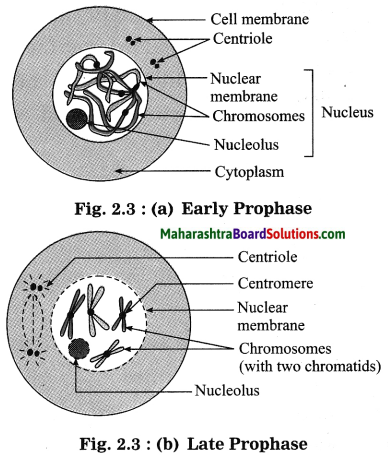
(1) There are two stages of mitosis. These are
(a) Karyokinesis or nuclear division and
(b) Cytokinesis or cytoplasmic division. Karyokinesis takes place in further four phases, viz prophase, metaphase, anaphase and telophase.
Maharashtra Board Class 10 Science Solutions Part 2 Chapter 2 Life Processes in living organisms Part - 1, 1
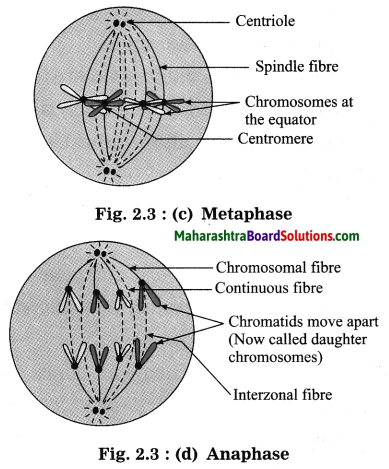
Maharashtra Board Class 10 Science Solutions Part 2 Chapter 2 Life Processes in living organisms Part - 1, 2
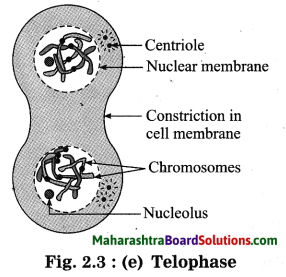
Maharashtra Board Class 10 Science Solutions Part 2 Chapter 2 Life Processes in living organisms Part - 1, 3
(a) Karyokinesis:
(i) Prophase: During prophase, condensation of chromosomes starts. The thin and thread like chromosomes start thickening. They are seen with their pair of sister chromatids. In animal cells the centrioles are seen to duplicate and move to opposite poles of the cell. Nuclear membrane and nucleolus disappear.

(ii) Metaphase: Chromosomes complete their condensation and each one is seen with its sister chromatids. The chromosomes are seen in equatorial plane of the cell. The spindle fibres are formed from polar region, where centrioles are present, and they attach themselves to the centromere of each chromosome. Nuclear membrane now disappears completely.

(iii) Anaphase: The centromeres of the chromosomes now divide forming two daughter chromosomes. The spindle fibres pull apart the chromosomes from equatorial region to the opposite poles. Chromosomes moving to the poles appear like bunch of bananas. One set of chromosomes reach each pole by the end of the anaphase.

(iv) Telophase: Telophase is reverse of events that occurred in prophase. The thickened chromosomes decondense. They again assume the thin and thread like appearance. Nuclear membrane and nucleolus appear again. The spindle fibres are completely lost. The cell looks as if it has two nuclei in one cytoplasm.

(b) Cytokinesis: In animal cells a notch develops in the middle of the cell. This notch goes on deepening down and later the cytoplasm divides into two. In plant cells, cell plate formation takes place and then cytokinesis takes place.

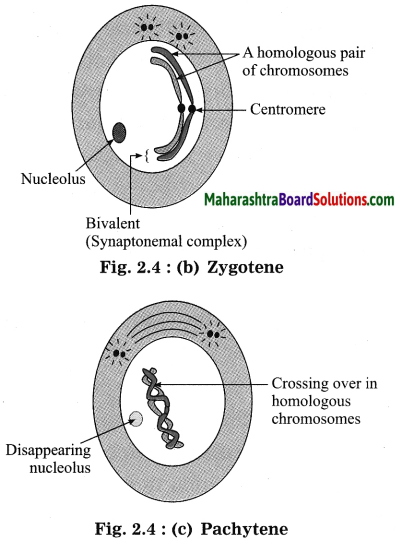
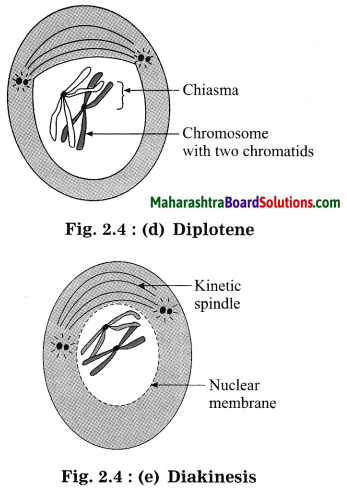
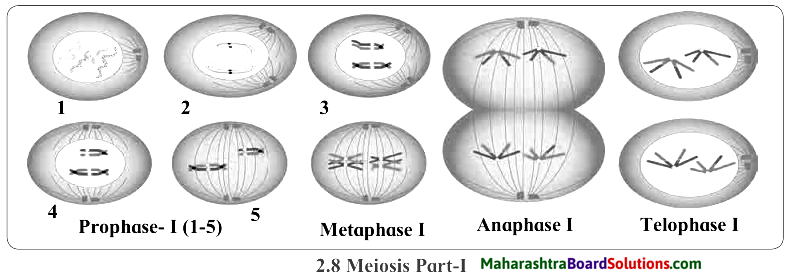
c. With the help of suitable diagrams, explain the five stages of prophase-I of meiosis.
Answer:
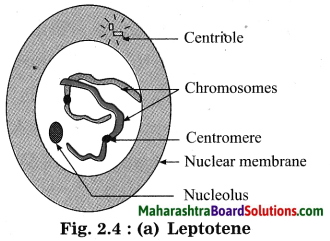
Maharashtra Board Class 10 Science Solutions Part 2 Chapter 2 Life Processes in living organisms Part - 1, 4
Maharashtra Board Class 10 Science Solutions Part 2 Chapter 2 Life Processes in living organisms Part - 1, 5
Maharashtra Board Class 10 Science Solutions Part 2 Chapter 2 Life Processes in living organisms Part - 1, 6
Prophase-I: Prophase – I of meiosis is much longer phase of the meiosis.
It is subdivided into 5 substages, namely leptotene, zygotene, pachytene, diplotene, and diakinesis.
(1) Leptotene: Initially the chromosomes start condensation and they become compact during leptotene.

(2) Zygotene: In zygotene, homologous chromosomes start pairing. This pairing is called synapsis. The structure called synaptonemal complex develops to hold chromosomes in place during this pairing. Each chromosome’s chromatid arm divides and forms structure called bivalent or tetrad.

(3) Pachytene: During pachytene stage, crossing over of non-sister chromatids of homologous chromosomes takes place. Genetic recombination is produced due to such exchange. The homologous chromosomes still remain paired together at the sites of crossing over.

(4) Diplotene: During diplotene, synaptonemal complex dissolves and the homologous chromosomes of the bivalents separate except at the point of crossing over. Thus, it looks like X-shaped structures called the chiasmata.

(5) Diakinesis: The last phase of prophase is for termination of chiasmata. The spindle fibres originate, and the cross-over homologous chromosomes are now separated. The nucleQlus disappears, and the nuclear envelope breaks down.

d. How do all the life processes contribute to the growth and development of the body?
Answer:

  1. Different systems work in co-ordination with each other in the body of the living organisms. In human body the homoeostasis is very advanced.
  2. Digestive system, respiratory system, circulatory system, excretory system, nervous system and all the external and internal organs in the bodywork independently but in coordination with each other.
  3. The digested and absorbed nutrients of the food are transported to various cells with the help of circulatory system due to pumping of the heart. Simultaneously, the oxygen absorbed in the blood by lungs is also transported to each cell by RBCs.
  4. Mitochondria in every cell brings about oxidation of nutrients and produce energy required for all of these functions.
  5. The control is exercised by the nervous system on all these actions. This keeps the organism alive and helps in growth and development of the same.

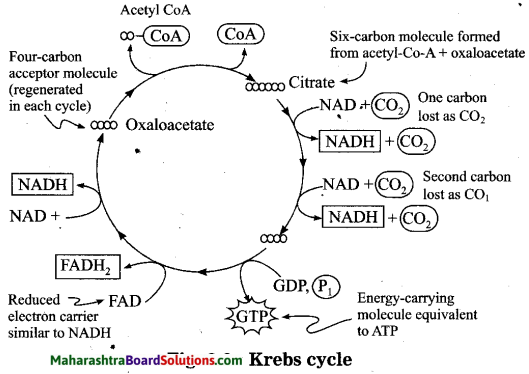
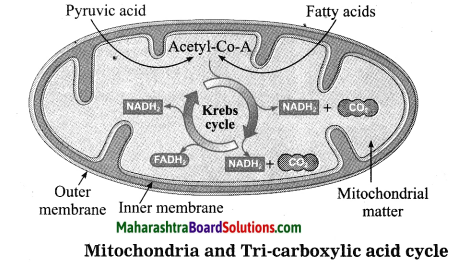
e. Explain the Krebs cycle with reaction.
Answer:

  • Krebs cycle was proposed by Sir Hans Kreb. This cycle is named after him. It is also called tricarboxylic acid cycle or citric acid cycle.
  • The acetyl-coenzyme-A molecules enter the mitochondria located in the cytoplasm.
  • They participate in the chemical reactions taking place in Krebs cycle.
  • In the cyclic chemical reactions, acetyl- coenzyme-A is completely oxidised
  • It yields molecules of CO2, H2O, NADH2, FADH2 and ATP upon complete oxidation.

Maharashtra Board Class 10 Science Solutions Part 2 Chapter 2 Life Processes in living organisms Part - 1, 7

Maharashtra Board Class 10 Science Solutions Part 2 Chapter 2 Life Processes in living organisms Part - 1

Question 5.
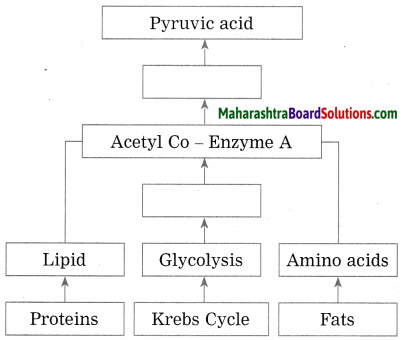
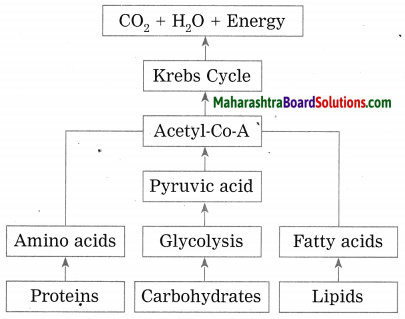
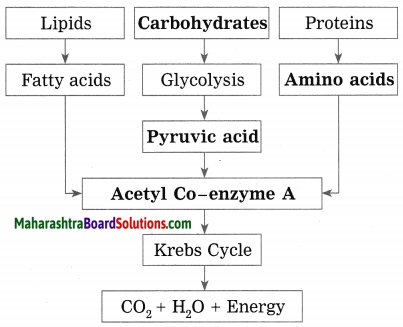
How energy is formed from oxidation of carbohydrates, fats and proteins?
Correct the dagram below.
Maharashtra Board Class 10 Science Solutions Part 2 Chapter 2 Life Processes in living organisms Part - 1, 8
Answer:
(1) First of all the dietary carbohydrates are digested in the digestive system with the help of various enzymes and converted into glucose. Similarly, proteins are converted into amino acids and fats are broken down into fatty aid and glycerol (alcohol).

(2) Oxidation of carbohydrates takes place during cellular respiration. Glucose is oxidized by three steps during aerobic respiration, viz. glycolysis, tricarboxylic acid cycle or Krebs cycle and electron transfer chain.

(3) From one molecule of glucose two molecules of each pyruvic acid, ATP, NADH2 and water are formed during glycolysis. Pyruvic acid which is formed in this process is converted into Acetyl-Coenzyme-A along with release of two molecules each of NADH2 and CO2.

(4) In the next step, i.e. in TCA cycle, molecules of Acetyl-Co-A enter the mitochondria and a cyclic chain of reactions take place. Acetyl part of Acetyl- Co-A is completely oxidized through this cyclical process. The molecules CO2, H2O, NADH2, FADH2 are released in this process.

(5) In third step, i.e. in ETC reaction, NADH2 and FADH2 formed during first two steps are used for obtaining ATP molecules. 3 molecules of ATP are obtained from each NADH2 molecule and 2 molecules of ATP from each FADH2.

(6) Thus, one molecule of glucose upon complete oxidation in presence of oxygen yields 38 molecules of ATP. This is how from carbohydrates, energy is obtained.

(7) If carbohydrates are insufficient in diet, then proteins or lipids are used for energy production. Fatty acids derived from fats and amino acids derived from proteins are converted into Acetyl- Co-A. Acetyl-Co-A once again can yield energy through TCA cycle.

Corrected diagram:
Maharashtra Board Class 10 Science Solutions Part 2 Chapter 2 Life Processes in living organisms Part - 1, 9

Project:
With the help of information collected from internet, prepare the slides of various stages of mitosis and observe under the compound microscope.

Can you recall? (Text Book Page No. 12)

Question 1.
How are the food stuffs and their nutrient contents useful for body?
Answer:
The food stuffs are digested and converted into soluble nutrients. These nutrients are carried by blood to every cell of the body. The oxygen inhaled at the time of respiration is also carried to every cell. In the body cells, this oxygen carries out oxidation of nutrients and thus energy is produced. The energy helps the body to carry out all its functions. The nutrients help in the growth and development of the body.

Question 2.
What is the importance of balanced diet for body?
Answer:
Balanced diet has carbohydrates, proteins, fats, vitamins and minerals in the right proportion. Each nutrient carries a specific important function. In balanced diet all these nutrients are in right proportion. Since balanced diet is required for energy and nutrition, it is very important to maintain our health.

Maharashtra Board Class 10 Science Solutions Part 2 Chapter 2 Life Processes in living organisms Part - 1

Question 3.
Which different functions are performed by muscles in body?
Answer:
There are three 4ypes of muscles in our body. The voluntary muscles bring about all the movements according to our will. Involuntary muscles bring about all vital activities of the body. The visceral organs are under the control of involuntary muscles. The cardiac muscles control the movements of heart. Carbohydrates and proteins are stored in muscles.

Question 4.
What is the importance of digestive juices in digestive system?
Answer:
Digestive juice contains different enzymes. Enzymes act as catalysts and bring about the chemical reactions at faster pace. The digestive juices of stomach make pH of digestive tract acidic while that of intestinal juice make it alkaline.

Question 5.
Which system is in action for removal of waste materials produced in human body?
Answer:
Excretory system helps in the removal of nitrogenous waste materials produced in the human body.

Question 6.
What is the role of circulatory system in energy production?
Answer:
Due to circulatory system, glucose from digestive system and oxygen from respiratory system is transported to every cell. Red blood cells carry the oxygen as the blood is pumped by the heart. In every cell with the help of oxygen, glucose molecules yield the energy by the process of oxidation.

Question 7.
How are the various processes occurring in the human body controlled? In how many ways?
Answer:
The nervous system and the endocrine system brings about control by nervous and chemical coordination in the body. Due to such coordination different functions of the body are carried out in sequential and controlled manner.

Use your barain power:

Question 1.
Many players are seen consuming some food stuffs during breaks of the game. Why may be the players consuming these food stuffs? (Text Book Page No. 12)
Answer:

  1. Players require energy in greater amount.
  2. They perspire heavily at the time of game or sport which results in the loss of water and electrolytes from their body.
  3. This may affect their performance in sport. To prevent such unfavourable effect, they are given, juices or drinks.
  4. This helps them to restore the balance of water and electrolytes in their body. It also gives enhanced energy required for the performance.

Maharashtra Board Class 10 Science Solutions Part 2 Chapter 2 Life Processes in living organisms Part - 1

Question 2.
Many times, we experience dryness in mouth. (Text Book Page No. 17)
Answer:

  1. In our body there is 65-70% water. This proportion is always maintained.
  2. Sometimes we lose lots of water either through perspiration or due to unavailability of water for a long time. In such situations, we experience dryness in our mouth.
  3. Dryness is a natural feeling which creates urge in us to drink water, thereby the proportion of water in the body is brought back to its normal levels.

Question 3.
Oral rehydration solution (Salt-sugar- water) is frequently given to persons experiencing loose motions. (Text Book Page No. 17)
Answer:

  1. Loose motions cause lot of loss of water from the body.
  2. This may result in dehydration. This can be lethal if ignored.
  3. Especially in case of young children this is a very serious fatal problem.
  4. Thus, to bring back the normal proportion of water and electrolytes, oral rehydration solution or ORS is given to the patient who suffers from loose motions.

Question 4.
We sweat during summer and heavy exercise. (Text Book Page No. 17)
Answer:

  1. During summer, the environmental temperatures are high.
  2. This causes rise in our body temperature. Exercising also cause rise in the temperature. But since we can regulate our body temperature to a constant level, the sweat, glands g6t automatically stimulated.
  3. This induces perspiration.
  4. The sweat evaporates and causes fall in the body temperature. Thus, for regulation of body temperature, we sweat during summer or even after heavy exercise.

Question 5.
What do you mean by diploid (2n) cell? (Text Book Page No. 20)
Answer:

  • The cells in which chromosome number is double are known as diploid cells.
  • Male and female gametes unite together in the process of fertilization. Their chromosomes mix together in the zygote, therefore, the chromosome number is always diploid.
  • E.g. Diploid chromosome no. in human beings is 46. We hate 46 chromosomes in each of our body cells.

Question 6.
What do you mean by haploid (n) cell? (Text Book Page No. 20)
Answer:

  • The cells with only one set of chromosomes is known as haploid cell.
  • At the time of sexual reproduction, there is meiosis. In meiosis chromosome number of the parental germ cells are reduced to half. Therefore, gametes are haploid.
  • The haploid chromosome number (n) in human beings is 23.
  • Sperm and ovum both are haploid carrying 23 chromosomes each.

Question 7.
What do you mean by homologous chromosomes? (Text Book Page No. 20)
Answer:

  • Every species has definite number of chromosome pairs in their diploid cells.
  • In every pair, the two chromosomes are alike in shape, type and genes located over them.
  • Such chromosomes are called homologous chromosomes.
  • E.g. In human diploid cell, pair of chromosome no. 1 shows chromosome no. 1 from mother and chromosome no. 1 from father. These two chromosomes are homologous to each other.

Question 8.
Whether the gametes are diploid or haploid? Why? (Text Book Page No. 20)
Answer:
The cells that give rise to gametes are diploid (2n). But by meiosis they give rise to gametes which are haploid (n). Two haploid gametes undergo fertilization and the zygote formed becomes once again diploid (2n).

Question 9.
How are the haploid cells formed? (Text Book Page No. 20)
Answer:
Diploid cells undergo meiosis, which is a reduction division. In this way haploid cells are formed.

Maharashtra Board Class 10 Science Solutions Part 2 Chapter 2 Life Processes in living organisms Part - 1

Question 10.
What is the importance of haploid cells? (Text Book Page No. 20)
Answer:

  1. The gametes that take part in the sexual reproduction should be haploid.
  2. Otherwise the chromosome number will not be maintained at constancy. E.g. Parents have 2n = 46 chromosomes in their cells.
  3. If meiosis does not take place in them, the gametes formed will also contain 46 chromosomes.
  4. The resultant offspring will have 46 + 46 = 92 chromosomes.
  5. Such skewed number will produce large scale abnormalities.
  6. But due to meiosis, the gametes formed are haploid and thus the chromosome number is maintained constant for every species. Gametes are haploid cells, this is the most important fact.

Internet is my friend. (Text Book Page No. 17)

Collect information.
(a) What are symptoms of diseases like night blindness, rickets, beriberi, neuritis, pellagra, anaemia, scurvy?
Answer:

DiseaseSymptoms
Night blindness
  • Near sightedness, or blurred vision when looking at faraway objects
  • Cataracts, or clouding of the eye’s lens.
  • Inability to see in dark.
  • Sometimes blindness.
Rickets
  • Weak and soft bones
  • Stunted growth
  • In severe cases, skeletal deformities.
Beriberi
  • Decreased muscle function, particularly in the lower legs.
  • Tingling or loss of feeling in the feet and hands.
  • Pain
  • Mental confusion, difficulty in speaking
  • Vomiting
  • Involuntary eye movement, paralysis.
Neuritis
  • Numbness in hands and feet
  • Tingling sensation, sharp, jabbing, throbbing, freezing or burning pain.
  • Extreme sensitivity to touch.
  • Lack of coordination and falling.
Pellagra
  • Delusions or mental confusion.
  • Diarrhoea and nausea
  • Inflammed mucous membrane.
  • Scaly skin sores.
Anaemia
  • Fatigue and loss of energy
  • Unusually rapid heartbeat, particularly with exercise
  • Shortness of breath and headache, particularly with exercise
  • Difficulty in concentrating
  • Dizziness, Pale skin
  • Leg cramps, Insomnia
Scurvy
  • Anaemia, debility, exhaustion,
  • Spontaneous bleeding
  • Pain in the limbs, and especially the legs, swelling in some parts of the body
  • Ulceration of the gums and loss of teeth.

(b) What do you mean by coenzymes?
Answer:
Co-enzyme is a non-protein compound that is necessary for the functioning of an enzyme. It is bound to the enzyme as a catalyst. This increases the rate of reaction. Co-enzymes always act along the enzymes. They cannot work independently. But the same molecule of coenzyme can be used again and again.

Many co-enzymes are vitamins or derived from vitamins. When vitamin intake is too low, then an organism also lacks the co-enzymes that catalyse reactions. Water-soluble vitamins, which include all B complex vitamins and vitamin C, lead to the production of co-enzymes. Two of the most important and widespread vitamin-derived coenzymes are Nicotinamide Adenine Dinucleotide (NAD) and co-enzyme A.

(c) Find the full forms of FAD, FMN, NAD, NADP.
Answer:

FADFlavin Adenine Dinucleotide
FMNFlavin Mono Nucleotide
NADNicotinamide Adenine Dinucleotide
NADPNicotinamide Adenine Dinucleotide Phosphate

(d) How much quantity of each vitamin is required every day?
Answer:

VitaminDaily requirement
A700 and 900 μ grams
B Complex100 mg/day for adults.
C75 mg
D5 μg
E10 mg
K80 μg

Maharashtra Board Class 10 Science Solutions Part 2 Chapter 2 Life Processes in living organisms Part - 1

Choose the correct alternative and write its alphabet against the sub-question number:

Question 1.
The process of glycolysis occurs in ……….
(a) cytoplasm
(b) mitochondria
(c) nucleus
(d) cell membrane
Answer:
The process of glycolysis occurs in cytoplasm.

Question 2.
ATP is called ………. of the cell.
(a) energy currency
(b) combustion fuel
(c) storage of glucose
(d) protein depot
Answer:
ATP is called protein depot of the cell.

Question 3.
Excess of carbohydrates are stored in liver and muscles in the form of ………….
(a) sugar
(b) glucose
(c) glycogen
(d) protein
Answer:
Excess of carbohydrates are stored in liver and muscles in the form of glycogen.

Question 4.
Chemically vitamin B2 is ………….
(a) Riboflavin
(b) Nicotinamide
(c) Cyanacobalomine
(d) Pantothetic acid
Answer:
Chemically vitamin B2 is Riboflavin

Question 5.
Somatic and stem cells undergo type of ………… division. (March 2019)
(a) meiosis
(b) mitosis
(c) budding
(d) cloning
Answer:
Somatic and stem cells undergo type of mitosis division.

Question 6.
We get ……….. energy from carbohydrates.
(a) 9 kcal/gm
(b) 9 cal/gm
(c) 4 cal/gm
(d) 4 kcal/gm
Answer:
We get 4 cal/gm energy from carbohydrates.

Question 7.
Which of the following vitamins is necessary for synthesis of NADH2?
(a) Vitamin B2
(b) Vitamin B3
(c) Vitamin
(d) Vitamin K
Answer:
(b) Vitamin B3

Write whether the following statements are true or false:

Question 1.
Glucose is oxidized step by step in the cells during the process of respiration at the body level.
Answer:
False. (Glucose is oxidized step by step in the cells during the process of cellular respiration.)

Question 2.
In aerobic respiration, glucose is oxidized in three steps.
Answer:
True

Question 3.
Glycolysis is also called Embden-Meyerhof-Paarnas pathway.
Answer:
True

Question 4.
Molecules of pyruvic acid formed in this glycolysis are converted into molecules of acetyl-co-enzyme A.
Answer:
True

Question 5.
Excess of ATP molecules obtained from proteins are not stored in the body.
Answer:
False. (Excess of ammo acids obtained from proteins are not stored in the body.)

Question 6.
Proteins of animal origin are called ‘first class’ proteins.
Answer:
True

Maharashtra Board Class 10 Science Solutions Part 2 Chapter 2 Life Processes in living organisms Part - 1

Question 7.
The disease related with the deficient synthesis of insulin is heart disease.
Answer:
False. (The disease related with the deficient synthesis of insulin is diabetes.)

Match the columns:

ProteinPart of the body (July 2019)
(1) Haemoglobin(a) muscles
(2) Ossein(b) skin
(c) bones
(d) blood

Answer:
(1) Haemoglobin – blood
(2) Ossein – bones.

ProteinPart of the body
(1) Keratin(a) muscles
(2) Myosin(b) skin
(c) bones
(d) blood

Answer:
(1) Keratin – skin
(2) Myosin – muscles.

Maharashtra Board Class 10 Science Solutions Part 2 Chapter 2 Life Processes in living organisms Part - 1

Find the odd one out:

Question 1.
Progesterone, Estrogen, Testosterone, Insulin
Answer:
Insulin. (All the others are hormones produced with the help of fatty acids.)

Question 2.
Actin, Ossein, Myosin, Melanin
Answer:
Melanin. (All the others are proteins concerned with locomotion of the body.)

Question 3.
Lipids, Carbohydrates, Fatty acids, Proteins
Answer:
Fatty acids. (All the others are food constituents; fatty acid is soluble nutrient.)

Question 4.
Alcohol, Vinegar, Pyruvic acid, Lactic acid.
Answer:
Pyruvic acid. (All the others are chemical substances formed by the process of fermentation.)

Question 5.
Tricarboxylic acid cycle, Citric acid cycle, Krebs cycle, EMP pathway.
Answer:
EMP pathway. (All the other terms are synonymous to each other.)

Considering the relationship in the first pair, complete the second pair by using a word or group of words:

Question 1.
Process that occurs in the cytoplasm : Glycolysis :: Process that occurs in the mitochondria ………
Answer:
Krebs cycle

Question 2.
Skin : Keratin :: Blood : …………
Answer:
Haemoglobin

Question 3.
Energy obtained from protein : 4 kcal :: Energy obtained from fats / lipids : …………
Answer:
9 Kcal

Question 4.
Breakdown of glucose molecule : Glycolysis :: Formation of glucose from proteins : …………….
Answer:
Gluconeogenesis

Maharashtra Board Class 10 Science Solutions Part 2 Chapter 2 Life Processes in living organisms Part - 1

Question 5.
Condensation of chromosomes : Prophase :: Formation of spindle fibres : …………
Answer:
Metaphase

Question 6.
Division of nucleus : Karyokinesis :: Division of cytoplasm :: ………..
Answer:
Cytokinesis.

Write definitions:

Question 1.
Gluconeogenesis.
Answer:
Gluconeogenesis: Formation of glucose through non-carbohydrate sources such a protein is called gluconeogenesis.

Question 2.
Fermentation.
Answer:
Fermentation: Conversion of pyruvic acid produced in the process of glycolysis into other organic acids or alcohol with the help of some enzymes is called fermentation.

Name the following:

Question 1.
Products formed after complete oxidation of acetyl part present in the molecule of acetyl-coenzyme-A.
Answer:
Molecules of CO2, H2O, NADH2, FADH2 and ATP.

Question 2.
Place where electron transfer chain reaction take place.
Answer:
Mitochondria present in the cytoplasm of the cell.

Question 3.
Two co-enzymes involved in cellular respiration.
Answer:
NAD → Nicotinamide Adenine Dinucleotide and FAD Flavin Adenine Dinucleotide.

Question 4.
Scientist who discovered the TCA cycle.
Answer:
Sir Hans Krebs.

Maharashtra Board Class 10 Science Solutions Part 2 Chapter 2 Life Processes in living organisms Part - 1

Question 5.
Steps of anaerobic respiration.
Answer:
Glycolysis and fermentation.

Question 6.
Most abundantly found protein nature.
Answer:
An enzyme RUBISCO present in plant chloroplasts.

Give scientific reasons:

Question 1.
We feel exhausted after exercising.
Answer:

  • When we undertake constant exercises, there may be shortage of oxygen for the cells.
  • Therefore, our muscles and other tissues perform anaerobic respiration in such condition.
  • In this process, lactic acid is formed.
  • Molecules of ATP produced in oxidation of food are also much less.
  • Thus, there is less energy in the body and accumulation of lactic acid too. All this brings about a feeling of exhaustion.

Answer the following questions in detail:

Question 1.
Write the forms to which the following food materials are converted after digestion:
(a) Milk (b) Potato (c) Oil (d) Chapati.
Answer:
(a) Milk: Proteins (casein) are converted into amino acids. Lactose sugar is converted into glucose. Lipids are converted into fatty acids and glycerol.
(b) Potato: Carbohydrates (starch) are converted into glucose.
(c) Oil: Lipids are converted into fatty acids and glycerol.
(d) Chapati: Carbohydrates (starch) are converted into glucose.

Question 2.
On which two levels does respiration take place in living organisms?
Answer:

  1. In organism respiration takes place at two levels, viz. Body level and Cellular level.
  2. Respiration at body level: The exchange of respiratory gases such as oxygen and carbon dioxide between body and surrounding is called respiration at body level.
  3. Cellular respiration: Oxidation of nutrients inside the cell with or without oxygen is called cellular respiration.

Question 3.
Answer the following questions: (July 2019)
(a) Write main types of vitamins.
Answer:
A, B, C, D, E and K are main types of vitamins.

(b) Name water soluble vitamins.
Answer:
Water soluble vitamins are B and C.

(c) Name fat soluble vitamins.
Answer:
Fat soluble vitamins are A, D, E and K.

Question 4.
Answer the following questions:
(a) Why some living organisms have to perform anaerobic respiration?
Answer:
Some bacteria and lower organisms do not live in the presence of oxygen. In order to survive, they have to perform anaerobic respiration. Sometimes, muscle cells and erythrocytes also perform anaerobic respiration when there is lack of enough oxygen.

(b) Give two examples of such living organisms.
Answer:
Yeast and bacteria.

(c) What are the two steps of anaerobic respiration?
Answer:
Glycolysis and fermentation are the two steps of anaerobic respiration.

Question 5.
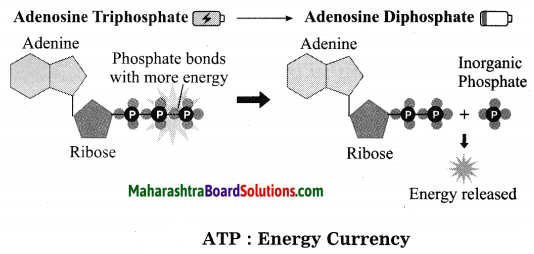
Which is the energy currency of the cell? Explain it in detail.
Answer:

  • ATP or Adenosine triphosphate is the ‘energy currency’ of the cell.
  • Chemical composition of ATP is as follows: it is a triphosphate molecule having adenosine ribonucleoside. The nitrogenous compound-adenine, pentose sugar-ribose and three phosphate groups are present in ATP.
  • In this energy-rich molecule the energy remains trapped in the bonds by which phosphate groups are attached to each other.
  • ATP molecules are stored in the cells. As per the need, energy is derived by breaking the phosphate bond of ATP.
  • During cellular respiration, the oxidation of glucose yields 38 molecules of ATP. Whenever required they are consumed to liberate energy.

Maharashtra Board Class 10 Science Solutions Part 2 Chapter 2 Life Processes in living organisms Part - 1

Question 6.
How is energy obtained during starvation or hunger?
Answer:

  • Due to starvation or hunger, there is less supply of nutrients and energy to the body. In such condition, the stored carbohydrates in the body also deplete.
  • In such condition, fats and proteins present in the body are utilized.
  • Fats or lipids are converted into fatty acids and proteins are broken down to amino acids.
  • Fatty acids and amino acids both are converted to acetyl-coenzyme-A.
  • Acetyl-coenzyme-A can undergo series of cyclic reactions and oxidised to liberate energy in the form of ATP molecules.

Question 7.
Why glycolysis is also called EMP pathway?
Answer:
Process of glycolysis was discovered by Gustav Embden, Otto Meyerhof, and Jacob Pamas along with their colleagues. They performed experiments on muscles to understand glycolysis. Hence, in their honour, glycolysis is also edited Embden-Meyerhof-Parnas pathway or EMP pathway.

Question 8.
How are proteins obtained? What are the components of the proteins?
Answer:

  • Protein, is a macromolecule which is formed by amino acids.
  • When digestion of protein takes place, it forms different amino acids. These amino acids are transported to each cell by blood circulation.
  • By protein synthesis, these amino acids are again used to make different kinds of proteins which our body needs.
  • Animal proteins are said to be ‘first class proteins’ as they contain good quality amino acids.
  • 4 Kcal/gm energy is obtained from the proteins.

Question 9.
Where and in which forms the amino acids formed after digestion of food are used in the body?
Answer:
(1) After digestion of proteins, amino acids are formed. These amino acids are used to synthesise proteins in different forms. e.g.

  • In blood-Haemoglobin and antibodies are formed.
  • In skin – Melanin and keratin are formed.
  • In bones – Ossein is formed.
  • In pancreas-Insulin and trypsin are synthesized.
  • Pituitary and all other glands produce hormones by utilising amino acids.
  • In muscles – Actin and myosin are formed.
  • In all the cells, plasma membrane is formed by proteins. All enzymes are also synthesised using the amino acids.

Maharashtra Board Class 10 Science Solutions Part 2 Chapter 2 Life Processes in living organisms Part - 1

Question 10.
What are fatty acids? What are the different uses of fatty acids ?
Answer:
(1) The fatty acids are components of the lipids. When lipids are digested, it forms fatty acids and alcohol (glycerol).
(2) There are certain chemical bonds between fatty acids and alcohol.
(3) Fatty acids are very essential for the health.
(4) After digestion, fatty acids are absorbed into the blood and transported to the cells.
(5) Different types of cells produce their own substances from these fatty acids.
E.g. (a) Plasma membrane is produced from phospholipids.
(b) Hormones like testosterone, progesterone, estrogen, aldosterone are produced from fatty acids.
(c) The axonal coverings around the neurons are also made from fatty acids.

Give explanations for the following statements:

Question 1.
After complete oxidation of a glucose molecules, 38 number of ATP molecules are formed.
Answer:
I. Glycolysis: No. of ATP molecules formed = 4
No. of ATP molecules used = 2
II. Krebs cycle : No. of ATP molecules formed = 2
III. ETC Reaction :
NADH2: 10 NAD2 x 3 ATP = 30 ATP
FADH2 : 2 FADH2 x 2 ATP = 4 ATP
Total ATP molecules produced = (4+2+34)
= 40 ATP
ATP molecules used = 2 ATP
Therefore, total ATP molecules = 38 ATP

Question 2.
At the end of glycolysis, pyruvate molecules are obtained.
Answer:
The process of glycolysis takes place m the cytoplasm of the cell. One molecule of glucose is gradually oxidized step by step forming two molecules of each pyruvic acid, ATP, NADH2 and water. Of these, pyruvate or pyruvic acid takes part in the further reactions.

Question 3.
Genetic recombination occurs in pachytene phase of prophase of meiosis-I.
Answer:
In prophase of meiosis I there are total 5 stages. Of these in pachytene the process of crossing over takes place between homologous chromosomes as chromosomes come near each other forming synapsis.

Question 4.
All chromosomes are arranged parallel to equatorial plane of cell in metaphase of mitosis.
Answer:
In mitosis, the metaphase is the stage when dividing chromosomes lie on the equatorial plane of the cell. They are later pulled by the spindle fibres to the opposite poles.

Question 5.
For formation of plasma membrane, phospholipid molecules are necessary.
Answer:
Upon the digestion of fats, fatty acids and glycerol are formed. The fatty acids can be converted into phospholipid which are essential molecules for development of plasma membrane.

Maharashtra Board Class 10 Science Solutions Part 2 Chapter 2 Life Processes in living organisms Part - 1

Question 6.
Our muscle cells perform anaerobic type of respiration during exercise.
Answer:
When the proportion of oxygen is less, then the cells switch over to anaerobic respiration. When we are exercising there is increased demand of oxygen for muscle cells. If this is not fulfilled, they perform anaerobic respiration during exercise.

Question 7.
Excess of carbohydrates are stored in liver and muscles in the form of glycogen.
Answer:
The carbohydrates which are not used to produce energy cannot be stored in the body in the form of glucose. This glucose is therefore converted into complex compound called glycogen. Glycogen is stored in muscles and liver.

Complete the paragraph by choosing the appropriate words given in the brackets:

Question 1.
(gamete, crossing over, haploid, Meiosis-II, meiosis-I, diploid)
……….. is just like mitosis. In this stage, the two haploid daughter cells formed in ……… undergo division by separation of recombined sister chromatids and four ……….. daughter cells are formed. Process of …………… production and spore formation occurs by meiosis. In this type of cell division, four haploid (n) daughter cells are formed from one ……….. cell. During this cell division, ………… occurs between, the homologous chromosomes.
Answer:
Meiosis-II is just like mitosis. In this stage, the two haploid daughter cells formed in meiosis-I undergo division by separation of recombined sister chromatids and four haploid daughter cells are formed. Process of gamete production and spore formation occurs by meiosis. In this type of cell division, four haploid (n) daughter cells are formed from one diploid cell. During this cell division, crossing over occurs between the homologous chromosomes.

Question 2.
(external, inhalation, alveolar, breathing, respiration, exhalation)
Release of energy from the assimilated food is called …………. Inhalation and exhalation is called …….. When ……….. is done, air enters the lungs. The oxygen from this air enters the blood while carbon dioxide from the blood exits from the blood. Through exhalation, CO2 is given out. This gaseous exchange occurs through ……….. membrane. This is called ………….. respiration. The RBCs carry oxygen to every cell.
Answer:
Release of energy from the assimilated food is called respiration. Inhalation and exhalation is called breathing. When inhalation is done, air enters the lungs. The oxygen from this air enters the blood while carbon dioxide from the blood exits from the blood. Through exhalation, CO2 is given out. This gaseous exchange occurs through alveolar membrane. This is called external respiration. The RBCs carry oxygen to every cell.

Read the paragraph and answer the questions given below:

1. Dietary fibre — found mainly in fruits, vegetables, whole grains and legumes — is probably best known for its ability to prevent or relieve constipation. But foods containing fibre can provide other health benefits as well, such as helping to maintain a healthy weight and lowering your risk of diabetes, heart disease and some types of cancer. Dietary fibre, also known as roughage or bulk, includes the parts of plant foods your body can’t digest or absorb. Unlike other food components, such as fats, proteins or carbohydrates — which your body breaks down and absorbs — fibre isn’t digested by your body. Instead, it passes relatively intact through your stomach, small intestine and colon and out of your body.

Questions and Answers :

Question 1.
Which food items provide rich fibre content?
Answer:
Fruits, vegetables, whole grains and legumes give rich amount of dietary fibre.

Question 2.
Enlist the advantages of fibres in diet.
Answer:
Fibres help to relieve constipation and help in maintaining a healthy weight and lowering risk of diabetes, heart disease and some types of cancer.

Question 3.
Are fibres digested in the body?
Answer:
No, fibres are not digested in the body but are passed on without any alteration.

Question 4.
Which is the path through which fibres pass in the digestive tract?
Answer:
Fibres pass through stomach, small intestine and colon.

Question 5.
What is a roughage?
Answer:
Roughage is the fibre content of the food which consists of plant matter which cannot be digested by the human enzymes, hence form undigested bulk matter in the faeces.

Maharashtra Board Class 10 Science Solutions Part 2 Chapter 2 Life Processes in living organisms Part - 1

2. The substances formed by specific chemical bond between fatty acids and alcohol are called lipids. Digestion of lipids consumed by us is nothing but their conversion into fatty acids and alcohol. Fatty acids are absorbed and distributed everywhere within the body. From those fatty acids, different cells produce various substances necessary to themselves. Ex. the molecules called phospholipids which are essential for producing plasma membrane are formed from fatty acids. Besides, fatty acids are used for producing hormones like progesterone, estrogen, testosterone, aldosterone, etc. and the covering around the axons of nerve cells. We get 9 Kcal of energy per gram of lipids. Excess of lipids are stored in adipose connective tissue in the body.

Questions and Answers:

Question 1.
Define lipids.
Answer:
Lipids are molecules formed of fatty acids and glycerol (alcohol) which have specific bonds between them.

Question 2.
What happens to fats that are eaten in excess?
Answer:
When excess of fats are eaten, they are stored in adipose connective tissue.

Question 3.
Which hormones regulating reproductive functions are produced from fatty acids?
Answer:
Progesterone, estrogen and testosterone are the reproductive hormones produced from fatty acids.

Question 4.
How is plasma membrane of the cells formed?
Answer:
The digested fats are absorbed in the form of fatty acids. These are converted back to phospholipids from which plasma membrane of cells is formed.

Question 5.
What happens to lipids when their digestion is completed? How much energy do they provide?
Answer:
After complete digestion of lipids they are converted to fatty acids and glycerol. 1 gm of lipid provides 9 kcal of energy.

Diagram based questions:

Question 1.
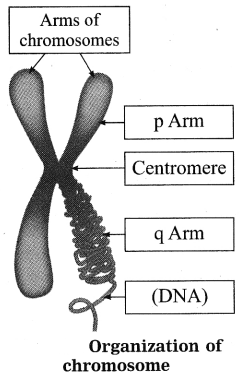
Draw a neat diagram of the structure of chromosome and label the parts:
(a) Centromere (b) p-arm (March 2019)
Answer:
Maharashtra Board Class 10 Science Solutions Part 2 Chapter 2 Life Processes in living organisms Part - 1, 10

Question 2.
Sketch and label the diagram to show ATP – the energy currency of the cell.
Answer:
Maharashtra Board Class 10 Science Solutions Part 2 Chapter 2 Life Processes in living organisms Part - 1, 11

Maharashtra Board Class 10 Science Solutions Part 2 Chapter 2 Life Processes in living organisms Part - 1

Question 3.
Mitochondria and Krebs cycle:
Answer:
Maharashtra Board Class 10 Science Solutions Part 2 Chapter 2 Life Processes in living organisms Part - 1, 12

(a) Which co-enzymes are shown in the diagram?
Answer:
The co-enzymes NADH2 and FADH2 are shown in the above diagram.

(b) Which chemical reaction takes place in the mitochondria? Which molecules are produced in this reaction?
Answer:
The chemical reaction that takes place in the mitochondria is called Electronic Transport Chain reaction. The molecules of H2O, carbon dioxide and energy in the form of ATP are produced in this reaction.

Question 4.
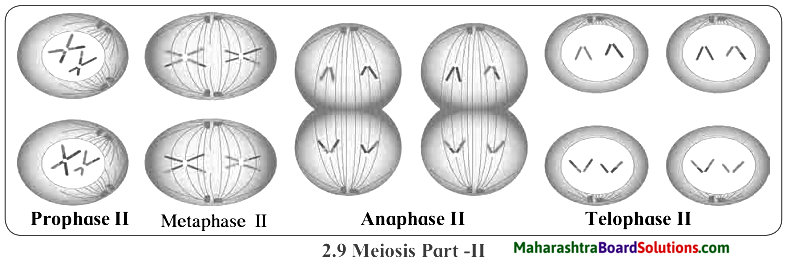
Observe the diagrams 2.8 and 2.9 given on the Textbook page no. 19 and answer the following questions.
Maharashtra Board Class 10 Science Solutions Part 2 Chapter 2 Life Processes in living organisms Part - 1, 13
Maharashtra Board Class 10 Science Solutions Part 2 Chapter 2 Life Processes in living organisms Part - 1, 14
(a) Which peculiarity do you observe in the figure of Metaphase-I of meiosis ?
Answer:
The chromosomes are seen lying on the equatorial plane in the metaphase-I of meiosis.

(b) What is the important difference between Telophase-I and Telophase-II of meiosis?
Answer:
In figure of Telophase-I the diploid chromosomes are seen in two daughter cells. In Telophase-II four daughter cells are seen with haploid chromosomes in them.

(c) Which figure shows phenomena of crossing over?
Answer:
The third figure of Prophase-I shows phenomena of crossing over.

Maharashtra Board Class 10 Science Solutions Part 2 Chapter 2 Life Processes in living organisms Part - 1

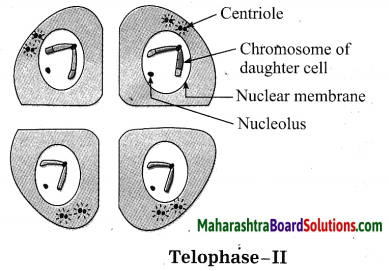
Question 5.
Label the diagram below? Which phase of cell division is seen in the above diagram?
Answer:
The above figure shows Telophase-II of Meiosis-II.
Maharashtra Board Class 10 Science Solutions Part 2 Chapter 2 Life Processes in living organisms Part - 1, 15

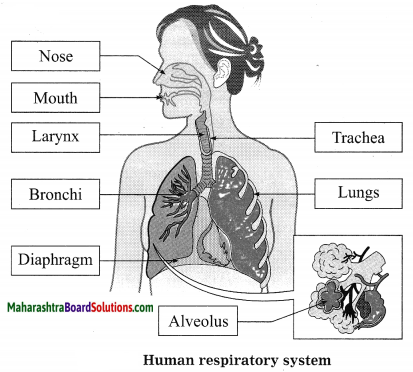
Question 6.
Observe and label the diagram: (Text Book Page No. 13)
Answer:
Maharashtra Board Class 10 Science Solutions Part 2 Chapter 2 Life Processes in living organisms Part - 1, 16

Activity based questions:

Question 1.
Complete the following chart and state which process of energy production it represents: (March 2019)
Maharashtra Board Class 10 Science Solutions Part 2 Chapter 2 Life Processes in living organisms Part - 1, 17
Answer:
The chart shows process of energy production through aerobic respiration of carbohydrates, proteins and fats.
(Answers to the blanks in chart are given in bold.)

Maharashtra Board Class 10 Science Solutions Part 2 Chapter 2 Life Processes in living organisms Part - 1

Project:

Project 1.
Use of ICT: (Text Book Page No. 20)
Collect videos and photographs of different life processes in living organisms. Prepare a presentation and present it on the occasion of science exhibition.

Project 2.
Books are my friend: (Text Book Page No. 20)
Read different Encyclopaedias of technical terms in biology and anatomy and other reference books.

Maharashtra Board Class 10 Geography Solutions Chapter 6 Population

Balbharti Maharashtra State Board Class 10 Geography Solutions Chapter 6 Population Notes, Textbook Exercise Important Questions and Answers.

Maharashtra State Board Class 10 Geography Solutions Chapter 6 Population

Class 10 Geography Chapter 6 Population Textbook Questions and Answers

1. Are the following sentences right or wrong? Correct the wrong ones.

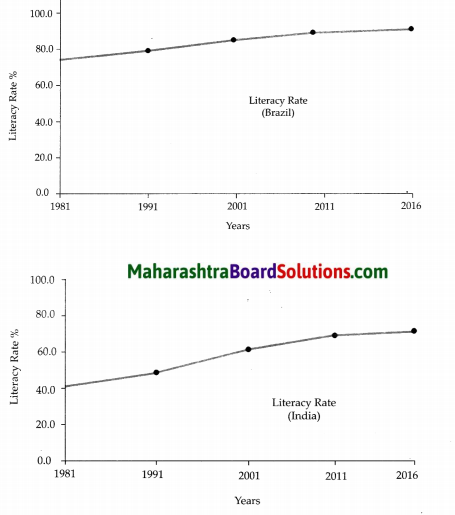
Question a.
Literacy rate is higher in Brazil than India.
Answer:
Right.

Question b.
In Brazil, people prefer living in the south east as compared to the north east.
Answer:
Right.

Maharashtra Board Class 10 Geography Solutions Chapter 6 Population

Question c.
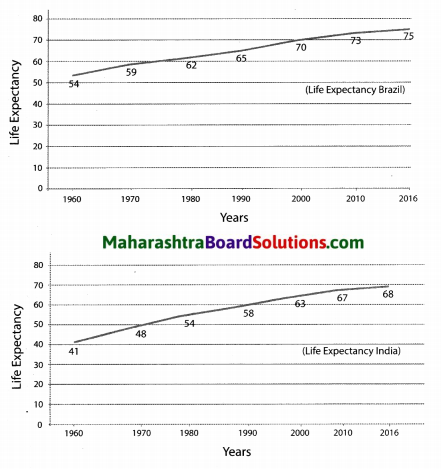
The life expectancy of Indians is decreasing.
Answer:
Wrong.

Question d.
The north-western part of India is densely populated.
Answer:
Wrong.

Question e.
The western part of Brazil is densely populated.
Answer:
Wrong

Maharashtra Board Class 10 Geography Solutions Chapter 6 Population

2. Answer the following questions as per the instructions:

Question a.
Arrange the following states of India in descending order of their population. Himachal Pradesh, Uttar Pradesh, Arunachal Pradesh, Madhya Pradesh, Andhra Pradesh.
Answer:
Descending order: Uttar Pradesh, Madhya Pradesh, Andhra Pradesh, Himachal Pradesh, Arunachal Pradesh.

Question b.
Arrange the states of Brazil in ascending order of their population: Amazonas, Rio de Janeiro,
Alagoas, Sao Paulo, Parana.
Answer:
States of Brazil: Alagoas, Amazonas, Parana, Rio de Janeiro, Sao Paulo.

Question c.
Classify the factors affecting the distribution of population into favourable and unfavourable.
Answer:

Favourable FactorsUnfavourable Factors
(1) Nearness to SeaLack of roads
(2) Temperate ClimateLack of Industries
(3) New cities and townsTropical moist forests
(4) MineralsSemi arid climate
(5) Cultivable land

Maharashtra Board Class 10 Geography Solutions Chapter 6 Population

3. Answer the following questions:

Question a.
Explain the similarities and differences between the population distribution in Brazil and India.
Answer:
(a) Similarities in population distribution in Brazil and India:

  • In Brazil as well as in India, population is very unevenly distributed.
  • Inaccessible dense forests and absence of facilities are the barriers to human settlements.
  • North, north west and north east of both the countries are the regions of low population.
  • Population is concentrated in flat fertile regions which have abundant water resources, transport facilities, mild climate and development of agriculture industries and trade in the plain region.
  • Coastal regions are densely populated in Brazil and in India.

(b) Differences between population distribution in Brazil and India.

  • The average density of population in India is 382 persons per sq.km, and that of Brazil is about 23 persons per sq.km.
  • Though the area of both the countries is occupied by vast river basins, the distribution of population is extremely opposite in both the river basins.
  • The Amazon River Basin is sparsely populated while the Ganga River Basin is densely populated.

Question b.
Giving examples, correlated to, climate and population distribution
Answer:
Climate and population distribution are closely interreleted. Temperature and rainfall, the two elements of climate greatly influence the population concentration.

(i) Dense population is found in regions with mild climate and moderate rainfall.
E.g. the coastal plains of Brazil, the northern plain as well as the coastal plains of India

(ii) Places with heavy rainfall, inaccessibility and dense forests have low population.
E.g. the interiors of the Amazon Basin in Brazil, north eastern states in India.

(iii) The snow covered regions due to extremely cold climatic conditions have less population.
E.g. the northernmost part of Jammu & Kashmir.

(iv) In certain regions, due to less rainfall and extreme climatic conditions population is sparse.
E.g. Thar desert of Rajasthan and the Drought Quadrilateral region of Brazil.

4. Give geographical reasons:

Question a.
Population is an important resource.
Answer:

  • The qualitative aspects of a population are important for a nation’s economic and social progress.
  • Natural resources of any country gets utilised properly because of the population.
  • Economic growth and development will be slow if population resource is not utilised properly.
  • Thus an optimum and quality population can bring about a country’s development.

Question b.
Brazil’s population density is very less.
Answer:

  • Brazil is the fifth largest country in the world with respect to area and has a population of about 19 crores (Census 2010).
  • It occupies 5.6% of world’s total land area and accounts for only 2.78% of the world’s total population.
  • Thus Brazil occupies more percent of world’s land and less percent of world’s total population. Therefore,
  • the density of population is very less in Brazil, i.e. around 23 persons per sq.km.

Question c.
India’s population density is high.
Answer:

  • India is the second most populous country in the world, with a population of about 121 crores (Census 2011).
  • India occupies only 2.41% of the land area of the world, but supports 17.5% of the world’s population.
  • Thus India has less percent of world’s land and supports high percent of world’s population.
  • Hence, India’s average population density is high i.e. 382 persons per sq. km.

Question d.
The density of population is sparse in the Amazon Basin.
Answer:

  • The interior part of the Amazon Basin has a very unfavourable hot and humid climate.
  • It receives heavy rainfall of nearly 2000 mm and has dense inaccessible forests.
  • Transportation, agricultute and industries are not well developed here.
  • All these factors are barriers to the development of human settlements.
  • So, the density of population is sparse in the Amazon Basin.

Question e.
Population density is high in the Ganga plains.
Answer:

  • Ganga plains are fertile low lying plains formed due to the deposition work of River Ganga and its tributaries.
  • Mild climate, moderate rainfall and fertile soil have led to the development of agriculture and industries.
  • This region also has a dense network of roadways and railways.
  • So, the population density is high in the Ganga Plains.

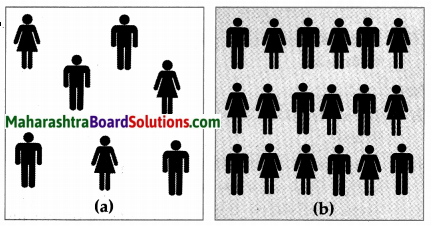
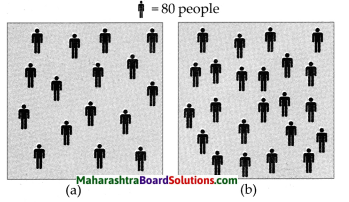
5. Observe the following diagram and answer the following questions:

Maharashtra Board Class 10 Geography Solutions Chapter 6 Population 1
Question 5A.
Compare and classify the population densities shown in the figure ‘a’ and ‘b’ representing 1 sq. km. of area.
Answer:
In the fig. (a) density of population is 7 persons per sq. km. The region is sparsely populated.
In the fig. (b), the density of population is 18 persons per sq. km. The region is densely populated.

Question 5B.
If in figure B one sign = 100, then what will be the sex ratio?
Answer:
One symbol = 100 persons
There are 10 female symbols.
Number of females = 100 x 10
= 1000
There are 8 male symbols
Number of males = 100 x 8
= 800

Males8001000
Females1000?

Number of females = \(\frac { 1000 X 1000 }{ 800 }\)
= 1250
Sex Ratio is 1250 females per 1000 males.

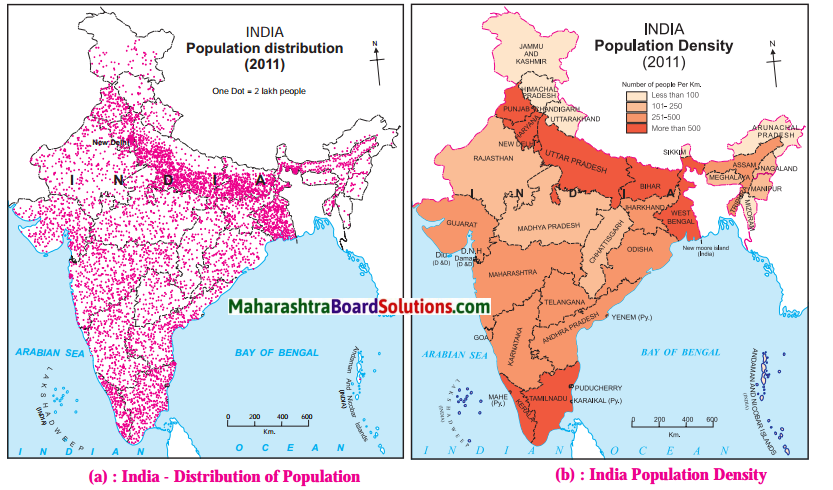
Question 6.
Comment upon the population density of fig (b).
(i) fig (b) shows the population density of India as per 2011.
(ii) The density of population is divided into four categories. They are:
(a) Less than 100 persons per sq.km. .
(b) 101-250 persons per sq.km.
(c) 251-500 persons per sq.km.
(d) more than 500 persons per sq.km.
Answer:

S.No.Population Density (per sq.km.)Name of the States / Union Territories
(1)less than 100Arunachal Pradesh, Mizoram, Jammu and Kashmir, Himachal Pradesh, Uttarakhand, Sikkim.
(2)101 to 250Meghalaya, Manipur, Nagaland, Rajasthan, Madhya Pradesh, Chattisgarh.
(3)251 to 500Gujarat, Maharashtra, Goa, Karnataka, Andhra Pradesh, Telangana, Odisha, Jharkhand, Assam, Tripura.
(4)more than 501West Bengal, Bihar, Punjab, Haryana, Uttar Pradesh,Kerala and Tamil Nadu, Delhi, Chandigarh, Puducherry, Diu, Daman, Dadra Nagar, Haveli, Andaman and Nicobar Islands.

Maharashtra Board Class 10 Geography Solutions Chapter 6 Population

Class 10 Geography Chapter 6 Population Intext Questions and Answers

Study the maps and answer the following questions

Maharashtra Board Class 10 Geography Solutions Chapter 6 Population 9
Question 1.
States with the highest population density.
Answer:
West Bengal, Bihar, Punjab, Haryana, Uttar Pradesh, Kerala and Tamil Nadu.

Question 2.
On the basis of maps given above, classify the distribution population in India in the following table.
Answer:

S.No.Population Density (per sq.km.)Name of the States / Union Territories
(1)less than 100Arunachal Pradesh, Mizoram, Jammu and Kashmir, Himachal Pradesh, Uttarakhand, Sikkim.
(2)101 to 250Meghalaya, Manipur, Nagaland, Rajasthan, Madhya Pradesh, Chattisgarh.
(3)251 to 500Gujarat, Maharashtra, Goa, Karnataka, Andhra Pradesh, Telangana, Odisha, Jharkhand, Assam, Tripura.
(4)more than 501West Bengal, Bihar, Punjab, Haryana, Uttar Pradesh, Kerala and Tamil Nadu, Delhi, Chandigarh, Puducherry, Diu, Daman, Dadra Nagar, Haveli, Andaman and Nicobar Islands.

Question 3.
States with lowest population density.
Answer:
Arunachal Pradesh, Sikkim, Jammu and Kashmir, Himachal Pradesh, Uttarakhand and Mizoram.

Question 4.
Correlate the climate and physiography of India with its population distribution and write a note on it.
Answer:
(i) Climate and population distribution are closely inter-related.

(ii) Temperature and rainfall are the two elements of climate which greatly influence the population distribution.

(iii) Dense population is found in regions with mild climate and moderate rainfall.
E.g. the northern plain as well as the coastal plains of India

(iv) Places with heavy rainfall, inaccessibility and dense forests have low population.
E.g. northeastern states in India.

(v) The snow-covered regions due to extremely cold climatic conditions have less population.
E.g. the northernmost part of Jammu and Kashmir.

(vi) In certain regions, due to less rainfall and extreme climatic conditions population is sparse.
E.g. Westernmost part of India in the Thar desert, Rajasthan.

Maharashtra Board Class 10 Geography Solutions Chapter 6 Population 8

Maharashtra Board Class 10 Geography Solutions Chapter 6 Population

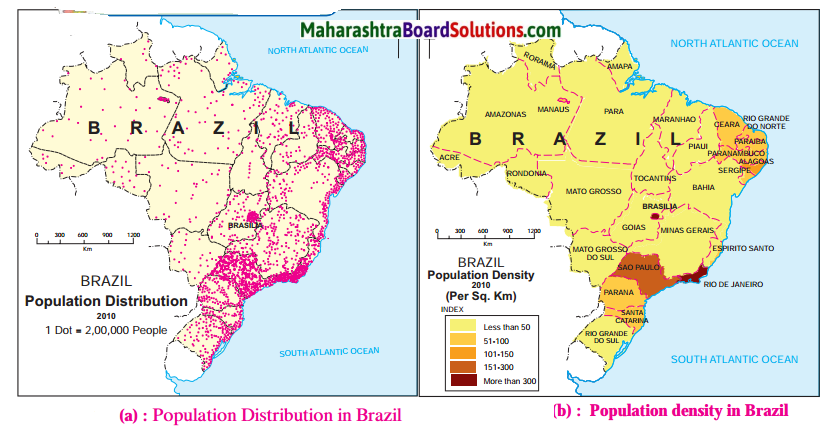
Question 1.
In which area is population greatly concentrated?
Answer:
Population is greatly concentrated in the south eastern part of Brazil.

Question 2.
In which area is the distribution of population sparse?
Answer:
The Amazon Basin in the nothern part and the central and western parts of Brazil have sparse distribution of population.

Question 3.
Prepare a note on factors responsible for the uneven distribution of population based on the study of Brazil you have made so far.
Answer:
The distribution of population in Brazil is uneven:

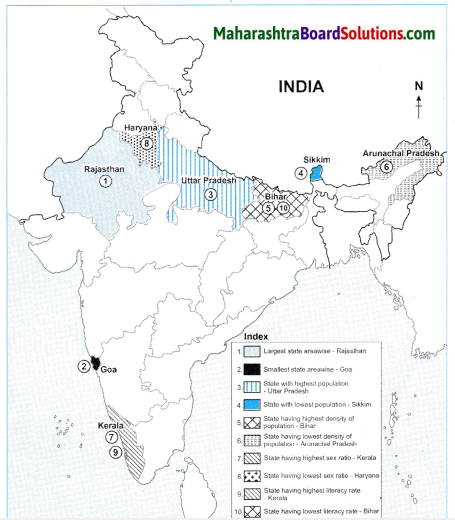
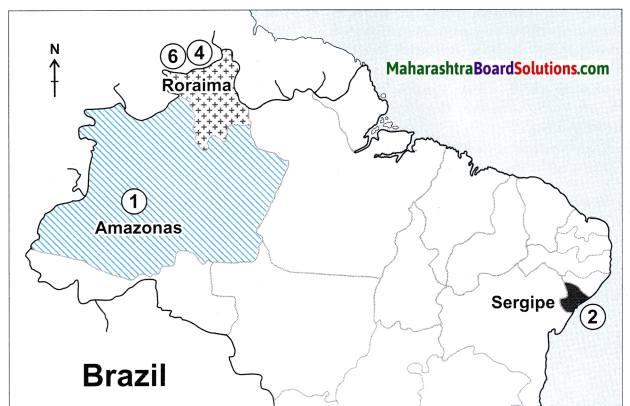
  • There is sparse population in the Amazon Basin due to hot and humid climate, heavy rainfall, dense forests, inaccessibility.
  • The population is low in the swampy areas of Pantanal.
  • Low population is found in the central and western part of Brazil due to lack of minerals, low rainfall, hot and dry climatic conditions.
  • The distribution of population is moderate in Brazilian Highlands.
  • High population is found in the coastal regions and the southern part of Brazil. This is due to flat fertile land and abundant availability of minerals due to which agriculture, industries and trade have developed.

Question 4.
Identify the type of map showing distribution fig. (a) of textbook.
Answer:
The type of map showing distribution of population is a dot map.

Question 5.
On the basis of the map (b), classify the distribution of population in Brazil in the following table.:

S. No.Population DensityNames of the places
(1)Less than 50Acre, Amazonas, Roraima, Rondonia, Para, Amapa, Mata Grasso, Mato Grasso Do Sul, Goias, Tocantins, Maranhao, Piaui, Bahia, Minas Gerais, Rio Gande Do Sul
(2)51 -100Paraiba, Pamambuco, Parana, Santa Catarina, Sergipe, Rio Grande Do Norte, Ceara
(3)101 -150Alagoas
(4)151 – 300Sao Paulo
(5)More than 300Rio de Janerio, Brasilia

USE YOUR BRAIN POWER

Question 1.
Calculate the population density of the area shown in 1 sq.km, of square in ‘a’ and ‘b’ each
Maharashtra Board Class 10 Geography Solutions Chapter 6 Population 4
Answer:
(a) In fig. (a) there are 16 Maharashtra Board Class 10 Geography Solutions Chapter 6 Population 7
Each Maharashtra Board Class 10 Geography Solutions Chapter 6 Population 7 = 80 people
Total number of people = 16 x 80 = 1280
Fig. (a) has a population density of 1280 people per sq. km.

(b) In fig. (b) there are 23 Maharashtra Board Class 10 Geography Solutions Chapter 6 Population 7
Each Maharashtra Board Class 10 Geography Solutions Chapter 6 Population 7 = 80 people
Total number of people = 23 x 80 = 1840
Fig. (b) has a population density of 1840 people per sq. km.

Maharashtra Board Class 10 Geography Solutions Chapter 6 Population

GIVE IT A TRY

Question 1.
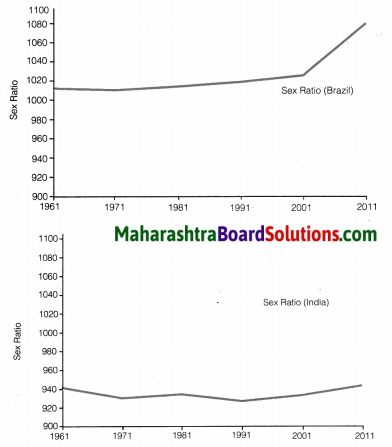
What could be the reasons of lower sex ratio in any region?
Answer:
With reference to both the countries, the characteristics of population are prominently notable.

  • The sex ratio of Brazil has been more than 1000 since decades.
  • Considering the sex ratio of Brazil, the number of women have considerably increaesed than men since 2001.
  • In India men outnumber women.
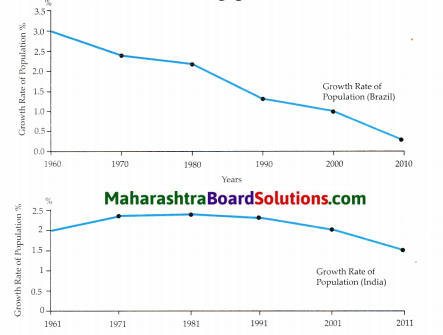
  • In India we see fluctuations in the sex ratio since few decades. There has been a slight increase in the sex ratio after 1991.

Maharashtra Board Class 10 Geography Solutions Chapter 6 Population 5

Question 2.
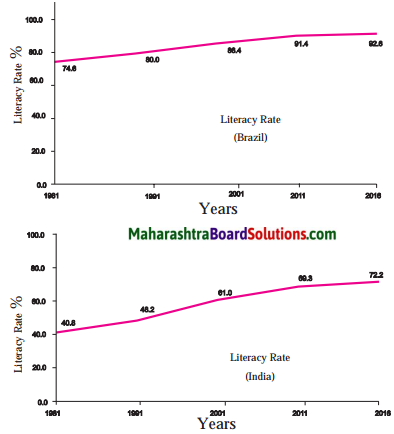
Write a similar conversation using the graph
Maharashtra Board Class 10 Geography Solutions Chapter 6 Population 10
Answer:
A: What do these graphs show?

B: These graphs show the literacy rate of India and Brazil.

A: What do you mean by literacy rate?

B: It means the total percentage of the population of an area at a particular time aged seven years or above ‘ who can read and write with understanding.

A: It means that, as on today’s date, the literacy rate of our country is 72.2%.

B: But, Brazil had an even higher literacy rate decades back in 1981, i.e. 74.6% and it has touched 92.6 as of today (2018), which is quite commendable.

A: Yes, definitely But, we have also seen a steady growth in the literacy rate of the country, especially, during the period between 1991 and 2011.

B: Still, though we are growing, we are way behind Brazil today with 72.2% because they have a much higher literacy percentage of 92.6.

A: What measures can be adopted to increase the literacy rate of our country?

B: We can make people aware of the need and importance of education, help in teaching them, introducing various literacy campaigns by making use of free calls, free sms services, etc.

Question 3.
Study the indices of density maps of both the countries. What difference do you find? What conclusions can you draw?
Maharashtra Board Class 10 Geography Solutions Chapter 6 Population 4
Answer:
(i) India’s density of population is proportionately catered while Brazil’s density of population is concentrated only on the eastern coast.
(ii) After studying the indices of the density maps of both the countries, we can conclude that India’s population density is much higher than that of Brazil.
(iii) The lowest value on the map of India indicates less than 100 whereas on the Brazil map it is less than 50.
(iv) Places in Brazil which are highest in density is grouped in the category of more than 300 people’ per sq. km. whereas in India it is more than 500 persons per sq. km.

Maharashtra Board Class 10 Geography Solutions Chapter 6 Population

Question 4.
Considering the above discussion, what should be done so that our manpower is utilized properly, sex ratio improves and population growth is controlled? Write two to three sentences on each.
Answer:
(i) Measures to utilise man power properly:

  • Good education, health and training facilities are the basic requirements to improve human resources.
  • The focus of education should not just be to chum out jobseekers but also to chum out job creators.
  • The young population should be encouraged to be entrepreneurs.

(ii) Measures to improve sex ratio:

  • Build an environment to save and protect the girl child.
  • Ban sex determination test.

(iii) Measures to control population growth:

  • Family planning measures to be encouraged through media.
  • Spread of education among illiterate masses, especially about the benefits of having a small family.
  • Child marriage should be strictly prohibited.

TRY THIS

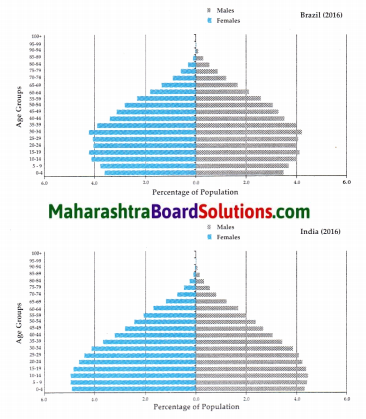
Age and Sex Pyramid:
Maharashtra Board Class 10 Geography Solutions Chapter 6 Population 6

Question 1.
What is this figure called? What is it always known as?
Answer:
The figure is called the Age-Sex Pyramid. It is also known as Population Pyramid.

Question 2.
What does the graph depict?
Answer:
The graph depicts the percentage of male and female population of various age groups in Brazil & India for the year 2016.

Question 3.
In which country is the proportion of adults more?
Answer:
The proportion of adults is comparatively more in India.

Question 4.
‘This country’s population is getting slowly older’. Which country is being referred to? Why?
Answer:
‘This country’s population is getting slowly older – The country being referred to is Brazil. As compared to India, a larger percentage of Brazil’s population falls in the above 60 years age group. So it is said that Brazil’s population is getting slowly older.

Question 5.
In which country are the number of children comparatively more?
Answer:
The proportion of children is comparatively more in India.

Question 6.
While comparing the age-sex pyramids, which pyramid has a broader base?
Answer:
While comparing the age-sex pyramids, India’s pyramid has a broader base.

Maharashtra Board Class 10 Geography Solutions Chapter 6 Population

USE YOUR BRAIN POWER

Question 1.
Is there a relationship between increase in life expectancy and growth of population ? How?
Answer:
(i) Yes, there is a relationship between increase in life expectancy and growth of population.
(ii) Increased life expectancy means there are more people who live longer, which means healthier and better quality of life.
(iii) This kind of population generally prefers fewer children which leads to decreased birth rates.

Question 2.
If the proportion of dependent age groups increases in the composition of population, how will it affect the economy of a country?
Ans.
(i) If the proportion of dependent age groups increases in the composition of population, it will have an adverse effect on the economy of a country.
(ii) The reason is if the working population is less, the economic activities will reduce and will have a direct impact on the economic growth and development of that nation.
(iii) The production will decrease in comparison to consumption leading to inflation also the per capita income and GDP will decrease.
(iv) Export will reduce and imports will increase.
(v) The proportion of the working population will increase, slowing down the pace of development.

Class 10 Geography Chapter 6 Population Additional Important Questions and Answers

Choose the correct option and rewrite the statements:

Question 1.
The ______ aspects of a population are important for a nation’s economic and social progress.
(a) quantitative
(b) qualitative
(c) measurable
(d) calculable
Answer:
(b) qualitative

Question 2.
India is the ________ most populous country in the world.
(a) second
(b) fifth
(c) seventh
(d) sixth
Answer:
(a) second

Question 3.
Due to farming, industries and trade, the proportion of the population got in _____ a few places.
(a) distributed
(b) sparse
(c) concentrated
(d) equal
Answer:
(c) concentrated

Question 4.
In mountainous / hilly regions, dry desert areas and densely forested areas, population density is __________ because of inaccessibility, absence of facilities and tough life.
(a) high
(b) very high
(c) sparse
(d) moderate
Answer:
(c) sparse

Maharashtra Board Class 10 Geography Solutions Chapter 6 Population

Question 5.
Brazil is the _______ populated country in the continent of South America.
(a) second most
(b) third most
(c) fifth most
(d) most
Answer:
(d) most

Question 6.
With a population of around 19 crores, according to Census 2010, Brazil ranks _______ in the world.
(a) 3rd
(b) 5th
(c) 7th
(d) 9th
Answer:
(b) 5th

Question 7.
With respect to area, Brazil stands _______ in the world.
(a) 3rd
(b) 5th
(c) 7th
(d) 9th
Answer:
(b) 5th

Question 8.
A majority of Brazilians have concentrated within 300 kilometers of the ________.
(a) Guyana highlands
(b) Amazon river,
(c) Eastern coastal areas
(d) Pantanal wetlands
Answer:
(c) Eastern coastal areas

Question 9.
The interior of the Amazon basin is ____ populated.
(a) densely
(b) moderately
(c) highly
(d) very sparsely
Answer:
(d) very sparsely

Question 10.
The central and western parts of Brazil is ______ populated.
(a) densely
(b) sparsely
(c) moderately
(d) less
Answer:
(d) less

Question 11.
The density of population in the _______ of Brazil is moderate.
(a) Amazon Basin
(b) coastal lowlands
(c) highlands
(d) forested areas
Answer:
(c) highlands

Question 12.
In India, there has been a _______ in the sex ratio, after 1991.
(a) decrease
(b) slight increase
(c) consistency
(d) steep increase
Answer:
(b) slight increase

Question 13.
The proportion of _______ in India is more.
(a) middle-aged people
(b) old people
(c) children
(d) youth
Answer:
(d) youth

Question 14.
The rate of population growth is now ______ in India.
(a) increasing
(b) declining
(c) stable
(d) stagnant
Answer:
(b) declining

Maharashtra Board Class 10 Geography Solutions Chapter 6 Population

Question 15.
It is observed that Brazil’s population may not increase in the next ______ decades.
(a) two
(b) three
(c) four
(d) five
Answer:
(a) two

Question 16.
The eastern coastal areas of Brazil are also called the coastal ________.
(a) lowlands
(b) highlands
(c) ravines
(d) badlands
Answer:
(a) lowlands

Question 17.
In most of the developing countries life expectancy is still less, but with socio economic development it is ________.
(a) decreasing
(b) increasing
(c) gradually declining
(d) steeply increasing
Answer:
(b) increasing

Match the columns:

S.NoColumn ‘A’Column ‘B’
(1) Coastal lowlands(a) sparsely populated
(2)Amazon Basin interior(b) moderately populated
(3)Highlands(c) densely populated (within 300 kms. of the area)

Answer:
1 – c
2 – a
3 – b

Answer the following questions in one or two sentence.

Question 1.
According to Census 2011, what is India’s population and how much is its average population density?
Answer:
According to Census 2011 India’s population is around 121 crores, and its average population density is 382 persons per sq. km.

Question 2.
What percentage of the total land area of the world is occupied by India and Brazil?
Answer:
India occupies only 2.41% of the land area of the world, whereas Brazil occupies 5.6% of the world’s total land area.

Question 3.
What is the difference in the percentage of the world population supported by India and Brazil?
Answer:
India supports 17.5% of the world’s population, whereas Brazil supports 2.78% of the world’s total population. The difference is 14.72% (India has a large population than Brazil)

Question 4.
According to Census 2010, what is the total population of Brazil and what is its average population density?
Answer:
According to Census 2010, Brazil’s total population is around 19 crores and its average population density is 23 persons per sq. km.

Question 5.
What is sex ratio?
Answer:
Sex ratio means, the number of females per 1000 males in a region.

Question 6.
What is a population pyramid?
Answer:
A population pyramid, also called age-sex pyramid, is a graphical illustration that shows the age and sek/gender related aspects of various age groups in a population.

Maharashtra Board Class 10 Geography Solutions Chapter 6 Population

Question 7.
How is the population pyramid useful? OR State the uses of a population pyramid.
Answer:

  • The population pyramid is used to study the age and sex related aspects of a region’s population
  • We can know the number/percentage of various age groups of males and females in a country.
  • It also helps us to know the proportion of children, youth and old people in a country.

Question 8.
What is life expectancy?
Answer:
Life expectancy means the average number of years, a person born in a country is expected to live.

Question 9.
Which factors lead to an increase in average life expectancy?
Answer:
Improvement in medical facilities, progress in the medical field and access to nutritious food lead to an increase in average life expectancy.

Name the following:

Question 1.
Indian cities that are densely populated.
Answer:
Delhi, Kolkata, Mumbai, Pune, Bengaluru, Chennai.

Question 2.
Factors that play an important role in the distribution of population.
Answer:
Physiography and climate.

Question 3.
Factors due to which human settlements have been established for many centuries.
Answer:
Fertile land, plain land and availability of water.

Question 4.
Factors due to which population got concentrated in a few places, in India.
Answer:
Farming, industries and trade.

Question 5.
Areas which have sparse population density in India.
Answer:
Mountainous / hilly regions, dry desert areas, dense forest areas.

Question 6.
Factors due to which population density is sparse in a few areas.
Answer:
Inaccessibility, absence of facilities and tough life.

Question 7.
The most populated country in South American.
Answer:
Brazil.

Question 8.
Brazil’s rank in the world with regard to population as well as land area.
Answer:
Fifth.

Question 9.
The part of Brazil has the maximum concentration of population
Answer:
Eastern coastal areas or coastal lowlands.

Question 10.
The part of Brazil that is sparsely populated.
Answer:
Amazon River Basin.

Question 11.
The region of Brazil that is moderately populated.
Answer:
The Highlands.

Question 12.
The parts of Brazil that are less populated.
Answer:
Central, western and interior of Amazon basin.

Question 13.
Out of Brazil and India, the country where men outnumber women.
Answer:
India.

Question 14.
Increase in this factor is an indicator of development of that society.
Answer:
Life expectancy, Sex Ratio and Literacy Rate.

Question 15.
The development of this aspect of an economy leads to an increase in average life expectancy.
Answer:
Socio-economic development.

Maharashtra Board Class 10 Geography Solutions Chapter 6 Population

Are the following sentences right or wrong?

Question 1.
India is the fifth most populous country in the world.
Answer:
Wrong.

Question 2.
India’s average population density is 832 persons per sq. km. as per the 2011 Census.
Answer:
Wrong.

Question 3.
Brazil is the second-most populous country in the World.
Answer:
Wrong.

Question 4.
Brazil ranks fifth in the world with respect to area.
Answer:
Right.

Question 5.
The total population of Brazil is around 91 crores.
Answer:
Wrong.

Question 6.
In Brazil and India, population is evenly distributed.
Answer:
Wrong.

Question 7.
The central and western part of Brazil are less populated.
Answer:
Right.

Question 8.
The sex ratio of Brazil has been less than 1000 since centuries.
Answer:
Wrong.

Question 9.
It is observed that in Brazil, the rate of population growth is increasing.
Answer:
Wrong.

Fill the map with the given information:

Question 1.
On a map of India, show the following.

  1. Largest state areawise.
  2. Smallest state areawise.
  3. State with highest population.
  4. State with lowest population.
  5. State having highest density of population.
  6. State having lowest density of population.
  7. State having highest sex ratio.
  8. State having lowest sex ratio.
  9. State having highest literacy rate.
  10. State having lowest literacy rate.

Answer:
Maharashtra Board Class 10 Geography Solutions Chapter 6 Population 11

Maharashtra Board Class 10 Geography Solutions Chapter 6 Population

Question 2.
On a map of Brazil, show the following.

  1. Largest state areawise.
  2. Smallest state areawise.
  3. State with highest population.
  4. State with lowest population.
  5. State having highest density of population,
  6. State having lowest density of population.

Answer:
Maharashtra Board Class 10 Geography Solutions Chapter 6 Population 12
Maharashtra Board Class 10 Geography Solutions Chapter 6 Population 13

Give geographical reasons:

Question 1.
In India, population is very unevenly distributed.
Answer:
(i) In India, population is very unevenly distributed.
(ii) Physiography and climate play an important role in the distribution of population.
(iii) Due to fertile land, plain land and availability of water, human settlements have been established in some parts for many centuries.
(iv) Due to farming, industries and trade, the . proportion of the population has become concentrated in a few places.
(v) For example, the Northern Plains of the country, Delhi, Kolkata, Mumbai, Pune, Bengaluru, Chennai, etc.
(vi) On the contrary, in mountainous / hilly regions, dry desert areas, dense forest areas, density is sparse because of inaccessibility, absence of facilities and tough life.

Maharashtra Board Class 10 Geography Solutions Chapter 6 Population

Question 2.
The distribution of population is very uneven in Brazil.
Answer:
(i) The distribution of population is very uneven in Brazil. .
(ii) A majority of the Brazilians are concentrated within 300 kilometers of the eastern coastal areas also called the coastal lowlands because agriculture and industries are well developed here.
(iii) In the interior of the Amazon Basin population is very sparse due to.
(iv) Unfavourable climate, heavy rainfall,
inaccessibility and dense forests which are the barriers to development of human settlements here.
(v) The central and western part of Brazil is less moderate.

Question 3.
The average life expectancy in India is increasing.
Answer:
(i) Earlier the average life expectancy in India was low due to, lack of medical facilities which lead to high incidence of diseases and epidemics like chicken pox, malaria, cholera, etc.
(ii) Today with improvement in access to medical facilities and improvement in technology, diseases and epidemics are controlled.
(iii) Also today people in India have an improved standard of living, they eat nutritious food and there is awareness of good health.
All this has led to increase in average life expectancy in India.

Question 4.
In north-eastern India, sparse distribution of population is found.
Answer:
(i) North East India comprises of dense forests and uneven topography.
(ii) There exist unfavourable climatic conditions in this part.
(iii) There is less development of transport, communication and industries here.
So, in north-eastern India, sparse distribution of population is found.

Question 5.
In India, number of men outnumber women. Is this condition found in all the states of India?
Answer:
In India, men outnumber women, on an average. But in Kerala women outnumber men. Sex Ratio of Kerala is 1084 females per 1000 males (2011 Census).

Question 6.
Explain the reasons of low sex ratio in India.
Answer:
Some of the reasons for lower sex ratio in any region are:

  • Illiteracy: Narrow mindedness and lack of education leads to gender bias in the society.
  • Preference for a male child : There is preference of a boy child over a girl child. Nutrition to girls is ignored.
  • Poverty: Povertystruck families do not prefer a girl child as they consider female child a burden due to practices like dowry prevalent in the society.
  • Female foeticide and female infanticide: Female foeticide and female infanticide are on the rise due to the wrong use of modem technology.
  • Maternity deaths: Higher maternity deaths have lowered the sex ratio.

Question 7.
Explain – The growth rate of population in India is decreasing but population is increasing.
Answer:
(i) Growth rate of population is calculated on the basis of difference between birth rate and death rate.
(ii) Earlier the difference between birth rate and death rate was high, so the growth rate was high.
(iii) Today the growth rate is decreasing because the difference between birth rate and death rate is not as high as it was earlier.
So it is said that in India the growth rate of population is decreasing, but the population is increasing.

Question 8.
Explain the uneven distribution of population in India.
Answer:
(i) Dense population is found in regions with mild climate and moderate rainfall. E.g. the northern plain as well as the coastal plains of India
(ii) Places with heavy rainfall, inaccessibility and dense forests have low population. E.g. north eastern states in India.
(iii) The snow covered regions due to extremely cold climatic conditions have less population. E.g. the northernmost part of Jammu & Kashmir.
(iv) In certain regions, due to less rainfall and extreme climatic conditions population is sparse. E.g. westernmost part of India in the Thar desert, Rajasthan.
(v) Moderate population is found in the plateau regions of Narmada valley.

Maharashtra Board Class 10 Geography Solutions Chapter 6 Population

Try this

Population growth rate graphs :
Look at the graphs in Fig. indicating the population growth rate of Brazil and India and answer the following questions.
Maharashtra Board Class 10 Geography Solutions Chapter 6 Population 14
Question 1.
What is the common feature in both the graphs?
Answer:
Both the graphs are indicating a downward trend in population growth rate of Brazil and India.

Question 2.
What is India’s growth rate of population in 2011?
Answer:
India’s population growth rate in 2011 is 1.5%.

Question 3.
In which two decades has the population growth rate of India remained almost stable?
Answer:
The population growth rate of India has remained almost stable during the two decades 1971 to 1981 and 1981 to 1991.

Question 4.
From which time period has Brazil seen a sharp decline in the population growth rate?
Answer:
From 1980-1990, Brazil has seen a sharp decline in the population growth rate.

Question 5.
What is the main point of difference between the two graphs?
Answer:
(i) In the first decade between 1961-1971 the growth rate in India showed an upward trend whereas Brazil has a downward trend throughout.
(ii) Also the decline in Brazil is more sharp but India’s decline in the growth rate is marginal.

Question 6.
What is the interesting feature of Brazil’s growth rate of population?
Answer:
The interesting feature of Brazil’s population growth rate is that it is about to touch 0.0 and then will begin its negative growth rate i.e. the population will start decreasing.

Observe the figure carefully and answer the following questions given below.
Maharashtra Board Class 10 Geography Solutions Chapter 6 Population 15
Question 1.
What is the class interval of the data?
Answer:
The class interval of the data is 10 years.

Question 2.
In which decade was India’s life expectancy the highest?
Answer:
Highest life expectancy in India was in the decade of 1960-1970.

Maharashtra Board Class 10 Geography Solutions Chapter 6 Population

Question 3.
In which year has the difference in the life expectancy between Brazil and India been the maximum? By how much?
Answer:
In the year I960, the difference between the life expectancy of Brazil and India has been the maximum by 13 years. (54 – 51)

Question 4.
Has the difference in life expectancy been increasing or decreasing?
Answer:
During the past 36 years, i.e. from 1980 onwards, the difference between the life expectancy of Brazil and India has remained constant. It has been 7 to 8 years.

Question 5.
What is the similarity between both the graphs?
Answer:
Both India and Brazil have experienced an increase in the life expectancy. Both the graphs indicate an upward trend continuously.

Question 6.
Is the increase in life expectancy a positive or a negative indicator of an economy? Why?
Answer:
The increase in life expectancy is a positive indicator for any economy because longer the people’s average age, longer is their contribution towards the growth of an economy.

Based on the figure, observe carefully and answer the questions given below.
Maharashtra Board Class 10 Geography Solutions Chapter 6 Population 16
Question 1.
What do the graphs indicate?
Answer:
The graphs indicate the literacy rate of India and Brazil (in percentage).

Maharashtra Board Class 10 Geography Solutions Chapter 6 Population

Question 2.
What is this general conclusion that you can come to, after observing both the graphs?
Answer:
On observing both the graphs, we can conclude that Brazil is and has always been way ahead of India with regard to literacy rate.

Question 3.
Which country has higher literacy rate?
Answer:
Brazil has a higher literacy rate.

Question 4.
What was the literacy rate of Brazil in 2011?
Answer:
Brazil had a literacy rate of 91.4% in 2011.

Question 5.
What is the difference in the literacy rate of Brazil and India in 2016?
Answer:
Literacy rate of Brazil and India had a difference of 20.4% (92.6 – 72.2) in 2016.

Question 6.
What is the difference in the literacy rate of India between the years 2001 and 2011?
Answer:
The difference in the literacy rate of India is 8.3% (69.3 – 61) between the years 2001 and 2011.

Maharashtra Board Class 8 History Solutions Chapter 14 Formation of State of Maharashtra

Balbharti Maharashtra State Board Class 8 History Solutions Chapter 14 Formation of State of Maharashtra Notes, Textbook Exercise Important Questions and Answers.

Maharashtra State Board Class 8 History Solutions Chapter 14 Formation of State of Maharashtra

Class 8 History Chapter 14 Formation of State of Maharashtra Textbook Questions and Answers

1. Rewrite the statements by choosing the appropriate options:

Question 1.
The State of …………….. was formed on 1 May, 1960.
(a) Goa
(b) Karnataka
(c) Andhra Pradesh
(d) Maharashtra
Answer:
(d) Maharashtra

Question 2.
…………….. put forth the proposal of Samyukta Maharashtra with Mumbai in the Mumbai Municipal Corporation.
(a) G. T. Madkholkar
(b) Acharya Atre
(c) D. V. Potdar
(d) Shankarrao Dev
Answer:
(b) Acharya Atre

Question 3.
…………….. accepted the responsibility as first Chief Minister of Maharashtra.
(a) Yashwantrao Chavan
(b) Pruthviraj Chavan
(c) Shankarrao Chavan
(d) Vilasrao Deshmukh
Answer:
(a) Yashwantrao Chavan

2. Explain the following statements with reasons:

Question 1.
Samyukta Maharashtra Samiti came to be established.
Answer:

  1. The demand for a state of Marathi speaking people of all regions was put forth in the Nagpur Pact in 1953.
  2. There was no positive response from the Central Government for formation of Samyukta Maharashtra with Mumbai.
  3. The agitation was made severe through strikes, demonstrations, rallies, etc. which were organised from time to time.
  4. As the issue of the demand of Marathi speaking people started becoming complicated, discontent spread throughout the state.
  5. A meeting was held under the leadership of Keshavrao Jedhe on 6 February, 1956 at Tilak Smarak Mandir in Pune and the Samyukta Maharashtra Samiti was formed.

Question 2.
The role of newspapers was important in Samyukta Maharashtra Movement.
Answer:

  1. The role of newspapers was equally important in Samyukta Maharashtra Movement. They worked to awaken the people.
  2. Navyug, Prabhat, Navakal, Sakai, Prabodhan, Kesari are newspapers which played important role.
  3. The ‘Maratha’ newspaper by Acharya Atre had a significant role in Samyukta Maharashtra movement.
  4. Balasaheb Thackeray took pen name ‘Mavla’ and drew caricatures in ‘Navyug’.
  5. Lokshahir Annabhau Sathe, Shahir Amar Sheikh and Shahir D. N. Gavankar aroused public awakening on a large scale through their writings.

Maharashtra Board Class 8 History Solutions Chapter 14 Formation of State of Maharashtra

3. Write short notes:

Question 1.
Samyukta Maharashtra Parishad:
Answer:

  1. On 12 May 1946, a resolution was passed regarding Samyukta Maharashtra in the Sahitya Sammelan at Belgaon.
  2. On this background, Maharashtra Ekikaran Parishad was convened under the leadership of Shankarrao Dev at Mumbai on 28 July.
  3. A resolution was passed that all Marathi speaking regions should be united in one state.
  4. It should include the regions of Mumbai, Central provinces Marathwada and Gomantak.

Question 2.
Contribution of Samyukta Maharashtra Samiti:
Answer:
Samyukta Maharashtra Samiti f contributed in the following way to form Samyukta Maharashtra.
1. Samyukta Maharashtra movement spread throughout the state and reached in rural areas.
2. Common people also joined the movement spontaneously.
3. When it was clear that Mumbai will not be included in Maharashtra, Samiti held demonstrations to protest and arouse public agitation.
4. The grand success of Samyukta Maharashtra Samiti in Lok Sabha, Vidhan Sabha and Mumbai Municipal Corporation in 1957 made it clear that the voters were in favour of Samyukta Maharashtra.
5. The agitations led by Samyukta Maharashtra Samiti during the visit of Prime Minister Pandit Jawaharlal Nehru made the approach of Central Government favourable in the formation of Maharashtra state.

4. Complete the following diagram.

Question 1.
Maharashtra Board Class 8 History Solutions Chapter 14 Formation of State of Maharashtra 1
Answer:
Maharashtra Board Class 8 History Solutions Chapter 14 Formation of State of Maharashtra 2

Do you Know?

Maharashtra Board Class 8 History Solutions Chapter 14 Formation of State of Maharashtra 3

Contribution of Marathi newspapers and Shahirs: In this movement the role of newspapers was important. Prabodhan, Kesari, Sakal, Navakal, Navyug, Prabhat many such newspapers worked for awakening of the people. Acharya Atre started the ‘Maratha’ newspaper which played an important role in Samyukta Maharashtra Movement.

Balasaheb Thackeray took up the pen name ‘Mavia’ and drew caricatures to make the movement comprehensive. Lokshahir Annabhau Sathe, Shahir Amar Sheikh and Shahir D.N.Gavankar through their writings aroused public awakening on a large scale.

Maharashtra Board Class 8 History Solutions Chapter 14 Formation of State of Maharashtra

Project:

Collect information about the personalities who greatly contributed to the formation of Maharashtra and prepare a project based on it with the help of your teachers.

Class 8 History Chapter 14 Formation of State of Maharashtra Additional Important Questions and Answers

Rewrite the statements by choosing the appropriate options:

Question 1.
………………… organised rallies to protest against the report of JVP Committee.
(a) Sane Guruji
(b) P. K. Atre
(c) Senapati Bapat
(d) Prabodhankar Thackeray
Answer:
(c) Senapati Bapat

Question 2.
…………….. established Dar Commission for forming linguistic province.
(a) Morarji Desai
(b) Pandit Jawaharlal Nehru
(c) Dr. Rajendra Prasad
(d) Yashwantrao Chavan
Answer:
(c) Dr. Rajendra Prasad

Question 3.
According to 1953 Pact, Assembly session would be held once in a year at …………….
(a) Pune
(b) Mumbai
(c) Nagpur
(d) Aurangabad
Answer:
(c) Nagpur

Maharashtra Board Class 8 History Solutions Chapter 14 Formation of State of Maharashtra

Question 4.
Police used lathi charge and tear …………….. gas on the March led by
(a) Bhai Madhavrao Bagal
(b) Comrade Shripad Amrut Dange
(c) S.M. Joshi
(d) Senapati Bapat
Answer:
(d) Senapati Bapat

Question 5.
Acharya Atre started the newspaper …………….. which played an important role in Samyukta Maharashtra Movement.
(a) Navyug
(b) Prabodhan
(c) Maratha
(d) Navakal
Answer:
(c) Maratha

Name the following:

Question 1.
Demanded reconstruction of a state based on language in 1915.
Answer:
Lokmanya Tilak

Question 2.
Commission which advocated bilingual Mumbai.
Answer:
‘Commission for Reconstruction of States’

Question 3.
Samiti established at Tilak Smarak Mandir, Pune.
Answer:
Samyukta Maharashtra Samiti

Maharashtra Board Class 8 History Solutions Chapter 14 Formation of State of Maharashtra

Question 4.
The Act passed by the Parliament in April 1960.
Answer:
Mumbai Reorganisation Act.

Answer the following questions in one sentence:

Question 1.
What was the appeal made by Shankarrao Dev in the meeting held on Kamgar Maidan?
Answer:
Shankarrao Dev appealed to the people in the following words, “We will oppose the separation of Mumbai from Maharashtra up to our last breath.”

Question 2.
What was the suggestion given by the Commission for Reconstruction of States?
Answer:
The Commission for Reconstruction of States suggested creation of bilingual Mumbai State.

Question 3.
What was the resolution proposed by S. M. Joshi on 7 November, 1955 at the meeting of labourers?
Answer:
At the meeting of the labourers on 7 November, 1955 S. M. Joshi proposed a resolution that Samyukta Maharashtra should be created with Mumbai and Vidarbha.

Maharashtra Board Class 8 History Solutions Chapter 14 Formation of State of Maharashtra

Question 4.
Where was the memorial of 106 martyrs erected? What is it called?
Answer:
The memorial of 106 martyrs was erected in Mumbai near Flora Fountain. It is called ‘Flutatma Smarak.’

Question 5.
Who played an important role in establishing Samyukta Maharashtra Samiti?
Answer:
Acharya P K. Atre, Madhu Dandavate, Prabodhankar Keshav Thackeray, Y. K. Souni played important role in establishing Samyukta Maharashtra Samiti.

Question 6.
Name the lokshahirs who aroused awakening among people during Samyukta Maharashtra Movement.
Answer:
Lokshahirs Annabhau Sathe, Shahir Amar Sheikh and Shahir D. N. Gavankar aroused public awakening among the people during Samyukta Maharashtra Movement.

Do as Directed:

Complete the following diagram:

Question 1.
Maharashtra Board Class 8 History Solutions Chapter 14 Formation of State of Maharashtra 4
Answer:
Maharashtra Board Class 8 History Solutions Chapter 14 Formation of State of Maharashtra 5

Question 2.
Maharashtra Board Class 8 History Solutions Chapter 14 Formation of State of Maharashtra 6
Answer:
Maharashtra Board Class 8 History Solutions Chapter 14 Formation of State of Maharashtra 7

Complete the table:

Question 1.

Foundation yearName of the Commission/SamitiName of the President
1. 28 July……………………………………….Shankarrao Dev
2. …………………………Dar CommissionJustice S. R. Dar
3. 29 December, 1943………………………………………..Justice Fazal Ali
4. 6 February, 1956Samyukta Maharashtra Samiti…………………………….

Answer:

Foundation yearName of the Commission/SamitiName of the President
1. 28 JulyMaharashtra Ekikaran ParishadShankarrao Dev
2. 17 June, 1947Dar CommissionJustice S. R. Dar
3. 29 December, 1943Commission for Reconstruction of StatesJustice Fazal Ali
4. 6 February, 1956Samyukta Maharashtra SamitiComrade Shripad Amrut Dange

Write short notes:

Question 1.
Dar Commission:
Answer:

  1. The President of Constituent Assembly, Dr. Rajendra Prasad established the Dar Commission on 17 June, 1947.
  2. The Commission started the work under the leadership of Justice S. K. Dar to form states on linguistic basis.
  3. On 10 December, 1948, the report of Dar Commission was published but the issue remained unsolved.

Maharashtra Board Class 8 History Solutions Chapter 14 Formation of State of Maharashtra

Question 2.
Commission for Reconstruction of States:
Answer:

  1. Indian Government appointed a ‘Commission for Reconstruction of States’ on 29 December, 1953.
  2. It was formed under the Chairmanship of Justice Fazal Ali.
  3. In the proposal presented by the commission on 10 October, 1955, a creation of bilingual Mumbai State was advocated.

Answer the following questions in brief:

Question 1.
What started the demand for an independent state of Marathi speaking people?
Answer:

  1. The demand for an independent Marathi speaking state started before independence.
  2. N. C. Kelkar presented the idea that the entire Marathi speaking population should be under one dominion.
  3. In 1915, Lokmanya Tilak demanded the reconstruction of a state based on language.
  4. An important resolution regarding Samyukta Maharashtra was passed in the Sahitya Sammelan at Belgaon. It began the movement to form Independent state of Marathi speaking people.

Question 2.
Write information on the workers meeting held on 7 November, 1955.
Answer:

  1. The struggle of Marathi speaking people for formation of Maharashtra with Mumbai had started.
  2. On 7 November, 1955 a meeting of labourers was held.
  3. Labour Organisation or Communists, Praja Socialists, Socialists, Peasants and Workers Party, Janasangh, etc. participated in the meeting.
  4. Comrade Shripad Amrut Dange was the President of this meeting.
  5. S. M. Joshi proposed a resolution to create a Samyukta Maharashtra with Mumbai and Vidarbha.

Maharashtra Board Class 8 History Solutions Chapter 14 Formation of State of Maharashtra

Question 3.
What were the provisions in the Nagpur Pact?
Answer:
The following provisions were made in the Nagpur Pact:

  1. Samyukta Maharashtra should be formed including Western Maharashtra 8 and Vidarbha along with Marathwada.
  2. Assurance was given regarding equitable financial provisions for development.
  3. Ample finance will be provided for technical and vocational education.
  4. Government services will be provided in accordance with the population in the region.
  5. Once in a year an Assembly session will be held at Nagpur.

Question 4.
What happened on the day a grand march was taken to Vidhan Sabha?
Answer:

  1. For the formation of Samyukta Maharashtra, a grand march was taken to the Vidhan Sabha led by Senapati Bapat.
  2. The government declared a ban.
  3. The police started lathi charge and used tear gas on the protestors who broke the ban.
  4. On the same evening, Comrade Shripad Dange guided a mob of fifty thousand on Kamgar Maidan.
  5. To give impetus to the Samyukta Maharashtra Movement, it was further decided to hold one day strike on 21 November, 1955.

Question 5.
Which events took place in the final stages of establishment of Maharashtra state?
Answer:
The following events took place in the final stages of establishment of Maharashtra state:

  1. Due to agitation of Samyukta Maharashtra Movement, central government gave consent to the formation of two linguistic states.
  2. The Congress President, Indira Gandhi also supported the Samyukta Maharashtra Movement.
  3. In April 1960, the Parliament passed the Mumbai Reorganisation Act.
  4. According to this act, Maharashtra State was formed on 1st May, 1960.
  5. Pandit Nehru on the occasion of Labour Day made a formal announcement of the formation of Maharashtra State at a special ceremony at Raj Bhavan.
  6. Yashwantrao Chavan accepted the responsibility of first Chief Minister of Maharashtra.

Explain the following statements with reasons:

Question 1.
Severe response was seen 9, throughout Maharashtra against JVP Committee report.
Answer:

  1. The Congress appointed a three ministers committee on 29 December, 1948 to study the conditions of creating linguistic provinces.
  2. The report suggested that Congress accepted the concept of linguistic state in principle but the time was not proper for it.
  3. Due to this, severe response of the people was seen throughout Maharashtra against JVP Committee report.

Answer the following questions in detail:

Question 1.
How did the Central Government favour Maharashtra’s movement under the leadership of Samyukta Maharashtra Samiti?
Answer:

  1. Pandit Jawaharlal Nehru was going to unveil statue of Chhatrapati Shivaji Maharaj mounted on a horse on Pratapgad on 30 November, 1957.
  2. Under the leadership of Bhai Madhavrao Bagal, Samyukta Maharashtra Samiti held huge demonstrations.
  3. Leaders like S. M. Joshi, N. G. Gore, Jayantrao Tilak, R K. Atre participated in the protest at Pasarni Ghat and Poladpur.
  4. Pandit Nehru became aware of sentiments of the Marathi speaking people.
  5. The Congress President Indira Gandhi supported the Samyukta Maharashtra Movement.
  6. Finally, the Central government gave consent for formation of two states-Gujarat and Maharashtra from former Mumbai (Bombay) state

Maharashtra Board Class 8 History Solutions Chapter 14 Formation of State of Maharashtra

Question 2.
Observe the given picture and identify. Write about his contribution in Samyukta Maharashtra.
Maharashtra Board Class 8 History Solutions Chapter 14 Formation of State of Maharashtra 8
Answer:

  1. This picture is of Acharya R K. Atre. He made important contribution to Samyukta Maharashtra Movement.
  2. He played important role in formation of Samyukta Maharashtra Samiti.
  3. He presented and supported the pro- united Maharashtra Movement through his newspaper ‘Maratha’.
  4. He was in the forefront of the demonstrations at Pasarni Ghat and Poladpur during the visit of Prime Minister Pandit Nehru at Pratapgad.

Question 3.
What are the advantages and disadvantages of linguistic reorganisation of states?
Answer:
Advantages:

  1. The feeling of unity is very strong among the people speaking common language.
  2. It guarantees social security.
  3. It facilitates communication between people.
  4. It helps in achieving linguistic and cultural unity.

Disadvantages:

  1. Linguistic reorganisation may narrow perspective of the people.
  2. Excessive pride in one’s language creates hatred towards other language.
  3. Learning other languages and enjoying the literature never takes places.
  4. It creates hurdles in social and cultural development.

Maharashtra Board Class 8 Civics Solutions Chapter 3 The Union Executive

Balbharti Maharashtra State Board Class 8 Civics Solutions Chapter 3 The Union Executive Notes, Textbook Exercise Important Questions and Answers.

Maharashtra State Board Class 8 Civics Solutions Chapter 3 The Union Executive

Class 8 Civics Chapter 3 The Union Executive Textbook Questions and Answers

1. Choose the correct option and rewrite the statement:

Question 1.
In India, the executive power is vested in the ………………. .
(a) President
(b) Prime Minister
(c) Speaker
Answer:
(a) President

Question 2.
The tenure of the President is of ………… years.
(a) three
(b) four
(c) five
Answer:
(c) five

Question 3.
The Council of Ministers is led by the ………………. .
(a) Party Chief
(b) Prime Minister
(c) President
Answer:
(b) Prime Minister

2. Find and write:

Question 1.
The President, the Prime Minister, the Council of Ministers are called the ……………. .
Answer:
Executive

Maharashtra Board Class 8 Civics Solutions Chapter 3 The Union Executive

Question 2.
During the Parliamentary session, the period around 12 noon is known as ……………… .
Answer:
Zero hour

3. write the following concepts in your own words:

Question 1.
Impeachment procedure:
Answer:

  1. The responsibility of protecting the Constitution is shouldered by the President.
  2. But, if any act of the President violates the Constitution, the Parliament has the authority to remove him.
  3. This process known as process of Impeachment.

The procedure for impeachment is as follows:

  1. Anyone House can lay the charge of violation of the Constitution.
  2. The investigation of the charge is carried out by the other House.
  3. If the resolution is passed by special (2/3rd) majority of both the Houses, the President can be removed from his post.

Question 2.
No-confidence motion:
Answer:

  1. In the Parliamentary system of government, the Legislature tries to keep control over the Executive.
  2. The Executive stays in power till it enjoys the support of the majority in Lok Sabha.
  3. The members of the Lok Sabha can move a No-confidence motion by simply expressing “We do not have confidence in the government”.
  4. If the motion is passed with majority support, the Council of Ministers (the Executive) has to resign.
  5. Thus, this is the most effective way to keep a check on the Council of Ministers.

Question 3.
Jumbo Ministry:
Answer:

  1. A huge Council of Ministers with more than necessary ministers is referred to as Jumbo Ministry.
  2. There was a trend to keep large Council of Ministers in our country.
  3. Later, a constitutional amendment was made to limit the size of the Council of Ministers.
  4. As per this amendment, the number of ministers in the Council should not be more than 15% of the total number of members in the Lok Sabha.

4. Answer in brief:

Question 1.
Enumerate the functions of the Council of Ministers.
Answer:
The functions of the Council of Ministers are as follows:
1. The Council of Ministers takes initiative in the process of Law-making by drafting the bills/proposals.
2. It introduces and discusses the bills/ proposals in the House.
3. It introduces bills on various subjects like education, agriculture, industry, health, foreign relations, etc. in the Parliament, conducts discussions on them and tries to get them approved by the Parliament.
4. It also takes the responsibility of implementing the policies approved by the Parliament.

Maharashtra Board Class 8 Civics Solutions Chapter 3 The Union Executive

Question 2.
How does the Parliament keep a check on the Executive?
Answer:
The Parliament keeps a check on the Executive in the following ways:
1. The bills/proposals presented by the Council of Ministers are discussed in the Parliament.
2. These discussions and debates help the members to scrutinize the bills/ proposals and point out the shortcomings and help in a creation of healthy laws.
3. During Parliamentary sessions, the proceedings of the House begins with questions asked by the members of the House. The concerned Ministers are expected to give satisfactory answers to these questions.
4. During the Parliamentary sessions, the period around 12 noon is called as ‘Zero House’. During this period, any question of public importance can be raised and discussed.
5. The Parliament can pass a No-confidence motion on the Executive. If the motion is passed with majority support, then it has to resign.

5. Complete the concept picture. 

Question 1.
Maharashtra Board Class 8 Civics Solutions Chapter 3 The Union Executive 1
Answer:
Maharashtra Board Class 8 Civics Solutions Chapter 3 The Union Executive 2

Do it:

Find out the text of the oath taken by the President. Understand its meaning with the help of your teachers.

Do you know:

Jumbo Ministry:

  1. Earlier, there was a trend to keep large Council of Ministers.
  2. Such huge Councils were known as jumbo Ministry’.
  3. Later, a constitutional amendment was made to limit the size of the Council of Ministers.
  4. As per this amendment, the number of ministers in the council should not be more than 15% of the total number of members in the Lok Sabha.

Maharashtra Board Class 8 Civics Solutions Chapter 3 The Union Executive

Can you tell?

What should the members of the Parliament do to participate effectively in debates and discussions?

Understand it :
(The gist of the conversation between Rama and Vidya.)

  1. The President is the nominal head and the Prime Minister is the executive head.
  2. The Prime Minister meets the President regularly and informs him about the conduct of administration.
  3. The President has the right to seek information about new laws and policies framed by the Parliament. from the Prime Minister.

Project:

Question 1.
If you become the Prime Minister what works will you prioritise? Create a priority-wise list and present it in class.

Question 2.
Collect pictures and information of India’s Presidents since independence.

Class 8 Civics Chapter 3 The Union Executive Additional Important Questions and Answers

Choose the correct option and rewrite the statement:

Question 1.
The ………………. bears the responsibility of protecting the Constitution and ensuring that the government runs as per the Constitution.
(a) Speaker
(b) President
(c) Vice-President
Answer:
(b) President

Maharashtra Board Class 8 Civics Solutions Chapter 3 The Union Executive

Question 2.
The President can be removed if the impeachment resolution is passed by ………………. majority in both the Houses of Parliament.
(a) 1/3rd
(b) 2/3rd
(c) 3/4th
Answer:
(b) 2/3rd

Question 3.
The ………………. is the Commander-in-Chief of the armed forces.
(a) Prime Minister
(b) Vice-President
(c) President
(d) Brigadier
Answer:
(c) President

Question 4.
In case a minister is not a member of the Parliament, he/she has to get elected to the Parliament within ………………. months.
(a) three
(b) six
(c) nine
(d) two
Answer:
(b) six

Question 5.
As per the amendment, the number of minister’s in the council should not be more than ………………. % of the total number of members in Lok Sabha.
(a) 10
(b) 20
(c) 15
(d) 25
Answer:
(c) 15

Maharashtra Board Class 8 Civics Solutions Chapter 3 The Union Executive

Question 6.
The Council of Ministers stays in power till it enjoys the support of majority in ………………. .
(a) Legislative Assembly
(b) Legislative Council
(c) Rajya Sabha
(d) Lok Sabha
Answer:
(d) Lok Sabha

Question 7.
In the absence of the President, ………………. carries out his functions.
(a) Vice-President
(b) Prime Minister
(c) Speaker of Lok Sabha
(d) Chief Election Commissioner
Answer:
(a) Vice-President

Find and write:

Question 1.
The group of Parliamentarians and members of the state legislatures who elect the President ……………… .
Answer:
Electoral college

Question 2.
One who has the right to declare emergency in case of crisis …………… .
Answer:
President

Complete the concept map:

Question 1.
Maharashtra Board Class 8 Civics Solutions Chapter 3 The Union Executive 3
Answer:
Maharashtra Board Class 8 Civics Solutions Chapter 3 The Union Executive 4

Write short notes on:

Question 1.
Vice-President:
Answer:

  1. The Vice-President is elected by members of both the Houses.
  2. The person contesting the election for the post of Vice-President should be a citizen of India and should have completed 35 years of age.
  3. He is the ex-officio Chairman of Rajya Sabha and exercises control over the functioning of Rajya Sabha.
  4. In the absence of the President, his functions are carried out by the Vice President.

Maharashtra Board Class 8 Civics Solutions Chapter 3 The Union Executive

Question 2.
President:
Answer:

  1. The President is the Constitutional Head of India.
  2. He is elected by the directly elected representatives of the Central and State legislatures.
  3. The person elected to the post of the President has to take an oath while accepting the post.
  4. According to the oath, the President bears the responsibility of protecting the Constitution and ensuring that the government runs as per the Constitution.
  5. The President governs in accordance with the advice given by the Prime Minister and the Council of Ministers.
  6. He has Legislative, Executive, Judicial, Defence and Emergency powers.

Explain the following statements with reasons:

Question 1.
The President is the nominal and constitutional Head of India.
Answer:

  1. The Constitution has vested all executive powers in the President.
  2. The government carries out its functions in the name of the President.
  3. However, in reality, the Prime Minister and the Council of Ministers run the government.

Hence, the President is the nominal and Constitutional Head of India.

Maharashtra Board Class 8 Civics Solutions Chapter 3 The Union Executive

Question 2.
The Council of Ministers has to take the Parliament into confidence while framing policies.
Answer:

  1. The Council of Ministers has to decide specific policies on subject like education, agriculture, industry, health, foreign affairs, etc.
  2. The Ministers of respective departments have to lay their policy plans in the House and discuss them thoroughly.
  3. The policies cannot be implemented without the approval of the Parliament.
  4. Also, the Council of Ministers can stay in power till it enjoys the support of the Parliament.
  5. Hence, it has to take the Parliament into confidence while framing policies.

Answer in brief:

Question 1.
How is the President elected?
Answer:

  1. The President is not directly elected by the people of India.
  2. The common people do not vote in the election of the President.
  3. He is elected by the Electoral College.
  4. The Electoral College includes all members/elected representatives of Parliament and the members of the State Legislatures.

Question 2.
How is the Council of Ministers formed?
Answer:

  1. The party which attains majority in the Lok Sabha election, nominates its leader as the Prime Minister.
  2. The Prime Minister is given an oath by the President.
  3. The Prime Minister then, chooses his trustworthy and efficient colleagues from within the party to form the Council of Ministers.
  4. He gives priority to his colleagues considering their administrative experience, governance skills, efficiency and technical expertise.
  5. The President administers oath to all the Council of Ministers. In this way, the Council of Ministers is formed.

Maharashtra Board Class 8 Civics Solutions Chapter 3 The Union Executive

Question 3.
State the qualifications necessary for contesting the Presidential election.
Answer:

  1. The person contesting the Presidential election should be a citizen of India.
  2. He should be 35 years of age.
  3. He should also fulfill other conditions mentioned by the Constitution.

Question 4.
Mention the functions of the Prime Minister.
Answer:
The functions of the Prime Minister are as follows:

  1. To form the Council of Ministers, selecting trustworthy, experienced and efficient people.
  2. To allocate portfolios and chair all the meetings of the Council of Ministers.
  3. To lead the Council of Ministers, maintain coordination among various departments, facilitate cooperation among departments and supervise to bring about efficiency and efficacy.
  4. To raise the image of the country at international level.
  5. To support the people during disasters.

Question 5.
What should the MPs do to enable them to participate effectively in Lok Sabha discussions?
Answer:
For effective participation in Lok Sabha, the MPs have to practise following things:

  1. They should come prepared to the Lok Sabha with deep study of the problems of their constituencies and effective solutions to the same.
  2. They should thoroughly understand the functioning of the Parliament and express people’s problems in a precise manner, without wasting other’s time.
  3. They should be able to criticise the shortcomings and defects in bills/policies effectively.
  4. They should be well-versed with the various effective tools, granted by the Constitution, for keeping a check on the Council of Ministers.
  5. They should strictly keep away from unparliamentary practices like creating chaos, shouting slogans, tearing papers, being physically aggressive or fighting, etc. as such practices are not helpful in any manner.

Maharashtra Board Class 10 Science Solutions Part 1 Chapter 3 Chemical Reactions and Equations

Balbharti Maharashtra State Board Class 10 Science Solutions Part 1 Chapter 3 Chemical Reactions and Equations Notes, Textbook Exercise Important Questions and Answers.

Maharashtra State Board Class 10 Science Solutions Part 1 Chapter 3 Chemical Reactions and Equations

Question 1.
Choose the correct option from the bracket and explain the statement giving reasons :
(Oxidation, displacement, electrolysis, reduction, zinc, copper, double diplacement, decomposition)

a. To prevent rusting, a laver of ……… metal is applied on iron sheets.
Answer:
To prevent rusting, a layer of zinc metal is applied on iron sheets.
The rusting of iron is an oxidation process. Due to corrosion of an iron a deposit of reddish substance (Fe2O3.H2O) is formed on it. This substance is called rust. To prevent corrosion, a layer of zinc metal (galvanisation) is applied on iron sheets.

b. The conversion or ferrous sulphate to ferric sulphate is …….. reaction.
Answer:
The conversion of ferrous sulphate to ferric sulphate is an oxidation reaction.
When ferric ion is formed. from ferrous ion, the positive charge is increased by one unit. while this happens the rerrous ion loses one electron. A process in which a metal or its ion loses one or more electrons is called an oxidation.
2FeSO4 → Fe2(SO4)3
Fe2 + SO42- → 2Fe3+ + SO42-
Maharashtra Board Class 10 Science Solutions Part 1 Chapter 3 Chemical Reactions and Equations 1

c. When electric current is passed through acidulated water …….. of water takes place.
Answer:
when electric current is passed through acidulated water decomposition of water takes place. In this reaction. hydrogen and oxygen gas are formed.

This decomposition takes place with the help of an electric current, it is also called electrolytic decomposition.
Maharashtra Board Class 10 Science Solutions Part 1 Chapter 3 Chemical Reactions and Equations 2

d. Addition of an aqueous solution of ZnSO4 to an aqueous solution of BaCl2 is an example of ……… reaction.
Answer:
Addition of an aqueous solution of ZnSO4 to an aqueous solution or BaCl2 is an example or double displacement reaction.
Maharashtra Board Class 10 Science Solutions Part 1 Chapter 3 Chemical Reactions and Equations 3
Barium chloride reacts with zinc sulphate to form a white precipitate of barium sulphate. white precipitate is formed by exchange of ions Ba++ and SO4 between the reactants.

Question 2.
a. What is the reaction called when oxidation and reduction take place simultaneously? Explain with one example.
Answer:
The reaction which involves simultaneous oxidation and reduction is called an oxidation-reduction or redox reaction.
In a redox reaction, one reactant gets oxidised while the other gets reduced during a reaction.
Redox reaction = Reduction + Oxidation

In redox reaction, the reductant is oxidized by the oxidant and the oxidant is reduced by the
reductant.
Example:CuO(s) + H2(g) → Cu(s) + H2O
In this reaction, oxygen is removed from copper oxide therefore it is a reduction of CuO, while hydrogen accepts oxygen to form water that means oxidation of hydrogen takes place. Thus oxidation and reduction reactions occur simultaneously.

Other examples of redox reactions:
Maharashtra Board Class 10 Science Solutions Part 1 Chapter 3 Chemical Reactions and Equations 4

b. How can the rate of the chemical reaction, namely, decomposition of hydrogen peroxide be increased?
Answer:
At room temperature, the decomposition of hydrogen peroxide into water and oxygen takes place slowly. However, the same reaction occurs at a faster rate on adding manganese dioxide (MnO2),
powder in it.

c. Explain the term reactant product giving examples.
Answer:

  1. The substance which undergoes bond breaking while taking part in a chemical reaction is called reactant.
  2. The substance formed as a result of a chemical reaction by formation of new bonds is called product.
  3. Example: In a chemical reaction, the formation of carbon dioxide gas takes place by combustion of coal in air. In this reaction, coal (carbon) and oxygen (from air) are the reactants while carbon dioxide is the product.

d. Explain the types of reactions with reference to oxygen and hydrogen. Illustrate with examples.
Answer:
With reference to oxygen and hydrogen, there are two types of reaction

  1. Oxidation reaction
  2. Reduction reaction.

1. Oxidation reaction:
Examples:
(1) When carbon burns in air, it forms carbon dioxide. In this reaction carbon accepts oxygen, therefore, this is an oxidation reaction.
C(s) + O2(g) → CO2(g)

(2) When sodium reacts with ethyl alcohol, sodium ethoxide and hydrogen gas is formed. In this reaction, hydrogen is removed from ethyl alcohol, therefore this is an oxidation reaction.
Maharashtra Board Class 10 Science Solutions Part 1 Chapter 3 Chemical Reactions and Equations 5

(3) Acidified potassium dichromate (K2Cr2O7 / H2SO4) oxidises ethly alcohol to acetic acid.
Maharashtra Board Class 10 Science Solutions Part 1 Chapter 3 Chemical Reactions and Equations 6

2. Reduction reaction:
Examples:
(1) When hydrogen gas is passed over black copper oxide a reddish coloured layer of copper is
formed.
In this reaction an oxygen atom removed from CuO to form copper, hence, this is reduction.
Maharashtra Board Class 10 Science Solutions Part 1 Chapter 3 Chemical Reactions and Equations 7

(2) when hydrogen gas is passed over red hot coke, methane is obtained.
Here, hydrogen is added to coke (carbon). Hence, this is reduction.
Maharashtra Board Class 10 Science Solutions Part 1 Chapter 3 Chemical Reactions and Equations 8

e. Explain the similarity and difference in two events, namely adding NaOH to water and adding CaO to water.
Answer:
Similarity : Both NaOH and CaO, when dissolved separately in water, solid NaOH dissolves releasing heat, resulting in rise in temperature. This reaction is exothermic reaction. When solid CaO dissolves in water, Ca(OH)2 is formed, large amount of heat is evolved. This reaction is also exothermic reaction. Both reactions are combination reactions and single product is obtained.
NaOH(s) + H2O → NaOH(aq) + Heat
CaO(s) + H2O → Ca(OH)2(aq) + Heat
Difference:

  1. Aqueous solution of NaOH is considered as a strong alkali.
  2. Aqueous solution of Ca(OH)2 is considered as a weak alkali.

Maharashtra Board Class 10 Science Solutions Part 1 Chapter 3 Chemical Reactions and Equations

Question 3.
Explain the following terms with examples.
a. Endothermic reaction
Answer:
Endothermic reaction: The reaction in which heat is absorbed is called an endothermic
reaction.
when KNO3(s) dissolves in water, there is absorption of heat during the reaction and the temperature of the solution falls.
KNO2(s) + H2O(l) + Heat → KNO3(aq)

b. Combination reaction
Answer:
When two or more reactants combine in a reaction to form a single product, it is called a combination reaction.
Examples:
1. The ammonia gas reacts with hydrogen chloride gas to form the salt in gaseous state, immediately it condenses at room temperature and gets transformed into the solid state.
Maharashtra Board Class 10 Science Solutions Part 1 Chapter 3 Chemical Reactions and Equations 10

2. Magnesium burns in air to form white powder of magnesium oxide as a single product.
Maharashtra Board Class 10 Science Solutions Part 1 Chapter 3 Chemical Reactions and Equations 11

3. Iron reacts with sulphur to form iron sulphide.
Maharashtra Board Class 10 Science Solutions Part 1 Chapter 3 Chemical Reactions and Equations 12

c. Balanced equation
Answer:
In a chemical reaction, the number of atoms of the elements in the reactants is same as the number or atoms of those elements in the product, such an equation is called a balanced equation.
Example: AgNO3 + NaCl → AgCl + NaNO3
In the above reaction, the number of atoms of the elements in the reactants is same as the number of atoms of elements in the products.

d. Displacement reaction
Answer:
The reaction in which the place of the ion of a less reactive element in a compound is taken by another more reactive element by the formation of its own ions is called displacement reaction.

When zinc granules are added to the blue coloured copper sulphate solution, the zinc ions formed from zinc atoms take the place of Cu2+ ions in CuSO4, and copper atoms, formed from Cu2+ ions comes out i.e. the more reactive zinc displaces the less reactive Cu from copper sulphate.
Maharashtra Board Class 10 Science Solutions Part 1 Chapter 3 Chemical Reactions and Equations 9

4. Give scientific reason:
a. When the gas formed on heating lime stone is passed through freshly prepared lime water, the lime water turns milky.
Answer:
when lime stone is heated, calcium oxide and carbon dioxide are formed. This carbon dioxide gas is passed through freshly prepared lime water, insoluble calcium carbonate and water are formed. In this reaction, lime water turns milky.
Maharashtra Board Class 10 Science Solutions Part 1 Chapter 3 Chemical Reactions and Equations 13

b. It takes time for pieces of Shahabud tile to disappear in HCl, but its powder disappears rapidly.
Answer:
The rate of a reaction depends upon the size of the particles of the reactants taking part in the reaction. The smaller the size of the reactants particles, the more is their total surface area and the faster is the rate of reaction.

In the reaction of dil. HCl with pieces of Shahabad tile, CO2 effervescence is formed amid the tile disappears slowly. On the other hand. CO2 effervescence forms at faster rate with Shahabad tile powder and it disappears rapidly.

c. While preparing dilute sulphuric acid from concentrated sulphuric acid in the laboratory, the concentrated sulphuric acid is added slowly to water with constant stirring.
Answer:
(1) The preparation of dilute sulphuric acid falls in the category of extreme exothermic process.

(2) During the preparation of dilute sulphuric acid. large amount of water is taken in a glass container which is surrounded by ice. Cool it for twenty minutes, Now small quantity of conc. H2SO4 is added slowly with stirring. Therefore, only a small amount of heat is liberated at a time. In this way dilute sulphuric acid is prepared.

(3) On the other hand, in the process of dilution or conc. sulphuric acid with water, very large amount of heat is liberated. As a result, water gets evaported instantaneously, if it is poured in to conc. H2SO4 which may cause an accident.

d. It is recommended to use air tight container for storing oil for long time.
Answer:

  1. If edible oil is allowed to stand for a long time, it undergoes air oxidation, it becomes rancid and its smell and taste changes.
  2. Rancidity in the rood stuff cooked in oil or ghee is prevented by using antioxidants. The process of oxidation reaction of food stuff can also be slowed down by storing it in air tight container.

Maharashtra Board Class 10 Science Solutions Part 1 Chapter 3 Chemical Reactions and Equations

Question 5.
Observe the following picture a write down the chemical reaction with explanation.
Maharashtra Board Class 10 Science Solutions Part 1 Chapter 3 Chemical Reactions and Equations 14
Answer:
The rusting of iron is an oxidation process. The rust on iron does not form by a simple reaction between oxygen and iron surface. The rust is formed by an electrochemical reaction. Fe oxidises to Fe2O3. H2O on one part of iron surface while oxygen gets reduced to H2O on another part or surface, Different regions on the surface of iron become anode and cathode.
(1) Fe is oxidised to Fe2+ in the anode region.
Fe(s) → Fe2+ (aq) + 2e
(2) O2 is reduced to form water in the cathode region.
O2(g) + 4H+ (aq) + 4e— → 2H2O(l)

When Fe2+ ions migrate from the anode region they react with water and futher get oxidised to form Fe3+ ions.
A reddish coloured hydrated oxide is formed from Fe3+ ions. It is called rust. It collects on the
surface.
2Fe3+ (aq) + 4H2O(l) → Fe2O3. H2O(s) + 6H+ (aq)
Because of various components in the atmosphere, oxidation of metals takes place, consequently resulting in their damage. This is called ‘corrosion’. Iron rusts and a reddish coloured layer is formed on it. This is corrosion of iron.

Question 6.
Identify from the following reactions the reactants that undergo oxidation and reduction.
a. Fe + S → FeS
Answer:
Fe + S → FeS
In this reaction, Iron (Fe) undergoes oxidation
and sulphur. (S) undergoes reduction.

b. 2Ag2O → 4Ag + O2
Answer:
2Ag2O → 4Ag + O2
In this reaction, reduction of Ag2O takes place.

c. 2Mg + O2 → 2MgO
Answer:
2Mg + O2 → 2MgO
In this reaction, oxidation of Mg takes place.

d. NiO + H2 → Ni + H2O
Answer:
NiO + H2 → Ni + H2O
In this reaction, reduction of NiO takes place and oxidation of H2 takes place.

Maharashtra Board Class 10 Science Solutions Part 1 Chapter 3 Chemical Reactions and Equations

Question 7.
Balance the following equation stepwise.
a. H2S2O7(l) + H2O(l) → H2SO4(l)
Answer:
Step 1: Rewrite the given equation as it is
H2S2O7(l) + H2O(l) → H2SO4(l)
Step 2: write the number or atoms of each element in the unbalanced equation on both sides of equations.

ElementNumber of atoms in reactant (left side)Number of atoms in products (right side)
H42
S21
O84

Step 3: To equalise the number of hydrogen atoms, sulphur atoms and oxygen atoms we use 2 as the coemficient or factor in the product.

ElementNumber of atoms in reactant (left side)Number of atoms in products (right side)
H42 × 2
S21 × 2
O84 × 2
Total1414

Now the equation becomes H2S2O7 + H2O → 2H2SO4
Now, count the atoms of each element on both sides of the equation. The number of atoms on both sides are equal. Hence, the balanced equation is
H2S2O7 + H2O → 2H2SO4
Now indicate the physical states of the reactants and products.
H2S2O7(l) + H2O(l) → 2H2SO4(l)

b. SO2(g) + H2S(aq) → S(s) + H2O(l)
Answer:
Step 1:
Rewrite the given equation as it is
SO2(g) + H2S(aq) → S(s) + H2O(l)

Step 2:
Write the number of atoms of each element in the unbalanced equation on both sides of equations.

ElementNumber of atoms in reactants (left side)Number of atoms in products (right side)
S21
O21
H22

The number of hydrogen atoms on both sides of the equation is same, therefore, equalise the number of sulphur atoms and oxygen atoms.

Step 3: To balance the number of sulphur atoms:

Number of atoms of sulphurIn reactantsIn products
S2OH2S(S)
Initially111
To balance111 × 2

To equalise the number of sulphur atoms, we use 2 as the factor in the product, now the equation becomes
SO2 + H2S → 2S + H2O

Step 4:
To equalise the number of oxygen atoms in the unbalanced equation.

Number of atoms of oxygenIn reactants (SO2)In products H2O
Initially21
To balance21 × 2

To equalise the number of sulphur atoms, we use 2 as the factor in the product i.e. H2O, now the unbalanced equation becomes
SO2 + H2S → 2S + 2H2O

Step 5:
To equalise the number of hydrogen atoms in unbalanced equation:

Number of atoms of hydrogenIn reactants (H2S)In products (H2O)
Initially24
To balance2 × 24

To equalise the number of hydrogen atoms we use 2 as the factor in the reactant i.e, H2S, now the unbalanced equation become
SO2 + 2H2S → 2S + 2H2O
Now, count the atoms of each element on both sides of the equation, there are less number of sulphur atoms in the product. Now equalise the sulphur atoms, the balanced equation becomes,
SO2 + 2H2S → 3S + 2H2O
Now indicate the physical states of reactants and products.
SO2(g) + 2H2S(aq) → 3S(s) + 2H2O(l)

c. Ag(s) + HCl(l) → AgCl ↓ + H2
Answer:
Step 1:
Rewrite the given equation as it is
Ag(s) + HCl(l) → AgCl ↓ + H2

Step 2:
write the number of atoms or each element in the unbalanced equation on both sides of equations.

ElementNumber of atoms in reactants (left side)Number of atoms in products (right side)
Ag11
H12
Cl11

The number of silver and chlorine atoms on both sides of the equation are same, therefore, equalise the number of hydrogen atoms.

Step 3:
To balance the number of hydrogen atoms.

Number of atoms of hydrogenIn reactants HClIn products H2
Initially12
To balance1 × 22

To equalise the number of hydrogen atoms, we use 2 as the factor in the product HCl, now the unbalanced equation become
Ag(s) + 2HCl → AgCl + H2

Step 4:
To balance the number of chlorine atoms:

Number of atoms of chlorineIn reactants (2HCl)In products (AgCl)
Initially21
To balance 22 ×1

To equalise the number of chlorine atoms, we use 2 as the factor in the product AgCl. now the unbalanced equation becomes
Ag + 2HCl → 2AgCl + H2
Now count the atoms of each element on both sides of the equation, there are less number of silver atoms in the reactant. Now equalise the silver atoms, the balanced equation becomes
2Ag + 2HCl → 2AgCl + H2
Now indicate the physical states of the reactunts and products
2Ag(s) + 2HCl(l) → 2AgCl ↓ + H2

d. H2SO4(aq) + NaOH(aq) → Na2SO4(aq) + H2O(l)
Answer:
Step 1:
Rewrite the given equation as it is
H2SO4(aq) + NaOH(aq) → Na2SO4(aq) + H2O(l)

Step 2:
write the number of atoms of each element in the unbalanced equation on both sides of the equation.

ElementNumber of atoms in reactantsNumber of atoms in products
Na12
S11
O55
H32

The number of oxygen atoms involved in different compounds on both sides (reactants and products) are equal. Therefore, balance the number of atoms of the second element, sodium.

Step 3:
To balance the number of sodium atoms:

Number of atoms of sodiumIn reactantsIn products
To begin with1 (in NaOH)2 (in Na2SO4)
To balance 1 × 22

To equalise the number of sodium atoms, we use 2 as the factor of NaOH in the reactants. Now, the partly balanced equation becomes as follows
H2SO4 + 2NaOH → Na2SO4 + H2O

Step 4:
Now, balance the number of hydrogen atoms:

Number of atoms of hydrogenIn reactantsIn products
To begin with(in H2SO4)
2 (in NaOH)
2 (in H2O)
To balance 42 × 2

To equalise the number of hydrogen atoms, we use 2 as the factor or H2O in the products. The equation then becomes
H2SO4 + 2NaOH → Na2SO4 + H2O
Now, count the atoms of each element on both sides of the equation. The number of atoms on both sides are equal. Hence, the balanced equation is
H2SO4 + 2NaOH → Na2SO4 + 2H2O
Now indicate the physical states of the reactants and the products.
H2SO4(aq) + 2NaOH(aq) → Na2SO4(aq) + 2H2O(l)

Question 8.
Identify the endothermic and exothermic reaction.
a. HCl + NaOH → NaCl + H2O + heat
Answer:
Exothermic reaction.

b. \(2 \mathrm{KClO}_{3}(\mathrm{s}) \stackrel{\Delta}{\longrightarrow} 2 \mathrm{KCl}(\mathrm{s})+3 \mathrm{O}_{2} \uparrow\)
Answer:
Exothermic reaction.

c. CaO + H2O → Ca(OH)2 + heat
Answer:
Exothermic reaction.

d. \(\mathrm{CaCO}_{3}(\mathrm{s}) \stackrel{\Delta}{\longrightarrow} \mathrm{CaO}(\mathrm{s})+\mathrm{CO}_{2} \uparrow\)
Answer:
Exothermic reaction.

Maharashtra Board Class 10 Science Solutions Part 1 Chapter 3 Chemical Reactions and Equations

Question 9.
Match the column in the following table:

ReactantsproductsType of chemical reaction
BaCl2(aq) + ZnSO4(aq)H2CO3(aq)Displacement
2 AgCl(s)FeSO4(aq) + Cu(s)Combination
CuSO4(aq) + Fe(s)BaSO4↓ + ZnCl2(aq)Decomposition
H2O(l) + CO2(g)2Ag(s) + Cl2(g)Double displacement

Answer:

ReactantsproductsType of chemical reaction
BaCl2(aq) + ZnSO4(aq)BaSO4↓ + ZnCl2(aq)Double displacement
2 AgCl(s)2Ag(s) + Cl2(g)Decomposition
CuSO4(aq) + Fe(s)FeSO4(aq) + Cu(s)Displacement
H2O(l) + CO2(g)H2CO3(aq)Combination

Project:
Do it your self:
1. Prepare aqueous solutions or various solid salts available in the laboratory. Observe what happens when aqueous solution of sodium hydroxide is added to these. Prepare a chart of double displacement reactions based on these observation.

2. Observe and note the physical and chemical changes experienced in various incidents in your day to day 1ife.

Can you recall? (Text Book Page No.16)

Question 1.
what are the types of molecules of elements and compounds?
Answer:
Elements are divided into three classes i.e. metals, nonmetals and metalloids. When two or more elements combine chemically in a fixed proportion by weight, a compound is formed. The properties of a compound are altogether different from those of the constitutional elements.

Question 2.
what is meant by valency of element?
Answer:
The number of electrons that an atom of an element gives away or takes up while forming an ionic bond, is called the valency or that element.

Question 3.
What is the requirement for writing molecular formulae of different compounds?
How are the molecular formulae of the compounds written?
Answer:
while writing the molecular formulae of different compounds, the symbol of the radicals and their valence should be known.
The number of the ions is written as subscript on the right of the symbol or the ion. By cross multiplication of valenceies chemical formula is obtained.

Find out (Text Book Page No. 44)
Question1.
How are the blackened silver utensils and patinated (greenish) brass utensils cleaned?
Answer:
The blackened silver utensils and patinated (greenish) brass utensils are cleaned using baking soda, vinegar and lemon mix.

Use your brain power! (Text Book Page No. 35)

Question 1.
write down the physical states of reactants and products in the reaction
SO2 + 2H2S → 3S + 2H2O
Answer:
Reactants : SO2(g), 2H2S(g)
Products : 3S(s), 2H2O(l).

Question 2.
write down the physical states of reactants and products in the reaction
2Ag + 2HCl → 2AgCl + H2
Answer:
Reactants: 2Ag(s), 2HCl(l)
Products: 2AgCl ↓, H2

Question 3.
Identify the reactants and products of the following equation.
Maharashtra Board Class 10 Science Solutions Part 1 Chapter 3 Chemical Reactions and Equations 15
Answer:
Reactants: vegetable oil, H2(g)
Product: Vanaspathi ghee

Use your brain power! (Text Book Page No. 42)

Question 1.
Which is the oxidant used for purification of drinking water?
Answer:
The chlorine based oxidants are used in the purification of drinking water.

Maharashtra Board Class 10 Science Solutions Part 1 Chapter 3 Chemical Reactions and Equations

Question 2.
Why is potassium permanganate used during cleaning water tanks?
Answer:
Potassium permanganate is an oxidising agent. It oxidises dissolved iron, manganese and hydrogen sulphide into solid particles that are filtered out of the water tank. It is used to control iron bacteria growth in tank.

Can you tell? (Text Book Page No. 43)

Question 1.
what is the type of this reaction, in which Vanaspathi ghee is formed from vegetable oil?
Answer:
Maharashtra Board Class 10 Science Solutions Part 1 Chapter 3 Chemical Reactions and Equations 16
In the preparation of vanaspathi ghee from vegetable oil hydrogen gas is used. This process is known as hydrogenation. This is reduction reaction.

Find out (Text Book page No. 33)

What are the other uses of silver nitrate in every day life?
Answer:
Silver nitrate is used in the voters-ink. It is used as reactant in the laboratory. Silver nitrate is used to prevent infection in wounds and skin burns.

Use your brain power! (Text Book Page No. 35)

Question 1.
N2(g) + H2(g) ⇌ NH3(g)
Answer:
Step 1:
Rewrite the given equation as it is
N2(g) + H2(g) ⇌ NH3(g)

Step 2:
Write the number of atoms of each element in the unbalanced equation on both sides of equations

ElementNumber of atoms in reactantsNumber of atoms in products
N21
H23

Step 3:
In the given equation. NH3 is a compound and it contains hydrogen element. On the left hand side there are two H atoms and on the right side 3H atoms. Equalise H atoms on both sides.

Hydrogen atomsIn reactantsIn products
Initially23
To balance3 × 22 × 3

To equalise the number of hydrogen atoms, we use 3 as the factor in the reactant and 2 as the factor in the products. Now the equation becomes
N2 + 3H2 → 2NH3
Now, count the atoms of each element on both sides of the equation. The number of atoms on both sides are equal. Hence, the balanced equation is
N2 + 3H2 → 2NH3
Now indicate the physical states of the reactants and products
N2(g) + 3H2(g) ⇌ 2NH3(g)

Question 2.
Calcium chloride + Sulphuric acid → Calcium sulphate + Hydrogen chloride.
Answer:
Step 1:
Write the chemical equation from the given word equation.
CaCl2 + H2SO4 → CaSO4 + HCl

Step 2:
Write the number of atoms of each element in the unbalanced on both sides of equation.

ElementNumber of atoms in reactantsNumber of atoms in products
Ca11
Cl21
H21
S11
O44

Step 3:
In the given equation H2SO4 is a compound and it contains hygrogen element. On the left hand side there are two hydrogen atoms and on the right side one hydrogen atom. Equalise H atoms on both sides.

Hydrogen atomsIn reactants (H2SO4)In products (HCl)
Initially21
To balance22  × 1

To equalise the number of hydrogen atoms we use 2 as the factor in the product so that the number of H atoms on both sides are equal. Therefore, the equation becomes
CaCl2 + H2SO4 → CaSO4 + 2 HCl
Now, count the atoms of each element on both sides of the equation. The number of atoms on both sides are equal hence, the balanced equation is
CaCl2 + H2SO4 → CaSO4 + 2 HCl
Now, indicate the physical state of the reactants and products.
CaCl2(s) + H2SO4(l) → CaSO4(s) + HCl(l)

Can you tell? (Text Book Page No. 39)

Take into account the time required for following processes. Classify them into two groups and give titles to the groups.
(1) Cooking gas starts burning on ignition.
(2) Iron article undergoes rusting.
(3) Erosion of rocks takes place to form soil.
(4) Alcohol is formed on mixing yeast in glucose solution under proper condition.
(5) Effervescence is formed on adding baking soda into a test tube containing dilute acid.
(6) A white precipitate is formed on adding dilute sulphuric acid to barium chloride solution.
Answer:
The above processes are classified into two groups (a) slow speed reactions (b) fast speed reactions.
Slow speed reactions: (2), (3) and (4).
Fast speed reactions: (1),(5) and (6).

Maharashtra Board Solutions

Use your brain power! (Text Book Page No. 43)

Question 1.
Some more examples of redox reaction are as follows. Identify the reductants and oxidants from them.
(1) 2H2S + SO2 → 3S↓ + 2H2O
(2) MnO2 + 4HCl → MnCl2 + 2H2O + Cl2
Answer:
Oxidants: SO2, MnO2
Reductants: H2S, HCl

Question 2.
If oxidation means losing electrons, what is meant by reduction.
Answer:
Reduction means gaining one or more electrons.

Question 3.
Write the reaction of formation of Fe2+ by reduction Fe3+ by making use of the symbol (e).
Answer:
Fe3+ + e → Fe2+ (reduction)

Think about it (Text Book Page No. 43)

Question 1.
The luster of the surface of the aluminium utensils in the house is lost after a few days. Why does this happen?
Answer:
The aluminium utensils when kept in the house for a few days, oxidation of aluminium takes place, a thin laver aluminium oxide (Al2O3) is deposited on the surface. Hence, aluminium utensils lose their lustre in a few days.

Question 3.
How many products are formed in each of the above reactions?
Answer:
A single product is formed in each of the above reaction.

Use your brain power! (Text Book Page No. 39)

Question 1.
What is the difference in the process of dissolution and a chemical reaction.
Answer:
In the process of dissolution, new substance is not necessarily formed. Whereas in a chemical reaction a new substance is definitely formed.

Question 2.
Does a new substance form when a solute dissolves in a solvent?
Answer:
It is not necessary that a new substance is always formed.

Fill in the blanks:

Question 1.
Organic waste is decomposed by micro-organism and as a result manure and……..are formed.
Answer:
Organic waste is decomposed by micro-organism and as a result manure and bio gas are formed.

Question 2.
……….is formed on mixing yeast in glucose solution under proper condition.
Answer:
Alcohol is formed on mixing yeast in glucose solution under proper condition.

Question 3.
The chemical reaction during which H2(g) is lost is termed as………
Answer:
The chemical reaction during which H2(g) s lost is termed as oxidation.

Question 4.
Corrosion can be prevented by using………
Answer:
Corrosion can be prevented by using antirust solution.

Question 5.
The chemical reactions in which heat is liberated are called………..reactions.
Answer:
The chemical reactions in which heat is liberated are called exothermic reactions.

Question 6.
The chemical formula of rust is………
Answer:
The chemical formula of rust is Fe2O3.H2O.

Question 7.
A reaction in which heat is absorbed is called………reaction.
Answer:
A reaction in which heat is absorbed is called endothermic reaction.

Question 8.
The process of rusting or iron is………process.
Answer:
The process of rusting of iron is oxidation process.

Question 9.
when oil and fats are oxidised or even allowed to stand in air for a long time, they become ……….
Answer:
when oil and fats are oxidised or even allowed to stand in air for a long time, they become rancid.

Question 10.
……… are used to prevent oxidation of food.
Answer:
Antioxidants are used to prevent oxidation of food.

Question 11.
Carbon dioxide is passed through water. The reaction is a………reaction.
Answer:
Carbon dioxide is passed through water. The reaction is a combination reaction.

Question 12.
Calcium carbonate is heated. The reaction is a………..reaction.
Answer:
Calcium carbonate is heated. The reaction is a decomposition reaction.

Question 13.
Zinc strip is dipped in a CuSO4 solution. The reaction is a……….reaction.
Answer:
Zinc strip is dipped in a CuSO4 solution. The reaction is a displacement reaction.

Question 14.
Silver nitrate solution is added to NaCl solution. The reaction is a……….reaction.
Answer:
Silver nitrate solution is added to NaCl solution. The reaction is a double displacement reaction.

Maharashtra Board Class 10 Science Solutions Part 1 Chapter 3 Chemical Reactions and Equations

Question 15.
The slow process of decay or destruction of a metal due to effect of air, moisture and acids on it is known as……….
Answer:
The slow process of decay or destruction of a metal due to effect of air, moisture and acids on it is known as corrosion.

Rewrite the following statements by selecting the correct options:

Question 1.
The reaction of iron nail with copper sulphate solution is………reaction. (March 2019)
(a) double displacement
(b) displacement
(c) combination
(d) decomposition
Answer:
(b) displacement

Question 2.
Reddish brown deposit formed on iron nails kept in a solution of copper sulphate is
(a) Cu2O
(b) Cu
(c) CuO
(d) CuS
Answer:
(b) Cu

Question 3.
The reaction CuSO4(aq) + Zn(s) → ZnSO4(aq) + Cu(s) is a……..reaction.
(a) displacement
(b) double displacement
(c) decomposition
(d) combination
Answer:
(a) displacement

Question 4.
………is a combination reaction.
(a) Cu + H2SO4 → CuSO4 + H2
(b) H2 + Cl2 → 2HCl
(c) \(2 \mathrm{HgO} \stackrel{\Delta}{\longrightarrow} 2 \mathrm{Hg}+\mathrm{O}_{2}\)
(d) \(\mathrm{CaCO}_{3} \stackrel{\Delta}{\longrightarrow} \mathrm{CaO}+\mathrm{CO}_{2}\)
Answer:
(b) H2 + Cl2 → 2HCl

Question 5.
………..a decomposition reaction.
(a) \(\mathrm{CaCO}_{3} \stackrel{\Delta}{\longrightarrow} \mathrm{CaO}+\mathrm{CO}_{2}\)
(b) H2O + CO2 → H2CO3
(c) CaS + 2HCl → CaCl2 + H2S
(d) 2H2 + O2 → 2H2O
Answer:
(a) \(\mathrm{CaCO}_{3} \stackrel{\Delta}{\longrightarrow} \mathrm{CaO}+\mathrm{CO}_{2}\)

Question 6.
In a chemical equation the……….are written on the left hand side.
(a) products
(b) reactants
(c) catalysts
(d) elements
Answer:
(b) reactants

Question 7.
The Δ sign written above the arrow indicates………..of the reaction.
(a) reactant
(b) product
(c) heat
(d) direction of the reaction
Answer:
(c) heat

Question 8.
The reaction KNO3(S) + H2O(l) + Heat → KNO3(aq) is a/an……….reaction.
(a) exothermic
(b) endothermic
(c) oxidation
(d) reduction
Answer:
(b) endothermic

Question 9.
The reaction NaOH(S) + H2O(l) → NaOH(aq) is a/an……..reaction.
(a) exothermic
(b) endothermic
(c) oxidation
(d) reduction
Answer:
(a) exothermic

Question 10.
A solution of Al2(SO4)3 in water is……….
(a) blue
(b) pink
(c) green
(d) colourless
Answer:
(d) colourless

Question 11.
Carbon dioxide………..
(a) turns lime water milky
(b) is odourless
(c) is colourless
(d) All the three (a), (b) and (c) are correct
Answer:
(d) All the three (a), (b) and (c) are correct

Question 12.
……….is the correct set up to pass CO2 through lime water.
Maharashtra Board Class 10 Science Solutions Part 1 Chapter 3 Chemical Reactions and Equations 17
Answer:
Correct set up D.

Maharashtra Board Class 10 Science Solutions Part 1 Chapter 3 Chemical Reactions and Equations

Question 13.
when……..is passed through fresh lime water, it turns milky.
(a) H2
(b) CO
(c) CO2
(d) SO2
Answer:
(c) CO2

Question 14.
Magnesium reacts with con. HCl to form………..salt.
(a) copper chloride
(b) ferrous chloride
(c) calcium chloride
(d) magnesium chloride
Answer:
(d) magnesium chloride

Question 15.
Zinc reacts with hydrochloric acid. The reaction is a reaction.
(a) combination
(b) decomposition
(c) displacement
(d) double decomposition
Answer:
(c) displacement

Question 16.
In a double displacement reaction,………… (Practice Activity Sheet – 1)
(a) ions remain at rest
(b) ions get liberated
(c) ions are exchanged
(d) ions are not created
Answer:
(c) ions are exchanged

State whether the following statements are True or False:

Question 1.
Rusting of iron is a fast reaction.
Answer:
False. (Rusting of iron is a slow reaction.)

Question 2.
Milk is set into curd is a chemical change.
Answer:
True.

Question 3.
The reaction between salt and water is an example of exothermic reaction.
Answer:
False. (The reaction between salt and water is an example of endothermic reaction.)

Question 4.
The speed of a chemical reaction depends on the catalyst used in the chemical reaction.
Answer:
True.

Maharashtra Board Solutions

Question 5.
The simple form of representation of a chemical reaction in words is known as word reaction.
Answer:
True.

Question 6.
Nascent oxygen is always denoted by showing the symbol of oxygen.
Answer:
False. (Nascent oxygen is always denoted by showing symbol of oxygen [0] in square brackets.)

Question 7.
Antioxidants are used to prevent oxidation or food containing fats and oils.
Answer:
True.

Maharashtra Board Class 10 Science Solutions Part 1 Chapter 3 Chemical Reactions and Equations

Question 8.
When oils and fats are allowed to stand for a long time, they become rancid.
Answer:
True.

Question 9.
The chemical formula of rust is Fe3O4 .xH2O.
Answer:
False. (The chemical formula or rust is Fe2O3 .xH2O.)

Question 10.
Glucose combines with oxygen in our body and provides energy. The reaction is an endothermic reaction.
Answer:
False. (Glucose combines with oxygen in our body and provides energy. The reaction is an exothermic reaction.)

Question 11.
Chemical reactions in which reactants gain oxygen are reduction reactions.
Answer:
False. (Chemical reactions in which reactants gain oxygen are oxidation reactions.)

Question 12.
CuSO4(aq) + Znl(s) → ZnlSO4(aq) + Cu(s) is an example of decomposition reaction.
Answer:
False. (It is an example of displacement reaction.)

Question 13.
The chemical reactions in which heat is liberated are called endothermic reactions.
Answer:
False. (The chemical reactions in which heat is liberated are called exothermic reactions.)

Question 14.
The product or insoluble solid in chemical reaction is indicated by an arrow pointing upwards.
Answer:
False. (The product or insoluble solid in chemical reaction is indicated by an arrow ↑ pointing downwards.)

Question 15.
The rate of a reaction increases on increasing the temperature.
Answer:
True.

Question 16.
The digestion of food is a chemical decomposition process.
Answer:
True.

Question 17.
The reaction between sodium hydroxide and hydrochloric acid is a slow reaction.
Answer:
False (The reaction between sodium hydroxide and hydrochloric acid is a fast reaction.)

Question 18.
When calcium carbonate is heated, it decomposes into calcium oxide and oxygen gas.
Answer:
False (when calcium carbonate is heated. it decomposes into calcium oxide and carbon dioxide gas.

Question 19.
The rate of a chemical reaction changes in presence of catalyst.
Answer:
True.

Maharashtra Board Class 10 Science Solutions Part 1 Chapter 3 Chemical Reactions and Equations

Question 20.
Chlorines is an oxidant.
Answer:
True.

Taking into consideration the relationship in the first pair, complete the second pair. (OR) Complete the following:

Question 1.
2H2 + O2 → 2H2O Combination reaction :: 2HgO → 2Hg + O2 :……….
Answer:
Decomposition reaction

Question 2.
NH3 + HCl → NH4Cl : Combination reaction :: Fe + CuSO4 → FeSO4 + Cu :……..
Answer:
Displacement reaction

Question 3.
2C2H5OH + 2Na → 2C2H5ONa + H2 : Oxidation :: CuO + H2 → Cu + H2O :……….
Answer:
Reduction

Question 4.
CuCl2 + 2KI → CuI2 + 2KCl : Double displacement :: Zn + 2HCl → ZnCl2 + H2 :……….
Answer:
Displacement reaction

Question 5.
Maharashtra Board Class 10 Science Solutions Part 1 Chapter 3 Chemical Reactions and Equations 18
Answer:
Combination reaction

Question 6.
CuI2 : Brown :: AgCl :……….
Answer:
White.

Match the column in the following table:

Question 1.

ReactantsproductsType of chemical reaction
Fe + SNaCl + H2OOxidation
CuSO4 + Zn2CuONeutralization
2Cu + O2ZnSO4 + CuDisplacement
HCl + NaOHFeSCombination

Answer:

ReactantsproductsType of chemical reaction
Fe + SFeSCombination
CuSO4 + ZnZnSO4 + CuDisplacement
2Cu + O22CuOOxidation
HCl + NaOHNaCl + H2ONeutralization

Maharashtra Board Class 10 Science Solutions Part 1 Chapter 3 Chemical Reactions and Equations

Rewrite the second column so as to match the item from first column or Match the following:

Question 1.

Column IColumn II
1. Reduction(a) Type of a chemical reaction
2. Oxidation(b) Combination with hydrogen
3. Double displacement(c) Losing hydrogen
4. Displacement(d) Exchange of ions

Answer:
(1) Reduction – Combination with hydrogen
(2) Oxidation – Losing hydrogen
(3) Double displacement – Exchange of ions
(4) Displacement – Type of chemical reaction.

Question 2.

Column IColumn II
1. Oils and fats are allowed to stand in air for a long time(a) Slow  reaction
2. NaOH dissolves in water(b) Rancid
3. Zinc is added to CuSO4 solution(c) Exothermic reaction
4. Rusting of water(d) Colourless Solution

Answer:
(1) Oils and fats are allowed to stand in air for a long time – Rancid
(2) NaOH dissolves in water – Exothermic reaction
(3) Zinc is added to CuSO2 solution – Colourless solution
(4) Rusting of iron – Slow reaction.

Question 3.
Maharashtra Board Class 10 Science Solutions Part 1 Chapter 3 Chemical Reactions and Equations 77
Answer:
(1) Combination reaction – 2Cu +O4 → 2CuO
(2) Double displacement reaction – AgNO3 + NaCl → AgCl ↓ + NaNO3
(3) Decomposition reaction – \(\mathrm{C}_{12} \mathrm{H}_{22} \mathrm{O}_{11(\mathrm{s})} \stackrel{\Delta}{\longrightarrow} 12 \mathrm{C}_{(\mathrm{s})}+11 \mathrm{H}_{2} \mathrm{O}_{(\mathrm{g})}\)
(4) Displacement reaction – Zn+ 2HCl → ZnCl2 + H2

Classify each of the following reactions as combination, decomposition, displacement or double displacement reactions:

Maharashtra Board Class 10 Science Solutions Part 1 Chapter 3 Chemical Reactions and Equations 19
Answer:
Combination reaction

Maharashtra Board Class 10 Science Solutions Part 1 Chapter 3 Chemical Reactions and Equations 20
Answer:
Decomposition reaction

Maharashtra Board Class 10 Science Solutions Part 1 Chapter 3 Chemical Reactions and Equations 21
Answer:
Displacement reaction

Maharashtra Board Class 10 Science Solutions Part 1 Chapter 3 Chemical Reactions and Equations 22
Answer:
double displacement reaction

Maharashtra Board Class 10 Science Solutions Part 1 Chapter 3 Chemical Reactions and Equations 23
Answer:
Combination reaction

Maharashtra Board Class 10 Science Solutions Part 1 Chapter 3 Chemical Reactions and Equations 24
Answer:
double displacement reaction

Name the following:

Question 1.
The product formed in the thermal decomposition of sugar.
Answer:
Carbon is formed in the thermal decomposition of sugar.

Question 2.
The gas evolved when sorghum metal reacts with ethanol.
Answer:
Hydrogen (H2) gas is evolved when sodium metal reacts with ethanol.

Question 3.
The precipitate formed when barium sulphide reacts with zinc sulphate.
Answer:
When barium sulphide reacts with zinc sulphide, a precipitate of barium sulphate is formed.
\(\mathrm{BaS}+\mathrm{ZnSO}_{4} \longrightarrow \underset{\text { precipitate }}{\mathrm{BaSO}_{4}}+\mathrm{ZnS}\)

Question 4.
The reducing agent used for the reduction of copper oxide.
Answer:
Hydrogen is used for the reduction of copper oxide.

Maharashtra Board Class 10 Science Solutions Part 1 Chapter 3 Chemical Reactions and Equations

Question 5.
The catalyst used to accelerate the rate of decomposition of hydrogen peroxide.
Answer:
Manganese dioxide (MnO2) is used as a catalyst to accelerate the rate of decomposition of hydrogen peroxide.

Question 6.
which oxidising agent is used to oxidise ferrous sulphate.
Answer:
Potassium permanganate (KMnO4) is used as an oxidising agent to oxidise ferrous sulphate.

Question 7.
The product formed in the oxidation of ethyl alcohol.
Answer:
Acetic acid is formed in the oxidation of ethyl alcohol.

Answer the following questions in one sentence each:

Question 1.
what is meant by a chemical equation?
Answer:
The simple representation or a chemical reaction in a condensed form with the help of chemical formulae is called a chemical equation.

Question 2.
what is meant by a word equation?
Answer:
The simple form or representation or a chemical reaction in words is known as word equation.

Question 3.
what happens in a combination reaction?
Answer:
A single compound (product) is formed from two or more substances during a combination reaction.

Question 4.
what happens in a displacement reaction?
Answer:
In a displacement reaction. a more reactive element displaces another element, having less reactivity, from its compound.

Question 5.
what happens in a decomposition reaction?
Answer:
A single substance is broken down and two or more substances are formed during a decomposition reaction.

Question 6.
what happens in a double displacement reaction?
Answer:
A precipitate is formed by exchange of ions between the reactants during a double displacement reaction.

Question 7.
IdentIry the type of following reaction:
\(\mathrm{C}_{12} \mathrm{H}_{22} \mathrm{O}_{11} \stackrel{\Delta}{\longrightarrow} 12 \mathrm{C}+11 \mathrm{H}_{2} \mathrm{O}\) (Practice Activity Sheet – 2)
Answer:
The above reaction is a decomposition reaction.

Question 8.
what happens in an endothermic reaction?
Answer:
In an endothermic reaction, the reactants absorb heat to form products.

Question 9.
State the use of antioxidants in food containing fats and oils.
Answer:
Antioxidants are used to prevent oxidation of food containing fats and oils.

Question 10.
What are edible oils?
Answer:
Edible oils are compounds of alcohols and organic acids (carboxylic acids). The compounds formed are known as esters of carboxylic acids.

Question 11.
Is rancidity a phenomenon of oxidation or reduction?
Answer:
Rancidity is a phenomenon of oxidation.

Answer the following questions:

Question 1.
What do you understand by a physical change?
OR
Define physical change.
Answer:
The change in which only the physical state of a substance is changed; no new substance is formed. This change is temporary. During this change the composition of the substance does not change.

Question 2.
Explain giving two examples or physical change.
Answer:
(1) Conversion of ice into water is a physical change. On heating, ice melts into water. when the water is cooled, it freezes into ice. Thus, we get ice from water by a simple method and no new substance is formed. Hence, conversion of ice into water is a physical change.

(2) Magnetization of iron nail is a physical change. An iron nail magnetized by induction loses its magnetism as soon as it is detached from the magnet which induces magnetism in it. An iron nail magnetized by some other methods can also be demagnetized by simple means such as hammering or heating it. Thus, the magnetization of an iron nail can be easily reversed to get original nail. Hence, it is a physical change.
Maharashtra Board Class 10 Science Solutions Part 1 Chapter 3 Chemical Reactions and Equations 25

Question 3.
what do you understand by a chemical change?
OR
Define Chemical change.
Answer:
The change in which a substance or substances are converted into a new substance or substances, possessing properties altogether different from the original ones, is called a chemcial change. During this change, the original substance cannot be recovered by any simple means. This change is permanent.

Maharashtra Board Class 10 Science Solutions Part 1 Chapter 3 Chemical Reactions and Equations

Question 4.
Explain giving two examples of chemical change.
Answer:
(1) When carbon is burnt, carbon dioxide is formed. In this process carbon combines with oxygen, therefore carbon and oxygen are reactants, while curbon dioxide is a product. This change is permanent.
\(\mathrm{C}_{(\mathrm{s})}+\mathrm{O}_{2(\mathrm{g})} \stackrel{\text { Heat }}{\longrightarrow} \mathrm{CO}_{2(\mathrm{g})}\)

(2) When a magnesium wire is burnt in air, a white powder of magnesium oxide is formed. We cannot obtain magnesium from magnesium oxide by simple methods. Properties of magnesium oxide are altogether different from those of magnesium. A new substance MgO is formed in the reaction. Hence, this change is a chemical change.
\(\begin{array}{c}
2 \mathrm{Mg} \\
\text { Magnesium }
\end{array}+\mathrm{O}_{2} \stackrel{\Delta}{\longrightarrow} \begin{array}{c}
2 \mathrm{MgO} \\
\text { Magnesium oxide }
\end{array}\)
Maharashtra Board Class 10 Science Solutions Part 1 Chapter 3 Chemical Reactions and Equations 26

Question 5.
What is meant by a chemical reaction?
Answer:
A process in which some substances undergo bond breaking and are transformed into new substances by formation of new bonds is called a chemical reaction.

Question 6.
What is the importance of a chemical equation?
Answer:

  1. Reactants are converted into products.
  2. Mass is conserved.
  3. Atoms are conserved.
  4. The properties and compositions of the products of a chemical reaction are different from those of its reactants.
  5. Generally, energy is either absorbed or evolved.

Question 7.
What are the conventions used in writing a chemical equation?
Answer:
Conventions used in writing a chemical equation:
(1) The reactants are written on the left hand side (LHS), while the products are written on the right hand side (RHS).

(2) Whenever there are two or more reactants, a plus sign (+) is written between each two of them. Similarly, if there are two or more products, a plus sign is written between each two of them.

(3) Reactant side and product side are connected with an arrow (→) pointing from reactants to products. The arrow represents the direction of the reaction. Heat is to be given from outside to the reaction, it is indicated by the sign Δ written above the arrow.

(4) The conditions like temperature, pressure, catalyst, etc., are mentioned above the arrow (→) pointing towards the product side.

(5) The physical states of the reactants and products are also mentioned in a chemical equation. The notations g, l, s, and aq are written in brackets as a subscript along with the symbols / formulae of reactants and products. The symbols g, l, s, and aq stand for gaseous, 1iquid. solid and aqueous respectively.

If the product is gaseous, instead of (g) it can be indicated by an arrow ↑ pointing upwards. If the product formed is insoluble solid, then instead of (s) it can be indicated by an arrow ↓ pointing downwards.

(6) Special information or names of reactants/products are written below their formulae.

Write the balanced equations for the following reactions:

Question 1.
Ba(OH)2 + HBr → BaBr2 + H2O
Answer:
Step 1:
Rewrite the given equation as it is
Ba(OH)2 + HBr → BaBr2 + H2O

Step 2:
write the number of atoms of each element in the unbalanced equation on both sides of the equation.

ElementNumber of atoms in reactantsNumber of atoms in products
Ba11
Br12
O21
H32

Step 3:
To balance the number of oxygen atoms:

Number of atoms of oxygenIn reactantsIn products
To begin with2 [in Ba(OH)2]1 (in H2O)
To balance21 × 2

To equalise the number of oxygen atoms, we use 2 as the coefficient of H2O in the product.
Now, the partly balanced equation become as follows
Ba(OH)2 + HBr → BaBr2 + 2H2O

Step 4:
Now, balance the number of hydrogen atoms.
In the partly balanced equation:

Number of atoms of hydrogenIn reactantsIn products
To begin with2 [in Ba(OH)2]
1 (in HBr)
4 (in 2H2O)
To balance1 × 2 + 24

To equalise the number of hydrogen atoms, we use 2 as the coefficient of HBr in the reactants. Now, the equation becomes
Ba(OH)2 + 2HBr → BaBr2 + 2H2O
Now, count the atoms or each element on both sides of the equation. The number of atoms on both
sides are equal. Hence, the balanced equation is
Ba(OH)2 + 2HBr → BaBr2 +2H2O
Now indicate the physical states of the reactants and products.
Ba(OH)2(aq) + 2HBr(aq) → BaBr2(aq) +2H2O(l)

Question 2.
KCN + H2SO4 → K2SO4 + HCN
Answer:
Step 1:
Rewrite the given equation as it is
KCN + H2SO4 → K2SO4 + HCN

Step 2:
Write the number of atoms of each element or group in the unbalanced equation on both sides of the equation.

ElementNumber of atoms in reactantsNumber of atoms in products
K12
CN (group)11
O44
H21
S11

The number of oxygen atoms involved in different compounds on both sides (reactants and products) are equal. Therefore, balance the number of atoms of the second element, potassium.

Step 3:
To balance K atoms:

Number of atoms of PotassiumIn reactantsIn products
To begin with2 (KCN)2 (in K2SO4)
To balance1 × 22

To equalise the number of potassium atoms, we use 2 as the coefficient of KCN in the reactants.
Now, the partly balanced equation becomes
2KCN + H2SO4 → K2SO4 + 2HCN
Now, count the atoms of each element on both sides of the equation. The number of atoms on both sides are equal. Hence, the balanced equation is
2KCN + H2SO4 → KgSO4 + 2HCN
Now indicate the physical states of the reactants and the products.
2KCN(aq) + H2SO4(aq) → K2SO4(aq) + 2HCN(g)

Maharashtra Board Class 10 Science Solutions Part 1 Chapter 3 Chemical Reactions and Equations

Question 3.
CH4 + O2 → 4CO2 + H2O
Answer:
Step 1:
Rewrite the given equation as it is
CH4 + O2 → 4CO2 + H2O

Step 2:
Write the number of atoms of each element in the unbalanced equation on both sides of the equation.

ElementNumber of atoms in reactantsNumber of atoms in products
C11
O23
H42

Step 3:
To balance the number of oxygen atoms:

Number of atoms of oxygenIn reactantsIn products
To begin with2 (in O2)1 (in H2O)
2 (in CO2)
To balance2 × 21 × 2 + 2

To equalise the number of oxygen atoms, we use 2 as the coefficient of O2 in the reactants and 2 as the coefficient of H2O in the product.
Now, the partly balanced equation becomes
CH4 + 2O2 → CO2 + 2H2O
Now, count the atoms of each element on both sides of the equation. The number of atoms on both sides are equal. Hence, the balanced equation is,
CH4 + 2O2 → CO2 + 2H2O
Now, indicate the physical states of the reactants and the products.
CH4(g) + 2O2(g) → CO2(g) + 2H2O(l)

Answer the following questions:

Question 1.
what are the different types of chemical reaction?
Answer:
Types of chemical reaction

  1. Combination reaction
  2. Decomposition reaction
  3. Displacement reaction
  4. Double displacement reaction.

Question 2.
What is meant by a combination reaction?
OR
Define: combination reaction.
Answer:
When two or more reactants combine in a reaction to form a single product, it is called a combination reaction.

Question 3.
Give two examples of combination reaction.
Answer:
Examples of combination reaction :
(1) The ammonia gas reacts with hydrogen chloride gas to form the salt in gaseous state, immediately it condenses at room temperature and gets transformed into the solid state.
Maharashtra Board Class 10 Science Solutions Part 1 Chapter 3 Chemical Reactions and Equations 27

(2) Magnesium burns in air to form white powder of magnesium oxide as a single product.
Maharashtra Board Class 10 Science Solutions Part 1 Chapter 3 Chemical Reactions and Equations 28

(3) Iron reacts with sulphur to form iron sulphide.
Maharashtra Board Class 10 Science Solutions Part 1 Chapter 3 Chemical Reactions and Equations 29

Question 4.
What Is meant by a decomposition reaction?
Answer:
The chemical reaction in which two or more products are formed from a single reactant is called decomposition reaction.

Maharashtra Board Class 10 Science Solutions Part 1 Chapter 3 Chemical Reactions and Equations

Question 5.
what is meant by a thermal decomposition?
Answer:
The reaction in which a compound is decomposed by heating it to a high temperature is called thermal decomposition.

Question 6.
What is meant by a electrolytic decomposition?
Answer:
The reaction in which a compound is decomposed by passing an electric current through its solution or molten mass is called an electrolytic decomposition.

Question 7.
Give two examples of thermal decomposition.
Answer:
(1) At high temperature, calcium carbonate decomposes into calcium oxide and carbon dioxide.
Maharashtra Board Class 10 Science Solutions Part 1 Chapter 3 Chemical Reactions and Equations 30

(2) At high temperature sugar decomposes into black mass of carbon and water vapour.
Maharashtra Board Class 10 Science Solutions Part 1 Chapter 3 Chemical Reactions and Equations 31

Question 8.
Give an example of electrolytic decomposition.
Answer:
When an electric current is passed through acidified water, it is electrolysed giving hydrogen
and oxygen.
Maharashtra Board Class 10 Science Solutions Part 1 Chapter 3 Chemical Reactions and Equations 32

Question 9.
Study the following reaction and answer the questions asked.
Maharashtra Board Class 10 Science Solutions Part 1 Chapter 3 Chemical Reactions and Equations 33
(a) State the type of reaction.
(b) Define this reaction. (Practice Activity Sheet – 1)
Answer:
(a) The type of reaction is electrolytic decomposition reaction.
(b) The reaction in which a compound is decomposed by passing an electric current through its solution or molten mass is called an electrolytic decomposition.

Question 10.
what is meant by a displacement reaction?
Answer:
The reaction in which the place of the ion of a less reactive element in a compound is taken by another more reactive element by formation of its own ions, is called displacement reaction.

Maharashtra Board Solutions

Question 11.
Give an example of displacement reaction.
Answer:
when zinc granules are added to the blue coloured copper sulphate solution, the zinc ions formed from zinc atoms take the place or Cu2+ ions in CuSO4, and copper atoms, formed from Cu2+ ions comes out i.e. the more reactive zinc displaces the less reactive Cu from copper sulphate.
Maharashtra Board Class 10 Science Solutions Part 1 Chapter 3 Chemical Reactions and Equations 34

Question 12.
Observe the reaction and answer the following questions.
CuSO4(aq) + Fe(s) → FeSO4(aq) + Cu(s)
(a) Identify and write the type of chemical reaction.
(b) write the definition of above reaction. (Practice Activity Sheet – 3)
Answer:
(a) When iron powder is added to the blue coloured copper sulphate solution, the iron ions formed from iron atoms take the place or Cu2+ ions in CuSO4, and copper atoms, formed from Cu2+ ions comes out i.e. the more reactive iron displaces the less reactive Cu from copper sulphate. Therefore this reaction is a displacement reaction.

(b) The reaction in which the place of the ion of a less reactive element in a compound is taken by another more reactive element by formation of its own ions, is called displacement reaction.

Question 13.
what is meant by a double displacement reaction?
Answer:
The reaction in which the ions in the reactants are exchanged to form a precipitate is called double displacement reaction.

Question 14.
Give two examples of double displacement reaction.
Answer:
(1) Solutions of sodium chloride and silver nitrate react with each other forming a precipitate of silver chloride and a solution of sodium nitrate.
Maharashtra Board Class 10 Science Solutions Part 1 Chapter 3 Chemical Reactions and Equations 35
White precipitate of AgCl is formed by exchange of ions Ag+ and Cl between the reactants.

(2) Barium suiphide reacts with zinc sulphate to form zinc sulphide and a white precipitate of barium sulphate.
Maharashtra Board Class 10 Science Solutions Part 1 Chapter 3 Chemical Reactions and Equations 36
white precipitate is formed by exchange of ions Ba++ and SO4 between the reactants.

Question 15.
Write down what you understand from the following chemical reaction:
AgNO3(aq) + NaCl(aq) → AgCl ↓ + NaNO3(aq)
Answer:
(i) The above reaction is a double displacement reaction.
(ii) AgNO3 and NaCl are the reactants while AgCl and NaNO3 are the products.
(iii) The reactants and the product NaNO3 are in aqueous state. The product AgCl is formed in the form of precipitate.

Question 16.
Study the following chemical reaction and answer the questions given below:
AgNO3(aq) + NaCl(aq) → AgCl(s)↓ + NaNO3(aq)
(i) Identiry and write the type of chemical reaction.
(ii) write the definition of above type of chemical reaction.
(iii) Write the names of reactants and products of above reaction. (March 2019)
Answer:
(i) The type of chemical reaction: Double displacement reaction.
(ii) The reaction in which the ions in the reactants are exchanged to form a precipitate is called double displacement reaction.
(iii)

  1. The above reaction is a double displacement reaction.
  2. AgNO3 and NaCl are the reactants while AgCl and NaNO3 are the products.
  3. The reactants and the product NaNO3 are in aqueous state. The product AgCl is formed in the form of precipitate.

Question 17.
When sodium chromate solution is mixed with barium sulphate solution, a precipitate is formed.
(i) What is the colour of the precipitate formed?
(ii) Name the precipitate.
(iii) What is the type of chemical reaction?
Answer:
(i) The colour of the precipitate is yellow.
(ii) The yellow precipitate formed is barium chromate.
(iii) The type of chemical reaction is double displacement.

Question 18.
Explain the term Exothermic reaction.
Answer:
Exothermic reaction : The process in which heat is given out is called an exothermic reaction.
When NaOH(s) dissolves in water, there is evolution of heat leading to a rise in temperature.
NOH(s) + H3O(l) → NaOH(aq) + Heat

Maharashtra Board Class 10 Science Solutions Part 1 Chapter 3 Chemical Reactions and Equations

Question 19.
State whether the following reactions are exothermic or endothermic:
(i) 3CaO. Al2O3(s) + 6H2O(l) → 3CaO. Al2O3. 6H2O(s) + Heat
Answer:
Exothermic reaction

(ii) 2CaSO4. H2O + 3H2O → 2CaSO4. 2H2O + Heat
Answer:
Exothermic reaction

(iii) KNO3(aq) + H2O(l) + Heat → KNO3(aq)
Answer:
Endothermic reaction

(iv) NaOH(s) + H2O(l) → NaOH(aq) + Heat
Answer:
Exothermic reaction

(v) Transformation of ice into water.
Answer:
Endothermic reaction

(vi) Water turns into ice.
Answer:
Exothermic reaction

(vii) Cooking of food.
Answer:
Endothermic reaction

(viii) Burning candle.
Answer:
Exothermic reaction

Question 20.
What do you mean by slow speed reaction?
OR
Define: Slow speed reaction.
Answer:
The reaction which requires long time for completion i.e. occurs slowly is called slow speed reaction.

Question 21.
What do you mean by fast speed reaction?
OR
Define: Fast speed reaction.
Answer:
The reaction which is completed in short time i.e. occurs rapidly is called fast speed reaction.

Question 22.
Give two examples of slow speed reactions.
Answer:
(1) On heating potassium chlorate (KClO3) it decomposes slowly into potassium chloride and oxygen gas.
Maharashtra Board Class 10 Science Solutions Part 1 Chapter 3 Chemical Reactions and Equations 37
This reaction requires long time for completion, therefore it is slow speed reaction.

(2) Rusting of iron is a slow speed reaction. In this reaction iron reacts with oxygen from air to form iron oxide.
Maharashtra Board Class 10 Science Solutions Part 1 Chapter 3 Chemical Reactions and Equations 38

Question 23.
Give two examples of fast speed reactions.
Answer:
(1) The reaction between sodium hydroxide (NaOH) and hydrochloric acid (HCl) is a neutralization reaction and it is fast speed reaction.
NaOH2(aq) + HCl(aq) → NaCl(aq) + H2O(l)
This neutralizaton reaction is completed in short time, therefore it is fast speed reaction.

(2) Aqueous solution of sodium chloride reacts with silver nitrate solution to form white precipitate of silver chloride (NaCl) and sodium nitrate.
NaCl(aq) + AgNO3(aq) → NaNO3(aq) + AgCl ↓
This reaction is completed in short time, therefore it is fast reaction.

Question 24.
Write a short note on slow speed and fast speed reactions.
Answer:
Slow speed reaction:
The reaction which requires long time for completion i.e. occurs slowly is called slow speed reaction.
Examples:
(1) On heating potassium chlorate (KClO3) it decomposes slowly into potassium chloride and oxygen gas.
Maharashtra Board Class 10 Science Solutions Part 1 Chapter 3 Chemical Reactions and Equations 39
This reaction requires long time for completion, therefore it is slow speed reaction.

(2) Rusting of iron is a slow speed reaction. In this reaction iron reacts with oxygen from air to form iron oxide.
Maharashtra Board Class 10 Science Solutions Part 1 Chapter 3 Chemical Reactions and Equations 40
This reaction requires long time for completion.

Fast speed reaction:
The reaction which is completed in short time i.e., occurs rapidly is called fast speed reaction.
Examples:
(1) The reaction between sodium hydroxide (NaOH) and hydrochloric acid (HCl) is a neutralization reaction and it is fast speed reaction.
NaOH(aq) + HCl(aq) → NaCl(aq) + H2O(l)
This neutralizaton reaction is completed in short time, therefore it is fast speed reaction.

(2) Aqueous solution of sodium chloride reacts with silver nitrate solution to form white precipitate of silver chloride (NaCl) and sodium nitrate.
Maharashtra Board Class 10 Science Solutions Part 1 Chapter 3 Chemical Reactions and Equations 41
This reaction is completed in short time, therefore it is fast reaction.

Maharashtra Board Class 10 Science Solutions Part 1 Chapter 3 Chemical Reactions and Equations

Question 25.
State the factors which affect the speed (or rate) of a reaction.
Answer:
The factors which affect the rate of a reaction are

  1. Nature of the reactants.
  2. Size of the particles of the reactants.
  3. Concentration of the reactants.
  4. Temperature of the reaction.
  5. Catalyst.

Question 26.
How does the rate of reaction depend on the nature of the reactants? Illustrate with suitable example.
Answer:
(1) when the reactant combines with two or more other reactants then the rate of a chemical reaction depends on the nature of the reactants.

(2) Both Al and Zn reacts with dilute hydrochloric acid, H2 gas is liberated and water soluble salts of these metals are formed. However, aluminium metal reacts faster with dil. HCl as compared to zinc metal.

(3) Al is more reactive than Zn. Therefore, the rate of reaction of Al with hydrochloric acid is higher than that of Zn. Hence, the nature of the reactant affect the rate of a reaction.
Maharashtra Board Class 10 Science Solutions Part 1 Chapter 3 Chemical Reactions and Equations 42

Question 27.
How does the rate of a reaction depend on the size of the particles of reactants?
Answer:
(1) In the reaction of dil. HCl and Shahabad tile, CO2 effervescence is formed slowly. On the other hand, C2 effervescence forms at faster speed with the powder of Shahabad tile.

(2) The above observation indicates that the rate of a reaction depends upon the size of the particles of the reactants taking part in the reaction. Smaller the size of the reactant particles taking part in a reaction faster will be the rate of reaètion.

Question 28.
How does the rate of a reaction depend upon the concentration of the reactants? Give suitable example.
Answer:
(1) A chemical reaction takes place due to collisions of the reactant molecules. Higher the concentrations of the reactants more will be the frequency of collisions and faster wifi be the rate of the reaction.

(2) In the reaction of dil. HCl and CaCO3, CaCO3 disappears slowly and CO2 also liberates slowly. On the other hand the reaction with concentrated HCl takes place rapidly and CaCO3 disappears fast.

(3) Concentrated acid reacts faster than dilute acid, that means the rate of a reaction is proportional to the concentration of reactants.

Slow reaction:
CaCO3 + dli.2HCl → CaCl2 + CO2 + H2O
Fast reaction:
Maharashtra Board Class 10 Science Solutions Part 1 Chapter 3 Chemical Reactions and Equations 43

Question 29.
How does the rate of a reaction depend upon the temperature of reactants? Give suitable example.
Answer:
(i) (1) When the temperature of the reactants is increased, the reactant molecules start moving with more velocity and their kinetic energy increases. As a result, the number collisions increases. Hence, the rate of chemical reaction increases.

(2) Lime stone on heating decomposes to give CO2, which turns 1ime water milky. On the other hand, the lime water does not turn milky before heating the lime stone: because of the zero rate of reaction. The above observation indicates that the rate of a reaction increases on increasing the temperature.

(ii) Solid CaCO3 does not decompose at room temperature when heated, it decomposes to give CaO and CO2 that means the rise in temperature increases the rate of reaction. CaCO3 room temperature No chemical reaction.
Maharashtra Board Class 10 Science Solutions Part 1 Chapter 3 Chemical Reactions and Equations 44

Question 30.
How does the rate if a reaction depend upon the catalyst? Give suitable example.
Answer:
(1) The substance in whose presence the rate of a chemical reaction changes, without causing any chemical change to it is called a catalyst.

(2) On heating potassium chlorate (KClO3) decomposes into potassium chloride and oxygen slowly.
\(2 \mathrm{KClO}_{3} \stackrel{\Delta}{\longrightarrow} 2 \mathrm{KCl}+3 \mathrm{O}_{2}\)
The rate of the above reaction neither increases by reducing the particle size nor by increasing the reaction temperature. However in the presence of manganese dioxide, KClO3 decomposes at a comparatively lower temperature and oxygen is produced more briskly. No chemical change takes place in MnO2 in this reaction. It acts as catalyst.

Maharashtra Board Solutions

Question 31.
State the Importance of rate in a chemical reaction.
Answer:

  1. The use of strong acid and strong base in a chemical reaction increases the rate of reaction.
  2. In a chemical reaction, if the smaller size of the reactant particles, the concentrated solution, high temperature and use of catalyst increases the rate of chemical reaction.
  3. The rate of chemical reaction is important with respect to environment.
  4. If the rate of chemimal reaction is fast it is profitable for the chemical factories.
  5. The ozone layer in the earth’s atmosphere protects the life of earth from the ultraviolet radiation of the sun. The process of depletion or maintenance of this layer depends upon the rate of production or destruction of ozone molecules.

Question 32.
Define Oxidation reaction.
Answer:
Oxidation: The chemical reaction in which a reactant combines with oxygen or loses hydrogen to form the product is called oxidation reaction.

Question 33.
Give examples of oxidation.
Answer:
(1) when carbon burns in air, it forms carbon dioxide. In this reaction carbon accepts oxygen, therefore, this is an oxidation reaction.
C(s) + O2(g) → CO2(g)

(2) when sodium reacts with ethyl alcohol, sodium ethoxide and hydrogen gas is formed. In this reaction, hydrogen is removed from ethyl alcohol, therefore this is an oxidation reaction.
Maharashtra Board Class 10 Science Solutions Part 1 Chapter 3 Chemical Reactions and Equations 45
(3) Acidified potassium dichromate: (K2Cr2O7/H2SO4) oxidises ethly alcohol to acetic acid.
Maharashtra Board Class 10 Science Solutions Part 1 Chapter 3 Chemical Reactions and Equations 46

Question 34.
What do you mean by oxidant? Explain with suitable example.
Answer:
The chemical substances which bring about an oxidation reaction by making oxygen available are called oxidants or oxidizing agents.

  1. In the combustion of carbon, oxygen is an oxidant.
  2. In the oxidation of ethly alcohol, potassium dichromate is used as oxidant.

Maharashtra Board Solutions

Question 35.
Name the various oxidants. How nascent oxygen is liberated from these oxidants?
Answer:
K2Cr2O7/H2SO4, KMnO4/H2SO4 are the commonly used chemical oxidants. Hydrogen peroxide (H2O2) is used as a mild oxidant. Ozone (O3) is also a chemical oxidant. Nascent oxygen is generated by chemical oxidants and it is used for the oxidation reaction.
O3 → O2 + [O].
H2O2 → H2O + [O]
K2Cr2O7 + 4H2SO4 → K2SO4 + Cr2(SO4)3 + 4H2O + 3[O]
2KMnO4 + 3H2SO4 → K2SO4 + 2MnSO4 + 3H2O + 5[O]
Nascent oxygen is a state prior to the formation of the O2 molecule. It is the reactive form of oxygen and is represented by the symbol as [O]

Question 36.
Acidified potassium permanganate (KMnO4) is a chemical oxidant and explain, how acidified potassium permanganate oxidise ferrous sulphate (FeSO4). Accordingly write a new definition of oxidation and reduction.
Answer:
Acidified KMnO4 oxidises ferrous sulphate (FeSO4) to ferric sulphate Fe2(SO4)3 and in addition to above K2SO4 and MnSO4 by-products are formed.
2KMnO4 + 10 FeSO4 → 8H2SO4 → K2SO4 + 2MnSO4 + 5Fe2(SO4)3 + 8H2O
2FeSO4 → Fe2(SO4)3
Ionic reaction :
2Fe2 + 2SO42+ → 2Fe3+ + 3SO22-
Net Ionic equation Fe2+ → Fe3+ + e
When ferric ion is formed from ferrous ion the positive change is increased by one unit. While this happens the rerrous ion loses one electron.

When metal or its ion loses electron, it is called an oxidation and gain of electron is called reduction.
Maharashtra Board Class 10 Science Solutions Part 1 Chapter 3 Chemical Reactions and Equations 47

Question 37.
Define reduction reaction.
Answer:
The chemical reaction in which a reactant gains hydrogen and loses oxygen to form the product is called the reduction reaction.

Question 38.
Give two examples of reduction.
Answer:
(1) When hydrogen gas is passed over black copper oxide a reddish coloured layer of copper is formed.
In this reaction an oxygen atom removed from CuO to form copper, hence, this is reduction.
Maharashtra Board Class 10 Science Solutions Part 1 Chapter 3 Chemical Reactions and Equations 48

(2) When hydrogen gas is passed over red hot coke, methane is obtained.
Here, hydrogen is added to coke (carbon). Hence, this is reduction.
Maharashtra Board Class 10 Science Solutions Part 1 Chapter 3 Chemical Reactions and Equations 49

Question 39.
What do you mean by reductant? Explain with suitable example.
Answer:
The chemical substances which bring about reduction by making hydrogen available are called reductant. In the preparation of methane from carbon, hydrogen is a reductant.

Question 40.
What are redox reactions? Identify the substances that are oxidised and the substances that are reduced in the following reactions:
(1) 2H2S2(g) + SO2(g) → 3S(s) + 2H2O(l)
(2) CuO(s) + H2(g) → CU(s) + H2O(l)
Maharashtra Board Class 10 Science Solutions Part 1 Chapter 3 Chemical Reactions and Equations 50
Answer:
When oxidation and reduction take place simultaneously in a given chemical reaction, it is known as a redox reaction.
(1)
Maharashtra Board Class 10 Science Solutions Part 1 Chapter 3 Chemical Reactions and Equations 51
H2S is oxidised and SO2 is reduced.

(2)
Maharashtra Board Class 10 Science Solutions Part 1 Chapter 3 Chemical Reactions and Equations 52
CuO is reduced and H2 is oxidised.

(3)
Maharashtra Board Class 10 Science Solutions Part 1 Chapter 3 Chemical Reactions and Equations 53
(1) Oxidation: H2S, H2O and HCl.
(2) Reduction: SO2, CuO and MnO2

Question 41.
Observe the following reaction and answer the questions given below:
BaSO4 + 4C → BaS + 4CO
(1) what type of reaction is it? Justify.
(2) Give one more example.
Answer:
(1) This is a redox reaction. In this reaction the reduction of BaSO4 and oxidation of carbon take place simultaneously.
Maharashtra Board Class 10 Science Solutions Part 1 Chapter 3 Chemical Reactions and Equations 54

(2) Example
CuO+H2 → Cu + H2O
2H2S + SO2 → 3S + 2H2O

Question 42.
What is corrosion?
Answer:
The slow process of decay or oxidation of metals due to various components of atmosphere is known as corrosion.
Iron rusts and a reddish coloured layer is collected on it. This is corrosion of iron.

Maharashtra Board Class 10 Science Solutions Part 1 Chapter 3 Chemical Reactions and Equations

Question 43.
How does rusting of iron occur?
Answer:
Iron when exposed to moist air forms a reddish layer of hydrated ferric oxide.
Maharashtra Board Class 10 Science Solutions Part 1 Chapter 3 Chemical Reactions and Equations 55

Question 44.
How can corrosion be prevented?
Answer:

  1. Corrosion damages buildings, bridges, automobiles, ships, iron railings and other articles made of iron.
  2. It can be prevented by using an anti-rust solution, coating the surface by a paint, processes like galvanising and electroplating with other metals.

Question 45.
What is corrosion? Do gold ornaments corrode? Justify.
Answer:
The slow process of decay or oxidation or metal due to the effect of air, moisture and acids on
it is known as corrosion.
(1) Gold is a noble metal. There is no effect or moist air or action of acid on it at any temperature.
(2) Pure gold is a very soft metal. it breaks and gets bent easily. Hence, in gold ornaments, gold is alloyed with other metals 1ike copper or silver in appropriate proportion to make it hard and resistant to corrosion. Hence gold ornaments do not get corroded.

Question 46.
Complete the process of iron rusting by filling the blanks. Suggest a way to prohibit the process.
The iron rust is formed due to reaction. Different regions on iron surface become anode and cathode.
Reaction on anode region:
Fe(s) → Fe2+ (aq) + 2e
Reaction on cathode region:
O2(g) + 4H+ (aq) +………→ 2H2O(l)
when Fe2+ ions migrate from anode region they react with……..to fomm Fe3+ ions.
A reddish coloured hytirated oxide is formed from……….ions. It is called rust.
2Fe3+ (aq) + 4H2O(l) → +………+ 6H+ (aq)
A way to prevent rusting………..
(Practice Activity Sheer – 2)
Answer:
The iron rust is formed due to electrochemical reaction. Different regions on iron surface become unode and cathode.
Reaction on anode region:
Fe(s) → Fe2+ (aq) + 2e
Reaction on cathode region:
O2(g) + 4H+ (aq) + 4e → 2H2O(l)
when Fe2+ ions migrate from anode region they react with water to form Fe3+ ions.
A reddish coloured hydrated oxide is formed from Fe3+ ions. It is called rust.
2Fe3+ (aq) + 4H2O(l) → + Fe2O3. H2O(s) + 6H+(aq)
A way to prevent rusting by colouring with acrylic paints, Zn plating, galvanizing, anodizing, alloying, etc.

Question 17.
Deifne: Rancidity.
Answer:
When oil or fat or left over cooking oil for making food stuff undergoes oxidation ir stored for a long time and it is found to have foul odour called rancidity.

Distinguish between the following:

Question 1.
Combination reaction and Decomposition reaction.

Combination reactionDecomposition reaction
1. In a combination re­action, two or more reactants take part in the chemical reaction.1. In a decomposition reaction there is only one reactant in the chemical reaction.
1. In the combination reaction, only one product is formed.2. In a decomposition reaction, two or more products are formed.

Question 2.
Oxidation and reduction
Answer:

OxidationReduction
1. The chemical reaction in which reactants gain oxygen or lose hydrogen is called oxidation.1. The chemical reaction in which reactants gain hydrogen or lose oxygen is called reduction.
2. A reducing agent undergoes oxidation.2. An oxidising agent undergoes reduction.

Question 3.
Exothermic and Endothermic reaction.
Answer:

Exothermic reactionEndothermic reaction
1. The reaction in which heat is evolved is called an exothermic reaction.1. The reaction in which heat is absorbed is called an endothermic reaction.
2. The evolution of heat leads to a rise in the temperature of the solution.2. The absorption of heat leads to a fall in the temperature of the solution.

Give scientific reasons:

Question 1.
Grills of doors and windows are always painted before they are used.
Answer:

  • Grills of doors and windows are made from iron. Iron has a tendency to undergo corrosion.
  • Paint does not allow air or moisture to come in contact with iron surface.
    Therefore, to prevent rusting of iron. grills of doors and windows are always painted before they are used.

Maharashtra Board Class 10 Science Solutions Part 1 Chapter 3 Chemical Reactions and Equations

Question 2.
Physical states of reactants and products are mentioned while writing a chemical equation.
Answer:
(1) while writing a chemical equation, gaseous, 1iquid and solid states are symbolised as (g), (l) and (s) respectively.

(2) This is done to make it more informative and to emphasise that those reactions occur in that manner only under those conditions. Hence, physical states of reactants and products are mentioned while writing a chemical equation.

Question 3.
Iron articles rust readily whereas steel which is also mainly made of iron does not undergo corrosion.
Answer:
(1) Iron articles rust readily as iron reacts with oxygen and moisture of air to convert into its hydroxide and oxide (Fe2O3. x H2O), while steel is an alloy of iron, carbon and chromium.

(2) The properties of an alloy are different from the properties of its constituents. The added metals increase its resistance to corrosion. It is more durable and clean.

Question 4.
Concentrated hydrochloric acid reacts more vigorously with calcium carbonate than dilute hydrochloric acid.
Answer:

  1. The rate of a reaction increases with the concentration of the reactant.
  2. As concentrated hydrochloric acid contains more number of HCl molecules than those in an equal volume of dilute HCl, concentrated HCl reacts more vigorously with calcium carbonate.

Question 5.
Zinc powder reacts much faster with dil. H2SO4 than does granulated zinc of the Same mass.
Answer:
(1) In a reaction. the rate of the reaction depends upon the particle size of the solid reactant as the reaction takes place on the surface only. Smaller the particles are, the more will be their total surface area and faster will be the rate of the reaction.
(2) Hence, zinc powder reacts much faster with dil. H2SO4 than does granulated zinc.

Question 6.
When copper articles exposed to air for a long time, gets corroded.
Answer:
Copper oxidises to form black coloured laver of copper oxide. when copper oxide combines with carbon dioxide from air, copper loses its lustre due to formation of greenish layer of copper carbonate on its surface. Thus, copper articles exposed to air for a long time get corroded.

Maharashtra Board Class 10 Science Solutions Part 1 Chapter 3 Chemical Reactions and Equations

Question 7.
When silver vessels exposed to air turns blackish after sometime.
Answer:
On exposure to air, silver vessels turns blackish after sometime. This is because of the layer of silver sulphide (Ag2S) formed by the reaction or silver with hydrogen suphide in air.

Explain the following reactions giving their balanced chemical equations:

Question 1.
Calcium carbonate (Lime stone) is heated.
Answer:
When calcium carbonate (Lime stone) is heated at high temperature it decomposes to form quicklime and carbon dioxide gas.
Maharashtra Board Class 10 Science Solutions Part 1 Chapter 3 Chemical Reactions and Equations 56

Question 2.
Copper reacts with dil. nitric acid.
Answer:
When copper reacts with dil. nitric acid, nitric oxide gas is formed.
Maharashtra Board Class 10 Science Solutions Part 1 Chapter 3 Chemical Reactions and Equations 57

Question 3.
Copper reacts with conc. nitric acid.
Answer:
When copper reacts with conc. nitric acid, reddish coloured poisonous nitrogen dioxide gas is formed.
Maharashtra Board Class 10 Science Solutions Part 1 Chapter 3 Chemical Reactions and Equations 58

Question 4.
Ammonia gas reacts with hydrogen chloride gas.
Answer:
When ammonia gas reacts with hydrogen chloride gas, it forms the salt ammonium chloride in gaseous state, but immediately it got transformed into the solid state.
Maharashtra Board Class 10 Science Solutions Part 1 Chapter 3 Chemical Reactions and Equations 59

Question 5.
Magnesium strip is burnt in air.
Answer:
When magnesium strip is burnt in air, a white powder of magnesium oxide is formed.
Maharashtra Board Class 10 Science Solutions Part 1 Chapter 3 Chemical Reactions and Equations 60

Question 6.
Calcium oxide is mixed with water.
Answer:
When calcium oxide (slaked lime) is mixed with water, calcium hydroxide is formed with evolution of large amount of heat.
Maharashtra Board Class 10 Science Solutions Part 1 Chapter 3 Chemical Reactions and Equations 61

Maharashtra Board Class 10 Science Solutions Part 1 Chapter 3 Chemical Reactions and Equations

Question 7.
Sugar is heated.
Answer:
When sugar is heated, it decomposes to form carbon (black substance).
Maharashtra Board Class 10 Science Solutions Part 1 Chapter 3 Chemical Reactions and Equations 62

Question 8.
Electric current is passed through acidulated water.
Answer:
When an electric current is passed through acidulated water, it decomposes into hydrogen and
oxygen gas.
Maharashtra Board Class 10 Science Solutions Part 1 Chapter 3 Chemical Reactions and Equations 63

Question 9.
Zinc powder is added to copper sulphate solution.
Answer:
When zinc powder is added to copper sulphate solution, more reactive zinc displaces less reactive copper from copper sulphate solution. The colourless zinc sulphate is formed with evolution of heat.
Maharashtra Board Class 10 Science Solutions Part 1 Chapter 3 Chemical Reactions and Equations 64

Question 10.
Iron powder is added to copper sulphate solution.
Answer:
When iron powder is added to copper sulphate solution, more reactive iron displaces less reactive copper from copper sulphate. The colourless ferrous sulphate solution is formed with evolution of heat.
Maharashtra Board Class 10 Science Solutions Part 1 Chapter 3 Chemical Reactions and Equations 65

Question 11.
Lead is added to copper sulphate solution.
Answer:
When lead is added to copper sulphate solution, more reactive lead displaces less reactive copper from copper sulphate. The colourless lead sulphate solution is formed with evolution of heat.
Maharashtra Board Class 10 Science Solutions Part 1 Chapter 3 Chemical Reactions and Equations 66

Question 12.
Potassium chromate solution is added to barium sulphate solution.
Answer:
When potassium chromate solution is added to barium sulphate solution, yellow precipitate of barium chromate is formed.
Maharashtra Board Class 10 Science Solutions Part 1 Chapter 3 Chemical Reactions and Equations 67

Question 13.
Calcium chloride solution is added to sodium carbonate solution.
Answer:
When calcium chloride solution is added to sodium carbonate solution, white precipitate of calcium carbonate is formed.
Maharashtra Board Class 10 Science Solutions Part 1 Chapter 3 Chemical Reactions and Equations 68

Question 14.
Sodium chloride solution is mixed with silver nitrate solution.
Answer:
When sodium chloride solution is mixed with silver nitrate solution, white precipitate or silver chloride is formed.
Maharashtra Board Class 10 Science Solutions Part 1 Chapter 3 Chemical Reactions and Equations 69

Question 15.
Dilute sulphuric acid is added to barium chloride solution.
Answer:
When dilute sulphuric acid is added to barium chloride solution, white precipitate of barium sulphate is rormed.
Maharashtra Board Class 10 Science Solutions Part 1 Chapter 3 Chemical Reactions and Equations 70

Question 16.
Calcium carbonate (Lime stone) is treated with dil. hydrochloric acid.
Answer:
When calcium carbonate (lime stone) is treated with dil. hydrochloric acid, carbon dioxide gas is formed.
Maharashtra Board Class 10 Science Solutions Part 1 Chapter 3 Chemical Reactions and Equations 71

Maharashtra Board Class 10 Science Solutions Part 1 Chapter 3 Chemical Reactions and Equations

Question 17.
Aluminium is treated with dil. hydrochloric acid.
Answer:
When aluminium is treated with dilute hydrochloric acid, hydrogen gas is liberated.
Maharashtra Board Class 10 Science Solutions Part 1 Chapter 3 Chemical Reactions and Equations 72

Question 18.
Magnesium is treated with hydrochloric acid.
Answer:
When magnesium is treated with hydrochloric acid, hydrogen gas is liberated.
Maharashtra Board Class 10 Science Solutions Part 1 Chapter 3 Chemical Reactions and Equations 73

Question 19.
Hydrogen peroxide is decomposed in the presence of manganese dioxide (MnO2).
Answer:
When hvdrogen peroxide is decomposed in the presence of manganese dioxide (MnO2), water and oxygen are formed.
Maharashtra Board Class 10 Science Solutions Part 1 Chapter 3 Chemical Reactions and Equations 74

Question 20.
Ethyl alcohol is treated with acidified potassium dlchromate.
Answer:
When ethly alcohol is treated with acidified potassium dichromate, acetic acid is formed. This is oxidation reaction.
Maharashtra Board Class 10 Science Solutions Part 1 Chapter 3 Chemical Reactions and Equations 75

Question 21.
Hydrogen gas is passed over black copper oxide.
Answer:
When hydrogen gas is passed over black copper oxide, a reddish coloured layer of copper is formed.
Maharashtra Board Class 10 Science Solutions Part 1 Chapter 3 Chemical Reactions and Equations 76

Maharashtra Board Class 8 History Solutions Chapter 5 Social and Religious Reforms

Balbharti Maharashtra State Board Class 8 History Solutions Chapter 5 Social and Religious Reforms Notes, Textbook Exercise Important Questions and Answers.

Maharashtra State Board Class 8 History Solutions Chapter 5 Social and Religious Reforms

Class 8 History Chapter 5 Social and Religious Reforms Textbook Questions and Answers

1. Rewrite the statements by choosing the appropriate options:
(Sir Sayyad Ahmad Khan, Maharshi Dhondo Karve, Abdul Latif, Swami Vivekananda, Maharshi Vitthal Ramji Shinde)

Question 1.
………….. established the Ramkrishna Mission.
Answer:
Swami Vivekananda

Question 2.
The Anglo-Mohammedan Oriental College was established by………….. .
Answer:
Sir Sayyad Ahmad Khan

Maharashtra Board Class 8 History Solutions Chapter 5 Social and Religious Reforms

Question 3.
The Depressed Classes Mission was founded by ……………. .
Answer:
Maharshi Vitthal Ramji Shinde

2. Complete the following table:

Question 1.
Maharashtra Board Class 8 History Solutions Chapter 5 Social and Religious Reforms 1
Answer:
Maharashtra Board Class 8 History Solutions Chapter 5 Social and Religious Reforms 2

3. Explain the following statements with reasons:

Question 1.
The social and religious reform movement began in India.
Answer:

  1. With the spread of English education in India, there was spread of new ideas, new thoughts, new philosophy.
  2. Indians got introduced to western thoughts and culture.
  3. They wanted to create a society based on principles of Humanity, Equality and Fraternity.
  4. They realised that the flaws like superstitions, casteism, old customs, class system and lack of critical outlook is responsible for the backwardness of India.
  5. This association was responsible for social and religious reform in India.

Question 2.
Mahatma Phule conducted a strike of Barbers.
Answer:

  1. There was a custom of Keshavapan, i.e. shaving head of widows in India.
  2. In order to oppose this unjust custom, Mahatma Phule conducted a strike of Barbers.

4. Write short note:

Question 1.
Ramkrishna Mission :
Answer:

  1. Swami Vivekananda, a close disciple of Ramkrishna Paramhansa, founded the Ramkrishna Mission in 1897.
  2. The mission carried out social work like providing help to famine-stricken people, patients and gave medical help to the poor and worked for female education.
  3. It taught people service to humanity is a true religion and worked towards spiritual progress of the people.

Maharashtra Board Class 8 History Solutions Chapter 5 Social and Religious Reforms

Question 2.
Reforms for women by Savitribai Phule:
Answer:

  1. Savitribai Phule, wife of Mahatma Phule, advocated women’s education along with him.
  2. She supported her husband in his efforts to start first school for girls at Bhide Wada in Pune.
  3. She continued her work in the field of education though she faced severe criticism from the society.
  4. She put great efforts in women reform movement which resulted in putting an end to many unjust practices.

Do you know?

Renaissance in other fields/areas :

Sr. No.Field/ AreaChanges/Progress
1.Literature1) Stories and novels dealt with the themes related with social reforms. Writing by women authors.
2) Newspapers and magazines became the carriers of social reform and political awakening.
2.Art1) Music became people-oriented.
2) Traditional Indian style of painting was combined with western techniques.
3.Science1) Writing of books on science emphasized scientific outlook.
2) People realised the importance of experimentation and scientific outlook for progress.

Project:

Question 1.
Organise an essay competition on the topic ‘Education of women’.

Question 2.
Collect the paragraphs of social reformers.

Class 8 History Chapter 5 Social and Religious Reforms Additional Important Questions and Answers

Rewrite the statements by choosing the appropriate options:
(Sir Sayyad Ahmad Khan, Maharshi Dhondo Karve, Abdul Latif, Swami Vivekananda, Maharshi Vitthal Ramji Shinde)

Question 1.
Through the efforts of ……….. first women’s university was set up in the 20th century.
Answer:
Maharshi Dhondo Karve

Question 2.
………….. established The Mohammedan Literary Society in Bengal.
Answer:
Abdul Latif.

Maharashtra Board Class 8 History Solutions Chapter 5 Social and Religious Reforms

Name the following :

Question 1.
He founded Hindu College at Kolkata.
Answer:
Raja Rammohan Roy

Question 2.
First president of Prarthana Samaj.
Answer:
Dr. Atmaram Pandurang Tarkhadkar

Question 3.
‘Go Back to the Vedas’ was the slogan of this Institution.
Answer:
Arya Samaj

Question 4.
He represented Hinduism at the Parliament of Religions at Chicago in 1893.
Answer:
Swami Vivekananda.

Identify the wrong pair:

Maharashtra Board Class 8 History Solutions Chapter 5 Social and Religious Reforms 1
Answer:
Wrong pair: Dr. Keshav Baliram
Hedgewar – Founded Hindu Mahasabha
Corrected pair: Dr. Keshav Baliram
Hedgewar – founded Rashtriya
Swayam- Sevak Sangh.

Rewrite the statements by choosing the appropriate options:

Question 1.
Raja Rammohan Roy helped Governor General ……… to pass the Sati Prohibition Act.
(a) Lord Wellesley
(b) Lord Bentinck
(c) Robert Clive
(d) Lord Cornwallis
Answer:
Lord Bentinck

Maharashtra Board Class 8 History Solutions Chapter 5 Social and Religious Reforms

Question 2.
Gopal Ganesh Agarkar gave his staunch opinion about child marriage, law of consent in his newspaper ………… .
(a) Maratha
(b) Darpan
(c) Sudharak
(d) Dnyanoday
Answer:
Sudharak

Question 3.
……….. started the Nursing Course for Women through Seva Sadan Institute.
(a) Tarabai Shinde
(b) Ramabai Ranade
(c) Savitribai Phule
(d) Pandita Ramabai
Answer:
Ramabai Ranade

Question 4.
………… continued tradition of reformation in Sikh religion.
(a) Singh Sabha
(b) Akali movement
(c) Arya Samaj
(d) Prarthana Samaj
Answer:
Akali movement

Question 5.
Lokhitwadi advocated gender equality through his writings in ………… .
(a) Sudharak
(b) Kesari
(c) Shatpatre
(d) Darpan
Answer:
(c) Shatpatre

Maharashtra Board Class 8 History Solutions Chapter 5 Social and Religious Reforms

Do as Directed:

Complete the concept map:
Question 1.
Maharashtra Board Class 8 History Solutions Chapter 5 Social and Religious Reforms 2
Answer:
Maharashtra Board Class 8 History Solutions Chapter 5 Social and Religious Reforms 3

Question 2.
Maharashtra Board Class 8 History Solutions Chapter 5 Social and Religious Reforms 4
Answer:
Maharashtra Board Class 8 History Solutions Chapter 5 Social and Religious Reforms 5

Question 3.
Maharashtra Board Class 8 History Solutions Chapter 5 Social and Religious Reforms 6
Answer:
Maharashtra Board Class 8 History Solutions Chapter 5 Social and Religious Reforms 7

2. Complete the timeline:

Maharashtra Board Class 8 History Solutions Chapter 5 Social and Religious Reforms 8
Answer:
Maharashtra Board Class 8 History Solutions Chapter 5 Social and Religious Reforms 9

Answer the following in one sentence each :

Question 1.
What message was given by Swami Vivekanand to the Indian youth?
Answer:
‘Arise, Awake and stop not till the goal is achieved’ was the message given by Swami Vivekanand to the Indian youth.

Maharashtra Board Class 8 History Solutions Chapter 5 Social and Religious Reforms

Question 2.
Write about the work of Singh Sabha.
Answer:
The Singh Sabha worked to achieve reforms, to spread education among the Sikh community and bring in modernisation among them

Question 3.
What were the principles of Prarthana Samaj?
Answer:
The opposition to idol worship, monotheism and opposition to rituals were the principles of Prarthana Samaj.

Question 4.
Which social reformers worked for the cause of widow remarriage?
Answer:
Pandit Ishwarchandra Vidyasagar, Vishnushastri Pandit and Vireshlingam Pantalu worked for the cause of widow remarriage.

Maharashtra Board Class 8 History Solutions Chapter 5 Social and Religious Reforms

Question 5.
Who started ‘Anath Balikashram’?
Answer:
Maharshi Dhondo Keshav Karve started Anath Balikashram, an orphanage for girls, to give education to all women so that they become independent.

Question 6.
Who received the Nobel Prize and in which field?
Answer:
Rabindranath Tagore received Nobel in the field of literature and C. V. Raman for Science.

Maharashtra Board Class 8 History Solutions Chapter 5 Social and Religious Reforms

Question 7.
What was The Mohammedan Anglo Oriental College later known as?
Answer:
The Mohammedan Anglo Oriental College was later known as the Aligarh Muslim University.

Write short note:

Question 1.
Prarthana Samaj :
Answer:
(1) Paramhansa Sabha was dissolved and some of its members formed Prarthana Samaj.
(2) Dr. Atmaram Pandurang was its first President.
(3) They opposed idol worship, monotheism and advocated prayers and devotional songs instead of rituals in place of worship of God.
(4) The important contribution of Prarthana Samaj in reforming the society was that it started orphanages, women’s education institutes, night schools for workers and society for Dalits.
(5) The prestige of Prarthana Samaj rose immensely due to the enrollment of young graduates from Mumbai University.
(6) Justice Ranade, Dr. R. G. Bhandarkar carried the work of Prarthana Samaj forward.

Maharashtra Board Class 8 History Solutions Chapter 5 Social and Religious Reforms

Question 2.
Sir Sayyad Ahmed Khan :
Answer:

  1.  Sir Sayyad Ahmad Khan worked for the cause of Muslims.
  2. He believed that the Muslims would not make progress without acquiring western education and science.
  3. He founded ‘The Mohammedan Anglo Oriental College’ which later became Aligarh Muslim University.

Answer the following in 25 to 30 words:

Question 1.
Write about the contribution of Maharshi Vitthal Ramji Shinde.
Answer:

  1. Maharshi Vitthal Ramji Shinde was member of Prarthana Samaj, contributed in reforming society.
  2. He started the ‘Depressed Class Mission’.
  3. He tried to solve problems in society through this mission.
  4. He organised conference against the practice of Devdasi in Mumbai.

Question 2.
Write about the efforts taken to unite Hindu Society.
Answer:

  1. Hindu Mahasabha was formed in 1915 to achieve respectful position of Hindu community and protect it.
  2. Pandit Madan Mohan Malviya founded the ‘Banaras Hindu University’.
  3. Dr. Keshav Baliram Hedgewar established Rashtriya Swayamsevak Sangh in 1925 at Nagpur to set up a disciplinary and virtuous organisation of Hindu youth.
  4. Patit Pawan Temple built by V. D. Savarkar at Ratnagiri was open to all castes of Hindu religion. He also organized common dining programmes.

Maharashtra Board Class 8 History Solutions Chapter 5 Social and Religious Reforms

Question 3.
Give a brief account of the work of women social reformers for the emancipation of women.
Answer:
The women reformers contributed in the following way to improve the condition of women :

  1. Savitribai Phule faced severe criticism of society but continued her work in the field of education.
  2. Tarabai Shinde wrote the book ‘Stri Purush Tulana’ in which she fiercely put her views about the rights of women.
  3. Pandita Ramabai founded the Sharada Sadan and took care of disabled women and children.
  4. Ramabai Ranade founded the Seva Sadan Institute. She started the Nursing course for women as well as demanded the right to vote for them.

Question 4.
State the outcome of women reform movement.
Answer:

  1. The women’s reforms movement resulted in putting an end to many unjust practices in the society.
  2. They voiced their problems and made efforts to find solution to them.
  3. The women got opportunities to prove their capabilities in different fields.
  4. Women started expressing their ideas, thoughts through writing.
  5. Their performance flourished in every sphere of life due to education.

Question 5.
What changes came about in the field of Science, Art and Literature during Indian Renaissance?
Answer:
The following changes were seen in the field of Science, Art and Literature during Indian Renaissance :
(A) Science :

  1. C. V. Raman received the Nobel Prize in Science.
  2. Many books were written on science which emphasized scientific outlook.
  3. People realised the importance of experimentation and scientific outlook for progress of the country.

(B) Art :

  1. Music became more popular and people-oriented.
  2. A new school of painting combining traditional Indian style of painting with the western techniques emerged.

(C) Literature :

  1. Rabindranath Tagore received the Nobel Prize in literature.
  2. Stories and novels gave inspiration in gaining independence and expressed thoughts on social reforms.
  3. Women took to writing.
  4. New magazines and newspapers became sources of inspiration and political awakening.

Maharashtra Board Class 8 History Solutions Chapter 5 Social and Religious Reforms

Write short note :

Question 1.
The condition of women was miserable in the beginning of nineteenth century.
Answer:
The condition of women during the British period was very miserable in India, because :

  1. They had no right to education.
  2. There was no equality between men and women.
  3. Women were victims of child marriage, dowry system, sati, Keshavapan, opposition to widow remarriage.

Answer the following in detail :

Question 1.
Write briefly about Indian Renaissance.
Answer:
1. The modern educated Indians realised that the unhealthy social conditions and customs like casteism, superstitions, old customs, class system and lack of critical outlook had arrested the progress of India.
2. Rise in the spread of new ideas, new thoughts, new philosophy marked the beginning of modern age.
3. It was necessary to eradicate the flaws and undesirable tendencies in order to create a new society based on principles of Humanity, Equality and Fraternity.
4. They started finding new ways for development of society and country. Educated thinkers started social awareness through writings.
5. This intellectual awakening in the contemporary society in India is called the Indian Renaissance.

Maharashtra Board Class 8 History Solutions Chapter 5 Social and Religious Reforms

Question 2.
Give a brief account of the work of social reformers for the betterment of women.
Answer:

  1. Raja Rammohan Roy launched agitations against practice of Sati.
  2. It led to the enactment of the Sati Prohibition Act in 1829.
  3. He advocated widow remarriage and female education and opposed Purdah system.
  4. Gopal Hari Deshmukh (Lokhitwadi) criticized the unjust social customs related to women and advocated equality of men and women through his writings in ‘Shatapatre’.
  5. Mahatma Phule gave importance to 2 girl’s education. He started first school for i girls at Bhide Wada in Pune.
  6. Through his writings Babasaheb Ambedkar exposed injustice inflicted on women.
  7. Mahatma Gandhi advocated education for women.
  8. Ishwar Chandra Vidyasagar, Vishnushastri Pandit and Vireshlingam Pantalu strove for the recognition of the right to remarriage for the widows.
  9. Gopal Ganesh Agarkar gave his staunch opinion about child marriage and j law of consent in his newspaper ‘Sudharak’.
  10. Maharshi Vitthal Ramji Shinde organised a conference to oppose practice of Devdasi.
  11. Maharshi Dhondo Keshav Karve founded the Anath Balikashram for orphan girls and later the first Women’s University.

Maharashtra Board Class 8 History Solutions Chapter 5 Social and Religious Reforms

Question 3.
What would have happened if social reformers had not taken initiative for women education?
Answer:
We have seen many social reformers in the last 100-150 years. They not only insisted on women education but also took efforts to make it reality.
If they had not taken efforts towards women education then:

  1. Women would have still remained illiterate and would have easily fallen prey to superstitions.
  2. They would have to carry burden of age old customs and traditions.
  3. Illiterate women could not contribute to the development of family, society and nation.
  4. Today they work hand in hand with their male counterparts because they are educated.

Question 4.
What changes have been made in the life of women due to education?
Answer:
Education has brought lot of changes in the life of women.

  1. Women started taking jobs, doing business which made them financially independent.
  2. They are working and competing along with men in every field.
  3. Educated women freed themselves from the clutches of superstitions.
  4. Educated women have become strong enough to face the injustice of society.
  5. The principle of equality is put into practice because of their education.
  6. As woman got educated she contributed for development of her family and country.

Maharashtra Board Class 8 History Solutions Chapter 5 Social and Religious Reforms

Question 5.
Do you still feel there is need to make efforts for women’s education? If yes, then what efforts need to be made?
Answer:

  1. I feel we still need to make efforts on girls’ education because among illiterates and less educated the number of women is more.
  2. The number of illiterate girls in rural and tribal areas is more.
  3. It is important to explain importance of girls’ education. Reforms are still required.
  4. To make people understand the benefit of girls’ education, documentaries and advertisements should be made.
  5. We need to take help of modern technology to achieve it.

Maharashtra Board Class 10 Science Solutions Part 1 Chapter 10 Space Missions

Balbharti Maharashtra State Board Class 10 Science Solutions Part 1 Chapter 10 Space Missions Notes, Textbook Exercise Important Questions and Answers.

Maharashtra State Board Class 10 Science Solutions Part 1 Chapter 10 Space Missions

Question 1.
Fill in the blanks and explain the statements with reasoning:
a. If the height of the orbit of a satellite from the earth’s surface is increased, the tangential velocity of the satellite will ………………
Answer:
If the height of the orbit of a satellite from the earth’s surface, is increased, the tangential velocity of the satellite will decrease.
Explanation: The gravitational force (F) exerted by the earth on the satellite will decrease if the height of the orbit of the satellite from the earth’s surface is increased. Hence, the tangential velocity of the satellite will decrease.
The formula
Maharashtra Board Class 10 Science Solutions Part 1 Chapter 10 Space Missions 1
shows that υc decreases with increasing h.

b. The initial velocity (during launching) of the Mangalyaan must be greater than ………… from the earth.
Answer:
The initial velocity (during launching) of the Mangalyaan must be greater than the escape velocity from the earth.
Explanation: If a satellite is to travel beyond the gravitational pull of the earth, its velocity must be more than the escape velocity from the earth.
[Note: The velocity must be atleast equal to the escape velocity. Refer the definition of escape velocity.]

Maharashtra Board Class 10 Science Solutions Part 1 Chapter 10 Space Missions

Question 2.
State with reasons whether the following statements are true or false.
a. If a spacecraft has to be sent away from the influence of the earth’s gravitational field, its velocity must be less than the escape velocity.
Answer:
False.
Explanation: The escape velocity of a body is the minimum velocity with which it should be projected from the earth’s surface, so that it can escape the influence of the earth’s gravitational field. This clearly shows that the given statement is false.

b. The escape velocity on the moon is less than that on the earth.
Answer:
True.
Explanation: Escape velocity of an object from the earth,
Maharashtra Board Class 10 Science Solutions Part 1 Chapter 10 Space Missions 2

c. A satellite needs a specific velocity to revolve in a specific orbit.
Answer:
True.
Explanation:
Centripetal force on the satellite \(\frac{m v_{c}^{2}}{R+h}\) = gravitational force exerted by the earth on the satellite \(\frac{G M m}{(R+h)^{2}}\)
where,
m: mass of the satellite
υc: critical velocity of the satellite
h: height of the satellite from the surface of the earth
M: mass of the earth
R: radius of the earth
G: gravitational constant
∴ \(v_{\mathrm{c}}^{2}=\frac{G M}{R+h}\)
∴ \(v_{\mathrm{c}}=\sqrt{\frac{G M}{R+h}}\)
Thus, if the value of h changes, the value of υc also changes. It means a satellite needs to be given a specific velocity (in the tangential direction) to keep it revolving in a specific orbit.
Maharashtra Board Class 10 Science Solutions Part 1 Chapter 10 Space Missions 3

d. If the height of the orbit of a satellite increases, its velocity must also increase.
Answer:
False.
Explanation:
Centripetal force on the satellite \(\frac{m v_{c}^{2}}{R+h}\) = gravitational force exerted by the earth on the satellite \(\frac{G M m}{(R+h)^{2}}\)
where,
m : mass of the satellite
υc : critical velocity of the satellite
h : height of the satellite from the surface of the earth
M : mass of the earth
R : radius of the earth
G : gravitational constant
∴ \(v_{\mathrm{c}}^{2}=\frac{G M}{R+h}\)
∴ \(v_{\mathrm{c}}=\sqrt{\frac{G M}{R+h}}\)
Thus, if the value of h changes, the value of υc also changes. It means a satellite needs to be given a specific velocity (in the tangential direction) to keep it revolving in a specific orbit.
Maharashtra Board Class 10 Science Solutions Part 1 Chapter 10 Space Missions 4
As per the formula υc = \(\sqrt{\frac{G M}{R+h}}\) , if the value of h increases, the value of υc decreases. Hence, if the height of the satellite from the surface of the earth increases, its velocity decreases.

Maharashtra Board Class 10 Science Solutions Part 1 Chapter 10 Space Missions

Question 3.
Answer the following questions:
a. What is meant by an artificial satellite? How are the satellites classified based on their functions?
(OR)
Write the importance of artificial satellites in your words. (Practice Activity Sheet – 3)
Answer:
A manmade object orbiting the earth or any other planet is called an artificial satellite. Satellites work on solar energy and hence photovoltaic panels are attached on both sides of the satellite, which look like wings. Satellites are also installed with various transmitters and other equipment to receive and transmit signals between the earth and the satellites.

Classification of satellites depending on their functions:
(1) Weather satellites: weather satellites collect the information regarding weather conditions of the region. It records temperature, air pressure, wind direction, humidity, cloud cover, etc. this information is sent to the space research station on the earth and then with this information weather forecast is made.

(2) Communication satellites: In order to establish communication between different places on the earth through mobile phones or computer assisted internet, communication satellites are used. Many artificial satellites placed at various locations in the earth’s orbit are well interconnected and help us to have communication with any place, from anywhere, at any time and in any form including voicemail, email, photographs, audio mail, etc.

(3) Broadcasting satellites: Broadcasting satel¬lites are used to transmit various radio and television programs and even live programs from any place on the earth to any other place. As a result, one can have access to information about current incidents, events, programs, sports and other events right from his drawing room with these satellites.

(4) Navigational satellites: Navigational satel¬lites assist the surface, water and air transportation and coordinate their busy schedule. These satellites also assist the user with current live maps as well as real time traffic conditions.

(5) Military satellites: Every sovereign nation needs to keep the real time information about the borders. Satellites help to monitor all movements of neighboring countries or enemy countries. Military satellites also help to guide the missiles effectively.

(6) Earth observation satellites: These satellites observe and provide the real time information about the earth. These satellites also help us to collect information about the resources, their management, continuous observation about a natural phenomenon and the changes within it.

(7) Other satellites: Apart from these various satellites, certain satellites for specific works or purposes are also sent in the space. E.g. India has sent EDUSAT for educational purpose; CARTOSAT for surveys and map making. Similarly, satellites with telescopes, like Hubble telescope or a satellite like International Space Station help to explore the universe. In fact, ISS (International Space Station) provides a temporary residence where astronauts can stay for a certain short or long period and can undertake the research and study space activities.
The various functions listed above show the importance of artificial satellites.

b. What is meant by the orbit of a satellite? On what basis and how are the orbits of artificial satellites classified?
Answer:
Orbit of a satellite is its path around the earth.
Orbits of artificial satellites can be classified on various basis.
(1) On the basis of the angle of the orbital plane: Orbital plane of a satellite can be the equatorial plane of the earth or it can be at an angle to it.
(2) On the basis of the nature of the orbit: Orbital plane can be circular or elliptical in shape.
(3) On the basis of the height of the satellite: Orbit of a satellite can be HEO, MEO or LEO.

(i) High Earth Orbit (HEO) satellite: A satellite orbiting at a height equal to or greater than 35780 km above the earth’s surface is called a High Earth Orbit satellite. The critical velocity (υc) of a satellite revolving in an orbit at 35780 km above the earth surface is 3.08 km/s. Such a satellite will take about 23 hours 54 minutes to complete one revolution around the earth. The earth completes one rotation about its axis in the same time. The orbital plane of such a satellite is the equatorial plane of the earth. The satellite’s relative position appears stationary with respect to a place on the earth. This satellite is, therefore, called a geostationary satellite or geosynchronous satellite.

(ii) Medium Earth Orbit (MEO) satellite: A satellite orbiting at a height between 2000 km and 35780 km above the earth’s surface is called a Medium Earth Orbit satellite. The orbital path of such a satellite is normally elliptical and passes through the North and the South polar regions. These satellites take about 12 hours to complete one revolution around the earth.
Maharashtra Board Class 10 Science Solutions Part 1 Chapter 10 Space Missions 5

(iii) Low Earth Orbit (LEO) satellite:
A satellite orbiting at a height between 180 km and 2000 km above the earth’s surface is called a Low Earth Orbit satellite. Normally, these satellites take 90 minutes to complete one revolution around the earth. Weather satellites, space telescopes and International Space Station are Low Earth Orbit satellites.

c. Why are geostationary satellites not useful for studies of polar regions? (Practice Activity Sheet – 4)
(OR)
Explain the following statement. A geostationary satellite is not useful in the study of polar regions. (Practice Activity Sheet – 1)
Answer:
Geostationary satellites have two distinct characteristics:
(1) Geostationary satellites are HEO satellites and are placed at 35780 km above the earth’s surface.
Maharashtra Board Class 10 Science Solutions Part 1 Chapter 10 Space Missions 6

(2) A geostationary satellite revolves in the equatorial plane of the earth, and thus, it can never fly above the polar regions.
Hence, geostationary satellites are not useful for studies of polar regions.

d. What is meant by a satellite launch vehicle? Explain the satellite launch vehicle developed by ISRO with the help of a schematic diagram.
Answer:
A rocket used to carry an artificial satellite to a desired height above the earth’s surface and then project it with a proper velocity so that the satellite orbits the earth in the desired orbit is called a launch vehicle. A satellite launch vehicle needs a specific velocity as well as a thrust to reach the desired height above the earth’s surface. The velocity and the thrust of a satellite launch vehicle depend on the weight and orbital height of the satellite.

Accordingly, the structure of the launch vehicle is decided and designed. The weight of the fuel also contributes a major portion in the total weight of the launch vehicle. This also influences the structure of the launch vehicle. In order to use the fuel optimally, multiple stage launch vehicles are now designed and used.

The Polar Satellite Launch Vehicle (PSLV) developed by ISRO is shown below in a schematic diagram.
Maharashtra Board Class 10 Science Solutions Part 1 Chapter 10 Space Missions 7

e. Why is it beneficial to use a satellite j launch vehicle made up of more than one stage?
Answer:
Earlier Satellite Launch Vehicles (SLV) used to be of a single stage vehicles. Such SLVs used to be very heavy as well as expensive in terms of its fuel consumption. As a result, SLVs with multiple stages were developed.

In multistage SLVs, as the journey of the launch vehicle progresses and the vehicle achieves a specific velocity and a certain height, the fuel of the first stage is exhausted and the empty fuel tank gets detached from the main body of the launch vehicle and falls back into a sea or on unpopulated land. As the fuel in the first stage is exhausted, the engine in the second stage is Ignited. However, the weight of the launch vehicle is now less than what it was earlier and hence it can move with higher velocity, Thus, it saves fuel consumption. Hence, it is beneficial to use a multistage satellite launch vehicle.

Maharashtra Board Class 10 Science Solutions Part 1 Chapter 10 Space Missions

Question 4.
Complete the following table:
Maharashtra Board Class 10 Science Solutions Part 1 Chapter 10 Space Missions 8
Answer:
Maharashtra Board Class 10 Science Solutions Part 1 Chapter 10 Space Missions 9

Question 5.
Solve the following problems:
a. If the mass of a planet is eight times the mass of the earth and its radius is twice the radius of the earth, what will be the escape velocity for that planet?
Answer:
Given:
(1) The mass of the planet (M) is eight times the mass of the earth, i.e., 8 × 6 × 1024 kg
(2) The radius of the planet (R) is twice the radius of the earth, i.e., 2 × 6.4 × 106 km
(3) G = 6.67 × 10⁻¹¹ N·m2/kg2
Escape velocity for that planet
Maharashtra Board Class 10 Science Solutions Part 1 Chapter 10 Space Missions 10
= 2.237 × 10⁴ m/s
= 22.37 km/s

b. How much time would a satellite in an orbit at a height of 35780 km above the earth’s surface take to complete one revolution around the earth, if the mass of the earth were four times its original mass?
Answer:
Given: R (Earth) = 6400 km = 6.4 × 10⁶ m,
M (Earth) = 6 × 1024 kg
∴ M’ = 4M = 4 × 6 × 1024 kg
h = 35780 km = 3.578 × 10⁷ m = 35.78 × 10⁶ m,
G = 6.67 × 10⁻¹¹ N·m2/kg2, T = ?
The time that the satellite would take to complete one revolution around the earth,
Maharashtra Board Class 10 Science Solutions Part 1 Chapter 10 Space Missions 11
= Approx 4.303 × 10⁴ s
= Approx 11.95 h
or 11 hours 57 minutes 10 seconds.

Maharashtra Board Class 10 Science Solutions Part 1 Chapter 10 Space Missions

c. If the height of a satellite completing one revolution around the earth in T seconds is h1 meters, then what would be the height of a satellite taking 2\(\sqrt{2}\) T seconds for one revolution?
Answer:
Given:
(1) Time: T seconds
(2) Height: h1
Let us assume the height of the satellite completing one revolution in 2\(\sqrt{2}\) T seconds as h2.
Maharashtra Board Class 10 Science Solutions Part 1 Chapter 10 Space Missions 12
∴ R + h2 = 2R + 2h1
∴ h2 = R + 2h1

Project:

Project 1.
Collect information about the space missions undertaken by Sunita Williams.
Hints:
The following sources can be used to get the information on the above topic:
(1) Google Search Engine
(2) YouTube
(3) E-books on Sunita Williams
(4) English and other regional language books on Sunita Williams available in your library
(5) Newspaper clippings

Based on the information you have collected from the above sources, complete the project in about 5 pages. You can do value addition to your project with the help of suitable photos, clippings, charts, graphs and sketches.

Project 2.
Assume that you are interviewing Sunita Williams. Prepare a questionnaire and also the answers.
Answer:
Points to make a list of a questionnaire for the interview of Sunita Williams :
(1) Primary and higher education
(2) The source of inspiration to become an astronaut
(3) Information about her mentor
(4) General and specific training
(5) Initial experience of being an astronaut
(6) First space mission, its nature, duration and experience
(7) Natureofresearchcarriedoutinspace
(8) Some special memories
(9) Future plans
(10) Tips and guidance for the younger generation.

Maharashtra Board Class 10 Science Solutions Part 1 Chapter 10 Space Missions

Can you recall? (Text Book Page No. 135)

Question 1.
What is the difference between space and sky?
Answer:

  1. The visible portion of the atmosphere and outer space seen by simple eyes, without any equipment from the earth, is known as the sky.
  2. The infinite three-dimensional expanse in which the Solar system, stars, celestial bodies, galaxies and the endless Universe exist is known as space.
  3. Both sky and space lack a definite boundary. However, the sky is a very tiny part of space.

Question 2.
What are different objects in the Solar system?
Answer:

  1. Our Solar system is a very tiny part of a huge Galaxy-Milky Way.
  2. The Sun is at the centre of the Solar system. Sun is a star.
  3. Mercury, Venus, Earth, Mars, Jupiter, Saturn, Uranus and Neptune are planets in our Solar system. These planets revolve around the Sun. Some of these planets have their own natural satellites.
  4. Besides, there are asteroids, meteoroids, comets and meteors in the Solar system.

Question 3.
What is meant by a satellite?
Answer:

  1. An astronomical object orbiting any planet of our Solar system is called a satellite.
  2. Mercury and Venus have no satellites.
  3. Some planets have more than one satellite. E.g. Jupiter has 69 satellites.

Question 4.
How many natural satellites does the earth have?
Answer:
The earth has one natural satellite called the moon.

Question 5.
Which type of telescopes are orbiting around the earth? Why is it necessary to put them in space?
Answer:
(1) The following three types of telescopes are orbiting around the earth:

  • Optical Refracting Telescope.
  • Optical Reflecting Telescope.
  • Radio Telescope.

(2) Visible light and radio waves emitted by celestial bodies in space pass through the atmosphere before reaching the earth’s surface. During this journey, some light is absorbed by the atmosphere. Hence, the intensity of the light reaching the earth’s surface decreases. Besides, temperature and air pressure cause the atmospheric turbulence. Hence, light rays change their path, resulting in a change in the position of the image of a celestial body.

City lights during night, and bright sunlight during day also put limitations on usage of optical telescopes on the earth. To minimize these problems, optical telescopes are situated on mountain top, away from inhabited places. However, limitations caused by the atmosphere still persist.

To get rid of these problems scientists have successfully launched telescopes in space. Images obtained by these telescopes are brighter and clearer than those obtained by the telescopes located on the earth’s surface.

Can you recall? (Text Book Page No. 135)

Question 1.
Where does the signal in your cellphone come from?
Answer:
In nearby area of our residence, many mobile towers are installed at various places. Cellphones receive signals from one of these mobile towers.

Question 2.
Where from does it come to mobile towers?
Answer:
All mobile towers are connected to satellites. Cellphone signal reaching the nearest mobile tower in our vicinity is first transmitted to the satellite. The satellite transmits the signal to the mobile tower near the destination.

Question 3.
Where does the signal to your TV set come from?
Answer:
(1) Television Centre or Studio transmits the TV program which first reaches the satellite. The dish antenna of the cable operator in our area receives these signals. The TV programs reach our TV set through a cable connected between the cable operator’s receiving station and our TV set.

(2) Alternatively, a small portable dish antenna fixed on the rooftop is also used to receive the TV signals directly from the satellites. Finally, a cable connected to the dish antenna and TV set brings the programme to our TV set.

Maharashtra Board Class 10 Science Solutions Part 1 Chapter 10 Space Missions

Question 4.
You may have seen photographs showing the position of monsoon clouds over the country in the newspaper. How are these images obtained?
Answer:
Weather satellites take photographs of the sky above the earth’s surface at regular intervals. Some satellites, capable of receiving radio signals, also collect the information of weather conditions and finally images of the sky are built with computers. Territorial boundaries of the states and the country are drawn later on these images. Such satellite images with imposed boundaries are printed in media or shown on the television.

Fill in the blanks:

Question 1.
A man-made object revolving around the earth in a fixed orbit is called …………..
Answer:
A man-made object revolving around the earth in a fixed orbit is called an artificial satellite.

Question 2.
Chandrayaan-I discovered the presence of ………….. on the moon.
Answer:
Chandrayaan-I discovered the presence of water on the moon.

Question 3.
Apart from launching a satellite around the earth, India has been able to launch a satellite around ……………
Answer:
Apart from launching a satellite around the earth, India has been able to launch a satellite around Mars.

Question 4.
All satellites work on …………… energy.
Answer:
All satellites work on solar energy.

Question 5.
……………. are used to carry and place a satellite in a specific orbit.
Answer:
Satellite launchers are used to carry and place a satellite in a specific orbit.

Question 6.
USA has developed ……………. as an alternative to space launch vehicles.
Answer:
USA has developed space shuttles as an alternative to space launch vehicles.

Question 7.
Hubble telescope is a ………….. satellite.
Answer:
Hubble telescope is a Low Earth Orbit (LEO) satellite.

Question 8.
……………. executed the first ever mission to the moon in the world.
Answer:
Russia executed the first ever mission to the moon in the world.

Maharashtra Board Class 10 Science Solutions Part 1 Chapter 10 Space Missions

Question 9.
………… executed the first manned mission to the moon in the world.
Answer:
USA executed the first manned mission to the moon in the world.

Select the appropriate answer from given options:

Question 1.
Which one of the following is a Low Earth Orbit (LEO) satellite?
(a) Navigational satellite
(b) Geostationary satellite
(c) International Space Station
(d) All of the above
Answer:
(c) International Space Station

Question 2.
Which of the following satellite launchers is developed by India?
(a) INSAT
(b) IRNSS
(c) EDUSAT
(d) PSLV
Answer:
(d) PSLV

Question 3.
Which of the following astronauts travelled through space shuttle ‘Discovery’ first time? (Practice Activity Sheet – 4)
(a) Kalpana Chawla
(b) Rakesh Sharma
(c) Sunita Williams
(d) Neil Armstrong
Answer:
(c) Sunita Williams

Considering the correlation between the words of the first pair, pair the third word accordingly with proper answer. (OR) Considering the first correlation, complete the second.

Question 1.
IRNSS : Direction showing satellite :: INSAT :………… (Practice Activity Sheet – 1)
Answer:
IRNSS : Direction showing satellite :: INSAT : Weather satellite

Question 2.
Hubble telescope : 569 km high from the earth’s surface :: Revolving orbit of Hubble telescope :………. (Practice Activity Sheet – 2; March 2019)
Answer:
Hubble telescope : 569 km high from the earth’s surface :: Revolving orbit of Hubble telescope : Low Earth Orbit.

Match the column:

Question 1.

Column AColumn B
(1) Clouds over India(a) Low Earth Orbit
(2) Global communication(b) PSLV
(3) Launch vehicle made by ISRO(c) Communication satellite
(4) International Space Station(d) EDUSAT
(5) Navigational satellite(e) Weather satellite
(f) Medium Earth Orbit

Answer:
(1) Clouds over India – Weather satellite
(2) Global communication – Communication satellite
(3) Launch vehicle made by ISRO – PSLV
(4) International Space Station – Low Earth Orbit
(5) Navigational satellite – Medium Earth Orbit.

Maharashtra Board Class 10 Science Solutions Part 1 Chapter 10 Space Missions

Answer the following questions in one sentence each:

Question 1.
What do you mean by the orbit of a satellite?
Answer:
Orbit of a satellite is its path around the earth.

Question 2.
Which factor decides the orbit of a satellite?
Answer:
The function of a satellite decides the orbit of the satellite.

Question 3.
What is a High Earth Orbit satellite?
Answer:
A satellite orbiting at a height equal to or greater than 35780 km above the earth’s surface is called a High Earth Orbit satellite.

Question 4.
Give two examples of Low Earth Orbit satellites.
Answer:
Weather satellite and International Space Station are Low Earth Orbit satellites.

Question 5.
What is a launch vehicle?
Answer:
A rocket used to carry an artificial satellite to a desired height above the earth’s surface and then project it with a proper velocity so that the satellite orbits the earth in the desired orbit is called a launch vehicle.

Question 6.
Name the launch vehicle developed by India.
Answer:
The launch vehicle developed by India is known as PSLV, i.e., Polar Satellite Launch Vehicle.

Answer the following questions:

Question 1.
Write the proper name of the orbits of satellites shown in the following figure with their height from the earth’s surface. (Practice Activity Sheet – 4)
Maharashtra Board Class 10 Science Solutions Part 1 Chapter 10 Space Missions 13
Answer:
Maharashtra Board Class 10 Science Solutions Part 1 Chapter 10 Space Missions 14
(a) Low earth orbits: height above the earth’s surface: 180 km to 2000 km
(b) Medium earth orbits: height above the earth’s surface: 2000 km to 35780 km
(c) High earth orbits: height from the earth’s surface > 35780 km

Maharashtra Board Class 10 Science Solutions Part 1 Chapter 10 Space Missions

Question 2.
Explain the need and importance of space missions.
Answer:
Man has always been curious about the sun, moon, stars and the world beyond the earth. Initially, man tried to observe space with the help of telescopes. However, later he dreamt to fly into space and finally succeeded to reach into space.

Space missions are now essential to understand the origin and evolution of our solar system as well as to study the Universe beyond the Solar system.

Space missions have given us many benefits and made our life simpler. It is because of space missions that the real-time immediate communication and exchange of information across the globe is now possible. We can receive the abundant information at the desk at our home or office. We also get information about any topic at any time and anywhere at fingertips through the Internet. Besides, the advanced alerts about some natural calamities like cyclones or storms are received through satellites sent as a part of space missions. Satellites have also helped us in entertainment. Programmes, sports events, etc., can be telecast live and can reach millions at a time throughout the world.

Satellite surveillance of the enemy, exploring the reserves of various minerals resources, access to various activities like trade, tourism and navigation, and easy global reach to make world a global village is all possible due to the space missions. Thus, space missions are extremely important in defence, communication, weather forecast, observation, direction determination, etc.

Question 3.
What are space expeditions? Explain their need and importance in your words. (Practice Activity Sheet – 2)
Answer:
A mission planned (i) for establishing artificial satellites in the earth’s orbit, using them for research or for the benefit of life, or (ii) for sending a spacecraft to the various components of the solar system or outside is called a space expedition.

Man has always been curious about the sun, moon, stars and the world beyond the earth. Initially, man tried to observe space with the help of telescopes. However, later he dreamt to fly into space and finally succeeded to reach into space. Space missions are now essential to understand the origin and evolution of our solar system as well as to study the Universe beyond the Solar system.

Space missions have given us many benefits and made our life simpler. It is because of space missions that the real-time immediate communication and exchange of information across the globe is now possible. We can receive the abundant information at the desk at our home or office. We also get information about any topic at any time and anywhere at fingertips through the Internet. Besides, the advanced alerts about some natural calamities like cyclones or storms are received through satellites sent as a part of space missions. Satellites have also helped us in entertainment. Programmes, sports events, etc., can be telecast live and can reach millions at a time throughout the world.

Satellite surveillance of the enemy, exploring the reserves of various minerals resources, access to various activities like trade, tourism and navigation, and easy global reach to make world a global village is all possible due to the space missions. Thus, space missions are extremely important in defence, communication, weather forecast, observation, direction determination, etc.

Question 4.
What are the objectives of the space mission?
Answer:
Man initially tried to satisfy his curiosity to know the world and universe beyond the earth with the help of telescopes. However, it has some obvious limitations and to overcome these limitations, man later ventured into space missions.

Space missions carried out by man were aimed at four specific objectives:

  1. To launch artificial satellites in the earth’s orbit for study and research.
  2. To launch artificial satellites in the earth’s orbit for various purposes like telecommunication, weather forecast, radio and TV programme transmission, etc.
  3. To send artificial satellites beyond the earth’s orbit to observe, study and collect the information from other planets, meteors, meteoroids, asteroids and comets.
  4. To sense and understand space beyond the solar system.

Maharashtra Board Class 10 Science Solutions Part 1 Chapter 10 Space Missions

Question 5.
Write on significant space missions carried out by man.
Answer:
Man has carried out many space missions within and beyond the earth’s orbit. Significant space missions are as follows:
(1) Space missions within the earth’s orbit: Man has so far sent many artificial satellites of various types in the earth’s orbit. These satellites have made the life of man simpler. Besides, it has also helped us in resource management, communication, disaster management, etc.

(2) Moon missions : Moon is the natural satellite , of the earth and it is the nearest celestial body to us. Naturally, our initial space missions were directed to the moon. As of now, only Russia, USA, European Union, China, Japan and India have successfully undertaken . moon missions. Russia executed 15 moon missions between 1959 and 1976. Of these, last 4 missions brought the stone samples from the moon for study and analysis. However all these missions were unmanned. USA executed moon missions between 1962 and 1972. Some of these missions were unmanned.

However, the historic moon mission took place on 20th July, 1969, when American astronaut Neil Armstrong became the first human to step on the moon. India has undertaken the moon mission. Indian Space Research Organisation (ISRO) successfully launched Chandrayaan-I and placed it in orbit of the moon. It sent useful information to the earth for about a year. The most important discovery made during the mission was the presence of water on moon’s surface. India was the first country to discover this.

(3) Mars mission: The second nearest celestial object to the earth is Mars and many nations sent spacecraft towards it. But only few of them have been successful. However, the performance of Mangalyaan, the Indian spacecraft sent by ISRO towards Mars, was remarkable. Mangalyaan was launched in November 2013 and was placed in the orbit of Mars successfully in September 2014. It has obtained useful information about the surface and atmosphere of Mars.

(4) Space missions to other planets: Other than moon and Mars missions, many other space missions were undertaken for studying other planets. Some spacecraft orbited the planets, some landed on some planets, and some just observed the planets, passed near them and went further to study other celestial bodies. Some spacecraft were sent specifically to study asteroids and comets. Some spacecraft’s have brought dust and stone samples from asteroids for the study.

All these space missions are very useful in getting information and helping us in clarifying our concepts about the origin of the earth and the Solar system.

Question 6.
Bring out the contribution of India’s space missions.
Answer:
Successful space missions as well as scientific and technological accomplishments by India in space technology have made a significant contribution in the national and social development of our country.
India has indigenously built various launchers and these launchers can put the satellites having the mass up to 2500 kg in orbit.

Indian Space Research Organisation (ISRO) has designed and built two important launchers: Polar Satellite Launch Vehicle (PSLV) and Geosynchronous Satellite Launch Vehicle (GSLV).

Many satellites in INS AT and GSAT series are active in telecommunication, television broadcasting, meteorological services, disaster management and in monitoring and management of natural resources. EDUSAT is used specifically for education while satellites in IRNSS series are used for navigation. Thumba, Sriharikota and Chandipur are Indian satellite launch centers.

Vikram Sarabhai Space Centre at Thiruvananthapuram, Satish Dhawan Space Research Centre at Sriharikota and Space Application Centre at Ahmedabad are space research organizations of India.

Maharashtra Board Class 10 Science Solutions Part 1 Chapter 10 Space Missions

Question 7.
What is meant by space debris? Why is there need to manage the debris? (March 2019)
Answer:
In a space nonessential objects such as the parts of launchers and satellites, revolving around the earth are called the debris in space.

The debris can be harmful to the artificial satellites. It can collide with the satellite or spacecrafts and damage them. Therefore the future of artificial satellites or spacecrafts are in danger.
Hence, it is necessary to manage the debris.

Solve the following examples/numerical problems:
[Note: See the textbook for the relevant data.]

Problem 1.
If the mass of a planet is 8 times that of the earth and its radius is twice the radius of the earth, what will be the escape velocity for that planet? (Escape velocity for the earth = 11.2 km/s) (Practice Activity Sheet – 2)
Answer:
Given:
Mass of the planet = 8ME radius of the planet, Rp = 2RE,
escape velocity for the earth, υescE = 11.2 km/s
escape velocity for the planet, υescP = ?
Maharashtra Board Class 10 Science Solutions Part 1 Chapter 10 Space Missions 15

Maharashtra Board Class 10 Science Solutions Part 1 Chapter 10 Space Missions

Problem 2.
Calculate the critical velocity (υc) of the satellite to be located at 35780 km above the surface of the earth.
Answer:
Given:
G: 6.67 × 10⁻¹¹ N·m2/kg2,
M(Earth): 6 × 1024 kg,
R(Earth): 6.4 × 10⁶ m,
h: 35780 km = 35780 × 103 m,
υc = ?
Critical velocity of the satellite
Maharashtra Board Class 10 Science Solutions Part 1 Chapter 10 Space Missions 16
= 3.08 × 10³ m/s
= 3.08 Km/s.

Problem 3.
In the above example (2) how much time will the satellite take to complete one revolution around the earth?
Answer:
Given:
R: 6400mkm = 6.4 × 10⁶ m
h: 35780 km = 3.5780 × 10⁷ m
v: 3.08 km/s = 3.08 × 10³ m/s
T = ?
The time required for the satellite to complete one revolution around the earth,
Maharashtra Board Class 10 Science Solutions Part 1 Chapter 10 Space Missions 17
= Approx 86060 s
= 23 hours 54 minutes 20 seconds

Problem 4.
Calculate the critical velocity (υc) of the satellite to be located at 2000 km above the surface of the earth.
Answer:
Refer to the example (2) above.
Here,h = 2 × 10⁶ m
υc = 6902 m/s

Maharashtra Board Class 10 Science Solutions Part 1 Chapter 10 Space Missions

Problem 5.
In the above example (4), how much time will the satellite take to complete one revolution around the earth?
Answer:
Refer to example (3) above.
Approx 7647 s
= 2 hours 7 minutes 27 seconds.
[Note: For more solved problems and problems for practice, refer Chapter 1 (Gravitation)]

Maharashtra Board Class 8 Civics Solutions Chapter 4 The Indian Judicial System

Balbharti Maharashtra State Board Class 8 Civics Solutions Chapter 4 The Indian Judicial System Notes, Textbook Exercise Important Questions and Answers.

Maharashtra State Board Class 8 Civics Solutions Chapter 4 The Indian Judicial System

Class 8 Civics Chapter 4 The Indian Judicial System Textbook Questions and Answers

1. Choose the correct option and complete the statements:

Question 1.
Laws are made by …………………. .
(a) Legislature
(b) Council of Ministers
(c) Judiciary
(d) Executive
Answer:
(a) Legislature

Maharashtra Board Class 8 Civics Solutions Chapter 4 The Indian Judicial System

Question 2.
The Chief Justice of Supreme Court is appointed by the …………………… .
(a) Prime Minister
(b) President
(c) Home Minister
(d) Law Minister
Answer:
(b) President

2. Explain the concepts:

Question 1.
Judicial Review:
Answer:

  1. The Constitution is the fundamental law of the nation and to protect it is the prime responsibility of the Supreme Court.
  2. The Parliament cannot pass any law that violates the Constitution.
  3. Every act or policy made by the Executive should be consistent with the Constitution.
  4. If any law passed by the Legislature or any act of the Executive violates any provision of the Constitution, the said law or act is declared illegal.
  5. So, it is struck down by the Supreme Court.
  6. This power of the Supreme Court is known as Judicial Review.

Question 2.
Public Interest Litigation (PIL):
Answer:

  1. Public Interest Litigation (PIL) refers to litigations filed on issues of public importance and issues related to the welfare of the people.
  2. It can be filed by individual citizens, social organisation or Non-Governmental Organisations (NGOs) on behalf of all the people.
  3. Issues related to rehabilitation of people who have lost their homes/lands, protection of environment, protection of the weaker sections of society, etc. have been effectively handled through PIL.
  4. PILs are effective tool which require minimum expenditure and get immediate justice.

3. Write short notes on:

Question 1.
Civil Law:
Answer:

  1. It is one of the two main branches of law.
  2. It deals with conflicts which affect or interfere with the rights of an individual.
  3. Conflicts regarding land and property, rent agreement, divorce, etc. are included under Civil law.
  4. After filing a petition in the relevant court, the court gives a decision.

Maharashtra Board Class 8 Civics Solutions Chapter 4 The Indian Judicial System

Question 2.
Criminal Law:
Answer:

  1. Serious crimes are dealt under Criminal law.
  2. Crimes like theft, robbery, dowry, murder, etc. are included under Criminal law.
  3. In these cases, the first step is to file a ‘First Information Report’ (FIR) with the police, who investigate the matter and file a petition in the court.
  4. If the charges are proved, there are provisions for severe punishment.

4. Answer in brief:

Question 1.
Why are laws necessary in society?
Answer:

  1. Differences in opinions, thoughts, perspectives, different cultures of people give rise to conflicts. These conflicts can be resolved impartially by the Judiciary.
  2. Social justice and equality in society can be established with the help of law.
  3. It also helps to bring weaker sections of the society, women, children differently-abled and transgenders into the mainstream of the society.
  4. Law helps the common man to get the benefits of values of freedom, equality and democracy.
  5. Law helps to protect the rights of the people.
  6. It prevents emergence of repressive and authoritarian groups and individuals.
    Hence, laws are necessary in society.

Question 2.
Enumerate the functions of the Supreme Court.
Answer:
The functions of the Supreme Court are as follows:

  1. As a federal court, it has the responsibility to settle disputes between the centre and the states; and states on one side and states on the other.
  2. It gives orders to relevant authorities to protect the fundamental rights of the people.
  3. It has the power to review decrees and orders of the lower courts and also review its own decisions.
  4. It provides necessary advice to the President if he/she asks for advice to understand the legal aspects in matters of public importance.

Question 3.
Which are the provisions that preserve the independence of the judiciary?
Answer:
The Constitution has made following provisions to preserve the independence of the judiciary:

  1. To avoid any political pressure, judges are appointed by the President.
  2. Judges enjoy the security of tenure. They cannot be removed from the post for trivial reasons or for political motives.
  3. The salaries of the judges are drawn from the Consolidated Fund of India. No discussion regarding this takes place in the Parliament.
  4. Personal criticism cannot be made on judges for their acts and decisions. It is considered as contempt of court and is a punishable offence.
  5. The Parliament cannot discuss the decisions of the judges.

Maharashtra Board Class 8 Civics Solutions Chapter 4 The Indian Judicial System

5. Complete the table:

Question 1.
Maharashtra Board Class 8 Civics Solutions Chapter 4 The Indian Judicial System 1
Answer:
Maharashtra Board Class 8 Civics Solutions Chapter 4 The Indian Judicial System 2

See this example:

Maharashtra Board Class 8 Civics Solutions Chapter 4 The Indian Judicial System 3

1. The court had asked the candidates contesting in elections to declare their property and income details and educational qualifications through or affidavit.
2. The idea behind this was to ensure that the voters will vote on the basis of accurate information about the candidates.
3. This is an attempt to make our election process more transparent.
4. It is mandatory for the contesting candidates to declare whether there are any charges filed against them,
and the nature of the charges whether civil or criminal also has to be declared.

Do it:

High Courts having jurisdiction over more than one state:

  1. Mumbai High Court: Maharashtra, Goa and Union Territories of Diu Daman and Dadra-Nagar Haveli.
  2. Guwahati High Court: Arunachal Pradesh, Assam, Mizoram and Nagaland.
  3. Kerala High Court: Kerala and Union Territory of Lakshadweep islands.
  4. Kolkata High Court: West Bengal and Union Territory of Andaman and Nicobar islands.
  5. Chandigarh High Court: Punjab and Haryana.

Maharashtra Board Class 8 Civics Solutions Chapter 4 The Indian Judicial System

Project:

Question 1.
Organise a Moot Court’ in your school, prepare and ask questions related to Public Interest Litigations in this Moot Court.

Question 2.
Visit the nearest police station and understand the procedure of filing a First Information Report (FIR) with the help of your teacher.

Class 8 Civics Chapter 4 The Indian Judicial System Additional Important Questions and Answers

Choose the correct option and complete the statements:

Question 1.
When the common man benefits from the values of freedom, equality and justice, it leads to the widening and deepening of ……………… .
(a) values
(b) democracy
(c) Judiciary
(d) Law
Answer:
(b) democracy

Question 2.
…………. helps to protect the rights of people.
(a) Prime Minister
(b) President
(c) Judiciary
(d) Social Organisation
Answer:
(c) Judiciary

Question 3.
The …………. is the fundamental law of the nation.
(a) Parliament
(b) Judiciary
(c) Constitution
(d) President’s order
Answer:
(c) Constitution

Maharashtra Board Class 8 Civics Solutions Chapter 4 The Indian Judicial System

Question 4.
If any law passed by the Legislature or any act of the Executive violates any provision of the Constitution, the said law or act can be declared illegal by the ………….
(a) Prime Minister
(b) Speaker
(c) President
(d) Supreme Court
Answer:
(d) Supreme Court

Question 5.
The …………. has the power to establish a High Court in every state of India.
(a) Supreme Court
(b) Parliament
(c) President
(d) Prime Minister
Answer:
(b) Parliament

Question 6.
Currently, there are ……………. High Courts in India.
(a) 20
(b) 29
(c) 24
(d) 22
Answer:
(c) 24

Find and write:

Question 1.
Nature of Judiciary in India:
Answer:
Integrated System

Maharashtra Board Class 8 Civics Solutions Chapter 4 The Indian Judicial System

Question 2.
In the criminal cases, the first step is to file:
Answer:
First Information Report (FIR)

Question 3.
The District judges are appointed by
Answer:
The Governor

Question 4.
The High Court judges are appointed by:
Answer:
The President.

Complete the following concept map:

Question 1.
Maharashtra Board Class 8 Civics Solutions Chapter 4 The Indian Judicial System 4
Answer:
Maharashtra Board Class 8 Civics Solutions Chapter 4 The Indian Judicial System 5

Write short notes on:

Question 1.
Judicial Activism:
Answer:

  1. The courts settle the disputes whenever they are approached for that purpose.
  2. But, in the recent times, this image of the courts has undergone a change.
  3. They have become increasingly active.
  4. The courts are now trying to fulfill the constitutional goals of justice and equality.
  5. The courts have tried to provide legal protection to the marginalised sections of society, women, tribal, workers, farmers and children.
  6. Public Interest Litigations related to issues like victimisation of women, malnourishment among children, etc. have played an important role in boosting Judicial Activism

Maharashtra Board Class 8 Civics Solutions Chapter 4 The Indian Judicial System

Question 2.
High Court:
Answer:

  1. The Indian Constitution confers the Parliament with the power to establish a High Court in each constituent state in the Union.
  2. Normally, each state has a High Court. But, in certain cases where the population and area of the states is less, one High Court has jurisdiction over more than one state.
  3. For example, the Bombay High Court’s jurisdiction covers the states of Maharashtra and Goa, and the Union Territories of Dadra and Nagar Haveli and Daman and Diu.
  4. Currently, there are 24 High Courts in India.

Question 3.
Supreme Court of India:
Answer:

  1. Judiciary in India is an integrated system where Supreme Court is at the apex position.
  2. The Chief Justice of India (CJI) is the head of the Supreme Court of India.
  3. By convention, the seniormost judge of the Supreme Court is appointed as the Chief Justice.
  4. The President appoints the Chief Justice of India and other judges of the Supreme Court.
  5. The Supreme Court of India is located at New Delhi.

Explain the following statements with reasons:

Question 1.
Judiciary in India is an integrated system.
Answer:

  1. India is a Union of States. The Centre and the Constituent States have a separate Legislature and Executive.
  2. But there is one judicial system for the whole of India.
  3. The Supreme Court is the apex court under which there are High Courts.
  4. The High Courts control the district courts and below them are the lower courts. Hence, this structure makes Judiciary in India an integrated system.

Maharashtra Board Class 8 Civics Solutions Chapter 4 The Indian Judicial System

Question 2.
The Constitution has made provision for independence of Judiciary.
Answer:
1. The Constitution wants Judiciary to work freely, without any kind of pressure.
2. The independence of the judiciary is maintained so as to enable the judges to fearlessly carry out the function of giving justice.
For this purpose, the Constitution has made provisions for independence of Judiciary.

Question 3.
The Indian judiciary has made a significant contribution in the development of the country.
Answer:

  1. The Indian judiciary has always given importance to social values while protecting the Constitution.
  2. It has exposed wrong practices like superstitions, discrimination, injustice to weaker sections, etc. and forced the legislature to pass laws against them.
  3. It has protected individual freedom, the federal system and the Constitution of India.
  4. Common people have a lot of respect and trust in the judicial system.

Thus, the Indian judiciary has made a significant contribution in the development of the country.

Answer in brief:

Question 1.
What are the eligibility criteria for appointment of Supreme Court judges?
Answer:
The eligibility criteria laid down by the Constitution for appointment of Supreme Court judges are as follows:

  1. He/She must be a citizen of India.
  2. He/She must be a legal expert.
  3. He/She must have served as a High Court judge or as an experienced advocate in the High Court.

Question 2.
Mention the functions of the High Court.
Answer:
The functions of the High Court are as follows:

  1. To supervise over the District and other lower courts in its jurisdiction.
  2. To maintain control over the functioning of the lower courts.
  3. To give orders to protect the fundamental rights of the citizens.
  4. To give advice to the governor while appointing judges in the district courts.

Maharashtra Board Class 8 Civics Solutions Chapter 4 The Indian Judicial System

Question 3.
Should the Supreme Court have the power of Judicial Review?
Answer:
The Supreme Court must have the power of Judicial Review for following reasons:

  1. Protecting the Constitution is the most important responsibility of the Supreme Court.
  2. Many a times, laws violating the Constitution are passed under public pressure or for gaining popularity.
  3. The Executive may pass laws or frame policies violating the Constitution.
  4. Laws violating the fundamental rights of the citizens may be passed which may prove to be harmful for democracy.
  5. The power of Judicial Review helps in curbing all anti-constitutional practices and protects and strengthens democracy.
  6. It also helps in keeping the Executive under control.

Question 4.
Why does the President seek the advice of the Supreme Court on any issue of public importance? Can you tell?
Answer:

  1. Decisions taken on issues of public importance have long-lasting effect on the lives of the people.
  2. Such decisions should also be according to the Rule of Law which treats everyone equally.
  3. Care has to be taken that such decisions should not violate the Constitution.
  4. Since the President is not a legal expert, he has to seek advice of the Supreme Court on any issues of public importance.

Maharashtra Board Class 10 Science Solutions Part 1 Chapter 7 Lenses

Balbharti Maharashtra State Board Class 10 Science Solutions Part 1 Chapter 7 Lenses Notes, Textbook Exercise Important Questions and Answers.

Maharashtra State Board Class 10 Science Solutions Part 1 Chapter 7 Lenses

Question 1.
Match the columns in the following table and explain them:

Column 1Column 2Column 3
FarsightednessNearby object can be seen clearlyBifocal  lens
PresbyopiaFaraway object can be seen clearlyConcave  lens
NearsightednessProblem of old ageConvex  lens

Answer:

Column 1Column 2Column 3
FarsightednessFaraway object can be seen clearlyConvex  lens
PresbyopiaProblem of old ageBifocal  lens
NearsightednessNearby object can be seen clearlyConcave  lens

1. Farsightedness:
Hypermetropia or farsightedness is the defect of vision in which a human eye can see distant objects clearly but is unable to see nearby objects clearly.
In this case the image of a nearby object would fall behind the retina instead of on the retina.

Possible reasons for hypermetropia:
(1) Curvature of the cornea and the eye lens decreases. Hence, the converging power of the eye lens becomes less.
(2) The distance between the eye lens and retina decreases (relative to the normal eye) and the focal length of the eye lens becomes very large due to the flattening of the eyeball.
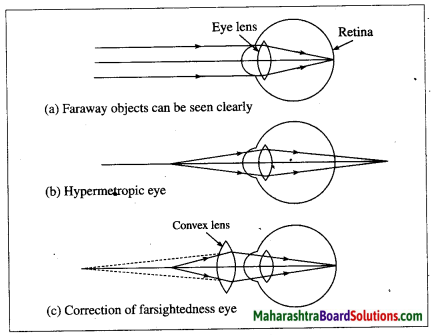
Maharashtra Board Class 10 Science Solutions Part 1 Chapter 7 Lenses 1

2. Presbyopia:
Presbyopia is the defect of vision in which aged people find it difficult to see nearby objects
comfortably and clearly without spectacles.

Reason of presbyopia: The power of accommodation of eye usually decreases with ageing. The muscles near the eye lens lose their ability to change the focal length of the lens.

Therefore, the near point of the eye lens shifts rarther from the eye, This defect is corrected using a. convex lens of appropriate power. The lens converges light rays before they fall on the eye lens such that the action of the eye lens forms the image on the retina.

3. Nearsightedness:
Myopia or nearsightedness is the defect of vision in which a human eye can see nearby objects distinctly but is unable to see distant objects clearly as they appear indistinct.
In this case the image of a distant object is formed in front of the retina instead of on the retina.
[Figs. 7.29 (a), 7.29 (b)]

Possible reasons for myopia:
(1) The curvature of the cornea and the eye lens increases. The muscles near the lens cannot relax so that the converging power of the lens remains large. (2) The distance between the eye lens and the retina increases as the eyeball elongates.

Myopia is corrected using a suitable concave lens. Light rays are diverged by the concave lens before they strike the eye lens. A concave lens of proper focal length is chosen to produce the required divergence. Hence, after the converging action of the eye lens, the image is formed on the retina. [Fig. 7.29 (c)]
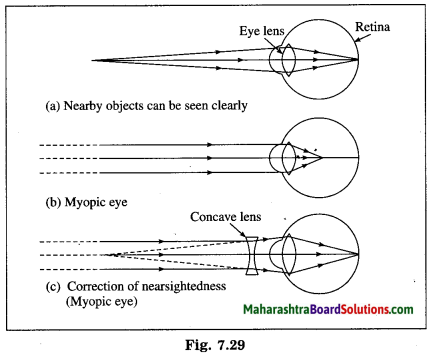
Maharashtra Board Class 10 Science Solutions Part 1 Chapter 7 Lenses 2

Maharashtra Board Class 10 Science Solutions Part 1 Chapter 7 Lenses

Question 2.
Draw a figure explaining various terms related to a lens.
Answer:
(1) Centre of curvature (C): The centres of the spheres whose parts form the surfaces of a lens are called the centres of curvature of the lens. A lens has two centres of curvature C1, and C2 for its two spherical surfaces.

(2) Radii of curvature (R1, R2): The radii of the spheres whose parts form surfaces of a lens are called the radii of curvature of the lens.

(3) Principal axis: The imaginary straight line passing through the two centres of curvature of a lens is called the principal axis of the lens.

(4) Optical centre (O): The point inside a lens on the principal axis, through which light rays pass without changing their path is called the optical centre (O) of the lens.

(5) Principal focus (F): When light rays parallel to the principal- axis are incident on a convex lens, they converge at a point on the principal axis. This point is called the principal focus (F) of the convex lens. Light rays travelling parallel to the principal axis of a concave lens diverge after refraction in such a way that they appear to be coming out of a point on the principal axis. This point is called the principal focus of the concave lens. A lens has two principal foci F1 and F2.
[Note: In this chapter, the terms focus and the principal focus are used in the same sense.]

(6) Focal length (f): The distance between the optical centre and the principal focus of a lens is called the focal length (f) of the lens.
Maharashtra Board Class 10 Science Solutions Part 1 Chapter 7 Lenses 3
C1, C2: Centres of curvature, R1, R2: Radii of curvature, O: Optical centre.
The cross sections of convex and concave lenses are shown in parts (a) and (b) of Fig. 7.4. The surface marked as 1 is part of sphere S1 while the surface marked as 2 is part of sphere S2.
Maharashtra Board Class 10 Science Solutions Part 1 Chapter 7 Lenses 4
P1, P2, P3: Incident rays of light,
Q1, Q2, Q3: Refracted rays of light, O: Optical centre
Maharashtra Board Class 10 Science Solutions Part 1 Chapter 7 Lenses 5
F1, F2: Principal foci of the lens, f: Focal length of the lens

Maharashtra Board Class 10 Science Solutions Part 1 Chapter 7 Lenses

Question 3.
At which position will you keep an object in front of a convex lens so as to get a real image of the same size as the object? Draw a figure.
Answer:
At 2F1.
Maharashtra Board Class 10 Science Solutions Part 1 Chapter 7 Lenses 6

Question 4.
Give scientific reasons:
a. A simple microscope is used for watch repairs.
Answer:
(1) when an object is placed within the focal length of a magnifying glass or simple microscope (convex lens), its larger and erect image is obtained on the same side of the lens as that of the object.

(2) By adjusting the distance between the object and the lens, the image can be obtained at the minimum distance of distinct vision. Thus, a watch repairer can see the minute parts of a watch more clearly with the aid of a magnifying glass (a simple microscope) than with the naked eye, without any stress on the eye. Hence, watch repairers use a magnifying glass (a simple microscope) while repairing the watches.

b. One can sense colours only in bright light.
Answer:
(1) The retina in the eye is made of many light sensitive cells. The rod-shaped cells respond to the intensity of light while the cone-shaped cells j respond to various colours.
(2) The cone-shaped cells do not respond to faint light. They function only in bright light. Hence, one can sense colours only in bright, light.

c. We cannot clearly see an object kept at a distance less than 25 cm from the eye.
Answer:
(1) When we try to see a nearby object, the eye lens becomes more rounded and its focal length decreases. Then a clear image of the object is formed on the retina of the eye.
(2) The focal length of the eye lens cannot be decreased beyond some limit. Therefore we cannot clearly see an object kept at a distance less than 25 cm from the eye.

Question 5.
Explain the working of an astronomical telescope using refraction of light.
Answer:
Construction of a refracting telescope: It consists of two convex lenses called the objective lens (directed towards the object) and the eyepiece (directed towards the eye). The focal length and diameter of the objective lens are respectively greater than the focal length and diameter of the eyepiece. The objective lens is fitted at one end of a long metal tube.

A metal tube of smaller diameter is fitted in this metal tube and the eyepiece is fitted at the outer end of the smaller tube. With the help of a screw it is possible to change the distance between the eyepiece and the objective lens by sliding the tube fitted with the eyepiece. The principal axes of the objective lens and the eyepiece are along the same line. A telescope is usually mounted on a stand.
Maharashtra Board Class 10 Science Solutions Part 1 Chapter 7 Lenses 7

Working: When the objective lens is pointed towards the distant object to be observed, the rays of light from the distant object, which are almost parallel to each other, pass through the objective lens. The objective lens collects maximum amount of light as it is large in size. It forms a real, inverted and diminished image in the focal plane of the objective lens. Now, the position of the eyepiece is adjusted such that this image falls just within the focal length of the eyepiece and serves as the object for the eyepiece which works as a simple microscope.

The final image is highly magnified, virtual, on the same side as that of the object and inverted with respect to the original object. The final image can be observed by keeping the eye close to the eyepiece. If the image formed by the objective lens lies in the focal plane of the eyepiece, the final image is formed at infinity.

Maharashtra Board Class 10 Science Solutions Part 1 Chapter 7 Lenses

Question 6.
Distinguish between the following:
a. Farsightedness (Hypermetropia) and Nearsightedness (Myopia).
Answer:
Farsightedness:

  1. In hypermetropia, a human eye can see distant distinctly but is unable to see nearby objects clearly.
  2. In this case, the image of a nearby object would be formed behind the retina.
  3. This defect can be corrected using a convex lens of appropriate power.

Nearsightedness:

  1. In myopia, a human eye can see near objects distinctly, but is unable to see distant objects clearly.
  2. In this case, the image of a distant object is formed in front of the retina.
  3. This defect can be corrected using a concave lens of appropriate power.

b. Concave lens and Convex lens.
Answer:
Concave lens:

  1. A concave lens has its surfaces curved inwards.
  2. It is thicker at the edges than in the middle.
  3. It can form only a virtual image.
  4. It can form only a diminished image.

Convex lens:

  1. A convex lens has its surfaces puffed up outwards.
  2. It is thicker in the middle than at the edges.
  3. It can form a real image as well as a % virtual image.
  4. It can form a magnified, diminished or the same sized image (relative to the object) depending on the position of the object.

Question 7.
What is the function of the iris and the muscles connected to the lens in the human eye?
Answer:
When the incident light is very bright, the muscles of the iris stretch to reduce the size of the pupil. When the incident light is dim, the muscles of the iris relax to increase the size of the pupil. Thus, the iris controls the size of the pupil and thereby regulates the amount of light entering the eye. (Fig. 7.26)

When a distant object is to be observed, the ciliary muscles relax so that the eye lens becomes flat. This increases the focal length of the lens. Therefore, a sharp image of the distant object is formed on the retina.
Thus, we can see a distant object clearly. (Fig. 7.27)
Maharashtra Board Class 10 Science Solutions Part 1 Chapter 7 Lenses 8
when an object closer to the eye is to be observed. the ciliary muscles contract increasing the curvature. of the eye lens. The eye lens, therefore, becomes rounded. This decreases the focal length of the lens. Therefore, a sharp image of the nearby object is formed on the retina. Thus, we can see a nearby object clearly. (Fig. 7.27)
Maharashtra Board Class 10 Science Solutions Part 1 Chapter 7 Lenses 9

Question 8.
Solve the following examples:
i. Doctor has prescribed a lens having I power + 1.5 D. What will be the focal length of the lens? What is the type of the lens and what must be the defect of vision?
Solution:
Data: P = + 1.5 D, f = ?
Focal length of the lens, f = \(\frac{1}{P}=\frac{1}{1.5 \mathrm{D}}\)
= \(\frac{10}{15}\) m = 0.6667 m = 0.67 m
P is positive. This shows that the lens is convex. The defect of vision is farsightedness (hypermetropia).

ii. 5 cm high object is placed at a distance of 25 cm from a converging lens of focal length of 10 cm. Determine the position, size and type of the image.
Solution:
Data: Converging lens, f = 10 cm
u = – 25 cm, h1 = 5 cm, v = ?, h2 = ?
Maharashtra Board Class 10 Science Solutions Part 1 Chapter 7 Lenses 10
Maharashtra Board Class 10 Science Solutions Part 1 Chapter 7 Lenses 11
The height of the image = -3.3 cm (inverted image ∴ minus sign).
(iii) The image is real, inverted and smaller than the object.

iii. Three lenses having powers 2, 2.5 and 1.7 D are kept touching in a row. What is the total power of the lens combination?
Solution:
Data: P1 = 2 D, P2 = 2.5 D, P3 = 1.7 D, P = ?
Total power of the lens combination,
P = P1 +P2 + P3
= 2 D + 2.5 D + 1.7 D
= 6.2 D.

iv. An object kept 60 cm from a lens gives a virtual image 20 cm in front of the lens. What is the focal length of the lens? Is it a converging lens or diverging lens?
Solution:
Data: u = -60 cm, v = -20 cm, f = ?
Maharashtra Board Class 10 Science Solutions Part 1 Chapter 7 Lenses 12
∴ The focal length of the lens, f = – 30 cm. As f is negative, it is a diverging lens.

Project:

Question 1.
Make a Powerpoint presentation about the construction and use of binoculars. (Do it your self)

Maharashtra Board Class 10 Science Solutions Part 1 Chapter 7 Lenses

Can you recall? (Text Book Page No. 80)

Question 1.
Indicate the following terms related to spherical mirrors in figure 7.1: pole, centre of curvature, radius of curvature, principal focus.
Maharashtra Board Class 10 Science Solutions Part 1 Chapter 7 Lenses 13
Answer:
Maharashtra Board Class 10 Science Solutions Part 1 Chapter 7 Lenses 14

Question 2.
How are concave and convex mirrors constructed?
Answer:
The given part of a hollow spherical glass can be converted into a concave mirror by (i) polishing (silvering) its inner side (inner surface or concave surface) to make it reflecting or (ii) coating its outer side with a thin layer of silver and painting it with red colour to protect the silver coating.
[Note: Case (i) corresponds to the front surface silvered concave mirror.]

The given part of a hollow spherical glass can be converted into a convex mirror by (i) polishing (silvering) its outer side (outer surface or convex surface) to make it reflecting or (ii) coating its inner side with a thin layer of silver and painting it with red colour to protect the silver coating.
[Note: Case (i) corresponds to the front surface silvered convex mirror. ]

Use your brain power! (Text Book Page No. 85)

Question 1.
From equations (1) and (2) what is the relation between h1, h2, u and v?
Answer:
M = \(\frac{h_{2}}{h_{1}}\) …….(1)
Also, M = \(\frac{v(\text { image distance })}{u \text { (object distance) }}\)……(2)
\(\frac{h_{2}}{h_{1}}\) = \(\frac{v}{u}\)

Maharashtra Board Class 10 Science Solutions Part 1 Chapter 7 Lenses

Try this (Text Book Page No. 88)

(1) Try to read a book keeping it very far from your eyes.
(2) Try to read a book keeping it very close to your eyes.
(3) Try to read a book keeping it at a distance of 25 cm from your eyes.
At which time do you see the alphabets clearly? Why?
Answer:
Minimum distance of distinct vision: Though the focal length of the eye lens is adjustable, it cannot be decreased below a certain limit. Hence, if an object is very close to the eye, it cannot be seen clearly. For a normal human eye, the minimum distance from the eye at which an object is clearly visible without stress on the eye, is called the minimum distance of distinct vision. For the normal human eye, it is 25 cm.

Use your brain power! (Text Book Page No. 89)

Question.
(1) Why do we have to bring a small object near the eyes in order to see it clearly?
(2) If we bring an object closer than 25 cm from the eyes, when can we not see it clearly even though it subtends a bigger angle at the eye?
Answer:
(1) when a small object is brought near the eyes, its apparent size increases. Therefore, it is
seen clearly.

(2) Minimum distance of distinct vision: Though the focal length of the eye lens is adjustable, it cannot be decreased below a certain limit. Hence, if an object is very close to the eye, it cannot be seen clearly. For a normal human eye, the minimum distance from the eye at which an object is clearly visible without stress on the eye, is called the minimum distance of distinct vision. For the normal human eye, it is 25 cm.

Try this (Text Book Page No. 91)

Question 1.
Take a burning incense stick in your hand and rotate it fast along a circle.
Answer:
A circle of red light is seen.

Question 2.
Draw a cage on one side of a cardboard and a bird on the other side. Hang the cardboard with the help of a thread. Twist the thread and leave It. What do you see and why?
Answer:
The bird appears to be inside the cage. This happens due to persistence of vision.
Persistence of vision: We see an object when its image is formed on the retina. The image disappears when the object is removed from our sight. But this is not instantaneous and the image remains imprinted on the retina for about \(\frac{1}{16}\) th of a second after the removal of the object. The sensation on the retina persists for a while. This effect is known as the persistence of vision.

It is due to persistence of vision that we continue to see the object in its position for about \(\frac{1}{16}\) th of a second after it is removed.
Example: When a burning stick of incense is moved fast in a circle, a circle of red light is seen.

Maharashtra Board Class 10 Science Solutions Part 1 Chapter 7 Lenses

Can you tell? (Text Book Page No. 91)

Question 1.
How do we perceive different colours?
Answer:
(1) In nature we field objects of various colours. Perception of colour means to be able to respond to colour.
(2) We can distinguish between various colours due to perception of colour.
(3) The cone-shaped cells on the retina of the eye respond to the various colours when light is bright and communicate to the brain about the colours of the image formed on the retina. This gives us the proper idea about the colours of the object.
(4) If, in the retina of a person, the cone-shaped cells responding to certain specific colours are absent, the person is unable to distinguish between the colours. As a result, he lacks perception of colour.

Fill in the blanks and rewrite the statements:

Question 1.
The focal length of a………..lens is positive.
Answer:
The focal length of a convex lens is positive.

Question 2.
The focal length of a………..lens is negative.
Answer:
The focal length of a concave lens is negative.

Question 3.
The magnification produced by a………..lens is always positive.
Answer:
The magnification produced by a concave lens is always positive.

Question 4.
The power of a………..lens is positive.
Answer:
The power of a convex lens is positive.

Question 5.
The power of a………..lens is negative.
Answer:
The power of a concave lens is negative.

Question 6.
The focal length of a lens with power 2.5 D is………..
Answer:
The focal length of a lens with power 2.5 D is 40 cm (0.4 m).

Question 7.
The power of a lens with focal length 20 cm is………..
Answer:
The power of a lens with focal length 20 cm is 5D.

Question 8.
The minimum distance of distinct vision for a normal human eye is………..
Answer:
The minimum distance of distinct vision for a normal human eye is 25 cm.

Question 9.
If two lenses with focal lengths 10 cm and 20 cm respectively are kept in contact with each other, the effective power of the combination is………..
Answer:
If two lenses with focal lengths 10 cm and 20 cm respectively are kept in contact with each other, the effective power of the combination is 15 D.

Maharashtra Board Class 10 Science Solutions Part 1 Chapter 7 Lenses

Question 10.
A………..lens is used as a simple microscope.
Answer:
A convex lens is used as a simple microscope.

Rewrite the following statements by selecting the correct options:

Question 1.
Inside water, an air bubble behaves………..
(a) like a flat plate
(b) like a concave lens
(c) like a convex lens
(d) like a concave mirror
Answer:
Inside water, an air bubble behaves like a concave lens.

Question 2.
…………represents the lens formula.
Maharashtra Board Class 10 Science Solutions Part 1 Chapter 7 Lenses 15
Answer:
(b) \(\frac{1}{v}-\frac{1}{u}=\frac{1}{f}\) represents the lens formula.

Question 3.
The power of a convex lens of focal length 25 cm is………..
(a) +4.0 D
(b) 0.25 D
(c) -4.0 D
(d) -0.4D
Answer:
The power of a convex lens of focal length 25 cm is +4.0 D

Question 4.
A lens does not produce any deviation of a ray of light passing through………..
(a) it’s centre of curvature
(b) it’s optical centre
(c) it’s principal focus
(d) an axial point at a distance 2F from its centre
Answer:
A lens does not produce any deviation of a ray of light passing through its optical centre.

Question 5.
The image formed by a concave lens is always………..
(a) virtual and erect
(b) real and erect
(c) virtual and inverted
(d) real and inverted
Answer:
The image formed by a concave lens is always virtual and erect.

Question 6.
A convex lens forms a virtual image of an object placed………..
(a) at infinity
(b) at a distance 2F from the lens
(c) at a distance F from the lens
(d) between the principal focus and the optical centre of the lens.
Answer:
A convex lens forms a virtual image of an object placed between the principal focus and the optical centre of the lens.

Question 7.
When an object is placed at 2F1 of a convex lens, its image is formed………..
(a) at F1
(b) at 2F2
(c) beyond 2F2
(d) on the same side as the object
Answer:
When an object is placed at 2F1 of a convex lens, its image is formed at 2F2

Maharashtra Board Class 10 Science Solutions Part 1 Chapter 7 Lenses

Question 8.
To obtain an image of the same size as that of an object with the help of a convex lens, the object should be placed………..
(a) at infinity
(b) beyond F1
(c) between F1 and 2F1
(d) at 2F1
Answer:
To obtain an image of the same size as that of an object with the help of a convex lens, the object should be placed at 2F1

Question 9.
When an object is placed between O and F1 in front of a convex lens, the image formed is ………..
(a) enlarged and erect
(b) diminished and erect
(c) real and enlarged
(d) diminished and inverted
Answer:
When an object is placed between O and F1 in front of a convex lens, the image formed is enlarged and erect.

Question 10.
When an object is placed at any finite distance from a concave lens, the image is formed ………..
(a) between F1 and 2F1
(b) beyond 2F1
(c) at F1
(d) between F1 and O on the same side as the object.
Answer:
When an object is placed at any finite distance from a concave lens, the image is formed between F1 and O on the same side as the object.

Question 11.
A student obtained a clear image of window grills on the screen. But the teacher told him to get the image of a tree far away, instead of the window. To get a clear image, the lens must be ……….. (Practice Activity Sheet – 2)
(a) moved towards the screen
(b) moved away from the screen
(c) moved behind the screen
(d) moved far away from the screen
Answer:
A student obtained a clear image of window grills on the screen. But the teacher told him to get the image of a tree far away, instead of the window. To get a clear image, the lens must be moved towards the screen.

Question 12.
The image obtained while finding the focal length of a convex lens is ……….. (Practice Activity Sheet – 3)
(a) real and erect
(b) virtual and erect
(c) real and inverted
(d) virtual and inverted
Answer:
The image obtained while finding the focal length of a convex lens is real and inverted.

Maharashtra Board Class 10 Science Solutions Part 1 Chapter 7 Lenses

Question 13.
Yash found out f1 and f2 of a symmetric convex lens experimentally. Then which of the following conclusions is true? (Practice Activity Sheet – 4)
(a) f1 = f2
(b) f1 > f2
(c) f1 < f2
(d) f1 ≠ f2
Answer:
(a) f1 = f2

State whether the following statements are true or false: (If a statement is false, correct it and rewrite it.)

Group (A)

Question 1.
Power of a lens, P = \(\frac{1}{f}\).
Answer:
True.

Question 2.
If the power of a lens is 2 D, its focal length = 0.5 m.
Answer:
True.

Question 3.
A concave lens is a converging lens. (March 2019)
Answer:
False. (A concave lens is a diverging lens.)

Question 4.
A convex lens is a diverging lens.
Answer:
False. (A convex lens is a converging lens.)

Question 5.
A concave lens always forms a virtual image.
Answer:
True.

Question 6.
A convex lens always forms a virtual image.
Answer:
False. (A convex lens forms a real image or a virtual image depending on the object distance.)

Maharashtra Board Class 10 Science Solutions Part 1 Chapter 7 Lenses

Question 7.
Due to the light sensitive cells in the eye, we get information about the brightness or dimness of the object and the colour of the object.
Answer:
True.

Question 8.
The focal length of a concave lens is negative.
Answer:
True.

Question 9.
The magnification produced by a concave lens is positive or negative depending on the object distance.
Answer:
False. (The magnification produced by a concave lens is always positive.)

Question 10.
The magnification produced by a convex lens is positive or negative depending on the object distance.
Answer:
True.

Question 11.
A concave lens is used as a magnifying glass.
Answer:
False. (A convex lens is used as a magnifying glass.)

Question 12.
A convex lens is used as a simple microscope.
Answer:
True.

Question 13.
A concave lens is used to correct myopia.
Answer:
True.

Maharashtra Board Class 10 Science Solutions Part 1 Chapter 7 Lenses

Question 14.
A convex lens is used to correct hypermetropia.
Answer:
True.

Group (B)

Question 1.
When red light falls on the eyes, the cells responding to red light get excited more than those responding to other colours and we get the sensation of red colour.
Answer:
True.

Question 2.
When an object is placed in front of a concave lens, its image is obtained on the opposite side of the object.
Answer:
False. (When an object is kept in front of a concave lens, its image is obtained on the same side of the lens as the object.)

Question 3.
The image formed by a concave lens is always virtual.
Answer:
True.

Question 4.
The principal focus of a convex lens is virtual.
Answer:
False. (The principal focus of a convex lens is real.)

Maharashtra Board Class 10 Science Solutions Part 1 Chapter 7 Lenses

Question 5.
An object of height 2 cm forms an image of height 3 cm when placed in front of a concave lens.
Answer:
False. (An object of height 2 cm forms an image of height less than 2 cm when placed in front of a concave lens.)

Question 6.
Absence of rod like cells results in colour blindness.
Answer:
False. (Absence of conical cells results in colour-blindness.)

Question 7.
Nearsightedness can be corrected using spectacles having convex lenses.
Answer:
False. (Nearsightedness can be corrected using spectacles having concave lenses.)

Question 8.
Farsightedness can be corrected using spectacles having convex lenses of suitable focal length.
Answer:
True.

Question 9.
As one grows old, ciliary muscles become weak.
Answer:
True.

Question 10.
In a simple microscope, the object is placed within the focal length of the convex lens.
Answer:
True.

Question 11.
A compound microscope forms an erect and real image of a small object.
Answer:
False. (A compound microscope forms an inverted and virtual image of a small object.)

Question 12.
In a compound microscope, a real image acts as an object for the eyepiece.
Answer:
True.

Maharashtra Board Class 10 Science Solutions Part 1 Chapter 7 Lenses

Question 13.
In television, we see a continuous picture due to persistence of vision.
Answer:
True.

Question 14.
The conical cells can respond differently to red, green and blue colours.
Answer:
True.

Question 15.
The rod like cells respond to colours and communicate the presence of colours in the retinal image of the brain.
Answer:
False. (The rod like cells respond to the intensity of light and communicate the degree of brightness and darkness, to the brain.)

Question 16.
The conical cells respond to the intensity of light and communicate the degree of brightness and darkness to the brain.
Answer:
False. (The conical cells respond to colours and communicate the presence of colours in the retinal image to the brain.)

Question 17.
Generally, using the same objective lens, but different eyepieces, different magnification can be obtained.
Answer:
True.

Find the odd one out and give the reason:

Question 1.
Simple microscope, Compound microscope, Telescope, Myopia.
Answer:
Myopia. It is a defect of vision; others are instruments.

Question 2.
Myopia, Presbyopia, Hypermetropia, Spectrometer.
Answer:
Spectrometer. It is an instrument; others are defects of vision.

Question 3.
Presbyopia, Retina, Nearsightedness, Farsightedness.
Answer:
Retina. It is a part of the eye; others are defects of vision.

Question 4.
Compound microscope, Kaleidoscope, Simple microscope, Astronomical telescope.
Answer:
Kaleidoscope. Others are optical instruments.

Maharashtra Board Class 10 Science Solutions Part 1 Chapter 7 Lenses

Question 5.
TV, Motion picture, Complete circle formed by a revolving burning incense stick, Colour blindness.
Answer:
Colour-blindness. Others are examples of persistence of vision.

Question 6.
Planets, Stars, Satellites, Rainbow.
Answer:
Rainbow. Others are celestial bodies.

Considering the correlation between the words of the first pair, pair the third word accordingly with proper answer:

Question 1.
Nearsightedness: Elongated eyeball :: Farsightedness:………
Answer:
Flattened eyeball

Question 2.
Convex lens : Converging :: Concave lens :………..
Answer:
Diverging

Question 3.
Object at 2F1 of a convex lens : Image at 2F2 :: Object at F1 :………..
Answer:
Image on the opposite side at infinity

Question 4.
Magnification positive : Erect image :: Magnification negative :………..
Answer:
Inverted image

Question 5.
Convex lens : Positive power of the lens :: Concave lens:
Answer:
Negative power of the lens.

Maharashtra Board Class 10 Science Solutions Part 1 Chapter 7 Lenses

Question 6.
\(\frac{1}{f(\text { in metre })}\) : Power of the lens (in dioptre) :: \(\frac{\text { Image distance }}{\text { Object distance }}\)
Answer:
Magnification.

Question 7.
Focal length : Metre :: Power of a lens :………..
Answer:
Dioptre.

Question 8.
Iris : Pupil :: Ciliary muscles :……….
Answer:
Eye lens

Question 9.
Nearsightedness : Concave lens :: Farsightedness :………..
Answer:
Convex lens

Question 10.
Nearsightedness : Image in front of the retina :: Farsightedness :………..
Answer:
Image behind the retina

Question 11.
Observation of stars and planets : Telescope :: Repairing a watch :……….
Answer:
Simple microscope

Question 12.
Cinema : Persistence of vision :: Rainbow :………
Answer:
Refraction, dispersion and internal reflection of light.

Match the following:

Question 1.

Column AColumn B
(1) Conical cells(a) Intensity of light
(2) Rod like cells(b) Colour of an image
(3) Pupil(c) Iris
(4) Cornea(d) Aperture
(e) Transparent

Answer:
(1) Conical cells – Colour of an image
(2) Rod like cells – Intensity of light
(3) Pupil – Aperture
(4) Cornea – Transparent.

Maharashtra Board Class 10 Science Solutions Part 1 Chapter 7 Lenses

Question 2.

Column AColumn B
(1) Magnification(a) \(\frac{1}{f}\)
(2) Power of a lens(b) \(\frac{h_{2}}{h_{1}}\)
(3) Focal length(c) f
(4) Distance of an object from a lens(d) u
(e) \(\frac{h_{1}}{h_{2}}\)

Answer:
(1) Magnification: \(\frac{h_{2}}{h_{1}}\)
(2) Power of a lens: \(\frac{1}{f}\)
(3) Focal length: f
(4) Distance of an object from a lens: u.

Question 3.
Maharashtra Board Class 10 Science Solutions Part 1 Chapter 7 Lenses 16
Answer:
(1) Lens: \(\frac{1}{f}: \frac{1}{v}-\frac{1}{u}\)
(2) Magnification: \(\frac{h_{2}}{h_{1}}\)
(3) Refractive index: \(\frac{\sin i}{\sin r}\)

Question 4.

Column AColumn B
(Convex lens)(a) Image virtual, erect and enlarged
(1) Object at 2F1(b) Image real, inverted and of the same size
(2) Object between F1 and 2F1(c) Image real, inverted and highly diminished
(3) Object between O and F1(d) Image real, inverted and highly enlarged
(4) Object at infinity(e) Image real, inverted and enlarged

Answer:
(1) Object at 2F1 – Image real, inverted and of the same size
(2) Object between F1 and 2F1 – Image real, inverted and enlarged
(3) Object between O and F1 – Image virtual, erect and enlarged
(4) Object at infinity – Image real, inverted and highly diminished

Question 5.

Column AColumn B
(1) Nearsightedness(a) Ciliary muscles become weak
(2) Farsightedness(b) Image in front of the retina
(3) Presbyopia(c) Colour-blindness
(d) Image behind the retina

Answer:
(1) Nearsightedness – Image in front of the retina
(2) Farsightedness – Image behind the retina
(3) Presbyopia – Ciliary muscles become weak

Question 6.

Column AColumn B
(1) Convex lens(a) To see small objects clearly
(2) Astronomical telescope(b) To observe minute objects
(3) Compound microscope(c) To observe astronomical objects such as stars, planets, etc.
(4) Simple microscope(d) Presbyopia
(e) Power of a lens

Answer:
(1) Convex lens – Presbyopia
(2) Astronomical telescope – To observe astronomical objects such as stars, planets, etc.
(3) Compound microscope – To observe minute objects
(4) Simple microscope – To see small objects clearly.

Maharashtra Board Class 10 Science Solutions Part 1 Chapter 7 Lenses

Question 7.

Column AColumn B
(1) Persistence of vision(a) Lenses and mirrors are used
(2) Reflecting telescope(b) To see objects far away from us
(3) Telescope(c) Motion picture
(4) Compound microscope(d) To observe blood
(e) Convex lens

Answer:
(1) Persistence of vision – Motion picture
(2) Reflecting telescope – Lenses and mirrors are used
(3) Telescope – To see objects far away from us
(4) Compound microscope – To observe blood corpuscles.

Name the following:

Question 1.
Name the lens which forms a real image or a virtual image depending on the position of the object.
Answer:
A convex lens.

Question 2.
Name the lens which produces magnification always less than 1.
Answer:
A concave lens.

Question 3.
Name the lens which always forms an image virtual and smaller than the object.
Answer:
A concave lens.

Maharashtra Board Class 10 Science Solutions Part 1 Chapter 7 Lenses

Question 4.
Name the lens used to obtain the image on a screen.
Answer:
A convex lens.

Question 5.
Name the lens for which the image always lies between the object and the lens.
Answer:
A concave lens.

Question 6.
Name the instrument used to observe bacteria.
Answer:
A compound microscope.

Question 7.
Name the instrument used to observe planets.
Answer:
An astronomical telescope.

Answer the following questions in one sentence each:

Question 1.
An object is placed at 60 cm from a convex lens of focal length 20 cm. State the nature and size of the image relative to that of the object.
Answer:
The image is real, inverted and smaller than the object.

Question 2.
If an object is placed at 50 cm from a convex lens of focal length 25 cm, what will be the image distance?
Answer:
The image distance will be.50 cm.

Question 3.
An object is placed at 40 cm from a convex lens of focal length 20 cm. State the nature and the size of the image relative to that of the object.
Answer:
The image is real, inverted and of the same size as that or the object.

Maharashtra Board Class 10 Science Solutions Part 1 Chapter 7 Lenses

Question 4.
An object is placed at 30 cm from a convex lens of focal length 20 cm. State the nature and the size of the image relative to that of the object.
Answer:
The image is real, inverted and larger than the object.

Question 5.
An object is placed at 15 cm from a convex lens of focal length 25 cm. State the nature and size of the image relative to that of the object.
Answer:
The image is virtual, erect and larger than the object.

Question 6.
State the type of lens that can be used to burn paper in sunlight at noon.
Answer:
A convex lens can be used to burn paper in sunlight at noon.

Question 7.
State the type of lens used to correct myopia.
Answer:
A concave lens is used to correct myopia.

Question 8.
State the type of lens used to correct hypermetropia.
Answer:
A convex lens is used to correct hypermetropia.

Question 9.
If two lenses with focal lengths 10 cm and – 20 cm respectively are kept in contact with each other, what will be the effective power of the combination of the lenses?
Answer:
The effective power of the combination of the lenses will be + 5 D.

Question 10.
If two lenses with focal lengths – 10 cm and 40 cm respectively are kept in contact with each other, what can you say about the behaviour of the combination of the lenses?
Answer:
The combination of the lenses will behave as a concave lens.

Answer the following questions:

Question 1.
What is a lens?
Answer:
A lens is a transparent material bound by two surfaces, out of which at least one surface is spherical.
[Note: A lens is normally made of glass or plastic.]

Question 2.
In which instruments have you seen a lens?
Answer:
We have seen a lens in a microscope and a telescope.

Question 3.
How is a lens different from a mirror?
Answer:
A mirror has one reflecting surface. By reflection of light, it forms an image of the object placed in front of it. A mirror is not transparent. A lens has two surfaces that form an image by refraction of light. A lens is transparent.

Question 4.
Make a list of optical devices you know.
Answer:
Microscope, telescope, binoculars, camera, projector.

Question 5.
Do you know which is the natural optical device?
Answer:
Yes. The eye is the natural optical device.

Question 6.
What is a convex lens?
Answer:
A lens having both spherical surfaces puffed up outwards is called a convex lens or double convex lens or biconvex lens. It is thicker in the middle than at the edges.
[Note: A convex lens is also called a converging lens.]

Question 7.
What is a concave lens?
Answer:
A lens having both spherical surfaces curved inwards is called a concave lens or double concave lens or biconcave lens. It is thicker at the edges than in the middle.
[Note: A concave lens is also called a diverging lens.]

Maharashtra Board Class 10 Science Solutions Part 1 Chapter 7 Lenses

Question 8.
Draw neat labelled diagrams: Types of lenses.
Answer:
Maharashtra Board Class 10 Science Solutions Part 1 Chapter 7 Lenses 17
[Note: Positive meniscus behaves as a convex lens as it is thicker in the middle than at the edges. Negative meniscus behaves as a concave lens as it is thicker at the edges than in the middle.]

Question 9.
In general, when a ray of light passes through a lens, there occurs a change in its direction of propagation. Why?
Answer:
The working of a lens is similar to that of a triangular prism. When a ray of light passes through a lens, it is refracted twice: When entering the lens and when emerging from the lens. There is a change 5 in its direction of propagation every time and as both the changes occur in the same sense, the direction of propagation of the emergent ray is different from that of the incident ray.

Question 10.
State the rules used for drawing ray diagrams for the formation of an image by a convex lens.
Answer:
Rules used for drawing ray diagrams for the formation of an image by a convex lens:
(1) When the incident ray is parallel to the principal axis, the refracted ray passes through the principal focus.
Maharashtra Board Class 10 Science Solutions Part 1 Chapter 7 Lenses 18
(2) When the incident ray passes through the principal focus, the refracted ray is parallel to the principal axis.
Maharashtra Board Class 10 Science Solutions Part 1 Chapter 7 Lenses 19
(3) When the incident ray passes through the optical centre of the lens, it passes without changing its direction.
Maharashtra Board Class 10 Science Solutions Part 1 Chapter 7 Lenses 20

Question 11.
In the case of a convex lens, show the path of the refracted ray when the incident ray of light (1) is parallel to the principal axis of the lens (2) passes through the focus of the lens (3) passes through the optical centre of the lens.
Answer:
1.
Maharashtra Board Class 10 Science Solutions Part 1 Chapter 7 Lenses 21

2.
Maharashtra Board Class 10 Science Solutions Part 1 Chapter 7 Lenses 22

3.
Maharashtra Board Class 10 Science Solutions Part 1 Chapter 7 Lenses 23

Maharashtra Board Class 10 Science Solutions Part 1 Chapter 7 Lenses

Question 12.
Draw neat and well labelled ray diagrams for image formation by convex lens when an object is (1) at infinity (2) beyond 2F1 (3) at 2F1 (4) between F1 and 2F1 (5) at focus F1 (6) between focus F1 and optical centre O. Also, in each case, state the position, nature and size of the image relative to that of the object.
Answer:
(1) Object at infinity:
Maharashtra Board Class 10 Science Solutions Part 1 Chapter 7 Lenses 24
In this case, the image is formed at focus F2 of the convex lens. It is real, inverted and highly diminished (point-sized).

(2) Object beyond 2F1:
Maharashtra Board Class 10 Science Solutions Part 1 Chapter 7 Lenses 25
In this case, the image is formed between F2 and 2F2. It is real, inverted and diminished.

(3) Object at 2F1:
Maharashtra Board Class 10 Science Solutions Part 1 Chapter 7 Lenses 26
In this case, the image is formed at 2F2. It is real, inverted and of the same size as that of the object.

(4) Object between F1 and 2F1:
Maharashtra Board Class 10 Science Solutions Part 1 Chapter 7 Lenses 27
In this case, the image is formed beyond 2F2. It is real, inverted and magnified (enlarged).

(5) Object at focus F1:
Maharashtra Board Class 10 Science Solutions Part 1 Chapter 7 Lenses 28
In this case, the image is formed at infinity. It is real, inverted and infinitely large (highly magnified).

(6) Object between focus F1 and optical centre O:
Maharashtra Board Class 10 Science Solutions Part 1 Chapter 7 Lenses 29
In this case, the image is formed on the same side of the lens as the object. It is virtual, erect and larger than the object.
[Note: Here, the image is virtual. Hence, it is shown by a dotted line.]

Maharashtra Board Class 10 Science Solutions Part 1 Chapter 7 Lenses

Question 13.
Observe the following figure and complete the table: (March 2019)
Maharashtra Board Class 10 Science Solutions Part 1 Chapter 7 Lenses 30
Answer:

PointAnswer
(i) Position of the objectBetween F1 and O
(ii) Position of the imageOn the same side of the lens as the object
(iii) Size of the imageVery large
(iv) Nature of the imageVirtual and erect

Question 14.
At which position will you keep an object in front of a convex lens to get a real image smaller than the object? Draw a figure.
Answer:
The object should be placed beyond 2F1.
Maharashtra Board Class 10 Science Solutions Part 1 Chapter 7 Lenses 31

Question 15.
State the rules used for drawing ray diagrams for the formation of an image by a concave lens.
Answer:

  1. When the incident ray is parallel to the principal axis, the refracted ray, when extended backwards, passes through the principal focus.
  2. When the incident ray is directed towards the principal focus F2, the refracted ray is parallel to the principal axis.
  3. When the incident ray passes through the optical centre of the lens, it passes without changing its direction.

Question 16.
State the characteristics of an image formed by a concave lens.
Answer:
The image formed by a concave lens is always virtual, erect and smaller than the object. It is on the same side of the lens as the object. Generally, it is formed between the optical centre of the lens and the principal focus F1. If the object is at infinity, the image is a point image formed at F1.

Question 17.
In the case of image formation by a concave lens, what can you say about the position, nature and size of the image relative to the size of the object?
Answer:
Image formation by a concave lens :
(1) If the object is at infinity, the image is formed at the focus of the lens, on the same side of the lens as the object. It is virtual, erect and much smaller than the object (point image).

(2) If the object is at any finite distance from the lens, the image is formed on the same side of the lens as the object and between the focus and the optical centre of the lens. It is virtual, erect and smaller than the object. The image distance is less than the object distance.

Maharashtra Board Class 10 Science Solutions Part 1 Chapter 7 Lenses

Question 18.
Draw a ray diagram to show image formation by a concave lens.
Answer:
Maharashtra Board Class 10 Science Solutions Part 1 Chapter 7 Lenses 32
PQ : Object
P’Q’ : Image (virtual, therefore shown by a dotted line),
O : Optical centre,
F1 : Principal focus,
f : Focal length of the lens
[Note: If in a Board examination, incomplete diagram (as shown below) is given, students should complete it and label its parts as shown in Figure.]
Maharashtra Board Class 10 Science Solutions Part 1 Chapter 7 Lenses 33

Question 19.
State the Cartesian sign convention for refraction of light (image formation) by a lens.
Answer:
Cartesian sign convention for refraction of light (image formation) by a lens:
In this case, the optical centre (O) of the lens is taken as the origin and the principal axis of the lens is taken as X-axis of the coordinate system.

(1) The object is always placed at the left of the lens.
All distances parallel to the principal axis are measured from the optical centre of the lens.
(2) All distances measured to the right of the origin are taken as positive while distances measured to the left of the origin are taken as negative.
(3) Distances measured perpendicular to and above the principal axis are taken as positive.
(4) Distances measured perpendicular to and below the principal axis are taken as negative.
(5) The focal length of a convex lens is positive and that of a concave lens is negative. (Fig. 7.21)
Maharashtra Board Class 10 Science Solutions Part 1 Chapter 7 Lenses 34
Maharashtra Board Class 10 Science Solutions Part 1 Chapter 7 Lenses 35

Question 20.
(i) What is a lens formula? (ii) State it.
Answer:
(i) The relationship between the object distance (u), image distance (v) and focal length (J) of a lens is called the lens formula.
(ii) It is \(\frac{1}{v}-\frac{1}{u}=\frac{1}{f}\)
[Note: The lens formula holds good for all values of u and v and is applicable to a convex lens as well as a concave lens. The sign convention for u, v and f must tie used in solving numerical examples.]

Maharashtra Board Class 10 Science Solutions Part 1 Chapter 7 Lenses

Question 21.
What is meant by the magnification produced by a lens? State the formulae for it.
Answer:
The magnification (M) produced by a lens is the ratio of the height of the image (h2) to the height of the object (h1).
M = \(\frac{h_{2}}{h_{1}}\)……….(1)
Also M = \(\frac{v(\text { image distance })}{u \text { (object distance) }}\)……………(2)

Question 22.
When is the magnification produced by a lens (1) positive (2) negative?
Answer:
The magnification produced by a lens is
(1) Positive when the image is virtual (as it is erect)
(2) Negative when the image is real (as it is inverted).

Question 23.
Express the magnification produced by a lens in terms of the focal length of the lens and (1) the object distance (2) the image distance.
Answer:
Magnification (M) produced by a lens
Maharashtra Board Class 10 Science Solutions Part 1 Chapter 7 Lenses 36
where f is the focal length of the lens:
Maharashtra Board Class 10 Science Solutions Part 1 Chapter 7 Lenses 37
(2) From eq. (2), we have
Maharashtra Board Class 10 Science Solutions Part 1 Chapter 7 Lenses 38

Question 24.
An object is kept in front of a lens of focal length + 10 cm. Describe the nature of the image in the following cases: (1) The object” distance is 25 cm. (2) The object distance is 5 cm.
Answer:
Since, the focal length of the lens ( +10 cm) is positive, it is a convex lens.
(1) If an object is kept at 25 cm from the lens, the image will be real, inverted and smaller than the object.
(2) If an object is kept at 5 cm from the lens, the image will be virtual, erect and larger than the object.

Maharashtra Board Class 10 Science Solutions Part 1 Chapter 7 Lenses

Question 25.
Anu and Anand have concave and convex lenses respectively. They took lenses in sunlight and tried to burn two pieces of paper of equal areas and temperature. State which lens will burn the paper. Give the reason. Explain with the help of a diagram, why the other paper did not burn.
Answer:
(1) The convex lens will burn the paper. See Fig. 7.22 for reference. The ray of sunlight will converge at the principal focus of the lens. Hence, if the paper is held at the focus, it will burn due to concentration of heat energy.
Maharashtra Board Class 10 Science Solutions Part 1 Chapter 7 Lenses 39
(2) The paper held in front of the concave lens, will not burn. For reference, see Fig. 7.23. The concave lens will diverge the rays of sunlight falling on it. Hence, the paper will not burn.
Maharashtra Board Class 10 Science Solutions Part 1 Chapter 7 Lenses 40

Question 26.
To obtain a magnified real image of a small film strip, which type of lens is used? Where is the film strip placed to obtain the image on the screen?
Answer:
To obtain a magnified real image of a small film strip, a convex lens is used. The film strip is placed between F1 and 2F1 and the screen is placed on the other side of the lens.

Maharashtra Board Class 10 Science Solutions Part 1 Chapter 7 Lenses

Question 27.
When an object of height 2 cm is placed in front of a convex lens, the height of the image is found to be 3 cm. State the nature and position of the image giving reason.
Answer:
When an object is placed between the optical centre and the principal focus of a convex lens, the image formed by the lens is virtual and larger than the object. When an object is placed between F1 and 2F1 the image formed by the lens is real and larger than the object.

In the above case, if the image is virtual, it will be erect and on the same side of the lens as that of the object. If the image is real, it will be inverted and beyond 2F2 on the other side of the lens with respect to the object.

Question 28.
You are given a lens which gives a virtual, erect and enlarged image. What type of lens is it?
Answer:
Since the lens gives a virtual, erect and enlarged image, it must be a convex lens.

Question 29.
When an object of height 3 cm is placed in front of a concave lens, the height of the image is found to be 6 cm. State, giving the reason, whether the given statement is true or false.
Answer:
When an object is placed in front of a concave lens, the image formed by the lens is always smaller than the object. In the statement given in the question, the height of the image is reported as greater than that of the object. Hence, the statement given in the question is false.

Question 30.
State two uses of a concave lens.
Answer:

  1. A concave lens is used to correct myopia (nearsightedness).
  2. In some optical instruments, a combination of a concave lens and a convex lens is used.

Question 31.
State two uses of a convex lens.
Answer:
A convex lens is used (1) to read words in small print (2) to correct hypermetropia (Far-sightedness).

Maharashtra Board Class 10 Science Solutions Part 1 Chapter 7 Lenses

Question 32.
An object is kept in front of a lens of j focal length – 20 cm. Describe the nature of the image when the object distance is 25 cm.
Answer:
Since the focal length of the lens (- 20 cm) is negative, it is a concave lens.
If an object is kept at 25 cm from the lens, the image will be virtual, erect and smaller than the object.
[Note: The nature of the image is independent of the object distance as it is a concave lens.]

Question 33.
An object is placed in front of a convex lens of focal length 20 cm. If the object distance is changed from 60 cm to 40 cm, what can you say about the size of the image relative to that of the object?
Answer:
In this case, the focal length (f) of the lens is 20 cm.
∴ 2f = 40 cm.
When the object distance is 60 cm (which is greater than 2f), the image will be smaller than the object. When the object distance becomes 40 cm (which is equal to 2f), the image will be of the same size as that of the object.

Question 34.
What is the power of a lens?
Answer:
The capacity of a lens to converge or diverge incident rays is called its power. The power (P) of a lens is the inverse of the focal length (f) of the lens.
P = \(\frac{1}{f}\)

Question 35.
What is the unit of power of a lens? Define it.
Answer:
The unit of power of a lens is the dioptre (D).
One dioptre is the power of a lens whose focal length is one metre.
1 dioptre (D) = \(\frac{1}{1 \text { metre }(\mathrm{m})}\)
[Note: The dioptre, the SI unit of power of a lens, is denoted by D.]

Question 36.
What is the sign of the power of (i) a convex lens (ii) a concave lens?
Answer:
The power of a convex lens is positive while that of a concave lens is negative.

Maharashtra Board Class 10 Science Solutions Part 1 Chapter 7 Lenses

Question 37.
If there is an increase or decrease in the focal length of a lens, what will be the effect on the power of the lens?
Answer:
The power of a lens is the inverse of its focal length. Hence, if there is an increase in the focal length of a lens, the power of the lens will decrease accordingly. Similarly, if there is a decrease in the focal length of a lens, the power of the lens will increase accordingly.

Question 38.
If two lenses of focal lengths f1 and f2 are kept in contact with each other, state the formula for the focal length of the combination. If P1 and P2 are the powers of these lenses, state the formula for the power of the combination.
Answer:
If two lenses of focal lengths f1 and f2 are kept in contact with each other, the focal length (f) of the combination is given by \(\frac{1}{f}=\frac{1}{f_{1}}+\frac{1}{f_{2}}\)
Maharashtra Board Class 10 Science Solutions Part 1 Chapter 7 Lenses 41
[Two lenses kept in contact with each other]
If P1 and P2 are the powers of these lenses, the power (P) of the combination is given by P = P1 + P2.
[Note: The figures are given only for reference.]

Question 39.
Draw a neat labelled diagram to show the structure of the human eye.
Answer:
Maharashtra Board Class 10 Science Solutions Part 1 Chapter 7 Lenses 42

Question 40.
What is cornea?
Answer:
The cornea is a thin and transparent cover (membrane) on the human eye through which light enters the eye. Maximum refraction of light rays entering the eye occurs at the cornea.

Maharashtra Board Class 10 Science Solutions Part 1 Chapter 7 Lenses

Question 41.
What is iris?
Answer:
The iris is a dark fleshy screen (muscular diaphragm) behind the cornea in the human eye. Its colours are different for different people.

Question 42.
What is pupil?
Answer:
The pupil is a small circular opening of changing diameter at the centre of the iris in the human eye.

Question 43.
What is the use of the pupil in the human eye?
Answer:
The pupil in the human eye is useful for controlling and regulating the amount of light entering the eye. The pupil contracts in the presence of too much light and dilates when light is insufficient, thus changing the amount of light entering the eye.

Question 44.
With reference to the functioning of the pupil in the human eye, what is adaptation?
Answer:
The tendency of the pupil in the human eye to adjust the opening for light, depending on the intensity of incident light, to control and regulate the amount of light entering the eye is called adaptation.

Question 45.
What is the shape and the size of the human eyeball?
Answer:
The human eyeball is approximately spherical in shape with a diameter of about 2.4 cm.

Question 46.
Name the part of the human eye that forms a transparent bulge on the surface of the eyeball.
Answer:
The cornea forms a transparent bulge on the surface of the eyeball.

Question 47.
Which part of the human eye is located just behind the pupil?
Answer:
A transparent biconvex crystalline lens is located just behind the pupil in the human eye.

Question 48.
What is retina?
Answer:
The retina is a light sensitive screen consisting of a delicate membrane with a large number of light sensitive cells.

Maharashtra Board Class 10 Science Solutions Part 1 Chapter 7 Lenses

Question 49.
What is the nature of the eye lens and what does the eye lens do?
Answer:
The eye lens is a double convex transparent crystalline lens, just behind the pupil. The eye lens provides small adjustment of focal length to form a real and inverted sharp image on the retina.

Question 50.
What happens when light falls on the retina?
Answer:
When light falls on the retina, light sensitive cells of the retina are activated. They generate electrical signals which are passed by optic nerves to the brain. The brain interprets the signals and processes the information such that we perceive the object as it is.

Question 51.
What are ciliary muscles?
Answer:
The muscles which hold the eye lens in its position, and bring about changes in the shape (curvature) of the eye lens, and hence of focal length are known as ciliary muscles.

Question 52.
What is the focal length of the eye lens of a normal eye in relaxed position of eye muscles?
Answer:
The focal length of the eye lens of a normal eye in relaxed position of eye muscles is about 2 cm.

Question 53.
Where does the second focal point of the eye lens of a normal eye in relaxed position of eye muscles lie?
Answer:
The second focal point of the eye lens of a normal eye in relaxed position of eye muscles lies on the retina.

Question 54.
What is meant by power of accommodation of the eye?
Answer:
The ability of the eye lens to adjust its focal length is called the power of accommodation of the eye.

Question 55.
Explain the term power of accommoda¬tion of the eye.
(OR)
Write a short note on the power of accommodation of the eye.
Answer:
Power of accommodation of the eye: The eye lens is held in its position by the ciliary muscles. When we look at a nearby object, the ciliary muscles compress the eye lens so that it becomes rounded. Hence, the focal length of the eye lens decreases. Therefore, the image is formed on the retina of the eye and hence the nearby object is seen clearly.

When we look at a distant object, the ciliary muscles relax so that the eye lens becomes flat. Hence, the focal length of the eye lens increases. Therefore, the image is formed on the retina of the eye and hence the distant object is seen clearly. This ability of the eye lens to adjust its focal length is called the power of accommodation of the eye.

Maharashtra Board Class 10 Science Solutions Part 1 Chapter 7 Lenses

Question 56.
What is meant by accommodation? How is it brought about?
Answer:
The process of focusing the eye on objects at different distances is called accommodation. It is brought about by changing the curvature of the f elastic eye lens making it thinner or thicker.

Question 57.
The human eye is very similar to a photographic camera. The figure given shows the main parts of a photographic camera. Now answer the following questions:
Maharashtra Board Class 10 Science Solutions Part 1 Chapter 7 Lenses 43
(1) Name the parts of the human eye similar to the following parts of the photographic camera :
(a) Photographic film (b) Aperture.
(2) State one difference between the human eye lens and camera lens.
(3) Name the muscles which adjust the curvature of the eye lens.
(4) Which phenomenon of light is responsible for the working of the eye?
Answer:
(1) (a) The retina in the human eye is similar to the photographic film in a camera.
(b) The pupil in the human eye is similar to the aperture in a camera.
(2) In a photographic camera, the focal length of the lens changes when the position of the lens is changed. In the human eye, the focal length of the eye lens is changed by the ciliary muscles and the distance of the image from the eye lens is fixed.
(3) The ciliary muscles adjust the curvature of the eye lens.
(4) The refraction of light is responsible for the working of the eye.

Question 58.
Have you seen a photographic camera in which a film is used? Compare the human eye with it. State similarities between them. State the points of difference between them.
Answer:
Yes, we have seen a photographic camera in which a film is used.
Cameras, in general, have various shapes and sizes. Some cameras are much bigger than the human eye while some are smaller than the human eye. Here we shall consider a simple camera.

Similarities: In the case of a camera as well as the human eye, it is possible to control the amount of incoming light with the help of a diaphragm and an aperture. Both use a convex lens for focusing. The photographic film in a camera is coated with a photosensitive material. The retina in the eye consists of a large number of light sensitive cells. The photographic film in a camera is processed using chemicals and then prints (photographs) can be obtained using the appropriate paper.

In the human eye, the electrical signals generated by light sensitive cells are passed by optic nerves to the brain which interprets them.

Differences: Cameras come in a variety of sizes and shapes unlike the human eye. Unlike the human eye, a wide variation in exposure time is possible in the case of cameras. The human eye is sensitive in the visible region (red to violet) of the electromagnetic spectrum, while a much wider range of the electromagnetic spectrum can be covered with cameras designed for specific J purposes. In comparison with the human eye, a wider view and range can be covered by a camera.

In comparison with the human eye, a wider intensity (of light) range can be covered with a camera. The retina is indispensable in the human eye, while cameras without a photographic film have been designed with the help of photosensitive materials and are in current use.

[Note: With advances in technology, improved cameras are designed all the time, and the list of differences between the human eye and a camera in general would be practically endless.]

Question 59.
What is meant by the minimum distance of distinct vision?
Answer:
The minimum distance from the normal eye, at which an object is clearly visible without stress on the eye is called the minimum distance of distinct vision.

Maharashtra Board Class 10 Science Solutions Part 1 Chapter 7 Lenses

Question 60.
Explain the term minimum distance of distinct vision.
(OR) Write a short note on distance of distinct vision.
Answer:
Minimum distance of distinct vision; Though the focal length of the eye lens is adjustable, it cannot be decreased below a certain limit. Hence, if an object is very close to the eye, it cannot be seen clearly. For a normal human eye, the minimum distance from the eye at which an object is clearly visible without stress on the eye, is called the minimum distance of distinct vision. For the normal human eye, it is 25 cm.

Question 61.
State four reasons related to problems of vision.
Answer:
Problems of vision are related to (i) weakening of ciliary muscles (ii) change in the size of the eyeball (iii) irregularities on the surface of cornea (iv) formation of a membrane over the eye lens.

Question 62.
What is myopia or nearsightedness? What are the possible reasons of myopia? How is myopia corrected? Explain with diagrams.
Answer:
Myopia or nearsightedness is the defect of vision in which a human eye can see nearby objects distinctly but is unable to see distant objects clearly as they appear indistinct.
In this case the image of a distant object is formed in front of the retina instead of on the retina. [Figs. 7.29 (a), 7.29 (b)]

Possible reasons of myopia: (1) The curvature of the cornea and the eye lens increases. The muscles near the lens cannot relax so that the converging power of the lens remains large. (2) The distance between the eye lens and the retina increases as the eyeball elongates.

Myopia is corrected using a suitable concave lens. Light rays are diverged by the concave lens before they strike the eye lens. A concave lens of proper focal length is chosen to produce the required divergence. Hence, after the converging action of the eye lens, the image is formed on the retina. [Fig. 7.29 (c)]

Maharashtra Board Class 10 Science Solutions Part 1 Chapter 7 Lenses 44

Question 63.
Observe the following diagram and answer the questions.
(a) Which eye defect is shown in this diagram?
(b) What are the possible reasons for this eye defect?
(c) How is this defect corrected? Write it in brief.
Maharashtra Board Class 10 Science Solutions Part 1 Chapter 7 Lenses 45
Answer:
(a) Myopia or Nearsightedness

(b) Possible reasons for the defect:
(i) The curvature of the cornea and the eye lens increases. The muscles near the lens cannot relax so that the converging power of the lens remains large.
(ii) The eyeball elongates so that the distance between the lens and the retina increases.

(c) Correction of the defect: This defect can be corrected using spectacles with concave lenses.
A concave lens diverges the incident rays and these diverged rays can be converged by the lens in the eye to form an image on the retina.

Question 64.
What is the sign of the power of the lens used to correct myopia?
Answer:
The power of the lens used to correct myopia is negative.
[Note: It is a concave lens. Negative focal length Negative power.]

Maharashtra Board Class 10 Science Solutions Part 1 Chapter 7 Lenses

Question 65.
In a Std. X class, out of 40 students, 10 students use spectacles, 2 students have ( positive power and 8 students have negative power of lenses in their spectacles.
Answer the following questions:
(1) What does the negative power indicate?
(2) What does the positive power indicate?
(3) Generally which type of spectacles do most of the students use?
(4) What defect of eyesight do most of the students suffer from?
(5) Give two possible reasons for the above defect.
Answer:
(1) The negative power indicates a concave lens or myopia.
(2) The positive power indicates a convex lens or hypermetropia.
(3) Generally, most of the students use spectacles with concave lenses.
(4) Most of the students suffer from myopia.
(5) Two possible reasons for myopia:

  1. The curvature of the cornea and the eye lens increases. The muscles near the lens cannot relax so that the converging power of the lens remains large.
  2. The distance between the eye lens and the retina increases as the eyeball elongates.

Question 66.
What is hypermetropia or farsightedness? What are the possible reasons of hypermetropia? How is hypermetropia corrected? Explain with figures.
Answer:
Hypermetropia or farsightedness is the defect of vision in which a human eye can see distant objects clearly but is unable to see nearby objects clearly.
In this case the image of a nearby object would fall behind the retina instead of on the retina.
[Figs. 7.31 (a), 7.31 (b)]

Possible reasons of hypermetropia:
(1) Curvature of the cornea and the eye lens decreases. Hence, the converging power of the eye lens becomes less. (2) The distance between the eye lens and retina decreases (relative to the normal eye) and the focal length of the eye lens becomes very large due to the flattening of the eyeball.
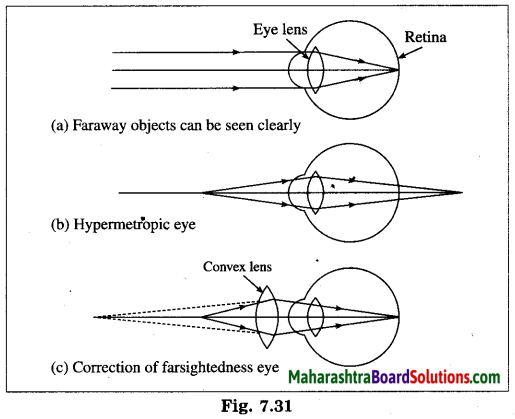
Maharashtra Board Class 10 Science Solutions Part 1 Chapter 7 Lenses 46
Hypermetropia is corrected using a suitable convex lens. Light rays are converged by the convex lens before they strike the eye lens. A convex lens of proper focal length is chosen to produce the required convergence. Hence, after the converging action of the eye lens, the image is formed on the retina. [Fig. 7.31 (c)]

Question 67.
What is the sign of the power of the lens used to correct hypermetropia?
Answer:
The power of the lens used to correct hypermetropia is positive.
[Note: It is a convex lens. Positive focal length ∴ Positive power.]

Question 68.
Given below is a diagram showing a defect of human eye.
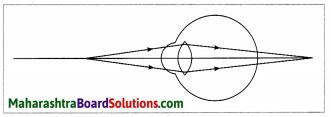
Maharashtra Board Class 10 Science Solutions Part 1 Chapter 7 Lenses 47
Study it and answer the following questions:
(1) Name the defect shown in the figure. (Practice Activity Sheet – 3)
(2) Give two possible reasons for this defect of eye in human beings.
(3) Name the type of lens used to correct the eye defect.
(4) Draw a labelled diagram to show how the defect is rectified by using the lens.
Answer:
A lens having both spherical surfaces puffed up outwards is called a convex lens or double convex lens or biconvex lens. It is thicker in the middle than at the edges.
[Note: A convex lens is also called a converging lens.]

Maharashtra Board Class 10 Science Solutions Part 1 Chapter 7 Lenses

Question 69.
Observe the following figures and complete the table. (Practice Activity Sheet – 1)
Answer:
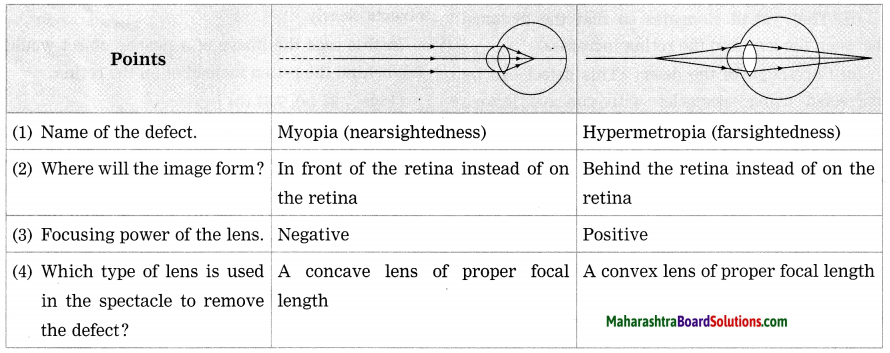
Maharashtra Board Class 10 Science Solutions Part 1 Chapter 7 Lenses 48

Question 70.
What is presbyopia? State the reason for this defect. How is presbyopia corrected?
Answer:
Presbyopia is the defect of vision in which aged people find it difficult to see nearby objects comfortably and clearly without spectacles.

Reason of presbyopia: The power of accommodation of eye usually decreases with ageing. The muscles near the eye lens lose their ability to change the focal length of the lens.
Therefore, the near point of the eye lens shifts farther from the eye.

This defect is corrected using a convex lens of appropriate power. The lens converges light rays before they fall on the eye lens such that the action of the eye lens forms the image on the retina.

Question 71.
What is a bifocal lens?
Answer:
A bifocal lens is a lens of which the upper part is a concave lens to correct myopia and the lower part is a convex lens to correct hypermetropia.

[Note: A person suffering from myopia as well as hypermetropia, uses a bifocal lens. Nowadays, the defects of vision such as myopia and hypermetropia can be corrected using contact lenses or by laser surgery.]

Question 72.
(A) Anil cannot see the blackboard writing clearly, but he can see nearby objects clearly.
(i) What is the eye defect he is suffering from?
(ii) How is it corrected?
(B) Anil’s uncle cannot see nearby objects clearly, but he can see distant objects clearly.
(i) What is the eye defect he is suffering from?
(ii) How is it corrected?
Answer:
(A) Anil cannot see the blackboard writing clearly, but he can see nearby objects clearly.
(i) This defect is called myopia (nearsightedness).
(ii) It is corrected using spectacles having concave lenses of appropriate power.

(B) Anil’s uncle cannot see nearby objects clearly, but he can see distant objects clearly.
(i) This defect is called hypermetropia (farsightedness).
(ii) It is corrected using, spectacles having convex lenses of appropriate power.

Question 73.
When are bifocal lenses used in spectacles?
Answer:
When a person cannot see nearby objects as well as distant objects clearly, bifocal lenses are used in spectacles.

Question 74.
Aniket from Std. X uses spectacles. The power of the lenses in his spectacles is -0.5 D. Answer the following questions:
(1) State the type of’ lenses used in his spectacles.
(2) Name the defect of vision Aniket is suffering from.
(3) Find the focal length of the lenses used in his spectacles.
Answer:
(1) Concave lenses are used in the spectacles used by Aniket.
(2) Aniket is suffering from myopia (near-sightedness).
(3) Focal length of the lenses used in his spectacles

Maharashtra Board Class 10 Science Solutions Part 1 Chapter 7 Lenses 49
= -2 m (Concave lens ∴ Minus sign)

Maharashtra Board Class 10 Science Solutions Part 1 Chapter 7 Lenses

Question 75.
Sunita from Std. X uses spectacles. Her spectacle number is -1.5 D. Answer the following questions:
(1) Name the defect of eye from which she is suffering.
(2) What type of lens is she using?
(3) Find the focal length of the lens.
Answer:
(1) Myopia.
(2) Concave.
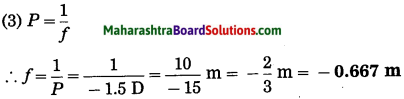
Maharashtra Board Class 10 Science Solutions Part 1 Chapter 7 Lenses 50
(Concave lens ∴ minus sign)
This is the focal length of the lens.

Question 76.
Surabhi from Std. X uses spectacles. The power of the lenses in her spectacles is 0.5 D. Answer the following questions from the given information: (March 2019)
(i) Identify the type of lenses used in her spectacles.
(ii) Identify the defect of vision Surabhi is suffering from.
(iii) Find the focal length of the lenses used in her spectacles.
Answer:
(i) Convex lenses are used in the spectacles used by Surabhi.
(ii) Surabhi is suffering from hypermetropia (farsightedness).
(iii) Focal length of the lenses used in her spectacles

Maharashtra Board Class 10 Science Solutions Part 1 Chapter 7 Lenses 51

Question 77.
My grandfather uses a bifocal lens in his spectacles. Explain why.
Answer:
In old age, people usually suffer from both myopia and hypermetropia. Therefore, they need spectacles having bifocal lenses.

The upper part of a bifocal lens is a concave lens to correct myopia. The lower part of a bifocal lens is a convex lens to correct hypermetropia.

Question 78.
State uses of concave lens.
Answer:

  1. Concave lenses are used for proper working of medical equipment, scanner, CD player – the instruments that employ laser rays.
  2. One or more concave lenses are used in a small safety device, fitted in the peep hole in a door, due to which we can see a large area outside the door.
  3. Concave lenses are used in spectacles to correct nearsightedness (myopia).
  4. A concave lens is used to spread light emitted by the small bulb in a torch over a wide area.
  5. A concave lens is used in front of the eyepiece or inside the eyepiece fitted in a camera, telescope and microscope – the instruments employing convex lenses.

Question 79.
State uses of a convex lens.
Answer:
Convex lenses are used in a simple microscope, compound microscope, refracting telescope, camera, projector, spectroscope, spectacles for correcting farsightedness (hypermetropia) and binoculars.

Maharashtra Board Class 10 Science Solutions Part 1 Chapter 7 Lenses

Question 80.
What is meant by the apparent size of an object? With a neat and labelled diagram, explain the relation between the apparent size of an object and the angle subtended by the object at the eye.
Answer:
An object appears small or big depending upon the size of its image formed on the retina of the eye. The size of an object as perceived by the eye is called the apparent size of the object. Consider two objects of the same size, one held near the eye and the other away from the eye as shown in the following figure (Fig. 7.34). The nearby object (PQ) appears larger than the distant object (P1Q1).
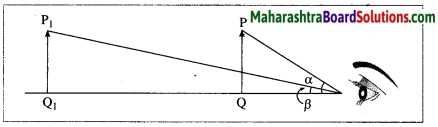
Maharashtra Board Class 10 Science Solutions Part 1 Chapter 7 Lenses 52
Also, the angle a subtended by the nearby object at the eye is larger than the angle β subtended by the distant object at the eye. This shows that the apparent size of an object depends upon the angle subtended by the object at the eye. The greater the angle subtended by the object at the eye, the greater is the apparent size of the object. Similarly, the smaller the angle subtended by the object at the eye, the smaller is the apparent size of the object.

Question 81.
With a neat labelled diagram, explain the working of a simple microscope. State uses of a simple microscope.
(OR)
What does a simple microscope consist of? What is the order of magnification obtained by a simple microscope? What is a simple microscope used for?
Answer:
A simple microscope consists of a convex lens of short focal length, usually fixed in a suitable frame with a handle or mounted on a stand.
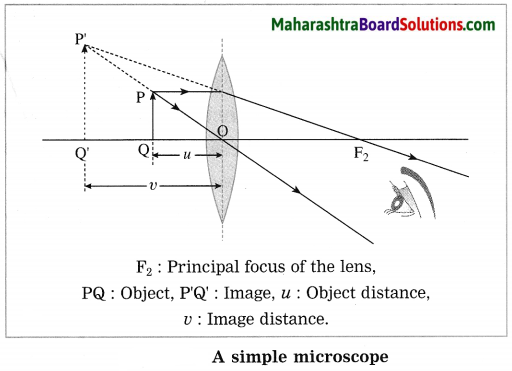
Maharashtra Board Class 10 Science Solutions Part 1 Chapter 7 Lenses 53
The object is placed in front of the convex lens of short focal length such that the object distance is less than the focal length. The image is virtual and larger than the object. It is formed on the same side of the lens as the object.

A maximum magnification of about 20 can be obtained by a simple microscope. A simple microscope is used by watch repairers to observe small parts of a watch and by jewellers to examine ornaments. A simple microscope (also called a magnifying glass) is also used to read words in small print.

Question 82.
With a neat labelled diagram, explain the construction and working of a compound microscope.
Answer:
Construction of a compound microscope:
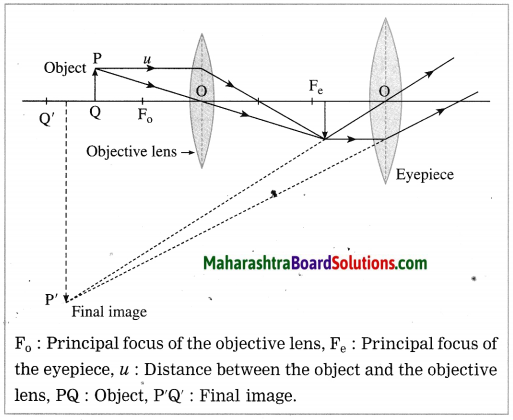
Maharashtra Board Class 10 Science Solutions Part 1 Chapter 7 Lenses 54
(1) A compound microscope consists of a metal tube fitted with two convex lenses at the two ends. These lenses are called the objective lens (the lens directed towards the object) and the eyepiece (the lens directed towards the eye). Both the lenses are small in size, but the cross section of the objective lens is less than that of the eyepiece. The objective lens has a short focal length. The focal length of the eyepiece is more than that of the objective lens.

(2) The metal tube is mounted on a stand. The principal axes of the objective lens and the eyepiece are along the same line. The distance between the object and the objective lens can be changed with a screw. It is possible to change the distance between the objective lens and the eyepiece.

Working :
(1) The object to be observed is illuminated and placed in front of the objective lens, slightly beyond the focal length of the objective lens. Its real, inverted and enlarged image is formed by the objective lens on the other side.

(2) This intermediate image lies within the focal length of the eyepiece. It serves as an object for the eyepiece. The eyepiece works as a simple microscope. The final image is virtual, highly enlarged and inverted with respect to the original object. It can be formed at the minimum distance of distinct vision from the eyepiece. The final image is observed by keeping the eye close to the eyepiece.

Maharashtra Board Class 10 Science Solutions Part 1 Chapter 7 Lenses

Question 83.
State two uses of a compound microscope.
Answer:
Uses of a compound microscope:

  1. It is used to observe blood corpuscles, plant and animals cells, microorganisms like bacteria, etc.
  2. It is used in a pathological laboratory to observe blood, urine, etc.
  3. It is a part of a travelling microscope used for measurement of very small distance.

Question 84.
What will happen if in a compound microscope, the objective lens is large in size and has a focal length?
Answer:
If the objective lens of a compound microscope is large in size, in addition to the light coming from an object, other unwanted light will be incident on the objective lens. Hence, the image will not be seen clearly. If the objective lens has a large focal length, the magnification produced by it will be less.

Question 85.
(a) In which type of microscope do you find the lens arrangement as shown in the following diagram? (Practice Activity Sheet – 1)
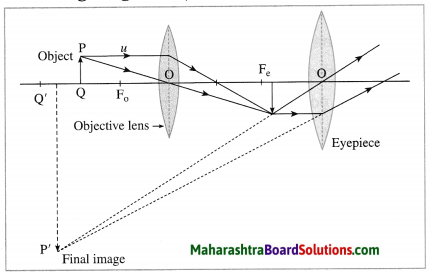
Maharashtra Board Class 10 Science Solutions Part 1 Chapter 7 Lenses 55
(b) Write in brief, the working of this microscope.
(c) Where is this microscope used?
Answer:
(a) Compound microscope.

(b)
An object appears small or big depending upon the size of its image formed on the retina of the eye. The size of an object as perceived by the eye is called the apparent size of the object. Consider two objects of the same size, one held near the eye and the other away from the eye as shown in the following figure (Fig. 7.34). The nearby object (PQ) appears larger than the distant object (P1Q1).
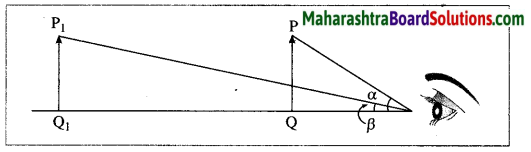
Maharashtra Board Class 10 Science Solutions Part 1 Chapter 7 Lenses 56
Also, the angle a subtended by the nearby object at the eye is larger than the angle β subtended by the distant object at the eye. This shows that the apparent size of an object depends upon the angle subtended by the object at the eye. The greater the angle subtended by the object at the eye, the greater is the apparent size of the object. Similarly, the smaller the angle subtended by the object at the eye, the smaller is the apparent size of the object.

(c) A simple microscope is used by watch repairers to observe small parts of a watch and by jewellers to
examine ornaments. A simple microscope (also called a magnifying glass) is also used to read words in small print.

Question 86.
(i) Which type of microscope has the arrangement of lenses shown in the following figure?
Maharashtra Board Class 10 Science Solutions Part 1 Chapter 7 Lenses 57
(ii) Label the figure correctly.
(iii) Write the working of this microscope.
(iv) Where is this microscope used?
(v) Suggest a way to increase the efficiency of this microscope. (Practice Activity Sheet – 2)
Answer:
(i) Compound microscope.

(ii)
Maharashtra Board Class 10 Science Solutions Part 1 Chapter 7 Lenses 58

(iii) Working:
(1) The object to be observed is illuminated and placed in front of the objective lens, slightly beyond the focal length of the objective lens. Its real, inverted and enlarged image is formed by the objective lens on the other side.

(2) This intermediate image lies within the focal length of the eyepiece. It serves as an object for the eyepiece. The eyepiece works as a simple microscope. The final image is virtual, highly enlarged and inverted with respect to the original object. It can be formed at the minimum distance of distinct vision from the eyepiece. The final image is observed by keeping the eye close to the eyepiece.

(iv)

  1. It is used to observe blood corpuscles, plant and animals cells, microorganisms like bacteria. etc.
  2. It is used in a pathological laboratory to observe blood, urine, etc.
  3. It is a part of a travelling microscope used for measurement of very small distance.

(v) Lenses with appropriate focal lengths should be selected.

Question 87.
State the use of a telescope.
Answer:
A telescope is used to observe a distant object such as mountain, moon, planet, star in the magnified form.

Maharashtra Board Class 10 Science Solutions Part 1 Chapter 7 Lenses

Question 88.
Observe the following figure and answer the questions. (Practice Activity Sheet – 3)
(a) Which optical instrument shows arrangement of lenses as shown in the figure?
(b) Write in brief the working of this optical instrument.
Maharashtra Board Class 10 Science Solutions Part 1 Chapter 7 Lenses 59
(c) How can we get different magnifications in this optical instrument?
(d) Draw the figure again and labelled it properly.
Answer:
(a) Refracting telescope.

(b) working: When the objective lens is pointed towards the distant object to be observed, the rays
of light from the distant object, which are almost parallel to each other. pass through the objective lens. The objective lens collects maximum amount of light as it is large in size. It forms a real, inverted and diminished image in the focal plane of the objective lens. Now, the position of the eyepiece is adjusted such that this image falls just within the focal length of the eyepiece and serves as the object for the eyepiece which works as a simple microscope.

The final image is highly magnified, virtual, on the same side as that of the object and inverted with respect to the original object. The final image can be observed by keeping the eye close to the eyepiece. If the image formed by the objective lens lies in the focal plane of the eyepiece, the final image is formed at infinity.

(c) We can get different magnifications by using the eyepiece with different focal lengths.

(d)
Maharashtra Board Class 10 Science Solutions Part 1 Chapter 7 Lenses 60

Question 89.
What is persistence of vision? Give one example of persistence of vision.
Answer:
Persistence of vision: We see an object when its image is formed on the retina. The image disappears when the object is removed from our sight. But this is not instantaneous and the image
remains imprinted on the retina for about \(\frac{1}{16}\) th of a second after the removal of the object.

The sensation on the retina persists for a while. This effect is known as the persistence of vision. It is due to persistence of vision that we continue to see the object in its position for about \(\frac{1}{16}\) th of a second after it is removed.
Example: When a burning stick of incense is moved fast in a circle, a circle of red light is seen.

Question 90.
Name two devices whose working is based on the phenomenon of persistence of vision.
(OR)
Name any two applications based on persistence of vision.
Answer:
The working of a television set and motion picture is based on the phenomenon of persistence of vision.
[Note: These are the examples of persistence of vision in daily life.

Question 91.
How is the phenomenon of persistence of vision used in motion pictures?
Answer:
In motion pictures, photographs of a moving object are taken at the rate of more than sixteen pictures per second. These photographs are projected on the screen at the same rate.
Each picture is slightly different from the other. As a result of persistence of vision, we get the impression of observing the object in continuous motion.

Question 92.
Name the two types of light sensitive cells present in the retina of the human eye. What are their functions?
Answer:
(1) The retina of the human eye contains a large number of light sensitive cells. These cells are of two shapes : (i) rods and (ii) cones.
(2) The rod-like cells respond to the intensity of light.
(3) The conical cells respond to various colours of light. They respond differently to red, green and blue colours. They do not respond to faint light.

Maharashtra Board Class 10 Science Solutions Part 1 Chapter 7 Lenses

Question 93.
When do you say that a person is colour blind?
Answer:
When a person is unable to distinguish between certain colours, he is said to be colour blind.
[Note: (i) Except for being colour-blind, their eyesight is normal, (ii) Rod-shaped cell ≡ rod-like cell, cone-shaped cell = Conical cell.]

Question 94.
Explain the perception of colour in the human eye.
(OR)
Explain in short perception of colour.
(OR)
Write a note on perception of colour.
Answer:
(1) In nature we firld objects of various colours. Perception of colour means to be able to respond to colour.
(2) We can distinguish between various colours due to perception of colour.
(3) The cone-shaped cells on the retina of the eye respond to the various colours when light is bright and communicate to the brain about the colours of the image formed on the retina. This gives us the proper idea about the colours of the object.
(4) If, in the retina of a person, the cone-shaped cells responding to certain specific colours are absent, the person is unable to distinguish between the colours. As a result, he lacks perception of colour.

Question 95.
What is colour-blindness?
Answer:
(1) The retina of the human eye contains a large number of light sensitive cells. These cells are of two shapes : (i) rods and (ii) cones.
(2) The cone-shaped cells respond to various colours of light when light is bright.
(3) Thus, the perception of colour is due to the presence of the cone-shaped cells in the retina.
(4) In the retina of some persons, cone-shaped cells responding to certain specific colours are absent. Hence, these persons are unable to distinguish between certain colours, i.e., they are colour-blind. This defect is known as colour¬blindness.

Question 96.
Why are some persons colour-blind? What is the cause of this defect?
Answer:
In the retina of some persons, cone-shaped cells responding to certain specific colours are absent. Hence, these persons are unable to distinguish between certain colours, i.e., they are colour-blind.

Question 97.
What are the difficulties faced by a colour-blind person?
Answer:
(1) A colour-blind person cannot distinguish between different colours. For example, he cannot distinguish between red and green colours. Also he cannot distinguish between blue and green colours. Red and green, both appear grey. Since a colour¬blind person cannot distinguish between red and green colours, it is difficult for him to cross a road. There is a possibility of an accident while crossing a road.

(2) A colour-blind person cannot distinguish between two objects of different colours, which are otherwise identical, e.g., clothes.

(3) A colour-blind person may have an inferiority complex and hence may find it difficult to mix with other persons.

Give scientific reasons:

Question 1.
A convex lens is known as a converging lens.
Answer:
When rays of light parallel to the principal axis of a convex lens pass through the lens, they converge to a point on the principal axis. Hence, a convex lens is known as a converging lens.

Maharashtra Board Class 10 Science Solutions Part 1 Chapter 7 Lenses

Question 2.
A concave lens is called a diverging lens.
Answer:
When rays of light parallel to the principal axis of a concave lens pass through the lens, they appear to diverge from a point on the principal axis. Hence, a concave lens is called a diverging lens.

Question 3.
In old age, a bifocal lens is necessary for some persons.
Answer:
(1) Some people, in old age, suffer from myopia (nearsightedness) as well as hypermetropia (farsightedness).
(2) Myopia is corrected using a concave lens of appropriate power. Hypermetropia is corrected using a convex lens of appropriate power. Therefore, they need a bifocal lens.

Question 4.
A person suffering from myopia (nearsightedness) uses spectacles of concave lenses.
Answer:
(1) A person suffering from myopia can see nearby objects clearly as the image of a nearby object is formed on the retina, but cannot see distant objects clearly as the image of a distant object is formed in front of the retina instead of on the retina.

(2) A concave lens diverges the rays of light passing through it. When spectacles of concave lenses of appropriate power are used, the parallel rays coming from a distant object are diverged to proper extent before they are incident on the eye lens. Therefore, after the converging action of the eye lens, the image of a distant object is formed on the retina of the eye and hence the distant object can be seen clearly.

Question 5.
A person suffering from hypermetropia (farsightedness) uses spectacles of convex lenses.
Answer:
(1) A person suffering from hypermetropia can see distant objects clearly as the image of a distant object is formed on the retina, but cannot see nearby objects clearly as the image of a nearby object would be formed behind the retina instead of on the retina.

(2) A convex lens converges the rays of light passing through it. When spectacles of convex lenses of appropriate power are used, the rays of light coming from a nearby object are converged to proper extent before they are incident on the eye lens. Therefore after the converging action of the j eye lens, the image of a nearby object is formed on j the retina of the eye and hence the nearby object | can be seen clearly.

Question 6.
You cannot enjoy watching a movie from a very short distance from the screen in a cinema hall.
Answer:
(1) The less the distance between the screen in a cinema hall and the person watching the movie, the more is the intensity of light falling on the eye.
(2) This results in great contraction of the pupil of the eye causing a strain. Hence, you cannot enjoy watching a movie from a very short distance from the screen in a cinema hall.

Maharashtra Board Class 10 Science Solutions Part 1 Chapter 7 Lenses

Question 7.
The rays of light travelling through the optical centre of a lens pass without changing their path.
Answer:
The portion of a lens near the optical centre is like a very thin slab of glass. Hence, the rays of light travelling through the optical centre of a lens pass without changing their path.

Question 8.
A convex lens converges the rays of light falling on it.
Answer:

  • A convex lens can be regarded as made of a very large number of portions of triangular prisms. The bases of these prisms are towards the central thicker portion of the lens.
  • A ray of light passing through a prism bends towards its base. Hence, a convex lens converges the rays falling on it.

Question 9.
A concave lens diverges the rays of light falling on it.
Answer:

  • A concave lens can be regarded as made of a very large number of portions of triangular prisms. The bases of these prisms are towards the edges of the less, i.e, away from the central thinner portion of the lens.
  • A ray of light passing through a prism bends towards its base. Hence, a concave lens diverges the rays of light falling on it.

Question 10.
When a burning stick of incense is moved fast in a circle, a circle of red light is seen.
Answer:
The impression of the image on the retina lasts for about \(\frac{1}{16}\) th of a second after the removal of the object. If a burning stick of incense is moved at a rate of more than sixteen revolutions per second, we see a circle of red light due to persistence of vision.

Question 11.
Colour-blind persons are unable to distinguish between different colours.
Answer:
(1) The cone-shaped cells in the retina of a person respond to colours. This makes the perception of colours possible.
(2) In the retina of colour-blind persons, cone-shaped cells responding to certain specific colours are absent. Hence, they are unable to distinguish between different colours.

Question 12.
It is risky to issue a driving license to a person suffering from colour-blindness.
Answer:
A colour-blind person cannot distinguish between different colours. If a driver is colour-blind, he will not be able to distinguish between the colours of the signal and the colours on different sign boards. This will lead to an accident. Hence, it is risky to issue a driving license to a person suffering from colour-blindness.

Distinguish the following:

Question 1.
Real image and Virtual image.
Answer:
Real image:

  1. A real image is formed when the light rays starting from an object meet after reflection or refraction.
  2. It can be projected on a screen.
  3. It is inverted with respect to the object.

Virtual image:

  1. A virtual image is formed when the light rays starting from an object (when extended backward) appear to meet after reflection or refraction.
  2. It cannot be projected on a screen.
  3. It is erect with respect to the object.

Question 2.
Simple microscope and Compound microscope.
Answer:
Simple microscope:

  1. In a simple microscope, only one convex lens is used.
  2. In this case, the object is placed within the focal length of the convex lens.
  3. Its magnifying power is much less than that of a compound microscope.
  4. It is used to observe minute parts of a watch, to read words in small print, etc.

Compound microscope:

  1. In a compound microscope, two convex lenses, objective and eyepiece, are used.
  2. In this case, the object is placed beyond the focal length of the objective lens.
  3. Its magnifying power is much greater than that of a simple microscope.
  4. It is used to observe blood corpuscles, plant and animal cells, etc.

Maharashtra Board Class 10 Science Solutions Part 1 Chapter 7 Lenses

Question 3.
Compound microscope and Astronomical refracting telescope.
Answer:
Compound microscope:

  1. In a compound microscope, the focal length and cross section of the objective lens are respectively smaller than the focal length and cross section of the eyepiece.
  2. In this case, to observe the object, the distance between the object and the objective lens is adjusted.
  3. It forms a magnified image of a small object.
  4. It is used to observe blood corpuscles, plant and animal cells, etc.

Astronomical refracting telescope:

  1. In an astronomical refracting telescope, the focal length and cross section of the objective lens are respectively greater than the focal length and cross section of the eyepiece.
  2. In this case, to observe the object, the distance between the objective lens and eyepiece is adjusted.
  3. It forms a near image of a distant object.
  4. It is used to observe sateulites, planets, stars, etc.

Question 4.
Simple microscope and Astronomical refracting telescope.
Answer:
Simple microscope:

  1. In a simple microscope, only one convex lens is used.
  2. In this case, the object is placed within the focal length of the convex lens.
  3. In this case, the image is erect.
  4. It is used to observe minute parts of a watch, to read words in small print, etc.

Astronomical refracting telescope:

  1. In an astronomical refracting telescope, two convex lenses, objective lens and eyepiece are used.
  2. In this case, the object is far away from the objective lens.
  3. In this case, the image is inverted.
  4. It is used to observe satellites, planets, stars, etc.

Read the following paragraph and answer the questions given below it:

Construction of a compound microscope:
(1) A compound microscope consists of a metal tube fitted with two convex lenses at the two ends. These lenses are called the objective lens (the lens directed towards the object) and the eyepiece (the lens directed towards the eye). Both the lenses are small in size, but the cross section of the objective lens is less than that of the eyepiece. The objective lens has a short focal length. The focal length of the eyepiece is more than that of the objective lens.(2) The metal tube is mounted on a stand. The principal axes of the objective lens and the eyepiece are along the same line. The distance between the object and the objective lens can be changed with a screw. It is possible to change the distance between the objective lens and the eyepiece.
Working:
(1) The object to be observed is illuminated and placed in front of the objective lens, slightly beyond the focal length of the objective lens. Its real, inverted and enlarged image is formed by the, objective lens on the other side.
(2) This intermediate image lies within the focal length of the eyepiece. It serves as an object for the eyepiece. The eyepiece works as a simple microscope. The final image is virtual, highly enlarged and inverted with respect to the original object. It can be formed at the minimum distance of distinct vision from the eyepiece. The final image is observed by keeping the eye close to the eyepiece.
Use: This microscope is used to observe blood cells, microorganisms, etc.

Question 1.
In a compound microscope, which lens has greater focal length?
Answer:
In a compound microscope, the eyepiece has greater focal length.

Question 2.
Where do you place the object to be observed with a compound microscope?
Answer:
In a compound microscope, the object to be observed is placed in front of the objective lens, slightly beyond the focus of the objective lens.

Question 3.
State which distance is adjusted to observe the object with a compound microscope.
Answer:
To observe the object with a compound microscope, the distance between the object and objective lens is adjusted.

Question 4.
State the nature of the final image in compound microscope relative to the object.
Answer:
In a compound microscope, the final image is highly enlarged, inverted and virtual relative to the object.

Question 5.
State the use of a compound microscope.
Answer:
A compound microscope is used to observe blood cells, microorganisms, etc.

Fill in the blanks for a convex lens:

Question 1.

f (m)0.2—————–0.1
P (D)—————2——————

Answer:
[P (D) = \(\frac{1}{f(\mathrm{m})}\)]

f (m)0.20.50.1
P (D)5210

Question 2.

h1 (cm)—————-510
h2 (cm)-30-20—————-
M-2—————–-0.5

Answer:
[M = \(\frac{h_{2}}{h_{1}}\)]

h1 (cm)15510
h2 (cm)-30-20-5
M-2-4-0.5

Maharashtra Board Class 10 Science Solutions Part 1 Chapter 7 Lenses

Solve the following numerical problems:

Problem 1.
An object Is kept at 60 cm in front of a convex lens. Its real image is formed at 20 cm from the lens. Find the focal length or the lens.
Solution:
Data: Convex lens, u = -60 cm,
Maharashtra Board Class 10 Science Solutions Part 1 Chapter 7 Lenses 61
The focal length of the lens = 15 cm.

Problem 2.
The focal length of a convex lens is 20 cm. If an object of height 2 cm is placed at 30 cm from the lens, find (i) the position and nature of the Image (ii) the height of the image (iii) the magnification produced by the lens.
Solution:
Data: Convex lens, f = 20 cm,
u = -30 cm, h1 = 2 cm, v = ?, h2 = ?, M = ?
Maharashtra Board Class 10 Science Solutions Part 1 Chapter 7 Lenses 62
The image will be formed at 60 cm from the lens and on the other side of the lens with respect to the object. It is a real image.
Maharashtra Board Class 10 Science Solutions Part 1 Chapter 7 Lenses 63
h2 is negative. This shows that the image is inverted.
The height of the image -4 cm.
(iii) M = \(\frac{h_{2}}{h_{1}}=\frac{-4 \mathrm{cm}}{2 \mathrm{cm}}\) = -2
M is negative, indicating that the image is inverted.
The magnification produced by the lens = -2.

Problem 3.
When a pm of height 3 cm is fixed at 10 cm from a convex lens, the height or the virtual image formed is 12 cm. Find the focal length of the lens.
Solution:
Data: Convex lens, h1 =3 cm,
h2 = 12 cm (virtual image), u = -10 cm, f = ?
Maharashtra Board Class 10 Science Solutions Part 1 Chapter 7 Lenses 64
The focal length of the lens = 13.33 cm [approximately]

Maharashtra Board Class 10 Science Solutions Part 1 Chapter 7 Lenses

Problem 4.
At what distance from a convex lens of focal length 2.5 m should a boy stand so that his image is half his height?
Solution:
Data: Convex lens, f= 2.5 m,
M= –\(\frac{1}{2}\), u=?
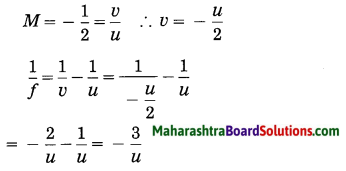
Maharashtra Board Class 10 Science Solutions Part 1 Chapter 7 Lenses 65
∴ u = -3f = -3 × 2.5 m = -7.5 m
This is the object distance.
The boy should stand at 7.5 m from the convex lens so that his image is half his height.

Problem 5.
A convex lens forms a real image or a pencil at a distance of 40 cm from the lens. The image formed is of the same size as the object. Find the focal length and power of the lens. At what distance is the pencil placed from the lens?
Solution:
Data: Convex lens, v = 40 cm,
M = -1, f = ?, h1 = ?, u = ?
M = = -1 = \(\frac{v}{u}\)
∴ u = -v = -40 cm (object distance)
The pencil is placed at 40 cm from the convex lens.
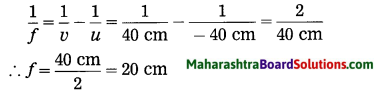
Maharashtra Board Class 10 Science Solutions Part 1 Chapter 7 Lenses 66
The focal length of the lens 20 cm.
Maharashtra Board Class 10 Science Solutions Part 1 Chapter 7 Lenses 67
The power of the lens = 5 D.

Problem 6.
A spherical lens is used to obtain an image on a screen. The size of the image is four times the size of the object. What is the type of lens and at what distance is the screen placed from the lens?
Solution:
Data: M = -4, type of lens? v = ?
As the image formed by the lens is obtained on a screen, it is a real image. The lens is, therefore, a convex 1ens.
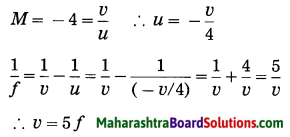
Maharashtra Board Class 10 Science Solutions Part 1 Chapter 7 Lenses 68
The distance of the screen from the lens = 5f.

Problem 7.
An object of height 5 cm Is held 20 cm away from a converging lens of focal length 10 cm. Find the position, nature and size of the image formed.
Solution:
Data: Converging lens (convex lens),
f = 10 cm, h1 = 5 cm, u = -20 cm, v = ?, h2 = ?
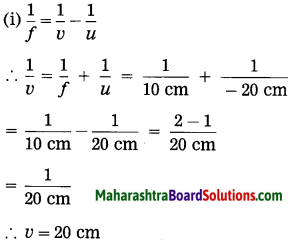
Maharashtra Board Class 10 Science Solutions Part 1 Chapter 7 Lenses 69
The image is real and inverted. it is formed at 20 cm from the lens and on the other side of the lens relative to the object.
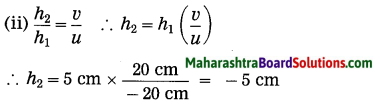
Maharashtra Board Class 10 Science Solutions Part 1 Chapter 7 Lenses 70
The height of the image, h2 = -5 cm
Thus, it is numerically the same as the height of the object.

Maharashtra Board Class 10 Science Solutions Part 1 Chapter 7 Lenses

Problem 8.
An object is placed at 10 cm from a convex lens of focal length 12 m. Find the position and nature of the image.
Solution:
Data: Convex lens, u = -10 cm,
f = 12 cm, v = ?
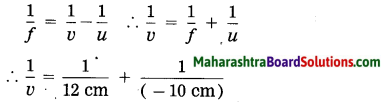
Maharashtra Board Class 10 Science Solutions Part 1 Chapter 7 Lenses 71
Maharashtra Board Class 10 Science Solutions Part 1 Chapter 7 Lenses 72
∴ v = -60 cm
It is negative.
The image is formed at 60 cm from the lens and on the same side of the lens relative to the object. It is virtual, erect, and enlarged.

Problem 9.
An object of height 4 cm is placed in front of a concave lens of focal length 40 cm. If the object distance is 60 cm, find the position and height of the image.
Solution:
Data: f = -40 cm (concave lens),
u = -60 cm, h1 = 4 cm, v = ?, h2 = ?
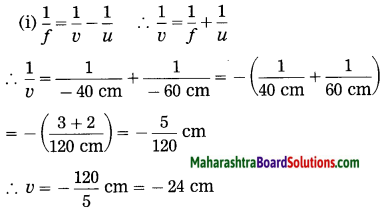
Maharashtra Board Class 10 Science Solutions Part 1 Chapter 7 Lenses 73
The image Is formed at 24 cm from the lens.
It is on the same side as the object.
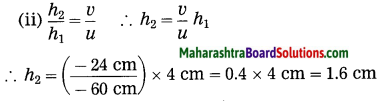
Maharashtra Board Class 10 Science Solutions Part 1 Chapter 7 Lenses 74
The height of the image is 1.6 cm.

Problem 10.
What is the power of a convex lens having focal length 0.5 m?
Solution:
Data: Convex lens, f= 0.5 m, P = ?
P = \(\frac{1}{f}=\frac{1}{0.5 \mathrm{m}}\) = 2D
The power of the lens = 2D.

Problem 11.
The power of a convex lens is 2.5 dioptres. Find its focal length.
(OR)
Calculate the focal length of a corrective lens having power +2.5 D.
Solution:
Data: Convex lens, P = +2.5 D, f = ?
P = \(\frac{1}{f}\)
∴ 2.5 D = \(\frac{1}{f}\)
∴ f = \(\frac{1}{2.5 \mathrm{D}}\) = 0.4 cm = 40 cm
The focal length of the lens = 40 cm.

Problem 12.
Two convex lenses of focal length 20 cm each are kept in contact with each other. Find the power of their combination.
Solution:
Data: f1 = 20 cm = 0.2 m,
f2 =20 cm = 0.2 m, P (combination) = ?

Maharashtra Board Class 10 Science Solutions Part 1 Chapter 7 Lenses 75
∴ Focal length of the combination or the lenses, f = 0.1 m.
P = \(\frac{1}{f}=\frac{1}{0.1 \mathrm{m}}\) = 10 D
The power of the combination of the lenses, P = 10 D.

Maharashtra Board Class 10 Science Solutions Part 1 Chapter 7 Lenses

Problem 13.
Two convex lenses of equal focal lengths are kept in contact with each other. If the power of their combination is 20 D, find the focal length of each convex lens.
Solution:
Data: Convex lens, P = 20 D, f1 = f2 = ?
The focal length (f) of the combination of the lenses is given by
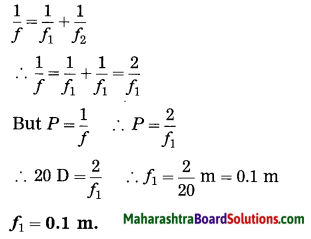
Maharashtra Board Class 10 Science Solutions Part 1 Chapter 7 Lenses 76
This gives the focal length or each convex lens.

Problem 14.
If a convex lens of focal length 10 cm and a concave lens of focal length 50 cm are kept in contact with each other, (i) what will be the focal length of the combination? (ii) what wiil be the power of the combination? (iii) what will be the behaviour of the combination (behaviour as a convex lens/concave lens)?
Solution:
Data: f1 = +10 cm = +0.1 m (convex lens),
f2 = -50 cm = -0.5 m (concave lens),
f (combination) = ?, P (combination) = ?
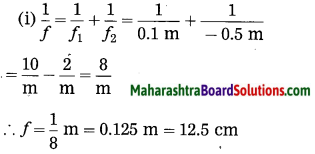
Maharashtra Board Class 10 Science Solutions Part 1 Chapter 7 Lenses 77
The focal length or the combination of the lenses = 0.125 m = 12.5 cm.
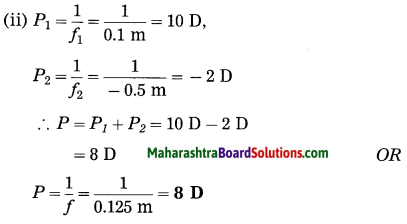
Maharashtra Board Class 10 Science Solutions Part 1 Chapter 7 Lenses 78
The power of the combination of the lenses 8.D.
(iii) The focal length of the combination of the lenses is positive. This shows that the combination will behave as a convex lens.

Numerical problems for practice:

Problem 1.
Find the focal length of a convex lens which produces a real image at 60 cm from the lens when an object is placed at 40 cm in front of the lens.
Answer:
24 cm

Problem 2.
Find the focal length of a convex lens which produces a virtual image at 10 cm from the lens when an object is placed at 5 cm from the lens.
Answer:
10 cm

Problem 3.
A real image is obtained at 30 cm from a convex lens of focal length 7.5 cm. Find the distance of the object from the lens.
Answer:
u = -10 cm

Maharashtra Board Class 10 Science Solutions Part 1 Chapter 7 Lenses

Problem 4.
An object is kept at 20 cm in front of a convex lens and its real image is formed at 60 cm from the lens. Find (1) the focal length of the lens (2) the height or the image if the height of the object is 6 cm.
Answer:
(1) 15 cm
(2) h2 = -18 cm]

Problem 5.
An object is kept at 10 cm in front of a convex lens. Its image is formed on the screen at 15 cm from the lens. Calculate (1) the focal length of the lens (2) the magnification produced by the lens.
Answer:
(1) 6 cm
(2)M = -1.5

Problem 6.
An object is kept at 60 cm in front of a convex lens of focal length 15 cm. Find the image distance and the nature of the image. Also find the magnification produced by the lens.
Answer:
v = 20 cm. The image is real, inverted and smaller than the object. M = –\(\frac{1}{3}\)]

Problem 7.
An object of height 2 cm is kept at 30 cm from a convex lens. Its real image is formed at 60 cm from the lens. Find the focal length and power of the lens.
Answer:
f = 20 cm, P = 5 D

Problem 8.
If the power of a lens is 4 dioptres, find its focal length.
Answer:
25 cm

Problem 9.
Find the power of a convex lens of focal length 40 cm.
Answer:
2.5 D

Problem 10.
Find the power of a convex lens of focal length 12.5 cm.
Answer:
8 D

Problem 11.
If for a lens, f = – 20 cm, what is the power of the lens?
Answer:
-5 D

Maharashtra Board Class 10 Science Solutions Part 1 Chapter 7 Lenses

Problem 12.
An object of height 4 cm is kept in front of a concave lens of focal length 20 cm. If the object distance is 30 cm, find the position and the height of the image.
Answer:
v = -12 cm, h2 = 1.6 cm

Problem 13.
If two convex lenses of focal lengths 10 cm and 5 cm are kept in contact with each other, what is their combined focal length?
Answer:
\(\frac{10}{3}\) cm [approximately 3.33 cm]

Problem 14.
If a convex lens of focal length 20 cm and a concave lens of focal length 30 cm are kept in contact with each other, (i) What will be the focal length of the combination? (ii) What will be the power of the combination? (iii) What will be the behaviour of the combination?
Answer:
(i) f = 60 cm
(ii) P = \(\frac{5}{3}\) D = 1.6667 D (approximately)
(iii) The combination will behave as a convex lens.

Maharashtra Board Class 10 Science Solutions Part 1 Chapter 7 Lenses

Problem 15.
A concave lens of focal length 12 cm and a convex lens of focal length 20 cm are kept in contact with each other, (i) Find the focal length of the combination, (ii) What will be the behaviour of the combination?
Answer:
(i) f = -30 cm
(ii) The combination will behave as a concave lens.

Maharashtra Board Class 10 Science Solutions Part 1 Chapter 6 Refraction of Light

Balbharti Maharashtra State Board Class 10 Science Solutions Part 1 Chapter 6 Refraction of Light Notes, Textbook Exercise Important Questions and Answers.

Maharashtra State Board Class 10 Science Solutions Part 1 Chapter 6 Refraction of Light

Question 1.
Fill in the blanks and explain the completed statements:
a. Refractive index depends on the………….of light.
Answer:
Refractive index depends on the velocity of light.
It is an experimental fact. (There is no question of explanation.)

b. The change in…………of light rays while going from one medium to another is called refraction.
Answer:
The change in the direction of propagation of light rays while going from one medium to another is called refraction. This is definition of refraction. It is assumed that the ray of light passes obliquely from one medium to another. (There is no question of explanation.)

Maharashtra Board Class 10 Science Solutions Part 1 Chapter 6 Refraction of Light

Question 2.
Prove the following statements:
a. If the angle of incidence and angle of emergence of a light ray falling on a glass slab are i and e respectively, prove that i = e. (Practice Activity Sheet – 4)
Answer:
In the following figure, SR || PQ and NM is the refracted ray. Hence, r = i1.
Now gna = sin i/sin r and ang = sin i1/ sin e.
Maharashtra Board Class 10 Science Solutions Part 1 Chapter 6 Refraction of Light 1
Also gna = \(\frac{1}{{ }_{\mathrm{a}} n_{\mathrm{g}}}\)
∴ \(\frac{\sin i}{\sin r}=\frac{\sin e}{\sin i_{1}}\)
As r = i1, it follows that sin i = sin e
∴ i = e.

b. A rainbow is the combined effect (an exhibition) of the refraction, dispersion, and total internal reflection of light (taken together). (Practice Activity Sheet – 1)
(OR)
With a neat labelled diagram, explain how the formation of rainbow occurs.
Answer:
(1) The formation of a rainbow in the sky is a combined result of refraction, dispersion, internal reflection and again refraction of sunlight by water droplets present in the atmosphere after it has rained.
Maharashtra Board Class 10 Science Solutions Part 1 Chapter 6 Refraction of Light 2
Here, for simplicity only violet and red colours are shown. The remaining five colours lie between these two.

(2) The sunlight is a mixture of seven colours: violet, indigo, blue, green, yellow, orange and red. After it has stopped raining, the atmosphere contains a large number of water droplets. When sunlight is incident on a water droplet, there is (i) refraction and dispersion of light as it passes from air to water (ii) internal reflection of light inside the droplet and (iii) refraction of light as it passes from water to air.

(3) The refractive index of water is different for different colours, being maximum for violet and minimum for red. Hence, there is dispersion of light (separation into different colours) as it passes from air to water. [ See above Figure for reference.]

(4) The combined action of different water droplets, acting like tiny prisms, is to produce a rainbow with red colour at the outer side and violet colour at the inner side. The remaining five colours lie between these two.
The rainbow is seen when the sun is behind the observer and water droplets in the front.

Question 3.
Mark the correct answer in the following questions :
A. What is the reason for the twinkling of stars?
(i) Explosions occurring in stars from time to time
(ii) Absorption of light in the earth’s atmosphere
(iii) Motion of stars
(iv) Changing refractive index of the atmospheric gases
Answer:
Changing refractive index of the atmospheric gases.

B. We can see the Sun even when it is little below the horizon because of
(i) reflection of light
(ii) refraction of light
(iii) dispersion of light
(iv) absorption of light
Answer:
refraction of light

C. If the refractive index of glass with respect to air is 3/2, what is the refractive index of air with respect to glass?
(i) \(\frac{1}{2}\)
(ii) 3
(iii) \(\frac{1}{3}\)
(iv) \(\frac{2}{3}\)
Answer:
(iv) \(\frac{2}{3}\)

Maharashtra Board Class 10 Science Solutions Part 1 Chapter 6 Refraction of Light

Question 4.
Solve the following examples:
a. If the speed of light in a medium is 1.5 × 10⁸ m/s, what is the absolute refractive index of the medium? (Practice Activity Sheet – 1 and 4)
Solution:
Data: v = 1.5 × 10⁸ m/s,
c = 3 × 10⁸ m/s, n = ?
n = \(\frac{c}{v}=\frac{3 \times 10^{8} \mathrm{m} / \mathrm{s}}{1.5 \times 10^{8} \mathrm{m} / \mathrm{s}}\) = 2
This is the absolute refractive index of the medium.

b. If the absolute refractive indices of glass and water are \(\frac{3}{2}\) and \(\frac{4}{3}\) respectively, what is the refractive index of glass with respect to water?
Solution:
Maharashtra Board Class 10 Science Solutions Part 1 Chapter 6 Refraction of Light 3
This is the refractive index of glass with respect to water.

Project:

Question 1.
Using a laser and soap water. study the refraction of light under the guidance of your teacher. (Do it your self)

Can you recall? (Text Book Page No. 73)

Question 1.
What is meant by reflection of light?
Answer:
Reflection of light: When light is incident on the surface of an object, in general, it is deflected in different directions. This process is called reflection of light.
Question 2.
What are the laws of reflection?
Answer:
Laws of reflection of light:

  1. The incident ray and the reflected ray of light are on the opposite sides of the normal to the reflecting surface at the point of incidence and all the three are in the same plane.
  2. The angle of incidence j and the angle of reflection are equal in measure.

Can you recall? (Text Book page No. 75)

Question 1.
If the refractive index of the second medium with respect to the first medium is 2n1 and that of the third medium with respect to the second medium is 3n2, what and how much is 3n1.
Answer:
3n1 is the refractive index of the third medium with respect to the first medium.
Maharashtra Board Class 10 Science Solutions Part 1 Chapter 6 Refraction of Light 4
3n1 = 2n1 × 3n2.

[Suppose medium 1 = air, medium 2 ≡ ice and medium 3 ≡ diamond. Then, 2n1 ÷ 1.31, 3n2 = 1.847
3n1 = 2n1 × 3n2 = 1.31 × 1.847 = 2.42 which is the refractive index of diamond with respect to air.]

Can you tell? (Textbook page No. 76)

Question 1.
Have you seen a mirage which is an illusion of the appearance of water on a hot road or in a desert?
Answer:
Due to the changes in refraction of light, the light rays coming from a distant object appear to be coming from the image of the object inside the ground. This is called a mirage. When the earth’s surface is heated by the sun, the temperature of air increases. This produces a layer of hot air of lower density (mass per unit volume) and lower refractive index at the surface.
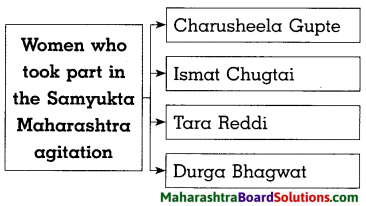
Maharashtra Board Class 10 Science Solutions Part 1 Chapter 6 Refraction of Light 5
Hot air works as an optically rarer medium relative to cool air. When the temperature changes rapidly in the vertical direction, as refraction of light takes place, the angle of refraction changes continuously. The rays of light from the top of an object such as a car or tree cross the rays from the bottom of the object on their way to the observer’s eye.

Hence, an inverted image is formed below the object’s true position and downward towards the surface in the direction of air at higher temperature. In this case, some rays of light bend back up into the denser air above figure. Mirage produces an impression of water near the hot ground.

Maharashtra Board Class 10 Science Solutions Part 1 Chapter 6 Refraction of Light

Question 2.
Have you seen that objects beyond and above a holy fire appear to be shaking? Why does this happen?
Answer:
The temperature of air beyond and above a holy fire changes all the time. Hence, the density of air also changes constantly. Hence, the direction of propagation of the rays of light approaching us from the objects beyond and above the holy fire changes constantly. Therefore, those objects appear to be shaking.

Use your brain power! (Text Book Page No. 77)

Question 1.
From incident white light how will you obtain white emergent light by making use of two prisms?
Answer:

  • Take a prism. Allow white light to fall on it.
  • Obtain a spectrum.
  • Take a second identical prism. Place it parallel to the first prism in an upside down position with the first prism [as shown in Figure]
  • Allow the colours of the spectrum to pass through the second prism.
  • Obtain the beam of light emerging from the other side of the second prism.

Maharashtra Board Class 10 Science Solutions Part 1 Chapter 6 Refraction of Light 6
The beam of light emerging from the other side of the second prism is a beam of white light.

Explanation: White light is made up of seven colours. The first prism produces dispersion of white light while the second prism combines light of different colours to produce white light again. The net deviation of a ray of light is zero.
[Note: This experiment is due to sir Isaac Newton. It proved that it was not the prism which added colours to the white light but a property of the white light itself.]

Question 2.
You must have seen chandeliers having glass prisms. The light from a tungsten bulb gets dispersed while passing through these prisms and we see coloured spectrum. If we use an LED light instead of a tungsten bulb, will we be able to see the same effect?
Answer:
Light emitted by LED (light-emitting-diode) does not have all wavelengths in the region 400 nm to 700 nm. Hence, its spectrum is not the same as that of light from a tungsten bulb or as that of sunlight.

Fill in the blanks and rewrite the statements:

Question 1.
The phenomenon of change in the………..of light when it passes obliquely from one transparent medium to another is called refraction.
Answer:
The phenomenon of change in the direction of propagation of light when it passes obliquely from one transparent medium to another is called refraction.

Question 2.
The refractive index depends upon the…………of propagation of light in different media.
Answer:
The refractive index depends upon the velocity of propagation of light in different media.

Maharashtra Board Class 10 Science Solutions Part 1 Chapter 6 Refraction of Light

Question 3.
The process of separation of light into its component colours while passing through a medium is called………..
Answer:
The process of separation of light into its component colours while passing through a medium is called dispersion of light.

Question 4.
When a light ray travels obliquely from air to water, it bends………the normal at the point of incidence.
Answer:
When a light ray travels obliquely from air to water, it bends towards the normal at the point of incidence.

Question 5.
When a light ray travels obliquely from benzene to air, it bends…………the normal at the point of incidence.
Answer:
When a light ray travels obliquely from benzene to air, it bends away from the normal at the point of incidence.

Question 6.
In glass, the speed of red ray is……violet ray.
Answer:
In glass, the speed of red ray is greater than that of violet ray.

Question 7.
The speed of light in glass is………in water.
Answer:
The speed of light in glass is less than that in water.

Question 8.
The speed of light in water is…………in benzene.
Answer:
The speed of light in water is greater than that in benzene.

Question 9.
Rainbow occurs due to refraction, dispersion,……….and again refraction of sunlight by water droplets.
Answer:
Rainbow occurs due to refraction, dispersion, internal reflection and again refraction of sunlight by water droplets.

Question 10.
In dispersion of sunlight by a glass prism,………..ray is deviated the least.
Answer:
In dispersion of sunlight by a glass prism, red ray is deviated the least.

Rewrite the following statements by selecting the correct options:

Question 1.
The change in the direction of propagation of light when it passes obliquely from one transparent medium to another is called………
(a) dispersion
(b) scattering
(c) refraction
(d) reflection
Answer:
(c) refraction

Question 2.
When a ray of light travels from air to glass slab and strikes the surface of separation at 90°, then it…………
(a) bends towards the normal
(b) bends away from the normal
(c) passes unbent
(d) passes in zigzag way
Answer:
(c) passes unbent

Maharashtra Board Class 10 Science Solutions Part 1 Chapter 6 Refraction of Light

Question 3.
If a ray of light passes from a denser medium to a rarer medium in a straight line, the angle of incidence must be…………
(a) 0°
(b) 30°
(c) 60°
(d) 90°
Answer:
(a) 0°

Question 4.
A ray of light strikes a glass slab at an angle of 50° with the normal to the surface of the slab. What is the angle of incidence?
(a) 50°
(b) 25°
(c) 40°
(d) 100°
Answer:
(a) 50°

Question 5.
If a ray of light propagating in air strikes a glass slab at an angle of 60° with the surface of the slab, the angle of refraction is…………
(a) more than 30 °
(b) less than 30 °
(c) 60°
(d) 30°
Answer:
(b) less than 30 °

Question 6.
A ray of light gets deviated When it passes obliquely from one medium to another medium because………..
(a) the colour of light changes
(b) the frequency of light changes
(c) the speed of light changes
(d) the intensity of light changes
Answer:
(c) the speed of light changes

Question 7.
The speed of light in turpentine oil is 2 × 10⁸ m/s. The absolute refractive index of turpentine oil is about……..[Speed of light in vacuum ≈ 3 × 10⁸ m/s]
(a) 1.5
(b) 2
(c) 1.3
(d) 0.67
Answer:
(a) 1.5

Question 8.
LASER stands for………..
(a) light amplification by stimulated emission of radiation
(b) light and sound energy radiation
(c) light and simulated energy radiation
(d) light amplification by sound energy radiation
Answer:
(a) light amplification by stimulated emission of radiation

Question 9.
Out of the following……….has the highest absolute refractive index.
(a) fused quartz
(b) diamond
(c) crown glass
(d) ruby
Answer:
(b) diamond

Question 10.
The absolute refractive index…………
(a) is expressed in dioptre
(b) is expressed in m/s
(c) of air is about \(\frac{4}{3}\)
(d) has no unit
Answer:
(d) has no unit

Question 11.
The speed of light in a medium of refractive index n is………., where c is the speed of light
in vacuum.
(a) \(\frac{c}{n}\)
(b) nc
(c) \(\frac{n}{c}\)
(d) \(\sqrt{\frac{c}{n}}\)
Answer:
(a) \(\frac{c}{n}\)

Question 12.
The speed of light in a transparent medium having absolute refractive index 1.25 is……….[Speed of light in vacuum ≈ 3 × 10⁸ m/s]
(a) 1.25 × 10⁸ m/s
(b) 2.4 × 10⁸ m/s
(c) 3.0 × 10⁸ m/s
(d) 1.5 × 10⁸ m/s
Answer:
(b) 2.4 × 10⁸ m/s

Maharashtra Board Class 10 Science Solutions Part 1 Chapter 6 Refraction of Light

Question 13.
…………light is deviated the maximum in the spectrpm of white light obtained with a glass prism.
(a) Red
(b) Yellow
(c) Violet
(d) Blue
Answer:
(c) Violet

Question 14.
………..light is deviated the least in the spectrum of white light obtained with a glass prism.
(a) Red
(b) Yellow
(c) Violet
(d) Blue
Answer:
(a) Red

Question 15.
A ray of light makes an angle of 50° with the surface S1 of the glass slab. Its angle of incidence will be………….(March 2019)
(a) 50°
(b) 40°
(c) 140°
(d) 0°
Answer:
(a) 50°

Question 16.
A glass slab is placed in the path of convergent light. The point of convergence of light:
(a) moves away from the slab
(b) moves towards the slab
(c) remains at the same point
(d) undergoes a lateral shift
Answer:
(a) moves away from the slab

Question 17.
In refraction of light through a glass slab, the directions of the incident ray and the refracted ray are………… (Practice Activity Sheet – 1)
(a) perpendicular to each other
(b) non-parallel to each other
(c) parallel to each other
(d) intersecting each other
Answer:
(c) parallel to each other

Question 18.
If we gradually increase the angle of incidence of a ray of light passing through a prism, then………….. (Practice Activity Sheet – 4)
(a) the angle of deviation goes on decreasing
(b) the angle of deviation decreases but after certain value of incident angle, deviation angle increases
(c) the angle of deviation goes on increasing
(d) the angle of deviation increases but after certain value of incident angle, deviation angle decreases
Answer:
(b) the angle of deviation decreases but after certain value of incident angle, deviation angle increases

State whether the following statements are True or False. (If a statement is false, correct it and rewrite it.):

Question 1.
The incident ray and the refracted ray of light are on the opposite sides of the normal at the point of incidence.
Answer:
True.

Question 2.
The refractive index of a medium (such as glass) does not depend on the wavelength of light.
Answer:
False. (The refractive index of a medium depends on the wavelength of light.)

Question 3.
When a light ray travels obliquely from an optically rarer medium to an optically denser medium, it bends away from the normal.
Answer:
False. (When a light ray travels obliquely from an optically rarer medium to an optically denser medium, it bends towards the normal.)

Maharashtra Board Class 10 Science Solutions Part 1 Chapter 6 Refraction of Light

Question 4.
When a light ray travels obliquely from glass to air, it bends towards the normal.
Answer:
False. (When a light ray travels obliquely from glass to air, it bends away from the normal.)

Question 5.
If the angle of incidence is 0°, the angle of refraction is 90°.
Answer:
False. (If the angle of incidence is 0°, the angle of refraction is also 0°.)

Question 6.
In dispersion of white light by a glass prism, yellow colour is deviated the least.
Answer:
False. (In dispersion of white light by a glass prism, red colour is deviated the least.)

Question 7.
In vacuum, the speed of light does not depend upon the frequency of light.
Answer:
True.

Question 8.
In glass, the speed of violet ray is less than that of red ray.
Answer:
True.

Question 9.
In a material medium, the speed of light depends on the frequency of light.
Answer:
True.

Question 10.
The velocity of light is different in different media.
Answer:
True.

Question 11.
Wavelength of red light is close to 700 nm.
Answer:
True.

Question 12.
Wavelength of orange light is greater than that of blue light.
Answer:
True.

Find the odd one out and give the reason:

Question 1.
Reflection, Neutralization, Refraction, Dispersion.
Answer:
Neutralization. It is associated with a chemical reaction between an acid and an alkali; others are phenomena associated with light.

Answer the following questions in one sentence each:

Question 1.
Mention any two phenomena in nature where refraction of light takes place.
Answer:
Mirage and twinkling of a star.

Question 2.
What is the angle of refraction when the angle of incidence is 0°?
Answer:
When the angle of incidence is 0°, the angle of refraction is also 0°.

Question 3.
In refraction of light, \(\frac{\sin i}{\sin r}\) = constant in sin a particular case. What is this constant called?
Answer:
The constant \(\frac{\sin i}{\sin r}\) (in a particular case) is called the refractive index of the second medium with respect to the first medium.

Question 4.
If the refractive index of medium 2 with respect to medium 1 is 5/3, what is the refractive index of medium 1 with respect to medium 2?
Answer:
The refractive index of medium 1 with respect to medium 2 is 0.6.

Maharashtra Board Class 10 Science Solutions Part 1 Chapter 6 Refraction of Light

Question 5.
In dispersion of sunlight by a glass prism, which colour is deviated the least?
Answer:
In dispersion of sunlight by a glass prism, red colour is deviated the least.

Question 6.
In dispersion of sunlight by a glass prism, which colour is deviated the most?
Answer:
In dispersion of sunlight by a glass prism, violet colour is deviated the most.

Question 7.
What is the wavelength of violet light?
Answer:
The wavelength of violet light is (about) 400 nm.

Question 8.
State the relation between 2n1 and critical angle.
Answer:
2n1 = sin i, where i is the critical angle.

Answer the following questions:

Question 1.
What is meant by refraction of light?
Answer:
The change in the direction of propagation of light when it passes obliquely from one transparent medium to another is called refraction of light.

Question 2.
Why is there a change in the direction of propagation of light when it passes obliquely from one transparent medium to another?
Answer:
The velocity of light is different in different media. Hence, there is a change in the direction of propagation of light when it passes obliquely from one transparent medium to another.

Question 3.
In the case of refraction of light through a glass slab, the emergent ray is parallel to the incident ray, but it is displaced sideways. Why does this happen?
Answer:
Maharashtra Board Class 10 Science Solutions Part 1 Chapter 6 Refraction of Light 7
The first refraction takes place as light passes obliquely from air to glass. In this case, the ray of light bends towards the normal at point N. The second refraction takes place as light passes obliquely from glass to air. In this case, the ray of light bends away from the normal at point M. The faces PQ and SR of the glass slab are parallel. Hence, the extent of bending of light at SR is equal in magnitude but opposite in sense relative to the bending of light at PQ. Hence, the emergent ray of light (MD) is parallel to the incident ray of light (AN), but it is displaced sideways as shown in Figure.

Question 4.
Define angle of incidence and angle of refraction.
Answer:
(1) The angle made by the incident ray of light with the normal to the surface at the point of incidence is called the angle of incidence.

(2) The angle made by the refracted ray of light with the normal to the surface at the point of incidence is called the angle of refraction.

[Note: The angle e in Fig. 6.3 is also called the angle of emergence as it is the angle made by the emergent ray with the normal to the surface at the point of emergence. ]

Maharashtra Board Class 10 Science Solutions Part 1 Chapter 6 Refraction of Light

Question 5.
Repeat the activity “Refraction of light passing through a glass sl^b” by replacing the glass slab by a transparent plastic slab.
(i) What similarity do you observe?
(ii) What difference do you notice?
Answer:
(i) Similarity: The emergent ray is parallel to the incident ray, but it is displaced sideways.
(ii) Difference: For a given angle of incidence, the extent of refraction (bending) is different (in general, less) for a transparent plastic slab relative to the glass slab.

Question 6.
State the laws of refraction of light.
Answer:
Laws of refraction of light:
(1) The incident ray and the refracted ray are on the opposite sides of the normal to the surface at the point of incidence and all the three, i.e., the incident ray, the refracted ray and the normal are in the same plane.

(2) For a given pair of media, the ratio of the sine of the angle of incidence to the sine of the angle of refraction is constant (Snell’s law). This constant is called the refractive index of the second medium with respect to the first medium.
[Note: Here, a ray means a ray of light.]

Question 7.
How is refraction of light related to refractive index?
Answer:
When a ray of light travels obliquely from an optically rarer medium (lower refractive index) to an optically denser medium (higher refractive index), the ray bends towards the normal. When a ray of light travels obliquely from an optically denser medium to an optically rarer medium, the ray bends away from the normal. For a given angle of incidence (i ≠ 0), the extent of refraction (bending) of light is different in different media.

If the refractive index of the second medium with respect to the first medium is greater than 1, the greater the refractive index, the greater is the bending of the ray of light towards the normal. If the refractive index of the second medium with respect to the first medium is less than 1, the greater the refractive index, the lesser is the bending of the ray of light away from the normal.

Question 8.
Define the refractive index of the second medium with respect to the first medium.
(OR)
What is meant by refractive index?
Answer:
The refractive index of the second medium with respect to the first medium is defined as the ratio of the sine of the angle of incidence to the sine of the angle of refraction when the ray of light is obliquely incident at the boundary separating the
Maharashtra Board Class 10 Science Solutions Part 1 Chapter 6 Refraction of Light 8
two media and travels from the first medium to the second medium. (See Fig. 6.4.)
(OR)
The refractive index of the second medium with respect to the first medium is defined as the ratio of (the magnitude of) the velocity of light in the first medium to (the magnitude of) the velocity of light in the second medium.

[Note: Velocity is a vector, i.e., it has magnitude and direction. In definition of refractive index, we consider only the magnitude of velocity of light (speed of light). Velocity of light in a medium depends on the physical condition of the medium as well as the frequency of light. Velocity of light is different in different media. For a given medium, the refractive index depends on the colour of light (frequency of light.)]

Question 9.
State the formulae for the refractive index of the second medium with respect to the first medium.
Answer:
The refractive index of the second medium with respect to the first medium,
2n1 = \(\frac{\sin i}{\sin r}=\frac{v_{1}}{v_{2}}\)
where i is the angle of incidence, r is the angle of refraction (as the ray of light passes obliquely from the first medium to the second medium), v1 is the magnitude of the velocity (speed) of light in the first medium and v2 is the magnitude of the velocity of light in the second medium.

Maharashtra Board Class 10 Science Solutions Part 1 Chapter 6 Refraction of Light

Question 10.
Define absolute refractive index.
Answer:
The absolute refractive index of a medium is defined as the ratio of the magnitude of the velocity of light in vacuum to the magnitude of the velocity of light in the medium.

[Note: The speed of light is maximum in vacuum, about 3 × 10⁸ m/s. When light travels from one medium to another, there occurs a change in its speed and wavelength (A). But its frequency (v) remain the same.]

Question 11.
Obtain the relation between the refractive index of the second medium with respect to the first medium and the refractive index of the first medium with respect to the second medium.
Answer:
Let v1 = speed of light in the first medium, v2 = speed of light in the second medium, 2n1 = refractive index of the second medium With respect to the first medium and 1n2 = refractive index of the first medium with respect to the second medium.
By definition, 2n1 = \(\frac{v_{1}}{v_{2}}\) and 1n2 = \(\frac{v_{2}}{v_{1}}\)
Hence,
Maharashtra Board Class 10 Science Solutions Part 1 Chapter 6 Refraction of Light 9
(OR)
1n2 × 2n1 = 1.

Question 12.
If the refractive index of a certain material with respect to air is 1.5, what is the refractive index of air with respect to that material?
Answer:
As the refractive index of the given material with respect to air is 1.5, the refractive index of air with respect to the material is
\(\frac{1}{1.5}=\frac{1}{3 / 2}=\frac{2}{3}\) = 0.6667 (approximately)

Question 13.
Explain the terms optically rarer medium and optically denser medium with examples.
Answer:
When we consider two media (such as air and glass), the medium with lower refractive index is called the optically rarer medium (in the present case, air) and the medium with higher refractive index is called the optically denser medium (glass, in the present case).

The higher density does not necessarily mean higher refractive index. For example, the density of water is greater than that of kerosene, but the absolute refractive index of water is less than that of kerosine. Thus, when we consider water and kerosine, water is an optically rarer medium while kerosine is an optically denser medium.

If we consider kerosene and benzene, kerosine is an optically rarer medium while benzene is an optically denser medium.

Question 14.
A ray of light is incident obliquely at a boundary separating two media. What is its behaviour if (1) the refractive index of the second medium is greater than that of the first medium (2) the refractive index of the first medium is greater than that of the second medium? Draw the corresponding neat and labelled diagrams.
Answer:
Consider a ray of light incident obliquely at a boundary separating two media.
(1) If the refractive index of the second medium is greater than that of the first medium, the ray bends towards the normal at the point of incidence as it travels from the first medium (optically rarer medium) to the second medium (optically denser medium). The angle of refraction (r) is less than the angle of incidence (i). (Fig. 6.6)
Maharashtra Board Class 10 Science Solutions Part 1 Chapter 6 Refraction of Light 10
Fig. 6.6: A ray of light travelling from a rarer medium to a denser medium (Schematic diagram)
Maharashtra Board Class 10 Science Solutions Part 1 Chapter 6 Refraction of Light 11
Fig. 6.7: A ray of light travelling from a denser medium to a rarer medium (Schematic diagram)

(2) If the refractive index of the first medium is greater than that of the second medium, the ray bends away from the normal at the point of incidence as it travels from the first medium (optically denser medium), to the second medium (optically rarer medium). The angle of refraction (r) is greater than the angle of incidence (i). (Fig. 6.7)

[Note In this chapter, a rarer medium means an optically rarer medium and a denser medium means optically denser medium unless stated otherwise.]

Maharashtra Board Class 10 Science Solutions Part 1 Chapter 6 Refraction of Light

Question 15.
Observe the following figure and write accurate conclusion regarding refraction of light. (Practice Activity Sheet – 2)
Maharashtra Board Class 10 Science Solutions Part 1 Chapter 6 Refraction of Light 12
Answer:
When a light ray passes obliquely from a rarer medium to a denser medium, it bends towards the normal.

Question 16.
What happens when a ray of light is incident normal to the interface between two media? Draw the corresponding neat and labelled diagram.
Answer:
When a ray of light is incident normal to the interface between two media, the ray propagates undeviated as it travels from the first medium to the second medium irrespective of the refractive indices of the two media. In this case, the angle of incidence (i) is zero and so also the angle of refraction (r).
Maharashtra Board Class 10 Science Solutions Part 1 Chapter 6 Refraction of Light 13
Fig. 6.9: A ray of light incident normal to the interface between two media propagates without any change in its direction of propagation

Question 17.
Draw a neat and labelled diagram to show the path of a ray of light in air and glass when the ray is incident obliquely on a glass slab. Show the (i) incident ray (ii) refracted ray (iii) emergent ray (iv) angle of incidence (v) angle of refraction (vi) angle of emergence in the diagram.
(OR)
Draw a neat and labelled diagram to show refraction of light through a glass slab.
Answer:
Maharashtra Board Class 10 Science Solutions Part 1 Chapter 6 Refraction of Light 14
Fig. 6.10: The path of the ray of light in air and glass when the ray is incident obliquely on a glass slab
In Fig. 6.10, i = angle of incidence, r = angle of refraction and e = angle of emergence.

Question 18.
Observe the given figure and name the following rays:
Maharashtra Board Class 10 Science Solutions Part 1 Chapter 6 Refraction of Light 15
(i) ray AB
(ii) Ray BC
(iii) ray CD
Answer:
(i) The ray AB is the incident ray.
(ii) The ray BC is the refracted ray.
(iii) The ray CD is the emergent ray.

Maharashtra Board Class 10 Science Solutions Part 1 Chapter 6 Refraction of Light

Question 19.
A plane mirror is kept at the bottom of a trough with water in it as shown in the following figure (Fig. 6.12). The ray of light emerging from a source at the point S outside the trough reaches the point A on the surface of water. Draw a neat ray diagram to show the subsequent path of light and complete the ray diagram.
Maharashtra Board Class 10 Science Solutions Part 1 Chapter 6 Refraction of Light 16
Answer:
Maharashtra Board Class 10 Science Solutions Part 1 Chapter 6 Refraction of Light 17

Question 20.
Give two examples of the effect of atmospheric refraction on a small scale in local environment.
Answer:

  1. The occurrence of a mirage
  2. Flickering of an object seen through a turbulent stream of hot air rising above the Holi fire are examples of the effect of atmospheric refraction on a small scale in local environment.

Question 21.
What is a mirage? With a neat labelled diagram, explain the conditions under which it is seen.
Answer:
Due to the changes in refraction of light, the light rays coming from a distant object appear to be coming from the image of the object inside the ground. This is called a mirage.
Maharashtra Board Class 10 Science Solutions Part 1 Chapter 6 Refraction of Light 18
When the earth’s surface is heated by the sun, the temperature of air increases. This produces a layer of hot air of lower density (mass per unit volume) and lower refractive index at the surface. Hot air works as an optically rarer medium relative to cool air. When the temperature changes rapidly in the vertical direction, as refraction of light takes place, the angle of refraction changes continuously.

The rays of light from the top of an object such as a car or tree cross the rays from the bottom of the object on their way to the observer’s eye. Hence, an inverted image is formed below the object’s true position and downward towards the surface in the direction of air at higher temperature. In this case, some rays of light bend back up into the denser air above figure. Mirage produces an impression of water near the hot ground.

Question 22.
Explain in brief the flickering of an object seen through a turbulent stream of hot air rising above the Holi fire.
Answer:
During the Holi fire, the temperature of the air just above the fire becomes much greater than that of the air further up. The hot air has lower density (mass per unit volume) and lower refractive index. It becomes an optically rarer medium. The cool air has higher density and higher refractive index. It is an optically denser medium relative to hot air. Hence, in refraction of light, the angle of refraction changes continuously due to a continuous variation in refractive index.

As the physical conditions of air change rapidly, the apparent position of an object fluctuates rapidly. This gives rise to the flickering of an object seen through a turbulent stream of hot air rising above the Holi fire.

Maharashtra Board Class 10 Science Solutions Part 1 Chapter 6 Refraction of Light

Question 23.
With a neat labelled diagram, explain twinkling of a star. Also explain why a planet does not twinkle.
Answer:
(1) As a star is far away from the earth, it appears as a point source of light. The density of air decreases with height above the earth’s surface. Hence, the refractive index of air also decreases with height. When starlight enters the earth’s atmosphere, it undergoes refraction continuously in the medium with gradually changing refractive index. The bending of starlight occurs towards the normal as it passes from the optically rarer part of the medium to the optically denser part.

(2) Hence, when a star is observed near the horizon, its apparent position is slightly higher than the actual position (See below figure).

(3) Further, the apparent position varies with time as the medium is not stationary due to mobility of air and change in temperature. When more light is refracted towards the observer the star appears bright. When less light is refracted towards the observer, the star appears dim.
Maharashtra Board Class 10 Science Solutions Part 1 Chapter 6 Refraction of Light 19
(4) Thus there is fluctuation in the brightness of a star when observed from the earth. This is called twinkling of a star.

(5) Compared to stars, planets are relatively closer to the earth. Hence, a planet appears as a collection of a large number of point sources. Due to the changes in the refractive index of air, there is a change in the position and brightness of these point sources.

There is an increase in intensity of light coming from some point sources while there is a decrease in intensity of light coming from equal number of other point sources, on an average. The average brightness of a planet remain the same. Also, there is no change in the average position of a star. Hence, a planet does not twinkle.

Question 24.
What is the correct reason for blinking/flickering of stars? Explain it.
(a) The blasts in the stars.
(b) Absorption of star light by the atmosphere.
(c) Motion of the stars.
(d) Changing refractive index of gases in the atmosphere. (Practice Activity Sheet – 2)
Answer:
(d) Changing refractive index of the gases in the atmosphere results in blinking/flickering of stars.

Explanation:
(1) As a star is far away from the earth, it appears as a point source of light. The density of air decreases with height above the earth’s surface. Hence, the refractive index of air also decreases with height. When starlight enters the earth’s atmosphere, it undergoes refraction continuously in the medium with gradually changing refractive index. The bending of starlight occurs towards the normal as it passes from the optically rarer part of the medium to the optically denser part.

(2) Hence, when a star is observed near the horizon, its apparent position is slightly higher than the actual position (See below figure).

(3) Further, the apparent position varies with time as the medium is not stationary due to mobility of air and change in temperature. When more light is refracted towards the observer the star appears bright. When less light is refracted towards the observer, the star appears dim.
Maharashtra Board Class 10 Science Solutions Part 1 Chapter 6 Refraction of Light 20
(4) Thus there is fluctuation in the brightness of a star when observed from the earth. This is called twinkling of a star.

(5) Compared to stars, planets are relatively closer to the earth. Hence, a planet appears as a collection of a large number of point sources. Due to the changes in the refractive index of air, there is a change in the position and brightness of these point sources.

There is an increase in intensity of light coming from some point sources while there is a decrease in intensity of light coming from equal number of other point sources, on an average. The average brightness of a planet remain the same. Also, there is no change in the average position of a star. Hence, a planet does not twinkle.

Question 25.
With a neat labelled diagram, explain advanced sunrise and delayed sunset.
Answer:
(1) The sunrise (the appearance of the sun above the horizon) is advanced due to atmospheric refraction of sunlight. An observer on the earth sees the sun two minutes before the sun reaches the horizon. A ray of sunlight entering the earth’s atmosphere follows a curved path due to atmospheric refraction before reaching the earth. This happens due to a gradual variation in the refractive index of the atmosphere.

For the observer on the earth, the apparent position of the sun is slightly higher than the actual position. Hence, the sun is seen before the sun reaches the horizon.

(2) Increased atmospheric refraction of sunlight occurs also at the sunset (the sun disappearing below the horizon). In this case, the observer on the earth continues to see the setting sun for two minutes after the sun has dipped below the horizon, thus delaying the sunset.
Maharashtra Board Class 10 Science Solutions Part 1 Chapter 6 Refraction of Light 21
The advanced sunrise and delayed sunset increases the duration of day by four minutes.

Maharashtra Board Class 10 Science Solutions Part 1 Chapter 6 Refraction of Light

Question 26.
Water in a swimming pool or water tank appears shallower than its depth. Why?
Answer:
When light rays travel obliquely from an optically denser medium (water, in this case) to an optically rarer medium (air, in this case), they bend away from the normal at the point of incidence. As a result, the bottom of a swimming pool or water tank appears raised to an observer standing near the edge of the pool or the tank. Therefore, the swimming pool or water tank appears shallower than its depth.

Question 27.
Place a coin at the bottom of a glass jar containing water. Now tilt the jar suitably. When viewed at a suitable angle, the coin appears to be floating. Why?
Answer:
When light rays travel obliquely from an optically denser medium (water, in this case) to an optically rarer medium (air, in this case), they bend away from the normal at the point of incidence. As a result, the coin appears raised. Therefore, when the jar is tilted suitably and observed at a suitable angle, the coin appears to be floating.

Question 28.
State the wavelength range of electromagnetic radiation to which our eyes are sensitive.
Answer:
Our eyes are sensitive to light (electromagnetic radiation). Its wavelength range is 400 nm to 700 nm.
[Note: Wavelength (λ) goes on decreasing and frequency (ν) goes on increasing from red (λ ≃ 700 nm) → orange → yellow → green → blue → indigo → violet (A ≃ 400 nm). c = vλ, where c is the speed of light in vacuum.]

Question 29.
What do you mean by dispersion of light? What is a spectrum of light? Name the different colours of light in the proper sequence in the spectrum of white light.
(OR)
What do you mean by dispersion? Name the different colours of light in the proper sequence in the spectrum of white light.
Answer:
The process of separation of light into its component colours while passing through a medium is called dispersion of light. The band of coloured components of a light beam is called spectrum.
The different colours of light in the spectrum of white light are violet, indigo, blue, green, yellow, orange and red.

Question 30.
What is a prism?
Answer:
A prism is a transparent medium bound by two plane surfaces inclined at an angle. Normally it is made of glass and has triangular cross section.

Question 31.
With a neat labelled diagram, describe the experiment to demonstrate dispersion of sunlight (white light) by a prism.
Answer:
Experiment:
(1) Procedure: Keep a glass prism on a table in a dark room. Hold a plane mirror outside the room so that it reflects a beam of sunlight into the room. Allow this beam to pass through a narrow slit made in cardboard and then fall on the prism. Place a white screen on the other side of the prism as shown in the following figure. [Fig. 6.17]
Maharashtra Board Class 10 Science Solutions Part 1 Chapter 6 Refraction of Light 22
(2) Observations:

  1. A pattern of various colours is observed on the screen. This pattern is called the spectrum.
  2. It is found that in dispersion, the ray corresponding to violet colour deviates the most.
  3. The ray corresponding to red colour deviates the least.
  4. The deviation of rays corresponding to other colours is intermediate.

(3) Conclusion: When sunlight (white light) is incident on a prism, dispersion of light takes place, forming a spectrum.

[Notes: (1) This experiment is due to Sir Isaac Newton (1642 – 1727), English physicist and mathematician. (2) If in a Board examination, incomplete diagram (as shown in Fig. 6.18) is given, students should complete it and label its parts as shown in Fig. 6.17.]
Maharashtra Board Class 10 Science Solutions Part 1 Chapter 6 Refraction of Light 23

Maharashtra Board Class 10 Science Solutions Part 1 Chapter 6 Refraction of Light

Question 32.
How does the dispersion of white light take place when it passes through a glass prism?
Answer:
When rays of light are incident on a prism, they are refracted twice, while travelling from air to glass and then from glass to air. Even when the incident rays are directed away from the base of the prism, the emergent rays bend towards the base of the prism, as the prism is triangular. Thus, the rays are deviated as they pass through the prism.

The refractive index of glass is different for different colours. Therefore, the rays corresponding to different colours are deviated to different extents. White light is a mixture of seven colours : violet, indigo, blue, green, yellow, orange and red. Hence, when white light is incident on a prism, a spectrum of seven colours is obtained.

The refractive index of glass is maximum for violet light and minimum for red light. Hence, violet light is deviated the most and red light is deviated the least. The deviation of rays corresponding to other colours is intermediate. In this manner, the dispersion of light takes place when it passes through a glass prism. [For reference, see Fig. 6.17.]

Question 33.
What is a spectrum? Why do we get a spectrum of seven colours when while light is dispersed by a prism?
(OR)
Explain how a spectrum is formed.
Answer:
A band of coloured components of a light beam is called a spectrum. When white light is incident on a prism, the rays corresponding to different colours bend through different angles on refraction.

Of the various colours in the visible region, red light bends the least and violet light bends the most. Each colour emerges through the prism along a different path and becomes, distinct. Hence, we get a spectrum of seven colours.

Question 34.
What is partial reflection of light?
Answer:
When light travels from a denser medium to a rarer medium, it is partially reflected, i.e., part of light comes back into the denser medium as per the laws of reflection. This is called partial reflection of light.

[Note: Partial reflection of light occurs even when light travels from a rarer medium to a denser medium. The rest of light is refracted.]

Question 35.
Explain the terms total internal reflection and critical angle.
Answer:
Figure 6.20 shows passage of light from water (denser medium) to air (rarer medium).
Maharashtra Board Class 10 Science Solutions Part 1 Chapter 6 Refraction of Light 24
The ray of light incident at the boundary separating the two media bends away from the normal on refraction. Here, the angle of refraction r, is greater than the angle of incidence i.
Now anw = \(\frac{\sin i}{\sin r}\) < 1. Here, anw is the refractive index of sin r air with respect to water.

As anw is constant, r increases as i increases. For r = 90°, the ray travels along the boundary. If i is increased further, as r cannot be greater than 90°, light does not enter air. There is no refraction of light and all the light enters water on reflection. This is called total internal reflection.
For r = 90°, anw = \(\frac{\sin i}{\sin 90^{\circ}}\) = sin i. This angle i is sin 90° called the critical angle.

Question 36.
Swarali has got the following observations while doing an experiment. Answer her questions with the help of observations. (Practice Activity Sheet – 2)

Swarali observed that the light bent away from the normal, while travelling from a denser medium to a rarer medium. When Swarali increased the values of the angle of incidence (i). the values of the angle of refraction (r) went on increasing. But at a certain angle of incidence, the light rays returned into the denser medium.
So, Swarali has some questions. Answer them.
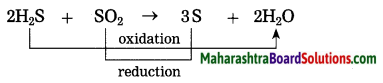
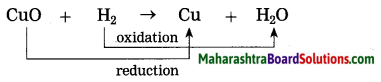
(a) Name this certain value of i. What is the value of r at that time?
(b) Name this process of returning light in the denser medium. Explain the process.
Answer:
(a) Critical angle r = 90°
(b) Total internal reflection.

As light goes from a denser to rarer medium, if the value of the angle of incidence increases, then the value of the angle of refraction also increases. But after a specific angle of incidence called the critical angle, the light gets reflected back into the denser medium.

The ray of light incident at the boundary separating the two media bends away from the normal on refraction. Here, the angle of refraction r, is greater than the angle of incidence i.
Now anw = \(\frac{\sin i}{\sin r}\) < 1. Here, anw is the refractive index of sin r air with respect to water. As anw is constant, r increases as i increases. For r = 90°, the ray travels along the boundary. If i is increased further, as r cannot be greater than 90°, light does not enter air. There is no refraction of light and all the light enters water on reflection. This is called total internal reflection.

For r = 90°, anw = \(\frac{\sin i}{\sin 90^{\circ}}\) = sin i. This angle i is sin 90° called the critical angle.

Maharashtra Board Class 10 Science Solutions Part 1 Chapter 6 Refraction of Light

Question 37.
The observations made by Swarali while doing the experiment are given below. Based on these write answers to the questions:
Swarali found that the light ray travelling from the denser medium to a rarer medium goes away from the normal. If the angle of incidence (i) is raised by Swarali, the angle of refraction (r) went on increasing. However, after certain value of the angle of incidence, the light ray is seen to return back into the denser medium. (March 2019)
(i) What is the specific value of ∠i called?
(ii) What is the process of reflection of incident ray into a denser medium called?
(iii) Draw the diagrams of three observations made by Swarali.
Answer:
(i) Critical angle
(ii) Total internal reflection
(iii)
Maharashtra Board Class 10 Science Solutions Part 1 Chapter 6 Refraction of Light 25

Question 38.
Define total internal reflection of light.
Answer:
When light travels from a denser medium to a rarer medium, if the angle of incidence is greater than the critical angle, there is no refraction of light and all the light is reflected in the denser medium. This is called total internal reflection of light.

Question 39.
Define critical angle.
Answer:
When light travels from a denser medium to a rarer medium, the angle of incidence for which the angle of refraction becomes 90°, is called the critical angle.

Question 40.
If the refractive index of a rarer medium with respect to a denser medium is 0.5, what is the critical angle?
Answer:
2n1 = 0.5 = sin i
∴ Critical angle i = 30°.

Question 41.
Name the devices in which total internal reflection of light is used.
Answer:

  1. Total internal reflecting prisms are used in a camera, binoculars, periscope.
  2. Total internal reflection of light is used in optical fibres.

[Note: Total internal reflection of light plays an important role in sparkling brilliance of a diamond.]

Question 42.
Explain why an empty test tube held obliquely in water appears shiny to an observer looking down.
Answer:
When an empty test tube is held obliquely in Water in a beaker, some light rays passing from water to air are incident at an angle greater than the critical angle. They are, thus, totally internally reflected as shown, and the surface of the test tube has a silvery shine.
Maharashtra Board Class 10 Science Solutions Part 1 Chapter 6 Refraction of Light 26

Question 43.
Observe the given figure and answer the following questions. (Practice Activity Sheet – 3)
Maharashtra Board Class 10 Science Solutions Part 1 Chapter 6 Refraction of Light 27
(a) Identify and write the natural process shown in the figure.
(b) List the phenomena which are observed in this process.
(c) Redraw the diagram and show the above phenomena in it.
Answer:
(a) The natural process shown in the figure is formation of rainbow.
(b) The phenomena observed in this process are refraction, internal reflection and dispersion of light.
(c)
Maharashtra Board Class 10 Science Solutions Part 1 Chapter 6 Refraction of Light 28

Write a short note on the following:

Question 1.
Refraction observed in the atmosphere.
Answer:
When a ray of light passes obliquely from an optically rarer medium to an optically denser medium, it bends towards the normal at the point of incidence. If opposite is the case, the ray bends away from the normal.

Atmosphere is never static. Air is mobile and its density and temperature are not uniform. As a result, in general, the path of a ray of light through atmosphere of varying refractive index is a curve. The refractive index of cool air is greater than that of hot air.

Atmospheric refraction of light results in many interesting optical phenomena such as twinkling of a star, advanced sunrise and delayed sunset, mirage and flickering of an object seen through a turbulent stream of hot air rising from a fire.

Question 2.
Dispersion of light.
Answer:
The process of separation of light into its component colours while passing through a medium is called dispersion of light. When white light passes through a glass prism, it spreads out into a band of different colours (components) called the spectrum of light. The colours in the spectrum of white light are violet, indigo, blue, green, yellow, orange and red.

Formation of a rainbow is an example of dispersion of light in nature. In this case, raindrops are responsible for dispersion of sunlight.

Dispersion takes place because the refractive index of a material such as glass or water, is different for different colours. It is maximum for violet colour and minimum for red colour. Hence, in the spectrum of white light (sunlight) obtained with a prism, violet light is deviated the most while red light is deviated the least. The deviation of light corresponding to other colours lies in between.

Give scientific reasons:

Question 1.
A coin kept in a bowl is not visible when seen from one side. But, when water is poured in the bowl, the coin becomes visible.
Answer:
(1) When the bowl is empty, the rays of light coming from the coin are obstructed by the side of the bowl, and hence the coin is not visible when seen from one side of the bowl.
Maharashtra Board Class 10 Science Solutions Part 1 Chapter 6 Refraction of Light 29
(2) When water is poured in the bowl, the rays of light coming from the coin travel from water (denser medium) to air (rarer medium). Hence, they bend away from the normal on refraction. Therefore, the coin appears to be raised and becomes visible when observed from one side of the bowl.

Maharashtra Board Class 10 Science Solutions Part 1 Chapter 6 Refraction of Light

Question 2.
A pencil dipped in water obliquely appears bent at the surface of water.
(OR)
When a pencil is partly immersed in water and held in a slanting position, it appears to be bent at the boundary separating water and air.
Answer:
(1) When a pencil is partly immersed in water and held in a slanting position, the rays of light coming from the immersed part of the pencil emerge from water (a denser medium) and enter air (a rarer medium). During this propagation, they bend away from the normal on refraction.
Maharashtra Board Class 10 Science Solutions Part 1 Chapter 6 Refraction of Light 30
The pencil appearing bent at the boundary of water and air (schematic diagram)

(2) As a result, the immersed part of the pencil does not appear straight with respect to the part outside the water, but appears to be raised. Hence, a pencil dipped obliquely in water appears bent at the surface of the water.

Question 3.
The shadow of the edge of an empty vessel is formed due to the slanting rays of the sun. When water is poured in the vessel, the shadow is shifted.
Answer:
(1) When the slanting rays of the sun are obstructed by the edge of the empty vessel, the shadow of the edge is formed.
Maharashtra Board Class 10 Science Solutions Part 1 Chapter 6 Refraction of Light 31
(2) When water is poured in the vessel, the slanting rays of the sun travel from air (rarer medium) to water (denser medium). During this propagation, they bend towards the normal on refraction. Hence, some part in the region of the shadow is now illuminated and the shadow appears to have shifted.

Question 4.
The bottom of a pond appears raised.
Answer:
(1) The rays of light coming from the bottom of a pond bend away from the normal as they travel from water (denser medium) to air (rarer medium).
Maharashtra Board Class 10 Science Solutions Part 1 Chapter 6 Refraction of Light 32
(2) Hence, they appear to come from a point above the actual point from which they come.
Therefore, the bottom of the pond appears raised.

Question 5.
While shooting a fish in a lake, the gun is aimed below the apparent position of the fish.
Answer:
(1) The rays of light coming from the fish bend away from the normal as they travel from water (denser medium) to air (rarer medium).
(2) Hence, the position of the fish in water appears to be above Its real position. Therefore, while shooting a fish in a lake, the gun is aimed below the apparent position of the fish.
Maharashtra Board Class 10 Science Solutions Part 1 Chapter 6 Refraction of Light 33

Maharashtra Board Class 10 Science Solutions Part 1 Chapter 6 Refraction of Light

Question 6.
The sun is seen on the horizon a little before sunrise.
(OR)
The sun is seen on the horizon for sometime even after sunset.
Answer:
(1) The earth is surrounded by an atmosphere which is denser near the surface of the earth. When the rays of light from the sun enter the earth’s atmosphere from outer space, they travel from a rarer medium to a denser medium. Hence, they bend towards the normal on refraction.

(2) Hence, even when the sun is below the horizon while rising or setting, its rays reach us due to refraction and it appears to be on the horizon. Therefore, the sun is seen on the horizon a little before sunrise as well as for some time even after sunset.

Distinguish between:

Question 1.
Reflection of light and Refraction of light:
Answer:

Reflection of lightRefraction of light
1. The rays of light, before and after reflection, travel in the same medium.1. In refraction of light, the rays travel from one medium to another medium.
2. In reflection, the angle of incidence and the angle of reflection are equal.2. In refraction, when the rays travel obliquely from one medium to another medium, the angle of incidence and the angle of refraction are not equal.
3. In reflection, there is no change in the speed and wavelength of light.3. In refraction, there occurs a change in the speed and wavelength of light.
4. In reflection, there is no dispersion of light.4. Generally, in refraction, there occurs dispersion of light.

[Note: The frequency of light remains the same in reflection and refraction.]

Complete the following or Solve and fill in the blanks :

Question 1.

Speed of light in the first medium (v1)Speed of light in the second medium (v2)Refractive index 2n1Refractive index 2n1
3 × 10⁸ m/s1.2 × 108 m/s————————–————————–
————————–2.25 × 10⁸ m/s4/3————————–
2 × 10⁸ m/s————————–————————–1.5

Answer:

Speed of light in the first medium (v1)Speed of light in the second medium (v2)Refractive index 2n1Refractive index 2n1
3 × 10⁸ m/s1.2 × 108 m/s2.50.4
3 × 10⁸ m/s2.25 × 108 m/s4/30.75
2 × 10⁸ m/s3 × 108 m/s2/31.5

Formulae:
2n1 = v1/v2, 1n2 = v2/v1

Solve the following examples/numerical problems:
c = 3 × 10⁸ m/s

Problem 1.
The speed of light in a transparent medium is 2.4 × 10⁸ m/s. Calculate the absolute refractive index of the medium.
Solution:
Data: c = 3 × 10⁸ m/s,
v = 2.4 × 10⁸ m/s, n = ?
Maharashtra Board Class 10 Science Solutions Part 1 Chapter 6 Refraction of Light 34
The absolute refractive index of the medium = 1.25.

Maharashtra Board Class 10 Science Solutions Part 1 Chapter 6 Refraction of Light

Problem 2.
The velocity of light in a medium is 2 × 10⁸ m/s. What is the refractive index of the medium with respect to air, if the velocity of light in air is 3 × 10⁸ m/s?
Solution:
Data: v1 = 3 × 10⁸ m/s,
v2 = 2 × 10⁸ m/s, 2n1 = ?
2n1 = \(\frac{v_{1}}{v_{2}}\)
\(=\frac{3 \times 10^{8}}{2 \times 10^{8}}\)
= 1.5
The refractive index of the medium with respect to air is 1.5.

Problem 3.
Light travels with a velocity 1.5 × 10⁸ m/s in a medium. On entering second medium its velocity becomes 0.75 × 10⁸ m/s. What is the refractive index of the second medium with respect to the first medium? (Practice Activity Sheet – 3)
Solution:
Given: Velocity of light in the first medium = v1 = 1.5 × 10⁸ m/s,
velocity of light in the second medium = v2 = 0.75 × 10⁸ m/s,
refractive index of the second medium with respect to the first medium = 2n1 = ?
2n1 = \(\frac{v_{1}}{v_{2}}\)
2n1 = \(\frac{1.5 \times 10^{8}}{0.75 \times 10^{8}}\) = 2
Hence, the refractive index of the second medium with respect to the first medium is 2.
[Note : The absolute refractive index of the second medium = \(\frac{3 \times 10^{8} \mathrm{m} / \mathrm{s}}{0.75 \times 10^{8} \mathrm{m} / \mathrm{s}}\) = 4 (greater than that of diamond, not likely).]

Problem 4.
The refractive index of water is 4/3 and the speed of light in air is 3 × 10⁸ m/s. Find the speed of light in water.
Solution:
Data: 2n1 = 4/3, v1 = 3 × 10⁸ m/s, v2 = ?
Maharashtra Board Class 10 Science Solutions Part 1 Chapter 6 Refraction of Light 35
The speed of light in water = 2.25 × 10⁸ m/s.

Problem 5.
The speed of light in water and glass is 2.2 × 10⁸ m/s and 2 × 10⁸ m/s respectively. What is the refractive index of (i) water with respect to glass (ii) glass with respect to water?
Solution:
Data: uw = 2.2 × 10⁸ m/s,
vg= 2 × 10⁸ m/s, wng = ?, gnw = ?
Maharashtra Board Class 10 Science Solutions Part 1 Chapter 6 Refraction of Light 36
The refractive index of water with respect to glass = 0.909 (approximately).
Maharashtra Board Class 10 Science Solutions Part 1 Chapter 6 Refraction of Light 37
The refractive index of glass with respect to glass = 1.1 (approximately).

Numerical Problems For Practice:
(Given: C = 3 × 10⁸m/s)

Problem 1.
The speed of light in a transparent medium is 2 × 10⁸ m/s. Find the absolute refractive index of the medium.
Solution:
1.5

Problem 2
The absolute refractive index of a transparent medium is 5/3. Find the speed of light in the medium.
Solution:
1.8 × 10⁸ m/s

Problem 3.
The absolute refractive index of a transparent medium is 2.4 and the speed of light in that medium is 1.25 × 10⁸ m/s. Find the speed of light in air.
Solution:
3 × 10⁸ m/s

Problem 4.
The speed of light in water is 2.25 × 10⁸ m/s and that in glass is 2 × 10⁸ m/s. Find the refractive index of (i) the glass with respect to water (ii) water with respect to the glass.
Solution:
(i) 1.125
(ii) 0.889 (approximately)

Maharashtra Board Class 10 Science Solutions Part 1 Chapter 6 Refraction of Light

Problem 5.
If the refractive index of a certain glass with respect to water is 1.25, find the refractive index of water with respect to the glass.
Solution:
0.8

Problem 6.
If the absolute refractive index of glass is 1.5 and that of water is \(\frac{4}{3}\), find the refractive index of water with respect to glass.
Solution:
\(\frac{8}{9}\)