Maharashtra Board Class 6 Hindi Solutions Chapter 3 उपहार

Balbharti Maharashtra State Board Class 6 Hindi Solutions Sulabhbharati Chapter 3 उपहार Notes, Textbook Exercise Important Questions and Answers.

Maharashtra State Board Class 6 Hindi Solutions Chapter 3 उपहार

Hindi Sulabhbharti Class 6 Solutions Chapter 3 उपहार Textbook Questions and Answers

नीचे दिए गए चित्रों को पहचानकर उनके नाम लिखिए?
Maharashtra Board Class 6 Hindi Solutions Chapter 3 उपहार 1
Answer:
(१) घर
(२) बहती नदी
(३) अमरुद
(४) हिमालय पर्वत
(५) अनाज की बोरी
(६) चाबियों का गुच्छा
(७) दर्शक
(८) पानी से भरा गिलास
(९) बूढा व्यक्ति
(१०) आम की पेटी

Maharashtra Board Class 6 Hindi Solutions Chapter 3 उपहार

भाषा की ओर

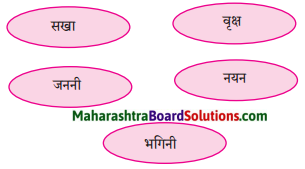
निम्नलिखित शब्दों के समानार्थी शब्द इस कहानी से ढूँढकर बताओ।
Maharashtra Board Class 6 Hindi Solutions Chapter 3 उपहार 5
Answer:
सखा – मित्र
वृक्ष – पेड़
जननी – माँ
नयन – आँख
भगिनी – बहन

लेखन विभाग

खोजबीनः

गृहउद्योगो की जानकारी छात्र अपने अनुसार प्राप्त करेंगे एवं उस पर चर्चा करेंगे।
Answer:
आज हमारे देश में कई स्थानों पर घर की गृहिणियाँ एवं बेरोज़गार लोग कई प्रकार के छोटे-छोटे उद्योग घर में ही करते हैं और अपनी आजीविका के लिए कुछ धन प्राप्त करते हैं। घर पर ही किए जाने वाले इन छोटे-छोटे उद्योगों को गृहउद्योग कहा जाता है।
इसके अंतर्गत निम्नलिखित उद्योग आते हैं।
(१) घर में अगरबत्तियाँ बनाना।
(२) मोमबत्तियाँ बनाना।
(३) अगरबत्तियों को लगने वाली बांबू की पतली सीकें तैयार करना।
(४) आलू के वेफर तैयार करना।
(५) पापड़ और अचार बनाना।
(६) छोटी-छोटी टोकरियों एवं चटाई बनाना।
(७) झाडू बनाना।
(८) चित्र बनाना, बर्तनों पर नक्काशी करना।
(९) सौपियों से रंग-बिरंगी वस्तुएँ बनाना।
(१०) मिट्टी के बर्तन बनाना आदि।

Maharashtra Board Class 6 Hindi Solutions Chapter 3 उपहार

बताओ तो सही:

बड़े होकर क्या बनना चाहते हो?
Answer:
मैं बड़ा होकर एक अच्छा व ईमानदार इंसान बनना चाहूँगा। जिंदगी तो सभी जीते हैं, किंतु वही असली जिंदगी जीता है, जिसे मरने के बाद भी सभी याद करते हैं। मैं एक सैनिक बनकर मरते दम तक अपने देश की सेवा करना चाहता हूँ।

वाचन जगत से:

महादेवी वर्मा की कहानी पढ़कर उसके पात्रों के नाम लिखिए:
Answer:
कहानी – नीलकंठ पात्र:
(१) लेखिका – महादेवी वर्मा
(२) बड़े मियाँ – चिड़िया बेचनेवाला
(३) नीलकंठ – मोर
(४) राधा – मोरनी
(५) कुब्जा – मोरनी
(६) कजली – लेखिका की कुतिया
(७) बूढा – खरगोश
(८) लक्का – कबूतर
(९) चित्रा . बिल्ली

सदैव ध्यान में रखें:

सच्चाई में ही सफलता किस तरह से निहित है:
Answer:
मनुष्य को अपने जीवन में हमेशा सच की राह पर चलना चाहिए। महात्मा गांधी एवं कई महापुरुषों ने अपने जीवन में सत्य का पालन किया है। भले ही सत्य की राह पर चलने वाले मनुष्य को कई मुसीबतों का सामना करना पड़ता है किंतु अंत में सत्य की ही विजय होती है।

जरा सोचो बताओ:

‘यदि तुम्हें परी मिल जाए तो …’ (काल्पनिक लेखन)
Answer:
यदि मुझे परी मिल जाए तो मैं स्वयं को बड़ा ही भाग्यशाली समझेंगा। परी से बातचीत करना मेरे मन की बड़ी पुरानी कामना है। यदि मुझे परी मिलेगी तो मैं उससे पहला प्रश्न करूँगा कि तुम कहाँ से आई हो? कहाँ रहती हो? क्या करती हो? उसकी जादुई छड़ी के बारे में पूछूगा। जादुई छड़ी से इस संसार में जो गरीब एवं दीन-दुखी हैं, उनके दुखों को दूर करने की प्रार्थना मैं उससे करूंगा। भूखों को अन्न, वस्त्रहीनों को कपड़ा और घर अपनी जादुई छड़ी से निर्माण करने के लिए कहूँगा। स्वयं के लिए कुछ न माँगकर समाज और देशवासियों को सुखी और संपन्न बनाए रखने एवं उनकी व्यवस्था बनाए रखने का निवेदन मैं परी से करूँगा। अंत में उसे इस कार्य को करने के लिए मैं उसका सदा आभारी रहूँगा। उसे धन्यवाद दूंगा। मैं परी से कहूँगा इस धरती को स्वर्ग से सुंदर बनाओ। इस वसुंधरा के गहने जो घने वृक्ष, हरियाली, पशु-पक्षी, मनुष्य हैं, सबको परिश्रमी, उद्योगी और स्वावलंबी बनने की इच्छा प्रदान करो।

Maharashtra Board Class 6 Hindi Solutions Chapter 3 उपहार

अध्ययन कौशल:

किसी परिचित अन्य कहानी लेखन के लिए मुद्दे तैयार करोः
Answer:
संकेत: एक कुत्ता — रोटी का टुकड़ा मिलना — मुँह में दबाना — पुल पार करना — पानी में परछाई देखना — दूसरा कुत्ता समझना — उस पर भौंकना — रोटी का गिर जाना — सीख।

स्वयं अध्ययन:

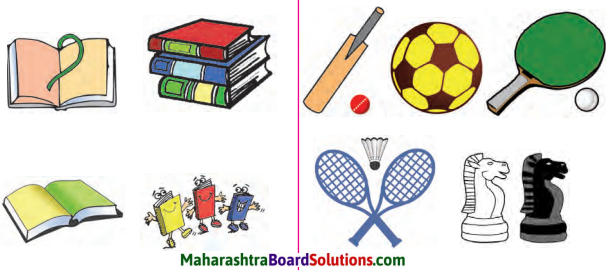
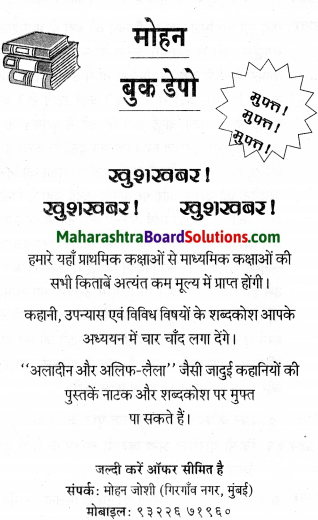
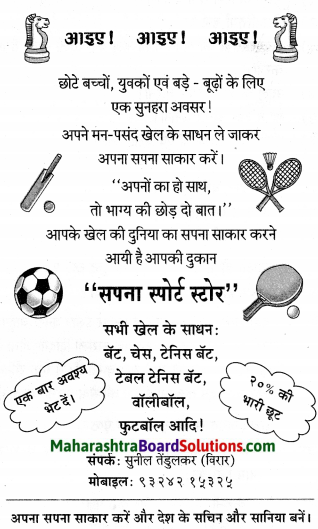
नीचे दिए गए चित्रों के आधार पर उचित और आकर्षक विज्ञापन तैयार करोः
Maharashtra Board Class 6 Hindi Solutions Chapter 3 उपहार 2
Answer:
Maharashtra Board Class 6 Hindi Solutions Chapter 3 उपहार 3
Maharashtra Board Class 6 Hindi Solutions Chapter 3 उपहार 4

Maharashtra Board Class 6 Hindi Solutions Chapter 3 उपहार

Hindi Sulabhbharti Class 6 Solutions Chapter 3 उपहार Additional Important Questions and Answers

निम्नलिखित प्रश्नों के उत्तर एक वाक्य में लिखिए:

Question 1.
गाँव के पास क्या लगा हुआ था?
Answer: गाँव के पास पुस्तक मेला’ लगा हुआ था।

Question 2.
पेड़ के पास कौन खड़ी थी?
Answer:
पेड़ के पास सुनहरे पंखों वाली एक परी खड़ी थी।

Question 3.
रास्ते में ऋत्विक को क्या मिला?
Answer:
रास्ते में ऋत्विक को गिरी हुई एक पोटली मिली।

Question 4.
पोटली पर किसका चित्र बना था?
Answer:
पोटली पर एक परी का सुनहरे रंग में चित्र बना था।

Question 5.
पोटली किस रंग की थी?
Answer:
पोटली लाल रंग की थी।

Question 6.
परी ने ऋत्विक की किस भावना की परीक्षा ली?
Answer:
परी ने ऋत्विक की ईमानदारी की परीक्षा ली।

Maharashtra Board Class 6 Hindi Solutions Chapter 3 उपहार

Question 7.
पोटली से क्या बाहर निकल आई?
Answer:
पोटली से सुंदर-सुंदर पुस्तकें बाहर निकल आई।

Question 8.
ऋत्विक ने किसके लिए पुस्तकालय खोला?
Answer:
ऋत्विक ने अपने मित्रों के लिए पुस्तकालय खोला।

Question 9.
ऋत्विक ने बड़े होकर क्या खोलने का निश्चय किया?
Answer:
ऋत्विक ने बड़े होकर एक बड़ा-सा पुस्तक भंडार’ खोलने का निश्चय किया।

Question 10.
ऋत्विक ने किसे अपना ध्येय बना लिया?
Answer:
ऋत्विक ने ‘पुस्तकालय’ को ही अपना ध्येय बना लिया।

निम्नलिखित प्रश्नों के उत्तर लिखिए:

Question 1.
ऋत्विक उदास क्यों हो गया?
Answer:
ऋत्विक के गाँव के पास ‘पुस्तक मेला’ लगा हुआ था। ऋत्विक भी पुस्तक मेला देखने जाना चाहता था किंतु माँ के मना करने पर ऋत्विक उदास हो गया।

Question 2.
पेड़ के पीछे ऋत्विक ने क्या देखा?
Answer:
पेड़ के पीछे ऋत्विक ने बहुत तेज़ रोशनी देखी। पेड़ के पास जाने पर उसने देखा कि वहाँ एक सुनहरे पखों वाली परी खड़ी है।

Question 3.
ऋत्विक ने परी को अपनी उदासी का क्या कारण बताया?
Answer:
ऋत्विक ने परी को अपनी उदासी का यह कारण बताया कि वह अपने दोस्तों के साथ पुस्तक-मेला देखने जाना चाहता था तथा मेले से पुस्तकें खरीदना चाहता था।

Maharashtra Board Class 6 Hindi Solutions Chapter 3 उपहार

Question 4.
ऋत्विक ने रास्ते में मिली मखमली पोटली को क्यों नहीं खोला?
Answer:
ऋत्विक ने रास्ते में मिली मखमली पोटली को इसलिए नहीं खोला क्योंकि उसने मन में विचार किया कि अगर यह मेरी नहीं है, तो मुझे इसे खोलने का अधिकार नहीं है।

Question 5.
परी ने ऋत्विक को क्या समझाया?
Answer:
परी ने ऋत्विक को समझाया कि जो व्यक्ति ईमानदार होता है, उसे अपने जीवन में किसी चीज़ की कमी नहीं होती।

Question 6.
ऋत्विक और उसकी बहन को पूरा गाँव ‘पुस्तक-मित्र’ के नाम से क्यों जानने लगा?
Answer:
ऋत्विक ने अपनी बहन कृतिका की मदद से गाँव में एक पुस्तकालय खोला। गाँव के सभी बच्चे वहाँ आकर अपनी मनपसंद पुस्तकें पढ़ने लगे। ऋत्विक के इसी योगदान के कारण पूरा गाँव उन्हें ‘पुस्तक-मित्र’ के नाम से जानने लगा।

Question 7.
एक पुस्तक ने ऋत्विक से क्या पूछा?
Answer:
एक पुस्तक ने ऋत्विक पूछा, “ऋत्विक, अगर तुम अपने जीवन में बड़े आदमी बनोगे, तो क्या तुम हमारा साथ छोड़ दोगे? हमें भूल जाओगे?”

निम्नलिखित शब्दों में से उचित शब्द चुनकर रिक्त स्थानों की पूर्ति कीजिए:

(उदास, गाँव, पोटली, समझ, ईमानदारी, आँखें, पुस्तकें,आँख)

Question 1.
कल मैने ही तुम्हारी ……………… की परीक्षा ली।
Answer:
ईमानदारी

Question 2.
एक ……………… में ऋत्विक नाम का लड़का रहता
Answer:
गाँव

Maharashtra Board Class 6 Hindi Solutions Chapter 3 उपहार

Question 3.
उसे रास्ते में गिरी हुई एक ……………… मिली।
Answer:
पोटली

Question 4.
अपनी माँ की बात सुनकर ऋत्विक ……………… हो गया।
Answer:
उदास

Question 5.
पुस्तक पढ़ते-पढ़ते ऋत्विक की …………….. गई।
Answer:
आँख

Question 6.
परी की बात ऋत्विक की ……………… में नहीं आ रही
Answer:
समझ

Question 7.
खुशी से उसकी ……………… भर आईं।
Answer:
आँखें

Question 8.
उसमें से सुंदर-सुंदर ……………….. बाहर निकल आई।
Answer:
पुस्तकें

किसने, किससे कहाः

Question 1.
“तुम यहाँ उदास क्यों बैठे हो?”
Answer:
परी ने ऋत्विक से कहा।

Maharashtra Board Class 6 Hindi Solutions Chapter 3 उपहार

Question 2.
“मेरी पोटली गिर गई है कहीं रास्ते में।”
Answer:
राहगीर ने ऋत्विक से कहा।

Question 3.
“और कोई पहचान बताओ?”
Answer:
ऋत्विक ने राहगीर से कहा।

Question 4.
“नहीं-नहीं, अब तो तुम ही मेरे साथी हो, मित्र हो।”
Answer:
ऋत्विक ने पुस्तक से कहा।

Question 5.
“अपनी आँखें बंद करो! मैं तुम्हें इनाम दूंगी।”
Answer:
परी ने ऋत्विक से कहा।

Question 6.
“मैं भी मेला देखने जाऊँगा।”
Answer:
ऋत्विक ने माँ से कहा।

Question 7.
“कौन-सी परीक्षा है?”
Answer:
ऋत्विक ने परी से पूछा।

Question 8.
“किस रंग की थी?”
Answer:
ऋत्विक ने राहगीर से पूछा। व्याकरण और भाषाभ्यास

Maharashtra Board Class 6 Hindi Solutions Chapter 3 उपहार

निम्नलिखित शब्दों के समानार्थी शब्द कहानी से ढूँढकर लिखिए:

  1. सखा
  2. वृक्ष
  3. जननी
  4. नयन
  5. भगिनी
  6. पुत्र
  7. प्रकाश
  8. सहायता
  9. भोर
  10. उत्तर

Answer:

  1. मित्र
  2. पेड़
  3. माँ
  4. आँख
  5. बहन
  6. बेटा
  7. रोशनी
  8. मदद
  9. सुबह
  10. जवाब

Maharashtra Board Class 6 Hindi Solutions Chapter 3 उपहार

निम्नलिखित शब्दों के विलोम शब्द लिखिए:

  1. दिन
  2. बड़ा
  3. सोना
  4. जीवन
  5. पास
  6. खुश
  7. कम
  8. उत्तीर्ण
  9. सुबह
  10. अंधकार
  11. सवाल
  12. दोस्त

Answer:

  1. रात
  2. छोटा
  3. जागना
  4. मरण
  5. दूर
  6. उदास
  7. ज्यादा
  8. अनुत्तीर्ण
  9. शाम
  10. प्रकाश
  11. जवाब
  12. दुश्मन

Maharashtra Board Class 6 Hindi Solutions Chapter 3 उपहार

निम्नलिखित शब्दों का वचन बदलिए:

  1. लड़का
  2. आँख
  3. परी
  4. पुस्तक
  5. चीज़

Answer:

  1. लड़के
  2. आँखें
  3. परियाँ
  4. पुस्तकें
  5. चीजें

निम्नलिखित वाक्यों में सर्वनाम शब्द को छाँटकर लिखिए:

Question 1.
तुम अकेले कैसे जाओगे इतनी दूर?
Answer:
तुम

Question 2.
अपनी माँ की बात सुनकर ऋत्विक उदास हो गया।
Answer:
अपनी

Maharashtra Board Class 6 Hindi Solutions Chapter 3 उपहार

Question 3.
यह कहकर ऋत्विक खामोश हो गया।
Answer:
यह

Question 4.
उसने उसे खोलना चाहा, फिर सोचने लगा।
Answer:
उसने

Question 5.
वह बैठ गया।
Answer:
वह

Question 6.
हमें भूल जाओगे?
Answer:
हमें

Question 7.
कहानी में आए संज्ञा शब्दों (परी, ऋत्विक, ढेर, ईमानदारी, दूध) को इनका वाक्यों में प्रयोग करके भेद समझाइए:
Answer:
परी – मैंने एक परी को देखा। (जातिवाचक संज्ञा)
ऋत्विक – ऋत्विक बुद्धिमान बालक है।
(व्यक्तिवाचक संज्ञा)
ढेर – घर के सामने मिट्टी का ढेर पड़ा है।
(समूहवाचक संज्ञा)
ईमानदारी- हमें अपना काम ईमानदारी से करना चाहिए।
(भाववाचक संज्ञा)
दूध – मैं प्रतिदिन दूध पीता हूँ। (द्रव्यवाचक संज्ञा)

Maharashtra Board Class 6 English Solutions Chapter 3.3 Stone Soup

Balbharti Maharashtra State Board Class 6 English Solutions Chapter 3.3 Stone Soup Notes, Textbook Exercise Important Questions and Answers.

Maharashtra State Board Class 6 English Solutions Chapter 3.3 Stone Soup

Class 6 English Chapter 3.3 Stone Soup Textbook Questions and Answers

1. Answer the following questions.

Question a.
Where does the story take place?
Answer:
The story takes place in a village.

Question b.
List the characters in the play and write one or two lines about each.
Answer:
1. Motiram – He is a farmer. He had a good produce of crops. He does not want to advertise because he is afraid he would have guests at home and he would have to share with them.
2. Sonabai – She too had a good produce. She too like Motiram did not want to advertise because she does not like to have guests.
3. Hirabai – She too feels that guests are pests. She hates to give food and money to others.
4. Rupabai – She thinks a little differently. She feels it is not right to refuse someone who comes for help.
5. Traveller – He is a traveller who has travelled a long distance and is tired and hungry. He hears the conversation of the villagers and comes to know that they are miserly. In the end he makes everyone contribute a little towards making of the soup.

Maharashtra Board Class 6 English Solutions Chapter 3.3 Stone Soup

Question c.
How do the following avoid giving anything to the traveller?
Answer:
Motiram – He tells the traveller that dinner was over and nothing was left. He tells the traveller to try elsewhere.
Sonabai – She pretended to be hard of hearing which eventually made the traveller try elsewhere.
Hirabai – She pretended not to understand the traveller’s language and spoke gibberish (nonsense) which made the traveller try elsewhere.
Rupabai – She told the traveller that she too was very hungry because she had not made anything as her larder was empty.

Question d.
Find what Hirabai tells the traveller by reading her words from right to left.
Answer:
Go away. No food and no rest for anyone here.

Question e.
Apart from the stone, how many things go into the soup?
Answer:
Apart from the stone, water, potatoes, carrots, tomatoes, beans, onions, ginger, salt and pepper go into making the soup.

Maharashtra Board Class 6 English Solutions Chapter 3.3 Stone Soup

Question f.
Does the traveller really have a magic stone?
Answer:
No, the traveller does not have a magic stone, but he uses the stone to make the miserly villagers believe that the stone was magical.

2. On any one page, note against the speech of every character, what feelings it should show to bring out the meaning best. For example, joy, fear, anger, nervousness, friendliness, dislike, surprise, wonder, excitement, politeness, rudeness, cunning, curiosity.

Question 1.
On any one page, note against the speech of every character, what feelings it should show to bring out the meaning best. For example, joy, fear, anger, nervousness, friendliness, dislike, surprise, wonder, excitement, politeness, rudeness, cunning, curiosity.
Answer:

  1. Rupabai – surprise, wonder
  2. Traveller – regret
  3. Rupabai – cunning
  4. Traveller – joy, expectation
  5. Rupabai – unsure
  6. Sonabai – friendliness
  7. Hirabai – apologetic

Maharashtra Board Class 6 English Solutions Chapter 3.3 Stone Soup

3. Read aloud / Enact the play.

Question 1.
Read aloud / Enact the play.

4. Write a recipe for the stone soup.

Question 1.
Write a recipe for the stone soup.
Answer:
The Stone Soup
Once upon a time a tired and weary traveller came to a village. The Sun had just set. The traveller was very hungry and very tired. He hoped to get food and shelter in the village. He saw cottages in a row and walked towards them when suddenly he heard voices of people chatting. He stopped to hear ….
Now can you continue with the story.

5. Form pairs. Write at least one short dialogue for each of the following expressions.

Question 1.
Form pairs. Write at least one short dialogue for each of the following expressions.
(a) I agree (b) True! (c) You are right (d) Why not? (To mean that something can be done) (e) Thank you
Answer:
For example:
(a) Amit: I think all schools should have big playgrounds.
Sumit: I agree!

(b) Mohit: It has been raining cats and dogs.
Rohit: True!

(c) Sangeeta: There is a solution to every problem.
Neeta: You are right.

(d) William: Will I be able to complete this project all by myself?
Mother: Why not?
Rohini: Here are the English notes you wanted.
Sohini: Thank you

Maharashtra Board Class 6 English Solutions Chapter 3.3 Stone Soup

6. Find the meaning of ‘Charity begins at home/ Find other sayings which have a similar meaning.

Question 1.
Find the meaning of ‘Charity begins at home/ Find other sayings which have a similar meaning.
Answer:
‘Charity begins at home.’ The meaning of this proverb is – A person’s first responsibility is to look after the needs of their own family and friends.
Saying with similar meanings.

  1. Charity and beating begins at home – John Fletcher.
  2. Home is where the heart is.
  3. Home sweet home.
  4. A home away from home.

Now you add some more.

7. List five questions from the play which can be answered with ‘yes’ or ‘no’.

Question 1.
List five questions from the play which can be answered with ‘yes’ or ‘no’.
Answer:
(a) Does it melt away?
(b) Have you guessed the secret of the stone soup?
(c) Do you think that is right?
(d) Can I have some food?
(e) Anyone at home?

Maharashtra Board Class 6 English Solutions Chapter 3.3 Stone Soup

8. Smart Answers: Form a large group. Each person asks the next one a question to get him to say ‘yes’ or ‘no’. He/She can use appropriate statements, requests or even other questions as a response. But if he/she says ‘yes’ or ‘no’, he/she is out. Otherwise he/she continues the game. Questions cannot be repeated.

Question 1.
Smart Answers: Form a large group. Each person asks the next one a question to get him to say ‘yes’ or ‘no’. He/She can use appropriate statements, requests or even other questions as a response. But if he/she says ‘yes’ or ‘no’, he/she is out. Otherwise he/she continues the game. Questions cannot be repeated.
Answer:
To be done by students.

9. Visit a library: Find stories about hosts and guests. Share them with the class. Classify the stories into funny and serious stories.

Question 1.
Visit a library: Find stories about hosts and guests. Share them with the class. Classify the stories into funny and serious stories.
Answer:
To be done by students.

Class 6 English Chapter 3.3 Stone Soup Important Questions and Answers

Reading Skills, Vocabulary and Grammar

Read the extract and answer the following questions.

Question 1.
State whether the following statements are true or false.
a. Rupabai thought differently.
b. The villagers notice the traveller when they were chatting outside Motiram’s house.
Answer:
a. True
b. False

Maharashtra Board Class 6 English Solutions Chapter 3.3 Stone Soup

Question 2.
What time of the day was it when the villagers were chatting?
Answer:
It was evening time when the villagers were chatting.

Question 3.
What did Hirabai think of guests?
Answer:
Hirabai thought of guests as nuisance.

Question 4.
Uninvited guests are pests according to (Choose the correct alternative)
(a) Sonabai
(b) Hirabai
(c) Motiram
(d) Rupabai
Answer:
(b) Motiram

Maharashtra Board Class 6 English Solutions Chapter 3.3 Stone Soup

Question 5.a.
Add a prefix to get the opposite of Polite
Answer:
Impolite

Question b.
Guests can be a nuisance. (Pick out the modal verb and add a question tag)
Answer:
Modal verb – can Guests can be a nuisance, can’t they?

Question c.
Uninvited guests are pests. (Frame a ‘Wh’ question to get the underlined word as the answer)
Answer:
What are uninvited guests?

Question d.
I never waste good food. (Identify the kind of sentence)
Answer:
Assertive/Declarative – Negative

Maharashtra Board Class 6 English Solutions Chapter 3.3 Stone Soup

Question e.
You are right. (Change into negative)
Answer:
You are not wrong.

Personal Response:

Question 1.
Should we help people in need? Justify.
Answer:
Yes, we should help people in need if we can. Helping others will surely give us satisfaction and we will feel happy. The person whom we help also is happy. We should remember the saying ‘What goes around comes around.’

Language Study

Do as directed.

Question 1.
Who are you, young man? (Kind of sentence)
Answer:
Interrogative sentence

Maharashtra Board Class 6 English Solutions Chapter 3.3 Stone Soup

Question 2.
I am not defeated. (Make it affirmative)
Answer:
I am undefeated.

Question 3.
I can hardly believe this. (Pick out the modal auxiliary)
Answer:
Modal auxiliary – can

Question 4.
I have not seen you around. (Add a question tag)
Answer:
I have not seen you around, have I?

Question 5.
I’m a poor, footsore traveller. (Pick out the adjectives)
Answer:
Adjectives – poor, footsore.

Question 6.
You can taste the goodness of fresh vegetables. (Frame a ‘wh’ question to get the underlined words as the answer)
Answer:
What can you taste?

Maharashtra Board Class 6 English Solutions Chapter 3.3 Stone Soup

Question 7.
It reminds me of the soup I had made some time ago. (Change the verb into past perfect)
Answer:
It had reminded me of the soup I had made some time ago.

Student’s Activity:

Question 1.
Write a simple recipe of your choice. Remember:
(a) Ingredients
(b) Method
Answer:
To be done by students.

Stone Soup Summary in English

The play ‘Stone Soup’ revolves around selfish and miserly villagers, Motiram, Sonabai, Hirabai and Rupabai and a traveller. The villagers who have their cottages closeby are discussing about people who come uninvited. They do not like to have guests, more so uninvited ones. A traveller weary and hungry enters their village and tries asking for help, but each of the villagers give some excuse not to help the travellers. In the end the traveller plays a trick on the miserly villagers, brings out a magic stone and prepares a wonderful soup, that too with things (vegetables/ items) given by the villagers themselves.

Introduction:

The play ‘Stone Soup’ is a humorous play. It is actually an old folk tale in which a hungry traveller tricks the miserly villagers into believing that soup can be made from a stone. As the pot of water boils with the stone in it, he urges the villagers, one by one, to add more and more ingredients until the soup becomes a feast fit for a king. This play tries to tell us, that when people share resources, no matter how small each contribution is, the result will always benefit all.

Maharashtra Board Class 6 English Solutions Chapter 3.3 Stone Soup

Glossary:

  1. footsore (adj) – having painful feet from much walking
  2. gibberish (n) – speech or writing that is meaningless
  3. larder (n) – a cool room in a house where food is stored
  4. tempting (adj) – appealing, attractive, inviting
  5. speechless (adj) – not knowing what to say
  6. generosity (n) – giving in plenty
  7. marvellous (adj) – extremely good or pleasing
  8. noble (adj) – having high moral principles
  9. hard of hearing (phr) – not able to hear well
  10. charity begins at home (proverb) – a person’s first responsibility is to look after the needs of their own family and friends

Maharashtra Board Class 6 Marathi Solutions Chapter 11 मिनूचा जलप्रवास

Balbharti Maharashtra State Board Class 6 Marathi Solutions Sulabhbharati Chapter 11 मिनूचा जलप्रवास Notes, Textbook Exercise Important Questions and Answers.

Maharashtra State Board Class 6 Marathi Solutions Chapter 11 मिनूचा जलप्रवास

Marathi Sulabhbharti Class 6 Solutions Chapter 11 मिनूचा जलप्रवास Textbook Questions and Answers

1. एक-दोन वाक्यांत उत्तरे लिहा.

प्रश्न अ.
मिनू मासोळी कुठे राहायची?
उत्तर:
मिनू मासोळी माशांच्या समूहात राहायची.

Maharashtra Board Class 6 Marathi Solutions Chapter 11 मिनूचा जलप्रवास

प्रश्न आ.
मिनूला समुद्र का बघायचा होता?
उत्तर:
मिनूला सतत उत्सुकता असायची की, नदीचे पाणी रोज कुठं जातं? तेव्हा आई म्हणायची, “समुद्रात जातं” तेव्हा तो समुद्र कसा असेल? तो केवढा असेल? हे जाणून घेण्यासाठी तिला समुद्र बघायचा होता.

प्रश्न इ.
नदीचे पाणी गढूळ का झाले?
उत्तर:
मुसळधार पाऊस पडू लागल्यामुळे पाण्याचे लोंढे वाहू लागले व त्यामुळे नदीचे पाणी गढूळ झाले.

प्रश्न ई.
खडकावर फुललेल्या फुलांचे रंग कोणते होते?
उत्तर:
खडकावर फुललेली फुले लाल, गुलाबी, अंजिरी अशा विविध रंगांची होती.

Maharashtra Board Class 6 Marathi Solutions Chapter 11 मिनूचा जलप्रवास

प्रश्न उ.
समुद्राच्या खोलवर अंधार का असतो?
उत्तर:
समुद्राच्या तळाशी सूर्यप्रकाश पोहचत नसल्याने समुद्राच्या तळाशी खोलवर अंधार असतो. प्रश्न ४.खालील प्रश्नांची तीन-चार वाक्यांत उत्तरे लिहा.

2. तीन-चार वाक्यांत उत्तरे लिहा.

प्रश्न अ.
लेखिकेने नदीचे वर्णन कसे केले आहे?
उत्तरः
‘नदीत खूप खूप पाणी होते. ते पाणी निळे निळे, थंडगार व स्वच्छ होते. इतके स्वच्छ की वरून पाहिले, की तळाची वाळू दिसायची. गोल गोल गोटे दिसायचे अन् सुळसुळ पोहणारे छोटे मासेही दिसायचे.’ असे लेखिकेने नदीचे वर्णन केले आहे.

प्रश्न आ.
मिनूची व आईची चुकामुक का झाली?
उत्तर:
एक दिवस मुसळधार पाऊस पडू लागला. जमिनीवरून पाण्याचे लोंढे वाहायला लागले. नदीचे पाणी गढुळले. मासे बावरून एकमेकांना शोधू लागले; पण कोणीच कोणाला दिसेना. पाणी वेगाने वाहत होते. या गोंधळातच मिनूची व आईची चुकामूक झाली.

Maharashtra Board Class 6 Marathi Solutions Chapter 11 मिनूचा जलप्रवास

प्रश्न इ.
घोडमासा पाहून मिनूला हसू का आले?
उत्तर:
समुद्रातून थोडीशी चक्कर मारून परत जावे असा विचार करून मिनू पुढे जात असताना तिची एका विचित्र माशाशी टक्कर झाली. त्याचे तोंड घोड्यासारखे होते व पोटाला पिशवी होती व त्यात छोटी छोटी पिल्ले बसलेली पाहून मिनूला हसू आले.

3. कोण कोणास व केव्हा म्हणाले ते लिहा.

प्रश्न अ.
“समुद्र, समुद्र म्हणतात तो आला की!”
उत्तर:
मिनूने जेव्हा हळूच तोंड उघडले तेव्हा समुद्राचे खारट पाणी तिच्या तोंडात गेले तेव्हा ती स्वत:लाच म्हणाली.

प्रश्न आ.
“त्याचं नाव घोडमासा, समुद्रघोडा!”
उत्तर:
समुद्राच्या पाण्यात मिनूची एका विचित्र माशाची टक्कर झाली तेव्हा पाण्याच्या तळाकडून कासव मिनूला म्हणाले.

Maharashtra Board Class 6 Marathi Solutions Chapter 11 मिनूचा जलप्रवास

प्रश्न इ.
“घाबरू नकोस, हा तर खेकडा!”
उत्तर:
कासव व मिनू यांच्यात जेव्हा बोलणे चालू होते तेव्हा त्यांच्या मधून एक प्राणी तिरका तिरका चालत गेला. तो आपल्या बटबटीत डोळ्यांनी मिनूकडे पाहत होता. तेव्हा ती घाबरली, तिची भिती दूर करताना कासव मिनूला म्हणाले.

प्रश्न ई.
“कासवदादा, चला ना माझ्याबरोबर.”
उत्तर:
मिनू आपल्या आईकडे पुन्हा नदीच्या दिशेने निघाली तेव्हा मिनू कासवाला म्हणाली.

4. शिंपल्यामध्ये मोती कसा तयार होतो? त्याची क्रिया क्रमाने लिहा.

प्रश्न 1.
शिंपल्यामध्ये मोती कसा तयार होतो? त्याची क्रिया क्रमाने लिहा.
उत्तर:

  1. नदीतील शंख-शिंपल्यात एक छोटासा किडा असतो.
  2. या शिंपल्यात चुकून एखादा वाळूचा कण गेला की तो त्याच्या अंगाला टोचायला लागतो. मग तो आपल्या अंगातून पातळ रस काढून त्यावर गुंडाळतो.
  3. मग त्यातूनच पुढे छानदार मोती तयार होतो.

5. चार – पाच ओळीत वर्णन करा.

प्रश्न अ.
घोडमासा
उत्तर:
घोडमासा हा विचित्र मासा आहे. त्याचे तोंड इतर माशांसारखे नसते. त्याचे तोंड घोड्यासारखे असते. त्याच्या पोटाला पिशवी असते. त्यात छोटी छोटी पिल्ले बसलेली असतात.

Maharashtra Board Class 6 Marathi Solutions Chapter 11 मिनूचा जलप्रवास

प्रश्न आ.
खेकडा
उत्तर:
खेकडा आपल्या पायांनी तिरका चालतो. तो आपल्या बटबटीत डोळ्यांनी पाहतो. त्याच्या पाठीवर कासवासारखेच कठीण कवच असते. त्यामुळे शत्रू त्याच्यावर हल्ला करू शकत नाही. याला सहा तर कधी आठ पायही असतात. त्यांच्या तोंडाजवळ दोन नांग्या असतात, त्यामुळे त्याचं संरक्षण होते व त्याला भक्ष्यही पकडता येते.

6. इवलीशी’ यासारखे आणखी शब्द लिहा.

प्रश्न 1.
इवलीशी’ यासारखे आणखी शब्द लिहा.
उत्तर:

  1. नबी नशी
  2. को बळीशी
  3. छानशी
  4. सोनुलीशी

7.

प्रश्न अ.
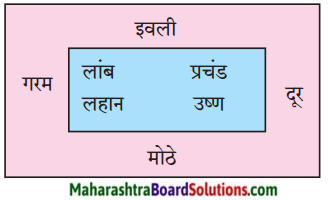
समानार्थी शब्दांच्या योग्य जोड्या लावा.
Maharashtra Board Class 6 Marathi Solutions Chapter 11 मिनूचा जलप्रवास 1
उत्तरः

  1. लांब – दूर
  2. प्रचंड – मोठे
  3. उष्ण – गरम
  4. लहान – इवली

प्रश्न आ.
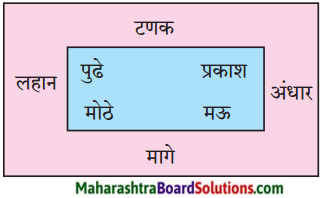
विरूद्धार्थी शब्दांच्या योग्य जोड्या लावा.
Maharashtra Board Class 6 Marathi Solutions Chapter 11 मिनूचा जलप्रवास 2
उत्तरः

  1. पुढे × मागे
  2. प्रकाश × अंधार
  3. मऊ × टणक
  4. मोठे × लहान

Maharashtra Board Class 6 Marathi Solutions Chapter 11 मिनूचा जलप्रवास

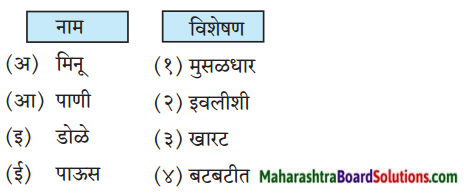
8. योग्य जोड्या जुळवा.

प्रश्न 1.
योग्य जोड्या जुळवा.
Maharashtra Board Class 6 Marathi Solutions Chapter 11 मिनूचा जलप्रवास 3
उत्तर:

नामविशेषण
1. मिनू(आ) इवलीशी
2. पाणी(इ) खारट
3. डोळे(ई) बटबटीत
4. पाऊस(अ) मुसळधार

9. खालील शब्द वाचा. समजून घ्या.

प्रश्न 1.
खालील शब्द वाचा. समजून घ्या.
Maharashtra Board Class 6 Marathi Solutions Chapter 11 मिनूचा जलप्रवास 4

10. तुम्ही मिनू मासोळी आहात अशी कल्पना करून समुद्राची माहिती आईला सांगा.

प्रश्न 1.
तुम्ही मिनू मासोळी आहात अशी कल्पना करून समुद्राची माहिती आईला सांगा.
उत्तर:
‘आई, समुद्र हा खूप मोठा जलाशय असतो. त्यात दूरदूर पर्यंत पाणीच पाणी असते. त्याचा तळ खूप खोल असतो. त्याच्या तळाशी अंधार असतो. कारण तिथपर्यंत सूर्याचा प्रकाश पोहचत नाही. समुद्राचे पाणी चवीला खारट आहे. त्या पाण्यात मोठ्या माशांपासून ते लहान-लहान माशांपर्यंत विविध प्रकारचे मासे आहेत. समुद्रातून आपण जहाज व बोटीत बसून प्रवास करू शकतो. विविध प्रकारचे वायू व तेलाचे साठे समुद्राच्या तळाशी आहेत. त्याचा माणसाने पुरेपुर फायदा करून घेतला आहे. समुद्रातील मोती हे आपला अमुल्य ठेवा आहे.

Maharashtra Board Class 6 Marathi Solutions Chapter 11 मिनूचा जलप्रवास

11. शंख-शिंपल्यांपासून शोभेच्या वस्तू बनवा.

प्रश्न 1.
खालील वाक्ये वाचा.
अ. विसूने ‘ताजमहाल’, पाहिला.
आ. मंदाने सुरेशला सांगितले, ‘पायल तुझ्याकडे उदया येणार आहे.’
एखादया शब्दावर जोर दयावयाचा असता, दुसऱ्याचे मत अप्रत्यक्ष सांगताना (‘ – ‘) असे एकेरी अवतरणचिन्ह वापरले जाते.

प्रश्न 2.
खालील वाक्यांतील काळ ओळखा.

  1. सूर्य पूर्वेला उगवतो.
  2. मला लाडू आवडला.
  3. आईचा स्वयंपाक झाला होता.
  4. मी गावाला जाईन.
  5. तू का रडतेस?
  6. मी पोहायला शिकणार आहे.

उत्तरः

  1. वर्तमानकाळ
  2. भूतकाळ
  3. भूतकाळ
  4. भविष्यकाळ
  5. वर्तमानकाळ
  6. भविष्यकाळ

Class 6 Marathi Chapter 11 मिनूचा जलप्रवास Additional Important Questions and Answers

खाली दिलेल्या वाक्यातील रिकाम्या जागी योग्य शब्द भरून वाक्य लिहा.

  1. मिनू होती ………………
  2. इतर मासे तिचे खूप खूप …………… करायचे.
  3. आनंदाने तिने ……………………. उडीच मारली.
  4. एक दिवस ……….. पाऊस पडू लागला.
  5. जमिनीवरून पाण्याचे …………… वाहायला लागले.
  6. पाणी वेगाने ……………. होते.
  7. या गोंधळात मिनूची व आईची ……………… झाली.
  8. इतक्यात तिची एका विचित्र माशाशी ………………. झाली.
  9. मिनू …………….. पायऱ्या उतरत त्याच्याजवळ पोहोचली.
  10. तो ………….. हात असलेला अष्टभुज मासा.
  11. हा अगदी …………….. गोळा असतो गोळा.
  12. मग त्यातून छानदार ……….. तयार होतो.
  13. आता मात्र मिनूची ……….. उडाली.
  14. काही माशांच्या अंगातून ……………… बाहेर पडतो.
  15. कासवदादांनी तिला कितीतरी ………………. दाखवल्या होत्या.

उत्तरः

  1. इवलीशी
  2. लाड
  3. टुणकन
  4. मुसळधार
  5. लोंढे
  6. वाहत
  7. चुकामूक
  8. टक्कर
  9. लाटांच्या
  10. आठ
  11. मांसाचा
  12. मोती
  13. घाबरगुंडी
  14. उजेड
  15. गमती

Maharashtra Board Class 6 Marathi Solutions Chapter 11 मिनूचा जलप्रवास

असे कोण कोणास व केव्हा म्हणाले ते लिहा.

प्रश्न 1.
“समुद्र, समुद्र म्हणतात तो आला की!”
उत्तर:
मिनूने जेव्हा हळूच तोंड उघडले तेव्हा समुद्राचे खारट पाणी तिच्या तोंडात गेले तेव्हा ती स्वत:लाच म्हणाली.

प्रश्न 2.
“त्याचं नाव घोडमासा, समुद्रघोडा!”
उत्तर:
समुद्राच्या पाण्यात मिनूची एका विचित्र माशाची टक्कर झाली तेव्हा पाण्याच्या तळाकडून कासव मिनूला म्हणाले.

प्रश्न 3.
“घाबरू नकोस, हा तर खेकडा!”
उत्तर:
कासव व मिनू यांच्यात जेव्हा बोलणे चालू होते तेव्हा त्यांच्या मधून एक प्राणी तिरका तिरका चालत गेला. तो आपल्या बटबटीत डोळ्यांनी मिनूकडे पाहत होता. तेव्हा ती घाबरली, तिची भिती दूर करताना कासव मिनूला म्हणाले.

Maharashtra Board Class 6 Marathi Solutions Chapter 11 मिनूचा जलप्रवास

प्रश्न 4.
“कासवदादा, चला ना माझ्याबरोबर.”
उत्तर:
मिनू आपल्या आईकडे पुन्हा नदीच्या दिशेने निघाली तेव्हा मिनू कासवाला म्हणाली.

खालील प्रश्नांची एक-दोन वाक्यांत उत्तरे लिहा.

प्रश्न 1.
मिनू कशी होती?
उत्तर:
मिनू इवलीशी, अगदी हाताच्या छोट्या बोटाएवढी होती.

प्रश्न 2.
मिनूचे कल्ले कसे होते?
उत्तर:
मिनू रूपेरी कल्ल्यांची होती. / मिनूचे कल्ले रूपेरी होते.

प्रश्न 3.
मिनूला कशाचा कंटाळा आला होता?
उत्तर:
मिनूला नदीच्या खोलगट भागात राहायचा कंटाळा आला होता.

Maharashtra Board Class 6 Marathi Solutions Chapter 11 मिनूचा जलप्रवास

प्रश्न 4.
मासे कोणाला शोधू लागले?
उत्तर:
मासे बावरून एकमेकांना शोधू लागले.

प्रश्न 5.
पाण्यात एका बाजूला लांबपर्यंत कशाच्या रांगा होत्या?
उत्तरः
पाण्यात एका बाजूला लांबपर्यंत खडकांच्या रांगा होत्या.

प्रश्न 6.
पाण्याच्या तळाशी कोण बसले होते?
उत्तर:
पाण्याच्या तळाशी कासव बसले होते.

प्रश्न 7.
मिनू कासवाजवळ कशी पोहचली?
उत्तर:
मिनू लाटांच्या पायऱ्या उतरत कासवाजवळ पोहचली.

Maharashtra Board Class 6 Marathi Solutions Chapter 11 मिनूचा जलप्रवास

प्रश्न 8.
दोन शिंपल्यांच्या मध्ये कोण बसलेला असतो?
उत्तर:
दोन शिंपल्यांच्या मध्ये एक किडा बसलेला असतो.

प्रश्न 9.
बटबटीत डोळे कोणाचे आहेत?
उत्तर:
बटबटीत डोळे खेकड्याचे आहेत.

प्रश्न 10.
खेकड्यावर शत्रू हल्ला का करू शकत नाही?
उत्तर:
खेकड्याच्या पाठीवर कासवासारखेच कठीण कवच असल्यामुळे शत्रू त्याच्यावर हल्ला करू शकत नाही.

प्रश्न 11.
खेकड्याला किती पाय असतात?
उत्तर:
खेकड्याला सहा तर कधी आठ पायही असतात.

Maharashtra Board Class 6 Marathi Solutions Chapter 11 मिनूचा जलप्रवास

प्रश्न 12.
तिरका तिरका चालणारा प्राणी कोणता?
उत्तर:
तिरका तिरका चालणारा प्राणी खेकडा होय.

प्रश्न 13.
खेकड्याच्या तोंडाजवळ काय असतात?
उत्तर:
खेकड्याच्या तोंडाजवळ दोन नांग्या असतात.

प्रश्न 14.
खेकड्याच्या दोन नांग्यामुळे त्याला कोणता फायदा होतो?
उत्तर:
खेकड्याच्या दोन नांग्यामुळे त्याला भक्ष्यही मिळते व त्याचे संरक्षणही होते.

खालील प्रश्नांची तीन-चार वाक्यांत उत्तरे लिहा.

प्रश्न 1.
आठ हात असणाऱ्या माशाविषयी कासवदादाने मिनूला काय सांगितले?
उत्तर:
आठ हात असणाऱ्या माशाविषयी कासवदादाने मिनूला सांगितले की, ‘तो आठ हात असलेला अष्टभुज मासा. तो कसा उलटा चालतोय, बघितलंस का? पाण्याच्या चुळा भरत हळूहळू मार्ग सरकतो. आपल्या आठ हातांनी मासे, खेकडे पकडून खातो.’ पाण्यात उतरणारी माणसंसुद्धा त्याला घाबरतात बरं का।

खालील वाक्यात एकेरी अवतरण चिन्हांचा वापर करून वाक्य लिहा.

प्रश्न 1.
गाडगेबाबांच्या हातात नेहमी गाडगे असे; म्हणून लोक त्यांना नेहमी गाडगेबाबा म्हणत.
उत्तर:
गाडगेबाबांच्या हातात नेहमी गाडगे असे; म्हणून लोक त्यांना नेहमी ‘गाडगेबाबा’ म्हणत.

Maharashtra Board Class 6 Marathi Solutions Chapter 11 मिनूचा जलप्रवास

प्रश्न 2.
डॉ. बाबासाहेबांना सरकारने भारतरत्न ही पदवी बहाल केली.
उत्तर:
डॉ. बाबासाहेबांना सरकारने ‘भारतरत्न’ ही पदवी बहाल केली.

प्रश्न 3.
लोकमान्य टिळकांनी लोकांना जागृत करण्यासाठी मराठा व केसरी ही वर्तमानपत्रे सुरू केली.
उत्तर:
लोकमान्य टिळकांनी लोकांना जागृत करण्यासाठी ‘मराठा’ व ‘केसरी’ ही वर्तमानपत्र सुरू केली.

मिनूचा जलप्रवास Summary in Marathi

पाठपरिचयः

प्रस्तुत पाठात मिनू नावाच्या मासळीने केलेल्या जल प्रवासाचे वर्णन केले आहे. त्याचबरोबर समुद्रातील कासवाने दाखवलेल्या गमतीजमतीचे वर्णन केले आहे. त्याच्यातून आपणांस माशांमध्ये असलेल्या सामंजस्याचे दर्शन घडते.

शब्दार्थ:

  1. जलप्रवास – पाण्यातून प्रवास (voyage)
  2. निळे – (blue)
  3. तळ – (to bottom)
  4. वाळू – रेती (sand)
  5. गोल गोटे – गोल लहान दगड (round stone)
  6. सुळसुळ् – सहज (easy)
  7. मासे – (fish)
  8. समूह – समुदाय (crowd)
  9. मासळी – मच्छी (fish)
  10. इवलीशी – अगदी लहान (very small)
  11. रूपेरी – चांदीच्या (silver)
  12. नजरेआड – नजरेपासून दूर (out of sight)
  13. खोलगट – किंचित खोल (slightly deep)
  14. समुद्र – सागर (sea)
  15. मुसळधार – खूप जोराचा (heavy, torrential)
  16. लोंढे – प्रवाह (stream)
  17. गढुळ – मातीमिश्रीत झालेले (not clear, muddy)
  18. बावरून – गडबडून, गोंधळून (confusion)
  19. वेगाने – गतीने (speedily)
  20. गिरक्या – गोल गोल फिरत (whirling)
  21. चक्कर – फेरफटका (stroll, around)
  22. संग – ओळ (line)
  23. गंमत – मौज, मजा (fun)
  24. हळूहळू – सावकाश (slow)
  25. टक्कर – आघात, धक्का (collision)
  26. घोडमासा, – समुद्रातील वेगवेगळ्या माशांचे प्रकार समुद्रघोडा (one type of fish)
  27. रोखाने – त्या दिशेने (towards)
  28. कासव – (tortoise)
  29. लाटा – पाण्याचा तरंग (waves)
  30. पावला – प्रत्येक पावलावर (on each step) पावलांवर
  31. अष्टभुज – आठ हत असलेला (having eight hands)
  32. चुळा – तोंडाने पाणी बाहेर फेकणे (gurgle)
  33. गुंडाळणे – आवरण घालणे (to cover)
  34. कण – छोटा दाणा (particle)
  35. तिरका – तिरकस (sloping, slanting)
  36. बटबटीत – मोठे (big)
  37. घाबरगुंडी – तीव्र भीती (panic)
  38. कवच – आवरण (cover)
  39. कठीण – कडक (hard)
  40. शत्रू – दुश्मन (enemy)
  41. हल्ला – चढाई (attack)
  42. बेट्याला – (येथे अर्थ) खेकड्याला (to crab)
  43. नांग्या – खेकड्याच्या तोंडाजवळील एक अवयव (part near mouth of a crab)
  44. भक्ष्य – शिकार (prey)
  45. प्रकाश – उजेड (light)
  46. प्रचंड – खूप मोठे (huge)
  47. क्षणभर – काही काळ (for some moments)

Maharashtra Board Class 6 Marathi Solutions Chapter 11 मिनूचा जलप्रवास

वाक्प्रचार व अर्थ:

  1. नजरेआड न करणे – नजरेपासून दूर न करणे.
  2. बावरून जाणे – गोंधळून जाणे.
  3. चक्कर मारणे – फिरून येणे.
  4. घाबरगुंडी उडणे – खूप घाबरणे.
  5. डोळे विस्फारणे – डोळे मोठे करून बघणे.

Maharashtra Board Class 6 Hindi Solutions Chapter 1 सैर

Balbharti Maharashtra State Board Class 6 Hindi Solutions Sulabhbharati Chapter 1 सैर Notes, Textbook Exercise Important Questions and Answers.

Maharashtra State Board Class 6 Hindi Solutions Chapter 1 सैर

Hindi Sulabhbharti Class 6 Solutions Chapter 1 सैर Textbook Questions and Answers

Maharashtra Board Class 6 Hindi Solutions Chapter 1 सैर 1 Maharashtra Board Class 6 Hindi Solutions Chapter 1 सैर 2 Maharashtra Board Class 6 Hindi Solutions Chapter 1 सैर 3 Maharashtra Board Class 6 Hindi Solutions Chapter 1 सैर 4

Maharashtra Board Class 6 Hindi Solutions Chapter 1 सैर

चित्रों का परिचयः

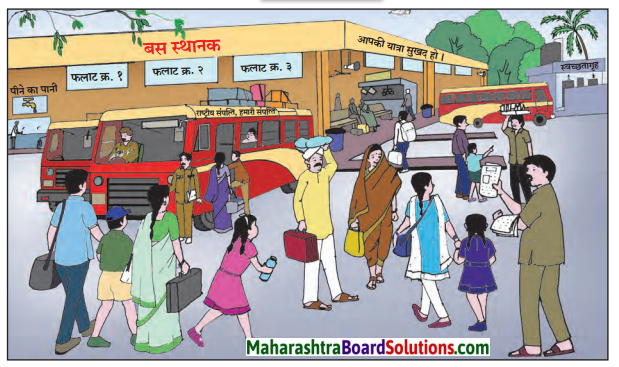
पहला चित्र बस स्थानक का है। बस स्थानक के सामने यात्रियों की यात्रा सुखद होने की कामना की गई है। बस स्थानक पर तीन विभाग दिखाई दे रहे हैं। विभाग क्रमांक १ के पास पीने के पानी की व्यवस्था की गई है। कुछ लोग बस पकड़ने के लिए बस की ओर जा रहे हैं तो कुछ लोग अपनी यात्रा पूरी कर बाहर जा रहे हैं। एक व्यक्ति समाचार पत्र बेच रहा है। बस स्थानक के बाईं ओर स्वच्छतागृह बना हुआ है। बस स्थानक पर स्वच्छता है। हमें सार्वजनिक स्थानों पर स्वच्छता रखनी चाहिए। राष्ट्रीय संपत्ति हमारी संपत्ति है। इसकी सुरक्षा करनी चाहिए।
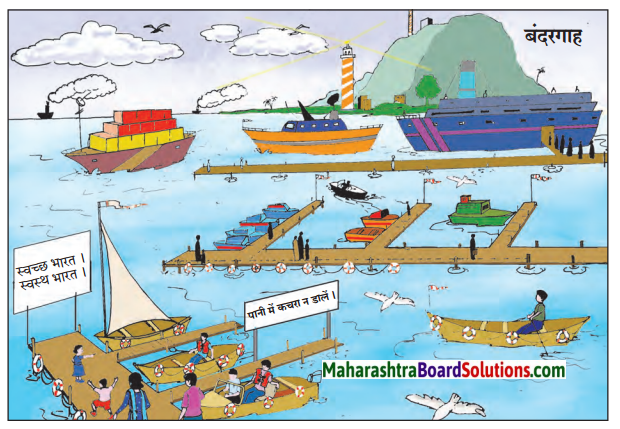
दूसरे चित्र में बंदरगाह दिखाई दे रहा है। समुद्र के रास्ते जो सामग्रियाँ आती हैं, वे बंदरगाह पर उतारी जाती हैं। वहाँ से वे देश के अन्य हिस्सों में भेजी जाती हैं। इसी तरह विदेशों में भी इसी जगह से वस्तुओं को भेजा जाता है। बंदरगाह और जल को स्वच्छ रखने की सूचना दिखाई पड़ रही है। हमें जल को स्वच्छ रखना चाहिए। स्वच्छ भारत रखेंगे तो ही भारत स्वस्थ होगा।
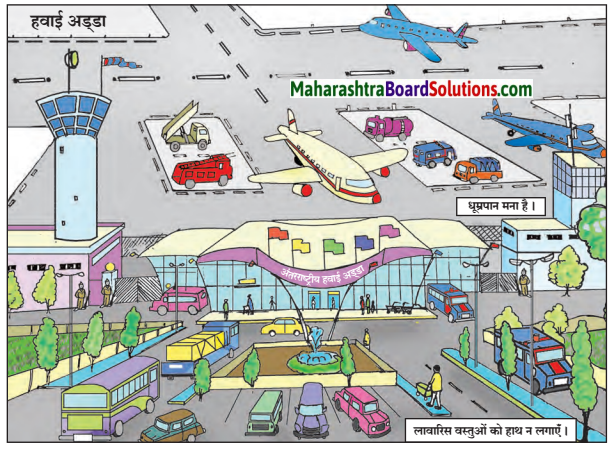
तिसरे चित्र में आवागमन के साधन दिखाई दे रहे हैं। चित्र में अंतरराष्ट्रीय हवाई अड्डा दिखाई दे रहा है। हवाई अड्डे पर कार, बस, ट्रक आदि खड़े हैं।
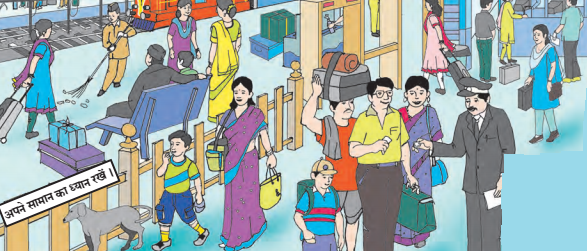
चौथा चित्र रेल स्थानक का है। कुछ लोग स्थानक से बाहर निकल रहे हैं। एक व्यक्ति सफाई कर रहा है। हमें सार्वजनिक स्थानों | पर स्वच्छता रखनी चाहिए।

Maharashtra Board Class 6 Hindi Solutions Chapter 1 सैर

Hindi Sulabhbharti Class 6 Solutions Chapter 1 सैर Additional Important Questions and Answers

उपर दिए गए चित्रों को देखकर निम्नलिखित प्रश्नों के उत्तर लिखिए:

Question 1.
बस स्थानक पर कितनी बस दिखाई दे रही हैं?
Answer:
तीन।

Question 2.
बस पर क्या लिखा हुआ है?
Answer:
राष्ट्रीय संपत्ति, हमारी संपत्ति।

Question 3.
बंदरगाह पर पानी के वाहन कितने दिखाई दे रहे हैं?
Answer:
चौदह।

Question 4.
‘पानी में कचरा न डालें।’ कहा लिखा हुआ है?
Answer:
बंदरगाह पर।

Question 5.
स्वस्थ भारत के लिए क्या आवश्यक है?
Answer:
स्वच्छता।

Maharashtra Board Class 6 Hindi Solutions Chapter 1 सैर

सही शब्द चुनकर रिक्त स्थानों की पूर्ति कीजिए:

(यात्रा, लाल, बस स्थानक, तीन, बंदरगाह)

Question 1.
पहला चित्र ……………… का है।
Answer:
बसस्थानक

Question 2.
दूसरे चित्र में ……………… दिखाई दे रहा है।
Answer:
बंदरगाह

Question 3.
बस स्थानक पर ……………… विभाग क्रमांक हैं।
Answer:
तीन

Question 4.
आपकी ………………सुखद हो।
Answer:
यात्रा

Question 5. सरकारी बस ……………… रंग की होती हैं।
Answer:
लाल

Maharashtra Board Class 6 Hindi Solutions Chapter 1 सैर

निम्नलिखित वाक्यों के सामने सही (✓) अथवा गलत (✗) का निशान लगाइए:

Question 1.
बस स्थानक पर पुस्तकालय दिखाई दे रहा है।
Answer:

Question 2.
बस स्थानक पर कूडेदान रखा है।
Answer:

Question 3.
बंदरगाह के पास पक्षी उड़ रहे हैं।
Answer:

Question 4.
बंदरगाह के पास पीने का पानी दिखाई दे रहा है।
Answer:

Maharashtra Board Class 6 Hindi Solutions Chapter 1 सैर

निम्नलिखित प्रश्नों के उत्तर लिखिए:

Question 1.
यातायात के साधनों के नाम लिखिए।
Answer:
कार, बस, रेलगाड़ी, हवाई जहाज़ आदि।

Question 2.
यातायात के साधनों को कितने वर्गों में बाँटा जा सकता
Answer:
यातायात के साधनों को तीन वर्गों में बाँटा जा सकता है।

Question 3.
आवागमन के साधनों के तीनों वर्गों के नाम लिखिए।
Answer:
जल, थल और वायु मार्ग।

Question 4.
थल मार्ग के द्वारा यात्रा के कौन – कौन से साधन हैं?
Answer:
साइकिल, मोटर साइकिल, रिक्शा, कार, बस, रेलगाड़ी आदि।

Question 5.
यातायात के किस मार्ग के लिए बंदरगाह बनाए जाते
Answer:
बंदरगाह का उपयोग जलमार्ग के लिए किया जाता है।

Maharashtra Board Class 6 Hindi Solutions Chapter 1 सैर

दिए गए चित्र को देखकर निम्नलिखित प्रश्नों के उत्तर लिखिए:

Question 1.
हवाई अड्डे पर कितने हवाई जहाज़ दिखाई दे रहे हैं?
Answer:
तीन।

Question 2.
हवाई अड्डे पर क्या सूचना लिखी ह?
उत्तरः
धूमपान मना है।

Question 3.
चौथे चित्र में रेलगाड़ी की संख्या कितनी है?
Answer:
एक।

Question 4.
टिकट घर के ऊपर क्या सूचना लिखी है?
Answer:
लावारिस वस्तुओं को हाथ न लगाएँ।

Question 5.
रेल स्थानक पर सामान ढोने वाले को क्या कहते हैं?
Answer:
कुली।

Maharashtra Board Class 6 Hindi Solutions Chapter 1 सैर

निम्नलिखित शब्दों में से उचित शब्द चुनकर रिक्त स्थानों की पूर्ति कीजिए:

Question 1.
_______ वस्तओं को हाथ न लगाएँ।
Answer:
लावारिस

Question 2.
अपने ________ का ध्यान रखें।
Answer:
सामान

Question 3.
________ मना है।
Answer:
धूम्रपान

Question 4.
यात्रा में ________ और _________ सहायता करनी चाहिए।
Answer:
महिलाओं, वृद्धों

Question 5.
सुंदरता और स्वच्छता से राष्ट्र का नाम ________ होता है।
Answer:
ऊँचा

Maharashtra Board Class 6 Hindi Solutions Chapter 1 सैर

निम्नलिखित प्रश्नों के उत्तर लिखिए:

Question 1.
आवागमन के साधनों का क्या महत्त्व है?
Answer:
आवागमन के साधनों से समय की बचत होती है।

Question 2.
आवागमन के साधनों में सबसे तेज़ी से कौन चलता है?
Answer:
हवाई जहाज़ आवागमन का सबसे तेज़ साधन है।

Question 3.
रेल द्वारा क्या-क्या कार्य किया जाता है?
Answer:
रेल द्वारा यात्रा करने और माल ढुलाई का कार्य किया जाता है।

Question 4.
लावारिस सामान को हाथ लगाने से क्या होता है?
Answer:
लावारिस सामान विस्फोटक हुआ तो जान जा सकती है।

Maharashtra Board Class 6 Hindi Solutions Chapter 1 सैर

Question 5.
धूम्रपान क्यों नहीं करना चाहिए?
Answer:
धूम्रपान स्वास्थ्य के लिए खतरनाक होता है, इसलिए धूम्रपान नहीं करना चाहिए।

Maharashtra Board Class 6 Marathi Solutions Chapter 1 भारतमाता

Balbharti Maharashtra State Board Class 6 Marathi Solutions Sulabhbharati Chapter 1 भारतमाता Notes, Textbook Exercise Important Questions and Answers.

Maharashtra State Board Class 6 Marathi Solutions Chapter 1 भारतमाता (गाणे)

Marathi Sulabhbharti Class 6 Solutions Chapter 1 भारतमाता Textbook Questions and Answers

प्रश्न 1.
रिकाम्या जागा भरा.

  1. रंग वेगळे ……….. वेगळे, तरी येथली सर्व फुले.
  2. मानव सारे ………… असती, शिकवण ही जगतास दिली.
  3. या मातेची मुले ………. सदा तिचा ध्वज उंच धरु.
  4. प्रियतम अमुचे …………… हे, प्रियतम या गंगा जमुना.

उत्तर:

  1. गंध
  2. समान
  3. सद्गुणी
  4. सह्यविंध्य

प्रश्न 2.
जोड्या जुळवा.

‘अ’ गट‘ब’ गट
1. पाणी(अ) डुलणारी
2. हिमालय(ब) सळसळते
3. वारे(क) धवल
4. भारतमाता(ड) झुळझुळते
5. शेते(इ) प्रियतम

उत्तर:

‘अ’ गट‘ब’ गट
1. पाणी(ड) झुळझुळते
2. हिमालय(क) धवल
3. वारे(ब) सळसळते
4. भारतमाता(इ) प्रियतम
5. शेते(अ) डुलणारी

Maharashtra Board Class 6 Marathi Solutions Chapter 1 भारतमाता (गाणे)

प्रश्न 3.
कवितेच्या खालील ओळी पूर्ण करा.

  1. प्रियतम अमुची …………………. तिची मुले.
  2. रंग वेगळे …………….. सर्व फुले.
  3. प्रिय आम्हाला …………… झुळझुळते.
  4. प्रियकर ही डुलणारी ……………. सळसळते.
  5. प्रियतम आमुचा ………….. जो गगना.
  6. प्रियतम अमुचे सह्यविंध्य …………. जमुना.
  7. या मातेची …………. प्रिय झाली.
  8. या मातेची ………….. उंच धरु.

उत्तर:

  1. भारतमाता, आम्ही सारी
  2. गंध वेगळे, तरी येथली
  3. येथील माती, प्रिय हे पाणा
  4. शेते, प्रिय हे वारे
  5. धवल हिमालय, बघे भिडाया
  6. हे, प्रियतम या गंगा
  7. मुले सद्गुणी, सर्व जगाला
  8. मुले लाडकी, सदा तिचा ध्वज प्रश्न

खालील प्रश्नांची एका वाक्यात उत्तरे लिहा.

प्रश्न 1.
सारी मुले कुणाची आहेत?
उत्तर:
सारी मुले भारतमातेची आहेत.

Maharashtra Board Class 6 Marathi Solutions Chapter 1 भारतमाता (गाणे)

प्रश्न 2.
फुले कशी आहेत?
उत्तर:
फुले विविध रंगांची व गंधाची आहेत.

प्रश्न 3.
हिमालय कसा आहे?
उत्तर:
हिमालय धवल व गगनाला भिडणारा आहे.

प्रश्न 4.
भारतमातेने जगतास कोणती शिकवण दिली?
उत्तर:
सारे मानव समान आहेत ही शिकवण भारतमातेने जगतास दिली.

Maharashtra Board Class 6 Marathi Solutions Chapter 1 भारतमाता (गाणे)

प्रश्न 5.
भारतमातेची मुले काय करणार आहेत?
उत्तर:
भारतमातेची मुले ध्वज उंच करणार आहेत.

खालील प्रश्नांची दोन-तीन वाक्यात उत्तरे लिहा.

प्रश्न 1.
कवयित्रीला कोण कोण प्रिय आहे?
उत्तर:
कवयित्रीला भारतमाता, सर्व फुले, माती, पाणी, शेते, वारे, हिमालय, सह्याद्री व विध्य पर्वत, गंगा, जमुना, सर्व मुले प्रिय आहेत.

प्रश्न 2.
भारतमातेची मुले कशी आहेत? त्यांनी कोणती शिकवण दिली?
उत्तर:
भारतमातेची मुले सद्गुणी आहेत. त्यांनी मानव सारे समान आहेत ही शिकवण सर्व जगाला दिली.

प्रश्न 3.
भारतमातेविषयी कृतज्ञता कशी व्यक्त केली आहे?
उत्तर:
भारतमाता सर्वांना प्रिय आहे. तिला सर्व वंदन करत आहेत. तिचा ध्वज उंच फडकवून तिच्याविषयी कृतज्ञता व्यक्त केली आहे.

Maharashtra Board Class 6 Marathi Solutions Chapter 1 भारतमाता (गाणे)

व्याकरण व भाषाभ्यास:

प्रश्न 1.
वचन बदला.

  1. मुलगा
  2. माती
  3. पाणी
  4. नदी
  5. किडा
  6. भाजी
  7. घर
  8. झाड
  9. शेत

उत्तर :

  1. मुले
  2. माती
  3. पाणी
  4. नदया
  5. किडे
  6. भाज्या
  7. घरे
  8. झाडे
  9. शेते

प्रश्न 2.
खालील शब्दांचे समानार्थी शब्द लिहा.

  1. वंदन
  2. माता
  3. सदा
  4. गंध
  5. लाडकी

उत्तर:

  1. नमस्कार
  2. आई
  3. नेहमी
  4. सुवास
  5. आवडती, प्रिय

Maharashtra Board Class 6 Marathi Solutions Chapter 1 भारतमाता (गाणे)

प्रश्न 3.
खालील शब्दांचे विरूद्धार्थी अर्थाचे शब्द लिहा.

  1. प्रियतम
  2. समान
  3. उंच
  4. सद्गुणी

उत्तर:

  1. अप्रिय
  2. असमान
  3. बुटका, ठेंगणा
  4. दुर्गुणी

प्रश्न 4.
कवितेमध्ये आलेले यमक जुळणारे शब्द शोधा.

  1. मुले
  2. झुळझुळते
  3. गगना
  4. दिली
  5. करू

उत्तर:

  1. फुले
  2. सळसळते
  3. जमुना
  4. झाली
  5. धरू

Maharashtra Board Class 6 Marathi Solutions Chapter 1 भारतमाता (गाणे)

लेखन विभाग:

प्रश्न 1.
‘भारतमाता’ शब्द वापरून चार वाक्ये लिहा.
उत्तर:

  1. भारतमाता आम्हाला प्रिय आहे.
  2. आम्ही भारतमातेला वंदन करू.
  3. भारतमातेचा ध्वज उंच धरू,
  4. आम्ही भारतमातेची मुले आहोत.

प्रश्न 2.
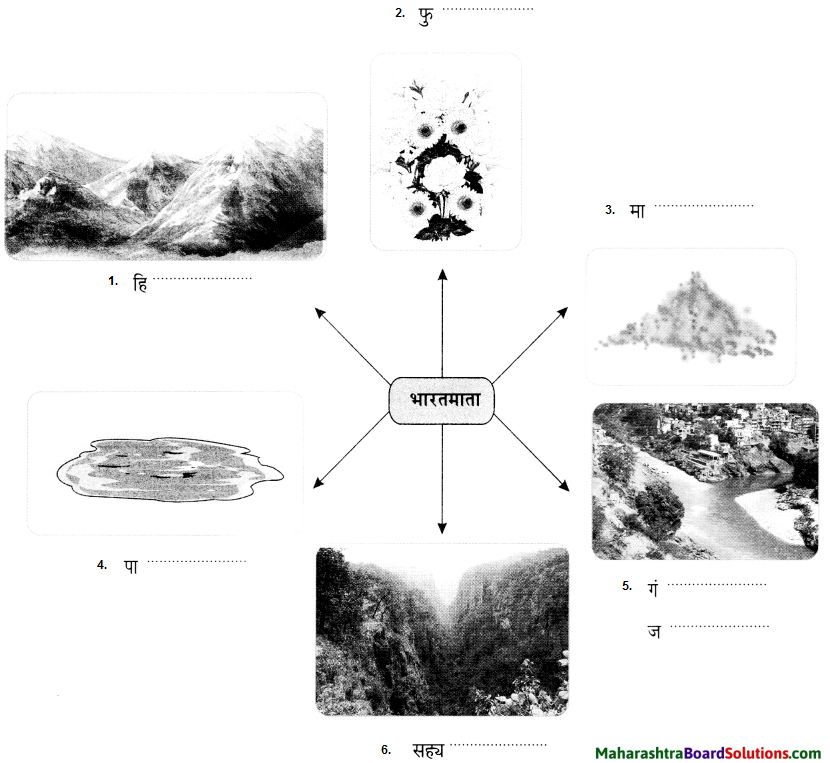
भारतमाता विविध गोष्टींनी नटलेली आहे. चौकटीत त्यांची नावे लिहा.
Maharashtra Board Class 6 Marathi Solutions Chapter 1 भारतमाता (गाणे) 1
उत्तर:

  1. हिमालय
  2. फुले
  3. माती
  4. पाणी
  5. गंगा, जमुना
  6. सयविंध्य

भारतमाता (गाणे) Summary in Marathi

काव्य परिचय:

भारतमाता ही भारतभूमीचे वैशिष्ट्य सांगणारी कविता आहे. भारताच्या मातीत विविधता आहे. निसर्ग भरभरून फुलला आहे. पर्वतराजी उंच उंच आहेत. हिची प्रजा गुणी असून जगतासाठी आदर्श आहे. भारतमातेविषयी आदर व कृतज्ञता बाळगून आपण तिचा गौरव वाढवू व ध्वज उंच फडकवू हा अर्थ या कवितेतून प्रतित होतो.

शब्दार्थ:

  1. प्रियतम – आवडती, प्रियकर (darling)
  2. अमुची – आपली (ours’)
  3. गंध – वास (odour, smell)
  4. माती – मृत्तिका (earth, soil)
  5. डुलणारी – वाऱ्यावर हलणारी (oscillating)
  6. शेते – शेती (farming)
  7. धवल – पांढराशुभ्र, सफेद (white)
  8. भिडणे – पोहोचणे (to meet)
  9. गगन – आकाश (sky)
  10. सयविंध्य – सह्याद्री, विंध्याचल पर्वत (Sahyadri)
  11. मानव – माणूस (human being)
  12. शिकवण – उपदेश (to advise, teaching)
  13. सद्गुणी – गुणवान (virtuous)
  14. सदा – नेहमी (always)
  15. ध्वज – झेंडा (flag)
  16. वंदन – नमस्कार (salutation)

वाक्प्रचार व अर्थ:

1. भिडणे – जाऊन ठेपणे, पोहोचणे

Maharashtra Board Class 6 Hindi Solutions मेला

Balbharti Maharashtra State Board Class 6 Hindi Solutions Sulabhbharati मेला Notes, Textbook Exercise Important Questions and Answers.

Maharashtra State Board Class 6 Hindi Solutions मेला

Hindi Sulabhbharti Class 6 Solutions मेला Textbook Questions and Answers

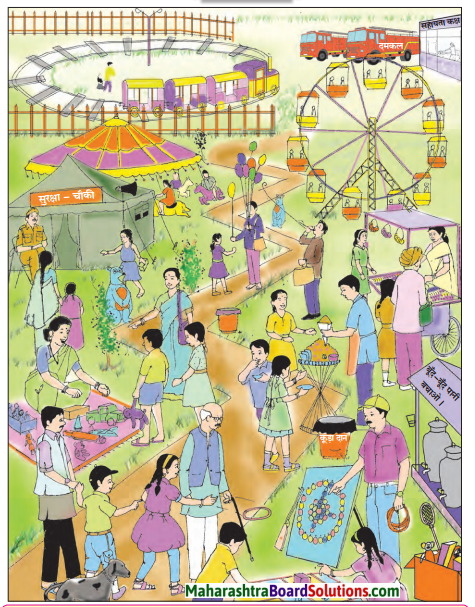
Maharashtra Board Class 6 Hindi Solutions मेला 1

चित्रों का परिचयः
गाँवों में किसी विशेष अवसर पर मेला लगता है। वहाँ तरह – तरह की दुकानें लगती हैं। बच्चे अपने माता – पिता के साथ मेला घूमने जाते हैं। मेले में जगह – जगह कूड़ेदान रखे जाते हैं। पीने के लिए पानी की व्यवस्था होती है। लोगों की सहायता के लिए सहायता-कक्ष होते हैं। चोर-उचक्कों से सुरक्षा के लिए सुरक्षा-चौकी बनाई जाती है। आग से बचाव के लिए दमकल की गाड़ियाँ तैयार रहती हैं। मेले में साफ-सफाई रखनी चाहिए। मेले में लोगों का अच्छा मनोरंजन होता है, इसलिए इस अवसर पर सभी के चेहरों पर हँसी ही हँसी छलकती है।

Maharashtra Board Class 6 Hindi Solutions मेला

Hindi Sulabhbharti Class 6 Solutions मेला Additional Important Questions and Answers

निम्नलिखित वाक्यों के सामने सही (✓) अथवा गलत (✗) का निशान लगाइए:

Question 1.
कुछ लोग झूला झूल रहे हैं।
Answer:

Question 2.
खिलौने वाला खिलौना फेंक रहा है।
Answer:

Question 3.
एक लड़की गुब्बारा खरीद रही है।
Answer:

Question 4.
सुरक्षा-चौकी के बाहर लोगों की भीड़ लगी है।
Answer:

Question 5.
नल से पानी बह रहा है।
Answer:

Maharashtra Board Class 6 Hindi Solutions मेला

रिक्त स्थानों की पूर्ति कीजिए:

Question 1.
मेले में दमकल की ……………… गाड़ियाँ खड़ी हैं।
Answer:
दो

Question 2.
‘बूंद – बूंद पानी बचाओ।’ ……………… के पास लिखा
Answer:
नल

Question 3.
हमें कचरा ……………… में डालना चाहिए।
Answer:
कूड़ा-दान

Question 4.
सुरक्षा-चौकी के बाहर ……………… बैठा है।
Answer:
सिपाही

Question 5.
मेला घूमने के लिए ……………… तैयार रहते हैं।
Answer:
बच्चे

Question 6.
मेले में सभी ……………… दिखाई देते हैं।
Answer:
खुश

Maharashtra Board Class 6 Hindi Solutions मेला

निम्नलिखित प्रश्नों के उत्तर एक वाक्य में लिखिए:

Question 1.
आप मेला किसके साथ जाते हैं?
Answer:
हम मेला अपने माता-पिता के साथ जाते हैं।

Question 2.
मेले में दमकल की गाड़ियाँ क्यों खड़ी रहती हैं?
Answer:
मेले में आगजनी से सुरक्षा प्रदान करने के लिए दमकल की गाड़िया खड़ी रहती हैं।

Question 3.
मेले में स्वच्छता के लिए क्या किया जाता है?
Answer:
मेले में स्वच्छता के लिए जगह-जगह पर कूड़ा-दान रखा जाता है।

Question 4.
सहायता कक्ष क्या काम करता है?
Answer:
सहायता कक्ष मेले में खो जाने वाले बच्चों को उनके माता-पिता से मिलाता है।

Question 5.
मेले में आप क्या-क्या करते हैं?
Answer:
मेले में हम खाते हैं, खिलौने खरीदते हैं और झूला झूलते हैं।

Maharashtra Board Class 6 Hindi Solutions मेला

Question 6.
मेले में शांति बनाए रखने का काम कौन करता है?
Answer:
मेले में शांति बनाए रखने का काम सुरक्षा-चौकी करती है।

Maharashtra Board Class 8 English Solutions Chapter 4.5 A Battle to Baffle

Balbharti Maharashtra State Board Class 8 English Solutions Chapter 4.5 A Battle to Baffle Notes, Textbook Exercise Important Questions, and Answers.

Maharashtra State Board Class 8 English Solutions Chapter 4.5 A Battle to Baffle

Class 8 English Chapter 4.5 A Battle to Baffle Textbook Questions and Answers

Warming Up:

1. Form suitable groups and discuss the following:

You have heard/read stories of Akbar and Birbal, Tenali Raman, Mulla Nasruddin.
Recollect and write down the names of those stories.

Pick out those aspects of a story that you find common in all their stories.
Answer:
The common aspect found in their stories :
humour, supernatural events, wisdom, suspense, magic, the beauty of nature, wit and play upon words

Maharashtra Board Class 8 English Solutions Chapter 4.5 A Battle to Baffle

2. Read the different types of sentences in Reported Speech and note the differences in the Direct and Indirect forms:

1. a. Direct: The old man said, “What is the time?
b. Indirect: The old man asked what the time was.

2. a. Direct: Mother said to her, “Are you hungry now?
b. Indirect: Mother asked her if she was hungry, then.

3. a. Direct: The teacher said, “Be quiet students.”
b. Indirect: The teacher ordered the students to be quiet.

4. a. Direct: Mother said, “ How pretty she looks!”
b. Indirect: Mother exclaimed with delight that she looked very pretty.

You will observe that –

  • The Reporting Verb changes according to the type of sentence in the speech.
  • Change of Tense
  • Change of word order in the sentence.

Use a dictionary and find the differences in the following terms related to ‘drama’:

Question 1.
A play:
Answer:
A dramatic work staged in a theatre in front of an audience.

Maharashtra Board Class 8 English Solutions Chapter 4.5 A Battle to Baffle

Question 2.
One-act Play:
Answer:
A play that has only one act.

Question 3.
Skit:
Answer:
A short funny play that makes a joke of something.

Question 4.
Mime:
Answer:
A type of theatre using no words but only movements of the hands and body and facial expressions.

Question 5.
Farce:
Answer:
A humorous play in which the characters become involved in unlikely and complicated situations. Uses physical humour and silliness.

Question 6.
Opera:
Answer:
A dramatic work in one or more acts in which all characters communicate through song and the story is told through song put to music.

Question 7.
Tragedy:
Answer:
A play dealing with tragic events and having an unhappy ending.

Question 8.
Comedy:
Answer:
A play characterized by humour; has a happy or cheerful ending.

Maharashtra Board Class 8 English Solutions Chapter 4.5 A Battle to Baffle

1. Read the following words and use them in sentences of your own:

  1. Renown
  2. defiance
  3. exiled
  4. predicament
  5. diffident
  6. benign

Answer:

  1. The Chief Guest at our annual function was a man of great renown.
  2. In an act of defiance, the little girl threw away the expensive toy.
  3. The Prince was exiled by his stepmother for 10 years.
  4. The king turned to his minister to get him out of the predicament.
  5. The new teacher was so diffident that she could not control the students.
  6. The lioness had a benign look on her face as she watched her cubs playing.

2. Read the following phrases and use them ¡n the sentences of your own in proper form:

  1. To voice something
  2. a tight corner
  3. to outwit
  4. to concede defeat

Answer:

  1. The mother wanted to voice her fears but could not do so.
  2. Birbal could always manage to get himself out of a tight corner.
  3. Birbal could outwit all the ministers in the palace.
  4. The Captain had to concede defeat when his army began to turn back.

Maharashtra Board Class 8 English Solutions Chapter 4.5 A Battle to Baffle

3. Pick out dialogues of Tenali Raman which prove that he had the following qualities:

Question a.
Wit and wisdom
Answer:
So this is the ‘tila-kashta-mahisha-bandhana’

Question b.
Self-confidence
Answer:
Let us begin by discussing the merits of ‘tila-kashta- mahisha-bandhana’ .

Question c.
Politeness
Answer:
I have one small request.

Question d.
Humility
Answer:
Your words of praise are my greatest reward, your Highness.

4. Answer the following questions in short:

Question a.
What was Pundit Shahane’s claim as a scholar?
Answer:
Pundit Shahane’s claim as a scholar was that he had mastered all the scriptures.

Maharashtra Board Class 8 English Solutions Chapter 4.5 A Battle to Baffle

Question b.
Why did Pundit Shahane visit Vijaynagar?
Answer:
Pundit Shahane visited Vijaynagar to challenge the knowledge of all the Pundits in the kingdom.

Question c.
What do you learn about Pundits of Vijaynagar?
Answer:
The Pundits of Vijaynagar were frightened and nervous when their knowledge was challenged. They were insecure and did not have confidence in themselves.

Question d.
What punishment did the emperor threaten the Pundits with?
Answer:
The punishment that the Emperor threatened the Pundits with was that they would be exiled from Vijaynagar.

Question e.
Why was Tenali Raman summoned to the court?
Answer:
Tenali Raman was summoned to the court to find a solution to the predicament.

Question f.
On what condition did Tenali Raman agree to take up the challenge?
Answer:
The condition put forward by Tenali Raman was that when Pundit Shahane arrived the next day, everybody had to accept and honour him (Tenali Raman) as the Chief Pundit, for one day.

Question g.
Why was Tenali Raman taken to the court in a palanquin?
Answer:
Tenali Raman probably wanted to impress and frighten Pundit Shahane, and hence he went to the court in a palanquin.

Question h.
How did Tenali Raman outwit Pundit Shahane?
Answer:
Tenali Raman put his hands on a huge bundle next to him and pretended that it contained the scriptures ‘tila kashtamahisha-bandhana’ and he wanted to discuss its merits. He was in fact, only mentioning what the bundle contained. However, the Pundit thought he was referring to some scriptures that he had never even heard of, and hence could not discuss its merits. He immediately gave up. Thus, Tenali Raman outwitted him.

Question i.
What did the bundle in silken cloth contain?
Answer:
Tenali Raman made his entry to the Emperor’s Court in a palanquin, with two pundits following him and carrying a huge bundle in silken cloth.

Maharashtra Board Class 8 English Solutions Chapter 4.5 A Battle to Baffle

Question j.
Explain the significance of the title.
Answer:
The theme of the skit is the challenge to see whether Tenali Raman could outwit the proud Pundit Shahane. This was the ‘battle’. The way to win this battle was to ‘baffle’ (confuse) the Pundit. Hence, the title ‘A Battle to Baffle’ is apt.

5. Fill in the elements that you find in the drama script of ‘A Battle to Baffle.’

Characters:
Background Scene:
Crisis:
Steps taken to resolve the crisis:
Climax:
The end:
Answer:
Characters: Krishnadevaraya, Mantrji, Tenali Raman, Pundit Shahane, 8-10 other courtiers/ministers/scholars.
Background Scene: Krishnadevaraya’s Courtroom. The Emperor is seated on his throne. Courtiers/ministers/scholars are seated in two rows facing one another and discussing softly.
Crisis: A great scholarly Pundit Pundit Shahane, has challenged the knowledge of the Pundits of Vijaynagar. The Pundits of Vijaynagar are not ready to face this challenge.
Steps taken to resolve the crisis: Tenali Raman is sent for to find a solution to the predicament and to pull them out of the tight corner.
Climax: Tenali Raman, with his sheer wit manages to outwit the renowned Pundit Shahane. and make him concede defeat.
The end: Pundit Shahane concedes defeat and leaves. Tenali Raman is praised by the Emperor for saving the reputation and honour of the great empire. Everyone is relieved and happy that the crisis has ended.

6. Do as directed:
(Make sure you do not change the meaning and tense of the sentence).

Question a.
Tenali Raman proved to be wittier than Pundit Shahane.
(Rewrite using ‘as witty as.’)
Answer:
Pundit Shahane proved to be not as witty as Tenali Raman.

Question b.
Pundit Shahane has come here. He wishes to challenge all the Pundits in our Kingdom.
(Combine the two sentences using ‘so’. Now combine the same sentence using because. ‘)
Answer:
Pundit Shahane wishes to challenge all the Pundits in our Kingdom, so he has come here.

Maharashtra Board Class 8 English Solutions Chapter 4.5 A Battle to Baffle

Question c.
How can I discuss its merits?
( Make it Assertive.)
Answer:
I cannot discuss its merits.

Question d.
I have not read that scripture.
( Rewrite using ‘unaware.’)
Answer:
I am unaware of that scripture.

Question e.
Your words of praise are my greatest reward.
(Begin the sentence with ‘No other )
Answer:
No other reward is as great as your words of praise.

Question f.
I am proud of you.
(Rewrite using the noun form of the underlined word).
Answer:
I have pride in you.

Question g.
The Emperor said,” But tell me Raman, to what great work did you refer?”
(Convert into Indirect Speech).
Answer:
The Emperor asked Ra man what great work he had referred to.

Question h.
Tenali Raman was a poet scholar and jester in Vijaynagar in Krishnadevarayas court.
(Punctuate)
Answer:
Tenali Raman was a poet, scholar, and jester in Vijaynagar, in Krishnadevaraya’s court.

Question i.
Mantriji said Maharaj Pundit Shahanes visit to our court is an open challenge.
(Punctuate)
Answer:
“Mantriji,” said Maharaj, “Pundit Shahane’s visit to our court is an open challenge.”

Maharashtra Board Class 8 English Solutions Chapter 4.5 A Battle to Baffle

7. A past student of your school has cleared his UPSC examination and being an lAS officer has been appointed as a Collector of your district. Write a formal letter to invite him to your school to share the story of his success, at a special function.
Answer:
St. Jude school
Dr. Ambedkar Road
Thane 400 601
15 October 2018
Sub: Invitation to grace our Children’s Day function as Chief Guest.
Sir, It was with great pleasure that we learned about your appointment as the Collector of our district. The Principal, teachers, and students of our school congratulate you on this wonderful achievement. We are all so proud that a student from our school has attained this high post!
We intend to have a special function on November 14, Children’s Day. We cordially invite you to grace this function as the Chief Guest and share with us the story of your success. You are an inspiration for our students and your presence will motivate them greatly. The function begins at 10 a.m. and will end at 1 p.m. with lunch. In addition to the talk from you, there will be a short cultural program of dance and music.
It will be an honor for us to have you here and we hope you will accept this invitation.
Thanking you,
Yours faithfully,
Suman Kini (Cultural Secretary, St. Jude school).

8. Understand the quotation and expand It In a paragraph format.
‘Pride goes on horseback, but returns on foot’.
Answer:
Pride goes on horseback but returns on foot:

“I am very beautiful. I am also very clever. Everyone loves me.” How will you react if you hear someone say these words? You will be surprised at such arrogance. You will say that the person is very proud’. To be ‘proud’ here means to have a very high opinion of oneself, one’s looks, abilities, possessions, etc. Pride makes a person think that he/she is superior to others. Would you like such a person? No, no one likes a person who is proud. If you’re too conceited or self-important, someday something will happen to make you look foolish. And when a proud man meets with a bad end, others will have no sympathy for him. History is full of examples of powerful kings who were ruined because of their proud nature. That is the meaning of the quotation: Those who are proud will finally suffer defeat or meet with a shameful end.

Maharashtra Board Class 8 English Solutions Chapter 4.5 A Battle to Baffle

Class 8 English Chapter 4.5 A Battle to Baffle Additional Important Questions and Answers

Complete the table and write who said the given words and to whom:

Question 1.

The wordsWho said?To whom?
(1) He is visiting our court tomorrow.
(2) Not one of you can face the Pundit?
(3) Let us send for Tenali Raman.
(4) That’s an excellent idea.

Answer:

The wordsWho said?To whom?
(1) He is visiting our court tomorrow.Mantri JiEmperor
(2) Not one of you can face the Pundit?EmperorCourtiers, Pundits, etc.
(3) Let us send for Tenali Raman.First ScholarEmperor
(4) That’s an excellent idea.Second ScholarEmperor

Complete the following:

Question 1.
The Courtiers and Pundits were unnerved when they heard the announcement that _________.
Answer:
a very great scholarly Pundit, called Pundit Shahane, was visiting the court to challenge the knowledge of all the Pundits in the kingdom

Question 2.
The first scholar proposed that ________.
Answer:
they send for Tenali Raman to find a solution to their predicament

Maharashtra Board Class 8 English Solutions Chapter 4.5 A Battle to Baffle

Question 3.
Pundit Shahane’s claim as a scholar was that _______.
Answer:
he had mastered all the scriptures

Question 4.
Pundit Shahane visited Vijaynagar to ______.
Answer:
challenge the knowledge of all the Pundits in the kingdom

Question 5.
The punishment that the Emperor threatened the Pundits with was ______.
Answer:
that they would be exiled from Vijaynagar

Question 6.
Tenali Reiman was summoned to the court to ______.
Answer:
find a solution to the predicament

Question 7.
The condition put forward by Tenali Raman was that ______.
Answer:
when Pundit Shahane arrived the next day, everybody had to accept and honour him (Tenali Raman) as the Chief Pundit, for one day

Question 8.
Mantriji introduced Pundit Shahane as __________.
Answer:
the most revered and honoured master of our ancient sculptures, and the Pride of India

Question 9.
Tenali Raman made his entry to the Emperor’s Court ______.
Answer:
in a palanquin, with two pundits following him and carrying a huge bundle in silken cloth

Maharashtra Board Class 8 English Solutions Chapter 4.5 A Battle to Baffle

Question 10.
Tenali Raman wished to debate on the virtues of the scripture ________.
Answer:
‘tila…kashta… mahisha. .bandhana

Question 11.
Pundit Shahane was defeated because ______.
Answer:
he had not read the scripture that Tenali Raman had mentioned

Question 12.
The Emperor and the courtiers reacted ________.
Answer:
by laughing loudly at Tenali Raman’s explanation

Question 13.
The bundle in the silken cloth contained ________.
Answer:
the stems of sesame plants and some rope used to tie up buffaloes

Activities based on Contextual Grammar:

Question 1.
He has mastered all our scriptures and won great renown all over India.
(Write if the sentence is Simple, Compound, or Complex.)
Answer:
Compound Sentence.

Question 2.
I am ashamed of all of you. I shall debar you from my court.
(Join the sentences using a coordinator.)
Answer:
I am ashamed of all of you and I shall debar you from my court.

Question 3.
Your words of praise are my greatest reward.
(Rewrite using the comparative form of the adjective.)
Answer:
There is no other greater reward for me than your words of praise.

Maharashtra Board Class 8 English Solutions Chapter 4.5 A Battle to Baffle

Question 4.
The Pundit got scared when he heard such a complicated name.
(Separate into clauses)
Answer:
The Pundit got scared – Main Clause.
when he heard such a complicated name – Subordinate Clause.

Personal Response:

Question 1.
What do you learn about the Pundits of Vijaynagar?
Answer:
The Pundits of Vijaynagar were frightened and nervous when their knowledge was challenged. They were insecure and did not have confidence in
themselves.

Question 2.
What explanation did Tenali Raman give about the name of the strange scripture?
Answer:
Tenali Raman had pretended that the bundle contained scriptures called ‘tila-kashta-mahisha-bandhana’, and he wanted to discuss its merits. However, the bundle only contained some til (sesame), kashta (sticks or stems of sesame plants) and rope. Hence, tila-kashta meant the stems of sesame plants. The rope the bundle contained was used to tie up buffaloes. Mahisha meant buffalo and bandhana is the rope to tie up something. So that was ( the ‘tila-kashta-mahisha-bandhana’ he had mentioned.

Maharashtra Board Class 8 English Solutions Chapter 4.5 A Battle to Baffle

Write If the following statements are True or False:

Question 1.
Tenali Raman was very proud of being chosen by the Emperor.
Answer:
False

Question 2.
The Emperor was rude to Tenali Raman.
Answer:
False

Question 3.
Tenali Raman accepted the challenge.
Answer:
True

Question 4.
Tenali Raman wanted to be the Chief Pundit permanently.
Answer:
False

Match the adjectives in Column A with the nouns In Column B:

Question 1.

AB
(1) silken(a) scriptures
(2) benign(b) cloth
(3) slight(c) permission
(4) ancient(d) bow

Answer:

AB
(1) silken(b) cloth
(2) benign(c) permission
(3) slight(d) bow
(4) ancient(a) scriptures

Change the voice:

Question 1.
They have recommended you to outwit the challenger.
Answer:
You have been recommended (by them) to outwit the challenger.

Maharashtra Board Class 8 English Solutions Chapter 4.5 A Battle to Baffle

Question 2.
Let them be brought forth at once.
Answer:
Bring them forth at once.

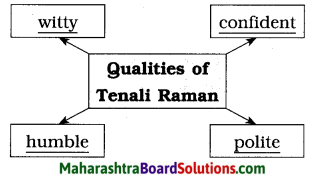
Complete the web showing the qualities of Tenali Raman:

Question 1.
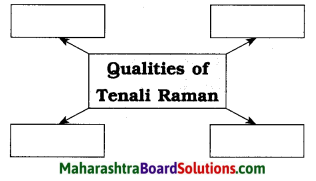
Maharashtra Board Class 8 English Solutions Chapter 4.5 A Battle to Baffle 2
Answer:
Maharashtra Board Class 8 English Solutions Chapter 4.5 A Battle to Baffle 1

Question 2.
Write the English names/words for the following:

  1. til
  2. kashta
  3. mahisha
  4. bandhana

Answer:

  1. sesame
  2. stick
  3. buffalo
  4. rope

Do as directed:

Question 1.
Pick out two non-English words from the lesson.
Answer:
mahisha, bandhana

Question 2.
Pick out two words used for Krishnadevaraya.
Answer:
Maharaj, Emperor (Your Majesty, Your Highness)

Question 3.
Add letters before the word ‘all’ to form two different words:
Answer:
small, shall (stall)

Maharashtra Board Class 8 English Solutions Chapter 4.5 A Battle to Baffle

Question 4.
Find out four hidden words from the given word:
challenger (Each word should have at least 4 letters.)
Answer:
challenger: challenge, change, charge, large

Question 5.
Write down two adjectives formed from the word:
honour
Answer:
honoured, honourable

Question 6.
Underline the pronouns:
Let me assure you that I shall not let you down.
Answer:
Let me assure you that I shall not let you down.

Question 7.
State the tense and aspect of the verb in the following sentence:
Pundit Shahane has come here to challenge all the Pundits in our Kingdom.
Answer:
verb – has come
tense – present
aspect – perfect

Question 8.
Rewrite in indirect speech:
Emperor: (annoyed) Not one of you can face the Pundit? I am ashamed of all of you. I shall debar you from my court.
Answer:
The Emperor was annoyed and ‘ asked if not one of them could face the Pundit. He added that he was ashamed of all of them and would debar them from his court.

Question 9.
Rewrite using the positive and comparative forms of the adjective:
Tenali Raman is the greatest of all scholars.
Answer:
Positive: There is no other scholar as great as Tenali Raman.
Comparative: Tenali Raman is greater than all other scholars.

Maharashtra Board Class 8 English Solutions Chapter 4.5 A Battle to Baffle

Question 10.
Use the following word as a noun and a verb in two separate sentences:
reward
Answer:
(i) The brave girl was asked to collect her reward from the Mayor, (noun)
(ii) Mona was rewarded by the old woman for bringing her cat back, (verb)

Maharashtra Board Class 6 English Solutions Chapter 3.5 The Donkey

Balbharti Maharashtra State Board Class 6 English Solutions Chapter 3.5 The Donkey Notes, Textbook Exercise Important Questions and Answers.

Maharashtra State Board Class 6 English Solutions Chapter 3.5 The Donkey

Class 6 English Chapter 3.5 The Donkey Textbook Questions and Answers

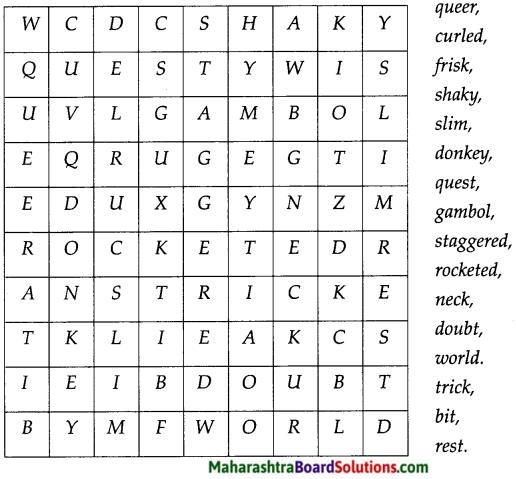
1. Rewrite the poem in the form of a prose passage.

Question 1.
Rewrite the poem in the form of a prose passage.
Answer:
The one-day-old foal tries to explore his surroundings but his shaky legs and large head render his steps rather clumsy than normal. He tries to frolic and leap but doesn’t quite know how to do it. His head, just like human babies, is too heavy for his weak neck to firmly hold it. He adorned with a rather strange coat in the guise of soft, grey fur in a lovely way around his neck.

His face looked serious, almost as if he was thinking of something that life longed for. He unsteadily moved around, as if on a daring, adventurous quest. Just when he lay down to relax, the poet realized how puny he was and hoped that the world treated the frail foal with care.

Maharashtra Board Class 6 English Solutions Chapter 3.5 The Donkey

2. List the pairs of rhyming words in the poem.

Question 1.
List the pairs of rhyming words in the poem.
Answer:
The pairs of rhyming words in the poem are:
old – hold; loose – use; bit – it, grey – way; doubt – about; quest – rest; slim – him; round – ground

3. What does the poet pray for? Why?

Question 1.
What does the poet pray for? Why?
Answer:
The poet realizes that the one-day-old donkey is very frail and certainly can’t take care of himself. He prays that the world treats the little foal with care.

4. Have you seen a newborn of an animal?

Question 1.
Have you seen a newborn of an animal?
Answer:
Yes, I have seen the newborn of a dog. The newborns, that is the puppies cling onto their mother for their dear life. They are very puny and their mother is very protective of them. All the puppies nestle close to their mother at the time of drinking milk.

Maharashtra Board Class 6 English Solutions Chapter 3.5 The Donkey

5. Talk to your parents and family members and write what you could do when:

Question 1.
Talk to your parents and family members and write what you could do when:

  1. you were a day old
  2. you were one month old
  3. you were six months old
  4. you were one year old.

6. Form groups and hold debutes on the following topics. Make bulleted lists of points in favour (pros) and those against (cons) the given statement. Let the whole class vote on who won the debate.

Question 1.
Form groups and hold debutes on the following topics. Make bullcted lists of points in
favour (pros) and those against (cons) the given statement. Let the whole class vote on
who won the debate.
a. Man should use animals for his own needs.
b. Contact with ‘flan has helped animals to survive.
Answer:
PROS:

  1. Animal testing has contributed to many life¬saving cures and treatments.
  2. There is no other alternative method to testing on a whole body system.
  3. Animals are appropriate research subjects because they are similar to human beings in many ways.
  4. Animal research is highly regulated with laws in place to protect animals from mistreatment.
  5. Animals often make better research subjects than human beings because of their shorter life spans.

CONS:

  1. Animals testing is cruel and inhumane.
  2. Alternative methods are now existing that can replace the need for animals.
  3. Animals are very different from human beings and therefore make poor test subjects.
  4. 95% of the animals used in the research are not protected by the Animal Welfare Act.
  5. Animal tests do not reliably predict results in humans beings.

Maharashtra Board Class 6 English Solutions Chapter 3.5 The Donkey

7. Find what the young ones of the following animals are called.

Question 1.
Find what the young ones of the following animals are called.

  1. donkey –
  2. horse –
  3. Lion –
  4. tiger –
  5. elephant –
  6. sheep –
  7. lamb –
  8. cow –
  9. pig –
  10. whale –
  11. owl –
  12. swan –
  13. eagle –
  14. duck –
  15. peacock –

Answer:

donkey – foalswan – cygnet
horse – foaleagle – eaglet
lion – cubduck – duckling
tiger – cubpeacock – peachick
elephant – calfkangaroo – joey
sheep – lambdeer – fawn
cow – calffrog – tadpole
pig-pigletbutterfly – caterpillar
whale – calfgoose – gosling
owl – owletgoat – kid

8. Complete the following using your own ideas.

Question a.
His head was too big to ……………… .
Answer:
His head is too big to hold his neck.

Question b.
He was too shy to ……………… .
Answer:
He was too shy to sing for the class.

Maharashtra Board Class 6 English Solutions Chapter 3.5 The Donkey

Question c.
She was too proud to ……………….. .
Answer:
She was too proud to apologise.

Question d.
They were too tired to ………………… .
Answer:
They were too tired to explore any further.

Question e.
We are too busy to ……………….. .
Answer:
We are too busy to go on a vacation.

Question f.
He was too lazy to ……………. .
Answer:
He was too lazy to open the door.

9. Write a conversation between: (One is done for you. Write dialogues for the other two.)

Question a.
A donkey and a dog

Maharashtra Board Class 6 English Solutions Chapter 3.5 The Donkey

Question b.
A donkey and a horse
Answer:

  • Horse: How are you, Mr. Donkey?
  • Donkey: Not so good. No time for enjoyment. How are you?
  • Horse: I am good. I have got a good master. He takes good care of me.
  • Donkey: My master is good too but he is poor. I am made to work from dawn to dusk.
  • Horse: That is sad, dear. I hope things get better for you.
  • Donkey: I don’t know about that. You know we are known as the ’beasts of burden’. We only carry loads of luggage on our back.
  • Horse: I know. We are lucky. We have to carry our masters on our back. Our , masters are very proud of us.
  • Donkey: You are lucky. People sit on you with pride. The same cannot be said about us. No one likes to sit on donkeys.
  • Horse: That is very sad. I know that people look down upon donkeys. They do not like to sit on donkeys because they feel it below their dignity.
  • Donkey: People feel that donkeys are there only to carry burden. They feel that donkeys are foolish. I have heard people and it is so disheartening to hear this statement.
  • Horse: I hope things get better for you and people understand your worth.
  • Donkey: May your words come true and we too get the same respect as you get.
  • Horse: Yes, that will happen. Times are changing. People are becoming aware that animals too need their space and should be treated well. Bye for now, see you sometime soon, with a smile on your face.
  • Donkey: Yes, I too hope things would change for us. At least our children will then have a better life. See you dear horse!!!

Question c.
A donkey and a schoolboy

Question 10.
If you saw someone ill-treating an animal, what would you do? Write about it in 5 lines.
Answer:
If I were to see someone ill-treating an animal, the first thing I would do is calmly but firmly suggest the person to stop his misbehavior act. I will explain to him that these vulnerable animals can’t speak for themselves. I will tell him that it is our duty to protect them and not harm them. If he continues the ill-treatment, I would call the Animal Protection Services.

Maharashtra Board Class 6 English Solutions Chapter 3.5 The Donkey

11. Visit a library, find poems about animals. Copy them and recite them to your friends. (To be done by the students)

Question 1.
Visit a library, find poems about animals. Copy them and recite them to your friends. (To be done by the students)

Class 6 English Chapter 3.5 The Donkey Additional Important Questions and Answers

Reading Skills and Poetic Device.

Question 1.
I saw a donkey which was year old.
Answer:
False

Question 2.
He tried to gambol and frisk but could not do it confidently.
Answer:
True

Answer the following.

Question 1.
How were the legs of the foal?
Answer:
The legs of the foals were shaky, long and loose.

Maharashtra Board Class 6 English Solutions Chapter 3.5 The Donkey

Question 2.
Describe the coat of the foal.
Answer:
The foal had a queer, little coat, which was soft and grey and it curled at his neck making I look lovely.

Poetic Device.

Question 1.
Give the rhyme scheme of the first four lines.
Answer:
abac

Question 2.
Pick out a pair of rhyming words from the second stanza.
Answer:
bit – it, grey – way

Maharashtra Board Class 6 English Solutions Chapter 3.5 The Donkey

Question 3.
I saw a donkey one day old. (Name the figure of speech)
Answer:
The figure of speech is Alliteration. The sound of ‘d’ has been repeated for better poetic effect.

Personal Response.

Question 1.
Which animal/bird do you like? Why?
Answer:
I like the peacock a lot. It is so beautiful to look at. It has wonderful colours on its body and when it spread out its plumage, it creates an awesome sight. The peacock is a royal bird and also our National Bird. These are the reasons why I love the peacock very much

Language Study.

Question 1.
Project Work
Answer:
Visit a library, find poems about animals. Copy them and recite them to your friends. (To be done by the students)

Maharashtra Board Class 6 English Solutions Chapter 3.5 The Donkey

Question 2.
From the following grid, find the words gievn below.
Answer:
Maharashtra Board Class 6 English Solutions Chapter 3.5 The Donkey

The Donkey Summary in English

The one-day old foal tries to explore his surroundings, but his shaky legs and large head render his steps rather clumsy rather than normal. He tries to frolic and leap but doesn’t quite know how to do it. His head, just like human babies, is too heavy for his weak neck to firmly hold it. He adorned with a rather strange coat in the guise of soft, grey fur in a lovely way around his neck.

His face looked serious, almost as if he was thinking of something that life longed for. He unsteadily moved around, as if on a daring, adventurous quest. Just when he lay down to relax, the poet realized how puny he was and hoped that the world treated the frail foal with care.

Introduction:

The poem ‘The Donkey’ describes the behaviour of a newborn donkey for whom life is a new experience as he is taking the first steps of his life. He clumsily tries to walk around, his huge head and shaky loose legs making it all the more difficult for him to do so. The poem ends with the poet hoping that the world around the foal (baby donkey) would treat him with care.

Glossary:

  1. rocketed (v) – moved suddenly
  2. staggered (v) – tottered, moved unsteadily
  3. gambol (v) – to leap, move playfully
  4. wistful (adj) – full of hope, longing for something
  5. venturesome (adj) – daring, adventurous
  6. quest (n) – search, to look for something
  7. frisk (v) – gambol, skip, dance
  8. queer (adj) – weird, odd
  9. slim (adj) – slender, thin

Maharashtra Board Class 6 English Solutions Chapter 3.5 The Donkey

Maharashtra Board Class 6 English Solutions Chapter 3.2 Seven Sisters

Balbharti Maharashtra State Board Class 6 English Solutions Chapter 3.2 Seven Sisters Notes, Textbook Exercise Important Questions and Answers.

Maharashtra State Board Class 6 English Solutions Chapter 3.2 Seven Sisters

Class 6 English Chapter 3.2 Seven Sisters Textbook Questions and Answers

1. Present any one of the speeches given above.

Question 1.
Present any one of the speeches given above.

Maharashtra Board Class 6 English Solutions Chapter 3.2 Seven Sisters

2. Choose any one of the Seven States. Find more information about it and prepare a leaflet or brochure to invite people to visit it. 

Question 1.
Choose any one of the Seven States. Find more information about it and prepare a leaflet or brochure to invite people to visit it.
Answer:
Arunachal Pradesh
Neolithic tools found in Arunachal Pradesh indicate that people have been living in the Himalayan region for at least eleven thousand years. Arunachal Pradesh is the largest among the north-eastern states in terms of land area, even larger than Assam. It had the maximum number of regional languages in India.

English is used as the official language. Itanagar is the capital city of the state of Arunachal Pradesh. The majority of people of Arunachal Pradesh are of Tibet-Burman origin. Losar, Dree, Solung and Reh are the major festivals in the state of Arunachal Pradesh.

3. From the passage, find and write any two examples of the following.

Question a.
Use of the verb ‘be’ (am, is, are, etc.) as the main verb.
Answer:

  • I am a nature lovers’ heaven.
  • My people are simple and hospitable.

Maharashtra Board Class 6 English Solutions Chapter 3.2 Seven Sisters

Question b.
Sentences containing ‘must’; ‘can’.
Answer:
Must:

  1. You must make it a point to visit the 400-year-old Buddhist monastery at Tawang and enjoy cultural festivals at Ziro.
  2. The natural beauty here is exquisite and must be seen to be believed!

Can:

  1. You can enjoy the panoramic view of Bangladesh from here.
  2. My capital is Imphal where you can see the cyclists’ velodrome.

Question c.
Sentences beginning with ‘Don’t’.
Answer:

  • Don’t miss the Namdapha Tiger Project.
  • Don’t forget to visit the Ahom palaces.

Maharashtra Board Class 6 English Solutions Chapter 3.2 Seven Sisters

4. Write a short speech for the state of Maharashtra.

Question 1.
Write a short speech for the state of Maharashtra.

I am a state in the western region of India and am the second-most populous state of the world. I have more than 110 million inhabitants and my capital Mumbai has a population of approximately 18 million. Mumbai is the headquarters of all major banks, financial institutions, insurance companies and is also the financial and commercial capital of India.

I was formed on 1st May, 1960 which is celebrated as Maharashtra Day. My symbolic bird is the Yellow Footed Green Pigeon and animal is the Indian Giant Squirrel. My state is known for its mangoes. Maharashtra is symbolized by the traditional dance known as ‘Lavni’. The Rankala Lake in Kolhapur is considered to be the oldest of all lakes in my state.

Maharashtra Board Class 6 English Solutions Chapter 3.2 Seven Sisters

Class 6 English Chapter 3.2 Seven Sisters Important Questions and Answers

Answer the following in one or two sentences.

Question 1.
What is Arunachal Pradesh known as?
Answer:
Arunachal Pradesh is known as the ‘Land of the Rising Sun – the Land of the Dawn Lit Sun7.

Question 2.
What are the limestone caves known as?
Answer:
The limestone caves are known as ‘Tapenuru7.

Question 3.
What should one not miss when one visits Arunachal Pradesh?
Answer:
One should not miss the Namdapha Tiger Project when one visits Arunachal Pradesh.

Question 4.
What is Assam also known as?
Answer:
Assam is also known as Ahom.

Maharashtra Board Class 6 English Solutions Chapter 3.2 Seven Sisters

Question 5.
Where does Assam lie?
Answer:
Assam lies between the beautiful valleys of the Brahmaputra and Barak rivers.

Question 6.
What is awesome to behold in Assam?
Answer:
The picturesque landscape of the golden- green rice fields and landscaped tea estates is awesome to behold in Assam.

Question 7.
Name Assam’s silk fabrics which the fashion world loves.
Answer:
‘Eri’, ‘Muga’ and ‘Pat’ are the names of the silk fabrics of Assam which are loved by the fashion world.

Question 8.
Name the major festival of Assam.
Answer:
Bihu is the major festival of Assam.

Question 9.
What is Shillong called? Why?
Answer:
Shillong is called ‘Scotland’ of the East’. It is so called because of its highlands, fog and scenery.

Maharashtra Board Class 6 English Solutions Chapter 3.2 Seven Sisters

Question 10.
Which are the wettest places on the earth?
Answer:
Cherrapunji and Mausinram are the wettest places on the earth.

Question 11.
When is the Wangala festival celebrated?
Answer:
The Wangala festival is celebrated in autumn.

Question 12.
What are the nicknames of Manipur?
Answer:
The nicknames of Manipur are Kangleipak or Sanaleibak.

Question 13.
Which game did Manipur introduce to the Europeans?
Answer:
The game of ‘polo’ was introduced to the Europeans in Manipur.

Question 14.
What does Mizoram imply?
Answer:
Mizoram implies ‘land of the hill people’ referred to as the Kukis.

Maharashtra Board Class 6 English Solutions Chapter 3.2 Seven Sisters

Question 15.
Why do we not have many tourists in Mizoram?
Answer:
We do not have many tourists in Mizoram because travelling in Mizoram is a little difficult.

Question 16.
How was the Palak Lake believed to be created?
Answer:
The Palak Lake is believed to be created as a result of an earthquake or a flood.

Question 17.
How is the terrain of Nagaland?
Answer:
The terrain of Nagaland is mostly mountainous.

Question 18.
What is Nagaland an ideal place for?
Answer:
Nagaland is an ideal place for trekking, rock climbing and jungle camping.

Question 19.
What is Nagaland known as?
Answer:
Nagaland is known as the ‘Falcon Capital of the World’.

Maharashtra Board Class 6 English Solutions Chapter 3.2 Seven Sisters

Question 20.
What does ‘Tripura’ mean?
Answer:
Tripura means ‘three cities’. It also means ‘near water’.

Reading Skills, Vocabulary and Grammar

Answer the following.

Question 1.
What is Nagaland also known as?
Answer:
Nagaland is also known as ‘Switzerland of the East’.

Question 2.
What makes Nagaland unimaginably beautiful?
Answer:
The exquisitely picturesque landscapes, the vibrantly colourful sunrise and sunset, lush and verdant flora make Nagaland unimaginably beautiful.

Question 3.
What is the capital of Nagaland?
Answer:
Kohima is the capital of Nagaland.

Maharashtra Board Class 6 English Solutions Chapter 3.2 Seven Sisters

Question 4.
Which is the highest peak in Nagaland?
Answer:
The highest peak in Nagaland is Mount Saramati.

Question 5.
Who inhabits the exotic hill state, Nagaland?
Answer:
There are over 16 tribes and sub-tribes that inhabit the exotic hill state, Nagaland.

Question 6.
How are the Nagas by nature?
Answer:
Nagas are lovers of fun and frolic by nature.

Question 7.
From the extract, write two words that are combined together to form one word.
Answer:
Limitless, hombill, showcases.

Question 8.
There are over 16 tribes. (Change to simple past tense).
Answer:
There were over 16 tribes.

Maharashtra Board Class 6 English Solutions Chapter 3.2 Seven Sisters

Question 9.
State the part of speech of the underlined words.
a. The exquisitely picturesque landscapes make my land unimaginably beautiful.
Answer:

  • exquisitely, unimaginably – Adverb
  • landscapes – Norm
  • beautiful – Adjective

Question 10.
Write on the Art and Culture of Nagaland which you like the most.
Answer:
Nagaland is famous for the colourful and intricately designed costumes, jewellery and beads. Ethnic customs and traditions infusion with music and dance are what I like most about the art and culture of Nagaland.

Language Study:

Do as directed.

Question 1.
Assam tea is world famous! (State the kind of sentence)
Answer:
Exclamatory sentence

Maharashtra Board Class 6 English Solutions Chapter 3.2 Seven Sisters

Question 2.
I have lovely mountains. (Name the part of speech of the underlined words)
Answer:

  • lovely – Adjective
  • mountains – Noun

Question 3.
I am home to a host of rare endemic plants. (Add a question tag)
Answer:
I am home to a host of rare endemic plants, aren’t I?

Question 4.
Come and visit me. (Make it negative)
Answer:
Don’t leave without visiting me.

Question 5.
We ……….. peaceful people. (Fill with the correct form of the verb ‘be’)
Answer:
We are peaceful people.

Maharashtra Board Class 6 English Solutions Chapter 3.2 Seven Sisters

Question 6.
You come and stay with us. (Use the modal ‘must’ and rewrite.)
Answer:
You must come and stay with us.

Question 7.
Garia, Durga Puja, Buddha Poumima, Pous Sankranti, Kharchi, Bijhu, Christmas. (Arrange in alphabetical order)
Answer:
Bijhu, Buddha Pournima, Christmas, Durga Puja, Garia, Kharchi, Pous Sankranti

Question 8.
The folk dances of tribal people captivate the beholders. (Separate the Subject and Predicate)
Answer:
Subject: The folk dances of tribal people Predicate: captivate the beholders.

Question 9.
I am difficult for you to access. (Change into negative)
Answer:
I am not easy for you to access.

Maharashtra Board Class 6 English Solutions Chapter 3.2 Seven Sisters

Question 10.
Don’t forget to visit the Ahom palaces. (Change into affirmative)
Answer:
Do remember to visit the Ahom palaces.

Writing Skills:

Question 1.
Write an essay about the state you like most.
Kerala
In the 14th Century, the state of Kerala had become a linguistically distinct region. The Sanskrit epic, Aitareya Aranyaka was the first to mention Kerala in it.

The Malayalam language was developed as a language under the Chera Empire- II. Ever since the 8th century, trade was established in Kerala with the Arabs. In the year 1498, the Portuguese started trade with this state. This was followed by the Britishers and the Dutch, who commenced the trade in the 16th century.

Kerala is known to be the first literate state in India and the first state to implement land reform bills and education reform bills The state of Kerala has a lower birth rate as compared to the other states and has the least infant mortality rate along with the maximum life expectancy.

Kerala is known as the celestial land (God’s own country) for its natural beauty. Kerala is rich in cashew, coconut, arecanut, tapioca, banana, rice, ginger, pepper, vegetable plantations and sugarcane. It is truly a paradise on earth!!!

Maharashtra Board Class 6 English Solutions Chapter 3.2 Seven Sisters

Seven Sisters Summary in English

1. Arunachal Pradesh: Arunachal Pradesh is also known as the ‘Land of the Rising Sun’. It is rich in fauna and flora. It is famous for its delicacy called ‘momos’, and the 400-year-old Buddhist monastery. It is India’s first orchid sanctuary.

2. Assam: Assam is also known as ‘Ahom.’ Kaziranga National Park and Manas National Park are the World Heritage Sites. Assam is known for its tea plantations. Assam’s silk fabrics ‘Eri’, ‘Muga’ and ‘Pat’ are famous worldwide. Its major festival is Bihu and it has many beautiful Ahom palaces.

3. Meghalaya: Meghalaya is also called ‘Scotland of the East.’ Languages spoken there are English, Khasi, Pnar and Garo. It is rich in minerals such as coal, limestone, uranium and sillimanite. Cherrapunji/Mausinram, the wettest places on earth are located here. It comprises of the longest cave is called the Krem Liat Prah and the deepest cave called the Synrang Pamiang.

4. Manipur: Manipur is also known as ‘Kangleipak’ or ‘Sanaleibak’. Many people here speak Meetei/ Manipuri language. It has the Keibul Lamjao National Park consisting of endangered species of brow antlered deer. The ecosystem has 17 rare species of mammals and is the only floating national park of the world. The martial arts of Manipur, ‘Thang Ta’ and ‘Sarit Satak’ are worth witnessing.

5. Nagaland: Nagaland is also called the ‘Switzerland of the East’. Kohima is the capital of the mostly mountainous state. Mount Saramati is the highest peak with the height of 3,840 m orming a natural barrier between Nagaland and Burma. It is also known as the ’Falcon Capital of the World’, where the great Indian hornbill is also found.

6. Mizoram: Mizoram is also known as ‘Kukis’. Its capital is Aizawl. Palak Lake is the biggest in Mizoram and covers 30 hectares. Champhai is called ‘the fruit bowl’ of Mizoram. There are 6 wildlife sanctuaries and 2 national parks here, with ‘Mizo’ being the most widely used language.

7. Tripura: Tripura means ’3 cities’ and also means ‘near water’. Tripura has 3 distinct geographical zones. The chief rivers here are Gumti, Muhuri and Feni. Agartala is the capital of Tripura. It is famous for its eco-tourism and archaeological tourism. Here, people from all the states participate in festivals like Garia, Durga Puja, Buddha Purnima, Kharchi, Pous Sankranti, Bijhu or Christmas.

Maharashtra Board Class 6 English Solutions Chapter 3.2 Seven Sisters

Introduction:

The lesson ‘SEVEN SISTERS’ is that which tells us about the seven Indian states of Arunachal Pradesh, Assam, Meghalaya, Manipur, Mizoram, Nagaland and Tripura that lies in the north-east of India. Sikkim is a state similar to theirs but it lies further in the north-west of India and is called the only brother of the north eastern region. The ‘seven sister states’ is also called Paradise Unexplored. The lesson gives us an insight of the beauty of India with its various cultures, cuisines and traditions. The lesson makes us feel proud of our motherland, India.

Glossary:

  1. distinctive (adj) – to distinguish between things
  2. exotic (adj) – strikingly colourful or unusual
  3. elegant (adj) – classy, graceful
  4. picturesque (adj) – lovely, beautiful
  5. exquisite (adj) – beautiful, delicate
  6. overwhelmingly (adv) – very greatly or intensely
  7. fascinating (adj) – attractive, captivating
  8. panoramic (adj) – with a wide view
  9. aromatic (adj) – fragrant, spicy
  10. amazing (adj) – surprising, stunning
  11. acclaimed (adj) – greatly praised, highly respected
  12. graceful (adj) – elegant, stylish
  13. serene (adj) – peaceful, calm
  14. splendid (adj) – brilliant, excellent
  15. vibrantly (adv) – lively, bright
  16. unimaginably (adv) – difficult to imagine
  17. verdant (adj) – green in colour, fresh
  18. robust (adj) – strong, muscular
  19. gorgeous (adj) – very beautiful
  20. ecotourism (n) – tourism directed towards unspoilt natural environments and intended to support conservation
  21. archaeological (adj) – science or research of archaeology
  22. sanctuary (n) – a place of safety, refuge or protection

Maharashtra Board Class 6 English Solutions Chapter 3.1 It Can Be Done

Balbharti Maharashtra State Board Class 6 English Solutions Chapter 3.1 It Can Be Done Notes, Textbook Exercise Important Questions and Answers.

Maharashtra State Board Class 6 English Solutions Chapter 3.1 It Can Be Done

Class 6 English Chapter 3.1 It Can Be Done Textbook Questions and Answers

1. Answer the following questions in one sentence each.

Question a.
Who misses all the fun?
Answer:
The man who has a negative approach in trying out new things and says ‘it can’t be done’ is the man who misses all the fun.

Maharashtra Board Class 6 English Solutions Chapter 3.1 It Can Be Done

Question b.
What does the title of the poem suggest?
Answer:
The title of the poem positively suggests that the things that we set our mind to complete can most definitely be done.

Question c.
What does the man who misses all the fun do?
Answer:
The man who misses all the fun wears an expression of solemn pride, remains away from other people and harshly criticizes any kind of new venture.

Question d.
What does ‘who misses all the fun’ mean?
Answer:
In the poem, this line refers to a person who likes to remain away from other people because of his solemn pride and is never ready to face any obstacle with a positive attitude of overcoming it.

Maharashtra Board Class 6 English Solutions Chapter 3.1 It Can Be Done

Question e.
What would he do if he had the power in him?
Answer:
If he had the power in him, he would happily erase all the developments made by man and also the history of the human race.

Question f.
What examples of man’s progress have been given in the poem?
Answer:
The examples of man’s progress given in the poem are – radio, motor cars, street lights, telegraph and the telephone.

Question g.
What should human beings do to make progress?
Answer:
Human beings should have a positive outlook towards life which will help them overcome their difficulties and fears, and certainly help them to go ahead in the path of progress.

2. Form groups. List a few articles of everyday use. Discuss how they can be improved.

Question 1.
Form groups. List a few articles of everyday use. Discuss how they can be improved.
Answer:
1. Doorbell: The doorbell that everyone has in their homes can only be clearly heard in one room. In order to improve the doorbell, we can install the doorbell device in the other rooms too.

2. Mosquito racket: Mosquitoes are the worst nuisance for man. The rackets work pretty well, but it would be better if we had a bigger net to easily capture the sly mosquitoes.

3. Mobile phones: Even though the mobile phone is owned by almost everyone, its battery life is pretty less, so it would be feasible if the battery life sustains for a longer time.

Maharashtra Board Class 6 English Solutions Chapter 3.1 It Can Be Done

3. Form pairs. Discuss and prepare a list of things which can be and will be done in future. (5 things) Spot the modal verbs in your answer. 

Question 1.
Form pairs. Discuss and prepare a list of things which can be and will be done in future. (5 things) Spot the modal verbs in your answer.
Answer:

  1. The Leaning Tower of Pisa may be straightened.
  2. Cars will be travelling through air rather than by road.
  3. People might make trips to the moon for a vacation.
  4. We could have floating homes on water.
  5. People would be skating or cycling to their place of work.

The modal verbs in the above sentences are:

  • may
  • will
  • might
  • could
  • would Let us do some more:

Maharashtra Board Class 6 English Solutions Chapter 3.1 It Can Be Done

4. Complete the following sentences using your ideas. 
(a) I can …………….., (b) They can …………….., (c) We can ……………..

Question 1.
Complete the following sentences using your ideas. :
a. I can ……………..
b. They can ……………..
c. We can ……………..
Answer:
a. I can succeed.
b. They can overcome their fears.
c. We can conquer the world.

Class 6 English Chapter 3.1 It Can Be Done Important Questions and Answers

Reading Skills and Poetic Device

Read the following extract and complete the activities that follow:

Question 1.
Complete the web diagram with words from the extract:
Answer:
Maharashtra Board Class 6 English Solutions Chapter 3.1 It Can Be Done 1

Question 2.
Explain: The man who misses all the fun. Is he who says, “It can’t be done.”
Answer:
The man who lacks courage to try out new things, and does not have positive attitude towards life is a man who misses all the fun and progress in life.

Question 3.
Pick out a word from the extract which means ‘an adventure’.
Answer:
venture

Question 4.
Pick out two pairs of rhyming words from the poem.
Answer:

  • fun – done
  • aloof – reproof
  • efface – race
  • cars – stars
  • telephone – stone
  • run – done

Question 5.
What would you do to achieve success?
Answer:
I would try my very best in everything I do.
I would not be disheartened with failures, instead it would motivate me to strive harder. I would not shirk my responsibilities when faced with difficult situations but would try my level best to come out of it successfully.

Writing Skills:

Question 1.
Write a paragraph on ‘Never Giving Up’.
Answer:
Always complete well whatever you have begun even if you come across difficulties. God has given us the capacity and the capability so we should use it to the fullest. Never let the word ‘cannot do’ come into your mind. Always be positive. The small spider in the story of ‘King Bruce’ shows us that if we keep trying, we will surely succeed. Remember, never give up easily, ‘Try, try till you succeed’.

Project Wheels:

Question 1.
Think carefully for a minute. Tag your memory and recall all the things/objects on which you have seen wheels. Write them down.
Answer:
Cycles, cars, trucks, trains, aeroplanes, carts, watches, toys, our National Flag, chair, table, trolley, skateboard, motorbike, bags, vacuum cleaner, baby carriage.

Maharashtra Board Class 6 English Solutions Chapter 3.1 It Can Be Done

Question 2.
Now talk to your friend or elders; refer to books and read about all the objects in which wheels are used. List them (How many did you miss out on in your first list? Why?)
Answer:
Students should go through books and list down as many things they can find with wheels. (There was a time limit of one minute and so could not list down more.)

Question 3.
The wheel which was probably invented more than 6000 years ago is thought of as one of the greatest technological advances made by man. Why do you think the wheel is so important in human civilisation?
Answer:
Though the wheel was made during the Stone Age period, it was the beginning of a revolution. Wheels helped the early man to transport goods from one place to another and thus began trade. Wheels moved slowly at first and caught momentum. Today we have progressed so far just because of wheels that is why I think the wheel is very important in human civilisation.

Question 4.
Can you imagine life without wheels? Try and think of what life would be like if there were no wheels around.
Answer:
I cannot imagine life without wheels. Things would all be done at a very slow pace. There would be no technological development and we would not have reached the moon and other places without wheels.

Maharashtra Board Class 6 English Solutions Chapter 3.1 It Can Be Done

Question 5.
Have you seen how wheels move on different surfaces like sand, gravel, grass or on a proper road? What are the differences you see?
Answer:
Experience it yourself and write down how the wheels move on different surfaces. The first one is done for you.
(a) On sandy surfaces, wheels find it difficult to move. It is not smooth at all.
(Tip: Students can ride their bicycles on the above mentioned surfaces and jot down their findings.)

It Can Be Done Summary in English

Introduction:

The poem “It Can Be Done” generalises that a person who lacks confidence and motto is the type of a person who remains stagnant in life and naturally unsuccessful. The poem explains that without hard work and sheer determination, man’s life wouldn’t be as developed as it is now.

Paraphrase:

The poem suggests that the things that we set our mind to complete can most definitely be done. The man who misses all the fun wears an expression of solemn pride, remains very aloof and harshly criticizes any kind of new venture.

If he had the power, he would happily erase all the developments made by man and also the history of the human race. We would then have no radio, no motorcars, no streetlights, no telegraphs, no telephone. We would still be living in the Stone Age. The poet says that the world would sleep if things were run by such men who had a negative approach to life saying, ’It can’t be done’.

Maharashtra Board Class 6 English Solutions Chapter 3.1 It Can Be Done

Glossary:

  1. in solemn pride (phrase) – here it means looking very serious, grand and important
  2. aloof (adj) – separately, without getting involved in
  3. venture (n) – adventure, a dangerous or risky task
  4. reproof (n) – criticism, negative comments
  5. efface (v) – wipe out, remove
  6. linger (v) – to stay or remain in a place