Maharashtra Board Class 9 English Kumarbharati Solutions Chapter 4.3 Intellectual Rubbish

Balbharti Maharashtra State Board Class 9 English Solutions Kumarbharati Chapter 4.3 Intellectual Rubbish Notes, Textbook Exercise Important Questions and Answers.

Maharashtra State Board Class 9 English Kumarbharati Solutions Chapter 4.3 Intellectual Rubbish

English Kumarbharati 9th Solutions Chapter 4.3 Intellectual Rubbish Textbook Questions and Answers

Warming Up:

1. How will you react in the following situations?

Question (a)
Your Science teacher tells you plants exposed to the sunlight grow faster than those always in the shade.
………………………………………………………………………………
………………………………………………………………………………
………………………………………………………………………………
Answer:
Points: change the location of your plants – disbelieve her, try some experiments, etc.

Question (b)
Your aunt tells you not to go for a job interview because it’s a no moon day, that very same day.
………………………………………………………………………………
………………………………………………………………………………
………………………………………………………………………………
Answer:
Points: you ignore her words – you listen to her words – you ask for proof etc.

Question (c)
Your friend argues with you that Mount Everest is not the highest peak in the world.
………………………………………………………………………………
………………………………………………………………………………
………………………………………………………………………………
Answer:
Points: you pity his ignorance – you believe him – you look up the internet to check, etc.

Question (d)
A stranger at your door claims to be a magician and promises your mother to turn all her silver jewellery into gold.
………………………………………………………………………………
………………………………………………………………………………
………………………………………………………………………………
Answer:
Points: you slam the door – you call the police – you try to trick him, you give the gold, etc.

Maharashtra Board Class 9 English Kumarbharati Solutions Chapter 4.3 Intellectual Rubbish

2. What do you notice about the following pairs of words?

Question (a)
What do you notice about the following pairs of words?

  1. act naturally
  2. liquid gas
  3. open secret
  4. sound of silence
  5. sweet sorrow
  6. original copy
  7. only choice
  8. growing smaller

Answer:
They are all contrasting pairs of words used together. Such contrasting pairs of words that go together are called Oxymorons.

Now try to add a contradictory word (Oxymoron) to the following:

Question (a)
What a ……………… mess you’ve got us into!
Answer:
What a wonderful mess you’ve got us into!

Question (b)
It’s a …………… imitation of a diamond necklace.
Answer:
It’s a genuine imitation of a diamond necklace.

Question (c)
My trip to Matheran was a …………. holiday.
Answer:
My trip to Matheran was a working holiday.

Question (d)
With such heavy makeup, she looks ……………. ugly.
Answer:
With such heavy make-up, she looks pretty ugly.

Maharashtra Board Class 9 English Kumarbharati Solutions Chapter 4.3 Intellectual Rubbish

Question (e)
A ……………. crowd gathered to see the magic show.
Answer:
A tiny crowd gathered to see the magic show.

Note:- Contrasting words that go together are examples of the language device called Oxymoron.

English Workshop:

1. The following expressions are a combination of a noun preceded by a describing word.
Replace the describing words with as many others as you can, that go with the underlined nouns.
eg. silly mistake, grave mistake, careless mistake, obvious mistake etc.

Question (a)
fatal mistake
Answer:
silly mistake, grave mistake, careless mistake, obvious mistake.

Question (b)
foreign customs
Answer:
established customs, local customs, traditional customs, age-old customs.

Question (c)
unappetizing diet
Answer:
nutritious diet, healthy diet, unhealthy diet, strict diet, balanced diet, staple diet, vegetarian diet.

Question (d)
plentiful supply
Answer:
sufficient supply, regular supply, continuous supply, irregular supply.

Maharashtra Board Class 9 English Kumarbharati Solutions Chapter 4.3 Intellectual Rubbish

Question (e)
simple device
Answer:
complicated device, expensive device, helpful device, useless device, clever device, ingenious device, safety device.

Question (f)
savage controversy
Answer:
raging controversy, bitter controversy, unending controversy, fierce controversy.

Question (g)
modern technique
Answer:
new technique, conventional technique, advanced technique, simple technique.

Question (h)
foolish custom:
Answer:
quaint custom, ancient custom, Indian custom, accepted custom.

2. Use the following idioms/expressions in sentences of your own.

Question (a)
to be prone to …………………………………
Answer:
We are prone to infections during monsoon.

Question (b)
to have a difference of opinion ………………………
Answer:
If you have a difference of opinion with someone, you must settle it amicably.

Maharashtra Board Class 9 English Kumarbharati Solutions Chapter 4.3 Intellectual Rubbish

Question (c)
to go beyond …………………………….
Answer:
The fight between the two women was going beyond the limits of decent behaviour.

Question (d)
to have a beneficial effect ……………………………………
Answer:
Exercising regularly has a beneficial effect on the body.

Question (e)
to have a bias ………………………………
Answer:
We should not have a bias against foreign ideas.

Question (f)
to undo ……………………………………..
Answer:
“Do not undo all the good that I have done,” said the psychiatrist to the woman.

Question (g)
to be wary of ………………………………..
Answer:
One should be wary of schemes which promise to make one rich overnight.

Question (h)
under the influence ……………………………….
Answer:
He committed the crime when he was under the influence of alcohol.

3. Say ‘WHY’?

Question (a)
One should avoid getting angry about a difference of opinion.
Answer:
One should avoid getting angry about a ; difference of opinion because if one gets angry, it will show that one’s belief is going beyond what the evidence indicates or states.

Maharashtra Board Class 9 English Kumarbharati Solutions Chapter 4.3 Intellectual Rubbish

Question (b)
The writer found his stay abroad very profitable.
Answer:
The writer found his stay abroad very profitable because it helped him to become aware of foreign ideas and customs and diminish the intensity of his insular prejudice.

Question (c)
The writer grew less dogmatic and more open-minded.
Answer:
When the writer was young, he lived for some time outside his country. He became aware of foreign ideas and customs. This made him grow less dogmatic and more open-minded.

Question (d)
Men declaring that they are saints write letters to the writer.
Answer:
The writer is a renowned person. The men who declare themselves as saints want the writer to mention them in his lectures so that they get some free publicity. Hence they write letters to the writer.

Question (e)
The writer claims that all false beliefs need not be replaced by cold science.
Answer:
The writer claims that all false beliefs need not be replaced by cold science because if this is done, the world would lose some of its interest and variety.

4. Make sentences of your own to show the difference of usage of the following words:

Question (a)
1. device
2. devise
Answer:
1. Today, we make use of various devices to help us.
2. Mothers must devise ways of keeping their children out of mischief.

Maharashtra Board Class 9 English Kumarbharati Solutions Chapter 4.3 Intellectual Rubbish

Question (b)
Make sentences of your own to show the difference of usage of the following homophones :
1. advice
2. advise
Answer:
1. It is very easy to give advice but difficult to follow it.
2. The teacher advised the girl not to waste time.

Question (c)
Make sentences of your own to show the difference of usage of the following homophones:
1. practice
2. practise
Answer:
1. Dowry is an evil practice prevalent in India.
2. I have to practise every day if I want to win the dance competition.

5. When a family member is very ill for long, the grandmother of the family urges everyone to send for a person who claims he can cure victims of black magic. Compose a dialogue with her, in which her granddaughter politely convinces her that she should not believe in such things.

Question 1.
When a family member is very ill for long, the grandmother of the family urges everyone to send for a person who claims he can cure victims of black magic. Compose a dialogue with her, in which her granddaughter politely convinces her that she should not believe in such things.
Answer:

  • Grandmother: What a situation! Now that you have tried all your fancy modern medicines, listen to me. Call Cureybaba.
  • Granddaughter: Who is he? Never heard of him.
  • Grandmother: I am certain that your mother is the victim of black magic. Cureybaba will cure her. You saw him at our neighbour’s house a few days back. He is bald and …
  • Granddaughter: Grandma, for Heavens Sake! Mom was ill, no doubt, but her illness has been diagnosed and it is easily curable! There are plenty of medicines in the market.
  • Grandmother: She’s been ill for so long now! Granddaughter: Oh, Grandma, only for two months! The diagnosis took long.
  • Grandmother: Cureybaba will cure her in one sitting.
  • Granddaughter: Listen, Granny dear, these people are all frauds. If your Cureybaba was so good, why doesn’t he get some hair on his head – we know he wears a wig – or cure his horrible cough? Why doesn’t he cure his own mother who is so ill? And has he cured that poor little girl next door? No, he hasn’t. He’s a fraud, Granny.
  • Grandmother: But … but, ……….
  • Granddaughter: Granny, there’s no such thing as black magic. You know that full well. You have seen enough of these ‘babas’ being exposed. Then why ………….
  • Grandmother: Oh, OK. If you say your mother’s 5 illness can be cured by modern medicines easily, I will forget Cureybaba and black magic. Now that I come to think of it, our other neighbour was telling me how he cheated somebody the other day ……….
  • Granddaughter: There you are, Granny!

Maharashtra Board Class 9 English Kumarbharati Solutions Chapter 4.3 Intellectual Rubbish

6. List the various ways of avoiding error 1 mentioned in the passage.

Question 1.
List the various ways of avoiding error 1 mentioned in the passage.
Answer:
The various ways of avoiding error are:

  1. make observations yourself
  2. make yourself aware of your bias
  3. be on your guard when you find yourself getting angry about a difference of opinion.

7. Answer the following questions:

Question (a)
If an opinion contrary to your own makes you angry, what does it indicate?
Answer:
If an opinion contrary to my own makes me angry, it indicates that I am subconsciously aware of having no good reason for thinking as I do.

Question (b)
What are the most savage controversies about?
Answer:
The most savage controversies are about ! those matters as to which there is no good evidence either way.

Question (c)
What are the benefits of travel?
Answer:
Travelling helps you to become aware of foreign ideas and customs. You begin to accept them and get rid of your own narrow outlook.

Question (d)
Is the influence of foreign customs always beneficial?
Answer:
No, not always. Very often, the influence of foreign customs can be harmful and we must be cautious while following them.

Maharashtra Board Class 9 English Kumarbharati Solutions Chapter 4.3 Intellectual Rubbish

Question (e)
What are the advantages of an imaginary argument with a person having a different bias?
Answer:
The advantage of an imaginary argument with a person having a different bias is that it is not subject to the limitations of time and space. One can have this argument at any time and at any place.

Question (f)
Why should one be wary of opinions that flatter one’s self-esteem?
Answer:
One should be wary of opinions that flatter one’s self-esteem because there may be opinions with abundant evidence to prove the exact opposite to what one believes.

Question (g)
How does fear lead us to error?
Answer:
Fear leads us to error by making us do things like inventing rumours of disaster in wartime, imagining objects of terror, such as ghosts, or by creating belief in something comforting, like the elixir of life, or heaven for ourselves and hell for our enemies.

Question (h)
Write down the way of avoiding error mentioned in the passage.
Answer:
The way of avoiding error mentioned in the passage is to try to conquer fear.

Maharashtra Board Class 9 English Kumarbharati Solutions Chapter 4.3 Intellectual Rubbish

8. What is the meaning of ‘intellectual rubbish’?

Question 1.
What is the meaning of ‘intellectual rubbish’?
Answer:
This is an oxymoron, where the writer has used contrasting or contradictory words that go together. The writer uses the phrase to describe all false beliefs, baseless opinions, dogmatism, fears and superstitions of various kinds. People follow certain beliefs, ideas and customs without inquiring into their validity. Sometimes, many of these beliefs and customs lead to evil and suffering in the world.

9. Find the opposites of the following:

Question 1.
Find the opposites of the following:

  1. cautious
  2. dogmatic
  3. contrary
  4. savage
  5. beneficial
  6. reasonable
  7. hypothetical
  8. cruelty
  9. immune

Answer:

  1. cautious × reckless (incautious)
  2. dogmatic × open-minded
  3. contrary × same
  4. savage × mild
  5. reasonable × unreasonable
  6. hypothetical × real
  7. beneficial × harmful
  8. cruelty × kindness/compassion
  9. immune × vulnerable

Maharashtra Board Class 9 English Kumarbharati Solutions Chapter 4.3 Intellectual Rubbish

10. Write an imaginary dialogue contesting opposite views on a topic of your choice, e.g. ‘Girls should learn to do all the housework and not boys.’

Question 1.
Write an imaginary dialogue contesting opposite views on a topic of your choice, e.g. ‘Girls should learn to do all the housework and not boys.’
Answer:

  • Topic: Girls should learn to do all the housework and not boys
  • Myself: Mom, what is this? Why should I learn to do the housework, and not Rohan?
  • Mom: You are a girl. Girls have to look after the ! house.
  • Myself: Why? Don’t boys live in a house?
  • Mom: A woman can look after a home better than a man.
  • Myself: That’s ancient history, Mom! Haven’t you heard of something called gender equality?
  • Mom: These new-fangled notions of yours!
  • Myself: And these notions of only girls having to do housework are all man-made. Look at the west – men and women both do housework. (… and so on. Students can complete this imaginary dialogue.)

(Some topics for imaginary dialogues: should school students be permitted to bring cell phones to school/should coaching classes be banned/should the weight of school bags be monitored/should there be entrance exams for professional courses/should i there be uniforms in schools and colleges.)

English Kumarbharati 9th Digest Chapter 4.3 Intellectual Rubbish Additional Important Questions and Answers

Simple Factual Activity:

Question 1.
Complete the following statements:
Answer:

  1. Thinking that you know when in fact you don’t is a fatal mistake.
  2. If the matter is one that can be settled by observation, you must make the observation yourself.
  3. Many matters are less easily brought to the test of experience.
  4. Most of mankind has passionate convictions on many matters.

Maharashtra Board Class 9 English Kumarbharati Solutions Chapter 4.3 Intellectual Rubbish

Complex Factual Activities:

Question 1.
What erroneous notion did Aristotle have? What does his example convey to you?
Answer:
Aristotle had the erroneous notion that women had fewer teeth than men, when in fact he didn’t verily it. His example conveys to us that we must be cautious. We must not think that we know something for sure till we make the observation ourselves.

Activities based on Contextual Grammar:

Question 1.
Underline the pronouns in the following sentence:
I believe myself that hedgehogs eat black beetles, because I have been told that they do.
Answer:
I believe myself that hedgehogs eat black beetles, because I have been told that they do.

Question 2.
Rewrite the sentence replacing the gerund with an infinitive:
Thinking that you know when in fact you don’t is a fatal mistake.
Answer:
To think that you know when in fact you don’t is a fatal mistake.

Personal Response:

1. What do you feel when:

Question (a)
Someone opposes your strong belief.
Answer:
I generally get angry but later on I think about it and try to analyse the whole issue.

Maharashtra Board Class 9 English Kumarbharati Solutions Chapter 4.3 Intellectual Rubbish

Question (b)
Someone insists that 2 + 2 = 5.
Answer:
I merely laugh at him/her or feel pity at his/her ignorance.

Simple Factual Activity:

Question 1.
Write if the following statements are True or False:
Answer:

  1. The writer lived in many countries in his youth – True
  2. It was a Chinese custom for the women to have small feet – True
  3. The Manchus followed the Chinese custom – True
  4. Travelling increases the intensity of insular prejudice – False

Complex Factual Activities:

Question 1.
How can you prevent yourself from developing a dogmatic attitude?
Answer:
You can prevent yourself from developing a dogmatic attitude by becoming aware of opinions held in social circles different from your own.

Maharashtra Board Class 9 English Kumarbharati Solutions Chapter 4.3 Intellectual Rubbish

Question 2.
List the various ways of avoiding error mentioned in the passage.
Answer:
The various ways of avoiding error are:
1. become aware of opinions held in social circles different from your own
2. travel, and if you cannot, seek out people with whom you disagree and talk to them.

2. Use the following idioms/expressions in a sentence of your own.

Question 1.
to become aware of:
Answer:
I became aware of the bear only when it growled loudly.

Question 2.
Find the opposites of the following :
1. diminishing
Answer:
1. diminishing × increasing

Activities based on Contextual Grammar:

Question 1.
Replace the gerund in the following sentence with an infinitive:
It is a good way of ridding yourself of certain kinds of dogmatism.
Answer:
It is a good way to rid yourself of certain kinds of dogmatism.

Maharashtra Board Class 9 English Kumarbharati Solutions Chapter 4.3 Intellectual Rubbish

Question 2.
Frame a Wh-question to get the underlined part as the answer:
This reflection should generate a certain caution.
Answer:
What should generate a certain caution?

Personal Response:

Question 1.
Do you think that traveling helps us to become more tolerant and understanding?
Answer:
Yes, it certainly does. It shows us the way different people live, their ideas and customs, the difficulties they face and the way they solve these difficulties. It gives us a much broader view of life.

Simple Factual Activity:

Question 1.
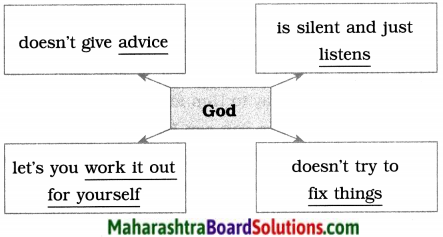
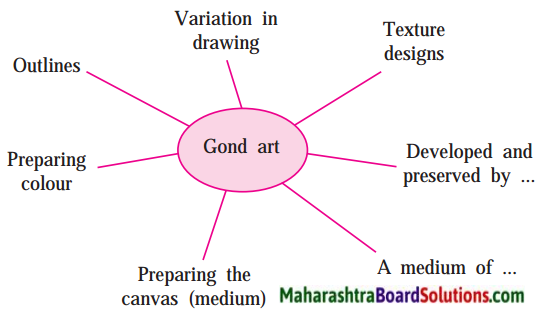
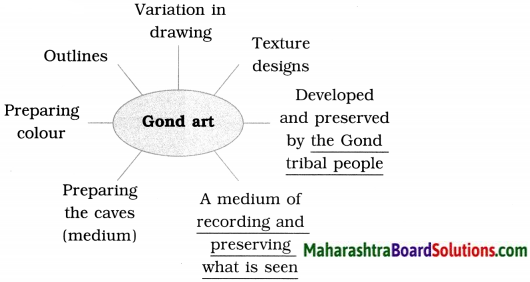
Complete the following web:
Answer:
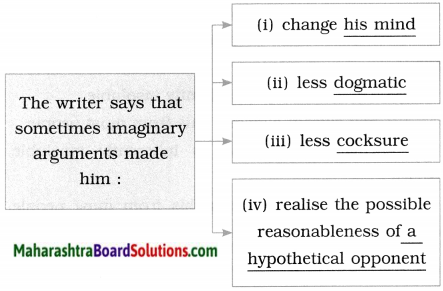
Maharashtra Board Class 9 English Kumarbharati Solutions Chapter 4.3 Intellectual Rubbish

Complex Factual Activities:

Question 1.
Write down the way of avoiding error mentioned in the passage.
Answer:
The way of avoiding error mentioned in the passage is to have imaginary arguments with people having different bias.

Activities based on Vocabulary.

Question 1.
good plan
Answer:
cunning plan, thoughtful plan, well-made plan, secret plan, master plan, career plan.

Maharashtra Board Class 9 English Kumarbharati Solutions Chapter 4.3 Intellectual Rubbish

Activities based on Contextual Grammar:

Question 1.
It is a good plan to imagine an argument with a person having a different bias. (Rewrite the sentence beginning ‘Imagining
Answer:
Imagining an argument with a person having a different bias is a good plan.

Question 2.
You may never meet anyone who holds this opinion. (Rewrite the sentence as a simple sentence.)
Answer:
You may never meet anyone with/having this opinion.

Personal Response:

Question 1.
Have you ever had an imaginary argument with anyone?
Answer:
Yes. I often have an imaginary argument with my mother. In my imagination, she asks me why have got peor marks in some particular subject and I reply. Then she says something else and I counter that one as well. We argue. I Imagine what she well say and provide the answers.

Simple Factual Activity:

Question 1.
Fill in the blanks:
Answer:

  1. Be wary of opinions that flatter your self-esteem.
  2. We are all persuaded that our own nation is superior to all others.
  3. We try to show that the merits possessed b our nation are really important ones.
  4. We think that the demerits of our own country are comparatively trivial.

Maharashtra Board Class 9 English Kumarbharati Solutions Chapter 4.3 Intellectual Rubbish

Complex Factual Activities:

Question 1.
What two examples does the writer give to those who have opinions that flatter their self-esteem?
Answer:
The writer says that if a man points out that most poets and men of science are male, a woman can say that most criminals are also male. The second example he gives is that of general human conceit. For this, we need to remind ourselves that other parts of the cosmos may contain beings as superior to ourselves as we are to Jelly-fish.

Question 2.
What is the only way to tackle such self-pride?
Answer:
The only way to tackle such self-pride is to remind ourselves that man is a brief episode in the life of a small planet In a little corner of the universe, and that other parts of the cosmos may contain beings as superior to ourseLves as we are to Jelly-fish.

Question 3.
Why should one be wary of opinions that flatter one’s self-esteem?
Answer:
One should be wary of opinions that flatter one’s self-esteem because there may be opinions with abundant evidence lo prove the exact opposite to what one believes.

Question 4.
Write down the way of avoiding error mentioned in the passage.
Answer:
The way of avoiding error mentioned in the passage Is to be wary of opinions that hatter your self-esteem.

Use the following Idioms/expressions in sentences of your own….,

Question 1.
to deal with:
Answer:
The lawyer had to deal with a large number of court cases.

Maharashtra Board Class 9 English Kumarbharati Solutions Chapter 4.3 Intellectual Rubbish

Question 2.
Give the noun forms of the following:

  1. flatter
  2. abundant
  3. rational
  4. argue

Answer:

  1. flatter – flattery
  2. abundant – abundance
  3. rational – rationality
  4. argue – argument

Activity-based on Contextual Grammar:

Question 1.
Rewrite the following sentences adding question tags:
1. The question is inherently insoluble.
2. Self-esteem conceals this from most people.
Answer:
1. The question is inherently insoluble, isn’t it?
2. Self-esteem conceals this from most people, doesn’t it?

Maharashtra Board Class 9 English Kumarbharati Solutions Chapter 4.3 Intellectual Rubbish

Personal Response:

Question 1.
Do you think that there are living beings superior to man in other parts of the universe?
Answer:
Yes, I do. The universe is so huge. There is probably a whole lot of life elsewhere that is superior to us. There may also be a lot of life inferior to us, too. We should not make the mistake of thinking that ; we are the greatest.

Simple Factual Activity:

Question 1.
Write whether the following statements are Right or Wrong:
Answer:

  1. Fear has many forms. Right
  2. Fear operates directly and indirectly. Right
  3. You must never admit your own fears to yourself. Wrong
  4. We can become wise only when we conquer fear. Right

Complex Factual Activities:

Question 1.
What two evils does fear lead to? How can one overcome fear?
Ans.
Two evils that fear leads us to are superstition and cruelty. One can overcome fear by firstly admitting one’s own fears to oneself and then guarding oneself against their myth-making power.

Complex Factual Activities:

Question 1.
What two evils does fear lead to? How can one overcome fear?
Answer:
Two evils that fear leads us to are superstition and cruelty. One can overcome fear by firstly admitting one’s own fears to oneself and then guarding oneself against their myth-making power.

Maharashtra Board Class 9 English Kumarbharati Solutions Chapter 4.3 Intellectual Rubbish

Question 2.
How does fear lead us to error?
Answer:
Fear leads us to error by making us do things like inventing rumours of disaster in wartime, imagining objects of terror, such as ghosts, or by creating belief in something comforting, like the elixir of life, or heaven for ourselves and hell for our enemies.

Activity-based on Vocabulary:

Question 1.
Match the adjectives in Column A with the nouns in Column B:

AB
1. specific(a) effort
2. vague(b) terrors
3. difficult(c) beliefs
4. religious(d) fear

Answer:

  1. specific – terrors
  2. vague – fear
  3. difficult – effort
  4. religious – beliefs.

Activities based on Contextual Grammar:

Question 1.
Fear is the main source of superstition. (Rewrite beginning ‘It is ……………)
Answer:
It is fear that is the main source of superstition.

Maharashtra Board Class 9 English Kumarbharati Solutions Chapter 4.3 Intellectual Rubbish

Question 2.
Until you have admitted your own fears to yourself, you cannot hope to think about other matters. (Rewrite using ‘only when
Answer:
Only when you have admitted your own fears to yourself, can you hope to think about other matters.

Personal Response:

Question 1.
What are the things you are afraid of?
Answer:
I am generally afraid of things regarding my education. I am afraid that I will not do well in my j exams and not get a seat in the college of my choice. I am also afraid that I will be separated from my friends and will not be able to make new friends at a new place. I will be lost without friends.

Simple Factual Activity:

Question 1.
Fill in the blanks:
Answer:
1. Primitive magic has the purpose of securing safety either by injuring enemies or by protecting oneself by talismans, spells or incantations.
2. Neither a man nor a crowd nor a nation can be trusted to act humanely or to think sanely under the influence of a great fear.

Complex Factual Activities:

Question 1.
What is the aim of primitive magic?
Answer:
The aim of primitive magic is to secure safety, either by injuring enemies or by protecting oneself by talismans, spells or incantations.

Maharashtra Board Class 9 English Kumarbharati Solutions Chapter 4.3 Intellectual Rubbish

Question 2.
What are the two ways of avoiding fear?
Answer:
The two ways of avoiding fear are:
1. by persuading ourselves that we are immune from disaster and
2. by the practice of sheer courage.

Question 3.
Write down the way of avoiding error mentioned in the passage.
Answer:
The way of avoiding error mentioned in the passage is to avoid fear in various ways.

Activities based on Vocabulary:

Question 1.
Use the following idioms/expressions in sentences of your own.
1. at a certain point
Answer:
1. Rhea realised at a certain point during the argument that it was better to keep quiet.

Activities based on Contextual Grammar:

Question 1.
Poltroons are more prone to cruelty than brave men, and are also more prone to superstition.
(Rewrite using not only … but also…….)
Answer:
Poltroons are not only more prone to cruelty than brave men, but also more prone to superstition.

Maharashtra Board Class 9 English Kumarbharati Solutions Chapter 4.3 Intellectual Rubbish

Question 2.
Science has now lessened the belief in magic.
(Pick out the verb and state its tense.)
Answer:
has lessened – present perfect tense.

Personal Response:

Question 1.
How do you try to overcome your fears?
Answer:
I try to overcome my fears by telling my parents and friends about them and getting their advice and support. I also pray to God and this helps me the most.

Simple Factual Activity:

Question 1.
Write whether the following statements are True or False:
Answer:

  1. Superstitions sometimes add to the gaiety of life. True
  2. The writer used to give lectures. True
  3. The ‘prophetess’ walked on water successfully. False

Maharashtra Board Class 9 English Kumarbharati Solutions Chapter 4.3 Intellectual Rubbish

Complex Factual Activities:

Question 1.
How did the prophetess befool her believers?
Answer:
The prophetess announced to her numerous | followers that she possessed the power of walking on water, and that she proposed to do so at 11 o’clock on a certain morning. On that day, she asked them whether they were all convinced that she could walk on water. When they replied in the affirmative, she said that then there was no need for her to prove herself. Thus she fooled her believers.

Activity-based on Contextual Grammar:

Question 1.
Rewrite the following sentences as compound sentences:
1. Although I did not enroll myself among his worshippers, his letter gave me pleasure.
2. I received once a communication from the god Osiris, giving me his telephone number.
Answer:
1. I did not enroll myself among his worshippers but his letter gave me pleasure.
2. I received once a communication from the god Osiris and he gave me his telephone number.

Simple Activities:

Question 1.
Write two compound words from the lesson.
Answer:
steamboat, self-esteem

Question 2.
Make a meaningful sentence using the phrase ‘of great importance’.
Answer:
It is of great importance to understand the rules of the land.

Maharashtra Board Class 9 English Kumarbharati Solutions Chapter 4.3 Intellectual Rubbish

Question 3.
Spot the error and correct the sentence:
Fear have many forms – fear of death, fear of the dark, etc.
Answer:
Fear has many forms-fear of death, fear of the dark, etc.

Question 4.
Pick out a gerund from the given sentence:
You may never have an opportunity of meeting anyone who has this opinion.
Answer:
meeting – gerund

Question 5.
Identify the type of sentence:
Mahatma Gandhi deplored railways and steamboats.
Answer:
Assertive sentence

Question 6.
Find out two hidden words from the given word : hypothetical
Answer:
hypothetical – poetic, poetical (topic, topical).

Question 7.
Form the present and past participle of a verb in the lesson in which the last letter is doubled.
Answer:
admit-admitted, admitting

Maharashtra Board Class 9 English Kumarbharati Solutions Chapter 4.3 Intellectual Rubbish

Question 8.
Write the following words in alphabetical order:
dogmatism, dominion, deplored, device.
Answer:
deplored, device, dogmatism, dominion.

Medium-Level Activities:

Question 1.
Use the word ‘spell’ in two separate sentences, the word having different meanings (homographs).
Answer:
(a) “Be sure that you spell every word correctly,” said the teacher.
(b) The witch was angry and cast a spell over the princess.

Question 2.
She announced to her numerous followers that she possessed the power of walking on water.
(Rewrite using direct speech.)
Answer:
She announced to her numerous followers, “I possess the power of walking on water.”

Question 3.
The rational man will admit that there is no right answer.
(Use the future perfect tense of the verb.)
Answer:
The rational man will have admitted that there is no right answer.

Maharashtra Board Class 9 English Kumarbharati Solutions Chapter 4.3 Intellectual Rubbish

Question 4.
Science has now lessened the belief in magic.
(Change the voice beginning ‘The belief. ’.)
Answer:
The belief in magic has now been lessened by science.

Challenging Activities:

Question 1.
Although I did not enroll myself among his worshippers, his letter gave me pleasure. (Pick out the clauses and identify the type of sentence.)
Answer:
his letter gave me pleasure – main clause
Although I did not enroll myself among his worshippers – subordinate clause. Complex sentence

Question 2.
Use the two words ‘evidence’ and ‘opinion’ in a single sentence of your own.
Answer:
In the opinion of the judge, the evidence was false.
Maharashtra State Board Class 9 English Solutions

Maharashtra Board Class 9 English Kumarbharati Solutions Chapter 2.4 The Fall of Troy

Balbharti Maharashtra State Board Class 9 English Solutions Kumarbharati Chapter 2.4 The Fall of Troy Notes, Textbook Exercise Important Questions and Answers.

Maharashtra State Board Class 9 English Kumarbharati Solutions Chapter 2.4 The Fall of Troy

English Kumarbharati 9th Solutions Chapter 2.4 The Fall of Troy Textbook Questions and Answers

Warming up:

Building a Story :
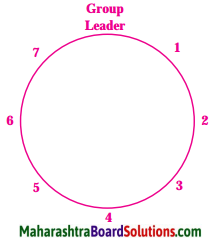
Form groups of eight. The group leader prepares slips of paper for each of the seven points given below and distributes them among the others. The group sits in a circle, taking their seats according to the number on the slip they have. Then each one completes the sentence on his/her slip without sharing it with the others. The group leader collects the slips and reads all the sentences aloud as one continuous passage. Does the story make sense? The group then works on the story to make it more meaningful and interesting.

This game may be played again, changing the groups, to form new stories.
Maharashtra Board Class 9 English Kumarbharati Solutions Chapter 2.4 The Fall of Troy 1

1. Once there was a ……………………….
2. Who lived in a ……………………….
3. He/She ate ……………………….
4. She/He went ……………………….
5. There she/he saw ……………………….
6. She/He was …………………………
7. That is why ……………………….

Question 1.

  1. Once there was a ……………………….
  2. Who lived in a ……………………….
  3. He/She ate ……………………….
  4. She/He went ……………………….
  5. There she/he saw ……………………….
  6. She/He was …………………………
  7. That is why ……………………….

Answer:

  1. Once there was a beautiful princess.
  2. Who lived in a dirty old shoe in a park.
  3. He/She ate nails and screws and paper.
  4. She/He went on a plane to the Arctic Circle.
  5. There she/he saw green mountains, lush forests and thundering waterfalls.
  6. She/He was very happy to go to Mars in the spaceship.
  7. That is why the doctor gave me the bitter medicine.

Maharashtra Board Class 9 English Kumarbharati Solutions Chapter 2.4 The Fall of Troy

The sentences as one continuous passage :

Once there was a beautiful princess who lived in a dirty old shoe in a park. She/He ate nails and screws and paper. She went on a plane to the Arctic Circle. There she saw green mountains, lush forests and thundering waterfalls. She was very happy to go to Mars in the spaceship. That is why the doctor gave me the bitter medicine.

The sentences read as one continuous passage do not make sense. However, if we make changes in the story, the passage will make sense.

  1. Once there was a beautiful princess.
  2. Who lived in a beautiful palace in a large forest.
  3. She ate only fresh fruits, vegetables and salads for every meal.
  4. She went on a voyage to the Arctic Circle.
  5. There she saw frozen seas, ice bergs and a variety of sea animals.
  6. She was thrilled to see so many different things, which she had never seen before.
  7. That is why she decided to visit a new place every year.

When we put these sentences given above as a continuous passage, they form a small and sensible story.
(Students can play the game again, changing the groups, to form new stories.)

Maharashtra Board Class 9 English Kumarbharati Solutions Chapter 2.4 The Fall of Troy

Interviews:

(a) Why? : Form groups of five. Choose a familiar character from any one of the epics you know. One person from the group plays the role of that character. Others in the group frame questions related to that character’s life. The condition is that all the questions should begin with ‘Why …?‘. They interview the character using these ‘Why -?‘ questions. Practise and present the interview in the classroom.
(b) How? : Follow the above procedure. Now all questions should begin with ‘How -?‘
(c) Prepare a short script of your interviews.

Question a.
Why?
Answer:
Form groups of five. Choose a familiar character from any one of the epics you know. One person from the group plays the role of that character. Others in the group frame questions related to that character’s life. The condition is that all the questions should begin with a ‘Why…’? They interview the character using these ‘Why?’ questions. Practice and present the interview in the classroom.
Example: Questions for Lord Rama. Epic: Ram ay an

  1. Why did you marry Sita?
  2. Why did your father ask you to leave the kingdom?
  3. Why did your stepmother want you to leave the kingdom?
  4. Why did Lakshman accompany you to the forest?
  5. Why did Lakshman leave Sita alone in the hut?

Question b.
How? : Follow the above procedure. Now all questions should begin with ‘How -?‘
Answer:
Example :

  1. How did you marry Sita?
  2. How many brothers did you have?
  3. How did your stepmother make you leave the kingdom?
  4. How did Ravana trick Sita?
  5. How did Hanuman help you?

Question c.
A short script of the interviews:
Answer:
Example :

Question 1.
Why did your father ask you to leave the kingdom?
Answer:
My father fulfilled my stepmother Kaikeyi’s wish and banished me from Ayodhya.

Maharashtra Board Class 9 English Kumarbharati Solutions Chapter 2.4 The Fall of Troy

Question 2.
Why did your stepmother want you to leave the kingdom?
Answer:
My stepmother Kaikeyi wanted her son Bharat to become the king. This would not have been possible if I had been in Ayodhya. Hence she wanted me to leave the kingdom.

Question 3.
Why did Lakshman accompany you to the forest?
Answer:
Lakshman loved me and wanted to ensure my safety in the forest. Hence he accompanied me to the forest.

Part – I

English Workshop:

1. Read the passage and name the following.

(a) He composed the Illiad and Odyssey: ……………….
(b) He persuaded Helen to elope wjth him: ……………….
(c) She was wife of the King Menelaus: ……………….
(d) He led the defence of Troy for nthe years: ……………….
(e) He was killed by a poisoned arrow that entered his heel: ……………….

Question 1.
(a) He composed the Illiad and Odyssey: ……………….
(b) He persuaded Helen to elope with him: ……………….
(c) She was wife of the King Menelaus: ……………….
(d) He led the defense of Troy for nine years: ……………….
(e) He was killed by a poisoned arrow that entered his heel: ……………….
Answer:
(a) He composed The Iliad and – The Odyssey Homer
(b) He persuaded Helen to elope with him. Paris
(c) She was the wife of King Menelaus. Helen
(d) He led the defense of Troy for nine years Hector
(e) He was killed by a poisoned arrow that entered his heel. Achilles

Maharashtra Board Class 9 English Kumarbharati Solutions Chapter 2.4 The Fall of Troy

2. Find antonyms of the following from the passage.
(a) barren × ……………..
(b) offended × ……………..
(c) cowardly × ……………..
(d) peace × ……………..
(e) surrender × ……………..
(f) exposed × ……………..
(g) defenceless × ……………..

Question 1.
Find antonyms of the following from the passage.
(a) barren × ……………..
(b) offended × ……………..
(c) cowardly × ……………..
(d) peace × ……………..
(e) surrender × ……………..
(f) exposed × ……………..
(g) defenceless × ……………..
Answer:
(a) barren × fertile
(b) offended × pleased
(c) cowardly × brave
(d) peace × war
(e) surrender × attack
(f) exposed × protected.
(g) defenceless × safe.

Maharashtra Board Class 9 English Kumarbharati Solutions Chapter 2.4 The Fall of Troy

3. From other sources find synonyms of the following words used in the story.
(a) great (hero)
(b) beautiful (woman)
(c) fight (verb)
(d) rich (city)
(e) safe
(f) strong (city)
(g) brave

Question 1.
From other sources find synonyms of the following words used in the story.
(a) great (hero)
(b) beautiful (woman)
(c) fight (verb)
(d) rich (city)
(e) safe
(f) strong (city)
(g) brave
Answer:
(a) great – gallant (hero)
(b) beautiful – entrancing (woman).
(c) fight – attack (verb)
(d) rich – prosperous (city)
(e) safe – sheltered.
(f) strong – well-protected (city)
(g) brave – courageous.

Maharashtra Board Class 9 English Kumarbharati Solutions Chapter 2.4 The Fall of Troy

4. Correct the following sentences using facts from the passage.
(a) Troy traded in cattle and grass, with other cities.
(b) During war, Trojans jumped over the fort gates to fight die enemy.
(c) Helen eloped with Menelaus.
(d) Troy was attacked because it was a strong. rich city.
(e) The Greek armies and heroes always defeated the Trojans.
(f) Both the enemies were eager to continue fighting.
(g) The great heroes avoided one another.
(h) Achilles was killed by an arrow that pierced his heart.

Question a.
Correct the following sentences using facts from the passage.
(a) Troy traded in cattle and grass, with other cities.
(b) During war, Trojans jumped over the fort gates to fight die enemy.
(c) Helen eloped with Menelaus.
(d) Troy was attacked because it was a strong. rich city.
(e) The Greek armies and heroes always defeated the Trojans.
(f) Both the enemies were eager to continue fighting.
(g) The great heroes avoided one another.
(h) Achilles was killed by an arrow that pierced his heart.
Answer:
(a) Troy traded in goods and grain with other cities.
(b) During the war, Trojans came out of the open fort gates to fight the enemy.
(c) Helen eloped with Paris.
(d) Troy was attacked because its Prince Paris had! persuaded Helen, the wife of a Greek king Menelaus, to elope with him.
(e) Sometimes the Trojans seemed to have the better of the fight and sometimes the Greeks.
(f) The Trojans were tired of being shut up in their city and the Greeks were longing to see their homes again.
(g) Sometimes there were single fights, between two great heroes.
(h) Achilles was killed by an arrow that pierced his heel.

Maharashtra Board Class 9 English Kumarbharati Solutions Chapter 2.4 The Fall of Troy

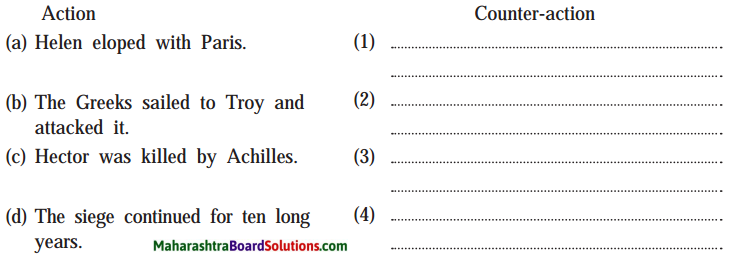
5. State the counter-action for the following actions.

Question 1.
State the counter-action for the following actions.
Maharashtra Board Class 9 English Kumarbharati Solutions Chapter 2.4 The Fall of Troy 2

Answer:

ActionCounter-action
1. Helen eloped with Paris.Greece declared war against the Troy.
2. The Greeks sailed to Troy and attacked it.The Trojans fought hard and the siege continued for ten years.
3. Hector was killed by Achilles.Achilles himself was killed later by a poisoned arrow.
4. The siege continued for ten long years.The Trojans fought hard and the fighting went on daily.

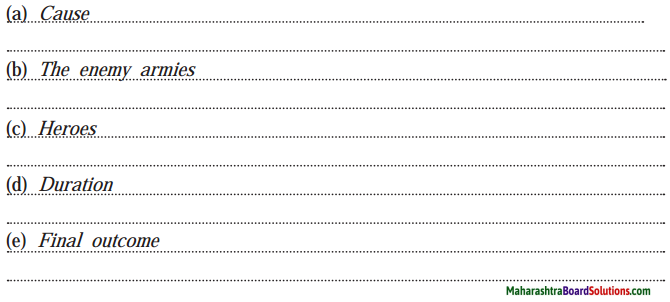
6. From either of our two Indian epics, find out which battle/war lasted the longest? Write down about its cause, the enemy armies, its heroes, its duration and the final outcome.

Maharashtra Board Class 9 English Kumarbharati Solutions Chapter 2.4 The Fall of Troy 3

7. Complete the following sentences with reference to the passage.
(a) Epics are long poems that ………………… .
(b) They may be composed and sung or recited for many years before …………….. .
(c) Nobody knows for certain who ………………………….. .
(d) It is believed that ……………. Homer, who ………….. and who ……………… to all who ……………. .
(e) At the back rose the high peak of Mount Ida, from which ………….. .

Question 1.
Complete the following sentences with reference to the passage.
(a) Epics are long poems that ………………… .
(b) They may be composed and sung or recited for many years before …………….. .
(c) Nobody knows for certain who ………………………….. .
(d) It is believed that ……………. Homer, who ………….. and who ……………… to all who ……………. .
(e) At the back rose the high peak of Mount Ida, from which ………….. .
Answer:
(a) Epics are long poems that relate the deeds of a great national hero or a great national war.
(b) They may be composed and sung or recited for many years before they are actually written down.
(c) Nobody knows for certain who the author of these early epics is.
(d) It is believed that The Iliad and The Odyssey were composed and recited by a blind poet named Homer, who lived about 900 BCE and who wandered from one Greek city or village to another, singing his poems to all who would receive him in their homes.
(e) At the back rose the high peak of Mount Ida, from which flowed many rivers and streams.

Underline the clauses in the above sentences and also the words that link or connect the clauses.

Question 1.
Epics are long poems that relate the deed of a great national hero or a great national war.
Answer:
Epics are long poems – Clause
that relate the deed of a great national hero or a great national war – Clause

Maharashtra Board Class 9 English Kumarbharati Solutions Chapter 2.4 The Fall of Troy

Question 2.
They may be composed and sung or recited for many years before they are actually written down.
Answer:
They may be composed – Clause (they may be)
sung – Clause (they may be)
recited for many years – Clause
before they are actually written down – Clause

Question 3.
Nobody knows for certain who the author of these early epics is.
Answer:
Nobody knows for certain – Clause
who the author of these early epics is – Clause

Question 4.
It is believed that The Iliad and The Odyssey were composed and recited by a blind poet named Homer, who lived about 900 BCE and who wandered from one Greek city or village to another, singing his poems to all who would receive him in their homes.
Answer:
It is believed – Clause
that The Iliad and The Odyssey were composed – Clause
(that The Iliad and The Odyssey were)
recited by a blind poet named Homer – Clause
who lived about 900 BCE – Clause

Maharashtra Board Class 9 English Kumarbharati Solutions Chapter 2.4 The Fall of Troy

Question 5.
At the back rose the high peak of Mount Ida, from which flowed many rivers and streams.
Answer:
At the back rose the high peak of Mount Ida – Clause
from which flowed many rivers and streams – Clause

Part – II

1. Find and write the Greek and Trojan names used in the story (Part I and II).

Question 1.
Find and write the Greek and Trojan names used in the story (Part I and II).

2. List all the words related to ‘war’ from both parts of the story.

Question 1.
List all the words related to ‘war’ from both parts of the story.

3. Note the following constructions carefully and then use them to express your ideas:

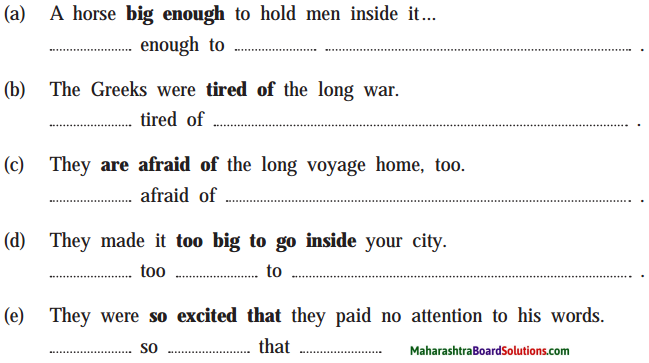
Question 1.
Note the following constructions carefully and then use them to express your ideas:

Maharashtra Board Class 9 English Kumarbharati Solutions Chapter 2.4 The Fall of Troy 4

4. Put the following events in the order in which they took place. Number them accordingly.

Question 1.
(a) The Trojans found a Greek man under the big wooden horse. [ ]
(b) They broke down part of the wall and brought the horse in. [ ]
(c) The cunning Odysseus thought of a plan. [ ]
(d) The Greeks burnt their tents and sailed away. [ ]
(e) Troy was burnt down. [ ]
(f) The Greeks built a big wooden horse. [ ]
(g) The great heroes hid inside the horse. [ ]
(h) The priest warned the Trojans not to break the wall. [ ]
(i) The Trojans were happy to see the Greek ships go. [ ]
(j) The Trojans slept soundly. [ ]
(k) The Greeks came out of the horse and opened the gates. [ ]
(l) The Greek army entered the city. [ ]
Answer:
(a) The Trojans found a Greek man under the big wooden horse. [f]
(b) They broke down part of the wall and brought the horse in. [h]
(c) The cunning Odysseus thought of a plan. [a]
(d) The Greeks burnt their tents and sailed away. [d]
(e) Troy was burnt down. [i]
(f) The Greeks built a big wooden horse. [b]
(g) The great heroes hid inside the horse. [c]
(h) The priest warned the Trojans not to break the wall. [g]
(i) The Trojans were happy to see the Greek ships go. [e]
(j) The Trojans slept soundly. [i]
(k) The Greeks came out of the horse and opened the gates. [j]
(l) The Greek army entered the city. [k]

Maharashtra Board Class 9 English Kumarbharati Solutions Chapter 2.4 The Fall of Troy

5. Form pairs. Imagine you are a pair of Trojans and you have come to know about Odysseus’s plan. Make a counter plan to defeat the Greeks. Write down your plan as you would explain it to your fellow Trojans.

Question 1.
Form pairs. Imagine you are a pair of Trojans and you have come to know about Odysseus’s plan. Make a counter plan to defeat the Greeks. Write down your plan as you would explain it to your fellow Trojans.

6. Identify one example of a main clause and one example of a dependent clause from page 46. (Read the entry regarding clause in the Language Study pages.)

Question 1.
Identify one example of a main clause and one example of a dependent clause from page 46. (Read the entry regarding clause in the Language Study pages.)
Answer:
Many of the Trojans were killed before they could put on their armour.
Many of the Trojans were killed – Main Clause before they could put on their armour – Dependent Clause

Maharashtra Board Class 9 English Kumarbharati Solutions Chapter 2.4 The Fall of Troy

7. Be a writer.
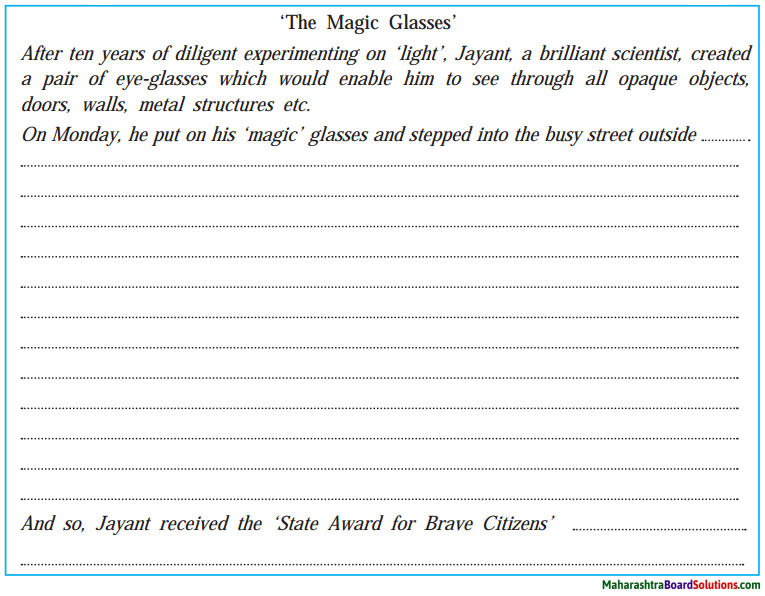
(a) Now read the beginning and end of a sci-fi story given below and complete the story using your imagination.

Maharashtra Board Class 9 English Kumarbharati Solutions Chapter 2.4 The Fall of Troy 5

Question a.
Now read the beginning and end of a sci-fi story given below and complete the story using your imagination.
Answer:
‘The Magic Glasses’
After ten years of diligent experimenting on ‘light’, Jayant, a brilliant scientist, created a pair of eye-glasses that would enable him to see through all opaque objects, doors, walls, metal structures, etc. .
On Monday, he put on his ‘magic’ glasses and stepped into the busy street outside …

Everything seemed normal – the traffic, the crowds, etc. Suddenly, Jayant tripped over something and he looked down. It was the metal covering of a manhole. As he looked, he saw a strange sight. There were three little children below, deep under the footpath! How was that possible? Why was no one helping them? They were crying and wailing, sitting in the mess inside the drain. He looked up, and then realized that he had seen them because of his magic eye-glasses.

“Come on, help!” he shouted. “There are children trapped under this footpath, inside this drain!”
Several people stopped. “How do you know?” asked a non-believer.
“What is going on here?” asked an officious- looking policeman.
“Don’t talk – just help!” snapped Jayant, trying to prise open the manhole cover. It was heavy, and several good Samaritans stepped forward to help. Within a few moments, the heavy lid was in their hands.
Everyone peered into the dark, gloomy and smelly drain. They could hear the faint sounds of crying. “I’m going down,” said Jayant. “Those little ones will not be able to bear the poisonous gases much longer.”
With the help of the cooperative by-standers, Jayant went down into the manhole and rescued the little kids – all of whom were below the age of five. Everyone clapped when he came out, dirty and smelly, with the three half-conscious kids.
And so, Jayant received the ‘State Award for Brave Citizens’. ………………………………………………………………
…………………………………………………………………………………………………………………………………………………………………………. .

Maharashtra Board Class 9 English Kumarbharati Solutions Chapter 2.4 The Fall of Troy

Question b.
Read the following and observe the use of tenses.
‘Last week I witnessed a strange accident. Let ¡ne tell you about it. The signal flashes green. Vehicles start from the opposite direction. They ¡nove fast. Suddenly a speeding motorcyclist tries to cut across, from the wrong side. He is about to collide with a loaded truck. He applies the brakes. He falls and slides out with his bike from under the truck. He comes out unscathed on the other side.’ When an event, which has occured in the past, is narrated in the Present Tense to create a dramatic effect its Tense is called the ‘Dramatic Present Tense’ Now try to relate Jayant s sci-fI story, in brief, in the dramatic past tense.
……………………………………………………………………………………………………………………….
……………………………………………………………………………………………………………………….
……………………………………………………………………………………………………………………….
Answer:
Jayant wears his magic glasses and steps into the street. He trips over a manhole and looks down. What! Are there three little kids trapped inside the drain under the footpath? Jayant looks around for help, but there are non – believers around him. He tries to prise open the manhole cover. Suddenly, willing hands help him.

The cover is open, and they hear the sounds of children crying. Jayant bravely lowers himself down the dirty drain. He soon rescues the three kids trapped inside. As he hands over the kids to the policeman, the people around clap for him. He is a hero. Jayant later receives the ‘State Award for Brave Citizens’.

Maharashtra Board Class 9 English Kumarbharati Solutions Chapter 2.4 The Fall of Troy

English Kumarbharati 9th Digest Chapter 2.4 The Fall of Troy Additional Important Questions and Answers

Read the following passages carefully and complete the activities :

Simple Factual Activity :

1. Name the following :
(The answers are given directly and underlined.)

  1. The language of The Iliad and The Odyssey : Ancient Greek
  2. The language of The Mahabharata : Sanskrit
  3. The most beautiful woman in the world : Helen of Troy.

2. Complete the following sentences :
(The answers are given directly and underlined.)

  1. Odysseus thought of a plan to obtain victory.
  2. Troy was taken, not by force but by a trick.
  3. Two great heroes, Menelaus and Odysseus, entered the horse.
  4. Only one man was left behind to persuade the Trojans to drag the horse into their city.

Maharashtra Board Class 9 English Kumarbharati Solutions Chapter 2.4 The Fall of Troy

3. Write the correct number against the sentences in the order in which it happened :

  1. They found a Greek with his hands tied together. ]2]
  2. Let us make a hole in the wall and drag the horse in. [4]
  3. They saw the huge, wooden horse. [1]
  4. The Greek told them his tale. [3]

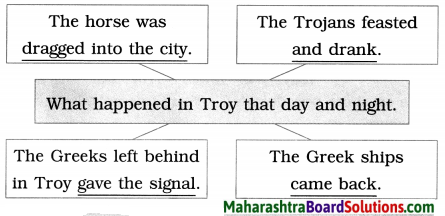
4. Complete the web:
(The answers are given directly and underlined.)
Maharashtra Board Class 9 English Kumarbharati Solutions Chapter 2.4 The Fall of Troy 6

Complex Factual Activity :

Question 1.
How were epics transmitted from generation to generation?
Answer:
Epics were transmitted from generation to generation through songs and recitals for many years before they were actually written down.

Maharashtra Board Class 9 English Kumarbharati Solutions Chapter 2.4 The Fall of Troy

Question 2.
Why is Homer honoured with the title ‘Father of European Poetry?’
Answer:
It is believed that the two great epics of European literature, The Iliad and The Odyssey, were composed and recited by Homer. Hence he has been honoured with the title ‘Father of European Poetry’.

Question 3.
How did Odysseus plan to defeat the Trojans ?
Answer:
Odysseus advised the Greeks to build a great wooden horse, big enough to hold men inside it. Some of their best fighters would hide inside the horse. Then they would burn their tents and pretend to sail away in their ships. But instead of sailing away, they would return at midnight. One man would be left behind with the horse to persuade the Trojans to drag the horse into their city.

After the horse with the soldiers had entered the city, at the appropriate time, the door in the horse would be opened and the soldiers hiding inside would attack Troy. The gates would be opened to allow the remaining Greek soldiers from the ships into the city. The combined force of the Greeks would defeat the Trojans and they would destroy the city of Troy.

Question 4.
What was the reason for Troy to rejoice and celebrate?
Answer:
The Trojans rejoiced and celebrated because after ten long years, the siege was finally over. The tents of the Greeks had been burnt. The shore was deserted. The Greek ships had all gone. The Trojans could go out on the plain and move around as they pleased.

Maharashtra Board Class 9 English Kumarbharati Solutions Chapter 2.4 The Fall of Troy

Activities based on Vocabulary :

Question 1.
Find the synonyms of the following words used in the story :
famous
Answer:
famous – well-known

Question 2.
Write the adjective forms of the following words :

  1. hospitality
  2. hero
  3. history
  4. poem

Answer:

  1. hospitality – hospitable
  2. hero – heroic
  3. history – historical
  4. poem – poetic.

Maharashtra Board Class 9 English Kumarbharati Solutions Chapter 2.4 The Fall of Troy

Question 3.
Write from the passage words that sound the same (homophones) as the following :

  1. grate
  2. sale
  3. would
  4. site

Answer:

  1. great
  2. sail
  3. wood
  4. sight.

Question 4.
Use the phrase ‘enough to’ in your own sentence :
Answer:
Our school auditorium was big enough to hold a grand function.

Question 5.
Give one word from the passage for :

  1. great surprise
  2. pulled out forcibly

Answer:

  1. great surprise – astonishment
  2. pulled out forcibly – dragged

Maharashtra Board Class 9 English Kumarbharati Solutions Chapter 2.4 The Fall of Troy

Question 6.
Use these phrases in your own sentences :
(Please refer to textbook page 47 for examples.)

  1. tired of
  2. afraid of
  3. too … to …

Answer:

  1. We were tired of the long wait for the bus.
  2. The children were afraid of the commotion.
  3. The bed was too big to be kept in the room.

Question 7.
Use the phrases in your own sentences :

  1. so … that
  2. as soon as
  3. all that day
  4. in order to

Answer:

  1. The teenagers were so excited that it was difficult to control them.
  2. I opened my umbrella as soon as it began to rain.
  3. Though their mother shouted at them, the girls lazed about all that day.
  4. We have to work hard in order to do well in life.

Maharashtra Board Class 9 English Kumarbharati Solutions Chapter 2.4 The Fall of Troy

Activity-based on Contextual Grammar :

Question 1.
Change the voice of the following sentences :

  1. It is believed that The Iliad and The Odyssey were composed by Homer.
  2. Nobody knows who the author of these epics is.

Answer:

  1. People believe that Homer composed The Iliad and The Odyssey.
  2. It is not known who the author of these epics is.

Question 2.
When the Trojans are asleep, we will attack the city. (Pick out and name the clauses.)
Answer:
we will attack the city – Main Clause.
When the Trojans are asleep – Subordinate Adverb Clause of Time.

Question 3.
The Greek leaders decided to follow the advice of the wise Odysseus. (Frame a Wh-question to get the underlined part as the answer.)
Answer:
Whose advice did the Greek leaders decide to follow?

Maharashtra Board Class 9 English Kumarbharati Solutions Chapter 2.4 The Fall of Troy

Question 4.
Rewrite the sentence using ‘no sooner than’ :
As soon as they were hidden by an island, they had lowered their sails.
Answer:
No sooner were they hidden by an island, than they had lowered their sails.

Question 5.
Rewrite the sentence using ‘too … to’ :
They were so excited that they paid no attention to his words.
Answer:
They were too excited to pay any attention to his words.

Personal Response :

Question 1.
Have you seen any of the stories mentioned in the passage in TV serials or movies?
Answer:
Yes, I have seen both the Ramayana and the Mahabharata as TV serials.

Question 2.
Who are considered to be the authors of the epics ‘Ramayana’ and ‘Mahabharata’ respectively?
Answer:
Sage Valmiki is considered to be the author of ‘The Ramayana’ and Ved Vyasa is considered to be the author of ‘The Mahabharata’.

Maharashtra Board Class 9 English Kumarbharati Solutions Chapter 2.4 The Fall of Troy

Question 3.
What do you think about Odysseus?
Answer:
I think that Odysseus was cunning and used underhand methods to win the war. The war should have been fought and won honestly, not by the use of a trick. Odysseus should not have given such advice and the Greeks should not have taken it.

Question 4.
What, do you think, is needed for a city to be prosperous?
Answer:
To be prosperous, a city must be well situated and have good natural resources, like water and fertile land. It should be safe from enemies. The people and the rulers should be intelligent, sensible and honest. They should also be hard-working. If all these factors are present, then a city will become prosperous.

Maharashtra Board Class 9 English Kumarbharati Solutions Chapter 2.4 The Fall of Troy

Question 5.
Do you think that wars can solve problems?
Answer:
No, they cannot. Problems can be solved only by sitting around a table and sorting out the disputes. The practice of ‘an eye for an eye’ will only end up making the whole world blind. Wars kill people and destroy civilizations.

Question 6.
Do you think the Greeks and Trojans were superstitious? Give reasons for your answer.
Answer:
There is nothing to indicate that the Greeks were superstitious. But the Trojans were superstitious and believed that the wooden horse would bring them luck if they dragged it into their city.

Question 7.
How could the fall of Troy been avoided?
Answer:
The fall of Troy could have been avoided if the Trojans had been wise enough to detect the ‘wooden horse plot’ hatched by the Greeks. They should also not have been stupid enough to believe the silly story told by the lone Greek. They should at least, have listened to their wise priest who had warned them that the horse could be a trick to destroy Troy.

Maharashtra Board Class 9 English Kumarbharati Solutions Chapter 2.4 The Fall of Troy

Question 8.
What do you think the Trojans should have done when they found the horse?
Answer:
The Trojans should not have believed the Greeks. They should have been cautious and examined the horse minutely. They should also not have been superstitious enough to bring the horse into the city, expecting good luck. They should have heeded the words of the wise priest.

Complex Factual Activities :

Question 1.
How did the location of Troy help it to grow into a very rich, prosperous city?
Answer:
Troy was well situated. In front of it was the sea over which sailed the ships of Troy, carrying goods and grain. At the back rose the high peak of Mount Ida, from which flowed many rivers and streams. The valleys were well-watered and fertile. Cattle fed on the rich grass of the meadows while sheep fed on the slopes of the hills. Thus, it was well situated, both for commerce and agriculture, and grew into a rich, prosperous city.

Question 2.
How were the Trojans protected during wartime?
Answer:
The Trojans had built a strong wall around the city so that no enemy should attack them from the sea. There were huge gates in the wall. In times of war, the gates would be closed, and then the city was like a strong fortress, quite safe from all attack.
It was thus protected by the walls around it as well as by the hills behind.

Maharashtra Board Class 9 English Kumarbharati Solutions Chapter 2.4 The Fall of Troy

Question 3.
Was it enough to use the wooden horse to hide? What was done to make the Trojans take it inside the city?
Answer:
It was not enough to use the wooden horse to hide. It had to be taken inside the city. To achieve this, a Greek, who had been left behind for this very purpose, said that the horse had been left behind as an offering to the god of the sea. It had been made very big so that the Trojans could not take it inside their city. If they did so, the luck would go to the Trojans and not to the Greeks. When they heard this, the Trojans wanted to take the wooden horse inside the city, and they broke their walls to do so.

Question 4.
How did the cunning Greek explain the presence of such a large wooden horse?
Answer:
The cunning Greek said that the Greeks who had left were afraid of the long voyage home. They had made the horse and left it behind as an offering to the god of the sea. It had been made very big so that the Trojans could not take it inside their city. If they did so, the luck would go to the Trojans and not to the Greeks.

Maharashtra Board Class 9 English Kumarbharati Solutions Chapter 2.4 The Fall of Troy

Question 5.
What was the cause of the ten-year-old war between the Greeks and the Trojans?
Answer:
Paris, a prince of Troy, had persuaded Helen, wife of a Greek King called Menelaus, to elope j with him. He had brought her to Troy. The Greeks wanted to take revenge on Troy for the wrong done to Menelaus. This was the cause of the ten-year-old war between the Greeks and the Trojans.

Question 6.
What reckless, thoughtless step did the Trojans take?
Answer:
The reckless/thoughtless step that the Trojans took was to break down part of their wall and drag the wooden horse into the city. They also celebrated and slept soundly.

Question 7.
How did the Greeks enter the city of Troy?
Answer:
When the cunning Greek who had been left behind saw the Greek fleet returning to the shores of Troy, he crept to the wooden horse and gave the signal. The side of the horse opened, and the Greeks who were inside climbed out and opened the gates. * The whole Greek army entered the city.

Maharashtra Board Class 9 English Kumarbharati Solutions Chapter 2.4 The Fall of Troy

Question 8.
How did the Greek ships remain hidden from Troy?
Answer:
As soon as the Greek ships were hidden : by an island, they lowered their sails and dropped anchor. Thus they remained hidden from Troy.

Activities based on Contextual Grammar :

Question 1.
Round their city the Trojans had built a strong wall. (Pick out the verb and state its tense.)
Answer:
had built – past perfect tense.

Question 2.
The wall was so broad that people could stand on it. (Pick out the modal auxiliary and state what it indicates.)
Answer:
could – indicates ability.

Maharashtra Board Class 9 English Kumarbharati Solutions Chapter 2.4 The Fall of Troy

Question 3.
Pick out the clauses from the following sentence and state their type :
He spoke and told them this false tale.
Answer:
He spoke – Main Clause.
(He) told them this false tale – Main Clause.

Question 4.
Rewrite the sentence using ‘which’ :
They saw on the sands the huge, wooden horse.
Answer:
They saw on the sands a huge horse which
was made of wood.

Question 5.
He had brought her to Troy.
(Rewrite beginning ‘She …’)
Answer:
She had been brought to Troy (by him).

Question 6.
The fighting went on daily, but the siege did not end. (Rewrite replacing the underlined word with its verb form.)
Answer:
They fought daily, but the siege did not end.

Maharashtra Board Class 9 English Kumarbharati Solutions Chapter 2.4 The Fall of Troy

Question 7.
Write two present participles from the passage, used as adjectives. Also, write the nouns they modify:
Answer:

Present Participles used as AdjectivesNouns they modify
1. leapingflames
2. weepingwomen
3. sleepingTrojans

Simple Activities :

Question 1.
Write two compound words of your own.
Answer:
walking stick, fire engine

Question 2.
Make a meaningful sentence using the phrase : ‘among the hills’
Answer:
The tribal communities living among the hills are very poor.

Maharashtra Board Class 9 English Kumarbharati Solutions Chapter 2.4 The Fall of Troy

Question 3.
Spot the error and correct the sentence :
It is believe that The Iliad and The Odyssey were compose by Homer.
Answer:
It is believed that The Iliad and The Odyssey were composed by Homer.

Question 4.
Pick out a present participle from the given sentence :
The valleys were fertile, with corn growing in the fields.
Answer:
present participle – growing.

Question 5.
Identify the type of sentence :
But all the kings and heroes had declared war against the Trojans.
Answer:
Assertive sentence

Question 6.
Find out two hidden words from the word ‘hospitality
Answer:
hospitality – hospital, soapy, (spoil, host)

Question 7.
Form a present participle in which the last letter is doubled.
Answer:
hit-hitting

Maharashtra Board Class 9 English Kumarbharati Solutions Chapter 2.4 The Fall of Troy

Question 8.
Write the following words in alphabetical order.
great, grain, final, fight
Answer:
fight, final, grain, great.

Question 9.
Make a word chain of four more abstract nouns:
revenge →
Answer:
revenge → empathy → youth → health → humility

Maharashtra Board Class 9 English Kumarbharati Solutions Chapter 2.4 The Fall of Troy

Question 10.
Write two compound words of your own.
Answer:
policeman, washing machine

Question 11.
Make a meaningful sentence using the phrase : ‘to follow the advice’
Answer:
Our parents told us to follow the advice of the counseller.

Question 12.
Spot the error and correct the sentence :
Paris himself were killed, also by a poisoned arrow.
Answer:
Paris himself was killed, also by a poisoned arrow.

Question 13.
Use the word ‘sleeping’ as a gerund in your own sentence :
Answer:
I love sleeping.

Maharashtra Board Class 9 English Kumarbharati Solutions Chapter 2.4 The Fall of Troy

Question 14.
Identify the type of sentence, and state ; whether it is affirmative or negative :
The Greeks have gone and the walls are no longer necessary.
Answer:
Assertive sentence (negative)

Question 15.
Find out two hidden words from the word :
celebration
Answer:
celebration – liberate, berate, (clear, brain).

Question 16.
Pick out the verb from the following that forms its past participle by doubling the last letter :
mail, cut, hit, rot
Answer:
rot (rotted)

Maharashtra Board Class 9 English Kumarbharati Solutions Chapter 2.4 The Fall of Troy

Question 17.
Arrange these words in alphabetical order :
wooden, walls, terror, tower
Answer:
terror, tower, walls, wooden

Medium-Level Activities :

Question 1.
Use the word ‘peak’ and its homophone in two separate sentences :
Answer:
(a) Mt. Everest is one peak I wish to climb.
(b) I might take a peek at the proposed site.

Question 2.
The Trojans fought hard. (Use the past perfect progressive tense of the verb.)
Answer:
The Trojans had been fighting hard.

Maharashtra Board Class 9 English Kumarbharati Solutions Chapter 2.4 The Fall of Troy

Question 3.
Prepare a word register for all the words related to ‘war’ from the lesson.
Answer:
war-enemy, attack, fortress, soldiers, siege, battles, armies, heroes, fought, fighting, killed, taken, victory, fighters, terror, death, weapons, armour, conquerors.

Question 4.
Use the word ‘sail’ and its homophone in two separate sentences :
Answer:
(a) The sea gull sat on the sail of the boat.
(b) There is a wonderful sale at the mall this week.

Question 5.
The Greeks burned their tents.
(Use the present perfect tense of the verb.)
Answer:
The Greeks have burned their tents.

Maharashtra Board Class 9 English Kumarbharati Solutions Chapter 2.4 The Fall of Troy

Question 6.
“ But why did the Greeks make such a huge horse?” some of the Trojans asked.
(Rewrite using reported speech.)
Answer:
Some of the Trojans asked why the Greeks had made such a huge horse.

Question 7.
Prepare a word register of all the Greek and Trojan names in the story.
Answer:
Greek and Trojan names – Odysseus, Menelaus, Agamemnon, Troy, King Priam, Hector, Helen, Aphrodite, Iliad, Odyssey, Achilles, Homer, Ilium, Aegean Sea, Mount Ida, Greece, Paris.

Challenging Activities :

Question 1.
Use the word ‘force’ as a noun and a verb in two separate sentences.
Answer:
(a) The policeman had to use a lot of force ; to open the door, (noun)
(b) Parents should not force children into careers j that the children do not like, (verb)

Maharashtra Board Class 9 English Kumarbharati Solutions Chapter 2.4 The Fall of Troy

Question 2.
The Trojans too fought hard and the siege j continued for ten long years. (Pick out the clauses j and write the type of sentence.)
Answer:
The Trojans too fought hard – Coordinate Clause the siege continued for ten long years – Coordinate Clause ; Compound Sentence

Question 3.
Use the words ‘rejoicing’ and ‘voyage’ in a single sentence.
Answer:
There was a lot of rejoicing by the seamen on the voyage home.

Question 4.
It may be a trick that will ruin us. (Pick out the modal and state its function.)
Answer:
may-possibility

Maharashtra State Board Class 9 English Solutions

Maharashtra Board Class 8 Hindi Solutions Chapter 8 मेरा विद्रोह

Balbharti Maharashtra State Board Class 8 Hindi Solutions Sulabhbharati Chapter 8 मेरा विद्रोह Notes, Textbook Exercise Important Questions and Answers.

Maharashtra State Board Class 8 Hindi Solutions Chapter 8 मेरा विद्रोह

Hindi Sulabhbharti Class 8 Solutions Chapter 8 मेरा विद्रोह Textbook Questions and Answers

सूचना के अनुसार कृतियाँ करो:

एक शब्द में उत्तर लिखो:

Question 1.
बेटे की मातृभाषा
Answer:
हिंदी

Question 2.
बेटे की शिक्षा की माध्यम भाषा
Answer:
अंग्रेजी

Maharashtra Board Class 8 Hindi Solutions Chapter 8 मेरा विद्रोह

संक्षेप में लिखो:

Question 1.
रमन के जन्मदिन पर न जाने देने के बाद लड़के द्वारा किया गया विद्रोह
Answer:
लड़के ने जोर-जोर से लड़ना, जिद करना और रोना चिल्लाना शुरू कर दिया।

Question 2.
नुक्कड़ की दुकान से घर लौटने पर बेटे द्वारा देखा दृश्य
Answer:
उसके पिता जी गलियारे में खड़े-खड़े दीवार से कोहनियाँ टिकाए नि:शब्द कातर हो रहे हैं।

कारण लिखो:

Question 1.
अंग्रेजियत वाले परिवारों के बच्चों का दबदबा रहता था।
Answer:
क्योंकि वे छोटी उम्र से ही धाराप्रवाह अंग्रेजी बोलते थे।

Question 2.
लड़के की माँ उसे पढ़ा नहीं पाती थी।
Answer:
क्योंकि बेटे की पढ़ाई का माध्यम अंग्रेजी था और माँ को अंग्रेजी नहीं आती थी।

Question 3.
पिता जी झल्ला पड़ते थे।
Answer:
क्योंकि उनका बेटा ‘डोनेशन’ या सालाना जलसे आदि के लिए चंदे की छपी पर्चियाँ लाता था।

Question 4.
बेटा अड़ जाता था।
Answer:
क्योंकि उसके पिता जी ‘डोनेशन’ के रूप में एक या दो रूपये दे देते थे। जबकि उसके दोस्त दस या बीस रूपये लेकर आते।

ऐसे प्रश्न बनाओ जिनके उत्तर निम्न शब्द हों:

Question 1.
साइकिल
Answer:
बेटा पिता के साथ किस पर बैठकर स्कूल गया था?

Question 2.
बेसब्री
Answer:
पिता अपने बेटे रमन की वर्षगाँठ का कैसे इंतजार करते?

Question 3.
छपी पर्चियाँ
Answer:
बेटा ‘डोनेशन’ या सालाना जलसे आदि के लिए चंदे की क्या लाता?

Question 4.
पारावार
Answer:
माँ की खुशी का क्या न रहा?

Maharashtra Board Class 8 Hindi Solutions Chapter 8 मेरा विद्रोह

संजाल पूर्ण करो:

Maharashtra Board Class 8 Hindi Solutions Chapter 8 मेरा विद्रोह 1
Answer:
Maharashtra Board Class 8 Hindi Solutions Chapter 8 मेरा विद्रोह 3

भाषा बिंदु

पाठों में आए हुए उपसर्ग और प्रत्ययवाले शब्द ढूँढ़ो तथा उनके उपसर्ग/प्रत्यय अलग करके मूल शब्द लिखो।
Answer:
Maharashtra Board Class 8 Hindi Solutions Chapter 8 मेरा विद्रोह 17

उपयोजित लेखन

निम्न मुद्दों के आधार पर विज्ञापन लिखो :
स्थल/जगह, संपर्क, पुस्तक मेला, दिनांक, समय
Answer:
Maharashtra Board Class 8 Hindi Solutions Chapter 8 मेरा विद्रोह 2

स्वयं अध्ययन

अब्राहम लिंकन द्वारा प्रधानाध्यापक को लिखे हुए पत्र का चार्ट बनाकर कक्षा में लगाओ।

Maharashtra Board Class 8 Hindi Solutions Chapter 8 मेरा विद्रोह

मौलिक सृजन

अपने जीवन में पिता की भूमिका’ अधोरेखित करते हुए कृतज्ञता ज्ञापित करने वाला पत्र लिखिए।
Answer:
१० मई, २०१८
पूज्य पिता जी,
सादर प्रणाम।
आप कैसे हैं? बहुत दिन हो गए है लेकिन आपका पत्र नहीं मिला। मैं ठीक हूँ। मेरी पढ़ाई भी ठीक से चल रही है। आशा करता हूँ कि घर पर सभी ठीक होंगे।
पिता जी, यहाँ का नया कॉलेज बहुत ही अच्छा है। यहाँ पर खाने-पीने व रहने की सारी सुविधाएँ बहुत ही अच्छी हैं। मैं इस कॉलेज में आकर खुश हूँ। दरअसल मैं यह पत्र आपके प्रति अपनी कृतज्ञता ज्ञापित करने के लिए लिख रहा हूँ।
पिता जी मेरे जीवन में आपका बहुत ही महत्वपूर्ण स्थान है। बचपन से लेकर आज तक आपने मुझे पढ़ाई करने के लिए प्रेरित किया है। आपके व्यक्तित्व एवं कृतित्व से प्रभावित होकर मैं आज मेडिकल की पढ़ाई कर रहा हूँ। सचमुच यदि आप न होते, तो मेरे भविष्य में अंधेरा ही होता। अत: आपका मैं जितना शुक्रिया अदा करूँ वह कम ही होगा।
जैसे ही छुट्टियाँ शुरू होगी, वैसे ही तुरंत मैं घर पर आऊँगा। माता जी को सादर प्रणाम।
आपका आज्ञाकारी पुत्र,
अथर्व
कुमार अथर्व सक्सेना
२०२ गीत निवास, गांधी नगर, मुंबई : ४००० ९५७
[email protected].

Hindi Sulabhbharti Class 8 Solutions Chapter 8 मेरा विद्रोह Additional Important Questions and Answers

निम्नलिखित गद्यांश पढ़कर दी गई सूचनाओं के अनुसार कृतियाँ कीजिए।
कृति क (१) आकलन कृति

संजाल पूर्ण कीजिए।

Question 1.
Maharashtra Board Class 8 Hindi Solutions Chapter 8 मेरा विद्रोह 5
Answer:
Maharashtra Board Class 8 Hindi Solutions Chapter 8 मेरा विद्रोह 4

Maharashtra Board Class 8 Hindi Solutions Chapter 8 मेरा विद्रोह

आकृति पूर्ण कीजिए।

Question 1.
Maharashtra Board Class 8 Hindi Solutions Chapter 8 मेरा विद्रोह 7
Answer:
Maharashtra Board Class 8 Hindi Solutions Chapter 8 मेरा विद्रोह 6

उपर्युक्त गद्यांश से ऐसे दो प्रश्न तैयार कीजिए जिनके उत्तर निम्नलिखित शब्द हों –

Question 1.
बचपन
Answer:
बेटे को शहद के प्याले जैसा क्या लगा था?

Question 2.
मटरगश्ती
Answer:
पिता के अनुसार बेटा दिनभर सड़क पर क्या करता रहता है?

समझकर लिखिए।

निम्नलिखित गद्यांश में से शब्द-युग्म ढूँढकर लिखिए।
Answer:
दहाड़ना-गरतना
कई-कई
रोना-धोना ।
लगाते-लगाते

निम्नलिखित शब्द मानक वर्तनी के अनुसार लिखिए।

Question 1.
उध्दंड
Answer:
उदंड

वचन बदलिए।

  1. निगाहें
  2. सड़क

Answer:

  1. निगाह
  2. सड़कें

नीचे दिए हुए शब्दों के पर्यायवाची शब्द लिखिए।

  1. कपड़ा
  2. परिणाम
  3. ढिठाई

Answer:

  1. वस्त्र
  2. नतीजा
  3. धृष्टता

Maharashtra Board Class 8 Hindi Solutions Chapter 8 मेरा विद्रोह

अनेक शब्दों के लिए एक शब्द लिखिए।

  1. उदंडतापूर्ण आचरण
  2. बड़ा बनने की आकांक्षा

Answer:

  1. डिठाई
  2. महत्त्वाकांक्षा

Question 1.
‘क्या बच्चों को नियंत्रण में रखने के लिए उन पर दबाव डालना उचित है?’ इस बारे में आप अपने विचार लिखिए।
Answer:
बच्चे चंचल होते हैं। उन पर नियंत्रण रखने के लिए दबाव डालना अनुचित है। यदि बच्चे देर से घर आते हैं या अपने दोस्तों के साथ रोज-रोज मौज-मस्ती करते हैं या पढ़ाई पर ध्यान नहीं देते हैं, ऐसे में उनके साथ सख्ती से पेश आने से कुछ भी हासिल नहीं हो सकता। माता-पिता अपने बच्चों पर सख्ती करने के बजाय उन्हें प्यार से समझा सकते हैं। उन्हें सही-गलत का एहसास करवा सकते हैं।

बच्चों का मन अन्य गलत कार्यों में न भटकें इसलिए उनसे सकारात्मक कार्य कराएँ जाने चाहिए। उन्हें अकेले मत रखें और उन्हें कभी अकेलेपन का एहसास न होने दें। यदि वे अकेले रहेंगे तो उनका मन नकारात्मक कार्यों में उलझेगा। इसलिए बच्चों को नियंत्रण में रखने के लिए माता-पिता अपने बच्चों के साथ प्यार भरा व्यवहार कर सकते हैं।

निम्नलिखित गदयांश पढ़कर दी गई सूचनाओं के अनुसार कृतियाँ कीजिए।

गलत वाक्य सही करके के फिर से लिखिए।

Question 1.
बेटे को अपने पिता से पढ़ने की तीव्र इच्छा थी।
Answer:
बेटे की अपने पिता से पढ़ने की इच्छा नहीं थी।

Question 2.
बेटे को उसके पिता जी रिक्शा में बिठाकर घुमाने ले जाते
Answer:
बेटे को पिता जी साइकिल पर बिठाकर स्कूल ले जाते थे।

समझकर लिखिए।

Question 1.
बेटा आठवीं कक्षा तक पहुँचा
Answer:
अपने पिता की मेहनत के बल पर वह आठवीं कक्षा तक पहुँचा

Question 2.
इस स्कूल में पढ़ता था बेटा
Answer:
कॉन्वेंट स्कूल में

उपर्युक्त गदयांश से ऐसे प्रश्न तैयार कीजिए जिसका उत्तर निम्नलिखित शब्द हों

Question 1.
साइकिल
Answer:
बेटा पिता जी के साथ किस पर सवार होकर स्कूल गया था?

निम्नलिखित शब्दों के लिए एक शब्द लिखिए।

Question 1.
धारा का बहाव या वेग
Answer:
धाराप्रवाह

निम्नलिखित शब्दों के विलोम शब्द लिखिए।

  1. धूप x ……..
  2. मेहनत x ………

Answer:

  1. धूप x छाँव
  2. मेहनत x आलस

Maharashtra Board Class 8 Hindi Solutions Chapter 8 मेरा विद्रोह

निम्नलिखित शब्द में से प्रत्यय अलग कीजिए।

Question 1.
अंग्रेजियत
Answer:
प्रत्यय : इयत

Question 1.
‘क्या कॉन्वेंट की पढ़ाई मातृभाषा की पढ़ाई से श्रेष्ठ है?’ इस कथन के संदर्भ में अपने विचार लिखिए।
Answer:
आज हम एक नए दौर में जी रहे हैं, जहाँ सर्वत्र अंग्रेजियत का बोलबाला है। चारों ओर कॉन्वेंट स्कूल खुल रहे हैं। पढ़ाई हम कॉन्वेंट स्कूल में करें या अपनी मातृभाषा में। आखिर पड़ाई, पढ़ाई ही होती है। कॉन्वेंट में पढ़कर हमारी अंग्रेजी धाराप्रवाह बनती है। फिर भी यदि कोई बच्चा अपनी मातृभाषा में पढ़ाई करना है तो वह अधिक खुलकर अपने भावों को अभिव्यक्त कर सकता है।

ये बच्चों के ऊपर निर्भर है कि उसे कौन-सी भाषा के माध्यम से पढ़ाई करनी है। अपनी मातृभाषा से पढ़ाई करना छात्रों को सहज और सरल लगता है। इसमें किसी विशेष भाषा में ज्ञान प्राप्त करना किसी को श्रेष्ठ नहीं बनाता। अत: ऐसा हम नहीं कह सकते कि कॉन्वेंट की पढ़ाई मातृभाषा की पढ़ाई से श्रेष्ठ है।

संजाल पूर्ण कीजिए।

Question 1.
Maharashtra Board Class 8 Hindi Solutions Chapter 8 मेरा विद्रोह 9
Answer:
Maharashtra Board Class 8 Hindi Solutions Chapter 8 मेरा विद्रोह 8

सही विकल्प चुनकर वाक्य फिर से लिखिए।

Question 1.
रमन की वर्षगाँठ ने बेटे को ……. महीने से बेचैन कर दिया था। (तीन, दो, एक)
Answer:
रमन की वर्षगाँठ ने बेटे को एक महीने से बेचैन कर दिया था।

Question 2.
एक बार पूरी क्लास ……. पर जा रही थी। (पिकनिक, सैर, प्राकृतिक स्थल)
Answer:
एक बार पूरी क्लास पिकनिक पर जा रही थी।

पर्यायवाची शब्द लिखिए।

  1. जिद
  2. क्लास
  3. वर्षगाँठ
  4. खुशी

Answer:

  1. हठ
  2. क्षा
  3. जन्मदिन
  4. प्रसन्नता

गद्यांश में से ऐसे दो शब्द ढूंढकर लिखिए कि जिनके वचन परिवर्तित नहीं होते।
Answer:
पिता
घर

विलोम शब्द लिखिए।

  1. नालायक x ………
  2. अंदर x ………

Answer:

  1. नालायक x लायक
  2. अंदर x बाहर

Maharashtra Board Class 8 Hindi Solutions Chapter 8 मेरा विद्रोह

निम्नलिखित शब्द से उपसर्ग को अलग कीजिए।

Question 1.
नालायक
Answer:
उपसर्ग : ना

उचित प्रत्यय लगाइए।

  1. वर्ष
  2. लड़का

Answer:

  1. प्रत्यय : इक : वार्षिक
  2. प्रत्यय : पन : लड़कपन

Question 1.
अपने जीवन में पिता की महत्वपूर्ण भूमिका’ पर अपने विचार लिखिए।
Answer:
प्रत्येक बच्चे के जीवन में पिता की महत्त्वपूर्ण भूमिका होती है। पिता अपने बच्चे पर संस्कार करता है। वह बच्चे के अच्छे कार्यों की सराहना करता है। यदि बच्चे द्वारा कुछ गलत कार्य किया गया है तो वह उसे डाँटता भी है। यदि बच्चा बार-बार समझाने पर अपनी जिद पर अड़ा रहे तो वह उसे पहले समझाता है और यदि नहीं माने तो कठोर भूमिका भी अपनाता है। अपने तथा उसका भविष्य उज्ज्वल बनाने के लिए वह उसे अच्छे से अच्छे स्कूल में दाखिल कराता है।

वह अपने बच्चे का हमेशा मार्गदर्शन करता रहता है और अपने बच्चे की भलाई के लिए उसके हर कार्य पर नियंत्रण रखता है। इस प्रकार एक पिता अपने बच्चे के जीवन में सकारात्मक भूमिका निभाता है।

निम्नलिखित गलत वाक्य सही करके फिर से लिखिए।

Question 1.
पिता जी ने लड़के के गाल पर दवा लगाई।
Answer:
माँ ने लड़के के गाल पर दवा लगाई।

Question 2.
प्यार में पिता जी ने लड़के के गाल पर एक तमाचा लगाया।
Answer:
गुस्से में पिता जी ने एक भरपूर थप्पड़ लड़के के गाल पर जड़ दिया।

किसने, किससे कहा?

Question 1.
“तुम्हारे दोस्त का जन्मदिन है।”
Answer:
लड़के के पिता ने रमन के पिता को बताया।

समझकर लिखिए।

Question 1.
इन अपशब्दों का प्रयोग लड़के ने अपने मन में अपने पिता के लिए किया
Answer:
झूठे, मक्कार, और निर्दयी

कारण लिखिए।

Question 1.
लड़के का दिमाग गुस्से से पागल हो गया।
Answer:
क्योंकि उसके पिता ने रमन के पिता को झूठ बताया कि सीढ़ियों से गिरने के कारण लड़के के गाल पर निशान आए हैं।

Question 2.
लड़के को रमन के जन्मदिन पर भिजवा दिया गया।
Answer:
क्योंकि उसके पिता के साथ उसकी माँ लड़ पड़ी और पिता को भी पछतावा हो रहा था।

विलोम शब्द लिखिए।

  1. झूठा x …………
  2. निर्दयी x ………

Answer:

  1. झूठा x सच्चा
  2. निर्दयी x दयावान

समानार्थी शब्द लिखिए।

  1. गुस्सा
  2. दोस्त

Answer:

  1. क्रोध
  2. मित्र

Maharashtra Board Class 8 Hindi Solutions Chapter 8 मेरा विद्रोह

अनेक शब्द के लिए एक शब्द लिखिए।

  1. वह दिन जिसमें किसी ने जन्म लिया हो
  2. जिसके दिल में दया न हो

Answer:

  1. जन्मदिन
  2. निर्दयी

Question 1.
गद्यांश में से शब्द-युग्म ढूँढकर लिखिए।
Answer:
रोना-चिल्लाना
आते-आते

लिंग बदलिए।

  1. लड़का
  2. पापा

Answer:

  1. लड़की
  2. मम्मी

स्वमत अभिव्यक्ति

Question 1.
क्या हर बात पर अपने माता-पिता से जिद करना सही है? अपने विचार लिखिए।
Answer:
प्रत्येक माता-पिता अपने बच्चे का भला चाहते हैं। दुनिया में ऐसे माता-पिता नहीं है; जो अपने बच्चों का बुरा चाहते है। वे यदि कहीं जाने के लिए मना करते हैं, तो उसके पीछे उनका कोई-न-कोई कारण अवश्य होगा। वे जो भी निर्णय लेते हैं, वह अपने बच्चे की भलाई को ध्यान में रखकर लेते हैं। वे नहीं चाहते कि छोटी-सी गलती के कारण उनके बच्चों को किसी संकट या परेशानी का सामना करना पड़े। ऐसे में यदि कोई माता-पिता बच्चों द्वारा की जाने वाली जिद जैसी अन्य प्रतिक्रियाओं पर नाराज होते हैं, तो इसका यह अर्थ नहीं है कि वे अपने बच्चों से प्यार नहीं करते। इसलिए हर बात पर अपने माता-पिता के सामने जिद करना सही नहीं है।

संजाल पूर्ण कीजिए।

Question 1.
Maharashtra Board Class 8 Hindi Solutions Chapter 8 मेरा विद्रोह 11
Answer
Maharashtra Board Class 8 Hindi Solutions Chapter 8 मेरा विद्रोह 10

समझकर लिखिए।

Question 1.
वे नहीं मनाते थे लड़के का जन्मदिन
Answer:
लड़के के माता पित

Question 2.
पिता जी द्वारा मिली झिड़की का नतीजा
Answer:
लड़के के मन में उपेक्षा व आक्रोश और भी बढ़ा दिया।

Question 3.
उपेक्षा व आक्रोश का स्थान इसने ले लिया
Answer:
विद्रोह ने ।

Question 4.
इनसे चिढ़ हो गई थी लड़के को
Answer:
पढ़ाई व पिता जी से ।

Maharashtra Board Class 8 Hindi Solutions Chapter 8 मेरा विद्रोह

उपर्युक्त गद्यांश से ऐसे दो प्रश्न तैयार कीजिए जिनके उत्तर निम्नलिखित शब्द हों

  1. पर्यायवाची
  2. शालू

Answer:

  1. लड़के के लिए पिता जी और पढ़ाई एक-दूसरे के क्या बन गए थे?
  2. लड़के की छोटी बहन का नाम क्या था?

कारण लिखिए।

Question 1.
लड़के के घर में तंगहाली और भी बढ़ गई।
Answer:
क्योंकि उसके घर में उसकी छोटी बहन के जन्म के बाद छोटे भाई मंटू का आगमन हुआ।

Question 2.
लड़का दुस्साहसी हो गया।
Answer:
पिता जी बात-बात पर उसे पीटते थे। इसी कारण पिटने का डर उसके दिमाग से काफूर हो गया और वह दुस्साहसी हो गया। कृतिक

शब्द संपदा

निम्नलिखित गद्यांश में से शब्द-युग्म ढूँढकर लिखिए।
Answer:
धीरे-धीरे
एक-दूसरे
बात-बात
ढेर-के-ढेर

निम्नलिखित शब्द मानक वर्तनी के अनुसार लिखिए।

Question 1.
किये गये
Answer:
किए गए

वचन बदलिए।

  1. बहन
  2. झिड़की

Answer:

  1. बहनें
  2. झिड़कियाँ

नीचे दिए हुए शब्दों के पर्यायवाची शब्द लिखिए।

  1. तंगहाली
  2. काफूर
  3. घर
  4. दिमाग

Answer:

  1. दुर्दशा
  2. गायब
  3. गृह
  4. समझ

Maharashtra Board Class 8 Hindi Solutions Chapter 8 मेरा विद्रोह

अनेक शब्दों के लिए एक शब्द लिखिए।

Question 1.
तंगहाल होने की अवस्था –
Answer:
तंगहाली

Question 2.
दुस्साहस करने वाला
Answer:
दुस्साहसी

Question 1.
माता-पिता की आकांक्षाओं से दबकर बालक-बालिकाओं की लालसाएँ दम तोड़ देती हैं।’ कञ्चन के बारे में अपने विचार लिखिए।
Answer:
बच्चे मन के सच्चे होते हैं। उन्हें अधिक अनुशासन में रखना उचित नहीं होता। हमेशा उन पर निगाह रखना या बार-बार टोकने या मारने से बच्चे और भी जिद्दी हो जाते हैं। मौका मिलते ही वे विद्रोह करने में भी पीछे नहीं हटते। इसके साथ माता-पिता को उनकी उपेक्षा भी नहीं करनी चाहिए। यदि बच्चे तीन या चार चीजों की मांग करते हैं, तो कम-से-कम उनकी एक ख्वाहिश उनके माता-पिता को पूर्ण करनी चाहिए।

यदि माता-पिता अपनी आकांक्षा एवं विचार बच्चों को जबरदस्ती अपनाने के लिए मजबूर करेंगे, तो ऐसे में वे अधिक हावी हो जाएँगे और विद्रोह करने के लिए तैयार हो जाएंगे। यदि वे विद्रोह नहीं करेंगे, तो बार-बार मन में सोचते रहेंगे। इससे उनके मन में माता-पिता के प्रति दुश्मनी का भाव निर्माण हो जाएगा। बच्चे माता-पिता की आकांक्षाओं से दबकर स्वयं को अकेला महसूस करने लगे और इससे उनके मन में नकारात्मक भावना पनपने लगेगी।

एक शब्द में उत्तर लिखिए ।

Question 1.
इससे लड़के को शत्रुता हो गई
Answer:
पढ़ाई से

Question 2.
इनसे बदला लेना चाहता था लड़का
Answer:
पिताजी से

कारण लिखिए।

Question 1.
लड़के को स्वयं का कैरियर चौपट करने में मजा मिलता।
Answer:
क्योंकि वह अपने पिता से बदला लेना चाहता था और उन्हें नीचा दिखाना चाहता था।

Question 2.
लड़का अपमान से तिलमिला गया।
Answer:
क्योंकि पिछले साल से अच्छे नंबर लाने पर भी उसके पिता जी खुश नहीं हुए और उन्होंने उसे ‘थर्ड का थर्ड ही रहेगा’ ऐसे तीखे शब्दों में अपमानित किया।

निम्नलिखित गलत बाक्य सही करके फिर से लिखिए।

Question 1.
लड़के की रिपोर्ट देखकर पिता जी खुश हो जाते।
Answer:
लड़के की रिपोर्ट देखकर पिता जी खीझ जाते।

Question 2.
लड़के की पांचवीं कक्षा में तीसरी पोजीशन थी।
Answer:
लड़के की पांचवीं कक्षा में सातवीं पोजीशन थी।

Maharashtra Board Class 8 Hindi Solutions Chapter 8 मेरा विद्रोह

किसने, किससे कहा?

Question 1.
“कह तो ऐसे रहे हो जैसे फर्स्ट ही आओगे।”
Answer:
पिता ने लड़के से कहा।

Question 2.
“अगले साल मैं फेल होऊँगा फेल।”
Answer:
लड़के ने अपने मन में सोचा।

शब्द समूह के लिए एक शब्द लिखिए।

Question 1.
ग्रहों के घूमने का वक़ मार्ग
Answer:
कक्षा

निम्नलिखित शब्दों के विलोम शब्द लिखिए।

  1. अगले x ……
  2. खुश x ……..

Answer:

  1. अगले x पिछले
  2. खुश x नाखुश

गद्यांश में से विदेशी शब्द ढूँढ़कर लिखिए।
Answer:
कैरियर, फर्स्ट, पोजीशन

निम्नलिखित शब्द में उचित प्रत्यय लगाइए।

  1. अपमान
  2. आसान

Answer:

  1. अपमानित : प्रत्यय : इत
  2. आसानी : प्रत्यय : ई

कृति च (४) स्वमत अभिव्यक्ति

Question 1.
‘प्रत्येक माता-पिता को अपने बच्चों की खुशी में सम्मिलित होना चाहिए।’ कथन के संदर्भ में अपने विचार लिखिए।
Answer:
बच्चे संवेदनशील होते हैं। यदि कोई उनका अपमान करें या उनकी उपेक्षा करें, तो इसे भूल पाना उनके लिए असंभव हो जाता है। यदि वे कुछ अच्छा काम करते हैं, तो प्रत्येक माता-पिता को उनके अच्छे कार्य की सराहना करनी चाहिए। उन्हें सकारात्मक प्रतिक्रिया देकर उनकी खुशी में शरीक होना चाहिए। यदि कोई माता-पिता अपने बच्चों द्वारा किए गए अच्छे कार्यों से प्रसन्न नहीं होते हैं और उनका आत्मविश्वास अधिक मजबूत करने के बजाय उन्हें निराश करते हैं, तो बच्चे स्वभाव से विद्रोही बनते है। इसलिए उनकी खुशी में सम्मिलित होकर उनकी प्रशंसा करनी चाहिए।

कारण लिखिए।

Question 1.
लड़के को शालू चमची से चिढ़ हो गई है।
Answer:
क्योंकि उसने थोड़ी बड़ी होने के साथ पिता जी कहना मानना और डरना शुरू कर दिया है।

Question 2.
लड़के को मंटू के रोते रहने देने में शांति मिलती है।
Answer:
क्योंकि पिता जी उससे बहुत प्यार करते हैं।

Maharashtra Board Class 8 Hindi Solutions Chapter 8 मेरा विद्रोह

समझकर लिखिए।

Question 1.
परीक्षा में फर्स्ट आना इनकी उपलब्धि होगी
Answer:
लड़के के पिता जी की।

Question 2.
इस काम पर लड़के को लगा देना चाहते है उसके पिता
Answer:
कुली-कबाड़ी के काम पर।

संजाल पूर्ण कीजिए।

Question 1.
Maharashtra Board Class 8 Hindi Solutions Chapter 8 मेरा विद्रोह 13
Answer:
Maharashtra Board Class 8 Hindi Solutions Chapter 8 मेरा विद्रोह 12

पर्यायवाची शब्द लिखिए।

  1. काम
  2. परीक्षा

Answer:

  1. कार्य
  2. इम्तिहान

वचन बदलिए।

  1. घड़ी
  2. उपलब्धि

Answer:

  1. घड़ियाँ
  2. उपलब्धियाँ

विलोम शब्द लिखिए।

  1. पास x ………….
  2. उपलब्धि x ………

Answer:

  1. पास x दूर
  2. उपलब्धि x अनुपलब्धि

Maharashtra Board Class 8 Hindi Solutions Chapter 8 मेरा विद्रोह

शांति शब्द में उचित उपसर्ग का प्रयोग कीजिए।

Question 1.
उपसर्ग : अ
Answer:
उपसर्ग युक्त शब्द : अशांति

‘यदि आप लड़के की जगह पर होते तो क्या करते?’ अपने विचार लिखिए।
Answer:
यदि मैं लड़के की जगह पर होता तो उस लड़के की जैसी हरकतें नहीं करता। पिता जी की आर्थिक परेशानियाँ समझने की कोशिश करता। अपनी ख्वाहिशों पर नियंत्रण रखता। मन लगाकर पढ़ाई करता और सड़क पर आवारा दोस्तों के साथ मटरगश्ती करने में अपना समय नहीं गंवाता। अपने छोटे भाई बहनों के साथ प्यार से पेश आता। एक अच्छा पुत्र बनकर अपने पिता जी की हर बात का पालन करता।

संजाल पूर्ण कीजिए।

Maharashtra Board Class 8 Hindi Solutions Chapter 8 मेरा विद्रोह 15
Answer:
Maharashtra Board Class 8 Hindi Solutions Chapter 8 मेरा विद्रोह 18

निम्नलिखित गलत वाक्य सही करके फिर से लिखिए।

Question 1.
पिता बेटे से संधि चाहते थे।
Answer:
बेटा पिता से संधि चाहता था।

Question 2.
पिता की खुशी का पारावार न था।
Answer:
माँ की खुशी का पारावार न था।

किसने, किससे कहा?

Question 1.
मैं संधि चाहता हूँ।
Answer:
यह वाक्य लड़के ने अपने मन ही मन में कहा।

समझकर लिखिए।

Question 1.
माँ की खुशी का पारावार न था
Answer:
क्योंकि उसके बेटे को अपनी गलती का एहसास हो गया था। वह पछता रहा था। उसे पिता जी की दशा पर मन-ही-मन दुख हो रहा था।

Question 2.
बेटे ने पिता जी का ऐसा रूप पहले कभी नहीं देखा था
Answer:
बेहद निराश एवं आकुल-व्याकुल रूप

Maharashtra Board Class 8 Hindi Solutions Chapter 8 मेरा विद्रोह

विलोम शब्द लिखिए।

  1. संधि x ………..
  2. निराश x ………..

Answer:

  1. संधि x विच्छेद
  2. निराश x प्रसन्न

समानार्थी शब्द लिखिए।

  1. संधि
  2. नुक्कड़
  3. दशा
  4. क्षमा

Answer:

  1. मिलन
  2. गली
  3. अवस्था
  4. माफी

अनेक शब्द के लिए एक शब्द लिखिए।

Question 1.
जो शब्दरहित हो
Answer:
निःशब्द

गद्यांश में से शब्द-युग्म ढूँढकर लिखिए।

Question 1.
जो शब्दरहित हो।
Answer:
आकुल-व्याकुल, गरजेंगे-दहाड़ेंगे

Maharashtra Board Class 8 Hindi Solutions Chapter 8 मेरा विद्रोह

Question 2.
‘वही जीवन में प्रगति कर पाता है। जिसे अपनी गलती का एहसास होता है। अपने विचार लिखिए।
Answer:
जिससे गलती होती है वह भी इंसान ही होता है। जाने-अनजाने में काम करते समय इंसान से गलती हो जाती है। जैसे कि गुस्सा आने पर इंसान एक-दूसरे को आवेश में आकर कुछ भी कह देता है। कभी बच्चे बचपन में, जाने-अनजाने में, घर से पैसे चुराना, माता-पिता के डाँटने पर उनके प्रति नकारात्मक सोच करना आदि गलतियाँ करते रहते हैं। लेकिन व्यक्ति को उस वक्त तो नहीं, पर बाद में उस पर विचार करना चाहिए और स्वयं की गलती को स्वीकारना चाहिए।

जिस व्यक्ति को अपनी गलती का एहसास हो जाता है । वह फिर से दोबारा वह गलती नहीं करता। वह कार्य करने से पहले सावधानी बरतता है। आखिर, ऐसा व्यक्ति जीवन में प्रगति कर लेता है।

Maharashtra Board Class 9 English Kumarbharati Solutions Chapter 4.1 Please Listen

Balbharti Maharashtra State Board Class 9 English Solutions Kumarbharati Chapter 4.1 Please Listen Notes, Textbook Exercise Important Questions and Answers.

Maharashtra State Board Class 9 English Kumarbharati Solutions Chapter 4.1 Please Listen!

English Kumarbharati 9th Solutions Chapter 4.1 Please Listen! Textbook Questions and Answers

Warming Up:

1. Form groups of 6-8. One person (leader) chooses one item – a picture, a paragraph or a lesson from any one of the 9th standard textbooks and writes the reference on a piece of paper and folds it. Others ask him/her questions and try to guess what it is, from his/her answers. Example: (The leader thinks and writes something on a piece of paper. He folds it and keeps it on the table. Others ask questions.)

Question 1.
Is it something from social studies?
Answer:
No.

Maharashtra Board Class 9 English Kumarbharati Solutions Chapter 4.1 Please Listen!

Question 2.
From Science or Maths?
Answer:
No.

Question 3.
Languages?
Answer:
Yes.

Question 4.
From the English Kumarbharati?
Answer:
Yes.

Question 5.
A prose lesson?
Answer:
No.

Question 6.
A nature poem?
Answer:
No.

Maharashtra Board Class 9 English Kumarbharati Solutions Chapter 4.1 Please Listen!

Question 7.
Is it in the first unit?
Answer:
No.

Question 8.
Second unit?
Answer:
Yes.

Question 9.
Inspirational poem?
Answer:
Yes.

Invictus!!
Leader shows the folded paper; answer is Invictus!

Agreements and Disagreements.

2. Form pairs. List the things on which you ! have the same opinion and also the ones on which you have different opinions. Prepare a list of ten things in all and see how far you agree or disagree with your friend. Some useful phrases are given alongside.

Question 1.
Form pairs. List the things on which you ! have the same opinion and also the ones on which you have different opinions. Prepare a list of ten things in all and see how far you agree or disagree with your friend. Some useful phrases are given alongside.
You could talk about:

  1. Clothes, latest fashion.
  2. Performance of sportsmen and women.
  3. Trafficll’ransport in your area.
  4. Cleanliness and hygiene in your area.
  5. Future occupations/Careers.
  6. Latest news items.
  7. TV programmes
  8. Mobile Apps
  9. Any subject of your choice.

Maharashtra Board Class 9 English Solutions Chapter 4.1 Please Listen 1

English Workshop:

1. The poet uses a free, conversational style in his poem. It is also called Colloquial style. Pick out and write down such lines or expressions that support the above statement.

Question 1.
The poet uses a free, conversational style in his poem. It is also called Colloquial style. Pick out and write down such lines or expressions that support the above statement.
(a) ………………………. You have not done what I asked.
(b) ……………………………………………………………………..
(c) ……………………………………………………………………..
(d) ……………………………………………………………………..
(e) ……………………………………………………………………..
(f) ……………………………………………………………………..
Answer:
(a) You have not done what I asked.
(b) You are trampling on my feelings.
(c) All that I ask is that you listen.
(d) When you do something for me that I can and need to do for myself, you contribute to my fear and inadequacy.
(e) But when you accept as a simple fact that I feel what I feel.
(f) then I can stop trying to convince you have not done what I asked.

Maharashtra Board Class 9 English Kumarbharati Solutions Chapter 4.1 Please Listen!

2. Put the following expressions in a table of Dos and Don’ts as expressed by the poet.

Question 1.
Put the following expressions in a table of Dos and Don’ts as expressed by the poet.
(a) Please listen.
(b) give me advice.
(c) tell me why.
(d) solve my problem
(e) just hear me.
(f) accept as a simple fact
(g) contribute to my fear
(h) wait a minute
Maharashtra Board Class 9 English Solutions Chapter 4.1 Please Listen 2
Answer:

DosDon’ts
1. please listen1. give me advice
2. just hear me2. tell me why
3. accept my feelings as a simple fact3. solve my problem
4. wait a minute4. contribute to my fear

3. Write in your own words.

Question a.
What does the listener do when the poet asks him to just listen? Give 3 points.
Answer:
When the poet asks the listener to just listen, the listener either:

  1. gives advice
  2. tells him why he shouldn’t feel that way, or
  3. tries to solve the; poet’s problem.

Maharashtra Board Class 9 English Kumarbharati Solutions Chapter 4.1 Please Listen!

Question b.
Why does the poet remark that advice is cheap?
Answer:
The poet remarks that advice is cheap because everyone is willing to give advice. You only had to write to the agony column of any newspaper with your problems and you could get advice from the columnists. You had to spend just 20 cents to buy the paper.

Question c.
Which two facts show that the poet is confident of overcoming his irrational feelings?
Answer:
The two facts that show that the poet ; is confident of overcoming his irrational feelings 5 are : first, he says he will understand what is behind these feelings. Second, he says that when the answers become obvious, he will not need any advice.

4. According to the poet, how does God help people when they pray to Him for help?

Question 1.
According to the poet, how does God help people when they pray to Him for help?
Answer:
According to the poet, God doesn’t try to give advice or fix things. He is silent and let’s one work things out by oneself. That is how God helps people when they pray to Him for help.

5. Why should one learn to tackle one’s problems by one’s own self?

Question 1.
Why should one learn to tackle one’s problems by one’s own self?
Answer:
When one tackles one’s problems by oneself, one overcomes feelings of fear and inadequacy. Hence one should learn to tackle one’s problems by one’s own self.

Maharashtra Board Class 9 English Kumarbharati Solutions Chapter 4.1 Please Listen!

6. Why should seniors not over-protect or over-pamper juniors?

Question 1.
Why should seniors not over-protect or over-pamper juniors?
Answer:
If seniors over-protect or over-pamper juniors, the juniors will be unable to stand on their own feet and face the world. They will not be able to overcome their feelings of fear and inadequacy. They will not become confident. Hence, seniors should not over-protect or over-pamper juniors.

7. Find out and write down some proverbs/ axioms/quotations that convey a message similar to ‘Self-help is the best help.’

Question 1.
Find out and write down some proverbs/ axioms/quotations that convey a message similar to ‘Self-help is the best help.’
Answer:
Examples:

  1. God helps those who help themselves.
  2. Self-help is the root of all success.

8. Maintain a diary for at least a week. Write about your interactions with other people in your surroundings in 3-4 lines. Also write whether you find the interactions happy – unhappy, satisfactory – unsatisfactory, enjoyable – stressful, etc.

Question 1.
Maintain a diary for at least a week. Write about your interactions with other people in your surroundings in 3-4 lines. Also write whether you find the interactions happy – unhappy, satisfactory – unsatisfactory, enjoyable – stressful, etc.
Answer:
Jan. 1: Today is New Year’s day. Holiday for J everyone. Mummy baked a yummy cake. I helped her. Papa and I went for a long walk in the park. Have made heaps of resolutions. Intend to keep every one of them. Am full of determination. Have decided to ‘ ask Seemadidi for help. A wonderful day!

Jan. 2: Not such a good day. Broke my first resolution. Overslept and had to rush to school with my shoes in my hand! Luckily my homework was all done. Kept my resolution of doing my studies before going out to play football. Had an argument with Sahil on the ground. But it ended well.

Maharashtra Board Class 9 English Kumarbharati Solutions Chapter 4.1 Please Listen!

9. Write an informal letter from a teenager to his/her parent expressing a few thoughts from the poem.

Question 1.
Write an informal letter from a teenager to his/her parent expressing a few thoughts from the poem.
Answer:
Room No. 3
Ladies’ Hostel
Aundh Road
Pune – 411 007.
14th October, 2020

Dearest Mom,

Hi! Sorry, sorry, dear Mom. Are you surprised to see this letter? I wanted to talk to you about this, but then I thought I will be able to express myself better in a letter.

Mom, when I told you about the problems I was having 1 with my roommate here at the hostel, I only wanted j you to listen. I knew I was being irrational at times, and I was trying to understand this feeling. It would have taken me some time, but I would have finally got things sorted out on my own. I’m sorry, but I did not need advice, or any solutions. Now I’ve solved my problem and I am at peace.

I’m sorry, Mom, if I’ve hurt you by snapping at your good intentions. But I’m learning. I still need your support, but I have to make my own way in this world, and this is the first step. Please try to understand this.

Love you always.
Your loving daughter,
Ananya

Maharashtra Board Class 9 English Kumarbharati Solutions Chapter 4.1 Please Listen!

10. Read aloud a couple of stanzas of the poem j ‘Invictus’ and ‘Please Listen’. In what ways do j they differ? Think and fill up the table with a ‘Yes’ or ‘No’.

Question 1.
Read aloud a couple of stanzas of the poem ‘Invictus’ and ‘Please Listen’. In what ways do j they differ? Think and fill up the table with a ‘Yes’ or ‘No’.
Maharashtra Board Class 9 English Solutions Chapter 4.1 Please Listen 3
‘Invictus’ is an example of Traditional Poetry. ‘Please Listen’ is an example of Free Verse.
Answer:

InvictusPlease Listen
1. Rhyming linesYesNo
2. Steady rhythmYesNo
3. Uniformity in length of linesYesNo
4. Uniformity in number of lines in each stanzaYesNo
5. Figurative languageYesNo
6. Example ofTraditional poetryFree verse

English Kumarbharati 9th Digest Chapter 4.1 Please Listen Additional Important Questions and Answers

Simple Factual Activity:

Question 1.
Say whether the following statements are True or False:
Answer:

  1. The poet wants advice from the listener – False
  2. The poet wants sympathy from the listener – False
  3. The poet wants solutions from the listener – False
  4. The poet wants the listener to listen to him silently – True

Maharashtra Board Class 9 English Kumarbharati Solutions Chapter 4.1 Please Listen!

Complex Factual Activity.

Question 1.
How old is the speaker in the poem?
Answer:
The speaker must be a teenager or a young person who is impatient and does not want advice or solutions.

Question 2.
Who is he/she talking to?
Answer:
He /She is talking to someone older a parent or a friend.

Activities based on Poetic Devices.

Question 1.
Pick out the two verbs that are repeated ; throughout the extract.
Answer:
The verbs ‘ask’ and ‘listen’ are repeated throughout the extract.

Question 2.
What style is the poem written in?
Answer:
The poem is written in the conversational or colloquial style.

Maharashtra Board Class 9 English Kumarbharati Solutions Chapter 4.1 Please Listen!

Simple Factual Activity.

Question 1.
Fill in the blanks with the correct words:
Answer:
1. The poet says that he may be discouraged and faltering, but he is not helpless.
2. The poet accepts that he has irrational feelings.

Complex Factual Activities.

Question 1.
Is the speaker aware of his shortcomings?
Answer:
Yes, the speaker is aware of his/her shortcomings.

Question 2.
What must have happened before the speaker says all this?
Answer:
The speaker must have had some emotional stress and problems, some feelings that he/she could not find reasonable explanations for.

Activities based on Poetic Devices.

Question 1.
Is there any figurative language in the poem?
Answer:
No, there is not much figurative language in the poem.

Maharashtra Board Class 9 English Kumarbharati Solutions Chapter 4.1 Please Listen!

Simple Factual Activity.

Question 1.
Complete the web:
(The answers are given directly and underlined.)
Maharashtra Board Class 9 English Solutions Chapter 4.1 Please Listen 4

Think discuss and answer:

Question a.
Does he/she want to improve?
Answer:
Yes, he/she wants to improve.

Question b.
Is he/she confident that he/she can improve?
Answer:
Yes, he/she is confident that he/she can improve.

Maharashtra Board Class 9 English Kumarbharati Solutions Chapter 4.1 Please Listen!

Question c.
How does he/she want to work it out?
Answer:
He/She wants to work it out on his/her own.

Question d.
Is the poet willing to listen to others?
Answer:
Yes, the poet is willing to listen to others.

Answer the following questions:

Question 1.
Discuss how you can be a good listener.
Answer:
To be a good listener, we must pay attention to what a person is saying without interruption. We must only listen and not try to form replies and counter-arguments in our own mind. We must also nod and show correct expressions to encourage the speaker.

Activities based on Poetic Devices:

Question 1.
The poet uses a free, conversational style in his poem. It is also called Colloquial style. Pick out and write down such lines or expressions that support the above statement.
Answer:
1. So please listen, and just hear me
2. And if you want to talk, wait a minute for your turn – and I will listen to you.

Maharashtra Board Class 9 English Kumarbharati Solutions Chapter 4.1 Please Listen!

Question 2.
Comment upon the length of lines and the number of lines in each stanza.
Answer:
There is no uniformity in the length of lines or the number of lines in each stanza. It appears as if the poem has first been written in prose and then broken up into separate lines.

Point Format (for understanding).

  • Title: Please Listen!
  • Poet: Unknown (anonymous)
  • Rhyme Scheme: The poem is in free verse. Hence there is no rhyme scheme.
  • Figure of Speech: Repetition. ‘When I ask you to listen to me’. This line has been repeated in the poem for emphasis.
  • Theme/Central idea: The poet tells us how he just wishes that people would listen to a person’s problems silentiy, instead of giving advice.

The poet is confident that he will find out the reasons behind his irrational feelings and then he will be able to solve his problems by himself. He feels that prayers probably work because God just listens to us silently when we pray and then lets us work things out ourselves. Through the poem, the poet implies that we too should work things out ourselves when we are faced with difficulties or have some irrational feelings.

Paragraph Format.

The poem ‘Please Listen!’ is written by an unknown poet (anonymous).

The poem is in free verse. Hence there is no rhyme scheme. There are not many figures of speech. The important Figure of Speech is Repetition: ‘When I ask you to listen to me’. This line has been repeated in the poem for emphasis.

The poet tells us how he just wishes that people would listen to a person’s problems silently, instead of giving advice. The poet is confident that he will find out the reasons behind his irrational feelings and then he will be able to solve his problems by himself. He feels that prayers probably work because God just listens to us silently when we pray and then lets us work things out ourselves. Through the poem, the poet implies that we too should work things out ourselves when we are faced with difficulties or have some irrational feelings.

Maharashtra Board Class 9 English Kumarbharati Solutions Chapter 4.1 Please Listen!

Vocabulary Focus.

Question 1.
What is the difference between ‘hear’ and ‘listen’?
Answer:

  1. ‘To hear’ means to receive with the ear the sound made by someone or something; to be aware of some sound.
  2. ‘To listen’ means to consciously give one’s attention to a sound and try to understand it.

Maharashtra State Board Class 9 English Solutions

Maharashtra Board Class 8 Hindi Solutions Chapter 7 स्‍वराज्‍य मेरा जन्मसिद्ध अधिकार है

Balbharti Maharashtra State Board Class 8 Hindi Solutions Sulabhbharati Chapter 7 स्‍वराज्‍य मेरा जन्मसिद्ध अधिकार है Notes, Textbook Exercise Important Questions and Answers.

Maharashtra State Board Class 8 Hindi Solutions Chapter 7 स्‍वराज्‍य मेरा जन्मसिद्ध अधिकार है

Hindi Sulabhbharti Class 8 Solutions Chapter 7 स्‍वराज्‍य मेरा जन्मसिद्ध अधिकार है Textbook Questions and Answers

सूचना के अनुसार कृतियाँ करो:

विधानों को पढ़कर गलत विधानों को सही करके लिखो:

Question 1.
टिळक जी ने कहा है कि, वे यद्यपि शरीर से जवान है किंतु उत्साह में बूढ़े हैं।
Answer:
टिळक जी ने कहा है कि, वे यद्यपि शरीर से जवान है किंतु उत्साह में बूढ़े हैं – गलत
सही वाक्य: टिळक जी ने कहा है कि वे यद्यपि शरीर से बूढ़े हैं किंतु उत्साह में जवान हैं।

Question 2.
प्रांतीय सम्मेलन अंग्रेजों की देन है।
Answer:
प्रांतीय सम्मेलन अंग्रेजों की देन है – गलत
सही वाक्य: प्रांतीय सम्मेलन कांग्रेस की देन है।

Maharashtra Board Class 8 Hindi Solutions Chapter 7 स्‍वराज्‍य मेरा जन्मसिद्ध अधिकार है

टिप्पणी लिखो:

Question 1.
लोकमान्य टिळक
होमरूल
Answer:
लोकमान्य तिलक: लोकमान्य तिलक भारतीय स्वतंत्रता आंदोलन के प्रमुख नेता थे। वे कांग्रेस के अध्यक्ष थे। उन्होंने भारत को आजाद कराने के लिए सभी भारतीयों को एकता में सूत्र में बाँधने के लिए भरसक कोशिश की थी। ‘स्वराज्य मेरा जन्मसिद्ध अधिकार है’ यह उनका प्रमुख नारा था। उन्होंने अंग्रेजों को भारत छोड़ने के लिए कहा था। उन्होंने पूर्ण स्वराज्य की माँग की थी।

होमरूल लीग: भारत को आजाद कराने के लिए तिलक जी ने भारत में ‘होमरूल लीग’ की स्थापना की थी। होमरूल लीग का एक ही उद्देश्य था, भारत को स्वतंत्र कराना। होमरूल के पीछे छिपी भावना अमर और अविनाशी थी। वह अहिस्ता-अहिस्ता अपना कार्य कर रही थी।

उत्तर लिखो:

Question 1.
लोकमान्य टिळक जी द्वारा दिया गया नारा:
Answer:
स्वराज्य मेरा जन्मसिद्ध अधिकार है।

कृति पूर्ण करो:

Question 1.
Maharashtra Board Class 8 Hindi Solutions Chapter 7 स्‍वराज्‍य मेरा जन्मसिद्ध अधिकार है 1
Answer:

Maharashtra Board Class 8 Hindi Solutions Chapter 7 स्‍वराज्‍य मेरा जन्मसिद्ध अधिकार है 10

भाषा बिंद।

Question 1.
पाँच-पाँच सहायक और प्रेरणार्थक क्रियाओं का अपने स्वतंत्र वाक्यों में प्रयोग करो।
Answer:
सहायक क्रिया:

  1. चुकना : पिता जी अखबार पढ़ चुके हैं।
  2. लगना : माताजी खाना बनाने लगी।
  3. रहना : वे सिनेमा देख रहे हैं।
  4. सकना : वह अपना काम समय पर कर सका।
  5. चाहना : उसने अपना काम करना चाहा।

प्रेरणार्थक क्रियाः

  1. पढ़वाना: अध्यापक छात्रों से पाठ पढ़वाते हैं।
  2. लिखवाना : सीता अपने बच्चों से कविता लिखवाती है।
  3. करवाना : माँ ने घर का सारा काम अपने बच्चों से करवाया।
  4. खिलवाना : उसने हमें खाना खिलवाया।
  5. दिलवाना : राधा ने अपनी बीमार बहन को नर्स के द्वारा औषधि दिलवाई।

Maharashtra Board Class 8 Hindi Solutions Chapter 7 स्‍वराज्‍य मेरा जन्मसिद्ध अधिकार है

उपयोजित लेखन

अपने विद्यालय में आयोजित स्वच्छता अभियान का वृत्तांत लिखिए।
Answer:
दिनांक ३ अक्तूबर, २०१८, मुंबई : इस दिन नूतन विद्यालय मुंबई में स्वच्छता अभियान का आयोजन किया गया था। इस अवसर पर प्रमुख अतिथि के रूप में महात्मा गांधी भवन के संयोजक श्री. रामजी मल्होत्रा उपस्थित थे। विद्यालय की विद्यार्थी प्रमुख कुमारी अंजलि ने पुष्पगुच्छ देकर मुख्य अतिथि महोदय जी का स्वागत किया। स्कूल प्राचार्या श्रीमती लता जी ने स्वच्छता अभियान के अवसर पर सभी छात्राओं को बधाई दी। अतिथि महोदय जी ने भी अपने वक्तव्य में स्वच्छता अभियान का महत्त्व बताया।

उन्होंने गांधीजी अपने जीवन में स्वच्छता को बहुत महत्त्व देते थे और सभी को स्वच्छ रहने के लिए प्रेरित करते थे, इस तथ्य से सभी को अवगत कराया। इसके उपरांत कक्षा सातवीं से लेकर कक्षा दसवीं तक के सभी छात्रों ने विद्यालय के आस-पास का परिसर स्वच्छ करने हेतु अपने अपने हाथों में बुहारी, झाडू आदि वस्तुएँ लेकर अपने कार्य को आरंभ किया। स्वच्छता अभियान में सभी शिक्षकों ने भी हिस्सा लिया। सभी ने मिलकर विद्यालय के आस-पास पड़ा हुआ कूड़ा-कचरा ही साफ नहीं किया. बल्कि लोगों को स्वच्छता के महत्व के बारे में अवगत भी कराया। इस तरह दोपहर के १२ बजे स्वच्छता अभियान का समापन हुआ।

स्वयं अध्ययन

पाठ में प्रयुक्त उद्धरण, सुवचन, मुहावरे, कहावतें, आलंकारिक शब्द आदि की सूची बनाकर अपने लेखन प्रयोग हेतु संकलन करो।

Hindi Sulabhbharti Class 8 Solutions Chapter 7 स्‍वराज्‍य मेरा जन्मसिद्ध अधिकार है Additional Important Questions and Answers

निम्नलिखित गद्यांश पढ़कर दी गई सूचनाओं के अनुसार कृतियाँ कीजिए।
कृति क (१) आकलन कृति

उचित जोड़ियाँ लगाइए।

Maharashtra Board Class 8 Hindi Solutions Chapter 7 स्‍वराज्‍य मेरा जन्मसिद्ध अधिकार है 2
Answer:
i – ग
ii – घ
iii – क
iv – ख

तुलना कीजिए।

Question 1.
Maharashtra Board Class 8 Hindi Solutions Chapter 7 स्‍वराज्‍य मेरा जन्मसिद्ध अधिकार है 11
Answer:
Maharashtra Board Class 8 Hindi Solutions Chapter 7 स्‍वराज्‍य मेरा जन्मसिद्ध अधिकार है 3

निम्नलिखित गलत विधान को सही करके लिखिए।

Question 1.
तिलक ने कहा है कि, “वे यद्यपि शरीर से जवान है किंतु उत्साह में बूढ़े हैं।”
Answer:
तिलक ने कहा है कि, “वे यद्यपि शरीर से बूढे है किंतु उत्साह में जवान हैं।”

उपर्युक्त गद्यांश से ऐसे दो प्रश्न तैयार कीजिए जिनके उत्तर निम्नलिखित शब्द हों –

  1. आत्मा
  2. स्वराज्य

Answer:

  1. अमर कौन होती है?
  2. हमारा जन्मसिद्ध अधिकार कौन-सा है?

Maharashtra Board Class 8 Hindi Solutions Chapter 7 स्‍वराज्‍य मेरा जन्मसिद्ध अधिकार है

उत्तर लिखिए।

Question 1.
लोकमान्य तिलक द्वारा दिया गया नारा
Answer:
‘स्वराज्य मेरा जन्मसिद्ध अधिकार है।

निम्नलिखित शब्द के तत्सम रूप लिखिए।

Question 1.
आग
Answer:
अग्नि

निम्नलिखित शब्द मानक वर्तनी के अनुसार लिखिए।

  1. जन्मसिध्द
  2. जरजर

Answer:

  1. जन्मसिद्ध
  2. जर्जर

वचन बदलिए।

  1. गतिविधि
  2. भावना

Answer:

  1. गतिविधियाँ
  2. भावनाएँ

नीचे दिए हुए शब्दों के पर्यायवाची शब्द लिखिए।

  1. अधिकार
  2. शरीर

Answer:

  1. हक
  2. देह

Question 1.
गद्यांश में से विलोम शब्द की जोड़ी ढूँढकर लिखिए।
Answer:
बूढ़ा युवा

Question 2.
‘स्वराज्य प्रत्येक व्यक्ति का जन्मसिद्ध अधिकार है।’कश्चन के संदर्भ में अपने विचार लिखिए।
Answer:
हम सब लोकतांत्रिक देश में रहते हैं। लोकतांत्रिक देश में रहने वाला प्रत्येक व्यक्ति जन्म से स्वतंत्र होता है। उसके इस अधिकार को कोई छीन नहीं सकता है। यदि ऐसा करने की कोई कोशिश भी करें तो संबंधित व्यक्ति को कानून के द्वारा सख्त सजा हो सकती है। स्वराज्य में स्वतंत्र रूप से अपना जीवन-यापन करने वाला व्यक्ति देश के किसी भी कोने में जा सकता है। वह कोई भी भाषा सीख सकता है। वह किसी भी धर्म का अनुयायी बन सकता है। वह अपनी मर्जी से संविधान में दिए गए नियमों का पालन करते हुए अपने जीवन को स्वतंत्र रूप से जी सकता है।

संजाल पूर्ण कीजिए।

Question 1.

Maharashtra Board Class 8 Hindi Solutions Chapter 7 स्‍वराज्‍य मेरा जन्मसिद्ध अधिकार है 12
Answer:
Maharashtra Board Class 8 Hindi Solutions Chapter 7 स्‍वराज्‍य मेरा जन्मसिद्ध अधिकार है 4

Maharashtra Board Class 8 Hindi Solutions Chapter 7 स्‍वराज्‍य मेरा जन्मसिद्ध अधिकार है

कारण लिखिए।

Question 1.
आशुलिपि लेखक व्यस्त थे।
Answer:
क्योंकि वे तिलक के भाषण की नोट्स ले रहे थे।

Question 2.
तिलक आम जनता की आत्मा को जगाना चाहते हैं।
Answer:
क्योंकि कुछ अज्ञानी, स्वार्थी और कुचक्री लोगों ने आम जनता की आँखों पर परदा डाल दिया है।

एक शब्द में उत्तर लिखिए।

Question 1.
राजनीति का विज्ञान इस देश के लिए यह है
Answer:
वेद।

समझकर लिखिए।

Question 1.
वही राजनीति विज्ञान कहलाता है
Answer:
जिस विज्ञान की परिणति स्वशासन में होती है।

Question 2.
राजनीति विज्ञान के भाग
Answer:
देवी और राक्षसी।

Question 3.
राजनीति विज्ञान के राक्षसी भाग को उचित ठहराने वाला राष्ट्र
Answer:
ईश्वर की दृष्टि में पाप का भागी होता है।

कृति ख (३) शब्द संपदा

Question 1.
कार्यालय का प्रधान अधिकारी
Answer:
अधीक्षक

निम्नलिखित शब्दों के विलोम शब्द लिखिए।

  1. स्वार्थी
  2. दैवी
  3. उचित
  4. पाप

Answer:

  1. निस्वार्थी
  2. राक्षसी
  3. अनुचित
  4. पुण्य

Question 1.
गद्यांश में से विदेशी शब्द ढूँढ़कर लिखिए।
Answer:
कलेक्टर
सी. आय. डी.

Maharashtra Board Class 8 Hindi Solutions Chapter 7 स्‍वराज्‍य मेरा जन्मसिद्ध अधिकार है

निम्नलिखित शब्दों में उचित प्रत्यय लगाइए।

  1. ईश्वर
  2. विज्ञान

Answer:

  1. ईश्वरीय
  2. वैज्ञानिक

Question 1.
तिलक जैसे कई महान नेताओं के भाषण सुनकर लोगों की आत्मा जागृत हो गई थीं।’ पर अपने विचार लिखिए।
Answer:
स्वातंत्र्य पूर्व देश की आजादी के प्रति लोगों में चेतना एवं उनकी आत्मा को जगाने का भरसक प्रयास लोकमान्य तिलक, महात्मा गांधी, सुभाषचंद्र बोस जैसे आदि महान नेताओं ने किया। इन नेताओं के भाषण सुनकर लोग स्वराज्य पाने के लिए एकत्रित हुए। आपसी भेदभाव एवं मतभेद भूलकर उन्होंने देश के लिए अंग्रेजों के खिलाफ संघर्ष किया। इसका परिणाम यह हुआ कि भारत देश आजाद हुआ। इतना ही नहीं बल्कि महान नेताओं के भाषण सुनकर वे इतने प्रभावित हुए कि उन्होंने अंध-विश्वास जैसी बुरी प्रथाओं का त्याग किया। इन नेताओं के भाषण को सुनकर ही नवभारत के निर्माण में लोगों की चेतना जागृत हुई।

कृति पूर्ण कीजिए।

Question 1.
Maharashtra Board Class 8 Hindi Solutions Chapter 7 स्‍वराज्‍य मेरा जन्मसिद्ध अधिकार है 13
Answer:
Maharashtra Board Class 8 Hindi Solutions Chapter 7 स्‍वराज्‍य मेरा जन्मसिद्ध अधिकार है 5

Question 2.
Maharashtra Board Class 8 Hindi Solutions Chapter 7 स्‍वराज्‍य मेरा जन्मसिद्ध अधिकार है 14
Answer:
Maharashtra Board Class 8 Hindi Solutions Chapter 7 स्‍वराज्‍य मेरा जन्मसिद्ध अधिकार है 6

Question 3.
Maharashtra Board Class 8 Hindi Solutions Chapter 7 स्‍वराज्‍य मेरा जन्मसिद्ध अधिकार है 15
Answer:
Maharashtra Board Class 8 Hindi Solutions Chapter 7 स्‍वराज्‍य मेरा जन्मसिद्ध अधिकार है 7

Question 4.
Maharashtra Board Class 8 Hindi Solutions Chapter 7 स्‍वराज्‍य मेरा जन्मसिद्ध अधिकार है 16
Answer:
Maharashtra Board Class 8 Hindi Solutions Chapter 7 स्‍वराज्‍य मेरा जन्मसिद्ध अधिकार है 8

Maharashtra Board Class 8 Hindi Solutions Chapter 7 स्‍वराज्‍य मेरा जन्मसिद्ध अधिकार है

कारण लिखिए।

Question 1.
हमें कठोर प्रयास करना चाहिए।
Answer:
अपने राष्ट्र की आत्मा की रक्षा के लिए हमें कठोर प्रयास करना चाहिए।

सही विकल्प चुनकर रिक्त स्थान की पूर्ति कीजिए ।

Question 1.
जो हममें दोष देखते हैं वे …… प्रकृति के लोग हैं। (स्वार्थी, धोखेबाज, लोभी)
Answer:
लोभी

Question 2.
कुछ लोग परम …… ईश्वर में भी दोष देखते हैं। (कृपालु, सर्वशक्तिमान, दयावान)
Answer:
कृपालु

पर्यायवाची शब्द लिखिए।

  1. हानि
  2. साहस
  3. प्रयास
  4. परवाह

Answer:

  1. नुकसान
  2. हिम्मत
  3. प्रयत्न
  4. चिंता

Question 1.
गद्यांश में से ऐसे दो शब्द ढूँढकर लिखिए जिनके वचन परिवर्तन नहीं होते।
Answer:
देश
हित

विलोम शब्द लिखिए।

  1. साहस x ……..
  2. ज्ञान x ………

Answer:

  1. साहस x डर
  2. ज्ञान x अज्ञान

Maharashtra Board Class 8 Hindi Solutions Chapter 7 स्‍वराज्‍य मेरा जन्मसिद्ध अधिकार है

निम्नलिखित शब्दों में उचित उपसर्ग का प्रयोग कीजिए।

  1. परवाह
  2. शिक्षा

Answer:

  1. उपसर्ग : बे : शब्द : वेपरवाह
  2. उपसर्ग : अ : शब्द : अशिक्षा

निम्नलिखित शब्दों में उचित प्रत्यय का प्रयोग कीजिए।

  1. हानि
  2. धर्म

Answer:

  1. प्रत्यय : कारक : हानिकारक
  2. प्रत्यय : इक : धार्मिक

Question 1.
अपने राष्ट्र की आत्मा की रक्षा के लिए सभी को कठोर प्रयास करना चाहिए।’ कथन के संदर्भ में अपने विचार लिखिए।
Answer:
राष्ट्र से बढ़कर व्यक्ति के लिए दूसरी कोई वस्तु या चीज नहीं हो सकती। राष्ट्र के कारण व्यक्ति को मान, सम्मान, शिक्षा प्राप्त करने का अधिकार एवं स्वतंत्र विचरण करने का अधिकार प्राप्त होता है। राष्ट्र के कारण ही व्यक्ति की राष्ट्रीयता का पता चल पाता है। राष्ट्र के कारण व्यक्ति की अस्मिता की पहचान होती है। अत: सभी के हृदय में राष्ट्र के लिए प्रेम एवं सम्मान की भावना होनी चाहिए। राष्ट्र की संस्कृति, मूल्य, आदर्श, परंपरा एवं साहित्य राष्ट्र की आत्मा हाती है। ये सभी घटक मनुष्य की गरिमा बढ़ाने में स्वयं सिद्ध होते हैं। राष्ट्र ही मनुष्य की आत्मा होती है । अत: राष्ट्र की आत्मा की रक्षा के लिए सभी को कठोर प्रयास करना चाहिए।

निम्नलिखित गलत वाक्य सही करके फिर से लिखिए।

Question 1.
प्रांतीय सम्मेलन अंग्रेजों की देन है।
Answer:
प्रांतीय सम्मेलन कांग्रेस की देन है।

Question 2.
भारत के सहयोग के बिना इंग्लैंड चल सकता है।
Answer:
भारत के सहयोग के बिना इंग्लैंड अब चल नहीं सकता है।

उचित जोड़ियाँ मिलाइए।

Question 1.
Maharashtra Board Class 8 Hindi Solutions Chapter 7 स्‍वराज्‍य मेरा जन्मसिद्ध अधिकार है 9
Answer:
i – ग
ii – घ
iii – क
iv – ख

Question 2.
भारतीय साम्राज्य के लिए ये जान देने के लिए तैयार हैं –
Answer:
श्रीरामचंद्र
तीस करोड़ लोग

Question 3.
गद्यांश में इस अंग्रेज अधिकारी का नाम आया है
Answer:
जॉर्ज।

विलोम शब्द लिखिए।

  1. संभव x ………
  2. सहयोग x …….

Answer:

  1. संभव x असंभव
  2. सहयोग x असहयोग

Maharashtra Board Class 8 Hindi Solutions Chapter 7 स्‍वराज्‍य मेरा जन्मसिद्ध अधिकार है

समानार्थी शब्द लिखिए।

  1. बहादुरी
  2. राष्ट्र

Answer:

  1. वीरता
  2. देश

अनेक शब्द के लिए एक शब्द लिखिए।

Question 1.
जो संविधान से जुड़ा हो
Answer:
संवैधानिक।

Question 2.
ऐसी सभा जिसमें किसी विशिष्ट कार्य या समस्या पर चिंतन होता है।
Answer:
सम्मेलन।

Question 3.
गद्यांश में से विदेशी शब्द ढूँढकर लिखिए।
Answer:
ब्रिटिश
जॉर्ज

Question 4.
‘प्रयास के बिना मानव जीवन सफल नहीं हो सकता।’ अपने विचार लिखिए।
Answer:
प्रयास यानी प्रयत्न करना; कोशिश करना। सफलता की मंजिल प्राप्त करने के लिए व्यक्ति को जीवन में प्रयास करना चाहिए। प्रयासों के बिना व्यक्ति जीवन में ऐसे कई महापुरुषों के उदाहरण मिलेंगे जिन्होंने जीवन में स्वयं की प्रगति कराने हेतु भगीरथ प्रयास किए थे। न्यूटन ने गुरूत्वाकर्षण के सिद्धांत की खोज करने हेतु कई बार प्रयास किए, तब जाकर वह सफल हुआ। आखिर प्रयत्न ही सिद्धि है। विद्यार्थी को भी जीवन में सफल होने हेतु प्रयत्न करने चाहिए। प्रयत्नों के बिना यश की प्राप्ति नहीं हो सकती।

Maharashtra Board Class 9 English Kumarbharati Solutions Chapter 4.2 The Storyteller

Balbharti Maharashtra State Board Class 9 English Solutions Kumarbharati Chapter 4.2 The Storyteller Notes, Textbook Exercise Important Questions and Answers.

Maharashtra State Board Class 9 English Kumarbharati Solutions Chapter 4.2 The Storyteller

English Kumarbharati 9th Solutions Chapter 4.2 The Storyteller Textbook Questions and Answers

Warming Up:

1. Short stories are of many types. Match the type of story in Column A with its description in Column B:

Question 1.
Short stories are of many types. Match the type of story in Column A with its description in Column B:
Maharashtra Board Class 9 English Kumarbharati Solutions Chapter 4.2 The Storyteller 1
Answer:

Story type (A)Description (B)
1. Anecdote(a) serious and ends in tragedy
2. Fable(b) untrue but realistic
3. Parable(c) short amusing account of an incident
4. Myth(d) where vices and folly are ridiculed
5. Legend(e) moral bearing story with animal characters
6. Fairy Tale(f) having historical base/characters but may not be true
7. Tragic Tale(g) having religious base and a message or moral
8. Fiction(h) exaggerated comedy
9. Farce(i) having supernatural characters/ a moral for children
10. Satire(j) originated in ancient time, authorship unknown
  1. Anecdote – (c) short amusing account of an incident
  2. Fable -(e) moral bearing story with animal characters
  3. Parable – (g) having religious base and a message or moral
  4. Myth-(j) originated in ancient time, authorship unknown
  5. Legend – (f) having historical base/characters but may not be true
  6. Fairy Tale – (i) having supernatural characters/a moral for children
  7. Tragic Tale – (a) serious and ends in tragedy
  8. Fiction – (b) untrue but realistic
  9. Farce -(h) exaggerated comedy
  10. Satire -(d) where vices and folly are ridiculed

Maharashtra Board Class 9 English Kumarbharati Solutions Chapter 4.2 The Storyteller

2. Complete the following story using the verbs in the brackets in their proper form:

Question 2.
Complete the following story using the verbs in the brackets in their proper form:

Footprint

One night a man ………………………….. (have) a dream. He …………………………….. (dream) that he was …………………. (walk) along the beach with god. Across the sky flashed scenes from his life. For each scene, he noticed two sets of foot prints in the sand; one …………………….. (belong) to him and the other, to God.

After the last scene ………………………….. (flash), he looked back at the footprints in the sand. He ………………………….. (observe) that many times along the path of his life there ………………………….. (be) only one set of footprints and that it ………………………….. (happen) at the saddest, most ………………………….. (trouble) times of his life.

He ………………………….. (question) God about it. “God, you ………………………….. (say) that once I ………………………….. (decide) to follow you, you ………………………….. (will) walk with me all the way. So I don’t understand, why you ………………………….. (leave) me alone, when I ………………….. (need) you most.”

God replied, “During your times of trials and sufferings, where you ………………………….. (see) only one set of footprints, they ………………………….. (be) mine for it was then that I ………………………….. (carry) you in my arms.”
Answer:

Footprint

One night a man had a dream. He dreamt that he was walking along the beach with God. Across the sky flashed scenes from his life. For each scene, he noticed two sets of footprints in the sand; one belonging to him and the other, to God.

After the last scene had flashed, he looked back at the footprints in the sand. He observed that many times along the path of his life there were only one set of footprints and that it had happened at the saddest, most troubled times of his life.

He questioned God about it. “God, you said that once I decided to follow you, you would walk with me all the way. So I don’t understand why you left me alone when I needed you the most.”

God replied, “During your times of trials and sufferings, where you saw only one set of footprints, they were mine, for it was then that I carried you in my arms.”

English Workshop:

1. From the story (Part I and Part II), find 4 words that begin with the prefIx ‘un-‘ and write their opposites.

Question 1.
From the story (Part I and Part II), find 4 words that begin with the prefIx ‘un-‘ and write their opposites.

  1. ………….. × …………..
  2. ………….. × …………..
  3. ………….. × …………..
  4. ………….. × …………..
  5. ………….. × …………..
  6. ………….. × …………..

Answer:

  1. unsympathetic × sympathetic
  2. unable × able
  3. unenterprising × enterprising
  4. uninteresting × interesting
  5. unexpected × expected
  6. unhappy × happy

Maharashtra Board Class 9 English Kumarbharati Solutions Chapter 4.2 The Storyteller

2. Find one example/examples of the following punctuation marks from the story and copy the lines in which they are used:

Question 1.
Find one example/examples of the following punctuation marks from the story and copy the lines in which they are used:
(a) colon
(b) semi-colon
Answer:
(a) colon – Bertha was terribly frightened and thought to herself ;
(b) semi-colon – The first thing that it saw in the park was Bertha;

3. Read the following pieces from the story and suggest a title for each as shown in the first one:

Question 1.
Read the following pieces from the story and suggest a title for each as shown in the first one:
Maharashtra Board Class 9 English Kumarbharati Solutions Chapter 4.2 The Storyteller 2
Answer:

FromUp toTitle
1. It was a hot afternoon ……….………….. said the aunt weakly.‘Children pester their aunt’.
2. The smaller girl created a diversion …………..………….. likely to lose his bet.‘The irritating little girl.’
3. In a low confidential voice ……………………….. it was so stupid,” said Cyril.‘Aunt tells a story.’
4. She (Bertha) did all that she was told …………..………….. must be an extra good child.‘The horribly good Bertha.’
5. The storyteller paused to let …………..………….. popular tunes of the day.‘Bertha’s outing at the park.’
6. Bertha was trembling very much …………..……… the three medals for goodness ……….‘The punishment.’

Maharashtra Board Class 9 English Kumarbharati Solutions Chapter 4.2 The Storyteller

4. Write your opinion, in your own words:

Question a.
Why, do you think, did the children dislike their aunt’s story?
Answer:
The story was uninteresting and unenterprising. The children did not like the good little girl in the story. She appeared to be too good. Besides, the aunt could not satisfy the questions that they asked. Obviously, not only was the aunt a very bad story-teller but the story too was boring. Hence the children disliked the story.

Question b.
Why did they appreciate and praise the stranger’s story?
Answer:
The children were probably tired of the moral education imparted by the aunt. So when they came across a girl who was ‘horribly’ good, and who met a terrible end, they were thrilled. Moreover, the stranger narrated the story well. Hence they appreciated and praised the story.

Question c.
Do you think Bertha should have met such a gory end to her life? Justify your answer.
Answer:
No, I don’t think that Bertha should have met such a gory end to her life. After all, she was only a small child and it was probably not her fault that she was vain about her goodness. She should have merely been frightened by the wolf, not devoured by it.

Question d.
What did the aunt fail to realize in Bertha’s story?
Answer:
The aunt failed to see Bertha’s pride in herself; she only saw that Bertha was good, but had j yet met a gory end. The aunt failed to realize that Bertha met a gory end as a punishment for her vanity.

Question e.
What is that one vice that nullifies all virtues that a person has?
Answer:
Pride is the one vice that nullifies all the virtues that a person has. However good or talented a person is, he/she is not liked if he/she is proud or vain. Many tragic heroes in fiction and history were the victims of their own pride. It is often said that ‘Pride comes before a fall’.

Maharashtra Board Class 9 English Kumarbharati Solutions Chapter 4.2 The Storyteller

Question f.
Write down two or three proverbs/axioms that suit the message in Bertha’s story;
Answer:

  1. “Pride goes before a fall.”
  2. “Wealth is a gift from God, and pride is bequeathed to us from the devil.”
  3. “Proud people breed sad sorrows for themselves.”

5. Write three to five sentences about each of the following characters:

Question 1.
Write three to five sentences about each of the following characters:
1. The Aunt ………………………………………………………….
……………………………………………………………………………….
……………………………………………………………………………….
……………………………………………………………………………….

2. The Bachelor …………………………………………………..
……………………………………………………………………………….
……………………………………………………………………………….
……………………………………………………………………………….

3. Cyril …………………………………………………………………..
………………………………………………………………………………..
………………………………………………………………………………..
………………………………………………………………………………..

4. Bertha ………………………………………………………………..
…………………………………………………………………………………
…………………………………………………………………………………
…………………………………………………………………………………
Answer:
1. The Aunt: The aunt was a meek and mild woman. She did not understand children, and could not control them. She had no imagination to make up a story, and no skills to present the story in an interesting manner. She believed that children needed a strict moral upbringing. She was upset with the bachelor’s story and thought that it was improper.

2. The Bachelor: The bachelor was impatient with the aunt’s inability to control the children. He understood kids well and knew what type of story they wanted. He was resourceful and found a method to keep the children quiet for ten minutes. He also enjoyed the fact that the children would now trouble their aunt for an improper story.

3. Cyril: Cyril was a normal, naughty and restless boy. He had many questions to ask and wanted answers for all those questions. He was quite outspoken in saying that he found the aunt’s story stupid. He found the bachelor’s unusual story beautiful.

4. Bertha: Bertha was a very, very good little girl. She was so good that she was horrible. She was also obedient and punctual. She won many medals for her good qualities. But she had one bad quality, and that was pride. However, the moment she was in danger, she wished that she had not been so extraordinarily good. She was finally devoured by the wolf.

Maharashtra Board Class 9 English Kumarbharati Solutions Chapter 4.2 The Storyteller

6. Say whether you agree or disagree.

  1. The children would have behaved well in the train if their aunt had scolded them harshly – Disagree
  2. The youngest child was most irritating – Agree
  3. Being a bachelor, the stranger had no patience with children – Disagree
  4. The children showed disinterest even in the bachelor’s story-telling, throughout – Disagree
  5. Bertha was very good but very proud too – Agree
  6. The Prince had rare, uncommon likes and dislikes – Disagree
  7. The wolf could not trace Bertha because she was behind a myrtle bush – Agree
  8. The bachelor had narrated an improper story to the children – Disagree

7. ‘The Storyteller’ has a story within a story.

Question 1.
‘The Storyteller’ has a story within a story. Search from the internet or your library books for other stories which have another story within. Enlist at least 3 to 5 of them.
Answer:
Ramayan. Mahabharat, Panchatantra.

8. List all the verbs related to ‘say’ or ‘tell’ from the passage.

Question 1.
List all the verbs related to ‘say’ or ‘tell’ from the passage.
Answer:

  1. Verbs related to ‘say’ or ‘tell’: said, exclaimed, added, asked, protested.
  2. Verbs related to ‘say’ or ‘tell’: demanded, admitted, said
  3. Verbs related to ‘say’ or ‘tell’: said, retort, demanded, began, asked.
  4. Verbs related to ‘say’ or ‘tell’: continued, quoted, demanded, said.
  5. Verbs related to ‘say’ or ‘tell’: said

Maharashtra Board Class 9 English Kumarbharati Solutions Chapter 4.2 The Storyteller

9. Read: ‘The Open Window by H.H. Munro (Saki).

English Kumarbharati 9th Digest Chapter 4.2 The Storyteller Additional Important Questions and Answers

Simple Factual Activities:

Question 1.
Complete the following:
Answer:

  1. The next stop of the train was at Templecombe.
  2. Most of the remarks of the aunt seemed to begin with ‘Don’t’.
  3. The bachelor said nothing out loud.
  4. The child moved reluctantly to the window.

Complex Factual Activity:

Question 1.
How many occupants did the compartment have?
Answer:
The compartment had five occupants.

Maharashtra Board Class 9 English Kumarbharati Solutions Chapter 4.2 The Storyteller

Question 2.
Why did the aunt have to use the word ‘Don’t’ so often?
Answer:
The children were very bored and restless and indulged in irritating activities like smacking the cushions of the seats. Hence the aunt had to use the word ‘Don’t’ very often.

Activities based on Vocabulary:

Question 1.
Write the antonyms of the following words using prefixes :
1. occupied
2. limited
Answer:
1.  occupied × unoccupied
2. limited × unlimited

Activities based on Contextual Grammar:

Question 1.
Rewrite the following as indirect speech:
“But there is lots of grass in that field,” protested the boy.
Answer:
The boy protested that there was lots of grass in that field.

Maharashtra Board Class 9 English Kumarbharati Solutions Chapter 4.2 The Storyteller

Question 2.
Find an example of the following punctuation mark from the passage and copy the sentence in which it is used: semi-colon
Answer:
“But there is lots of grass in that field,” protested the boy; “There’s nothing else but grass there.”

Personal Response:

Question 1.
Do you like to travel long distances by train?
Answer:
Yes, I do. Every year, we go to my native place by train, and we have a lovely time. Since we go during the Diwali holidays, the route along the Konkan Railway is very beautiful and scenic at that time. We watch the scenery flash by, and play card games when it gets dark.

Simple Factual Activities:

Question 1.
Write whether the following statements are True or False:
Answer:

  1. The bachelor was irritated with the situation – True
  2. The aunt was able to satisfy Cyril’s curiosity – False
  3. The smaller girl knew only one line of the poem – True
  4. They could see very few cows from the windows – False

Complex Factual Activity:

Question 1.
To which question from Cyril was aunt unable to give a reasonable answer?
Answer:
Aunt was unable to give a reasonable answer to Cyril’s question: ‘Why is the grass in the other field better?’

Maharashtra Board Class 9 English Kumarbharati Solutions Chapter 4.2 The Storyteller

Question 2.
How did the smaller of the two girls irritate the bachelor?
Answer:
The smaller of the two girls began to recite the poem ‘On the Road to Mandalay’. She only knew the first line, but she repeated the line over and over again, in a dreamy but resolute and very audible voice. This irritated the bachelor.

Activities based on Vocabulary:

Question 1.
List all the verbs related to ‘say’ or ‘tell’ from the passage.
Answer:
Verbs related to ‘say’ or ‘tell’: suggested, exclaimed, persisted, repeated, said.

Activities based on Contextual Grammar:

Question 1.
Rewrite the following as indirect speech:
“Perhaps the grass in the other field is better,” suggested the aunt fatuously.
Answer:
The aunt suggested fatuously that perhaps the grass in the other field was better.

Question 2.
Find an example of the following punctuation mark from the passage and copy the sentence in which it is used:
semi-colon.
Answer:
She repeated the line over and over again, in a dreamy but resolute and very audible voice: it I seemed ……… .

Maharashtra Board Class 9 English Kumarbharati Solutions Chapter 4.2 The Storyteller

Question 3.
Rewrite the following sentence using ‘not’:
She only knew the first line.
Answer:
She did not know any other line except the first.

Personal Response:

Question 1.
What is your opinion of the aunt?
Answer:
I feel very sorry for the aunt. She was very meek and completely unable to handle the three children. Knowing that she was going on a train journey with three small children, she should have brought something along to keep them occupied.

Who said the following words?

Question 1.
“Wouldn’t they have saved her if she hadn’t been good?”
Answer:
the bigger of the two girls

Question 2.
“Well, yes,”
Answer:
the aunt

Maharashtra Board Class 9 English Kumarbharati Solutions Chapter 4.2 The Storyteller

Question 3.
“I didn’t listen after the first bit.”
Answer:
Cyril

Question 4.
“It’s the stupidest story I’ve ever heard.”
Answer:
the bigger of the two girls

Complex Factual Activity:

Question 1.
How did the children show their disapproval of the aunt’s story?
Answer:
The children interrupted the story at frequent intervals with loud, petulant questionings. After the story was over, the bigger girl said that it was the stupidest story she had ever heard. Cyril agreed with her that it was stupid. The smaller girl had stopped listening and was repeating her favourite line from the poem.

Maharashtra Board Class 9 English Kumarbharati Solutions Chapter 4.2 The Storyteller

Activities based on Vocabulary:

Question 2.
Give the noun forms of the following words:
1. moral
2. stupid
Answer:
1. moral – morality
2. stupid – stupidity

Activities based on Contextual Grammar:

Question 1.
Rewrite the following as indirect speech:
“Wouldn’t they have saved her if she hadn’t been good?” demanded the bigger of the small girls.
Answer:
The bigger of the small girls demanded whether they wouldn’t have saved her if she hadn’t been good.

Question 2.
Frame Wh-questions to get the underlined parts in the following sentences as the answers:
1. Her reputation as a story-teller did not rank high.
2. In a low, confidential voice she began the story
Answer:
1. What did not rank high?
2. How did she begin the story?

Maharashtra Board Class 9 English Kumarbharati Solutions Chapter 4.2 The Storyteller

Factual Activities:

Question 1.
Write four words to describe Bertha to complete the web:
Answer:
Maharashtra Board Class 9 English Kumarbharati Solutions Chapter 4.2 The Storyteller 3

Complex Factual Activity:

Question 1.
What did the bachelor not agree with?
Answer:
The aunt said that it was a very difficult thing to tell stories that children can both understand and appreciate. The bachelor did not agree with this statement.

Question 2.
What roused the children’s interest in the story?
Answer:
The bachelor said that the good little Bertha was ‘horribly’ good. When the children heard this, their interest was roused. The word ‘horrible’ in connection with goodness was something new that they appreciated and found acceptable.

Maharashtra Board Class 9 English Kumarbharati Solutions Chapter 4.2 The Storyteller

Activities based on Vocabulary:

Question 1.
Write the gender of the following :

  1. bachelor
  2. aunt
  3. children
  4. infant

Answer:

  1. bachelor – masculine gender
  2. aunt – feminine gender
  3. children – common gender
  4. fant – common gender.

Activities based on Contextual Grammar:

Question 1.
Rewrite the following as indirect speech:
“Was she pretty?” asked the bigger of the small girls.
Answer:
The bigger of the small girls asked whether she was pretty,

Maharashtra Board Class 9 English Kumarbharati Solutions Chapter 4.2 The Storyteller

Question 2.
Find an example of the following punctuation mark from the passage and copy the sentences in which it is used:
semi-colon.
Answer:
1. The children’s momentarily-aroused interest began at once to flicker; all stories seemed………
2. There was a wave of reaction in favour of the story; the word horrible in connection with goodness…………

Question 3.
Rewrite the following sentences using ‘not only … but also …’ :
1. She was always truthful, she kept her clothes clean.
2. It’s a very difficult thing to tell stories that children can both understand and appreciate.
Answer:
1.She was not only always truthful, but she also kept her clothes clean.
2. It’s a very difficult thing to tell stories that children can not only understand but also appreciate.

Personal Response:

Question 1.
Do you like stories that have a moral or a message?
Answer:
That depends on the way the story is narrated and the message that is in the story. I don’t like the usual fairy-tale stories or the do-good type stories now; I like stories that make me think about something or affect me positively in some way.

Simple Activities:

Question 1.
Punctuate:
dont cyril dont exclaimed the aunt as the small boy began sacking the cushions of the seat
Answer:
“Don’t, Cyril, don’t,” exclaimed the aunt, as the small boy began sacking the cushions of the seat.

Maharashtra Board Class 9 English Kumarbharati Solutions Chapter 4.2 The Storyteller

Question 2.
Make a meaningful sentence using the I phrase ‘over and over again’:
Answer:
The little girl repeated the answer over and over again.

Question 3.
Spot the error and correct the sentence:
I doesn’t agree with you,” said the bachelor.
Answer:
“I don’t agree with you,” said the bachelor.

Question 4.
Pick out the present participle/s from the given sentence:
She began an unenterprising and uninteresting story about a little girl who was good.
Answer:
unenterprising, uninteresting

Question 5.
Identify the type of sentence:
Why is it better?
Answer:
Interrogative sentence

Maharashtra Board Class 9 English Kumarbharati Solutions Chapter 4.2 The Storyteller

Question 6.
Find out two hidden words from the word ‘character’.
Answer:
character-react, chart (heart, charter).

Question 7.
Form the present participle of a verb from the lesson in which the last letter is doubled.
Answer:
begin -beginning.

Question 8.
Write the following words in alphabetical order:
fatuously, inevitable, interest, estimation.
Answer:
estimation, fatuously, inevitable, interest.

Question 9.
Make a word chain of about four adjectives of your own.
Answer:
polite → excellent thoughtful → lovely → youthful

Medium-Level Activities:

Question 1.
Use the word fast in two separate sentences, the word having different meanings (homographs):
Answer:
(a) “This is a fast train and doesn’t stop at all the stations,” said the woman.
(b) The saint refused to break his fast.

Maharashtra Board Class 9 English Kumarbharati Solutions Chapter 4.2 The Storyteller

Question 2.
“Why is the grass in the other field better?” persisted Cyril. (Rewrite using indirect speech.)
Answer:
Cyril asked persistently why the grass in the other field was better.

Question 3.
The children moved listlessly. (Use the past continuous tense of the verb.)
Answer:
The children were moving listlessly.

Challenging Activities:

Question 1.
Use the following word in two separate sentences, once as a noun and once as a verb: interest
Answer:
(a) I have no interest in politics, (noun)
(b) Military history doesn’t really interest me. (verb)

Question 2.
This is the stupidest story I’ve ever heard. (Change the degree of comparison.)
Answer:
(a) I’ve never heard a story as stupid as this. (Positive)
(b) This story is stupider/more stupid than any story I’ve ever heard. (Comparative)

Maharashtra Board Class 9 English Kumarbharati Solutions Chapter 4.2 The Storyteller

Simple Factual Activities:

Question 1.
Write if the following statements are True or False:
Answer:

  1. There were no sheep in the park – True
  2. Bertha was allowed to walk in the park twice a week – False
  3. There were no animals at all in the park – False
  4. Bertha had the most medals in the town – True

Complex Factual Activity:

Question 1.
For which three values did Bertha win medals? What was exceptional about it?
Answer:
Bertha won medals for obedience, punctuality and good behaviour. This was exceptional because no other child in the town where she lived had as many as three medals, which Bertha had.

Question 2.
How did the Prince reward Bertha?
Answer:
The Prince rewarded Bertha by allowing her to walk in his beautiful park once a week. As no children were ever allowed in it, this was great honour for Bertha.

Maharashtra Board Class 9 English Kumarbharati Solutions Chapter 4.2 The Storyteller

Activities based on Vocabulary:

Question 1.
Write the plural of the following words:

  1. country
  2. dress
  3. storyteller
  4. punctuality

Answer:

  1. country – countries
  2. dress – dresses
  3. storyteller – storytellers
  4. punctuality – punctuality

Activities based on Contextual Grammar:

Question 1.
Find example /examples of the following punctuation marks from the story and copy the lines in which they are used:
1. colon
2. semi-colon
Answer:
1. colon – then he resumed
2. semi-colon – sink into the children’s imaginations

Maharashtra Board Class 9 English Kumarbharati Solutions Chapter 4.2 The Storyteller

Question 2.
Rewrite the following as indirect speech:
“Were there any sheep on the park?” demanded Cyril.
Answer:
Cyril asked in a demanding tone if there were any sheep in the park.

Question 3.
No other child in the town had as many as three medals. (Rewrite beginning ‘She was….’.)
Answer:
She was the only child in the town who had as many as three medals.

Personal Response:

Question 1.
Do you like listening to stories?
Answer:
I generally don’t like listening to stories; but if they are short and interesting, then I listen. It also depends on the narrator; if it is narrated well, then I like to listen. I used to listen to a lot of stories in my childhood, told by my grandmother.

Simple Factual Activities:

Question 1.
Answer what the following things are, in one or two words:
Answer:

  1. Bertha was sorry about the absence of this. flowers.
  2. Bertha meant to keep this. her promise.
  3. The flowers had been eaten by these. the animals.
  4. They clinked against one another. the medals.

Maharashtra Board Class 9 English Kumarbharati Solutions Chapter 4.2 The Storyteller

Complex Factual Activity:

Question 1.
Why did the children approve of the Prince’s decision?
Answer:
Maybe the children liked animals better than they liked flowers. Besides, they were probably happy that the good Bertha had no flowers she couldn’t pick. Hence they approved of the Prince’s decision.

Activities based on Vocabulary:

Question 1.
Fill in the blanks with the correct adjectives:

  1. ……………….. things
  2. ……………….. birds
  3. ………………….. parrots
  4. ………………. tunes

Answer:

  1. delightful things
  2. hummingbirds
  3. beautiful parrots
  4. popular tunes

Question 2.
Match the words with the parts of speech they belong to, with reference to the passage:

AB
1. with(a) adverb
2. approval(b) adjective
3. rather(c) preposition
4. green(d) noun

Answer:

  1. with – preposition
  2.  approval – noun
  3. rather – adverb
  4. green – adjective

Maharashtra Board Class 9 English Kumarbharati Solutions Chapter 4.2 The Storyteller

Activities based on Contextual Grammar:

Question 1.
Find example/examples of the following punctuation marks from the story and copy the j lines in which they are used:
1. colon
2. semi-colon
Answer:
1. colon: Bertha walked up and down and enjoyed herself immensely, and thought to herself
2. semi-colon: There was a murmur of approval at the excellence of the Prince’s decision

Question 2.
Rewrite the following as indirect speech:
“Because the animals had eaten them all,” said the bachelor promptly.
Answer:
The bachelor promptly said that it was because the animals had eaten them all.

Question 3.
It made her feel silly to find that there were no flowers to pick.
(Replace the underlined words with gerunds.)
Answer:
Finding that there were no flowers for picking made her feel silly.

Simple Factual Activities:

Question 1.
Complete the following statements:
Answer:

  1. An enormous wolf came prowling into the park.
  2. The wolf came after her with huge leaps and bounds.
  3. Bertha managed to reach a shrubbery of myrtle bushes.
  4. Bertha hid herself in one of the thickest of the bushes.

Maharashtra Board Class 9 English Kumarbharati Solutions Chapter 4.2 The Storyteller

Complex Factual Activity:

Question 1.
Why did Bertha wish she had never come to the park?
Answer:
Bertha saw an enormous wolf come stealing towards her. She was terribly frightened and wished she had never come to the park.

Question 2.
Why was the wolf unable to trace Bertha?
Answer:
The scent of the myrtle was so strong that the wolf could not sniff out where Bertha was hiding. The bushes were also too thick for him to see her.

Activity-based on Vocabulary:

Question 1.
Match the words in Columns A, B and C correctly:

ABC
1. whitemyrtleeyes
2. palelittlebushes
3. thickcleananimal
4. fatgreypinafore

Answer:

  1. white – clean – pinafore
  2. pale – grey – eyes
  3. thick – myrtle – bushes
  4. fat – little – animal.

Maharashtra Board Class 9 English Kumarbharati Solutions Chapter 4.2 The Storyteller

Do as Directed:

Question 1.
The scent of the myrtle was so strong that the wolf could not sniff out where Bertha was hiding. (Rewrite using ‘too … to …’.)
Answer:
The scent of the myrtle was too strong for the wolf to sniff out where Bertha was hiding.

Question 2.
She managed to reach a shrubbery of myrtle bushes and she hid herself in one of the thickest of the bushes. (Rewrite as a simple sentence.)
Answer:
Managing to reach a shrubbery of myrtle bushes, she hid herself in one of the thickest of the bushes.

Personal Response:

Question 1.
Do you like Bertha? Why?
Answer:
No, I don’t like Bertha. She is too good to be true. She also knows that she is good and she is proud of this fact. This makes her irritating and horrible.

Who said the following:

Question 1.
Unhappy woman!
Answer:
the bachelor

Maharashtra Board Class 9 English Kumarbharati Solutions Chapter 4.2 The Storyteller

Question 2.
The story began badly.
Answer:
the bigger of the small girls

Question 3.
A most improper story.
Answer:
the aunt

Question 4.
I kept them quiet for ten minutes.
Answer:
the bachelor

Complex Factual Activity:

Question 1.
What gave Bertha away and how did she meet her end?
Answer:
The clinking of her medals gave Bertha away. The wolf dashed into the bush in which she was hiding, dragged her out and devoured her to the last morsel.

Question 2.
What impact did the story have on the children?
Answer:
The children loved the story and said it was the most beautiful story they had ever heard. It had also kept them quiet for the remainder of the train journey.

Maharashtra Board Class 9 English Kumarbharati Solutions Chapter 4.2 The Storyteller

Question 3.
Why was their aunt annoyed with the bachelor?
Answer:
Their aunt had probably always been telling the children the advantages of having a good moral character. Now, in the bachelor’s story, the extremely good Bertha had met a terrible end. So the aunt was annoyed with the bachelor for undermining the effect of years of her careful teaching.

Activities based on Vocabulary:

Question 1.
List all the verbs related to ‘say’ or ‘tell’ from the passage.
Answer:
Verbs related to ‘say’ or ‘tell’: said, observed.

Question 2.
Pick out at least six abstract nouns from the passage :
Answer:
Abstract nouns are: obedience, conduct, punctuality, ferocity, triumph, goodness, (decision, opinion)

Activities based on Contextual Grammar:

Question 1.
Find example/examples of the following punctuation marks from the story and copy the ! sentence in which they are used: semi-colon
Answer:
1. The wolf was just moving away, when he heard the sound of the medals clinking and stopped to listen;
2. “Unhappy woman!” he observed to himself as he walked down the platform of Templecombe station.

Maharashtra Board Class 9 English Kumarbharati Solutions Chapter 4.2 The Storyteller

Question 2.
Rewrite the following as indirect speech:
“Unhappy woman!” he observed to himself.
Answer:
He observed to himself that she was an unhappy woman.

Simple Activities:

Question 1.
Punctuate:
it is the only beautiful story ive ever heard said cyril
Answer:
“It is the only beautiful story I’ve ever heard,” said Cyril.

Question 2.
Make a meaningful sentence using the phrase ‘from a great distance’.
Answer:
The frightened king watched the lion from a great distance.

Maharashtra Board Class 9 English Kumarbharati Solutions Chapter 4.2 The Storyteller

Question 3.
Spot the error and correct the sentence:
So many people would has decided the other way.
Answer:
So many people would have decided the other way.

Question 4.
Pick out the infinitive in the given sentence and use it in a sentence of your own:
She had meant to keep her promise.
Answer:
The maid was not allowed to keep the clothes in the cupboard.

Question 5.
Identify the type of sentence:
Why weren’t there any flowers?
Answer:
Interrogative sentence

Question 6.
Find out two hidden words from the word ‘belongings’.
Answer:
belongings – belong, longing (going, single)

Maharashtra Board Class 9 English Kumarbharati Solutions Chapter 4.2 The Storyteller

Question 7.
Form the present and past participle of a verb in which the last letter is doubled.
Answer:
excel – excelled, excelling

Question 8.
Write the given words in alphabetical order: approval, animals, enormous, beautiful
Answer:
animals, approval, beautiful, enormous

Medium-Level Activities:

Question 1.
Use the word ‘rage’ in two separate sentences, the word having different meanings (homographs) :
Answer:
(a) Thick denims soon became a great rage all over the world.
(b) She walked off the stage in a rage.

Maharashtra Board Class 9 English Kumarbharati Solutions Chapter 4.2 The Storyteller

Question 2.
“The story began badly,” said the smaller of S the small girls. (Rewrite using indirect speech.)
Answer:
The smaller of the small girls said that the story had begun badly.

Question 3.
She had meant to keep her promise.
(Use the present tense of the verb.)
Answer:
She means to keep her promise.

Question 4.
Everybody talked about her goodness.
(Change the voice beginning ‘Her….’.)
Answer:
Her goodness was talked about by everybody.

Challenging Activities:

Question 1.
Use the word ‘park’ in two separate sentences, once as a noun and once as a verb :
Answer:
(a) Children love going to the park to play. (noun)
(b) The driver was looking for a place to park the car. (verb)

Maharashtra Board Class 9 English Kumarbharati Solutions Chapter 4.2 The Storyteller

Question 2.
Use the words ‘immense’ and ‘beautiful’ in a single sentence of your own.
Answer:
The immense mountain had beautiful flowers on its slopes.

Maharashtra State Board Class 9 English Solutions

Maharashtra Board Class 9 English Kumarbharati Solutions Chapter 2.3 Somebody’s Mother

Balbharti Maharashtra State Board Class 9 English Solutions Kumarbharati Chapter 2.3 Somebody’s Mother Notes, Textbook Exercise Important Questions and Answers.

Maharashtra State Board Class 9 English Kumarbharati Solutions Chapter 2.3 Somebody’s Mother

English Kumarbharati 9th Solutions Chapter 2.3 Somebody’s Mother Textbook Questions and Answers

Warming up :

1. Read the following proverb that has a biblical reference.
‘Do unto others as you would have others do unto you.’ Now find at least 5 other proverbs/axioms/quotations which convey the same message. Search the internet/dictionary of proverbs.
……………………………………………………………………….
……………………………………………………………………….
……………………………………………………………………….
……………………………………………………………………….
……………………………………………………………………….

Question 1.
‘Do unto others as you would have others do unto you.’ Find at least five other proverbs/ axioms/quotations that convey the same message.
Answer:

  1. They that sow the wind shall reap the whirlwind.
  2. Life is an echo – what you send out comes back.
  3. As you sow, so shall you reap.
  4. Love begets love.
  5. Love your neighbour like yourself.

Maharashtra Board Class 9 English Kumarbharati Solutions Chapter 2.3 Somebody’s Mother

2. Study the following sets of words :
Set A – pleased, happy, joyful, ecstatic
Set B – letter, word, sentence, paragraph
Note: The words in these sets are arranged in an ascending order, each word showing a higher degree than the previous one. Now rearrange the following groups of words in the ascending order.
Maharashtra Board Class 9 English Kumarbharati Solutions Chapter 2.3 Somebody’s Mother 1

Question 1.
Arrange the following groups of words in the ascending order : (The answer is given directly.)
Answer:
Maharashtra Board Class 9 English Kumarbharati Solutions Chapter 2.3 Somebody’s Mother 3

Maharashtra Board Class 9 English Kumarbharati Solutions Chapter 2.3 Somebody’s Mother

Question 2.
Prepare similar word chains using the following ideas : (The answer is given directly and underlined.)

Maharashtra Board Class 9 English Kumarbharati Solutions Chapter 2.3 Somebody’s Mother 2
Answer:
Maharashtra Board Class 9 English Kumarbharati Solutions Chapter 2.3 Somebody’s Mother 4

English Workshop:

1. Pick out lines from the poem that help create images of the following in our mind and write them in the table.

Maharashtra Board Class 9 English Kumarbharati Solutions Chapter 2.3 Somebody’s Mother 5

Question 1.
Pick out lines from the poem that help create images of the following in our mind and write them in the table.
Answer:

Old WomanThe StreetSchool Boys
1. The woman was old and ragged and grey And bent with the chill of a winter’s dayThe streets were white with a recent snowDown the street with laughter and shout
2. At the crowded crossing she waited long, Jostled aside by the careless throngAt the crowded crossing she waited longCame happy boys, like a flock of sheep,
3. Her aged hand on his strong young arm She placed, and so without hurt or harm He guided the tremblIng feet alongCame happy boys, like a flock of sheep, Hailing the snow piled high and deepPast the woman so old and grey, Hastened the children on their way

Maharashtra Board Class 9 English Kumarbharati Solutions Chapter 2.3 Somebody’s Mother

2. Write at least 5 rhymes from the poem.

Question 1.
Write at least five rhymes from the extract.
Answer:

  1. Rhymes: troop – group, low – go, arm – harm, along – strong, went – content.
  2. Rhymes: gray – day, snow – slow, long – throng, by – eye, shout – out.

Maharashtra Board Class 9 English Kumarbharati Solutions Chapter 2.3 Somebody’s Mother

3. Give, in your own words, TWO reasons for each of the following :

Question a.
The woman was reluctant to cross the street by herself.
Answer:
The woman was reluctant to cross the street by herself because …

  1. the road was slippery because of the snow.
  2. there was heavy traffic of horse carriages on the road.

Question b.
The school boys were in a happy mood.
Answer:
The school boys were in a happy mood because …

  1. school was over for the day.
  2. the snow was piled high on the road.

Question c.
One of the schoolboys helped the old woman cross the street.
Answer:
One of the schoolboys helped the old woman cross the street because …

  1. she was old and afraid to cross on her own
  2. he hoped someone, sometime, may lend a hand to his own mother when he was not around.

Maharashtra Board Class 9 English Kumarbharati Solutions Chapter 2.3 Somebody’s Mother

Question d.
We must help those who are in need.
Answer:
We must help those who are in need because …

  1. we too may need help one day.
  2. we must show compassion to those in need.

4. Think and write In 5-6 lines, why most of the people on a road/street Ignore those In need of help. What about you? Write about your feelings after you have helped! not helped, when needed.
……………………………………………………………………………………………..
……………………………………………………………………………………………..
……………………………………………………………………………………………..
……………………………………………………………………………………………..
……………………………………………………………………………………………..

Question 1.
Think and write in 5-6 lines, why most of the people on a road/street ignore those in need of help. What about you? Write about your feelings after you have helped/not helped when needed.
Answer:
People, especially in the larger cities and towns, are always in a hurry to reach their place of work or their home. Hence they don’t have time to spare to help strangers. Some people may be purely selfish and don’t have compassion for others.

I always try to help people who genuinely need help. Once I lent a hand to an old man to get onto a bus. He was very grateful and thanked me. I felt very good about it.

I did not help a woman who had slipped and fallen down on the footpath during the monsoon. I just walked past her, ignoring her. I felt very guilty about it later. I wondered how I would feel if I had been in her place and had not got any help.

Maharashtra Board Class 9 English Kumarbharati Solutions Chapter 2.3 Somebody’s Mother

5. Read the poem: ‘Home they brought her warrior dead’ by Alfred Lord Tennyson

Question 1.
Read the poem: ‘Home they brought her warrior dead’ by Alfred Lord Tennyson

English Kumarbharati 9th Digest Chapter 2.3 Somebody’s Mother Additional Important Questions and Answers

Simple Factual Activity :

Question 1.
Write whether the following statements are True or False :
Answer:

  1. The woman’s feet were slow because of the snow. False
  2. The people around her did not bother about her. True
  3. The schoolboys were happy. True
  4. A boy came immediately to help the old woman. False

Guess the following, using references from the poem :

Question 1.
The setting-the region, the locality.
Answer:
The setting is a busy street, covered with a layer of fresh snow. The area is very crowded and there is a school nearby.

Maharashtra Board Class 9 English Kumarbharati Solutions Chapter 2.3 Somebody’s Mother

Question 2.
The time – the time of the year and the day.
Answer:
It is winter. The time of the day is probably late afternoon or early evening.

Activities based on Poetic Devices :

Question 1.
From the extract, pick out and explain an example of:

i. Simile –
Answer:
‘Came happy boys, like a flock of sheep.’ The happy boys have been directly compared to a flock of sheep.

ii. Alliteration –
Answer:
‘Should trample her down in the slippery street.’ Repetition of the sound of ‘s’ at the beginning of the words.

Maharashtra Board Class 9 English Kumarbharati Solutions Chapter 2.3 Somebody’s Mother

Simple Factual Activity :

Choose the correct alternative for each statement :

Question 1.
The person who helped the old lady was :
(i) hurt and harmed
(ii) kind and compassionate
(iii) slow and proud
(iv) dear and Jar away
Answer:
(ii) kind and compassionate

Question 2.
The old lady crossed the road :
(i) but fell down on the way
(ii) all by herself
(iii) with a merry troop
(iv) without hurt or harm
Answer:
(iv) without hurt or harm

Question 3.
The old lady was helped by :
(i) a group of young boys
(ii) a proud and nobleman
(iii) a strong and young boy
(iv) somebody’s mother
Answer:
(iii) a strong and young boy

Maharashtra Board Class 9 English Kumarbharati Solutions Chapter 2.3 Somebody’s Mother

Question 4.
The old lady at night :
(i) asked for blessings for the young boy
(ii) asked for a mother for the young boy
(iii) helped the young boy’s mother
(iv) helped somebody’s mother
Answer:
(i) asked for blessings for the young boy

Answer the following :

Question 1.
Was the old lady grateful to the young boy who had helped her? How do you know?
Answer:
Yes, the old lady was grateful to the young boy who had helped her. We know this because that night, in her home, she prayed to God to be kind to him.

Maharashtra Board Class 9 English Kumarbharati Solutions Chapter 2.3 Somebody’s Mother

Activities based on Poetic Devices :

Question 1.
From the extract, pick out and explain an example of:

i. Alliteration –
Answer:
‘His young heart happy and well-content.’ Repetition of the sound of ‘h’ at the beginning of the words.

ii. Inversion –
Answer:
‘Then back again to his friends he went.’ The correct prose order is : He then went back again to his friends.

Maharashtra Board Class 9 English Kumarbharati Solutions Chapter 2.3 Somebody’s Mother

Paragraph Format:

The poem ‘Somebody’s Mother’ is by Mary Dow Brine. The Rhyme Scheme of stanzas 3 and 6 is aabbcc. All the other stanzas have the rhyme scheme aabb. A Figure of Speech is Inversion: ‘At the crowded crossing she waited long.’ The correct prose order is She waited long at the crowded crossing. Other figures of speech are Simile and Alliteration.

The poem describes an incident in which a young boy helps a frightened old lady to cross the street when she was being ignored by everyone else. He tells his young friends that he hopes that when his own mother is old and needs help, someone will help her too if he is not at hand.

Maharashtra State Board Class 9 English Solutions

Maharashtra Board Class 8 Hindi Solutions Chapter 6 अंधायुग

Balbharti Maharashtra State Board Class 8 Hindi Solutions Sulabhbharati Chapter 6 अंधायुग Notes, Textbook Exercise Important Questions and Answers.

Maharashtra State Board Class 8 Hindi Solutions Chapter 6 अंधायुग

Hindi Sulabhbharti Class 8 Solutions Chapter 6 अंधायुग Textbook Questions and Answers

सूचना के अनुसार कृतियाँ करो:

कृति करो:

Question 1.
Maharashtra Board Class 8 Hindi Solutions Chapter 6 अंधायुग 2
Answer:
Maharashtra Board Class 8 Hindi Solutions Chapter 6 अंधायुग 7

Maharashtra Board Class 8 Hindi Solutions Chapter 6 अंधायुग

संजाल पूर्ण करो:

Question 1.
Maharashtra Board Class 8 Hindi Solutions Chapter 6 अंधायुग 4
Answer:
Maharashtra Board Class 8 Hindi Solutions Chapter 6 अंधायुग 8

उत्तर लिखो:

Question 1.
Maharashtra Board Class 8 Hindi Solutions Chapter 6 अंधायुग 3
Answer:

कविता में प्रयुक्त पात्र:

  1. युयुत्सु
  2. अश्वत्थामा
  3. वृद्ध

भाषा बिंद

पाठों में आए मुहावरों का अर्थ लिखकर उनका अपने स्वतंत्र वाक्यों में प्रयोग करो:
Answer:
Maharashtra Board Class 8 Hindi Solutions Chapter 6 अंधायुग 9
Maharashtra Board Class 8 Hindi Solutions Chapter 6 अंधायुग 10
Maharashtra Board Class 8 Hindi Solutions Chapter 6 अंधायुग 11

Maharashtra Board Class 8 Hindi Solutions Chapter 6 अंधायुग

पढ़ो और समझो:

Maharashtra Board Class 8 Hindi Solutions Chapter 6 अंधायुग 5

स्वयं अध्ययन

‘कर्म ही पूजा है’, विषय पर अपने विचार सौ शब्दों में लिखो।

उपयोजित लेखन:

निम्नलिखित मुद्दों के आधार पर कहानी लिखकर उसे उचित शीर्षक दो।
Maharashtra Board Class 8 Hindi Solutions Chapter 6 अंधायुग 6
Answer:
एक गाँव – दर्जी की दुकान – प्रतिदिन हाथी का दुकान से ,होकर नदी पर नहाने जाना – दर्जी का हाथी – को केला, खिलाना – एक दिन दर्जी को मजाक सूझना – दर्जी दवारा हाथी को सुई चुभाना- परिणाम – शीर्षक

जैसी करनी, वैसी भरनी

गणेशपुर नामक गाँव में एक किसान के घर एक पालत हाथी रहता था। वह बड़ा चालाक था। उसका नियम था कि प्रतिदिन सबेरे के समय तालाब पर पीने जाता था। उस रास्ते में एक दर्जी की दुकान पड़ती थी। वह रोज उसे खाने के लिए केले देता था। हाथी इस उपकार का बदला चुकाने के लिए तालाब से लौटते समय दर्जी को एक कमल का फूल देता था। इस प्रकार दोनों में गहरी दोस्ती हो गई। एक दिन दर्जी ने मन में सोचा क्यों न आज हाथी के साथ मजाक करूँ।

जब हाथी प्रतिदिन के नियमानुसार केले लेने आया, तो दर्जी ने केला के बदले हाथी की सूंड में सुई चुभा दी। हाथी खून का चूंट पीकर तालाब पर चला गया। रास्ते में मन-ही-मन बदला लेने की युक्ति सोचने लगा। तालाब से लौटते समय वह अपनी सूंड में कीचड़ भर लाया और दर्जी की दुकान में डाल दिया। दुकान में रखे सारे नए कपड़े खराब हो गए। दर्जी अपनी हानि देखकर पछताने लगा। सीख : इस कहानी से हमें यह सीख मिलती है कि जैसा बीज बोओगे, वैसा फल पाओगे।

कल्पना पल्लवन

Question 1.
‘मनुष्य का भविष्य उसके हाथों में है।’ अपने विचार लिखिए।
Answer:
मनुष्य स्वयं अपने भाग्य का निर्माता होता है। वह चाहे तो अच्छे कार्यों द्वारा अपने जीवन को स्वर्ग के जैसा सुंदर बना सकता है और यदि चाहे तो अपने जीवन को नर्क बना सकता है। मनुष्य को जो मानव जन्म मिला है वह बहुत ही दुर्लभ जन्म है। अत: मनुष्य को अपने जीवन में मनुष्यता का पालन करते हुए स्वयं के जीवन को खुशहाल व सफल बनाना चाहिए। मनुष्य अपने जीवन में सद्गुण एवं जीवनमूल्यों को अपनाकर स्वयं का चरित्र उज्ज्व ल बना सकता है। संसार में ऐसे कई महापुरुष हुए हैं जिन्होंने स्वयं के जीवन को अपने कार्य द्वारा महान बनाया है।

विद्यार्थी जीवन में प्रत्येक विद्यार्थी को पढ़ाई में ध्यान लगाना चाहिए और अच्छे संस्कारों को अपनाना और उन पर चलना चाहिए। इससे उनका भविष्य उज्ज्वल हो सकता है। यदि वे बचपन से कुसंगति में फंस गए तो स्वयं के जीवन को नर्क के समान यातना व पीड़ादायी बनाएंगे। यह मनुष्य के ऊपर निर्भर करता है कि वह फूल को चुने या काँटी को।

Maharashtra Board Class 8 Hindi Solutions Chapter 6 अंधायुग

Question 2.
कर्म ही पूजा है। इस विषय पर अपने विचार लिखिए।
Answer:
गीता में लिखा है कि कर्म ही पूजा है। कर्म से बढ़कर व्यक्ति का अन्य कोई धर्म नहीं है। इसलिए कर्म करना मनुष्य का पहला लक्ष्य होना चाहिए। कर्म करने से व्यक्ति को बड़ा आनंद मिलता है। पक्के इरादे से किया गया कर्म ज्यादा सफल होता है। मनुष्य के कर्म को ही संसार में याद किया जाता है। उसकी मृत्यु के उपरांत वह सिर्फ अपने अच्छे कर्मों के कारण याद किया जाता है। इसलिए छात्रों को भी आलस्य त्यागकर अध्ययन का कर्म करते रहना चाहिए। हमें स्वामी विवेकानंद, महात्मा गांधी आदि की तरह जीवन में कर्म करते रहना चाहिए। कर्म सफलता का आधार है। कर्म ही श्रेष्ठ है।

आज संसार में कई ऐसे देश हैं, जो समृद्ध व संपन्न हैं; प्रगत एवं विकसित हैं। वहाँ पर विद्या, धन, बुद्धि व ऐश्वर्य हैं। इसका एक ही कारण है, वह यह है कि वहाँ पर रहने वाले लोगों ने कर्म को ही अपना लक्ष्य मान लिया है। कर्मवीरों के लिए समय बहुत ही महत्त्वपुर्ण होता है। इसलिए वे समय को कभी भी व्यर्थ नहीं गंवाते। जिस काम को जिस समय करना हैं, उसे उसी समय कर देते हैं। उसे कल पर नहीं छोड़ते हैं। जहाँ काम करना हो, वहाँ काम करते हैं, बातों में समय व्यर्थ नहीं करते। आज का काम कल पर नहीं छोड़कर वे अपने दिनों को व्यर्थ नहीं करते। समय का सदुपयोग करना यही उनका कर्तव्य होता है। कोशिश या मेहनत करने से वे कभी-भी जी नहीं चुराते हैं। कर्म करने से ही व्यक्ति के जीवन को सौंदर्य प्राप्त हो जाता है। सबकी भलाई के लिए कर्म करते जीना ही जीवन का सच्चा मूलमंत्र है।

Hindi Sulabhbharti Class 8 Solutions Chapter 6 अंधायुग Additional Important Questions and Answers

समझकर लिखिए

Question 1.
Maharashtra Board Class 8 Hindi Solutions Chapter 6 अंधायुग 25
Answer:
Maharashtra Board Class 8 Hindi Solutions Chapter 6 अंधायुग 12

संजाल पूर्ण कीजिए।

Question 1.
Maharashtra Board Class 8 Hindi Solutions Chapter 6 अंधायुग 14
Answer:
Maharashtra Board Class 8 Hindi Solutions Chapter 6 अंधायुग 20

Maharashtra Board Class 8 Hindi Solutions Chapter 6 अंधायुग

निम्नलिखित पद्यांशों का भावार्थ लिखिए।

Question 1.
युयुत्सु ……………………. मरण के बाद।
Answer:
प्रस्तुत पंक्तियाँ कवि डॉ. धर्मवीर भारती लिखित ‘अंधायुग’ गीतिनाट्य से ली गई हैं। यह प्रसंग उस समय का है जब श्रीकृष्ण की जीवन-यात्रा समाप्त हो गई थी। युयुत्सु अश्वत्थामा से कहता है कि प्रभु की मृत्यु के बाद दूसरों का वध करने वालों को मुक्ति जरूर मिली होगी। उनका उद्धार हो जाएगा, लेकिन अब जो यह अंधा युग आने वाला हैं. इसमें मानव की रक्षा कौन करेगा? आखिर भगवान
कृष्ण ने एक कायर की भाँति मृत्यु को स्वीकार किया है।

Question 2.
अश्वत्थामा मस्तक पर।
Answer:
प्रस्तुत पंक्तियाँ कवि डॉ. धर्मवीर भारती लिखित ‘अंधायुग’ गीतिनाट्य से ली है। अश्वत्थामा युयुत्सु से कहता है, “भगवान श्रीकृष्ण मेरे शत्रु थे। मुझे इस बात का पता नहीं कि उन्होंने कायर की भाँति मृत्यु को स्वीकार किया था या नहीं? लेकिन मृत्यु के समय उनके स्वर्ण मस्तक पर शांति छाई हुई थी।

निम्नलिखित वाक्य सत्य है या असत्य लिखिए।

Question 1.
श्रीकृष्ण ने सभी का दायित्व अपने सिर पर लिया था।
Answer:
सत्य

Question 2.
श्रीकृष्ण ने सभी पर उत्तरदायित्व नहीं सौंपा।
Answer:
असत्य

कविता की पंक्तियाँ पूर्ण कीजिए।

Question 1.
अब तक मानव भविष्य को मैं जिलाता था …..
Answer:
लेकिन इस अंधे युग में मेरा एक अंश निष्क्रिय रहेगा, आत्मघाती रहेगा और विगलित रहेगा।

कृति पूर्ण कीजिए।

Question 1.
Maharashtra Board Class 8 Hindi Solutions Chapter 6 अंधायुग 21
Answer:
Maharashtra Board Class 8 Hindi Solutions Chapter 6 अंधायुग 15

Maharashtra Board Class 8 Hindi Solutions Chapter 6 अंधायुग

समझकर लिखिए।

Question 1.
प्रभु अंत समय इससे बात करे रहे थे।
Answer:
शिकारी से

Question 2.
प्रभु ने अंत समय जो बाते की वह बातें इसने सुनी थी।
Answer:
वृद्ध ने

निम्नलिखित पद्यांशों का भावार्थ लिखिए।

Question 1.
वृद्ध ……………………. उठूगाम बारम्बार……. उलूंगा मैं बार-बार।
Answer:
‘प्रस्तुत पंक्तियाँ कवि डॉ. धर्मवीर भारती के ‘अंधायुग’ गीतिनाट्य से ली गई हैं। वृद्ध ने कहा, “ अंत समय में श्रीकृष्ण ने सभी से कहा कि यह उनका मरण नहीं है बल्कि यह तो शरीर का रूपांतरण है। अब तक उन्होंने सभी की जिम्मेदारी अपने सिर पर ली थी और अब वे सभी को अपनी-अपनी जिम्मेदारी सौंपकर इस संसार से अपने धाम चले जाएंगे। अब तक वे मानव भविष्य को जिलाते रहे, लेकिन आने वाले इस अंधे युग में उनका एक अंश संजय, युयुत्सु व अश्वत्थामा की भाँति निष्क्रिय रहेगा; आत्मघाती रहेगा; पिघला हुआ रहेगा क्योंकि इन सबकी उन्होंने अपने ऊपर जिम्मेदारी ली हैं।

समझकर लिखिए।

Question 1.
प्रभु का दायित्व इसमें स्थित रहेगा।
Answer:
मानव मन के वृत्त में।

Question 2.
प्रभु के दायित्व को आधार बनाकर मानव यह करेगा।
Answer:
नूतन निर्माण करेगा।

संजाल पूर्ण कीजिए।

Question 1.
Maharashtra Board Class 8 Hindi Solutions Chapter 6 अंधायुग 22
Answer:
Maharashtra Board Class 8 Hindi Solutions Chapter 6 अंधायुग 16

पद्यांश के आधार पर वाक्य पूर्ण कीजिए।

Question 1.
मानव पिछले ध्वसों पर………..
Answer:
नूतन निर्माण करेगा।

Question 2.
निर्भयता साहस ममता व रस के क्षण में……..
Answer:
प्रभु बार बार सक्रिय व जीवित हो उठेंगे।

समझकर लिखिए।

Question 1.
श्रीकृष्ण ने अपना दायित्व इन्हें सौंप दिया है
Answer:
पृथ्वी के हर प्राणी को ।

Maharashtra Board Class 8 Hindi Solutions Chapter 6 अंधायुग

कृति ग (३) निम्नलिखित पदयांशों का भावार्थ लिखिए।

Question 1.
बोले ……………………. उलूंगा मैं बार बार।
Answer:
प्रस्तुत पंक्तियाँ कवि डॉ. धर्मवीर भारती के ‘अंधायुग’ गीतिनाट्य से ली गई हैं। प्रभू ने कहा कि अब उनका दायित्व सभी मानव लेंगे। उनका दायित्व मानव मन में स्थित रहेगा। इसके सहारे मानव सभी परिस्थितियों की मर्यादा को तोड़ते हुए अपने पिछले विनाश के स्थान पर नवनिर्माण करेगा। मानव मर्यादायुक्त आचरण का पालन करते हुए हमेशा नया निर्माण करना होगा। सभी को सृजन, साहस, निर्भयता एवं ममत्वपूर्ण व्यवहार करने होंगे। जब ऐसा होगा तब श्रीकृष्ण बार-बार सक्रिय व जीवित हो उठेंगे।

संजाल पूर्ण कीजिए।

Question 1.
Maharashtra Board Class 8 Hindi Solutions Chapter 6 अंधायुग 23
Answer:
Maharashtra Board Class 8 Hindi Solutions Chapter 6 अंधायुग 17

कविता की पंक्तियाँ पूर्ण कीजिए।

Question 1.
उसके इस ………….. सार्थकता पा जाएगा?
Answer:
उसके इस नये अर्थ में क्या हर छोटे-से-छोटा व्यक्ति विकृत, अर्धबर्बर, आत्मघाती, अनास्थामय अपने जीवन की सार्थकता पा जाएगा?

समझकर लिखिए।

Question 1.
इसके हाथ में हैं मानव जीवन
Answer:
मनुष्य के

Question 2.
मनुष्य यदि चाहे तो
Answer:
जीवन को नष्ट करे अथवा जीवन प्रदान करें।

कृति पूर्ण कीजिए।

Question 1.
Maharashtra Board Class 8 Hindi Solutions Chapter 6 अंधायुग 24
Answer:
Maharashtra Board Class 8 Hindi Solutions Chapter 6 अंधायुग 18

निम्नलिखित पद्यांशों का भावार्थ लिखिए।

Question 1.
अश्वत्थामा …………. पा जाएग।
Answer:
प्रस्तुत पंक्तियाँ कवि डॉ.धर्मवीर भारती के ‘अंधायुग’ गीतिकाव्य से ली गई हैं। अश्वत्थामा वृद्ध से पूछता है कि जैसे श्रीकृष्ण ने बताया वैसे उनके इस नए अर्थ के अनुसार छोटे से छोटा व्यक्ति क्या अपने जीवन की सार्थकता पाने में सफल सिद्ध हो सकता है? आखिर, भविष्य का मानव विकृत, हिंसक, आत्मघाती व ईश्वर के प्रति अनास्था रखने वाला होगा।

Maharashtra Board Class 8 Hindi Solutions Chapter 6 अंधायुग

Question 2.
वृद्ध ………जीवन लो।
Answer:
प्रस्तुत पंक्तियाँ कवि डॉ. धर्मवीर भारती के ‘अंधायुग’ गीतिकाव्य से ली गई हैं। वृद्ध अश्वत्थामा को इस प्रश्न का उत्तर देते हुए कहता है कि निश्चय ही, मनुष्य भले ही अच्छा रहे या बुरा आखिर मानव जीवन उसी के ही हाथ में है। वह चाहे तो उसे नष्ट कर दे अथवा जीवन प्रदान करें।

Maharashtra Board Class 9 English Kumarbharati Solutions Chapter 2.2 A True Story of Sea Turtles

Balbharti Maharashtra State Board Class 9 English Solutions Kumarbharati Chapter 2.2 A True Story of Sea Turtles Notes, Textbook Exercise Important Questions and Answers.

Maharashtra State Board Class 9 English Kumarbharati Solutions Chapter 2.2 A True Story of Sea Turtles

English Kumarbharati 9th Solutions Chapter 2.2 A True Story of Sea Turtles Textbook Questions and Answers

Warming up

It is our world, too!

1. Observe the following photographs. What is common among all these animals? They are all endangered species. They are likely to die out completely, one of the reasons being human activity in their habitat. If these animals could think and speak like humans, what would they say?

Maharashtra Board Class 9 English Kumarbharati Solutions Chapter 2.2 A True Story of Sea Turtles 1

Form groups of 5 – 8. Prepare short autobiographical speeches for each of these animals (10 – 15 lines). Use the following points:

  • How the animal lives – It’s the only way he/she can.
  • How he interacts with nature and other animals.
  • How humans interact with that species – whether it is fair, necessaiy or desirable, etc.
  • The possible ill effects of the way human beings treat the animals, for the whole living world.
  • The animal getting ready to bid farewell to this world.

Question 1.
Form groups of 5 – 8. Prepare short autobiographical speeches for each of these endangered animals (10 – 15 lines). Use the points given on page 30 of the textbook.
(Note: A complete autobiographical speech is given only for (c). Students may write the others based on the given points.)
Answer:
(a) Tiger:
(Points: lives in tropical, evergreen forests – eats different types of prey, mostly other large mammals – humans hunt them for their skin and destroy their habitats – if extinct, other species will run wild – ecosystem damaged.)

(b) Monkey:
(Points: proper name rhesus macaque – herbivorous – eats fruits, seeds, roots, . bark, cereals, etc. – found mostly in Asia – friendly and comes close to human habitations – in demand for research programmes because close to humans in behaviour – intelligent – fear of diseases being spread through these animals – important part of ecosystem.)

(c) Indian wild dog or the Dhole:
Hi there! You may wonder who I am, for I am not as popular as some of the other animals. I am called ‘dhole’, or the red wolf, or the Indian wild dog. I live only in Asia, in the mountainous regions, generally in the forested areas.

I am a very social animal and live together with my whole family. I am reddish in colour, and my home is a ‘den’. I am carnivorous, and mostly hunt during the day. My food is deer, monkeys, buffaloes, etc. I compete with tigers and leopards for food. I am endangered today because of the loss of the habitat in which I live and lack of food.

There is severe competition from other species too. I am also hunted for fun by humans. Unfortunately, many diseases have been transferred to me from domestic dogs, and many of my family members are dying due to these diseases. Today, there are less than 2,500 of us adults left. I ask you for your help in my conservation. Thank you.

(d) Whale:
(Points: marine animal – mammal – largest animal on earth – extinction due to overfishing, pollution, etc. – help regulate the flow of food – ensure that certain species do not overpopulate the ocean and threaten others.)

Maharashtra Board Class 9 English Kumarbharati Solutions Chapter 2.2 A True Story of Sea Turtles

2. Hold a classroom discussion on the following topics and later on, expand the themes on your own. (10 – 15 lines)

  • Why human beings need to use more and more natural resources.
  • Should we conserve only the most beautiful and most useful things in nature?
  • What is ‘beautiful’ or ‘useful’? Who has the right to decide that?

Question 1.
Hold a classroom discussion on the following topics and later on, expand the themes on your own. (10-15 lines)
Answer:
(a) Why human beings need to use more and more natural resources.
(Points: we don’t need to use more natural resources but to conserve them – we must conserve wood, oil, minerals, forests, water, etc. – we cannot create these things quickly – take years and years to form – must use them sparingly.)

(b) Should we conserve only the most beautiful and most useful things in nature?
(Points: what is beautiful to one may be dangerous to others – example: leopards seem beautiful to city dwellers but are dangerous to villagers – many animals like pollinating insects, bees, slugs – not beautiful but useful – nothing useless – every animal and plant contributes to the ecosystem in some way or the other – nothing should be allowed to become extinct.)

(c) What is ‘beautiful’ or ‘useful’? Who has the right to decide that?
(Points: no one is judge of what is useful and what is beautiful – no one has the right to decide that – beauty lies in the eyes of beholder – what is beautiful to one may be dangerous to others – we: must live in such a way so as to conserve as much flora and fauna as possible.)

Maharashtra Board Class 9 English Kumarbharati Solutions Chapter 2.2 A True Story of Sea Turtles

English Workshop:

1. Form groups. Discuss the first two paragraphs. Try to present their content in the form of a series of conversations among the (a) volunteers (b) the volunteers and the villagers.

Question 1.
Form groups. Discuss the first two paragraphs. Try to present their content in the form of a series of conversations among the (a) volunteers (b) the volunteers and the villagers.
Answer:
a. Conversation between volunteers:
Answer:

  • Volunteer A: Look, what are these things here? They look like egg shells! Where have they come from?
  • Vol. B: Eggshells? Where? Oh, yes, there they are. Deep in that pit in the sand!
  • Vol. C: I have never seen so many egg shells around here before!
  • Vol. A: It’s certainly unusual. Let’s ask these villagers about it.
  • Vol. B: I just asked. They say that they are turtle egg shells.
  • Vol. C: But we have never come across any turtle eggs in all our walks along the beaches of this region.
  • Vol. A: I wonder how this is possible.
  • Vol. B: I made some more enquiries. This beach has been sealed to the public for nearly one month.
  • Vol. C: Why?
  • Vol. B: To prevent the smuggling of silver bricks, it seems.
  • Vol. A: That means that these eggs are seen only after the beach has been sealed to the public,
  • Vol. C: Oh, Oh. Do you know what that implies?

b. Conversation between the volunteers and the villagers:
Answer:

  • Villager 1: Why have you brought us here ?
  • Volunteer A: We wanted to ask you about these egg shells. What are they?
  • Vill. 2: These are turtle egg shells, sir.
  • Vol. B: We have never seen them before, in all our walks along the Konkan coast.
  • Vill. 3: Well, sir, this beach has been sealed to the public since the past month to prevent smuggling activities.
  • Vol. C: Turtle eggs? But turtles are a protected species.
    (Students may continue the conversation of your own.)

2. Prepare a short note on sea turtles with the help of the information given in the passage.

Question 1.
Prepare a short note on sea turtles with the help of the information given in the passage.
Answer:
There are seven types of sea turtles in the world, five of which are found in India. The Olive Ridley turtles nest along the entire coastline of Maharashtra. Green turtles and Hawkbills have also been found. When the female turtle reaches maturity at about the age of fifteen years, she returns to the shore to lay her eggs at the same place where she was born. The female comes to the shore just to make a nest in the sand and lay her eggs and immediately returns to the sea. She does not return to the nest after that.

The eggs hatch after a period of 40-50 days, using natural heat. Innumerable dangers await the eggs on the land and the hatchlings in the deep sea, and they have to face them all on their own. Their survival rate is therefore very low. Turtles perform an important function – they keep the sea clean. Thus they occupy an important place in marine ecology.

Maharashtra Board Class 9 English Kumarbharati Solutions Chapter 2.2 A True Story of Sea Turtles

3. Prepare a poster to illustrate how the turtle eggs were/are protected. Include the following in the poster.

  • Some pictures of sea turtles and their habitat
  • Information about turtle nests and eggs
  • A picture and information about a ‘protected nest’
  • Appeal to the public to spread awareness about their conservation
  • Some data (figures) regarding the achievements so far

Question 1.
Prepare a poster to illustrate how the turtle eggs were/are protected. Include the following in the poster.

  • Some pictures of sea turtles and their habitat
  • Information about turtle nests and eggs
  • A picture and information about a ‘protected nest’
  • Appeal to the public to spread awareness about their conservation
  • Some data (figures) regarding the achievements so far

Maharashtra Board Class 9 English Kumarbharati Solutions Chapter 2.2 A True Story of Sea Turtles

4. Prepare a simple brochure regarding the ‘homestay’ facilities made available in the villages. Form groups and discuss the points you will use in the brochure. Remember to include the precautions that tourists have to take at the site, in your brochure.

Question 1.
Prepare a simple brochure regarding the ‘homestay’ facilities made available in the villages. Form groups and discuss the points you will use in the brochure. Remember to include the precautions that tourists have to take at the site, in your brochure.
(An example is given below.)
Welcome to: Kasav Mahotsav
Homestay facilities: ‘Nisarg’ Homestay
Maharashtra Board Class 9 English Kumarbharati Solutions Chapter 2.2 A True Story of Sea Turtles 2

  • Close to the beach
  • SpacIous arid clean rooms
  • Private toilets for every room
  • Delicious, fresh, home-cooked food
  • Green surroundings

A home away from home!

Additional facilities:

  • 24-hour wifi
  • tour guides

Maharashtra Board Class 9 English Kumarbharati Solutions Chapter 2.2 A True Story of Sea Turtles 3

  • boat ride in the sea

Precautions:

  • No flash to be used while photographing the hatchlings
  • Restricted entry into the sea
  • Barricades and rules to be respected

Contact us on:
Mobile: 98194 xxxxx
Email: [email protected]

5. Explain the idea of conservation of Nature through Livelihood’ briefly, using the example given here.

Question 1.
Explain the idea of conservation of Nature through Livelihood’ briefly, using the example given here.
Answer:
Nature has to be conserved and protected. If, while doing this, people are also provided with employment, it becomes sustainable. In Velas village, tourists came in hordes to see the turtle hatchlings. These tourists were given food and accommodation by the villagers. This brought in business and money for them. However, in order to earn that money, it was important to protect the hatchlings, which the tourists came to see. Therefore, they took pains to protect the turtles, hence conserving this bit of nature. This is the idea of ‘Conservation of Nature through Livelihood’.

Maharashtra Board Class 9 English Kumarbharati Solutions Chapter 2.2 A True Story of Sea Turtles

6. Prepare bullet point presentations on the following:
(a) Scope for tourism in your locality
(b) Prudent utilisation of natural resources .

Question 1.
Prepare bullet point presentations on the following:

  • Scope for tourism in your locality
  • Prudent utilization of natural resources.

(Students may complete this activity in the computer labs.)

7. Read the following entries in the ‘Language Study pages :
(a) clause (b) sentence
Underline the main clause in the following sentences.
1. There are a few people in every village who keep combing the beach in the early hours of the morning, throughout the year.
2. When the female turtle comes onshore to nest and to lay eggs, she leaves behind a trail just like a track of wheels on the sand.
3. The egg hunters follow this trail right up to the nest which is about half a meter deep.

Question 1.
Underline the main clause in the following sentences:
(The answers are underlined directly.)
Answer:
1. There are a few people in every village who keep combing the beach in the early hours of the s morning, throughout the year.
2. When the female turtle comes on shore to nest and to lay eggs, she leaves behind a trail just like the track of wheels on the sand.
3. The egg hunters follow this trail right up to the nest which is about half a metre deep.
4. Enquiries with the villagers revealed that they s were turtle eggs.

Maharashtra Board Class 9 English Kumarbharati Solutions Chapter 2.2 A True Story of Sea Turtles

8. Read: ‘Last Chance to See’ by Douglas Adams and Mark Carwardine

Question 1.
Read: ‘Last Chance to See’ by Douglas Adams and Mark Carwardine

English Kumarbharati 9th Digest Chapter 2.2 A True Story of Sea Turtles Additional Important Questions and Answers

Read the following passages carefully and complete the activities:

Simple Factual Activity:

Question 1.
Complete the following statements:
(The answers are given directly and underlined.)
Answer:

  1. The volunteers were surveying the white-bellied sea-eagles in the summer that year.
  2. The volunteers had never come across turtle eggs in their walks in all the years.
  3. Turtles nest along the entire coastline of our state.
  4. The stolen turtle eggs are either eaten or sold in the market.

Question 2.
Why have these turtles been protected in India?
Answer:
The eggs of the turtles are stolen by egg hunters and then either eaten or sold in the market. If a turtle is spotted while it is still laying eggs, it is killed and eaten after it has finished laying the eggs. The turtles are an important part of the marine food chain. Hence they have been protected in India.

Maharashtra Board Class 9 English Kumarbharati Solutions Chapter 2.2 A True Story of Sea Turtles

Activity-based on Vocabulary:

Question 1.
Match the adjectives in Column A with the nouns in Column B:

AB
1. shallow(a) practice
2. unusual(b) pits
3. ruthless(c) bricks
4. silver(d) occurrence

Answer:

AB
1. shallow(b) pits
2. unusual(d) occurrence
3. ruthless(a) practice
4. silver (c) bricks

Personal Response:

Question 1.
Do you think that we, in India, look after and nurture the flora and fauna around us?
Answer:
No, we don’t. People poach endangered species for the money they can earn from the skin, furs, etc. Trees are routinely cut down for agriculture, roads, buildings, and so on. In cities, trees are pruned very haphazardly and concrete is often poured round their roots. Domestic animals roam around the streets eating from garbage dumps. The list is endless. I think that people should be educated to respect nature.

Maharashtra Board Class 9 English Kumarbharati Solutions Chapter 2.2 A True Story of Sea Turtles

Simple Factual Activity:

Question 1.
State whether the following statements are Right or Wrong:
Answer:

  1. Turtles are a protected species in India. Right
  2. Many of the elderly villagers had seen hatchlings. Wrong
  3. In the first year, the volunteers protected 500 nests. Wrong
  4. The volunteers had no experience regarding sea turtles. Right

Complex Factual Activity:

Question 1.
Why were the people asked to look for the eggs or nests in the morning?
Answer:
Sea turtles usually come ashore at night to lay eggs. The people who were asked to .look for the eggs or nests in the morning, carefully removed the eggs from the nest and buried them in a similar pit. This new pit was protected with wire fencing to prevent thefts.

Question 2.
The elderly persons had seen the hatchlings for the first time. What does it indicate?
Answer:
This indicates that the theft of turtle eggs was so common that no eggs had been allowed to hatch for many years in the past.

Maharashtra Board Class 9 English Kumarbharati Solutions Chapter 2.2 A True Story of Sea Turtles

Activities based on Vocabulary:

Question 1.
Form adverbs from the following words:

  1. secret
  2. serious
  3. special
  4. careful

Answer:

  1. secret – secretly
  2. serious – seriously
  3. special – specially
  4. careful – carefully.

Question 2.
Form adjectives from the following words:

  1. secret
  2. spectacle
  3. protection
  4. information

Answer:

  1. secret – secret/secretive
  2. spectacle – spectacular
  3. protection – protective
  4. information – informative.

Activities based on Contextual Grammar:

Question 1.
Rewrite the following sentence using ‘never’:
It was for the first time that they had seen the hatchlings rushing to the sea.
Answer:
They had never before seen the hatchlings rushing to the sea.

Maharashtra Board Class 9 English Kumarbharati Solutions Chapter 2.2 A True Story of Sea Turtles

Question 2.
Frame a Wh-question to get the underlined part as the answer:
They had to watch over the protected nest to prevent thefts.
Answer:
Why did they have to watch over the protected nest?

Personal Response:

Question 1.
“Have you seen any turtles? If so, where? If not, would you like to see?
Answer:
I have seen turtles only at the zoo, in pictures and on TV. I am very fond of animals and I would certainly like to see turtles in their natural habitat. I would love to see the hatchlings rushing out to meet the sea.

Simple Factual Activity:

Choose the correct alternatives:

Question 1.
The Olive Ridley turtles nest along
(a) the hilly areas of Maharashtra
(b) the coastline of Maharashtra
(C) the Interiors of Maharashtra
Answer:
(b) the coastline of Maharashtra

Question 2.
The turtles reach maturity at the age of about
(a) one or two years
(b) 40-50 days
(c) 15 years
Answer:
(c) 15 years

Question 3.
The turtle eggs hatch after
(a) 40-50 days
(b) five to seven days
(c) 15 days
Answer:
(a) 40-50 days

Maharashtra Board Class 9 English Kumarbharati Solutions Chapter 2.2 A True Story of Sea Turtles

Question 4.
ProtectIon to the turtle was offered In – villages.
(a) 80
(b) 40-50
(c) all
Answer:
(a) 80

Complex Factual Activity:

Question 1.
Why was it necessary to undertake turtle protection on a large scale?
Answer:
Turtles perform an important function-they keep the sea clean. Thus, they occupy an important place in marine ecology. However, there are innumerable dangers awaiting the turtles, their eggs and the young hatchlings. The survival rate of the hatchlings is as low as just one or two turtles out of a thousand. Considering all these factors, it was necessary to undertake their protection on a large scale.

Activity-based on Vocabulary:

Fill in the blanks using the phrases given in the brackets:
(The answers are given directly and underlined.)
(to the shore, after a period of, on their own, to spread the message)

  1. It is necessary to spread the message of peace all over the world.
  2. You can withdraw your money after a period of three years.
  3. The boat returned to the shore after a long time.
  4. Students must learn to do their homework on their own.

Maharashtra Board Class 9 English Kumarbharati Solutions Chapter 2.2 A True Story of Sea Turtles

Personal Response:

Question 1.
Why were those who had stolen the eggs earlier, Involved In the work of protection? Give at least two reasons.
Answer:
The first reason is that those who had stolen the eggs earlier, knew the exact details of where and I when the turtles would lay their eggs. The second reason was to give them a sense of responsibility, so ‘ that they would not continue to steal the eggs.

Simple Factual Activity :

Name the following :
(The answers are given directly and underlined.)

  1. The Turtle festival: Kasav Mahotsava
  2. Accommodation for tourists in the homes of villagers: Homestay
  3. A sum of money saved for the protection of turtles: Turtle Protection Fund
  4. The organization that took the initiative to save turtles: Sahyadri Nisarg Mitra

Complex Factual Activities :

Question 1.
What do the ‘homestay’ families do?
Answer:
The ‘homestay’ families provide accommodation to the tourists. These families also give ten percent of their income from ‘homestay’ for the Turtle Protection Fund.

Maharashtra Board Class 9 English Kumarbharati Solutions Chapter 2.2 A True Story of Sea Turtles

Question 2.
Why was the project entrusted to the local people?
Answer:
The project was entrusted to the local people because it was believed that it is only the local villagers who can offer excellent protection to the local species.

Activity-based on Vocabulary:

Question 1.
Match the meanings of the following expressions with reference to the passage :

AB
1. novel concept(a) volunteered
2. unique spectacle(b) new idea
3. came forward(c) possible to be maintained
4. become sustainable(d) unusual sight

Answer:

AB
1. novel concept(b) new idea
2. unique spectacle(d) unusual sight
3. came forward(a) volunteered
4. become sustainable(c) possible to be maintained

Maharashtra Board Class 9 English Kumarbharati Solutions Chapter 2.2 A True Story of Sea Turtles

Activity-based on Contextual Grammar:

Rewrite using the noun form of the underlined words: 

Question 1.

  1. The tourists were accommodated in the homes of the villagers.
  2. We are happy to see the project running smoothly.

Answer:

  1. The tourists were given (provided) accommodation in the homes of the villagers.
  2. It gives us happiness to see the project running smoothly.

Simple Activities:

Question 1.
Make a meaningful sentence using the following phrase:
throughout the year
Answer:
Nowadays, mangoes are available throughout the year

Question 2.
Spot the error and correct the sentence:
Turtles nests along the entire coastline of our state.
Answer:
Turtles nest along the entire coastline of our state.

Maharashtra Board Class 9 English Kumarbharati Solutions Chapter 2.2 A True Story of Sea Turtles

Question 3.
Punctuate the following:
as soon as the eggs are laid it is caught and then killed and eaten
Answer:
As soon as the eggs are laid, it is caught and then killed and eaten.

Question 4.
Pick out the infinitive in the following sentence:
They had to prevent thefts.
Answer:
Infinitive – to prevent.

Question 5.
Identify the type of sentence:
We had never come across turtle eggs in our walks.
Answer:
Assertive sentence

Maharashtra Board Class 9 English Kumarbharati Solutions Chapter 2.2 A True Story of Sea Turtles

Question 6.
Find out two hidden words from the word ‘organisation’
Answer:
organization- organ, grain, (rain, nation)

Question 7.
Find a verb from the lesson that forms its past and present participles by doubling the last letter.
Answer:
spot – spotted, spotting

Question 8.
Arrange the words in alphabetical order:
turtle, trail, ruthless, response
Answer:
response, ruthless, trail, turtle

Medium-Level Activities:

Question 1.
A comprehensive booklet and a short film was prepared to spread the message.
(Change the voice beginning ‘We……’)
Answer:
We prepared a comprehensive booklet and a short film to spread the message.

Maharashtra Board Class 9 English Kumarbharati Solutions Chapter 2.2 A True Story of Sea Turtles

Question 2.
Use the word ‘leaves’ in two separate sentences, the word having different meanings (homographs):
Answer:
(a) The leaves of many trees turn yellow in autumn.
(b) A smart thief never leaves any clues behind.

Question 3.
They gave ten percent of their income from ‘homestay’ for the Turtle Protection Fund.
(Use the future continuous form of the verb.)
Answer:
They will be giving ten percent of their income from ‘homestay’ for the Turtle Protection Fund.

Question 4.
Some of the elderly villagers confessed that it was the first time that they had seen the hatchlings rushing to the sea.
(Rewrite indirect speech.)
Answer:
“It is the first time we have seen the hatchlings rushing to the sea,” confessed some of the elderly villagers.

Challenging Activities:

Question 1.
Use the word ‘harm’ as a noun and a verb in two separate sentences.
Answer:
(a) “You will come to no harm if you obey the rules,” said the teacher, (noun)
(b) If we harm the environment, we will suffer for it. (verb)

Maharashtra Board Class 9 English Kumarbharati Solutions Chapter 2.2 A True Story of Sea Turtles

Question 2.
A Turtle Friends Club was established in each village. (Rewrite using a modal auxiliary for advice.)
Answer:
A Turtle Friends Club should be established in each village.

Maharashtra State Board Class 9 English Solutions

Maharashtra Board Class 9 English Kumarbharati Solutions Chapter 3.2 Reading Works of Art

Balbharti Maharashtra State Board Class 9 English Solutions Kumarbharati Chapter 3.2 Reading Works of Art Notes, Textbook Exercise Important Questions and Answers.

Maharashtra State Board Class 9 English Kumarbharati Solutions Chapter 3.2 Reading Works of Art

English Kumarbharati 9th Solutions Chapter 3.2 Reading Works of Art Textbook Questions and Answers

Warming Up:

Question 1.
Complete the following idioms using the appropriate colour term. (blue, black, green, red)

  1. give someone a ……….. look (a look of anger. dislike, etc.)
  2. the ……….. sheep (of the family a person who brings disgrace to the family)
  3. a …………. list (a list of defaulters)
  4. a ………….. belt (area of fields, woods. etc. around a city)
  5. to have ……………. fingers (be good at gardening)
  6. be ………….. with envy (feel very jealous)
  7. give someone/get the signal (give/get pemilssion to do something)
  8. a bolt from the ………….. (a sudden shock. surprise)
  9. out of the ………….. (suddenly. unexpectedly)
  10. once in a ……………. moon (very rarely)
  11. vanish into the …………… (leave without any trace)
  12. ………….. blood (royal blood. aristocratic origin)
  13. …………. eyed boy (favourite person)
  14. catch someone …………. handed (catch someone in the act of doing something wrong)
  15. roll out the ……………. carpet (give a special welcome)
  16. a …………….. herring (something that diverts attention from the main issue)
  17. see …………… (become angry)

Answer:

  1. give someone a black look.
  2. out of the blue
  3. the black sheep (of the family)
  4. once in a blue moon
  5. a black list
  6. vanish into the blue
  7. a green belt
  8. blue blood
  9. to have green fingers
  10. a blue-eyed boy
  11. be green with envy
  12. catch someone red-handed
  13. give someone/get the green signal
  14. roll out the red carpet
  15. a bolt from the blue
  16. a red herring
  17. see red

Maharashtra Board Class 9 English Kumarbharati Solutions Chapter 3.2 Reading Works of Art

Question 2.
What are you reminded of when you think of the following colours.

  1. purple
  2. orange
  3. yellow
  4. pink
  5. white

Maharashtra Board Class 9 English Solutions Chapter 3.2 Reading Works of Art 1

Answer:

  1. purple – royalty
  2. orange – fire
  3. yellow – the sun
  4. pink – sweetness
  5. white – purity

English Workshop:

1. Spot the error in the spelling of these words with reference to the passage and rewrite them correctly.

Question 1.
Spot the error in the spelling of these words with reference to the passage and rewrite them correctly.

  1. renouned
  2. geomatric
  3. feetures
  4. figars
  5. circals
  6. acheiving

Answer:

  1. renowned
  2. geometric
  3. features
  4. figures
  5. circles
  6. achieving

Maharashtra Board Class 9 English Kumarbharati Solutions Chapter 3.2 Reading Works of Art

2. Complete the following with reference to the passage:

Question 1.
Complete the following with reference to the passage:
Maharashtra Board Class 9 English Solutions Chapter 3.2 Reading Works of Art 2
Answer:
Maharashtra Board Class 9 English Solutions Chapter 3.2 Reading Works of Art 3

3. Complete the following diagram

Question 1.
Complete the following diagram.
Maharashtra Board Class 9 English Solutions Chapter 3.2 Reading Works of Art 4
Answer:
Maharashtra Board Class 9 English Solutions Chapter 3.2 Reading Works of Art 5

4. Complete the following with reference to the passage:

Question 1.
Complete the following with reference to the passage:
(a) Raza’s paintings do not depict ………….. .
(b) Raza’s paintings are done in the ……….. style.
(c) Raza’s paintings are not inspired by …………… .
(d) Raza’s paintings present images from his own …………. .
(e) Raza’s paintings radiate ……………… .
(f) The ……………. became the core of Raza’s paintings.
(g) For an artist like Raza. his work, or paintings are an effective ……………… .
Answer:
(a) Raza’s paintings do not depict lifelike human figures or copies of scenes from his environment.
(b) Raza’s paintings are done in the abstract style.
(c) Raza’s paintings are not inspired by any external factor.
(d) Raza’s paintings present images from his own inner mind.
(e) Raza’s paintings radiate peace and life at the same time.

Maharashtra Board Class 9 English Kumarbharati Solutions Chapter 3.2 Reading Works of Art

5. Write about the important features of Gond art with reference to the passage.

Question 1.
Write about the important features of Gond art with reference to the passage.
Answer:
Gond art involves natural techniques of preparing colours and the use of several mediums. They are transferred from generation to generation in a smoothly flowing process. It is a medium of j recording and preserving what is seen.

6. Why does the author think that the roots of folk art lies in women’s chores?

Question 1.
Why does the author think that the roots of folk art lies in women’s chores?
Answer:
Natural colours available in various things around the house are used in Gond art. The pictures drawn are lively and attractive and depict simple things. The different colours, various textures and patterns were used year after year. The pictures were drawn on the walls of the home earlier. All this makes the author think that the roots of folk art lies in women’s chores.

7. From the passage, list the words related to:

Question 1.
From the passage, list the words related to:
(a) Geometry
(b) colours
(c) designs
Answer:
(b) colours – blue, orange, colour combinations.
(c) designs – abstract, scenes, geometric.

Maharashtra Board Class 9 English Kumarbharati Solutions Chapter 3.2 Reading Works of Art

8. These two passages are examples of a short introduction to works of art a short review. They cover the following points:

Question 1.
These two passages are examples of a short introduction to works of art a short review. They cover the following points:

  • The creator
  • The theme or subject matter
  • Type of ail
  • Individual style tÐ1tjf
  • Presentation techniques SIlO 3DF
  • Its effect on viewers
  • Message or interpretation

Compare the points with those you used for a book review and the review of a play. Present the comparison in the form of a chart.
Maharashtra Board Class 9 English Solutions Chapter 3.2 Reading Works of Art 6
Answer:

Book ReviewReview of a PlayReview of a Painting
1. Title of the bookName of the play/skitThe name of the artist
2. Author / AuthorsImportant charactersThe theme or subject matter
3. Genre/category of the bookAny famous actors/actressesType of art
4. Target group written forThemeIndividual style
5. Setting and time of the storyClimaxPresentation techniques
6. Central idea of the storyEndingIts effect on viewers
7. Important charactersUse of lights and special effects if anyMedium – e.g. oil on canvas
8. Style of writingUse of background music and sound effects if anyMessage / Interpretation
9. Some special featuresThe costumes, make up, etc. of the charactersColour composition
10. Publisher, year of publicationHow well the actors present the play and behave on the stage?Texture / Strokes
11. Your own opinionYour own opinion about the play.Your opinion

Maharashtra Board Class 9 English Kumarbharati Solutions Chapter 3.2 Reading Works of Art

9. Using the Information given in the passage, write a short note on the following in your mother tongue:

Question 1.
Using the Information given in the passage, write a short note on the following in your mother tongue:
(a) The paintings of Raza
(b) Gond art.
(Students may attempt this In their notebook.)

10. Gather Information on any of the following by talking to your elders, family members and from other sources in your mother tongue and write a short note on it in English.

Question 10.
Gather Information on any of the following by talking to your elders, family members and from other sources in your mother tongue and write a short note on it in English.
Answer:

  1. a special type of embroidery
  2. a special dish that is prepared on a special occasion at home.
  3. something that you use to decorate your home on special occasions.

11. Read the following from the Language Study pages:

Question 1.
Read the following from the Language Study pages:

  1. adjective clause
  2. adverb clause
  3. noun clause.

Find an example of each of the following i from the passage and underline the linking words:
Answer:
1. My work is my own inner experience and Involvement with the mysteries of nature and form which is expressed In colour, line, space and light. which Is expressed in colour, line, space and light – Adjective clause
2. They originate when the artist tries to peep into his own inner mind. when the artist tries to peep into his own inner mind – adverb clause.
3. We realize that the painting is a visible form of very deep thought that the painting is a visible form of very deep thought – noun clause.

English Kumarbharati 9th Digest Chapter 3.2 Reading Works of Art Additional Important Questions and Answers

Activities based on Contextual Grammar.

Question 1.
His pictures seem to radiate peace and life. (Rewrite, beginning with ‘Peace and life’ …)
Answer:
Peace and life seem to be radiated from his pictures.

Maharashtra Board Class 9 English Kumarbharati Solutions Chapter 3.2 Reading Works of Art

Personal Response:

Question 1.
Do you like to draw and paint? Elaborate on your answer.
Answer:
Yes, I do. I go to a drawing class regularly and my teacher says I am quite good at it. I also participate in drawing competitions and have won many prizes.

Simple Factual Activity:

Question 1.
‘Complete the following with reference to the passage: (The answers are given directly and underlined.)
Answer:

  1. The ‘bindu’ or point became the core of Raza’s paintings.
  2. For an artist like Raza, his work, or paintings, are an effective medium of communication.
  3. Raza was born in a small village in Madhya pradesh.
  4. Raza won many national & international awards.

Complex Factual Activity:

Question 1.
Name some of the awards won by Raza.
Answer:
Raza was honoured with the Padma Shri, the Padma Bhushan and the Padma Vibhushan.

Maharashtra Board Class 9 English Kumarbharati Solutions Chapter 3.2 Reading Works of Art

Question 2.
How did the artist himself describe his work?
Answer:
Raza described his work in these words: My work is my own inner experience and involvement with the mysteries of nature and form which is expressed in colour, line, space and light.

Activity-based on Vocabulary:

Question 1.
Spot the error in the spelling of these words with reference to the passage and correct them :

  1. penting
  2. vilage
  3. innar
  4. dicided

Answer:

  1. painting
  2. village
  3. inner
  4. decided.

Maharashtra Board Class 9 English Kumarbharati Solutions Chapter 3.2 Reading Works of Art

Activities based on Contextual Grammar.

Question 1.
Find an example of each of the following from the passage and underline the linking words :
1. adverb clause
Answer:
1. Sometimes, an artist’s thoughts appear to be too complex or even complicated when they are expressed through words. when they are expressed through words – adverb clause.

Question 2.
Join the sentences using ‘not only … but also …’ Raza had great creativity. His paintings are very expressive.
Answer:
Raza not only had great creativity but his paintings are also very expressive.

Personal Response.

Question 1.
What is your opinion about abstract art?
Answer:
I do not understand abstract art. I prefer paintings of animals and natural scenes. However, I am sure abstract art is also very great. One has to learn to understand it.

Maharashtra Board Class 9 English Kumarbharati Solutions Chapter 3.2 Reading Works of Art

Simple Factual Activity:

Question 1.
Write if the following sentences are True or False: (The answers are given directly and underlined.)
Answer:

  1. The Gond language is similar to Tamil – False
  2. Gond art has spread mainly in North India – False
  3. Gond art is a tribal art – True
  4. Gonds have been residing in India for thousands of years – True

Activities based on Vocabulary:

Question 1.
Spot the error in the spelling of these words with reference to the passage and correct them:

  1. mediam
  2. tribel
  3. mithology
  4. erthen

Answer:

  1. medium
  2. tribal
  3. mythology
  4. earthen.

Maharashtra Board Class 9 English Kumarbharati Solutions Chapter 3.2 Reading Works of Art

Question 2.
Write the noun forms of the following:

  1. developed
  2. preserved
  3. similar
  4. pleasant

Answer:

  1. developed – development
  2. preserved – preservation
  3. similar – similarity
  4. pleasant – pleasantness.

Activities based on Contextual Grammar.

Question 1.
Find two examples of noun clauses from the passage and underline the linking words :
Answer:
1. We learn that they have lived in India for thousands of years.
that they have lived in India for thousands of years – noun clause
2. Art is a medium of recording and preserving what is seen.
what is seen – noun clause

Maharashtra Board Class 9 English Kumarbharati Solutions Chapter 3.2 Reading Works of Art

Question 2.
Frame a Wh question to get the underlined part as the answer:
It has been developed and preserved by the Gond tribal people.
Answer:
By whom has it been developed and preserved? OR Who has developed and preserved it?

Personal Response:

Question 1.
‘A house decorated with beautiful pictures creates a pleasant atmosphere’. Do you agree with this? Explain your answer.
Answer:
Yes, I agree with this statement. In my house, there are many paintings of beautiful scenes. When you look at these paintings of nature, you feel soothed and happy. However, I feel this is true only with those people who love art.

Simple Factual Activity:

Question 1.
Complete the web: (The answers are underlined directly.)
Answer:
Maharashtra Board Class 9 English Solutions Chapter 3.2 Reading Works of Art 7

Complex Factual Activity.

Question 1.
Write about the important features of Gond art with reference to the passage.
Answer:
Natural colours available in various things around the house are used in Gond art. The different colours, various textures and patterns were used year after year. The outlines may vary a little from artist to artist, but the pictures are lively and attractive. The designs include simple textures using dots, straight lines, dotted lines, curvy shapes and circles. Special attention is given to the choice of colours.

Maharashtra Board Class 9 English Kumarbharati Solutions Chapter 3.2 Reading Works of Art

Activities based on Vocabulary.

Question 1.
Spot the error in the spelling of the following words with reference to the passage and rewrite them correctly:

  1. diffarent
  2. stright
  3. amasing
  4. decorateing

Answer:

  1. different
  2. straight
  3. amazing
  4. decorating.

Question 2.
From the passage, list the words related to:
1. colours
2. designs
Answer:
1. colours – colours, shades.
2. designs – patterns, Gond styles.

Maharashtra Board Class 9 English Kumarbharati Solutions Chapter 3.2 Reading Works of Art

Activities based on Contextual Grammar.

Question 1.
Find an example of each of the following from the passage and underline the linking words :
1. noun clause
2. adverb clause
Answer:
1. We realize that a picture drawn this way or the other can look equally beautiful.
that a picture drawn this way or the other can look equally beautiful. – noun clause
2. Special attention is given to the choice of various colours so that the total effect is amazing and beautiful. so that the total effect is amazing and beautiful – adverb clause

Question 2.
The designs include simple textures. (Rewrite using the noun form of the underlined word.)
Answer:
There is an inclusion of simple textures in the designs.

Simple Activities.

Question 1.
Write two compound words of your own.
Answer:
lifelike, coastline

Question 2.
Make a meaningful sentence using the phrase ‘at the same time’.
Answer:
It is not possible to be at two different places at the same time.

Question 3.
Spot the error and correct the sentence: Art are a medium of recording and preserving what is seen.
Answer:
Art is a medium of recording and preserving what is seen.

Maharashtra Board Class 9 English Kumarbharati Solutions Chapter 3.2 Reading Works of Art

Pick out the gerund from the given sentence:

Question 1.
The roots of folk arts lie in women’s chores like cleaning.
Answer:
cleaning – gerund.

Question 2.
Identify the type of sentence: What a deep thought it conveys!
Answer:
Exclamatory sentence

Question 3.
Find out two hidden words from the word ‘complicated’.
Answer:
complicated-complicate, clamp (leapt, pleat).

Question 4.
Form a present participle in which the last i letter is doubled.
Answer:
run-running

Question 5.
Arrange the following in Alphabetical order:
colour, composition, combination, captivating.
Answer:
captivating, colour, combination, composition.

Maharashtra Board Class 9 English Kumarbharati Solutions Chapter 3.2 Reading Works of Art

Question 6.
Make a word chain of verbs starting with : the following verb:
reward →
Answer:
reward → disappear → remain notice → empathize

Medium-Level Activities.

Question 1.
He won many awards.
(Change the voice beginning ‘Many ….’)
Answer:
Many awards were won by him.

Question 2.
He studied art at Nagpur. (Use the past | perfect continuous tense of the verb.)
Answer:
He had been studying art at Nagpur.

Question 3.
Prepare a word register for ‘geometry’ with words from the lesson.
Answer:
geometry – shapes, circles, triangles, squares, rectangles, lines, dots, straight lines, dotted lines, curvy slopes, circles, point, bindu, space.

Maharashtra Board Class 9 English Kumarbharati Solutions Chapter 3.2 Reading Works of Art

Challenging Activities.

Question 1.
Use the following word as a verb and a noun in two separate sentences : draw
Answer:
(a) The match ended in a draw. (noun)
(b) The teacher asked the children to draw a monkey. (verb)

Question 2.
We see that the outlines may vary a little. (Pick out the modal and state the function.)
Answer:
may – possibility

Maharashtra State Board Class 9 English Solutions