Maharashtra Board Class 10 Science Solutions Part 1 Chapter 4 Effects of Electric Current

Balbharti Maharashtra State Board Class 10 Science Solutions Part 1 Chapter 4 Effects of Electric Current Notes, Textbook Exercise Important Questions and Answers.

Maharashtra State Board Class 10 Science Solutions Part 1 Chapter 4 Effects of Electric Current

Class 10 Science 1 Chapter 4 Effects Of Electric Current Exercise Question 1.
Tell the odd one out. Give proper explanation.
a. Fuse wire, bud conductor, rubber gloves, generator.
Answer:
Generator. It converts mechanical energy into electric energy, the remaining three do not.

b. Voltmeter, Ammeter, gulvanometer, thermometer.
Answer:
Thermometer. It measures temperature, the remaining three measure electrical quantities.

c. Loud speaker, microphone, electric motor, magnet.
Answer:
Magnet. It exerts a force on a magnetic material, the remaining three convert one form of energy into another.

Maharashtra Board Class 10 Science Solutions Part 1 Chapter 4 Effects of Electric Current

4 Effects Of Electric Current Exercise Question 2.
Explain the construction and working of the following. Draw a neat diagram and label it.
a. Electric motor
Answer:
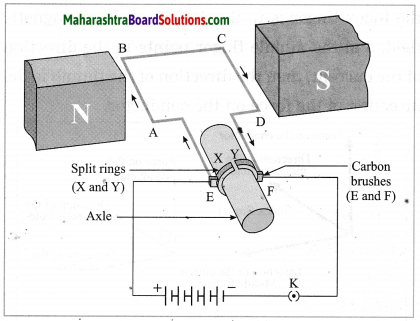
Figure shows the construction of an electric motor. Here, a rectangular loop ABCD of copper wire with resistive coating is placed between the north pole and south pole or a strong magnet, such as a horseshoe magnet, such that the branches AB and CD are perpendicular to the direction of the magnetic field. The ends of the loop are connected to the two halves, X and Y, of split rings X and Y have resistive coating on their inner surfaces and are tightly fitted on the axle. The outer conducting surfaces of X and Y are in contact with two stationary carbon brushes, E and F, respectively.
Maharashtra Board Class 10 Science Solutions Part 1 Chapter 4 Effects of Electric Current 1
Working:
1. When the circuit is completed with a plug key or switch, the current flows in the direction E → A → B → C → D → F. As the magnetic field is directed from the north pole to the south pole, the force on AB is downward and that on CD is upward by Fleming’s left hand rule. Hence, AB moves downward and CD upward. These forces are equal in magnitude and opposite in direction. Therefore, as observed from the side AD, the loop ABCD and the axle start rotating in anticlockwise direction.

2. After half a rotation, X and Y come in contact with brushes F and E respectively and the current flows in the direction EDCBAF. Hence the force on CD is downward and that on AB is upward. Therefore, the loop and the axle continue to rotate in the anticlockwise direction.

3. After every half rotation, the current in the loop is reversed and the loop and the axle continue to rotate in anti clockwise direction. When the current is switched off, the loop stops rotating after some time.

b. Electric Generator (AC)
Answer:
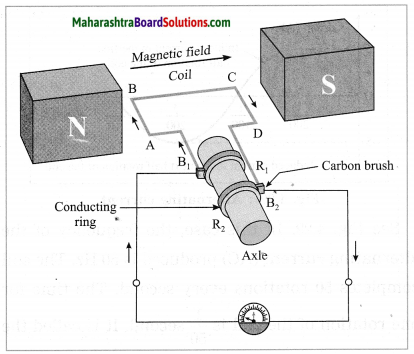
Figure shows the construction of an AC electric generator. Here, a coil ABCD of copper wire is kept between the pole pieces (N and S) of a strong magnet. The ends of the coil are connected to the conducting rings R1 and R2 via carbon brushes B1 and B2. The rings are fixed to the axle and there is a resistive coating in between the rings and the axle. The stationary brushes are connected to a galvanometer used to show the direction of the current in the circuit.
Maharashtra Board Class 10 Science Solutions Part 1 Chapter 4 Effects of Electric Current 2
Working:
When the axle is rotated with a machine from outside, the coil ABCD starts rotating. Suppose the coil rotates in clockwise direction, as observed from the side AD. Then as the branch AB moves upward, the branch CD moves downward. By Fleming’s right hand rule, the induced current flows in the direction A → B → C → D and in the external circuit, it flows from B2 to B, through the galvanometer. The induced current is proportional to the number of turns of the copper wire in the coil.

After half a rotation, AB and CD interchange their places. Hence, the induced current flows in the direction D → C → B → A. As AB is always in contact with B1 and CD is in contact with B2, the current in the external circuit flows from B1 to B2 through the galvanometer. Thus, the direction of the current is the external circuit is opposite to that in the previous half rotation. The process goes on repeating and alternating current is generated.

Maharashtra Board Class 10 Science Solutions Part 1 Chapter 4 Effects of Electric Current

4 Effects Of Electric Current Question 3.
Electromagnetic induction means
a. Charging of an electric conductor.
b. Production of magnetic field due to a current flowing through a coil.
c. Generation of a current in a coil due to relative motion between the coil and the magnet.
d. Motion of the coil around the axle in an electric motor.
Answer:
c. Generation of a current in a coil due to relative motion between the coil and the magnet.

Electric Current Question 4.
4. Explain the difference: AC generator and DC generator.
Answer:
AC generator:

  1. In an AC generator, the rings used are not split.
  2. The direction of the current produced reverses after equal intervals of time.

DC generator:

  1. In a DC generator, split rings are used.
  2. The current produced flows in the same direction all the time.

Question 5.
Which device is used to produce electricity? Describe with a neat diagram.
(1) Electric motor
(2) Galvanometer
(3) Electric generator (DC)
(4) Voltmeter
Answer:
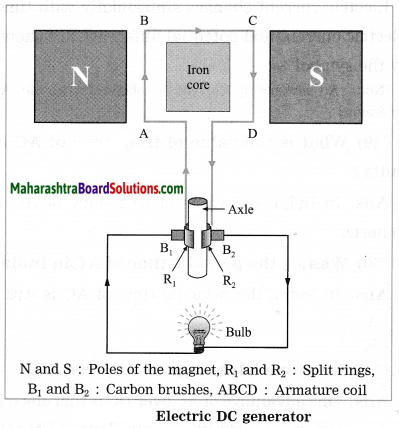
Electric generator (DC).
Maharashtra Board Class 10 Science Solutions Part 1 Chapter 4 Effects of Electric Current 3
Figure shows the construction of a DC generator.
Working: The axle is rotated with a machine from outside. When the armature coil of the generator rotates in the magnetic field, electric potential difference is produced in the coil due to electromagnetic induction. This produces a current as shown by the glowing of the bulb or by a galvanometer. The direction of the current depends on the sense of rotation of the coil.

In a DC generator, one brush is always in contact with the arm of the coil moving up while the other brush is in contact with the arm of the coil moving down in the magnetic field. Hence, the flow of the current in the circuit is always in the same direction and the current flows so long as the coil continues to rotate in the magnetic field.

[Note In the case of a DC generator, the current is in the same direction during both the halves of the rotation of the coil. The magnitude of the current does vary periodically with time. In this respect, it differs from the current supplied by an electric cell.]

Question 6.
How does the short circuit form? What is its effect?
Answer:
If a bare live wire (phase wire) and a bare neutral wire touch each other (come in direct contact) or come very close to each other, the resistance of the circuit becomes very small and hence huge (very high) electric current flows through it. This condition is called a short circuit or short circuiting.

In this case, a large amount of heat is produced and the temperature of the components involved becomes very high. Hence, the circuit catches fire.

Maharashtra Board Class 10 Science Solutions Part 1 Chapter 4 Effects of Electric Current

Question 7.
Give scientific reasons:
a. Tungsten is used to make a solenoid type coil in an electric bulb.
Answer:
1. The intensity of light emitted by the filament of a bulb depends on the temperature of the filament. It increases with the temperature.

2. The melting point of the material used to make the filament of a bulb should be very high so that the filament can be heated to a high temperature by passing a current through it, without melting it. This enables us to obtain more light. The melting point of tungsten is very high.

Hence, tungsten is used to make a solenoid type coil (filament) in an electric bulb.

b. In the electric equipment producing heat e.g. iron, electric heater, boiler, toaster, etc. an alloy such as Nichrome is used, not pure metals.
Answer:
1. The working of heating devices such as a toaster and an electric iron is based on the heating effect of electric current, i.e., conversion of electric energy into heat by passage of electric current through a metallic conductor.

2. An alloy, such as Nichrome, has high resistivity and it can be heated to a high temperature without oxidation, in contrast to pure metals. Therefore, the coils in heating devices such as a toaster and an electric iron are made of an alloy, such as Nichrome, rather than a pure metal.

c. For electric power transmission, copper or aluminium wire is used.
Answer:
1. Copper and aluminium are good conductors of electricity.

2. Copper, and aluminium have very low resistivity. Hence, when an electric current flows through a wire of copper or aluminium, heat produced is comparatively low. Therefore, for electric power transmission, copper or aluminium wire is used.

d. In practice the unit kWh is used for the measurement of electric energy, rather than the joule.
Answer:
(1) If an electric device rated 230 V, 5 A is operated for one hour, electric energy used
= VIt = 230 V × 5 A × 3600 s = 4140000 joules.

(2) If this energy is expressed in kW.h, it will be \(\frac{4140000}{3.6 \times 10^{6}}\) kW·h = 1.15 kW·h (more convenient). 3.6 × 10⁶
Hence, in practice the unit kW·h is used for the measurement of electric energy, rather than the joule.

Question 8.
Which of the statements given below correctly describes the magnetic field near a long, straight current-carrying conductor?
(1) The magnetic lines of force are in a plane, perpendicular to the conductor in the form of straight lines.
(2) The magnetic lines of force are parallel to the conductor on all the sides of conductor.
(3) The magnetic lines of force are perpendicular to the conductor going radially outward.
(4) The magnetic lines of force are in concentric circles with the wire as the center, in a plane perpendicular to the conductor.
Answer:
The magnetic lines of force are in concentric circles with the wire as the centre, in a plane perpendicular to the conductor.

Maharashtra Board Class 10 Science Solutions Part 1 Chapter 4 Effects of Electric Current

Question 9.
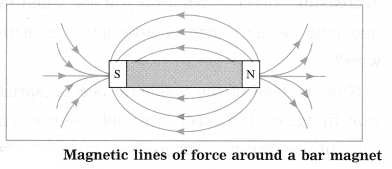
What is a solenoid? Compare the magnetic field produced by a solenoid with the magnetic field of a bar magnet. Draw neat figures and name various components.
Answer:
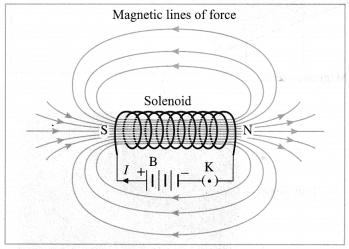
When a copper wire with a resistive coating is wound in a chain of loops (like a spring), it is called a solenoid.
Maharashtra Board Class 10 Science Solutions Part 1 Chapter 4 Effects of Electric Current 4
Magnetic lines of force (magnetic field lines) due to a current carrying solenoid.
B: Battery, K: Plug key, I: Current, N: North pole, S: South pole
Maharashtra Board Class 10 Science Solutions Part 1 Chapter 4 Effects of Electric Current 5
The magnetic field lines (magnetic lines of force) due to a current-carrying solenoid are similar to those of a bar magnet. One face of the coil acts as the south pole and the other face as the north pole.

[Note: A current-carrying coil, like a magnet, can be used to magnetise the rod of a given material such as carbon steel or chromium steel. With a strong megnetic field, permanent magnetism can be produced in these materials.]

Question 10.
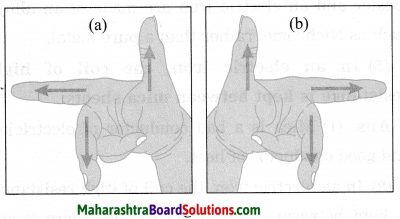
Name the following diagrams and explain the concept behind them.
Maharashtra Board Class 10 Science Solutions Part 1 Chapter 4 Effects of Electric Current 6
Answer:
(a) Fleming’s right hand rule:
Answer:
Stretch the thumb, the index finger and the middle finger of the right hand in such a way that they are perpendicular to each other. In this position, the thumb indicates the direction of the motion of the conductor, the index finger the direction of the magnetic field, and the middle finger shows the direction of the induced current.
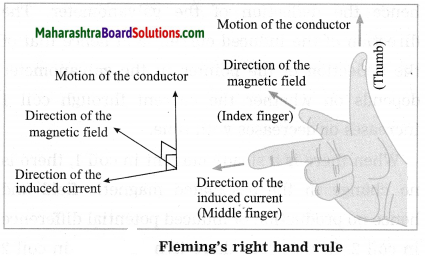
Maharashtra Board Class 10 Science Solutions Part 1 Chapter 4 Effects of Electric Current 7
[Note The induced current is maximum when the direction of motion of the conductor is at right angles to the magnetic field. ]

(b) Fleming’s left hand rule: The left hand thumb, index finger, and the middle finger are stretched so as to be perpendicular to each other. If the index finger is in the direction of the magnetic field, and the middle finger points in the direction of the current, then the direction of the thumb in the direction of the force on the conductor.
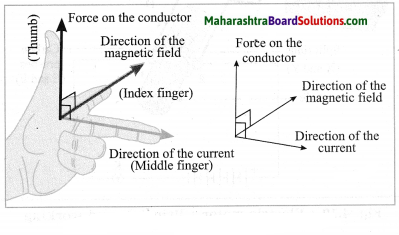
Maharashtra Board Class 10 Science Solutions Part 1 Chapter 4 Effects of Electric Current 8
[Note: A magnetic field exerts a force on a current-carrying conductor. Electric current is the time rate of flow of electric charge. Thus, a magnetic field exerts a force on a moving charge. This property is used to accelerate charged particles such as protons, deuterons and alpha particles, as well as electrons, to very high energies. A machine used for this purpose is called a charged particle accelerator. It may be linear or circular in design and very big in size. Such high energy particles are used to study the structure of matter. ]

Maharashtra Board Class 10 Science Solutions Part 1 Chapter 4 Effects of Electric Current

Question 11.
Identify the figures and explain their use.
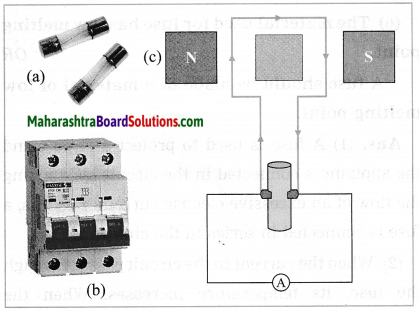
Maharashtra Board Class 10 Science Solutions Part 1 Chapter 4 Effects of Electric Current 9
Answer:
(a) Fuse:
A fuse protects electrical circuits and appliances by stopping the flow of electric current when it exceeds a specified value. For this, it is connected in series with the appliance (or circuit) to be protected. A fuse is a piece of wire made of an alloy of low melting point (e.g. an alloy of lead and tin). If a current larger than the specified value flows through the fuse, its temperature increases enough to melt it. Hence, the circuit breaks and the appliance is protected from damage.

[Note : The fuse wire is usually enclosed in a cartridge of an insulator such as glass or porcelain provided with metal caps. The current rating (such as 1 A, 2 A) may be printed on the cartridge. ]

(b) Miniature circuit breaker:
These days miniature circuit breaker (MCB) switches are used in homes. When the current in the circuit suddenly increases this switch opens and current stops. Different types of MCBs are in use. For the entire house, however the usual fuse wire is used.
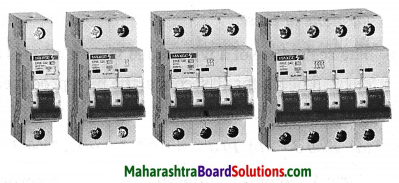
Maharashtra Board Class 10 Science Solutions Part 1 Chapter 4 Effects of Electric Current 10

(c) Figure shows the construction of a DC generator.
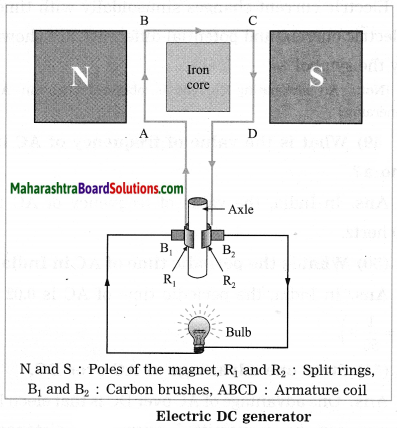
Maharashtra Board Class 10 Science Solutions Part 1 Chapter 4 Effects of Electric Current 11
Here, an ammeter is shown instead of a bulb.
Working: The axle is rotated with a machine from outside. When the armature coil of the generator rotates in the magnetic field, electric potential difference is produced in the coil due to electromagnetic induction. This produces a current as shown by the glowing of the bulb or by a galvanometer. The direction of the current depends on the sense of rotation of the coil.

In a DC generator, one brush is always in contact with the arm of the coil moving up while the other brush is in contact with the arm of the coil moving down in the magnetic field. Hence, the flow of the current in the circuit is always in the same direction and the current flows so long as the coil continues to rotate in the magnetic field.

Maharashtra Board Class 10 Science Solutions Part 1 Chapter 4 Effects of Electric Current

Question 12.
Solve the following examples.
a. Heat energy is being produced in a resistance in a circuit at the rate of 100 W. The current of 3 A is flowing in the circuit. What must be the value of the resistance?
Solution:
Data: P = 100 W, I = 3 A, R = ?, P = I2R
∴ Resistance, R = \(\frac{P}{I^{2}}=\frac{100 \mathrm{W}}{(3 \mathrm{A})^{2}}=\frac{100}{9} \Omega\) = 11.11 Ω

b. Two tungsten bulbs of wattage 100 W and 60 W power work on 220 V potential difference. If they are connected in parallel, how much current will flow in the main conductor?
Solution:
Data : P1 = 100 W, P2 = 60 W, V = 220 V,
I = ?, ∴ I = \(\frac{P}{V}\)
P = VI
∴ I1 = \(\frac{P_{1}}{V}\) and I2 = \(\frac{P_{2}}{V}\)
Current in the main conductor, I = I1 + I2 (parallel connection)

Maharashtra Board Class 10 Science Solutions Part 1 Chapter 4 Effects of Electric Current 12

c. Who will spend more electrical energy? 500 W TV set in 30 mins, or 600 W heater in 20 mins?
Solution:
Data : P1 = 500 W, t1 = 30 min = \(\frac{30}{60}\) h
= \(\frac{1}{2}\) h, P2 = 600 W, t2 = 20 min = \(\frac{20}{60}\) h = \(\frac{1}{3}\) h
Electrical energy used = Pt
TV set : P1t1 = 500 W × \(\frac{1}{2}\) h = 250 W·h
Heater : P2t2 = 600 W × \(\frac{1}{3}\) h = 200 W·h
Thus, the TV set will spend more electrical energy than the heater.

d. An electric iron of 1100 W is operated for 2 hours daily. What will be the electrical consumption expenses for that in the month of April? (The electric company charges ₹ 5 per unit of energy.)
Solution:
Data: P = 1100 W, t = 2 × 30 = 60 h,
₹ 5 per unit of energy, expenses = ?

Maharashtra Board Class 10 Science Solutions Part 1 Chapter 4 Effects of Electric Current 13
∴ Electrical consumption expenses = 66 units × ₹ 5 per unit = ₹ 330.

Project:
Do it your self.
Project 1.
Under the guidance of your teachers, make a ‘free-energy generator’.

Can you recall? (Text Book Page No. 47)

Question 1.
How do we decide that a given material is a good conductor of electricity or is an insulator?
Answer:
A material which has very low electrical resistance is called a good conductor of electricity. Examples: silver, copper, aluminium.
A material which has extremely high electrical resistance is called an insulator of electricity. Examples: rubber, wood, glass.

Maharashtra Board Class 10 Science Solutions Part 1 Chapter 4 Effects of Electric Current

Question 2.
Iron is a conductor of electricity, but when we pick up a piece of iron resting on the ground, why don’t we get electric shock?
Answer:
When we pick up a piece of iron resting on the ground, we don’t get electric shock because that piece does not carry any electric current at that time.

Use your brain power! (Text Book Page No. 48)

Question 1.
If in the circuit, the resistor is replaced by a motor, in which form will the energy given by the cell get transformed into?
Answer:
The energy given by the cell will get transformed into the kinetic energy of the copper coil in the motor.

Use your brain power! (Text Book Page No. 60)

Question 1.
Draw the diagram of a DC generator. Then explain as to how the DC current is obtained.
Answer:
Figure shows the construction of a DC generator.
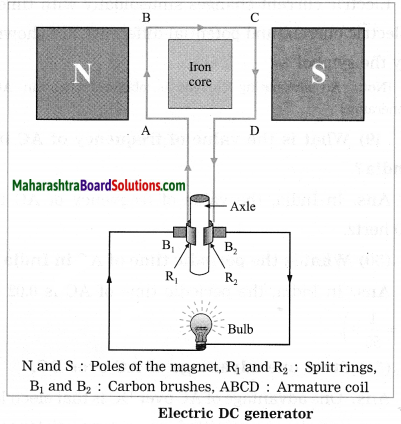
Maharashtra Board Class 10 Science Solutions Part 1 Chapter 4 Effects of Electric Current 14
Working:
The axle is rotated with a machine from outside. When the armature coil of the generator rotates in the magnetic field, electric potential difference is produced in the coil due to electromagnetic induction. This produces a current as shown by the glowing of the bulb or by a galvanometer. The direction of the current depends on the sense of rotation of the coil.

In a DC generator, one brush is always in contact with the arm of the coil moving up while the other brush is in contact with the arm of the coil moving down in the magnetic field. Hence, the flow of the current in the circuit is always in the same direction and the current flows so long as the coil continues to rotate in the magnetic field.

[Note In the case of a DC generator, the current is in the same direction during both the halves of the rotation of the coil. The magnitude of the current does vary periodically with time. In this respect, it differs from the current supplied by an electric cell.]

Fill in the blanks and rewrite the completed statements:

Question 1.
Electric power = V2/…….
Answer:
Electric power = \(\frac{V^{2}}{R}\)

Question 2.
……….= 1 joule/1 second.
Answer:
1 watt = 1 joule /1 second.

Question 3.
1 kW.h =………J.
Answer:
1 kW.h = 3.6 x 10⁶ J.

Question 4.
According to Joule’s law, quantity of heat (H) produced by an electric current =……….
Answer:
According to Joule’s law, quantity of heat (H) produced by an electric current = I2Rt or VIt or \(\frac{V^{2}}{R}\)t

Question 5.
Magnetic effect of electric current was dicovered by………..
Answer:
Magnetic effect of electric current was dicovered by Hans Christian Oersted.

Maharashtra Board Class 10 Science Solutions Part 1 Chapter 4 Effects of Electric Current

Question 6.
………..is expressed in oersted.
Answer:
Intensity of magnetic field is expressed in oersted.

Question 7.
Electromagnetic induction was discovered by………..
Answer:
Electromagnetic induction was discovered by Michael Faraday and independently by Joseph Henry.

Question 8.
A galvanometer is used for………
Answer:
A galvanometer is used for detecting the presence of current in a circuit, as well as for some electrical measurements.

Question 9.
In India, the frequency of alternating current is……….
Answer:
In India, the frequency of alternating current is 50 Hz or 50 cycles per second.

Question 10.
Electric motor converts electric energy into………energy.
Answer:
Electric motor converts electric energy into mechanical energy.

Question 11.
Electric generator converts………..energy into electric energy.
Answer:
Electric generator converts mechanical energy into electric energy.

Rewrite the following statements by selecting the correct options:

Question 1.
The device used for producing a current is called……….
(a) a voltmeter
(b) an ammeter
(c) a galvanometer
(d) a generator
Answer:
(d) a generator

Question 2.
At the time of short circuit, the current in the circuit………
(a) increases
(b) decreases
(c) remains the same
(d) increases in steps
Answer:
(a) increases

Question 3.
The direction of the magnetic field around a straight conductor carrying current is given by……
(a) the right hand thumb rule
(b) Fleming’s left hand rule
(c) Fleming’s right hand rule
(d) none of these
Answer:
(a) the right hand thumb rule

Maharashtra Board Class 10 Science Solutions Part 1 Chapter 4 Effects of Electric Current

Question 4.
The resistance of a wire is 100 Ω. If it carries a current of 1A for 10 seconds, the heat produced will be……….
(a) 1000 J
(b) 10 J
(c) 0.1 J
(d) 10000 J
Answer:
(a) 1000 J

Question 5.
If 220 V potential difference is applied across an electric bulb, a current of 0.45 A flows in the bulb. What must be the power of the bulb? (Practice Activity Sheet – 1)
(a) 99 W
(b) 70 W
(c) 45 W
(d) 22 W
Answer:
(a) 99 W

Question 6.
Electromagnetic induction means
(a) charging of an electric conductor.
(b) production of magnetic field due to a current flowing through a coil.
(c) generation of a current in a coil due to relative motion between the coil and the magnet.
(d) motion of the coil around the axle in an electric motor.
Answer:
(c) generation of a current in a coil due to relative motion between the coil and the magnet.

Question 7.
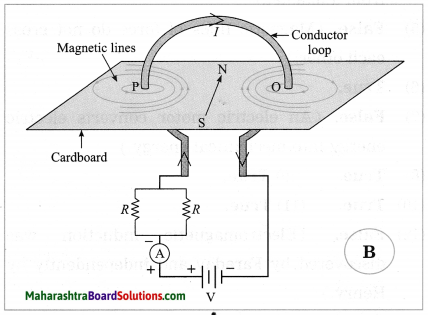
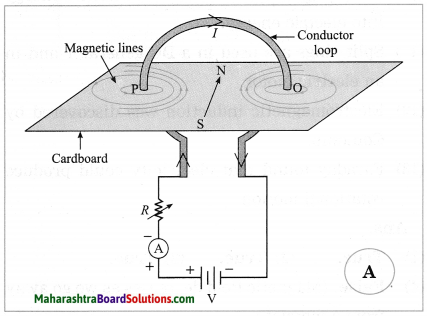
Write the correct option by observing the figures. (Practice Activity Sheet – 2)
Maharashtra Board Class 10 Science Solutions Part 1 Chapter 4 Effects of Electric Current 15
Maharashtra Board Class 10 Science Solutions Part 1 Chapter 4 Effects of Electric Current 16
(a) Magnetic field in A is stronger.
(b) Magnetic field in B is stronger.
(c) Magnetic fields in A and B are same.
(d) Magnetic fields in A and B are weaker.
Answer:
(b) Magnetic field in B is stronger.
[Explanation : The resistance in circuit B is less (parallel combination) than that in A. Hence, the current in B is more than that in A. Therefore, the magnetic field in B is stronger than that in A.]

Question 8.
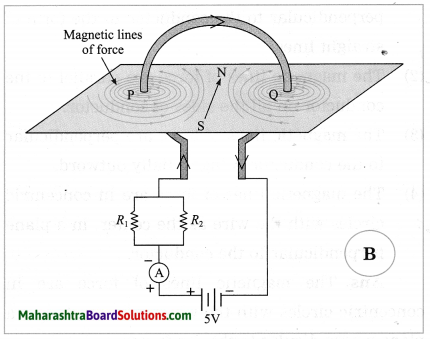
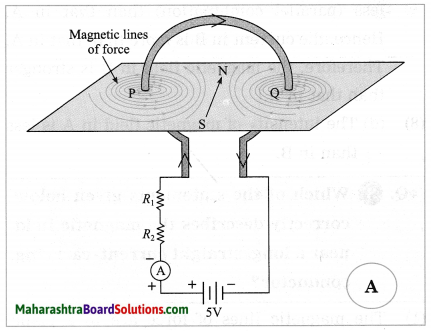
Observe the following diagram and choose the correct alternative: (March 2019)
Maharashtra Board Class 10 Science Solutions Part 1 Chapter 4 Effects of Electric Current 17
Maharashtra Board Class 10 Science Solutions Part 1 Chapter 4 Effects of Electric Current 18
(a) The intensity of magnetic field in A is larger than in B.
(b) The intensity of magnetic field in B is less than in A.
(c) The intensity of magnetic field in A and B is same.
(d) The intensity of magnetic field in A is less than in B.
Answer:
(d) The intensity of magnetic field in A is less than in B.

State whether the following statements are true or false. (If a statement is false, correct it and rewrite it.) :

Question 1.
Electric power = I2R.
Answer:
True.

Question 2.
Magnetic poles exist in pairs.
Answer:
True.

Question 3.
Electromagnetism was discovered by Oersted.
Answer:
True.

Maharashtra Board Class 10 Science Solutions Part 1 Chapter 4 Effects of Electric Current

Question 4.
Magnetic field increases as we go away from a magnet.
Answer:
False. (Magnetic field decreases as we go away from a magnet.)

Question 5.
Magnetic lines of force cross each other.
Answer:
False. (Magnetic lines of force do not cross each other.)

Question 6.
Electric generator is used to generate current.
Answer:
True.

Question 7.
An electric motor converts mechanical energy into electric energy.
Answer:
False. (An electric motor converts electric energy into mechanical energy.)

Question 8.
In India, the frequency of AC is 50 Hz.
Answer:
True.

Question 9.
The electricity meter in the domestic electric circuit measures electrical energy consumption in kilowatt·hours.
Answer:
True.

Question 10.
Electric generator converts mechanical energy into electric energy.
Answer:
True.

Question 11.
Split rings are used in a DC generator and in an electric motor.
Answer:
True.

Question 12.
Electromagnetic induction was discovered by Coulomb.
Answer:
False. (Electromagnetic induction was discovered by Faraday and independently by Henry.)

Question 13.
Faraday found that electricity could produce rotational motion.
Answer:
True.

Tell the odd one out. Give proper explanation:

Quesrtion 1.
Find the odd one out and justify it.
Fuse wire, M.C.B., rubber gloves, generator. (Practice Activity Sheet – 3)
Answer:
Generator. It converts mechanical energy into electric energy. All others are related to safety measures to avoid mishap due to electricity.

Match the columns:

Column IColumn II
1. The right hand thumb rulea. The direction of the force on a current-carrying conductor placed in a magnetic field.
2. Fleming’s right hand ruleb. The direction of the magnetic field around a straight conductor carrying a current.
3. Fleming’s left hand rulec. The direction of induced current in a conductor.

Answer:
(1) The right hand thumb rule – The direction of the magnetic field around a straight conductor carrying a current.
(2) Fleming’s right hand rule – The direction of induced current in a conductor.
(3) Fleming’s left hand rule – The direction of the force on a current-carrying conductor placed in a magnetic field.

Maharashtra Board Class 10 Science Solutions Part 1 Chapter 4 Effects of Electric Current

Name the following:

Question 1.
The negatively charged particle considered as a free particle moving in a metallic conductor.
Answer:
Electron.

Question 2.
The quantity expressed in ampere.
Answer:
Electric current.

Question 3.
The quantity expressed in ohm.
Answer:
Electric resistance.

Question 4.
The quantity expressed in volt.
Answer:
Electric potential.

Question 5.
The quantity expressed in joule.
Answer:
Work (and energy).

Question 6.
The quantity expressed in watt.
Answer:
Power.

Question 7.
The quantity expressed in kilowatt-hour.
Answer:
Electric energy.

Question 8.
A component used to control the current.
Answer:
Resistor.

Question 9.
An instrument used to measure electric current.
Answer:
Ammeter

Question 10.
An instrument used to measure electric potential difference.
Answer:
Voltmeter.

Question 11.
The ratio of the work done to the quantity of charge transferred.
Answer:
Electric potential difference.

Question 12.
An alloy of Ni, Cr, Mn and Fe.
Answer:
Nichrome.

Question 13.
The SI unit of resistance.
Answer:
The ohm.

Question 14.
A metal used to make the filament of an electric bulb.
Answer:
Tungsten.

Question 15.
An alloy used to prepare a coil of high resistance for use in electric appliances such as an electric heater.
Answer:
Nichrome.

Question 16.
Constituents of the alloy used to make a fuse wire.
Answer:
Lead and tin.

Question 17.
The unit same as the watt·second.
Answer:
The joule.

Question 18.
A unit for intensity of magnetic field.
Answer:
The oersted.

Question 19.
The scientist in whose honour the SI unit of power is named.
Answer:
James Watt

Maharashtra Board Class 10 Science Solutions Part 1 Chapter 4 Effects of Electric Current

Question 20.
A device that converts electric energy into mechanical energy.
Answer:
Electric motor.

Question 21.
A device that converts mechanical energy into electric energy.
Answer:
Electric generator.

Answer the following questions in one sentence each :

Question 1.
What is the production of magnetism by an electric current called?
Answer:
The production of magnetism by an electric current is called electromagnetism.

Question 2.
Is magnetic field a scalar or a vector?
Answer:
Magnetic field is a vector.

Question 3.
In India, what is the time interval in which AC changes direction?
Answer:
In India, AC changes direction every \(\frac{1}{100}\) s.

Question 4.
What is the periodic time of AC in India?
Answer:
In India, the periodic time of AC \(\frac{1}{50}\) is

Answer the following questions:

Question 1.
Define electric power.
Answer:
Electric power is the electric work done per unit time.
OR
Electric power is the rate at which electric energy is used.

Question 2.
State the formula for electric power. Hence, obtain its SI unit.
Answer:
Electric power (P) =

Maharashtra Board Class 10 Science Solutions Part 1 Chapter 4 Effects of Electric Current 19
The SI unit of work is the joule and that of time is the second. Hence, the SI unit of power is the joule per second. It is given the special name: the watt (W). One watt equals one joule per second.
W = VIt = I2Rt = \(\frac{V^{2}}{R}\) t
∴ P = W/t = VI = I2R = V2/R.
Here, V is the potential difference applied across an electrical appliance, R is the resistance of the appliance and I is the current through the appliance.

[ Note The SI unit of power, the watt, is named in honour of James Watt (1736-1819), British instrument maker and engineer. ]

Maharashtra Board Class 10 Science Solutions Part 1 Chapter 4 Effects of Electric Current

Question 3.
What is the commercial unit of electric energy? Obtain the relation between this unit and the SI unit of energy.
Answer:
The commercial unit of electric energy is the kilowatt·hour (kW·h) and the SI unit of energy is the joule (J).
1 kW·h = 103 \(\frac{J}{s}\) × 3600 s s
= 3.6 × 10⁶ J
[Note: The kilowatt-hour is often called simply the unit. (See the energy bill, i.e., the electricity bill.)]

Question 4.
What is one kilowatt.hour?
Answer:
One kilowatt-hour is the electric energy used in one hour by an electrical appliance of power one kilowatt. It is equal to 3.6 × 10⁶ J.

Question 5.
What is heating effect of electric current? What is its origin?
Answer:
The production of heat in a resistance due to the electric current flowing through it when it is connected in an electrical circuit, is called the heating effect of electric current.

When a potential difference is applied across a metallic conductor, free electrons in the conductor move from the end at the lower potential to the end at the higher potential giving rise to electric current. These electrons collide with the atoms and positive ions and transfer some kinetic energy to them. This energy is converted into heat. Hence, the temperature of the conductor begins to rise i.e., the conductor becomes hot. This is the origin of the heating effect of electric current.

Question 6.
Statement 1: Electric current (flow of electrons) creates heat in a resistor.
Statement 2: Heat in the resistor is created according to the law of energy conservation.
Explain Statement 1 with the help of Statement 2. (Practice Activity Sheet – 2)
Answer:
(1) When electrons flow through a resistor (during flow of electric current) electrons possess kinetic energy.
(2) During the flow of electrons there is a decrease in the kinetic energy of the electrons due to collisions with atoms, ions and molecules.
(3) According to the law of conservation of energy, this decrease in the kinetic energy of the electrons gets converted into heat.

Question 7.
State Joule’s law about heating effect of electric current.
Answer:
Joule’s law about heating effect of electric current: The quantity of heat produced in a conductor when a current flows through it is directly proportional to (1) the square of the current (2) the resistance of the conductor (3) the time for which the current flows.

Maharashtra Board Class 10 Science Solutions Part 1 Chapter 4 Effects of Electric Current

Question 8.
Obtain the mathematical expression for the heat generated in a metallic conductor by electric current (Joule’s law).
Answer:
If V is the potential difference applied across a metallic conductor of resistance R, the current through the conductor, given by Ohm’s law, is
I = V/R ……(1)
The charge passing through the conductor in time t when the current I flows in the conductor is
Q = It…….(2)
The work done in this process is W = VQ …..(3)
From Eqs. (1), (2) and (3), we have,
W = (IR) (It) = I2Rt = VIt
= \(V\left(\frac{V}{R}\right) t=\frac{V^{2}}{R} t\)
This work is converted into heat.
When I is expressed in ampere, R in ohm, t in second and V in volt, W is expressed in joule. In that case,
W = I2Rt = VIt = \(\frac{V^{2}}{R}\) t (in joule)
Usually heat energy (H) is expressed in calorie. Using the relation 4.18 J = 1 cal, we have
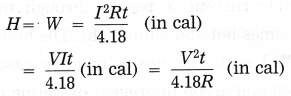
Maharashtra Board Class 10 Science Solutions Part 1 Chapter 4 Effects of Electric Current 20
This is the required equation.

Question 9.
Two dissimilar bulbs are connected in series. Which bulb will be brighter? (Hint: Consider the resistance of each bulb.)
Answer:
The bulb of higher resistance will be brighter, assuming that the filaments of the two bulbs have the same length and the same area of cross section, but are made of metals with different resistivities.

[Explanation Heat produced (H) in time t = I2Rt , where I is the current through a conductor and R is the resistance of the conductor. In a series combination, the current through each conductor is the same. ∴ H ∝ R for a given t. Hence, the bulb with higher R will become more hot and hence emit more light energy per second. Here it is assumed that the filaments of the two bulbs have the same length and the same area of cross section, but are made of metals with different resistivities.]

Question 10.
Name any six domestic appliances whose working is based on the heating effect of electric current.
(OR)
State applications of heating effect of electric current.
Answer:
Domestic appliances whose working is based on the heating effect of electric current:

  1. Electric heater
  2. Electric iron
  3. Electric oven
  4. Electric toaster
  5. Electric kettle
  6. Electric geyser
  7. Fuse.

Some other applications of heating effect of electric current:

  1. Electric bulb
  2. Electric furnace
  3. In industry for soldering, welding, cutting, drilling
  4. In surgery for cutting tissues with a finely heated platinum wire.

Maharashtra Board Class 10 Science Solutions Part 1 Chapter 4 Effects of Electric Current

Question 11.
Explain the application of heating effect of electric current in an electric bulb.
Answer:
In an electric bulb, there is a filament of metal such as tungsten having high melting point. When an electric current is passed through the filament, it becomes hot and emits light. The bulbs are usually filled with chemically inactive gases such as nitrogen and argon to prevent oxidation of the filament and hence prolong their life.

Question 12.
Why is tungsten used to make solenoid type coil in an electric bulb? (Practice Activity Sheet – 3)
Answer:
Tungsten is used to make solenoid type coil in an electric bulb for the following reasons:

  1. Tungsten has high resistance and high melting point (nearly 3422° C).
  2. Using current, it can be heated to high temperature so that it emits more light.

Question 13.
Explain the application of heating effect of electric current in an electric iron.
Answer:
In an electric iron, a coil of high resistance is held between mica sheets and placed inside a heavy metal block provided with a handle made of an insulator such as plastic. When an electric current is passed through the coil, it becomes hot. Mica is a good conductor of heat. Hence, heat produced in the coil is transferred to the metal block which can then be used for ironing clothes.
Mica is a bad conductor of electricity. Hence, there is no electrical contact between the coil and the metal block. Therefore, the person using the iron does not get an electric shock even if he or she happens to touch it by chance.

Question 14.
Take any electricity bill of your home. In the bill there is one table which shows the units consumed by you for the last eleven months. Find the average consumption of electricity in your home for each season (i.e., summer, winter and rainy season). Are they the same? Why?
Answer:
The units consumed, on an average, in a home are different for each season.
The energy requirement depends very much on the temperature of the surroundings. For example, a refrigerator, electric fans, an air conditioner, etc. are used more in summer than in winter or rainy season. On the contrary, an electric heater, geyser, etc., are used more in winter than in summer. Hence, there is variation in the average consumption of electricity from season to season.

Question 15.
Name the types of wires or cables used in the electric power supply provided by the State Electricity Board for houses and factories.
Answer:
The wires or cables used in the electric power supply provided by the State Electricity Board are of three types:

  1. phase wire (or live wire, the wire that carries an electric current)
  2. Neutral wire
  3. The earth wire.

Maharashtra Board Class 10 Science Solutions Part 1 Chapter 4 Effects of Electric Current

Question 16.
In a domestic electric supply in India, what is the potential difference between the live wire and the neutral wire?
Answer:
In a domestic electric supply in India, the potential difference between the live wire and the neutral wire is 220 V.
[Note: AC is used in domestic electric supply.]

Question 17.
Name the type of wire to which the main fuse is connected.
Answer:
The main fuse is connected to the live wire (phase wire).

Question 18.
What does the electricity meter measure?
Answer:
The electricity meter measures electric energy consumption. It is expressed in ‘units’, where 1 unit means 1 kilowatt·hour ( = 3.6 × 10⁶ joules).

Question 19.
Is the electric potential difference across each appliance (in a domestic electric circuit) the same?
Answer:
Yes, the electric potential difference across each appliance (in a domestic electric circuit) is the same.

Question 20.
Name the types of wire across which an electric appliance is connected.
Answer:
An electric appliance is connected across the live wire (phase wire) and the neutral wire.

Question 21.
Electrical appliances are connected in parallel. What are the advantages of this arrangement?
Answer:
In the parallel arrangement of electric appliances, the applied potential difference is the same in each case. Further, even if one of the appliances does not work or is removed for repairing, the other appliances can still be used.

Question 22.
In a domestic electric supply, if two bulbs are connected in series instead of parallel, what will happen if the filament of one of the bulbs breaks?
Answer:
In a domestic electric supply, if two bulbs are connected in series instead of parallel, if the filament of one of the bulbs breaks, there will be no current through the other bulb as well even if the circuit is switched on. Hence the good bulb will also not glow.

Maharashtra Board Class 10 Science Solutions Part 1 Chapter 4 Effects of Electric Current

Question 23.
What is overloading? When does it occur? What does it cause? How can overloading be avoided?
Answer:
A flow of large amount of current in a circuit, beyond the permissible value of current, is called overloading.

It occurs when many electrical appliances of high power rating, such as a geyser, a heater, an oven, a motor, etc., are switched on simultaneously. This causes fire.

Overloading can be avoided by not connecting many electrical appliances of high power rating in the same circuit.

Question 24.
Explain the application of heating effect of electric current in a fuse.
Answer:
A fuse protects electrical circuits and appliances by stopping the flow of electric current when it exceeds a specified value. For this, it is connected in series with the appliance (or circuit) to be protected. A fuse is a piece of wire made of an alloy of low melting point (e.g. an alloy of lead and tin). If a current larger than the specified value flows through the fuse, its temperature increases enough to melt it. Hence, the circuit breaks and the appliance is protected from damage.

[Note: The fuse wire is usually enclosed in a cartridge of an insulator such as glass or porcelain provided with metal caps. The current rating (such as 1 A, 2 A) may be printed on the cartridge. ]

Question 25.
State the conclusions that can be drawn from Oersted’s experiment. (For reference, see the experiment described on page 51 of the textbook.)
Answer:
Conclusions that can be drawn from Oersted’s experiment:
1. An electric current produces a magnetic field around it. The moving charge in the conducting wire is a source of magnetic field.

2. The direction of the magnetic field produced by the current is the direction in which the north pole of the magnetic needle is deflected. Hence, from the experimental observations we can conclude that at any point near the current-carrying conductor, the magnetic field is perpendicular to (i) the length of the conductor and (ii) the line joining the conductor and the given point.

Maharashtra Board Class 10 Science Solutions Part 1 Chapter 4 Effects of Electric Current

Question 26.
What is the effect on the magnetic needle in Oersted’s experiment, when (1) a current is passed through the wire (2) the current through the wire is increased (3) the current through the wire is stopped (4) the current through the wire is reversed (5) the distance between the magnetic needle and the wire is increased, keeping the current through the wire constant?
Answer:
In Oersted’s experiment, when there is no current in the wire, the magnetic needle is at rest along the north-south direction.
(1) When a current is passed through the wire, the needle is deflected.
(2) When the current through the wire is increased, the deflection of the needle increases.
(3) When the current through the wire is stopped, the needle comes to rest in its original position along the north-south direction.
(4) When the current through the wire is reversed, the needle is deflected in the direction opposite to that in the first case.
(5) When the distance between the magnetic needle and the wire is increased, keeping the current through the wire constant, the deflection of the needle becomes less.

Question 27.
State the factors on which the magnitude of the magnetic field due to a current-carrying conductor depends and how it depends.
Answer:
The magnetic field at a point due to a current-carrying conductor depends on the current through the conductor and the distance of the point from the conductor.

  1. The magnitude of the magnetic field produced at a given point is directly proportional to the magnitude of the current passing through the conductor.
  2. The magnitude of the magnetic field produced by a given current in the conductor decreases as the distance from the conductor increases.

[Note If the direction of the current is reversed, the direction of the magnetic field is also reversed.]

Question 28.
State the right hand thumb rule.
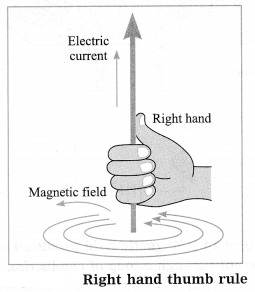
Answer:
Imagine that you have held a current-carrying straight conductor in your right hand in such a way that your thumb points in the direction of the current. Then turn your fingers around the conductor. The direction of the fingers in the direction of the magnetic lines of force produced by the current.
Maharashtra Board Class 10 Science Solutions Part 1 Chapter 4 Effects of Electric Current 21

Maharashtra Board Class 10 Science Solutions Part 1 Chapter 4 Effects of Electric Current

Question 29.
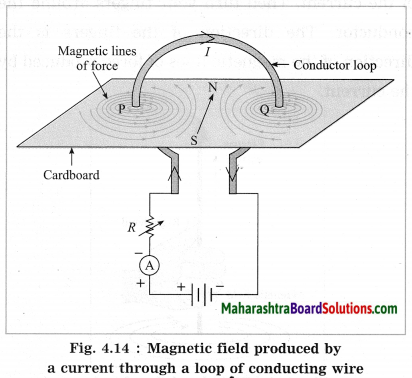
With a neat labelled diagram, describe the pattern of magnetic lines of force due to a current through a circular loop. Also explain how the magnetic field depends on the number of turns (n) in the loop.
Answer:
The pattern of magnetic lines of force due to a current through a circular loop is shown in Figure
Maharashtra Board Class 10 Science Solutions Part 1 Chapter 4 Effects of Electric Current 22
(I: Current, R: Resistance, A: Ammeter)
1. It is seen that every point of the loop forms a centre of a large number of concentric magnetic lines of force forming a series. The circles are small near the wire and become large as we move away from the wire. At the centre of the loop, the arcs of these circles appear as straight lines because of very large radius of the circle.

2. The magnetic field produced by a current-carrying wire at a given point is directly proportional to the current through the wire. If the loop has n turns, the field produced is n times that produced by a single turn (assuming that all the turns have practically the same radius and are in the same plane). The reason is the current in each turn has the same direction and the field due to each turn contributes equally to the total field.

Question 30.
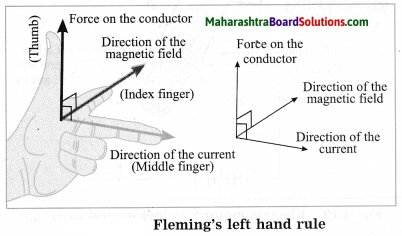
Write Fleming’s left hand rule.
Answer:
Fleming’s left hand rule: The left hand thumb, index finger, and the middle finger are stretched so as to be perpendicular to each other. If the index finger is in the direction of the magnetic field, and the middle finger points in the direction of the current, then the direction of the thumb in the direction of the force on the conductor.
Maharashtra Board Class 10 Science Solutions Part 1 Chapter 4 Effects of Electric Current 23

[Note: A magnetic field exerts a force on a current-carrying conductor. Electric current is the time rate of flow of electric charge. Thus, a magnetic field exerts a force on a moving charge. This property is used to accelerate charged particles such as protons, deuterons and alpha particles, as well as electrons, to very high energies. A machine used for this purpose is called a charged particle accelerator. It may be linear or circular in design and very big in size. Such high energy particles are used to study the structure of matter. ]

Question 31.
What is electric motor?
Answer:
A device that converts electric energy into mechanical energy is called an electric motor.

Question 32.
State the principle on which the working of an electric motor is based.
Answer:
An electric motor works on the principle that a current-carrying conductor placed in a magnetic field experiences a force. In this case, the forces acting on different parts of the coil of the motor produce the rotational motion of the coil.

Maharashtra Board Class 10 Science Solutions Part 1 Chapter 4 Effects of Electric Current

Question 33.
State the uses/applications of an electric motor.
Answer:
Uses/applications of an electric motor:

  1. In domestic appliances such as a mixer, a blender, a refrigerator and washing machine.
  2. In an electric fan, a hair dryer, a record player, a tape recorder and a blower.
  3. In an electric car, a rolling mill, an electric crane, an electric lift, a pump, a computer and an electric train.

Question 34.
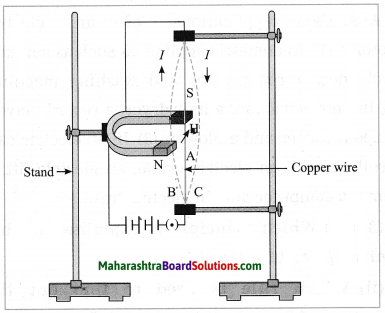
(i) Which principle is explained in this figure?
Maharashtra Board Class 10 Science Solutions Part 1 Chapter 4 Effects of Electric Current 24
(ii) Which rule is used to find out the direction of force in this principle?
(iii) In which machine is this principle used? Draw a diagram showing the working of that machine. (Practice Activity Sheet – 2)
Answer:
(i) A force is exerted on a current-carrying conductor in the presence of a magnetic field.
(ii) Fleming’s left hand rule is used.
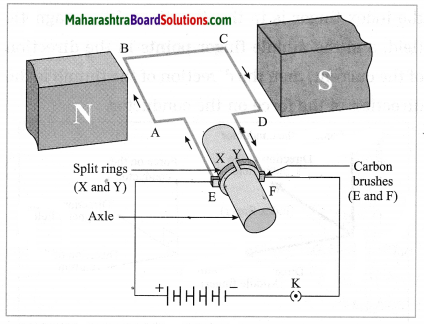
(iii) Electric motor.
Scientifically and technically correct figure.
Maharashtra Board Class 10 Science Solutions Part 1 Chapter 4 Effects of Electric Current 25

Question 35.
Observe the following diagram and answer the questions. (Practice Activity Sheet – 1)
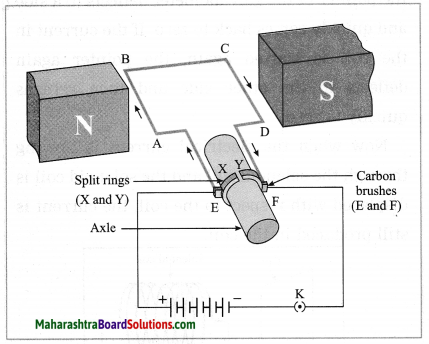
(a) Construction of which equipment does the following diagram show?
Maharashtra Board Class 10 Science Solutions Part 1 Chapter 4 Effects of Electric Current 26
(b) On which principle does this equipment work?
(c) According to which law does the coil ABCD rotate?
(d) Write the law in your own words.
(e) Where is this equipment used?
Answer:
(a) Given diagram shows the construction of an electric motor.

(b) An electric motor works on the principle that a current-carrying conductor placed in a magnetic field experiences a force. In this case, the forces acting on different parts of the coil of the motor produce the rotational motion of the coil.

(c) The rotation of the coil is based on Fleming’s left hand rule.

(d) Fleming’s left hand rule: The left hand thumb, index finger, and the middle finger are stretched so as to be perpendicular to each other. If the index finger is in the direction of the magnetic field, and the middle finger points in the direction of the current, then the direction of the thumb in the direction of the force on the conductor.

(e) Uses / applications of an electric motor: (1) In domestic appliances such as a mixer, a blender, a refrigerator and washing machine. (2) In an electric fan, a hair dryer, a record player, a tape recorder and a blower. (3) In an electric car, a rolling mill, an electric crane, an electric lift, a pump, a computer and an electric train.

Maharashtra Board Class 10 Science Solutions Part 1 Chapter 4 Effects of Electric Current

Question 36.
Study the following principle and answer the questions. (Practice Activity Sheet – 4)
A force is excreted on a current-carrying conductor placed in a magnetic field. The direction of this force depends on both the direction of the current and the direction of the magnetic field. This force is maximum when the direction of the current is perpendicular to the direction of the magnetic field.
(a) By which law can we determine the direction of the force excreted on the current-carrying conductor?
(b) In which electrical equipment is this principle used?
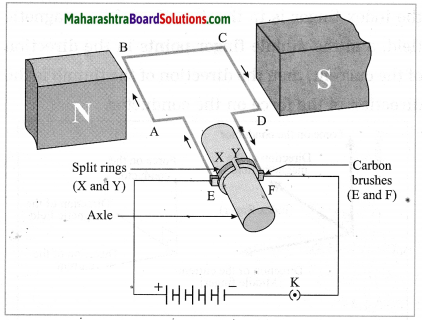
(c) Draw a diagram representing the construction of this equipment.
(d) Write the working of this equipment in brief.
Answer:
(a) Fleming’s left hand rule.
(b) Electric motor,
(c)
Maharashtra Board Class 10 Science Solutions Part 1 Chapter 4 Effects of Electric Current 27
(d) Working:
1. When the circuit is completed with a plug key or switch, the current flows in the direction E → A → B → C → D → F. As the magnetic field is directed from the north pole to the south pole, the force on AB is downward and that on CD is upward by Fleming’s left hand rule. Hence, AB moves downward and CD upward. These forces are equal in magnitude and opposite in direction. Therefore, as observed from the side AD, the loop ABCD and the axle start rotating in anticlockwise direction.

2. After half a rotation, X and Y come in contact with brushes F and E respectively and the current flows in the direction EDCBAF. Hence the force on CD is downward and that on AB is upward. Therefore, the loop and the axle continue to rotate in the anticlockwise direction.

3. After every half rotation, the current in the loop is reversed and the loop and the axle continue to rotate in anticlockwise direction.
When the current is switched off, the loop stops rotating after some time.

Question 37.
What is a galvanometer used for? Explain in brief the working of a galvanometer.
Answer:
Galvanometer is a sensitive device used to detect the presence of current in a circuit as well as to determine the direction of the current in the circuit.

With suitable modification, it can be used to measure charge, current and voltage. Its working is based on the same principle as that of an electric motor. Here, a coil is pivoted (or suspended) between the pole pieces of a magnet and a pointer is connected to the coil. As the coil rotates when a current is passed through it, the pointer also rotates. The rotation of the coil and hence the deflection of the coil is proportional to the current. The pointer deflects on both sides of the Central zero mark depending on’ the direction of the current.

Question 38.
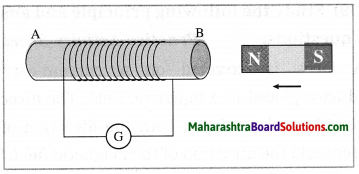
Take a coil AB having 10-15 turns. Connect the two ends of the coil to the galvanometer as shown in Figure. Take a strong bar magnet. (1) Move the north pole of the magnet towards the end B of the coil.
Maharashtra Board Class 10 Science Solutions Part 1 Chapter 4 Effects of Electric Current 28
Observe the deflection of the pointer in the galvanometer. Note the direction of the deflection (i.e. right or left). (2) Now repeat this with the south pole of the magnet towards the end B of the coil. Again observe the deflection. Note its direction. (3) What will happen if instead of the magnet, the coil is moved? (4) If both the coil and the magnet are kept stationary, do you observe any deflection? (5) Compare the direction of the deflection when the north pole of the magnet is moved towards the end B of the coil with that when the end B of the coil is moved away from the north pole of the magnet. (6) What conclusions do you draw from the observations?
Answer:
Observations:
The two deflections, in parts (1) and (2) of the experiment, are in the opposite directions.

(3) If instead of the magnet, the coil is moved towards the stationary magnet, the deflection of the pointer in the galvanometer is observed in one direction, while if the coil is moved away from the magnet, the deflection is observed in the opposite direction. The effect of moving the north pole of the magnet towards the coil and the effect of moving the coil towards the north pole of the magnet are the same.

(4) If both the coil and the magnet are kept stationary, no deflection is observed.

(5) The two deflections are in opposite directions.

(6) Whenever there is relative motion of the coil and the magnet, electric potential difference is induced in the circuit which gives rise to, i.e., induces, an electric current in the circuit causing the deflection of the pointer in the galvanometer. The direction of the current and hence that of the deflection of the pointer in the galvanometer depends on which pole of the magnet faces the coil as well as the direction of relative motion.

[Note: If the velocity of the magnet is increased, the induced current increases, and hence the deflection of the pointer in the galvanometer increases.]

Maharashtra Board Class 10 Science Solutions Part 1 Chapter 4 Effects of Electric Current

Question 39.
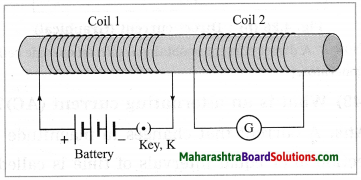
Take two coils of about 50 turns. Insert them over a nonconducting cylindrical roll as shown in Figure.
Maharashtra Board Class 10 Science Solutions Part 1 Chapter 4 Effects of Electric Current 29
(A thick paper roll can be used.) Connect coil 1 to a battery with a plug key K. Connect coil 2 to a galvanometer G. (1) Plug the key and observe the deflection in the galvanometer. (2) Unplug the key and again observe the deflection.
Note your observations. What conclusions do you draw from these observations?
Answer:
Observations :
1. When the key is plugged, the galvanometer shows a momentary deflection. When the current in coil 1 becomes steady, the galvanometer shows zero deflection, i.e., its pointer returns to the zero mark at the centre of the scale.

2. When the key is unplugged, the galvanometer shows a momentary deflection in the opposite direction relative to that in part (1) of the experiment. When the current in coil 1 becomes zero as the circuit is broken on unplugging the key, the galvanometer shows zero deflection, i.e., its pointer returns to the zero mark at the centre of the scale.

Conclusions:
As the current in coil 1 changes, the magnetic field associated with the current changes. This induces an electric potential difference in coil 2 which gives rise to an electric current and hence the deflection of the galvanometer. The direction of the induced current and hence that of the deflection of the pointer in the galvanometer depends on whether the current through coil 1 increases or decreases with time.

When there is a steady current in coil 1, there is no change in the associated magnetic field and hence no production of induced potential difference in coil 2. In that case there is no current in coil 2 and hence the galvanometer shows zero deflection.

[Note : Coil 1 is called the primary coil while coil 2 is called the secondary coil. This is because when the current through coil 1 is changed, induced current appears in coil 2.]

Question 40.
What is electromagnetic induction? Who discovered it?
Answer:
The process by which a changing magnetic field in a conductor induces a current in another conductor is called electromagnetic induction. A current can be induced in a conductor either by moving it in a magnetic field or by changing the magnetic field around the conductor. Electromagnetic induction was discovered by Michael Faraday in 1831 and independently by Joseph Henry in 1830.

[Note Michael Faraday (1792-1867), British chemist and physicist, discovered the laws of electrolysis, electromagnetic induction, and a magneto-optical effect now known as the Faraday effect. His discoveries also include benzene and the liquefaction of chlorine. Joseph Henry (1797-1878), US physicist, in addition to the dicovery of electromagnetic induction, invented and constructed the first practical electric motor.]

Question 41.
State Faraday’s law of induction.
Answer:
Whenever the number of magnetic lines of force passing through a coil changes, a current is induced in the coil.

Question 42.
State Fleming’s right hand rule.
Answer:
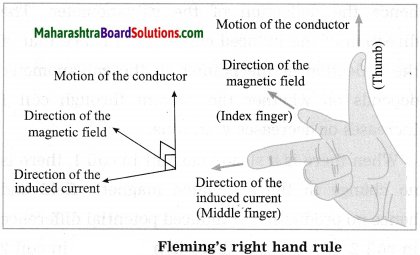
Stretch the thumb, the index finger and the middle finger of the right hand in such a way that they are perpendicular to each other. In this position, the thumb indicates the direction of the motion of the conductor, the index finger the direction of the magnetic field, and the middle finger shows the direction of the induced current.
Maharashtra Board Class 10 Science Solutions Part 1 Chapter 4 Effects of Electric Current 30

[Note The induced current is maximum when the direction of motion of the conductor is at right angles to the magnetic field. ]

Question 43.
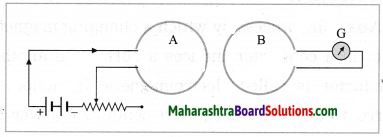
Observe the following figure. If the current in the coil A is changed, will some current be induced in the coil B? Explain.
Maharashtra Board Class 10 Science Solutions Part 1 Chapter 4 Effects of Electric Current 31
Answer:
If the current in the coil A is changed, there will be some current induced in the coil B.

Explanation:
When the current in the coil A is changed, the magnetic field associated with the current changes. This induces potential difference in the coil B. This gives rise to (i.e., induces) a current in the coil B. The greater the rate at which the current in the coil A is changed with respect to time, the greater is the current induced in the coil B as can be seen from the deflection of the pointer in the galvanometer. This phenomenon is known as electromagnetic induction.

Maharashtra Board Class 10 Science Solutions Part 1 Chapter 4 Effects of Electric Current

Question 44.
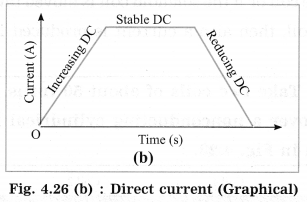
What is a direct current (DC)?
Answer:
A nonoscillatory current that flows only in one direction is called a direct current (DC). It can change in magnitude, but its direction remains the same. [Fig. 4.26 (a) and (b)]
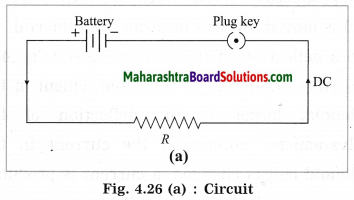
Maharashtra Board Class 10 Science Solutions Part 1 Chapter 4 Effects of Electric Current 32
Maharashtra Board Class 10 Science Solutions Part 1 Chapter 4 Effects of Electric Current 33
[Note: A direct current is obtained with an electric cell or a DC generator.]

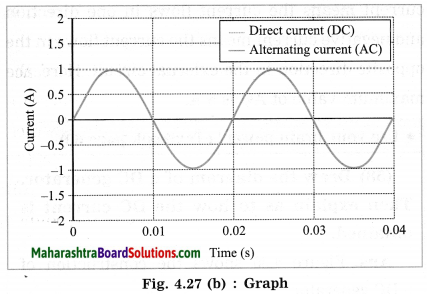
Question 45.
What is an alternating current (AC)?
Answer:
A current that changes in magnitude and direction after equal intervals of time is called an alternating current (AC) (Fig. 4.27).
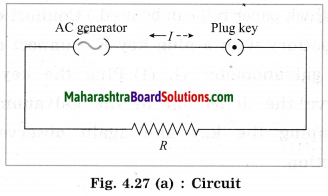
Maharashtra Board Class 10 Science Solutions Part 1 Chapter 4 Effects of Electric Current 34
Maharashtra Board Class 10 Science Solutions Part 1 Chapter 4 Effects of Electric Current 35
Electric current changes sinusoidally with time. Electric current and potential difference are shown by the symbol ~.
[Note: An alternating current is obtained with an AC generator.]

Question 45.
What is the value of frequency of AC in India?
Answer:
In India, the value of frequency of AC is 50 hertz.

Question 46.
What is the periodic time of AC in India?
Answer:
In India, the periodic time of AC is 0.02 s (=\(\frac{1}{50}\)s)

Question 47.
State one advantage of AC over DC.
Answer:
One advantage of AC over DC is that electric power can be transmitted over long distances without much loss of energy.

Maharashtra Board Class 10 Science Solutions Part 1 Chapter 4 Effects of Electric Current

Question 48.
Name two appliances/devices in which a direct current is used.
Answer:
A direct current is used in a portable electric torch and radio.
[Note A Direct current is also in an electric bell, a wall clock, to prepare an electromagnet, for electrolysis, etc. ]

Question 49.
Name two appliances/devices in which an alternating current is used.
(OR)
State any two uses of an AC generator.
Answer:
An alternating current is used in an electric heater and a refrigerator.
[Note Alternating current is also used in an electric iron, a washing machine, an electric mixer, a food processor, an air-conditioner, an electric fan, etc.]

Question 50.
What is (1) an electric generator (2) an AC generator (3) a DC generator?
Answer:
(1) A device which converts mechanical energy into electric energy is called an electric generator.
(2) A generator which converts mechanical energy into electric energy in the form of an alternating current (AC) is called an AC generator.
(3) A generator which converts mechanical energy into electric energy in the form of a direct current (DC) is called a DC generator.

Question 51.
State the principle on which the working of an electric generator is based.
Answer:
The working of an electric generator is based on the principle of electromagnetic induction. When the coil of an electric generator rotates in a magnetic field, a current is induced in the coil. This induced current then flows in the circuit connected to the coil.
[Note An external agency is needed to rotate the coil of an electric generator.]

Question 52.
Show graphically variation of AC with time. Explain the nature of the graph.
Answer:
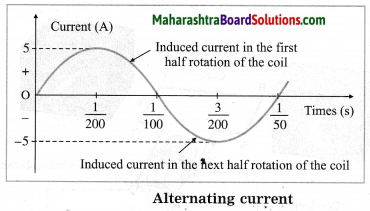
Maharashtra Board Class 10 Science Solutions Part 1 Chapter 4 Effects of Electric Current 36
In this case, the frequency of the alternating current (AC) produced is 50 Hz. The coil completes 50 rotations every second. The time for one rotation of the coil is \(\frac{1}{50}\) second. It is called the periodic time or simply the period of AC. Positive current means the current flows in one direction and negative current means the current flows in the opposite direction in the external circuit. Here, the maximum value of AC is 5 A.

Question 53.
Observe the figure and answer the following questions.
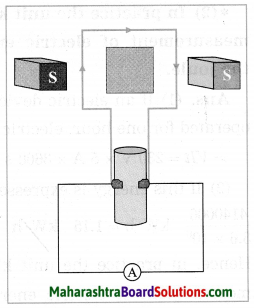
Maharashtra Board Class 10 Science Solutions Part 1 Chapter 4 Effects of Electric Current 37
(a) Identify the machine shown in the figure.
(b) Write a use of this machine.
(c) How transformation of energy takes place in this machine. (Practice Activity Sheet – 3)
Answer:
(a) The instrument shown in the figure is generator.
(b) This machine is used to generate electricity.
(c) The generator generates electricity through following transformation:
Mechanical Energy → Electrical Energy

Maharashtra Board Class 10 Science Solutions Part 1 Chapter 4 Effects of Electric Current

Question 54.
Observe the following figure. Which bulb will fuse? (Practice Activity Sheet – 4)
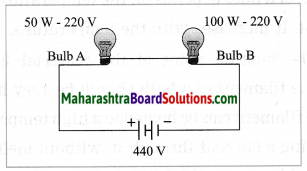
Maharashtra Board Class 10 Science Solutions Part 1 Chapter 4 Effects of Electric Current 38
Answer:
Bulb A.

Give scientific reasons:

Question 1.
In an electric iron, the coil of high resistance is kept between mica sheets.
Answer:
(1) Mica is a bad conductor of electricity and good conductor of heat.
(2) In an electric iron, the coil of high resistance is kept between mica sheets so that there is no electrical contact between the coil and the heavy metal block of the iron though there is heat transfer. This protects the user from getting an electric shock.

Question 2.
The material used for fuse has low melting point.
OR
A fuse should be made of a material of low melting point.
Answer:
1. A fuse is used to protect a circuit and the appliances connected in the circuit by stopping the flow of an excessive electric current. For this, a fuse is connected in series in the circuit.

2. When the current in the circuit passes through the fuse, its temperature increases. When the current exceeds the specified value, the fuse must melt to break the circuit. For this, the material used for a fuse has low melting point.

Distinguish between the following:

Question 1.
Direct current and Alternating current.
Answer:
Direct current:

  1. Direct current flows only in one direction.
  2. It cannot be used for large scale of electricity for household purpose.

Alternating current:

  1. Alternating current reverses its direction periodically with time.
  2. It is used in household electrical appliances such as an electric heater, an electric iron, a refrigerator, etc.

Maharashtra Board Class 10 Science Solutions Part 1 Chapter 4 Effects of Electric Current

Question 2.
Electric motor and Electric generator.
Answer:
Electric motor:

  1. A battery is used in an electric motor to pass a current through the coil.
  2. In this case, a current-carrying coil is set in rotation due to the magnetic field.
  3. Split rings are used in an electric motor.
  4. In this case, electric energy is converted into mechanical energy.

Electric generator:

  1. A battery is not used in an electric generator.
  2. In this case, a potential difference and hence a current is produced when the coil is set into rotation in the magnetic field by an external agent.
  3. Rings used in an AC generator are not split.
  4. In this case, mechanical energy is converted into electric energy.

Solve the following examples/numerical problems:

Question 1.
An electric bulb is connected to a source of 250 volts. The current passing through it is 0.27 A. What is the power of the bulb?
Solution:
Data: V = 250 V, I = 0.27 A, P = ?
P = VI
= 250 V × 0.27 A
= 67.5 W
The power of the bulb = 67.5 W.

Question 2.
If a bulb of 60 W is connected across a source of 220 V, find the current drawn by it.
Solution:
Data: P = 60 W, V = 220 V, I = ?
P = VI

Maharashtra Board Class 10 Science Solutions Part 1 Chapter 4 Effects of Electric Current 39
The current drawn by the bulb
= \(\frac{3}{11}\) A = 0.2727 A

Question 3.
A bulb of 40 W is connected across a source of 220 V. Find the resistance of the bulb.
Solution:
Data: P = 40 W, V = 220 V, R = ?
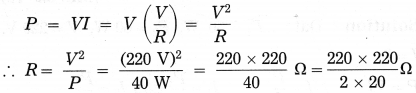
Maharashtra Board Class 10 Science Solutions Part 1 Chapter 4 Effects of Electric Current 40
= 40 × 110 Ω = 1210 Ω
The resistance of the bulb = 1210 Ω

Question 4.
If the current passing through a bulb is 0.2 A and the power of the bulb is 20 W, find the voltage applied across the bulb.
Solution:
Data: I = 0.2 A, P = 20 W, V = ?
P = VI
∴ V = \(\frac{P}{I}=\frac{20 \mathrm{W}}{0.2 \mathrm{A}}\)
= 100 V
The voltage across the bulb = 100 V.

Maharashtra Board Class 10 Science Solutions Part 1 Chapter 4 Effects of Electric Current

Question 5.
Two tungsten bulbs of power 50 W and 60 W work on 220 V potential difference. If they are connected in parallel, how much current will flow in the main conductor? (March 2019)
Solution:
Data: P1 = 50 W, P2 = 60 W, V = 220 V, I = ?

Maharashtra Board Class 10 Science Solutions Part 1 Chapter 4 Effects of Electric Current 41
Current in the main conductor,
I = I1 + I2 ……….(parallel combination)
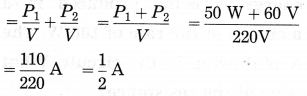
Maharashtra Board Class 10 Science Solutions Part 1 Chapter 4 Effects of Electric Current 42
= 0.5 A

Question 6.
An electric iron rated 750 W is operated for 2 hours/day. How much energy is consumed by the electric iron for 30 days?
Solution:
Data: P = 750 W, t = 2\(\frac{\text { hours }}{\text { day }}\) for 30 days
The energy consumed = Pt = 750 × 2 × 30
= 1500 × 30
= 45000 W·h
= 45 kW·h
The energy consumed by the electric iron for 30 days = 45 kW·h.

Question 7.
If a TV of rating 100 W operates for 6 hours per day, find the number of units consumed in a leap year.
Solution:
Data: P = 100 W, t = 6\(\frac{\text { hours }}{\text { day }}\) × 366 days
= 2196 hours
1 unit = 1 kW·h = 1000 W·h
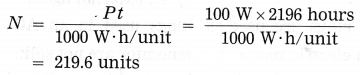
Maharashtra Board Class 10 Science Solutions Part 1 Chapter 4 Effects of Electric Current 43
219.6 units are consumed in a leap year.

Question 8.
An electric appliance of rating 300 W is used 5 hours per day in the month of March. Find the number of units consumed.
Solution:
Data: P = 300 W, t = 5\(\frac{\text { hour }}{\text { day }}\) × 31 days
= 155 hours, 1 unit = 1 kW·h = 1000 W.h

Maharashtra Board Class 10 Science Solutions Part 1 Chapter 4 Effects of Electric Current 44
= 46.5 units
46.5 units are consumed in the month of March.

Question 9.
A washing machine rated 300 W operates one hour/day. If the cost of a unit is ₹ 3.00, find the cost of the energy to operate the washing machine for the month of March.
Solution:
Data: P = 300 W, ₹ 3.00 per unit,
t = 1 \(\frac{\text { hour }}{\text { day }}\) × 31 days = 31 hours, 1 unit = 1 kW·h
= 1000 W·h, cost of the energy = ?

Maharashtra Board Class 10 Science Solutions Part 1 Chapter 4 Effects of Electric Current 45
Cost = 9.3 units × ₹ 3.00 per unit = ₹ 27.9.
The cost of the energy to operate the washing machine for the month of March = ₹ 27.9.

Maharashtra Board Class 10 Science Solutions Part 1 Chapter 4 Effects of Electric Current

Question 10.
Find the heat produced in joule if a current of 0.1 A is passed through a coil of resistance 50 Ω for two minutes. Keeping other conditions the same if the length of the wire is reduced to the original length (by cutting 4 the wire), what will be the heat produced?
Solution:
Data: I = 0.1 A, R = 50 Ω, t = 2 minutes = 2 × 60 s = 120 s, H = ?
H = I2Rt = (0.1A)2 × 50 Ω × 120 s
= 0.01 × 50 × 120 J = 60 J
Heat produced = 60 joules.
In the second case, the resistance of the wire will be \(\frac{50 \Omega}{4}\)
Hence, the heat produced = \(\frac{60 \mathrm{J}}{4}\) = 15 J.

Question 11.
Calculate the heat produced in calorie when a current of 0.1 A is passed through a wire of resistance 41.8 Ω for 10 minutes.
Solution:
Data: I = 0.1 A, R = 41.8 Ω, t = 10minutes
= 10 × 60 s = 600 s, H = ?

Maharashtra Board Class 10 Science Solutions Part 1 Chapter 4 Effects of Electric Current 46
Heat produced = 60 calories.

Question 12.
A potential difference of 250 volts is applied across a resistance of 1000 Ω in an electric iron. Find (1) the current (2) the heat produced in joule in 12 seconds.
Keeping other conditions the same, if the length of the wire in the iron is reduced to half the original length (by cutting the wire), what will be the current and heat produced?
Solution:
Data: V = 250 V, R = 1000 Ω, t = 12 s,
I = ? H = ?
(1) V = IR
∴ I = \(\frac{V}{R}=\frac{250 \mathrm{V}}{1000 \Omega}\) = 0.25 A
The current through the resistance = 0.25 A.
(2) H = I2RT
= (0.25 A)2 × 1000 Ω × 12 s
= (\(\frac{1}{4}\) × 1000) × (\(\frac{1}{4}\) × 12) J
= 250 × 3J = 750 J
H = VIt = 250 V × 0.25 A × 12s = 250 × 3J = 750 J
The heat energy produced in the resistance in 12 seconds = 750 joules.

On cutting the wire, the resistance of the wire will become half the initial resistance. Hence, the current will become double the initial current as I = V/R and V is the same in both the cases. Therefore, the current in the wire will be 0.25 A × 2 = 0.5 A. (Hence, the heat produced will be VIt = 250 V × 0.5 A × 12 s = 250 × 6 J = 1500 J.)

Question 13.
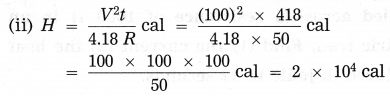
A potential difference of 100 V is applied across a resistor of resistance 50 Ω for 6 minutes and 58 seconds. Find the heat produced in (i) joule (ii) calorie.
Solution:
Data: V = 100 V, R = 50 Ω, t = 6 minutes and 58 seconds = (6 × 60 + 58) s = (360 + 58)
= 418 s, H = ?
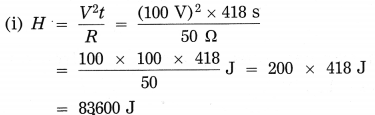
Maharashtra Board Class 10 Science Solutions Part 1 Chapter 4 Effects of Electric Current 47
Heat generated = 83600 joules.
Maharashtra Board Class 10 Science Solutions Part 1 Chapter 4 Effects of Electric Current 48
Heat produced = 2 × 10⁴ calories.

Numerical Problems For Practice:

Question 1.
When the voltage applied across a bulb is 200 V, the current passing through the bulb is 0.1 A. Find the power of the bulb.
Answer:
20 W

Question 2.
A bulb of 100 W is connected across a source of 200 V. Find the current drawn by it.
Answer:
0.5 A

Maharashtra Board Class 10 Science Solutions Part 1 Chapter 4 Effects of Electric Current

Question 3.
A bulb of 60 W is connected across a source of 240 V. Find the resistance of the bulb.
Answer:
960 Ω

Question 4.
If the current passing through a bulb is 0.15 A and the power of the bulb is 30 W, find the voltage applied across the bulb.
Answer:
200 V

Question 5.
An electric appliance of rating 800 W is used 4 hours per day in the month of December. Find the number of units consumed.
Answer:
99.2 units

Question 6.
An electric appliance rated 400 W is used 5 hours per day in the month of June. If the cost of a unit is ₹ 3.00, find the energy bill for June.
Answer:
₹ 180

Question 7.
An electric bulb rated 60 W is used 10 hours per day for 20 days. If the cost of a unit is ₹ 3.00, find the energy bill.
Answer:
₹ 36

Question 8.
Two electric bulbs rated 60 W and 40 W respectively are used 5 hours per day for 20 days. If the cost of a unit is ₹ 4.00, find the cost of the energy used.
Answer:
₹ 40

Question 9.
Find the heat produced in joule if a current of 0.1 A is passed through a coil of resistance 25 Ω for one minute.
Answer:
15 J

Question 10.
Calculate the heat produced in calorie when a current of 0.1 A is passed through a wire of resistance 41.8 Ω for 5 minutes.
Answer:
30 calories

Question 11.
Calculate the heat produced in calorie when a current of 0.2 A is passed through a wire of resistance 41.8 Ω for 10 minutes.
Answer:
240 calories

Question 12.
Find the heat produced in calorie when a current of 0.2 A is passed through a wire of resistance 20.9 Ω for 10 minutes.
Answer:
120 calories

Question 13.
A potential difference of 100 V is applied across a wire of resistance 50 Ω for one minute. Find the heat produced in joule.
Answer:
1.2 × 10⁴ joules

Question 14.
A potential difference of 100 V is applied across a wire for two minutes. If the current through the wire is 0.1 A, find the heat produced in joule.
Answer:
1200 joules

Maharashtra Board Class 10 Science Solutions Part 1 Chapter 4 Effects of Electric Current

Question 15.
A potential difference of 100 V is applied across a wire for 6 minutes and 58 seconds.
If the current through the wire is 0.1 A, find the heat produced in calorie.
Answer:
1000 calories

Maharashtra Board Class 6 History Solutions Chapter 4 The Vedic Civilization

Balbharti Maharashtra State Board Class 6 History Solutions Chapter 4 The Vedic Civilization Notes, Textbook Exercise Important Questions and Answers.

Maharashtra Board Class 6 History Solutions Chapter 4 The Vedic Civilization

Class 6 History Chapter 4 The Vedic Civilization Textbook Questions and Answers

1. Name the following with reference to the lesson:

The Vedic Civilization Class 6 Question 1.
Women scholars in Vedic literature:
Answer:
Lopamudra, Gargi, Maitreyi.

The Vedic Civilization Class 6 Questions And Answers Question 2.
Means of entertainment in the Vedic period:
Answer:
Singing, playing musical instruments, dance, board games, chariot race and hunting.

Maharashtra Board Class 6 History Solutions Chapter 4 The Vedic Civilization

The Vedic Civilization Class 6 Questions And Answers Maharashtra Board Question 3.
The four ashrams:
Answer:
Brahmacharyashrama, Grihasthashrama, Vanaprasthashrama, Sanyasashrama

2. Right or wrong?

Class 6 History Chapter 4 Question 1.
Rigveda – Mantras uttered during yajna.
Answer:
Wrong.

Vedic Age Question And Answer Class 6 Question 2.
Samaveda – Guidance on singing a mantra during yajna rites.
Answer:
Right.

Vedic Civilization Class 6 Question 3.
Atharvaveda – The Veda derived its name from Atharva rishi.
Answer:
Right.

3. Answer in one word each:

Class 6 History Chapter 4 Questions And Answers Question 1.
The language of Vedic literature:
Answer:
Sanskrit.

Chapter 4 Class 6 History Question 2.
The meaning of vid:
Answer:
To know.

Class 6 History Chapter 4 Notes Question 3.
The head of a family:
Answer:
Grihapati.

History Class 6 Chapter 4 Question 4.
The head of shrenis:
Answer:
Shreshthi

Maharashtra Board Class 6 History Solutions Chapter 4 The Vedic Civilization

4. Name the following:

Question 1.
The musical instruments you know:
Answer:
Guitar, drums, piano (Keyboard).

Question 2.
Two modern ornaments of women:
Answer:
Earing, necklace.

Question 3.
Today’s means of entertainment:
Answer:
Movies, computer games, T.V.

5. Answer in short:

Question 1.
What foods were included in the diet of the Vedic people?
Answer:
(a) The diet of the people mainly consisted of cereals like wheat, barley and rice. From this they made different preparations like java, godhoom, vihi, etc.
(b) They also relished milk, yoghurt, ghee, butter, honey, black gram, lentil, sesame and meat.

Question 2.
Why were the cows priced highly?
Answer:
(a) Cows were used as means of exchange. They were highly priced.
(b) For the same reason people took great care that their cows should not be stolen.

Question 3.
What was a man expected to do in sanyasashrama ?
Answer:
The fourth stage was the sanyasharam. At this stage a man was expected to renounce all relations, lead a life in order to understand the meaning of human life and not stay in one place.

6. Write notes on:

Question 1.
The religious ideas during the vedic period.
Answer:
(a) In the religious ideas of the vedic period, forces of nature such as the sun, wind, rain, lightening, storms and rivers were given the form of deities.
(b) Yajna is the act of offering havi into fire. The Vedic people put offering (havi) into the yajna fire to please the deities.

Question 2.
Houses in the Vedic period.
Answer:
The houses during the vedic period were earthen or wattle and daub constituents. Wattle means woven lattice of wooden strips which is daubed with clay mixed with cow dung. A house was called griha or shala.

Question 3.
Political system in the Vedic period.
Answer:
(a) The main duties of a king were to protect the people, collect taxes and run the administration efficiently.
(b) In order to run the administration smoothly, the king appointed various officers like the purohit (priest), the senapati and bhagdugh.
(c) There were four institutions who guided the king – sabha, samiti, vidath and jana.

Activity:

  • Interview some artisans in your locality and write about them.
  • List the new words in the lesson and find their meaning.

Maharashtra Board Class 6 History Solutions Chapter 4 The Vedic Civilization

Class 6 History Chapter 4 The Vedic Civilization Additional Important Questions and Answers

Name the following with reference to the lesson:

Question 1.
Houses during the Vedic period:
Answer:
Griha or Shala.

Question 2.
The four varnas:
Answer:
Brahmin, Kshatriya, Vaishya and Shudra,

Question 3.
Four institutions who guided the king:
Answer:
Sabha, samiti, vidath and jana.

Right or Wrong?

Question 1.
Brahmanas – Guidance on using vedic mantra in yajna rituals.
Answer:
Right.

Question 2.
Institution who guided the king – Purohit, senapati, bhagdugh.
Answer:
Wrong.

Answer in one word each:

Question 1.
The head of vish:
Answer:
Vishpati.

Question 2.
The head of jana:
Answer:
Nripa.

Complete the sentences by choosing the correct option:

Question 1.
The civilization that is based on vedic literature is known as _________ civilization.
(a) vedic
(b)purans
(c) samhitas
Answer:
(a) vedic

Maharashtra Board Class 6 History Solutions Chapter 4 The Vedic Civilization

Question 2.
The Vedas are considered to be our _________ literature.
(a) modem
(b) earliest
(c) medieval
Answer:
(b) earliest

Question 3.
The _______ were composed by many sages or rishis.
(a) Brahmana
(b) Aryanakas
(c) Vedas
Answer:
(c) Vedas

Question 4.
Vedic literature is written in _________.
(a) English
(b) Hindi
(c) Sanskrit
Answer:
(c) Sanskrit

Question 5.
The Rigveda is considered to be the _______ text.
(a) first
(b) second
(c) third
Answer:
(a) first

Question 6.
The Vedas have been preserved through the ________ tradition.
(a) ancient
(b) oral
(c) printed
Answer:
(b) oral

Question 7.
The vedas are also called as ________.
(a) Shruti
(b) Mayuri
(c)Yagna
Answer:
(a) Shruti

Question 8.
Each verse of the Veda is known as a ______.
(a) Shruti
(b) Maya
(c) Richa
Answer:
(c) Richa

Question 9.
The Rigveda consists of many ________ composed to praise different deities.
(a) richas
(b) suktas
(c) shruti
Answer:
(b) suktas

Question 10.
Yajurveda provides guidance about how and when the different ______ must be chanted during the yajna rites.
(a) mantras
(b) yajnas
(c) vedas
Answer:
(a) mantras

Maharashtra Board Class 6 History Solutions Chapter 4 The Vedic Civilization

Question 11.
The samaveda has contributed in a major way in laying the foundation of Indian _______.
(a) society
(b) music
(c) lifestyle
Answer:
(b) music

Question 12.
The Atharvaveda is named after Atharva ________.
(a) Rishi
(b) mantra
(c) veda
Answer:
(a) Rishi

Question 13.
Atharvaveda includes______ to adversities and diseases.
(a) medicine
(b) ways
(c) solutions
Answer:
(c) solutions

Question 14.
The Atharvaveda provides _________ to the king about how he should administer his kingdom.
(a) solution
(b) guidance
(c) tradition
Answer:
(b) guidance

Question 15.
The _______ discuss such serious and profound issues.
(a) Vedas
(b) Aranyakas
(c) Upanishads
Answer:
(c) Upanishads

Question 16.
_________ family system was prevalent in Vedic peroid
(a) Joint
(b) matriarchal
(c) patriarchal
Answer:
(a) Joint

Question 17.
The grihapati was the of the family.
(a) heart
(b) head
(c) hands
Answer:
(b) head

Question 18.
The family system was ______
(a) ancient
(b) matriarchal
(c) patriarchal
Answer:
(c) patriarchal

Maharashtra Board Class 6 History Solutions Chapter 4 The Vedic Civilization

Question 19.
A ________ was called griha or shala.
(a) house
(b) shed
(c) school
Answer:
(a) house

Question 20.
People in the Vedic period used cotton and woollen ________.
(a) headgear
(b) shawls
(c) garments
Answer:
(c) garments

Question 21.
In the Vedic period, animal skins were also used as ________ the Vedic period.
(a) Agriculture
(b) Clothings
(c) Trade
Answer:
(b) Clothings

Question 22.
_________ was the main occupation during determined on the basis of
(a) Agriculture
(b) birth
(c) death
Answer:
(a) Agriculture

Question 23.
The horse was valued because of its ______.
(a) chariot
(b) speed
(c) beauty
Answer:
(b) speed

Question 24.
The Vedic people were skilled in taming the _______ and harnessing them to the chariots.
(a) cows
(b) bulls
(c) horses
Answer:
(c) horses

Question 25.
The head of the guild was known as ________.
(a) Grihapati
(b) Shreshthi
(c) Raja
Answer:
(b) Shreshthi

Question 26.
A varna was determined by the ________ of the people.
(a) occupation
(b) neighbours
(c) skill
Answer:
(a) occupation

Maharashtra Board Class 6 History Solutions Chapter 4 The Vedic Civilization

Question 27.
In the later period, the varnas came to be determined on the basis of ________.
(a) bags
(b) birth
(c) shoes
Answer:
(b) birth

Question 28.
The caste system led to ________ in the society.
(a) justice
(b) equality
(c) inequality
Answer:
(c) inequality

Question 29.
The Vedic people put _______ into the yajna fire to please the deities.
(a) offerings
(b) money
(c) water
Answer:
(a) offerings

Question 30.
In the Vedic period, each village had a head known as _______.
(a) grihapati
(b) gramini
(c) nripa
Answer:
(b) gramini

Question 31.
A group of villages formed a vish, whose head was called ________.
(a) grihapati
(b) purohit
(c) vishpati
Answer:
(c) vishpati

Question 32.
The head of the jana was known as nripa or _______.
(a) raja
(b) janapad
(c) senapati
Answer:
(a) raja

Maharashtra Board Class 6 History Solutions Chapter 4 The Vedic Civilization

Question 33.
The ______ consisted of senior citizens of the state.
(a) samiti
(b) sabha
(c) vidath
Answer:
(b) sabha

Question 34.
After a period of time, the religious stream based on the vedas, smritis, puranas and local traditions came to be known as
(а) Buddhism
(b) Jainism
(c) Hinduism
Answer:
(c) Hinduism

Answer the following in one sentence:

Question 1.
What is vedic civilization?
Answer:
The civilization that is based on vedic literature is known as vedic civilization.

Question 2.
Who composed the vedas?
Answer:
The vedas were composed by many sages or rishis.

Question 3.
In which language is the vedic literature written?
Answer:
Vedic literature is written in Sanskrit.

Question 4.
Name the veda that is considered to be the first text.
Answer:
The Rigveda is considered to be the first text.

Question 5.
Name the four vedas.
Answer:
The four vedas are – Rigveda, Yajurveda, Samaveda and Atharvaveda.

Question 6.
What does Rigveda consist of?
Answer:
The Rigveda consists of many suktas composed to praise different deities.

Question 7.
What does Yajurveda provide?
Answer:
Yajurveda provides guidance about how and when the different mantras must be chanted during yajna rites.

Maharashtra Board Class 6 History Solutions Chapter 4 The Vedic Civilization

Question 8.
What does Samaveda provide?
Answer:
The Samaveda provides guidance on singing Rigvedic verses to a set rhythm and tune at the time of yajna rites.

Question 9.
After whom is the Atharvaveda named?
Answer:
The Atharvaveda is name after Atharva rishi.

Question 10.
Which texts were written after the Samhitas?
Answer:
The Brahmana texts, Aranyakas and Upanishads were written after the composition of the Samhitas.

Question 11.
What does Aranyakas consists of?
Answer:
Aranyakas consists of the reflections or thoughts expressed after meditating with deep concentration in forests or wilderness.

Question 12.
Which family system was prevalent in the vedic period?
Answer:
Joint family system was prevalent in the vedic period.

Question 13.
Name some women scholars during the vedic period.
Answer:
Women scholars such as Lopamudra, Gargi and Maitreyi are mentioned in the vedic literature.

Question 14.
What did the diet of the people mainly consist of?
Answer:
The diet of the people mainly consists of cereals like wheat, barley and rice.

Question 15.
What was the main occupation during the vedic period?
Answer:
Agriculture was the main occupation during the vedic period.

Question 16.
Name the varnas.
Answer:
The four varnas are Brahmin, Kshatriya, Vaishya and Shudra.

Question 17.
Which four institutions guided the king?
Answer:
The four institutions that guided the king are sabha, samiti, vidath and jana.

Question 18.
What is Hinduism?
Answer:
After a period of time, the religious stream based on the vedas, smritis, puranas and local traditions came to be known as Hinduism.

Maharashtra Board Class 6 History Solutions Chapter 4 The Vedic Civilization

Answer in short:

Question 1.
What does Atharvaveda consists of?
Answer:

  • Atharvaveda consists of solution to adversities and diseases.
  • It provides information about medicinal herbs.
  • It provides guidance to a king about the way he should administer his kingdom.

Question 2.
Describe the dress of the people during the vedic period.
Answer:
People in the vedic period used cotton and woollen garments, they also used clothes made from the barks of trees. Animal skins were also used as clothing.

Write notes on:

Question 1.
Describe four stages or four ashramas.
Answer:
The four ashramas are brahmacharyashmma, grihasthashrama, vanaprasthashrama, sanyasashrama.

  1. The first ashrama was the brahmacharyashrama or the period of staying with the Guru to learn from him.
  2. The next stage was grihasthashrama, during this period a man would carry out his duties towards his family and society with the help of his wife.
  3. The third stage was vanaprasthashrama when a man was expected to detach himself from the household, retire to a solitary place and lead a very simple life.
  4. The fourth stage was the sanyasashrama, the convention was to renounce all relations, lead life in order to understand the meaning of human life and not to stay in one place.

Maharashtra Board Class 7 English Solutions Chapter 4.1 Under the Greenwood Tree

Balbharti Maharashtra State Board Class 7 English Solutions Chapter 4.1 Under the Greenwood Tree Notes, Textbook Exercise Important Questions and Answers.

Maharashtra State Board Class 7 English Solutions Chapter 4.1 Under the Greenwood Tree

Class 7 English Chapter 4.1 Under the Greenwood Tree Textbook Questions and Answers

1. From the poem, find the old word used for each of the following.

Question a.
towards, here, does
Answer:
hither, hither, doth

Maharashtra Board Class 7 English Solutions Chapter 4.1 Under the Greenwood Tree

2. Write in your own words.

Question a.
Who does the poet invite to join him?
Answer:
The poet invites all those people who love nature and are ready to shun their ambitions and appreciate life in nature, to join him.

Question b.
How should that person sing?
Answer:
That person should sing happily just like a free bird.

Question c.
What message does the poem convey?
Answer:
The message conveyed through this poem is that if one wants to live a peaceful life without tensions, enemies and problems, he should spend his life in nature, wherein he would be happy and relaxed. He should forget all his desires and rejoice in the glory of nature like a free bird.

3. Pick out the lines that mean.

Question a.
Sing in such a manner
Answer:
turn his merry note

Maharashtra Board Class 7 English Solutions Chapter 4.1 Under the Greenwood Tree

Question b.
One who wishes to join me
Answer:
who loves to lie with me

Question c.
Who gives up his desire for wealth, power, fame, etc.
Answer:
who doth ambition shun

Question d.
Life in the forest is free from ill-wishers.
Answer:
here shall he see no enemy

Maharashtra Board Class 7 English Solutions Chapter 4.1 Under the Greenwood Tree

Question e.
Happy to eat whatever he can get.
Answer:
seeking the food he eats, and pleased with what he gets

4. Find from the Internet and write down.

Question a.
In which century did William Shakespeare write his famous plays ?
Answer:
William Shakespeare wrote his plays in the late sixteenth and early seventeenth century.

Question b.
From which play is this song extracted ?
Answer:
This song is extracted from William Shakespeare’s comedy play ‘As You Like It’.

Maharashtra Board Class 7 English Solutions Chapter 4.1 Under the Greenwood Tree

Question c.
Which character from the play sings this song?
Answer:
The song is sung by ‘Amiens’, a loyal courtier of Duke Senior.

5. Be a poet. Try to complete the following poem with words that rhyme with each other.

Question a.
Maharashtra Board Class 7 English Solutions Chapter 4.1 Under the Greenwood Tree
Answer:
I’d love to live a life that’s free,
Relax under a shady tree,
And fall into a dreamy sleep,
With no strict hours, forced to keep And sing aloud a merry song,
Untrodden paths, as I walk along.
You ask me what I’d get to eat?
Fruits and nuts and berries sweet You ask me with whom I’d get to play Birds and animals, happy and gay And if a woodcutter put a chop Firmly, I would put a stop So that’s the life I’d like too to lead Free from worries, free from greed

Class 7 English Chapter 4.1 Under the Greenwood Tree Additional Important Questions and Answers

Reading Skills and Poetic Device.

Simple Factual Questions:

Under The Greenwood Tree Poem Questions Answers  Question 1.
State whether the following statement true or false.
1. The only enemy in the forest would be the winter and rough weather.
2. People who do not persue their ambition would be happy to live in nature.
Answer:
1. True
2. True.

Maharashtra Board Class 7 English Solutions Chapter 4.1 Under the Greenwood Tree

Poetic Device.

Under The Greenwood Tree Poem Question Answers Class 7 Question 1.
Pick out the rhyming words from the poem.
Answer:

  1. tree – me
  2. note – throat
  3. see – enemy
  4. hither – weather

Under The Greenwood Tree Question Answers Question 2.
Give the rhyme scheme for the 1st four lines.
Answer:
Tire rhyme scheme for the 1st four lines is aabb.

Under The Greenwood Tree Poem Question Answers Question 3.
Come hither, come hither. (Name the figure of speech of the above line)
Answer:
Tire figure of speech is Repetition. The words ‘come hither’ has been repeated for better poetic effect.

Do as directed.

4.1 Under The Greenwood Tree Question 1.
Give the rhyme scheme for the last four lines.
Answer:
The rhyme scheme for the last four lines is abba.

Maharashtra Board Class 7 English Solutions Chapter 4.1 Under the Greenwood Tree

Under The Greenwood Tree Question Answer Question 2.
Who doth ambition shun. (Name the figure of speech)
Answer:
Inversion – The words are not in proper order for better poetic effect. The proper order is ‘Who doth shun ambition’.

Under The Greenwood Tree Poem Question 3.
Here shall he see No enemy. (Figure of speech)
Answer:
Inversion – The words are not in proper order. The proper order is ‘Here he shall see no enemy’.

Under the Greenwood Tree Summary in English

Through the poem Shakespeare invites people to join him in enjoying the merry singing of the birds in the trees. There are no enemies there to be disturbed about except the vagaries of extreme cold and rough weather. They can be happy eating what they get enjoying the sunshine and giving up lofty ambitions.

Introduction:

This poem has been taken from William Shakespeare’s play ‘As you like it.’ Amiens, a courtier sings the song ‘under the Greenwood Tree’ in the play.

Maharashtra Board Class 7 English Solutions Chapter 4.1 Under the Greenwood Tree

Glossary:

  1. greenwood (n) – forest filled with trees full of green leaves
  2. merry (adj) – jolly and full of high spirits
  3. note (n) – a musical sound; a tone (musical)
  4. hither (adv) – come here; over here
  5. ambition (n) – desire to achieve something
  6. shun (v) – to avoid
  7. seeking (v) – searching; looking for
  8. pleased (adj) – happy; content

Maharashtra Board Class 9 Hindi Lokbharti Solutions Chapter 9 मेरे पिता जी

Balbharti Maharashtra State Board Class 9 Hindi Solutions Lokbharti Chapter 9 मेरे पिता जी Notes, Textbook Exercise Important Questions and Answers.

Maharashtra State Board Class 9 Hindi Lokbharti Solutions Chapter 9 मेरे पिता जी (पूरक पठन)

Hindi Lokbharti 9th Std Digest Chapter 9 मेरे पिता जी Textbook Questions and Answers

1. निम्नलिखित अपठित गद्यांश पढ़कर सूचना के अनुसार कृतियाँ कीजिए।

कारण लिखिए।

प्रश्न (क)
विमान के प्रति लेखक का आकर्षित होना-
उत्तर:
दो विमान लेखक को अपनी ओर बार-बार खींच रहे थे। मानो वे उसे सीमाओं के परे मनुष्य की सोचने की शक्ति की जानकारी दे रहे थे और मानो वे उसके सपनों को पंख लगा रहे थे।

Maharashtra Board Class 9 Hindi Lokbharti Solutions Chapter 9 मेरे पिता जी

प्रश्न (ख)
लेखक का एयरोनॉटिकल इंजिनियरिंग को अपना अध्ययन क्षेत्र चुनना –
उत्तर:
लेखक का एयरोनॉटिकल इंजिनियरिंग को अपना अध्ययन क्षेत्र चुनना क्योंकि उड़ान भरने के प्रति वे आकर्षित थे।

पहली बार मैंने एम. आई. टी. में निकट से विमान देखा था, जहाँ विद्यार्थियों को विभिन्न सब- सिस्टम दिखाने के लिए दो विमान रखे थे। उनके प्रति मेरे मन में विशेष आकर्षण था। वे मुझे बार – बार अपनी ओर खींचते थे। मुझे वे सीमाओं से परे मनुष्य की सोचने की शक्ति की जानकारी देते थे तथा मेरे सपनों को पंख लगाते थे। मैंने एयरोनॉटिकल इंजीनियरिंग को अपना अध्ययन क्षेत्र चुना क्योंकि उड़ान भरने के प्रति मैं आकर्षित था। वर्षों से उड़ने की अभिलाषा मेरे मन में पलती रही। मेरा सबसे प्यारा सपना यही था कि सुदूर आकाश में ऊँची और ऊँची उड़ान भरती मशीन को हैंडल किया जाए।

2. स्वमत –

3. ‘मेरी अभिलाषा’ विषय पर छह से आठ पंक्तियाँ लिखिए।

प्रश्न 1.
‘मेरी अभिलाषा’ विषय पर छह से आठ पंक्तियाँ लिखिए।
उत्तर:
जिंदगी सिर्फ चार दिन की होती है। छोटी-सी इस जिंदगी में सभी को आसमान में उड़ाने की चाह होती है। यानी सभी को अपनी-अपनी अभिलाषा होती है। मेरी भी अपनी एक अभिलाषा है। वह है वैज्ञानिक बनने की। मैं वैज्ञानिक बनकर भारत में अनुसंधान का कार्य करना चाहता हूँ। विज्ञान के क्षेत्र में भारत का नाम गर्व से ऊँचा करना चाहता हूँ।

नए-नए अन्वेषण करके मैं सभी का जीवन सुखकर करना चाहता हूँ। वैज्ञानिक बनकर सभी बच्चों के मन में विज्ञान के प्रति प्रेम-आकर्षण निर्माण करना चाहता हूँ। वैज्ञानिक बनकर मानवता के लिए कार्य करने के लिए मैं सदैव तत्पर हूँ। मैं मेरी यह अभिलाषा पूर्ण करने के लिए अथक प्रयास व परिश्रम कर रहा हूँ। मुझे आशा है कि मेरी यह अभिलाषा जरूर पूरी हो जाएगी।

1. सूचना के अनुसार कृतियाँ कीजिए

प्रश्न 1.
संजाल:
Maharashtra Board Class 9 Hindi Lokbharti Solutions Chapter 9 मेरे पिता जी 1
उत्तरः
Maharashtra Board Class 9 Hindi Lokbharti Solutions Chapter 9 मेरे पिता जी 2

2. ‘अपना व्यक्तित्व समृद्ध करने के लिए अलग-अलग भाषाओं का ज्ञान उपयुक्त होता है।’ इस पर अपने विचार लिखिए।

प्रश्न 1.
‘अपना व्यक्तित्व समृद्ध करने के लिए अलग-अलग भाषाओं का ज्ञान उपयुक्त होता है।’ इस पर अपने विचार लिखिए।
उत्तरः
भाषा विचारों के आदान-प्रदान का साधन है। भाषा से ही व्यक्ति का विकास होता है। बिना भाषिक ज्ञान से व्यक्ति जीवन में आगे नहीं बढ़ सकता है। बहुभाषी होना तो सोने पे सुहागा जैसी ही बात है। अलग-अलग भाषाओं का ज्ञान होने से व्यक्ति के ज्ञान की कक्षाएँ फैल जाती हैं। वह एक भाषा के साथ दूसरी भाषा के भाव व विचार संकलित करता है।

अन्य भाषाओं का ज्ञान होने से व्यक्ति को अन्य प्रांतों में भी सम्मान की भावना मिल जाती है। अलग-अलग भाषाओं का ज्ञान होने से व्यक्ति की विचार करने की क्षमता में भी वृद्धि होती है। ऐसा व्यक्ति भाषण या लेखन करते समय अन्य भाषाओं में प्रचलित संदर्भ या उदाहरणों को आसानी से प्रयोग कर सकता है। इसीलिए अपना व्यक्तित्व समृद्ध करने के लिए अलग-अलग भाषाओं का ज्ञान उपयुक्त होता है।

Maharashtra Board Class 9 Hindi Lokbharti Solutions Chapter 9 मेरे पिता जी

पाठ के आँगन में…

1. सूचना के अनुसार कृतियाँ कीजिए।

प्रश्न (क)
निम्नलिखित शब्दों को पढ़कर उनके लिए पाठ में प्रयुक्त विशेषताएँ लिखिए।

  1. जूता
  2. पाजामा
  3. अचकन
  4. टोपी

उत्तरः

  1. काला
  2. ढीला
  3. लंबी व इकहरी
  4. दुपल्ली

प्रश्न (ख)
‘संयुक्त परिवार’ संबंधी अपने विचार लगभग छह से आठ पंक्तियों में लिखिए।
उत्तरः
संयुक्त परिवार प्रणाली भारतीय संस्कृति का एक महत्त्वपूर्ण केंद्र है। आज के इस परिवर्तनशील युग में संयुक्त परिवार प्रणाली विभक्त होती जा रही है। संयुक्त प्रणाली में सभी मिल-जुलकर रहते थे। संयुक्त परिवार प्रणाली व्यापक एवं विशाल स्वरूप की थी। उसका दृष्टिकोण भी व्यापक था। सदस्यों की संख्या भी अधिक होती थी।

परिवार का मुखिया परिवार का संचालन करता था। चाचा-चाची, माँ-बाप, दादादादी, चचेरे भाई-बहन सभी संयुक्त परिवार में मेल-मिलाप से रहते थे। आज भले ही संयुक्त प्रणाली की जगह विभक्त परिवार प्रणाली आ गई है; फिर भी आज कई परिवार ऐसे हैं जो संयुक्त परिवार में रहना पसंद करते हैं। संयुक्त परिवार प्रणाली प्रेम व सहयोग से एक-दूसरे के साथ मिल-जुलकर रहना सिखाती है।

Maharashtra Board Class 9 Hindi Lokbharti Solutions Chapter 9 मेरे पिता जी

भाषा बिंदु

प्रश्न 1.
विरामचिह्न पढ़िए, समझिए।
उत्तर:
Maharashtra Board Class 9 Hindi Lokbharti Solutions Chapter 9 मेरे पिता जी 3

Hindi Lokbharti 9th Answers Chapter 9 मेरे पिता जी Additional Important Questions and Answers

(क) गद्यांश पढ़कर सूचना के अनुसार कृतियाँ कीजिए।

कृति (1) आकलन कृति

प्रश्न 1.
समझकर लिखिए।
उत्तर:
Maharashtra Board Class 9 Hindi Lokbharti Solutions Chapter 9 मेरे पिता जी 4

Maharashtra Board Class 9 Hindi Lokbharti Solutions Chapter 9 मेरे पिता जी

प्रश्न 2.
कृति पूर्ण कीजिए।
उत्तर:
Maharashtra Board Class 9 Hindi Lokbharti Solutions Chapter 9 मेरे पिता जी 5

प्रश्न 3.
निम्नलिखित शब्दों को पढ़कर उनके लिए पाठ में प्रयुक्त विशेषताएँ लिखिए।
उत्तर:
Maharashtra Board Class 9 Hindi Lokbharti Solutions Chapter 9 मेरे पिता जी 6

प्रश्न 4.
निम्नलिखित शब्दों को पढ़कर ऐसे दो प्रश्न तैयार कीजिए कि जिनके उत्तर निम्न शब्द हों।
1. गुलूबंद
2. लाठी
उत्तर:
1. जाड़ों में लेखक के पिता के गले में क्या पड़ा रहता था?
2. लेखक के पिता ने किसकी तालीम ली थी?

प्रश्न 5.
निम्नलिखित विधान सत्य है या असत्य लिखिए।
1. लेखक के गाँव में किसी कारण हिंदू-मुस्लिम दंगा हो गया था।
2. लेखक के पिता दफ्तर से बाहर निकलते समय धोती पर बंद गले का कोट पहनते थे।
उत्तर:
1. असत्य
2. सत्य

Maharashtra Board Class 9 Hindi Lokbharti Solutions Chapter 9 मेरे पिता जी

प्रश्न 6.
कृति पूर्ण कीजिए।
उत्तर:
Maharashtra Board Class 9 Hindi Lokbharti Solutions Chapter 9 मेरे पिता जी 7

कृति (2): स्वमत अभिव्यक्ति

प्रश्न 1.
सभी का प्रिय बनने के लिए हमें क्या करना चाहिए? अपने विचार लिखिए।
उत्तरः
सभी का प्रिय बनने के लिए हमें सभी के साथ अच्छा व्यवहार करना चाहिए। अपनी वाणी एवं अपने कर्म से सभी को अपनी ओर आकर्षित करना चाहिए। हमें संकट की घड़ी में दूसरों की मदद करनी चाहिए। अपने अच्छे व्यवहार से सभी का दिल जीत लेना चाहिए। हमें मानवीय गुणों का पालन करना चाहिए और अपने प्रत्येक कार्य से दूसरों को प्रेरणा देनी चाहिए।

(ख) गद्यांश पढ़कर सूचना के अनुसार कृतियाँ कीजिए।

कृति (1):आकलन कृति

कारण लिखिए।

प्रश्न 1.
पिता जी हाथ में डंडा लिए थे।
उत्तर:
आत्मरक्षा के लिए पिता जी हाथ में डंडा रखते थे।

प्रश्न 2.
हिंदू-मुसलमान को मेल से रहना चाहिए।
उत्तरः
साथ में भाईचारे से रहने के उद्देश्य से हिंदू-मुसलमान को मेल से रहना चाहिए।

Maharashtra Board Class 9 Hindi Lokbharti Solutions Chapter 9 मेरे पिता जी

कृति पूर्ण कीजिए।

प्रश्न 1.
कृति पूर्ण कीजिए।
उत्तर:
Maharashtra Board Class 9 Hindi Lokbharti Solutions Chapter 9 मेरे पिता जी 8

सही विकल्प चुनकर वाक्य फिर से लिखिए।

प्रश्न 1.
हिंदू-मुसलमानों के कटने मरने से…………….
उत्तर:
(क) न हिंदुत्व समाप्त होगा न इस्लाम खत्म होगा।
(ख) न बंधुत्व समाप्त होगा न भाईचारा खत्म होगा।
(ग) न प्रेम समाप्त होगा न अमन खत्म होगा।

प्रश्न 2.
लेखक के पिता जी का लोगों पर असर हुआ और
(क) उनके मुहल्ले में अशांति बनी रही।
(ख) उनके मुहल्ले में वैमनस्य बढ़ने लगा।
(ग) उनके मुहल्ले में शांति बनी रही।
उत्तर:
1. हिंदू-मुसलमानों के कटने मरने से न हिंदुत्व समाप्त होगा न इस्लाम खत्म होगा।
2. लेखक के पिता जी का लोगों पर असर हुआ और उनके मुहल्ले में शांति बनी रही।

Maharashtra Board Class 9 Hindi Lokbharti Solutions Chapter 9 मेरे पिता जी

कृति (2) स्वमत अभिव्यक्ति

प्रश्न 1.
‘इंसान मेल से रहने के लिए बना है।’ इस कथन से संबंधित अपने विचार लिखिए।
उत्तर:
इंसान ईश्वर की सबसे सुंदर कृति है। इंसानियत इंसान का सबसे बड़ा धर्म है। इस धर्म से बढ़कर अन्य धर्म नहीं है। अतः धर्म के नाम पर एक-दूसरे के साथ लड़ना-झगड़ना उचित नहीं है। मानव जीवन अत्यंत मूल्यवान है। अत: इस जीवन में हमें एक-दूसरे के साथ अच्छे संबंध निर्माण करने चाहिए। जब व्यक्ति एक-दूसरे के साथ मेल से रहेगा तब समाज में शांति, प्रेमभाव, अमन का राज्य निर्माण हो जाएगा। चार दिन की इस जिंदगी में खुश रहने के लिए व्यक्ति को एक-दूसरे के साथ मेल से रहना चाहिए।

(ग) गद्यांश पढ़कर सूचना के अनुसार कृतियाँ कीजिए।

कृति (1) आकलन कृति

प्रश्न 1.
निम्नलिखित वाक्य गद्यांश के क्रम के अनुसार लिखिए।

  1. पैदल आते।
  2. साथ में एक सुराही गंगाजल भी लाते।
  3. वे सवेरे तीन बजे उठते।
  4. वे ठीक साढ़े छह बजे नहाकर लौटते।

उत्तर:

  1. वे सवेरे तीन बजे उठते।
  2. पैदल आते।
  3. वे ठीक साढ़े छह बजे नहाकर लौटते।
  4. साथ में एक सुराही गंगाजल भी लाते।

प्रश्न 2.
कृति पूर्ण कीजिए।
उत्तर:
Maharashtra Board Class 9 Hindi Lokbharti Solutions Chapter 9 मेरे पिता जी 9

प्रश्न 3.
निम्नलिखित शब्दों को पढ़कर ऐसे दो प्रश्न तैयार कीजिए कि जिनके उत्तर निम्न शब्द हों।
1. मूर्ति
2. मानस
उत्तर:
1. पूजा की कोठरी में क्या नहीं थी?
2. लेखक के पिता किसका नवाहिक पाठ करते थे?

Maharashtra Board Class 9 Hindi Lokbharti Solutions Chapter 9 मेरे पिता जी

कृति (2) स्वमत अभिव्यक्ति

प्रश्न 1.
‘छात्र का दैनिक जीवन किस प्रकार का होना चाहिए?’ इस पर अपने विचार लिखिए।
उत्तरः
छात्र का दैनिक जीवन सुव्यवस्थित होना चाहिए ताकि वह संपूर्ण दिन में अपना प्रत्येक कार्य सुचारू रूप से कर सकें। छात्र को सुबह जल्दी उठकर, नहा-धोकर ईश्वर चिंतन में थोड़ा समय देना चाहिए। पश्चात स्कूल में समय पर पहुँचना चाहिए। स्कूल की पढ़ाई-लिखाई में पूरा ध्यान देकर गृहकार्य भी समय पर करना चाहिए। स्कूल से घर आने के पश्चात कुछ समय खेलकूद के लिए भी देना चाहिए। अपने परिवार एवं मित्र के साथ टहलने के लिए भी समय देना चाहिए। साथ ही अपने निजी शौक के लिए भी छात्र को समय देना चाहिए। रात में सोते समय ईश्वर का ध्यान करना चाहिए।

(घ) गद्यांश पढ़कर दी गई सूचना के अनुसार कृतियाँ कीजिए।

कृति (1) आकलन कृति

प्रश्न 1.
निम्नलिखित विधान सत्य है या असत्य लिखिए।
1. लेखक के पिता का स्वर साफ, सप्राण व लयपूर्ण था।
2. लेखक के पिता की आवाज सुरीली थी।
उत्तर:
1. सत्य
2. असत्य

प्रश्न 2.
समझकर लिखिए।
उत्तर:
Maharashtra Board Class 9 Hindi Lokbharti Solutions Chapter 9 मेरे पिता जी 10

प्रश्न 3.
कृति पूर्ण कीजिए।
उत्तर:
Maharashtra Board Class 9 Hindi Lokbharti Solutions Chapter 9 मेरे पिता जी 11

कारण लिखिए।

प्रश्न 1.
परिवार के अन्य लोग लेखक के पूर्व जन्म के धार्मिक संस्कार की कल्पना करते थे।
उत्तरः
बचपन में लेखक जब रोने लगते थे तब उन्हें खटोले सहित पूजा की कोठरी के सामने रख दिया जाता। वहाँ आने के बाद लेखक का रोना बंद हो जाता था। इसलिए परिवार के अन्य लोग लेखक के पूर्व जन्म के धार्मिक संस्कार की कल्पना करते थे।

Maharashtra Board Class 9 Hindi Lokbharti Solutions Chapter 9 मेरे पिता जी

कृति (2) स्वमत अभिव्यक्ति

प्रश्न 1.
‘घर व परिवार संस्कार के प्रमुख केंद्र होते हैं।’ इस कथन पर अपने विचार लिखिए।
उत्तरः
संस्कार पढ़ाए नहीं जाते हैं। वे अपने आप आ जाते हैं। घर व परिवार ही एक ऐसा माहौल है; जिसमें बच्चों का संस्कार निर्माण होता है। यदि घर व परिवार में धार्मिक माहौल है तो बच्चों पर अपने आप धार्मिक संस्कार का निर्माण हो जाता हैं। कोई भी पाठशाला संस्कार नहीं प्रदान कर सकती। वह सिर्फ शिक्षा दे सकती है। सिर्फ घर-परिवार में अच्छा माहौल हो, तो बच्चों में नैतिक संस्कार एवं मानवीय गुण अपने आप आ जाते हैं। बच्चे जन्म से अपने परिवार के संग होते हैं। घर पर मिलने वाली शिक्षादीक्षा एवं घर-परिवार के लोगों के अच्छे आचरण का बच्चों पर प्रभाव पड़ता है। इससे बच्चों में संस्कार पनपने लगते हैं।

(ङ) गद्यांश पढ़कर सूचना के अनुसार कृतियाँ कीजिए।

कृति (1) आकलन कृति

प्रश्न 1.
कृति पूर्ण कीजिए।
उत्तरः
Maharashtra Board Class 9 Hindi Lokbharti Solutions Chapter 9 मेरे पिता जी 12

कारण लिखिए।

प्रश्न 1.
लेखक के पिता जी मौन रहकर गीता पढ़ते थे।
उत्तरः
लेखक के पिता जी गीता पर चिंतन करना चाहते थे। इसलिए वे मौन रहकर गीता पढ़ते थे।

प्रश्न 2.
लेखक के पिता को संस्कृत उच्चारण से सुख न मिलता था।
उत्तर:
लेखक के पिता को संस्कृत उच्चारण से सुख न मिलता था। क्योंकि उन्हें संस्कृत का साधारण ज्ञान था।

Maharashtra Board Class 9 Hindi Lokbharti Solutions Chapter 9 मेरे पिता जी

प्रश्न 3.
समझकर लिखिए।
उत्तरः
Maharashtra Board Class 9 Hindi Lokbharti Solutions Chapter 9 मेरे पिता जी 13

(च) परिच्छेद पढ़कर दी गई सूचना के अनुसार कृतियाँ कीजिए।

कृति (1) आकलन कृति

प्रश्न 1.
निम्नलिखित वाक्यों को गद्यांश के अनुसार सही क्रम में लिखिए।

  1. भोजन समय पर तैयार न होने पर पिता जी को बहुत गुस्सा आता था।
  2. पिता जी नौ बजते-बजते दफ्तर के लिए रवाना हो जाते।
  3. पिता जी के गुस्सा हो जाने पर माँ काँपने लगती थी।
  4. पिता जी रसोई में बैठकर भोजन करते।

उत्तर:

  1. पिता जी रसोई में बैठकर भोजन करते।
  2. पिता जी नौ बजते-बजते दफ्तर के लिए रवाना हो जाते।
  3. भोजन समय पर तैयार न होने पर पिता जी को बहुत गुस्सा आता था।
  4. पिता जी के गुस्सा हो जाने पर माँ काँपने लगती थी।

प्रश्न 2.
निम्नलिखित शब्दों को पढ़कर ऐसे दो प्रश्न तैयार कीजिए कि जिनके उत्तर निम्न शब्द हों।
1. पैंतीस
2. पूरियाँ
उत्तर:
1. लेखक के पिता जी ने कितने वर्षों तक नौकरी की?
2. लेखक की माँ जल्दी-जल्दी क्या बनाती?

Maharashtra Board Class 9 Hindi Lokbharti Solutions Chapter 9 मेरे पिता जी

कारण लिखिए।

प्रश्न 1.
घर की तीनों बूढ़ियाँ लेखक की माँ पर चिल्लाती थीं –
उत्तरः
लेखक के पिता के लिए भोजन ले जाने के लिए कोई आदमी न मिलने पर उन्हें दफ्तर में पूरा दिन उपवास करना पड़ता था।
अत: घर की तीनों बूढ़ियाँ लेखक की माँ पर चिल्लाती थीं।

प्रश्न 2.
घर की तीनों बूढ़ियों को भूखा रहना पड़ता था –
उत्तर:
लेखक के पिता को पूरा दिन भूखा रहने के कारण लेखक की माँ भी भूखी ही रह जाती थी। अत: माँ के भूखे रहने के कारण घर की तीनों बूढ़ियाँ भी भूखी ही रह जाती थीं।

कृति (2) स्वमत अभिव्यक्ति

प्रश्न 1.
‘हमें समय का पालन करना चाहिए।’ इस कथन पर अपने विचार लिखिए।
उत्तर:
समय का पालन करना, समय के अनुसार काम करना एवं समय पर चलना जीवन में अत्यावश्यक है। यदि हम अपने जीवन में समय का पालन करेंगे तो हमारा सारा काम समय पर पूरा हो जाएगा। समय का पालन करने से हम अपने गंतव्य स्थान पर ठीक समय से पहुँच जाएँगे। हमें देरी नहीं होगी। समय का पालन करने से हमारे अंदर अनुशासन बढ़ेगा। समाज में हमें अपने आप प्रतिष्ठा एवं सम्मान प्राप्त हो जाएगा। समय का पालन करने से व्यक्ति स्वावलंबी बनेगा। इसीलिए हमें समय का पालन करना चाहिए।

(छ) परिच्छेद पढ़कर सूचना के अनुसार कृतियाँ कीजिए।

कृति (1) आकलन कृति

प्रश्न 1.
निम्नलिखित विधान सत्य है या असत्य लिखिए।
1. पिता जी का दफ्तर से लौटने का कोई निश्चित समय नहीं था।
2. पिता जी पूरे दिन में लगभग चालीस मील चला करते थे।
उत्तर:
1. सत्य
2. असत्य

प्रश्न 2.
निम्नलिखित शब्दों को पढ़कर ऐसे दो प्रश्न तैयार कीजिए कि जिनके उत्तर निम्न शब्द हों।
1. तीन
2. गंगा
उत्तर:
1. लेखक के पिता जी सुबह कितने बजे उठते थे?
2. लेखक के पिता सुबह स्नान करने के लिए कहाँ जाते थे?

Maharashtra Board Class 9 Hindi Lokbharti Solutions Chapter 9 मेरे पिता जी

प्रश्न 3.
आकृति पूर्ण कीजिए।
उत्तर:
Maharashtra Board Class 9 Hindi Lokbharti Solutions Chapter 9 मेरे पिता जी 14

कृति (2): स्वमत अभिव्यक्ति

प्रश्न 1.
‘गंगा नदी भारत के धार्मिक एवं सांस्कृतिक विशेषताओं का भंडार है।’ इस कथन के संदर्भ में अपने विचार लिखिए।
उत्तर:
गंगा नदी भारत की प्रमुख एवं पुरातन नदी है। इस नदी से भारतीयों की श्रद्धा एवं आस्था जुड़ी हुई है। पुराणों में गंगा नदी का वर्णन आया हुआ है। भगीरथ ने अथक परिश्रम कर गंगा को धरती पर लाया था। लोगों के पापों का नाश करने वाली व सभी के दुखों का हरण करने वाली गंगा नदी भारतीय संस्कृति की शान है। हमारी धार्मिक एवं सांस्कृतिक आस्थाएँ गंगा नदी से जुड़ी हुई हैं। गंगा नदी के किनारे कई संस्कृतियाँ विकसित हुई हैं। इसीलिए गंगा नदी भारत के धार्मिक एवं सांस्कृतिक विशेषताओं का भंडार है।

(ज) परिच्छेद पढ़कर सूचना के अनुसार कृतियाँ कीजिए।

कृति (1): आकलन कृति

प्रश्न 1.
संजाल पूर्ण कीजिए।
उत्तर:
Maharashtra Board Class 9 Hindi Lokbharti Solutions Chapter 9 मेरे पिता जी 15

कारण लिखिए।

प्रश्न 1.
पिता जी ने आराम घड़ी खरीदी।
उत्तरः
घर के लोगों को सेंस ऑफ टाइम वक्त का अंदाज देने के लिए पिता जी ने आराम घड़ी खरीदी।

Maharashtra Board Class 9 Hindi Lokbharti Solutions Chapter 9 मेरे पिता जी

प्रश्न 2.
लेखक की बड़ी बहन का लड़का घड़ी अपने घर ले गया।
उत्तरः
वह घड़ी उसके नाना लाए थे। इसीलिए नाना की एक निशानी के रूप में वह घड़ी अपने घर ले गया।

प्रश्न 3.
कृति पूर्ण कीजिए।
उत्तरः
Maharashtra Board Class 9 Hindi Lokbharti Solutions Chapter 9 मेरे पिता जी 16

कृति (2) स्वमत अभिव्यक्ति

प्रश्न 1.
आप अपने पिता जी की चारित्रिक विशेषताओं का वर्णन कीजिए।
उत्तर:
मेरे पिता मेरे लिए आदर्श हैं। उनमें वे सारी योग्यताएँ मौजूद हैं जो एक आदर्श पिता के पास होती हैं। पिता जी हमें अनुशासन के प्रति सचेत करते हैं। क्या सही और क्या बुरा इसके बारे में भी सचेत करते हैं। मेरे लिए मेरे पिता जी एक सच्चे दोस्त की तरह हैं। वे प्रेम, दया एवं सहनशीलता के भंडार हैं। उनके पास ज्ञान का अनमोल भंडार है। उनकी बोली में माधुर्य टपकता है। जीवन में आने वाली परिस्थितियों का सामना करने की प्रेरणा मुझे उनसे ही प्राप्त हुई है। जीवन में हर पल यानी सुख-दुख में हमेशा खुश रहना चाहिए यह भी मैंने उनसे ही सीखा है।

मेरे पिता जी (पूरक पठन) Summary in Hindi

लेखक-परिचय:

जीवन-परिचय: हरिवंशराय बच्चन जी का जन्म 27 अगस्त 1907 प्रतापगढ़, उत्तर प्रदेश में हुआ था। बच्चन जी हालावाद के प्रवर्तक थे। ये मूलत: कवि के रूप में जाने जाते हैं। इन्होंने आत्मकथा के माध्यम से गद्य की जो एक नई धारा निर्माण की वह प्रशंसनीय है। ‘मधुशाला’ इनकी प्रसिद्ध रचना है जो हर एक आम आदमी के हृदय में विराजमान है।

प्रमुख कृतियाँ: कविता संग्रह – ‘मधुशाला’, ‘मधुकलश’, ‘निशा निमंत्रण’, ‘एकांत संगीत’, ‘आकुल अंतर’, ‘खादी के फूल’, ‘हलाहल’, ‘धार के इधर उधर’; आत्मकथा के चार खंड – ‘क्या भूलूँ क्या याद करूँ’, ‘नीड़ का निर्माण फिर फिर’, ‘बसेरे से दूर’, ‘दशद्वार से सोपान तक’।

Maharashtra Board Class 9 Hindi Lokbharti Solutions Chapter 9 मेरे पिता जी

गद्य-परिचय:

आत्मकथा: आत्मकथा हिंदी साहित्य में गद्य की एक महत्त्वपूर्ण विधा है। इसमें व्यक्ति अपने जीवन काल में घटी घटनाओं और अपनी
कथा स्मृतियों का वर्णन करता है। आत्मकथा सामान्यत: व्यक्ति अपने जीवन के उत्तर काल में लिखता है। इसमें रोचकता व निष्पक्षता होती है।

प्रस्तावना: प्रस्तुत आत्मकथा के अंश में लेखक बच्चन जी ने अपने पिता के व्यक्तित्व एवं चरित्र का वर्णन किया है। इसके साथ ही देश काल की परिस्थितियों का भी जिक्र किया है।

सारांश:

प्रस्तुत पाठ ‘मेरे पिता जी’ आत्मकथा का एक अंश है। प्रस्तुत पाठ में लेखक हरिवंशराय बच्चन जी ने अपने पिता का चित्रण किया है और साथ में यह भी बताया है कि पिता जी द्वारा किए गए संस्कारों का उन पर गहरा प्रभाव पड़ा। लेखक के पिता जी समय के बड़े पाबंद थे। अपनी पैंतीस वर्ष की नौकरी में वे कभी भी दफ्तर देरी से नहीं गए थे। जब लेखक की माँ उनके लिए भोजन देरी से बनाती थीं तो वे गुस्सा हो जाते थे। लेखक की माँ आस-पास में रहने वाले किसी भी आदमी के हाथों से उनके लिए भोजन दफ्तर में भेज देती थीं। जिस दिन भोजन ले जाने के लिए कोई भी नहीं मिलता; उस दिन लेखक के पिता भूखे रह जाते थे।

इसी कारण लेखक की माँ भी भूखी रहती थीं। लेखक के पिता जी को धर्म के नाम पर दंगा फसाद करने वालों के खिलाफ बहुत नफरत थी। उनका कहना था कि इंसान मेल से रहने के लिए बना है। हिंदू या मुसलमानों के मरने से; न हिंदुत्व समाप्त होगा न इस्लाम। लेखक के पिता बहुत धार्मिक थे। वे सुबह जल्दी उठकर गंगा में स्नान करने जाते थे। पूजा-पाठ में विश्वास रखते थे और मानस का नवाहिक पाठ करते थे। लेखक पर अपने पिता जी के रहन-सहन, व्यक्तित्त्व एवं उनके गुणों का बहुत असर हुआ। उन्हीं के आदर्श विचारों के कारण लेखक के व्यक्तित्व को एक नया आयाम प्राप्त हुआ। इसीलिए लेखक ने अपनी आत्मकथा के इस अंश में अपने पिता जी की खूबियों को दर्शाया है।

शब्दार्थ:

  1. नैमित्तिक – निमित्यसंबंधी
  2. विलायत – विदेश
  3. वाकचातुर्य – वाकपटुता, बोलने में चतुराई
  4. अचेतन – चेतनारहित
  5. चलास – चलने का शौक
  6. सहकर्मी – दफ्तर में साथ में काम करने वाला
  7. आत्मरक्षा – स्वयं की रक्षा
  8. सिरफिरा – पागल
  9. वारदात – घटना
  10. नियमबद्ध – नियम के अनुसार
  11. अचरज – आश्चर्य

Maharashtra Board Class 9 Hindi Lokbharti Solutions Chapter 5 अतीत के पत्र

Balbharti Maharashtra State Board Class 9 Hindi Solutions Lokbharti Chapter 5 अतीत के पत्र Notes, Textbook Exercise Important Questions and Answers.

Maharashtra State Board Class 9 Hindi Lokbharti Solutions Chapter 5 अतीत के पत्र

Hindi Lokbharti 9th Std Digest Chapter 5 अतीत के पत्र Textbook Questions and Answers

पठनीय :

प्रश्न 1.
गांधीजी द्वारा लिखित ‘मेरे सत्य के प्रयोग’ (आत्मकथा)पुस्तक का कोई अंश पढ़िए।

संभाषणीय :

प्रश्न 1.
किसी महान विभूति के जीवन संबंधी कोई प्रेरक प्रसंग बताइए।
उत्तर:
(अध्यापक निर्देश : अध्यापक कक्षा में छात्रों को किसी महान विभूति के जीवन संबंधी प्रेरक प्रसंग बताने के लिए छात्रों को प्रेरित करते हैं।)
एक छात्र: मैं बाल गंगाधर तिलक के जीवन से संबंधित एक प्रेरक प्रसंग बताना चाहता हूँ।

अध्यापक: जरूर बताओ। हम सभी सुनने के लिए आतुर हैं।

छात्र: सभी जानते हैं कि बाल गंगाधर तिलक भारतीय स्वतंत्रता आंदोलन के प्रमुख नेता थे। बात उन दिनों की है जब वे स्कूल जाया करते थे। एक दिन की बात है। मध्याह्न खत्म होने के बाद बाल गंगाधर तिलक के शिक्षक कक्षा में आए। उन्होंने कक्षा में देखा कि सर्वत्र मँगफलियों के छिलके फैले हुए हैं। वे विद्यार्थियों पर नाराज हो गए। उनके पूछने पर भी किसी ने भी किसी का नाम नहीं बताया। पश्चात उनका क्रोध बढ़ गया।

उन्होंने सभी विद्यार्थियों को खड़ा कर दिया और सभी को हाथ पर बेत की लकड़ी से मारना शुरू कर दिया। जैसे ही वे बाल के पास आए तब उन्होंने बाल से हाथ आगे करने के लिए कहा। लेकिन बाल ने हाथ आगे नहीं किया। उसने बड़े स्वाभिमान से कहा कि उसने मूंगफलियाँ नहीं खाई हैं। इसलिए वह मार भी नहीं खाएगा। ऐसा कहकर वे कक्षा के बाहर चले गए। ऐसे थे बाल गंगाधर तिलक। अन्याय सहन करना उनके स्वभाव में नहीं था।

अध्यापक: बहुत बढ़िया। बच्चों स्वाभिमान का होना बहुत बड़ी बात है। हमें अपने स्वाभिमान की रक्षा करनी चाहिए।

Maharashtra Board Class 9 Hindi Lokbharti Solutions Chapter 5 अतीत के पत्र

लेखनीय :

प्रश्न 1.
गांधी जयंती के अवसर पर एक आकर्षक कार्यक्रम पत्रिका तैयार कीजिए।
उत्तर:
सर्वोदय विद्यालय द्वारा आयोजित

गांधी जयंती

तिथि: 2 अक्टूबर 2017
कार्यक्रम स्थल: सर्वोदय विद्यालय सभागार

कार्यक्रम – सूची

प्रात: 8.00 बजे प्रार्थना
प्रात : 8.30 बजे भाषण : गांधी और आज का भारत
प्रात : 9.00 बजे संगीत गीत गांधी जी के प्रिय भजन
प्रात: 10.00 बजे सूतकताई
प्रात : 11.00 बजे प्रदर्शनी : खादी के वस्त्र एवं स्वदेशी वस्तुएँ
दोपहर: 12.00 बजे स्कूल के छात्रों द्वारा गांधी जी के निकाले गए चित्रों की प्रदर्शनी
दोपहर 12.30 बजे राष्ट्रगान

आशा है कि आप सभी सपरिवार एवं मित्र जनों के साथ कार्यक्रम में उपस्थित रहेंगे।

आपका विश्वासी,
रामरतन कुमार
(कार्यक्रम प्रमुख)

Maharashtra Board Class 9 Hindi Lokbharti Solutions Chapter 5 अतीत के पत्र

मौलिक सृजन :

प्रश्न 1.
‘मेरे सपनों का भारत’ विषय पर अपने विचार सृजन लिखिए।
उत्तर:
जिस देश में मानवीय गुणों का भंडार है, जिस देश में संस्कृति की पूजा की जाती है; वह है भारत। ऐसे भारत में जन्म लेना किसी भाग्यवान के ही नसीब में होता है। मैं भारतीय हूँ। भारत देश की सेवा एवं उसकी हिफाजत करना मेरा परम कर्तव्य है। साथ ही भारत को प्रगति की ओर ले जाना भी मेरा कर्तव्य है। मैं बड़ा होकर भारत की सेवा करूँगा एवं उसकी प्रगति के लिए भगीरथ प्रयास भी करूंगा। मैंने भारत की प्रगति का सपना देखा है। ऐसे भारत का जिसमें सिर्फ मानवता, दया, प्रेम, शांति, करुणा, वीरता, देशप्रेम ऐसे मानवीय गुणों का खजाना हो। सचमुच मेरे सपनों का भारत आदर्शबादी होगा।

वह सत्य व अहिंसा का पूर्णतः पालन करेगा। मेरे सपनों के देश में सभी ईमानदार होंगे। सर्वत्र शिक्षा का बोलबाला होगा। सभी को समान न्याय एवं अधिकार प्राप्त होगा। मेरे सपनों के भारत में सभी शिक्षा प्राप्त कर भारत के विकास के लिए जुटेंगे। कोई भी अधिक धन पाने हेतु विलायत नहीं जाएगा। मेरे सपनों के भारत में सभी खुशहाल एवं संपन्न होंगे। किसी पर कोई भी अन्याय नहीं करेगा। स्त्रियों को पुरूषों के समान अधिकार मिलेगा। बाल शोषण, स्त्री अत्याचार आदि सभी समस्याएँ नहीं होगी।

मेरे सपनों के भारत में न्याय, समता व बंधुत्व की भावना प्रत्येक व्यक्ति के मस्तिष्क पर विराजमान होगी। मेरे सपनों का भारत आर्थिक विकास में स्वयंपूर्ण होगा। सभी को रोजगार मिलेगा। मेरे सपनों का भारत भ्रष्टाचार मुक्त होगा। काले धन का नामोनिशान मिट जाएगा। मेरे सपनों के भारत में महंगाई नहीं होगी और आबादी पर नियंत्रण रखने के लिए लोगों की मानसिकता भी तैयार हो जाएगी।

सचमुच मेरे सपनों का भारत महात्मा गांधी जी के द्वारा बताए गए सत्य व अहिंसा के मार्ग पर चलकर विश्व में अपनी पहचान बनाएगा।

मैं हूँ यहाँ :

1 https://hi.wikipedia.org/wiki/ विनोबा भावे
2 https://hi.wikipedia.org/wiki/ महात्मा गांधी

आसपास :

प्रश्न 1.
हमारी ऐतिहासिक स्मृतियाँ जगाने वाले स्थलों की जानकारी प्राप्त कीजिए और उनपर टिप्पणी बनाइए। जैसे – आगाखान पैलेस, पुणे।

Maharashtra Board Class 9 Hindi Lokbharti Solutions Chapter 5 अतीत के पत्र

पाठ के आँगन में :

1. सूचना के अनुसार कृतियाँ पूर्ण कीजिए :

प्रश्न क.
कार्य
स्वास्थ्य सुधार के लिए विनोबा जी द्वारा किए गए कार्य
उत्तरः
कृति (1) आकलन कृति

प्रश्न 1.
गद्यांश पढ़कर ऐसे प्रश्न तैयार कीजिए कि जिनके उत्तर निम्न शब्द हों –
i. छह
ii. पचास
उत्तर:
i. विनोबा जी ने कितने विद्यार्थियों को अर्थसहित गीता सिखाई?
ii. आज तक विनोबा जी ने गीता पर कितने प्रवचन किए?

प्रश्न 2.
कृति पूर्ण कीजिए।
उत्तर:
Maharashtra Board Class 9 Hindi Lokbharti Solutions Chapter 5 अतीत के पत्र 6

कृति (2) आकलन कृति

प्रश्न 1.
समझकर लिखिए।
उत्तर:
Maharashtra Board Class 9 Hindi Lokbharti Solutions Chapter 5 अतीत के पत्र 7

प्रश्न 2.
निम्नलिखित विधान सत्य है या असत्य लिखिए।
i. विनोबा जी ने अंग्रेजी दो विद्यार्थियों को सिखाई।
ii. शुरू-शुरू से ही विनोबा जी का हिंदी पर अधिकार था।
उत्तर :
i. सत्य
ii. असत्य

Maharashtra Board Class 9 Hindi Lokbharti Solutions Chapter 5 अतीत के पत्र

प्रश्न 3.
आकृति पूर्ण कीजिए।
उत्तर:
Maharashtra Board Class 9 Hindi Lokbharti Solutions Chapter 5 अतीत के पत्र 8

प्रश्न ख.
उचित जोड़ियाँ मिलाइए।

(अ)(ब)
1. विद्यार्थी मंडल(क) योजना
2. राष्ट्रीय शिक्षा(ख) व्रत
3. विनोबा जी का साध्य(ग) संस्था
4. ब्रह्मचर्य(ङ) आश्रम
(च) सत्याग्रह

उत्तरः

(अ)(ब)
1. विद्यार्थी मंडल(ग) संस्था
2. राष्ट्रीय शिक्षा(क) योजना
3. विनोबा जी का साध्य(ङ) आश्रम
4. ब्रह्मचर्य(ख) व्रत

Maharashtra Board Class 9 Hindi Lokbharti Solutions Chapter 5 अतीत के पत्र

प्रश्न ग.
अर्थ लिखिए।
i. ‘अपरिग्रह’ शब्द से तात्पर्य है कि …………
ii. ‘रमता राम’ शब्द से तात्पर्य है कि ……….
उत्तर:
i. संग्रह न करना।
ii. एक स्थान पर न टिकने वाला व्यक्ति।

2. ‘स्वस्थ शरीर में स्वस्थ मन का वास होता है। इस पर स्वमत लिखिए।

प्रश्न 1.
प्रत्यय पहचानिए।
i. पारिश्रमिक
ii. ज्ञानेश्वरी
उत्तरः
i. ‘इक’ प्रत्यय
ii. ‘ई’ प्रत्यय

Maharashtra Board Class 9 Hindi Lokbharti Solutions Chapter 5 अतीत के पत्र

प्रश्न 2.
समानार्थी शब्द लिखिए।
i. व्रत
ii. दूध
उत्तर:
i. संकल्प
ii. क्षौर, दुग्ध

प्रश्न 3.
अनेक शब्दों के लिए एक शब्द लिखिए।
i. पूर्ण दिवस काम करने के बाद पैसों के रूप में मिलने वाला मुआवजा –
ii. आध्यात्मिक विषय पर व्याख्यान –
उत्तर:
i. पारिश्रामिक
ii. प्रवचन

प्रश्न 4.
गद्यांश में प्रयुक्त उपसर्गयुक्त शब्द ढूँढ़कर लिखिए।
उत्तरः
प्रवचन, प्रवास, प्रयोग

Maharashtra Board Class 9 Hindi Lokbharti Solutions Chapter 5 अतीत के पत्र

प्रश्न 5.
शब्दों के शुद्ध रूप लिखिए।
i. पहुंचूंगा
ii. नीम्बू
उत्तर:
i. पहुँचूँगा
ii. नींबू

भाषा बिंदु :

प्रश्न 1.
अर्थ की दृष्टि से वाक्य परिवर्तित करके लिखिए।
Maharashtra Board Class 9 Hindi Lokbharti Solutions Chapter 5 अतीत के पत्र 1
उत्तर:
Maharashtra Board Class 9 Hindi Lokbharti Solutions Chapter 5 अतीत के पत्र 2.1

Hindi Lokbharti 9th Answers Chapter 5 अतीत के पत्र Additional Important Questions and Answers

(क) गद्यांश पड़कर दी गई सूचना के अनुसार कृतियाँ कीजिए।

कृति (1) आकलन कृति

प्रश्न 1.
कृति पूर्ण कीजिए।
उत्तरः
Maharashtra Board Class 9 Hindi Lokbharti Solutions Chapter 5 अतीत के पत्र 3

प्रश्न 2.
गद्यांश में प्रयुक्त एक स्थान
उत्तरः
Maharashtra Board Class 9 Hindi Lokbharti Solutions Chapter 5 अतीत के पत्र 4

प्रश्न 3.
सही विकल्प चुनकर वाक्य पूर्ण कीजिए।
i. विनोबा जी आश्रम से बाहर गए थे क्योंकि
(क) उन्हें घूमने का शौक था।
(ख) वे नौकरी करते थे।
(ग) उनका स्वास्थ्य खराब हो गया था।
उत्तरः
(ग) उनका स्वास्थ्य खराब हो गया था।

Maharashtra Board Class 9 Hindi Lokbharti Solutions Chapter 5 अतीत के पत्र

कृति (2) आकलन कृति

प्रश्न 1.
समझकर लिखिए।
उत्तरः
Maharashtra Board Class 9 Hindi Lokbharti Solutions Chapter 5 अतीत के पत्र 5

प्रश्न 2.
निम्नलिखित विधान सत्य है या असत्य लिखिए।
i. विनोबा जी ने स्वयं फ्रेंच भाषा का चयन किया था।
ii. हाईस्कूल में पढ़ते समय विनोबा जी को भागवत गीता के अध्ययन का शौक लगा था।
उत्तर:
i. असत्य
ii. सत्य

प्रश्न 3.
कारण लिखिए।
विनोबा जी ने खुद-ब-खुद संस्कृत का अभ्यास शुरू कर दिया था
उत्तरः
विनोबा जी को गीता से अत्यधिक प्रेम था इसलिए उन्होंने खुद ब-खुद संस्कृत का अभ्यास शुरू कर दिया था।

कृति (3) शब्द संपदा

प्रश्न 1.
निम्नलिखित शब्दों के भिन्नार्थक शब्द लिखिए।
i. घर
ii. पत्र
उत्तर:
i. ठिकाना, घराना, मकान, गृहस्थी
ii. शंख, पत्ता, चिट्ठी, पक्षी के पर

Maharashtra Board Class 9 Hindi Lokbharti Solutions Chapter 5 अतीत के पत्र

प्रश्न 2.
लिंग बदलिए।
i. विद्वान
ii. पूज्य
उत्तर:
i. विदुषी
ii. पूज्य

प्रश्न 3.
विलोम शब्द लिखिए।
i. आज्ञा × ………..
ii. खास × ………..
उत्तर:
i. अवज्ञा
ii. साधारण

प्रश्न 4.
अनेक शब्दों के लिए एक शब्द लिखिए।
i. जीवन भर
ii. ऋषियों के रहने का स्थान
उत्तर:
i. आजन्म
ii. आश्रम

Maharashtra Board Class 9 Hindi Lokbharti Solutions Chapter 5 अतीत के पत्र

प्रश्न 5.
उपसर्ग पहचानिए।
i. उपनिषद
ii. अस्वास्थ्य
उत्तर:
i. ‘उप’ उपसर्ग
ii. ‘अ’ उपसर्ग

कृति (4) स्वमत अभिव्यक्ति

प्रश्न 1.
‘वेदांत, उपनिषद व गीता भारतीय संस्कृति के मूलाधार हैं।’ इस विषय पर अपने विचार व्यक्त कीजिए।
उत्तरः
वेदांत, उपनिषद व गीता भारत के प्राचीन एवं धार्मिक ग्रंथ हैं। ये संस्कृत में लिखे गए हैं। ये हिंदू धर्म के सर्वोच्च व सर्वोपरि ग्रंथ हैं। इनमें सभी प्रकार का ज्ञान समाहित है। जिनमें ज्योतिष, गणित, विज्ञान, धर्म, औषधि, प्रकृति, खगोलशास्त्र आदि से संबंधित ज्ञान का भंडार भरा हुआ है। इनमें परमेश्वर, परमात्मा, ब्रह्म व आत्मा से संबंधित वर्णन है। ये ग्रंथ आध्यात्मिक चिंतन से परिपूर्ण हैं। दरअसल ये ग्रंथ हमारी संस्कृति की रीढ़ हैं। इनके बिना भारतीय संस्कृति की व्याख्या नहीं की जा सकती। इसलिए वेदांत, उपनिषद व गीता भारतीय संस्कृति के मूलाधार हैं।

(ख) गद्यांश पढ़कर दी गई सूचना के अनुसार कृतियाँ कीजिए।

कृति (1) आकलन कृति

प्रश्न 1.
गद्यांश पढ़कर ऐसे प्रश्न तैयार कीजिए कि जिनके उत्तर निम्न शब्द हों –
i. छह
ii. पचास
उत्तर:
i. विनोबा जी ने कितने विद्यार्थियों को अर्थसहित गीता सिखाई?
ii. आज तक विनोबा जी ने गीता पर कितने प्रवचन किए?

Maharashtra Board Class 9 Hindi Lokbharti Solutions Chapter 5 अतीत के पत्र

प्रश्न 2.
कृति पूर्ण कीजिए।
उत्तर:
Maharashtra Board Class 9 Hindi Lokbharti Solutions Chapter 5 अतीत के पत्र 6

कृति (2) आकलन कृति

प्रश्न 1.
समझकर लिखिए।
उत्तर:
Maharashtra Board Class 9 Hindi Lokbharti Solutions Chapter 5 अतीत के पत्र 7

प्रश्न 2.
निम्नलिखित विधान सत्य है या असत्य लिखिए।
i. विनोबा जी ने अंग्रेजी दो विद्यार्थियों को सिखाई।
ii. शुरू-शुरू से ही विनोबा जी का हिंदी पर अधिकार था।
उत्तर :
i. सत्य
ii. असत्य

Maharashtra Board Class 9 Hindi Lokbharti Solutions Chapter 5 अतीत के पत्र

प्रश्न 3.
आकृति पूर्ण कीजिए।
उत्तर:
Maharashtra Board Class 9 Hindi Lokbharti Solutions Chapter 5 अतीत के पत्र 8

कृति (4) स्वमत अभिव्यक्ति

प्रश्न 1.
‘स्वस्थ शरीर में स्वस्थ मन का वास होता है। अपने विचार स्पष्ट कीजिए।
उत्तरः
सच ही कहा गया है कि स्वास्थ्य ही संपत्ति है। यदि शरीर स्वस्थ होगा, तो व्यक्ति का मन भी स्वस्थ रहेगा। तन और मन में गहरा संबंध होता है। आखिर स्वस्थ शरीर में ही स्वस्थ मन का वास होता है। शरीर के स्वस्थ रहने से व्यक्ति को किसी भी प्रकार की बीमारी छूती नहीं है। जिस कारण उसे किसी भी प्रकार का कष्ट भी नहीं पहुंचता है। वह हमेशा प्रसन्न रहता है। इस कारण उसका मन भी प्रसन्न रहता है। ऐसे व्यक्ति की शारीरिक एवं मानसिक क्रियाएँ संतुलित रहती हैं और वह अपने शारीरिक एवं मानसिक क्रियाओं को भी अपने वश में रखता है। स्वस्थ शरीर के माध्यम से ही मानसिक विचार एवं भावनाओं में संतुलन निर्माण किया जा सकता है।

(ग) गद्यांश पढ़कर दी गई सूचना के अनुसार कृतियाँ कीजिए।

कृति (1) आकलन कृति

प्रश्न 1.
आकृति पूर्ण कीजिए।
उत्तरः
Maharashtra Board Class 9 Hindi Lokbharti Solutions Chapter 5 अतीत के पत्र 9

प्रश्न 2.
निम्नलिखित विधान सत्य है या असत्य लिखिए।
i. विनोबा जी ने अपने मित्रों के साथ बड़ौदा में मातृभाषा के प्रसार के लिए एक संस्था स्थापित की।
ii. विनोबा जी ने बंडी, कोट, टोपी वगैरह पहनने का व्रत लिया।
उत्तर:
i. सत्य
ii. असत्य

Maharashtra Board Class 9 Hindi Lokbharti Solutions Chapter 5 अतीत के पत्र

कृति (2) आकलन कृति

प्रश्न 1.
समझकर लिखिए।
उत्तर:
Maharashtra Board Class 9 Hindi Lokbharti Solutions Chapter 5 अतीत के पत्र 10

प्रश्न 2.
गद्यांश पढ़कर ऐसे प्रश्न तैयार कीजिए कि जिनके उत्तर निम्न शब्द हों।
i. सत्य-अहिंसा-ब्रह्मचर्य
ii. धोती
उत्तर:
i. विनोबा जी ने किस व्रत का पालन किया?
ii. विनोबा जी शरीर पर क्या ओढ़ लेते थे?

कृति (3) शब्द संपदा

प्रश्न 1.
निम्नलिखित शब्दों के अर्थ गद्यांश से ढूँढ़कर लिखिए।
i. महीना
ii. प्रयास
उत्तर:
i. मास
ii. प्रयत्न

Maharashtra Board Class 9 Hindi Lokbharti Solutions Chapter 5 अतीत के पत्र

प्रश्न 2.
वचन बदलिए।

  1. कटोरी
  2. थाली
  3. कपड़ा
  4. पुस्तकें

उत्तर:

  1. कटोरियाँ
  2. थालियाँ
  3. कपड़े
  4. पुस्तक

प्रश्न 3.
गद्यांश से प्रयुक्त विलोम शब्द की जोड़ी ढूँढ़कर लिखिए।
उत्तरः
स्वदेशी × परदेशी

प्रश्न 4.
भिन्नार्थक शब्द लिखिए।
i. वर्ग
उत्तरः
श्रेणी, अध्याय, जाति

कृति (4) स्वमत अभिव्यक्ति

प्रश्न 1.
‘सत्य व अहिंसा की महिमा अपार है।’ अपना मत व्यक्त कीजिए।
उत्तरः
सत्य व अहिंसा जीवन के तत्त्व हैं। सत्य व अहिंसा की धार तलवार की धार से भी अधिक तेज होती है। सत्य भगवान है और अहिंसा उसे पाने का साधन है। जहाँ सत्य होता है वहीं पर ज्ञान होता है और जहाँ पर अहिंसा होती है; वहाँ पर शांति का साम्राज्य होता है। सत्य सर्वशक्तिमान होता है और अहिंसा अजेय शक्ति होती है।

महात्मा गांधी स्वयं सत्य व अहिंसा के पुजारी थे। उन्होंने सत्य व अहिंसा के माध्यम से ‘सविनय अवज्ञा आंदोलन’ एवं ‘भारत छोड़ो आंदोलन’ किए। इन्हीं तत्त्वों को आधार बनाकर उन्होंने मानव को नव निर्माण की नई राह दिखाई। भारत को आजाद कराने के लिए उन्होंने इन्हीं तत्त्वों की सहायता ली थी। उपर्युक्त विवेचन से स्पष्ट है कि सत्य व अहिंसा की महिमा अपार है।

Maharashtra Board Class 9 Hindi Lokbharti Solutions Chapter 5 अतीत के पत्र

(घ) गद्यांश पढ़कर दी गई सूचना के अनुसार कृतियाँ कीजिए।

कृति (1) आकलन कृति

प्रश्न 1.
समझकर लिखिए।
उत्तरः
Maharashtra Board Class 9 Hindi Lokbharti Solutions Chapter 5 अतीत के पत्र 11

प्रश्न 2.
उचित जोड़ियाँ मिलाइए।

(अ)(ब)
1. आश्रम(क) सत्याग्रह
2. राष्ट्रीय शिक्षा(ख) साध्य
3. रेल(ग) योजना

उत्तर:

(अ)(ब)
1. आश्रम(ख) साध्य
2. राष्ट्रीय शिक्षा(ग) योजना
3. रेल(क) सत्याग्रह

कृति (2) आकलन कृति

प्रश्न 1.
गद्यांश पढ़कर ऐसे प्रश्न तैयार कीजिए कि जिनके उत्तर निम्न शब्द हों।
i. आश्रम
ii. भाकरी
उत्तरः
i. विनोबा जी का साध्य क्या था?
ii. विनोबा जी प्रवास में क्या नहीं बना सकते थे?

प्रश्न 2.
निम्नलिखित विधान सत्य है या असत्य लिखिए।
i. विनोबा जी गांधी जी को पितृतुल्य मानते थे।
ii. विनोबा जी अन्य किसी सत्याग्रह में सम्मिलित होना नहीं चाहते थे।
उत्तर:
i. सत्य
ii. असत्य

कृति (3) शब्द संपदा

प्रश्न 1.
उपसर्ग पहचानिए।
i. परिवर्तन
i. आचरण
उत्तर:
i. परि’ उपसर्ग
ii. ‘आ’ उपसर्ग

प्रश्न 2.
निम्नलिखित शब्दों में उचित प्रत्यय लगाकर नए शब्द तैयार कीजिए।
i. सत्याग्रह
ii. शिक्षा
उत्तर:
i. सत्याग्रह + ई = सत्याग्रही
ii. शिक्षा + इक = शैक्षिक

Maharashtra Board Class 9 Hindi Lokbharti Solutions Chapter 5 अतीत के पत्र

प्रश्न 3.
विरामचिह्न का उचित प्रयोग कीजिए।
i. मेरी इच्छा है आप मुझे पत्र लिखिए
उत्तरः
मेरी इच्छा है, ‘आप, मुझे पत्र लिखिए।’

प्रश्न 4.
विलोम शब्द लिखिए।
i. साध्य × …………….
ii. सवाल × ………….
उत्तर:
i. असाध्य
ii. जबाब

कृति (4) स्वमत अभिव्यक्ति

प्रश्न 1.
‘सत्याग्रह भारतीय स्वतंत्रता आंदोलन का प्रमुख आधार था।’ इस पर अपने विचार लिखिए।
उत्तर:
‘सत्याग्रह’ का अर्थ है- सत्य के लिए आग्रह यानी सत्य को सदैव पकड़े रहना या उसके मार्ग पर चलना। हिंसा के बदले में अहिंसा से पेश आना। अन्यायी के प्रति बैर भाव न रखना या कभी क्रोध नहीं करना-ये सत्याग्रह के प्रमुख तत्त्व हैं। सत्याग्रह एक अहिंसक प्रतिकार है परंतु वह निष्क्रिय नहीं। इसी सत्याग्रह को गांधी जी ने अपनाया था।

उन्होंने भारत को आजादी दिलाने के लिए समस्त भारतवासियों को सत्याग्रह का मार्ग बतलाया। सभी भारतीयों ने सत्याग्रह का पालन कर स्वतंत्रता आंदोलन में अपना योगदान दिया। सत्याग्रह ने सभी लोगों में जोश, देशप्रेम, उमंग, उत्साह व उल्लास का वातावरण निर्माण किया था। सत्याग्रह करने वाले सत्याग्रहियों के सामने अंग्रेजों की एक न चली। आखिर उन्हें हार माननी पड़ी।

Maharashtra Board Class 9 Hindi Lokbharti Solutions Chapter 5 अतीत के पत्र

(ङ) गद्यांश पढ़कर दी गई सूचना के अनुसार कृतियाँ कीजिए।

कृति (1) आकलन कृति

प्रश्न 1.
कृति पूर्ण कीजिए।
उत्तर:
Maharashtra Board Class 9 Hindi Lokbharti Solutions Chapter 5 अतीत के पत्र 12

प्रश्न 2.
समझकर लिखिए।
उत्तर:
Maharashtra Board Class 9 Hindi Lokbharti Solutions Chapter 5 अतीत के पत्र 13

कृति (2) आकलन कृति

प्रश्न 1.
कृति पूर्ण कीजिए।
उत्तर:
Maharashtra Board Class 9 Hindi Lokbharti Solutions Chapter 5 अतीत के पत्र 14

प्रश्न 2.
समझकर लिखिए।
उत्तर:
Maharashtra Board Class 9 Hindi Lokbharti Solutions Chapter 5 अतीत के पत्र 15

प्रश्न 3.
निम्नलिखित विधान सत्य है या असत्य लिखिए।
i. गांधी जी को पिता का पद प्रेमपूर्वक भेंट के रूप में दिया था।
ii. गांधी जी ने स्वयं को ‘भीम’ कहा है।
उत्तर:
i. सत्य
ii. असत्य

कृति (3) शब्द संपदा

प्रश्न 1.
भिन्नार्थक शब्द लिखिए।
i. पद
ii. भेंट
उत्तर:
i. ओहदा, पैर, शब्द, कविता का चरण
ii. उपहार, मिलन

प्रश्न 2.
समानार्थी शब्द लिखिए।
i. मुंह
ii. उद्गार
उत्तर:
i. मुख
ii. कथन

Maharashtra Board Class 9 Hindi Lokbharti Solutions Chapter 5 अतीत के पत्र

प्रश्न 3.
अनेक शब्दों के लिए एक शब्द लिखिए।
i. जो सत्य के मार्ग पर चलता है –
ii. जो चरित्र से पूर्ण हो –
उत्तर:
i. सत्यवादी
ii. चरित्रवान

प्रश्न 4.
गद्यांश में प्रयुक्त उपसर्ग व प्रत्यय युक्त शब्द पहचानकर लिखिए।
उत्तरः
उपसर्ग युक्त शब्द – असमर्थ
प्रत्यय युक्त शब्द – चरित्रवान, विशेषता, मान्यता

प्रश्न 5.
‘अपमान करना’ इसके लिए परिच्छेद में प्रयुक्त मुहावरा है।
उत्तर:
निरादार करना।

कृति (4) स्वमत अभिव्यक्ति

प्रश्न 1.
‘सच्चा पुत्र वह है; जो पिता ने जो कुछ किया है उसमें वृद्धि करें।’ क्या आप इस कथन से सहमत हैं? अपने विचार लिखिए।
उत्तर:
जी हाँ, मै उपर्युक्त कथन से सहमत है। सच्चे पुत्र के पास धैर्य, सहनशीलता, प्रेम, मेहनत करने की लगन आदि मानवीय गुण होते हैं। सच्चा पुत्र अपने पिता से प्राप्त विरासत एवं संपत्ति में वृद्धि करता है। वह अपने कर्तव्य से उसमें चार चाँद लगा देता है। दरअसल उसे स्वयं से कमाए हुए नाम, शोहरत, यश, प्रसिद्धि एवं कीर्ति पर नाज होता है। जैसे कि हरिवंशराय बच्चन जी ने साहित्य के द्वारा संपूर्ण देश में नाम कमाया। लेकिन उनके पुत्र अभिताभ जी ने अपने पिता द्वारा अर्जित श्रेय में वृद्धि कर दिखाई। उन्होंने अपने अभिनय के बल पर संपूर्ण विश्व को आकर्षित कर दिया। आखिर वही सच्चा पुत्र होता है जो पिता के नाम, शोहरत, यश एवं सम्मान को आगे तक बढ़ाएँ।

Maharashtra Board Class 9 Hindi Lokbharti Solutions Chapter 5 अतीत के पत्र

(च ) गद्यांश पड़कर सूचना के अनुसार कृतियाँ कीजिए।

कृति (1) आकलन कृति

प्रश्न 1.
गद्यांश पढ़कर ऐसे प्रश्न बनाइए कि जिनके उत्तर निम्न शब्द हों।
i. दिल्ली
ii. खेड़ा
उत्तर:
i. दो-एक दिन में गांधी जी कहाँ जाने वाले थे?
ii. गांधी जी के अनुसार कौन-से जिले में सत्याग्रह शुरू करने की आवश्यकता पड़ सकती है।

प्रश्न 2.
Maharashtra Board Class 9 Hindi Lokbharti Solutions Chapter 5 अतीत के पत्र 16

कृति (2) आकलन कृति

प्रश्न 1.
कृति पूर्ण कीजिए।
उत्तर:
Maharashtra Board Class 9 Hindi Lokbharti Solutions Chapter 5 अतीत के पत्र 17

प्रश्न 2.
निम्नलिखित विधान सत्य है या असत्य लिखिए।
i. गांधी जी ने मामा फड़के को दूध पीने की सलाह दी।
ii. गांधी जी के अनुसार विनोबा ‘बहुत बड़े मनुष्य’ थे।
उत्तर:
i. असत्य
ii. सत्य

Maharashtra Board Class 9 Hindi Lokbharti Solutions Chapter 5 अतीत के पत्र

कृति (3) शब्द संपदा

प्रश्न 1.
विरामचिह्न का उचित प्रयोग कीजिए।
i. बहुत बड़ा मनुष्य है वह
ii. ईश्वर तुम्हें दीर्घायु करें जीवन में तुम्हारी प्रगति हो और तुम्हारा उपयोग हिंद की उन्नति के लिए हो यही मेरी कामना है
उत्तर:
i. “बहुत बड़ा मनुष्य है वह!”
ii. ईश्वर तुम्हें दीर्घायु करें। जीवन में तुम्हारी प्रगति हो और तुम्हारा उपयोग हिंद की उन्नति के लिए हो, यही मेरी कामना है।

प्रश्न 2.
उचित प्रत्यय लगाकर नए शब्द तैयार कीजिए।
i. उत्सुक
ii. उपयोग
उत्तर:
i. उत्सुकता
ii. उपयोगी

प्रश्न 3.
अनेक शब्दों के लिए एक शब्द लिखिए।
i. एक स्थान पर न टिकने वाला –
उत्तर :
रमता राम

Maharashtra Board Class 9 Hindi Lokbharti Solutions Chapter 5 अतीत के पत्र

कृति (4) स्वमत अभिव्यक्ति

प्रश्न 1.
‘बापू सभी भारवासियों के लिए एक प्रेरणास्रोत हैं।’ इस कथन पर अपने विचार लिखिए।
उत्तर:
बापू स्वयं एक संस्कृति थे। वे दया, प्रेम, करूणा, मानवता, शांति, सत्य, अहिंसा, सहनशीलता, शालीनता आदि गुणों के भंडार थे। ‘सादा जीवन व उच्च विचार’ यही उनकी जीवन प्रणाली थी। बापू नव संस्कृति के दूत थे। धरती पर मानवीय गुणों की स्थापना करने हेतु ही वे यहाँ पधारे थे। उन्हीं के विचारों एवं कार्यों को अपनाकर समस्त भारतवासियों ने स्वतंत्रता आंदोलन में भाग लिया था। वे बापू ही थे जिनकी एक आवाज पर लाखों लोग सत्याग्रह करने के लिए निकल पड़ते थे। उन्हीं के मार्ग का अवलंबन करते हुए आज भारत प्रगति कर रहा है। आज भी बापू द्वारा बताए गए मार्ग पर भारत चल रहा है। सचमुच आज भी बापू सभी भारतवासियों के लिए एक प्रेरणास्रोत हैं।

भाषाई कौशल पर आधारित पाठगत कृतियाँ

भाषा बिंदु :

प्रश्न 2.
काल परिवर्तन कीजिए।
i. उस समय मुझे भागवत गीता के अध्ययन का शौक लगा। (पूर्ण भूतकाल)
ii. मैने देशसेवा करने का व्रत लिया था। (सामान्य वर्तमानकाल)
उत्तर:
i. उस समय मुझे भागवत गीता के अध्ययन का शौक लगा था।
ii. मैं देशसेवा करने का व्रत लेता हूँ।

प्रश्न 3.
अधोरेखित शब्दों के भेद पहचानिए।
i. विनोबा जी ने परम पूज्य बापू जी को पत्र लिखा।
ii. वैसे मामा को मैंने एक-दो पत्र लिखे थे।
उत्तर:
i. परम पूज्य – विशेषण – गुणवाचक
ii. मैंने – सर्वनाम – उत्तम पुरुषवाचक

Maharashtra Board Class 9 Hindi Lokbharti Solutions Chapter 5 अतीत के पत्र

प्रश्न 4.
संधि-विच्छेद कीजिए।

  1. नमस्कार
  2. विद्यार्थी
  3. सत्याग्रह
  4. वाचनालय
  5. वार्षिकोत्सव
  6. निरादार
  7. दीर्घायु

उत्तर:

  1. नमः + कार
  2. विद्या + अर्थी
  3. सत्य + आग्रह
  4. वाचन + आलय
  5. वार्षिक + उत्सव
  6. निः + आदर
  7. दीर्ध + आयु

प्रश्न 5.
अव्यय पहचानिए।
i. आज तक ऐसे कोई पचास प्रवचन किए।
ii. एक महीना केले, दूध और नींबू पर बिताया।
उत्तर :
i. आज तक – क्रियाविशेषण अव्यय
ii. और – समुच्चयबोधक अव्यय

प्रश्न 6.
रचना की दृष्टि से वाक्यों के प्रकार पहचानिए।

  1. अंग्रेजी दो विद्यार्थियों को सिखाई और ज्ञानेश्वरी चार विद्यार्थियों को सिखाई।
  2. फिर भी अगर इसे छोड़ा जा सकता हो तो छोड़ देने की मेरी इच्छा है।
  3. राष्ट्रीय शिक्षा की योजना क्या है?
  4. मैं आश्रम का ही हूँ।
  5. जब आप मुझे पत्र लिखेंगे तब मुझे बेहद खुशी होगी।

उत्तर:

  1. संयुक्त वाक्य
  2. मिश्र वाक्य
  3. प्रश्नार्थक वाक्य
  4. विधानार्थक वाक्य
  5. संदेशसूचक वाक्य

प्रश्न 7.
काल के प्रकार पहचानिए।
i. मैं तुरंत ही पहुँच जाऊँगा।
ii. आश्रम के नियमों के अनुसार मैं अपना आचरण रखता हूँ।
उत्तर:
i. सामान्य भविष्यकाल
ii. सामान्य वर्तमानकाल

Maharashtra Board Class 9 Hindi Lokbharti Solutions Chapter 5 अतीत के पत्र

प्रश्न 8.
अव्ययों का वाक्य में प्रयोग कीजिए।

  1. पास
  2. कि
  3. वाह

उत्तर:

  1. उसके पास मेरे सौ रूपए हैं।
  2. मैंने कहा कि वे अपने घर चले गए।
  3. वाह! क्या बात है।

प्रश्न 9.
निम्नलिखित बाक्य में प्रयुक्त क्रियाओं के भेद पहचानिए।
i. दो-एक दिन में मैं दिल्ली जाऊँगा।
ii. अब मुझे आप लोगों से सत्याग्रह करवाना पड़ेगा।
उत्तर:
i. जाऊँगा – अकर्मक क्रिया
ii. करवाना – प्रेरणार्थक क्रिया

अतीत के पत्र Summary in Hindi

लेखक-परिचय :

जीवन-परिचय : विनोबा भावे (1895 – 1982)
विनोबा भावे का पूरा नाम विनायक नरहरी भावे है। आप गांधी जी के सहयोगी थे। गांधीवादी विचारधारा को समाज में मान्यता दिलवाने के लिए आपने अथक प्रयास किया। विनोबा जी मराठी व हिंदी भाषा के ज्ञाता थे। इन्होंने गीता का मराठी में अनुवाद किया। इन्हें भारत का राष्ट्रीय अध्यापक और महात्मा गांधी का आध्यात्मिक उत्तराधिकारी समझा जाता है। प्रमुख कृतियाँ : गीताई (गीता का मराठी में अनुवाद) गीता पर वार्ता, शिक्षा पर विचार आदि कुछ प्रमुख रचनाएँ हैं।

जीवन-परिचय : महात्मा गांधी (1869 – 1948)
गांधी जी का पूरा नाम मोहनदास करमचंद गांधी था। गांधी जी भारतीय स्वतंत्रता आंदोलन के प्रमुख प्रेरणा थे। गांधी जी एक दार्शनिक, विचारक, शिक्षाशास्त्री एवं लेखक थे। भारत देश को आजाद कराने के लिए इन्होंने भगीरथ प्रयत्न किए थे।
प्रमख कतियाँ : ‘सत्य के साथ मेरे प्रयोग’ (आत्मकथा), ‘हिंद स्वराज्य या इंडियन होमरूल’ इनके अतिरिक्त लगभग प्रत्येक दिन अनेक व्यक्तियों और समाचार पत्रों के लिए लेखन करते थे।

Maharashtra Board Class 9 Hindi Lokbharti Solutions Chapter 5 अतीत के पत्र

गद्य-परिचय :

पत्र : पत्र गद्य विधा का एक प्रकार है। पत्र के माध्यम से एक व्यक्ति दूसरे व्यक्ति को अपने विचार, अपनी भावना, अपना जीवनविषयक दृष्टिकोण एवं अपने मूल्यों को पहुँचाने का कार्य करता है।

प्रस्तावना : ‘अतीत के पत्र’ में विनोबा जी एवं गांधी जी के पत्रों को समाहित किया गया है। इन पत्रों के माध्यम से पाठकों को देशसेवा व्रत, अनुशासन, दृढ़ निश्चय, विश्वास, समर्पण एवं श्रद्धा जैसे मानवीय गुणों के दर्शन होते हैं।

सारांश :

हिंदी साहित्य में पत्र लेखन’ गद्य की विधा है। प्रस्तुत पाठ पत्र गद्य विधा का एक प्रकार है। इसमें दो पत्र हैं। पहला पत्र आचार्य विनोबा भावे जी ने गांधी जी को लिखा है, जिसमें प्रकृति, स्वास्थ्य, ब्रह्मचर्य व्रत, देशसेवा व्रत, गीता अध्ययन, संस्कृत भाषा के प्रति रूचि, उपनिषदों का अध्ययन, परिश्रम, अनुशासन, सत्याग्रहाश्रम के तत्त्वों का प्रचार, मातृभाषा प्रसार कार्य, सत्य-अहिंसा व गांधी जी के प्रति समर्पण व श्रद्धा आदि बिंदुओं का वर्णन किया गया है। दूसरा पत्र महात्मा गांधी जी ने आचार्य विनोबा भावे जी को लिखा है। वास्तव में विनोबा जी का पत्र पढ़कर गांधी जी फूले नहीं समाए थे और विनोबा जी का वर्णन करते हुए ‘भीम है भीम’ यह उद्गार निकाले थे।

गांधी जी के लिए विनोबा उनके पुत्र से भी बढ़कर थे। इसीलिए गांधी जी ने पत्र में ‘सच्चा पुत्र वह है; जो पिता ने जो कुछ किया है उसमें वृद्धि करें। वे विनोबा जी द्वारा दिया गया पिता का पद बड़े आनंद से स्वीकार करते हैं। इस प्रकार प्रस्तुत दोनों पत्र उच्चतम मानवीय गुणों के अनमोल उपहार हैं। इनका पठन एवं मनन मानवीय गुणों को अपनाने के समान है।

Maharashtra Board Class 9 Hindi Lokbharti Solutions Chapter 5 अतीत के पत्र

शब्दार्थ :

  1. अस्वादव्रत – फीका भोजन करने का व्रत
  2. अपरिग्रह – संग्रह न करना
  3. करघा – कपड़ा बुनने का यंत्र
  4. रमता राम – फक्कड़, एक स्थान पर न टिकनेवाला
  5. वाकचातुर्य – बोलने में चतुर
  6. अचेतन – चेतनारहित
  7. ब्रह्मचारी – संन्यासी
  8. वेदांत व उपनिषद – भारतीय प्राचीन धार्मिक ग्रंथ
  9. सत्याग्रह – सत्य का आग्रह
  10. गोरख व मछंदर – नवनाथों में से दो नाथ। एक गोरखनाथ व दूसरे मछिंदर नाथ।
  11. सत्यवादी – सत्य की राह पर चलने वाला।

मुहावरे :

  • हाथ लगना – प्राप्त होना।
  • हृदय में स्थान बनाना – किसी का प्रिय बनना।
  • निरादर करना – अपमान करना।

Maharashtra Board Class 9 Hindi Lokbharti Solutions Chapter 7 शिष्‍टाचार

Balbharti Maharashtra State Board Class 9 Hindi Solutions Lokbharti Chapter 7 शिष्‍टाचार Notes, Textbook Exercise Important Questions and Answers.

Maharashtra State Board Class 9 Hindi Lokbharti Solutions Chapter 7 शिष्‍टाचार (पूरक पठन)

Hindi Lokbharti 9th Std Digest Chapter 7 शिष्‍टाचार Textbook Questions and Answers

सूचना के अनुसार कृतियाँ कीजिए।

1. गद्यांश में ‘हेतू’ की बताई गई विशेषताएँ:

प्रश्न 1.
गद्यांश में ‘हेतू’ की बताई गई विशेषताएँ:
Maharashtra Board Class 9 Hindi Lokbharti Solutions Chapter 7 शिष्‍टाचार 1
उत्तर:
Maharashtra Board Class 9 Hindi Lokbharti Solutions Chapter 7 शिष्‍टाचार 2

2. ऐसे दो प्रश्न तैयार कीजिए कि जिनके उत्तर निम्न शब्द हों।

प्रश्न 1
ऐसे दो प्रश्न तैयार कीजिए कि जिनके उत्तर निम्न शब्द हों।
1. बरखास्त
2. हेतू
उत्तरः
1. श्रीमती दिन में दस बार हेतू को नौकरी से क्या करतीं?
2. उजड्ड गँवार और अरूप कौन था?

Maharashtra Board Class 9 Hindi Lokbharti Solutions Chapter 7 शिष्‍टाचार

3. कारण लिखिए।

प्रश्न 1.
रामगोपाल जी की नौकरों की खोज शिथिल हुई।
उत्तरः
हेतू के आ जाने से रामगोपाल जी के दिन कटने लगे। अत: उनकी नौकरों की खोज शिथिल हुई।

प्रश्न 2.
हेतू की तनख्वाह से कटौती होती ……………………
उत्तरः
हेतू के हाथों से कभी-कभी चीजें टूट जाती और उसके नुकसान की भरपाई स्वरूप हेतू की तनख्वाह से कटौती होती।

4. ‘नौकर और मालिक के बीच सौहार्दपूर्ण व्यवहार होना चाहिए।’ अपने विचार लिखिए।

प्रश्न 1.
‘नौकर और मालिक के बीच सौहार्दपूर्ण व्यवहार होना चाहिए।’ अपने विचार लिखिए।
उत्तर:
नौकर और मालिक के बीच अपनापन एवं विनम्र व्यवहार होना चाहिए। मालिक का कर्तव्य है कि वह अपने नौकरों पर पुत्रवत प्रेम करें। उनके साथ मित्रता का व्यवहार करें। यदि काम करते समय उनसे कोई गलती हो जाए, तो उन पर न चिल्लाए या उनकी तनख्वाह न काटें। जरा-जरा-सी बात पर उन पर चिढ़ना नहीं चाहिए।

उन्हें ठीक से खाना-पीना देना चाहिए। यदि नौकर के परिवार पर कोई संकट आ जाए, तो मालिक को तुरंत उसके परिवार की हिफाजत हेतु कदम उठाना चाहिए या अपने नौकर को पैसे देकर गाँव भेज देना चाहिए; ताकि वह अपने परिवार की हिफाजत कर सकें। इस प्रकार नौकर और मालिक के बीच सौहार्दपूर्ण व्यवहार होने से दो परिवार बड़ी खुशी से रह सकते हैं।

अत: स्पष्ट है कि नौकर व मालिक का व्यवहार परस्पर प्रेम व सद्भावनापरक होना चाहिए। वे एक-दूसरे के विकास में सहायक होने चाहिए। उनमें विश्वास व सम्मान का बीजारोपण होना चाहिए। उनके बीच एकता, अपनत्व, ईमानदारी व सौहार्दपूर्ण व्यवहार होना चाहिए।

Maharashtra Board Class 9 Hindi Lokbharti Solutions Chapter 7 शिष्‍टाचार

पठनीय

प्रश्न 1.
‘व्यक्तित्व विकास संबंधी कोई लेखापदिए।

श्रवणीय:

प्रश्न 1.
अपने गांव/शहर में आए हए किसी अपरिचित व्यकि की मदद के बारे में किसी बुजुर्ग से सुनिए और अपने विचार सुनाइए

आसपास

प्रश्न 1.
बैंक/छकयर में जाकर यहाँ के कर्मचारी एवं प्रकों के बीच होने वाले व्यवहारों स निरीक्षण कीजिए तथा न व्यवहारों के संबंध में अपनी उचित सहमति या असहमति प्रकत किजिए|

पाठ के आँगन में…

1. सूचना के अनुसार कृतियाँ कीजिए।

प्रश्न (क)
संजाल
Maharashtra Board Class 9 Hindi Lokbharti Solutions Chapter 7 शिष्‍टाचार 3
उत्तर:
Maharashtra Board Class 9 Hindi Lokbharti Solutions Chapter 7 शिष्‍टाचार 4

प्रश्न (ख)
विधानों के सामने दी हुई चौखट में सत्य/असत्य लिखिए।
उत्तर:
1. अगले दिन श्रीमती ने अपना ट्रंक खोलकर चीज़ों। सत्य की पड़ताल शुरू कर दी। – [सत्य]
2. सहसा हेतू की आँखों में आँसू आ गए। – [सत्य]

Maharashtra Board Class 9 Hindi Lokbharti Solutions Chapter 7 शिष्‍टाचार

प्रश्न (ग)
श्रीमती के नौकरों के बारे में विचार-
उत्तरः

  1. नौकर झूठे गलीज और लंपट होते हैं।
  2. नौकर पैसे काटते हैं।
  3. हर वक्त नौकरी की तलाश में रहते हैं।
  4. नौकरी मिल जाए तो उसी वक्त घर से बीमारी की चिट्ठी मँगवा लेते हैं।

मौलिक सृजन

प्रश्न 1.
निम्नलिखित मुद्दों का उचित क्रम लगाकर उनके आधार पर कहानी लेखन कीजिए। (मददों का उचित कम लगाना आवश्यक है।)
Maharashtra Board Class 9 Hindi Lokbharti Solutions Chapter 7 शिष्‍टाचार 5
उत्तर:
उचित क्रम: एक लड़का — शहर के महाविद्यालय में पढ़ना – छुट्टियों में गाँव आना — प्रति वर्ष सूखे की समस्या का सामना — मन में निश्चय — कुआँ खोदने का प्रारंभ — लोगों का हँसना — एक मित्र का साथ देना — लोगों का जुड़ना — कुआँ तैयार होना — कुआँ पानी से भरना लोगों का खुश होना — सीख व शीर्षक।

एकता में शक्ति

रामपुर गाँव में रहने वाला तेनाली पढ़ाई में बहुत ही होशियार था। उच्च शिक्षा प्राप्त करने के लिए वह शहर के एक नामी विद्यालय में प्रवेश ले लिया । पढ़-लिखकर वह अभियंता बनना चाहता था। हर छुट्टियों में वह अपने गाँव जरूर आता था। बरसात कम होने के कारण हर साल उसके गाँव में सूखा पड़ जाता था जिससे गाँव वासियों को भारी समस्या का सामना करना पड़ता था। गाँववाले पानी के लिए तरसते रहते थे। उन्हें दूसरे गाँव से पानी लाना पड़ता था।

प्रति वर्ष की तरह इस वर्ष भी तेनाली जब गाँव आया तो उसने निश्चय कर लिया कि गाँव में कुआँ खुदवाया जाए। उसने अपनी योजना के बारे में सभी गाँववालों को बताया लेकिन गाँववाले ठहरे अनपढ़ और गँवार। सभी उस पर हँसने लगे। आखिर कोई भी उसका साथ देने के लिए तैयार नहीं हुआ।

तेनाली हार मानने वालों में से नहीं था। वह बहुत ही दृढ़ निश्चयी स्वभाववाला लड़का था। उसने अकेले ही गाँव में कुआँ खोदना प्रारंभ कर दिया। सभी लोग उसे मूर्ख समझकर उस पर हँस रहे थे। तेनाली का एक मित्र था गोपाल। उसने अपने मित्र का साथ देना स्वीकार कर लिया और वह भी उसके साथ कुआँ खोदने के काम में जुड़ गया। गाँव वालों ने देखा कि गोपाल कुआँ खुदवाने में तेनाली का साथ दे रहा है। सभी गाँव वाले इस बात पर सोचने लगे। आखिर एक-एक करके सभी ने तेनाली का साथ देना शुरू कर दिया।

सभी की मेहनत रंग लाई। आखिर कुआँ खुदकर तैयार हो गया। जून का महीना आया। आसमान में काले बादल छा गए और रामपुर गाँव पर बरसात की कृपा हुई। आहिस्ता-आहिस्ता कुए में पानी इकट्ठा हो गया और वह लबालब भर गया। गाँव वाले खुश हो गए। यह तो सभी के परिश्रम का फल था। सभी ने मिल-जुलकर जो कार्य किया था आखिर उसका पारिश्रमिक उन्हें आज मिल रहा है। सीखः एकता में बल होता है। अगर हम साथ मिलकर काम करेंगे तो कुछ भी असंभव नहीं होता।

Maharashtra Board Class 9 Hindi Lokbharti Solutions Chapter 7 शिष्‍टाचार

भाषा बिंद:

प्रश्न 1.
दिए गए अव्यय भेदों के वाक्य पाठ्यपुस्तक से ढूँढ़कर लिखिए।
Maharashtra Board Class 9 Hindi Lokbharti Solutions Chapter 7 शिष्‍टाचार 6
उत्तरः
Maharashtra Board Class 9 Hindi Lokbharti Solutions Chapter 7 शिष्‍टाचार 7

Hindi Lokbharti 9th Answers Chapter 7 शिष्‍टाचार Additional Important Questions and Answers

(क) गद्यांश पढ़कर दी गई सूचना के अनुसार कृतियाँ कीजिए।

कृति (1) आकलन कृति

प्रश्न 1.
समझकर लिखिए।
उत्तर:
Maharashtra Board Class 9 Hindi Lokbharti Solutions Chapter 7 शिष्‍टाचार 8

प्रश्न 2.
कृति पूर्ण कीजिए।
उत्तर:
Maharashtra Board Class 9 Hindi Lokbharti Solutions Chapter 7 शिष्‍टाचार 9

कृति (2) आकलन कृति

निम्नलिखित विधान सत्य है या असत्य लिखिए।

प्रश्न 1.
1. नौकर हेतू के आने पर श्रीमती जी हर्षित हो गईं।
2. नौकर शिमला के नजदीक किसी गाँव में रहता था।
उत्तर:
1. असत्य
2. सत्य

Maharashtra Board Class 9 Hindi Lokbharti Solutions Chapter 7 शिष्‍टाचार

प्रश्न 2.
निम्नलिखित शब्द पढ़कर ऐसे दो प्रश्न तैयार कीजिए कि जिनके उत्तर निम्न शब्द हों।
1. हवालात
2. पलंग
उत्तर:
1. यदि नौकर चोरी करेगा तो उसे कहाँ भेज दिया जाएगा?
2. जब रामगोपाल नौकर को लेकर घर आए थे तब उनकी पत्नी कहाँ बैठी थी?

कृति (3) शब्द संपदा

प्रश्न 1.
निम्नलिखित शब्दों के अर्थ गद्यांश से ढूँढ़कर लिखिए।

  1. तलाश
  2. पत्नी
  3. कर्ण
  4. दंत

उत्तर:

  1. खोज
  2. श्रीमती
  3. कान
  4. दाँत

प्रश्न 2.
विलोम शब्द लिखिए।
1. सस्ता × ……………
2. दाएँ × ……………..
उत्तर:
1. महँगा
2. बाएँ।

Maharashtra Board Class 9 Hindi Lokbharti Solutions Chapter 7 शिष्‍टाचार

प्रश्न 3.
मानक वर्तनी के अनुसार दिए गए शब्द लिखिए।
1. कुर्दध
2. बनमानस
उत्तर:
1. क्रुद्ध
2. बनमानुष

प्रश्न 4.
निम्नलिखित एक शब्द के लिए अनेक अर्थ वाले शब्द लिखिए।
1. उत्तर
2. खोज
उत्तरः
1. एक दिशा, जवाब
2. तलाश, छानबीन, अन्वेषण

प्रश्न 5.
निम्नलिखित रेखांकित विकारी शब्दों के भेद पहचानिए।
1. दूसरे नौकर की खोज में रहो।
2. वह अपने गाँव से आया।
उत्तरः
1. भाववाचक संज्ञा
2. अकर्मक क्रिया

प्रश्न 6.
निम्नलिखित अर्थ के गद्यांश में आए हुए मुहावरे ढूँढ़कर लिखिए।
1. ध्यान न देना
2. हालचाल पूछना
उत्तर:
1. मुँह फेरना।
2. कुशल क्षेम पूछना।

Maharashtra Board Class 9 Hindi Lokbharti Solutions Chapter 7 शिष्‍टाचार

कृति (4) स्वमत अभिव्यक्ति

प्रश्न 1.
‘क्या घर पर आए नए नौकरों को धमकाना अच्छी बात होती है?’ स्वमत लिखिए।
उत्तरः
घर पर आए नए नौकरों को धमकाना बुरी बात होती है। नौकर नया हो या पुराना आखिर वह भी इंसान ही होता है। उसकी अपनी कोई-न-कोई मजबूरी होती है। इसलिए वह किसी के घर पर नौकरी करने के लिए आता है। उसके घर पर आते ही उस पर रोब जताना या उसे डराना धमकाना अच्छा नहीं है। यदि हम उनके साथ आत्मीयता से व्यवहार करेंगे तो वे भी हमें अपना मानने लगेंगे। उन्हें हमारे परिवार के प्रति प्रेम हो जाएगा। फिर वे कभी हमारे साथ बुरा सलूक नहीं कर सकते हैं। यदि हम उन्हें नौकरी पर रखते ही डराएँगे तो वे मन से क्रुद्ध हो जाएँगे और जरूर एक दिन मौका मिलते ही सब कुछ लूटकर नौ दो ग्यारह हो जाएँगे।

(ख) गद्यांश पढ़कर दी गई सूचना के अनुसार कृतियाँ कीजिए।

कृति (1) आकलन कृति

प्रश्न 1.
समझकर लिखिए।
उत्तरः
Maharashtra Board Class 9 Hindi Lokbharti Solutions Chapter 7 शिष्‍टाचार 10

प्रश्न 2.
निम्नलिखित कथन सत्य है या असत्य लिखिए।
1. घर में बाबू रामगोपाल की हुकूमत थी।
2. श्रीमती बड़ी ही गुस्सैल स्वभाव की थीं।
उत्तर:
1. असत्य
2. सत्य

Maharashtra Board Class 9 Hindi Lokbharti Solutions Chapter 7 शिष्‍टाचार

प्रश्न 3.
Maharashtra Board Class 9 Hindi Lokbharti Solutions Chapter 7 शिष्‍टाचार 11

कृति (3) शब्द संपदा

प्रश्न 1.
लिंग बदलिए।
1. श्रीमती
2. नौकर
उत्तर:
1. श्रीमान
2. नौकरानी

प्रश्न 2.
वचन बदलिए।
1. नजर
2. क्रिया
उत्तर:
1. नजरें
2. क्रियाएँ

प्रश्न 3.
गद्यांश में प्रयुक्त शब्द-युग्म लिखिए।
उत्तरः
1. अस्त – व्यस्त
2. दस – दस

प्रश्न 4.
निम्नलिखित शब्द में प्रयुक्त उपसर्ग पहचानिए।
1. अरूप
2. विवाद
उत्तरः
1. ‘अ’ उपसर्ग
2. “वि’ उपसर्ग

Maharashtra Board Class 9 Hindi Lokbharti Solutions Chapter 7 शिष्‍टाचार

प्रश्न 5.
निम्नलिखित वाक्य शुद्ध करके फिर से लिखिए।
1. कोई पर विश्वास नहीं किए जा सकता।
2. सभी पैसे काटता है।
उत्तर:
1. किसी पर विश्वास नहीं किया जा सकता।
2. सभी पैसे काटते हैं।

(ग) गद्यांश पढ़कर सूचना के अनुसार कृतियाँ कीजिए।

कृति (1) आकलन कृति

प्रश्न 1.
आकृति पूर्ण कीजिए।
उत्तर:
Maharashtra Board Class 9 Hindi Lokbharti Solutions Chapter 7 शिष्‍टाचार 12

प्रश्न 2.
चाबियों का गुच्छा नौकर के हाथों में रहने लगा।
उत्तरः
श्रीमती जी के बेटे के मुंडन संस्कार के दिन नजदीक आ रहे थे। अत: वह मित्र एवं सगे-संबंधियों को निमंत्रण पत्र लिखने और, शामियाने तथा बाजे का प्रबंध करने में व्यस्त हो गई थीं। इसलिए चाबियों का गुच्छा नौकर के हाथों मे रहने लगा।

कृति (2) आकलन कृति

प्रश्न 1.
निम्नलिखित विधान सत्य है या असत्य लिखिए।
1. बेटे के मुंडन संस्कार के कारण श्रीमती जी ने नौकर पर ध्यान रखना कम कर दिया था।
2. मुंडन संस्कार के दिन घर का सारा वातावरण गंभीर हो गया था।
उत्तर:
1. सत्य
2. असत्य

Maharashtra Board Class 9 Hindi Lokbharti Solutions Chapter 7 शिष्‍टाचार

प्रश्न 2.
प्रस्तुत गद्यांश पढ़कर ऐसे दो प्रश्न तैयार कीजिए कि जिनके उत्तर निम्न शब्द हों।
1. उपहार
2. हेतू
उत्तर:
1. मित्र एवं सगे संबंधी बच्चे के लिए क्या लेकर आए?
2. मुंडन संस्कार के दिन श्रीमान काम में व्यस्त थे, ऐसे में उनके सामने कौन आकर खड़ा हो गया?

कृति (3) शब्द संपदा

प्रश्न 1.
‘प्रबंध’ शब्द में से उपसर्ग अलग कीजिए और अलग किए गए उपसर्ग से अन्य दो शब्द तैयार कीजिए।
उत्तर:
‘प्र’ उपसर्ग से बने दो नए शब्द: प्रक्रिया, प्रकृति, प्रगति

प्रश्न 2.
निम्नलिखित शब्दों में उचित प्रत्यय शब्दों का प्रयोग करके शब्द तैयार कीजिए।
1. तैयार
2. नजदीक
उत्तर:
1. तैयार + ई = तैयारी
2. नजदीक + ई = नजदीकी

प्रश्न 3.
निम्नलिखित शब्द के अनेकार्थी शब्द लिखिए।
प्रबंध
उत्तरः
व्यवस्था, अनुसंधान हेतु लिखा गया निबंध।

Maharashtra Board Class 9 Hindi Lokbharti Solutions Chapter 7 शिष्‍टाचार

कृति (4) स्वमत अभिव्यक्ति

प्रश्न 1.
क्या पुरानी प्रथाओं का आज भी पालन करना उचित है? अपना मत लिखिए।
उत्तरः
किसी ने ठीक ही कहा है; ‘छोड़ो कल की बातें कल की बात पुरानी।’ आज जमाना बदल गया है। हम विज्ञान एवं तकनीकी युग में अपना जीवनयापन कर रहे हैं। पुरानी प्रथाएँ, हमारी मान्यताएँ एवं पुरानी विचारधारा पर आधारित हैं। अत: आज का शिक्षित समाज उनका पालन करने से पूर्व सौ बार सोचता है। उन पुरानी प्रथाओं का जरूर पालन होना चाहिए जिनमें कुछ तथ्य हो।

अन्यथा उनका पालन नहीं करना चाहिए। बच्चों का नामकरण विधि, विवाह संस्कार आदि प्रथाओं का आज हम पालन कर रहे हैं। यह उचित भी है; परंतु जिन प्रथाओं से अंधविश्वास की बू आती है उनका पालन हमें नहीं करना चाहिए।

(घ) गद्यांश पढ़कर दी गई सूचना के अनुसार कृतियाँ कीजिए।

कृति (1) आकलन कृति

सही विकल्प चुनकर लिखिए।

प्रश्न 1.
जब हेतू ने श्रीमान से गाँव जाने के लिए छुट्टी माँगी तब ……..
उत्तरः
(क) वे अतिथियों को खाना परोस रहे थे।
(ख) वे अतिथियों से बातें कर रहे थे।
(ग) वे दरवाजे पर खड़े रहकर अतिथियों का स्वागत कर रहे थे।

प्रश्न 2.
मित्र संबंधियों ने चाँटे की आवाज सुनकर आँखें फेर ली क्योंकि ..
(क) नौकर को चाँटा पड़ा है।
(ख) श्रीमती जी को चाँटा पड़ा है।
(ग) पुलिस ने आकर नौकर को चाँटा मारा है।
उत्तरः
1. जब हेतू ने श्रीमान से गाँव जाने के लिए छुट्टी माँगी तब वे दरवाजे पर खड़े रहकर अतिथियों का स्वागत कर रहे थे।
2. मित्र संबंधियों ने चाँटे की आवाज सुनकर आँखें फेर ली क्योंकि नौकर को चाँटा पड़ा है।

Maharashtra Board Class 9 Hindi Lokbharti Solutions Chapter 7 शिष्‍टाचार

कृति (2) आकलन कृति

प्रश्न 1.
किसने, किससे कहा?
1. छुट्टी नहीं मिलेगी।
2. मुझे घर जाना है।
उत्तर:
1. श्रीमान ने हेतू से कहा।
2. हेतू ने श्रीमान से कहा

प्रश्न 2.
कारण लिखिए।
उत्तर:
Maharashtra Board Class 9 Hindi Lokbharti Solutions Chapter 7 शिष्‍टाचार 13

कृति (3) शब्द संपदा

प्रश्न 1.
निम्नलिखित शब्दों के पर्यायवाची लिखिए।

  1. हैरान
  2. क्रोध
  3. मेहमान
  4. आवाज

उत्तर:

  1. परेशान
  2. गुस्सा
  3. अतिथि
  4. ध्वनि

प्रश्न 2.
विलोम शब्द लिखिए।
1. बेकाबू × …………..
2. खड़ा × ……………
उत्तरः
1. काबू
2. बैठा

प्रश्न 3.
वचन बदलिए।
1. चाँटा
2. अतिथि
उत्तर:
1. चाँटें
2. अतिथिगण

Maharashtra Board Class 9 Hindi Lokbharti Solutions Chapter 7 शिष्‍टाचार

निम्नलिखित वाक्य में विरामचिह्नों का प्रयोग कीजिए।

प्रश्न 1.
एक बार कहा ना कि तुम्हें छुट्टी नहीं मिल सकती जाते क्यों नहीं
उत्तरः
“एक बार कहा ना कि तुम्हें छुट्टी नहीं मिल सकती। जाते क्यों नहीं?”

प्रश्न 2.
गद्यांश में से शब्द-युग्म पहचानकर लिखिए।
उत्तर:
1. छुट्टी – वुट्टी
2. मित्र – संबंधियों

प्रश्न 3.
निम्नलिखित शब्द के लिए अनेकार्थी शब्द लिखिए।
मित्र
उत्तर:
सखा, सूर्य

प्रश्न 4.
निम्नलिखित मुहावरों का अर्थ लिखकर वाक्य में प्रयोग कीजिए।
टस से मस न होना
उत्तर:

  • अर्थ: दृढ़ रहना।
  • वाक्यः जीवन में विपरीत परिस्थितियाँ आने के बावजूद भी वीर पुरूष टस से मस नहीं होते हैं।

प्रश्न 5.
बेकाबू होना
उत्तरः

  • अर्थ: अनियंत्रित होना।
  • वाक्यः परिस्थितियाँ बेकाबू हो जाने पर सभी निष्क्रिय हो जाते हैं।

Maharashtra Board Class 9 Hindi Lokbharti Solutions Chapter 7 शिष्‍टाचार

कृति (4) स्वमत अभिव्यक्ति

प्रश्न 1.
बात को सोचे समझे बिना गुस्सा हो जाना कितना उचित होता है? अपना मत लिखिए।
उत्तर:
बात को सोचे समझे बिना गुस्सा हो जाना अनुचित होता है। व्यक्ति को समझदारी से काम लेना चाहिए। जीवन में ऐसे कई प्रसंग आते हैं; जब व्यक्ति अपना आपा खो बैठता है और क्रोध से बेकाबू होकर बिना सोचे समझे निर्णय लेता है। ऐसी स्थिति में सामने वाला व्यक्ति अपमान ही नहीं बल्कि उसे शारीरिक हानि भी पहुँचाता है।

ऐसा करना सर्वथा अनुचित है। व्यक्ति को सामने वाले की मजबूरी को समझने का प्रयास करना चाहिए। उस पर जो परेशानी आई है उसके बारे में सोचना चाहिए और सही निर्णय लेना चाहिए। ऐसा करने से ही उसके अन्य लोगों के साथ अच्छे संबंध निर्माण हो सकते हैं। ध्यान रखिए, क्रोध अपराध को जन्म देता है।

(ङ) गद्यांश पढ़कर सूचना के अनुसार कृतियाँ कीजिए।

कृति (1) आकलन कृति

प्रश्न 1.
संजाल पूर्ण कीजिए।
उत्तर:
Maharashtra Board Class 9 Hindi Lokbharti Solutions Chapter 7 शिष्‍टाचार 14

कृति (2) आकलन कृति

प्रश्न 1.
निम्नलिखित विधान सत्य है या असत्य लिखिए।
1. मुंडन संस्कार में आए हुए अतिथियों ने श्रीमान-श्रीमती को समझाने का प्रयास किया।
2. लोगों द्वारा दूर किए जाने पर भी हेतू ने अपना काम करना शुरू कर दिया।
उत्तर:
1. सत्य
2. असत्य

Maharashtra Board Class 9 Hindi Lokbharti Solutions Chapter 7 शिष्‍टाचार

प्रश्न 2.
किसने, किससे कहा?
1. मुझे काम है।
2. क्यों, घर क्यों जाना चाहते हो?
उत्तर:
1. हेतू ने अपने साहब से कहा।
2. मुंडन संस्कार में आए एक संबंधी ने हेतू से पूछा।

कृति (3) शब्द संपदा

प्रश्न 1.
निम्नलिखित शब्दों के विलोम गद्यांश में से ढूँढ़कर लिखिए।
1. साम्य × …………….
2. होशियार × ………….
उत्तरः
1. भेद
2. मूर्ख

प्रश्न 2.
निम्नलिखित शब्दों के पर्यायवाची शब्द लिखिए।
1. छुट्टी
2. विघ्न
उत्तर:
1. अवकाश
2. संकट

प्रश्न 3.
‘परामर्श’ शब्द में प्रयुक्त उपसर्ग पहचानकर लिखिए।
उत्तर:
‘परा’ उपसर्ग

Maharashtra Board Class 9 Hindi Lokbharti Solutions Chapter 7 शिष्‍टाचार

प्रश्न 4.
निम्नलिखित शब्दों में प्रयुक्त प्रत्यय पहचानिए।
1. श्रीमान
2. कड़ककर
उत्तर:
1. ‘मान’ प्रत्यय
2. ‘कर’ प्रत्यय

कृति (4) स्वमत अभिव्यक्ति

प्रश्न 1.
क्या किसी गरीब की कमजोरी का फायदा उठाकर उसके साथ बुरा सलूक करना अच्छा व्यवहार कहलाता है? अपना मत स्पष्ट कीजिए।
उत्तर:
किसी गरीब की कमजोरी का फायदा उठाकर उसके साथ बुरा सलूक करना ठीक नहीं। वास्तव में देखा जाए तो कोई गरीब हो या रईस; सभी इंसान हैं। हमें किसी की कमजोरी का फायदा नहीं उठाना चाहिए। यदि हम किसी की कमजोरी का फायदा उठाकर किसी के साथ बुरा सलूक करते हैं तो यह बहुत ही बड़ा अपराध है।

किसी को बिना वजह सताना या किसी से कुछ छीन लेना या किसी को प्रताड़ित करना दुर्व्यवहार है। ऐसा करते समय भले ही किसी को अच्छा लगता हो लेकिन बाद में उसे अपने किए गए व्यवहार पर अफसोस होने लगता है। हम भले ही लोगों को फँसा सकते हैं; लेकिन हमारा हृदय तो हमें कोसता रहता है। इसीलिए सभी के साथ अच्छा व्यवहार रखना नैतिकता का लक्षण होता है।

(च) परिच्छेद पढ़कर सूचना के अनुसार कृतियाँ कीजिए।

कृति (1) आकलन कृति

प्रश्न 1.
प्रस्तुत गद्यांश पढ़कर ऐसे दो प्रश्न तैयार कीजिए कि जिनके उत्तर निम्न शब्द हों।
1. ट्रंक
2. चाँदी
उत्तर:
1. श्रीमती ने जेवर और सूट किसमें रखे थे?
2. बटन किस धातू के थे?

Maharashtra Board Class 9 Hindi Lokbharti Solutions Chapter 7 शिष्‍टाचार

प्रश्न 2.
समझकर लिखिए।
उत्तर:
Maharashtra Board Class 9 Hindi Lokbharti Solutions Chapter 7 शिष्‍टाचार 15

कृति (2) आकलन कृति

सही विकल्प चुनकर वाक्य फिर से लिखिए।

प्रश्न 1.
श्रीमान ने हेतू को घर से तब जाने दिया …………….
उत्तर:
(क) जब हेतू ने गाँव से लौट आने का वादा किया।
(ख) जब वह जोर-जोर से रोने चिल्लाने लगा।
(ग) जब श्रीमान ने उसका पूरा पता अपनी डायरी में लिख लिया।

प्रश्न 2.
श्रीमान के घर का काम पहले की तरह चलने लगा …….
(क) क्योंकि बहुत समय बीत गया।
(ख) क्योंकि श्रीमान ने दूसरा नौकर रख लिया।
(ग) क्योंकि श्रीमती सब कुछ भूल गई।
उत्तर:
1. श्रीमान ने हेतू को घर से तब जाने दिया जब श्रीमान ने उसका पूरा पता अपनी डायरी में लिख लिया।
2. श्रीमान के घर का काम पहले की तरह चलने लगा क्योंकि श्रीमान ने दूसरा नौकर रख लिया।

Maharashtra Board Class 9 Hindi Lokbharti Solutions Chapter 7 शिष्‍टाचार

कृति (3) शब्द संपदा

प्रश्न 1.
निम्नलिखित वाक्यों में उचित विरामचिह्नों का प्रयोग कीजिए।
1. ट्रंक में जेवर चाँदी के बटन सिल्क के सूट और रूपए थे
2. क्या उसकी तीन महीने की तनख्वाह आपके पास है
उत्तर:
1. ट्रंक में जेवर, चाँदी के बटन, सिल्क के सूट और रूपए थे।
2. क्या उसकी तीन महीने की तनख्वाह आपके पास है?

प्रश्न 2.
प्रस्तुत गद्यांश में से शब्द-युग्म छाँटकर लिखिए।
उत्तर:

  1. पता – वता
  2. एक – एक
  3. सौ – पचास
  4. नाम – पता

प्रश्न 3.
निम्नलिखित शब्दों के पर्यायवाची गद्यांश में से ढूँढ़कर लिखिए।

  1. नदारद
  2. रजत
  3. गहने
  4. भय

उत्तर:

  1. गायब
  2. चाँदी
  3. जेवर
  4. डर

प्रश्न 4.
‘संदेश’ शब्द के अनेकार्थी शब्द लिखिए।
उत्तरः
खबर, शक

Maharashtra Board Class 9 Hindi Lokbharti Solutions Chapter 7 शिष्‍टाचार

कृति (4) स्वमत अभिव्यक्ति

प्रश्न 1.
‘बड़े घरों में चीज़ों की सूची कहाँ होती है?’ इस कथन पर अपना मत लिखिए।
उत्तर:
बड़ा घर यानी जिनके पास ढेर सारा रूपया पैसा है उनका घर। बड़े घर में ऐश्वर्य के सारे साधन विपुल मात्रा में होते हैं। वहाँ पर धन-धान्य की कमी नहीं होती है। घर में भौतिक साधन भी भरपूर मात्रा में उपलब्ध होते हैं। सोने-चाँदी व हीरे-जेवरातों की वहाँ कमी नहीं होती है। रूपए पैसे तो पूरे घर में यत्र-तत्र पड़े हुए होते हैं। आवश्यक चीज़ों के साथ अनावश्यक चीज़ों की भी भरमार होती है। ऐसे घरों में कोई भी चीज़ एक निश्चित जगह पर पाई नहीं जाती है। अगर कभी कोई चीज़ गुम भी हो जाए, तो भी किसी को उसका पता नहीं चल पाता है।

(छ) परिच्छेद पढ़कर दी गई सूचना के अनुसार कृतियाँ कीजिए।

कृति (1) आकलन कृति

कारण लिखिए।

प्रश्न 1.
श्रीमान सड़क पार करके हेतू के सामने जाकर खड़े हो गए।
उत्तरः
श्रीमान ने बहुत दिनों के बाद हेतू को देखा जो फटे कपड़ों में धर्मशाला के पास खड़ा था। इसलिए श्रीमान सड़क पार करके हेतू के सामने जाकर खड़े हो गए।

प्रश्न 2.
श्रीमान स्तब्ध और हैरान हो गए।
उत्तर:
हेतू ने खुशीवाले घर में अपने बेटे की मौत की खबर छिपाकर रखी थी। अत: उसका यह शिष्टाचार देखकर श्रीमान स्तब्ध और हैरान हो गए।

कृति (2) आकलन कृति

प्रश्न 1.
किसने, किससे कहा?
1. “काम कर आया है अपना।”
2. “जी मेरा बच्चा मर गया था।”
उत्तर:
1. श्रीमान ने हेतू से पूछा।
2. हेतू ने श्रीमान से कहा।

Maharashtra Board Class 9 Hindi Lokbharti Solutions Chapter 7 शिष्‍टाचार

प्रश्न 2.
कृति पूर्ण कीजिए।
उत्तर:
Maharashtra Board Class 9 Hindi Lokbharti Solutions Chapter 7 शिष्‍टाचार 16

कृति (3) शब्द संपदा

प्रश्न 1.
वचन बदलिए।
1. कंधा
2. कलाई
उत्तर:
1. कंधे
2. कलाइयाँ

प्रश्न 2.
विलोम शब्द लिखिए।
1. सच × ………….
2. संभव × ……….
उत्तर:
1. झूठ
2. असंभव

प्रश्न 3.
निम्नलिखित शब्दों में उचित प्रत्यय लगाइए।
1. स्तब्ध
2. दफ्तर
उत्तर:
1. स्तब्ध + ता = स्तब्धता
2. दफ्तर + ई = दफ्तरी

प्रश्न 4.
निम्नलिखित वाक्यों में से रेखांकित शब्दों के भेद पहचानिए।
1. उसका कंधा सहलाते हुए श्रीमान बोले।
2. वही फटे हुए कपड़े वही शिथिल अरूप चेहरा।
उत्तर:
1. पुरूषवाचक सर्वनाम
2. गुणवाचक विशेषण

Maharashtra Board Class 9 Hindi Lokbharti Solutions Chapter 7 शिष्‍टाचार

कृति (4) स्वमत अभिव्यक्ति

प्रश्न 1.
‘व्यक्ति के व्यवहार में शिष्टाचार झलकना चाहिए।’ इस विषय पर अपने विचार लिखिए।
उत्तरः
शिष्टाचार एक महत्त्वपूर्ण गुण है। व्यक्ति के पास यदि शिष्टाचार है तो वह ‘शिष्टाचारी’ कहलाता है। ‘शिष्टाचार’ का अर्थ है; सभी के साथ अच्छा व्यवहार करना। सभी के हृदय में अपने अच्छे कार्य द्वारा प्रेम निर्माण करना। अपने कर्तव्यों को कभी न भूलना। व्यक्ति के व्यवहार में शिष्टाचार है; तो वह समाज में प्रशंसा का अधिकारी बन जाता है।

ऐसा व्यक्ति अपने शिष्ट आचरण से दूसरों को प्रेरणा देता है और उन्हें भी शिष्टाचार का पालन करने के लिए अपने आप प्रवृत्त करता है। श्रीराम के शिष्टाचार रूपी व्यवहार को कोई नहीं भूल सकता है। आखिर शिष्टाचार ही व्यक्तित्व-विकास का महत्त्वपूर्ण पहलू होता है।

भाषाई कौशल पर आधारित पाठगत कृतियाँ

प्रश्न 1.
निम्नलिखित वाक्यों के काल परिवर्तन कीजिए।

  1. श्रीमती ने गलत नहीं कहा था। (अपूर्ण वर्तमानकाल)
  2. श्रीमती जी की भौंवे चढ़ गईं हैं। (सामान्य भूतकाल)
  3. मैं जल्दी लौट आऊँगा। (सामान्य वर्तमानकाल)
  4. हेतू ने फिर धीरे से कह दिया। (सामान्य भविष्यकाल)

उत्तर:

  1. श्रीमती गलत नहीं कह रही हैं।
  2. श्रीमती जी की भौंवे चढ़ीं।
  3. मैं जल्दी लौट आता हूँ।
  4. हेतू फिर धीरे से कहेगा।

प्रश्न 2.
निम्नलिखित वाक्यों में रेखांकित शब्दों के अव्यय पहचानिए।
1. नौकर उजड्ड और अरूप था।
2. धीरे-धीरे वह शहरी नौकर में तब्दील होने लगा।
उत्तर:
1. समुच्चबोधक अव्यय
2. क्रियाविशेषण अव्यय

प्रश्न 3.
रचना की दृष्टि से वाक्य भेद पहचानिए।
1. इसी तरह तीन महीने बीत गए।
2. हेतू अरूप तो था ही, उस पर उजड्ड और गँवार भी निकला।
उत्तर:
1. सरल या साधारण वाक्य
2. मिश्र वाक्य

Maharashtra Board Class 9 Hindi Lokbharti Solutions Chapter 7 शिष्‍टाचार

प्रश्न 4.
निम्नलिखित शब्दों का संधि-विच्छेद कीजिए।

  1. उत्सुक
  2. वातावरण
  3. स्वागत

उत्तर:

  1. उत् + सुक
  2. वात + आवरण
  3. सु + आगत

प्रश्न 5.
अर्थ की दृष्टि से वाक्य परिवर्तित कीजिए।
1. वह दिन शुभ था। (निषेधार्थक)
2. मित्र मंडली के हास्य विनोद से घर का सारा वातावरण खिल उठा। (आज्ञार्थक)
उत्तर:
1. वह दिन अशुभ नहीं था।
2. मित्र मंडली के हास्य विनोद से घर का सारा वातावरण खिल उठना चाहिए।

प्रश्न 6.
निम्नलिखित वाक्य में सूचना के अनुसार परिवर्तन कीजिए।
1. श्रीमती को जब सूचना मिली तो वह तंद्रा से जागी। (साधारण वाक्य)
2. वह आकर चुपचाप इधर-ऊधर ताकने लगा। (संयुक्त वाक्य)
उत्तर:
1. श्रीमती सूचना मिलते ही तंद्रा से जागी।
2. वह आया और चुपचाप इधर-ऊधर ताकने लगा।

प्रश्न 7.
निर्देशानुसार अव्यय शब्दों का अपने वाक्य में प्रयोग कीजिए।
1. कि
2. वाह
उत्तर:
1. उसने कहा कि वह घर चला गया है।
2. वाह! क्या बात है।

Maharashtra Board Class 9 Hindi Lokbharti Solutions Chapter 7 शिष्‍टाचार

प्रश्न 8.
निम्नलिखित वाक्य शुद्ध करके फिर से लिखिए।
1. तुमने अपनी चीज़ों को अच्छा तरह देख लो।
2. मैंने उसकी पता बता सब लिख ली है।
उत्तर:
1. तुम अपनी चीज़ों को अच्छी तरह देख लो।
2. मैंने उसका पता-वता सब लिख लिया है।

प्रश्न 9.
निम्नलिखित वाक्यों के भेद अर्थ की दृष्टि से पहचानिए।
1. जी मेरा बच्चा मर गया था।
2. उसके लिए आँसुओं को रोकना संभव नहीं था।
उत्तर:
1. विधानार्थक वाक्य
2. निषेधार्थक वाक्य

संभाषणीय

प्रश्न 1.
‘आपके व्यवहार में शिष्टाचार झलकता है।’ इस विषय पर चर्चा कीजिए।
उत्तर:

  • अध्यापक – छात्रों क्या आप सभी शिष्टाचार से परिचित हैं? आपके मतानुसार शिष्टाचार किसे कहते हैं?
  • पहला छात्र – जी हाँ। मैं शिष्टाचार से परिचित हूँ।
  • दूसरा छात्र – ‘शिष्टाचार’ यानी अच्छा आचरण करना। सभी के साथ अच्छा व्यवहार करना। ऐसा व्यवहार रखना कि कभी किसी को अपने व्यवहार से ठेस न पहुंचे।
  • तीसरा छात्र – ‘शिष्टाचार’ यानी सार्वजनिक जगहों या किसी सम्मेलन सभाओं में सभी के साथ अच्छाई से पेश आना।
  • अध्यापक – अब आप मुझे बताइए कि आप अपने मित्र व शिक्षकों के साथ कैसा व्यवहार करते हैं?
  • चौथा छात्र – मैं अपने मित्र के साथ अच्छा व्यवहार रखता हूँ। जैसे कि जरूरत पड़ने पर मैं उसकी मदद करता हूँ।
  • पाँचवा छात्र – मैं अपने शिक्षकों के साथ विनम्रता से पेश आता हूँ। उनका कहना मानता हूँ। उनकी हर एक बात का सम्मान करता हूँ।
  • अध्यापक – अब आप मुझे बताइए कि शिष्टाचार के कौन-कौन-से लाभ होते हैं?
  • सभी छात्र – (एक साथ) शिष्टाचार से व्यक्ति की पहचान होती है। उसके अच्छे गुणों का पता चलता है। उसके संस्कारों की झलक सभी पर
  • पड़ती है। शिष्टाचारी व्यक्ति की समाज में पूजा होती है। सभी उसकी तारीफ करते हैं। शिष्टाचार व्यक्ति के व्यक्तित्व विकास में सहायता प्रदान
  • करता है। इसलिए कहा भी गया है कि, ‘विवेकी पुरूष की समाज में पूजा की जाती है।’

Maharashtra Board Class 9 Hindi Lokbharti Solutions Chapter 7 शिष्‍टाचार

पाठ से आगे:

प्रश्न 1.
‘मानवता ही श्रेष्ठ धर्म है।’ इस विचार को अपने शब्दों में स्पष्ट कीजिए।
उत्तरः
“विचार लो कि मर्त्य हो न मृत्यु से डरो कभी
मरो परंतु यो मरो कि याद जो करे सभी।
हुई न यों सुमृत्यु तो वृथा जिए वृथा मरे
मरा नहीं वही कि जो जिया न आप के लिए।
वही मनुष्य है कि जो मनुष्य के लिए मरे।”

राष्ट्रकवि गुप्त जी ने सच ही कहा है कि मानवता से बढ़कर अन्य धर्म नहीं है। मानवता ही सभी धर्मों का आधार है। जो व्यक्ति मानवता के मार्ग पर चलता है उसे सभी याद करते हैं। ऐसा व्यक्ति मरने के बाद भी अमर हो जाता है। दुनिया उसके जाने के बाद भी उसे याद करती रहती है। महात्मा गांधी, स्वामी विवेकानंद, मदर टेरेसा व डॉ. कलाम आदि महापुरूषों को आज भी हम याद करते हैं। सभी अपने कार्य के कारण समाज में पूजनीय हो गए हैं। व्यक्ति का अच्छा कार्य ही उसकी पहचान होती है। इसीलिए तो कवि बच्चन जी कहते हैं – ‘मिट्टी का तन, मस्ती का मन, क्षणभर जीवन मेरा परिचय।’

आईस्टाइन व न्यूटन जैसे वैज्ञानिकों ने अपना संपूर्ण जीवन विज्ञान के प्रति समर्पित कर मानवता की जो मिसाल खड़ी कर दी है वह अद्भुत एवं काबिले तारीफ है। अफ्रीका में स्थित काले-गोरे का भेदभाव मिटाने के लिए नेल्सन मंडेला जी ने जो कार्य किया उसकी जितनी प्रशंसा की जाए उतनी ही कम होगी।

मानवता सभी धर्म समाए हुए हैं। दरअसल मानवता सभी धर्मों का सार है। मानवता यानी बिना स्वार्थ भाव रखे हुए दूसरों की मदद करना। दूसरों की पीड़ा हरना। दूसरों को मुसीबत से बाहर निकालना। दूसरों के जीवन में प्रकाश बनकर जाना। हमें भी अपने जीवन में मानवता के मार्ग पर चलना सिखना चाहिए।

बिना स्वार्थ भाव रखें एक दूसरे की मदद करनी चाहिए। जब हम ऐसा करेंगे; तब हमारा जीवन अपने आप सच्चाई के मार्ग पर चलने लगेगा। आखिर इसी से ही समाज में सत्य व अहिंसा का प्रसार होगा। मानवता भारतीय संस्कृति का मूलाधार है। हमारी संस्कृति जो आज संपूर्ण विश्व में दैदीप्यमान है उसका श्रेय मानवता को ही जाता है। आखिर भारतवासी मानवता में विश्वास रखते हैं।

शिष्‍टाचार Summary in Hindi

लेखक-परिचय:

जीवन-परिचय: भीष्म साहनी का जन्म 8 अगस्त 1915 रावलपिंडी, अविभाजित भारत में हुआ था। इनकी मृत्यु 11 जुलाई 2003 में हुई। साहनी जी बहुमुखी प्रतिभा के धनी थे। इन्होंने उपन्यास, नाटक, आत्मकथा एवं कहानी विधाओं को समृद्ध किया। इन्होंने मानवीय मूल्य, नैतिकता, मानवीय करुणा, सामाजिक विषमता एवं संघर्ष आदि विषयों को अपने लेखन में स्वतंत्र स्थान दिया था। आजीवन इन्होंने हिंदी भाषा की सेवा की।

प्रमुख कृतियाँ: कहानी संग्रह – ‘भाग्य-रेखा’, ‘पहला पाठ’, ‘भटकती राख’, ‘निशाचर’; उपन्यास – ‘झरोखे’, ‘तमस’, ‘कुंतो’, ‘नीलू नीलिमा नीलोफर’; नाटक – ‘कबिरा खड़ा बाजार में’, ‘माधवी’; आत्मकथा – ‘आज के अतीत’।

गद्य-परिचय:

चरित्रात्मक कहानी: चरित्रात्मक कहानी वह होती है जिसमें किसी चरित्र या घटना का रोचक व मनोरंजक वर्णन हो।
प्रस्तावना: प्रस्तुत कहानी में लेखक ने एक नौकर के माध्यम से शिष्टाचार के महत्त्व को दर्शाने का प्रयास किया है और साथ में यह भी बतलाया है कि भले ही व्यक्ति गँवार या अनपढ़ हो फिर भी उसके पास शिष्टाचार होने से वह श्रेष्ठ बन जाता है।

Maharashtra Board Class 9 Hindi Lokbharti Solutions Chapter 7 शिष्‍टाचार

सारांश:

प्रस्तुत पाठ एक चरित्रात्मक कहानी है। कहानी के एक पात्र बाबू रामगोपाल अथक प्रयास के बाद एक नौकर ढूँढ़कर लाते हैं लेकिन उसका गँवार रूप देखकर उनकी पत्नी गुस्सा हो जाती हैं। उन्हें उस नौकर पर चिढ़ आती है। कभी-कभी नौकर के हाथों से घर की चीज़ों का नुकसान हो जाता था तो वह उसकी तनख्वाह काट लेती हैं। इस तरह उनके घर पर काम करते हुए उसे तीन महीने हो जाते हैं। बाबू रामगोपाल के बच्चे के मुंडन संस्कार के दिन पास आ जाते हैं।

उनकी श्रीमती जी मुंडन संस्कार का प्रबंध करने में व्यस्त हो जाती हैं। अत: घर की सारी चाबियाँ नौकर के हाथों में सौंप देती हैं। जिस दिन मुंडन संस्कार था; उसी दिन नौकर गाँव जाने के लिए बाबू रामगोपाल के पास छुट्टी माँगता है। वे आगबबूला हो जाते हैं। उनकी पत्नी भी उस पर गुस्सा हो जाती हैं। फिर भी नौकर अपनी जिद पर अड़ा रहता है। बाबू रामगोपाल आवेश में आकर उसे चाँटा मारते हैं। उससे घर जाने का कारण पूछते हैं लेकिन वह कुछ भी नहीं कहता है।

सिर्फ गाँव जाने की रट लगाता है। आखिर मेहमानों के सामने बात को बढ़ाने से रोकने के लिए वे उसका नाम, पता लिखवा कर उसके दस्तखत ले लेते हैं और उसे धक्के मारकर घर से बाहर निकाल देते हैं। उनकी श्रीमती को लगता है कि वह जरूर कुछ न कुछ जेवर या पैसे चुराकर ले गया होगा। इसी कारण बाबू रामगोपाल उसकी तनख्वाह उसके द्वारा बताए गए पते पर नहीं भेजते हैं। कुछ दिनों के पश्चात सड़क के किनारे पर उन्हें वह नौकर दिखाई देता है।

वे उसके पास जाकर उससे पूछते हैं कि वह अचानक गाँव क्यों चला गया था। तब वह कहता है कि उसके बेटे की मृत्यु हो गई थी और खुशीवाले घर में यह दुखद समाचार देना उसके गाँव में बुरा मानते हैं। सचमुच एक गँवार आदमी के पास भी शिष्टाचार होता है। कब और कहाँ क्या कहना चाहिए इस बात का उसे ठीक से ज्ञान था। उसका यह व्यवहार ही उसे शिष्टाचारियों की श्रेणी में ले जाता है। इसी पाठ के जरिए लेखक ने प्रत्येक व्यक्ति के पास शिष्टाचार का होना जरूरी होता है यह दर्शाने का प्रयास किया है।

शब्दार्थ:

  1. अनथक – जो थके नहीं, बिना थके
  2. षड्यंत्र – कपटपूर्ण योजना
  3. तब्दील – बदलना, परिवर्तन
  4. अफसोस – पश्चात्ताप
  5. पसीजना – पिघलना
  6. बनमानस – वनमनुष्य या जंगली मनुष्य

Maharashtra Board Class 6 Hindi Solutions Chapter 2 बसंती हवा

Balbharti Maharashtra State Board Class 6 Hindi Solutions Sulabhbharati Chapter 2 बसंती हवा Notes, Textbook Exercise Important Questions and Answers.

Maharashtra State Board Class 6 Hindi Solutions Chapter 2 बसंती हवा

Hindi Sulabhbharti Class 6 Solutions Chapter 2 बसंती हवा Textbook Questions and Answers

लेखन विभाग

स्वयं अध्ययन:

नीचे दिए गए चित्रों की सहायता से प्राकृतिक सुंदरता दर्शाने वाला एक चित्र बनाकर उसमें रंग भरो।
अपने चित्र के बारे में बोलो।
Maharashtra Board Class 6 Hindi Solutions Chapter 2 बसंती हवा 1
Answer:
(१) किसान: किसान परिश्रमी होते हैं। उनके परिश्रम से ही सबको अन्न मिलता है।
(२) साँड़: साँड़ खेती के काम आते हैं
(३) वृक्ष: वृक्षों से हमें फल-फूल मिलते हैं। वृक्षों से ऑक्सीजन मिलती है। वृक्ष हमारे लिए बहुत उपयोगी हैं।
(४) पहाड़: भारत में कई ऊँचे-ऊँचे पहाड़ हैं। उत्तर में हिमालय भारत का प्रहरी है। महाराष्ट्र में भी कई पहाड़ हैं।
(५) चिड़िया: चिड़िया बहुत प्यारी लगती है। सुबह होते ही वह दाना चुगने जाती है। शाम को वापस घोंसले में लौट आती है।
(६) झरना: पहाड़ों से गिरते जल को झरना कहा जाता है। यह बहुत ही आकर्षक होता है।

Maharashtra Board Class 6 Hindi Solutions Chapter 2 बसंती हवा

भाषा की ओर

Maharashtra Board Class 6 Hindi Solutions Chapter 2 बसंती हवा 2
Answer:
दिए गए शब्दों के लययुक्त शब्द:

  • हवा – रवा
  • बावली – साँवली
  • सरसों – बरसों
  • अलसी – कलसी, तुलसी
  • महुआ – बथुआ

खोजबीन: 

ऋतुओं के नाम बताते हुए उनके परिवर्तन की जानकारी प्राप्त करो और लिखो।
Answer:
वसंत ऋतु, ग्रीष्म ऋतु, वर्षा ऋतु, शरद ऋतु, हेमन्त ऋतु,शिशिर ऋतु। ऋतुओं में परिवर्तन का मुख्य कारण है – धरती का अपने अक्ष पर घूमते हुए सूर्य की परिक्रमा करना।

सुनो तो जराः 

त्योहार संबंधी कोई एक गीत सुनो और दोहराओ।
Answer:
होली गीत –
आज बिरज में होरी रे रसिया
घर घर से ब्रज बनिता आई
कोई श्याम कोई गोरी रे रसिया
आज बिरज ………. में.
इत ते आए कुंवर कन्हाई,
उत ते आई राधा गोरी रे रसिया
आज बिरज ………..में
कोई लावे चोवा कोई लावे चंदन
कोई मले मुख रोरी रे रसिया
आज बिरज में …………..।

Maharashtra Board Class 6 Hindi Solutions Chapter 2 बसंती हवा

बताओ तो सही: 

‘शालेय स्वच्छता अभियान’ में तुम्हारा सहयोग बताओ।
Answer:
‘शालेय स्वच्छता अभियान के तहत मेरे विद्यालय में २ अक्टूबर को स्वच्छता अभियान रखा गया था। सबसे पहले एक प्रभात फेरी निकली, जिसमें मैंने भाग लिया। उसके बाद हमने विद्यालय एवं विद्यालय परिसर में साफसफाई की।

वाचन जगत से: 

कविवर सुमित्रानंदन पंत की कविता का मुखर वाचन करो।
Answer:
गाता खग प्रातः उठकर
सुंदर, सुखमय जग-जीवन
गाता खग संध्या-तट पर
मंगल, मधुमय जग जीवन
कहती अपलक तारावलि
अपनी आँखों का अनुभव
अवलोक आँख आँसू की
भर आती आँखें नौरव

मेरी कलम से: 

सप्ताह में एक दिन किसी कविता का सुलेखन करो।
Answer:
विद्यार्थियों द्वारा लिखा जाए।

रिक्त स्थानों की पूर्ति कीजिए:

Basanti Hawa Question Answer In Hindi Question 1.
नहीं कुछ ……………..
Answer:
फिकर

बसंती हवा कविता का प्रश्न उत्तर  Question 2.
गिरी ……………… से फिर, चढ़ी आम ऊपर।
Answer:
धम्म

Maharashtra Board Class 6 Hindi Solutions Chapter 2 बसंती हवा

Basanti Hawa Ke Question Answer  Question 3.
वहाँ ……………… में, लहर खूब मारी।
Answer:
गेहुँओं

बसंती हवा प्रश्न उत्तर  Question 4.
हिलाया-झुलाया गिरी पर न ……
Answer:
कलसी

बसंती हवा के प्रश्न उत्तर  Question 5.
हिलाई न ……………
Answer:
सरसों

बसंती हवा Question 6.
…………….. दो पहर क्या।
Answer:
पहर

Question 7.
सुनो बात मेरी ………………. हवा हूँ।
Answer:
अनोखी

सदैव ध्यान में रखो

प्लास्टिक, थर्माकोल आदि प्रदूषण बढ़ाने वाले घटकों का उपयोग हानिकारक है।
Answer:
प्लास्टिक व थर्माकोल जैसे घटक आसानी से नष्ट नहीं होते हैं। इन्हें जलाने पर भी पर्यावरण बहुत प्रदूषित होता है। यदि खुले में घूमने वाले जानवर गलती से इन्हें निगल लेते हैं तो उनकी मौत भी हो सकती है। वर्षा ऋतु में नालों व गटरों के जाम होने की घटना हमें प्राय: देखने व सुनने को मिलती है। इसका मुख्य कारण भी प्लास्टिक व थर्माकोल जैसे घटक ही हैं। हर प्रकार से इनका उपयोग पर्यावरण के लिए हानिकारक है। अत: पर्यावरण को बचाने के लिए हमारी यह जिम्मेदारी बनती है कि हम इनका उपयोग न करें और दूसरों को भी इसके दुष्पपरिणामों के प्रति जागरूक करें।

Maharashtra Board Class 6 Hindi Solutions Chapter 2 बसंती हवा

विचार मंथन: 

“हवा प्रकृति का उपहार है, यही जीवन का आधार है।
Answer:
हम सभी श्वास लेते हैं और श्वास छोड़ते हैं। हम श्वास के रूप में ऑक्सीजन ग्रहण करते हैं और श्वास कार्बन डाय आक्साइड के रूप में छोड़ते हैं। पेड़ पौधे कार्बन डाय आक्साइड को पुन: ऑक्सीजन बनाते हैं। इस प्रकार हम ऑक्सीजन के बिना जीवित नहीं रह सकते हैं।

अध्ययन कौशल: 

वायुमंडलीय स्तर दर्शानेवाली आकृति बनाओ।
Answer:
विद्यार्थी स्वंय आकृति बनाएँगे।

जरा सोचो …. बताओ: 

यदि प्रकृति में सुंदर-सुंदर रंग नहीं होते तो…..?
Answer:
यदि प्रकृति में सुंदर-सुंदर रंग नहीं होते तो प्राकृतिक सौंदर्य एक दम नीरस होता। हमारे जीवन में भी बिना रंग के सब कुछ सूना-सा लगता। कोई बाग-बगीचे में घूमने नहीं जाता। फूल भी एक ही रंग के अच्छे नहीं लगते।

Hindi Sulabhbharti Class 6 Solutions Chapter 2 बसंती हवा Additional Important Questions and Answers

निम्नलिखित प्रश्नों के उत्तर एक-एक वाक्य में लिखिए:

Question 1.
ऋतुओं का राजा किसे कहा जाता है?
Answer:
वसंत ऋतु को ऋतुओं का राजा कहा जाता है।

Question 2.
हवा किधर घूमती है?
Answer:
हवा जिधर चाहती है, उधर घूमती है।

Maharashtra Board Class 6 Hindi Solutions Chapter 2 बसंती हवा

Question 3.
हवा ने किसे झकोरा?
Answer:
हवा ने आम पर चढ़कर उसे झकोरा।

Question 4.
आम से उतरकर बसंती हवा कहाँ पहुँची?
Answer:
आम से उतरकर बसंती हवा गेहूँ के हरे खेत में पहुंची।

Question 5.
अलसी सिर पर क्या लेकर खड़ी है?
Answer:
अलसी सिर पर कलसी लिए खड़ी है।

Question 6.
बसंती हवा सरसों को क्यों नहीं हिला-झुला पाई?
Answer:
बसंती हवा अलसी से हार जाने के कारण सरसों को नहीं हिला-झुला पाई।

Question 7.
कविता में आए हुए लयात्मक शब्दों को ढूँढकर लिखिए:
उदाहरण:
अलसी – कलसी
Answer:
सरसों – बरसों
पहर – प्रहर
हिलाया – झुलाया

Maharashtra Board Class 6 Hindi Solutions Chapter 2 बसंती हवा

Question 8.
बसंती हवा कैसी है?
Answer:
बसंती हवा अनोखी, बावली, मस्तमौला, बेफ़िक्र, निडर और अजब है।

Question 9.
बसंती हवा कहाँ-कहाँ घूमती रही?
Answer:
बसंती हवा ने महुआ के पेड़ पर चढ़कर थपाथप मचाई और धम्म से गिर पड़ी। फिर आम के पेड़ पर चढ़कर उसे झकोरा और कान में ‘कू’ करके वहाँ से उतर कर भागी। वहाँ से गेहूँ के खेत में पहुंची तथा अलसी और सरसों के खेत में घूमती रही।

उचित जोड़ियाँ मिलाइए:

Maharashtra Board Class 6 Hindi Solutions Chapter 2 बसंती हवा 3
Answer:
१ – ख
२ – क
३ – घ
४ – ड़
५ – ग

व्याकरण और भाषाभ्यास:

निम्नलिखित शब्दों के समानार्थी शब्द लिखिए:

  1. फ़िक्र
  2. मुसाफिर
  3. अजब
  4. पेड़
  5. निडर
  6. हार

Answer:

  1. चिंता
  2. यात्री
  3. विचित्र
  4. वृक्ष
  5. अभय
  6. पराजय

Maharashtra Board Class 6 Hindi Solutions Chapter 2 बसंती हवा

निम्नलिखित शब्दों के लिंग बदलिए:

  1. बावली
  2. अनोखी
  3. बड़ी
  4. खड़ी

Answer:

  1. बावला
  2. अनोखा
  3. बड़ा
  4. खड़ा

निम्नलिखित शब्दों के विलोम शब्द लिखिए:

  1. निडर
  2. ऊपर
  3. बड़ी
  4. चढ़ी
  5. हार

Answer:

  1. भयभीत
  2. नीचे
  3. छोटी
  4. उतरी
  5. जीत

Maharashtra Board Class 6 Hindi Solutions Chapter 2 बसंती हवा

निम्नलिखित शब्दों में अनुस्वार -” या अनुनासिक लगाकर शब्द लिखिए:

  1. हू
  2. बसती
  3. नही
  4. मे
  5. अनेको
  6. सरसो
  7. पहुची
  8. वहा
  9. गेहुओ

Answer:

  1. हूँ
  2. बसंती
  3. नहीं
  4. में
  5. अनेकों
  6. सरसों
  7. पहुंची
  8. वहाँ
  9. गेहुँओं

Maharashtra Board Class 7 Geography Solutions Chapter 10 Human Settlements

Balbharti Maharashtra State Board Class 7 Geography Solutions Chapter 10 Human Settlements Notes, Textbook Exercise Important Questions and Answers.

Maharashtra State Board Class 7 Geography Solutions Chapter 10 Human Settlements

Class 7 Geography Chapter 10 Human Settlements Textbook Questions and Answers

1. Answer in short:

Human Settlements Std 7 Question 1.
Explain the various types of human settlements.
Answer:
(a) Scattered settlements:

  • In scattered settlements, houses are few and far from each other.
  • They are found in the areas of high relief, dense forests, grasslands, hot deserts and extensive agricultural lands.

(b) Nucleated settlements:

  • These settlements are close to water sources like brooks, rivulets, rivers, lakes, reservoirs, etc.
  • Fertile plains, transport hubs, mining centres and commercial centres often lead to the development of this type of settlement.

(c) Linear settlements:

  • Linear settlements are seen along roads, railways, rivers sea coasts and in foothill regions.
  • They are narrow in shape and spread along a straight line.

Maharashtra Board Class 7 Geography Solutions Chapter 10 Human Settlements

Human Settlements Std 7 Chapter 10 Question 2.
Difference between nucleated and scattered settlements.
Answer:

Nucleated SettlementsScattered Settlements
(i) Houses are close together.
(ii) These settlements are close to water sources. They are self dependent due to fertile plains, transport hubs, mining centres, defense, health, education and social factors.
(iii) People from different castes, religions, races and ideologies live together in these settlements and hence they have a better social life.
(i) Houses are far away from each other.
(ii) They depend on centrally located villages for their day to day requirements. Facilities and services in these settlements are not adequate.
(iii) These settlements have limited population, so they do not have much social life.

7th Maharashtra Board Geography Solutions Question 3.
Explain in natural factors affecting the location of human settlements
Answer:
(a) The natural factors like physiography, land / soils, climate, water supply, river banks, etc. affect the location of human settlements.

(b) Low population & few houses are found in regions of high relief forests, grasslands, hot deserts, etc. whereas high population & nucleated settlements are found in region of fertile plains.

(c) Regions having adequate supply of water has high population & nucleated settlements. Water is essential for occupation of agriculture. Hence early civilizations developed near sources of water like rivers, lakes, reservoirs etc.

(d) In region of extreme climate scattered settlements are found due to difficult living condition whereas in region of favourable climate, nucleated or linear settlements are found.

Human Settlement Class 10 Question 4.
Explain how human settlements have evolved.
Answer:

  • Human settlements have evolved in accordance with the natural conditions.
  • Using the resources from his surroundings, man constructed houses and started living in them.
  • Rural settlement is the first step towards a stable life in human history.
  • Urban settlements have evolved through the expansion and growth of rural settlements.
  • There are large scale correlations between rural and urban settlements
  • Modernization, science and technology lead to transformation in both types of settlements.

Class 7 Geography Chapter 10 Question 5.
Difference between a hamlet & a village
Answer:

HamletVillage
Size of population is small in a hamlet(i)Size of population is comparatively large in a village.
Most of people living in a hamlet are engaged a particular occupation which is dependent on locally available natural resource.(ii)People in a village are engaged in different occupations like agriculture, fishery, etc.
A hamlet is scattered settlement(iii)A village is majorly a nucleated settlement.

2. Identify the types of human settlements from the follwing statements:

Chapter 10 Human Settlements Notes Question 1.
Their money and time is saved by living on the farm.
Answer:
Scattered settlements.

Chapter 10 Human Settlements Question 2.
There is a lot of social life in this settlement.
Answer:
Nucleated settlements.

Human Settlement Class 7 Question 3.
Shops are located on both the sides of the road.
Answer:
Linear settlements.

Maharashtra Board Class 7 Geography Solutions Chapter 10 Human Settlements

Class 7th Geography Chapter 10 Question 4.
This settlement is found at the foothills of mountains or along the coast.
Answer:
Linear settlements.

Maharashtra State Board Class 7 Geography Solutions Question 5.
Each house is located away from the other.
Answer:
Scattered settlement.

Grade 7 Geography Textbook Answers Question 6.
This settlement is good from security point of view.
Answer:
Nucleated settlements.

Question 7.
Having houses away from each other is good for health.
Answer:
Scattered settlements.

Question 8.
The houses are too close to each other.
Answer:
Nucleated settlement.

3. Study the diagram and identify the types of settlements:

Maharashtra Board Class 7 Geography Solutions Chapter 10 Human Settlements 1
Question 1.
Settlement ‘A’ has 5-6 houses and the place does not have other facilities.
Answer:
Scattered settlement.

Question 2.
‘B’ has a high school, a big market and a small theatre.
Answer:
Nucleated settlement.

Question 3.
‘C’ has houses, farmers, many shops and small industries.
Answer:
Linear settlement.

Question 4.
‘D’ has a natural harbour. Many industries have been established here.
Answer:
Linear settlement.

Question 5.
‘C’ is a settlement that has developed along the road side. Give two reasons of its location here.
Answer:
The reasons for settlement ‘C’ developing along the roadside are:

  • It has direct & easy access to the main road which helps in easy movement of people & agricultural & industrial goods as houses, farms & small industries are found here.
  • It is located at the foothill close to the main river.

Maharashtra Board Class 7 Geography Solutions Chapter 10 Human Settlements

ICT Activity :

With the help of the internet, find the image of your village/city. On that basis, write about the type and characteristics of your settlement.

Class 7 Geography Chapter 10 Human Settlements InText Questions and Answers

Try this

Look at the following picture. Find suitable location for human settlement and show them in picture:
Maharashtra Board Class 7 Geography Solutions Chapter 10 Human Settlements 2

Question 1.
Why were the settlements shown at specific places? Why should they be located there? Why can’t they be located in other places?
Answer:
(i) Settlement A is located at a place which has direct access to main road as well as railway line which will help in easy movement of passenger as well as goods transport.
(ii) Settlement ‘B’ is located on plain land. Its location near a water body will be beneficial for agricultural purpose.
(iii) A large portion of the area shown in the picture is a region of uneven topography which is not favourable for human settlement

Can you tell?

Observe the pictures given in figures (a, b, c, d). Think and answer the following questions:

Maharashtra Board Class 7 Geography Solutions Chapter 10 Human Settlements 9

Maharashtra Board Class 7 Geography Solutions Chapter 10 Human Settlements 4

Maharashtra Board Class 7 Geography Solutions Chapter 10 Human Settlements

Question 1.
What all can you see in the picture?
Answer:
(a) Rural: settlement small houses made of mud are seen with river flowing and farmland.
(b) City: Monorail, sky scrapers and lot of traffic with vehicles moving.
(c) Tribal hamlet: with sparse1 population.
(d) Town: Vehicles moving, vendors, shops and small houses.

Question 2.
What are the familiar features?
Answer:
All pictures show some type of human settlements.

Question 3.
Which picture shows sparse settlements?
Answer:
Tribal Hamlet shows sparse population.

Question 4.
Which picture shows agriculture?
Answer:
Rural settlement shows agriculture.

Question 5.
Which picture shows dense settlements?
Answer:
City shows dense settlement.

Question 6.
Which picture shows high rise building?
Answer:
City shows high rise building.

Question 7.
From the following, assign a suitable names for each of the pictures: Rural settlement, Tribal hamlet, Town, City.
Answer:
(a) Rural settlements
(b) City
(c) Tribal Hamlet
(d) Town.

Question 8.
Arrange the picture according to the level of development in the settlements?
Answer:
Tribal Hamlets, Rural Settlements, Towns, Cities.

Maharashtra Board Class 7 Geography Solutions Chapter 10 Human Settlements

Observe the Fig. and discuss the following questions:

Maharashtra Board Class 7 Geography Solutions Chapter 10 Human Settlements 5

Question 1.
What is the difference between the human settlement at ‘A’ and ‘B’ ?
Answer:
A is Nucleated settlement & ’B’ is a Linear settlement

Question 2.
What is the difference between the settlement at B’ and C ?
Answer:
B is Linear settlement & ‘C’ is a type of tribal hamlet.

Question 3.
Where do you find less than 2 houses?
Answer:
‘C’ is tribal hamlet having less than 2 houses.

Question 4.
In what type of settlement do you live?
Answer:
I stay in ‘A’ type of settlement. (Students may answer as per their settlement type)

Think about it: 

Question 1.
Think about the possible processes that take place during the growth and development of settlements. Make a list of such processes.
Answer:
(i) Human settlements rise in places with favourable geographic conditions – such a availability of water, conducive climate, fertile land, etc.

(ii) In such settlements the occupations are majorly based on natural resources. These are called rural settlements.

(iii) With the passage of time, other associated occupations in these settlements grow & people of surrounding areas migrate & settle there, this leading to increase in the population of such settlements.

(iv) The proportion of people engaged in primary occupation declines & the importance of secondary & tertiary occupations increases
leading to transformation of rural settlements into urban settlements.

(v) Over a period of time when the population & the necessary amenities increase on a large scale, the urban areas grow into metropolitan cities.

Give it a try: 

Question 1.
Name the metropolitan cities of India.
Answer:
Mumbai, Chennai, Delhi, Kolkata, Hyderabad, Bangalore, Pune, Ahmedabad, etc. are some of the metropolitian cities of India.

Question 2.
Identify the type of settlement where you live.
Answer:
Students are expected to answer this questions on their own.

Maharashtra Board Class 7 Geography Solutions Chapter 10 Human Settlements

Question 3.
Observe the photographs given below. Identify the type of settlements shown here and write about them.
Maharashtra Board Class 7 Geography Solutions Chapter 10 Human Settlements 7
Answer:
Fig. 1 is Urban settlement: Houses, schools shops are close to each other. Densely populated.
Fig. 2 is Linear settlement: Houses are built along the Mera Sakharkevda road in three to four rows.
Fig. 3 is a Scattered settlements: Houses are far from each other, sparse population, very little transport.
In Fig. 4 Linear settlements can be seen along the roads whereas scattered settlements also seen

Make friends with maps:

Observe Fig. and answer the following questions:

Maharashtra Board Class 7 Geography Solutions Chapter 10 Human Settlements 6

Question 1.
Name some of the settlements shown in the map.
Answer:
Amalipada, Achalva, Sadadkua, Dumda, Pukhram, Rani Amba, Kumkua, Chapawadi, are some settlements shown in the map.

Question 2.
Which of the settlements in the map are in a scattered form?
Answer:
Pukhran, Achalva, Chapawadi and Sadadkua have scattered settlements.

Question 3.
How are the houses in the settlements along the roads arranged?
Answer:
Houses are arranged in a line on both sides of the roads. They are linear settlement.

Maharashtra Board Class 7 Geography Solutions Chapter 10 Human Settlements

Question 4.
In which settlements are the houses close together? What could be the reason behind this density?
Answer:
The houses in Sangarh are close together.
Reasons:

  • Proximity to river
  • Amenities like water pipeline, hospital, post office
  • Easy access to transport routes like roads & railways which helps in easy movement of passengers & goods.

Question 5.
Can you now classify the settlements on the basis of these pattern?
Answer:

  • Dunda, Sodadkua, Pukhran, etc. have scattered settlements
  • Rani Amba is a linear settlement
  • Songarh is a nucleated settlement.

Class 7 Geography Chapter 10 Human Settlements Additional Important Questions and Answers

Fill in the blanks:

Question 1.
Human settlements flourished at places with favorable ________ conditions.
Answer:
geographic

Question 2.
In the early settlements, the occupation of the people were dependent on the locally available ________ resources.
Answer:
natural

Question 3.
People along the sea coast are engaged in _______.
Answer:
fishing

Question 4.
Settlements have provided man with _______.
Answer:
stability

Question 5.
In ______ settlements, houses are few and far from each other.
Answer:
scattered²

Question 6.
Increase in the population of rural settlements is the beginning of _________.
Answer:
urbanization

Question 7.
____ settlements are seen along roads, railways, rivers, sea coasts and foot hill regions, etc.
Answer:
Linear

Question 8.
In the deserts of Rajasthan we find _______ settlements.
Answer:
nucleated

Question 9.
_______ is the first step towards a stable life in human history.
Answer:
Rural settlement

Maharashtra Board Class 7 Geography Solutions Chapter 10 Human Settlements

Question 10.
Life in urban settlement is more _____.
Answer:
dynamic

Question 11.
_______ settlements have limited population as in small hamlets.
Answer:
Scattered

Complete the following sentence:

Question 1.
Human settlement flourished at places with favourable geographical conditions such as ______.
Answer:
availability of water, a conducive climate, fertile land, etc.

Question 2.
When rural area converts into urban area, the importance of secondary and tertiary occupations increases and _______.
Answer:
the proportion of people engaged in primary occupations decline

Question 3.
If the population and the necessary amenities increase on a large scale ______.
Answer:
the urban areas grow into metropolitan cities.

Question 4.
Patterns of human settlements evolve in _______.
Answer:
accordance with the natural conditions

Question 5.
Increase in population of rural settlements is ______.
Answer:
is the beginning of urbanization

Question 6.
The day to day food requirement of the urban population is _______.
Answer:
fulfilled by rural settlements

Question 7.
In the deserts of Rajasthan we find _______.
Answer:
nucleated settlements near assured sources of water

Question 8.
Linear settlements are seen along _______.
Answer:
roads, railways, rivers, sea coasts and in foothill regions

Question 9.
There are large scale correlations _______.
Answer:
between rural and urban settlements

Question 10.
Urban settlements have evolved through _______.
Answer:
the expansion² and growth of rural settlements

Maharashtra Board Class 7 Geography Solutions Chapter 10 Human Settlements

Match the column:

Question 1.

Column ‘A’Column ‘B’
(1) Limited population(a) Linear settlements
(2) Tribal people(b) Nucleated settlements
(3) Have better social life(c) Scattered settlements
(4) On National or State highways(d) Hamlets

Answer:
1 – c
2 – d
3 – b
4 – a

Identify the types of human settlements from the following statements:

Question 1.
These settlements are closer to nature, they are free from pollution.
Answer:
Scattered settlements.

Question 2.
Settlements found along the coastal tracts, major rivers and national or state highways.
Answer:
Linear settlements.

Question 3.
These settlements are found in fertile plains, transport hubs and mining centres, commercial centres.
Answer:
Nucleated settlements.

Question 4.
These settlements have limited population and inadequate facilities.
Answer:
Scattered settlements.

Answer in one or two sentences:

Question 1.
Where do human settlements flourish?
Answer:
Human settlements flourish at places with favourable geographic conditions – such as availability of water, a conducive climate, fertile land, etc.

Question 2.
What did forest dwellers or tribal people use for their livelihood?
Answer:
Forest dwellers or tribal people used forest produce for their livelihood.

Question 3.
Where do the farmer & his family live?
Answer:
They live in a house built in or near the fields.

Question 4.
Which settlements are called rural settlements?
Answer:
The settlements where the original occupation of the majority of the people are based on natural resources are called rural settlements.

Maharashtra Board Class 7 Geography Solutions Chapter 10 Human Settlements

Question 5.
Wnen do the urban areas grow into metropolitan cities?
Answer:
When the population and the necessary amenities increase on a large scale, the urban areas grow into metropolitan cities.

Question 6.
Where do we find scattered settlements?
Answer:
Scattered settlements are found in the areas of high relief, dense forests, grasslands, hot deserts and extensive agricultural lands.

Question 7.
Where do we find nucleated settlements?
Answer:
Nucleated settlements are generally close to water sources like brooks, rivulets, rivers, lakes reservoirs, etc.

Question 8.
Where do we see Linear settlements?
Answer:
Linear settlements are seen along roads, railways, rivers, sea coasts, in foothill regions, etc.

Question 9.
What makes a city a metropolis?
Answer:
A metropolis is a large city or urban area, which is a significant economic, political and cultural center for a country or region and an important hub for regional or international connections, commerce and communications.

Answer in one or two sentences:

Question 1.
Where do human settlements flourish?
Answer:
Human settlements flourish at places with favourable geographic conditions – such as availability of water, a conducive climate, fertile land, etc.

Question 2.
What did forest dwellers or tribal people use for their livelihood?
Answer:
Forest dwellers or tribal people used forest produce for their livelihood.

Question 3.
Where do the farmer & his family live?
Answer:
They live in a house built in or near the fields.

Question 4.
Which settlements are called rural settlements?
Answer:
The settlements where the original occupation of the majority of the people are based on natural resources are called rural settlements.

Question 5.
When do the urban areas grow into metropolitan cities?
Answer:
When the population and the necessary amenities increase on a large scale, the urban areas grow into metropolitan cities.

Question 6.
Where do we find scattered settlements?
Answer:
Scattered settlements are found in the areas of high relief, dense forests, grasslands, hot deserts and extensive agricultural lands.

Maharashtra Board Class 7 Geography Solutions Chapter 10 Human Settlements

Question 7.
Where do we find nucleated settlements?
Answer:
Nucleated settlements are generally close to water sources like brooks, rivulets, rivers, lakes reservoirs, etc.

Question 8.
Where do we see Linear settlements?
Answer:
Linear settlements are seen along roads, railways, rivers, sea coasts, in foothill regions, etc.

Question 9.
What makes a city a metropolis?
Answer:
A metropolis is a large city or urban area, which is a significant economic, political and cultural center for a country or region and an important hub for regional or international connections, commerce and communications.

Answer in short:

Question 1.
Distinguish between Scattered Settlements & Linear Settlements.
Answer:

Scattered SettlementsLinear Settlements
(i) In scattered settlements houses are far away from each other.
(ii) There settlements have limited population as in small hamlets.
(iii) These settlements are found in the areas of high relief, dense forest, grasslands, hot deserts and extensive agricultural land
(i) In Linear settlements houses are spread along a straight line.
(ii) These settlements have comparatively more population.
(iii) These settlements grow along the coastal tracts, major rivers, national or state highways, railways in the foothill regions, etc.

Question 2.
Describe Linear Settlements.
Answer:

  • Linear settlements are seen along roads, railways, rivers, sea coast and in foothill regions, etc.
  • Houses in these settlements are along a straight line, in a row.
  • As the settlement grows in the course of time, multiple lines emerge.
  • Besides houses, some shops can also be seen.
  • Such settlements are found along the coastal tracts, major rivers and national of state highways in our country.

Question 3.
What leads to transformation of rural settlement into urban settlement?
Answer:
(i) The settlements where the original occupations of the majority of the people are based on natural resources are called rural settlements. Agriculture, fishery, etc. are some of these occupation

(ii) With the passage of time other associated occupations also develop gradually in these rural settlement.

(iii) As a result people from surrounding areas migrate & settle there leading to an increase in rural population.

(iv) Houses are built & different facilities are developed for the growing population.

(v) Importance of secondary & tertiary occupations increases & the proportion of primary occupations declines.

This process leads to the transformation of rural settlement into urban settlements

Maharashtra Board Class 7 Geography Solutions Chapter 10 Human Settlements

Question 4.
Describe man’s future plans in terms of settlements.
Answer:

  • Man started using resources from the surroundings.
  • Man constructed houses and started living in them.
  • They have even built sky-scrapers.
  • In future, man is thinking of constructing colonies on other planets and their satellites too.

Maharashtra Board Class 6 English Solutions Chapter 4.8 An Autumn Greeting

Balbharti Maharashtra State Board Class 6 English Solutions Chapter 4.8 An Autumn Greeting Notes, Textbook Exercise Important Questions and Answers.

Maharashtra State Board Class 6 English Solutions Chapter 4.8 An Autumn Greeting

Class 6 English Chapter 4.8 An Autumn Greeting Textbook Questions and Answers

1. Recite the poem with proper rhythm and intonation.

An Autumn Greeting Poem Questions And Answers Question 1.
Recite the poem with proper rhythm and intonation.

Maharashtra Board Class 6 English Solutions Chapter 4.8 An Autumn Greeting

Class 6 English Chapter 4.8 An Autumn Greeting Additional Important Questions and Answers

Analysis of the poem.

An Autumn Greeting Poem Std 6 Question 1.
Name of the poem: An Autumn Greeting
Poet: George Cooper
Answer:
1. Central Idea: Tracing the journey of the little leaves in autumn from the treetops to their earthy beds, that is the ground and how they are embedded under the winter snow. A beautiful description of changes observed in nature during autumn.

2. Stanzas: Three stanzas with 8 lines in each stanza.

3. Poetic Device:
a. Rhyming words used:

  1. day – play
  2. gold – cold
  3. call-all
  4. flew – knew
  5. went – content
  6. beds – heads

(b) Figures of speech used: Personification is the figure of speech used in this poem, i.e., a figure of speech wherein inanimate objects are given the human qualities. It has added effectiveness to the human qualities. It has added to the beauty of the poem.
e.g.:
‘Come little leaves’- send the wind one day.
1. As the leaves heard the wind’s loud call.

4. Imagery:
Imagery is used to make a poem vivid and descriptive thus providing clarity to the readers. With the beautiful use of imagery the poet has taken the poem to another level.
e.g.:
Down they came fluttering,
One and all;
Over the meadows
They danced and flew ………..

Maharashtra Board Class 6 English Solutions Chapter 4.8 An Autumn Greeting

An Autumn Greeting Summary in English

This journey of the leaves from the tree to their earthy beds is aided by their friend ‘the wind’. He ushers them to come over the meadows in their red and gold dresses and play with him. The wind reminds the leaves that summer has bid them goodbye, and winter has set in. The leaves as if waiting for the wind’s call, come down fluttering, dancing, flying and singing. Their journey continues till they reach their earthy beds and they fall into deep sleep with snow covered over their heads.

Introduction:

The poet describes the beauty of the autumn season. Come autumn and the leaves begin to change colour. They change into red and gold and they start falling off the trees. With the weather getting colder, the leaves are covered by the snow.

Glossary:

  1. meadows (n) – a field which has grass and flowers growing on it
  2. fluttering (v) – moving (flying) up and the grass down or side to side with quick movements
  3. to be content (v) – to be satisfied
  4. mantle (n) – (here) a layer of ice covering

Maharashtra Board Class 6 English Solutions Chapter 4.8 An Autumn Greeting

Maharashtra Board Class 7 English Solutions Chapter 4.3 The Red-Headed League

Balbharti Maharashtra State Board Class 7 English Solutions Chapter 4.3 The Red-Headed League Notes, Textbook Exercise Important Questions and Answers.

Maharashtra State Board Class 7 English Solutions Chapter 4.3 The Red-Headed League

Class 7 English Chapter 4.3 The Red-Headed League Textbook Questions and Answers

Part-I

1. Find and write the descriptions of different people given in this story.

Red Headed League Questions And Answers Question 1.
Find and write the descriptions of different people given in this story.
Answer:
Character Sketch:
a. Sherlock Holmes: A private detective and the story’s protagonist. His keen observations and ability to reason allowing him to solve puzzles that astonish everyone. Sometimes quiet and contemplative, other times bursting with energy, he uses methods that can confuse and frustrate others. He is somewhat a mystery, rarely letting his thoughts known until he has already solved the crime.

b. Dr. John Watson: Sherlock Holmes’ partner and the story’s narrator. Good natured, brave and down-to-earth, Watson is Sherlock Holmes’ sidekick, even though he rarely helps Holmes actually solve any mysteries and Watson often mirrors the reader’s own confusion.

c. Jabez Wilson: A London pawn-broker, Jabez Wilson is an average man whose only remarkable feature is his lock of fiery red hair. His slow and trusting nature prevented him from seeing anything suspicious about either Vincent Spaulding or the preposterous Red-headed League.

d. John Clay / Vincent Spaulding: A notorious criminal working at Jabez Wilson’s pawnshop under the name of Vincent Spaulding. He is evil and haughty. John Clay catches the attention of Sherlock Holmes in spite of his clever plot.

e. Duncan Ross: John Clay’s partner-in-crime. Duncan’s red hair prompts John Clay to devise the Red-headed League to lure Wilson out of his pawnshop for four hours everyday.

Maharashtra Board Class 7 English Solutions Chapter 4.3 The Red-Headed League

2. Present Mr. Wilson’s story as it would be shown in a comic strip.

The Red-Headed League Questions And Answers  Question 1.
Write what picture you will show in each frame along with the dialogues. Write the dialogue with the help of the story. Examples:
Maharashtra Board Class 7 English Solutions Chapter 4.3 The Red-Headed League 1
Answer:
Frame 1.
Mr. Wilson’s shop:
Spaulding to Wilson: Sir, why don’t you try for this job?

Frame 2.
Mr. Wilson’s shop:
Spaulding to Wilson : It is to help the red-heads.

Frame 3.
Mr. Wilson’s shop
Spaulding to Wilson: They are paying handsomely. It will be an additional income for you.

Frame 4.
Mr. Wilson’s shop:
Spaulding to Wilson: Sir, I will go along with you. Let’s give it a try.

Maharashtra Board Class 7 English Solutions Chapter 4.3 The Red-Headed League

Frame 5.
At Fleet Street:
Wilson to Spaulding: Just see! It is crowded with red-headed people. I don’t stand a chance.

Frame 6.
At Fleet Street:
Spaulding to Wilson: Sir, don’t be disheartened.

Frame 7.
At Fleet Street:
Spaulding to Wilson: Sir, stay by my side. I’ll push you into the office.

Frame 8.
At the office:
Wilson to Spaulding: At last, we are in the office, but there is no one except one man.

Frame 9.
At the office:
Spaulding to Wilson: Sir, you don’t worry. Just answer his questions confidently.

Frame 10.
Mr. Duncan Ross to Wilson:
I’m pleased with your confidence. I’m glad to announce that you have got the job.

Frame 11.
At Fleet Street:
Wilson to Ross: Thank you so much, Sir. I’m highly obliged.

Maharashtra Board Class 7 English Solutions Chapter 4.3 The Red-Headed League

Frame 12.
At the office:
Wilson to Ross: Sir, what am I supposed to do? How much will I be paid?

Frame 13.
At Fleet Street:
Ross to Wilson: You will have to copy the encylopedia Britannica. You will be paid four pounds a week. And: your timings will be from 10 am to 2 pm.

Frame 14.
At the office:
Wilson to Ross: Wonderful Sir, when do I start?

Frame 15.
At the office:
Ross to Wilson: Mr. Wilson, you begin from tomorrow.

Frame 16.
At the office:
Wilson to Ross: Sir, I will put my heart and soul into my job.
Ross to Wilson: You will have to begin with one letter A and go alphabetically.
Wilson to Ross: Ok, Sir.

Maharashtra Board Class 7 English Solutions Chapter 4.3 The Red-Headed League

Frame 17.
At Wilson’s shop:
Spaulding to Wilson: How is your job going?
Wilson to Spaulding: Well I am enjoying it. Mr. Ross is visiting the office every day. He is very much particular about my timings.

Frame 18.
At the office:
Ross to Wilson: How are you finding your work? This is your salary.
Wilson to Ross: Thank you, Sir.

Frame 19.
At Wilson’s office:
Spaulding to Wilson: How are you Sir and how is your job going?
Wilson to Spaulding: It’s been 8 weeks and 1 am really enjoying. Now Mr. Ross has stopped coming to the office.

Frame 20.
At Wilson’s shop:
Spaulding to Wilson: Good morning. What happened today? You did not go out?
Wilson to Spaulding: The office of the League is shut and locked. There is a note nailed on the door saying the League is dissolved.

Frame 21.
At Wilson’s shop:
Wilson to Spaulding: Do you know anything about the League?

Frame 22.
At Wilson’s shop:
Spaulding to Wilson: 1 am unaware about what happened.

Maharashtra Board Class 7 English Solutions Chapter 4.3 The Red-Headed League

Frame 23.
Wilson to himself:
I should find out more about the League. This is a mystery and I want to know why they played this prank upon me.

Frame 24.
Wilson to himself:
Sherlock Holmes will be the best person to solve this mystery. I will go to him.

3. Form groups of five. Discuss how you can complete the rest of the story without referring to Part II of the story.

The Red Headed League Questions And Answers  Question 1.
Form groups of five. Discuss how you can complete the rest of the story without referring to Part II of the story.
Answer:
Mr. Holmes and Watson try to think out why the League shut so abruptly. Holmes feels he should meet Wilson at home to ask some questions that were bothering him. When he reached Wilson’s house, he notices someone leaving the house. Mr. Holmes enquires about that person and understands that he was Wilson’s assistant. Mr. Holmes feels that he has seen the assistants face before.

Later, he checks on records and finds out that the assistant is none but a notorious criminal clay who was absconding. Mr. Holmes already had a sketch of Mr. Ross. On enquiring he came to know that Ross and Spaulding were very close. Mr. Holmes goes to Mr. Ross’ house and threatens him. Mr. Ross spills the beans, that he and Spaulding were going to rob Mr. Wilson the very next day. Mr. Holmes informs the police and both Spaulding and Ross are caught and put behind bars.

Maharashtra Board Class 7 English Solutions Chapter 4.3 The Red-Headed League

4. Language Study.

Modal auxiliary: You have read about main verbs and auxiliary verbs in Sid VI. You know that auxiliary verbs are helping verbs. Modal auxiliary verbs or modal verbs are also helping verbs. They are used with main verbs to show changes/modifications in the meaning of the main verb. They show possibility, ability, permission, intention, etc.
The modal auxiliaries are:

  1. can, may, shall, will
  2. could, might, should, would
  3. must, ought to, used to, need, dare ………

Remember the following:

  1. We do not use ‘to’ before a modal.
  2. We do not add ‘-ed’ or ‘-Ing’ to a modal.
  3. We can form questions and negative sentences using modals without using the auxiliaries be, have, or do.

Examples:

  1. They can swim.
  2. May I come In?
  3. We shall sing.
  4. Can he swim?
  5. You may go.
  6. She ought to play.
  7. He cannot swim.
  8. You must go.
  9. They might come.

Frame simple sentences – statements, questions, requests. orders, permissions, etc. using the modals listed above.
Answer:

  1. Take an umbrella. It may rain today.
  2. You should not leave objects lying on the floor.
  3. Drivers must stop when the traffic light is red.
  4. Can you speak French?
  5. I could not solve the problem.
  6. May I ask you a question?
  7. You may take a holiday today.
  8. You should see a doctor.
  9. I could run fast when I was young.
  10. Can I go out?
  11. You need not buy any vegetables.
  12. Students shall not enter this room.
  13. What should I do to get rid of this pain?

The Red Headed League Question Answer Part – II

1. Put the following events in proper order.

The Red-Headed League 7th Standard Question Answer  Question 1.
Holmes and others go to the bank.
Answer:
The bank received a lot of gold from the Bank of France.

Maharashtra Board Class 7 English Solutions Chapter 4.3 The Red-Headed League

Questions Answers Of Red Headed League Question 2.
Clay digs a tunnel.
Answer:
Clay digs a tunnel.

The Red Headed League Std 7  Question 3.
Ross closes the office of the ‘Red-headed League’.
Answer:
Ross closes the office of the ‘Red-headed League’.

The Red-Headed League 7th Standard Question 4.
Holmes catches the criminal Clay.
Answer:
Holmes visits the area around Mr. Wilson’s shop.

Std 7 English The Red Headed League  Question 5.
Clay and Ross enter the cellar to steal the gold.
Answer:
Holmes and others go to the bank.

The Red Headed League Questions And Answers  Question 6.
The bank received a lot of gold from the Bank of France.
Answer:
Clay and Ross enter the cellar to steal the gold.

Maharashtra Board Class 7 English Solutions Chapter 4.3 The Red-Headed League

The Red Headed League Question And Answer  Question 7.
Holmes visits the area around Mr. Wilson’s shop.
Answer:
Holmes catches the criminal Clay.

2. From the passage, find adverbs that end with ‘-ly’.

Question a.
From the passage, find adverbs that end with ‘-ly’. Find the adjective in each of the adverb
Answer:


AdverbAdjective
franklyfrank
silentlySilent
carefullycareful
finallyfinal
suddenlysudden
beautifullybeautiful

3. Discuss the following elements of a detective or mystery story.

Question a.
Discuss the following elements of a detective or mystery story.

  1. a mystery
  2. strange happenings
  3. a smart detective who investigates the happenings
  4. a crime/possibility of a crime
  5. preventing the crime and catching the criminal.
  6. characteristics of the victim
  7. characteristics of the criminal
  8. characteristics of the detective

Use the elements to prepare outlines of detective stories using your imagination. Write a story using any one of the outlines.
Answer:
Outline:

  1. Disappearance of the ‘Will’.
  2. Death of the head of the family.
  3. Wife and two sons left behind.
  4. ‘Will’ to be read before family members.
  5. The elder brother in charge of the ‘Will’.
  6. He makes excuses of misplacing the ‘Will’ and shows the photocopy of the ‘Will’.
  7. The family lawyer insists on the original ‘Will’.
  8. The elder brother keeps insisting on having lost the ‘Will’.
  9. Mr. Karamchand, a clever and intelligent detective called.
  10. The detective makes the necessary enquiries.
  11. The elder brother, a gambler, a revelation.
  12. The detective catches the elder brother in his own act.
  13. The elder brother owns up.
  14. The lawyer with the help of the detective prevents a big crime from being executed.

Maharashtra Board Class 7 English Solutions Chapter 4.3 The Red-Headed League

Caught in his own act:

The disappearance of the ‘Will’ was a mystery in the Patwardhan family. The disappearance of the ‘Will’ came to light when it had to be read by the family members after the death of senior Mr. Patwardhan. Mr. Patwardhan had left behind a lot of property and wealth. Mr. Patwardhan had left behind his wife and two sons. When the family lawyer enquired about the ‘Will’, Mrs Patwardhan said that she had given it to her elder son who had said that he would keep it safely. The younger son was unaware of the ‘Will’ made by his father.

When the lawyer of the family asked him if he had read his father’s ‘Will’, he realised what they were saying and asked his mother to show the ‘Will’, she said that it was with her elder son. When the elder son was asked about the ‘Will’, he started making excuses by saying he had misplaced the ‘Will’ and could not find it. The family lawyer insisted that the ‘Will’ be shown to the younger son.

The elder son brought a photocopy of the ‘Will’. The younger son and the family lawyer demanded the original ‘Will’. The elder son kept on making excuses and also said that the original ‘Will’ was lost. There was something in this situation which was a mystery. This is when the younger son hires a smart and intelligent detective, Mr. Karamchand. Mr. Karamchand makes a lot of enquiries and comes to know that the elder son was in the habit of gambling and was in a lot of debts.

Mr. Karamchand also came to know that the elder son was a very sweet talker and could twist and turn situations to his advantage. On the other hand, the younger brother was quite a simpleton who was happy with what he had, making it easier for the elder brother to manipulate him.

Their mother being quite old, had bouts of memory loss. This was another good reason for the elder son to do as he pleased. Mr. Karamchand, very cleverly got the truth out from the elder son. Mr. Karamchand informed the family lawyer, who in turn, demanded the original copy of the ‘Will’ from the elder son.

The lawyer also told him that it was a crime not to show the ‘Will’ to the family members. The elder brother showed the ‘Will’ to the younger brother. The younger brother read the ‘Will’ and handed it to the family lawyer without suspecting anything. The family lawyer went through the ‘Will’ and found out that the ‘Will’ had been tampered with. The dates and certain words were changed for the benefit of the elder brother.

After a lot of interrogation, the elder brother accepted the crime committed by him. The family lawyer rectified the changes made and now the younger brother got his share of property and wealth.

4. Use the following outline to develop a story as a group activity. Then write the story individually.

Question a.
Family returns home late at night ……………. hear conversation between thieves from inside the locked house ……………. family gets ready to counter …………….. attack …………… father opens the …………… door ……………. all enter ………….. no one is seen ……………… but T.V. is on detective serial midway.
Answer:
A Family Drama:
After attending the reception cum dinner of their close friend’s daughter, at the famous five star hotel ‘The Oberoi’, Mr. Pai and his family were returning home discussing the evening. Mr. and Mrs Pai along with their two children Suhani and Soham had attended the function. It was quite late at night, and to add to it, it began to rain making the surroundings dark and scary.

Mr. Pai drove the car cautiously and reached their colony safely. Mr. Pai parked the car while the others waited for him at the entrance of their building. It was still raining and the watchman was nowhere in sight. The common light in the building was not on. The way leading to their house was in darkness. Somehow they gropped their way to the second floor, where they lived. As they reached their house, Mr. Pai felt that he heard footsteps and whispering coming from inside their house. He asked his wife to listen carefully and she too agreed that there was whispering. The conversation indicated robbers searching for valuables. There was no light in their house.

Mr. Pai was an army officer. He asked his family members to stand behind him and he opened the main door very slowly. He could hear conversation and movements too. He slowly went towards the bedroom from where the conversation was coming. The door was closed.

He took out his revolver and pushed the door open quickly only to understand that the conversation was from the T.V. serial ‘Crime Patrol’. He then remembered that he had been watching T.V. before leaving home and had forgotten to switch it off. The other family members who had followed him gave a huge sigh of relief.

Maharashtra Board Class 7 English Solutions Chapter 4.3 The Red-Headed League

5. Language Study.

Synonyms, antonyms, homonyms: Synonyms are the words from the same language that have the same or more or less the same meaning.
Examples:

  1. good – nice – pretty
  2. shut – closed – sealed
  3. intelligent – bright

Antonyms are words from the same language that have opposite meanings.
Examples :

  1. strong – weak
  2. right – wrong
  3. hard – soft
  4. up – down

Homonyms are words that are spelt and pronounced in the same way but
have different meaning.
Examples

  1. round adjective. – round noun.
  2. walk noun. – walk verb.

Maharashtra Board Class 7 English Solutions Chapter 4.3 The Red-Headed League

Start a collection of synonyms, antonyms and homonyms. Collect at least 50 each. Keep adding to your selection.
Answer:
Examples of Synonyms:

  1. advice – help – guidance – aid
  2. argument – dispute – squabble
  3. aromatic – fragrant
  4. backbone – spine
  5. choosy – picky
  6. constant – fixed
  7. defective – faulty
  8. enormous – huge – immense
  9. famous – popular – renowned
  10. fantastic – great – brilliant

Examples of Antonyms:

  1. predator × prey
  2. employer × employee
  3. former × latter
  4. exhale × inhale
  5. natural × artificial

Examples of homonyms:

  1. bark (n) – bark (y)
  2. bow (n) – bow (y)
  3. clear (adj) – clear (y)
  4. current (adj) – current (n)
  5. fair (adj) – fair (n)

Class 7 English Chapter 4.3 The Red-Headed League Additional Important Questions and Answers

Answer the following questions:

The Red-Headed League Questions And Answers Pdf  Question 1.
Who was well suited for the job?
Answer:
Mr. Wilson was well suited for the job.

Maharashtra Board Class 7 English Solutions Chapter 4.3 The Red-Headed League

The Red Headed League Answers  Question 2.
What would you suggest/advice Mr. Wilson to do in the given situation?
Answer:
The best thing to do when you know a crime is being committed or you are being cheated is to go to the lawful authority. I would suggest/ advice Mr. Wilson to go to the police and file a complaint against the people who had cheated him. It is better to do so rather than taking matters into your own hands and make the situation worse.

The Red-Headed League Book Back Answers Question 3.
What did Holmes want to see? Why?
Answer:
Holmes wanted to see the knees of Mr. Spaulding’s trousers. It was to see if thery were dirty.

The Red Headed League Class 7  Question 4.
Guess where Mr. Merryweather took the others.
Answer:
Mr. Merryweather led the others through an iron gate, down a narrow passage, that led through a dark, passage into a huge cellar, full of big boxes.

The Red Headed League 7th Standard Question 5.
How did Mr. Merryweather come to know about the crime?
Answer:
Mr. Merryweather got a hint of the crime from Mr. Sherlock Holmes.

The Red Headed League Class 8 Question Answer Question 6.
Why did Mr. Holmes think the criminals would act that night?
Answer:
Mr. Holmes had a strong feeling that the criminals would act that night because it was a Friday and the banks and offices would be closed for the weekend making the work of the criminals easier.

Maharashtra Board Class 7 English Solutions Chapter 4.3 The Red-Headed League

Question 7.
How did the criminals enter the cellar?
Answer:
The criminals had made a square gash on the wall which separated Mr. Wilson’s house and the bank’s cellar. They removed a broad stone which left a square hole enabling the criminals to enter into the cellar.

Question 8.
Who were the two criminals?
Answer:
The two criminals were none other than Mr. Vincent Spaulding alias Clay and Mr. Duncan Ross.

Question 9.
Why did Holmes become suspicious?
Answer:
Mr. Holmes became suspicious when he heard that Mr. Spaulding, Mr. Wilson’s assistant worked for only half the wages.

Question 10.
How did Holmes find out that the assistant was a criminal?
Answer:
Mr. Holmes used Mr. Wilson’s description of his assistant, made further enquiries and found out that Mr. Spaulding was none other than Clay, a criminal.

Maharashtra Board Class 7 English Solutions Chapter 4.3 The Red-Headed League

Question 11.
How did Mr. Holmes guess that Mr. Spaulding was digging a tunnel?
Answer:
Mr. Holmes suspected that Mr. Spaulding was digging a tunnel because when Mr. Spaulding Clay. answered the doorbell, the knees of his trousers were wrinkled and stained and this confirmed his suspicion.

Reading Skills, Vocabulary and Grammar

Question 1.
Simple Factual Questions:
Match the columns.

Columns ‘A’Columns ‘B’
Mr. HopkinsRepresentative of the Red-headed league
Mr. WilsonAmerican Millionaire
Vincent SpauldingPawnbroker
Mr. Duncan RossAssistant to Wilson

Answer:

Columns ‘A’Columns ‘B’
Mr. HopkinsAmerican Millionaire
Mr. WilsonPawnbroker
Vincent SpauldingAssistant to Wilson
Mr. Duncan RossRepresentative of the Red-headed league

Complex Factual Questions:

Question 1.
Why did Wilson like his assistant Spaulding?
Answer:
Wilson liked his assistant Spaulding as he was smart, efficient and worked for only half the normal wages.

Maharashtra Board Class 7 English Solutions Chapter 4.3 The Red-Headed League

Question 2.
Why was Fleet Street full of red-headed people?
Answer:
There was an advertisement in the newspaper calling red-headed people in person to apply for a job at the office of the league. As the office was on Fleet Street, it was full of red-headed people.

Question 3.
What did Mr. Wilson think looking at the crowd?
Answer:
Seeing the crowd of red-headed people on the street, Mr. Wilson lost all hope of getting the job. Hence he wanted to go back.

Question 4.
What happened when Mr. Duncan Ross saw Mr. Wilson?
Answer:
Mr. Duncan was very pleased to see Mr. Wilson and announced immediately that he was well situated for the job. He sent back all the other candidates.

Maharashtra Board Class 7 English Solutions Chapter 4.3 The Red-Headed League

Question 5.
Why did Mr. Wilson accept the job?
Answer:
Mr. Wilson accepted the job because the pay was not only very good but also Spaulding assured Mr. Wilson that he would look after Mr. Wilson’s business in his absence.

Vocabulary.

Question 1.
Make 4 words of minimum 4 letters from the given words.
1. advertisement
2. representative
Answer:
1. adverse, verse, meant, said
2. present, pretest, native, resent

Question 2.
Give nouns form.

  1. smart
  2. efficient
  3. develop
  4. sat
  5. announce
  6. explain.

Answer:

  1. smartness
  2. efficiency
  3. development
  4. seat
  5. announcement
  6. explanation

Maharashtra Board Class 7 English Solutions Chapter 4.3 The Red-Headed League

Grammar.

Question 1.
There was nothing in the office but a couple of chairs and a table. Remove negative.
Answer:
There were only a couple of chairs and a table in the office.

Personal Response:

Question 1.
Who do you think is smarter – Mr. Wilson or his assistant?
Answer:
I think Mr. Wilson’s assistant, Spaulding was smarter. It was he who showed the advertisement to Mr. Wilson and urged and encouraged him to apply for the job. Seeing the large number of people trying to get the job, Mr. Wilson wanted to go back but spaulding pushed through the crowed and took him inside the office and saw to it that he got the job.

Question 2.
Would you like to do such a job?
Answer:
I would not like to do such a meaningless mundane and uninteresting job. Jobs should be interesting, challenging and provide scope for further learning and application of different skills which is totally absent in the job taken up by Mr. Wilson.

Maharashtra Board Class 7 English Solutions Chapter 4.3 The Red-Headed League

Question 3.
Why would anyone want to copy an encyclopedia?
Answer:
No one in their right sense would copy an encyclopedia/ However, for reference in some study, students as well as teachers could copy down specific matter they need. In the same very, someone who is challenging some matter given or want to upgrade it can copy relevant portion of an encyclopedia.

Question 4.
What would we do today, if we needed copies of text from a big book?
Answer:
Today, one would just take a photocopy xerox. of the required material.

Question 5.
What is the difference between a dictionary and an encyclopedia?
Answer:
An encyclopedia is a set of books with a collection of information about various topics and subjects while a dictionary contains meanings of different words. Both are arranged in alphabetical order.

Maharashtra Board Class 7 English Solutions Chapter 4.3 The Red-Headed League

Question 6.
Suggest a few words that may appear under ‘A’ after ‘Archery’ in an encyclopedia.
Answer:
Words that may appear under ‘A’ after ‘Archery’ in an encyclopedia could be as follows: architect, aromatics, asparagus, assassinator, astrobiologist, astrophysical, etc.

Simple Factual Questions.

Question 1.
Complete the following.

  1. And then suddenly the whole ……………
  2. The rooms had been rented ……………
  3. Holmes found Mr. Wilson’s story ……………
  4. Small, stout, with ……………

Answer:

  1. business came to an end.
  2. under a false name
  3. very unusual
  4. no hair on his face

Complex Factual Questions.

Question 1.
Why was Mr. Wilson shocked?
Answer:
Mr. Wilson has been working for eight weeks and as usual when he reached the office at ten o’ clock, he found the door shut and locked. He found a little note nailed on, it which said that the Red-headed league was dissolved. This shocked him.

Maharashtra Board Class 7 English Solutions Chapter 4.3 The Red-Headed League

Question 2.
What did Mr. Wilson do next?
Answer:
Mr. Wilson enquired at the nearly offices, but no one knew anything about the league.

Question 3.
Why did Mr. Wilson go to Mr. Holmes?
Answer:
Mr. Wilson felt cheated when he suddenly lost his job with a good pay. He was curious to find out about the league and why they played a prank upon him. He had also heard about the ability of Mr. Holmes to solve mysteries.

Question 4.
How did Mr. Wilson describe his assistant?
Answer:
Mr. Wilson described his assistant as small, stout, with no hair an his face and had a white splash of acid on his forehead.

Question 5.
What kind of a man was Mr. Wilson?
Answer:
Mr. Wilson was a simpleton. He could be easily taken for a ride. He was hardworking and diligent.

Vocabulary.

Question 1.
Give one word for the following.

  1. sincerely and tirelessly
  2. A playful trick that causes no harm
  3. Something which cannot be explained
  4. happening quickly and unexpectedly
  5. Solidly built

Answer:

  1. diligently
  2. prank
  3. mystery
  4. suddenly
  5. stout

Maharashtra Board Class 7 English Solutions Chapter 4.3 The Red-Headed League

Question 2.
Frame a sentence of your own with ‘diligently’.
Answer:
We must always work diligently.

Grammar.

Question 1.
On Saturday I got my salary. (Identify the subject and predicate)
Answer:
Subject-I
Predicate – got my salary on Saturday

Question 2.
I had written Abbots, Archery etc. (Begin with ‘Abbots…’)
Answer:
Abbots, Archery etc. had been written by me.

Maharashtra Board Class 7 English Solutions Chapter 4.3 The Red-Headed League

Question 3.
He did not come at all. Add a question tag.
Answer:
He did not come at all, did he?

Question 4.
Mr. Wilson wrote diligently for four hours. (Identify the part of speech of the underlined words)
Answer:
diligently – adverb
four – adjective

Question 5.
He locked the door of the office. (End with ‘……. the office’)
Answer:
Didn’t he lock the door of the office?

Personal Response.

Question 1.
What would you advice Mr. Wilson to do in the given situation?
Answer:
I feel Mr. Wilson made the right decision to take the help of Mr. Holmes about whom he had heard a lot.

Maharashtra Board Class 7 English Solutions Chapter 4.3 The Red-Headed League

Simple Factual Questions.

Question 1.
Complete the following.

  1. Mr. Holmes asked ……………
  2. The offices and banks will be ……………
  3. We followed him down a ……………
  4. We are in the cellar of the city branch of ……………

Answer:

  1. the way to the Strand
  2. closed for the weekend
  3. narrow passage
  4. one of the main banks of London

Complex Factual Questions.

Question 1.
Tell the name of the young man who opened the door to Mr. Holmes.
Answer:
The young man who opened the door to Mr. Holmes was his assistant Mr. Vincent Spaulding.

Maharashtra Board Class 7 English Solutions Chapter 4.3 The Red-Headed League

Question 2.
What announcement did Mr. Holmes make?
Answer:
Mr. Holmes announced that they were going to hunt one of the smartest criminals in London.

Vocabulary.

Question 1.
Provide suitable adjective to the nouns given below.

  1. weekend
  2. banker
  3. road
  4. passage

Answer:

  1. long weekend
  2. successful banker
  3. busy road
  4. interesting passage

Grammar.

Question 1.
We went to the square were Mr. Wilson had his shop. (Change into future tense.)
Answer:
We will go to the square where Mr. Wilson has his shop.

Maharashtra Board Class 7 English Solutions Chapter 4.3 The Red-Headed League

Question 2.
We followed him down a narrow passage. (Rewrite the sentence beginning…. He was followed….)
Answer:
He was followed by us down a narrow passage.

Personal Response.

Question 1.
Why did the criminals take interest in the cellar?
Answer:
Mr. Merryweather’s banks had borrowed a huge quantity of gold from the Bank of France and the boxes in the cellar were full of gold. Hence the criminals were interested in the cellar.

Complex Factual Questions.

Question 1.
Was Clay successful in using his revolver? Why?
Answer:
No, Clay was not successful in using his revolver because Mr. Holmes at once hit him on his wrist and the revolver fell on the floor.

Maharashtra Board Class 7 English Solutions Chapter 4.3 The Red-Headed League

Question 2.
Who came out of the square hole?
Answer:
Mr. Spaulding and Mr. Ross came out of the square hole.

Grammar.

Question 1.
A boyish face emerged. (Pick out the adjective)
Answer:
boyish

Question 2.
He had a companion with him. (Add a question tag)
Answer:
He had a companion with him, didn’t he?

Personal Response.

Question 1.
Who tried to get away? Do you think he was able to escape? Why?
Answer:
Mr. Duncan Ross tried to get away. But, he was not successful in escaping because there were three men waiting for him at the other end.

Maharashtra Board Class 7 English Solutions Chapter 4.3 The Red-Headed League

Simple Factual Questions.

Question 1.
Say if the statements are true or false.

  1. Dr. Watson foiled one of the cunning attempts at bank robbery.
  2. Using the tunnel they entered the bank.
  3. The assistant working for half the wages made Mr. Holmes suspicious.

Answer:

  1. False. It was’t Dr. Watson, if was Holmes,
  2. False
  3. True

Complex Factual Questions.

Question 1.
Why did Mr. Merryweather thank Mr. Holmes?
Answer:
Mr. Merryweather thanked Mr. Holmes as he had foiled one of the most cunning attempts at banks robbery.

Maharashtra Board Class 7 English Solutions Chapter 4.3 The Red-Headed League

Question 2.
What was strange about the advertisement?
Answer:
The advertisement and the peculiar job was purly to get Mr. Wilson away from his shop for some hours every day.

Question 3.
Why did clay and his companion dig the underground tunnel?
Answer:
Clay and his companion dug the underground tunnel to enter the bank and steal the gold without breaking open the doors of the bank.

Question 4.
What confirmed Mr. Holmes’ suspicion?
Answer:
When clay answered the bell, the knees of his trousers were wrinkled and stained, this confirmed his suspicion that he was digging.

Maharashtra Board Class 7 English Solutions Chapter 4.3 The Red-Headed League

Question 5.
“You reasoned it out beautifully!” Express it differently.
Answer:
You solved the puzzle very logically.
or
You connected the dots beautifully.

Vocabulary.

Question 1.
Averbs forms of.

  1. thank
  2. grateful
  3. obvious
  4. suspicious
  5. admiration

Answer:

  1. thankfully
  2. gratefully
  3. obviously
  4. suspiciously
  5. admirably

Grammar.

Question 1.
Pick four adjectives from the passage.
Answer:
cunning, cleaver, suspicious, beautifully

Personal Response.

Question 1.
Explain the trick of the ‘Red-headed League’. How was it related to Mr. Wilson’s hair?
Answer:
The ‘Red-headed League’ was a clever idea of Mr. Spaulding and Mr. Ross, to keep away Mr. Wilson from his own home for some time during the day so that they could dig a tunnel from Mr. Wilson’s house to the bank in the hope of stealing the gold from the bank without breaking open the doors of the bank. The ‘Red-headed League’ was no way connected to Mr. Wilson’s hair. It was just a way to get Mr. Wilson to apply for the job.

Maharashtra Board Class 7 English Solutions Chapter 4.3 The Red-Headed League

Language Study.

Question 1.
Complete the exercise by filling in with the right modals.

  1. You …………… be late again, (mustn’t / needn’t)
  2. You …………… do it now; you can finish it later. (mustn’t / needn’t)
  3. I think you ……………….. see a doctor, (should / can)
  4. …………… you help me? (May / Will)
  5. Students ……………… arrive to class on time, (can / must)
  6. I ……………. eat or I’ll faint, (ought to / would)

Answer:

  1. mustn’t
  2. needn’t
  3. should
  4. Will
  5. must
  6. ought to

Question 2.

  1. The ……………. (fare/fair) in the village was breathtaking. Fill in with the correct homophone.
  2. Mohan won a ……………. (meddle / medal) in the swimming competition. Fill in with the correct homophone.
  3. When it …………….(rains/reins), it pours. Fill with the correct word.
  4. We were early but they were ……………. (Fill in with the antonym of the underlined word)
  5. I (heard / herd) that the assistant worked for half the wages. (Cross out the wrong word)
  6. They planned to steal the gold. (Frame a ‘Wh’ question so as to get the underlined words as the answer)

Answer:

  1. fair
  2. medal
  3. rains
  4. late
  5. herd

Formative Assessment.

Question 1.
What do you have to do when you are told to ‘apply in person’ ?
Answer:

  1. i. Before applying for a job in person, it’s necessary to check out who is hiring.
  2. ii. Take time to research the employers before applying for jobs in person.
  3. iii. You have to know what you need to take when you go there.
  4. iv. The information youll need to complete a job application.
  5. v. How to prepare for, on the spot interview.
  6. vi. These points will guide you to provide all the information you need to apply in person, make a good impression and successfully get hired.

Question 2.
Find samples of ‘classified ads’ from an English newspaper. Where will the advertisement given here be seen in the classifieds?
Answer:
Samples of classified ads from The Times of India:
Maharashtra Board Class 7 English Solutions Chapter 4.3 The Red-Headed League 2
The advertisement given in the story will be seen in ‘Situations Vacant’ or ‘Part Time Jobs’.

Question 3.
Find out how photographs were developed in those days.
Answer:
Louis Daguerre was the inventor of the first practical process of photography.
Steps followed:

  1. Fix the image on a sheet of silver plate.
  2. Polish silver plate and coat it in iodine.
  3. Put plate in camera and expose it for a few minutes.
  4. Once image is painted by light, the plate is put into a solution of silver chloride.
  5. This process will create an image that would last a long time and will not get exposed to light.
  6. Students should find out more methods of photography.

The Red-Headed League Summary in English

This story is filled with mystery and suspense which keeps the reader wanting to know more. It is about a pawn-broker named Mr. Wilson, who goes to Sherlock Holmes and Watson and tells them about a strange business with a red-haired man. He tells them how his assistant encouraged him to apply for the job which he got. He worked for eight weeks. Suddenly the office closed without any notice. Holmes’ detective mind finds something fishy about the happenings as narrated by Mr. Wilson. The story ends with Mr. Wilson’s assistant Mr. Spaulding being a criminal, and he along with his friend Mr. Ross had planned to rob gold from a bank, through an underground tunnel dug out from Wilson’s house to the bank. However, Sherlock Holmes foiled their plan and put them behind bars.

Introduction:

The lesson The Red-Headed League’ is one of the 56 Sherlock Holmes’ short stories written by Sir Arthur Conan Doyle. It involves mystery and suspense.

Maharashtra Board Class 7 English Solutions Chapter 4.3 The Red-Headed League

Glossary:

  1. fiery (adj) – glowing
  2. pawn-broker (n) – a person who lends money on interest against things of value
  3. efficient (adj) – able to work well and produce good results
  4. assured (v) – guaranteed
  5. diligently (adv) – carefully, sincerely
  6. bade (v) – to tell
  7. dissolved (v) – disbanded (here) it means the organization was closed down.
  8. league (n) – an association or a formal group of people.
  9. prank (n)- playful trick that causes no harm.
  10. foiled (v) – laid waste, prevented
  11. splash (n) – sound made by something hitting the surface of some liquid.
  12. Strand (n) – a famous place in London
  13. cellar (n) – a room used for storage under a building
  14. take the criminals by surprise (phr) – catch then when they least expect it.
  15. object (v) – purpose, reason
  16. stopped all the holes (phr) – closed all the routes by which criminal may escape/run away
  17. seized by the collar (phr) – hold by the neck
  18. Frank (adj) – honest and outspoken
  19. gash (n) – a long deep cut
  20. attempt (v) – to endeavour to do, to try