Maharashtra Board Class 7 History Solutions Chapter 5 The Foundation of the Swaraj

Balbharti Maharashtra State Board Class 7 History Solutions Chapter 5 The Foundation of the Swaraj Notes, Textbook Exercise Important Questions and Answers.

Maharashtra State Board Class 7 History Solutions Chapter 5 The Foundation of the Swaraj

Class 7 History Chapter 5 The Foundation of the Swaraj Textbook Questions and Answers

1. Find the odd man out:

Question 1.
Pune, Supe, Chakan, Bengaluru
Answer:
Bengaluru

Maharashtra Board Class 7 History Solutions Chapter 5 The Foundation of the Swaraj

Question 2.
Jadhavs of Phaltan, Mores of Javali, Ghorpades of Mudhol, Sawants of Sawantwadi
Answer:
Jadhavs of Phaltan

Question 3.
Torana, Murumbdev, Sinhgad,Sindhudurg
Answer:
Sindhudurg.

2. Write about in your words:

Question 1.
The efforts Veermata Jijabai took for Shivaji Maharaj’s education.
Answer:
The following were the efforts Veermata Jijabai took for Shivaji Maharaj’s education.
(i) She instilled in Shivaji the values like modesty, vigilance, truthfulness, oratory, courage and fearlessness.
(ii) She inspired the will to win the dream of Swaraj.

Question 2.
Shivaji Maharaj started his work of founding Swaraj in the Maval region.
Answer:
(i) The Maval terrain was full of hills and valleys and was not easily accessible.
(ii) He made use of these geographical features of Maval very skilfully for the purpose of the foundation of the Swaraj.

3. List the companions and associates of Shivaji Maharaj.
Answer:

  1. Yesaji Kank
  2. Baji Pasalkar
  3. Bapuji Mudgal
  4. Kavji Kondhalkar
  5. Jiva Mahala
  6. Tanaji Malusare
  7. Kanhoji Jedhe
  8. Bajiprabhu Deshpande
  9. Dadaji Narasprabhu Deshpande.
  10. Narhekar Deshpande brothers

Maharashtra Board Class 7 History Solutions Chapter 5 The Foundation of the Swaraj

4. Find out and write:

Question 1.
Why Shahaji Maharaj is termed Swaraj visionary.
Answer: .
(i) Shahajiraje was valiant, courageous, intelligent a great political expert.
(ii) He was an excellent archer.
(iii) He was also an expert in using the sword, patta and spear.
(iv) He loved his subjects.
(v) He had won many regions in Maharashtra, Karnataka and Tamil Nadu. South India was in awe of him.
(vi) While Shivaji and Jijabai were at Bengaluru he had arranged for providing excellent education to Shivaji so as to enable him to become a king.
(vii) He himself aspired to established Swaraj by ousting the powers of foreign people. That is why he is known as Swaraj visionary.

Question 2.
Shivaji Maharaj paid attention to building a Navy.
Answer:
(i) After the conquest of Javali, Kalyan, Bhiwandi, Shivaji Maharaj came in contact with the Siddi, Portuguese and British power on the western Coast.
(ii) He realized that in order to fight these powers, it was necessary to have a strong naval force. Hence Shivaji Maharaj paid attention to raise a Navy.

Question 3.
Shivaji Maharaj entered into a treaty with the Adilshah.
Answer:
(i) On one hand, Aurangzeb had Sent Shaistakhan to invade the Pune Province and on other hand the conflict with Adilshah continued.
(ii) Therefore, Shivaji Maharaj realized that it would hot be prudent to fight both the enemies at the same time.
Therefore Shivaji Maharaj entered into a treaty with the Adilshah.

Maharashtra Board Class 7 History Solutions Chapter 5 The Foundation of the Swaraj

Question 4.
How did Shivaji Maharaj escape from Panhalgad?
Answer:
(i) When Shivaji Maharaj took shelter in Panhala fort, Siddi soldiers laid siege to the fort for about five months.
(ii) Shivaji Maharaj found himself trapped inside the fort.
(iii) Netoji Palkar tried to raise the siege by attacking Siddi’s army from outside.
(iv) He couldn’t succeed as his forces were meagre (inadequate)
(v) Siddi showed no sign of relenting so he decided to have open talks with him.
(vi) Shiva Kashid, a brave youth who resembled Shivaji Maharaj in looks came forward.
(vii) He dressed up like Shivaji Maharaj and sat in a palanquin.
(viii) The palanquin left by the Raj-dindi gate and was captured by Siddi’s army and Kashid sacrificed himself for Swaraj.
(ix) In the meanwhile, Shivaji Maharaj left the fort using another route.

Activities:

  1. Describe a fort you have seen. Suggest measures for conserving a historical site.
  2. Find out what a 7/12 extract means and relate it to the words in the chapter.

Class 7 History Chapter 5 The Foundation of the Swaraj Additional Important Questions and Answers

Complete the sentence by choosing the appropriate words from the options given below:

Question 1.
Shivaji Maharaj started the work of establishing Swaraj in the ______ region. (Maval, Javali, Chakan)
Answer:
Maval

Question 2.
Jijabai was the daughter of the great Sardar ______ (Shahajiraje, Netaji Palkar, Lakhujiraje)
Answer:
Lakhujiraje

Question 3.
______ was the first capital of Swaraj. (Pratapgad, Rajgad, Panhala)
Answer:
Rajgad

Question 4.
Shivaji Maharaj renamed Khelna as ______.(Vishalgad, Pratapgad, Rajgad)
Answer:
Vishalgad

Question 5.
The Adilshah gave Siddi the title of _____ (Salabatkhan, Adilshahi, Nizamshahi)
Answer:
Salabatkhan

Question 6.
Badi Sahiba sent ______ to curb Shivaji Maharaj. (Nizamshah, Afzalkhan, Shaistakhan)
Answer:
Afzalkhan

Question 7.
________ was a pre-eminent Sardar in the Deccan.(Lakhujiraje, Bajiprabhu Deshpande, Shahajiraje)
Answer:
Shahajiraje

Question 8.
The Nizamshahi came to an’end in _______. (1636 CE, 1648 CE, 1630 CE)
Answer:
1636 CE

Question 9.
Shahajiraje sent ______ and _______ from Bangalore to Pune with some loyal and competent associates. (Yesaji Rank and Jiva Mahala, Dalvi and Surve, Shivaji and Jijabai)
Answer:
Shivaji and Jijabai

Maharashtra Board Class 7 History Solutions Chapter 5 The Foundation of the Swaraj

Question 10.
Shivaji Maharaj took shelter in the _______ Fort. (Rajgad, Panhala, Vishalgad)
Answer:
Panhala

Match the following:

Question 1.

Column ‘A’Column ‘B’
(1) Nizamshahi came to an end(a) 1660 CE
(2) Shivaji’s birth date(b) 10th November 1659
(3) A meeting between Shivaji and Afzalkhan(c) 1636 CE
(4) Siddi Jauhar attacked on Shivaji Maharaj(d) 19th February 1630.

Answer:
1 – c
2 – d
3 – b
4 – a

Question 2.

Column ‘A’Column ‘B’
(1) Shivneri(a) Javali Valley
(2) Pratapgad(b) Siege by Siddi Jauhar
(3) Raigad(c) Birth place of Shivaji Maharaj
(4) Panhalgad(d) The first capital of the Swaraj

Answer:
1 – c
2 – a
3 – d
4 – b

Arrange in chronological order:

Question 1.
(i) A treaty with Adilshah
(ii) Defeat of Afzalkhan
(iii) Shivaji Maharaj captured Javali
(iv) Shivaji Maharaj escaped from Panhala Fort
Answer:
(i) Shivaji Maharaj captured Javali
(ii) Defeat of Afzalkhan
(iii) Shivaji Maharaj escaped from Panhala Fort
(iv) A treaty with Adilshah

Maharashtra Board Class 7 History Solutions Chapter 5 The Foundation of the Swaraj

Question 2.
(i) Meeting with Afzalkhan
(ii) End of Nizamshahi
(iii) Siege to Panhala
(iv) Attack on Javali
Answer:
(i) End of Nizamshahi (1636 CE)
(ii) Attack on Javali (1656 CE)
(iii) Meeting with Afzalkhan (1659 CE)
(iv) Siege to Panhala (1660 CE)

Question 3.
(i) Siddi Jauhar marched against Shivaji Maharaj
(ii) Birth of Shivaji Maharaj
(iii) Shivaji Maharaj built Pratapgad
(iv) Shahajiraje became a Sardar of Adilshah
Answer:
(i) Birth of Shivaji Maharaj
(ii) Shahajiraje became a Sardar of Adilshah
(iii) Shivaji Maharaj built Pratapgad
(iv) Siddi Jauhar marched against Shivaji Maharaj

Answer the following in one sentence:

Question 1.
What were the extraordinary qualities of Shahajiraje.
Answer:
Shahajiraje was a valiant, courageous, intelligent and a great political leader.

Question 2.
Which Jagirs were granted to Shahajiraje from Nizamshah?
Answer:
Shahajiraje was granted the jagirs of Pune, Supe, Indapur and Chakan parganas located between the Bheema and Neera rivers.

Question 3.
Who was Afzalkhan?
Answer:
Afzalkhan was a powerful and experienced Adilshahi General.

Question 4.
Which forts did Shivaji Maharaj capture while laying the foundation of Swaraj?
Answer:
Shivaji Maharaj captured the forts of Torana, Murumbdev, Kondhana and Purandar while laying the foundation of Swaraj.

Maharashtra Board Class 7 History Solutions Chapter 5 The Foundation of the Swaraj

Question 5.
Whom did Shahajiraje entrust the jagir of Pune?
Answer:
Shahajiraje entrusted the jagir of Pune to Shivajiraje and Veermata Jijabai.

Question 6.
Who was looking after the administration of the Adilshahi?
Answer:
Badi Sahiba was looking after the administration of the Adilshahi.

Question 7.
Whom did Badi Sahiba send to curb Shivaji Maharaj?
Answer:
Badi Sahiba sent Afzalkhan, a powerful and experienced Adilshahi General to curb Shivaji Maharaj.

Question 8.
What is inscribed on the Royal Seal?
Answer:
Shivaji Maharaja’s objective of establishing Swaraj was clearly expressed in his Royal Seal.

Question 9.
Who was Chandrarao More?
Answer:
Chandrarao More of Javali in Satara district was a powerful Sardar in the Adilshahi, who was against the founding of the Swaraj.

Question 10.
When was Shivaji Maharaj bom?
Answer:
Shivaji Maharaj was bom on 19th February, 1630 and as per Hindu Calendar on Phagun Vadya Tritiya, Shaka year 1551.

Find the odd man out:

Question 1.
Yesaji Kank, Baji Pasalkar, Tanaji Malusare the Mores of Javali
Answer:
The Mores of Javali.

Maharashtra Board Class 7 History Solutions Chapter 5 The Foundation of the Swaraj

Question 2.
Portuguese, Siddi, British, Mughals
Answer:
Mughals

Give reasons for the following:

Question 1.
Shivaji Maharaj decided to acquire the forts that were within his own jagir.
Answer:

  • The forts situated within the jagir of Shivaji Maharaj were not under his control but were under the control of Adilshah.
  • In those days, forts were of special significance.
  • With a firm hold over a fort, it was possible to control the surrounding area. Hence, Shivaji Maharaj decided to acquire the forts that were within his own jagir.

Question 2.
Conquest of Javali increased Shivaji Maharaj strength in all respects.
Answer:

  • Shivaji Maharaj attacked Javali and captured the region in 1656 CE.
  • Shivaji Maharaj established his post in Javali.
  • He also captured Raigad. He attained a huge wealth from Javali.
  • After this victory, his activities in Konkan increased.
  • He built the Pratapgad fort in the Javali valley.
  • In this way, the conquest of Javali increased his strength in all respects.

Question 3.
Bajiprabhu dies a hero’s death.
Answer:

  • Shivaji Maharaj left the fort using another difficult route.
  • He was accompanied by Bajiprabhu Deshpande and some chosen soldiers.
  • Bajiprabhu army pursued Shivaji Maharaj.
  • Shivaji Maharaj entrusted the responsibility of stopping Siddi’s army at the foot of Vishalgad to Bajiprabhu Deshpande.
  • Bajiprabhu Deshpande checked Siddi’s army at the Ghod pass near Gajapur.
  • He fought with the greatest valour.
  • Bajiprabhu died a hero’s death in the battle.

Maharashtra Board Class 7 History Solutions Chapter 5 The Foundation of the Swaraj

Find out and write:

Question 1.
Adilshah sent Siddi Jauhar, the Sardar of the Kamul region against Shivaji Maharaj in 1600 CE.
Answer:

  • Shivaji Maharaj captured the Adilshahi forts of Panhala, Vasantgad and Khelna.
  • Shivaji Maharaj had posed a big challenge before the Adilshahi.
  • Therefore, Adilshah sent Siddi Jauhar, the Sardar of the Kamul region against Shivaji Maharaj in 1660 CE.

Write in short about:

Question 1.
Defeat of Afzalkhan
Answer:

  • Badi Sahiba sent the powerful and experienced Afzalkhan to curb Shivaji Maharaj.
  • A meeting between Afzalkhan and Shivaji was arranged at the foot of Pratapgad near Wai.
  • At the meeting, Afzalkhan attempted treachery.
  • In return, Shivaji Maharaj killed Afzalkhan and routed the Adilshahi army.

Question 2.
Royal Seal (Rajmudra)
Answer:

  • The objective of Shivaji Maharaj of establishing of Swaraj is expressed in his Royal Seal.
  • The meaning expressed is that this seal will grow in splendour like the new moon. The seal of Shivaji, the son of Shivaji receiving homage from the whole world denotes the welfare of the people.

Question 3.
Veermata Jijabai
Answer:

  • Jijabai was daughter of the great Sardar Lakhujiraje Jadhav of Sindkhedraja in Buldhana district.
  • At a young age, she had received military education along with learning various arts.
  • She helped and encouraged Shahaji Maharaj to realise his dream of establishing Swaraj
  • She was a competent and visionary political expert.

Let’s Learn:

Observe the official seal of our country.

Question 1.
What features do you observe?
Answer:

  • Official seal is called the National Emblem of India.
  • Elephant is in East, Horse in west (left), Bull south (right) and lion in North.
  • There are four lions standings back to back, but in the emblem three are seen.
  • There is a wheel under the lions.
  • Underneath there are the words “Satyameva Jayate’ in Devnagri script.

Maharashtra Board Class 7 History Solutions Chapter 5 The Foundation of the Swaraj

Question 2.
In which places is the official seal used?
Answer:
Coins, currency notes, postcards, envelops, passport and Government documents.
Maharashtra Board Class 7 Geography Solutions Chapter 3 Tides

Balbharti Maharashtra State Board Class 7 Geography Solutions Chapter 3 Tides Notes, Textbook Exercise Important Questions and Answers.

Maharashtra State Board Class 7 Geography Solutions Chapter 3 Tides

Class 7 Geography Chapter 3 Tides Textbook Questions and Answers

1. Prepare a chain by matching the following:

Question 1.

Group ‘A’Group ‘B’Group ‘C’
(1) Waves(a) 8th phase of the moon (Quarter)(i) Objects get thrown towards the outer side.
(2) Centrifugal force(b) Newmoon day(ii) Highest high tide occurs on this day.
(3) Gravitational force(c) Rotation of the earth(iii) These are also generated due to earthquakes and volcanoes.
(4) Spring Tide(d) The moon, the sun and the earth(iv) The forces of the sun and the moon operate in different directions.
(5) Neap tide(e) Wind(v) Operates in the direction towards the centre of the earth.

Answer:

1 – e – iii
2 – c – i
3 – d – v
4 – b – ii
5 – a – iv

Maharashtra Board Class 7 Geography Solutions Chapter 3 Tides

2. Give geographical reasons:

Question 1.
Tides are influenced more by the moon than the sun.
Answer:

  • The gravitational pull of the moon and the sun as well as that of the earth is one of the factor responsible for occurrence of tides.
  • But compared to the sun, the moon is closer to the earth.
  • Due to this the gravitational force of the moon becomes more effective than that of the sun.
  • Therefore, tides are influenced more by the moon than the sun.

Question 2.
At some places along the coast, the low lying areas turn into lagoons or marshy lands.
Answer:
(i) Generally the areas along the sea coast are low lying and get flooded easily by the sea water during high tide.

(ii) This leads to accumulation of sea water over a long period of time leading to formation of swamps & marshes.

(iii) The tides help in maintaining the mangroves and the coastal biodiversity here.

(iv) Certain areas near the sea coast being low lying & waters being shallow also lead to sediment deposition by sea waves leading to formation of lagoons.

(v) In this way, at some places along the coast, the low lying areas turn into lagoons or marshy lands.

Question 3.
Place located on the opposite meridian experiencing high or low tide will also experience high or low tide respectively.
Answer:
(i) The gravitational force of moon, the sun & the earth and the centrifugal force generated due to the rotation of the earth are two major factors responsible for the occurrence of tides.

(ii) When a place (meridian) faces the moon the gravitational force of the moon exceeds the centrifugal force of the earth leading to high tide here as the water is pulled towards the moon.

(iii) At the same time the place on the earth located at the opposite meridian to the place experiencing high tide, the centrifugal force of the earth exceeds the gravitational force of the moon. Thus, the water is pulled in the direction away from the moon leading to high tide.

(iv) The water required for the high tide moves in from places that are at right angles to those having high tides causing a low tide at those places.

(v) Thus, place located on the opposite meridian to the place experiencing high or low tide will also experience high or low tide respectively.

3. Answer in brief:

Question 1.
If there is high tide at 7 am, find the timings of the next high and low tides on the same day at a given place.
Answer:

  • There is high tide & low tide twice a day i.e. in 24 hours.
  • One cycle of high tide & low tide is completed after every 12 hours & 25 minutes.
  • If there is a high tide at 7 am, the next low tide will be at 1.12 pm (after 6 hrs & 12 min.) & the next high tide will be at 7.25 pm (after 12 hrs & 25 min.)

Maharashtra Board Class 7 Geography Solutions Chapter 3 Tides

Question 2.
If at Mumbai (73° E meridian), there is high tide at 1.00 pm on Thursday, then on which other meridian will there be a high tide too? State with reasons.
Answer:
The other meridian which will experience high tide will be 107°W (180°-73°) because it is exactly 180° opposite from 73°E.

Question 3.
Explain the reasons for the generation of waves.
Answer:

  • The main reason of wave generation is the force of the wind i.e. water appears to be moving.
  • But at times waves get generated due to earthquake or volcanic eruptions occurring below the floor of the sea.
  • Large or small waves are formed continuously at the surface of the sea.
  • Generation of waves is a natural and regular phenomenon.

4. In what way will the following depend on the tides:

Question 1.
Swimming:
Answer:
A lack of an understanding of the timings of high and low tides may cause accidents to swimmers entering the sea.

Question 2.
Steering a ship:
Answer:
Ships can move up to the ports during high tide.

Question 3.
Fishing:
Answer:
With the high tide, fish moves into the creeks and this helps the fishing activity.

Question 4.
Salt Pans:
Answer:
During high tide, seawater can be stored in salt pans from which salt can be obtained.

Question 5.
Going to coastal areas for trips:
Answer:
Plan for going to trips after full moon or new moon day. Also one must have details about the timings of the tides for better enjoyment.

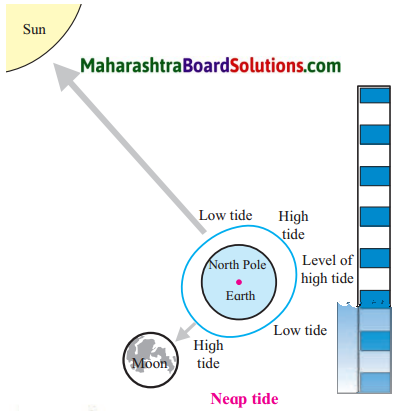
5. Observe figure of neap tide and answer the following questions:
Maharashtra Board Class 7 Geography Solutions Chapter 3 Tides 1
Question 1.
Which phase of the moon does it show?
Answer:
The diagram shows the phase of the quarter moon.

Maharashtra Board Class 7 Geography Solutions Chapter 3 Tides

Question 2.
What are the relative positions of the moon, the sun and the earth?
Answer:
The moon, the earth and the sun make an angle of 90° (right angle)

Question 3.
What effect will it have on the tides?
Answer:
It will lead to neap tide. Due to such conditions during high tide the water level will rise less than usual while during low tide water level will fall less than usual.

6. Differentiate between:

Question 1.
High tide and low tide:
Answer:

High tideLow Tide
(i) The rise in the level of sea water is caused by the combined effect of centrifugal and gravitational force of the moon and the sun.(i) The fall in the level of sea water is caused by the combined effect of centrifugal and gravitational force of the moon and the sun.
(ii) At the time of high tide, sea water is very close to the coast.(ii) At the time of low tide, sea water is far away from the coast.

Question 2.
Spring tide and neap tide.
Answer:

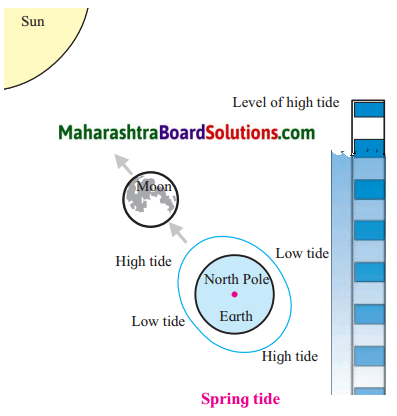
Spring tideNeap Tide
(i) It occurs on the new moon day and the full moon day.(i) It occurs on the the first and the third quarter days.
(ii) The gravitational pull of the moon and the sun as well as that of the earth are in a straight line and act in the same direction.(i) The gravitational pull of the moon and the sun are at right angle.
(iii) Spring tides are a little higher than the average high tides and a little lower than the average low tides.(iii) Neap tides are a little lower than the average high tides and little higher than the average low tides.

7. Describe the positive and negative effects of tides:
Answer:
The positive effects of tides are as follows:

  • The tides clear the waste and hence the coasts become clean.
  • Ports do not get filled with sediments .
  • Ships can move up to the ports during high tide.
  • During high tide, sea water can be stored in salt pans from which salt can be obtained.
  • The tidal force can be used to generate electricity.
  • With the high tide, fish move into the creeks and this helps fishing activity.
  • The tides help in maintaining the mangroves and the coastal biodiversity.

The negative effects of tides are as follows:

  • A lack of an understanding of the timings of high and low tides may cause accidents to swimmers entering the sea.

Activities:

  1. Visit the nearest sea coast. From a higher location, observe the waves approaching the coast. See if the approaching waves change their direction. With the help of your teacher find the answer to why this change occurs.
  2. Collect information from the internet about how electricity is generated from waves. Find places where such electricity is being generated.

Class 7 Geography Chapter 3 Tides InText Questions and Answers

Differentiate between:

Question 1.
Centrifugal force and Gravitational
Answer:

Centrifugal forceGravitational force
(i) Due to rotation, the earth gets a type of power of force. This force works away from the centre. It is called centrifugal force.
(ii) Centrifugal force works away from the centre.
(iii) Due to centrifugal force an object on the earth would be thrown into the space.
(i) Gravitational force is working towards the centre of the earth. This force is many times greater than the centrifugal force.
(ii) Gravitational force works towards the centre.
(iii) Due to gravitational force an object on the surface of the earth remains at the place where it exists.

Write short notes:

Question 1.
Spring tide
Answer:
(i) On new moon & full moon days, the gravitational pull of the sun and the moon act in the same direction due to which the total pull increases.

(ii) Hence, the tide on these days is much higher than the average high tide.

(iii) This is known as spring tide.

Maharashtra Board Class 7 Geography Solutions Chapter 3 Tides

Question 2.
Neap tide
Answer:
(i) While revolving around the earth, the moon makes a right angle with respect to the earth and the sun, twice a month.

(ii) This position occurs on the first and third quarter of each month. On both these days the forces of both the sun & the moon operate at right angles on the earth.

(iii) At the places where the sun causes high tide, the gravitational pull of the moon which is at right angles also acts on the water.

(iv) Due to such conditions the water level rise is less than usual at the time of high tide. Similarly, fall in water level is less than usual at the time of low tide.

(v) Such tides are called neap tides.

Question 3.
Waves
Answer:

  • The sea water gets pushed by the wind and ripples are generated on the water surface. These are called waves.
  • The sea water moves up & down or slightly forward & backward due to the waves.
  • The waves bring the energy contained in them to the coast.
  • Large & small waves are formed continuously at the surface of the sea.
  • Generation of waves is a natural & regularly occurring phenomenon.

Question 4.
Struture of the waves
Answer:
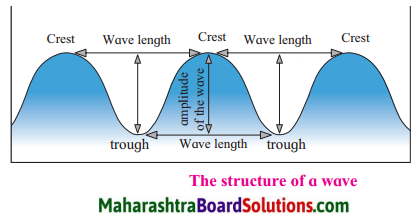
(i) The sea water gets pushed up & down because of the wind. The raised up portion of the wave is called crest & the depressed one is called trough.

(ii) The vertical distance between a crest and the following trough is called the amplitude of the wave whereas the distance between two successive crests or troughs is called wave length.

(iii) The wave length, its amplitude & its velocity depend on the velocity of the wind.

Formative Assessment:
Observe the activity on pages 9, 10 of the textbook & discuss the result of the activities and answer the question given below:
Maharashtra Board Class 7 Geography Solutions Chapter 3 Tides 2
Maharashtra Board Class 7 Geography Solutions Chapter 3 Tides 3

Maharashtra Board Class 7 Geography Solutions Chapter 3 Tides

Question 1.
In which direction will the piece of chalk fall? (fig. 1)
Answer:
The chalk will fall to the right.

Question 2.
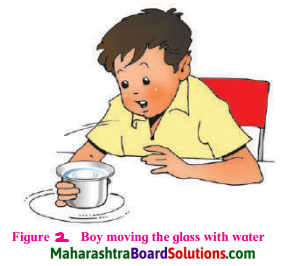
Where did the water in the glass show a bulge? (fig. 2)
Answer:
At the sides of the glass.

Question 3.
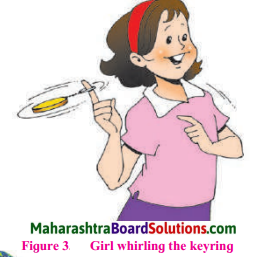
What effect did the movement have on the things attached to the keyring? (fig. 3)
Answer:
The things attached to the keyring will move round.

Question 4.
What happened to the water in the container and the mixer? (fig. 1)
Answer:
The water will swirl round forming a bulge at the sides and a depression in the centre.

Question 5.
Which forces could be operating in activities listed above?
Answer:
In the first activity (fig. 1) gravitational force acted and in the fig. 2, fig. 3 centrifugal force.

Question 6.
In the following activities, which force is greater, centrifugal or gravitational?
Answer:
The centrifugal force was greater than the gravitational force.

Can you tell?
Answer the following of questions with the help of figure
Maharashtra Board Class 7 Geography Solutions Chapter 3 Tides 5
Question 1.
How do the tides occur?
Answer:
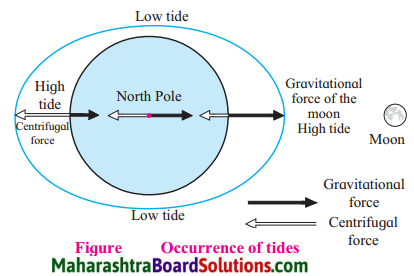
Tides occur due to the relative positions of the moon, the sun, and the earth.

Question 2.
Which force is applied when the moon is closer to the earth?
Answer:
Gravitational force becomes more effective than that of the sun when the moon is closer to the earth.

Question 3.
If it is high tide those having high tide at 0° and 180° meridian then at which meridians will low tide occur?
Answer:
The meridians that are at right angle to those having high tide will experience low tide at the same time ie. at 90°E & 90°W.

Class 7 Geography Chapter 3 Tides Additional Important Questions and Answers

Fill in the blanks choosing the correct options from the brackets:

Maharashtra Board Class 7 Geography Solutions Chapter 3 Tides

Question 1.
Due to rotation, the force that works away from the centre of the earth is the ______force. (gravitational, rotational, centrifugal)
Answer:
centrifugal

Question 2.
Neap tide occurs on the days of the ______ and _______ quarter of each month. (first, second, third)
Answer:
first, third

Question 3.
The tidal range in open seas is ______ cms. (20, 30, 40)
Answer:
30

Question 4.
The highest tidal range in the world is observed at _______.(Bay of Fundy, Bay of Biscay, Bay of Bengal)
Answer:
Bay of Fundy

Question 5.
The main reason for wave generation is ______ (wind, gravitational force, centrifugal force)
Answer:
wind

Question 6.
The raised up portion of a wave is called a _______ .(trough, wave length, crest)
Answer:
crest

Question 7.
The depressed portion of a wave is called a ______. (trough, wave length, crest)
Answer:
trough

Question 8.
The vertical distance between a crest and a trough is called the _____.(wave length, amplitude, tide)
Answer:
amplitude

Question 9.
The distance between a crest or trough is called _____ (amplitude, wave length, tide)
Answer:
wave length

Question 10.
Tall sea waves caused by earthquakes below the floor of the sea are called _____.(cyclones, tsunamis, eruption)
Answer:
tsunamis

Match the following:

Question 1.

‘A’ ‘B’
(1)  Bay of Fundy
(2)  Gulf of Khambhat
(3)  Open Seas
(4)  Peninsular India
(a)  1100 cm
(b)  100 -150 cm
(c)  1600 cm
(d)  30 cm

Answer:
1 – c
2- a
3 – d
4 – b

Fill in the blanks:
Question 1.
High and low tides are _______ phenomena.
Answer:
Natural

Question 2.
_________ are movements of sea water occurring daily and regularly.
Answer:
Tides

Maharashtra Board Class 7 Geography Solutions Chapter 3 Tides

Question 3.
Any object on the surface of the earth remains at the place due to the ______ force.
Answer:
Gravitational

Question 4.
The meridians that are at right angles to those having high, tide will experience tide _______.
Answer:
Low

Question 5.
On the days of the first and the third quarter, the high tide is at its _____.
Answer:
Minimum

Question 6.
On new moon and full moon days, the gravitational pull of the sun and the moon acting the ______ direction.
Answer:
Same

Question 7.
At every ______ a cycle of high tide and low tide gets completed.
Answer:
12 hrs & 25 min

Name the following:

Question 1.
Movement of sea water.
Answer:
Tides.

Question 2.
Two forces directly related with tides.
Answer:
Gravitational and Centrifugal forces.

Question 3.
Two types of tide.
Answer:
Spring tide and Neap tide.

Question 4.
The difference in the water level of the high tide and low tide.
Answer:
Tidal range.

Question 5.
The region with highest tidal range in India.
Answer:
The Gulf of Khambhat.

Question 6.
Tall waves caused by earthquakes in the shallow waters near the coast, which are very destructive.
Answer:
Tsunami.

Question 7.
Place where tsunami waves were generated in 2004.
Answer:
Sumatra islands of Indonesia.

Maharashtra Board Class 7 Geography Solutions Chapter 3 Tides

Question 8.
Type of tide occuring on full moon day.
Answer:
Spring tide.

Question 9.
Type of tide occuring when sun and the moon are at right angles to each other.
Answer:
Neap tide.

Question 10.
Distance between two successive crests or troughs.
Answer:
Wavelength.

Define the following:

Question 1.
Tide:
Answer:
The alternate rising and falling of the sea water after a specific period is called tide.

Question 2.
Centrifugal force:
Answer:
Due to the earth’s rotation, the earth gets a type of power or force. This force works away from the centre. It is called the centrifugal force.

Question 3.
Tidal range:
Answer:
The difference in the water level of the high tide and low tide is called tidal range.

Question 4.
Waves:
Answer:
The sea water gets pushed by the wind and so ripples are generated on the water surface. These are called waves.

Question 5.
Amplitude of the wave:
Answer:
The vertical distance between a crest and the following trough is called the amplitude of the wave.

Question 6.
Wave length:
Answer:
The wave length is the distance between two successive crests or troughs.

Write whether the following statements are true or false:

Question 1.
The gravitational force is many times greater than the centrifugal force.
Answer:
True

Question 2.
Spring tides are lower than average high tides.
Answer:
False

Maharashtra Board Class 7 Geography Solutions Chapter 3 Tides

Question 3.
Centrifugal force is generated due to the revolution of the earth.
Answer:
False

Question 4.
When there is high tide at 0° meridian, the 180° meridian also experiences high tide.
Answer:
True

Question 5.
Tides occur due to the relative positions of the moon, the sun and the earth.
Answer:
True

Question 6.
The tides clean the waste and hence the coastal areas become clean.
Answer:
True

Question 7.
The tides worsen the maintaining of mangroves and the coastal biodiversity.
Answer:
False

Question 8.
Generation of waves is a natural and regularly occurring phenomenon.
Answer:
True

Give geographical reasons:

Question 1
Any object on the surface of the earth remains at the place where it exists.
Answer:

  • Due to the earths rotation, it gets a type of power or force
  • The force acting in the centre is centrifugal force.
  • Due to this force any object on the earth would be thrown into the space.
  • But the gravitational force is working towards the centre of the earth at the same time.
  • This force is greater than the centrifugal force.
  • Hence, any object on the surface of earth remains at the place where it exists.

Question 2.
On new moon and full moon days the tides are higher than average.
Answer:

  • On new moon and full moon days, the gravitational pull of the sun and the moon act in the same direction.
  • Due to this, the total pull increases.
  • Hence, the tide on these days is much higher than the average high tide.

Maharashtra Board Class 7 Geography Solutions Chapter 3 Tides

Question 3.
Neap tides are a little lower than average high tides.
Answer:

  • While revolving around the earth, the moon makes a right angle with respect to the earth and the sun.
  • This position occurs on the first and the third quarter of each month.
  • On both these days, the forces of both the sun and the moon operate at right angles on the earth.
  • The attraction of the sun and the moon are not complementary but at right angles to each other.
  • Due to this, the water level rise is less than usual at the time of high tide

Answer in brief:

Question 1.
Which factors are responsible for the occurrence of tides?
Answer:
The following factors are responsible for the occurrence of tides.

  • The gravitational pull of the moon and the sun as well as that of the earth.
  • Revolution of the earth around the sun and the indirect revolution of the moon around the sun.
  • Centrifugal force generated due to the rotation of the earth.

Draw a neat labelled diagram of:

Question 1.
The structure of a wave:
Answer:
Maharashtra Board Class 7 Geography Solutions Chapter 3 Tides 6

Question 2.
Springtide:
Answer:
Maharashtra Board Class 7 Geography Solutions Chapter 3 Tides 7

Maharashtra Board Class 7 Geography Solutions Chapter 3 Tides

Question 3.
Neap tide:
Answer:
Maharashtra Board Class 7 Geography Solutions Chapter 3 Tides 8

Question 4.
Occurrence of tides:
Answer:
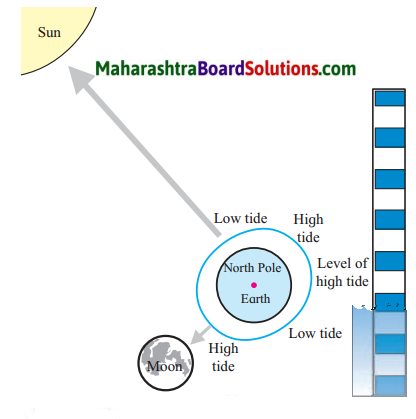
Maharashtra Board Class 7 Geography Solutions Chapter 3 Tides 5

Observe the following pictures and answer the following questions given below and discuss:
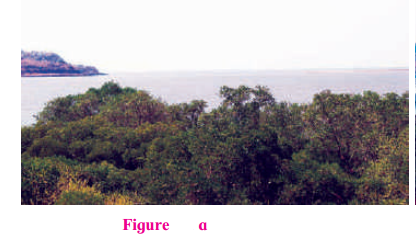
Maharashtra Board Class 7 Geography Solutions Chapter 3 Tides 9
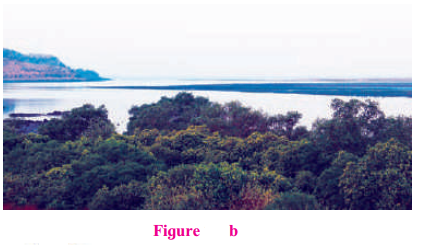
Maharashtra Board Class 7 Geography Solutions Chapter 3 Tides 10
Question 1.
Do the above photographs show the same place or different places?
Answer:
Both the photographs show the same place.

Question 2.
Observe and note the spread of water seen in both the photographs.
Answer:
The level of water is higher in the first picture and lower in the second.

Question 3.
What is this natural event called?
Answer:
This natural event is called tide.

Maharashtra Board Class 7 Geography Solutions Chapter 3 Tides

Try this:

Take a wide open large dish.
Keep the dish on a table or a flat surface.
Fill water in the dish up to the rim,(we have to generate waves in the dish).

Question 1.
Is it possible to generate waves without touching or shoving the dish? Try doing so.
Answer:
By blowing air with your mouth on the water surface of the dish.

Question 2.
In what different ways can you generate waves in the dish?
Answer:

  • By dropping an object in the dish.
  • By blowing air on the water surface.
  • By strong fan breeze.

Maharashtra Board Class 7 Geography Solutions Chapter 2 The Sun, the Moon and the Earth

Balbharti Maharashtra State Board Class 7 Geography Solutions Chapter 2 The Sun, the Moon and the Earth Notes, Textbook Exercise Important Questions and Answers.

Maharashtra State Board Class 7 Geography Solutions Chapter 2 The Sun, the Moon and the Earth

Class 7 Geography Chapter 2 The Sun, the Moon and the Earth Textbook Questions and Answers

1. Correct the wrong statements. Write down the corrected ones.
Question 1.
The moon revolves around the sun.
Answer:
Wrong – The moon revolves around the earth.

Question 2.
On a full moon day, the moon, the sun and the earth are positioned in this sequence.
Answer:
Wrong – On a full moon day, the sun, the earth and the moon are positioned in this sequence.

Question 3.
The revolutionary orbits of the earth and the moon are in the same plane.
Answer:
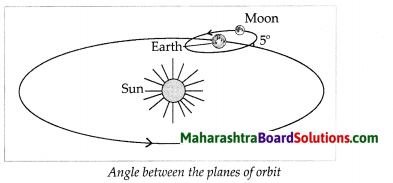
Wrong – The revolutionary orbits of the earth and the moon are not in the same plane. The moon’s revolutionary orbit makes an angle of about 5° with that the earth.

Maharashtra Board Class 7 Geography Solutions Chapter 2 The Sun, the Moon and the Earth

Question 4.
In one revolution of the moon, its orbit intersects the earth’s orbit only once.
Answer:
Wrong – In one revolution of the moon, its orbit intersects the earth’s orbit twice.

Question 5.
It is alright to observe a solar eclipse without protecting the eyes.
Answer:
Wrong – It is necessary to view the sun disc through dark glasses or through special goggles made for that purpose, otherwise the intense light of the sun can be harmful to the naked eye.

Question 6.
An annular solar eclipse occurs when the moon is in the perigee position.
Answer:
Wrong – An annular solar eclipse occurs when the moon is in the apogee position.

2. Select the correct option.

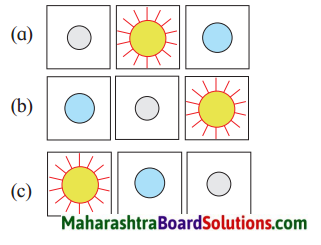
Question 1.
Solar eclipse
Maharashtra Board Class 7 Geography Solutions Chapter 2 The Sun, the Moon and the Earth 1
Answer:
(b)

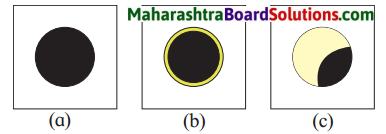
Question 2.
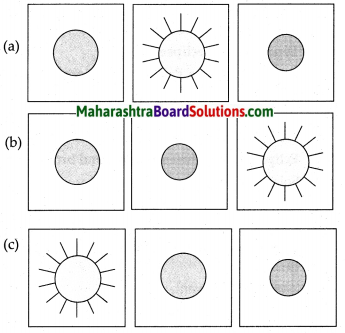
The shape of sun disc at the time of annular solar eclipse.
Maharashtra Board Class 7 Geography Solutions Chapter 2 The Sun, the Moon and the Earth 2
Answer:
(a)

Maharashtra Board Class 7 Geography Solutions Chapter 2 The Sun, the Moon and the Earth

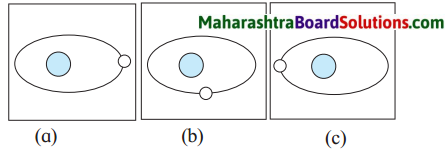
Question 3.
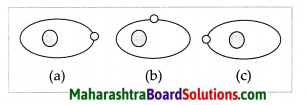
Apogee position of the moon.
Maharashtra Board Class 7 Geography Solutions Chapter 2 The Sun, the Moon and the Earth 3
Answer:
(c)

3. Complete the following table.

DetailsLunar EclipseSolar Eclipse
Phase of the moon……………………….
SequenceMoon-Earth- Sun………….
Type of Eclipse………….…………..
Maximum duration of total eclipse107 minutes…………….

Answer:

DetailsLunar EclipseSolar Eclipse
Phase of the moonFull Moon DayNew Moon Day
SequenceMoon-Earth-SunMoon-Earth-Sun
Type of EclipseTotal and PartialTotal, Partial, Annular
Maximum duration of total eclipse107 minutes440 Seconds

4. Draw and label the diagrams.

Question 1.
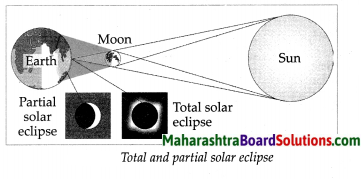
Total and partial solar eclipse:
Answer:
Maharashtra Board Class 7 Geography Solutions Chapter 2 The Sun, the Moon and the Earth 4

Question 2.
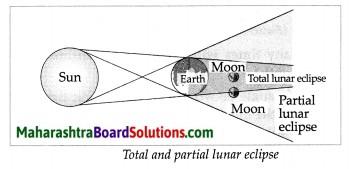
Total and partial lunar eclipse:
Answer:
Maharashtra Board Class 7 Geography Solutions Chapter 2 The Sun, the Moon and the Earth 5

5. Answer the following:

Question 1.
Why do the sun, the moon and the earth not lie in one and the same line on every full moon and new moon day?
Answer:
(i) The orbital path of the earth and that of moon are not in the same plane.
(i) The moon’s revolutionary orbit makes an angle of about 5° with that of the earth.
(iii) On each new moon day, the lines joining the earth and the sun and the moon make an angle of 0° whereas on each full moon day, this angle is 180°.
(iv) So, the sun, the earth and the moon may not be in one straight line in the same plane on every new moon or full moon day.

Question 2.
When a total solar eclipse occurs why is the partial eclipse also seen from the earth?
Answer:
(i) On a new moon day if the sun, the moon & the earth fall in one line & are in the same plane, the shadow of the moon falls on the earth
(ii) This shadow is of two types – the central portion of the shadow is darker & the periphery is light.
(iii) In the area where the dark shadow falls, the sun becomes completely invisible. Such an area experiences a total solar eclipse.
(iv) However during the same period, at the places where the shadow is lighter, the sun disc appears partially covered. Such an area experience partial solar eclipse. Thus when a total solar eclipse occurs a partial eclipse is also seen from the earth.

Maharashtra Board Class 7 Geography Solutions Chapter 2 The Sun, the Moon and the Earth

Question 3.
Suggest measures that can be taken to eradicate the superstitions related to the eclipses.
Answer:
The following measures can be taken to eradicate superstition related to eclipses:

  • Use of media to create awareness.
  • Parental guidance to help think logically.
  • Teachers guidance to help students develop a scientific outlook.
  • Campaigns, public meetings and lectures especially in rural areas to eradicate superstitions.

Question 4.
What precautions should we take while observing a solar eclipse?
Answer:
The precautions to be taken while observing a solar eclipse are:

  • We should not observe a solar eclipse with naked eyes as the intense light of the sun can harm them.
  • We must use dark glasses or goggles that are specially designed for viewing the solar eclipse.

Question 5.
What types of Solar eclipses will occur in perigee conditions?
Answer:
Total and Partial solar eclipse will occur in perigee condition.
(1) Total solar eclipse :

  • On a new moon day, the sun, the moon the earth are in a straight line & the shadow of the moon falls on the earth
  • The area of dark shadow falls on the earth, the sun becomes completely invisible. This condition is known as total solar eclipse.

(2) Partial solar eclipse:

  • However during the same period at places where the shadow is lighter, the sun disc appears partially covered,
  • This condition is described as partial solar eclipse.

Activities:

  1. Collect paper cuttings about eclipses and paste them in a notebook.
  2. Write a note on an eclipse that you have seen.
  3. Using the internet, ‘Panchanga’ and calendar collect information about the eclipses that are likely to occur this year.

Class 7 Geography Chapter 2 The Sun, the Moon and the Earth InText Questions and Answers

Use your brain power:

Question 1.
On the day of solar eclipse, in which part of the earth will it not be seen?
Answer:
Solar eclipse will not be seen where there is night.

Question 2.
Can we see total and annular solar eclipses on the same occasion?
Answer:
No, total and annular solar eclipses cannot be seen on the same occasion.

Question 3.
Why is an annular lunar eclipse not seen?
Answer:
An annular lunar eclipse cannot be seen because:

  • The size of the earth is bigger than that of the moon.
  • As compared to the sun, the moon is close to the earth.
  • Therefore, it is not possible that a dark shadow of the earth is cast in space & does not reach the moon.

Question 4.
Which eclipses will you see from the moon?
Answer:
Solar eclipses can be seen from the moon.

Maharashtra Board Class 7 Geography Solutions Chapter 2 The Sun, the Moon and the Earth

Question 5.
Why are solar eclipses caused by the other planets not seen from the earth?
Answer:
(i) A Solar eclipse occurs when the moon comes in between the sun & the earth & all of them are in the same plane & fall in one line on a new moon day.
(ii) Similarly, when Venus & Mercury come in between the earth & the sun, they make a small speck against the surface of the sun as they are too far away.
(iii) The other planets have orbits outside the earth’s & cannot fall in line between the earth & the sun.
(iv) Hence, the solar eclipse caused by other planets are not seen from the earth.

Think about it:

Question 1.
Figure shows positions of the moon as seen from the space and as seen from the earth. How will you identify which are which?
Maharashtra Board Class 7 Geography Solutions Chapter 2 The Sun, the Moon and the Earth 6
Answer:
Half of the moon’s portion is illuminated by the sun, and the other half remains dark. However, only some part of this illuminated portion of the moon can be seen from the earth. The position of the moon from the Earth is as follows:

  • New moon
  • Waxing crescent
  • 1st Quarter
  • Waxing Gibbous
  • Full moon
  • Waning Gibbous
  • Last quarter
  • Waning crescent

Question 2.
Like sunlight and moonlight, is there anything called the earth light? If yes, where do you think it is found?
Answer:
Yes, Earthlight is the partial illumination of the dark portion of the moon’s surface by light reflected from the earth’s airglow.

Question 3.
When solar eclipses do not occur on a new moon day, does it mean that the moon does not have any shadow at all?
Answer:
The moon casts a shadow on every new moon day, but solar eclipse occurs only when the moon’s shadow falls on the earth.

Class 7 Geography Chapter 2 The Sun, the Moon and the Earth Additional Important Questions and Answers

Fill in the blanks choosing the correct options from the brackets:

Question 1.
The shape of the moon’s orbit is _________. (round, elliptical, square)
Answer:
elliptical

Question 2.
The moon has _____ and ______ motions. (axial, orbital, elliptical)
Answer:
axial, orbital

Question 3.
When the moon is closest to the earth it is said to be in ________. (apogee, perigee, orbit)
Answer:
perigee

Question 4.
When the moon is farthest to the earth it is said to be in ______. (apogee, perigee, arial)
(round, elliptical, square)
Answer:
apogee

Question 5.
Solar Eclipse occurs on the _______ day. (full moon, new moon, quarter moon)
Answer:
new moon

Question 6.
Lunar Eclipse occurs on the ______ day. (full moon, new moon, quarter)
Answer:
full moon

Question 7.
_______ solar eclipse is a rare phenomenon. (Total, Partial, Annular)
Answer:
Annular

Maharashtra Board Class 7 Geography Solutions Chapter 2 The Sun, the Moon and the Earth

Question 8.
When the shadow of the moon on the central portion of the earth is darker while the periphery is lighter it is known as a _______ solar eclipse.
(partial, total, lunar)
Answer:
total

Question 9.
When the shadow of the moon on the central portion of the earth is lighter and the sun disc appears to be partially covered, it is known _________ solar eclipse.
(total, partial, solar)
Answer:
partial

Question 10.
The moon is ________ when the earth, the moon and the sun make an angle of 90°. (full, semicircular, crescent)
Answer:
semicircular

Question 11.
Occultation occurs with reference to the _____. (sun, moon, earth)
Answer:
moon

Question 12.
Transit is associated with the _______ .(sun, moon, earth)
Answer:
sun

Question 13.
During the period of _______ eclipse, a large number of birds and animals get confused. (solar, lunar, annular)
Answer:
solar

Correct the wrong statements. Write down the correct ones:
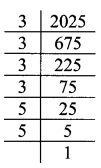
Question 1.
When the moon is closest to the earth it is said to be in apogee and when it is the farthest, the position is called perigee.
Answer:
Wrong – When the moon is closest to the earth it is said to be in perigee and when it is the farthest, the position is called apogee.

Question 2.
The moon wanes from the new moon day to the full moon day and waxes from the full moon to the new moon day.
Answer:
Wrong – The moon waxes from the new moon day to the full moon day and wanes from the full moon to the new moon day.

Select the correct options:

Question 1.
Maharashtra Board Class 7 Geography Solutions Chapter 2 The Sun, the Moon and the Earth 9
Answer:
(c)

Question 2.
Maharashtra Board Class 7 Geography Solutions Chapter 2 The Sun, the Moon and the Earth 10
Answer:
(c)

Maharashtra Board Class 7 Geography Solutions Chapter 2 The Sun, the Moon and the Earth

Complete the following table:

Question 1.

DetailsNumerical facts
1. Perigee distance……….
2. Apogee distance……….
3. Angular distance between the moon’s and the earth’s orbit………..
4. Maximum duration of a total solar eclipse……….
5. Maximum duration of a total lunar eclipse…………
6. Number of solar eclipse (types)………….
7. Number of lunar eclipse (types)……………

Answer:

DetailsNumerical facts
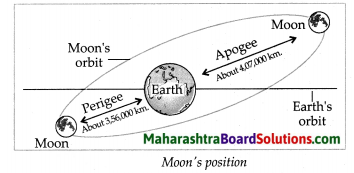
1. Perigee distance3,56,000 km
2. Apogee distance4,07,000 km
3. Angular distance between the moon’s and the earth’s orbit
4. Maximum duration of a total solar eclipse7 minutes 20 seconds
5. Maximum duration of a total lunar eclipse107 minutes
6. Number of solar eclipse (types)3
7. Number of lunar eclipse (types)2

Name the following:
Question 1.
Motions of the moon.
Answer:
Axial and orbital motion.

Question 2.
Types of solar eclipse.
Answer:
Total solar eclipse, Partial solar eclipse, Annular solar eclipse.

Question 3.
Types of lunar eclipse.
Answer:
Total lunar eclipse and Partial lunar eclipse.

Question 4.
Eclipse that confuses animals and birds.
Answer:
Solar eclipse.

Question 5.
An example of occultation.
Answer:
Total solar eclipse.

Question 6.
The event of the occurrence of solar eclipse or lunar eclipse.
Answer:
Astronomical event.

Maharashtra Board Class 7 Geography Solutions Chapter 2 The Sun, the Moon and the Earth

Define the following:

Question 1.
Perigee:
Answer:
When the moon is the closest to the earth in its orbit, it is perigee.

Question 2.
Apogee:
Answer:
When the moon is at the farthest from the earth in its orbit, it is apogee.

Question 3.
Occultation:
Answer:
The moon revolves around the earth. While doing so, it obscures1 a star or a planet and that celestial2 body appears to hide behind the moon. This is called occultation.

Question 4.
Transit:
Answer:
If an inner planet like Mercury or Venus comes in between the line of the earth and the sun, a transit occurs. At that time a small dot appears to move across the sun’s disc.

Question 5.
Phases of the moon:
Answer:
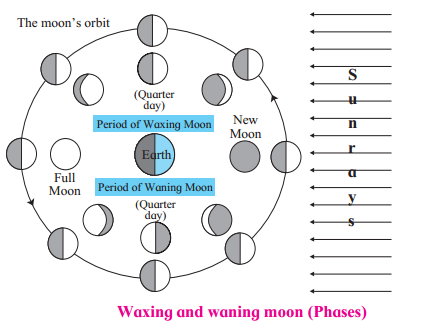
The illuminated portion of the moon disc observed from the earth that keeps on changing every day within a lunar month are called the phases of the moon.

Question 6.
Solar Eclipse:
Answer:
If the moon comes between the earth and the sun in a straight line on new moon day, the shadow of the moon falls on the earth and the sun becomes totally or partially invisible in the shadow zone. This phenomenon is called the solar eclipse.

Question 7.
Lunar Eclipse:
Answer:
On a full moon day, the . moon’s path of revolution passes through the thick shadow of the earth and the moon becomes totally or partially invisible. This phenomenon is called lunar eclipse.

Question 8.
Annular Solar eclipse
Answer:
Sometimes when the moon is in apogee position, a deep shadow of the moon is cast in space & does not reach the earth. From a very small region of the earth, only an illuminated edge of the sun disc is seen in the form of a ring. This is called annular solar eclipse.

Answer in one sentence:

Question 1.
What is the period of waxing moon?
Answer:
The period of waxing moon is the fortnight from new moon to full moon in which the illuminated part of the moon from the earth keeps on increasing (waxing)

Question 2.
What is the period of waning moon?
Answer:
The period of waning moon is the fortnight from full moon to new moon in which the illuminated part of the moon seen from the earth keeps on decreasing (waning)

Question 3.
Why can we see the phases of the moon from the earth?
Answer:
We can see the phases of the moon from the earth due to the sunlight reflected from the moon.

Maharashtra Board Class 7 Geography Solutions Chapter 2 The Sun, the Moon and the Earth

Question 4.
When does the moon appear semi-circular in shape in the sky?
Answer:
On the first and the third quarter days, the moon, the earth & the sun make an angle of 90° due to which we see half the portion of the illuminated moon in a semi-circular shape in the sky.

Question 5.
What types of solar eclipses occur in perigee position?
Answer:
Total & Partial Solar eclipses occur in perigee position.

Question 6.
When does a lunar eclipse occur?
Answer:
A lunar eclipse occurs when the moon enters the shadow of the earth while revolving around it.

Give geographical reasons for the following statements:

Question 1.
We constantly see only one and the same side of the moon.
Answer:

  • The time, the moon takes to make one revolution around the earth and one rotation around itself is the same.
  • As the axial and the orbital motions of the moon are almost of the same duration, only one, the same side of the moon faces the earth.
  • Therefore, we constantly see only one and the same side of the moon.

Question 2.
The distance between the moon and the earth keeps on changing.
Answer:

  • The moon’s orbit of the revolution is elliptical to that of the earth.
  • Hence the distance of the moon from the earth is not the same everywhere along its orbit while revolving.
  • When it is the closest to the earth it is said to be in perigee and when it is at the farthest, the position is called apogee.

Question 3.
Eclipses do not occur on each new moon or full moon day.
Answer:

  • The orbital path of the earth and that of the moon are not in the same plane.
  • The moon’s revolutionary orbit makes an angle of about 5° with that of the earth.
  • So, the sun, the earth and the moon may not be in one straight line in the same plane on every new moon or full moon day.
  • Hence, eclipses do not occur on each new moon or full moon day.

Question 4.
The Annular solar eclipse is rarely seen.
Answer:
The Annular solar eclipse is rarely seen because

  • The moon is in apogee position.
  • The deep shadow of the moon is cast in space and does not reach the earth.
  • From a very small region of the earth, only an illuminated edge of the sun disc is seen in the form of a ring.

Question 5.
Birds and animals are confused during the solar eclipse.
Answer:
Birds and animals are confused during the solar eclipse because –

  • Untimely darkness sets in.
  • The event does not suit their biological clock.
  • Their response to the event is also unusual.

Question 6.
On the first and third quarter days, the moon appears semicircular in shape.
Answer:

  • On the first and third quarter days, the moon, the earth and the sun make an angle of 90°
  • At these positions, we see half the portion of an illuminated moon.
  • Hence, in the sky, the moon appears semi-circular in shape.

Answer the following:

Question 1.
What precautions should we take while observing a solar eclipse?
Answer:
The precautions to be taken while observing a solar eclipse are:

  • We should not observe a solar eclipse with naked eyes as the intense light of the sun can harm them.
  • We must use dark glasses or goggles that are specially designed for viewing the solar eclipse.

Maharashtra Board Class 7 Geography Solutions Chapter 2 The Sun, the Moon and the Earth

Question 2.
What types of Solar eclipses will occur in perigee condition?
Answer:
Total and Partial solar eclipse will occur in perigee condition.
(i) Total solar eclipse :

  • On a new moon day, the sun, the moon the earth are in a straight line & the shadow of the moon falls on the earth
  • The area of dark shadow falls on the earth, the sun becomes completely invisible. This condition is known as total solar eclipse.

(ii) Partial solar eclipse:

  • However during the same period at places where the shadow is lighter, the sun disc appears partially covered,
  • This condition is described as partial solar eclipse.

Question 3.
How are lunar eclipses formed?
Answer:
(i) A lunar eclipse occurs when the moon enters the shadow of the earth while revolving around it.
(ii) On a full moon day if the sun, the earth & the moon, are in a straight line, the orbital path of the moon passes through the dark shadow of the earth.
(iii) If the moon is totally hidden within the shadow, a total lunar eclipse is seen & if only a part of the moon is in the shadow, a partial lunar eclipse is seen.

Write short notes on:

Question 1.
Characteristics of solar eclipse.
Answer:

  • A solar eclipse occurs on a new moon day, but not on every new moon day.
  • If and only if, the sun, the moon and the earth are in the same plane and fall in one line, the solar eclipses occur.
  • The maximum duration of a total solar eclipse is 7 minutes and 20 seconds Question 40 seconds).

Question 2.
Characteristics of lunar eclipse.
Answer:

  • A lunar eclipse occurs on a full moon day, but not on every full moon day.
  • A lunar eclipse occurs if and only if the sun, the moon and the earth are in the same plane and fall in one line.
  • The maximum duration of a total lunar eclipse is 107 minutes.

Question 3.
Occupation.
Answer:

  • This is a typical event occurring in space.
  • The moon revolves around the earth, while doing so, it obscures a star or a planet and that celestial body appears to hide behind the moon. This is called occultation.

Question 4.
What is a Transit?
Answer:

  • If an inner planet like a Mercury or Venus comes in between the line of the earth and the sun, a transit occurs.
  • At that time, a small dot appears to move across the sun’s disc.
  • Transit is a type of solar eclipse.

Maharashtra Board Class 7 Geography Solutions Chapter 2 The Sun, the Moon and the Earth

Distinguish between the following:

Question 1.
Solar eclipse and Lunar eclipse :
Answer:

Solar eclipse  Lunar eclipse     
(i) A solar eclipse occurs on a new moon day.

(ii) If and only if the sun, the moon and the earth are in the same plane and fall in one line, the solar eclipse occurs.

(iii) The maximum duration of total solar eclipse
is 7 minutes and 20 seconds (440 seconds).

(i) A lunar eclipse occurs on a full moon day.

(ii) A lunar eclipse occurs if and only if the sun, the earth and the moon are in the same plane and fall in one line.

(iii) The maximum duration of a total lunar eclipse is 107 minutes.

Question 2.
Total Solar eclipse and Annular Solar eclipse.
Answer:

Total Solar eclipseAnnular Solar eclipse
(i) When the moon is between the sun and the earth all the three celestial objects are on the same plane and fall in one line.(i) moon is in apogee position. This means it is farthest from the earth.
(ii) The central portion of the shadow of the moon is darker and the periphery is light.(ii) A deep shadow of the moon is cast in space and does not reach the earth.
(iii) In the area of dark shadow on the earth, the sun becomes completely invisible. This condition is known as total solar eclipse(iii) From a very small region of the earth, only an illuminated edge of the sun as a disc is seen in the form of a ring. This is called an annular eclipse.

Draw and label the diagrams:

Question 1.
Moon’s Positions:
Answer:
Maharashtra Board Class 7 Geography Solutions Chapter 2 The Sun, the Moon and the Earth 7

Question 2.
Angle between the planes of orbit.
Answer:
Maharashtra Board Class 7 Geography Solutions Chapter 2 The Sun, the Moon and the Earth 8

Question 3.
Consider the relative positions of the sun, the moon, and the earth on the new moon day and both the quarters. What will be the angle between the lines joining the earth and the moon as well as the earth and the sun? How many times will this angle be formed in a month?
Answer:
The angle between the lines joining the earth and the moon as well as the earth and the sun is 90°. This angle will be formed twice a month.

Maharashtra Board Class 7 Geography Solutions Chapter 1 How Seasons Occur Part 1

Balbharti Maharashtra State Board Class 7 Geography Solutions Part 1 Chapter 1 How Seasons Occur Part 1 Notes, Textbook Exercise Important Questions and Answers.

Maharashtra State Board Class 7 Geography Solutions Chapter 1 How Seasons Occur Part 1

Class 7 Geography Chapter 1 How Seasons Occur Part 1 InText Questions and Answers

1. Answer the following questions in one sentence:

Question 1.
How do day and nigbt occur on the earth?
Answer:
Day and night occur on the earth because of the earths rotation.

Question 2.
What term is used to describe the earth’s revolution around the sun?
Answer:
The term orbital motion is used to describe the earth’s revolution around the sun.

Maharashtra Board Class 7 Geography Solutions Chapter 1 How Seasons Occur Part 1

Question 3.
How long does the earth take to do so?
Answer:
The earth takes 365 days and 6 hours to complete one revolution.

Question 4.
In which hemispheres is our country located?
Answer:
Our country lies in the northeastern hemisphere.

Question 5.
Why don’t the sun’s rays fall perpendicularly at all places on the earth?
Answer:
The sun’s rays do not fall perpendicularly at all the places on the earth because the earth is not flat but spherical in shape.

2. Can you tell?

Records of the entries of sunrise and sunset for the month of June are given below. Answer the questions, that follow.

DateSunriseSunset Day NightSource of Information
19th June06.0119:1813 Hrs. 16 Min.10 Hrs. 44 Min.Time and date
20th June06.0219:1813 Hrs. 16 Min.10 Hrs. 44 Min.Time and date
21st June06.0219:1813 Hrs. 16 Min.10 Hrs. 44 Min.Time and date
22nd June06.0219:1813 Hrs. 16 Min.10 Hrs. 44 Min.Time and date
23rd June06.0219:1913 Hrs. 16 Min.10 Hrs. 44 Min.Time and date
24th June06.0219:1913 Hrs. 16 Min.10 Hrs. 44 Min.Time and date
25th June06.0319:1913 Hrs. 16 Min.10 Hrs. 44 Min.Time and date
26th June06.0319:1913 Hrs. 16 Min.10 Hrs. 44 Min.Time and date
27th June06.0319:1913 Hrs. 15 Min.10 Hrs. 45 Min.Time and date
28th June06.0419:1913 Hrs. 15 Min.10 Hrs. 45 Min.Time and date

Question 1.
Refer to the table above and state which are the longest days?
Answer:
The longest days are from 19th June to 26th June.

Maharashtra Board Class 7 Geography Solutions Chapter 1 How Seasons Occur Part 1

Question 2.
What difference do you notice in the duration of the nights from 19th June to 28th June?
Answer:
The duration of the nights keeps on increasing day by day.

Question 3.
What is the reason behind it?
Answer:
The sun is now moving southwards.

Question 4.
How did you find out the duration of the night?
Answer:
The duration of the day is subtracted from 24 hours to get the duration of the night.

Question 5.
Which two dates have days and nights of the same duration?
Answer:
March 22 and September 23 have the same duration of days and nights.

Question 6.
With the help of the table, you saw how the duration of the day and the night changes. Do you think such a change occurs everywhere on the earth?
Answer:
Yes, duration of day and night changes everywhere on the earth.

Question 7.
Use the above format to record the duration of daytime from 19th to 28th of every month from September to December.
Answer:
Students should expected to attempt the activity & answer on their own.

3. Think about it:

Question 1.
If the position of the shadow on the wall moves towards the north, in which direction does the location of sunrise or sunset appear to shift?
Answer:
If the position of the shadow on the wall moves towards the north, the location of sunrise or sunset will shift southwards.

Class 7 Geography Chapter 1 How Seasons Occur Part 1 Additional Important Questions and Answers

Fill in the blanks choosing the correct options from the brackets:

Question 1.
The earth’s _______ has enabled us to measure time in terms of days. (revolution, rotation, orbital motion)
Answer:
rotation

Question 2.
The earth rotates from _________ (north to south, east to west, west to east)
Answer:
west to east

Maharashtra Board Class 7 Geography Solutions Chapter 1 How Seasons Occur Part 1

Question 3.
The Earth takes _______ hours to rotate around itself. (365,144, 24)
Answer:
24

Question 4.
India lies in the ____ hemisphere. (northeastern, northwestern, southeastern)
Answer:
northeastern

Question 5.
The ________of sunrise and the sunset on the horizon³ for the whole year keep on changing. (position, shadow, rotation)
Answer:
position

Maharashtra Board Class 7 Geography Solutions Chapter 4 Air Pressure

Balbharti Maharashtra State Board Class 7 Geography Solutions Chapter 4 Air Pressure Notes, Textbook Exercise Important Questions and Answers.

Maharashtra State Board Class 7 Geography Solutions Chapter 4 Air Pressure

Class 7 Geography Chapter 4 Air Pressure Textbook Questions and Answers

1. Give reasons:

Question 1.
Air pressure decreases with increasing altitude.
Answer:

  • The proportion of dust in the air, water vapour, heavy gases, etc. is higher in the air and closer to the surface of the earth.
  • This proportion decreases with increasing altitude.
  • As one moves higher and higher from the surface of the earth, the air becomes thinner and thinner.
  • As a result, the air pressure decreases with increasing altitude.

Maharashtra Board Class 7 Geography Solutions Chapter 4 Air Pressure

Question 2.
Pressure belts oscillate.
Answer:

  • The duration and the intensity of sunrays varies during particular periods of the year in both the hemispheres.
  • So, the locations of the temperature zones and the pressure belts dependent on the sun’s heat also vary.
  • This change is of the order of 5° to 7° towards the north in Uttarayan1 and 5° to 7° south in Dakshinayan2.
  • In this way pressure belts oscillate.

2. Give short answers to the following questions.

Question 1.
What effect does temperature have on air pressure?
Answer:

  • Temperature and air pressure are closely related. Wherever the temperature is high, the air pressure is low.
  • As the temperature rises, the air gets heated, expands, and becomes lighter.
  • This lighter air in the vicinity of the earth’s surface starts moving up towards the sky
  • As a result, the air pressure in such areas decreases.

Question 2.
Why is the subpolar low pressure belt formed?
Answer:

  • Due to earth’s curvature, the area between two parallels gets reduced as we move towards the poles.
  • This results in lesser friction1 of the air with the earth’s surface.
  • Air in this region is thrown out because of this reduced friction and also because of the earth’s rotational motion.
  • This leads to the development of a low pressure belt in the sub polar region i.e. in area between 55° & 65° parallels in both the hemispheres.

3. Write notes on:

Question 1.
Mid-latitudinal high pressure belts.
Answer:

  • The heated air from the equatorial region becomes lighter, starts ascending and after reaching higher altitudes, moves towards the polar region, i.e., towards the North and the South Pole.
  • Due to low temperatures at the higher altitudes, the air cools down and becomes heavier.
  • This heavier air descends down in both the hemispheres in the region between 25° to 35° parallels.
  • This leads to the formation of high pressures, belts in these parallels of latitudes in both the hemispheres.
  • This air is dry, hence the region does not get rainfall.
  • Consequently, most of the hot deserts on the earth are found in these regions.

Maharashtra Board Class 7 Geography Solutions Chapter 4 Air Pressure

Question 2.
Horizontal distribution of air pressure.
Answer:

  • The heat received from the sun is uneven in different regions.
  • The distribution of temperature is uneven from the equator to the poles.
  • This difference can lead to difference in air pressure.
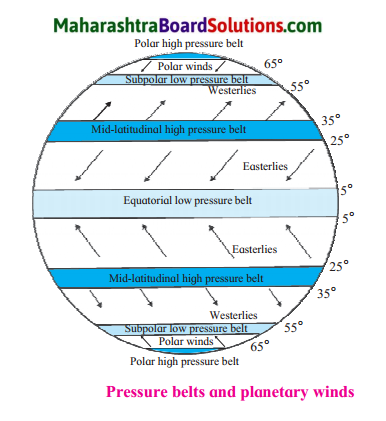
  • There are four air pressure belts formed on the earth surface.
  • Equatorial low-pressure belt between 5°N and 5°S parallels as the temperature is high here.
  • Mid latitudinal high-pressure belt between 25° and 35° parallels due to descending heavier air.
  • Subpolar low-pressure belt formed between 55° and 65° parallels due to friction and rotation.
  • Polar high-pressure belt formed between 80° and 90° parallels due to low temperatures.

4. Fill in the gaps with the appropriate option.

Question 1.
At higher altitudes air becomes ________. (thicker, thinner, hotter, more humid)
Answer:
thinner

Question 2.
Air pressure is expressed in _______ .(millibars, millimeters, milliliters, milligrams)
Answer:
millibars

Question 3.
On the earth, air pressure is _______.(uniform, uneven, high, low)
Answer:
uneven

Question 4.
The ______ pressure belt spreads between 5° North and 5° South parallel. (equatorial low, polar high, subpolar low, mid-latitudinal high)
Answer:
equatorial low

5. How does a high-pressure belt get formed near 30 ° parallel? Why does this region have hot deserts?
Answer:
(i) The heated air from the equatorial region becomes lighter, starts ascending and after reaching higher altitudes, moves towards the polar region, i.e., towards the North and the South Pole.

(ii) Due to low temperatures at the higher altitudes, the air cools down and becomes heavier. This heavier air descends down in both the hemispheres in the region between 25° to 35° parallels.

(iii) This leads to the formation of high pressures belts in these parallels of latitudes in both the hemispheres.

(iv) This air is dry, hence the region does not get rainfall. Consequently, most of the hot deserts on the earth are found in these regions.

6. Draw a neat diagram showing pressure belts. Label the diagram.
Answer:
Maharashtra Board Class 7 Geography Solutions Chapter 4 Air Pressure 4

Class 7 Geography Chapter 4 Air Pressure InText Questions and Answers

Formative Assessment
Can you tell?

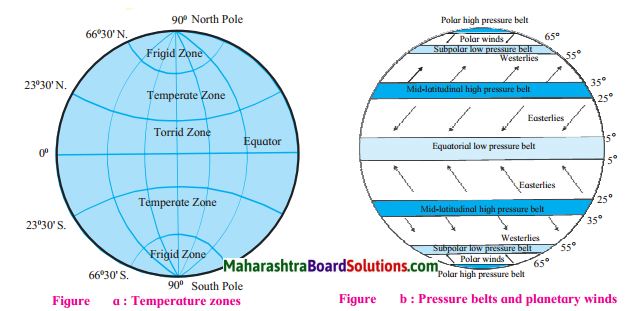
Observe the diagram Fig. (a) and (b) carefully and answer the following questions:
Maharashtra Board Class 7 Geography Solutions Chapter 4 Air Pressure 2
Question 1.
Which pressure belt is mainly found in the Tropics?
Answer:
Equatorial low pressure belt is mainly found in the tropics.

Question 2.
With which pressure belt are the polar winds associated? In which temperature zone are they observed?
Answer:
The polar winds are associated with polar high pressure belt and sub polar low pressure belt. It is observed in the frigid zone.

Maharashtra Board Class 7 Geography Solutions Chapter 4 Air Pressure

Question 3.
What could be the reason behind a low pressure belt in the Tropics?
Answer:
Low pressure belt is formed in the tropics because the temperature is high.

Question 4.
With which pressure belts are the winds in the Temperate zone associated?
Answer:
The winds in temperate zone are associated with mid latitudinal high pressure belt.

Question 5.
Write the latitudinal extent of the low pressure belts.
Answer:
The latitudinal extent of Equatorial low pressure belt is between 50°N & 50°S parallel & the latitudinal extent of the sub polar low pressure belt is between 55° & 65° parallel in both the hemispheres.

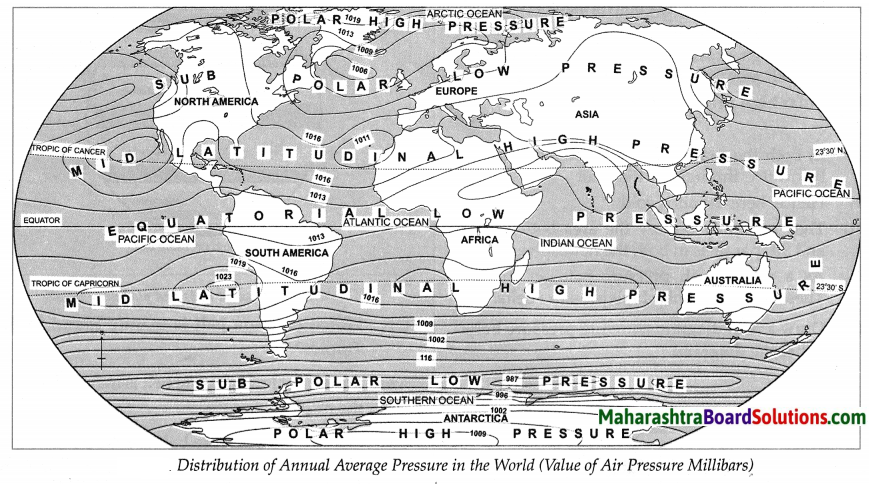
Observe the map given above and study the distribution of air pressure and answer the following
Maharashtra Board Class 7 Geography Solutions Chapter 4 Air Pressure 3
Question 1.
The nature of the isobars.
Answer:
The isobars are joining places of equal air pressure on the map.

Question 2.
High and low pressure belts and their latitudinal position.
Answer:
(i) The latitudinal position of high pressure belt is between 25° & 35° parallels and between 80° & 90° parallels in both the hemisphere
(ii) The latitudinal position of low pressure belt is between 0° & 5° parallels and between 55° & 65° parallels in both the hemispheres.

Question 3.
The direction of the isobars and the distance between successive isobars over the oceans and continents.
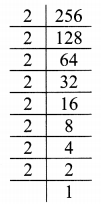
Answer:
(i) In the northern hemisphere most of the isobars are in southwest to north east direction over the continents. Also the distance between the isobars varies.
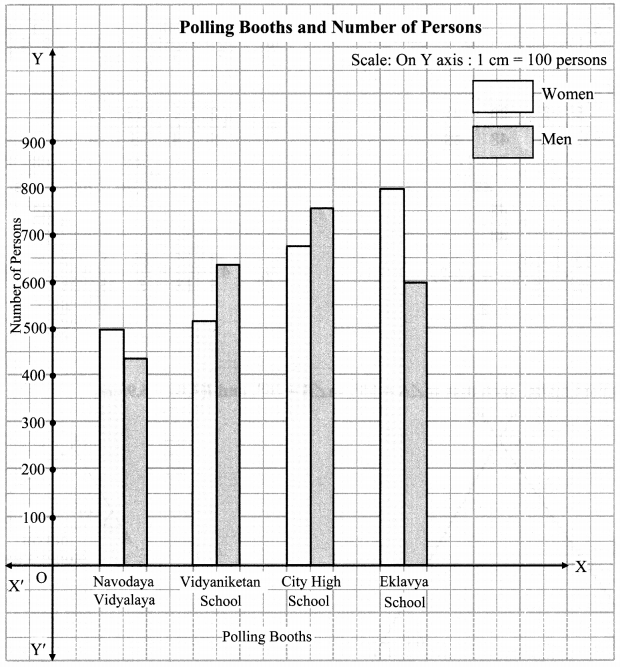
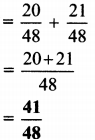
(ii) Closely spaced isobars indicate large pressure changes over a small area. Widely spaced isobars indicate gentle or gradual pressure change.
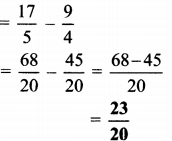
(iii) In the southern hemisphere, the isobars extend  in east-west direction. The distance between the isobars is fairly constant over the oceans & so the isobars are fairly parallel to each other.

Maharashtra Board Class 7 Geography Solutions Chapter 4 Air Pressure

Question 4.
Comparison of the isobars in the northern and the southern hemispheres.
Answer:
In the northern hemisphere the isobars are far spaced and uneven, whereas in the southern hemispheres it is closely spaced and parallel.

Use your brainpower !

Question 1.
If there is low pressure at the equator, what will be the condition of air pressure in the Arctic Zone?
Answer:
The Arctic zone will experience high pressure as the temperature is lower than 0°C.

Try this:

Question 1.

  • Take a flying lantern.
  • Tie an approximately 5m long thread to the flying lantern so that you can bring the lantern down whenever required.
  • After carefully reading the instructions given on the package of the lantern open it and light the candle placed in it.
  • After some time, bring the lantern down with the help of the thread and put off the candle.

Question 2.
Did the flying lantern start ascending immediately after the candle was lit?
Answer:
Yes

Question 2.
What would have happened to the flying lantern had the candle got extinguished after the lantern had gone up in the air?
Answer:
The lantern would have fallen back on the earth.

Give it a try: 

Question 1.
Study the temperative distribution map given in your std VI textbook and the pressure distribution map in this lesson to find the correlation between air temperature and air pressure.
Answer:

  • The temperature deceases continuously from the equator to the poles but the air pressure varies alternately.
  • In the equatorial region the average temperature is high. Hence, the air pressure is low.
  • In the polar regions, the temperature is low & hence the air pressure is comparative high.

Class 7 Geography Chapter 4 Air Pressure Additional Important Questions and Answers

Fill in the blanks choosing the correct option from the bracket:

Question 1.
Pressure belts oscillates between ______ parallels. (5° to 7°, 10° to 20°, 80° and 90°, 25° to 30°)
Answer:
5° to 7°

Maharashtra Board Class 7 Geography Solutions Chapter 4 Air Pressure

Question 2.
The instrument used to measure air pressure is ______ .(barometer, thermometer, hygrometer, seismometer)
Answer:
barometer

Question 3.
In both the polar regions, the temperature is below ________ throughout the year. (5°C, 0°C, 7°C, 6°C)
Answer:
0°C

Question 4.
The line that joins the places of equal pressure on the map is called an _______. (isotherm, isohytes, millibars, isobar)
Answer:
isobar

Match the following:

Question 1.

A (Pressure Belt)B (Parallels)
(1) Sub Polar low pressure

(2) Mid latitudinal high pressure

(3) Polar high pressure

(4) Equatorial low pressure

(a) 25° to 35°

(b) 5°N and 5°S

(c) 55° to 65°

(d) 80° to 90°

Answer:
1 – c
2 – a
3 – d
4 – b

Fill in the blanks:

Question 1.
The latitudinal extent of the temperate zones is much _____ while belts are narrower.
Answer:
Larger

Question 2.
The extent of air pressure belt is upto ______ parallel.
Answer:
10°

Question 3.
Pressure belts are formed between the _______ and the pole.
Answer:
Equator

Question 4.
The sun rays fall perpendicular between the ______and ________.
Answer:
Tropic of Cancer, Tropic of Capricorn

Question 5.
Due to the earths curvature, the area betweentwo parallels gets ______ as we move towards the poles.
Answer:
reduced

Question 6.
The air pressure at sea level is ______ millibars.
Answer:
1013.2

Maharashtra Board Class 7 Geography Solutions Chapter 4 Air Pressure

State whether the following statements are true or false:

Question 1.
Air pressure is uniform on all places on the earth’s surface.
Answer:
false

Question 2.
Whenever the temperature is high, the air pressure is also high.
Answer:
false

Question 3.
The heat received from the sun, is uneven in different regions.
Answer:
true

Question 4.
In both the polar regions, the temperature is low throughout the year.
Answer:
true

Question 5.
Air pressure is measured in units of millimetres.
Answer:
false

Answer the following questions in one to two sentence:

Question 1.
Which factors influence air pressure?
Answer:
The altitude of a region, temperature of the air and the amount of water vapour in the air are some factors influencing air pressure.

Question 2.
What is the extent of air pressure belt?
Answer:
The extent of air pressure belt is generally upto 10° parallel.

Question 3.
What is the latitudinal extent of temperate zone?
Answer:
The latitudinal extent of temperate zone is from 23°30’N to 66°30’N and 23° 30’S to 66° 30’S.

Question 4.
What is the temperature in the polar region?
Answer:
In both the polar regions, the temperature is below 0°C throughout the year.

Question 5.
Why do all things in and on the earth stay earth bound?
Answer:
All things in and on the earth stay bound due to the earth’s gravity.

Question 6.
Why are temperature zones created on the surface of the earth?
Answer:
The heat received from the sun is uneven in different regions. Hence the distribution of the temperature is uneven from the equator to the poles. As a result, temperature zones are created.

Question 7.
Most of the hot deserts on the earth are found in which region?
Answer:
Most of the hot deserts on the earth are found in the mid latitudinal high pressure belt ie; between 25° to 30° parallels in both hemispheres.

Maharashtra Board Class 7 Geography Solutions Chapter 4 Air Pressure

Give reasons:

Question 1.
Air pressure is maximum at sea level.
Answer:

  • All things in and on the earth stay earthbound because of the earth’s gravity. This includes air which is in the gaseous form.
  • Due to the earth’s gravity, air is pulled to the earth’s surface.
  • Also as one moves higher & higher from the earth’s surface the air becomes thinner & thinner.
  • Therefore, the air pressure is maximum at sea- level.

Question 2.
A low pressure belt is formed near the equator.
Answer:

  • The sunrays can be perpendicular between the Tropic of Cancer and the Tropic of Capricorn.
  • The temperature is higher in this region.
  • Hence air in this region gets heated, expands and becomes lighter and moves towards the sky.
  • As this process operates continuously, a low pressure belt gets formed in the central part of this region between the parallels 5° N and 5° S, near the equator.

Question 3.
High pressure belt is formed near the polar region.
Answer:

  • In both the polar regions, the temperature is below 0° throughout the year.
  • The air is cold.
  • Hence, high pressure belt is formed in the polar region.

Question 4.
Low pressure belt is observed between 55° and 65° parallels in both the hemispheres.
Answer:

  • Due to the earth’s curvature, the area between two parallels gets reduced as we move towards the poles. This results in lesser friction of the air with the earth’s surface.
  • The air between 55° and 65° parallels is thrown out because of the reduced friction and also due to the earth’s rotation.
  • Therefore, a low pressure belt is observed between 55° and 65° parallels in both the hemispheres.

Question 5.
Temperature and air pressure are closely related.
Answer:

  • Wherever the temperature is high, the air pressure is low. As the temperature rises the air gets heated, expands, and become lighter.
  • Thin, lighter air in the vicinity3 of the earth’s surface starts moving up towards the sky. As a result the air pressure in such area decreases.
  • Hence, temperature and air pressure are closely related.

Question 6.
Most of the hot deserts on the earth are found in mid-latitudinal high pressure belts.
Answer:

  • The air in mid-latitudinal high pressure belt (between 25° to 35° parallels in both hemisphere) is found to be dry.
  • The amount of water vapour is very low & hence this region gets extremely scarce or no rainfall.
  • Consequently, most of the hot deserts on the earth are found in mid latitudinal high pressure belts.

Give short answers to the following questions:

Question 1.
What are the effects of air pressure?
Answer:
Air pressure has the following effects.

  • Origin of winds.
  • Generation of storms
  • Convectional type of rain.

Maharashtra Board Class 7 Geography Solutions Chapter 4 Air Pressure

Question 2.
What is the difference between the temperature zones and pressure belts?
Answer:
(i) The difference between the temperature zones & pressure belts is that the latitudinal extent of temperature zones is much larger while pressure belts are narrower.

(ii) For example, the Temperate zone extends from 23°30′ to 66°30′ in both hemisphere. Compared to this the pressure belt has limited extent which is generally upto 10° parallel.

(iii) Also the temperature zones are continuous & spread from the equator to the poles from Torrid to Frigid.

(iv) Pressure belts are not continuous & areas of high & low pressure are found in different regions from the equator to the poles.

Question 3.
How does a high pressure belt get formed near 30° parallel? Why does this region have hot deserts?
Answer:
(i) The heated air from the equatorial region becomes lighter, starts ascending and after reaching higher altitudes, moves towards the polar region, i.e., towards the North and the South Pole.

(ii) Due to low temperatures at the higher altitudes, the air cools down and becomes heavier. This heavier air descends down in both the hemispheres in the region between 25° to 35° parallels.

(iii) This leads to the formation of high pressures belts in these parallels of latitudes in both the hemispheres.

(iv) This air is dry, hence the region does not get rainfall. Consequently, most of the hot deserts on the earth are found in these regions.

Think about it:

Question 1.
What will be the effect on air pressure if the temperature drops? Why?
Answer:
If the temperature drops, the air pressure will increase as the air becomes heavy.

Maharashtra Board Class 7 Science Solutions

Maharashtra State Board Class 7 Science Solutions

  • Chapter 1 The Living World : Adaptations and Classification
  • Chapter 2 Plants : Structure and Function
  • Chapter 3 Properties of Natural Resources
  • Chapter 4 Nutrition in Living Organisms
  • Chapter 5 Food Safety
  • Chapter 6 Measurement of Physical Quantities
  • Chapter 7 Motion, Force and Work
  • Chapter 8 Static Electricity
  • Chapter 9 Heat
  • Chapter 10 Disaster Management
  • Chapter 11 Cell Structure and Micro-organisms
  • Chapter 12 The Muscular System and Digestive System in Human Beings
  • Chapter 13 Changes – Physical and Chemical
  • Chapter 14 Elements, Compounds and Mixtures
  • Chapter 15 Materials we Use
  • Chapter 16 Natural Resources
  • Chapter 17 Effects of Light
  • Chapter 18 Sound : Production of Sound
  • Chapter 19 Properties of a Magnetic Field
  • Chapter 20 In the World of Stars

Maharashtra Board Practice Set 50 Class 7 Maths Solutions Chapter 14 Algebraic Formulae – Expansion of Squares

Balbharti Maharashtra State Board Class 7 Maths Solutions covers the 7th Std Maths Practice Set 50 Answers Solutions Chapter 14 Algebraic Formulae – Expansion of Squares.

Algebraic Formulae – Expansion of Squares Class 7 Practice Set 50 Answers Solutions Chapter 14

Question 1.
Expand:
i. (5a + 6b)²
ii. \(\left(\frac{\mathrm{a}}{2}+\frac{\mathrm{b}}{3}\right)^{2}\)
iii. (2p – 3q)²
iv. \(\left(x-\frac{2}{x}\right)^{2}\)
v. (ax + by)²
vi. (7m – 4)²
vii. \(\left(x+\frac{1}{2}\right)^{2}\)
viii. \(\left(a-\frac{1}{a}\right)^{2}\)
Solution:
i. (5a + 6b)²
Here, A = 5a and B = 6b
(5a + 6b)² = (5a)² + 2 × 5a × 6b + (6b)²
…. [(A + B)² = A² + 2AB + B²]
∴ (5a + 6b)² = 25a² + 60ab + 36b²

ii. \(\left(\frac{\mathrm{a}}{2}+\frac{\mathrm{b}}{3}\right)^{2}\)
Here A = \(\frac { a }{ 2 }\) and B = \(\frac { b }{ 3 }\)
Maharashtra Board Class 7 Maths Solutions Chapter 14 Algebraic Formulae - Expansion of Squares Practice Set 50 1

iii. (2p – 3q)²
Here, a = 2p and b = 3q
(2p – 3q)² = (2p)² – 2 × (2p) × (3q) + (3q)²
…. [(a – b)² = a² – 2ab + b²]
∴ (2p – 3q)² = 4p² – 12pq + 9q²

iv. \(\left(x-\frac{2}{x}\right)^{2}\)
Here a = x and b = \(\frac { 2 }{ x }\)
Maharashtra Board Class 7 Maths Solutions Chapter 14 Algebraic Formulae - Expansion of Squares Practice Set 50 2

v. (ax + by)²
Here, A = ax and B = by
(ax + by)² = (ax)² + 2 × ax × by + (by)²
…. [(A + B)² = A² + 2AB + B²]
∴ (ax + by)² = a²x² + 2abxy + b²y²

vi. (7m – 4)²
Here, a = 7m and b = 4
(7m – 4)² = (7m)² – 2 × 7m × 4 + 4²
…. [(a – b)² = a² – 2ab + b²]
∴ (7m – 4)² = 49m² – 56m + 16

vii. \(\left(x+\frac{1}{2}\right)^{2}\)
Here a = x and b = \(\frac { 1 }{ 2 }\)
Maharashtra Board Class 7 Maths Solutions Chapter 14 Algebraic Formulae - Expansion of Squares Practice Set 50 3

viii. \(\left(a-\frac{1}{a}\right)^{2}\)
Here A = a and B = \(\frac { 1 }{ a }\)
Maharashtra Board Class 7 Maths Solutions Chapter 14 Algebraic Formulae - Expansion of Squares Practice Set 50 4

Question 2.
Which of the options given below is the square of the binomial
(A) \(64-\frac{1}{x^{2}}\)
(B) \(64+\frac{1}{x^{2}}\)
(C) \(64-\frac{16}{x}+\frac{1}{x^{2}}\)
(D) \(64+\frac{16}{x}+\frac{1}{x^{2}}\)
Solution:
(C) \(64-\frac{16}{x}+\frac{1}{x^{2}}\)

Hint:
= \(\left(8-\frac{1}{x}\right)^{2}=8^{2}-2 \times 8 \times \frac{1}{x}+\left(\frac{1}{x}\right)^{2}\) …[(a – b)² = a² – 2ab + b²]
= \(64-\frac{16}{x}+\frac{1}{x^{2}}\)

Question 3.
Of which of the binomials given below is the m²n² + 14mnpq + 49p²q² the expansion?
(A) (m + n) (p + q)
(B) (mn – pq)
(C) (7mn + pq)
(D) (mn + 7pq)
Solution:
(D) (mn + 7pq)

Hint:
Here, square root of the first term = mn
Square root of the last term = 7pq
∴ Required binomial = (mn + 7pq)²

Question 4.
Use an expansion formula to find the values of:
i. (997)²
ii. (102)²
iii. (97)²
iv. (1005)²
Solution:
i. (997)² = (1000 – 3)²
Here, a = 1000 and b = 3
(1000 – 3)² = (1000)² – 2 x 1000 x 3 + 3²
…. [(a – b)² = a² – 2ab + b²]
= 1000000 – 6000 + 9
= 994009
∴ (997)² = 994009

ii. (102)² = (100 + 2)²
Here, a = 100 and b = 2
(100 + 2)² = (100)² + 2 x 100 x 2 + 2²
…. [(a + b)² = a² + 2ab + b²]
= 10000 + 400 + 4
= 10404
∴ (102)² = 10404

iii. (97)² = (100 – 3)²
Here, a = 100 and b = 3
(100 – 3)² = (100)² – 2 x 100 x 3 + 3²
…. [(a – b)² = a² – 2ab + b²]
= 10000 – 600 + 9
= 9409
∴ (97)² = 9409

iv. (1005)² = (1000 + 5)²
Here, a = 1000 and b = 5 (1000 + 5)²
= (1000)² + 2 x 1000 x 5 + 5²
…. [(a + b)² = a² + 2ab + b²]
= 1000000+ 10000 + 25
= 1010025
∴ (1005)² = 1010025

Maharashtra Board Class 7 Maths Chapter 14 Algebraic Formulae – Expansion of Squares Practice Set 50 Intext Questions and Activities

Question 1.
Use the given values to verify the formulae for squares of binomials. (Textbook pg. no. 92)
i. a = -7, b = 8
ii. a = 11,b = 3
iii. a = 2.5,b = 1.2
Solution:
i. (a + b)² = (-7 + 8)²
= 1²
= 1
a² + 2ab + b² = (-7)² + 2 x (-7) x 8 + 8²
= 49 – 112 + 64
= 1
∴(a + b)² = a² + 2ab + b²
(a – b)² = (-7 – 8)²
= (-15)²
= 225
a² – 2ab + b² = (-7)² – 2 x (-7) x 8 + (8)²
= 49 + 112 + 64
= 225
∴(a – b)² = a² – 2ab + b²

ii. (a + b)² = (11 + 3)²
= 14²
= 196
a² + 2ab + b² = 11² + 2 x 11 x 3 + 3²
= 121 + 66 + 9
= 196
∴(a + b)² = a² + 2ab + b²
(a – b)² = (11 – 3)² = 8²
= 64
a² – 2ab + b² = 11² – 2 x 11 x 3 + 3²
= 121 – 66 + 9
= 64
∴(a – b)² = a² – 2ab + b²

iii. (a + b)² = (2.5 + 1.2)²
= 3.7²
= 13.69
a² + 2ab + b² = (2.5)² + 2 x 2.5 x 1.2 + (1.2)²
= 6.25 + 6 + 1.44
= 13.69
∴(a + b)² = a² + 2ab + b²
(a – b)² = (2.5 – 1.2)²
= 1.32
= 1.69
a² – 2ab + b² = (2.5)² – 2 x 2.5 x 1.2 + (1.2)²
= 6.25 – 6 + 1.44
= 1.69
∴(a – b)² = a² – 2ab + b²-

Maharashtra Board Practice Set 40 Class 7 Maths Solutions Chapter 10 Bank and Simple Interest

Balbharti Maharashtra State Board Class 7 Maths Solutions covers the 7th Std Maths Practice Set 40 Answers Solutions Chapter 10 Bank and Simple Interest.

Bank and Simple Interest Class 7 Practice Set 40 Answers Solutions Chapter 10

Question 1.
If Rihanna deposits Rs 1500 in the school fund at 9 p.c.p.a for 2 years, what is the total amount she will get?
Solution:
Here, P = Rs 1500, R = 9 p.c.p.a , T = 2 years
∴ Total interest = \(\frac{\mathrm{P} \times \mathrm{R} \times \mathrm{T}}{100}\)
= \(\frac{1500 \times 9 \times 2}{100}\)
= 1500 x 9 x 2
= Rs 270
∴ Total amount = Principal + Interest
= 1500 + 270
= Rs 1770
∴ Rihanna will get a total amount of Rs 1770.

Question 2.
Jethalal took a housing loan of Rs 2,50,000 from a bank at 10 p.c.p.a. for 5 years. What is the yearly interest he must pay and the total amount he returns to the bank?
Solution:
Here, P = Rs 250000, R = 10 p.c.p.a., T = 5 years
∴ Total interest = \(\frac{\mathrm{P} \times \mathrm{R} \times \mathrm{T}}{100}\)
= \(\frac{250000 \times 10 \times 5}{100}\)
= 2500 x 10 x 5
= Rs 1,25,000
∴ Yearly interest = Total interest ÷ Time = 1,25,000 ÷ 5 = Rs 25000
Total amount to be returned = Principal + Total interest
= 250000 + 125000 = Rs 375000
∴ The yearly interest is Rs 25,000 and Jethalal will have to return Rs 3,75,000 to the bank.

Question 3.
Shrikant deposited Rs 85,000 for \(2\frac { 1 }{ 2 }\) years at 7 p.c.p.a. in a savings bank account. What is the total
interest he received at the end of the period?
Solution:
Here, P = Rs 85000, R = 7 p.c.p.a., T = \(2\frac { 1 }{ 2 }\) years = 2.5 years
∴ Total interest = \(\frac{\mathrm{P} \times \mathrm{R} \times \mathrm{T}}{100}\)
= \(\frac{85000 \times 7 \times 2.5}{100}\)
= \(\frac{85000 \times 7 \times 25}{100 \times 10}\)
= 85 x 7 x 25
= Rs 14875
∴ The total interest received by Shrikant at the end of the period is Rs 14875.

Question 4.
At a certain rate of interest, the interest after 4 years on Rs 5000 principal is Rs 1200. What would be the interest on Rs 15000 at the same rate of interest for the same period?
Solution:
The interest on Rs 5000 after 4 years is Rs 1200.
Let us suppose the interest on Rs 15000 at the same rate after 4 years is Rs x.
Taking the ratio of interest and principal, we get
∴ \(\frac{x}{15000}=\frac{1200}{5000}\)
∴ \(x=\frac{1200 \times 15000}{5000}\)
= Rs 3600
∴ The interest received on Rs 15000 is Rs 3600.

Question 5.
If Pankaj deposits Rs 1,50,000 in a bank at 10 p.c.p.a. for two years, what is the total amount he will get from the bank?
Solution:
Here, P = 150000, R = 10 p.c.p.a., T = 2 years
∴ Total interest = \(\frac{\mathrm{P} \times \mathrm{R} \times \mathrm{T}}{100}\)
= \(\frac{150000 \times 10 \times 2}{100}\)
= Rs 30000
∴ Total amount = Principal + Total Interest
= 150000 + 30000
= Rs 180000
∴ Pankaj will receive Rs 180000 from the bank.

Maharashtra Board Class 7 Maths Chapter 10 Banks and Simple Interest Practice Set 40 Intext Questions and Activities

Question 1.
Observe the entries made in the page of a passbook shown below and answer the following questions. (Textbook pg. no. 70)

Maharashtra Board Class 7 Maths Solutions Chapter 10 Banks and Simple Interest Practice Set 40 1

  1. On 2.2.16 the amount deposited was Rs__and the balance Rs__.
  2. On 12.2.16, Rs__were withdrawn by cheque no. 243965. The balance was Rs__
  3. On 26.2.2016 the bank paid an interest of Rs__

Solution:

  1. 1500, 7000
  2. 3000, 9000
  3. 135

Practice Set 40 Class 7 Question 2.
Suvidya borrowed a sum of Rs 30000 at 8 p.c.p.a. interest for a year from her bank to buy a computer. At the end of the period, she had to pay back an amount of Rs 2400 over and above what she had borrowed.
Based on this information fill in the blanks below. (Textbook pg. no. 70)

  1. Principal = Rs__
  2. Rate of interest =__%
  3. Interest = Rs__
  4. Time =__year.
  5. The total amount returned to the bank = 30,000 + 2,400 = Rs__

Solution:

  1. 30000
  2. 8
  3. 2400
  4. 1
  5. Rs 32400

Maharashtra Board Miscellaneous Problems Set 1 Class 7 Maths Solutions

Balbharti Maharashtra State Board Class 7 Maths Solutions covers the 7th Std Maths Miscellaneous Problems Set 1 Answers Solutions.

Maharashtra Board Miscellaneous Problems Set 1 Class 7 Maths Solutions

Question 1.
Solve the following:
i. (-16) × (-5)
ii. (72) ÷ (-12)
iii. (-24) × (2)
iv. 125 ÷ 5
v. (-104) ÷ (-13)
vi. 25 × (-4)
Solution:
i. (-16) × (-5) = 80

ii. 72 ÷ (-12) = \(\frac { 72 }{ -12 }\)
= \(\frac{1}{(-1)} \times \frac{72}{12}\)
(-1) × 12
= -6

iii. (-24) × 2 = -48

iv. 125 ÷ 5 = \(\frac { 125 }{ 5 }\)
= 25

v. (-104) ÷ (-13) = \(\frac { -104 }{ -13 }\)
= \(\frac { 104 }{ 13 }\)
= 8

vi. 25 × (-4) = -100

Question 2.
Find the prime factors of the following numbers and find their LCM and HCF:
i. 75,135
ii. 114,76
iii. 153,187
iv. 32,24,48
Solution:
i. 75 = 3 × 25
= 3 × 5 × 5
135 = 3 × 45
= 3 × 3 × 15
= 3 × 3 × 3 × 5
∴ HCF of 75 and 135 = 3 × 5
= 15
LCM of 75 and 135 = 3 × 5 × 5 × 3 × 3
= 675

ii. 114 = 2 × 57
= 2 × 3 × 19
76 = 2 × 38
= 2 × 2 × 19
∴ HCF of 114 and 76 = 2 × 19
= 38
LCM of 114 and 76 = 2 × 19 × 3 × 2
= 228

iii. 153 = 3 × 51
= 3 × 3 × 17
187 = 11 × 17
∴ HCF of 153 and 187 = 17
LCM of 153 and 187 = 17 × 3 × 3 × 11
= 1683

iv. 32 = 2 × 16
= 2 × 2 × 8
= 2 × 2 × 2 × 4
= 2 × 2 × 2 × 2 × 2
24 = 2 × 12
= 2 × 2 × 6
= 2 × 2 × 2 × 3
48 = 2 × 24
= 2 × 2 × 12
= 2 × 2 × 2 × 6
= 2 × 2 × 2 × 2 × 3
∴ HCF of 32, 24 and 48 = 2 × 2 × 2
= 8
LCM of 32,24 and 48 = 2 × 2 × 2 × 2 × 2 × 3
= 96

Question 3.
Simplify:
i. \(\frac { 322 }{ 391 }\)
ii. \(\frac { 247 }{ 209 }\)
iii. \(\frac { 117 }{ 156 }\)
Solution:
i. \(\frac { 322 }{ 391 }\)
Maharashtra Board Class 7 Maths Solutions Miscellaneous Problems Set 1 1

ii. \(\frac { 247 }{ 209 }\)
Maharashtra Board Class 7 Maths Solutions Miscellaneous Problems Set 1 2

iii. \(\frac { 117 }{ 156 }\)
Maharashtra Board Class 7 Maths Solutions Miscellaneous Problems Set 1 3

Question 4.
i. 784
ii. 225
iii. 1296
iv. 2025
v. 256
Solution:
i. 784
Maharashtra Board Class 7 Maths Solutions Miscellaneous Problems Set 1 4
∴ 784 = 2 × 2 × 2 × 2 × 7 × 7
∴ √784 = 2 × 2 × 7
= 28

ii. 225
Maharashtra Board Class 7 Maths Solutions Miscellaneous Problems Set 1 5
∴ 225 = 3 × 3 × 5 × 5
∴ √225 = 3 × 5
= 15

iii. 1296
Maharashtra Board Class 7 Maths Solutions Miscellaneous Problems Set 1 6
∴ 1296 = 2 × 2 × 2 × 2 × 3 × 3 × 3 × 3
∴ √1296 = 2 × 2 × 3 × 3
= 36

iv. 2025
Maharashtra Board Class 7 Maths Solutions Miscellaneous Problems Set 1 7
∴ 2025 = 3 × 3 × 3 × 3 × 5 × 5
∴ √2025 = 3 × 3 × 5
= 45

v. 256
Maharashtra Board Class 7 Maths Solutions Miscellaneous Problems Set 1 8
∴ 256 = 2 × 2 × 2 × 2 × 2 × 2 × 2 × 2
∴ √256 = 2 × 2 × 2 × 2
= 16

Question 5.
There are four polling booths for a certain election. The numbers of men and women who cast their vote at each booth is given in the table below. Draw a joint bar graph for this data.

Polling BoothsNavodaya VidyalayaVidyaniketan SchoolCity High SchoolEklavya School
Women500520680800
Men440640760600

Solution:
Maharashtra Board Class 7 Maths Solutions Miscellaneous Problems Set 1 9

Question 6.
Simplify the expressions:
i. 45 ÷ 5 + 120 × 4 – 12
ii. (38 – 8) × 2 ÷ 5 + 13
iii. \(\frac{5}{3}+\frac{4}{7} \div \frac{32}{21}\)
iv. 3 × {4 [85 + 5 – (15 – 3)] + 2}
Solution:
i. 45 ÷ 5 + 120 × 4 – 12
= 9 + 80 – 12
= 89 – 12
= 77

ii. (38 – 8) × 2 ÷ 5 + 13
= 30 × 2 ÷ 5 + 13
= 60 ÷ 5 + 13
= 12 + 13
= 25

iii. \(\frac{5}{3}+\frac{4}{7} \div \frac{32}{21}\)
\(\frac{5}{3}+\frac{4}{7} \times \frac{21}{32}\)
\(\frac{5}{3}+\frac{3}{8}=\frac{40}{24}+\frac{9}{24}\)
\(\frac{49}{24}\)

iv. 3 × {4 [85 + 5 – (15 – 3)] + 2}
= 3 × {4[90 – 5] + 2}
= 3 × {4 × 85 + 2}
= 3 × (340 + 2)
= 3 × 342
= 1026

Question 7.
Solve:
i. \(\frac{5}{12}+\frac{7}{16}\)
ii. \(3 \frac{2}{5}-2 \frac{1}{4}\)
iii. \(\frac{12}{5} \times \frac{(-10)}{3}\)
iv. \(4 \frac{3}{8} \div \frac{25}{18}\)
Solution:
i. \(\frac{5}{12}+\frac{7}{16}\)
Maharashtra Board Class 7 Maths Solutions Miscellaneous Problems Set 1 10

ii. \(3 \frac{2}{5}-2 \frac{1}{4}\)
Maharashtra Board Class 7 Maths Solutions Miscellaneous Problems Set 1 11

iii. \(\frac{12}{5} \times \frac{(-10)}{3}\)
= 4 × (-2)
= -8

iv. \(4 \frac{3}{8} \div \frac{25}{18}\)
= \(\frac{7}{4} \times \frac{9}{5}\)
= \(\frac { 63 }{ 20 }\)

Question 8.
Construct ∆ABC such that m∠A = 55°, m∠B = and l(AB) = 5.9 cm.
Solution:
Maharashtra Board Class 7 Maths Solutions Miscellaneous Problems Set 1 12

Question 9.
Construct ∆XYZ such that, l(XY) = 3.7 cm, l(YZ) = 7.7 cm, l(XZ) = 6.3 cm.
Solution:
Maharashtra Board Class 7 Maths Solutions Miscellaneous Problems Set 1 13

Question 10.
Construct ∆PQR such that, m∠P = 80°, m∠Q = 70°, l(QR) = 5.7 cm.
Ans:
In ∆PQR,
m∠P + m∠Q + m∠R = 180° …. (Sum of the measures of the angles of a triangle is 180°)
∴ 80 + 70 + m∠R = 180
∴ 150 + m∠R = 180
∴ m∠R = 180 – 150
∴ m∠R = 30°
Maharashtra Board Class 7 Maths Solutions Miscellaneous Problems Set 1 14

Question 11.
Construct ∆EFG from the given measures. l(FG) = 5 cm, m∠EFG = 90°, l(EG) = 7 cm.
Solution:
Maharashtra Board Class 7 Maths Solutions Miscellaneous Problems Set 1 15

Question 12.
In ∆LMN, l(LM) = 6.2 cm, m∠LMN = 60°, l(MN) 4 cm. Construct ∆LMN.
Solution:
Maharashtra Board Class 7 Maths Solutions Miscellaneous Problems Set 1 16

Question 13.
Find the measures of the complementary angles of the following angles:
i. 35°
ii. a°
iii. 22°
iv. (40 – x)°
Solution:
i. Let the measure of the complementary
angle be x°.
35 + x = 90
∴35 + x-35 = 90 – 35
….(Subtracting 35 from both sides)
∴x = 55
∴The complementary angle of 35° is 55°.

ii. Let the measure of the complementary angle be x°.
a + x = 90
∴a + x – a = 90 – a
….(Subtracting a from both sides)
∴x = (90 – a)
∴The complementary angle of a° is (90 – a)°.

iii. Let the measure of the complementary angle be x°.
22 + x = 90
∴22 + x – 22 = 90 – 22
….(Subtracting 22 from both sides)
∴x = 68
∴The complementary angle of 22° is 68°.

iv. Let the measure of the complementary angle be a°.
40 – x + a = 90
∴40 – x + a – 40 + x = 90 – 40 + x
….(Subtracting 40 and adding x on both sides)
∴a = (50 + x)
∴The complementary angle of (40 – x)° is (50 + x)°.

Question 14.
Find the measures of the supplements of the following angles:
i. 111°
ii. 47°
iii. 180°
iv. (90 – x)°
Solution:
i. Let the measure of the supplementary
angle be x°.
111 + x = 180
∴ 111 + x – 111 = 180 – 111
…..(Subtracting 111 from both sides)
∴ x = 69
∴ The supplementary angle of 111° is 69°.

ii. Let the measure of the supplementary angle be x°.
47 + x = 180
∴47 + x – 47 = 180 – 47
….(Subtracting 47 from both sides)
∴x = 133
∴The supplementary angle of 47° is 133°.

iii. Let the measure of the supplementary angle be x°.
180 + x = 180
∴180 + x – 180 = 180 – 180
….(Subtracting 180 from both sides)
∴x = 0
∴The supplementary angle of 180° is 0°.

iv. Let the measure of the supplementary angle be a°.
90 – x + a = 180
∴90 – x + a – 90 + x = 180 – 90+ x
….(Subtracting 90 and adding x on both sides)
∴a = 180 – 90 + x
∴a = (90 + x)
∴The supplementary angle of (90 – x)° is (90 + x)°.

Question 15.
Construct the following figures:
i. A pair of adjacent angles
ii. Two supplementary angles which are not adjacent angles.
iii. A pair of adjacent complementary angles.
Solution:
i.
Maharashtra Board Class 7 Maths Solutions Miscellaneous Problems Set 1 17

ii.
Maharashtra Board Class 7 Maths Solutions Miscellaneous Problems Set 1 18

iii.
Maharashtra Board Class 7 Maths Solutions Miscellaneous Problems Set 1 19

Question 16.
In ∆PQR the measures of ∠P and ∠Q are equal and m∠PRQ = 70°, Find the measures of the following angles.
Maharashtra Board Class 7 Maths Solutions Miscellaneous Problems Set 1 20

  1. m∠PRT
  2. m∠P
  3. m∠Q

Solution:
Here, ∠PRQ and ∠PRT are angles in a linear pair.
m∠PRQ + m∠PRT = 180°
∴70 + m∠PRT = 180
∴m∠PRT = 180 – 70
∴m∠PRT = 110°
Now, ∠PRT is the exterior angle of ∆PQR.
∴m∠P + m∠Q = m∠PRT
∴m∠P + m∠P = m∠PRT ….(The measures of ∠P and ∠Q is same)
∴2m∠P = 110
∴m∠P = \(\frac { 110 }{ 2 }\)
∴m∠P = 55°
∴m∠Q =

Question 17.
Simplify
i. 54 × 53
ii. \(\left(\frac{2}{3}\right)^{6} \div\left(\frac{2}{3}\right)^{9}\)
iii. \(\left(\frac{7}{2}\right)^{8} \times\left(\frac{7}{2}\right)^{-6}\)
iv. \(\left(\frac{4}{5}\right)^{2} \div\left(\frac{5}{4}\right)\)
Solution:
Simplify
i. 54 × 53
= 54+3
= 57

ii. \(\left(\frac{2}{3}\right)^{6} \div\left(\frac{2}{3}\right)^{9}\)
Maharashtra Board Class 7 Maths Solutions Miscellaneous Problems Set 1 21

iii. \(\left(\frac{7}{2}\right)^{8} \times\left(\frac{7}{2}\right)^{-6}\)
Maharashtra Board Class 7 Maths Solutions Miscellaneous Problems Set 1 22

iv. \(\left(\frac{4}{5}\right)^{2} \div\left(\frac{5}{4}\right)\)
Maharashtra Board Class 7 Maths Solutions Miscellaneous Problems Set 1 23

Question 18.
Find the value:
i. 1716  ÷ 1716
ii. 10-3
iii. (2³)²
iv. 46 × 4-4
Solution:
i. 1716  ÷ 1716
= 170
= 1

ii. 10-3
= \(\frac{1}{10^{3}}\)
= \(\frac{1}{1000}\)

iii. (2³)²
= 23×2
= 26
= 2 × 2 × 2 × 2 × 2 × 2
= 64

iv. 46 × 4-4
= 46+(-4)
= 42
= 4 × 4
= 16

Question 19.
Solve:
i. (6a – 5b – 8c) + (15b + 2a – 5c)
ii. (3x + 2y) (7x – 8y)
iii. (7m – 5n) – (-4n – 11m)
iv. (11m – 12n + 3p) – (9m + 7n – 8p)
Solution:
i. (6a – 5b – 8c) + (15b + 2a – 5c)
= (6a + 2a) + (-5b + 15b) + (-8c – 5c)
= 8a + 10b – 13c

ii. (3x + 2y) (7x – 8y)
= 3x × (7x – 8y) + 2yx (7x – 8y)
= 21x² – 24xy + 14xy – 16y²
= 21x² – 10xy – 16y²

iii. (7m – 5n) – (-4n – 11m)
= 7m – 5n + 4n + 11m
= (7m + 11m) + (-5n + 4n)
= 18m – n

iv. (11m – 12n + 3p) – (9m + 7n – 8p)
= 11m – 12n + 3p – 9m – 7n + 8p
= (11m – 9m) + (-12n – 7n) + (3p + 8p)
= 2m – 19n + 11p

Question 20.
Solve the following equations:
i 4(x + 12) = 8
ii. 3y + 4 = 5y – 6
Solution:
i. 4(x + 12) = 8
∴4x + 48 = 8
∴4x + 48 – 48 = 8 – 48
….(Subtracting 48 from both sides)
∴ 4x = -40
∴ x = \(\frac { -40 }{ 4 }\)
∴ x = -10

ii. 3y + 4 = 5y – 6
∴ 3y + 4 + 6 = 5y – 6 + 6
….(Adding 6 on both sides)
∴ 3y + 10 = 5y
∴ 3y + 10 – 3y = 5y – 3y
….(Subtracting 3y from both sides)
∴ 10 = 2y
∴ 2y = 10
∴ y = \(\frac { 10 }{ 2 }\)
∴ y = 5

Maharashtra Board Miscellaneous Problems Set 2 Class 7 Maths Solutions

Balbharti Maharashtra State Board Class 7 Maths Solutions covers the 7th Std Maths Miscellaneous Problems Set 2 Answers Solutions.

Maharashtra Board Miscellaneous Problems Set 2 Class 7 Maths Solutions

Question 1.
Angela deposited Rs 15000 in a bank at a rate of 9 p.c.p.a. She got simple interest amounting to Rs 5400. For how many years had she deposited the amount?
Solution:
Here, P = Rs 15000, R = 9 p.c.p.a., I = Rs 5400
Maharashtra Board Class 7 Maths Solutions Miscellaneous Problems Set 2 1
∴ T = 4
∴ Angela had deposited the amount for 4 years.

Question 2.
Ten men take 4 days to complete the task of tarring a road. How many days would 8 men take?
Solution:
Let us suppose that 8 men require x days to tar the road.
Number of days required by 10 men to tar the road = 4
The number of men and the number of days required to tar the road are in inverse proportion.
∴ 8 × x = 10 x 4
∴ \(x=\frac{10 \times 4}{8}\)
∴ x = 5
∴ 8 men will require 5 days to tar the road.

Question 3.
Nasruddin and Mahesh invested Rs 40,000 and Rs 60,000 respectively to start a business. They made a profit of 30%. How much profit did each of them make?
Solution:
Total amount invested = Rs 40,000 + Rs 60,000
= Rs 1,00,000
Profit earned = 30%
∴ Total profit = 30% of 1,00,000
= \(\frac { 30 }{ 100 }\) × 100000
= Rs 30000
Proportion of investment = 40000 : 60000
= 2:3 …. (Dividing by 20000)
Let Nasruddin’s profit be Rs 2x and Mahesh’s profit be Rs 3x.
∴ 2x + 3x = 30000
∴ 5x = 30000
∴ x = \(\frac { 30000 }{ 5 }\).
∴ x = 6000
∴ Nasruddin’s profit = 2x = 2 × 6000 = Rs 12000
Mahesh’s profit = 3x = 3 × 6000 = Rs 18000
∴ The profits of Nasruddin and Mahesh are Rs 12000 and Rs 18000 respectively.

Question 4.
The diameter of a circle is 5.6 cm. Find its circumference.
Solution:
Diameter of the circle (d) = 5.6 cm
Circumference = πd
= \(\frac{22}{7} \times 5.6\)
= \(\frac{22}{7} \times \frac{56}{10}\)
= 17.6 cm
∴ The circumference of the circle is 17.6 cm.

Question 5.
Expand:
i. (2a – 3b)²
ii. (10 + y)²
iii. \(\left(\frac{p}{3}+\frac{q}{4}\right)^{2}\)
iv. \(\left(y-\frac{3}{y}\right)^{2}\)
Solution:
i. Here, A = 2a and B = 3b
∴ (2a – 3b)² = (2a)² – 2 × 2a × 3b + (3b)²
…. [(A – B)² = A² – 2AB + B²]
= 4a² – 12ab + 9b²

ii. Here, a = 10 and b = y
(10 + y)² = 102 + 2 × 10xy + y²
…. [(a + b)² = a² + 2ab + b²]
= 100 + 20y + y²

iii. Here, a = \(\frac { p }{ 3 }\) and b = \(\frac { q }{ 4 }\)
\(\left(\frac{p}{3}+\frac{q}{4}\right)^{2}=\left(\frac{p}{3}\right)^{2}+2 \times \frac{p}{3} \times \frac{q}{4}+\left(\frac{q}{4}\right)^{2}\)
…. [(a + b)² = a² + 2ab + b²]
\(\frac{p^{2}}{9}+\frac{p q}{6}+\frac{q^{2}}{16}\)

iv. Here, a = y and b = \(\frac { 3 }{ y }\)
\(\left(y-\frac{3}{y}\right)^{2}=y^{2}-2 \times y \times \frac{3}{y}+\left(\frac{3}{y}\right)^{2}\)
…. [(a – b)² = a² – 2ab + b²
= \(y^{2}-6+\frac{9}{y^{2}}\)

Question 6.
Use a formula to multiply:
i. (x – 5)(x + 5)
ii. (2a – 13)(2a + 13)
iii. (4z – 5y)(4z + 5y)
iv. (2t – 5)(2t + 5)
Solution:
i. Here, a = x and b = 5
(x – 5)(x + 5) = (x)² – (5)²
…. [(a + b)(a – b) = a² – b²]
= x² – 25

ii. Here, A = 2a and B = 13
(2a – 13)(2a + 13) = (2a)² – (13)²
…. [(A + B)(A – B) = A² – B²]
= 4a² – 169

iii. Here, a = 4z and b = 5y
(4z – 5y)(4z + 5y) = (4z)² – (5y)²
…. [(a + b)(a – b) = a² – b²]
= 16z² – 25y²

iv. Here, a = 2t and b = 5
(2t – 5)(2t + 5) = (2t)² – (5)²
…. [(a + b)(a – b) = a² – b²]
= 4t² – 25

Question 7.
The diameter of the wheel of a cart is 1.05 m. How much distance will the cart cover in 1000 rotations of the wheel?
Solution:
Diameter of the wheel (d) = 1.05 m
∴ Distance covered in 1 rotation of wheel = Circumference of the wheel
= πd
= \(\frac{22}{7} \times 1.05\)
= 3.3 m
∴ Distance covered in 1000 rotations = 1000 x 3.3 m
= 3300 m
= \(\frac { 3300 }{ 1000 }\) km …[1m = \(\frac { 1 }{ 1000 }\)km]
= 3.3 km
∴ The distance covered by the cart in 1000 rotations of the wheel is 3.3 km.

Question 8.
The area of a rectangular garden of length 40 m, is 1000 sq m. Find the breadth of the garden and its perimeter. The garden is to be enclosed by 3 rounds of fencing, leaving an entrance of 4 m. Find the cost of fencing the garden at a rate of Rs 250 per metre.
Solution:
Length of the rectangular garden = 40 m
Area of the rectangular garden = 1000 sq. m.
∴ length × breadth = 1000
∴ 40 × breadth = 1000
∴ breadth = \(\frac { 1000 }{ 40 }\)
= 25 m
Now, perimeter of the rectangular garden = 2 × (length + breadth)
= 2 (40 + 25)
= 2 × 65
= 130 m
Length of one round of fence = circumference of garden – width of the entrance
= 130 – 4
= 126 m
∴ Total length of fencing = length of one round of wire × number of rounds = 126 × 3
= 378 m
∴ Total cost of fencing = Total length of fencing × cost per metre of fencing
= 378 × 250
= 94500
∴ The cost of fencing the garden is Rs 94500.

Question 9.
From the given figure, find the length of hypotenuse AC and the perimeter of ∆ABC.
Solution:
Maharashtra Board Class 7 Maths Solutions Miscellaneous Problems Set 2 2
In ∆ABC, ∠B = 90°, and l(BC) = 21, and l(AB) = 20
∴ According to Pythagoras’ theorem,
∴ l(AC)² = l(BC)² + l(AB)²
∴ l(AC)² = 21² + 20²
∴ l(AC)² = 441 + 400
∴ l(AC)² = 841
∴ l(AC)² = 29²
∴ l(AC) = 29
Perimeter of ∆ABC = l(AB) + l(BC) + l(AC)
= 20 + 21 + 29
= 70
∴ The length of hypotenuse AC is 29 units, and the perimeter of ∆ABC is 70 units.

Question 10.
If the edge of a cube is 8 cm long, find its total surface area.
Solution: ,
Total surface area of the cube = 6 × (side)²
= 6 × (8)²
= 6 × 64
= 384 sq. cm
The total surface area of the cube is 384 sq.cm.

Question 11.
Factorize: 365y4z3 – 146y2z4
Solution:
= 365y4z3 – 146y2z4
= 73 (5y4z3 – 2y2z4)
= 73y2 (5y2z3 – 2z4)
= 73y2z3(5y2 – 2z)