Maharashtra Board Class 10 Science Solutions Part 1 Chapter 6 Refraction of Light

Balbharti Maharashtra State Board Class 10 Science Solutions Part 1 Chapter 6 Refraction of Light Notes, Textbook Exercise Important Questions and Answers.

Maharashtra State Board Class 10 Science Solutions Part 1 Chapter 6 Refraction of Light

Question 1.
Fill in the blanks and explain the completed statements:
a. Refractive index depends on the………….of light.
Answer:
Refractive index depends on the velocity of light.
It is an experimental fact. (There is no question of explanation.)

b. The change in…………of light rays while going from one medium to another is called refraction.
Answer:
The change in the direction of propagation of light rays while going from one medium to another is called refraction. This is definition of refraction. It is assumed that the ray of light passes obliquely from one medium to another. (There is no question of explanation.)

Maharashtra Board Class 10 Science Solutions Part 1 Chapter 6 Refraction of Light

Question 2.
Prove the following statements:
a. If the angle of incidence and angle of emergence of a light ray falling on a glass slab are i and e respectively, prove that i = e. (Practice Activity Sheet – 4)
Answer:
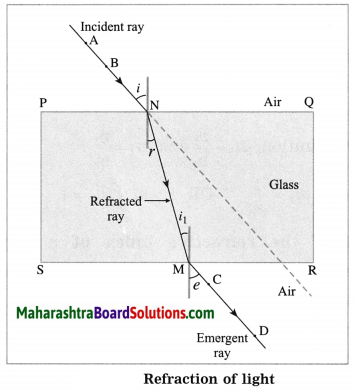
In the following figure, SR || PQ and NM is the refracted ray. Hence, r = i1.
Now gna = sin i/sin r and ang = sin i1/ sin e.
Maharashtra Board Class 10 Science Solutions Part 1 Chapter 6 Refraction of Light 1
Also gna = \(\frac{1}{{ }_{\mathrm{a}} n_{\mathrm{g}}}\)
∴ \(\frac{\sin i}{\sin r}=\frac{\sin e}{\sin i_{1}}\)
As r = i1, it follows that sin i = sin e
∴ i = e.

b. A rainbow is the combined effect (an exhibition) of the refraction, dispersion, and total internal reflection of light (taken together). (Practice Activity Sheet – 1)
(OR)
With a neat labelled diagram, explain how the formation of rainbow occurs.
Answer:
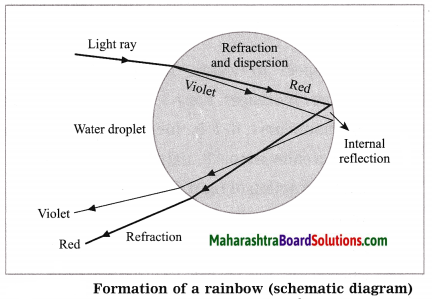
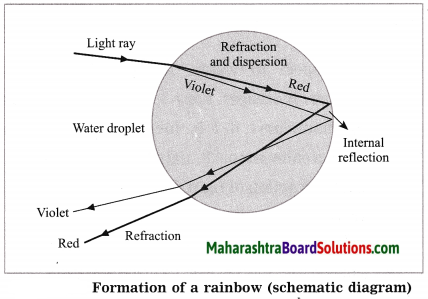
(1) The formation of a rainbow in the sky is a combined result of refraction, dispersion, internal reflection and again refraction of sunlight by water droplets present in the atmosphere after it has rained.
Maharashtra Board Class 10 Science Solutions Part 1 Chapter 6 Refraction of Light 2
Here, for simplicity only violet and red colours are shown. The remaining five colours lie between these two.

(2) The sunlight is a mixture of seven colours: violet, indigo, blue, green, yellow, orange and red. After it has stopped raining, the atmosphere contains a large number of water droplets. When sunlight is incident on a water droplet, there is (i) refraction and dispersion of light as it passes from air to water (ii) internal reflection of light inside the droplet and (iii) refraction of light as it passes from water to air.

(3) The refractive index of water is different for different colours, being maximum for violet and minimum for red. Hence, there is dispersion of light (separation into different colours) as it passes from air to water. [ See above Figure for reference.]

(4) The combined action of different water droplets, acting like tiny prisms, is to produce a rainbow with red colour at the outer side and violet colour at the inner side. The remaining five colours lie between these two.
The rainbow is seen when the sun is behind the observer and water droplets in the front.

Question 3.
Mark the correct answer in the following questions :
A. What is the reason for the twinkling of stars?
(i) Explosions occurring in stars from time to time
(ii) Absorption of light in the earth’s atmosphere
(iii) Motion of stars
(iv) Changing refractive index of the atmospheric gases
Answer:
Changing refractive index of the atmospheric gases.

B. We can see the Sun even when it is little below the horizon because of
(i) reflection of light
(ii) refraction of light
(iii) dispersion of light
(iv) absorption of light
Answer:
refraction of light

C. If the refractive index of glass with respect to air is 3/2, what is the refractive index of air with respect to glass?
(i) \(\frac{1}{2}\)
(ii) 3
(iii) \(\frac{1}{3}\)
(iv) \(\frac{2}{3}\)
Answer:
(iv) \(\frac{2}{3}\)

Maharashtra Board Class 10 Science Solutions Part 1 Chapter 6 Refraction of Light

Question 4.
Solve the following examples:
a. If the speed of light in a medium is 1.5 × 10⁸ m/s, what is the absolute refractive index of the medium? (Practice Activity Sheet – 1 and 4)
Solution:
Data: v = 1.5 × 10⁸ m/s,
c = 3 × 10⁸ m/s, n = ?
n = \(\frac{c}{v}=\frac{3 \times 10^{8} \mathrm{m} / \mathrm{s}}{1.5 \times 10^{8} \mathrm{m} / \mathrm{s}}\) = 2
This is the absolute refractive index of the medium.

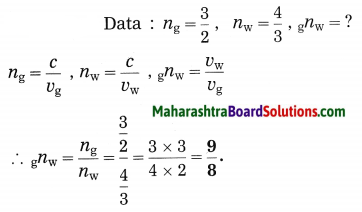
b. If the absolute refractive indices of glass and water are \(\frac{3}{2}\) and \(\frac{4}{3}\) respectively, what is the refractive index of glass with respect to water?
Solution:
Maharashtra Board Class 10 Science Solutions Part 1 Chapter 6 Refraction of Light 3
This is the refractive index of glass with respect to water.

Project:

Question 1.
Using a laser and soap water. study the refraction of light under the guidance of your teacher. (Do it your self)

Can you recall? (Text Book Page No. 73)

Question 1.
What is meant by reflection of light?
Answer:
Reflection of light: When light is incident on the surface of an object, in general, it is deflected in different directions. This process is called reflection of light.

Question 2.
What are the laws of reflection?
Answer:
Laws of reflection of light:

  1. The incident ray and the reflected ray of light are on the opposite sides of the normal to the reflecting surface at the point of incidence and all the three are in the same plane.
  2. The angle of incidence j and the angle of reflection are equal in measure.

Can you recall? (Text Book page No. 75)

Question 1.
If the refractive index of the second medium with respect to the first medium is 2n1 and that of the third medium with respect to the second medium is 3n2, what and how much is 3n1.
Answer:
3n1 is the refractive index of the third medium with respect to the first medium.

Maharashtra Board Class 10 Science Solutions Part 1 Chapter 6 Refraction of Light 4
3n1 = 2n1 × 3n2.

[Suppose medium 1 = air, medium 2 ≡ ice and medium 3 ≡ diamond. Then, 2n1 ÷ 1.31, 3n2 = 1.847
3n1 = 2n1 × 3n2 = 1.31 × 1.847 = 2.42 which is the refractive index of diamond with respect to air.]

Can you tell? (Textbook page No. 76)

Question 1.
Have you seen a mirage which is an illusion of the appearance of water on a hot road or in a desert?
Answer:
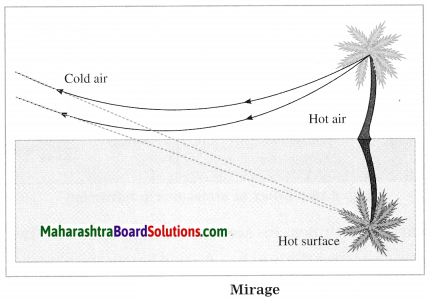
Due to the changes in refraction of light, the light rays coming from a distant object appear to be coming from the image of the object inside the ground. This is called a mirage. When the earth’s surface is heated by the sun, the temperature of air increases. This produces a layer of hot air of lower density (mass per unit volume) and lower refractive index at the surface.
Maharashtra Board Class 10 Science Solutions Part 1 Chapter 6 Refraction of Light 5
Hot air works as an optically rarer medium relative to cool air. When the temperature changes rapidly in the vertical direction, as refraction of light takes place, the angle of refraction changes continuously. The rays of light from the top of an object such as a car or tree cross the rays from the bottom of the object on their way to the observer’s eye.

Hence, an inverted image is formed below the object’s true position and downward towards the surface in the direction of air at higher temperature. In this case, some rays of light bend back up into the denser air above figure. Mirage produces an impression of water near the hot ground.

Maharashtra Board Class 10 Science Solutions Part 1 Chapter 6 Refraction of Light

Question 2.
Have you seen that objects beyond and above a holy fire appear to be shaking? Why does this happen?
Answer:
The temperature of air beyond and above a holy fire changes all the time. Hence, the density of air also changes constantly. Hence, the direction of propagation of the rays of light approaching us from the objects beyond and above the holy fire changes constantly. Therefore, those objects appear to be shaking.

Use your brain power! (Text Book Page No. 77)

Question 1.
From incident white light how will you obtain white emergent light by making use of two prisms?
Answer:

  • Take a prism. Allow white light to fall on it.
  • Obtain a spectrum.
  • Take a second identical prism. Place it parallel to the first prism in an upside down position with the first prism [as shown in Figure]
  • Allow the colours of the spectrum to pass through the second prism.
  • Obtain the beam of light emerging from the other side of the second prism.
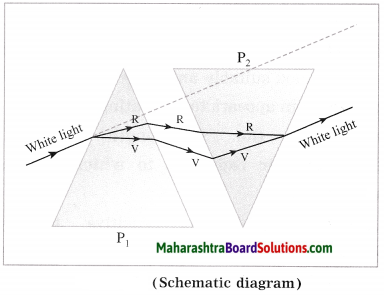
Maharashtra Board Class 10 Science Solutions Part 1 Chapter 6 Refraction of Light 6
The beam of light emerging from the other side of the second prism is a beam of white light.

Explanation: White light is made up of seven colours. The first prism produces dispersion of white light while the second prism combines light of different colours to produce white light again. The net deviation of a ray of light is zero.
[Note: This experiment is due to sir Isaac Newton. It proved that it was not the prism which added colours to the white light but a property of the white light itself.]

Question 2.
You must have seen chandeliers having glass prisms. The light from a tungsten bulb gets dispersed while passing through these prisms and we see coloured spectrum. If we use an LED light instead of a tungsten bulb, will we be able to see the same effect?
Answer:
Light emitted by LED (light-emitting-diode) does not have all wavelengths in the region 400 nm to 700 nm. Hence, its spectrum is not the same as that of light from a tungsten bulb or as that of sunlight.

Fill in the blanks and rewrite the statements:

Question 1.
The phenomenon of change in the………..of light when it passes obliquely from one transparent medium to another is called refraction.
Answer:
The phenomenon of change in the direction of propagation of light when it passes obliquely from one transparent medium to another is called refraction.

Question 2.
The refractive index depends upon the…………of propagation of light in different media.
Answer:
The refractive index depends upon the velocity of propagation of light in different media.

Maharashtra Board Class 10 Science Solutions Part 1 Chapter 6 Refraction of Light

Question 3.
The process of separation of light into its component colours while passing through a medium is called………..
Answer:
The process of separation of light into its component colours while passing through a medium is called dispersion of light.

Question 4.
When a light ray travels obliquely from air to water, it bends………the normal at the point of incidence.
Answer:
When a light ray travels obliquely from air to water, it bends towards the normal at the point of incidence.

Question 5.
When a light ray travels obliquely from benzene to air, it bends…………the normal at the point of incidence.
Answer:
When a light ray travels obliquely from benzene to air, it bends away from the normal at the point of incidence.

Question 6.
In glass, the speed of red ray is……violet ray.
Answer:
In glass, the speed of red ray is greater than that of violet ray.

Question 7.
The speed of light in glass is………in water.
Answer:
The speed of light in glass is less than that in water.

Question 8.
The speed of light in water is…………in benzene.
Answer:
The speed of light in water is greater than that in benzene.

Question 9.
Rainbow occurs due to refraction, dispersion,……….and again refraction of sunlight by water droplets.
Answer:
Rainbow occurs due to refraction, dispersion, internal reflection and again refraction of sunlight by water droplets.

Question 10.
In dispersion of sunlight by a glass prism,………..ray is deviated the least.
Answer:
In dispersion of sunlight by a glass prism, red ray is deviated the least.

Rewrite the following statements by selecting the correct options:

Question 1.
The change in the direction of propagation of light when it passes obliquely from one transparent medium to another is called………
(a) dispersion
(b) scattering
(c) refraction
(d) reflection
Answer:
(c) refraction

Question 2.
When a ray of light travels from air to glass slab and strikes the surface of separation at 90°, then it…………
(a) bends towards the normal
(b) bends away from the normal
(c) passes unbent
(d) passes in zigzag way
Answer:
(c) passes unbent

Maharashtra Board Class 10 Science Solutions Part 1 Chapter 6 Refraction of Light

Question 3.
If a ray of light passes from a denser medium to a rarer medium in a straight line, the angle of incidence must be…………
(a) 0°
(b) 30°
(c) 60°
(d) 90°
Answer:
(a) 0°

Question 4.
A ray of light strikes a glass slab at an angle of 50° with the normal to the surface of the slab. What is the angle of incidence?
(a) 50°
(b) 25°
(c) 40°
(d) 100°
Answer:
(a) 50°

Question 5.
If a ray of light propagating in air strikes a glass slab at an angle of 60° with the surface of the slab, the angle of refraction is…………
(a) more than 30 °
(b) less than 30 °
(c) 60°
(d) 30°
Answer:
(b) less than 30 °

Question 6.
A ray of light gets deviated When it passes obliquely from one medium to another medium because………..
(a) the colour of light changes
(b) the frequency of light changes
(c) the speed of light changes
(d) the intensity of light changes
Answer:
(c) the speed of light changes

Question 7.
The speed of light in turpentine oil is 2 × 10⁸ m/s. The absolute refractive index of turpentine oil is about……..[Speed of light in vacuum ≈ 3 × 10⁸ m/s]
(a) 1.5
(b) 2
(c) 1.3
(d) 0.67
Answer:
(a) 1.5

Question 8.
LASER stands for………..
(a) light amplification by stimulated emission of radiation
(b) light and sound energy radiation
(c) light and simulated energy radiation
(d) light amplification by sound energy radiation
Answer:
(a) light amplification by stimulated emission of radiation

Question 9.
Out of the following……….has the highest absolute refractive index.
(a) fused quartz
(b) diamond
(c) crown glass
(d) ruby
Answer:
(b) diamond

Question 10.
The absolute refractive index…………
(a) is expressed in dioptre
(b) is expressed in m/s
(c) of air is about \(\frac{4}{3}\)
(d) has no unit
Answer:
(d) has no unit

Question 11.
The speed of light in a medium of refractive index n is………., where c is the speed of light
in vacuum.
(a) \(\frac{c}{n}\)
(b) nc
(c) \(\frac{n}{c}\)
(d) \(\sqrt{\frac{c}{n}}\)
Answer:
(a) \(\frac{c}{n}\)

Question 12.
The speed of light in a transparent medium having absolute refractive index 1.25 is……….[Speed of light in vacuum ≈ 3 × 10⁸ m/s]
(a) 1.25 × 10⁸ m/s
(b) 2.4 × 10⁸ m/s
(c) 3.0 × 10⁸ m/s
(d) 1.5 × 10⁸ m/s
Answer:
(b) 2.4 × 10⁸ m/s

Maharashtra Board Class 10 Science Solutions Part 1 Chapter 6 Refraction of Light

Question 13.
…………light is deviated the maximum in the spectrpm of white light obtained with a glass prism.
(a) Red
(b) Yellow
(c) Violet
(d) Blue
Answer:
(c) Violet

Question 14.
………..light is deviated the least in the spectrum of white light obtained with a glass prism.
(a) Red
(b) Yellow
(c) Violet
(d) Blue
Answer:
(a) Red

Question 15.
A ray of light makes an angle of 50° with the surface S1 of the glass slab. Its angle of incidence will be………….(March 2019)
(a) 50°
(b) 40°
(c) 140°
(d) 0°
Answer:
(a) 50°

Question 16.
A glass slab is placed in the path of convergent light. The point of convergence of light:
(a) moves away from the slab
(b) moves towards the slab
(c) remains at the same point
(d) undergoes a lateral shift
Answer:
(a) moves away from the slab

Question 17.
In refraction of light through a glass slab, the directions of the incident ray and the refracted ray are………… (Practice Activity Sheet – 1)
(a) perpendicular to each other
(b) non-parallel to each other
(c) parallel to each other
(d) intersecting each other
Answer:
(c) parallel to each other

Question 18.
If we gradually increase the angle of incidence of a ray of light passing through a prism, then………….. (Practice Activity Sheet – 4)
(a) the angle of deviation goes on decreasing
(b) the angle of deviation decreases but after certain value of incident angle, deviation angle increases
(c) the angle of deviation goes on increasing
(d) the angle of deviation increases but after certain value of incident angle, deviation angle decreases
Answer:
(b) the angle of deviation decreases but after certain value of incident angle, deviation angle increases

State whether the following statements are True or False. (If a statement is false, correct it and rewrite it.):

Question 1.
The incident ray and the refracted ray of light are on the opposite sides of the normal at the point of incidence.
Answer:
True.

Question 2.
The refractive index of a medium (such as glass) does not depend on the wavelength of light.
Answer:
False. (The refractive index of a medium depends on the wavelength of light.)

Question 3.
When a light ray travels obliquely from an optically rarer medium to an optically denser medium, it bends away from the normal.
Answer:
False. (When a light ray travels obliquely from an optically rarer medium to an optically denser medium, it bends towards the normal.)

Maharashtra Board Class 10 Science Solutions Part 1 Chapter 6 Refraction of Light

Question 4.
When a light ray travels obliquely from glass to air, it bends towards the normal.
Answer:
False. (When a light ray travels obliquely from glass to air, it bends away from the normal.)

Question 5.
If the angle of incidence is 0°, the angle of refraction is 90°.
Answer:
False. (If the angle of incidence is 0°, the angle of refraction is also 0°.)

Question 6.
In dispersion of white light by a glass prism, yellow colour is deviated the least.
Answer:
False. (In dispersion of white light by a glass prism, red colour is deviated the least.)

Question 7.
In vacuum, the speed of light does not depend upon the frequency of light.
Answer:
True.

Question 8.
In glass, the speed of violet ray is less than that of red ray.
Answer:
True.

Question 9.
In a material medium, the speed of light depends on the frequency of light.
Answer:
True.

Question 10.
The velocity of light is different in different media.
Answer:
True.

Question 11.
Wavelength of red light is close to 700 nm.
Answer:
True.

Question 12.
Wavelength of orange light is greater than that of blue light.
Answer:
True.

Find the odd one out and give the reason:

Question 1.
Reflection, Neutralization, Refraction, Dispersion.
Answer:
Neutralization. It is associated with a chemical reaction between an acid and an alkali; others are phenomena associated with light.

Answer the following questions in one sentence each:

Question 1.
Mention any two phenomena in nature where refraction of light takes place.
Answer:
Mirage and twinkling of a star.

Question 2.
What is the angle of refraction when the angle of incidence is 0°?
Answer:
When the angle of incidence is 0°, the angle of refraction is also 0°.

Question 3.
In refraction of light, \(\frac{\sin i}{\sin r}\) = constant in sin a particular case. What is this constant called?
Answer:
The constant \(\frac{\sin i}{\sin r}\) (in a particular case) is called the refractive index of the second medium with respect to the first medium.

Question 4.
If the refractive index of medium 2 with respect to medium 1 is 5/3, what is the refractive index of medium 1 with respect to medium 2?
Answer:
The refractive index of medium 1 with respect to medium 2 is 0.6.

Maharashtra Board Class 10 Science Solutions Part 1 Chapter 6 Refraction of Light

Question 5.
In dispersion of sunlight by a glass prism, which colour is deviated the least?
Answer:
In dispersion of sunlight by a glass prism, red colour is deviated the least.

Question 6.
In dispersion of sunlight by a glass prism, which colour is deviated the most?
Answer:
In dispersion of sunlight by a glass prism, violet colour is deviated the most.

Question 7.
What is the wavelength of violet light?
Answer:
The wavelength of violet light is (about) 400 nm.

Question 8.
State the relation between 2n1 and critical angle.
Answer:
2n1 = sin i, where i is the critical angle.

Answer the following questions:

Question 1.
What is meant by refraction of light?
Answer:
The change in the direction of propagation of light when it passes obliquely from one transparent medium to another is called refraction of light.

Question 2.
Why is there a change in the direction of propagation of light when it passes obliquely from one transparent medium to another?
Answer:
The velocity of light is different in different media. Hence, there is a change in the direction of propagation of light when it passes obliquely from one transparent medium to another.

Question 3.
In the case of refraction of light through a glass slab, the emergent ray is parallel to the incident ray, but it is displaced sideways. Why does this happen?
Answer:
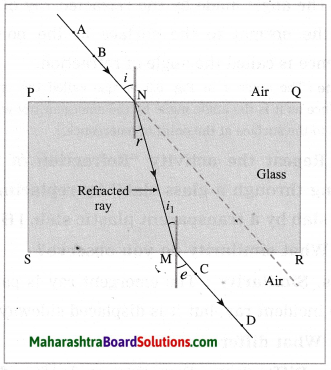
Maharashtra Board Class 10 Science Solutions Part 1 Chapter 6 Refraction of Light 7
The first refraction takes place as light passes obliquely from air to glass. In this case, the ray of light bends towards the normal at point N. The second refraction takes place as light passes obliquely from glass to air. In this case, the ray of light bends away from the normal at point M. The faces PQ and SR of the glass slab are parallel. Hence, the extent of bending of light at SR is equal in magnitude but opposite in sense relative to the bending of light at PQ. Hence, the emergent ray of light (MD) is parallel to the incident ray of light (AN), but it is displaced sideways as shown in Figure.

Question 4.
Define angle of incidence and angle of refraction.
Answer:
(1) The angle made by the incident ray of light with the normal to the surface at the point of incidence is called the angle of incidence.

(2) The angle made by the refracted ray of light with the normal to the surface at the point of incidence is called the angle of refraction.

[Note: The angle e in Fig. 6.3 is also called the angle of emergence as it is the angle made by the emergent ray with the normal to the surface at the point of emergence. ]

Maharashtra Board Class 10 Science Solutions Part 1 Chapter 6 Refraction of Light

Question 5.
Repeat the activity “Refraction of light passing through a glass sl^b” by replacing the glass slab by a transparent plastic slab.
(i) What similarity do you observe?
(ii) What difference do you notice?
Answer:
(i) Similarity: The emergent ray is parallel to the incident ray, but it is displaced sideways.
(ii) Difference: For a given angle of incidence, the extent of refraction (bending) is different (in general, less) for a transparent plastic slab relative to the glass slab.

Question 6.
State the laws of refraction of light.
Answer:
Laws of refraction of light:
(1) The incident ray and the refracted ray are on the opposite sides of the normal to the surface at the point of incidence and all the three, i.e., the incident ray, the refracted ray and the normal are in the same plane.

(2) For a given pair of media, the ratio of the sine of the angle of incidence to the sine of the angle of refraction is constant (Snell’s law). This constant is called the refractive index of the second medium with respect to the first medium.
[Note: Here, a ray means a ray of light.]

Question 7.
How is refraction of light related to refractive index?
Answer:
When a ray of light travels obliquely from an optically rarer medium (lower refractive index) to an optically denser medium (higher refractive index), the ray bends towards the normal. When a ray of light travels obliquely from an optically denser medium to an optically rarer medium, the ray bends away from the normal. For a given angle of incidence (i ≠ 0), the extent of refraction (bending) of light is different in different media.

If the refractive index of the second medium with respect to the first medium is greater than 1, the greater the refractive index, the greater is the bending of the ray of light towards the normal. If the refractive index of the second medium with respect to the first medium is less than 1, the greater the refractive index, the lesser is the bending of the ray of light away from the normal.

Question 8.
Define the refractive index of the second medium with respect to the first medium.
(OR)
What is meant by refractive index?
Answer:
The refractive index of the second medium with respect to the first medium is defined as the ratio of the sine of the angle of incidence to the sine of the angle of refraction when the ray of light is obliquely incident at the boundary separating the
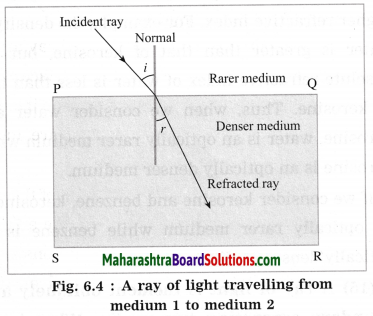
Maharashtra Board Class 10 Science Solutions Part 1 Chapter 6 Refraction of Light 8
two media and travels from the first medium to the second medium. (See Fig. 6.4.)
(OR)
The refractive index of the second medium with respect to the first medium is defined as the ratio of (the magnitude of) the velocity of light in the first medium to (the magnitude of) the velocity of light in the second medium.

[Note: Velocity is a vector, i.e., it has magnitude and direction. In definition of refractive index, we consider only the magnitude of velocity of light (speed of light). Velocity of light in a medium depends on the physical condition of the medium as well as the frequency of light. Velocity of light is different in different media. For a given medium, the refractive index depends on the colour of light (frequency of light.)]

Question 9.
State the formulae for the refractive index of the second medium with respect to the first medium.
Answer:
The refractive index of the second medium with respect to the first medium,
2n1 = \(\frac{\sin i}{\sin r}=\frac{v_{1}}{v_{2}}\)
where i is the angle of incidence, r is the angle of refraction (as the ray of light passes obliquely from the first medium to the second medium), v1 is the magnitude of the velocity (speed) of light in the first medium and v2 is the magnitude of the velocity of light in the second medium.

Maharashtra Board Class 10 Science Solutions Part 1 Chapter 6 Refraction of Light

Question 10.
Define absolute refractive index.
Answer:
The absolute refractive index of a medium is defined as the ratio of the magnitude of the velocity of light in vacuum to the magnitude of the velocity of light in the medium.

[Note: The speed of light is maximum in vacuum, about 3 × 10⁸ m/s. When light travels from one medium to another, there occurs a change in its speed and wavelength (A). But its frequency (v) remain the same.]

Question 11.
Obtain the relation between the refractive index of the second medium with respect to the first medium and the refractive index of the first medium with respect to the second medium.
Answer:
Let v1 = speed of light in the first medium, v2 = speed of light in the second medium, 2n1 = refractive index of the second medium With respect to the first medium and 1n2 = refractive index of the first medium with respect to the second medium.
By definition, 2n1 = \(\frac{v_{1}}{v_{2}}\) and 1n2 = \(\frac{v_{2}}{v_{1}}\)
Hence,
Maharashtra Board Class 10 Science Solutions Part 1 Chapter 6 Refraction of Light 9
(OR)
1n2 × 2n1 = 1.

Question 12.
If the refractive index of a certain material with respect to air is 1.5, what is the refractive index of air with respect to that material?
Answer:
As the refractive index of the given material with respect to air is 1.5, the refractive index of air with respect to the material is
\(\frac{1}{1.5}=\frac{1}{3 / 2}=\frac{2}{3}\) = 0.6667 (approximately)

Question 13.
Explain the terms optically rarer medium and optically denser medium with examples.
Answer:
When we consider two media (such as air and glass), the medium with lower refractive index is called the optically rarer medium (in the present case, air) and the medium with higher refractive index is called the optically denser medium (glass, in the present case).

The higher density does not necessarily mean higher refractive index. For example, the density of water is greater than that of kerosene, but the absolute refractive index of water is less than that of kerosine. Thus, when we consider water and kerosine, water is an optically rarer medium while kerosine is an optically denser medium.

If we consider kerosene and benzene, kerosine is an optically rarer medium while benzene is an optically denser medium.

Question 14.
A ray of light is incident obliquely at a boundary separating two media. What is its behaviour if (1) the refractive index of the second medium is greater than that of the first medium (2) the refractive index of the first medium is greater than that of the second medium? Draw the corresponding neat and labelled diagrams.
Answer:
Consider a ray of light incident obliquely at a boundary separating two media.
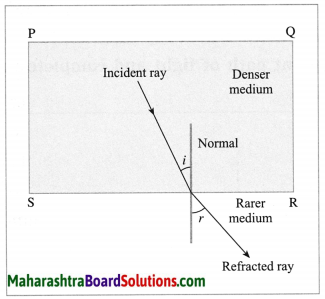
(1) If the refractive index of the second medium is greater than that of the first medium, the ray bends towards the normal at the point of incidence as it travels from the first medium (optically rarer medium) to the second medium (optically denser medium). The angle of refraction (r) is less than the angle of incidence (i). (Fig. 6.6)
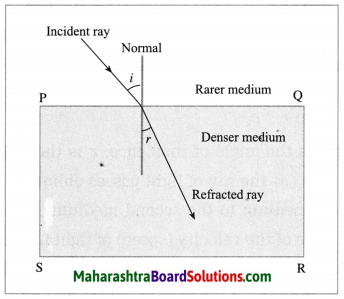
Maharashtra Board Class 10 Science Solutions Part 1 Chapter 6 Refraction of Light 10
Fig. 6.6: A ray of light travelling from a rarer medium to a denser medium (Schematic diagram)
Maharashtra Board Class 10 Science Solutions Part 1 Chapter 6 Refraction of Light 11
Fig. 6.7: A ray of light travelling from a denser medium to a rarer medium (Schematic diagram)

(2) If the refractive index of the first medium is greater than that of the second medium, the ray bends away from the normal at the point of incidence as it travels from the first medium (optically denser medium), to the second medium (optically rarer medium). The angle of refraction (r) is greater than the angle of incidence (i). (Fig. 6.7)

[Note In this chapter, a rarer medium means an optically rarer medium and a denser medium means optically denser medium unless stated otherwise.]

Maharashtra Board Class 10 Science Solutions Part 1 Chapter 6 Refraction of Light

Question 15.
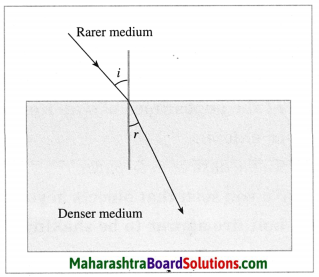
Observe the following figure and write accurate conclusion regarding refraction of light. (Practice Activity Sheet – 2)
Maharashtra Board Class 10 Science Solutions Part 1 Chapter 6 Refraction of Light 12
Answer:
When a light ray passes obliquely from a rarer medium to a denser medium, it bends towards the normal.

Question 16.
What happens when a ray of light is incident normal to the interface between two media? Draw the corresponding neat and labelled diagram.
Answer:
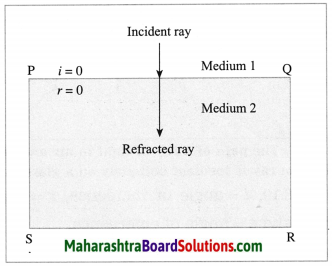
When a ray of light is incident normal to the interface between two media, the ray propagates undeviated as it travels from the first medium to the second medium irrespective of the refractive indices of the two media. In this case, the angle of incidence (i) is zero and so also the angle of refraction (r).
Maharashtra Board Class 10 Science Solutions Part 1 Chapter 6 Refraction of Light 13
Fig. 6.9: A ray of light incident normal to the interface between two media propagates without any change in its direction of propagation

Question 17.
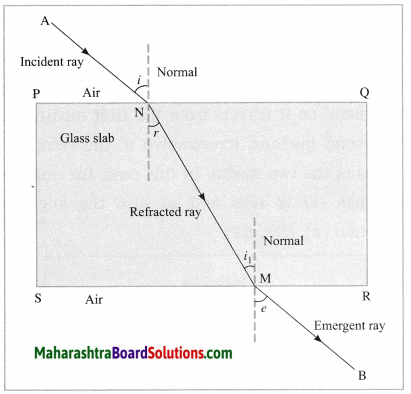
Draw a neat and labelled diagram to show the path of a ray of light in air and glass when the ray is incident obliquely on a glass slab. Show the (i) incident ray (ii) refracted ray (iii) emergent ray (iv) angle of incidence (v) angle of refraction (vi) angle of emergence in the diagram.
(OR)
Draw a neat and labelled diagram to show refraction of light through a glass slab.
Answer:
Maharashtra Board Class 10 Science Solutions Part 1 Chapter 6 Refraction of Light 14
Fig. 6.10: The path of the ray of light in air and glass when the ray is incident obliquely on a glass slab
In Fig. 6.10, i = angle of incidence, r = angle of refraction and e = angle of emergence.

Question 18.
Observe the given figure and name the following rays:
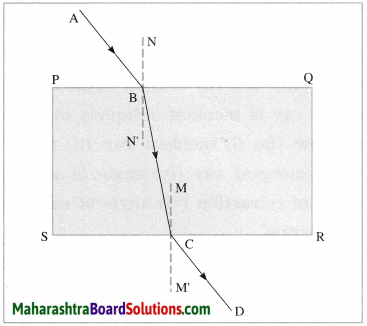
Maharashtra Board Class 10 Science Solutions Part 1 Chapter 6 Refraction of Light 15
(i) ray AB
(ii) Ray BC
(iii) ray CD
Answer:
(i) The ray AB is the incident ray.
(ii) The ray BC is the refracted ray.
(iii) The ray CD is the emergent ray.

Maharashtra Board Class 10 Science Solutions Part 1 Chapter 6 Refraction of Light

Question 19.
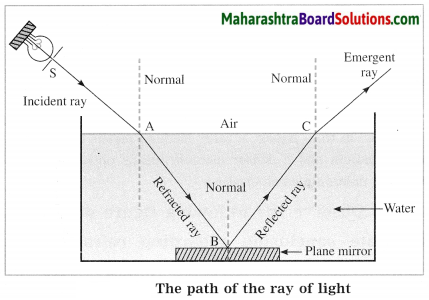
A plane mirror is kept at the bottom of a trough with water in it as shown in the following figure (Fig. 6.12). The ray of light emerging from a source at the point S outside the trough reaches the point A on the surface of water. Draw a neat ray diagram to show the subsequent path of light and complete the ray diagram.
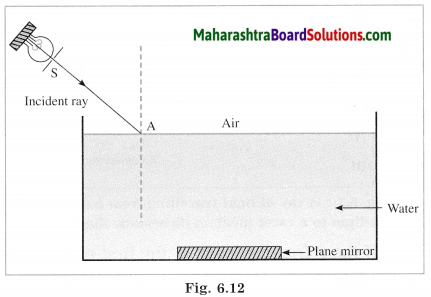
Maharashtra Board Class 10 Science Solutions Part 1 Chapter 6 Refraction of Light 16
Answer:
Maharashtra Board Class 10 Science Solutions Part 1 Chapter 6 Refraction of Light 17

Question 20.
Give two examples of the effect of atmospheric refraction on a small scale in local environment.
Answer:

  1. The occurrence of a mirage
  2. Flickering of an object seen through a turbulent stream of hot air rising above the Holi fire are examples of the effect of atmospheric refraction on a small scale in local environment.

Question 21.
What is a mirage? With a neat labelled diagram, explain the conditions under which it is seen.
Answer:
Due to the changes in refraction of light, the light rays coming from a distant object appear to be coming from the image of the object inside the ground. This is called a mirage.
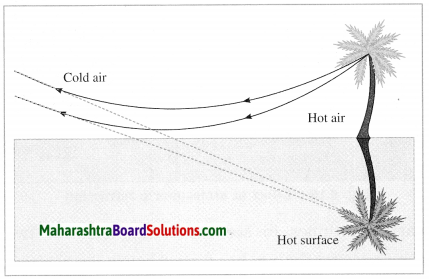
Maharashtra Board Class 10 Science Solutions Part 1 Chapter 6 Refraction of Light 18
When the earth’s surface is heated by the sun, the temperature of air increases. This produces a layer of hot air of lower density (mass per unit volume) and lower refractive index at the surface. Hot air works as an optically rarer medium relative to cool air. When the temperature changes rapidly in the vertical direction, as refraction of light takes place, the angle of refraction changes continuously.

The rays of light from the top of an object such as a car or tree cross the rays from the bottom of the object on their way to the observer’s eye. Hence, an inverted image is formed below the object’s true position and downward towards the surface in the direction of air at higher temperature. In this case, some rays of light bend back up into the denser air above figure. Mirage produces an impression of water near the hot ground.

Question 22.
Explain in brief the flickering of an object seen through a turbulent stream of hot air rising above the Holi fire.
Answer:
During the Holi fire, the temperature of the air just above the fire becomes much greater than that of the air further up. The hot air has lower density (mass per unit volume) and lower refractive index. It becomes an optically rarer medium. The cool air has higher density and higher refractive index. It is an optically denser medium relative to hot air. Hence, in refraction of light, the angle of refraction changes continuously due to a continuous variation in refractive index.

As the physical conditions of air change rapidly, the apparent position of an object fluctuates rapidly. This gives rise to the flickering of an object seen through a turbulent stream of hot air rising above the Holi fire.

Maharashtra Board Class 10 Science Solutions Part 1 Chapter 6 Refraction of Light

Question 23.
With a neat labelled diagram, explain twinkling of a star. Also explain why a planet does not twinkle.
Answer:
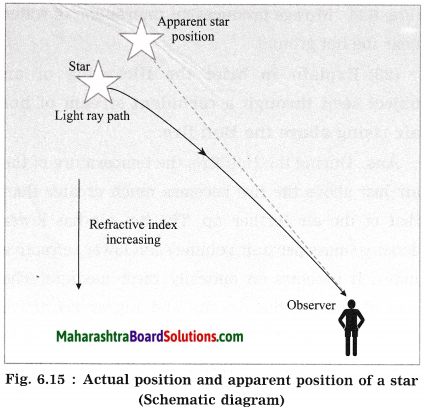
(1) As a star is far away from the earth, it appears as a point source of light. The density of air decreases with height above the earth’s surface. Hence, the refractive index of air also decreases with height. When starlight enters the earth’s atmosphere, it undergoes refraction continuously in the medium with gradually changing refractive index. The bending of starlight occurs towards the normal as it passes from the optically rarer part of the medium to the optically denser part.

(2) Hence, when a star is observed near the horizon, its apparent position is slightly higher than the actual position (See below figure).

(3) Further, the apparent position varies with time as the medium is not stationary due to mobility of air and change in temperature. When more light is refracted towards the observer the star appears bright. When less light is refracted towards the observer, the star appears dim.
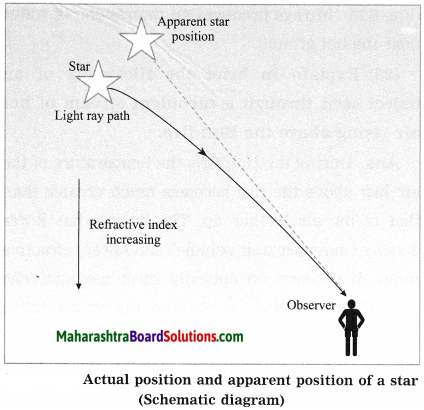
Maharashtra Board Class 10 Science Solutions Part 1 Chapter 6 Refraction of Light 19
(4) Thus there is fluctuation in the brightness of a star when observed from the earth. This is called twinkling of a star.

(5) Compared to stars, planets are relatively closer to the earth. Hence, a planet appears as a collection of a large number of point sources. Due to the changes in the refractive index of air, there is a change in the position and brightness of these point sources.

There is an increase in intensity of light coming from some point sources while there is a decrease in intensity of light coming from equal number of other point sources, on an average. The average brightness of a planet remain the same. Also, there is no change in the average position of a star. Hence, a planet does not twinkle.

Question 24.
What is the correct reason for blinking/flickering of stars? Explain it.
(a) The blasts in the stars.
(b) Absorption of star light by the atmosphere.
(c) Motion of the stars.
(d) Changing refractive index of gases in the atmosphere. (Practice Activity Sheet – 2)
Answer:
(d) Changing refractive index of the gases in the atmosphere results in blinking/flickering of stars.

Explanation:
(1) As a star is far away from the earth, it appears as a point source of light. The density of air decreases with height above the earth’s surface. Hence, the refractive index of air also decreases with height. When starlight enters the earth’s atmosphere, it undergoes refraction continuously in the medium with gradually changing refractive index. The bending of starlight occurs towards the normal as it passes from the optically rarer part of the medium to the optically denser part.

(2) Hence, when a star is observed near the horizon, its apparent position is slightly higher than the actual position (See below figure).

(3) Further, the apparent position varies with time as the medium is not stationary due to mobility of air and change in temperature. When more light is refracted towards the observer the star appears bright. When less light is refracted towards the observer, the star appears dim.
Maharashtra Board Class 10 Science Solutions Part 1 Chapter 6 Refraction of Light 20
(4) Thus there is fluctuation in the brightness of a star when observed from the earth. This is called twinkling of a star.

(5) Compared to stars, planets are relatively closer to the earth. Hence, a planet appears as a collection of a large number of point sources. Due to the changes in the refractive index of air, there is a change in the position and brightness of these point sources.

There is an increase in intensity of light coming from some point sources while there is a decrease in intensity of light coming from equal number of other point sources, on an average. The average brightness of a planet remain the same. Also, there is no change in the average position of a star. Hence, a planet does not twinkle.

Question 25.
With a neat labelled diagram, explain advanced sunrise and delayed sunset.
Answer:
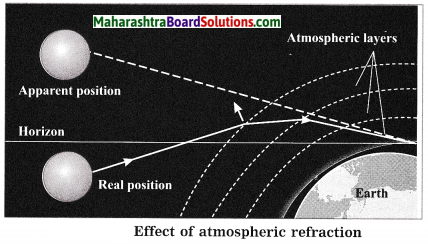
(1) The sunrise (the appearance of the sun above the horizon) is advanced due to atmospheric refraction of sunlight. An observer on the earth sees the sun two minutes before the sun reaches the horizon. A ray of sunlight entering the earth’s atmosphere follows a curved path due to atmospheric refraction before reaching the earth. This happens due to a gradual variation in the refractive index of the atmosphere.

For the observer on the earth, the apparent position of the sun is slightly higher than the actual position. Hence, the sun is seen before the sun reaches the horizon.

(2) Increased atmospheric refraction of sunlight occurs also at the sunset (the sun disappearing below the horizon). In this case, the observer on the earth continues to see the setting sun for two minutes after the sun has dipped below the horizon, thus delaying the sunset.
Maharashtra Board Class 10 Science Solutions Part 1 Chapter 6 Refraction of Light 21
The advanced sunrise and delayed sunset increases the duration of day by four minutes.

Maharashtra Board Class 10 Science Solutions Part 1 Chapter 6 Refraction of Light

Question 26.
Water in a swimming pool or water tank appears shallower than its depth. Why?
Answer:
When light rays travel obliquely from an optically denser medium (water, in this case) to an optically rarer medium (air, in this case), they bend away from the normal at the point of incidence. As a result, the bottom of a swimming pool or water tank appears raised to an observer standing near the edge of the pool or the tank. Therefore, the swimming pool or water tank appears shallower than its depth.

Question 27.
Place a coin at the bottom of a glass jar containing water. Now tilt the jar suitably. When viewed at a suitable angle, the coin appears to be floating. Why?
Answer:
When light rays travel obliquely from an optically denser medium (water, in this case) to an optically rarer medium (air, in this case), they bend away from the normal at the point of incidence. As a result, the coin appears raised. Therefore, when the jar is tilted suitably and observed at a suitable angle, the coin appears to be floating.

Question 28.
State the wavelength range of electromagnetic radiation to which our eyes are sensitive.
Answer:
Our eyes are sensitive to light (electromagnetic radiation). Its wavelength range is 400 nm to 700 nm.
[Note: Wavelength (λ) goes on decreasing and frequency (ν) goes on increasing from red (λ ≃ 700 nm) → orange → yellow → green → blue → indigo → violet (A ≃ 400 nm). c = vλ, where c is the speed of light in vacuum.]

Question 29.
What do you mean by dispersion of light? What is a spectrum of light? Name the different colours of light in the proper sequence in the spectrum of white light.
(OR)
What do you mean by dispersion? Name the different colours of light in the proper sequence in the spectrum of white light.
Answer:
The process of separation of light into its component colours while passing through a medium is called dispersion of light. The band of coloured components of a light beam is called spectrum.
The different colours of light in the spectrum of white light are violet, indigo, blue, green, yellow, orange and red.

Question 30.
What is a prism?
Answer:
A prism is a transparent medium bound by two plane surfaces inclined at an angle. Normally it is made of glass and has triangular cross section.

Question 31.
With a neat labelled diagram, describe the experiment to demonstrate dispersion of sunlight (white light) by a prism.
Answer:
Experiment:
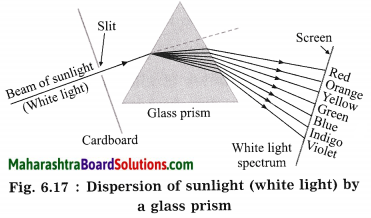
(1) Procedure: Keep a glass prism on a table in a dark room. Hold a plane mirror outside the room so that it reflects a beam of sunlight into the room. Allow this beam to pass through a narrow slit made in cardboard and then fall on the prism. Place a white screen on the other side of the prism as shown in the following figure. [Fig. 6.17]
Maharashtra Board Class 10 Science Solutions Part 1 Chapter 6 Refraction of Light 22
(2) Observations:

  1. A pattern of various colours is observed on the screen. This pattern is called the spectrum.
  2. It is found that in dispersion, the ray corresponding to violet colour deviates the most.
  3. The ray corresponding to red colour deviates the least.
  4. The deviation of rays corresponding to other colours is intermediate.

(3) Conclusion: When sunlight (white light) is incident on a prism, dispersion of light takes place, forming a spectrum.

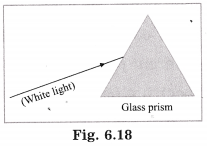
[Notes: (1) This experiment is due to Sir Isaac Newton (1642 – 1727), English physicist and mathematician. (2) If in a Board examination, incomplete diagram (as shown in Fig. 6.18) is given, students should complete it and label its parts as shown in Fig. 6.17.]
Maharashtra Board Class 10 Science Solutions Part 1 Chapter 6 Refraction of Light 23

Maharashtra Board Class 10 Science Solutions Part 1 Chapter 6 Refraction of Light

Question 32.
How does the dispersion of white light take place when it passes through a glass prism?
Answer:
When rays of light are incident on a prism, they are refracted twice, while travelling from air to glass and then from glass to air. Even when the incident rays are directed away from the base of the prism, the emergent rays bend towards the base of the prism, as the prism is triangular. Thus, the rays are deviated as they pass through the prism.

The refractive index of glass is different for different colours. Therefore, the rays corresponding to different colours are deviated to different extents. White light is a mixture of seven colours : violet, indigo, blue, green, yellow, orange and red. Hence, when white light is incident on a prism, a spectrum of seven colours is obtained.

The refractive index of glass is maximum for violet light and minimum for red light. Hence, violet light is deviated the most and red light is deviated the least. The deviation of rays corresponding to other colours is intermediate. In this manner, the dispersion of light takes place when it passes through a glass prism. [For reference, see Fig. 6.17.]

Question 33.
What is a spectrum? Why do we get a spectrum of seven colours when while light is dispersed by a prism?
(OR)
Explain how a spectrum is formed.
Answer:
A band of coloured components of a light beam is called a spectrum. When white light is incident on a prism, the rays corresponding to different colours bend through different angles on refraction.

Of the various colours in the visible region, red light bends the least and violet light bends the most. Each colour emerges through the prism along a different path and becomes, distinct. Hence, we get a spectrum of seven colours.

Question 34.
What is partial reflection of light?
Answer:
When light travels from a denser medium to a rarer medium, it is partially reflected, i.e., part of light comes back into the denser medium as per the laws of reflection. This is called partial reflection of light.

[Note: Partial reflection of light occurs even when light travels from a rarer medium to a denser medium. The rest of light is refracted.]

Question 35.
Explain the terms total internal reflection and critical angle.
Answer:
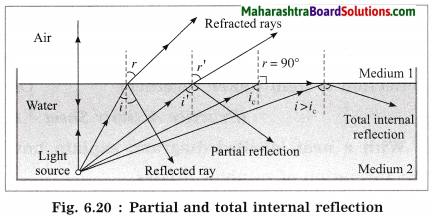
Figure 6.20 shows passage of light from water (denser medium) to air (rarer medium).
Maharashtra Board Class 10 Science Solutions Part 1 Chapter 6 Refraction of Light 24
The ray of light incident at the boundary separating the two media bends away from the normal on refraction. Here, the angle of refraction r, is greater than the angle of incidence i.
Now anw = \(\frac{\sin i}{\sin r}\) < 1. Here, anw is the refractive index of sin r air with respect to water.

As anw is constant, r increases as i increases. For r = 90°, the ray travels along the boundary. If i is increased further, as r cannot be greater than 90°, light does not enter air. There is no refraction of light and all the light enters water on reflection. This is called total internal reflection.
For r = 90°, anw = \(\frac{\sin i}{\sin 90^{\circ}}\) = sin i. This angle i is sin 90° called the critical angle.

Question 36.
Swarali has got the following observations while doing an experiment. Answer her questions with the help of observations. (Practice Activity Sheet – 2)
Swarali observed that the light bent away from the normal, while travelling from a denser medium to a rarer medium. When Swarali increased the values of the angle of incidence (i). the values of the angle of refraction (r) went on increasing. But at a certain angle of incidence, the light rays returned into the denser medium.
So, Swarali has some questions. Answer them.
(a) Name this certain value of i. What is the value of r at that time?
(b) Name this process of returning light in the denser medium. Explain the process.
Answer:
(a) Critical angle r = 90°
(b) Total internal reflection.

As light goes from a denser to rarer medium, if the value of the angle of incidence increases, then the value of the angle of refraction also increases. But after a specific angle of incidence called the critical angle, the light gets reflected back into the denser medium.

The ray of light incident at the boundary separating the two media bends away from the normal on refraction. Here, the angle of refraction r, is greater than the angle of incidence i.
Now anw = \(\frac{\sin i}{\sin r}\) < 1. Here, anw is the refractive index of sin r air with respect to water. As anw is constant, r increases as i increases. For r = 90°, the ray travels along the boundary. If i is increased further, as r cannot be greater than 90°, light does not enter air. There is no refraction of light and all the light enters water on reflection. This is called total internal reflection.

For r = 90°, anw = \(\frac{\sin i}{\sin 90^{\circ}}\) = sin i. This angle i is sin 90° called the critical angle.

Maharashtra Board Class 10 Science Solutions Part 1 Chapter 6 Refraction of Light

Question 37.
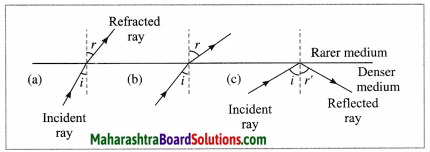
The observations made by Swarali while doing the experiment are given below. Based on these write answers to the questions:
Swarali found that the light ray travelling from the denser medium to a rarer medium goes away from the normal. If the angle of incidence (i) is raised by Swarali, the angle of refraction (r) went on increasing. However, after certain value of the angle of incidence, the light ray is seen to return back into the denser medium. (March 2019)
(i) What is the specific value of ∠i called?
(ii) What is the process of reflection of incident ray into a denser medium called?
(iii) Draw the diagrams of three observations made by Swarali.
Answer:
(i) Critical angle
(ii) Total internal reflection
(iii)
Maharashtra Board Class 10 Science Solutions Part 1 Chapter 6 Refraction of Light 25

Question 38.
Define total internal reflection of light.
Answer:
When light travels from a denser medium to a rarer medium, if the angle of incidence is greater than the critical angle, there is no refraction of light and all the light is reflected in the denser medium. This is called total internal reflection of light.

Question 39.
Define critical angle.
Answer:
When light travels from a denser medium to a rarer medium, the angle of incidence for which the angle of refraction becomes 90°, is called the critical angle.

Question 40.
If the refractive index of a rarer medium with respect to a denser medium is 0.5, what is the critical angle?
Answer:
2n1 = 0.5 = sin i
∴ Critical angle i = 30°.

Question 41.
Name the devices in which total internal reflection of light is used.
Answer:

  1. Total internal reflecting prisms are used in a camera, binoculars, periscope.
  2. Total internal reflection of light is used in optical fibres.

[Note: Total internal reflection of light plays an important role in sparkling brilliance of a diamond.]

Question 42.
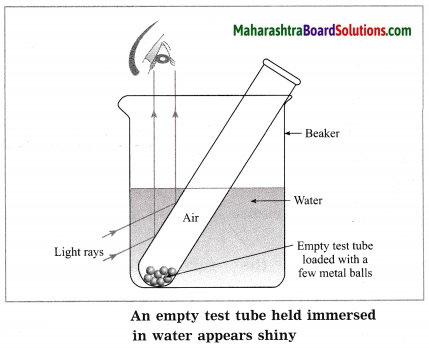
Explain why an empty test tube held obliquely in water appears shiny to an observer looking down.
Answer:
When an empty test tube is held obliquely in Water in a beaker, some light rays passing from water to air are incident at an angle greater than the critical angle. They are, thus, totally internally reflected as shown, and the surface of the test tube has a silvery shine.
Maharashtra Board Class 10 Science Solutions Part 1 Chapter 6 Refraction of Light 26

Question 43.
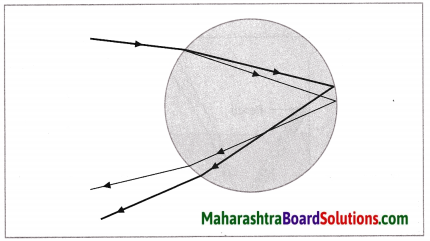
Observe the given figure and answer the following questions. (Practice Activity Sheet – 3)
Maharashtra Board Class 10 Science Solutions Part 1 Chapter 6 Refraction of Light 27
(a) Identify and write the natural process shown in the figure.
(b) List the phenomena which are observed in this process.
(c) Redraw the diagram and show the above phenomena in it.
Answer:
(a) The natural process shown in the figure is formation of rainbow.
(b) The phenomena observed in this process are refraction, internal reflection and dispersion of light.
(c)
Maharashtra Board Class 10 Science Solutions Part 1 Chapter 6 Refraction of Light 28

Write a short note on the following:

Question 1.
Refraction observed in the atmosphere.
Answer:
When a ray of light passes obliquely from an optically rarer medium to an optically denser medium, it bends towards the normal at the point of incidence. If opposite is the case, the ray bends away from the normal.

Atmosphere is never static. Air is mobile and its density and temperature are not uniform. As a result, in general, the path of a ray of light through atmosphere of varying refractive index is a curve. The refractive index of cool air is greater than that of hot air.

Atmospheric refraction of light results in many interesting optical phenomena such as twinkling of a star, advanced sunrise and delayed sunset, mirage and flickering of an object seen through a turbulent stream of hot air rising from a fire.

Question 2.
Dispersion of light.
Answer:
The process of separation of light into its component colours while passing through a medium is called dispersion of light. When white light passes through a glass prism, it spreads out into a band of different colours (components) called the spectrum of light. The colours in the spectrum of white light are violet, indigo, blue, green, yellow, orange and red.

Formation of a rainbow is an example of dispersion of light in nature. In this case, raindrops are responsible for dispersion of sunlight.

Dispersion takes place because the refractive index of a material such as glass or water, is different for different colours. It is maximum for violet colour and minimum for red colour. Hence, in the spectrum of white light (sunlight) obtained with a prism, violet light is deviated the most while red light is deviated the least. The deviation of light corresponding to other colours lies in between.

Give scientific reasons:

Question 1.
A coin kept in a bowl is not visible when seen from one side. But, when water is poured in the bowl, the coin becomes visible.
Answer:
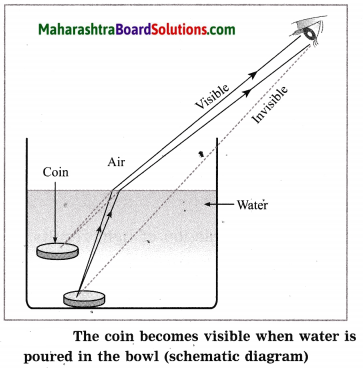
(1) When the bowl is empty, the rays of light coming from the coin are obstructed by the side of the bowl, and hence the coin is not visible when seen from one side of the bowl.
Maharashtra Board Class 10 Science Solutions Part 1 Chapter 6 Refraction of Light 29
(2) When water is poured in the bowl, the rays of light coming from the coin travel from water (denser medium) to air (rarer medium). Hence, they bend away from the normal on refraction. Therefore, the coin appears to be raised and becomes visible when observed from one side of the bowl.

Maharashtra Board Class 10 Science Solutions Part 1 Chapter 6 Refraction of Light

Question 2.
A pencil dipped in water obliquely appears bent at the surface of water.
(OR)
When a pencil is partly immersed in water and held in a slanting position, it appears to be bent at the boundary separating water and air.
Answer:
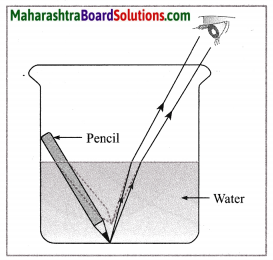
(1) When a pencil is partly immersed in water and held in a slanting position, the rays of light coming from the immersed part of the pencil emerge from water (a denser medium) and enter air (a rarer medium). During this propagation, they bend away from the normal on refraction.
Maharashtra Board Class 10 Science Solutions Part 1 Chapter 6 Refraction of Light 30
The pencil appearing bent at the boundary of water and air (schematic diagram)

(2) As a result, the immersed part of the pencil does not appear straight with respect to the part outside the water, but appears to be raised. Hence, a pencil dipped obliquely in water appears bent at the surface of the water.

Question 3.
The shadow of the edge of an empty vessel is formed due to the slanting rays of the sun. When water is poured in the vessel, the shadow is shifted.
Answer:
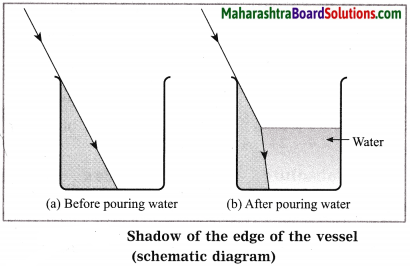
(1) When the slanting rays of the sun are obstructed by the edge of the empty vessel, the shadow of the edge is formed.
Maharashtra Board Class 10 Science Solutions Part 1 Chapter 6 Refraction of Light 31
(2) When water is poured in the vessel, the slanting rays of the sun travel from air (rarer medium) to water (denser medium). During this propagation, they bend towards the normal on refraction. Hence, some part in the region of the shadow is now illuminated and the shadow appears to have shifted.

Question 4.
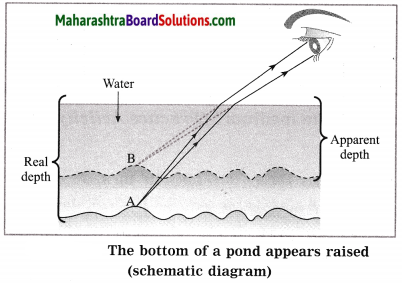
The bottom of a pond appears raised.
Answer:
(1) The rays of light coming from the bottom of a pond bend away from the normal as they travel from water (denser medium) to air (rarer medium).
Maharashtra Board Class 10 Science Solutions Part 1 Chapter 6 Refraction of Light 32
(2) Hence, they appear to come from a point above the actual point from which they come.
Therefore, the bottom of the pond appears raised.

Question 5.
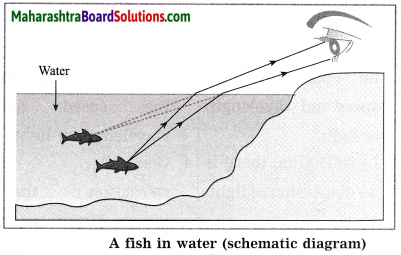
While shooting a fish in a lake, the gun is aimed below the apparent position of the fish.
Answer:
(1) The rays of light coming from the fish bend away from the normal as they travel from water (denser medium) to air (rarer medium).
(2) Hence, the position of the fish in water appears to be above Its real position. Therefore, while shooting a fish in a lake, the gun is aimed below the apparent position of the fish.
Maharashtra Board Class 10 Science Solutions Part 1 Chapter 6 Refraction of Light 33

Maharashtra Board Class 10 Science Solutions Part 1 Chapter 6 Refraction of Light

Question 6.
The sun is seen on the horizon a little before sunrise.
(OR)
The sun is seen on the horizon for sometime even after sunset.
Answer:
(1) The earth is surrounded by an atmosphere which is denser near the surface of the earth. When the rays of light from the sun enter the earth’s atmosphere from outer space, they travel from a rarer medium to a denser medium. Hence, they bend towards the normal on refraction.

(2) Hence, even when the sun is below the horizon while rising or setting, its rays reach us due to refraction and it appears to be on the horizon. Therefore, the sun is seen on the horizon a little before sunrise as well as for some time even after sunset.

Distinguish between:

Question 1.
Reflection of light and Refraction of light:
Answer:

Reflection of lightRefraction of light
1. The rays of light, before and after reflection, travel in the same medium.1. In refraction of light, the rays travel from one medium to another medium.
2. In reflection, the angle of incidence and the angle of reflection are equal.2. In refraction, when the rays travel obliquely from one medium to another medium, the angle of incidence and the angle of refraction are not equal.
3. In reflection, there is no change in the speed and wavelength of light.3. In refraction, there occurs a change in the speed and wavelength of light.
4. In reflection, there is no dispersion of light.4. Generally, in refraction, there occurs dispersion of light.

[Note: The frequency of light remains the same in reflection and refraction.]

Complete the following or Solve and fill in the blanks :

Question 1.

Speed of light in the first medium (v1)Speed of light in the second medium (v2)Refractive index 2n1Refractive index 2n1
3 × 10⁸ m/s1.2 × 108 m/s————————–————————–
————————–2.25 × 10⁸ m/s4/3————————–
2 × 10⁸ m/s————————–————————–1.5

Answer:

Speed of light in the first medium (v1)Speed of light in the second medium (v2)Refractive index 2n1Refractive index 2n1
3 × 10⁸ m/s1.2 × 108 m/s2.50.4
3 × 10⁸ m/s2.25 × 108 m/s4/30.75
2 × 10⁸ m/s3 × 108 m/s2/31.5

Formulae:
2n1 = v1/v2, 1n2 = v2/v1

Solve the following examples/numerical problems:
c = 3 × 10⁸ m/s

Problem 1.
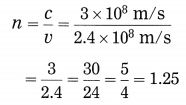
The speed of light in a transparent medium is 2.4 × 10⁸ m/s. Calculate the absolute refractive index of the medium.
Solution:
Data: c = 3 × 10⁸ m/s,
v = 2.4 × 10⁸ m/s, n = ?
Maharashtra Board Class 10 Science Solutions Part 1 Chapter 6 Refraction of Light 34
The absolute refractive index of the medium = 1.25.

Maharashtra Board Class 10 Science Solutions Part 1 Chapter 6 Refraction of Light

Problem 2.
The velocity of light in a medium is 2 × 10⁸ m/s. What is the refractive index of the medium with respect to air, if the velocity of light in air is 3 × 10⁸ m/s?
Solution:
Data: v1 = 3 × 10⁸ m/s,
v2 = 2 × 10⁸ m/s, 2n1 = ?
2n1 = \(\frac{v_{1}}{v_{2}}\)
\(=\frac{3 \times 10^{8}}{2 \times 10^{8}}\)
= 1.5
The refractive index of the medium with respect to air is 1.5.

Problem 3.
Light travels with a velocity 1.5 × 10⁸ m/s in a medium. On entering second medium its velocity becomes 0.75 × 10⁸ m/s. What is the refractive index of the second medium with respect to the first medium? (Practice Activity Sheet – 3)
Solution:
Given: Velocity of light in the first medium = v1 = 1.5 × 10⁸ m/s,
velocity of light in the second medium = v2 = 0.75 × 10⁸ m/s,
refractive index of the second medium with respect to the first medium = 2n1 = ?
2n1 = \(\frac{v_{1}}{v_{2}}\)
2n1 = \(\frac{1.5 \times 10^{8}}{0.75 \times 10^{8}}\) = 2
Hence, the refractive index of the second medium with respect to the first medium is 2.
[Note : The absolute refractive index of the second medium = \(\frac{3 \times 10^{8} \mathrm{m} / \mathrm{s}}{0.75 \times 10^{8} \mathrm{m} / \mathrm{s}}\) = 4 (greater than that of diamond, not likely).]

Problem 4.
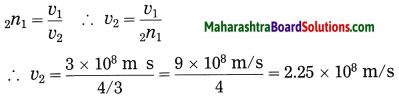
The refractive index of water is 4/3 and the speed of light in air is 3 × 10⁸ m/s. Find the speed of light in water.
Solution:
Data: 2n1 = 4/3, v1 = 3 × 10⁸ m/s, v2 = ?
Maharashtra Board Class 10 Science Solutions Part 1 Chapter 6 Refraction of Light 35
The speed of light in water = 2.25 × 10⁸ m/s.

Problem 5.
The speed of light in water and glass is 2.2 × 10⁸ m/s and 2 × 10⁸ m/s respectively. What is the refractive index of (i) water with respect to glass (ii) glass with respect to water?
Solution:
Data: uw = 2.2 × 10⁸ m/s,
vg= 2 × 10⁸ m/s, wng = ?, gnw = ?
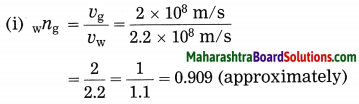
Maharashtra Board Class 10 Science Solutions Part 1 Chapter 6 Refraction of Light 36
The refractive index of water with respect to glass = 0.909 (approximately).
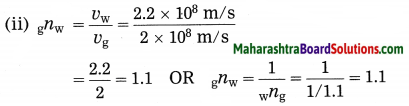
Maharashtra Board Class 10 Science Solutions Part 1 Chapter 6 Refraction of Light 37
The refractive index of glass with respect to glass = 1.1 (approximately).

Numerical Problems For Practice:
(Given: C = 3 × 10⁸m/s)

Problem 1.
The speed of light in a transparent medium is 2 × 10⁸ m/s. Find the absolute refractive index of the medium.
Solution:
1.5

Problem 2
The absolute refractive index of a transparent medium is 5/3. Find the speed of light in the medium.
Solution:
1.8 × 10⁸ m/s

Problem 3.
The absolute refractive index of a transparent medium is 2.4 and the speed of light in that medium is 1.25 × 10⁸ m/s. Find the speed of light in air.
Solution:
3 × 10⁸ m/s

Problem 4.
The speed of light in water is 2.25 × 10⁸ m/s and that in glass is 2 × 10⁸ m/s. Find the refractive index of (i) the glass with respect to water (ii) water with respect to the glass.
Solution:
(i) 1.125
(ii) 0.889 (approximately)

Maharashtra Board Class 10 Science Solutions Part 1 Chapter 6 Refraction of Light

Problem 5.
If the refractive index of a certain glass with respect to water is 1.25, find the refractive index of water with respect to the glass.
Solution:
0.8

Problem 6.
If the absolute refractive index of glass is 1.5 and that of water is \(\frac{4}{3}\), find the refractive index of water with respect to glass.
Solution:
\(\frac{8}{9}\)
Maharashtra Board 10th Class Maths Part 2 Problem Set 7 Solutions Chapter 7 Mensuration

Balbharti Maharashtra State Board Class 10 Maths Solutions covers the Problem Set 7 Geometry 10th Class Maths Part 2 Answers Solutions Chapter 7 Mensuration.

Problem Set 7 Geometry 10th Std Maths Part 2 Answers Chapter 7 Mensuration

Problem Set 7 Question 1. Choose the correct alternative answer for each of the following questions.

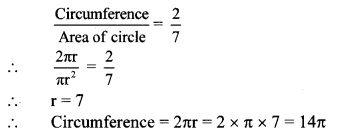
i. The ratio of circumference and area of a circle is 2 : 7. Find its circumference.
(A) 14 π
(B) \(\frac{7}{\pi}\)
(C) 7π
(D) \(\frac{14}{\pi}\)
Answer:
Problem Set 7 Geometry 10th
(A)
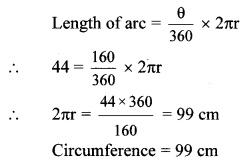
ii. If measure of an arc of a circle is 160° and its length is 44 cm, find the circumference of the circle.
(A) 66 cm
(B) 44 cm
(C) 160 cm
(D) 99 cm
Answer:

(D)

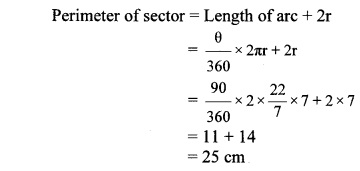
iii. Find the perimeter of a sector of a circle if its measure is 90° and radius is 7 cm.
(A) 44 cm
(B) 25 cm
(C) 36 cm
(D) 56 cm
Answer:

(B)

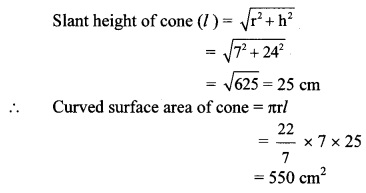
iv. Find the curved surface area of a cone of radius 7 cm and height 24 cm.
(A) 440 cm2
(B) 550 cm2
(C) 330 cm2
(D) 110 cm2
Answer:

(B)

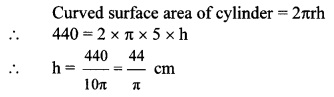
v. The curved surface area of a cylinder is 440 cm2 and its radius is 5 cm. Find its height.
(A) \(\frac{44}{\pi}\) cm
(B) 22π cm
(C) 44π cm
(D) \(\frac{22}{\pi}\)
Answer:

(A)
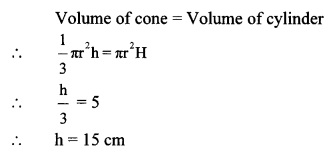
vi. A cone was melted and cast into a cylinder of the same radius as that of the base of the cone. If the height of the cylinder is 5 cm, find the height of the cone.
(A) 15 cm
(B) 10 cm
(C) 18 cm
(D) 5 cm
Answer:
Maharashtra Board Class 10 Maths Solutions Chapter 7 Mensuration Problem Set 7
(A)

vii. Find the volume of a cube of side 0.01 cm.
(A) 1 cm
(B) 0.001 cm3
(C) 0.0001 cm3
(D) 0.000001 cm3
Answer:
Volume of cube = (side)3
= (0.01)3 = 0.000001 cm3
(D)

viii. Find the side of a cube of volume 1 m3
(A) 1 cm
(B) 10 cm
(C) 100 cm
(D) 1000 cm
Answer:
Volume of cube = (side)3
∴ 1 = (side)3
∴ Side = 1 m
= 100 cm
(C)

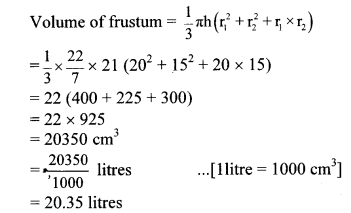
Problem Set 7 Geometry Class 10 Question 2. A washing tub in the shape of a frustum of a cone has height 21 cm. The radii of the circular top and bottom are 20 cm and 15 cm respectively. What is the capacity of the tub? = (π = \(\frac { 22 }{ 7 } \))
Given: For the frustum shaped tub,
height (h) = 21 cm,
radii (r1) = 20 cm, and (r2) = 15 cm
To find: Capacity (volume) of the tub.
Solution:
Volume of frustum = \(\frac { 1 }{ 3 } \) πh (r12 + r22 + r1 × r2)
Maharashtra Board Class 10 Maths Solutions Chapter 7 Mensuration Problem Set 7 7
∴ The capacity of the tub is 20.35 litres.

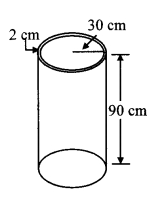
10th Geometry Problem Set 7 Question 3. Some plastic balls of radius 1 cm were melted and cast into a tube. The thickness, length and outer radius of the tube were 2 cm, 90 cm and 30 cm respectively. How many balls were melted to make the tube?
Given: For the cylindrical tube,
height (h) = 90 cm,
outer radius (R) = 30 cm,
thickness = 2 cm
For the plastic spherical ball,
radius (r1) = 1 cm
To find: Number of balls melted.
Solution:
Maharashtra Board Class 10 Maths Solutions Chapter 7 Mensuration Problem Set 7 8
Inner radius of tube (r)
= outer radius – thickness of tube
= 30 – 2
= 28 cm
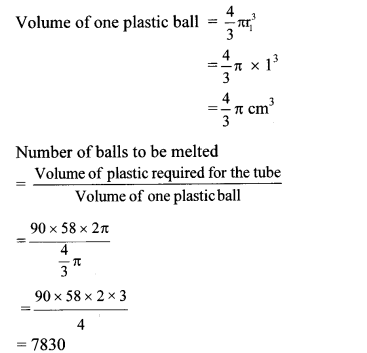
Volume of plastic required for the tube = Outer volume of tube – Inner volume of hollow tube
= πR2h – πr2h
= πh(R2 – r2)
= π × 90 (302 – 282)
= π × 90 (30 + 28) (30 – 28) …[∵ a2 – b2 = (a + b)(a – b)]
= 90 × 58 × 2π cm3
Maharashtra Board Class 10 Maths Solutions Chapter 7 Mensuration Problem Set 7 9
∴ 7830 plastic balls were melted to make the tube.

Problem Set 7 Geometry Question 4.
A metal parallelopiped of measures 16 cm × 11cm × 10cm was melted to make coins. How many coins were made if the thickness and diameter of each coin was 2 mm and 2 cm respectively?
Given: For the parallelopiped.,
length (l) = 16 cm, breadth (b) = 11 cm,
height (h) = 10 cm
For the cylindrical coin,
thickness (H) = 2 mm,
diameter (D) 2 cm
To find: Number of coins made.
Solution:
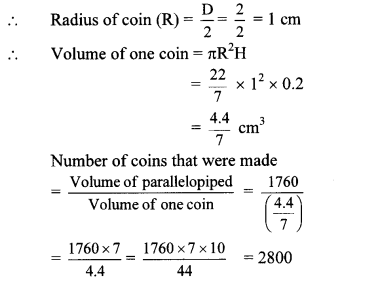
Volume of parallelopiped = l × b × h
= 16 × 11 × 10
= 1760 cm3
Thickness of coin (H) = 2 mm
= 0.2 cm …[∵ 1 cm = 10 mm]
Diameter of coin (D) = 2 cm
Maharashtra Board Class 10 Maths Solutions Chapter 7 Mensuration Problem Set 7 10
∴ 2800 coins were made by melting the parallelopiped.

Mensuration Problem Question 5.  The diameter and length of a roller is 120 cm and 84 cm respectively. To level the ground, 200 rotations of the roller are required. Find the expenditure to level the ground at the rate of ₹ 10 per sq.m.
Given: For the cylindrical roller,
diameter (d) =120 cm,
length = height (h) = 84 cm
To find: Expenditure of levelling the ground.
Solution:
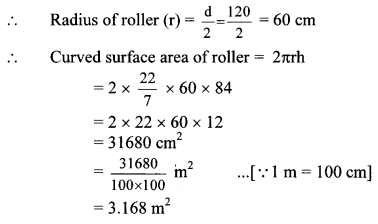
Diameter of roller (d) = 120 cm
Maharashtra Board Class 10 Maths Solutions Chapter 7 Mensuration Problem Set 7 11
Now, area of ground levelled in one rotation = curved surface area of roller
= 3.168 m2
∴ Area of ground levelled in 200 rotations
= 3.168 × 200 =
633.6 m2
Rate of levelling = ₹ 10 per m2
∴ Expenditure of levelling the ground
= 633.6 × 10 = ₹ 6336
∴ The expenditure of levelling the ground is ₹ 6336.

Question 6.
The diameter and thickness of a hollow metal sphere are 12 cm and 0.01 m respectively. The density of the metal is 8.88 gm per cm3. Find the outer surface area and mass of the sphere, [π = 3.14]
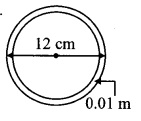
Given: For the hollow sphere,
diameter (D) =12 cm, thickness = 0.01 m
density of the metal = 8.88 gm per cm3
To find: i. Outer surface area of the sphere
ii. Mass of the sphere.
Maharashtra Board Class 10 Maths Solutions Chapter 7 Mensuration Problem Set 7 12
Solution:
Diameter of the sphere (D)
= 12 cm
∴ Radius of sphere (R)
= \(\frac { d }{ 2 } \) = \(\frac { 12 }{ 2 } \) = 6 cm
∴ Surface area of sphere = 4πR2
= 4 × 3.14 × 62
= 452.16 cm2
Thickness of sphere = 0.01 m
= 0.01 × 100 cm …[∵ 1 m = 100 cm]
= 1 cm
∴ Inner radius of the sphere (r)
= Outer radius – thickness of sphere
= 6 – 1 = 5 cm
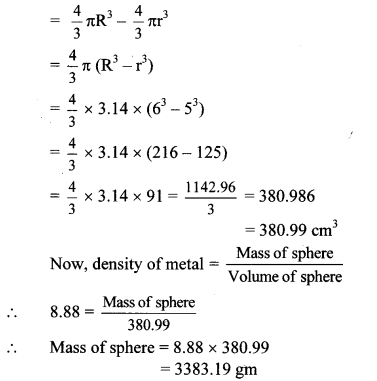
∴ Volume of hollow sphere
= Volume of outer sphere – Volume of inner sphere
Maharashtra Board Class 10 Maths Solutions Chapter 7 Mensuration Problem Set 7 13
∴ The outer surface area and the mass of the sphere are 452.16 cm2 and 3383.19 gm respectively.

Question 7.
A cylindrical bucket of diameter 28 cm and height 20 cm was full of sand. When the sand in the bucket was poured on the ground, the sand got converted into a shape of a cone. If the height of the cone was 14 cm, what was the base area of the cone?
Given: For the cylindrical bucket,
diameter (d) = 28 cm, height (h) = 20 cm
For the conical heap of sand,
height (H) = 14 cm
To find: Base area of the cone (πR2).
Solution:
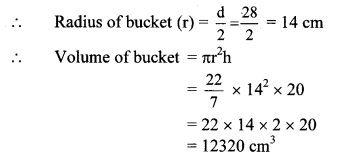
Diameter of the bucket (d) = 28 cm
Maharashtra Board Class 10 Maths Solutions Chapter 7 Mensuration Problem Set 7 14
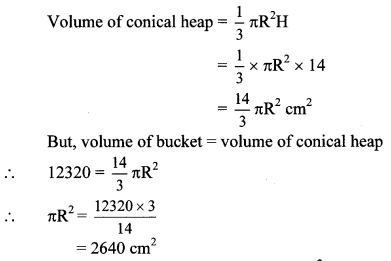
Maharashtra Board Class 10 Maths Solutions Chapter 7 Mensuration Problem Set 7 15
The base area of the cone is 2640 cm2.

Question 8.
The radius of a metallic sphere is 9 cm. It was melted to make a wire of diameter 4 mm. Find the length of the wire.
Given: For metallic sphere,
radius (R) = 9 cm
For the cylindrical wire,
diameter (d) = 4 mm
To find: Length of wire (h).
Solution:
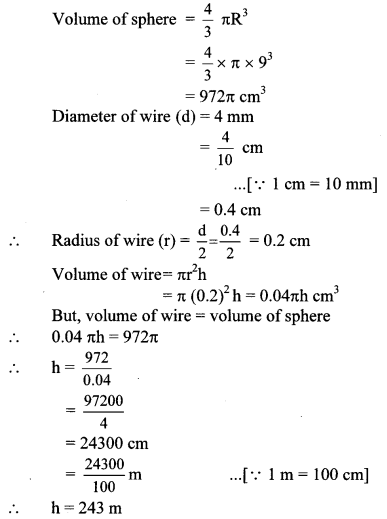
Maharashtra Board Class 10 Maths Solutions Chapter 7 Mensuration Problem Set 7 16
∴ The length of the wire is 243 m.

Question 9.
The area of a sector of a circle of 6 cm radius is 157t sq.cm. Find the measure of the arc and length of the arc corresponding to the sector.
Given: Radius (r) = 6 cm,
area of sector = 15 π cm2
To find: i. Measure of the arc (θ),
ii. Length of the arc (l)
Solution:
Maharashtra Board Class 10 Maths Solutions Chapter 7 Mensuration Problem Set 7 17
∴ The measure of the arc and the length of the arc are 150° and 5π cm respectively.

Question 10.
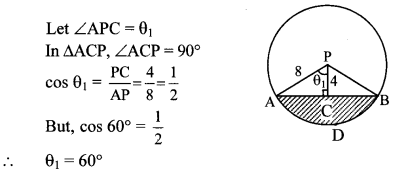
In the adjoining figure, seg AB is a chord of a circle with centre P. If PA = 8 cm and distance of chord AB from the centre P is 4 cm, find the area of the shaded portion.
Maharashtra Board Class 10 Maths Solutions Chapter 7 Mensuration Problem Set 7
(π = 3.14, \(\sqrt { 3 }\) = 1.73)
Given: Radius (r) = PA = 8 cm,
PC = 4 cm
To find: Area of shaded region.
Solution:
Maharashtra Board Class 10 Maths Solutions Chapter 7 Mensuration Problem Set 7 18
Similarly, we can show that, ∠BPC = 60°
∠APB = ∠APC + ∠BPC …[Angle sum property]
∴ θ = 60° + 60° = 120°
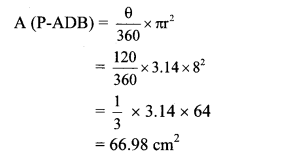
Maharashtra Board Class 10 Maths Solutions Chapter 7 Mensuration Problem Set 7 19
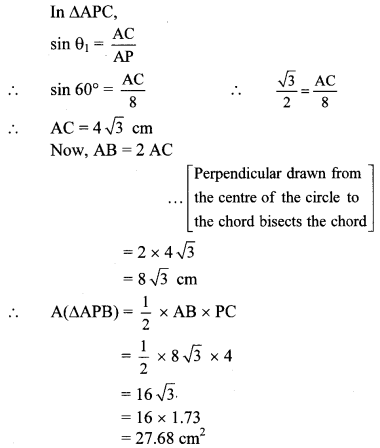
Maharashtra Board Class 10 Maths Solutions Chapter 7 Mensuration Problem Set 7 20
Area of shaded region = A(P-ADB) – A(∆APB)
= 66.98 – 27.68
= 39.30 cm2
∴ The area of the shaded region is 39.30 cm2.

Question 11.
In the adjoining figure, square ABCD is inscribed in the sector A-PCQ. The radius of sector C-BXD is 20 cm. Complete the following activity to find the area of shaded region.
Maharashtra Board Class 10 Maths Solutions Chapter 7 Mensuration Problem Set 7 21
Solution:
Side of square ABCD
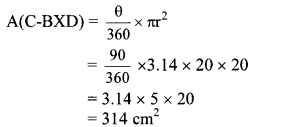
= radius of sector C-BXD = [20] cm
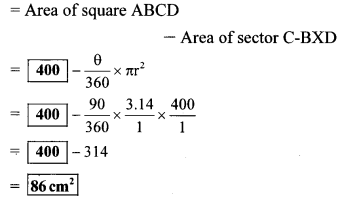
Area of square = (side)2 = 202 = 400 cm2 ….(i)
Area of shaded region inside the square = Area of square ABCD – Area of sector C-BXD
Maharashtra Board Class 10 Maths Solutions Chapter 7 Mensuration Problem Set 7 22
Radius of bigger sector
= Length of diagonal of square ABCD
= \(\sqrt { 2 }\) × side
= 20 \(\sqrt { 2 }\) cm
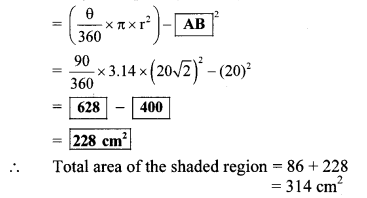
Area of the shaded regions outside the square
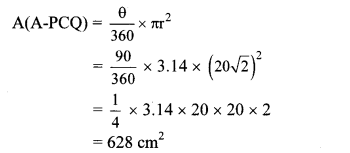
= Area of sector A-PCQ – Area of square ABCD
= A(A – PCQ) – A(꠸ABCD)
Maharashtra Board Class 10 Maths Solutions Chapter 7 Mensuration Problem Set 7 23
Alternate method:
Maharashtra Board Class 10 Maths Solutions Chapter 7 Mensuration Problem Set 7 24
□ABCD is a square. … [Given]
Side of □ABCD = radius of sector (C-BXD)
= 20 cm
Radius of sector (A-PCQ) = Diagonal
= \(\sqrt { 2 }\) × side
= \(\sqrt { 2 }\) × 20
= 20 \(\sqrt { 2 }\) cm
Maharashtra Board Class 10 Maths Solutions Chapter 7 Mensuration Problem Set 7 25
Now, Area of shaded region
= A(A-PCQ) – A(C-BXD)
= 628 – 314
= 314 cm2
∴ The area of the shaded region is 314 cm2.

Question 12.
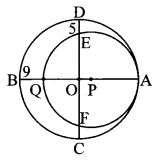
In the adjoining figure, two circles with centres O and P are touching internally at point A. If BQ = 9, DE = 5, complete the following activity to find the radii of the circles.
Maharashtra Board Class 10 Maths Solutions Chapter 7 Mensuration Problem Set 7 26
Solution:
Let the radius of the bigger circle be R and that of smaller circle be r.
OA, OB, OC and OD are the radii of the bigger circle.
∴ OA = OB = OC = OD = R
PQ = PA = r
OQ + BQ = OB … [B – Q – O]
OQ = OB – BQ = R – 9
OE + DE = OD ….[D – E – O]
OE = OD – DE = [R – 5]
As the chords QA and EF of the circle with centre P intersect in the interior of the circle, so by the property of internal division of two chords of a circle,
OQ × OA = OE × OF
∴ (R – 9) × R = (R – 5) × (R – 5) …[∵ OE = OF]
∴ R2 – 9R = R2 – 10R + 25
∴ -9R + 10R = 25
∴ R = [25units]
AQ = AB – BQ = 2r ….[B-Q-A]
∴ 2r = 50 – 9 = 41
∴ r = \(\frac { 41 }{ 2 } \) = 20.5 units

Maharashtra Board Class 10 Science Solutions Part 1 Chapter 5 Heat

Balbharti Maharashtra State Board Class 10 Science Solutions Part 1 Chapter 5 Heat Notes, Textbook Exercise Important Questions and Answers.

Maharashtra State Board Class 10 Science Solutions Part 1 Chapter 5 Heat

Question 1.
Fill in the blanks and rewrite the sentences:
a. The amount of water vapour in air is determined in terms of its………..
Answer:
The amount of water vapour in air is determined in terms of its absolute humidity.

b. If objects of equal masses are given equal heat, their final temperature will be different. This is due to difference in their………….
Answer:
If objects of equal masses are given equal heat, their final temperature will be different. This is due to difference in their specific heat capacities.

c. When a liquid is getting converted into solid, the latent heat is……….  (Practical Activity Sheet – 1 and 2)
Answer:
When a liquid is getting converted into solid, the latent heat is released.

Maharashtra Board Class 10 Science Solutions Part 1 Chapter 5 Heat

Question 2.
Observe the following graph. Considering the change in volume of water as its temperature is raised from 0 °C, discuss the difference in the behaviour of water and other substances. What is this behaviour of water called?
Maharashtra Board Class 10 Science Solutions Part 1 Chapter 5 Heat 1
Answer:
If the temperature of water is raised from 0 °C to 10 °C, its volume goes on decreasing in the range 0 °C to 4 °C. It is minimum at 4 °C. The volume of water goes on increasing in the range 4 °C to 10 °C.

In general, when a substance is heated, its volume goes on increasing with temperature. Thus, in the range 0 °C to 4 °C, behaviour of water is different from other substances. It is called anomalous behaviour of water.

Question 3.
What is meant by specific heat capacity?
How will you prove experimentally that different substances have different specific heat capacities?
Answer:
The amount of heat energy required to raise the temperature of a unit mass of an object by 1 °C is called the specific heat capacity of that object.

Question 4.
While deciding the unit for heat, which temperatures interval is chosen? why?
Answer:
While deciding the unit for heat, the temperature interval chosen is 14.5 °C to 15.5 °C. For the reason, see the information given in the following box.

Maharashtra Board Class 10 Science Solutions Part 1 Chapter 5 Heat

Question 5.
Explain the following temperature vs time graph:
Maharashtra Board Class 10 Science Solutions Part 1 Chapter 5 Heat 2
(Practice Activity Sheet – 1 and 4; March 2019)
Answer:
The graph shows what happens when a mixture of ice and water is heated continuously. The temperature of the mixture remains constant (0 °C) till all the ice melts as shown by the line AB. This temperature is the melting point of ice. On further heating, the temperature rises steadily from 0 °C to 100 °C as shown by the line BC, At 100 °C water starts converting into steam. This temperature is the boiling point of water. Further heating does not change the temperature and the conversion waters steam continues as shown by the line CD.

Question 6.
Explain the following:
a. the role of anomalous behaviour of water in preserving aquatic life in regions of cold climate?
Answer:
Maharashtra Board Class 10 Science Solutions Part 1 Chapter 5 Heat 3
In cold regions, during winter, the temperature of the atmosphere falls well below 0 °C. As the temperature decreases, the water at the surfaces of lakes and ponds starts contracting. Hence, its density increases and it sinks to the bottom. This process continues till the temperature of all the water in a lake falls to 4 °C. As the water at the surface cools further, i.e., its temperature falls below 4 °C, it starts expanding instead of contracting. Therefore, its density decreases and it remains at the surface.

The temperature of the water at the surface continues to fall to 0 °C. Finally, the water at the surface is converted into ice, but the water below the layer of ice is at 4 °C. Ice is a bad conductor of heat. Hence, the layer of the ice at the surface does not allow transfer of heat from the water to the atmosphere. As the water below the layer of ice remains at 4 °C, fish and other aquatic animals and plants can survive in it.

b. How can you relate the formation of water droplets on the outer surface of a bottle taken out of a refrigerator with formation of dew?
Answer:
At a given temperature, there is a limit on how much water vapour the given volume of air can hold. The lower the temperature, the lower is the capacity of air to hold water vapour.

The temperature of a bottle kept in a refrigerator is lower than room temperature. Hence, when the bottle is taken out of the refrigerator, the temperature of the air surrounding the bottle is lowered. Therefore, the capacity of the air to hold water vapour becomes less. Hence, the excess water vapour condenses to form water droplets (like dew) on the outer surface of the bottle.

c. In cold regions in winter, the rocks crack due to anomalous expansion of water.
Answer:
Sometimes water enters into crevices of the rocks. When the temperature of the atmosphere falls below 4 °C, water expands. Even when water freezes to form ice, there is increase in its volume. As there is no room for expansion, it exerts a tremendous pressure on the rocks which crack and break up into small pieces.

Maharashtra Board Class 10 Science Solutions Part 1 Chapter 5 Heat

Question 7.
a. What is meant by latent heat? How will the state of matter transform if latent heat is given off?
Answer:
When a solid is heated, initially, its temperature increases. Here, the heat absorbed by the body (substance) is used in increasing the kinetic energy of the particles (atomic, molecules, etc.) of the body as well as for doing work against the forces of attraction between them. As the heating is continued, at a certain temperature (melting point), solid is converted into liquid. In this case, the temperature remains constant and the heat absorbed is used for weakening the bonds and conversion into liquid phase (liquid state). This heat is called the latent heat of fusion.

When a liquid is converted into the gaseous phase (gaseous state), at the boiling point, the heat absorbed is used for breaking the bonds between the atoms or molecules. This heat is called the latent heat of vaporization. Some solids, under certain conditions, are directly transformed into the gaseous phase. Here the heat is absorbed but the temperature remains constant. The absorbed heat is used for breaking the bonds between atoms or molecules. This heat is called the latent heat of sublimation.

In general, latent heat is the heat absorbed or given out by a substance during a change of state at constant temperature.
In transformations from liquid to solid, gas to liquid and gas to solid, latent heat is given out by the body (substance).
(Note: change of state = change of phase)

b. Which principle is used to measure the specific heat capacity of a substance?
Answer:
The principle of heat exchange is used to measure the specific heat capacity of a substance. This principle is as follows: If a system of two objects is isolated from the environment by keeping it inside a heat resistant box, then no energy can leave the box or enter the box. In this situation, heat energy lost by the hot object = heat energy gained by the cold object.

c. Explain the role of latent heat in the change of state of a substance.
Answer:
When a solid is heated, initially, its temperature increases. Here, the heat absorbed by the body (substance) is used in increasing the kinetic energy of the particles (atomic, molecules, etc.) of the body as well as for doing work against the forces of attraction between them. As the heating is continued, at a certain temperature (melting point), solid is converted into liquid. In this case, the temperature remains constant and the heat absorbed is used for weakening the bonds and conversion into liquid phase (liquid state). This heat is called the latent heat of fusion.

When a liquid is converted into the gaseous phase (gaseous state), at the boiling point, the heat absorbed is used for breaking the bonds between the atoms or molecules. This heat is called the latent heat of vaporization. Some solids, under certain conditions, are directly transformed into the gaseous phase. Here the heat is absorbed but the temperature remains constant. The absorbed heat is used for breaking the bonds between atoms or molecules. This heat is called the latent heat of sublimation.

In general, latent heat is the heat absorbed or given out by a substance during a change of state at constant temperature.
In transformations from liquid to solid, gas to liquid and gas to solid, latent heat is given out by the body (substance).
(Note: change of state = change of phase)

d. what basis and how will you determine whether air is saturated with vapour or not?
Answer:
Whether the air is saturated with water vapour or not is determined on the basis of the extent of water vapour present in the air. If the relative humidity is 100%, the air is saturated with water vapour. In that case, we can see the formation of water droplets on the leaves of plants/grass.
If the relative humidity is less than 100%, the air is not saturated with water vapour.

Question 8.
Read the following paragraph and answer the questions:
If heat is exchanged between a hot and cold object, the temperature of the cold object goes on increasing due to gain of energy and the temperature of the hot object goes on decreasing due to loss of energy.

The change in temperature continues till the temperatures of both the objects attain the same value. In this process, the cold object gains heat energy and the hot object loses’ heat energy. If the system of both the objects is isolated from the environment by keeping it inside a heat resistant box (meaning that the energy exchange takes place between the two objects only), then no energy can flow from inside the box or come into the box.
(1) Heat is transferred from where to where?
(2) Which principle do we learn about from this process?
(3) How will you state the principle briefly?
(4) Which property of the substance is measured using this principle?
Answer:
(1) Heat is transferred from a hot object to a cold object.
(2) This process shows the principle of heat exchange.
(3) In this process, the cold object gains heat energy and the hot object loses energy. If a system of two objects is isolated from the surroundings, heat energy lost by the hot object = heat energy gained by the cold object.
(4) This principle is used to measure the specific heat capacity of a substance.

Maharashtra Board Class 10 Science Solutions Part 1 Chapter 5 Heat

Question 9.
Solve the following problems:
a. Equal heat is given to two objects A and B of mass 1 g. The temperature of A increases by 3 °C and B by 5°C. Which object has more specific heat? And by what factor?
Solution:
Data: m = 1 g, Δ T1 = 3 °C, Δ T2 = 5 °C,
Q same
Here, Q = mc1 ΔT1 = mc2 ΔT2
Maharashtra Board Class 10 Science Solutions Part 1 Chapter 5 Heat 4
Thus, c1 > c2
The specific heat of A is more than that of B and
Maharashtra Board Class 10 Science Solutions Part 1 Chapter 5 Heat 5

b. Liquid ammonia is used in ice factory for making ice from water. If water at 20 °C is to be converted into 2 kg, ice at 0 °C, how many grams of ammonia is to be evaporated?
(Given: The latent heat of vaporization of 1 ammonia = 341 cal/g)
Solution:
Data : m1 = 2kg, ΔT1=20 °C – 0 °C
= 20 °C, c1 = 1 kcal/kg·°C, L1 (ice) = 80 kcal/kg,
L2 (vaporization of ammonia) = 341 cal/g = 341 kcal/kg, m2 =?
Q1 (heat lost by water) = m1c1 ΔT1 + m1L1
= 2kg × 1 kcal/kg·°C × 20 °C + 2 kg × 80 kcal/kg
=40 kcal + 160 kcal = 200 kcal
Q2 (heat absorbed by ammonia) = m2L2
= m2 × 34l kcal/kg
According to the principle of heat exchange, Q1 = Q2
∴ 200 kcal = m2 × 341 kcal/kg
∴ m2 = \(\frac{200}{341}\) kg = 0.5864 kg = 586.4 g
586.4 g of ammonia are to be evaporated.

c. A thermally insulated pot has 150 g ice at temperature 0 °C. How much steam of 100 °C has to he mixed to it, so that water of temperature 50 °C will be obtained?
(Given: Latent heat of melting of ice = 80 cal/g, latent heat of vaporization of water = 540 cal/g, specific heat of water = 1 cal/g °C)
Solution:
Data: m1 = 150 g, ΔT1 = 50 °C – 0 °C
= 50 °C, cw = 1 cal/g.°C, L1 = 80 cal/g, L2 = 540 cal/g,
Δ T2 = 100°C – 50 °C = 50 °C, m2 = ?
Q1 (heat absorbed by ice) = m1L1
= 150 g × 80 cal/g = 12000 cal
Q2 (heat absorbed by water formed on melting of ice) =m1 cw ΔT1
= 150 g × 1 cal/g·°C × 50 °C = 7500 cal
Q3 (heat given out by steam) = m2L2
= m2 × 540 cal/g
Q4 (heat given out by water formed on condensation of steam)
= m2 cw ΔT2 = m2 × 1 cal/g·°C × 50 °C
According to the principle of heat exchange,
Q1 + Q2 = Q3 + Q4
∴ 12000 cal + 7500 cal = m2 × 540 cal/g + m2 × 50 cal/g
∴ 19500 cal = m2 (540 + 50) cal/g
∴ m2 = \(\frac{19500}{590}\) g
33.5 g of steam is to be mixed.

d. A calorimeter has mass 100 g and specific heat 0.1 kcal/kg ·°C. It contains 250 g of liquid at 30 °C having specific heat of 0.4 kcal/kg·°C. If we drop a piece of ice of mass 10 g at 0 °C into the liquid, what will be the temperature of the mixture?
Solution:
Data: m1 = 100 g, c1 = 0.1 kcal/kg·°C,
= 0.1 cal/g·°C, T1 = 30 °C, m2 = 250 g,
c2 = 0.4 kcal/kg·°C = 0.4 cal/g·°C, T2 = 30 °C,
m3 = 10 g, T3 = 0 °C, L = 80 cal/g,
c (water) = 1 cal/g·°C, T = ?
Q1 (heat lost by calorimeter) = m1c1 (T- T1),
Q2 (heat lost by liquid) = m2c2 (T – T2),
Q3 (heat absorbed by ice) = m3 L,
Q4 (heat absorbed by water formed on melting of ice) = m3c (T – 0 °C)
According to the principle of heat exchange,
Q1 + Q2 = Q3 + Q4
∴ m1c1 (T1 – T) + m2c2 (T2 – T) = m3L + m3c (T – 0 °C)
∴ m1c1T1 – m1c1T + m2c2T2 – m2c2T = m3L + m3c (T – 0°C)
∴ m1c1T1 + m2c2T2 = m3L + (m1c1 + m2c2 + m3c)T
∴ 100g × 0.1 cal/g°C × 30 °C + 250g × 0.4 cal/g.°C × 30 °C J
= 10 g x× 80 cal/g + (100 g × 0.1 cal/g.°C + 250 g × 0.4 cal/g.°C + 10 g × 1 cal/g.°C) T
∴ (10 + 100 + 10) T = (300 + 3000 – 800)°C
∴ 120 T = 2500 °C
∴ T = \(\frac{2500}{120}\) °C = \(\frac{125}{6}\) °C = 20.83 °C
This is the temperature of the mixture.

Project:
Take help of your teachers to make a working model of Hope’s apparatus and perform the experiment. Verify the results you obtain. [Do it your self]

Maharashtra Board Class 10 Science Solutions Part 1 Chapter 5 Heat

Can you recall? (Text Book Page No. 62)

Question 1.
What is the difference between heat and temperature?
Answer:
Heat is a form of energy. Particles of matter (atoms, molecules, etc.) possess potential energy and kinetic energy. Total energy (potential energy + kinetic energy) of all particles of matter in a given sample is called it’s thermal energy. When two bodies at different temperatures are in thermal contact with each other, there is transfer of thermal energy from a body at higher temperature to a body at lower temperature. This energy in transfer is called heat. It is expressed in joule, calorie and erg.

Temperature is a quantitative measure of degree of hotness or coldness of a body. It is expressed in °C, °F or K (kelvin). Temperature determines the direction of energy transfer.

Question 2.
What are the different ways of heat transfer?
Answer:
Ways of heat transfer: conduction, convection and radiation.
[Note: heat ≡ heat energy. In the textbook, both the terms are used.]

Use your brain power! (Text Book Page No. 63)

Question 1.
Is the concept of latent heat applicable during transformation of gaseous phase to liquid phase and from liquid phase to solid phase?
Answer:
Yes.

Question 2.
Where does the latent heat go during these transformations?
Answer:
During these transformations, the latent heat is given out by the substance to the surroundings.

Maharashtra Board Class 10 Science Solutions Part 1 Chapter 5 Heat

Use your brain power! (Text Book Page No. 64)

Question 1.
In the above experiment, the wire moves through the ice slab. However, the ice slab does not break. Why?
Answer:
When the thin wire with two equal weights attached to its ends is hung over the block of ice, it exerts pressure on the ice below it. Due to this, the melting point of the ice below the wire is lowered and some ice melts. The wire passes through the water so formed.

The water above the wire is no longer under pressure and, therefore, refreezes. Once again the ice below the wire melts, and the wire passes through it, and the process continues. In this way, due to alternate melting of ice and refreezing of water, the wire cuts right through the block of ice leaving the block intact.

Question 2.
Is there any relationship of latent heat with regelation?
Answer:
Yes. when the ice melts, heat is absorbed, but the temperature does not change. Also, when water refreezes, heat is given out, but the temperature does not change. This heat absorbed or given out is the latent heat.

Question 3.
You know that as we go higher than the sea level, the boiling point of water decreases. What would be the effect on the melting point of a solid?
Answer:
As we go higher than the sea level, the melting point of solids (i) that expand on melting is lowered due to a decrease in pressure (ii) that contract on melting is raised due to a decrease in pressure.

[The wire used in the experiment is made of a metal (usually copper). Metals are good conductors of heat. Hence, exchange of heat between the portion of the ice above the wire and that below the wire takes place readily.]

Can you tell? (Text Book Page No. 64)

Question 1.
We feel that some objects are cold, and some are hot. Is this feeling related in some way to our body temperature?
Answer:
Yes. If the temperature of the object is lower than our body temperature, e.g., ice, we feel the object is cold. If the temperature of the object is higher than our body temperature, e.g., hot water, we feel the object is hot.

Use your brain power! (Text Book Page No. 66)

Question 1.
How will you explain the following statements with the help of the anomalous behaviour of water?
(1) In regions with cold climate, the aquatic plants and animals can survive even when the atmospheric temperature goes below 0 °C.
(2) In cold regions in winter the pipes for water supply break and even rocks crack.
Answer:
Maharashtra Board Class 10 Science Solutions Part 1 Chapter 5 Heat 6
In cold regions, during winter, the temperature of the atmosphere falls well below 0 °C. As the temperature decreases, the water at the surfaces of lakes and ponds starts contraeting. Hence, its density increases and it sinks to the bottom. This process continues till the temperature of all the water in a lake falls to 4 °C. As the water at the surface cools further, i.e., its temperature falls below 4 °C, it starts expanding instead of contracting. Therefore, its density decreases and it remains at the surface.

The temperature or the water at the surface continues to fall to 0 °c. Finally, the water at the surface is converted Into ice, but the water below the layer of ice is at 4 °C. Ice is a bad conductor of heat. Hence, the layer of the ice at the surface does not allow transfer of heat from the water to the atmosphere. As the water below the layer of ice remains at 4 °C, fish and other aquatic animals and plants can survive in it.

Maharashtra Board Class 10 Science Solutions Part 1 Chapter 5 Heat

(2) Sometimes water enters into crevices of the rocks. when the temperature of the atmosphere falls below 4 °C, water expands. Even when water freezes to form ice, there is increase in its volume. As there is no room for expansion, it exerts tremendous pressure on the rocks which crack and break up Into small pieces.

In cold countries, in winter, the temperature of the atmosphere falls below 0 °C. when the temperature of water falls below 4 °C, it expands. Hence, the water in pipes expands. Even if ice is rormed, there is an increase in the volume.

As there is no room for expansion, water (or ice) exerts a large pressure on the pipes. Hence, the pipelines carrying water burst.

Fill in the blanks and rewrite the sentences:

Question 1.
The amount of water vapour in air is determined in terms of its…………..
Answer:
The amount of water vapour in air is determined in terms of its absolute humidity.

Question 2.
If objects of equal masses are given equal heat, their final temperature will be different. This is due to difference in their……………
Answer:
If objects of equal masses are given equal heat, their final temperature will be different. This is due to difference in their specific heat capacities.

Question 3.
When a liquid is getting converted into solid, the latent heat is…………. (Practical Activity Sheet – 1 and 2)
Answer:
When a liquid is getting converted into solid, the latent heat is released.

Rewrite the following statements by selecting the correct options:

Question 1.
……….is used to study the anomalous behaviour of water.
(a) Calorimeter
(b) Joule’s apparatus
(c) Hope’s apparatus
(d) Thermos flask
Answer:
(c) Hope’s apparatus

Question 2.
When water boils and is converted into steam, then………..
(a) heat is taken in and temperature remains constant
(b) heat is taken in and temperatures rises
(c) heat is given out and temperature lowers
(d) heat is given out and temperature remains constant
Answer:
(a) heat is taken in and temperature remains constant

Question 3.
When steam condenses to form water,………..
(a) heat is absorbed and temperature increases
(b) heat is absorbed and temperature remains the same
(c) heat is given out and temperature decreases
(d) heat is given out and temperature remains the same
Answer:
(d) heat is given out and temperature remains the same

Maharashtra Board Class 10 Science Solutions Part 1 Chapter 5 Heat

Question 4.
The temperature of ice can be decreased below 0 °C by mixing………..in it. (Practice Activity Sheet – 3)
(a) saw dust
(b) sand
(c) salt
(d) coal
Answer:
(c) salt

Question 5.
Ice/water is a substance that………..
(a) expands on melting and contracts on freezing
(b) contracts on melting and does not undergo change in volume on freezing
(c) contracts on melting and expands on freezing
(d) does not undergo any change in volume on melting or freezing
Answer:
(c) contracts on melting and expands on freezing

Question 6.
Heat absorbed when 1 g of ice melts at 0 °C to form 1 g of water at the same temperature is………..cal.
(a) 80
(b) 800
(c) 540
(d) 54
Answer:
(a) 80

Question 7.
The latent heat of vaporization of water is………..
(a) 540 cal/g
(b) 800 cal/g
(c) 80 cal/g
(d) 54 cal/g
Answer:
(a) 540 cal/g

Question 8.
The latent heat of fusion of ice is………..
(a) 540 cal/g
(b) 80 cal/g
(c) 800 cal/g
(d) 4cal/g
Answer:
(b) 80 cal/g

Question 9.
If the temperature of water is decreased from 4 °C to 10 °C, then its………..
(a) volume decreases and density increases
(b) volume increases and density decreases
(c) volume decreases and density decreases
(d) volume increases and density increases
Answer:
(b) volume increases and density decreases

Question 10.
At 4 °C, the density of water is………..
(a) 10 g/cm3
(b) 4g/cm3
(c) 4 × 10³ kg/m3
(d) 1 × 10³ kg/m3
Answer:
(d) 1 × 10³ kg/m3

Maharashtra Board Class 10 Science Solutions Part 1 Chapter 5 Heat

Question 11.
The density of water is maximum at………..
(a) 0 °C
(b) – 4 °C
(c) 100 °C
(d) 4 °C
Answer:
(d) 4 °C

Question 12.
………..heat is needed to raise the temperature of 1 kg of water from 14.5 °C to 15.5 °C.
(a) 4180 J
(b) 103 J
(c) 1 cal
(d) 4180 cal
Answer:
(a) 4180 J

Question 13.
………..heat is needed to convert 1 g of water at 0 °C and at a pressure of one atmosphere into 1 g of steam under the same conditions.
(a) 80 cal
(b) 540 cal
(c) 89 J
(d) 540 J
Answer:
(b) 540 cal

Question 14.
Water expands on reducing its temperature below………..°C. (March 2019)
(a) 0
(b) 4
(c) 8
(d) 12
Answer:
(b) 4

State whether the following statements are true or false. (If a statement is false, correct it and rewrite it.):

Question 1.
Specific latent heat of fusion is expressed in g/cal.
Answer:
False. (Specific latent heat of fusion is expressed in cal/g.)

Question 2.
If the temperature of water is raised from 0 °C to 10 °C, its volume goes on increasing.
Answer:
False. (If the temperature of water is raised from 0 °C to 10 °C, its volume goes on decreasing in the range 0 °C to 4 °C and then goes on increasing in the range 4 °C to 10 °C.)

Maharashtra Board Class 10 Science Solutions Part 1 Chapter 5 Heat

Question 3.
At dew point relative humidity is 100%.
Answer:
True.

Question 4.
1 kcal = 4.18 joules.
Answer:
False. (1 kcal = 4180 joules.)

Question 5.
Specific heat capacity is expressed in cal/g·°C
Answer:
True.

Question 6.
Latent heat of fusion, Q = mL.
Answer:
True.

Question 7.
If the relative humidity is more than 60%, we feel that the air is humid.
Answer:
True.

Question 8.
If the relative humidity is less than 60%, we feel that the air is dry.
Answer:
True.

Question 9.
Relative humidity has no unit.
Answer:
True.

Maharashtra Board Class 10 Science Solutions Part 1 Chapter 5 Heat

Question 10.
Absolute humidity is expressed in kg/m3.
Answer:
True.

Identify the odd one and give the reason:

Question 1.
Temperature, conduction, convection, radiation.
Answer:
Temperature. It is a physical quantity. Others are modes of transfer of heat.

Question 2.
The joule, The erg, The calorie, The newton.
Answer:
The newton. It is a unit of force. Others are units of energy (as well as work.)

Question 3.
cal/g, cal/g·°C, k cal/kg·°C, erg/g·°C.
Answer:
cal/g. It is a unit of specific latent heat. Others are units of specific heat capacity.

Match the columns:

Column AColumn B
1. Latent heata. Q = mc ΔT
2. Specific heat capacityb. Q = mL
3. Heat absorbed or given out by a body when its temperature changes.c. kcal
d. cal/g·°C

Answer:
(1) Latent heat – Q = mL
(2) Specific heat capacity – cal/g·°C
(3) Heat absorbed or given out by a body when its temperature changes – Q = mc ΔT.

Answer the following questions in one sentence each:

Question 1.
State units of temperature.
Answer:
Units of temperature: °C, °F and K (kelvin).

Question 2.
State units of energy.
Answer:
Units of energy: the erg, the joule, the calorie.

Question 3.
State the relation between the joule and the calorie.
Answer:
1 calorie = 4.18 joules.

Maharashtra Board Class 10 Science Solutions Part 1 Chapter 5 Heat

Question 4.
State the relation between the erg and the joule.
Answer:
1 joule = 107 ergs.

Question 5.
State the relation between the erg and the kilocalorie.
Answer:
1 kilocalorie = 4.18 × 10¹⁰ ergs.

Question 6.
State the relation between the joule and the kilocalorie.
Answer:
1 kilocalorie = 4.18 × 10³ joules.

Question 7.
When heat energy is absorbed by an object, ΔT represents the rise in temperature. What would ΔT represent if the object loses heat energy? (Practice Activity Sheet – 4)
Answer:
If the object loses heat energy, ΔT would represent the decrease in temperature.

Answer the following questions:

Question 1.
Define latent heat of fusion.
(OR)
What is latent heat of fusion? State its units.
Answer:
When a solid is converted into liquid at constant temperature (melting point of the substance) the amount of heat absorbed by it is called the latent heat of fusion.
Heat is a form of energy. Hence, latent heat is expressed in units joule, erg, calorie or kilocalorie.

Question 2.
Define specific latent heat of fusion.
(OR)
What is specific latent heat of fusion? State its units.
Answer:
The amount of heat energy absorbed at constant temperature by unit mass of a solid to convert into liquid phase is called the specific latent heat of fusion.
It is expressed in units J/kg, erg/g, cal/g, kJ/ kg and kcal/kg.

[Note: Specific latent heat (L) = \(\frac{\text { latent heat }(Q)}{\text { mass of the substance }(m)}\)
:. SI unit of specific latent heat = SI unit of energy / SI unit of mass = J/kg]

Maharashtra Board Class 10 Science Solutions Part 1 Chapter 5 Heat

Question 3.
Explain the term latent heat of vaporization.
Answer:
When a liquid is heated continuously, initially, its temperature increases. Later, at a certain stage, its temperature does not increase even when heat is supplied to it. At this temperature, heat absorbed by the liquid is used for breaking the bonds between its atoms or molecules, i.e., for doing work against the forces of attraction between the atoms or molecules and conversion into gaseous phase.

This heat is called the latent heat of vaporization and the constant temperature at which this change of state occurs is called the boiling point of the liquid.

Question 4.
Define boiling point of a liquid.
(OR)
What is boiling point of a liquid?
Answer:
The constant temperature at which a liquid transforms into gaseous state is called the boiling point of the liquid.
[Note: On application of pressure, the boiling point of a liquid is raised. On reducting the pressure, the boiling point is lowered.]

Question 5.
Define specific latent heat of vaporization.
OR
What is specific latent heat of vaporization?
Answer:
The amount of heat energy absorbed at constant temperature by unit mass of a liquid to convert into gaseous phase is called the specific latent heat of vaporization.

Question 6.
The specific latent heat of fusion of ice is 80 cal/g. Explain this statement.
Answer:
When 1 g of ice at a pressure of one atmosphere and at a temperature 0 °C is converted into 1 g of water, heat absorbed by the ice is 80 cal.

Maharashtra Board Class 10 Science Solutions Part 1 Chapter 5 Heat

Question 7.
The specific latent heat of fusion of silver is 88.2 kJ/kg. Explain this statement.
Answer:
When 1 kg of silver at a pressure of one atmosphere and at a temperature of 962 °C (melting point of silver) is converted into 1 kg of silver in liquid phase, heat absorbed by the silver is 88.2 kJ.

Question 8.
The specific latent heat of vaporization of water is 540 cal/g. Explain this statement.
Answer:
When 1 g of water at a pressure of one atmosphere and at a temperature of 100 °C is converted into 1 g of steam, heat absorbed by the water is 540 cal.

Question 9.
Define regelation.
(OR)
What is regelation?
Answer:
The phenomenon in which the ice converts to liquid due to applied pressure and then re-converts to ice once the pressure is removed is called regelation.

Question 10.
The terms hot and cold are used in relative context. Explain.
Answer:
Maharashtra Board Class 10 Science Solutions Part 1 Chapter 5 Heat 7
(1) Take three large bowls, P, Q and R. Fill bowl P with cold water, bowl Q with lukewarm water, and bowl R with hot water.
(2) Immerse your right hand in bowl P, and left hand in bowl R for about five seconds.
(3) Now, immerse both the hands in bowl Q at the same time.
(4) You will find that the water in bowl Q appears warm to your right hand, and cold to your left hand. Thus, the hand immersed in cold water for some time finds the lukewarm water hot while the one immersed in hot water finds the same lukewarm water cold. This experiment shows that the terms hot and cold are relative.

Maharashtra Board Class 10 Science Solutions Part 1 Chapter 5 Heat

Question 11.
Draw a neat labelled diagram of Hope’s apparatus. Explain how this apparatus can be used to demonstrate anomalous behaviour of water. Draw a graph of temperature of water against time.
Answer:
Maharashtra Board Class 10 Science Solutions Part 1 Chapter 5 Heat 8
The figure shows Hope’s apparatus. Initially, the cylindrical container in Hope’s apparatus is filled with water at about 12 °C and the flat bowl is filled with a freezing mixture of ice and salt.

The temperature of water in the upper part of the container (T2) is recorded by thermometer T2 and that of water in the lower part of the container (T1) is recorded by thermometer T1. Figure shows variation of temperature of water with time.

Initially, both the thermometers show the same temperature (say, 12 °C). In a short time, the temperature shown by the lower thermometer starts decreasing, while the temperature shown by the upper thermometer does not change very much.

This process continues till the temperature shown by the lower thermometer falls to 4 °C and remains constant thereafter. This shows that in the temperature range 12 °C to 4 °C, the density of the water in the central part of the container goes on increasing and hence the water sinks to the bottom. It means that water contracts, i.e., its volume decreases as its temperature falls from 12 °C to 4 °C.

As the temperature of the water in the central part of the container becomes less than 4 °C, the temperature shown by the upper thermometer begins to fall rapidly to 0 °C. But the temperature shown by the lower thermometer remains constant (4 °C). Later, the heading shown by the lower thermometer decreases to 0 °C.

In the temperature range 4 °C to 0 °C, the water moves upward. This shows that the density of water goes on decreasing in this range. It means that water expands, i.e. its volume increases as its temperature falls from 4 °C to 0 °C.

Thus, the volume of a given mass of water is minimum at 4 °C, i.e., the density of water is maximum at 4 °C.
Maharashtra Board Class 10 Science Solutions Part 1 Chapter 5 Heat 9
In the above figure, the point of intersection of the two curves shows the temperature at which the density of water is maximum. This temperature is 4 °C.

Question 12.
A mountaineer climbing on the Everest, experienced the following facts. Explain each fact with the scientific reason : (1) He found j fishes alive below the ice (2) Time required for cooking was more as he went higher (3) He saw many times cliffs falling suddenly (4) He saw tubes carrying water broken.
Answer:
Explanation:
(1) Water expands as its temperature decreases from 4 °C to 0 °C. Water is converted into ice at 0 °C. The density of water is more than that of ice. Fishes can remain alive in the water (at 4 °C) below the ice.
(2) At high altitudes, atmospheric pressure is low and hence water boils at a temperature lower than its normal boiling point. Therefore, the time required for cooking food is more at higher altitudes.
(3) Water expands while freezing. Hence, the water present in the crevices of the rocks exerts a tremendous pressure on the rocks, while freezing. Therefore, the cliffs fall.
(4) Water expands while freezing. Hence, the water in the tube exerts a large pressure on the tube, while freezing. Therefore, the tube carrying water breaks.

Maharashtra Board Class 10 Science Solutions Part 1 Chapter 5 Heat

Question 13.
What is humidity?
Answer:
The moisture, i.e., the presence of water vapour, in the atmosphere is called humidity.

Question 14.
When is air said to be saturated with water vapour?
Answer:
When air contains maximum possible water vapour, it is said to be saturated with water vapour at that temperature.

Question 15.
What does the amount of water vapour needed to saturate air depend on?
Answer:
The extent of water vapour needed to saturate air depends on the temperature. The greater the temperature, the greater is the amount of water vapour needed to saturate air.

Question 16.
When is air said to be unsaturated with water vapour?
Answer:
When air contains water vapour less than its capacity to hold water vapour at that temperature, it is said to be unsaturated with water’vapour.

Question 17.
What is dew point temperature?
(OR)
Define dew point temperature.
Answer:
If the temperature of unsaturated air is decreased, a temperature is reached at which the air becomes saturated with water vapour. This temperature is called the dew point temperature.

Question 18.
Name the physical quantity used to express the amount of water vapour present in air.
Answer:
Absolute humidity.

Maharashtra Board Class 10 Science Solutions Part 1 Chapter 5 Heat

Question 19.
Define absolute humidity.
(OR)
What is absolute humidity? State its unit.
Answer:
The mass of water vapour present in a unit volume of air is called absolute humidity. Generally it is expressed in kg/m3.

Question 20.
Define relative humidity.
(OR)
What is relative humidity? Write the formula for % relative humidity.
Answer:
The ratio of the actual mass of water vapour content in the air for a given volume and temperature to that required to make the same volume of air saturated with water vapour at the same temperature is called the relative humidity.

% Relative humidity = [the actual mass of water vapour content in the air for a given volume and temperature ÷ the mass of water vapour required to make the same volume of air saturated with water vapour at the same temperature] × 100%.

Question 21.
What is the value of relative humidity at the dew point temperature?
Answer:
At the dew point temperature, relative humidity is 100%.

Question 22.
The mass of water vapour in air enclosed in a certain space is 60 g and the mass of water vapour needed to saturate the same air with water vapour under the same conditions is 100 g. What is the corresponding % relative humidity?
Answer:
Here, % relative humidity = (\(\frac{60 \mathrm{g}}{100 \mathrm{g}}\)) × 100% = 60%

Question 23.
During winter, sometimes we see a white trail at the back of a flying aeroplane in a clear sky. Explain why.
Answer:
In winter, air temperature is low. Hence, when an aeroplane flies, the vapour released by its engine condenses and forms white clouds. If the relative humidity of the air surrounding the plane is high, we see this white trail at the back of the plane for a long time before it disappears. If.the relative humidity is low, the white trail is short and disappears quickly. If the relative humidity is very low, there is no formation of the white trail.

Maharashtra Board Class 10 Science Solutions Part 1 Chapter 5 Heat

Question 24.
State two effects of humidity present in atmosphere.
Answer:
Effects of humidity present in atmosphere: When the temperature of air falls below the dew point, dew and fog are formed.

Question 25.
Explain how dew and fog are formed.
(OR)
Write a short note on formation of dew and fog.
Answer:
At a particular temperature, a given volume of air can contain a certain maximum amount of water vapour. Normally, the temperature of air during the day is such that air is not saturated with water vapour present in it.

As the temperature falls, the capacity of air to hold water vapour becomes less. During a cold night, the temperature of air may fall to the dew point, or even below the dew point. If the temperature falls below the dew point, the excess of water vapour in air condenses on the surfaces of cold bodies and dew is formed. If the water vapour condenses on the fine dust particles present in the atmosphere, mist or fog is formed.

Question 26.
State the units of heat.
Answer:
Units of heat: joule, erg, calorie, kilocalorie.

Question 27.
Define the kilocalorie.
Answer:
The amount of heat necessary to raise the temperature of 1 kg of water by 1 °C from 14.5 °C to 15.5 °C is called one kilocalorie.

Question 28.
Define the calorie.
Answer:
The amount of heat necessary to raise the temperature of 1 g of water by 1 °C from 14.5 °C to 15.5 °C is called one calorie.

Question 29.
State the relation between the kilocalorie and the calorie.
Answer:
1 kilocalorie = 103 calories.

Maharashtra Board Class 10 Science Solutions Part 1 Chapter 5 Heat

Question 30.
Study the following procedure and answer the questions below:  (Practice Activity Sheet – 2)
1. Take 3 spheres of iron, copper and lead of equal mass.
2. Put all the 3 spheres in boiling water in a beaker for some time.
3. Take 3 spheres out of the water. Put them immediately on a thick slab of wax.
4. Note the depth that each sphere goes into the wax.
(i) Which property of a substance can be studied with this procedure?
(ii) Describe that property in minimum words.
(iii) Explain the rule of heat exchange with this property.
Answer:
(i) Specific heat.
(ii) Specific heat: The amount of heat energy required to raise the temperature of a unit mass of an object by 1 °C.
(iii) According to the rule/principle of heat exchange, heat energy lost by the hot object = heat energy gained by the cold object.

In this activity, heat absorbed by the iron sphere is transmitted more in the wax, hence the sphere goes deepest into the wax, while the lead sphere absorbs less heat, resulting in less transmission of heat in the wax, hence, the sphere goes the least depth into the wax.

Question 31.
Write the symbol for specific heat capacity. State the units of specific heat capacity.
Answer:
Symbol for specific heat capacity: c.
Units of specific heat capacity: J/kg·°C,
erg/g·°C, cal/g·°C, kcal/kg·°C.
[ Notes: (1) Specific heat capacity
Maharashtra Board Class 10 Science Solutions Part 1 Chapter 5 Heat 10
In SI, heat is expressed in joule (J), mass in kg and temperature in kelvin(K).
∴ SI unit of specific heat capacity = \(\frac{\mathrm{J}}{\mathrm{kg} \cdot \mathrm{K}}\). (2) The specific heat capacity of a substance depends upon its constituent particles (atoms, molecules, etc.), interaction between them, structure of the substance (atomic/molecular arrangement), temperature of the substance, etc.]

Question 32.
Explain the principle of heat exchange. Ans. Suppose two objects A and B at different temperature T1 and T2 respectively are enclosed in a box of heat resistant material as shown in figure.
Maharashtra Board Class 10 Science Solutions Part 1 Chapter 5 Heat 11
Let m1 = mass of A, m2 = mass of B, c1 = specific heat capacity of A, c2 = specific heat capacity of B and T = common temperature attained by A and B after the heat exchange between A and B. Here, no heat leaves the box or enters the box from outside. Hence, if T1 > T2, heat energy lost by A (Q1) = heat energy gained by B (Q2).
∴ m1c1 (T1 – T) = m2c2 (T – T2)
[Note: If m1, c1, T1, T, m2 and T2 are known, c2 can be determined.]

Maharashtra Board Class 10 Science Solutions Part 1 Chapter 5 Heat

Question 33.
The specific heat capacity of silver is 0.056 kcal/kg·°C. Explain this statement.
Answer:
The amount of heat needed to raise the temperature of 1 kg of silver by 1 °C is 0.056 kcal.

Question 34.
Explain how the specific heat capacity of a solid can be determined (measured) by the method of mixture.
Answer:
A hot solid is put in water in a calorimeter. The mixture is stirred continuously and the maximum temperature of the mixture is measured with a thermometer. Heat exchange between the hot solid, water and calorimeter results in sill bodies attaining the same temperature after some time. Hence, according to the principle of heat exchange, heat lost by the solid = heat gained by the water in the calorimeter + heat gained by the calorimeter.

Now, heat lost by the solid (Q) = mass of the solid × its specific heat capacity × decrease in its temperature, heat gained by the water (Q1) = mass of the water × its specific heat capacity × increase in its temperature and heat gained by the calorimeter (Q2) = mass of the calorimeter × its specific heat capacity × increase in its temperature.

Heat lost by the hot object = heat gained by the calorimeter + heat gained by the water. Q = Q2 + Q1
Using this equation, the specific heat capacity of the solid can be determined (measured) when the other quantities are known.

Give scientific reasons:

Question 1.
Even though heat is supplied to boiling water, there is no increase in its temperature.
Answer:
Once water starts boiling, all the heat supplied to it is used in conversion of water into steam at the boiling point of water. Hence, there is no rise in its temperature.

Question 2.
Burns from steam are worse those from boiling water at the same temperature.
Answer:
1. A given quantity of steam contains more heat than the same quantity of boiling water at the same temperature.
2. When steam comes in contact with one’s body, it releases extra heat of 540 calories per gram and causes a more serious burn than that caused by boiling water.

Maharashtra Board Class 10 Science Solutions Part 1 Chapter 5 Heat

Question 3.
In winter, the pipelines carrying water burst in cold countries.
Answer:
1. In cold countries, in winter, the temperature of the atmosphere falls below 0 °C. When the temperature of water falls below 4 °C, it expands. Hence, the water in pipes expands. Even if ice is formed, there is an increase in the volume.

2. As there is no room for expansion, water (or ice) exerts a large pressure on the pipes. Hence, the pipelines carrying water burst.

Question 4.
If crushed ice is pressed and then the pressure is released, a lump of ice is formed.
Answer:
1. When crushed ice is pressed, its melting point is lowered and some ice melts to form water.
2. When pressure is released, the melting point becomes normal and the water freezes to form ice forming a lump.

Question 5.
In cold countries, in winter, even when the water of lakes freezes, aquatic animals and plants can survive.
Answer:
1. In cold countries, in winter, a layer of ice is formed on the surface of lakes when the atmospheric temperature falls below 0 °C. However, below this layer, there is water at 4 °C.
2. Ice, being a bad conductor of heat, does not allow transfer of heat from this water to the atmosphere. Hence, aquatic animals and plants can survive in this water.

Question 6.
Water droplets are seen on’ the outer surface of a cold drink bottle.
Answer:
1. The temperature of the outer surface of a cold drink bottle is less than that of the atmosphere.
2. Therefore, the excess of water vapour from the air condenses to form droplets on the outer surface of the cold drink bottle.

Question 7.
During cold nights, sometimes dew is formed.
Answer:
1. During a cold night, the temperature of air may fall to the dew point, or even below the dew point. 2. If the temperature falls below the dew point, the excess of water vapour in air condenses on the surfaces of cold bodies and dew is formed.

Maharashtra Board Class 10 Science Solutions Part 1 Chapter 5 Heat

Question 8.
When you enter a warm room after being outside on a frosty early morning, your spectacles ‘steam up’.
Answer:
1. On a frosty early morning, the temperature of air outside a warm room is lower than the dew point.
2. Hence, when you enter the room from outside, some water vapour in the room condenses on the glass of your spectacles, i.e., the spectacles ‘steam up’.

Question 9.
A plastic bottle, completely filled with water, when kept in a freezer, is likely to break.
Answer:
The temperature of air in the freezer (deep freeze) compartment of a refrigerator is less than 0 °C. 2. When a plastic bottle, completely filled with water, is kept in this compartment, the temperature of water falls below 4 °C and the water expands. Even when water freezes and ice is formed, there is an increase in the volume. It exerts a large pressure on the sides of the bottle and hence the bottle is likely to break.

Question 10.
The outer surface of a beaker containing ice cubes becomes wet in a short while.
Answer:
1. When ice cubes are placed in a beaker, ice starts melting. The heat required for melting is absorbed from the surrounding air and also from the beaker to some extent.
Hence, the temperature of the air and beaker falls.

2. The capacity of air to hold water vapour depends upon the temperature of the air, and this capacity decreases as the temperature decreases. At a certain low temperature, the surrounding air becomes saturated with water vapour present in it. As the temperature falls further, the air is unable to hold all the water vapour.

Hence, the extra water vapour starts condensing on the cold outer surface of the beaker in the form of minute drops. Therefore, the outer surface of the beaker containing ice cubes becomes wet in a short while.

Distinguish between the following:

Question 1.
Absolute humidity and Relative humidity.
Answer:
Absolute humidity:

  1. Absolute humidity is the mass of water vapour present in a unit volume of air.
  2. It is commonly expressed in kg/m3.

Relative humidity:

  1. Relative humidity is the ratio of the mass of water vapour in a given volume of air at a given temperature to the mass of water vapour required to saturate the same volume of air at the same temperature.
  2. It does not have unit.

Solve the following examples/Numerical problems:
[Use the data given in the Tables on pages 130 and 131.]

Problem 1.
Calculate the amount of heat required to convert 5 g of ice of 0 °C into water at 0 °C. (Specific latent heat of fusion of ice = 80 cal/g)
Solution: Here, m = 5 g, L = 80 cal/g; Q = ?
Amount of heat required, Q = mL
= 5 g × 80 cal/g
= 400 calories.

Problem 2.
Find the amount of heat required to convert 10 g of water at 100 °C into steam. (Specific latent heat of vaporization of water = 540 cal/g)
Solution: Here, m = 10 g, L = 540 cal/g; Q = ?
Amount of heat required, Q = mL
= 10 g × 540 cal/g
= 5400 calories.

Maharashtra Board Class 10 Science Solutions Part 1 Chapter 5 Heat

Problem 3.
Calculate the amount of heat required to convert 15 g of water at 100 °C into steam. (Specific latent heat of vaporization of water = 540 cal/g)
Solution:
m = 15 g, L = 540 cal/g; Q = ?
Amount of heat required, Q = mL
= 15 g × 540 cal/g
= 8100 calories.

Problem 4.
How many calories of heat will be absorbed when 3 kg of ice at 0 °C melts?
Solution:
m = 3 kg = 3000 g; L = 80 cal/g; Q = ?
Quantity of heat absorbed, Q = mL
= 3000 g × 80 cal/g
∴ Q = 240000 calories.

Problem 5.
Calculate the amount of heat required to convert 10 g of water at 30 °C into steam at 100 °C. (Specific latent heat of vaporization of water = 540 cal/g)
Solution:
Here, m = 10 g; c = 1 cal/g·°C
T2 – T1 = 100 °C – 30 °C = 70 °C; L = 540 cal/g; Q = ?
Amount of heat required, Q = mc (T2 – T1) + mL
= 10 g × 1 cal/g·°C × 70 °C + 10 g × 540 cal/g
= 700 cal + 5400 cal
∴ Q = 6100 calories.

Problem 6.
If water of mass 80 g and temperature 45 °C is mixed with water of mass 20 g and temperature 30 °C, what will be the maximum temperature of the mixture?
Solution:
Data : m1 = 80 g, T1 = 45 °C, m2 = 20 g,
T2 = 30 °C, T = ?
According to the principle of heat exchange, heat lost by hot water = heat gained by cold water
∴ m1c (T1 – T) = m2c (T – T2)
∴ m1T1 – m1T = m2T – m2T2
∴ m1T1 + m2T2 = (m1 + m2)T
∴ Maximum temperature of the mixture,
Maharashtra Board Class 10 Science Solutions Part 1 Chapter 5 Heat 12
= (36 + 6) °C
= 42°C.

Problem 7.
When water of mass 70 g and temperature 50 °C is added to water of mass 30 g, the maximum temperature of the mixture is found to be 41 °C. Find the temperature of water of mass 30 g before hot water was added to it.
Solution:
Data : m1 = 70 g, T1 = 50 °C, m2 = 30 g, T = 41 °C, T2 = ?
According to the principle of heat exchange, heat lost by hot water = heat gained by cold water
∴ m1c (T1 – T) = m2c (T – T2)
∴ m1T1 – m1T = m2T – m2T2
∴ m2T2 = (m1 + m2) T – m1T1
Maharashtra Board Class 10 Science Solutions Part 1 Chapter 5 Heat 13
This is the required temperature.

Maharashtra Board Class 10 Science Solutions Part 1 Chapter 5 Heat

Problem 8.
Find the heat needed to raise the temperature of a silver container of mass 100 g by 10 °C. (c = 0.056 cal/g.°C)
Solution:
Data: m = 100 g, ΔT = 10 °C, c = 0.056 cal/g·°C
Heat needed to raise the temperature of the container = mc ΔT
= 100 g × 0.056 cal/g·°C × 10 °C .
= 56 calories.

Problem 9.
If steam of mass 100 g and temperature 100 °C is released on an ice slab of temperature 0 °C, how much ice will melt?
Solution:
Data: m1 = 100 g, L1 = 540 cal/g,
T1 = 100 °C, mass of ice, m = ?, L2 = 80 cal/g, c (water) = 1 cal/g·°C
According to the principle of heat exchange, heat lost by hot body = heat gained by cold body. Conversion of steam into water:
Q1 = m1L1 = 100 g × 540 cal/g = 54000 cal
Decrease in the temperature of this water to 0 °C:
Q2 = m1c × (T1 – 0 °C) = 100 g × 1 cal/g·°C × (100 °C – 0 °C) = 10000 Cal
Melting of ice: Q3 = mL2
= m × 80 cal/g
Now, Q1 + Q2 = Q3
∴ (54000 + 10000) cal = m × 80 cal/g
∴ m = \(\frac{64000}{80}\) = 800 g
800 g of ice will melt.

Numerical problems for practice:

Problem 1.
Calculate the amount of heat required to convert 80 g of ice at 0 °C into water at the same temperature. (Specific latent heat of fusion of ice = 80 cal/g)
Solution:
6400 cal

Maharashtra Board Class 10 Science Solutions Part 1 Chapter 5 Heat

Problem 2.
Find the heat required to convert 20 g of ice at 0 °C into water at the same temperature. (Specific latent heat of fusion of ice = 80 cal/g)
Solution:
1600 cal

Problem 3.
Calculate the quantity of heat released during the conversion of 10 g of ice cold water (temperature 0 °C) into ice at the same temperature. (Specific latent heat of freezing of water = 80 cal/g)
Solution:
800 cal

Problem 4.
How many calories of heat will be absorbed when 2 kg of ice at 0 °C melts? (Specific latent heat of fusion of ice = 80 cal/g)
Solution:
160000 cal

Problem 5.
How much heat will be required to convert 20 g of water at 100 °C into steam at 100 °C? (Specific latent heat of vaporization of water = 540 cal/g)
Solution:
10800 cal

Problem 6.
Find the heat absorbed by 25 g of water at 100 °C to convert into steam at the same temperature. (Specific latent heat of vaporization of water = 540 cal/g.)
Solution:
13500 cal

Problem 7.
If water of mass 60 g and temperature 50 °C is mixed with water of mass 40 g and temperature 30 °C, what will be the maximum temperature of the mixture?
Solution:
42 °C

Problem 8.
If water of mass 60 g and temperature 60 °C is mixed with water of mass 60 g and temperature 40 °C, what will be the maximum temperature of the mixture?
Solution:
50 °C

Problem 9.
Find the heat needed to raise the temperature of a piece of iron of mass 500 g by 20 °C. (c = 0.110 cal/g·°C)
Solution:
1100 cal

Problem 10.
Water of mass 200 g and temperature 30 °C is taken in a copper calorimeter of mass 50 g and temperature 30 °C. A copper sphere of mass 100 g and temperature 100 °C is released into it. What will be the maximum temperature of the mixture? [c (water) = 1 cal/g·°C, c (copper) =0.1 cal/g·°C]
Solution:
33.26 °C

Maharashtra Board Class 10 Science Solutions Part 1 Chapter 5 Heat

Problem 11.
A copper calorimeter of mass 100 g and temperature 30 °C contains water of mass 200 g and temperature 30 °C. If a piece of ice of mass 40 g and temperature 0 °C is added to it, what will be the maximum temperature of the mixture? [c (copper) = 0.1 cal/g·°C, c (water) = 1 cal/g·°C, L = 80 cal/g]
Solution:
12.4 °C

Maharashtra Board Class 10 Science Solutions Part 1 Chapter 9 Carbon Compounds

Balbharti Maharashtra State Board Class 10 Science Solutions Part 1 Chapter 9 Carbon Compounds Notes, Textbook Exercise Important Questions and Answers.

Maharashtra State Board Class 10 Science Solutions Part 1 Chapter 9 Carbon Compounds

Question 1.
Match the pairs.

Group AGroup B
a. C2H61. Unsaturated hydrocarbon
b. C2H22. Molecular formula of an alcohol
c. CH4O3. Saturated hydrocarbon
d. C3H64. Triple bond

Question 2.
Draw an electron dot structure of the following molecules. (Without showing the circles)
a. Methane.
Answer:
Molecular formula: CH4
Maharashtra Board Class 10 Science Solutions Part 1 Chapter 9 Carbon Compounds 1

b. Ethene.
Answer:
Molecular formula: H2C = CH2
Maharashtra Board Class 10 Science Solutions Part 1 Chapter 9 Carbon Compounds 2

c. Methanol.
Answer:
Molecular formula: H3C – OH
Maharashtra Board Class 10 Science Solutions Part 1 Chapter 9 Carbon Compounds 3

d. Water.
Answer:
Molecular formula: H2O
Maharashtra Board Class 10 Science Solutions Part 1 Chapter 9 Carbon Compounds 4

Maharashtra Board Class 10 Science Solutions Part 1 Chapter 9 Carbon Compounds

Question 3.
Draw all possible structural formulae of compounds from their molecular formula given below.
a. C3H8
b. C4H10
c. C3H4
Answer:
a. C3H8 Propane:
Maharashtra Board Class 10 Science Solutions Part 1 Chapter 9 Carbon Compounds 5

b. C4H10 Butane:
Maharashtra Board Class 10 Science Solutions Part 1 Chapter 9 Carbon Compounds 6

c. C3H4 Propyne:
Maharashtra Board Class 10 Science Solutions Part 1 Chapter 9 Carbon Compounds 7

Question 4.
Explain the following terms with example.
a. Structural isomerism.
Answer:
The phenomenon in which compounds having different structural formulae have the same molecular formula is called structural isomerism. Butane is represented by two different compounds as their structural formulae are different. The first compound is a straight chain compound and the second compound is a branched chain compound. These two different structural formulae have the same molecular formula i.e. C4H10.
Maharashtra Board Class 10 Science Solutions Part 1 Chapter 9 Carbon Compounds 8

b. Covalent bond.
Answer:
The chemical bond formed by sharing of two valence electrons between the two atoms is called covalent bond.
Example:
1. Hydrogen molecule formation: The atomic number of hydrogen is 1, its atom contains 1 electron in K shell. It requires one more electron to complete the K shell and attain the configuration of helium (He). To meet this requirement two hydrogen atoms share their electrons with each other to form H2 molecule. One covalent bond, i.e. a single bond is formed between two hydrogen atoms by sharing of two electrons.
Maharashtra Board Class 10 Science Solutions Part 1 Chapter 9 Carbon Compounds 9

2. Formation of oxygen molecule:
(1) The atomic number of oxygen is 8. The electronic configuration of oxygen is (2, 6). Oxygen has 6 electrons in the outermost shell.
(2) It requires 2 electrons to complete the L shell and attain the configuration of neon (Ne).
(3) Each oxygen atom shares its valence electron with the valence electron of another oxygen atom to give two shared pairs of electrons which results in the formation of oxygen molecule.
(4) Thus, two electron pairs are shared between two oxygen atoms, forming double covalent bond (=).
Maharashtra Board Class 10 Science Solutions Part 1 Chapter 9 Carbon Compounds 10

c. Hetero atom in a carbon compound.
Answer:
Carbon compounds are formed by formation of bonds of carbon with other elements such as halogens, oxygen, nitrogen, sulfur. The atoms of these elements substitute one or more hydrogen atoms in the hydrocarbon chain and thereby the tetravalency of carbon is satisfied. The atom of the element which is substitute for hydrogen is referred to as a heteroatom. Sometimes hetero atoms are not alone but exist in the form of certain groups of atoms.
Maharashtra Board Class 10 Science Solutions Part 1 Chapter 9 Carbon Compounds 11

Maharashtra Board Class 10 Science Solutions Part 1 Chapter 9 Carbon Compounds

d. Functional group.
Answer:
The compound acquire specific chemical properties due to these hetero atoms or the groups of atoms that contain hetero atoms, irrespective of length and nature of the carbon chain in that compound. Therefore these hetero atoms or groups of atoms containing hetero atoms are called the functional groups.

e. Alkane.
Answer:
In hydrocarbon, the four valencies of carbon atom are satisfied only by the single bonds, such compounds are called alkane.
Example: In methane, four hydrogen atoms are bonded to carbon atom by four single covalent bonds.
Maharashtra Board Class 10 Science Solutions Part 1 Chapter 9 Carbon Compounds 12

f. Unsaturated hydrocarbons.
Answer:
The carbon compounds having a double bond or triple bond between two carbon atoms are called unsaturated hydrocarbons. The unsaturated hydrocarbons containing a carbon-carbon double bond are called alkenes.
e.g. Ethene (CH2 = CH2), Propene (CH3 – CH = CH2).
The unsaturated hydrocarbons containing a carbon-carbon triple bond are called alkynes e.g. Ethyne (CH ≡ CH).

g. Homopolymer.
Answer:
The polymers formed by repetition of single monomer are called homopolymer. e.g. polyethylene (CH2 – CH2)n.

h. Monomer.
Answer:
The small unit that repeats regularly to form a polymer is called monomer.
Example: Ethylene.

i. Reduction.
Answer:
In a chemical reaction, removal of oxygen from a compound or addition of hydrogen to a compound is called a reduction.

j. Oxidant.
Answer:
An oxidant is a reactant that oxidizes or removes electrons from other reactants during a redox reaction. An oxidant may also be called an oxidizer or oxidizing agent. When the oxidant includes oxygen, it may be called an oxygenation reagent or oxygen-atom transfer (OT) agent.
Examples of oxidants include:

  1. Hydrogen peroxide
  2. Ozone
  3. Nitric acid
  4. Sulfuric acid

Maharashtra Board Class 10 Science Solutions Part 1 Chapter 9 Carbon Compounds

Question 5.
Write the IUPAC names of the following structural formulae.
a. CH3 – CH2 – CH2 – CH3
Answer:
The number of carbon atopic in the longest chain: 4
Parent alkane: Butane IUPAC name: n-Butane

b. CH3 – CHOH – CH3 (Practice Activity Sheet – 3)
Answer:
The number of carbon atoms in the longest chain: 3
Maharashtra Board Class 10 Science Solutions Part 1 Chapter 9 Carbon Compounds 13
Parent alkane: Propane
Functional group: -OH (ol)
Assign the number: 2
The carbon atom to which the -OH group is attached is numbered as C2. If the carbon chain of the compound contains a -OH group then change the ending of the parent name, i.e., ‘e’ of propane is replaced by ‘ol’. (ol stands for alcohol)
Parent suffix: Propan-2-ol
IUPAC name: Propan-2-ol

c. CH3 – CH2 – COOH (Practice Activity Sheet – 3)
Answer:
The number of carbon atoms in the longest chain: 3
Parent alkane: Propane
Functional group: -COOH (-oic acid)
If the carbon chain of the compound contains a -COOH group then change the ending of the parent name, i.e., ‘e’ of propane is replaced by ‘oic acid’.
Parent suffix: Propanoic acid
IUPAC name: Propanoic acid

d. CH3 – CH2 – NH2
Answer:
Number of carbon atoms: 2
Parent alkane: Ethane
Functional group: -NH2 (amine)
If the carbon chain of the compound contains a -NH2 group, then change the ending of the parent name, i.e., ‘e’ of ethane is replaced by ‘amine’.
Parent suffix: Ethanamine
IUPAC name: Ethanamine.

e. CH3 – CHO
Answer:
Number of carbon atoms: 2
Parent alkane: Ethane
Functional group: -CHO (al)
If the carbon chain of the compound contains a -CHO group, then change the ending of the parent name, i.e., ‘e’ of ethane is replaced by ‘al’.
Parent suffix: Ethanal
IUPAC name: Ethanal

f. CH3 – CO – CH2 – CH3
Answer:
Number of carbon atoms in the longest chain: 4
Parent alkane: Butane Functional group: -CO- (one)
Assign the number:
Maharashtra Board Class 10 Science Solutions Part 1 Chapter 9 Carbon Compounds 14
In the longest chain, the numbering of carbon atom starts from the carbon atom nearest to the function group.
If the carbon chain of the compound contains a (-CO-) group, then change the ending of the parent name, i.e., ‘e’ of butane is replaced by ‘one’.
Parent suffix: Butan-2-one
IUPAC name: Butan-2-one

Maharashtra Board Class 10 Science Solutions Part 1 Chapter 9 Carbon Compounds

Question 6.
Identify the type of the following reaction of carbon compounds.
1. CH3 – CH2 – CH2 – OH + (O) → CH3 – CH2 – COOH
2. CH3 – CH2 – CH3 + O2 → 3CO2 + 4H2O
3. CH3 – CH = CH – CH3 + Br2 → CH3 – CHBr – CHBr – CH3
4. CH3 – CH3 + Cl2 → CH3 – CH2 – Cl + HCl
5. CH3 – CH2 – CH2 – CH2 – OH → CH3 – CH2 – CH = CH2 + H2O
6. CH3 – CH2 – COOH + NaOH → CH3 – CH2 – COONa+ + H2O
7. CH3 – COOH + CH3 – OH → CH3 – COO – CH3 + H2O
Answer:
Maharashtra Board Class 10 Science Solutions Part 1 Chapter 9 Carbon Compounds 15
Maharashtra Board Class 10 Science Solutions Part 1 Chapter 9 Carbon Compounds 16

Question 7.
Write the structural formulae for the following IUPAC names:
a. Pent-2-one
Answer:
Pent-2-one.
(1) Pent stands for 5 carbon atoms in a chain.
Number the carbon atoms in a chain as 1, 2, 3,…..
Maharashtra Board Class 10 Science Solutions Part 1 Chapter 9 Carbon Compounds 17
(2) ‘one’ stands for functional group
Maharashtra Board Class 10 Science Solutions Part 1 Chapter 9 Carbon Compounds 18
ketone. The number assigned for the ketone group is 2. Show the ketone group at C2.
Maharashtra Board Class 10 Science Solutions Part 1 Chapter 9 Carbon Compounds 19
(3) Now satisfy the valencies of each carbon atom
Maharashtra Board Class 10 Science Solutions Part 1 Chapter 9 Carbon Compounds 20

b. 2-Chlorobutane
Answer:
(1) In 2-chlorobutane, butane is parent alkane stands for 4 carbon atoms and number the carbon atoms in a chain as 1, 2, 3,….
Maharashtra Board Class 10 Science Solutions Part 1 Chapter 9 Carbon Compounds 21
(2) Chloro (Halo) is the prefix and the number assigned for prefix (chloro) is 2. Show the chloro atom at C2
Maharashtra Board Class 10 Science Solutions Part 1 Chapter 9 Carbon Compounds 22
(3) Now satisfy the valencies of each carbon atom
Maharashtra Board Class 10 Science Solutions Part 1 Chapter 9 Carbon Compounds 23

c. Propan-2-ol
Answer:
(1) Propan stands for 3 carbon atoms in a chain. Number the carbon atom in a chain as 1, 2, 3.
Maharashtra Board Class 10 Science Solutions Part 1 Chapter 9 Carbon Compounds 24
(2) ‘-ol’ stands for (-OH) hydroxyl group. The number assigned for the hydroxyl group is 2. Show the -OH group at C2.
Maharashtra Board Class 10 Science Solutions Part 1 Chapter 9 Carbon Compounds 25
(3) Now satisfy the valencies of each carbon atom
Maharashtra Board Class 10 Science Solutions Part 1 Chapter 9 Carbon Compounds 26

d. Methanal
Answer:
(1) Meth – stands for one carbon atom and assigned the number ‘1’ to carbon in the functional group -CHO.
(2) ‘-al’ stands for functional group (-CHO) aldehyde.
(3) Now satisfy the valencies of carbon in -CHO.
Maharashtra Board Class 10 Science Solutions Part 1 Chapter 9 Carbon Compounds 27

e. Butanoic acid
Answer:
(1) But stands for 4 carbon atoms in a chain. Number the carbon atoms in a chain as 1, 2, 3,….
Maharashtra Board Class 10 Science Solutions Part 1 Chapter 9 Carbon Compounds 28
‘-oic acid’ stands for functional group -COOH. Assign the number 1 to carbon in the functional group -COOH.
Maharashtra Board Class 10 Science Solutions Part 1 Chapter 9 Carbon Compounds 29
Now satisfy the valencies of each carbon atom
Maharashtra Board Class 10 Science Solutions Part 1 Chapter 9 Carbon Compounds 30

Maharashtra Board Class 10 Science Solutions Part 1 Chapter 9 Carbon Compounds

f. 1-Bromopropane.
Answer:
(1) In 1-bromopropane, propane is parent alkane stands for 3 carbon atoms and number the carbon atoms in a chain as 1, 2, 3…….
Maharashtra Board Class 10 Science Solutions Part 1 Chapter 9 Carbon Compounds 31
(2) Bromo (Halo) is the prefix and the number assigned for prefix (bromo) is 1, show the bromine atom at C1.
Maharashtra Board Class 10 Science Solutions Part 1 Chapter 9 Carbon Compounds 32
(3) Now satisfy the valencies of each carbon atom
Maharashtra Board Class 10 Science Solutions Part 1 Chapter 9 Carbon Compounds 33

g. Ethanamine
Answer:
(1) Eth stands for 2 carbon atoms in a chain and the parent alkane is ethane.
– C – C –
(2) ‘amine’ stands for (- NH2) amino group. Show the amino (-NH2) at any carbon atom.
– C – C – NH2
(3) Now satisfy the valencies of each carbon atom
Maharashtra Board Class 10 Science Solutions Part 1 Chapter 9 Carbon Compounds 34

h. Butanone.
Answer:
(1) But stands for 4 carbon atoms in a chain and the parent alkane is butane. Number the carbon atoms in a chain 1, 2, 3,….
Maharashtra Board Class 10 Science Solutions Part 1 Chapter 9 Carbon Compounds 35
(2) ‘one’ stands for functional group
Maharashtra Board Class 10 Science Solutions Part 1 Chapter 9 Carbon Compounds 36
ketone. The number assigned for the ketone group is 2. Show the ketone group at C2.
Maharashtra Board Class 10 Science Solutions Part 1 Chapter 9 Carbon Compounds 37
(3) Now satisfy the valencies of each carbon atom
Maharashtra Board Class 10 Science Solutions Part 1 Chapter 9 Carbon Compounds 38

Question 8.
a. What causes the existance of very large number of carbon compound?
Answer:
(1) Carbon has a unique ability to form strong covalent bonds with other carbon atoms; this results in formation of big molecules. This property of carbon is called catenation power. The carbon compounds contain open chains or closed chains of carbon atoms. An open chain can be a straight chain or a branched chain. A closed chain is a ring structure. The covalent bond between two carbon atoms is strong and therefore stable. Carbon is bestowed with catenation power due to the strong and stable covalent bonds.

(2) One, two or three covalent bonds can bond together two carbon atoms. These bonds are called single covalent bond, double covalent bond and triple covalent bond respectively. Due to the ability of carbon atoms to form multiple bonds as well as single bonds, the number of carbon compounds increases. For example, there are three compounds, namely, ethane (CH3 – CH3), ethene (CH2 = CH2) and ethyne (CH = CH) which contain two carbon atoms.

(3) Carbon being tetravalent, one carbon atom can form bonds with four other atoms (carbon or any other). This results in formation of many compounds. These compounds possess different properties as per the atoms to which carbon is bonded. For example, five different compounds are formed using one carbon atom and two monovalent elements hydrogen and chlorine: CH4, CH3Cl, CH2Cl2, CHCl3, CCl4. Similarly carbon atoms form covalent bonds with atoms of elements like O, N, S, halogen and P to form different types of carbon compounds in large number.

(4) Isomerism is one more characteristic of carbon compound which is responsible for large number of carbon compounds.

Maharashtra Board Class 10 Science Solutions Part 1 Chapter 9 Carbon Compounds

b. Saturated hydrocarbons are classified into three types. Write these names giving one example each.
Answer:
In hydrocarbon, the four valencies of carbon atom are satisfied only by the single bonds, such compounds are called saturated hydrocarbons. Methane molecule contains only one carbon atom. In methane, four hydrogen atoms are bonded to carbon atom by four covalent bonds.
Maharashtra Board Class 10 Science Solutions Part 1 Chapter 9 Carbon Compounds 39

c. Give any four functional groups containing oxygen as the heteroatom in it. write name and structural formula of one example each.
Answer:

Maharashtra Board Class 10 Science Solutions Part 1 Chapter 9 Carbon Compounds 40

d. Give names of three functional groups containing three different heteroatoms. Write name and structural formula of one example each.
Answer:
Maharashtra Board Class 10 Science Solutions Part 1 Chapter 9 Carbon Compounds 41

e. Give names of three natural polymers. write the place of their occurance and names of monomers from which they are formed.
Answer:

  1. Poly saccharide is a natural polymer. It occurs in starch/carbohydrates. It is formed from monomer glucose.
  2. Protein is a natural polymer. It occurs in muscles, hair, enzymes, skin, egg. It is formed from alpha amino acids.
  3. Rubber is a natural polymer. It occurs in latex of rubber tree. It is formed from monomer isoprene.

f. What is meant by vinegar and gasohol? What are their uses?
Answer:
(1) Vinegar is a 5 – 8% aqueous solution of acetic acid. It is used as preservative in pickles. It is used to cook meat. 1t is used as a salad dressing.
(2) To increase the efficiency of petrol, it is mixed with 10% anhydrous ethanol, such a fuel is called gasohol. It is used as a fuel in cars and other vehicles.

g. what is a catalyst ? write any one reaction which is brought about by use of catalyst?
Answer:
Catalyst is a substance, which changes the rate of reaction, without causing any disturbance to it. Vegetable oil (unsaturated compound) undergoes addition reaction with hydrogen in the presence of nickel catalyst to form vanaspati ghee (saturated compound).

Project:
Prepare a chart giving detailed information of carbon compounds in everyday use. Display it in the cluss and discuss.

Maharashtra Board Class 10 Science Solutions Part 1 Chapter 9 Carbon Compounds

Can you recall? (Text Book Page No. 110)

Question 1.
What are the types of compounds?
Answer:
Organic and inorganic compounds are the two important types of compounds.

Question 2.
Objects in everyday use such as foodstuff, fibres, paper, medicines, wood, fuels are made of various compounds. Which constituent elements are common in these compounds?
Answer:
The constituent elements common in these compounds are carbon (C), hydrogen (H) and oxygen (O).

Question 3.
To which group in the periodic table does the element carbon belongs? Write down the electronic configuration of carbon and deduce the valency of carbon.
Answer:
The element carbon belongs to group 14 and its electronic configuration is 2, 4. The valency of carbon is 4.

Use your brain Power! (Text Book Page No. 115)

Question 1.
The molecular formula of ethyne is C2H2. From this draw its structural formula and electron-dot structure.
Answer:
Ethyne: Molecular formula: C2H2
Maharashtra Board Class 10 Science Solutions Part 1 Chapter 9 Carbon Compounds 42

Question 2.
How many bonds have to be there in between the carbon atoms in ethyne so as to satisfy their tetra valency?
Answer:
To satisfy their tetravalency, three double bonds have to be there in between two carbon atoms in ethyne.

Use your brain power! (Text Book Page No. 116)

Question 1.
Draw the electron-dot structure of cyclohexane.
Answer:
Cyclohexane: Molecular formula: C6H12
Maharashtra Board Class 10 Science Solutions Part 1 Chapter 9 Carbon Compounds 43

Use your brain power! (Text Book Page No. 112)

Question 1.
Atomic number of chlorine is 17. What is the number of electrons in the valence shell of the chlorine?
Answer:
There are seven electrons in the valence shell of the chlorine.

Maharashtra Board Class 10 Science Solutions Part 1 Chapter 9 Carbon Compounds

Question 2.
Molecular formula of chlorine is Cl2. Draw electron-dot and line structure of a chlorine molecule.
Answer:
Maharashtra Board Class 10 Science Solutions Part 1 Chapter 9 Carbon Compounds 44

Question 3.
The molecular formula of water is H2O. Draw electron-dot and line structures for triatomic molecule. (Use dots for electron of oxygen atom and crosses for electrons of hydrogen atoms.)
Answer:
Maharashtra Board Class 10 Science Solutions Part 1 Chapter 9 Carbon Compounds 45

Question 4.
The molecular formula of ammonia is NH3. Draw electron-dot and line structures for ammonia molecule.
Answer:
Maharashtra Board Class 10 Science Solutions Part 1 Chapter 9 Carbon Compounds 46

Question 5.
The molecular formula of carbon dioxide is CO2. Draw the electron-dot structure (without showing circle) and line structure for CO2.
Answer:
Maharashtra Board Class 10 Science Solutions Part 1 Chapter 9 Carbon Compounds 47

Question 6.
With which bond C atom in CO2 is bonded to each of the O atoms ?
Answer:
In CO2, carbon atom is bonded to each of the O atoms by double bond.

Question 7.
The molecular formula of sulfur is S8 in which eight sulphur atoms are bonded to each other to form one ring. Draw electron-dot structure for S8 without showing the circles.
Answer:
Maharashtra Board Class 10 Science Solutions Part 1 Chapter 9 Carbon Compounds 48
The above S8 molecule of sulphur has crown shaped structure. One molecule of sulpur is made up of eight atoms of sulphur.

Use your brain power! (Text Book Page No. 113)

Question 1.
Hydrogen peroxide decomposes of its own by the following reaction:
2H – O – O – H → 2H – O – H + O2
From this, what will be your inference about the strength O – O covalent bond ?
Tell from the above example whether oxygen has catenation power or not.
Answer:
In hydrogen peroxide (H2O2), the O – O covalent bond is not strong as oxygen has no catenation power.

NameMolecular
formula
Condensed Structural formulaNumber of carbon atomsNumber of
-CH2– units
Boiling point ° C
EtheneC2H4CH2 = CH220-102
ProponeC3H6CH3 – CH = CH231-48
1-ButeneC4H8CH3 – CH2 – CH = CH2-6.5
1-PenteneC5H10CH3 – CH2 – CH2 – CH = CH230

Maharashtra Board Class 10 Science Solutions Part 1 Chapter 9 Carbon Compounds

Use your brain power! (Text Book Page No. 120)

Question 1.
The above table shows the homologous series of alkenes. Inspect the molecular formulae of the members of this series. Do you find any relationship, in the number of carbon atoms and the number of hydrogen atoms in the molecular formulae?
Answer:
In the above homologous series, if we observe the molecular formulae of alkenes then the number of carbon atoms are half the number of hydrogen atoms.

Question 2.
If the number of carbon atoms in the molecular formulae of alkenes is denoted by ‘n’ what will be the number of hydrogen atoms?
Answer:
If the number of carbon atoms in the molecular formulae of alkenes is denoted by ‘n’ then the number of hydrogen atoms would be 2n.

Question 3.
What would be the general formula for the molecular formulae of the members of the homologous series of alkanes? What would be the value of ‘n’ for the first member of this series?
Answer:
The general formula for the homologous series of alkane is CnH2n + 2. The value of ‘n’ for the first member of homologous series is 1.
CnH2n+2 = C1H2 × 1 + 2 = CH4

Question 4.
The general molecular formula for the homologous series of alkynes is CnH2n – 2. Write down the individual molecular formulae of the first, second and third members by substituting the values 2, 3 and 4 respectively for ‘n’ in this formula.
Answer:
The general molecular formula for the homologous series of alkynes is CnH2n – 2
n = 2 C2H2 × 2 – 2 = C2H2 Ethyne
n = 3 C3H2 × 3 – 2 = C3H4 Propyne
n = 4 C4H2 × 4 – 2 = C4H6 Butyne

Maharashtra Board Class 10 Science Solutions Part 1 Chapter 9 Carbon Compounds

Question 5.
Write down structural formulae of the first four members of the various homologous series formed by making use of the functional groups.
Answer:

Functional group Halo – X (Cl, Br, -I)Functional group
Aldehyde – CHO
Functional group
Carboxylic acid – COOH
Functional group
Amine -NH2
CH3Cl
Chloromethane
HCHO
Methanal
HCOOH
Methanoic acid
CH3NH2
Methenamine
CH3 – CH2 – Cl
Chloroethane
CH3CHO
Ethanal
CH3COOH
Ethanoic acid
CH3CH2NH2
Ethanamine
CH3 – CH2 – CH2 – Cl
1-Chloropropane
CH3CH2CHO
Propanal
CH3CH2COOH
Propanoic acid
CH3CH2CH2NH2
Propanamine
CH3 – CH2 – CH2 CH2 – Cl
1-Chlorobutane
CH3CH2CH2 CHO
Butanal
CH3CH2CH2COOH
Butanoic acid
CH3CH2CH2CH2NH2
Butanamine

Question 6.
General formula of the homologous series of alkanes is CnH2n + 2. Write down the molecular formula of the 8th and 12th member using this.
Answer:
General formula of alkanes is CnH2n + 2
n = 8 C8H2 × 8 + 2 = C6H18 Octane
n = 12 C12H2 × 12 + 2 = C12H26 Dodecane

Use your brain power! (Text Book Page No. 121)

Question 1.
Draw three structural formulae having molecular formula C5H12. Give the names n-pentane, i-pentane and neo-pentane to the above structural formulae.
Answer:
Maharashtra Board Class 10 Science Solutions Part 1 Chapter 9 Carbon Compounds 49

Question 2.
Draw all possible structural formulae having molecular formula C6H14. Give names to all the isomers.
Answer:
Maharashtra Board Class 10 Science Solutions Part 1 Chapter 9 Carbon Compounds 50
Maharashtra Board Class 10 Science Solutions Part 1 Chapter 9 Carbon Compounds 51

Maharashtra Board Class 10 Science Solutions Part 1 Chapter 9 Carbon Compounds

Try This! (Text Book Page No. 124)

Question 1.
Light a bunsen burner. Open and close the air hole at the bottom of the burner by means of the movable ring around it. When do you get yellow sooty flame? When do you get blue flame?
Answer:
When the air hole at the bottom of the burner is open, sufficient oxygen is mixed gaseous fuel for complete combustion and a clean blue flame is obtained. When the air hole is partially blocked by means of the movable ring around it, the air supply is limited which results in incomplete combustion. Hence, yellow sooty flame is produced.

(Text Book Page No. 126)

Question 1.
The names of four fatty acids separated from vegetable oils are given in the table. Identify the number of carbon – carbon double bonds from their structure and molecular formula from the below fatty acids which one when reacts with iodine will make the colour of iodine disappear.
Answer:

NameMolecular FormulaNumber of C = C double bondsWill it decolorise I2?
Stearic acidC17H35COOH———————–yes/no
Oleic acidC17H33COOHOne double bondyes/no
Plamitic acidC15H31COOH———————–yes/no
Linoleic acidC17H31COOHTwo double bondsyes/no

Use your brain power! (Text Book Page No. 128)

Question 1.
Explain by writing a reaction, what will happen when pieces of sodium metal are put in n-propyl alcohol.
Answer:
n-Propyl alcohol reacts with pieces of sodium metal, sodium propoxide and hydrogen gas are obtained.
Maharashtra Board Class 10 Science Solutions Part 1 Chapter 9 Carbon Compounds 52

Question 2.
Explain by writing a reaction, which product will be formed on heating n-butyl alcohol with concentrated sulphuric acid.
Answer:
When n-butyl alcohol is heated with concentrated sulphuric acid, one molecule of water is removed from its molecule to form 1-butene.
Maharashtra Board Class 10 Science Solutions Part 1 Chapter 9 Carbon Compounds 53

Use your brain power! (Text Book Page No. 129)

Question 1.
Which one of ethanoic acid and hydrochloric acid is stronger?
Answer:
Hydrochloric acid is stronger acid.

Question 2.
Which indicator paper out of blue litmus paper and pH paper is useful to distinguish between ethanoic acid and hydrochloric acid ?
Answer:
pH paper is useful to distinguish between ethanoic acid and hydrochloric acid.

Maharashtra Board Class 10 Science Solutions Part 1 Chapter 9 Carbon Compounds

Use your brain power! (Text Book Page No. 130)

Question 1.
Explain why does the lime water turns milky in the reaction of acetic acid with sodium carbonate.
Answer:
In the reaction of acetic acid with sodium carbonate, carbon dioxide gas is evolved which turns lime water milky resulting in the formation of insoluble calcium carbonate.
Maharashtra Board Class 10 Science Solutions Part 1 Chapter 9 Carbon Compounds 54

Question 2.
Explain the reaction that would take place when a piece of sodium metal is dropped in ethanoic acid.
Answer:
When a piece of sodium metal is dropped in ethanoic acid, sodium acetate and hydrogen gas is formed.
Maharashtra Board Class 10 Science Solutions Part 1 Chapter 9 Carbon Compounds 55

Question 3.
Two test tubes contain two colourless liquids ethanol and ethanoic acid. Explain by writing reaction which chemical test you would perform to tell which substance is present in which test tube.
Answer:
Ethanol does not react with sodium bicarbonate, while ethanoic acid reacts with sodium bicarbonate to form carbon dioxide gas.
Maharashtra Board Class 10 Science Solutions Part 1 Chapter 9 Carbon Compounds 56

Use your brain power! (Text Book Page No. 131)

Question 1.
When fat is heated with sodium hydroxide solution, soap and glycerin are formed. Which functional groups might be present in fat and glycerin? What do you think?
Answer:
The functional group carboxylic acid (-COOH) is present in fat whereas the functioned group hydroxyl group (-OH) is present in glycerin.

Can you tell? (Text Book Page No. 131)

Question 1.
What are the chemical names of the nutrients that we get from the foodstuff, namely, cereals, pulses and meat?
Answer:
The nutrients that we get from the foodstuff, namely cereals, pulses and meat are alpha amino acids.

Question 2.
What are the chemical substances that make cloth, furniture and elastic objects?
Answer:
The chemical substances that make cloth, furniture and elastic objects are cellulose and rubber.

Use your brain power! (Text Book Page No. 133)

Question 1.
Structural formulae of some monomers are given below. Write the structural formula of the homopolymer formed from them.
Maharashtra Board Class 10 Science Solutions Part 1 Chapter 9 Carbon Compounds 57
Answer:
Maharashtra Board Class 10 Science Solutions Part 1 Chapter 9 Carbon Compounds 58

Question 2.
From the given structural formula of polyvinyl acetate, that is used in paints and glues, deduce the name and structural formula of the corresponding monomer.
Maharashtra Board Class 10 Science Solutions Part 1 Chapter 9 Carbon Compounds 59
Answer:
Maharashtra Board Class 10 Science Solutions Part 1 Chapter 9 Carbon Compounds 60

(Text Book Page No. 133)

Question 1.
Complete the following table by writing their Structural formulae and Molecular formulae.
Answer:
(Answer is given directly in bold letters.)
Maharashtra Board Class 10 Science Solutions Part 1 Chapter 9 Carbon Compounds 61
Maharashtra Board Class 10 Science Solutions Part 1 Chapter 9 Carbon Compounds 62

Maharashtra Board Class 10 Science Solutions Part 1 Chapter 9 Carbon Compounds

Fill in the gaps in the table: (Text Book Page No. 119)
(Answer is given directly in bold letters.)
a. Homologous series of alkanes.
Answer:
Maharashtra Board Class 10 Science Solutions Part 1 Chapter 9 Carbon Compounds 63

b. Homologous series of alcohol.
Answer:
Maharashtra Board Class 10 Science Solutions Part 1 Chapter 9 Carbon Compounds 64

c. Homologous series of alkenes.
Answer:
Maharashtra Board Class 10 Science Solutions Part 1 Chapter 9 Carbon Compounds 65

(Text Book Page No. 123)

Question 1.
Complete the table by writing the IUPAC names in the third column.
(Answer is directly given with underline.)
Answer:

Common nameStructural formulaIUPAC name
EthyleneCH2 = CH2Ethene
AcetyleneHC = CHEthyne
Acetic acidCH3 -COOHEthanoic acid
Methyl alcoholCH3 – OHMethanol
Ethyl alcoholCH3 – CH2 – OHEthanol

Use your brain power! (Text Book Page No. 119)

Question 1.
By how many -CH2– (methylene) units do the formulae of the first two members of homologous series of alkanes, methane (CH4) and ethane (C2H6) differ? Similarly, by how many -CH2– units do the neighbouring members ethane (C2H6) and propane (C3H8) differ from each other?
Answer:
The first two members of homologous series of alkanes, methane (CH4) and ethane (C2H6) differed by one -CH2– unit. Similarly, ethane (C2H6) and propane (C3H8) differed by -CH2– unit.

Question 2.
How many methylene units are extra in the formula of the fourth member than the third member of the homologous series of alcohols?
Answer:
There is only one, methylene unit extra in the formula of the fourth member and the third member of the homologous series of alcohols.

Question 3.
How many methylene units are less in the formula of the second member than the third member of the homologous series of alkenes?
Answer:
There is only one methylene unit less in the formula of the second member of and the third member of the homologous series of alkenes.

Maharashtra Board Class 10 Science Solutions Part 1 Chapter 9 Carbon Compounds

Fill in the blanks and rewrite the completed statements:

Question 1.
The organic compounds having double or triple bonds in them are termed as …………
Answer:
The organic compounds having double or triple bonds in them are termed as unsaturated hydrocarbons.

Question 2.
The general formula of alkane is ……………
Answer:
The general formula of alkane is CnH2n + 2.

Question 3.
The compounds of homologous series have the same ………….. group.
Answer:
The compounds of homologous series have the same functional group.

Question 4.
A double bond is formed between carbon atoms by ………… pairs of electrons.
Answer:
A double bond is formed between carbon atoms by two pairs of electrons.

Question 5.
The compounds having different structural formulae having the same molecular formula is called ……….
Answer:
The compounds having different structural formulae having the same molecular formula is called structural isomerism.

Question 6.
The functional group of ether is …………..
Answer:
The functional group of ether is -O-.

Question 7.
The general formula of alkene is …………
Answer:
The general formula of alkene is CnH2n.

Question 8.
The bond between two atoms of nitrogen is a ………… bond.
Answer:
The bond between two atoms of nitrogen is a triple bond.

Question 9.
Benzene ring is made up of ………….. carbon atoms.
Answer:
Benzene ring is made up of six carbon atoms.

Question 10.
Due to …………., vegetable oil is converted into vanaspati ghee.
Answer:
Due to hydrogenation, vegetable oil is converted into vanatspati ghee.

Question 11.
………….. control the heredity at molecular level.
Answer:
Nucleic acids control the heredity at molecular level.

Question 12.
The regular repetition of a small unit is called …………..
Answer:
The regular repetition of a small unit is called polymer.

Maharashtra Board Class 10 Science Solutions Part 1 Chapter 9 Carbon Compounds

Question 13.
The structural formula of polypropylene is ……………….
Answer:
The structural formula of polypropylene is
Maharashtra Board Class 10 Science Solutions Part 1 Chapter 9 Carbon Compounds 66

Question 14.
The monomers of proteins are ……………..
Answer:
The monomers of proteins are alpha amino acids.

Question 15.
The monomer of cellulose is …………
Answer:
The monomer of cellulose is glucose.

Question 16.
…………. have sweet odour.
Answer:
Esters have sweet odour.

Choose the correct alternative and rewrite the statement:

Question 1.
The property of direct bonding between atoms of the same element to form a chain is called ………..
(a) catenation
(b) isomerism
(c) dehydration
(d) polymerization
Answer:
The property of direct bonding between atoms of the same element to form a chain is called catenation.

Question 2.
The molecular weight of two adjacent members in homologous series of an alkane differ by ………. units.
(a) 16
(b) 20
(c) 14
(d) 12
Answer:
The molecular weight of two adjacent members in homologous series of an alkane differ by 14 units.

Question 3.
Consecutive members of a homologous series differ by ………. group.
(a) -CH
(b) -CH2
(C) -CH3
(d) -CH4
Answer:
Consecutive members of a homologous series differ by CH2 group.

Question 4.
……….. is used to prepare carbon black.
(a) Methane
(b) Ethene
(c) Propane
(d) Butane
Answer:
Methane is used to prepare carbon black.

Question 5.
……….. is the general formula of alkene.
(a) CnH2n
(b) CnH2n + 2
(c) CnH2n – 2
(d) CnHn – 2
Answer:
CnH2n is the general formula of alkene.

Question 6.
The reaction of methane with chlorine in the presence of sunlight is called ………..
(a) pyrolysis
(b) an elimination reaction
(c) a substitution reaction
(d) an addition reaction
Answer:
The reaction of methane with chlorine in the presence of sunlight is called a substitution reaction.

Question 7.
The general formula for alkynes is ………….
(a) CnH2n
(b) CnH2n + 2
(c) CnH2n – 2
(d) CnH2n – 1
Answer:
The general formula for alkynes is CnH2n – 2

Question 8.
The reaction of ………… with ethanol is a fast reaction.
(a) calcium
(b) magnesium
(c) sodium
(d) aluminum
Answer:
The reaction of sodium with ethanol is a fast reaction.

Maharashtra Board Class 10 Science Solutions Part 1 Chapter 9 Carbon Compounds

Question 9.
Ethylene has …………. bond between two carbon atoms.
(a) a single
(b) a double
(c) a triple
(d) an ionic
Answer:
Ethylene has a double bond between two carbon atoms.

Question 10.
The saturated hydrocarbons are those in which carbon atom are linked by ………….
(a) a single bond
(b) a double bond
(c) a triple bond
(d) an ionic bond
Answer:
The saturated hydrocarbons are those in which carbon atom are linked by a single bond.

Question 11.
C7H16 is ………….
(a) hexane
(b) octane
(c) methane
(d) heptane
Answer:
C7H16 is heptane.

Question 12.
Maharashtra Board Class 10 Science Solutions Part 1 Chapter 9 Carbon Compounds 67
(a) carboxylic acid group
(b) aldehyde group
(c) ketonic group
(d) alcohol group
Answer:
(a) carboxylic acid group

Question 13.
The possible isomers for C5H12 are ……………
(a) 2
(b) 4
(c) 1
(d) 3
Answer:
The possible isomers for C5H12 are 3.

Question 14.
………. contains alcoholic functional group.
Maharashtra Board Class 10 Science Solutions Part 1 Chapter 9 Carbon Compounds 68
Answer:
(d) all of these

Question 15.
Oxygen molecule has ………… bond between two oxygen atoms.
(a) a double
(b) a single
(c) a triple
(d) an ionic
Answer:
Oxygen molecule has a double bond between two oxygen atoms.

Question 16.
Some acetic acid is treated with solid NaHCO3. The resulting solution will be ………..
(a) colourless
(b) blue
(c) green
(d) yellow
Answer:
Some acetic acid is treated with solid NaHCO3. The resulting solution will be colourless.

Question 17.
Ethanoic acid has a ……… odour.
(a) rotten eggs
(b) pungent
(c) mild
(d) vinegar-like
Answer:
Ethanoic acid has a vinegar-like odour.

Maharashtra Board Class 10 Science Solutions Part 1 Chapter 9 Carbon Compounds

Question 18.
Acetic acid ………..
(a) turns red litmus blue
(b) has pungent odour
(c) is red in colour
(d) is odourless
Answer:
Acetic acid has pungent odour.

Question 19.
When acetic acid reacts with sodium metal ……….. gas is formed.
(a) oxygen
(b) hydrogen
(c) chlorine
(d) nitrogen
Answer:
When acetic acid reacts with sodium metal hydrogen gas is formed.

Question 20.
The molecular formula of acetic acid (ethanoic acid) is …………
(a) HCOOH
(b) CH3COOH
(c) C2H5COOH
(d) C3H7COOH
Answer:
The molecular formula of acetic acid (ethanoic acid) is CH3COOH.

Question 21.
When sodium bicarbonate solution is added to dilute acetic acid …………
(a) a gas is evolved
(b) a solid settles at the bottom
(c) the mixture becomes warm
(d) the colour of the mixture becomes yellow
Answer:
When sodium bicarbonate solution is added to dilute acetic acid a gas-is evolved.

Question 22.
2 ml of ethanoic acid was taken in each of test tubes A, B, C and 2 ml, 4 ml, 6 ml of water was added respectively to them. A clear solution is obtained in ………..
(a) test tube A
(b) test tube B
(c) test tube C
(d) all the test tubes
Answer:
2 ml of ethanoic acid was taken in each of test tubes A, B, C and 2 ml, 4 ml, 6 ml of water was added respectively to them. A clear solution is obtained in all the test tubes.

Question 23.
In the presence of acid catalyst, ethanoic acid reacts with ethanol and ……….. ester is produced.
(a) ethanol
(b) ethanoic
(c) ethyl ethanoate
(d) ethyl ethanol (Practice Activity Sheet – 1)
Answer:
In the presence of acid catalyst, ethanoic acid reacts with ethanol and ethyl ethanoate ester is produced.

Question 24.
The following structural formula belongs to which carbon compound?
Maharashtra Board Class 10 Science Solutions Part 1 Chapter 9 Carbon Compounds 69
(a) Camphor
(b) Benzene
(c) Starch
(d) Glucose (Practical activity sheet- 2)
Answer:
(b) Benzene

Question 25.
What type of reaction is shown below?
\(\mathrm{CH}_{4}+\mathrm{Cl}_{2} \stackrel{\text { Sunlight }}{\longrightarrow} \mathrm{CH}_{3}-\mathrm{Cl}+\mathrm{HCl}\)
(a) Addition
(b) Substitution
(c) Decomposition
(d) Reduction (Practice Activity Sheet – 3)
Answer:
(b) substitution

Question 26.
The carbon compound is used in daily life is ………..
(a) edible oil
(b) salt
(c) carbon dioxide
(d) baking soda (March 2019)
Answer:
The carbon compound is used in daily life is edible oil

State whether the following statements are true or false. (If a statement is false, correct it and rewrite it.):

Question 1.
Generally the melting and boiling points of carbon compounds are high.
Answer:
False. (Generally the melting and boiling points of carbon compounds are low.)

Question 2.
Till now the number of known carbon compounds is about 10 million.
Answer:
True.

Question 3.
Unsaturated hydrocarbons are less reactive than saturated hydrocarbons.
Answer:
False. (Unsatured hydrocarbons are more reactive than saturated hydrocarbons.)

Maharashtra Board Class 10 Science Solutions Part 1 Chapter 9 Carbon Compounds

Question 4.
Benzene is an aromatic compound.
Answer:
True.

Question 5.
The carbon-carbon double and triple bonds are also recognised as functional groups.
Answer:
True.

Question 6.
The general formula of alkyne is CnH2n.
Answer:
False. (The general formula of alkyne is CnH2n – 2)

Question 7.
Naphthalene burns with a yellow flame.
Answer:
True.

Question 8.
When vegetable oil and tincture iodine react, the color of iodine does not change.
Answer:
False. (When vegetable oil and tincture iodine react, the colour of iodine changes.)

Question 9.
Saturated fats are healthy.
Answer:
False. (Saturated fats are harmful to health.)

Question 10.
Aqueous solution of ethanol is found to be neutral.
Answer:
True.

Question 11.
Denatured ethanol is used as industrial solvent.
Answer:
True.

Question 12.
Vinegar is a 12-15 % aqueous solution of acetic acid.
Answer:
False. (Vinegar is a 5-8 % aqueous solution of acetic acid.)

Question 13.
The functional group of ethanoic acid is a carboxylic group.
Answer:
True.

Question 14.
Sodium hydroxide is used in the preparation of soap from fats and oils.
Answer:
True.

Question 15.
Rubber is a manmade macromolecule.
Answer:
False. (Rubber is a natural macromolecule.)

Question 16.
Polyvinyl chloride is used in the manufacture of P.V.C. pipes and bags.
Answer:
True.

Maharashtra Board Class 10 Science Solutions Part 1 Chapter 9 Carbon Compounds

Question 17.
Polyethylene is a homopolymer.
Answer:
True.

Question 18.
The chemical bonds in carbon compounds do not produce ions.
Answer:
True.

Find the odd one out:

Question 1.
Propane, methane, ethene, pentane
Answer:
Ethene. (Others are saturated hydrocarbons.)

Question 2.
Methane, butane, benzene, sodium chloride
Answer:
Sodium chloride. (Others are organic compounds.)

Question 3.
CH4, C2H6, C3H8, CaCO3
Answer:
CaCO3. (Others are organic compounds.)

Question 4.
C2H2, C3H8, C2H6, CH4
Answer:
C2H2. (Others are saturated hydrocarbons.)

Question 5.
C2H4, C4H10, C3H8, CH4
Answer:
C2H4. (Others are saturated hydrocarbons.)

Question 6.
Polyethylene, Polysaccharide, Polystyrene, Polypropylene
Answer:
Polysaccharide (Others are manmade polymers.)

Question 7.
-NH2, -COOH,-SO4, -Br
Answer:
-SO4 (Others are functional groups.)

Question 8.
Methane, Ethane, Propene, Propane, Butane
Answer:
Propene (Others are members of homologous series of alkanes.)

Match the columns:

Question 1.

Column IColumn II
(1) CH4(a) CH2 = CH2
(2) Ethane(b) CnH2n – 2
(3) Alkene(c) Methane
(4) Alkyne(d) C2H6
(e) C3H8

Answer:
(1) CH4 – Methane
(2) Ethane – C2H6
(3) Alkene – CH2 = CH2
(4) Alkyne – CnH2n – 2.

Maharashtra Board Class 10 Science Solutions Part 1 Chapter 9 Carbon Compounds

Question 2.

Column IColumn II
(1) Aromatic hydrocarbon(a) Propyne
(2) Alkane(b) Benzene
(3) Alkyne(c) Saturated hydrocarbon
(4) Alkene(d) CnH2n
(e) C n H2n – 1 OH

Answer:
(1) Aromatic hydrocarbon – Benzene
(2) Alkane – Saturated hydrocarbon
(3) Alkyne – Propyne
(4) Alkene – CnH2n.

Question 3.

Column IColumn II
(1) Cyclohexane(a) CH3COOH
(2) Methanol(b) CH3Cl
(3) Acetaldehyde(c) CH2Cl2
(4) Ethanoic acid(d) CH3OH
(e) C6H12
(f) CH3CHO

Answer:
(1) Cyclohexane – C6H12
(2) Methanol – CH3OH
(3) Acetaldehyde – CH3CHO
(4) Ethanoic acid – CH3COOH.

Question 4.
Maharashtra Board Class 10 Science Solutions Part 1 Chapter 9 Carbon Compounds 70
Answer:
(1) (-OH) – Alcohol
(2) (-COOH) – Carboxylic acid
(3) (-CHO) – Aldehyde
Maharashtra Board Class 10 Science Solutions Part 1 Chapter 9 Carbon Compounds 71

Question 5.

Column IColumn II
(1) Ethyne(a) C2H6
(2) Ethene(b) C2H2
(3) Ethane(c) C3H6
(4) Propyne(d) C2H4
(e) C3H4

Answer:
(1) Ethyne – C2H2
(2) Ethene – C2H4
(3) Ethane – C2H6
(4) Propyne – C3H4.

Maharashtra Board Class 10 Science Solutions Part 1 Chapter 9 Carbon Compounds

Question 6.

Column IColumn II
(1) Cellulose(a) P.V.C. pipes, bags
(2) R.N.A(b) Blankets
(3) Polyacrylonitrile(c) Wood
(4) Polyvinyl chloride(d) Chromosomes of plants

Answer:
(1) Cellulose – Wood
(2) R.N.A. – Chromosomes of plants
(3) Polyacrylonitrile – Blankets
(4) Polyvinyl chloride – P.V.C. pipes, bags.

Consider the relation between Column I and II. Fill in Column IV to match Column III.

Column IColumn IIColumn IIIColumn IV
(1) EthylenePolyethyleneTetrafluoroethylene—————–
(2) Poly­propylenePropylenePolystyrene—————–
(3) Poly­saccharideGlucoseProteins—————–
(4) RubberIsopreneD.N.A.—————–
(5) WoodCelluloseChromosomes of plants—————–

Answer:
(1) Teflon
(2) Styrene
(3) Alpha aminoacid
(4) Nucleotide
(5) R.N.A.

Define the following:

Question 1.
Define Alkane
Answer:
Alkane: In hydrocarbon, the four valencies of carbon atom are satisfied only by the single bonds, such compounds are called alkane.
Example: Methane (CH4), Ethane (C2H6)

Question 2.
Define Alkene.
Answer:
Alkene: The unsaturated hydrocarbons containing a carbon-carbon double bond are called alkenes.
Example : Ethene (CH2 = CH2)

Question 3.
Define Alkyne.
Answer:
Alkyne: The unsaturated hydrocarbons containing a carbon-carbon triple bond are called alkynes.
Example: Ethyne C2H2 (CH ≡ CH).

Maharashtra Board Class 10 Science Solutions Part 1 Chapter 9 Carbon Compounds

Question 4.
Define Addition reaction.
Answer:
Addition reaction: When a carbon compound combines with another compound to form a product that contains all the atoms in both the reactants; it is called an addition reaction.
Maharashtra Board Class 10 Science Solutions Part 1 Chapter 9 Carbon Compounds 72

Question 5.
Define Substitution reaction.
Answer:
Substitution reaction: The reaction in which the place of one type of atom/group in a reactant is taken by another atom/group of atoms, is called substitution reaction.
Maharashtra Board Class 10 Science Solutions Part 1 Chapter 9 Carbon Compounds 73

Question 6.
Define Esterification.
Answer:
Esterification: A carboxylic acid reacts with an alcohol in presence of an acid catalyst, an ester is formed. The reaction is known as esterification.
Maharashtra Board Class 10 Science Solutions Part 1 Chapter 9 Carbon Compounds 74

Question 7.
Define Saponification.
Answer:
Saponification: When an ester reacts with the alkali, i.e. sodium hydroxide, the corresponding alcohol and sodium salt of carboxylic acid are obtained. This reaction is called saponification reaction. It is used in the preparation of soap.
Ester + Sodium hydroxide → Sodium salt of carboxylic acid + Alcohol.

Question 8.
Define Polymerization.
Answer:
Polymerization: The reaction by which monomer molecules are converted into a polymer is called polymerization.
Maharashtra Board Class 10 Science Solutions Part 1 Chapter 9 Carbon Compounds 75

Name the following:

Question 1.
The higher homologue of hexane.
Answer:
Keptane.

Question 2.
The number of double bonds in benzene.
Answer:
Three.

Question 3.
The functional group in ether and halogen.
Answer:
Functional groups:
Ether: – O –
Halogen: – X (-Cl, -Br, -I).

Maharashtra Board Class 10 Science Solutions Part 1 Chapter 9 Carbon Compounds

Question 4.
Polymer of tetrafluoroethylene.
Answer:
Teflon.

Question 5.
The monomer of polysaccharide.
Answer:
Glucose.

Question 6.
The Polymer of nucleotide.
Answer:
D.N.A./R.N.A.

Question 7.
The Monomer of rubber.
Answer:
Isoprene.

Question 8.
Two oxidising compounds.
Answer:
Potassium permanganate, Potassium dichromate.

Question 9.
IUPAC name of sodium acetate.
Answer:
Sodium ethanoate.

Question 10.
The main component of natural gas.
Answer:
Methane.

Question 11.
Two isomers of butane.
Answer:
n-butane and i-butane.

Question 12.
A nomenclature system based on the structure of the compounds and it was accepted all over the world.
Answer:
International Union of Pure and Applied Chemistry (IUPAC).

Answer the following questions in one sentence each:

Question 1.
State the atomic number and electronic configuration of carbon.
Answer:
The atomic number of carbon is 6 and the electronic configuration of carbon is (2, 4).

Question 2.
State number of electrons in the outermost orbit of carbon and valency of carbon.
Answer:
Four electrons are present in the outermost orbit of carbon and the valency of carbon is 4.

Question 3.
What are hydrocarbons? Give one example.
Answer:
The compounds containing only carbon and hydrogen are called hydrocarbons. These compounds are known as organic compounds. E.g. Methane, Ethane.

Question 4.
What is the molecular formula and structural of methane?
Answer:
The molecular formula of methane is CH4.
Maharashtra Board Class 10 Science Solutions Part 1 Chapter 9 Carbon Compounds 76

Question 5.
How many atoms of carbon and hydrogen are present in methane?
Answer:
The molecule of methane has one carbon atom and four hydrogen atoms.

Question 6.
State the general formula of alkane.
Answer:
The general formula of an alkane is CnH2n + 2.

Maharashtra Board Class 10 Science Solutions Part 1 Chapter 9 Carbon Compounds

Question 7.
Give two examples of alkanes.
Answer:
Methane (CH4) and ethane (C2H6) are alkanes.

Question 8.
Give two examples of alkenes.
Answer:
Ethene (CH2 = CH2) and propene (CH3 – CH = CH2) are alkenes.

Question 9.
Give two examples of alkynes.
Answer:
Ethyne (HC ≡ CH) and propyne (CH3 – C ≡ CH) are alkynes.

Question 10.
Write the name and molecular formula of a higher homologue of propane.
Answer:
Butane (C4H10) is a higher homologue of propane.

Question 11.
Write the structure and molecular formula of ethane.
Answer:
Structure of ethane:
Maharashtra Board Class 10 Science Solutions Part 1 Chapter 9 Carbon Compounds 77
Molecular formula of ethane: C2H6

Question 12.
What is meant by catenation power?
Answer:
Carbon has a unique ability to form strong covalent bonds with other carbon atoms, this result in formation of big molecules. This property of carbon is called catenation power.

Question 13.
State the structural and molecular formula of benzene.
Answer:
Maharashtra Board Class 10 Science Solutions Part 1 Chapter 9 Carbon Compounds 78

Question 14.
Which functional groups are present in aldehyde and ketone?
Answer:
The functional group -CHO is present in aldehyde and the functional group
Maharashtra Board Class 10 Science Solutions Part 1 Chapter 9 Carbon Compounds 79
is present in ketone.

Question 15.
Which functional group is present in
Maharashtra Board Class 10 Science Solutions Part 1 Chapter 9 Carbon Compounds 80
Answer:
Maharashtra Board Class 10 Science Solutions Part 1 Chapter 9 Carbon Compounds 81

Question 16.
Compare: The proportions of carbon atoms in ethanol (C2H5OH) and naphthalene (C10H8).
Answer:
Ethanol contains two carbon atoms while naphthalene contains 10 carbon atoms. Ethanol is a saturated hydrocarbon and naphthalene is an unsaturated hydrocarbon.

Question 17.
What are the products of combustion of methane?
Answer:
Carbon dioxide (CO2) and water (H2O) are the products of combustion of methane.

Question 18.
Which gas is evolved when ethanol reacts with sodium?
Answer:
Hydrogen gas (H2) is evolved when ethanol reacts with sodium.

Maharashtra Board Class 10 Science Solutions Part 1 Chapter 9 Carbon Compounds

Question 19.
Compare: How is the transformation of ethanol into ethanoic acid on oxidation reaction?
Answer:
The transformation of ethanol into ethanoic acid is an oxidation process, in which ethanol accepts oxygen.

Question 20.
Complete the following:
Maharashtra Board Class 10 Science Solutions Part 1 Chapter 9 Carbon Compounds 82
Answer:
Maharashtra Board Class 10 Science Solutions Part 1 Chapter 9 Carbon Compounds 83

Question 21.
Which of the following hydrocarbons undergo addition reactions:
C2H6, C3H8, C2H4, C3H8?
Answer:
C2H4 (ethene) and C3H6 (propene) undergo addition reactions.

Question 22.
How many covalent bonds are there in a molecule of cyclohexane?
Answer:
A molecule of cyclohexane contains 18 covalent bonds.

Question 23.
Give the IUPAC name for CH3COOH.
Answer:
The IUPAC name for CH3COOH is ethanoic acid.

Question 24.
Write the IUPAC name of CH3COONa.
Answer:
IUPAC name of CH3COONa is sodium ethanoate.

Question 25.
What is meant by denatured alcohol?
Answer:
Ethanol is the important commercial solvent. To prevent the misuse of this solvent, it is mixed with the poisonous methanol. Such ethanol is called denatured spirit.

Question 26.
What is meant by glacial acetic acid ?
Answer:
The melting point of pure acetic acid is 17 °C. Therefore, during winter in old countries acetic acid freezes at room temperature itself and looks like ice. Therefore it is named glacial acetic acid.

Question 26.
Which useful components of hydro¬carbon are obtained by fractional distillation of crude oil?
Answer:
Various useful components of hydrocarbon such as CNG, LPG, petrol (gasoline), rockel, diesel, engine oil, lubricant, etc. are obtained by separation of crude oil using fractional distillation.

Maharashtra Board Class 10 Science Solutions Part 1 Chapter 9 Carbon Compounds

Question 28.
Which functional groups are present in ester and amine?
Answer:
Ester: -COO-
Amine: -NH2

Question 29.
Give two examples of natural macromolecules.
Answer:
Examples: Polysaccharide, protein and nucleic acid.

Question 30.
Write the structure of polystyrene and give its uses.
Answer:
Structure:
Maharashtra Board Class 10 Science Solutions Part 1 Chapter 9 Carbon Compounds 84
Polystyrene is used to make thermocoal articles.

Question 31.
Write the name and the structure of monomer of polyacrylonitrile.
Answer:
The name and structure of monomer: Acrylonitrile CH2 = CH – CN

Question 32.
Write the name and the structure of monomer of teflon and its uses.
Answer:
The name and structure of monomer: Tetrafluro ethylene CF2 = CF2
Teflon is used to make nonstick cookware.

Question 33.
What is meant by copolymers?
Answer:
The polymers formed from two or more monomers are called copolymers.
Examples: Poly ethylene terephthalate.

Answer the following questions:

Question 1.
How is hydrogen molecule formed?
Answer:
Maharashtra Board Class 10 Science Solutions Part 1 Chapter 9 Carbon Compounds 85
The atomic number of hydrogen is 1, its atom contains 1 electron in K shell. It requires one more electron to complete the K shell and attain the configuration of helium (He). To meet this requirement two hydrogen atoms share their electrons with each other to form H2 molecule. One covalent bond, i.e. a single bond is formed between two hydrogen atoms by sharing of two electrons.

Question 2.
Describe the formation of oxygen molecule (O2).
Answer:
Maharashtra Board Class 10 Science Solutions Part 1 Chapter 9 Carbon Compounds 86
(1) The atomic number of oxygen is 8. The electronic configuration of oxygen is (2, 6). Oxygen has 6 electrons in the outermost shell.
(2) It requires 2 electrons to complete the L shell and attain the configuration of neon (Ne).
(3) Each oxygen atom shares its valence electron with the valence electron of another oxygen atom to give two shared pairs of electrons which results in the formation of oxygen molecule.
(4) Thus, two electron pairs are shared between two oxygen atoms, forming double covalent bond (=).

Maharashtra Board Class 10 Science Solutions Part 1 Chapter 9 Carbon Compounds

Question 3.
Describe the formation of nitrogen molecule.
Answer:
Maharashtra Board Class 10 Science Solutions Part 1 Chapter 9 Carbon Compounds 87
(1) The atomic number of nitrogen is 7. The electronic configuration of nitrogen is (2, 5). Nitrogen has 5 electrons in the outermost shell.
(2) It requires three more electrons to complete the L shell and attain the configuration of neon (Ne).
Maharashtra Board Class 10 Science Solutions Part 1 Chapter 9 Carbon Compounds 88
(3) Two nitrogen atoms come close together and share three pairs of electrons with each other, resulting in the formation of a triple bond.
(4) Thus, two nitrogen atoms are bound with a triple bond (=) to form a nitrogen molecule.

Question 4.
How is the methane molecule formed?
Answer:
(1) The electronic configuration of carbon is (2, 4). Carbon has four electrons in the outermost shell, hence it is tetravalent.
(2) The electronic configuration of hydrogen is 1, hence it is monovalent.
(3) Carbon needs four electrons to complete the L shell and attain the configuration of neon (Ne).
(4) Four atoms of hydrogen share 1 electron each with 4 electrons of carbon.
(5) A single covalent bond is formed by sharing of two electrons.
Maharashtra Board Class 10 Science Solutions Part 1 Chapter 9 Carbon Compounds 89
Thus, the methane molecule contains four single bonds between the carbon and hydrogen atoms.

Question 5.
State the various compounds and its formulae formed by a single atom of carbon with monovalent hydrogen and chlorine.
Answer:

CompoundsNames
CH4Methane
CH3ClMethyl chloride
CH2Cl2Methylene dichloride
CHCl3Methylene trichloride
CCl4Carbon tetrachloride

Maharashtra Board Class 10 Science Solutions Part 1 Chapter 9 Carbon Compounds

Question 6.
Observe the straight chain hydrocarbons given below and answer the following questions:
Maharashtra Board Class 10 Science Solutions Part 1 Chapter 9 Carbon Compounds 90
(i) Which of the straight chain compounds from A and B is saturated and unsaturated straight chains?
(ii) Name these straight chains.
(iii) Write their chemical formulae and number of -CH2 units. (Practice Activity Sheet – 2)
Answer:
(i) A is a saturated hydrocarbon, B is an unsaturated hydrocarbon.
(ii) A = Propane, B = Propene
(iii) The chemical formula of A = C3H8 and number of -CH2 units are 3.
The chemical formula of B = C3H6 and number of -CH2 unit is 1.

Question 7.
Draw electron-dot and line structure of an ethane molecule.
Answer:
The molecular formula of ethane is C2H6.
Maharashtra Board Class 10 Science Solutions Part 1 Chapter 9 Carbon Compounds 91

Question 8.
The molecular formula of propane is C3H8. From this draw its structural formula. (Practice Activity Sheet – 3)
Answer:
The structural formula of propane:
Maharashtra Board Class 10 Science Solutions Part 1 Chapter 9 Carbon Compounds 92

Question 9.
Draw the structure and carbon skeleton for cyclohexane.
Answer:
Maharashtra Board Class 10 Science Solutions Part 1 Chapter 9 Carbon Compounds 93

Question 10.
Classify into saturated and unsaturated hydrocarbons: (1) Methane (2) Ethene (3) Ethane (4) Ethyne (5) Propene (6) Propyne (7) Butane (8) Cyclohexene (9) Cyclopentane (10) Heptane.
Answer:
(i) Saturated hydrocarbons: (1) Methane (2) Ethane (3) Butane (4) Cyclopentane (5) Heptane.
(ii) Unsaturated hydrocarbons: (1) Ethene (2) Ethyne (3) Propene (4) Propyne (5) Cyclohexene.

Question 11.
Classify into alkanes, alkenes and alkynes: (1) Ethane (2) Ethene (3) Methane (4) Propene (5) Ethyne (6) Propyne (7) Butane (8) Pentane.
Answer:
Alkanes: (1) Ethane (2) Methane (3) Butane. (4) Pentane
Alkenes: (1) Ethene (2) Propene
Alkynes: (1) Ethyne (2) Propyne

Maharashtra Board Class 10 Science Solutions Part 1 Chapter 9 Carbon Compounds

Question 12.
Classify into straight chain carbon compounds, branched chain carbon compounds and ring carbon compounds:
(1) Propene (2) Butane (3) Iso-butane (4) Cyclopentane (5) Benzene (6) Isobutylene.
Answer:
Straight chain carbon compounds:

  1. Propene
  2. Butane.

Branched chain carbon compounds:

  1. Iso-butane
  2. Isobutylene.

Ring carbon compounds:

  1. Cyclopentane
  2. Benzene.

Question 13.
Draw chain and ring structures of organic compound having six carbon atoms in it.
Answer:
Chain structures of an organic compound having six carbon atoms:
Maharashtra Board Class 10 Science Solutions Part 1 Chapter 9 Carbon Compounds 94
Ring structures of an organic compound having six carbon atoms:
Maharashtra Board Class 10 Science Solutions Part 1 Chapter 9 Carbon Compounds 95

Question 14.
Explain the structure of benzene.
Answer:
The molecular formula of benzene is C6H6. It is a cyclic unsaturated hydrocarbon. Benzene ring is made of six carbon atoms. In benzene, each carbon atom is linked to two other carbon atoms, on one side by a single bond and on the other side by a double bond, i.e. three alternate single bonds and double bonds in the six membered ring structure of benzene. The compound having this characteristic unit in their structure are called aromatic compounds.
Maharashtra Board Class 10 Science Solutions Part 1 Chapter 9 Carbon Compounds 96

Question 15.
Draw the structures of isomers of pentane (C5H12).
Answer:
Maharashtra Board Class 10 Science Solutions Part 1 Chapter 9 Carbon Compounds 97

Maharashtra Board Class 10 Science Solutions Part 1 Chapter 9 Carbon Compounds

Question 16.
Recognize the carbon chain type for each of the following:
Maharashtra Board Class 10 Science Solutions Part 1 Chapter 9 Carbon Compounds 98
(Practice Activity Sheet – 1)
Answer:
In the reaction of acetic acid with sodium carbonate, carbon dioxide gas is evolved which turns lime water milky resulting in the formation of insoluble calcium carbonate.
Maharashtra Board Class 10 Science Solutions Part 1 Chapter 9 Carbon Compounds 99

Question 17.
What is meant by functional group? Give examples.
(OR)
Explain the term functional group with example.
Answer:
The compound acquire specific chemical properties due to these hetero atoms or the groups of atoms that contain hetero atoms, irrespective of length and nature of the carbon chain in that compound. Therefore these hetero atoms or groups of atoms containing hetero atoms are called the functional groups.
Example: Methyl alcohol, acetic acid.

In methane (CH4), when one hydrogen atom is replaced by an -OH group, methyl alcohol (CH3OH), is formed. The -OH is known as the alcoholic functional group.
Similarly, from methane (CH4) when one hydrogen atom is replaced by -COOH group, acetic acid (CH3COOH) is formed. The -COOH group is known as the carboxylic acid functional group.

Question 18.
Define functional group and complete the following table:

Functional groupCompoundFormula
——————–Ethyl alcohol——————–
——————–Acetaldehyde——————–

Answer:
The compound acquire specific chemical properties due to these hetero atoms or the groups of atoms that contain hetero atoms, irrespective of length and nature of the carbon chain in that compound. Therefore these hetero atoms or groups of atoms containing hetero atoms are called the
functional groups.

Functional groupCompoundFormula
-OHEthyl alcoholC2H5OH
-CHOAcetaldehydeCH3CHO

Maharashtra Board Class 10 Science Solutions Part 1 Chapter 9 Carbon Compounds

Question 19.
What is meant by homologous series?
Answer:
The length of the carbon chains in carbon compounds is different their chemical properties are very much similar due to the presence of the same functional group in them. The series of compounds formed by joining the same functional group in place of a particular hydrogen atom on the chains having sequentially increasing length is called homologous series. Two adjacent members of the series differ by only one -CH2– (methylene) unit and their mass differ by 14 units.

The homologous series of straight chain alkanes can be represented by the general formula CnH2n + 2. The members of this series are as follows:

Methane – CH4
Ethane – C2H6
– These differ by – CH2 units
Ethane – C2H6
Propane – C3H8
– These differ by – CH2 units
Butane – C4H10
Pentane – C5H12
– These differ by – CH2 units

Question 20.
State the four characteristics of homologous series.
Answer:
Characteristics of Homologous series:
(1) In homologous series while going in an increasing order of the length of carbon chain
(a) one methylene unit ( -CH2– ) gets added
(b) molecular mass increases by 14 u (c) number of carbon atoms increases by one.
(2) Chemical properties of members of a homologous series show similarity due to the presence of the same functional group in them.
(3) Each member of the homologous series can be represented by the same general molecular formula.
(4) While going in an increasing order of the length there is gradation in the physical properties i.e. the boiling and melting points.

Question 21.
Write names of first four homologous series of alcohols: (March 2019)
Maharashtra Board Class 10 Science Solutions Part 1 Chapter 9 Carbon Compounds 100
Answer:
First four homologous series of alcohols are

  1. Methanol CH3 – OH
  2. Ethanol C2H5 – OH
  3. Propanol C3H7 – OH
  4. Butanol C4H9 – OH

Maharashtra Board Class 10 Science Solutions Part 1 Chapter 9 Carbon Compounds

Question 22.
Describe the IUPAC rules of naming organic compounds.
Answer:
IUPAC nomenclature system: International Union for Pure and Applied Chemistry (IUPAC) put forth a nomenclature system based on the structure of the compounds and it was accepted all over the world. There are three units in the IUPAC name of any carbon compound: parent, suffix and prefix. These are arranged in the name as follows:

Prefix-parent-suffix:
An IUPAC name is given to a compound on the basis of the name of its parent alkane. The name of the compound is constructed by attaching appropriate suffix and prefix to the name of the parent-alkane. The steps in the IUPAC nomenclature of straight chain compounds are as follows:

Step 1: Draw the structural formula of the straight chain compound and count the number of carbon atoms in it. The alkane with the same number of carbon atoms is the parent alkane of the concerned compound. Write the name of this alkane.

In case the carbon chain of concerned compound contains a double bond, change the ending of the parent name from ‘ane’ to ‘ene’. If the carbon chain in the concerned compound contains a triple bond, change the ending of the parent name from ‘ane’ to ‘yne’.

Sr. No.

Structural formulaStraight chain

Parent name

1.CH3 – CH2 – CH3C – C – Cpropane
2.CH3 – CH2 – OHC – Cethane
3.CH3 – CH2 – COOHC – C – Cpropane
4.CH3 – CH2 – CH2 – CHOC – C – C – Cbutane
5.CH3 – CH = CH2C – C = Cpropene
6.CH3 – C ≡ CHC – C ≡ Cpropyne

Step 2: If the structural formula contains a functional group, replace the last letter ‘e’ from the parent name by the condensed name of the functional group as the suffix. (Exception: The condensed name of the functional group ‘halogen’ is always attached as the prefix.)

Step 3: Number the carbon atoms in the carbon chain from one end to the other. Assign the number T to carbon in the functional group -CHO or -COOH, if present. Otherwise, the chain can be numbered in two directions. Accept that numbering which gives smaller number to the carbon carrying the functional group. In the final name, a digit (number) and a character (letter) should be separated by a small horizontal line.

Question 23.
Write the IUPAC names of the following structural formulae.
a. CH3 – CH2 – CH = CH2
Answer:
Number of carbon atoms in the longest chain: 4
Parent alkane: Butene
Functional group: double bond
Assign the number:
Maharashtra Board Class 10 Science Solutions Part 1 Chapter 9 Carbon Compounds 101

In the longest chain, the numbering of carbon atom starts from the carbon atom nearest to the double bond and the other c-atoms are numbered accordingly.
Parent suffix: But-1-ene
IUPAC name: But-1-ene

b. CH3 – C ≡ C – H
Answer:
Number of carbon atoms in the longest chain: 3
Parent alkane: Propyne
Functional group: triple bond
Parent suffix: Propyne
IUPAC name: Propyne

c.
Maharashtra Board Class 10 Science Solutions Part 1 Chapter 9 Carbon Compounds 102
Answer:
The number of carbon atoms in the longest chain: 5
Parent alkane: Pentane
Prefix functional group: Chloro
Assign the number: 2
Maharashtra Board Class 10 Science Solutions Part 1 Chapter 9 Carbon Compounds 103
The carbon atom to which the -Cl atom is attached is numbered as C2 and the other C atoms are numbered accordingly.
Prefix parent: 2-Chloropentane
IUPAC name: 2-Chloropentane

Maharashtra Board Class 10 Science Solutions Part 1 Chapter 9 Carbon Compounds

d. CH3 – CH2 – CH2 – Br
Answer:
The number of carbon atoms in the longest chain: 3
Parent alkane : Propane Prefix functional group: Bromo
Assign the number:
Maharashtra Board Class 10 Science Solutions Part 1 Chapter 9 Carbon Compounds 104
The carbon atom to which the -Br atom is attached is numbered as C1 and the other C atoms are numbered accordingly.
Prefix parent: 1-Bromopropane
IUPAC name: 1-Bromopropane

e.
Maharashtra Board Class 10 Science Solutions Part 1 Chapter 9 Carbon Compounds 105
Answer:
The number of carbon atoms in the longest chain: 4
Parent alkane: Butane Functional group: -OH (ol)
Assign the number:
Maharashtra Board Class 10 Science Solutions Part 1 Chapter 9 Carbon Compounds 106
The carbon atom to which the -OH group is attached is numbered as C2.
If the carbon chain of the compound contains a -OH group, then change the ending ‘e’ of the parent name, i.e. ,‘e’ of butane is replaced by ‘ol’ (ol for alcohol).
Parent suffix: Butan-2-ol
IUPAC name: Butan-2-ol

f.
Maharashtra Board Class 10 Science Solutions Part 1 Chapter 9 Carbon Compounds 107
The number of carbon atoms: 3
Parent alkane: Propane
Functional group: -NH2 (amine)
Assign the number:
Maharashtra Board Class 10 Science Solutions Part 1 Chapter 9 Carbon Compounds 108
If the carbon chain of the compound contains a -NH2 group then change the ending of the parent name, i.e. ‘e’ of propane is replaced by ‘amine’.
Parent suffix: 2-Propanamine
IUPAC name: 2-Propanamine

g. HCOOH
Answer:
The number of carbon atoms: 1
Parent alkane: Methane
Functional group: -COOH (-oic cid)
If the carbon chain of the compound contains a -COOH group, then change the ending of the parent name, i.e. ‘e’ of methane is replaced by ‘-oic acid’.
Parent suffix: Methanoic acid
IUPAC name: Methanoic acid

h. CH3 – CH2 – CH2 – CHO
Answer:
The number of carbon atoms in the longest chain: 4
Parent alkane : Butane Functional group: -CHO (al)
Assign the number: 1
Assign the number ‘1’ to carbon in the functional group
Maharashtra Board Class 10 Science Solutions Part 1 Chapter 9 Carbon Compounds 109
If the carbon chain of the compound contains a -CHO group then change the ending of the parent name, i.e. ‘e’ of the butane is replaced by ‘al’.
Parent suffix: Butanal
IUPAC name: Butanal

i.
Maharashtra Board Class 10 Science Solutions Part 1 Chapter 9 Carbon Compounds 110
Answer:
The number of carbon atoms in the longest chain: 5
Parent alkane: Pentane
Functional group:
Maharashtra Board Class 10 Science Solutions Part 1 Chapter 9 Carbon Compounds 111
Assign the numbering:
Maharashtra Board Class 10 Science Solutions Part 1 Chapter 9 Carbon Compounds 112
In the longest chain, the numbering of carbon atom starts from the carbon nearest to the functional group (both the numbering equivalent).
If the carbon chain of compound contains a
Maharashtra Board Class 10 Science Solutions Part 1 Chapter 9 Carbon Compounds 113
group, then change the ending of the parent name i.e. ‘e’ of pentane is replaced by ‘one’.
Parent suffix: Pentan-3-one
IUPAC name: Pentan-3-one.

Maharashtra Board Class 10 Science Solutions Part 1 Chapter 9 Carbon Compounds

Question 24.
What happens when methane is burnt in air? Write the balanced chemical equation for the same.
Answer:
When methane burns in air, carbon dioxide and water are formed. The reaction is exothermic with release of large amount of heat and light.
Maharashtra Board Class 10 Science Solutions Part 1 Chapter 9 Carbon Compounds 114

Question 25.
What happens when ethanol is burnt in air?
Answer:
When ethanol is burnt in air, it burns with a clean blue flame, carbon dioxide and water are formed. In this reaction, release of large amount of heat and light takes place.
Maharashtra Board Class 10 Science Solutions Part 1 Chapter 9 Carbon Compounds 115

Question 26.
What happens when ethanol is treated with alkaline potassium permanganate? Write the balanced chemical equation for the same.
Answer:
When ethanol is treated with alkaline potassium permanganate, ethanol gets oxidised by alkaline potassium permanganate to’ form ethanoic acid.
Maharashtra Board Class 10 Science Solutions Part 1 Chapter 9 Carbon Compounds 116

Question 27.
What happens when vegetable oil is hydrogenated? Write the balanced chemical equation.
Answer:
When vegetable oil (unsaturated compound) is hydrogenated in the presence of nickel catalyst, vanaspati ghee (saturated) compound is formed.
Maharashtra Board Class 10 Science Solutions Part 1 Chapter 9 Carbon Compounds 117

Question 28.
What happens when chlorine is treated with methane?
(OR)
Describe the action of chlorine on methane.
(OR)
Write a note on chlorination of methane.
Answer:
Methane reacts rapidly with chlorine in the presence of sunlight to form four products. In this reaction, chlorine atoms replace, one by one, all the hydrogen atoms in the methane.
Maharashtra Board Class 10 Science Solutions Part 1 Chapter 9 Carbon Compounds 118
The reaction in which the place of one type of atom/group in a reactant is taken by another atom/group of atoms is called substitution reaction. Chlorination of methane is a substitution reaction.

Question 29.
What happens when ethanol is reacted with sodium?
Answer:
When ethanol is reacted with sodium at room temperature, sodium ethoxide is formed and hydrogen gas is liberated.
Maharashtra Board Class 10 Science Solutions Part 1 Chapter 9 Carbon Compounds 119

Question 30.
What happens when ethanol is heated at 170 °C with excess of conc. sulphuric acid?
Answer:
When ethanol is heated at 170 °C with excess of conc. sulphuric acid, one molecule of water is removed from its molecule to form ethene (unsaturated compound).
Maharashtra Board Class 10 Science Solutions Part 1 Chapter 9 Carbon Compounds 120

Question 31.
What happens when ethanoic acid is treated with sodium hydroxide? Write the balanced equation for the same.
Answer:
When ethanoic acid is treated with sodium hydroxide, neutralization takes place to form sodium acetate (sodium ethanoate) and water.
Maharashtra Board Class 10 Science Solutions Part 1 Chapter 9 Carbon Compounds 121

Question 32.
What happens when ethanoic acid is treated with sodium carbonate?
Answer:
When ethanoic acid is treated with sodium carbonate, sodium ethanoate, carbon dioxide and water is formed.
Maharashtra Board Class 10 Science Solutions Part 1 Chapter 9 Carbon Compounds 112

Maharashtra Board Class 10 Science Solutions Part 1 Chapter 9 Carbon Compounds

Question 33.
What happens when ethanoic acid is treated with sodium bicarbonate?
Answer:
When ethanoic acid is treated with sodium bicarbonate, sodium ethanoate, water and carbon dioxide is formed.
Maharashtra Board Class 10 Science Solutions Part 1 Chapter 9 Carbon Compounds 123

Question 34.
What happens when ethanoic acid is treated with ethanol? Write the balanced equation for the same.
Answer:
When ethanoic acid is treated with ethanol in the presence of an acid catalyst, an ester, i.e., ethyl ethanoate is formed.
Maharashtra Board Class 10 Science Solutions Part 1 Chapter 9 Carbon Compounds 124

Question 35.
What happens when ethylene gas is heated at high pressure and high temperature in the presence of suitable catalyst?
Ans. When ethylene gas is heated at high pressure and high temperature in the presence of suitable catalyst, it polymerizes to form polyethylene or polythene (plastic).
Maharashtra Board Class 10 Science Solutions Part 1 Chapter 9 Carbon Compounds 125

Question 36.
State the physical properties of ethyl alcohol ethanol.
Answer:

  1. Ethanol is a colourless liquid and it is soluble in water in all proportions and has pleasant odour.
  2. The boiling point of ethanol is 78 °C and the freezing point is -114 °C.
  3. It is combustible and burns with a blue flame.
  4. An aqueous solution of ethanol is neutral to litmus paper.

Question 37.
State the properties of ethanoic acid.
Answer:

  1. Ethanoic acid is a colourless liquid with boiling point 118 °C and melting point 17 °C. It has a pungent odour.
  2. Its aqueous solution is acidic and turns blue litmus red.
  3. A 5-8% aqueous solution of acetic acid is used as vinegar.
  4. It is a weak acid.

Write short notes:

Question 1.
Catenation power.
Answer:
(1) Carbon has a unique ability to form strong covalent bonds with other carbon atoms; this results in formation of big molecules. This property of carbon is called catenation power.

(2) Carbon shows catenation. Two or more carbon atoms can share their valence electrons and bond with each other. Thus, carbon chains can be straight or branched or closed chain ring structure forming large molecules. The covalent bond between two carbon atoms is strong and therefore stable. Carbon is bestowed with catenation power due to the strong and stable covalent bonds.

(3) Hence, carbon atoms can form an unlimited number of compounds.
Maharashtra Board Class 10 Science Solutions Part 1 Chapter 9 Carbon Compounds 126

Maharashtra Board Class 10 Science Solutions Part 1 Chapter 9 Carbon Compounds

Question 2.
Characteristics of Carbon.
Answer:
(1) Carbon has a unique ability to form strong covalent bonds with other carbon atoms: this results in formation of big molecules. This property of carbon is called catenation power. The carbon compounds contain open chains or closed chains of carbon atoms. An open chain can be a straight chain or a branched chain. A closed chain is a ring structure. The covalent bond between two carbon atoms is strong and therefore stable. Carbon is bestowed with catenation power due to the strong and stable covalent bonds.

Question 3.
Functional group.
Answer:
(1) The compound acquire specific chemical properties due to these hetero atoms or the groups of atoms that contain hetero atoms, irrespective of the length and nature of the carbon chain in that compound. Therefore these hetero atoms or the groups of atoms containing hetero atoms are called functional groups.

All organic compounds are derivatives of hydrocarbons. The derivatives are formed by replacing one or more H-atom/atoms of hydrocarbon by some other hetero atom or groups of atoms containing hetero atoms. After replacement, a new compound is formed which has properties different from the parent hydrocarbon.

Examples: For methane, if one hydrogen atom is replaced by an – OH group, then a compound is methyl alcohol (CH3OH). The -OH group is known as the alcoholic functional group.
Functional group is organic compound:
1. Alcohol: – OH (hydroxy group)
Maharashtra Board Class 10 Science Solutions Part 1 Chapter 9 Carbon Compounds 127
4. Carboxylic acid : -COOH

Question 4.
Homologous series.
Answer:
The length of the carbon chains in carbon compounds is different their chemical properties are very much similar due to the presence of the same functional group in them. The series of compounds formed by joining the same functional group in place of a particular hydrogen atom on the chains having sequentially increasing length is called homologous series. Two adjacent members of the series differ by only one -CH2– (methylene) unit and their mass differ by 14 units.

The homologous series of straight chain alkanes can be represented by the general formula CnH2n + 2
The members of this series are as follows:

Methane – CH4
Ethane – C2H6
– These differ by – CH2 units
Ethane – C2H6
Propane – C3H8
– These differ by – CH2 units
Butane – C4H10
Pentane – C5H12
– These differ by – CH2 units

Characteristics:
(1) In homologous series while going in an increasing order of the length of carbon chain
(a) one methylene unit (-CH2-) gets added
(b) molecular mass increases by 14 u
(c) number of carbon atoms increases by one.
(2) Chemical properties of members of a homologous series show similarity due to the presence of the same functional group in them.
(3) Each member of the homologous series can be represented by the same general molecular formula.
(4) while going in an increasing order of the length there is gradation in the physical properties i.e., the boiling and melting points.

Maharashtra Board Class 10 Science Solutions Part 1 Chapter 9 Carbon Compounds

Question 5.
Polymerization.
Answer:
(1) The reaction by which monomer molecules are converted into a polymer is called polymerization. A macromolecule formed by regular repetition of a small unit is called polymer. The small unit that repeats regularly to form a polymer is called monomer. The important method of polymerization is to make a polymer by joining alkene type of monomers.

(2) When ethylene gas is heated at high pressure and high temperature in the presence of suitable catalyst, it polymerizes to form polyethylene or polythene (plastic).
Maharashtra Board Class 10 Science Solutions Part 1 Chapter 9 Carbon Compounds 128

(3) The polymer polystyrene is used to make thermocoal articles. The polymer polyvinyl chloride is used to make P.V.C. pipes, doormats, etc. The polymer teflon is used to make nonstick cookware. The polymer polypropylene is used to make injection syringe, furniture, etc.

Give scientific reasons:

Question 1.
Carbon atoms are capable of forming an unlimited number of compounds.
Answer:

  1. Carbon has the property of catenation. Two or more carbon atoms can share some of their valence electrons to form (single, double and triple) bonds.
  2. The straight chains or branched chains or rings may have different shapes and sizes. This results in formation of many compounds. Hence, carbon atoms are capable of forming an unlimited number of compounds.

Question 2.
Ethylene is an unsaturated hydrocarbon.
Answer:
(1) Ethylene (CH2 = CH2) contains a double bond between carbon atoms.
(2) Thus, the valencies of the two carbon atoms are not fully satisfied by single covalent bonds. Hence, ethylene is an unsaturated hydrocarbon.

Question 3.
Naphthalene burns with a yellow flame.
Answer:
(1) Naphthalene is an unsaturated compound. In unsaturated hydrocarbon the proportion of carbon is larger than that of saturated hydrocarbon. As a result, some unburnt carbon particles are also formed during combustion of unsaturated compounds.

(2) In the flame. these unburnt hot carbon particles emit yellow light and therefore the flame appears yellow. Hence, naphthalene burns with a yellow flame.

Question 4.
The colour of iodine disappears in the reaction between vegetable oil and iodine.
Answer:
(1) Vegetable oils (unsaturated compound) contains a multiple bond as their functional group. They undergo addition reaction to form a saturated compound as the product.
(2) The addition reaction of vegetable oil with iodine takes place instantaneously at room temperature. The colour of iodine disappears in this reaction. This iodine test indicates the presence of a multiple bond in vegetable oil.

Question 5.
The hydrogenation of vegetable oil in the presence of nickel catalyst forms vanaspati ghee.
Answer:
(1) The molecules of vegetable oil contain long and unsaturated carbon chains. These unsaturated hydrocarbons contain a multiple bond as their functional group. They undergo addition reaction to form a saturated compound as the product.

(2) When vegetable oil (unsaturated compound) is hydrogenated in the presence of nickel catalyst, the addition reaction takes place, vanaspati ghee (saturated compound) is formed.

Maharashtra Board Class 10 Science Solutions Part 1 Chapter 9 Carbon Compounds

Distinguish between the following:

Question 1.
Saturated hydrocarbons and Unsaturated hydrocarbons.
Answer:
Saturated hydrocarbons:

  1. In saturated hydrocarbons, the carbon atoms are linked to each other only by single covalent bonds.
  2. They contain only a single bond.
  3. They are chemically less reactive.
  4. Substitution reaction is a characteristic property of these hydrocarbons.
  5. Their general formula is CnH2n + 2.

Unsaturated hydrocarbons:

  1. In unsaturated hydrocarbons, the valencies of carbon atoms are not fully satisfied by single covalent bonds.
  2. They contain carbon to carbon double or triple bonds.
  3. They are chemically more reactive.
  4. Addition reaction is a characteristic property of these hydrocarbons.
  5. Their general formula is CnH2n or CnH2n – 2

Question 2.
Open chain hydrocarbons and closed chain hydrocarbons.
Answer:
Open chain hydrocarbons:

  1. A hydrocarbon in which the chain of carbon atoms is not cyclic is called an open chain hydrocarbon.
  2. All aliphatic hydrocarbons contain open chains.

Closed chain hydrocarbons:

  1. A hydrocarbon in which the chain of carbon atoms is present in a cyclic form or ring form is called a closed chain hydrocarbon.
  2. All aromatic hydrocarbons contain closed chains.

Question 3.
Alkane and Alkene.
Answer:
Alkane

  1. Alkanes in which the carbon atoms are linked to each other only by single bonds.
  2. The general formula of an alkane is CnH2n + 2
  3. They are chemically less reactive.

Alkene:

  1. Alkenes in which carbon atoms are linked to each other by double bonds.
  2. The general formula of an alkene is CnH2n.
  3. They are chemically more reactive.

Maharashtra Board Class 10 Science Solutions Part 1 Chapter 9 Carbon Compounds

Project:

Question 1.
Prepare a list of carbon compounds which occur in nature and discuss their uses in daily life.

Maharashtra Board Class 10 Science Solutions Part 2 Chapter 8 Cell Biology and Biotechnology

Balbharti Maharashtra State Board Class 10 Science Solutions Part 2 Chapter 8 Cell Biology and Biotechnology Notes, Textbook Exercise Important Questions and Answers.

Maharashtra State Board Class 10 Science Solutions Part 2 Chapter 8 Cell Biology and Biotechnology

Question 1.
Fill in the blanks and complete the statements.
a. Methods like artificial insemination and embryo transplant are mainly used for ………..
(a) animal husbandry
(b) wild life
(c) pet animals
(d) for infertile women
Answer:
(a) animal husbandry

b. ……….. is the revolutionary event in biotechnology after cloning.
(a) Human genome project
(b) DNA discovery
(c) Stem cell research
(d) All the above
Answer:
(c) Stem cell research

c. The disease related with the synthesis of insulin is …………..
(a) cancer
(b) arthritis
(c) cardiac problems
(d) diabetes
Answer:
(d) diabetes

d. Government of India has encouraged the ……….. for improving the productivity by launching NKM-16.
(a) aquaculture
(b) poultry
(c) piggery
(d) apiculture
Answer:
(a) aquaculture

Maharashtra Board Class 10 Science Solutions Part 2 Chapter 8 Cell Biology and Biotechnology

Question 2.
Match the pairs.

Column ‘A’Column ‘B’
(1) Interferon(a) Diabetes
(2) Factor VIII *(b) Dwarfness
(3) Somatostatin(c) Viral infection
(4) Interleukin(d) Cancer
(e) Haemophilia

[Note: In examination match the column question will have 2 components in Column A’ with 4 alternatives in Column B’.]
Answer:
(1) Interferon – Viral infection
(2) Factor VIII – Haemophilia
(3) Somatostatin – Dwarfness
(4) Interleukin – Cancer
[Note: Factor VIII* is an important protein factor and it should not be just factor as given in the textbook.]

Question 3.
Rewrite the following wrong statements after corrections:
a. Changes in genes of the cells are brought about in non-genetic technique.
Answer:
Non-genetic biotechnology involves use of either cell or tissue.

b. Gene from Bacillus thuringiensis is introduced into soyabean.
Answer:
Gene from Bacillus thuringiensis is introduced with gene of cotton.

Maharashtra Board Class 10 Science Solutions Part 2 Chapter 8 Cell Biology and Biotechnology

Question 4.
Write short notes.
a. Biotechnology: Professional uses. (Commercial uses)
Answer:
(1) Biotechnology can be used in the following professional fields, viz. crop biotechnology, animal husbandry, human health, etc.

(2) In crop biotechnology, improvement in the yield and variety of agricultural field is done. The hybrid seeds, genetically modified crops, herbicide tolerant plants are some of the areas in which lot of biotechnological research is being done. By such research, high yielding and disease resistant varieties and varieties which can tolerate stresses such as alkalinity, weeds, cold and drought etc. are produced. BT cotton, BT Brinjal and golden rice are some GMO plants which have become popular in India.

Due to herbicide tolerant plants, the weeds are now selectively destroyed. By using biofertilizers, the use of chemical fertilizers is reduced. Use of bacteria such as Rhizobium, Azotobacter, Nostoc, Anaixiena and plants like Azolla the nitrogen fixation and phosphate solubilization abilities of the plants are improved.

(3) Animal husbandry is now using the methods of artificial insemination and embryo transfer by which the breeds of cattle are improved.

(4) To improve and to manage the human health, diagnosis ahd treatment of diseases have to be focussed. Diagnosis of diabetes, heart diseases and infectious diseases such as AIDS and dengue can be done rapidly due to biotechnology.

(5) The treatment and prevention of diseases need hormones, interferons, antibiotics and different vaccine which are now manufactured through biotechnology. Gene therapy is also used to treat hereditary disorders.

(6) Industrial products and clean technology to combat environmental pollution uses biotechnology practices.

(7) DNA fingerprinting has revolutionized the profession of forensic science.

b. Importance of medicinal plants.
Answer:

  • In Ayurveda practices, the natural remedies were used. Since India had great biodiversity and traditional knowledge of herbal medicinal uses, therefore, people depended on such medicinal plants.
  • In olden days, such herbs were collected by roaming in the jungles.
  • Such important medicinal herbs are now cultivated with care.
  • In entire world people have understood the importance of holy basil (tulsi), Adulsa, Jyesthmadh, etc.
  • In some of the allopathy medicines too, the plant extracts are used.
  • Medicines made from harmful chemicals have side effects and are not safe to be used unless there is medical supervision. Therefore, world-wide herbal remedies are gaining more popularity.

Question 5.
Answer the following questions in your own words.
a. Which products produced through biotechnology do you use in your daily life?
Answer:

  • The simplest use of biotechnology that we practice at home is making curd and buttermilk.
  • The primary type of biotechnology is used in the process of fermentation while making food stuffs, like bread, idli-dosa, dhokla, etc.
  • Nowadays, different types of cheese, paneer, yoghurt, energy drinks, etc. are produced with the help of biotechnology. We are consuming these in our daily life.
  • Seedless grapes, papaya, and watermelons are available in the market these days.
  • Violet cabbage, yellow capsicum and exotic vegetables used for salad are also biotechnology products.
  • The vaccines, antibiotics and the injections of human insulin are in regular use in many house-holds.

b. Which precautions will you take during spraying of pesticides?
Answer:

  • Pesticides are toxic chemicals. By using them indiscriminately, they contaminate the water, soil and also crops.
  • The D.D.T., chloropyriphos and malathion are very dangerous. They spread through the food chain causing biomagnification.
  • Therefore, we shall not use such insecticides and pesticides. We shall use organic pesticides. Excessive use will be avoided.
  • At the time of spraying, nose, eyes and skin will be covered and protected.
  • Care will be taken not to allow children or domestic animals to come in, contact with a pesticide.

c. Why some of the organs in human body are most valuable?
Answer:

  • The body can be in best health,if all the vital organs of the body are also in the best condition.
  • Brain, kidney, heart, liver, etc. are some such vital organs which are most essential for proper metabolism and functioning of the body. The sense organs of the body are also of utmost importance, especially eyes.
  • One cannot survive if any of these vital organs are not functioning properly. Some of the organs like brain will never regenerate too.
  • Some of the organs can be brought back to functionality by performing surgeries. However, any problem with these vital organs make life miserable, therefore, they are said to be valuable.

d. Explain the importance of fruit processing in human life?
Answer:
(1) Fruits are perishable food stuff. They are spoilt soon if not consumed immediately. Hence for storage and usage for a long term, their preservation is absolutely essential.
(2) For year-long use of the fruits they are dried, salted, packed in air tight containers, used for preparing jams and jellies or condensed into pulps or syrups. Beverages, pickles, sauce, and various other products made from the fruits are largely used by us.
(3) The preserved products also fetch financial benefits.
(4) In national and international markets, Indian fruits like mangoes are in great demand. We can get foreign currency through exports of fruits and fruit products. The local horticulturists get good benefit from their orchards.
(5) Processed fruit products also give vitamins and minerals that help in maintaining good health. Thus fruit processing is important for human life.

e. Explain the meaning of vaccination.
Answer:

  • Vaccination is the administering of vaccine. Vaccine is the ‘antigen’, given to a person or even to animals for acquiring immunity against particular pathogens or diseases.
  • In olden days, vaccipes were prepared with the help of completely or partially killed pathogens. But this method causes some inconvenience. Some persons were allergic to such raw vaccines or they contracted the same disease through such vaccines.
  • Hence in recent times the vaccines are produced by using biotechnology. These vaccines are artificial which are synthesised in the laboratories.
  • The antigen is produced with the help of gene of the pathogen. Such vaccine becomes safe for administering.
  • These antigenic proteins are injected to people to make their immune systems strong. This process of vaccination is absolutely safe. The vaccines are more thermostable and active for a long period of time.

Maharashtra Board Class 10 Science Solutions Part 2 Chapter 8 Cell Biology and Biotechnology

Question 6.
Complete the following chart.
Maharashtra Board Class 10 Science Solutions Part 2 Chapter 8 Cell Biology and Biotechnology 1
Answer:
Maharashtra Board Class 10 Science Solutions Part 2 Chapter 8 Cell Biology and Biotechnology 2

Question 7.
Write the correct answer in blank boxes.
Maharashtra Board Class 10 Science Solutions Part 2 Chapter 8 Cell Biology and Biotechnology 3
Answer:
Maharashtra Board Class 10 Science Solutions Part 2 Chapter 8 Cell Biology and Biotechnology 4

Question 8.
Identify and complete the following correlations:
a. Insulin : Diabetes : : Interleukin : …………….
Answer:
Insulin : Diabetes : : Interleukin : Cancer

b. Interferon : ………. : : Erythropoietin : Anaemia.
Answer:
Interferon : Viral infection : : Erythropoietin : Anaemia.

c. ……….. : Dwarfness : : Factor VIII : Haemophilia.
Answer:
Somatostatin : Dwarfness : : Factor VIII : Haemophilia.

d. White revolution : Dairy : : Blue revolution : ………
Answer:
White revolution : Dairy : : Blue revolution : Fishery

Question 9.
Write a comparative note on usefulness and harmfulness of biotechnology.
(OR)
“Biotechnology is not only beneficial but it has some harmful effects too”. Express your opinion about this statement.
Answer:
(1) Biotechnology has proved to be useful in the field of agriculture, medicine, clean technology and industrial products.
(2) Due to various biotechnological experiments, the food production is increased substantially. The milk and milk products are now freely available. People no longer die of hunger due to abundant food supply.
(3) The sophisticated vaccines have stopped the spread of epidemics.
(4) The diseases like diabetes can be controlled due to human insulin injections that can be manufactured by biotechnology.
(5) The problems of pollution control, solid waste management and fuels are partially tackled by biotechnological alternatives.
(6) Though all such positive aspects are there, the biotechnology also poses some problems. The genetic changes are breaking the principles of nature. By inserting human genes in bacteria or virus, the products that are needed only for humans are produced.
(7) Human cloning is also a debatable issue. It will cause social and ethical problems. The new generations formed by cloning will have mothers but no fathers. If man tries to manipulate the genomes of other living organisms, it will cause disturbances in the natural balance. The long ternT effects of all such genetic manipulations can be disastrous. Thus, according to some views, biotechnology can be dangerous too.

Projects: (Do it your self)

Project 1.
Visit the organic manuring projects nearby your place and collect more information.

Project 2.
What will you do to increase public awareness about organ donation in your area?

Project 3.
Collect information about ‘green corridor’. Make a news-collection about it.

Maharashtra Board Class 10 Science Solutions Part 2 Chapter 8 Cell Biology and Biotechnology

Can you recall? (Text Book Page No. 88)

Question 1.
What is cell?
Answer:
The structural and functional unit of the body is called a cell.

Question 2.
What is tissue? What are the functions of tissue?
Answer:
Tissue is a group of cells that performs a similar and definite function. E.g. The muscular tissues in the body perform contraction and extensions thereby helping in locomotion. The conducting tissues of the plants like xylem and phloem transport the water and food respectively.

Question 3.
Which technique in relation to tissues have you studied in earlier classes?
Answer:
The technique of tissue culture and genetic engineering has been studied last year. Tissue culture is ‘Ex vivo growth of cells or tissues in an aseptic and nutrient-rich medium’. Genetic engineering and its use has also been studied under, ‘Introduction to biotechnology’.

Question 4.
Which are the various processes in tissue culture?
Answer:
Various step-wise processes are done while performing the-tissue culture. These processes are primary treatment, reproduction/cell division/multiplication, shooting or rooting, primary hardening, secondary hardening, etc.

Observe: (Text Book Page No. 88)

Question 1.
Assign names in the figure given below. Explain the various stages those are kept blank:
Maharashtra Board Class 10 Science Solutions Part 2 Chapter 8 Cell Biology and Biotechnology 5
Answer:
Maharashtra Board Class 10 Science Solutions Part 2 Chapter 8 Cell Biology and Biotechnology 6
Tissue Culture: Tissue culture is the technique in which ‘ex vivo growth of cells or tissues in an aseptic and nutrient-rich medium’ is done. While performing experiments of tissue culture, a liquid, solid or gel-like ” medium prepared from agar, is used. Such medium supplies nutrients and energy necessary for tissue culture technique. Different processes are to be done while performing tissue culture, viz. primary treatment, reproduction or multiplication, shooting and rooting, primary hardening, secondary hardening, etc. From the source plant, required tissues are taken out and all the processes are carried in an aseptic medium in laboratory.

Maharashtra Board Class 10 Science Solutions Part 2 Chapter 8 Cell Biology and Biotechnology

(Use your brain power. (Text Book Page No. 89)

Question 1.
Just like the grafting in plants, is the organ transplantation possible in humans?
Answer:
The grafting as done in case of plants, cannot be done in human beings. But the transplantation of certain organs can be done. Liver, kidney, heart, eyes, etc. can be transplanted. But for these transplantations the donor and the recipient should match with each other in respect of their bloodr groups, age, disease condition, etc. In future, the stem cell research can bring about certain changes in the field of transplantations.

(Text Book Page No. 94)

Question 1.
What will happen if the transgenic potatoes are cooked before consumption?
Answer:
Some types of transgenic potatotes that contain edible vaccine against Hepatitis can be cooked. The cooking does not destroy the antigen incorporated into these transgenic potatoes. But according to some scientists, transgenic potatoes with enterotoxin vaccine, if cooked shows denaturation of vaccine.

Choose the correct alternative and write its alphabet against the sub-question number:

Question 1.
The property of stem cells is called ………….
(a) diversity
(b) equality
(c) differentiation
(d) pluripotency
Answer:
(d) pluripotency

Question 2.
Cell ……….. starts from 14th day of conception.
(a) development
(b) specialization
(c) growth
(d) differentiation
Answer:
(d) differentiation

Question 3.
Availability of ………… is an important requirement in organ transplantation.
(a) doctor
(b) clinic
(c) donor
(d) ambulance
Answer:
(c) donor

Question 4.
The toxin which is lethal for ……….. was produced in leaves and bolls of BT cotton.
(a) bollworm
(b) locust
(c) birds
(d) frogs
Answer:
(a) bollworm

Question 5.
Transgenic raw potatoes generate the immunity against ………… disease.
(a) plague
(b) cholera
(c) leprosy
(d) TB
Answer:
(b) cholera

Rewrite the following wrong statements after corrections:

Question 1.
High-class varieties of crops have been developed through the technique of transplantation.
Answer:
High-class varieties of crops have been developed through the technique of tissue-culture.

Question 2.
Earlier, insulin was being collected from, the pancreas of pigs.
Answer:
Earlier, insulin was being collected from the- pancreas of horses.

Maharashtra Board Class 10 Science Solutions Part 2 Chapter 8 Cell Biology and Biotechnology

Question 3.
Malaria arises due to genetic changes in hepatocytes.
Answer:
Phenylketonuria (PKT) arises due to genetic changes in hepatocytes.

Question 4.
The E.coli bacteria are useful for cleaning the hydrocarbon and oil pollutants from soil and water.
Answer:
The Pseudomonas bacteria are useful for cleaning the hydrocarbon and oil pollutants from soil and water.

Question 5.
Various essential elements like N, P, K are removed and hence become unavailable to the crops due to earthworms and fungi.
Answer:
Various essential elements like N, P, K become available to crops due to earthworms and fungi.

Question 6.
We do not have any tradition that cures the diseases with the help of natural resources.
Answer:
We have a great tradition of ayurveda that cures the diseases with the help of natural resources.

Match the pairs:

Question 1.

ScientistContribution
(1) Dr. Anand Mohan Chakravarti(a) Wheat production in America
(2) Dr. M. S. Swaminathan(b) White revolution
(c) Green revolution in India
(d) Cleaning the oil spill

Answer:
(1) Dr. Anand Mohan Chakravarti – Cleaning the oil spill
(2) Dr. M.S. Swaminathan – Green revolution in India

Question 2.

OrganismSubstance that is absorbed
(1) Pseudomonas(a) Uranium and arsenic
(2) Pteris vitata(b) Selenium
(c) Arsenic
(d) Hydrocarbons

Answer:
(1) Pseudomonas – Hydrocarbons
(2) Pteris vitata – Arsenic

Find the odd man out:

Question 1.
Green revolution, Industrial revolution, White revolution, Blue revolution
Answer:
Industrial revolution. (All others are concerned with food.)

Question 2.
DDT, malathion, chloropyriphos, Humus
Answer:
Humus. (All others are insecticides.)

Question 3.
Sodium, Aluminium, Potassium, Phosphorus
Answer:
Aluminium. (All others are essential elements for plant growth.)

Question 4.
Diabetes, Anaemia, Leukaemia, Thalassemia
Answer:
Diabetes. (All other diseases involve reduction in the number of blood cells.)

Question 5.
Drying, Salting, Cooking, Soaking with sugar
Answer:
Cooking. (All others are food preservative methods.)

Identify and complete the following correlations:

Question 1.
White revolution : Increase in dairy production : : Green revolution : ………. (March 2019)
Answer:
White revolution : Increase in dairy production : : Green revolution : Increase in agricultural production or crop yield

Question 2.
Nostoc, Anabaena : Biofertilizers : : Alfalfa : ………..
Answer:
Nostoc, Anabaena : Biofertilizers : : Alfalfa : Phytoremediation.

Give definition/Give meanings:

Question 1.
Stem cell or what are stem cells?
Answer:
The special cells having pluripotency and ability to divide and differentiate into new cells are called stem cells. They are present in multicellular living beings.

Question 2.
Biotechnology.
Answer:
Technology that brings about artificial genetic changes and hybridization in organisms for human welfare is called biotechnology.

Question 3.
Genetically modified crops.
Answer:
Crops having desired characters are developed by integrating foreign gene with their genome, such crops have modified genome and are known as genetically modified crops.

Question 4.
Golden rice.
Answer:
Biotechnologically developed variety of rice in which gene synthesizing the vitamin A (Beta carotene) has been incorporated and which contains 23 times more amount of beta carotene than that of the normal variety is called golden rice. It was developed in 2005.

Question 5.
Vaccine.
Answer:
The ‘antigen’ containing material given to a person or animal to acquire either permanent or temporary immunity against a specific pathogen or disease is called a vaccine.

Question 6.
Cloning.
Answer:
Production of replica of any cell or organ or entire organism through biotechnological process is called cloning.

Maharashtra Board Class 10 Science Solutions Part 2 Chapter 8 Cell Biology and Biotechnology

Question 7.
DNA fingerprint.
Answer:
The nucleotide sequence present on the DNA of each person is unique just like the fingerprint, thus for establishing the identity of any person DNA can be analysed, this technique is known as DNA fingerprinting.

Question 8.
Green revolution.
Answer:
All the methods applied for harvesting maximum yield from minimum land are collectively referred to as green revolution.

Question 9.
White revolution.
Answer:
Achieving the self-sufficiency in dairy business, by performing various experiments for quality control, bringing about newer dairy products and their preservation and thus raising economic standards is called white revolution.

Question 10.
Blue revolution.
Answer:
The aquaculture practices to increase the yield of edible aquatic organisms is called blue revolution.

Name the following:

Question 1.
Research institutes involved with cell science.
Answer:

  • National Centre of Cell Science, Pune
  • Instem, Bengaluru.

Question 2.
Sources of stem cells.
Answer:

  • Umbilical cord
  • Embryonic cells
  • Redbone marrow
  • Adipose connective tissue and blood of adult human being.

Question 3.
Types of Stem cells.
Answer:

  • Embryonic stem cells
  • Adult stem cells.

Question 4.
Organs that can be donated.
Answer:
Eyes, heart, pancreas, liver, kidneys, skin, J bones, lungs.

Question 5.
Organisms used as biofertilizers.
Answer:
Rhizobium, Azotobacter, Nostoc, Anabaena, Azolla.

Question 6.
Two main methods used in animal husbandry.
Answer:

  1. Artificial insemination
  2. Embryo transfer.

Question 7.
Two important aspects of human health management.
Answer:

  1. Diagnosis
  2. Treatment of diseases.

Question 8.
Place where DNA fingerprinting research is done in India.
Answer:
Centre of DNA fingerprinting and Diagnostics, Hyderabad.

Question 9.
One benefit of biotechnology to the agriculture.
Answer:
Expenses on the pesticides are reduced.

scientific reasons:

Question 1.
Nowadays, safer vaccines are being produced.
Answer:

  • Before the advent of biotechnology, the vaccines were made from inactive or dead pathogens of that disease.
  • But now the vaccine is made artificially using biotechnological processes.
  • Such vaccines produced some disease symptoms in some cases.
  • The antigen of the disease is researched upon and its genetic code is found out.
  • A similar antigen is made in the laboratories which is used as a vaccine.
  • Such vaccines are more thermostable and remain active for longer duration. Therefore, the vaccines are now safer.

Question 2.
Awareness about organ donation after death is increasing.
Answer:

  • Due to accidents or illness, some of the vital organs may get damaged and may not work to fullest capacity.
  • In such cases, if organ transplantation is done, it will be very helpful for that needy patient.
  • The dead person’s organs can be used for organ transplantation and a life can be saved.
  • Many government and social organizations are spreading awareness about such donations. Therefore, gradually the awareness about organ transplantation is increasing.

Answer the following questions:

Question 1.
Write two uses of biotechnology related to human health. (Board’s Model Activity Sheet)
Answer:

  1. Biotechnology is used to manufacture vaccines for controlling diseases.
  2. Different hormones such as insulin, somatotropin and somatostatin can be prepared in laboratories by using new biotechnological processes. The clotting factors are also manufactured through such techniques.

Question 2.
Answer the following questions:
(a) What is biotechnology?
(b) Explain any two commercial applications of it. (March 2019)
Answer:
(a) Biotechnology: Technology that brings about artificial genetic changes and hybridization in organisms for human welfare is called biotechnology.

(b)

  • The treatment and prevention of diseases need hormones, interferons, antibiotics and different vaccine which are now manufactured through biotechnology. Gene therapy is also used to treat hereditary disorders.
  • Industrial products and clean technology to combat environmental pollution uses biotechnology practices.
  • DNA fingerprinting has revolutionized the profession of forensic science.

Maharashtra Board Class 10 Science Solutions Part 2 Chapter 8 Cell Biology and Biotechnology

Question 3.
What is mainly included under biotechnology?
Answer:
Biotechnology includes the following main areas:

  • Abilities of microbes are used in producing yoghurt from milk and making alcohol from molasses.
  • Production of antibiotics and vaccines, etc. is carried out by with the help of specific cells using their productivity.
  • Bio-molecules like DNA and proteins are used for human welfare.
  • By performing gene manipulation, plants, animals and products of desired quality are produced. Genetically modified bacteria are used to produce human hormones such as Human Growth Hormone and insulin.
  • Tissue culture is a non-genetic technique which is used for production of new cells or tissues. Hybrid seeds are also produced in a similar way.

Question 4.
What are edible vaccines?
Answer:

  • Edible vaccines are those which are given as a food by incorporating them into the food-stuff.
  • Such edible vaccines are produced through biotechnology.
  • Transgenic potatoes are produced with the help of biotechnology which contain vaccine that act against bacteria like Vibrio cholera, Escherichiatoli.
  • If raw potatoes are consumed, then the immunity is generated in the body of a person. However, eating only raw potatoes generates the immunity against cholera and the disease caused due to E. coli.

Question 5.
What is DNA fingerprinting? Explain it in brief. Where is this technique used? Give any two examples. (Board’s Model Activity Sheet)
Answer:

  • As the fingerprints are unique for every individual, similarly the nucleotide sequence in the DNA molecule is also unique.
  • By knowing this sequence, one can find out the identity of any person. Such technique to establish the identity of a person by taking into consideration the nucleotide sequence is called DNA fingerprinting.
  • Its main use is in forensic sciences to confirm the identity of the criminal.
  • Similarly, identity of parents in case of disputed parentage for any child can be understood by taking DNA fingerprints of both the parents and a child.

Write short notes on:

Question 1.
Uses of stem cells.
Answer:
Stem cells are used for following purposes:

  • In regenerative therapy stem cells are used.
  • In case of diseased conditions like diabetes, myocardial infarction, Alzheimer’s disease, Parkinson’s disease, etc., stem cells can be used to replace the damaged or functionless cells.
  • In conditions such as anaemia, thalassaemia, leukaemia, etc. there is always the need of newer blood cells. Here, stem cells can be used to restore the number of blood cells.
  • In techniques of organ transplantation stem cells can be used and they can help in the transplantation of new organs such as kidney and liver The defective organs can be replaced by those that are produced with the help of stem cells and transplanted.

Question 2.
Cloning.
Answer:

  • Cloning is the modern technique in which there is production of replica of any cell or organ or entire organism is done.
  • There are two types of cloning, viz. (i) Reproductive cloning and (ii) Therapeutic cloning.
  • Reproductive cloning: In reproductive cloning, a clone is produced by fusion of a nucleus of diploid somatic cell with the enucleated ovum of anybody. In the process, the sperm or male gamete is not needed.
  • Therapeutic cloning: This technique is largely used for treatment purpose. Stem cells are derived from the cell formed in laboratory by the union of somatic cell nucleus with the enucleated egg cell.
  • This technique is used for therapy of various diseases.
  • Gene cloning can also be done to form millions of copies of same gene. Such genes are used for gene therapy and other purposes.
  • Due to cloning technique, the inheritance of hereditary diseases can be controlled, continuation of generations can be achieved and certain characteristic genes can be enhanced.
  • However, for human cloning, there is world-wide opposition due to ethical reasons.

Question 3.
Dolly.
Answer:

  • Dolly was the first mammalian cloned sheep.
  • Dolly was born on 5th July 1996 in Scotland by the process of cloning.
  • The Finn Dorset sheep was chosen and her diploid nucleus from the udder cell was introduced into the ovum whose haploid nucleus was removed. This enucleated ovum was of Scottish sheep.
  • The egg was then introduced into uterus of another Scottish sheep and it grew into Dolly.
  • Dolly resembled exactly like Finn Dorset sheep whose diploid nucleus was used. None of the characters of Scottish sheep were seen in Dolly.
  • In this way, Dolly had three mothers but no father.
  • Dolly gave birth to many young ones. She died on 14th February 2003 due to cancer of the lungs.

Maharashtra Board Class 10 Science Solutions Part 2 Chapter 8 Cell Biology and Biotechnology

Question 4.
Green revolution.
Answer:

  • In agriculture, different methods used to harvest maximum yield from minimum land, these methods are collectively called green revolution.
  • Dr. M.S. Swaminathan is called father of Green Revolution in India while Dr. Norman Borlaug has done the similar efforts in the U.S.
  • Before the Green Revolution in India, there was always the dearth of the food grains. The overflowing Indian population was badly affected due to poor quality and quantity of food.
  • But due to the Green Revolution in India, attention was focussed on the agricultural research.
  • Improvised dwarf varieties of wheat and rice, proper use of fertilizers and pesticides and water management were the proper methods that increased production of food grains.
  • This created abundance of the grains for Indian population.

Question 5.
White revolution.
Answer:

  • Few years back, there was scarcity of milk in various parts of India. At some places, milk and milk products were abundant but they did not reach all the consumers.
  • Dr. Verghese Kurien ^ho was then the founder director of Anand Milk Union Limited (AMUL) started thecooperative movement in the direction to produce “operation flood”, i.e. abundance of milk everywhere.
  • The use of biotechnology was also done to increase the milk production.
  • Dr. Kurien’s efforts have reached all-time high status as India is now self-sufficient in dairy business.
  • This is popularly known as White Revolution. Different experiments were performed for quality control, newer dairy products were thought off and preservation methods were improved.
  • This created White Revolution. AMUL from Anand has now reached international standards.

Question 6.
Blue Revolution.
Answer:

  • Utilization of aquaculture practices for obtaining edible and commercial aquatic organisms is called blue revolution.
  • In East Asian countries where water bodies and fish population is abundant, the aquaculture was started.
  • On similar lines, in India, the aquaculture of different fresh water and marine organisms is being done with the help of fishery scientists.
  • Government of India has vowed to increase the aquaculture production by encouraging the people for aquaculture by launching the program ‘Nil- Kranti Mission-2016’ (NKM-16).
  • Pisciculutre is culturing of fish, mariculture is culture of marine organisms such as prawns/shrimps and lobsters. Sea weeds, oysters, clams are also cultured.
  • For carrying out aquaculture, 50% to 100% subsidies are offered by the Government.
  • Fresh water fishes like rohu, catla and other edible varieties like shrimp and lobsters are being cultured on a large scale which can bring about Blue Revolution.

Complete the paragraph by choosing the appropriate words given in the bracket:

Question 1.
(degenerated, red bone marrow, adipose connective tissue, blastocyst, umbilical cord, Differentiation)
………… of stem cells form can form various tissues, in the body. Stem cells are present in the ………….. by which the foetus is joined to the uterus of the mother. Stem cells are also present in the ……….. stage of embryonic development. Stem cells are present in ……….. and ………… of adult human beings. It has become possible to produce different types of tissues and the ……… part of any organ with the help of these stem cells.
Answer:
Differentiation of stem cells form can form various tissues in the body. Stem cells are present in the umbilical cord by which the foetus is joined to the uterus of the mother. Stem cells are also present in the blastocyst stage of embryonic development. Stem cells are present in red bone marrow and adipose connective tissue of adult human beings. It has become possible to produce different types of tissues and the degenerated part of any organ with the help of these stem cells.

Paragraph-based questions :

1. Green corridor refers to a special road route that enables harvested organs meant for transplants to reach the destined hospital. A 45-year-old woman, a victim of a railway accident, was declared brain dead, her husband and children agreed to donate her kidneys, liver and heart. One of her kidneys was transplanted to a patient in MGM Hospital and the second kidney helped a patient in Jaslok hospital. Her liver helped the transplant of a patient in Wockhardt Hospital. And her heart was sent to Fortis to the patient on a super urgent priority list, transported via a green corridor covering 18km in less than 16 minutes. This was possible due to Green corridor.
Questions and Answers :

Question 1.
What is Green corridor?
Answer:
Green corridor is a special road route that enables harvested organs meant for transplants to reach the destined hospital

Question 2.
Which organs of brain-dead lady were transplanted?
Answer:
Two kidneys, liver and heart of the brain- dead lady were transplanted.

Question 3.
How many lives were saved from organs of one lady?
Answer:
Four patients lives were saved due to organ donation of one lady.

Question 4.
How was distance of 18km covered in 16 minutes? Why?
Answer:
The distance was covered because the concept of Green corridor was applied. The heart was sent from one hospital to another, where the recipient was kept ready. The quick transportation is necessary to keep heart in living condition.

Question 5.
Who takes the decision to donate the organs?
Answer:
The close relatives of deceased person take the decision to donate the organs.

Maharashtra Board Class 10 Science Solutions Part 2 Chapter 8 Cell Biology and Biotechnology

2. Read the following extract and answer the questions that follow: (March 2019)
A liberal view behind the concept of organ and body donation is that after death our body should be useful to other needful persons so that their miserable life would become comfortable. Awareness about these concepts is. increasing in our country and people are voluntarily donating their bodies.

Life of many people can be saved by organ and body donation. Blinds can regain their vision. Life of many people can be rendered comfortable by donation of organs like liver, kidneys, heart, heart valves, skin, etc. Similarly, body can be made available for research in medical studies. Many government and social organizations are working towards increasing the awareness about body donation.
Questions and Answers :

Question 1.
What is the liberal view behind the organ and body donation?
Answer:
By body donation, research in medical studies is possible. The needy persons can get vital organs which can save their lives.

Question 2.
Name any four organs that can be donated.
Answer:
Liver, Kidneys, heart, eyes, skin, etc. can be donated.

Complete the following table:

Question 1.

Plant/MicrobesFunctions
(1) Pteris vitata______________________________
(2) Pseudomonas______________________________
(3) ______________________________Absorption of uranium and arsenic
(4) ______________________________Absorption of radiations of nuclear waste

Answer:

Plant/MicrobesFunctions
(1) Pteris vitataAbsorbs arsenic from soil.
(2) PseudomonasSeparates hydrocarbon and oil from water and soil
(3) SunflowerAbsorption of uranium and arsenic
(4) Deinococcus radioduransAbsorption of radiations of nuclear waste

Diagram/chart based questions:

Question 1.
Maharashtra Board Class 10 Science Solutions Part 2 Chapter 8 Cell Biology and Biotechnology 7
(A) Which process is shown in the above figure? *
Answer:
The figure shows process to make transgenic

(B) Describe in brief the steps I, II, III and IV.
Answer:
Maharashtra Board Class 10 Science Solutions Part 2 Chapter 8 Cell Biology and Biotechnology 8

Question 2.
Draw well labelled diagram of Stem cell therapy.
Answer:
Maharashtra Board Class 10 Science Solutions Part 2 Chapter 8 Cell Biology and Biotechnology 9

Maharashtra Board Class 10 Science Solutions Part 2 Chapter 8 Cell Biology and Biotechnology

Question 3.
Label the following diagram :
(i) Stem cells and organ transplantation,
Answer:
Maharashtra Board Class 10 Science Solutions Part 2 Chapter 8 Cell Biology and Biotechnology 10

(ii) Organs that can be donated:
Answer:
Maharashtra Board Class 10 Science Solutions Part 2 Chapter 8 Cell Biology and Biotechnology 11

Question 4.
(i) Which therapy is shown in the Fig. 8.5?
Maharashtra Board Class 10 Science Solutions Part 2 Chapter 8 Cell Biology and Biotechnology 12
(ii) Which will be possible benefits of this therapy in organ transplantation ?
Answer:
(i) The figure 8.5 shows the ‘regenerative therapy’ using stem cells. Also called stem cell therapy.
(ii) With the help of above therapy organs like liver, kidney from stem cells can be redeveloped to replace the failed ones.

Activity based questions:

Question 1.
Bring a packet of ‘Balghuti’ from ayurveda shop. Learn the information about each component in it. Collect information about various other medicines and prepare the chart as shown below. (Try this: Textbook page no. 99)
Answer:
Maharashtra Board Class 10 Science Solutions Part 2 Chapter 8 Cell Biology and Biotechnology 13

Maharashtra Board Class 10 Science Solutions Part 2 Chapter 8 Cell Biology and Biotechnology

Question 2.
Give five examples of each of the fruiting and flowering plants developed through tissue culture and mention their benefits. (Make a list and discuss: Textbook page no. 93)
Answer:
I. Fruiting trees: Banana, Chikoo (Sapota), Tomato, Fig, Pineapple.

II. Flowering trees: Orchids, Roses, Chrysanthemum, Gerbera, Begonia, Carnation, Lili. Benefits of such plants may be varied. Mostly fruits developed are made seedless and tastier.

III. Benefits of plants produced through technique of tissue culture:

  • Techniques of tissue culture can produce more copies of same plant with better characters. ’ The plant grower likes to have bigger and more fruits from fruit trees. On the flowering trees, colourful flowers with good fragrance are favoured.
  • Plants which do not depend on particular climate and local seasonal changes are produced by tissue culture methods. This helps to rise the yield in an area which otherwise may not produce a specific crop.
  • For tissue culture, saplings and seedlings are made available throughout the year through laboratory. The limitations of getting natural seeds are not there thus planting can be done throughout the year.
  • Tissue culture techniques create the plants of uniform size, shape and yield. Since they are exactly alike, it becomes beneficial.
  • In lesser time period, the crops reach maturity.
  • The crops are pest and disease resistant.
  • Tissue culture techniques are cost effective and easy to carry out.

Question 3.
Which new species of the rice have been developed in India? (Collect Information: Textbook page no. 97)
Answer:

  1. Species in 2015-16: High zinc species (DRR Dhan 45), Pusa 1592, Punjab basmati 3, Pusa 1609, Telangana Sona.
  2. Species in 2014: CR Dhan 205, CR Dhan 306, CRR, 451.

Question 4.
Discuss about stem cells and organ transplantation in the class with the help of figures given on textbook page no. 90. (Observe: Textbook page no. 90)
Answer:
Maharashtra Board Class 10 Science Solutions Part 2 Chapter 8 Cell Biology and Biotechnology 14
Maharashtra Board Class 10 Science Solutions Part 2 Chapter 8 Cell Biology and Biotechnology 15
Organ transplantation:
Various organs in the human body either become less efficient or completely functionless due to various reasons like aging, accidents, infections, disorders, etc. Life of such person becomes difficult or even fatality may occur under such conditions. However, if a person gets the necessary organ under such conditions, its life can be saved.

Availability of donor is an important requirement in organ transplantation. Each person has a pair of kidneys. As the process of excretion can occur with the help of single kidney, person can donate another one. Similarly, skin from certain parts of the body can also be donated.

Various factors like blood group, diseases, disorders, age, etc. of the donor and recipient need to be paid attention during transplantation.

However, other organs cannot be donated during life time. Organs like liver, heart, eyes can be donated after death only. This has lead to the emergence of concepts like posthumous (after death) donation of body and organs.

Organ and Body Donation: human bodies are disposed off after death as per traditional customs. However due to progress in science, it has been realized that many organs remain functional for certain period even after death occurs under specific conditions. Concepts like organ donation and body donation have emerged recently after realization that such organs can be used to save the life of other needful persons. A liberal view behind the concept of organ and body donation is that after death, our body should be useful to other needful persons so that their miserable life would become comfortable. Awareness about these concepts is increasing in our country and people are voluntarily donating their bodies.

Life of many people can be saved by organ and body donation. Blinds can regain the vision. Life of many people can be rendered comfortable by donation of organs like liver, kidneys, heart, heart valves, skin. etc. Similarly, body can be made available for research in medical studies. Many government and social organizations are working towards increasing the awareness about body donation.

Maharashtra Board Class 10 Science Solutions Part 2 Chapter 8 Cell Biology and Biotechnology

Question 5.
Which fruits processing industries you observe in your surrounding? What is their effect? (Make a list and discuss: Textbook page no. 99)
Answer:
Maharashtra Board Class 10 Science Solutions Part 2 Chapter 8 Cell Biology and Biotechnology 16
Fruit Processing:
we are daily using various products prepared from fruits. All are consuming the products like chocolates, juices, jams and jellies. All these products can be produced by processing on fruits. Fruits are perishable agro-produce. It needs the processing in such a way that it can be used throughout the year. Fruit processing includes various methods ranging from storage in cold storage to drying, salting, air tight pucking, preparing murabba, evaporating, etc.

Projects: (Do it your self)

Project 1.
Collect information about various hybrid varieties of animals. What are their benefits? Make a presentation of various pictures and videos. (Use of ICT: Textbook page no. 93)

Project 2.
Visit the websites: http://www.who.int/transplantation/organ/en/ and www.organindia.org / approaching-the- transplant/and collect more information about ‘brain dead’, organ donation and body donation (Internet is my friend: Textbook page no. 90)

Maharashtra Board Class 10 Science Solutions Part 2 Chapter 8 Cell Biology and Biotechnology

Project 3.
Collect more information about the Human Genome Project, one of the important projects in the world.
(Internet is my friend: Textbook page no. 95)

Project 4.
Collect the information and make the chart about the work of various state and national-level institutes related with biotechnology. (Internet is my friend: Textbook page no. 97)

Maharashtra Board Class 10 History Solutions Chapter 6 Entertainment and History

Balbharti Maharashtra State Board Class 10 History Solutions Chapter 6 Entertainment and History Notes, Textbook Exercise Important Questions and Answers.

Maharashtra State Board Class 10 History Solutions Chapter 6 Entertainment and History

Question 1.
(A) Choose the correct option from the given options and complete the statement.
(1) ……… are supposed to be the first keertankar in Maharashtra.
(a) Saint Dnyanehshwar
(b) Saint Tukaram
(c) Saint Namdev
(d) Saint Eknath
Answer:
(c) Saint Namdev

Maharashtra Board Solutions

(2) Baburao painter made the movie, …………………….. .
(a) Pundalik
(b) Raja Harischandra
(c) Sairandhri
(d) Bajirao-Mastani
Answer:
(c) Sairandhri

(B) Identify and write the wrong pair in the following set.
(1) Raigadala Jevha Jag Yete – Vasant Kanetkar
(2) Tilak Ani Agarkar – Vishram Bedekar
(3) Sashtang Namaskar – Acharya Atre
(4) Ekach Pyala – Annasaheb Kirloskar
Answer:
(4) Wrong Pair: Ekach Pyala – Annasaheb Kirloskar

Question 2.
Complete the following chart.

BhajanKeertanLalitBharud
Characteristics
Examples

Answer:

Sr.No.PointBhajanKeertanLalitBharud
1CharacteristicsSinging songs in praise of God and chanting his name accompanied by Taal (Cymbals), Pakhvaj and Mridangam(1) Naman and Nirupanacha Abhang and Nirupan comprise the Poorvarang
(2) Narration of a story to illustrate main theme is Uttarrang
(1) Deity is invoked during festival to fulfill desire
(2) It is performed in a theatrical style. Stories of Krishna, Rama and great devotees are presented during performances
It is a metaphorical song with spiritual and ethical teachings.
2ExamplesBhajans of Saint Tulsidas, Saint Tukadoji Maharaj and Saint NamdevNaraadiya Keertan and Mahatma Phule’s KeertanPopular in Konkan and GoaBharuds of Saints Eknath, Namdev and Dnyaneshwar.

Maharashtra Board Solutions

Question 3.
Write short notes:
(1) Need of entertainment
Answer:

  • Entertainment of excellent quality is essential for healthy growth of a person as it is an integral part of one’s life?
  • To break the boredom of routine life and keep the mind lively and fresh we need gome entertainment.
  • It makes us feel more energetic and our efficiency at- work improves.
  • Hobbies and games are pursued for entertainment which eventually develops personality.
  • Entertainment refreshes our mind and helps to distress.
  • Lack of entertainment in one’s life will lead to monotonous life and boredom.

(2) Marathi Theatre
Answer:

  • Theatre is a place devoted to performances either solo or collective, of performing arts.
  • The 19th century saw a great development of the Marathi Theatre.
  • Vishnudas Bhave was known as the father of the Marathi Theatre.
  • In the initial years historical, mythological plays were performed along with light farcical plays.
  • The plays had no written script.
  • The tradition of having a complete written script began with the play ‘Thorale Madhavrao Peshwe’ in 1861.
  • At the end of 19th century,„ the tradition of musical plays started.
  • Historical themes and social problems were presented through these plays.
  • The popular plays by Acharya Atre like Udyacha Sansar, Gharabaher helped the Marathi theatre to sustain through a temporary decline. Vasant Kanetkar, Vishram Bedekar, Acharya Atre, enriched the Marathi theatre.

(3) Entertainment and professional opportunities
Answer:

  • There are many professions associated with theatre and cinema.
  • Professional hairstylists, costume designers, make-up artists, art directors who put up stage backdrops are required in theatre.
  • Directors, technicians, actors, lightmen, costume and jewellery designers and assistants are required too. Experts in music and script writers, singers are required.
  • Cinema requires all of them along with dance directors, singers, cameramen, dialogue writers and story writers. Scholars of history can work in this field as art directors.

Question 4.
Explain the following statements with reasons.
(1) Expertise in history is important in the film industry.
Answer:
It is essential to have knowledge of history while making films on historical’ events or a person. .

  • If the movie has a historical theme then art directors are required to create backdrop designs showcasing the atmosphere of that period.
  • To write movie dialogues, the knowledge of the culture and language as spoken in that period is necessary.
  • It is important to have knowledge of appropriate hairstyles, costumes, jewellery make¬up of that era.
  • Scholars of history are required who can work as art directors or as consultants to the art director.
  • Experts in field of history can find many professional opportunities.

(2) Bharuds composed by Saint Eknath are popular in Maharashtra.
Answer:

  • Saint Eknath composed Bharuds with the purpose of educating people on various aspects of life.
  • Bharuds composed by Saint Eknath had a wide range of subjects, dramatic quality, easy rhythm and humour.
  • People liked the way it was performed.
  • A message was given in a humorous way.

Maharashtra Board Solutions

Question 5.
Answer the following questions in detail.
(1) Why is Maharashtra known as the land that nurtured the Indian film industry?
Answer:

  1. The contribution of Madanrao Madhavrao Pitale, the Patwardhan family of Kalyan and Harishchandra Sakharam Bhatvadekar is very important in the development of Indian movies.
  2. Dadasaheb Torane, A. E Karandikar, S. N. Patankar, V. E Divekar sought help from foreign technicians and made a movie entitled Pundalik. It was released in Mumbai in 1912.
  3. ‘Raja Harischandra’ was the first movie to be processed completely in India. It was released in Mumbai in 1913.
  4. The credit of making a full-length movie goes to Maharashtra.
    Therefore Maharashtra is known as the land that nurtured the Indian film industry.

(2) What is Powada?
Answer:

  1. Powada is a dramatic narration by altematingly reciting poetry and prosaic extracts. Powada narrates great deeds of heroic men and women in a very forceful and inspiring style.
  2. The Powada composed by – Adnyandas, a contemporary poet of Chhatrapati Shivaji Maharaj which narrated the incident of Afzal Khan’s death and battle of Simhgarh composed by Tulsidas are very famous.
  3. In the British period, Powadas narrating the stories of Umaji Naik, Chaphekar brothers and Mahatma Gandhi were composed.
  4. During the Samyukta Maharashtra Movement the Powadas were used as medium of creating public awareness.

Project
Get the lyrics of any one of Saint Eknath’s Bharud, and enact it in the cultural programme of your school.

Question 6.
Complete the sentences by choosing the correct option:
(a) In the 18th century, ………………………. started a Phad of Dashavatara artists which used to perform all over Maharashtra.
(a) Saint Gadge Maharaj
(b) Adnyandas
(c) Tulsidas
(d) Shyamiji Naik Kale
Answer:
(d) Shyamji Naik Kale

(b) Traditionally, ………………………. is supposed to be the founder of keertan tradition.
(a) Saint Namdev
(b) Saint Eknath
(c) Naradmuni
(d) Saint Gadge Maharaj
Answer:
(c) Naradmuni

(c) The Powada composed by the poet ………………………. on the incident of the killing of Afzal Khan is well-known.
(a) Adnyandas
(b) Tulsidas
(c) Ramdas
(d) Surdas
Answer:
(a) Adnyandas.

(d) Compositions of ………………………. are not part of Bhajans sung in Karnataka.
(a) Purandardas
(b) Surdah
(c) Bodhendraguruswami
(d) Thyagraj
Answer:
(b) Surdas

Maharashtra Board Solutions

(e) Varkari sect has developed a glorious tradition of ………………………. by chanting God’s name.
(a) Powada
(b) Dashavatari Natak
(c) Bhajan-Keertan
(d) Bharud
Answer:
(c) Bhajan-Keertan

(f) Powada composed by Tulsidas on the battle of ………………………. is very well known.
(a) Panhala
(b) Raigarh
(c) Pratapgad
(d) Simhgarh
Answer:
(d) Simhgarh

(g) Powadas composed by ………………………. were not the part of Samyukta Maharashtra Movement.
(a) Amarsheikh
(b) Patthe Bapurao
(c) Annabhau Sathe
(d) Gawankar
Answer:
(b) Patthe Bapurao

(h) ………………………. is known as the Father of Marathi theatre.
(a) V. J. Kirtane
(b) Dattopant Patwardhan
(c) Vishnudas Bhave
(d) Annasaheb Kirloskar
Answer:
(c) Vishnudas Bhave.

(i) started the tradition of having a complete written script.
(a) V. J. Kirtane
(b) Vishnudas Bhave
(c) Shripad Krishna Kolhatkar
(d) Govind Ballal Deval
Answer:
(a) V. J. Kirtane

(j) In the latter half of the 19th century, made special efforts to introduce classical khyal music in Maharashtra.
(a) Bhimsen Joshi
(b) Kumar Gandharva
(c) Kishori Amonkar
(d) Balkrishnabuva Ichalkaranjikar
Answer:
(d) Balkrishnabuva Ichalkaranjikar

(k) In India, is the first one to make a cine camera.
(a) Anandrao Painter
(b) Baburao Painter
(c) Dadasaheb Torne
(d) Dadasaheb Phalke
Answer:
(a) Anandrao Painter

(l) In 1925, made a movie Bajirao Mastani, which was later on banned by the British Government under the suspicion of spreading nationalistic sentiments.
(a) Sanjay Leela Bhansali
(b) Dadasaheb Phalke
(c) Baburao Painter
(d) Bhalaji Pendharkar
Answer:
(d) Bhalaji Pendharkar

(m) was the first woman producer of: Marathi movies.
(a) Kamalabai Mangarulkar
(b) Devika Rani
(c) Amirbai Karnataki
(d) Kanandevi
Answer:
(a) Kamalabai Mangalurkar.

Maharashtra Board Solutions

Question 7.
Identify the wrong pair in the following and write it:
(1)

Name of the PlayPlaywright
(1) Raygadala Jevha Jag YeteVasant Kanetkar
(2) Tilak Ani AgarkarVishram Bedekar
(3) Sashtang NamaskarAcharya Atre
(4) Ekach PyalaAnnasaheb Kirloskar

Answer:
Wrong pair: Ekach Pyala – Annasaheb Kirloskar

(2)

First releaseMovie
(1) First full length movie released in IndiaRaja Harishchandra
(2) First historical film in IndiaSimhgarh
(3) Movie dealing with real social issuesSavkari Pash
(4) Indian movie which got international acclaimSaint Dnyaneshwar

Answer:
Wrong pair: Indian movie which got international acclaim — Saint Dnyaneshwar

(3)

Film producerProduced Biographical Movies on
(1) Acharya AtreRam Shastri
(2) Vishram BedekarVasudev Balwant Phadke
(3) Dinakar D. PatilDhanya te Santaji Dhanaji
(4) Prabhakar PendharkarBal Shivaji

Answer:
Wrong Pair: Acharya Atre – Ram Shashtri

(4)

(1) KeechakvadhKrishnaji Prabhakar Khadilkar
(2) Ekach PyalaRam Ganesh Gadkari
(3) Ithe Oshalala MrutyuVasant Kanetkar
(4) NatasamratVijay Tendulkar

Answer:
Wrong Pair: Natasamrcrt -Vijay Tendulkar

Maharashtra Board Solutions

(5)

WorkSaint
(1) Gave momentum to the Bhakti movement in GujaratSaint Kabir
(2) First Keertankar of MaharashtraSaint Namdev
(3) Popularised Khanjiri BhajanSaint Tukdoji Maharaj
(4) Tradition of Rashtriya Keertan was startedDattopant Patwardhan

Answer:
Wrong Pair: Gave momentum to Bhakti movement in Gujarat — Saint Kabir

(6)

(1) The first play in MarathiSeetaswayamvar
(2) First play having  complete written scriptThorale  Madhavrao
(3) Metaphorical DramaUdyacha Sanskar
(4) Play based on

Shakespeare’s King Lear

Natasamrat

Answer:
Metaphorical Drama-Udyacha Sanskar.

(7)

Name of the PlayPlaywright
(1) Thorale Madhavrao PeshweV. J. Kirtane
(2) Ekach PyalaAnnasaheb Kirloskar
(3) Sangeet SharadaShripad Krishna Kolhatkar
(4) Sangeet ManapamanKrishnaji Prabhakar Khadilkar

Answer:
Wrong Pair: Sangeet Sharada – Shripad Krishna Kolhatkar

Question 8.
Complete the graphical presentation:
(a) Prepare concept map on:
(1) Types of Puppets:
Maharashtra Board Class 10 History Solutions Chapter 6 Entertainment and History 1
Answer:
Maharashtra Board Class 10 History Solutions Chapter 6 Entertainment and History 2

Maharashtra Board Solutions

(2) Saints who popularised Bhajans:
Maharashtra Board Class 10 History Solutions Chapter 6 Entertainment and History 3
Answer:
Maharashtra Board Class 10 History Solutions Chapter 6 Entertainment and History 4

(3) Plays by famous Playwrights:
Maharashtra Board Class 10 History Solutions Chapter 6 Entertainment and History 5
Answer:
Maharashtra Board Class 10 History Solutions Chapter 6 Entertainment and History 6

(4) Saints who popularised Bhajans in North India:
Maharashtra Board Class 10 History Solutions Chapter 6 Entertainment and History 7
Answer:
Maharashtra Board Class 10 History Solutions Chapter 6 Entertainment and History 8

Maharashtra Board Solutions

(b) Prepare a flow chart on the development of Marathi Theatre:
Answer:
Development of Marathi Theatre:
Maharashtra Board Class 10 History Solutions Chapter 6 Entertainment and History 9

Question 9.
Explain the concept:
(1) Dashavatara Theatre:
Answer:

  • The stories presented in Dashavatara shows are based on the ten incarnations of Vishnu.
  • The method of acting, make-up, costumes in Dashavatara show is set by the tradition.
  • It is mostly a musical show but there may be a few spontaneous dialogues.
  • At the beginning of the show, Sutradhar, the narrator invokes Lord Ganesha, for its successful run.
  • Dashavatara is part of the folk theatre in Maharashtra which has its origin in mythological plays.

(2) Bhajan:
Answer:

  • Singing songs in praise of God and chanting God’s name accompanied by instruments like taal (cymbals), mridangam, pakhavaj is known as Bhajan.
  • Bhajan is an important element of devotional music for those who are on the path of devotion.
  • Varkari sect made Bhajans accessible to all.
  • There are two types of Bhajans, Chakri and Songi BhajAnswer:
  • Devotees keep moving in circular fashion and without break in Chakri Bhajan.
  • In Songi Bhajan, singer-actors act as devotees and deliver dialogues in the form of devotional songs.

(3) Bharud:
Answer:

  • Bharud can be described as a metaphorical song that has spiritual and ethical lessons. Bharud is similar to road show.
  • Bharud is popular because of its wide range of subjects, humorous presentation, dramatic quality and easy rhythm.
  • Bharuds are composed with the purpose of educating people on various aspects of life.
  • Even though Bharuds of Saint Eknath are famous, bharuds were composed by many saints including Saint Dnyaneshwar.

(4) Keertan.
Answer:

  • Keertan involves oratory, singing, acting, dancing and story telling.
  • Naradmuni is assumed to be the founder of Keertan tradition.
  • It is pure glorification of god. It is also a medium to educate the masses about good values of life and very purpose of human life.
  • There are two parts in Naraadiya keertan Poorvarang and Uttarrang. Poorvarang comprises of Naman.
  • Nirupanacha Abhang and Nirupan; Uttarrang comprises of narration of a story to illustrate the main theme.
  • Keertan has two traditions in Maharashtra – Naraadiya and Varakari.

Maharashtra Board Solutions

(5) Documentaries: (You would like to know this: Textbook page 44)
Answer:

  • A film which gives information, inspires and educates people and is a short film is a documentary.
  • Documentaries were made on freedom struggle, national leaders, social issues and superstitions, forts, animal species, sports, etc.
  • They were aimed at creating public awareness about various issues.
  • They are shown in the cinema theatres before the start of the main movie.

Question 10.
Write short notes:
(a) Means of Entertainment:
Answer:

  • Entertainment is an integral part of man’s life. Man has developed many means of entertainment since ancient times.
  • Ancient times saw the rise of festivals, fairs, sports, dance-music, etc.
  • The means of entertainment changed with times.
  • Television, mobiles, video games and movies and such other modem means of entertainment were introduced.
  • Folk music, classical music, plays, books, newspapers, magazines are some mediums of entertainment which are available. Different types of sports, hobbies and travel too are means of entertainment.

(b) Lalit:
Answer:

  1. Lalit is an old form of entertainment popular in Konkan, Maharashtra and Goa. It belongs to the tradition of Naaradiya Keertan.
  2. It is presumed that the presiding deity is present on the throne. It is invoked by the people as it is widely believed that the deity fulfils all the wishes.
  3. Stories of Krishna, Rama and of great devotees are presented during the performance.
  4. Lalit forms a part of the backdrop of modem Marathi theatre.

(c) Keechakvadh: (Do You Know? Textbook page 43)
Answer:

  • Krishnaji Prabhakar Khadilkar wrote Keechakvadh in the pre-independence era. It was a metaphorical drama.
  • It was based on the incident of Keechakvadh described in the epic, Mahabharata.
  • Draupadi represented helpless Mother India, while Yudhishthira represented the moderates and Bheem the extremists.
  • Keechak represented the insolent Viceroy Lord Curzon.
  • The audience used to perceive characters in this fashion and feel* enraged about the imperialistic British rule.

(d) Natashmrat: (Do You .Know? Textbook page 43)
Answer:

  • The renowned author-poet Vishnu Waman Shirwadkar, also knpwn as Kusumagraj wrote Natasctmrat.
  • It is styled after Shakespeare’s well known play ‘King Lear’.
  • Ganpatrao Belvalkar, the tragic protagonist of Natasamrat represents a blend of two well-known personalities of early Marathi stage Ganpatrao Joshi and Nanasaheb.
  • The traits of both great actors are found in the main character of Natasamrat.
  • Natasamrat is a tragic story of an aging actor who gives his entire wealth to his sons and is humiliated by them.
  • This play was very popular and created history on stage performance and in playwriting.

Maharashtra Board Solutions

(e) Tamasha (Folk theatre):
Answer:

  1. Tamasha is a Persian word which means a pleasing sight. Tamasha emerged as an independent form in the 18th century absorbing the traits of folk theatre and classical arts.
  2. Tamasha is classified into ‘Sangeet Bari’ and ‘Dholakicha Phad’. Dance and music are more important than drama in Sangeet Bari. Tamasha with drama as main part was developed later. It included Vag, the dramatic part a little later.
  3. The show begins by singing the praise of Lord Ganesha, known as Gana. It is followed with the presentation of Gavalan.
  4. The second part of Tamasha presents the Vag. The plays like ‘Vichchha Mazi Puri Kara’ or ‘Gadhavache Lagna’ were very popular.

Question 11.
Explain the following statements with reasons:
(a) Puppetry is an oldest form of entertainment.
Answer:

  • Puppet show was an important form of entertainment.
  • The remains of clay dolls have been found in the excavations at the archaeological sites of Harappa, Egypt and Greece civilisations.
  • Information on puppets is found in the texts like Mahabharata and in Panchatrantra stories.
  • The ancient text Mahabharat has a mention that puppetry was one of the 64 arts.

(b) Vishnudas Bhave is known as the Father of Marathi Theatre.
Answer:

  • The origins of the Marathi theatre can be traced to Dashavatara tradition. Lalit forms a backdrop of Marathi theatre.
  • Seetaswayamvar, the first play, written and presented by Vishnudas Bhave was very successful.
  • The movement of stage plays started by Vishnudas Bhave was followed in Maharashtra by historical, mythological and also light farcical stage plays.
  • The farcical plays dealt with social issues in a humorous way. Therefore, he is known as the Father of Marathi theatre.

Question 12.
Answer the following questions in 25 – 30 words:
(a) Make a list of various types of entertainment and classify them into different categories. (Try to do it: Textbook Page 39)
Answer:

  • Entertainment can be classified into two categories, active and passive.
  • Active entertainment means an individual’s mental-physical participation. In passive entertain-ment, a person may not be an actual participant.
  • To play cricket is active form of entertainment but to watch a cricket match is passive entertainment.
  • To participate in festivals, fairs, celebrations is active entertainment but to watch as audience is passive entertainment.

(b) Write about Dashavatara form of folk theatre.
Answer:

  • The stories presented in Dashavatara are based on the 10 incarnations of Lord Vishnu.
  • The method of acting, make-up, costumes in Dashavatara shows is set by the tradition.
  • The show is mostly musical but sometimes there may be a few spontaneous dialogues.
  • The characters representing gods use wooden masks. At the start of the show, the sutradhara invokes Lord Ganesha.
  • The show ends by breaking dahihandi, followed by aarati, praising the God.
  • This is part of folk theatre in Maharashtra.
  • Dashavatara shows are presented in the regions of Konkan and Goa after the harvesting season is over.

Maharashtra Board Solutions

(c) What is required to be a Keertankar?
Answer:
The following qualities are required to be a Keertankar:

  • A Keertankar also known as Haridas or Kathekaribuva needs to be very well informed.
  • He should have wide experience and knowledge of the world.
  • He should be well-versed in mythological and social subjects.
  • He needs to train himself in qratory, singing, musical instruments, dance and humour. .
  • He should dress in a traditional way.

(d) Write about the contributions of Bhosale family to drama.
Answer:

  • The Bhosale family of Tanjore were successors of Chhatrapati- Shivaji Maharaj. They were patrons of arts.
  • The rulers of the Bhosale family encouraged dramas in Marathi and in southern languages.
  • Some of them have written a few plays and also translated Sanskrit plays.

(e) What is the contribution of Vishnudas Bhave and V. J. Kirtane to Marathi theatre?
Answer:

  1. Vishnudas Bhave presented the first play, Seetaswyamwar, on stage. Initially no written scripts were used for plays. Only the lyrics were written and dialogues were spontaneous.
  2. The movement started by him was followed in Maharashtra by historical, mythological and also light farcical stage plays. He is known as the Father of the Marathi theatre.
  3. V. J. Kirtane was the first author who wrote the script of Thorale Madhavrao Peshwe in 1861 and its printed copy was made available.
  4. It was the beginning of the tradition of having a complete written script ready before staging the play.

(f) Explain the nature of Rashtriya Keertan.
Answer:

  • During the independence movement, a new type of Keertan was developed known as Rashtriya Keertan.
  • It is performed in the same way as Naradiya Keertan.
  • It placed more importance on creating awareness by narrating the life stories of great leaders of the Indian independence movement, scientists, social reforms, etc.
  • Dattopant Patwardhan of Wai started Rashtriya Keertan.

Question 13.
Read the following passage and answer the questions:
(a) Who presented the play ‘Seetaswayamvar’?
Answer:
‘Seetaswayamvar’ was the first play presented by Vishnudas Bhave.

(b) Who wrote the musical play ‘Sharada’?
Answer:
Govind Ballal Deval wrote the musical play Sharada.

(c) How can plays bring about social awakening?
Answer:

  • As theatre is an audio-visual medium, it creates a strong impact on the audience.
  • They commented on evil customs, traditions, superstitions in our society. This started the reformation process.
  • Sharada, a musical play, written by Govind Ballal Deval shed light on the evil custom of marrying young girls to aged men in a humorous style.
  • ‘Ekach Pyala’ by Ram Ganesh Gadkari made the society aware about the evil effects of drinking.

Maharashtra Board Solutions

Question 14.
Answer the following questions in detail:
(a) Write about the art of Puppetry.
Answer:

  • The Kathputali is a traditional art of puppetry which has two styles.
  • One that developed in Rajasthan and the other in South India.
  • In ancient India, materials like wood, wool, leather, horns and ivory were used to make puppets.
  • The role of the narrator known as Sutradhar is very crucial in stage show.
  • The stage for this puppetry show is very small but the puppeteers use light and sound effects in an ingenious way.
  • Shadow puppets, hand puppets, string puppets and wooden puppets are used in Kathputali shows.
  • The artists who perform Kathputali shows are found in Uttar Pradesh, Maharashtra, Rajasthan, Telangana, Karnataka and Kerala.

(b) Write about the development of Indian film industry.
Answer:

  1. Cinema is a medium that brings together art and technology. With the advent of the technology of motion pictures the film industry came into being. It gave rise to the era of silent movies.
  2. The technology of sound recording paved the way for talkies. Dadasaheb Torane, A. P Karandikar, S. N. Patankar and V. E Divekar made the movie Pundalik with help from foreign techniciAnswer: This was a great step in the development of the art.
  3. Dadasaheb Phalke made a full length movie, completely processed in India. He made silent movies and documentaries also.
  4. Baburao Painter’s cousin, Anandrao Painter made the first cine-camera. Baburao Painter made many historical movies and a movie on realistic social issues. Bhalaji Pendharkar made movies invoking nationalist sentiments.
  5. Kamalabai Mangarulkar was the first woman producer, who made movies in Marathi as well as Hindi.
  6. Prabhat Film Company made many religious, historical, mythological and social movies. Production studios like Bombay Talkies, Rajkamal Productions, R. K. Studios, Navketan played significant role in development of the Indian film Industry. Period from 1961 to 1981 is the golden period of Indian film industry.

Question 15.
Identify the given picture and write about his contribution:
Maharashtra Board Class 10 History Solutions Chapter 6 Entertainment and History 10
Answer:

  1. The given picture is of Dadasaheb Phalke who is known as the Father of Indian Film Industry.
  2. He released the first movie ‘Raja Harishchandra’ in Mumbai in 1913. He directed the movie which was entirely processed in India for the first time.
  3. He made silent movies named as Mohini- Bhasmasur, Savitri-Satyavana.
  4. He also made documentaries on the rock cut caves of Verul and pilgrim centres of Nashik and Tryambakeshwar. Later, he made historical and mythological movies. Maharashtra Board Solutions
  5. The Government of India has honoured him by instituting Dadasaheb Phalke Award given for lifetime contribution to cinema, which is considered one of the most prestigious awards.

Maharashtra Board Class 10 Science Solutions Part 1 Chapter 8 Metallurgy

Balbharti Maharashtra State Board Class 10 Science Solutions Part 1 Chapter 8 Metallurgy Notes, Textbook Exercise Important Questions and Answers.

Maharashtra State Board Class 10 Science Solutions Part 1 Chapter 8 Metallurgy

Question 1.
a. Alloy of sodium with mercury.
Answer:
Silver amalgam.

b.Molecular formula of common ore of aluminium.
Answer:
Al2O3.nH2O

c. The oxide that forms salt and water by reacting with both acid and base.
Answer:
Aluminium oxide (Al2O3).

d. device used for grinding an ore.
Answer:
The device used for grinding an ore is grinding mill.

e. The nonmetal having electrical conductivity.
Answer:
Graphite having electrical conductivity.

f. The reagent that dissolves noble metals.
Answer:
Aqua regia is the reagent that dissolves noble metals like gold and platinum.

Maharashtra Board Class 10 Science Solutions Part 1 Chapter 8 Metallurgy

Question 2.
Make pairs of substances and their properties.

Column IColumn II
SubstanceProperty
(1) Potassium bromide(a) Combustible
(2) Gold(b) Soluble in water
(3) Sulphur(c) No chemical reaction
(4) Neon(d) High ductility
(e) Magnetic ingredient

Answer:
(1) Potassium bromide – Soluble in water
(2) Gold – High ductility
(3) Sulphur – Combustible
(4) Neon – No chemical reaction

Question 3.
Identify the pairs of metals and their ores from the following.

Column I (ores)Column II (metals)
(1) Bauxite(a) Mercury
(2) Cassiterite(b) Aluminium
(3) Cinnabar(c) Tin
(d) Copper

Answer:
(1) Bauxite – Aluminium
(2) Cassiterite – Tin
(3) Cinnabar – Mercury

Question 4.
Explain the terms.
a. Metallurgy
Answer:
Metallurgy: The process used for extraction of metals in their pure form from their ores, then metals are further purified by different methods of purification. All the process is called metallurgy.

b. Ores.
Answer:
Ores: The minerals from which metals are extracted profitably and conveniently are called ores.
Examples: Bauxite (Al2O3.H2O), Cinnabar (HgS).

c. Minerals.
Answer:
Minerals: The naturally occurring compounds of metals along with other impurities are known as minerals.
Examples: Rocks are composed of mixtures of minerals. Talc and granite are minerals.

d. Gangue.
Answer:
Gangue: Ores contain metal compounds with some of the impurities like soil, sand, rocky material, etc. These impurities are called gangue.

Maharashtra Board Class 10 Science Solutions Part 1 Chapter 8 Metallurgy

Question 5.
Write scientific reasons.
a. Lemon or tamarind is used for cleaning copper vessels turned greenish.
Answer:

  • Copper undergoes oxidation in air to form black copper oxide. Copper oxide reacts slowly with carbon dioxide in air and gains a green coat. This green substance is copper carbonate.
  • Lemon and tamarind contain acid. The acid dissolves the green coating of basic copper carbonate present on the surface of a tarnished copper utensil and makes it shiny again.

b. Generally the ionic compounds have high melting points.
Answer:

  • The ionic compounds exist in solid state and are hard due to strong electrostatic force of attraction between oppositely charged ions.
  • The intermolecular force of attraction is high in ionic compounds and large energy is required to overcome it. Therefore, ionic compounds have high melting points.

c. Sodium is always kept in kerosene.
(OR)
Why is sodium stored in kerosene?
Answer:

  • Sodium reacts so vigorously with atmospheric oxygen that it catches fire if kept in the open.
  • It does not react with kerosene and sinks in it. Hence, to protect sodium and to prevent accidental fires it is always kept in kerosene.

d. Pine oil is used in the froth floatation process.
Answer:

  • In the concentration of an ore by froth floatation process, the ore is mixed with water and pine oil. When air is bubbled through the mixture a froth is formed.
  • The mineral particles in the ore are preferentially wetted by the oil and float on the top in the froth.
  • The gangue particles are wetted by water and settle down. Thus the mineral can be separated from the gangue and the ore is concentrated.

e. Anodes need to be replaced from time to time during the electrolysis of alumina.
Answer:

  • During electrolysis of alumina, the oxygen liberated at the carbon anode reacts with graphite rods (carbon anode) and forms carbon dioxide.
  • As the anodes get oxidised during electrolysis of alumina, they are continuously eroded. Hence, it is necessary to replace anodes from time to time.

Question 6.
When a copper coin is dipped in silver nitrate solution, a glitter appears on the coin after some time. Why does this happen? Write the chemical equation.
Answer:
When a copper coin is dipped in a silver nitrate solution, more reactive copper displaces silver from silver nitrate solution. The silver so liberated deposits on the copper coin. As a result, a shiny coat of silver is formed on the coin.
Cu(s) + 2AgNO3(aq) → Cu(NO3)2(aq) + 2Ag(s)

Maharashtra Board Class 10 Science Solutions Part 1 Chapter 8 Metallurgy

Question 7.
The electronic configuration of metal ‘A’ is 2, 8, 1 and that of metal ‘B’ is 2, 8, 2. Which of the two metals is more reactive? Identify these metals. Write their reaction with dilute hydrochloric acid. (Practice Activity Sheet – 1)
Answer:
If the number of electrons in the outermost orbit is less, then the metal is more reactive. Metal A contains one electron in the outermost shell, while metal B contains two electrons. Hence, metal A is more reactive than metal B.

Metal A is sodium and metal B is magnesium. Reactions of Na and Mg with dil. HCl are,
Maharashtra Board Class 10 Science Solutions Part 1 Chapter 8 Metallurgy 1

Question 8.
Draw a neat labelled diagram.
a. Magnetic separation method.
Answer:
Maharashtra Board Class 10 Science Solutions Part 1 Chapter 8 Metallurgy 2

b. Forth floatation.
Answer:
Maharashtra Board Class 10 Science Solutions Part 1 Chapter 8 Metallurgy 3

c. Electrolytic reduction of alumina.
Answer:
Maharashtra Board Class 10 Science Solutions Part 1 Chapter 8 Metallurgy 4

d. Hydraulic separation method.
Answer:
Maharashtra Board Class 10 Science Solutions Part 1 Chapter 8 Metallurgy 5

Maharashtra Board Class 10 Science Solutions Part 1 Chapter 8 Metallurgy

Question 9.
Write chemical equation for the following events.
a. Aluminium came in contact with air.
Answer:
When aluminium is exposed to air, it develops a thin oxide layer of aluminium.
Maharashtra Board Class 10 Science Solutions Part 1 Chapter 8 Metallurgy 6

b. Iron filings are dropped in aqueous solution of copper sulphate.
Answer:
When iron filings are dropped in copper sulphate solution, more reactive iron displaces copper from copper sulphate solution. The iron filings get coated with reddish brown copper metal and the blue colour of copper sulphate fades gradually and ferrous sulphate is formed.
Maharashtra Board Class 10 Science Solutions Part 1 Chapter 8 Metallurgy 7

c. A reaction was brought about between ferric oxide and aluminium.
Answer:
The reaction between ferric oxide and iron produces aluminium oxide and iron. It is a thermite reaction and is highly exothermic.
It produces a large amount of heat, which is released to melt oxygen and aluminium. This reaction is used in welding of machineries. It is also used in warfare to make grenades.

The chemical reaction for the above is as follows:
3Fe3O2 + 4Al → 2Al2O3 + 6Fe

d. Electrolysis of alumina is done.
Answer:
During electrolysis of alumina, aluminium is deposited at the cathode. Molten aluminium being heavier than the electrolyte, is collected at the bottom of the tank. Oxygen gas is liberated at the anode.
Anode reaction: 2O → O2 + 4e (Oxidation)
Cathode reaction: Al3+ + 3e → Al(l) (Reduction)

e. Zinc oxide is dissolved in dilute hydrochloric acid.
Answer:
Zinc oxide is dissolved in dilute hydrochloric acid, zinc chloride and water are formed.
Maharashtra Board Class 10 Science Solutions Part 1 Chapter 8 Metallurgy 8

Question 10.
Complete the following statement using every given options.
During the extraction of aluminium
a. Ingredients and gangue in bauxite.
b. Use of leuching during the concentration of ore.
c. Chemical reaction of transformation of bauxite into alumina by Hall’s process.
d. Heating the aluminium ore with concentrated caustic soda.
Answer:
c. Chemical reaction of transformation of bauxite into alumina by Hall’s process.

Maharashtra Board Class 10 Science Solutions Part 1 Chapter 8 Metallurgy

Question 11.
Divide the metals Cu, Zn, Ca, Mg, Fe, Na, Li into three groups, namely, reactive metals, moderately reactive metals and less reactive metals.
Answer:
Reactive metals: Na, Li, Ca
Moderately reactive metals: Zn, Fe, Mg,
Less reactive metals: Cu

Project: (Do it your self)

Collect metal vessels and various metal articles. Write detailed informciton. write the steps in the procedure that can be done in the laboratory for giving glitter to these. Seek guidance from your teacher.

Can you recall? (Text Book Page No. 93)

Question 1.
what are the physical properties of metals and nonmetals?
Answer:
Properties of metals:

  1. Solid state (Exception: Mercury and gallium)
  2. Typical lustre
  3. Malleability and ductility
  4. Hardness (Exception: Lithium, sodium and potassium)
  5. Good conductors of heat and electricity
  6. High melting and boiling points (On the other hand, the melting and boiling points of the metals sodium, potassium, mercury and galium are very low.)
  7. Sonorous and produce sound on striking a hard surface.

Properties or nonmetals:

  1. Gaseous or solid state (Exception: Bromine in liquid state)
  2. Lack of any typical lustre (Exception: Iodine and Diamond)
  3. Brittleness in the solid state (Exception: Diamond is the hardest natural substance)
  4. Bad conductors of heat and electricity (Exception: Graphite) (Diamond is good conductor of heat)
  5. Low melting and boiling points.

Can you recall? (Text Book Page No. 102)

Question 1.
What is the electronic definition of oxidation and reduction?
Answer:
When a metal loses çlectrons the process is called an oxidation while when a nonmetal gains electrons, it is called a reduction,
Na → Na+ + e (oxidation)
Cl + e → Cl (reduction)

Maharashtra Board Class 10 Science Solutions Part 1 Chapter 8 Metallurgy

Can you recall? (Text Book Page No. 106)

Question 1.
What is meant by corrosion?
Answer:
Corrosion is degradation of a material due toreaction with its environment.

Question 2.
Have you observed the following things?
(1) Old iron bars in the builthngs.
Answer:
When old iron bars in the buildings are exposed to moist air for a long time, they acquire a coating of browm nlaky substance called rust. (Fe2O3.H2O)

(2) Copper vessels not cleaned for a long time.
Answer:
If copper vessels are not cleaned for a long time, they react with moist carbon dioxide in the air, lose their shine and gain a green coat of copper carbonate. (CuCO3)

Question 3.
Silver ornaments or idols exposed to air for a long time.
Answer:
When silver ornaments or idols are kept exposed to air for a long time, silver reacts with sulphur in the air to form a coating of black silver sulphide. (Ag2S)

Question 4.
Old vehicles fit to be thrown away.
Answer:
The metallic parts of the body of old cars are corroded, eaten up and sometimes become perforated. The old cars also lose the original colour due to formation of flakes of rust.

Use your brain power! (Text Book Page No. 98)

Question 1.
In the reaction between chlorine and HBr a transformation or HBr into Br2 takes place. Can this transformation be called oxidation? What Is the oxidant that brings about this oxidation?
Answer:
The conversion of HBr to Br2 is an oxidation process. In the above reaction, Cl2 in the oxidant.

Maharashtra Board Class 10 Science Solutions Part 1 Chapter 8 Metallurgy

Can you tell? (Text Book Page No. 104)

Question 1.
what are the moderately reactive metals?
Answer:
In the middle of the reactivity series, metals such as iron. zinc, lead, copper are moderately reactive.

Question 2.
In which form to the moderately reactive metals occur in nature?
Answer:
The moderately reactive metals which occur in nature are in the form of their sulphide salts or carbonate salts.

Think about it (Text Book Page No. 106)

Question 1.
Why do silver articles turn blackish while copper vessels turn greenish on keeping in air for long time?
Answer:

  1. Silver articles turn blackish on exposure to air for a long time. This is because of silver sulphide (Ag2S) laver formed on the silver articles by the reaction of silver with hydrogen sulphide.
  2. Carbon dioxide in moist air reacts with copper vessel. Copper loses its lustre due to formation of greenish layer of copper carbonate (CuCO3) on its surface.

Question 2.
Why do pure gold and platinum always glitter?
Answer:
Gold and platinum are noble metals as they do not react with moisture, O2 and CO2 from air also acids and alkalis, therefore, pure gold and platinum always glitter.

Use your brain power! (Text Book Page No. 103)

Question 1.
Write the electrode reaction for electrolysis of molten magnesium chloride and calcium chloride.
Answer:
(1) Magnesium chloride (MgCl2):
MgCl2 → Mg2+ + 2Cl
At the cathode: Mg2+ + 2e → Mg
At the anode: 2Cl → Cl2 + 2e

(2) Calcium chloride (CaCl2):
At the cathode: Ca2+ + 2e → Ca
At the anode: 2Cl → Cl2 + 2e

Maharashtra Board Class 10 Science Solutions Part 1 Chapter 8 Metallurgy

Can you tell? (Text Book Page No. 106)

Question 1.
Which measures would you suggest to stop the corrosion of metallic articles or not allow the corrosion to start?
Answer:
Various types of methods are used to protect metals from corrosion. Almost in all the methods, special attention is paid so that iron does not rust. It is possible to lower the rate of the process of rusting of iron. Corrosion of metals can be stopped by detaching the air from metals.

Some methods are as follows :

  1. To fix a layer of some substance on the metal surface so that the contact of the metal with moisture and oxygen in the air is prevented and no reaction would occur between them.
  2. To prevent corrosion of metals by applying a layer of paint, oil, grease or varnish on their surface. For example, corrosion of iron can be prevented by this method.

Question 2.
What is done so to prevent rusting of iron windows and iron doors of your house?
Answer:
To prevent rusting of iron windows and iron doors in the house, they are painted so that they do not rust.

Question 3.
What is done so to prevent rusting or iron windows and iron doors of your house?
Answer:
To prevent rusting of iron windows and iron doors in the house, they are painted so that they do not rust.

Use your brain power! (Text Book Page No. 107)

Question 1.
Can we permanently prevent the rusting of an iron article by applying a layer of paint on its surface?
Answer:
The method of painting is alright for some time. We cannot protect the articles permanently from rusting by painting them.

Question 2.
Why do new iron sheets appear shiny?
Answer:
The new iron sheets appear shiny because a layer of non-corrosionable metal is fixed on the surface of corrosionable metal.

Collect information. (Text Book Page No. 108)

Question 1.
What are the various alloys used in daily life? Where are those used?
Answer:

Various alloysUses
1. BronzeIt is used to prepare: Coins, utensils, medals, statues
2. BrassPipes, condenser tubes, utensils worshipping God.
3. Stainless steelUtensils, tools, dairy equipment, boilers.
4. SteelConstruction of bridges and buildings, cutting tools, blades.
5. Tungsten steelHigh speed cutting tools
6. AmalgamSilver amalgam used by dentists
7. DuraluminBodies of aircraft, buses, kitchenwares
8. Aluminium bronzePigment in ink and paint
9. German silverElectrical heaters, resistors
10. Gun metalGuns, boiler fittings
11. MagneliumBeams of scientific balances, aircraft parts.
12. Gold with copper or nickel or silver or platinumJewellery

Question 2.
What are the properties that the alloy used for minting coins should have?
Answer:
The alloy used for minting coins should have excellent wear resistance and anti-corrosion properties.

Fill in the blanks:

Question 1.
……………has the highest melting point.
Answer:
Tungsten has the highest melting point.

Question 2.
Mercury and…………are two metals in the liquid state at room temperature.
Answer:
Mercury and galium are two metals in the liquid state at room temperature.

Question 3.
…………is the hardest natural substance.
Answer:
Diamond is the hardest natural substance.

Question 4.
The naturally occurring compounds of metals along with other impurities are known as………….
Answer:
The naturally occurring compounds of metals along with other impurities are known as minerals.

Question 5.
The minerals from which metals are extracted profitably and conveniently are called…………..
Answer:
The minerals from which metals are extracted profitably and conveniently are called ores.

Question 6.
An ore contains some of the impurities like soil, sand, etc. These impurities are called…………
Answer:
An ore contains some of the impurities like soil, sand, etc. These impurities are called gangue.

Question 7.
The process of extraction of a metal from its ore is called……….
Answer:
The process of extraction of a metal from its ore is called metallurgy.

Question 8.
Bauxite is a common ore of………..
Answer:
Bauxite is a common ore of aluminium.

Question 9.
…………. process is used for the purification of bauxite.
Answer:
Bayer’s process is used for the purification of bauxite.

Question 10.
During the electrolysis of alumina, ………..is liberated at the anode.
Answer:
During the electrolysis of alumina, oxygen is liberated at the anode.

Question 11.
The reaction of iron oxide with aluminium is known as…………..reaction.
Answer:
The reaction of iron oxide with aluminium is known as thermit reaction.

Maharashtra Board Class 10 Science Solutions Part 1 Chapter 8 Metallurgy

Question 12.
The process of coating a thin layer of zinc on iron is known as…………
Answer:
The process of coating a thin layer of zinc on iron is known as galvanising.

Question 13.
The metal that produces a sound on striking a hard surface is said to be………….
Answer:
The metal that produces a sound on striking a hard surface is said to be sonorous.

Question 14.
The process in which carbonate ores are changed into oxides by heating strongly in limited air is known as …………….
Answer:
The process in which carbonate ores are changed into oxides by heating strongly in limited air is known as calcination.

Question 15.
…………compounds are insoluble in solvents like kerosene and petrol.
Answer:
Ionic compounds are insoluble in solvents like kerosene and petrol.

Question 16.
…………… is used to obtain pure metals from impure metals.
Answer:
Electrolys is method is used to obtain pure metals from impure metals.

Question 17.
Corrosion can be prevented-by putting a layer of…………metal on corrosionable metal.
Answer:
Corrosion can be prevented by putting a layer of non-corrosionable metal on corrosionable metal.

Rewrite the following statements by selecting the correct options:

Question 1.
………… is a metal.
(a) Mg
(b) S
(c) P
(d) Br
Answer:
Mg is a metal.

Question 2.
………. is a nonmetal.
(a) Au
(b) Hg
(c) Br
(d) Cu
Answer:
Br is a nonmetal.

Question 3.
………… is a metalloid.
(a) Aluminium
(b) Antimony
(c) Zinc
(d) Mercury
Answer:
Antimony is a metalloid.

Maharashtra Board Class 10 Science Solutions Part 1 Chapter 8 Metallurgy

Question 4.
Metalloids have properties of ………..
(a) metals
(b) nonmetals
(c) both metals and nonmetals
(d) neither metals nor nonmetals
Answer:
Metalloids have properties of both metals and nonmetals.

Question 5.
…………. is a good conductor of electricity.
(a) Bromine
(b) Iodine
(c) Graphite
(d) Sulphur
Answer:
Graphite is a good conductor of electricity.

Question 6.
………. is a metal which is in liquid form at ordinary temperature and pressure.
(a) Magnesium
(b) Sodium
(c) Scandium
(d) Mercury
Answer:
Mercury is a metal which is in liquid form at ordinary temperature and pressure.

Question 7.
………. is an amphoteric oxide.
(a) Na2O
(b) MgO
(c) ZnO
(d) SO2
Answer:
ZnO is an amphoteric oxide.

Question 8.
……….. is an acidic oxide.
(a) Na2O
(b) CO2
(c) FeO3
(d) H2O
Answer:
CO2 is an acidic oxide.

Question 9.
………. is a basic oxide.
(a) CO2
(b) K2O
(C) SO2
(d) Al2O3
Answer:
K2O is a basic oxide.

Question 10.
………… is an ore of aluminium.
(a) Cryolite
(b) Bauxite
(c) Haematite
(d) Aluminium carbonate
Answer:
Bauxite is an ore of aluminium.

Question 11.
Bronze is an alloy of ………..
(a) copper and tin
(b) copper and zinc
(c) copper and iron
(d) iron and nickel
Answer:
Bronze is an alloy of copper and tin.

Question 12.
An alloy prepared from iron, nickel and chromium is known as …………
(a) brass
(b) bronze
(c) stainless steel
(d) amalgam
Answer:
An alloy prepared from iron, nickel and chromium is known as stainless steel.

Question 13.
…………. is an allotropic form of a nonmetal which conducts electricity.
(a) Sulphur
(b) Graphite
(c) Chlorine
(d) Iodine
Answer:
Graphite is an allotropic form of a nonmetal which conducts electricity.

Question 14.
………….. has an oxide which is soluble in sodium hydroxide.
(a) Calcium
(b) Magnesium
(c) Iron
(d) Zinc.
Answer:
Zinc has an oxide which is soluble in sodium hydroxide.

Question 15.
………… prevents the rusting of iron.
(a) Copper
(b) Zinc
(c) Aluminium
(d) Silver
Answer:
Zinc prevents the rusting of iron.

Maharashtra Board Class 10 Science Solutions Part 1 Chapter 8 Metallurgy

Question 16.
………….. is obtained by the reduction of its oxide by carbon.
(a) Zinc
(b) Aluminium
(c) Sodium
(d) Potassium
Answer:
Zinc is obtained by the reduction of its oxide by carbon.

Question 17.
………….. is used as an anode during the electrolytic reduction of bauxite.
(a) Sulphur
(b) Graphite
(c) Platinum
(d) Aluminium
Answer:
Graphite is used as an anode during the electrolytic reduction of bauxite.

Question 18.
Silver gets corroded due to ………… in air.
(a) oxygen
(b) hydrogen sulphide
(c) carbon dioxide
(d) nitrogen
Answer:
Silver gets corroded due to hydrogen sulphide in air.

Question 19.
…………. is the hardest substance and has the highest melting and boiling points.
(a) Iodine
(b) Sulphur
(c) Diamond
(d) Phosphorus
Answer:
Diamond is the hardest substance and has the highest melting and boiling points.

Question 20.
Jewellery articles are gold plated ………….
(a) to prevent corrosion
(b) to prevent rusting of the base metal
(c) to make articles attractive
(d) all of these
Answer:
(d) all of these

Question 21.
To show that zinc is more reactive than copper, the correct procedure is to ………..
(a) prepare copper sulphate solution and dip a zinc strip in it
(b) prepare zinc sulphate solution and dip a copper strip in it
(c) heat together zinc and copper strips
(d) add dil. nitric acid to both the strips
Answer:
To show that zinc is more reactive than copper, the correct procedure is to prepare copper sulphate solution and dip a zinc strip in it.

Question 22.
Iron is ………
(a) more reactive than zinc
(b) more reactive than aluminuium
(c) less reactive than copper
(d) less reactive than aluminium
Answer:
Iron is less reactive than aluminium.

Question 23.
A solution of Al2(SO4)3 in water is …………
(a) blue
(b) pink
(c) green
(d) colourless
Answer:
A solution of Al2(SO4)3 in water is colourless.

Question 24.
A solution of ………… in water is blue in colour.
(a) CuSO4
(b) FeSO4
(c) ZnSO4
(d) Al2(SO4)3
Answer:
A solution of CuSO4 in water is blue in colour.

Question 25.
A solution of …………. n water is green in colour.
(a) CuSO4
(b) FeSO4
(c) ZnSO4
(d) Al2(SO4)3
Answer:
A solution of FeSO4 in water is green in colour.

Maharashtra Board Class 10 Science Solutions Part 1 Chapter 8 Metallurgy

Question 26.
What would be the correct order if Zn, Fe, Al and Cu are arranged in increasing order of reactivity?
(a) Cu, Fe, Zn, Al
(b) Al, Cu, Fe, Zn
(c) Zn, Al, Cu, Fe
(d) Fe, Zn, Al, Cu (Practice Activity Sheet – 2)
Answer:
(a) Cu, Fe, Zn, Al

Question 27.
During the extraction of aluminium ……….
(a) Ingredients and gangue in bauxite
(b) Use of leaching during the concentration of ore
(c) Chemical reaction of transformation of bauxite into alumina by Hall’s process.
(d) Heating the aluminium ore with concentrated caustic soda.
Answer:
During the extraction of aluminium Chemical reaction of transformation of bauxite into alumina by Hall’s process.

Question 28.
A solution of CuSO4 in water is ………… in colour.
(a) pink
(b) blue
(c) colourless
(d) green
Answer:
A solution of CuSO4 in water is blue in colour.

Question 29.
Which of the following process is to be carried out to avoid the formation of greenish layer on brass vessels due to corrosion?
(a) Plating
(b) Anodization
(c) Tinning
(d) Alloying (Practice Activity Sheet – 3)
Answer:
(c) Tinning

State whether the following statements are True or False (If a statement is false, correct it and rewrite it.):

Question 1.
Metals are known as sonar metals.
Answer:
True.

Question 2.
Diamond is the softest natural substance.
Answer:
False. (Diamond is the hardest natural substance.)

Question 3.
Electrolysis method is used to obtain pure metals from impure metals.
Answer:
True.

Question 4.
Iodine and diamond are lustrous substances.
Answer:
True.

Question 5.
Aqua Regia is a mixture of conc. HCl and conc. HNO3 in the ratio of 1:3.
Answer:
False. (Aqua Regia is a mixture of conc. HCl and conc. HNO3 in the ratio of 3:1.)

Question 6.
Corrosion of metals can be stopped by detaching the air from metals.
Answer:
True.

Question 7.
Due to corrosion a greenish layer forms on the surface of copper or brass vessel.
Answer:
True.

Question 8.
Ionic compounds are soluble in kerosene.
Answer:
False. (Ionic compounds are soluble in water and insoluble in kerosene.)

Question 9.
Ionic compounds in the solid state conduct electricity.
Answer:
False. (Ionic compounds in the solid state do not conduct electricity.)

Maharashtra Board Class 10 Science Solutions Part 1 Chapter 8 Metallurgy

Question 10.
Mercury, silver and gold are very reactive metals.
Answer:
False. (Mercury, silver and gold are least reactive metals.)

Question 11.
In electroplating a metal is coated with another metal using electrolysis.
Answer:
True.

Question 12.
In anodising method. the copper or aluminium article is used as anode.
Answer:
True.

Question 13.
Silver plated spoon, gold plated ornaments are the examples of alloying.
Answer:
False. (Silver plated spoon, gold plated ornaments are the examples of electroplating)

Question 14.
silver amalgam is mainly used by dentists.
Answer:
True.

Question 15.
Aluminium oxide is an acidic oxide.
Answer:
False. (Aluminium oxide is an amphoteric oxide.)

Question 16.
copper reacts with moist carbon form copper carbonate.
Answer:
True.

Question 17.
Corrosion is degradation of a reaction with its environment.
Answer:
True.

Find the correlation in the given pair and rewrite the answer:

Question 1.
Brass : Copper and Zinc :: Bronze :………….
Answer:
Brass : Copper and Zinc :: Bronze : Copper and tin

Question 2.
Tinning : Tin :: Galvanizing :…………….
Answer:
Tinning : Tin :: Galvanizing : Zinc

Question 3.
Pressure cooker : Anodizing :: Silver plated spoons :…………..
Answer:
Pressure cooker : Anodizing :: Silver plated spoons : Electro-plating

Question 4.
The sulphides ores are strongly heated in air : Roasting :: The carbonates ores are strongly heated in a limited supply of air :………….
Answer:
The sulphides ores are strongly heated in air : Roasting :: The carbonates ores are strongly heated in a limited supply of air : Calcination.

Question 5.
Sulphide ores : Froth floatation method : Cassiterite ore :………..
Answer:
Sulphide ores : Froth floatation method : Cassiterite ore : Magnetic separation method.

Find the odd one out:

Question 1.
Sodium, Potassium, Silver, Sulphur
Answer:
Sulphur. (All except sulphur, others are metals.)

Question 2.
Boron, Chlorine, Bromine, Fluorine
Answer:
Boron. (All except boron, others are nonmetals.)

Maharashtra Board Class 10 Science Solutions Part 1 Chapter 8 Metallurgy

Question 3.
Copper, Iron, Mercury, Brass
Answer:
Brass. (All except brass, others are metals.)

Question 4.
Brass, Bronze, Phosphorus, Stainless steel
Answer:
Phosphorus. (All except phosphorus, others are alloys.)

Question 5.
Magnesium chloride, Sodium chloride, Water, Zinc chloride
Answer:
Water. (All except water, others are ionic compounds.)

Question 6.
Tinning, Anodization, Alloying, Froth floatation (March 2019)
Answer:
Froth floatation. (All except froth floatation, others are processes of coating a thin layer of metal on the surface of other metals.)

Match the following:

Question 1.

Column IColumn II
(1) ZnS(a) Cuprous sulphide
(2) HgS(b) Bauxite
(3) Cu2S(c) Zinc blend
(4) Al2O3.H2O(d) Cinnabar
(e) Cryolite

Answer:
(1) ZnS – Zinc blend
(2) HgS – Cinnabar
(3) Cu4S – Cuprous sulphide
(4) Al2O3.H2O – Bauxite.

Question 2.

Column IColumn II
(1) Copper and zinc(a) Stainless steel
(2) Copper and tin(b) Zinc amalgam
(3) Iron, nickel and chromium(c) Bronze
(4) Mercury and zinc(d) Brass
(e) Steel

Answer:
(1) Copper and zinc – Brass
(2) Copper and tin – Bronze
(3) Iron, nickel and chromium – Stainless steel
(4) Mercury and zinc – Zinc amalgam.

Maharashtra Board Class 10 Science Solutions Part 1 Chapter 8 Metallurgy

Question 3.

Column IColumn II
(1) Galvanising(a) Pressure cooker
(2) Tinning(b) Silver plated spoons
(3) Electroplating(c) Coating of tin on copper
(4) Anodizing(d) Coating of Zn on iron

Answer:
(1) Galvanising – Coating of Zn on iron
(2) Tinning – Coating of tin on copper
(3) Electroplating – Silver plated spoons
(4) Anodizing – Pressure cooker.

Translate the following statements into chemical equations and then balance them:

Question 1.
steam is passed over aluminium.
Answer:
Maharashtra Board Class 10 Science Solutions Part 1 Chapter 8 Metallurgy 9

Question 2.
Extraction of copper from its sulphide ore.
Answer:
Maharashtra Board Class 10 Science Solutions Part 1 Chapter 8 Metallurgy 10
Maharashtra Board Class 10 Science Solutions Part 1 Chapter 8 Metallurgy 11

Question 3.
Thermit reaction.
Answer:
Maharashtra Board Class 10 Science Solutions Part 1 Chapter 8 Metallurgy 12

Question 4.
Magnesium reacts with hot water.
Answer:
Maharashtra Board Class 10 Science Solutions Part 1 Chapter 8 Metallurgy 13

Question 5.
what happens when aluminium oxide dissolves in aqueous sodium hydroxide?
Answer:
Maharashtra Board Class 10 Science Solutions Part 1 Chapter 8 Metallurgy 14

Question 6.
Zinc reacts with sulphuric acid.
Answer:
Maharashtra Board Class 10 Science Solutions Part 1 Chapter 8 Metallurgy 15

Maharashtra Board Class 10 Science Solutions Part 1 Chapter 8 Metallurgy

Question 7.
Iron reacts with sulphuric acid.
Answer:
Maharashtra Board Class 10 Science Solutions Part 1 Chapter 8 Metallurgy 16

Name the following:

Question 1.
A metal which forms an amphoteric oxide.
Answer:
Aluminium forms an amphoteric oxide.

Question 2.
An alloy of copper and zinc.
Answer:
An alloy of copper and zinc is termed as brass.

Question 3.
A compound which is added to lower the fusion temperature.
Answer:
Cryolite (AlF3, 3NaF) and fluorspar (CaF2) are added to lower the fusion temperature.

Question 4.
A metal which does not react with cold water but reacts with steam.
Answer:
Aluminium does not react With cold water but reacts with Steam.

Question 5.
A common ore of aluminium.
Answer:
Bauxite (Al2O3.H2O) is a common ore of aluminium.

Question 6.
A metal which is in liquid state at ordinary temperature.
Answer:
Mercury is in liquid state at ordinary temperature.

Maharashtra Board Class 10 Science Solutions Part 1 Chapter 8 Metallurgy

Question 7.
Two metals which are malleable.
Answer:
Iron and aluminium are malleable metals.

Question 8.
Two metals which are ductile.
Answer:
Gold and silver are ductile metals.

Question 9.
Two metals which are good conductors of heat.
Answer:
Silver and copper are good conductors of heat.

Question 10.
Two metals which are good conductors of electricity.
Answer:
Copper and aluminium are good conductors of electricity.

Question 11.
Two metals which are used for making cooking vessels.
Answer:
Copper and aluminium are used in making cooking vessels.

Question 12.
Two metals having low melting points.
Answer:
Sodium and potassium have low melting points.

Question 13.
Two highly reactive metals.
Answer:
Sodium and potassium are highly reactive metals.

Question 14.
A nonmetal which is in liquid state at room temperature.
Answer:
Bromine is in liquid state at room temperature.

Question 15.
Two ionic compounds.
Answer:
Sodium chloride (NaCl) and magnesium chloride (MgCl2) are ionic compounds.

Question 16.
The process of heating the sulphide ore to a high temperature in the excess of air.
Answer:
In roasting, sulphide ore is heated to a high temperature in the excess of air.

Question 17.
The process of heating the carbonate ore to a high temperature in limited air.
Answer:
In calcination, carbonated ore is heated to a high temperature in limited air.

Maharashtra Board Class 10 Science Solutions Part 1 Chapter 8 Metallurgy

Question 18.
The compound formed by the reaction between aluminium oxide and sodium hydroxide.
Answer:
Sodium aluminate is formed by the reaction between aluminium oxide and sodium hydroxide.

Question 19.
Two metals which are found in the free state in nature.
Answer:
Gold (Au) and silver (Ag) are found in the free state in nature.

Question 20.
A metal which has the highest melting point.
Answer:
Tungsten has the highest melting point.

Question 21.
Two nonmetals which are lustrous.
Answer:
Iodine and diamond are lustrous in nature.

Answer the following questions in one sentence each:

Question 1.
State the property of the metals due to which they can be drawn into wires.
Answer:
The property of the metal due to which they can be drawn into wires is called ductility.

Question 2.
State the property of the metals due to which they can be beaten into thin sheets.
Answer:
The property of the metals due to which they can be beaten into thin sheets is called malleability.

Question 3.
Which is the hardest substance?
Answer:
Diamond which is a form of carbon is the hardest substance.

Question 4.
What material is used to coat electrical wires?
Answer:
PVC (Polyvinyl chloride) is used to coat electrical wires.

Question 5.
State two metals which can be cut easily with a knife.
Answer:
Sodium and potassium are soft metals and can be cut easily with a knife.

Question 6.
Which of the following metals react with cold water?
Sodium, iron, copper, potassium.
Answer:
Sodium and potassium metals react with cold water.

Question 7.
Which of the following metals do not react with cold water or hot water?
Sodium, potassium, aluminium, iron.
Answer:
Aluminium and iron do not react with cold water or hot water.

Question 8.
State two metals which displace hydrogen from dilute acids and two metals which do not do so.
Answer:
Metals which displace hydrogen from dilute acids are: Magnesium and zinc.
Metals which do not displace hydrogen from dilute acids are: Copper and silver.

Maharashtra Board Class 10 Science Solutions Part 1 Chapter 8 Metallurgy

Question 9.
Arrange the following metals in the increasing order of their activity:
Copper, Silver, Aluminium, Iron. (Practice Activity Sheet – 1)
Answer:
The arrangement of metals in the increasing order of their activity:
Silver < Copper < Iron < Aluminium

Question 10.
Write the chemical equation for the reaction of hot iron with steam.
Answer:
Maharashtra Board Class 10 Science Solutions Part 1 Chapter 8 Metallurgy 17

Question 11.
Complete the following reactions:
(1) Zn(s) + H2O(g) → _____________
Maharashtra Board Class 10 Science Solutions Part 1 Chapter 8 Metallurgy 18
Answer:
(1) Zn(s) + H2O(g) → ZnO(s) + H2(g)
Maharashtra Board Class 10 Science Solutions Part 1 Chapter 8 Metallurgy 19

Question 12.
Complete the following reactions:
Maharashtra Board Class 10 Science Solutions Part 1 Chapter 8 Metallurgy 20
Answer:
Maharashtra Board Class 10 Science Solutions Part 1 Chapter 8 Metallurgy 21

Question 13.
3MnO2 + 4Al → 3Mn + 2Al2O3 + heat.
Identify the substances undergone oxidation and reduction reactions.
Answer:
MnO2 is reduced to Mn.
Al is oxidised to Al2O3

Maharashtra Board Class 10 Science Solutions Part 1 Chapter 8 Metallurgy

Question 14.
State the impurities present in the bauxite ore.
Answer:
The main impurities present in the bauxite ore are silica (SiO2) and iron oxide (Fe2O3).

Question 15.
Write the formula of (i) bauxite (ii) cryolite.
Answer:
The formula of bauxite is Al2OH2O and that of cryolite is (Na3AlF6).

Question 16.
What is galvanization?
Answer:
The process of coating a thin layer of zinc on iron or steel is called galvanization.

Question 17.
Name the reaction in which aluminium is used as a reducing agent.
Answer:
The thermite reaction in which iron oxide is reduced by aluminium. Aluminium is used as a reducing agent in the thermit reaction.

Question 18.
What are the constituents of bronze?
Answer:
Copper and tin are the constituents of bronze.

Question 19.
State the term used to express the purity of gold.
Answer:
The purity of gold is expressed in carat.

Question 20.
What is meant by amalgam?
Answer:
The amalgam is an alloy in which one of the metals is mercury.

Question 21.
What is meant by electroplating?
Answer:
A process in which a less reactive metal is coated on a more reactive metal by electrolysis is called electroplating.

Question 22.
Why are metals called electropositive elements?
Answer:
Metals are reactive. They lose electrons and become positively charged ions. Therefore, metals are called electropositive elements.

Answer the following questions:

Question 1.
Distinguish between the physical properties of metals and nonmetals with respect to the following points:
(1) Physical state (2) Lustre (3) Ductility and malleability (4) Conduction of heat and electricity (5) Hardness (6) Melting and boiling points.
Answer:
(1) Physical state: Under ordinary conditions, metals are generally solids. Exceptions: mercury and gallium are liquids. Under ordinary conditions, nonmetals may be solids or gases. Exception: bromine is in liquid state.

(2) Lustre: Metals usually have a high lustre (called metallic lustre). They can be polished to give a highly reflective surface. With the exceptions of gold and copper, metals usually have silvery grey colour. Nonmetals lack lustre, exceptions: graphite and iodine. Some nonmetals are colourless and others possess a variety of colours.

(3) Ductility and malleability: Metals are ductile and malleable. Nonmetals are not ductile and mallfeable.

(4) Conduction of heat and electricity: Metals are good conductors of heat and electricity. Nonmetals are bad conductors of heat and electricity. Exception: Graphite is a good conductor of electricity.

(5) Hardness: Metals are usually hard, but not brittle, exceptions: sodium, potassium, lead, zinc. Nonmetals are brittle in the solid state, exception: diamond.

(6) Melting and boiling points: The melting and boiling points of metals are high, exceptions: sodium, potassium, mercury, gallium. The melting and boiling points of nonmetals are low, exceptions: carbon, silicon.

Maharashtra Board Class 10 Science Solutions Part 1 Chapter 8 Metallurgy

Question 2.
Write any three physical properties of nonmetals.
Answer:

  1. Nonmetals may be solid or gaseous.
  2. Nonmetals lack lustre. They are not ductile and malleable.
  3. The melting and boiling points of nonmetals are low.
  4. Nonmetals are bad conductors of heat and electricity.

Question 3.
Metals are good conductors of heat. Explain why.
Answer:
(1) The electrons in the outermost shells of atoms of a metal are free to move throughout the metal.
(2) When a metal is heated, these electrons start moving with higher velocity and conduct heat. Hence, metals are good conductors of heat.

Question 4.
Metals are good conductors of electricity. Explain why.
Answer:
(1) The electrons in the outermost shells of atoms of a metal are free to move throughout the metal.
(2) When a potential difference is applied between the ends of a metal wire, the net movement of the electrons in a particular direction, from a point at lower potential to a point at higher potential, constitutes an electric current. Hence, metals are good conductors of electricity.

Question 5.
A metal can be drawn into a wire. Explain why.
Answer:

  1. The property due to which a substance can be drawn into a thin wire without cracking or breaking is called ductility.
  2. Metals are ductile. Thus, a metal can be drawn into a wire.

Question 6.
A metal can be hammered into a thin sheet. Explain why.
Answer:

  1. The property due to which a substance can be hammered (or rolled) into a thin sheet without cracking is called malleability.
  2. Metals are malleable. Thus, a metal can be hammered to form a thin sheet.

Question 7.
How do metals react with oxygen?
Answer:
Metals combine with oxygen on heating in air and metal oxides are formed.
Metal + Oxygen → Metal oxide
Maharashtra Board Class 10 Science Solutions Part 1 Chapter 8 Metallurgy 22

Question 8.
How does a metal react with water?
Answer:
Sodium and potassium react vigorously with water to evolve hydrogen. Calcium reacts with water slowly and less vigorously to evolve hydrogen and the metal floats on water. Magnesium reacts with hot water to evolve hydrogen. Aluminium, iron and zinc do not react with cold or hot water but they react with steam to evolve their oxides and hydrogen.
2Na(s) + 2H2O(l) → 2NaOH(aq) + H2(g) + heat energy
2K(s) + 2H2O(l) → 2KOH(aq) + H2(g) + heat energy
2Ca(s) + 2H2O(l) → 2Ca(OH)2(aq) + H2(g)
Mg(s) + 2H2O(hot) → Mg(OH)2(aq) + H2(g)
2Al(s) + 3H2O steam → Al2O3(s) + 3H2(g)
3Fe(s) + 4H2O steam → Fe3O4 + 4H2(g)
Zn(s) + H2O steam → ZnO(s) + H2(g)

Maharashtra Board Class 10 Science Solutions Part 1 Chapter 8 Metallurgy

Question 9.
(9) How does a metal react with an acid?
Answer:
Reaction of metals with acids: Metals react with dilute hydrochloric acid or dilute sulphuric acid to form metal chloride or metal sulphate and hydrogen gas. The rate of evolution of H2 is maximum in case of magnesium. The reactivity decreases in the order
Mg > Al > Zn > Fe.
Mg(s) + 2HCl(aq) → MgCl2(s) + H2(g)
2Al(s) + 6HCl(aq) → 2AlCl3(aq) + 3H2(g)
Zn(s) + 2HCl(aq) → ZnCl2(aq) + H2(g)
Fe(s) + 2HCl(aq) → FeCl2(aq) + H2(g)
Fe(s) + H2SO4(aq) → FeSO4 + H2(g)
Zn(s) + H2SO4(aq) → ZnSO4 + H2(g)
Mg(s) + H2SO4(aq) → MgSO4(aq) + H2(g)

Question 10.
How does a metal react with nitric acid?
Answer:
Metals react with nitric acid to form nitrate salts. Depending on the concentration of nitric acid, various oxides of nitrogen (NO, NO2) are formed.
Maharashtra Board Class 10 Science Solutions Part 1 Chapter 8 Metallurgy 23

Question 11.
Arrange the following metals in the decreasing order of chemical reactivity:
Cu, Mg, Fe, Ca, Zn, Na.
Answer:
The reactivity of metal decreases in the following order:
Na > Mg > Ca > Zn > Fe > Cu.

Question 12.
What is meant by aqua regia?
Answer:
Aqua regia is a highly corrosive and fuming liquid. It is a freshly prepared mixture of conc. HCl and conc. HNO3 in the ratio of 3:1. Most of the substances dissolve in it. Aqua regia is a reagent which dissolves gold and platinum.

Question 13.
How does a metal react with salts of other metals?
Answer:
The reaction of metals with solutions of salts of other metals is the displacement reaction. If a metal A displaces other metal B from the solution of its salt, it means that the metal A is more reactive than the metal B.
Metal A + Salt solution of metal B → Salt solution of metal A + metal B
Maharashtra Board Class 10 Science Solutions Part 1 Chapter 8 Metallurgy 24
In this reaction Fe has displaced Cu from CuSO4. It means Fe is more reactive than Cu.

Question 14.
Explain the reactivity series of the metals.
Answer:
The arrangement of metals in decreasing order of their reactivity in the form of a series is called the reactivity or activity series of the metals.
The most reactive metal is placed at the top of the list and least reactive metal is placed at the bottom of the list.

On the basis of reactivity, we can classify metals into the following categories:

  1. High reactivity metals
  2. Moderately reactive metals
  3. Less reactive metals.

1. Extraction of High reactivity metals: The metals which are placed at the top of the reactivity series are very reactive. They are never found in nature as free elements, e.g., sodium, potassium, calcium and aluminium. These metals are obtained by electrolytic reduction.

2. Extraction of Moderately reactive metals: The metals in the middle of reactivity series such as iron, zinc, lead, copper are moderately reactive. These elements are present as sulphides or carbonates in nature. Generally metals are obtained from their oxide as compared to their sulphides and carbonates.

3. Extraction of Less reactive metals: The metals which are placed at the bottom of the reactivity series are least reactive. They occur in free state, e.g. gold, silver and copper. Copper and silver are also found in the combined state as sulphide and oxide ores. These metals are obtained from their ores by just heating the ores in air.

Maharashtra Board Class 10 Science Solutions Part 1 Chapter 8 Metallurgy

Question 15.
Atomic number of metal “A” is 11, while atomic number of metal “B” is 20. Which of them will be more reactive? Write the chemical reaction of dilute HCl with metal “A”. (Practice Activity Sheet – 2)
Answer:
Metal ‘A’ is more reactive than metal ‘B’.
Atomic number of metal ‘A’ is 11, hence it is Na.
2Na + 2HCl → 2NaCl(aq) + H2(g)

Question 16.
How does a metal react with a nonmetal?
Answer:
By oxidation of a metal, cations are formed, on the other hand by reduction of a nonmetal, anions are formed. The ionic compound is formed due to the metal losing electrons while the nonmetal accepts the electrons. The ionic compound of sodium chloride is formed as sodium loses one electron while chlorine accepts one electron.
Maharashtra Board Class 10 Science Solutions Part 1 Chapter 8 Metallurgy 25
Similarly Mg and K form ionic compounds MgCl2 and KCl.

Question 17.
How do nonmetals react with oxygen?
Answer:
Nonmetals combine with oxygen to form acidic oxides. In some cases, neutral oxides are formed.
Maharashtra Board Class 10 Science Solutions Part 1 Chapter 8 Metallurgy 26

Question 18.
How do nonmetals react with water?
Answer:
Nonmetals do not react with water, (exception : halogen). Chlorine dissolves in water giving hypochlorous acid.
Maharashtra Board Class 10 Science Solutions Part 1 Chapter 8 Metallurgy 27

Question 19.
How do nonmetals react with dilute acids?
Answer:
Nonmetals do not react with dilute acid, (exception: halogen). Chlorine reacts with dil. hydrobromic acid to form bromine and HCl.
Maharashtra Board Class 10 Science Solutions Part 1 Chapter 8 Metallurgy 28

Question 20.
How do nonmetals react with hydrogen?
Answer:
Nonmetals react with hydrogen under certain conditions (such as proper temperature, pressure, catalyst, etc.)
Maharashtra Board Class 10 Science Solutions Part 1 Chapter 8 Metallurgy 29

Question 21.
What is meant by an ionic compound?
Answer:
The compound formed from two units, namely cation and anion is called an ionic compound.

Question 22.
What is meant by an ionic bond?
Answer:
The cation and anion being oppositely charged, there is an electrostatic force of attraction between them, this force of attraction between cation and anion is called the ionic bond.

Maharashtra Board Class 10 Science Solutions Part 1 Chapter 8 Metallurgy

Question 23.
State the general properties of ionic compounds.
Answer:

  1. Ionic compounds are solids and hard due to strong electrostatic force of attraction between oppositely charged ions.
  2. They are generally brittle. When pressure is applied they break into pieces.
  3. They have high melting and boiling points, due to intermolecular force of attraction is high in ionic compounds.
  4. They are soluble in water and insoluble in solvents such as kerosene and petrol.
  5. Ionic compounds cannot conduct electricity when in solid state, they are electrically neutral. They conduct electricity in the molten state and also in an aqueous solution.

Question 24.
Explain the following terms:
1. Concentration of ores
2. Roasting
3. Calcination
4. Refining
Answer:
1. Concentration of ores: The process of separating gangue from the other ores is called concentration of ores.
2. Roasting: The process of heating an ore to a high temperature in excess of air and converting it into its oxide is called roasting.
Examples: ZnS (zinc blend), PbS (Galena)
Maharashtra Board Class 10 Science Solutions Part 1 Chapter 8 Metallurgy 30
3. Calcination: The process of heating an ore in a limited supply of air and converting it into its oxide is called calcination.
Example: Zinc carbonate (ZnCO3)
ZnCO3 → ZnO + CO2
4. Refining: The metal obtained by chemical reduction contains impurities. The process of electrolysis method is used to obtain pure metals from impure metals is known as refining.

Question 25.
State two methods of concentration of ores in which the heavy particles of ores can be separated from the light gangue particles by the gravitational method.
Answer:

  1. Wilfley table method
  2. Hydraulic separation method are two methods of concentration of ores in which the heavy particles of ores can be separated from the light, gangue particles by the gravitational method.

Question 26.
What are the different methods used for removing gangue from ores?
(OR)
Write the five methods of concentration of ores.
Answer:

  1. Wilfley table method
  2. Hydraulic separation method
  3. Magnetic separation method
  4. Froth floatation method
  5. Leaching method.

Question 27.
Write short notes on: (1) Wilfley table method (2) Hydraulic separation method (3) Magnetic separation method (4) Froth floatation method (5) Leaching method.
Answer:
(1) Wilfley table method : (Separation based on gravitation) This method of separation uses the Wilfley table, it is made by fixing narrow and thin wooden wedges/blocks on inclined surface with low slope. The table is kept continuously vibrating.
Maharashtra Board Class 10 Science Solutions Part 1 Chapter 8 Metallurgy 31
Lumps of the ore is made powdered ore by using ball mill. This powdered ore is poured on the table and a stream of water is simultaneously released from the upper side. This result in the lighter gangue particles getting carried away along with the flowing water, while the heavier particles in which proportion of minerals is more and proportion of gangue particles is less, are blocked by the wooden wedges and is collected through the slits between them.

(2) Hydraulic separation method: The hydraulic separation method is based on the working of a mill. This is a tapering vessel similar to that used in a grinding mill. It opens in a tank like a container that is tapering on the lower side. The tank has an outlet for water on the upper side and a water inlet on the lower side.
Maharashtra Board Class 10 Science Solutions Part 1 Chapter 8 Metallurgy 32
Finely ground ore is added to the tank. A fast stream of water is released in the tank from the lower side. The lighter gangue particles flow out along with the water stream from the outlet on the upper side of the tank and are collected separately, simultaneously the heavy particles of the ore are collected at the bottom from the lower side of the tank. This method is based on the law of gravitation, wherein particles of the same size are separated by their weight with the help of water.

(3) Magnetic separation method: Electro-magnetic machine is used in this method. The main parts of this machine are two types of iron rollers and the conveyor belt continuously moving around them. One of the rollers is nonmagnetic while the other is electromagnetic. The conveyor belt moving around the rollers is made up of leather or brass (nonmagnetic). The powdered ore is poured at that end of the conveyor belt which is on the side of the nonmagnetic roller. Two collector vessels are placed below the magnetic roller.

The particles of the nonmagnetic part in the ore are not attracted towards the magnetic roller. Therefore, they are carried out further along the belt and fall in the collector vessel which is away from the magnetic roller. Simultaneously the particles of the magnetic ingredients of the ore stick to the magnetic roller and therefore fall in the collector vessel near the belt.
Maharashtra Board Class 10 Science Solutions Part 1 Chapter 8 Metallurgy 33
In this way the magnetic and nonmagnetic particles in the ore are separated because of their magnetic nature. For example, cassiterite is a tin ore. It contains mainly the nonmagnetic ingredient stannic oxide (SnO2) and the magnetic ingredient ferrous tungstate (FeWO4). These are separated by the electromagnetic method.

(4) Froth floatation method: The froth floatation method is based on the two opposite properties, hydrophilic and hydrophobic, of the particles. The metal sulphides particles get wet mainly with oil due to their hydrophobic property. The gangue particles get wet with water due to the hydrophilic property.
Maharashtra Board Class 10 Science Solutions Part 1 Chapter 8 Metallurgy 34
In this method the finely ground mineral is put into a big tank containing a lot of water. The finely powdered ore and vegetable oil such as pine oil, eucalyptus oil are mixed with water for formation of froth. The pressurised air is blown through the mixture. There is an agitator rotating around its axis in the centre of the floatation tank. The agitator is used as per the requirement. Bubbles are formed due to the blown air.

A foam is formed from oil, water and air bubbles together, due to the agitating. This foam rises to the surface of the water and floats. Hence this method is called froth floatation. Sulphide minerals float with the foam on water as they get and can be removed. The gangue particles are wetted by water, settles down at the bottom. This method is used for concentration of zinc blend (ZnS) and copper pyrite (CuFeS2).

(5) Leaching: Leaching is the first step in the extraction of the metals like aluminium, gold and silver from their ores. In this method the ore is soaked in a particular solution for long time. The ore dissolves in that solution due to specific chemical reaction. The gangue, however, does not react and therefore does not dissolve in that solution. It can be separated easily.

For example, concentration of bauxite, the aluminium ore, is done by leaching method. Bauxite is soaked in aqueous NaOH or aqueous Na2CO3 which dissolves the main ingredient alumina in it. This means that bauxite is leached by sodium hydroxide.

Maharashtra Board Class 10 Science Solutions Part 1 Chapter 8 Metallurgy

Question 28.
Draw a neat labelled diagram of the arrangement of the equipment used in (1) Wilfley table method (2) Hydraulic separation method.
Answer:
1. Wilfley table method:
Maharashtra Board Class 10 Science Solutions Part 1 Chapter 8 Metallurgy 35

2. Hydraulic separation method:
Maharashtra Board Class 10 Science Solutions Part 1 Chapter 8 Metallurgy 36

Question 29.
Complete the following flow chart and answer the questions below:
Maharashtra Board Class 10 Science Solutions Part 1 Chapter 8 Metallurgy 37
(i) In which method pine oil is used?
(ii) Explain that method of concentration in brief. (Practice Activity Sheet – 2)
Answer:
Maharashtra Board Class 10 Science Solutions Part 1 Chapter 8 Metallurgy 38
(i) Pine oil is used in froth floatation method.

(ii) The finely powdered ore and vegetable oil such as pine oil, eucalyptus oil are mixed with water for formation of froth. The pressurised air is blown through the mixture. The agitator is used as per the requirement. Bubbles are formed due to the blown air. A foam is formed from oil, water and air bubbles together, due to the agitating. This foam rises to the surface of the water and floats. Hence this method is called froth floatation. Sulphide minerals float with the foam on water as they get and can be removed. The gangue particles are wetted by water, settles down at the bottom. This method is used for concentration of zinc blend (ZnS) and copper pyrite (CuFeS2).

Question 30.
A tapping vessel opens in a tank like container that is tapering on the lower side. The tank has an outlet for water on the upper side and a water inlet on the lower side. Finely ground ore is released in the tank. A forceful jet of water is introduced in the tank from lower side and gangue particles and pure ore are separated by this method.
(i) The above description is of which gravitation separation method?
(ii) Draw labelled diagram of this method. (March 2019)
Answer:
(i) Hydraulic separation method.
(ii)
Maharashtra Board Class 10 Science Solutions Part 1 Chapter 8 Metallurgy 39

Question 31.
How are sodium, magnesium and potassium obtained from their molten chloride salts?
Answer:
The metals sodium, calcium and magnesium are obtained by electrolysis of their molten chloride salts. In this process metal is deposited on the cathode while chlorine gas is liberated at the anode.

Question 32.
Name the main ore of aluminium.
Answer:
Bauxite (Al2O3·H2O) is the main ore of aluminium.

Maharashtra Board Class 10 Science Solutions Part 1 Chapter 8 Metallurgy

Question 33.
What is bauxite? What are the main impurities found in this ore?
Answer:
Bauxite (Al2O3·H2O) is hydrated aluminium oxide. It contains 30% to 70% Al2O3. The main impurities present in it are iron oxide (Fe2O3) and sand (SiO2).

Question 34.
From which ore is aluminium extracted? What are the stages in its extraction (give only names)?
Answer:
Aluminium is extracted from bauxite (Al2O3·nH2O). Stages id the extraction: (i) Concentration of ore, i.e., conversion of bauxite into alumina, (ii) Electrolytic reduction of alumina.

Question 35.
Describe Bayer’s process for concentration of bauxite.
Answer:
(1) Bayer’s process is used to obtain pure aluminium oxide from bauxite.
(2) Bauxite is then concentrated by chemical separation. Bauxite contains impurities like iron oxide (Fe2O3) and silica (SiO2).
(3) Bauxite ore is powdered and heated with sodium hydroxide under high pressure for 2 to 8 hours at 140 °C in the digester. The aluminium oxide being amphoteric in nature present in bauxite reacts with sodium hydroxide to form water soluble sodium aluminate. This means that bauxite leached by sodium hydroxide. Silica reacts with sodium hydroxide to form soluble sodium silicate. The basic iron oxide (Fe2O3) in the gangue remains unaffected. It is separated by filtration.
Maharashtra Board Class 10 Science Solutions Part 1 Chapter 8 Metallurgy 40
(4) The filtrate containing sodium aluminate and sodium silicate is stirred with water and then cooling to 50° C. It is hydrolysed to give precipitate of aluminium hydroxide.
Maharashtra Board Class 10 Science Solutions Part 1 Chapter 8 Metallurgy 41
(5) Aluminium hydroxide is then filtered, washed with water, dried and then calcinated by heating at 1000 °C to get pure aluminium oxide.
Maharashtra Board Class 10 Science Solutions Part 1 Chapter 8 Metallurgy 42

Question 36.
Describe Hall’s process for concentration of bauxite.
Answer:
In Hall’s process the ore is powdered and then it is leached by heating with aqueous sodium carbonate in the digester to form water soluble sodium aluminate. Then the insoluble impurities are filtered opt. The filtrate is warmed and neutralised by passing carbon dioxide gas through it. This result in precipitation of aluminium hydroxide.
Maharashtra Board Class 10 Science Solutions Part 1 Chapter 8 Metallurgy 43
Maharashtra Board Class 10 Science Solutions Part 1 Chapter 8 Metallurgy 44
The precipitate of Al(OH)3 obtained in this processes is filtered, washed, dried and then calcinated by heating at 1000 °C to obtain alumina.
Maharashtra Board Class 10 Science Solutions Part 1 Chapter 8 Metallurgy 45

Question 37.
Describe the process of preparation of aluminium by the electrolysis of alumina.
(OR)
Draw and label the diagram of electrolysis of alumina and explain the electrolytic reduction of alumina.
Answer:
Electrolytic reduction of alumina:
(1) The electrolytic cell consists of a rectangular steel tank lined from inside with graphite.
Maharashtra Board Class 10 Science Solutions Part 1 Chapter 8 Metallurgy 46
(2) The carbon lining (graphite) acts as a cathode. The anode consists of graphite rods suspended in the molten electrolyte.
(3) Alumina has very high melting point ( > 2000 °C). The electrolysis of alumina is carried out at a low temperature by dissolving it in molten cryolite (Na3AlF6). The solution of alumina in cryolite and small amount of fluorspar (CaF2) is added in the mixture to lower its melting point up to 1000 °C.
(4) On passing an electric current, alumina is electrolysed.
(5) Molten aluminium is collected at the cathode, while oxygen gas is evolved at the anode.
The electrode reactions are shown below:
Al2O3 → 2Al3+ + 3O2-
Anode reaction: 2O2- → O2(g) + 4e
Cathode reaction: Al3+ + 3e → Al
The molten aluminium is heavier than the electrolyte. Therefore, it sinks to the bottom of the electrolyte and is removed from time to time. About 99% pure aluminium is obtained by this process. The oxygen gas liberated reacts with carbon anode and forms carbon dioxide. As the anode gets oxidised during the electrolysis of alumina, it has to be replaced from time to time.

Maharashtra Board Class 10 Science Solutions Part 1 Chapter 8 Metallurgy

Question 38.
In the extraction of aluminium:
(i) Name the process of concentration of bauxite.
Answer:
The process of concentration of bauxite is known as Bayer’s process.

(ii) Write the cathode reaction in electrolytic reduction of alumina.
Answer:
At the cathode: Al3+ + 3e → Al.

(iii) Write the function and formula of cryolite in the extraction of aluminium.
Answer:
Cryolite is added to the molten mixture of alumina to reduce the melting point to about 1000 °C.
The formula of cryolite is (Na3AlF6) or AlF3, 3NaF.

(iv) write an equation for the action of heat on aluminium hydroxide.
Answer:
Maharashtra Board Class 10 Science Solutions Part 1 Chapter 8 Metallurgy 47

(v) Draw the diagram of extraction of aluminium.
Answer:
Maharashtra Board Class 10 Science Solutions Part 1 Chapter 8 Metallurgy 48

(vi) Write the anode reaction in electrolytic reduction of alumina.
Answer:
Al2O3 → 2Al3+ + 3O2-
At Anode: 2O2- → O2(g) + 4e

(vii) Write the cathode reaction in electrolytic reduction of alumina.
Answer:
Al2O3 → 2Al3+ + 3O2-
Cathode: Al3+ + 3e → Al(l)

Question 39.
What happens when aluminium ore is heated with caustic soda? Write the balanced chemical equation for the same.
Answer:
When aluminium ore is heated with caustic soda solution under high pressure for 2 to 8 hours and at 140 °C to 150 °C, aluminium oxide from aluminium ore, being amphoteric in nature, dissolves in caustic soda solution to form sodium aluminate.
Maharashtra Board Class 10 Science Solutions Part 1 Chapter 8 Metallurgy 49

Question 40.
How is zinc extracted from its ore zinc sulphide or zinc carbonate?
Answer:
The crude zinc sulphide ore is heated strongly in excess of air. Zinc sulphide is converted into zinc oxide. This process is known as roasting.
Maharashtra Board Class 10 Science Solutions Part 1 Chapter 8 Metallurgy 50
(OR)
The crude zinc carbonate ore is heated strongly in limited supply of air. Zinc carbonate is converted into zinc oxide. This process is known as calcination.
Maharashtra Board Class 10 Science Solutions Part 1 Chapter 8 Metallurgy 51
The zinc oxide is reduced to zinc by using a reducing agent such as carbon.
Maharashtra Board Class 10 Science Solutions Part 1 Chapter 8 Metallurgy 52

Question 41.
How is copper extracted from its sulphide ore?
Answer:
Copper is found as cuprous sulphide (Cu2S) in nature. When Cu2S is heated in air, copper is obtained.
Maharashtra Board Class 10 Science Solutions Part 1 Chapter 8 Metallurgy 53

Question 42.
How is mercury extracted from cinnabar?
(OR)
Extraction of mercury from its ore cinnabar and write the corresponding chemical reaction.
Answer:
Cinnabar is an ore of mercury. When cinnabar is heated (roasted), it is converted into mercuric oxide (HgO). Mercuric oxide is then reduced to mercury on further heating.
Maharashtra Board Class 10 Science Solutions Part 1 Chapter 8 Metallurgy 54

Question 43.
Show the steps involved in the extraction of moderately reactive metals from their sulphide ores.
Answer:
Moderately reactive elements are present as sulphides or carbonates in nature.
Maharashtra Board Class 10 Science Solutions Part 1 Chapter 8 Metallurgy 55

Question 44.
In the reactivity series of metals, some metals are misplaced. Rearrange these metals in the decreasing order of their reactivity.
Maharashtra Board Class 10 Science Solutions Part 1 Chapter 8 Metallurgy 56
Answer:
Maharashtra Board Class 10 Science Solutions Part 1 Chapter 8 Metallurgy 57

Maharashtra Board Class 10 Science Solutions Part 1 Chapter 8 Metallurgy

Question 45.
Complete the table, if a metal reacts with the reagent then mark ✓ and if not then ✗.

MetalFerrous
sulphate
Silver
nitrate
Copper
sulphate
Zinc
sulphate
Cu
Al

Answer:

MetalFerrous
sulphate
Silver
nitrate
Copper
sulphate
Zinc
sulphate
Cu
Al

Question 46.
Explain the term corrosion with a suitable example.
(OR)
What is corrosion ?
Answer:
The process in which a metal is destroyed gradually by the action of air, moisture or a chemical (like an acid) on its surface is called corrosion.
(OR)
Corrosion is degradation of a material due to reaction with its environment.
The major problem of corrosion occurs with iron, as it is used as a structural material in construction, bridges, shipbuilding.
Iron gets covered by reddish brown flakes when exposed to atmosphere. This is an example of corrosion.

Question 47.
Explain the different methods to prevent corrosion of metals.
Answer:
(1) Corrosion of a metal can be prevented if the contact between metal and air is cut off.
(2) Corrosion of a metal is prevented by coating with something which does not allow moisture and oxygen to react with it.
(3) A layer of oil or paint or grease is applied on the surface of a metal to prevent corrosion. The rusting or corrosion of iron can be prevented by this method.
(4) Corrosion is also prevented by coating a corrosive metal with a noncorrosive metal. Galvanising, tinning, electroplating, anodising and alloying are the different methods in which a metal is coated with a noncorrosive metal to prevent corrosion.

Question 48.
Write three methods of preventing rusting of iron.
Answer:

  1. The rusting of iron can be prevented by painting, oiling, greasing or varnishing its surface.
  2. Galvanisation is another method of protecting iron from rusting by coating iron with a thin layer of zinc.
  3. Corrosion of iron is prevented by coating iron with noncorrosive substance like carbon. This process is termed as alloying.

Question 49.
What is meant by an alloy? Give two examples with chemical composition.
Answer:
The homogeneous mixture formed by mixing a metal with other metals or nonmetals in certain proportion is called an alloy.
Examples:
1. Bronze: Bronze is an alloy formed from 90% copper and 10% tin. Bronze statues stay well in sun and rain.
2. Stainless steel: Stainless steel alloy is made from 74% iron, 18% chromium and 8% carbon. This alloy does not get stained with air or water and does not rust.

Write short notes on the following:

Question 1.
Galvanizing.
Answer:
(1) The process of coating a thin layer of zinc on iron or steel is called galvanization.
(2) In this method corrosion of zinc occurs first because zinc is more electropositive than iron. After a few years zinc layer goes away and the iron layer gets exposed and starts rusting.
(3) In galvanization an iron object is dipped into molten zinc. A thin layer of zinc is formed all over the iron object. Examples: Shiny iron nails, pin, iron pipes.

Question 2.
Tinning.
Answer:
The process of coating a thin layer of tin (molten tin) on copper or brass is called tinning. Cooking vessels made of copper and brass get a greenish coating due to corrosion. The greenish substance is copper carbonate and it is poisonous. If buttermilk or curry is placed in such a vessel it gets spoiled. Therefore, these vessels are coated with tin to prevent corrosion.

Maharashtra Board Class 10 Science Solutions Part 1 Chapter 8 Metallurgy

Question 3.
Electroplating.
Answer:
Maharashtra Board Class 10 Science Solutions Part 1 Chapter 8 Metallurgy 58
The process in which a less reactive metal is coated on a more reactive metal by electrolysis is called electroplating.
Examples: Silver-plated spoon, gold-plated jewellery.
(1) Which process will you study with the help of above material and solutions.
Answer:
With the help of above material and solutions, electroplating process is studied.

(2) Define the process.
Answer:
The process in which less reactive metal is coated on a more reactive metals by electrolysis is called electroplating.

(3) Write the anode and cathode reactions.
Answer:
At anode: Ag → Ag+ + e
At cathode: Ag+ + e → Ag

Question 4.
Anodizing.
(OR)
Identify the process shown in the above diagram and explain it in brief. (Practice Activity Sheet – 3)
Maharashtra Board Class 10 Science Solutions Part 1 Chapter 8 Metallurgy 59
Answer:
The anodizing technique is an application of electrolysis. In this method copper or aluminium article is used as anode and it is coated with a strong film of their oxides by means of electrolysis. This oxide layer is strong and uniform all over the surface. This thin film protects the metals from corrosion. The protection can be further increased by making the oxide layer thicker during the anodization.
Examples: Kitchen articles such as ; anodized pressure cooker and anodized pan.

Question 5.
Alloying.
Answer:
A homogenous mixture of two or more metals or a metal and a nonmetal in a definite proportion is called an alloy. The physical properties of an alloy are different from those of its constituents. Alloys are corrosion resistant. Alloy decreases the intensity of corrosion of metals.

Examples: Brass is made from copper and zinc, 90 % Copper and 10 % tin are used to make an alloy called bronze, Stainless steel is made from 74% iron, 8 % carbon and 18 % chromium.

Distinguish between: (Two points of distinction)

Question 1.
Metals and Nonmetals.
Answer:
Metals:

  1. Metals have a lustre.
  2. They are generally good conductors of heat and electricity.
  3. They are generally solids at room temperature.
    Exception: Mercury and gallium are liquids.
  4. Metals form basic oxides.

Nonmetals:

  1. Nonmetals have no lustre.
    Exception: Iodine and Diamond.
  2. They are bad conductors of heat and electricity.
    Exception: Graphite.
  3. They are generally gases and solids at room temperature.
    Exception: Bromine is a liquid.
  4. Nonmetals form acidic or neutral oxides.

Maharashtra Board Class 10 Science Solutions Part 1 Chapter 8 Metallurgy

Question 2.
Roasting and Calcination.
Answer:
Roasting:

  1. In this process, the ore is heated strongly in the presence of air.
  2. In this process, sulphide ore is converted into metal oxide.
  3. During this process SO2 is given out.

Calcination:

  1. In this process, the ore is heated strongly in the limited supply of air.
  2. In this process, carbonate ore is converted into metal oxide.
  3. During this process CO2 is given out.

Give scientific reasons for the following:

Question 1.
Calcium floats on water during the reaction with water.
Answer:

  1. Calcium reacts with water less vigorously hence the heat evolved is not sufficient for hydrogen to catch fire.
  2. Instead, calcium floats on water because the bubbles of hydrogen gas formed stick to the surface of the metal.

Question 2.
Common salt has high melting and boiling points.
Answer:

  • Common salt is an ionic compound. Common salt is solid and hard due to strong electrostatic attraction between oppositely charged Na+ and Cl- ions.
  • A large amount of energy is required to break the strong intermolecular attraction (strong ionic bond). Hence, common salt has high melting and boiling points.

Question 3.
Metals are good conductors, while non-metals are poor conductors of electricity.
Answer:

  • The electrons in the outermost orbit of atoms of a metal are free to move throughout the metal.
  • When a potential difference is applied between the ends of a metal wire, the movement of the electrons constitutes an electric current. Hence, metals are good conductors of electricity.
  • Nonmetals involve covalent bonding and do not have free electrons like metals. Hence, nonmetals are poor conductors of electricity.

Question 4.
Sodium is more reactive than aluminium.
Answer:

  • If the number of electrons in the outermost orbit of an atom of a metal is less, the metal is more reactive.
  • Sodium has electronic configuration (2, 8, 1) and aluminium has electronic configuration (2, 8, 3). The number of electrons in the outermost orbit of sodium and aluminium atoms are 1 and 3, respectively. Hence, sodium is more reactive than aluminium.

Maharashtra Board Class 10 Science Solutions Part 1 Chapter 8 Metallurgy

Question 5.
When zinc granules are added to copper sulphate solution, the blue coloured solution turns colourless.
Answer:

  • Zinc is more reactive than copper.
  • When zinc granules are added to copper sulphate solution, they displace copper from the copper sulphate solution to form zinc sulphate solution. As zinc sulphate is colourless, the blue coloured solution of copper sulphate disappears.

Question 6.
When an iron nail is dipped into a copper solution, a shiny coat of copper is formed on the nail.
Answer:

  • Iron is more reactive than copper.
  • When an iron nail is dipped into copper sulphate solution, iron displaces copper from the copper sulphate solution. The copper so liberated deposits on the iron nail. As a result, a shiny coat of copper is formed on the nail.

Question 7.
Cryolite (Na3AlF6) and fluorspar (CaF2) are added to the electrolytic mixture containing pure alumina.
Answer:
(1) Alumina has very high melting point ( > 2000 °C). Cryolite (Na3AlF6) and fluorspar (CaF2) lower the fusion temperature of the mixture containing alumina from 2000 ° C to 1000 ° C, thereby saving electrical energy.
(2) They increase the conductivity and the mobility of the fused mixture. Hence, cryolite and fluorspar are added to the electrolytic mixture containing pure alumina.

Question 8.
Air is bubbled through the mixture in Froth floatation process.
Answer:
(1) In the froth floatation process, in a tank water, ore and an oil are mixed. When air is bubbled through the mixture the oil forms froth.
(2) The mineral particles are wetted by the oil and float on the surface.
(3) The gangue particles are wetted by water and settle down. Hence, the ore can be concentrated. Hence, air is bubbled through the mixture in froth floatation process.

Question 9.
Silver amalgam is used for filling dental cavities.
Answer:
(1) Silver is a soft metal and wears off on constant usage particularly due to abrasion. Silver amalgam is an alloy of silver with mercury.
(2) It is a hard substance. It is nontoxic. Besides these properties it is a lustrous shining substance. It melts at a comparatively low temperature and can therefore conveniently fill in the cavities. Hence, silver amalgam is used for filling dental cavities.

Explain the following reactions with the help of balanced equations:

Question 1.
Out of sodium and sulphur which is a metal? Explain its reaction with oxygen. (March 2019)
Answer:
Sodium is a metal. Sodium reacts with oxygen in air at room temperature to form sodium oxide.
Maharashtra Board Class 10 Science Solutions Part 1 Chapter 8 Metallurgy 60

Maharashtra Board Class 10 Science Solutions Part 1 Chapter 8 Metallurgy

Question 2.
Magnesium burns in air.
Answer:
When magnesium bums in air, it combines with oxygen, emitting intense light and heat to form magnesium oxide.
Maharashtra Board Class 10 Science Solutions Part 1 Chapter 8 Metallurgy 61

Question 3.
Copper reacts with air.
Answer:
Copper tarnishes in moist air and forms black coloured oxide when strongly heated.
Maharashtra Board Class 10 Science Solutions Part 1 Chapter 8 Metallurgy 62

Question 4.
Sodium reacts with water.
Answer:
When sodium reacts with water, it evolves hydrogen which immediately catches fire producing a lot of heat.
Maharashtra Board Class 10 Science Solutions Part 1 Chapter 8 Metallurgy 63

Question 5.
Calcium reacts with water.
Answer:
Calcium reacts with water less vigorously to form hydrogen gas and calcium hydroxide. In this reaction, the heat evolved is not sufficient for hydrogen to catch fire.
Maharashtra Board Class 10 Science Solutions Part 1 Chapter 8 Metallurgy 64

Question 6.
Steam is passed over aluminium.
Answer:
When steam is passed over aluminium, hydrogen gas and aluminium oxide are formed.
Maharashtra Board Class 10 Science Solutions Part 1 Chapter 8 Metallurgy 65

Question 7.
Steam is passed over iron.
Answer:
When steam is passed over iron, iron (III) oxide and hydrogen gas are formed.
Maharashtra Board Class 10 Science Solutions Part 1 Chapter 8 Metallurgy 66

Question 8.
Magnesium reacts with dil. hydrochloric acid.
Answer:
When magnesium reacts with dil. hydrochloric acid, magnesium chloride is formed and hydrogen gas is evolved.
Maharashtra Board Class 10 Science Solutions Part 1 Chapter 8 Metallurgy 67

Question 9.
Aluminium is treated with dil. hydrochloric acid.
Answer:
When aluminium is treated with dil. hydrochloric acid, aluminium chloride and hydrogen gas are formed.
Maharashtra Board Class 10 Science Solutions Part 1 Chapter 8 Metallurgy 68

Question 10.
Zinc reacts with dil. hydrochloric acid.
Answer:
When zinc reacts with dil. hydrochloric acid, zinc chloride and hydrogen gas are formed.
Maharashtra Board Class 10 Science Solutions Part 1 Chapter 8 Metallurgy 69

Question 11.
Iron is treated with dil. hydrochloric acid.
Answer:
When iron reacts with dil. hydrochloric acid, ferrous chloride and hydrogen gas is formed.
Maharashtra Board Class 10 Science Solutions Part 1 Chapter 8 Metallurgy 70

Question 12.
Copper is reacted with cone, nitric acid.
Answer:
When copper is reacted with cone, nitric acid, copper nitrate and reddish brown nitrogen dioxide are formed.
Maharashtra Board Class 10 Science Solutions Part 1 Chapter 8 Metallurgy 71

Question 13.
Copper is reacted with dil. nitric acid.
Answer:
When copper is reacted with dil. nitric acid, copper nitrate and nitric oxide are formed.
Maharashtra Board Class 10 Science Solutions Part 1 Chapter 8 Metallurgy 72

Question 14.
Sodium metal is reacted chlorine gas.
Answer:
When sodium metal is reacted with chlorine, sodium chloride an ionic compound is formed.
Maharashtra Board Class 10 Science Solutions Part 1 Chapter 8 Metallurgy 73

Question 15.
Sulphur burns in air.
Answer:
When sulphur burns in air, it combines with oxygen to form acidic sulphur dioxide.
Maharashtra Board Class 10 Science Solutions Part 1 Chapter 8 Metallurgy 74

Question 16.
Chlorine dissolves in water.
Answer:
When chlorine dissolves in water, hypochlorous acid is formed.
Maharashtra Board Class 10 Science Solutions Part 1 Chapter 8 Metallurgy 75

Question 17.
Chlorine is treated with hydrobromic acid.
Answer:
When chlorine is treated with hydrobromic acid, chlorine displaces bromine from hydrobromic acid.
Cl2(g) + 2HBr(aq) → 2HCl(aq) + Br2(aq)

Question 18.
Hydrogen gas is passed over boiling sulphur.
Answer:
When hydrogen gas is passed over boiling sulphur, sulphur combines with hydrogen to form hydrogen sulphide which has rotten egg smell.
Maharashtra Board Class 10 Science Solutions Part 1 Chapter 8 Metallurgy 76

Maharashtra Board Class 10 Science Solutions Part 1 Chapter 8 Metallurgy

Question 19.
Sodium aluminate is treated with water.
Answer:
When sodium aluminate is treated with water, it is hydrolysed to give a precipitate of aluminium hydroxide.
Maharashtra Board Class 10 Science Solutions Part 1 Chapter 8 Metallurgy 77

Question 20.
Dry aluminium hydroxide is ignited at 1000 °C.
Answer:
When dry aluminium hydroxide is ignited at 1000 °C, alumina (Al2O3) formed.
Maharashtra Board Class 10 Science Solutions Part 1 Chapter 8 Metallurgy 78

Question 21.
Zinc sulphide is heated strongly in excess of air.
Answer:
When zinc sulphide is heated strongly in excess of air, it forms zinc oxide and sulphur dioxide gas.
Maharashtra Board Class 10 Science Solutions Part 1 Chapter 8 Metallurgy 79

Question 22.
Zinc carbonate is heated strongly in a limited supply of air.
Answer:
When zinc carbonate is heated strongly in a limited supply of air, it gives zinc oxide and carbon dioxide.
Maharashtra Board Class 10 Science Solutions Part 1 Chapter 8 Metallurgy 80

Question 23.
Zinc oxide is treated with carbon.
Answer:
When zinc oxide is treated with carbon, it is reduced to zinc. In this reaction, carbon acts as reducing agent.
Maharashtra Board Class 10 Science Solutions Part 1 Chapter 8 Metallurgy 81

Question 24.
Manganese dioxide is heated with aluminium.
Answer:
When manganese dioxide is heated with aluminium, manganese dioxide is reduced to manganese and large amount of heat is evolved.
Maharashtra Board Class 10 Science Solutions Part 1 Chapter 8 Metallurgy 82

Question 25.
Cinnabar is heated in air.
Answer:
When cinnabar is heated in air, it forms mercuric oxide and sulphur dioxide.
Maharashtra Board Class 10 Science Solutions Part 1 Chapter 8 Metallurgy 83

Question 26.
Cuprous sulphide is heated in air.
Answer:
When cuprous sulphide is heated in air, cuprous oxide is formed. Cuprous oxide is reduced to copper in the presence of ore.
Maharashtra Board Class 10 Science Solutions Part 1 Chapter 8 Metallurgy 84

Maharashtra Board Class 10 Science Solutions Part 1 Chapter 8 Metallurgy

Project: (Do it your self)

Project 1.
Which metals are used in day to day life? What are its uses?

Project 2.
Which nonmetals are used in day to day life? What are its uses?

Maharashtra Board Class 10 Political Science Solutions Chapter 1 Working of the Constitution

Balbharti Maharashtra State Board Class 10 Political Science Solutions Chapter 1 Working of the Constitution Notes, Textbook Exercise Important Questions and Answers.

Maharashtra State Board Class 10 Political Science Solutions Chapter 1 Working of the Constitution

Question 1.
Choose the correct option from the given options and complete the sentences.
(1) In Maharashtra …………………… seats are reserved for women in local self-governing institutions.
(a) 25%
(b) 30%
(c) 40%
(d) 50%
Answer:
(d) 50%

Maharashtra Board Solutions

(2) Which of the following laws created a favorable environment for women to secure freedom and self-development?
(a) Right to Information Act
(b) Dowry Prohibition Act
(c) Food Security Act
(d) None of the above
Answer:
(b) Dowry Prohibition Act

(3) The essence of democracy is ……………………
(a) universal adult franchise.
(b) decentralisation of power.
(c) policy of reservation of seats.
(d) judicial decisions.
(d) Judicial decisions
Answer:
(b) decentralization of power

Question 2.
State whether the following statements are true or false. Give reasons for your answer.

(1) Indian democracy is considered the largest democracy in the world.
Answer:
The above statement is True.

  • Indian Constitution cancelled all the conditions which were put for voting before independence thereby increasing the number of voters.
  • The Constitution adopted adult suffrage which has facilitated all adult men and women to cast their vote.
  • The age limit to vote was reduced to 18 years from 21 years which gave opportunity of political participation to the young generation. No other democratic country in the world has voters- in such large numbers.

Hence, Indian democracy is the largest democracy in the world.

(2) Secrecy in the working of Government has increased due to the Right to Information.
Answer:
The above statement is False.

  • To strengthen democracy and increase mutual trust between the government and the people, it is very important that the people should know about ‘the functioning of the government.
  • Transparency and accountability are the hallmarks of good governance.
  • With Right to Information given to the citizens, Government became more transparent. Thus, the Right to Information has reduced element of secrecy in administration.

Maharashtra Board Solutions

(3) The nature of the Constitution is seen as a living document.
Answer:
The above statement is True.

  • Parliament has the powers to make changes in the Constitution according to the changing circumstances and conditions.
  • However, it should be done without tampering or changing the basic structure of the Constitution.
  • As it has kept itself abreast with the changes, S the Constitution became a live and dynamic document instead of a rigid one

Question 3.
Explain the following concepts.

(1) Right based approach
Answer:

  • India adopted democracy after independence. Each government which came to power took efforts to make the democratisation process more profound.
  • In the initial stages, these governments considered citizens as ‘beneficiaries’.
  • After the year 2000, the approach towards citizens changed. Democratic reforms were considered as ‘rights’ of citizens.
  • Hence, the Right to Information, Education and Food Security was granted not as beneficiaries but as rights of the citizens. This approach is known as Rights Based Approach.

(2) Right to information
Answer:

  • In order to bring transparency in the administration and make it accountable, Indian citizens are given Right to Information.
  • Right to Information helped in promoting harmony between government and people and empowered the citizens.
  • It brought transparency in administration, made the government realise that they are answerable to people.
  • It has helped to reduce the element of secrecy which surrounded the functioning of the government. It made the government open and transparent.

Maharashtra Board Solutions

(3) Women representation in the Loksabha.
Answer:

  • The Constitution of India empowers women by granting them equal status with men and equal political rights.
  • 22 women were elected in the Lok Sabha elections held in 1951-52. Their number increased to 66 in 2014 elections.
  • Reservation has been increased to 50% in local self-governing institutions in Maharashtra and in many other states.
  • If the number of women representative increased in Lok Sabha, it will help in reducing incidents of violence against women and increase their involvement in the decision-making process.

Question 4.
Answer in brief.
(1) What are the effects of reducing the voting age from 21 years to 18 years?
Answer:

  • Earlier the Indian Constitution had fixed the voting age of 21 years.
  • The voting age was lowered to 18 years.
  • The young voters secured the right to vote and the increased number of voters was unparalleled. ‘
  • They got the right to decide how their representative should be. ,
  • Moreover, it provided to the unrepresented youth an opportunity to become part of political process being literate and politically conscious.
  • It increased the scope of democracy by including the youth of the country thus making it the largest democracy in the world.

(2) What is meant by establishment of social justice?
Answer:
Establishing social justice means:

  • To eliminate the practices and beliefs which are responsible for injustice towards a person or a community and which hampers collective progress of society should be eliminated.
  • Government policies should be all inclusive which means it should aim at accommodating different sections of society.
  • There should not be any discrimination based on caste, creed, religion, gender, language, property, region or place of birth.
  • All should get equal opportunities for development.

(3) Which decision of the Court has resulted in protection of honour and dignity of women?
Answer:

  • The apex court has given several judgments which have helped in protection of honour and prestige of women.
  • Court gave judgement on Right to alimony as well as Right to equal remuneration.
  • Women have an equal share in the property of husband and father. This gave them financial security. Dowry prohibition Act was a measure for women empowerment.
  • The Act against sexual harrassment. Domestic Violence Prohibition Act are also very important in the direction of women empowerment.
  • All these acts emphasised the need to protect women and protect their self-esteem and dignity rejecting the traditional forms of domination and authoritarianism.

Maharashtra Board Solutions

Project
(1) Which information can be secured with the help of the right to information? Find out with the help of your teachers.
(2) Make a list of concessions given by the Government for the students of minority communities?
(3) Visit the official website of the National election commission and collect more information about it.
(4) Take an interview of women representations from local self-governing institutions from your area.

Memory Map
Maharashtra Board Class 10 Political Science Solutions Chapter 1 Working of the Constitution. 7

Q. Complete the sentences by choosing the correct option:

1. Right to Information came into force from
(a) 2002
(b) 2004
(c) 2005
(d) 2006
Answer:
(c) 2005

2. The Indian government has been working in accordance with principle of the
(a) Parliament
(b) President
(c) Constitution
(d) Party
Answer:
(c) Constitution

3. Men and women above years of age can vote in India.
(a) 15
(b) 18
(c) 21
(d) 25
Answer:
(b) 18

4. can make amendments to the Constitution.
(a) President
(b) Prime Minister
(c) Council of Ministers
(d) Parliament
Answer:
(d) Parliament

Maharashtra Board Solutions

5. got recognition because of 73rd and 74th Amendments to the Constitution.
(a) Parliament
(b) Local self-governing institutions
(c) Legislative council
(d) Cooperative societies
Answer:
(b) Local self- governing institutions

6. ………………….. has made the government more transparent.
(a) Equality
(b) Freedom
(c) Right to Information
(d) Social Justice
Answer:
(c) Right to Information

7. and are two features of good governance.
(a) Popular, populist
(b) Efficient, democratic
(c) Transparent, responsible
(d) Equality, decentralization
Answer:
(c) Transparency, responsible.

Q. State whether the following statements are true or false:

1. Indian democracy is evidently unsuccessful.
Answer:
The above statement is False.

  • India has the largest number of voters as compared to any other democratic nation in the world.
  • Free and fair elections which are held regularly is the key for successful democracy.
  • Recurring elections have helped in understanding the political process. As the voting age was reduced from 21 to 18 years, the political participation has increased.
  • Increasing participation of the people in the political process and political contest shows that Indian democracy is successful.

2. There is less friction in all inclusive democracy.
Answer:
The above statement is True.

  • To establish social justice and equality is the aim of democracy. .
  • If all the sections of society are given equal opportunities without any discrimination then all 8 components come into the main stream.
  • In fact, democracy is the process of accommodating different sections of society which ultimately reduces the social conflict.

Maharashtra Board Solutions

Q. Explain the following concepts:

1. Decentralisation:
Answer:

  • Division of power within, a country is known as Decentralisation.
  • Under dictatorship and military rule, the power is centred around one person or a group of individuals.
  • But in democracy the power is divided among Centre, State and Local Self-governing institutions. Decentralisation is the core of democracy.
  • Decentralisation can stop the misuse of power and facilitate common people to participate in democracy.

2. Provisions regarding Minorities:
Answer:

  • Constitution has adopted several measures for the protection of the rights of minorities.
  • Several policies have been adopted by the government to provide them the opportunities in education and employment.
  • The Constitution has prohibited any form of discrimination on the basis of caste, creed, religion, language and region.
  • The Constitution provided rights to the minorities to protect and conserve their language, culture and establish educational institutions

3. Policy of Reservation of Seats:
Answer:

  • Some sections of Indian society were denied social justice.
  • They were deprived of educational and employment opportunities. It was essential to bring them in the main stream of society.
  • The policy was adopted to give reservation to Scheduled Castes and Scheduled Tribes in educational institutions and public employment.
  • Seats were also reserved for Other Backward Classes. Reservation policy gave the deprived classes justice and opportunities for development.

Q. Complete the Concept Map:

1. Complete the Concept Map:
Maharashtra Board Class 10 Political Science Solutions Chapter 1 Working of the Constitution. 1
Answer:
Maharashtra Board Class 10 Political Science Solutions Chapter 1 Working of the Constitution. 2

Maharashtra Board Solutions

2. important to understand:
Maharashtra Board Class 10 Political Science Solutions Chapter 1 Working of the Constitution. 3
Answer:
Maharashtra Board Class 10 Political Science Solutions Chapter 1 Working of the Constitution. 4

3. please understand:
Maharashtra Board Class 10 Political Science Solutions Chapter 1 Working of the Constitution. 5
Answer:
Maharashtra Board Class 10 Political Science Solutions Chapter 1 Working of the Constitution. 6

Q. Answer the following questions in brief:

1. What are the provisions made in the Directive Principles regarding decentralization?
Answer:
The Directive Principles of the Indian Constitution has made provisions for decentralization of power. It means:

  • Indian Constitution has divided the power between the centre, state and local self-governing institutions.
  • The guidelines about empowering the local self-governing bodies are given in the Constitution.
  • After independence, 73rd and 74th Amendment to the Constitution in 1992 has given constitutional status to the local self-governing bodies.
  • Due to this, there is increase in the participation by the people at grass root level. Democracy was put into practice which eventually got strengthened. Decentralisation curbed the misuse of power.

Maharashtra Board Solutions

2. What were the measures taken to increase the number of women in politics?
Answer:

  • The 73rd and 74th Constitutional Amendment provided reservation of 33% seats for women in local self governing institutions.
  • This reservation has been increased to 50% in Maharashtra and many other states.
  • One-third seats and the offices (posts) of Sarpanch, Mayor, etc. are reserved for women. Several policies have been adopted to remove illiteracy among women and to make available opportunities for their development.
  • A bill is tabled in the house to reserve 50% seats in Legislative Assembly and Parliament.

3. The Judiciary in India has played an important role in strengthening democracy. Explain.
Answer:

  • The Judiciary has always taken into consideration the fundamental objectives of the Constitution and also the intention of its framers.
  • While interpreting the Constitution, it has taken care that its basic structure is not altered as Constitution is foundation of our democracy.
  • The important role played by judiciary is in strengthening and helping democracy to achieve the objectives of social justice and equality.

4. Which particular Laws/Acts created a favourable environment for the protection of freedom of women and secure their development?
Answer:

  1. Several policies have been adopted in the post-independence period for empowering women.
  2. Provisions were made in the Constitution to provide opportunities for progress.
  3. Many laws were passed to empower them. They are:
    • Right to have equal share in the property of father and husband.
    • Dowry Prohibition Act.
    • Act against Sexual Harassment.
    • Domestic Violence Prohibition Act.

Q. Give your opinion:

1. What measures should be adopted to increase the number of women in representative democracy?
Answer:
Several restrictions were imposed in the name of traditions and practices, making’ the workspace of women limited to home.

  • To curb injustice the representation of women should increase in all institutions. The 73rd and 74th Amendment reserved 33% of seats for women in local self governing institutions.
  • Access to more and more social and political fields should be made available for women. They should be involved in the decision-making process and work for their betterment.
  • This would ultimately lead to eliminating injustice done to them and will enhance their self respect and status.

Maharashtra Board Solutions

2. Do you agree that Indian democracy has become profound?
Answer:
I entirely agree that Indian democracy has become profound.

  • The Indian Constitution has laid down representative structure of democracy.
  • The actual practice of the principles of democracy is the essence of representative system.
  • People have direct representation in Lok Sabha, Rajya Sabha and Local Self-Government Institutions.
  • Free and fair elections are held at regular intervals to elect representatives.
  • Citizens cast their votes weighing the public issues and policies related to it. All the above factors show that Indian democracy has become profound.

3. Do you think that citizens in India should 8 have the right to employment? (Discuss – Textbook page 70)
Answer:
I agree that all Indian citizens should get I employment.

  • If they are deprived of employment opportunities their families would face hunger and starvation.
  • Incident of crime will increase in society.
  • Democracy will collapse leading to chaos.
  • More and more employment opportunities S should be generated for their progress.

4. According to you, if everyone gets the right to shelter, how will it affect democracy in 8 India?
Answer:

  • Food, clothing and shelter are the basic necessities of a man.
  • Shelter is not only his necessity but also his right.
  • A permanent need is to get settled in life. 8 If a man gets a home, a large part of his struggle 8 in life will come to an end.
  • The financial burden will be low and he will x work with honesty and will contribute in nation’s X progress.
  • Home for all creates a healthy society. It has an all-round social, economical and psychological effect to strengthen democracy and make it 8 profound.

5. What steps should be taken to stop injustice done to the Backward Classes? OR What efforts should be made to prevent x atrocities?
Answer:
The backward classes have suffered for thousands of years. I feel the following measures x will remove injustice done to the backward classes:

  • Atrocities laws should be made stringent.
  • Fast courts should be set up to handle such cases.
  • Stringent punishment should be given if 8 found guilty.
  • Efforts should be made to improve economic 8 status of the backward classes.
  • The Government should make efforts to establish social justice and equality. .

6. What efforts should be made to bring in all the features of good governance in democracy?
Answer:
For the successful functioning of democracy, good governance is very essential.

  • People should elect good and professional candidates.
  • People should keep watch on the work done by them.
  • Corrupt candidates should not be elected or re-elected.
  • People should respond to various policies which are beneficial for society.
  • People should pressurise the government to start various developmental policies for country’s progress.

Maharashtra Board Solutions

Q. B Can you tell the reasons for the following changes?

1. Some seats were reserved for women to increase their participation in political process.
Answer:

  • Women empowerment movement started after independence.
  • All the countries in the world started increasing number of women representatives.
  • The 73rd and 74th constitutional amendment reserved 33% seats for women in local self- governing institutions.
  • Some seats are kept reserved for women to increase their participation in political process.
  • Some seats are kept reserved for weaker sections of the society so that they can get a share in political power.
  • The State Election Commission has been established. The 11th and 12th schedule was added to the constitution.

2. Some seats are kept reserved for weaker sections of the society so that they can get a share in political power.
Answer:

  • The weaker sections suffered injustice for thousand of years.
  • The opportunities of education and employment had been denied to them.
  • In order to establish social justice and equality, reservations are now given to the weaker sections.

3. The State Election Commissions were set up.
Answer:

  • Elections for the Parliament and State Assemblies are conducted by the National Election Commission.
  • It was impossible to put upon the local self government bodies the responsibility of conducting elections. Hence the State Election Commissions were formed.

Maharashtra Board Solutions

4. 11th and 12th Schedule was added to the Constitution.
Answer:

  • The 11th schedule of Indian Constitution was added in 1992 by the 73rd Constitution Amendment Act. This schedule contains 29 subjects related to panchayat.
  • The 74th Amendment to the Constitution added 12th schedule and covered 18 subjects related to the Municipalities.
  • ”It gave constitutional status to Municipalities and Panchayats and aimed to strengthen rural and urban governments so that they can function efficiently.

Maharashtra Board 10th Class Maths Part 2 Problem Set 5 Solutions Chapter 5 Co-ordinate Geometry

Balbharti Maharashtra State Board Class 10 Maths Solutions covers the Problem Set 5 Geometry 10th Class Maths Part 2 Answers Solutions Chapter 5 Co-ordinate Geometry.

Problem Set 5 Geometry 10th Std Maths Part 2 Answers Chapter 5 Co-ordinate Geometry

Question 1.
Fill in the blanks using correct alternatives.

i. Seg AB is parallel to Y-axis and co-ordinates of point A are (1, 3), then co-ordinates of point B can be _______.
(A) (3,1)
(B) (5,3)
(C) (3,0)
(D) (1,-3)
Answer: (D)
Since, seg AB || Y-axis.
∴ x co-ordinate of all points on seg AB
will be the same,
x co-ordinate of A (1, 3) = 1
x co-ordinate of B (1, – 3) = 1
∴ Option (D) is correct.

ii. Out of the following, point lies to the right of the origin on X-axis.
(A) (-2,0)
(B) (0,2)
(C) (2,3)
(D) (2,0)
Answer: (D)

iii. Distance of point (-3, 4) from the origin is _________.
(A) 7
(B) 1
(C) 5
(D) -5
Answer: (C)
Distance of (-3, 4) from origin
\(\begin{array}{l}{=\sqrt{(-3)^{2}+(4)^{2}}} \\ {=\sqrt{9+16}} \\ {=\sqrt{25}=5}\end{array}\)

iv. A line makes an angle of 30° with the positive direction of X-axis. So the slope of the line is ________.
(A) \(\frac { 1 }{ 2 } \)
(B) \(\frac{\sqrt{3}}{2}\)
(C) \(\frac{1}{\sqrt{3}}\)
(D) \(\sqrt { 3 }\)
Answer: (C)

Question 2.
Determine whether the given points are collinear.
i. A (0, 2), B (1, -0.5), C (2, -3)
ii. P(1,2), Q(2,\(\frac { 8 }{ 5 } \)),R(3,\(\frac { 6 }{ 5 } \))
iii L (1, 2), M (5, 3), N (8, 6)
Solution:
Maharashtra Board Class 10 Maths Solutions Chapter 5 Co-ordinate Geometry Problem Set 5 1
∴ slope of line AB = slope of line BC
∴ line AB || line BC
Also, point B is common to both the lines.
∴ Both lines are the same.
∴ Points A, B and C are collinear.

Maharashtra Board Class 10 Maths Solutions Chapter 5 Co-ordinate Geometry Problem Set 5 2
∴ slope of line PQ = slope of line QR
∴ line PQ || line QR
Also, point Q is common to both the lines.
∴ Both lines are the same.
∴ Points P, Q and R are collinear.

Maharashtra Board Class 10 Maths Solutions Chapter 5 Co-ordinate Geometry Problem Set 5 3
∴ slope of line LM ≠ slope of line MN
∴ Points L, M and N are not collinear.
[Note: Students can solve the above problems by using distance formula.]

Question 3.
Find the co-ordinates of the midpoint of the line segment joining P (0,6) and Q (12,20).
Solution:
P(x1,y1) = P (0, 6), Q(x2, y2) = Q (12, 20)
Here, x1 = 0, y1 = 6, x2 = 12, y2 = 20
∴ Co-ordinates of the midpoint of seg PQ
Maharashtra Board Class 10 Maths Solutions Chapter 5 Co-ordinate Geometry Problem Set 5 4
∴ The co-ordinates of the midpoint of seg PQ are (6,13).

Question 4.
Find the ratio in which the line segment joining the points A (3, 8) and B (-9, 3) is divided by the Y-axis.
Solution:
Let C be a point on Y-axis which divides seg AB in the ratio m : n.
Point C lies on the Y-axis
∴ its x co-ordinate is 0.
Let C = (0, y)
Here A (x1,y1) = A(3, 8)
B (x2, y2) = B (-9, 3)
∴ By section formula,
Maharashtra Board Class 10 Maths Solutions Chapter 5 Co-ordinate Geometry Problem Set 5 5
Maharashtra Board Class 10 Maths Solutions Chapter 5 Co-ordinate Geometry Problem Set 5 6
∴ Y-axis divides the seg AB in the ratio 1 : 3.

Question 5.
Find the point on X-axis which is equidistant from P (2, -5) and Q (-2,9).
Solution:
Let point R be on the X-axis which is equidistant from points P and Q.
Point R lies on X-axis.
∴ its y co-ordinate is 0.
Let R = (x, 0)
R is equidistant from points P and Q.
∴ PR = QR
Maharashtra Board Class 10 Maths Solutions Chapter 5 Co-ordinate Geometry Problem Set 5 7
∴ (x – 2)2 + [0 – (-5)]2 = [x – (- 2)]2 + (0 – 9)2 …[Squaring both sides]
∴ (x – 2)2 + (5)2 = (x + 2)2 + (-9)2
∴ 4 – 4x + x2 + 25 = 4 + 4x + x2 + 81
∴ – 8x = 56
∴ x = -7
∴ The point on X-axis which is equidistant from points P and Q is (-7,0).

Question 6.
Find the distances between the following points.
i. A (a, 0), B (0, a)
ii. P (-6, -3), Q (-1, 9)
iii. R (-3a, a), S (a, -2a)
Solution:
i. Let A (x1, y1) and B (x2, y2) be the given points.
∴ x1 = a, y1 = 0, x2 = 0, y2 = a
By distance formula,
Maharashtra Board Class 10 Maths Solutions Chapter 5 Co-ordinate Geometry Problem Set 5 8
∴ d(A, B) = a\(\sqrt { 2 }\) units

ii. Let P (x1, y1) and Q (x2, y2) be the given points.
∴ x1 = -6, y1 = -3, x2 = -1, y2 = 9
By distance formula,
Maharashtra Board Class 10 Maths Solutions Chapter 5 Co-ordinate Geometry Problem Set 5 9
∴ d(P, Q) = 13 units

iii. Let R (x1, y1) and S (x2, y2) be the given points.
∴ x1 = -3a, y1 = a, x2 = a, y2 = -2a
By distance formula,
Maharashtra Board Class 10 Maths Solutions Chapter 5 Co-ordinate Geometry Problem Set 5 10
∴ d(R, S) = 5a units

Question 7.
Find the co-ordinates of the circumcentre of a triangle whose vertices are (-3,1), (0, -2) and (1,3).
Solution:
Let A (-3, 1), B (0, -2) and C (1, 3) be the vertices of the triangle.
Suppose O (h, k) is the circumcentre of ∆ABC.
Maharashtra Board Class 10 Maths Solutions Chapter 5 Co-ordinate Geometry Problem Set 5 11
∴ (h + 3)2 + (k – 1)2 = h2 + (k + 2)2
∴ h2 + 6h + 9 + k2 – 2k + 1 = h2 + k2 + 4k + 4
∴ 6h – 2k + 10 = 4k + 4
∴ 6h – 2k – 4k = 4 – 10
∴ 6h – 6k = – 6
∴ h – k = -1 ,..(i)[Dividing both sides by 6]
OB = OC …[Radii of the same circle]
Maharashtra Board Class 10 Maths Solutions Chapter 5 Co-ordinate Geometry Problem Set 5 12
∴ h2 + (k + 2)2 = (h – 1)2 + (k – 3)2
∴ h2 + k2 + 4k + 4 = h2 – 2h + 1 + k2 – 6k + 9
∴ 4k + 4 = -2h + 1 – 6k + 9
∴ 2h+ 10k = 6
∴ h + 5k = 3 …(ii)
Subtracting equation (ii) from (i), we get
Maharashtra Board Class 10 Maths Solutions Chapter 5 Co-ordinate Geometry Problem Set 5 13
∴ The co-ordinates of the circumcentre of the triangle are (\(\frac { -1 }{ 3 } \),\(\frac { 2 }{ 3 } \))

Question 8.
In the following examples, can the segment joining the given points form a triangle? If triangle is formed, state the type of the triangle considering sides of the triangle.
i. L (6, 4), M (-5, -3), N (-6, 8)
ii. P (-2, -6), Q (-4, -2), R (-5, 0)
iii. A(\(\sqrt { 2 }\),\(\sqrt { 2 }\)),B(-\(\sqrt { 2 }\),-\(\sqrt { 2 }\)),C(\(\sqrt { 6 }\),\(\sqrt { 6 }\))
Solution:
i. By distance formula,
Maharashtra Board Class 10 Maths Solutions Chapter 5 Co-ordinate Geometry Problem Set 5 14
∴ d(M, N) + d (L, N) > d (L, M)
∴ Points L, M, N are non collinear points.
We can construct a triangle through 3 non collinear points.
∴ The segment joining the given points form a triangle.
Since MN ≠ LN ≠ LM
∴ ∆LMN is a scalene triangle.
∴ The segments joining the points L, M and N will form a scalene triangle.

ii. By distance formula,
Maharashtra Board Class 10 Maths Solutions Chapter 5 Co-ordinate Geometry Problem Set 5 15
Maharashtra Board Class 10 Maths Solutions Chapter 5 Co-ordinate Geometry Problem Set 5 16
∴ d(P, Q) + d(Q, R) = d (P, R) …[From (iii)]
∴ Points P, Q, R are collinear points.
We cannot construct a triangle through 3 collinear points.
∴ The segments joining the points P, Q and R will not form a triangle.

iii. By distance formula,
Maharashtra Board Class 10 Maths Solutions Chapter 5 Co-ordinate Geometry Problem Set 5 17
∴ d(A, B) + d(B, C) + d(A, C) … [From (iii)]
∴ Points A, B, C are non collinear points.
We can construct a triangle through 3 non collinear points.
∴ The segment joining the given points form a triangle.
Since, AB = BC = AC
∴ ∆ABC is an equilateral triangle.
∴ The segments joining the points A, B and C will form an equilateral triangle.

Question 9.
Find k, if the line passing through points P (-12, -3) and Q (4, k) has slope \(\frac { 1 }{ 2 } \).
Solution:
P(x1,y1) = P(-12,-3),
Q(X2,T2) = Q(4, k)
Here, x1 = -12, x2 = 4, y1 = -3, y2 = k
Maharashtra Board Class 10 Maths Solutions Chapter 5 Co-ordinate Geometry Problem Set 5 18
But, slope of line PQ (m) is \(\frac { 1 }{ 2 } \) ….[Given]
∴ \(\frac { 1 }{ 2 } \) = \(\frac { k+3 }{ 16 } \)
∴ \(\frac { 16 }{ 2 } \) = k + 3
∴ 8 = k + 3
∴ k = 5
The value of k is 5.

Question 10.
Show that the line joining the points A (4,8) and B (5, 5) is parallel to the line joining the points C (2, 4) and D (1 ,7).
Proof:
Maharashtra Board Class 10 Maths Solutions Chapter 5 Co-ordinate Geometry Problem Set 5 19
∴ Slope of line AB = Slope of line CD
Parallel lines have equal slope.
∴ line AB || line CD

Question 11.
Show that points P (1, -2), Q (5, 2), R (3, -1), S (-1, -5) are the vertices of a parallelogram.
Proof:
By distance formula,
Maharashtra Board Class 10 Maths Solutions Chapter 5 Co-ordinate Geometry Problem Set 5 20
In ꠸PQRS,
PQ = RS … [From (i) and (iii)]
QR = PS … [From (ii) and (iv)]
∴ ꠸ PQRS is a parallelogram.
[A quadrilateral is a parallelogram, if both the pairs of its opposite sides are congruent]
∴ Points P, Q, R and S are the vertices of a parallelogram.

Question 12.
Show that the ꠸PQRS formed by P (2, 1), Q (-1, 3), R (-5, -3) and S (-2, -5) is a rectangle.
Proof:
By distance formula,
Maharashtra Board Class 10 Maths Solutions Chapter 5 Co-ordinate Geometry Problem Set 5 21
Maharashtra Board Class 10 Maths Solutions Chapter 5 Co-ordinate Geometry Problem Set 5 22
In ꠸PQRS,
PQ = RS …[From (i) and (iii)]
QR = PS …[From (ii) and (iv)]
꠸PQRS is a parallelogram.
[A quadrilateral is a parallelogram, if both the pairs of its opposite sides are congruent]
Maharashtra Board Class 10 Maths Solutions Chapter 5 Co-ordinate Geometry Problem Set 5 23
In parallelogram PQRS,
PR = QS … [From (v) and (vi)]
∴ ꠸PQRS is a rectangle.
[A parallelogram is a rectangle if its diagonals are equal]

Question 13.
Find the lengths of the medians of a triangle whose vertices are A (-1, 1), B (5, -3) and C (3,5).
Solution:
Maharashtra Board Class 10 Maths Solutions Chapter 5 Co-ordinate Geometry Problem Set 5 24
Suppose AD, BE and CF are the medians.
∴ Points D, E and F are the midpoints of sides BC, AC and AB respectively.
∴ By midpoint formula,
Maharashtra Board Class 10 Maths Solutions Chapter 5 Co-ordinate Geometry Problem Set 5 25
Maharashtra Board Class 10 Maths Solutions Chapter 5 Co-ordinate Geometry Problem Set 5 26
∴ The lengths of the medians of the triangle 5 units, 2\(\sqrt { 13 }\) units and \(\sqrt { 37 }\) units.

Question 14.
Find the co-ordinates of centroid of the triangle if points D (-7, 6), E (8, 5) and F (2, -2) are the mid points of the sides of that triangle.
Solution:
Maharashtra Board Class 10 Maths Solutions Chapter 5 Co-ordinate Geometry Problem Set 5 27
Suppose A (x1, y1), B (x2, y2) and C (x3, y3) are the vertices of the triangle.
D (-7, 6), E (8, 5) and F (2, -2) are the midpoints of sides BC, AC and AB respectively.
Let G be the centroid of ∆ABC.
D is the midpoint of seg BC.
By midpoint formula,
Maharashtra Board Class 10 Maths Solutions Chapter 5 Co-ordinate Geometry Problem Set 5 28
E is the midpoint of seg AC.
By midpoint formula,
Maharashtra Board Class 10 Maths Solutions Chapter 5 Co-ordinate Geometry Problem Set 5 29
Adding (i), (iii) and (v),
x2 + x3 + x1 + x3 + x1 + x2 = -14 + 16 + 4
∴ 2x1 + 2x2 + 2x3 = 6
∴ x1 + x2 + x3 = 3 …(vii)
Adding (ii), (iv) and (vi),
y2 + y3 + y1 + y3 + y1 +y2 = 12 + 10 – 4
∴ 2y1 + 2y2 + 2y3 = 18
∴ y1 + y2 + y3 = 9 …(viii)
G is the centroid of ∆ABC.
By centroid formula,
Maharashtra Board Class 10 Maths Solutions Chapter 5 Co-ordinate Geometry Problem Set 5 30
∴ The co-ordinates of the centroid of the triangle are (1,3).

Question 15.
Show that A (4, -1), B (6, 0), C (7, -2) and D (5, -3) are vertices of a square.
Proof:
By distance formula,
Maharashtra Board Class 10 Maths Solutions Chapter 5 Co-ordinate Geometry Problem Set 5 31
Maharashtra Board Class 10 Maths Solutions Chapter 5 Co-ordinate Geometry Problem Set 5 32
∴ □ABCD is a square.
[A rhombus is a square if its diagonals are equal]

Question 16.
Find the co-ordinates of circumcentre and radius of circumcircle of AABC if A (7, 1), B (3,5) and C (2,0) are given.
Solution:
Suppose, O (h, k) is the circumcentre of ∆ABC
Maharashtra Board Class 10 Maths Solutions Chapter 5 Co-ordinate Geometry Problem Set 5 33
Maharashtra Board Class 10 Maths Solutions Chapter 5 Co-ordinate Geometry Problem Set 5 34
∴ h2 – 6h + 9 + k2 – 10k + 25 = h2 – 4h + 4 + k2
∴ 2h + 10k = 30
∴ h + 5k = 15 … (ii)[Dividing both sides by 2]
Multiplying equation (i) by 5, we get
25h + 5k = 115 …(iii)
Subtracting equation (ii) from (iii), we get
Maharashtra Board Class 10 Maths Solutions Chapter 5 Co-ordinate Geometry Problem Set 5 35
Substituting the value of h in equation (i), we get
Maharashtra Board Class 10 Maths Solutions Chapter 5 Co-ordinate Geometry Problem Set 5 36
∴ The co-ordinates of the circumcentre of the triangle are (\(\frac { 25 }{ 6 } \),\(\frac { 13 }{ 6 } \)) and radius of circumcircle is \(\frac{13 \sqrt{2}}{6}\) units.

Question 17.
Given A (4, -3), B (8, 5). Find the co-ordinates of the point that divides segment AB in the ratio 3:1.
Solution:
Suppose point C divides seg AB in the ratio 3:1.
Here; A(x1, y1) = A (4, -3)
B (x2, y2) = B (8, 5)
By section formula,
Maharashtra Board Class 10 Maths Solutions Chapter 5 Co-ordinate Geometry Problem Set 5 37
∴ The co-ordinates of point dividing seg AB in ratio 3 : 1 are (7, 3).

Question 18.
Find the type of the quadrilateral if points A (-4, -2), B (-3, -7), C (3, -2) and D (2, 3) are joined serially.
Solution:
Maharashtra Board Class 10 Maths Solutions Chapter 5 Co-ordinate Geometry Problem Set 5 38
Slope of AB = slope of CD
∴ line AB || line CD
slope of BC = slope of AD
∴ line BC || line AD
Both the pairs of opposite sides of ∆ABCD are parallel.
∴ ꠸ ABCD is a parallelogram.
∴ The quadrilateral formed by joining the points A, B, C and D is a parallelogram.

Question 19.
The line segment AB is divided into five congruent parts at P, Q, R and S such that A-P-Q-R-S-B. If point Q (12, 14) and S (4, 18) are given, find the co-ordinates of A, P, R, B.
Solution:
Maharashtra Board Class 10 Maths Solutions Chapter 5 Co-ordinate Geometry Problem Set 5 39
Points P, Q, R and S divide seg AB in five congruent parts.
Let A (x1, y1), B (x2, y2), P (x3, y3) and
R (x4, y4) be the given points.
Point R is the midpoint of seg QS.
By midpoint formula,
x co-ordinate of R = \(\frac { 12+4 }{ 2 } \) = \(\frac { 16 }{ 2 } \) = 8
y co-ordinate of R = \(\frac { 14+18 }{ 2 } \) = \(\frac { 32 }{ 2 } \) = 16
∴ co-ordinates of R are (8, 16).
Point Q is the midpoint of seg PR.
By midpoint formula,
Maharashtra Board Class 10 Maths Solutions Chapter 5 Co-ordinate Geometry Problem Set 5 40
∴ 28 = y3 + 16
∴ y3 = 12
∴ P(x3,y3) = (16, 12)
∴ co-ordinates of P are (16, 12).
Point P is the midpoint of seg AQ.
By midpoint formula,
Maharashtra Board Class 10 Maths Solutions Chapter 5 Co-ordinate Geometry Problem Set 5 41
∴ co-ordinates of A are (20, 10).
Point S is the midpoint of seg RB.
By midpoint formula,
Maharashtra Board Class 10 Maths Solutions Chapter 5 Co-ordinate Geometry Problem Set 5 42
∴ 36 = y2 + 16
∴ y2 = 20
∴ B(x2, y2) = (0, 20)
∴ co-ordinates of B are (0, 20).
∴ The co-ordinates of points A, P, R and B are (20, 10), (16, 12), (8, 16) and (0, 20) respectively.

Question 20.
Find the co-ordinates of the centre of the circle passing through the points P (6, -6), Q (3, -7) and R (3,3).
Solution:
Suppose O (h, k) is the centre of the circle passing through the points P, Q and R.
Maharashtra Board Class 10 Maths Solutions Chapter 5 Co-ordinate Geometry Problem Set 5 43
∴ (h – 6)2 + (k + 6)2 = (h – 3)2 + (k + 7)2
∴ h2 – 12h + 36 + k2 + 12k + 36
= h2 – 6h + 9 + k2 + 14k + 49
∴ 6h + 2k = 14
∴ 3h + k = 7 …(i)[Dividing both sides by 2]
OP = OR …[Radii of the same circle]
Maharashtra Board Class 10 Maths Solutions Chapter 5 Co-ordinate Geometry Problem Set 5 44
∴ (h – 6)2 + (k + 6)2 = (h – 3)2 + (k – 3)2
∴ h2 – 12h + 36 + k2 + 12k + 36
= h2 – 6h + 9 + k2 – 6k + 9
∴ 6h – 18k = 54
∴ 3h – 9k = 27 …(ii)[Dividing both sides by 2]
Subtracting equation (ii) from (i), we get
Maharashtra Board Class 10 Maths Solutions Chapter 5 Co-ordinate Geometry Problem Set 5 45
Substituting the value of k in equation (i), we get
3h – 2 = 7
∴ 3h = 9
∴ h = \(\frac { 9 }{ 3 } \) = 3
∴ The co-ordinates of the centre of the circle are (3, -2).

Question 21.
Find the possible pairs of co-ordinates of the fourth vertex D of the parallelogram, if three of its vertices are A (5, 6), B (1, -2) and C (3, -2).
Solution:
Maharashtra Board Class 10 Maths Solutions Chapter 5 Co-ordinate Geometry Problem Set 5 46
Let the points A (5, 6), B (1, -2) and C (3, -2) be the three vertices of a parallelogram.
The fourth vertex can be point D or point Di or point D2 as shown in the figure.
Let D(x1,y1), D, (x2, y2) and D2 (x3,y3).
Consider the parallelogram ACBD.
The diagonals of a parallelogram bisect each other.
∴ midpoint of DC = midpoint of AB
Maharashtra Board Class 10 Maths Solutions Chapter 5 Co-ordinate Geometry Problem Set 5 47
Maharashtra Board Class 10 Maths Solutions Chapter 5 Co-ordinate Geometry Problem Set 5 48
Co-ordinates of point D(x1, y1) are (3, 6).
Consider the parallelogram ABD1C.
The diagonals of a parallelogram bisect each other.
∴ midpoint of AD1 = midpoint of BC
Maharashtra Board Class 10 Maths Solutions Chapter 5 Co-ordinate Geometry Problem Set 5 49
∴ Co-ordinates of D1(x2,y2) are (-1,-10).
Consider the parallelogram ABCD2.
The diagonals of a parallelogram bisect each other.
∴ midpoint of BD2 = midpoint of AC
Maharashtra Board Class 10 Maths Solutions Chapter 5 Co-ordinate Geometry Problem Set 5 50
∴ co-ordinates of point D2 (x3, y3) are (7, 6).
∴ The possible pairs of co-ordinates of the fourth vertex D of the parallelogram are (3, 6), (-1,-10) and (7,6).

Question 22.
Find the slope of the diagonals of a quadrilateral with vertices A (1, 7), B (6,3), C (0, -3) and D (-3,3).
Solution:
Suppose ABCD is the given quadrilateral.
Maharashtra Board Class 10 Maths Solutions Chapter 5 Co-ordinate Geometry Problem Set 5 51
∴ The slopes of the diagonals of the quadrilateral are 10 and 0.

Maharashtra Board Class 10 Science Solutions Part 2 Chapter 5 Towards Green Energy

Balbharti Maharashtra State Board Class 10 Science Solutions Part 2 Chapter 5 Towards Green Energy Notes, Textbook Exercise Important Questions and Answers.

Maharashtra State Board Class 10 Science Solutions Part 2 Chapter 5 Towards Green Energy

Question 1.
Remake the table taking into account relation between entries in three columns.

IIIIII
CoalPotential energyWind electricity plant
UraniumKinetic energyHydroelectric plant
Water reservoirNuclear energyThermal plant
WindThermal energyNuclear power plant

Answer:

IIIIII
CoalThermal energyThermal plant
UraniumNuclear energyNuclear power plant
Water reservoirPotential energyHydroelectric plant
WindKinetic energyWind electricity plant

Maharashtra Board Class 10 Science Solutions Part 2 Chapter 5 Towards Green Energy

Question 2.
Which fuel is used in thermal power plant? what are the problems associated with this type of power generation?
Answer:
(1) The fuel used in the thermal power plant is coal. Coal contains chemical energy. Upon burning it releases heat energy. This heat is used for generation of electricity in the thermal power plants.

(2) Problems associated with power 8enerations by thermal power plant:
(a) Air pollution: Due to burning of coal, there is emission of carbon dioxide, carbon monoxide, sulphur dioxide and nitrogen dioxide gases. These are harmful and toxic to health.
(b) Soot particles emitted during combustion can cause severe respiratory problems such as asthma.

Question 3.
Other than thermnl power plant. which power plants use thermal energy for power generation? In what different ways is the thermal energy obtained?
Answer:
(1) The power plant based on natural gas and the nuclear power plants also used thermal energy for the power generation. Apart from these, solar energy is also used to produce heat and thereby create the power.
(2) In nuclear power plant, the energy is released by carrying out fission of nuclei of atoms like Uranium or Plutonium. This energy is used to generate the steam of high temperature and high pressure. The steam rotates the turbine. The kinetic energy in steam drives the turbine and turbine in turn drives the generator.
(3) The combustion of natural gas produces gas, which is used to run the turbine. This gas is under high pressure and high temperature. This is used to produce thermal energy.
(4) In solar thermal power plant, thermal energy is generated with the help of solar radiation. For this reflectors and absorbers are used for concentrating solar radiation and converting it into thermal energy.

Question 4.
Which type/types of power generation involve maximum number of steps of energy conversion? In which power generation is the number minimum?
Answer:
The steps of energy conversion are maximum in the thermal power generation. They are minimum in wind energy generation.

Question 5.
Maharashtra Board Class 10 Science Solutions Part 2 Chapter 5 Towards Green Energy 1
a. Maximum energy generation in India is done using …………… energy.
Answer:
Maximum energy generation in India is done using thermal energy.

b. ………. energy is a renewable source of energy.
Answer:
wind energy is a renewable source of energy.

c.Solar energy can be called ……. energy.
Answer:
Solar energy can be called clean energy.

d. ……. energy of wind is used in wind mills.
Answer:
kinetic energy of wind is used in wind mills.

e. ………. energy of water in darns is used for generation of electricity.
Answer:
Potential energy of water in darns is used for generation of electricity.

Maharashtra Board Class 10 Science Solutions Part 2 Chapter 5 Towards Green Energy

Question 6.
Explain the difference.
a. Conventional and Non-conventional Sources of energy.
Answer:
Conventional Sources of energy:

  1. Conventional sources of energy are largely polluting, they release lot of carbon through its emissions.
  2. Conventional sources of energy are not eco¬friendly.
  3. The fuels produced from the conventional sources of energy are comparatively costlier.
  4. Conventional energy power plants require less area and its management cost is also less.
  5. Conventional source of energy are non-renewable.
  6. Conventional sources of energy are in the form of limited reserves. After few years they will be completely over. e.g. Fossil fuels, coal, crude oil, diesel, petrol, natural gas, etc.

Non-conventional Sources of energy:

  1. Non-conventional sources of energy are not polluting, They do not release carbon or other toxic gases.
  2. Non-conventional sources of energy are eco-friendly.
  3. The energy obtained from the non-conventional sources of energy are comparatively cheaper.
  4. Non-conventional energy power plants require more area and its management cost is also more.
  5. Non-conventional source of energy are renewable.
  6. Non-conventional energy sources qre in abundance on the earth. They are persistent and sustainable. Thus they will not get over. e.g. Solar energy, wind energy, etc.

b. Thermal electricity generation and Solar thermal electricity generation.
Answer:
Thermal electricity generation:

  1. After burning the coal, the heat that is produced is used in the generation of thermal electricity.
  2. For producing heat, the coal is burnt in the boilers.
  3. The combustion of coal produces heat. This heat converts water into steam, which is under very high temperature and pressure. By its force the turbines move. The turbines in turn are connected to generator which rotates and produces energy.
  4. Thermal energy is polluting and not eco-friendly.
  5. The fuel here is coal, its reserves are limited.

Solar thermal electricity generation:

  1. Solar radiations are used in solar thermal electricity production.
  2. For production of heat, many reflectors are used which reflect the radiations of the sun into the absorbent.
  3. Sun’s heat convert the water into steam that rotates the turbine. The turbines then rotate the generators. This generates the electricity.
  4. Solar energy is not polluting, it is eco-friendly.
  5. The solar radiations are in abundance and are sustainable and persistent.

Question 7.
What is meant by green energy? Which energy sources can be called green energy sources and why? Give examples.
Answer:
(1) Green energy means eco-friendly form of energy which does not cause environmental problems and are non-exhaustible, perpetual and sustainable.
(2) These sources of energy do not produce toxic gases or other pollutants, therefore they are safe.
(3) Examples of green energy: (i) Hydroelectric energy (ii) Wind energy (iii) Solar energy (iv) Energy obtained biofuels.

Question 8.
Explain the following sentences.
a. Energy obtained from fossil fuels is not green energy.
Answer:
Fossil fuels like petrol, diesel or natural gas when burnt, emit toxic gases and soot particles. Thus, fossil fuels cause air pollution. Burning of fossil fuels cause increased levels of carbon dioxide, carbon monoxide and nitrogen dioxide. The increased carbon dioxide emission results in global warming. Nitrogen oxide results later in acid-rain. Soot particles generated through burning of fuels cause respiratory problems iike asthma.

Moreover, the fossil fuels are non-renewable and exhaustible fuels. They have to be explored from the
deeper layers of the earth causing lots of environmental problems. Green energy is sustainable, renewable and abundant. It never creates any environmental problems and is non-polluting. Thus, energy obtained from fossil fuels is not at all a green energy.

b. Saving energy is the need of the hour.
Answer:
In modern civilization, continuous energy supply is needed for the technology and development. The energy has become a basic need for man. Most of the energy used in India is obtained from thermal power plant. For this energy generation, various fuels are used. The coal and fossil fuels are limited. Due to over-exploitation, these reserves are getting fast depleted. Use of fossil fuels is also resulting in pollution and climate change.

Nuclear energy can be very hazardous. Lot of research is being done in the field of green energy, but the tremendous human population always is in need of more energy. Therefore, each and every person should save the energy, as saving energy is the need of the hour.

Maharashtra Board Class 10 Science Solutions Part 2 Chapter 5 Towards Green Energy

Question 9.
Answer the following questions.
a. How can we get the required amount of energy by connecting solar panels?
Answer:

  • The photovoltaic solar cells can be connected in a series or in parallel to make a solar panel.
  • When solar cells are connected in a series, the potential difference of individual cells are added in the combination, however the currents from individual cells are not added.
  • When solar cells are connected in parallel, the currents of the individual cells are added in the combination, but the potential differences from individual cells are not added.
  • Through such connections the required potential difference and current can be obtained.
  • Many such solar panels are connected in series and in parallel to generate required current and potential difference.
  • When many solar panels connected in series they form a solar string. Many solar strings connected in parallel make a solar array. In such manner we can get the required amount of energy by connecting solar panels.

b. What are the advantages and limitations of solar energy?
Answer:
I. Advantages:

  • While generating the power through solar radiations, no fuel is burnt.
  • Solar energy generation thus does not create any type of pollution. The technology can be completely utilized in regions with abundant sunlight.
  • Solar energy is eco-friendly, green energy.

II. Limitations:

  • Sunlight is available only during day time. Thus solar cells can generate power only during day.
  • In rainy season and in cloudy conditions, solar power generation suffers.
  • The power present in the solar cells is DC while most of the domestic equipments work on AC.

Question 10.
Explain with diagram step-by-step energy conversion in
a. Thermal power plant.
Answer:
Maharashtra Board Class 10 Science Solutions Part 2 Chapter 5 Towards Green Energy 2a
In thermal power plant the turbines are rotated using steam. Here the coal is burnt. The heat energy liberated from this burning is used to heat the water in the boiler. This water produces steam of very high temperature and pressure. The kinetic energy in the steam rotates the turbines. The rotation of turbines produces its own mechanical kinetic energy.

The generators connected to turbines produce electrical energy. The steam is condensed in a condenser and converted back into water. In this way in thermal power plant, thermal energy to kinetic energy, kinetic energy into mechanical energy and mechanical energy to electrical energy, are the conversions that take place.

b. Nuclear power plant.
Answer:
Maharashtra Board Class 10 Science Solutions Part 2 Chapter 5 Towards Green Energy 3a
In nuclear power plant, the energy is releasdd by fission of nuclei of atbms like Uranium or Plutonium. This energy is used to generate the steam or high temperature ind high pressure. The kinetic energy in the steam rotates the turbine. The turbine in turn drives the generator to produce electricity.

c. Solar thermal power plant.
Answer:
Maharashtra Board Class 10 Science Solutions Part 2 Chapter 5 Towards Green Energy 4a
Solar radiation is used to produce thermal energy. For this purpose, many reflectors are used which concentrate the solar radiation on absorbers. The heat energy created due to solar radiations is used to make steam. The steam possesses kinetic energy. This kinetic energy drives turbine and generator. The electrical energy is thus created from this kinetic energy.

d. Hydroelectric power plant:
Answer:
Maharashtra Board Class 10 Science Solutions Part 2 Chapter 5 Towards Green Energy 5a
In hydroelectric plant the water stored in the reservoir is used as a source or potential energy. This water is made to fall at a great speed and hence there is production of kinetic energy in flowing water. This fast flowing water ralling down from the reservoir is brought to the turbine at the lower levels. The kinetic energy of the flowing water in turn drives the turbine, The turbine then drives the generator and electrical energy is produced.

Maharashtra Board Class 10 Science Solutions Part 2 Chapter 5 Towards Green Energy

Question 11.
Give scientific reasons:
a. The construction of turbine is different for different types of power plants.
Answer:

  • Generators work on the principles of electromagnetic induction.
  • For this the generator must be rotated.
  • For this purpose, there is a turbine for each generator.
  • This rotation needs energy. The turbines are different according to the type of energy source that is used for its rotation.
  • Therefore, the construction of turbine is different for each power plant.

b. It is absolutely necessary to control the fission reaction in nuclear power plants.
Answer:

  • Nuclear fission reaction is a type of chain reaction.
  • In nuclear power plants these reactions are closely controlled.
  • If these reactions are not managed properly, there can be more production of neutrons in an uncontrolled way.
  • Each released neutron further causes fission of 3 Uranium (U-235) atoms, such uncontrolled reactions can cause hazardous accidents, hence ft is absolutely necessary to control the fission reaction in nuclear power plants.

c. Hydroelectric energy, solar energy and wind energy are called renewable energies. (July ’19, Board’s Model Activity Sheet)
Answer:

  • Hydroelectric energy, solar energy and wind energy is obtained respectively from flowing water, solar radiations and flowing wind.
  • These sources, i.e. water reservoirs, sun and the wind are inexhaustible and sustainable. They will not be finished.
  • On the contrary, the conventional energy sources such as coal and fossil fuels have limited reserves.
  • They cannot be renewed and may get exhausted in future. Hydroelectric energy, solar energy and wind energy can be replenished and hence they are called renewable.

d. It is possible to produce energy from mW to MW using solar photovoltaic cells.
Answer:

  1. Solar panels can be constructed by connecting solar photovoltaic cells in either series or in parallels.
  2. The combinations are done in such a way that it can give the desired potential difference and the current.
  3. Solar strings are then made by joining solar panels in a series.
  4. When solar strings are joined in parallel; they form solar array.
  5. Therefore, by proper combinations, it becomes possible to produce energy from mW to MW using solar photovoltaic cells.

Question 12.
Draw a Schematic diagram of Solar thermal electric energy generation.
Answer:
Maharashtra Board Class 10 Science Solutions Part 2 Chapter 5 Towards Green Energy 6

Question 13.
Give your opinion about whether hydroelectric plants are environment-friendly or not?
Answer:

  • Hydroelectric plants are advantageous in some respect while in some aspects it does create problems.
  • Hydroelectric power generation does not need burning of fuels. Therefore, there is no problem regarding combustion of fuels and release of toxic pollutants.
  • Electricity can be obtained as and when required if there is enough water in the reservoir.
  • Water is replenished every time when there is sufficient rainfall.
  • All the above facts give an impression that hydroelectric power generation is eco-friendly but it is not.
  • Many villages and settlements are submerged when a dam and reservoir is constructed. The displaced people are given re-settlement, but it causes lot of emotional trauma to people.
  • Biodiversity is affected as forest lands is submerged. The river flow is obstructed by the dam which affects the aquatic organisms residing in such water.
  • Due to excessive pressure of water on land, it is said that the region gets prone to earthquakes.

Maharashtra Board Class 10 Science Solutions Part 2 Chapter 5 Towards Green Energy

Question 14.
Draw a neat labelled diagrams.
a. Energy transformation in solar thermal electric energy generation.
Answer:

Maharashtra Board Class 10 Science Solutions Part 2 Chapter 5 Towards Green Energy 7a

b. One solar panel produces a potential difference of 18 V and current of 3A. Describe how you can obtain a potential difference of 72 Volts and current of 9 A with a solar array using solar panels. You can use sign of a battery for a solar panel.
Answer:
Given Potential difference is 18 V and current is 3A. The requirement is potential difference of 72 V and current is 9A Voltage remains the same if connected in parallel and gets added it they are connected in series. Current remains the same if connected in series but adds if connected in parallel.
Maharashtra Board Class 10 Science Solutions Part 2 Chapter 5 Towards Green Energy 8

Question 15.
Write a short note on Electrical energy generation and environment.
Answer:
The energy obtained through the fossil fuels as well as nuclear energy can cause degradation of the environment. If such energy sources are used, they can cause harm to the environment.

(1) The burning of fossil fuels cause air pollution. The incomplete combustion of fossil fuels cause release of carbon monoxide. Some more toxic gases and soot particles cause various respiratory diseases. The carbon dioxide produced is creating global warming and climate change. The nitrogen dioxide released through burning is responsible for acid rains.

(2) Fossil fuels are limited. They are getting fast depleted. It has taken millions of years for the fossil fuels to form. The exploration of such fuels also cause environmental degradation and marine pollution too.

(3) In production of nuclear energy, there is a great risk of accidents. The safe disposal of nuclear waste is also a problem.

(4) Hydroelectric power from water reservoirs, wind power from wind, solar energy from sun and electricity from biofuels are eco-friendly alternatives.

Projects: (Do it your self)

Project 1.
Gather information about solar light, solar water heating system and solar cooker.

Project2.
Gather information about a power plant near your locality by visiting the plant.

Maharashtra Board Class 10 Science Solutions Part 2 Chapter 5 Towards Green Energy

Can you recall? (Text Book Page No. 47)

Question 1.
What is Energy?
Answer:
The capacity to do work is called energy.

Question 2.
What are different types of Energy?
Answer:
Potential energy and kinetic energy are the two types of energy.

Question 3.
What are different forms of Energy?
Answer:
Heat, light, electric energy, solar energy, chemical energy, nuclear energy, mechanical energy, etc. are different forms of energy.

Use your brain power! (Text Book Page No. 54)

Question 1.
The schematic of hydroelectric plant is shown in Figure 5.17 on text book page no. 54. Water from about middle of the total height of the dam is taken to the turbine, as shown by point B in the diagram.
Maharashtra Board Class 10 Science Solutions Part 2 Chapter 5 Towards Green Energy 9
(i) With reference to point B, potential energy of how much water reservoir in the dam will be converted into kinetic energy?
Answer:
When the sluice gate at point B is opened, the water from reservoir will start flowing. The potential energy of the stored water will become kinetic energy of the quantity of water that is let out through the sluice gates.

(ii) What will be the effect on electricity generation, if the channel taking water to turbine starts at point A?
Answer:
If the channel taking water to turbine starts at point A, then the water will flow with a greater speed. Since point A is at hSight, water will acquire speed. This will result into more efficient rotation of the blades of turbine. The electricity generation will thus become more efficient.

(iii) What will be the effect on electricity generation, if the channel taking water to turbine starts at point C?
Answer:
If the channel taking water to turbine starts at point C, it will affect the electricity generation adversely. Point C is on the lower height as compared to the channel that carries water to the turbine. The flow of the water thus will be affected resulting into improper rotation of blades of turbine. This will certainly affect the electricity generation.

Choose the correct alternative and write its alphabet against the sub-question number:

Question 1.
Large ……….. are used in commercial power generation plants.
(a) machines
(b) generators
(c) turbines
(d) pannels
Answer:
(b) generators

Question 2.
The principle of electromagnetic ……….. was invented by Michael Faraday.
(a) induction
(b) attraction
(c) repulsion
(d) expulsion
Answer:
(a) induction

Question 3.
………… is used to rotate the magnet in the generator.
(a) fan
(b) Generator
(c) Turbine
(d) Panels
Answer:
(c) Turbine

Question 4.
In thermal power plants, the ………… energy in the coal is converted into electrical energy through several steps.
(a) physical
(b) biological
(c) kinetic
(d) chemical
Answer:
(d) chemical

Question 5.
At ………. in Andhra Pradesh power plant based on natural gas has been installed.
(a) Hyderabad
(b) Vishakhapatnam
(c) Samaralkota
(d) Kakinada
Answer:
(c) Samaralkota

Question 6.
Burning of coal may cause serious health problems related to ……….. system.
(a) digestive
(b) respiratory
(c) nervous
(d) excretory
Answer:
(b) respiratory

Maharashtra Board Class 10 Science Solutions Part 2 Chapter 5 Towards Green Energy

Question 7.
Incomplete combustion of fuels leads to formation of ……….
(a) carbon dioxide
(b) carbon monoxide
(c) carbon tetrachloride
(d) All the above
Answer:
(b) carbon monoxide

Question 8.
Solar cells are made of a special type of material called semiconductor such as ………..
(a) silicon
(b) uranium
(c) borosilicate
(d) hydrogen
Answer:
(a) silicon

Question 9.
……….. of the following is eco-friendly energy resource. (Board’s Model Activity Sheet)
(a) Coal
(b) Hydroelectric power
(c) Fossil fuel
(d) Atomic energy
Answer:
(b) Hydroelectric power

Question 10.
Which is the most abundant and renewable energy?
(a) Thermal power
(b) Solar energy
(c) Fossil fuels
(d) Atomic power
Answer:
(b) Solar energy

Question 11.
What are the two technologies for harnessing solar energy?
(a) Solar photovoltaics and solar thermal
(b) Solar cooker and solar lamp
(c) Heat capturing and Heat conversation
(d) Active and passive technologies
Answer:
(a) Solar photovoltaics and solar thermal

Question 12.
Which of the following is used in solar cooker to harvest the solar energy?
(a) Solar panels
(b) Silicon cell
(c) Mirrors
(d) Glass lid
Answer:
(c) Mirrors

Question 13.
Which of the following is not the source of green energy?
(a) Wind
(b) Natural gas
(c) Sunlight
(d) Fossil fuel
Answer:
(d) Fossil fuel

Question 14.
The solar lamp uses the energy.
(a) Heat
(b) Wind
(c) Light
(d) Sound
Answer:
(c) Light

State whether the following statements are true or false with proper explanation:

Question 1.
In thermal power plants, the turbines work on solar energy.
Answer:
False. (In thermal power plant, the turbines work on steam. The turbines working on solar energy are not used.)

Question 2.
How to dispose the nuclear waste safely is a big challenge before the scientists.
Answer:
True. (Nuclear waste disposal is the greatest problem. It produces highly toxic effects in any ecosystem. Therefore, disposing such radioactive substances becomes a major challenge.)

Question 3.
The efficiency of power generation using coal plant is higher than that of power generation plant based on natural gas.
Answer:
False. (The efficiency of power generation using natural gas plant is higher than that of power generation plant based on coal.)

Question 4.
Energy obtained from nuclear fission is eco-friendly.
Answer:
False. (Energy obtained from nuclear fission is not eco-friendly, because if accidents happen it leads to hazardous accidents.)

Question 5.
In hydroelectric power plant, the kinetic energy in water stored in dam is converted into potential energy of water.
Answer:
False. (In hydroelectric power plant, the potential energy in water stored in dam is converted into kinetic energy of water. The forceful downpour of flowing water causes this kinetic energy.)

Maharashtra Board Class 10 Science Solutions Part 2 Chapter 5 Towards Green Energy

Question 6.
The turbine is connected to electric generator, therefore the magnet rotates and electric energy is thus produced.
Answer:
True. (The rotating wheels of turbine cause mechanical energy. This energy helps to produce electrical energy.)

Question 7.
Use of energy is unavoidable in our daily life, but we must use it carefully and only in the required amount.
Answer:
True. (The energy Supply for everyday use results into lot of pollution. This causes harmful effects in the surrounding environment. Therefore, energy should be used in minimal amount and with great care.)

Question 8.
The machine which converts the potential energy of wind to electrical energy is called wind-turbine.
Answer:
False. (When wind blows, the kinetic energy is present in it. This kinetic energy is converted into electricity. The flowing wind never has a potential energy.)

Question 9.
The potential difference available from a solar cell is independent of its area.
Answer:
True. (The potential difference available from a solar cell is independent of its area. However, it is dependent on the way in which solar cells are connected.)

Question 10.
The power available from the solar cells is AC.
Answer:
False. (The power available from solar cells is always DC while the domestic appliances that we use work on AC.)

Match the columns:

Question 1.

Column IColumn II
(1) Polluting energy(a) Soot particles
(2) Eco-friendly energy(b) Thermal energy
(c) Nuclear energy
(d) Wind energy

Answer:
(1) Polluting energy – Thermal energy
(2) Eco-friendly energy – Wind energy

Maharashtra Board Class 10 Science Solutions Part 2 Chapter 5 Towards Green Energy

Question 2.

Column IColumn II
(1) Pollutants(a) Soot particles
(2) Hazard to ecosystem(b) Thermal energy
(c) Nuclear energy
(d) Wind energy

Answer:
(1) Pollutants – Soot particles
(2) Hazard to ecosystem – Nuclear energy

Question 3.

Type of energyProblem
(1) Nuclear energy(a) Rehabilitation of displaced people
(2) Natural gas(b) Rainy season and darkness
(c) Limited reserves
(d) Disposal of wastes

Answer:
(1) Nuclear energy – Disposal of wastes
(2) Natural gas – Limited reserves

Question 4.

Type of energyProblem
(1) Solar energy(a) Rehabilitation of displaced people
(2) Hydroelectric  energy(b) Rainy season and darkness
(c) Limited reserves
(d) Disposal of wastes

Answer:
(1) Solar energy – Rainy season and darkness
(2) Hydroelectric energy – Rehabilitation of displaced people

Find the odd one out:

Question 1.
Kudankulam, Tarapur, Ravatabhata, Anjanvel
Answer:
Anjanvel. (All others are places having nuclear power plants.)

Question 2.
Samaralkota, Kudankulam, Bavanaa, Kondapalli
Answer:
Kudankulam. (All others are places having power plants based on natural gas.)

Question 3.
Tehari, Koyana, Srishailam, Tarapur
Answer:
Tarapur. (All others are places having hydroelectric projects.)

Question 4.
Edible oil, crude oil, LPG, CNG
Answer:
Edible oil. (All others are fossil fuels.)

Question 5.
Hydroelectric energy, Solar energy, Nuclear energy, Wind energy
Answer:
Nuclear energy. (All others are eco-friendly green energy types.)

Maharashtra Board Class 10 Science Solutions Part 2 Chapter 5 Towards Green Energy

Explain with diagram step-by-step energy conversion in:

Question 1.
Power plant based on natural gas.
Answer:
Maharashtra Board Class 10 Science Solutions Part 2 Chapter 5 Towards Green Energy 10a
In a power plant based on natural gas, there are three main sections of the plant. There is combustion chamber with compressor in which the steam under pressure is introduced. The natural gas burns in the presence of air in this combustion chamber. This results in a production of a gas which is at very high temperature and pressure. This generated gas from the chamber runs the turbine. The kinetic energy of the turbine drives the generator. The generator produces electrical energy.

Question 2.
Power plant based on wind energy.
Answer:
Maharashtra Board Class 10 Science Solutions Part 2 Chapter 5 Towards Green Energy 11a
Wind energy is used for moving turbines. The wind with specific speed is used to rotate the large fins of wind turbine. The kinetic energy in these fins is transferred to generator which then produces electrical energy.

Explain the following questions in detail:

Question 1.
What are the advantages of hydroelectric power generation? (March 2019)
Answer:

  1. Hydroelectric energy does not cause pollution.
  2. Generation of hydroelectric energy does not involve burning of fossil fuel.
  3. If sufficient water storage is available then electricity generation can be done as per requirement.
  4. Rainwater can replenish the water storage and power generation can thus be done uninterrupted.

Question 2.
How is nuclear fission reaction carried out in nuclear power plants?
Answer:

  • In nuclear power plants neutrons are bombarded on atom of Uranium – 235.
  • This causes conversion of Uranium – 235 into its isotope U – 236.
  • U-236 is very unstable and thus forms atoms of Barium and Krypton by nuclear fission. This forms 3 neutrons and 200 MeV energy.
  • In a similar way three more Uranium – 235 atoms are subjected to nuclear fission which then releases energy.
  • The neutrons released are again used for further nuclear fission reactions. In this way nuclear fission reactions are carried out in controlled manner in nuclear power plants.

Maharashtra Board Class 10 Science Solutions Part 2 Chapter 5 Towards Green Energy

Question 3.
Draw schematic of power plant based on natural gas and answer the following questions: (July 2019)
(a) At which place natural gas power plant is situated in Maharashtra?
(b) How is pollution reduced in natural gas based power plant?
(c) Give two examples of eco-friendly electricity process.
Answer:
(a) Natural gas power plant is situated at Anjanvel in Maharashtra.
(b) Natural gas does not contain sulfur. Burning of such natural gas does not produce pollution.
(c) Solar energy and wind energy are two examples of eco-friendly energy.
Maharashtra Board Class 10 Science Solutions Part 2 Chapter 5 Towards Green Energy 30

Complete the paragraph by choosing the appropriate words given in the brackets:

Question 1.
(marginal, array, cell, panel, string, current, power station, potential difference).
Many solar panels are connected in series and in parallel to generate required ………… and ……… Solar …………. is the basic unit in solar electric plant. Many solar cells come together to form a solar …………… Many solar panels connected in series form a solar ………., and many solar strings connected in parallel form a solar …………. As we can obtain as much electrical power as needed, they are used in applications which need ……….. power (e.g. calculators that run on solar energy) to ……….. of MW capacity.
Answer:
Many solar panels are connected in series and in parallel to generate required current and potential difference. Solar cell is the basic unit in solar electric plant. Many solar cells come together to form a solar panel. Many solar panels connected in series form a solar string, and many solar strings connected in parallel form a solar array. As we can obtain as much electrical power as needed, they are used in applications which need marginal power (e.g. calculators that run on solar energy) to power station of MW capacity.

Read the paragraph and answer the questions given below:

1. Renewable energy is, energy produced from sources that do not deplete or can be replenished within a human’s life time. The most common examples include wind, solar, geothermal, biorhass, and hydroelectric power. This is in contrast to non-renewable sources such as fossil fuels. Most renewable energy is derived directly or indirectly from the sun. Sunlight can be captured directly using solar technologies. The sun’s heat drives winds, whose energy is captured with turbines. Plants also rely on the sun to grow and their stored energy can be utilized for bioenergy. Not all renewable energy sources rely on the sun. For example, geothermal energy utilizes the Earth’s internal heat, tidal energy relies on the gravitational pull of the moon, and hydroelectric power relies on the flow of water.

Questions and Answers :
Question1.
What is renewable energy?
Answer:
Renewable energy is energy that is produced from sources which will not get exhausted within a human’s life time.

Question 2.
Give the examples of renewable energy.
Answer:
Wind, solar, geothermal, biomass and hydroelectric power are some examples of renewable energy.

Question 3.
Why will energy from fossil fuel be over soon?
Answer:
Fossil fuels are exhaustible in their amount. We have been using these extensively in the past 100 years and hence it may get over soon. It is a non-renewable resource.

Question 4.
Name the renewable sources of energy which are not dependent on sun. What are they dependent upon?
Answer:
Geothermal energy, tidal energy and hydroelectric power are renewable energy resources which are not dependent on sun. Geothermal energy utilizes the Earth’s internal heat, tidal energy relies on the gravitational pull of the moon, and hydropower relies on the flow of water.

Question 5.
Which type of energy do we mostly use in India?
Answer:
The most used energy resource is coal, i.e. fossil fuel based energy followed by hydroelectric energy.

Maharashtra Board Class 10 Science Solutions Part 2 Chapter 5 Towards Green Energy

2. Read the information given below and solve the questions based on it.
Electric energy is produced in various ways like hydroelectric, wind power, solar energy, bio-fuel, etc. These energy sources are inexhaustible, sustainable. Besides, it does not cause any environmental problem.

Questions and Answers:
Question 1.
Above information is about which type of energy?
Answer:
From the above information, we understand about green energy.

Question 2.
Whether the fossil fuel is an example of this energy?
Answer:
Fossil fuels are not green energy.

Question3.
Draw the flow chart of production of electric energy.
Answer:
Maharashtra Board Class 10 Science Solutions Part 2 Chapter 5 Towards Green Energy 12

Diagram based questions:

Question 1.
Observe the connections of cells shown in the following images.
Maharashtra Board Class 10 Science Solutions Part 2 Chapter 5 Towards Green Energy 13
Maharashtra Board Class 10 Science Solutions Part 2 Chapter 5 Towards Green Energy 14
(i) Which connection will give maximum potential difference?
Answer:
The solar cells shown in the diagram 5.19 (a) are connected in series. This gives maximum potential difference.

(ii) Give one advantage and one disadvantage of this energy.
Answer:
Advantage of Solar energy: Solar energy is eco-friendly which does not create pollution. It is boundless source.
Disadvantage of solar energy: Solar energy is available only when sun is in the sky. Therefore, it has to be stored in batteries.

Question 2.
Answer the following questions:
(a) Write the name of the device shown in the above diagram.
Answer:
Steam turbine is the device shown in the above diagram.

(b) Write briefly the work of this device.
Answer:
Turbine is a device with the blades. When the flow of liquid or gases is directed on the blades of the turbine, they rotate. The rotation produces kinetic energy. This turbine is then used to rotate the magnet in the electric generator. For this purpose, turbines are connected with the generators. The magnets rotate and produce electric energy by electromagnetic induction. The turbines working on steam are used in large commercial power generation plants.

Maharashtra Board Class 10 Science Solutions Part 2 Chapter 5 Towards Green Energy

Question 3.
Label the given diagram of Electromagnetic induction.
Answer:
Maharashtra Board Class 10 Science Solutions Part 2 Chapter 5 Towards Green Energy 15

Question 4.
Answer the questions with the help of picture.
Maharashtra Board Class 10 Science Solutions Part 2 Chapter 5 Towards Green Energy 16
(a) Which type of energy is produced?
(b) This power plant is based on which energy source.
(c) Is this power plant eco-friendly? How?
Answer:
(a) In the picture, it is shown that using wind energy electricity is produced.
(b) The power plant shown here is based on kinetic energy of wind which is converted to electric energy by utilizing kinetic energy from rotating turbines.
(c) This power plant is eco-friendly because it does not cause pollution. Wind energy is green energy which is non-exhaustible and perpetual.

Question 5.
Observe the figure and answer the questions given below.
Maharashtra Board Class 10 Science Solutions Part 2 Chapter 5 Towards Green Energy 17
Answer:
(a) Name the reaction.
Answer:
The reaction shown in nuclear fission or chain reaction.

(b) Where is this reaction used?
Answer:
This reaction is used in nuclear power plants where electricity is generated.

(c) Which element is used in it?
Answer:
Uranium-235 is used in the nuclear fission reactions.

(OR)

Identify the process shown in figure and name it. (March 2019)
Answer:
The above figure shows nuclear fission chain reaction of Uranium – 236.

Maharashtra Board Class 10 Science Solutions Part 2 Chapter 5 Towards Green Energy

Question 6.
Observe the diagram and answer the questions : (March 2019)
Maharashtra Board Class 10 Science Solutions Part 2 Chapter 5 Towards Green Energy 18
(a) Which energy is generated from the power plant?
Answer:
The diagram shows electricity generated from natural gas.

(b) State its source.
Answer:
The energy is generated from natural gas.

(c) Which is more eco-friendly – Power generation from coal or Power generation from natural gas? Why?
Answer:
Power generation from natural gas is more eco-friendly. Natural gas does not contain sulfur and hence its burning does not cause major pollution by forming sulphur dioxide. The efficiency of power generation by natural gas is also high.

Question 7.
Write the names of apparatus that is used in thermal power plant.
Answer:
Maharashtra Board Class 10 Science Solutions Part 2 Chapter 5 Towards Green Energy 19

Question 8.
Label correctly the diagram of Nuclear power plant.
Answer:
Maharashtra Board Class 10 Science Solutions Part 2 Chapter 5 Towards Green Energy 20

Question 9.
Label correctly the diagram of power plant baded on natural gas.
Answer:
Maharashtra Board Class 10 Science Solutions Part 2 Chapter 5 Towards Green Energy 21

Question 10.
Label correctly the structures seen in Windmill.
Answer:
Maharashtra Board Class 10 Science Solutions Part 2 Chapter 5 Towards Green Energy 22

Maharashtra Board Class 10 Science Solutions Part 2 Chapter 5 Towards Green Energy

Question 11.
Sketch two ways in which solar cells can be connected. Also draw the diagrams to show the arrangement of solar cells to form solar? panel and solar array.
a. Solar cells in series.
Answer:
Maharashtra Board Class 10 Science Solutions Part 2 Chapter 5 Towards Green Energy 23

(b) Solar cells in parallel.
Answer:
Maharashtra Board Class 10 Science Solutions Part 2 Chapter 5 Towards Green Energy 24

(c) Solar panel.
Answer:
Maharashtra Board Class 10 Science Solutions Part 2 Chapter 5 Towards Green Energy 25

(d) Solar array.
Answer:
Maharashtra Board Class 10 Science Solutions Part 2 Chapter 5 Towards Green Energy 26

Question 12.
Observe the figure given below and answer the given questions:
Maharashtra Board Class 10 Science Solutions Part 2 Chapter 5 Towards Green Energy 27
(a) Identify the type of energy generation process shown in this picture.
(b) Name any four equipments which use this type of energy. (Board’s Model Activity Sheet)
Answer:
(a) In this figure solar energy is converted into electrical energy. Solar energy is also called clean energy.
(b) Solar energy is used in following equipment:

  • Solar cooker
  • Solar heater
  • Calculator
  • Solar Photovoltaic cell.

Maharashtra Board Class 10 Science Solutions Part 2 Chapter 5 Towards Green Energy

Activity based questions.

Question 1.
Make a table: (Text Book Page No. 47)
Make a table based on forms of energy and corresponding devices.
Answer:

Forms of energyDevices based on this type of energy
(1) ElectricElectric iron, Geyser, Heater, Oven, Refrigerator, Fans, Lights, Elevator.
(2) MechanicalSewing machine, Car, Bicycle, Different machines.
(3) ThermalChulha, Furnace, Steam engine
(4) SolarSolar cooker, Solar heater.

Question 2.
Let’s Think: (Text Book Page No. 52)
Which electricity generation process is eco-friendly and which not?
Answer:
Electricity generated through solar energy and wind energy are truly eco-friendly. Though it is said that hydroelectricity is non-polluting and eco-friendly, it is not true. Hydroelectric project cause destruction of biodiversity and displacement of the local people. Thermal energy, nuclear energy and energy obtained through natural gas are not at all eco-friendly.

Question 3.
Find out: (Text Book Page No. 55)
What is lake tapping? Why it takes place?
Answer:
A lake tap involves excavating a tunnel at the bottom of the lake. Dynamites are planted therein and blasted carefully. The water flows with greater force through the tunnel after such blasting is done. This increased flow of water is then driven to the hydroelectric power generation plant for increased electricity production. This technique is done to establish waterways for hydropower, for making drinking water available, for irrigation water purposes and also for the landing of oil and gas pipes from offshore fields.

Question 4.
Get information: (Text Book Page No. 56)
Get information about major wind-power stations in India and their capacity. Make a table of their location, state and their power generation capacity in MW.
Answer:

LocationStatePower generation capacity in MW
Muppandal, KanyakumariTamil Nadu7,684.31
Dhule, Satara, Sangli, DhalgaonMaharashtra4,664.08
BhujGujarat4,227.31
Dangiri Wind Farm Jaisalmer Wind ParkRajasthan4,123.35
Jogmatti BSESKarnataka3,082.45
Bhopal at Nagda Hills near DewasMadhya Pradesh2,288.60
Tirumala hillsAndhra Pradesh1,866.35
Telangana98.70
Kanjikode in PalakkadKerala43.50
Others4.30
Total28, 082.95

Question 5.
Find out: (Text Book Page No. 58)
Gather information about major solar photovoltaic power generating plants and their capacity in India.
Answer:
List of solar power stations:
Maharashtra Board Class 10 Science Solutions Part 2 Chapter 5 Towards Green Energy 28a
Maharashtra Board Class 10 Science Solutions Part 2 Chapter 5 Towards Green Energy 29

Maharashtra Board Class 10 Science Solutions Part 2 Chapter 5 Towards Green Energy

Project:

Project 1.
Let’s Discuss: (Text Book Page No. 47)
Make a list of the work that we do in our day-to-day life using energy. Which forms of energy do we use to do this work? Discuss with your friends.

Project 2.
Compare: (Text Book Page No. 51)
Observe the schematic of thermal power plant and the nuclear power plant. Discuss what are the similarities and differences between the two.

Project 3.
Use of ICT: (Text Book Page No. 49)
Prepare a presentation about thermal power plant using computerized presentation, animation, video, pictures, etc. Send it to others and upload on YouTube.

Project 4.
Internet is my friend: (Text Book Page No. 51)
Complete the following table for some important nuclear power plants in India.